




 |
This submission is not yet live and ready for general viewing. Please check back later!
Feedback
If you enjoyed this review, you're encouraged to discuss it with the author and with other members of the site's community. If you don't already have an HonestGamers account, you can sign up for one in a snap. Thank you for reading!
 |
honestgamer posted December 31, 1969: Boo. |
|
|
honestgamer posted December 31, 1969: Again. |
|
|
honestgamer posted April 06, 2008: The standards regarding game listings have changed, but you should still use this form to request any new listings. You can use this thread to request additions to the HonestGamers database. Provide the following info: - Game Title - System(s) under which the listing should be added - Link to listing or coverage of game on another site (for verification) Don't bother providing any other information. I'll research and add additional information myself, as appropriate. Once a decision and/or listing has been made, I will generally modify your original post so that you know to look for it. When requesting listings, please keep the following in mind: * The database already contains thousands upon thousands of game listings. The best way to see if a listing already exists is to start by clicking the system, then browse alphabetically. The search box often works, but games with very short words in their title will in some cases not show. * Mods and expansion packs will only rarely be added, and only if you will be immediately contributing a high-quality review. Otherwise, you may be better off covering them on your blog. We also don't maintain separate listings for Virtual Console and Nintendo Switch Online titles, or similar. * HonestGamers does not cover games released exclusively in regions other than North America, Europe, and Japan. HonestGamers listings are added routinely, even without requests using this thread, but for the most part I am working on older system libraries first and moving forward toward the present. Thanks for your assistance as I work to ensure that the site includes listings for the games that fall within our intended areas of coverage. We don't have the resources to cover everything, but I hope to be thorough when it comes to those systems that we do cover. |
 |
EmP posted April 06, 2008: Thanks to some patented "Venter Coding", the entire forums took a nose-dive and everything we've collected on this tourney over the last three months went up in flames. (And for those looking to beat me this year, good news! So did half a dozen draft reviews I stored on my blogs forum!) So it's time to start again. The name of this game is Alphabetic Marathon and the aim is to write a review for every letter in the alphabet by the end of the year. Plus that pesky number, which will bite everyone in the arse! The last topic started to get a little bit cluttered, so at least the death of several years worth of activity might benefit here, so we're going to effectively start from scratch. Those joining or re-joining will keep the following in mind: I reserve the right to make up more as I go along. Now redraft your lists, and best of luck to all! WINNER: EmP - 27 Letters Wolfqueen - 22 Letters Felix - 21 Letters HonestGamer - 21 Letters Suskie - 21 Letters Overdrive - 17 Letters Dagoss - 16 Letters DoI - 10 letters Zanzard - 10 Letters BELISARIOS - 9 Letters Ashy - 8 Letters Genj - 6 Letters Boo - 5 Letters PP - 3 Letters DE - 1 Letter |
|
|
EmP posted April 06, 2008: # is for 7 Sins A is for Ark of Time & Art of Fighting Anthology & Agatha Christie: And Then There Were None & Ankh: Curse of the Scarab King & Alisia Dragoon B is for Brian Lara International Cricket 2007 & Bomberman Land Touch! 2 & Bomberman Land & Boing! Docomodake C is for Crazy Pig D is for Dracula: Origin & Dream Pinball 3D & Doom 3 & Doodle Hex E is for Everquest II: Rise of Kunark & The Elder Scrolls IV: Oblivion F is for: Final Fantasy Tactics & Fantasy Wars & Football Director DS G is for Guilty Gear XX: Accent Core H is for Hurry Up Hedgehog I is for: Indigo Prophecy J is for Jewel Quest: Expeditions K is for Kolibri L is for Lord of the Rings: The Third Age M is for Mass Effect & Monster Madness & Mah Jong Quest: Expeditions N is for: No More Heroes & Nightmare Circus O is for Operation Thunderbolt P is for Prism: Light the Way & Political Machine 2008, The & PDC Darts 2008 (360) & PDC Darts 2008 (PSP) & Pony Luv Q is for Quake III: Arena R is for R-Type III & Revolution X S is for Sam & Max 202 & 203 & 204 & 205 & Shadowgrounds: Survivor & Splatterhouse & Secret Files: Tunguska, The & SNK Arcade Classics Vol. 1 T is for Tom Clancy's Ghost Recon Advanced Warfighter & Tom Clancy's Ghost Recon: Advanced Warfighter 2 U is for Utawarerumono V is for Virtua Fighter CG Portrait Series Vol. 1: Sarah Bryant W is for World Snooker Championship: Season 2007-08 & Wow X is for X COM: Terror from the Deep Y is for Ys Strategy Z is for Zoom! |
 |
|
 |
wolfqueen001 posted April 06, 2008: Eh. May as well. # = 3D Battles of World Runner A = Ai Sensei no Oshiete - Watashi no Hoshi B = Bad Dudes C = Crystalis D = Digimon World E = Earthworm Jim F = Fire 'N Ice G = The Getaway H = .hack//G.U. Vol.1: Rebirth I = Incredible Crash Test Dummies J = Just Breed K = Kingdom Hearts L = Lord of the Rings: Fellowship of the Ring M = Metal Gear Solid Q = Q*bert R = Resident Evil 4 & Rainbow Islands S = Sam & Max: Abe Lincoln Must Die T = Twinkle Tale V = Virtua Fighter CG Portrait Series Vol. 9: Kage Maru W = Worms Armageddon X = X-Men: Mutant Academy Y = Ys |
 |
Felix_Arabia posted April 06, 2008: - - - |
 |
zanzard posted April 06, 2008: (No links. I'm lazy and stupid. Use the site search function.) B= Barkley: Shut up and Jam, Gaiden. G= Growl. I= Icewind Dale. M= Miracle Warriors. P= Phantasy Star Gaiden. S= Star Control 3. T= Third World War. U= Ultima: Martian Dreams. X= X-COM Apocalypse. W= Warning Forever. |
 |
Suskie posted April 06, 2008: A - Assassin's Creed B - BioShock C - Call of Duty 4: Modern Warfare D - Dark Sector and Doom 3 F - Final Fantasy VIII and Far Cry and Fable G - Grand Theft Auto IV H - Halo 3 and Half-Life, OF, BS, 2, Episode One, Two J - Jet Force Gemini K - Kirby 64: The Crystal Shards L - The Legend of Zelda: Twilight Princess M - Mass Effect and MX vs. ATV Untamed and Manhunt N - Ninja Gaiden: Dragon Sword O - The Orange Box P - Popful Mail and Portal Q - Quattro Adventure S - Star Ocean and Sins of a Solar Empire T - Team Fortress 2 U - Undead Line V - Vexx W- The World Ends with You X - Xenogears Plans: R is up next, followed by... I don't know. |
|
|
asherdeus posted April 06, 2008: D - Democracy (PC), Democracy 2 (PC) F - Full Auto 2 (PS3) G - Gemsweeper (PC), Grand Theft Auto IV H - Half-Life 2: Episode Two (PC) L - Lost: Via Domus (PC) M - Max Payne (PC), Medal of Honor: Airborne (PC), MLB 2K8 S - SimCity Societies (PC), Soldier of Fortune: Payback (PC) T - TimeShift (PC) Z - Zoo Tycoon 2 (DS), Zoo Tycoon 2 (PC) I won't link since they're posted on Thunderbolt and I don't want to seem like I'm spamming. |
|
|
honestgamer posted April 06, 2008: Remember that you can find what reviews you've contributed (to this site) by clicking on 'more' under the 'User Reviews' bar from the front page, then selecting your username and the period of time you want to go back. Simply select enough days to go back to January 1st (count on a calendar if you must). The page that displays will show all of your reviews and you can view the source to get any links you need without loading a bunch of individual pages. My alphabetic list of games I've reviewed this year is: # is for 1943: The Battle of Midway A is for Arkanoid DS B is for Bully: Scholarship Edition C is for The Club D is for Destroy All Humans: Big Willy Unleashed E is for El Tigre: The Adventures of Manny Rivera F is for Furu Furu Park G is for Gran Turismo 5 Prologue H is for Hot Shots Golf: Out of Bounds I is for Izuna 2: The Unemployed Ninja Returns K is for Kung Fu Panda L is for The Lost Cases of Sherlock Holmes M is for MX vs. ATV Untamed N is for Ninja Gaiden DS O is for Overlord: Raising Hell P is for Pinball Hall of Fame: The Williams Collection R is for R-Type Command S is for Super Swing Golf: Season 2 T is for Toy Shop W is for Women's Volleyball Championship Z is for Zoo Tycoon 2 DS I'm not listing games above that start with letters already covered, since that just needlessly complicates things. Current Plans: Cover 'X' and maybe 'Y' next, in no particular order. |
 |
shotgunnova posted April 08, 2008: As we all know, this is the locale where all the cool cat FAQers hang out and post about their current labors of love. The few, the proud, the FAQers! Anyway, Lunar 2 Eternal Blue for me...maps n' stuff. /brevity |
 |
overdrive posted April 09, 2008: It's time for me to run one of these contests, so here I go. It's the OVERDRIVE All or Nothing Super-Spectacular Spectacle!!!! The rules are simple. EITHER: 1. Write a review where you give the game a 10. OR: 2. Write a review where you give the game a 1. AND: Make me feel the emotion (positive or negative). I want to come away from each and every review with the feeling I either need to play this game right away or that this game never should have been even remotely considered for release. Deadline (tentative....could change depending on....stuff): Midnight as May 3 turns to May 4 (HG time). Judges: Me and up to two other people. Contestants: The rest of ya! |
|
|
Felix_Arabia posted April 09, 2008: I want to judge. |
 |
draqq_zyxx posted April 10, 2008: Haven't frequented these forums in a while, but I'll be glad to judge this special event. |
 |
Genj posted April 10, 2008: I shall throw my head into the ring. |
|
|
overdrive posted April 10, 2008: Well, looks like we have our three judges now. So get to writing, folks! |
|
|
bluberry posted April 10, 2008: I'll be pretty PO'ed if this doesn't go well. |
|
|
Suskie posted April 10, 2008: I'm in. |
 |
ImmumpJep posted April 12, 2008: Âñåì ïðèâåòèê! Ã�îäñêà æèòå äåâóøêå êà ê ñäåëà òü ÷òîáû è ó ìåÃÿ êà ðòèÃêà ñáîêó! Çà ðà Ãåå ñïà ñèáîÃüêè! |
|
|
zanzard posted April 12, 2008: Hello everyone! This contest shows up exactly at a time when I am planning to write a review for a grade 1 game and a grade 10 game. Anyway, i just submitted a review for the SMS game 'my hero'. It scored 1 in my analysis. Would you accept it as a entry for this contest? I promise you it is better than my last contest entry! :p |
 |
bigcj34 posted April 14, 2008: My services will enter this competition. I have never given a game below a 4 and I have only ever given 2 games a 10, Half-Life 2 and Tetris. As HL2 is already on this site, I have a Tetris review from eons ago that I think I'll revamp. Or should I shun Mario Galaxy to the uber extreme? As for you Zanzard, I don't want to sound like a snide critic, but do request some feedback. |
|
|
Genj posted April 14, 2008: B = The Bouncer D = Dragon Quest Heroes: Rocket Slime M = Mary Shelley's Frankenstein N = Naruto: Ninja Council S = Shin Megami Tensei: Persona 3 T = Trauma Center: Under the Knife |
|
|
EmP posted April 18, 2008: IN THIS TOPIC: We make fun of ourselves. I have decided to do so via my second most viewed review that is commonly employed as a cure for insomnia and Genj personal favourite. <Center>Jurassic Park: Operation Genesis. The attraction of the Jurassic Park franchise has always lain in the dinosaurs. Gee, thanks, EmP. The attraction of a franchise based around giant flesh-eating lizards is said lizards. That needed clarifying Let's face it: we all got caught in the hype; the possibility of one of them chewing someone's face off is just to irresistable to pass up. So is the potential to make oodles of cash off it, it seems; Jurassic Park is guilty of squeezing every last possible penny out of its popularity, appearing in literature, the silver screen and, yes, video games. This is what we call a ramble intro. If I was trying to make a point, I've lost the hell out of it somewhere. There's also two typos in there that have eluded me all these years. Insolence! I think I'm trying to be funny and suggest that JP is evil for wanting to make money from its popularity. Fight da power! And what the hell is with the last sentence? I sound like I'm smoking a pipe and wearing tweed while typing it. "and, yes, video games, Darcy?" Urgh. Upon hearing about this title on its launch date, I got quite excited about the prospect of a Jurassic Park game that might actually not suck - a lofty aspiration indeed, given the series' past. So, after just saying that JP is evil for releasing so much, I then go on to say that I wanted them to bring out more stuff before changing my stance before the sentence is even completed. Shortly afterwards, I forgot all about my initial excitement until I recently had the chance to stealthily 'borrow' the game from a friend, who is probably cursing my name at this very moment. Nothing says creditability more than "I stole this game and therefore played it illegally". For the record, I did eventually return the game. Thankfully, forgotten are the earlier attempts which have Jurassic Park as a shoot-the-nasty-dinosaurs snorefest. Instead you're presented with a simulation which gives you the chance to build and run your own park full of dinosaurs. While the game lasts, it's an intriguing and worthwhile task. See, this right here should have been the into., No attack-the-popular-franchise rubbish, no tales of my stealth thief skills. Could I be any more dull about it, though? The game manages to feel familiar to other park-building sims, yet at the same time is different enough to be a little more engaging. The standard sim fare is present: build your park with adequate paths, eateries, toilets, and attractions to pull in the public. The difference is that your attractions are huge, extinct lizards. The answer, then, is yes. You start with your island of choice, complete with everything any self-respecting exotic park location would come with: trees, mountain ranges, rivers, and so on. If you ever need to start a zoo containing ten-ton monsters that view you as snacked sized, just grab some trees. It is your task to turn this rather ordinary-looking slab of land into the most successful theme park in the world. You start with the bare minimum, including basic conveniences such as toilets and food stands, pavement, basic security measures such as dinosaur enclosure fencing, and two dinosaur species ready to produce. All this is well and good, but you need to do three things to ensure the growth of your park: make money, research better accommodations, and produce more dinosaurs to keep the crowds happy. It's not as easy as it sounds, as the crowd consists of a variety of people looking for different things to enjoy at your park, be it excitement or an authentic slice of prehistoric life. Like you were there, isn't it? Luckily, you are not alone in your duties -- you have the original Jurassic Park cast at your side as staff. You send Dr. Grant away on palaeontology digs to find new strains of dinosaur DNA so you can breed new species. Also returning is Dr. Wu, who oversees all your research needs, such as the extraction of the dino DNA and research into park-beneficial projects, such as stronger dinosaur containment fencing, vaccines for various dinosaur diseases, and attractions for your park (e.g. balloon rides and safari jeep tours). To ensure the list of returning faces is complete, you'll also gain Dr. Sattler for any veterinary needs that may arise and even have Muldon is on hand as head ranger. All the familiar faces are present in game, which is meaningles dribble for those new to Jurassic Park, but a nice little touch for those already familiar with the franchise. Luckily, you are not alone -- you have the original Jurassic Park cast at your side. And now, I'll list every single one of them for no reason whatsoever! Then make fun of the people who already know all this despite clearly knowing it all myself! Plus, typo and space error! Explore the research and development stages and you'll find you have two different sets of research labs set up, which function independently of each other. Why do I sound like a D- grade paper? The first allows you to research the various attractions, vaccines, and so on. (You can research a lot of things, actually; it will take you quite a while to exhaust your options on this one.) Full stop then bracket. Clever. You have to be clever with your choices here, as each project is equally important. No they're bloody not! Some things are clearly more important than others. Why do I tell such a dumb lie? Vaccines are obviously a priority to prevent your attractions from picking up various illnesses, but you need to make money to fund your park, so the rides are vital for squeezing more money from your visitors. Just as vital is upgrading the strength of your dinosaur-holding fences, bulking up your security, looking into a visitor holding centre for your guests should an emergency break loose, updating your various methods of extracting DNA and hatching your assorted beasts, and so on. Keep in mind that all this still costs money, so ensure that the cash keeps rolling in. Why only offer the most relevant examples when the full sodding list is readily available? You'll never read this far in the actual review, and nor can I. |
|
|
zanzard posted April 18, 2008: Whilst thou wert writing this parchment and posting in the board... ... thy X-COM review surpasseth thy Jurassic Park one in number of views. (therefore thou maketh fun of thy THIRD most viewed review) |
|
|
EmP posted April 19, 2008: Stupid X-Com and its awsomeness that makes people want to read about it.. Felix once deleted my X-Com review. Out of spite. |
|
|
Felix_Arabia posted April 19, 2008: ^^^ More like out of quality control. |
|
|
EmP posted April 19, 2008: 6424 readers (and rising) beg to differ. You're a twisted, bitter man. We only keep you around because you make me look friendly in comparison. |
|
|
Felix_Arabia posted April 19, 2008: :-'( |
|
|
Felix_Arabia posted April 19, 2008: Please add the following for the TurboGrafx-16: Valkyrie no Densetsu Volfied Wai Wai Mahjong Wallaby!! Winning Shot World Jockey World Stadium Baseball World Stadium Baseball ‘91 Youkai Douchuuki YouYouJinsei Xevious: Fardraut Saga Zero 4 Champ Zipang I’ll add cover art and screens. Thanks. |
|
|
zanzard posted April 20, 2008: This topic went kinda dead. Where's everyone? No one else rose to the challenge here? I'd like to shamelessly also promote a new review i submitted here. It's for 'Phantasy Star Gaiden' and it gives it 1/10. Since it is in the spirit of the competiton, I might as well use this thread to ask for feedback for it! (Although I'm not sending it for the contest, per se. Sending 2 reviews for 1 contest sounds tacky, especially when nobody else seems to have sent theirs. :p ) |
|
|
Felix_Arabia posted April 20, 2008: We're still here . . . =T |
|
|
Genj posted April 20, 2008: I'm in your refrigerator. Drinking your beers. |
|
|
wolfqueen001 posted April 21, 2008: Everyone'll probably do last minute subs... like they always do. Including myself. Anyway, here you go, zanzard. It's really, really long... but I hope you read through it all the way. I really wouldn't have wanted to waste two hours of my time only to be ignored. |
 |
Crazyreyn posted April 21, 2008: Gradual Mario Kart Wii updates for now, and some Fire & Ice (Amiga) |
|
|
EmP posted April 21, 2008: I will also enter. Perhaps. |
|
|
overdrive posted April 23, 2008: THE OVERDRIVTASTICAL LIST OF UNDERACHIEVMENT! A = Airlock B = Burai Fighter C = Castlevania: The Adventure AND Castlevania: Harmony of Dissonance AND Chase the Chuckwagon AND Coryoon AND Cyberdreams D = Daikatana AND Double Dragon II AND Dragon Quest V F = Final Fantasy XII AND Flying Hero: Bugyuro no Daibouken J = Journey Escape K = Keystone Kapers AND Kirby's Dream Land L = The Legend of Zelda: Oracle of Seasons M = Medal of Honor: Vanguard AND Milon's Secret Castle AND Mouse Trap N = NCAA Football 06 O = Obscure: The Aftermath AND Okami R = Resident Evil 4 AND Rogue Galaxy S = Stinger AND Strike Gunner: S.T.G. AND Swordquest: Fireworld T = Tag Team Wrestling AND Tales of Legendia AND Toxic Crusaders U = Ultima: Quest of the Avatar W = Word Zapper X = Xenogears |
 |
BELISARIOS posted April 23, 2008: I forgot I was in this! |
 |
darkstarripclaw posted April 29, 2008: Doing a large amount of reading and research prior to whipping something up for Hoshigami Remix for the Nintendo DS |
|
|
darkstarripclaw posted May 01, 2008: Aaaand, work is progressing... |
|
|
shotgunnova posted May 01, 2008: Still doing Lunar 2...disc two. |
 |
|
|
|
darketernal posted May 03, 2008: O = One must fall 2097 |
 |
Halon posted May 03, 2008: If no one shows up for this OD will cry. |
|
|
Felix_Arabia posted May 03, 2008: We can count on you not showing up, Sportsman! |
|
|
overdrive posted May 03, 2008: Yes....tears of rage. Followed by me taking out that rage on all those who did show up, by starting my scoring at 50 and dropping it quickly for any real and/or imaginary flaws. |
|
|
bluberry posted May 03, 2008: you wouldn't do that to me. you don't have the balls. |
|
|
Suskie posted May 03, 2008: Gonna have to back out of this one, I'm afraid. The game I was planning to review for this competition (which I'll tell you right now is Deus Ex) I haven't finished yet, and it seems I won't be able to have a review up by tonight's deadline. With a few more days, maybe, but I think the limits of this competition (so few of the games I play are worthy of either a 1 or a 10) have made it more difficult to participate than I'd have liked. Go ahead, Felix. Break out b0r0 again. I'd rather lose to him than be one of those people who chokes up some half-assed last-minute review to prevent the stigma of being a no show. |
 |
|
|
|
Genj posted May 03, 2008: Well I better get started. |
|
|
|
|
|
wolfqueen001 posted May 03, 2008: Me, too. I've done all the editing I can do for now... Might try poking at it later, I don't know. Just Breed |
|
|
Genj posted May 03, 2008: I was going to review Shadow of the Colossus but that would have been lame and I'm lazy. So here's an updated piece of shit I farted out earlier this week: Mary Shelley's Frankenstein |
|
|
Halon posted May 03, 2008: This tournament needs more 1/10 reviews. What a shame. |
|
|
Halon posted May 03, 2008: I submitted my review about an hour ago and I'm going to bed now so add that to the list when it's up. Metriod |
|
|
Felix_Arabia posted May 04, 2008: Here are all the review unless I missed one, which I didn't. Booberry - PO’ed Dark Eternal - One Must Fall EmP - Utawarerumono Genjuro - Mary Shelley’s Frankenstein Sports - Metroid Wolfqueen001 - Just Breed Zanzard - My Hero |
|
|
Felix_Arabia posted May 04, 2008: OD, I just HG mailed you my results. |
|
|
Genj posted May 04, 2008: I just hope draqq doesn't disappear/hasn't forgotten causing us to wait a month before the results are posted much like a certain comic contest. |
|
|
Felix_Arabia posted May 04, 2008: Yeah, I think that if we don't get any confirmation from Draqq within a week that he's still doing this, we should just post the results assuming OD's done by then. I only say this since Draqq isn't around much and we haven't heard from him since the start of this topic. I would imagine he'll show in a timely manner, though. |
|
|
Genj posted May 04, 2008: That's good to know. I only said it becauseof how annoying it is when there are delays from no shows and draqq's appearance seemed kinda random. So NO OFFENSE DRAQQ. |
|
|
EmP posted May 05, 2008: The comic deal was Lasty I'm sure we all remember this, I just like to remind everyone that Lasty is useless. |
|
|
Felix_Arabia posted May 05, 2008: Poor LH found himself in a situation where he couldn't exactly give out judgments. If you want to talk about purely useless judges, one only needs to mention Korubi and Destinati0n. They're bad reviewers, too. |
|
|
bluberry posted May 05, 2008: yeah I was about to say, not to curry favor because I know either way he's going to fucking hate my review but I didn't think it was draqq who no-showed. |
|
|
darkstarripclaw posted May 06, 2008: Decent chunk of work done. 1/3rd done the walkthrough. |
|
|
darkstarripclaw posted May 06, 2008: Decent chunk of work done. 1/3rd done the walkthrough. |
|
|
overdrive posted May 07, 2008: Currently muddling through at 5/7 done. Which means my judging will either be done today or tomorrow at the latest! Have to give my brain a bit of a break. Partied a bit too much yesterday and it hurts to think too much today. |
|
|
overdrive posted May 08, 2008: And now, my judging is done! Just waiting for Draqq,now! |
|
|
Felix_Arabia posted May 08, 2008: Draqq or 3 more days, whichever comes first. (Though it's safe to say that Draqq probably forgot since he hasn't given any indication that he was still judging despite four days already passing since the deadline.) |
|
|
Suskie posted May 08, 2008: I should have judged. |
|
|
draqq_zyxx posted May 09, 2008: It's true. I totally forgot. But luck is on my side for bringing me here at midnight. So what I'll do is DO IT NOW. **** sleep. Edit (4:03 AM): Judgments have gone overdrive. |
|
|
Felix_Arabia posted May 09, 2008: Awesome, thanks Draqq! |
|
|
overdrive posted May 09, 2008: Booberry: FELIX — When I read the bit about the interstellar chef marooned aboard an alien-infested spaceship, I immediately imagined Steven Segal starring in this game. Good work. Then I thought back to the part where Booberry explains how lying is fun. Hm, I thought to myself. Can I trust him when he tells me that we vicariously exist through an interstellar chef who says, “I’ve got a frying pan to protect me. Look at my soufflé… flattened by a walking butt. I’m not angry. I’m PO’ed.� This immediately made me think of GUTS’ awesome Test of Fire review (it may not be a real game, but it should be, damn it). And then I wasn’t sure what to think when I did some research and found out that Booberry hadn’t made up any of these shenanigans. Not only is this game real, but you do play as a sassy saucier. That’s the dumbest thing I’ve ever heard! With the content given here, this review is hilarious. There were some great lines and some good descriptions and a lot of really great humor. I’m taking off three points, though, because now I will never get to see that 10/10 PO’ed review that TELLS THE TRUTH. SCORE: 97 OD — You start out by taking a jab at EmP, which is absolute MONEY in my book! Felix took my Steven Seagal comment away from me, which makes me sad. The concept of a chef fighting aliens, as portrayed by you in the early paragraphs, just seems to be one of those hilariously over-the-top "WTF WERE THEY THINKING?!?!?!" game concepts. It took awhile to get into the review (while amusing, the intro parts did go on a bit long — I don't know that the "Let's be clear: I wanted to like this game" part was remotely necessary, as it was like four paragraphs into the review and you still haven't gotten to making any real point. However, when you do, this review is pure gold. I mean, this was just one of those surreal reviews that has me laughing and then I stop and think to myself with no small amount of shock, "Holy shit! Someone actually put this thing on the market! Dude....." While it took you longer to get started with the good stuff than I'd like, I have to say that as far as the bash element of this competition goes, a good chunk of your review perfectly meshes with what I had in mind. SCORE: 91 DRAQQ — I think the review would have been better if it didn't state the reasons why the review was written the way it was - that it was written in compliance with the rules of the contest. It makes the "1/10" seem forced, even despite the fact that PO'ed is quite the up-the-disc-hole kind of game. With that in mind, the introduction could have been condensed, though the backstory is light and entertaining. Only a few mechanical issues like a missing quotation mark at the end of the, err..., quotation and the need of a semicolon in "Textures aren't the new black, black is the new textures!" Overall, it's a convincing piece that could have been made convincing if it had been stronger in telling me what genre this game is (the reference to Doom makes it sound like a first-person shooter, but all the jumping makes it seems like a platformer), giving a discrete description on how disappointing the jetpack is (instead of saying the interpretations "differ"), and really honing in on the fact that enemies are freakin' buttmen. But for actually having to sit through PO'ed, I think you deserve more than a penny. SCORE: 81 Dark Eternal: FELIX — So reviewers once held a meeting in the seventh circle of hell, huh? Was I there? Once we get past that atypical introduction, the review goes into detail on a fighting game. I’ve said it before and I’ll say it again. I’m not a fighting game fan, nor am I a fan of reading about fighting games. This review goes into risky territory due to its genre and because it dishes out a perfect score. A lot of the description, such as the modes and the combat, didn’t really appeal to me despite the claims DE made about this being wheat among chaff for PC-exclusive fighters. I can see that he likes the game; his writing just didn’t convince me that I had to play this or that it deserved the high score it received. Sounds like a decent game and the review does cover all of its bases, but I wasn’t gripped by what was said. SCORE: 70 OD — The main thing I have to say about this review is that it didn't really convince me of the game's awesomeness in any way, shape or form. Now, sure, it does seem like a cool game and you did it justice in writing about it, especially in mentioning things like the various styles of play and how the various characters have their own strengths and weaknesses (and, sure, those things are part of most quality games in the genre, but the way you wrote about them made them seem a bit more vivid and important to me), but when I was finished with this review, I just had the impression that you wrote an "8" or so review and just tossed a "10" on it. Especially when you come right out and say the reason you gave it a "10" has more to do with how it's a good game on a platform without many good games, as opposed to simply being a great game that's transcendent in its genre. Well-written, but not convincing. SCORE: 73 DRAQQ — First, a misplaced modifier: is it the meeting that is without violent people or is it Hell? Second, please use commas; that second sentence just about crushed my mind with its unbroken totality (and the verb it needs is "would mean" not "meant"). Now that that's out of the way, I must bring attention to the style of the review, which drifts between formal writing and fiction-esque descriptive writing, and as a result, just looks like it's trying too hard. Also, if you're trying to convince us that this is worthy of a 10, focus on the positives and cut out (or hide) the parts of the game that sound boring. Does I really need to know the specifics of how each robot and each pilot differ, or that there is a training mode? Ultimately, I'm not convinced the game deserves a 10, because the writing doesn't make it sound like a 10. Words have expression, and this review needed to express excitement and a sense that if I don't play this game, I should be maimed, skewed, and sent to whatever hell Paris Hilton's dog came from. SCORE: 60 EmP: FELIX — Initially I was very confused by this review, not because it was hard to follow, but rather because its angle is very story-laden and I felt that a lot of the more mechanical aspects of the game weren’t being covered. This score hasn’t changed much from the original, but now I can at least say after a bit of research that this review covers a few aspects in a subtle manner. Nowhere will you see EmP declare that any specific segment presented here is a battle, but he does indeed describe at least some of them. It’s obvious that Utawarerumono has a very interesting and complex story. Still, if I were the type of reader who came into this review without any previous knowledge on the game (and that description fits me), I would still be confused about the lack of explicit gameplay discussion. After speaking with EmP about this, I now know that it’s more implicitly described. But as an effective review that should both informative and interesting, I can only say it’s interesting. EmP does a pretty darn good job making the story sound really cool. He sacrifices description on the other aspects, though, as a result. It’s still an interesting experiment and I would personally like to see more people try to write dynamic reviews that are both interesting and informative. It’s a tough thing to pull off, though, as evidenced here. SCORE: 65 OD — This seems to be of the same ilk of a review as Zig's Emerald Dragon, where gameplay elements take a definite back-burner to vivid descriptions of the story. I know I've tried doing this sort of thing before and it's not as easy to pull off as I had thought it would be when I started. This review kind of reiterates that in that I can see what you're saying and can understand why you like the game, but I don't know that came away from this review looking at this game as some amazing turn-based strategy game. I can think of lots of similar games that have strong characters such as conflicted villains and more heroic types with "depth" to their personality. Still, you did a strong job of portraying the characters and plot. But, like Felix mentioned, I'd like a bit more understanding of the gameplay and battle system; with TBS games, that can be the difference between greatness and just being there. And, really, other than mentioning the battles are "frantic and full of meaning" (which is a bit vague to me), I didn't get any real insight on much of anything besides the plot and characters. Good review, but one that left me feeling a bit empty and wanting more knowledge about the game. SCORE: 77 DRAQQ: This review essentially makes the same mistake I made with my review for Ocarina of Time - it focuses so heavily on the story that it reads solely as fiction. However, I feel that a story-driven review has the potential to be a review (and if one can be pulled off, the game it's for probably deserves the 10), and that this would have been more successful if it was able to describe how the game's battles worked (without, of course, explicitly stating the mechanics of it all). But the main point for this type of review is to showcase the story, which is the main reason for picking this game up - and on that, it largely succeeds. Though it teeters so often on the edge of too much information that a spoiler alert might have been necessary, I'm drawn to the characters and that's hard to achieve. Some better sentence structures, however, would have helped: "man leaves his bed quicker than his injuries should allow" is a tad awkward; knowing that Nuwangi is a "tax collector" earlier in the paragraph and that Mutikapa is the "odd monkey" earlier would have made things clearer in the first pass; and what do you mean by "stop the villagers from righting the wrongs committed"? Still, I'm left with a feeling that I need to know about how the game works, particularly since it's a strategy title that isn't all about the narratology. SCORE: 72 Genjuro: FELIX — Holy crap, now here’s a review with a score attached to it that doesn’t feel like a stretch. Genjuro didn’t win RotW with this piece for no reason, folks. The game sounds like crap and Genjuro goes beyond just explaining why by injecting some pretty good descriptions and bits of humor all throughout. The paragraph on the levels was my favorite, and I also loved how he poked fun at Sony. This piece made me snicker, the subject matter was interesting and refreshing, the writing was informative, and I never questioned the author’s honesty. That makes for a pretty solid review in my mind. SCORE: 90 OD: You know, "handle like a limping sack of decayed flesh" just might have been the single best line of this competition. Definitely the sort of thing I was looking for in a bash review. You don't waste any time ripping into this game and you show no mercy in skewering it. As an amusing sidenote, of the first four reviews I've read for this, both yours and DE's include reference to one of the Circles of Hell. Weird. Probably the thing I liked most about this review was how few words you needed to emphatically denounce this game. In one paragraph (the fourth), you were able to say all that needed to be said about the dull, repetitive gameplay (including a humorous comment on reusing sprites). And the incredible thing was that you mentioned four different levels and how they tie into the dullness and repetitiveness without even coming close to being cumbersome in your writing. That was just a great example of how good, concise writing can enhance the point you're trying to make. Very fun and entertaining review. SCORE: 95 DRAQQ: Some out-of-the-ordinary mistakes: not "Robert Di Nero", but "Robert De Niro"; not "wolfs", but "wolves". For better or worse, this review takes a very traditional approach in arguing that this game completely sucks. It goes through the motions of why the controls blow, why the stroy is completely baloney, and why the entire experience is as lumbering and laborious as Frankenstein himself. But I know you can take this to the next level, perhaps injecting more hostility and just plain rage at the total bullshit nonsense - I mean, your entire weapons arsenal is a freakin' piece of dead plant cells. Reading the review just makes me feel like, "Oh, okay, it's a crappy game" instead of "Being an electricity-wielding freak of nature from a legendary novel shouldn't suck this much". SCORE: 79 Sportsman: FELIX — Sportsman proves this fortuneteller wrong by coming out of nowhere and subbing a 1/10 review for Metroid. I could have sworn that he had one posted here already. That makes me wrong on two accounts. This must be a re-written or at least refurbished piece. And judging by the way things are presented here, I’m guessing that this review contains a good amount of ‘original’ writing because I thought this review’s message was conveyed unconvincingly in parts. So Metroid’s a game that tortures the player yet is really addictive to play, hm? There’s a boss fight that ‘isn’t as fun as it looks’ yet there isn’t any real description on what we’re fighting or who we’re even fighting as. I didn’t see the name ‘Samus’ appear once. Nor did I see anything to indicate that this is a Metroid game besides 1) the title being used and 2) some images on the sidebar. The review, as a result, lacks informational character. I certainly can see that Sportsman has some issues with the game (filling up eight health tanks would piss me off, too), but I don’t feel that his delivery is very effective. A lot of the descriptions feel too vague, both when he describes ‘lousy mechanics’ and skimps on the meatier aspects of the game. I know Metroid is a very primitive game by today’s standards, but couldn’t there have been at least a little bit of imagery to describe portions of the writing that deal in the aforementioned boss battle, the ‘darker environment’, and the part where it’s written that, “There is still plenty to do and see . . .�? Unfortunately, reading about navigation through claustrophobic corridors without a map and filling up eight health packs from the start just doesn’t make for a convincing argument by itself. SCORE: 50 OD — You know, this is one of those critiques where I'm typing although I'm not really sure what I'll wind up saying. As someone who's written a somewhat negative review for this game, I see what you're saying and agree with virtually all of it. This is a game considered a legend. My best friend utterly loves this game and has gone so far as to recently say that if he was stranded on a desert island with any eight games (as well as the necessary systems, a TV and electricity), this would likely be one of them. But I just don't see it. When I first played it, I looked at it as a large game, but also a frustrating one. I didn't dislike it, but I didn't get into it like he did. And when I replayed to review it, my feelings had gotten more negative to where I disliked it, but didn't hate it. You're at that next step — where you actively hate the game. And you do a fine job of getting that point through by going off on how you have to slowly build up from 30/100 of one tank to up to eight full tanks when you restart a game and how, since there's no computer map, you have to make maps of a gazillion identical corridors. My main qualm, though, is that the whole section where you're describing a playthrough of the game from one region to the next just seems choppy and was hard to read in comparison to the intro and the concluding paragraphs. It just seemed like you were going from one part of the game to the next as quickly as possible and the result was some very jarring, abrupt transitions that were only connected by variations on "it gets worse". Still, a pretty good bash review that definitely got its point across. SCORE: 73 DRAQQ — Second sentence: "The idea of fighting in an alien world while finding hidden items and secrets is a great one that has influenced countless classics, but Metroid is certainly not one of them." By the way the sentence is constructed, it sounds like Metroid wasn't influenced by the idea, when I think your point is that Metroid was influenced by it, but just completely fails to realize it. Other than that, it's important that you edit: your simple, straightforward, cut-to-the-point style is best when your words choices also cut to the point. Always look for places where you don't need phrases or where you can condense: "with the mechanics", "there were several instances", "in the matter of fact", the entire third paragraph, and the introduction of the first person. About three paragraphs in, the review shifts from a formal style to a first-person narrative style, and continues to shift back and forth between the two (as well as the second-person "you" in the penultimate paragraph) when only one is necessary. Keep the point of reference fluid throughout. Another place to edit comes from being confident that your examples already explains something clearly; your example of fighting lame enemies for a half an hour just for health already makes it sound like the game is unplayable. A glowing nega-review of a classic is (partially) buried somewhere here, waiting to come out. You're almost there. SCORE: 76 Wolfqueen: FELIX — Wolfqueen continues her whirlwind tour of good NES games with an interesting piece on Just Breed. Considering that genre is usually very technical – and it’s easy to sound boring when describing the intricacies that go into the mechanics – I am glad to see that this piece tries its hardest to avoid that. As Jason pointed out in the RotW topic, some of the writing gets a little bogged down. But most of it is more pleasing to read since I could see that this game really had an effect on you. The amount of options presented, and the dynamism behind waging such successful skirmishes, clearly indicates to me that this is a pretty interesting game. I liked her Rainbow Islands piece used in Brevity or Bust III more than this one, but this certainly isn’t a bad review. It’s actually rather good. SCORE: 80 OD — I really have to get around to downloading this one and giving it a try. I'd thought about it once, but never got around to it (mainly because my old pre-software-upgrade NES emulator couldn't handle this game for some reason) and this review really makes me think I should rectify that. As a fan of turn-based strategy games, you really made this one seem like a special one. Now, one thing I have to say is that it took you a decent amount of time to get my attention. It seemed like for a good portion of the early stages of the review, you were gushing about standard TBS things (like how in your fifth and sixth paragraphs, you go into detail about strategically fighting enemies and conquering strongholds). But after that, you bring up some really interesting things, like how you can start or come back to levels from different places and the general-only battles. It just seemed like the more I read of this review, the more it picked up speed. Initially, I was somewhat skeptical it'd be anything more than a someone generic strategy game review, but by the end, I was halfway considering aborting my current projects to start this up. Those last few paragraphs just seem perfectly designed to really pump up a fan of this sort of game. SCORE: 86 DRAQQ — The first sentence gets to me: I think you mean that Japan gets the best of everything, not particularly Japanese people in general all over the world. In some places, the review tends to choose sentences that seem to come out of a fact sheet or a back-of-the-box quote: "Stride into battle against hordes of monsters, carefully maneuvering your units to minimize damage and maximize special abilities" and "Further test your mettle with mind-blowing general-only battles." These kind of sentences don't get me excited as much as I feel like I'm being hawked. However, I think this review does a stellar job in showing why you, as a strategy fanatic, love every morsel of this game to death. Winning the ever-challenging battle from such an extraordinary array of possibilities is the hallmark, and the description help in convincing me of that, though many times I felt that they were simply describing what makes strategy games addicting in general, rather than what makes Just Breed the best in its league. Another plus is that, aside from "but every questions has an answer", there were hardly any issues with your mechanics. Still, though I'm convinced about the 10/10, I don't think the review is attuned enough to the general gamer. It doesn't particularly get me excited, but it at least makes me wish I was as happy of a tactician as you are. SCORE: 84 Zanzard: FELIX — Zanzard returns with a vengeance and pens a review that is 2x better than that incoherent jumble he used in Brevity or Bust III. First and foremost, this review makes sense. Its message makes sense. The descriptions make sense. I can understand the author’s frustrations with the game (some of the observations, such as the amount of hits needed to tackle an end-of-stage boss, were interesting), and I didn’t feel clueless once I got the concluding one-lined paragraph. Some of the writing in this piece read like fluff, though. When saying that, “These thugs kill you with 1 punch,� is it then necessary to say, “GETTING TOUCHED ONCE BY ANY RANDOM HOODLUM KILLS YOU.�? Of course it isn’t. It’s redundant because it adds even more short paragraphs to the mix. With that said, this review, like his others, suffers from a lack of proper paragraphs. Short paragraphs that are very important or well-placed can be a marvelous thing for a review’s flow. Any short paragraphs that do that here lose that effect because the entire review is nothing but a bunch of one-to-three-lined paragraphs. Zanzard, please combine some of these into one paragraph. I am glad that random capitalization didn’t appear (except for the passage I used as an example here), and I am also glad that this review didn’t fabricate ‘statistics’ for the sake of being cute. I do wish for some tighter transitions, and I strongly believe that paragraph development can lead to that. Overall, while this wasn’t a review to write home about it, it was a huge improvement and I hope Zanzard continues to build on it. SCORE: 40 OD — Well, on the good side, you did a great job of making your point. This looks like one of those crap retro games that get reviewers like me all hard-as-a-rock to write a good scathing review of and you did a good job of that. Dying from frog spit, fighting the same boss after every level and other things you described about this game definitely painted a picture of a horrible game with little value beyond unintentional comedy. However, there were some things I didn't like about this. Your style of using a ton of really short paragraphs just seemed to make this one read really choppily. It was just tough to maintain my focus reading this because it was just this huge collection of three-line paragraphs. And it seemed that there was either a lot of repetition or poor organization for much of this review. When I got to the "Simply put, you'll die in this game. A lot." line, I was thinking that you could have easily condensed everything you'd said into a much smaller span of words. It seemed like you were repeatedly going back to things like the ineffectiveness of various moves and how it's easy to die for various reasons to the point where, if anything, it was detracting from the good parts of the review, as I felt like I was being deluged by the repetition. SCORE: 65 DRAQQ — Where do I start? Unless you're writing for a print newspaper, there is little reason why every paragraph needs to be one or two sentences long. It makes your review look choppy and broken into pieces, as if nothing is connected to anything else. Look again at paragraphs three through five; they all can be combined together and be condensed to about half the size while maintaining the "you press start, you have girl, you lose girl, you beat people to save girl" point that you're trying to make. In fact, before I go any further, you can burn about 80% of the review and still get the same message across. Focus on convincing me that My Hero is an epic failure; any piece of information that doesn't have that purpose should be deleted. Apart from that, I give you a list of things not to do until you can use them in the right way: writing "&" instead of "and", using the phrase "you see" and "you know" and variants thereof, putting low numbers in written form, telling me manual information like "Button 1 does this" and "Button 2 does that", telling me something more than two times (or even just one time, unless the second time is for very well-executed emphasis).??Honestly, you should just stick to this outline if you ever rewrite this: "My Hero sucks. The kidnapped girl story is a cliche that sucks. Punch and high-kick suck because they are useless. The backgrounds are suck-ugly. That the main character has the constitution of powdered sugar sucks. Dying sucks. Dying repeatedly sucks even more. Realizing that you're an idiot for playing this is the suckiest. In conclusion, sucky-suck-suck-sucky-suck." SCORE: 37 Final Rankings 01) Booberry – 269 02) Genjuro – 264 03) Wolfqueen – 250 04) EmP – 214 05) Dark Eternal – 203 06) Sportsman – 199 07) Zanzard – 142 Anyone catch math errors, let me know. I can't handle numbers for crap, so that's always a possibility. |
|
|
bluberry posted May 09, 2008: thanks to the judges for doing their thing, and congrats to the winner |
|
|
EmP posted May 09, 2008: I belittle the judge's lack of imagaination and creativity. Especially ODs. Thanks for the judges, kudos to Draqq for the last minute all-nighter and congrats to Boo who has now almost aveneged the Op Wolf review. |
|
|
EmP posted May 09, 2008: It’s been a hotly-contested giveaway, as they are wont to be when there are double the usual amount of games up for grabs, I suppose, but the drawings have been made and the winners of both a copy of Fantasy Wars and Speedball 2: Tournemnt can be found below: Congratulations to: Sashanan Turkish12 TheBadger Leigh65 DarkEternal Separate congrats go to Sash and DE for having a winning stake in every EU-based give-away we’ve hosted so far. Further haha’s at Sash, because I’m holding him to my threat of holding his games until he reviews something. The lucky winners will need to contact me with their mailing addresses for the games to be shipped out to them. If this is not done within two weeks, then a second drawing will be held for their unclaimed prizes. |
|
|
draqq_zyxx posted May 09, 2008: No prob. I blundered, so the least I could do is get it up as quickly as possible. |
|
|
Halon posted May 09, 2008: That is the third time I rewrote the review (and third score I gave it as well) and it was put together in about 30 minutes or less. I typed it all in one go with little thought put into it. I was afraid no one would show up for this thing and this was actually a great contest idea. Good thing it came out coherent at least. Thanks to the judges for their time and congrats to everyone who entered, especially Booberry. |
 |
sashanan posted May 09, 2008: Does this also mean that unless I submit a review within two weeks, I void my chance at that prize? |
|
|
Genj posted May 09, 2008: I love how I seem to be cursed to always place second at best in these things. Maybe it's because I can't proofreed. Generic thank yous and congratses. I'm gonna go listen to some Wolfs in the Throne Room. |
|
|
shotgunnova posted May 09, 2008: Finally finished Lunar 2, after about a month and a week. Now onto my main nemesis: Arc the Lad 2. |
|
|
EmP posted May 09, 2008: No. I am not quite that bad. Yet. |
|
|
honestgamer posted May 09, 2008: It looks like a really great FAQ, shotgunnova. I had started one forever ago that was super-detailed and awesome, but I got derailed. Now I don't have to bother. Good job! I hope you continue writing FAQs like this for a long time to come. You really do good work. |
|
|
shotgunnova posted May 10, 2008: C'mon, man, no formalities! I'm Shotty. :P But yeah, took awhile but the game was fun so it wasn't that boring or anything. I'm interested in seeing your take if y'ever finish it, though, since that Gurumin guide was pretty swiz, too. Aside: is your avatar Tina Fey? |
|
|
honestgamer posted May 10, 2008: My avatar is Tina Fey, yes. Bluberry and I were chatting once about girls with glasses, and of course he linked a picture of Tina Fey (required for any online discussion of girls with glasses). I thought "Wow, that's the best picture of her that I've ever seen" so I cut out a 100x100 square for my avatar and the rest is history. As for Lunar 2, I don't plan to finish the FAQ. It was a huge project and I don't have time for that now. I'd rather write for newer games, on those rare occasions where I FAQ at all. I'm glad you liked the Gurumin one, but I just don't have it in me to keep writing any with that level of depth. It rocks that people like you do, but I'm more of the reviewer sort. Doesn't mean I won't write more FAQs, though... I seem to write a few each year. |
|
|
darkstarripclaw posted May 10, 2008: Of course, the positioning in the snapshot is just wrong. In other news, nearing completion. Hopefully I shall get it done by the night of the 14th. I want that bounty, damnit (and before June). |
|
|
shotgunnova posted May 11, 2008: Tina Fey <3 I plan on getting the PSX Hoshigami one of these days. Heard it was really annoying and difficult. Would've done the DS bounty myself but man, those emulators ain't too useful. The only game I've gotten to run at a semi-reasonable pace is Izuna the Unemployed Ninja. =/ |
|
|
darkstarripclaw posted May 11, 2008: I have been thinking about picking up a flash card for whenever the bounties turn to some of the rarer/super new DS games, but for now, I am perfectly content to use my own collection/leech off others temporarily. As for the DS Hoshigami, it has three difficulty modes, the Hard one being the original PSX's (only) difficulty, so you may still want to get the DS Hoshigami instead (that and you will still be contributing moolah to the guys who produced it if you get a new copy). It is still frustratingly long to FAQ, though; the main walkthrough is not that bad (and since I have beaten it already on Normal, I am going through it on easy), but there are so many side sections that it is taking me forever to get through it. |
|
|
Suskie posted May 11, 2008: This is odd. Those of you familiar with our Review of the Week system know that no matter how many reviews a person subs in a given week, he or she can only earn one mention in that RotW. Well, this past week has presented us with the work of a mere three reviewers for a grand total of four reviews. Which means that all three people must be mentioned, regardless of quality. Had our old friend Wolverinefan been one of those people, he would have scored a spot. And I'd have told him the truth: That he got a mention only out of necessity, and not because he has any discernible talent. Because he doesn't. Anyway. I suppose the overall lack of content I have to deal with can be attributed to OD's comp (which featured a whopping seven entries), or we could blame it on the fact that staff reviews are not eligible. Either way, this was a very light week and I hope -- no, demand -- that my next RotW be a little more engrossing. SPOILER ALERT: Felix will appear on this list. Review of the Week: Grand Theft Auto IV (X360) by Felix_Arabia Easily the most complete and relevant of this week's reviews, as you tackle a game that just released and offers a lot to talk about. This review seems to cater specifically to those familiar with the GTA series, as you spend a lot of time explaining the various additions the game makes to its predecessors, such as the cell phone, the internet, dating, etc. Works for me, but I can imagine those who have never played GTA getting a little lost in all this minor details. I'd cut back a bit on such content and elaborate a little more on the specific examples that you simply skim over, such as the warehouse shootout or the hospital mission. Get more into the core of the game, you know? My only other suggestion is to revise your intro paragraph, which came off feeling pretty generic-sounding and didn't quite pull me in. Otherwise, your strong reviewing voice and struggle to nail all the important aspects of GTA IV made this an easy read despite its length, and since I'm playing through the game right now as well, I found myself nodding. Good work. First Runner Up: Prism: Light the Way (DS) by darkstarripclaw Not much to say about this one. Puzzle games aren't very interesting to read about by default, so it's a good thing you kept this one brief and told us only what we need to know, by explaining how the game works, what's wrong with it, and why it might still be worth your money if you're into stuff like this. My only real complaint is that you might want to incorporate your coverage of the game's flaws more naturally into the structure of your review rather than slapping a generic "but the game has a few flaws" paragraph on at the end. This isn't the most exciting review around but it's solid work nonetheless. Second Runner Up: Metal Slug 3 (Arcade) by Credit_Card No one could ever make the argument that your reviews lack personality. In fact, I usually think the opposite: That you're trying too hard to come off as energetic and witty, and usually just wind up sounding like a guy who can't be taken seriously. This is most evident in your often juvenile and excessive use of profanity. You would have placed on this list regardless, so at least I'm glad to see that this review is a noticeable improvement over your previous work. Your attitude still kind of bugs me, though. It often felt like you were talking down to me, as if to say I'm an idiot if I don't agree with what you're saying. DE was also right about the review being too long, though I can't say it was ever boring to read. You've definitely got the enthusiasm to sell me on why Metal Slug 3 is so great. Whether or not I want to be taking the advice of the guy writing this is a different story altogether. Congrats to the winners. You've earned it... I guess. |
|
|
darkstarripclaw posted May 11, 2008: New version going up tomorrow. From the time that I had this weekend, I managed to chip away at about a third of the game and add on 90KB. |
|
|
Genj posted May 11, 2008: Congrats to felix on the win. Even if he had to review some lame MAINSTREAM game (yuck!). |
|
|
darkstarripclaw posted May 11, 2008: Thanks for the placement (although I guess that was mandatory, given circumstances). In regards to the awkward positioning of my critique of its flaws, I must agree. Part of the reason for putting it where it is was something I pointed out in the review - the gameplay itself is not flawed, but the game built around it is lacking. I was trying to combine the two points at the time, had a difficult time, and ended up separating it. For shortness and solidness, I take that as a compliment ;). I cannot ever imagine myself as trying to compel emotion out of a review, as it is not really something of my philosophy, so I try to do a damn good job of still getting my reader interested, filling him or her on what the game is about, giving my critical thoughts on the game, and getting out with a conclusion with a resolution before it drags on too long. |
|
|
Felix_Arabia posted May 11, 2008: Thanks for the win. |
|
|
Credit_Card posted May 12, 2008: I tell it like I see it. That's the way it should be. Thanks for reading. |
|
|
wolfqueen001 posted May 13, 2008: Wow... Sorry guys. I would've had one up last week, but moving out circumstances and all that (read blog) prevented me from doing so. ...plus technically I didn't finish the review until Sunday. >_> Congrats to the winners nonetheless. Light as it was. There was still competition for ranking, anyway. |
|
|
wolfqueen001 posted May 13, 2008: Wow. Can't believe I missed this. Hate being 'net deprived for so long... Anyway, thanks a lot guys! To Felix, I'll say: I didn't really like the review as much as Rainbow Islands, either, but it works, I guess, as attested to by my placement, so I feel a bit better about it. Thanks to boo and EmP for looking this over, too. Congratulations to the other winners and contestants as well. |
|
|
darketernal posted May 15, 2008: Thanks for judging. |
|
|
darkstarripclaw posted May 15, 2008: Damn work that keeps coming up. Another two to four hours and I could be done this walkthrough. Grr. |
|
|
zanzard posted May 16, 2008: Thank you all for the feedback! Lesson learned: no more small paragraphs! |
|
|
shotgunnova posted May 17, 2008: Finally getting some ATL2 done after being sick for the last four days. |
 |
qxz posted May 18, 2008: Game: Chameleon Platform(s): PSP Publisher: UFO Interactive Developer: StarFish Genre: Puzzle Release Date: May 5, 2008 Game: Austin Powers Pinball Platform(s): PlayStation Publisher: Take Two Interactive Developer: Wildfire Studios Genre: Casual (pinball) Release Date: October 25, 2002 One question I'd like to ask: If there's any information that's not present in a game's profile, how would I go about submitting such data? Added As to your note, we go through the database on occasion to fill in missing back data (of which there is still a lot), so it's probably just best to wait for that to happen over time. Individually going through and adding game details here and there isn't time-effective. We're happy to add games as needed if you plan to review one or contribute a FAQ, or even if you just own the game and want to add it to your collection. Otherwise, we just wait for weekends where I feel especially industrious and add/modify a few hundred games at a time. |
 |
dagoss posted May 20, 2008: Game: Densetsu no Stafy 2 Platform(s): GBA Publisher: Nintendo Developer: TOSE Genre: Platformer Release Date: 09/05/03 (Japan) Game: Neverwinter Nights 2: Mask of the Betrayer Platform(s): PC Publisher: Atari Developer: Obsidian Genre: CRPG Release Date: 10/09/07 (US) |
 |
timrod posted May 20, 2008: Game: Dwarf Fortress Platform(s): PC Publisher: Bay 12 Software Developer: Bay 12 Software Genre: RTS/Roguelike Release Date: 2007 |
|
|
sashanan posted May 21, 2008: Fantasy Wars and Speedball 2 Tournament sitting on a pretty pile next to me now. That leaves only SunAge, right, or did I lose track of everything I'm robbing you of? |
|
|
overdrive posted May 28, 2008: Time for my usual late RotW. My excuse this time: Memorial Day alcohol binge followed by a couple panicky days of getting caught up on the job. Come to think of it, I think all my excuses have the words "alcohol binge" involved somehow. Maybe all those friends, family members and total strangers who say I have a problem are on to something after all. Hmmm......food for thought..... Anyway, here are the reviews and placements. As always, staffers/freelancers/people I dislike get no recognition and users can only have one review count. If this RotW leads to the naughty sorts of e-drama that Pup's did, rest assured that I WILL abuse the post edit feature to make all involved look like fools. Well, unless one person gives the other an utterly hilarious, yet devastating, slam. In which case, I'll take their side completely and totally ostracize the other person to the point they may look at suicide as the only way out. You hear me, Tristis Usurper? Mainstream Mike? Alright, now that I puffed myself up and feel like a badass, I submit to you THREE REVIEWS I LIKED! Review of the Week: Neverwinter Nights 2 (PC) by dagoss It wasn't really a matter of having a tough time picking who'd win this week, but which of their two reviews would get the win. In the end, I went with this one, just because there was this certain sort of quirky humor that really won me over. At first, I was like, "WTF are you talking about with this filler opening paragraph?!?!". Then, after reading the second paragraph, I was just amazed. That was a genius way to start this review. Overuse a tactic like this and it'll get tired very quickly. But in the context of this review, it really worked. And it seemed to set the stage for an informative review that, for the most part, hit on all cylinders. The paragraph about the poor dialogue and annoying characters was pure gold -- especially with the surreal mentioning of how, when you're talking to someone about the dangers of lizardmen, you see a group of them going off to burn a barn. And that was just one highlight. About the only qualm I had was that after reading it, I thought a "5" was a bit too generous, as you did have a laundry list of frustrations, but I loved how this review read. First Runner Up: Fatal Frame (PS2) by sashanan You know, I've heard about the Fatal Frame games for some time and had considered playing them, as I do like a good survival horror game, but something about the way they sounded to me just didn't click with me as something I'd get into. Probably the whole camera concept. Your review here is the sort of thing that could convince me to give this game a try at some point despite those qualms. Just a well-written, detailed, informative review that doesn't mince any words about the game's weak points, but still gives me a strong feeling that this is a fun, challenging game that has the definite capacity to genuinely freak a player out. You did a great job of conveying how the game's gimmick (the camera) adds to that atmosphere and how, to really damage enemies, you have to put yourself in danger of taking a very damaging hit. Games like this thrive due to their atmosphere and you did a good job of bringing that out in this review. Second Runner Up: Okami (Wii) by disco Another review that's detailed and informative. I'd heard plenty of negative things about the Wii's controller and how it relates to this game, so it's good to see a well-written counterpoint, where you refer to them as being more along the lines of minor inconveniences in an otherwise excellent game. Hard to say much else about this review other than it was a very enjoyable read and that if I wasn't already familiar with this game, I'd have learned all I needed to know about it from your review. And there were a lot of other good reviews. We had the Felix/Wolfqueen contest, which produced a couple good reviews that were hurt for me by how they're for a genre which I just can't get into reading about, playing or writing about (explaining why Adventures of Lolo has been on my back burner for a year or two). And yes, I did dodge offering my judgment on your little competition just now. I'll get to it this week, but not right now. As well as solid stuff by other writers that made this a pretty fun week as far as reading goes for me. |
|
|
Felix_Arabia posted May 28, 2008: OD, let's hold an argument about Neutopia 2. Congrats to Dagoss for his win. I haven't read this piece yet, but I liked his Gun Nac review a lot, so I'm glad that he got the victory. Congrats to Sashy and Disco-ey for their placings. |
|
|
overdrive posted May 28, 2008: Well, what should we argue about? You said that from what you heard from Ruder that it's a crappy game. From what I've played, it seems to be a......crappy game that strips all of Zelda's soul, leaving a hollow clone that might rival the Playstation's Monkey Hero for the coveted "bottom of the barrel" award. |
|
|
Felix_Arabia posted May 28, 2008: Hm, in that case . . . let's disagree that we agree that the game sucks. |
|
|
EmP posted May 28, 2008: Monkey Hero was fun. You're all fools. Let's fight about it. |
|
|
Felix_Arabia posted May 28, 2008: Go away, me! |
|
|
overdrive posted May 28, 2008: Oh. Yes. And the most fun part of Monkey Hero, for me, was the time where the game glitched in the first dungeon and a door that was supposed to open when I did something like kill all the enemies in a room didn't trigger and never did no matter what I did and I had to start the whole game over. That was great fun. |
|
|
EmP posted May 28, 2008: Actually, I never beat the game due to a glitch. But I got right near the end and it was quite a lot of fun. Its forever been on my list of games I want to go back and beat. ALSO: EmP approves of these reviews. Dagoss' is great. |
|
|
dagoss posted May 28, 2008: I never thought "great" and "genius" could be used to describe something written by me. Thank you overdrive, Felix, and EmP! |
|
|
Suskie posted May 28, 2008: You called me mainstream, har har! And we can't hold an argument about Neutopia 2, because Felix's opinion is no longer credible and he should stop making ludicrous comments about games he's obviously never played. |
|
|
Felix_Arabia posted May 28, 2008: Judging by the images I've seen, Neutopia 2 looks like a fun little game. Judging by what I've heard, it isn't. But when you get past all of the hullabaloo and look at it from the grand scheme of things, no one cares about $6 chip that's just a poor man's Zelda. |
|
|
sashanan posted May 29, 2008: especially with the surreal mentioning of how, when you're talking to someone about the dangers of lizardmen, you see a group of them going off to burn a barn. Loved that line, I could picture it precisely. It was one of the best in the review, but it was an entertaining read throughout. Good pick. Also thanks for the mention, I was happy myself with how that review turned out. Had been dry for like 9 months again. Second Runner Up: Okami (Wii) by disco Didn't read. Time to rectify that. |
 |
Masters posted May 29, 2008: Neutopia 2 is a fun game. It's a lot like the first one, which is a lot like Zelda. Probably it's not as charming and quaint as Neutopia 1... it tries to be a bit more badass and that makes it less likable. But it's still worth having for fans of the genre. The problem was, as I saw it, that the game was anything but a $6 Hu-Card; it used to be really expensive. Maybe that's changed now. |
|
|
Felix_Arabia posted May 29, 2008: I only paid $6, but then I did buy the JP version since I only own a PC Duo. Perhaps the American version is more expensive? |
|
|
Masters posted May 29, 2008: Maybe. How come you haven't played it if you own it? Did I miss something? |
|
|
Felix_Arabia posted May 29, 2008: Part of it is due to my laziness. The other part of it stems from having to play through a plethora of seemingly better titles first. At least you tell me it's a fun little game, though. That makes me feel better about the purchase. |
|
|
EmP posted June 01, 2008: This has been a while in the making. Not for sinister reasons like careful planning and delicate timing but because both our systems decided to blow up one after another. Of course, Boo could have done this while I was on a PC KO, but he’s as lazy as he is rotund. He doesn’t even know what Operation Wolf is. Here’s some backstory. Before it became a winner in an OD-run tourney, the seeds where long planted for PO’ed. It wasn’t a long process and what it all boils down to is we saw a game we knew nothing about and pushed each other towards reviewing it. It worked; we found ourselves looking forward to reviewing this game that I had dug out from the dank recesses of my mind and, somewhere along the way, one of us said “we should do this for everyone.” So, now we’re going to. BWHY is a tourney with a twist. We’ll be picking your game for you. We’re not total monsters. You’ll have some say in the platform and, if you’re not willing to drop $10 or so in Ebay costs, we’ll work with you in ROMS or abandonware, but be aware that the odds are we will abuse this position and use it to torture you. Your game of (our) choice will be worked out with you through HG Mail (or AIM). We’re not going to burden you all with real rubbish because we have to read all these reviews, after all. We’ll negotiate if need be, but the final say is ours. The incentive: Win the thing and level vengeance on both of us. Once you get your game, it’s completely up to you whether you go public with the information or not. Either way, the real aim of this tourney is to push you into a review you otherwise would have never written. Think outside the box, because you’re going to be airlifted beyond the boundaries. We are now open for sign-ups. Don't be a bunch of girly folk, now. DEADLINE: July 27th Judges: Emp & Boo Entries: Felix Sash MartinG Genj Belisaros DoI CJ Sporty Suskie Will Vorty Dagoss WQ Jerec iamtheprodigy OD -- Cyberdreams DE Drella credit_card Drella Twilightauora Crazyreyn Darkstarclaw Cairo Ben |
|
|
Felix_Arabia posted June 01, 2008: Touch me. Edit: The only console I own is an NES. |
|
|
sashanan posted June 01, 2008: Give me a reasonable time frame to play the game in - time is ever so precious nowadays - and you're on. |
 |
MartinG posted June 01, 2008: All right, count me in! Where's the fun in reviewing games you've chosen? |
|
|
Genj posted June 01, 2008: I'll go ahead and enter, but I won't be able to start anything until June 20th. |
|
|
BELISARIOS posted June 01, 2008: I skipped the last event. But I'll be in for this one. Tell me which game I am to review through the mail system here, please. I'd be willing to emulate anything old school or see what PSX/PS2 games there are as long as they aren't more than a few dollars. |
 |
dragoon_of_infinity posted June 01, 2008: Sign me up, skipper. |
|
|
bigcj34 posted June 01, 2008: Enlist me sir. But I won't be able to get down to real work until the 17th of June, from good old English A-levels. |
|
|
Halon posted June 01, 2008: Cool idea, I suggested this a while back in a reviewer chat and nobody took me seriously. =( I'll try to get on AIM either tonight or tomorrow. I'm sorry if I haven't been around much on AIM lately; I don't have time to use the internet much anymore except for 3 minutes here and there. Keep in mind that I only have a PC (with plenty of emulators) and don't want to spend more than $10-20. |
|
|
Suskie posted June 01, 2008: Sounds interesting. I'm in. |
 |
WilltheGreat posted June 01, 2008: I would like it known for the record that I am signing up for this |
 |
goldenvortex posted June 01, 2008: I'll sign up. |
|
|
dagoss posted June 01, 2008: I want to sign up too! I have an NES, N64, PS2, and DS (and thus PSX and GBA). Thanks to emulation, the only systems I could not conceivably review games for are the PS3, 360, Xbox, PSP, Wii, Gamecube, Dreamcast, and Saturn. I can handle most PC games except those released in the last year or two. |
|
|
wolfqueen001 posted June 01, 2008: Well, this certainly is different. Turns out I was wrong in assuming which contest you were putting together. I had based my assumption on something I saw on sportsman's archive page (he needs to update that, btw), but I couldn't remember which one it was.Until I looked it up just now. Anyway, enough rambling. I would totally do this, but I don't have access to e-bay, or any electronic money transferring internet accounts, and even if I could get them, I wouldn't because I don't trust the internet with my money. Also can't download ROMs now because I'm on this useless dial up connection, so I might have to sit this one out. =( It makes me sad. |
|
|
bluberry posted June 01, 2008: ROMs for old systems are very, very small. I'm on dialup now, actually, and it hasn't stopped me from nabbing Gradius II just now. bite me EmP, at least I'm not so cheap didn't give up on PO'ed after one auction ended at the exorbitantly high price of $2. |
|
|
bluberry posted June 01, 2008: also, the other thing is that it would be very helpful if you could get the ball rolling and post what systems you have, what systems you can emulate, whether you have a PC that can play 2000-ish games or recent games, and what if any nominal amount you'd be willing to spend. also of note being that I have loads of old, low-value Xbox/N64/whatever games I'd be willing to send out if you just hooked me up with a few bucks for shipping, and I'm sure EmP does too if you live in the UK. |
|
|
Halon posted June 01, 2008: I prefer any PC game that I don't have to spend money on and something that I can ROM for NES/SNES/Genesis/Turbo 16. I could also do (but prefer not to) any PC game that is $20 or less or any arcade game (pain in the ass to set up MAME again). You could post my game here if you want unless it's supposed to be private. Then HG mail me and I'll inform you either via HG mail or AIM if it's no good. |
 |
jerec posted June 02, 2008: I wonder if I could actually write a review for a game that someone else tells me to review. It'll be an interesting experiment for me. So, I'll sign up. I have a 360, Xbox, PS2, PS1, GameCube, N64, SNES, DS and GBA. I can play old PC games that have low requirements. I could probably play a 2003 PC game without any problem (checked the most recent PC game I have). Anything from the 90's is ideal. |
|
|
EmP posted June 02, 2008: WQ: NES ROMs are still minute-long downloads on dial-up. You're doing this. Boo: £2, actually. In dollars, they would have been paying me to take it. Jerec: Best of luck, bud! I'll scour for an AU-only title. |
 |
iamtheprodigy posted June 02, 2008: I could very well regret this but I'll give it a shot. |
|
|
overdrive posted June 02, 2008: I'll be in. Preferably pick something I don't gots to put money into, as I'm P-O-O-R at the current time. You know, like a ROM. I can handle that. |
|
|
Suskie posted June 02, 2008: I currently have SNES, Genesis, and Sega CD emulators set up, and I think I might still have an NES emulator swimming around my hard drive somewhere. Realistically, I should be able to emulate just about anything reasonable. As for systems I own, I do still have a Nintendo 64 and PSX, though getting games cheap nowadays is pretty tough. I've also got a GameCube, Xbox, Xbox 360, DS, and a PC that can run most games as long as they're not too demanding in the system requirements area. Note that some Xbox 360 games are really cheap if they're used, so don't leave that out. |
|
|
iamtheprodigy posted June 02, 2008: I have Genesis, N64, DS, 360, and PS2. I think I'd prefer DS or N64 but I'm willing to try others. Only thing is I don't want to spend too much, I have some cash but there's several things I'm looking at buying so I need to save up. |
|
|
bigcj34 posted June 02, 2008: OK, if we're listing platforms here, guess I'll have to follow suit. I currently own a Mega Drive, Master System (via Power Base converter), PSX (modded, so I can burn an ISO if need be), PlayStation 2, Wii, GBA and a PC that should run most PC games up to 2006. As for emulation, my PC should be fine for consoles that have fully functional emualtors, that is, up to N64. I do frown on reviewing emulated games, as its not playing on the original platform and consequntly different controls and a differnet style. But if need be, I'll emulate. |
|
|
Genj posted June 02, 2008: Emulate: Arcade (MAME) NES SNES Genesis Turbo 16 (may be able to download some CD games) GBA (and thus GB & GBC) Own: PS2 & PSX (I have experience with PSX emulation too if someone wants to give me an obscure ISO) GameCube Xbox DS N64 Saturn No Dreamcast - hasn't been working well. PC: The only game I've played on my Vista machine is Vampire: Bloodlines and it had frame rate issues when there were a lot of enemies. Plus my hard drive is quickly getting filled with music and I don't have an external hard drive yet. Probably not a good option anyway because of Vista. |
|
|
wolfqueen001 posted June 02, 2008: Ok, EmP. >_> There's still one other problem, though. I'm not playing anything on this computer for two reasons: 1) I (still) don't lke being caught down here by my parents, and 2) the sounds fucked up on this thing. I'd have to transfer the ROM by CD to my laptop... but I'm not sure if doing that will corrupt the file or something. If that doesn't cause any problems, then it should be fine. Though I still have a feeling just downloading the thing will take me twenty minutes... might not be a big deal, though. E: You know what emulators I have. Or should. NES and Genesis, though I'd prefer NES. If this all works out. |
|
|
darketernal posted June 02, 2008: Sure. Anything but Gamecube, Xbox-Xbox360, PS3 or Wii. I think that takes care of what I do not own. |
 |
Synonymous posted June 02, 2008: Oh, what the heck; I'm curious about what game I'd get, so I'll try. I'm limited to a DS (& GBA) and a middle-range PC, plus whatever's currently on GameTap. |
|
|
Credit_Card posted June 02, 2008: Someone asked me to do this. I'm not willing to spend cash because that seems ridiculous to me, but I will emulate anything pre-32bit. |
|
|
overdrive posted June 02, 2008: Well, no one would expect a dude named Credit Card to spend cash! And there's the OD Horrible Joke of the Day! Feel esteemed that you were the focal point of it! |
|
|
bluberry posted June 02, 2008: we're on Venter's turf, OD. we're immune to bad jokes. |
|
|
Suskie posted June 04, 2008: The last time I did one of these, I had an interesting dilemma: Only four reviews by a grand total of three writers that week meant everyone was guaranteed a spot on the list. This is outrageous, of course, and I demanded a longer list of potential RotW winners for the next time I did one. Well, some guy named Whelkman apparently took my words to heart, submitting a grand total of 27 reviews over the last week. Yar. And he covered mind-blowing classics like Minesweeper and Solitaire to boot! You guys really did put me to work this week, though, and the quality was high enough on average that even those regulars who didn't get mentioned (you know who you are) deserve a shout-out. Only one review per human is allowed, as always, and staff reviews are ineligible. That guy who goes by Usurper is also ineligible, because Felix submitted a slightly better review, and they're both the same person. With that out of the way, let's do this thing. Review of the Week: Yume Penguin Monogatari (NES) by Felix_Arabia This is a great example of how the subject of a review (i.e. the game itself) can be a major factor in just how compelling that review is. Yume Penguin Monogatari is a genuinely kooky game, with goofy characters and weird settings and odd gameplay mechanics. This kind of thing by its very nature is interesting to read about, and Felix embraces the opportunity. Had you taken on any other NES game, I'd be annoyed that you spend so much time detailing the story, but it's definitely an important element of this game, and your transition from plot to gameplay (since the two go hand-in-hand) is silky-smooth. I love reading about quirky, obscure games like this, and now, even after hearing your warnings that the game is too short and easy, I still want to check it out, and I share your frustration in Nintendo for not localizing it. As much as I want to give someone else a shot at winning RotW for once, you definitely earned your victory this round. You over-achiever, you. First Runner Up: Miracle Girls (SNES) by BELISARIOS I was definitely skeptical of this review at first when I saw your "this game is too girly" thesis. Then I kept reading and thought to myself: Yeah, I would definitely have to chop my balls off if I ever played this. What's great, though, is that you aren't judgmental. You don't let the game's appearance and history get to you, and you admit that the game isn't bad, even if it's not particularly good, either. Not being able to destroy enemies (only stun them) sounds aggravating indeed, and the fact that you're throwing CANDY at them sells your point: That this isn't a very enjoyable game anyway, and that its feminine exterior only exacerbates the pain. It would have been too easy to write a straight-up bash, so I'm glad you took the mature route. I have no desire to play this game, but at least I'm not laughing at it. Second Runner-Up: The King of Dragons (Arcade) by Synonymous Hey guys: Here's another reviewer who has only just recently emerged on the HG scene and is one to look out for. This review's intro paragraph mentions Golden Axe and The King of Dragons, both hack-and-slash arcade games I admittedly have no interest in. The thesis is that The King of Dragons attempts to be much like Golden Axe, and holds a number of similarities, but doesn't quite hold up to the game that inspired it. Fine, that's a start -- but many reviewers would collapse right then and there, leaning on Golden Axe like a crutch, with the remainder of the review reading like a list of comparisons. What's great is that not only does your thesis work, but you still manage to illustrate what goes right and wrong with this game to a guy like me, who has never played Golden Axe and probably never will. I especially liked the "end, damn you" bit near the end; that got a laugh out of me. Good work. Now imagine there's some rad concluding paragraph here that totally inspires you to greater heights, especially if you're one of the reviewers (like Disco or Wolfqueen or Pickhut) who didn't quite make it into this week's list of winners. That's it, you're inspired... Now go do great things. |
 |
drella posted June 05, 2008: At your mercy. |
|
|
Felix_Arabia posted June 05, 2008: Thanks for the win. Congrats to the others mentioned. |
|
|
Synonymous posted June 05, 2008: I'm going to have to resign; looks like moving-related activities are going to interfere. Sorry. ETA: Vacillation ahoy: I'm most probably going to be AWOL late June/early July. With this schedule, would I be better sitting out? |
|
|
Synonymous posted June 05, 2008: I submitted this last week? Some memory I have. Thank you very much, and congratulations to the other winners. |
|
|
Suskie posted June 05, 2008: I'd actually never heard of Whelkman before, but it was pretty obvious he was importing these reviews from somewhere else -- they were pretty varying in quality. I challenge anyone to write a compelling review for Solitaire, but yeah, I agree that some of his NES reviews were far more interesting to read. |
|
|
Masters posted June 05, 2008: Whelkman used to rock. Glad to see his work here at HG. Ha, I like this "in light of our recent scuffle". Baha. I think, really, I just like the word "scuffle". |
|
|
Masters posted June 05, 2008: http://www.gamefaqs.com/portable/gbadvance/review/R65171.html Brilliant. |
|
|
Suskie posted June 05, 2008: Oh wow. I read that sentence quickly and thought he said "shuffle." I must agree I like the word scuffle a great deal better. |
|
|
bigcj34 posted June 05, 2008: He jsut imports his reviews? I at least try and rewrite mine, or at least tweak it to current standards, before they see this site. That's why I have almsot 80 on GFAQ's and about 15 here still. It's not that I'm lazy. Nonetheless, full credit for his NES contributions. |
|
|
EmP posted June 05, 2008: Welky quit reviewing a long time back. He basically just gave permission for his backlog to be ported here. |
|
|
Halon posted June 05, 2008: Even though his best work was already posted here (Dragon Warrior, Guardian Legend, etc) it's great to see the rest of it here. Not to mention he's probably the greatest poster in the history of all the reviewing forums. And we can't forget the choking on an acorn emoticon. :-@ |
|
|
bluberry posted June 05, 2008: it depends on whether you'd be able to/comfortable with pulling the whole thing off (get game, play game, review game) in the course of a week or two. I haven't worked it out exactly with EmP but the deadline won't be as early as early July for sure, this sort of thing will take some time for obvious reasons. edit: I'll run this by EmP later to make sure we're on the same page, but late July (possibly like the 27th) sounds right to me. |
|
|
EmP posted June 06, 2008: We'll pencil that in as the date for now. I can start sorting the TT out in the background of this. You should all have HG mails with your chosen game in. If you don't, or you have problems with the game, let me know here or through HGMail. |
|
|
Synonymous posted June 06, 2008: Game: Trilby's Notes Platform: PC Publisher: AGS Developer: Ben Croshaw Genre: Adventure Release Date: 6/26/06 Game: 6 Days a Sacrifice Platform: PC Publisher: AGS Developer: Ben Croshaw Genre: Adventure Release Date: 1/25/07 Game: Tender Loving Care Platform: PC, [interactive] DVD Publisher: Aftermath [PC], DVD International [DVD] Developer: Aftermath Genre: Interactive Movie Release Date: 7/31/98 [PC], 4/6/99 [DVD] |
|
|
Muk1000 posted June 06, 2008: Game: Penny Arcade Adventures: On the Rain-Slick Precipice of Darkness, Episode One Platform(s): Xbox 360, PC, Mac, Linux Publisher: Hothead Games Developer: Hothead Games Genre: RPG/Adventure Release Date: May 21, 2008 |
|
|
sashanan posted June 07, 2008: What an interesting pick. And almost two months to finish it and write for it? You're on. |
|
|
honestgamer posted June 07, 2008: Anyone else making progress on this? I have a 'K' review coming soon. No one has posted in the topic in a bit. Let's see some progress. :-D |
|
|
EmP posted June 07, 2008: I keep reviewing for the same bloody letters. It's so bloody annoying to see a hige line of A and S games trickling onto the line. I do have a D I should have done by Monday. Then it's back to letters I already have some more with T, C and E. I do have a V planned now. |
|
|
Felix_Arabia posted June 07, 2008: The V review is going to be the greatest review HG has ever seen. It will literally change how reviews are written. I'm getting tingly just thinking about it. |
|
|
wolfqueen001 posted June 07, 2008: Really? Have you seen this review, Felix? Or is it just for a game that's like... really awesome? But as to progress, I've been making progress... I did just get five reviews in a month. I should have M done soon... then I'm planning G, P and H. Oh, also to Felix, if you haven't done this already, you should count one or more of your Panzer Dragoon reviews for P. I haven't seen taht recently. Also, EmP made one of the most epic titles when inputting his Ys review. Haha. |
|
|
Felix_Arabia posted June 07, 2008: I have not read the review yet because EmP has yet to to write it. But I can GUARANTEE that the game is the most awesome and influential piece of excellence in the history of the university. |
 |
twilightaurora posted June 07, 2008: All right! T.T I'll give it a shot. |
|
|
Crazyreyn posted June 07, 2008: Count me in - I'd like to emulate (Amiga, DS, GameBoy, GameBoy Color, GBA, Master System, Mega Drive, NES and SNES). |
|
|
EmP posted June 07, 2008: Apologies to those of you who have been waiting a while for their games to be input. I would have done them earlier, but I mistakingly assumed that this site had staff members besides me. Clearly, I was mistaken. |
|
|
overdrive posted June 07, 2008: I've put a couple letters up for me in recent times. Well, at least one. But, I'll have two more done next week. |
|
|
honestgamer posted June 07, 2008: I've written 28 reviews this year and only 17 of them count toward the alphabetic marathon. It's rather unfortunate. I'm like EmP and don't really have much time to review anything but the games we're sent with an obligation to review. Still, I'm at the top (for now) and loving it. I could definitely get used to this. Oh, yes. I could indeed! On a side note... 28 reviews. 28! My plan at the start of the year was to write maybe that many over the course of the whole year. I guess that idea is out the window... |
|
|
honestgamer posted June 08, 2008: I'm filling in this week for pup, who as you might have read has moved on from his staff position here on the site. Until his place in the RotW rotation is filled, you will see guest faces (like mine). This week, there were 10 reviews to go through, many of them quite excellent (and none of them poor, certainly). That's a lot of great writing to sort through, but below you'll find my picks for my three favorites, with commentary. As usual, staff reviews are excluded from the list of reviews and I'm only commenting on one review from any individual. If you submitted multiple pieces and I referenced one, know that it's the one I liked best. And now, without further ado... --- Second Runner-Up: Metal Storm (NES) by dagoss The battle for the third-place finish this week was brutal, but finally it came down to two possible candidates. I ultimately went with dagoss (sorry, woodhouse) because the review focused slightly more on details not pertaining directly to plot (woodhouse dallied there a bit longer than felt right to me), and because the writing throughout was just so darn cool! The introduction on the one hand feels a little bit bloated, yet I wouldn't recommend cutting any of it because it so perfectly sums up many gamers who consider themself experts of the 8-bit era. This review is a bit of a call to action. "Try this game you thought wasn't worth your time," it seems to say, and then it tells exactly why you'll want to. Moving from that introduction to the reference of standing on the ceiling and firing bullets downward to hit an enemy above was the right move. That just sounds so bizarre and the rest of the review is spent establishing just why it's a breath of fresh air and executed wonderfully. The end result is that I want to play the game more than ever and I want to see more reviews that are similarly insightful from dagoss. First Runner-Up: Metroid (NES) by Felix_Arabia The introduction to this review worked perfectly and was the start of one of Felix's best reviews to date. My hackles always rise just a little bit when I see someone bashing a game I like--and I do like Metroid--but this review took a balanced and persuasive approach as it told me just why Felix didn't much care for the time he spent in the 8-bit corridors of Brinstar. His introduction set the scene perfectly and then he followed through with excellent descriptions of a game that slowly leeched his enjoyment away. I think what I liked best was how he made the game sound suitably cool in all the right places, then showed why that wound up not particularly mattering in the grand scheme of things. There's nothing wrong with acknowledging what a game you don't like does right, especially if you then demonstrate so effectively why it doesn't save the day. Felix did that very well here. On most other weeks, it would have been enough to get him the win. This time around, though, that instead went to someone else. Review of the Week: Super Mario Bros. 3 (NES) by drella There were a lot of fine reviews this week, but after reading through them all, I could tell that the most they could hope to do is fight it out for second and third place. In my mind, this review for Super Mario Bros. 3 was the undisputed leader. I've read a lot of stuff about various Nintendo-developed titles over the years, but I can't remember the last time a review so perfectly nailed what it's like to play those games, to revel in the feeling of being a Mario fan when his games are at their best. I've already gushed about this review elsewhere so I'll shut up now, but let it be known that this just became (in my opinion) the definitive review of one of my favorite games. Stellar. --- I'm not sure who is up to bat next week, but I hope that you'll give him as much great material to agonize over as you did this week. Good job, and keep those excellent submissions coming! |
|
|
drella posted June 08, 2008: NES dominated week it looks like. Thanks! |
|
|
Felix_Arabia posted June 08, 2008: Thanks for the mention and congrats to Drella for his fine win. This truly was a magnificent week and I hope that the subsequent weeks are just as good. Though he wasn't mentioned elsewhere in this topic, I want to give props to BigCj34 for writing a really good Sonic review. Great job from everyone all around. |
|
|
bigcj34 posted June 08, 2008: Full credit to everyone, although it would be nice to break onto the podium one day, there's no questioning these winners! |
|
|
honestgamer posted June 08, 2008: The best suggestion I can offer for any of you looking to break into the top three is to write and submit something new each week. Not only will you improve with the practice--though some of you are doing quite well already--but you also have that hope that one week not as many people will submit and you'll sneak in that way. ;-) I remember back in the old days when RotD was a fierce competition over on GameFAQs, I tried several times for the crown before I finally got it. I was starting to get impatience but it really drove me to produce some of my best work at the time. Regular contests like this do a person good and I hope that all of you looking to improve will take advantage of RotW and the education (and motivation) it can provide! Anyway, it's like I said. This was a great week. It truly was. I was startled by the sheer quality of many of the submissions through and through. If we could have more weeks like this one, I would be ecstatic. |
|
|
darkstarripclaw posted June 08, 2008: I'll participate as well; preferably something for DS, and to less degrees, SNES, Wii, or GBA. |
 |
johnny_cairo posted June 09, 2008: I will enter so long as you don't make me review anything based on an anime/manga. |
|
|
bluberry posted June 09, 2008: Cairo, check your HG mail. |
|
|
dagoss posted June 09, 2008: The NES was the winner this week. She earned it! |
|
|
Genj posted June 10, 2008: I have to reshuffle for another game. I sent EmP an HG mail back explaining how Comcast DSL is a piece of shit. |
|
|
EmP posted June 10, 2008: You should all have reviews now. Anyone without one, let me know |
|
|
drella posted June 11, 2008: Biomechanical Toy "Run and Gunner" would be a better fit for the genre. It's up. Thanks huge amounts. |
|
|
wolfqueen001 posted June 11, 2008: Dude. You should totally add all those new people to the entries list. Your turn out is huge. It's amazing! <_< |
|
|
EmP posted June 11, 2008: You know me: I don't like to brag. |
|
|
darkstarripclaw posted June 11, 2008: I do not have a review yet. |
|
|
bluberry posted June 11, 2008: yeah, my bad. I told EmP I'd HG mail you and then I had trouble logging in. all set now, though. |
|
|
EmP posted June 13, 2008: As promised, forum now open for questions and slurs. Or just use it to mock Sash. He can't win this one! |
 |
georox posted June 13, 2008: *Mocks* Someone had to. |
|
|
zombie posted June 13, 2008: hey guys, I think it's sexy you have the ZX Spectrum listed, and I'm going to be concentrating on the Spectrum for a short while. But I need this added: Game: Adventure A: Planet of Death Platform(s): Sinclair ZX Spectrum Publisher: Artic Computing Ltd Developer: Artic Computing Ltd Genre: Text Adventure Release Date: 1982 http://www.worldofspectrum.org/infoseekid.cgi?id=0005913 The only thing I'm not sure on is developer. Many of these games were developed by a single person... if it;s more appropriate to find that name I could see if it;s available. Thanks guys. Believe in the true power of friendship and all that. Added. |
 |
yamishuryou posted June 13, 2008: Sashi-wan Kenboi could win a 360 just to spite you. |
|
|
sashanan posted June 13, 2008: Given that owning a 360 is not a listed requirement for participation, I could too win this. It is by choice that I'll pretend there are other participants and sit this one out. |
|
|
MartinG posted June 14, 2008: Well, it may not be listed right there, but if the very organisers of the giveaway explicitly tell you, repeatedly and addressing you specifically, that you're not entering this competition, well, I think they may have some ground here! :/ Now, if you used an alias and didn't reveal yourself (with appropriate dramatism, and laughter of the "muhuhaha" kind) until you had the game on your hands... |
|
|
EmP posted June 14, 2008: I've hired elite security to screen every last person who enters to keep this Sash-free. Tourney runner: just say NO to Sash. He'll get the last laugh when the PC give-aways flare back up. |
|
|
jerec posted June 15, 2008: I'm glad for having most of July to do this, mainly because I'm not going to have much time to do anything I want to do until the end of June. Still, I'm already familiar with my game, so it's really just a matter of replaying it and taking notes (and I already made some notes!), then writing the review I could knock out in a single evening. I hope. |
|
|
Crazyreyn posted June 15, 2008: I assume we have until the end of July to this then, ja? I'm busy until 2nd July, but really want to take part. |
|
|
shotgunnova posted June 15, 2008: This thread can't die -- it's like the Highlander, remember? Anyway, God of War crap to me. I was mapping Pandora's Temple and realized I'd skipped a room, and had to do a 180-degree spin on it. Lame! |
|
|
EmP posted June 15, 2008: Worry not, Shotty: I have abused my powerz to ensure that this thread is immortal. |
|
|
yamishuryou posted June 15, 2008: The last topic was for Forever, and it died too! |
|
|
honestgamer posted June 15, 2008: All threads in the database will now purge after a certain period of inactivity. The powers EmP abused delay that miserable end, but it's up to active posters to keep things going. Nothing is archived beyond around 30 days. |
|
|
|
|
|
honestgamer posted June 17, 2008: Dang it! I wrote a fresh new review tonight for a game of my choosing and it doesn't even go toward scratching another one off this list! What was I thinking? |
|
|
drella posted June 18, 2008: KLOV link - R-Shark Could have sworn I put this in months ago. I remember doing it! Here it is anew, anyway EDIT: I actually kind of remember seeing it too... |
|
|
drella posted June 18, 2008: Here you go: R-Shark I hope others made out a little better with their picks. |
|
|
EmP posted June 18, 2008: Sorry, man -- I thought it'd be really good! At least you've saved me fron having to play it. +2 points. Yes, Crazyreyn, you'll have most of next month. |
|
|
overdrive posted June 18, 2008: Very strong collection of reviews this time. I actually had to put more than the usual half-assed thought and deliberation into picking which three got my ever-desirable STAMP OF APPROVAL, as all nine (by eight folk) were very good reads. So, if you're not listed, don't be sad and start cutting yourself to cope, as the problem probably wasn't you — it was just the overall high level of competition. After those pleasantries, let's get down to TEH ROOLZ! Only one rule from a user may be eligible. That way, you struggling, starving artists don't have to read that Felix got both his reviews in the top three while you got nothing. Hell, if I feel like it, you won't see ANY of his stuff in the top three. Today or ever again. Even when I'm not doing RotW. Second, staff people aren't eligible. That's too bad, as I'd totally give the win to my MoH: Vanguard review, not read any of yours and just pick two recognizable names and give them inspiring comments like, "I really liked this review. You did a great job with.....words.... Cheerio, old pip!" Alrighty, then, now that I've made a complete mockery of this process, it's time to give you the three reviews you can't live without. Review of the Week: Metal Gear Solid 2: Substance (XBox) by pickhut This review just flat-out impressed the hell out me. You took an older game that's been covered to hell and back, but did so in a unique way that made this review a way better read than I was expecting. You only the final two paragraphs actually mentioning the MGS2 game, while focusing on how the "missions" game was this intense arcade-like test of skills that actually can supersede the game. Reading this review made me think about how, with some games, there are optional add-ons that wind up so cool and challenging that they wind up actually being the most enjoyable thing on the disc. Kind of an unorthodox way of looking at this game, but one that I liked, as it was a fresh new take on one of those games a large number of reviewers not named Overdrive already have some sort of opinion on. First Runner Up: Biomechanical Toy (Arcade) by drella Well, first off, the TMNT you mentioned is Raphael. Rafael makes me think of some crack dealer/pimp. Take that away and this was a very brightly-written review. Your intro discussion how checkpoints can be a cool thing in some games, but how they don't necessarily work so well here was a great way to segue into how this is a fun, quirky little game, but gets broken up unnecessarily by the checkpoints. And the way you described that was great, saying that it's like breaking a favorite movie into five-minute intervals and interspersing lots of rewinding. Very well-written stuff. Second Runner Up: Xevious 3D/G (Arcade) by Felix_Arabia In the days of eld, I played the old X-to-the-evious on my Atari 7800 (making me one of the 11 people who owned that P.O.S.). Back then, I kinda liked it because I was young, dumb and didn't know better. After growing up a bit and sampling some NES shmups, I went down memory lane and could only take about 15 seconds of X-evil before turning it off....for good. Reading those opening couple paragraphs really gave me a vivid reminder of how I felt trying to replay that game. It was just old and so far outclassed by that point, it lacked any ability to maintain my interest. Then you go into the 3D upgrade and I'm reading (and seeing pics) of what seems to be this really nice upgrade to the old system. Then, you mention, the game goes on rails down tunnels, taking away from the atmosphere from the early parts. Very nice review of a decent game that just doesn't quite live up to its potential that just edges out a couple of others for third place. And that's that. Tune in later as I make my shocking entrant into this whole arcade writing challenge thing and wildly speculate as to which game will be my first entrant in that (or just look at recent photo galleries if you want to spoil the surprise). |
|
|
Felix_Arabia posted June 18, 2008: Thanks for the mention. I wasn't sure how Xevious 3D/G was going to read for people. Nice to see it was good enough to finish third in a strong week. Congrats to the that sexy little bastard pickhut and Leroux. |
|
|
drella posted June 18, 2008: Haha. Loved pickhut's take on MGS 2. Congrats to him and thanks for the kind words (and typo catch) OD. |
 |
dementedhut posted June 18, 2008: Whoa, wasn't expecting at all to get RotW with the competition that week. Thanks for the comments on the review, it was something I wanted to do for some time, but only finally bothered to write it up now. Congrats to le.. drella and us... felix on their runner-up placements, and good job to everyone who put up reviews that week. |
|
|
Muk1000 posted June 19, 2008: *cuts self just because you said not to* ;_; Nah, I'm good. Congratulations to pickhut and the runner-ups this week! ...hm. That's a good band name. "Pickhut and the Runner-Ups" |
|
|
goldenvortex posted June 19, 2008: EmP, is there a set date for the deadline? |
|
|
EmP posted June 19, 2008: Yeah, Boo posted it. I'll throw it up on the first post when I dig it out. For you, though, it's tomorrow. |
|
|
goldenvortex posted June 19, 2008: Ah! oh no! :@ |
 |
espiga posted June 20, 2008: Game: Vantage Master Portable Platform(s): PSP Publisher: Falcom Developer: Falcom Genre: Strategy RPG Release Date: 2008 (JP) Added. Thanks. <3 |
|
|
shotgunnova posted June 20, 2008: Onto Castlevania III, at least until I finish MOH European Assault or get Saiyuki Journey West in the mail. |
|
|
drella posted June 22, 2008: This one wasn't even on KLOV. Game: The Return of Lady Frog Platform(s): Arcade Manufacturer: Microhard Release Date: 1993 Genre: Bomberman with tiles and tits. Or Action. Added. |
|
|
darkstarripclaw posted June 23, 2008: Did a quicky with Jake Hunter: Detective Chronicles. Not very much of a game, more of an interactive detective novels (which are short and not so hot at that). If I have time, I might be inspired to do something up for Pokemon Mysterious Dungeon; $40 bounty for it on GameFAQs (the guy with a complete up there seems to be from Nauru, which isn't beneficial for claiming bounties) AND a free game from faqs.ign Oh well, for now, work is consuming my soul. |
|
|
EmP posted June 23, 2008: I’ve watched now as the other staffers got easy weeks on this before deciding the time was right to drop myself back into the RotW rotation. I saw weeks with only three reviews subbed, weeks with clear and undisputed winners and weeks where the top three where as obvious as OD’s wine glass is huge. So, I make my return and faced the hardest week I’d ever come up against. My job wasn’t just about picking the top three in some cases but which review a given reviewer should lead with in the first place. It was a tough call in every aspect, and the top three are somewhat interchangeable with numerous other reviews nipping at their heels. You’ll notice that I’ve left feedback for other reviews, and this is mainly because these originally had RotW spots and I swapped them out after thought. It really was very close. One review per person, no staff reviews, blah blah blah. Let’s do this thing: FIRST DRELLA - POW Drella teaches us a lesson here in justified anger while ripping POW to shreds. Even the scattered cursing used sparing throughout did a great job i highlighting the frustration and overall lack of foresight that the game forced upon him. I especially enjoyed the paragraph about being teased with a helicopter and a tank, thinking that a break from the never-ending flood of goons was incoming only to be presented with even more of the bugger -- that's a killer example right there. And with an intro like the one you employed, you had to do a lot to prove that this game was awful. You did this and you did it intelligently; the tone made the review amusing, bit the strength here was the poignant examples you kept pulling out. There's no dead words anywhere, which is hard to do when you fall into a negative rant for a review. TYPO WATCH: Last line of paragraph three should end in a question mark. SECOND WQ: Metal Gear Solid I'm not a MGS fan (or, if you ask the right people, a fan of anything at all), but I'm not going to give you the clichéd praise of "your review makes me want to give the game another chance". It doesn't. I gave up at the bit where I had to go around watching guy's butts to make sure they weren't the slinky girl in disguise and I'm not going back for anyone. But the review is a very good one for what it is: a fair look in from someone who enjoys THIRD FELIX: METAL SLUG 2 “Oh No!”, scream the masses. “It’s Another Slug Review!” The masses talk in capitals. The reason we get a lot of reviews on Metal Slug is probably because it’s such an easy game to write about. The entire thing is packed full of examples and here young Felix does a good job pointing out the ones we’ve all heard before, but with STYLE! As I mentioned in one of the feedbacks I’ve left somewhere (I’ve left loads, making you all look like the lazy slackers you are, so I’m allowed to forget) I’m not fused about retreading covered ground as long as it’s covered well, and Felix does just that. The review feels alive at points as he throws example after example at you. Then he tells you not to play the game, which is odd, but that’s okay; MS1, which he demands you play first is a goodie, too. But in this insistence of playing order, the conclusion feels like a let down. I didn’t come to this review for advice on my order, I came to see why I should play MS2 at all! This review, though does it’s job well, aside from wonky ending -- it makes Slug 2 sound as great as it is plus it adds another arcade review to Leroux’s tally. Close calls came in CJ’s surprisingly good Lemmings review, Dagoss’ heartfelt ICO review and Disco’s solid Space Invaders. Also good was a new entry from Welsh-ton with a good TWEWY review, a long-awaiting Genj piece that seemed lacking in his trademark humour and a strong Espiga return. If I’ve not mentioned you, there’s no need to fret, you got buried in reviews that, in any other week, would have walked away with a top three spot or win. It’s like you waited for me to come back then flooded me with work. I hate you all. |
|
|
drella posted June 23, 2008: Awesome. Thanks EmP, and congrats to everyone else, because it was a really quality week for the site as far as submissions. |
|
|
dagoss posted June 23, 2008: I feel honored to not only be mentioned but to have my name completely butchered. |
|
|
Felix_Arabia posted June 23, 2008: 'Grats to my boy Leroux for his quality victory, though I did prefer his Growl review, personally. I'm also happy to see WQ do so well (she FINALLY placed higher than me!). Her MGS review came a long way from when she first asked me to look over it a week or so ago. The next review she subs is going to be even better. Yes, I'm putting her on the spot, haha. She'll deliver. As for me, well, I think my 'wonky conclusion' just shows that I was getting a little burnt out from my 2-3 reviews a week shenanigans. Edit: RotD? Double Edit: Haha, Dragos. |
|
|
Genj posted June 23, 2008: a long-awaiting Genj piece that seemed lacking in his trademark humour Don't worry. I just finished The Bouncer. Congrats to Drella, wolfqueen, and felix on the mentions. |
|
|
EmP posted June 23, 2008: I'm a busy guy: I have no time for correct spellings. |
|
|
wolfqueen001 posted June 23, 2008: Thanks, EmP! Though if I had known earlier that you were doing this, I wouldn't've bothered you about it... I don't know how you have the time, anyway. o.O One thing, though. I gave up at the bit where I had to go around watching guy's butts to make sure they weren't the slinky girl in disguise... XD That's the easiest part in the entire game! All you have to do is wait for the male guards to use the bathroom - one's already in there waiting for you - and either cap them with your pistol or choke them to death. Meryl will go to the other bathroom after a while.... to the lady's one. Nevermind any butt watching... XD Anyway, thanks again; I really appreciate the comments, and for teaching me how to write these in the first place. Congrats to Drella and Felix, too. Yay - I didn't have to wait till a day not ending in "y" to beat you after all. Still, I thank your editing for the MGS one; couldn't have done it without you. |
|
|
|
|
|
Suskie posted June 23, 2008: Thought I was up for this week. I need to get the schedule straight. Congrats to the deserving winners :) |
|
|
timrod posted June 23, 2008: Game: S4 League Platform(s): PC Publisher: PMang Developer: Pentavision Entertainment Genre: 3rd-Person Shooter Year of Release: 2008 Crappy generic Korean shootan gaem. I want to give it a bash review. Added. Now get on that bash review! |
|
|
Suskie posted June 23, 2008: Just a minor note, if you don't mention anything about the game's region, I'm going to assume it's NA, so be sure to specify if needed. |
|
|
timrod posted June 23, 2008: I'll join. I've got all of the following: GoodSNES Romset 2.01 (6766 of 6766) GoodNES Romset 2.0 (10783 of 10783) GoodN64 Romset 2.02a (2614 of 2614) GoodSMS (Master System) 0.999.5 (645 of 645) GoodGen/32x/MegaDrive 0.999.8b (4809 of 4809) DS Flashcart (Slot 1 only) Swap Magic-ready PS2 (only if you find me the ISO first since 99% of the sites with them died) I can also get my hands on pretty much any old Gameboy/Gameboy Color game, most of the MAME/CPS1/CPS2/Neo-Geo roms, and most pre-2007 PC games (that means nothing like Crysis) provided they're not huge downloads and provided they're not online-only. PSX games are also a possibility as long as there is an ISO availible. |
|
|
bluberry posted June 23, 2008: posts like that are why I love you, timrod. |
|
|
Halon posted June 24, 2008: My game is still not working on Vista 64-bit. I'm going to keep trying and if it's hopeless I'll try to get my old computer back and then run it. |
 |
psychopenguin posted June 25, 2008: FF Tactics A2 rough draft started. I might as well keep working on FF3 and Suikoden, also. |
|
|
psychopenguin posted June 25, 2008: I still suck! |
|
|
dagoss posted June 25, 2008: Game: Wizardry I-II-III: The Story of Llylgamyn Platform(s): Super Famicom Publisher: Media Factory Developer: Sirtech Genre: CRPG Release Date: 01 June 1999 (Japan only) Game: The Ultimate Wizardry Archives Platform(s): PC Publisher: Interplay Developer: Sirtech Genre: CRPG Release Date: 30 April 1998 Game: Genmu no Tou to Tsurugi no Okite Platform(s): DS Publisher: Success Developer: Success Genre: CRPG Release Date: 22 May 08 (Japan only) Game: Persona 2: Innocent Sin Platform(s): PSX Publisher: Atlus Developer: Atlus Genre: Console RPG Release Date: 24 June 1999 (Japan only) (Note: This is not the same game as Persona 2: Eternal Punishment, which is already in the database.) (Note: ADDED) |
|
|
honestgamer posted June 26, 2008: Since you're all staff, I thought I'd expand upon the mention of 'security issues' I made elsewhere on the forums. The information this post will contain should be considered proprietary and is not to be shared outside this forum. The last thing I want to do is give potential hackers ideas by stating publicly where security holes were/are on the site, but I'd like you all to know. Basically, the site's open permission for HTML use can be problematic on a small scale--when users run joke scripts or start music playing in the background without user approval and what have you--but the real problem is that they highlight the potential for a malicious attack that could disable multiple computers and make DNS (denial of service) attacks simple to launch against the site (a common but often successful tactic used by beginning hackers to bring down smaller sites such as HonestGamers). Perhaps they even invite them, since they call attention to the possible security holes. Thanks to functions such as s--which zigfried has used in the past by way of non-malicious example--it was possible to load another site's content within a given page on this site. This would allow a user to make each forum page actually load another site (possibly in the background or in some other window users wouldn't even notice). Translation: every page on our forums could load computers with computer-crashing viruses and possibily compromise security and even result in stolen identities. I don't think that sort of risk is worth leaving live and the increasing number of casual visitors that might disagree aggressively with our site's editorial content is on the rise. If those people want to mount a successful attack on the site, they're probably going to eventually find a way to do so, but there's no point in making it simple for them. Tonight's changes reduce or remove altogether the chance of such an attack from the most obvious angle, in part because they disable scripts such as Java, Javascript and most HTML (except HTML that I have specifically enabled due to its benign nature and popular use within previous forum posts). I view this change as an important one, particularly in the case of forums where someone could make a post and it could stay live and do damage for a significant period of time before it was detected and removed (since we don't filter forum posts before they go live). Tonight I have closed the gate through which we might previously have allowed potential enemies to roll the Trojan horse. The site may still be vulnerable in other ways and I will continue to look at ways to reduce that risk to a reasonable level while ensuring that we retain all creative tools that we possibly can. Every time your computer connects to the Internet, you run the risk of downloading something you don't even know about, that a web site's operators don't even know about. I'd like to do my part to ensure that HonestGamers doesn't unknowingly become a hacker's playground and the steps I took tonight were important for that reason. If users ask you privately about any security risks on the site, I hope you will assure them (accurately) that we are taking all reasonable steps to address them as we become aware of them and as they become more likely to be abused, and that we also want to balance that security with the independent environment that we have maintained now for years. Please do not go into specifics about any of the above information at this time. Feel free to refer any more detailed questions that you might receive on the matter to myself--since I am the only one with true access to the source code and some answers--and I will address them appropriately. Thanks! |
|
|
wolfqueen001 posted June 26, 2008: Huh... what happened to some of the hyperlinks here...? Especially Felix's. Or is it just my connection? Anyway, I have 9 now... and genj has 4. >_> Should have ten in about a week. Isn't this fun? |
|
|
overdrive posted June 26, 2008: And I just noticed that of all the games my best friend has let me borrow and keeps nagging me on when I'm going to finish them, all but one is for a letter I've already done. Not good.....not good at all for me..... |
|
|
shotgunnova posted June 26, 2008: Take a seat, Castlevania III -- it's Saiyuki time! I'd consider doing MOH European Assault if my idiot comrades didn't lumber in front of a machine-gun nest and die within the first minute; or, disappear from the radar like a bunch of yellow-bellied wussbags. |
|
|
shotgunnova posted June 26, 2008: All my reviews suck because I was doing battle with gigantor word limits. Pretty sure I added an extra 700 words for the exorbitant Golden Sun quota at some point. Oh, good times. Humility, nice to know you! |
|
|
overdrive posted June 26, 2008: Yes, Golden Sun. If you compare my review of it here with the near-identical GF one, you'll notice that one has an unnecessary extra paragraph where I just provide a long-winded second example of something I'd made very clear in the previous one. |
|
|
sashanan posted June 26, 2008: Pretty sure I added an extra 700 words for the exorbitant Golden Sun quota at some point. I wouldn't fret. That's only a fraction of the unnecessary dialogue Golden Sun itself added to pad out the game. |
|
|
bluberry posted June 26, 2008: why I used to suck and that's edited, there were whole paragraphs that said like "locking on with R3 works really well!" hey look, it's HTML that still works. this'll be broken within a week. |
|
|
bluberry posted June 26, 2008: good work, champ. |
|
|
Suskie posted June 26, 2008: This is what happens when Jason puts restrictions on our HTML usage. |
|
|
Felix_Arabia posted June 26, 2008: Oh no. It's the end of the world. |
|
|
Genj posted June 26, 2008: It's the eeeeeeeeeeeeeeeeeeeeeend of the world as we know it (and I feel fine). |
 |
disco1960 posted June 27, 2008: I'm sucking right now! Luckily, no one has to see this yet. |
|
|
EmP posted June 28, 2008: Sorry; Boo thought I was picking for you and I thought he was dealing with the people coming in late. In your HG-Mail now. |
|
|
psychopenguin posted June 28, 2008: F = Final Fantasy III, Front Mission I rox. |
|
|
bluberry posted June 29, 2008: haha, one of these days I'll not be too lazy to edit in the (few) reviews I've done. |
|
|
iamtheprodigy posted June 29, 2008: Oh good, I haven't missed this yet. >_> I've gotta see if I can find this game now. |
|
|
Genj posted June 30, 2008: I'm dropping out because I really don't want to waste time playing an RPG that I'm not enjoying at all. |
|
|
dagoss posted June 30, 2008: Want to swap games? I'm pretty meh about mine too (though I was still planning to write a half-assed review for it -- like writing a paper on a book I never read). |
|
|
bigcj34 posted June 30, 2008: Now seriously, it's a bit silly to refuse to play a game because it's rubbish, if this is the purpose of the competition. I've just realised how to play this atrocious game I got and I'm going to crack on with it. Think of all the poor journalists who write for mags! This will be only be my second sub-5/10 review the way things are going. |
|
|
Genj posted June 30, 2008: Yeah I know. It's like I want to use my free time to have fun or something! How silly. |
|
|
Felix_Arabia posted June 30, 2008: You're not allowed to have fun, Genjuro. That goes for the rest of yas. |
|
|
bluberry posted June 30, 2008: there are scores below 5, you know. |
|
|
bigcj34 posted June 30, 2008: Well bluberry, that's what I was about to discover in the competition. How dare you spoil the surprise! |
|
|
bluberry posted June 30, 2008: @bigcj: you've got balls being snarky to a judge. so I'll take all of genj's points and give them to you, since he won't be needing them anyway. @sportsman: sorry to hear that. I'll think something else up for you within a few hours. |
|
|
Halon posted June 30, 2008: Game still isn't working. I still have time! |
|
|
shotgunnova posted July 02, 2008: Tch, I already finished Saiyuki. Apparently if I need a project I can sink my teeth into, it has to be of Unlimited Saga proportions... =/ |
|
|
honestgamer posted July 02, 2008: I can't believe how quickly you churn out quality FAQs for interesting and complex games. Unlimited SaGa is an awesome game that almost no one likes and last I knew, there was a bounty for it on GameFAQs. Are you really going to write for it? |
|
|
disco1960 posted July 02, 2008: Okay! Give me something cheap and easily obtainable for Xbox classic. |
|
|
shotgunnova posted July 02, 2008: I'd like to write for it, but since it's multi-path and I've only been able to stand about 2 hours of it, probably not in the near future. Wouldn't say the game is as bad as the rep it's gotten, but it's certainly got a weird insular/esoteric feel to it that pushes about 90% of the RPG public away. Might get away with writing a guide on the first playthrough for a simpler RPG, but that one seemed like something that has to be gone through first for a good understanding. Did you play all the way through? |
|
|
honestgamer posted July 02, 2008: Unlimited SaGa is a huge game, yeah. I didn't play all the way through but I sank quite a few hours into it and enjoyed myself a lot. I really look forward to some day playing lots and lots more. I love how dungeons are explored, I enjoyed the plot and art style, the music was fantastic and the battle system worked pretty well for me. It's definitely a unique game and to me that was a huge part of its appeal. I wouldn't want to FAQ it, though. I could imagine that taking forever! |
|
|
timrod posted July 02, 2008: Game: Final Fantasy Tactics Advance 2 Platform(s): DS Publisher: Square-Enix Developer: Square-Enix Genre: Turn-based Strategy Release Date: 2008 Already have a bash review set up. You heard how much it sucks from me first. Already in the database as Final Fantasy Tactics A2, its actual title. Thanks! |
|
|
psychopenguin posted July 03, 2008: Thanks for the invite, Felix. I have a decent Powerbook w/emulation capabilities, so pretty much any NES/SNES/Genesis/GB/GBA game I can do. Console wise, DS I have a flash cart for so any game is doable. PS1/PS2 I have mod chips for and plenty of legal/not so legal games. |
 |
woodhouse posted July 03, 2008: Title: Amorous Professor Cherry Genre: Dating Simulation (Hentai) Publisher: G-Collections.com Developer: ZyX Release Date: July 3, 2008 ESRB: A GameFAQs: Other Regional Information Added with LOVE. |
|
|
Suskie posted July 03, 2008: I know, I'm late again. I blame my own forgetfulness. And EmP for doing the week I was all set to do. And the already messed up RotW schedule. And my addiction to Team Fortress 2! And my desire to replay Half-Life 2, which I was going to review tonight but didn't because I had more pressing matters to attend to. You see how I sacrifice for the greater good? YOU SEE WHAT I DO FOR YOU?! Staff reviews are ineligible, as always, and only one review per person is allowed. So Felix, whatever you think you're achieving but submitting three reviews in one week, stop that! You're making everyone look bad. Now on to business. Review of the Week: The Bouncer (PS2) by genj It's difficult to be at all insightful about a review that, above all else, succeeds for one simple reason: It's funny. The Bouncer seems like a very easy game to make fun of, and Genj takes all possible opportunities to do so, his delightfully sarcastic tone providing laughs with too many great lines to name individually. What impressed me, though, is that he doesn't go all-out on The Bouncer and admits the game has potential: The battle system shows promise in unique ways, but isn't given enough time to flourish, as it's bogged down with too much story content. And the game is over quickly, anyway. This review started as a stright-up bash and evolved into something far deeper. Way to pull that one off. First Runner-Up: Final Fantasy X (PS2) by Felix_Arabia It's remarkable that Felix is able to review a game as over-covered as Final Fantasy X (just look at all those reviews!) and still come off sounding fresh and making me want to play the game more than ever. I've played bits and pieces of the game but have never actually owned it, and Felix's emotionally-charged coverage of the plot makes me really feel like I'm missing out. While the review flows beautifully, upon closer inspection I realized that Felix doesn't really talk about the gameplay very much at all, and what's here isn't all that compelling. So you attack enemies? And you gain special abilities? And sometimes it's challenging? It doesn't sound too compelling, and while I'm sure there's a lot more to the game than what you described here, I'd love to see you go into more detail in those areas. Nonetheless, this review makes me want to run out and buy a PS2 with a copy of FFX. In fact, I think I'll go do that. Bye. Second Runner-Up: The Return of Lady Frog (Arcade) by drella Good lord. The first two lines are utterly hilarious. This review is handicapped by default because it covers a puzzle game, and you can see Drella somewhat struggling to find something to talk about. He succeeds: The in-depth discussion about the game's nude images had me cracking up, mainly because it's funny to see someone analyzing something so crude with such a matter-of-fact tone, and because the game itself is so uninteresting that this is what you have to sink to in order to write an effective review. It works, somehow, and the final paragraph does a nice job of pulling together everything I've read up to that point. There were plenty of worthy reads this week that didn't quite make the list: Bluberry's casual and informative SpyHunter would have had a shot at runner-up status if he'd ditched the overused "I was skeptical" device at the beginning, Dagoss took a chance with a letter-styled Etrian Odyssey that oddly worked, and Credit_Card surprised me with a review that opens and closes wonderfully. Everything I read this past week was solid, and it seems that every time I do RotW, the quality maintains a consistent high while the quantity steadily rises. Keep the good work coming, folks! HG's reputation as the number-one place for online user reviews is only growing more firm. |
|
|
Genj posted July 03, 2008: I tried to get a good balance of humor and technical gameplay observation, so I guess I achieved that! Thanks for the win and congrats to drella, felix and everyone else that submitted. There have been a lot of quality user submissions lately. |
|
|
Felix_Arabia posted July 04, 2008: Cool! Thanks for the mention and congrats to Genjuro for the win and Leroux for the other mention. Genjuro, I forgot to answer your question in your feedback topic over your review, so I'll answer it here. The Bouncer looks awesome because it's so hokey. And since it's short and cheap, it would make for a fantastic purchase. As for the commentary on my review, I could have delved into some of the more technical stuff, but I figured that since my review was already 11KB, and that there are 17 or 18 other FFX reviews, it wasn't necessary for me to explain the finer points of gameplay. |
|
|
Masters posted July 04, 2008: Who is supposed to do this next week? |
|
|
Suskie posted July 04, 2008: I understand what you mean, Felix, but your review is so compelling that it could have gone on a good deal longer and still held my interest. You're already on your way to having the definitive FFX praise review (quite an accomplishment, considering how many there are), so I just wanted to make sure you covered all the bases. Masters: You are, but I guess you know that now. |
|
|
EmP posted July 04, 2008: Everyone should have games now. Let me know if you don't or have problems with your pick. |
|
|
shotgunnova posted July 04, 2008: I've played US a bit lately to see if I can get through its nigh impenetrable...uh, self. Kinda have a feel for it but there's still a lot of alien aspects to me. |
|
|
drella posted July 05, 2008: Haha. Wasn't expecting that little review to even be mentioned, let alone praised. Thanks! |
|
|
timrod posted July 05, 2008: Title: Meccha! Taiko no Tatsujin DS: 7-tsu no Shima no Daibouken Genre: Rythym Game Publisher: Namco-Bandai Developer: Namco-Bandai Release Date: April 24th, 2008 ESRB: N/A CERO: A Japan-only release, in case the whole name being in Japanese and it having a CERO rating didn't tip you off. I hope this is a DS game. |
|
|
Suskie posted July 05, 2008: I need to do two more H reviews -- for the Half-Life 2 episodes -- and then I swear I'll move on to a different letter. |
|
|
Halon posted July 07, 2008: I need a new game. DOSbox isn't working on Vista 64 and there's no way the game is going to work without it. My old computer running XP isn't available right now and I don't want to install games on my laptop at the moment. Since old PC games is a gamble and I don't want to spend any money on something newer anything I could emulate would be great. I have emulators for NES, SNES, Genesis, and Turbo 16 so anything for those should work. Oh, and please no RPGs or fighting games. |
|
|
disco1960 posted July 08, 2008: I couldn't find my game. It looked really cool, though. Also, something came up and I won't be able to do this now because I am lame. |
|
|
dagoss posted July 08, 2008: I'm have a few technical issues with my game. Some of them are things that would effect my review (slowdown, sound glitches), and obviously I don't want to blame the game for something that is the fault of emulation. It's a 32x game. I'm using the Gens (windows version) 2.1.4.0. I'm not familiar at all with the 32x, but as far as I know there is only one version of the bios. Does anyone have any suggestions, short of ignoring possible technical issues in my review? |
|
|
Crazyreyn posted July 09, 2008: I probably won't be able to send anything until the 17th, rather annoyingly. Is there a confirmed deadline? |
|
|
EmP posted July 09, 2008: Disco: You will be forgiven upon receipt of a Sybria review. Forst or second will do. Dagoss: I will change your game. Look to your HG mail shortly Reyn: Deadline is July 27th. |
|
|
espiga posted July 09, 2008: 'Tis a shame I came back late for this one, it's one of the more interesting tourneys you guys have had here. Good luck to those who entered. |
|
|
Suskie posted July 09, 2008: I don't think I'll be able to compete in this one. Finding a working version of my game has proved to be quite difficult (despite my usual ability to get just about any Sega CD game running), and this month will be quite busy for me, including a vacation at the end that I believe I'll be on during the deadline. Sorry guys. |
|
|
Felix_Arabia posted July 10, 2008: I'm going to have to drop out of this one, too. |
|
|
EmP posted July 10, 2008: It's a shame that over two months isn't long enough for some people. |
|
|
espiga posted July 10, 2008: I should join in late, finish my obscure game, and beat all the dropouts! What I have: Famicom (with an adaptor for US NES releases) SNES (modded for JP games) N64 (buried somewhere) Wii GBA SP DS Genesis Sega CD (buried somewhere; probably doesn't work anymore) Game Gear (If I can find batteries) Saturn (compatible with any region as long as I donakt need a RAM expansion Dreamcast (with a freeloader disc) PC Engine DUO PS2 (JP) PS3 (original 60 GB with BC intact) PSP Xbox Xbox 360 (both are US versions, unmodded) Basically, through region-free and/or mods and backwards compatibility I can play basically any game for those consoles except Xbox and 360. As for genre, I try to keep an open mind for anything except sports games, which are the spawn of satan himself. However, I greatly enjoy rpg, shmups, fighters, and manly brawlers. |
|
|
EmP posted July 10, 2008: Espiga: your game is in your HGMail. |
|
|
overdrive posted July 10, 2008: Well, due to a wee bit o' miscommunication, it wasn't until yesterday that I found out that this was my RotW week. So, to celebrate that knowledge, I got really wasted at a friend's place last night and am kinda fuzzyheaded right now. So if my comments don't make any sense, I hotlinked the wrong reviews or I go against the rules repeatedly, well, those things happen. As for the rules, as far as I know, they're the same. No staffers eligible, only one review by any given person can be in the top three, all complaints go to EmP, all compliments go to me. So, here we go! Review of the Week: Wizardry: Knight of Diamonds (NES) by dagoss While all three of your reviews had certain attributes that really impressed me, this one was the best in my eyes. I think the big thing you did here was perfectly sum up the way those of us who played those old-school pre-storylines RPGs feel about them. The way you can get slaughtered by an unexpected "oopsie", but you're still having fun going through the maze and mapping it block by block, leading to that feeling of triumph when you finally figure out how to successfully get somewhere or do something. And I also give you high marks for having the knowledge about the game to be able to talk about how the NES version is improved over the PC version and how you feel this is the best of the three NES Wizardrys. Reading this makes me want to get on my computer tonight and start back up with the SNES Wizardry I-II-III compilation, so I can finish I to get to II (as I do want to see if, with all three on one cart, you can transfer character data from one game to another after beating each one). I won't do that, as I'm too busy with Okami and Dragon Quest V right now.....but you did make me want to! First Runner Up: Drakengard (PS2) by Felix_Arabia Yet another Drakengard review. It actually surprises me that this is only the seventh one for this game on the site, since I feel like I've read reviews of this game from everyone who's ever submitted here. Still, as you might guess from the high rating of approval you got from me, you did a good job covering subject matter that could be considered "tired" by now. Those opening few paragraphs do a great job of setting the mood of the game and the writing here is top-notch. I'd say that, really, the only complaint I have about this review could be it's biggest strength — how it seems you assume the reader already is familiar with this game in writing about it. It's cool because it allows the review to focus on the greatness of the atmosphere and allows you to talk about the things you liked in it — but, on the other hand, for someone who hasn't yet played the game like me, it could be a bit confusing to figure out exactly what you're talking about when you're briefly mentioning certain things under the assumption I know what's what with it and then moving quickly along to something else. Still a very energetic and entertaining review and it's nice to see you do something besides energetic and entertaining reviews of obscure Japanese-only NES games BEFORE I CAN GET TO THEM!!! Second Runner Up: Trauma Center: Under the Knife 2 (DS) by Chacranajxy Very nice review about a new game in what seems to be a pretty popular series today. Did a good job of going from the basic plot to a recap of the general Trauma Center gameplay (since I've not touched one of these games, that was a nice addition) to mentioning how the game is fun and appealing despite not breaking any new ground. It's an easy read that is full of information and the sort of review that I'd like a guy like newalone4 to take a look at and learn from. Obviously he loves retro shooters and has a ton of info in some of his reviews, but a couple of them were pure "PC clocking" material due to excessive length. The biggest strength of this review is how tight the writing is. I learned everything I needed to know about this game in six concise, well-written paragraphs. And another RotW bites the dust! Now off to find some other form of mischief! |
|
|
wolfqueen001 posted July 10, 2008: Congrats to the winners! I almost wish I subbed that week, but I feel the competition would've stifled me. <_< Is it me or has dagoss been on fire lately? Like within the past month or two? Seems like we're starting to see him around a lot more. Good job, I say. Great job to the rest, too. Especially Felix, whose skill always seems to assure him a placement here, even if it's not first. Heck, I don't think I remember a week he entered where he didn't place somewhere. Fantastic. Wish I were that good. Haha. |
|
|
dagoss posted July 10, 2008: I only seem like I'm on fire because I use the feedback reviews sometimes attract to determine my worth as a human being. You can import characters between scenarios in The Story of Llygamyn, but they lose all their experience and items. I'm not sure if you can keep those things if you export a character that has completed a scenario though. EDIT: "Heart of Diamonds"? |
|
|
Felix_Arabia posted July 10, 2008: I'm pleased that I managed to take an 'over-covered' game, give it a lengthy write-up, and still place 2nd. I think anytime anyone is interested in a game, they would be wise to read more than one viewpoint (assuming there is more than one). With Drakengard, just as with FFX, there are plenty of other good reviews on this site that cover some of the stuff I may not have gone into great depth, but that's okay. I'm just trying to delve beyond the obvious. I hope it continues to work. Congrats to Dagoss on his win and Chacrana on his mention. Dagoss sure has proven that he's a good writer in these past several months! |
|
|
overdrive posted July 11, 2008: Dagoss See, I said I was fuzzyheaded yesterday when I did the RotW and I proved that to be true with that "Heart" of Diamonds screw-up! It's corrected, now. |
|
|
Genj posted July 11, 2008: Congrats to the winners. Good RotD. |
|
|
espiga posted July 11, 2008: Congratulations dagoss on a well-deserved win! Your review made me want to go dig out my copy of Wizardry V, but it seemed like too much hassle so I didn't. Also congrats to the rest of you turkeys. |
|
|
wolfqueen001 posted July 14, 2008: I have 11 now. I love how EmP's only (independently?) updating the list for the top four or five placers. <_< |
|
|
wolfqueen001 posted July 14, 2008: Haha. I'm trying my hand at self-analyzing myself. <_< It's the same sort of format as EmP's, only I decided not to be merciful and have indeed done he whole thing. This is my first review ever and the one with the most hits, ashamed as I am to admit. Enjoy! =D _______________ Two travelers hike along a winding road, heading toward some unknown destination when suddenly, the first stops, looks around, and tells her companion to wait. The traveler is Xena, the mighty warrior, destroyer of men, bringer of justice. Her companion is Gabrielle, best friend to the invincible warrior. Yet at this time, something is about to happen that neither expected… something that will turn an innocent hike into one of the largest searches ever conducted by none other than Xena herself, for Gabrielle is missing. And it’s up to you to find her. Haha. It’s actually not a terrible intro, but… seriously. Unnecessary foreshadowing and lack of explanation. Gabrielle is missing? How’d that happen? She was just standing there a sentence ago! I actually think this fact was pointed out to me in the tournament I entered this in… Xena the game sets you off near the town of Oebalus where smoke rises from various houses above, and Xena discovers her friend dying near the main gate. This is but the first step on the road to Gabrielle. Yet this simple beginning leads to far more complicated, though somewhat predictable plot twists. And as the plot turns, so too does Xena’s travels, bringing her to areas as far-reaching as an Amazon jungle (literally) to a snowy mountain village to the deepest pits of Hell. The areas, though diverse, are less than expected, and the way the game is set up, it will leave you in one area for at least three different levels. This was pointed out, too: discovers her dying friend? Well, that’s going to ruin the rest of the game… Oh, wait, you meant someone else. Also, wtf was up with describing the layout of the worlds? Just say they’re diverse, explain why, and be done with it. No one needs to hear how one area is used three times or whatever. At least make it more interesting if it’s that important. The levels are set up like this: the plot takes you to an area, from which you face challenges in each of the three corresponding levels. The third of these often is a character boss beatable by simply attacking it. The fourth in the series is strictly a boss level with a complicated means of defeat. After this, Xena is taken to a new area, with three new levels plus the boss, a system which only lets up after fifteen of the twenty-one levels. Afterwards, the levels are in systems of threes, with the same character boss at the end of each third. The only exception to this is the final three levels, which are all boss levels with the final being the evil goddess which got you into this mess in the first place. Can I sound any drier? This can be shortened significantly without consequence. And look at the statistics! Numbers numbers numbers. Who cares? Let’s try to be a bit more general next time. Variable, many, multiple, several, series – all of these can serve the same purpose as “three levels in…, levels 18-21 are bosses only haha” Perhaps the greatest part of the game is the requirements in beating each level. Each level has a different means of beating it, whether it’s collecting a key to open the main gate, saving a certain number of hostages, or releasing a switch or lever to open the gate for a certain boss. Almost never will you simply have to just defeat all your enemies and get to the end of the level. The game designers seem to have specifically designed the game to have some sort of requirement, no matter how simple, just to make each level more interesting. Further adding to this are the various power up items and hints distributed throughout each level. Xena can acquire a total of four defense and attack power up items, all of which are hidden in various levels, as well as pick up two hints (in the form of scrolls) per level. Collect all the scrolls and unlock a secret ending! Xena can even go back to previous levels and pick up the power up item again, so if you haven’t found one of your power ups, you can go back and repeat a level where you know where it is. However, this is not advised unless you have just beaten that level because once you save, all future levels you have completed will be erased. However, the game will remember that you had picked up the power ups and scrolls in future levels, so you’ll not have to worry about picking those up again. Still, this can be quite unfortunate when say… you had almost beaten the game. So, don’t let the acceptable plot, semi-decent background graphics, diverse level requirements, and hidden pick-me-ups throw you off. And even a secret ending can’t redeem all the game’s worst qualities. This game presents a challenge all its own – that of the controls. Wall of text. Honestly. Cut off at the power-ups bit. And why do I feel the need to explain every little thing? “With various power-ups scattered throughout the game, Xena’s power becomes even greater,” or some other such phrasing would work just fine. And really, limit all that crap about the game overwriting all future levels to something less drawn out. Make an example of it, even, instead of this dry, wordy nonsense. Yes, the controls. These bothersome character manipulation devices, although not complex in the slightest, (at least in this game) can prove most difficult in traversing dangerous areas. Need to cross a narrow bridge over a large expanse of deep water? You can count on the shaky, super-sensitive controls to get you across safely! …Or not. Even when using the analog stick, the slightest touch in the desired direction sends the character bounding forward. So, best you keep your finger off the L1 button, lest Xena accidentally get one foot off the bridge’s narrow planks. Yes, walking seems to be the only safe way to traverse dangerous distances, a fact which can prove devastating when trying to reach or run away from an enemy quickly. Of course, directional control can’t be the only problem. No. There are at least two other poor control factors that turn a relatively easy game into a tedious venture of tortured frustration. Remove parentheses. Everyone knows I’m talking about this game – it’s the one I’m reviewing, thanks. And why explain with the actual button names? That’s just confusing and pointless. And I use traverse or some variation thereof twice in the same paragraph. Go me! Also, can I have a worse transition?. The second difficult control feature is jumping. Ah, jumping, probably the most important aspect of gaming save combat. Jumping can get you to secret areas, across gaping gorges, to certain levers, switches items, or other game material otherwise inaccessible by normal means. It is one of the driving forces in game play – at least to the games that feature it. But somehow this game manages to ruin it. First of all, the normal, stationary jump acts as a forward jump, not a vertical jump controllable by slight forward movement like in most games. No. This one is a forward jump, but not only that, it’s a fixed forward jump, meaning you’d better be several feet away before jumping to that potion perched precariously on a narrow ledge over a cliff just inches past said ledge. But perhaps the fixed jump is a good thing. The running jump – the walking jump is the same as a stationary jump – is also a fixed jump, so at least you don’t have to worry about pressing the forward direction too far or too short of a critical jump. Still, this is not the last of the control grievances. ”Ah, jumping…” lol That’s all I’m going to say about that. And again, I get too wordy… Examples would work better rather than trying to explain everything like this… *yawn* Some of this paragraph isn’t all that bad, but… I seem to be obsessed with detailing every intricate detail. Ugh. The third problem may be trivial, and in most cases, not critical to survival, but it is very annoying. This is the simple matter of your Chakram aim. Xena’s trusty throwing weapon often results in instant death to all it touches save zombies and bosses. However, aiming it requires pressing and holding the R1 button – something which in normal circumstances would be quite easy, except that the game’s sensitivity makes it difficult. So, if you’re not firmly pressing the button, you will either lose the hard work of aiming the deadly weapon before release or you will lose the flight control of the weapon after release. Both can prove rather frustrating, especially when Xena is returned to the direction and camera angle she originally stood before aiming. Though this too may have fortunate consequences, for it certainly is a good thing to release the aiming feature when you are suddenly attacked by man, beast, or undead. Also, most Chakram use is at a distance, so such occurrences are few and far between. In fact, the only good control seems to come from the three combat buttons, all of which have proven no difficulty whatsoever. Even so, these few redeeming factors cannot redeem the atrocious camera angles. I love how I sound all listy with my transitions the last few paragraphs. Yeah, that’s going to grab attention. And again, I talk about the R1 or some other button. No one cares, just explain that it’s the aiming button or whatever. ‘k. Also, dear lord. Do I even need this section? If I remember right, this really wasn’t a big deal. I might’ve just put it in for the “I need three things because that’s how I learned to write essays in school” garbage. The way I explain it, I wouldn’t be surprised if nobody understood what the hell I’m talking about. “Release, aim, release aim” what? Wow, did I actually end with a semi-decent transition? Too bad everything before it is so dry and confusing. Xena: Warrior Princess has to have some of the worst camera angles in gaming history. Like in most games, the camera is designed to follow your character; however, unlike most games, the camera lags in its efforts to keep you oriented and sometimes it doesn’t even function at all. Often times, the camera will not orient you when Xena is running back the way she had come, leaving you to stare at her frontal image while at the same time, waiting for your slow camera to adjust to her new direction and wondering just what you’ll run into next. Alright. This one’s not too bad… Some bits sound awkward, and I could probably sound a little more interesting, but… this one’s not as bad as the previous paragraphs have been. Overall, the game is not the greatest game for the Playstation out there. Its few redeeming factors don’t make up for its many control and camera glitches. The game is still easy, albeit frustrating because of the controls, and once you get used to them, you can get through the game quickly enough. But who knows? Maybe all these control misfortunes I had may not have been the game at all, but the mere work of my lack of coordination. Perhaps others who’ve played this game will think differently, and find things – good or bad – that I’ve missed. But even so, opinion is opinion, and in this review, my opinion is all that matters. The game was probably the most wasted week of my gaming life, but even so, the game’s redeeming features made it worthy of a 5. Or maybe I just don’t have the heart to give it a lower rank. Either way, I wouldn’t recommend this game unless you were looking for a way to torture yourself for a few days. So, to those of you who love to torture yourselves, buy this game, and best of luck! You’ll need it. Oh, boy. Time to lay into myself for real. Worst conclusion ever. It doesn’t even sound like part of the review starting out… “Maybe all these control misfortunes I had may not have been the game at all, but the mere work of my lack of coordination.” What a fine way to sound credible! Dismiss everything I just bitched about as possible lack of coordination. Way to go! The next two sentences after that are completely unnecessary. Ugh. They’re just bad… I can’t… I can’t even tell you why… except that they’re completely pointless. Ugh. No need to explain the score I give it, or mention the score at all. God. I think the only “good” sentence(s) in this whole paragraph is the last two. I swear, shorten it to just a summary of the bad stuff and end it with something like “So for those masochists out there, this game is for you,” or something. Haha. Even that better ending sounds kind of bad. Better than the whole paragraph put together, though. Man I needed work… …One of these days I’m going to edit this thing. I think. |
|
|
dagoss posted July 14, 2008: What should we do with our review once it is completed? Should we just submit it as usual? Should we send it to someone? |
|
|
EmP posted July 15, 2008: Just sub as normal and link on from this topic. If you want to keep it a secret for a while, link in nearer the deadline. |
|
|
dagoss posted July 15, 2008: Here it is then. I'm not very happy with it, but there's only so much you can do with yet another shooter. |
|
|
espiga posted July 16, 2008: Title: Zwei II Platform: PC Save: Hard Drive Publisher: Falcom Developer: Falcom Release date: September 25, 2008 (JP) Genre: Action RPG Added. Title: Eiyuu Densetsu: Sora no Kiseki the 3rd (translated as Legend of Heroes: Miracle of the Sky the 3rd ) Platform: PSP Publisher: Falcom Developer: Falcom Release Date: July 24, 2008 (JP) Genre: Turn-based RPG Additional information: Custom Sora no Kiseki the 3rd PSP theme available on Falcom's website Added. Thanks babycakes. <3 |
|
|
jerec posted July 17, 2008: Ugh, I dunno how I ever played Jedi Knight back in the day with the mouse and keyboard set up. It was a different mouse, anyway. I've tweaked the controls as much as I can, but I still can't get it how I like it. The mouse is either too sensitive (i move it slightly and my character spins around), or it does nothing at all. Unplayable, really. I tried to get a wired 360 controller, or find that wireless device to use my wireless 360 controller on the PC, but I wasn't able to get one (lack of money etc.), so I'm close to the deadline now and I'm still only a few minutes into the game. It's been years since I've played, so I'm not sure if I could review it by memory alone. But as things go, it is impossible to play properly, so I can't really be honest as to whether the game is still actually fun or not, and without that integrity, I have no chance of reviewing it. Blah. I might have a review for JEDI KNIGHT up by the deadline, but then again, I might not. |
|
|
sashanan posted July 18, 2008: but then again, I might not. ... No. Too easy. |
|
|
psychopenguin posted July 18, 2008: Just acquired the game I am playing for my review. I am glad I entered this tournament, I would have never in a billion years have played this one otherwise. Maybe a monthly thing where a person randomly selects a random game for people to review would be a fun and creative idea. No judging or anything.. just a way to get people like me to try new things. |
|
|
EmP posted July 20, 2008: Most of the guys up the top are staff, so can edit the scores as they progress. I asked for people to post to say when they had new games up, otherwise it's a huge pain to keep up with the scores! |
|
|
dagoss posted July 20, 2008: My list is somewhat populated, considering my lack of effort. A Aero Fighters: Assault B Baldur's Gate II: Shadows of Amn C Cruisn' USA D Double Dungeons E Etrian Odyssey F G Gun nac H I Ico J Journey to Silius K Kirby 64: The Crystal Shards L Lifeforce M Metal Storm N Neverwinter Nights 2 O P Persona 3 FES Q R S Star Fox 64 T Turok: Rage Wars U V W Wizardry: Knight of Diamonds X Y Z |
|
|
EmP posted July 20, 2008: Balls to Venter being all smug about being on time. I live in a different (and, I might add, VASTLY SUPERIOR) time zone and spat out no less than two review today. If I wasn’t staff, and they were allowed, they would have come first and second today. Except only one review per person. See that? That’s an original way to reillustrate the rules. Man, I’m so awesome. FIRST The Getaway (PS2) Wolfqueen Here’s an odd phrase: This person also decided it’d be a good idea to totally forego any sort of plot whatsoever, allowing the player a choice on whether he or she followed it or simply rampaged through the city. You say there’s no plot, then say that the player has the choice to follow it or not. I’m complaining early because this review really does highlight how far you’ve come since you stumbled through Xena way back when. There’s no real killer lines to point out, no poetic prose; what you do is deliver a solid review that tells me what I need to know about the game and rarely makes any mistakes in doing so. I know the game’s frustrating and I know why. I know what works and what doesn’t, and I know why. And you intertwine the plot throughout everything; nothing is overbearing. Good job. SECOND Gleylancer (GEN) Dagoss Oh, I’m on to you. Want to sub on my week and get some advanced feedback on how to up your BWHY score? Not on my watch, bucko. You just get the placement and will have to wait on your feedback. That’s how I roll. With valid excuses that let me do less work. THIRD Lost Winds (WII) Disco The review is a little jumpy in a way I’ve never seen before. You tend to say “This is good but then here’s a bad thing. This game is bad, but then here’s a good thing.” and so on. I like all the stuff in between, and you describe the game well within this odd structure, but it feels like being on a see-saw, I’m constantly bobbing up and down. That’s not to say it’s not effective, though. I find myself really liking how the game seems to work, what with drawing in gusts of wind. But you don’t let the novelty sell you and point out the negatives convincingly. It’s a very solid review held down only by something I’m probably the only person that it bothers in the first place. Sorry! Epsiga threw out a kooky little review that VM is too geeky even to acknowledge despite the dedication and we were treated to another solid review from Zipp, who’s review did run on a little too long at points (and misuses it’s instead of its now and then), but was still informative and for the PS3, which, I’m told, is a change! Good week this time around, kids; be sure to give Suskie hell next turn around. |
|
|
goldenvortex posted July 20, 2008: Emp, Add the game you asked me to review for the contest to the database so i can submit my review.... Good RotW |
|
|
dagoss posted July 21, 2008: I didn't know this was your week. Now I just feel unloved that I don't comments. Wolfqueen's review totally deserved to win. |
|
|
Felix_Arabia posted July 21, 2008: Good RotW. I like it when these things are on time because it makes the entire event that much better. I'm also glad WQ won. I proofread this review for her, but I only directed her to make minor edits. I think she did a fine job. I haven't read the other two reviews that placed, but I will when I can. Congrats to everyone involved. I probably won't sub anything for Suskie to read over this week because I'm still returning from my self-imposed reviewing vacation, but we'll see if anything turns up. |
|
|
wolfqueen001 posted July 22, 2008: Wow. Thanks, guys! I honestly didn't expect to win this round - I thought disco's was better than mine - but then again, I always say this. And then I always get proven wrong. Congrats to everyone else, too. |
|
|
shotgunnova posted July 22, 2008: Figure I might as well do Legaia 2 stuff while it's fresh in my mind. Puttin' FFT on a shelf again...tch. |
|
|
iamtheprodigy posted July 23, 2008: I didn't get my game, I'm a lazy asshole, everyone forget about me. *hides in shame* |
|
|
espiga posted July 23, 2008: Now to announce the top-secret game I've been playing that none of you were curious about in the first place! Namco X Capcom I'll update it with the link if I'm still online when the review gets accepted. In your face, slackers that decided to drop out. |
|
|
overdrive posted July 23, 2008: Mine will be up tomorrow. I hope, because I ain't gonna have the time to type things up over the days after that. Or, to be more accurate, I may have the time, but I won't be sober enough during that time to type. As a sidenote to Blu, I will get revenge because I know you picked this one for me. Couldn't you have given me Memento Mori or Requiem? As opposed to the Doom World's "Adventures of Lolo on Crack"? |
|
|
bluberry posted July 23, 2008: i'm untouchable |
|
|
Crazyreyn posted July 24, 2008: Submitted. |
|
|
overdrive posted July 24, 2008: Cyberdreams Hopefully I'll remember to put some cover art up tonight. Which will be a generic image of a Cyberdemon as this was a fan-made megawad and not some stupid official mass market game. |
|
|
wolfqueen001 posted July 24, 2008: That's the thing, EmP. I did post in here updatting my score once... twice, even, before I nagged you on AIM about it. >_> But at least that answers the "biased updating" question. 12 for me now, in any case. |
|
|
Felix_Arabia posted July 24, 2008: Square no Tom Sawyer Here's my review for the game I said I wouldn't have time to write about. |
|
|
Halon posted July 24, 2008: I should write my review soon. |
|
|
bigcj34 posted July 27, 2008: Game: Guardian of Darkness Platform(s): PSX Publisher: Cryo? Developer: Cryo Genre: RPG Release Date: 1999 Added |
|
|
Halon posted July 27, 2008: Here's my review. I'm sorry for such poor quality. Right now I really don't have any inspiration to write for a tourney so at least I kept it short. |
|
|
darkstarripclaw posted July 27, 2008: Aw drat, I forgot today was the deadline. I've already played the game, and I could pump out a review in the next four and a half hours, but I'm half-drunk right now, and I'm tripping over my fingers here on my keyboard, so no go for me. |
|
|
wolfqueen001 posted July 27, 2008: Hm... Roughly 24 sign up, only 9 submit so far (on this topic anyway). Hope more fill in. >_> Night's still young, though. <_< Sort of. Haha. |
|
|
bluberry posted July 27, 2008: I personally would be very entertained with a drunk review from darkstar. and a fake drunk review from Scott. |
|
|
johnny_cairo posted July 27, 2008: You know what my submission was. |
|
|
bodo_parkour posted July 29, 2008: http://www.gamefaqs.com/portable/gbadvance/data/931655.html Cabbage Patch Kids: The Patch Puppy Rescue Gameboy Advance Added. |
|
|
Genj posted July 29, 2008: Please add this fine piece of software: Naruto: Ninja Council Gameboy Advance Publisher: D3 Developer: Aspect Genre: Action Platformer Release: 5/01/03 (JP) 3/07/06 (US) ADDED |
|
|
dragoon_of_infinity posted July 30, 2008: B = Bubble Bobble C = Castle Crashers D = Dragon Ball Z: Burst Limit H = Hard to be a God J = Jack Keane M = MX vs. ATV Untamed N = New International Track and Field P = Pirates of the Burning Sea S = Spellforce Universe W = Wild Arms XF |
|
|
drella posted July 31, 2008: For the record, I blame my impending loss on EmP giving me a shooter with nothing to fucking talk about. Awesome review, Cairo. You should throw the lengthy plot examination up on your blog. |
|
|
johnny_cairo posted August 01, 2008: Thanks for the ego boost. The early draft is embarassing in its awfulness, but I will see about posting it. EmP, can you change the first post so all the hyperlinks show for those who bothered to submit? |
|
|
bluberry posted August 01, 2008: did you say Nord? expect results by Sunday night I imagine, folks, EmP's always on the ball with these things and I'm working on things now that I don't have work and other shit to deal with. thanks to everyone who did show up, too. |
|
|
timrod posted August 02, 2008: Game: Savage 2: A Tortured Soul Platform(s): PC Publisher: S2 Games Developer: S2 Games Genre: FPS/RTS Release Date: 2007 Added. |
|
|
wolfqueen001 posted August 02, 2008: Funny thing is, I sent him a mail with all the hyperlinks in for him (I missed a few because they weren't subbed yet, though). I would've thought he'd have taken care of it by now. All he has to do is hit the reply button and copy/paste the html there. >_> |
|
|
bluberry posted August 03, 2008: and by Sunday, I of course meant Monday. it's just implied. sorry folks, timing hasn't been kind to either of us for judging this (plus I can't get on HG at work), but it's just about done and just needs to be finished up and posted. I would say by between 8 and 9:00pm EST tomorrow barring anything unusual. for what it's worth I was pleasantly surprised by a good number of these reviews. |
|
|
bluberry posted August 04, 2008: NOW WITH ACTUALLY TELLING YOU WHO GOT WHAT! Our bad. Foreword by EmP: I'm a pioneer and Boo's riding my coattails like a tiny goblin-like creature [editor's note: OGC]. Because We Hate You is a twisted concoction of my pure love for our shared craft and his deepest desires to see you all dead. We want you to write, but we want you to suffer. Mainly, we wanted to do something different, and we did. Thanks for playing the games we gave you to those who turned up. To those who no showed, you're rubbish writers anyway, and we're glad we didn't have to read your crap. Love and hate. It's a theme! But! We're not content to simply throw a new tourney at you. I'm revolutionary, after all! You will get your blasted feedback, but, rather than get two run-downs from individuals, we got together and stopped slagging off Doom 3 just long enough [editor's note: it's dreadful] to work through the review list and discuss each entry in depth, with pure hearts and open minds. We liked how it turned out, and hope you do, too; it gave us both the chance to argue for your case on points we liked, or damn them to Hades for the bits we didn't. It was a huge pain in the arse to arrange thanks to Boo's inferior time zone [editor's note: don't make us liberate you], so your gratitude best be as deep as our displayed love! However, for those of you feeling traditional, we're willing to back-track and offer more expected feedback upon request. Just ask, and we'll get right on the case. I'm glad we did this tourney, and I appreciate the work of those who entered and seriously grafted. Though we were harsh at points, don't take it to heart: in a lot of cases, we damned you with our choice of game but I think those of you who where challenged the most preformed the best. I want you all to take on board the impact writing outside your comfort zone can have on your works. And next time you turn your nose up at reviewing an unfamiliar genre. even the 'dull' ones like puzzles or sports, I want you to consider the very serious possibility that you're stunting your own growth [editor's note: eventually he'll remember he's just talking about reviewing videogames]. That's what I wanted to say in this tourney. That and we hate you. Thanks for playing! The scores are in boo/EmP order, if you couldn't gather. Ben: A Sound of Thunder Very good. The “you're a statistic” line was great. We both really liked it, but to slightly different degrees. I thought it was a bit rote in places, like when you're discussing box pushing puzzles; EmP thought it tried too hard in places, but that this was vastly preferable to not trying hard enough. He liked that the comparisons between the game and the movie were non-invasive, they kept it light and not overbearing. I'd agree with that. He also says it's not very rusty at all, especially considering you've been out of the game for a while. It was a convincing and well written review I thought, I had a few niggles but in general it worked well. 84/84. BigCJ: Guardian of Darkness To clarify, I was actually being snarky to Genj for quitting over the fact that he didn't like his game haha, not telling you that scores under 5/10 exist. Good last line, haha. Anyway, this was a solid effort. EmP's right when he says bashing suits you, you pick the game apart pretty well. It's a bit formulaic, though—both of us are almost at a loss for things to say since it's just such a solid but unnoteworthy bash review, though if the lack of a substantial critique here bothers you don't hesitate to let us know and we'll try a bit harder to pin it down. Props for getting by with what turned out to be so little, though, and it worked pretty well. I know I said you'd get all Genj's points as a bonus, but I was going to give him a 0 anyway. Sorry. 75/75. Cairo: Metal Gear Solid 2: Sons of Liberty Great tagline. For my money you're probably the best writer on this site, and I'm not just saying that to suck you off since we're buddies. That's what kills me about this review—it's still written incredibly well, but as a review, it's an absolute mess. All it did was go "holy shit the Tanker is awesome Tanker Tanker Tanker Tanker, oh but an arm talks 2/10". There's so much more to bash in MGS2 than the superficial “Talking arm! Rollerskating fatty! Raiden LOL!” Like how the gameplay is borderline broken considering that all you ever have to do is headshot the retarded guards with your silenced pistol the moment you walk into a room. I probably would've enjoyed that longer version a lot more even if it was flat. EmP felt the same way despite never playing it. He didn't like how you say the talking arm is only 5% of what is wrong, then ignore the other 95%. He also thought even with the “oh shit, I forgot to bash the game” ending it still read like an 8/10. The writing is great, it just doesn't even come remotely close to saying what you want it to say. Sorry. 58/48. Crazyreyn: Cannon Fodder This was probably the surprise of the contest, at least for me. I've never read any of your reviews before and then after reading this I agreed with EmP that you should review more, haha. It made me want to give the game a try, and EmP liked the Sensible Soccer name-drop since apparently that's a rad game too. Neither of us has much to say in particular, it was just a great and enthusiastic review that really made its point well. The Rambo with ants line rocked, and the gravestones thing sounded cool. Possible nitpicks... it could have used an example or two of those puns, and also a final proofread for typos. Still, you took a basic game and ran with it. Great shit. 89/87. Credit Card: Appleseed This was one of the few we really split on, EmP found it a solid read and though I hate to be the bastard judge for once, it completely rubbed me the wrong way. The lines like calling certain anime fans dolts made it feel more akin to a 4chan troll post in my head, like timrod amplified tenfold, though the analysis itself isn't bad. The “I'm too lazy to dodge that shit” when it came to bullets struck me the wrong way too. EmP, on the other hand, thought it was a good way to show that the game just isn't dangerous enough, that you're simply too lazy to dodge the bullets. He doesn't disagree that the writing is a bit juvenile, but he thought that it worked and that this was an effective enough bash. Maybe I'd agree if only it were toned down a bit, go check out my AWFUL Contra Advance review (if I haven't taken it down, but it's probably up on GameFAQs still) if you want to see where that sort of thing leads you. 59/72. Dagoss: Gleylancer Didn't know what to expect since I've never read any of your reviews before, but I liked this one a lot, it was a light and entertaining read that made its point really well. Personally your use of strikeouts was awesome and made me chuckle every time, though EmP thought you overdid it. If there's anything I myself would pick it, it's that it feels like it's running out of steam toward the end, and EmP thought the same thing. As if you finished up writing and then went “oh shit, I forgot to talk about graphics and sound!” even though you really don't have to (and those 1337ness/cat lines were clunkers too :P). The information isn't useless or anything, but would be better worked into the bulk of the review than kind of tacked on at the end. EmP also thought it dragged in places, as in you made your point and then instead of moving on, kept running it into the ground. Still, I liked this one a lot and though not as much, EmP enjoyed it too. 83/76. One other thought, in chat excerpt form: bluberry: "racist" should be xenophonic bluberry: *xenophobix bluberry: *xenophobic bluberry: FUCK THIS KEYBOARD Darketernal: Shadowrun The third of the three pleasant surprises. This one was a great read, it was funny (who doesn't have a gnome fetish?) and really made me want to give Shadowrun a try. You balance the good with the bad perfectly and I can totally see why it got an 8/10, and considering I didn't mind the grinding in No More Heroes very much, I definitely want to give this game a shot. What kept you from edging out Leroux on my card was occasional bits of awkward writing (that “All in all” should have been a “But” or something). What kept you from it on EmP's was that he knows more about the game and thought you needed to discuss the fantasy elements a bit more, which I can see, since your review didn't even give me the impression that there were any. Still, I really liked this one. 90/91. Espiga: Namco x Capcom EmP likes that you tackled a big, complex game in a week where so many whiners couldn't do anything with much simpler fare in two months. Anyway, this was solid, not either of our favorites but a good look at the game that I would've been happy to come across if I was looking to know about the game. We each had issues—I thought you made the lack of character diversity sound worse than you meant to, EmP wanted to hear more about how the tie-ins actually worked in the story—but it told us what it needed to and made parts of it like the way the combat works compared to other SRPGs sound really cool. Like, if they were tied into the plot of if it was more "Look, by the bush -- it's a Chun Li! Throw the pokeball!" The Nippon Ichi comparison was a bit lost on me, but I can't complain since it wouldn't be to anybody in this game's target audience. Hate to skew the critique so negative though, because I really did like this. In a nutshell: good, though could have been fleshed out further. 79/80. Leroux: R-Shark -5 for EmP bashing. Prototypical Leroux, but prototypical Leroux is some of the best reviewing to be read. You took a very different approach to the “generic shmup” aspect of the game than Dagoss and it worked out great, mostly because you're such a good writer. If this review were any better I'd probably have to just shut up praising it and blow you. EmP pointed out that you did a good job explaining the weird bullet problem too, it would have been easy to assume that the reader understands it too soon and leave us confused but you didn't. We both had a few nitpicks—I thought “utilize” was an incredibly jarring word choice on par with me dropping “fucking shit cockers” in the middle of an otherwise seriously written piece, EmP thought the conclusion could have been stronger—but by a tiny margin, this was our favorite. Good work. 91/86. Overdrive: Cyberdreams -100 for admitting to IDDQD abuse. This was still a good review though, I really enjoyed reading it and we both agree you did a lot with what in retrospect might not have been the best of picks for you to write about. The Plutonia comparison was incredibly effective to me who played it, and it worked for EmP too even though he (shamefully) hasn't. He's the Doom equivalent of hipster kids with Chrome bags and fixie bikes who've never even spent a day messing. A few off bits, though, the "run, click, run, click" line stopped working once you started tacking shit onto it like "make a drink, play the next level". Still, while not the best read ever or anything, you did an effective job of explaining how this game worked and why it didn't turn out so great. Plus, props for avoiding the trap with mods where you assume familiarity, I think it's much better than my take on Alien Vendetta for that reason. -14/81. Sportsman: STALKER EmP is a bastard and thinks that the best thing about this review is that there's a picture of a Cacodemon from Doom in the “while you're here” window. Then you realize how much he loves Cacodemons and realize that saying this doesn't make him a bastard after all. Personally, it was representative of what I've always thought were your best and worst traits when it came to reviewing. You're good at picking apart why a game works, but sometimes have a bit of trouble transcribing it. This was one of those times to me, unfortunately. Bit disorganized, if anything, as it never felt like you had much of a reason for putting the review together the way you did—which adds up, considering you admitted to not putting much effort in. EmP thought pretty similarly about it, but also found it more formulaic than I did. He also thought that comparing something's depth to Deus Ex is a bit unfair (though I disagree if it's a game like STALKER or BioShock that's trying to be as deep). 74/60 Timrod: Umihara Kawase Not your best, but also not your worst. I know I've said this before but I think you'd be a great reviewer if you started proofreading and also if you stopped letting yourself get carried away, but this review doesn't get carried away very much and so I like it. You're good at picking apart why games don't work, and that shows here, you took what sounded like a cool game (without calling it retarded and dumb, which would have been overdoing it) and just discussed what didn't work about it. EmP agreed, though he's a bit more underwhelmed by the roughness and gave the nod to WQ's more polished piece over this. He thought it was kind of disjointed and occasionally clunky... or, in other words, that you really just needed to proofread it again and maybe reorganize it a bit. Still, good analysis and good read. 78/70. Usurper: Square no Tom Sawyer I personally liked this review more than EmP did, but it still wasn't your strongest work by any means. We were tossing around words like “serviceable” and “generic” for the first part, and it was fairly informative, but incredibly dry. EmP pointed out that it felt like you were just running down what he had to run down to get a tourney pick in. I'm more inclined to not mind that sort of thing, but I'd definitely agree; most of the review felt like you were going through the motions, particularly with lines like “characters are large and detailed; settings are luscious and imaginative.” I liked the bit at the end myself, but he thought it was superfluous and overdone, and that it got in the way of talking about the game itself. Anyway, while this is one of the few we split on, we'd both certainly agree that you've done and can do better. 68/52. Vorty: Zaxxon Motherbase 2000 Not bad. The jokes on this were good, though you've always had good ones (Viking dating service still cracks me up). Anyway, while I didn't mind it and thought it made its points fairly well, it read incredibly rough to me—I feel bad saying this since I know you've always kind of struggled with it seeming like you don't care even though you do, but to be honest it still just reads like you, you know, don't care. Things like, as EmP pointed out, some word over-use, or that triple question mark. He agreed about the cleverness but was also more bothered by the roughness. Still, as a review it does its job and it's a pretty good read, so it's not like I'm knocking it or anything. Solid effort. 75/73. Wolfqueen: Musashi no Bouken Good job, buddy. Research impresses EmP, just like Sportsman (Was it? Could've been Vorty.) researching the fact that vikings were also farmers way back. To me, this review was informative but a bit dry; I'm sure I've let on when giving you feedback on a couple of your other reviews that your writing can strike me as a bit too formal at times, or just a bit awkward in places. Still, it did its job of actually telling us about the game better than some other masterfully written pieces have (sorry, Cairo) so I can't be at all harsh on it. EmP agreed almost entirely, though thought you could have played up the wackiness you mention a bit better, and also that you shouldn't have fixed the breast/beast typo. Because he is a pervert. 78/73. FINAL TALLY! Just kidding, OD and Leroux. 1.) Leroux (91 + 91 = 182) 2.) Darketernal (90 + 91 = 181) 3.) Reyn (89 + 87 = 176) 4.) Ben (84 + 84 = 168) 5.) Overdrive (86 + 81 = 167) 6.) Dagoss/Espiga TIE (83 + 76 = 159)/(79 + 80 = 159) 8.) Wolfqueen (78 + 73 = 151) 9.) BigCJ (75 + 75 = 150) 10.) Timrod/Vorty TIE (78 + 70 = 148)/(75 + 73 = 148) 12.) Sportsman (74 + 60 = 134) 13.) Credit Card (59 + 72 = 131) 14.) Usurper (68 + 52 = 120) 15.) Cairo (58 + 48 = 106) Thanks to everybody who participated, as I alluded to in a couple of the critiques there were some nice surprises here. Particularly, at least to me, Dagoss, Reyn, and Darketernal. Sorry to my pals. Apparently EmP is a better friend if Ben and Darketernal are vying for the lead and the only guy I know to even crack my top five is OD. Finally, she may be over 50 but Siouxsie Sioux is a hottie and I would let her do terrible things to me. Just putting that out there. -boo |
|
|
Felix_Arabia posted August 04, 2008: Thanks judges for the nice critiques and all. Congrats to Leroux on his victory. I always sub my worst possible work for contests (except for Gate of Thunder, which is a fantastic review), so I can't say I'm surprised by my placing. I also agree with the verdict entirely. I can do much better when I feel like it. Outside of Gate of Thunder, I never feel like it when I enter a competition. Maybe I should stop entering in these things! |
|
|
yamishuryou posted August 04, 2008: Consider it's boobius I'm 88% sure the typo was deliberate. |
|
|
bluberry posted August 04, 2008: :3 |
|
|
yamishuryou posted August 04, 2008: My last topic got deleted by Venter's coding. It was supposed to be forever =( In any case, I'm working on Top Spin 3 Wii, which is my first project in like, 2 years? |
|
|
dagoss posted August 04, 2008: Congratulations to everyone! I'd like to point out that it's a Dagoss/Espiga tie; not Espiga/Dagoss. Just so everyone's clear. |
|
|
drella posted August 04, 2008: I'd like to thank myself, and solely myself, simply because my game was really lame. The -least- the judges could have done was let me win. Seriously, they handicapped me with a Korea only release. KOREA. I hate both these men. Perhaps I'd have some nice words for the competition, but there was never a link topic, so I really don't know what the fuck I beat. But good work anyway! |
|
|
Halon posted August 04, 2008: Congrats to Leroux and everyone else in this and thanks to the judges for their hard work. My review definitely was a half-assed effort. I'm not really inspired to write anything thoughtful at the moment and figured that it's better for me to write something mediocre than to be one of many who didn't show up for this thing. |
|
|
Suskie posted August 04, 2008: At first I thought "resluts" was a typos until I looked closely, and realized Boo was the one you posted it. Congrats to those who scored well, and my apologies once again for dropping out. I'll probably wind up reviewing Fahrenheit anyway just for kicks. |
|
|
bluberry posted August 04, 2008: Since it doesn't really jump out at you skimming the topic, I want to reiterate: we're totally cool on giving you a more detailed/lengthy commentary if any of you would like one. These ended up coming out real short when we put our thoughts together and we don't want anyone to feel jipped, next time we'll probably do the same thing but try to work it out better so that we're going more in-depth. Again, don't hesitate to ask here (or on AIM, or over HG Mail, but preferably not by carrier pigeon) if you'd like elaboration. Haha, I didn't realize there was no link topic, Leroux. And the contest topic got quite messy with some people not even linking (or even posting). I'll edit in links to the results in a little while to make this easier to follow and to let other people have an idea of what's going on, good point. I hope/think you're just dicking with the first part of that post, almost everybody got shitty games. Because we hate you. |
|
|
overdrive posted August 04, 2008: Thanks for the critiques and I'm fairly pleased with getting fifth out of 15, especially since I only spent enough time with this game to get a fair grasp on what it's about (ie: using level skip codes to see most of them and little more outside the first few) and then playing Doom wads I like to wash the taste of that one out of my mouth. |
|
|
bluberry posted August 04, 2008: I think that might be why you gave it a 4 and not the 6-ish I would then. I 100% agree with the text of your review and wouldn't change my score if I knew you didn't beat it, but it does have some really clever moments which I tried to hint at in my screens (but it's hard). Like the one with the narrow, winding bridge you can't go too fast on or you'll fall, but you can't slowly cross or else you'll get blown to hell. |
|
|
johnny_cairo posted August 04, 2008: It kind of feels like half a review doesn't it? Pawning off the project was kind of a dick move but I've gotta admire how you killed like three birds with one stone. |
|
|
bluberry posted August 04, 2008: haha, I offered in the HG Mail to keep the "project" idea intact (and this time I actually had time, hooray temporary unemployment) but just assumed you didn't believe me after the last 10+ times I flaked and would just go at it yourself. :( sorry. though if you're gunning for a 2/10 I think we would have killed each other over creative differences either way. |
|
|
jerec posted August 05, 2008: Sorry about the no show. I guess it just isn't time for my SUPER AWESOME COMEBACK review. God, I don't know how I used to play Jedi Knight with a freaking mouse and keyboard. It was impossible when I tried to play it a month ago. |
|
|
Crazyreyn posted August 05, 2008: Wow! Didn't expect to do this well. Thank you! Gives me motivation to get on with more reviews (currently on a slight stall). Could you explain 'it could have used an example or two of those puns' by the way? Meaning that the puns should go along with explaining the gameplay a little more? |
|
|
overdrive posted August 05, 2008: That might be true, but I don't know. Like I'd told you before, Cybers are kind of boring for me -- even if you have to find inventive ways to kill them and I think even the most innovatively designed level in that wad would have been horrifically tedious for me after playing any number of other ones. I started skipping through the levels after I'd gotten through the first three, started the fourth (where there's a Cyber on a ledge and you have to run up a few seperated platforms to get to a switch or something) and realized I just couldn't do this game straight-up (or as straight-up as IDDQD permits) anymore. |
|
|
shotgunnova posted August 05, 2008: Still doing Legaia 2 stuff at a sluggish pace, and really more interested in Beyond Good & Evil since it seems a good cleanin' got around a nasty glitch. Probably that and Summoner 2 are gonna get done after I'm freed up again. |
|
|
bluberry posted August 05, 2008: Reyn: nah man, just when you mentioned that the level names were all puns or something along those lines, it would have worked in your favor to toss in an example or two. OD: fair enough, I've certainly said my piece on Cyberdemon abuse before. I think I'm ready to go ahead and call Hell Revealed shit, that "cream of the crap" comment I left with my Alien Vendetta rating is looking more and more true by the pwad. |
|
|
wolfqueen001 posted August 05, 2008: Well, I'm not going to pretend I'm not disappointed, but that's how things go, I guess. I'd actually felt pretty good about this one. Felix said he thought it was one of my best, and so I actually got some cofidence in it. Ah, well. This is why I pretend like my stuff sucks. At any rate, I'd appreciate more thorough feedback even if it's not entirely flattering (live and learn, right? >_>). Plus I'm feeling vindictive and want to make you both do extra work. =P Anyway, congrats to everyone else who did better than me; you deserve it. I'll have to go through and read all your reviews for that - the ones I haven't. Congrats to those who didn't do so well, too; at least you participated. (I hope that doesn't sound patronizing) |
|
|
darketernal posted August 06, 2008: Thanks to Boo for the ranking and Emp for stabbing me in the back and taking that one, precious point away from me. Still, good show. |
|
|
Suskie posted August 07, 2008: I could blame myself for the absence of the last two weeks' worth of RotWs, but it's probably no one's fault. Long story short: I went on vacation (or holiday, if you live in a country that lost a war to its colonists) and couldn't do my regularly scheduled week, and so I left a message hoping someone else would take care of it. No one did, so now it's being taken care of by Masters and will presumably be up shortly. And for this RotW's lateness... well, that's just me being me. It's moot now anyway so let's try to put this pressing matter behind us. You should know how this works by now, but just to reiterate, only one review per person is accepted, and staff reviews are inelgible. But that last point is irrelevant since I was on vacation last week and didn't post any reviews. Hey now! Review of the Week: AeroFighters Assault (N64) by dagoss First of all, read over this review and fix those typos, or I'm going to be sorry I picked this. It's an otherwise very absorbing review, beginning right with the excellent opening line. That's the kind of bluntness I try to incorporate into my own reviews, so obviously I'm fond with it. The whole review has a very sarcastic, mocking tone to it, very appropriate for a game so ripe with reasons to mock -- if anything, you never quite justify the 6/10, starting up with a head-on bash and never quite raising the scale to an above-average rating. Still, you've managed to overcome the two biggest problems that kept many of this week's reviews from hitting the top spot: It's not overlong, and you're not simply going through the motions. You've given genuine thought to the wittiness of each paragraph while still making a point and describing the game well, and as a result I found this to be the most accessible and entertaining review of the week. You seem to be enjoying yourself, too, and that's often a sign the reader will as well. First Runner-Up: Q*bert by wolfqueen001 Here on HG, you can tell which writers are really serious about what they do, because they'll review something as simple and unremarkable as Q*bert and still give it their fullest effort. In that sense, I'm surprised to see this review land on the RotW rankings. What impressed me is that you don't waste any time on needless exposition to make the review longer; you jump right into this thing from the get-go. Reviews are obviously supposed to follow the basic introduction-body-conclusion structure, but the good reviews are the ones where you don't even notice such parts because they all blend seamlessly together. On a similar note, this review is very short, as it should have been. Even with your colorful detail (again, more effort than most would show for something as trivial as Q*bert), this review could have dragged had it gone on too long. You made the right decision in keeping it lean and concise. Second Runner-Up: Trauma Center: Under the Knife 2 by darkstarripclaw I mentioned in my brief critique for Dagoss's review that too many of this week's entries seemed overlong and not particularly enthusiastic, as if the writers' hearts weren't quite into what they were writing. While Darkstarripclaw's review isn't as entertaining as the above two reviews, it still manages to avoid those complaints. It's detailed but not talky, and written with a clear understanding that game analysis comes first and foremost. Maybe my distaste for the first Trauma Center keeps me from getting too enthused from your review, though for my money you don't spend quite enough time talking about the game's positive points. The 8/10 still seemed to match the review's tone, somehow, so I guess it's not a big issue. Solid stuff overall. It was typical solid work this week, and for the BWHY entries that I snubbed, allow me to say that I pretty much agree with what was said in the results topic. Sorry again about the lateness, and I hope you all have a good four to five weeks before I make my epic RotW return. |
|
|
darkstarripclaw posted August 07, 2008: Thank you for the critique and placement (even though my review was technically posted on the 26th!). I will try looking a bit at adding in a bit of the positive stuff for the review. |
|
|
Suskie posted August 07, 2008: !?!?!?!?!?!?!? Damn it. Well, I screwed this one up in more ways than one. Do I have to pick out a new third-place spot, or are we happy enough as is? |
|
|
dagoss posted August 08, 2008: (Tsk, typos!) Darkstarripclaw's review must be really good to be included for the wrong week! Wolfqueen's review is excellent (as usual); it hits all the right points without doing anything flashy or needless. Three of the four featured reviews currently on the front page are mine. That's -- kind of strange. |
|
|
wolfqueen001 posted August 08, 2008: Wow. I honestly wrote that fully expecting nothing special for it. Since the game's so simple and there's really not a whole lot I can say about it. I really didn't expect to beat people like vorty and Felix this week. It's kind of odd. Congratulations to dagoss, though, who really is on fire now. Well done, and thanks for the compliments. Heh. I hope darkstar's review gets that kind of placement for its proper week so that this little bungle won't be that huge a deal. And if not, at least you can be contented with the fact that you beat out a lot of good writers for a week that wasn't even supposed to be yours. Haha. This should be an easy enough fix, though (hopefully). I hope no one makes too big a deal about it. It's not like he did it on purpose. |
|
|
EmP posted August 08, 2008: If it were up to me, Suskie(and it kinda is!) I would replace the third place. You wouldn' want Mr. Claw popping up again in the previous RotW when it gets penned. |
|
|
Masters posted August 08, 2008: Here we go. Apparently, staff reviews are excluded and only one review from any one contributor can be selected as one of the winners. On with the picks... Second Runner Up Namco X Capcom (PS2) [Import] by espiga Espiga's work was irreverant and conversational, and the tone did well to draw in the reader rather than alienate. It's a tricky balance, but espiga pulls it off. I was especially pleased at the length -- it's on the short side, but manages to say what it needs to say with style, and then get the hell out. First Runner Up A Sound of Thunder (GBA) by Ben I was pleasantly surprised by this piece; not because Ben doesn't write good stuff -- just that I've never heard of him before. The line about statistics was priceless. This review is a lesson in how to deliver succinctly and with personality. REVIEW OF THE WEEK Alien Syndrome (WII) by bloomer Nice to see Wade still contributing his typically high quality work. What can I say? Reading a bloomer piece always leaves you knowing exactly how it feels to play the game, delivered in a smooth as lube fashion that can only be properly described as polished. My attention never wavered. Really, this week was ridiculous. I was impressed with EVERYONE'S work on this day, notably, both efforts from Felix, as well as work by Wolfqueen, Crazyren and Disco. EDIT: I am open to do critiques if anyone on the day is interested. |
|
|
dagoss posted August 08, 2008: (The consistency of the error perplexes me...) |
|
|
Felix_Arabia posted August 08, 2008: Congrats to Bloomer. He's ancient, but excellent. |
 |
bloomer posted August 08, 2008: Hey thanks Masters. As I contribute more I'm trying to get back into the habit of coming to the forums more, too. |
|
|
Masters posted August 09, 2008: (The consistency of the error perplexes me...) The hell? |
|
|
wolfqueen001 posted August 09, 2008: I think he means that you called it "review of the day" instead of week. Congrats to the winners, though, and thanks for at least mentioning me. |
|
|
dagoss posted August 09, 2008: The hell? I'm just not sure how review of the day can really cover an entire week. |
|
|
EmP posted August 09, 2008: Us oldies have all done that at one time or another. Back in "the day", there was a GameFAQS feature we used to run know as Review of the Day. It was exactly what it sounds it was. |
|
|
espiga posted August 09, 2008: Well now, this was a pleasant surprise to come home to. Thanks for the mention, and congrats to Bloomer and Ben. =D |
|
|
Masters posted August 09, 2008: A simple "I think you mean 'week', not 'day'" would have sufficed, and would surely have been more useful than the smart ass remarks which came instead. |
|
|
dagoss posted August 09, 2008: I'm sorry. I thought it was obvious to what I referred. I mean, you called it "day" like five times. For all I could tell, it was some inside joke that I didn't get. |
|
|
Masters posted August 09, 2008: No problem. I dunno if I did RotW here before--I can't remember. But back in ye olde GameFAQs days, there was a time when I did RotD everyday. Damn, I guess it's hard to shake. :T |
|
|
EmP posted August 11, 2008: So, here’s the deal. We have twenty two people in and eleven matches set. The rules are simple: I’ll release the first three, the six people involved will select a review (if not done in 24 hours, then it’s a random pick for you) and we, the posters, vote on which we prefer. Feedback is preferred. Then the next two stages will involve eight people and four rounds. I think it’s too much top ask you all to read, digest and vote on twebty-two reviews in one big chunk. In this round, there will be an extra slot available for the loser with the highest amount of votes. LET THE GAMES BEGIN!    Disco1960 vs. DoI   Overdrive vs. Beli   Genj vs. VM |
|
|
|
|
|
overdrive posted August 11, 2008: Today, as I do this RotW, I am sad. Very sad. No one apparently jumped on my Atari 2600 bandwagon and contributed any reviews for that system. And if someone did, I would have AUTOMATICALLY given them the win. Even if it was like 50 words where none of them formed legitimate sentences. "Fun maze time good!!!! GO PAC-MAN GO!!!! Atari 2600 not Pac-Man I like!!!! DIE PAC-MAN DIE!!!! Ghosts eat yellow gobble machine!!!!" And I'd be like, "Damn, that's the most original Pac-Man review ever. You win, dude!" Anyhow, usual stuff applies. No staff reviews. Only one from any of you who submitted. On with the show. I got to pick a tourney review for myself and then get back to figuring out what I'm missing in Icarus L8 (Doom megawad). Review of the Week: Contra: Shattered Soldier (PS2) by pickhut Man, this was one fun roller-coaster of a review to read. You start out indicating you didn't have high expectations for this one due to a crappy PS Contra game. And then you blow that out of the water with some great descriptions of a huge confrontation with a multi-form submarine boss. You do a great job of explaining that while the game's insanely difficult, after you learn how to get through obstacles, they're not so tough anymore. And then, you break the news this game ain't perfect by going into detail with how you have to replay the first four stages any time you die on a later one, making this game potentially tedious as you do the same four stages over and over, only to die on the fifth and have to do it again. You did good with this one. Very good. First Runner Up: Worms Armageddon (PC) by wolfqueen001 One of your biggest strengths, which I alluded to in my really late critique of Fire-n-Ice, is on display here. You have a knack for writing really good personal anecdotes pertaining to your playing of a game. And that eighth paragraph, where you spin a tale about surviving a seemingly lost battle due to a fortunate item acquisition, is a great example of that. Things like that are great for showing your enthusiasm for a game and really add to a review. Only real complaint I had was that your review does seem to assume the reader has a certain amount of familiarity with Worms, which I really don't. Might have been nice to sneak in just a sentence or two giving a bit of detail on if it's turn-based strategy, real-time strategy, strategy with an action-oriented gameplay style or something else. Second Runner Up: Star Wars: Shadows of the EmPire (N64) by Felix_Arabia Overall, in some ways I might have liked this better than WQ's, but the first two paragraphs just threw me for a loop. You start out blasting the game's control, but then neuter that criticism with the last couple of sentences of the second paragraph to the point where, to me, it essentially read like, "The control in this game sucks and leads to horribly cheap deaths....unless you switch to first-person, in which case it's not that bad." After that bit got out of the way, though, this was a very good review I really enjoyed reading. You did a very nice job of showing both the positives and negative aspects of this one with the usual easy-to-read, entertaining writing I expect when I see your name. Enough of this foolish praise of non-Overdrives. It's off to find my glory! |
|
|
bluberry posted August 11, 2008: good luck, your readers have never been able to. uh, I mean, congrats to the runners-up! but fuck the winner. |
|
|
dementedhut posted August 11, 2008: I look forward to seeing your meaty meat take a dive into my dark pit of doom! Um... I mean, thanks for the RotW, OD. For the millionth time, I'll say I'm surprised I got it considering the competition this week. Congrats to wolfqueen and felix for their runner up wins. |
|
|
overdrive posted August 11, 2008: Lufia: The Ruins of Lore This is my pick unless I change it. Which I might. I'm indecisive, but just wanted something up in case I forget about this tomorrow while I'm totally swamped at work and wind up with EmP "randomly" picking something of mine that sucks, just so he can gloat over my foolishness. |
|
|
bluberry posted August 11, 2008: oh yeah, let me know what's up in that map if you beat it. I thought it was real stupid and just skipped it. |
|
|
overdrive posted August 11, 2008: Getting ready to get back into it now. You start with the mancubi and then the cacos when you push the switch in the courtyard. Then you go to the yellow key room where you get teleported all over the place. I'm at a dead end, but have a switch that opens a door or operates a lift for five seconds or whatnot. I just have to figure out where what it operates is, as the map isn't helping me. The yellow key room is very nicely done. It's in a little box in the middle, but off the ground. You enter the box, you get teleported. Hitting switches opens sides of the box and you get teleported somewhere else depending on what side you enter the box. Now if I can just solve the fucker.... |
|
|
bluberry posted August 11, 2008: yeah, I got to the yellow key part (and found a teleporter to some other room with a divider between you and the half with a switch in it) and called it quits about there. generally, complicated Doom puzzles do nothing for me. |
|
|
overdrive posted August 11, 2008: I finished that part of the level. To call it complicated would be an understatement. I'd have liked it if not for all the speed-running to get to places quickly before doors close, as playing with a keyboard like I do makes that sort of thing tougher than it needs to be. Have other things to do tonight, so I haven't finished the level, but I hope the rest is less "puzzley". |
|
|
Genj posted August 11, 2008: In case my Internet dies, I will use this as a placeholder, so subject to change: PIKACHU I CHOOSE YOU! |
|
|
bluberry posted August 11, 2008: playing Doom with just the keyboard is like playing Guilty Gear with PS2's analog stick. it just ain't the same, man. you'll be a UV/NM pro like me if you make the change, I highly recommend it. |
|
|
drella posted August 12, 2008: I told you to rig this so I knock Overdrive out first round you tool! I better be facing you instead. |
|
|
EmP posted August 12, 2008: I am a man of great honour. Everything will be done fairly until it suits my agenda to cheat. |
|
|
overdrive posted August 12, 2008: Drella I made a deal with EmP that if he allowed me to duck you as long as possible, I'd actually start doing RotWs in a timely manner. I'm still working on another deal that would allow me to create 15-20 alternate accounts to ensure my victory over everyone, but negotiations currently are at an impasse. |
|
|
|
 |
|
|
|
EmP posted August 12, 2008: Beli has an hour extension before the dreaded RANPICK hits. The other two matches are now open for votes. EDIT: Beli's time is up. His RANPICK is live. |
|
|
viridian_moon posted August 12, 2008: Voting time: DoI: Disco's is good for a pinball review, but...it's a pinball review, and there's almost nothing to it. DoI's review (and game) have a lot more substance, and his enthusiasm is tangible. Beli: While OD's review dissects his game's flaws well, Beli's review does that and has a lot of classic lines (poking), and plus it's written with a warm humor that really appealed to me. Both were good reviews, but Beli's is more engaging. I will tastefully refrain from voting on my own match. |
|
|
BELISARIOS posted August 12, 2008: You actually picked the review I was going to choose! Good going, my friend! |
|
|
Suskie posted August 12, 2008: Disco1960 vs. DoI To repeat what VM said, this is a great example of how something as simple as game choice can affect the outcome of a match. Disco1960's Space Cadet is about as well written as a pinball review can be, but that doesn't change the fact that it's a pinball review. Even at such a short length, it barely held my interest. DoI's doesn't read quite as smoothly -- honestly, I've got no idea what's going on with those opening snippets -- but he's taking on a quirky hidden gem that he obviously feels a certain passion for (it's his friggin' avatar), and that passion emanates throughout the review. It's hard to work up passion for a pinball game, which is understandable but doesn't change the fact that DoI's review is far more gripping. Winner: DoI OD vs. Beli Another instance where I'm basically just reiterating what VM said. Both are bash reviews, and both do a fine job of picking apart exactly what goes wrong with each title. Belisarios gets the edge because his is simply more entertaining. You used to write up quick little three-paragraph bashes for games that deserved even less, and while they were always fun to read, there wasn't much substance to them; I always saw this review as your true breakthrough, and, random or not, it's an excellent pick against a review that's perfectly fine but not nearly as endearing. Winner: Beli Genj vs. VM I gave Genj's review RotW a while back, so obviously I like it a lot. It's funny, and impresses because it appears at first to be a straight-up bash and evolves into a much deeper dissection of exactly everything that goes wrong in Bouncer. Very well done. VM's is perhaps more elaborately written, with a more colorful vocabulary, but doesn't quite work up the enthusiasm to sell the 10/10. It's a perfectly good review that, like OD's, just isn't as enjoyable as its competition. Winner: Genj |
|
|
dagoss posted August 12, 2008: Disco vs. Dragoon of Infinity WINNER: Disco Disc's game is a hard sale right from the start, being one of the through-away games that came with Windows. I'm not sure I was really sold on it in the end, and the cheesy space jokes didn't always pan out, but it is still clear and concise. I think your biggest problem was simply the choice of game. Dragoon's review started out well, but didn't flow. I caught a few typos and there were some unintuitive sentence structures that forced me to pause a few times. I also left Dragoon's review with several questions about the game, like the role of traits (were the a bonus feature? Integrated into level design? What?). Overall, it was choppy. To be honest, I didn't like either of these reviews; I've chosen what is a mediocre review for a mediocre game, rather than a mediocre review for a game that didn't have to trap the writer in said mediocrity. Really, it could go either way. Overdrive vs Beli WINNER: Overdrive First off, Overdrive, Atlus only published your game; you should be blaming Taito instead. That's really the only problem I had with OD's review. It was informative yet bitchy; conversational yet skilled. It hit most every point that needed to be made and provided enough information in a way that was enjoyable to read. Beli's review, while good, had too much fluff and not enough review. There's one sudden transition that made me think a paragraph is missing. I got "unfair" and "bad controls" out of this review , but not much else; in fact, I don't even know what type of game it is, which suggests that this review needs a lot more substance. Genj vs Viridian Moon WINNER: Genj Despite the low score, Genj clearly had fun with his/her game (or at least the review part of it). Were this a different game, this mocking style might have come across as superfluous, but you really used the game's negative features to your advantage. Some of the minor tangets were a bit of a miss with me, but they never felt out of place, and it never felt like you were trying too hard to be witty. Viridian's review was also good, but it was on the dry side. It had a very unenthusiastic tone, which isn't a good thing considering the perfect score you gave your game. It felt like you were just going through the motions, so to speak. |
|
|
Suskie posted August 12, 2008: Um, Genj is a dude. |
|
|
Genj posted August 12, 2008: Disco vs Doi Surprisingly I have familiarity with both of these here games. Space Cadet came packaged with my 90's era Compaq (lol)and one time I saw my roommate play Within a Deep Forest and said to him "What the fuck is this you're playing? Well at least it's not that Maple Story shit." Reviewing a pinball game is a big gamble - it's not immediately an enticing read, but if you can sell it, then you've done an outstanding job. Unfortunately I wasn't really sold on this one. It's good for a pinball review, but not enough to really combat DoI's entry. Within a Deep Forest sounds cool and different, and DoI's review demonstrates this with his love of the game. Winner: DOI Overdrive vs Belisarios Now I'm a big fan of JRPGs (read: nerd), but I have to say that OD's rather lengthy section of all story for what seemed like the first half of the review had me PC clocking. I think it just went on for too long to have all of it all appear first. When it got to the gameplay, it became clear why this wasn't a very good RPG. Belisarios' review is for a far simpler game and frankly a lot of the anecdotes could probably have been cut out to make the review shorter, but I liked the tone and thought it was funny. This is a close call, but I'm going with Belisarios for the more entertaining, consistent read. Winner: Belisarios Genj vs VM I didn't read either of these losers' reviews, so I vote for BORO! Genj clearly had fun with his/her game I have a penis (and was born with it!), though I can see how 'hot yaoi action' could cause confusion. |
|
|
dagoss posted August 12, 2008: I'll leave Genj's options open, just in case. |
|
|
Felix_Arabia posted August 12, 2008: Disco1960 vs. Dragoon of Infinity Winner: Dragoon of Infinity I liked both of these reviews, but one of them was more ambitious in subject material. That was obviously DoI’s review. As it has been stated already in this topic, pinball isn’t as invigorating as this intriguing stuff DoI covered. That doesn’t mean, however, that a pinball review couldn’t win this match or any other match, for that matter. I think if the pinball game were, for example, Devil’s Crush (which Sho reviewed, and deals with Satan) it could have stood up better. But as it stands, one good review is for a meh subject and the other good review is for an intriguing subject. BELISARIOS vs. Overdrive Winner: BELISARIOS OD has written about many classics spanning a ton of consoles, and he has been one of the most consistently excellent reviewers I’ve encountered since I began doing this stuff. However, this Lufia review reads like other good OD material, and the game is bad, but not in a good way. Belisarios’ review is for a worse game, but he writes about it in a fun manner, makes his subject sound interesting despite its obvious horridness, and gets out faster than OD does. Genjuro Kibagami vs. Viridan Moon Winner: Genjuro Kibagami VM is a very good reviewer who has a very commanding grasp of the English language and knows how best to utilize it when reviewing quirky PC games that I’ll never play (I own a Mac). Genjuro, specifically in this review, on the other hand, is absolutely goofy. If I weren’t familiar with either reviewer or game in question, VM would be the more credible writer for her Nethack review while Genjuro’s The Bouncer may not seem like something I’d be so ready to trust. But unfortunately for VM, I know that Genjuro tells it like it is, and he often does it in a humorous way without sacrificing the validity of his points. Plus, after reading his review, he actually intrigued me into wanting to play a bad game. |
|
|
disco1960 posted August 13, 2008: Odd. Somehow, my foolproof strategy of appealing to the pinball and astronomy lover vote doesn't seem to be working. |
|
|
EmP posted August 13, 2008: DISCO1960 vs. DoI I must give props to Disco for pulling out what’s actually a very good review on such a limited game, but it’s not enough for him to edge out DoI, who picks a game that none of us have ever heard of and makes me want to play it sometime. Really, the biggest divide here was the choice in material; Disco may do a great job with what he had, but DoI allows him to be more creative, and it’s an advantage he uses well. WINNER: DoI Beli vs. OD Poor OD got blindsided by a fateful RANPICK here -- justice for the early promise breaking after subbing a post-2008 review? Maybe, but the oldster still comes out swinging with a solid review. It’s easy to see that Oddy’s review shares the most information about the game while Beli’s fine effort is the more amusing read. His review makes great use of in-game snapshots to boarder a goofy review that I enjoyed a great deal. OD is more ambitious, but Beli’s explains his game just as well with charm to spare. WINNER: BELI Genj vs. VM. Both these reviews make me want to play the games in question, just for other reasons. Genj’s laid-back affair does a fantastic job of taking apart a game universally mocked, while Veems take a title made by people nerdier than us. Genj’s review is lively, but he attacks an easy target, while VM’s actually makes me want to play a game comprised of nothing but ASCII art with some clever examples. I think this is her third or forth rewriting of the review -- leave it alone, already! WINNER: VM |
|
|
overdrive posted August 13, 2008: Disco1960 vs. DoI I have to give Disco credit here for tackling a pinball game and making it entertaining. Your review consistently maintained the "space" theme and made this a very fun review. But, as others have said, this is just a pinball game and not really what I'd call a good contest entry for that reason. I thought DoI's got off to a slow start, but when he started talking about the game, its ambient mood and whatnot, I was hooked. Winner: DoI VM vs. Genj This was one hell of a tough choice for me. I actually downloaded NetHack once and played it a bit before throwing in the towel due to having a lack of time to really get into all its nuances (and I was even playing the cool version, where stuff looks like stuff, and not keystroke symbols). Her review made me wonder if I should make time to give it another shot. I probably won't in the near future because I'm having too much fun DOOMing, but you never know. On the other hand, we have what I call "good Genj", where he uses good humor to easily skewer a blah game without going over-the-top or appearing to try to hard to bash it. And that's what makes it touch to make a call here. One review is informative and makes me want to try a game again. The other was entertaining as hell. I have to go with VM, though, as maybe my previous short-lived playing of NetHack caused that review to have a bit more meaning to me. WINNER: VM And, it looks like I REALLY screwed up here. Beli's great at short, energetic reviews for quirky, bad, obscure old games, so I went for something the opposite of that. Bad idea, as his is so good, it seems to just be magnifying the flaws of mine (which placed fifth at the ABCs). Should have used Swordquest: Fireworld or something shorter and more energetic. Oh, EmP, funny story. I thought that was a 2008 review. And after you posted your thing, I went back and looked and, you're right....I did it in late Dec. 2007. So, due to that error causing me to break my word, I have to say this review should be considered null and void and I should get to pick a new one so I don't look like HONESTgamers' disHONEST mod. Right? So, who's with me? Anyone? Please? Damn...... |
|
|
wolfqueen001 posted August 13, 2008: Wow. This took off well after all. Good considering no one votes for anyoone else's ideas. >_> Anyway, I'll try to get feedback in sometime within the week... maybe... I've been kind of busy/distracted lately. |
|
|
wolfqueen001 posted August 13, 2008: Thanks, OD. Honestly, I wasn't really sure how to explain any vagueness away, so I just sort hoped that contextual clues in my writing would be enough. There's really not a whole lot to explain about the game, anyway, at least in that regard, and that's partly what made reviewing it a bit difficult. But I guess you're right in saying I could've spared some time to explain how the turns worked at least, but I think I had difficulty figuring out where to put something like that without interrupting flow. If I remembered to try and put anything like that in it at all. Haha. I think I forgot to enlighten unfamiliars with the game more than I usually do... Congrats to the rest, in any case. And wow, I can't believe I beat Felix again. |
|
|
BELISARIOS posted August 13, 2008: disco1960 vs. dragoon_of_infinity I can empathize with disco1960 since I have written a bunch of short reviews for silly little games. None of them have been for pinball, I don't think, but I can see myself myself writing about it someday. DOI's review is the overall stronger piece of the two, though. DOI wins. genj vs. viridian_moon I laughed when I read genj's review. I didn't laugh when I read VM's review. However, her review was very good and definitely was the more professional sounding piece. But I can't say that I necessarily prefer that style (look at the way I write, friends!) to humorous or campy writing. It was a close match for me, but I'm going to have to go with genj on this one. Genj wins. BELISARIOS vs. overdrive I liked both of these reviews, but I forgot how to use the voting machine for this match. |
|
|
|
 |
JANUS2 posted August 13, 2008: WINNER: DOI This was a tough decision. Disco's writing is stronger, and he has the best line (xenomorphs can smell that), but it wasn't a terribly exciting read. DoI, on the other hand, reviewed a more interesting title and did so with obvious enthusiasm. However, his writing was baffling in places: "it's at once calming like the forest you're in, and a reminder of the bomb."???? I'm going to go for DoI, though. Despite the inconsistent writing, his enthusiasm made the review a more interesting read that disco's. WINNER: OVERDRIVE This was another tough decision! Overdrive wrote the better review, but Beli had him beaten in the entertainment stakes. Bash reviews that are heavy on the sarcasm tend to merge together after you've read enough of them, but I thought belisaroars's succeeded in finding a fresh approach. His review was funny and scathing but without being over-sarcastic. However, I have to give OD the win. His review was more thorough: the bit about Eldin's father was priceless and the observation about not wanting to carry on after losing 70,000 worth of equipment was spot on. These were the sort of insights that made it the stronger review for me. WINNER: VIRIDIAN MOON The new Batman film is awesome. Viridian Moon's review was my favourite of the whole round. I thought it was really impressive. She has this knack for making a game sound really special without saying "this game is really special". I can't really put my finger on how she does this, but I think it probably has something to do with the flawless writing. She doesn't resort to hyperbole, instead delivering a subtle and endearing account of her love for NetHack that culminates with the last two paragraphs. And this is an ASCII RPG! Genj's effort was very strong too. The jokes in the intro hit the mark but he's good enough to realise that humour can't carry the whole thing. His analysis of the Bouncer is thoughtful and convincing. I would have picked him over any of the other reviews. |
|
|
espiga posted August 13, 2008: Disco vs. DoI I remember really liking DOI's review when he used it in last year's TT, and nothing has changed about that feeling since then. I could reiterate what everyone else has said about the subject material of Disco's, but I'm not going to. I found DoI's to be a more solid, more convincing, and more entertaining read. DoI > Disco OD vs BELISARIOS I really liked both of these reviews. Being a huge RPG gamer, it should come as no surprise that I've played through OD's choice and could relate to it better, while BELISARIOS' review, though well-written, seemed to sort of lose me. Despite this, BELISARIOS' review was much more entertaining and made me want to download a ROM of it to try it out just for the lulz. BELISARIOS > OD Genj vs. VM This one was a pretty tough call, being as I'm familiar with both The Bouncer and Nethack. I think I have to give the edge to Genj though, since although both reviews were convincing and entertaining, Genj's also has the laugh-out-loud factor that comes from his excellent humour in his writing style. Genj > WM |
 |
disco posted August 13, 2008: Game: Bangai-O Spirits Platform(s): DS Publisher: D3 Developer: Treasure Genre: Shooter Release Date: 8/12/08 Added. |
|
|
bluberry posted August 13, 2008: better read Janus' review now before he pulls it, people! that really makes me, well, PO'ed |
|
|
disco posted August 13, 2008: Game: Windy x Windam Platform(s): DS Publisher: Success Developer: Success Genre: 2D Fighting Release Date: 7/31/2008 (Japan only) Added. |
|
|
JANUS2 posted August 13, 2008: I'm going to be old school and pretend you can't hyperlink. [Link deleted because it was fucking up the page.] |
|
|
espiga posted August 13, 2008: Game: Fire Emblem: Shin Ankoku Ryuu to Hikari no Ken (New Dark Dragon and the Sword of Light) Platform: DS Developer: Intelligent Systems Publisher: Nintendo Genre: Strategy RPG Release Date: August 7, 2008 (JP) Additional Details: An enhanced remake of the first Fire Emblem game for Famicom, features additional character and chapters, etc. Added. |
|
|
mardraum posted August 13, 2008: I find myself agreeing with Janus' assessments almost completely and don't really want to find other ways to word the exact same things, so here you go: DoI, OD, Veems. I may edit in actual text later, but it would be a formality--just read JANUS2's post. |
|
|
drella posted August 13, 2008: Will judge OD/Beli later, but I don't know when this voting closes, so I wanted to get something in. DoI d. disco- Generally, half of tournament competition is picking the right material. Windows pack-ins usually don't work too well and neither do pinball games; the fact is there's just not a lot of room expand unless you're a really talented writer. Disco's Space Cadet Pinball isn't bad... it starts with a lot of promise. It -should- be a lot duller than this, but for some reason I felt immediately open to hearing his argument. But by the end it starts to fall into very basic descriptions of the game that do very little, and it becomes fairly dull. And it's easy to fall into that trap when you pick a game like this. DoI countered with a simple game also -- Within a Deep Forest -- but makes it feel beautiful and elegant and worth playing. It doesn't fall into the trap of explaining its simplicity; it's simplicity is understood, and the review goes beyond to show the emotion that simplicity captures. Or something. Overall, there's a lot more substance to DoI's as far as perspective even if the games are almost equally simple. A good match to learn from. Mint d Genj - Genj's review is uneven, at least from my point of view, because it represents him at his best, his mediocre and his worst. The beginning wonderfully introduces this goofy game, mockingly describing the main character without immediately condemning the title. The sarcasm here works great. It treads into meh, generic descriptions of the combat; it works, but I think a lot of this has been dully noted before, and similarly to boot. And then it sort of falls apart into a rambling slew of fucks and gay jokes and poorly built comparisons (The Bouncer is compared to MGS, three Final Fantasies, two arcade beat 'em ups, an FMV game and two brawler series... and few of these name drops accomplish much). This kind of stuff probably makes for humorous AIM conversations, but I don't like it's translation into a review. The yaoi tangent is "hip internet culture columnist" shenanigans when the review could be taking the time to better show Final Fight has more substance than The Bouncer, a glancing point that I just didn't buy after reading this. And I love Final Fight. Following in the DoI/disco approach, Mint takes a very simple game and attaches emotion. It's a very convincing argument, grabbing examples as necessary to make its points and ultimately selling an incredibly tough sell, a dungeon crawling MS-DOS relic. The review is trying to do more and does more; it not only has to convince me to play the game, but it has a greater uphill battle to paint a picture of what the game actually is. I think it does that and I would have loved to see this matched up directly against DoI's. |
|
|
drella posted August 13, 2008: Overdrive d. Beliaros - I think I can keep this one short and sweet. Beliaros' review is summarily summed up by one line within it: "The combat consists of ruthless, unfair engagements confounded by stiff play control and crazy amounts of poking." And the rest of review consist of 1) establishing this point (fairly easy to believe) and 2) adding quite a bit of fluff (like the whole first two paragraphs, largely). I like the fluff. It's entertaining, and Beliaros wrote a smoother piece. But there's not a lot of depth to any of this so it doesn't make the ideal competition review. Overdrive has written a lot of better RPG reviews. This was a very average one, taking a very tried and true approach (here is the plot, here is my analysis of it, with neither intertwined). It's just a solid review but a more ambitious effort by a country mile, and no amount of slickness on Beliaros' part can really out-do that. |
|
|
dagoss posted August 13, 2008: A competent person would pick a review that won RotW or something. Since I'm not competent, here's Etrian Odyssey! |
|
|
Felix_Arabia posted August 13, 2008: I decided to take the liberty of tallying up all the votes for all the posts above this one. Here are the current standings, according to my counting. Disco1960 vs. DOI Disco1960: 1 DOI: 12 BELISARIOS vs. Overdrive BELISARIOS: 6 OD: 5 Genjuro vs. VM Genjuro: 5 VM: 6 |
|
|
dragoon_of_infinity posted August 13, 2008: Disco vs. DoI EmP said that this contest is all about laziness, so I just skipped this match. Winner: Lethargy Beli vs. OD I have to say, at first glance the screenshots in Beli's review turned me off to it quite a bit. It seemed almost too intrusive and overbearing. But the rest of the review is so charming and the last screen shot ties it all together so well that by the time I finished it I didn't mind. Major points for overturning a first impression like that. OD's review is solid, I came out of it convinced that this particular entry in the Lufia series trips over itself in a lot of ways. However, for every well made point that I nodded my head to in OD's review, I grinned in Beli's. That's gotta mean something. Winner: Beli VM vs. Genj I'm trying to figure out how to say this without being too derivative, and failing. Genj's review is more amusing, to be sure. VM's is more 'solid'. Everyone's already said this. Genj's review seems to fall apart near the end. It starts off very well. It maintains its steam through the middle, and then just drops the ball at the end. I wouldn't say it ever got bad, really. But I think that by the time it descends into talk about yaoi, the point was lost. VM's review is much more consistent. It's strong throughout and solidly displays love for a game. Even a strange one. At the end of the day, Genj's review makes me convinced that I was right to not buy a bad game, and it does so in a mostly entertaining fashion. That's wonderful in its own way. VM's review, on the other hand, makes me want to play a game that I've played before, but given up on. Suddenly, falling down a random pit onto a cocatrice corpse sounds almost pleasant, instead of something that makes me want to snap my keyboard over my knee. Winner: VM |
|
|
Suskie posted August 13, 2008: Okay, so I'm looking through my backlog and... yeah, I hate all of my reviews. I'm working on one right now that should be done in time and may be good enough to put to use here, but just in case, I'm using Call of Duty 4: Modern Warfare as a placeholder. It's one of the few reviews of mine I'm actually happy with. Edit: Ugh. I was at Six Flags all day, and I'm very tired now. I thought I'd be able to work up the energy to finish my Portal review, but it seems I'm burned out. CoD4 it is. |
|
|
dagoss posted August 14, 2008: I just revised my review substantially. It probably won't save it though. |
|
|
overdrive posted August 14, 2008: QUESTION: I might have missed this, but how long is the voting period for each round/stage/whatnot? Just so I know if I have to get my verdicts up as soon as possible after the reviews are all up or if I can take a day or two if I'm busy, which I will be for the next week or so because of a work project. |
|
|
EmP posted August 14, 2008: It's more or less when I think we're not going to gather more feedback without an abnormal wait. But I'm keen to keep things running smoothly. EDIT: Voting is open now on Janus/Dagoss and Suskie/Ben |
|
|
EmP posted August 14, 2008: ROUND CLOSED DoI DEFEATS Disco1960 12 votes to 1. BELISARIOS INCHES PAST OD 7 votes to 5 Viridian Moon ROCKS A COMEBACK to pip Genj 7 votes to 5. DoI, Beli and VM advance. |
|
|
Genj posted August 14, 2008: JANUS over dagoss: My synapses were really firing in this one (yes, that's a nod to Bloomer). Two positive reviews for DS games I want to play. Janus' was packed with exquisite description of the action and enemies as well as intelligent observation on how the stylus is handled by developers. Dagoss makes me want to play Etrian Odyssey, but the silly letter gimmick kinda ruins it for me. I got a good enough explanation of the game, but reading all the "will feature," "we put" and so on was too awkward compared to Janus' smooth descriptions. Suskie over Ben I'm personally a little glad Suskie didn't finish his Portal review because I'm sick of hearing about Portal. Suskie knows how to make games sound cool or especially sucky. His COD4 is an interesting enough read in why the game deserves its hype, though I'm skeptical that plot twists stay with you for a long time (maybe I'm just a heartless bastard who doesn't care about polygonal men). I judged Ben's review last year. I'm tempted to just copy and paste what I wrote last time but that would be evil. It's an interesting enough review but goes a little too quick after the horror elements are over and done with. I found myself liking suskie's thorough descriptions of war a lot more. |
|
|
Felix_Arabia posted August 14, 2008: Janus vs. Dagoss Winner: Janus Fun fact: this is Janus’ first new review in nearly 2 years! The guy still has it. Hopefully he won’t delete this one after a week. With that said, I’m not voting for him just because he’s finally decided to write something new. In fact, I’m pretty sure I’ve read similar introductions for other DS games comparing the usefulness of the handheld’s gimmicky stylus to the easy way out that so many developers seem to take. While that may not be the most original approach in the world, the writing was pretty good, the descriptions were nice, and I got a good understanding that this is a special game on a system I loathe. With Dagoss, we’ve seen so much better from him. While his Etrian Odyssey review isn’t bad per se, the tone got annoying for me. I’ve seen darkfact write truly amazing dungeon crawler reviews for Dragon Knight II and Madou Monogatari – both of them definitely aim to tug at your emotions as they certainly had an effect on his. The writing style doesn’t get in the way of actual review in those cases. Here, unfortunately, it does. The love letter gimmick could certainly work, and I think Dagoss has the ability to make it work. It just didn’t happen for me. Ben vs. Suskie Winner: Suskie Whoever subbed the cover art for Ben’s game should be shot. And no, it wasn’t me who added it, grumble grumble. Anyway, I never noticed Ben much prior to reading his BWHY review, and I was once again pleasantly surprised with this effort. His Sherlock Holmes review is nicely written. It also gets in and gets out, but it also does a good job at making its points. The game has great ideas but poor execution. I can dig that. I hope he finds more time to write reviews, assuming he enjoys doing it. The kid’s got talent that I’ve only recently come to realize. Don’t let me down. Suskie’s review, on the other hand, is so marvelous that I nearly passed out after reading the political correctness of his opening sentence. I spell it ‘Jeddah’. This debacle almost made me want to give the review a 3/100 (even though we aren’t giving scores)! Alas, I didn’t. I love reading about games where America kills terrorists/Nazis and Suskie describes it exceptionally well. Both reviews were very good, but I’m giving my nod to Suskie because his review was the more ambitious of the two, I felt. Wolfqueen vs. Booberry Winner:Booberry It's unfortunate that WQ wasn't able to choose her own review, and that EmP's ranpicking skils didn't choose her best review in her stead. This LotR piece is fine and all, but it's not her best effort and it's certainly nowhere near as colorful as Booberry's, uh, whatever you want to call it. I remember giving his PO'ed review the top rank in some competition I judged. It's just as hilarious now as it was then. It's nevertheless a very silly effort that admits its own incredulity. A more serious piece should get the nod over that -- after all, WQ put more effort into playing (and perhaps writing) about her game than Boo did. But his review is just so ridiculous and more enjoyable for me to read, I unfortunately have to pick the little fatty for the win. |
|
|
EmP posted August 14, 2008: WQ has been RANPICK'd. All rounds now open for votes. |
|
|
Suskie posted August 14, 2008: Didn't Ben used to be Hobunn? By the way, Genj, you're right about there being too much talk about Portal. I actually sort of play off the game's overpopularity in my review, but yeah, it's probably not a good idea to cover an over-covered game for a tournament. Luckily, the game I'll hopefully review for the next round (if I make it, that is) doesn't currently have any reviews on HG at the moment. Janus vs. Dagoss I agree that Janus's intro is very cliched; this kind of thing was used to open DS reviews years ago, we get it by now. Thankfully, he recovers very quickly, as his love for NGDS propels the review to a lightning pace that never wavers, nor suggests a dent in Janus's enthusiasm for the subject. His unique way of describing things hits its peak labels the game as Itagaki's way of boasting. Very effective and convincing -- I'd pick up this game in a second if I hadn't already. As far as gimmicks go, structuring your review like a letter isn't very original and is also quite difficult, as it typically makes the delivery feel more forced. A more experienced writer may have been able to make this work (in fact, I've seen it done), but Dagoss's just felt too awkward. I got all the information I needed, but the same can be said about Janus, who presented his review in a far more straightforward, reader-friendly manner. Winner: Janus WolfQueen vs. Boo WQ's review is perfectly fine but doesn't flow very smoothly -- you jump into mechanics a little too quickly, I think, and there's little in the way of transitioning from one paragraph to the other -- and isn't particularly polished from a writing standpoint. I feel a massive tone shift, too. This game sounds terrible from the get-go, and then gradually evolves into praise by the end as it gets a 7/10. Sometimes this move from bad to good is intentional, but here, I don't think it is -- it doesn't feel natural. Boo's may not be very ambitious, but that's explained in a surprisingly appropriate anecdote at the beginning. Boo has a talent for making funny things funnier, and his writing voice here seems to imply that he went into this thing with the confidence that he'd treat it like more than just a simple bash. This is why you need to be here to pick your tourney entries, because there's no contest here. Winner: Boo |
|
|
shotgunnova posted August 14, 2008: Finished Gears of War after rewriting the last eighth from memory (stupid laptop!). Probably Legaia stuff again...unless the wind changes, haha. |
|
|
honestgamer posted August 15, 2008: You're fast becoming my favorite active FAQ writer. Keep up the good work as long as you can, though I don't see how you do it! |
|
|
drella posted August 15, 2008: dagoss d Janus -- It's wonderful to see Janus back and Ninja Gaiden DS is reminiscent of the Janus of old. The focus is on the implementation of the stylus and Janus establishes without a doubt that Dragon Sword is incredible at its innovative combat system. I don't own a DS, but of all it's titles I'd probably be most interested in seeing this one in action, because a classic series like this with this kind of implementation sounds great on paper. Janus convinces it's even better in action. I suppose one of my few complaints is that I read some of this before with Suskie's NG: DS, and his piece stuck in my mind as a great review, and going only from memory I don't think this tops it. I'm pretty sure I would have given dagoss the win anyway simply because he nails his game. It's a beautifully charming breezy read with a creative approach that speaks directly to it's target audience. Moreover, most complaints about this game a person would raise are justified as homages or quirks -- it's target audience would likely see them as such. In a lot of praise reviews they'd go unrecognized, yet here they're convincingly argued to make the game better. And yet this is such an easy going piece no one is arguing at all. Atlus couldn't promote this game better. Even when the review sounds somewhat awkward, it only comes across as more charming. This is the kind of spirited review an author only comes up with once in a while, and dagoss is at the most impressive I've seen him here. Really good match. Suskie d. Ben -- This is a Sherlock Holmes game and Ben is complaining that Watson isn't providing helpful advice? Have you read the books? But the review itself is okay -- not a huge fan of tentacle equipped killer vaginas, and the goofiness of stuff like this takes away from the serious, gruesome theme the review otherwise tries to present. Also, it's not as ambitious a title. Suskie's Call of Duty 4 is great, probably one of the best FPS reviews I've read. Starting by describing the opening was somewhat of a tired device but it leads well into the rest of the review, which makes strong points and makes the game seem very appealing for its deviations from standard fair. (more here later) |
|
|
espiga posted August 15, 2008: Going to keep this short; I'm hella tired. JANUS2 vs.Dagoss Dagoss' love letter review felt like some of the gimmicky trite I normally use, with the exception that this review didn't make me feel any real passion toward the game. If you write a love letter you gotta use love, and I just wasn't feelin' it. And now I can't decide if my critique makes me sound like an emo or like a hippie. Despite the shitty intro, I felt a lot more from Janus' review. You can very clearly tell that this man loved his game and the solid writing only serves his points even stronger. Both of you are talented writers but what should have been this round's hardest bout to pick became one of the easiest. Winner: JANUS2 Ben vs. Soos-kee I've admired Suskie as a writer ever since we fought alongside Zig in last year's TT, and this review is a stunning example of why. While Ben's attempts to make humour by calling a demon a big green vagina, Suskie wastes no time whipping out example after example to detail the experience he had. FPS has never been my favourite genre and it's very hard to sell me on one but Suskie manages to. Excellent work, old chap. Winner: Soos-kee Tired now... Will do queenie vs. Boo later. Night. |
|
|
overdrive posted August 15, 2008: JANUS vs. DAGOSS Tough one to start out with. For a while, I really liked Dagoss' unique reviewing style here, as the love letter concept was a neat way to emphasize how first-person dungeon crawlers are a RPG sub-genre that's only for the hardcore RPGer (hell, I'm an RPG junkie and I can only stomach doing one of these every so often!). And you did a great job of effortlessly putting tons of factual info in with the more "cutesy" writing style. But, as the review went on, the appeal seemed to dissapate a bit and some of the "lovey" comments seemed a bit forced and awkward. Janus doesn't have any real weaknesses in his review. I loved how you came right out and mentioned how many developers haven't figured out how to do anything useful with the stylus, but this game is different and then you go on to explain just how you're expected to use it in this game. And you do a very nice job of explaining how the shortness of the game could actually be a positive, instead of a negative. Very good review that gets my vote by a slim margin. WINNER: JANUS BEN vs. SUSKIE Ben's review starts out very strong, with the decapitated body w/ serpents coming out paragraph having me hooked. But after you mentioned that was a highlight of the game and things went downhill from there in the game, they also seemed to go downhill in your review. Maybe it was the adventure game subject matter that didn't interest me or maybe it was just that you didn't have the same enthusiasm for that subject matter when it came time to talk about its failings, but the second half of this one just didn't live up to the first half. And "Mainstream" probably wasn't the opponent to have that problem with because that was one hell of a Call of Duty review. I could probably go on for a while with all sorts of adjectives praising this one. A quick, energetic read that left no doubt in my mind this game kicks all kinds of ass. I really liked how you cleverly dismissed the possible concerns about the game being short (by saying it gave more thrills than most 50 hour games) and linear (by noting it's so intense you don't even think about the barriers preventing you from "exploring" because you have a job to do). Just an excellent review, in my mind. WINNER: SUSKIE WOLFQUEEN vs. BLU The perils of random picks. Sometimes they work out really well for you (YOU ACCURSED SON OF A CAMEL, BELISARIOS!!!!! I WILL GET REVENGE!!!!!) and sometimes they don't. I was actually surprised to see you'd done this review only a couple months ago as it didn't seem to have the same flow that your reviews I've read and liked do. Sportsman once mentioned to me something along the lines that when I'm on, my reviews are as good as anyone's, but I also have a lot where it's obvious that I'm just writing to write something and it shows in the quality. And that's almost the impression I got here. You wanted to write about the game, but nothing really clicked. Like, for example, you mention the stealth segment with Frodo and the Ringwraith's is the toughest part of the game, but are really vague on exactly why that's so hard. Is it a long stealth level? Is it really unforgiving? As for Blu, I critiqued this one for MY COMPETITION, which you won. I gave you a 91. My comments still stand. Funny review for a horrible game. WINNER: BLU |
|
|
shotgunnova posted August 15, 2008: Hah, thanks. Idle hands are the FAQer's playthings, as they say. |
|
|
Suskie posted August 15, 2008: Thanks! For what it's worth, I liked your review a lot as well which is why I was so careful in choosing my entry. |
|
|
wolfqueen001 posted August 15, 2008: Ugh. Well, there's that then. I'd've picked a different review, but at least you didn't pick one of my abominatoins. Regardless, I have no hope of winning this at all, which would be fine if I had my own say in it. Curse you and your impatience. And I'd intended on leaving feedback for the last round, too! And damn me for being too busy/distracted to pay that much attention. Though for Christ's sake, I was here two days ago.... Thanks for the comments, those who voted. It's more than most of me and Felix's thing. So that's something. Suffice to say, while I wasn't really fond to this review in the first place, since it was one of the first where I didn't ask for outside help (see where that leads me?), I still didn't think it was as bad as you all say. Though that's not really surprising when the only real comment received on it until now was from EmP saying it was good and that it somehow inspired him to try and finish an LotR review of his own. Still, I'm glad he said that. As long as he meant it. |
|
|
Felix_Arabia posted August 15, 2008: Yet another letter has been tallied. |
|
|
JANUS2 posted August 15, 2008: WINNER: SUSKIE I didn't really care for the intro, and then I was like 6 hours?? I think what this review did really well was to stir my FPS-playing impulse, though. I could really go for some Veteran CoD4 action right now, which is a testament to the energy of Suskie's writing as it describes and praises the game. For me CoD 2 on Vet was pretty much perfect, but Suskie makes 4 sound like a whole different level. Ben's review started better and integrated the screenshot well, but it faded after that. The criticism about having to look for stuff seemed to contradict the whole point of the adventure genre (especially when you then praise the more obscure puzzles). I'll do the other one tomorrow. |
|
|
dagoss posted August 15, 2008: Dagoss vs. Janus Winner: n/a Clearly I took a risk using this review. Perhaps I should have played it safer. Or maybe used more sexual inuendo. At least I got feedback for it now. Ben vs Suskie Winner: Suskie Ben's review actually starts out a lot better. Suskie's first paragraph utilizes a tatctic that is really beneath him, and his second paragraph prattles on about the obvious, which happened in a couple other places too. Another problem Suskie's review has is that it almost completely ignores the actual game in favor of talking about the experience and his reaction to it. That said, Suskie's prose is incredibly well put together. When the writing is of this high of a quality, the content is almost a mute point. Ben's review starts out well enough, but it feels like he's getting bored about halfway through. Also, I had to stare at the picture for a moment before I finally saw a vagina. Wolfqueen vs Boo Winner: Boo I really want to give Wolfqueen a pity vote. You have several reviews that could have stood up to Boo, if only you had been able to pick one of them! Boo's review is very funny, which is considerably difficult to pull off given how humour varies from person to person. It informed me, was interesting, and kept me entertained. This was such a landslide victory that I feel obliged to offer condolences rather than justifications. I hope there is a losers bracket so WQ can exact some revenge, because we all know that this is not representative of your work. |
|
|
darkstarripclaw posted August 15, 2008: Majora's Mask to satisfy a coauthor. Fun stuff. I will have to shut myself up in my room for the next two days to get a large chunk done. |
|
|
EmP posted August 16, 2008: JANUS vs. DAGOSS I don’t mind Janus’ intro as much as everyone else; in fact, I think it’s a point that, even now, still needs to be made. A lot of games really do seem to shoehorn in a touch screen gimmick just because, and I want to know when a game does this. It probably tops the list of things I look for in a DS review, and I’m convinced that it’s more innovation than gimmick here. If feel this way, because Janus goes to great lengths to sell the entire game to you with solid cut-outs of the game and clever examples. I best not find this deleted in a few days, Janus -- I know where you live, now! I made this tourney for Dagoss, so I’m glad he came out swinging with a heartfelt review. If I had one complaint from my HG chums, it’s that no one really tries to write outside the box as much as they used to, so I appreciate it, even when they don’t work, when authors try to do something new. Dagoss’ effort does work. It’s clever, the complaints are mixed in with the strengths, which shows the reviewer understands the flaws, but saw them overwritten in pros and isn’t afraid to commit that to paper -- something that’s not easy to do. Just as I start to think the letter might be overbearing, a clever line like the naming of characters or the last line about the potions draw me back in. This is the toughest call I’ve made this tourney, but I feel the need to reward Dagoss’ irregular efforts. Both of you have made me head right to Ebay to buy two games I have neither the fund to purchase nor the time to play. Bastards, WINNER: DAGOSS BEN vs. SUSKIE Ben knows how much I like his review; I remember helping him with it last year’s TT while I was holidaying in Ibiza. S’right, even when surrounded with intense heat and topless girls, I make time for my buds. I’m pretty sad Ben stopped reviewing for the most part because it was around the time he penned Awakened that he starting writing some frankly fantastic reviews, and this one tops the heap. The intro is great, the discrediting of the title strong and the brevity of the entire piece refreshingly light while still managing to leave no stones unturned. It could probably beat most of the reviews penned this round. Suskie’s, on the other hand, starts off clumsy, switching tenses while seemingly wanting to keep things in the harder-to-pull-off past tense. There’s numerous little quirks that poked out to bother me, like a ‘There is’ where a ‘there’s’ would have been a better call. From a technical stand-point, Ben’s review bulldozes Suskie’s. But I’m giving Suskie a very tight win, and here’s why. He spells out that CoD4 doesn’t really do a great deal differently from your standard FPS, it just does the same thing much, much better, and then he tells you why. The examples are poignant; the flashback, the difficulty, the locations -- it’s all fantastic until a depressingly weak first line in the conclusion comes along and says “I wasn’t really sure how to transition into this great idea I had to close this review, so this’ll do!” I’d say this is one of the best FPS reviews on the site, but I write FPS reviews and I don’t like to admit to being upstaged. (needs more Tank Beats Communists) WINNER: SUSKIE WQ vs. Boo I’ll tell you why I like WQ’s review. She approaches everything like it’s a tourney piece and she wants it to be her very best, and I appreciate it. While my RANPICK wasn’t as kind to her as it was to Beli’s (sorry!), it’s still a competent review, and one that really did make me want to re-draft a review that Venter’s coding nuked from the face of the earth (coming soon!) This review isn’t one of her best, and I’m sure she’d have picked a different one if she was able, but it’s very competent. There’s parts where it gets a little listy (such as the run-down of the character’s abilities) but you justify your score and you tell us what works and what does not. But, I’ll tell you, too, why I like Boo reviews; because he WINNER: BOO |
 |
Probester posted August 16, 2008: Syphon Filter: Logan's Shadow Playstation Portable Publisher: SCEA Developer: SCEA Genre: Third Person Shooter/Adventure Release: 10/02/07 (US), 11/30/07 (EU),12/06/07 (AU) ADDED |
 |
hmd posted August 16, 2008: Siren: Blood Curse Playstation 3 Sony Japan Team Survival Horror/Stealth (TACTICAL ESPIONAGE ACTION) July 24, 2008 Everyday Shooter Playstation 3 Sony Queasy Games Arena Shooter October 11, 2007 Pixeljunk Eden Playstation 3 Sony Q-Games Platformer/Puzzle July 31, 2008 Added all three. |
|
|
woodhouse posted August 16, 2008: PSP games. Title: Pump It Up Exceed Portable Genre: Music Publisher: Andamiro Release Date: Nov 30, 2006 (JP) Title: Pump It Up Zero Portable Genre: Music Publisher: Andamiro Release Date: Oct 15, 2007 (JP) Added both. |
|
|
wolfqueen001 posted August 16, 2008: Thanks dagoss, but as humiliated as I feel right now, I'd rather not receive pity votes. I appreciate honesty more than sympathy when deciding whose is better. Thanks, EmP. Maybe I'll stop sulking now, hut really, when you (meaning me) get hammered twice in a row like this (contest wise, I mean), it really takes a toll on your confidence. I started doubting whether my recent stuff was really all that great after all, despite what RotW and other commentary might say. And despite knowing full well that this piece is old(er) and nothing really special to begin with and that it might not represent me the way I wanted it to. Ugh. |
|
|
disco1960 posted August 16, 2008: If we're talking about humiliation and the stink of failure, I too can understand. We should start, like... a club. |
|
|
dagoss posted August 16, 2008: Hey, there was only an 8 point difference between you and me in that other tournament. I thought I put a decent effort into that one too. You know you're a good reviewer, so don't let it get you down. And if it does get you down, then you should pick a shitty game to review and really go to town on it. (Seriously.) |
|
|
honestgamer posted August 16, 2008: JANUS vs. DAGOSS Janus has an advantage here in that I hadn't read his review before. I like the review Dagoss wrote a lot and it gets points for originality and readability, but Janus' more conventional approach worked better for me because though he used a standard style, he also made his point in a compelling fashion. The statement at the end praising the game and saying how it is a DS game that was better for having appeared on that hardware is one that most people--including me--wouldn't necessarily accept without proof. There was a lot of proof throughout the review, though, and I give the nod to Janus because he took the more challenging angle of the two reviews and made it work. WINNER: Janus BEN vs. SUSKIE These are both excellent reviews, but I liked Ben's piece more because it was a less overwhelming read. That's kind of hard to explain, so I won't go into further detail except to say that I especially liked how Ben showed the full potential the game had with his awesome first example, then proceeded to dismantle the game experience as a whole and show that even though it had promise, it ultimately didn't deliver the way it should have. That was an effective approach. Suskie's review was typically strong and this was, in my opinion, the closest set out of the match. WINNER: Ben WQ vs. Boo I give the nod here to Boo because WQ's review got off to such a rocky start. With a little bit more work on organization and transitions, WQ could have easily won this one. Boo's review isn't necessarily as solid from the angle of justifying everything, but it's a smoother read and quite lively, taking full advantage of its dreadful source material. That counts for a lot and allows it to edge out its competition. WINNER: Boo |
|
|
shotgunnova posted August 16, 2008: How long did it take you for Radiata? |
|
|
darkstarripclaw posted August 16, 2008: I think it took me about a week and a half for the entirety of the walkthrough and most of the appendix. That beast of a recruitment section took me at least another week I think. |
|
|
Genj posted August 16, 2008: Bluberry over Wolfqueen This isn't one of the stronger reviews from WQ, but I like Boo's review a lot anyway. Everyone else said a lot of the same stuff I would have said and I doubt echoing it would be very helpful. |
|
|
bluberry posted August 16, 2008: see how fun it is to give into laziness? Dagoss > Janass I liked both of these reviews quite a bit, but I had problems with each of them. Dagoss' felt awkward and forced at times, mostly the longer paragraphs that felt like he was writing a normal review and then shoehorning it in. Janus' was very good and held its opinion well, but it just feels... rusty. for good reason, the guy's been away for a while. like, reading a "Picture this" makes me hate my Devil May Cry review even more knowing that I did the same thing. both were convincing, and both had awkward elements; in the end I'm more willing to give the nod to the more unique one. I hope this doesn't make Janus take down his review. Ben > Suskie Ben's review was an enjoyable read that made me agree that I probably wouldn't want to play his game. Suskie's review was an enjoyable read that made me agree that I should probably play his game. but Suskie's felt more generic in places, and I really disliked the opening paragraph, so I'm going to give the nod to Ben on this one. close, though. I did appreciate Suskie mentioning how you won't notice the barriers though, the worst thing I hate in videogames like Ocarina of Time is how it tries to convince you you're exploring some giant land... some giant land that can be walked across in about ten minutes. |
|
|
honestgamer posted August 16, 2008: It's my turn this week and there were a lot of reviews to read through, but look how timely my topic is. See how much I love you? The usual rules apply: no staff reviews and only one review will be mentioned from any particular author. Here goes! --- Runner Up Number 2: Castlevania (N64) by dagoss What I liked about this review was the way it went right into the main thesis, that the game is cheating the player out of a great experience. There were some compelling arguments, such as the bit about not letting you see the end if you play on 'Easy' mode and the comments about having to play through twice because the experience as each selectable character differs substantially. Comments like that are persuasive on multiple levels, both because they talk to my own interests when I play a game and because they show that the person writing the review 'gets it' and is worth listening to when he makes other points. I liked how this review established other points, too, and the end of the reviw with its throw-away comment on skeletons on motorcycles was also a good way to bring things to a close because it ended with something that sounds so random yet still manages to feel typical of the game that has just been reviewed. I've probably made a mess out of my efforts to explain why I liked this review, but there you have it. Runner Up Number 1: PilotWings 64 (N64) by Felix_Arabia I've never played PilotWings 64 and I've never read any reviews of it that I recall. With my fresh pair of eyes, I came to this review not particularly expecting much (because, after all, one reason that I never played the game is that it never conjured up any interest from me). By the time I was partway into the review, I felt almost as if I were playing--and loving--the game. The enthusiasm behind many of the descriptions is infectious and I really got a feel for why this game was rated so highly at the end of the text. There were a lot of nice touches throughout that accomplished that--almost like the N64 flag the text referenced--so I won't point to one but instead will say lazily that it was all pretty good stuff. Review of the Week: Ninja Gaiden: Dragon Sword (DS) by JANUS2 I've commented on this review elsewhere, so I'll keep my thoughts here brief. Basically, this review took a potentially difficult point to sell--that the game is better for having appeared on the DS platform--and then proceeded to do so with apparent ease. The descriptions were great and the writing strong, plus the logic made sense and connected things together well. The review was both interesting and informative, too. That never hurts. Good going! --- Thanks to all who participated this week, and I hope that you'll put forth similar effort next week to keep EmP busy. See you next time! |
|
|
BELISARIOS posted August 16, 2008: I pick Dagoss over Janus because I really thought the Etrian Odyssey review was presented in a fresh, if somewhat forced, manner. (I read many reviews in secret, sort of like a literate chameleon blending into its surroundings. This makes me a discreet expert!) The love letter approach could become very interesting and appropriate for games of this nature. I thought the Ninja Gaiden review was good, too, but it didn't contain that same level of novelty. It wasn't risky in style, so I can't reward it as highly. Really, both reviews were close in every other category except novelty. Novelty, just like brevity, is important for me in reviews because it makes them fun and quick to read. I don't think Suskie's was novel in approach, and it certainly isn’t short. Come to think of it, I just wrote the longest review of my life yesterday. Maybe brevity isn’t that important as long as the review is interesting, which makes sense, right? This Call of Duty 4 review was very exciting for me to read, though I do agree with some of the complaints directed toward the opening paragraph. Still, I choose Suskie over Ben because the Call of Duty 4 review was exciting and the Sherlock Holmes one, while nevertheless entertaining and shorter, wasn't as satisfying. Satisfaction is important. And boy did I feel satisfied after reading that PO’ed review. I choose Bluberry over WQ (question: what is a Booberry?) because the review was very funny and it kept me on the edge of my seat. The Lord of the Rings review was very by the book in style and substance. It explains how the game works and what problems are present. It just wasn’t very entertaining, which didn’t settle well for going against a very entertaining piece. |
|
|
bluberry posted August 16, 2008:  apparently I'm a strung out ghost who loves cereal--which makes no sense since I'm still alive, prefer pussy drugs like weed and acid to anything else, and wake up too late to eat breakfast. |
|
|
EmP posted August 17, 2008: Just to note, I will be deleting user reviews throughout the week to make my run easier. Thank you for your time. |
|
|
Felix_Arabia posted August 17, 2008: Thanks for the mention, Jason. You should always expect something when you enter a Felix Arabia review. ;) Congrats to Janus and Dagoss. Both reviews were great. |
|
|
dragoon_of_infinity posted August 17, 2008: Janus vs. Dagoss Janus's review accomplished just about everything I could ask for it to. The intro, while maybe not unique, is only not unique because it's still relevant. All his points were enthusiastic and well made, and by the end I felt like I should go give Ninja Gaiden a chance. The only real difference between that and its competition is that Dagoss took a bigger risk. I actually quite enjoyed the love letter approach he used. For the most part it remained entertaining throughout, and never really seemed like it was forced just to maintain the gimmick. I tried something similarly gimmicky once upon a time and failed miserably, maybe that's why I look fondly upon a more successful attempt. Winner: Dagoss Ben vs. Suskie Call of Duty just worked. Every scenario described was a small taste of what it was really like for Suskie as he played it. There was a nearly palpable sense of excitement. The two greatest concerns that one generally would have, length and linearity, are both dispelled so convincingly that they seem like nonissues. It's one of the few 10/10 reviews where by the end I really felt the score was completely justified. Ben's review has a lot of the trappings of greatness, but it lost some steam somewhere in the middle when it stops talking about the fantastic and starts talking about the doldrums. Maybe this isn't his fault. But in the end this was like a sumo westler pushing against a bulldozer. Suskie's review is a machine that won't be stopped. Winner: Suskie WQ vs. Boo Part of me wants to give it to WQ, because as awesome and entertaining as Boo's review is, it reads like a long inside joke written specifically to get a laugh out of a certain few people. And while that's great fot those of us who get it, it seems like a serious review should win over a joke review. Unfortunately, at some point seriousness loses to style, and WQ's piece was just so by the book ho hum that I can't say it was really better. Unfortunately for WQ, the Random number generator wasn't kind to her, and Boo's review was kind to my sense of humor. Winner: Boo |
|
|
dagoss posted August 18, 2008: I tallied up the votes thus far: Janus - 6 vs Dagoss - 7 Ben - 2 vs Suskie - 11 Wolfqueen - 0 vs Bluberry - 10 EDIT: Now with 100% more Wolfqueen votes. |
|
|
Felix_Arabia posted August 18, 2008: We need someone wise to vote in the Janus/Dagoss match. It's a real nail biter! |
|
|
wolfqueen001 posted August 18, 2008: Thanks, guys. I know you're right. Sorry for making you read all that, but I guess I just get a bit flustered sometimes. I'm over it now, in any case. I'll try to get feedback on this round, especially since one of them is tied. |
|
|
wolfqueen001 posted August 18, 2008: Janus vs. Dagoss I like how Janus handles the description of the game, for the most part. I like how he focuses the review around the stylus, since that, ideally, is supposed to be an important DS feature. I also like his examples; they're pretty thorough and informative, and they paint a clear picture of what's going on. However, I didn't like how he seemed to be appealing to fans of the series as is. Even if that was his purpose, as someone who's never played Ninja Gaiden, I was a bit confused in some areas. But these were minor, mostly because the comparisons he did make made sense even to one who hsn't played the game before. I may not know what the various places he was alluding to were, but I could picture them by the way he described them. I was only really confused with that one example describing a sequence in some other game... something about beetles, I think. Another thing I noticed, though, was that the review seemed to be checking things off a list, as they say I guess, towards the end of the review. But I think I'm giving this vote to dagoss, and I'll tell you why. I like how he tells us how the game works from the get go, and the way he does so is so interesting that it got me laughing pretty much from start to finish.. The humor thrown in there along with the innovative structure (I've never seen a review written like a letter before!), just got me rolling. It's also largely informative, though some things like F.O.E.s and certain skills could've used explaining. And the fact that it was a love letter makes it even more entertaining. Seriously, some lines in there sounded so wrong... like this one: You might not think that grinding so much could be gratifying, but the way we do it to you will really pleasure you. I'm pretty sure "pleasure" was intentional. XP In short, while Janus's may have done a better job overall of orienting us with the game, dagoss's was a lot more entertaining. Second round opinions to come later. EDIT Ben vs. Suskie Ben does a good job telling us about the game. His intro bit is great, especially that really creepy sounding paragraph talking about the corpse. Unfortunately, his transitions into the next couple of paragraphs are a bit jarrring, and effectively ruin that awesome atmosphere. But, considering that he's explaining that the rest of the game is pretty much dull, this is to be expected. Still, I feel like he could've eased into it a bit better or something. The rest of the review seems well-written, and we get a clear idea of what he's talking about. But I don't think he picks up the same amount of feeling in the later half of the reiew as in the first one. Still, it was an intereting read. And one that can't be ignored when expressions like "killer vagina" are used. Haha. (Did King really describe it thusly? Or is that just you being silly? <_< ) As for Suskie's I love how he pulled us in with that introductory paragraph. It was atmospheric, beautiful and totally clear. But then he diverges from that, and totally crushes that atmosphere as well. Only this time, he could've easily maintained it. Not that the rest of the review is bad or anything. It's not - it's very informative and descriptive and well written. I just never got any sort of feeling back. I think part of this has to do with talking about the devolopers and how it's their innovations or whatever... Kind of throws me off. In fact, both of you do it, and to me, it kind of feels like it messes up the flow of the writing a bit. I can understand their purpose and functionality, but to me, they just don't serve the purpose I think they're supposed to. I dunno. I'm one of those who likes to be sucked in and stuck there. Neither of your reviews are bad or anything, especially Suskie's since I think his won something. But to me, they just don't have the impact they should. This might change upon a second read through, but I don't have time for that now. But as it stands, I'm giving the vote to Suskie. Sorry, Ben. This was a very difficult choice. |
|
|
Suskie posted August 18, 2008: Any word on when stage three starts? |
|
|
EmP posted August 18, 2008: Whenever I feel like it! The site slows down on weekends and not as many of the regulars check it. I don;t want to ask people to check for review picks when they very well might not be around, so the serious answer is probably some time tomorrow once I figure out your backwards time zone. |
|
|
EmP posted August 18, 2008: Voting is still open on Stage Two, but it’s time to start the ball rolling on the third phase. The match-ups are as follows:   Felix vs. DE   Will vs. EmP   HG vs. Cairo I will go over the 24hour rule a little as weekends tend to be deader time on HG for posts, but not by a great deal. Do no test my patience! |
|
|
Suskie posted August 18, 2008: That's interesting, WQ -- the biggest complaint against my review so far has been the opening paragraph, so your critique is a topsy-turvy one, indeed! |
|
|
|
|
|
|
|
|
EmP posted August 18, 2008: CLOSED Janus - 6 vs Dagoss - 7 Ben - 2 vs Suskie - 11 Wolfqueen - 0 vs Bluberry - 10 |
|
|
|
|
|
JANUS2 posted August 19, 2008: hey, thank you! |
|
|
darketernal posted August 19, 2008: I can't hyperlink |
|
|
EmP posted August 19, 2008: The first two matches are open to votes now. The third will be as soon as Cario posts or exceeds his time limit. |
|
|
JANUS2 posted August 19, 2008: WINNER: FELIX This wasn't an easy decision, because I had issues with both reviews. felix made some strange word choices throughout his review, with the epochs and promulgates, etc. This was excessive and detracted from the writing. However, his introduction was thought-provoking and provided a neat structure for the review. Although I'm not convinced that Basted is particularly good, his enthusiasm won me over and made this the more entertaining read. For all the hyperbolic writing, he brought a personal touch to the review that was lacking in DE's effort. Dark Eternal's review was also good, but it felt like reviewing-by-numbers. DE seemed to dodge his opportunities to make Indiana Jones sound unique. I would've liked to learn more about the more thought-provoking puzzles and about how your choices affect the adventure. As it is Indiana Jones sounds like your average adventure game, whereas Basted is at least made to sound unique. WINNER: EMP I feel a bit bad for voting against Will Roy. His review was very good, but I was just baffled at times by the turtling and the farming and all the other RTS terms. I can understand why the Honest Gamer sent you the RTS game. I can't think of a reviewer who could deliver a more thorough or knowledgeable review of a RTS expansion pack. The writing is excellent too. The tone is authoritative and informative, without becoming too dry or monotonous. My one complaint is that it finishes very abruptly. The reason I've picked Emp is that I found his review easier to read. Straight away I'm more familiar with the subject matter and so, unlike with Will's review, there were no moments of confusion. The crocodiles twist was funny and justified the extended gothic build-up because it gave us the game at its best and worst. It was a succinct and descriptive (if a little overwhelming) effort that did what it set out to do: make Origin sound like a compelling adventure let down by moments of madness. WINNER: CAIRO I liked the way Jason's review dealt with the issue of longevity. Too many people are happy to dismiss a 6 hour adventure as too short, but here the brevity of the game is shown to be a good thing. Venter explains and justifies the adrenaline-pumped gameplay very well and comes to the convincing conclusion that The Bourne Conspiracy is a short action-packed thriller. However, I think one thing the writing fails to do is engage the reader. For example, the 'parking garage' description explained how missions are brief but filled with action, yet it wasn't particularly exciting. For a 9/10 game, I was never really given the impression that The Bourne Conspiracy is all that special and it does feel at times as if Jason is going through the motions. Cairo's bash review, on the other hand, is extremely engaging. Assassin's Creed is dissected in a very effective and witty manner. It helps that I agree with every point, but even if I didn't then it would be hard to fault Cairo's argument as he exposes the tedium of the missions and the ridiculous plot. I was wondering if he would praise the free-running (as it's actually quite fun), and he did without undermining his criticism of the game. |
|
|
Suskie posted August 19, 2008: Felix vs. DE "D W," eh? Anyway. These are both good reviews from a couple of writers whose work I've consistently enjoyed in the short time I've been here. Felix finds the right thesis and gets off to a smooth start, but I think it's interesting that his main selling point for the game is its wealth of gorgeous cinematics, yet I know virtually nothing about the story now that I've read the review. That's why I'm giving the very slight edge to DE on this one. His Indy review manages to appeal to someone who isn't even interested in this type of game (i.e. me), and the whole thing reads a little more smoothly and makes all of the necessary points without dragging on for too long. An ever-so-slightly more accessible read. Winner: DE Will vs. EmP This is a tough one because, honestly, I wasn't a fan of either of these reviews. Will makes me nervous early on with a wholly unnecessary opening paragraph telling us how much of an RTS expert he is and how excited he was to get Jason's copy of Supreme Commander. Then he follows it up with the biggest cringe-inducer of the tourney so far: "Onto the review." Argh! That's one of the worst amateur GameFAQs cliches I can think of. From there, I found the extensive SupCom vocabulary (too many proper nouns!) a bit overwhelming, though I admit you certainly do seem to know what you're talking about, and how to relay that information onto the reader for their benefit. (Like mentioning how SupCom is the alleged successor to Total Annihilation. THAT got my attention.) On the other hand, I felt EmP's review was completely overblown. He's usually a fantastic writer, but this felt like someone imitating EmP, with pretentious lines like this: "Bloody shrines run red with fresh liquid while a swirling vortex of water takes centre stage." Ugh. It felt like you were more focused on enticing us with your writing abilty than informing us about Dracula: Origin, and even that didn't work, since the language is often so thick and muddled that there were a few paragraphs I had to read two or three times. I'm giving the very slight edge to Will on this one, if only because I actually got something from his. Winner: Will |
|
|
EmP posted August 19, 2008: I should point out, as it's been bought to my attention that people have overlooked it, that my pick was auto fed into the first post via hyperlink rather tha selected in a standalone post. It seemed silly to tell myself I had choosen. Click on the EmP! |
|
|
Felix_Arabia posted August 19, 2008: willthegreat vs. EmPleh Winner: EmP I couldn’t get into Will’s review. Besides containing portions that were off-limits to a guy like me who isn’t too knowledgeable with RTS games (combonerf? turtling? Aeon Illuminate?), the review used the taboo phrase “On with the review.” This isn’t a pay-per-view wrestling match. While someone interested in Star Commander: Forged Alliance may find this review useful (seeing as how they would be interested in the expansion, and therefore be familiar to the discussion), a review like this doesn’t work in a competition because it’s not interesting if you don’t have a clue as to what’s going on, and the material isn’t that informative since it’s jumbled and a little vague. EmP’s review, on the other hand, was pretty good and I remember telling him this back when he first wrote it. I’m also glad he changed his concluding line, because there are indeed crocodiles in Egypt. Anyway, looking at these two reviews, I see one written buy a guy who enjoys his hobby at writing while the other appears to be written by someone who’s just doing it for the sake of getting a free game that was up for “grabskis.” This match wasn’t close at all. Venter vs. Cairo Winner: Cairo This was such a difficult match. Venter provides a strong-if-standard review for The Bourne Conspiracy. Cairo destroys one of my more favorite 360 games. Let me first discuss Venter's. The guy is consistent, but at times, and this is one of those times, I feel that he's just writing the review because he has to. I didn't feel the charge that I usually can sense when I read one of his works. I can't say I'm disappointed or surprised, though, seeing as how the guy writes a lot of stuff. I write a bunch of reviews and get tired, too. And while this Bourne review may be nice, it's a little too by-the-book for my taste. Cairo's review is very well written, and even though I agree with it, I still like it a ton more than he does. Also, modern-day Syria and Israel (where the game takes place) isn't Mesopotamia, which is Iraq. It's a small error, but one I nevertheless noticed. That region of the Middle East is usually called the Levant. Anyway, I'm giving my vote to Cairo because his review felt more alive than Jason's did despite the over-use of the word "douche" and the 3/10 score. |
|
|
JANUS2 posted August 19, 2008: I was getting to your match! |
|
|
EmP posted August 19, 2008: Blame DE! He was asking why I'd not picked yet. Crazy foreigner. |
|
|
|
|
|
Genj posted August 19, 2008: Felix over DE Ugh, bad match to be brutally honest. I too had issues with both reviews. The message to Felix's intro was interesting, but it was too long. You basically spent 3 paragraphs just to say the game had a lot of cutscenes. Felix's writing is tight and his apparently enthusiasm is infectious, but when you sit back and think about it, the game doesn't sound too appealing. So basically there's very little combat and mostly a lot of story that I won't be able to understand. Ok. DE, didn't you have anything newer to choose? We got a 2005er here - one I'm sure I had to judge last TT even. It feels like a rough, by-the-book effort too. I'll give the nod to the fresher, more enthusiastic Basted review. Will over EmP Hi, my name is Mike. I'm 6'2" 140lbs, starting my Masters this fall and I like long walks on the beach while listening to Japanese harsh noise music. Will, your intro stinks like my ass after I eat a whole pepperoni pizza. From there it was a very technical piece detailing the game it's an expansion to. All the RTS stuff was pretty over my head for JRPG nerd like me, though it's a workable review giving a lot of good information. EmP's review sometimes reads like fan fiction. It felt overblown and overwritten spending most of the time describing game environments and a crocodile. Puzzles then get pigeonholed into a brief paragraph at the end making it feel more like an afterthought. Venter vs Cairo will come later. Both reviews were fantastic enough that I need to mull things over. |
|
|
johnny_cairo posted August 19, 2008: Felix vs. DE Both reviews had gauzy, nostalgic intros that bandy about the term Golden Age; DE's appraisal of Last Crusade as "remarkable" trumps Mr. Arabia's clumsy reminiscing opening paragraph. Felix may have damned himself by reviewing a story-intensive import with no translation to speak of. His enthusiastic descriptions don't hide the fact that the gameplay sounds pretty routine and boring. The mention of Final Fantasy in the intro did pay off abstractly, since it sounds like Basted may have pioneered the whole "cinema sequences interrupted by bits of hack & slash and item collecting" genre that passes for most modern RPGs. "Old school" is a phrase that annoys me to no end. DE's review, although a bit old and creaky, did bring back memories of playing IJatFoA on my old VGA Pentium I machine. There is much praise heaped on the puzzles yet no examples are given. "You actually control Indy's punches" during fights? Elaborate, please. Still, it made me think about the sad state of the adventure genre, and the sadder state of LucasArts and George Lucas' sheer insanity in general. Then I thought about Ziro the Hutt and cracked up laughing. A WINNER IS D.E. Will vs. EmP Again there were commonalities in angle. Both require some degree of familiarity with source material and genre. The intros make it clear enough: EmP thrusts you into Stoker's universe of gothic horror and establishes how the game distorts that vision; Will leaps atop his soap box and proclaims "HAY GUYS I'M THE RTS GUY" before laying down a barrage of dry technical information. EmP doesn't bash you over the head with info, and describes gameplay in an organic fashion (I really dig the "with a triumphant click" sentence) without becoming self-aware or even referring to D:O as a "game" more than a few times. Will goes into digressions and uses the hated phrase "on with the review" at one point. Plus it's almost impossible to understand what all the verbage is about without prior familiarity with Supreme Commander. At the very least, there could have been epic battle descriptions instead of saying "here's a new unit and here's what they do" over and over again. EmP's piece was more compact and felt like a lot more was conveyed in about 2/3 the time. Proving once and for all the old adage "It's not the size, it's what you do with it." A WINNER IS EmP |
|
|
dagoss posted August 20, 2008: Felix vs Darketernal Winner: Felix Felix wins because, to be perfectly honest, I thought Darketernal's was poorly written. There were several setences with a structure that forced me to stop and reread. In general, this review read awkwardly up until the very last sentence. I mean, "blushes?" Who uses that the describe marks from a whip? It was moments like this that really hurt this review. He or she (I hate gender pronouns!!) also claims that the way puzzles are executed are "timeless and [have] managed to age well," but considering that this is a genre notorious for aging poorly, you're going to need to be a lot more convincing. I don't know if Felix can read Japanese, but the impression this review gave me was that he cannot. If that is the case, claims like "if there is one thing that Basted excels in, that would be its storytelling" are rather suspicious. I think if the reviewer has such a handicap, it is his or her duty to explicitly make that clear rather than leaving it ambiguious. I also had a problem wih the way he frames the review. You seem to be saying "Basted is part of those lost golden days," "games today have too much 'gliz!'" and "Basted is interesting because it has glitz," and some of those are not compatible. I think the sweeping generalizations at the beginning were overlong without contributing enough, though I can understand why you felt they were necessary. Your prose is still imecible nonetheless, and you seemed genuinely interested in your game, which is enough for me. Will vs EmP Winner: EmP Will's opening paragraph reads like the type of thing one would find in a GameFAQs review. So did the brief rant in the 3rd paragraph. Once he actually gets "on with the review," I had a lot of trouble understanding what the heck he was talking about. That's probably because I never played Supreme Commander and know very little about RTS games, and I suppose this review is for people that are really into RTS titles, but that doesn't change the fact that I kept drifting off. Anway, "to wrap up," this review was too casual in tone and too esoteric in the details. I don't really like reviews that begin with the whole present tense, right-in-the-action narrative thing, but that is usually because it is tacked on as the first paragraph before the tone awkwardly shifts to be more review-like. EmP should really be commended for staying consistent with the present tense throughout. I'm not sure I got as much as I could have about the way the game plays, but it is well-written and entertaining enough that it doesn't really matter that much. I still don't know what the difference is between alligators and crocodiles. Venter vs Cairo Winner: Cairo I think this is the hottest contention this bracket-tournament-thing has managed to create. Cairo wins because I think the problem with Venter's review is that it actually tries to sell the game too much. Any licensed game for a popular film is going to be greeted with skepticism, and the fact that the only complaint you could seem to muster was its shortness (and even that you tried to spin in the game's favor!) and this made me suspicious. It came off like someone who was trying to oversell a breakfast at Dennie's or something else that really doesn't need lavish praise, even if it is immediately satisfying. I think you did the exact opposite of Cairo in that you embellished to make the game seem more exciting than it probably is. The fact that I'm differentiating these reviews on such subjective ground shows just how good they are, and just how close this match is. Maybe if I come back to it in a different mood, I'll be like "Hooray Venter for trying to prove that licensed games don't have to blow; Shame on Cairo for exaggerating negativity for the sake of entertainment!" Right now though, Cairo's cynicism wins the day. |
|
|
JANUS2 posted August 20, 2008: I think the blushes line was part of an extended innuendo about people using whips for sexual purposes. But I might be horribly wrong about that. |
|
|
Felix_Arabia posted August 20, 2008: I'm glad that the complaints against my Basted review are mostly homogenous. Dagoss, I do not speak Japanese, but I still understood what was going on. Anyway, just for everyone to know, after this round is over, win or lose, I'm going to edit this review to elucidate on the ambiguity that you've all be kind enough to point out! |
|
|
dagoss posted August 20, 2008: I hope you didn't take offense to my comments, Felix. I was reading over my feedback and realized that it was decidedly negative for your review even though I liked it. That's my fault. |
|
|
Felix_Arabia posted August 20, 2008: I didn't take any offense to your comments. They, along with everyone else's, are very helpful. |
|
|
overdrive posted August 20, 2008: This stage is not allowed to end until either tomorrow night or Friday. The Overdrive is swamped with a work project. He will be unable to give verdicts until one of those days. Any attempt to prevent him from doing so will be met with wrath and other stuff. Bad other stuff. Like messing with my stage so that I wind up beating Belisarios because three people that voted for him mysteriously disappear. Yeah....Overdrive will go there. |
|
|
Genj posted August 20, 2008: Genj wants to know what's the deal with referring to yourself in the 3rd person. Cairo over Venter I loved both of these reviews. Venter gave a good case for Bourne being a great game. One of the things I like about Venter's reviews is it feels like he knows exactly what's important enough to mention and does so as concisely as he can. This one was no exception, and I chuckled at his intro comparing himself to Jason Bourne (though I'm sorry to say this but as much as you wish it were true, you're not as hot as Matt Damon, Venter). Cairo's review was a detailed, humorous and scathing look into Assassin's Creed. I was a bit worried when I saw long, bulky paragraphs, but I pretty much forgot about them once I started reading. Cairo's writing has sort of lively tone that grabs your attention, whereas honestly I found my mind wondering occasionally while reading Venter's review. This is a close match and I would have picked Venter's review over any of the other entries this round. |
|
|
Masters posted August 21, 2008: Emp vs Will Will's review was well written, but inaccessible, crowded with tall tales and rammed with jargon. Emp's review was overwritten, wrought with overfed clauses, but ultimately, engaging. Emp gets the nod from me. Incidentally, what the hell is it with the cliche police around here? Everyone uses cliches. We try not to (really we do), but it seems as if some of us are reading reviews as cliche Easter Egg hunts. Finding one doesn't devalue the entire rest of the work. If I saw "on with the review" in a shit review, I'd groan. It would be the STRAW THAT BROKE THE CAMEL'S BACK. But seeing it in Will's review actually elicited no response from me at all. It's about context. Cliches are supposed to be indications of a lazy mind and pedestrian writing. And sentence fragments constitute poor English (but they're everywhere, even in the best writing). Same thing with run-on sentences (someone tell Ernest--wait, he's not around). Cliches are FROWNED UPON on because they're overly familiar. We've heard them a MILLION TIMES before. Sometimes familiar flows. Sometimes the usual works. |
|
|
Felix_Arabia posted August 21, 2008: Well, Masters, I'm glad that a little cliche like "on with the review" doesn't detract from an inaccessible review in your opinion. A cliche like that does detract from an inaccessible review for me, though. |
|
|
Genj posted August 21, 2008: Incidentally, what the hell is it with the cliche police around here? Because it's been mentioned so many times since the GameFAQs days that it's become a very safe, easy thing to pick on? That's my guess. |
|
|
Masters posted August 21, 2008: Dave, we're all sorted out now, right? |
|
|
Felix_Arabia posted August 21, 2008: It's all crystal clear to me now, Marc. |
|
|
WilltheGreat posted August 21, 2008: Incidentally, what the hell is it with the cliche police around here? Everyone uses cliches. We try not to (really we do), but it seems as if some of us are reading reviews as cliche Easter Egg hunts. Finding one doesn't devalue the entire rest of the work. Thank you, Masters. It's nice to see somebody on HG shares my viewpoint. |
|
|
overdrive posted August 21, 2008: And by tonight or tomorrow, I mean my verdicts will be up tomorrow. Not tonight. Too burnt out. Just going to go home in a bit, pour a nice strong drink and level grind in FF XII or something that takes an equally few number of brain cells to do (like.....sleeping). |
|
|
Suskie posted August 21, 2008: The main reason I hate the use of the phrase "onto the review" isn't because it's overused and is most often utilized by GameFAQs amateurs who have a lot of other problems with their reviews, though that's certainly part of it. What I hate about that phrase is what it implies. I thought I was already reading the review? So what have I been reading the last few paragraphs if the review hasn't begun yet? And it applies as such to Will's: His opening paragraph was more of a personal entrance than a legimate introduction. So not only does that phrase make me cringe, but it usually means something is wrong with your review. |
|
|
WilltheGreat posted August 21, 2008: While true, that means that one should be criticising the thing that is wrong, rather than the phrase that tends to imply something is amiss. To instead harp on about that string of words is like trying to cure leprosy with stitches. |
|
|
Suskie posted August 21, 2008: The phrase "onto the review" wouldn't be there if you actually had been reviewing the game beforehand. Yours in no exception. |
|
|
Genj posted August 21, 2008: While true, that means that one should be criticising the thing that is wrong, rather than the phrase that tends to imply something is amiss. To instead harp on about that string of words is like trying to cure leprosy with stitches. I GUESS THAT'S WHY EVERYONE WROTE A BUNCH OF OTHER STUFF IN THEIR CRITIQUES, BOSS. People overreact to them (though really it's best to avoid cliches), but no one is handling them as an instant loss either. I don't see why this warrants so much discussion. Onto the critiques. |
|
|
WilltheGreat posted August 21, 2008: That's because you're too busy trying to troll. You're terrible at it, by the way, which is odd because I never see you do anything else. But no, you're absolutely right. Heaven forbid we discuss anything on a discussion forum. That's lunacy! |
|
|
Suskie posted August 21, 2008: I think you need to calm down, Will. I know your review isn't being received well, but there's no reason to take it out on Genj. He's only trying to justify what many of us have been saying about your review. Don't enter a competition if you can't take criticism. |
|
|
WilltheGreat posted August 21, 2008: Criticism, which is what has chiefely populated this thread, is fine. Mockery, i.e. people taking phrases they despise out of my review and throwing them back at me, among other things, I will not tolerate. |
|
|
Genj posted August 21, 2008: Mockery, i.e. people taking phrases they despise out of my review and throwing them back at me, among other things, I will not tolerate. If this is directed to me, then you better re-read my critique, chief! |
|
|
WilltheGreat posted August 21, 2008: It's not directed solely at you, no, but there's a fair bit of mock-esque being thrown in my direction. |
|
|
Genj posted August 21, 2008: Don't take Internet mockery seriously because you're likely interpreting far more malice than was intended. Sorry, I think it's funny that we're having a discussion on a tiny, minor part of a review that had bigger problems. This isn't really the kind of thing you can argue to people to think your way. It's just opinion. You have to take what you want from critiques because you're likely not going to agree with everything. Drella for example wasn't too keen on my FUCK SHIT SHIT BITCH CUNT sailor talk in my Bouncer review, but some (sick) individuals seem to think this Trademark Humor™ is funny. It'd be a little different if for example people were saying your review was otherwise fine but instant crap due to one sentence. That would be stupid. I'm sorry I upset you, bro. I'd buy you a beer but I'm a cheap asshole. EDIT: VVVVVV this man seems to have more than enough beer for you! |
|
|
overdrive posted August 21, 2008: Okay, I haven't read any of the reviews yet, as I'm not doing my judging until tomorrow, but with the ongoing hostility over things at the time, I have to say a couple things. TO WILL: I was in your place last year at the Summer Team Tournament. Pissed at the judges for why I got voted against. In a match I was confident I'd win, I lost 2-1. The reason: I reviewed Hydlide -- a horrible NES game that had been bashed to hell and back before I started reviewing. To me, it was a fun, witty bash review.....to two judges it was a "been there/done that....NEXT!" review. And I didn't exactly handle that reasoning well, either. But that's the thing....we all have our prejudices. I'm not overly fond of puzzle games, so if I'm judging something and you hit up Adventures of Lolo or something.....you're not going to score well with me unless you absolutely kick ass with your review to the degree I forget what your subject matter was. TO NON-WILLs: Most of us have been there, where something we wrote we liked got derided by others. Suskie took down a Riddick review (or said he would) because it was judged as "not a review", but just a promo of the intro. I had my STT 2007 incident over Hydlide. Others have had their issues with a score they've received. Probably the reason non-HGers occasionally bring up the "elitist" tag....a lot of us are very demanding when it comes to judging things and minor stuff one person might think is okay or cool will get blasted by others. Overall, it's no huge thing, nor should it be. Write how you want. As long as it's quality, it'll be accepted. I have my share of more gimmicky reviews....some I've used in contests; others I haven't....overall, each review you write, whether they get received well or not, is just another brick in the wall. Okay, the alcohol is disrupting my coherency as far as making points. I'm ending this now and going to bed.... |
|
|
Genj posted August 21, 2008: a lot of us are very demanding when it comes to judging things and minor stuff one person might think is okay or cool will get blasted by others. A lot of it comes from doing the 1 on 1 match-ups. Normally minor things aren't going to affect your numeric score much, but when you're just trying to choose one review over another, every little point matters (especially when it's a close match like Venter v. Cairo). |
|
|
bluberry posted August 21, 2008: thread summary: WHARRGARBL I'm in OD's boat on voting, give me till tomorrow evening. I'd do it at work but I can't. |
|
|
Genj posted August 21, 2008: Good summary. |
|
|
Suskie posted August 21, 2008: I'm surprised you remember the details of that Riddick thing, OD. For what it's worth, I did take it down. |
|
|
disco1960 posted August 22, 2008: I think "on with the review" is kind of a lazy segue, but it's not that big a deal. It's no "Gameplay is the real meat of the game", anyway. |
|
|
BELISARIOS posted August 22, 2008: Felix over darketernal. The Basted review was well written if not entirely convincing, as most everyone else has stated. I thought it was more enjoyable to read than darketernal's, though, because his did feel a little rough in spots and I'm pretty sure I've read it before where as I haven't read Felix's review until now. EmP over willthegreat. EmP's review was very thick in the way it was written. Thankfully, I'm a brilliant man, so I could understand what he was saying. Will's review made me feel like a naive fool. I didn't understand a lot of the RTS terms he was using. I don't think I was the intended audience for that review. honestgamer over johnny_cairo. I probably would have given Cairo the vote if not for having read Suskie's equally entertaining bash review for Assassin's Creed not too long ago (Developer's Creed, hilarious). I'm not sure whose review came out first. It may have been Cairo's since I'm too lazy to check, but sometimes that's how these things go. It was a close match otherwise. Honestgamer's review was very clean and convincing given its subject matter. I walked away feeling confident in knowing that his review had just taught me something new. |
|
|
EmP posted August 22, 2008: FELIX vs. DE I have some problems with both reviews. Felix harps on for a while about how a console I have proven does not exist beats out the 16bit generation, and that’s fine so long as you’re delusional. Also, here’s a typo: It’s s simple us against them theme with a silly love story thrown in for good measure. It’s nothing epic, but it sure if heartfelt. I don’t think that the lack of story is as killer here as people are saying. Seeing as the game can only last a few hours, I wonder what plot analysts you can offer without straying into mid-game spoilers. But it does mean like the review is missing a chunk of information that I’d expect to see. The intro was overcooked, hazy and needed a stronger focus point. DE could and should have picked something more recent. This review is good, but it has all the structure of a DE review before he really hit his stride and the fact that so much of this review is my editing hangs heavy in my mind. I get the blush joke at the end (Janus’ assumption is correct) but I also don’t know why I didn’t push you for more solid examples back in the day. There’s a lot of tell, but don’t show. Felix is the more adventurous, DE’s is the more solid. But, in the end, DE’s review convinced me of more while Felix seems to have made the whole Golden Age intro gave him a lot to build towards and I don’t think he effectively hit’s the bar he set for himself. You both have better reviews to call on. WINNER: DE VENTER vs. CARIO I had something here, but it looks like I only copy & pasted the above thoughts from my wordpad, and then closed the app and lost all the pretty wrods. So you all get a RECAP version. I think Jason's review is great, the guy's been on a run of solid reviews which has helped mask the fact I've been on a review hiatus and this is no different. Cario, though, writes a savage review that may clearly exagerrate flaws to help slide the game into the 3/10 score he' decidedc it deserves. I'll shock Mike and agree with him on something; it was a case of a majestic review beating a brilliant one, forcing me to give the nod to Cario. Venter goes out on a shield. WINNER: CARIO |
|
|
EmP posted August 22, 2008: Voting is still open on Stage Three and has been for a while (you‘re all slow), now we have the last stage of the last round. This one has a SUPER-SECRET match!   Drella vs. PAJ89   Vorty vs. Espiga The usual rules apply. As soon as a round goes live, you are all free to vote. |
|
|
wolfqueen001 posted August 22, 2008: Dear me. Don't close this yet! I wanted to get feedback for you, but I can't now because I'm too busy with getting ready for school... If you want to hear from me, you'll have to wait till Sunday/Monday or later when I'm settled in again... and have decent time to put proper thought into this. |
|
|
dragoon_of_infinity posted August 22, 2008: Felix vs. DE Both reviews had a similar tone right out of the gate. "Wasn't gaming great back in the day? ~sigh~". It's a bit of a sour note for me, but then I'm one of those crazy folk who honestly think that gaming has gotten better in recent years, on the whole. Felix's review wasn't bad. Mechanically, it flowed pretty well and whatnot, although there was some odd word choice. In the end I just don't feel like it explained its stance well enough. It's a kind-of-but-not-really-RPG with a fun combat system, but almost no combat. Eh. Further, no levels, and no equipment to manage. Meh. I do agree that a good story can make up for those things, and the story is reportedly the strength, but aside from some zany snippets, we know nothing about the story. DE's review was much safer, though it did read like an early attempt at reviewing, partially because it was so safe. It's standard fare from beginning to end. Nothing really stood out as bad, nor as excellent. However by the end I feel like it made its point better, so he gets the nod. Winner: DE Will vs. EmP First of all, I feel like Will's use of "On with the review" worked fairly well in the context that it was used. It was less of the jarring filler transition you see in Gamefaqs reviews and more of a legitimate way to move from discussing system requirements (an important thing to note in a PC review) to discussing the actual game. I felt it worked. A lot of people don't. ~shrug~ That said, Will's review was almost completely impenetrable. I've played my share of RTS, I enjoy the genre, I know what turtling is. The review is just so laborious in its description of everything that it's hard to take all at once. However! That kind of dry dissection of facts is probably what people who play SupCom want. I could say that this review appeals to a very niche crowd, and it does, but it's a review for an expansion pack, so I imagine only that niche crowd is going to ever read it. I think it's a fine review at what it's for, but it's probably not the strongest tourney piece. It's a very dry read. EmP's review, on the other hand, was half over before it felt like it got out of the introduction. The point was made, however. I understand that the game is almost, but not quite, good at what it does. With random design flops that destroy the mood. It's also a shorter and easier read than Will's behemoth. Not EmP's best work, but it takes the round. Winner: EmP Venter vs. Cairo These reviews were both really good. Even though I quite enjoyed Assassin's Creed, I found myself smiling at many clever observations Cairo made, and even agreeing with many. A bash for the ages, one that I somehow agree with, even if I don't agree with it. Venter's review is a bit more textbook. By no means bad, and it makes its case. Most of his examples are solid, I found myself especially glad of the paragraph on timed action sequences, as those are a major stumbling block nowadays. And it did serve well to illustrate the general polish on everything. This was easily the closest match of the round, but I have to say I enjoyed Cairo's review more. It was longer, and yet it still flew by. Winner: Cairo |
|
|
overdrive posted August 22, 2008: FELIX vs. DE I have a thought in my head that I might have judged Felix's review for something at some time. Or at least read it critically. I recall liking it a lot, as it was an engaging read of an RPG I'd never heard of. I still like it. But, this time, it did feel like you took a bit too long getting to the point. Three paragraphs building up to how this was one of the earliest cinema-driven RPGs might have been a bit of overkill. Still, overall, it was a good read about interesting subject matter. On the other hand, while I liked reading DE's review, after finishing it, I realized I really didn't know much more about the game than I had when I started it. With point-n-click adventures, the main focus tends to be on puzzles, but you only really gave a vague description of how some (like putting pen on paper) are easy, but others aren't. If puzzles are a focal point of the game, I would have liked a bit more of a description of them, but instead it seemed like you went into more detail about every other aspect of the game. WINNER: FELIX WILL vs. IMP You know, I once played a RTS. It was the original Warcraft. I had a good time until the orcs got more aggressive on about the seventh or eighth level. There I was, methodically trying to build my community and next thing I know catapults and shit are just destroying me. So, I entered the game's god mode and blasted through it, not taking it out of god mode until I was ready to destroy the final building of the final level. Since I did that in regular mode, I considered it an honorable victory. The end. In other words, I'm not an experienced RTS player and, from my experience, I utterly suck at 'em when the computer makes it so I actually have to think fast. While I thought your review was good, it did seem to be a niche review, as it assumed a lot of familiarity with RTS games in general and the initial Supreme Commander. Which would be great if I was reading this as an aid in determining if I wanted to buy this game. Not so great when it's a contest, as a lot of stuff here kinda went over my head. It still wasn't a blowout decision though, as EmP's adventure review reminded me of the one by (maybe) DoI (or someone else) in that it started out very eloquently written, but when the flaws started to be mentioned, tailed off a bit. It was a solid review, just not one of your best. You did give a better puzzle description than DE, so you get credit for that, but I don't know that anything could convince me that a game in which you get "attacked" by a monk that never moves, giving you infinite time to figure out how to kill it by methodically searching a room is actually fun, regardless of how gothic or atmospheric it may be. WINNER: IMP HG vs. JC With a random draw tournament, there is the opportunity for tragedy — in this case that when this round is over, one of these two excellent reviews will still send its writer on the long, one-way trip to LOSERVILLE: POPULATION YOU. My verdict later. I'm tired and need a nap now. Either late tonight or over the weekend. So, yeah, EmP! You can't close this round yet! Maybe not for days! HAHAHAHAHAHA!!!!! |
 |
|
|
|
wolfqueen001 posted August 22, 2008: Well, guess since this is closing tonight, I'll just put my votes in without feedback. I'll come back and edit feedback in when I'm settled back in school... Which might take at least a week. I dunno. Hopefully then you'll all know why I voted the way I did. Since it may or may not confuse some people. Felix over DE EmP over Will Jason over Cairo. |
|
|
|
|
|
espiga posted August 22, 2008: Felix vs. DE Felix's review was written with a ton of heart and while there may be some technical hiccups here and there that have been beaten into the ground by everyone else at this point, it's a more engaging read than DE's more structured piece. My mind wandered while reading DE's but when reading Felix all eyes were on Basted and its two lovable main characters. Felix spanks DE Will vs. ShrEmP Burger This wasn't even a contest. Will's review starts out with a self-introduction and making the claim that he's the HG RTS guy. Uh, ok. So what? With even more words like grabskis and then all the LOLINTERNETDRAMA over "on with the review" (Which is a shitty line, by the way.) You're a much better writer than this, Will. EmP's review is filled with flowery language and though sometimes it seems like he's trying to connect as many adjectives to nouns as he can get away with, it at least showcases his excellent vocabulary, whereas mine's just filled with words like cockfucking shitstain. ShrEmP Burger spanks Will Venter vs. Cairo Venter wrote an engaging, gushing review about a game that ultimately failed to register a blip on my radar, most likely because: A. I barely watch movies because Hollywood has about 2 good ideas a year. B. Thus movie-based games are basically a lost cause. However, with Venter's consistently strong writing, he manages to sell me on a game that I WOULD buy if I cared enough about the Bourne series to actually be interested in the areas its trying to sell. But I don't. Cairo's review, on the other hand, is a nice bash of some game that I own but have never placed into my Xbox 360 (fucking backlog...). The review is dripping with witty sarcasm and is a very entertaining read. However, it's also filled with juvenile lines like Douche Desmond. *groan* In the end, I came away liking Venter's just a hair more, despite Cairo's very strong entry. This was the hardest match for me to judge for this entire tournament. Venter spanks Cairo |
|
|
WilltheGreat posted August 22, 2008: Eh... Sorry for being such a drama llama, guys. I guess I sometimes forget that The Internet Is Serious Business. :) |
|
|
Suskie posted August 22, 2008: Just realized I never voted in the Jason vs. Cairo match. I don't feel like getting into a big explanation here, but I vote for Cairo. It's a case of a great review being beaten by a fantastic one. |
|
|
|
|
|
Felix_Arabia posted August 22, 2008: Scores tallied from the above posts and Will's score: Felix Arabia - 7 Vs. Dark Eternal - 6 EmP - 11 Vs. Will the Great - 2 Johnny Cairo - 7 Vs. Jasey Venter - 5 |
|
|
WilltheGreat posted August 22, 2008: Almost forgot. LAST MINUTE ENTRY Felix vs darketernal ADVANTAGE: DE HG vs Cairo ADVANTAGE: HG |
|
|
EmP posted August 22, 2008: OD has until I go to bed or get bored waiting before he loses his chance to vote on the last match. Other voters should head over to the forth stage and start there. |
|
|
goldenvortex posted August 22, 2008: Felix EmP Cairo |
|
|
bluberry posted August 22, 2008: since it sounds as if you'll close this soon: darketernal, you, and Cairo I'll edit in some text later if you've not locked it all up by then. |
|
|
overdrive posted August 22, 2008: I'm not going to be back by a computer until 10ish at the earliest (3.5 hours or so), so as to be counted, my last pick is CAIRO I'll edit in my reasoning then. And it will be epic. |
|
|
EmP posted August 22, 2008: CLOSED. New votes will be nuked. I'll leave the topic open for people who want to edit in comments. For now. |
|
|
Suskie posted August 22, 2008: OD can still unlock it anyway. |
|
|
EmP posted August 22, 2008: But Boo can't. |
|
|
honestgamer posted August 22, 2008: I vote Venter over Cairo. |
|
|
drella posted August 22, 2008: Ed Randy P.S. I just recently moved and don't consistently have Internet, so my apologies for not keeping up with this too well. |
|
|
Felix_Arabia posted August 23, 2008: Vorty vs. Espiga Winner: Espiga No one is better at wang lines than Golden Vortex. From his infamous “precious cock” line in his extinct X-CHANGE review to the closing line in this excellent Splatterhouse review, this guy knows how to incorporate the phallus into his writing. The introduction was a little standard in that I’ve seen plenty of reviews begin in similar manners. Game X influenced Game Y and Game Z. It’s not earth shattering, but it’s an appropriate intro. Espiga’s Two Worlds review, on the other hand, doesn’t contain any penis lines, but it does start off with him mentioning his friend SPAZ. SPAZ reminds me of Zig’s pal Mats, but not as cool. Anyways, once we get to the body of these two reviews, a lot of good information is given and the delivery is admirable. I really liked both reviews quite a bit. Espiga’s flowed a little better, but I think Vorty gave better descriptions. I thought this match was incredibly close, probably the closest for me of all the matches so far in this competition. I’m going to give Espiga the slightest of slight edges, though. And the reason why is because in Vorty’s review, the first line of the second to last paragraph is missing a word, so the thought is left dangling. It’s a minor thing, but it's enough to make a difference since both of these reviews were really good. Drella vs. PAJ Winner: Drella This match was a lot closer than I thought it would be, though Drella is still the clear winner in my mind. Having not read PAJ’s Sega Superstar Tennis review before, I initially wasn’t too thrilled about having to read about tennis since it’s, you know, tennis. Despite those preconceived feelings of dread, this review turned out to be very well written and even interesting! Unfortunately, it loses out to Drella’s excellent Edward Randy review because SST just isn’t as exciting of a game, partly because PAJ described it as a hit or miss kind of title. Edward Randy is full of craziness, and those descriptions ring clear in Drella’s extremely descriptive writing. The Jackson Pollack and spilled milk comparisons, while a possible point of contention for some readers, made a lot of sense to me in their outlandishness. I mean, this is an outlandish game, so the metaphors fit. |
|
|
dagoss posted August 23, 2008: Drella vs PAJ89 Winner: Drella I liked Drella's review -- a lot. Right from first paragraph, it does an amazing job of grabing the reader by the genitals squeezing out the good stuff. I've never known quite how to approach "bad ass" games like Contra: Shattered Soldier, but Drella sets up a paradigm here that is both intiutive and functional -- brute force your way through it. The main appeal of this game is clearly its over-the-top action sequences, and Drella does a great job of matching his style to the subject at hand. He even manages to work in the game's faults with such brutual honest that they are rendered mute, which is certainly a difficult feat to achieve. I think this is one of the best reviews that have been posted for this tournament-thing. PAJ89's review is a lot more conventional, so perhaps I should have read it before Drella's. It's the type of thing I'd want on the front page of this site as an example of how one should write a solid, traditional review. No outlandish puns, no jokes, no experimentation, no self-reflexivity -- just one person, one game, and some text describing the game for the purpose of consumer information. This is a problem for me because I tend to like reviews that do something radically different (and do it well). I actually read reviews more for my own amusement rather than learning whether or not I should purchase a game, and in this sense Drella's review appealed a lot more to my tastes. Goldenvortex vs Espiga Winner: Vorty This was an easy choice. And by easy I mean not easy at all. Espiga's review is an easy read, well reasoned, not overlong, not underlong, not superfluous, and of overall high quality. Vorty's framing does a good job of putting his subject into context, the tone is consistent throughout, and it doesn't really lose steam anywhere. So what thing am I going to nit-pick to differentiate these reviews so I can get out of here and go back to doing whatever it was that I was doing before I got lost wondering the internet? Ordinarily, I'd go after Vorty for a typo at the beginning of the 7th paragraph -- but instead I'm going to go after Espiga, because he uses those one-liner paragraphs that really irrate me. He used four of them, whereas Vorty only made one typo (that I saw). Four is greater than one, thus mathematically I have to pick Vorty. I think I already regret my vote. Could one of you please edit your review to make it suck? It would make our lives a lot easier. |
 |
bostonfuse51 posted August 23, 2008: Working on a FAQ for MLB 08: The Show |
|
|
Suskie posted August 24, 2008: Drella and Espiga. I'll write critiques later, I promise. |
|
|
EmP posted August 24, 2008: Review of the WEEK. I’m on time because I’m better than you. There are rules like no staff and only one review per writer counts. This week has been arse with only five reviews subbed and only two of them really deserving a spot in this. They are as follows FIRST PLACE: DMC4 -- Boo Of course this was going to win -- I wrote all the best lines for it. You’ve already had a ton of feedback from me, so you get an abridged version here. Boo’s review is probably better than he thinks it is because, while a lot of it is aimed at people who have already played a DMC or three, I still know what he’s saying with relative ease. Sure, the specifics are lost on me, but it’s well written enough for the context to carry me so I’m not throwing up question marks every third line. It’s a justified score, even if the review is a typical list pros/detract with cons rundown, it’s one that works. SECOND PLACE: The Incredible Crash Dummies -- WQ You spelt humour wrong. Silly yank. Dear Wolfy treads dangerous ground with the shattered rose tinted specs intro, but pulls it off well enough to not have the cliché police crash through her bedroom window. What hurts more is a sense of disjointedness when a number of short paragraphs link gracelessly together. It’s not until the latter half of the review when everything seems to work so much better and you come up with some good lines, such as the dummies loosing their heads being a drawback for mobility. This isn’t one of your best; it feels forced at points, but I think you do a good job with the limited material you have. Kudos for not taking a cheap shortcut like Felix did with his version. THIRD PLACE: X-COM:TftD -- Cornwell I hope you’ll excuse the rudeness, but this doesn’t really belong here. Not only should all (post apoc) X-Com review be 10/10, this is a review that does a good job or skirting the edges, but never really delving in to the heart of the game. It makes a good case for TftD being little more than an add on, but, in using this tactic, assumes that readers are familiar already with Enemy Unknown. People should be, but a lot of them are not. They are fools. Well done on not making your review a billion words like my original EU is, but I would have appreciated more time spent on actual discussion of the game. RotW over. |
|
|
bluberry posted August 24, 2008: you need to stop claiming you've written half my reviews when you help me transition between paragraphs or something. at least I can spell. congrats to the winners! |
|
|
EmP posted August 24, 2008: If you had come to me first, that post would have read so much better. |
|
|
wolfqueen001 posted August 24, 2008: Eh. I didn't really try really hard with this one, admittedly. Not to mention that it was sort of hard to talk about anyway. Thanks for the comments, anyway, though I know this really probably wouldn't've been here if more people had submitted. |
|
|
wolfqueen001 posted August 24, 2008: You'll have to give me more time, then. At least a week... I'm very busy this week. Also, Felix ad DE are tied now, I think, so... what'll we do with that? Hm... |
|
|
Felix_Arabia posted August 24, 2008: We're not tied. EmP just is too lazy to keep current scores since he's a s bloody shrimp. DE has the most votes of the losers, so he advances any way. |
|
|
JANUS2 posted August 25, 2008: WINNER: DRELLA Drella's review was entertaining, but not his best. The review was at its strongest when it was detailing the kind of wacky scenarios present in Edward Randy. Fortunately, this took up most of the review. These moments are described with wonderfully engaging writing that really sells Edward Randy as a crazy, crazy experience. I didn't even mind the list, because it added to the impression that the game is bursting with ideas. I thought that the introduction set this approach up well -- the Jackson Pollock reference was a clever way to establish the game's imaginative ambition. However, I thought the "if I ended it here" transition was awkward. The last three paragraphs felt tacked on. It's almost as if drella couldn't fit the gameplay information in earlier and so tacks it on at the end. The review therefore feels unbalanced. However, the first two thirds are strong enough to secure the win. PAJ's review is decent. The writing is solid and the game is covered well, but I think the 5/10 score created a tone of indifference. The result is that this review feels a bit dull, whereas drella's is more creative and entertaining. WINNER: ESPIGA I really liked espiga's review. The introduction was entertaining, and establishes the idea that although Two Worlds is generic, it's not awful. Aside from the bit about the heavily flawed online experience, this is the review's only real argument. But I thought that this was enough. I hate to use the dreaded phrase "this review flowed well", but well, it did. The examples lead on from each other in a structured and amusing way, and even the bit about being good or bad added weight to the review. So yeah, this was a succinct and amusing review, which is an achievement, as 4 or 5/10 RPG reviews usually tend to be as dull as the game. Golden Vortex's review wasn't bad, but I don't buy the "without Splatterhouse there would be no survival horror" routine, and this review didn't sell it particularly well anyway. There are some good lines here, but it felt too brief to really do the game justice. Espiga, on the other hand, probably wrote the same amount, but managed to give a more thorough impression of what it is like to play Two Worlds. |
|
|
overdrive posted August 26, 2008: Yo! How much time are we gonna have for this stage of this round? I'm just finishing up a big work-type project today and likely won't have time to pass judgment until tomorrow. I could make time to do so today if I HAD to, but it'd be a lot easier for me to hold off for one more day. |
|
|
espiga posted August 26, 2008: Leroux vs. PAJ[insert numbers here] Winner: Leroux This was a pretty easy match to judge. The tennis review is pretty lost on someone that has no interest in sports whatsoever. While it was technically sound and I didn't see any flaws in the writing itself, it was dull compared to Leroux's action packed, energetic writing that got me pumped for the game, despite the fact I'll never play it. But, Leroux made me regret that I won't be playing it, and that says a lot about how good of a review it is. Goldenvortex vs. Some douche Winner: EmP ...Because he talked me into joining this silly thing at the last minute. ='[ |
|
|
wolfqueen001 posted August 26, 2008: Oh. Well, I thought the score you'd posted hadn't included the three or so later votes. Most everything (if not all of it) I have to say has been said already. But here's my feedback anyway. If it's not as detailed as I usually make it, I'm sorry. But time still isn't really my friend right now. Felix over DE Alright. Upon reading Felix's review again, I can see why it got the commentary it did. I understand it's unconvincing nature in that I'd likely not want to play a game whose main focus seems to be cutscenes and has very little in the way of combat. However, this appears to be the point of his review. That the game is one of (if not the) first of its kind to produce cutscenes in any sort of important fashion like that. Also, he clearly pointed out that the combat, while lacking, is unique, something that may actually be worth checking out despite the othewise uappealing nature of the game. He's also colorful enough in his writing to hold my attention, and also somewhat removes the sense of unconvincingness present there. On the other hand, while DE's review is more convincing in the end, I had difficulty paying attention. Perhaps it's because this is so old, but this one reads a bit too slowly for me... The writing feels dry and elongated, if that makes sense. So much so that even though it's clear, for the most part, I have to reread sentences several times because I just can't stay focused. It's also plagued with minor errors and sentences that could use shortening or better phrasing. In a sense, it reads like a rookie review - a decent review, but a rookie review nonetheless. It's obvious in lines like the first of his real concluding paragraph. Still, I liked how he described the game. It just could've been done so much more smoothly. And I think the somewhat unnecessary sexual references actuallyhelped in this case since they added a bit of humor... or... something... >_> EmP over Will I don't know what everyone's so uptight about "ooh, it's too fanficky". Ok, sure, maybe that's what fanfics are for, but still, I like reading that sort of thing in a review. As long as it's appropriate. And it definitely is here with EmP's review. I honestly can't see any better way of him describing those various scenes. Considering it's a puzzle game, which are really hard to review in the first place, this only adds to the imagery of the game. It paints a clear (and gross, with all the gore, apparently) picture of the world which may not be presented as easily with other writing styles. It grabs your attention, pulls you in and leaves you there. And when he does transition into talking about puzzles themselves, it's hardly noticeable. Really, the only jarring thing in this whole review is when he's describing that opening sequence or whatever in third person than abruptly switches to narrative in the following paragraph. But then the atmosphere is restored soon enough anyway. It's a good read. To those who complain of lack of puzzle explanation (which I thought was enough anyway), I'd counter that that wasn't so much the point as was the atmosphere and setting. Since this story is completely different from the book, apparently. P.S. I found typos in your review... eihter I missed them the first time I read through or you didn't fix them when I sent them to you. (I did send you edits for this one, right? >_>) Either way, you can thank me later. Haha. Will's review, on the other hand, while very informative - really - is way too technical. I mean, I know RTS's pretty well, I think, but he really uses way too much in-game jargon without enough (or in some cases too much) explanation to keep me oriented properly. It's also kind of like DE's in the sense that it's a bit longwinded in places, and is diffiult to pay attention to after a while. Don't get me wrong - I definitely agee that this would be a great review for someone already familiar with the game, and, it being an expansion, maybe that was your point. But I wouldn't have subbed it for this contest either. Sorry, man. =( Jason over Cairo These were both great reviews. But to keep it simple, I liked Jason's more because it seemed to get to the point a lot sooner. I mean, the examples were right there, fast, explosive and powerful, and kept me attentative throughout. Cairo's is great, too, with it's witty sarcastic approach to a game much smiled upon around here (I think). His examples are clear and poignant (oops, stole EmP's word), and generally kept me amused throughout. However, I would complain that some of the analogies or jokes made might be a little high-brow for me. Where I'm not familiar with what he's comparing it to. Still, fun read, and typical Cairo in bashing well-popularized games. A very interesting approach. Honestly, the choice was tough, but I'm ultimately leaning towards Jason. Edit: Oh. I guess the feedback wasn't that bad after all. Except for maybe Jason's and Cairo's. I hope that's OK. But it's really getting late now... >_> |
|
|
overdrive posted August 27, 2008: DRELLA vs. PAJ89 Some may call this blasphemy (possibly including myself), but I think Edward Randy would kick the shit out of Earnest Evans. And this review did a good job of making me come to that crazy idea. I mean, this game sounds completely insane and over-the-top with a ton of obscenely goofy ideas that somehow work to create a pretty exhilarating game. Sweet review for a game I'd never heard of, man. You did a good job in describing some of the more memorable scenes from the game and I really liked the tone of this review. While PAJ89's review was very sound and a good read, it just couldn't compare to Drella's. I can't really point out anything negative about your review, but while Drella's inspired my imagination, this review for a tennis game couldn't accomplish that. Like I said, this is a very good review -- you were just stuck against an imaginative and entertaining review from one of the RC's more acclaimed writers. WINNER: DRELLA VORTY vs. ESPIGA This was one of the better reviews I've ever read by Vorty. And that it sticks out in my mind as so is noteworthy, as over the years, a few really good writers have tackled Splatterhouse. The imagery here is good, doing the subject matter justice. And the occasional touch of humor (like the Spinal Tap bit) fit in well. But, Espiga made this a very tricky decision with a well-written review for a blah RPG. A lot of times when a person writes about a blah game, they write a blah review, but this one had a good deal of personality. I liked the lines about how all the wolves look the same, but they're different because the game says so and how you can't even kill everything because the game brings townspeople back to life. By a narrow margin, I have to give this one to Vorty, though. For some reason, the online part of the review didn't click...possibly because I've never online RPGed and the concept's never interested me or, more likely, because overall, I kinda felt this was two mini-reviews as opposed to one game review. WINNER: VORTY Oh, and for my HG-JC critiques, jus' so you two don't feel sad, forlorn and left out. As you may recall, I picked Cairo as the winner. I really liked both of these reviews. Jason Venter gave me a huge belly-laugh by comparing himself to Jason Bourne, but that wasn't the main strength of this review. One thing I love is when a writer can tackle a real or perceived flaw of a game and legit make me think it's not a flaw. Jason does this well when he tackles things like the short length of the game, by saying it has tons of replay value and six hours or not, he wound up spending more time with it than games with a much longer duration. That's a great point right there and the highlight of a very good review for me. Unfortunately, if there's one kind of review I really like above all others, it's a great bash review especially when the writer can just decimate a hyped game. This is a long review, but consistently entertaining. Nothing like reading about a stealth game that seems a lot more fun, hectic and easy when you forego stealth and just slaughter anyone who gets in your way. You put out a laundry list of questionable and laughable aspects of this game and let your writing speak for itself here. This was just one fun review, which is why I picked it. |
|
|
AssibExcisp posted August 29, 2008: I'm totally unfamiliar with forums and am very impressed by all that people helping others on forums. Why do they do so? |
|
|
honestgamer posted August 29, 2008: They do it in hopes that those people will then stick around and become part of the experience and that things will grow so that the site can be a really cool place to kill time. At least, that's how I see things. It's not like we're a bunch of philanthropists at heart or anything. ;-) |
|
|
shotgunnova posted August 30, 2008: Whew, almost done with Legaia stuff. Kinda want to start Summoner 2 afterwards but I've got a weird hankering to do something for Survival Kids (GBC), the awesome deserted island exploration game. |
|
|
EmP posted August 31, 2008: DRELLA vs. PAJ89 There’s not a lot I can really say that’s not already been said. There’s nothing wrong with PAJ’s review, and it’s almost refreshing to read something that focuses purely on the game, and why you might and might not like it. Drella, however, opens up with probably his strongest effort since he’s produced since he returned with a repackaged persona. It’s funny, well-written and still manages to inform you on his choice of game just as well as PAJ does. Good showing from both guys. WINNER: DRELLA VORTY vs. ESPIGA I remember judging this Splatterhouse review for something or other that I probably nagged Vorty into in the first pace, and I recall saying then that I didn’t buy into the whole “Splatterhouse birthed horror titles” vibes, and the review didn’t even try to convince me otherwise. On the other hand, all I knew about Two Worlds was that it sucked arse, and Espiga didmanage to sway my view on this, I enjoyed botn reviews greatly, but this is the one aspect I feel sets them apart. WINNER: ESPIGA |
|
|
EmP posted August 31, 2008: RESULTS: Espiga: 4 vs Vorty: 3 Drella: 7 vs PAJ89: 1 CLOSED |
|
|
EmP posted August 31, 2008: The first round is over. The second round has just begun. And now, to change the rules -- completly! I have already made the draws for who faces who next, but the whole 24 hours to pick left a bad taste in my mouth. I wasn;t ocerly happy to have to throw out ranpicks now and then, and I dislike the whole throwing down a placehoilder ploy and the sitting around waiting to see what the other guy picks before you pick yours. So, now you submit them differently. I want the people in the following list to HG mail me their pick. Once I have paired reviews from each match-up, I'll post the topic and you can all vote. We're now down to the following twelve: DoI Beli VM Dagoss Suskie Boo Espiga Drella Felix DE EmP Cairo I picked my review before I knew who I was up against in the interest of fairness. If I go through again and/or I continue the next round in that fashion, I shall do so from here on. There IS going to be a time limit for getting your reviews in so this doesn't lose even more pace than it has already. I'm thinking 3 days, but we'll see how things go. For now, I need an HG mail from tnhose above with the reviews they want to use. Go. |
|
|
Felix_Arabia posted August 31, 2008: I'll HG mail my pick as soon as I'm done looking at it with with a fine toothed comb -- sometime in the next few hours. |
|
|
Suskie posted August 31, 2008: A four-way tie! See now, this is exciting. |
|
|
Suskie posted August 31, 2008: Not much this week. Not counting staff reviews (which are, as always, excluded), only three people submitted their work this week, with only five reviews between them. Wait? Three people? That must mean they'll all place on this week's RotW, then, right? Since only one review per person is accepted? That is correct. Thankfully, all three presented work worthy of a mention, so I don't have to say "begrudgingly" or any other needlessly long words. Let us begin. Review of the Week: Yggdra Union (GBA) by woodhouse Hey, so check this out. First line and Woodhouse already has my attention. A strategy game made for masochists? I like the sound of this. It could be that I'm awarding Woodhouse the top spot based on his game choice alone, but I can't help but be eager to play Yggdra Union having read this review... more than his 7/10 score implies I should, though I don't think that's his fault. I loved how this review answered every single question one could possibly have about the game without ever topic-hopping or feeling like it's trying to hit all the bases. And how no time is wasted; every sentence is relevant. Excellent conclusion, too, especially this line: That's a lesson this game teaches. The currency of war is blood, and the balance is paid by anyone pulled into the conflict. Great work from a reviewer who's not preoccupied with implementing his ego into his reviews. First Runner-Up: Castlevania (NES) by Felix_Arabia I like your introduction a lot because I think you summarize the feelings of many of your fellow reviewers when they decide to tackle an old game and are worried about whether they'll like it, or whether they're supposed to like it. Whereas I felt your other review struggled too much for a hook (the "lost in translation" bit just felt like an attempt to make Kawa no Nushi Tsuri sound better than it really was), this one just flows and hit the age-old question of how good a "classic" game used to be versus how much it holds up today. I have a lot of Castlevania games to catch up on and the NES original has never been high on my list, but who knows -- I might just give it a try now. Second Runner-Up: Galaga Legions (XLA) (Xbox 360) by pickhut "In and out" is a strategy that works well for XBLA games that wouldn't really inspire much in-depth conversation, and while I didn't think it would be easy to write a compelling Galaga review, Pickhut sells it rather well by taking us through a typical round and making it sound very intense... more intense than a game as old as Galaga should. I'm guessing that was Pickhut's intention: To take our expectations about this game and turn them upside down. There were a few typos here and there (this seems to be the most common problem with your reviews), so sort them out and this'll be a surprising winner of a review. And I was on time this week, despite the hassle of moving to school this past weekend. See how committed I am? Let's see how well I do next time, in about a month or so. Until then... |
|
|
dementedhut posted August 31, 2008: Congrats to woodhouse on his rotw, and felix on his runner-up win. I read his Castlevania review, and it was pretty good. Didn't read woodhouse's yet, though. I should try to read it now. Thanks for the comments, suskie. It was pretty hard to describe the action in the game without sounding repetitive with the use of the word "formation". I should have at least tried different words... |
|
|
Felix_Arabia posted September 01, 2008: Kawa no Nushi Tsuri wasn't submitted this week, so I hope that whoever does this week's RotW gives it a fair shot, and I think you missed the point of the review. I'm not trying to hook someone like a fish into reading it. I'm simply telling the truth about a simple game with incredible, implicit depth. I think you should read it again. ;-) Anyways, thanks for liking Castlevania. I'm glad you liked it, too Pick. Congrats to everyone involved. |
|
|
Suskie posted September 01, 2008: August 30th, my friend. I think you should read that date again :) |
|
|
Felix_Arabia posted September 01, 2008: Well, it was listed under the 31st after I posted it and then went to see under which week it fell. You should still read it again, though. |
|
|
dagoss posted September 02, 2008: Can I please, please have until Thursday? I just finished moving; my Internet access at home isn't up yet and I'm still unpacking, in addition to the semester restarting. I want to use either a new review that is currently half-finished or revise another review. This is the first time I'm seeing this topic (and the first time I've actually visited this site in like a week). If need be, I can produce more excuses. You must show me mercy. |
|
|
EmP posted September 02, 2008: I'll talk to the person you are up against and square it with them. If they're okay with it, then, fine. Though it does put a large spanner in the works, and I would prefer it sooner. |
|
|
zombie posted September 02, 2008: Aiyyo folks. I have a guide underway for this particular game, and a partial ready to go... Game: Densetsu no Stafy: Taiketsu! Dire Kaizokudan Platform(s): Nintendo DS Publisher: Nintnedo Developer: TOSE Genre: Platformer Release Date: 07/10/08 :) Added, though I'm pretty sure it's spelled "Starfy." Let me know if my correction is, uh, wrong. WRONG! Hmm. Then GameFAQs is wrong. Zombie Edit: Call him whatever you like for your site my friend. There's much contention as to what to call Stafy. There's at least four variations in the common vernacular. Don't sweat the technique on it, he'll be Stafy in my guide but that's because the community has resigned to calling him that. Phew :). |
|
|
|
|
|
Suskie posted September 02, 2008: Drella vs. Suskie It was nice knowing all of you. Winner: Sandvich DE vs. Espiga DE's King Kong review is a little more detailed, and I think the one noteworthy problem with Espiga's is that it's not quite long enough. This may be due to the fact that you didn't have experience with the multiplayer mode, but isn't that the draw of the FFCC series? Well, needless to say, both reviewers give their games a 6/10, but Espiga somehow still does a better job justifying his score. His review is more personable, contains fewer typos (I didn't catch any at all), and flows better, whereas DE's felt a little awkward at first. Both are fine, but chalk it up to Espiga's charisma that he came out on top here. Winner: Espiga |
|
|
espiga posted September 02, 2008: Leroux v. Suskie I had a much harder time judging this match than I thought I was going to have, probably because neither review really clicked with me. On Leroux's side, he has an Altered Beast review that tries to convince me that it's trying to be an imitation of a cheesy 1950's sci-fi/pseudohorror flick. On Suskie's side there was a review that started out sounding like a bash review and then ended up giving an 8/10. What? However, over the course of the two reviews Suskie's does a better job of convincing me that his game is 8/10 material than Leroux's does... Even if I don't like most FPS and wouldn't enjoy FarCry nearly as much, it's also not trying to force-feed some overblown drivel about how a cheesy arcade game from the Genesis' early years is some sort of campy take on the nature of video games. I've had enough of that in Lewis' blog, thank you. It was what finalized my decision so, I've gotta give the win to Suskie. DE vs. Dumbass One of these reviews is a winner. |
 |
Daisuke02 posted September 02, 2008: This is somewhat pointless and irrelevant (two things I excel at writing), but I'm finishing up the freelance review for Bazooka Cafe, and I noticed that HG has it listed as Pururun (or some spelling like that) Cafe. Perhaps we could switch that to Bazooka Cafe so people know what's going on? Fixed. |
|
|
EmP posted September 03, 2008: SUSKIE vs. DRELLA Mike’s review is a good one. I know, me praising the guy comes from left field, but the guy knows how to write. He gets off to a great start by telling the reader that he’s up against unusually stacked odds without breaking out the crayons and spelling it out. We walks you through it, shows you that it’s hard going and lets you come to the realisation yourself. I like the little details he drops in like being able to listen in to chatting guards. But as the review goes on, it feels like it’s retreating old ground at times, and it’s guilty of an “Oh shits -- I forgot to mention the flaws!” paragraph at the end. This paragraph is simpleminded into well, but it’s then nothing more then a dressed up checklist. We hate monkeys. There’s obligatory indoor levels that stifle me. I would have perhaps liked to have seen the indoors compliant used earlier, put side-by-side with the praise for the wide-open jungle to accent the agoraphobia. The end would have worked much better if the big negative were these monkeys which do sound like arse. Drella tries to be more ambitious in his review, and, in my eyes, succeeds. Look at the fifth paragraph where he melds in the negatives with his praise, more effectively showing the reader that, while flaws exist, they’re eclipsed by the cons. This is what I would have liked to have seen with Suskie’s indoors example. Drella doesn’t even try to review this as a video-game at points, but instead as an experience. It’s easy to say that something deserved better treatment and present a strong opinion that the media has won out over its numerous critics, but this is what happens here. It reminds me a bit of his earlier Pong review, which, if you’ve not read yet, you should go do so right now. Suskie’s review could have beaten some of the reviews in Drella’s backlog, but it can’t beat this one. Thanks though, Mike; you made me feel a lot better about plucking FarCry of Ebay recently. WINNER: DRELLA ESPIGA vs. DarkEternal. These reviews make for a good contrast. Espiga’s is light, playful, easy to read but the focus is on the writing other than the game. This isn’t a bad thing -- I probably do this more often then not. DE’s effort is more clunky. The sentences are big and blocky and the information plopped out on your page in digestible chunks. It’s still an entertaining read, but the conclusion especially seemed rushed into. Both reviews offer the same score, but only DE’s convinces me of the game’s flaws. Espiga convinces me (further) that I was right to chose X-Com over girls. X-Com never made me go shoe shopping. WINNER: DE |
|
|
Suskie posted September 03, 2008: I'm bumping this GameFAQs-style so it can be seen on the main page. We need more responses! |
|
|
drella posted September 04, 2008: You'd think a match between the two biggest, baddest writers in this tournament would garner some interest wouldn't you? Plus Suskie and I are the undercard! We try really hard. Vote people! |
|
|
darketernal posted September 04, 2008: Drella vs Suskie. I honestly liked both of these reviews. The Altered Beast one because it made me wear my fancy nostalgia googles once again, and Farcry because I hear that Uwe boll is on that one next to ruin for all eternity and that amuses me for some odd reason. However, I will give the nod to Drella's review because it captured the campy feeling quite good, something that the game was famous for. On the other hand I don't know what I expected out of Suskie's review, but a high mark such as an 8 certainly wasn't it. Awful story, check, game ruined by tossing in unecessary enemies, check. Maybe it was because I played the game and I know that the AI is a piece of crap, and the only thing that really got to me was the graphics, but even from reading your review I didn't get the feeling why exactly this game deserves an 8. Winner: Drella |
|
|
Genj posted September 04, 2008: I've been busy starting the semester and I'm going to the wilderness of New Hampshire to wrestle bears today and tomorrow, so leave this open so I can do my civil duty and vote then. Or else! |
|
|
overdrive posted September 04, 2008: DRELLA vs. SUSKIE Got a tough one to judge here, as both of these reviews brought the goods. Suskie does a great job emphasizing how Far Cry is non-linear with you getting multiple ways to get through most things. Drella does a really impressive job of providing historical context to add a lot of weight to his positive review of the maligned Altered Beast WHILE doing a great job of describing the over-the-top concepts present in this game. This was a hard-as-hell contest for me to decide as both guys did great with their subject matter, but for me, Drella's vivid descriptions may have won me over just a wee bit more. WINNER: DRELLA DE vs. ESPIGA Espiga's review suffers from one kinda glaring flaw. Everything in the tone of your writing kinda seems contemptful of this game, but you gave it a score that's one touch above average. Your writing was entertaining, but when you're cracking on the voice acting; mentioning that working to combine spells is a waste of time, as fights are easy enough with just Yuri's sword; bringing up that the game has generic characters and plot AND concluding with how you broke up with your "girlfriend" because she convinced you to play this game, I'm thinking 3, not 6. Come to think of it, I felt the same way about DE's review. Controlling Kong is cool. Controlling Jack sucks. The game AI of Jack's buddies sucks. But at least I got a sense that you legitimately got a good deal of enjoyment out of part of the game to at least partially justify giving what seems to be a mediocre title a 6, so you get the nod from me. WINNER: DE |
|
|
Felix_Arabia posted September 04, 2008: DE vs. Espiga Winner: Espiga DE loves to use reviews that are older than a year. It's a good piece, I've read it before. What can I say? I hadn't read Espiga's until now because I thought it would be silly, taking the subject matter into account. It was a silly review, but because it was the fresher piece, I was able to get more out of it since the entire experience was new. Drella vs. Suskie Winner: Suskie Now that Zig's gone, Drella's my pick for the best writer on this site . . . when he adds to his impressive library. This Altered Beast review was great, but come on. You'd rather watch Santa Claus Conquers the Martians, which is a horrible movie, over Citizen Kane? Even if that's true -- is it? -- it doesn't matter since I get the point that Altered Beast is a fun game for its kitschiness. But SCCtM? That's like saying Altered Beast is incredibly hokey and crappy because that's what SCCtM is. I can tell that Altered Beast has more to it than just silliness. It's also a fundamentally quality game. The movie comparison was weird. I really like Citizen Kane, and I really like Suskie's review. The two are pretty close, and I'm going to give my pick to Suskie for two reasons. 1) Far Cry not containing anything about SCCtM is a good thing and 2) I want to see this match tied up. Like I said, both were great reviews, but that intro for Leroux's review had me scratching my head. |
|
|
dragoon_of_infinity posted September 04, 2008: Drella vs. Suskie Both of these reviews were well written, well thought out, amd pretty convincing, and that makes the match close. Drella took a very non standard route with his. It reads like a sports movie where the underdog altered beast team beats the big corporate media team in the big game at the end. I dunno why, but it clicked with me. It worked. Suskie's review was safer. Nothing wrong with safe, it made its points strongly and I agreed with almost every one. Those damn Tigrens especially. But in the end it was that safe feeling that gave Drella the edge, if only slightly. Winner: Drella DE vs. Espiga Espiga's review is weird. It seems extremely bitter from beginning to end, and then gives the game a passable score, not a great one, but decent. It really read almost like a bash with a couple glimmers of decent design, which had me scratching my head when it came to the scoring. Maybe that's partially because it's so short, but far be it from me to say anything bad about short reviews. It was still a charismatic review with some solid points. DE's review is longer and more detailed, and it has a few more grammatical hiccups. I do feel it does a better job of justifying its score, describing some doldrums and some moments of glory overshadowed by more doldrums. I think it makes a stronger case, and that's going to get it the nod. Winner: DE |
|
|
wolfqueen001 posted September 04, 2008: Suskie vs. Drella I already told Suskie what I thought about his review, and that still stands. The description is excellent and engaging - it really draws you in. The humor's well-placed, and works. I don't read the "bashy" kind of humor and sarcasm as necessarily detracting from the review. I read it as something a bit silly and/or annoying, but nothing that makes the game any worse to play. The only thing I really didn't like about the review, as I said before, was that Tigen paragraph. It felt tacked on, and maybe didn't quite flow with the rest of the review as well as the other paragraphs did. Regardless, I felt the score was justified, and he does a well enough job everywhere else to keep me entertained. I should check this game out some time... Drella's is also good, though it doesn't quite pull me in like Suskie's. I liked his argument, though, which is odd because normally I probably wouldn't like something like this. And the fact that I sometimes just "not get" Drella's style (either due to inexperience, simple particular favoritism with styles), not enough study, or what have you I'm not entirely sure) further adds perplexity to this. Still, he argued the point that the game is long-lasting because of its goofiness and dysfunctional controls. I especially liked the weird superpowers and strange beast combinations bits, and how critics, for whatever reason, just take them too seriously. These things, and the way he argued them, make it seem like a game I'd very much enjoy. I'll admit that I didn't uderstand the Abbot & Camello reference... but commend myself for getting the rest of those. And I also don't thik I missed the point behind it either (dealing with the fact that critics take this game too seriously, as something for its time when really, it's the things they're arguing against that make it durable). It's a good review, and didn't seem to have any structural flaws whatever (unlike Suskie's). This is a tough choice, but I think I'm going with Suskie's. Because even with those flaws, his ultimately grabbed my attention more, made me laugh more, and stuck better with me. Winner: Suskie I'll get Espiga/DE later... |
|
|
WilltheGreat posted September 05, 2008: DE vs ESP Much as I love a good bash of a bad JRPG, that's really all Espiga's is. Don't get me wrong, it's a blast to read, but it doesn't tell me much about the game except that it sucks. DE's review is also about a game he doesn't like much, but it comes off as more impartial and informative. I'm going to have to give this one to Dark. Tough call, because I like these both. ADVANTAGE: DE SUSKIE VS DRELL As much as I can get behind retrogames, Drella's review seems to argue that the only reason I should get behind Altered Beast is because it's a retrogame. If you've ever tried to explain to someone what a cult hit like Fear and Loathing in Las Vagas is about and why it's so great, you'll be familiar with the reaction you get; a polite nod and half-hearded "Yeah, sounds great." I'm sure Altered Beast is a similarly timeless classic, but it's just one of those things that you can't describe to another. I'm leaning towards Suskie here because of that; that Suskie-fu just makes his game sound much more appealing. ADVANTAGE: SUSKIE |
|
|
bluberry posted September 05, 2008: You'd think a match between the two biggest, baddest writers in this tournament would garner some interest wouldn't you? the last round, in other words? |
|
|
|
|
|
Halon posted September 05, 2008: These aren’t proofread because I wanted to quickly get them out before it’s too late. I’ll do the other topics (hopefully) in the next few days or so. DRELLA vs SUSKIE Both writers brought their best. Suskie’s really nailed Far Cry and made it sound like a tremendous game, and really capitalized on what made it initially great. I’m glad he brought up the Trigens as well since that’s a game-crippling flaw that people tend to ignore. Overall interesting points, great flow, great review. Drella on the other hand doesn’t have the interesting subject matter of Suskie but really knows what makes these games great (or not). His approach makes an old game that I’m not interested in sound fresh again and really gives me a vivid description of what’s going on. The Citizen Kane comparison was great as well and not something I spent much time thinking of about games in general. Fantastic matchup, but I’m going to have to give the nod to Leroux, who went over and above with his piece. As good as it was, Suskie’s seemed a bit too standard by the end (intro, premise, strengths, weaknesses, conclusion) where Drella surprised me with every turn. WINNER: DRELLA DARKETERNAL vs ESPIGA This was a much easier match to call. I’ve always thought King Kong was one of DE’s best (if not his very best). Sure, the writing could’ve been smoother but this piece is well organized and has a strong argument supported by tons of convincing facts. And the review didn’t go off on tangents like it so easily could’ve in some places. I didn’t care for Espiga’s review too much primarily because he didn’t have much to work with. He even admitted at the end that it’s just another hack n slash. I liked the informal tone but there really isn’t a lot of information here. It’s too short and basically just says “nothing special here, move on”. DE gave his game the same score and was able to come up with much more interesting insights which is why I’m giving him the nod here. WINNER: DARKETERNAL |
|
|
drella posted September 06, 2008: It appears to be tied 5-5.... My interest in this is waning, and the likelihood of drawing deeper into my backlog is increasing (which is boring). And while I appreciate the feedback, it hasn't been especially helpful. I could get into some specific points and comments, but I don't really care to bicker. It just wouldn't accomplish much, and AB is a review I wrote to strike a chord with a specific audience, and if you're not a part of that I wanted it to rub you the wrong way (I take absolute delight in espiga calling it overblown drivel - it's the most rewarding comment in the topic to me). So I relent! Hand this one to the rising star and not the hardened vet. |
|
|
Suskie posted September 06, 2008: Uh, I have no objections to that. |
|
|
overdrive posted September 06, 2008: Because you can't spell "overblown drivel" without OVERDRIVE? |
|
|
Halon posted September 06, 2008: If you really want that I can change my vote. The match was already really close so it won't bother me at all. |
|
|
bluberry posted September 07, 2008: suck my dick HG |
|
|
Suskie posted September 07, 2008: "Cario" vs. Boo Cairo's didn't really strike a chord with me because I walked away with the same impression I got from EmP's Dracula review last round: While the general quality and vocabulary are impressive (pick out any one sentence and you'd conclude the review is a masterpiece), the writing is simultaneously so thick and dense (in an almost literal sense) that I often had trouble making heads or tails of what you were saying and had to read over certain parts again to fully understand. Your Assassin's Creed is a fantastic example of what happens when your obvious talent as a writer is put to good use. Here, it's overdone, as if you were too preoccupied trying to come off as artsy than with actually supplying us with the information we need. Boo's BioShock is just as impressive from a technical standpoint -- the difference is that I don't have to dig too deep to get the info I want. Boo somehow finds a way to make nearly every sentence witty or clever in its own way while at the same time painting a very clear picture of what he likes and doesn't like about the game. Which may be easier for him, since I just finished BioShock about a month or two ago, and since so much discussion on the game has risen on HG recently, but he nonetheless struck me as the clear winner. I thought the psychiatric help line was kinda lame, and the numbered points at the end broke up the flow of your review (you're basically saying, "I don't know where else to mention these, so I'll just dump them here"), but otherwise this is outstanding work. I meant what I said about you being one of my favorite reviewers. Winner: Boo DoI vs. Beli This match surprised me because both reviews are excellent. DoI's Painkiller is detailed and engrossing, Beli's is funny and shows off his constantly creative approach to reviewing. (Even the opening two lines make it clear that this guy does not just phone it in.) I don't have anything particularly insightful to say about either, unfortunately. I'm voting for DoI's simply because every inch of his review is relevant, whereas I felt Beli took as much time to talk about less. That's difficult to describe, so know that it's not a huge complaint, that I enjoyed both reviews very much, and that this was a tough one to call. Winner: DoI |
|
|
Masters posted September 08, 2008: This was a very light week. Is this a trend? Couldn't tell you -- for me to know, I'd have to have been paying attention. Anyway, there were only four submissions, of which two were written by the same dude. What that means is that everyone places. In an obscure tribute to the winner: huzzah! Staff submissions don't count, but then, you knew that. Alright then, on to the reviews! Heh. Second Runner-up N+ by timrod This is a pretty straightforward, no-frills review -- and it's short. That being said, the subject material doesn't lend itself to anything much more interesting. I found what may be a typo: The one major problem is that a lot of doding the various traps involves a technique called “grazing”. One last thing: I thought the 3/10 was pretty generous given that you describe a thoroughly execrable and broken gaming experience. First Runner-up Tail of the Sun by pickhut Another very brief review of a weak title. This isn't pickhut's best work, but it gets the job done (if the horrific screenshots don't already do that for you). My only other comment would be that some mention of the genre of game up front would help. REVIEW OF THE WEEK Silent Hill 3 by bloomer Bloomer has two gems up this week, but of the two, Silent Hill 3 is the more entertaining and 'rich'. I already sang the praises of this review in the feedback topic I made for it, but for the sake of completeness, I'll repeat it here. Having re-read the review for the purposes of RotW, the below passage still strikes me as utterly comprehensive and dead-on in its summation of the Silent Hill experience: My favourite phase in SH3 comes after Heather escapes the horror version of the mall and makes for the subway to catch a train home. The station is deserted. A series of locked gates herd her deeper underground. Dispassionate tracking shots follow her as you guide her down one repeating tiled tunnel after another, the metronomic clatter of her boots taking over the soundtrack. Your sense of passing time begins to dissolve. It's hard to tell if the emptiness is due to it being late at night or if something supernatural is taking place. The artful design of such stretches of SH3 – stretches which do not necessarily affect the outcome or involve fighting, but which manipulate your apprehension of a world – is what continues to most strongly voice the series' unique identity and attraction in horror gaming. There's not much else to say. Wade's review takes notice of everything worth noticing about the game, and communicates the insight in a smooth, effortless fashion. Kudos -- you're on your way to winning every RotW I do for the year. C'est tout. |
|
|
dementedhut posted September 08, 2008: I felt bad, so I actually decided to read the reviews for this round. cairo vs. blu I think the problem I had with cairo's review is that he took a bit long getting into the game. There are bits and pieces of it in the early paragraphs, but he really doesn't start talking about Max Payne until the 4th paragraph. And at that time, I was starting to lose interest, but I still read on. I guess that's why I prefered blu's BioShock review much better, because he gets right into the game, talking about enviroments and describing certain moments, giving you a good idea about Rapture. One problem I can point out is that he never really tells you the genre the game belongs to until the final paragraph, so people who have never played or heard about the game before will probably have disjointed images of the game in their mind as they read the descriptions. I pick blu. doi vs. beli DoI's review was very interesting, and gave some very amusing descriptions about screaming ninjas and severed heads that shoot lasers. The problem I had with it was that his arguments about the game's problems didn't feel strong enough. He mentions the flaws, but it really didn't seem like he found them that annoying. Beli's review was very lively and colorful, but I had a hard time figuring out if he hated the game or loved it. It was only until the end that I realized he actually enjoyed the game. That was the main problem I had with his review. So, the pick for this is for DoI. |
|
|
dementedhut posted September 08, 2008: Yeah, I should have given a better idea about what the game is like. I also was gonna do a mmorpg comparison, too, which I should have done as well. Congrats to bloomer on his victoly. |
|
|
bloomer posted September 09, 2008: Thanks Marc. I read your Tail o the sun review during the week Pickhut and it's definitely another very funny review to read about a game I definitely don't want to play. |
|
|
EmP posted September 09, 2008: CAIRO vs. BOO. Sometimes, I decide to spell Johnny’s name right. For kicks. But I’m not going to vote him through this round! I wouldn’t change a damn thing about his review, but it’s so damn heavy, it makes Boo look wafer thin. This is to fit in with the leaden Noir narration Max Payne drips with and, once the intended audience is hit, it’s magic. That’s not to say it’s easy going at times though and sometimes the writing simply gets in the way of the review. Boo gives his game the same score of six, but he earns that rank with more evidence then £the game wanes second half” which, for all his fancy writing, is the only thing Cairo really attacks. Boo takes an adventurous stand; he gets on his pedestal in an internet swarming with love for a game and yells “Your game bites!” then he tells you why. It’s good writing (of which I’ll take my obligatory and undeserved credit for, thankyouverymuch) and a great review. I remember judging it and saying the writing is so good in places that I had to double check it was a Boo review. Yeah, those are now the bits I’ll claim to have written. (But I’m lying. For the most part) WINNER: BOO DoI vs. BELI. God bless BELI. He may have written this review too late to squeeze it in to the BWHY tourney it was intended to, but he at least he came through with his review. DoI didn’t. I’m pretty sure I’m petty enough for that to matter. BELI’s review is much improved from the initial effort I remember me and Boo left feedback on as a curious gesture for completing the review (Pre Venter-coding. I’d link you in, but….) A good job is done in selling what makes Rayman tick; unique colourful locations and lashing of challenge. The biggest problem his review has s it seems to keep going well after the best place for the review to end is. From here out, we’re given recap paragraphs starting with “As I already mentioned”, shots at game mascots we’re all trying to forget and a lot of text we don’t really need. This review would work so much better if it ended at “it’s glorious!” DoI’s waste no such space and instead shows you the very best the game has to offer right at the start before then slowly striping away at the things that detract from the experience. It’s a well-used tactic, but one pulled off particularly well in this review. I’m left with a clear idea of the games pros and cons at the end of the piece and I’ve enjoyed the writing along the way. He’s lucky, too; I’m still bitter about that no show. I’d given him Quake. I’m still not convinced that game exists. WINNER DoI |
|
|
dementedhut posted September 09, 2008: Thanks, you've written a pretty good review, too. |
|
|
overdrive posted September 10, 2008: Alrighty, having a flat tire has put me in a bit of a pissed-off mood, so my comments might be more of an abrupt, antagonistic sort of thing, but my intentions are good. So, don't take it personally if I say you suck. CAIRO vs. BOO Let's see, Cairo's review was a fun, entertaining read, but I felt I had to work to get to the gist of the review -- that this was an okay game that didn't really do anything special. Most of it seemed to be more of a creative writing exercise than anything else. Which is cool when I'm in the mood for it, but if I'm not (like today), it doesn't do much for me. On the other hand, Blu's also was fun and entertaining, but also to the point. He did a good job of praising the premise while damning the execution. The rating of 6 worked for me, as the review's description of the story made me want to play it, even if the rest of the review made me pretty sure I'd be disappointed by that experience. WINNER: BOO DoI vs. BELISARIOS After an opening paragraph where DoI went for an Olympic medal for "MOST TIMES USING HATRED IN ONE PARAGRAPH", this turned into a pretty good review. Maybe not one of the best I've read, but a good, informative piece with a couple parts I really liked. You did a great job of making your point about Belial overusing a limited number of taunts and I have to say, your description of the tasks to get tarot cards gave me a "fun" flashback to the requirements to get certain non-important medals in Dark Cloud 2. You'd have a bunch of enemies you NEEDED to use your one character's robot to beat (or risk getting butchered), but you'd have to use a melee attack, so you'd be getting pounded while barely damaging them. Putting things in that make me think, "Yeah, it really does SUCK when you have to do that!" always is good. While Beli's was a fun read that deserves credit from having the perfect whimsical tone for what sounds like a whimsical platformer (makes me want to play the GBA Rayman game on my computer), Problem is it's got more style than substance. Kinda reads like "This game's cool and I like it so you should too!" with little more to convince me. To me, the game sounds like a standard platformer (collect 100 of something for a 1-UP!) with really cool artwork. DoI had more substance to his, so he gets the win. And that's the only reason. Being the SON OF A CAMEL that beat me the last round didn't enter into my decision at all. Nope. Not at all. WINNER: DoI (the guy who DIDN'T eliminate me). Like I said.....not at all! |
|
|
wolfqueen001 posted September 10, 2008: I'll try to vote in this later tonight... if I have time. |
|
|
wolfqueen001 posted September 12, 2008: Cairo vs Boo Wow, Cairo's is thick. And heavy. And long. People complain about EmP's Dracula review being thick in the writing, but I didn't really have a problem with his. I knew what he was trying to say, and for the most part, it had a point. Cairo's, however, just seems to go on a tangent a lot of the time... I can't make much sense of what he's talking about because the text is so heavy. Perhaps he had a point to this - maybe he tried to emulate the game's narrative style or whatever that I heard talk about - but it really doesn't work for me. And lines like this only add to the confusion: George Will writing in stream-of-consciousness while on a heroin bender... This'll only make sense to people who know who George Will is. In fact, Cairo has a habit of putting obscure (or at least to me) things in his reviews, and he does so several times throughout this one. It just confuses me, really. Boo's, however, reads much more smoothly. For the most part, I know what he's talking about despite never playing the game, and I can read it and be quite entertained. I'm not wondering when the thing'll be over every second paragraph with this review. The examples are relevant - I really liked the bees thing, that was amusing - and the criticisms believable. It is a lot more convincing. Boo also uses Cairo's method of inserting "obscure" references in his pieces... but these are fewer, and most of them I feel like I should know. (Ayn Rand, for example). Overall, it's pretty good. I dunno why I didn't read it earlier. Winner: Boo |
|
|
drella posted September 12, 2008: The last time we had a beat 'em up contest, The Punisher stole the show while bluberry put himself on the map as Final Fight topped Ninja Baseball Bat Man from beat 'em up master dogma. But that was four long years ago. Times have changed. And I'm apparently the only one entertained by shirtless mayors fighting criminal syndicates with their bare fists anymore. That has to change. So time for something bluberry is all too familiar with: a second fisting. The rules are simple: review a beat 'em up between now and Saturday, September 27th 2008 (yes, that soon, suck it up). Multiple entries are allowed per user, so review more than one! Simply put, I think a short contest is in order to keep the pulse of this place going as EmP's summer bracket winds down and more and more guys are eliminated and left on the sidelines. Judges include myself and any other hearty, brawling types that would like to volunteer. Participants include YOU. By virtue of having read this far, you're obviously keen on the notion. Write something. These are short, entertaining, often hilarious titles. If you need a ruling on whether something is beat 'em up enough, just ask. As a guideline, Final Fight is the ideal. Viewtiful Joe is really, really pushing the boundaries, but was allowed last time. PARTICIPANTS: Dug Bred Jake Andore EmP Wrench T. Abobo espiga Wolfqueen Mess O. Bonebreaker Sportsman Bayou Billy bluberry Overdrive ...and that's not even counting palette swaps! WEARS GIRLS PANTIES: Mandy Jerec Pretty Soldier Sailor Moon Suskie REVIEWS TO READ OR YOU WILL BE PUNCHED IN THE FACE BY THE MAYOR: Burning Fight by darketernal Battle Circuit by pickhut Toxic Crusaders by Overdrive Nightmare Circus by EmP Double Dragon II by Overdrive Mutation Nation by Janus Robo Army by pickhut BAD DUDES by wolfqueen Final Fight by bluberry Crystal Crashers by espiga |
|
|
dragoon_of_infinity posted September 12, 2008: Boo vs. Cairo Winner: Boo That other match Winner: Whatever Justification to come. |
|
|
espiga posted September 12, 2008: Castle Crashers. Can I has it? |
|
|
drella posted September 12, 2008: Passable. |
|
|
wolfqueen001 posted September 12, 2008: Neat. I'll probably do this. So long as there are ones for NES or Genesis, and I'm sure there are. As a side note, I... don't know any of those people besides EmP... Or do I? |
|
|
drella posted September 12, 2008: EmP actually doesn't know he volunteered for this yet. The rest are my only friends. |
|
|
Halon posted September 12, 2008: If I enter I will score higher than Abobo. That is, I can find a game that I want to play and review by the deadline. EDIT: also this avatar needs to go |
|
|
drella posted September 12, 2008: You'll be lucky to top Bayou Billy if you enter. |
|
|
Halon posted September 12, 2008: Well even Mess O can't do that. |
|
|
wolfqueen001 posted September 12, 2008: Hm... So just as a general idea, anything classified under the Fighting Action (Brawler) category will work? There's a few there I'm seeing that I might check out. Might even download a MAME emulator for some of these... |
|
|
drella posted September 12, 2008: Yeah, most of those will work. HG's listings are a bit incomplete but a good starting point. Just don't review Buffy. Or Charlie's Angels. Or whatever the fuck "The Grim Adventures of Billy and Mandy" is. Someone is playing a cruel joke on me listing those as beat 'em ups. |
|
|
wolfqueen001 posted September 12, 2008: Haha. No worries there. I've no particular interest in Buffy, Charlie or silly kids cartoons. Not in a videogame anyway. |
|
|
drella posted September 12, 2008: If you did want to review a girly franchise, Pretty Solider Sailor Moon for the arcade is actually a good beat 'em up. Just overly long. I swear this is true. We don't have a listing for it yet though. I'll do that now. |
|
|
bluberry posted September 12, 2008: XXXX YOU I assume this means 2D brawler, in which case I might do Streets of Rage 3 but probably won't enter due to not playing 2D brawlers much any more. |
|
|
wolfqueen001 posted September 12, 2008: Haha. Thanks, but I'm about as furtherest from girly as any girl you can probably imagine (except maybe lesbians >_>). But maybe I'll check that out sometime, anyway, if you say it's actually good. But it'll probably have to wait. I'd rather do shorter stints right now, with school and evrything. |
|
|
overdrive posted September 12, 2008: Great gadzooks!!!!! It's been an eternity since I strapped on the gloves of Aeternal Pain and Suffering for a beat 'em up game!!!! An eternity too long! It's pain time, kids!!!! |
|
|
overdrive posted September 12, 2008: (accept maybe lesbians >_>). But maybe I'll check that out sometime, anyway, if you say it's actually good. Minus the misspelling of "except", this segment of your post totally rules in my perverted mind! OVERDRIVE BEAT 'EM UP VICTIM #1 |
|
|
wolfqueen001 posted September 12, 2008: Error? I don't see any error. >_> <_< |
|
|
bluberry posted September 12, 2008: :X |
|
|
disco1960 posted September 12, 2008: I like the Buffy game. :P |
|
|
EmP posted September 13, 2008: In typical EmP fashion, I got into the TV series some four years after it had finished. One way or another, I pledge to take part in this tourney. This statement would have more impact had this call already been made for me. If I was a random brawler goon, I'd be one of the cheap ones that pelt players from outsde the screen with uzi fire. |
|
|
EmP posted September 13, 2008: DRELLA 5 - 5 SUSKIE SUSKIE progresses. DarkEternal 6 - 2 Espiga DarkEternal progresses. |
|
|
EmP posted September 13, 2008: Cairo 0 - 7 Boo Boo wins DoI 5 - 0 Beli DoI wins |
|
|
honestgamer posted September 13, 2008: If I was a random brawler goon, I'd be one of the cheap ones that pelt players from outsde the screen with uzi fire. Also known as 'the smart one.' |
|
|
dragoon_of_infinity posted September 13, 2008: What does it say about me that the first game I thought of when I read this contest was the Sailor Moon arcade game? It's already been mentioned, so it can't be THAT bad, right? Right? |
|
|
shotgunnova posted September 13, 2008: Finally finished Half-Life 2 after a week of crappy stumbling blocks. Guess it's onto Summoner 2 or something. |
|
|
wolfqueen001 posted September 13, 2008: Game: Yuu Yuu Hakusho: Makyo Toitsusen Genre: Fighting Action Developer: Treasure Release Date: 09/30/1994 (JP) Platform: Genesis Couldn't find the publisher. Added |
|
|
drella posted September 13, 2008: Other people who should sign up before I volunteer them: Suskie pickhut DAMND Janus You've been warned. |
|
|
drella posted September 13, 2008: When I do review of the week, there are no rules, though please don't be surprised if I adhere to past regulations out of a combination of classical conditioning and fear of change. Thanks to all those that contributed this week, but I can only highlight three reviews, because those are the rules. Winner: Fire Emblem: Path of Radiance by mariner Long-time contributor Mariner comes back from the dead, having not submitted since January, and in true veteran form shows little rust in tackling Path of Radiance. The review, though clear that a lack of strategy is a fault of the title, still convinces that FE is worth playing for its team management aspects, in particular, the life-and-death situations of its characters after the player grows an attachment. The use of rhetorical questions works well to establish this point, though a few character name drops come out of nowhere. Building a deeper backstory before questioning whether your party could (or should) do without them might have captured the reader more (the first paragraph describing the cliched story works against this), but this is still an effective approach and a terrific piece. Great job covering a game with these kind of complexities. Runner-Up: Earthworm Jim by wolfqueen A heated competition for the top spot, wolfqueen's Earthworm Jim was just barely edged out this week, so you better check this one out too. Worth reading for the hilarity of the subject matter alone, WQ is spot-on in what makes the Earthworm Jim franchise so goofy and endearing, describing everything from how Jim bides his time to avoiding lawyers in the depths of Hell. This is quality retro reviewing, only topped this week by a powerful review with more ambitious subject matter. Third Place: Sonic 3D Blast by pickhut This is another quality Genesis review only knocked down the charts because of a tad of carelessness ("The isometric viewpoint gets a little getting used to, but you'll get the hang of it" being a particularly redundant line). Pickhut establishes a well-backed and believable case that Sonic 3D Blast --admittedly, a game I never played -- showed promise but could have easily turned out a lot better. While currently replaying Donkey Kong 64, I can relate to some of these complaints about objectives being too far spread out. And I love the sarcasm at the end -- patented pickhut, and he had readers that know him well waiting all review for it. Quality work. Taking the RotW reigns next week is.... Overdrive? Really? We let him do this? Anyway, best of luck to all and keep the contributions coming. |
|
|
jerec posted September 13, 2008: I was going to review The Grim Adventures of Billy and Mandy but now I can't so I'm out. |
|
|
Suskie posted September 14, 2008: Me? I don't play beat 'em ups. Or at least I don't think I do. Name something I might have played. |
|
|
drella posted September 14, 2008: You look like a STREETS OF RAGE wimp if I ever saw one. I don't believe you never played it. And if not, you'd probably like it. Or BAD DUDES. BAD DUDES counts five times over. Most people know of BAD DUDES. There's also a slew of Ninja Turtles games, most of which I never played (besides the only non-beat 'em up one, their first release on the NES). Even non-beat 'em up fans rave over those. There's the archaic VIGILANTE and KUNG FU. And DOUBLE DRAGON. And RIVER CITY RANSOM. There's also probably some free PC ones you could be ambitious and teach me about. Half the ones here don't sound like beat 'em ups, but BROKEN KNUCKLES 1.01 and STREETKICKER sound damn promising. I'd check them out myself if I used Windows. |
|
|
wolfqueen001 posted September 14, 2008: Thanks, drella. I won't say I wasn't expecting to win this week (WHOMG, ego from me, really?! =O), so second was kind of disappointing. Still, I realize it's still good, and the things you said made it sound really close, so that's good enough to me. Especially coming from someone as renowned and revered as you are. I'm glad you considered it as good as you did. |
|
|
honestgamer posted September 14, 2008: Congratulations to the winners, and kudos to drella for stepping immediately into the RotW rotation and posting a topic like this one with such fine analysis for those who placed. Can Overdrive do as well next week?! |
|
|
wolfqueen001 posted September 14, 2008: Hm... Will Thnder Fox work? I've got the GEN one, but there's no game info on that one here. It's arcade version is classified as action, though. But I've played a few minutes of it, and it feels like the definition of a brawler (walking in a single straight direction while random enemies attack you from all sides). |
|
|
drella posted September 14, 2008: In one of the arcade screenshots pickhut submitted, a shirtless man is punching a tank. So while Thunder Fox is not -quite- a beat 'em up through and through, I'll allow it on that basis alone. |
|
|
Suskie posted September 14, 2008: I think the closest I've ever come to playing a beat 'em up is Viewtiful Joe and Battletoads, neither of which I'd review for this comp because I'd feel like a cheating ass. |
|
|
wolfqueen001 posted September 14, 2008: Mmm... Well, I just talked to Felix about that game, and he said it's actually more like Contra... and that he's actually knifing the tank in that screenshot. So I think I'll just do something else... even if you already approved it. It kind of wouldn't feel fair to review something like that. Even if oddities like Viewtiful Joe got in last time. |
|
|
dementedhut posted September 15, 2008: Congrats to mariner for the top spot, and congrats to wolfqueen for getting pretty close. And thanks for the comments on the review, I do have a habit of making those types of mistakes. It sounded normal when I typed it up, and even when I was proofreading the review, but when you grab a sentence out like that, yeah. |
|
|
jerec posted September 15, 2008: "Can Overdrive do as well next week?!" So... we check back in a month or so? |
|
|
Masters posted September 15, 2008: Thunder Fox is nothing like Contra. What it's got in common with Contra is that it rocks. It's not a shooter like Contra, but it's barely a Final Fight-like beat-em-up either. You just walk to the right (usually) and jumpkick, stab or gun-swing your enemies, who take one shot and come at you in waves a la Kung Fu. But then again, if Kung Fu counts, why not Thunder Fox? God knows, it's manly. And I'm pretty sure we have a game listing for it up -- I have two reviews up for it! |
|
|
JANUS2 posted September 15, 2008: I will enter and review Deus Ex. EDIT: I can't find Gekido Advance. Any MAME suggestions? (I like beat-'em ups that are unique, creative, preferably with some sort of grim city setting, maybe even one set in Victorian London - that would be ideal. I also like long walks on the beach but strictly no pets.) |
|
|
drella posted September 15, 2008: Yeah, games like Thunder Fox, Kung Fu, Splatterhouse (but not SH3. No question that one is a beat 'em up), etc. are all borderline cases, and honestly, I wouldn't classify them as true beat 'em ups. But most borderline cases are allowed just to increase participation. I'd prefer if everyone reviewed MUG SMASHERS, but not everyone is a goon like me. Suskie - Arcade Battletoads is a beat 'em up through and through and totally bad ass. I think Sho has screens up. Check it out. Someone whose not big on the whole gritty streets and guys named Dug thing should review this. Janus - Hmm. Not many fit that bill. There's the over-covered Final Fight, the just covered Undercover Cops, and maybe 64th Street (though that one is not creative at all. It could be confused for London at points though, which is really rare to find). But my absolute professional recommendation for you is MUTATION NATION. |
|
|
japanaman posted September 16, 2008: Game: Midnight Play Pack Platform(s): Nintendo DS Publisher: Ubisoft Developer: GameLoft Genre: Casino/Casual Sports Release Date: June 24, 2008 Game: NFL Quarterback Club '96 Platform(s): Sega Genesis Publisher: Acclaim Developer: ??? Genre: Sports Release Date: 1995 Game: Atari: 80 Classic Games in One! Platform(s): PC Publisher: Atari Developer: Atari Genre: Classic Game Compilation Release Date: 2003 Game: King of Fighters '99 Platform(s): PS one Publisher: Agetec Developer: SNK Genre: Fighting Release Date: 1999 Game: Xbox Music Mixer Platform(s): Xbox Publisher: Microsoft Developer: Wild Tangent Genre: Music Release Date: December 1, 2003 ADDED |
|
|
overdrive posted September 18, 2008: Hey, Jerec, I have a good streak of getting my RotWs done in a timely fashion. A streak of ONE!!!! |
|
|
overdrive posted September 19, 2008: I DLed all the brawler-types listed for the GameBoy on this site. Playing Toxic Crusaders right now. Wouldn't class it as a beat 'em up.....more of a low-rent (very low-rent) side-scrolling action game, but there's so much unintentional hilarity here, I'll be reviewing it anyway, even if not for this particular contest! |
|
|
dagoss posted September 19, 2008: I will enter this with dire reservations about my abilities with this genre, about which I know nothing. |
|
|
Suskie posted September 19, 2008: Dagoss, thank you for finally changing that stupid fucking avatar to something cool. |
|
|
EmP posted September 20, 2008: NOTE: It's obvious I'm pushing it as far as interest is going, so the three winner go right into the final. Congrats all six of you: you reached the semis. Six matches. Three winners. Students clash with mentors, friends collide in pride-filled bloodbaths and other don’t show up and leave themselves at the mercy of a RANPICK. Plus, notice a pleasingly symmetrical view to the last two names in the match ups? Oh, god of fate, how you ply your artistic eye. Gentleman and others, cast your votes!   Suskie vs. Boo DE vs. VM DoI vs. EmP Voting open until I say so. Gogogo. |
|
|
disco1960 posted September 20, 2008: Boo DE EmP. I will have insights later! (Maybe.) EDIT: Rejudged. |
|
|
Suskie posted September 20, 2008: Pardon me, EmP, but that's the wrong review. I said in my HGmail that I wanted to use Trauma Center: Under the Knife. I'd have to be pretty stupid to use that cruddy Tetris DS review in any tourney. |
|
|
wolfqueen001 posted September 20, 2008: *groan* Uh-oh... Not again... *raises e-drama shield* Meep. |
|
|
bluberry posted September 21, 2008: everybody vote now before EmP notices. |
|
|
bluberry posted September 21, 2008: best Zelda, no IMO implied. |
|
|
EmP posted September 21, 2008: EDIT: Apologies, I'm an idiot. Suskie's was the very first pick sent in and I read it, but then lumped him with the rest of the lazy slackers that will turn up last second and thought he'd no-showed. Tetris was a RANPICK, but it has now been changed to the game he picked. Kindly rejudge the round, all one of you. |
|
|
Suskie posted September 21, 2008: Thanks. My worries actually weren't centered on the possiblities of losing, but on the knowledge that people would think I'd actualy use that Tetris DS review in a tourney :) |
|
|
darketernal posted September 21, 2008: Suskie vs Boo: Ahhh, the good part about giving your own, subjective alas, view on reviews is when you have played both of the said games and understand what the author wanted to say better then if you never even heard of the game. Both of these reviews were pretty good, Boo's Doom review managed to fix on the atmospheric feeling that was the staple in the said game, speaking of twists and turns and the monstrosoties that the crack filled heads of Id software level designers dreamt up, while Suskie spoke of the flaws in a game that tries to be a sim. That's honestly my greatest problem with Suskie's review. He looks inside of the box, dismissing the story part of the game and deeming it unimportant. I do not agree with the said asessment, because obviously it is a powerful part of the game and should be added into the actual mark as a factor that could decide whether it is a good game or not. You focused only on the flaws from my experience and not on the pros of the game, citing an unbearable nurse that keeps correcting you or that the game is too simple. It depends on the age demographic that the game was intended for, plus the dialogues within the operation often again contribute to the "trivial, unimportant" story. Well, my rant here is over and the conclusion on your part is that your view on the flaws was excellent, but you didn't, in my opinion focus on finding the good parts of the game. Also, fun fact, all the patients in the game are more or less named after Scrubs characters and their respective actors. Winner: Boo. DoI vs EmP: I honestly want EmP to fail. He's been gaining speed up the reviewer's chart for far too long and it is time for the old to be replaced by the young. I liked DoI's review because it was very sturdy and well written and in more ways then one reminded me of my own style of writing. So, the natural thing would be to stroke my own, already over inflated ego and give the nod to him, because he mentioned everything that needed to be mentioned in an rpg, right? The characters, the story, the system and the addictability or lack of it. It's a really good review. And yet EmP+s review gets the nod for the simple factor that it oozes personality and a personal touch. He still needs to be taught that Final Fantasy tactics is a good game, but that aside, this review spoke of a cheerful, if not simple rpg in those same terms. There are no heavy words in it, no speech if the DS has any problems performing certain actions, if there is any slowdown or if the story speaks of an ancient evil that deals with the destruction of the world. No, in this review EmP is very much a giggly schoolgirl playing with his pigtails in a verbal manner. For any other game, this would not be a compliment, but here it transfers well. Winner:EmP |
|
|
Suskie posted September 21, 2008: I don't want to sound like an ass here DE, but it seems to me that your main problem with my review was the fact that you didn't agree with it. |
|
|
darketernal posted September 21, 2008: No problem, I always answer to criticism. No, my problem with it, was that you only named the flaws in the game while completely disregarding anything and everything that is a major part of the game. Like I said, I agreed with all those bad parts, but it seems to me like you didn't even try to find anything good with it. Just to look at the game from every angle. If I were to judge a review by personal bias, then Boo would get a verbal rape attack because Doom II is one of the most over rated games in the history of Fps, that and I was a Duke 3d guy anyway. |
|
|
bluberry posted September 21, 2008: Doom II is one of the most over rated games in the history of Fps woah, woah, woah woah hold up there, champ. |
|
|
mardraum posted September 21, 2008: BAN HIS ASS |
|
|
darketernal posted September 21, 2008: What can I say, John Romero is a filthy bitch. I hate her. |
|
|
EmP posted September 21, 2008: Romero on his own brings out games like Daikatana. I find it hard to believe he was anything more than a coffee boy for iD, and nothing will ever change my view. NOTHING! |
|
|
bluberry posted September 21, 2008: Levels by Romero: Doom/Ultimate Doom * E1M1: Hangar * E1M2: Nuclear Plant * E1M3: Toxin Refinery * E1M5: Phobos Lab * E1M6: Central Processing * E1M7: Computer Station * E1M9: Military Base * E4M2: Perfect Hatred * E4M6: Against Thee Wickedly Doom II * MAP11: Circle of Death * MAP15: Industrial Zone * MAP17: Tenements * MAP20: Gotcha! * MAP26: The Abandoned Mines * MAP29: The Living End try again. he probably just clicked really well with the dudes at iD and isn't very good on his own, but except for Tenements every one of those maps is a fucking powerhouse. Perfect Hatred and The Living End especially. edit: and The Industrial Zone! and Against Thee Wickedly! and The Abandoned Mines! and Circle of Death! and Hangar! fucking Hangar, man! E1M1! |
|
|
EmP posted September 21, 2008: Hence the 'on his own', little buddy. Now stop bitching and start putting votes down. Slackers. |
|
|
bluberry posted September 21, 2008: "I find it hard to believe he was anything more than a coffee boy for iD" was what I was getting at. |
|
|
Suskie posted September 21, 2008: DE, if I spend thirty bucks on a game, I'm going to make an honest attempt to get some entertainment out of it. I obviously didn't enjoy the narrative very much if I didn't let it tilt the final score, or my overall opinion on the game. If this were an RPG or something even like Beyond Good & Evil where the story has a clear influence on why I enjoy the game, then it would be more appropriate. But this is a surgery game, so I'd expect the surgery aspect to be excellent while the ER drama is kept to a minimum. That perhaps we're looking for different things in our medical games is fine, but "you didn't mention the good stuff" still seems like a less blatant way of saying you didn't vote for me because you disagree. |
|
|
EmP posted September 22, 2008: Suskie vs. Boo I’ve not played Trauma Centre. Suskie pulls it apart quite cleverly with a review that has a much stronger start than finish. The first few paragraphs were clever, but, from there, it feels more like a checklist than some of his stronger works. The BZZZT line was used twice in too close proximity, robbing the last line of the review of the impact it could have had, which is a shame, and, while the writing remains strong throughout, the spark the well thought out intro introduces is lessened. Boo, though, writes probably the cleverest review he’ll ever write without me holding his hand (this jab will never get old. If it does, I’ll continue to use it, anyway). I commented back when Suskie threw our CoD4 that it was one of the best FPS reviews on the site. Boo’s Doom II is, then, the very best. It’s the familiarity he has with Doom that allows him to make insights only the super-nerdy can ever grasp but manages to voice it in such a way that those of us who don’t play at least two hours of D2 a day still get it. Mostly, this is achieved through some great examples and delivered in a tone that never takes itself seriously (a lecture would have turned the entire thing into a disaster). You almost lost because you seem to say something nice about Doom 3 at the end, there, but it’s the best review you have. Shame you’ve not topped it in 3+ years of trying. And there’s the backhand. WINNER: BOO DE vs. VM. VM didn’t show for this round, and the RANPICK was not kind. Exile was her second review and while it’s not bad, it’s certainly not as good as DE’s. And, frankly, I’m happy to leave it at that. VM’s not going to read this and I judged DE’s Shadowrun back in BWHY, as well as proofed it for him, so he’s had enough feedback. He just gets a win, instead. WINNER: DE |
|
|
wolfqueen001 posted September 22, 2008: ...I judged DE’s Shadowrun back in BWHY, as well as proofed it for him... Proofed it after the judging, I hope. You seemed to have qualms about doing that very thing during the Challange last year, so I did it instead, remember? >_> I'll get to voting in this if I ever get time again... |
|
|
Suskie posted September 22, 2008: Oh shit, Boo played his Doom II? If I'd noticed I probably wouldn't have bothered to get the correct review posted in the first place. DE vs. VM It's a good thing I don't disagree with your review, DE, or I might just have voted against you out of spite! If I were to vote against you, it would be because of the hilariously pointless opening sentence (so we're talking about Shadowrun, then? yeah, no shit), the occasional over-wordiness, and the familiar and straightforward structure with the obligatory "but not all is good" paragraph towards the end. It's still a very solid review that kept me engaged from beginning to end, which I can't say about VM's. She starts off rather weak (from my experience, a series history briefing is never a compelling way to begin a review) and rambles on for far too long. I say "ramble" because a truly excellent review could get away with a length like this; it's the matter-of-fact tone that makes it drag, and I feel you dwell on details that could have been cut while the picture would still have been made clear. It's not a bad review by any means, but DE's is far more energetic, and shorter anyway. Winner: DE DoI vs. EmP I don't feel like elaborating too much because I don't have anything insightful to say. DoI's is good; EmP's is great and scores a laugh (if an easy one) first and foremost. DoI's Brave Story exhibits the kind of quality I've come to expect from the guy, and would have beaten a number of opponents, but to bring down EmP's Luminous Arc simply requires the kind of writing experience few of us have. Winner: EmP |
|
|
bluberry posted September 22, 2008: well shit, if I knew that I would've said Doom II and used N3. edit: it would be an empty promise to say I'll add feedback later, but I might. regardless, I vote for EmP and that crazy dick-holder who hates Doom II aka DE |
|
|
Suskie posted September 22, 2008: I think we should just close the voting right now and spare DoI, VM and myself any further rejection. |
|
|
overdrive posted September 22, 2008: NO!!!! I haven't voted yet. Ergo, this WILL NOT be closed. Note: I will vote either tomorrow or Wednesday. Ergo, you three rapscallions have up to two more days of pummeling before I deliver my verdicts, which shall either be the knockout blow or one brief taste of sweet redemption! |
|
|
Suskie posted September 22, 2008: Ergo, you like saying "ergo." |
|
|
bluberry posted September 22, 2008: leggo my ergo |
|
|
dragoon_of_infinity posted September 23, 2008: I can take three more days of buldgeoning if my comrades can. Also I should probably vote. |
|
|
dagoss posted September 23, 2008: I can take three more days of buldgeoning if my comrades can. That's what she said. ... sorry. Oh yeah, here's like some voting and stuff: Suskie vs Boo Winner: Booberries 'n Cream I think the primary analogy you draw between Trauma Center and Operation is quite unfair -- I mean, that's like trying to draw a comparison between Tetris and Legos, then claiming that Tetris lacked anything new. Also, can't you skip dialogue? I haven't played Under the Knife, but I walked away from this review with the impression that it was unfair. I had some trouble with Boo's review too, mostly because I just don't "get" Doom. He's so overly enthusiastic for pixeled action that all I can really do is say "... I'll take your word for it." His review does have some charm to the way it is written though, and I'd rather pick a review that gives unfair praise rather than one that gives unfair criticism. DE vs VM Winner: DE I want to vote for VM simply because of the "crappy 3D bandwagon" line, but alas I cannot. The review just kept rambling on and on in a tone that was fairly unenergetic. DE's review has more of a bounce to its step. DoI vs EmP Winner: EmP DoI's review could have beaten everyone else in this round EXCEPT EmP, so this is most unfortunate. Both of these games seems to have a fair amount of self-reflexive humour, and it's nice to see both taking that with equal seriousness (i.e. no seriousness). Both reviews actually made me want to play their respective games, so points there too. I guess the deciding factor is the quality of writing, and I felt that EmP's had more wit (the section of quotes made me laugh my ass off -- on the inside, obviously), and an overall coherence and flow that would have been tough to beat. |
|
|
Suskie posted September 23, 2008: Dagoss, I think you completely missed the point of that comparison to Operation. If I came off as too harsh, well, that's the point. I'm saying that the game is so simplistic in practice that it's little more than an interactive version of that board game. That's like comparing Tetris to Legos? What the fuck? I don't really care that much since I don't have anything in my backlog that could beat Boo's Doom II (certainly not this one), but complaining that my review is unfair, and then backing that up with an unfair criticism of your own, demands a response. |
|
|
Felix_Arabia posted September 23, 2008: Boo vs. Suskie Boo's review is enthusiastic. Suskie's doesn't tell about the story, and, darn it, that's important. I had more written here, but my computer blew up. True story. Winner: TIE |
|
|
Suskie posted September 23, 2008: See? I get two criticisms I consider unjust, and now everyone thinks I'm frantic over losing. I've accepted my defeat at this point anyway, but feel free to rub it in as much as you want, Felix. |
|
|
Felix_Arabia posted September 23, 2008: There is nothing to rub in. |
|
|
bluberry posted September 23, 2008: smb3 seems gay, it's pixellated. I'm just going to have to take everybody's word on it. |
|
|
dagoss posted September 23, 2008: If two people said that your review is a unfair, perhaps your review is unfair. If you don't think that's the case, if you think that I didn't read close enough, etc, that's fine -- but I don't think it is justified for you act like I did something wrong. |
|
|
overdrive posted September 23, 2008: I have to say, this was one hella week to be judging as it was really tough to only pick three reviews here, as everyone who submitted kicked a few different kinds of ass. So, you know who you are.....give yourselves a hearty bit of congratulations! And now sit through my umpteenth lame attempt to cleverly tell you the rules that likely will include at least one uncreative attempt to mock EmP! Only one review per user can make the top three. Since two people had multiple reviews this week, this rule MAY have come into play! If you wrote a staff review (even if you're not pure staff) those reviews are not counted. Jason made that rule to placate EmP, who was getting disgruntled at never getting recognition.....so he told him that staffers were ineligible and now the rest of us suffer to maintain that veil of deception.... Alright, rules are explained. Uncreative attempt to mock EmP in place (and from re-reading it, I really have to work on new, better material....). Now, it's time for YOU! Review of the Week: Shin Megami Tensei: Persona 3 FES (PS2) by dagoss If I wanted to be overdramatic, I'd say your review clinched my decision to take a road trip to the nearest gaming store today to buy this game and Rogue Galaxy, but I'd have done that anyway. Still, your review did a great job of reaffirming anything good I'd heard about this game in an engaging manner. One thing I thought was a bit amusing was late in your review when you finally get back to the dungeon a bit (with the "remember the dungeon" line), I had to scroll back through to make sure you hadn't been really talking about it profusely. Your review just flowed that well and did such a good job explaining how the many elements of this melded together so well that the dungeon just seems like another piece of the pie, instead of this huge thing everything else revolves around. First Runner Up: Doom 3 (PC) by bloomer I think the thing I liked the most about this review was how, as a Doom/Doom 2 fan, this one seems to speak directly to me. You mention these things which I take for granted in those games and many fan-made levels and then cut my feet out from under me by telling me how those elements aren't present or are neutered in Doom 3. Very effective review that reaffirmed my desire to not play this game ever. Second Runner Up: Hacker (C64) by sashanan It was a WAR for the third spot between this review and blah or blah's very effective review of Spore. In the end, you might have snared the spot by giving me a bit of nostalgia, Sash. Not of this game — I never played it. But of how important packaging was back in the day. I remember all the goodies packaged with those Infocom games or how Thomas Disch's Amnesia came with a map of Manhatten so you could find your way around those city streets in an attempt to find your identity. And you do a great job of explaining how this game's packaging played into the sense of mystery. You have no idea what's going on right from the beginning and you won't until you've gotten through the game. Utterly brilliant and you do a great job of bringing out that aspect of the game. Good week. Now I have games to play and rum to drink. Until the next time, folks! |
|
|
wolfqueen001 posted September 23, 2008: Excellent. I fully endorse dagoss's victory; truly an amazing review. Congratulations to the runner-ups, too. Good week all around. |
|
|
Suskie posted September 23, 2008: Could be. It's not that you two didn't like it that bugs me -- EmP voted against me as well an I had no problem with his critique -- but I don't think I've ever so strongly disagreed with the reasons. But I think I've said enough. Sorry if I've given the impresson of lashing out, as that was not my intention. |
|
|
sashanan posted September 23, 2008: Great picks, I enjoyed dagoss' and bloomer's reviews a lot. And thanks for the heads up, of course. Sounds like my review hit precisely the note I had in mind for it, and I once again got away with not mentioning some of the mainstays (graphics, audio) whatsoever. |
|
|
honestgamer posted September 24, 2008: Here's the RotW schedule outlined through the end of May, 2009. If someone drops out of rotation, someone else will hopefully step in and we can simply replace the name and keep the chart. 09/21/08 - Overdrive 09/28/08 - Jason 10/05/08 - EmP 10/12/08 - Masters 10/19/08 - Drella 10/26/08 - Overdrive 11/02/08 - Jason 11/09/08 - EmP 11/16/08 - Masters 11/23/08 - Drella 11/30/08 - Overdrive 12/07/08 - Felix 12/14/08 - EmP 12/21/08 - Masters 12/28/08 - Drella 01/04/09 - Overdrive 01/11/09 - Felix 01/18/09 - EmP 01/25/09 - Masters 02/01/09 - Drella 02/08/09 - Overdrive 02/15/09 - Felix 02/22/09 - EmP 03/01/09 - Masters 03/08/09 - Drella 03/15/09 - Overdrive 03/22/09 - Felix 03/29/09 - EmP 04/05/09 - Masters 04/12/09 - Drella 04/19/09 - Overdrive 04/26/09 - Felix 05/03/09 - EmP 05/10/09 - Masters 05/17/09 - Drella 05/24/09 - Overdrive If any swaps are made, please arrange them within this thread so that other staff members know what's happening. Thanks! |
|
|
bluberry posted September 24, 2008: time to get pumped: PickHut: if you topple me again, I'll murder you PickHut: ah PickHut: yes PickHut: this will be the highlight of video gaming journalism PickHut: NEW AGE OF WRITERS, WATCH OUT |
|
|
dagoss posted September 24, 2008: I hope that I didn't compel you to buy Rogue Galaxy, because if I did, then I owe you an apology. |
|
|
bloomer posted September 24, 2008: Yeah, definitely an excellent review by Dagoss. It's of an RPG strand that's pretty foreign to me, but the review is able to create the context so I can still understand that world, which is no mean feat. Re: the old boxes... I do miss them. The main thing was, the box was absolutely all you had to go on to find out about the game. In the early 80s you could read about 3 game reviews once a month in a magazine like Creative Computing. Everything else was down to the box, when you dragged your dad to the shop at birthday time to pick a new game (which was my schtick every birthday). The back of the box was super important. I mean the front grabs your eye, but without screenshots and actually useful information on the back, you potentially didn't trust what was on the floppy inside. Now we're just totally saturated in info. We know what game is coming half a year out and have seen and heard an insane amount of stuff about it before we even get near it. And as such the box decoration has become depressingly redundant. |
|
|
darketernal posted September 24, 2008: Alright, here you go. Burning Fight http://www.honestgamers.com/systems/content.php?review_id=7403&platform=Neo%95Geo&abr=NEO&gametitle=Burning+Fight |
|
|
overdrive posted September 24, 2008: SUSKIE vs. BLU I didn't have the problems that others had with Suskie's review. In fact, I quite enjoyed it. Doing RotW, I've noticed that a lot of people have been big into these and the Phoenix Wright games in recent months and have read a ton of reviews of them. At least the the TC games, I'd never seen a negative review until now. And, to me, this was a very convincing one. The concept of operating on "people" in a game is a concept that strikes me as something I'd like to sample on a rainy day. But if I knew I'd be deluged by text, have even simple processes dominated by a chattering nurse AND wind up doing the same sorts of tasks over and over again, I'd be opting out of this experience. You did a good job of showing the dark side of this title and illustrating how annoying parts of it could be. Unfortunately, you're not just going against the pinnacle of Blu's reviewing career, but also of his life and the lives of his immediate family members. I remember when I first saw this review. In the team tournament of whatever year this was, interest was barely higher than it was this year. We had six teams (as compared to the usual eight) and only two judges (lots of ties). Well, after not making the playoffs, I volunteered to judge the postseason so we'd have decisive results and Blu responded with this review.....which wound up beating the illustrious Fix. With the amount of time me and Blu have talked shop about Doom games over the years, we know far more about these games than is healthy. Whenever I've read this review, I spend the whole time basically nodding my head at the examples he uses and wanting to add my own (like the simple little area near the beginning of L10 where you have a ton of pitiful regular soldiers that are placed JUST SO in order to make you constantly paranoid that one of them is right behind you OR the godly awesomeness of Downtown's cityscape). Even after a few years, I'd have to say this still is one of my personal favorite reviews on this site for many reasons. WINNER: BLU DE vs. VM It took DE's review a bit o' time to grow on me, but it did its job of making this game seem pretty frickin' interesting. Might have to give it a look assuming I ever dig myself out of the bottomless pit of games yet unplayed or unfinished I'm working on. You made things sound pretty interesting with how every class has its own uses and you have to hire people to do the jobs you personally can't do because of the limitations of your class. On the other hand, I don't know that you needed the paragraph explaining each class, as you could have mentioned that in talking about the need to hire mercenaries. That part just kinda seemed like filler to me. However, you do squeak out a win here. It's not that VM's RAN-PICK is a bad one -- in fact, it makes me want to scour the web in search of this game.....but it just goes on and on and on. This review would be potentially great with some condensing (or a decent amount of it), but as it is, I found myself losing interest long before the end. WINNER: DE DoI vs. EmP It's not that DoI's review is a bad one. I know I've read it before and possibly had positive comments for it, but in reading it this time, it just seemed like a "RPG template" review. A little bit about the background, mentioning a particularly personable character, talk about gameplay/battling, mention the game's length while adding there's plenty of extra things to do. I love RPGs, but this review doesn't really say or do anything that would make me want to play this one any more or less than any number of other decent-to-good RPGs out there. It's in the "good review for a good game" category, but isn't really any more than that. Which is perfect for a submission, but not so great for a contest. On the other hand, EmP's descriptions of the characters and how his game is happy to keep them right in genre archetypes cracked me up. You have to love the classic evil villain who ALWAYS kills or has killed someone close to a main character and revels in being evil simply for the sake of being evil.....and how characters seem to constantly be surprised or shocked that he is doing evil things. And EmP does a fine over-the-top (well, unless the knight really does brag about kicking puppies.....which would be the greatest moment in SRPG history) portrayal of that to get his review off to a funny, personable start. Which he maintains through the course of the whole thing. Your goal seemed to be to label this as a game content to be generic, but one that has so much fun with it that it's a joy to play. And you succeeded in doing so. WINNER: EmP |
|
|
wolfqueen001 posted September 24, 2008: This'll be quick because I don't have time. Suskie vs. Boo: I liked Suskie's review. It was entertaining and informative. It's clear that whatever story element is in that game doesn't matter to him, so I don't see it as an issue needing mentioning. The review was effective; I saw why he hated the game, and I probably won't play it myself now. I was also amused in places, too, which also helps. Unfortunately for him, though, Boo's is just amazing. It takes off right from the get-go and throws you straight into the action without letting go. It's a very entertaining read that clearly expresses his love for the game. Winner: Boo DE vs VM: I read VM's over summer. It was good, but not that great. DE's is good, too, but I still have trouble with his style sometimes. Either way, his review's stlil good. It's informative and interesting, and Shadowrun is definitely a game I'd been meaning to check out. Ultimately, though, his was better. Winner: DE EmP vs. DoI: EDIT: All is forgiven I read EmP's review when he first wrote it, and absolutely loved it. I think it's one of my favorites of his. It's hilarious (those character quote things still made me laugh my ass off, even though I'd read them before) and witty and well-described. It definitely seems like a game worth cheking out. Great review. DoI's review was actually a lot better than I expected (no offense). I'd only read a few of his reviews, and wasn't too impressed with them, but this one was quite entertaining. And there were amusing bits, too, that were quite enjoyable. I do agree that this one could've beaten almost anyone else's review except maybe Suskie's and Boo's, but bad luck got him here, ufortunately. Winner: EmP Sorry this is still really half-assed guys. But I really am too busy for this.... |
|
|
drella posted September 24, 2008: DING DING DING Let's fight. |
|
|
bluberry posted September 24, 2008:  |
|
|
dementedhut posted September 25, 2008: Game: Robo Army Platform: Arcade Publisher: SNK Genre: Fighting Action (Brawler) Added Thanks. |
|
|
overdrive posted September 26, 2008: Double Dragon II No shirtless men punching (or stabbing) tanks here, but you do get to fight a fat guy who runs into you and the world's lamest ninja in this one! |
|
|
darketernal posted September 26, 2008: Abobo IS NOT fat. |
|
|
wolfqueen001 posted September 26, 2008: Hm.... Just out of curiosity, when you said "finish by September 27th", does that mean we get tomorrow, too? >_> There's a tiny, tiny, tiny, tiny possibility that I might be able to make this after all... having tomorrow will likely increase that. |
|
|
EmP posted September 26, 2008: EmP sits up 'till 2:30am. He gets extra points for dedication. Nightmare Circus |
|
|
drella posted September 27, 2008: You guys can have Saturday. I'm not judging until Sunday. Sorry if that was unclear, but isn't it better having your reviews in early for a change! |
|
|
JANUS2 posted September 27, 2008: Much to my own surprise, I have actually written and submitted a review for this. |
|
|
drella posted September 27, 2008: I think I have all submissions listed so far... Judging will be conducted Sunday and winners announced Monday morning! |
|
|
japanaman posted September 27, 2008: Game: Counter Force Platform(s): Wii Publisher: Conspiracy Entertainment Developer: Hyper-Devbox Japan Genre: Shoot 'Em Up Release Date: October 5th, 2007 Added. |
|
|
bluberry posted September 27, 2008: Final Fight |
|
|
espiga posted September 27, 2008: Just submitted mine. It's still the 27th over there, I think >_> Castle Crashers I'd link it but I'm on my phone... Now if you'll excuse me, I have to go bandage my fingers after writing that entire review on a tiny keyboard. |
|
|
dementedhut posted September 27, 2008: Whoops, almost forgot to post the review I'm gonna use here. Battle Circuit |
|
|
honestgamer posted September 28, 2008: This was always going to be a tough week to produce a Review of the Week topic. Even before you all flooded the queues with entries for the current competition, there were some great reviews posted and I was looking forward to having a difficult time choosing the best. Then a bunch more dropped just a few hours ago, and that meant more work still. I'm not complaining, just saying... Anyway, I've finally picked my favorite three for the week. As usual, staff and freelance reviews are excluded and I named only one review from any given contributor. Here goes! --- Runner Up #2: Mount & Blade by magicjuggler The only problem I had with this review was the occasional sort of grammatical error that creeps into even the best of reviews. This certainly was a great review, aside from that. I didn't know much about the game going in, but this review really made me think that should change. The combat sounds truly exciting as presented in this text. The open-ended nature of things sounds like it could be great. This was through and through an effective praise review and now I wish that I could play me a little bit of Mount & Blade. Good going! Runner Up #1: Mutation Nation by JANUS2 When janus2 is writing at his best, he can really capture me as a member of his audience. The descriptions of the fighter at the start of this review--though feeling generic--were effective because he followed that up so well with a single-sentence paragraph that said exactly what I was thinking, only in a more clever way. The rest of the review kept that witty flow going, for the most part, and described eloquently a game that sounded quite interesting. The angle that the review ultimately took--sometimes good memories should be left in the past--is hardly a new thing around these parts, but the review wasn't weakened terribly by its ultimate reliance on the old cliche. Additionally, things for the most part seemed to flow effortlessly and some of the sentences were just darn cool. A very good read! Review of the Week: Bad Dudes by wolfqueen001 In some ways, wolfqueen perhaps had an unfair advantage here: she's a she. That normally wouldn't matter when reviewing a game, but she chose to review Bad Dudes and made it matter. The result was a really funny introduction that gets her point across splendidly. Her writing there definitely made me smile, and that lighthearted tone was carried throughout the review. If she'd just had a clever intro and left it at that, it wouldn't have been enough, but this whole review oozed personality while also describing a lot of important gameplay elements. This is her strongest review to date, I felt, and that was good enough to take the top spot on this very competitive week. Score! --- Thanks go out--as always--to those who pitched in and made this a difficult week. I hope that many of you will show up with reviews next week, when EmP will be posting his topic. Try to make his choices even harder, will you? |
|
|
bluberry posted September 28, 2008: gg wq rad bro |
|
|
dementedhut posted September 28, 2008:  Erm, I mean, congratulations and victoly to the wolfqueen, and the runner-ups, Janus and magicjuggler! |
|
|
jerec posted September 28, 2008: JANUS2?? |
|
|
EmP posted September 28, 2008: EmP's note: No reviews after the first three submited to site this week will be hosted. I can and will abuse my possition for ease of life. Congrats to the mentioned three for coming up trumps on a very crowded week. |
|
|
wolfqueen001 posted September 28, 2008: Wow. Thanks, guys! As usual, I'm surprised it did so well, but I'm glad you liked it. I'm glad the humor worked. I really wasn't sure whether it would come off funny or cheesy. Anyway, congrats to the other winners and participants. And LOL EmP had better be joking. >=O Haha. |
|
|
Suskie posted September 28, 2008: I need to follow up Pickhut's post and find a picture of GLaDOS's anger module to post here. Nevertheless, congrats to the winners. Edit: Got it.  RRRAARRRRRRRR |
|
|
JANUS2 posted September 28, 2008: JEREC?! |
|
|
bluberry posted September 28, 2008: DAD? |
|
|
Suskie posted September 28, 2008:  KHAN!!! |
|
|
dagoss posted September 29, 2008: This one of (if not) the best reviews I've read from WQ, though I was a little confused about the conflation of manliness and pure evil (punching kittens isn't manly! And what kind of man steals from orphans!?). Perhaps this reveals more about WQ than was intended...! |
|
|
drella posted September 29, 2008: POISON! Toxic Crusaders by Overdrive Think about what you're saying: if in your introduction you say you want to come across as an authority on a game, and three paragraphs later you say you "can't be bothered to remember the characters' names," you come across as a smug asshole reviewer. No lie. And this is ignoring the fact all those paragraphs in between seem largely extemporaneous (especially compared to the size of the rest of the review). Poor start. After that, it's just your surface level impression of the first two levels with a lot of overplayed gimmicks (you'll have the "pleasure" of doing platforming segments). Sorry, but I'm not buying a reviewer mocking the creativity of a game when he uses the word "stuff" to describe things four times. This is not how you want to come across in a review. Double Dragon II by Overdrive While certainly better than Toxic Crusaders, I can't say I enjoyed this one either. The introduction is meandering thoughts about the NES version which even you admit doesn't carry a great deal of weight (even though you actually say the opposite because of sloppiness). There's horrible progression from there. "First let's look at the plot" is a lead-in you should be above by now. The story sounds ridiculous, but not necessarily a sign of shoddiness, and I think that argument's lacking. Then there's the patented "moves" paragraph where... you're complaining about the tiny handful of moves of a GameBoy beat 'em up. Which still manages to be not so feeble because of the uppercut and knee drop. Though I see how this all gets fairly repetitive, I don't see how you could act surprised or incredulous or even disappointed. "And it's not just the fighting that's repetitive, it's also the graphics." Are you really using these kind of transitions? DUG IT! Burning Fight by darketernal Hohum. This isn't a great review; it too obviously comes across as an assignment and that the writer isn't particularly avid of the genre. Which is fine, I suppose, but you've still got to build a convincing case. Burning Fight is a bad beat 'em up. Even I know this. But I'm not convinced at all because too many of the major complaints here are often true of the best in the genre as well. It's easy to die in Final Fight and Undercover Cops. There are limited moves in Streets of Rage and Cadillacs & Dinosaurs. There's shaky collision detection in Altered Beast. These complaints are simply not enough to deter people that know the genre; you've also got to illustrate why they're worse or intolerable here. Another point: proofread your work. It's than, not then. Don't change tense mid-sentence (Bikers trying while dockworkers will try). Too many sentences get bogged down by extra commas or ideas that feel tacked on at the end of a train of thought. This shoddiness is untypical of your work, so it's really disappointing. Battle Circuit by pickhut A quick and dirty review of Battle Circuit. The recaps of a lot of the particular scenes could have been a lot more captivating; be descriptive and creative and over-the-top. Plain summaries of crazy happenings don't hit with the same impact as intense summaries of crazy happenings. And try and get some opinion or enthusiasm in there as well; the best parts here are where that starts to creep through. These reviews are also a bit better with some analysis of why this goofy stuff works (Knuckle Bash is crazier than C&D, but no one would put them on the same level). Really poor conclusion at the end. Just laziness there. This has the makings of a good review, but currently reads like a bunch of notes rattled off in a row. BAD DUDES by wolfqueen This would be a solid review except for the fact Bad Dudes sucks. Kidding aside, I like the descriptions here a lot. They're entertaining and enthusiastic and well-written. But this assortment of random descriptions isn't tied together very well since whatever the point was of a lot of these paragraphs, it goes unsaid. I get what the point is of a lot of them, but I think the review needs to be a little more analytical, which is a strange thing to say about a beat 'em up review but I feel it would stress some of the points (weapons are needed, jumping is tough) better. Also, "impregnating women by looking at them" and "punching kittens" are tired! See EmP writing about tile-grouting man. Creativeness goes a long way. And also, really, Bad Dudes does suck. BRED AND BUTTER! Robo Army by pickhut Maybe I like this review because I already trashed a robot-based brawler and I see eye to eye with you trashing another one, but regardless, I like this review. More than Battle Circuit. It's a bit jumpy in some paragraphs and seems to grab its ideas out of the air; the pink buggy in the first, the "dash back" in the penultimate. Those kind of things give the impression this was written quick and without much care. But still, I think the core points of this review are very believable, and that's the main place I've been finding fault with a lot of reviews thus far. Too generic complaints like a lack of variety or limited moves don't work without specific examples... mentioning the disappointment of not being the pink buggy for longer, or the specific attack soldier are invulnerable too, the limited health meter, the boss rush... these are the convincing details a lot of the other reviews were lacking. All that's missing is a more polished presentation here. Crystal Crashers by espiga Simple and elegant come to mind. Which should be fitting, because this sounds like a different breed of beat 'em up even though its roots are still firmly in the genre. There's certainly enough covered here to pique my interest in Castle Crashers. Its leveling system sounds like that of The King of Dragons, except not completely superfluous, which would be really cool. But the truth is, I don't think this review covers enough material for me to want to purchase it. Just in general, I'd like to know more about the combat besides the boss battles, and maybe a few more examples of the game's sense of humor... they can't all be that bad. This is a great read, but maybe a little incomplete. But when the best advice is simply "add more" you're certainly on the right track here. Mutation Nation by Janus Well I'm glad at least the first two levels of my recommendation won you over! This is a quality review that takes a subtle look at the high points and the low points of a beat 'em up, and probably one that covers a major fault of a lot of these games: too many aren't designed with beyond the third level in mind. Still though, I don't think the review illustrates just how tedious this game gets, especially for knocking it down so much after the terrific beginning. I get the feeling you found it pretty bad later on. But I'm not -exactly- sure why besides the fact the enemies don't change a ton (which is a fair point, but keep in mind, even Final Fight blew it's load early). Encountering just a couple new enemies seems like more the norm than the extreme to me. Then again, the intro makes it clear you're a Streets of Rage guy.... AN ANDORE AND A HALF Nightmare Circus by EmP Great review. This is what I wanted this competition to be. A short, goofy stupid game. Creative and imaginative descriptions (the sort of guy who takes you upstairs and shows you his bathroom tile... nice). A fun approach. A solid closing summary that ties together why it doesn't work at all. This is how you tackle a beat 'em up. Moreover, the game is called NIGHTMARE CIRCUS. About a guy who goes to beat up CIRCUS ZOMBIES and FLYING BIRTHDAY CAKES. Do your homework people! Awesome game choice. TOO DAMND GOOD Final Fight by bluberry The complete opposite of what I expected from another Final Fight review. It's calm. It's witty. It's self-referencing (smash up your car with pipes... HA!). Yet it comes across with the same hard-hitting attitude that characterizes Final Fight. It shows how strategy makes the game cooler (kicking Rolento out of the sky). And most importantly, I love the general, prevalent theme. This is not repetitive. Shmups have the same enemies over and over. Run and gunners have the same enemies over and over. But beat 'em ups, far too often, taken the brunt of the complaints here when too many others were just as guilty. Somehow, even I never argued that before, and I think it works well here. This review is as bold as Final Fight. It's one of those reviews that you can only write if you've -really- spent too much time with a game. Maybe you didn't think this one was coming together well, but it did. |
|
|
darketernal posted September 29, 2008: Thanks for the comments though I don't agree. I am actually quite a fan of the genre since I played all of those games. You mention said problems crossed all over the various beat'em ups and I agree. The thing is, Burning Fight has all of them packed in the same game. As for proofreading, that will go on Emp's head. I need to whip him back into shape. |
|
|
wolfqueen001 posted September 29, 2008: Hahaha. Nah; this review is not a reflection of my true nature. In fact, I almost considered scrapping it because it didn't really sound like me. As for the punching kittens/stealing from orphans thing, I just thought it would be funny. But I suppose you're right; it's not technically "manly", just mean. =P Thanks for the kind words, though. EDIT: Oh, yeah. The "punching kittens / stealing from orphans" thing is also supposed to represent how bad they are. >_> |
|
|
overdrive posted September 29, 2008: NOTE TO SELF: When essentially in a pure RPG frame of mind, churning out two brawler-type reviews in quick succession for a contest almost as an afterthought just to participate in said contest might not have been the best of moves. |
|
|
wolfqueen001 posted September 29, 2008: Huh. I guess for once in his life, EmP was wrong. Well, thanks for the comments anyway. I honestly wasn't expecting this to do well. That's why the RotW surprised me so much. I kind of get what you're saying with it not flowing together or whatever, and I agree that I would have done better to try and transition the stuff better instead of being all over the place, but I really did write that to be kind of random and silly. I also Tried taking EmP's advice to just write as you go with it, which produces pieces like this I guess. Only with me, half of it follows that advice and the other follows my usual style, so that probably didn't help any. I guess the review's just one of those things that works for some people but not others. Most (if not all) of the people I talked to seemed to like it, anyway, and Jason liked it enough to award me that victory, so I guess it's worth something. I'll be honest, though; I haven't exactly read (or played) that many beat-em-up reviews, so as far as my "lack of creativity" goes, I didn't really realize those things were overused. Guess I'll try harder next time.... Or something. Thanks again. Congrats to EmP and boo for being favorites again. EmP's resally did read better after editing twice (you're welcome), and boo's was pretty much good from the start. |
|
|
Suskie posted September 29, 2008: I think it's safe to assume that DoI, VM and I have lost. |
|
|
EmP posted September 29, 2008: DoI is a very close friend of mine and, therefore, can never be beaten enough when he's against me. Worry not: the final is being drafted as we speak. |
|
|
EmP posted September 29, 2008: Welcome to the final. It’s your atypical three way dance where you, the great voting public, will need to tell us, the, er, rest of the public, the order of your preferred reviews from third to first. So, for example EmP > Boo > DE I’ll figure out a winner from this via complex mathematical calculations and then let the winner commence gloating. Let me you introduce you to our finalists: Who Is He?: DarkEternal started life in an underground fiction ring that called the dank sewers of Croatia home. From the start, he was marked for success by gang leaders who were impressed by his ability to wordsmith in three different languages, but, with recognition, came danger. Finding himself placed on more perilous raids on bookshops and writing supply stores, he would work tirelessly at various college applications , backing them up with forged credentials until, finally, he smuggled himself into a deal with various members of the Croatian government, allowing them to employ his talents in return for political immunity. Like that guy from Lethal Weapon 2. It’s exactly how he started out. Missing the electric buzz of Haiku Deathmatches, he covertly slid his way into the seedy underbelly of video games reviewing under the banner of TEmP, where he’s existed as a dark horse ever since. How He Got Here: DE lost in the first round to Felix and had to rely on being the highest-scoring loser of the group to qualify to the next round. He spent the next two rounds as an overachieving underdog as he beat Espiga (6-2) and then slaughtered bookies favourite, VM (7-0). Who Is He?: Boo was too successful, too fast. As soon as the youngster burst onto the scene, he was thrown into a head-first battle with highly established writer, Fix, and found himself overcoming the stacked odds time and time again. Everyone loves an underdog and this relative unknown became a household name off the back of his giant slaying. But, with the success came the fame, the big money sponsors and a lifestyle young Boo was not ready for. Swept up in the Hollywood lifestyle, Boo swapped the quill for the cheap women and expensive designer drugs, regularly stepping out with Charlie Sheen and Slash from Guns & Roses. But his alcohol-riddled mind lost the words and, soon, his writing would suffer, leaving him a mid-table finisher or a complete no show. The money stopped rolling in, the hangers-on turned their back and he downgraded high-class hookers for backstreet skanks. Today, we find a Bluberry getting back on form. Tourney wins have started raising his stock once more and Meg Ryan just left a message on his answering phone. Whether you're sympathetic to Boo’s plight or hate him enough to delete his incoherent blog posts, his inspirational comeback has prompted the recent made-for-TV movie of his life. He is to be played by Fat Albert. How He Got Here: Boo put Wolfqueen down early with a 10-0 drubbing before going on to knock out high-seeded Cairo next round over. Suspicions rose when it was revealed both his opponents picks were RANPICKS due to neither making the deadline, and tongues were wagging even more so when a clerical error put semi final opponent, Suskie, in the same predicament. In an evenly matched fight, Boo cruised to a memorable 7-0 victory to stake his claim to the final. Who Is He?: People with long memories will remember the quiet, humble emp that existed silently in the bottom echelons of reviewing four some years ago. How things have changed. Judged as nothing particularly special, emp specifically stayed off the radar until he was ready to storm the reviewing world harder than Germany over Belgium. Soon after transforming 66% of his screen name into full caps, the now monikered EmP went on the offensive with a bloody rampage the likes of which has never been seen. His ferocity in the 2005 TT saw him brutalise crowd favourite Masters so heavily that he would have to fall into forced retirement for a number of years, and, even now, has to employ a stair lift at his stately Canadian mansion. Since this violent change of persona, he has chased out numerous contenders to what he sees as his number one spot. Ruder dropped out the picture as soon as the monster many people say he had created started to set its sights on him. Protégé LastHero found himself jailed for crimes against young children he still claims he was framed for, and rumours of Zigfried’s fingers being found strewn across the California beaches remain unconfirmed, but believed by many. Even as soon as last week saw Mike ‘Suskie’ Suskie’s car explode in mysterious circumstances. No one was hurt in the explosion, but suspicions were cast. EmP has found himself fired from staff and rehired as a necessary evil several times and heads up the sinister Team EmP (Or TEmP). If you can’t see EmP right now, you may be only seconds away from death. How He Got Here: EmP saw off fellow TEmPer Will in the opening round before dismissing Dagoss, for whom the tourney was constructed, in a heartless second round slaughter. The semis saw the steamrolling of close chum, DoI, for his spot in the finals. DarkEternal vs. Bluberry vs. EmP We are go. |
|
|
EmP posted September 29, 2008: Apologies on my fumbles with DE. I did write three reviews of my own in about 24 hours, so was word-blind by then. That's my excuse and I'm sticking ot it. Thanks for the placement and the kind words, I appreciate the time you took to read and comment on the review. Congrats to Boo who was convinced he'd be picking up the wooden spoon here and kudos to everyone who showed. |
|
|
dementedhut posted September 29, 2008: Crystal? Ha, blu really believed he was gonna place last in this contest. Bet he'll be surprised once he sees this topic. Thanks for the comments you provided for both of my reviews. I thought Battle Circuit was the better of the two reviews I wrote, but maybe I should read through both again. Congrats to blu and emp, and good job to the rest for trying their best. |
|
|
JANUS2 posted September 29, 2008: well done bluberry. thanks for the comments, drella. I think perhaps I didn't do enough to explain why Mutation Nation is repetitive in a bad way (generic character with ordinary attacks, boring stage design, no new ideas after stage 2) as opposed to Final Fight which is repetitive in a good way. Or something. Maybe I'll revise it. |
|
|
bluberry posted September 29, 2008: what but cool, thanks man. good to hear it went over well. maybe I'll move that over to my (now) main account, but pick's right, I had no confidence in that review. good job to everyone else too. and thanks for judging/organizing this, too. edit: "I still call it great" was probably the most inspired moment in the review even if nobody else will get it. |
|
|
bluberry posted September 29, 2008: you could have drank like so much more if you hadn't wasted the time making this topic |
|
|
espiga posted September 29, 2008: I believe there's another clerical error. You actually mean 66.66666666666666666666666666666666666666666666666666666666666666666667% of your name. |
|
|
dagoss posted September 30, 2008: I’ll figure out a winner from this via complex mathematical calculations... (Votes_for Boo + Votes_for_DE) - Votes_for_EmP = Total_votes_for_EmP Where Votes_for_EmP is a number equal to or less than 0, and Votes_dagoss_should_have_gotten is a constant equal to 3x EmP_total_votes_from_the_entire_contest. |
|
|
japanaman posted September 30, 2008: Game: Buzz! The Hollywood Quiz Platform(s): PS2 Publisher: SCEE Developer: Relentless Software Genre: Party Release Date: March 11th, 2008 Added. |
|
|
darketernal posted October 01, 2008: My pick is made. |
|
|
EmP posted October 01, 2008: We are go, people. |
|
|
Halon posted October 01, 2008: I added this contest to the archive page. The link to it is in my blog. Also congrats to Bluberry and everyone else and thanks to Leroux for judging this. I knew I couldn't write anything decent for River City Ransom or Double Dragon and didn't want to half-ass another contest. |
|
|
shotgunnova posted October 02, 2008: Done with Assassin's Crap...err, Creed. Summoner 2 maybe? |
|
|
dagoss posted October 02, 2008: It must be my imagination, but it seems like there's been a Doom review in every round. Come on people! Put your phalli away and review Rhapsody: A Musical Adventure or The Little Mermaid or something! Third Place: EmP As I mentioned in the feedback topic for this review, I think this review is openly unfair. It comes across as a knee-jerk reaction from an angry fan of Doom 2, which in my opinion lacks credibility. You didn't like all the darkness; you didn't think it was scary; you didn't like the enemies -- that's fine (and I actually agree with you that this is was not a good direction for the series), but a 2/10 is pretty hard to swallow for a game that has sold fairly well and been received a somewhat positive reception. I hated Doom 3 and still couldn't swallow it. The burden is on the reviewer to justify such disgust and I'm not finding that justification here. Second Place: DarkEternal Arcanum definitely isn't a typical RPG, and it is wonderful to not only see you making that perfectly clear from the outset but altering your approach to accommodate it. You avoid many of the staple topics of RPGs (like combat), but the way you focused on the setting and such really made issues like graphics and the Charles Manson-like battles feel beside the point. I think you really succeed in defamiliarizing the genre in the tone you take. The grips I have are mostly stylistic -- for example, I did not like the first paragraph at all -- but there aren't many rough transitions or awkward structures, so the point is probably mute. WINNER: Bluberry I think this is the perfect example of how an older and extremely influential game needs to be reviewed. You manage to strike a perfect balance between highlighting it's significance, how it came to be so significant, and how the ravages of time have effected it. I got the sense that you not only knew your game, you really knew it. This is the type of review I would keep in the back of my mind and try to emulate if I was ever reviewing Pool of Radiance, Mario Kart (SNES), or one of the many highly popular and influential games that have aged poorly. I did find an error though: ...nobody is dumb enough to stand near a wall if their enemy's got a rocket launcher. Look, maybe if I stand really flat against the wall, the enemy won't see me. Did you ever think of that!? |
|
|
Masters posted October 03, 2008: Hey, didn't Blu submit his Final Fight this week?? |
|
|
EmP posted October 03, 2008: He did. He was beat. By a girl. |
|
|
bluberry posted October 03, 2008: girl... debatable. it always happens, Venter snubs me and goes "no your MGS4 where you talked about the graphics and then a paragraph about the music and then a bit about the STORY! was better" and then the review goes and wins a contest. |
|
|
wolfqueen001 posted October 04, 2008: Wow. This is a really, really tough call. All three of these reviews are fantastic. I think I actually hate having to decide which ones are better. Third Place: Boo This was a tough choice... I was strongly debating between you and DE. I like your review, and I agree with dagoss that this is a great example of how older games should be reviewed, especially those who may have lost their appeal. I honestly can't give a sound reason for placing you here - that's how close it is. But I think part of it had to do with how you concluded it, though. Introducing the Ultamate Doom stuff sort of felt tacked on, even though the point you make with it is perfectly valid. It also sort of felt like it came out of nowhere. But really, this is a great review all around, and you argue your points very well. This was just a really tough call. I hope you don't take it personally. >.> Second Place: DE Man... This was even harder than the last one, I think. This is a really strong review from you, probably the best I've seen from you. You make the game sound totally awesome, with all the varied choices and consequences and everything. You take a different approach than the typical RPG review, like dagoss said. You make the game sound very much like Morrowind, even, at least in its capacity for free choice and exploration. The two minor details you brought up, mainly the graphics... hell, I think that was the only one, obviously didn't really affect your opinion of the game. In fact, it almost felt tacked on with how you were praising the game and everything, but it is good to know how unrewarding casting high-level magic feels, for example. I'm glad it didn't affect your experience that much, though. I think the reason why it's here and not in first is because of stylistic reasons. My problem wasn't with the intro - I quite enjoyed the reiew for the large part - but towards the end. It's not that your argument weakens, necessarily, because in the last few paragraphs (except hte very last conclusion), it's very strong. It's just that up until the very end, there, your writing had been very strong; I noticed it got a bit carried away in places towards the end where it could've been easily abridged. I also think you need to find a better way to give examples than by just saying "For instance/example" all the time. This works fine once or twice in a review, but after like 5 of them, it just reads oddly. I also didn't like that conclusion, either. Felt kind of just thrown together, but that's unavoidable sometimes. Anyway, I really liked this review. Like I said, I think it's your best one yet. Your argument is very convincing, and it definitely sounds like a game that might appeal to me. I think I'd made up my mind about wanting to play it only about 4 paragraphs in. Winner: EmP If I could give DE the top spot, I would, but at least in my mind, EmP's review is the strongest of the three. His review, for the most part, reads uniquely. It's apparent that he tried to write Doom 3 from a different angle, and for the most part, he did. The only parts where I felt like I was reading the same review occurred mostly with the "BOO!" line. Even if he cites the same examples as other people who've reviewed this game, he uses them for another reason aside from just the typical scare tactics. That reason being the monsters. He focused a lot mmore on how the enemies changed from the menacing hordes of previous Dooms to the wimpy, pathetic incarnations they are now, whose only means of even hurting you occur from the not-so-startling surprise attacks. That said, even if more than I mentioned did sound similar to other reviews, he describes it in a different enough way, and for a brief enough time, to bring out that sense of uniqueness. I also like that you cropped the conclusion; now I can't complain about that, I guess. The argument reads strongly, too. I understand perfectly why you think the way you do, and you justify it well enough so that I'm not unconvinced at the end. The thing just works for me, but I guess everyone has their own opinions about stuff. Anyway, like I said, this was really close. To use a boo analogy, it would probably be within .0003434 random numbers of each other for all places. If I could grade them all evenly, I would, but I can't. |
|
|
EmP posted October 05, 2008: Me & Masters have switched for this week. Aparently, there's some pagan Canadian holiday going on next weekend or some such, and he needs the time free to slaughter a goat. |
|
|
dementedhut posted October 06, 2008: I GUESS I MUST BREAK THE CHAINS THAT MAKE UP THIS TENSION, RESULTING IN THE EPICNESS THAT IS THis... tiebreak? Last: Darketernal's review. It's a nicely written review, and you gave lots of examples of the gameplay. But, I just wasn't convinced it was a great game. Like I said, it's a good review, but for this contest, emp and blu's "negative" reviews were more convincing. Second: EmP's review. Maybe it was because two other Doom 3 reviews were put up before this within the past few weeks that affected my judgement here, like how it would be hard to read one Mega Man review after another... or something like that. Despite that, you still manage to keep me reading with your interpetation of Doom 3. Entertaining read. First: blu's review. I don't want to type anymore. I just like his the most or something... Okay, a little more. I figured since it was a Doom review from blu, I would end up reading paragraphs about how he molested his computer whenever he played the game. But, to my surprise, it was a somewhat negative review about the game, and he makes good points about its aging. Okay, I'm gonna stop for real this time. |
|
|
psychopenguin posted October 07, 2008: F = Final Fantasy III (DS), Front Mission (DS) K = Koudelka (PS1) |
|
|
psychopenguin posted October 07, 2008: Damn I can't believe I missed this, I am about to review some beat em ups. PS - Pirates of Dark Water blows. |
|
|
overdrive posted October 07, 2008: I shall either have my feedback, results, etc. up today or tomorrow. Wait in eager anticipation! |
|
|
Masters posted October 07, 2008: THIRD: darketernal SECOND: bluberry FIRST: Emp I actually critiqued DE's review a bit in my RotW. I think it's well written, but lacking a bit in showing me why the game -- one which I think to be obscure (this is especially difficult in a contest) -- is so good. Blu's review is an amazing short review, replete with hook intro, good lines and intimate knowledge of his subject matter. But I give Emp the nod for his slightly longer review, which contains more good lines and a particularly effective summary/conclusion. It's really one of the best wrap ups I've read in a long while. Emp takes it by a very narrow margin. |
|
|
dragoon_of_infinity posted October 08, 2008: Have some votes! Third: DE Second: EmP First: Boo |
|
|
overdrive posted October 08, 2008: DE: Very interesting game you have here and I liked how you delved into little neat things like how you can give your character a diverse background that will give him/her expected and/or unexpected strengths and weaknesses. Don't know that it's a great contest finale review, though, as the main thing I was thinking when I was done reading it was that I wanted more information. Like, what's the point of the game? To just go around and do random stuff to see what happens. Or is there a grand plot tying all this together. You did great at telling me how decision can have consequences in this game (ala the magic vs. technology part), but I'm not sure as to what the point of it all is. BLU: Following up Doom 2 with Doom, eh, Blu....... While I don't like this one as much as your Doom 2, you do make a very good point as to how this game hasn't necessarily aged so well because of how the enemies are generally non-threatening, making it easy. I can relate to that, as after going through all four Ultimate Doom scenarios, I haven't played it once, even though a few levels did strike me as memorable. That provided a pretty convincing argument and you didn't waste time with unnecessary words. Not as memorable as your Doom 2 review, but a very strong effort anyway. EMP: And the last review I critique for this contest is the 147th review of a Doom game I've seen in the last few months (including the one I wrote for Cyberdreams). I posted on the message board topic about this review and said this: "I understood the score from the context of the review. There was total contempt at how Doom 3 handled classic monsters and how they went from a shoot-em-tha-fuck-up mindset to a "spooky" dark corridors one. I also understand the score from a personal context in that I'm one of those CLASSIC Doom freaks that could spend hours BSing with people about iD-made and fan-made Doom levels. So, to me, a game with the Doom name that seems to utter bastardize everything that made MY Dooms special deserves a rating in the realm of 2. I'd wager to say that if you never played the classic Dooms or if you did briefly, but looked at them as these archaic things not worth playing, EmP's review wouldn't be for you. But if you're like me, this is a very good review." And that's all I'm going to say. Fortunately for you my mind hasn't changed, so congratulations. OVERDRIVE'S VERDICT: 1. Emp 2. Blu 3. DE |
|
|
Genj posted October 09, 2008: No thanks. I have plenty of hair on my ass. |
|
|
Suskie posted October 09, 2008: Game: Manhunt Platform(s): PC Developer: Manhunt Genre: Action Release Date: 4/20/04 US Added. |
|
|
Halon posted October 09, 2008: (Felix’s money guessed it) Welcome to the seventh annual Alphabetolympics tournament! For those of you who don’t know about it this is held every fall and usually is the largest single round tournament on the site, with up to 27 people competing. So how do you enter and what is it all about? Well pick a number in this topic from 1-27 and post it in this topic. You can have any number that isn’t taken already by someone else. I’ll try to update this list often but unfortunately can’t sit in front of my computer all day so don’t rely on it. Once every spot is filled (or it’s pretty close, we’ll see) everyone will be assigned a letter from A-Z or #. Now you must review a game that begins with whatever you get. It could be any game from any genre as long as it begins with that letter. So if your letter is ‘M’ you can review Mega Man or Metal Gear Solid and can’t review Viewtiful Joe or Deus Ex (hopefully someone gets that reference). Finally we’ll need three judges for this. Anyone who is interested in that let me know. IMPORTANT!!! READ BEFORE ENTERING: Please only enter if you are willing to get ANY letter. We don’t know what you are going to get. It could be your dream letter or it could be Y or Q or #. Therefore you might need to resort to ROMs. If you’re not willing to download ROMs and don’t own at least a game you’re willing to review for every letter it’s probably not smart to enter. Obviously some are going to drop out, but we don’t want half attendance because everyone with a less than perfect letter quits. So only enter if you’re open to every letter and can make a deadline that will most likely be in the second half of November. There will be no trading letters after the deadline. In previous years it got out of hand and kind of defeats the purpose of the whole thing. I’m undecided about allowing people to pick up dropout’s letters but don’t count on it. Now pick away! If there isn’t a name next to the spot you can take it by posting what number you want in this topic. 1. Overdrive (by force) 2. Iraff 3. Will 4. Pickhut 5. Venter 6. Genj 7. Wolfqueen 8. Timrod 9. Dagoss 10. True 11. BELISARIOS 12. Lewis 13. Sportsman 14. Penguin 15. Ulv 16. EmP 17. drella 18. Suskie 19. Bboobb 20. Blah 21. Cario 22. Darketernal 23. Sho 24. Zippdementia 25. Bluberry 26. Janus 27. DoI |
|
|
Halon posted October 09, 2008: Also I apologize for the tardiness and making people wait, I had to run out and couldn't make it back in time. |
|
|
Suskie posted October 09, 2008: 18 |
|
|
wolfqueen001 posted October 09, 2008: 7 God I hope we get enough people for this. >_> |
|
|
Suskie posted October 09, 2008: I don't know. This one actually requires one to write a new review. |
|
|
bluberry posted October 09, 2008: don't worry buddy, I get the reference. |
|
|
bluberry posted October 09, 2008: and I pick (3 + 4i)(3 - 4i) you better figure it out and put me in real quick so all of the nerds who don't know their complex numbers don't step on my pick. |
|
|
Suskie posted October 09, 2008: I would pick 8 and disrupt your plans, but it seems I've already chosen a number. ... ... ... ...Yes? Did I get it? |
|
|
Halon posted October 09, 2008: I haven't done complex numbers since high school so I'm relying on Maple for this one. |
|
|
EmP posted October 09, 2008: 16 |
|
|
overdrive posted October 09, 2008: I have humbly entered with much modesty. |
|
|
Genj posted October 09, 2008: 6 come on give me my dream letter |
|
|
bluberry posted October 09, 2008: (a + bi)(a - bi) = a^2 + b^2 geeks, go outside more |
|
|
overdrive posted October 09, 2008: The number I claim is 1 (one). I will continue to claim it until it sticks. |
|
|
dementedhut posted October 09, 2008: This is usually the only contest I end up partaking in every year, but since I was forced against my will to write two reviews for the last contest, I was gonna skip this. BUT SUDDENLY, I WAS BLACKMAILED. 4. |
|
|
bluberry posted October 09, 2008:  |
|
|
WilltheGreat posted October 10, 2008: As I am unwilling to leave matters of such importance to the Random Number Gods, I shall use a simple mathematic equation to determine my spot. We'll start with the number of reviews I've submitted: 13. Then we take the median of hits for each reviews, which happens to be 390, divide that by the number of times our beloved webmaster has messed up the site this month(10), and add it. Now we subtract the number of people who think genj is funny(3) multiply the number of times EmP would normally have to nag me to join(42), and divide by the number of days remaining in lasthero's jail sentence(686). That gives us 3. I'll take that one, please. |
|
|
psychopenguin posted October 10, 2008: 14 |
|
|
jerec posted October 10, 2008: Interesting. |
|
|
darketernal posted October 10, 2008: 22 |
|
|
dagoss posted October 10, 2008: I'm clearly #9 |
|
|
drella posted October 10, 2008: 17 |
|
|
dragoon_of_infinity posted October 10, 2008: 27 for me. |
 |
Iraff posted October 10, 2008: I believe I will rock Numero 2 |
|
|
Halon posted October 10, 2008: Jerec you're judging. But you knew that already, right? |
|
|
johnny_cairo posted October 10, 2008: 21 |
 |
BLAH_Or_blah posted October 10, 2008: Since both my class year (2009) and current squadron (27) are taken, I'll just go ahead and take my freshman squadron. Gimme 20. |
|
|
overdrive posted October 10, 2008: One question. You said I could get my dream letter or I could get "Y" or "Q" or "#". What if one of those three is my dream letter? Just wondering as last night, I had a very vivid dream involving a "#" spinning around and around and around in circles. Surprised me, as I don't have the slightest idea what I'd review starting with a number.......but it apparently is my dream letter! |
|
|
EmP posted October 10, 2008: I won it all one year with Y One of my favourite reviews I've penned thus far was for Q Ruder scored my # entry 96 once. I'm just saying. |
|
|
Halon posted October 10, 2008: OD, haven't you (and EmP) already had pretty much every bad letter there is before? Maybe you'll get a good letter just this one time for a change of pace. Then you can go back to getting Y and #. |
|
|
overdrive posted October 10, 2008: I had L last year. Two years ago, I tied EmP for first (until he had Blu cast the tie-breaker in his favor) with W. Had J the first year I did this. Had A once. Is that all or was there one more year? Can't recall off the top of my head. Actraiser 2, Jikkyou Oshiberi Parodius, Lufia: Shitty GBA Version and Wild Arms 3.....seems there was one more, but I might be imagining things..... EDIT: After checking the archieves, I found it. Also had Z with Zero Tolerance once. |
|
|
honestgamer posted October 10, 2008: I'll take 5, I guess. |
|
|
jerec posted October 10, 2008: I'm sure I can find some time to judge this for you. This comp is sort of a tradition for me. I think I've always been involved in it in some form. Mostly as a judge. |
|
|
wolfqueen001 posted October 10, 2008: I had X once.... that was my first review ever. >_> Last year I had A... which might've tehchnically done worse than X did when adding all the points up. I can't remember. XD |
|
|
timrod posted October 10, 2008: I'll take #8. |
 |
True posted October 10, 2008: Count me in for this. |
|
|
|
 |
Lewis posted October 11, 2008: Why not? Let's hit us for 12. |
|
|
Halon posted October 11, 2008: Jerec since you're judging (or at least for now) can you scramble the letters and HG mail them to me? Since I'm entering it wouldn't make much sense for me to do it. If you don't want to I'll bother EmP or the other judge (or both). |
|
|
True posted October 11, 2008: I lied. Sign me up for this one. #10 |
 |
Ulv posted October 11, 2008: I'll go for 15. |
|
|
Halon posted October 11, 2008: 5 more spots! |
|
|
jerec posted October 11, 2008: Yeah, I'll do that for ya. |
|
|
Suskie posted October 11, 2008: Who the hell is Ulv? |
|
|
wolfqueen001 posted October 11, 2008: Friend of mine. Be nice. |
|
|
BELISARIOS posted October 11, 2008: ELEVEN |
|
|
JANUS2 posted October 12, 2008: 26 |
 |
radicaldreamer posted October 12, 2008: 19 |
|
|
Lewis posted October 12, 2008: Only two more slots available! |
|
|
Suskie posted October 12, 2008: ZOMG |
 |
zippdementia posted October 12, 2008: I'll take "x." Er, that's 24, right? |
|
|
Halon posted October 12, 2008: I should've posted in the topic that each letter doesn't necessarily correspond with the appropriate number. Of course 24 could be X but it has an equal chance of being anything else. WHO WILL TAKE THE LAST SPOT? |
 |
sho posted October 12, 2008: I will take the last spot. |
|
|
Halon posted October 12, 2008: Signups are now closed! Jerec HG mail me the letter assignments whenever you're ready. |
|
|
disco1960 posted October 12, 2008: Darn. I was going to do this, but it seems it's too late! Although I would only be able to do like three possible letters anyway. |
|
|
wolfqueen001 posted October 12, 2008: Don't give up yet; if people drop out, you might be able to jump in and snag one of their letters. Depends on sportsman, though. |
|
|
Suskie posted October 12, 2008: I'm not dropping out. Last year I was robbed of the first-place spot by a man who didn't even sign up for the event! This year shall not see a repeat. |
|
|
disco1960 posted October 12, 2008: Was that me? Did I win last time? I feel like I won last time. |
|
|
WilltheGreat posted October 12, 2008: Nobody wins the Alphas. |
|
|
EmP posted October 13, 2008: I have. |
|
|
WilltheGreat posted October 13, 2008: No no, you misunderstand: My point was that when the alphas come around, everyone loses. |
|
|
jerec posted October 13, 2008: Pretty sure I already HG mailed them to you. |
|
|
EmP posted October 13, 2008: There are plenty of winners come Alpha time. The biggest of all? |
|
|
Halon posted October 13, 2008: Didn't get anything yet. |
|
|
Halon posted October 13, 2008: Here are the letter assignments for the Alphabetolympics. They are final and there won’t be any trading. HOWEVER, you can change your letter by acquiring a dropout’s letter. It kinda defeats the purpose of this tournament but is a clever way to beat the system and probably worth considering if you got a crappy letter. Also if you must drop out (even though I asked you not to sign up if you can’t make the deadline or don’t want to deal with a crappy letter) please do it at least two weeks before the deadline. The reason for this is so someone can take your place. There might be other people who want to join this but missed signups, and it’s not fair to drop out a few days before the deadline when someone else could’ve taken that spot. The deadline will be Friday, November 14th at 11:59PM HG-time. So basically you have all day Friday to finish your review and any review submitted between the moment I created this topic and the deadline can be used. This is exactly a month, and if you’re new to this and want to pace yourself this should give you a week and a half to find a game, two weeks to play it, and a week to write the review. If you have any questions about your game being allowed or not or anything else either post them in this topic or send me a private message. Remember that it’s better to be safe than sorry, so even if you have the slightest bit of uncertainty you’re probably better off asking me than risking reviewing an invalid title. There are two judges confirmed: Jerec and a mystery judge (for now at least). We still need one more. Now on to the letters ! # - Timrod - 3x3 Eyes A - EmP - Alisia Dragoon B - Suskie - Banjo-Kazooie: Nuts & Bolts C - DoI - XLA) target=new>Castle Crashers D - Genj E - Sho - Exile F - Iraff G - Pickhut - Guilty Gear 2 H - Lewis - Half-Life 2 I - Bbobb J - Wolfqueen - Jim Power: The Arcade Game K - Penguin L - Sportsman - The Legend of Zelda M - Zipp - Mirror's Edge N - Blah O - Darketernal - Out of this world P - BELISARIOS Q - Dagoss R - True - Resistance 2 S - Venter - The Sims 2: Apartment Life T - Will U - Overdrive - Ultima: Quest of the Avatar V - Drella - Vigilante W - Bluberry - WAD X - MYass - X-Kaliber 2097 Y - Cairo Z - Janus |
|
|
dementedhut posted October 13, 2008: Wow, I actually have a big choice of titles to review this time around. That's a first. |
|
|
Ulv posted October 13, 2008: Well, isn't luck with me these days? *gets to working* |
|
|
EmP posted October 13, 2008: Oh, come on! Have I not written enough A reviews this year? I wrote one just bloody yesterday! |
|
|
Suskie posted October 13, 2008: Awesome, I already know what I'll review. This is certainly better than the letter I had last year, though I made that work so this should be no problem. Poor Timrod. And Dagoss. And Cairo. Hey, didn't Cairo have Y last year too? |
|
|
dagoss posted October 13, 2008: I already have the perfect game in mind. (Tee hee hee!) |
|
|
wolfqueen001 posted October 13, 2008: Eh. J... this'll be interesting. Haha. Ulv got the same letter as I did on my first Alpha contest. |
|
|
johnny_cairo posted October 13, 2008: By the time this tourney is over I will have reviewed 25% of all games starting with the letter Y. Fate (or at least Jerec??) doesn't favor me. |
|
|
Iraff posted October 13, 2008: Capital! I have a wide array to choose from. My compliments to the letter F! |
|
|
psychopenguin posted October 13, 2008: Holy cows, I just reviewed Koudelka like 3 days ago! :( |
|
|
Genj posted October 13, 2008: D LIKE THE GRADES I GET |
|
|
Halon posted October 13, 2008: Dammit why didn't I make the deadline a week later so I can review Left4Dead? Oh, well. For being such a common letter 'L' isn't as good as I initially thought it would be but far from the worst. Think I know what game I will review. |
|
|
Suskie posted October 13, 2008: I don't think anyone here would complain about an additional week, were you to change the deadline. |
|
|
Halon posted October 13, 2008: Nah, I don't really care that much. If the deadline is pushed back too far people tend to lose interest and forget all about these things. |
|
|
Suskie posted October 13, 2008: Actually, I was pushing for my own ulterior motives: An extra week would give me more than three days to play and review my game. Don't worry though, I'll manage. |
|
|
overdrive posted October 13, 2008: Wow! U!!! FUCKING THANKS!!!!! Do you people think I'm dagoss and simply able to pop out an Ultima review on the drop of a hat?!?!? Which he would do if you asked him, considering he loves RPGs of the AD&D Gold Box and Wizardry clans. Me? No.....hell no..... So, I have no option but to deliver punishment with a review of a game deserving of nothing less than my "best". My best praise for a truly iconic game. My best glorifying adjectives. My best eloquence. Prepare to be devoured by my majestic prose and then spit out as you're deemed unworthy of viewing it! |
|
|
honestgamer posted October 13, 2008: Ironically, 'S' is generally one of the best letters you can get in a thing like this--and something I would never get--yet I have around 10 games lined up to review in the coming month (games I pretty much have to review, and the sooner the better) with none of them starting with that letter. So even though I should be singing Jerec's praises... I'm not. |
|
|
psychopenguin posted October 13, 2008: Anybody know a good game that starts with K? I already reviewed Kung Fu and Kung Fu Heroes. Maybe Kiwi Kraze. AHA! YES! SUCCESS GET!! |
|
|
Suskie posted October 13, 2008: Kuru Kuru Kururin. |
|
|
jerec posted October 13, 2008: I just used a random string generator, and I didn't even look at who was assigned each letter, only the numbers. Therefore, no bias. Good luck to all! |
|
|
JANUS2 posted October 14, 2008: Can I do Zelda? |
|
|
True posted October 14, 2008: GAH! I was one letter away from my dream choice! I'm still going to do Silent Hill to cast off the rust, but now I must go backwards in the Alphabet. Damn you, Venter. Even though you had nothing to do with this, I blindly blame you and now promise your demise! |
|
|
Lewis posted October 14, 2008: Ace, I reckon I probably got the best letter there. Though I might try not to do the obvious one. |
|
|
WilltheGreat posted October 14, 2008: T, hmm? Does it count if the game starts with "The"? As in, for example, "The Bard's Tale?" |
|
|
goldenvortex posted October 14, 2008: Oops. I totally missed this. |
|
|
wolfqueen001 posted October 14, 2008: No, Will; it doesn't. Janus, I hink the only Zelda one you can do is Zelda II since all the others technically start with "The Legend of" meaning they're all Ls. It's really up to sportsman, though. |
|
|
EmP posted October 14, 2008: I have written a RotW. I would have written it sooner, but I was too busy writing three reviews in three days. Go and ask OD when the last time he wrote three reviews in a month is. Go on -- he won't be able to remember. Here are some rules. Staff reviews do not count. If you write two reviews in the week -- which none of you did, because you are not me -- only one would count. My word is law. Here come the line breaks. Third -- Woodhouse: Time Hollow Woodhouse often turns up with reviews of note, and this one is no different. Do I have complaints? Of course I do -- it’s all I can be relied on for! The review somehow feels like it’s a couple of paragraphs shy of completion, like there are some missing elements. Personally, I would have liked to have seen an in-depth example rather than a vague one-line description like the note in the locker or the bike. I appreciate the game is short and that giving away much in a short game often results in giving away a sizeable chunk of the game, but I come away not fully convinced of your full argument. It’s done more than enough to dampen my interest here, though. I had thought it looked like an interesting concept -- and you make it clear it is. Just one pulled off poorly and with unwelcome limits and artificial padding. Second -- WolfQueen: Kingdom Hearts WQ claims her spot here this week because she employs one thing better than probably any review this week: she plugs examples. But she plugs the right examples. A good example, kids, is something that explains several aspects of the game all at once without having to write it in crayon for your readers. This review has a lot of them, and it’s to her credit. It does suffer from the typical “List everything good then throw the worst bits in at the end to simmer praise” that all our reviews suffer from (some more obvious that most) but it’s a good effort. First -- Bloomer: Resident Evil Outbreak #2 Admit it: you thought Masters was going to be judging this week. I'm on to you. I’ve always been curious about the Outbreak games but never bothered picking them up. I’ll pause while you ask why out loud. I’ll tell you why. Servers never went live in PAL, so the main draw of playing the game -- the online co-op -- was never present. So there was no point. I thought Outbreak would be crippled with this flaw and you do a great job confirming this doubt. The review is long, but never feels long. There’s nothing in the review that I read where I thought “I don’t really need to be reading this” making the entire thing relevant. The writing itself is strong, which it needs to be to keep interest once you stray over that 800-or-so word mark and I find myself fascinated by the thought of a zombie elephant. Very strong, straight-forward review. This is a topic end. Now, we give thanks. To me. Bow your heads. |
|
|
jerec posted October 14, 2008: The rule of thumb in the past has been to use GameFAQs' game listings by alphabet. For example, they don't include the "The" games under T. So you can't. |
|
|
overdrive posted October 14, 2008: September was the last month I wrote three reviews. Pretty easy for me to remember just the last month.....well, actually, I had to go to my blog because I couldn't remember....so you were right on that.... And by either tomorrow or the next day, I'll have my third for this month completed! En guarde! |
|
|
psychopenguin posted October 14, 2008: I guess my review sucked. Oh well |
|
|
EmP posted October 14, 2008: It didn't suck, I just thought there was better this week. I'll make you a feedback topic on it later. OD can comment in it too. He has nothing but free time. Days that strech on, forever and ever and ever.... |
|
|
psychopenguin posted October 14, 2008: Thanks. It's my first review in ages so I'm a bit rusty. |
|
|
wolfqueen001 posted October 14, 2008: Hey, EmP; I don't think it matters, but I think your week was supposed to go 6-12. Granted, no one subbed on the 5 and the only 12 entry was another woodhouse review that I personally don't think is as good as his Time Hollow one. Anyway, thanks for the spot. I honestly didn't think I was going to place at all here, with how thrown together my review was. Congrats to bloomer. Typically I don't like his kind of style, but I see why this won. It's very detailed and thought out and leaves no confusion in the readers mind. It does a fantastic job of making it's argument. It's also more entertaining than the straight-up analytical review I was expecting when I tried reading it a few days ago. Good job to woodhouse, too. I liked his review a lot. EDIT: wait. I think your dates are fine. Masters' should've been from 9/28-10/4, but like I said, it doesn't really matter in this case. Though if done this way, woodhouse's newest review counts for next week. |
|
|
Masters posted October 14, 2008: I'm curious: what is Bloomer's kind of style? |
|
|
wolfqueen001 posted October 14, 2008: Just that his reviews seem to be more analytical than most. Like the really descriptive sort that aren't necessarily always entertaining, but that doesn't really matter because the argument they present is so strong. I dunno; it's kind of hard to describe. That's how I see it, anyway. I mean no offense by any of this, either. I'm just tryiing to explain how I read these things. None of it is bad, but I, like anyone else, have preferences, too. And this review really was good, anyway. |
|
|
Halon posted October 14, 2008: Janus and Will: What Wolfqueen and Jerec said. Your best bet is to refer to GameFAQs. |
|
|
honestgamer posted October 14, 2008: Or, you know... HonestGamers. We do have a pretty huge database of games (around 34,000), also alphabetically organized. If you're reviewing a console game, we've probably got you covered. |
|
|
psychopenguin posted October 15, 2008: Bloomer's reviews tend to kick ass but I am not sure if that is a "style" ;) |
|
|
Masters posted October 15, 2008: I wasn't trying to start an argument, btw, wolfqueen -- I was genuinely curious. I hold Bloomer's reviews up as pretty much a blueprint for how to write a review: what is a review if not analytical? He doesn't crack a lot of jokes, but he organizes his thoughts so well, and his prose is effortless, so that you don't feel as if you're reading an 'essay.' I think it's the most difficult thing of all to pull off -- anyone can wax poetic, or else get obscene and crazy for laughs, but all that frill can interfere with communicating the most critical thing: is this game good or not? |
|
|
EmP posted October 15, 2008: To back up the above claims, these come fresh from an AIM chat: IImastersII: I can barely get through your reviews. IImastersII: There's too much fancy dan writing clogging it up -- just tell me about the damn game IImastersII: You pretentious limey bastard. |
|
|
wolfqueen001 posted October 15, 2008: Yeah, you're right there, Masters - analysis is important. A review that only presents an outline isn't going to inform anyone of anything; it has to be detailed in order to present the right picture. Howevever, I think it's how you present that analysis that also matters. If it's stuffy and boring, you're not going to be able to pay attention all the way through and get the important details. But if it's too flowery in an attempt to be entertaining, those details might be clouded. I think a really awesome review is one that can strike a balance between the strictly analytical approach and a more entertaining one. But that's just not something easy to do... at all... (though bloomer's review does a really good job of striking that balance here, I think). Usually I find, with myself or in other people, that we can do one thing or the other in some proportion or another, but not both to equal degrees. And as far as preferences go when reading something that can't strike that balance well enough, or at least to the point where it's noticeably one thing or the other, I tend to prefer the more entertaining ones. Just as long as I still feel satisfied that I know everything I need to know at the end. And ow, harsh. I really like EmP's reviews. But I guess it's just what appeals to different people and how people see these different elements in a review. |
|
|
Masters posted October 15, 2008: Are you calling Bloomer stuffy? :P Kidding. And that idiot Emp actually fabricated those "AIM messages" from me. Look around! I'm always singing that fool's praises. He's definitely good for a b-level reviewer. |
|
|
overdrive posted October 15, 2008: Using the term "fancy dan writing" = +1 Calling EmP a "pretentious limey bastard" = + infinity Struggling with writers block while doing my FF XII review = pure suckitude |
|
|
wolfqueen001 posted October 15, 2008: Hahaha. I should've figured he'd do something like that. That's just like him, lovable oaf. Knew it was a bit too early for him to be on AIM when he posted that. |
|
|
honestgamer posted October 15, 2008: Using the term "fancy dan writing" = +1 Calling EmP a "pretentious limey bastard" = + infinity Struggling with writers block while doing my FF XII review = pure suckitude There are some things money can't buy. For everything else, I play the Masters card. |
|
|
Masters posted October 15, 2008: That's pretty good, Venter. You ARE a clever one. By the way Venter, the thing you sent me is being held for ransom at some dingy Canadian post office. Bastards. Rob: Writers block = laziness. I'm just sayin'. |
|
|
overdrive posted October 15, 2008: Then I guess I must have overcame my laziness. Or watching youtube vids of my favorite Dragon Quest VIII cutscenes motivated me to write. Which sounds even more geeky now that I've typed it than it felt while I was doing it..... |
|
|
Masters posted October 15, 2008: I forgot to point out that this RotW blows chunks. But at least he didn't call it RotD. |
|
|
wolfqueen001 posted October 15, 2008: Ouch. I love you, too. |
|
|
EmP posted October 15, 2008: This has been the most popular RotW in years. And Bloomer probably hasn't even seen it yet. |
|
|
Masters posted October 15, 2008: I'm not sure where WQ is directing her lovin'? |
|
|
wolfqueen001 posted October 15, 2008: That would have been sarcasm, since your statement suggested you liked none of the reviews here (except bloomer's, obviously). >_> <_< Unless you were referring to the topic and its contents as a whole... >_> I'm shutting up now. |
|
|
Masters posted October 15, 2008: Haha, no no, I wasn't commenting on the reviews at all -- just Emp's sucktitude. |
|
|
goldenvortex posted October 16, 2008: If anyone drops out, let me know. |
|
|
wolfqueen001 posted October 18, 2008: Wow. I think even EmP forgot about this. |
|
|
bluberry posted October 18, 2008: ! |
|
|
bluberry posted October 18, 2008: I win, you suck. |
|
|
Genj posted October 18, 2008: Congrats to the winner. |
|
|
wolfqueen001 posted October 18, 2008: Somehow I don't feel like this is official, but ok. Haha. Boo, you won by one point. Shame no one else voted, really. Would've been interesting. Good job, thouogh. If this is made official, this would be the 800000 tourament you won in a row. |
|
|
dagoss posted October 18, 2008: Seven votes? The first few rounds have a bunch more than that! This tournament really lost steam after I was eliminated, for obvious reasons. |
|
|
bloomer posted October 18, 2008: You were right Emp. I've been on holiday on an island off Queensland for a week. Not touching the internet at all during that time really helped my brain deflate. Thanks for the win, and for all these comments. It's good to see how your reviews are being read by people you haven't heard from before (pretty much IE Wolfqueen.) I'd say when I'm dealing with these survival horror games, that's when I write longest, and there's no consciousness about reaching for length, they just come out that way naturally from my sense about what I want to say. This genre interests me most and occupies most of my time, and the games don't lend themselves to much explicit humour in writing (except when they go bad) that I wouldn't find forced. Years back on gamefaqs I wrote a lot of really huge reviews for games that I'd never write about at even half that length now (EG Gungage, many others). I've also written a lot of reviews that went out of their way to be Hilarious, or just generally funny. Actually, the majority of them! But I haven't written much like that lately partly because of what I've been reviewing, and partly 'cos a lot of those old ones I now find too manic or schticky. I mean if you want going all out for funny, kinda overkill, try 'Chaos Break'. 'Canyon Climber' was a review deliberately grabbing schticks from all other reviewers at the time. 'Gekido' might be hella funny but it's also such a ripe and sustained assault it almost makes me avert my eyes now. Game badness tends to invite explicit humour, otherwise I like to see it come naturally from the way a person's thoughts move. And that happens all the time in reviews you don't necessarily think of as having the humourous label on them. Like a lot of Jason's, for instance. |
|
|
honestgamer posted October 18, 2008: I am of the opinion that it lost steam after I was eliminated, actually. |
|
|
bloomer posted October 18, 2008: I see gamefaqs have rejected this review a 2nd time, but I won't budge any more on it. I removed bastard, bitch, and even 'walking pile of pus', but because of 'motor retardation', Sailor Cheesecloth still thumbs downed it. And I ain't changing valid language. That's the kind of really stupid censorship I hate. |
|
|
wolfqueen001 posted October 18, 2008: Aw, don't feel too bad. Your reviews probably aren't much served on GFs, anyway. I mean, it's Gamefaqs. No offense or anything; I'm just saying GFs doesn't have very high reviewing standards. In other words, you're too good for it. |
|
|
wolfqueen001 posted October 18, 2008: Go the hell away, spambot. Can't even use the right hyperlinking codes. EDIT: Haha. Very clever, mysterious staff member. EDIT DOS: Damn straight I'm a very clever and mysterious staff member! |
|
|
Halon posted October 18, 2008: Both are probably fine I said GameFAQs because it's more complete and the search works much better. It's more convenient for me to keep track of one. No offense, Venter. |
|
|
bluberry posted October 18, 2008: hilarious avatar jerec, the FMV scenes in that game are abominations. |
|
|
bluberry posted October 19, 2008: actually-- oh yeah, hahahaha. |
|
|
EmP posted October 19, 2008: I was of the opinion that, seeing as no one could be bothered to vote, I couldn't be bothered to do anything else with it. So this may as well be 'official'. Winner: Boo Second: EmP Third: DE Losers: HG's army of slackers. |
|
|
drella posted October 19, 2008: The three winners all have something in common this week: the macabre! This week bare witness to the startling plots of some great (or not so great) modern games: there are serial killers and military sons battling the most gruesome and devastating of society's menaces, from snuff film makers to grizzly alien invaders, some for their brother, some for their country and some merely for survival. Moreover, it's great to see three reviews that appropriately tackle the atmosphere of these games. Apologies to Woodhouse and pickhut; I couldn't follow the beat of the former's, whose rhythm review left me a bit lost because of my lack of familiarity with the genre, and the latter showed me plenty of puzzles, but didn't highlight any that seemed to involve an abstract craftiness. Probester's Homecoming review was competent but basic; he'd benefit from checking out the winner this week, I think, to see that players don't just care what they're doing in games, but how games will affect them. Let's pretend I rattled off the usual stipulations and away we go: Third Place Resistance: Fall of Man by mrmiyamoto Mrmiyamoto takes a look at Resistance: Fall of Man by doing what any review of the game should; combining both atmosphere ("Crushed and downtrodden buildings provide cover from the onslaught of enemies, but you can't help but feel exposed amidst the sheer devastation.") and technical description of the gunfire bouts. It does so quite well. I think the biggest complaint here is that there is room for more; it could be both slightly more technical about what the battles are like (especially some of the ones where you battle the giant Chimera robots -- those are a big drawing point) and maybe a little more development of the setting. But this is a quality review regardless. Second Place Manhunt by Suskie Suskie takes an in-depth look at Manhunt -- its inspirations, its motives, its ambitions -- which is something that has been done before, but still worth reading another take here. It's a solid recap, if not shedding too much new light on the material. One complaint would be that once it gets to discussion of the actual game, the major complaint (or at least the one that struck me hardest) was the lack of stealth involved in a supposedly stealth game. And if that's your main knock against it, and not the gratuitous violence, maybe it's better to focus more on that for the first several paragraphs besides a general history lesson. But this is still a fairly complete look at the game from start to finish, while appropriately delving into the psyche of the game, and well worth a read. Winner Silent Hill: Homecoming by True Maybe some will find it a bit over the top. Maybe a few incomplete sentences -- which are used primarily for effect -- will annoy some grammarians. But read this review, and you come away with three overwhelming feelings. One is that Homecoming is an incredibly psychological game; it will play on emotions. Two is that the Silent Hill series is back... not that I'm a big enough fan to even know it -was- gone, but even I believe it's back after this. And third, you need to play this game. I'm admittedly a tough sell on almost any modern game, but even -I- want to see this one. It sounds surreal, relentless, and all because of the approach True took. And that's why it's the winner this week. Now let's part ways for another month. See you around Turkey Day. |
|
|
EmP posted October 19, 2008: Back in the day, I remember getting a BoFIII review through after calling a couch fire retarded. This surprised me, especial since, a while later, I was refused a review because I called something a usless monkey. It was a racial slur, or some such. The thing I labaled as such was a monkey without use. I think I quit uploading my reviews there shortly afterwards. |
|
|
Suskie posted October 19, 2008: Thanks for the mention. I was kind of hoping to get feedback on that review but never did, so I'm happy to finally hear the review didn't suck. |
|
|
wolfqueen001 posted October 19, 2008: Congrats to the winners; this certainly was a good week. Sorry Suskie; I meant to talk to you on AIM about your review because I didn't feel like leaving feedback here for some reason. I really liked it, though, and I honestly thought yours was going to win until true subbed his, at which point I thought it would be either of yours. |
|
|
bloomer posted October 19, 2008: Manhunt - really good writing, and argument for the most part, even when I found I didn't agree with most of it, apart from at the broadest level that - Manhunt ultimately isn't all that good, and it's long and samey. I agree with Drella about the opening and maybe the targeting of the violence/stealth stuff. Silent Hill - Again what Drella said. Though I don't think Silent Hill was ever in trouble. If anything it's amazing it always stayed pretty good in general, considering how weird it was from the get-go. But that's me. |
|
|
True posted October 20, 2008: Thanks for the honor and the positive feedback Drella. I appreciate it. I'm going to try not to let it go to my head that I beat out awesome reviewers like Suskie and Mrmiyamoto. |
|
|
dementedhut posted October 20, 2008: Thanks for the comments on the review. I admit I got lazy with the main example in the review; I didn't want it to drag out for more than one paragraph, so I picked one of the easier stages. |
|
|
True posted October 20, 2008: Hmm. I am thinking of doing Resistance 2, but it doesn't come out until the 4th, and if Gamefly doesn't send it to me that day I'm screwed. |
|
|
Lewis posted October 20, 2008: Is there a deadline yet? |
|
|
EmP posted October 20, 2008: Bolded on the first page, Lew: Friday, November 14th at 11:59PM HG-time |
|
|
Lewis posted October 20, 2008: I have no eyes. A Splicer ripped them out with his hook-hands this morning in Rapture. |
|
|
EmP posted October 20, 2008: What's a Splicer? Where's Rapture? |
|
|
Lewis posted October 20, 2008: Get out. Get out of your website. |
 |
Linkamoto posted October 20, 2008: Thanks for the mention, and congrats to the other winners. True's review was undoubtedly deserving of first place. |
|
|
dagoss posted October 21, 2008: Game: Quick Yoga Training Platform(s): DS Publisher: Ubisoft Developer: Ubisoft Genre: Edutainment? Mini-game? Stupid? Release Date: 6 Aug 08 (US), 29 Aug 08 (EU), 3 Sept 08 (AU) Added |
|
|
bluberry posted October 21, 2008: sticky this shit |
|
|
Ulv posted October 21, 2008: Have to drop out, I'm afraid. |
|
|
goldenvortex posted October 21, 2008: I'll take up your spot then.:P |
|
|
goldenvortex posted October 23, 2008: Damn. I really should've checked my letter first. X..... |
|
|
wolfqueen001 posted October 23, 2008: X is for... X-Com, X-Men, Xenosaga/gears.... Man, X is tough. Haha. |
|
|
Genj posted October 23, 2008: X-Change 2 |
|
|
overdrive posted October 23, 2008: After seeing the screens Felix put up for it, I wholeheartedly recommend you doing the Atari 2600 version of Xevious. |
|
|
Masters posted October 24, 2008: Hello. Something Overdrive said the other day struck a chord with me. Unlike me, Overdrive actually reads a ton of reviews on the site, but doesn't bother to comment on them. My issue has always been that I don't actually read enough of them, but when I do, I always try to comment. Now, judging from the amount of hits our reviews get, not everyone is as lazy as me when it comes to reading. But apparently a lot of us are like Overdrive when it comes to leaving feedback. As reviewers, we all want to feel as if we aren't writing in a vacuum. An ear on the other end compels us to keep speaking. So even if it's just "Nice job." or something equally, seemingly thoughtless, it helps. I'm trying to do better these days to read more. And maybe we can all do better to comment more. Collectively stroke each other's bums a bit more. On a related note, what I'd personally like to stay away from is the topics that get started that rip the reviewer right off the bat like "Meh, this review is all over the place, what were you thinking" kind of thing. Anyway. I'm rambling, but just my two cents. |
|
|
psychopenguin posted October 24, 2008: I try to comment on every review I read. Which is admittedly not as much as I'd like to read, but I feel these reviewers work really hard on the reviews and the least I could do is take 10 seconds of my life to tell them I appreciate it. |
|
|
psychopenguin posted October 24, 2008: I'm doing a Japanese game that starts with K. It was translated to English as "Villgust Gaiden" but that's a fan translation as the game never came out in America officially, and HG lists it under the letter K. Good to go. Now I just need to play it. XD |
|
|
Masters posted October 24, 2008: You are the ideal human being. |
|
|
Suskie posted October 24, 2008: I'm in your position, Masters. I should get into a habit of leaving more feedback, but the problem is that I just don't read very many reviews. This is something I can fix, though. |
|
|
dagoss posted October 24, 2008: I try to comment on one review for every review I post. In an ideal world I would comment on like 3 reviews for every one of mine. Also in an ideal world, someone with a college education wouldn't be working 2 demeaning jobs for meager pay. |
|
|
wolfqueen001 posted October 24, 2008: I'm kind of in the middle on this thing. I don't really read as many reviews as I should, and of those I do read, I don't always leave feedback, though I'm trying to be better about it. Most of the time the reviews I read are by people I know so I just talk to them on AIM about it. Others I wait for RotW to give feedback; often it's only around then that I read some of the reviews I should have earlier, anyway. |
|
|
shotgunnova posted October 24, 2008: Finished Tomb Raider TLR, maybe back to Wild ARMs 3. |
|
|
WilltheGreat posted October 24, 2008: I'm trying to get in the habit of leaving more feedback, even if it's just an inane comment that acknowledges I read and did not hate the review. |
|
|
jerec posted October 24, 2008: I don't read many reviews, but when I do, I'll leave comment if someone else has already started a feedback thread for it. |
|
|
psychopenguin posted October 25, 2008: Holy cow dude, good work. I'm almost done Rhapsody (DS). |
|
|
japanaman posted October 25, 2008: Game: Boogie Platform(s): Playstation 2 Publisher: EA Developer: EA Montreal Genre: Music Release Date: November 12, 2007 Game: Hot Shots Golf: Open Tee 2 Platform(s): PSP Publisher: Sony Computer Entertainment America Developer: Clap Hanz Genre: Sports Release Date: June 3, 2008 Added. |
|
|
overdrive posted October 26, 2008: Here we go with another RotW from your favorite reviewing icon who has covered both Swordquest: Fireworld and Zero Tolerance over the years. Yep, no one else can say that! So, now, let's have a moment of awed silence to honor me. ....... ....... ....... Alrighty, now on to you guys. Usual rules apply. Which are BLAHBLAHBLAH this and that and something or other about that one thing. Also, for some good ol' fashioned 80s power metal, listen to Twilight of the Gods by Helloween. THIRD PLACE: Video Life (Atari 2600) by Felix_Arabia This was a fun, quirky little review. Like with a lot of blah old Atari games, it's more fun and, oftentimes, a better read when one focuses on the utter weirdness that seems to circle around these titles. Which you do here with a sort of whimsical tone that made this an enjoyable review to read. I loved the "Maybe one could be in your possession. Wouldn't that be nice?" line. Sadly one is not in my possession.... And putting a good amount of the focus on its rarity and why it's rare was a nice touch, letting readers know that just because there isn't much to this game doesn't mean it's pure throwaway drek.....but actually a pretty valuable little piece of drek. SECOND PLACE: Grand Theft Auto IV (PlayStation 3) by zippdementia You put up a ton of reviews this week, most of which I found entertaining. I think I liked this the best because a lot of it mirrors just how I felt about San Andreas. While I gave that game a 10 for various reasons, mainly the vast game world and all the stuff you could do, there were a lot of things I didn't find all that entertaining. Like the arcade games, playing pool, etc. And you mentioned how all those sorts of diversions are in this game, but if you want to do them, you can find far better games featuring them. And on top of that, you did a good job explaining how this game takes things away from the Auto, focusing more on you doing missions with the cars only being used for transport. Very effective review. While I haven't played GTA IV, I still found myself nodding my head in complete understanding of what you were trying to say. OVERDRIVE PLACE (aka: the winner): Fable (XBox) by Suskie I'd actually complimented this review earlier this week because it did something very good. While it might not have gone into great detail on every aspect of this game, it did give an in-depth shredding of its ballyhooed "good or evil" aspect where your actions would affect how people acted towards you and so forth. Here, you get to find out all this stuff is cosmetic and meaningless.....and screwed up to the degree that simply killing monsters that just attacked you gives you points toward being good.....meaning that to maintain "evil" status, you have to do a lot of time-consuming "busywork" and go out of your way to kill humans and do other evil deeds. I really liked this review because it focused on one very important aspect of the game and completely exposed it as a letdown, making for a very strong effort. Farewell for now, my subjects! There's beers to be drank in my immediate future.....or I'll be wicked pissed! |
|
|
Felix_Arabia posted October 26, 2008: Thanks for the mention, Rob. And congrats to Suskie for the win. I haven't read Zipp's GTAIV review, but I really enjoyed his Linger in Shadows one. |
|
|
dementedhut posted October 26, 2008: Congrats to the winners! Though, of the three, I only read felix's review so far. |
|
|
WilltheGreat posted October 28, 2008: You have to wonder if random-spam like that actually ever works. I suppose it must, otherwise we wouldn't still be seeing it. |
|
|
honestgamer posted October 29, 2008: It doesn't work on a site like HonestGamers and actually takes more effort than normal, since the forums are proprietary. But whoever decides to do that can't know that... so we'll keep seeing it as our audience continues to grow. |
|
|
EmP posted October 29, 2008: Persistent little buggers. |
|
|
zippdementia posted October 31, 2008: I dug into my old collection and have posted my review. I did M, so I choose "Metal Gear Solid: VR Training." Maybe not the most interesting title, as there really isn't that much meat for a reviewer to chew on, but I was surprised no one had reviewed it yet. And the real point of the contest is to fill HG with good reviews, so I felt it was all very much in the correct spirit. M is a surprisingly tricky letter to do. There's tons of options, but most of them have been done ten times over. Metroid, Mario, Morrowind... some good cult classics, too. Monkey Island, Maniac Mansion, Masochistic Young School Girls... lots of good stuff. I really wanted to do Morrowind, cause I've got a lot to bitch about with that game, but like I said... it's been done. Anyways, I may STILL do a Morrowind review in the future. Hey... that was ALMOST a rant, wasn't it? |
|
|
wolfqueen001 posted October 31, 2008: Morrowind's techinically under E for Elder Scrolls III: Morrowind, anyway. I love Morrowind. I want to write a review of my own some day, and have consistently been beaten to it. By the time I get around to it, it'll truly be over-reviewed. |
|
|
zippdementia posted October 31, 2008: Morrowind for me is a wonderful failure of a game. |
|
|
Lewis posted November 01, 2008: I found Morrowind to be utterly spellbinding despite it's flaws. By comparison, Oblivion felt polished yet bland. |
|
|
zippdementia posted November 01, 2008: That's a good assesment. I played Morrowind for months, but I only played Oblivion for about an hour. Both games lacked focus, though. There were too many random little quests without meaning that bogged me down. |
|
|
EmP posted November 01, 2008: To be fair, the first hour of Oblivion is god awful. |
|
|
Halon posted November 01, 2008: 13 days left! |
|
|
honestgamer posted November 01, 2008: I liked the first hour of Oblivion. Certainly, it didn't lack focus. It's the rest of the game after you get out of the tunnels that leaves a person wondering "What now?" |
|
|
EmP posted November 01, 2008: It's the "What now?" feeling that makes the game! The claustrophobic and confined start of the sewers are universally hated! I spent far too much time with Oblivion. It's just now hit home just how many words I ploughed into that review. Yikes! |
|
|
Felix_Arabia posted November 01, 2008: When playing Oblivion for the first time, experiencing the opening sewer segment was kind of enthralling. But experiencing similar segments, be they in sewers, catacombs, or caves, got kind of tiresome because the majority of quests required you to delve into banal underground areas. Traversing the outside world, though, that never got old for me. |
|
|
johnny_cairo posted November 01, 2008: The expansion packs didn't help to break up the monotony of endless dungeon diving, although I must give Shivering Isles credit for trying to be really weird. (It's mostly irritating thanks to the Prince) |
|
|
zippdementia posted November 02, 2008: Good point. The underground areas could never be as interesting as the outside. But then, I really didn't like any of the Elder Scrolls games. |
|
|
honestgamer posted November 02, 2008: Though it's a very light week, I'd like it if someone else can take on the RotW. Here's the list of eligible reviews: Metal Gear Solid: VR Missions (PSX) by zippdementia Advanced Dungeons & Dragons: Pool of Radiance (NES) by dagoss Mother 3 (GBA) by timrod Please let me know if someone is willing to step in for me. Thanks! |
|
|
MASTERSNUMBA1FAN posted November 02, 2008: FEEDBACK: 1) Read Masters catalog of writing 2) Study it 3) Get good 4) ???? 5) Profit. WE HERE AT LITTLE RIDGE MIDDLE SCHOOL LOVE YOU MARC THINGS NOT TO DO: READ VENTER'S REVIEWS. WATCHING PAINT DRY IS MORE EXCITING AND FAR MORE EDUCATIONAL. MASTERS4EVER |
 |
Sclem posted November 02, 2008: I'm writing for this and making an appearance writing for a game with an asterisk in it, such as Q*bert. |
|
|
wolfqueen001 posted November 02, 2008: Haha. Go for it. I reviewed Q*bert once. And I have become the third person to finish his/her tourney review. Jim Power: The Arcade Game Hope it's good. |
|
|
Lewis posted November 02, 2008: I'm plodding along with an odd Half-Life 2 piece that isn't quite working yet. Might as well be a little ambitious with my writing for a competition's sake. |
|
|
zippdementia posted November 03, 2008: It might have been obvious, but I want to say I think this is a great idea for a contest. Great way to get a bunch of writers together, great way to produce more material for the site, great way to compare your work with that of others... excellent. Is there a place where the submissions can be listed, so that we know what's been written already, by whom, and where we can read it? |
|
|
EmP posted November 04, 2008: I've no problem swapping weeks, if it helps. |
|
|
honestgamer posted November 05, 2008: Here's a review I just wrote. I might turn in something better before the deadline, but there's a better chance that I won't, so here's the link: The Sims 2: Apartment Life Enjoy... and pick me the winner! |
|
|
dagoss posted November 05, 2008: Yet another week that I failed the make an impression. One of these days I'm going to post a review so impressive and so thought-provoking that it will not only win all three spots on RotW for an entire month, it will causes billions of people to visit this site, burning the HG server to the ground, it will blot out the sun, and it will raise Harry Truman from the grave to yell at everyone in a grandfatherly I-hit-you-because-I-love-you voice. Such is the power of my hypothetical review. BEWARE! |
|
|
wolfqueen001 posted November 05, 2008: Haha. I look forward to it. As an aside, I wish these stupid spammers would stop posting in super old topics... especially RotW ones. Makes me keep thinking the several-days late one for last week is up and it's not. Though, there were only 3 reviews that week, and who knows how busy whichever staff's doing it is (I forget who's up). |
|
|
dementedhut posted November 06, 2008: Congrats to the two runner-ups and the RotW winner! |
|
|
dementedhut posted November 08, 2008: Game: Vigilante 8 Arcade (XLA) System: Xbox 360 Publisher: Activision Developer: Isopod Labs Genre: Driving Shooter? (there's only one game listed in that category) Added. Thanks. |
 |
zigfried posted November 09, 2008: I missed the sign-ups, but I posted a B review in case Suskie doesn't show. Actually, I just posted a B review for the hell of it, and then happened to notice that was Suskie's letter. But still, you know what I mean. Yeah. //Zig |
|
|
Genj posted November 09, 2008: Hey men, I still don't have a fuckin' D game. Any suggestions? |
|
|
overdrive posted November 09, 2008: Desert Falcon (Atari 2600 OR 7800).....knowing that the difference between the two is the difference between a 1 and a 3. |
|
|
True posted November 10, 2008: What the hell?! How can this game not be on here already...ooooh, if I ever become staff again. Game: Resistance 2 Platform: Playstation 3 Publisher: SCEA Developer: Insomniac Games Genre: FPS Release Date: 11/4/08 Added. |
|
|
shotgunnova posted November 10, 2008: I was this close (-> <-) to getting Rhapsody but it fell through. Finished Tomb Raider II and almost conned myself into starting Drakengard...then I did the first chapter and realized how boring most of it is! Ahaha...meh... |
|
|
wolfqueen001 posted November 10, 2008: Dragon Warrior |
|
|
EmP posted November 10, 2008: But... I love Drakengard! |
|
|
Lewis posted November 10, 2008: My review is very slowly coming together... |
|
|
shotgunnova posted November 10, 2008: It's great except for the mind-numbing monotony that permeates every action. ^___^ |
|
|
overdrive posted November 10, 2008: Oh, that's right.....I still have to get my game done.... Oh, that's right.....I still have the letter "U".... |
|
|
drella posted November 10, 2008: Because it's never too soon to break out the holiday music... Here's a new idea, and maybe it works, and maybe it doesn't, but let's give it a shot and see what comes of it. So this topic poses a simple question: What games do you want reviewed for Christmas? We all have favorite games we enjoy (or would enjoy) reading about. There are plenty of great writers around here that can spin a new or interesting take on anything. And you know, this being the season of giving and whatnot, maybe one (or more!) of them answers your call and you've got something to read Christmas morning. Maybe they give you a big lump of coal in your stocking and pan your favorite game. Maybe no one even cares and writes a review. Who knows! But you'll never know until you wish for a game to be reviewed! So post what games you'd like to see reviewed for Christmas (don't make requests of a particular author). I'll keep a wish list going. Those secret santas (keep it a surprise if you decide to review anything requested!) answering the call are encouraged to wait until the night of December 24th or Christmas Day to post their gifts. Because half the fun of Christmas is anticipation! Make as many wishes as you want. Maybe you get what you want. Maybe you don't. But it's a non-competitive and fun contest for everyone, and it has the potential for great writing and surprises. So muster up some fucking holiday spirit and join in. CHRISTMAS WISHES Dagoss - Baldur's Gate: Throne of Bhaal drella - Cadillacs & Dinosaurs drella - Kingdom Under Fire drella - Good Zelda/Bad Metroid or Good Metroid/Bad Zelda emp - Shining in the Darkness felix - Lot Lot felix - Panzer Dragoon Saga felix - Ys janus - Braid masters - Alone in the Dark 3 masters - System Shock meeptroid - Wario Land 3 overdrive - Brave Fencer Musashi overdrive - Fire Emblem (anything) overdrive - Vagrant Story venter - Daikatana (GBC) wq - Dynowarz wq - Golden Axe zigfried - Arcana Heart zigfried - Twinkle Tale zip - Shaiya zip - Any old Hugo games dogma - Guardians/Denji Makai II sho - Elder Scrolls II: Daggerfall (PC) sho - Secret of the Silver Blades (any version) sho - Any good review for an Apple II game sho - Super Punch-Out!! (SNES) sho - Dead of the Brain 1&2 (Turbo CD) sho - Dragon Knight & Graffiti (Turbo CD) genj - Doki Doki Majo Saiban penguin - Luminous Arc (DS) penguin - Magical Starsign (DS) penguin - Shadow Hearts: Covenant (PS2) penguin - Mega Man X Maverick Hunter (PSP) |
|
|
Lewis posted November 10, 2008: Oh come on, you have a vast series of Unreal and Ultima games at your disposal. |
|
|
wolfqueen001 posted November 10, 2008: And Urban Dead. You only need to play that for like two weeks to get the gist of it. Though a longer period of play is recommended for thorough enjoyment and understanding of the game. And I forgot you only have five days. <_< |
|
|
zigfried posted November 10, 2008: Arcana Heart and Twinkle Tale! //Zig |
|
|
jerec posted November 10, 2008: Feel free to step in as the third judge, Zig. |
|
|
wolfqueen001 posted November 10, 2008: This seems like a neat idea. I'll try to think of something later. |
|
|
Felix_Arabia posted November 10, 2008: This is a pretty good idea, Drella. Here's what I'd like to see underneath my Christmas tree: -Panzer Dragoon Saga (SAT) -Ys (NES) -Lot Lot (NES) I've been pretty good all year. I don't ask for much! |
|
|
Felix_Arabia posted November 10, 2008: Thanks for the win. |
|
|
wolfqueen001 posted November 10, 2008: Now you're all doing it to torture me. Someone lock this topic or something... Seriously... Stupid spammers. Nothing wrong with keeping it around, but there's no longer a need to post in it, I don't think. |
|
|
Felix_Arabia posted November 10, 2008: Thanks for the win. |
|
|
wolfqueen001 posted November 10, 2008: XD Oh, fine then. I will congratulate the winners for that week, since I somehow discourteously forgot to do so then, anyhow. Though I know I at least told you how I felt about your review. |
|
|
wolfqueen001 posted November 10, 2008: Ok. Thought of a couple. Dynowarz (NES) Pretty sure it there's only one. Might have a longer title. Golden Axe (GEN) |
|
|
zippdementia posted November 10, 2008: I'd like to see a review of that new free MMORPG, Shaiya I think it's called. I'd also be tickled if someone did reviews of the old Hugo games. |
|
|
|
|
|
Lewis posted November 11, 2008: I'm intrigued as to what people mean when they say "you only need to play for two weeks." What, two weeks nonstop? How often do you play games a day? |
|
|
wolfqueen001 posted November 11, 2008: In the case of UD, you can only play for about fifteen minutes a day because of the way the action point system is set up. Makes for great strategy. |
|
|
Halon posted November 11, 2008: THREE DAYS LEFT!!! I'll link the reviews before the deadline... assuming someone doesn't beat me to the task. ;) |
|
|
honestgamer posted November 12, 2008: I'll start a list here, sure. I'd like to see people review: Daikatana (Game Boy Color) I'll add more as I think about them. |
|
|
Lewis posted November 12, 2008: Daikatana! Bless it. |
|
|
JANUS2 posted November 12, 2008: Braid |
|
|
EmP posted November 12, 2008: Shining in the Darkness |
|
|
overdrive posted November 12, 2008: Brave Fencer Musachi Vagrant Story Anything Fire Emblem |
|
|
Masters posted November 12, 2008: System Shock Alone in the Dark 3 |
|
|
overdrive posted November 12, 2008: I'm roughly four paragraphs into my review. OUTLINE: 1. Start out mentioning that Undead Line is a Genesis shooter that was also on......other things. Finish paragraph with "and now, on with the review" to get bonus points from the judges. 2. Start playing Undead Line. Die repeatedly. Get really frustrated. Swear a lot in my review, which is going to be a really experimental live blog of my game experiences. 3. By the middle of the third paragraph, switch to U.N. Squadron, leaving in all the Undead Line-related material. 4. Realize that Undead Line sapped my desire to play a shooter after writing a paragraph and a sentence or two, say "enough o' this foolishness, now here's the game I'm really reviewing!" 5. Figure out which game that will be. Play for about 15-30 minutes, as that's about all the time I'll have for it and tack on a couple of paragraphs about it to what I already have for Undead Line and U.N. Squadron. Maybe I'll just pick a random "U" game no one's covered, and "borrow" a couple paragraphs and screens from Zig's RapeLay review so I get a lot of hits out of this tournament. Yeah.....that sounds good! Things are looking pretty good for ol' Overdrive right now! |
|
|
Suskie posted November 12, 2008: I said I was planning to come back to finish this Alphabetolympics business, but it looks like that isn't going to happen. My plan was to buy Banjo-Kazooie: Nuts & Bolts on launch day (which I was going to do anyway) and review it by the deadline, thus offering up a game that was not only quite new, but interesting to talk about as well. Unfortunately, the move to college has left me downgraded to an SDTV, and the game's microscopic text is literally unreadable. On top of that, most of the dialog is timed, and there's no voice acting. Considering that the game is heavy on tutorials, and thus heavy on text, the game is quite literally unplayable at the moment until either I upgrade to an HDTV or Rare finishes the patch they're supposedly working on. Either way, I won't be able to review the game before the deadline. I might muster up the strength to review some other game that starts with B (maybe one of the earlier Banjo-Kazooie games), and I also have reviews for Fallout 3 and Gears of War 2 in the works should Pickhut or Iraff not show up (if that's even allowed), but for the time being, consider my participation in this comp suspended. |
|
|
wolfqueen001 posted November 12, 2008: Pickhut's already got his, I think. He just... didn't link it in this topic for some reason. |
|
|
Lewis posted November 12, 2008: So many awful deadlines :( |
|
|
wolfqueen001 posted November 12, 2008: Ys for NES, too, I think, even if it's already requested. Is that allowed? =/ |
|
|
overdrive posted November 12, 2008: I would say if you specify the NES version, yes. Because I'd guess that, as someone who did review the NES version, that anyone asking for a Ys review ISN'T looking for the NES one, necessarily.... |
|
|
Lewis posted November 13, 2008: Review submitted. I've very intentionally submitted it as a user review instead of a staff one. There are two staff pieces on my game already, and the review itself is... well, you'll see. While I reckon it's a good piece of writing, it's not exactly in keeping with the site's general style. |
|
|
EmP posted November 13, 2008: Mine's on site now, too. |
|
|
|
|
|
Halon posted November 13, 2008: Ok, just picked out the game I will be reviewing. Thought this would be resolved tonight, who knew that I would be ahead of schedule? |
|
|
overdrive posted November 13, 2008: U = Lick It Up And for anyone who thought I was actually unsure of what game I was going to review, let this be a lesson to you: NEVER TRUST OVERDRIVE! |
|
|
goldenvortex posted November 13, 2008: HAVE TO DROP OUT SORRY :@ |
|
|
wolfqueen001 posted November 13, 2008: Come on people... there's only 8 reviews so far... *hopes for a last day super rush* |
|
|
Genj posted November 13, 2008: Gentleman, I still don't have a game to review. Any suggestions? |
|
|
wolfqueen001 posted November 13, 2008: NES Dragon Warrior 1-4 Dig Dug - it should be easy if nothing else Donkey Kong Don Doko Don Double Dragon Any Dragon Ball Z game Duck Hunt Duck Tales Genesis Dinosaurs for Hire Anything with Dragon in it. Some of these are for both systems. Most of these you can just play for a few hours and get the idea of what they are. Some are RPGs, though, where you'll need more time investment. Just pick something. lOL |
|
|
Halon posted November 13, 2008: Day of the Tentacle! EDIT: Or you can just make up a game. Didn't GUTS do that a few years back and get second place or something? |
|
|
Lewis posted November 14, 2008: Daikatana would be a funny one to do. You don't even need to play that again, for goodness' sake. Just remember how abominable it was. Deus Ex, if you're feeling ambitious. |
|
|
jerec posted November 14, 2008: "Didn't GUTS do that a few years back and get second place or something?" Yeah, but weren't the judges people like Ruder and Fix? =T |
|
|
|
|
|
timrod posted November 14, 2008: Submitted mine for 3x3 Eyes: Juuma Houkan (SNES) (translator's note: Juuma Houkan means Constipated Japanese Man) |
|
|
japanaman posted November 14, 2008: I don't know how to find info on PSN games, so if you can, please add: Guilty Gear Judgement (PSN), Twisted Metal 2 (PSN), and Wild Arms (PSN) to the PSP section. |
|
|
Halon posted November 14, 2008: Please post the link to your review in this thread when it's done. I can't be bothered to search the site for everyone. Also Zig do you want to judge? I'll add your review to the list if Suskie doesn't show up but since there are only two judges you can do that if you want. |
|
|
Halon posted November 14, 2008: Yeah, but weren't the judges people like Ruder and Fix? =T And you. =) |
|
|
jerec posted November 14, 2008: >_> <_< Changing the subject, this post is just to see what time it is in HG land. It's already Saturday morning for me. |
|
|
Suskie posted November 14, 2008: Change of plans: I endured the small text enough to get a monstrous amount of playing time in and have submitted my review. That's my entry. |
|
|
zippdementia posted November 14, 2008: Metal Gear Linkage: http://www.honestgamers.com/systems/content.php?game_id=695&console_id=8&review_id=7508 |
|
|
zigfried posted November 14, 2008: Sportsman: Thanks for asking about judging -- I discussed this briefly with Emp, too. I don't think that would work out since I don't have internet (I would have to print all the entries, read them at home, then come back to email verdicts) Sorry :( //Zig |
|
|
zigfried posted November 14, 2008: I see that "X" has become available. If I can pick that letter up, I will post again in about 3 hours to say that my review is underway (which I believe would be 8:00 PM HG time, giving me 4 hours from then to finish). I have an idea, but it requires some prep work before I can write the review. //Zig |
|
|
Halon posted November 14, 2008: Zig if you can get it done it's yours. Time to start my review. What a way to spend Friday night! |
|
|
|
|
|
dementedhut posted November 14, 2008: I was just about to link that, too. But thanks. XD |
|
|
Halon posted November 14, 2008: time check |
|
|
darketernal posted November 14, 2008: I sent mine for Out of this World to Emp to proofread so I can submit it a day ago, so the review is over, just will need said amount of time to get it all polished back to me. |
|
|
zigfried posted November 14, 2008: My three-hour report: X isn't happening -- the game I had in mind is a bit longer than expected, and I discovered that my second choice technically starts with Y. So if someone else wants to grab the X spot, please take it. //Zig |
|
|
jerec posted November 14, 2008: Jason needs to make a clock on the page which automatically shows us what time it is in HG Land. |
|
|
|
|
|
Suskie posted November 14, 2008: Okay, so. Today was one of the most cramped days of my life, as it involved work, two classes, a concert, a car crash, and traveling a span of several hundred miles. I actually had to type up my review on a train, so if it seems a little rushed, I apologize, but I really didn't want to end my experience at HG with a no-show. So I hope you enjoy my last HG review: Banjo-Kazooie: Nuts & Bolts Edit: I see that it's already been added. Thanks. Edit Xtreme: Oh yeah, and I sorted out all of those typos I didn't have time to correct before. |
|
|
Halon posted November 14, 2008: My review is submitted. It's almost 3am here so I'm off to bed. I'll clean up this mess tomorrow. |
|
|
|
|
|
MYass posted November 15, 2008: Once mine is accepted, put it up. |
|
|
jerec posted November 15, 2008: I'll start judging tomorrow morning. Approx. 12 hours from now. |
|
|
zippdementia posted November 15, 2008: I suppose I could claim my Mirror's Edge review instead of my MGS:VT review... but we'll go ahead and keep it as is. |
|
|
Halon posted November 15, 2008: Can someone double check the topic and make sure I didn't miss anything? |
|
|
darketernal posted November 15, 2008: Submitted my review, courtey of WQ for proofing it since EmP didn't show up in the last few days. When it is accepted it is for this contest. Out of this World. |
|
|
zippdementia posted November 15, 2008: Well, since it seems submissions are still being accepted, we'll go ahead and switch to Mirror's Edge after all: http://www.honestgamers.com/systems/content.php?review_id=7561&platform=PlayStation+3&abr=PS3&gametitle=Mirror%27s+Edge |
|
|
Genj posted November 15, 2008: Hey losers, way not to show up. Pfft. |
|
|
Halon posted November 15, 2008: I changed the review, but if it was already judged it will have to be changed back since it was technically posted after the deadline. EDIT: Judges take your time. I'm very busy next week and won't be able to post the results until Thursday night. Also HG mail them to me or send them by email to sportsman30@gmail.com |
|
|
zippdementia posted November 16, 2008: Game: PAIN Platform(s): PS3 (PSN) Publisher: SCE (Sony Computer Entertainment) Developer: Idol Games Genre: Action Release Date: US Nov 29, 2007 UK March 20, 2008 Added. |
|
|
EmP posted November 17, 2008: I could tell you all a tale of mistakes and misinformation, mostly those of other people, that have so delayed this RotW, but, frankly, I don’t have the time to do so. So this is as much as an introduction as you’re going to get. You all know the rules by now, anyway. THIRD:Metal Gear Solid: VR Missions (PSX) by zip dementia You keep telling me not to read your review! I am not a Metal Gear Solid fan in the slightest, and, so, took your advice and read no further than the intro. If only I could actually get away with that. Oh well. The review feels more like an essay on what you argue as the media tainted evolution and, while you make this argument well, it doesn’t really tell me much about the title. You have some brief examples squeezed into one paragraph an you make the game’s option sound interesting -- mission accomplished -- but you then go no further than a quick gloss over before you move right on back to what you really want to talk about. I think it’s good to use your review to make a bigger point than simply “this game is worth X/10”, but not at the price of all but ignoring the game itself. SECOND: Advanced Dungeons & Dragons: Pool of Radiance (NES) by dagoss I’ve never heard of Pool of Radiance -- how do you like them apples, you Alpha no-show, you! Now I’ve put you in your place, I enjoyed the review despite (or, perhaps, because of) how you drop wordy prose to revel instead in pure nerding. It’s a cerebral read that takes even the ignorant such as myself on an educational tour around a game that I can now only assume deserves the praise you lavish upon it. There is the odd thing I would change, like how too many of your paragraphs start with ’and’, but you did what you set out to do; give this game a level of grandeur. Not an easy task to accomplish FIRST: Mother 3 (GBA) by timrod A 10/10 Timrod review makes me nervous. Perhaps, to show this, I’ll pledge never to read a GBA review he writes ever again! If I did read the review, I would proclaim it solid. Timrod doesn’t need to start with fantastic writing, because it’s for a game that, so long as you pick the right examples, will write itself. Timrod does pick the right examples, letting the kooky sign about flower trampling and timing your attack combinations with the background music. You make Mother 3 sound great, fully justifying the 10/10 score slapped on the end but, more than that, though you don’t skimp on details and the review is long, it feels shorter than it is. It’s not an ambitious review, but it is the most effective of the week. That’s all |
|
|
Masters posted November 17, 2008: Congrats, I guess, bahaha. |
 |
joseph_valencia posted November 17, 2008: Hey, you bums needs to create a database entry for the XBLA version of Banjo-Kazooie! Added. |
|
|
wolfqueen001 posted November 17, 2008: XD I just realized that this wasn't combining the last two weeks after all. That dispels a ton of confusion right there. Good lord. Sorry guys. I know I sounded crass earlier, but man... Too many damn ones... I read too many ones. |
|
|
Felix_Arabia posted November 18, 2008: Seeing as how RotW is two weeks behind now (as opposed to three), I'll gladly play catch up and post the new topics this evening, barring any objections. I'll assume no news gives me the green light. And please add me to the end of this rotation. |
|
|
honestgamer posted November 18, 2008: It would be easier to just swap you out with someone. My preference has been to be a back-up option, anyway, so why don't I just change my name for yours? I am hoping to get a lot of database work done, in addition to PR contacts and working closely with my freelancers and keeping on top of news postings, so I'm usually a bit frazzled by the time RotW comes around. |
|
|
Felix_Arabia posted November 18, 2008: Good deal then. I'll still catch up and do the 2 we're behind, though. |
|
|
Felix_Arabia posted November 18, 2008: There were some solid reviews this week. Let’s see how things went. As always, staff reviews are excluded from the running. Only one review may be selected per reviewer. 2nd Runner Up: Guilty Gear 2: Overture (X360) by Pickhut In general, I like Pickhut’s written work for two notable reasons. His style is casual and conversational, yet usually enlightening and thorough, which is notable considering his reviews are rarely lengthy. I also like Pick’s writing because he covers interesting games in an interesting way, and Guilty Gear 2: Overture is no exception. The intro utilizes dry humor well, and the body of the review works well to inform the reader how certain game inclusions may be misleading. A solid effort. 1st Runner Up: Jim Power: The Arcade Game (GEN) by Wolfqueen001 WQ begins this review with vigorous descriptions that make Jim Power: The Arcade game sound like a winner. Then, as she so candidly reveals in the next paragraph, this game isn’t quality. It serves as a minor disappointment, as I like the color palette utilized in this game, and it looks like it could at least be a decent title, but the review says otherwise. From the second paragraph on, WQ does an admirable job describing how things get continuously worse. The game may not have been very exciting, but the review contained a consistent energy level from start to finish that made this a fun read. Review of the Week: Trilby’s Notes (PC) by Synonymous Synonymous immediately begins this review by dropping a name I’m not familiar with. Ben Croshaw, sure he’s the developer behind Trilby’s Notes, but who is he really? Well, I went ahead and looked him up. Turns out he’s responsible for other several other games in the same series as Trilby’s Notes, has developed the 1213 series, and is currently working on a video reviewing project called Zero Punctuation. I wouldn’t have cared had Synonymous’ review not been engaging, but the writing in the review made me curious. It not only tutored me on the game Trilby’s Notes, but it opened up my curiosity to a slew of other Croshaw titles. If that doesn’t make this piece RotW-worthy, I don’t know what does. There you have it, folks! Three different women have swept this week’s top three rankings! You go, girls! |
|
|
wolfqueen001 posted November 18, 2008: But... I thought I was the only woman here.... ;-; Haha. Thanks, though. That commentary gives me confidence that hopefully I'll meet my goals for the tourney. Anyway, congrats to Synonymous, who's name I don't feel I can spell right without a spellchecker. for her victory (girl power!), and to pickhut for placing third, which isn't too bad considering the competition. |
|
|
Felix_Arabia posted November 18, 2008: This was a competition deadline week. I expect greatness. As always, staff reviews are excluded from the running. Only one review may be selected per reviewer. 2nd Runner Up: Banjo Kazooie: Nuts & Bolts (X360) by Suskie If this proves to be Suskie's last review for this website, we should be glad that it was for a franchise so well-loved by the author. I can discern Suskie's love for Banjo Kazooie, not because he used to mention how much he enjoyed the N64 games, but because of the way he conveys his opinion over this game. It's easy to throw digs at Rare. Even people who like their games have little issue going against their word when the times seem opportune. Suskie explains the pros and cons to Nuts & Bolts, but he does it in a way that would cater to someone who remembers the greatness of the N64 titles and may be wary about the relaunch of the famous Bear and Bird. I'm one of those people, so I greatly appreciated the information that this review conveyed through Suskie's writing. 1st Runner Up: Silent Hill 4: The Room (PS2) by Bloomer I've read some very good Silent Hill 4 reviews in the past. In spite of the fact that they're negative towards the game, they're nevertheless interesting analyses. Bloomer's SH4 review is also very good, but it's also more forgiving for the game in question. The writing is incredibly engaging in spite of the paragraphs appearing lengthy. My eyes glided across the text with little obstacle, leaving me very satisfied with what I had just read. This would have won RotW in most weeks, so be sure to read it if you haven't yet. Review of the Week: Resistance 2 (PS3) by True This is a review that strives to place palpable emotion, rage, and excitement into words. It succeeds. Sometimes a reviewer can get a little too fan-fic-y in his writing, but True’s Resistance 2 review contains an excellent balance of styles. The style is incredibly engaging as it paints a detailed picture of the game, but it’s also informative enough for the reader to get some useful information. “I wanted a fight. A damn good one.” Looks like True got it. There were some other really good reviews submitted this week, but alas there is no room to laud them here. Thankfully, Drella (I believe) has this current week, so be sure to swamp him with some skill. |
|
|
wolfqueen001 posted November 18, 2008: Good job guys. These are some great reviews. And thanks to Felix for catching us up finally. |
|
|
dementedhut posted November 18, 2008: Thanks for the various comments, Felix. Congrats to Wolfqueen on her placing and Synonymous for the RotW spot. |
|
|
True posted November 19, 2008: Thanks for the honor, Felix. It's nice to know that I've still got it after a year, especially being matched against reviewers like Suskie and Bloomer, whom both did a wonderful job. |
|
|
bloomer posted November 19, 2008: Yep, very good work everyone. Though I agree with what Zipp said in the feedback, True, about that 'war/brilliant' line. I don't think there's anyway around it looking like it's saying war per se is brilliant and flawless. Gotta change! |
|
|
Masters posted November 19, 2008: Thanks for stepping in Felix. I've already read and enjoyed Bloomer's review; I'll check out the other two later today. |
|
|
jerec posted November 19, 2008: Since you let me take my time, I've done just that. Got 5 more to go, then I'll be done. EDIT: Finished judging and it's all been sent to Sportsman. |
|
|
yamishuryou posted November 20, 2008: It could be worse. You could be playing Chrono Cross or Legend of Dragoon. Oh, wait Zing! |
|
|
Halon posted November 20, 2008: Just waiting on the other judge's verdict now! |
|
|
bluberry posted November 20, 2008: there is no mystery judge, you just don't have yours done and it's all an act. I see how it is. |
|
|
wolfqueen001 posted November 20, 2008: Sportsman's in the ontest. He can't judge. |
|
|
Halon posted November 20, 2008: You'll be amazed what I'm capable of doing. |
|
|
Synonymous posted November 20, 2008: who's name I don't feel I can spell right without a spellchecker Heh; my real name isn't much of an improvement. Thanks very much for the early birthday present, thanks to EmP for the kind words earlier, and congratulations to wolfqueen and pickhut! |
|
|
zippdementia posted November 20, 2008: Can't wait to see what the judges think! |
|
|
jerec posted November 20, 2008: Didn't take much effort to judge your entry, Bluberry. |
|
|
bluberry posted November 20, 2008: I aim to please. |
|
|
Halon posted November 21, 2008: Jerec's critique might actually be longer than the review. |
|
|
jerec posted November 21, 2008: Nah, it's the same amount of words. I made sure of that. |
|
|
overdrive posted November 21, 2008: That might be a feat all unto itself! |
|
|
wolfqueen001 posted November 21, 2008: "Fucking hell, this review is horrible." |
|
|
jerec posted November 21, 2008: Actually, it's one word less. I can't count. |
|
|
Halon posted November 21, 2008: Just got word from the other judge. He's working on the results and they should be up when he's done. |
|
|
timrod posted November 21, 2008: Is the other judge on the Duke Nukem Forever devteam? |
|
|
overdrive posted November 21, 2008: The other judge is me. I gave myself a cool 100/100. Now I'm just trying to get Jerec's scores, so I know how to score you in order that I win, but not by so much as to arouse suspicion (at least not any more than would be aroused by me judging a contest I'm in and giving myself a perfect score). |
|
|
jerec posted November 21, 2008: Hurry it up, then. |
|
|
Lewis posted November 22, 2008: *twiddles thumbs* |
|
|
drella posted November 23, 2008: Usually the week following a contest deadline is slow, and with only four submissions to choose from, my expectations were met. These four reviews are all competent, but none of them standout as being especially better than any another. The 3D Battles of the World Runner by wolfqueen is a short, simple look at an NES game. There's nothing to get too excited over, and even WQ admits World Runner isn't much more than a time killer. It's hard to get excited over a time killer. Are the foundations for its 3D marvels locked within its simplistic coding? Well, maybe, but if you're going to lump any amount of credit on it, you should at least try to then point to a game where its influence can be seen. The review doesn't paint much of a picture either; no mention of the garish green shrubbery or the bizarre checkerboard Earth the World Runner tromps. Fallout 3 by Ness is the longest of the four reviews, but because it takes so long to get to -- yes, I'm going to use that phrase -- the "meat and potatoes" of the game I wouldn't even necessarily call it the most comprehensive. I understand the Oblivion reference, but like Lewis, I don't see enough parallels to keep building so much around it. But really, when five paragraphs into a review I read the line "Once you’ve finished the tutorials and character creation activities" I'm wondering it the author had any kind of outline, even in his head, before sitting down to write. It's got to be more succinct or attention-grabbing. The party dynamic and objectives are left fairly vague; you briefly mention people joining your party but don't mention anything more and you mention the main quest takes 10-15 hours but convey almost nothing as to what that consists of. It's not a bad attempt for such a complicated game, but this feels unfocused. Pickhut offers up Gears of War 2 and I can only offer more of the usual advice to him, which is while he knows exactly what material to cover about a game to get his point across, he needs to proofread his work. Such simple mistakes include subject/verb agreement or the use of "distract" instead of "detract." Thoughts need to be organized and structured better with more thought put into how to transition from one point to another, not just always "speaking of" or "then" or something else. There's a lot of good points that only hit with half their power because the writing is loose and without much tone. And the winner this week is Iron Tank: The Invasion of Normandy by zippdementia, which came across as the most genuine, because walking away I really thought zipp enjoyed the game. I wasn't a big fan of the strange introduction or even getting into the Solid Snake bit, but he seems to be having the most fun out of the four writers too. The approach works for his nostalgic angle, and it's always great to convey you enjoy what you're doing. Enthusiasm breaks ties; it's not a complicated formula. Ultimately, nothing really separates the reviews submitted this week, so read them all! And, with Thanksgiving approaching, it should be noted that the HG.com crew really is thankful for the continued support of our user base. Even in the dry weeks. Now pass the gravy. |
|
|
drella posted November 23, 2008: Edit: Date should read 11/16/2008 - 11/22/2008. |
|
|
wolfqueen001 posted November 23, 2008: Heh. *passes gravy* Thanks for the feedback. I admit this wasn't the easiest game to write about, so that's probably reflected in the review. I'd really just wanted to keep it short and simple, so hopefully I did that at least. I agree that I should've maybe backed up my argument a bit more, but as usual when I think I should do something and don't, I couldn't really find a good place or way to do that. And the better imagery thing never really crossed my mind, haha. I don't think I considered it all that important, though, but I understand your point with it. Anyway, congrats to the winner(s?). Zipp's might be a game I'd check out later, since the other two are too current for me at the moment. |
|
|
zippdementia posted November 23, 2008: Hey hey! That's awesome! You're spot on in your take on my review. Definitely the style was not as focused as I'd like it to be, but like you surmised, I was basically having the same kind of fun with the review that I did with the game. I've said it before, but reviewing older games is tough! Usually there's very little to say, so there's a challenge to be both fun to read while simultaneously critiquing what you can. Anyways, not my most polished work, but one of my favourite reviews just because I had fun writing it in between playing Legendary. |
|
|
dementedhut posted November 23, 2008: Congrats to zip on hos RotW spot, and the rest of the reviewers mentioned. Thanks for some of the advice you gave, leroux. I'm not really surprised you had problems with the review, because I submitted it a bit too fast. Like, a day after I wrote it. Normally, I'd check and sit on a review for a few days, then finally put it up. Back then, I thought there was no more to say or change, so I figured it would be okay to submit to the site, but a week later, I do kinda regret putting it up pretty quick. While I still feel the way I do about the game in the campaign and multiplayer segments, I do feel bad for neglecting the Horde mode, which is really the game's highlight. |
|
|
JANUS2 posted November 25, 2008: I have sent my verdicts to your gmail address, sportsman. |
|
|
shotgunnova posted November 25, 2008: Yeah, well...your face! But luckily I dropped Drakengard for Ace Combat 5, which has more explosions. |
|
|
wolfqueen001 posted November 25, 2008: Heeeey! LoD's AWESOME! And you're just jealous. |
|
|
zippdementia posted November 25, 2008: My suspense turns to apathy... Nah, I'm still waiting with bated breath. But it's probably because I didn't brush my teeth yet today. |
|
|
shotgunnova posted November 25, 2008: Yeah, a deep-seated jealousy of Chrono Cross and LOD would explain much of EmP's behavior. |
|
|
overdrive posted November 25, 2008: OD's sick of waiting, so here are your results! 1. Overdrive. COMMENTS: Overdrive is awesome. He should have won every year, but got screwed. 2. Blu. COMMENTS: Us judges appreciate brevity in large contests and no other review was as short and to the point as this one. 3. Sho. COMMENTS: He reviewed Exile. 'Nuff said. Now take your heroin (heartpoison, if you go with the Genny version) and go home. 4. The rest of you. COMMENTS: Better luck next year, but you all picked the wrong games. No AD&D Gold Box, no Wizardry, no Dragon Quest, no Shin Megami Tensei, no Ultima (other than WORLD CHAMP OVERDRIVE), no Doom wads (unless that was what Blu's WAD.wad review was for, which is part of the reason why he got second in the first place), no dice. |
|
|
bluberry posted November 26, 2008: you're thick as shit, of course WAD.wad is a wad. that's the whole joke... |
|
|
drella posted November 26, 2008: This has been a disappointment. |
|
|
Lewis posted November 26, 2008: This was not a triumph. |
|
|
dementedhut posted November 26, 2008: This is CNN. |
|
|
overdrive posted November 26, 2008: Blu I was operating under the impression that you could have, like GUTS, made up a game in order to place highly in this contest. For your insolence, I'm considering switching you and Sho around to give him second place and you third. |
|
|
wolfqueen001 posted November 26, 2008: Blame Canada. |
|
|
Halon posted November 26, 2008: All the results are in. I have to run to a store now so the topic should be up in 2-3 hours. |
|
|
Lewis posted November 26, 2008: Place your bets. I'm edging towards WolfQueen, with an outside bet on Drella. Though I'm quite tempted to put a quid down on Blu and see if I get seven thousand back. |
|
|
overdrive posted November 26, 2008: My bet is that EmP will win the prestigious Jason "HG" Venter Wild Arms 3 Award. The prize handed out is the skeleton of a small animal whose bones have been bleached by the relentless sunlight. |
|
|
honestgamer posted November 26, 2008: I'm aiming for that trophy myself, Overdrive. Only I am so capable of snatching defeat from the jaws of victory! |
|
|
Halon posted November 26, 2008: I apologize for the tardiness; there was a confusion about the deadline with one of the judges. Congrats to everyone who entered this thing and made it great. Turnout wasn’t as great as I was hoping but there were plenty of great reviews in this. Also special thanks to the judges, Janus, Jerec and Masters for their hard work. Now on to the results! # is for 3x3 Eyes by Timrod JANUS: Are Japanese workers renowned for standing around absentmindedly? My problem with this review is that I have absolutely no idea what's going on. I realise that this confusion is partly intentional because you also found the game baffling and the central argument for the 1/10 score is the inanity of the gameplay. 3X3 Eyes does seem completely incomprehensible to someone who has no knowledge of the anime series upon which it is based. On that level I'm convinced. However, I found the review itself hard to engage with for different reasons. As a reader there is nothing substantial to relate the writing to and as a result most of the humour was lost on me (if I knew for sure the genre I would be able to visualise the writing better). Most of the sentences are also fairly long (and punctuated with dashes), which works against comprehension when you're linking several random crazy examples. But you do get my sympathy for drawing the numbers. 49 JEREC: The intro seemed a little bitter at the contest, but fair enough. I'm not sure it belonged in the review itself, though. It makes sense now, but it's going to look pretty weird to anyone who happens to read your review any time after this. If that happens at all... But that's really my only negative comment about the review. It's a funny bash review. I liked how you called the Constipated Japanese guy CJ. I liked how you made fun of the weird and crappy stuff in the game without resorting to venomous attacks. 82 MASTERS: Funny intro for the purposes of the contest, but for a random reader coming across it, it would be extremely confusing and maybe off-putting. The jokes keep coming, but after awhile I got bogged down by them and wanted to picture the game, and couldn't. It also sounds like Timrod beat the game, but how did he manage that? What's the point of the game? I think the language PLUS subject matter barriers are too great for the review to be credible so we get wit in place of info. 48 A is for Alisia Dragoon by EmP JANUS: The theme established at the start of this review (innocent Alisia in comparison to other idealised heroines) was fantastic, and I think it strikes right to the heart of the appeal this game has. There's something different about playing as a ordinary girl (albeit one blessed with extraordinary powers). I liked the way Emp opened with this thread then returned to it at the close, because it really emphasises this as a unique strength of the game. Emp does a good job of making Alisia Dragoon seem like a dramatic, thrill-a-minute experience with some typically vivid descriptions. For example: the zombie legionnaires that appear from the sky in emerald flashes. The lightning attack is also made to sound particularly impressive. So Emp succeeds in making me want to play Alisia Dragoon. The only things holding the review back are some awkward phrasing and over-long sentences: the "This helps when she's stalking beneath..." line, for example. Sometimes this makes the review hard to follow, but otherwise this was an strong, entertaining effort. 92 JEREC: This could have read like any of the other hundred reviews I've read for Genesis action game, but it didn't. I enjoyed how you talked about the character, because not only did it make the review interesting to read, it actually made me interested in the game. Well, not interested enough to actually go and play it, but that's due to my own lack of time or motivation. But if I were to poke through my list of Genesis roms, I'd give this a go. The only issue I had with this review is that a few sentences here were much too long - divided up with far too many commas that they got a little difficult to follow. Also, you typo'd the game's name in the intro. 88 MASTERS: If there's one thing Emp can do, it's great intros. I like the girl hook, but the following two paragraphs feel a bit overwritten. The review concludes nicely with the girl theme coming full circle, and the thing is well written as Emp reviews always are, but I felt it was lacking in analysis. We get the 'show, don't tell' type of reviewing where a nice picture is painted, but not enough emphasis as to how the goodness of the picture impacted the reviewer. 86 B is for Banjo-Kazooie: Nuts & Bolts by Suskie JANUS: This was a fantastic review. Two things impressed me about it -- actually, make that three things. Firstly, the structure was faultless. Every time I had a question in my head Suskie answered it in the very next paragraph, and the fact that I had these questions show how effective the review is at enticing the reader in and making them WANT to read more about the game. So when learning about the limitless possibilities for construction I was thinking "OK, this sounds great, but what purpose do they serve?" Suskie answered this in the next couple of paragraphs, and the fact that he did it in this order made the main selling point (the construction) the dominant theme. My second point is that the writing was impeccable. Suskie adopted this sort of "post 3D-platformer" tone, judging Nuts & Bolts as a new game for the mini-game age, but at the same time allowed a sense of nostalgia to creep in during the intro and conclusion. I thought this was a superb way to handle a game that tries to resurrect Banjo and Kazooie because it made it feel relevant and fresh and not a tired cash-in. I forgot my third point, but oh well. Excellent review. 97 JEREC: I was looking forward to this review, and I'm glad you were able to get it done. This is one of those new games I'm interested in, but I still have second thoughts. Until now, I had no idea what to expect of the game, but you've answered a whole lot of questions for me with this review. Like, how did it compare to the first two? I realise now that they're taking the series in a different direction, and you do make it sound like a good thing. I was worried that this whole game was just a gimmick, but... it sounds fun. The review itself is perhaps a little long and wordy, especially in the first few paragraphs. But it picks up later, and there's that bit where you talk about trying your flying chair in a situation. You know what this review feels like? It's like I'm sitting next to you while you're playing this and showing me all the cool stuff you can do. Not many reviews can really do that effectively, but you pull it off here quite well. 90 MASTERS: Things start off dry, but the Mario throwing parties joke turns it around in a hurry. The second paragraph, I don't 'get' at all. In fact, the continuing "LOG" thing completely escapes me. As I read, I got the impression that I might appreciate the review more if I had any experience at all with the series. It's written well as always, but it goes on a bit long, and feels a bit more like a blog entry than a review. 68 C is for XLA) target=new>Castle Crashers by DoI JANUS: The introduction was spot-on: there really are so many internet based time-wasters these days. I like the way you relate Castle Crashers to this movement, which I think is fairly emblematic of most independent XLA games in that they take simple genres like the beat-'em-up and cram them with wacky ideas. I thought this review was strongest when it was covering this craziness. I actually would have enjoyed hearing more about this because it allows you to convey your enthusiasm and makes Castle Crashers sound like a game with tons of personality. Discussion of the intensity and creativity of the enemies and settings made the game sound great fun, and the fights over the princess sound hilarious. However, I'm not convinced about the depth. Or rather, I think that while there may be depth, it's not exactly the sort of longevity that is unique. Different elemental powers and combos have been a beat-'em-up staple since time began, and so in this respect Castle Crashers doesn't really seem to differ from the flash tradition of using unoriginal formulas. Still, this was an enjoyable read and I liked the way you used short sentences at the beginning of paragraphs to hone in on your point, with the most amusing example being "Pretty much everything in Castle Crashers hates you". 80 JEREC: Short, to the point, and sadly, kinda boring. I never really got into this review, just sort of reading along with half my mind paying attention. I wasn't distracted by anything, I don't think. I can see what you're saying about this game, about its art style and masses of enemies... and something about flash games and then this game not being a flash game. What this review lacks, I think, is why it's fun. You tell me it's fun, and I'll have a good time, but I'm not convinced. 70 MASTERS: An excellent intro transitions into the incredibly smoothly written meat of this review before Dragoon loses steam, giving way to a bit of redundancy and decidely less style. It's a review of a simple game, and it's a short review, so the issues with prose quality tend to stand out more. 78 E is for Exile by Sho JANUS: Sho wins the award for opening line of the competition. As always, the writing is superb and the analysis is succinct and insightful. In a ROM-happy competition such as this, sho's knowledge of Working Designs and the previous exploits of Sadler give him an authority and authenticity that a writer can lack if they randomly pick a 16-bit game to review. Something feels missing, though. Maybe it's the subject material, which sounds fairly ordinary outside its few quirks, but this seems about as close to a cookie-cutter sho review as you're likely to get. There's something about the plot-humour-one paragraph of gameplay criticism structure that feels uninspired, particularly when compared to Suskie's beautifully organised review. Nevertheless, sho's writing, knowledge and commentary are still strong. 82 JEREC: A lot of time is spend talking about the outrageous things the main character does, and the setting, but aside from a small bit about how simple the game is, I don't know much beyond that it's an action RPG. Oh, and something about level grinding. I suppose I can't complain, since the game is supposedly simple. And I did like the comment about the Virtual Console. I can't see something like this on a Nintendo console, and it would be awesome if it managed to sneak under the radar. A decent, short review. 83 MASTERS: This review is ridiculously well-written. It's the perfect length, it is relentlessly paced, and it informs in a knowing yet irreverent fashion. There are no missteps here. Of course, I'd have applauded the game based on the author's use of the word "eldritch" alone. Brilliant. 93 G is for Guilty Gear 2 by Pickhut JANUS: The MegaMan joke was funny because I didn't think you were going to be funny. If that makes sense.... Anyway, this was a good review. Overture is explained thoroughly and your judgments are clear and well-supported. I didn't expect anything else, and maybe that's an issue in itself. Although good, this is entirely what I expect from a pickhut review and maybe a contest is a time to confound these expectations and attempt something different (even if it doesn't work)? I think I'm probably going to reiterate some of the things Leroux mentioned about your Gears of War 2 review, too. My main issue with this review is that any sense of thematic progression is abandoned just over half way through and you rush through settings, story and online play in a very strict and dull manner. The result is that the ending of the review is plain and forgettable. So I think in terms of organisation you could have held the review together better, especially given that the first half actually does a good job of linking different points in a structured way. In other words, good review, but room for improvement. 83 JEREC: I kinda lost the plot about half way through this review, when at one moment, the game was like a brawler based on a fighting game series, and then there's capture ghosts and masterghosts and units and it seemed like out of nowhere I was reading about a completely different game. But then I re-read it and saw the transition I somehow missed the first time (often, when I get bored, I find I read on auto-pilot, so when something snaps me back to attention like this... I get confused). Okay, so once I got back on track, I realised that it was sounding very complicated and not very fun, and perhaps that works in your favour, because I can see the 6/10 score. In a round-about way, the review manages to get its point across. I just found it really boring and confusing. Much like this game seems to be. 60 MASTERS: Pickhut makes me laugh right away with the Megaman bit and the bit about getting the game as soon as it comes out. He keeps things conversational and flowing for most of the review (which seems longer than his usual works). The issue as I see it, is that the 'how' of the gameplay isn't properly tied to the 'how good is it'. I am informed in an entertaining way up until the end when I see the score, and am truly at a loss as to why the game received it. 72 H is for Half-Life 2 by Lewis JANUS: This is exactly what I mean about a contest being the place to experiment and attempt something different (see comments on pickhut's review). My initial impressions were OH NO NOT HALFLIFE 2, but the greatest achievement of this review is that it manages to feel fresh and unique even in the ocean of Half-Life 2 praise. This is mainly down to the writing, which is wonderful. Half-Life 2 is described in extremely succinct, very visual chunks that take you right back into the game (if you've played it) or entice you into Gordon Freeman's world (if you haven't). It doesn't say anything particularly new, but then when you aren't breaking new ground the key is in finding little things that people have forgotten. This is why the description of the hillside village is especially striking. The writing is so strong and the examples offer such a thrilling and engaging account of Half-Life 2's appeal that the repetition of "imagine" was never an issue. The only minor blemish was the cringe-worthy paragraph on Alyx, but otherwise this was brilliant. 96 JEREC: One of those reviews, huh? Oh, very lovely writing, full of dichotomy, imagery, and a whole lot of pretentiousness that doesn't really tell me anything. I haven't played Half Life 2, and I don't know much about it. I don't feel like I know any more about the game, and it certainly doesn't make me want to play the game. Because I know what these reviews are like, I've seen too many of them try to evoke the mood of a game to a player that has no idea what you're on about. I inherently don't trust reviews like this, because they exaggarate, fabricate, and can be quite misleading. If I were to play this game, would it be anything at all like you've tried to get me to imagine? I don't know. You get 30 points for good writing, but as a review, this doesn't work. 30 MASTERS: This is an ambitious effort which is mostly successful. I was blown away for the opening few paragraphs, before the uniformity of the approach started to wear on me, and the line "Your reputation precedes you..." is rather jarring after every sentence prior began with "imagine". Towards the end, the 'imagines' are interspersed with some insights sans-gimmick, and I think the review could benefit from that happening earlier on. Still, it doesn't get much better than this. 88 J is for Jim Power by Wolfqueen JANUS: I was about to give you 99 until you mocked the mighty GENESIS GUITAR! This was a difficult review to judge. One the one hand, it was an entertaining read, explored the game's levels fully, and delivered a convincing assessment of its main faults (repetition and difficulty). In some of the reviews I have read so far it has taken a while to establish the style and genre of the game, but here the descriptions create a very vivid picture of Jim Power right from the very first sentence. The result is that the review is very engaging and easy to read. However, sometimes the writing is a little rough. Here's an example: "Its greatest variation lay between levels." This is a sudden change in tense and should really read "Its greatest variation lies between levels", but even then it isn't totally clear. "There's plenty of variety in the level design" is simpler (if that's what you mean). Also, the effort to be descriptive results in some over-worded sentences: hostile Roman-style legionnaires could be shortened to hostile Roman legions, for example. Still, I think you're clearly attempting to push your writing forward and make it more descriptive, analytical and entertaining. I would encourage all of these things, but make sure that you reread your reviews to identify what works and what doesn't work so you can improve your technical accuracy and expression. 81 JEREC: I enjoyed reading about the various ways you died. It sounds incredibly frustrating to me, and I'm impressed you stuck with it when there's so many other games out there to play. The cheating bit was good, and quite honest. Not many of us will admit to cheating in a game, but here I can completely understand why. It's a well written review, easy and enjoyable to read. I know enough about this game to avoid it, and you've convinced me it was bad. I did like the way the game got the last laugh, too. Serves you right for cheating. 90 MASTERS: Wolfqueen's review boasts solid prose, but has issues with flow. The intro makes the game sound good, which she doesn't think it is. The following paragraph which is supposed to be describing how frustrating the game is, doesn't quite make its point, because many of the examples of death cited could be chalked up to a shit player at the controls. Then suddenly we're told the game is boring which is a bit jarring. The review comes into its own later, but then has a somewhat confusing paragraph about laser blasts. The final two 'cheat' paragraphs are a good, funny read, but the review ends abruptly and unfairly on a note brought about by cheating. 70 L is for The Legend of Zelda by Sportsman JANUS: My predicament with this review is that I like it, but I'm not sure I'm convinced by it. I'll begin with the things I like. I thought the measured, subtle tone of the writing was appropriate. It lacked enthusiasm and wouldn't suit every game, but here I felt it matched the gist of your argument, which is that the Legend of Zelda offers very pure and simple adventuring in the literal sense. I thought this approach was very refreshing, because dealing with the mythology of this title is a tired formula by now. It's almost as if you rediscover the charms of this game and judge it based on what it is, rather than the series that it's a part of. However, there were times when I just wasn't totally convinced by your arguments. My response to the opening paragraph is: see Oblivion. I think selling Zelda on this basis relies a lot on appreciating the historical perspective, given that a lot of games have moved towards freedom recently. Nevertheless, the puzzle angle is more persuasive, but even within this I have issues. Fighting eight enemies and a pillar doesn't sound especially exciting. You don't really express the intensity of this other than stating that it is intense (twice!), so some variation in the description would be good here to elevate Zelda beyond historical relic status. I did enjoy this review and, as I've said, the approach is takes was refreshing, but it doesn't really convince me of the 10/10. 80 JEREC: I was quite intrigued how you would approach a game like this... and I am glad that it was a short, honest piece which didn't talk glory about the Zelda franchise and how this was the start of it all. Instead, you just simply talk about what makes this one a true adventure, and describing the game as one huge puzzle has certainly made me look at the old game in a new way. I hadn't really thought of it like that. I found the game far too non-linear, and I never knew where I was supposed to go, but I think I was missing the point. As far as the review goes, it was a pretty gripping read until the conclusion, where it just seemed to be repeating lines from earlier in the review. I know repetition is a good way to sum up, but it felt tacked on here. 86 MASTERS: Sportsman writes a focused essay which implores the reader to agree with him that LoZ is THE adventure game, that its appeal has survived the years because it's OUR adventure and can be approached in any number of ways. I admire the way he rides his thesis, but there isn't enough showing here to go with the telling. I know the concept behind why he thinks Zelda is so great, but show me more of the sights and sounds and describe those intense later battles you mention so I can more easily believe this old relic is a ten. 76 M is for Mirror’s Edge by Zippdementia JANUS: I agree completely with the introduction. I've lost count of the number of games that have looked promising in preview stage only to ruin my expectations on their release. I was impressed most by the level of analysis in this review. Your response to the dystopian environment, for example, was considered, accepting that it's rather sterile but explaining how this turns out to be a positive in the context of the game. In terms of criticism, this review was very thoughtful and interesting, especially when you analyse what makes a good platformer (and how this relates to Mirror's Edge). However, as a contest review, I didn't enjoy it as much as some of the others and I think this is because of the way it is structured. As an essay it lacks unity, and this detracts from the readability (couldn't think of a better word!). It almost works as four distinct sections: the summary-style intro which ends with the question, all the good points, then all the bad points, then the observations on the platform genre. So although the review is strong, it lacks coherence and flow. 84 JEREC: I've got no problem with lengthy reviews when they're as good as this one. Despite not having a PS3, I found this review incredibly interesting. I found myself wanting to know about this game, and how it did some things so well, and others not so well. I would think a first person platformer would not work, but here I'm convinced it does work. And there's lovely bits of writing that seem so simple, but say so much about the game. This line, for example, "In a game where the draw is soaring through the open air, there seems to be little to gain from clipping the player's wings." I can visualise this game, though I haven't seen a single screenshot or video. I can imagine what it's like to play this game. I can see why you'd like it, why you'd keep it, even with the flaws. This is a wonderful piece of persuasive writing. I'm glad you went with this over that Metal Gear Solid something review. 95 MASTERS: I love that this review is brimming with enthusiasm. The intro is engaging, if overly dramatic, and the review arrives at its score quite ideally. The only issues with the review are some grammatical quirks, and the transitions. More finesse moving from one topic and one paragraph to the next would elevate this review to rarer air. As it stands, still a solid piece. 85 O is for Out of this World by Darketernal JANUS: I am a member of the DE fan-club but this review was just too baffling for me. I think creativity is a good thing, and as reviewers we should always use contests as an opportunity to produce unique and uncharacteristic efforts, but this review was just really, really confusing. I've read it about five times now and I'm still not sure I have a clue what is going on. The creative narrative is so dominant that I don't have any idea what Out of the World is about or what it's like to play. I don't really understand what makes it different. This sort of approach can work, but here the balance is skewed too much in favour of story-telling at the expense of reviewing. When being creative you still need to review the game, and this effort doesn't do that. 30 JEREC: I liked the third person perspective used here, both on your younger self, and the game's character. The review seemed overly negative, and I was surprised to see the 6, and the fact that your younger self seemed to like the game a lot, though it was obviously frustrating for him. Kinda reminds me of my gaming youth. I liked games like the Keen series (as you referenced it, it brought a grin to my face). They weren't great games, but we played them anyway. Stuff like that helped me identify with this review quite well, making it quite effective. 86 MASTERS: The review starts strong, but hits a rocky patch with the "Instead, what awaited..." paragraph. I like the theme of 'young boy held in rapt attention by frustrating game' and it mostly works, but later on you move away from it, substituting 'you' for the boy or Lester, which threw me. Also, I know you're working a 'gimmick', but to say "through a series of challenges" just makes me want more actual gameplay details, and I don't get it, so that's disappointing. Still, you've got an excellent ending here. One more thing: BEER? Really? 86 R is for Resistance 2 by True JANUS: True is a good example of how much you can improve if you really work on your writing. Without wishing to sound cliched, this review takes the reader on a journey, with True guiding us through the memorable moments and experiences to be had in Resistance 2. This approach is fantastic because it's entertaining to read and allows True to express just how striking and awesome the game is. It helps that the writing is almost flawless, describing the game with grace, enthusiasm and conviction. I also liked the way you dismissed the inferior FPS games in the first paragraph because it gives you a basis to really persuade us that Resistance 2 is something special and unique. The accounts that you then use to illustrate the game's qualities are wonderful because they are vivid and descriptive but still show restraint. Take the "From edge to edge..." sentence. You create an incredibly powerful image using only one sentence, and I think the ability to be concise in such an elegant way is the mark of a great writer. The only blemishes are a couple of minor writing errors ("keep your peace", "isolate Antarctica", etc.) and the unintentionally ambiguous "war is brilliant and flawless" ending. 95 JEREC: You need to proof-read this. I don't mind a few errors, but some of them were quite jarring. Other than that, your love of this game shines through with every line. I could visualise what you were saying about the game (helped, I suppose, by the pictures to the right). If I played FPS's at all, and had a PS3, I'd feel compelled to give this game a go. Judging by the last lines in this review, I'm guessing that's what you were going for, so mission accomplished. Just proof-read the review, fix up a few silly little errors, and you'll have a fantastic, persuasive review that few could find fault with. 89 MASTERS: What does it mean that Hale is 'one-sided'? The paragraph immediately following could be less awkward and that would help make your point. That being said, you turn around and write a brilliant paragraph right after that, describing the magnitude of the game. The "I ran faster" one sentence paragraph is very strong -- and I found that an issue, because you follow it up with a description of another boss, where I thought you might expound on the running and what happened next. After that, it's all smooth sailing, but this doesn't smack of the caliber True normally achieves. 82 S is for The Sims 2 by Honestgamer JANUS: I'll be honest and say that this review left me feeling a bit disappointed. I think there are generally two types of Venter reviews: ones where you are obviously interested in the title and let this enthusiasm come across in the description of the gameplay, and ones where you don't seem as excited by the concept but still deliver a very professional assessment of the game (an example off the top of my head would be your recent Cooking Mama review). This one, however, doesn't really fit into either category. The extended introduction is cute, but all it really tells me is that you don't really care for The Sims and that the person who should probably be writing this review is your wife. You need to review expansion packs from a position of authority because you have to assume your audience is going to very well informed. This review undermines this straight away by declaring that you only checked your wife's progress occasionally. This lack of familiarity with the game results in a review that feels like an extended press release. It therefore provides adequate information on the gameplay features, but fails to offer precise analysis of how Apartment Life works as an expansion pack. Magic, to take one example, is tossed in almost as an aside, without you really explaining how it works or what it adds to The Sims experience. I think that instead of reviewing this game by proxy it would have been more valuable had you just let your wife share her thoughts. 65 JEREC: This review was a mess. Reviewing expansions is tough, I know, but something like this, where it's just a bunch of new features... it's absolutely meaningless in a context like this. I'm not even sure a Sims player would need to read a review for this, just find a list of what's new and decide for themselves. But that's beside the point. This review starts off with an overly long anecdote on Mr. and Mrs. Venter's Sims experience, and at least you didn't line up in the store to get the game, or we'd be hearing about that, too. The rest of the review is just all over the place, really. As a non-Sims player, I can't make much sense of it. Doesn't mean a thing. It seemed like an interesting experiment, to review a game based on someone else's play experience, but... here it does not work. 25 MASTERS: I like Venter's intro. It's casual and relatable. The bit about "I do, after all, field press releases from HUNDREDS OF CONTACTS" is probably true, but sounds like braggadocio so it made me laugh. Anyway, I think you're missing a word in the "...EA cash cow..." line. And unfortunately, after the anecdote starring your wife began the review nicely, the back and forth with your young lady seems to go on for a bit too long in the following paragraphs. Also, I didn't expect a score of 8 after reading a mostly unenthusiastic and mostly negative account of an expansion pack that either doesn't offer much in the way of new material, or if it does, you don't recognize it. It's good writing, but it's dry, and I think apathy toward the subject matter is to blame. 74 U is for Ultima: Quest of the Avatar by Overdrive JANUS: I was going to make a joke here about OD being the HG Mail Man in that he always deliv.... Anyway, I don't really have a whole lot to say about this entry. This is not a world-beater Overdrive review for me because it doesn't really do anything special or unique in the same way that Lewis or Suskie do, but even standard Overdrive is excellent. This review starts with the sort of opening sentence that makes you want to read on, then goes through the gameplay in a logical, insightful manner. I particularly liked the way you balanced up the positives and negatives -- so you started by discussing how Quest of the Avatar is unique, then addressed its flaws before ending on a higher note with your conclusion that the positives of the dungeon-crawling and the later stages of the adventure outweigh the faults. This is just sensible structuring. As someone who mentally groups NES RPGs into one big lump, your ability to differentiate between RPGs is also impressive. The point about talking to townsfolk being particularly relevant to this game is a good example of this. Having the knowledge to hone in on specific parts of Quest of the Avatar that matter to your target audience (like the manual) gives your writing credibility and authority. I expected this review to be good... and it was! 89 JEREC: This game sounds interesting. Mostly because it is, as you say, different from most other RPGs. I might've even wanted to play it, had my eyes not strayed to the right of the review where the screenshots were. Ick. I know what to expect from an Overdrive review, I've read so many of them by now, and I was not disappointed by this one. It flows perfectly. I never had to re-read a sentence. And most importantly, I felt like I was missing something by not playing this game. That is good writing. 94 MASTERS: I could find no fault with Rob's review. It has smooth transitions, no awkward word choices, makes sensible arguments and weighs pros and cons effortlessly. It also engaged me from start to finish, and I don't care for RPG's of any sort, least of all old school Ultima-types -- so to keep me reading was a feat in and of itself. There aren't many frills or big words bandied about to make this review any kind of Promethean drama 'piece', but who says that's what reviewing should be about anyway? 90 V is for Vigilante by Drella JANUS: If OD is the HG RPG expert, then Drella has the beat-'em-up side of things covered. I think the difference between the two writers, though, is that I generally know what to expect from an Overdrive review, whereas a Drella review always manages to surprise me in terms of style and writing. This Vigilante review, for example, is hilarious in places, whether mocking the ludicrous story or ridiculing the limited gameplay ("one fucking bald guy", "dick punch", etc.). Stylistic techniques, such as the repetition of the "Skinheads have taken Madonna hostage" line, and the level of conviction and hostility in the writing make it a highly engaging read. You can't help but become absorbed by Drella's argument, especially given that the style is backed up by a core of extremely precise and detailed analysis. This review does not simply mock the game, it analyses exactly why the gameplay is broken (an example would be the bit about the limited options at your disposal for fighting enemies). The closing line was brilliant, too. I think a good comparison would be to true's review. That was a shining example of a convincing praise review, and this is an equally impressive example of a scathing yet justified bash review. 95 JEREC: This bash review was hilarious. I absolutely love the way you pick apart this game's premise. Skinheads with one bald guy. Madonna. Wow. "The Skinheads... have taken Madonna… hostage." Read like that with the appropriate pauses, I couldn't help but laugh out loud. It really looks like you had fun with this one, Drella. At first I thought this review was too silly, too over-the-top with ridiculue, but I can see it's entirely warranted. The conclusion packs a punch, too. 93 MASTERS: I am blinded by BOLD! Kidding. Drella's review drips personality and knowledge (and love) of his subject matter, so he's got one up on most of the reviewers in the contest from the start. It doesn't help other competitor's chances that this might be one of his best reviews, either. It's hilarious, and accomplishes what many of the other reviews in the competition did not, despite anything else they did well: it SHOWS how the game plays and proceeds to tear it apart in the process. Truly, this is the ideal bash review. Paint for me a picture of the mess we shouldn't be playing, and in so doing, convince me as to why I shouldn't be playing it. And who else uses imagery like this: "...a lopsided column of sticks and mud between two gleaming towers." Right, nobody. 96 W is for WAD by Bluberry JANUS: I've seen videos of this "game". I hope the 3/10 is a joke. 0 JEREC: This is not a review. 0 MASTERS: Ha. 0 X is for X-Kalibur by MYass JANUS: There isn't much to say about this review, because there isn't much of it. I think your central point is a good one and I agree with it. Sometimes games can be so bland that if they were awful they would be more memorable. Unfortunately, I think a side effect of reviewing an unremarkable game is that this review is fairly unremarkable itself. I can't argue with you, but there isn't much here I can engage with. I was sort of confused by your observation that X-Kalibur 2097 is like a beat-'em-up but without the beating. In the next sentence you describe conventional beat-'em-up gameplay, so is X-Kalibur noticeably light on beat-'em-up action? Also, in the opening sentence you use the past tense form of "slink" even though we're in the future. These are minor things. There's nothing horribly wrong about this review. Maybe you could have delved into the gameplay more, but given that it's so ordinary perhaps there wouldn't have been much point? Ultimately, this review is solid yet unremarkable, but that's as much down to the game itself as anything else. 75 JEREC: X can be a tough letter to review for, and digging into a pile of old roms is sometimes the only way. What makes this game so fascinating to read about is how boring the game must have been to review. Nothing good, nothing bad. No huge problems, nothing really noteworthy at all to talk about. So you did the only sensible thing, you kept the review short, informative and readable. I was thinking this game seems so boring... must suck to have to review it, an I realised I was right when I got to this very good line, "X-Kaliber is neither offensive, enthralling, exciting, or disturbing. It simply is." 80 MASTERS: I like the snarky tone of this review -- reminds me of the work of a young Nick Evil. Sort of. MYASS certainly can write HISASS off. The issue I had was that MYASS tells us that the game is vanilla and does nothing to make itself stand out, immediately after describing just how amazingly singular (and retarded) many of its elements are in the first half of the review. Essentially, I'm reading: it's really, really WEIRD, but it doesn't stand out because it's the same as every other game in the genre. I know that's the point he's making--that IN SPITE of the weirdness it's still vanilla, but then what more could it have done to appear otherwise? Also, I know there's not much to the game, and you're illustrating it's just another sidescroller, but some gameplay description would have been nice. 65 THE RESULTS! 1. Drella (284) 2. Overdrive (273) 3. EmP (266) True (266) 5. Zipp (264) 6. Suskie (255) 7. Sho (250) 8. Sportsman (242) 9. Wolfqueen (241) 10. DoI (228) 11. MYass (220) 12. Pickhut (215) 13. Lewis (214) 14. Darketernal (202) 15. Timrod (179) 16. Honestgamer (164) 17. Bluberry (0) If you catch any errors let me know ASAP. I added up the results pretty quickly so it is very possible I screwed up somewhere. |
|
|
honestgamer posted November 26, 2008: And I was right! Courtesy of bluberry, I managed a second-place finish this year just as I did during that infamous 'W' year. |
|
|
overdrive posted November 26, 2008: My congratualations to Drella for relegating me to the runner-up status for the second year, making this tournament my official albatross. I swear, if I ever win this thing, I'm taking a one-year sabbatical just to let it sink in. Think I have two second-place finishes, a third, a fourth and two fifths in it. At least I beat EmP this year. And good work by the judges. It was well worth the wait for the critiques and NOT just because I got to make random posts proclaiming myself the winner due to delays. |
|
|
drella posted November 26, 2008: Thanks! |
|
|
wolfqueen001 posted November 26, 2008: Hah. Well, I'll take this as a going home present. I wanted to place 6-10 in this tourney, and I did. My other goal was to receive all 80s, which didn't quite make it, but Jerec's 90 complements Masters' 70, anyway, and marks my first 90 ever, which makes me very happy. Thanks! And I laughed my ass off when the game got the last laugh at me. The irony was so awesome, I really couldn't help it. Congrats to drella, OD, and EmP/true for winning. I read all these reviews (except for OD's, sorry) and they were all really good, so this result isn't too surprising. Congrats to the other participants as well for showing up and making this more interesting than I thought it was going to be. And thnaks to the judges for taking time out of their lives to grade this thing. Anway, onto a very long-winded response to my critique(s). Haha, Janus. I hope you were kidding about the guitar thing. =P I actually really liked the song in there, but it was the same one over and over again and it totally got really annoying after a while. Anyway, that tense thing you pointed out was actually me getting lie/lay confused. I'd intended that to be in the present tense from the get-go... but I guess I still have those sorts of issues sometimes. I also still have a problem where I try to describe something as accurately as possible, and thus my writing may get confusing or stretched out to where concision would be necessary. With that "Roman-style legionnaires" thing, for example, I left it that way on purpose because the soldiers you're fighting aren't literally Roman soldiers, but just a mock up, but I guess saying they are wouldn't make much of a difference. I think things like that lead to many of the complaints in this review, and it's still something I need to work on. Some of Masters' points are valid. I suppose I could have made that second paragraph sound more like the game's fault, and it's something I tried to do (and that EmP warned me against), but I guess I couldn't really do it. And I'll agree that the laser blasts thing may be a bit confusing, and looking at it now, I'm wondering why I put it in there in the first place since it really does seem kind of minor. I guess my point with it at the time was that I was trying to explain that you seemed to get powered down in some levels but powered up in others, and it's really stupid. However, the intro was meant to sound like praise so I could debunk it completely later, and the second paragraph was supposed to imply a frustration that leads to boredom, but I don't think I ever really say it's fun anywhere, except in the intentionally misleading intro. Though I will admit that it may be kind of jarring if my first two paragraphs failed their purpose for some people (or even just because I never expressly say the game's fun/boring any time before that). Thanks for the feedback, though. I'm pleased enough with this. I did loads better than second-to-last like the last two times I entered this, which was really all I wanted to do. |
|
|
honestgamer posted November 26, 2008: Thanks for the feedback on my review. It definitely was an experiment and one that didn't work as well as I hoped owing to my wife's complete and utter inability to critically dissect the game (or to justify the few thoughts she did have on... anything). If you think the review is light on details now, you should have seen her notes before I coaxed as much info out of her as I could! This is one experiment that I don't intend to try again... Anything that I did right in the review felt like it was done right in spite of having my hands tied behind my back while a figurative blindfold blocked my vision and squeezed my brain. I wish that I could have reviewed something else for the competition. My problem right now is that I have far too many games piling up--with a few of them being perfectly interesting titles that start with 'S'--and the deadline for this competition came two or three weeks too soon for me. I'll probably be reviewing Star Ocean: First Departure in the near future, for example. I expect a much better review to result from that, if only because I'm actually playing through every moment myself and framing my own discussion. I had hoped to review it for this comeptition, but it was simply not in the cards. Anyway, I'm grateful for the analysis of the review (which I mostly agree with) and I apologize for inflicting such a failed experiment on all of you. Maybe we'll have another of these next year and I can bring my 'A' game. My 'S' game clearly didn't work. ;-) |
|
|
overdrive posted November 26, 2008: Hahaha Yes, you did. The bleach-bone skeleton is back in your possession! |
|
|
zippdementia posted November 26, 2008: Wow! Just... wow! Great work by the judges! It's hard to review a review, and it was well worth the wait to get this constructive criticism! This has been really helpful, and I plan on using the feedback in my next review, for Valkyria Chronicles. Let's do this contest again, it was an awesome idea all around! And hey, 5th place ain't bad! |
|
|
jerec posted November 26, 2008: I like how Janus' critique of Darketernal's entry is pretty much identical to mine of Lewis. What works for some people doesn't work for everyone else, hmm. |
|
|
Lewis posted November 26, 2008: My outside bet won! Where do I claim my money? Well done to Drella and everyone. My piece got more praise than I was expecting, to be honest. Glad some people liked the approach; I'd imagine it's the sort of thing I'll look back at in years and cringe (the last being this horrifically horrible horror), but yeah. A complete experiment. Glad it struck a chord with a couple of you. |
|
|
JANUS2 posted November 26, 2008: I think when reviews are as experimental as Lewis's and DE's they're always going to strike a chord with some readers AND put others off completely. That's just the way it is. Familiarity/interest in the game/genre usually help tip the balance one way or the other. The fact that I can remember the bits Lewis described from Half-Life 2 probably did help. I enjoyed judging this. When's the next one! |
|
|
darketernal posted November 26, 2008: Thanks for taking the effort of judging. |
|
|
dementedhut posted November 26, 2008: It's pretty interesting how each of the judges managed to nail the review in their own ways. It was longer than my usual reviews, since I wanted to see what it would be like to add a bunch more details than I do. Funny how it ended up being for a game were I actually had to describe the game in detail for readers to really get what it is. Though, in that attempt, I risked boring the reader, like jerec, by being too descriptive. Should have thrown in some RTS game comparisons to help a little, as well. And janus was right about the review feeling worn out halfway through, since that's how I actually felt when I wrote it. Congrats to leroux on his win, and blu on his attempt at being a runner-up. |
|
|
EmP posted November 26, 2008: Mad congrats to Drella for getting his long-overdue alpha win. Equal congrats to OD who slew me this time -- the next chair-lift payment is on me, buddy. Kudos to my boy True who shed his rust more than enough to justify more bullying into further reviewing in the near future. This was a strong field this year, so I'm pleased with nabbing third for the second year running. My hat is off to everyone who showed; I don't recall any other tounrye where I've enjoyed every review I've read for it. Aside from Boo. But he's a constant dissapointment. |
|
|
bluberry posted November 26, 2008: I demand a recount. |
|
|
jerec posted November 26, 2008: Okay! 0 for Boo, 0 for Boo, 0 for Boo. That adds up to 0/300. |
|
|
Lewis posted November 28, 2008: PC - Pathologic, please, since Gary isn't acting on my email. Format: PC Released: 9th June 2005 (Russia) / 16th August 2006 (UK) Genre: Oh my, take your pick. Probably lump it with 'adventure', but it's really hard to define. Developer: Ice-Pick Lodge Publisher: Buka Entertainment Added |
|
|
woodhouse posted November 28, 2008: Nintendo Wii Samba De Amigo Genre: Music Developer: Gearbox Software Publisher: Sega Release: US - Sept 23, 2008 EU - Sept 26, 2008 AU - Oct 2, 2008 JP - Dec 11, 2008 ESRB : E Added |
|
|
Halon posted November 28, 2008: Game: Crysis Warhead Platform(s): PC Publisher: EA Developer: Crytek Genre: First Person Shooter Release Date: 09/16/08 (US), 09/19/08 (EU), 09/25/08 (AU) Added Game: Serious Sam: The Second Encounter Platform(s): PC Publisher: Take-Two Interactive (EU), Gathering (US) Developer: Croteam Genre: First Person Shooter Release Date: 01/18/02 (EU), 02/04/02 (US) Added |
|
|
Lewis posted November 29, 2008: Pathologic release date a decade out. And, for that matter, literally all the other details are wrong too. wtf? |
|
|
drella posted November 29, 2008: Fixed |
|
|
drella posted November 29, 2008: I've got a new request: I'd like to read a positive Metroid review and a negative Legend of Zelda review, because it strikes me as utterly bizarre everyone who has written about them on this site has turned against one but not the other... All of the "Metroid flaws" seem to apply to both. There's no map in either (well, really not much of one in Zelda); only in Metroid is this a complaint. There's a lot of similar looking areas in both; only Metroid gets tagged as flawed here. There's some repetitive backtracking to gather supplies: health and missiles in Metroid and rupees and health in Zelda. Neither character can attack diagonally. Maybe I'm missing something here, but fundamentally they seem pretty similar to me. I still like them both. I don't see this supposedly huge difference; Sportsman, to pick on someone, gave Zelda a 10 and Metroid a 1, and this seems both rash and extreme. There's nuance between the two for sure, but I don't follow this at all. So maybe someone could better explain this, because I'm reading labyrinths are engrossing in one and tedious in another. |
|
|
Lewis posted November 29, 2008: New PC and an X Box please. |
|
|
Halon posted November 29, 2008: My Metroid review was a bit harsh, I just to give it a 1 (or 10) for the contest it was in. It's probably more of a 3. The difference between Metroid and Zelda is most of the flaws in Zelda can be overlooked. You don't really have to search for rupees unless you want the blue ring early in the game and the heart problem can be solved in less than two minutes by walking up and a few screens to the left to reach the fairy. In Metroid this can take up to 20-30 minutes. I would've liked diagonal controls in Zelda but it didn't seem to make it much more difficult for me, which in Metroid the lack of diagonal shooting made it impossible to dodge certain enemies and severely crippled how you could attack (and it kinda makes sense since in real life you can only swing a sword in front of you). The only aspect I would have a hard time defending is the map. In Zelda I never got lost and in Metroid I got lost plenty of times so maybe that's why it was never an issue to me. In other words, I also wouldn't mind seeing a praise Metroid and a bash Zelda, but it won't be from me! |
|
|
honestgamer posted November 29, 2008: Yeah, even if Zelda uses a lot of the same graphical tiles, its world map is quite distinctive. I can easily find my way around it and most screens (aside from Death Mountain) are completely unique. That's the overworld. As for the dungeons, they're so distinct from one another that it's incredible. Each has a unique sense of atmosphere--brought about large in part by the enemies--and any sense of "Where in the world am I?" is the result of never having been there before (as opposed to the sensation of wondering if the screen you've just reached in Metroid is new territory... or somewhere that you've already been three times). I can agree that from a 'nuts and bolts' perspective, there are a lot of similarities in the formula. However, Zelda nails it pretty spectacularly and Metroid doesn't really. I still wouldn't personally give Metroid terribly low marks (even the 3 that Sportsman cited seems extremely low) because the core formula makes for good gameplay either way, but I do feel that Zelda went with the same sort of stuff and took it to a much better place. |
|
|
Halon posted November 29, 2008: Nintendo was on to something with Metroid but the actual game was extremely flawed. Super Metroid (and to a lesser extent Zero Mission) took the forumla and turned it into something fantastic. Metroid might be better if it was the only game of its type but with better offerings out there it is completely obsolete. |
|
|
EmP posted November 29, 2008: let's face it: both suck pretty hard. |
|
|
True posted November 29, 2008: Tied for third with EMP, beat out only by Drella and OD... I'll take it. My thanks to Jerec and Masters for judging what was at least a reasonable turn out, and for their well thought out critiques. And as well, Janus, for stepping up and making this a traditional contest by giving us three judges. But come on, guys. You could have at least given Blue one or even two points. He has so little in life as it is. |
|
|
zigfried posted November 30, 2008: Whether I review it from a "modern" perspective or a "how I felt about it when it was new" perspective, Zelda would score somewhere in the middle range. Perhaps I should bring myself to play it again -- the last time was a couple years back. It was basically do the same thing over and over and over again. Metroid, on the other hand, I always loved. The secrets had more variety to them (even if some were "unofficial"), the settings had more variety, and it was just a cooler concept in general. //Zig |
|
|
overdrive posted November 30, 2008: A friend of mine's back in town right now. We hung out yesterday and had ourselves a number of brews. I'm not feeling so sturdy right now. Which makes me really happy that Thanksgiving was last week, leading to a lower-than-usual number of reviews. Well, Sportsman was really busy.....so he gets the unofficial and just made up OVERDRIVE AWARD FOR DILIGENCE honor. Congratulations. You've ensured my poor hung-over little brain is going to have to do a lot of reading. Or at least more than it likely can handle. Standard rules apply. Only one thing per dude (or dudette) counts. No staff stuff counts. Yeah. Right now, if you want, just imagine me making my usual quip at EmP's expense. Be as creative as you want. THIRD PLACE: Guitar Hero: On Tour (DS) by bigcj34 I do have to tell you that you did kinda have one strike against you entering this week in that I personally am not a fan of all these music-oriented Guitar Hero and Rock Band kinds of games. It's weird, because I love to listen to music.....but have absolutely no desire to sit down with a plastic prop to "play" a bunch of songs in a game. So, I definitely wasn't the target audience for your review and likely was far less receptive to it than the average staffer would be. However, you did really intrigue me with one particular point that made me think a lot. Right in your first paragraph, you mentioned how it's a legit challenge for a developer to "scale down" a game for a handheld system, while keeping it a good game. I can't even think of how many times I (or another reviewer) has played a port of a "big system" game on a handheld and been disappointed by how much it lost in translation (right off the top of my head, my review of the GBA Baldur's Gate port of the PS2 game popped into my head as one such disappointment. So, this made me interested in seeing how this game handled the transition and you did a good job of illustrating that it did pretty good in the process. Nice review that did a very good job of mentioning the pros and negatives of a Guitar Hero game on a portable system. SECOND PLACE: Ikaruga (GameCube) by grassroots This is your alt account, ain't it Sportsman? Interestingly, I liked your alt account review the most of any of the ones you submitted. I think a lot of has to do that since I never bought a GameCube, I probably have less knowledge about this game than any supposed shmup fan (which I pass off by saying I'm a retro shmup fan). You did a very good job of explaining the nuts and bolts of this game, so a guy like me who knows very little about this game was able to understand the polarity system and how it affects and influences the gameplay. And you sounding convincing in your primary argument that while the game's very good and deserving of praise, it really isn't this be-all, end-all classic that redefined the shooter genre. OVERDRIVE PLACE: Mega Man 9 (PSN) (PlayStation 3) by dagoss Very interesting review that, as someone who's played all those old school NES Mega Man games (but not to the level you have), I was easily able to get into. Thought you made a number of very good points here. Especially where you were talking about how this is a good game, but one that's extremely self-aware of how it is simply a re-hash of a beloved NES series. And that ties in greatly with your point of how that's a sign of the lack of originality. You have a game constantly telling you "this is retro Mega Man, dood!" because that's all it brings to the table. Sure, that's cool and all because those games were very good, but in today's day and age, that means this game will be little more than a novelty that fans of the series will play through and likely cast it aside for some kickass new game like that Valkyria Chronicles you were mentioning in your intro paragraph. You really did a good job of making that point clear. Off for the ol' hair of the dog treatment so I can get to feeling better at some point today..... |
|
|
overdrive posted November 30, 2008: With me, I'd give these as my main reasons for putting Zelda over Metroid. 1. Nostalgia. Zelda was (along with the SMB/Duck Hunt combo, Rygar and RC Pro-Am) my first NES game. It was a ways later that I borrowed Metroid from a friend. 2. While they have a lot of things in common, as far as those annoying points, they don't bother me in Zelda like in Metroid. Like, you have fairy ponds to regain all your life, so when you start up a saved quest, you don't have to fight a bunch of enemies to get maxed out on life, like you do in Metroid. Also, while Zelda has no real overworld map, at least there's a radar-like box on the screen, so you can see roughly where you're at in the world. And Zelda doesn't have lava pits where you can fall into and watch your life melt away amazingly quickly while you're trying to jump out of the accursed thing. Still, this is a very valid request and I'd be very interested in reading the reviews of someone who likes Metroid more than Zelda. |
|
|
drella posted November 30, 2008: Shouldn't Overdrive place be second place? ZING! |
|
|
Halon posted November 30, 2008: Thanks for the mention! My only RotW win is with a grassroots review (Animal Crossing) so maybe it's the better account after all. The reason it's under this account is because I really don't like what I said and don't agree with it (I agree with the score but not the reasoning). |
|
|
dagoss posted November 30, 2008: Shouldn't Overdrive place be second place? That better be a dig at Overdrive...! |
|
|
dagoss posted November 30, 2008: I want a review for Baldur's Gate II: Throne of Bhaal. |
|
|
bigcj34 posted December 01, 2008: Finally! |
 |
meeptroid posted December 02, 2008: I'd really like to see Wario Land 3 reviewed. |
|
|
jerec posted December 02, 2008: I was never able to get into the original Zelda, but I first played it post-2000. So there's no nostalgia there for me. Too bad I'm a retired reviewer. :P |
|
|
zippdementia posted December 02, 2008: Wow, it's turned into a Zelda-Metroid thread! My thoughts (cause you KNOW you want em): I see where people are coming from when they give Metroid a lower score than Zelda. Zelda was, overall, better designed. I would probably give Zelda an 8, myself. It holds up very well in modern times, but I can't STAND the last dungeon. Drives me frickin' crazy. Metroid I would give a 6 or a 7. Certainly not a 3. But I do agree that it's more confusing, more boring, more back tracking, and has worse controls. So... maybe a 5, actually. |
 |
Fedule posted December 05, 2008: Can't believe this isn't in the database yet: Game: Mother 3 Platform(s): GBA Publisher: Nintendo, HAL Laboratories Developer: Shigesato Itoi, Brownie Brown Genre: RPG Release Date: 04/20/06 (JP), 10/17/08 (English Translation Patch) I signed up with the intent of contributing one specific review (and then some others just because), but... |
|
|
honestgamer posted December 05, 2008: Mother 3 is in the database and has been for awhile: right here I did fill out the profile with some of the info you provided, though. :-) |
|
|
Fedule posted December 05, 2008: That... is very strange. Because I clicked Submit and chose GBA, and was given a list of games. I Ctrl-F'd "mother" and got no results. It is very definitely not in that list. Why did that happen? |
|
|
honestgamer posted December 05, 2008: Your settings are probably locked on North American releases only. If you perform a search using the search box on each page of the site, Mother 3 will come up just fine. If you're browsing, however, only North American releases will display with your current setting. You can click "All" to see releases from all regions, or you can click "JP" to see releases only from Japan, or "EU" to see European releases only. Clicking "AU" at this point will show only releases that were available in Australia, but those listings aren't complete so it's really not advised. Note that the settings affect only genuine releases. Mother 3 wasn't actually released here in North America, so that's probably why it didn't show for you. |
|
|
Fedule posted December 05, 2008: I changed the setting, and looked again, still didn't see it. BUT. I noticed a large number of entries simply called "(import)". On a whim, I clicked on the "(import)" between Mortal Kombat: Tournament Edition and Motocross Maniacs Advance, and sure enough, there was Mother 3. This seems like... a rather annoying feature. Is there any way to make titles display properly? |
|
|
honestgamer posted December 05, 2008: Ah, I see what you're doing. You're following links from the 'Submit' link in the site's upper left corner, right? The page that lists games does appear to have a bug that I wasn't aware of. That's because I and most people tend to forget the 'Submit' link is even there. Instead, we browse the site by clicking the system that interests us (along the black bar near the top of the site), then the letter the game starts with ('M' in this case). That gets us to the game profile page, and there we just scroll to the bottom of the page and click the link to submit a review. The issue you found definitely needs to be fixed. I wasn't aware that it existed, but I'll bump it near the top of my list now that I know about it. There's a long explanation about why it's even there, but I'll spare you the details. Thanks for bringing it to my attention! |
|
|
Felix_Arabia posted December 07, 2008: Last week was interesting with Sportsman receiving an Overdrive Award for Diligence, but this week had three contenders vying for most review contributions in one seven day period. We saw 7 reviews from BigCJ34 and 4 from Sportsman. Newcomer Fedule posted 6. Whether or not these reviews are totally new, refurbished, or reposted from other places is irrelevant. All three of you have performed well by simply sharing your love for games. But is it enough to earn a spot in this week’s Review of the Week? This was a pretty competitive week, after all, and unfortunately I have only three spots to hand out. Someone will be left out in the cold, but take note. There were many quality reads this week, and you’re encouraged to read as many of them as you can. As always, staff reviews are excluded from the running. 2nd Runner-Up: The Reviews of BigCJ34 by BigCJ34 I know I’m breaking the established rules set forth nearly five years ago when RotW came into existence by picking multiple reviews from one reviewer in a given week. But given the amount of effort that BigCJ34 put into this week, I hope you’ll forgive me. Before Saturday afternoon, I was already trying to decide which reviews I would select for the top three spots. BigCJ had subbed only 4. But then he decided to add 3 more reviews, which convinced me that I should, rather than pick one of his reviews, give him a nod for all of them. Each one of these reviews is more than adequate. They are quality pieces that provide solid information about a variety of games. Most importantly, they read easily. Considering the past where BigCJ reviews were often filled with wordy, awkward sentences, I have to say that this man has made huge progress in his reviewing skills and I feel it necessary to give him a spot in this week’s RotW. Keep up the good work. 1st Runner-Up: bit Generations: Boundish (GBA) by Synonymous Excluding one overly lengthy sentence containing a few grammatical errors, the writing in this review is very, very good. Boundish the game isn’t good, but rarely do we see prose this engaging. She could have taken the easy way out by giving a dry run-down of the game, but instead we’re given a very articulate analysis. I found myself learning something new after coming away from this review, just as I had when I read her piece on Trilby’s Notes. Puzzle/Pong games don’t tend to get a lot of attention since it’s assumed that the writing is dry, but this is a review that was enjoyable to read throughout, and I guarantee that anyone who enters this review will come away feeling that they read something that was more than worth their time. Review of the Week: Sonic the Hedgehog (X360) by Fedule We don’t give many first place finishes to newcomers on their first attempt at RotW, but here’s an exception that goes against the grain. Fedule breaks the mold and subbed 6 quality reviews this week. All of them are really good, but this Sonic the Hedgehog review is the best one in my mind for two major reasons. First, its intro is excellent, and it spearheads the way for some very good writing. Fedule makes his points effectively without resorting to nonsensical descriptions or venom. Good! Because I hate incredulity, and there isn’t any of that here. This is a lengthy review (I originally read the 19KB version), but it didn’t feel that way because the author keeps his prose fluid (the new, somewhat shorter version is even easier to digest). There aren’t any gimmicks employed to keep things lively; the writing maintains a high energy level all throughout; the author’s knowledge on Sonic titles is impressive. Second, there’s a paragraph where he describes racing through levels in previous Sonic games with the objective of posting a remarkable time. I thought the example with Sonic Adventure’s Emerald Coast was excellent because I had the exact same sentiment nearly a decade ago when I wondered how I could go from 4 minutes to 2 in that level! This is a very good negative review for a very bad game. I enjoyed it thoroughly. On a related note, have you played Sonic Unleashed? Congrats to the winners. EmP has this current week. Flood him. |
|
|
Halon posted December 07, 2008: From what I hear Sonic Unleashed isn't anything spectacular but way better than what the professional reviews are suggesting. As you probably noticed all of my reviews are old ones from 2004-2005. I'm still contemplating over whether or not I should post one more (and rewrite two). If not those eight I posted in the last two weeks should be it. |
|
|
Felix_Arabia posted December 07, 2008: From what you've heard, Sportsman. But you haven't played it. |
|
|
Fedule posted December 07, 2008: Well, this was unexpected. Er, hi everyone, I'm Fedule, I came here from GameFAQs, nice to meet y'all. Though yes, I'm gonna have to plead guilty to resubbing some of my old stuff from GameFAQs. See, my REALLY old stuff there is... not so good in my eyes, so I picked out the ones I thought were better and subbed them here. Also, while resubbing, I went and "updated" some of them - some just had changed scores, others I almost completely rewrote and marked as exclusive, like this here Sonic 2006 one. Which is fortunate, since if one of the straight up copy/paste ones had been chosen, I'd have felt a bit awkward... And yes, I did trim it a lot following some advice from HonestGamer. I'm glad to see the changes were appreciated. To Felix's question, no, I haven't yet played Sonic Unleashed, though I probably will this week. It seems to be one of the most curiously polarizing titles ever released from what I've heard, I mean, I've heard of games where some fans liked it and some hated it, and the same with critics, but with Unleashed, it seems that the fans almost without exception are in favour and the critics are equally without exception in their dislike of it (Though everyone seems to agree that the Werehog is rubbish). Anyway, thanks a bunch for the mention, and I will definitely continue to contribute... though never this much at once. |
|
|
bigcj34 posted December 07, 2008: Good man. Straight off FAQ's and winning the HG RotW! It was a great detailed review where you underlined how this game went wrong and why Sonic seriosuly has sucked for the last billion years. I did notice your summarisation section, which is a common habit from GFAQ's users, I used to do it all the time otheir. Don't put them, that's what the rest of the review is for ;) |
|
|
Synonymous posted December 07, 2008: Whoops; I was a little confused about the difference between "alacrity" and "celerity". Thank you very much, and congratulations to Fedule and BigCJ. |
|
|
wolfqueen001 posted December 07, 2008: ...I don't even know what alacrity and celerity mean..... Anyway, congratulations everyone! |
|
|
Felix_Arabia posted December 07, 2008: Alacrity is like a cheerful readiness where as celerity is the rapidity of motion, I think. |
|
|
EmP posted December 08, 2008: When Felix said to flood next week with reviews, he didn't mean it. Just to clarify. |
|
|
dagoss posted December 08, 2008: Game: Baldur's Gate II: Shadows of Amn - Collector's Edition Platform(s): PC Publisher: Interplay Developer: Black Isle Studios Genre: Computer RPG Release Date: 24 Sept 2000 (US) Added. |
|
|
zippdementia posted December 10, 2008: Game: Playstation HOME Platform(s): PS3 Publisher: Sony Developer: SCE London Studio Genre: Online Community Release Date: Open Beta Dec 11th Not adding. Though advanced compared to what the competing platforms are offering, HOME is not a game. We don't feature listings for hardware and software interfaces. |
|
|
Blood_Lion1986 posted December 10, 2008: please add for GBA medal of honor underground ADDED. |
 |
dogma posted December 10, 2008: Guardians / Denjin Makai II |
|
|
drella posted December 10, 2008: You're not clever enough, DOGMAN. We all know you only showed up to gloat about C.C. Well the Mets now have the guy with the most ninth inning appearances in games where his team leads by one to three runs. And Luis Castillo is an awesome second baseman. Seriously, he is totally going to try this year. Really. So bite me. |
|
|
Halon posted December 10, 2008: Isn't this the same situation that the Mets are in every year? Their team gets better and better but the same results every year. |
|
|
dogma posted December 11, 2008: Given the last 5-7 years' worth of overpriced Yankee pitcher signings, I'm pretty skeptical of what just happened re: CC. That said, it's pretty safe to say that NYY cannot pull off what NYM has the last couple Septembers. Your team is truly prolific at making fans feel secure in mid-July and crushing their spirits with great swiftness |
|
|
Halon posted December 12, 2008: The difference between the Yankees and Mets in the last few years is the Yankees are playing worse and actually getting worse. The Mets, on the other hand upgrade their team every year and still manage to collapse in September. I'm a big Yankees fan but like both teams and hope they both do well. I'm also not too excited about CC, since big Yankee signings generally don't pay off (see: A-Rod). They used to have the best farm teams in the league (and probably still do, we just don't hear from them much anymore) and some of their best players are ones they got from there. |
|
|
drella posted December 12, 2008: We won't have any lamebrain baseball talk here. "I'm also not too excited about CC, since big Yankee signings generally don't pay off (see: A-Rod)." A-Rod joined the Yankees in 2004. In the five season since 2004, the Yankees have had only seven seasons where a starting pitcher has posted an ERA+ of 100 (league average) and pitched in at least 28 games. Wang 2006 and 2007 Mussina 2006 and 2008 Pettite 2007 Wright 2006 Johnson 2005 Now let's look at how many such seasons there were from 1996 to 2000: 1996 - Pettite, Key, Rogers, Gooden 1997 - Pettite, Wells, Cone 1998 - Pettite, Wells, Cone, Irabu 1999 - Pettite, Cone, Clemens, Hernandez 2000 - Pettite, Clemens, Hernandez So 18 compared to 7. Wouldn't one think that has more to do with the Yankees recent lack of success than A-Rod, the guy who has won two MVP awards in the past five years and is statistically only behind Pujos for the best offensive player in baseball over that span? The fact that the Yankees haven't even had league average innings eaters? Is there anyone the Yankees didn't sign because of A-Rod's contract and A-Rod contract alone (the answer is no)? So let's keep myth from reality. A-Rod is a smart signing for any team not bound by a strict budget, and he has done nothing but help keep the franchise treading 90-win water longer than it should. I'm not sure how the Mets upgrade every year unless you mean they "make a big off-season move" every year, which is undoubtedly true, for better or worse. Santana was a good move. Alou and Castillo were not. Wagner was a good move. Delgado (despite three good months last year, finally) and Lo Duca were not. Glavine was okay. Beltran was amazing (like A-Rod, a top ten player over the past five years). But I don't think upgrade is the right word if you're still constantly trotting out relics like Jose Valentin, Fernando Tatis, Orlando Hernandez and Damien Easley on a regular basis year in and year out. And over that time your original core (Piazza, Floyd, Martinez, Glavine) regressed and left. |
|
|
dogma posted December 12, 2008: "I'm also not too excited about CC, since big Yankee signings generally don't pay off (see: A-Rod)." ...Oy. And you know who's really killing the Angels? Vlad Guererro. And the Tigers? Miguel Cabrera. Man they suck. www.firejoemorgan.com Read up. |
|
|
Halon posted December 12, 2008: By upgrade I meant big off-season moves since you're right, they're not all upgrades. I never blamed A-Rod for the Yankees lack of success. I was just trying to say most of their recent success (I'm talking 96-01) came from their farm teams, NOT from offseason signings. If they still have this farm team (I don't follow baseball as much as I used to but it couldn't have gotten too much worse) they should shift their focus back to bringing up stars rather than signing them. Of course they have signed big players in the past that have had positive impacts but they're at their best when that's not their focus. At least with CC they're focusing on pitching, though. If I was GM of the Yankees I would nuke the whole team except for Jeter, Chamberlain, Rivera and Posada and rebuild from there. |
|
|
dogma posted December 13, 2008: "If I was GM of the Yankees I would nuke the whole team except for Jeter, Chamberlain, Rivera and Posada and rebuild from there." I positively bleed pinstripes, but this is insanity. Rivera is 38 years old. Jeter is 34 with declining offensive skills (let's not even get into how bad of a defensive SS he is because my heart can't take it). I don't think he'll ever again reach the level of his last really admirable offensive season (2006). Posada put up ridiculous numbers for a mid-30s catcher (catcher!) a couple seasons ago, but had 195 PAs last season -- why am I confident that a 36-37 year catcher is going to bounce back to even his personal average-level of productivity? Chamberlain you're obviously correct about. So you want to build a team around Jeter, Posada, Rivera, and Chamberlain. J, P, and R should be starting their post-career reminiscing about the good old years on goofy ESPN Classic documentaries when Chamberlain is hitting his peak age 27-30 years. I understand the want for nurturing home-grown farm players, but the reality is that what the Yankees had '96-'01 is not perpetually sitting in their farm system, waiting for their time to shine. With your philosophy, you should be pinning your hopes to the emergence/health of Phil Hughes. Ian Kennedy I'm even less optimistic about. |
|
|
dogma posted December 13, 2008: And in the interim, if I understand correctly, the Yankees have all but acquired A.J. Burnett. I feel decidedly Kevin Brown-ish about this (but hopefully it doesn't go THAT badly). I see numerous missed starts due to injury on the horizon. |
|
|
Halon posted December 13, 2008: You can't get rid of Rivera; even though he has maybe two years left he's still one of the best in the game. Jeter and Posada (especially the former) are past their primes and not even that good anymore but are a tremendous presence in the clubhouse and mean a lot to the organization. I would start looking for replacements, though. I think (hope) we can all agree that they need to start younger. Damon, Abreu, etc are decent offensive players but getting worse and worse and signing hitters past their primes is not making up for the lack of pitching. I'd rather them get younger players that are either in or haven't yet reached their primes and have a few rough seasons and then be on top again than struggle for the wild card every year. The Yankees won't be able to milk this current strategy much longer, since their team is only getting older and with the competitive AL east it will only be tougher and tougher to win 90+ games. |
|
|
drella posted December 13, 2008: You speak a lot about clubhouse presence. Maybe you frequent it, but if not, you're basing opinions on second-hand beat writer bullshit. Don't do that. To equate it to reviewing, it's as if I assume a game is better than it is because of the company that released it. Because the Konami label just has an intangible quality. They have good clubhouse programmers. If Jeter and Posada and Rivera are tremendous clubhouse presences, why did nearly every Yankee youngster (Cabrera, Cano, and Kennedy in particular) have disappointing years? The point is "good clubhouse guys" are anointed after the fact for being on winning teams. You think the Yankees in the late 90s didn't have similar sideshows? Canseco, Fielder, Leyritz, Gooden, Strawberry, Irabu, Wells, Rogers... if the great clubhouse guys kept these bums on track, why can't they do it now? Because most of it is sportswriter myth. It was a great clubhouse... after the fact. They won because of great pitching and having hitters that worked the count and got on base. Not because Scott Brosius talked about the kids with Chad Curtis and Wade Boggs ate a bucket of fried chicken before each game. I'm not saying you dump Jeter, Posada and Rivera (you can't), but if you're rebuilding the Yankees and you decide to keep any 30-somethings, Alex Rodriguez is the first one. Because he's been the second best hitter in baseball over the past five years. Proceed from there. Frankly, I think fixing the rotation with prime starting pitchers is a great first step, as long as they can stay healthy. Which you can't predict, but they don't have the parts to trade for more durable guys (like Peavy or Zambrano). And they're picking the right guys -- with as lousy a defense as they have, these strikeout pitchers are going to hide some flaws (whereas Jamie Moyer would not). I also like adding Swisher for nothing. That's a smart bet. About the only thing I don't like that the Yankees did thus far was not offer Abreu and Pettite arbitration. Yes, they need to get younger, but it doesn't hurt at all to sign these guys to one year contracts at fair market value (because there's no one better internal or external, really) and when they decline arbitration (guaranteed for Abreu, maybe for Pettite) you get draft picks as compensation. It'd lessen the blow of losing so many picks for Sabathia and Burnett. |
|
|
Halon posted December 13, 2008: Maybe you frequent it, but if not, you're basing opinions on second-hand beat writer bullshit. Maybe not the clubhouse directly, but getting rid of Jeter, Posada, and Rivera would piss off most Yankees fans who have so much respect for what they've done, even if they are past their primes. As you know the media would be all over it and portray them as a bunch of heartless bastards like when Torre was basically forced to resign which could in return hurt the team. Starting in a new Stadium with little respect and the media out to get you can't be good for the team. Frankly, I think fixing the rotation with prime starting pitchers is a great first step, as long as they can stay healthy. Agreed if you're rebuilding the Yankees and you decide to keep any 30-somethings, Alex Rodriguez is the first one. Because he's been the second best hitter in baseball over the past five years. Proceed from there. I see what you're saying and that's a valid point although I disagree with you. I just don't think any player in the league is worth 28 million or whatever he's making per year. Even Jeter is making at least three times more than he deserves but as GM I just wouldn't be able to get rid of him (it would be tough to get rid of A-Rod with his high salary as well but I'd rather he go and never wanted him in the first place). Plus his contract expires in 2010 if I'm correct which isn't too far away. Yes, they need to get younger, but it doesn't hurt at all to sign these guys to one year contracts at fair market value They could keep on doing that and signing older players (in the NBA the Celtics did that a year ago and won the finals so it obviously can work) but I'd rather start over and begin another dynasty again. However I do agree about Pettite and am neutral over Abreu. |
|
|
dogma posted December 13, 2008: Jeter and Rivera are not actually going anywhere, so you need not worry about pissing any fans off. Of course, the unavailability of some all-star replacement simplifies the problem for us. It's not like the Yanks could easily acquire Hanley Ramirez right now (oh, how I wish). But your staunch refusal to admit A-Rod is the stalwart who has kept these recent Yanks teams from being even worse than they are puzzles me. Who would otherwise have been the 3B over that period? Aaron Boone? Would he have been 2-time MVP in the last 5 years? Putting up, without fail, .280+, 35+, 110-140+, .400+? Please refrain from using the words "clutch" or "intangible" in your answer. |
|
|
jerec posted December 13, 2008: What the hell happened to this topic? |
|
|
zippdementia posted December 13, 2008: I DON'T KNOW JEREC but it needs ENDING! |
|
|
drella posted December 13, 2008: This is my topic about my shitty contest no one is going to write for so I'll lead it where I wish. |
|
|
wolfqueen001 posted December 13, 2008: Hey, hey, now. Never say never. =D |
|
|
Halon posted December 13, 2008: But your staunch refusal to admit A-Rod is the stalwart who has kept these recent Yanks teams from being even worse than they are puzzles me. A-Rod is one of the greatest players in the game today, without a doubt. The Yankees are much better off with him than without him, I don't think anyone would argue there. With that being said, unless he's hitting .400 with 80 home runs or winning 25+ games with an ERA of less than one I don't think anyone is worth $28 million per year. Yes, I would much rather that money be spent on maybe two solid starting pitchers and a solid hitter/fielder or two. With the Yankees payroll A-Rod's contract is nothing but overall for 28 million per year I am disappointed. |
|
|
drella posted December 13, 2008: If you're the Yankees you don't have to make choices between paying A-Rod 28 million or signing two starting pitchers, etc. You do both. This isn't a one or the other situation. You could use that 28 million to buy more wins... maybe. The going rate is about 5 million per win a player adds to the team in the free agent market. See some articles on FanGraphs. The five years ARod was with the Yankees he was worth: 3.2, 6.7, 3.4, 7, and 4.1 wins to them offensively. On average, he's added 4.88 wins above an average third basemen per year. This doesn't include positional or defensive adjustments, but A-Rod has been almost worth his contract, believe it or not (4.8wins*5mil/win= 24 million per year market value). So the Yankees are overpaying a little, but there's also only 25 spots on the roster and only so many at-bats to go around, and condensing four wins above league average production into one player at a premium position might be worth a few extra dollars. Fiscally, A-Rod makes sense for them, because their payroll bound is just north of 200 million. If you're the Brewers or Marlins, you value wins differently. Teams like that are non-factors in the free agent market because they can't afford market rates -- they need to look at cheaper alternatives, find inefficiencies and grow their own talent. The Yankees can benefit by doing the same, but they can also afford market rates, so why limit your options? Why not have A-Rod and find your market inefficiencies (like Swisher, who had a bad luck BABIP last year and was worth zilch in a flooded all-bat, no-field FA outfield market) too? |
|
|
overdrive posted December 13, 2008: This is my topic about my shitty contest no one is going to write for so I'll lead it where I wish. Actually, I can guarantee I'll have either one or two reviews for this one! |
|
|
sho posted December 14, 2008: Dear Satan, for Christmas I would like: Elder Scrolls II: Daggerfall (PC) Secret of the Silver Blades (any version) Any good review for an Apple II game Super Punch-Out!! (SNES) Dead of the Brain 1&2 (Turbo CD) Dragon Knight & Graffiti (Turbo CD) Any import review by Zigfried Oh, and NO BASEBALL. |
|
|
overdrive posted December 14, 2008: Sho All that did was remind me that at some time, I really have to get back to Curse of the Azure Bonds and resume trying to beat that game, so I can move on to Secret of the Silver Blade. Gold Box stuff is fun as hell, but damn, it can get brutally tough. I think I threw in the towel on CotAB after coming across some room loaded with various Drow who tended to get in a few Hold Person spells on me to ensure death on my party members. |
|
|
Genj posted December 14, 2008: I would like a review for Doki Doki Majo Saiban on DS. |
|
|
zippdementia posted December 15, 2008: Game: Liquid War Platform(s): Windows, Mac, Linux Publisher: Free under the GNU public license Developer: Thomas Colcombet and Christian Mauduit Genre: Er... unique? Release Date: Version 5.6 2007 Added. |
|
|
Lewis posted December 15, 2008: Game: March! Offworld Recon Dev: HBM Pub: Buka Entertainment / Oxygen Interactive Genre: FPS Format: PC Release: 27 February 2004 (EU) Added |
|
|
drella posted December 18, 2008: Seven more days until Christmas. SEVEN. |
|
|
dogma posted December 18, 2008: I expect you to handle my request (Denjin Makai II) personally. |
|
|
drella posted December 18, 2008: THIS TIME IT'S PERSONAL. But yeah, I gathered that. |
|
|
psychopenguin posted December 18, 2008: F = Front Mission, Final Fantasy III K = Koudelka S = Shadow Hearts |
|
|
psychopenguin posted December 18, 2008: Luminous Arc and Magical Starsign (both for DS) Shadow Hearts: Covenant (PS2) Mega Man X Maverick Hunter (PSP) |
|
|
wolfqueen001 posted December 18, 2008: 21 letters for me. Though you could probably tack on 22 with what I have planned in the next week. |
|
|
drella posted December 19, 2008: FIVE COUNT 'EM FIVE DAYS. Get to work, elves. |
|
|
zippdementia posted December 20, 2008: Alright, let's see what I've done in the couple of months I've been here... A is for Assassin's Creed B is for Bionic Commmando (REarmed) C is for Chrono Trigger DS D is for Dead Space E is for Everyday Shooter F is for Far Cry 2 G is for Grand Theft Auto IV H is for Home (does this count?) I is for Iron Tank: The Invasion of Normandy J K L is for The Longest Journey M is for Metal Gear Solid IV N O P is for PAIN Q R S is for Soul Calibur IV T U V W X is for Xargon Y Z is for Zack and Wiki So 15/26 so far. I have some of the other letters filled in (like Red Steel and Wii Sports) but I can't honorably claim them, since I wrote them last year. In the next week I plan on getting Wii Play (very belated) and Kingdom Hearts: Chain of Memories up, so I should have 17 by the end of the year. Odin Sphere might bring me to 18. I'd love to have up Valkyria Chronicles, but it's a slow game at the best of times, and I haven't played it in a week... |
|
|
bluberry posted December 24, 2008: Game: Scythe Dev: Erik Alm Pub: N/A Genre: FPS Format: PC Release: 2003? it's not in the accompanying text but it showed up on the idgames DB in the middle of 2003, so that's the safe guess Notes: Doom II mod Game: Scythe 2 Dev: Erik Alm Pub: N/A Genre: FPS Format: PC Release: June 7, 2005 Notes: Doom II mod BOTH ADDED |
|
|
Felix_Arabia posted December 25, 2008: Looks like we're running behind on the current rotation. |
|
|
EmP posted December 25, 2008: I'm on mine now. Between working thirteen hour days and having my kneecap put back together like an overly moist jigsaw, I've fallen a little (read: a lot) behind on stuff here. Xmas day is overrated, anyway. |
|
|
EmP posted December 25, 2008: And that, kids, is 27. I said I'd win this thing -- further proof that EmP is always right. Ego-inflation aside, I like how this one played out. I beat the thing with a scant five days to go and, at recent count, it has been the catalyst for 16 of the reviews i've written this year. My plan with this was to give me reason to write reviews I otherwise may not have, and it's obviously done its job. There's still time for someone else to join me across the finishing line. |
|
|
overdrive posted December 25, 2008: I'm fairly confident I'll get one more letter in thanks to Janus' contest. But despite not winning or even hitting my objective, I really liked this idea. It should be an annual thing (if you weren't already planning that). I know I reviewed a couple of games solely for the purpose of getting another letter.....and no, they weren't all 2KB Atari 2600 reviews). |
|
|
wolfqueen001 posted December 26, 2008: Oh, sure. Only update yourself why don't you. Good job, though. I don't know how the hell you found the time. I'm probably not going to write anything else the rest of the year. I'm not really in a writing mood. But I'll take second place anyway especially since this thing made me write more reviews than I ever had before. |
|
|
woodhouse posted December 27, 2008: Platform: PSP Title: DJ Max Portable Emotional Sense - Clazziquai Edition Genre: Music Developer: Pentavision Publisher: Gamecon Release Date: Oct 23, 2008 (JP) Title: DJ Max Portable Emotional Sense - Black Square Genre: Music Developer: Pentavision Publisher: Gamecon Release Date: Dec 29, 2008 (JP) BOTH ADDED |
|
|
drella posted December 27, 2008: Mine will be up a few hours late on Sunday. Going out of town. |
|
|
Felix_Arabia posted December 27, 2008: EmP, I don't mean to be a pain, but you did Masters' spot for RotW. That's fine though, because his was late too. If no one minds, I'll do the RotW from the the 7th to the 13th and have it out by tonight. |
|
|
EmP posted December 27, 2008: I though the odd American date put by my name was the start, not the end. Curse you, odd American dating system! |
|
|
Felix_Arabia posted December 27, 2008: This RotW is late. The reason isn’t important, but the tardiness is unacceptable. Even though there were only 4 reviews for this particular week (further confounding the reason why this topic is so late), we are happy to host each and every one of them. To Beverage, Pickhut, Wolfqueen001, and Woodhouse, the HG staff would like to apologize for making you wait such a long time. As always, staff reviews are exempt. 2nd Runner-Up: Samba De Amigo (Wii) by Woodhouse I remember once holding a conversation with a certain Michael LoCascio. He made a comment regarding how Woodhouse, who he acknowledged as a very good video game reviewer, would seemingly always follow up crazy hentai reviews with sports game reviews. I don’t know how true that is, seeing as I wasn’t around for that period, but I’ll assume the statement has some merit for the sake of making my point. Regardless of which genre Woodhouse reviews, you’re likely to find an informative and interesting piece that answers yours questions. This Samba de Amigo game is one I recall from the days when the Dreamcast was alive and all sorts of strange and interesting concepts were getting turned into games. Now Samba’s on the Wii, and Woodhouse explains what makes the game turn. There isn’t any catchy writing in this piece, but then catchy writing isn’t needed, because it’s far more important to establish what kind of game this is rather than make cutesy jokes/statements/etc. Woodhouse tells you what there is, how it works, and how it stacks up. So that’s solid. 1st Runner-Up: Ys (NES) by Wolfqueen001 This review was borne from a request. WQ followed her end of the bargain, and I seemingly have reneged on mine. Sorry, the holiday season is brutal. But the good news is that this is typical quality WQ material. Maybe it’s a little too typical in some senses. After reading this review at least 37 times (give or take), I came to notice at least one line that isn’t particularly great, such as the old over-elaboration bit, “which chucked three boomerangs at me while sidling left and right at the top edge of the screen.” That’s negligible, though, because WQ reviews contain one major inherent quality. You can tell that the author really likes writing about games. That’s exactly how this Ys review is. You can sense that WQ enjoys describing the worlds of Ys, and that makes the review all the better. Review of the Week: Sonic Unleashed (X360) by Pickhut I shouldn’t give Pickhut’s Sonic Unleashed review the win because it will undoubtedly serve as the linchpin that initiates the “Sonic Sucks Forever Curse,” but whatever. I like this review the most among this week’s collection for a couple of reasons. On its merits alone, it’s just as interesting and informative as any other piece. But the real reason why I choose it for the victory stems from the fact that I am very interested in Sonic Unleashed. If you have kept track of my occasional postings on the forums (I know Drella has), you’ll know that I’m curious to see how this game turns out. And according to Pickhut, it turns out well enough despite its quirky werehog gimmick. I think by now most sensible people have come to expect all Sonic games to kind of suck, or at least not live up to expectations, so it’s nice to read a review that bucks that preconception. My only (minor) complaint is that this review needs a slight bit of polish, as a few words don’t fit well with the sentence structure that’s employed in places. Nevertheless, I dug this review. And in spite of the fact that I called Pickhut a wily dork just the other day, I still think he’s hands down the second or third sexiest reviewer on this website, right after Soberdrive and possibly the Shadow of Tachibana Ukyo. There it is, three solid reviews. Beverage, who has contributed work to this site on and off over the years, posted a very interesting Alone in the Dark review. This piece, as (I believed) stated in the feedback topic it received, could use a little word trimming, but I like the style it employs. I hope to see more from Beverage and the rest of you crazy little wombats in the immediate future. Happy holidays. Drella has this week, and I believe OVERDRIVE have the following one. I expect greatness all around. |
|
|
dementedhut posted December 27, 2008: I am indeed a sexy bitch, though, blu keeps on insisting that I have a mullet based on a now 4 or 5 year old picture he's seen of me. Unfortunately, I'm gonna have to go off-topic and tell you my thanks for the RotW placing. I really liked the game, which is why I'm so... surprised at the negativity it's been getting. I can understand if people would think it's a decent game in comparison to my liking of it, but it has been getting bashed a lot. Oh well. I did enjoy Sonic Heroes, as well, another Sonic game people seem to dislike. Also, congrats to wolfqueen and woodhouse! |
|
|
wolfqueen001 posted December 27, 2008: Thanks, Felix. After reading pickhut's review, I knew I had a slim chance for winning this, even if EmP had done this like he was supposed to. Pickhut's review was really good and for a much more popular (or at least looking-forward-to) game. Also, shame on EmP for not doing this week. Lazy bum. Congrats to woodhouse on his placing, too. |
|
|
EmP posted December 28, 2008: I would have thought that, by now, if I was particularly tardy on something, people would know there were outside factors heavily involved. But, no, we'll make snide snipes instead. The wrong week was kind of my fault though; I'll never get used to the odd way you yanks illogically numerically order your dates. This was a solid week, however, and the placements probably in the order I would have given them anyway. Good job to all that showed. |
|
|
drella posted December 28, 2008: This is the last Review of the Week of the year 2008; it seems only appropriate to extend the tremendous thanks of the HonestGamers.com staff to our talented and underappreciated user base. Your work is tremendous. We’re not really sure why you do it, but it makes the site a better place, and we’re in your debt. I check this site at least once per day, and it’s a delight to see a review waiting in the queue for approval. It’s like getting a present for no particular reason. It’s great. Thank you. Perhaps indicative of the user base as a whole, this week has no standout reviews. It has none because all six efforts are quality and they could have been ranked in any particular order, and I don’t think anyone could make a strong argument otherwise. So I’m left with the very unenviable task of making the distinctions between them. The usual rules spiel applies, but this week is all returning customers, so they know the drill by now. Third Place Guitar Hero: On Tour – Decades by woodhouse Woodhouse’s consistence amazes me, taking the same levelheaded approach into any game and coming out with an informative and well-justified review. Moreover, I don’t think there are many writers here that know the target audiences of games as well as Woodhouse; almost every piece carefully explains how it stacks up amongst its predecessors and peers. Here, the subject is portable Guitar Hero, and if you’re the least bit interested, you’ll find everything you need to know here. Nothing extemporaneous. Nothing self-serving. I picture Woodhouse as the Wayne Jarvis character in Arrested Development: professional. Runner-Up Half-Life by dagoss This is a review that sits better with fans and players of Half-Life (see the feedback forum topic) than it does with those of with little experience. When discussing Half-Life, dagoss’s main point is that it’s role-playing characteristics separate it from the pack; I’m ready to buy that, and it’s summed up with one fantastic line: “Half-life adheres to this narrative paradigm – which is one of the core tenets of any self-respecting RPG – better than most games that actually populate the formal genre.” I’m interested, but aside from much lauding, I don’t know the narrative and it’s not explained here. Neither is a lot else. I love this piece as an after-the-fact, VH1 “Why We Loved Half-Life” retrospective viewpoint. Anyone that has played Half-Life must read this, I think. Anyone wondering if they should play Half-Life might have to look elsewhere. But the review knows its niche audience and hits it. Winner Twinkle Tale by wolfqueen A lot has been written about Twinkle Tale, but I like the way this review captures it, and the ease with which it introduces you into the game. It’s well paced. It doesn’t try to be slick, only suitably convincing. It doesn’t try to walk you through any particular scenario, but presents many. It offers up strategy to make the game more enjoyable, such as holding off better weaponry for boss battles so it’s not downgraded beforehand. The review has a somewhat whimsical, imaginative spirit to it that sums of Twinkle Tale well; I feel like if I didn’t play it before, I’d feel not only informed but comfortable the first time I played it after reading this. That’s a completely unnecessary but welcomed thing for a review to do, and it’s accomplished here. Great work. 2008 Statistics (to date): Number of User Reviews: 499 Most User Reviews: Pickhut – 33 Dagoss – 31 Whelkman – 27 Wolfqueen – 27 Disco – 26 Zippdementia – 25 Number of distinct contributors: 81 Most Covered Game: The Word Ends With You (Nintendo DS) – 4 Reviews Thanks again for your spectacular work and have a great new year! |
|
|
honestgamer posted December 28, 2008: Excellent work, all who contributed to this final (full) week in 2008! Drella said everything I would've said, so for now I'll say "ditto" unless the urge to post an inflated topic later strikes (it could). I think the stats referenced at the end of the post show that we're doing very well as a community, so let's strive to keep the ball rolling through 2009 with more weeks like this one! As for the specific reviews referenced in this topic, I agree with the comments and also agree that reasonable arguments could be made to change the ranking. One of the most difficult things to do when you're reviewing is to consistently manage excellent material, and it's good to see you all doing precisely that. |
|
|
Felix_Arabia posted December 28, 2008: Very good RotW topic, both for the content in the reviews chosen for top billing, but also in the message it conveys. |
|
|
dementedhut posted December 28, 2008: Venter has a time machine. |
|
|
wolfqueen001 posted December 28, 2008: Sure - if outside factors means watching anime. =P You know I'm kidding anyway. Also, I got used to British dating ages ago. And I'm also in GMT AND central time zone all the time, so no complaining! |
|
|
wolfqueen001 posted December 28, 2008: Wow. Well, I'll admit that I definitely wasn't expecting a win - or even a placement - this week with how I felt about the reviews after I wrote them this time. It's good to know that everything this week was fairly equal and in hot contention with each other. Thanks and congrats to the other winners/contestants. Hopefully next year will be more even more exciting. |
|
|
AdultDatingSingles posted December 28, 2008: BANNED |
|
|
hmd posted December 28, 2008: It might be a while before all those games get added, champ. ADDED |
|
|
dagoss posted December 28, 2008: When did I find the time to submit that many reviews!? I wonder how many of those reviews were spared from winning RotW thanks to WQ's efforts. Maybe it's just in my head, but it feels like it's happened more than once. |
|
|
zippdementia posted December 29, 2008: 25 reviews since joining up in... what? October? I'm feeling good about that. |
|
|
wolfqueen001 posted December 29, 2008: Don't worry, dagoss. You're still beating me and probably always will be. |
|
|
shotgunnova posted January 02, 2009: Ugh, took about three weeks on Deception III but finally crapped it out. Might start tying up loose ends on unfinished projects or just plink away at Ghost in the Shell SAC/Sly Cooper 2. |
|
|
honestgamer posted January 02, 2009: Sly Cooper 2? I own all three of those and thought the first one was fantastic, but I was having trouble getting into the second one and forgot all about it. Maybe what I needed was a FAQ. |
|
|
shotgunnova posted January 02, 2009: It's pretty fun overall, but every mission is broken down so much that it can be annoying (particularly since the only way to switch characters is to return to base manually). Dunno about the first one, but having Sly do everything might've made the game more enjoyable -- he has all the best abilities anyway. |
|
|
EmP posted January 03, 2009: The end of the year I am a man of infinite mercy. I will shortly allow you another shot to take my throne. |
|
|
EmP posted January 03, 2009: The year was 2008. A year of infamy so infamous that the word needs repeating a second time. Just this time, in italics. Infamy! It was the first year of the Alphabetic Marathon a feature so gruelling that it forced several competitors into retirement after it ground them into the, um, ground. Via grinding. There was only to be one winner and, in fact, one man to make it over the finishing line. He’s been very smug about the entire thing. Infamously smug. In 2009, the chance to do it all other again is about to be presented. Welcome to Alpha Marathon ‘09. I’m going to win this one, too. The rules are simple enough for anyone to follow, but the schedule is not. You have one year and one year only to write a review for every letter in the alphabet (including #) by the end of the year. Sounds easy on paper, yet only one man has yet to finish it. Did I mention that was me, by the way? Here are the rules. Do try to follow them: I reserve the right to make up more as I go along. Game: Start WINNER EmP = 27 Letters SECOND aschultz = 27 Letters THIRD Suskie = 27 Letters honestgamer = 21 Letters Woodhouse = 21 Letters overdrive = 18 Letters Zipp = 18 Letters Zigfried = 17 Letters Wolfqueen = 7 Letters Fasty = 5 Letters Janus = 5 Letters Jerec = 5 Letters Genj = 4 Letter Will = 4 Letters Boo = 3 Letters DoI = 3 Letters Psyschopenguin = 1 Letter Drella = 1 Letter |
|
|
EmP posted January 03, 2009: # is for 7 Wonders II A is for Assassin's Creed & Adam's Venture B is for Big Bang Mini & Blacksite: Area 51 & Blue Dragon Plus & Broken Sword DS C is for Crazy Mini Golf & Challenge Me: Maths Workout & Crazy Machines 2: Complete & Cocoto: Platform Jumper & CustomPlay Golf 2010 D is for Dungeons & Dragons: Heroes E is for EverQuest II: The Shadow Odyssey F is for FIFA '09 G is for Gears of War 2 H is for Hired Guns: The Jagged Edge I is for IL-2 Sturmovik: Birds of Prey J is for Junior Classic Games K is for King of Fighters: The Orochi Saga L is for: Lunar: Genesis M is for Mushroom Men: The Spore Wars & Mystery Stories & Metal Slug 7 N is for Naruto: Rise of a Ninja O is for Osomatsu-kun: Hachamecha Gekijou P is for Perfect Dark Zero & Pass Your Driving Theory Test & Pass your Driving Theory Test again! & PDC World Championship Darts 2009 Q is for QuickSpot R is for Resident Evil 5 & Raven Squad S is for Sam & Max: Season One & SNK Arcade Classics Vol. 1 & Samurai Shodown Anthology T is for Trackmania DS U is for Underwater Attack V us for Virtua Fighter CG Portrait Series Vol. 2: Jacky Bryant W is for Where in the World is Carmen Sandiego? X is for XCOM Y is for Yamaha Supercross Z is for Zeno Clash |
|
|
wolfqueen001 posted January 03, 2009: Why not just put your letters in the intro post? Also, I think you should add another sentence in that rule about updating: "And even if you do post your tally regularly, I may not update it without continuous nagging." =P C = Cutie Suzuki no Ringside Angel G = God of War H = Half-Life 2 K = Kouryuu Densetsu Villgust Gaiden M = Mother P = Psychonauts V = Vay Z = Zombies Ate My Neighbors |
|
|
bluberry posted January 03, 2009: oh snap |
|
|
bloomer posted January 04, 2009: This seems dangerous. I reckon I could do it, but my quality control would nosedive. And my quality control is really the only thing I revere. |
|
|
bloomer posted January 05, 2009: Well, I've kicked the year off with great RSI, so I'd be nuts to commit now. I'll see how I'm travelling 6 months from now :) |
|
|
overdrive posted January 05, 2009: Mine will be up tomorrow. Had a friend up to hang out with on Saturday. He had car troubles Sunday and was stuck at my place an extra day, so I didn't have time to get it done. Swamped at work today. Tomorrow is more free. |
|
|
drella posted January 05, 2009: I'm on board for this year. |
|
|
overdrive posted January 05, 2009: During the course of this week, I shall make my impact felt with one or PERHAPS two letters taken care of. |
|
|
honestgamer posted January 05, 2009: I plan to participate, if only because I plan to review a lot of games. So... same story as last year. Last round I didn't review any games specifically for the marathon but almost made it to the finish line in spite of that. Let's see a bit more competition this time around! |
|
|
EmP posted January 05, 2009: I already have an insurmountable lead. Catch me if you can, suckers! |
|
|
overdrive posted January 06, 2009: Sorry for being a bit late. A friend of mine came down to hang out Saturday to play Fallout 3. We had fun. The original plan was for him to crash on my couch that night and then leave the next day. His car didn't start the next morning, so he was here an extra day. So, no RotW that day. I was utterly swamped yesterday with work (daytime) and the Buckeyes' game with Texas and all the required partying that goes along with Buckeye football games (night). Was a touch hung over today, so after getting my work done, I slept through the rest of the afternoon. But I'm here now! Usual rules apply. No staff people allowed and Belisarios can't get both his reviews in the top three due to that little rule forbidding that sort of shenanigans. THIRD PLACE: Shounen Ashibe (SNES) by BELISARIOS I'd say your two reviews were the most humorously entertaining of the ones I read this week. This one gets the nod over the other because there's some good info about the game, too. One of my next reviews is for a children's game, so I was able to understand just what you meant how the game's simple platforming concept became a bit tiresome for you after a while. I could perfectly get you were saying that it might not be a game that everyone would want to play repeatedly, but that it's the sort that if someone picked it up for a little while, they'd have fun while playing it. You did a good job making that point throughout this review. SECOND PLACE: Fallout 3 (Xbox 360) by johnny_cairo Man, I must be a jinx on RotW. It was my week when Suskie's, "Screw you guys, I'm going home!" Fable review was posted and, according to what Cairo said on his now-deleted feedback thread, I might have got his, as well. Anyway, you know how I know this is a good review? After playing Fallout 3 extensively over this weekend, there's a part of me that wants to just rip some of his arguments apart, but the writing is so good and well-reasoned that most of those arguments really won't have the impact I'd want. Your familiarity with related materials (Oblivion and the first two Fallouts) really comes into play here, both for good and for bad. For good in that it really makes a lot of your complaints come off as more convincing (very important when taking a more negative stance on a very popular game....especially a "hot new thing"). As for the negative, it might be the reason this review came in second instead of first --- to me, it seemed like there was an assumption of that same familiarity in your readers. Take me for example: I just bought a 360 in mid-December and have a "mere" 40+ hours in Oblivion. The only other dialogue tree RPG I recall playing was that atrocious final Ultima game on the NES (Warriors of Destiny, I think). As a result, I didn't find the intro to be that condescending, nor do I understand why you'd prefer a game with "impossible situations" to one where, depending on how you make your character, you have multiple ways to handle situations. I do have complaints about this game (mainly how its big combat draw slows fighting down to a crawl), but at times, it seems yours are of a sort that only long-time fans of the series could relate to. Still, this was a very good, convincing review that does provide an effective counterpoint to the praise ones that I've read. OVERDRIVE PLACE: Shadow Hearts: Covenant by psychopenguin I think the biggest thing I liked about this review was the energetic tone, which made reading it very enjoyable. I work at a newspaper, where you're supposed to use a "just the facts" tone with most of your writing and I feel I have a lot of trouble getting as far out of that mindset as I'd like with my reviews. This was far different than that, as you definitely aren't shy about showing how you feel about this game, as you have a good conversational tone where you let readers know just how much you like the game, making the rating of 10 seem more than justified. It doesn't hurt that you've reviewed the first Shadow Hearts. You really seem to know what you're talking about and, while there's a ton of information here, that conversational tone keeps it from becoming tiresome to read. A very good review that might be one of the best, if not the best, from you that I've read over the years. This was a very good week, as just about every review here received definite consideration for the top three spots. And with that, I'm out! |
|
|
psychopenguin posted January 07, 2009: Thanks so much! I really worked hard on it and edited it a lot. |
|
|
overdrive posted January 07, 2009: Let's see how much better I can do this year than last! A = Amnesia B = Bionic Commando: Rearmed AND Blue Dragon AND Breath of Fire C = Castlequest AND Challenge of the Dragon D = Drakan: The Ancients' Gates E = The Elder Scrolls IV: Shivering Isles AND Emerald Dragon F = Final Doom AND Final Fantasy Adventure AND Final Fight Guy G = Gauntlet: Dark Legacy AND The Great Waldo Search I = Icarus: Alien Vanguard AND Ion Assault J = James Cameron's Avatar: The Game K = Kung Fu Panda L = Leather Goddesses of Phobos AND Legend of the Ghost Lion AND Low G Man M = Mazes of Fate AND Meteos Wars AND Monsters vs. Aliens O = Operation Secret Storm P = Panic Restaurant R = Resident Evil 5 AND Revelations: The Demon Slayer AND Robodemons AND Rolling Thunder S = 'Splosion Man AND Streets of Fury W = Wild Arms NEAR FUTURE GOALS: I DON'T KNOW! |
|
|
zippdementia posted January 08, 2009: Well, EMP, come week's end I should have three of the letters covered. I think by year's end you'll have a serious competitor on your hands. Finding those X's, Y's, and Z's could be tough, though. As could the #'s and W's. It may be time for a Warcraft review, and a 7th Guest review. |
|
|
psychopenguin posted January 08, 2009: R = Rhapsody (DS) |
|
|
zippdementia posted January 08, 2009: V= Valkyria Chronicles |
|
|
zippdementia posted January 09, 2009: Title: Lumines: Supernova Genre: Puzzle Developer: Q Entertainment Publisher: Bandai Release Date: Dec 23rd, 2008 Added. |
|
|
zippdementia posted January 09, 2009: L is for Lumines: Supernova. I'm gonna give you a run for your money this year, EMP. Nobody gets the "latters" like I do. |
|
|
|
|
|
jerec posted January 10, 2009: Just for the fun of it. Can't believe I've done 3 so far. It's only March! I'm setting myself a goal for 12 by the end of the year. A - Animal Crossing: City Folk C - Crisis Core: Final Fantasy VII L - Lego Star Wars: The Complete Saga T - Tales of Vesperia W - Wii Fit |
|
|
Felix_Arabia posted January 11, 2009: There were only four new reviews this week, but each was compelling in its own separate way. I would recommend that you read all of them because, if you’re wanting to become better at this hobby, you can see how different writers attempt to describe different types of game qualities in relation to the different inherent issues associated with each title in question. All four reviews are solid, but only three can make this list. As always, staff reviews are exempt from the running. 2nd Runner Up: Yggdra Union (PSP) by Woodhouse Woodhouse writes about Yggdra Union, elaborating on how the game demands the player’s patience and determination. It’s very challenging, frustrating, and time-consuming. Each side can only attack once per turn? This doesn’t sound like a game I would enjoy! But that’s beside the point, and Woodhouse does a pretty good job at explaining why people who enjoy tactical RPGs may enjoy playing such a game. He doesn’t really come out and say it, but I think you can tell by reading his descriptions over the various aspects of the game whether or not you’ll find this to be your cup of tea. It’s also nice that he compares this game to its GBA predecessor, which I believe is quite the cult classic, and fans of the original would probably be curious to know how the PSP port fairs in certain areas. People interested in Yggdra Union will get the most out of this review, but those of us who couldn’t care less about its demanding qualities can also gain some knowledge. It is a well-written, informative piece, after all. 1st Runner Up: Animal Crossing: City Folk (Wii) by Jerec?! All Jerec had to do was wait an additional two months and eight days, and he could have celebrated the four year anniversary of posting his last review. But he decided to crash that party early by posting a new review, this one being for Animal Crossing: City Folk. If you read his blog, he’ll explain how he’s “old school, baby” and how it was “written directly into the submission box.” You think you’re a tough guy, Jerec? But in all seriousness, it’s nice to see some new material from HG’s most prolific review competition judge. It’s also nice that the review accomplishes the goals Jerec set for it. This piece is replete with comparisons from other renditions of Animal Crossing, and each one is important. By the sound of things, Animal Crossing Wii is a major let down, not just to fans of the series in general, but also to owners of the PAL version, who can’t even transfer their DS character to the Wii. That sucks. And since Jerec does a very convincing job at explaining why the other features in Animal Crossing Wii feel superfluous, it’s easy to understand why he didn’t care for the game at all. Let’s hope that he writes a few more reviews before the year is out. Review of the Week: Braid (X360) by JANUS2 This is a great review. The writing is fluid, interesting, informative – we can see that Janus is a guy who likes the game he’s writing about for what is, not what pretentious reviewers try to convey it as. Some may dislike his use of quotes from other publications, but I think they only help to solidify his point. The “competition” is trying to make Braid sound like it’s something that it’s not. Even then, Janus’ line stating “I’m turning into a BRAID REVIEWER!” is classic, and it explains how even logical people could get fixated on the game’s whimsy by embellishing it. Despite all the talk in explaining what Braid isn’t, Janus also does a pretty good job at explaining what the game is. It sounds like a very unique platformer with a time gimmick. You have to read his descriptions to fully understand how “platformer with a time gimmick” can be unique, but never once did I feel bored by reading this review. It was incredibly convincing all the way throughout, and now that Jonathan Blow’s name has been replaced with the appropriate source, I don’t think anyone can claim contrary to this review’s citations. I really enjoyed reading this one. EmP will see you next week! |
|
|
JANUS2 posted January 11, 2009: Thanks, I'm glad you enjoyed the review. Line of the week: "And there's an Auction house I haven't used, so I'm not sure how pointless it is." EDIT: before I forget again, thanks for the screenshots, EMP. |
|
|
zippdementia posted January 11, 2009: I really miss being a part of the ROTW. There should be a staff ROTW. |
|
|
EmP posted January 11, 2009: That's the ideal thing about being freelance: not all of your reviews need be staff. You have the best of both worlds. |
|
|
jerec posted January 11, 2009: Thanks for the comments! I knew I wouldn't win this week, because that Braid review was pretty awesome. I've been playing that game a bit lately, and Janus is spot on. But getting second place was a happy surprise for me. Not sure how I'd have faired in a more competitve week, though. I'll have to write some more reviews STRAIGHT INTO THE BOX on some other weeks! |
|
|
Masters posted January 12, 2009: I'm actually really happy staff isn't in the RotW running. |
 |
AusROM posted January 12, 2009: Game: Dungeon Keeper II Platform(s): PC Publisher:Electronic Arts Developer: BullFrog Productions Genre: Strategy Release Date: 1999 Now nominated by me as game of the Century. haha!! Added. AusROM |
|
|
woodhouse posted January 12, 2009: Progress 2/27 New --- B -> B-Boy Past ---- Y -> Yggdra Union (PSP) |
 |
threetimes posted January 13, 2009: Game: My Little Pony Pinkie Pie's Party Platform: DS Developer: THQ Genre: Adventure/General Release Date 09/22/08 (US) Kid's game but cute. Can't resist pink ponies. ;) And hi Honestgamers. :D added |
|
|
EmP posted January 13, 2009: You have a long way to go if you think you'll be taking my champion of horsie games off me! Hey Threetimes. About bloody time, too! |
|
|
threetimes posted January 13, 2009: Wanna bet? ;) Oh well, nice things come to those who wait. :p |
|
|
honestgamer posted January 14, 2009: Let's see how I do this year, then. I'll update this post as I go and will probably help out with the original tally to make sure that my number is accurately reflected. That's what I did last year, anyway. It seemed to work out well for me. ;-) # is for ? A is for Active Life: Extreme Challenge (Wii) B is for Bookworm Adventures Vol. 2 (PC) C is for Castlevania Judgment (Wii) D is for Dokapon Kingdom (Wii) E is for ExciteBots: Trick Racing (Wii) F is for Fuel (PS3) G is for Ghostbusters: The Video Game (PS3) H is for ? I is for I'm Gonna Nurse You -Voice Plus!- (PC) J is for ? K is for The King of Fighters XII (PS3) L is for Left Brain Right Brain 2 (DS) M is for The Maw (Xbox 360) N is for Nancy Drew: Ransom of the Seven Ships (PC) O is for Overlord II (PS3) P is for Prinny: Can I Really Be the Hero? Q is for Qix++ (XLA) R is for Rygar: The Battle of Argus S is for Safecracker: The Ultimate Puzzle Adventure (Wii) T is for Terminator: Salvation (PS3) U is for Up (Xbox 360) V is for ? W is for Wheelman (PS3) X is for ? Y is for ? Z is for Zen Pinball (PS3) I have a bunch more games to play and review, so I should be making decent progress in the weeks ahead. Not sure what my next project will be, though... |
|
|
zippdementia posted January 15, 2009: D is for Devil May Cry 4. That's three in as many weeks. "O" will probably be next, if anyone cares to take a guess at the title. |
|
|
Genj posted January 15, 2009: H = Hotel Dusk: Room 215 Hopefully I can top the 5 or 6 I did last year! |
|
|
zippdementia posted January 15, 2009: I was wrong, "#" was next, for 7th Guest. TAKE THAT! I GOT THE # IN THE BAG! You know, one year we're not gonna be able to do the # anymore. There simply aren't enough games to go around. |
|
|
shotgunnova posted January 16, 2009: Lessee... Ghost in the Shell / Jet Force Gemini stuff right now, and maybe Rogue Galaxy after that. I should really restart Koudelka, though, or 3X will have my head. |
|
|
timrod posted January 18, 2009: Game: i-Fluid Platform(s): PC (through Steam) Publisher: Exkee Developer: Exkee Genre: Platformer Release Date: Unknown Added. |
|
|
threetimes posted January 19, 2009: On a platter please. ;) There's no escape! |
|
|
WilltheGreat posted January 20, 2009: Correct me if I'm wrong, but is this the first time a contestant in the Alphas has submitted a review and achieved a score of zero? I think Boo deserves recognition for that at least. You know, sort of a "biggest loser" award. |
|
|
wolfqueen001 posted January 20, 2009: ...the "review" was just a sentence. It wasn't even accepted. He just "wrote" it as a joke. |
|
|
EmP posted January 20, 2009: Zero's still a higher score than Willers got. |
|
|
WilltheGreat posted January 20, 2009: Well, no, since a null-score is not a number. It'd be like saying that an old, beat-up, falling-apart car has better steering than a pinapple. |
|
|
EmP posted January 20, 2009: It would. One is still clearly better than the other. |
|
|
Masters posted January 20, 2009: Mmmmm... pineapple... |
|
|
zippdementia posted January 22, 2009: "W" is next, for Way of the Motherfucker... I mean, Samurai. |
|
|
dementedhut posted January 22, 2009: Game: Banana Nababa Platform: PC Genre: Action Notes: Freeware game. added Thanks. |
|
|
shotgunnova posted January 23, 2009: Haha. JFG is in the bag, and now it's time to find something else to do. |
|
|
dementedhut posted January 23, 2009: I have a review, screenshots, and a video ready for submission. :0 But... I'm typing this as I'm about to go to bed. So, you probably won't see them until about 9 hours after this post... |
|
|
woodhouse posted January 24, 2009: Progress 3/27 New --- C -> College Hoops 2K8 Past ---- B -> B-Boy Y -> Yggdra Union (PSP) |
|
|
wolfqueen001 posted January 27, 2009: 1 for me plz. |
|
|
shotgunnova posted January 30, 2009: Parasite Eve in the hizzouse. |
|
|
TrikkeGalCeleste posted January 31, 2009: Sure love google, fascinating read. Will read up and hopefully have something to post. Thanks. TrikkeGalCeleste |
|
|
drella posted February 01, 2009: A RotW, that while not a day late, is a dollar short, because the 25th was accidentally included last week in RotW. I suppose I should be thankful Masters made my job easier. With those three reviews from dagoss, cornwell and fastkilr ruled out, there were still eight articles vying for three spots. Mostly I came away disappointed after an hour or so of reading through them, not at anyone in particular, but because almost everyone as a whole -- will, wolfqueen, DoI, true, Janus -- are writing in the same stylistic manner. The same types of transitions. The same types of "action snapshots" that are supposed to make you realize how cool the title is. The same way of approaching a game's faults. A nifty trick here or well reasoned paragraph there adds some character and keeps the lot from being too homogeneous. I'm not sure it's enough, though. Maybe as an experiment deliberately try writing something no one else would write and see what happens; when this many reviews strike me the same way I worry. They're not bad. They're just... the same, in a lot of ways. Winner: Call of Duty: A World at War by hmd Hmd's unique look at Call of Duty this week stands out the most amongst the pack and is my recommendation for the top read. Some of the hyperbole concerning Infinity Ward is a bit much, but it centers in on its main point well, and its main point is justification enough. Thinking about it, a lot of these realistic combat games based on wars do seem to promote stereotypes and keep alive covert racism; A World at War seems like the most egregious of offenders by a mile based on the examples here, but it's a topic rarely recognized and probably worth noting. There's nothing nostalgic or entertaining about calling people japs or gooks and it doesn't seem like it should have any avenue as far as video games are concerned. Hmd wins for a review that falls well short on achieving answers, but raises very good questions. Runner-Up Mass Effect by JANUS While I can harp about similar writing styles and such, this is by far one of the most unique looks at Mass Effect I can remember reading and the best "pound for pound" review this week. It covers a lot of bases, reaches for and defends a lot of good points, and keeps a level head while looking at one of the modern day blockbusters. That level head when it comes to hyped titles is a Janus staple though. The comparisons here are apt and the introduction capturing, because after reading a few of the reviews this week, I didn't think anyone would write something like that and then go in a different direction. Great work. Third Place: Operation Darkness by turducken Aside from the fact the genre could have been made a little more obvious from the start (I assumed FPS based on talking about the nationality of the group members), this was a solid, witty read throughout. I think it covers the pros and cons pretty well without being too in-depth. Is it leagues ahead of God or War by wolfqueen, or Space Quest 1 by will, or Little Big Planet by true? No, not really. This one just stuck with me a little more than the others, for whatever reason (I liked the humor with the guns doing more damage when you're a werewolf and the clever way of mentioning the dated graphics), and someone has to round out the group of placers. Congrats! See you all in a month or so for another RotW. |
|
|
wolfqueen001 posted February 01, 2009: Hm... Well, I can understand your need to see something different, and I'll be the first to admit that my review was pretty "standard" as far as these things go, but I have to disagree with the HMD verdict. His review merely discussed the issue of racism without any context, in a game about a very racist war to begin with. This was the only focus in the review; he provided no other information about the game in question. I can't imagine many people seriously deciding whether or not to buy this game would have their opinion swayed solely based on the argument of racism alone. His review would have been much stronger if he had argued his points much more effectively, but his tone, style, and abrupt ending didn't do him much favor in my opinion. Anyway, enough of that. Congrats to the winners. |
|
|
zippdementia posted February 01, 2009: It's true, as far as a review goes, there's little to really praise in the Call of Duty review. As far as an article goes, it's pretty good, though. I see where the win comes from, though. It is a compelling read guised as a review, and it does stand out from amongst the others this week. |
|
|
Suskie posted February 01, 2009: Couldn't disagree more with your choice, for reasons I have already gone over. |
|
|
Felix_Arabia posted February 01, 2009: Congrats to the winner, and more so to the losers. |
|
|
zippdementia posted February 01, 2009: Personally I thought it was Janus win this week, for a new look at Mass Effect that isn't oozing with gushing love. |
|
|
zippdementia posted February 01, 2009: I'd better start keeping it straight for myself... # is for 7th Guest A is for Archmage: Reincarnation B is for Bioshock C is for Clive Barker's Undying D is for Devil May Cry 4 E is for Evil Zone F is for Flower G is for God of War H is for I is for J is for K is for Killzone 2 L is for Lumines: Supernova M is for Mytran Wars N is for O is for Odin's Sphere P is for Q is for R is for Resident Evil 5 S is for Syberia DS T is for Trackmania DS U is for V is for Virtua Fighter CG Portait 11: the Final Dural W is for Way of the Samurai X is for X-Men for the NES Y is for Z is for |
|
|
JANUS2 posted February 01, 2009: Thank you. I sort of understand where you're coming from on the style issue. I suppose my defence is that my intention with this review was to make a really strong argument given how universally adored Mass Effect is on HG. If the writing isn't all that "different" then that's probably because I was concentrating on content more than achieving a unique style. |
|
|
Suskie posted February 01, 2009: A noble endeavor. |
|
|
i_am_a_towel posted February 01, 2009: i am a towel |
|
|
dragoon_of_infinity posted February 01, 2009: As usual I'll kick off the year late, start behind, and do a letter I'll certainly review about twelve more games for. A fine start! A = Ar Tonelico 2 B = Blazblue K = Knytt Stories L = Lunar: Silver Star Story Complete S = Sonic Unleashed |
 |
turducken posted February 01, 2009: I'm genuinely shocked I placed at all. Glad ya liked it. |
|
|
WilltheGreat posted February 01, 2009: That is not a review, it's a blog entry. Last time I checked, we did not do a "Blog entry of the week" thing. It's well-written, sure, but it's not a review. It says hardly anything about the game, and the only question it raises is whether or not the author finished the eighth grade. If you want something different and experimental, how about a review that attempts to seamlessly blend images into a body of text? You don't see too many people trying that. I call shenanigans. But mostly not to do with this, but rather to do with having my review, my attempt at avant-guarde, dismissed as being bland and overdone. Did you even read the damn thing? |
|
|
Suskie posted February 01, 2009: Somebody give me a heads-up the next week Drella is due for a RotW. If a discussion-starter is his idea of a cure for all those boring old "reviews," I'm gonna have fun with this. |
|
|
True posted February 02, 2009: Challange! is coming to a close, I'll be doing the Pro-Rookie towards the end of March so between now and then, since no one has claimed February yet, I propose a new tournament idea I like to call... The Magical Mystery Tournament! We as writers like to challenge ourselves, and push ourselves to new heights, all while maintaining our desire to have fun. So in the spirit of that, this is what I propose: Fifteen slots, sign-up starts...hell, now. Once you claim your spot, you pick a color from the list below. That color is associated with a gimmick that only Felix (hopefully my second judge) and I know. Once your color is assigned and all slots are filled, we'll reveal your requirement and leave you to write the reviews. The deadline is dependent on how quickly the sign-up goes, so I will let you know. There will be no trading colors after the shroud is lifted. What you get is what you get. If you fail to meet it, we'll still critique you, but your score won't count and you won't be able to claim what we all so desperately seek: Bragging rights. I'll admit that some of them are fun, silly, and some downright screw jobs that you will enter into blindly, but that's the amusment of it. Maybe...not so much for you, though it will be a blast for Felix and I. It's a gamble. It's fun. So get to picking. DEADLINE: MARCH 20, 2009 Red - Janus Blue - Wolfqueen Zombies Ate My Neighbors Orange - Zigfried - Starflight Yellow - Turducken Green - EmP Where in the World is Carmen Sandiego? Purple - Dagoss Ultima White - Dark Eternal Dead Head Fred Black - Jerec - LEGO Star Wars Magenta - Vorty Fuchsia - Sportsman Brown - Genjuro Teal - Suskie - Fahrenheit Lavender - Will Tangerine - Overdrive - Legend of the Ghost Lion Violet - Zippy D - Liquid Wars All right, Reviewers. Have at you! |
|
|
JANUS2 posted February 02, 2009: Actually, Zippy D has a contest going too. I pick red. |
|
|
goldenvortex posted February 02, 2009: I pick Magenta |
|
|
Felix_Arabia posted February 02, 2009: Yeah, I'll judge. |
|
|
drella posted February 02, 2009: Obviously I'm out of touch. I resign as staff. Someone else should redo this week because after nearly ten years, I'm obviously clueless still. And, as Masters noted privately, no one ever shows much thanks or gratitude in these topics. Funny that all it takes is one perceived sense of injustice and as soon as one person complains, you all act like vultures. Will, your images stood out as obtrusive in a very ordinary review; it was darketernal with pictures. I'm usually nicer, but you've lost me when you think what you wrote was avant-guarde. Ridiculous. Get a load of yourself : Janus wrote the best review this week, which I noted in the first post. Review of the week is something, to me, that people should read. Not something that people should like. I saw a review that was different enough it might influence people to take a different approach, and when everyone sounds like everyone else, a different approach is needed. But I'm not going to get kicked around here anymore or have people gunning for me next time my RotW is up. That's really fucking childish, Suskie. Imagine, the guy who ran off in a huff saying this site wasn't fun when he was under fire comes back only to deliberately keep trying to goad responses from one of the guys that went out of his way and asked him to stick around. Over one minor decision that two weeks from now no one will care about. Hope it was worth it. |
|
|
Suskie posted February 02, 2009: I was hoping you'd pick up on the fact that I was joking, since, as you'd wager from my current situation, I'm not the kind of guy who would say something like that and actually mean it. From what I've seen in the past, RotW winners are usually very grateful, and those who have gone unmentioned are almost always good sports about it. Frankly, this is the first time I've seen such outspoken disagreement with the final decision. But knocking all of last week's reviews for being reviews, then awarding the top spot to a piece of writing that barely qualifies as a review in and of itself just because it's a discussion-starter, is a pretty big move. Did you honestly think everyone would just nod their heads and approve? In the end, it's your call and none of us can change that. You'll note that most of my outspokenness thus far on the topic has been here, on the subject of the review itself. However much I may disagree with your decision here, I ultimately don't care very much. Others in this topic may feel differently, but even if they do, why should that affect you? I know it sucks when so many people gang up on you like this, but if I've learned anything recently, it's that running away with your tail in between your legs isn't the answer. Also not the answer: Re-doing this week's RotW. HMD has already won and it would be very unfair to take his victory away from him. I'm assuming you haven't changed your mind about him? If that's your criteria for a RotW victory... well, I disagree, but who cares? I urge you to stick with that, since you're the one writing up RotW in the first place. You don't need our approval. For a guy who waves his lengthy reviewing career around like it entitles him to some level of authority, you're doing a remarkable job letting the public opinion sway you. |
|
|
EmP posted February 02, 2009: I feel the need to fly the TEmP colours. With pride and distinction. Green is the only colour for me. |
|
|
WilltheGreat posted February 02, 2009: It may have been darketernal with pictures, but at least it was a review and not a rant. |
|
|
Lewis posted February 02, 2009: I think this topic would have gone down a lot better if Drella hadn't have spent so much time talking about what other people are doing wrong, instead of just what these ones are doing right. It just seemed a little... off, and particularly odd within what is usually such a strong, supportive community spirit. It sounded like the sort of thing you'd say in a specific article feedback topic, or even by email if you were feeling constructive... but not in a public 'competition-style' forum thread. |
|
|
Suskie posted February 02, 2009: I choose teal. If you can't figure out why, you don't know me very well. |
|
|
overdrive posted February 02, 2009: I really like Led Zeppelin's song Tangerine, so I pick that color. In other news, Super Bowl hangovers suck. I seem to have still been up and talking smack on a message board at around 3:30-3:45 a.m. No wonder I feel so utterly abysmal at the moment..... |
|
|
overdrive posted February 02, 2009: Yeah, but I can see the need to input "what went wrong" with the reviews in general. This was a contest week being judged and, in my opinion, that can lead to reviews being what he was saying about them, even though not all the reviews mentioned by Drella were for the CHALLANGE. When a person is just doing a review for the hell of it, they're writing for themselves primarily. When a person is doing a review with the intent of putting into a contest, they're writing for judges and, I think, sometimes, that causes people to unconsciously slip into a template where the writing likely will be very good, but the review itself is by-the-books. I know I fall victim to doing that a lot and can't count the number of times I've gotten comments along the lines of "standard OD review". Granted, that sort of line often has been used as praise for a review that's scored good, but it could be taken to mean when it comes to contests, I go with what feels most comfortable and write something I know will likely score well in a contest......but don't take the sort of chance that may score amazingly or might get horrible scores, but will definitely grab the attention of the judges and other readers. On the other hand, I have a few reviews that are of more of an experimental style, but those never seem to be written for contests. I'd say pretty much every current reviewer here puts out stuff of very high quality with consistency. However, there are only a tiny few writers who I can be counted on to read each and every thing they submit without fail because, to me, they don't fall into the trap of doing "typical (username) review" reviews. That's something I'd like to work on for this year --- taking more chances with my writing so that people get surprised when they click on something I write, instead of basically thinking, "Yep, that's about what I expected from him"......but still maintaining the strong points of my style. |
|
|
wolfqueen001 posted February 02, 2009: Blue is my favorite color. |
|
|
zippdementia posted February 02, 2009: Yeah, you might want to make the deadline March, since my contest has a February deadline. I choose violet. |
|
|
zippdementia posted February 02, 2009: The main point is, as Suskie says, that this was Drella's turn to pick the ROTW, and if he choose it based on what he thought were strong grounds, then that's all there is to it. Now, that doesn't mean people can't disagree, and I personally enjoyed the discussion that erupted from this. even if at times it came close to personal bashing. But I'm all for freedom of speech. To maintain it is a responsibility of not only the speakers, but the listeners. This is all just opinion, Drella. Keep on doing your thing, man, and don't fret. |
|
|
overdrive posted February 02, 2009: Yeah. If there's one thing that I think many people (including me, at times) struggle to comprehend is that different people have different opinions on what makes a good review and no one opinion is a be-all marker which everyone else should use as their judging standard. For me and my style of writing, I've noticed over the years that some judges are near locks to give me a high score. I also know with other ones that I'll have my work cut out for me even get into the low 80s. That's just the way things go. I've written things I've looked at and thought were up there with my best and then got very blah opinions for judges (ie: many of my new reviews for the '07 Summer Team Tourney). I've written things where I found myself wishing I'd have played another game for the contest it was for.....and wound up getting a very high score. My recent Rogue Galaxy review for Janus' Dec. competition works there. Getting a 92 or so for a review I felt was utterly mediocre by what I expect from my reviews surprised the crap out of me. To use Will's review as an example, since he's been the most vocal about the "injustice" of it all, I'd guess if you had every single staff member and regular/semi-regular user of this site now, as well as some of the more esteemed people who used to be prolific, but for whatever reasons, don't come 'round here no more give a brief opinion on it --- I'd guess you'd have a few people who shared his "avant garde" feelings about it to various levels. I'd guess you'd have a few people whose opinions were more along the lines of what Drella said, once again, to various degrees. And there'd be a lot of people who shared more neutral feelings to various degrees. It all depends on which of those viewpoints is possessed by the guy judging that review on that day. One negative commentary doesn't mean your review sucks. One positive commentary doesn't mean it's awesome. Anyone who looks at old contest results will likely not have to look for long to find a review with wildly different scores given to it by judges (like in the 88, 75, 40 realm). All I know is that I'll have some big shoes to fill with my RotW week being next week......man, I'll have to have my "a-game" on to create this sort of outrage. |
|
|
zigfried posted February 02, 2009: Emp and Wolfqueen stole my favorites, so I'll take ugly orange. //Zig |
|
|
Genj posted February 02, 2009: I'll take poo brown. |
|
|
jerec posted February 02, 2009: Black. This sounds very interesting. |
|
|
Felix_Arabia posted February 02, 2009: It is very interesting, Jerec. And I know what all the colors mean! |
|
|
WilltheGreat posted February 02, 2009: Don't misunderstand me; there's no injustice here. As has been correctly pointed out it's drell's turn to do the RotW by whatever criteria he sees fit. I just happen to think his picks are ridiculous. Does that constitute an injustice? No, not at all. It's bullshit, but it's completely fair bullshit. Besides, we'll probably all forget about it in a week. |
|
|
True posted February 03, 2009: First off, to Zippy D: I appologize. I wasn't aware that you were running a contest and in no way meant to step on your toes. I hope you don't think I was trying to out you, or outshine you. I will pull back on my deadline to give your contest and those reviewing in it ample time to complete their entries without a constraint to meet another deadline. I just wanted to get word out and give those people plenty of time to sign up. Second, to the person who is editing my post: Thank you for filling in the names, and taking the time out to HTML them so they're reflecting the proper colors. It was something I was going to do, but seeing as you're on top of it, I'll leave it be. It's much appreciated though. (I'm pretty sure it's Felix, but I don't want to discredit someone else who may be doing it.) |
|
|
WilltheGreat posted February 03, 2009: I want Lavender. ...what? |
|
|
True posted February 03, 2009: Drella is one of those few people that I've never talked to, or never taken the time to get to know. He's judged some of the contests I've entered, and oddly I always thought he kind of had it out for me. Nothing personal, he just doesn't like my style. So I'm probably the last person that should be backing him, but... he has a point. What are we here for? I mean, really here for. To write consistent, bland reviews that never stray from a normal structure in hopes that one day we'll become professionals and work for a magazine? Maybe... But in all honesty... fuck that. Magazines are boring. Big IGN sites are boring. Ever read Game Informer and their "Second opinion"? Nine times out of ten the second score is reasonably close to the first. There's rarely a difference of opinion, and even less writers trying to press the boundaries. To me, most writers for sites and magazines strike me as carbon-copies of their chief editor. Honestgamers is not your normal, everyday, sell out, IGN/toothpaste add, soul-less writers site. And that's why I still come here. That's why I still write here. Because it's fun, because it's original, and because every now and then it shakes things up. This site is full of diverse, original, not-of-the-norm talent and reviews here are ones you can't find anywhere else. And while I could easily sting Drella for his choice, or get butt-hurt because he mentioned me only in a brief segment for a review I thought was at least up to par with everything else produced this week, I'm not going to. Instead, I commend him for making a decision that not everyone was going to agree with, or curse him for. Was his choice right? Don't know. It's his opinion and his week. Drella has always struck me as a person with obscure taste, but most artists have that same curse. I, however, appreciate his outlook and his attempt to call-out the writers of this site and to inspire them to try something different, then giving us an example of what shatters the mold. He's trying to keep this place original, and trying to help us tread the path that makes us one of the most ingenious, creative, entertaining sites out there. At least, that's how I see it. It'd be a damn shame if this silly bickering really did drive him away. Remember: There's always next week. |
|
|
zippdementia posted February 03, 2009: That's no problem, true. It couldn't be any worse than when I started my contest in the middle of the Challange... and forgot that I was in the Challange... |
|
|
darketernal posted February 04, 2009: White I guess. |
|
|
turducken posted February 04, 2009: Yellow = chicken. Chicken is a third of a turducken. Using the Power of Science I have determined which color I am stuck with. |
|
|
dagoss posted February 04, 2009: Purple is mine! |
|
|
jerec posted February 04, 2009: Maybe putting darketernal's name in actual white font isn't the way to go... |
|
|
overdrive posted February 04, 2009: I was going to scream for my stipulation RIGHT NOW, but then I realize that at the current time, I don't think anyone has picked fuckyea as their color, yet. |
|
|
Halon posted February 04, 2009: Guess I'll take the last color. Whatever that is. |
|
|
Suskie posted February 05, 2009: Hey wait, you're doing Pro-Rookie in March? I hope it goes better than the last attempt to get that started. |
|
|
woodhouse posted February 05, 2009: Platform: PSP Title: DJ Max Fever Genre: Music (Rhythm) Developer: Pentavision Publisher: PM Studios Release Date: Jan 27, 2009 (US) Added. With style. |
|
|
True posted February 06, 2009: Yeah. This time I'm actually just going to do the Pro-Rookie tournament the way it was originally set up, and not try to add all sorts of crummy gimmicks and ask everyone what they think. Not that I don't value your opinions of course, but I tried too hard to make it like the Team Tournament, which it's not. However, I do want to add a little incentive so it's going to be towards the end of March. On that note, the colors filled up a lot faster than I thought. I perhaps should have done twenty...but, what's done is done. Zipp has given everyone in the, what I like to call, "Zippy D's Beat the game that's been sitting on your shelf tournament" until the end of February. I'm giving you two more weeks after that, though you may not need it. Deadline is March 15th. And I was going to wait and be a dick until I revealed this, but it's probably best you get started now. Janus/Red – Review a game that starts with a number Wolfqueen/Blue – Review a retro game (and by “retro” I mean before ’95) Zig/Orange – Brevity. Review a game in 750 words or less Turducken/Yellow – Include some element of fiction in your review Emp/Green – Review a genre that’s not main-stream (I.E. Trivia, Music, Puzzle, Hentai, Dating Sim, Etc.) Dagoss/Purple – Review a cross-genre game (a game mixing genres, like Fallout 3 as a first-person shooter and RPG, or Dungeon Maker mixing RPG/Sim) Dark Eternal/White – Review a game not previously seen on this site Jerec/Black – Write a review for a licensed game (A game that is made from a movie, tv show, comic book, etc.) Vorty/Magenta – No Gimmicks. (Meaning no dialogue, no screen-shot prompts, no fluffy fonts or funny colors.) Sportsman/Fuchsia – Review a game and intentionally work-in a bash on Coldplay. Genj/Brown – Review a “free game”. (Games on Aeria should suffice. “Shameless Plug.) Suskie/Teal – Review a genre that you’ve never attempted Will/Lavender – Review a multi-gen game (Castlevania, Zelda, Metal Gear, Metroid, etc.) O.D./Tangerine – Review a game with a female lead Zippy D/Violet – Review a game that few people have ever even heard of. On a side note, coding those was a pain in the ass, so--again--to whomever took the time to do that the first time, thank you. |
|
|
jerec posted February 06, 2009: I was worried for a moment there, then I realised I have a whole bunch of Star Wars games. Now to pick one. |
|
|
Lewis posted February 06, 2009: "Sportsman/Fuchsia – Review a game and intentionally work-in a bash on Coldplay." Wonderful. |
|
|
WilltheGreat posted February 06, 2009: Poor Janus got screwed. I'm a little unclear on what qualifies as a multi-gen game. Would that be a series that spans across many years (and thus, generations of gamers), or simply across many systems? For example, would Armored Core or Prince of Persia count? |
|
|
Felix_Arabia posted February 06, 2009: It's a game franchise that spans multiple console generations. |
|
|
Suskie posted February 06, 2009: Fuck. Edit: Wait. I know what I'm going to do. Stand back and observe as I change the world! |
|
|
goldenvortex posted February 06, 2009: Hmm, my reviews lack gimmicks and stuff anyway. So, I guess I'll write a normal review for anything... |
|
|
Lewis posted February 06, 2009: Hotel Giant 2 Format: PC Genre: Management Developer: Enlight Publisher: Nobilis Release: February 2009 Added |
|
|
darketernal posted February 06, 2009: Alright. I can do that. Just a question, a "game not seen" on this site means the game not in the database, or a game that's got no reviews on this site made for it yet? |
|
|
wolfqueen001 posted February 06, 2009: Awesome. I have one lined up already! (and it just barely makes the cut! =D) I think I got the easiest one, haha. |
|
|
overdrive posted February 06, 2009: A female lead? Piece of cake. Victory is mine! |
|
|
zippdementia posted February 06, 2009: Perfect. I think I've got one. |
|
|
zigfried posted February 06, 2009: 750 words or less, huh? Hmmmmmmm...... //Zig |
|
|
jerec posted February 06, 2009: Doing some research, I'm finding I owned more licenced games than I initially thought. I never really think of Goldeneye as such, but I won't be reviewing that. Sam & Max was based off a comic book... could do that. I've completed the game a few times. And then there's still that stack of Star Wars games I own. So many choices! |
|
|
Felix_Arabia posted February 06, 2009: Dark Eternal, to answer your question, I believe True means a game that hasn't been reviewed yet at HG. |
|
|
Lewis posted February 07, 2009: Dear Esther Half-Life 2 mod Format: PC (w/ copy of HL2) Genre: Adventure (perhaps?) Developer: The Chinese Room Added. |
|
|
Lewis posted February 07, 2009: Soz - could someone add the release date to Esther? 19 June 2008 Also, it's up as Developer: Unknown. It's 'The Chinese Room', as above. Ta! Done. |
|
|
zippdementia posted February 07, 2009: I've got a couple candidates for games people haven't heard of... difficult for me, since I don't have a ROM emulator. But would any of these work: Evil Zone Liquid Wars Hugo's House of Horrors |
|
|
EmP posted February 07, 2009: I wouldn't worry about DE being able to find an obscure game. |
|
|
Felix_Arabia posted February 07, 2009: TEmP v1 EmP -- Big Bang Mini Felix: Some of the descriptions were vivid, such as “a triangle sitting alone against the neon backdrop of Hong Kong.” Others weren’t as smooth, like the entire sentence about the penguins clad in pirate hats. That sentence, and other phrases in the review, were too heavy, and there were moments where the sentence structure was too jam-packed with denser synonyms of clearer adjectives. The images assist in providing a clearer picture in regards to what Big Bang Mini looks like, but the writing left me unaware at times as to what I should have been picturing in my head. The game sounds very interesting and colorful, yes, and there seems to be some great amount of variety in what you see/do throughout the course of its duration. Yet this is a shooter, as you clearly alluded to several times. Besides colorful imagery and DS gimmicks that allow you to draw short-lived shields and such, how does it compare to other shooters on the handheld? Or other shooters in general? Going back to the penguins clad in pirate hats, one could think that they are a unique staple to Big Bang Mini, but aren’t they also in Parodius? Which shooter doesn’t employ DOOM in some way or another? In other words, to someone who has played a lot of shooters, your argument stemmed around areas you thought were unique, or at least nominally special, to BBG. But to me it didn’t seem as refreshing since so many other shooters employ the same, or similar, kinds of imagery/events/assaults/et cetera that this game does. For a shooter review to be really good, as I’ve been told, you have to give the reader a deeper sense of empathy of what it’s like to play the game, and that’s really hard to do. Score: 78/100 Janus: Any review that makes a DS puzzle game sound as compulsively addictive and energetic as this has to deserve high marks. This is a review with some vivid imagery (pandas lobbing firecrackers, etc.), yet it succeeds in explaining clearly how Big Bang Mini works. I like how you build a picture of the game gradually so we aren't bombarded with everything straight away but are instead introduced to different aspects of the game over the course of the review. My only complaint is that the writing sometimes loses itself in a stream of words. Here's an example: "Eyepatch-wearing penguins in pirate hats ride giant snowballs like space hoppers lob globes of snow while cones of ice surge from the bottom of the screen to try and catch you unawares." This would be grammatically correct if you add an "and", but it would still be a very wordy sentence. This is not a critical problem because you're generally very good at weaving together descriptive images and wordy sentences, and this review contains plenty of neat examples. It's just that sometimes an awkwardly placed word detracts from the overall effect. E.G: "Rapidly blind fire at the top screen, and expect the prettiest bullet hell you'll ever see as your own misaimed attempts descend, spiralling and spinning, coating Hong Kong's neon skyline in purple, pink and blue." This is a fantastic description that makes the game sound exciting, but "rapidly blind fire" is awkward. "Rapidly fire blindly" would be a better way to express what you mean. Nevertheless, this was an excellent review. Straighten out these stumbling blocks and it would score in the 90s. Score: 89/100 Masters: Good review from Gary, but a trifle overwritten, and the odd subject matter doesn't help things, as the thick prose and game's inherent weirdness make for a read that is occasionally hard to follow. Now had the fool used something more like his Halo 3... Score: 83/100 Dragoon of Infinity -- Sonic Unleashed Felix: You say that some of the werehog levels at times resemble those in God of War. Other times they resemble those in Prince of Persia. How? You say the boss fights are fun, but you don’t provide any elaboration. There really isn’t a clear sense of what kinds of things Sonic does until the third to last paragraph when you briefly detail his jaunts over the sides of buildings, across bodies of water, and over whales. I would have liked to read more in-depth descriptions over the sights and sounds of the game. What’s presented in this economical review is more of a generalization of what goes on in Sonic Unleashed. Most of the analysis is a little dry, and it doesn’t really provide any clear picture as to what really goes on in the game. Yeah, the average reader is smart enough to know that Sonic levels are fast. But what makes them stand out, positively or negatively, from the previous renditions’ stages? And, since the werehog gimmick is new, how does that element work into the game? I know you touch upon the werehog’s combos and allude to platforming segments. But some noteworthy examples would have been wonderful to read about. Instead, I have to refer to the images to the right of the review to get a greater sense as to how this game looks and plays. This review contains all the basic information, but it provides very little beyond that. Score: 72/100 Janus: I disagree slightly with the intro. If you actually go back to the original Sonic titles they're not just about running really fast. There's a whole lot of waiting around too. Having said that, this is a great review! I think the way it's structured is spot on. The danger with bipolar Sonic games is that if you break them down to their individual parts your review can lose coherence and feel like an assessment of individual parts. That's not the case with this effort, though. I like how you address the werehog stages first, arguing that actually, although they have their flaws, they aren't what ruins the game. This allows you to delve into the specific aspects that DO spoil the adventure. But then you bring it back around with a fantastic analysis of the Sonic sections. The observation that it's the kind of speed that makes you lean closer to the screen is spot on and, as an old Sonic fan, the line about this being proof that the hedgehog isn't dead made me smile. So yeah, this is a great example of how to successfully review a 3D Sonic game. Score: 88/100 Masters: Solid effort from DoI that starts well enough, finishes very strong (the running paragraph is exceptional), but gets bogged down in the middle by strange word choices and analogies and a few bad cliches ("mixed bag"). Score: 76/100 Dark Eternal -- Relentless: Twinsen’s Adventure Felix: You do an OK job of explaining some of the quirky elements to a game like Twinsen or, as you call it, Little Big Adventure. I had a difficult time imagining what you were describing to me though. The pictures helped immensely, but as I’ve said in other critiques for this contest, the writing should convey what’s going on just as well as any image. There are some awkwardly written lines in this review, like that one sentence where you describe Quetches and Grobbos drinking beer together. The game’s intro, as you describe it, also felt segregated from the rest of the review. Lines like, “And here’s where things get interesting . . . “ leave me to wonder if you truly mean that all I read before wasn’t, or if it’s just a colloquialism that you’re employing because you fear that the reader wouldn’t find the game’s intro to be interesting. I know you like the game because you scored it high and outlined how it allowed for a great amount of freedom back in its day. But you really only describe the actual game, as opposed to its intro, for about 5 or 6 paragraphs, and I didn’t feel that was enough to convince me that this is the great game you say that it is. I feel you could have done more with it. Score 67/100 Janus: The third sentence completely lost me. I've read it about ten times but I still don't get it. Also, what does a smug elephant who has everything in life look like?! Anyway, I enjoyed this review. You explain the unique mechanic at the heart of this game very well. I like the way you demonstrate how you must use the different modes and not simply rely on the aggressive mode. The bit about your encounter with the elephant was both amusing and interesting because it illustrates the complexity of the gameplay. My first impression on seeing the cover art was OK, this game looks goofy, but this review succeeds in make Twinsen's Adventure seem better than that. There were a couple of grammatical errors that hindered the review slightly (misplaced commas mainly), but overall this was a very good review. Score: 85/100 Masters: This is an okay review, hampered by some mistakes that some more proofreading would surely catch ("Dr. Funfrock, residential mad genius" -- I think you mean "resident"). Also, while I get that you don't want to give away the story developments, I couldn't help but feel lost as to the point of the game. Does Twinsen just run around... doing random things? To what end? Score: 70/100 Turducken -- Operation Darkness Felix: The intro was a little confusing until I understood how Operation Darkness presents its subject matter. Once we get into the meat of the review, you present the reader with some rather interesting, clear descriptions. This game sounds ridiculous in places, but in a good way. Some of your observations, such as the game looking archaic, as well as the option to name your avatar whatever you desire, were not only somewhat comical, but they were also very smart. You’re right! Why, in an age with full-game voice acting, are games still asking you to name your avatar something beyond the character default? I also liked the nicely timed inclusions of sarcasm scattered across the review. “I was also pleased to see this game remained fairly true to the real events of WWII. You take part in many historical battles, and destroy a good deal of zombies, skeletons, and Nazi vampires.” Good stuff. Your descriptions on the game’s mechanics are adequate, if not particularly exciting. A good example or two could have perhaps presented things in a more interesting manner. The conclusion also felt flat. But with all that said, you were able to inject some personality into the review. I got a clear understanding behind how the game works. And you also made it sound interesting in the best parts. Score: 80/100 Janus: I found that opening paragraph really funny. This review is decent enough, but the writing needs a lot of tidying up. It's very choppy in places which makes it awkward to read and there are also a few notable errors. Here's an example: "A major deterrent in the war between the Wolf Pack’s cast of healthy, hearty heroes and the same half-dozen kinds of German troops. Yeah, sad to say enemy variety and characterization aren’t the game’s strong points." I think a word is missing here, or something. The review uses a lot of very short or very long sentences, long bracketed remarks and exclamation marks. The effect is that the writing becomes disjointed and hard to follow because it's jumping about all over the place. You make some good points about the game's failings, so it's not like the content's not there, but you need to tighten up the writing. Also, who are the literary and historical figures who join the party? I don't think you need to keep this a secret (and I actually wanted to know!). By the way, what's up with all the anti-British humour?! Score: 69/100 Masters: At sentence level, Tur puts together some conversational phrases that are easily digestible and infused with personality. The problem lies in the string of sentences together -- the piece reads disjointedly, lacking the organization, flow and focus that some of the better pieces in this competition boast. Score: 69/100 Team Wolfqueen Wolfqueen001 -- God of War Felix: I didn’t like the intro. If God of War reminds you of The Odyssey, yet you clearly state that comparing the two is a stretch, what’s the point in beginning your review with a comparison that doesn’t fit? You could say to contrast, I suppose, but The Odyssey really has nothing to do with the game in question. And starting your review out with a superfluous comparison feels unnecessary. You could have just began it by saying, “Kratos is no hero,” and that would have trimmed this lengthy review down a little. Thankfully, the conclusion, where you yet again bring up The Odyssey, had more purpose. Contrasting between Kratos’ primeval instincts borne out of the virtues and values of ancient Greek culture was a pretty nice way to wrap things up. You could have made the same conclusion without that same intro, I feel. The actual review was also very nice for the most part. You employed a lot of clear, good descriptions to help formulate how the game looks and plays. Though I’ve beaten God of War, and therefore know what it’s like, someone who hasn’t should have a very good understanding on this game after having read this review. Even though it’s lengthy, it’s not needlessly lengthy, except for the first paragraph and the second to last paragraph. The second to last paragraph felt like a tack-on, and I don’t think you’d lose anything if you omitted it, because you had already talked about traversing hazards and spiked traps in other places in the review. Assuming you agree with my suggestions and follow my advice, I think this would be a really great review. As it is now, it’s merely pretty good. Score: 85/100 Janus: This is a good, well-written review for an over-covered game. But we'll come to that in a bit. First the good stuff: it's obvious wolfqueen has put a lot of effort into the sort of "action snapshots" (to quote Drella) that can make a game seem fun and exciting. The writing is impeccable and the descriptions are clear and apt. This is evident in the paragraph that emphasises how gory the game is. The description of how you can create a blood geyser by shoving a sword down a minotaur's throat is a great way of illustrating this. The intro is a bit awkward (being a man on a mission makes Kratos similar to almost every videogame hero!), but otherwise this is a polished review. However, the problem I have is that I've heard it all before. This is not wolfqueen's fault, but the danger of reviewing an over-covered game is that unless you approach the game from a completely different perspective you're only ever going to reiterate what's already been said. This review is well-executed, but its effect is diminished by the fact that I've already read similarly gory descriptions of the action from Zig, Jihad, True and Disco in the past. I would love to see wolfqueen apply this sort of stylish, descriptive writing to a game no one has written about. In this case, however, it's impact is lessened by the fact that it repeats the same sort of points and images I was reading about four years ago. Score 80/100 Masters: This is one of the best WQ reviews I have read. She lends her considerable writing skills to review a game which is inherently competition-friendly. The review bandies about impressive imagery and boasts an effortless flow. It loses a bit of steam in the third quarter, but ends strong. Score: 87/100 Will the Great -- Space Quest 1 Felix: Just so I understand, you gave this game a 10/10 largely because of its creative death sequences? Okay. So . . . how is the actual game? Are these death sequences brought forth because the puzzles (I’m assuming there are puzzles here) are difficult/illogical, or is the death purposely built into the gameplay? I’m guessing the answer is no for the latter, since you clearly advise the reader to save early and often. I just don’t see why I would want to play a game that’s going to kill me every couple seconds, even if those deaths are silly, or as you put them, “wtf” moments. I don’t understand how that makes a game fun. Your descriptions of some of the areas you’ll visit were interesting, and I noticed you made brief mention of Roger’s ability to sniff or taste things. But how is all of that successfully incorporated into the game to make it really worth playing when it sounds like such a frustrating title thanks to all the deaths? As for the images included in the review, just because they’re there doesn’t mean that they’ll automatically improve the writing. Score: 68/100 Janus: This was a quirky review of a quirky game. I can't say I'm entirely convinced, but your argument/defence of the severe challenge makes this an interesting review to read. Personally, I think games resort to the sort of hand-holding or rail-roading that you criticise just because it's easier. It's easy to say Save early and save often, but in practice this doesn't always happen, because it's an inconvenience to save every five minutes and it can be hard to predict when the next major challenge is coming (speaking from my experience with Oblivion, Mass Effect, etc.). But you obviously feel otherwise and you support your argument with charming, succinct writing and well selected screenshots. I admit that some of those death messages did make me smile (especially the don't drink the water one). My other issue is that although you describe how the game works well enough, it doesn't sound all that fun. For example, you say you have to click on everything to figure out what to do. This does not sound enjoyable on its own. I wanted to hear more about the warped logic and silly outcomes of the puzzles to bring these ordinary gameplay mechanics to life. As entertaining as the death messages are, I'm not going to play a game purely for them. So this is a good review of what seems like a neat, if murderously difficult, adventure, but I need more to convince me that it's a 10/10. Score: 79/100 Masters: He's the problem I have with Will's review. It's the best writing I've seen from him, and it showed great promise, initially blowing me away with how smoothly it read, how it rolled up informative and entertaining so neatly. And then I got to the score. A 10. I didn't see it coming. I really don't have much of an idea as to why the score would seem to indicate that Will not only likes the game, but *loves* it and thinks we will love it too. To that, I say, why? The review should have answered this question. Score: 72/100 Dagoss -- Mortal Kombat: Deception Felix: I don’t want to imagine someone screaming in pain due to your “immeasurable girth.” Dagoss, you have presented Mortal Kombat in a way that I never thought I would see. You have placed Freudian concepts into a game that, interestingly enough, is built upon such ideas. This is an educated man’s review, or maybe I should say an educated man’s editorial. The actual review is given second importance as you spend the first half of the piece trying to back up your point that this game caters to our inner, dark instincts. This is probably the smartest review I’ll read throughout the whole contest, and it’s certainly the most intelligent one I’ve read up until this point in Challange IV. At the same time, though, you’re submitting this as a review. Chances are, if I’m a reader coming into this piece, I want to know more about Mortal Kombat: Deception, the game, rather than Mortal Kombat: Deception, the Freudian concept. What information you divulge in your review is what I would expect to see, that the game is trashy, that it is gory, and that it contains several modes, none of which sound to exciting to a guy like me. If you could have perhaps based your argument around this MK title in particular as opposed to, say, the franchise in general, you could have more easily killed two birds with one stone. As it is, I think you killed half of one bird, and the second bird is too busy feeling your immeasurable girth. Score: 83/100 Janus: I'm not sure what score to attach to this review to be honest. As a review, it's not that great. It doesn't tell me anything about Mortal Kombat that I don't already know. After reading it I have no idea what makes Deception different from the thousand other MK titles. But then do I really care about this? Dagoss doesn't make this judgement (perhaps the review would benefit if he did), but I suspect there really isn't anything unique about Deception. This same can't be said for this review. As a piece of writing I could easily give this 100 purely on entertainment value. Not only does Dagoss make a strong argument, he makes it with hilarious, unflinching and often quite graphic writing. The opening paragraph was funny, disturbing and unbelievably manly all at once. Aside from the paragraph on beating up your partner, which I didn't quite get (you hit your partner by accident but wanted to rip his spine out?), this was a great read. I can't tell if Dagoss is being sarcastic or not, but the fact that he revels in the violence gives the review a punch that a more restrained editorial would lack. In fact, this makes the brainless simplicity of MK actually sound fun in a way that a conventional review could never match. I think that deserves a 90. I'm going to stop typing now before I change my mind again. Score: 90/100 Masters: I'm lazy and I think I said everything I wanted to say in my RotW, but for those who missed the topic (90% of you), I'll quote myself: This is a notable work by Dagoss. It's a great essay on fighting games and human depravity, though it's a stretch to make the argument made here so slickly, exclusive to the MK series. The other issue is that we're afforded no MK context with which to rate this particular MK game; no one-on-one fighting game context at all. So while MK: Deception exists in a fighting game vacuum for the purposes of making the theme of the review work, the theme is so well expressed here, the review is still a must-read." Unfortunately, while RotW mentions *notable* writing, this contest has to recognize how well these things work as reviews. Hence my score. :( . . . Score: 65/100 Lewis -- Resident Evil Felix: This is a really good review, from the viewpoint of someone who agrees with you. I don’t care for the survival-horror genre either because it has always felt broken (at least in the Resident Evil franchise; for others, I can’t say), even when it was at its apogee. To someone who loves the genre, though, it’s easy to understand why they wouldn’t care for how you present your opinion. It’s incredulous – they could say – or it lacks objectivity! But then you do something that a lot of reviewers don’t when reviewing a franchise as beloved as RE. You tell it like it is, but you also do it by providing examples to back up your stance. One exception to that is where you lambaste the game’s script. Hasn’t Resident Evil always been about scares popping around corners and really, really stupid writing? Used to be you couldn’t read a review for the game without seeing someone laud the “master of unlocking” line’s corny delivery. Does it fit in the game? I think so, because I always took RE to be more of an homage to B-horror films than . . . smarter horror films. Anyway, I like what you say for the majority of the review. You deliver the coup de grace when you make that comparison with System Shock 2. Now I fully remember how Resident Evil’s play control hurt me more than any zombie ever did. Score: 84/100 Janus: I'm not quite sure how to evaluate this review. It's a provocative assessment of Resident Evil, albeit one that's very intelligent and persuasive. However, it's clearly using the GameCube version of Resident Evil to represent the genre as a whole and as such you could probably submit this review for a dozen other games without changing the content much. But then maybe that's the point. I don't learn much about this remake as a distinct title after reading the review, but by criticising core elements of the genre the review suggests that title-specific issues are mostly irrelevant. To put it simply: who cares about the puzzles if the camera sucks? In fact, delving into the aspects of this specific game would probably weaken the review. So I guess what I'm saying is: good review. Your dislike of early Resident Evil/survival horror games is articulated with typically engaging, critical writing and the arguments are well substantiated. It hard to argue with the paragraph on the inept camera, or any of the others for that matter (but then I haven't played any Resident Evil other than 4). This review is thought-provoking, well argued and comes at an ages old game/genre from a relatively fresh angle. Score: 90/100 Masters: I admire Lewis's adventurous spirit -- it worked rather well for me with his review of Half-Life 2. Here though, his review comes off as a blog entry rant about what's wrong with the old guard of survival horror at large. I won't get into the issue of 'should non-fans review niche games' here; suffice to say that I think as a detractor of these types of games, his review could still be more useful if he made more acknowledgment of what it was that gave RE a fan base in the first place. As it is, the greatest utility the review offers is to fans who will read it and say "oh, he hates X and Y? Ah, right then -- I'll discount his opinion and pick up what sounds like a great game." Score: 67/100 Team Boo Overdrive -- Emerald Dragoon Felix: This review presents its facts, but it doesn’t have the eloquence that that “other” Emerald Dragon review had. Luckily, for you, OD, I don’t judge competition pieces against non-competition pieces. It sounds like this game is in the same boat as another wonky RPG, Basted. I enjoyed Basted because it’s stupid, even though it’s one the easiest Turbo CD games ever. SNES Emerald Dragon is also easy, but it’s touching, as you say. Your examples added light to why you believed this RPG had more going for it story-wise than your typical 16-bit offering. Your entire offering was presented very smoothly, too. I don’t think it took me that long to read this review, which is always nice. I could see why you enjoyed this (inferior) port. I probably would too, and you convinced a skeptic who, at the start of the review, thought he was going to have to say that this version looks basic compared to the Turbo version. My only major complaint is that, while the review does a pretty good job analyzing the game, I felt that the writing was a little flat in places. Maybe that’s largely because there aren’t any dynamic anime cutscenes mentioned (do they even exist in this port?), and that the story elements are presented over the course of the review in a more general way, rather than in a manner that would be indicative of their spellbinding emotion. Or whatever. Score: 82/100 Janus: I went back and read Zigfried's Emerald Dragon review before this one. This actually makes a nice companion piece to that review, emphasising the specific aspects that makes this SFC port unique while reiterating the strength of the plot. This review isn't quite as eloquent as Zig's, but you still make the story sound impressive. I particularly liked the emphasis on the side characters in this review as it demonstrates the depth of the plot and brought out an aspect that I didn't hear about too much in Zig's review. Reading about Elm made the battles sound interesting, too. Your analysis of the RPG mechanics is typically insightful and your points are well explained and argued. This is a good review, although I do agree with Zipp that the combat sounds pretty broken. At the moment you cover this critical flaw then cut to a fairly abrupt ending that leaves me with a negative impression of the adventure. Perhaps returning to the quality of the story with a bit more detail in the conclusion would help outweigh this issue. Score 87/100 Masters: OD is the consummate reviewing professional. His reviews are always virtually error free, with smooth transitions, and well reasoned arguments that arrive at the ideal score: he makes it look easy. That he's one of the best reviewers around is not a question. This review is no exception. The work's only weaknesses are the rather dry opening, and the un-compelling subject matter. Score: 88/100 HMD -- Call of Duty: World at War Felix: This critique may seem harsh, but I want you to know that I’m sure you are a decent person, HMD, and that you meant well when you wrote this. You are convinced that you have a reason to tell of the woes of World at War. And that is your right. However, I don’t like how you delivered a single point. Please don’t say that the game employs racism, and then state that the only victim is Infinity Ward. It looks ridiculous when you decry that kind of vulgarity only to spew the f-word all throughout your writing. Just because Treyarch develops the game doesn’t make it a 1/10. You fail to give any credible evidence, and the evidence you do give (the racism thing) is so out of context that you’re fooling people who haven’t played the game into believing that what is there is far worse than it actually is. You even admit not playing past the third level, and you state that you don’t even care to do so. This is a war game meant to be historical in its perception. It briefly shows real footage of innocent people being killed, not to try to give people hard-ons, but because that’s the kind of cruelty that went on in the war. You should find it repulsive, but not as a slight to your character. Also, don’t make stupid jokes about Big Red One, or tell me that this game is like a virgin wandering into an area replete with rapists. That’s crap writing, and it tells me nothing about the game. Provide credible evidence to try and back up your point. Don’t come preaching the evils of this game, and then resort to chicanery and exaggeration. Your argument doesn’t hold any water. Score: 10/100 Janus: OK, I agree with pickhut that if you find a game's opening scenes morally reprehensible then you aren't likely to stick around to experience the rest of the adventure. And I think reviews are as a good a place as any to raise this as a concern. Watching documentary footage of civilians being executed is no one's idea of entertainment. However, the point about racism is less convincing. I generally assume that most war games are going to feature moderate to excessive racism and glorification of The Good Guys (i.e. the USA) at the expense of all other nations. In CoD II it's ridiculous to hear Russian soldiers speaking perfect English and throwing potatoes because real grenades are worth more than Soviet lives (OK, we get it, Stalin was ruthless). War games have always dealt in stereotypes. Nailing Treyarch on this point seems slightly unfair considering Call of Duty has never been especially liberal when it comes to portraying other nationalities. I'm not saying this approach is right, but it's inaccurate to suggest that Infinity Ward have never dabbled in racism (count the number of times "kraut" is used in CoD II). This review definitely has shock value and it's unlike anything I've ever read before, but I was hoping you'd go further than the racism thing. World at War probably is a shameless insult to Infinity Ward's genius. Maybe if you ever finish the game (and your blog suggests that you're still playing it) you can tell me why. Score 55/100 Masters: I'm not entirely sure what to make of this review. It opens dubiously, with off-handed references that don't wash and a terrible bit which tries to make sending your franchise to a bad developer analogous to sending your daughter to a neighborhood fraught with rapists. Huh? I understand the outrage at what is perceived as racial insensitivity in the game. But even without exploring that issue -- this fails as a review because I don't know how the game plays, which is especially paramount once the 1/10 score is attached. 56/100 Timrod -- I-Fluid Felix: You chose a game with some great subject matter, and then you wrote the review in a generic fashion. There’s nothing wrong with presenting the facts straight up, but even though this game had a few major issues (like the climbing dry surfaces glitch), it still sounded like a really cool idea. The review could have been more interesting, but it suffers from flat writing in parts, and from really bad transitions in others. The intro was really generic. Some of the technical information also went over my head. However, that stuff probably has relevance to someone who will come into the review, wanting to know that kind of information. You can’t really make spec-info interesting, but you can do that when describing the stuff that occurs in the game. Score: 65/100 Janus: This is a good review: it explains a bizarre concept well and provides the sort of technical information that would be vital to a potential buyer. The paragraphs on the FPS issues and physics engine didn't mean much to me, but I can appreciate their relevance in the grand scheme of things. The review doesn't exactly seize on the absurd hilarity of guiding a water drop around a house, but it does mention plenty of in-game examples to demonstrate just how unique the experience is. I don't really have a lot else to say. I like how you took a fairly ordinary opening (the "went into the shop and came out with this game" scenario) but used it to emphasise how obscure I-Fluid is. I also thought it was good that you picked out the ability to climb dry surfaces as a potential flaw. Using "The last comment I am going to make is..." as a transition wasn't quite as impressive, but overall there isn't much to dislike here. It's a decent, concise review of a weird game. Score: 75/100 Masters: This is a very good review from Timrod, of a very strange game. He makes it a compelling read though, by virtue of clear description and cogent analysis. The only weaknesses are parts like "The last comment I'm going to make..." -- but missteps like these are few and far between. A strong effort. Score: 80/100 Team Name Honestgamer -- Castlevania: Judgment Felix: Typical Venter. It’s a nice, solid review. Parts of it are interesting. Parts of it just make you want to groan, such as when you poke fun at your own writing and say that your intro should have been epic. Hell, any opening line that begins the way yours did is sure to be anything but epic, unless we’re talking about B-movie epic. But enough about that. I found the review to be convincing, and it makes several good points in its argument. Here we have a fighting game based off the Castlevania franchise, and it still manages to come off feeling a little underwhelming. But, uh, did you proofread this thing? Did you read this sentence – “Why would someone bother mastering the art of knocking someone into the air, canceling out of a ground-based combo to follow-up with an air attack and then come down with a crushing to finish things off when just waving the Wii Remote around in circles while holding the 'B' button proves equally effective”? How about this one – “She racks up combos like a jock collects hickeys”? Should I name this tactic of using silly metaphors “Venteritis?” The argument is good. Just be cognizant that some of your sentences aren’t. Score: 78/100 Janus: I don't understand the moron caught in a revolving door joke. Surely, if Dracula was caught in a revolving door he would keep on coming and going? Or is that the joke? I'm confused. I don't know if you've edited this review since I read it originally or if I just glossed over it before, but there are several cringe-worthy phrases: "fight, fight, fight", "gazelle with sugar rush", "combos like a jock collects hickeys" (actually, I do remember that one). These flourishes are slightly distracting because your writing doesn't really need them. Despite this complaint, this is still a good review. I think your ability to take a Castlevania Wii game seriously and not just ridicule it with anti-Nintendo hostility pays off here. I know you criticise the game, but you do so with specific points about the gameplay, such as the observation that mastering the art of combat is a waste of time when you can just swing the Wii Remote around. This sort of relevant, sensible criticism is also present when you expose the limitations of the different modes. You demonstrate convincingly that Judgement is lacking the magic present in older Castlevania titles, yet you also succeed in placing the game firmly within the series. The introduction was a clever way of doing this, as were the references to clock towers and Dracula's castle. Score: 87/100 Masters: I consider this one of Venter's finest. The opening is the best in the competition and he's seen fit to address the most common Jason review complaint: the lack of personality. The only issue I had was with how long it took to dissect precisely what you were leading up to for several paragraphs prior (you even hint at this yourself, with the "finally we get to that in concrete terms" line). Also, you win the prize for having the third review I've read thus far with the term "mixed bag" in it. The prize is a set of steak knives. Score: 89/100 Zigfried -- Dragon Knight Felix: Well, Zig, you certainly put a lot of swagger and panache into this one. Sometimes this is a good of way of saying “my review really sucks, so please look at the shiny pictures!” But thankfully that wasn’t the case here. This went from being a decent review to a really good one by the time you began giving the history lesson, and it stayed very interesting all the way to the end. I found your anecdote on being unable to finish the game very well placed. If it isn’t true, I wouldn’t even have known better. As someone who has beaten Dragon Knight II on the Duo, I definitely can understand how such a simple little game like Dragon Knight can be intriguing. You reviewed an intriguing game, but you also gave us intriguing information that didn’t deal with how the game works or plays, and that’s what made this into a great review. All those aesthetics were nice frosting, too. Score: 90/100 Janus: Zigfried has this knack of making old adventures on ancient systems seem deep and involving by selecting the perfect examples to convey their emotional depth. He does this here with the section just before the screenshot about rescuing girls from the clutches of evil monsters. Being able to make these sort of observations is vital when you're dealing with simple gameplay. Not only does Zig select the right examples, his obvious enthusiasm for the game comes across in the review. It's almost as if the enjoyment he felt while playing the game has been translated straight into the writing, which makes it a very engaging read. Plus it's always interesting when Zigfried writes about the history of games, companies and even systems that I've never heard of. His knowledge is impressive, but he never drones on (the bit about Elf selling soap was a particularly amusing bit of trivia). The conclusion was strong, too. It was a clever way of emphasising the fact that Zig's opinion of Dragon Knight is not purely nostalgic. The game still holds up today. So yeah, excellent review. Score: 94/100 Masters: I'm not sure that this will come as a surprise to anyone: but Zig's is the best review in the contest. Sure, he rambles on at the start, giving us a history lesson that we don't really need, but he delivers it in such an easy breezy way, the way only the best writers can, such that we don't mind learning about these old dusty RPG's. And sure, he whines at the end about his broken computer and broken emulator experience -- blog fodder to be sure -- but it just colours an already rich review. I would like to have seen a bit more about why DK is a great game, as he states in the penultimate paragraph, but I'm just being picky. Lines like these: The monster will look at you. The words "GO AWAY" will be written on its face, kind of like the time you walked in on your roommate having sex. But you won't go away. The girl needs you. She doesn't want to be a human sushi tray. She doesn't want to work in Demon City's "soapland". Lines like those had me entertained. Even as I learned about a hentai-tinged game on obscure operating systems. And I didn't even WANT to. Score: 96/100 Zippdementia -- Way of the Samurai Felix: I had to start this review three or four times. That’s not because I didn’t understand what you were trying to convey, but rather that I’d get distracted at around the same part of the review, and then have to go focus on that distraction, instead of continuing onward. This is a very captivating review. The first few short paragraphs seem kind of pointless, honestly, but things get interesting once you arrive at the part about how you created Menji, which, by the way, is a horrible name for an avatar. You keep things fresh and funny, detailing noteworthy moments as they unfolded over the course of the game. Towards the end, when you reveal how unmerciful the game is to you when you die, just devastated me. So even though I’ll never play this game, I feel like I have after reading this review. Score: 89/100 Janus: This is the most entertaining review I've read in ages. I can only echo what Masters said when awarding it Review of the Week -- it's a light and witty read but at the same time it delivers a razor-sharp analysis of the game's flaws. I particularly enjoyed the section describing the mechanics of combat. You explain the system with simple clarity, and then go on to describe exactly why it doesn't work. The detail is so precise, especially the observation about the inefficiency of throwing blocking enemies (and this leaving you off-balance and vulnerable), that I feel like I've played the game myself. I really don't think you could have worded this any better. Plus you found space for amusing comments such as the "awase" line. This contributes to the humorous tone that is established with the brilliant anecdote about character creation. This tone is skillfully continued throughout the review, which is why it's such a lively, entertaining read. The structure is spot-on, too. Instead of abandoning the almost narrative style, you maintain it right to the end which allows you to finish with the critical point about losing everything once you die. This is just a fantastic review. I could read it again and again and not get bored. Score: 98/100 Masters: This is a brilliant review. Everything came together for Zipp here, for the first time, as I see it. It's fun *and* evocative -- surely a difficult balance to achieve. It won my RotW, so the score should come as no surprise. Score: 91/100 Team BECAUSE I SAID SO! Golden Vortex -- Super Fantasy Zone Felix: Bless your heart, Vorty, for writing a review in Challange IV. Even though this review is pretty short, coming in at only 2KB, it still contains a good amount of information on Fantasy Zone in general. You give the reader a few allusions to other games in the series, such as when you briefly touch upon how this rendition isn’t as seizure inducing as some of the Genesis/32X editions. Still, the review probably could have benefitted from being a little lengthier. These Fantasy Zone games are always really colorful, and I think you probably could have extracted some good examples from the game to make your review stronger. Also, for clarification, in one spot you say the boss fights are generally a walk in the park, and in another you described them as “elongated.” Care to comment? Score: 70/100 Janus: You say that with a well stocked up arsenal of weaponry you can overwhelm most bosses without too much strain. But then you seem to suggest that bosses actually do take a long time because of the weakness of the primary weapons and the limited usefulness of secondary weapons. I'm not sure I really follow this argument. Aside from this issue, this is a neat little review that describes Super Fantasy Zone well enough. It's a little vague in a couple of places, though. This is partly because it's so short, but some of the points are unclear too. I wasn't sure what you meant by "sluggish removal of enemy pods" at first, but after rereading the gameplay paragraph I think this is a reference to the limitations of the primary weapons when it comes to killing enemies? Score: 68/100 Masters: Vorty has taken his self-assuredness and way with words to a higher level with this review. Regrettably, while his command of the language is impressive, he employs his skills in the 'short review zone' and doesn't quite manage to accomplish that most difficult of reviewing feats: to seem to delve, without actually delving. A good deal more carefully selected, colourful examples would breathe more life into this review. Score: 79/100 Genj -- Hotel Dusk: Room 215 Felix: I know you felt that this review wasn’t up to snuff for a contest, but I actually feel that it is. These DS games always get on my nerves because there’s always gotta be a paragraph dedicated to how the stylus works, and then I also have to read somewhere how the stylus wasn’t utilized to its full potential. While you do chronicle the stylus’ importance to an extent, I didn’t have to read any of that other nonsense. It gives me a reason to be optimistic. This is a good review. It’s not as wet as some of your reviews, but that didn’t matter to me a whole lot by the time I got to the end of the piece. You still make your points convincingly, and the review is nicely written to the point that I never Mac-clocked this one. The game sounds kinda bad, and you declare it as so. How refreshing it is to read a final sentence that suggests the reader spend his money on a book rather than the game in question, or another game in its absence. I thought all video game players were fat and lazy and just liked staring at their computer screens and TV monitors all day. Score: 82/100 Janus: I admire this review's honesty, specifically the line about the game sounding like crap because that's exactly what I was thinking. You raise plenty of valid, interesting points in this review. The inanity of the touch screen dependent puzzles is exposed with several damning examples. This process is repeated with the observations on the linearity of the adventure and the frustrations of having to go through critical dialogue scenes twice. The story doesn't sound very interesting and overall I don't get the impression that this is even worth a 6, but then you do admit that the plot isn't exactly brilliant. Maybe some more info on the mysteries would have helped us understand why you stayed up late playing it. Score: 83/100 Masters: A pretty good review from Genj that gives us a mostly no-frills account of his experience with the game. While there's certainly no harm in that, given the generally unambitious nature of the piece (especially by the author's standards), what's actually there needs to be completely sound -- and unfortunately, there are a few very noticeable issues, like the close of the first paragraph which kicks off the first of three sentences all featuring the word "quickly". Or the gameplay paragraph, which is much too stop and start: "Sometimes... Othertimes.... Another time..." etc. Score: 74/100 True -- LittleBigPlanet Felix: I’m glad you liked LBP. I liked this review. I think you do a good job at describing, to varying degrees, all that the game has to offer. You make it clear that character and level customization abounds, and that the main character is charming, and that this is a game that can really get stuck in your head. At the same time, though, I think you could have dedicated a little more on what actually goes on in the main game, as well as in the custom-made levels. There was a lot of telling, not a lot of showing. You give a brief montage of events, describing tidbits from levels like “The Garden” and “The Canyon,” but you didn’t really shed light on what really made those levels special. Perhaps it was deliberate, but I would have loved to have read about Sheriff Jalapeno, those strange blue genies in the Indian level, freeing captured animals towards the end of the game, etc. I would have also to read something on finished customizable levels. I played one based off of ICO, one off of Shadow of the Colossus, one off of God of War, one off of Batman – you could have really given some sweet examples that would have perfectly paralleled what was already in the review. Also, there are a few typos scattered throughout the review. Just so we’re clear, I still enjoyed the review. But I also had played the game. If I hadn’t, I’m sure I would have been more curious about the actual levels than their construction. Score: 78/100 Janus: My problem with this review is that it doesn't really focus on the game's obvious strength: custom stages. I know you explain the options available, but level editors are fairly mundane on their own. You need to describe the end results. I've seen YouTube videos of stages based on Silent Hill, Green Hill Zone, Lost, Super Mario Bros., etc. It would be nice to read about the kind of imaginative creations that other people have made, especially given that the level editor seems to be your main justification for the high score. I also found it difficult to visualise some of the editing features, namely the pre-rendered items. I'm not clear whether you mean they're pre-rendered in the sense that this is their default design and you can change it with the Material Changer or whether you have to have these items in your level. The comment that you can fill in any object makes me think that the latter is accurate. Outside of the online content, I just don't believe that this is all that innovative. You describe ordinary platform mechanics (admitting that the game is limited in this respect). I could see myself getting tired of the game pretty quickly. This leads onto my other issue: challenge. You mention that getting puzzles bubbles is the main motivation for progress. But I really want to know how challenging the custom-made levels generally are, otherwise this seems suspiciously like a nice but shallow novelty. This review opens well -- the intro sets up LBP as something different and you manage to make SackBoy seem interesting -- but ultimately I'm just not convinced. The review leaves too many questions unanswered and doesn't sell me on the concept of a platform stage editor. Score: 73/100 Masters: True reviewed a game he loved. With his Silent Hill: Homecoming review, he managed to take that love and focus it, so that the reader knew exactly what made the game so special. This review contains even more love, but far less focus, and reads a bit like, "And THIS is good about it... and also this! And another thing you'll love is this!" I found myself distracted by the effusive energy of the review, and some strange errors in the text further distracted me (eg: why is there an extra quotation mark in the first sentence, and why is the word 'epic' capitalized?) It's not a bad review, but I believe it could benefit from some fine tuning. Score: 76/100 Team Rankings: 01. Team Name: Zigfried/Zippdementia/Jason – 812/900 02. Team Wolfqueen: Wolfqueen001/Lewis/Dagoss/*Will - 731/900 03. TEmP v1: EmP/DoI/Dark Eternal/*Turducken - 708/900 04. Team BECAUSE I SAID SO!: Golden Vortex/Genj/True – 683/900 05. Team Boo: Overdrive/Timrod/HMD - 598/900 *Individuals' scores not counted into total team score. Individual Rankings: 01. Zigfried – 280/300 02. Zippdementia – 278/300 03. Overdrive – 257/300 04. Honestgamer – 254/300 05. Wolfqueen001 – 252/300 06. EmPleh – 250/300 07. Lewis – 241/300 08. Genj – 239/300 09. Dagoss – 238/300 10. DoI – 236/300 11. True – 227/300 12. Dark Eternal – 222/300 13. Timrod – 220/300 14. Will – 219/300 15. Turducken – 218/300 16. Golden Vortex – 217/300 17. HMD – 121/300 If any numerical errors are noticed, please indicate so. Congratulations to Team Name on netting the win and doing it with only three players. Lesser congrats to Zigfried, who managed to post the best individual aggregate score. Thanks to everyone who participated in CHALLANGE IV! |
|
|
Suskie posted February 07, 2009: Congrats to the winners, especially Zipp, because is it just me or has this guy's writing ability really skyrocketed in the little time he's been here? |
|
|
wolfqueen001 posted February 07, 2009: Wow. Well, as always, I'm surprised (and pleased) to see our team do well. Second's pretty good, especially considering any team with Zig on it is virtually unbeatable to begin with. Thanks to the judges for their time. I actually don't feel like explaining what I agree with and what I don't regarding the critiques this time around (my own, anyway; I'd rather not speak for my team), so I'll spare you that. But I am pleased to receive the highest praise from Masters I've ever received from him. Congrats to the winner(s) and everyone else who participated as well. As an aside... huh. I beat EmP. |
|
|
Masters posted February 07, 2009: Congrats to Zig, who proves that he still has it, despite being a withered old man who's still using the same tricks he's used his whole career. =D Incidentally, chalk my much shorter comments up to my being so incredibly precise and concise, rather than say, laziness. Also, this just in: Felix and Janus are ramblers. Yeah, that's it. ^_^ |
|
|
overdrive posted February 07, 2009: Thanks, as always for the comments, judges. I also have to congratulate myself for being the only person good enough to prevent Team Name from taking a monopoly on the top three spots and for beating every single person on any team with EmP affiliation, including EmP. As for a couple of specific points..... Felix, no real anime cutscenes. There were occasional moments where you'd have a still anime shot of a character (think I have a couple of them in my screenshots for the game) that oftentimes would be accompanied by a little digitalized attempt to replicate a parrot imitating a human talking. As you might expect from a SNES game, the quality of such "conversation" wasn't particularly high. Janus, yeah....I could have concluded things a bit better and I see what you mean by how it did kinda abruptly go from complaining about the combat system to "oh well, that's that! C-YA!". Overall, I'm happy. I said somewhere...possibly last week's firestorm of an RotW...that I wanted to take a few more chances with my writing and try some different things. So I figured that there wouldn't be a much better way to start than by entering the first contest of the year with a review that instantly would get people to think about one of the most praised reviews that I can remember seeing since I started writing......just to see how mine would be received. Good fun. |
|
|
Felix_Arabia posted February 07, 2009: We're ramblers who write quickly. You . . . just take your sweet time! |
|
|
honestgamer posted February 07, 2009: Congruatulations to all who participated, but especially to my teammates. We won! I knew that we would, but to have the victory be this decisive was especially nice. Good going! Thanks also to the judges for taking the time to read through all of these reviews and leave such excellent commentary. Much appreciated! |
|
|
EmP posted February 07, 2009: Good tourney; thanks to the judges for their time an efforts and congrats to everyone who turned up. |
|
|
Genj posted February 07, 2009: "The story doesn't sound very interesting and overall I don't get the impression that this is even worth a 6, but then you do admit that the plot isn't exactly brilliant. Maybe some more info on the mysteries would have helped us understand why you stayed up late playing it." Heh I was pretty much thinking this exactly when I was done and then just shrugged it off as a warm up. I'm surprised that I placed in the upper half individually with that. Thanks to the judges for taking the time to read and comment on all the reviews, and congrats to everyone. |
|
|
Lewis posted February 07, 2009: Genuinely surprised to see my piece didn't completely bomb. Apologies for giving the judges a toughie to analyse yet again. Who knows - maybe one day I'll enter a proper review into one of these competitions. Congrats to everyone involved. Literally every single piece entered formed some sort of talking point, which is more than can be said for most writing in professional magazines. |
|
|
zigfried posted February 07, 2009: As an unbiased observer, I would like to congratulate "team name" on their victory. Congratulations to the judges for their astute judgements. Congratulations to Zipp for doing awesomely with his awesome review. Congratulations to Venter for forming a team and then capitalizing on that daring move with a daring victory. And congratulations to me for placing first in another of EmP's Challanges. I'll do it again next year ;) PS - the bits about my computer exploding and the emulators crashing is true. //Zig |
|
|
zippdementia posted February 07, 2009: I'm glad I was able to hold up my end of the bargain for team-name. Only two points less than Zig? I'm honored. Congrats to Jason for writing a great Castlevania review. I wouldn't have wanted to have to write that one, it seemed a tough game to pick, but you did brilliantly with it. And Zig... I'm so glad you went with this review instead of your original choice. It really is one of your best works. Thanks to the judges for taking the time to write such detailed comments. I'm glad I was able to make you laugh. |
|
|
zippdementia posted February 07, 2009: DE? |
|
|
EmP posted February 07, 2009: DarkEternal. |
|
|
turducken posted February 07, 2009: Third from last. Blegh. Couple points I wanted to address, though. "I don't think you need to keep this a secret (and I actually wanted to know!)." I felt I should keep it secret, because they're characters you get a ways in or are revealed to be people you had. I didn't want to spoil storyline stuff like that. "By the way, what's up with all the anti-British humour?!" Oh, there wasn't that much! Just some friendly jabs at my pals across the pond. And to give Gary a taste of his own meds. |
|
|
Felix_Arabia posted February 07, 2009: Zippy D, to answer your question . . . "review a game that few people have heard of" is very subjective. Obviously it's implausible to poll people to see if those three choices you listed fit the criteria. I'm guessing those three would fit, though. Maybe True will elaborate. |
|
|
True posted February 07, 2009: Well, it happens... And as much as I could be upset about my recent hiccup after such a strong showing the past few tournaments I've done, I can't be. The judges, as usual, were spot-on and nailed every flaw with my review that I had myself. It was just a bad choice and a lack of focus. I thank you guys for taking the time out to give so much feedback. Your opinions are very much appreciated. I thank Vorty and Genj for teaming up with me as well. It was fun. |
|
|
goldenvortex posted February 07, 2009: Thanks for all comments. It was fun. i wish I'd planned my review out a bit instead of writing something last minute. Maybe next time. |
|
|
zippdementia posted February 08, 2009: I just noticed I got the highest individual score of anyone. 98/100 from Janus! Thanks, Janus! |
|
|
darketernal posted February 08, 2009: Thanks for judging. |
|
|
zippdementia posted February 08, 2009: Ha ha, EMP, I was talking about MY requirements! DE is on his own! Thanks, Felix, I'll assume they'll work. |
|
|
EmP posted February 08, 2009: People should show concern over DE more. He's all foreign and is prone to hilarious sports injuries. |
|
|
True posted February 08, 2009: In order to elaborate, or perhaps clarify. To my surprise, Fallout 3 has not actually been reviewed--at least for the PS3--on this site, and several other popular games along with it. When I picked the "review a game not previously chosen on this site" I was hoping to steer it more towards games that could be well-known, just not reviewed. As far as Zippy D goes, I'll make another reference. I am probably the only person who is old enough to remember this, but it was a little known bonus that if you turned the Sega Master System on without a cart it would give you the blank screen for a while. Though, if you waited you could start a game built into the system, where you played a snail eeking his way through mazes before time ran out. When I picked the "game few people have heard of" I was more looking for a game that isn't widely popular--like Fighting Warrior, Little Britain or some game called Grand Theft Auto. Kidding, but games along the lines of those first two would be suitable. Chances are if neither Felix or I have heard of it, you'll do fine. |
|
|
overdrive posted February 09, 2009: Welcome to my nightmare — aka: the task of trying to make coherent comments on reviews and whatnot (a) after a long day and (b) while working feverishly towards taking the edge off said long day BY WHATEVER MEANS NECESSARY. Back in the day, the Grateful Dead were known for just riding the waves of whatever substances they were on while doing concerts, leading them to go off on extended tripped-out periods of instrumentation. If I do the writing version of that here, going off on extended tangents and just trailing away and/or forgetting to actual name a RotW, don't blame me --- blame my place of occupation or society or whatever gets you through the night.... Like usual, there are rules that this site function follows. They will be adhered to. And that's that. We had a bit of a light week with four people combining for seven reviews, to be expected right after a tournament (with a couple of the reviews being written for said tournament). After putting your hearts and souls into impressing three judges, it's quite understandable that people would want to take a few days off to collect their thoughts. I didn't, though, jumping right back into the mix with this one, which you should all read (or read again, if you've already done so). That's why I consider myself a role model for all of you. Anyway, while I'm sure I could continue to praise myself for an infinite number of pages, while each and every one of you clung to every last word like holy scripture, I do have things to do, so let's get onto the reviews! THIRD PLACE: Relentless: Twinsen's Adventure (PC) by darketernal This review really could have used two things: (1) vigorous proofreading and (2) a bit more fleshing out. Right from the beginning, you had me at a standstill as this ("One could see Grobbos, bipedal elephants wearing trousers were often seen laughing over a pint of beer with the human – looking Quetches, it seemed like the peace would never be shattered.") reads very awkwardly. As for the contest of the review, you make the game sound very interesting, but I think I'd like a bit more detail on how things work in its world outside of the mode system. Twinsen apparently becomes this heroic figure, but all I know about him is that he can punch stuff, sneak around stuff, run and do side missions. This review gets stuck in third mainly because it didn't make me want to play the game (like a 9/10 should), but instead made me want to know more about why you liked it so well. SECOND PLACE: Super Fantasy Zone (Genesis) by goldenvortex Reading this review made me think about the Brevity or Bust competition we run here from time to time and how much I hate it. I kinda take a freestyle approach to my writing, where I have thoughts in my head and I type them onto my text document and then submit it. Being confined to a certain word limit goes against that style of writing and I'm a really stubborn person who likes to do things HIS WAY, so I tend to just review an Atari 2600 game or very simplistic 8-bit one and wind up placing really low in the contest with all sorts of mean, hateful comments that make me sad. Or if I try to play within the spirit of the contest, I get "back of the box" comments, which also make me sad. And that's why I like and respect this review. When the Brevity or Bust comes around, I gather this is the sort of review the judges would want to see, as opposed to whatever I crap out for it. While I haven't played this game, I have played the first SMS one and I could relate to everything you said. It's a refreshing game as far as visuals and the way you advance through levels.....but by the end of the game, the pure repetition becomes a drag. Also, the limited nature of those purchased weapons, combined with the weakness of your regular one, can make parts of the game drag on. In only a handful of paragraphs, you did a very good job of summing this game up. OVERDRIVE PLACE: Shadow Madness (PSX) by threetimes As someone who played Shadow Madness, reviewed it about five years ago and HATED everything but the storytelling, I have to admit your review didn't change my mind about anything. However, you did make me want to look and see if anyone transcribed the game's script online. You did well to focus on the one thing I felt the game did well and did cause me to remember that I did like the characters and the way the plot unfolded. And if the gameplay and stuff didn't bother you as much as it did me, that's more power to you, as it means you were able to get more enjoyment out of playing this game than I did. Very good review, I thought. And before I go, just to mention our fourth contestant this week, good to see new blood here, G_Dub. If you're looking for advice on reviewing and whatnot, the first piece I'd give is that sectioned reviews really aren't used here, as pretty much everyone uses an essay style. As someone who started out with sectioned before going to essay, it isn't the easiest thing to do to switch over, but there are a number of good writers here, so you have plenty of resources to read in order to see how people work to tie all the relevant information together without separating it into sections. And that's that. See you whenever it's my next week to do this! |
|
|
threetimes posted February 09, 2009: Thanks! I read your review of it, and it's easy to damn the game to hell on the basis of the gameplay. A major failing in something that's supposed to be a game. And yes, there is script online...that's why I appreciate it so much. Strange game really, and one I never got bored playing. By the way, I might have to challenge your view of Metal Saga next. ;) |
|
|
zippdementia posted February 10, 2009: Evil Zone should pop up soon. That marks my fifth. Still working on playing through FF Tactic REmake, Persona 4, Castlevania L'Innocence, and Odin Sphere. Also, Trackmania should pop up in March. That's five more on the back burner. |
|
|
zippdementia posted February 10, 2009: In that case, I give you Evil Zone It might change if I end up writing one of the other mentioned reviews. |
|
|
EmP posted February 10, 2009: I own Evil Zone. Shenanigans! |
|
|
LindaDCarson posted February 10, 2009: Definitely love msn, fine website. Will read up and hopefully have something good to say. Have a nice day. _____________________________________ LindaDCarson Attorney at Law Personal Injury Case Law |
|
|
woodhouse posted February 10, 2009: Progress 4/27 New --- # -> 3 on 3 NHL Arcade Past ---- B -> B-Boy C -> College Hoops 2K8 Y -> Yggdra Union (PSP) |
|
|
Suskie posted February 11, 2009: I'm not going to make a fresh post for every single new letter because that seems excessive to me, but I'll give EmP a little reminder every once in a while. # - 1080° Snowboarding A - Assassin's Creed II B - Blue Dragon Plus C - Castlevania: Order of Ecclesia and The Conduit D - Deus Ex: Invisible War E - Elite Forces: Unit 77 and Eternal Darkness: Sanity's Requiem F - Fire Emblem: Shadow Dragon and Fahrenheit G - Gears of War 2 and Grand Theft Auto: Chinatown Wars H - Homeworld I - Insurgency: Modern Infantry Combat K - Kirby: Canvas Curse L - LittleBigPlanet M - MadWorld and Metroid Prime 3: Corruption and Modern Warfare 2 N - No More Heroes P - Professor Heinz Wolff's Gravity Q - Quest 64 R - Rocket: Robot on Wheels S - Shadow of the Colossus T - Tonic Trouble and Too Human V - Valkyrie Profile W - Watchmen: The End Is Nigh X - X-COM: Enforcer Y - Yoshi's Story Z - Zelda II: The Adventure of Link Progress: 24/27 |
|
|
EmP posted February 11, 2009: Bah -- Woody's sorted # out early! That's a blow. |
|
|
overdrive posted February 11, 2009: Pfft....I have # taken care of, as well. I haven't played the game yet, but I have one picked out, so that whenever I have time to get to it, it shall be done. |
|
|
wolfqueen001 posted February 11, 2009: I'm saving # till after the Olympics in the chance that I actually draw it. |
|
|
Suskie posted February 11, 2009: Edit: Whoops. My requested game is already there. Carry on. |
|
|
zippdementia posted February 11, 2009: Yeah, but you also own Psychic Detectives... and Pony Luv. |
|
|
shotgunnova posted February 13, 2009: Doin' FFT stuff now, and I might actually finish this time. Pretty lame though...it's the first time I've hunkered down to play in 5 years, and afterwards I probably won't want to play for as long... Better have a ball before I get totally burnt out. :D |
|
|
Suskie posted February 14, 2009: Okay, question: When you say I have to review a genre I've never attempted before, is that only counting my HG backlog, or are we counting my GameFAQs reviews, too? |
|
|
True posted February 14, 2009: Here or there. It has to be something you've never, ever done before. |
|
|
Suskie posted February 14, 2009: Fuck you. |
|
|
True posted February 14, 2009: Hey, Buddy. You picked it. Heh heh heh. |
|
|
Suskie posted February 14, 2009: Then fuck the Eagles. |
|
|
zippdementia posted February 15, 2009: I'm yet thinking of changing mine up for something REALLY obscure, like Nigel's World or Lone Wolf: The Mirror of Death. But getting those to work on my computer could be a chore. |
|
|
Felix_Arabia posted February 15, 2009: There was a nice collection of reviews this week. Unfortunately I can only select three unique authors. Let’s see how things turned out! And, as always, only one review per user may be ranked in a Review of the Week topic. Staff reviews are forsaken. 2nd Runner Up: Silent Hill Origins (PS2) by m0zart Silent Hill reviews always catch my eye because the series has such a reputation for the fear that it conjures in every (good) installment. M0zart begins this review with a lamentation elaborating on the downfall of the series. While we’ve seen similar introductions for Silent Hill reviews in the past, m0zart continues by cutting through the gloom and giving the reader a nice, in-depth look at how Silent Hill Origins will appeal to fans of what made the franchise so unique in the first place. The real does tend to drag a ways through, but the information is good. This is a solid review for anyone interested in Silent Hill Origins, or the series in general. 1st Runner Up: Crackdown (X360) by pickhut Pickhut gives us a vicarious Crackdown experience through his slick, interesting writing. It sounds like a goofy, farfetched action game, but it also sounds like a mindlessly absorbing title that could sap away hours of your life if you get into it. There are plenty of descriptions as to why this game rocks and Grand Theft Auto doesn’t. I still like GTA, or at least GTA 4 a bunch, but this sounds like a worthwhile substitute for those with spare time and little spare coin. Now, I must admit something. It may just be me, but I think pickhut is a giant pepperoni pizza. Don’t ask me why I think this is true. I just know that it is. Pickhut, you are soo gooey. Review of the Week: Tonic Trouble (N64) by Suskie It’s nice to see Suskie back in the writing fold, and he graced this week with not one but two excellent reviews. His Castlevania: Order of Ecclesia was a pretty solid read with some good observations. His Tonic Trouble review, on the other hand, was far more interesting to me personally, because it covered a game I had totally forgotten about. No, Tonic Trouble isn’t a good game, and Suskie clearly explains why it fails. But I can recall back in the day reading issues of Nintendo Power and thinking that this game looked kind of interesting. Then years past, I totally forgot about TT, and that was that. Until this review came forward and reminded me of that silly looking purple protagonist named Ed. The writing is fresh and even funny in parts. All in all this is a very interesting review because the subject matter isn’t tired, and you can tell Suskie had fun penning it. Just because Tonic Trouble may be a relatively pointless game doesn’t mean it isn’t worth reading about, and to ensure that it does get its 15 minutes of fame, I’m awarding it to the win. It deserves it. EmP’s up next, so give him a ton to read! |
|
|
dementedhut posted February 15, 2009: Interestingly, I ate pizza about a day ago. It didn't have pepperoni. Thanks for the kind words and comments, and congrats to Suskie for his RotW placing. Good job to m0zart, too. |
|
|
Suskie posted February 15, 2009: Glad you liked it. Thanks a lot for the win, and congrats to Pickhut and m0zart for their placements as well. Edit: Soon I will review another N64 game you've probably forgotten about. But this one doesn't suck. In fact, it's awesome. |
|
|
zippdementia posted February 16, 2009: Now wait a minute! I believe "I" was the first one to get the # done this year! I'm feeling blatantly ignored, here! |
|
|
EmP posted February 16, 2009: It's not a big thing; I'm still going to win this at a stroll. I've already started double-reviewing for letters. Because I can! |
|
|
Lewis posted February 17, 2009: ShellShock 2 details are wrong (on the 360 at least, not checked the others). In fact, it looks as though they're just for a different game. Should be: Genre: First-person shooter Developer: Rebellion Publisher: Eidos FIXeD |
|
|
honestgamer posted February 17, 2009: This is the official thread for the Grand Theft Auto 4: The Lost and Damned T-Shirt Giveaway, open to all users with a mailing address in the US or Canada. For more information, see the contest page. Questions? Ask them here! |
|
|
zippdementia posted February 17, 2009: You're going to have a partner at the finish line this year, boy. Update me with one more... S for Sucky game. I mean... Syberia DS. |
|
|
honestgamer posted February 17, 2009: We're offering fortunate gamers the chance to win Ar Tonelico II just by participating on the site in a meaningful way. What's meaningful? We'll let you decide! For more details, view the contest page. And if you have any questions, feel free to post them here. That's meaningful to us! |
|
|
Suskie posted February 17, 2009: This is an interesting idea, and I'd participate if I owned a PS2. |
|
|
wolfqueen001 posted February 17, 2009: I might shoot for this one... I'm not entirely sure what the popularity thin entails, though. Like it has to be more than just referring people... And that's really hard to do anyway since I"ve tried asking several people and only managed to get tentative interest most cases. Could it just be visibility around the site? Or other visible contributions? |
|
|
honestgamer posted February 17, 2009: It's all of that stuff or perhaps none of it. This is a pouplarity contest, so a lot of it will come down to just being visible and helpful on the site. Refer any friends you have--no better time, now that we have multiple contests running for cool stuff--and encourage them to get involved. Contribute stuff yourself so that others can enjoy the site more. Post thoughtful responses to new reviews. The possibilities are endless if people get involved, and the idea here is to reward not just any participation, but participation that the bulk of the community can appreciate on an ongoing basis. |
|
|
overdrive posted February 17, 2009: Site staff members are ineligible. Well, looks like I'll just be an unpopular asshole for the duration of this one. That is, assuming this game is a highly-rated good RPG I'd like. If not, I'll be cool like I usually am. By which, I mean super-cool, like the other side of the pillow if it was in an igloo. |
|
|
zippdementia posted February 18, 2009: Oh, why not? I'll throw whatever tickets I own at this. They can be used for other contests as well, right? |
|
|
zippdementia posted February 18, 2009: Am I staff, or just freelance? Is there a difference? I'll totally participate in site building if it means a chance at a unique RPG! First thing's first... I'll head on over to Devil's Lair and get some buzz stirred up. Then it's off to secure us some advertisement at fanime with my connections there. Hmmm... I could maybe even talk to Capcom through Reuben Langdon and Dan Southworth... |
|
|
zippdementia posted February 18, 2009: By the way, has anyone else heard about the massive nigh-unavoidable glitch in the American version of this game, where they took out a boss' attack code (last boss, no less!) but left in the attack option, so that if it uses the attack, the game freezes and you have to restart from your last save? That along with many other localization issues (such as removing huge amounts of text and other random codes, as well as changing names and voices... the usual bullshit) makes me sadly skeptical of what is definitely a unique RPG experience. |
|
|
overdrive posted February 18, 2009: Well, Zipp, if you're right about that glitch, it looks like I'll remain as cool as the other side of that igloo pillow. I'm not a big fan of staging epic protests over not receiving games that may have major issues such as broken final boss fights. |
|
|
honestgamer posted February 18, 2009: There's a difference between staff and freelance, zipp, and you're the latter. Staff have a whole bunch of extra duties on top of things and also access to stuff that you don't... like the ban feature. So don't be giving us no lip! |
|
|
KimSGriggs posted February 18, 2009: Love that google, neat stuff. Will read up and hopefully have something to post. Have a great day. _____________________________________ Kim S. Griggs Attorney at Law Medical Malpractice Case Law |
|
|
zippdementia posted February 18, 2009: How about tongue? Can I give you tongue? |
|
|
JANUS2 posted February 18, 2009: Well I've already written more reviews than last year so I might as well enter! B - Braid D - Dragon Blaze M - Mass Effect |
|
|
woodhouse posted February 18, 2009: Progress 6/27 New --- E -> EA Playground I -> Iron Chef America: Supreme Cuisine Past ---- B -> B-Boy C -> College Hoops 2K8 Y -> Yggdra Union (PSP) # -> 3 on 3 NHL Arcade |
|
|
shotgunnova posted February 20, 2009: Is AR2's story a continuation of the first? |
|
|
shotgunnova posted February 20, 2009: Still doing FFT, although I got sidetracked by watching all episodes of Death Note (alright) and Samurai Champloo (also okay). If I get five posts in a row, I think I get a free sub. |
|
|
Suskie posted February 20, 2009: Friendly reminder -- I'm up to five. |
|
|
Lewis posted February 20, 2009: All me at the moment, isn't it? Game: Spelunky Genre: Platformer Format: PC Developer: Derek Yu Release Date: 21st December 2008 Available for free from: http://forums.tigsource.com/index.php?topic=4017.0 eDITeD |
|
|
threetimes posted February 20, 2009: I'll stay unpopular then, since I've already got the game. :p |
|
|
EmP posted February 21, 2009: I like to make this topic every few years due to forum uprooting. So, here we are again! My story is pretty dull. When the GFAQs scene fell apart, I was just starting to write and was one of the guys trying to hold RotD together. I started cross-posting my work and, shortly after I got fed up with RotDing, completly left FAQs behind and became exclusive here. Shortly after this, Jason begged me to rock staff, and this I did like a fool. I've been rocking it ever since. |
|
|
wolfqueen001 posted February 21, 2009: Nonsense. One of these topics was around only a few months ago. Mine's even duller! Since it just involves an AIM convo: EmP: Join HG! *linklinklink* Me: OK Two years of inactivity and here we are. |
|
|
JANUS2 posted February 21, 2009: I also came from the GameFAQs Review Contributor Board when it died out in 2004. |
|
|
jerec posted February 21, 2009: When Jason Venter's agents managed to kill off the GameFAQs Reviewing Scene in 2004, he was well placed to offer us refuge and sanctuary. He'd been spamming HonestGamers for some time, but not all of us had made the move across. But then it seemed like our only real option in the end. And once Venter had us here, all his original agents (staff members) disappeared, so they couldn't be traced back to the devious work they'd done to undo the RC board. Venter made a bunch of people staff members, and I ported over a few reviews, wrote a few more, then became dormant for a few years pretty much just judging tournaments. |
|
|
JANUS2 posted February 21, 2009: There aren't many ex-GameFAQs people left these days. Jerec, Zigfried, Bloomer, Masters, Drella, genj.... Emp, bluberry and Jason Venter from a little later on. Come to think of it, that is quite a few after 5 years. |
|
|
zippdementia posted February 21, 2009: Jason Venter found my Metal Gear Solid 4 review (and presumably all the criticism of it for not being "fanboyish" enough: They do have a point about Dirge of Cerberus, perhaps.) and invited me to join HG. I believe he invited me from Devil's Lair, though I can't remember, now. Then I wrote a bunch of crap until my Mirror's Edge review, which landed me a freelance position. |
|
|
dementedhut posted February 21, 2009: Like most of the others, I found out about this site at the GameFAQs Review Contributor board, back when hilarious amounts of drama used to occur on almost a daily basis. It was right at the end of 2003, and I ended up lurking for the next few months. I finally joined somewhere at the beginning of 2004. |
|
|
wolfqueen001 posted February 21, 2009: Suskie was from Gamefaqs, too. |
|
|
JANUS2 posted February 21, 2009: I do miss the RC board a little bit. Especially whelkman. |
|
|
overdrive posted February 21, 2009: There aren't many ex-GameFAQs people left these days. Jerec, Zigfried, Bloomer, Masters, Drella, genj.... Emp, bluberry and Jason Venter from a little later on. Never forget Overdrive. Never. Hell, I'm prolific over there. I think I still am, at least. Some day I'll care enough again to check that out..... |
|
|
joseph_valencia posted February 21, 2009: I found a link to HG on Nick Evil's web site, and from there I registered this account. That was around 2004. |
|
|
Lewis posted February 22, 2009: Genuinely didn't know about the GAFQs link until now. Atfer an extended hiatus from games writing, spent chasing bands around the country for interviews and writing about albums I had precisely no interest in, I Googled for some decent games sites to offer my services to. This was one of them. I was accepted into this crazy world. This isn't very long ago compared to most of you lot. |
|
|
disco1960 posted February 22, 2009: Uh... crap, I forget. Did I click a popup? |
|
|
Suskie posted February 22, 2009: Was recruited for TT, found subsequent success. |
|
|
Felix_Arabia posted February 22, 2009: Deadline for this event is March 20, 2009 (it's also in the 1st post). Now you know, OD. |
|
|
Lewis posted February 22, 2009: Argh, sorry sorry. Could you amend the release date to: 18/02/09 (current build) Thanks! eDITeD |
 |
jiggs posted February 22, 2009: from jason venter spamming the link on yahoo game room chat. =P |
|
|
WilltheGreat posted February 23, 2009: As always, I blame EmP. The actual story behind how I joined HG is hidden deep within my blog archives if anybody cares enough to look it up. If not, visit the entry for Genesis Rising. |
|
|
threetimes posted February 23, 2009: From GameFAQs people telling me to come here if I wanted to improve my reviews. |
|
|
darketernal posted February 23, 2009: EmP nagged me to join like he did to half of the reviewers on the roll. |
|
|
zippdementia posted February 23, 2009: Well, you've been here longer than me, Lewis! I think I'm still the newest freelancer. |
|
|
EmP posted February 23, 2009: I’m ill. I’m coughing up a yummy mix of phlegm and blood and it feels like my head is stuffed with wool and razors. I’m ill, yet I do this topic for you, the ungrateful masses. It’s 1am, I’m ill and I’m going to bitch about it. There’s a RotW in here somewhere. One review per person -- just as well as this was a busy arse week -- and staff don’t get to play. Even the ill ones. Which consists of me. And OD if senility counts. Gamestart WINNER: Red Faction LEWIS Lewis’ review is not one I could probably read in a second review. It’s special because it’s a unique effort, but I think the sentiment would flounder if used again. We know what you’ve done; your focus is not so much on the game but, instead, on the experience itself. And it could have been a complete disaster. Though I’m tempted to try and make out it was, I’m felling uncharacteristically kind-hearted towards the person who dumped Last Remnant on me. Dragon Blaze Janus Janus is still a review-deleting shit. There, I said it. In fact, he only placed this week so I could say so. I have no feedback to offer on this review as it will be deleted before you see it. Fine, I’ll point out one typo. ONE! ….Technical Bonus awarded if you manage survive the daunting patterns… Missing word. The review’s well put together and your early admittance that you’re far from the genre’s best player, while usually a creditability vacuum, works wonders in selling the game’s accessibility. It’s not your most passionate review and I’m not overly sure that the 10/10 is as justified as well as it could be, but it’s still a very clever piece of writing; you decided with aspect of the game you wanted to promote and focused on it brilliantly. Third place was bloody hard. It fell between three reviews: I started Suskie’s Deus Ex: Invisable War review and thought it’d be battling for the top spot, but the review really started to unravel into rambling as it progressed, losing that tight and analysing tone the first half boasted and lapsing into unfortunate irrelevancies. (While Suskie’s second best of the week, Rocket, was solid, but felt very formulaic and offered up some transitions that were, frankly, beneath him (So that’s great and everything, but how is the physics engine used in-game? Really? Venter would cringe at that!)) Pickhut produced a typically funny and to-the-point review on killing zombies with slutwear equipped, but I never felt I was learning much more than the very basics of the game. Sure, I assume that it’s a very bare-bones game, but the review seems to want to say more but never gets there because you get distracted by another easy tit gag. Woodhouse takes a hard title to make interesting then does just that with his review for EA Playground and is only hampered really by the awkward subject material. The review is interesting despite being yet another bloody Wii minigame collection, and the analysis dished out evenly, not just a simple list of “This is good, this is bad” After more deliberation that my ill, ill state really allows, I’m going to go with Woodhouse for third. His review was just as good as the other two but it was that little bit more impressive for being so on a harder subject matter. Third: EA Playground Woodhouse Other good reviews included a lengthy return from our second review-deleting shit, Spaceworlder who had an awesome premises for a review, but sadly didn’t flesh much out once he’d voiced it. Some other staff guy is up next week, someone healthy and well. I’d check, but I’m ill, you know. /gameover |
|
|
dementedhut posted February 23, 2009: In imagination land, I would like to thank EmP for giving me the RotW, and good job on the runner-ups, Janus and Woodhouse. As for the review, it's as bare bones as it sounds. But I did neglect to mention the environments in the game: all seven of them. There's 20 stages. Seven areas. Uh-huh. Though, I decided to leave that mention out, since it wasn't as bad as the other problems I mentioned. Thanks for the comments on the review, and congrats to Pi... Lewis. |
|
|
wolfqueen001 posted February 23, 2009: Congrats to the winners. Lewis' was awesome. I'll have to read Janus' sometime... meant to do that today but ran out of time (sorry). I like how EmP handled third place; it really did seem like a tough one. Haha. I also like how his html got wrecked due to typos and otherwise incompabatability, I guess, since font sizes might not work on forums anymore. |
|
|
joseph_valencia posted February 23, 2009: Thanks for the shout out, EmP. I promise to post twice as many reviews as I deleted! |
|
|
zippdementia posted February 23, 2009: Hey, who does the ROTWs? Everyone seems to bitch about them, but I wouldn't mind doing one, if someone wants to trade off. |
|
|
wolfqueen001 posted February 23, 2009: Staff only, I believe. But I dunno. We've never had freelancers do them... I suppose it wouldn't be unreasonable, though. Ask Jason. =/ Though the staff only thing is kind of tradition... Might be kind of weird if freelancers started doing it all of a sudden. |
|
|
Felix_Arabia posted February 23, 2009: This was a pretty good week. Congrats to Lewis and the others! |
|
|
Suskie posted February 23, 2009: Your criticisms seem a little unwarranted, EmP. I was initially happy to receive a mention, but I didn't place on your list, and you have almost nothing but negative things to say about not one but TWO of my reviews, which makes me wonder why you bothered to mention me at all. I don't believe that you're using RotW as an excuse to criticize me, EmP, but going out of your way in a topic that's supposed to celebrate the week's best reviews to point out what two of my reviews did wrong doesn't sit well with me. I'm fine with constructive criticism, and I would have been grateful if you'd left those comments on the feedback threads (with a little elaboration, of course, since you haven't actually said anything helpful). Here, it seems out of place. Hopefully you can understand where I'm coming from. Anyway, congrats to the winners. |
|
|
zippdementia posted February 23, 2009: Yeah, I'm not looking to step on anyone's toes. It's just everyone seems to complain about doing them so much, I'd be willing to help out. |
|
|
JANUS2 posted February 24, 2009: When I read that sentence I though OK I know he hates me, but there's no typo there! I just couldn't see it. Weird. Anyway, thank you for the mention. I won't be deleting that review because I am perfectly happy with my opinion of the game and the way I expressed it! I'm not sure what I think about Lewis's review. Definitely the most unique entry of the week, but the way he worked in the NGJ link annoyed me. This is a really, really petty issue, but I remember thinking that it felt a bit false. I know that you're well aware of who wrote about travel journalism to imaginary places, so why can't you just say so!??! Sorry, just ignore me. ROTW for me was spaceworlder, but I can't argue with this topic. It was very honest and thorough. |
|
|
Lewis posted February 24, 2009: Surprised at the win, not surprised at the feedback comments about the piece. Very grateful for both. NGJ link was almost a sly nod towards Bow Nigger than anything else. As in, well, read that article here. This was a bit of an homage, to say the least. But I appreciate it maybe looks a bit hackneyed and, since it's in the 'User Reviews' section, I can snip it out, so that's grand. And it's not a review - which is why I'm somewhat surprised to see it even included in, let alone winning, ROTW. It's one of my silly-essays that I didn't have anywhere else to put. It's certainly an argument that would bomb if used again. It's a one-off. Suskie's IW review would have been my personal choice. Thoroughly enjoyed reading that one, and agree with absolutely everything, even though I'd draw different conclusions. |
|
|
EmP posted February 24, 2009: I'd accuse this place of being nought but a hive of ingratitude, but, frankly, I'm over the bloody moon that I'm already well over the reply rate of my last RotW topic. That topic got one reply. Even if most of you are calling for my immediate castration, I honestly appreciate the discussion. These things are hard work, so it's always nice to know people are actually reading and reacting. I'll keep editing this post to get up to speed on the myraid of hate-filled question shot at me. Zipp: RotW used to be done by just one person -- honestgamer himself -- but he's since decided that this practise made him too useful and shrugged it off onto the rest of us who provide gruelling free labour. I'll open the discussion here: what are people's thoughts are about allowing willing freelancers, or even people from the userbase to do RotW slots? Frankly, I have no real problem with it -- just because we're on staff doesn't mean we're any better writers and/or critics than the rest of you, but would you feel it lost something if we started letting it fall out of ranks? As for the complaining, the vast bulk of it is in jest. |
|
|
Suskie posted February 24, 2009: I don't think it's unreasonable to ask a guy to elaborate when he's offered criticism, but it's your decision. More on topic, I'm kind of neutral about non-staff members doing RotW and will go with what everyone else decides. |
|
|
JANUS2 posted February 24, 2009: My instinct would be to stick with a rota, but open a topic that lets freelancers or respected users (by that I mean the entire community) volunteer to do a particular week. I get the feeling that staff sometimes see ROTW as an obligation that they don't particularly enjoy or are unable to fulfill until late into the week (for whatever reason). If there was a topic for them to say, I don't fancy doing it this week, any volunteers? then I think it would keep things interesting for both users and staff. In my idealistic imagination, user involvement might break the tendency to see ROTW as almost a routine chore and therefore inspire the sort of discussion/response we're seeing this week on a regular basis. |
|
|
Masters posted February 24, 2009: Mike: I understand where you're coming from re Emp's comments (ie unsolicited criticism), but I don't quite think he's said "almost nothing" positive. He said the first review looked to be vying for top spot but got bogged down in the second half, and the second review was more consistent but had some abnormally weak transitions. Not as harsh as your response would seem to indicate. That being said, I've often wondered if are are doing too much critiquing in this topic, which, as you say, was meant to be a celebration of greatness, not a checklist of supposedly required improvements. I found myself doing a bit too much criticizing, thinking that the writers might appreciate a bit more feedback than just "hey great job, YOU WIN, PERFECT!" But -- and this cleverly ties itself to the topic of whining RotW-staffers -- it occurred to me that writers who are mentioned in RotW really aren't looking for feedback so much as a pat on the back for a job well done. I say this because there is so little discourse occurring in these topics. I imagine the winners checking the topic, sitting back smiling at their placement, and moving on. I rather doubt there is much call for "what SPECIFICALLY do you think I did well there?" or "how do you think I could tighten things up even more?" to be answered. This is probably one of the reasons for the RotW-ers swallowing so much of what tastes like gall -- we (probably) incorrectly approach these topics as if we're judging a tourney, offering up thought out insight when it's not required, requested or appreciated. In the old days at GameFAQs, Fact and I would just list winners with little or no commentary added. The response volume was the same as now. |
|
|
Suskie posted February 24, 2009: I guess that's because RotW is itself an ongoing contest, one in which all users are automatically participants whether they want to be or not. As I said, there are feedback topics, and there's rarely anything that can be said in RotW that wouldn't also belong in one of those. I'd say you've summed up RotW perfectly -- a nice little pat on the back and the chance to have one of your reviews listed as featured. On that note, I guess my issue with my mention this week was that EmP never specifically mentioned what was good about either of those reviews, while he was happy to specify what wasn't. It was as if he was saying, "Oh, by the way, I was briefly considering giving Suskie a spot here, except not really, because here's what was wrong with his reviews." I don't want EmP to feel obligated to bring me up just because I subbed four reviews in one week. If none of them were good enough to earn a mention, then so be it. I'm probably making too big a deal out of this, as I usually do. I don't want this to become a big thing so that's the last I'll say about it. |
|
|
Suskie posted February 24, 2009: Edit: Hooray for double posts. |
|
|
wolfqueen001 posted February 24, 2009: I actually find Masters' point as kind of depressing. I value the feedback I receive in RotW, especially when no one bothers to make a topic about my review in the first place. And really, feedback in general for reviews is rare, even on the feedback topic (also depressing), so I take any opportunity that grants me feedback gratefully. But I guess that's just me. |
|
|
Masters posted February 24, 2009: Mike, I'm going to tell you something which may come as a surprise to you. But, I think the reason there wasn't much raving about the positives in your review is because you are already a well respected writer. As much as it may be a bummer, nobody raves much about stuff a great reviewer is doing well because they always do those things well and the perception is that they already know it. Sad, I know. But I think I would have done the same thing in terms of balancing good-to-bad delineation (had I actually read this batch of your work). It sorta goes like this: "Same great stuff we normally expect from Suskie, but ODDLY, some parts weren't as good as normal, SUCH AS BLANK AND BLANK." So the good stuff is a given. Count yourself (un)lucky when you've reached that level of being taken for granted. |
|
|
EmP posted February 24, 2009: Suskie: I understand where you’re coming from, especially (despite your disclaimer) as these comments are from me in the first place, so I'll expand. By the time I'd decided on who was going to get the top two places, I was hacking up blood, distracted by the Rapelay user review dramabomb unfolding elsewhere Originally, I had started collecting the reviews I needed to read from the reviews link in the sites top-most toolbar. Give it a click, and you'll see that half of the reviews subbed to site do not appear on the list. This caught me unaware and, by the time I had realised this, I'd already starting writing out the critique for Rocket, which I thought was your best of the ones that did turn up there. I threw in the bit I did so as not to waste the time, but the dig was meant more playfully than you've obviously taken it. As for the Deus review, I thought it started brilliantly, but then degraded as it went on, loosing focus and spilling out into looser observations and an almost-jarring change of tone. I mentioned the review because I really did have a lot of trouble trying to decide which of the three mentioned reviews should get third spot and, because if I was a sloppy sell-out, would have happily thrown it down as a three-way tie. I didn't, because it would have been lame, but I still wanted you and Pick to know how very close it was in my mind. Still, I'm not in agreement that RotW should be only sunshine and rainbows, and it's not something (on my rounds, at least) that should ever become a pandering arse-pat topic filled with cheesy grins and thumbs up. You're probably right; I should have either said and done more for you, Pick and Woody or not bothered at all, but you're far from the only one I criticised. Lewis won, but I still told him his link was cringeworthy and I was hardly overflowing with glitter-sparkled praise for Janus' effort, either. I'm not out to get you -- any of you -- but I'm not going to ignore flaws just because some people seem to think this topic should only view the prettier side of the coin. |
|
|
Suskie posted February 24, 2009: Okay, thanks for the clarification, and just to reiterate, I didn't take this as a personal attack or anything -- I would have said something if this topic had been written by someone else. I frankly find criticism a lot more helpful than praise and I'm in no way retaliating for you having issues with those reviews, I just felt the way you phrased it in this topic (added with the fact that I didn't win anyway, thus making my mention altogether kind of pointless) was a bit puzzling. I don't think RotW topics should ignore the flaws of the winning reviews either, but I also don't think this is the place to bring up the reviews you want to criticize for no particular reason, which is what this felt like until you explained. |
|
|
zippdementia posted February 24, 2009: I'm with WQ on this one. Feedback can be pretty rare in the forums. Sometimes I submit user reviews just so they can be entered into ROTW and then have a better chance at gaining some notice. EDIT: To go further on this, I would say that once feedback occurs, it comes in droves. But it's hard to start that flow. |
|
|
zippdementia posted February 24, 2009: Well, with any luck, we'll grab some new reviewers from the sites I've advertised us at. I know that for sure we should be seeing some interesting reviews from some of the folks at the Lone Wolf fan site: Tower of the Sun And I hope to see some more from Devil's Lair OCREMIX is more of a long shot, but there's no harm in trying. |
|
|
zigfried posted February 24, 2009: Holy heck, a Lone Wolf fansite? I never even thought to look for one of those. I remember reading those... Kai, Magnakai, and whatever came after that. I kind of regret selling them. //Zig |
|
|
overdrive posted February 24, 2009: Zig. There's a website up called Project Aon that has all the Lone Wolf (and Grey Star spinoff mini-series) up online, so you can play through the books again. I made myself a little set of 10 cards to signify the random number table and have been going back through them. Those books were just awesome. You got better from one book to the next and didn't have the insane "death unless you do everything perfect" insanity like that line with Deathtrap Dungeon and the rest. Speaking of insane difficulty.....my next review will be for Leather Goddesses of Phobos.....just to capitalize on this hardcore crazy-ass hentai vibe our site's on. |
|
|
zigfried posted February 24, 2009: Those were Fighting Fantasy, and they ruled too. Had to make maps and stuff, though I cheated like hell on those ;) Lone Wolf was definitely more forgiving, and it was cool learning new skills from one book to the next. //Zig |
|
|
georox posted February 24, 2009: I can't vote for Venter huh... |
|
|
zippdementia posted February 24, 2009: Hell yeah, Lone Wolf! I've been part of the LW community for years... about six years now. I even wrote some expansions to the gamebooks which were later translated into three languages. OD has it right. Go check out Project Aon. Dever has also rewritten and re-released the books through Mongoose publishing. |
|
|
overdrive posted February 25, 2009: That's right....Fighting Fantasy.....and yeah, unless you had the luck of the gods with rolling dice, you had to cheat like hell to beat some of those. I remember in Trial of Champions (the sequel to Deathtrap Dungeon), you had to not only be utterly perfect in getting all the necessary items to pass certain tests (or die), but you had to beat something like three encounters towards the end that all had 10-11 combat skill and a decent amount of HP......meaning you had to pretty much roll consistent 11s and 12s to have a chance. That was just cruel. |
|
|
overdrive posted February 25, 2009: I'd accuse this place of being nought but a hive of ingratitude, but, frankly, I'm over the bloody moon that I'm already well over the reply rate of my last RotW topic. That topic got one reply. Even if most of you are calling for my immediate castration, I honestly appreciate the discussion. 1. I've been calling for your immediate castration for far, far longer than since you did this RotW. We're talking a good few years. 2. My last RotW only got one reply, too. I now see what I must do to get the number of comments I deserve. I'll be going Andrew "Dice" Clay on some poor soul who submits during my next week! |
|
|
Suskie posted February 25, 2009: Okay, so apparently I'm supposed to specifically request for my 1000 points. So that's what I'm doing. |
|
|
Felix_Arabia posted February 26, 2009: Done. |
|
|
Suskie posted February 26, 2009: Thank you, good sir. |
|
|
woodhouse posted February 27, 2009: Progress 9/27 New --- D -> DJ Max Portable Emotional Sense: Clazziquai Edition N -> Nancy Drew: The White Wolf of Icicle Creek X -> X-Blades Past ---- B -> B-Boy C -> College Hoops 2K8 E -> EA Playground I -> Iron Chef America: Supreme Cuisine Y -> Yggdra Union (PSP) # -> 3 on 3 NHL Arcade |
|
|
Genj posted February 27, 2009: Hey, why is "free game" in quotes for my rule? I'm assuming I supposed to review freeware here and not something I steal. |
|
|
zippdementia posted March 01, 2009: As suspected, I couldn't get my computers to play Mirror of Death or Nigel's World. But I DID get it to play Liquid Wars, so I'll probably bust out that review (among with a couple others) this week and turn it in to replace Evil Zone. |
|
|
Felix_Arabia posted March 01, 2009: Genj, that would be freeware, yes. |
|
|
zippdementia posted March 01, 2009: Throw Flower into the mix, that's one more for me. |
|
|
Masters posted March 02, 2009: Apparently, it's my week this week, and NOT Drella's, as everyone seemed to have thought. So I need to get to work. My other issue is that we need to rework this list, and in doing so, must address several questions: is Zipp helping out? Is he doing Drella's spot? Or is Drella's spot being phased out altogether? If so, will the order need to be juggled slightly? Where's our fearless leader? |
|
|
EmP posted March 02, 2009: I suppose I better stop slacking if I want to keep my lead. |
|
|
Lewis posted March 02, 2009: The Path Format: PC Developer: Tale of Tales Release Date: 18/03/09 (worldwide) Genre: Someone make an informed decision... it's a sandbox 'exploration' game with an ambiguous narrative and no element of challenge. 'Adventure' is a little misleading, but is perhaps the closest. Available from Steam and Direct2Drive. Added like nobody's business. |
|
|
honestgamer posted March 02, 2009: I'd rather not phase out drella's slot if possible, but we might have to go that route. After all, drella is no longer staff. If the slot is replaced, it'll need to be by a staff member. I can try handling it in the short term if necessary. We're not going to have freelancers or any other non-staff user handling RotW topics as long as they're posted in an official capacity. |
|
|
zippdementia posted March 02, 2009: Just you wait... I'm writing twenty reviews simultaneously, and when you least expect it, I'm going to post them all. |
|
|
Masters posted March 03, 2009: Good to have a final word on the issue, thanks. |
|
|
disco posted March 03, 2009: Title: Onechanbara: Bikini Zombie Slayers Platform: Wii Genre: Action Developer: Tamsoft Publisher: D3 Release Date: 2/10/09 |
|
|
shotgunnova posted March 04, 2009: New month, same project. Might be done by week's end, though. |
|
|
Suskie posted March 04, 2009: I'm up to eight. |
|
|
zippdementia posted March 05, 2009: Suskie's not the only one... I race to eight on the tailwind of Trackmania DS. |
|
|
Masters posted March 05, 2009: It's RotW time! Actually it was RotW time days ago, but never mind that. A tip of my cap to those mentioned below, and away we go. Review of the Week Sonic's Ultimate Game Collection by Janus I've already gone on about what I loved about Janus's review in his feedback topic, but I'll reiterate here. The review flows like stream-of-consciousness writing, in any easy, conversational way, but really Janus brings great authority to the content. He doesn't waste time with fancy intros -- just gets down to the business addressing the HD-enhanced graphics misnomer, the inevitable whining by Genesis fans about what DIDN'T make it to the disc, nostalgia and the appeal of the more obscure games. He's done a really masterful job with a compilation -- the hardest thing of all to review. Second Place Skies of Arcadia by Cornwell Cornwell's work always fares well in my RotW's and this week is no exception. Skies of Arcadia is just about perfect, boasting good flow, smooth transitions, and a convincing exploration of the author's thesis: great games can be derivative. Oh, and flying boats kick ass. Kudos. Quest 64 by Suskie, and DJ Max Portable Emotional Sense by Woodhouse earn a tie for Third Place. Suskie delivers his usual impeccable prose, expertly dissecting the universally panned N64 RPG, thereby providing a greater depth of the "whys" of it all than we are probably accustomed to. Woodhouse, who is known for his detailed analysis, writes a shorter review than usual with a great hook to reel us in before the cogent breakdown begins. That's all folks! |
|
|
Suskie posted March 05, 2009: Thanks for the mention and congrats to Janus and everyone else. |
|
|
dementedhut posted March 05, 2009: Even though I did not submit a review for this week, I will appear in this topic to stroke everyone's egos! Congratulations to Janus on his RotW placing. He wrote a very interesting review of a compilation game, which is a tricky thing to do. And good job to the rest of yous! Keep up the good work. |
|
|
JANUS2 posted March 05, 2009: Thank you masters. I spent a lot of time redrafting this one, so I'm glad that you enjoyed the finished review. Congrats to Cornwell, Suskie and Woodhouse, too. Even though there were only three other reviews last week, they were all good reads. |
|
|
Masters posted March 05, 2009: See, that's the thing. When something reads as well as your review did, it doesn't seem as if it took much effort to write. It reads as if you're just a super smart guy with personality talking about the compilation, almost casually. Oh, and there were more reviews than that; somebody named something-or-the-other electronics submitted three. |
|
|
honestgamer posted March 05, 2009: Good RotW! I definitely agree with Masters on who won this week, too. That review really was great, easily one of the best compilation reviews I've ever read. Good job to everyone else that placed, as well! |
|
|
shotgunnova posted March 05, 2009: Okay, FFT's in the bag. Cruisin' for chi-...new stuff. |
|
|
zigfried posted March 05, 2009: I have an idea for the focus window. When you have created the asset you intend to post for THAT DAY'S focus, post here. That way, no one else jumps in and steals the focus spot. Also, it serves as a record (for those of us who can't log in everyday due to not having internet) as to whether the current focus is old or new. It's great if we can pre-plan, but plans fall through. Or assets can't easily be found. Etc etc. This could also serve as a reminder -- there should be a new post in this topic every night! If not, then we're slacking. I see that FEAR 2 was focused tonight. Now if someone shows up on Sunday and FEAR 2 is still up there, they know it's been there for 3 days and it's time to make a new focus! If you think this idea sucks arse, then just say so and I'll ditch it. But I figured it was a fresh approach instead of just reviving the focus window topic. If you like the idea, I'll sticky it. //Zig |
|
|
honestgamer posted March 06, 2009: Welcome to the site! We're glad that you joined and we hope to get to know you. There's a lot of great stuff to do on the site, stuff we hope that you'll enjoy as much as we do. First, though, we'd love to hear about you. Tell us how you found the site. Tell us what games you love... or hate. Tell us about your pet cat, Chester. Anything that defines who you are is fair game, as long as it doesn't violate forum guidelines. Let the introductions commence! Soonish. Any time now. We'll wait Uh... I guess I'll get things started. My name is honestgamer, but you can call me "Jason," because that's my real name from back before I was famous for being the first person on record to ever visit the honestgamers.com URL. I manage the site, so that could have had something to do with it. When I'm not coding new features for the site or tweaking existing ones, I'm usually posting news stories, tending to various PR and administrative duties, playing games or writing about them. When I'm not doing one of those things, I sometimes turn my attention to reading and writing fantasy and science fiction. Mostly, though, I'm a gamer who will happily try almost any game you care to name... and probably enjoy it in one way or another. My first console was the NES and I haven't stopped loving Nintendo, but I frequently play and enjoy games on all major platforms (excluding iPod and iPhone, because I can't afford those). I'm about to turn 30 (next month, actually) and I'm married and no, you can't see a recent picture because I don't have a digital camera. Your loss! Find out more about my day-to-day life on my blog. Just be forewarned that like the above forum post, it's pretty dull. Paint drying on the wall is sometimes more fascinating. I'm not even joking. |
 |
draculasrevenge posted March 06, 2009: So social commentary is eligible for ROTW now? Tell me, what will someone who is looking for information about this game think when he reads it as a FEATURED review on HG? He'll likely never come to HG ever again. The developers of the game obviously aren't trying to perpetuate racism. It's about authenticity. I don't think a game should sacrifice trying to create an authentic atmosphere of its subject matter to avoid offending an overly sensitive few. It's god-damn warfare, a soldier doesn't have racial sensitivity on his mind. Tell me what sounds more appropriate: American Soldier: Not that I mean to imply any disrespect, the Japanese are a wonderful people and civilization, but DAMN THOSE JAPANESE SOLDIERS. or American Soldier: DAMN JAPS! Besides, the Japanese themselves were far more egregiously racist during the war. Just look at the enmity today between them and China. For example, the Japanese PM drew a lot of criticism from China a few years ago for this: en.wikipedia.org/wiki/Junichiro_Koizumi#Visits_to_Yasukuni_Shrine |
|
|
zippdementia posted March 06, 2009: Congratulations, Drella. I do believe you have the distinction of creating the only ROTW to draw socio-political criticism. |
|
|
EmP posted March 06, 2009: Good job, everyone else. Drella's not visited the site since his honest opinion was lampooned to such meteoric proportions in this very topic. So let's all make sure it says that way with a spot of necro-bumping. Hurrah! |
|
|
Masters posted March 06, 2009: FYI guys: I don't think Drella visits the site anymore. |
|
|
dementedhut posted March 06, 2009: Aw, man, who's going to write awesome beat 'em up reviews now? |
|
|
EmP posted March 06, 2009: You're going to have to. Hop to it. |
|
|
dementedhut posted March 06, 2009: But I just wrote one... Two months ago. |
|
|
zippdementia posted March 06, 2009: Drella quit after this?! Dammit, we have to stop chasing our good reviewers away! Then again, criticism comes with the territory. Even though it was a bit overblown in this case, if you can't handle criticism, why are you putting your opinions out on the web, the NUMBER ONE place to receive criticism no matter your beliefs or strength of argument? |
|
|
honestgamer posted March 06, 2009: I don't pretend to know the full reasons why drella quit, and he's not around to clarify. However, the Internet is a bit of a cesspool at times. Make that most of the time. One thing I like to see around here--and hopefully do my part to foster--is a sense of community. It sounds absurdly idealistic, but I like to think that people can get along on the Internet, that they can take each other seriously and treat one another as human beings instead of insult sponges. It's one reason that the whole "Internet is serious business" meme is one of the most destructive things going around. Maybe instead of refusing to take anything seriously, more people should do the opposite and show some respect. Then maybe we wouldn't all be so grumpy and cynical and the occasional argument here or there wouldn't turn into hurt feelings and the abrupt departure of one person or another that most of us would have preferred to see around the site indefinitely. Anyway, that's my little rant on the Internet and its actual connection to the drella business is tenuous. |
|
|
zippdementia posted March 06, 2009: A good rant, yes... also tenuous connection, yes. But I always like to hear your words of wisdom, Jace. |
|
|
Suskie posted March 06, 2009: Drella quit a month ago and you guys are only just now noticing? Yeah, you must really miss him. Edit: As if his resignation wasn't made clear enough when he said, "I resign as staff." |
|
|
draculasrevenge posted March 06, 2009: Guess my post was overkill. I haven't been to this site in months so I started looking at some recent reviews. I couldn't believe that this one was featured. How can HG be taken seriously as a review site when material like this is awarded? |
|
|
EmP posted March 06, 2009: We didn't bother saying anything until the necro-bumps came in. Sometimes, Mike, people quit things like this site and then come back later once they've reflected a little. We try not to make a big deal out of it when it happens or jump all over it that very second for that person's sake but driving them into the ground after they've gone and directing posts at them they'll never see seems a futile exercise. |
|
|
bluberry posted March 06, 2009: the smart ones only leave their staff positions in a huff, not the site. then nobody can call them out when they come back. |
|
|
threetimes posted March 06, 2009: Dunno how you find the time to write FAQs, and post in numerous FAQ topics. But I'll make an effort here too. DQ5 is happening! Just wish I knew I'd like the game so much when I started playing and taken some notes at least. Can't decide on a format though, despite writing a fair amount of the walkthrough part. There's so many optional things, and places to return to later, and changes in what enemies you find, and what you can do. So I'm just waiting to find out what I can come up with that works. Not sure about maps either. I did one dungeon and it took me hours, and with 7 floors it takes up too much space. So I might ditch the maps apart from one or two as separate image FAQs. Been looking at your DW3 FAQ for inspiration, and this might sound a stupid question, but how do you get your maps so compressed and set alongside each other? |
|
|
zippdementia posted March 06, 2009: Well, I didn't really KNOW Drella, so his absence affects me on more of a general, rather than personal, level. I'm just now beginning to get clear ideas of who everyone is, after all. When I first joined, only the more extroverted personalities were clear to me (EMP, Suskie, Wolf Queen, Lewis). |
|
|
Suskie posted March 06, 2009: Assuming you're addressing me, EmP (since for some reason everyone is now calling me Mike), I don't believe that Drella is gone for good, which is why I'm not getting too worked up about this. I just recently went through something similar, and even in my "absence" I kept a close eye on the site, so who knows? |
|
|
Lewis posted March 07, 2009: I'm increasingly astonished by the mounting tension on here. Everyone, all together, let's do a bit primal scream... Anyway, I thought the CoD thing was a weak article, but not because it isn't a straightforward review. I think it's weak because it presents a criticism then fails to form a reasonable argument around it, which is a shame, because it's more ambitious than a lot of the work posted around here. What's important to consider is that it's a user review. Where this may have been rejected by Jason or Gary if added by a staff member, in the Users section there's an "anything goes as long as it isn't in breach of guidelines" attitude, which is fantastic. It allows for experimentation and initial failure. How else do people learn, and hone their craft? Also remember that editorial take time out of their busy schedules to run the weekly RotW competition, which is a lighthearted way of encouraging contributions from the readership. Ultimately, it's of very little consequence to the staff who wins (aside from that, occasionally, a rising star might emerge from the competition and be offered a more official position), and so it's always going to be a subjective offering of how much that particular staff member enjoyed the reviews in question. As such, getting at Drella for his choice was inherently silly, and any discussion should have been aimed, maturely, at the writer of the piece - but hey, it could have been a lot worse elsewhere on the 'net. HG thrives on its strong, friendly, intelligent community. Let's not mess that up. |
|
|
zippdementia posted March 07, 2009: Keep an eye out in the next couple of days for a Liquid Wars review to replace my Evil Zone review as my submission for this contest. |
|
|
EmP posted March 07, 2009: Oddly, I don't recall when I started calling you Mike or know why I seem to randomly switch your name around so. It's a mystery. In Drella's case, he's told someone that he's not checking the site when asked about his thoughts on this topic. It's not the first time he's left the site -- nor is he the first to do so -- and maybe he will come back like he and others like myself and you have done in the past. The point seems to be lost in the scuffle and that point is that continuing to call him out is moot. It's falling on deaf ears. Personally, I'm just happy RotWs are starting to get some comments behind them. Even if they are just to call for the judge's head half the time. |
|
|
overdrive posted March 07, 2009: Hopefully the "I can take this spot for a little while if necessary" thing Jason said pans out because moving my spot back a week to adjust for a lack o' Leroux wouldn't be a good idea. Having a hellishly long work week (14+ hours yesterday) and am very burned out at the moment. Which sucks, as I have about four hours of work in front of me today that I have to find a way to motivate myself for. Tomorrow, I'm not doing anything related to thinking and I'll be swamped at the office Monday, so if I'd be expected to do this week's, Tuesday's the absolute earliest it could get done. |
|
|
honestgamer posted March 07, 2009: I'll plan to do this topic tonight when I get off work, or perhaps tomorrow if I'm too wiped out this evening. |
|
|
zippdementia posted March 07, 2009: This can be salvaged! Let's go back to talking about racism and/or cookies! |
|
|
jerec posted March 07, 2009: Okay. I've got a problem. I've been playing through Lego Star Wars quite happily, working my way through completing it. Yesterday, the game froze, then to my horror, my 360 red-ringed. Couldn't believe it. I could probably write a review based on what I've played, for the main mode, but there's quite a few other modes in the game I haven't even tried yet. I'm hoping I get my 360 back soon, or it's going to seriously hurt my review chances for this contest. =( |
|
|
Felix_Arabia posted March 07, 2009: Just make stuff up. |
|
|
honestgamer posted March 07, 2009: The good news is that if it's anything like here in the US, you'll have your Xbox 360 back in only about 4 weeks. How's that for speedy service? |
|
|
EmP posted March 07, 2009: I got mine back in a week. With "We're really sorry!" goodies, to boot. |
|
|
jerec posted March 07, 2009: But Felix, if I make stuff up, you'll know! I know you've played it! I remember judging your review. |
|
|
zippdementia posted March 07, 2009: A part of me wants to scream "Serves you right for owning an Xbox360!" Another part of me suffocates it and tries to offer sympathy, but seriously man... Red Rings of death come with the territory. I know exactly NO people who own their original Xbox360. |
|
|
zippdementia posted March 07, 2009: Clive Barker's Undying makes it nine. Liquid Wars... doesn't make it ten, sadly. |
|
|
zippdementia posted March 07, 2009: Okay, THIS is the review I'm submitting for this contest. Have at you! |
|
|
wolfqueen001 posted March 07, 2009: I'm suddenly very hard-pressed to make deadline for this. I'll try - I really will - but... school's just a bitch right now. |
|
|
Felix_Arabia posted March 08, 2009: I know this is True's contest, but as one of the judges, I'm changing the deadline for this event! The new deadline is March 20, 2009 at midnight HG time. That's a Friday. It's in the first post, too. This benefits people like WQ and Jerec who may be able to get by with more time. It also helps me out because the 15th is a major deadline for the work I'm doing now. Plus, I'll be going to New York a few days after that, and the earliest I could have my results would be the 21st or 22nd, anyway. The deadline being on the 20th gives all of us more breathing room. |
|
|
Halon posted March 08, 2009: Great! Wasn't sure if I could make the first deadline but I can definitely do this. |
|
|
overdrive posted March 08, 2009: It definitely helps me! I've been so busy with work that it's been a good week since I've had time to play my game, so it'd have been very doubtful that I'd be able to provide anything more than a half-assed attempt at a review based on 20% of my game by the 15th (and that might be the best-case scenario). Now, I should be able to give ya as half-assed attempt at a review based on 45% of my game! |
|
|
Felix_Arabia posted March 08, 2009: That's 5% more than you would normally give! |
|
|
wolfqueen001 posted March 08, 2009: Bless you, Felix. The chances of me making this one are much higher now. I hope. |
|
|
jerec posted March 08, 2009: Excellent! Thanks Felix. |
|
|
True posted March 08, 2009: I appreciate Felix changing it to a more suitable date, as I would have done it myself. The 20th, for now, will work. Though I have encountered some very... drastic personal issues, so that date may be subject to change again. |
|
|
zippdementia posted March 09, 2009: All rise and pay homage to the presiding judges Zipp, Suskie, and Wolf Queen! Alright, sit your asses down. We're ready to begin. First of all, a big thanks to the people who participated in this, including the judges who volunteered their time to help out. This is my first time providing feedback in an official capacity to people on their reviews, and I hope my efforts are helpful to the writers. I understand it's also WQ's first time doing it, so an even bigger thanks to her for putting herself out there for the tourney. Some interesting scoring happened in this tournament. There were a couple definite disparities in judge's opinions, but personally I think that makes things more interesting. Anyway, far more important than the scores given is the feedback given, and I think all the feedback was excellent. This trio of judges made for a good match up. We should do this more often. Sportsman, if you could archive the winner of this. I think the Challenge IV winner also needs archiving. Lewis' Red Faction Review Zipp: I’m impressed by your intro, Lewis. You manage to pretty much sum up the whole game within a single anecdote while moving steadily on with another point. It’s a nice break from the “here’s what the game’s about” that we all have to deal with at some point. There’s a line in here that deserves a shout out for its clever word play and striking imagery: “and the chance to rise from everyman to every man's hero...” There’s also some strange word choices, a number of comma splices, and a few spelling errors that don’t show your usual attention to detail. Also, much of the review seems to repeat itself, as you continually go back to the same point: “it’s a boring game, but I beat it anyway... why is that?” I think you end up answering it admirably at the end, but you ask it (and propose answers) at least twice before this. This took away a lot of the power of your dramatic ending note. Had much of the middle of this review been cut and you gotten to your real answer earlier, I think it would’ve read better. 73 Suskie “So here’s the thing”? So you’re stealing my lines now?! But anyway. This review is an ambitious undertaking that kind of rubbed me the wrong way. You’ve got this wonderful introduction that paints an explicit picture of what appears to be one of the most memorable moments for you in any game, and then you toss it aside and say, “Well, forget about that. Here’s what the game is REALLY like.” Having read the full review, it’s apparent to me now that this is the dominant theme of your review: You like Red Faction more than you believe it deserves, and you’re trying to figure out why. But I’m not sure that you pulled it off. It just conveys a jarringly inconsistent tone to write such a glowing introduction (which sounds like something you’d say about a Half-Life game) only to later label certain levels “abominable.” You cite escapism as a possible cause for enjoying the game more than you should have, and I know that’s a major factor for you so the argument makes sense, but I don’t know that it’s presented in such a way that someone who’s unfamiliar with your work would understand. The game still sounds pretty cruddy, and I still have no desire to play it. Which may have been your goal; who knows? The writing is terrific, as usual, and I get the sense that you could simply remove that intro altogether (with a few accompanying edits within the rest of the review) and this would have worked much better. It’s an excellent introduction, but I kept thinking that it belongs in a review for a game that actually deserves it. 70 Wolf Queen Lewis needs to stop doubting his experiments so much because sometimes they work really well. Like in this case. What you’re doing here is extremely difficult to pull off – explaining how a mediocre game managed to affect you in such an emotional way. Most people wouldn’t associate mediocrity with emotional reaction – it’s just not natural – but you manage to explain yourself intelligibly and strongly that your argument is believable. That said, some of the things you mention seem superfluous. I have no idea what the premise behind the neo-journalism thing is, really, so that link is meaningless to me. Also, there’s really no need for you to explain that you gave Belief & Betrayal a 4/10 on this site – you’d be better off just hyperlinking to your review if you wanted to point that out, since I can see a point to you mentioning the score (it suggests that the games you beat in a day are all average), but writing it out like that just feels… excessive. Also, you throw some references around that I don’t understand (I’ve never seen Total Recall), but at least with that case, you explain yourself enough to where my ignorance of the subject(s) doesn’t really matter. Anyway, another thing I really liked about this review – besides its utter convincingness – is its style. The almost story-like in-game personal examples give the review a great personal touch that really add to the atmosphere of the piece, and make your argument all the more convincing. Combined with the fantastic analysis characteristic of your reviews, that just makes the thing all the more powerful. I’d say this definitely deserved RotW, and I’m glad you entered it for this contest. I do have one question: did you review this from memory? The eight-year remark in one sentence almost suggests this, but I thought you were just referring to something in-game, too. I’d imagine you played it again specifically for this contest. But if you didn’t, that’s amazing that you managed to write such an interesting and informative piece just from memory. 93 Janus2's Dragon Blaze Review Zipp Another one of those themes of “why do I keep coming back to this?” You handle that question well. What this review lacks for me is a clear sense of why I would want to pick this game up in the first place. You do a good job of describing game mechanics, but you don’t really describe the game’s style. Late in the review you mention that this game is different. You mention dark fantasy. But you never really describe what that dark fantasy is. You give us a set of rules, but none of the setting in which these rules apply. So the whole things come off as a little stiff, especially for a 10/10. An overview of the game’s style could help ground this more. 75 Suskie This review’s opening words seem calculated specifically to win me over given my uncompromising love for Space Megaforce (and the heat I received to giving that game a perfect score). Acknowledging that you’re no shmup expert really should feel like a shortcut to excuse you from living up to any considerable standards within the review itself… but it’s a fair argument, and you get the feeling early on that this review is tailored towards people like me, who don’t know the genre inside out but still enjoy it, and who, by the looks of it, would enjoy Dragon Blaze as well. That said, the rest of the review beyond your intro is surprisingly matter-of-fact in contrast. That’s not necessarily a bad thing, and it’s blended together seamlessly (you build your thesis and move forward from there), but after the intro was over, the review felt like it lost that certain energy that really made me believe you’d justify the 10/10 in the first place. And you spend a number of paragraphs explaining the game’s mechanics, but rarely pull any actual examples from the game itself, so I guess the review lacks a certain flair? I guess I don’t have much to say beyond that. It’s still a very solid and informative review, and I want to play this now, for what that’s worth. I do think it could have been better, though. 82 Wolf Queen This is a very well-written review. It’s informative and focused – probably the best thing you could have done was focus on the scoring system the way you did since it makes the game (and the review) stand out among any others in the genre, as opposed to just being “this is a shooter. This is the basic, general information for it” that you can probably see anywhere. However, I will admit that your explanation of the Dragon Shot confused me a little (as most descriptions of this sort of thing in shooter reviews usually do). You made it sound like you actually lose the beast you’re riding, but somehow that doesn’t make sense for this game. Rather I sort of pictured it like a power-up gauge or something, and that’s what the screens seem to suggest. Anyway, my initial confusion there didn’t really affect the rest of my perception of the review as it was the results of that attack, and how effectively the attack killed that mattered here. And these came off quite well. I’m not a huge shooter fan – I like them, but I find them overly difficult sometimes, so they’re not something I actively seek. You make me want to try this one out. Anyway, the only other real complaint I can levy against this is that I didn’t get much of a sense of your emotion behind the game – sure I can tell you enjoyed it quite a bit, but… I agree with EmP that it’s not your most passionate piece. However, that you described everything so beautifully makes the review extremely effective otherwise, so the need for that passion isn’t as necessary. P.S.: EmP didn’t point out all the typos. The word “concentrate” next to “Psykio Pattern Memorisation” should be “concentration” and you have the word “florescent” in there, but I can’t tell if that should be “fluorescent” or if it’s fine as is. 88 Overdrive's CastleQuest review Zipp An example of story-reviewing at its best. This review made me feel like I was in the room with you while you played, hearing you deliver snappy comentary punctuated by frequent swearing while I watched to make sure I was ready to catch any tossed controllers. Not only that, but you manage to provide a clear analysis of the game’s controls, structure, and purpose. Well done, sir. I tried to find something wrong here, I really did. But even the lists work. I'm sorry... I have to give you 100 Suskie Ha. I like the hero’s creed and the accompanying disclaimer, even if it does seem a little out of the blue. You know, you’re gradually becoming one of my favorite writers here, mainly because I don’t think I’ve ever read a review of yours that I didn’t like. You’re consistent, and that’s important. Your Castlequest here displays the same kind of writing flair that I see Boo’s and Cairo’s reviews all the time: Not a single sentence is wasted. Castlequest does admittedly seem like a pretty easy target, and I get the sense that pretty much anyone could convince me that the game sucks… but not everyone could go into such scrutinizing detail and make me laugh so consistently. I guess the bullet points underlining different scenarios you found reprehensible was a little lazy, but then again, this review really wasn’t meant to be anything more than a series of Castlequest-related outtakes anyway, right? Now that I think about it, the reason this review is so effective for me is that it reminds me of Dark Castle. I guess that’s a good thing, because Dark Castle is one of the worst games ever made. It would be a lot more difficult to convince me that a game is awesome, but hey, whatever works.93 Wolf Queen OD does a great job making this game sound awful. His describes everything well enough that we get the message without terrible overkill while at the same time sounding clever in places. For example, I really liked the list of deaths and found myself particularly amused by this line, even if it’s not an in-game death specifically: “I died emotionally due to having to endure the game's short, annoying, constantly looping attempt at music while controlling some little puke as he seemed determined to prove that 50 lives only equals 30 minutes of gameplay.” However, it seemed to me that this same list of deaths would have been a lot more effective had you managed to keep each point short. The elevator, drowning, and crate deaths were great for that, but the others could have been shortened up to one or two sentences without losing much. Though I did appreciate the detail on the jumping section as it seemed kind of important to note. That being said, I did feel I learned everything I needed to know about this game and just how bad it is. It almost makes me want to try it just to see the utter horrendousness of it. I mean, from the sound of this review, it almost sounds like they purposely gave you 50 lives because they knew how easy it was for you to die, as if that’s a good thing. I also commend you for sounding like you actually own this game. Haha. And if you do, I pity your soul, you poor man. 83 EMP's Blacksite Review ZippCutting out the first part of your intro and beginning with “I can end the review now for readers in a hurry...” would’ve been more effective. Similarly, a lot of this review reads like it didn’t get a chance at the editing table. One thing in particular that bothered me was the word “but” being repeated too often, sometimes more than once within a single sentence. Furthemore, the review is laid out very blandly, with a standard template, yet at the same time, it manages to flop around uncomfortably. Like it jumps into talking about the team members before introducing them or the team mechanics enough to give me a sense how the whole thing works. It seems like what happened here is that you started out strong with your usual commentary on ridiculous things like the setting and the game's approach, and then felt that you had to get some gameplay stuff in, so you started down that road... but before finishing, ended up in more commentary. Your commentary is great,l but it's not grounded in anything. You explain from the start that this is just an average shooter, but I would like to know what was holding it back. You give me a decent idea of the setting, but I'm not convinced by the end that the game isn't for me, I'm left feeling somewhat unfulfilled, as if I really HAD skipped the entire review when you told me to. The end of your review is your strongest point. I really like how you had one whole paragraph devoted to describing amazing moments in the game, and then how you follow that paragraph with “Then it’s right back to basics...” It cuts off the reader in the same way the game cuts off the player, and it’s my favourite part of this review, one that demonstrates your usual knowledge of where your reader is at, and your ability to lead them along. If only the rest of the review lived up to your abilities. 62 Suskie I guess it’s worth mentioning right up front that I’d probably place you within the top three best reviewers on HG – I know! I can’t believe I’m saying that, either! As a result, this review is probably as good as it could be. Frankly, it seems like you’ve put more energy into this review than the game deserves. The problem is that mediocre, insignificant, insubstantial games like this rarely inspire any sort of interesting commentary, and it seemed to me while I was reading this that you were struggling to stay interested long enough to write the review in the first place. Your opening paragraph, from what I can tell, is all that the reviews needs: You underline your thesis, and in fact make it pretty clear that in short, BlackSite is just another shooter, and it’s boring and bland and pointless without actually being BAD. It even sounds like you’re acknowledging that most people don’t need to read any further, and the rest of the review comes across as padding as a result. You point out the cheesy plot; okay. But as colorful as your writing is, the problem, again, appears to be that there just isn’t much to say about BlackSite in the first place. It’s a generic shooter and that’s all there is to it. Like I said, this is probably as good a review as could be written for this game given your thesis, but it seems like a weird choice for a contest. Having interesting material to work with certainly helps. 75 Wolf Queen This is the third time I’ve read this review now, and I still like it. I stand by everything I said in that feedback topic and on AIM. You describe everything very well without ever really wasting a word. The bad points in the game are often satirical while the good ones described in such a manner as to make it exciting. The transitions between good and bad points are effortless; I don’t feel like I’m reading two reviews with this, which is often hard to pull off when reviewing an average game. I suppose if I wanted, I could complain about recycling that one sentence you used in the intro, but really, the way you presented this, and with the déjà vu reference near the end, it works well, so I can’t. Nitpick: I missed a typo. Again. “Five-stories tall monstrosity” should be five-story (or storey if that’s the one you prefer). Haha. 92 True's Code Veronica Review Zipp Anyone who has played CV will understand the annoyance of the Steve/Claire relationship. You do an admirable job of bashing it, and I thank you for that. Same goes for the boss fight in the middle. Classic bitching moments that deserve all the hatred they get. I have to completely disagree with your end point, though. You should’ve done a bit more research into the history of the RE series: they made three more games between this and RE4, not to mention rereleasing the entire series (minus RE2) on the gamecube. Just claiming that this is the one that created RE4 is a large (and in your review's case, unsubstantiated) statement that I think is blatantly false based on other evidence. Also, while I appreciate your bash, it won’t help anyone who hasn’t actually played Code Veronica. While entertaining, it definitely appeals to the “in-crowd.” Going into a bit more depth as to the setting, the plot, and the handling of the controls would’ve helped this. As it is, it comes off as more of an article or blog post than a review, and while i enjoyed it, I have to take points off for that. 64 Suskie So, wait. You’re a diehard Resident Evil fanboy, but now you’re dissing Code Veronica for sticking with series conventions, and giving it a 2/10 as a result? If that’s the effect of post-RE4 syndrome (and it seems like you only just played this recently) then I can’t blame you, but I don’t know which of your multiple personalities to believe. In all honesty, I’m surprised I didn’t like this review more. You’re usually a very good writer (if a somewhat humorless one), but this piece fell flat on what appeared to be too many attempts to give the writing a sort of witty flair. Your overplayed emphasis on the failings of the plot lost its luster the moment you labeled the love story “emo,” and your depiction of the zombie-from-fifteen-feet-away is a good example of over-dramatization where it isn’t needed. (Isn’t there a way to incorporate this more smoothly into the review than by saying, “Let me describe what was going through my mind”?) Frankly, the review is awkward in spots, and I can safely say that the “if it’s going to screw you” line is one of the worst transitions I’ve ever seen. All of this, and by the end of the review I’m wondering if your comment about having played Code Veronica before was actually true, or if it was just the setup for your line about blacking out, which, by the way, didn’t offer anywhere near the payoff you were obviously hoping for. I suppose this review gets the job done, but it’s a very disappointing effort. Sorry. 60 Wolf Queen The first thing I will say about this is that I loved the sarcasm in here. You make the game sound as bad as I’m guessing you think it is (I’ve never played it), which is good because this game in particular seems to warrant a lot of praise – or at least the individual ratings do. However, there are some parts that feel like they might need elaboration – the two monsters you mention, for one, but I can see your dismissal of them as suggesting they’re quite meaningless, much like the game is. Also, while MGS is a popular game and I’m sure many people have played it, there might be a few who haven’t (I hadn’t until a year ago), so they might not get the Otacon reference. Still, these things aside, I did enjoy the way you tore this game up. I like personal examples – I think they add to the review, both in atmosphere and argument. I especially liked how you attacked the story, the way the game can screw you up, and how lame the zombies are (and I guess other monsters, too…but you don’t talk about those much save that one boss). However, some of your tactics start feeling overused after a while. The quoted sections, while amusing sometimes, get a bit gimmicky or excessive in other places (like the section in that fight on the plane). Still, I think this is an effective review that thrashes an awful-sounding game. I also really liked the “island seething with undead that’ll probably blow up” bit. Reminds me of RE4. (Though I’m not really sure you can claim this game inspired that one… but that struck me more as a matter of opinion thing versus an actual argumentative point, especially since it came near the end of the review). 85 Alright, that's the feedback. Now for the final scores, in order from lowest to highest: True: Wolf Queen and Zipp liked True's approach, but both Zipp and Suskie had trouble with his conclusions. Suskie also found error with his "attempt at flair" that he thought fell short. Final score: 209/300 EMP: Opinions differed wildly on EMP's review. Zipp thought it was confusing and unconvincing. Suskie thought it was a poor choice for the reviewer but a solid review nonetheless. Wolf Queen found it to be entertaining and well-crafted. Final score: 224/300 Lewis: Judges agreed that Lewis had style and that his analysis was top-notch, but a couple of us wanted to see more focus with that style. Final score: 236/300 Janus 2: Janus drew compliment for his choice of game and the layout of his review, but drew criticism for not having enough flair and for some confusion in what the game was actually about. Final score: 245/300 Overdrive: Some thought the review was a little lazy and not as well-edited as it could've been, but no-one denied it was a fun (and funny) read that got all the points across in an entertaining and precise fashion. Final score: 276/300 |
|
|
Lewis posted March 09, 2009: The Castlequest review was absolutely fantastic - a deserving winner. Very interesting comments regarding my piece, as I'd hoped. I'm obviously not going to argue on the judges' opinions, though I would mention that the oddly contrasting tone that grated with Suskie was very intentional: an attempt to replicate the shift between escapist poignancy and mediocre game design that I was describing. In other words - prosaic, emergent writing for the bits I loved; generic, analytical stuff for the bits I didn't. Whether I pulled it off, of course, is an entirely different matter. NGJ link was obviously stupid. I'd meant to remove that, but totally forgot. Thanks to Zipp and the others for running this compo! I have my competition idea still do realise... when would be a good time to run one, dya think? Spoilers: it shouldn't clash too much with other review competitions. |
|
|
JANUS2 posted March 09, 2009: WQ: You actually do lose your dragon. This is why it's so unique. Also, thanks for spotting those typos. I've read this review several times but I've never noticed them. Weird. Thanks to all the judges for their in-depth comments. This review probably wasn't ideal for a contest like this. Although I say I'm no shooter expert, the review is geared towards people who play these games for score and are familiar with the Psykio style (why else would you pick up an obscure arcade shmup?). This is why I concentrated on the mechanics and rules at the expense of the setting,etc. I think the danger with shooters is that people might appreciate the setting and style but credit feed through the game and miss the intricacies of the scoring system because it's too complicated or whatever. With this review I almost wanted to say THIS GAME HAS A GREAT SCORING SYSTEM! PLAY IT LIKE THIS AND YOU'LL GET THE MOST OUT OF IT!! Anyway, congrats to Overdrive and the others. There may not have been many entries but this was an interesting contest. |
|
|
Suskie posted March 09, 2009: About your above comment, Lewis, consider this: You're obviously not very fond of the game, so don't repeat its mistakes. |
|
|
Lewis posted March 09, 2009: Perhaps very good advice. I doubt 'Faction did it intentionally to make a point, however ;) EDIT: Further self-critical post-mortem -- I think the main issue with my piece is that it suffers from having had to be put on a 'reviews' site. If I had a different outlet for it (I could have put it on Resolution, I guess, but I like the idea of having stuff instantly accessible on here), it'd have probably been less 'reviewy', and I could have got rid of the analytical detail that, as Suskie fairly points out, contrasts a bit too heavily with the "glowing" sections of the piece. In other words: it's an article I've wanted to write for ages, toned down to meet the specifications of "writing a review." It's also an example of me writing in a train-of-thought manner, e-scribbling a thousand thoughts down without much idea of where it's going, just seeing where my gut instinct led me. That's the point of my Not A Reviews on my blog; maybe this would have been better suited for that. Thoroughly interesting and infinitely valuable feedback, once again, from three writers I really respect on here. Thanks all! |
|
|
overdrive posted March 09, 2009: Thanks to the judges for their critiques and the really, really high scores I received! I'd decided to try putting a bit more personality into my writing, as I felt a lot of my stuff could get a bit dry or "by-the-book", especially when playing a game that doesn't overly motivate me to write something "epic". While I do admit that CastleQuest is an easy target for a personable bash review, I wanted to start with easier targets for this idea just to get into the groove of typing more engaging reviews. And from the scores and comments I received, I have say I feel pretty good about that right now. Next contest might see me get universally panned, but at least for one day, I feel good! |
|
|
Felix_Arabia posted March 09, 2009: See, OD? I tell you to write about Castlequest and it nets you the golden trophy. Listen to Felix if you want to win at life. |
|
|
zippdementia posted March 09, 2009: Well, you were second place, Janus, so I wouldn't say it wasn't an ideal choice! The truth is, no matter what audience you were appealing to, a review has to assume a more general audience, I think. Lewis makes a good point about reviews being a somewhat limiting medium. There are certain things you have to do. The trick is doing them in an interesting manner. You rarely have trouble with this. In this review, I just wanted a bit more of the sense of how the game worked. Not so much the basic shooter mechanics, but maybe just a phrase or two to ground me, like "Asteroids where the asteroids are demons and your ship is a little guy on a dragon," or something similar. |
|
|
JANUS2 posted March 09, 2009: While I agree that staff reviews need to assume a general audience, I think it's OK to target a specific audience with a user review because you're only an individual voice. If the reader can't identify with that voice then he can go read another user review. Saying that, by entering the review in this contest I should really have tailored my writing for a more general audience (who aren't familiar with Psykio). So in other words, I agree! That's what I meant by it not being ideal for this competition. I didn't mean to sound ungrateful. I'm happy with second given the writers that participated. |
|
|
EmP posted March 09, 2009: Thanks to all three judges for the time taken to read and comment on my review, and congrats to OD for actually beating me at something. |
|
|
overdrive posted March 09, 2009: and congrats to OD for actually beating me at something. Alphabetolympics AND Challange (individually), making this the third time in a four-contest span where I've outranked you. THREE TIMES IN FOUR CONTESTS!!!!!! Now that's a factoid everyone should ponder for some time. |
|
|
EmP posted March 09, 2009: Even if that's true, it still puts you at something like 4/116. |
|
|
pomkane posted March 09, 2009: Hi im Poe and im new to the site... Im an MMORPG player and I am currently playing Atlantica Online by nDoors interactive. See u guys in the discussions. |
|
|
pomkane posted March 09, 2009: Overdrives castlequest review is pretty hilarious! Because of these i would still give the game a try just to see how hard this game is... |
|
|
wolfqueen001 posted March 09, 2009: Awesome. You listened to my idea after all, Jason! =D Anyway, I'm WQ, a regular currently busy in college. I welcome you, Poe, and anyone else to this site. I hope you have a good time here. |
|
|
True posted March 10, 2009: First off, Congratulations to O.D. for winning. To Zipp and Wolf, I appreciate the time you've taken to judge and your criticism towards my review. It's because of the judges that we have contests every month, and there's always an enjoyable experience. As for Suskie, I appreciate you taking time out as well. That being said, you can take this however you choose. And it quite possibly could be Drac's earlier comment that made this complaint surface, but you've basically made the same statement he did using different words. So, wait. You’re a diehard Resident Evil fanboy, but now you’re dissing Code Veronica for sticking with series conventions, and giving it a 2/10 as a result? No. Actually I'm not. I can point out three or four examples of where I demonstrated how Veronica went the opposite direction in a negative way, and that was my major problem with the game. That is why I went with the 2/10 score. Again, I appreciate you judging. And you may question my integrity when it comes to having played the game before. (Which, by the way is kind of silly. I'm known for a lot of things on here, filling my reviews with lies simply to place a line is not one of them.) In all honesty--and no offense--when you complain about something that is so blaringly non-existant I have to question your integrity as a judge. |
|
|
zippdementia posted March 10, 2009: Hey True, glad you made your way in here. We should have a chat about RE sometime, or at least a bitch session about it's various mishaps (the Steve and Claire pairing being one of the big ones). Are you a member over at Devil's Lair? There's a big contingency of RE fans there. You'd fit right in. |
|
|
Suskie posted March 10, 2009: I can point out three or four examples of where I demonstrated how Veronica went the opposite direction in a negative way, and that was my major problem with the game. Please do so, then. From what I can tell, you literally say that Code Veronica is "so far down the line series wise that the formula — by now — is tired," then you go on to say this: For the most part, you’ll deal with Zombies, and allow me to play out a typical scene for you on those: “Oh my God. That undead prison guard is only fifteen feet away and I need to reload! Okay. Open my menu, reload, get my feet planted, turn a bit, aim, calibrate my sight, organize my inventory, re-aim, breath…Oh my god. He’s fourteen feet away now!” How does that not apply to every single Resident Evil game ever made? (Excluding RE4, as always.) It's a perfectly valid complaint, of course, but it's the kind of line I'd expect to see written by someone who despises the series. You claim to be a huge RE fan, and I'm reading over that and thinking, "Well, yeah. What did you expect?" Looking over the remainder of your review, I see several other valid points about item limitations, backtracking, and having to retrace your steps, but again, those are series conventions as far as I'm concerned. Yeah, okay, I can follow that CV takes them to new extremes, where they're nuisances, but nothing to indicate that the game "went in the opposite direction" as you put it. If anything, CV seems like a culmination of everything the naysayers hate about RE games. The one exception is the plot, which you obviously feel was handled wrong, but is it really reasonable to expect anything worthwhile out of a RE game's story? I haven't read the feedback, but you should understand that my comments were based on what I picked up from this review after a single read. And I read reviews carefully. If more than one person has misinterpreted the contrasting tones of your writing here, who's at fault, really? As for your last comment, well, you're right: I probably shouldn't judge again, because it seems like somebody (usually the lowest scorer) "questions my integrity" every time I do so. You blacked it out? You blacked it out? How would you even remember that if you blacked it out? I'm not saying it's a lie. I'm saying it's intended wit, and not very effective at that. Maybe I'm wrong, but it's still a bad line. Christ. |
|
|
True posted March 10, 2009: It's trivial. As Blue would say, "It's a contest. What are you going to do? Put it on your resume?" I'm not looking to start some silly little spam war over it, or make a big deal. If you didn't like the line, you didn't like the line. To me, it came across as "Oh, he made that up just to try and be funny", which, yeah, I'm going to call you on. I make a lot of attempts to be amusing, most of which fail, but I don't lie in order to get there. |
|
|
Lewis posted March 10, 2009: I don't think there's an issue with the "I blacked it out" line. It's clearly just used for effect. Would we criticise stand-up comedians for fabricating events in the name of humour? Whether it's a successful use would be a more pertinent question. I think the more pressing issue with this particular review is that it seems a little confused in what point it's trying to make. |
|
|
wolfqueen001 posted March 10, 2009: Relax, Suskie. Not everyone's going to agree with the judge's opinion, especially people who received low scores. That's just how things are. I don't always agree with the judges opinions on my reviews, for example, but I use that to try and get clarification on their points so I can hopefully learn from them. I don't see true's rebuttals as anything more than trying to get clarification on what you thought and counter any perceived misinterpretations about his character. To me, this whole credibility issue strikes me as one huge misunderstanding. Did he perhaps go a little too far? Maybe, but... well, these things happen. =/ The important thing is, I seriously doubt any of this will affect anyone's perceptions on your ability at all. Just for the record, I think you're a fine judge whose critiques are fair and unbiased. You shouldn't give it up just because of a little disagreement. Beseides, I'm sure you're not the first judge to elicit disagreement from, and you certainly won't be the last. No one's really targeting you specifically, really. It's a contest - disagreements should be expected. |
|
|
overdrive posted March 10, 2009: You know, you’re gradually becoming one of my favorite writers here, mainly because I don’t think I’ve ever read a review of yours that I didn’t like. Anyone who says something like that concerning me is correct about EVERYTHING ABOUT EVERYONE!!!!! So sayeth I. |
|
|
Suskie posted March 10, 2009: WQ, could you please stop assuming that I'm paranoid about everything? I've judged three different contests now, and each time I've run into some problem or another with somebody who wasn't happy with the score/comments I gave them. You can see why I'm starting to get a little sick of this. Lewis kind of said what I was getting at, which is that "lying" is a pretty strong word, and it doesn't apply here. Taking poetic license is more appropriate. Like you said, it's trivial, and I'm glad you're not willing to start a big thing over this (as you can imagine, I'm starting to get tired of that), but if you don't want my opinion on your review, then don't submit it for a contest I'm judging. |
|
|
wolfqueen001 posted March 10, 2009: Sorry. =/ I just don't want to see any unnecessary conflicts is all. But I suppose you can say I'm getting a little carried away now. Sorry for that. Still, to be honest, I don't think I've ever seen a contest judged by anyone where some sort of disagreement didn't happen. =/ Ah, well; I'll just leave it alone for now, then. |
|
|
Suskie posted March 10, 2009: Yeah, hopefully this kind of thing just comes with the territory, and not with my knack for attracting unnecessary conflicts. |
|
|
doncheadle posted March 10, 2009: Hi. |
|
|
zippdementia posted March 10, 2009: I'm Zipp Dementia, reviewer extraordinaire and creator of the phrase "Ego-testical." I'm also an all-around nice guy who is desperately in need of a new girlfriend. Anyone interested? It comes with access to my extensive collection of video games... and 50% off at the Spaghetti Factory :P |
 |
asscam posted March 10, 2009: You can have me, baby. |
|
|
Suskie posted March 10, 2009: Ego-testicle? |
|
|
bloomer posted March 10, 2009: Re: true's review. True, I feel you overcomplicate the issue in defending your review at length. If you look at the unmediated response to your review (EG my first comment in the feedback thread, then Drac's revenge comments - then the more mediated response in this comp thread as well) it is clear that several people get mixed messages from your review, or find parts of it don't make sense to them. The very first people who read it and responded to it in print felt that way and said so. Then you get to this comp thread and more people have said similar stuff at length. In such a case there isn't anything to be gained for the review from saying, 'Well, this is what I actually meant.' There is only what people get when they read the piece of writing. I don't think enough people are getting what you thought you put across, in which case it needs to be put across more precisely. |
|
|
zippdementia posted March 10, 2009: I don't have anything to add to this except to once again thank all the judges and writers for their effort and time to make this contest happen. None of the reviews submitted were amateur reviews. That's why I (and I imagine the other judges) felt no qualms in really digging into them where we felt it was appropriate. Similarly, all the judge feedback I read was solid advice, more interesting in this case because it came from three people with pretty different opinions, so everyone got hit from a different angle. As long as the reviewers came away from this feeling like they'd learned something about their writing style, I'm happy. |
 |
goatx3 posted March 10, 2009: why hello there! |
|
|
goatx3 posted March 10, 2009: my story is awesome but i feel like i've told it too many times. sorry. |
|
|
True posted March 11, 2009: As for your last comment, well, you're right: I probably shouldn't judge again, because it seems like somebody (usually the lowest scorer) "questions my integrity" every time I do so. I never said you should quit judging, at all. They're too few and far between as it is, and I would never ask that of anyone. Maybe that shot about your integrity was a bit overboard. It just seemed that...ugh, I don't even know. That you were doubting my validity, in either playing it the first time, or even being a fan of the genre. And Bloomer's right. If I have to write a review on the review, just to further explain myself, then the original work didn't convey what I was trying to get across. Which is odd...because I've had reviews that people haven't "got" before, but this one I seem to defend more adamently. Why, I don't know. Regardless, those were probably shit things to say and I'm sorry. I should have simply thanked you, took what you said--be it good or bad--and went on about my business. So... Thank you. |
|
|
Suskie posted March 11, 2009: True, what you need to understand is that if you felt my critique was unfair, you were perfectly in the clear to voice your disagreement and explain how I should have read/approached your review differently. Where I draw the line is when someone questions my validity as a judge, and that's precisely what you did. And yes, I'm done judging. I understand that's not what you're getting at, but I'm done anyway. Like I said, I'm three for three: Every time I've judged a contest, I've had someone blow my criticisms out of proportion and attack me for it. I'm sick of putting up with it. I know this is hard to believe given my track record, but I'm not looking for trouble here. I'm really not. I'd love to cut back on all this drama bullcrap, and refraining from judging seems like a pretty good start. |
|
|
True posted March 11, 2009: In the end, that's your choice. I'm not the first person to complain about a score, I won't be the last. As much as it's a part of reviewing, it's a part of judging. No one is going to like everything you have to say, and it's going to go as far as someone questioning your right to say it. Even though it's only an opinion. Unfortunately, people forget that. And they take things to heart, and don't always remember that writers are artists, and they are intense in defending their work sometimes. It's nothing personal, nor do I think any of those three disagreements were aimed at you directly as a person. That's life, and that's the life of a reviewer. If I were to buy into all the negative things said about me, I'd probably hang it up, or hang myself. Not everyone is going to like you. In my case--no one. But it's not about doing this because you want people to love you, or even like you. It's about doing it because you love the craft. |
|
|
bloomer posted March 11, 2009: I was happy to duplicate my reviews from gamefaqs here when Jason asked, but after that I don't think I did anything on HG for about three years. This was simply because I'd stopped reviewing during that time. When I did start writing some more reviews, it was just natural to get a bit more involved and enjoy the HG site, especially since the reviewing community at gamefaqs had shrunk to almost non-existence during that time. |
|
|
draculasrevenge posted March 12, 2009: I thought the Code Veronica review was too weak to warrant the 2/10. More/better support would greatly enhance it. About half the review complains about the story, specifically, Claire's change in character from RE2 and the love subplot. Now, we may differ in how we view the importance of storylines in games, but I don't think the crappy love subplot detracts a lot. If I remember correctly, you couldn't skip the cutscenes in RE1 and RE2, whereas you can in CV. You're not forced to put up with them every time you play the game. The criticisms are especially weaker regarding the gameplay. These are the reasons you don't like the game, as I gathered from your review: -You didn't get the magnum -You played sloppily, thus preventing you from beating a boss. As someone well-versed in the Resident Evil series, you should KNOW that conserving ammo and health items is essential. Until 4, Resident Evil was never about "run and gun" tactics. I remember not being able to beat a boss in RE2 because I didn't have enough ammo. But I didn't fault the game for my own sloppy playing. -You think the second part is "rehashed garbage". You neglect to mention that entire new areas of the island are accessible (kind of like the return to the mansion in RE1.) I also didn't get any indication that you got anywhere near the end of the game from the review. Because like I already said, there are far better examples you could use against the game being "unfair" -- for instance, there literally is an impossible battle near the end, where unless you have 3-4 first aid sprays, you WILL die (unavoidable hits). Also near the end, there is a brief moment where you switch from Chris to Claire, then back again. I made the mistake of equipping my best weapons on Claire, so, when the game went back to Chris, they were lost forever. |
|
|
True posted March 12, 2009: Drac's just proving my point here, Suskie. It's obvious he hates my review, and while I appreciate his criticism (though I think at some point he should turn his passion towards a review of his own, and give readers another side of the story) I stand by my review, my score and my opinions. I'll emphasize them, argue them, but I'm not going to change them. Because as much as he and Bloomer and you hate it, Jason liked it enough to warrant a mention. And there's probably other readers who went through exactly what I did and can agree with me, or other people who will now play the game and avoid my issues. If I took what they said completely to heart, I would start to doubt my own skills and eventually my self. This is said with all due respect, because I do think you're a good reviewer with the potential to be one of the best. If I didn't, I wouldn't have taken the time out to track you down, IM and steer you in a different direction after you got sick of HG. But if you're going to question yourself anytime some pretentious, whiney, over-inflated bloke doubts your integrity, then, yes, maybe you might want to take a break and harden your ego a bit. People on here argue--about everything. They argue about reviews (See: Drac), they argue about scores (See: Me) and they even argue about silly Avatars (See: Me again and Zig's weird ugly wig wearing man). It's a part of the community, and it's probably never going to change. The best reviewers learn how to rise above it, and use it. I wouldn't know this persononally, but take a look at Jason sometime. On a side note, if I was butt-hurt about everything people were saying about my review, why would I do.... this! Resident Evil was never about "run and gun" tactics It is when you're playing it for one stupid scene at the end and desperate to get through it... |
|
|
draculasrevenge posted March 12, 2009: haha, I've tried several times to write a review for CV. Never was able to. |
|
|
Suskie posted March 12, 2009: Apparently you completely missed my point, True, so I'll be more blunt: You're free to disagree all you want if you feel you've had an injustice done upon you, but if you needlessly insult me, you're only going to piss me off. And with that, I'm done talking about this. |
|
|
zippdementia posted March 12, 2009: It's good to stand by your review, True. If there's one thing I've learned while writing it's that there's a member in every audience who will love you. That said, I hope you're taking our advice to heart, because it's hard to make an ENTIRE audience like you, but it IS doable if you listen to enough feedback. As for Suskie, I'm glad you at least participated in my contest, but I think it's silly to pull out of future. Where's that hard-assed underdog I've come to love? |
|
|
Suskie posted March 12, 2009: You weren't around for the Belisarios thing. If only you knew. |
|
|
zigfried posted March 12, 2009: I'm where I am today because other great writers respected me enough to praise some of my reviews, but ridicule some with insult and derision. I trained with ninjas and exacted vengeance upon them in reviewer deathmatches, and the fact that I'm still alive proves I won. A chip on the shoulder can be a powerful source of energy, but it's best focused on writing that proves people wrong by impressing the world. Message board posts don't garner that kind of attention. //Zig |
|
|
Lewis posted March 13, 2009: Zig wins the thread. |
|
|
bloomer posted March 13, 2009: > I'll emphasize them, argue them, but I'm not going to change them. Because as much as he and > Bloomer and you hate it, Jason liked it enough to warrant a mention. Uch... You have missed the point and continued to personalise responses to the review. I don't 'hate' your review. I feel it's been obvious that lots of people aren't getting what you thought you conveyed. The review is not controversial because of what your opinion is, it's controversial because the opinion is not clear and perhaps logically troubled. There are zero issues of honour or ethics of not 'budging' from your position involved here. The only issue is whether this piece of writing is working or is not, and I'm convinced it's not, resulting in a ratio of about 1 in 2 people getting it in the first place. |
|
|
shotgunnova posted March 13, 2009: You mean for the multi-tier floors? Probably just sketched 'em all in a tablet and translated that to ASCII; it's a hassle to start with ASCII. Anyway, finished The Suffering and onto something else...although I might just end up playing Gears of War instead of doing something productive. I'm finally getting good and then I get sidetracked by FAQing, then suck again. D: |
|
|
draculasrevenge posted March 13, 2009: I don't hate the review either. The review is simply too weak for the 2/10 score. Keep in mind, a lot of people consider CV to be the best of the "original" series, so a 2/10 review better have some damn good arguments behind it. Even arguing that "the formula has become too stale/bland at this point" would have been admirable. Instead, you mention nothing that couldn't be applied to every other game in the series. |
|
|
Suskie posted March 14, 2009: Why this thread? I mean, really. |
|
|
Suskie posted March 16, 2009: NOTE: There is already a game entitled "Watchmen" in the database, and I assume it is this game, but the title is incomplete along with the information. Title: Watchmen: The End Is Nigh Platform: PC, Xbox 360, PS3 Genre: Action (Brawler) Publisher: Warner Bros. Interactive Developer: Deadline Games Release date: March 4, 2009 US It's there. |
|
|
zippdementia posted March 16, 2009: K for Killzone 2. |
|
|
Lewis posted March 17, 2009: Game: The Nameless Mod Format: PC Developer: Off Topic Productions Release Date: 15 March 2009 (worldwide) Additional information: Deus Ex mod. Requires a copy of Deus Ex to play. It is done |
|
|
darketernal posted March 17, 2009: http://www.honestgamers.com/systems/content.php?review_id=7872&platform=PSP&abr=PSP&gametitle=Dead+Head+Fred Dead Head Fred is my review for this tournament. |
|
|
jerec posted March 17, 2009: I got my 360 back today. This is gonna be cutting it mighty close. |
|
|
Felix_Arabia posted March 17, 2009: I believe in you. |
|
|
|
|
|
overdrive posted March 18, 2009: Legend of the Ghost Lion Hopefully I have time over the next couple of days to do some editing, since I typed the whole thing up in one sitting. Hard to tell, though.....as I won't be near a computer for any real period of time for a few days. |
|
|
jerec posted March 18, 2009: Time check. Edit: Still had time. Still have time. |
|
|
Lewis posted March 19, 2009: *gentle prod* |
|
|
dementedhut posted March 19, 2009: That's Lewis' gentle way of saying he'll pop a cap in your ass if you don't put this up within the next hour. |
|
|
dementedhut posted March 19, 2009: Everyone. Dead. |
|
|
Lewis posted March 19, 2009: Ha! |
|
|
zippdementia posted March 19, 2009: I have NO idea, but it's really annoying. |
|
|
jerec posted March 19, 2009: Can I have an extension? |
|
|
wolfqueen001 posted March 19, 2009: Heh. I'm thinking the same thing, actually. Maybe pushing it till Saturday or Sunday would be better... but... this was already extended once, and I'm going to shoot for tomorrow anyway just to see if I can. I really can't afford to be working on this all weekend anyway. I'll probably produce something come hell or high water; I just... won't be very happy with it. |
|
|
zippdementia posted March 20, 2009: An extension may be good... right now, I think there's only four entries. Even my little contest had five. |
|
|
Lewis posted March 20, 2009: Oh come on! ;) |
|
|
True posted March 20, 2009: In the end it's up to Felix as well, because he's my second judge but as it stands I would like to give you (and me) the weekend to finish up, and make the deadline Monday the 23rd. |
|
|
EmP posted March 20, 2009: It's funny because it's you. Adding them now. |
|
|
Felix_Arabia posted March 20, 2009: An extension would be grand! |
|
|
EmP posted March 20, 2009: I need no more time. I'm a hero. My review is up. |
|
|
turducken posted March 20, 2009: Check! |
|
|
Halon posted March 20, 2009: Saved me again! I had a family emergency and just got home like 20 minutes ago so it is doubtful that I will be able to get a review up tonight. I should be able to pump something out by Monday. |
|
|
Suskie posted March 22, 2009: I'm at twelve, which means I'm officially tied at first. |
|
|
elit3gam3r posted March 22, 2009: i found this site have a little community or much better is that there are no active users here in this Honest Gamers site. Because i can't find anyone who i can talk to about in some mmorpgs or some things that can catch my interest. |
|
|
|
|
|
baneierytenks posted March 22, 2009: I decided to say hello :) |
|
|
jerec posted March 23, 2009: I've submitted my review. Lego Star Wars ...I'm still not used to the idea of actually writing reviews again. So weird. |
|
|
Felix_Arabia posted March 23, 2009: Whoops! When you said kill them all, I killed even you. =/ |
|
|
jerec posted March 23, 2009: Well I'm up to 3, which is 3 more than I ever expected! |
|
|
JANUS2 posted March 23, 2009: I have four! Must keep ahead of Jerec! |
|
|
wolfqueen001 posted March 23, 2009: OMG. Whyyyy...?!?!? It's like there's an invasion all of a sudden! And it was so much quieter earlier... |
|
|
jerec posted March 23, 2009: The spammers are more active posters than we are! |
|
|
Suskie posted March 23, 2009: It's sad how true that actually is. |
|
|
honestgamer posted March 23, 2009: Over the past few days, we've had a lot more people coming to the site. Nearly twice the regular amount and there's a chance that it'll even be sustained, not the result of a brief spike that dies away almost as fast as it began. If that's the case, then we might see more spam around here regularly, but hopefully more new users engaged in the community, as well. |
|
|
Suskie posted March 23, 2009: This will be very tight. I hope there'll be some mods online around the time of the deadline. |
|
|
zigfried posted March 23, 2009: For my "brief" review, I'll be using Starflight, which comes in at 746 words. //Zig |
|
|
jerec posted March 23, 2009: For the first time ever, it seems the mods actually have to moderate the forums :P |
|
|
Suskie posted March 23, 2009: Review subbed. Just waiting for it to get accepted. |
|
|
zippdementia posted March 24, 2009: GAH! All my favourite internal organs! You've cut through them with your scythe of deletion, Felix! What am I supposed to tell the other half of my spleen? |
|
|
zippdementia posted March 24, 2009: I've slowed down a bit. I have a Resi5 Review coming, though. Also, I really SHOULD get to work on an Odin's Sphere review. And Fear Effect will come as well. I've got plans. |
|
|
|
|
|
jerec posted March 24, 2009: Viagra is such a spamming cliche, man. Can't you be a little more creative? We haven't heard of the Nigerian Prince and his requests for funding lately. |
|
|
JANUS2 posted March 24, 2009: Have I missed the deadline? If so I can fill the third judge spot? |
|
|
True posted March 24, 2009: It's fine with me Janus, if it's okay with Felix. |
|
|
Suskie posted March 24, 2009: Too bad Sportsman was a no-show, I was looking forward to seeing his. |
|
|
Felix_Arabia posted March 24, 2009: Sure, that's fine. |
|
|
Lewis posted March 24, 2009: So this is an idea I've been playing around with for a while, and with one competition drawing to a close and seemingly nothing coming up to take its place, now seems like the perfect time to do it. I don't know how well this will resonate with people. Let's try it. The one rule for this reviewing competition is simple: do not, under any circumstances, write a review. Okay, so maybe it's not quite that simple. Let's explain. You should, largely, base your piece on a single game. But this isn't about being analytical, looking at its pros and cons and objectively summarising. I want to hear about your experiences, your passions, your philosophies, that go hand in hand with your gaming life. You should use your game of choice to form the basis of a wider argument, looking at issues surrounding gaming, or even issues specific to that game. You're not to get caught up in technical inconsistencies (unless that's your specific argument) or whether the graphics are up to scratch. I'm looking forward to seeing some deeply personal, though-provoking, games-related articles. While I by no means want to plug my own work, by way of example, I'd point you towards the Red Faction article I submitted to Zipp's competition a while back. Not necessarily something exactly like that, but that's something that could fit nicely in with what this competition's about. Obviously, I'll need a couple more judges. So feel free to offer your services if you don't fancy writing something along these lines. Who fancies it? If it bombs, fair play, scrap it. But I hope it won't. No idea about deadlines - make reasonable suggestions. And then, y'know. Let's go. DO NOT POST ENTRIES AS STAFF OR FREELANCE REVIEWS. USER REVIEWS SECTION ONLY. UPDATES: Judges are: Lewis Zigfried Zippdementia |
|
|
Suskie posted March 24, 2009: Haha, this sounds like exactly the kind of comp you'd think up. Count me in. And while they're free to correct me if I'm wrong, I don't think the staff will have any objections to such pieces being subbed as reviews (as opposed to blog entries, etc.). |
|
|
Halon posted March 24, 2009: I apologize. I had a major deadline moved up about a week on Sunday so I haven't had time to do anything. I planned on reviewing SiN Episode 1 but unfortunately this had to come first. |
|
|
honestgamer posted March 24, 2009: I would like to reiterate the suggestion that Lewis made. If you're particiapating in this contest and you have staff clearance, please do not post your review as a staff or freelance review. This is a great opportunity for writers to experiment and evolve their writing into new territory, but it's not likely to produce the sort of content that we're specifically looking for from staff reviews (which have to appeal to a general audience more than they do an audience of review critics or essayists). |
|
|
espiga posted March 24, 2009: I submit my Dragon Quest V review from a million years ago. |
|
|
zippdementia posted March 24, 2009: I'll either submit that Dead Space analysis I've been working on... or something else... or I'll judge. Can I hold off on declaring which for a little bit? |
|
|
Lewis posted March 24, 2009: Take as long as you need, love. |
|
|
zigfried posted March 24, 2009: I'll be sitting this one out for personal philosophical reasons, but I heartily approve. This is a fantastic idea, and this is exactly what I was hoping you'd do when I heard you were planning a contest. I'm really excited about reading the entries for this one. I'd like to judge if you've got room for me. //Zig |
|
|
Felix_Arabia posted March 24, 2009: I cast you into eternal flames of woe, Sportsman. In the meantime, I will begin judging. |
|
|
bloomer posted March 24, 2009: I may write something. And I will take zero offense if HG wants it removed later for not being a real review :) |
|
|
turducken posted March 24, 2009: Sorry about missing it. Real-life stuff came up and took priority. If it's any consolation it was garbage and barely qualified as a review. |
|
|
Lewis posted March 25, 2009: Zig, you would be more than welcome as a judge. "personal philosophical reasons" - how interesting. I find it intriguing that you would have personal objections to getting involved with something you support... Not that it's my place to say anything, of course! |
|
|
|
|
|
True posted March 25, 2009: If it's any consolation it was garbage and barely qualified as a review. So are all mine, so you're forgiven. I'm about halfway through, so I should be done within the next day or two. |
|
|
zippdementia posted March 25, 2009: I think I want to judge this one. While I love the idea and will probably write a "review" to honor it, I think it would be even more fun to read all the entries and provide feedback for them. So for now, I'd like to judge. If I write a review that I just fall in love with, I'll submit it and withdraw from judging. Sorry to be so wishy-washy. But my participation is gaurenteed in either case. |
|
|
overdrive posted March 25, 2009: I just might have a game for this contest. Or I might decide I'm not really all that into this concept when the time comes and just wind up being all like, "Screw dat!". Only time will tell. |
|
|
JANUS2 posted March 25, 2009: I echo overdrive's comments! |
|
|
Lewis posted March 25, 2009: dagoss: the Half-Life one definitely would! That's exactly the sort of thing I'm on about. Zipp: do you want me to put you down as a judge, then, or shall I leave the slot open 'til you decide? |
|
|
Felix_Arabia posted March 25, 2009: I’m afraid this is going to have to be a shorter RotW topic. If any of the three mentioned authors would like additional feedback on what I thought about their review, I will be happy to further explain myself in a few days when I’ll have more time to go in greater detail. However, I do thank all those who contributed for making this a competitive week. As always, staff reviews are exempt and only one review per writer may get a nod. 2nd Runner-Up: Madworld (Wii) by Disco As usual when reading a Disco review, I gain a clear picture of what’s going on and why the content in the game is either good or bad. This Madworld game looks and sounds intriguing, and Disco’s smooth writing helps to parallel the awesomeness that is conveyed through the images provided on the bar to the right of the review. However, for once I’d like to see him begin a review without beating around the bush in the intro. He’s beaten that one trick pony into the ground. Please, figure out a new way to start out your reviews!!! 1st Runner-Up: Wii Fit (Wii) by Jerec It’s nice to see Jerec contributing on a regular basis now, what with this being his second of three reviews on the year. I think part of the reason why a review like this is so effective, at least from the standpoint of someone who would be interested in Wii Fit (that’s not me, but I can pretend), is that Jerec provides all the necessary information regarding how all the elements come together to form one lackluster package. All I care about is the quality of the game in question, not whether or not the author can solely make cute statements. This review answered all the questions I would have if I were interested in buying it, and Jerec’s even willing to admit that he received this game for the very reason it exists. Review of the Week: Ultima: Quest of the Avatar (NES) by Dagoss I don’t want to say too much since I’m judging this piece for the MMT, but I found the argument to be very intriguing. The conclusion sucks, but beyond that, I think this review is strong enough that we can just pretend that the last paragraph doesn’t exist because Dagoss is so passionate about what he’s saying for the first 15 paragraphs that that final one, if taken with a grain of salt, doesn’t do anything to make this review any worse than the other 9 or 10 quality reviews subbed this week. I will elaborate later as to why I dislike the final paragraph, but rest assured that in spite of its existence I still think this is the strongest user review of the week. So that’s gotta mean something, right? EmP’s up next! |
|
|
wolfqueen001 posted March 25, 2009: Congrats to the winners! =D Especially dagoss, who's review I really liked and endorse, and Jerec for submitting content again - and good content at that. |
|
|
dementedhut posted March 25, 2009: Good job, each of you get spankings. From Felix. |
|
|
jerec posted March 25, 2009: Thank you for that lovely comment. I felt I had to be honest about Wii Fit and why I was using it, because I think it might have undermined the review had I neglected to mention it. >_> |
|
|
zippdementia posted March 25, 2009: Ookies, I'm up to 11. |
|
|
dagoss posted March 26, 2009: Good job, each of you get spankings.... From Felix. Finally -- ! |
|
|
Felix_Arabia posted March 26, 2009: . . . |
|
|
zippdementia posted March 26, 2009: Go ahead and mark me as judge. I've got too many other reviews on my plate to any sort've "theme" right now. |
|
|
True posted March 26, 2009: Felix has sent his results, and I'm going over mine briefly for typos. So I'm just waiting on Janus... I think. |
|
|
Lewis posted March 27, 2009: Done. |
|
|
WilltheGreat posted March 27, 2009: Not writing reviews is my specialty. I'm in. |
|
|
dagoss posted March 27, 2009: I have a "review" in my head right now. This competition is the excuse I needed to post it -- as soon as I extract it from my head and convert it to some sort of communicable text, that is. I'm actually looking forward to seeing what people post for this thing. |
 |
Calvin posted March 27, 2009: I managed to ignore it for a while but peer pressure got the best of me and so now I check in once every 5 months or so. |
|
|
JANUS2 posted March 27, 2009: I just HGmailed you my verdicts. |
|
|
EmP posted March 27, 2009: I'm already doubling up on letters. This is quite the thorn in my side. Luckily my next letter is... oh good, another S. |
|
|
honestgamer posted March 27, 2009: Don't worry, EmP. It's the same here. I have something like four games I'll soon be reviewing and I think I gain maybe one letter, at most. And I've already doubled up on several this year as it is. |
|
|
zippdementia posted March 27, 2009: Not me! I've got three new letters coming in the next few weeks. |
|
|
True posted March 27, 2009: Hey, Lewis. I wrote a blog (the one Inspired By Suskie) recently. Maybe it will work, and there's no reason I can't spin that to talk about Sewer Shark directly to express my overall idea. Can I use that? |
|
|
overdrive posted March 27, 2009: I know what you mean about doubling up letters. So far, I'm averaging one "L" review a month. And the main game I'm playing at the moment in Lost Odyssey, so that trend should continue through April! But I did add a new letter today! |
|
|
Lewis posted March 28, 2009: Use whatever you like :) |
|
|
wolfqueen001 posted March 28, 2009: This is interesting... I've been thinkng about it since you put it up (which is why I haven't said anything yet). I might try to write something for this, but what you're looking for really does go way beyond my usual style, so picking something to fit (and feel emotional enough about) would be tricky. Really, I've been having a lot of trouble even figuring out what to say in something like this let alone the appropriate game for it. I've been talking to people, though, (mainly dagoss), and they've given me some idea... I think... We'll see how things go. Unfortunately, time's not my friend at the moment, with school and everything, so that'll just make things even more difficult. I admire how you can handle that and all the 8 million other things you need to do. It's amazing. |
|
|
JANUS2 posted March 29, 2009: When's the deadline? |
|
|
jerec posted March 29, 2009: That's some really effective spamming, I am left in no confusion what-so-ever about what you're trying to advertise. |
|
|
EmP posted March 29, 2009: Gather around your loved ones and turn off all the lights -- wouldn’t want people a knockin’ on your door and interrupting this moment of greatness -- for, once again, it’s EmP’s fantabulious RotW slot. Now with extra commas. (,,,) Despite my insistence that the rules should be changed to the loser being shot out of cannon into the fiery inferno that we call the sun, my radical ideas have been shot down. Instead, we’re back to dismissing staff reviews and only allowing one entry per user validity. I know, it’s all backwards and obsolete. But my hands are tied. Hear that noise? That’s the noise of your expectations soaring after seeing it’s my week. You lucky bastards, you. FIRST: Pickhut: Robitica Pickhut wins because he clearly shares my love of comma overkill, as his first paragraph shows. I appreciate Pick’s soldier-like trudge through the Saturn titles of yore because there’s a thousand of them out there that I really wanted to try but never got the chance (the downshot of working in a video games store in the 32 bit generation) and, as one of the four people who have played and enjoyed Krazy Ivan and have at least played Kileak The Blood, I always wondered about Robitica and how it stacked up to these two. The answer, then, is poorly. You point this out effectively with a walkthrough the game as you played it, which lead brilliantly to the conclusion that trying to stay alive as long as you can and stretch your resources is completely counterproductive compared to just offing yourself every few stages and enjoying the replenished resurrection. It’s an effective way to not only draw the resurrection idea into a harsh light but to describe the game’s smaller flaws without having to spell them out. I could complain that the allusion to the two Mega Drive games might be a little vague to people not already in the know, so I will. The allusion to the two Mega Drive games might be a little vague to people not already in the know. But I have no other complaints. Best review I’ve seen from you in some time. SECOND: Jerec LEGO Star Wars It’s still surreal as hell to be commenting on a Jerec review. I half expect Lasty to pop around the corner or Scott step out of the shadows. Jerec’s effort here is a little ramblely, which brings pros and cons. It lends a conversational feel to the review which lends to its accessibility, but it also feels loose at times, targeting off randomly or spending far to much time on new points or revisits to points already made. The review suffers more from this as it goes on -- look out, here come some examples! You start two consecutive paragraphs the same way and the last few paragraphs feel like things you need to shoehorn into the review, but you’re nearing the end and realise that you’ve not spoken about then yet. Still, for a game you say is hard to describe into words, you tell me pretty much everything I need to know about the title. I should mark you down a place for lying so fervently in your intro! THIRD: Fastklr Yaris I joked about phantom writers resurfacing not one critique ago, but it’s nice to see Fasty around again, even if he did give me three times the work everyone else did. I preferred his Yaris review to his other submission because it was -- and you’ll excuse that lack of clever twists to my reasoning, I hope -- written better. Sometimes, it’s just that simple. Yaris doesn’t give you a lot to talk about, so you don’t waste words trying to find anything. The writing is clear and sometimes clever and I come away with a solid picture of the game you’ve played and why I shouldn’t bother myself. That’s pretty good going for about 500 words. My dearest of dear chums, Masters, is up next. He’s not done anything of note in months, the lazy bum, so be sure to work him hard with an avalanche of submissions! |
|
|
EmP posted March 29, 2009: This shall be done. Unpopularly. This is why I have a bside account. |
|
|
wolfqueen001 posted March 29, 2009: Congrats to the winners. Wish I'd subbed something for this week (though not the review I wrote last week >_>), but oh well. Haha. And wow. This is like the most "fantabulous" RotW topic ever. Like, it's so authentic; even down to the numerous spelling errors in the critiques. Go EmP! |
|
|
Dobormajamb posted March 29, 2009: Mr EmP, I wish to bear your children. |
|
|
dementedhut posted March 29, 2009: Cool, first. Thanks for commenting on why you liked the review, I didn't think I would be able to pull off writing my first experience with the game, remembering certain details. But since it was almost the exact same thing for every floor, it wasn't that hard. What's sad about going through all these Saturn games is that I'm not going out of my way to try and bad mouth them. I'm genuinely curious about how these titles play. Thankfully, I'm getting all these used, so I'm not spending a lot of money on them. However, most of the "good" Saturn titles I've heard about that I want to try sell like crazy some times, so that's why you rarely see me review familiar Saturn games. Also, congrats to jerec and fastkilr on their placings! Good job. |
|
|
zippdementia posted March 29, 2009: I still can't figure out what the hell your avatar is, EmP. I think you may have even told me once, but it's so obtuse, it continually slips my memory. I think it's probably something boring. Unlike these critiques and this week's reviews. Good job everyone. |
|
|
zippdementia posted March 29, 2009: Yay! More necromancy from spam bots! |
|
|
wolfqueen001 posted March 29, 2009: His avatar is the slime from Shining in the Darkness, which both he and I reviewed (though I'd rather not talk about mine *sigh*). |
|
|
Suskie posted March 29, 2009: Too bad Drella isn't still around, otherwise I might've had a chance this week! (Yes, I still think that was funny.) Good job to those who won and I second EmP's comment about being glad to see Fastkilr back. |
|
|
jerec posted March 29, 2009: Neat. All 3 of my new reviews this year have taken second place. I think. Anyway, thanks for those comments, EmP! The rambling into the submission box might work in the writing phase, but I should probably start editing what I write, too, huh. |
|
|
shotgunnova posted March 29, 2009: Piddling along with Mass Effect, whose situation is constantly exacerbated by faulty laptops, flash drives that don't work with the desktop, and other nonsense. I've had to resort to unplugging the box and sticking it in the computer room, haha... |
|
|
bloomer posted March 29, 2009: Yes Jerec, you can't trade on that 'I'm back from the dead!' schtick forever you know! |
|
|
jerec posted March 29, 2009: Maybe I need another 5 year hiatus. |
|
|
Felix_Arabia posted March 30, 2009: I'll enter this competition with my Metal Slug 3 review at the very least, and at the very best I will submit something else for this event. |
|
|
Lewis posted March 30, 2009: When seems reasonable as a deadline? Late April? |
|
|
elit3gam3r posted March 30, 2009: hey no other updates or is there new thread or active users here? hmm i guess no one again. how sad. My friend introduce me this site but nobody are here. |
|
|
honestgamer posted March 30, 2009: There are people here posting daily, but apparently not in the threads that you're checking! There are still some areas where we don't have a lot of active participants, including MMORPGs, but we're growing! |
|
|
zippdementia posted March 30, 2009: It's true we don't really have an extremely dedicated forum user base. We're more focused on the actual reviews. |
|
|
Felix_Arabia posted March 30, 2009: Now works for me. |
|
|
espiga posted March 30, 2009: ESPIGA'S TOTALLY AWESOME HG STORY V: 1.117ß Once upon a time, deep in Honestgamers Hell, which is located one tier higher than Bluberry's Scott: Join honestgamers and look at all of my awesome reviews, blah blah I'm so awesome I'm so awesome me me me me me Me: Not really but ok. And so I joined and didn't post a review for months. And then real life took me by the balls and I didn't post a review for months. And here I am. Wanna cuddle? =D |
|
|
zigfried posted March 30, 2009: I'm fine with whatever deadline you choose. Nothing is really better or worse for me. //Zig |
|
|
wolfqueen001 posted March 30, 2009: End of April, middle May please... >_< |
|
|
Lewis posted March 31, 2009: I'm gonna be out of action for a couple of days at the start of May. So either before or after that is ideal. |
|
|
Lewis posted March 31, 2009: I'm gonna be out of action for a couple of days at the start of May. So either before or after that is ideal. |
|
|
EmP posted March 31, 2009: Let's try to avoid yet another huge multi-month deadline on this one. That's a trend I'd like to break as soon as. |
|
|
Lewis posted March 31, 2009: How's Sunday 26th April for people? That allows everyone a nice weekend to finish it all. |
|
|
wolfqueen001 posted March 31, 2009: Aweesome! That'll be fun. Two huge term papers and finals to worry about right around there. This'll be the challange of a lifetime. =D Haha. Compared to you, though, I suppose it's nothing. >_> And you double-posted btw. Haha. |
|
|
elit3gam3r posted April 01, 2009: heya no new thread? wtf!!? this forum site is good to be dead. lol ^^ how sad no other active user here. |
|
|
zippdementia posted April 01, 2009: Thank you guys, I think your comments and ads are very helpful. I'll take all of it into consideration for my next contest. |
|
|
dementedhut posted April 04, 2009: Game: F1 Challenge Platform: Sega Saturn Publisher: SEGA (Japan) Virgin Interactive (US) Developer: Bell Corporation Genre: Racing Notes: F-1 Live Information (Japanese title) ADDED'D |
|
|
shotgunnova posted April 05, 2009: Still massing effects; should be done within the week if I can scrape together an equipment list. Already have all the skills and junk tabulated, but I've been watching so much Burn Notice lately...I dunno if I'll make it in time. :D |
|
|
dementedhut posted April 05, 2009: |
|
|
disco posted April 05, 2009: Title: Space Invaders Extreme 2 Platform: DS Genre: Shooter Developer: Taito Corporation Release date: March 26, 2009 (Japan) ADDED'D |
|
|
zippdementia posted April 06, 2009: I'd like to call contest after this, if no-one has any objections. I have an idea for a fun one. |
|
|
espiga posted April 06, 2009:  ...Sorry, I couldn't resist. |
|
|
dementedhut posted April 06, 2009: Stop playing HGWars for a second so I can actually submit something to the site. DONE'D Thanks. Now go play HGWars! |
 |
aschultz posted April 06, 2009: Hi, my name is ASchultz, and I'm an HGWars-a-holic. It's bloomer's fault I'm in HGWars. Blame him next time I attack you for what for no discernible reason. But seriously, it felt like the right time to come back and update some old reviews when I had spare time(which can get wasted anyway) and maybe even knock off some old stuff I never got around to, and catch up with old GameFAQs acquaintances. It's just so hard for me to change home base. I think I am shifting more from faq/review writing to writing writing, but it's always nice to have a place where I can send stuff if I want, and people may even give feedback on it. |
|
|
Synonymous posted April 07, 2009: Title: Musaic Box Platform: PC Genre: Casual Developer: KranX Productions Publisher: 1C Company Release Date: 10/11/08 Added. |
|
|
aschultz posted April 07, 2009: Game: Short Circuit Platform(s): Apple II Publisher: Micro-Lab Developer: Micro-Lab Genre: Action Release Date: 1984 This is different from the Commodore game, which was 2 years later and about the movie Short Circuit. Added. |
 |
randxian posted April 07, 2009: Game: One Piece Platform(s): Game Boy Advance Publisher: Bandai Developer: Dimps Corporation Genre: 2-D Action Platformer Release Date: 09/07/2005 (US) Added. |
|
|
aschultz posted April 09, 2009: Another one I could have a guide/review for up shortly. Game: Gobbler Platform(s): Apple II Publisher: Micro-Lab Developer: Micro-Lab Genre: Action Release Date: 1981 Added. |
|
|
ilovenintendo111 posted April 10, 2009: IDK if this is still the main topic, but I found this site on Neoseeker when I was looking at a Walkthrough a few months ago, so I'm a newbie here... |
|
|
ilovenintendo111 posted April 10, 2009: Hey!! My name is Lucille, but most people call me Lucy! =D Anyway, computer people know me as ilovenintendo111!! Hee'hee! I'm so new here I don't really know what I'm doing... |
|
|
zippdementia posted April 10, 2009: Elite, what the hell are you talking about? There's new threads being created all the time. Check out the actual forums (big blue button along top of the screen that says "forum"). Try making some new posts yourself, if you think there aren't enough. |
|
|
aschultz posted April 10, 2009: Can we write a piece of fiction? What I am thinking of would fit that. Also, I have two potential ideas. Can a person enter two pieces, or do we have to stick with one? This might not be a relevant question, because I probably won't have the time, but just in case, I want to ask and make sure. |
|
|
threetimes posted April 10, 2009: I lost this site, somehow. Not a clue how, but every link came back as dead, so I thought it had ceased to exist. You're keeping the fires burning, as ever;) I can only cope with simple maps, even with a tablet. |
|
|
aschultz posted April 10, 2009: I'm impressed with the time you find too. I can't see myself doing that many more games but I have some ideas for some oldies. I had a good flare up this week including games not in the HG database yet. But I'm pretty much trawling for old-school suggestions at this point. I've looted Quest for Clues for games to write maps for. I suppose there is always the weird NES or Apple game that will pop up. |
|
|
zippdementia posted April 11, 2009: A piece of fiction? I doubt it. It still has to be a legitimate article. I'm not Lewis, but I would imagine it's one piece allowed per person. Though I'm sure if you wrote two and asked the judges (including myself) we could reccomend which piece to enter. |
|
|
Lewis posted April 11, 2009: It depends whether the fiction serves another purpose. Are you making a point about videogame narratives, for example? If so, it could fit. If not, then probably not. One piece per person. |
|
|
EmP posted April 11, 2009: Nah, what you need is a huge run at the Alphamarathon comp. I think you should focus on beating out Genj and Janus. |
|
|
EmP posted April 11, 2009: Now that yet another S is out of the way I have... A C and a B. Both letters I already have covered. Crap. EDIT: C is down on the same day! |
|
|
EmP posted April 11, 2009: Rub your unbelieving eyes because, yes, it’s EmP again, rocking the RotW like only he can. Masters has had an unfortunate case of being too Canadian to do his slot this week, and he’s very, very sorry, so, one begging IM later, and here comes your hero. He’s British, and he probably doesn’t like you. The rules remain the same. You get one shot at immortality unless you reside on staff, in which case you get nothing. There’s been some atypical efforts mixed in with the more expect staple reviews you might expect from our library of talented writers. If this week had a theme, the theme would be GAMBLE! Some profited and some were doomed to the murky depths of non-placement, but EmP appreciates you all! Just not equally. Turducken: Resident Evil: Gaiden I’ve already said that I like the review in the writer’s feedback thread, so I’ll do so again now. Because I kind of have to. It’s always a risk to try and turn your review into a fanfic and Tur took the extra risk of making his a constantly sarcastic and lampooning effort that exists to do nothing but shoot its subject matter in the kneecaps the hit it with a German suplex. There’s a lot of series knowledge exhibited within, including numerous sly nods to games that predate or game after Gaiden which I appreciate as a long-running Res-head and it way it’s written affords the writer to make him complaints in an amusing and unique fashion. Instead of complaining statically about how you can’t pick up shotgun shells without a shotgun and how the game ended for you because of an inventory flaw, you integrate it and tell the reader without actually spelling it out. It’s effective and clever writing that makes a long review not feel like it’s that long at all. The risk worked; the bulldoze your way through this one with a mixture of personality and convincing series knowledge. Good job; this gamble paid off. Pickhut: I’ll let you off getting the game’s name wrong for no other reason than my infinite well of forgiveness, and that I liked seeing someone take on a game I really enjoyed in the past. You cover it well, too; you’re quite right in saying that Oasis is a patchwork game borrowing from several genres and nailed it when you put the brawling aspect at the forefront. I think I probably enjoyed the game a bit more than you (it’s always been one that stuck in my mind for an eventual reply) but I agree with everything you’ve said and how you’ve gone about explaining it all. Felix: Metal Slug 3 Felix’s argument drips with merit in which he justifies the very odd position he’s placed himself in by claiming that a game he acknowledges as great should deserve a lacking score. And, let’s face it, he’s right. The XBOX’ fully-commercial release of the third ‘slug game predated by only a few years the complete compilation of Metal Slug being released on a same generation console for a budget price. It’s a brave argument to make and it’s one that is made convincingly. Randxian puts forth some solid reviews, but they all suffer from some clumsiness, be it missing or overused words (examples available upon request) and Ashultz works off more and more rust with dry but appreciated efforts (even if they are just to continue to destroy everyone on HGWars). I have more to say on Lewis’ efforts than this wrap-up will allow, so it’s extra feedback for you, and Woodhouse wrote a great review which I had to think long and hard before omitting from the top three. If I missed anyone, then it’s worth note that I’m not even supposed to be here today -- blame Masters. You can find him in Canada. Get well soon, buddy. |
|
|
aschultz posted April 11, 2009: Sounds good. Thanks for the clarification. Actually, when I woke up this morning, I sat down and figured out which I liked better, and the choice was clear. I think it'll work, but even if it doesn't, I should have fun. So the other will get rehashed as just plain old fiction. |
|
|
EmP posted April 11, 2009: I might actually have the choice of three things I could sub to this. I've one all written out ready and I plan to do a second in tanduem with someone else as it seems a clever way to help resolve a bickering fight. Maybe I'll make ghostly alts so you have to judge all three. Beware of PmE. |
|
|
aschultz posted April 11, 2009: Thanks for the mention and congratulations to those above me! It's good to be back and to see what other people are doing to make reviews exciting, and somehow, when they place ahead of me in RotW, it gives me motivation to try to experiment more than I would just writing in a bubble, or just seeing what is on the "what's new" page. By the way, if I pull over/rewrite a bunch of GameFAQs reviews, can I specify 1 or 2 that I feel are most worth looking at, so RotWers have that much less to do? I want to redo a lot of reviews, and HG points are a nice motivator, but quite frankly I recognize the redos may not be that exciting to most people. |
|
|
Lewis posted April 11, 2009: In a way, I'm almost tempted to say, actually, fuck it, submit as many pieces as you want... |
|
|
EmP posted April 11, 2009: I would advise against it, simply because you never know what will work with different people and what won't. Something you put up that you might not represent you best might instead click with someone else who will disagree with your initial personal rankings. |
|
|
dementedhut posted April 11, 2009: You put me down for using the wrong title, then you go on to use it in the paragraph! I'm giving wolfqueen your phone number as punishment. Thanks for the comments on the review, though. The way I wrote the review sounded good in my head, but by the time I was finishing it up, I had my doubts about my point actually getting across to the reader. So, it's comforting to know that someone got it. Congrats to Turducken on his RotW placement, and to Felix on getting a runner-up mention. |
|
|
zippdementia posted April 11, 2009: Yeah, it wouldn't actually affect scoring, now that I think about it. |
|
|
shotgunnova posted April 11, 2009: I'm Shotty, the midnight marauder of women's hearts. My claim to fame is FAQing, although I did get 5th in the state spelling bee years ago and that's pretty cool too. My fave games are FFT, Chrono Cross, Xenogears and Wild ARMs 3; my least faves are JRPGs with gee-whiz characters and bland combat, which is about 90% of 'em. I live in Montana, the real name's Patrick, and I like girls with pigtails. =3 Oh, and I love westerns. |
|
|
shotgunnova posted April 11, 2009: One Mr. Venter told me about this site, drawing lofty comparisons such as "It's like the treasure of the Sierra Madre!" and "5.5% financing!" And here I am to this day. The end. |
|
|
EmP posted April 11, 2009: Lies! You followed me here to deepen out ever-growing rivalry which will end when I take your head. And that day is coming.... |
|
|
wolfqueen001 posted April 11, 2009: ^ Or just negatively reviews all the games he knows and loves. |
|
|
wolfqueen001 posted April 11, 2009: Uh-oh. Now I'll never leave him alone! =D XD (Cograts to the winners!) |
|
|
shotgunnova posted April 11, 2009: Haha, as soon as you log into HGwars, I'm going to take YOUR head and stick it on a pike. I'll tell Chuckles it's a shishkabob. |
|
|
sashanan posted April 12, 2009: From GameFAQs, obviously, though I don't remember how exactly. |
|
|
sashanan posted April 12, 2009: Howdy. I'm Sashanan, software developer, Dutchman, and that guy that seems to have been around from the dawn of time in everybody's mind without having written a whole lot of reviews. I crosspost my work over GameFAQs and Honestgamers, and I participate in HGWars without anything resembling skill. |
|
|
EmP posted April 13, 2009: Story of Thor is a much better name. Even if it makes no sense whatsoever. I've owned the saturn sequel for countless years now and have yet to play it even once. |
|
|
turducken posted April 13, 2009: I still dunno why you like that poop review, but thanks all the same. Burp. |
|
|
EmP posted April 13, 2009: This needs serious reshuffling. Who's doing this week just past? |
|
|
overdrive posted April 13, 2009: Yeah. Drellla and Felix aren't staff anymore, so the whole RotW calender needs shuffled. Are you covering for Drella's spot at the time, Jason? Is Masters doing it because EmP did his spot? Or should I do it if I have free time today.....which I might? |
|
|
zippdementia posted April 13, 2009: I'll admit that Turducken's review has grown on me. It took time for me to get it, but never let it be said that Zipp is unwilling to change his opinion! |
|
|
honestgamer posted April 13, 2009: I'm still recovering from about 50 different obligations that have kept me busy these past few weeks, overdrive, so if you're interested in doing the topic this week I'm all for it. I'm just a relief pitcher, anyway. We're supposed to have a rotation made up of more permanent fixtures. This is a good time to evaluate who can be on the regular schedule and construct one accordingly, whether that consist of three people or five. So before we start charting, let's hear from the people who want a regular spot in the rotation and go from there. Speak up! |
|
|
overdrive posted April 13, 2009: Okay. I'll do this week's, although "free time today" has turned into free time tomorrow......or possibly even Wednesday, since with tomorrow being April 14, is my annual day to do my taxes. I'll try to get it out tomorrow, though. |
|
|
Oxygiesusuags posted April 13, 2009: Hi Everyone, Lots of quality post here, than you for making such a great forum. |
|
|
overdrive posted April 15, 2009: Greetings, friends. Tear yourselves away from HGWars for a few minutes and READ THIS!!!! It's my all-important RotW for the previous week. This is the part of this site where I judge your writing and deems three of you as being worth my time, leading to me spending time whispering sweet nothings into your ears. Or something less disturbing to visualize. Anyway, where was I? Oh yes, the rules. Staff people are ineligible. Mere mortals are eligible......but only one review by any one person can make the top three. You all can learn a lot from reading my words. The main thing you've learned from HGWars is that it's fun to mock and kill EmP for horribly building up his beast character to be slightly weaker than soggy generic toilet paper. Which is useful info, but not as practical as this. So get to reading! THIRD PLACE: Crystalis (NES) by randxian To start with the negative, you really could work on your flow a bit. It seems so many paragraphs start with something like "Game play itself is....", "Challenge progression is....", "Graphically, this game is...." and "The soundtrack is...."; making it seem like a sectioned review without headers at times. A little work to segue from one topic to another instead of just abruptly going from one topic to the next would do a world of good. As someone who has played Crystalis a couple of times, though, I do have to say that you did a great job of giving a very in-depth review of the game where you said pretty much everything I'd want and expect to read. To the point where I was a bit disappointed you didn't wax poetic on how awesome the sad tune that plays while you're in that one late-game dungeon (pyramid, I think) is. Basically I'd call this a great review that's just presented in a somewhat clunky fashion. SECOND PLACE: F1 Challenge (Saturn) by pickhut Very nice use of brevity in a review. This sounds like the sort of game that you really can't talk about too much without bloating things and you definitely didn't fall into that trap. I really liked how you started out by mentioning some very intriguing aspects of this game that, on the surface, make it seem far deeper than the average arcade-style racer; but then bring up how things like how much fuel you can have and when to take pitstops are really things that you simply learn after playing for a bit, which basically turns it into a typical arcade racer where you do one or two more things. Good show. OVERDRIVE PLACE: Harry Hatsworth in the Puzzling Adventure (DS) by disco This was a really nice look at one of those delightfully quirky games that just seems destined to obscurity. The kind of thing casual gamers will never hear of, but the more hardcore kinds will treasure as a hidden gem. And the reason I have that impression of this game is solely because of the great job you did in reviewing it. You usually have more of a dry, by-the-books style than the average reviewer here and, for this game, that works out perfectly. This game seems to be a challenging game with a strong dose of off-the-wall humor included and your style helped to perfectly take note of that, while not getting carried away in the moment. That gives us a very informative review where you mention some of the nutty things (like Tea Time and the simple fact a dude is named Leopold Charles Anthony Weaslby the Third) and let our imagination do the work as to how nutty things are instead of overplaying the humor card. I really liked this review, if you can't tell. Okay, now that you've read this, you can go back to killing each other and mocking EmP's character on HGWars. We're doing RotW spring re-organizing here, so I don't know exactly who's doing next week.......but if you're lucky, you'll get a double-dose of me! Which would only be fair to all of you, as you were stuck with two straight weeks of EmP. Hmmm.....I'm raising my game here. I usually only take one cheap shot at EmP per RotW, but this week, I've put three in. Good for me! Now I'm off to work on a super-duper top secret review. |
|
|
zippdementia posted April 15, 2009: I agree with this week's ROTW. EmP does indeed suck ^_^ I really should throw in another user review. I miss winning these things ^_^ |
|
|
dementedhut posted April 15, 2009: I'm surprised I managed to make second place, thanks for the comments on the review! It really was hard to make this anything other than a standard review, because it's just a simple arcade racer, basically. Good job on randxian on his placement, and congrats to disco! |
|
|
EmP posted April 16, 2009: As with everything that matters, things matter only when EmP is involved. So blame OD not for needing to shoehorn my mention in here -- one day he'll fly on his own, but that day is not now. Congrats to everyone, just for being who you are, you crazy savages. |
|
|
aschultz posted April 16, 2009: Congrats to the winners. Again, some good stuff in here that gives me ideas of what I should be doing/want to do. I'd think HGWars might make people submit more stuff, because we need a few points to get a level boost...or maybe we are all preparing well in advance for the Pretentious Bastards competition. |
|
|
overdrive posted April 16, 2009: Schultz I actually was planning to put this in the RotW post, but got caught up in some actual work I needed to do at work (imagine that!) and wound up forgetting about it. On a structural level, your reviews are very sound and are very informative, but I think in some ways, your extensive history of FAQ-writing works against you at some time. In these reviews, I get a certain sense of how you're able to describe the nuts-and-bolts of a game, but you don't put much of anything in that keys me into your actual opinion of it. Take Champions of Krynn, for example, as it was my favorite of the four (probably due to how I have a bit of experience with it). You describe how the game works well, but I was a bit surprised by the subpar rating, as your review's tone seemed to be along the lines of, "It's a Gold Box game much like the other ones where you kill stuff, explore dungeons and improve your party until you've won." Not a glowing endorsement, necessarily, but nothing I would have taken as a somewhat negative assessment, which made me think your review would have been better served if you'd gone into a bit more detail as to why you found aspects of the game to be tedious and/or sub-par. |
|
|
aschultz posted April 16, 2009: Thanks, overdrive. This was a sort of legacy review in a way--maybe it's the software tester in me that looks for mistakes, but sometimes I forget the parts that were actually fun, and while I take guide notes during a game, I realized I -don't- take review notes. Which is too bad. I should. If I like something, I'll sort it out later. I do approach reviews a lot differently than most people, and it helps for people to point out what they'd like to hear more of. FAQ writing doesn't have to work against me, but I think I rely on it too much as a default. I've managed to create text files that sort out my general writing notes, and I think taking a few minutes to do this for reviews would be a big help, too. I think I see how to do this. Thanks very much for the tips. I appreciate your comments and hopefully I can work through the other two Krynn games with something more constructive! |
|
|
disco posted April 17, 2009: Sweet, it's been a while since I've won one of these. Thanks! I'm glad you liked the review, OD. And yeah, more people need to play Henry Hatsworth. Good luck to next week's contenders! |
|
|
shotgunnova posted April 18, 2009: Lesse...might do Golden Sun now, just so I never have to play it again and can do the much more fun GS:TLA! |
|
|
EmP posted April 18, 2009: Golden Sun is awful. Lessee -- do Sabrewulf! |
|
|
threetimes posted April 18, 2009: Haha. I'm doing something similar with Shadow Hearts 3. Remember that one? I dropped it a couple of years ago, and suddenly got the urge to get it out my system. Might manage a few maps too. At least I won't be tempted to do the script. :D |
|
|
EmP posted April 19, 2009: There's an R out of the way. next up is.... another B and another G. Great. I will have an incoming D if my PC can run it. My money is on "it can't". |
|
|
honestgamer posted April 19, 2009: You don't have it as bad as I do, EmP. I just covered Wanted: Weapons of Fate, which amazingly is the second consecutive 'W' game for me and doesn't help my tally at all. Plus, here's my lineup of forthcoming reviews: PopCap Arcade Vol. 2 = P (already covered) Dragon Quest V = D (already covered) Dokapon Journey = D (already covered) My World, My Way = M (already covered) Star Ocean: Second Evolution = S (already covered) Valkyrie Profile: Covenant of the Plume = V (not covered!) As you'll see, ONE of those gains me a letter. Out of 6. Not a particularly hefty percentage, especially considering that I actually haven't even covered that many letters yet (my count is at 8, despite already reviewing 15 games this year). How is it that almost every game I get to review starts with one of the few same letters? What's more, there are two more games I might wind up reviewing and only one of those two would add another letter. Over the course of a given year, it seems like 1 in 3 or 4 games goes toward my count. That's just how it goes for us folks who review the most because we're scrambling to cover the games we receive to review. If people can't come in ahead of me in this thing, they clearly weren't very careful with their choices of games to review, or they didn't review more than a few games the whole year. |
|
|
zigfried posted April 19, 2009: It suddenly occurred to me that I should probably list my reviews here. In your first post, you say that only one man has yet to finish this -- I must be that man! # = 15 Puzzle 2060 Cyber Racer A = Anet Futatabi Asuka 120% Maxima Burning Fest B = Bionic Commando Brutal Legend C = The Chronicles of Riddick: Assault on Dark Athena Class of Heroes Crosstown D = Dragon Knight The Dark Spire Deathsmiles Death Sword Dissidia: Final Fantasy E = Eternal Poison F = G = H = Hammerin' Hero Hokuto no Ken Holy Invasion of Privacy, Badman! Hatsune Miku: Project Diva I = Insanity In the Pit J = K = King of Fighters '98 Ultimate Match Kimi ga Nozomu Eien: Special Fan Disk L = Legacy of Ys: Books I & II Lux-Pain M = MagnaCarta 2 Mr. Nutz N = Ninja Gaiden Sigma 2 O = P = Pangya: Fantasy Golf Q = R = Resident Evil 5 S = Starflight Steal Princess Soldier of Fortune: Payback Shin Megami Tensei: Devil Summoner 2 Shooting Love, 200X Soulcalibur: Broken Destiny Scribblenauts T = U = Uncharted 2: Among Thieves V = W = The Warriors Water Closet: The Forbidden Chamber X = Y = Z = That puts me at 17 right now. //Zig |
|
|
|
|
|
Lewis posted April 19, 2009: Exquisite. Everyone still on course for Freitag deadline, or do we need a little longer? |
|
|
EmP posted April 19, 2009: Foolish ZigFIEND! Your review count last year probably didn't even hit double figures! Let alone reach the heady heights only soared by EmP! Now, if you'll excuse me, I'm off to grow a handlebar 'tash so I may twirl it. Evily. |
|
|
zigfried posted April 19, 2009: Just tell me when to start reading. //Zig |
|
|
zigfried posted April 19, 2009: Correct. Hence, I have yet to finish. //Zig |
|
|
bloomer posted April 19, 2009: Are you saying the deadline is Friday, the 24th? The earlier post says April 26 (Sunday). I'm fine with Friday, but I want to know if that is the deadline. |
|
|
wolfqueen001 posted April 19, 2009: It better not be Friday... I'm screwed enough as is! |
|
|
bloomer posted April 19, 2009: It should probably stay 26th as listed. It's all Lewis' fault, he started speaking in German and not mentioning dates ;) |
|
|
Lewis posted April 20, 2009: Oh, sorry. 26th. Friday is someone's Reso deadline. Arf! |
|
|
woodhouse posted April 20, 2009: Progress 21/27 New --- H -> The Hardy Boys: Treasure on the Tracks Past ---- B -> B-Boy C -> College Hoops 2K8 D -> DJ Max Portable Emotional Sense: Clazziquai Edition E -> EA Playground F -> Flower, Sun, and Rain G -> Game Party I -> Iron Chef America: Supreme Cuisine J -> Jake Hunter: Detective Chronicles L -> Let's Tap M -> Major Minor's Majestic March N -> Nancy Drew: The White Wolf of Icicle Creek O -> Ontamarama R -> Rhythm Heaven S -> SpongeBob vs. The Big One: Beach Party Cook-Off T -> Touch Detective 2½ U -> Unsolved Crimes W -> We Cheer X -> X-Blades Y -> Yggdra Union (PSP) # -> 3 on 3 NHL Arcade |
|
|
shotgunnova posted April 21, 2009: Yes, Golden Sun is awful. Sabrewulf is tolerable, but it was never my favorite (although it's cool to see someone remember it). As for SH3, man, I haven't touched it since last January...still have a half-finished guide for it, too. As much as I like Mao and Frank, the game just doesn't really cut it for me; in fact, I like Koudelka about 50 times more. |
|
|
WRDavid posted April 22, 2009: I am gibberish. Love me? LOVE ME! |
|
|
EmP posted April 22, 2009: Sneaky stuff, Woodhouse. I'm going to be mired in pre-completed letters for a while, so someone can forge a lead if they tried. I feel the need to offer you all hints now. |
|
|
aschultz posted April 22, 2009: Here's what I have. C: Champions of Krynn J: Jawbreaker G: Gegege no Kitaro 2 S: Secret of the Silver Blades Might have a few more once games are added to the HG database. And also if I manage to write in what I want to be added. I also have some rewrites from gamefaqs which I assume don't count. B: Beyond Zork P: Progress Quest T: Taxman Z: Zork I/II/III |
|
|
overdrive posted April 22, 2009: For the second straight week, you will be blessed to receive an OVERDRIVE REVIEW OF THE WEEK PRESENTATION. Now sit in awed silence as I go through the technical jargon. 1. No staff members shall be allowed to win ANYTHING!!!!! 2. Only one review by any given reviewer is eligible for PLACEMENT!!!!! 3. You are all my property, to buy, sell and barter as I PLEASE!!!!! Ahem. And now let the good times roll! THIRD PLACE: Panzer Dragoon (Saturn) by pickhut As I said before, that Back to the Future reference was very clever. As is this review in general AND all three that got recognized here AND a couple that didn't. It wasn't easy for me to make my choices here. The thing I liked most about this review was how well you tackled a game that was this big, important, significant Saturn game that just hasn't aged well. You did a good job of demonstrating why this was the first attention-grabbing game for that system and how it did a fine job of overcoming the limitations of being an on-rails shooter.....but also mentioning how in the grand scheme of things now, it's kind of outdated with dull graphics, a lack of length and easy end-stages. The sort of game that was great at the time, but kinda "meh" now. SECOND PLACE: Madworld (Wii) by Suskie And the tough placement decisions continued for brave Overdrive, as he nobly read reviews. Since I'm getting used to reading "Overdrive-style" or something like that during contest judging as a way to simply describe how awesome my writing is, I'll bestow the same honor on you and say that you did a great job of a "Suskie-style" review. One of your strong points is your ability to vividly describe things in a game so that a guy like me, who has no knowledge of this game other than seeing a commercial for it a handful of time, can essentially visualize just what is going on. This was just a very good review that was carried by some very good verbal renditions of the over-the-top gore and carnage you can inflict on stuff in this game.....with a few interesting points about quick-time events and how the Wii is a great console for them. OVERDRIVE PLACE: System Shock 2 (PC) by Lewis While I don't know that I can call this a "Lewis-style" review or not, it does have what I'd consider a staple of your writing. You seem to have this knack for bringing up and focusing on those little things that make a high (or low) score seem meaningful. They might not be the most crucial or integral parts of the game, but the care gone into presenting them in the review just makes your overall point that much more vivid. With this review, your paragraph about "The Many" does that. There's just something about the way you describe your foes and how you're actually being merciful by killing them that reached out and grabbed me by the throat — turning what had been a good read into a pretty memorable one. The fact you're fighting alien-possessed humans isn't overly interesting or important in itself, but the way you wrote that paragraph was just beautiful and did a great job of making me understand why you really liked this game. And with all that and whatnot, I'm out! Peace! |
|
|
JANUS2 posted April 22, 2009: Very good "overdrive style" ROTW. Three great reviews this week. |
|
|
WilltheGreat posted April 22, 2009: Entry updated elsewhere. |
|
|
EmP posted April 22, 2009: I'm of the mind that if a rewrite was extensive, then it counts towards your score. So I'll let you decide if they should count towards your tally or not. I'll put four down for now. If you think any of the others are rewritten enough to count, then add them to the top list and I'll bump up your score. |
|
|
Suskie posted April 22, 2009: Thanks for the mention, and I'm genuinely surprised to hear I've got any sort of discernible "style" at all. Makes me wonder if someone would be able to pick out a Suskie review without knowing for sure that I wrote it. Hmm... may be time to put the old alt to work... Edit: Oh yes, and congrats to Pickhut and Lewis for their well-deserved placements. |
|
|
EmP posted April 22, 2009: Suskie, you remind me of an interesting idea I was going to do last year, then forgot to do it. Now, I shall make forth on it before I forget again! |
|
|
dementedhut posted April 22, 2009: Thanks again for the comments, Overdrive. In your honor, my next review will be nothing but BttF references. Congrats to both Suskie and Lewis on their placements, especially so for Lewis' RotW placing. |
|
|
EmP posted April 23, 2009: Let's face it; there's not enough staff left to shrug slots off. Currently, Sho only exists in whispered campfire legends, Zig's got no solid internet connection, so it leaves three viable people. In an ideal world, this is something I'd like to phase myself out of, as I'm swamped with my own freelance and publisher contact work, but the RotW is something that needs to be done, so I'll just have to find the time. |
|
|
dagoss posted April 23, 2009: I demand an extension! This deadline is like the week before finals & due dates. Either that, or I might have to reuse an old review and hope no one notices. |
|
|
Lewis posted April 23, 2009: I am fine with whenever. Just let me know. |
|
|
Lewis posted April 23, 2009: Suskie's MadWorld review, being the best thing he's written, is the one I'd have gone for over mine. Thanks for the honour, and well done to the others. |
|
|
zippdementia posted April 23, 2009: Just let me know when we're reading to start reading and judging. |
|
|
wolfqueen001 posted April 23, 2009: You are? I thought you said you were busy with final stuff, too, next week... Because May 1st would be hella better for me, anyway. Since I still have two papers and some other things to worry about... |
|
|
HAMMER-time posted April 24, 2009: Lost Odyssey I enter fun-time contest of reviewing with all my new happy writing friends!!! Fun writing good time!!!! Must do more often!!!! |
|
|
HAMMER-time posted April 24, 2009: I like write stuff!!!! I come here write stuff!!!!! We all friends, yes???? |
|
|
EmP posted April 24, 2009: There was a time, back before I let other people come up with odd colour-coded tourneys and review writing contest about not writing a review, when you had simply one month, one unbreakable criteria your keyboard and a videogame. We’re going back to those simple days. But with an EmP twist. It’s bloody May (almost). You’ve forgotten what May is, and you’re all twits for doing so. But I’m here to save the day. May, then, is the Month of the Obscure. Welcome to MOTO2. Here, we give thanks to the games you’ve never heard of, from the PSX Tunguska to pretty much everything released on the N64DD. Here, the 32X holds masterful power over the PS2, the wonderswan sits on a throne of chibi anime statuettes and that Brazil-only Master System brawler demands your attention. You, the overall populace, have ignored their tiny pleading voices and now I make you take note. You are to write a review. A review for a game no one has ever heard of. And game choice is vital. Vital! Not only will our judge panel be marking your writing out of 100 as usual, but they have 10 extra points to distribute or destroy as they please! Go for a Turbo CD Japan import that’s only had three physical versions released? Score up to 110. Go with Sonic III instead? Ten points off, you slave to commercialism! Careful, now -- here comes another twist. The world of the obscure is a slippery slope, greased with regret and linger disappointment. Government heath warnings suggest you do not partake such a dangerous path alone, so you will do battle in a bonded team of two. You and partner’s completed scores will be combined and the highest coupling walk away smug and victorious. NEEDED: Judges. DARED: Combatants Dare you open Pandora’s box? Do you sense the power of the unknown?! Judges: Overdrive Bloomer Teams: WQ'S DREAM HAREM! WQ: Kouryuu Densetsu Villgust Gaiden EmP: Osomatsu-kun: Hachamecha Gekijou Cardboard Boxes Turducken: Sheep Will: Sword of the Stars Imperial Scarscalps Sashanan: Hoosier City -- Assault of the Orcs Aschultz: Super Black Onyx TEAM SPOILER Zigfried: Dark Spire Janus: A Fading Melody Team Complaining Felix: Aquarium Ofisal: Mario Kart 64 Team Makeshift Suskie: Insurgency DarkEternal: Dreamweb |
|
|
overdrive posted April 24, 2009: I, Overdrive, am a noted reviewer of obscure games. I have a certain knowledge of stuff about them. I therefore am a qualified judge of people's attempts to review games they......think are obscure. Overdrive shall judge! |
|
|
wolfqueen001 posted April 25, 2009: Lewis, what's your verdict on this? As it stands now, I really don't think I'll be able to finish my review by the deadline, as I haven't even started it, and my mound of schoolwork is currently taking priority. So if you keep the deadline the same (Me and Dagoss are only two people, after all), you probably won't see it from me, though I may try as a last ditch effort depending on how much progress I've made with my paper by the end of tomorrow. However, even if I don't make this, I still plan to write the review, so you should still have the pleasure (or displeasure if it turns out bad, lol) of reading it. |
|
|
dragoon_of_infinity posted April 25, 2009: Sign me up. It's about time I get back to work around here. |
|
|
Suskie posted April 25, 2009: I can say for sure at this point that without an extension I'll be a no-show as well. I had several ideas for this comp but none of them materialized, and I'm working on several other reviews right now that don't fit the guidelines here. Given another week I might be able to come up with something, but as it stands, I've got nothing. |
|
|
EmP posted April 25, 2009: Extensions are nothing more than rewards for laziness. |
|
|
wolfqueen001 posted April 25, 2009: Two term papers, five finals, and study abroad to worry about. Yeah, real fucking lazy. |
|
|
aschultz posted April 25, 2009: Non-extensions would be a repression of the creative outburst that would've occurred if you extended the deadline. Or something. Just one point of clarity--I'm running low on time, because I actually procrastinated some of this with work(go figure, it was interesting too) but think I can get it done. When's the latest it can be submitted? 12 PM Pacific on the 26th? Or earlier than then? |
|
|
Suskie posted April 25, 2009: Don't worry, WQ, it's aimed at me. Notice he didn't actually say anything until I chimed in. |
|
|
EmP posted April 25, 2009: It's more aimed at the fact that every tourney we've run this year has had to have two month plus deadlines. I made mention of this right at the start of the topic. But if you need it to feel better, sure. It's all about you. You lazy arse. |
|
|
zigfried posted April 25, 2009: In the absence of any official decision, I'm saying that I personally don't care if there's an extension or not, but my portion of the verdict will be extended by a like amount (for karmic balance). So if you need two extra weeks, it'll be two weeks before I finish judging. Thanks //Zig |
|
|
Lewis posted April 25, 2009: I'm happy to extend. Mainly since there's been, like, what, one or two submissions? |
|
|
Suskie posted April 25, 2009: Chalk it up to creative bankruptcy. Basically, you're welcome to extend the deadline, but my ability to participate will depend on my capacity to come up with something interesting to talk about. And since I'm a boring fool I can't guarantee anything. P.S.: I'm playing up the laziness for comedic effect. |
 |
espnking2002 posted April 25, 2009: I found the site from Google that linked to one of Jason Venter's old editorials about growing up on Nintendo. I used to really like reading those things, I wish there was a feature still like it on the site. I miss the old green and black format that used to be on the site back in '03ish. It gave the site a certain underground feel, like it was a secret that not many people knew about it. It was fucking miserable though, and I doubt it attracted many visitors besides myself. I just kinda miss the old days where I would pretend to be older than I really was by entering competitions and writing the most shitty, terrible reviews in which I made myself look like a complete idiot. I could probably write a decent review now but I don't really have any motivation to do so. |
|
|
bloomer posted April 25, 2009: My piece is ready, I just wasn't gonna submit 'til the deadline. So if you're moving the deadline, you'll see it then. |
|
|
aschultz posted April 25, 2009: Don't extend it too much, because that just waters things down period, and the people who turned it in on time lose interest. But if other people would like a few days too, great. I have something serviceable but I think the time to proofread it would be nice. Hopefully others can speak up to say "almost done" or "need extra time" or estimate how much has been done. This competition sparked some other stuff I wanted to try, so I definitely want to give a shot. |
|
|
Suskie posted April 25, 2009: I... wait, what? |
|
|
espiga posted April 26, 2009: I'm both intruigued and willing to participate. I'm sure I can find some random Japanese title that hasn't been covered. |
|
|
sashanan posted April 26, 2009: You shall know my fury. Count me in. |
|
|
darketernal posted April 26, 2009: Being forced to join this via threats of endless bitching. |
|
|
aschultz posted April 26, 2009: Game: Magic Candle III Platform: PC Developer: Mindcraft Publisher: Electronic Arts Genre: RPG Release date: 1991 Game: Happy Pairs Platform: NES Developer: Thin Chen Publisher: Sachen Genre: Puzzle Release date: 1991 (Asia) Game: Crossfire Platform: Apple II Developer: On-Line Publisher: On-Line Genre: Action Release date: 1981 Game: Outpost Platform: Apple II Developer: Sierra Publisher: Sierra Genre: Action Release date: 1981 Game: Jawbreaker II Platform: Apple II Developer: Sierra Publisher: Sierra Genre: Action Release date: 1982 Game: Bard's Tale II Platform: NES Developer: Atelier Double Publisher: Pony Canyon Genre: RPG Release date: 1/25/92(source: GameFAQs) Note: Jason here. I don't have time to add games right now, so maybe someone else will or maybe I will later, but I wanted to note that of the two NES games, one is already in the database (The Bard's Tale 2) and the other was released solely in a region we do not cover (Happy Pair), which is the reason for its absence. Our database of NES titles is otherwise more complete and accurate than the GameFAQs one and no additional games should be added for that system. |
|
|
jerec posted April 26, 2009: The game I was thinking of reviewing is on a system so obscure that it's not even on this site! Yes, I still have a working VECTREX! I may dust it off and review a game for it. |
|
|
aschultz posted April 26, 2009: Well, I managed to submit something a minute or two ago. It's the fan fiction for Deathlord entitled Even Deathlords Get the Blues. If it's accepted, that is. Of course, if it is not accepted, the only reason could be because it is so unimaginably pretentious that nobody could hope to match it, and you would have to give me the victory based on my writing's pretentiousness alone. |
|
|
bluberry posted April 27, 2009: word don't delete that guys, i need to bookmark the sadistic domme link. |
|
|
sashanan posted April 27, 2009: Now that you mention it, I was just going to pick a Commodore 64 review off my stack but why not be more interesting and hook up my Sega Master, which I bought 4 years ago at a flea market and never even tried? Or...ooh, I have an even better idea. You'll see, if it works out. |
|
|
EmP posted April 27, 2009: I used to love my Vectrex. |
|
|
jerec posted April 27, 2009: EmP, put the Vectrex on the site please. I ask you because this doesn't seem to concern HGWars, so Venter isn't the one to ask. I think you're more capable. :) |
|
|
EmP posted April 27, 2009: Jason doesn't trust me enough to give that much access to the website. Frankly, I don't blame him. If I see him before he reads this, I'll give him a nudge. |
|
|
Suskie posted April 27, 2009: Oh by the way, I am participating in this and so on and so forth. |
|
|
zippdementia posted April 27, 2009: Title: Archmage: The Reincarnation Platform: Web based Genre: Text strategy Developer: MARI Piblisher: Fan published and maintained Published: 1997-current Added. |
|
|
zippdementia posted April 27, 2009: Hey, could someone please add Archmage to the server? I've got a review all primed and ready. I know Jason is busy so... could someone help me out with this? |
|
|
zippdementia posted April 27, 2009: Thank you much! |
|
|
dagoss posted April 28, 2009: I work 3 jobs and I go to grad school (and I tutor English!). I balk at the very idea of calling me lazy -- ! |
|
|
EmP posted April 28, 2009: It took you three days to rise to that one? Laziness! |
|
|
wolfqueen001 posted April 28, 2009: lol Or it could just be that he only checks here every few days anymore. |
|
|
Genj posted April 28, 2009: I'm going to find a game for this and play it and then either review it or get lazy and do nothing. |
|
|
zippdementia posted April 28, 2009: Without a stable emulator, the most obscure title in my collection is probably Neon Genesis Evangelion for the N64. And this site already has a review for it. The only other things that leap to mind are some old PC games... and incedentally, my PC doesn't like me. I wouldn't mind judging, though! |
|
|
zippdementia posted April 28, 2009: Actually... wait a minute... I COULD review Knarf's House. I bet no-one here has ever heard of Knarf's House. That's because I'm one of maybe six people who actually played the game back when it was released on floppy with old school pixel graphics. I could probably also review Think Quick. But I'd have to play it again. It wasn't near as memorable as the loveable Knarf's House. |
|
|
bloomer posted April 29, 2009: So is there ever going to be a deadline? |
|
|
Lewis posted April 29, 2009: I don't want to run past this weekend really. |
|
|
zippdementia posted April 29, 2009: Archmage and Odin Sphere brings me up to 13, boyo. |
|
|
Suskie posted April 29, 2009: Rather than give Zipp the temporary illusion that he is ahead of me, I'll chime in and note that I'm up to 14. |
|
|
EmP posted May 01, 2009: Anyone? Anyone at all? Or are we just going to ignore this one and hope it goes away. |
|
|
overdrive posted May 01, 2009: I eventually could get around to it, but today I'm primarily working on a comp'd game review. Guess there probably should be some sort of actual in-place schedule to replace the one that's defunct due to how 3/5 of the people on it aren't staff any more. That would probably prevent there from being huge delays due to little things like me assuming that because you did two weeks straight and then I did two weeks straight that the duty would switch to........someone else for this week. |
|
|
EmP posted May 01, 2009: I can do last week's tomorrow. Pulling a weekend shift and I'll do it over that. It means shoving back the freelance stuff I'm having to work on, but you can't win them all. This needs serious rescheduling. And the best place to start is to find out who's available to do a slot and who isn't. I don't have time if I'm expected to do the billion other things I'm wanted to do, but I think this is just as -- if not more -- important, so I'll have to keep a slot. If everyone else just just give a yes/no, we can try and make a new scehule rather than try and make one up on the fly. I think it's about time we seriously consider letting willing freelancers take a spot if they want one. If we think they can write well enough to represent the site on reviews, then it's silly to say that their ability to judge reviews is inferior and less authentic than ours. Eitherway, this issue needs to stop being ignored and get seriously addressed. |
|
|
overdrive posted May 01, 2009: That works for me. I'm still in as far as RotW goes. And the freelancer idea seems to be more feasible now than it did when initially brought up. Then, we had about five people doing this. Now, it's down to two and like you've said, with your freelance projects and other things you do, you'd like to segue out of this. That would leave me. That would lead to two potential problems. Eventual burnout on my part and the fact that would mean when it comes to this feedback feature, users would only get awarded based on how one specific person feels about their work. Having a couple extra hands in RotW would be a real help in allowing you to focus on other things, as well as not putting the whole thing on one or two people after we just had 4-5 people doing it for an extended time. Oh, if you want last week's to be a bit easier, HAMMER-time is an alt account I created for Lewis' contest. I decided that after I beat it, I'd like to do a "real" review of Lost Odyssey, so I created an alt for that contest and then put up a couple mangled message board posts for shits and giggles. So since it's essentially a staff person's review and it will get critiqued eventually (that is, assuming there ever is an actual deadline for the contest), you can ignore its existence if you want. |
|
|
EmP posted May 01, 2009: Yeah, that wasn't the most subtle alt, man. You called him R-Type and then threw your last name on top of it. If I get the chance, I'll start on last week's tonight but tomorrow's the most likely outcome. |
|
|
honestgamer posted May 01, 2009: Within a few days, I will be losing electricity and Internet access for a period of a week or two, due to my inability to pay the bill for another two weeks or so and due to the cable and electricity companies wanting payment NOW!!!!. I will be busy with that situation and probably won't have the time or ability to help out in the queue for a little bit. Don't worry, though. The site's hosting is paid for the next few months and I will have money to restore electricty and power soon. The utility companies just aren't interested in waiting. I'll check in regularly until I lose power and will check back in after the fact, once able. You may have to resolve this issue without me for the above reasons, however. |
|
|
overdrive posted May 01, 2009: I just doubled up on "M". And I think every single game I'm currently playing is for a letter that I've already covered. Which means that the only thing that will keep my progress from grinding to a total halt is my ability to run through a blah old NES game during boring afternoons to come up with the periodic bash review. |
|
|
overdrive posted May 01, 2009: EmP: Yeah, I kinda halfassed it. At first, I thought it'd be fun to mess with people with it, but then realized that I can't find enough hours in the day to do all the stuff I want to/should do, so it'd be kinda dumb to just add one more frivolous thing to my load. Jason: Damn, that sucks.... |
|
|
zigfried posted May 01, 2009: I say we allow interested freelancers to do ROTW. Especially since I'm not stepping up to this particular plate anytime soon. I'm willing to fill in for an emergency, but not for taking a spot on the rotation. The question is: if freelancers are doing ROTW, is it still "official" and deserving of featured prominence on the site's front page? I say yes, because in a reviewing capacity, freelancers have already been granted a form of "official" status. And if there ever were any indication of goofiness, the freelancer could easily be removed from the rotation. After all, only staff has the ability to actually confer featured status. So ultimately, the freelancers' ROTW would still be at staff discretion. //Zig |
|
|
honestgamer posted May 01, 2009: My personal dilemma might not be so terribly bad. I think I can just use rent moneey to pay utilities and the bank will likely cover me anc charge me a few overdrafts. I can probably make it work after all. Obviously, I'm still financially strapped, but I probably won't be going without electricity after all. Whew! |
|
|
aschultz posted May 01, 2009: Thanks for the clarification! "B" is moot because I wrote for Bard's Tale 2. Taxman is a legitimate rewrite. And "M" is for Miner, which I think I forgot to include first time around. B: Bard's Tale 2(NES) C: Champions of Krynn J: Jawbreaker G: Gegege no Kitaro 2 M: Miner S: Secret of the Silver Blades T: Taxman(*considerable rewrite)-but I still want to write another I'll be happy clearing 15 this year. But I have a few letters targeted with my next few review(s). |
|
|
zippdementia posted May 01, 2009: Personally, I think rewrites should only count if the old review is taken off the site first. |
|
|
Suskie posted May 01, 2009: Title: Insurgency: Modern Infantry Combat Platform: PC Genre: First-Person Shooter Developer: Insurgency Team Release: October 23, 2007 Additional Information: Source mod. Added. |
|
|
EmP posted May 02, 2009: I agree a lot with Zig. It's a dumb statement to make that outsourcing RotW slots to freelancers makes it less official when some of them kick out considerably more staff reviews than some of the staff we have on. Staff here is the lowest its ever been and the workload is at the highest, which is not a great combo. There's freelancers that would show an interest in this and we should give them the chance. It's mutually beneficial and, should one of them balls up, it's as simple as nuking a topic, rewriting it and removing them from the rota. And I'll push for this because I seriously need some of the workload taken off me. I think I past burnt out some months back and I've been dangling in overkill ever since. |
|
|
bloomer posted May 02, 2009: With the weekend half over (in Australia) and no deadline date brutally laid down, I suspect this line has already slid at least another week. |
|
|
Lewis posted May 02, 2009: Like I said, I'd have hoped everyone would have submitted before the end of tomorrow. But if I were to set that as a deadline and no one else submitted, it'd have been a pretty fucking embarassingly low output. Is anyone even really interested in this? |
|
|
zigfried posted May 02, 2009: I think people are waiting for a deadline to either: 1) submit their shocking last-minute entry, or 2) spur themselves on to actually finish what they've started I propose no more extensions. Make the deadline tomorrow! //Zig |
|
|
wolfqueen001 posted May 02, 2009: Well, I don't know if interest was an issue as much as time was... That's the problem with tourneys being scheduled for the end of April/start of May - it's during big time college exam week. I'll try to get mine done today or tomorrow, though, since in a few hours I'm finally freeeeeeeeee! I will admit, though, that I'm really freaking burnt out, so... if I even get it done, it might not be as good as I'd have liked. |
|
|
zippdementia posted May 02, 2009: True dat, WQ. I'm free, but then I'm a bum. |
|
|
honestgamer posted May 02, 2009: As you might have noticed, HonestGamers has a limited number of staff members that is nearly the lowest that it's ever been since the site was large enough to attract regular contributors. I've been working with several freelancers to produce quality content for the site and I've been very pleased with the results. It ensures that our editorial content remains frequent and excellent. However, tha tleaves the question of Review of the Week. With several staff members struggling to avoid burnout, or with staff members otherwise obligated and only able to help out in an emergency situation, that leaves us without enough staff members to ensure long-term success of the system. Review of the Week is important to the site, a final tradition--even if it's not daily--of the Review of the Day tradition that for years was so popular on GameFAQs. I initially took it upon myself to do Review of the Week topics myself as I say Review of the Day dying over on that other site, and I was successful for several years. I'm just not in a position to resume that, at least not yet, and so the question becomes: how do we continue forward? In the past, freelancers have offered to step in and carry some of the load. Before we lost several staff members who were helping out with Review of the Week, that notion was rejected. However, the time has come to reconsider and the general consensus among staff is that the time is right to let other people step in and contribute to the topic. The way it would work is this: if you are contributing freelance reviews and you would like to join the rotation, let us know in this topic. We'll consider all applications of interest and will add you to the official rota if we feel that you make a good addition. Then you would be expected to post the topic within a short time of the end of the week. Review of the Week initially ran from around 9PM (PST) on Saturday to the same time the next Saturday. When I was doing the topics weekly, I very rarely failed to post one around that time each week. Since then, we've fallen extremely short of that goal, but a good idea would be to have any people involved in the rota in the future stick as close to that as possible. Timly RotW topics are better for everyone. If you're interested, qualified and able to produce timely topics, then hopefully we can assemble a new rota of four people, probably to include one or two current staff members. Freelancers will be able to post their topic and staff members will update the winning review so that it receives 'Featured' status. Please do note that staff members will have veto power. Reviews posted at the staff or freelance level would continue to be excluded, plus a RotW poster should not--even as a joke--give himself the winning position on weeks where the number of user submissions exceeds the limit of 3. If a RotW is thrown together and clearly represents a failure to provide a topic that is up to the standard site users rightfully expect, that person will likely be removed from the rota and the topic in question may also be removed. Questions and discussion are welcome within this topic, as are volunteers. Let's try to get a rota together fairly quickly so that no one has a chance to develop additional burnout! |
|
|
Lewis posted May 02, 2009: Zigfried has spoken. Tomorrow. |
|
|
Suskie posted May 02, 2009: I'm not gonna have anything for this. Seriously. Edit: Queue EmP saying GRRR YOU GUYS ARE LAZY AND I AM IN NO WAY REFERRING TO SUSKIE. |
|
|
bloomer posted May 02, 2009: People need deadlines to galvanise them one way or another. That said, this was all cover for me as I was ready for even the original deadline! My entry will be up soonish (-dear staff, please don't reject the next thing I submit -) |
|
|
|
|
|
Lewis posted May 03, 2009: There are now four entries. Let's see if we can at least make it five or six... You have until I wake up tomorrow (probably about 9am GMT on Monday, whenever that is where you are.) |
|
|
Lewis posted May 03, 2009: Yeah I'm happy to doodily-do it. |
|
|
EmP posted May 03, 2009: In that case, I conclude that it is just Suskie who is lazy, and suggest we stone him. |
|
|
JANUS2 posted May 03, 2009: Not sure whether I qualify, but I'd do it. |
|
|
Suskie posted May 03, 2009: Is there a plan to do last week's RotW, or are you guys skipping over that one? (Yes, I'm curious because I subbed a review that fit in that time frame.) |
|
|
EmP posted May 03, 2009: I'm belatedly on the week-before-last that has your Valk Profile in. There's a current death-match on to decide who's on the one afterwards. If you're going to make bribes, now's the time. |
|
|
EmP posted May 03, 2009: What an odd collection of reviews we have this week, ranging from long forgotten short-jockeys that may or may not be elongated practical jokes to malicious staff alts that probably should be allowed to enter the running, but won’t be because judging myself would only lead to an ego heavy and predictable winner. Instead, I suppose I’ll judge the rest of you. Rules are unchanged; you get one entry per RotW, if you write more I’ll deem which I preferred. Staff reviews do not count. THERE CAN BE ONLY FIRST! --Valkyrie Profile Suskie The vast amount of Suskie’s review is brilliantly penned , often verging on the edge of being overwritten, but managing to instead weave right into the game’s biggest strength in an engaging an effective manner. I don’t remember enough about my play through of Valk Profile to know if the examples you used were late enough into the game to be considered spoilers, so I’ll let that one go, too. Which this in mind, I would be unable to note any disappointment with real merit at this effort if not for the last two paragraphs which is seemingly the author saying “Oh shit -- I forgot to mention X!” then jarringly changing the direction and tone of the piece to shoehorn it awkwardly in. It’s also here that your first few typos pop up, which suggests to me that you lost patience in trying to wrap the review up and just put the concussion in to finish the job. It’s a great review, but, should you tidy up the last two paragraphs, it could be outstanding. SECOND! --WII Game Party Woodhouse. While the title doesn’t exactly lend itself to a exciting review (and it’s probably one Woodhouse did just to nab the elusive W letter!), this review is extremely competent and covers exactly what it needs to. Each part of the game is highlighted then you’re told in an assured tone that it doesn’t work and, most importantly, very clearly told why. Really, the only thing holding this back is the source material, but it’s worth a mention just by being so bloody solid and competent. I find myself without any way of complaining -- and I’m great at complaining. THIRD! --Sword of Sodan Sashanan A lot of this review is clumsy, a lot more bordering on irrelevant. I don’t need to know that you don’t have a game manual on hand to delve further into the game’s plot; if the title does a crap job of covering the plot, then you don’t need to back it up by saying that it could be better if you have a slip of paper further explaining it -- especially in these days rife with emulation. What helps this review is some of the observations on how things go wrong, such as the message warning you about pits only appearing after you’ve fallen into them and how the avatars are pointless. It’s a review that could do with some editing and some dead wood cut away, but it gets what you want to say across. Hammer’s biggest problem is that this is a tourney piece for an ambitious event that effectively stops it from stacking up to reviews when having to be compared to reviews. It’s engaging writing that will probably fare much better in that it was intended for than in a feature like this. Likewise, that bside guy has the same problems, but would have done poorly, anyway, because he’s just too cross. Randxian’s review is certainly informative, but it does often read like he’s working off a checklist, moving to one point to the next without much transition, much like Ultrablue who tell us all we need to know in an extremely stiff fashion. Ascultz’s review warred bitterly with Sash’s for that third place finish, but I felt Sash made his points stronger and didn’t constantly forgot to add the space needed between a word and a bracket. This(bad), this (good). I’m not overly sure Mid’s stuff is Mid, so I ignored him completely. I’m open to be proved wrong, in which case, these reviews were his early work and wouldn’t have placed top three, anyway. Next week is… someone else. What follows is the sweet sound of pure confusion. |
|
|
bloomer posted May 03, 2009: Re: Sword of Sodan. I think talking about the silliness of the title 'Sword of Sodan' is totally legitimate, and done here with the same tone of bemusement that's carried through the whole thing. If I had to get down to individual sentences, I would probably lop the 'Not that it really matters...' final line of that paragraph, as it overstates the point the preceding few lines have already made, but that's the only line. |
|
|
Suskie posted May 03, 2009: Thanks a lot. Unfortunately, I was actually aware of that issue and, yeah, wasn't sure how to fix it. The point of the review was supposed to be that Valkyrie Profile's unique and complex narrative is the game's main draw, and that the gameplay (while perfectly fine) kind of took the backseat, so I really tried to sell the story as well as I could but didn't know how to shift out of storybook mode and into gameplay. I've tried similar things before (Star Ocean, Mass Effect) with similarly jarring results. I'm actually surprised you didn't mention the generic graphics/sound paragraph, haha. (Didn't see any typos, though. I'll check again.) Anyway, thanks again, and well done to Woodhouse and Sashanan for their placements as well. Edit: Oh, and no, those weren't really spoilers. I was careful to only use examples from the beginning of the game. Super Edit: I request 1000 HG points. |
|
|
sashanan posted May 03, 2009: Hee, didn't expect to get an RotW spot on that old thing. I deliberately avoided rewriting the review (it's a 2001 piece IIRC) because I feel that that would be opening the floodgates in my mind and convince me to spend a lot of time doing that with all of my old work. Time much better spent exploring new titles. Thanks for the heads up at any rate. |
|
|
Felix_Arabia posted May 03, 2009: Here's my entry, which I may or may have not already linked to. Metal Slug 3 |
|
|
Suskie posted May 03, 2009: I'm at 15. |
|
|
wolfqueen001 posted May 03, 2009: I'm going to announce that I wrote about half of this tonight but I am now too tired to finish it. So, regardless of your deadlines, I'm going to try and finish it tomorrow after my final... because I'll be spending the morning studying. This thing's turning out like crap anyway, so I supose it's better this way. |
|
|
aschultz posted May 04, 2009: Thanks for stepping in here to do this! The reviews ahead of me were all fun to read, so good job to everyone there. I always forget the space before the parentheses. Come to think of it, I probably abuse parentheses in general. They are a lot like what you mention is a small problem with Suskie's last two paragraphs. But I can still write a dumb Perl script to fix the parentheses/space thing. |
|
|
aschultz posted May 04, 2009: I see what you mean about placing these reviews--they're all very enjoyable and worth reading and rereading. Some of these games, I don't have a clue about, so it is interesting to read about them in detail. |
|
|
aschultz posted May 04, 2009: Just in case, as I finally figure out you use links by avoiding spaces after href: Even Deathlords Get the Blues |
|
|
zippdementia posted May 04, 2009: Virtua Fighter brings me right behind Suskie, at 14. |
|
|
wolfqueen001 posted May 04, 2009: Just subbed mine. I'm strangely quite happy with it. I hope that's justified. If I technically missed the deadline for this, oh well. I still wrote the review; I said I would. Haha. EDIT: Here it is |
|
|
Suskie posted May 04, 2009: AHEM. |
|
|
Lewis posted May 05, 2009: AAAAND we are closed. You guys got lucky that my internet was broken yesterday. Judges, start reading and rating. PM me numbers and comments as and when asap. |
|
|
zippdementia posted May 07, 2009: I'm totally interested in doing an ROTW. I'd take it pretty seriously, too. Look at the attention I gave the people in my tournament. You should see the same attention coming up with Lewis' contest. |
|
|
overdrive posted May 07, 2009: Well, since I don't think we have our new, improved RotW roster all finalized and stuff, I guess I'm doing this week, mainly since it probably be my turn anyway. I don't know, I'm all confused and all. But I have a free afternoon, so here comes the pain! Anyway, onto what I do know......staffers don't get anywhere here. And only one review by anyone can count on any given week. THIRD PLACE: Hover Bovver (C64) by sashanan This was another pretty difficult week for me to make my picks. I'd say that overall, not just my top three, but a good couple of non-placing reviews all were very close together in my eyes, meaning that my top three order was likely determined by various factors possibly including my health, how hungry/full I was, how sleepy I am, etc. I could have done this yesterday and had a completely different order with a couple different reviews listed and the same could be said if I had waited another day. In short, some very tight competition. What gave you third place was primarily how you took an entertaining look at what is essentially an old-school arcade-ish game on an old computer system.....but with a comical premise. This is a sound review that doesn't go overboard with witticisms revolving around the game's theme of stealing a lawnmower and having to fight off neighbors and your own dog to mow your lawn, but still has some good lines. Particularly the "don't presume that Sash doesn't mind if you borrow his Commodore" one at the end. SECOND PLACE: Legacy of the Wizard (NES) by randxian I'd have to say that this is not only the best of your four reviews this week, but also the best review I've ever seen by you. Engaging, lively tone presented here and you don't pull punches in skewering this game. I've had a bit of experience with this game and can't say I disagree much with anything you said. I recall borrowing it from a friend and.....eventually getting stuck. I might have got one crown. But yeah, this game really is the pits. Better than CastleQuest, but in the same vein of horribly-executed puzzle-adventure game. OVERDRIVE PLACE: Archmage: The Reincarnation (PC) by zippdementia You caught my attention with that little narrative dialogue at the beginning, which was some good stuff that made me interested in what sort of game you were playing, but more importantly, when you got around to the actual game, you did a very good job of explaining it while not losing my interest. This game seems like it has a ton of strategy and you did a very good job of bringing it to the forefront — with both resource management and with unit stacking. But all the while, you can get through your alloted turns in a handful of minutes, making it deep and accessible. Very good review that really makes this game look intriguing. Whew. Might be taking a nap now. Or eating something and then entering a food coma. Kinda a lazy day for me, so that sounds like a wonderful option. |
|
|
zippdementia posted May 07, 2009: Wow! Another win for Zipp! I tried some new things with both my latest reviews (Odin Sphere and Archmage). To be honest, I would've put the money on Odin's Sphere for this one, figuring it was a safer review, but safer isn't always better! I'm glad to see some of my risks paid off. As always, thanks to the people who take the time to do these every week. Hopefully I'll be able to ease your jobs a little bit in the future by taking one myself! On another note, Archmage is a really fun game that I reccomend for anyone with 15 minutes a day to kill. The first time you play, it will probably take more like an hour to get into it, but it really is a fifteen minute game after that. If you join up, join the blitz server, that's the one I'm on. Let me know! |
|
|
bloomer posted May 07, 2009: I had read Zipp's review, but I think HGWars will be my first and last MMORPG, at least for a year. In fact I was thinking of using HG points I thought I might have won in this ROTD to help my cause :) |
|
|
overdrive posted May 07, 2009: Zipp As far as Odin Sphere goes, I really liked the review, but it did kinda have one glaring weakness in that it was a 10/10 review that ended on a negative note as far as the game goes. Great praise review, but the last things that stuck in my mind were the flaws (like how you'll be in a high-drama situation.....but have to do a bunch of character-building stuff AND how you visit the same regions in every chapter). You would have been served better by more subtly interspersing the negative aspects instead of slamming the reader with them right at the end. Bloomer Of your reviews, I loved the RE one....but not as a review of one particular game. As an entrant in Lewis' contest, it was a great look at RE and video game horror. But I had the conflict with the whole concept of the contest and what I feel should be an RotW review....in that while I really enjoyed what you wrote, it wasn't a review of that game, which kinda took it out of contention for me. If it's any consolation, it might be my personal favorite of the entries I've read for the contest, though. For Aztec, it was one of those "in contention" reviews. I think the thing that kept it out was simply that it might be the kind of game I'd have to have experienced to truly get what you mean, as you essentially said the game's horribly glitchy.....but those glitches help make it good, as they can get you through seemingly impossible rooms. If you haven't played the game and experienced that in person, that's a hard concept to wrap the brain around. |
|
|
bloomer posted May 07, 2009: I was thinking specifically of Aztec. Don't worry about RE – I wasn't thinking about that, as it was specifically for the contest. To the extent I almost forgot I submitted it this week. I also wacked the reply button quickly here to try to avoid seeing anything you might have said about it, just to avoid any feedback on it in advance of the contest thingy! In ROTD/ROTW you often have to deal with reviews for stuff you haven't played and still decide on them as reviews in their own right. In a sense you have to do all you can to negotiate this issue whenever it comes, but maybe as you say you found it too hard a bridge to cross in this particular case. |
|
|
sashanan posted May 07, 2009: Muchas gracias. I'm on the whole pleased with how that review turned out. It does need a little editing still, such as getting rid of a couple of abuses of first person plural. Congrats to randxian and zipp, obviously. *goes to read said reviews as he hasn't yet* |
|
|
bloomer posted May 08, 2009: I may even give Hovver Bovver a try. I've known the name for what feels like centuries (but is more realistically 19 years?) but never knew what the game was about. So I feel pretty good having read this review. Au contraire, I don't think I'll give Legacy of the Wizard a try. |
|
|
MASTERSNUMBA1FAN posted May 08, 2009: looks like tons of talent since I left. |
|
|
bloomer posted May 08, 2009: Game: Fortress of the Witch King Platforms: Apple II / Commodore 64 Publisher+Developer: Avalon Hill Genre: Strategy/RPG Release Date: 1983 I am writing a FAQ, and maybe a review. Thanks. Done, I (Overdrive) am looking forward to this, as in the dingy depths of my memory, I vaguely recall possibly playing this game, as the title seems like it might be familiar. Might be wrong, though.... |
|
|
zippdementia posted May 08, 2009: Good feedback on the Odin's Sphere review, OD. Thanks for that, I hadn't thought about that when constructing it. |
|
|
EmP posted May 08, 2009: I had Hovver Bother for the good old Speccy 128k. Good times. |
|
|
wolfqueen001 posted May 08, 2009: Guess I'll throw my name in here, too. Though I just reviewed the most obscure game in my collection that I can do anything decent with, so.... yeah. ...if this even goes anywhere that is. So far turnout looks kind of miserable. =/ Which is really quite sad. |
|
|
Lewis posted May 09, 2009: Welcome to this pompously themed thread, complete with hilariously self-indulgent commentary and Edge-style scoreboxes. So, the results are in, and the most pretentious bastards are about to be announced. As I write, I have no idea what the scores are. I haven't looked at the other judges' votes when compiling this, as I hadn't quite finished off my own, and I wouldn't want anything to cloud my judgement. Not even the numerous death threats from literally everyone involved. Including myself!!!! Seriously, though: thank you to everyone who contributed in some way to this competition. In essence, the most pretentious bastard here is me: this was totally a self-conscious experiment to see how people approached this sort of editorial writing, and to try to get more people doing it - 'cause I think it's a very healthy thing indeed. That this many people bought into it is lovely. You all deserve stickers and stars. The following is brought to you by myself, along with esteemed judge-fellows ZIPPO and ZIGATRON, who flew down from furthest Jupiter to be with us today, and to make me look lazy by writing around three shitloads more than me for their feedback. *** So I've just compiled the scores. The other two seemed a little harsher than me with their lower marks, but it hasn't really affected the overall placings. Interestingly, there's a pretty significant jump between second and third place. This isn't to say anything against those with a lower placing - I enjoyed reading pretty much every one of these articles - but it is testament to the fantastic quality of the top two. Either of them would have been deserving winners, and both are better than the standard I expected. Kudos. I've talked enough. It's been fun, people. It's been fun. PS. Further amusement as I notice that I'm not the only one to attempt to steal someone's entry for another publication. LULZ! --------------------------------- Aschultz - Deathlord ZIPPO! Argument: uhhh... Deathlords should... get respect...? I really like the IDEA here. Taking a game and reviewing it from within the confines of a novella is pretty awesome. It’s also really hard to execute. In your case, this fiction needs a lot of editing. Not just on the occasional spelling error or missing word... it needs to be cut down to about a quarter of its current length. The problem is, you say the same thing, the same joke, about ten times. Pick out which of those times is your favourite, and discard the others. Don’t worry. They won’t be missed. They were just stepping stones on the one true path. The other thing that hits me here is that there’s not a lot of variety in how the Deathlord laments his position. My interest was held for the first couple of paragraphs, but then he didn’t stop speaking and I got bored. I would have him move around the room more, look at things... interact with his surroundings. Adding some movement to break up the monotony of inner monologue would help a lot. Either that, or just make it really short and sweet, as I said before. I wrote a similar piece which had similar problems: click if you’re interested... indeed, we seem to have similar tastes in style and subject. I’d like to read more of your work. In any case, as far as this contest goes, I’m not quite sure this really fits the subject. It doesn’t overtly say anything about gaming in general and comes burdened with the usual pains of fiction, which requires a lot of editing and redrafting to be solid. I wouldn’t give up on this piece, but I wouldn’t have submitted it to this contest. [35] DENBO! A tricky one. Can't really say much about it. I had to read a couple of times to make much sense of it. I'm going to take it as a cheeky rant about the sloppy development, or similar. Am I correct? I'm not familiar with the game, and I think this is kind of exclusive of people like me. It looks like it could be quite a nice in-joke. You get the benefit of the doubt for that. [55] ZIGATRON! I'll be curious to see how this one scores in the other judges' eyes. Fiction would *appear* to go against the premise of this contest, because it wouldn't appear to put forth any type of personal commentary. However, I disagree. You and I come from the same age of gaming. We've both played through RPGs with endless stats and nameless characters, we've both envisioned stories in our heads. Sometimes adding a personality to a hollow shell is the best way to make a point! This is a great way to poke fun at old-time RPGs... and many of the practices herein pertain to modern RPGs as well. I liked the mention of ridiculous town architecture/mazes... things that no sane lawful human would dream up, so it must be the work of the DEATHLORD! (Even though the Deathlord is really supposed to be confined to his dungeon. But somehow he MUST have influenced such ridiculous designs.) But then you also address what Deathlord did RIGHT (and it does sound very imaginative), and how other later games failed to capitalize on its concepts... while retaining the silly genre staples that don't make much sense when viewed objectively. Mentioning the Doom Golem was brilliant. I didn't realize how brilliant until I Google'd it. That would probably be my main criticism here; some of the bits that are Deathlord-specific are not necessarily self-evident. The dungeon that's all doors, yes. The stairs and sinkhole dungeon, no. It might be very cool, but based solely on the words you wrote, I'm really left without any mental image at all. I haven't actually played Deathlord, you see. I also liked the mention of Tarjan's gimmick as a way to FORCE players to use a sucky character class. Ha! I actually knew that one! And I was so shocked -- in a good way -- when I finally played a dungeoncrawler that dispensed with the 16x16 square and used irregularly shaped dungeons (surprisingly, it was a Japanese game). All of this points out the closed-mindedness and adherence to nonsensical mechanics of RPG developers. But the fact that you wrote a piece of fiction, for what is now such an obscure game, demonstrates a love of the genre staples that you mock. This was a nice piece that made me smile and feel a personal connection to a game I've never played. And it makes a ridiculous number of clever references to other games of varying levels of obscurity. In a year, after playing through a few more oldschool games, I can probably read this again and get even more of the references. Sweet. PS -- Be the Deathlord! Buy a PSP and purchase "Holy Invasion of Privacy, Badman!" when it comes out. [85] bloomer - Resident Evil ZIPPO! Argument: Resident Evil taps into the horror genre by a focused fascination with the death and physical suffering of the main characters Where to start? How about... this was an excellent article AND a wonderful review. Not only did it present quite clearly what the feel of Resident Evil Remake is, it also managed to tie the whole thing into a broader (but still localized and focused!) point about survival horror in general. You do everything right. You jump right into your point without fussing about with general introductions. You immediately understand what point it is you are trying to make and you jump to evidence that supports those points. You use a lot of personal experience and some well placed personal pro-nouns to bring the audience in. It’s great stuff. Or at least it is until about half way through. Then we start getting lines like “The artifice involved is moving in a way that a degree of reality much beyond this ceases to be.“ or “...to apprehend the animus of your character at such multifarious length. “ C’mon, man... there’s more human ways to say those things. Though I like “apprehend the animus.” That’s got a nice ring to it. But don’t disengage your audience by over speaking. It’s weird, because you start off with simple language, but then you resort to technicalities. I’m not an advocate of technicalities. Knowing how to use them is great, but you rarely should. It ultimately alienates. You also start to get more sloppy in your sentence structure, using run on sentences and taking the personal pro-noun to lengths it probably shouldn’t be brought to. Telling us what you experienced is one thing. That’s good. Telling us straight out your personal opinion on the horror genre or on David’s interview is a bit heavy handed and doesn’t fit with the more modestly written first half. You even start dropping words, ending up with lines like “The concerns of the horror genre found in RE an ideal gaming form...” It’s like you stopped editing after the half way point. I actually hope you come back to this and rewrite it. I think the first half is near perfect, while the second half lowers the score quite a bit. The second half is overly lengthy, overly wordy, and doesn’t flow near as well as the first half. If you rewrite this, let me know. I would feature it in The Examiner. There’s no denying this is a solid effort. It’s the HG review I’ll be sharing with all my RE friends... though they probably won’t know what half the words mean and they might stop reading half way through. [82] DENBO! So I've been playing Fahrenheit recently, and I'd make a similar argument about some of the filmic elements of that. It's perhaps easier to spot in something like that, where all it is is the filmic elements, really, but... oh, basically, this: I was plodding along with this one, quietly disagreeing but enjoying the read, until I reached the "games as art" paragraph. It's a subject that's been tackled so much, not least by myself, that I groaned a little. But then you went and pulled out a hugely original take on the matter, one that totally makes sense and lent your overriding argument enormous weight. And it sort of clicked. I've never seen this argument before in games journalism, and now that I have, I can't understand why it's not been used more. There's loads of academic stuff on this, about what defines an artistic product. About whether it can be interactive. About whether it needs to be static, and the artist's vision. About whether art is in the reading, or in the creating, or in the creator's vision. The flow of this piece isn't always remarkable, and your register sounds ocasionally forced - as if you're writing for an academic journal or something - which, as the piece went on, began to grate a bit. But when it all comes together, this is fascinating and enlightening. Most of all, I reckon it's convincing enough to make me see this HORRIBLE GAME SERIES in a new light. Which has gotta be worth a reasonable mark, eh? How's 90 for reasonable? [90] ZIGATRON! This is an interesting one. People could easily interpret it as a "review of the Resident Evil series", but this is more than that. It's a celebration of effective design, including "limitations by choice"... because believable limitations are what make horror gripping. The paragraph on camera angles does a great job of contrasting players' desires (3D camera) against effective presentation (fixed angle). You then segue into an explanation of why video games do not produce the same response as art, which casts an interesting new light on the series' stodgy, reviled controls. The controls and game structures force a player to linger; that's critical for players to soak in the full scenario and achieve anything close to an artistic experience. Resident Evil 5 is nothing like what you've described here. Anyways, this is more than I expected from this contest. I expected articles that reveal how games influenced people or genres on a personal level. This does that, but it's also an instruction manual on how to create an effective horror game. I hope some upstart indie developer stumbles across this piece someday. [95] HAMMER-time - Lost Odyssey ZIPPO! Argument: Living forever sucks I’m not sure whether to applaud you for picking a philosophical topic or to berate you for choosing a topic so unrelated to gaming. I think I’ll do both. My praise comes from the way you use this topic to broach the game and focus on its story and character. You paint an interesting view of the setting that makes me want to play the game. Despite this, you have a bad habit of repeating the same point over and over in a different way each paragraph. You basically say Kaim is lonely... because he lives forever. I’m not minded to mark you down too much for this, since it sounds like that’s what the game itself says over and over. However, if that IS what the game says, I fail to see how that will hold people’s interest enough to warrant giving this game a 9. I know this contest was meant more as an essay-rather-than-review contest, but even so I think your entry could’ve benefitted from a bit more review. For instance, you mention “Thousand Years of Dream” stories, but you don’t give me a clear sense of how that works in the game. Is it side quests? Is it a fancy name for the plot? Is it a free roam system? What makes them so awesome and accesible? If you wanted to steer away from mechanics, then you could at least have given us a more detailed walkthrough through one of the stories, to give us an idea of what it’s like. Instead you try to cover the feel of the game as a whole and actually leave us with very little. Indeed, the whole thing comes off a bit like a half review... you even end at a weird place, in the middle of telling us more about the story. I can tell you struggled to fit the feel of the game in. It’s like what I told Bside... start micro, then go macro. As for structure, you have a formula that becomes old quickly. You start out each paragraph saying “what does a man who lives forever do?” Then you say one thing he does (twice using the same set up of “he goes from... to....”). Then you conclude: “he is lonely.” Ultimately, I don’t get a lot out of your argument. [50] DENBO! This is a really interesting piece that attempts to engage with the core themes of the game. Much of it is hugely successful. I love the pondering of loneliness, tapping into Kaim's mind and the inevitibility of all his life. It's really nice stuff. Which is why it feels so awkward how suddenly your register shifts (I sound like an English teacher today, don't I?) on a couple of occasions. To go from "a real bummer, dude" to "a certain poetic nature" so starkly destroys the ambience you've strived so hard to create. Maybe it's a British thing: I don't like your use of the word "guy" in the last paragraph, either, but I'm almost certain that wouldn't sound out of place at all to you lot across that giant swimming pool we call the Atlantic Ocean. Whatever. I like this. Not a bummer at all, dude. [80] ZIGATRON! This was a nice review. It picks an interesting aspect of the game to focus on; there's not a lot of attention to what we'd expect to read about, but there's a ton of attention to what we wouldn't expect to read about. I am far more interested in the game now than I was before. However, this contest is not for reviews. It is for deeply personal writing. This review does get across that Lost Odyssey had an effect on you -- the writing has a strong emotional sense that belies a powerful grip. But the experience is never related to anything outside the game's world. It isn't related to your personal desires/fears, your own struggles in the real world, or your own feelings were you to live in Kaim's world and walk his shoes. Even though this review treads the boundaries of mankind's wish for immortality, it stops itself and doesn't leap and give in to the true despair that wish could bring. As it is, this is a completely acceptable review. But as a personal article, it reads more like a prelude. I wish I could give this a better score, because I did enjoy reading it and the writing shows tremendous potential, but I really can't. What I will say is that what you did here -- finding the element that struck a personal chord -- will serve you well in future contests. [40] wolfqueen001 - Mother ZIPPO! Argument: Emulation isn’t piracy Secondary argument: Nintendo totally should’ve ported Mother and a bunch of other games, the wankers WQ, thank you for reviewing Mother. The Earthbound series is one of the greatest series to grace the console market, and the main reason I’m consistently looking for a decent emulator for the Mac. I’ve yet to play Mother or Mother 3. Earthbound I’ve played so much on the SNES that I can no longer enjoy it. I have the damn thing memorized. Anyways, enough about me. I wish you had gone more with your secondary argument than your first. Mother is the perfect game to launch a bitching rant at Nintendo for never porting their cream-of-the-crop titles and for bashing their numerous stupid reasons for not doing so. You mention it little, but mostly you spend a lot of time talking about emulation... and then you throw that argument aside and leap into a review. Now, your review is solid. You manage to tell me everything I need to know about Mother in a couple of paragraphs without so much of a mention of the battle system or plot. But the piece as a whole would’ve been stronger with an argument that tied in more to your conclusion. Instead, your piece comes off a little rushed, more like a blog post than a proper essay or review. A good blog post, mind you... but a blog post nonetheless. [72] DENBO! This one takes a little time to get going, but I do like the slight controversy of the opening. And once it's there, this is incredibly strong. It's funny. I expected something really, fiercely argumentative from you. There are a few games that you've become feverishly involved in heated discussions over, and I was surprised to see you not tackling one of those. Instead, you hold back quite a bit. And it really, really works. I can imagine this sitting towards the front of a UK mag like PC Gamer - one of those pieces that's a bit nestled away, but actually a really good read. Informative, opinionated and thorough, it's the sort of editorial I'm dead into - even if it's not the sort of thing I was expecting to see much of in this contest. I'm glad you wrote this, and snuck in just in time. My joint-favourite entry, methinks. Bravo! (It's also the sort of thing that would totally fit in with the Food For Thought section at Reso. So you might want to expect an email about that.) [90] ZIGATRON! Upfront, I disagree with your statement that downloading ROMs isn't piracy. I'm not going to say I'm vehemently opposed to downloading ROMs -- but I wouldn't say "perfectly OK", either. When I download a game to play, I know that I'm harming someone. I'm harming the reseller who gambled and put forth personal expense in an effort to bring an obscure, old, Japanese game to the North American market. The prices may seem high, but how else is someone going to get a legitimate copy of Jimmu Denshou? And honestly, how many people are likely to even want that game? I could sit on a copy of it for two years before finding a willing taker. Downloading ROMs harms the people who actually try to provide those games. And yes, the prices are sometimes higher than people would like to pay. The alternative is flying out to Japan, scouring the bins at Akihabara, and paying "too much" at the store. Then flying back home. That being said, I don't generally take issue with pirates unless they're proud of it or unless they claim they're actually *doing the world a favor* by taking money out of resellers' pockets. There are a lot of reasons for choosing to download. It could be financial inability to purchase (although I'd suggest those people find a more productive way to spend time), it could be because they know the game will suck and just want a laugh, maybe their legit copy got damaged beyond repair, maybe they know the game is short and they'll be done with it in two hours, etc. So when you talk about "strict personal use", I can buy that even though I do see the harm. Now, what's interesting is that you end up pointing your argument specifically at TRANSLATED downloadable ROMs. I can't tell you how many times I've heard stuff about "the original developers make no money", "resellers charge too much", "it's my right to enjoy art for free", etc etc. You'd think that people would play the "translated ROMs are a way to share one's love for obscure old games" card more often, but they don't. And when they do, it's not in the form of a tribute to Mother. (Although it's not exactly the same kind of "translated ROM" as Just Breed or Ys 4 or somesuch). Tying it to a specific game is what makes this article work. You almost make something illegal sound noble. Contrary to the contest's expectations, I think this would have worked even BETTER if you had spent more time discussing the actual game. As it is, I'm not convinced enough that Mother is sooooo different from the games that we Americaners did get to play. Sure, there are some wacky things going on, but there are lots of games with some wacky elements. Instead of describing moments, get at the heart of Mother. Explain why Mother is an undeniably unique experience. Do that, and then you'll truly demonstrate why emulation is an integral aspect of "world peace through shared pop culture". [90] Felix_Arabia - Metal Slug 3 ZIPPO! Argument: Felix doesn’t like paying for ports I think this is a fairly weak entry, which I mean as no offense to you, Felix. I respect you as a writer and reviewer. I can easily see how this review would’ve come about, too. You had an idea and went with it, only to realize it’s a difficult subject weighted down by an argument which is hard to fit into reviewing a single game. What you end up with is sort’ve a washed out argument that’s basically centered around personal opinion. As a review, it doesn’t really cover Metal Slug. As an essay, it’s not backed up by any real evidence. As usual, you’ve got a fun casual style of writing that lends itself well to this topic. But you really don’t crack the nut to get at the juicy insides. Or maybe you did crack the nut, but a squirrel had already made off with all the goodies. Enough with the metaphor. It’s a weak argument, is all I’m saying. It’s more fitting for a rant than a review, and I am sorry you didn’t go off on a huge rant. Your rants are funny. This is more of a mash up of “thoughts of the moment.” There’s no real through line here, no real argument. [38] DENBO! I can't rationalise you owning it across a load of platforms, either. I can rationalise someone buying it 'cause they have no access to the original. Not everyone has a Mac, or similar. Which seems to undermine your point a bit, unless I've missed it. Which is extremely possible. I quite like this, though. I'd have liked to see something a bit longer, but, y'know. It's straight to the point, and nicely cohesive, so all is well. Probably not the most memorable thing you've written - well, certainly not. That was your excellent Fallout 3 review - but not a bad effort by any means. Collect a tentative "well done" sticker. [65] ZIGATRON! This article is clearly in opposition to superfluous ports. Your second sentence appears to define "superfluous ports" as games that are repeatedly released on successive console generations. That doesn't really fit Metal Slug 3, since when the Xbox version came out, it was the only readily-accessible version (for North America). It might be pointless to purchase today (since there are now several ports of Metal Slug 3 out there), but this game's existence alone does not serve as an example of why ports are bad. The article then turns into a brief review of Metal Slug 3. You never really get back to explaining why ports are bad, although you do touch on why you'd rather emulate the game than play this specific version. The end of the article sounds like you're not necessarily opposed to ports, you'd just rather play games for free. But it doesn't address any of the pro's or con's to emulation, aside from being free. Basically, this is a really uneven piece. It assumes two conclusions: it assumes that people will agree that free emulation is superior, and it assumes that people will agree that ports are bad. When writing it, you may have believed that you were saying something controversial. But by not providing evidence, it *sounds* like you believe these stances to be self-evident. As a review (and it does read like one), you score the game a 5 even though it sounds like you love it. More length was needed here. [50] bside - Pass Your Driving Theory Test ZIPPO! Argument: the Nintendo Wii has failed to capture and hold an audience, despite being aimed at a crowd no one else is really interested in. Secondary argument: the DS is becoming a non-gaming platform Bside, I think splitting this piece into two separate arguments hurts your case. You start out with the Wii, but that in itself is a complicated topic to topple. There’s a lot of different angles that you have to approach that subject from. Your argument about it seems very rushed and not entirely supported by fact. Like, despite your arguments, how do you explain that the Wii is STILL the best selling of all the consoles, even with the PS3 having several hundred dollars over it, and the Xbox several years? Your real argument lies with the DS and it being turned away from a gaming device. This is a much stronger argument since you are reviewing a DS game. Your final paragraph is ten times stronger than anything in your opening. In fact, one of your earlier paragraphs contradicts your conclusion. You say the DS has gained middle ground, but then you rave about it losing the middle ground. The second one is the better argument. It feels like you came to this in the course of writing your review and simply never went back to change the opening. I can see why you thought the Wii might make a grand general sort of opener for this piece, but in reality an essayist should always steer away from general points and get straight to the microscopic. “General” is best left for later, if you can find a way to tie the micro into the macro. There’s also the matter of your sentence structure being overly confusing. Especially this paragraph: “Believe the rumours, and the DS was...” I had to read that paragraph over, like, ten times. Your first sentence is exactly 99 words long. That’s a mother of a run-on sentence. Next time, focus in on your argument a little more and try to cut the fat off your sentences. Kudos for picking one of these crazy test games, though. Your last couple paragraphs say it all. It’s just too bad it took you that long to get there. [58] DENBO! So I'm critiquing the work of someone who, for all intents and purposes around these parts, is my boss. That's a bit weird. So yeah. 95%. ...Oh, no, wait. I'm not allowed to do that. He didn't take me out for dinner in exchange for an exclusive review. It's too long. But that's not disastrous. It's nicely worded, often very amusing, and rather interesting. I think it's important to separate Ninty's current-generation consoles from Sony and Microsoft's efforts, because it's a totally different demographic. That in mind, there's a tendency for this article to stray into "it doesn't appeal to me, so it's rubbish" territory - which is always dangerous ground to tread. And, y'know. Really, the Wii isn't stagnant at all. It's outselling all competition combined - just not to "us". Comes across rather closed-minded. But then, I pretty much feel the same way on all accounts, so you're saved by my own blinkers. [70] ZIGATRON! "Somewhere along the line, someone decided that handheld consoles weren't really meant as gaming machines anymore." That line, coupled with the subject/example of this article, leads me to believe this was originally intended as an editorial against the transformation of handheld gaming into handheld... something. The initial paragraphs read very anti-Nintendo in general, which weakens the impact of the (initial) argument that Nintendo is ruining what handhelds were meant to be. Sure, they do have a track record for releasing horrible consoles like the Gamecube and Wii, but there's not much sense in pulling out the high-precision sniper rifle after you've already fired a few shotgun blasts. It would actually work better in reverse -- show how they've ruined handhelds, and then lambast Nintendo for spreading their vile, leprous ambitions into the console market. Sniper rifle to the head... then shotgun blasts to the prone, twitching corpse. The timeline of the Wii's shenanigans/success is also a bit off. This article makes it sound like Nintendo regrouped and licked their wounds after the abysmal failure of Twilight Princess. Two problems there: Twilight Princess was successful (at least on this side of the ocean) and the Wii was already selling really well from the get-go. When the article does get around to talking about handhelds, it almost turns around and says that Nintendo has done okay with the DS. But then turns back towards attacking Nintendo's master plan, which is... not very clear, actually. This one lacks focus. It's decidedly anti-Nintendo, but doesn't focus that hatred into a sharp, meaningful point. There are some nice bits (like the beginning and end references to the color printer), and the spelling/grammar is almost impeccable (I did notice an it's that should be its), but it needs some restructuring to really perform well as an article. [65] ---------------------------- At the end of the game, what are the scores, George Dawes? [Insert drum roll here. Anyone?] 6. FELIX_ARABIA [153] 5. HAMMER-TIME [170] 4. ASCHULTZ [175] 3. EMP(WEALLKNOWWHOYOUARE) [193] 2. WOLFIE-Q [252] THE MOST PRETENTIOUS BASTARD IN THE WHOLE FUCKING SWEARY WORLD IS.... BLOOOOOOOOMEEEEEEEEERRRRRRRRRRRR! [267] --------------------------- Congratulations to Bloomer, who wrote an incredibly effective and convincing piece. And congrats to the rest of you, even though you WERE NOT GOOD ENOUGH! I'm going to crawl back into my hangover now. Goodbye! |
|
|
EmP posted May 09, 2009: The best two review for this finished were they certainly should have. Congrats and well done to Bloomer and WQ. |
|
|
EmP posted May 09, 2009: You people are making WQ sad, and this is unacceptable. Stop being slackers! Signed, EmP |
|
|
e-dvdcopyAA posted May 09, 2009: Even though I originaly came to spam videos of boy-on-boy handjobs, I, too agree that you're all slackers. |
|
|
bloomer posted May 09, 2009: Thanks a lot guys. You wrote a lot on everyone's, and I was surprised after I went through all the commentary how many screens I'd just read without noticing it. Zigfried also said stuff about the Deahtlord fiction I hadn't noticed. And thanks to the writers for all the other pieces. This comp gave me motivation to write something like what I normally go towards in horror, but with various parameters removed that would normally hold me back in some areas (actually, there were almost no parameters..) so it was inspiring like that. Zipp said a lot about my editing but still gave me 80. This is good as I now want to talk back about that. I've been having an arrogant week, and now I also have a crown that says 'pretentious' on my head, which is like having a huge novelty microphone! At the word for word level, I've rarely spent as much time proofreading and editing any one piece of game-related writing as this. It went for weeks. The whiches and thats are right, the numbers and tenses and cases etc. for some very complicated sentences all match up, and the pronouns are no denser than in a Ruth Rendell novel. 'The concerns of the horror genre found in RE an ideal gaming form' isn't missing a word. The problem with the 'multifarious' sentence is that it manages to convey what I mean with precision. To say the same thing with other words, I'd have to unpack them and use more of them, and then the sentence just gets longer and klunkier, and maybe needs to be split into two sentences, and the idea can lose clarity. But I agree that the sentence just sounds too clotted cream thick, and I have accused others of doing that many, many times. Best policy is to just chuck a word or two. On the other hand: 'The artifice involved is moving in a way that a degree of reality much beyond this ceases to be' is perfect :) I'm surprised anyone dared question my academic tone. I mean, if you can't write pretentiously in the 'Pretentious Bastards' writing competition, when can you? |
|
|
zigfried posted May 09, 2009: 'The concerns of the horror genre found in RE an ideal gaming form' Whether or not it's missing a word depends on the inflection provided by the reading mind. When reading, my brain applied "subject sound" to "the concerns of the horror genre", "primary verb sound" to "found", and then continued from there. All cool. When Zipp read the sentence, his mind provided "subject sound" to "the concerns of the horror genre found in RE"... which left his mind searching for a verb. In the US (can't speak for other areas), "found" is more often used to establish a descriptor than as the primary verb. Proper reading of the sentence also requires a pre-emptive mental leap to personify the horror genre's concerns enough for them to be finding anything. In addition, "concerns" is being used in a non-common manner. The sentence is technically sound, but its intent is sabotaged from the start for a number of reasons, none of which are easy to solve. Perhaps it would be easier to digest as "The horror genre found in Resident Evil an ideal gaming form" ? That still requires a mental leap, but it eliminates the uncommon usage of "concerns". I normally would suggest turning it all around (Resident Evil embodies the horror genre's ideal gaming form...) but then you'd be starting two sequential sentences with "RE" as well as providing a different shade of meaning. //Zig |
|
|
zippdementia posted May 09, 2009: @ Bloomer: quiet you ^_^ Zigfried said it best about the one sentence. The other... eh, take it or leave it. The point is, I thought this review was good enough to actually post on a press website and get it out to wider audience as a message about RE and survival horror in general. HOWEVER! Once I start looking at something at that level, I expect a little more out of it. Being pretentious is one thing, but you also want people to be able to understand what you're saying, unless you intend for your articles to sit around as dusty tomes in libraries and have college students bitch about having to read them. Also, I stand by my comment that your second half is much weaker, and I'd love to see you rewrite it. The article as a whole is worth the rewrite. That's my opinion. @ Aschultz: Click here. This is the correct link. |
|
|
zigfried posted May 09, 2009: Unusual words thrown around to look smart is one thing, but sometimes a word like "artifice" is the most concise and most precise way to present the writer's exact thought. It's true that some people might wince at having to look up the meaning of certain words, but it's also true that some people -- having looked up said word -- would feel good about having added a new item with a new shade of meaning to their vocabulary. Of course, some people would know the word's meaning from the start (or could surmise it well enough from context to move on without dwelling). Outside of this pretension-endorsing contest, we shouldn't promote pretentious writing, but we should promote precise writing. I found Bloomer's piece to be far more precise than pretentious. There's always room to tinker and make an article more accessible, but at some point we have to say "enough's enough" and if someone doesn't want to read it, then to heck with them! //Zig |
|
|
Lewis posted May 09, 2009: "The concerns of the horror genre found in RE an ideal gaming form" is a garden path sentence. Many people will read to the end before they realised they'd organised it incorrectly in their heads. Fix with a rephrase: "In RE, the concerns of the horror genre found an ideal gaming form." Not that it matters. Your piece was excellent. |
|
|
Sclem posted May 09, 2009: I wish to be teamed with the mighty, venerable, knightly, honorable PILLAR PILLAR masters PILLAR PILLAR. Or I'm no showing for the first time in 1 year. |
|
|
JANUS2 posted May 09, 2009: I'm in. I need someone to be Robin to my Batman, unless we're abandoning that idea due to lack of competitors? |
|
|
EmP posted May 09, 2009: Hells no. MOTO has always been about teams, and teams it shall forver remain. |
|
|
overdrive posted May 09, 2009: Ah, brave HAMMER-time, you fought well, but were not pretentious enough to win a pretentious competition. Now you shall be relegated to penning angry, unprofessional 1/10 reviews of popular games that your more well-known persona deems a bad idea to promote under his name. |
|
|
EmP posted May 09, 2009: Poppycock! I post them under my main name! |
|
|
Suskie posted May 09, 2009: As far as I know I'm teamed up with Espiga. Haven't heard from him since, though... |
|
|
JANUS2 posted May 09, 2009: I'm going to team up with e-dvdcopyAA |
|
|
bloomer posted May 09, 2009: Oh finally I can see what you're talking about in the 'found' sentence! Re: HOWEVER! Once I start looking at something at that level, I expect a little more out of it. I actually expect less of capital J Journalism than what I wrote. That is to say, if I was thinking of this in terms of typical commercial press, this to me is already too much. Words you baulked at (Zipp), others would baulk at. Ideas are longer than the average reader expects. It's more like the literary review section of the newspaper, but for games, except that doesn't really exist yet. That was the whole point of this competition to me. So if anything I would go more in this direction, not less. We didn't develop sophisticated writing so that we would never use it for fear of what some college students would think along the way. |
|
|
Lewis posted May 09, 2009: I think you can write in a sophisticated manner without it becoming a draining read, though. Your piece stayed just on the right side of the line to work extremely well, but it was certainly close to the line - and I think you could perhaps have delivered the same argumentative strength by toning it down a little. You can stick within the "careful criticism" genre without checking your thesaurus every sentence. Not that you did that, at all. Just by way of example. |
|
|
wolfqueen001 posted May 10, 2009: Thanks for the comments, everyone. I'm glad this went over remarkably well, considering I wrote it in about the span of a few hours after writing that first half which was revised quite a bit anyway. This certainly does my satifaction with it justice, so I'm quite pleased. I'm going to argue a little here, though, and say that if I went any further into that secondary argument I think I would've committed the sin of repetition, and that ultimately would be worse than anything wrong with it now. I mean, I could only argue so much about how Nintendo are all dunderheads who don't listen to the public, but it'd really just be the same argument over and over with different games as examples without any other points made within that same argument. Further, I was afraid of broadening it too much because I'd loes focus. I really feel the thing works better short like it is now, but I will admit that maybe a little more expansion wouldn't hurt, though it's too late to do anything now with how it's structured and still have it reading well. So better as it is now, I suppose. I pretty much agree with everything Zig and Lewis said, except with Zig's stance on piracy. In regard to that, though, I do see where you're coming from. But even so, especially with games that are no longer produced, like the really old retro games, and with how rare actual physical working copies probably are, I still think emulation has really opened that up to people who really wouldn't have it before. I'll say that it may be a shame for the average (well, not so average to be owning it) person who owns a super rare copy of some game they can't sell because it's just easily emulatable, but, really, I'm sure there would be game collectors out there willing to buy it, since those people are more interested in just owning the game than actually playing it. And, well, if companies or other people really wanted, they could make emulation profitable by requiring a fee for it to be downloaded or some such. Though the nature of emulation may mean that some files could be found underground regardless of such practices. I personally hope such a time doesn't happen. But, then, I'm just a person who uses ROMs to play games I otherwise wouldn't be able to (or able to again), and intends nothing else with them but to enjoy my own experiences with them, and then maybe review them. Though I do think that some emulatable things should be left alone for now. Like PS2 and Xbox emulators out there is a bit overboard, especially since they're still such recent platforms. But eh. Anyway, enough about that, lol. To Lewis I say: this was the review / argument I was talking about with that mail all those weeks/months ago. I'm not sure whether I'll be able to rewrite it and still have it come out as well as this, but then, if I wrote for Reso I might just expand the argument anyway depending on your thoughts on the matter. But that all depends on time right now anyway. I'm glad you enjoyed this, though! Very glad I got this in on time, even if I did cut it super close. |
|
|
zippdementia posted May 10, 2009: Bloomer, there is a thin line you walk in your review. The first part walks the right side of that line. Using big words is fine when they make your point clearer. There were parts where they only complicated matters without vadding to you point. Don't get me wrong. I spent six years of college studying literature. I thought your review, when on spot, was amazing. But it's not perfect, and I think the point is valid enough that it deserves to be. Once again, I urge you to do a rewrite. This isn't "just another review." |
|
|
wolfqueen001 posted May 10, 2009: Bah. I was too tired and busy writing a post that was longer than the results one last night to remember adding this in I guess. Sorry. Congrats to bloomer for winning and the rest for participating. Kind of surprised EmP's wasn't as well received as I'd thought it'd be, but third is still good. |
|
|
wolfqueen001 posted May 10, 2009: Yes. You all make me very sad indeed. Where is everyone? lol I think there's only like 4 teams possible so far, if that... Anyway, Suskie: I've seen espiga on AIM frequently enough before I left, though I hadn't talked to him in a while. And he hasn't really been active around here lately, but still. I'd just try IMing him if you have his current AIM address. Evening's usually the better bet. |
|
|
honestgamer posted May 10, 2009: I will be producing several reviews over the next few weeks, most likely, but none scream "obscure" to me. Well, one might. Maybe. If that kind of potential excites you, I'm available for drafting. |
|
|
honestgamer posted May 10, 2009: This is a note to let you all know that Fan Fiction no longer displays throughout the site and that's how things are planned to remain. I haven't removed the functionality, but it's unlikely that I will reactivate the feature. Fan fiction is disappearing for a variety of reasons, but a few of them are the most pertinent. The first is that each piece of fan fiction, while no doubt written with love, is a sort of copyright infringement. Numerous game publishers are understandably growing more ambitious in their efforts to protect their intellectual property and it's difficult--not to mention costly, if it came down to lawsuits--to argue against that. Second, there's a tendency among many reputable sites and users to look down on sites that host fan fiction. Such sites can receive the 'amateur' label whether they deserve it or not, which is unfair to other content hosted on the site. Third--and this is closely tied to the second point--the quantity and quality of fan fiction submitted to HonestGamers over the years has been uneven. While we've recently had some very promising submissions, the fact remains that in the long term, fan fiction is not as good a fit for the site as perhaps it once was. HonestGamers is growing, its audience is growing and what it really comes down to is that the best-case scenario for fan fiction on the site is still unpleasant: it becomes really popular and suddenly gets pulled down because of legal threats. The reality is that it would probably just continue to sort of exist, not really well supported but also possibly hurting the site's credibility and preventing it from getting the exposure that would allow other content--such as reviews, for which we hopefully always will be known--to flourish. I have removed all references to fiction that I could easily find throughout the site, though more may remain. If you find any, please report them to me so that I can remove them. If you are one of those individuals who recently--or in the distant past, even--submitted some fan fiction to the site and you would like to retrieve it for use on your own computer, please feel free to contact me and I will hook you up! The fiction remains in the database and will for at least the immediate future, plus you should still be able to find the fiction content listed on Google if you search for "HonestGamers fan fiction [game title]" or something similar. Thanks go out to all of you for your continued suport of the site as we continue to emphasize and expand on its core content. I hope for some very exciting things in the near future, so be sure to stay tuned as we work to continue providing some of the most high-quality content around for the games you care about, new and old, popular and obscure, domestic and import! |
|
|
bloomer posted May 11, 2009: If I were to help judge, how much stuff would I need to read and by when? |
|
|
Sclem posted May 11, 2009: man Bloomer you're still kicking? |
|
|
EmP posted May 11, 2009: I'd estimate between 8-12 reviews and I'm now setting the UNBREAKABLE deadline of 13/6. P.S: Deadline may be broken. |
|
|
bloomer posted May 11, 2009: When you say 'kicking'... In gamedom I guess I didn't kick for about four years. I'm in a kicking period again now, but who can say when I will cease to kick and turn instead to a course of low impact arm movements? |
|
|
bloomer posted May 11, 2009: 8-12, that sounds manageable. OK I will sign on to help judge. Just tell me important stuff later, closer to the time :) |
|
|
turducken posted May 11, 2009: Ditto. I mean, er... HI BUDDIES |
|
|
turducken posted May 11, 2009: Dang it, I was 'ditto'ing to DE's comment about being nagged into this. Friggin' non-quote quoting. |
|
|
aschultz posted May 11, 2009: I can find a link to my fan fiction on my contributor page. I have it all backed up, so there's no problem there. And I am glad I was able to push through the fiction before this change. It was something I wanted to do. So thanks for having it here, and I wish I'd done it sooner. |
|
|
zippdementia posted May 11, 2009: That is a tremendous bummer. A lot of people have been coming from other sites to read my ChronoTrigger fic. |
|
|
overdrive posted May 11, 2009: The most fun for me will be using utterly unfair and draconian methods to determine how non-obscure your supposedly "obscure" game is. |
|
|
aschultz posted May 11, 2009: Thanks to each of the judges for your comments. I was hoping for a wide range since you guys seem to have a wide range of gaming experience. Lewis--yeah, I needed to establish the in-jokes a bit better, but on the flip side I didn't want to telegraph them. I don't think I established, overall, that Deathlord is a flawed game that has so many great ideas for puzzles that I don't care about the stupid silly details, which are worth mentioning. For instance, people don't [T]alk, they [O]rate. Yeah, the game used keyboard commands. But it did clever stuff like allow for Macros, and (I forgot to mention) it was incredibly efficiently compressed into 2 5.25" disks(280k) for the towns, terrain etc. And I think that if I had enough quality etc., it could have compensated for your lack of knowledge of olds-chool PC RPGs in general. Zippdementia--I noticed some stuff which was doubly-written and agree that if I take a risk at this, I better root it out. If I had to rewrite it, I might have the Deathlord reading his Slam Book re: Dreax and those other guys, or maybe running through Hell and making observations, trying to keep ahead of the adventurers. Thanks for sharing your piece with me, and I see clearly what you mean, being on the other side. One thing I would ask, when you say "overtly..." isn't fiction not supposed to be too overt? I think the gist of the piece is that there is a hell of a lot that can be done with abstract puzzles that ISN'T. It should have been explicitly stated in a sentence, such as "evil guys who give out participation ribbons to good guys and offer them easy level ups, pff, that's not evil." Of course the "that's not evil" strophe can be overused, but I think that is the idea. And I know that one problem I find with my writing on rereading is, I really could've done a bit more here and there--but it can take me some time to realize it. And I think what you said folds into what a lot of Zigfried mentioned, about the ordinary details not needing to be there. I was worried about mixing too many lists with the narrative to slow it down, but now I think they would break it up. I can't have the Deathlord walking around his cramped room reading them, but at the same time part of what I liked about the game was, given how the map was laid out, the Deathlord sacrificed even space, in the end, to create one final big annoying maze. Zigfried--thanks for the nice words and for still pointing out things that can be made better. I'm glad you got--and enjoyed--the name dropping. I was worried that this might seem weighted towards old school gamers. It was supposed to make old-school gamers smile and I know my work generally isn't directed towards that, so I am glad to be able to do that. In general...I recognized the risk I was taking by looking at an obscure game, that I had to be exact. And it seems in some cases I wasn't. Even though HG fan fiction is mostly de-linked now, I've still recognized stuff I could've proofread & anything that gives me the desire to do that is a good thing. A lot of points where I wanted to be extra-subtle was too subtle & I think that is the wrong sort of pretentious. At any rate, I got good different feedback from all 3 judges which is what I was hoping for and I think you guys did a good job of working independently on my piece and in general. The novelty of fan-fiction was a lot of fun. It got in the way of wanting to change things ASAP, but that's just another reason to get to writing what I -really- want to that much earlier. I don't think I quite achieved what I wanted to, but a lot of that was probably down to my not putting in all the time I could have, while others did so and were rewarded accordingly. Enjoyable reads from everyone here & the judges' insight on all the people's writing was also a big boost. I think Wolfqueen's idea touched on giving me ideas of things to write about there and Bloomer had a lot of good stuff on what makes a good game a good game. And as the judges said, everyone else had something worthwhile. |
|
|
aschultz posted May 11, 2009: What the heck. I think I have a game. But it just might not be obscure enough. |
|
|
sashanan posted May 12, 2009: You people are making WQ sad, and this is unacceptable. Stop being slackers! Signed, EmP Technically, the people in this thread are not the ones making WQ sad. We signed up. How are we doing teams, in advance or do we just let you know by the time it comes to judging? |
|
|
EmP posted May 12, 2009: Throw your teams out whenever. That said, I officially release the name of the winning team. The team made up of EmP and WQ. WQ thought up said name. It is WQ's DREAM HAREM. |
|
|
wolfqueen001 posted May 12, 2009: XD I did not come up with the name. That was your idea. I just went along with it because it was funny. But you renamed it to look like it was my idea, and added an adjective for flair. I'm onto you. Haha. Now where's that reply I'm expecting? I only have 3 days to get a game lined up after all. =P |
|
|
aschultz posted May 12, 2009: Actually...I have 3 games. One is VERY satisfyingly weird and captivating and it doesn't have much Japanese! I recognize I may be the odd man out, or I may be too late to register(don't ask me why I didn't click here a couple months earlier,) but I'm willing to be a substitute if someone pulls out, or a partner if someone wants to join. I won't be upset if I am not chosen, though...I'll just go write the review(s) I wanted to on my own. But I'm interested enough to rehash my post above, just to check off on things. |
|
|
JANUS2 posted May 12, 2009: Actually you're not the odd man out. I signed up but emp didn't add me to the draft list. |
|
|
EmP posted May 12, 2009: You're both clearly quite blind. That's my story, and I'm sticking to it. |
|
|
fleinn posted May 13, 2009: Game: Demon's Souls Platform: Playstation 3 Publisher+Developer: From Software Genre: Hacknslash Action/RPG Release Date: 2009 (Asia/Japan) I have a short review ready. Added. edit: :) thanks ..if anyone want to help me out with some writing advice/feedback, that would be great. |
|
|
goldenvortex posted May 13, 2009: I'll enter this as long as the deadline is after May 18th. |
|
|
aschultz posted May 13, 2009: So how do we team up? Behind the scenes? And if nobody has a partner after a certain date, then are we randomly paired up? Can we place ads on the message boards? I think I'd be happy working with any of the other contestants here, and I think I have a good game. |
|
|
EmP posted May 13, 2009: You can form your teams anyway you deem acceptable. This includes kidnap, stalking and chainsaws. WQ used all three to trap me. |
|
|
EmP posted May 13, 2009: The RotW rota has been moved to the freelance board, so interested partys should go there and try and work out how best they can slot themselvces into the (currently completly open) rotation. I'm doing last week's now, so we need to get a new system penned up by Sunday so we can move on from thos week forward. |
|
|
honestgamer posted May 13, 2009: The official Review of the Week topic has been moved to the freelance forum. Any discussion should take place there, where all parties involved can participate. I am closing this topic and removing its sticky nature. |
|
|
sashanan posted May 13, 2009: How about we make it easy and just join up, Schultz? When it comes to the obscure, we're hard to beat. |
|
|
wolfqueen001 posted May 13, 2009: Pfft. EmP exaggerates. Only two of those methods were necessary. Well, and whining. He didn't mention whining. But that falls in with stalking. Secretly, though, I didn't need to do anything; he came straight to me. It was quite flattering. Haha |
|
|
aschultz posted May 14, 2009: Sashanan, check your gmail. It sounds pretty good but I want to make sure you're okay with the game choice I had & what we want to accomplish with all this. |
|
|
Genj posted May 14, 2009: Please add this. I'm gonna review this shit: Touhou Bunkachou: Shoot the Bullet Genre: Shooter (Vertical but not scrolling) Developer & Publisher: Team Shanghai Alice Platform: PC Release: December 30, 2005 (Japan) System requirements: Pentium 800MHz, 140MB hard disk, Direct3D, DirectX 8, VRAM 32M, DirectSound, 128MB RAM Added. |
|
|
zippdementia posted May 15, 2009: Quick question... despite the links no longer being supported, can I request that I be allowed to finish out the fan fiction that's partially hosted on my blog? As long as i can continue to link people to the blog links, readers will keep coming. Seriously, I haven't been able to bring over many reviewers, but I know a lot of people come for the Chrono Trigger fan fiction I wrote and go on to read reviews and give the site as a whole. I've gotten many emails to that affect! |
|
|
honestgamer posted May 15, 2009: The links on your blog will eventually disappear, as well, since the site is not allowing new fiction submissions and will likely remove existing ones at some point in the not-so-distant future. If you want to post fiction on your blog, or host it elsewhere online and link to it from your blog, I have no objections until such a time as a publisher or developer gives us grief for allowing it to take up space on our server. I'm actually a big fan of creative writing. |
|
|
jerec posted May 15, 2009: Venter, can you please accept my Animal Crossing "Fanfiction" as a review, like it was intended to be? I still have that awful rejection note from lassarina :( Edit: I was able to access my fiction, but there's no way for me to edit it or remove it. Anyway, if I can submit it as a review, I'll give it a quick edit. |
|
|
honestgamer posted May 15, 2009: Go ahead and submit it as a review with any edits that you have in mind. There's no need to worry about editing the fiction or removing it, since that will happen naturally over the course of time as the disappearance of fan fiction on the site becomes complete. |
|
|
jerec posted May 15, 2009: Cheers! |
|
|
honestgamer posted May 17, 2009: We have a new lineup of folks ready to contribute RotW topics in the weeks ahead--and an expection that the topics will finally be timely again--so that's good news for everyone. In the meantime, here's some bad news: I'm stepping in for this week and will be posting the topic... right about now! The usual rules apply: reviews posted as staff and freelance content over this past seven days are ineligible. Only a single submission from any one user will be considered (not an issue this week). I can't give myself the award, either (darn!). Re-posts of known content are also excluded from the running. I don't think anyone snuck anything like that past me... or even tried. With that out of the way, it's on to the picks. Second Runner Up: Touch Detective 2½ (DS) by woodhouse This review was a bit on the short side, rather abrupt and not qutie as analytical as I would have liked. There was a lot of time spent examining the characters and how this game differs from the previous one in terms of the protagonist, plus some healthy discussion of the random nature of puzzles, but the general framework of how the game plays wasn't ever really established to my satisfaction. That meant that what here was very good (some excellent phrasing and such), but there were some missing details that would have made the review really stand out from the crowd. First Runner Up: Defenders of the Dynatron City (NES) by aschultz I enjoyed this review for an old NES game that I never played. I remember when Howard left Nintendo Power that it was for some odd game... I think this one! The descriptions throughout were suitably detailed, arguably to the point of excess. The text was quite long and there were descriptions of each of the character styles and weapons and stages and some thoughtful descriptions, but after a certain point it just started to feel like a bit of a FAQ and less of a review. There was a lot of good content here, but some self-editing would've made it an even more enjoyable read. Review of the Week: Metal Slug Anthology (PS2) by pickhut Aside from a few sloppy moments with grammar, there's not much about this review that I would have cared to see change. The introduction was effective, quickly establishing that "arcade perfect" isn't quite right but not an issue. There were some good nods to the various titles included on the collection without ever resorting to a list or a rundown of each game--a wise choice, I felt--and the technical details discussed always were discussed with a purpose, not to satisfy some theoretical checklist. The comments on the continue system and the slowdown showed a good understanding of what fans will be wondering about prior to playing this port and the review skirted nerd debate but didn't jump into a pointless fray or troll anything. I mentioned a few sloppy moments with grammar, but really this was one of the most polished pieces that I can recall seeing from its author, a real joy to read that got in, did its job well and then got out. That was enough to earn it this week's top spot. Jerec also asked on his blog for commentary on his not-new review of Animal Crossing for GameCube, which at one point was rejected on the site because it felt like fan fiction. It still does, but it's fan fiction with an obvious and reasonable goal: exploration of what it feels like to play Animal Crossing. While I would caution people against trying the fan fiction gimmick for reviews in the future, it actually worked out really well in the case of Jerec's review and gave as clear and concise an examination of the many separate elements that make Animal Crossing great as any number of other more standard reviews that we have posted. And since I've commented on Jerec's piece, it really wouldn't be fair to leave out fleinn's quality submission, which just barely missed out on a ranking this week. It was a good analysis of the game, but unfortunately there were just too many awkward phrases. One early one comes to mind: "Much lighter than this everyday life in Boletaria never seems to become after that." There's really no reason that I can see for the awkward phrasing. A simpler, punchier "Boletaria never seems to become any brighter after that" would probably make things more dramatic (and certainly less passive). Little examples like that held back the review as a whole, or else it might have placed higher (as the content explored and the rationalizations were quite worthwhile). With that, I leave you to your debate over my choices... Be sure to contribute more great content this coming week as we break in our new faces. Wouldn't want them to have it easy now, would we? |
|
|
jerec posted May 17, 2009: Thanks :D |
|
|
EmP posted May 17, 2009: I’m late because I don’t conform to things like deadlines. I once met a deadline on the Mean Streets of Surrey, England and I stabbed it right in the eye. That’ll show you, deadline! RotW is undergoing a bit of a change that should see these late entries banished to the misty mists of the mist-filled pasts. But what does not change is the rules which remain as follows: We shall begin FIRST: WolfQueen 001 Mother If you people could see my HG mail inbox over the last few weeks, you would see a barrage of mails from Wolfy demanding I tell her about this review. Every time I’d politely brush her off, she’d return, twice as persistent as before and using more vile threats. So, here. This is, by quite a margin, the best presented argument of the week. I found myself disagreeing with a few things the judges said on Lewis’ tourney, such as how you should have built more of a mocking tone towards Nintendo, and instead fall into the view that you absolutely nailed this. The problem I now have is to ask myself how this works as a review for the premises of the competition I’m to judge it on. And how much I’m going to dock you for after I see you named not a single character in your play though after me. The answer is, it’s still great as a review because, much like Drella’s awesome piece on Pong, it bases its focus on the most important aspect of the title -- which isn’t always necessarily strictly gameplay related. This was a fascinating read, despite your constant, constant whining that you’d blow it. SECOND: Suskie: Zelda II Foolish Suskie! The world is split into two; but it’s between those who like Doom 3 and those who do not! For the most part, you do what many others cannot resist and attack the game more than you do the fanbase, and you do so using solid examples, but the review often wavers, unsure if it wants to be an deconstruction of a well-loved game to smacking around the fan base. Hey, I’m cool with mocking fanbases -- I’ve made a career of it -- but it comes across as jarring on a few occasions because of how well you set out your anti-Zelda II stall. The last line is the biggest culprit although I personally really liked it (which explains why I’ve used it before. Lawsuit pending.) A Zelda II bash is a big project to take on, and it’s one I feel you have tackled competently, leaving those who support the game having to agree with the bulk of your points. Look at them swarm into the feedback topic and the only defence they can give is that they all hated the game at first but kept playing it until they loved it! Fools! You get extra points just for making their defences looks so paper-thin weak. THIRD: Quasimodo Batman Forever This review sometimes feels like its main aim is to squeeze in as many one liners as it can -- something it accuses the [awful] Batman Forever film of being guilty as, but it’s a very effective way to walk the reader through what is a point-blank awful game. Maybe it was laid on thick at points, but the review was exactly the right length, let me know what was wrong with the game without spelling it out on crayon and was a fun read. Great review. I demand more! Hear that? It’s the winds of change! Unless you mean that squelching noise: that’s deadline slowly bleeding to death in the corner. I’m off to watch the life slowly drain out of its eyes. |
|
|
wolfqueen001 posted May 17, 2009: Pfft. I only nagged once. Or twice. I can´t remember. Thanks, though! <3 I´m really glad you liked it, especially since I´d felt pretty good about it myself. I´m also requesting my points this time around. Thanks. P.S. I almost named a character after you, but didn´t because I thought it´d be hella weird. XD None of the screens have the character in question anyway. Congrats to Suskie and the new guy as well. |
|
|
wolfqueen001 posted May 17, 2009: Congrats to the winners. Haha. I like that Jason typoed 4 instead of 5 for the month. Thought this would be spam. |
|
|
Suskie posted May 17, 2009: Thanks for the mention, and yeah, I found the feedback pretty funny as well. On a side note, WQ wrote an excellent review and she absolutely deserved to win, so congrats to her, and to this Quasimodo person too. |
|
|
dementedhut posted May 17, 2009: Thanks for the comments and the RotW placing, Venter! And yeah, I always find compilation reviews to be a challenge, because you could easily fall into the simple trap of just listing the games in the collection and explaining how each of them play. Congrats to woodhouse and aschultz for their placings as well! |
|
|
overdrive posted May 17, 2009: Be sure to contribute more great content this coming week as we break in our new faces. Wouldn't want them to have it easy now, would we? ...... ...... ...... According to our schedule, it's me (not a new face) that's doing this coming week. Therefore, the above posted line by be is not only inaccurate, but cruel. |
|
|
bloomer posted May 17, 2009: Gratzes on jobs well done. |
|
|
bloomer posted May 17, 2009: Hm, I think Pickhut's opening needs heart surgery, as it leads the reader well off the path. The opening statement is basically 'The title's claim to be Arcade Perfect is top five nonsense'. But that never is followed up with any conviction. When you get to the second last paragraph, two things are mentioned, that the games no longer have arcade slowdown, and that there's the odd 3-4 second load. That's it. These two observations can't stand up to the content of the first paragraph or its tone, or the lead it generates about what's to follow in the review, which isn't bourne out. Content is v good, intro I'm pretty certain needs a retool. |
|
|
dementedhut posted May 17, 2009: Hm, I think Pickhut's opening needs heart surgery, as it leads the reader well off the path. The opening statement is basically 'The title's claim to be Arcade Perfect is top five nonsense'. But that never is followed up with any conviction. Because it was never intended to be. I defuse the situation at the start of the second paragraph, telling the reader that the compilation not being arcade perfect doesn't matter, and that it's just great that all these titles are on one disc. I'm sorry, but I'm having a hard time understanding how you think that the game not being arcade perfect is the main focus of the review. |
|
|
zigfried posted May 17, 2009: I suspect the issue is because you said "top five" nonsense. Top five seems to be pretty strong nonsense, better reserved for sweaty Mortal Kombat ports than an elimination of slowdown and loading times. I agree with the point that arcade perfection can go screw itself when it comes to having fun. The awesome DDP DOJ BLX on 360 (commonly referred to as "that horrible, horrible port") has gotten similarly maligned, for pretty much the same reasons -- elimination of slowdown and a bit of loading. //Zig |
|
|
dementedhut posted May 17, 2009: Well, that part was meant as things said in the back of game boxes, since a lot of game's have a lot of silly sayings in the back of their cases. But, I guess I can understand the confusion. |
|
|
aschultz posted May 18, 2009: Thanks for the placement and for the comment on how I could make things better! You are not the first to point out that I can lapse into FAQ mode if I do not watch it. As always, I proofread the piece, but it is very valuable to know if there's anything particular to look for when proofreading. Congratulations to the other people on here, too. It's good to have this sort of competition to pick up my efforts. |
|
|
aschultz posted May 18, 2009: Good to see someone new, and I guess wolfqueen's piece won a 1st place on the heels of a 2nd place in a big tournament. Wolfqueen's thoughts on piracy/emulation and its good/bad triggered the recurring question I have of of how much emulation can improve a formerly bad/too-difficult game. Obviously Mother doesn't need the improvement, but I can think of games that could. |
|
|
shotgunnova posted May 19, 2009: Whoa, it's almost been three weeks. Finished up the walkthrough junk for Golden Sun TLA, and hopefully I can cut down on the boring class work by reusing stuff from the first GS. Kinda hoping to finish in a week's time but who knows... |
|
|
aschultz posted May 20, 2009: Game: Esh's Aurunmilla Platform: Arcade Publisher+Developer: Funai Genre: Arcade/Action(basically it's a laser disc game like Cliff Hanger/Dragon's Lair) Release Date: 1984(US) Game: Shadowkeep Platform: Apple IIe Publisher: Trillium Developer: Ultrasoft Release Date: 1984(US) Genre: RPG(1st person) Added. --thanks for the quick add! |
|
|
aschultz posted May 20, 2009: So do we only have 2 teams, or are people waiting to see each other's reviews before deciding who to join up with? (Sashanan and I being the Imperial Scarscalps.) |
|
|
zigfried posted May 20, 2009: I am now signing up, and my mystery partner shall be named at a later date closer to the deadline. Speaking of, when is the deadline? I'll be gone May 28 through May 31, so knowing in advance whether I need to rush or if I have the beginning of June to finish would be quite useful. In any case, I hereby unveil TEAM SPOILER Member 1: Zigfried Member 2: ?????? //Zig |
|
|
JANUS2 posted May 21, 2009: The deadline is the 13th June. |
|
|
bloomer posted May 23, 2009: I've been horrified that there's no entry for the original version of Prince of Persia for the Apple II either here or on gamefaqs. So I'm taking measures to fix this. Game: Prince of Persia Platform: Apple II Publisher: Broderbund Software Developer: Broderbund Software Release Date: 1989 (US) Genre: Action - 2D Platformer ADDED'D |
|
|
overdrive posted May 24, 2009: To commemorate the beginning of a new era of people doing RotW, you get me.....the lone experienced veteran of the circuit. So, here I am, taking a break from my three-day weekend binging to bring you whatever the closest thing to insight and wisdom my battered brain can muster. Like usual, there are rules. Cruel rules you might consider draconian and unfair. They shall be followed. Also, you can't fool me, hmd. I know your Call of Duty is a re-publish of your former RotW winner that someone vandalized. So, I'm thinking it probably shouldn't be eligible. That saves us the controversy of potentially having one review win two RotWs and saves me the grief of potentially having to read a whiny "OH THE HUMANITY!!!!" series of posts saying my RotW is a joke. So, just shine up your old RotW trophy (which I'm sure Jason did promptly send you) and read what I saw about these people. THIRD PLACE: Crazy Taxi 2 (Dreamcast) by fastkilr It was a bit of a duel for third place. First, for aschultz, who narrowly lost out: I swear, when I read those two reviews, I'd have killed for a couple of screenshots. You were describing the screens of your games and I was reading and thinking, "Man, I can ALMOST see what he's talking about, but I need to see the screen to see if my imagery is accurate." If you have the capacity to take screens of these games and you're playing ones without them, I'd be very in favor of you doing so (hint: more HG Points for your HG Warring). With these two reviews, it's a "picture is worth 1000 words" scenario, as you wouldn't have to go into such detail describing the scene on the screen, which can drag down the pace of things, as when reading something, I find it a bit tiring to realize I need to take what I just read and put it all together to "see" what you're playing. Fastkilr winds up in third place with a brief, engaging look at Crazy Taxi 2. I enjoyed much about this review, but felt it might have hurt itself a bit by being so vague about things — at least to readers who might not be overly familiar with the original Crazy Taxi (assuming there are people not familiar with the original who would be interested in playing the second). For example, you mention the two new levels early on. Are they the game's only levels, or does the game simply rehash CT's levels and give you two new ones? And what exactly is the Crazy Pyramid, other than apparently some sort of tutorial-place? And mentioning there's a change to the ability to jump and following it up with "There’s really no point spending extra time covering that function; its reception will vary." really fell short for me. Despite those issues, I still liked this review, as it did a very good job of getting across the point this game would be fun for fans of CT, but really offers nothing new and is, in essence, a slightly different version of that game. I just think certain parts of it could be expanded on to make it a REALLY good review. SECOND PLACE: Spyro the Dragon: Season of Ice (GBA) by bigcj34 As I recall, you've reviewed a good number of the Spyro games, so have know what you're talking about concerning them. That might be part of why this review seems a bit more tight and focused than some others I remember reading from you. I remember seeing there were two Spyro games on the GBA and wondered how the series would translate to a small-screen isometric view and, sadly, your review more of less confirmed my uneducated guess. A bunch of areas that essentially play the same and only superficially look different combined with the occasional cheap death caused by awkward angles. The way you made your points in a short, sweet fashion combined with the sense of authority about the subject I felt in this review work together to make it a very good effort. OVERDRIVE PLACE: Silent Hill: Homecoming by jill This is one of those reviews that might fit into the "love or hate" category. I could understand a person (especially one who isn't a diehard follower of the Silent Hill series) looking at this review and thinking things like "really long and dry" and "PC clocking.....commence....NOW!". But to me, who's played the first three and is considering adding this game to my list o' SH conquests, I found this a very informative review that discussed this game effectively on multiple levels. The parts where you were noting the monsters didn't seem to fit with the psyche of Alex, as has been the case in past games.....or where you were theorizing that Pyramid Head was included solely because he was in the SH movie and many others show a depth of knowledge and passion about this series that kept me reading and left me feeling I'd actually learned something from the time I spent with this review. Kudos! All right! With that done, I can put my full attention on the Indy 500. Or the back of my eyelids. One of the two. |
|
|
honestgamer posted May 24, 2009: The back of my eyelids and Indy 500 have so much in common, but the one thing they have most in common is this: they put me to sleep. :-D Good job ona timely and interesting RotW, overdrive! A note on RotW trophies: I had one commissioned that was constructed out of solid gold with a diamond-encrusted base, but I quickly realised that shiping it out and insuring it would be too costly. I melted it down and used the proceeds to pay for porn. |
|
|
bigcj34 posted May 24, 2009: Oh darn. I wouldn't have won it anyway. XD |
|
|
hmd posted May 24, 2009: Why are you paying for porn Jason only stupid people do that! PROTIP: Torrents. |
|
|
aschultz posted May 26, 2009: Nice job, overdrive. Thanks for requesting the screenshots as I didn't realize the latest version of AppleWin had them. I know that feature now, so I may pour them on for all the games I want to write reviews for. There's a thorny problem with all the games I want to write for in that we don't have screenshots to verify what's written. I've actually had a bit of a moral dilemma submitting screenshots for my retro contest game, as there are some good ones, but on the other hand I want the description to stand on its own. It feels somewhat like tapping-up the judges to drop in a screenshot just before the contest. Anyway, thanks to you, and congratulations to the winners including the sort-of extra-bonus winner today. |
|
|
QuasidodoJr posted May 26, 2009: I just now noticed this. Thanks for the honor (even though you spelled my username incorrectly :p .) I had been recently messing around with my old Sega Genesis and Sega CD and found that pile of drivel in my collection. After revisiting its awfulness, I felt a proper bash-fest of a review was in order. Oh, and I have also written a few reviews for Honest Gamers as a contributor under my real name, Jeremy Wood. So, I'm not entirely new. |
|
|
True posted May 28, 2009: Why are you paying for porn Jason only stupid people do that! PROTIP: Torrents. Here's a better question: Why did Jason take a picture of himself in a wig and then use it as his avatar?* * - No offense meant by that, I'm just trying to goad you into a Light Vs. Darkness battle. |
|
|
goldenvortex posted May 28, 2009: I'm in. Who wants to form a team? |
|
|
Felix_Arabia posted May 28, 2009: Vorty and I will form THE CULT OF PERSONALITY, FEATURING SEMI-AUTOMATIC MEATLOAF AND ZIGFRIED'S ENCHILADA |
|
|
aschultz posted May 28, 2009: Rats, someone else used another person's name or variant thereof...and now I feel like a coward, because I think Sashanan and I were thinking about being the Supreme Jerks. But there was Jerec, who likes abbreviating his name to use team titles with "jerk" in it. |
|
|
randxian posted May 30, 2009: Holy crap! I didn't even notice these until now. I guess I should check the Contributor Zone more often. Thanks for the feedback. I did feel Legacy of the Wizard is one of my better works so far. Liked the Hover Bower review. Very informative and fun to read. I tip my straw hat to zipp for making a text game sound so interesting. Very convincing review. |
|
|
randxian posted May 30, 2009: Wow. Amazed Crystalis finished third this week since I don't consider it to be one of my better works. |
|
|
randxian posted May 30, 2009: I realize this topic is old by now and you probably forgot the examples you would provide for me, but do you happen to remember anything specific? Really appreciate the feedback you've given me so far though. Now at least I have a sense of direction. |
|
|
zippdementia posted May 30, 2009: Thank you, randxian. This is by far my most popular review, having risen to almost a 1000 views in nary but a couple weeks. |
|
|
|
 |
hell posted June 05, 2009: Finally...................... Hell has returned to HG!!!! (much to the chagrin of some of you I am sure!) lol.... sorry I have been gone far too long.... what have I missed? |
|
|
dagoss posted June 05, 2009: I'm David. I wrote an assload of reviews last year when I was unemployed, living alone in an unfamiliar city, and drinking heavily. I've written hardly anything this year, but I'm considering various actions in my life that might result in spiral back into a pit of mania and depression, at which point I'll post more awesome reviews. Also, I'm cynical. |
|
|
woodhouse posted June 05, 2009: Game: Naruto: Ninja Council 2 Platform: GBA Publisher: D3 Publisher Developer: Aspect Release Date: October 4, 2006 US April 29, 2004 JP Genre: Action ESRB: E10+ -=-=-=-=-=-=-=-=-=-=-=-=-=-=-= Game: Naruto: Ninja Council 3 Platform: DS Publisher: D3 Publisher Developer: Aspect Release Date: May 22, 2007 US April 27, 2006 JP Genre: Action ESRB: E -=-=-=-=-=-=-=-=-=-=-=-=-=-=-=-= ADDED |
|
|
shotgunnova posted June 06, 2009: Whoa, page 40 already? I missed a lot. Oh wait, that's page 4 and I didn't. That's okay, though. Doing Wild Arms stuff right now and wasting time with My World My Way appendices until I can finally beat that annoying final boss. |
|
|
randxian posted June 06, 2009: Game: Star Wars The Clone Wars: Jedi Alliance Platform(s): Nintendo DS Publisher: Lucas Arts Developer: Lucas Arts Genre: Sci-Fi Action Release Date: 11/11/2008 (US) Our database of NES titles is otherwise more complete and accurate than the GameFAQs one and no additional games should be added for that system. More importantly, this site doesn't list the same game two or three times under slightly different names. I always found that annoying as hell on GameFAQs. ADDED |
|
|
zigfried posted June 06, 2009: My mystery partner for TEAM SPOILER will be So there you have it. //Zig |
|
|
sashanan posted June 08, 2009: It is so typical for me that when inspiration finally hit, it was for a completely different game that certainly does not qualify as obscure. Come on, brain. Do as I tell you. |
|
|
Felix_Arabia posted June 08, 2009: * * * Draft order has been posted. Please refer to the next post. * * * The 2009 Team Tournament Draft will be conducted in this topic. The draft order has been processed and is currently under lock and key. Only one person knows the draft order, and it will remain secret until Wednesday morning. In the meantime, here are a few points to keep in mind. Important dates and deadlines: • Tuesday, June 9 at midnight HG time is the deadline for signing up for the draft • The draft will commence on Wednesday, June 10. • Monday, June 22 is when the 2009 Team Tournament will officially commence • Season schedules will be made before the 22nd but only after the draft has ended How draft selection works: Captains, once Wednesday rolls around, be sure to check this topic often! The draft kicks off as soon as the draft order is revealed, so we don’t want to have to wait days for you to make your pick if it can be avoided. The draft order must be followed. In other words, the guy with the #2 pick can’t go ahead of the guy with the #1. To make a selection, just post your pick in this topic. And please, for the love of God, make sure you don’t draft someone who has already been drafted or isn’t signed up for the draft. Let’s try to make the draft fast so we can get on to scheduling and, eventually, competing. If there are any questions, either from captains or draftees, please ask them now. |
|
|
Felix_Arabia posted June 08, 2009: Commissioners: EmP Felix Judges: Jerec Sportsman Lewis Captains: Bluberry Dagoss EmP Felix Janus Overdrive Suskie Will Draft Members: BigCJ34 Randxian Turducken Draft Order: Round 1: Will / Dagoss / Felix / Bluberry / EmP / OD / Janus / Suskie Round 2: Suskie / Janus / OD / EmP / Bluberry / Felix / Dagoss / Will #1 - Zippdementia #2 - Wolfqueen001 #3 - Zigfried #4 - Woodhouse #5 - Dark Eternal #6 - Venter #7 - Radical Dreamer #8 - True #9 - ASchultz #10 - Disco1960 #11 - BELISARIOS #12 - Dragoon of Infinity #13 - Espiga #14 - Mister E #15 - Golden Vortex #16 - Sashanan Teams: Will / Zippdementia / Sashanan Dagoss / Wolfqueen001 / Golden Vortex Felix / Zigfried / Mister E Bluberry / Woodhouse / Espiga EmP / Dark Eternal / Dragoon of Infinity OD / Venter / BELISARIOS Janus / Radical Dreamer / Disco1960 Suskie / True / ASchultz |
|
|
overdrive posted June 08, 2009: I HAVE A QUESTION!!! Can I be a Commissioner/Captain, too? I like fancy titles! Either way, people, two of you will be lucky enough to serve me throughout the summer. Yes, I feel great things will be in the future for Overdrive, Lackey #1 and Lackey #2. TEAM ENIGMATIC CHAOS shall prevail! And, yes, I have decided our name will be TEAM ENIGMATIC CHAOS. Unless I change my mind, which I likely will about 17 times during the course of the season. |
|
|
Suskie posted June 08, 2009: Damn. The number of draftees was perfect until Beli had to come in and ruin everything! This draft will suck for precisely one person. |
|
|
sashanan posted June 08, 2009: Can't have one person ruin things all on his own. I'm in, too. |
|
|
Felix_Arabia posted June 08, 2009: OD, you should change your name from Rob to Morgan so we can call you Captain Morgan Overdrive. Sashanan has entered as a draftee hopeful!! |
|
|
bluberry posted June 08, 2009: let's take bets, who's dumb enough to go for Mister E? |
 |
Mister_E posted June 08, 2009: Yes, let's! I would especially recommend you do! M_E |
|
|
overdrive posted June 08, 2009: I might be! It sounds like just the sort of crazy thing TEAM ENIGMATIC CHAOS would do! Then again, if it sounds like the sort of crazy thing TEAM ENIGMATIC CHAOS would do, I might not do so in order to show off the sort of enigmatic chaotic thinking TEAM ENIGMATIC CHAOS has long been known for. |
|
|
aschultz posted June 08, 2009: That's okay, Sashanan. Your Thy Dungeonman 2 review is dynamite. As is my Peasant Quest review. Those fools won't know what hit them! ...err, fools being the other competitors of course, not the judges. Hi judges! (sees other competitors massing near him) Uh, err, hi, you guys too! Say, how 'bout Gabon in those World Cup qualifiers? |
|
|
Felix_Arabia posted June 08, 2009: Hey, EmP, when are you going to add Vorty's and my team to the listing? We've got review comps to win! |
|
|
Suskie posted June 08, 2009: Any time you want to add me and Espiga, that would be awesome, too. |
|
|
sashanan posted June 08, 2009: My Thy Dung...oh! Oh yes, certainly. Exquisite, even. |
|
|
overdrive posted June 08, 2009: I've heard of Homestar Runner. -6.79 on obscurity from me, Schultz/Sash. Yes, I am an unreasonably harsh judge. This tournament will see me break all of you to see which of you have the fortitude to be broken again and again until I can mold you into soldiers in the New Overdrive Army! |
|
|
jerec posted June 08, 2009: I hereby name myself Captain of the JUDGE TEAM! We are the KINGMAKERS! |
|
|
dagoss posted June 08, 2009: It seems silly that we're still going to have a draft when my team has already won the tournament. |
|
|
WilltheGreat posted June 08, 2009: The only thing that seems silly here is your face. OOH! BURN! |
|
|
aschultz posted June 08, 2009: Oops. I got the numbers wrong. We actually wrote reviews for the not yet released Thy Dungeonman IV(get a lantern to go with that flask) and Peasant Quest II(get a bride to henpeck you for the none-too-copious rest of your days, with the Plague visiting in 5 years.) Still, the surprise value is gone. However, Sashanan and I will temporarily postpone our contributions to Great Art to conform to the utterly repressive restrictions of this contest, because we care. |
|
|
sashanan posted June 09, 2009: I have a lantern - otherwise I'd be likely to be eaten by a grue - but ye can't get ye flask. Oh well, Mana Khemia is out of my system (and hilariously unsuitable for MOTO), so with any luck I'll be able to pull my half soon. Not a lot of time left. |
|
|
dagoss posted June 09, 2009: Silly... like a fox! |
|
|
aschultz posted June 09, 2009: This draft shoulda had a scouting combine. Honest. |
|
|
JANUS2 posted June 09, 2009: I have decided who I want to draft. If I don't get my way then I quit. |
|
|
WilltheGreat posted June 09, 2009: If Janus gets his way I quit. |
|
|
aschultz posted June 09, 2009: If willthegreat and Janus either both quit or both don't quit, I quit. Sorry, I've been re-taking the Self-Referential Aptitude Test again. Edit: Wolfqueen, what COULD you be talking about? |
|
|
wolfqueen001 posted June 09, 2009: If Aschultz screws up his hyperlinking one more time, I quit. |
|
|
overdrive posted June 09, 2009: Nothing will make me quit, so I win by default! FINALLY!!!! I AM CHAMPION!!!!!! |
|
|
Felix_Arabia posted June 09, 2009: Article XVI Rule 13.1 Paragraph 2 Line 3 states that for a Team Tournament Champion to be crowned, they have to fit two criteria: 1) Win the Team Tournament Championship Match 2) Not be named Overdrive |
|
|
randxian posted June 09, 2009: If I get drafted by the Chargers, I quit. |
|
|
radicaldreamer posted June 09, 2009: Put me in the draft pool. |
|
|
Felix_Arabia posted June 09, 2009: Radical Dreamer a.k.a. theREALbbobb has entered as a draftee hopeful!! And for those of you not keeping count, that leaves any other potential draftee hopefuls just over 4 hours time before the deadline for signing up for the draft. |
|
|
Suskie posted June 09, 2009: I thought Radical Dreamer was Sportsman. Am I missing something? Edit: Wait, maybe not. Why did I always think Radical Dreamer was Sportsman? |
|
|
sashanan posted June 09, 2009: After one look at that aptitude test, I categorically refuse to try it unless free aspirin is supplied. As for the tournament, I will quit only on condition that I quit. |
|
|
bluberry posted June 10, 2009: Aschultz: don't look if you're not done, but picking Q20 to be E, I worked out: 1D, 2A, 3D, 4B, 5E, 6D, 7D, 8E, 9D, 10A, 11B, 12A, 13D, 14B, 15A, 16D, 17B, 18A, 19B, 20E you get the same sol'n? or is there a different one for different answers to Q20? it really clicks into place so long as you keep an eye out for the easy ones and the questions that give you subtle but enormous hints. all the masochism of a real analysis exam with none of the helping me get into grad school if I do well. fuck you, I was going to go to sleep an hour ago! |
|
|
True posted June 10, 2009: Bbobb has signed up?! I may have my revenge yet... |
|
|
aschultz posted June 10, 2009: Bluberry, the author intended there to be a specific answer to #20. It helped the answers form a sentence, which was an allusion to "Fatal Attraction." So you can check for yourself if you got the right answer for #20 :). Nice job getting through it. Apparently there are even tougher and worse ones. I was pleased I got through it but anything more difficult would probably take too much time to actually be fun. |
|
|
JANUS2 posted June 10, 2009: Game: XBLA)®ion=all>A Fading Melody Console: XBox 360 Developer: Anchorcast Publisher: Microsoft Genre: Platformer Release Date: 20/03/2009 Notes: XNA Community Game ADDED |
|
|
Mister_E posted June 10, 2009: Best of luck to all captains and participants! Although I've been deemed least likely to be drafted in a few cold remarks, I'm still excited at the remote possibility of ending up on a team. I'll repeat that I will try my hardest for any captain that selects me and guarantee him or her 9 reviews. M_E |
|
|
EmP posted June 10, 2009: THE ORDER IS AS SUCH: Will / Dagoss / Felix / Boo / EmP / OD / Janus / Suskie EmP has spoke, thus it is law. |
|
|
JANUS2 posted June 10, 2009: I demand a recount! |
|
|
JANUS2 posted June 10, 2009: Does no one want to team up with me? I may have to take drastic action and team up with myself! |
|
|
Felix_Arabia posted June 10, 2009: And with that the 2009 Team Tournament Draft has officially begun!! The order will be found on the first two posts in this topic, in addition to EmP's post. You're on the clock, Will! |
|
|
overdrive posted June 10, 2009: Two questions: 1. Jason, as a staff member, is it possible for me to hack into the accounts of others to manipulate their picks? 2. If it is possible, would it be considered unethical for me to do so in order to ensure I get who I want? plz answer quickly |
|
|
honestgamer posted June 10, 2009: 1. Jason, as a staff member, is it possible for me to hack into the accounts of others to manipulate their picks? Not that I'm aware of! 2. If it is possible, would it be considered unethical for me to do so in order to ensure I get who I want? Unethical? You pose a deep question with an answer that isn't entirely obvious, but the answer to the first question fortunately renders it moot. |
|
|
wolfqueen001 posted June 10, 2009: Let's make it obvious, then. Yes, hacking into people's accounts for personal gain, sabotage, and/or any other inappropriate misconduct is unethical on grounds of invasion of privacy and theft (using the account without permission). Ah. Well, I'm just boring, aren't I? What a bummer. |
|
|
Felix_Arabia posted June 10, 2009: While we wait for Will . . . Anyone interested in swapping picks? I have the #3 and the #14 and wouldn't mind moving down a little. |
|
|
EmP posted June 10, 2009: Which is why, when I cheat, I simply don't get caught. EmP Fact #16: If EmP's not cheating, EmP's not trying. |
|
|
JANUS2 posted June 10, 2009: I'll swap with you, felix. |
|
|
Suskie posted June 10, 2009: I'm gonna be gone for most of tonight, so you people might want to hurry this up lest you find yourselves waiting for me to make my two picks. |
|
|
Felix_Arabia posted June 10, 2009: I may switch with you Janus, but only if my other alternative falls through. I'll let you know regardless once I know, which should be pretty soon. |
|
|
sashanan posted June 10, 2009: Game: Hoosier City - Assault of the Orcs Platform(s): PC Publisher: Wetware Developer: MVP Software Genre: Action Release Date: 1992 |
|
|
JANUS2 posted June 10, 2009: thanks for adding A Fading Melody, mystery staff member, but maybe putting (XNA) after it would help distinguish community games from regular XBLA titles? Also, could you change every (XLA) tag in the database to (XBLA) like everyone else on the internet. I'll stop being annoying now. As you saw from my previous tag, I use XBLA. If someone else uses XLA, then I denounce them. The edits have been made. All is well. |
|
|
WilltheGreat posted June 10, 2009: TEAM VERBOSE ELOQUENCE drafts... Zipp. |
|
|
JANUS2 posted June 10, 2009: oh, it's like that is it!! well... DRAFT ORDER LOCKED! WILL PICKED! any changes now and the whole TT must be called into disrepute! |
|
|
Suskie posted June 10, 2009: Don't think the strikethrough tag works on HG forums, Felix. So we're waiting for Dagoss now? Great. |
|
|
Felix_Arabia posted June 10, 2009: Good call, Suskie. I'll make drafted players black as opposed to red from here on out. Also, I have decided against trading my picks. Turns out I'd rather not fall to #7 and the other option I had has declined to swap. |
|
|
darketernal posted June 10, 2009: Dreamweb http://www.honestgamers.com/systems/content.php?review_id=8084&gametitle=Dreamweb |
|
|
EmP posted June 10, 2009: The strike option seems to work fine. Observe as I prove it. |
|
|
dagoss posted June 10, 2009: Since Will has gone, I will now name the first person who will be on the winning team: Wolfqueen |
|
|
Felix_Arabia posted June 10, 2009: I, uh, draft Zigfried. |
|
|
EmP posted June 10, 2009: Boo's gone to work, so don't expect the next pick to be timely. |
|
|
JANUS2 posted June 10, 2009: It's ok, bluberry told me via HGMail that he wants to draft Mister E! |
|
|
overdrive posted June 10, 2009: Yeah! He told me that, too! Ah well, probably for the best. I have errands that need run if I want things like liquor in the house and food in the belly tonight, so I have to be away from the computer for a bit, anyway. |
|
|
radicaldreamer posted June 10, 2009: Mister E, MYSTERY - I get it! |
|
|
WilltheGreat posted June 10, 2009: Clap. Clap. Clap. |
|
|
jerec posted June 10, 2009: As captain of the KINGMAKERS team, I hereby draft Sportsman and Lewis. |
|
|
radicaldreamer posted June 10, 2009: I just realized I've never done a TT as a draft hopeful. I only played twice, both times as a captain. |
|
|
zigfried posted June 10, 2009: Does no one want to team up with me? I may have to take drastic action and team up with myself! Hahaha, I think it's time we drop the joke and let everyone in on the truth, partner. That's right, Janus and I are teaming up in a cross-national alliance to spoil every other team's hopes for anything even close to victory! //Zig |
|
|
wolfqueen001 posted June 10, 2009: As if cross-national alliances are anything new. THIS IS WAR! |
|
|
Felix_Arabia posted June 10, 2009: Someone would be wise to draft you. I should have done a mock draft / scouting report. |
|
|
zigfried posted June 10, 2009: Are there other cross-national alliances? Let me rephrase... Are there other cross-national alliances that matter? //Zig |
|
|
Felix_Arabia posted June 10, 2009: Yeah, it's called Vorty / Felix. |
|
|
bluberry posted June 10, 2009: woodhouse. |
|
|
EmP posted June 10, 2009: DE |
|
|
overdrive posted June 10, 2009: Venter gets the responsibility to handle all the mundane responsibilities on my team like.....well, most everything but talking shit to others. That's my job! Congrats, dude! I'll either make a new man out of you or kill you trying. And I don't care which happens..... |
|
|
JANUS2 posted June 11, 2009: radical dreamer |
|
|
True posted June 11, 2009: Should I be getting nervous and... slightly depressed? Cause I am. |
|
|
JANUS2 posted June 11, 2009: Don't worry true, I predict that suskie will draft you. |
|
|
True posted June 11, 2009: Isn't Suskie the guy I insulted, and then questioned his integrity as a judge? Yeah... I think I'd sooner get Venter to both give me another shot at being Staff, and convince him to do the "Light Vs. Darkness" battle in the same day. But thanks for the vote of confidence, Janus. |
|
|
Felix_Arabia posted June 11, 2009: You may be a second round steal, True. |
|
|
Suskie posted June 11, 2009: True, ASchultz. |
|
|
bigcj34 posted June 11, 2009: Put me down to sign on! Desptie it being late. But my names not crossed off the draft pool, or are those names crossed off people are have dropepd out altogether? |
|
|
woodhouse posted June 11, 2009: The names crossed off are for people who have been drafted so far. You're still available to be chosen, BigCJ. |
|
|
EmP posted June 11, 2009: No need to panic, old chum; the striken out people are those who have been drafted. Those unstruck are still there to be picked, and there's still another round of pickin' yet. |
|
|
sashanan posted June 11, 2009: Additionally please add episodes two and three, namely: Game: Hoosier City - Liberating Freedom City Platform(s): PC Publisher: Wetware Developer: MVP Software Genre: Action Release Date: 1992 Game: Hoosier City - Return to Oil City Platform(s): PC Publisher: Wetware Developer: MVP Software Genre: Action Release Date: 1992 Particularly the swift addition of the first episode, Assault of the Orcs, would be appreciated on account of MOTO2. ALL ADDED |
|
|
joseph_valencia posted June 11, 2009: You need to create XBLA listings for the following games: Shinobi Sonic the Hedgehog 3 Comix Zone Altered Beast Gunstar Heroes Publisher: Sega Developer: Backbone Entertainment Release Date: 2009 All Added. |
|
|
zippdementia posted June 11, 2009: Willthegreat, your decision to have me on your team is only further evidence of your greatness. |
|
|
bigcj34 posted June 11, 2009: Cool as cool bananas. And that's pretty cool. Enlist me for this round! |
|
|
sashanan posted June 11, 2009: For that matter, the Imperial Scarscalps span an entire Atlantic Ocean as well. Now hurry and add my game to the database, that I might submit my latest piece. You wouldn't want all the glory to go to GameFAQs, now would you? |
|
|
WilltheGreat posted June 11, 2009: Somehow, my heart would go on. |
|
|
JANUS2 posted June 11, 2009: disco |
|
|
Felix_Arabia posted June 11, 2009: 10 picks down, 6 to go! |
|
|
overdrive posted June 11, 2009: Dang, I have a tough choice here......give me a few. |
|
|
honestgamer posted June 11, 2009: BELISARIOS or Sashanan would be my recommendation, if you care. :-D |
|
|
aschultz posted June 11, 2009: For that matter, the Imperial Scarscalps span an entire Atlantic Ocean as well. Not only that, our countries have different languages. Wolfqueen's only temporarily in Spain, so that doesn't count. You know, it would be cool to have a 2-person-team tournament where teammates had to be from different countries. That'd probably be in a few months--we have enough going on right now. |
|
|
overdrive posted June 11, 2009: I CARE NOT FOR THE INPUT OF SUBORDINATES!!!!!! In a completely unrelated note, I pick BELISARIOS. |
|
|
EmP posted June 11, 2009: DoI. |
|
|
EmP posted June 11, 2009: Most the teams in this come under that heading. |
|
|
overdrive posted June 11, 2009: Oh, and as a result of that pick, Jason, I've added to your list of responsibilties. Now, you're also in charge of (if necessary) restoring Beli's old reviews that, according to EmP on the interest thread, are still in the database. So if, by chance, the friend of the Mutant Camels doesn't write like he's never written before, I don't get screwed over by that turn of events. Oh....and my floor needs vacuumed and the dishes need washed. I'm far too deep in "Genius In Planning" mode to bother with trifles such as that, so.....well, I'll be expecting you on a plane ASAP. |
|
|
JANUS2 posted June 11, 2009: I hope this means that you're going to review all of them! |
|
|
joseph_valencia posted June 11, 2009: Shinobi, definately. Maybe Comix Zone and Sonic 3, if I download them. |
|
|
randxian posted June 11, 2009: I have a feeling what's hurting me is most people have more than twice as many reviews as me. I'm starting to wonder why I even bothered in the first place. |
|
|
radicaldreamer posted June 11, 2009: Janus, do you check HGmail? |
|
|
JANUS2 posted June 11, 2009: Yes. |
|
|
bluberry posted June 11, 2009: The Ascendant Grotesque draft Espiga. |
|
|
zigfried posted June 11, 2009: Felix can't make it to the computer right now, so I'm taking this show over and picking as the amazing interim captain... Mister_E (note to Felix: hahahahaha take that, biatch) If you don't believe me about Felix being unavailable, then go ahead and wait three days for him to log on again! So add MISTER_E to the team and finish up this draft. Nothing more to see here, folks. We're off to an exciting start!!! //Zig |
|
|
sashanan posted June 12, 2009: No surprise there. The only question that might (or indeed, might not) remain is the mystery man or woman's identity. |
|
|
Felix_Arabia posted June 12, 2009: Uh, I can make my own draft pick, Zig. But I guess we'll go with Mister E since it's clear who you're pulling for . . . Good grief. You better not let me down, M_E. |
|
|
Felix_Arabia posted June 12, 2009: All right, there are two picks left and five people to choose from. Here are my thoughts on the five: BigCJ34 - I remember critiquing this guy's reviews in the past. He's willing to listen and obviously wants to be in this competition (has posted in this topic to prove it). An underrated writer! Randxian - Another guy who's relatively "new" yet has shown that he's more than willing to take advice and has just started to become a regular around here. Has good upside if he can land on a team! Golden Vortex - My man Vorty has a ton of good reviews, so you won't have to worry about finding a quality piece in his catalogue to go against the competition. Plus, he has TT Championship experience! Sashanan - Sash writes about games that usually don't get too much coverage, so you probably won't have to worry about the judges remarking that the subject matter in his reviews is stale. Turducken - I remember liking one of this guy's reviews. I'm sure the other 7 or so that he has posted contain equally entertaining values. |
|
|
Mister_E posted June 12, 2009: Thank you for drafting M_E, Captain Zigfried. I will get to work. M_E |
|
|
randxian posted June 12, 2009: For the reason Felix outlined, I'm shocked Sash is still on the board. |
|
|
dagoss posted June 12, 2009: I will take Vorty, because anyone that is commonly referred to by an abbreviated form of their full username simply must be good. |
|
|
Felix_Arabia posted June 12, 2009: IT'S CAPTAIN FELIX!! >:-O |
|
|
sashanan posted June 12, 2009: Laugh's on Felix if I remain unpicked. I joined the roster at his insistence. |
|
|
aschultz posted June 12, 2009: Whoever remains unpicked, the three would make a good spoiler team. But I suppose it is much too late to add in bye weeks and such. (Not that I'd mind. I could use the extra proofreading time.) Now if someone can just poke Willthegreat to leave HGWars a minute...or maybe he is playing HGWars to postpone a tough final selection. |
|
|
|
|
|
overdrive posted June 12, 2009: Dagoss That's a good point about how people known by abb. forms of their username have to be great. Signed by the members of TEAM ENIGMATIC CHAOS OD, HG and Beli |
|
|
radicaldreamer posted June 12, 2009: Haha, typical Zigfried maneuver. |
|
|
aschultz posted June 12, 2009: Let's see if this time I can get the hyperlinks right the first time. My review is here. EmP, I guess you're right, so never mind. But it might be cool to have some sort of competition where people team up with someone they don't know very well at all, or at least that could be on the honor code. Eh well. I suppose we should get through this competition and the team tourney first! |
|
|
WilltheGreat posted June 12, 2009: Gimmie a Sashanan. |
|
|
Felix_Arabia posted June 12, 2009: And that concludes the 2009 Team Tournament Draft. Schedules will be posted today or tomorrow. Remember, competition begins on Monday, June 22. To those who weren't drafted, you are still eligible to compete in the event if a draftee gets waived. That has happened in the past. It may happen again . . . |
|
|
zippdementia posted June 12, 2009: Some of these teams are frankly frightening in their potential. Of course, none even come close to matching the Zipp, Will, and Sashanan combo, but I have to acknowledge some good team picks. |
|
|
sashanan posted June 12, 2009: Our fates are now intertwined. This should be an interesting tournament. Good luck everybody! |
|
|
wolfqueen001 posted June 12, 2009: Mi español es mucho mejor desde que venir aquí, gracias. |
|
|
WilltheGreat posted June 12, 2009: Check your HGmail, you two! |
|
|
EmP posted June 12, 2009: This topic is now locked. To those not drafted, don't lose heart: every year, unfortunatly, someone has to be left out, and in previous years it's even been people who have won the tourny before like Honestgamer or Golden Vortex. |
|
|
|
|
|
aschultz posted June 12, 2009: Game: Tower of Myraglen Platform: Apple IIgs Publisher: PBI Software Developer: PBI Software Genre: Action RPG Release Date: 1987 Reference: here and this seems to indicate that PBI software did indeed publish all games they developed and vice versa. Hopefully more soon but this is the only IIgs game I've really played. Added. |
|
|
turducken posted June 12, 2009: So...it turns out that the game I ended up reviewing is SO OBSCURE IT'S NOT EVEN IN THIS SITE'S DATABASE. That's gotta be worth some tasty pointy. Still, it is done, because I would never let Wirr down. SHEEP!!! on the GBA it is, and it's quite a weird little ditty. So once I'm able to submit it to the site, I'll do that. But in the meantime I can't and it's not my fault so don't even think about penalizing me or Wirr for this, or else you're done for. |
|
|
turducken posted June 13, 2009: Alright, thanks Emp! Here it be. http://www.honestgamers.com/systems/content.php?game_id=36042&console_id=3&review_id=8098 |
|
|
wolfqueen001 posted June 13, 2009: Oh, man. I just made mine and with half an hour to go before I need to leave! Well, i don't have time to link to it, I don't think, as it might not get subbed for a while, but you'll know it when you see it. Thanks! |
|
|
Felix_Arabia posted June 13, 2009: Vorty has dropped out of this competition, but I press on. I’ve formed a new team with Ofisil from GameFAQs. He’s agreed to help me out, and has made an account on this website as a sign of good faith. If he can’t get his review posted to HG in time, I ask that you accept the link that shows you the GameFAQs version of the review he plans to use in this event. He doesn’t intend to change anything between the two versions of the review, so I ask that you just go with the FAQs link since I can’t guarantee the HG version will be up in time. Ofisil's review And here’s my horny Aquarium review. Edit: He is my partner for this comp. Don't try to tear me away and place me on the side of someone else. Ofisil 4 lyfe. |
|
|
zigfried posted June 13, 2009: I'll use my review of The Dark Spire, a game you've only heard of because of me. //Zig |
|
|
Suskie posted June 13, 2009: I'm not in good shape for this thing. I had two reviews planned, but the first had to be canned because I didn't finish the game in time and the second never materialized because I hate my writing. Plus, my teammate seems to have run off. I'll play my Insurgency review, but unless Espiga gets a review up within the next hour, looks like I'm screwed anyway. |
|
|
sashanan posted June 14, 2009: I'll use my review of The Dark Spire, a game you've only heard of because of me. Objection, your honor! This Amazon order confirmation clearly shows the witness' statement is faulty. *goes to read* |
|
|
bloomer posted June 14, 2009: Game: Kukulcan Platform: Apple II Publisher: American Eagle Developer: American Eagle Genre: Adventure Release Date: 1984 Publisher info here: http://gue.vintagegaming.org/galleries/index.php?pub=3&item=12&id=2&key=0 Game info: http://gue.vintagegaming.org/galleries/index.php?pub=3&item=12&id=2&key=0 Game added right here Edit backatcha: Thanks again for your outrageous speed, assorted imps |
|
|
WilltheGreat posted June 14, 2009: HOLD IT! |
|
|
Felix_Arabia posted June 14, 2009: Below is the season schedule for the 2009 Team Tournament. Captains, please check this schedule to make sure that a) your team plays the other seven teams only once and b) that you have three home games, three away games, and one neutral match. Keep in mind that Week 4 is the only point in the season where neutral matches occur. Week 1: Felix at Suskie Will at EmP Overdrive At Janus Dagoss at Boo Week 2: Boo at Felix EmP at Suskie Janus at Will Dagoss at Overdrive Week 3: Felix at Dagoss Overdrive At EmP Janus at Boo Suskie at Will Week 4: Felix vs. Overdrive Janus vs. Suskie Boo vs. EmP Will vs. Dagoss Week 5: Janus at Felix EmP at Dagoss Will at Boo Suskie at Overdrive Week 6: Felix at EmP Dagoss at Janus Overdrive At Will Boo At Suskie Week 7: Will at Felix EmP at Janus Suskie at Dagoss Boo at Overdrive Here is an another way to see who each team will be playing at home / away, as well as for the neutral match. Boo home – Dagoss, Janus, Will Boo away – Felix, Suskie, Overdrive Boo vs. EmP Dagoss home – Felix, EmP, Suskie Dagoss away – Boo, Overdrive, Janus Dagoss vs. Will EmP home – Will, Overdrive, Felix EmP away – Suskie, Dagoss, Janus EmP vs. Boo Felix home – Boo, Janus, Will Felix Away – Suskie, Dagoss, EmP Felix vs. Overdrive Janus home – Overdrive, Dagoss, EmP Janus away – Will, Boo, Felix Janus vs. Suskie Overdrive home – Dagoss, Suskie, Boo Overdrive away – Janus, EmP, Will Overdrive vs. Felix Suskie home – Felix, EmP, Boo Suskie away – Will, Overdrive, Dagoss Suskie vs. Janus Will home – Janus, Suskie, Overdrive Will away – EmP, Boo, Felix Will vs. Dagoss Remember, home team gets to pick its team’s individual matches. Hopefully we’ll see many highly publicized blood battles among the contestants. The best guaranteed week, match-wise, will occur in Week 4 when every team plays its only neutral court match. We WILL see battles pitting the #1 pick against the #2, Boo versus EmP, Zigfried against “Mein Fuhrer Venter,” mystery man Beli against mystery man Mister_E, Captain Felix against Captain Morgan Overdrive, rookie captains Will and Dagoss go head-to-head, and The Death Match 2 featuring True and Radical Dreamer a.k.a. bbobb will finally go down. Teams: TEAM VERBOSE ELOQUENCE Will / Zippdementia / Sashanan WOLVES, WHIRLPOOLS, AND A DUDE NAMED DAVE Dagoss / Wolfqueen001 / Golden Vortex FRZ with Patron Saints Masters and Drella Felix / Zigfried / Randxian THE ASCENDENT GROTESQUE Bluberry / Woodhouse / Espiga NATURAL BORN THRILLERS EmP / Dark Eternal / Dragoon of Infinity TEAM ENIGMATIC CHAOS OD / Venter / BELISARIOS TEAM CREEPING DEATH Janus / Radical Dreamer / Disco1960 TEAM WHISPERING EYE Suskie / True / ASchultz Also, post your team names here. I don’t want to go through the other topics’ posts to see what you guys decided to call yourselves, if anything. |
|
|
Suskie posted June 14, 2009: Wait, I'm teamed up with DE now? Okay, I can live with that. |
|
|
Suskie posted June 14, 2009: Tentatively calling ourselves Suskie (The Team) until we can think of something better, which is probably never. When are we posting Week 1 matchups? |
|
|
bluberry posted June 14, 2009: assuming Woodhouse and Espiga have no problems with obscure metal references, we are The Ascendent Grotesque. |
|
|
woodhouse posted June 14, 2009: How could I have a problem with such a charming name? |
|
|
WilltheGreat posted June 14, 2009: Team Will will henceforth be known as Team Verbose Eloquence. |
|
|
True posted June 14, 2009: I vote we call ourselves Team Whispering Eye. |
|
|
Suskie posted June 14, 2009: Sure. |
|
|
True posted June 15, 2009: HA! Are you serious? Do you know what that means? |
|
|
bluberry posted June 15, 2009: it's too late. you guys are Team Vag. |
|
|
True posted June 15, 2009: Well, Blue, it will be all the more amusing when we beat your ass then. |
|
|
bluberry posted June 15, 2009: ooh, sounds good sailor. |
|
|
True posted June 15, 2009: And technically, Felix, we would need to have Death Match 1 before we could have 2. We could call it Death Match 2nd attempt, or Death Match revisited but we can't call it 2. Sorry. |
|
|
Suskie posted June 15, 2009: True, compared to some of the names we've come up with, Team Whispering Eye is gold. |
|
|
True posted June 15, 2009: Don't you mean names that I've come up with? |
|
|
JANUS2 posted June 15, 2009: Team CREEPING DEATH will bring, uh, creeping death to everyone, starting with OVERDRIVE. |
|
|
WilltheGreat posted June 15, 2009: So Felix updated some team names, but not ours? Perhaps I was not specific enough in my previous post; maybe if I use the bold tag... Attention: The team presently known as Team Will or Team TBA will, henceforth from this announcement, be in all respects referred to and known as "Team Verbose Eloquence". |
|
|
zippdementia posted June 16, 2009: What day is first match? What's our plan, o Will Greatness? |
|
|
Felix_Arabia posted June 16, 2009: The first day of competition is on the 22nd. EmP will make an official topic for all that planning to take place. |
|
|
radicaldreamer posted June 16, 2009: Does that mean the first set of reviews are due on the 22nd, or roughly a week later? |
|
|
Felix_Arabia posted June 17, 2009: It just means that home teams can start figuring out individual matches. The deadline for selecting which reviews will be used will be midnight HG time every Wednesday (and in the case of the first week, that date is the 24th). |
|
|
EmP posted June 17, 2009: Will's initial plan is lose. |
|
|
Felix_Arabia posted June 17, 2009: Also, there will be another deadline for setting matches. So for the first week, it'll look like this: Monday, 22nd - Topic opens Tuesday, 23rd - Deadline for home team to pick individual matches will be at midnight HG time, otherwise the matches will be straight seeds if the home team doesn't pick Wednesday, 24th - Deadline for all teams to pick their reviews, otherwise a review will be randomly selected from the penalized reviewer's catalogue And that's the format that we'll use for the rest of the tourney, excluding the week where every team plays on a neutral court (in other words, no individual mixing and matching). |
|
|
zigfried posted June 17, 2009: I demand to face Suskie, True, and ASchultz simultaneously. I will defeat them all. //Zig |
|
|
wolfqueen001 posted June 17, 2009: 4 now thx |
|
|
aschultz posted June 17, 2009: Game: The Usurper: Mines of Qyntarr Platform: PC, Apple II Publisher: Sir-Tech Developer: Sir-Tech Genre: Adventure (text adventure) Release Date: 1989 Source for this: http://wizardry.wikia.com/wiki/Sir-Tech Added Here (Sirtech was already in the system with this alternate spelling, so I had to use that.) Edit: This was my typo. Sorry about that. ------------------------------------------------------------------ Game: Questmaster I Platform: Apple IIgs Publisher: Miles Computing Developer: Miles Computing Genre: Adventure (text/graphic adventure) Release Date: 1990 Source for this: http://www.whatisthe2gs.apple2.org.za/questmaster-i/ Added Here |
|
|
sashanan posted June 17, 2009: Will's initial plan is lose. That was the idea, but then we got seeded against you for the first round, so no guarantees I'm afraid. |
|
|
overdrive posted June 17, 2009: Results will be up tomorrow. I have Bloomer's. I just have to finish mine. I had a goal of doing so this afternoon, but all the indepth thinking and typing has overloaded my brain, meaning that if I continued on in this fashion, the final four reviews would have really half-assed comments. Like, "Oh boy, this is good!...... 45/100" "And very obscure!..... NEGATIVE 7/10". And you don't want that. Especially in comparison to the handful of people who got small books written about their review. |
|
|
jerec posted June 17, 2009: How long are you giving the judges to do their bit? |
|
|
Halon posted June 17, 2009: Isn't it usually something like 2 days to pick matchups, 2 days to pick reviews and 3 days for the judges? I'm going to try to judge each round in 2-3 days. |
|
|
Felix_Arabia posted June 17, 2009: Judges will have from Thursday through Sunday to get their results prepped and ready. If you can get them posted prior to Sunday, great. Just don't mail them to me because I won't be timely at putting them together / posting them. |
|
|
zippdementia posted June 17, 2009: *Zipp gives Sashanan a high five Oh snap |
|
|
Halon posted June 17, 2009: For the record that's Friday to Monday for Jerec. Just trying to make it clear for everyone now so having three judges from three different continents doesn't become a problem. :) |
|
|
jerec posted June 17, 2009: Ah, cool. So should I send results to EmP, then? Or should I compile them? |
|
|
Felix_Arabia posted June 17, 2009: Yeah, send the results to EmP so he can say he's done something other than taking 5 seconds to use a random number generator to come up with the draft order. :D |
|
|
EmP posted June 18, 2009: I'll compile if I have to, but I'd rather a judge does it if they can. I'd like to see the results the same as everyone else taking part if at all possible. But I've compiled and played in previous years, so it's not a huge deal if none of the judges want to do it. |
|
|
overdrive posted June 18, 2009: Before entering THE VERDICT ZONE, a brief word from the judges about OBSCURANCY. Bloomer: Googling a game offers one way to help assess OBSCURANCY. So in the OBSCURANCY section for each review, I list how many 10-result pages of google came up for that title before google decided results had run out, or were repeating themselves, or I decided the results had started to be significantly about something else. The lower the google number you see with your review, the more it probably helped your cause of OBSCURANCY. OD: I do things in a much less scientific way than my Australian counterpart. My grade is half based on my personal knowledge of the game and half based on a brief check of a place like Wiki, to see if the game has its own page and how detailed it might be. You know, just to make sure you don't get a great score because you fooled me. Despite what you all have been led to believe, I'm not 100 percent all-knowing......yet. TEAM WQ'S DREAM HAREM! (1) WolfQueen: Kouryuu Densetsu Villgust Gaiden: NES (1993) OVERDRIVE: You gave yourself a bit of a challenge here, as you immediately go through a laundry list of undesirable elements in this game.....and then get to work on redeeming it with an in-depth analysis of the fighting system. You might have been helped a bit because I've played this game a little bit and know what you're saying. It is fun fighting the enemies and that can carry the game and, in fact, has to carry the game. Extra props go to you for highlighting the positives of the equipment shop. One thing I think we've gotten spoiled by is how the games of today give you all the info you might want about a piece of equipment and how it compares to what you're using. Back in the NES days, that was a rarity and the only indication of an item's quality was simply its cost (which wasn't always accurate, as there were many poor weapons that simply had a secondary use, such as casting a weak spell or inflicting status ailments, that were super-expensive). So mentioning a small detail like this was a positive. I'd say I have two qualms about this review. First, to me, if I have to go to a FAQ to find out little things like where I'm supposed to go because the game does nothing to explain it AND it's nowhere near even remotely logical or obvious.....that's a real problem in either the game's design or the translator's efforts that I think deserves a bit more condemnation than simply a cheerful, "That's what FAQs are for!" Possibly more serious of a concern is the conclusion. First off, a question about the second sentence. Did you mean to say that you basically ONLY are fighting stronger versions of old enemies by about the halfway point? Because I'm cool with that, but as written, it sounds like you're saying that you aren't even getting stronger enemies by this point and basically play through half the game with the exact same foes, which (in my eyes) would make the game really easy down the stretch — which would just add to the list of flaws. Speaking of that list, I don't know that reminding the reader of them down the stretch is such a great idea. You'd done this great job of selling me on the positives of the game, but then came right back and reminded me of its flaws. I can understand the desire to tie everything up, but I think mentioning the plot is "quite unintelligible and nonsensical" is a pretty strong statement that outweighs the more positive concluding sentences and detracts from the overall positive sentiment of the review. 76/100 BLOOMER:This review gets off to a troublingly confusing start. Precarious use of 'its', dangling participles and an ostensibly curious choice of initial direction (though which makes more sense once you continue) make a bumpy story bumpier. I just rolled back and forth over paragraphs one and two until I knew what was happening. For onlookers, it's about a Japanese RPG that was made into an animation which made more sense than the game. We can understand (sorry Sashanan) why when we learn that WQ is playing a fan translation. Paragraph three covers all of the plot and event action in the game via the humour of bewilderment, like a less extreme version of part of WQ's Mother review. Paragraph 3 was entertaining to the extent I found I missed all this plot talk when the rest of the review was about battle mechanics. However, the rest of the review was also sharp, with good examples, comparisons to other games and... just, it was good. It's probably churlish to say 'by paragraph 10 I was missing paragraph 3' in a ten paragraph review. You know, I think the human mind can handle this kind of thing. But this is a review comp and I'd still have liked a more interwoven structure. And the start of this review is rocky. 68/100 OBSURANCY: OVERDRIVE: This is a tough one for me. I reviewed a SNES RPG Villgust (teeth gnashing ever so slightly at remembering that) and have played this game a bit, so it's not obscure to me. However, in the grand scheme of things, it is an action-RPG that never was brought to America and never has gotten the "WHY THE EFF NOT?!?!?" fan outcry that other titles have. So you get +6. 6/10 Bloomer: (Google: 20) Or, 'So, you reviewed a game from Japan.' Well the bad news for you re: me is that we Australians, or AustralASIANs, basically live in Japan. But I have nowhere else to go with that. Fans have translated this game. Fans implies community, community implies anti-obscurity. There's also a cartoon. Due to the difficulty of convincing myself either way here, combined with my minor optimism, I bequeath you the microscopically hopeful score of 3. 3/10 (2) EMP: Osomatsu-kun: Hachamecha Gekijou: Genesis (1988) Bloomer: Emp has a good way with the funny misdirections and amusing mucking around with English. A review of this very strange platform game turns out to be a good venue for his way. From paragraph four onward, we enter the 'sightly tour of the game' mode of reviewing. This will supply all of your weird game imagery needs until Christmas, and there's no shortage of playing with language. In serious terms of 'IS THIS REVIEW EDUCATING ME?', its structure actually looks more artful on a re-read, when it becomes apparent that all areas of gameplay are attended to one at a time – first there's a sample of game, then there's what the baddies look like, then there's the mechanics of health and fighting, and then there's the structure of the game's worlds. The reason I didn't notice all this at first was that I think the review drifts a bit into one of the danger zones of the tourism style, which is accumulated repetitiveness. No matter what is being talked about, there's always another vivid aside to 'a chubby, floating Buddha with a love of dripping lightning', etc. The constant list of sights, regardless of context, starts to make all the contexts feel similar. This is not a huge issue in an entertaining and thorough review with some Emp-flavoured humour. 79/100 OVERDRIVE: You open with a nice whimsical introduction, reminding us that your muscles and bones do seem to be made of paper mache or soggy cardboard and then go into reviewing a nice whimsical game in a nice whimsical fashion. This is one of those games where I was reading your "out there" descriptions of various enemies......and then I'd look at a screenshot and be like, "Welp, he did a pretty good job of describing it.", which is noteworthy because when you mention things like the caveman's tragic fishing accident, it sounds too over-the-top exaggerated to be realistic.....until I see the pic. I would say, though, that at times I felt too much attention was being given to those eloquent (but factual) descriptions and not enough to your actual purpose in the game. The genre seems to be "adventure" and you walk around fighting weird enemies in what seems to be a non-linear world, but other than that, I must admit a certain amount of cluelessness as to what's going on. Or maybe that's all there is to the game. Or maybe you'd have to be familiar with the manga. I didn't know before reading this review and I don't know afterwards. Which, to me, makes this a very well-written review with vivid descriptions, witty lines (like the aside about drawing a better cast yourself in MS Paint) and engaging personality......that just needs a bit more actual factual stuff about the game, itself. 84/100 OBSCURANCY: Bloomer: (Google: 13) The freak show of Osomatsu was a day one launch game for the Japanese Genesis. That's kind of an impressive fact. I am then impressed that in spite of this fact, the world at large doesn't know about the game. Emp has cleverly exploited the vicissitudes of history by choosing a game that appears to be genuinely obscure, yet was a launch title (albeit a really weird one) and became obscure in spite of it. By the rules I get to invent on the fly as I dole out these obscurity points, Emp's choice of game was as crafty as could be, and I must award 10 points to Gryffindor... I mean, Emp. 10/10 OVERDRIVE: I'm really gnashing my teeth right now. I've never heard of this game, nor the anime. When I went to Wiki, typing in "Osomatsu-kun" only directed me to a very brief description of the anime (WHICH IS OLDER THAN ME, YOU BASTARD!!!!) with no mention of the game. If I really wanted to be petty, I could try to detract points because of my uneducated guess that hordes of Japanese children were shown the manga by their parents in the late 80s/early 90s, making this game beloved by an entire generation of gamers who have chosen to keep it their secret. And I really want to. But I can't. Grrrr..... 10/10 TEAM CARDBOARD BOXES (1) turducken: Sheep: GBA (2002) BLOOMER: Extremely funny review. In fact it has been a long time since I read any review this consistently funny. And what's best about it is that it doesn't go off on a bunch of extended forced tangents to wallow in the alternate reality view of the game it constructs as it reviews it, it just keeps building it up side-by-side with the real thing, until Jan is a given. The age old question of how valid is it to beef up reviews of simple or cruddy games (Sheep is the former) with a lot of humour may be relevant here, but if you are as ultimately successful at it as this, that is the best way to deal with such questions. 87/100 OVERDRIVE: First, the reference to "Do Androids Dream of Electric Sheep?" was very witty. As was much of the review, although at times I felt like I was reading the ramblings of a crack addict in desperate need of fix. You kinda toed the line of awesomeness and over-the-top, but only stumbled to over-the-top a handful of times, with my only real complaint as far as that goes being that it took you an eternity to say anything tangible about the game because you're in this stream-of-conscious mode where you're going on and on about whatever you're seeing on the screen. I, not playing the game and just reading your descriptions, was in "nod politely and hope things pick up" mode for a little bit. Overall, though, I really do have high praise for this review. You took a chance with your reviewing style and, for the most part, it really paid off. After reading this review, I don't think I could stomach reading one for this game with a serious tone to it. The confusion on who "Sheepman" is, the evil that is Jan, the awesome concept of French sheep Legionnaires. I had fun reading this. 88/100 OBSCURANCY: OVERDRIVE: Another tricky one for me. You got me with this one, but I tend to ignore games of this sort more often than not. It's been released on multiple platforms, though, and Capcom did the GBA version. It seems this is a fairly obscure game connected to a big company, so while you don't get killer points for it, I do deem ye as worthy of a positive score. 2/10 BLOOMER: (Google: 15, surprisingly low for a Capcom game.) Bloomer's Assessment: 'Sheep.' The title is boring and sheep are common in the world. This game is also the work of Capcom, who are largeish. In its favour, I haven't heard of it, and it pulled less google results than a fan-translated Japanese videogame from 1993. Again, these are some tentative pointers to obscurity, but with a title as bland as 'Sheep', I'm not sure this game can ever be truly obscure. -4/10 (2) Will Roy: Sword of the Stars Ultimate Collection: PC (2009) OVERDRIVE: You did something here I really liked — an overview of what exactly these 4X games are. I think I read one of your strategy reviews for some reason or another once and found it a bit inaccessible for me, as I was being overwhelmed by jargon and stuff with no inherent knowledge of what you were talking about. Here, I got a nice tutorial into what this game's about. Think of it as "4X Strategy for Dummies" with me being the dummy in this case. When it's a highly complicated, in-depth sort of game, it's always good to help the reader out, which you did here. And you made this seem like a very rich game, loaded with replay value due to the six races, each with their own style. It's actually kinda weird reading this right after your teammate's review, as the styles couldn't be more different. While I would have liked for Turducken to cut down on the chatter a few times, I think I would have liked for you to have a bit more chatter just to lighten the feel of the text. I can't speak for other readers (who may be more of a fan of this sort of game than me), but I found myself stopping to re-read a paragraph frequently just to make sure I grasped what you were saying. It was all very good and all.....but maybe not as smoothly-flowing as it could be. To give one example, take your warship-designing paragraph. You spend a lot of it rattling off these fancy names of parts that fit into the various types of ships which made my head spin a bit. It might have worked better to simply allude to how there are many different sorts of ships and then describe a couple of ships that you might be able to create. That would give the reader a bit more of a connection to what you're writing instead of just getting these lists of things that fit under "Command" or "Mission". 81/100 BLOOMER: A good play for nerd/obscurity points is made in the opening paragraph: 'Sword of the Stars: Ultimate Collection is what MoO3 should have been.' This is an effortless-seeming review of high quality control in all the areas of structure, grammar and delivery. The intro is great for nerd and noob alike. Game mechanics may seem a little fully described to the casual passer by, but this is the stuff you need to know about to distinguish your strategy games. There's no mess, no fuss and it's all on mission, whether or not it has the fun or spectacle of some other entries in this comp. 89/100 OBSCURANCY: OVERDRIVE: Let's see. Seems to be a big-time strategy game. Think it was focused on our site for a bit. Huge Wiki page about it. And it's brand spanking new. The reason I LOVED the idea of judging this contest was solely in the hopes that someone would try sneaking in a game I would never consider obscure, so EVIL OD could be unleashed. You get a bit of positive since it is a bit obscure to me because I don't delve into the genre, but the rest is ALL NEGATIVE! BAHAHAHA!!!!!! -8/10 BLOOMER: (Google: 30) This is a brand new, well-lit game. MINUS 9!!! -9/10 TEAM IMPERIAL SCARSCALPS (1) Sashanan: Hoosier City - Assault of the Orcs: PC (1992) BLOOMER: The game sounds like silly-ish, amiable fun. Its name is definitely silly. Tonally, the review is a good match for such content, expressing surprise and turning around occasionally to deal with each new bit of frippery the game throws up. The list of the game's weapons and their diminishing returns is pretty funny. Maybe the shareware and series information could be alluded to at the start. It seems it might help explain some of the game's nature. 82/100 OVERDRIVE: Seems like a fun, quirky title, highlighted by (as you phrased it) "the rule of cool". I enjoyed this review a lot, as you made the most of this title's quirkiness. You did a great job of weaving together the game's pros and cons, too....to the point, I had to read the review twice to catch everything — both because I'm notoriously bad at focusing on what I'm reading and because you were very subtle about mentioning some things, such as how the game is very linear. It's really hard for me to find much to criticize about this review. There's a nice low-key sense of humor about the proceedings with nice little lines like how moving up to the pistol isn't the surprise you make it seem like because the room's called "home of the pistol keeper". Like Wade said, you could have mentioned how the game is shareware earlier on, but I think that would have taken away from how good things worked out. You painted a tale of this quirky, fun-sounding game.....and then mentioned it was shareware as a way to help explain some of the quirky things you mentioned. It was a nice, effective way of essentially keeping the review flowing. 91/100 OBSCURANCY: BLOOMER: (Google: 5) Why didn't more people review shareware? I'm giving an 8 for Hoosier City. Even though it appears to be empirically more obscure than Emp's choice, Emp wielded more cunning. 8/10 OVERDRIVE: Fun Fact: If you look up Hoosier City on Wiki, you get a very short article and two of the three sources quoted are Sash's GFAQ review and FAQ of this game. Just part of the advantage of picking a shareware title. 9/10 (2) ASchultz: Super Black Onyx: NES (1988) BLOOMER: In a bound we go from the dumbest named game in the comp to the coolest sounding. Not that you can gain or lose points for that. This is a dense review with a complex and ultimately rewarding argument to make about the game's goodness in the context of this kind of RPG. Nobody reading this would doubt the author knows his way through this genre from front to back. If anything, they may stumble a little in all the mechanical details of the first half. Those details don't fail to impress, but I felt I would have liked to have seen some of the positive conclusions of the review drawn back through its length, rather than having a kind of chronological trip through the game as it fell, then the wider ideas all towards the end. You will still come away from this review with more specific knowledge of this game than the vast majority of folk are able to convey in their reviews of Japanese 8-bit RPGs. 85/100 OVERDRIVE: I struggled to get into this review, but it was a pretty rewarding read once I did. I think you mentioned somewhere, perhaps in one of the TT threads, about your tendency to get a bit FAQ-ish in your reviews and that was a bit of an issue here, especially in the early paragraphs. I'd say you might have gone a bit overboard with going into detail on how to obtain gold and improve characters, but after you started talking about the tower itself and its design and monsters, things picked up. I'd say my main critique would be that when you're writing a review and it's getting longish, to look at what parts may not be so essential to be described in detail. I'd say the first half of this game could easily be trimmed down, which would have made this a bit easier of a read. Still, this sounds like an intriguing game and after you got into more of the actual exploration/gameplay aspects of it, your review really picked up. 72/100 OBSCURANCY: BLOOMER: (Google: 28) (page 29 is about the SUPER BLACK ONYX Sunbed Cream Tanning Lotion or something) Bloomer's Assessment: Strong google presence indicates a lot of Japanese support for this game, even if most of us have never heard of it. With not much else to go on, I'm gonna have to slide to the centre of the dial. 0/10 OVERDRIVE: Hmmm....I'm not particularly familiar with it. Wiki has a short article saying that it originated on the NEC PC-8801 and was ported to "several other systems", apparently the Sega SG-1000, MSX, NES and Game Boy Color. I'm of the opinion this game may have had a certain degree of Japanese popularity, but never became known worldwide. So a good choice. Not a great one, but a good one. 4/10 TEAM SPOILER (1) Zigfried: Dark Spire: DS (2009) OVERDRIVE: This review is just the sort of thing I'd expect from Zig in a competition — something that has all the bits of fundamental knowledge a reader might expect to read, but in an entertaining, unique way. Zig has a knack for catching onto little things about games that a casual player might not deem as important......and running with them to the point where if you play the game, those things will be at the forefront of your mind. Here, the object is the game's humor. When I think "level grinding, dungeon crawling monolith of a game", I don't think about all the laughs that await me. But by just focusing on a couple of early game examples, you've suddenly added a good deal of appeal to this game — which, considering your high rating for it, I could easily assume was your goal. But one of the most impressive things about this review is that while you might use the bulk of its length for a discussion of its humor and other little observations and humorous comments (alas, poor RUDER....), when it comes time to get into the nuts-and-bolts, you do so with amazing efficiency. In college, I took a course on feature writing where one of the key things the professor talked about was "tightening" — essentially the practice of trimming all unnecessary words to make your points without any fluff. Your next-to-the-last paragraph where you discuss the dungeon and what you do inside of it: a perfect example of a tight paragraph that gives a ton of fundamental knowledge without bloating the review with long-winded descriptions. Earlier paragraphs where you talk about the early stages of dungeon exploration and unlocking class seamlessly weaved knowledge about the gameplay with a conversational style. About the only thing I could find any fault with was that your paragraph about how the game's also creepy seemed a bit abrupt.....like you wanted to make a point, but weren't sure how to tie it back into the review, so you ended it with a hammer-smashing line and then jumped to your description of the Spire. But I don't know if that's a real problem or just me being desperate to find something to criticize. Sterling effort here. 96/100 BLOOMER: I had read this review prior to the competition, and was surprised that the trick turnabout after the poker-faced opening tricked me a second time. I understand that potentially makes me a fool, what with the whole review being predicated on a liking of this kind of game. Anyway... This is fine reviewery. It has a little schtick and a humourous story to draw you in. It reviews two versions of this game for the price of one and compares their effect. It drops examples from all areas of the game throughout the writing, which is free to follow chronology, mechanics or ideas as it sees fit. It is a pleasure to read and makes me want to buy a DS to play the game, even though that will certainly not happen. And for superb writing housekeeping (EG bulletproof sense, grammar, punctuation et al) there are only a few competitors. 93/100 OBSCURANCY: OVERDRIVE: But things kinda go wrong for you here. Maybe in 10-15 years, we'll all look at this game as "obscure", but The Dark Spire is a 2009 American release (2008 Japanese) for the DS. I'd guess it's obscure as far as current American releases go, but any media coverage it will get, it's been getting in recent times, which doesn't currently make it obscure in my book. If it'd been a couple years older (like say, the GBA's Mazes of Fate), I'd be a bit more lenient.....it's just hard to call a game obscure before it's gotten proper time to fall into obscurity. -5/10 BLOOMER: (Google: 64) Anecdotally I would say this is less populist than a Sword of the Stars, but it's both new (you didn't fool me with that 'Way back in April 2009, when the world was young' business) and sports stronger google presence than any other game chosen for this competition. MINUS 8!!! -8/10 (2) Janus A Fading Melody: Xbox 360 (2009) BLOOMER: I didn't realise Janus went in for these psychological shenanigans. Anyway, the sophistication of Janus' writing is definitely up to the task with this game, going to great lengths to make sure its thematic/action relations are clearly described. This is always a difficult area in reviewing. It's easy to fail to get this kind of message across, but in the striving for it, it's also easy to just go too hard and ossify your point so that the people who can follow it end up getting sick of it before you're done. This review is done before the second thing happens, and gets to feel denser and longer than it really is for its pains. Btw, what's wrong with beholders being in girls' dreams? They're like 100 eyes and phallic symbols combined. 88/100 OVERDRIVE: Pretty stylish review here that really intrigued me, especially since I've never really paid attention to the whole "community games" part of XBox Live. This was an interesting review for me to read and a tricky one to critique just because of what sort of game it is — a traditional platformer with a sort of avant-garde artistic side to it and that delves into psychology; not necessarily the sort of thing I necessarily expect to read and comment on. Fortunately for me, you did everything you could to make the critiquing part easy. I really liked the way you weaved the ingredients of this game together, making a smooth-flowing review that covered all the bases with a sort of simple eloquence that makes this game sound very artistic and intriguing. I don't know that there's any one part of it that sticks out in my mind as particularly witty, but the review as a whole just worked. Kind of a "the whole was greater than the sum of its parts" sort of thing. 91/100 OBSCURANCY: BLOOMER: (Google: 20) As noted with Emp's review, strong weirdness in a game within a reasonably popular context can help create a trendy feel of OBSCURANCY. Still, I am suspicious of the obscurity of anything with an XBOX logo attached. Look at this way – without thinking, what's more obscure, 'A Fading Memory' or 'Super Black Onyx?' The answer is: 'Duh! Super Black Onyx', so you can't score above an already cruelly delivered zero, and did in fact score: -2/10 OVERDRIVE: I am totally hating you right now. I fashion a way to determine obscurity that I'm cool with (regardless of how anyone else feels) and you find a loophole that means I'll find myself going against it. No Wiki page for this game. I've never heard of it. BUT, it's new and according to my comments to Will and Zig, it's hard to credit a game as obscure when it hasn't had time to fall into obscurity. Hell, a few months from now, this game might win some huge "indy designing" award that sets up the designer for fame and fortune and leaves this title recognized as a cult classic. But also, like Sash, you were wise to essentially review a shareware title, which tend to be very obscure simply because, well, they're shareware. Many conflicting messages......the voices won't stop.... 3/10 SPECIAL NOTE BY OVERDRIVE: Felix requested that his team not be included. That is being respected.......except that I'm docking his partner 15.4 BILLION points of OBSCURANCY for picking Super Mario Kart 64. That is all. TEAM MAKESHIFT (1) Suskie: Insurgency: Modern Infantry Combat: PC (2007) OVERDRIVE: Interesting little review. At first, I wasn't particularly enamored by how you started a short review about one game by spending a paragraph talking about another.....but you quelled my reservations by instantly tying things together by illustrating how being proficient at a standard FPS sort of game makes it hard to adjust to one striving for total realism. I think what I liked most about it was the aura of knowing what you're talking about when it comes to this sort of game, which is most highlighted by describing the "sniper crowd" of the online shooter players and how this game is essentially designed for them. Since I've not gotten into playing these games online, that provided some good information to me into a certain type of player in them, leading me to more easily grasp the points you were making. If there was one thing I can safely say I didn't like, it would probably be the conclusion, which felt a bit indecisive to me. I can understand wanting the reader to form their own opinion on the game, but with a review being an opinion piece, I'd want to read more about your opinion of the game. I know from this review that you suck at the game, I know the nuts and bolts of how it compares to other online FPS games and I know you gave it a 7, so you personally must have some enjoyment of it. But with a conclusion that simply states you give a cautioned recommendation and urge me to reach my own conclusion about the game — to me, that's kind of a letdown. A good review, but one where I'd have preferred a stronger ending. 85/100 BLOOMER: A gripping review for anyone. If you don't know what it's about, that's okay, as Suskie takes the guiding role of the guy who isn't very good at this game in spite of knowing everything about the world it's a part of. 86/100 OBSCURANCY: OVERDRIVE: A Half-Life 2 source port online shooter that, according to Wiki, received two "Mod of Year" awards in 2007. When OD thinks in third-person about obscure games, OD doesn't think about this. -8/10 BLOOMER: (Google: 47) It's hard to be a very obscure game when servers all over the place are hosting online games of you. This is ironic considering this game is mostly about trying to be inconspicuous. -6/10 (2) darketernal Dreamweb: PC (1994) BLOOMER: Excellent and involving review that also makes me curious to try this game. The intro grants a bit of a voice of authority (not a schizophrenic voice telling you to kill) and the rest follows the fascinating ideas of the game to conclusion. With good subject matter like this, the main thing you want to do is successfully get it across, and that's what this review does. There are a few little typos/glitches, but nothing huge. 86/100 OVERDRIVE: Writing-wise, this is a very good review. As a pure review, it's kind of lacking, though. I know about Ryan and his mental state and his quest, which may just be insane delusions. I don't know little things like how gameplay is done (do you control Ryan with action-packed shootouts, or is this more of a cerebral thing where by making the right choices, everything just sort of falls into place). Maybe this is a game where the focus is on the storyline and Ryan's journey to kill the "evils", but it'd have been real nice to have more insight on the game itself, instead of just the plot. In the end, that makes me intrigued by this game, but intrigued in the "want to read more to fill in the blanks" way than intrigued in the "I gotta play this!" way. 73/100 OBSCURANCY: BLOOMER: (Google: 15ish...) darketernal had the chutzpah to tell me early in his/her review that it was for a game I'd never heard of, and that I was poorer for my lack of acquaintance with it. I admired darketernal's moxy and responded slavishly. 6/10 OVERDRIVE: While there is a decently detailed Wiki page on this game, the lack of any sources attributed makes me think an isolated fan of the game decided to type up a summary of the plot as well as an overview of the game. I also have never heard of this title, meaning you were correct in your assumption in the review. 5/10 TEAM RESULTS Zig-n-Janus: 356 Sash-n-Schultz: 351 WQ-n-EmP: 336 Suskie-n-DE: 327 Turducken-n-Will: 326 INDIVIDUAL SCORES (base review +/- OBSCURANCY = final score) Sashanan: 173 + 17 = 190 EmP: 163 + 20 = 183 Janus: 179 + 1 = 180 Zigfried: 189 - 13 = 176 Turducken: 175 - 2 = 173 Dark Eternal: 159 + 11 = 170 ASchultz: 157 + 4 = 161 Suskie: 171 - 14 = 157 WolfQueen: 144 + 9 = 153 WilltheGreat 170 - 17 = 153 Any math errors should be reported to me. I'm really dumb with numbers, so that's not beyond the realm of comprehension. |
|
|
aschultz posted June 18, 2009: Congratulations to the winners! Congratulations to my teammate, too, for topping the list and for getting me to play Hoosier City and putting out a great review despite time constraints. And to the judges, for expediently making insightful insights to every review contributed. And to everyone else, including EmP for thinking this up. What's frustrating is, I deliberately looked for what was FAQ-ish, and I -missed- it, or all the details I saw seemed very important to me. I suppose I there's still some work for me to figure how to render unto the FAQ gods that which is FAQ-ish, and render unto the review gods that which is review-ish. The team tourney will provide me with a few more chances to separate these things. And as much as I try to make the review about the game, and what to know about it, I'm conscious that it bends back around to The Reviewer's Knowledge and away from What Was Just Fun. Anyway, six...more...points. Perhaps I should have gone in for Airball, an NES proto...regrets...etc. But not really. This was a lot of fun. I'm already thinking of a MOTO3 title. |
|
|
WilltheGreat posted June 18, 2009: Bloomer, I'm going to have to call shenanigans on your Obscur-O-Meter rating for Sheep. You seem to be giving it a negative rating for two reasons: one, it's a Capcom game, and two the title is boring. To the first, even big fish like Capcom have games that are obscure, as should be apparent by the fifteen Google results you pulled. The second flags my own Non-Sequit-O-Meter. If the aim of this competition were to pick games with interesting titles such a criticism might be accurate. Of course, this may just be a misunderstanding on my part, in which case I hope I don't come off sounding like a nickpicker. |
|
|
darketernal posted June 18, 2009: Thanks for the fairly quick judging of this competition. All people that are judges in these contests could learn from this. Also, the only reason the team I was on didn't win is the reason of guilt that can be properly placed on everyone that is not me. |
|
|
aschultz posted June 18, 2009: Willthegreat, I played Sheep for the PSX, and it seems to be the same game, roughly. That doesn't change the review's entertainment value, of course. Just that I think bloomer's assessment was [edit: reasonably--randomness and subjectivity and all] accurate/justifiable. Edit: I also remember this game too much because KingBroccoli and falsehead both wrote entertaining reviews for it. It's actually the only game I'd played of all the ones in the tourney. Besides mine. |
|
|
WilltheGreat posted June 18, 2009: Ah, well yes, the fact that it's a port/remake would clear that up quite nicely. |
|
|
zippdementia posted June 18, 2009: I have to agree with Will on this one. I enjoyed (immensely enjoyed, in fact) the comments from the judges, and everything seemed spot on and good... until I came to the obscurity scoring for Sheep. I can attest that this is an extremely obscure title. I actually recently was at an online convention with several Capcom officials (for Devil's Lair stuff) and asked about this game on a whim, remembering this review... they didn't have any idea what I was talking about. And lowering it's obscure score because it's about sheep? That'd be like lowering Dark Spire's score because it's about a dungeon crawl. |
|
|
EmP posted June 18, 2009: Thanks bestowed upon the judges for timely critiques and admitence of my tactical brilliance. Congrats to several of the people who took part and vile threats to others -- the trick is, I'm not revealing who gained what! |
|
|
Suskie posted June 18, 2009: Perfectly happy with that result considering the review wasn't written for this comp at all and, frankly, was just a way of knocking that pesky "I" out of the way for the Alpha Marathon. So thanks to the judges for putting up with a game that, let's face it, isn't obscure in the slightest. |
|
|
zigfried posted June 18, 2009: Recounting tales of how you gratuitously spread the name of Sheep to anyone and everyone who would listen does not establish obscurity! //Zig |
|
|
zigfried posted June 18, 2009: PS - Thanks for the prompt judging (buy a DS, Bloomer!) and awarding TEAM SPOILER the victory. Janus and I will proceed to use the trophies as moonshine goblets, because that's how we roll. //Zig |
|
|
bloomer posted June 18, 2009: The reviews were of a very high standard, so good work everyone. Will, I actually had a disclaimer in my intro section saying how arbitrary my obscurity scoring was going to be. Overdrive did not paste it-> -------- EDIT: WHOA! This is untrue. I removed it myself before I sent it to him. I guess I decided that the tone of the obscurancy assessments was consistently fickle, and was the indication :) ------ I view this tourney as a regular tourney with the obscurancy being an extra fun+danger score component which you agree to when you enter. Sheep may be more obscure than I gave it credit for, knowing zilch about it beforehand, but even after that, people could argue about it and never agree really how obscure it is, as this term is so relative. But I am sorry if I offended your ideas about the status of Sheep. Let them live untouched in your mind forever. |
|
|
turducken posted June 18, 2009: As was much of the review, although at times I felt like I was reading the ramblings of a crack addict in desperate need of fix. ...They're onto me! As far as the obscurity goes, I saw and said 'hey I've never even heard of that one'. Which is about as complex as my decision making gets. Like hell was I gonna play some wacky J-import! And the game Emp provided for me--while appreciated--I just couldn't get into partly because I didn't find it myself, I think. Anyways, thanks judges for the judgery, thanks for being entertained, and good on ya to those who won and got higher scores and lower scores and so on. |
|
|
randxian posted June 18, 2009: Is there going to be a thread that will keep a running tally of what reviews have been used so far? That way all competitors have a quick reference to make sure they don't inadvertently submit a review for a previously covered game and screw themselves out of a potential win. Just think that would be really helpful, particularly in the later weeks. |
|
|
JANUS2 posted June 18, 2009: Thanks to the judges and to my teammate. Congrats to the others. But sorry for winning an obscurity contest with reviews for games that really aren't that obscure! |
|
|
JANUS2 posted June 18, 2009: I would be happy to do that, if it's OK with felix? I don't mind compiling results either, but I don't want to be accused of stealing the other comissioners' jobs! |
|
|
zippdementia posted June 18, 2009: I personally consider Aschultz to be my understudy, whether he likes it or not. |
|
|
sashanan posted June 18, 2009: Congratulations everyone! Issues of obscurity aside, we're looking at overall strong reviews here awarded overall good grades. Also cool to see my choice of game - which was a last minute inspiration - carry my piece to the top. All in all I'm pleased with how it turned out, though some credit must go to my teammate and proofreader. For the record, my review made him play through Hoosier City entirely and then dig into its sequels, while I lasted not five minutes in Super Black Onyx because I couldn't figure out how to harm the first enemy I came across. |
|
|
sashanan posted June 19, 2009: To facilitate further portfolio crossposting please add: Game: Moraff's Revenge Platform: PC Publisher: Moraffware Developer: Moraffware Genre: RPG Release Date: 1989 Game: Moraff's World Platform: PC Publisher: Moraffware Developer: Moraffware Genre: RPG Release Date: 1991 * Game: Moraff's Dungeons of the Unforgiven Platform: PC Publisher: Moraffware Developer: Moraffware Genre: RPG Release Date: 1993 * confirmed at http://www.softwarediversions.com/catalog/product_info.php?products_id=68. GameFAQs has it incorrectly listed as 1993 now - which is my own data submission, anyway. ADDED. |
|
|
jerec posted June 19, 2009: Okay judges, I'll be compiling! Send your shit to me each week via HG Mail. BTW does anyone have the template for the scores and leaderboards that I can use from a previous tourney, to save myself the effort of making it up from scratch? |
|
|
aschultz posted June 19, 2009: You could argue my FAQ didn't explain things clearly enough...while Sashanan's did. But enough of this backslapping, naw-YOU-the-man-dawgging, and reveling in my highest finish ever. We're rivals now in the team tourney, and that's serious business! I see your teammate is already talking a little trash :). You have no clues of the platforms I will unleash on you, I say! |
|
|
EmP posted June 19, 2009: Sadly, all such things vanished with the last great forum purge. |
|
|
Felix_Arabia posted June 19, 2009: Sure, you can make a list of which reviews have been used in the tourney, Janus. |
|
|
wolfqueen001 posted June 19, 2009: Thanks for judging and congrats to the other winners/participants. I won't pretend that my review was actually worth anything. It was horrifically rushed and written with the final two hours of internet access in Spain before I had to leave. Therefore it got no editing or even any commentary from anyone, not even my teammate (sorry for disappointing you.) But to overdrive (or was it bloomer?), I'll clarify. By about halfway through the game (probably a little later; I can't remember exactly, though maybe 2/3 through would be more accurate), you stop fighting new monsters all together. The strongest monster you'll see other than something you've fought would be the recurrence of a boss you'd fought at the beginning of the game that appears as a regular monster. |
|
|
sashanan posted June 19, 2009: We're rivals now in the team tourney, and that's serious business! I see your teammate is already talking a little trash :). You have no clues of the platforms I will unleash on you, I say! You amuse me, herr Schultz. I'll kill you last. |
|
|
jerec posted June 19, 2009: You archived all that stuff, didn't you Sportsman? Or were you just linking to it? |
 |
ManOWarr posted June 21, 2009: My name is Man O Warr, after my favorite heavy metal band. I've been a frequenter of Honest Gamers for a while, although this is the 1st time I've actually registered for the forums. Just wanted to say "hi". Now pass the Pez. |
|
|
bluberry posted June 21, 2009: hi, I'm a big dick and I have a big dick. |
|
|
bluberry posted June 21, 2009: now I can have an even bigger dick. |
|
|
dementedhut posted June 22, 2009: Game: Heir of Zendor: The Legend and The Land Platform: Sega Saturn Developer: Micronet Genre: Strategy Added. Thanks. |
|
|
overdrive posted June 23, 2009: First off, my apologies for both the lateness and the brevity of this RotW. I judged a contest last week, was away from my computer for the majority of Friday through Sunday, swamped at work yesterday and now am finding myself trying to decide if I want to finish a game I'm currently playing and review it for the TT or use one of a handful of already-written ones as my week one pick. If it's any consolation to you, this was a really good week with a lot of stuff that I enjoyed reading, making it difficult to only pick three reviews. As for this, only one review by any one person. No staffers allowed. No arguing with me. Prepare for doom, Janus and whoever Janus' cannon-fodder teammates are. NO MERCY!!!!! THIRD PLACE: Sonic the Hedgehog (iPhone) by JANUS2 Janus barely edges out Suskie, BELISARIOS, Bloomer, Pickhut and others with this review. I just found it a nice combination of nostalgic and informative as to the flaws. This port of Sonic seems like a very easy target for a bash review, but you never took the easy way out — instead focusing on how you loved Sonic originally; now realize the game isn't amazingly great because you've played it on so many ports, but more a part of your heart due to the nostalgia of your youth; and then go on to how disappointing this port is and how that disrupts the whole positive vibe the game's nostalgia gives you. SECOND PLACE: Soul Blazer (SNES) by zippdementia A few years back, I reviewed this game. From reading your review, you seem to like this game for many of the same reasons I do, but overall, your version of things comes off as more vivid — the kind of review that makes me kinda want to play it again, even though I have projects up the ass I'm working on and really would like to muster a few new reviews for the TT. You really brought up just about everything I'd want to read about this game and did so with enough humor and charm to keep things flowing smoothly. I have to admit I did chuckle out loud at your "cat/mouse" motivational poster. OVERDRIVE PLACE: Prototype (PS3) by true This is just an excellent review. You start with a very nice description of the intro — which does a great job of showing how you immediately got into the game. From there, you nicely transition into discussion your hero (anti-hero?) and his abilities and then go into explaining some really neat details about the game. Most specifically, how conditions in the city gradually deteriorate as you progress, showing the spread of the infection. That's a very nice touch. Time to get to bidness, now! |
|
|
zippdementia posted June 23, 2009: Edged out of first place by True! Well done, True, that Prototype IS an extremely good review. It makes me want to play the game even though other reviewers have bitched about numerous issues with it. Your review is so overwhelmingly powerful that I refuse to believe the game can be bad. Thanks for second place, OD. I'm really pleased to see (a) that the review made you want to go back to the game (b) that you actually compared it favourably to your own great review of the game and (c) that the cat/rat joke didn't fall flat. |
|
|
zippdementia posted June 23, 2009: So are these 7 weeks just play offs, or is that the whole tournament? I'm debating how best to stack my current catalouge of reviews, and trying to plan the release of new material. |
|
|
zigfried posted June 23, 2009: The teams with the top records after 7 weeks face each other in the finals. EDIT: or it might be the top 4 teams in a quick two-round playoff //Zig |
|
|
True posted June 24, 2009: Damn. Thanks, O.D. I didn't really expect to place on the top, but I appreciate you choosing me for such a prestigious and coveted award. This may give me the momentum I need to go in there and trump Felix. Did you plan it that way? Thank you, Zipp and congratulations with your review as well. I can't believe I actually scraped past you, but I'll take it none the less. I'm looking forward to the week where you and I will go head to head. Congratulations to Janus, and everyone else who submitted. With the deadline coming up, this was a great week. And it's only going to get better from here. |
|
|
aschultz posted June 24, 2009: Update: A: Airball B: Bard's Tale 2(NES) C: Champions of Krynn D: Defenders of (the) Dynatron City J: Jawbreaker G: Gegege no Kitaro 2 H: (Hitchhiker's Guide to the Galaxy) A nearly complete rewrite, but I have a few H games in the wings. M: Miner S: Secret of the Silver Blades T: (Taxman) This was a nearly complete rewrite, as between the original GameFAQs submission and now I wrote a FAQ for it, but I think I will be writing for the IIgs's Tower of Myraglen soon, rendering any rewriting rules moot. U: (The) Usurper: Mines of Qyntarr. I sent it to GameFAQs a month ago and here today. So, I'm up to 9 (11 if I bend the rules.) I could conceivably write for 26, not having anything new for Z--my Zork reviews were just pulled over. But I think I will have to target letters to get to 26. I'm going to do better than half, and that is good. Anyone else find N and O unusually hard to find games for despite these being common letters? I'm surprised how few games start with these letters. I found an X before either of these. |
|
|
EmP posted June 24, 2009: I had trouble with N last year, so it became pretty much the first one I did this year. O I waited for the obscure tourney to sneakily remove. |
|
|
overdrive posted June 24, 2009: True If I was trying to plan anything, I'd have just given the win to Beli without even reading his review, as that would have to be great for MY TEAMMATE'S morale. Although, building you up for the purpose of personally crushing your esteem......that's a nifty plan, too! Zipp I think the one thing I liked about your SB review that puts it definitely above mine is that you maintain a good flow throughout. Mine got critiqued somewhere for something......and the person doing so made mention of something I didn't notice when typing it, but now can't help but not notice. After the fourth.....or fifth paragraph, I go from a conversational, personable style of writing to a more analytical "by-the-books" style with no segueway, making it kinda feel like it's parts of two reviews of the game put together. With your review, everything flows together nicely. |
|
|
JANUS2 posted June 24, 2009: A = A Fading Melody B = Braid D = Dragon Blaze M = Mass Effect R - Resident Evil: Degeneration S = Sonic the Hedgehog I now have five. Not that it changes my place, but oh well. |
|
|
JANUS2 posted June 24, 2009: Thank you for the mention overdrive and congrats to true and zipp. I haven't read those reviews but I will go and do so now! |
|
|
radicaldreamer posted June 24, 2009: What is the reward for all of this? |
|
|
drella posted June 24, 2009: I just read Prototype as I was checking out some of the team tournament selections. Excellent review, True. |
|
|
True posted June 25, 2009: Thanks, Drella. |
|
|
EmP posted June 25, 2009: Same as all the other events. Bragging rights. I've not bragged in a while. Did I mention I was the only person manly and awesome enough to ever beat this challange? Because I am. This makes me roughly 7.4 times more awesome that you, random reader. |
|
|
Felix_Arabia posted June 25, 2009: Yeah, it's the top four teams record-wise in a two round playoff format. |
|
|
zigfried posted June 27, 2009: If you have not already read it, I finally posted my first torturous experience: Mr. Nutz (SNES) Now it's time to pick another! The original thread has unfortunately been lost to time, so I'm coming up with a list of ten off the top of my head. Pick the worst game. All that I ask is that in return for my pain, you leave feedback on the review when it's done. I'll, uh, try to be a bit quicker this time. Although with how my stack of incoming games has been going lately (go go Shooting Love!), I can't promise a date. 1) Beast Wrestler (Genesis) 2) Black Hole Assault (Sega CD) 3) Browning (Turbo CD) 4) Death Sword (PC) 5) DoDonPachi Dai-Ou-Jou Black Label eXtra (Xbox 360) 6) Mega Man 2 (iPod Touch) 7) Night Creatures (TurboGrafx) 8) Revengers of Vengeance (Sega CD) 9) Space Megaforce (SNES) 10) Zelda: Link to the Past (SNES) VOTE NOW! //Zig |
|
|
JANUS2 posted June 27, 2009: I didn't realise they released Mega Man 2 on the iPhone. I vote for that. |
|
|
honestgamer posted June 27, 2009: I vote for Browning. It just sounds crappy for some reason. |
|
|
dementedhut posted June 27, 2009: Judging by the pictures alone on HG, I'll pick Night Creatures. |
|
|
EmP posted June 27, 2009: Revengers of Vengeance, dammit! |
|
|
bluberry posted June 27, 2009: drip hot candle wax onto your nipples. |
|
|
zigfried posted June 27, 2009: That would bring me pleasure, which is not the purpose of this thread. //Zig |
|
|
Felix_Arabia posted June 27, 2009: Night Creatures. |
|
|
zippdementia posted June 27, 2009: Night Creatures |
|
|
randxian posted June 27, 2009: 10) Zelda: Link to the Past (SNES) What in the hell? If this is supposed to be some kind of joke, I don't get it. |
|
|
joseph_valencia posted June 27, 2009: "Revengers of Vengeance", if only to investigate the "based on a true story" claim. O_o |
|
|
zigfried posted June 27, 2009: Oh yes, if that is chosen, I would definitely investigate how a game starring giant armored rhinoceri and elves duking it out could be "based on a true story" =D //Zig |
|
|
randxian posted June 27, 2009: You want torture? Muppet Adventure: Chaos at the Carnival for NES. Hell, Hydlide and Action 52 are better games. |
|
|
True posted June 27, 2009: I vote for Browning. It just sounds crappy for some reason. A game with the word brown in it makes Jason think of crap... Way to put it together, there, Detective Dodger. I vote for Zelda, only because I know no one else will. |
|
|
True posted June 27, 2009: Can I get my points for this, by the way? D.O.N.E. Thank you, Ninja Staff Person. |
|
|
aschultz posted June 27, 2009: Revengers of Vengeance. I love redundantly named games. I cast my vote despite the legions demanding Night Creatures, in the belief time will show me to be right, in some weird way or another. |
|
|
radicaldreamer posted June 27, 2009: Forget about it Zig. Review Godhand instead. |
|
|
Calvin posted June 28, 2009: #: 3 on 3 NHL Arcade C: Crazy Taxi 2 F: Frogger S: Spyglass Board Games Is it okay to count reviews brought over from Thunderbolt if they weren't written this year, or is that cheating? If it's not okay, I'll need a new strategy. |
|
|
EmP posted June 28, 2009: Ports are fine, but they do need to be from this year unless heavilly revised. Otherwise you're just cheating yourself. |
|
|
jerec posted June 28, 2009: Cheaters never win, and winners never cheat. |
|
|
zippdementia posted June 28, 2009: I'm pretty determined this year to be the second person to ever complete this. It is a tough task, but I've got two more letters on the way. That brings me up to 17, and only 9 more letters needed. I WILL get them if it takes ghost writers to do so. |
|
|
Suskie posted June 28, 2009: Might as well use this opportunity to remind you guys that I'm at 19. Yeah, I've been winning for a while. |
|
|
Calvin posted June 28, 2009: B: Banjo Kazooie, makes 5. |
|
|
jerec posted June 28, 2009: ~~~~~~~~~~~~~~~~~~~~~ Felix at Suskie ~~~~~~~~~~~~~~~~~~~~~ Suskie vs Zig JEREC: There's a certain type of review that will always do well in a tournament, and that's the sort of review where it's just made up of examples of really cool shit you can do in the game. Only a few lines into the review, and Suskie has already convinced me that this game would be an absolute blast to play, and the rest of the review just builds on that more and more. As far as game choices go, Suskie absolutely nailed it with this one. MadWorld is one of those games that sounds really awesome to talk about, which helps make it an incredibly interesting game to read about. To you tourney people out there, less artsy descriptions of explosions in Metal Slug, and more reviews like this, please! Then there's Zigfried. He's at his best when reviewing games has some sort of passion for. There's absolutely none of that here. I'm not exactly sure why he chose his "Torture Zigfried" review instead of something much more interesting. This is a fairly short review that only touches on the game for a short while, in between commenting on the practice of reviewing bad games, children gamers, and playing a game with your butt. There's also a whole paragraph on Sega CD's Popful Mail which seems to come out of absolutely nowhere. I'm not going to insult Suskie by saying Zigfried threw the match. I'm certain that's not the case, it's just that Zigfried gambled on a review that didn't work. And Suskie's review was brilliant enough that it would have held its own against a stronger piece from Zig, anyway. By using MadWorld against Zig, Suskie shows that he knows his opponent, and makes a good first impression for the rest of the tourney season. WINNER: SUSKIE LEWIS: Zig's is decent, but takes a bit long getting to the point. I like the commentary on developers' approach to children's games having the opportunity to deviate from the norm, and this one not doing that. Shame you're up against Suskie's MADWORLD, Zig, as it's one of the most passionate, detailed, illustrative reviews I've read on this site in ages. Absolutely superb stuff, from the first word to the last, and one that left me desperate to play the game despite mediocre write-ups elsewhere. Suskie wins. SPORTSMAN: It sucks that I have to pick a loser between these two because they were my two favorite reviews of the round. Madworld is probably the best piece I’ve ever read from Suskie; I’m not a fan of these types of games or the Wii but this sounds totally awesome. Normally these super violent games are all about style and no substance but this one seems like one hell of a ride. Even though with all of the crap going on in the game the review practically writes itself, Suskie didn’t just settle for mediocrity and actually convinced me that the game works. I don’t know how many reviews I’ve read about Gears of War and Ninja Gaiden that emphasize the violence and how awesome that is that just don’t work. Suskie was able to turn that into a convincing argument that made this sound like nothing before and how the Wii actually works in favor o the game. Very impressive review. Zigfried, on the other hand didn’t disappoint, either. Normally middle of the road game reviews bore me but he couldn’t have handled this one any better. His argument isn’t as relevant today as it was in the past since I don’t think developers are using childish themes to sell games anymore but it still works nevertheless. Only Zig can take such a simple argument – one pertaining to the game’s mediocrity – and turn it into something so much more and deeper… Wow, I really don’t know which one to pick now. I’m going with Suskie because he really stepped up his game this round and went over and above but this is one that can go either way. Maybe in an hour from me typing this I’ll prefer Zig’s, and then an hour later I’ll prefer Suskie’s again. I hope both writers leave this match with the heads held high, since they are both winners here and this is more like a finals match than a first round match to me. Hopefully both of these teams do well so we’ll see a rematch between these two sometime down the road. WINNER: SUSKIE True vs Felix JEREC: Like Suskie, True also picks a game that sounds incredibly awesome, and through some very enthusiastic, very persuasive writing, I am convinced it is awesome. I actually want to go and look up this game to learn more, which says something these days - my apathy is a tough shell to crack. True managed it, though, with a series of examples of why this game is awesome, why the main character's story is compelling, and what sets the game apart from others in the genre. If I had one complaint about this review, it would be that it is a tad long, specifically the paragraph with the run down of moves (press this button, etc.) which seemed a bit instruction-manualish. But that's a minor complaint, and it doesn't take away from the impact of this review. Felix's review seems more experimental. Two things work against him here, one is the overuse of screenshots which overshadows and distracts from his writing, and the other is that the game doesn't seem that interesting, despite how much Felix tries to make it sound interesting. The writing was strong enough in its own right, though. Images should be used to enhance the text rather than overshadow it. Because if we're relying on images, why not just post up a YouTube video of this game in action and slap a score on it? WINNER: TRUE LEWIS: True's is very nice. It starts strong, grabs me, entertains me from the outset. It's also, again, totally illustrative, showing me the game rather than telling me about it. That's something I look for a lot in writing these days. I wonder if it might gloss over negatives of the game in favour of mindless enthusiasm, but that's not for me to decide. A splendid piece. Felix's... hmm, well that said, this might go further the other way. How strict are we being about these being reviews? This is a lovely piece of writing about a game that sounds genuinely entertaining. Does it read like a recommendation or in-depth analysis piece? No, not really. It's very good. But so is True's and, well, I'm going to do the bizarre thing and stick to format here. True wins. SPORTSMAN: Wow, True wrote a real winner here. I wasn’t expecting much since he usually starts off slow in these things and picks it up as the tourney progresses. This might be his finest work yet; it reads and flows smoothly and really made this game sound awesome. The descriptions of the powers and were great and it never even came close to getting bogged down with technical details like so many of these reviews tend to do. Very impressive review. Felix, on the other hand, also put on a good show with an unusual game. I’m glad he decided to focus on the wackiness of the game instead of the typical “dodging bullets is intense and the bosses are awesome” argument because at this point I’m really tired of hearing about shmups. This focus on the premise also kept me really interested, I mean who wouldn’t want to read about a Satan-fighting rabbit? Unfortunately for Felix the review was still a shmup review with a neat twist and True really delivered something lights out this round and his passion and enthusiasm for Prototype gives him the win. Another good matchup. WINNER: TRUE ASchultz vs Randxian JEREC: ASchultz paints a clear picture of Airball, illustrating the differences between this and the original PC version. After reading this, I have no trouble imagining what this game must be like to play. It sounds challenging as well as rewarding. I can always count on ASchultz to review something I've never even heard of, and because he's such a credible voice on games like this, it really makes it easy to get into his writing. Randxian reviews a game I've heard of, but never quite believed up until now. I'm a fan of the Wheel of Time books, and now I know the Wheel of Time game is actually quite a fun play. You don't need to be well versed in the books to read this review, either, as Rand "WoT reference?" xian explains the necessary aspects of the story and setting. For a WoT fan, it's quite interesting to learn what the game is about. It's a fairly close one, but Schultz's writing is more engaging, and Randxian's review had a "the gameplay is where this game really shines" type moment, which made me laugh and cringe at the same time. WINNER: ASCHULTZ LEWIS: Aschultz' reminds me of a Tom Francis review. Tom Francis won an award for his reviews last year. You are off to a good start, aschultz. I like how you scale the difficulty chart to describe the game. A special idea, that. Works really well. Reads beautifully. Rather nice work there. Randxian's review seems to assume all FPS games are the same except this one. Which is a bit inaccurate and reflects badly, I think. It's also a bit of a static piece, a bit formulaic, and has nothing that gripped me at any point. Adequately written; not great. Aschultz wins. SPORTSMAN: Solid review by Schultz. Personally I wouldn’t get too comfortable reviewing these puzzle games since it’s tough to convey excitement over them through a review and they generally don’t make the greatest reads. I didn’t mind this one, though; not quite a memorable piece but more than serviceable. A solid effort from a vet. Unfortunately rookie Randxian is going against someone who has been around for probably ten or so years. The review had some good parts but contains quite a few rookie mistakes, the biggest one being the one I made for many years (and still make to some extent haha): bringing up a topic and not conveying what actually makes it so great. I’m really trying to bang these results out before I go away for the weekend so I won’t go into too much detail here but I can elaborate on this point once I get back and the results have been posted. Still this match was probably closer than I made it sound and basically came down to a solid effort from a vet versus a solid effort from a rookie. WINNER: ASCHULTZ ~~~~~~~~~~~~~~~~~~~~~ Will at EmP ~~~~~~~~~~~~~~~~~~~~~ EmP vs Will JEREC: I noticed EmP fixed up the typo of the game's title in the introduction, something I pointed out when I judged this review during the last alpha-comp. It was a pretty good review then, and it's still good now, but I still remember this one pretty vividly. The writing is tight, even restrained except for one or two overlong sentences. It's still a convincing review, but I'm no more likely to play this game than I was last time (though if I do go through my Genesis roms, perhaps...) Will's review is something I remember a bit of fuss about in the feedback topic, but I don't think I'd actually read the review. Space Quest seems like a fairly frustrating sort of game to play, and I'm not sold on the 10/10 and the recommendation to actually give it ago, since the only justification for that is the constant deaths. The writing itself is fast paced and enjoyable to read, even if I don't find it convincing. This is actually the first match I'm judging (as I'm jumping around the list), and it's already looking like a tough call. Do I go with Emp for a review that has overall better writing and is more persuasive? Or do I go for Will, whose review is enjoyable and energetic, not to mention enthusiastic? It's a close one. My synapse is firing at... WINNER: EMP LEWIS: EmP's review is solid, entertaining, flowing and generally nice. There's nothing that really stands out as being remarkable or memorable, for me, but it serves its purpose perfectly, and I can't see anything acutely wrong to complain about. Faint praise? Maybe, but sometimes that works fine. Will's review is very funny, but to me fails at its job. There's no consistency to it: the majority of the text goes on about how unfair the game is, then we're told it's great, and there's not a substantial enough link between the two. You've got to be careful with things like this - I'd say it's why my Invisible War review wasn't great. EmP wins. SPORTSMAN: Interesting matchup, as both reviewers take a different approach but ultimately try to achieve the same result; bring you into the game’s worlds and try to make it sound like something special. EmP’s is easily the more eloquent piece; great intro, fantastic writing outside of a few overly verbose and clunky sentences and at the end raped up the argument perfectly and made the premise sound like so much more than just another 16-bit action game. Will, on the other hand had a few rough spots (PLEASE no more emoticons in reviews) and didn’t initially grab me but once he started talking about the janitor and wackiness of the game I was dying to know more. These are not easy games to review but Will seemed to capture it perfectly and really knows what makes them great (or not). While EmP’s review is definitely the more ambitious piece of the two, Space Quest is the game that I ultimately want to play and will remember. WINNER: WILL DarkEternal vs Zipp JEREC: Darketernal's first paragraph did not put me in a good mood. The idea was good - mixing games like colours, but the example was irrelevant, though it sounded much more interesting than the game he ultimately reviewed. I wanted to know if this Tomb Raider/Indiana Jones/MGS/Splinter Cell mix was any good. But he doesn't know that. He's here instead to talk about something else entirely. As far as reviewing goes, this is what I'd like to call a Wallbanger Intro. It makes me want to bash my head into a wall. The rest of the review picks up, and the game does sound somewhat interesting, I grudgingly admit. Had I not been judging this, I would have clicked back after the second paragraph. Zipp plays it safe with a review he knows I like, as I gave it a 95 back in the last Alpha comp. Honestly, there isn't much I can say about this one that I didn't say last time, so Zipp, if you want me to repost my original comments on this later, just ask. I'll put it up on my blog. It's still an awesome review, especially convincing for a 6/10 game. I can see why I'd like this game, and also why I wouldn't. Great writing. WINNER: ZIPP LEWIS: Darketernal's starts really well. I love the colour metaphor. I just wish you extended it a bit and stuck with that style. By the end it's rather generic, and not particularly enjoyable to read. Zipp's improved a lot since this review, though I remember liking it at the time. Now, it feels stilted, and a few of the constructions read rather awkwardly. But I do think it serves its purpose nicely, and is critical in all the right places. Sometimes, it's okay for the writing to be unremarkable if the content's spot on. Zipp wins. SPORTSMAN: Good matchup here. DE’s review isn’t the best I’ve read from him but definitely not one of the worst. It was quite effective at convincing me that the game is something interesting and worth checking it out. Zipp’s, on the other hand, didn’t read so smoothly. The review itself was sloppy, with some odd wordings and non-existent transitions, but once it got going it was fantastic. The analysis was brilliant and although it was longer and a middle of the road review it kept me glued to my seat and wanting to know more. This is something I can relate to as well and seems to answer my questions to why I thought the ME demo was lame. DE definitely wrote the more consistent review, but Zipp’s has more highs and more lows. In the long run I’ll remember Zipp’s great analysis and not his clunky transitions so he wins this round. WINNER: ZIPP DoI vs Sash JEREC: I absolutely loved the story of DoI's hero who tried to do the right thing, but ended up going on a quest for revenge. This story of a personal experience in the game did more than descriptions ever could. I'm interested in this game now, despite some shortcomings mentioned towards the end, just to see what sort of experience I could find in this game. It seems kind of like Oblivion, with less emphasis on story, and more emphasis on what you want your character to be. Sashanan's review is also quite an interesting read, for a game that seemed to work at the time. The trial and error stuff puts me off completely, though. It's a nice look at the past, and the review certainly captures that mistique the game apparently has. I also need to apologise - while trying to read this I was interrupted no less than four times, making my read through a little disjointed. This was a tough match for Sashanan, as his review is excellent and probably would've beaten many other reviews this round, but DoI pulled off a review that really got my attention. WINNER: DOI LEWIS: Dol's piece falls into the same trap as True's. It's an entertaining story piece, but it's not really telling me anything about the quality of the game until right at the end. As such, I find it impossible to claim this is a great review. I'm still not sure whether I should be marking down for that. Which is tricky, as Sash's piece is one I'm really not taken with either. It could do with a big old prod-edit, this one. Characterless and a bit uninspiring? Am I being a right cock today? Maybe, as I'm stressed from trying to do this while moving house. Tough: Dol wins. Just. SPORTSMAN: Both of these reviews were interesting reads. DoI’s story was pretty interesting because it’s something that I can relate to (I always wind up starting off as the good guy and sometimes fall to the bad side) and I think this approach worked perfectly for this type of game. Sashanan’s review is one of the best, if not the best that I’ve read by him. Normally reviews for these odd games get either bogged down in technicality or confuse the hell out of the reader. This review did neither; well I’m still not 100% sure of how the game works but neither was Sashanan when he initially played it. The bit about it being a novel concept but obsolete today was a convincing argument, and DoI never really convinced me that his game is any different from KOTOR, Mass Effect or any other choose your path RPG’s. Everything seemed a bit too familiar to me here so the concept didn’t intrigue me like Sash’s did. WINNER: SASHANAN ~~~~~~~~~~~~~~~~~~~~~ Overdrive At Janus ~~~~~~~~~~~~~~~~~~~~~ Radical Dreamer vs HonestGamer JEREC: I'd been wanting to read a Radical Dreamer review, especially since this is the first new piece in a few years. I did read his blog entry prior to this, too, which might not have been a good idea. I think the review is still a bit too long, but I'm not sure how much should be cut. I've played this game, so I know all about the fairly unique battle system, the puzzle dungeons and the story. What I find odd about this review is that while it feels long, it doesn't really say that much. Dreamer does make many excellent points about the gameplay/story segregation in RPGs, the way history is used in Shadow Hearts, and one point that I found incredibly interesting, how simplistic towns were. I'd barely even noticed it until now, but I realise it is quite true. It's not a bad effort at all, and I look forward to seeing what Dreamer writes in the coming weeks. Venter's writing is tight, focused, and full of that typical easy-going voice on expects from him. Unfortunately, this review could be interchanged for another of the many, many reviews, and the comment would still read the same. I suppose that's not really a bad thing at all, Venter is usually a consistent reviewer, and he certainly approaches it like a natural. I did notice that this review seems to be fairly negative, pointing out all the various nitpicks, which is fine and all, and seems to in itself justify the 9/10 from a 10, but I'm having trouble believing the game is that good to start with. I'm unfamiliar with the earlier Punch Out games, so I'd be one of those people new to the franchise. But I find myself struggling to care. Perhaps Venter's tone is too casual, sometimes, because it lacks that persuasiveness that reviews tend to need. This is one of those matches where it's two people from completely opposite ends of the reviewing spectrum. Dreamer is long-winded, a little rusty, and had a very interesting game to talk about, making points that reminded me of how much I liked the game, while Venter's review is tighter, well practiced, but ultimately not that interesting or convincing. Close one. WINNER: RADICAL DREAMER LEWIS: Radical Dreamer writes a remarkably in-depth, thorough, fantastic review, really tapping into what's at the heart of the game. I don't really have any more to say about it other than that this is exactly the sort of write-up I love. Great work. Honest Gamer's exclamation mark in the opening paragraph makes me wince. I really hate them. Probably a personal point, but hey. This is a solid review, with plenty of detail, but it fails to leave much of a lasting impression. Sorry, boss. Radicaldreamer wins. SPORTSMAN: Even though it started off slowly and is a longish review for a JRPG I liked this Bbobb review quite a bit. What I liked best about this one is how Bbobb made everything tie together as a whole (sorry for the lack of better wording!). Most JRPG reviews tend to get bogged down in sections such as story, battle system, characters, etc, but this one looked at the game as one big picture and how every aspect brought up either enhanced (in most cases) or worked against it. The approach really worked and made the game much more interesting to someone who would’ve zoned out multiple times. Not a bad effort for Venter, either. I’ve played the NES game so I could relate to his review and it made it a much more interesting read. It’s no secret that I’m not a Wii fan but Venter made this sound like a novel concept that is a faithful follow up to an NES classic. A good matchup here but Bbobb took more risks and had the more ambitious project so he wins this round. I’m glad Venter didn’t look too deep into his game (a philosophical look at Punchout would’ve been a disaster) but Bbobb had the opportunity to take a risk, took his chances and succeeded. WINNER: RADICAL DREAMER Disco1960 vs Belisarios JEREC: I have to admit, I was thinking many of the things Disco said people would probably think about this game. Except the last one: “he doesn’t have superpowers, so it’s fine if we shoot him in the mouth!” That doesn't even make sense to me. Anyway, this is a fairly standard, if smoothly written review for an old NES platformer. I wasn't quite expecting the 9 by the end of the review, as there did seem to be a few nitpicks about the game, but they must have been pretty minor. I didn't see what makes this a must play NES game, and even Disco asserts that any normal person would be able to find appeal in this game. I dunno, still seems like a platformer from an obselete era to me :P Belisaros offers up a fairly informal bash review on some crappy Genesis game. There's plenty of sarcasm, lots of opinion, and pointing out the stupid elements of the game. Short and sharp. I like this. The final line is perfectly worded, too. Disco's was the better written of the two, but Beli's was a lot more interesting to read, and a lot more convincing. I can believe this is a 3/10, while I have trouble thinking of Batman as a 9, though I've never played either of the two games. WINNER: BELISARIOS LEWIS: I think there's a bit too much filler in disco's review at times. Not much - most of it is to the point - but I still want to run my prod-edding finger over this one. It makes its points reasonably well, but I occasionally found my attention wandering. BELISARIOS' review is filled with character, and makes its points in a concise way that's still overflowing with personal touches and idiosynchratic style. I really enjoyed reading this. A lot. Lovely stuff. You win, BELISARIOS. You totally win. SPORTSMAN: Two short but sweet reviews here. Disco writes a praise review for an old NES game and makes it sound surprisingly decent (I say surprisingly because I don’t think I can stand playing an 8-bit game today). I dug the lighthearted approach in the beginning and end of the review and it really made this one catch my attention. It slowed down a bit in the middle but luckily it was short so there wasn’t a PC-clocking problem or anything. On the other hand, Belisarious also writes a short but sweet piece for an old Genesis game. His trademark humor is there and he comes in and then leaves while providing enough information to make his opinion clear. Bel gets the win this round because overall it was the more entertaining piece of the two and I could see him becoming a force in this third spot. WINNER: BELISARIOUS Janus vs OD JEREC: I almost bought the Mega Drive Collection the other day, but decided against it. I'd never really been much of a Sega fan, even though the price of this disc would equate to $1 per game... I'm not sure I'd play them. Janus doesn't really help me in this regard, as he grew up with Sega and has a lot of fun with the nostalgia side of it, but what I did find really interesting was his story of finding Alien Storm fun, since he'd overlooked it in the past. Perhaps for me, a Sega newbie, who's only played a couple of these games before, and not for very long, could find some enjoyment here. Janus doesn't bore me with rundowns of every game, just an overview of the package, which is probably the best way to approach something like this. Overdrive's review, going by the date, was posted not long before the deadline. It shows. There's more than a few badly worded sentences that would probably get fixed up when he re-reads it at some point, and these were fairly distracting. There was also a paragraph of "how I bought this game" which is remarkable in that this is a review for a XLA game. The essence of the review is good, if a little long, but it needs a polish. WINNER: JANUS LEWIS: Janus, like others before him, needs to be careful in throwing a load of negatives at the reader when the overwhelming message is a positive one. For the record, I think it just about works here, but it's a dangerous line to tread. It's well written and nicely flowing, though, which always counts for something. I don't really care what time OD got home from work, if I'm honest. Fortunately, the rest of the review works really well for the most part. A few lines grate and stick out a little bit ("The only flaws I've noticed are very minor" seems particularly convoluted to me), but on the whole it's nice work. Blimey, did I just say "on the whole"? Okay, I just waived the right to complain about anyone's writing ever again. Er, OD wins, I think. SPORTSMAN: Good review from Overdrive here. He really knows what makes these games great (or not so great) and comes off as a very credible source. OD has written much better before, but in the end this piece isn’t bad and is a solid first round entry. Unfortunately for him Janus really stepped it up this round and did much more than submit a first round review. Normally reviewing compilations isn’t a good idea because they tend to be list oriented and become tedious reads but Janus avoided that. Instead of feeling obliged to talk about every game he focuses on the package as a whole. I also thought that the idea of mentioning the lesser known titles was a fantastic approach, because as Janus said everyone has played Sonic and would not want to read about those games again. Plus he had a great argument for Alien Storm, Golden Axe, etc. I’ve played those games and didn’t care for them and this makes me want to give them another try and made their inclusion seem worthwhile. So while OD played it relatively safely and put forth a solid effort, Janus really took a chance and in the end wrote probably the best compilation review I’ve ever read, so he gets the win. WINNER: JANUS ~~~~~~~~~~~~~~~~~~~~~ Dagoss at Boo ~~~~~~~~~~~~~~~~~~~~~ Bluberry vs Dagoss JEREC: BioShock is one of those games where everyone has an opinion, and it is usually a very different opinion. I still haven't made up my mind whether I want to play it or not, and after reading Bluberry's review... I still haven't. But at least now I have a clearer picture of why: the premise and setting of the game is great, but the bulk of the gameplay is not. It's a fairly neutral review, and it doesn't have that usual obnoxious Bluberry voice behind it. And I did laugh at the dig at EmP, even if it is a little too in-joke for my liking. The writing was excellent, as I would expect. Dagoss reviews... Half-Life, a game fairly similar to BioShock, and probably more oversaturated with reviews, if only because it's older. A little too much time is spent explaining the definition of RPG, and why Half-Life has elements of it. Stuff like that isn't that important or interesting. When Dagoss mentioned how the story and gameplay work together so well, that is what I wanted to learn more about. I don't think there was actually any talk about the game's premise, now I look back. I hate to say this for a review of Half-Life, since I'm almost sick of reading about it, but a little more substance would be appreciated. Show me some more examples of the story and/or gameplay, rather than just telling me how well it works. This last point made rather more amusing to me by the fact that there's a "Show, not tell" reference in the review. Back to 9th grade, Mr. Dagoss! WINNER: BLUBERRY LEWIS: Er, hang on. Is this some weird alter-ego? The tournament page lists it as Bluberry's, but the review's credited to mardraum. Curious. We'll go with the latter for the purpose of this criticism. Difficult not to let my preconceptions get in the way with this one. For me, mardraum just totally misunderstands and misrepresents BioShock. It strikes me as an example of reviewing it based on what the writer wanted rather than what is there. How much am I allowed to criticise it for this? I think that's pretty key, really. You have to represent a game properly and understand why it's built the way it is. And I think this kind of fails to do so, even aside from the fact that BioShock is obviously the greatest game of the last two years. dagoss' review is brilliant. I love its approach. It's a daring path to take, but it succeeds entirely. Sure: why can't Half-Life exemplify how to make an RPG? It's totally role-playing. A fabulous piece of criticism, which is the only reasonable approach to take when reviewing an older game. Mr Goss wins. SPORTSMAN: Ugh, lousy matchup here. Boo knows I love that Bioshock review but it just isn’t very relevant today. It was fantastic in 2007 or 2008 when it was the first non-praise for the game but many bashes later it just isn’t as appealing. Seriously, how many times has this game been discussed on this site? I appreciate Dagoss’ slightly different approach to Half Life but in the end it still says the same thing that everyone else has said over the past 11 years. I’m going with Boo here because I can relate more his argument since I don’t play RPG’s and would probably give the same argument if I was to ever review Bioshock, though neither review impressed me the slightest. WINNER: BLUBERRY Woodhouse vs Wolfqueen001 JEREC: Woodhouse presents a short review, which is a remarkably interesting review for a game that sounds really dull. What I get from this review is that Touch Detective is a poor man's Phoenix Wright. Woodhouse's tone of disappointment at the wasted potential helps give this review a good amount of personality. Which is what the characters in this game apparently lack. Good to see Woodhouse is not a hypocrite. I found myself a bit confused in Wolfqueen's review. I'm unfamiliar with previous games in this series, and the concept seems incredibly strange, though it's never really explained in any great detail. Some bits like the main character having to go through a tutorial again sound amusing, but most of the review is fairly unaccessible for me, and until I saw the score at the end, I wasn't even sure if Wolfqueen liked the game or not. There didn't seem to be a whole lot of opinion... just a lot of description. WINNER: WOODHOUSE LEWIS: Snappy and to-the-point, Woodhouse's review shows you don't have to vomit a million words on a page to write an in-depth, critical review of a game. After a slightly clumsy opening two sentences, it finds its rhythm and makes every word count. It's mature, sensible, critical and measured. Well done sir. I think Wolfie-Q's could start with a little more strength. It covers a lot of ground, and I like a lot of what's here. But I feel it could be trimmed, in order to make it flow a little better. Ultimately, it lacks some of the personality I'm accustomed to in WQ's writing. Not bad, by any means, but Woodhouse still wins. SPORTSMAN: WQ’s review is a good look at .hack though a bit formulaic. It reads like most other JRPG reviews: intro, story, characters, battles/dungeons, depth, conclusion. I know what I was coming every turn and although the information and descriptions were great I got a sense of Déjà vu while reading it. Add a graphics and sound paragraph and you have a very good gamespot review. Woodhouse’s wasn’t as detailed and definitely isn’t his finest work but is the more interesting of the two, because I didn’t know where it was going. It started a bit slow but the conclusion surprised me and some of the quirky situations were fun to read about. He gets the win here because it was more unpredictable and shorter in length (my mind drifted a few times in WQ’s piece). Both writers have written better and I’m hoping they’re just playing it safe and step it up in future rounds. WINNER: WOODHOUSE Espiga vs Golden Vortex JEREC: This must be one of the few Espiga reviews I haven't read before, which is nice, since I didn't really want a retread of previous Team Tournies. It's a short, elegantly written review of a PS3 game that actually sounds quite fun. I liked the observation on the dark and gritty style of PS3 games, too. Not much more to be said about this one, as it's a pretty clear winner. Vortex's review is short, and not really good at all. I'll gladly give feedback on more recent reviews. There's nothing wrong with using old reviews in a tournament, but they need to be pretty good ones. This one isn't anything remarkable, and I know Vortex is capable of better. WINNER: ESPIGA LEWIS: With the PSN's indie-burst, I'd disagree with Espiga that the majority of the PS3's titles are gritty and "mature" in that horrible not-at-all-mature sense. This is a reasonable review, though. The comment about the boss fights made me chuckle. This is pretty good stuff. I don't think Golden Vortex's review goes into anywhere near enough critical or analytical depth. Much of it is just description. I know what the game's about and a bit about how it plays. Is that enough? To some, maybe, but I tend to want more. Identify with what makes the game tick, and go from there. As it is, this barely scratches the surface. Sorry. Espiga wins. SPORTSMAN: Pretty easy one to call here. I wouldn’t say Folklore is Espiga’s best work but it was certainly a good read. The intro grabbed my attention (not sure if the bolding helped or not but it got me interested nevertheless) and the rest of the review was short but sweet. Don’t think I ever heard of the game but next time I’m tempted to say PS3’s library of games is complete crap I’ll think twice. A good effort. Unfortunately I can’t say the same about Vortex. I’ve read enough of his work in the past to know that he’s capable of much better than this. It’s a half-assed effort that was probably written in 30 minutes, which makes me wonder why he picked this when he has at least 50 better reviews written to his name. Hopefully he decides to start picking better reviews and/or writes something new or else this could be trouble for him and his team. I also read his review after EmP’s much better effort for the same game, not that it would’ve changed the outcome or anything. WINNER: ESPIGA RESULTS Most of the team names are awful, long, or just plain irritating to type, so while they will be in the leaderboard images below, I'm not gonna bother adding them here. --------------------------------- Team Suskie vs Team Felix 3-0 Suskie vs Zig 3-0 True vs Felix 3-0 ASchultz vs Randxian 3-0 --------------------------------- Team EmP vs Team Will 2-1 EmP vs Will 2-1 DarkEternal vs Zipp 0-3 DoI vs Sash 2-1 --------------------------------- Team Janus vs Team Overdrive 2-1 Radical Dreamer vs HonestGamer 3-0 Disco1960 vs Belisarios 0-3 Janus vs Overdrive 2-1 --------------------------------- Team Boo vs Team Dagoss 3-0 Bluberry vs Dagoss 2-1 Woodhouse vs Wolfqueen001 3-0 Espiga vs Golden Vortex 3-0 --------------------------------- LEADERBOARDS Hurry for embedded images! If they do not work, please tell me. This took a bit of fiddling.   |
|
|
bluberry posted June 28, 2009: right, then: Lewis, why is BioShock built the way it is? why is the hacking minigame stupid, why do the plot twists manage to miss the mark by changing nothing, why is the moral choice pointless, why... you know what, last time we did this it went on for an embarrassingly long time, so let's not. thanks to the judges and congrats to the winners! |
|
|
zigfried posted June 28, 2009: it's just that Zigfried gambled on a review that didn't work That's it right there. Oh well! Next round is another day =D His argument isn’t as relevant today as it was in the past since I don’t think developers are using childish themes to sell games anymore but it still works nevertheless Thanks for the feedback -- I was curious to see what people would say about the argument I make. I'd say that the Sonic games we see nowadays are a modern example of childrens' games, and as reviewers we shouldn't worry about whether it will make kids happy, since anything will make kids happy. That's not necessarily a problem here at HG, but I think people do lower their expectations for certain genres. I agree that I could have done a better job making the argument feel more relevant to today's world. Now that I can edit the review, I'll probably also stress the reviewer's burden to be fair but demanding in general. Pickhut's review of Zendor is a great example. He loathes the developer, but he was fair and didn't bash the game. But he was also demanding; he didn't exaggerate the game's quality just because it happened to be the first "acceptable" game he's played from Micronet. He still gave it the mediocre score it deserved. People sometimes have a tendency to be overly generous when they're surprised, so I was really pleased to read Pickhut's review. I guess the theme I want to stress when I edit the review is: "be fair but demanding". NOW REGARDING MR SUSKIE I had never read your Madworld review before, and it was excellent. I suggest you prepare something else for me... because when you and I meet again in the finals, I will have something specifically written for YOU! //Zig |
|
|
randxian posted June 28, 2009: Well, Suskie's team scared me the most prior to when I was chosen in Drella's stead, so it's no surprise they won. I know Aschultz is a really intelligent individual, so I knew this would be a tough one. Congratulations on a job well done, all three of you. However, I'm a bit stunned we didn't even win a single vote. I honestly thought it would at least be close. I never dreamed of a shutout. |
|
|
radicaldreamer posted June 28, 2009: Interesting turn of events. Some of my predictions went 3-0 in the other direction. I was surprised at some of the reactions to the Boo-Dagoss match. Those were my favorite reviews this round. I first read Boo's and thought, wow, this is a great review, Boo's got it in the bag. But then I read Dagoss' review, really liked that too, and couldn't easily call that match. Leroux was right when he said CREEPING DEATH would pull off a narrow victory though. Team Suskie has way more going for it than I realized. |
|
|
Felix_Arabia posted June 28, 2009: Thanks judges for the excellent verdicts. True, losing to your very good Prototype review is something I can live with. We'll get better as this event goes on. |
|
|
aschultz posted June 28, 2009: Thanks randxian. I wanted to be on my game for the opener, and the Airball review was one where I had bits and pieces floating around--and I was able to revise it a few times, with Zipp pointing out some last minute errors. Don't expect that'll happen every week. Your review also encouraged me to re-look up the Wheel of Time series. I think I bought the game for $2 then pitched it, and the book totally swamped me, though your review touched off some faint memories. People who have a good grasp on that impress me greatly. I think you did a good job exposing non-initiates to the series without dumping too much on. I was also surprised by the scoreline, too, but the critiques seemed closer than that. This sort of 3-close-ones score will balance out over the tournament, and it's probably more important to apply some of each judge's critique. For instance, puzzle games have huge potential to backfire as a safety valve for me. I also suspect Zigfried won't gamble on a review, either, come playoff time. It probably had the most thought provoking criticisms, + and -, of any review this round, and that will pay off down the stretch for trying new stuff. I have to admit I don't have the guts to try something like that in this tourney. And if I did, it probably wouldn't turn out as well. Edit to add: Interesting scoreline in EmP vs Will--5-4 on total votes, 2-1 the other way in the team score. Anyone remember any time that's happened before? |
|
|
Suskie posted June 28, 2009: Good lord. Well, we're certainly off to a good start. On a personal note, I can't think of a better way to begin TT than a 3-0 victory against Zig. Thanks to the judges for their feedback, and I'll be saying that every week. I also want to extend gratitude to my two teammates, who really gave it their all this week. Here's to hoping the coming rounds will play out similarly well for us! Schultz: I remember that awkward scoreline happened in the final round of TT '07, where Zig and I both won 2-1 but Espiga lost 0-3. So we won, but OD's team had more individual votes. |
|
|
wolfqueen001 posted June 28, 2009: Well, that's disappointing, but we were sort of just testing the waters this round anyway and wound up learning a few things. Thanks for the feedback. I can now rule out a few reviews that I might have used previously but won't now based on this. Congrats to dagoss for being the only one on our team to win a vote this round. Haha. |
|
|
timrod posted June 28, 2009: I'm sorry, but I feel the need to greentext. >BioShock is obviously the greatest game of the last two years. >Implying that Bioshock is somehow better than Team Fortress 2 >Implying that Bioshock went deeper than being "Club the Splicers: The Movie The Game" |
|
|
Halon posted June 28, 2009: Got back earlier than I thought I would. Zig: I don't think the argument holds up today too well because I don't think developers are targeting kids at all. Most kids are playing games such as Halo and Call of Duty even though they're aimed at a more mature audience. That wasn't why you lost or anything, though; Suskie's passion and excitement for his game is ultimately what gave him the nod. Just a small point I thought I would address. Schultz: I was thinking Bush/Gore 2000 (Gore winning popular vote Bush winning election) |
|
|
zigfried posted June 28, 2009: Oh, I know, I was just discussing the point because I think it's interesting. I had interpreted your original comment differently, but now I understand -- and that actually brings up an interesting side-point. Maybe kids are playing games like Call of Duty now because the games that were marketed towards them sucked and, like any reasonable person, they were attracted to quality? //Zig |
|
|
jerec posted June 28, 2009: By the way, Captains, if you feel like changing your team names to things a bit shorter, please do. I'm looking at you Dagoss. |
|
|
Suskie posted June 28, 2009: You can just go with Team Suskie for us. We're three men here so there's no reason to associate us with vaginas. |
|
|
True posted June 28, 2009: Felix: I feel almost as sorry for who you'll face next, as I do for the person facing Zig. And everyone after. Know that I appreciate the battle we had, and that I brought one of my very best just to beat you. I get the feeling that by the end of this tournament we will face each other again, and it will be remembered for many years to come. Jerec, Lewis and Sportsman: We're all going to say this week-in and week-out, but I hope you know how glad I am to have all three of you as judges. Your job is the most grueling of any of them. It requires an integrity and resolve that not everyone on this site has. It's fierce that you guys took on a such a role, and it shows an incredibly positive commitment to this site. There may be feuds and death-matches, wars and smack talking. Someone may rise up to go undefeated this year. He is most likely my captain, but you guys are the real stars of this Tournament. |
|
|
zippdementia posted June 28, 2009: And how would changing your name to Team Suskie erase the association with vaginas? As for Team Verbose, I am pleased the Mirror's Edge review still packs a punch. Honestly, it was a very calculated choice for this first round. I know it's a bit dated in style compared to my recent work, but I also figured it could beat anything DE would want to throw at me in this first round. Either way, I figured I'd be using up a review that was middle of the road and would give me a chance to study the judge's reactions. I'll be thinking extremely carefully about next round's picks. I am sad to see my team lose the overall match, but I am happy to have held my ground as MVP. On another note, I think the version of MIrror's Edge I did for Lewis' mag, Resolution, is damn near perfect. |
|
|
honestgamer posted June 28, 2009: Maybe kids are playing games like Call of Duty now because the games that were marketed towards them sucked and, like any reasonable person, they were attracted to quality? Call of Duty games are fun and generally high-quality, so there's bound to be some of that, but I would point to the fact that kids also are attracted to a lot of really bad games that also happen to be "catering toward adults." Kids don't necessarily seek out those games because they think there will be higher quality, but rather because they want to prove their maturity by playing games full of profanity, or violence or other adult themes, in much the same way that kids like to smoke cigarettes to look cool or tough or to be rebels. So it's different for every kid, but I would wager overall that quality plays second fiddle to "Will this make me look more adult-like?" |
|
|
sashanan posted June 28, 2009: Mmm. A pity, but no shame in losing to an old hand. 'sides, the war has only begun. On the topic of content, from what I remember from my own youth, being able to show off the adult content of what we played was definitely a primary factor - at least among the people that played in the first place because the hobby itself was only starting to become mainstream. I remember the cool kid among the geeks, who due to a wealthy father tended to have the best stuff years ahead of us, primarily wowed us with his early access to Mortal Kombat and Doom when we were at best 13. Of course in this case, the fact that he already had the games and the PC that could run them when no one else did was probably a bigger factor than the fact that there was a lot of blood. |
|
|
Halon posted June 29, 2009: Of course kids aren't only playing Halo and Call of Duty; I just used those as examples because they're popular games. Developers in general are marketing the vast majority of games towards the 18-30's demographic since I suppose they are the ones that buy most games and kids are jumping along. That's probably why mediocre "mature" games are selling more than mediocre kids games. for instance, Kane & Lynch (which I haven't played but has received average scores) sold over 1 million copies and I guarantee that's far more than what Mr. Nutz sold. So it's different for every kid, but I would wager overall that quality plays second fiddle to "Will this make me look more adult-like?" That's probably true, but why is every non-Nintendo blockbuster a game catered towards adults? Of course kids are going to want to get their hands on mature games but this time around they don't really have a choice. As much as I love a good Mario, Sonic or Zelda game, the average adult gamer wants something more mature and realistic than that so that's what people are going to create. Most developers probably got the picture that it just isn't worth investing in projects such as Mr. Nutz when you can create a game aimed at adults that will sell 1 million+ copies. |
|
|
True posted June 29, 2009: And how would changing your name to Team Suskie erase the association with vaginas? Does Zipp not know what Whispering Eye means, or was he trying to make some sly, silly attempt at insulting Suskie? Like a lot of his reviews, it wasn't clear what he was trying to convey. :) |
|
|
Lewis posted June 29, 2009: Bluberry: I guess it depends on how you look at it. The hacking mini-game is something I liked, actually - it was tense and hands-on - but you're irrefutably right about the game's lack of consequence. Personally? I didn't care. And while I think the ending was a problem, it's an artful, wise and tremendously mature videogame, one that can only be thoroughly applauded for being so. Besides, those aren't why I didn't gel with your review. It was your picking apart of the "weak gameplay" that grated. What weak gameplay? It's an absolutely exemplary shooter, yet you spend a large amount of time complaining that the RPG elements aren't in-depth enough. It ain't an RPG, and never intended to be. I dunno. Re-reading your review now, in slightly less stressed-packing-argh mood, it didn't grate as much. But I'd still stand by my decision, even though you wrote a polished review. |
|
|
darketernal posted June 29, 2009: It was all a calculated maneuver to barely defeat our opposition. It would have been unfair and demoralising to utterly crush them. Still, hard to know what to change and if change is needed when one judge hates the stuff the other one likes. Yes, people have varying tastes, but still, doesn't help me much in deciding what needs to be changed. |
|
|
zigfried posted June 29, 2009: Regarding kids' games, I think we also need to be clear what we mean by kids: are we talking 6-12 range, or 13-16? I doubt that 8-year-olds are playing Call of Duty, so I'm assuming that we're discussing the latter range right now (for reference, I was thinking the former when writing my review). Regarding why older kids are playing mature games, Honestgamer makes a good point -- it's the same reason kids want to see R rated films -- but I would also argue that time has shown a mediocre "mature" game to generally be better than a mediocre "kids" game. But setting that aside for a bit, look at Mario. It sells buckets (to kids -- adult sales aren't relevant in this context) because they know it will be really fun. They know this from experience with what they played in the 6-12 range. Kids outgrow silly/bad/repetitive and begin to seek out "mature", but they will continue to recognize quality. If developers approached kids' games from that perspective, then 13-16 year olds would want the sequel to something they loved when they were 6-12. But, looking back, too many of the non-Nintendo games people play when they're little are embarrassments. //Zig |
|
|
JANUS2 posted June 29, 2009: Thanks to the judges for their hard work and to my teammates for their efforts this week. Facing Team Overdrive was a tricky first round challenge, so I'm glad that we have overcome it (just!). |
|
|
EmP posted June 29, 2009: Thanks to the judges. Hahas to William. |
|
|
overdrive posted June 29, 2009: Thanks for the comments. I really need to learn to harness my self-destructive side in this competition, as you were right, Jerec, about there being a handful of sentences that really need altered a bit. I have this nasty habit of getting fired up about reviewing a game and blasting one out under the impression that my excitement about the game (whether in praise or to bash) will be all I need to overcome anyone. That's potentially cost me a couple of wins about every year, as it's very rare the judges have the same high opinion of that "excitement" that I do. Good OD would have taken his time working with Rearmed and possibly had teammates proof it as a plan to use it in an upcoming week AND used a polished review for Janus. Bad OD typed up his review of Rearmed, briefly proofed it and posted it Wednesday afternoon; partied with friends Wednesday night; got home around 3+ hours before deadline and proceeded to enhance his buzz while proofing it again, picking a review for Jason (stuck at work) and having up to 4 IM sessions going on at once (although I think the ones with Jason and True might have not started until after deadline). If I ever write an autobiography, I'm titled it, "What Could Have Been If I Wasn't So Damned Self-Destructive." |
|
|
EmP posted June 29, 2009: The answer, of course, is dull. |
|
|
zippdementia posted June 29, 2009: Just you wait, True. There won't be any confusion when my review tears yours limb from limb and blood and bile come spilling out of your review like... like... like too much soup in my mouth! |
|
|
overdrive posted June 29, 2009: Yeah, that probably is true. My self-destructive nature does give me all my charm. Chicks dig walking trainwrecks. |
|
|
randxian posted June 29, 2009: I should also mention I found the judge's in depth commentary to be really helpful. I think I now have a good idea of what's expected. |
|
|
zippdementia posted June 30, 2009: Bioshock and X-Men brings me up to 16. Only ten more to go, and I've got one in the works that will cover that pesky "M." Still haven't quite figured out what I'm going to do for Y... but it will come to me. |
|
|
woodhouse posted June 30, 2009: Okay, I'm up to 18. Right now I'm not sure what to do about K, plus I still have Q and Z left. |
|
|
shotgunnova posted July 01, 2009: Crappin' along on Black Sigil (DS) and shouldn't be too long 'til it's in the bag. |
|
|
aschultz posted July 01, 2009: Well, I wrote the first ever Apple IIgs FAQ for the site. Tower of Myraglen. Maybe more will follow. |
|
|
aschultz posted July 01, 2009: Game: Number Munchers Platform: Apple Publisher: MECC Developer: MECC Genre: Educational Release Date: 1988 Added Thanks for the quick add. Now to add some awesome screenshots back at you. |
|
|
radicaldreamer posted July 01, 2009: Game: Half-Life: Desert Crisis Platform: PC Genre: First-Person Shooter Added. |
|
|
aschultz posted July 03, 2009: Game: Odell Lake Platform: Apple IIe Publisher: MECC Developer: MECC Genre: Educational Release Date: 1988 EmP knows not of your silly Americian early gaming computers that are not Spectrums. As such, her assumes this is right. Correct me if wrong. Game: Jawbreaker 2 Platform: Apple IIe Publisher: Sierra Developer: Sierra Genre: Action Release Date: 1982 ON REFLECTION!: Is Apple IIe something we need to add to the HG databse? If so, then I shrug it all off onto Jason. |
|
|
aschultz posted July 03, 2009: A: Airball B: Bard's Tale 2(NES) C: Champions of Krynn D: Defenders of (the) Dynatron City E: Esper Dream G: Gegege no Kitaro 2 H: Hoosier City: Return to Oil City L: Lutter M: Miner P: Power Soukoban(should be up shortly) S: Secret of the Silver Blades T: (Taxman, extensive rewrite) I think I will be writing for the IIgs's Tower of Myraglen soon, rendering any rewriting rules moot. U: (The) Usurper: Mines of Qyntarr. I'm assuming leading "The's" don't count. If they don't, I have ammo to spare. Oh yes. 13 may not seem like TOO much, but several are imminent. I have targeted games for all letters. They're actual, real, good, interesting games. Others may have superior numbers at the moment, but I have a plan! And it goes above and beyond deluging Suskie with 20 reviews ported from GameFAQs. Strictly to ask the captain's opinion on which to use next in the team tourney, of course. |
|
|
drella posted July 03, 2009: I'm up to one. F: Final Fantasy IV: The After Years |
|
|
zippdementia posted July 03, 2009: I demand updation! I am at 16 letters, and besting Suskie at the moment, thank you very much! |
|
|
Suskie posted July 03, 2009: Except I'm at 20 letters. Whoops! |
|
|
zippdementia posted July 03, 2009: Daaaaaaamn yooooooooou Suuuuuuuuskie! |
|
|
randxian posted July 04, 2009: Game: Parodius da! -Shinwa kara o-warai e- Platform: Super Nintendo Publisher: Konami Developer: Konami Genre: Shooter Release Date: 07/03/1992 (Japan) Edit: I also found a review of Jikkyou Oshaberi Parodius written by Overdrive that should be under J in Super Nintendo, but it's not on the list. I found it from a link from another game by sheer accident. Response: Check this out. Say you're on a page like this SNES - P. There are headings for each region, as well as an 'All' option. Clicking on a region limits the listings to releases for that region. Click on 'All' shows all games in all regions. Response: Thanks. Should have known there wouldn't just be a review floating around in space like that. That's what I get for browsing half asleep I suppose. |
|
|
jerec posted July 06, 2009: Sorry we're late. I was on time. Don't worry, Lewis. I don't mind. But watch out for that angry mob over there! ~~~~~~~~~~~~~~~~~~~~~ Boo at Felix ~~~~~~~~~~~~~~~~~~~~~ Zig vs. Boo JEREC: Zig reviews a hentai game, Boo reviews a game where you shoot stuff. Well, actually, it sounds a lot more interesting than that. Zig reviews a hentai game which actually does seem like a decent experience. He does a good job of explaining why this game actually works. I actually felt sorry for Zig when his X68000 exploded like something out of a Strong Bad cartoon. And his unsuccessful attempts to emulate the game properly. Boo reviews Metroid Fusion, and sums up exactly why I found the game to be not very fun, even though I could never quite figure out the reason. As Boo says, all the elements are there, but just off somehow. And I remembered all the hand holding of the text cutscenes (JUST LET ME PLAY ALREADY!). Both reviews do an excellent job here, both analyse their games well. I still haven't made a decision. The fact is, while both reviews do such an excellent job, the actual writing is so vastly different (Zigfried opts for images and HTML abuse, whereas Boo just writes). And neither is better than the other, really. Boo's review wouldn't be better with an @ marqueeing across the screen, and Zig's review wouldn't be any worse without the various images. Okay, um... Boo wins, but only just. I hope the rest of the matchups prove to be this interesting, where both writers bring some amazing writing for me to read. WINNER: BOO LEWIS: Zig and a few others often use a technique I'm unsure about. I refer to excessive formatting. The huge text, the wandering @ sign, a red bit further down... I'm not exactly sure what they're contributing to the review. The review itself is nicely illustrative, often very funny, and probably a bit too full of stuff that could have been chopped. Over to Boo, and there's a weird couple of paragraphs in the middle about aesthetics/graphics that seems to have been written by a far less adept writer. But, fortunately, it's a minor blip. The rest is nice, and retains a strong focus throughout, instead of merely jumping between different aspects of the game. As you said, games are more than the sum of their parts. I also like how transparent you make your stance. You miss the Metroid aesthetic. Some people won't and that's fine, but that's why your mark's low. A tight match, but Boo wins with a last-minute screamer. SPORTSMAN: Zig over Boo. Brilliant review by Zig. The intro was hilarious and I really liked the approach he took with this one. Hentai reviews are so 2004-2005 but this one managed to seem fresh and break away from the typical H-review mold. This was not like something I’ve read before. Aside from the entertaining topic and hilarity this review also made some great points and made the game sound like more than your average hentai game. Boo’s review didn’t start off that great. It seemed like he didn’t quite know what he wanted to talk about. The SAX part was pretty good and the last third or so was brilliant but it seemed like he struggled to figure out what to talk about. Although the individual parts were great it jumped around and didn’t have much focus. Strong comeback review here for Zig so he gets the win. p.s. I want to see an x68k explode, something I need to do before I die. Felix vs. Woodhouse JEREC: Felix tells the story of a mediocre game which is unremarkable in all aspects, except for the story if it becoming a collector's item and people paying lots of money for it, only for a whole pile of copies to flood the market and make it worth a lot less. This review would have been one hell of a challenge to write, if not for the story Felix tells about the game. I'm not one of those people who will pay a lot for an old game just to have it sit on my shelf. Several years ago, I paid $10 for an Atari 2600 in its original box with all manuals and stuff, with four games in excellent condition. I played it a couple of times. Yeah, I wouldn't even pay a lot of money for a good game, like a SNES copy of Chrono Trigger or Final Fantasy VI. But there's people who do. Woodhouse reviews another one of those mystery solving games on DS that have become so popular. The intro pulls me in and makes me interested, and the analysis of the game is top notch. The criticism of the game's conclusion makes a lot of sense, too. This is another match that's hard to call, because they were both great reads and both were well written... and again, both were very different styles. Felix certainly has the more ambitious piece, and it takes much bigger risks. The only problem was, it read more like a feature article than a review. WINNER: WOODHOUSE LEWIS: Lovely lovely lovely lovely. That's what I think of Felix's piece. Oh, parts of it aren't really review, but it still captures the quality of the game and why that's the case, while still managing to tap into the story of the game's existance. A really good retro article, and one he should be proud of. Woodhouse's review is traditional yet totally strong, really nicely written and a great consumer-advice piece. This is a toughie. Felix wins, but only just. Both were top. SPORTSMAN: Woodhouse over Felix. Woodhouse is one of the smarter reviewers in this tourney in the sense that he knows very well what his strengths are and sticks to them. He is a great storyteller and really knows how to bring the reader into these games through great writing and descriptions. Felix’s was also an interesting read, though I’m not sure if it is a review suited well for these types of tournaments. The story about the game’s marketing was pretty interesting and I’m really glad I read this one, but as he said (paraphrasing) this game has barely any charm or redeeming qualities whatsoever so there really wasn’t much to say about this one. These completely blah games are very difficult to review and while I applaud Felix for the effort and making this read interesting he really didn’t make the game sound interesting. Woodhouse has the more interesting and engaging subject so he wins this round. Randxian vs. Espiga JEREC: Randxian and Espiga both review games that I find completely uninteresting. Rand's review is a huge improvement on his Wheel of Time from last week. The writing is a lot tighter and it's free of reviewing cliches. There's also some cool moments where Ranma 1/2 does actually sound like a fun game, like laughing at the panda guy's fart sounds when he bounces on an opponent. The second half of the review has a fairly negative slant, so I was a little surprised at the 9/10, especially when I saw someone had rated this game a 3 in that user rating box. But I can see how it would be fun. Espiga's review didn't do it for me, though. I never found the game particularly interesting to read about, and Espiga doesn't seem to think so either. There's probably better games to review for a tournament. Espiga is at his best when his love and enthusiasm for a game shines through. The tone seems almost apathetic here, which doesn't make for a great read. WINNER: RANDXIAN LEWIS: I'm self-imposing a rule on judging with this stuff. If something doesn't grab me within the opening paragraph, I'm doing some serious point-docking, because ultimately people aren't going to read something that doesn't immediately seem very good, unless they have to like I do. So randaxian's opening paragraph, which tells me next to nothing about the game and just leaves me wondering where on earth everything is going, falls short. The rest of the review is okay, but never really more than that. I'm not sure I like how casual Espiga's effort is this time. It's almost like there's been no time spent on tidying up or maintaining a register. But it remains a stronger offering than the first one, so Espiga wins. SPORTSMAN: Randxian over Espiga. Fantastic matchup here, guys, probably my favorite of the round. HUGE improvement over last week for Rand. This time he actually made his points seem relevant and lets me know why I would care about this game, which is tough to do considering that I don’t like fighting games. Plus his enthusiasm for the game showed and really made me get into it. It was still a little rough around the edges in places but that’s something that you’ll get better at in time. Good effort by Espiga as well. Typical review for him, short, to the point and plenty of enthusiasm. It wasn’t a big step up or down for him and although I like the brevity I do wish this piece was a little more detailed. The premise sounded pretty interesting for an RPG and I was wanting to know more. This really is a match that can go either way; one review is more detailed and charming and the other is more polished. I’m going with Rand because he really stepped it up for this round and seemed to take the judges advice and go with it. These tourneys are all about trying to improve every round and this is one of the biggest single round improvements I’ve ever seen. ~~~~~~~~~~~~~~~~~~~~~ EmP at Suskie ~~~~~~~~~~~~~~~~~~~~~ Suskie vs EmP JEREC: As a gamer, I'm much the same as Suskie - I didn't have a SNES as a kid. My first console was a N64, and I'd have friends over for multiplayer gaming like Mario Kart 64 and Goldeneye (and many others). And I'm sure there's many of us like that out there, and that may be what made me want to know more about LittleBigPlanet's multiplayer. Suskie offers up a few examples of some fun experiences playing the game. Thankfully it focuses more on the people sitting on the couch playing, rather than the plights of in-game characters, but that never would have worked with this game. It's a shame for me that I have no PS3, and that all my gaming buddies from my youth have all moved on... that final line left me feeling just a little disappointed that I might not be able to experience LittleBigPlanet in that same way. Emp's review immediately assaults my eyes with COLOURED DIALOGUE. I was about to award him the defeat based solely on that, until I kept reading. He still loses, but it was a lot closer in the end. Yeah, the only way a game as cliched as this is any fun is when it doesn't take itself seriously. It was a solid review, but ultimately outclassed in this match. WINNER: SUSKIE LEWIS: I think there are a couple of immediate problems with Suskie's review. Admitting you've not played it that much since you don't own or desire the console it's on is a little suspect. And, more generally, it all takes a while to get going, and the big paragraphs are a little heavy on the old impatient eyes. It's nice stuff, but I doubt I'll remember much of it, and I'd doubt a huge amount of people would read the full thing without skimming unless they were interested in the subject matter. I just don't know about EmP's. Are we allowed to say "Gimmick"? That big stretch of pretend-quoting seems forced and unnecessary when you could have concisely described it. It's all a little bit too much, though quite funny in places. Both of these writers can do better, but Suskie just about wins. SPORTSMAN: Suskie over EmP. I’m glad Suskie focused on the multiplayer aspect because I played the game for a bit mostly by myself and thought it was retarded. This is the second week in a row that he wrote a super convincing, down to earth review filled with great examples. It doesn’t have the intensity of Madworld but doesn’t exactly need it since he was more than able to convey the game’s nostalgic feeling. EmP’s review is equally as effective. The intro was super entertaining and I can relate to the argument since so many games – JRPG or not - are like that today. Even though it got a little dull in places later on the lighthearted approach kept this one interesting. Personally I like these type of EmP reviews much more than the flowery, overly verbose type that we saw last week. I prefer Suskie’s straightforward approach and his subject matter was more interesting to me so he gets the win but this was a great showing from both reviewers. Ultimately it was the more interesting subject matter that gave him the win because this one could’ve gone either way. With the Rand/Espiga matchup this was one of the better matchups of this round. True vs DE JEREC: What sort of idiot buys an uninspired licenced game before trying it? True, obviously. At least he doesn't delude himself that it was any good. His disappointment is so strong that it makes me care - not about the game, but about True's experience with it. And with a game like this, that's the best you can hope for. True is crazy. But he's a good writer, and he's honest about the game - he could have deluded himself into liking it, and worse, he could have deluded us into thinking he did. Darketernal... yeah, I thought I'd read this review before. Another re-run from last year's Alpha comp. Only, the score seems to have been boosted to 8 from 6 (according to my previous run-down). The story of DE's younger self playing what sounds like one of the most irritating games ever... apart from that game Will reviewed last week. I dunno, I can still identify with that. I played a lot of rubbish at that age and didn't know any better. I honestly found the 6/10 far-fetched last time, based on the text, and now the score is an 8. That seems even crazier. True gets the win for not deluding himself and others about an attatchment to a mediocre game. WINNER: TRUE LEWIS: "There is a sadness in me"? Do you mean "I am sad"? I don't know, but that's a pretty weird opening sentence. You convey your disappointment really consistently and effectively throughout, though, so that's nice. And it's really quite thorough, which is also nice. I have absolutely no idea why darketernal chose to write his review as a personal narrative. There's always a fine line of what works in a review and what doesn't. Generally, making the review about the writing, over and above saying anything particularly useful, doesn't. Sorry, chuck - True wins. SPORTSMAN: DE over True. A bit of a gamble here from DE and I’d say it paid off. Most times these scenario reviews don’t click with me because they don’t tell me what I want to know about the game but this one worked. This one managed to convey a clear picture of the game to me and the nostalgic approach worked because I grew up on these games as well and can relate to what he’s saying. This really helped make Out of this World sound like something special, despite what I’ve heard other people say about it. DE really knows what makes these adventure games great (or not so great) and what to focus on and what to not focus on. Not a bad effort from True, but his review’s problems are similar to those that he had with the game. Just how Ghostbusters was a game with loads of potential that fell flat, this review left me with the same feeling. True would describe something that sounds great to me and then mention how it just doesn’t live up to its potential and that kind of left me disappointed. There’s really nothing he could’ve done better here; this is why these middle of the road reviews are so tough to effectively write. I wouldn’t have suggested doing it any other way but DE’s subject matter was a lot more engaging and easier for me to get into. Schultz vs DoI JEREC: I have no idea what Schultz's game is about. God this is confusing. And I've only had two beers. All these random things and game concepts are just thrown at me and I can't make any sense of it. But ohhhhh... this is like a dream. So what's why that odd dream compellingness thing at the start of the review (which seemed odd at the time) is there. Um. I have no idea what's going on here. I'm gonna go look at DoI's review. DoI's game is equally strange, but I had no problem following the review itself. Sometimes these freeware games make for quite unique, fun experiences. This game sounds like one of them. I did like how DoI ended the review with the suggestion that once you run out of things to do, you can then make your own tale. Very interesting. WINNER: DOI LEWIS: Aschultz is getting really good at this. Has anyone else noticed that? This is a marvellous, gorgeously written, stylistic, informative, generally excellent review. I wanted to read all of it, man, and I've other things to do! Great work. Dragoon's piece is okay, but rather by-numbers, and not particularly enough to grab me in the same way as Aschultz's review did. An admirable effort, but an overshadowed one: Aschultz wins. SPORTSMAN: DoI over Schultz. I liked this DoI review a lot more than the one he used last round because he really made the experience sound like something special and unique. I’ve played a ton of mods and user created games and can relate to how you often get an inferior technical experience but superior and more unique gameplay experience. The review was maybe a little too brief and I wish he went into more detail about how interesting some of the gameplay is but despite the brevity I was completely convinced. Not a bad effort by Schultz, but he didn’t quite pull me into the game the way DoI did. When reviewing these super old games it is very important to make the concept still sound novel today. To me this just sounded like another 8-bit RPG so I wasn’t really interested at all. A good read but forgettable. ~~~~~~~~~~~~~~~~~~~~~ Janus at Will ~~~~~~~~~~~~~~~~~~~~~ Will vs Disco JEREC: Will's review is full of personality, as well as a few shooting noises that seemed a but juvenile but I'll overlook this time. This is quite an intriguing game, and though it seems like a hard one to approach in a review, Will manages it very well. There's just the right amount of explanation of the game, keeping the review nice and brief, which is how I like it. Disco, unfortunately, submits an older review which is full of grammatical errors that were more and more jarring. See if you can spot what's wrong with this sentence, "And in this game lies an abundance of snowy scenes in the game which one can’t help but find kinda pretty.)" I unfortunately couldn't get into the review itself, though I am familiar with the game, having read reviews of it before. The review is a couple of years old, so I wasn't expecting these mistakes. To all of you out there submitting older stuff, at least give it one last proof read before the round starts. WINNER: WILL LEWIS: I remember Will writing this, and my suggestion that he dropped the score. A ten for Multiwinia? Really? Anyway, he did. I think it turned out he wasn't familiar with Darwinia or something, and that shows through the slightly careless and ridiculous "I gather it's an expansion for Darwinia, but I don't care." Just devalues your work, y'know? Makes you sound proud of a lack of effort. Disco: "Even though the title of the piece may conjure images having to do with the sleep cycle" -- Oh, man! Seriously, the title makes you want to fall asleep. Better yet, the title's boring. It conjures images having to do with the sleep cycle? Really? "Dreamfall is often slow in its pace"? As opposed to slow how exactly? This is often pretentious and clumsy, and Will's occasionally awkward review will always win over that. SPORTSMAN: Disco over Will. Yay for me, finally a matchup of two games that I’ve played before (and I would probably give both of these games two points below Will and Disco’s scores if I ever got around to reviewing them)! Both reviews also had a similar style, which is a short, light-hearted and to the point which I like a lot. Will had a strong argument about Multiwinia’s simplicity and did a good job at conveying how a strategy game doesn’t need to be super complex in order to be worth a look. It wasn’t as engaging as Space Quest was last week but did the job. I liked Disco’s review better, mainly because he had a more interesting subject matter with a newish adventure rather than an archaic platformer that he used last week. It dragged a bit more than Will’s since it was longer but overall convinced me (if I hadn’t already played the game) that despite some rough spots Dreamfall ultimately succeeds in the end. Pretty good matchup here that could go either way but I’m going with Disco because although the review wasn’t as fast-paced and smooth as Will’s was it ultimately had the more convincing argument. Will made Multiwinia sound like a neat, simple game but failed to make it sound like something great. The game’s simple, check, there’s some strategy involved, check but I’m left feeling he could’ve done more to make the game sound like something special that could compete with the big name RTS games. Zipp vs Dreamer JEREC: Zipp's intro made me laugh. This is a fairly cleverly written review. It reads like a bash, but there's no insulting going on. Just pointing out everything that went wrong with this game. PC ports on DS are really painful, I've noticed. I tried Theme Park DS a while back, and it had none of the charm of the original PC game, and it was annoying to control. But it was passable. Syberia seems to have copped much worse. Stick it to those developers who think they can just do half-assed, unplayable ports! Dreamer also reviews a crappy game, which starts out pretty cool and fun to read, but I got about half way before I thought to myself "how long is this going to go?" and quickly scrolled to the bottom. The game already sounded like crap, and so there didn't seem to be much point reading more about lame enemies and all that. There wasn't enough interest to keep me reading through another eight or nine paragraphs of this. WINNER: ZIPP LEWIS: The song bit at the start is one of the most thoroughly pointless things he's ever written. Once we're into the review proper, it's actually very good. Organised nicely, amusing, honest and interesting, it's one of the stronger pieces he wrote until we edged towards the Summer months. Nice one. In radicaldreamer's review, I don't have any idea what's going on for two paragraphs. After that, it just sounds hate-filled. Maybe the game made you feel that way, but Zipp's review shows how you can convey that eloquently and not potentially irritatingly. Zipp wins. SPORTSMAN: Radical Dreamer over Zipp. Another great review from Bbobb (ok, I’ll stop calling you that). Since I read the scores after I read the reviews I really appreciated this one and how I was sort of taken on a journey of the game’s mechanics. First it started pretty bland, then it entered bad territory, then it got worse, then there was some hope and it ended on a bad note. I never knew how the game was going to turn out next and this one kept me in constant excitement and I’ve played so many games with mechanics like this so I could relate to what he was saying. Zipp’s review of Syberia is a solid effort and although I’m probably in the minority here I found the approach somewhat entertaining. The problem is I think he had it too easy to the point where the game practically reviews itself. I mean this is almost like reviewing Big Riggs; the game is so broken that I can be convinced not to play it in a paragraph. It’s mainly the topic that gives Dreamer the win. His piece had plenty of insightful analysis but Zipp’s didn’t delve nearly as deep. Sash vs Janus JEREC: Sashanan reviews an RPG. I was initially skeptical. RPGs aren't always interesting games to read about, even though they are my favourite genre. Sashanan's game didn't really interest me at first, but the features of the game did start to sound intriguing. The item creation system sounds a bit like Star Ocean 4, and I've had enough of item creation, thanks! But Sashanan's writing is easy to read, and it flows quite well, and I still found some things about the game quite interesting (like the change in music as the story gets darker). Apart from a few clunky sentences here and there (one in the intro, and that character rundown towards the end), it's a very solid piece of writing that is hard to fault. I've read Janus' Braid review before. It was quite a relevant argument against other reviewers gushing praise at the game, though he does admit it is still a fun platformer with time travel elements. I have to agree that the story is disjointed and largely unnecessary. While this piece is well written, it's gonna lose its relevancy more and more as time goes on, and even six months on, I haven't heard anyone overhyping Braid anymore. All the opinions on it seem pretty level-headed. There's a great review of Brad in there, but the references to professional reviews doesn't work as well as it used to. It's a damn close match, as both reviews really are great. Six months ago, I probably would have given the win to Janus. Not today, though. WINNER: SASHANAN LEWIS: Sashanan, this is just a bit dull and unambitious. You go through the most traditional, standard format ever. History of genre/franchise; story; gameplay; characters; aesthetics; "All considered"... it just lacks any spark or individuality, and that's a real shame. Janus... oh, God, it's this one. I've already listed all the things I don't like about this review. Concisely: don't slag off your peers, and don't assume you know best. You're probably right about the most interesting thing about Braid being the game rather than the story, though. I really don't like either of these reviews, but for having some balls, Janus wins. SPORTSMAN: Janus over Sash. Was this the throwaway match for Team Will? Anyways I remember a big argument about this review a while back regarding some inaccuracies or something but I don’t know anything about Eurogamer or anything so if they are true they just slipped past me. Another great review by Janus, I really liked the opening and how he decided not to focus on the plot or artistic aspects because this game is really just a simple platformer with the ability to manipulate time. I disagree with Janus’ opinion and personally thought the game was super dull minus the end sequence but this is a really convincing piece that for a second made me rethink my own stance on the game. Great organization, strong argument, cool examples, strong review. Sash’s review is solid but didn’t catch my interest as much as Janus’ review did. It began to drag a lot and the subject matter wasn’t nearly as engaging. Overall a decent look at the game but the review didn’t do much to differentiate itself from most other RPG reviews. More personality next time, please! ~~~~~~~~~~~~~~~~~~~~~ Dagoss at Overdrive ~~~~~~~~~~~~~~~~~~~~~ Overdrive vs Dagoss JEREC: A repeat from Overdrive. Ultima: Quest of the Avatar still sounds as unique and cool as it did during the last Alpha comp, and I would still like to play it if I could actually bring myself to play NES games anymore. There's not a lot to say that I didn't already say last time - still a great review. Dagoss tries something new with his review, set out like a letter from the developers to the gamer (you). I think it reads quite well, even if the "because we love you" stuff is overdone to the extreme. It did give the review that personal edge, and it was quite a gripping read. The only problem I can see is due to the limitation of this particular gimmick, and there isn't much opinion or analysis of the game. I'm told about the game in plenty of detail, but without that score, there's not much to go on in deciding whether this game is good or not. You know, I've noticed this round that a lot of people are choosing reviews of games fairly similar to their competitors, and that they have very similar things to say, but they approach it completely differently. I enjoyed the uniqueness of Dagoss' style, and it was quite a good attempt. Overdrive made his game sound like a lot of fun with a very normal review, which in the end works better. I've got nothing against gimmicks, and Dagoss makes it work quite well except for the lack of any critial thought (apart from admitting that the game is not for everyone). WINNER: OVERDRIVE LEWIS: Overdrive's is a solid, expansive and generally good review. It's also one I'm having to flick back to, having read it two minutes ago, to remember what I thought of it. Again, it's a bit by-numbers, and though that's not always a bad thing, it's important to inject a bit of early life into an article to ensure people stick with it, and remember it's by you. Dagoss' does just that, and is really interesting. I'm left unsure as to exactly why you wrote it this way (it would lend itself, for example, far better to a game you hated, in my eyes), but it's eloquent and interesting. For that, Dagoss, you win. SPORTSMAN: Dagoss over OD. After reading the first line of Dagoss’ piece I cringed, thinking it was going to be a disaster bit it actually really worked. I liked how the review felt like it was written for me and the comparisons for the genre in general helped make everything seem relevant. Most RPG reviews tend to go through the motions with the intro, story, characters, battle system, dungeons, length, conclusion bit. This one was no different and all of those topics were mentioned but for once all of the “so what” questions were answered. OD’s review didn’t spark my interest as much because it was more of a by the books RPG review. Not a bad piece by any means but not an attention grabber, either, and OD has written better RPG reviews in the past. It reads like a typical RPG piece that you would find and Dagoss’ felt far more personal so he gets the nod for mixing things up. Venter vs WQ JEREC: Two reviews for 4/10 games. Venter's analysis of a good game idea executed poorly is quite a good read. I could see how a game like this could have been fun if the problems were dealt with. I quite enjoy the odd racing game, and the idea of going off road did sound appealing to me. Venter's arguments are logical and sound, and it's difficult to fault the review. There's no attempts of fancy wordplay or style here, it's just a review, and that's fine. Wolfqueen's review also looks at a bad game, but this is a game I expected to be awful as soon as I saw the title and platform. A licenced GBC game is bad? Shocking! It sounds like a painfully frustrating experience, especially the example of the seagull killing the lion, and the invalid passwords (what's the point of them if they don't save?) Both reviews are fairly evenly matched here, though Venter's is the better written and more interesting of the two. WINNER: VENTER LEWIS: "Fuel clearly was designed to melt your face." You basically would win for that alone. So it's lucky the rest of this review is really, really strong. Thorough as they get, analytical as required, it's a great piece that tells me everything I need to know about the game, and entertainingly. WolfQueen's review is actually really good too - it's effortlessly one of hers, y'know? That real, unforced style she has. But weighed up, Venter's is probably just about better, so he wins. SPORTSMAN: Venter over Wolfqueen. Unimpressive match here. After last week’s gamble WQ decides to play it safe, but unfortunately played it a little too safe. It’s a mediocre review for an old Gameboy Color game. A lot of times these games can make interesting and hilarious bashes but this one didn’t say much other than a bunch of reasons why the game is too tough. Fair points, but nothing to make me exciting about such a crappy title. On the other hand there are two types of Venter reviews: the ones he puts his heart into and actually tries on and those he pumps out to meet a deadline to get his site hits. While not horrible by any means this one is unfortunately closer to the latter group. He makes his points and has some valid arguments, but other than that it comes across as a dullish review for a dull game that he probably wrote in thirty minutes. I really wish I didn’t have to award a winner like Jerec did a few years back but I don’t want to risk screwing up the results and will go with Venter because reading a review for a below average PS3 game is almost always more interesting than reading something for a below average Game Boy color game. I hope both authors begin to take more chances and try harder in future rounds because they’re both capable of much better than this. BELISARIOS vs Vortex JEREC: Rayman is hard. Like Beli, I have played the first Rayman game. It kicked my ass so bad I never did go back to it. I really did enjoy Rayman 2, though. That game was hard, but I beat it! Not as hard as the first, though. Beli's strong WRITER VOICE is what makes these sorts of reviews effective. Not many writers could pull off this rambling, almost stream of consciousness overview of the game that manages to cover everything effectively and convincingly. Vortex's review isn't bad, but it is long. I remember when it was the thing all the reviewers were doing - creating flowery, narrative style reviews for PS2 action games. It's kind of difficult to take it seriously, now, which is a shame. The review takes way too long to get to any sort of analysis - too much time is spent turning the opening cutscene into prose. I know Vorty didn't pick this one, though. WINNER: BELISARIOS LEWIS: I think BELISARIOS is sometimes a little all over the place, but that kinda brings across the personality of these pieces. B's reviews often come across as stream-of-consciousness blog posts, but I think there's a lot of room for that. I like this, even though it's a bit mad in places. Vortex's just takes so long to get going, and doesn't really tell me a right lot once it does. I'm certain this could be trimmed to half the length. It's stylistic, but not necessarily, for me. BELISARIOS wins. SPORTSMAN: Bel over Vorty. Another good review from Bel; great organization, good humor and not too long. Actually I wish he went into more detail about some of the cool stuff in the game but overall I’m convinced, even though I’ve played it and found it to be inferior to Rayman 2. Fortunately Vorty’s random review choice is a great one, but unfortunately it is for Drakengard, a game that I’m sick of hearing about. I’ve heard everything about this game and this review didn’t say anything new that I haven’t heard multiple times in the past. If this was for a less covered game this would’ve been a super close matchup that might actually go in the other direction but as it is Bel gets the nod for his topic alone. RESULTS --------------------------------- Team Felix vs. Team Boo 1-2 Zig vs Boo 1-2 Felix vs Woodhouse 1-2 Randxian vs Espiga 2-1 --------------------------------- Team Suskie vs Team EmP 2-1 Suskie vs EmP 3-0 True vs DE 2-1 Schultz vs DoI 1-2 --------------------------------- Team Will vs Team Janus 2-1 Will vs Disco 2-1 Zipp vs Dreamer 2-1 Sash vs Janus 1-2 --------------------------------- Team Overdrive vs Team Dagoss 2-1 Overdrive vs Dagoss 1-2 Venter vs WQ 3-0 BELISARIOS vs Vortex 3-0 --------------------------------- LEADERBOARDS Team Suskie and Bluberry's Team sit at the top of the ladder. Those on the lower half should not lose heart, we are only 2 weeks into this. There is plenty of time to turn it around and win this thing! Belisarios and Suskie are currently ruling the individual leaderboards with no votes against them. Can they keep up the impressive record?   |
|
|
sashanan posted July 06, 2009: Was this the throwaway match for Team Will? Sort of, sort of not. Facing the review I did, it was pretty obvious I wasn't going to win regardless of what I threw out, so I kept the big guns in the shed. No false modesty intended or required - that Braid review is just damn good. |
|
|
Lewis posted July 06, 2009: I just want to clarify something about my response to the Braid review, by the way. It has a pop at Eurogamer's review, so I worry some may assume it's a conflict of interest thing that's led me to dislike the review. It's not - my original comments about the Braid piece were ones I made a while before I started writing for Eurogamer, and my opinions haven't changed as a result of any of their paychecks or anything. |
|
|
disco1960 posted July 06, 2009: oy, i'm getting creamed... no more old stuff starting from now, i think. |
|
|
JANUS2 posted July 06, 2009: You write for Eurogamer? Is that why you've stopped submitting reviews here? |
|
|
randxian posted July 06, 2009: Thanks judges. Glad to see taking everyone's advice paid dividends. |
|
|
darketernal posted July 06, 2009: I am pretty sure that I gave Out of this world an 8. Don't know in which tournament I used it before though. Couldn't have been too far back in the past since it was written at the end of 2008. Whatever, thanks for judging. |
|
|
Lewis posted July 06, 2009: Janus: Been doing some writing for Eurogamer and Gamasutra, yeah. I'm still doing stuff over here, though (one review should be up tomorrow). |
|
|
Halon posted July 06, 2009: Sash: I wasn't trying to say that you intentionally threw the match away but that your team intentionally mismatched you so they could have an advantage elsewhere. |
|
|
sashanan posted July 06, 2009: Ah...I don't know, actually. This matchup was made without consulting me. |
|
|
aschultz posted July 06, 2009: Hooray for teammates! I remember reading my opponent's review and saying, "Oh rats, I'm enjoying this one." So I guess I can go back and just generally enjoy it now. Thanks to the judges for the feedback on this review. I'm not sure if I brought out why I feel this game deserved more than obscurity and so I'll want to look at that. While I have definite ideas of what I want to do for myself, it's valuable to read what worked and what didn't, as I find I can often keep with what works, only it doesn't really work. And this tourney is, or should be, about trying new stuff. |
|
|
Suskie posted July 06, 2009: Thanks again to the judges. I think both of my teammates can clarify that I had a bit of writer's block when it came to this review and was unsure of how well it turned out, so I'm glad it did me some good. Although I want to point out to Lewis that I never said I hadn't played much of the game, just that I'd been doing it on a friend's console. I will have you know that I have been playing LBP feverishly over the past month, and have beaten all of the game's campaign levels several times over by now! Also, Sportsman, I'd recommend you withhold judgment on LBP until you play a level called Collector's Lair. Literally one of the coolest things I've ever experienced in any game. |
|
|
bluberry posted July 06, 2009: sorry zigfriend. |
|
|
EmP posted July 06, 2009: I'm disapointed that some of these judging results continue to have nothing to do with the review submitted and are instead centred around the game being reviewed instead of the peice itself. This isn't what judging should centre around. This isn't the case in my match up, I hasten to add. In that case, you're all just plain wrong. Congrats to Suskie on his unjust victory! |
|
|
zippdementia posted July 06, 2009: WHOOOOOHOOOOOOO! And.... WAAAAAAHEEEEEEEY! Honestly, I was very unsure about how this match would play out. I really like my Syberia piece, but I thought it might've come off as too casual when pitted against Raddish's latest effort, which does a very good job of picking apart his game. If there was one thing I knew was off about Raddish's review, it was the length, so I was banking on that and it looked like it paid off. Honestly, I didn't think I'd win this round, so thank you very much to the judges! It seems my little song isn't very popular, so that's probably the last time you'll ever see something THAT inane. Also a huge thank you to Raddish (and Lewis, by proxy) for making me sweat bullets all week while I became more and more sure that I'd lose the match up! That makes this victory all the sweeter! And congrats to our team for pulling ahead of team Janus for a win this week! Let's keep up the pace! |
|
|
wolfqueen001 posted July 06, 2009: I'm with EmP on this one. I thought judging was supposed to be determined by the reviews themselves not "I've read about this game too much" or some similar thing; that's really not a fair way to play it. Anyway, thanks for the feedback. Starting to doubt myself, but I've still got 3 that I at least know are good... not just I think they are like the last two weeks have been... and provided I don't write something else (that's actually worth naything, that is), these'll be shown in consecutive order. Congrats to dagoss (again) for winning his match. Along with everyone else. Haha. Lewis, I find it amusing that for taking as long as you do, you sure leave quite the little feedback. ;-P |
|
|
Halon posted July 06, 2009: I'm with EmP on this one. I thought judging was supposed to be determined by the reviews themselves not "I've read about this game too much" or some similar thing; that's really not a fair way to play it. It is about the reviews, but it's tough for me to get excited about a longish piece on a game that I've read so much about on this site that says exactly nothing new that I haven't read before. If you have something new to say about an overcovered game that's fine but when you're basically regurgitating what I've heard several times in the past it isn't easy for me to get into. |
|
|
Felix_Arabia posted July 06, 2009: Well, it's too bad Team FRZ froze for this match, but at least Randxian got a win, which he deserved. I'm also glad that Zig and I at least got a vote a piece. We're getting somewhere! Thanks for commentary, judges, and for the multiple use of lovely in my feedback, Lewis. Good match, Woodhouse. PREDICTION: TEAM FRZ WILL GO UNDEFEATED FROM HERE ON OUT. WE MAY NOT WIN EVERY INDIVIDUAL MATCH, BUT WE WILL GO UNDEFEATED FOR THE REST OF THE REGULAR SEASON. I CURSE YOU ALL. |
|
|
radicaldreamer posted July 06, 2009: I really do my best to refrain from questioning the judging because I think we go into the TT, and all review competitions, with the implicit acknowledgment that judging isn't immune to human subjectivity. That's basically the reason we have three judges. That said, my complaint now has less to do with the general trends other people have noticed and instead a personal verdict. The comment that my review was "hate-filled" struck me as rather strange, especially in comparison to the review I was up against, so much that I reread both my and Zipp's reviews just to make sure. However, this only confirmed my initial thought, that being that I do not possibly understand how anyone could have seen my review as the less reserved bash. Not to discount Zipp's writing, but reading the content of that verdict practically made me wonder if our names were accidentally switched. If not, well, human subjectivity; maybe I'm just sour. |
|
|
honestgamer posted July 06, 2009: Thanks for the commentary judges, as always. I'm pleased that I won this week. Losses are hard to take, though I suspect I have at least one more loss ahead of me in this tournament... Still, my team is going to win overall so I have to take such things in stride. |
|
|
zigfried posted July 06, 2009: GRARRRR! I SO MAD I WANT TO... TO... TO... ...well damn, I forgot what I wanted to do. It's hard to be upset when everyone says nice things about my review! @ Lewis: Every single weird thing I do (whether the @, the red text, etc) has a two or three paragraph explanation behind it. I put as much thought into mark-up as I do with word choice. To keep it simple and general: although many rail against the "old" style of adolescent game journalism, I'm a fan of the exuberance. I enjoy critical analysis, but I also enjoy people writing about their brains turning into mush. I like to see passion and excitement... but at the same time I value accuracy above unsubstantiated hyperbole. Mark-up, images, and occasional tangents are one way of delivering that crazy over-the-top energy without sacrificing the integrity of the text. I also do it because, when used effectively, I enjoy reading/seeing that sort of stuff in other peoples' reviews. There are other reasons, individually tailored to each type of mark-up, but that's the general rationale. Anyway, I realize it's not a style that will appeal to everyone. If any particular mark-up ever draws your ire, please comment on it, just as you'd comment on an ill-phrased sentence. That's the only way I can ever get a feel for what specific things people do and don't like! Now I'm looking forward to round three. //Zig |
|
|
zippdementia posted July 06, 2009: I totally understood that comment, Raddish, and not just cause I was on the soft end of it. What the judge was saying was that there were moments in your review where it feels like you just hate the game for being the game that it is, or you'll go off on how much the game sucks when you've already said that. My hatred was always specifically directed at a particular aspect of the gameplay which I took care to explain in detail so as to back up my hatred. That was very intentional on my part. To be honest, I was afraid, with such a big name like Syberia, that I was off my rocker, so I took a lot of time to make sure that any time I said I hated something I was DEAD SURE that it deserved to be hated. |
|
|
Lewis posted July 06, 2009: @Zig - Probably personal preference, then. But I'll try to be more specific in the future with mark-up stuff. @Radicaldreamer - I'll have another read in the morning and double-check I wasn't way off. It was more an instinctive response than anything I considered carefully, I think, but I will double-check. @WQ - I've been moving house this week, as well as writing for Eurogamer and Gamasutra like there's no tomorrow. Will try to be a bit more thorough and timely next time round. |
|
|
radicaldreamer posted July 06, 2009: I'm not asking for a rejudge or even trying to claim that my review cannot be construed as hateful. I just think it's a little absurd to fault it for that when it's being a compared to another review that, from back to front, uses much more hateful language and ideas, and on the whole has a much more hateful tone. Every such expression you could find in my review has a much more hateful analogue in Zipp's. The only real exception is the fact that I used an expletive, but I never even thought of the review itself as hateful until Lewis said so. The idea that my "hate" is any less directed isn't true either. If anything, I provide too much detail and/or too many examples, from gameplay and other elements, to substantiate my opinion while not providing enough of the actual opinion. The enormous bulk of the review is demonstration and description, which is why it is more reserved, and I also take fewer opportunities to outright make fun of the game. I didn't really have to because I could often describe things very factually and the game would practically make fun of itself. I could see how my review overstays its welcome because I used my experiences of playing and exploring the game beyond simply beating it once to provide even more examples for why I didn't like it, and how that could be annoying -- but that wasn't the criticism being leveled. |
|
|
zippdementia posted July 06, 2009: I don't know what to tell you, Raddy. When I read your review, I similarly get a sense of bitterness from it. My own review I know uses some words like "I hate this," but the whole thing has a lighter tone, sort've an exasperated feel to it. I recall Suskie even saying he was shocked, after my comments on my blog, that I didn't bash it more! EDIT: Rereading your review, Raddy, I would say it's the sarcasm that drips from your words. Sarcasm is a very bitter technique. |
|
|
radicaldreamer posted July 06, 2009: There is exactly one sarcastic sentence. |
|
|
WilltheGreat posted July 06, 2009: Someone's a little butthurt. |
|
|
dementedhut posted July 06, 2009: I actually read through the review minutes ago to see what the big deal was all about. Maybe it's just me, but I don't see the hate in the review. He actually goes through the trouble of explaining why he was disappointed in aspects of the game in a very normal manner. The only thing I could see, and I'm stretching here, people seeing "the hate" was the opening paragraphs when he was being jokey, and the closing paragraph. |
|
|
zippdementia posted July 06, 2009: Alright, whatever, Radd-man. I personally like your review a lot, but thought it went on for too long. I can't pretend I'm not happy the judges gave me the win, but like I said before, I'm glad to have fought such a well-written piece. Let's do it again next year. |
|
|
BELISARIOS posted July 06, 2009: Thank you, my friends, for the unanimous win. |
|
|
randxian posted July 06, 2009: Well, since radical dreamer said something, I feel maybe I can as well. This is directed at Lewis as well. Everyone else who edited my review seemed happy with my intro, but you seem to think it's bad. To be honest, I'm a bit confused as to your exact expectations. Can you please tell me what you consider to be a good introduction? I'm not arguing against your decision; I have to admit Espiga put up a hell of a fight and I feel honored to win against someone who seems to have a reputation as one of the site's best reviewers. I just don't understand what you expect from me as a reviewer. Thanks. |
|
|
radicaldreamer posted July 06, 2009: Perhaps I should have taken this private to prevent a trend from starting. But that's a pretty dumb comment Will. |
|
|
randxian posted July 06, 2009: The difference is I'm simply asking for clarification so I don't keep making the same mistakes every week. |
|
|
bluberry posted July 06, 2009: I would also like to voice a complaint with the judging: fuck BioShock. in all seriousness, though, I agree with Gary. seeing something like "this review was better, but I've read about the game before" isn't very encouraging. everyone seems scared to use even one or two of their best old reviews, too, for fear of encouraging PC clocking and causing a coma. (though if he means the match I think he means, I absolutely agreed with the verdict. just not certain associated comments.) |
|
|
zigfried posted July 06, 2009: 1) Randxian, it's not a mistake if you're happy with it and if other people are happy with it. Nothing is going to click with everyone. Some introductions take a few sentences to lead into the review, and other introductions deliver a bullet. Your introduction is the former and it sounds like he has a preference for the latter, which is fair. I've judged a few contests myself, and that means reading a lot of reviews for games I'm not really interested in. Your intro seemed fine to me, but I grew up wanting to play the Ranma game. But if I was reading a review for Killzone or some other game I don't care about, then I would prefer to see a real gripper of an intro. That wouldn't mean the gripping intro would be better (or even appropriate), that just means as a judge that's what would get my attention and immediately impress me. If you want advice on gripping intros, then good people to ask are people who don't care about the game you're reviewing. That may sound weird, but that's a great way to learn! 2) Regarding my review, I'm happy with the comments I received. I posted an explanation because there was a question as to the intended effect of using mark-up in a review, so I just figured I would explain my perspective. I appreciate the comments from all three judges. 3) I agree with Bluberry re: being docked for game choice isn't encouraging, but I also understand that is how contests have been ever since contests started. Some games really have been beaten to death. For example, no one wants to read another Metal Slug review. At this point, it would actually be insulting to use one in a contest (unless you really think it says something new that hasn't been done before). But I would feel sorry for someone who uses a review and doesn't realize the game has been overcovered. //Zig |
|
|
randxian posted July 06, 2009: Thanks Zig. I believe that answers my question. You bring up a good point about how everyone may have different tastes. Given how everyone talks about how Espiga is great at bringing energy and emotion to his reviews, it would be absurd to expect a 3-0 sweep. I'm happy to win this match against someone with such a great reputation. Also bear in mind this TT experience is new to me so I'm still sort of fumbling my way around in the dark. However, all the judges made it clear in week 1 what was fundamentally wrong with my WOT review. I particularly like how Lewis pointed out my sweeping generalizations against FPS games. Now that I've looked over the review again, I have to admit that's a good point. I clearly deserved to lose against schultz for my carelessness there. |
|
|
zippdementia posted July 06, 2009: As long as the judges continue to award me the matches, I'm happy. Seriously, though, I do think the judges deserve a round of applause for all the work they're putting into this. That's a lot of reviews to read each week, and I know I wouldn't appreciate having some lowly reviewer complain about the scoring I'd given. I think game choice is a perfectly legitimate part of the TT, especially when some matches are so tight they come down to "which game was more interesting?" |
|
|
aschultz posted July 06, 2009: Also when judges say "it was close but" it is not heinously the fault of the person who lost on the relative coin-flip, and it's not the fault of the judges for maybe not having enough to go on. You never know which detail or clanger may stand out or exasperate the judges. EDIT: and when 2 good reviews match up against each other, you take your chances and maybe need a week or month to see the best ways to improve your writing. I've looked at reviews 3 months after writing them and being satisfied I did my best, and then I immediately said "geez, that's kind of a big error, so why didn't I do this instead." Apply that to the team tourney and there's always something more I could've done to make it stand out, though I didn't see it at the moment. Competition, if organized right, brings out the urgency to fix things a bit more, or maybe even to find one Memorable Thing (Not) to Do per week. I think it's worked well for me so far. That's about all we can ask for, and I think it's more than enough. (Edited for clarity, I hope) Because I think those of us in the tourney to improve or experiment (most of us) must, by definition, open up to the possibility that we are doing something wrong that we are not aware of. If we discover a consistent blind spot in our writing and work at eradicating it, that's very valuable indeed. And the bigger the blind spot we discover, the better--well, once we learn to deal with it. |
|
|
jerec posted July 07, 2009: As far as game choice goes, it doesn't have a huge impact on my judging, but when a match is close, and both reviewers have done similar things, the more interesting of the two reviews is often for the more interesting game. I thought Venter and Wolfqueen were very evenly matched, but I found reading about Fuel a more interesting and relevant read, and that's why he got my vote in the end. In a different tournament where I score reviews out of 100, both reviews would've scored around the 80 mark, and would have been quite close. |
|
|
Lewis posted July 07, 2009: People who are upset with my decisions: I am absolutely not going to enter into individual discussions every time I don't like a review. I'll try to be more thorough in my explanations next week, however. For one time only: Randaxian - by the time you get to the end of your introductory paragraph, I know practically nothing about the game you're reviewing, and loads about how many people tried to rip off Street Fighter 2. There's nothing wrong with using your introduction to set a context, but you have to be careful to stay relevant and not to put people off. It's also just a little uncreative. Try to grab people with your intro, y'know? To me, this just rambles a bit. For the record, though the other two judges liked your review a little more, neither of them mentions your introduction at all, so don't try that one. I also made it pretty clear that I'm coming down hard on what I find to be sloppy openings. They put people off, y'know? I do the same for actual games, do I don't see why I shouldnt' for reviews as well. RadicalDreamer - It's almost nothing specific, and that's why it doesn't click with me. Zipp may be more aggressive in his slating, but it's structured and predicts itself. You're gearing yourself up for the next criticism because you know it's going to come, and you know why. With yours, because things are occasionally a little all over the place, it just grates a bit. Things like "to be fair" preceding a positive, too, only serve to suggest you've made your mind up about the game and aren't going to be swayed by anything good that now happens. Like you're just mentioning it 'cause you feel you have to, y'know? "...turned off the fucking Playstation" also seemed totally gratuitous. Hope that helps, folks. It's the last time I'm getting into this. |
|
|
True posted July 07, 2009: To Captain Dodger: though I suspect I have at least one more loss ahead of me in this tournament.... You can count on that, actually. And it's going to come from me. To DE: I'm honored, and I honestly thought it was up in the air. I'm pretty sure I scraped by you on that one, but I'll take it none-the-less. To the judges: Again, thank you. Lewis, I don't mind that you were late, so I'm not part of the angry mob, so long as you keep up the excellent critiques I don't think anyone should chastise you for being on crazy UK time. Sportsman, as well, thank you for judging. Even though you didn't like my review as much, you're still my hero. And finally, to Jerec: I suppose someone is expecting me to get fired up about you calling me crazy, or a fucking idiot. I'm not, because I know neither of those were serious, and I actually found them amusing. Given your status and talent, you calling me a good writer dwarfs anything negative you could have said. I appreciate it, and the time you're all putting in to make this contest what it is. |
|
|
jerec posted July 07, 2009: Well, they were fairly lighthearted comments. You may be a crazy idiot, but you're an honest, crazy idiot who is a good writer. :P BTW, tales of my status and talent are greatly exaggerated. You'd very likely beat me if I had to face you in a match up like this. |
|
|
Lewis posted July 07, 2009: Can I suggest a new rule? The judges spend probably a collective six-to-eight hours a week of their spare time meticulously reading through all these reviews. That's about as much time as I can afford. I do not wish to then have to trawl through forum threads and emails asking me to clarify decisions, complaining about decisions, saying my decisions are wrong, whatever. I'm sure the others would concur. Our decisions are final, and hopefully fair. Now: everybody do a smile! |
|
|
randxian posted July 07, 2009: asking me to clarify decisions, complaining about decisions, saying my decisions are wrong, whatever. Sorry if I came off as one of these complainers, but I my intent here is simply to improve as a reviewer and a TT competitor. I agree that your decisions are final; Obviously all three of you feel one review is better than the next for whatever reason, so that's just the way it works. Anyway, I think between you and Zig, I have a better understanding of what is acceptable as a good TT piece. Thank you both for clarifying matters. |
|
|
wolfqueen001 posted July 07, 2009: Lewis (and te rest of the judges), I understand all the work that goes into reading and writing out thoughtful critiques, and it's much appreciated. However, I don't really like the idea of just casting away any following up just because. I understand the time issue, and that's fine, but some people enter this thing to get a better idea of how to improve themselves, myself included. And sometimes, if the critiques aren't specific enough or if someone has a question about them or wants clarification, a follow up is necessary to help contribute to that person's overall improvement. This is especially true for people like randxian who are relatively new at this style and strive to make it better. That's just my take on it, anyway. I understand that you're busy, though. I was just giving you shit about being late, haha. =P It's perfectly understandable, but more in-depth critiques are always appreciated, though I know that's probably harder to do, and be fair with, when you need to talk about two reviews at the same time for 15+ matches or whatever the number is. |
|
|
Suskie posted July 07, 2009: As someone who has personally put judging behind him after too many angry reviewers lashed out at him for these reasons, I'm a little annoyed that so much hostility is being directed at the judges this early in the tournament. People: If the judges are making harsh criticisms, then don't dwell in the past and learn to adapt to their likings. If Sportsman says he's sick of reading about Drakengard, then don't use Drakengard. Or, better yet, take responsibility and make a choice for your teammate rather than letting EmP's random pick turn things around. I can't wait till one of you inevitably tries to use a Chrono Cross review! Hey judges, thanks a lot for all of the time and effort you guys have been putting into getting these critiques done these past two weeks. I know it's tough. |
|
|
wolfqueen001 posted July 07, 2009: I wasn't the only one, nor even the first, to point that out in the first place, Suskie. I don't have a problem with harsh criticism. In fact, it's greatly appreciated because it opens the eyes to things that the ego covers up. But if it's going to be delivered, and if I don't fully understand it, I'd appreciate clarification on it so that I can work to improve it in my writing or avoid using a review that uses whatever's being criticized. And I wouldn't call docking a review solely for discussing an "overcovered" game as "harsh", because "harsh" criticisms usually deal with the writing itself and not the game covered. Either way, to the point I stated earlier, sportsman clarified his reasoning for it, and I'm grateful, and I'm not going to complain about it. The only reason I assume it was brought up in the first place was to prevent something like that from being the sole contributor to a victory. I honestly don't have a problem with it if it's used as a "final decider" if the matches are really close or something. However, I would appreciate that more thought go into analyzing issues with the writing itself than explaining why it's an overcovered game. The way jerec explained his, for example, makes perfect sense. Anyway, I don't particularly care about this specific case as vorty has been AWOL for some time now, but it's the principle of the thing that I think everyone was getting at. Anyway, now that it's been discussed, and explanations have been given, I have no desire whatsoever to say anything more on the matter. But I will make one thing clear: I hold no hostility toward any of the judges. I can't express enough how grateful I am for their contributions, especially since it's the hardest and most time-consuming job there is as far as competitions go. If I'm calling someone out, it's merely for an explanation or clarification, and ideally something that will help with improving myself, so it's not a complete waste of time or creates a drama bomb. So thank you, all three of you. |
|
|
Suskie posted July 07, 2009: That wasn't directed specifically at you, WQ. I was just using Drakengard as an example. |
|
|
True posted July 07, 2009: BTW, tales of my status and talent are greatly exaggerated. You'd very likely beat me if I had to face you in a match up like this. Very likely is a huge stretch. I'm not the only person here, Jerec, who still considers you to be one of the greatest on this site, and I for one am glad you're a judge this tournament. |
|
|
honestgamer posted July 07, 2009: True is just saying that to suck up to Jerec because he knows he needs all the help he can get if he's pitted against me in the finals. |
|
|
zippdementia posted July 07, 2009: In fact it was MY tournament in which Suskie lent his final judging say. For which I'm very grateful to have received his services. I'm pledging here and now... if I make it to this year's finals, I'll come back next year as a judge. |
|
|
jerec posted July 07, 2009: I don't mind if someone uses a Chrono Cross review... I just hope it's not one of the many CC reviews I've already read on this site. |
|
|
overdrive posted July 07, 2009: Note to self: at 11:59 p.m. Wednesday night HG time, edit EmP's pick to make it his Chrono Cross review. |
|
|
zigfried posted July 07, 2009: I'm pledging here and now... I will be the reason Zipp doesn't judge next year. //Zig |
|
|
randxian posted July 07, 2009: but some people enter this thing to get a better idea of how to improve themselves, myself included. And sometimes, if the critiques aren't specific enough or if someone has a question about them or wants clarification, a follow up is necessary to help contribute to that person's overall improvement. This is especially true for people like randxian who are relatively new at this style and strive to make it better. Exactly. Thanks WQ. Again, I apologize if I came off as one of these whiners. I was just trying to glean some information for future reference. I'll be sure to apply what Zig and Lewis covered in future reviews. |
|
|
dementedhut posted July 07, 2009: There haven't been any whiners in this topic. Everyone had a legit reason to complain about something, and they've all had their questions answered by now. |
|
|
randxian posted July 07, 2009: I didn't mean just this topic. Lewis mentioned e-mails as well. |
|
|
dementedhut posted July 07, 2009: Well, then that pretty much is something entirely different. |
|
|
Lewis posted July 08, 2009: Tales of Monkey Island - Episode 1: Launch of the Screaming Narwhal Format: PC Genre: Adventure Developer: Telltale Added |
|
|
JANUS2 posted July 08, 2009: Game: Resident Evil: Degeneration Platform(s): iPhone/iPod Publisher: Capcom Developer: Capcom Genre: Survival Horror Release Date: April 2009 Added |
|
|
aschultz posted July 11, 2009: Game: Fraction Munchers Platform: Apple IIe Publisher: MECC Developer: MECC Genre: Educational Release Date: 1987 Game: Word Munchers Platform: Apple IIe Publisher: MECC Developer: MECC Genre: Educational Release Date: 1985 ADDED |
|
|
jerec posted July 12, 2009: Hey guys. Sorry Sportsman is late. ~~~~~~~~~~~~~~~~~~~~~ Felix at Dagoss ~~~~~~~~~~~~~~~~~~~~~ Wolfqueen vs Felix JEREC: Wolfqueen writes an interesting argument for emulation, which I find myself agreeing with. It's actually a pretty good read. Like an article I might find on some game site or something. However, this isn't a review. There's some examples of things from the game, but these are rushed through as part of a list. I know this review was used for the pretentious tournament a little while back, but it doesn't work so well here. It could work, though. The writing is excellent and compelling, and most of the emulation argument could be kept, but there needs to be more about the game. It doesn't tell me anything useful. Emulation is a way to discover these old games... but I haven't really been told why I should bother with Mother. Felix reviews his game, some obscure NES game no one else has ever heard of. It's not as interesting as Wolfqueen's read, but that's because Felix sticks to the game and delivers a pretty convincing review. This also looks like a tactical choice, as both reviews are for NES games that were never released outside of Japan, though the reads could not be more different. WINNER: FELIX LEWIS: Well, WQ's is the piece we ended up running at Reso. The one I gave a tremendously high score to in the Pretentious Bastards contest. It's a really adept analysis, combining illustrative portions about Mother with a more overriding argument. Whether it's a review or not is immaterial to me. It's a fantastic piece of games writing, and one WolfQueen should be enormously proud of. A really strong outing from Felix, too. You tell me everything I need to know about the game through a combination of vignettes and analysis. It's a sign of a good write-up when the reader feels he/she comes away from it familiar with the game and what it's about, and I think you achieve this really well here. You almost get docked marks for "very climactic" (really? Is the "very" necessary?), but nah, I'm feeling nice. Top banana, Felix. Still, WQ wins. SPORTSMAN: Felix over Wolfqueen. Felix really made this game sound interesting and even though it’s not great and an old NES game it is something that I want to know more about. The hardest part with reviewing these old games is making them sound relevant today since 98% of the time they’re horribly outdated and not worth checking out. Regardless of whether this game is dated or not the concept sounds novel to me. I believe Wolfqueen used her review for the don’t review a game contest (or some contest since I’ve read it before, just guessing that one) and although it is perfect for that it isn’t very effective in a contest like this. I’m all for reviews that bring another topic in the mix as long as they don’t abandon the topic that I care about. If you want to write reviews like this it is very important to make sure that you’re writing about the game first and foremost. This review is essentially an article about emulation that happens to use Mother as an example, rather than a review of Mother that brings up emulation. Dagoss vs Zigfried JEREC: I'm not sure what point Dagoss is trying to make about Mega Man 9. It seems like he disagrees with this game on principle, though I'm convinced not to play it for the cheapness of the game's difficulty. Plus, I never was a Mega Man fan. To this day I haven't played a single game (excluding a couple of minutes spent with a rom that I did not enjoy). What I get from this review is that Dagoss isn't sure if he even likes the game or not, there seems to be some conflict there. A fairly interesting read, though. Zigfried's story of waiting 7 years for a sequel that turned out terrible makes for a gripping read. Something about the writing here makes me care, even though I normally wouldn't. The false score box also had me going for a moment, too. And I already knew he used a fake ending because people talked about it. "It can't end like that. It won't end like that!" Some excellent writing, and it convinced me that even though the game wasn't any good, the plot and cinematics made the experience worth it for Zig. WINNER: ZIGFRIED LEWIS: I'm not sure how effective or useful Dagoss' opening paragraph is. Do we really mind why he bought the game? I'm not so sure. But then I read on, and it starts to make some sort of sense. There's a really solid theme running through this piece, which is something I really like to see. There's a really clear identification with something at the heart of the game's experience, one that's followed through the whole analysis. Rather masterful stuff, and worth doing more. On to the next one, and... Ha! Very clever, Zig. It took me a while to work out what was going on here, but your dual-scoring thing (how on Earth did you do that?!) works exceptionally well. I really enjoyed reading this. There's a distinctive theme and a truckload of your personality running through this piece. Excellent stuff, and just enough to provide Zig with the win. SPORTSMAN: Zig over Dagoss. Good thing I read Drella’s topic because I originally read Zig’s review and missed the bottom part. Hope the other judges aren’t lazy like me. Not only was this a very creative approach but it was exactly the right one to take. Once again his passion for Wolf Team shows and although the game is incredibly flawed he managed to make it still sound relevant. One of the toughest things to do in reviewing is make an average game sound appealing and Zig succeeded in doing that. Dagoss’ review, on the other hand wasn’t his best work. His general thesis was pretty good but the whole thing seemed a bit rushed and the attempts at humor fell flat. Hopefully Zig finally gets his much deserved first victory this round. Vorty vs Randxian JEREC: I don't know about this match up. I wasn't impressed with either review. Vorty's review is incredibly short, makes the cheap and overdone joke of wanting whatever drugs the programmers were on, and probably sums up the game itself in a single paragraph. Maybe that's all there is to the game? I don't know. Rand's review goes on for a fairly long time, and in some cases the writing itself could be edited to make it read faster, such as that whole description of the Freeza boss battle. There has to be a more succinct way of saying that. I'm giving the win to Rand, though. Vorty barely scratches the surface of his game, and Rand is much more convincing that his game deserves a low score. And I also realise that it would have been tactically stupid for Rand to bring one of his best reviews for this match up. WINNER: RANDXIAN LEWIS: GoldenVortex proves you can write a solid, thorough review of a game without having to babble for eight million words. It's concise, to the point, amusing, illustrative, and generally great. GV's developing quite a distinctive style, one I rather enjoy. I don't really have much more to say about this. It's really good. Numerous kudos to the author. Randaxian's is a solid yet mostly unremarkable review, with a couple of slightly clumsy bits thrown in for good measure. The opening paragraph seems to chop around a bit too much. Immediately afterwards, you reference two games without making it clear how they relate. You don't have to info-dump, but you do need to make sure you're not alienating readers for whom the link won't be immediately obvious. Elsewhere... it's a game review. It's alright, y'know? There's just nothing that stands out, makes it *yours*. Nothing that makes me want to recommend someone else reads it. As such, Vorty wins. SPORTSMAN: Vorty over Randxian. Obviously at less than 500 words Vorty’s review isn’t as detailed or memorable as some of the others in this tourney and maybe a little bit too brief, but he goes in, gets out and leaves me with no questions. He manages to make the game sound weird but not good and it only took me a minute at most to read. Rand’s review wasn’t as easy for me to digest. I’ve seen the show maybe once or twice in the 90’s and haven’t seen/read anything DBZ since then except for the “OVER 9000!!!” clip on youtube so it took me a few reads to figure out what all of the technical DBJ jargon meant.. Rand’s tone is probably better suited for fans of fighting games/DBZ. I’d also try to smoothen up the writing a bit. While Vorty’s review lacked detail it was the more enjoyable and easier read of the two so he gets the win. ~~~~~~~~~~~~~~~~~~~~~ Overdrive At EmP ~~~~~~~~~~~~~~~~~~~~~ EmP vs OD JEREC: I seem to recall EmP initially giving this game a higher score, then this re-written one popped up, and it seemed much more in line with my own experience of this game. Who was it that convinced me to buy this game with a glowing praise review? I think it was Lasthero! Damn him! EmP looks at what made this game good, and what caused it to fall apart, and he's absolutely correct. This is also one of those EmP reviews where the writing is excellent enough that I didn't mind re-reading it. I can't remember if I read this one for a contest before, or I just happened upon it, but either way, it's a good one. Overdrive's review is probably the best I've read from him this tournament. Not only did the game sound very interesting, but Overdrive's problems with it, and his repeated playthrough attempts (I think we've all been there) made for a compelling read. I particularly liked the example towards the end with the fights being easy due to lame programming. Both reviews approach games that seemed good but turned bad. This was a close one, and both EmP and Overdrive should feel proud knowing that they both used excellent reviews. I'm giving this one to Overdrive, because it's more of a challenge to get me interested in a mediocre game I've never actually played than it is to convince me a game I already thought was a mess was in fact a mess. Just for that. So you could say it came down to game choice. Or just random synapse firing. WINNER: OVERDRIVE LEWIS: This is one of my favourite EmP reviews in quite a while. It's tremendously strong, finely illustrating the two sides to Fahrenheit (shut up, that's what it's called here, and it's a *much* better name). It's a fascinating game, and despite the middling score EmP awards it, the enthusiasm of parts of the review were still enough to make me buy Fahrenheit after I read this. That's got to be a successful write-up, eh? Also, the bit about the rooftop battle "in the bloody snow!" made me chuckle, both when I read it and when I eventually played out that ridiculous sequence. It really is ridiculous. OD... Hmm. I've mentioned in previous weeks that I'm not too fond of the little gimmicky interludes like the narrator/diary thing you do here. It strikes me as being more about you as a writer than it is about attempting to do any justice to the game. I'm also not entirely sure what purpose it serves here, over and above simply explaining what you meant concisely. It bounces up the word count for little reason, leaving me slightly bored by the end of the review. Elsewhere it's solid, but EmP still wins. SPORTSMAN: EmP over OD. Luckily I haven’t been paying attention to all of the coverage of Indigo Prophecy around here because if I was this is definitely one game that I wouldn’t want to hear about. What I liked best about this review is how EmP made both sides of the game clear. The really good parts of the game sounded awesome and the really bad parts sounded terrible. A very effective argument here. I liked OD’s personal approach more but despite the 6/10 score he didn’t seem to convince me that this game is above average. He made some good points throughout and I enjoyed reading the review but in the end it seemed more like a broken game rather than a good game with a bunch of minor annoyances holding it back. This OD review is much closer to his old self than those in the previous two rounds, but unfortunately EmP isn’t cutting him any slack this week! DE vs Venter JEREC: DE reviews a game that sounds pretty cool, and one I might want to look up more information about. I did have a problem with this review, though, and that was the writing. Some parts are good, such as the introduction, which hooked me into the game quite effectively. Most of the sentences in the review feel clunky, like there's an extra word in there that doesn't need to be there, or the point could be conveyed in a more concise manner. It's hard for me to pull an example of this from the review, it's more to do with the review overall. That's not to say I didn't enjoy reading the review, I just think that with a close proof read and an edit, this could be something great. Venter delivers a solid, professionally written review for Call of Juarez, and even though I'm not a fan of westerns, I actually want to give this game a go, since it sounds quite fun. Venter picks some cool examples from the game to describe, though I was a little lost during the intro. But that's okay, turns out it was supposed to be difficult to take in at first. WINNER: VENTER LEWIS: This strikes me as a slightly naive offering from DarkEternal; the work of a writer still finding their feet. It identifies with the game nicely, but the writing often feels a little clumsy and unrefined. As such, I can't really invest in it. The phrasing, with unnecessary "for instance"s and "allow me to"s, snaps me out of it too frequently for this to be a successful piece in my eyes. A slightly odd review from JV here. After an awkward, overly wordy introduction, it goes into some nice illustrative stuff... but then that totally disappears, and though thorough, it becomes a checklist race to see how many components we can talk about without obvious links. Or, at least, that's how it comes across. It's almost as if the review's been chopped via category subheaders which have later been removed. The middle is very strong - it's just a shame it can't keep up the rhythm. So Venter wins, but only just. SPORTSMAN: Venter over DE. This was a very close match and I really enjoyed both reviews. I didn’t like DE’s intro much; it seemed like something you would see in a preview for a Disney movie. After that it was great, though. It is a very personal piece and it is much easier for me to get into reviews when they seem personal compared to random descriptions and bold claims. Venter’s review had the opposite effect in the sense that the ending was kind of weak. It seemed to break down into sections and a lot of it didn’t seem too relevant to me. Fortunately the rest of the review is among his best work. The “As a bad hombre…” paragraph is particular is some of the best and most descriptive writing I’ve seen from Venter in a long time. Both pieces had areas that I think need some improvement but as a whole they both worked. I’m giving the nod to Venter because it’s very rare to see such powerful writing on this site, but a great showing from DE as well. He’s been writing some great stuff this tourney so hopefully he can get a win in the near future. DoI vs Beli JEREC: [DoI's Star Ocean review wasn't linked - it was a bit late, but since I see no random pick in its place, that's what I'm judging.] And I remember this review! I read it recently when trying to find opinions on the game, and it was probably the only level-headed review I could find that wasn't either bashing the game or praising it. This review did an excellent job of convincing me that Star Ocean 4 had learned from the mistakes of the previous installment, and despite a few faults, it's still a good game. This review is actually the reason why I haven't been able to finish my own review yet, because everything I want to say is pretty much covered, except I actually like the story and characters a bit more than DoI did. Beli offers a pretty creative bash review, though it's a little rough around the edges and not quite as sharp as his more recent work. Still a solid, entertaining enough read. DoI has the edge here with the more interesting and more relevant review. WINNER: DOI LEWIS: DoI writes a confident and solid review here, one that could nestle away sweetly in a given games mag. But that's almost its problem, especially when faced with someone like Beli. By comparison, there's not enough personality here, and segments of it are overly wordy. Maybe this is me being an awful judge, but when I've 24 reviews to sift through usually in a single morning, one really needs to stand out to make me love it. Once again, a heavily stylised piece by Beli. I'd kind of like to see a different side to the writing, maybe. But, once again, it's abundantly witty and gives me a clear picture of what playing the game is like. Perhaps you don't need to mess with the formula, if it's a distinctive and largely successful one. Beli wins. SPORTSMAN: Beli over DoI. Hilarious review from Bel, probably his most entertaining one so far in this tournament. I don’t really care for reviews that use pictures but this one wasn’t so bad because I could skip them. Lots of personality here. Very funny, short and to the point, and convinces me that this game sucks. I would like to see Bel attempt to go out of his comfort zone some time in this tourney but right now when he’s in his element against second rounders he’s pretty much unstoppable. DoI’s review was solid though not spectacular. I think he tried to make it a bit too brief, and as a result didn’t get out what made the great aspects so great. A lot of what he bragged about would up just sounding… ok to me I guess. Seemed like typical RPG stuff that hardly makes Star Ocean 4 a classic RPG. More descriptions and excitement are needed to fully believe his argument. ~~~~~~~~~~~~~~~~~~~~~ Janus at Boo ~~~~~~~~~~~~~~~~~~~~~ Janus vs boo JEREC: Two bash reviews. Janus manages to tear his game apart without resorting to cursing, insults or any of it, he simply describes the game, how it got things wrong, and compares it to a similar iPhone game that got things right. It's a longish review, now that I look at it, but it never felt long-winded. Janus writes with an easy, accessible style that you just keep reading until you hit the end. No PC-clocking. Boo's review reminds me of various PSX vs N64 arguments I had in my youth. One of the points I remember making is that the PSX had a lot of garbage, stuff that was virtually unplayable. Boo seems to have stumbled upon one. The intro was a typical "how I bought this game" and some EmP manlove, which seems like the running in-joke on this site. Once that's done with, the review launches into swearing and ripping the game to shreds. But honestly, Boo, what were you expecting? This game sounds awful. I enjoyed this review, but I enjoyed Janus' more. WINNER: JANUS LEWIS: This is a highly competent and effective piece from Janus, one that I would happily see in a pro games mag. It's a fairly formal analysis, and I tend to like these a lot, particularly when they keep my attention as much as this one did. It does little wrong, though I suppose the only criticism I'd have is that there's not a whole lot about it that makes me sure it's a Janus review. Not in any way bad, though, this. Good work! Boo's, though... well, this is a spectacular, brilliant, fantastic, amusing, fantastic, spectacular piece. Or maybe I've just entered a competition that requires me to make you sound like a 10/10 guy? You'll never know. For the purposes of keeping up appearances, though, I'll say this made me laugh a lot, kept my attention throughout, and made me want to read it again. It's also overflowing with personality. Total 10/10 reviewing. Or is it all just a lie...? You'll never know, but for the sake of consistency (and because it deserves to), Boo's piece wins. SPORTSMAN: Boo over Janus. Pretty sure I read this Boo piece before but liked it as much as I ever did. Props to him for actually sitting through this awful game, and the fact that he did made this one great. I can feel his pain going through each of the levels and can’t believe that Sony actually let crap like this get published (this isn’t an old NES game here). Great descriptions, great humor, great review. I couldn’t get into this Janus review as much as his previous ones. I understand that the control is god-awful and nearly makes the game unplayable but to me it felt like he beat that point to death. A few paragraphs in my mind began to wander. It would be a lot more effective if it was a shorter piece that came in, made its point, and got out. bbobb vs Esssspiga JEREC: I'd been feeling fairly apathetic about judging this week. The reviews have been good, mostly, but it's taken a little more effort to stay interested and focused (mainly due to Tales of Monkey Island). But these two reviews... wow. This is one match where both reviewers have submitted excellent reviews. Dreamer's review is from 2005, but I can tell it's been updated recently, because the flow of sentences is near perfect, and I can almost visualise what it must be like to play the game. The reference to System Shock and Jedi Knight was a welcome one, too. His review is also shorter than the one I read last week, which makes me happy, though this review covers everything. Not a word seems to be wasted here. It's great writing. Keep it up. I've read Espiga's review before, and I know it's one of his better ones. I didn't have any trouble reading it again, because the concept is interesting, and the writing is awesome. The spiel on language in the intro walks that line between a hook opening and pretension, but at the moment I'm not sure which. These are both excellent reviews, and it's one of the harder calls I've had to make this week. I'm going to give this one to Dreamer, though. Gotta encourage this sort of improvement - though it's very close. And both reviews gave me the motivation I needed to keep going with this judging. Let's hope Disco and Woodhouse don't disappoint! WINNER: DREAMER LEWIS: This ends really abruptly, RD, which is a shame, as I was rather enjoying it up to that point. It's a strong review that isn't afraid to be assertive and isn't restricted by assuming the game will be the mere sum of its parts. But I can't get over that ending. It didn't feel ready to end. It's almost as if the clock ran out and you just sto Espiga's is a colourful, engaging and through piece, while still being fairly concise. It takes a lot of skill to achieve that, so good work. It's a little repetitive in its structure -- "this is good, too! And this is good, too!" -- but, in all, it's a successful piece that should serve you well here. It does for me, anyway. Esssspiga wins. SPORTSMAN: Espiga over RD. I liked this Espiga review a lot more than his last one. Last week’s lacked passion, but in this one the passion came through. Maybe it was too short since I’m still not 100% sure of how this game works and what it is all about but I do know it’s something special. The writing really pulled me in. Solid review from RD, unfortunately that’s all I can say about it. It isn’t bad by any means but not an attention grabber, either. Espiga’s passion alone makes his the more memorial piece of the two. Disco vs Woodhouse JEREC: And Disco and Woodhouse do not disappoint. Disco claims to be a street racer, and his enthusiasm for racing games, and PGR 2 in particular, is well conveyed, making this an incredibly enjoyable read for me, even though I am familiar with this game (I like it almost as much as Disco!). Great review. Makes me want to go back and give it a go, even though my mostly completed save file was lost with my original Xbox... I'd need to start over on the 360. The writing is fast paced, almost seems to match the tone of the game - something I find quite interesting with writing. Something I've been trying to emulate, myself. Woodhouse's review is another one of those DS games where you do stuff with the stylus. It's a solid review, and the game is quite interesting that it never lags. Some clever writing in there, such as "bullet-time with a scalpel". This is another close match, but Disco wins with the enthusiasm factor. WINNER: DISCO LEWIS: The best thing about Disco's review here is how prettily it all flows. Actually, that probably does it a disservice, since it's thorough and thoughtful too, but the flow is the most immediately striking. There were a couple of bits that broke the spell - one passive phrasing struck me as awkward, and one of the clauses in "if you're a beginner and new to the game" is redundant. But generally, it's written with the panache of the racing game described. Top work. This is a really tough match-up, though, since Woodhouse delivers an excellent account of Trauma Center. Again, it reads beautifully for the most part. But I wasn't so keen on the start of this one. Disco's introduction was fabulous, so unfortunately for his competitor, he gets the win. SPORTSMAN: Woodhouse over Disco. Not a good matchup for Disco, as he’s matched up with MVP candidate Woodhouse. There really isn’t much I can say about Woodhouse’s review without repeating what I’ve said in the past two weeks. He really knows his strengths and sticks to them. Mixing it up a little can’t hurt but if he keeps on putting out quality reviews like these it probably isn’t necessary. Another great Woodhouse review. Not a bad effort from Disco, it’s a solid and enjoyable review for PGR2 and I like it better than mine, but he’s mismatched here against a much more experienced reviewer who is on fire so far. Hopefully he gets a better matchup next week because he doesn’t deserve to go 0-3. ~~~~~~~~~~~~~~~~~~~~~ Suskie at Will ~~~~~~~~~~~~~~~~~~~~~ Zippdementia vs Suskie JEREC: The Tale of Menji in Zipp's review is quite amusing. This sounds like an annoying game, though it was still fascinating to read about even though we're told right from the outset that this game isn't much good. I loved the comparison between what Zipp wanted his character to be, and what it really was. The final line of the review is clever, and it made me grin. Zipp did almost lose me in the intro with finding Satan's toenails at a pawn shop. That seemed completely untrue and not even vaguely amusing, but that's pretty much the only low point in an otherwise fantastic review. The Colossus himself, Suskie, reviews Shadow of the Colossus, a game I found incredibly annoying for the same reasons Suskie did. This is another great review from Suskie. I've read a few reviews for this game before, it's a favourite for reviewers trying to sound pretentious with the games are art angle, much like ICO. Suskie agrees that the game is epic, but it's just not enjoyable. Every point is nailed perfectly, convincingly and he's quite fair to the game, too. These are two excellent reviews, and it's hard to pick a winner. I like it when this happens, because it feels like a true contest when I have to actually vote for one of these reviews over the other. Well, it looks like Satan's toenail brought more damnation for Zipp, as he loses to Suskie... by a toenail. WINNER: SUSKIE LEWIS: Top marks for using the word "menagerie", Zipp! I don't care for the intro here, though. I'm generally not bothered about how you came to be in posession of a game. But I do like your illustrative style, broken by sections of analysis. And it's an engaging read throughout. Trimmed up, this could be really excellent, but there does seem to be a little filler from time to time. An interesting review from Suskie. It's of a game I've never played but always wanted to; one that most people I know absolutely adore. But you make it clear why you take this slightly negative stance, while still acknowledging why, it seems, you're in the minority. Shadow does seem to be a beautiful game, a triumphant epic, but you approach it from a transparently different angle, and that works well. It's also one of the better written reviews of the round, with a delightful flow and a fantastic yet modest writerly style. So Suskie wins. SPORTSMAN: Suskie over Zipp. Good matchup, I actually had to think about which review I’m going to pick for a few minutes (I usually know what review I’m going to pick after reading both of them). Both reviews have a similar approach, which is using personal experiences in the game to illustrate a point. Zipp’s was the more interesting read of the two. Aside from a few bad jokes it was a fast-paced and exciting read. It was longish but my mind didn’t even almost wander. Suskie’s wasn’t as exciting but his conversational tone is what really sold me into his argument. It was like having a conversation with him on SotC. Everything was crystal clear and I’m completely convinced due to the fantastic illustrations of how the game works. Sometimes Zipp left me guessing on what to make out of a passage. I dig this (increasingly popular!) storytelling approach both authors decided to use though it is important to make sure the actual review always remains strong. Although Zipp’s was the more entertaining of the two is Suskie’s voice ultimately remained stronger than his opponent which is what made me pick him. Nice job both of you. Sashanan vs Aschultz JEREC: Battle of the old timers who like their old games! Okay, no beating around the bush with this one. Sashanan gets the win here. His game is the less interesting of the two, but the review is shorter, very nicely written, and didn't make me look at my PC clock. Schultz did, however. The review goes into perhaps too much depth with this game, and I could barely stop my mind from wandering. There's a two paragraph diversion in here, or what seems like one, on the series formula, which itself is several paragraphs into the review, and it didn't do anything to help me focus. WINNER: SASHANAN LEWIS: This is an okay effort from Sashanan, but probably a mostly forgettable one. The standard of this round has risen rapidly, so I find myself being overly critical perhaps - but I'd stick by that. It's a review that does its job, but not a lot more; and I find myself wanting to rework the structure and thin the hairs a little. Nothing remotely *wrong* with it, but, y'know. There's a lot of focus on the details by Aschultz, making it a difficult entry to judge. Many will enjoy the in-depth look at seemingly inconsequential aspects of the game (although 'Schultz does well to ensure we understand why they're important) but others will turn off. I sit somewhere in the middle. Either way, it's saved by a solid writing style and excellent introduction, which could only benefit from an earlier explanation of what Tarq actually is. I know by the end, but it's probably best to explain the first time you mention it. A tight one, but Schultz just sneaks in a late winner. Or something. SPORTSMAN: Schultz over Sashanan. Aww, I was hoping for reviews for C64 and Apple 2 games. Oh well. Schultz could’ve seriously cut out a lot of the first few paragraphs as it really began to drag but once he got going it was an interesting read and better than last week. Great flow and organization plus his most interesting topic thus far. Sash seemed like he was into the review at first but halfway through ran out of steam. It started off with plenty of personality that slowly left as the review progressed. First half was great but second half read like a Gamespot review. The info was there, but not a very engaging subject compared to Schultz’s WillTheGreat vs True JEREC: Far too many technical details, Will. I can learn this stuff if I get the game and read the manual, or start playing it for myself. The review starts out very good, though. The concept is fascinating, and Will's enthusiasm for the game shines through. I had to skim the paragraphs around the middle, because I don't care about how many maneuvers a type of ship can make, etc. True finds middle ground on the Assassin's Creed debate, and makes a very convincing argument. The good and bad parts of the game are explained in a fair manner, there's no blind fanboy hype here, and no bashing. It leans on the side of this being a game worth playing, and I feel convinced. Not convinced enough to go out and buy it, but, you know. Only because I have enough damn games to play. WINNER: TRUE LEWIS: I'm not sure whether Will's big bulk of text explaining in such detail about where the genre's name came from is entirely necessary. I do like your challenging the reader with... something... in the first sentence. But is it really a "test"? I don't know. After that shaky opening, though, this is tremendously thorough, and pleasant to read. My problem with it is that it lacks a certain enthusiasm I'd expect to see, given your overwhelmingly positive conclusion. It's very descriptive, but if you love the game that much, I'd have thought I'd see that coming across more in your writing and quality analysis. True delivers a rather nice piece, an elegant collection of illustrative passages that portray the game fabulously. It really offers a glimpse into what playing the game is like, and provides some lovely reasons as to why both sides of the Creed argument have a point. I've not played the game, yet I feel like I understand it a little better for having read this. The sentence structure could probably do to be jumbled up a bit more, and I'd probably like to see something a little more stylistic, but that's nitpicking. Generally excellent stuff, so True wins. SPORTSMAN: True over Will. Will’s review had some great info and really made some aspects of the game sound cool but I wasn’t feeling the 10/10 score. The whole review wasn’t enthusiastic and there were too many technical descriptions. It all seemed a bit bloated and I began skimming the paragraphs since the length of them and explanation of the gameplay mechanics was making me tune out. In this case it’s probably better to focus on a few awesome aspects and explain why it makes the game so great rather than going through the basics of everything. Not a perfect piece by True, either. I loved ¾ of the review, but it didn’t read like a 7/10 review at all. The one paragraph dealing with repetition didn’t really convince me and saying that the first 5 out of 9 levels are amazing and the end is fantastic did not help his case. So what does that mean, two hours out of 10 or so aren’t so great? With 8 completely awesome hours this doesn’t seem like much of a negative to me. True should’ve fleshed out this idea more with either more descriptions or examples of how the repetition ruins what would’ve been a classic game because the “trust me, it gets repetitive!” argument really doesn’t work since he made the rest of the game sound so aweeome (even though I’ve played the game and agree). I’m still going to give True the win because his review was fast-paced and more enthusiastic, which made it the easier one to get into. RESULTS --------------------------------- Team Dagoss vs Team Felix 1-2 Wolfqueen vs Felix 1-2 Dagoss vs Zigfried 0-3 Vorty vs Randxian 2-1 --------------------------------- Team EmP vs Team Overdrive 1-2 EmP vs OD 2-1 DE vs Venter 0-3 DoI vs Beli 1-2 --------------------------------- Team Janus vs Team Boo 1-2 Janus vs boo 1-2 bbobb vs Esssspiga 1-2 Disco vs Woodhouse 2-1 --------------------------------- Team Will vs Team Suskie 0-3 Zippdementia vs Suskie 0-3 Sashanan vs Aschultz 1-2 WillTheGreat vs True 0-3 --------------------------------- LEADERBOARDS   |
|
|
aschultz posted July 12, 2009: Wow...I'm the low-scorer on my team again this week! But seriously, nice job putting this together. I've tried to keep my KB count low but it looks like I have some work to do with making things flow. I was up against a tough opponent and review, too--heck, he introduced me to the game and I loved it. I think the judges are doing very well with going beyond up/down, and if it takes an hour extra, that is worth it. Winning not being everything and such. It's fun to read all the critiques and try to plan ahead for the next opponent. ...besides, I got a bit of cleaning done waiting for this, so that was useful for me! |
|
|
JANUS2 posted July 12, 2009: Well done for winning disco. Sorry it counts for nothing. |
|
|
jerec posted July 12, 2009: Disco's victory puts your team a spot above Will's team, so not quite nothing. |
|
|
honestgamer posted July 12, 2009: Thanks for the feedback, judges... and for the win for both me and my team! Now to win next week... :-D |
|
|
randxian posted July 12, 2009: Wow, I should've used a better review against a some guy who isn't even participating. Glad to see hard work and effort pays off. |
|
|
True posted July 12, 2009: Well fought, Will. I wasn't sure where the victory would lie after reading your review, and then gambling on such a well known game. You made me nervous, so you should at least be rewarded for that. Jerec, Lewis and Sporty...spice (ha ha ha ha): As always, you guys went above and beyond, and be it good or bad, I love to here what you have to say. I'm inspired to make my next review exciting for you, and hopefully help Jerec shake some of that grungy apathy. And Sportsman, I'm sorry if that name sticks... It just came out; a random babble induced by an overwhelming sense of euphoria for winning. |
|
|
sashanan posted July 12, 2009: Looking good, congrats to the winners! |
|
|
overdrive posted July 13, 2009: I'm glad I have great teammates! Currently, we're in the playoffs despite me only contributing three votes in three separate 2-1 losses. Which is great for two reasons: 1. I'm in a writing-binge mood right now and it's good to know that me blasting out AND USING new reviews in this competition isn't hurting the team. You'll get another brand new one next week. 2. With the second-round pick being 3-0, the first-round pick being 2-1 and me being 0-3....it's getting to the point where NOBODY can say anything about the way I pick my match-ups. After all, over here, this is the heart of baseball season and in that league, big-name players who don't perform get demoted and young guns rising to the occasion get promoted. I guarantee that Beli will be rising to the occasion and if I don't start performing, I'll be demoting myself. |
|
|
Halon posted July 13, 2009: It's almost 4 am but I can't sleep so here I am: Rand - Vorty isn't just a random reviewer who happened to stumble across this site one day and sign up. He has hundreds of reviews to his name and has been in countless past TT's and competitions. In the matter of fact he was on the winning team in 2005. Being new to this and all I wouldn't let any loss get to you. Yes he is using older reviews and not trying to put anything new out and this might hurt him in the long run. I see the people who are putting effort into this and those who are not and believe me this does influence my decision. I don't judge this how I would judge a normal competition where I would give a score from 0-100. A writer's improvement and effort plays a key role in my decisions. True - I don't really care haha. I hate the name Sportsman as it is. When I first came across the reviewer's forum on GameFAQs in 2002 I posted under the name sportsman30 and it kinda stuck and when arriving at HG I didn't want to change it and confuse anyone. |
|
|
WilltheGreat posted July 13, 2009: Congratulations to Team Suskie for a well-earned victory. Win or lose, it was an honour to go up against you gentlemen. (b^_^)b |
|
|
bluberry posted July 13, 2009: thanks again for the effort, judges. good match Team J, especially Disco. |
|
|
Lewis posted July 13, 2009: I'm not sure I understand, Randaxian. |
|
|
True posted July 13, 2009: I hate the name Sportsman as it is. It's better than DragonForceFan111, which is almost what I called myself, so I'd say it's cool. You're so well known on here you could probably change it like Bbobb or Felix did and get away with it. I vote for something morbid, like Nightmare, or Black Phoenix. |
|
|
zigfried posted July 13, 2009: Thanks (as always) to the judges for their time and effort. And I'm glad to have abandoned that "zero wins" record! @Lewis: It was a simple copy/paste and a bit of tweaking to make the paragraphs after the fake score look right. But then I decided to start messing with images and... it kind of got more complicated. //Zig |
|
|
woodhouse posted July 13, 2009: Excellent commentary as usual, judges. Great job, disco. Congrats. |
|
|
EmP posted July 13, 2009: I'll belittle and berate my unfortunate teammates, but I beat arch nemesis OD, so all is well. Good job, gang. Obligitory judge kudos goes here. |
|
|
aschultz posted July 13, 2009: Sixteen now. A: Airball B: Bard's Tale 2(NES) C: Champions of Krynn D: Defenders of (the) Dynatron City E: Esper Dream G: Gegege no Kitaro 2 H: Hoosier City: Return to Oil City J: Jawbreaker 2(I think Joshua would've been a much better game to write for. I've been trying to avoid cheap Apple games unless they're relatively historic and even then I try to write a FAQ so that I'm not just reviewing for a letter.) K: Knight Lore L: Lutter M: Miner N: Number Munchers (No, I won't be writing reviews for Fraction/Word Munchers once/if those games are in the database. That'd be cheap. But I do have guides and amusing screenshots.) P: Power Soukoban S: Secret of the Silver Blades U: (The) Usurper: Mines of Qyntarr V: Valkyrie no Bouken etc blah argghh #, Q, Y, and Z still have me a bit baffled. Also, I have both T and U games to write, and I'm not sure if the leading "The" counts. I suspect it doesn't, as when libraries alphabetize books, but can we make an extra clarification? |
|
|
Suskie posted July 13, 2009: HEY BOO'S TEAM, STOP HOGGING ALL THE WINS TO YOURSELF |
|
|
zippdementia posted July 13, 2009: I tip my non-existent hat to Suskie for his win. Hopefully we'll see you in the finals and I'll get another shot. |
|
|
randxian posted July 13, 2009: Sports and Lewis - Most of my frustration stems from the fact I'm not sure what you're looking for. I'm almost getting the impression style, tightness, and flow are the most important elements, and actual game information and analysis are just afterthoughts. Okay, I understand you want reviews that flow well and are easy to follow, but when I see reviews that are barely reviews getting points, then I'm completely confused. I don't just mean one or two isolated incidents. Are we supposed to submit reviews of video games, or does that not matter as long as the writing is good? I honestly have no clue anymore. |
|
|
zippdementia posted July 13, 2009: Randxian, I would say definitely not the case! See my review, which won in style but lost based on information. The trick is to have such a perfect blend of the two that not even the imperfect art of judging can vote otherwise. Thus Suskie's well deserved and hard won straight shot with no votes against this tournament. And I'm not being sarcastic or ornery. It's truly my advice, and what I'll be striving for in new reviews I write. |
|
|
Halon posted July 13, 2009: Rand: If there was a perfect reviewing method then there would be no reason to have a competition, since once people get it down they're perfect. It's like learning to add and subtract. Once you know how to do it you can get the problem right every time assuming there are no careless mistakes. Your best bet is to take the judge's feedback and try to improve in those areas for next week. Also try reading some of the reviews that did well this week to get a feel for what to do and what not to do. In particular I liked the pieces by Suskie, Venter, Bluberry and EmP. Zigfried's was also brilliant but his style can be intimidating for the more inexperienced. Reading the weekly review of the week topics can't hurt, either. |
|
|
jerec posted July 13, 2009: And it's actually quite rare that all three of us agree on something. |
|
|
randxian posted July 13, 2009: Good point. I guess that's just the way it goes. |
|
|
bluberry posted July 13, 2009: rand: there's a line somewhere between reviews being flowery but still getting across what they want to about the game, and reviews being flowery to the detriment of game analysis. it's not either/or, a unique approach or properly discussing the game. with pickhut's MGS2:Susbtance review, which I loved, you could probably accuse him of letting his gimmick get in the way of talking about an important part of the game. but from a writing standpoint it was a great idea, and I still come away from the review knowing what his opinion on the game is and all that shit you come to expect from a review. so in my head, it worked great. the same goes for Zig's Annet Again review. it's not even close to an IGN rundown, but I'd say it does an even better job of explaining what's up than any "normal" review could. whereas if you take a terrible review like my Devil May Cry 1, I feel as if I missed a lot of things worth saying entirely because I was too caught up in the "flowery bullshit" fad that once swept o'er the land. it's not the best example, but I'm not going to call anyone out haha. (anyone else miss lilica? if anything she gave us an excuse to say flowery a lot) |
|
|
Felix_Arabia posted July 13, 2009: Thanks judges for the verdicts and taking the effort to GIVE ME A WIN. This is the start of Team Freeze's turnaround. That is all I will say on that, with one exception being that I think Randxian wrote the better review but Vorty simply managed to write the more efficient review. It's tough how these things go. Goes to show that there are many different aspects behind determing how these three looney judges assign their verdicts. It wouldn't be any fun if surprises weren't involved, right? Good match WQ. You'll do better the second you start doing better. |
|
|
disco1960 posted July 13, 2009: all according to plan! ...except the part where we lost. also, i'm actually quite surprised. (i did proofread it right before, though) it is comeback time for creepy oldies! hopefully, i will have something new. |
|
|
Suskie posted July 13, 2009: And it's actually quite rare that all three of us agree on something. Really? News to me. On a more serious note, thanks to the judges for another round of excellent feedback. And contrary to my joke in the Week 3 thread, I honestly don't care how long you guys take to get your results in as long as they're this consistently detailed and informative. Kudos to Zipp as well -- I do think you over-dramatized the hype surrounding our matchup (because who cares, really?) but you put up a good fight and that's all that counts. I think that goes for Will's team in general, I'll add. To echo what my teammate Schultz said, I'm really enjoying the planning stages of this tournament. Randxian, I think something you need to consider is that you're specifically catering to three unique individuals in TT, and part of winning is carefully considering what they have to say and maneuvering to fit their standards. It's tough, and it can be a frustrating process, but that's how you succeed. And really, I have little doubt that you'll find self-redemption before this tournament is over, and reconsider your decision to quit reviewing. |
|
|
zippdementia posted July 14, 2009: Because of my over dramatization, I was able to sell tickets to our match and make enough to cut my losses on the field of ego (as in the Freudian thing... not the waffle). The Suskie match was, for me, a much anticipated match up. I felt I owed it a bit of drama. I honestly thought I had you there. I still consider Way of the Samurai one of my best reviews, though it doesn't quite live up, it seems, to my more refined style of modern-times. It seems that I lost by matter of sentences or a few key word choices, so at least I can take comfort in the fact that it was a close blow-out, if still a blow-out. I would've liked to have been the one to give you your first loss. Instead, you gave me my first loss, and in quite a major way! I'm very eager to prove myself here on Honest Gamers and live up to the honor I feel I've been given by being made a part of the freelancer team. I've never respected a community of writers as much as I do this one and I hope I'm here when HG makes its inevitable way onto the scene as a big gaming name. |
|
|
zippdementia posted July 14, 2009: It doesn't count. Otherwise my "The Way of the Samurai" review wouldn't have nabbed me that "W" |
|
|
wolfqueen001 posted July 14, 2009: Thanks. |
|
|
aschultz posted July 14, 2009: Random thought here...Felix's comment is interesting because it calls into a conflict I have--I write primarily for myself, and I am happy with getting across the information in the game. The excitement, I tend to worry about in a 2nd draft, if it is there. Other people seem to be able to do it the other way, and successfully I might add. I'd like to take that risk in my first draft, and the tournament gives me a good excuse to be a bit more motivated to try something new, even if it is just organization that opens up time to take a few shots down the field and try something more emotional etc. Also, despite the judges giving useful advice and pointers what to try next week, I find my writing is worst when I am thinking about The Judges and trying to match up who might like sentence X or Y or Z. For those wondering What Is Expected, I look at it as, feedback from three other people who know what they're doing is a great sounding board for what can I change, what works and what doesn't. And I think I and others try to look ahead and say, if this review loses, what will the judges have to say beyond the usual? What parts will they need to evaluate, for better or worse? Because I'm assuming they want to read something beyond the usual, I want to write something beyond my usual. As for how I do that, or how I'm trying to, that's confidential til the end of the tourney. I suspect others' efforts will be too. But I'd be interested in hearing what they have to say & how they approached it. Post-tourney of course. |
|
|
randxian posted July 14, 2009: I want to thank everyone for their kind words. Maybe I'm just taking this whole thing too seriously. I mean it's not like this really means much outside of bragging rights. Or maybe we'll force the losing teams to play Action 52 for 24 hours straight. The winning team only has to play for 12 hours straight. |
|
|
Lewis posted July 15, 2009: Man. Never, ever start catering to what us judges want. That's pretty much a sure-fire way to self-destruction. Pose an audience and write confidently, competently, thoroughly and entertainingly at it, and you won't go far wrong. |
|
|
aschultz posted July 15, 2009: Aigh...hope my post didn't give that impression. It's more that I'm still amused by the paradox, old as it may be, that competitors need to poke a review aggressively and say "is this interesting" while at the same time Caring About the Judges is a quick way to take things too seriously and lose focus on the game, which is presumably fun and fun to write about. I know I'm not the only person who writes reviews to get away from Caring What People Think, or that's fallen into that trap while writing anyway despite myself. Other times, there's a lot of advice I'd like to take in hand ASAP--from other matches or my own--because the tournament is about trying new stuff, or planning new stuff for after the tourney based on pieces you liked, or even seeing that you didn't like the trick writer X pulled, but it makes you able to admit you pulled it & need to fix it. But like you said, if it's too obvious it's--err, too obvious. Maybe this 2nd thing is not so much a paradox but an interesting balancing act. ...and ironically, this post itself may be more for people who are a bit frustrated with their early performance than for the judges. I avoided early team tournaments because I worried about these issues. I'm not perfect on thinking about them but this general idea has worked to help me enjoy things so far. |
|
|
zigfried posted July 15, 2009: I wrote Mr Nutz and Dragon Knight for the judges, but they scorned my love. Now I write for Jesus. He won't let me down. //Zig |
|
|
Suskie posted July 15, 2009: Man. Never, ever start catering to what us judges want. That's pretty much a sure-fire way to self-destruction. This doesn't make much sense to me. We... are trying to win your votes, aren't we? Edit: I mean, yeah, it's not like we want to completely warp our own writing voices to cater to three people, but every one of the reviewers in this tourney is good enough to make adjustments based on the judges' words without altogether disrupting their own unique styles. I mean, if you're using TT as one big opportunity to get feedback, fine, but Randxian has clearly expressed disappointment in not performing as well as he could be. |
|
|
Genj posted July 15, 2009: F - Final Fantasy IV (DS) H - Hotel Dusk: Room 215 T - Touhou Bunkachou: Shoot the Bullet W - Wild Arms 4 Progress. |
|
|
randxian posted July 15, 2009: I think I understand what Lewis really means, and his post actually makes a lot of sense. I think there are two things to consider: 1) If you try to start catering toward a specific style, then you will more than likely write in a style in which you don't normally practice. Sure, it may be the type of review the judges prefer, but since it's not your forte, it's going to wind up a completle mess. 2) You alluded to this Suskie, when you said you have to keep making adjustments based on what the judges want. And that's the thing. If you try to guess and are completely off the mark, then your review is going to look silly. I think it is better to write for a general mass of people. Otherwise it's sort of like the first point; you'll end up forcing something that isn't really what you do best. As disappointed as I am with this loss, I have to admit as Jerec pointed out that no, this is not my best review. I thought it would be good enough, but it wasn't good enough. So I guess the only thing I can do is write my best possible review every week and hope that does the trick. but every one of the reviewers in this tourney is good enough to make adjustments based on the judges' words without altogether disrupting their own unique styles Maybe, but I think this has more to do with how good we all are. If your main objective is to cater to a specific small group of people, then the review is going to turn out in a different direction than if you write naturally. I think you can subtly alter your style without really realizing it. |
|
|
shotgunnova posted July 16, 2009: Finished Black Sigil...back to Wild Arms or something. |
|
|
threetimes posted July 18, 2009: Game: Megami Tensei Gaiden: Last Bible II Platform: Gameboy Color Publisher: Atlus Developer: Atlus Genre: RPG Release Date: 1999 Got a review ready to roll for this, but currently it's just listed for for Gameboy. Done -- now change your avatar! |
|
|
Lewis posted July 20, 2009: Game: Resident Evil 4 Format: PC Publisher: Ubisoft Developer: Capcom/SourceNext Release dates: 01/02/07 (JA) / 01/03/07 (EU, AU) DONE |
|
|
EmP posted July 20, 2009: Janus at Felix Zigfried vs Janus Randxian vs bbobb Felix vs Disco1960 EmP at Dagoss EmP vs. Dagoss DarkEternal vs. Wolfqueen001 Dragoon of Infinity vs. Golden Vortex Will at Boo Will vs. Bluberry Zippdementia vs. Woodhouse Sashanan vs. Espiga Suskie at Overdrive Beli vs. Suskie OD vs. True Venter vs. Schultz |
|
|
Suskie posted July 20, 2009: I challenge Overdrive. |
|
|
bluberry posted July 20, 2009: I challange Overdrive as well. together we can take him. |
|
|
zippdementia posted July 20, 2009: Not so fast, Blueberry! I challenge you to a duel! So... have we actually gotten ahead of the judging? That's... unexpected. |
|
|
JANUS2 posted July 20, 2009: Willthegreat vs. Woodhouse Zippdementia vs. Bluberry Sashanan vs. Espiga |
|
|
bluberry posted July 20, 2009: =D |
|
|
jerec posted July 20, 2009: ~~~~~~~~~~~~~~~~~~~~~ Felix vs. Overdrive ~~~~~~~~~~~~~~~~~~~~~ OD vs Felix JEREC: These two reviews could not be more different. Overdrive reviews a bad GBA game which is ruined by how dull and easy it is. I'm fairly familiar with the Gauntlet series, and Overdrive is right. It's a multiplayer experience. My friends and I would have good fun with Gauntlet Legends on the N64, but none of us liked the game AT ALL if we played it alone. I chuckled at the transition between paragraph's 2 and 3. Very clever. Overdrive's writing is very easy to read, even when I could tell this game isn't worth playing by seeing what system it's on, I still wanted to read the whole thing. Felix reviews Fallout 3, giving it a 10, and saying pretty much everything I would also say about the game. I'm glad this isn't one of those reviews that goes on and on, because there is a lot of stuff to talk about in this game. Felix picks a few things about the game he likes, and manages to sell the game based on that. Both are very good reviews, and it's hard to objectively say which of these is better, due to them being so different. In the end, though, my familiarity with Fallout 3 (having put 200 hours or more into it), made the review a little less interesting for me to read than Overdrive's. But it was a close one. WINNER: OVERDRIVE LEWIS: A strong effort from Overdrive. But I think it’s one I’ll struggle to remember. There’s nothing that really grabbed me and drew me into this piece. Reading it thoroughly, it’s clear there’s a lot of effort into the content here, which I’ll concede is obviously the most important thing. But it’s almost as important to convey that content well. It’s coherent and cohesive enough – it just doesn’t sparkle. Felix’s Fallout 3 review is a really stunning read. It conveys such enthusiasm about the game from start to finish. It’s sort of the opposite of what OD’s could have done with. Convey your feelings through the tone of the writing, y’know? It works strikingly better than methodically explaining why something is or isn’t good. Anyway, to make stuff even better, Felix *does* explain why it’s so good. But he does it with such incredible consideration for emotional impact (particularly with his introduction) that I imagine if I didn’t understand a single bit of the content, and didn’t glance at the score, I’d still have a pretty good understanding of how wonderful the game is. Felix wins. SPORTSMAN: OD over Felix. This is another case of the more consistent review (OD) versus the one with more highs and more lows (Felix). OD delivers a very enjoyable bash. I like it when his reviews are based on personal experiences rather than the typical by the book perspective he has been using as of late. This always seems to be the more powerful approach to me. I wouldn’t call this OD’s very best bash and it wasn’t as ruthless as it could’ve been but it was a smooth and enjoyable read that was probably my favorite OD review in the tourney thus far. There were some parts of Felix’s review that I loved and some parts that left me kind of disappointed. I’ve literally played this game for about 35 hours in the past two and a half weeks or so and can say he really nailed the atmospheric aspects and made the setting sound like something spectacular. However a lot of the other bits just sounded… good to me. It turned into more of a laundry list and became more focused on many smaller aspects instead of what makes them great. Fallout 3 didn’t reinvent the formula with its premise but rather with its execution. What I’m trying to say (it’s 4am!) is that I was left wanted to be convinced that some aspects stand out above the rest instead of being told about their presence. Ironically I was brainstorming a review of my own for this game Wednesday night and encountered a similar problem. This was a close match that could go either way but I’m picking OD because although Felix’s is probably more memorable I’m not quite sure if he completely succeeded in completing his objective. Venter vs Zigfried JEREC: Venter's review almost reads like a Zig review. It's very descriptive, an engaging read, and it tries something a little different with the usual review formula. This review reads like it was written specifically to face against Zig. The "one handed play style" dig at the genre made me grin. One question, why is there a paragraph after we've made the choice to stop reading? I read it anyway, but it seemed a line like that might have worked best at the very end of the review. I'm never familiar with these sorts of games, so Zig can pretty much tell me whatever he wants and I'll likely believe it. Unfortunately, we're treated to an analysis of the hentai genre, a page into the review, we're introduced to a game. Is that what Zig's here to review? No. Not at all. This is actually a review of a fan disk that seems more like an expansion. Yes, it seems interesting, and it might have been necessary to have almost 2 pages of build up (well written build up, at least), and then the rest of the review talks about some puzzle game. I honestly don't know what to make of this. I quite enjoyed reading it, but now that I think back, that whole hospital scene described early in the review probably isn't even relevant. Or is it? I have no idea. This must have been an odd title to review, because it's certainly odd to read about. You know what? I think Venter may have out-Zigged Zig. WINNER: VENTER LEWIS: Aha – a hentai direct contest! Venter’s strongest outing of the competition so far. Some may call it a gimmick, but it’s a very clever gimmick that works in conveying a particular message about the game. It’s also not too intrusive, which I like, and is very much an HonestGamers review – it’s clever, aspires to something slightly different from the norm, it’s well-written and thorough. It’s very nice indeed. I think Zig could probably have done to trim the introduction a little bit. It’s a clever reveal, but it’s already taken a little time to get to the point, and I think that same point could have been made more concisely with a little more thought and care. Be your own harshest editor! This theme kind of runs all the way through: it’s a bit choppy, a little unconscious of the readership. Or maybe that readership just wasn’t supposed to be someone with as short an attention span as me. There’s some good stuff here, but I think it’s a bit clouded, so Venter wins. SPORTSMAN: Zig over Venter. Props to Zig for writing a Hentai review that didn’t focus on the sex. Usually you get walked through some person’s (usually disturbing) sexual fantasies or encounters and are left with a dirty impression on the game but here I’m left thinking that this is actually a damn good game. Who would’ve known that there’s more than sex to these games? The problem I had with Venter’s is underneath the gimmick it was a pretty uninspired review. It seems like it was trying to cover the fact that he was completely uninterested in the review. Venter’s piece last week was full of excitement and personality but this one was dry and seemed like he really didn’t want to write it. It’s a decent look at the game for those interested and I did think the gimmick was cool for the first half of the review but Zig seemed far more into his piece and actually made the game sound interesting so he gets the win and title of the round’s token pervert. GABOOOOON!!! BELISARIOS vs Randxian JEREC: I remember reading a Castle Crashers review that tried to make this game sound exciting and a whole lot of fun, but it wasn't really convincing. BELI's is convincing, though. This one seems a little more organised and planned than the usual BELIRAMBLE, but it still has that fast-paced energy to the writing, and the game seems to come alive as I read about it. Randaxian's review is a very solid read, and a fairly smooth one, too. I normally find reviews of these sorts of shooters to be DULL, but that was not the case here. I was quite interested in this, whether it's due to the subject matter or Rand's rather vivid descriptions, I can't really say. Probably both! This was looking like a fairly close match, with BELI looking like the winner, until I read this line... "This seductress produces tiny demonic babies faster than a high school cheerleading squad." I laughed out loud. And I kept laughing for longer than I would have expected. I smile and smirk at jokes in reviews from time to time, but I rarely find myself laughing like this. Humour like this turned an incredibly close match in Rand's favour, here. WINNER: RANDAXIAN LEWIS: Belisarios needs to be careful not to fall into the trap of assuming it’s more about the writer than the product. It’s safe for now, but something to think about. The intro to this piece in particular takes the stream-of-consciousness thing and runs with it, to the point where you’re finding yourself saying “Anyway…” within just a few sentences. If you feel yourself having to snap your writing back on track, you should probably delete and re-write, as you’re essentially making an admission that you’ve gone off-target. Celebration of videogames stuff is strong. But I’d shuffle your format a little in the future to keep us on our toes. Randaxian’s offering, he’ll be pleased to hear from the guy who keeps rating him down, is his strongest yet. By quite some way. It’s amusing, but the humour is never to the detriment of explaining the game carefully and effectively. Me? I’d edit out some stuff that seems slightly unnecessary (“dirty pervert” sounds a bit playground… can you not think of a more mature synonym that still fits the humorous style?), but really, this is getting much stronger. Strong enough for a win, anyway. Randaxian emerges triumphant. SPORTSMAN: Rand over Beli. Two good praise reviews that made their games sound special. This is definitely Rand’s best review yet. The writing is not as good as Beli’s but his smoothest read thus far and the whole piece seems completely convincing and from the heart . This was much more accessible than last week’s and the fact that he was into it made me interested as well. Nice review from Beli as well but it the problem I have with it is I feel he overdid it. It seemed like he tried too hard to be funny or insightful and it wasn’t necessary. Beli is a naturally funny guy and great writer and he’s at his best when the reviews come natural to him. This one seems a bit overdone, and Rand gets the win because his is the more honest piece of the two. ~~~~~~~~~~~~~~~~~~~~~ Janus vs. Suskie ~~~~~~~~~~~~~~~~~~~~~ Janus vs Suskie JEREC: I never much cared for the Call of Duty series, but the way Janus writes about this one, I find the subject matter at least interesting, and also see how it's not that fun, even if the message of war seems like something different. When Janus was describing the cutscenes and tone of the game, I was wondering if it was any fun. "Not really." It's a very convincing argument, and even though I'm not familiar with the series, I feel like I know how this one compares to the others, which is what a CoD fan really wants to know. Suskie continues to deliver awesome reviews. Eternal Darkness is a game I've owned for years, but never gotten that far with. That's going to change, because Suskie has drawn me back into the game so effectively, I want to actually get up right now and play it, rather than finish the judging. There are some 10/10 reviews out there that can do this, but they are quie rare. Suskie's love and experience with this game really becomes apparent. He knows exactly why this game is so great, how it works on levels other survival horror games don't. The writing itself is so smooth that I read from start to finish without even looking away. Janus' review was good, but Suskie's was even better! WINNER: SUSKIE LEWIS: Janus pens a mature and considered review that taps into World at War on a somewhat deeper level than most. The introduction is a clever play on what the game itself does: present something that’s going to grab attention and then provoke further thought. That’s a good way to take it, and something we could all probably do to pay attention to. A strong outing here. Suskie’s is a really strong offering, as well, so it’s a tough one to judge. It segues neatly between the fourth-wall-breaking shocks, into more concrete stuff about the game, and then into enthusiastic love-lettering about various smaller aspects. It’s a really good read about a game I remember being thoroughly impressed by. There’s very little to fault with either of these, but I find myself siding slightly more with Janus, if only for the introduction. Even though Suskie’s was good too. But, man. This is one of the strongest match-ups so far. Janus wins, but only by a hair’s breadth. SPORTSMAN: Suskie over Janus. After reading Suskie’s review I can almost guarantee that I’ll hate Eternal Darkness. Regardless I really want to play it. I don’t really know what to say about these Suskie reviews anymore. This isn’t my favorite Suskie piece of the tournament and some parts might’ve seemed a little bit too melodramatic but it’s another fantastic review. I enjoyed Janus’ review as well, a lot more than last week’s. The problem is when I was done I had the “that’s it?” feeling. It felt incomplete to me, as if there was another point he was going to make or something. However I read his blog post about not mentioning Nazi Zombies and multiplayer and I’m glad he didn’t mention it because that would’ve killed the focus and flow of the review. Not a bad effort overall by Janus that probably would’ve beaten the majority of reviews this round. Suskie’s really bringing his best here and if someone wants to beat him they need to really step up their game and go over and above. Radical Dreamer vs True JEREC: Dreamer's review is very heavy in places, filled with all the FPS jargon that FPS players know, explaining the various moves and how they benefit the game (fine!)... and telling me the keystrokes (noooo!). But even for a review of some Half Life mod, this one is full of enthusiasm, and that line early on about our favourite games being the hardest to write about rings true with me. The final paragraph in particular was very good, and it really justifies the 10, that even long after this game has lost popularity, the fans will still return to it. True's review starts out very interesting, describing a game's story that is actually quite compelling. The review gets bogged down in moves and button presses, which become even more tiresome than the one's in Dreamer's review. I don't need to know which button to press to use which move. I'm not playing the game, and when I do, it'll all be there in the manual. Dreamer's review comes off as the stronger of the two reviews here. WINNER: RADICAL DREAMER LEWIS: I really like RadicalDreamer’s piece. It’s a retrospective overflowing with nostalgic admiration for something that shaped its writer as a player and lover of videogames. Illustrative, glowing and fresh, it’s exactly the sort of thing I look for in write-ups of older games. A new perspective, the benefit of hindsight, and – well – just absolute adoration for the game in question. It shines through beautifully, so you shine as well. Amazingly, someone’s just subbed a Heavenly Sword retro to Resolution. Ha! So I’ve already done a fair bit of reading about this one today. True’s is strong too. Man, you’re all making it super-difficult for us judges this week. I like how expressive this is in painting a picture of the game you’re conveying. I think it stumbles a little around a third of the way through, though, with a convoluted “questions” paragraph, and then a slightly clunky drop into plain analysis. Which is, of course, useful – but when you’ve set that sort of precedent in your introduction you need to keep up the pace and maintain the tone. As such, though this is good, RadicalDreamer wins. SPORTSMAN: RD over True. Awesome matchup guys, as these were probably my two favorite reviews of the round. I’ve never heard of True’s game before which made me feel kind of unfortunate that awesome games are slipping by me this generation. True’s always had the charisma and energy to write a great review but usually got bogged down with technical problems. In this tourney those technical problems don’t exist anymore. Great energy, fantastic descriptions and an all around excellent review. RD’s piece is equally as impressive. I wasn’t sure how well the best game of all time review would work out because they usually don’t match up to their claims but this one surely did. It also makes me wish I tried the game out back when it was big and I was too busy playing Science & Industry and the god-awful Counterstrike. It is not easy to write for multiplayer games since a lot of it is community based and it’s tough to convey that to writing without rambling on forever but this one nailed it. I am completely convinced that this mod is deep and enjoyable. Although both deserve to win in my book I have to pick one and am going with RD here because he made the bigger claim and delivered just as well as True. Disco1960 vs ASchultz JEREC: I thought this review looked familiar, but then I knew for sure when I read the line about the box (who is known as being a big liar). This is from Alpha 07, and I gave it a 70. I enjoyed it a bit more than I did that time, thanks to a few fixes I did notice. The review seems shorter than I remember it being, and is a smoother read as a result. Schultz once again goes for that over detail that the other two judges usually respond well to, but I found myself getting bored rather quickly. WINNER: DISCO LEWIS: Disco’s reminds me of a conversation I had at Develop with a fellow games journo, who was talking about… oh, the details aren’t important, but basically: a child saying “I got the game because the box said it would be good, but it lied!” So this kind of triggered me to think about that too. I think it’s a worthwhile approach to take, and even if it is used primarily for a humorous focal point for the review, it does work. There’s an informal style to this one, and I think that works too – it’s difficult to talk about mediocre games sometimes (a four or five is that horrible ‘meh’ mark to justify), but this is nice. Aschultz has really nailed the flow of this piece. Everything runs smoothly from the previous area, the segues are neat and unintrusive, and nothing jumps out as a big shift in tone or content. That’s really useful when maintaining reader attention. Structurally, it’s actually pretty straightforward – description, the good, the bad, the conclusion – but you can’t really tell, because it feels like that’s the way it was intended; like that was the only logical way to present the argument. This is really good. Aschultz wins. SPORTSMAN: Schultz over Disco. Similar to Beli’s review Disco is suffering from the case of trying too hard. I normally like Disco’s light-hearted approach but here he went too far. It seemed like he was always trying to be funny and while I appreciate the effort too many jokes and one liners fell flat. The whole conclusion didn’t make much sense to me, either. I think the problem here was the material was bland so Disco relied on jokes to make it interesting. Some of it was interesting and it was a solid read but overall it’s a huge step back from his PGR2 and Dreamfall reviews. Schultz’s review wasn’t his best and really didn’t make the game sound as good as he wanted it to but his voice is credible and it came across as the more honest piece of the two. ~~~~~~~~~~~~~~~~~~~~~ Boo vs. EmP ~~~~~~~~~~~~~~~~~~~~~ EmP vs Bluberry JEREC: Oh please no. Please no. No no no no no no no. I declare no one the winner, and I subtract 1000 points from both of you. ...I suppose I should actually read the reviews. Okay. I tried to read EmP's, but I got bored very, very quickly. If I can get further through Boo's review before wanting to stab my eyes out with a fork, he wins. Let's see. Okay, I didn't get very far into Boo's, either. But I got further. I know I'm being a terrible judge here, but holy fuck Metal Slug is the most boring series to read about. EmP's going on about how we expect it to be a bad game and apparently lives up to those expectations - earning a 7, while Boo talks about how the game is competent, so it at least seems decent, and it gets a 4. I don't understand either review very well because reading either one is a painful experience. Fix ruined this series for everyone, guys. Fix, and the many others who wrote flowery reviews for this series to the extent that I can't even take it seriously anymore. It's about a fucking soldier who shoots stuff. Is it any good? Yes or no. The problem I have at this point is that I can't even decide which review should win here because I didn't read much of either. I guess I'll have to give both reviews another chance to redeem themselves... Fuck, I hate you both for doing this. Okay, I sorta skimmed through the rest of EmP's review. It seems to make a little more sense than Boo's, and seems to poke fun at the incredibly insane expectations fans have for the series, so he gets the win. Lesser of two evils or something. Fuck. I was even going to try and judge a whole bunch of stuff right now, but I'm gonna have to take a few hours break because I'm gonna be too damn annoyed to read the next reviews fairly. DIDN'T LOSE AS MUCH: EMP LEWIS: I’m totally put off by EmP’s opening sentence. Well, I’m not, because I know him, and know it’s just his sense of humour. And kind of mine too, unprofessionally. But the point is: this is a review on a games website that’s largely not going to be read by people who understand that. Sure, it’s obviously a joke, but it’s a crass one to make so early on. Others might find it courageously so, but to me… I dunno. I’d be careful with that sort of stuff. But actually, this is a strong review once that opening questionability’s out of the way. And I do like EmP’s sense of humour that runs through the entire piece (slight aside: I really like the way EmP jumps out of the main bulk of text to say something really short and snappy from time to time. Works exceptionally). So, yeah. It’s good. Metal… wait. What the fuck? Man, there’s some careful match-ups this week. Am I missing something? Are we running to a theme? I’m not keen on Bluberry’s review, anyway. There’s nothing particularly remarkable about it. Unfortunately, the “competency” thing is kind of what springs to mind here too. It’s alright. It needs to be more thorough – and I don’t necessarily mean longer, it’s worth saying – and more striking. As it is, it’s one I probably won’t remember, even though it’s not at all a bad effort. EmP wins. SPORTSMAN: Boo over EmP. EmP’s review read like your typical Metal Slug review would: fast-paced, level descriptions that try to convey the game’s intensity, long sentences with big words, etc. First we have the random intro, then the game’s wackiness, some level descriptions, the negative catch, and conclusion. It certainly worked and I’m glad I read it since I’m interested in the title but after all these years this formula seems kind of dated and tired. It’s almost as if the review was straight from the 2004-2005 era when everyone tried to copy that style (myself included). It just isn’t as exciting today. I think EmP knew this and hoped the matchup would be a lesser of two evils designed to piss the judges off, but unfortunately for him Boo took the far superior and fresher approach. This definitely isn’t the most polished review he’s used in this tourney but he manages to get his point across clearly without the typical Metal Slug template. I’m convinced that the title is a competent game but a bad Metal Slug game. Kudos to these two for both managing to pull off two Metal Slug reviews; when me and Boo tried to do the same with God of War two years back he wound up reviewing Doom and I came up with nothing at all. Dark Eternal vs Woodhouse JEREC: DE's review stumbles around the place, especially in that introduction that I can't make any sense of, even after reading it twice. There's also mass confusion every time he uses a hyphen... there's a space on either side of it, which means that the mind does not automatically connect the two words, leading to even more confusion. The writing itself was fairly bland and uninteresting, despite the interesting game. When DE told me to get my mind out of the gutter, I clicked back. I was not thinking anything of the sort, despite the implications in the text. Don't ever blame the reader for thinking dirty thoughts when you don't know for certain if they are. Woodhouse wins. Oh? I have to read Woodhouse's review first? Okay.Woodhouse's review has the usual smooth writing which allows me to see exactly what the game is about, what it's like to play, and this one does sound interesting. I almost even share Woodhouse's frustration at the game solving some things for him. I know that would annoy me. WINNER: WOODHOUSE LEWIS: “Let us speak of Shadowrun.” Well, yes, DarkEternal, it’s a Shadowrun review. Come on. Harshest editor. Be that editor. Chop the irrelevant or superfluous. I think this is all just a little bit clumsy and unrefined. It needs a good going over with a bit editorial stick; it needs reshuffling; it needs sections fancied up a little bit. Find a style. Present that style solidly throughout, and ensure you’ve your argument in your head before you start writing. It gets better as it goes along, which for me is a sign that you should have started over once you found your flow. Woodhouse’s is an example of what I mean by being through without being lengthy. This is a really good piece. The intro is striking, but the review proper gets going quickly enough that there’s enough time to expand on everything sufficiently. It identifies the most important aspects of the game and discusses them, without feeling the need to go into all the peripheral stuff that no one other than the fools worries about. It’s neat, tidy and pleasant to read, so Woodhouse wins. SPORTSMAN: DE over Woodhouse. Good review from Woodhouse and being a math nerd myself props to him for math references. However this is the fourth week and his fourth puzzle/adventure game in a row. I appreciate how he sticks to his strengths and can always be counted on to deliver something great, but it is starting to get a little stale. DE comes out with plenty of enthusiasm. He really made the game sound interesting and the writing is the best I’ve seen from him thus far. Woodhouse might be the more consistent writer of the two but DE mixing it up always makes his reviews seem fresh. Dragoon of Infinity vs Espiga JEREC: The way Blazblue is described by DoI, I feel that even I might enjoy the game. I never was a fan of fighting games, finding them complicated, and like DoI very succinctly says "As your aptitude increases, the game becomes about improvisation rather than memorization." It's lines like this that help to sell the game. This is a very good review because it's not too long, but says everything I'd need to know about the game. DoI manages that fine line between too much information and not enough. I have no questions in my mind because this all seems very clear to me. Espiga's review was also pretty good, giving me a rundown of why Beowulf is CARNAL, and also why it's not that great. It's a very short review, and I know this sounds odd for me to say, but it's a little too short. Most of the game is pretty much glossed over, unless that's all the game is. But it is a quick read, and convincing enough. Lines like "the graphics are also pretty nice" is a bit of a rookie move. DoI's was the better read of the two. WINNER: DOI LEWIS: It’s interesting how DoI poses an audience straight away. This is a review targeted at fighting game fans. I can’t decide whether this is a positive or negative thing. I’ll go with both. It has an angle, and such clear targeting is going to ensure that a particular audience trusts the review well enough. It’s going to put off anyone *not* into fighting games, but that’s fair too, as you’re transparent about who the review’s aimed at. As such, I’d say this is a successful tactic, and the quality of the writing (though nothing spectacular) does its job well enough to ensure the review as a whole is successful as well. But Espiga produces an incredibly strong short review. Short reviews are difficult to judge: how much information do you need to convey, while still ensuring the concise nature of the piece means everyone’s going to read it and enjoy it? This is how you do it: you identify a quirk, a nuance, whatever, and you run with it. The carnal thing isn’t gimmick at all – it works perfectly, and you bounce off it to convey various opinions about the game. An exceptionally strong review, and a deserved win for Espiga. SPORTSMAN: DoI over Espiga. Obviously DoI’s topic was kind of boring to me since I can’t stand fighting games but the review was rather interesting. It reads like a (very good) professional piece that you’ll find in a magazine. For someone who stays as far away from the genre as possible this piece was surprisingly accessible and I was able to understand everything he was saying. The bit about the combos in particular was interesting because it shows me how this game is special and is a bit different (in a good way) from the norm. Espiga’s review was entertaining but a bit too brief. Just when I was understanding how the game worked and getting into it the review ended. DoI’s was more informative and complete so he gets the nod. ~~~~~~~~~~~~~~~~~~~~~ Will vs. Dagoss ~~~~~~~~~~~~~~~~~~~~~ Will vs Dagoss JEREC: Will's review takes a while to get to the point, and he seems to be aware of this fact... but doesn't bother to hurry along. I'm actually familiar with MechWarrior, though I haven't played it since the mid 90's. I always thought they looked pretty cool (compared to the ridiculous looking Gundams). Once the review actually gets going, it's pretty good. Will goes through the campaign mode, talks about upgrading mechs, various tactics, and it all sounds fascinating. Made me a bit nostaligic, too. Dagoss, I think the word you're looking for is "principles"... though the review does stay more focussed on the game. The amount of detail does get a bit much at times - bad old RPGs rarely make for good reads. Two paragraphs in, we already know they're bad - the rest of the review is just a description of how bad things can get. Still, it's a decent read. Though Will's review took a while to get to the game, when he did get to the game, it was the more interesting read. It was a close one, though. WINNER: WILL LEWIS: Will – as I said above in a comment to Beli’s, having to apologise for getting sidetracked is pretty much an admission that what you’re writing wasn’t strong. If you can’t maintain focus, how do you expect an audience to? I think it’s probably more apparent here than in Beli’s, as it’s usually obvious that’s just his style. But with you, it isn’t so much, so it grates a little. This whole review just seems to sidetrack a lot, and I find myself struggling to follow the flow until, on a regular basis, you find time to explain where it’s going. If you have to explain it, there’s something fundamentally wrong with what you’re doing, meaning I can’t find this to be wholly successful. Dagoss’ review isn’t the strongest I’ve ever read, but it’s sufficiently detailed and well written. There’s an odd tense-quirk in the first sentence (they *were* based on those mechanics, surely? Even though they still exist… oh, I don’t know), but it’s over quickly, and it’s all nicely explained. It’s also particularly fluid, which helps convey your argument in a way that Will’s failed to do. So there’s an obvious winner for me here: it’s Dagoss. SPORTSMAN: Dagoss over Will. Will PLEASE NO MORE PICTURES! I think it would be wise for Will to stick to reviewing simpler games like in the first two weeks because the complexity is working against him here. Too much technicality, and once he does make a fair point I’m either bored from all of the technical descriptions or it isn’t as powerful as he wanted it to be. Maybe it’s just because I’m also a MW vet, but this review was an improvement over last week’s, despite still being too long winded for my tastes. On the other side we have a solid bash effort from Dagoss. It got kind of boring at times but overall made its point more effectively than Will’s review did since it contained far less technicality. It spoke about something I would want to know about a lot more and the more you can do that the better! Zippdementia vs Wolfqueen001 JEREC: Zipp's game sounds like a review that writes itself, with the funny dialogue options letting the player have a different take on a familiar story. The mech stuff came out of nowhere, actually, and surprised me that this was what the game was actually about. It's a lengthy review, and I think Zipp might have found it hard to be so honest about this one, comparing it to a favoured pet that misbehaves, though I found the review started to drag a bit in the second half. The mech stuff and jobs wasn't anywhere near as interesting as the early portion of the review. Wolfqueen's review is fast paced and manly, and makes the game sound cool but irritating at the same time, hence the 6. It's a short read and it packs a lot of punch, making it the more enjoyable of the two. Slightly. I like how this review at the same time makes the game sound awesome, but also really silly at the same time. And now I know where that opening line comes from. I knew it was from some NES brawler, but wasn't sure which one. WINNER: WOLFQUEEN LEWIS: There’s an odd paragraph in Zipp’s review. The third one. It suddenly goes all over the place, and I had to re-read a few times in order to understand it properly. It’s all a bit of an assault on the senses, with loads of concepts suddenly coming into play. I know that’s exactly the thing you’re trying to convey about the game, but you do have to be careful when writing about it in that fashion. Despite this, I do think this is one of the stronger reviews you’ve entered so far, and did enjoy reading it a lot. Just be careful not to go a bit overboard too early in the piece. Ah, I remember reading this WQ review last year. It’s very good, and exceptionally funny. You use a variety of methods to illustrate your points effectively, without resorting to bland info-dumping or even feeling the need to stray into too much in-depth analysis. It’s also structured beautifully, with quick chop-outs and back in again to the main flow. Very good. I’d like to learn to write like this from time to time. It’s excellent stuff indeed, and for that reason, WolfQueen wins. SPORTSMAN: WQ over Zipp. This WQ review is leagues ahead of everything else she’s used thus far. Ironically it’s also probably the manliest review written this round. You guys better be ashamed of yourselves! She made her point clearly, it was a quick, engaging read, and super entertaining. Zipp’s review was a solid choice and I’m really starting to like the conversational tone but overall he didn’t seem as interested as in the previous three weeks. It didn’t read like something that he put his heart into but rather something he just wrote for the sake of writing. There wasn’t a whole lot of excitement in this piece (oddly enough the tentacle sex bit was the most dynamic part of the review haha) and as a result I couldn’t enjoy this one as much as WQ’s, which was the attention grabber and smoother read. Sashanan vs Golden Vortex JEREC: This is one old Sashanan review. I remember reading this years ago, and it was supposedly the first "non-dry" Sashanan review, probably due to the "Neptune's gorgeous (and more importantly, naked) daughters" bit. However, the writing is incredibly rough in places, and I found it a bit of a chore to read. I was also distracted by those screenshots that make the game look truly awful, so two paragraphs of graphics discussion was difficult to slog through. Vorty's review is the better read of the two, and a fair bit better than the previous reviews his teammates have chosen for him. It actually contains some detail, which is nice, and makes Splatterhouse sound like quite a fun game. WINNER: VORTEX LEWIS: I think Sash’s piece is okay, but a bit by-numbers. Nothing grabs me, and though there’s an excellent amount of attention to detail throughout the piece, it’s often overly wordy or clumsily strung together. For example, starting a paragraph with “Visually [comma]” is almost always a turn-off for me. You should be able to link the segments of your article cohesively, without having to so explicitly signpost where you’re going. Work on that, and you’ll get there – no questions about it. Again, while Vorty’s piece conveys a decent amount of information, the actual writing strikes me as… well, it’s not *amateurish* by any means. Just not entirely pro. Just not entirely successful in capturing my attention throughout. I don’t like the whole rhetorical question thing which a few of this round’s entries have used. ‘“Influential?” you may ask.’ No, I didn’t, actually. But if I did, it was probably because you weren’t explaining it well enough in the first place. As with other examples I’ve cited in my judging this week, it strikes me as a slightly nervous admission that your article wasn’t going the way you intended, or that somehow you’re self-deprecating enough to want to pretend that’s the case. Both ways are ones to avoid. Sashanan wins. SPORTSMAN: Sashanan over Vorty. I liked this Sashanan effort a lot more than those in his past few weeks. It was a lot more personal and he seemed to be interested in his topic a bit more. Knowing that the reviewer is interested in the material always helps me get into the review more, and that’s especially essential with these old games. There were some areas where he could’ve trimmed a lot of the fat; for instance we didn’t need 2 paragraphs on graphics for a C64 game (though the analysis was good) but as a whole I liked this one. Vorty’s look at Splatterhouse wasn’t as exciting. It was a quicker read with good info but wasn’t quite as personal as Sash’s. Also it didn’t contain much that I haven’t read or heard about this game before. RESULTS --------------------------------- Team Overdrive vs. Team Felix 2-1 OD vs Felix 2-1 Venter vs Zigfried 2-1 BELISARIOS vs Randxian 0-3 --------------------------------- Team Janus vs. Team Suskie 1-2 Janus vs Suskie 1-2 Radical Dreamer vs True 3-0 Disco1960 vs ASchultz 1-2 --------------------------------- Team EmP vs. Team Boo 2-1 EmP vs Bluberry 2-1 Dark Eternal vs Woodhouse 1-2 Dragoon of Infinity vs Espiga 2-1 --------------------------------- Team Will vs. Team Dagoss 1-2 Will vs Dagoss 1-2 Zippdementia vs Wolfqueen001 0-3 Sashanan vs Golden Vortex 2-1 --------------------------------- LEADERBOARDS   |
|
|
JANUS2 posted July 20, 2009: We have lost the last three matches by one vote. How annoying. Last week my review was too long, this week it's too short. Based on this I now know that my optimum length is 900 words! Anyway, thanks for judging judges. |
|
|
Genj posted July 20, 2009: I enjoyed Jerec's commentary for EmP vs bluberry. |
|
|
honestgamer posted July 20, 2009: Thanks for your commentary, judges, and for giving me my first-ever win against zigfried. I was really anxious about this one because I wrote it specifically for this contest with less time available than I had hoped for. I was really pleased with how it came out, but I knew that I was definitely taking risks with the approach. Then zigfried produced a review that was really different and I had no idea how that would be received. I'm glad that two out of three judges liked my effort more. Now I can focus on how to win next week! :-D |
|
|
aschultz posted July 20, 2009: Me too genj. I'd been waiting for that. Good to see a lot of first wins this week, too. DarkEternal's too good to go winless. Rough match here with Team Janus, with a 2-1 and 4-5 result...I appreciate the feedback from the judges. I tried to be a bit more spontaneous but recognize where I fell a bit short. Well, wait til next week--err Wednesday midnight. You guys are doing well despite the hassle of timezones. I never considered they were THIS far apart. P.S. arithmetic police: GoldenVortex is missing a vote against in your always appreciated individual tables. Sorry, I'm in proofreading mode. Plus I'm a math person. Edit: that post I made just ahead at the same time was not a duplicate post, or at least you can't prove it. Pay no attention to it. |
|
|
JANUS2 posted July 20, 2009: Jerec goes to sleep just as Lewis wakes up, which was the problem in this case. I wonder who the most efficient person to post the verdicts would have been, assuming everyone finished at the same time in the day. Sportsman as the person furthest west or lewis as the person in the middle? |
|
|
jerec posted July 20, 2009: "P.S. arithmetic police: GoldenVortex is missing a vote against in your always appreciated individual tables. Sorry, I'm in proofreading mode. Plus I'm a math person." You're right. I'll fix that up. Doing this first thing in the morning, heh. I'm Australian, Lewis is in the UK (I think) and Sporty is in the US (I also think), so yeah. Lewis would have gotten his results to me just after midnight, and I was already asleep by then. |
|
|
jerec posted July 20, 2009: Me, as I'm the one who is currently unemployed and has time to do this shit. Also I'm good with Excel. I usually finish judging first, though. |
|
|
JANUS2 posted July 20, 2009: Do you like cricket? |
|
|
randxian posted July 20, 2009: Appreciate the feedback here. I'm glad you pointed out things that could be better even though it one. That'll help for next week. |
|
|
Felix_Arabia posted July 20, 2009: Both teams played hard. |
|
|
Felix_Arabia posted July 20, 2009: Zigfried versus Janus Randxian versus bbobb Felix versus Disco1960 |
|
|
Halon posted July 20, 2009: Team Suskie vs Team Janus was actually super close. Halfway through the Disco review (I read Schultz's first) I thought to myself that he was going to be the clear winner here and was almost tempted to just skim the rest. Then I got kind of annoyed by the end of it and wound up picking Schultz's. That pick determined the fate of the match, actually. Sry janus & co :( |
|
|
disco1960 posted July 20, 2009: ...uhh, i'm gonna get beaten up now. |
|
|
Halon posted July 20, 2009: http://johndavies24.files.wordpress.com/2008/06/world_time_zones.png I'm -5 and will guess that Lewis is 0 and Jerec is +8 - +10. HG time is -8. However I work until about 7pm eastern time (4PM HG) so actually mine would've been posted later than Jerec's if I did it. Janus: It isn't the length that was a problem for me, it was perfect. It just seemed like you wanted to make another point and/or flesh out one of your arguments further and didn't. Still a very good review. |
|
|
True posted July 20, 2009: Tragic... Can't win them all I suppose and I'm glad I have a great team behind me to pick up my slack, but it doesn't hurt my feelings one bit that I had a very close match with someone extremely talented like Bbobb. A deal's a deal, sir. I will remove all my reviews and quit this site forever... Just kidding. Thank you, Jerec, Lewis and Sportster for judging. I know this was a tough week for you, given the Metal Slug and Hentai reviews, so you all did a stellar job. More than I would have done, I'll tell you that much. And as far as Venter... Now I can focus on how to win next week! You'd be better off spending that week deciding on how you're going to cope with your loss. That's my suggestion, anyway. :D |
|
|
BELISARIOS posted July 20, 2009: Suskie, of course you would challenge Overdrive who at 1-3 provides the least danger to your impeccable record. Why don't you fight someone with teeth? Overdrive has dentures. I have fangs. I'm a vampiric chameleon's shadow! You're going to need more than a stake to kill me. It'll take the best review you've ever written. Too bad you've never written a single review! I challenge you Suskie, you vitriolic swine, to battle. I broadcast in 1 million p. I live at a Holiday Inn Express. I've dunked on Patrick Chewing. I'm more interesting than the guy from those Dos Equis commercials. Stay thirsty, my friend. Because I'm going to drink you up. Fight me if you dare, if you dare, if you dare. (Dear Overdrive, please please please please please make my wildest dreams come true. If you don't, I'll never be your friend again. The end.) |
|
|
True posted July 20, 2009: Um... I'm pretty sure there are better ways to proposition your Captain that don't include insulting his dental hygiene. If you really want a challenge, I'm sure I can talk the judges into allowing a stand-in. I'll get the crazy guy down the street using the burlap sack as a shirt and the lazy eye, washing windows with a news paper to muster up something. He's probably in your league, right? :D |
|
|
zigfried posted July 20, 2009: I just want to take a moment to share something I was thinking about today at work, as I anxiously awaited for the results that would end up spelling my doom. I was thinking about gaming websites in general. They have staff reviews, and they often allow user reviews. Users gather to express their thoughts about the hobby they love. Staff members write because, well, that's what they're supposed to do. The same thing happens here at HG... BUT! Where else can you find such competitive tournaments and cutthroat contests? Where else are people so intent on demonstrating their talent to anyone who'll read, and where else would you see staff members actually risk the site's "official" reputation by pitting themselves against users? We're all in this to show off but also to improve even a little bit, to become the best writers we possibly can. It's a wonderful thing. Almost like street-racing, in a sense. Anyone with a car can race, anyone with passion can strive to set the best times they're personally capable of attaining. We're motivated to push ourselves through direct, head-to-head challenges that make us work harder than writing in a vacuum. In the process, we've seen talent bloom and writers put together reviews they never thought they'd see come from their own keyboard. ..... That was all a very long-winded way of saying that I intend to crush Janus in round five. Have a nice day! //Zig |
|
|
zigfried posted July 20, 2009: @Jerec: Although phrased as "hypothetical examples" (so that general readers will get some meaning out of them), the situations described in the first part of the review are actually inside jokes for fans of Kimi ga Nozomu Eien and hentai in general. It would take a long time to fully explain, and long explanations tend to make jokes lose their humor, so uh... I guess what I'm saying is those examples -- like the hospital scene -- aren't as irrelevant as they may seem. Just responding since your commentary sounds genuinely curious about that point. //Zig |
|
|
BELISARIOS posted July 20, 2009: I am thrilled to take all challengers, but first I must challenge the Unchallenged. Once I've challenged him, and he has fallen to my challenge, then I can tackle the challenging Challenged One. Assuming his burlap knits don't cause him to experience the most grievous chafing known to man! |
|
|
True posted July 20, 2009: All I got out of that was "challenging" and "chafing". |
|
|
BELISARIOS posted July 20, 2009: That's all life has to offer! |
|
|
bluberry posted July 20, 2009: good to know that it's not worth writing new reviews since the judges won't even bother to fucking read them if they assume that they'll be something they're not, huh EmP? get ready for Doom II and the rest of the hit parade! he's right though, I thought my piece in particular was very flowery and gay, lilicesque even. we're trapped in Fix's shadow even when we're writing totally different stuff, how depressing is that? oh, this isn't HG Mail. my bad. I guess competent but soulless games can't get below a 7, too. or maybe we're not IGN and it's actually that they deserve a 5. I don't know. sorry the number I put on my review is off by one. maybe it would have made more sense in the context of a review, but now I know to just link to a GameRankings score page and have a really good tagline instead. |
|
|
Suskie posted July 20, 2009: Man. Beating Zig just isn't as magical when everybody's fucking doing it. And so my "perfect victory" streak comes to an end! Props to Janus's team for putting up such a good fight. Frighteningly close results, those. Drella was right about this whole round being extremely well-fought from every angle. Thanks to the judges as well, even if at this point the results for the finals won't be in until Christmas. |
|
|
Suskie posted July 20, 2009: Beli, you're sounding quite a bit like Zipp did a few weeks ago. How did that work out for him, I wonder? In the last competition I judged, I believe I told OD that he was among my favorite reviewers on HG. I consider him the most formidable opponent of you three, and feared his record would convince him otherwise. He's welcome to back down and put me against you if he's too scared. After four tough matches I could use a week off. |
|
|
BELISARIOS posted July 20, 2009: Exactly! There is no point trying when you know you'll lose to me! |
|
|
randxian posted July 20, 2009: Man. Beating Zig just isn't as magical when everybody's fucking doing it. A win is a win. I would be happy if I could beat someone like Zig. If people start beating Beli, I'll still be happy about this week. We're all good writers, so beating anybody is a huge accomplishment. Besides, Zig is going to light on fire! GABOOOON! |
|
|
Suskie posted July 20, 2009: We can go back and forth like this forever. I still challenge OD unless he wants to hide behind his 1-3 record, as you want him to do. |
|
|
jerec posted July 20, 2009: Don't feel too bad, Boo. I hated both reviews. |
|
|
overdrive posted July 20, 2009: What a decision I have to make. 1. I've promised BELI that I would ENSURE he'd get a week or two in different match-ups. He's earned the right to challAnge anyone on this site and I have a plan to give him the challAnge he desires while doing the honorable thing and holding a coin flip to see how things go with who I and Venter will take on. Fun for all! 2. BUT THIS INSOLENCE SADDENS ME!!!! Or not. In fact, I may enjoy it, as it shows BELI has the fire to conquer all who stand in my path....or something like that (really sleepy right now). Now it will be up to him to show he has the mettle to back up his words. So.... Beli steps up to the plate and takes on Suskie. And now, the coin flip! If this penny comes up heads, it's me vs. True and Venter vs. Schultz. If it's tales, it's Venter vs. True and me vs. Schultz. Drum roll please......... Okay, after four tries I actually caught the damn thing (coins landing on my carpet [two tails and one heads] don't count.....not in my damn house!). It was heads. OD vs. True Venter vs. Schultz Now, I just need to figure if I'll have time for another new review or if I'll be using an older one. And now I'm going to bed. |
|
|
bluberry posted July 20, 2009: that's why I like you. you don't take my shit too seriously. but still, fuck you. and technically, you hated the thought of our reviews. you didn't get any further. |
|
|
Suskie posted July 20, 2009: So be it, coward. |
|
|
bluberry posted July 20, 2009: straight up. nobody's call-outs are working this week. |
|
|
aschultz posted July 20, 2009: Not just coward, double coward. I think Overdrive lied about the coin flip to avoid me. Just try and prove me wrong! |
|
|
Lewis posted July 21, 2009: For the record, I think "I have no interest in this series. Do you manage to win me over?" is a totally fair angle to take with judging this, even when the game in question is mediocre. |
|
|
bluberry posted July 21, 2009: me too. |
|
|
bluberry posted July 21, 2009: I might pick a game I like this time. |
|
|
darketernal posted July 21, 2009: The entire point of the "Let's talk about Shadowrun" was about the universe itself since it is a pen&paper game, not about the actual Genesis game, but alright,whatever. Thanks for judging. |
|
|
dagoss posted July 21, 2009: One of our teammates has not been participating. Is there anything we can do about this? |
|
|
sashanan posted July 21, 2009: Two rounds to go (assuming no sudden scoring miracles), two reviews left to pick. All that is to decide is which it's going to be. |
|
|
EmP posted July 21, 2009: Dagoss: you can sack him and hire one of the people left undrafted or you can continue to pick his reviews for him. Or you can ignore him and let fate decide! You've missed the deadline fpr deciding line up -- but I may show leciency if you're swift! As stands, the line up will be straight up. And I will crush you. |
|
|
EmP posted July 21, 2009: Chin up, my Croatian chum. You're simply shouldering all our poor luck this season. May your dodgy badminton-injured ankle hold up under its burden. Thanks to the two judges who did read my review, and sorry to the one who's probably fashioning EmP and Boo voodoo dolls right now. Boo's is the especially tubby one. |
|
|
dagoss posted July 21, 2009: Joke's on you you; you picked the line-up I was going to pick anyway! We would like to exchange Vorty for one of the the draftees that were not picked. If the judges are going to all the trouble to do write-ups, the write-ups might as well be for someone who will benefit from/enjoy them. |
|
|
EmP posted July 21, 2009: I look forward to crushing you underheel. I've sent you an HGMail with all the details of what you'll need to do to make the legal trade. |
|
|
Genj posted July 21, 2009: Hey, is it too late for me to sign up? I didn't have Internet during sign ups. |
|
|
EmP posted July 21, 2009: Yes, Genj. It's too late for you. Console yourself with new episodes of Haruhi that are all exactly the same! |
|
|
Genj posted July 21, 2009: "Get ready for a special announcement. We're re-airing Season 1!" |
|
|
Suskie posted July 21, 2009: Weirdly enough, Vorty was undrafted in '07 and was selected as a replacement after Lisanne's second round pick went AWOL. My how the tables have turned... |
|
|
sashanan posted July 21, 2009: Nothing's changed except the names. Now if lisanne suddenly pops online to take his place, THEN my jaw shall reach the floor. |
|
|
zippdementia posted July 21, 2009: Ugh, two weeks of blow out loses, one of them to the highest ranker, and one to the lowest. I suppose I'm better off fighting the medians than the outliers. This week, I once again come out early as a sign of good faith (and mental exhaustion) and proclaim my review to be holy... |
|
|
wolfqueen001 posted July 21, 2009: Huh. For some reason, I was under the impression that it was our opponent's pick this round instead of ours. Odd. Anyway, shame I didn't see this sooner and voice my opinion on it because I had planned on crushing EmP with my EWJ review. And it would've been hilarious if it had won, because I wrote it for him. Oh, well; maybe next time. Instead, I fight with this - not as high quality, but hopefully satisfactory enough to pull a win. ...I've said this before. We'll.... see how this goes. |
|
|
JuertoLapido posted July 22, 2009: This is an advert. |
 |
janus posted July 22, 2009: For cheetos? |
|
|
wolfqueen001 posted July 22, 2009: Haha. I bet you EmP vs. Boo was entirely deliberate. I bet te dialogue between the two went like this: Boo: Hey, Gary. Let's both write Metal Slug reviews for TT. It'll be HILARIOUS EmP: This idea amuses me. I'd planned on writing this round anyway. Boo: Awesome. This'll totally piss off the judges. Or some variation. Maybe it was EmP's idea, even, but still! I know it had to have been a conspiracy. Haha. Anyway, thanks to the judges. I'm glad to finally win one; that's a relief. Now I can die happy knowing I'm not a complete failure. lol |
|
|
|
|
|
darketernal posted July 22, 2009: http://www.honestgamers.com/systems/content.php?review_id=5356&platform=PC&abr=PC&gametitle=LOOM Loom. |
|
|
|
|
|
|
|
|
Felix_Arabia posted July 22, 2009: MJICITWC once it's accepted. |
|
|
bluberry posted July 22, 2009: I will be updating an update. hopefully Will can't figure out my clues! |
|
|
randxian posted July 22, 2009: Anyone else notice the irony with dagoss asking what can be done about his inactive team mate, then a few posts later genj shows up inquiring about signing up for this madcap event? Maybe you two should get acquainted. |
|
|
bluberry posted July 22, 2009: anyone notice after that where EmP said it was too late to sign up for the draft pool, which still had a couple interested people in it last I checked? :P |
|
|
randxian posted July 22, 2009: Oops. I didn't realize until recently that you could only replace team members with people who initially signed up. Hey, at least this was an honest attempt to stir the pot on my part. |
|
|
hmd posted July 22, 2009: Game: Billy Bob's Huntin' and Fishin' Format: Game Boy Publisher: Midway Developer: Saffire Release dates: 11/30/99 Response: We've got this for the GameBoy Color. I can't find that it's on the Game Boy. The cover even says 'ONLY for the GameBoy Color!' I did try to edit some of the release info, but it wouldn't save it. |
|
|
dagoss posted July 22, 2009: Neverwinter Nights 2. I intended to edit this up, but I've been pulling 12 hour shifts, so.... nah. |
|
|
|
|
|
|
|
|
zigfried posted July 22, 2009: Time check! //Zig |
|
|
|
|
|
zippdementia posted July 22, 2009: I think I've got you beat this time, Woodhouse. My honor is at stake here. |
|
|
|
|
|
True posted July 22, 2009: What time is it? |
|
|
|
|
|
overdrive posted July 22, 2009: Time to get ill! |
|
|
emmy5 posted July 22, 2009: ..................... http://www.gamefaqs.com/computer/doswin/data/934078.html Not sure about this one, since we don't cover that region. I'll leave it for now. http://www.gamefaqs.com/computer/doswin/data/563048.html Added ..................... Me have seen the homepage, do you accept "casual games" for Windows? But there are too many of them to be listed here (me think).. |
|
|
|
 |
|
|
|
|
|
|
|
|
|
disco1960 posted July 22, 2009: I just submitted one for Mirror's Edge. Hopefully it doesn't stink too much. EDIT: crap, it felt longer when i was writing it. and less hastily written. |
|
|
|
|
|
|
|
|
aschultz posted July 23, 2009: Overdrive cheated! He hit "reply" at 11:48 PM. Suskie, True and I did it right. We procrastinated like MEN. |
|
|
bluberry posted July 23, 2009: Zig: ? |
|
|
overdrive posted July 23, 2009: Yeah, but my MAC-CLOCK hit 3 a.m. (ie: midnight HG-time) right when I hit reply. So it's cool. Everything's cool. EVERYTHING!!!!! |
|
|
zigfried posted July 23, 2009: Blu: It was actually ?? back when such things were allowed. The second one makes all the difference! //Zig |
|
|
bluberry posted July 23, 2009: but along came The Honest Spin... |
|
|
jerec posted July 23, 2009: If I was in this contest, I could so easily leave my pick right to the last second because midnight HG time is 5 PM for me. Oh well, there's always next year. |
|
|
bluberry posted July 23, 2009: it's no big deal for me either, just can't be out late Wednesday nights. no loss... I feel bad for the people who know what a morning is, though. |
|
|
sashanan posted July 23, 2009: This week, I'll go with Two Worlds! Ooh, I remember that one. I hope I made the right pick. I hope there was a right pick. |
|
|
JANUS2 posted July 23, 2009: I thought I was cutting it fine, but it turns out I posted with two hours to spare! |
|
|
Halon posted July 23, 2009: I don't see reviews for Vorty and Will so I'm going to random pick for them: Vorty - Toe Jam & Earl in Panic on Funkotron Will - Supreme Ruler 2020: Global Crisis Of course if they picked something that I missed ignore this post and update the topic so I don't read these by accident. |
|
|
wolfqueen001 posted July 23, 2009: I was trying to pick for vorty like a few minutes ago despite it being late. Wish he could just do it himself... Or that dagoss weren't so busy so he could do it instead. Guess it'll just have to be that, then. Ugh. The randomizer couldn't be friendlier? |
|
|
overdrive posted July 23, 2009: What with all my illustrious team tournament work, I forgot all about this. I've been kinda both busy and a bit under the weather this week, so if this comes off being one of my shorter, less quality RotWs, my apologies. Odds are a couple of you just might have gotten really in-depth critiques of your reviews by three other people anyway. Unless I think you all suck and refuse to acknowledge you. Any of you that might have beaten me in the tournament could meet that fate. Only users (as opposed to staff) can get picked. Only the best review by any one user, if they've submitted multiple, can get picked. And now...... GO!!!!!! THIRD PLACE: Call of Duty: World of War (Xbox 360) by JANUS2 I really liked the tactic of this review. You get me into the thought of playing this game with the opening paragraphs concerning how it's a more sober look at the effects of war, as opposed to the "winners and losers" aspect you get from most of those games (like the Medal of Honor ones I've spent so much time with). And then you effectively put that thought into its grave with those final three paragraphs, painting of a portrayal of a game with an effective stance, but ineffective gameplay. This is a great example of how to hook an audience with what sounds like a promising game, so to make it seem more devastating when you point out that there are some really big flaws that make it more mediocre than anything. SECOND PLACE: Heavenly Sword (PlayStation 3) by true You make this game sound pretty damn appealing. For a while, I was looking at it as a well-written review of just another manly brawler. The sort of thing that is fun and entertaining to read about, but for a game I'd likely have only a bit of interest in playing (like you, I can only swing a sword wildly about for so long before losing interest.....which is why I only got a bit over halfway through God of War). But when you start talking about the other aspects of the game like the cannon and Kai, my interest level REALLY picked up. By the end of things, I was right with you in thinking this is more than just an action game.....which I had been thinking through the early stages of it. So, that means you did a hell of a job of essentially pulling my strings throughout the course of this review. OVERDRIVE PLACE: Eternal Darkness: Sanity's Requiem (GameCube) by Suskie Here's how I know this review kicked ass. After reading it, I looked the game up online to see if it was also on the PS2. Then I found out it was made my Nintendo and, therefore, not on a system I own. I'm now suffering from crippling depression and just want to lay on a couch and stare at the ceiling while pondering what's gone wrong with my life. That's how good you made this game sound and that's the point of a 10/10 review.....to create that sort of lust for the product in the reader's mind and make it disappointing if said reader realizes that game might not be readily accessible to them. You gave some good vivid descriptions of aspects of the game, such as the side effects of your sanity descending. Sweet work. You get the win! And that's that. Ciao, folks, I'm tired and gotta do some shopping since I'll possibly be camping out this weekend. |
|
|
WilltheGreat posted July 23, 2009: I was actually going to pen something but I got called away. I'm going to have to go with 1701 AD, rather than a rushed review for an overly complex expansion to an overly complex game. |
|
|
Felix_Arabia posted July 23, 2009: No, Will, the review you'll use is the one Sportsman randomly selected. |
|
|
aschultz posted July 23, 2009: I guess you can blame the team tourney for all 3 reviews existing, too. Congrats to both of my teammates, and the guy who had a high powered match against one of them. |
|
|
Halon posted July 23, 2009: I didn't look at the reviews before I picked them. Just used a random number generator and whatever I got I got. |
|
|
Felix_Arabia posted July 23, 2009: That works, Sportsman, seeing as how Vorty and Will missed the deadline by a fair amount. |
|
|
WilltheGreat posted July 23, 2009: Bah. For future reference, what is the deadline? |
|
|
Suskie posted July 23, 2009: Hey, cool, thanks. |
|
|
Suskie posted July 23, 2009: The same it's always been...? |
|
|
WilltheGreat posted July 23, 2009: See that's the thing, because I remember Sportsman saying it was Thursday. Am I thinking of something else? |
|
|
honestgamer posted July 23, 2009: See that's the thing, because I remember Sportsman saying it was Thursday. Am I thinking of something else? Maybe. I can't remember anyone saying anything was happening on Thursday, but maybe someone at some point said something. Either way, the deadline has been Wednesday throughout the entirety of this event and this already was pointed out once when someone--you, I think(!)--missed a previous deadline. |
|
|
Halon posted July 23, 2009: I don't remember saying it (unless I said Thursday at midnight) but apologize if I did. If you want to want to argue further in your defense EmP and Felix are the ones to argue with but judging by Felix's response I doubt you'll have any success with that. |
|
|
JANUS2 posted July 23, 2009: You should know that it's Wednesday because Felix warned you the last time you missed the deadline! |
|
|
WilltheGreat posted July 23, 2009: Look, I'm not trying to argue make excuses, why is everyone jumping to bite my head off? Does missing a deadline mark me as free game to the entire !@#$! community? Christ, if this is the response I get from asking for clarification, I'll be sure to keep my mouth shut from here on. |
|
|
True posted July 24, 2009: Game: Tom Clancy's EndWar Platform: Play Station 3 Publisher: Ubisoft? Developer: Ubisoft Shanghai Genre: First-Person Shooter Release Date: 11/04/2008 Added |
|
|
True posted July 24, 2009: Ha. Thanks for the mention, OD and congratulations to Janus and Suskie. Me and Mike actually joked about going head-to-head for ROTW. Looks like he won again. Heh. |
|
|
jerec posted July 24, 2009: I have to agree with Eternal Darkness. While judging, I wanted to go grab the disc and play it. I managed to restrain myself, but once judging was over, I spent a couple of hours on the game. That's some good forceful writing. |
|
|
randxian posted July 24, 2009: I was going to say the rules are clearly posted in the TT Interest Topic.... except I can't seem to find that topic now. Maybe the rules should be moved to the schedule topic? That would be a good place for it. I'm not arguing for or against Will here, but just pointing out having stuff like this clearly saved for reference would help prevent things like this from happening. Be proactive, not reactive. |
|
|
zippdementia posted July 24, 2009: I do think there's been a lot of ambiguity around posting reviews and deadlines and active team members and what not. I'm not saying we should change anything that's already happened this time, but it's all good experiences for next year's TT. I still can't decide whether I'd like to captain or judge next year, but I want to be a part of it one way or another. |
|
|
EmP posted July 24, 2009: Leave William alone! He's from Canada and thus deserves our pity. |
|
|
JANUS2 posted July 24, 2009: Game: Mass Effect Galaxy Platform(s): iPhone/iPod Publisher: Electronic Arts Developer: Bioware Genre: Action/Adventure Release Date: June 22, 2009 Added |
|
|
aschultz posted July 24, 2009: Game: Rocky's Boots Platform(s): Apple II Publisher: The Learning Company Developer: The Learning Company Genre: Educational Release Date: 1982 Added Game: Robot Odyssey Platform(s): Apple II Publisher: The Learning Company Developer: The Learning Company Genre: Educational Release Date: 1984 This one was already listed, but I updated its info. BTW sorry about the Apple II/Apple IIe confusion. I usually remember my "Apple IIe" but Apple II, II+, IIc, and IIe are all the same thing. The Aple IIgs is different but backwards compatible. Edit: Oops! I assumed Robot Odyssey wasn't there since Rocky's Boots wasn't. Oh well, glad the game info was useful. Thanks again for the quick add. Now to add some writing on these games... |
|
|
Halon posted July 24, 2009: I wasn't trying to be mean if that's how you took my post. Just wanted to make it clear that I'm just here to read the reviews and give my opinions and meeting deadlines and matches isn't my responsibility. So I'm sorry if the review isn't the one you wanted to pick and changing the review and deadline is ultimately up to Felix and EmP. |
|
|
WilltheGreat posted July 24, 2009: Sportsman, my comments were no no way directed at you. Unlike every Tom, Dick and Jason who suddenly decided they have a grudge against me, your posts were refreshingly neutral and clear-headed. |
|
|
JANUS2 posted July 24, 2009: This isn't sudden. I've had a grudge against you for a long time. Before I even knew you in fact. Bastard. |
|
|
EmP posted July 24, 2009: It's worth noting that I was about to assign ranpicks or Vorty and Will before I saw Sporty had donr so. I thought about overulling them so they wouldn;t be on his shoulders, but it seemed pedantic and dumb to do so. In future, if someone is late to pick, it's probably best I sort it. |
|
|
aschultz posted July 24, 2009: On a totally unrelated note, I was looking for how tiebreakers were decided for getting in the playoffs or seeding. Is there a general rule for this? What, of these, takes precedence? 1. head to head record 2. total individual matches won 3. total points in those matches |
|
|
JANUS2 posted July 24, 2009: Maybe head to head record would be the best way to clearly separate the teams? Although I suppose individual matches/points won would be a better indication of which team has performed best over the whole TT (especially if it's a three way tie, if that's possible). Have we ever had a situation in past TTs where a team has tied for playoff spots? |
|
|
zippdementia posted July 24, 2009: I would guess it would first go by the total number of individual votes a team has gotten. After that, it's anyone's guess. |
|
|
Felix_Arabia posted July 24, 2009: It goes: -Team wins -Total individual wins -Total votes -And then road record may be the fourth tie breaker. I can't remember. EmP, do you remember? |
|
|
randxian posted July 24, 2009: Sportsman, my comments were no no way directed at you. Unlike every Tom, Dick and Jason Yeah, shame on Jason for chiming in when this contest is taking place on his friggin site! Dude, relax. People were just trying to clarify the rules. No need to take everything so personally. |
|
|
WilltheGreat posted July 24, 2009: Yes, I'm sure the curt sentences and exclamation points were meant to convey only the deepest of manly affections. The only person trying to clarify rules was me. Everyone else involved in that little feeding frenzy was...well, the analogy speaks for itself. |
|
|
jerec posted July 24, 2009: Your one syllable name doesn't lend itself to "Flaaaaaaaaaaaaaaaaaaaaaaanders" type mocking. =/ FLAAAAAAAAAAAAAAAAAAAAAAAAAAAAAANDERRRRRRRRRRRRRRRRRRS! |
|
|
Halon posted July 24, 2009: Currently done with 1/4 matchups (from yesterday) but I don't plan on doing too much tonight so I can probably do at least two more before I go to bed. Maybe even finish but I wouldn't count on that. |
|
|
jerec posted July 24, 2009: I've been down with the flu for the last 5 days. I'm up and about today, but still finding it hard to focus on anything... so I haven't actually started yet. I'll likely be doing shorter comments this round. |
|
|
Halon posted July 24, 2009: Finished 3/4 matchups and gonna head off to bed. I'll be out most of tomorrow but should be able to finish everything before the day ends. |
|
|
Lewis posted July 25, 2009: Jerec: was it Swine Flu? Hope you're feeling better soon - flu's bloody horrible. I've read all the reviews and written about three. Will attempt to do the rest tonight, but it might be tomorrow morning. Either way, it'll be sooner than last week. |
|
|
jerec posted July 25, 2009: I don't think it's swine flu, but it's sure taking me longer to recover than normal. Done 2 matches so far... it's Sunday morning and I don't have to do anything today so hopefully I'll get a fair chunk of this judging done. |
|
|
bluberry posted July 25, 2009: TT Week 5 Results - Blame Swine Flu! |
|
|
Halon posted July 25, 2009: I'm all done but want to read through my comments before I send them to Jerec. Since no one's done yet I'll wait until tomorrow morning to do that. ;) |
|
|
Halon posted July 26, 2009: Scratch what I said, insomnia kicked in and I submitted my results to Jerec. |
|
|
Lewis posted July 26, 2009: Done. |
|
|
jerec posted July 26, 2009: Me too. Guess I'm compiling this shit right now. Results should be up in the not too distant future. |
|
|
jerec posted July 26, 2009: ~~~~~~~~~~~~~~~~~~~~~ Janus at Felix ~~~~~~~~~~~~~~~~~~~~~ Zigfried vs Janus JEREC: Both these reviews were great, what you'd expect from two excellent writers. Zig has a way of drawing you into these old games you'll likely never ever play, no matter how good they apparently are. But he makes them seem relevant, and worth reading about. I quite liked Zig's story of Mid-Garts, and how it went from a boring two bats to something really imaginative and fun - and hard. Dead Rising is a game I own, but haven't played much of yet, and Janus makes me want to go play it now... though I don't think I will just now. This review is fairly long, though I get the feeling it could have been longer, because this is one of those big games where there's a lot to talk about. The examples of some of the in game situations you'll encounter are well written, though the review did feel a little repetitive by the end. Fairly close one. WINNER: ZIGFRIED LEWIS: Zigfried’s outing isn’t particularly memorable, though there’s nothing enormously wrong with it. It has a bit of a slow start, with a clumsy opening sentence, and it never really elevates itself into being eminently or enormously interesting. The thing with this competition is that stuff is almost always written to a reasonable standard, and most stuff here could sit nicely on most games sites or in mainstream mags. So I think we’re looking for a bit of oomph, which sadly this doesn’t really have. So I like Janus’ review for the introduction alone. It’s something a bit different, something that immediately grabs my attention and compels me to read on. Beyond there, it all flows well, and works hard to remain as interesting as it started out. Generally, a strong effort, one that held my interest throughout. Janus wins. SPORTSMAN: Zig over Janus. I liked this Janus review a lot. I wouldn’t put it up there with his KOTOR and King Kong, though it’s one that I would have a hard time criticizing. Aside from being extremely well organized what made this review great is how he really captured the feel of the B-movie atmosphere the game provides. I was convinced that everything works because of this. If I came into the game with this mindset when I tried it a while back maybe I would’ve lasted more than 20 minutes. It was a little bit on the long side but my mind didn’t wander at all. On the other hand, it isn’t a secret around here that this Zig review is one of my favorites by him (he wanted to know how this holds up so this is gonna be a bit long!). Probably also one of my top 10 favorites on the site, maybe even top 5. If this was used when it was first written for the shmups contest (I think) it would probably beat everything used in the tourney thus far, but how does it hold up today? For the most part it held up fantastically, although I wasn’t blown away and left with the holy shit impression I’m left with after reading so many of his reviews. Then again I wasn’t exactly shocked like this when he first wrote it, either. It doesn’t have a neat gimmick and didn’t start a wacky new trend (aside from the “X” score at the time, although that might’ve been for the worse), but manages to do just about everything right. It’s superbly written, very detailed yet not long at all, down to earth yet eloquent, and has that typical Zig commentary that goes well beyond the typical “this game is good!” or “this game sucks!” that you see in most reviews. Even though I’m not quite sure how much I’ll like this game this review really makes me want to find out. Some Zig reviews, such as Emerald Dragon and GUN blew me away at first, but once I got past that they weren’t as rewarding the second time around since I knew what to expect and all. Regardless of how much I read this one this is reviewing at its finest. Randxian vs bbobb JEREC: Rand's review is a very smooth, brief rundown of a crappy NES game. I'm enjoying how much Rand's writing has improved over the last few weeks. Improvement is one of the best things these tournaments can motivate people with. Usually I find bad NES games dull to read about, but this was not the case here. Dreamer's review wasn't as good, unfortunately. It's a long review that really started to sag in the second half. It's a very indepth look at why Manhunt's stealth gameplay isn't any good, though it's framed by an argument about gore and social commentary which isn't really touched on at all except in the intro and the conclusion. With no real examples of the gore, other than the premise of the game, the argument rests solely on the bad gameplay. WINNER: RANDXIAN LEWIS: Heh. I’m going to point Randaxian at this [http://gamasutra.com/php-bin/news_index.php?story=24521] article I wrote for Gamasutra recently. Gameplay’s a horrible, imprecise word, one that fairs no better when you un-compound it. Telling me the gameplay stinks tells me literally nothing about the game, so you’ve put me off straight away. You spend the whole review saying what you mean, so it’s not an enormous problem, but at the same time you’re letting yourself down, as it’s obvious you know what you’re talking about – so why use a turn of phrase that makes it look otherwise to begin with? Was Manhunt critically acclaimed, RadicalDreamer? I don’t remember it being so. Anyway, this is a strong review that identifies with what the game’s about. Sort of. I think there’s more to Manhunt than just the gore, even if it’s a decidedly clumsy game overall. It’s about the twisted atmosphere and the brutality of being controlled in such a vicious manner. But you make your argument well – it works nicely and achieves your desired effect. Strong, so RadicalDreamer wins. SPORTSMAN: Bbobb over Rand. Both of these are similar style reviews and both have their own strengths and weaknesses. Rand’s is shorter, but Bbobb’s subject matter is more engaging. Bbobb’s writing was much smoother but Rand had more personality. Overall I’m going with Bbobb for two reasons. First his review was more organized. It flowed perfectly and I had no idea what Rand’s game was about until almost halfway through. It’s your best bet to make sure the reader understands the premise early on. Secondly Bbobb’s piece came off as much more insightful. He delved much deeper and had the stronger and more centralized argument of the two. Felix vs Disco1960 JEREC: I don't know how Felix managed to make a SNES action game starring some sports player INTERESTING, but somehow... he did. This seems like one of those games that's usually bashed, but Felix quite convincingly makes it sound fun in its own silly way. Disco's review is shorter, and for a more recent game, so it puts up a good fight. Unfortunately, I can see this was fairly rushed, and it is a bit rough around the edges and a little short on the details. WINNER: FELIX LEWIS: I really like Felix’s review. There’s a really strong theme running through it, one that’s portrayed effortlessly by the fabulously transitioning writing. At no point does anything feel forced, unnecessary or misplaced. It’s all contributing to this “bizarre but endearing” vibe you’re going for, which works really well. An engaging read, a thorough review, and generally just very good. I think Disco’s review starts a little abruptly – it dives straight in and I wasn’t quite prepared for that. Not that that’s intrinsically a bad thing, but it might be something worth considering. I like your touching on how the perspective functions, but I don’t think the review identifies with enough aspects of the game, or in sufficient detail, for it to be an entirely successful write-up. As such, and because it was brilliant, Felix’s piece wins. SPORTSMAN: Felix over Disco. For such an odd title, Felix did a great job. He really brought out the game’s wackiness and best of all made it sound like something worth playing today. There are so many wacky games out there from the 16-bit era but Felix managed to make this one like one of the more interesting ones. Someone left a feedback topic saying Disco’s review is too brief to be effective and I don’t exactly agree with that. It was a brief and solid look at the game and probably something that would do well in a brevity of bust contest. However, the review also doesn’t make me want to instantly find out more of Mirror’s Edge. ME is another game with a more interesting concept and this piece, while very competent and better than last week’s, didn’t exactly do that. ~~~~~~~~~~~~~~~~~~~~~ EmP at Dagoss ~~~~~~~~~~~~~~~~~~~~~ EmP vs. Dagoss JEREC: EmP writes a funny bash review. That's all I have to say. I did not like Dag's review at all. The introduction made its point, but it was boring and turned me off the review entirely. It was also very long, took a cheap shot at Oblivion (which I happen to like), and just sort of rambles on and on until it gets to a list. Even at the best of times, my attention span isn't this good. WINNER: EMP LEWIS: I'm not really a fan of a few features of EmP's review. The list thing's slightly awkward for me. The big bold capitals. The "look at this image!" stuff. It strikes me as slightly predictable humour. But at the same time, it's something that's unique to internet journalism. Is that a good thing? Should it stop striving to be like print? I'm not too sure. This is a mildly ammusing and somewhat effective review, but I'm still not wholly taken by it. I see what dagoss is trying to do in his review, with the boring, inconsequential introduction attempting to ape the game's own. But again, I don't know if it's entirely successful. When it takes so long to get into the review proper, you've got to be very careful, even if it does turn into a joke. Again, there's a list -- this time it's a big bulk of the piece, too, which means there's no transitional work to speak of. I'm not at all fond of either of these pieces, but EmP just about wins. SPORTSMAN: EmP over Dagoss. Easy one to call here. I don’t know what Dagoss was thinking using this review. It’s super long and unorganized and takes forever to make a point. I’ll be honest, I didn’t make it through this one. Instead of feeling obliged to talk about everything you’re better off focusing the most important aspects and expanding on those. Unless I was super interested in the game myself there’s no way I would want to go through a laundry list of nearly every good and bad moment. EmP’s review wasn’t one of my favorites of his, either. It came across as a bit cheesy and seemed like he tried too hard to be goofy and entertaining. With that being said it was still a fairly enjoyable read, to the point and well organized so he gets the easy victory here. In the matter of fact EmP probably could’ve penned another Metal Slug review and beat this one. DarkEternal vs. Wolfqueen001 JEREC: DE used this Loom review in the great TT07 and won a match against someone. It's one of his better Adventure game reviews, because it really delves into what makes LOOM unique and fun. This is a hard genre to review - I should know. I love these games but I always find it hard to review them without spoiling things or not saying enough. Moving onto Wolfqueen's review... The Getaway sounds pretty lame. Timed missions, stealth missions, a story heavy GTA style game? Ugh. I generally enjoyed the review, however the many examples of missions made it a little tedious. But it also made the game sound tedious. Perhaps that was the point? Close one, but DE's was the more captivating read. WINNER: DARKETERNAL LEWIS: Again, we've a big introduction that strikes me as clumsy. There are a few reviews this week that lapse into narrative literature mode, which I don't think is the best way to approach game reviews. It means you're taking up loads of space with something that's not really useful for the reader. Then your transition into the review proper is abrupt and awkward. You do identify a component that drives the experience forward, but by this point, you're nearing the end of the review and it's not really paid off. WQ's review is really good -- smooth, flowing, illustrative and informative. It reads beautifully and tells me everything I need to know about the game, painting a fantastic picture of it. Really, this is professional quality stuff, so for that reason, WQ easily wins. SPORTSMAN: DE over Wolfqueen. Another not so impressive matchup here. DE knows I’m a fan of his LOOM review but enough is enough! I judged this one in a contest, he used it when he was on my team and I believe used it again last year. I’ve read this review a number of times and it just isn’t as effective as it was back when he wrote it in 2006 or 2007 or whenever. I remember WQ saying she’s going to play it safe this week and unfortunately she might’ve played it a bit too safely. Compared to her brief, high energy piece last week this one was much slower and took a while to get going. It was fairly by the books and not very enthusiastic which meant I PC clocked quite a bit. All the info is there and it’s well organized but a bit generic and WQ really didn’t seem to into it. It’s better than a gamespot review but not something memorable, either. While neither review interested me, DE’s was shorter and didn’t have me PC clocking so I’ll go with him, though I’m not sure how many more times I can support this review. Dragoon of Infinity vs. Golden Vortex JEREC: DoI captures the charm of Bubble Bobble. Lines like "obnoxiously adorable" really stood out, and I really enjoyed reading about this game. I'm not that familiar with it, but now it's been described perfectly, I want to give it a go. Vorty's review is old, never really gets interesting, and is long. Sometimes a Vorty review is a mere 400 words, other times it's a lengthy essay. But I found it quite tiring to read, unfortunately. WINNER: DRAGOON OF INFINITY LEWIS: DoI's is a strong effort. While I'm not too keen on the intro, it quickly moves into a pacey, well-directed analysis of the game, with informative and unpretentious writing flowing neatly between sections. It's also brilliantly enthusiastic, conveying your feelings about the game effectively. Vorty's review is a little clumsily worded and structued at times, and the transitions are often quite weak. This could do with some trimming, editing back and rearranging in order to turn it into something good. For now, it's just about okay, but against the opposition's effort it's not quite there. DoI wins. SPORTSMAN: DoI over Vorty. The random pick for Vorty definitely isn’t his best work. The writing makes it tough to be taken seriously and a lot of it doesn’t seem very necessary. Some bits were pretty good (especially in the middle) though overall it needs a lot of work. Not a surprise considering that it’s more than five years old. Solid read from DoI. He comes in, gets out and leaves me with no questions. I’m not quite convinced that BB is as epic as he claims it is and the subject matter isn’t too interesting but aside from that there’s really not anything else for me to complain about. So I won’t. ~~~~~~~~~~~~~~~~~~~~~ Will at Boo ~~~~~~~~~~~~~~~~~~~~~ Will vs. Bluberry JEREC: Reviewing expansion packs is good and noble and very useful to fans wanting to know if it was worth it. Does Will's review succeed in this? Absolutely. Is it a good review to use for this tourney? No. It talks about new units and a few other things, which have no relevance at all because I haven't even heard of the original game. I remember reading Blu's review before, probably in a similar tournament two years ago. I remember liking it. I still like it. It's a solid review, and there's not much more that needs to be said that I didn't probably already say last time. WINNER: BLUBERRY LEWIS: I don't know if Will's introduction really needs to be that long. And it isn't long, really, but merging the first two paras and chopping them back would have been more effective in my eyes. Still, the review is informative and ultimately useful, if mainly unremarkable. Again, we've a case of a game being referred to as competent in a review that's essentially best described the same. Bluberry's review is really good. It flows so sweetly and is fabulously yet subtly signposted throughout. I love the build from hard to difficult to brilliant. It's a really clever approach to take, and while you can feel it coming, that only adds to the effect. An excellent effort, and a comfortable win for Bluberry. SPORTSMAN: Boo over Will. Great review here by Boo, even though I know this game sucks because it won’t let me uninvert the thumbstick he really made it sound like a rewarding experience. It’s really tough to convince people that playing a game with such a steep learning curve is worth it and Boo nailed it. Great writing, great examples, great organization, great review. Haven’t read this one since it was written but it has always been one of my favorites from Boo. Unfortunately the random pick wasn’t too kind for Will. It’s a solid look at an expansion pack that would definitely be beneficial to people interested in the game but obviously not designed for a competition. It’s about on par with something you would find on a professional site, which is quite forgettable matched up with some of the other entries in this tourney. Zippdementia vs. Woodhouse JEREC: Zipp's review is LOOOOOOONG. But I had no problem with it. I was getting a little sleepy, but that had nothing to do with the writing. It made for a pretty compelling read. There's been a lot of negative reviews this round. Nearly everyone has something to complain about. Zipp's game sounds really bad - the bit that really got me was the camera. It sounds like the one in that awful PS2 RPG Summoner. You could never see far ahead, and it pretty much killed the game for me. I laughed at the idea of taking the horse into peoples homes, too. Woodhouse offers up another repeat - I remember this review, and as far as Woodhouse reviews go, that says something. It is yet another quirky DS game, but it seems interesting enough. I enjoyed re-reading this, but ultimately it felt like a very safe pick (as have all of his so far), and I found myself getting into Zipp's review more. He took a risk of using a long review, but it paid off that it was actually a fascinating read. WINNER: ZIPP LEWIS: Zipp's review is solid, thorough and often amusing. It successfully conveys the mediocrity and clumsiness of the game without falling into any journalistic, stylistic cliche traps. It's all just very good, and tells me everything I need to know about the game without being too obvious about anything. Arguably Zipp's best effort of the contest so far. Woodhouse's piece is good too, again with little to fault. It flows equally well and is equally thorough. So this is a difficult one -- best match-up of the round so far. Zipp wins, but only just -- both were of an extremely high standard. SPORTSMAN: Zipp over Woodhouse. Not my favorite reviews from either author. Unfortunately for Woodhouse I’ve never even heard of Elite Beat Agents and this review seemed to be geared towards those who’ve played it. It took me a while to figure out how the game actually works, and although I think I understand it after reading this piece there wasn’t much here that made it sound interesting. If I had played EBA this probably would’ve made a lot more sense. Zipp made some great points in his review and some parts were very good but it was way too long. The problem with these first person reviews is they can become very tangential and just go on forever and leave me with the “shut up and end it already!” mentality, which is a big problem in this competition. Luckily this review never quite got to that level. In the matter of fact almost read like a non-flowery Lasthero review. On the plus side I came away with great knowledge about the game and Zipp’s argument was crystal clear so he gets the win. Sashanan vs. Espiga JEREC: This is one of my favourite Sashanan reviews. It's funny, full of energy, and the writing is clever. It's a bad puzzle game that will steal your soul, if this review is to be believed. Sash's obsession with the game carries across amazingly, as does his heartfelt, yet hypocritical, advice to never play the game. The writing conveys that feeling of hopeless obsession. I also like how every paragraph ends with "Mighty Beanz." Espiga's review is quite good, demonstrating how broken the game actually is. I liked how he plays good characters normally, but went on to kill everyone in the game because its mediocrity pushed him over the edge. It's something we can all relate to. Both reviews are strong, though Sash's review felt like the better written of the two - Espiga's review jumped around the different aspects of the game quite a bit and the order didn't feel all that logical (i.e. starting it with discussing the magic system). WINNER: SASHANAN LEWIS: Sash's is an exceptionally clever review that made me think the game was going to come away with a higher mark. I think there's a lot of room for this sort of analysis of a game -- acknowledging why some are addictive despite some really gaping flaws. Good Things About Bad Games. It's a technique that really works, because it conveys the experience of actually playing the thing better than a traditional breakdown ever could. Espiga's is less successful. It's an okay review, but doesn't really get doing until right at the end. The quote at the beginning doesn't work at all, for some reason I can't put my finger on. It's also a little confused -- your conclusion is really overwhelmingly negative, but earlier on you'd said it's not a bad game. Which is it? Furthermore -- yeah, the Goat's Cave was hard to find, wasn't it? Certainly a failing of the game. But be careful admitting you never found it, when doing so is the first mission. While it's an open world game, admitting you never got further than the first thread of the story could rub people up the wrong way. Sashanan wins. SPORTSMAN: Espiga over Sashanan. Pretty close match here and a good effort from both reviewers. Sashanan, while not the flashiest reviewer in the tourney, managed to write a very solid review that ranks among his best ones thus far He had a very strong argument and I came away believing it since there are so many games out there that suck but you can’t put down just like Mighty Beanz. Espiga also writes for a mediocre game. It’s longer than what he’s been using thus far in this tourney but everything that needs to be covered is covered and I’m not left with any questions. I’m going to go with Espiga on this one because his is quirkier, gave more examples, and manages to get his point across as well as Sashanan did though this was a good showing from both. ~~~~~~~~~~~~~~~~~~~~~ Suskie at Overdrive ~~~~~~~~~~~~~~~~~~~~~ Beli vs. Suskie JEREC: Beli's casual style works well for these sorts of games, 5/10 16 bit era games which would be absolutely dull to read about otherwise. Sometimes I get the feeling he's trying a little too hard to be funny, and sometimes the review is repetitive, but it does a great job of telling me why I'd hate this game. Not that that is much of a challenge. Suskie's Homeworld review makes review writing look effortless. Each paragraph just flows into the next, and I get a very clear picture of the game in my mind - why it's fun. While Eternal Darkness last week made me want to go play it, I don't really feel the desire to play Homeworld right now... but I do want to go write some reviews. Suskie makes it look easy, when I know writing this well usually isn't. Actually, I do sorta want to play Homeworld. I might someday. WINNER: SUSKIE LEWIS: I'm kind of bouncing back and forwards over Beli's stuff now. Beli -- do you have a blog? I think you should start a blog. You've such a distinctive style and I think that if you worked on it a bit more you might end up doing quite well for yourself in this writing about games game. In terms of being on a review site, I'd still like you to shake things up a bit more. But even though you commit a lot of the same crimes that I'm picking apart others for doing, somehow for you it works. You're up against Suskie, which is a tricky one. Suskie is *serious*. He's also very, very good at picking apart at what makes a game tick, as evidenced in this review. It's really, overwhelmingly thorough, but without ever feeling over-the-top. It's also gloriously written, meaning that while I really like Beli's work, that it's dropping into predictability means it doesn't win, when Suskie's writing as brilliantly as this. SPORTSMAN: Suskie over Beli. I’m not sure if I like this review as much as some of the past ones he’s used in this tourney but it is as solid as ever. It took a while to get going though once it did it was fantastic. He managed to make Homeworld (one of my favorite games) sound super relevant today and the analysis was spot on. Too bad most games since then – including Homeworld 2 – couldn’t follow its lead. A good effort from Beli as well and I can tell a lot of work went into it. Some parts were brilliant though overall it didn’t have the level of polish and consistency that Suskie’s did. This is similar to Bluberry’s effort in week 2; some clumsy transitions and odd sections mixed in with otherwise brilliant analysis. So I’m going against Beli this round but in week 2 I went against Boo again and he managed a win so anything could happen here! OD vs. True JEREC: Overdrive's review is quick and effective. And it seems very credible. This guy knows his stuff about old crappy games. It was a very easy read, and quite enjoyable. In fact, it only stumbled at one sentence I had a hard time understanding, "The advantages they had immediately turned this game into the experiment in sadism one expects from Color Dreams." Wut? True's review... I was not so keen on. It seemed to go on forever, and at times I got the feeling True was hating the game for not being what he wanted it to be, though the game was actually rubbish. The 1/10 surprised me for a game True actually managed to complete. The descriptions were great, but unfortunately next to Overdrive's sharp, concise effort, this one was just a bit too much for me. WINNER: OVERDRIVE LEWIS: OD's is one of those reviews that flows with the timeline of the game itself. We see quite a few of these around here, and it's difficult to make them entirely work, because you're usually having to drop writing in themes in favour of writing with whatever the game does. And if that doesn't flow well, neither will your review. This is an admirable go at quashing those problems, but they're still ultimately intrinsically linked with the style, so I'm still not too sure. I'm also not sure about True's review. There's nothing terribly awful about it; it just doesn't really stand out. I do like how you're looking at what a viking game should be in your eyes, and how transparent you are about that. Still, the 1/10 came as a surprise. It sounds like a bland and clumsy game, sure, but you conclude that it's hideously awful. Not entirely successful. Hmm. OD wins, just about. SPORTSMAN: True over OD. Two very good bash reviews. OD’s is your typical OD bash review. He’s written better but managed to come up with a very organized and convincing argument. The difficulty factor really did make the game sound unplayable and although he really only argued one point it never felt like he’s repeating himself and I’m convinced. True, on the other hand, took a similar approach and expanded it. He also has a very organized and convincing piece. I’m also impressed at how he spent a good deal of time with the game and actually tried different tactics because that makes the argument more convincing and really makes me feel for the pain he went through. It’s longish but I enjoyed all of it. I’m going with True because the extra detail (compared to OD) actually worked in his favor and he made more interesting points in his piece. Of course I liked OD’s review a lot, but I liked True’s better! Venter vs. Schultz JEREC: I actually read Venter's review when it was posted, because I wanted to know about Overlord 2, and I was quite surprised that it wasn't any good. I still haven't got around to buying the first one, though... and it's dirt cheap. Venter's review is an easy read which effectively sums up why this game isn't good. For a prospective buyer, this is the sort of review I'd want to read. Schultz manages to keep it brief this time, making for a much easier read. And I enjoyed the fact that this is a game he has quite a history with - his interest helps make me interested. Some lines were a bit clunky, but overall I enjoyed this more than previous Schultz reviews. Unfortunately for him, I happened to like Venter's review more. WINNER: VENTER LEWIS: Venter's is another that lapses into literary mode. I think it really is important to remember what you're writing here. I mean, god knows I've done stupid pretentious stuff in reviews that far outweighs this, but I'm a judge now, so I'll conveniently disregard that. I dunno. It means you're wasting words on your own writing style, rather than conveying a judgement efficiently. It's also probably a lot less interesting to read for its target audience. Careful with it. Aschultz's is okay. A couple of awkward transitions here and there, but it makes the time-based transitional stuff work adequately. There's probably not a lot more to say, but it's solid, and sometimes that's all that's required. As such, Aschultz wins. SPORTSMAN: Venter over Schultz. Typical Schultz review here; a good look at an otherwise not so interesting title. The nostalgic bits really helped make this one interesting and I’m not sure who could’ve done a better job at reviewing an Apple 2 game. Similarly good review from Venter. I was interested in this game so I’m glad I read it and even happier that I’ll be saving $40. Similar to Schultz’s piece this one also has great organization and makes some fantastic, illustrative points that convince me he knows what he’s talking about. Two good efforts here but I’m going with Venter because he had the more interesting topic and his great examples came across as more powerful than the nostalgia in Schultz’s review. RESULTS --------------------------------- Team Felix vs Team Janus 2-1 Zigfried vs Janus 2-1 Randxian vs bbobb 1-2 Felix vs Disco1960 3-0 --------------------------------- Team EmP vs Team Dagoss 3-0 EmP vs. Dagoss 3-0 DarkEternal vs. Wolfqueen001 2-1 Dragoon of Infinity vs. Golden Vortex 3-0 --------------------------------- Team Will vs Team Boo 2-1 Will vs. Bluberry 0-3 Zippdementia vs. Woodhouse 3-0 Sashanan vs. Espiga 2-1 --------------------------------- Team Overdrive vs Team Suskie 2-1 Beli vs. Suskie 0-3 OD vs. True 2-1 Venter vs. Schultz 2-1 --------------------------------- LEADERBOARDS   |
|
|
zigfried posted July 26, 2009: @ Lewis: I sent you an HG mail about your Gamasutra article. My mail's a bit rambling; that happens when I write on the fly. Also, thanks again for the comments. Sorry this one didn't grip you, but I've got at least a couple more rounds to try and find "the review that Lewis loves" (although that's not my purpose in writing, but still it'd be nice). Speaking of additional rounds, unlike the other judges, you didn't have past experience to know what kind of commitment you were signing up for. Your time is very appreciated. @ Sportsman: I appreciate the longer commentary, as well as the examples of reviews that don't hold up as well on repeat reads. It pretty much confirms what I was already thinking when making my pick this week, which is a good sign for me. I don't plan to drag out any more famous old reviews, but that's mainly because Emp and Zipp will be pushovers (oh yeah, that's right, I WENT THERE) @ Jerec: Thanks for pushing through and getting this done so quickly even though you've been sick. If you hadn't told us, I don't think anyone would be the wiser. //Zig |
|
|
Halon posted July 26, 2009: If you wanna get super technical Team EmP should be in third place since they have the tiebreaker over Team Boo. |
|
|
randxian posted July 26, 2009: @ Lewis - If I would have said something like "the game stinks" or "the game mechanics stink" would that have worked? I understand gameplay or game play (however the hell you want to say it) is cliche, so in retrospect I agree pointing that out makes sense. On the other hand, my objective was to state the graphics and music are great; it's the fun factor and controls that are messed up. Maybe I could phrase that all better. Thanks for the input. @ Sportsman - I thought I had good flow initially, but it does seem bringing up the actual plot when the review is half done seems like a bad idea now. That's something I didn't really consider until you pointed that out. Thanks for the input. @ Jerec - Thanks for voting for me so this match wasn't a complete disaster. :) Also, congratulations to Radical Dreamer for writing a great review this week. You may have won this match, but I am still the site's official Pot Stirrer. AND DON'T YOU FORGET IT! :D |
|
|
Lewis posted July 26, 2009: "If I would have said something like "the game stinks" or "the game mechanics stink" would that have worked?" It's impossible to tell out of context. And it's not that what you wrote didn't work -- it's just something to keep in mind. Be specific about what stinks, right from the start. If you find yourself having to explain what you meant by a previous bit, then the previous bit was probably unnecessary. To quote Neil Kulkarni: "Be like Ed Gein -- cut out the fanny." |
|
|
wolfqueen001 posted July 26, 2009: Yes, I played it safe. I'm not wasting a good review on a match we have no chance of winning. I think I only have like one left anyway. Though I bet the laws of irony dictate that something I didn't consider quite as good as the stuff I've been using would go over splendidly. Then I will laugh. Hysterically. Bahaha. That being said, I was going to ramble a lot here but decided not to because it's largely just unnecessary venting that we really don't need and I don't want to be that person. Just typing it out made me feel better, anyway. Though I will say that, only the opinions of three people or no, this thing has really done a number on my self-esteem. But, well, maybe the sense of mediocrity I'm feeling about myself isn't really justified since a lot of what I've been using is old anyway. Granted, I don't feel that a lot of what I've written recently is any better. Some of it's probably even worse, but I'm not going to think about that, either. Besides, the people I want to like my stuff the most usually do, so that's all that really matters (thanks Lewis). Congrats to DE - and the rest of his team - anyway. He should be happy now. I expect him to do a lot better than me, anyway, in the next few weeks. |
|
|
zippdementia posted July 26, 2009: Holy shit we won! We won Sashanan! Which means that Will's throwaway review turned into an excellent boon and we still have a shot at finals if we hunker down and turn in absolutely awesome reviews for the next two weeks! It's too bad I'm working all day, otherwise I'd be celebrating. Sash, that was a hard won victory, I think you deserve a bow AND a tip of the hat from me. |
|
|
EmP posted July 26, 2009: I'm glad to see DE finally break the most undeserved losing streak ever recorded anywhere ever, though it's a shame it was against someone else I've been rooting hard for. Chin up, Wolfie -- they're all just threatened by your insane trvia knowhow about N*SYNC. Kudos to DoI for continuing to silently own the third tier without anyone noticing for the third year running. Ta much to the judges and further hoorahs to me. Me! ME! Now then; to Zig or not to Zig? I shall base this choice on the flip of a simple coin. |
|
|
zippdementia posted July 26, 2009: I think I heard a violin playing. Dammit, WQ, you're not allowed to be like this! You're the one who beat me, and I refuse to lose to someone with no confidence! The review you used against me was absolutely brilliant. Take another look at it, see what works, and then try writing some new stuff with the knowledge you've learned! |
|
|
True posted July 26, 2009: Well, it happens... again. So close though, and against OD, again I can't be upset losing to such an accomplished reviewer. Thank you, as always, to the judges--especially this week, getting it done so quickly but giving great comments like you usually do. You guys kick ass. |
|
|
aschultz posted July 26, 2009: Win by the 2-1 4-5, lose by the 2-1 4-5...well, I knew I was taking a risk with the Decathlon review, and I'm glad you all saw some good parts I was trying for. Now to try and patch up your other suggestions. Sportsman, I disagree on the "otherwise not so interesting" so I probably could have stated that more clearly. Decathlon simply takes the basics of controls and makes the game much more fun than a lot of shooters with more sophisticated plots, etc. At the same time, it lets you improve gradually after a few initial moments of figuring how to clear the pole vault, etc. But of course "controls" is a hot-button word like "gameplay." Hm, maybe should have said that in the review. Maybe I can patch it up. |
|
|
Halon posted July 26, 2009: Here’s a very rough look at what’s happening so far. It’s too early to determine playoffs and so many scenarios so I’ll just nail the big ones. Even though they lost Team Suskie has pretty much clinched playoff birth. I say pretty much because their might be a freak way they can miss but with the amount of points they have they seem pretty safe, even at 4-3. One more individual matchup win should officially clinch it for them. The only way Team OD can miss is if they lose their next two matches, Team Will wins their next two (one again OD), and Emp and Boo win at least one of two and wind up with more points (or with both matches regardless of points). Team Felix accumulating more points than OD should knock them out as well. The scenarios for the next four teams are too complicated at this point. Surprisingly there might be a way where Team Janus can still make it, primarily because they have a lot of points for a 1-4 team and that could be their miracle. I'm not sure if Dagoss is completely eliminated but without the extra points Janus has it seems to be nearly impossible. |
|
|
randxian posted July 26, 2009: Yes, I played it safe. I'm not wasting a good review on a match we have no chance of winning. I disagree with that philosophy. Yes, ultimately this is a team thing, but we are keeping track of individual stats as well. If you are just slopping up reviews that don't display your talent as a writer, then you are just cheating yourself. And you beat Zipp, possibly one of the best writers here. That alone counts for something. |
|
|
Halon posted July 26, 2009: WQ: First of all I should mention that I judge this differently than I judge a normal contest. I usually skim a review once, then read it very thoroughly, then finally write comments while reading it again. If I did that I would probably be burned out after week 3. Now I give each review a quick read (“quick” meaning my average reading pace which isn’t that fast) and pick which one I like better. I’m not examining every part of the review and trying to find what every piece does correctly and incorrectly. I read the reviews, and the one that is initially the better read is the one that I’m going with. So far you’ve admitted that three of the reviews you’ve used aren’t your best work and one was the experimental piece so it beats me why you’re upset that it didn’t win against someone who used one of his best reviews. Also something else to keep in mind is that the way this is set up is different than a regular tourney. Instead of being matched up with everyone and placed somewhere you’re matched up with one particular person. Losing doesn’t mean you necessarily suck, but the other review was better. If that one person finishes ahead of you in a contest you wouldn’t make a big deal out of it because you would likely finish ahead of others. You don’t perceive that as a loss as you do here, though in reality there isn’t much of a difference. For instance, I’ve enjoyed reading Overdrive’s reviews and believe he put out plenty of quality work in this tourney. Yet I’ve only voted for him once. Not because he’s been writing crap or anything, I’ve just been enjoying the reviews he’s up against more. In a tourney of such high quality work it’s difficult to come out on top every week. Schultz: This type of game might appeal to you and that’s fine. But these super retro games don’t appeal to me at all (I wasn’t born until the mid-80’s) and it’s important to come up with an approach that makes it sound relevant today because if someone comes up to me on the streets and says “hey I played this awesome Apple II game you should check it out” I won’t be convinced that it’s worth playing at all. I see it as why play something like this when I can play something much more advanced today? It’s the review’s job to convince me why this one holds up so well. However you did a pretty good job at making it sound interesting and I thought the nostalgia approach worked pretty well so I’m not faulting you for that. It’s just that I liked Venter’s a little bit more. Was a pretty close match actually. Actually 90% of games reviewed in this tourney don’t really interest me so you’re not at a disadvantage or anything haha. |
|
|
aschultz posted July 26, 2009: Sportsman--thanks, it was more just amusement on my part about the silly pun--and realizing I hadn't made my point as well as I'd hoped--than an actual question. I understand the risks I took with that sort of review(limited range, not helping anyone concerned with modern games,) especially one from so early in the 80s, and I'm glad the match was close as it was, with my original planned review never really gelling to tournament quality. Oh, and about playoff possibilities, if I may do some modest blogwhoring, I think I've created scenarios where everyone has something to play for. |
|
|
radicaldreamer posted July 26, 2009: My review is actually a relic that I used the last time I participated in a TT -- in 2005! Ironically, I remember Jerec having very positive things to say about it back then and giving me the win, unless I'm wrong and it was Denouemont instead. Oh, and as for Manhunt being critically acclaimed, that is indeed questionable. When I first wrote that review, it read "excessive accolades," which was very wrong. It definitely received some very positive reviews from at least a few major gaming sites, and I think that's what I based that statement on at the time. The review aggregate sites' averages on the game are just slightly above 75%, so it appears the reception was moderately favorable. |
|
|
WilltheGreat posted July 26, 2009: Holy crap. Go team! |
|
|
sashanan posted July 26, 2009: Whew, that so could have gone either way. I trusted my gut on this review though, it's a personal favorite too. Nice 3-0 there, zipp. |
|
|
overdrive posted July 26, 2009: Well, looks like no team is undefeated now! The 'Drive's mastery of running the captain position (note: no one who has ever been on a team I've captained in the past may reply to this statement) is rivaled by none. Good job, team! As the new breakaway favorites to win it all, we must be aware of the bullseye those other teams are going to try painting on us as they delude themselves that we can be stopped. Next week, we kill Will and the week after, we go Count Chocula on Booberry's ass....medieval style! |
|
|
bluberry posted July 26, 2009: week 7 will be hell revealed, OD. we'll be holding a requiem when we're through with you--memento mori. |
|
|
Felix_Arabia posted July 26, 2009: I'm glad we were able to pull out a win. Good work guys. If only we could have gotten one more vote for you, Rand, for a tantalizing additional individual win. Disco, good match. Thanks judges for making up for last week's verdict tardiness by having everything posted early. In regards to my review, which you all seemed to like, I'm glad that it was able to pan out because it really was a spur of the moment thing, as Zig can attest. I didn't have a clue/motivation to write something new for this match until near the last moment. |
|
|
jerec posted July 26, 2009: Dreamer - I can just about remember reviews I judged in 2007, but 2005 is too far back. I did look through the comments I'd made, and found one that might have been Manhunt, but since I never mentioned the game's title, it's hard to say. Do you remember who you used it against? If you used it against King Broccoli, as I'm thinking, then no, I didn't vote for you, though I thought the review was good. |
|
|
zippdementia posted July 26, 2009: Thank you Sash and Randxian for your comments on my personal awesomeness. It's not easy being so great. On a more humble note, I have to say that this site is really what pushes me to perform my best. There are so many fabulous writers here that you can't afford to slack off... or if you do, even your slacking effort has to be awesome. I can say, with all honesty and a straight face, that I prefer reading the reviews here to ones at EGM, IGN, and all the others. I think Honest Gamers, with so much talent behind it, has a shot to become something really big. I feel part of a team when I write here. I'm glad to have found this community. In the long run, I think we could easily shoot to have a printed magazine, or at least a subscribed site with special features for members. In the short run? Hold on to your butts, Team Will is not out of the running yet! |
|
|
Halon posted July 26, 2009: This year OD's team might actually have more wins than all of his past TT teams combined. |
|
|
radicaldreamer posted July 26, 2009: The one thing I remember about the verdict is that you said the conclusion was great, with words along the lines of "it slams the game one final time." If I was up against Broc though, I could certainly see how it could be viewed positively but still lose. |
|
|
jerec posted July 26, 2009: That sounds like it. From the Jerec Archive: Bbobb vs. Broc Bob’s review hooked me in with the quick, snappy introduction, and it did a very good job of telling me why this violent game is flawed. I was interested in this game, once upon a time, but after reading this, I have no doubts about its mediocrity now. The conclusion is also brilliantly done, and slams the game that one, final time. Broc’s review is a quick, energetic, and incredibly humourous look at Mario 64. There’s a lot of charm, and Broc even finds new ways to describe the game that had been reviewed to death in the last 9 years. It’s another close call. Winner: BROC |
|
|
WilltheGreat posted July 26, 2009: Game: Star Trek: 25th Anniversary Platform: PC (Mac, etc versions already in the database) Publisher: Interplay Developer: Interplay Genre: Adventure Release Date: 1992 Added |
|
|
Suskie posted July 26, 2009: Wow, good job, Beli! You totally showed me! Anyway. Thanks once again to the judges for another round of impeccable results, and thanks to my teammates for hanging in there. I'd normally take this time to congratulate OD's team for being the first to bring us down but I still think those match-ups were cowardly so fuck you guys. |
|
|
EmP posted July 27, 2009: BREAKING NEWS! Golden Vortex has been sacked from his team. Turducken will be in for the rest of the season. Felix at EmP EmP vs Zig DE vs Felix DoI vs Rand Dagoss at Janus Janus vs Dagoss Disco vs wolfqueen radical dreamer vs Turducken Overdrive At Will Zipp vs OD Sash vs Jace Will vs Beli Boo At Suskie Suskie vs Woodhouse Schultz vs Espiga True vs Boo This is up late, so some leeway will be offered. |
|
|
Suskie posted July 27, 2009: Suskie --> Woodhouse True --> Boo Schultz --> Espiga |
|
|
zippdementia posted July 27, 2009: I will tentatively state that our match ups will be: Zipp at OD Sash at Jace Will at Beli Of course, this is subject to change by the great will of our captain (see what I did there?) Suskie, go back to my blowjob comment. It's less embarrassing. |
|
|
Suskie posted July 27, 2009: Hmm... let's see... nope. |
|
|
zippdementia posted July 27, 2009: You do realize that if you fail to win the TT, I'll have to tar and feather you. |
|
|
JANUS2 posted July 27, 2009: Janus vs Dagoss Disco vs wolfqueen radical dreamer vs turducken |
|
|
WilltheGreat posted July 27, 2009: Zipp's post has the correct match-ups, as we discussed earlier. For reference, (and because I'm the captain, damnit!), that is: Zipp vs OD Sash vs Jace Will vs Beli |
|
|
WilltheGreat posted July 27, 2009: Sun Tzu would have something to say about that. |
|
|
BELISARIOS posted July 27, 2009: I did show you, Suskie! My sacrifice led to your team's defeat. It also indicates how much of a cry baby you are, wah wah wah HAHA! |
|
|
threetimes posted July 27, 2009: Game: Anastasia Platform: Playstation Publisher: Midas Interactive Entertainment Developer: The Code Monkeys Genre: General/Miscellaneous/Puzzle Release Date: 04/06/01 It was listed as an adventure game at GFs, but they changed it to "puzzle" even though there's only one puzzle in the whole damn game. And note the avatar, whoever it was who told me to change the thing. Added |
|
|
Suskie posted July 27, 2009: If it makes you feel any better, I would've said the same thing if we'd won, because win or lose, a coward is still a coward. But as long as you're comfortable with your captain disregarding you and feeding you to the wolves then I suppose there's nothing more I can say. Enjoy being a part of Team Coward's legacy! Edit: You vitriolic swine. |
|
|
overdrive posted July 27, 2009: OMG!!!!!!!!!!! Will, you're a filthy coward because you mixed up the match-ups and didn't go straight down the line!!!!!!!! How dare you not go Capt vs Capt, 1 vs 1 and 2 vs 2 or whatever nonsense I've heard somewhere!!!!!!! I feel scandalized!!! Well, that's enough of that......I have important things to do, such as figure out what the hell I'm going to write about this week. |
|
|
sashanan posted July 27, 2009: That sound you hear is the dropping jaws on OD's team as realisation dawns that we made precisely the right picks. |
|
|
overdrive posted July 27, 2009: Man, I'd hate to know what poor True must be thinking, hearing all this talk about how I'm a coward for facing him..... If I was him, I'd be seriously considering throwing matches just to send a message to the cruel, heartless captain who is so inconsiderate of his feelings. In fact, as an honorable staff member, I'd even be willing to help him do so, by promising to approve any match-throwing reviews he'd post to send a lesson in respect to the one so willing to publicly belittle his writing skill and ability to step into the ring against the 'Drive. It'd be the only fair thing to do. |
|
|
sashanan posted July 27, 2009: Because it's not, in any way, what we've been doing left and right since the start of the tournament, given that the rules for victory invite precisely this tactic? |
|
|
Suskie posted July 27, 2009: Laugh while you can, OD. For when the playoffs arrive, and we have the top ranking, you'll still be afraid to face me head on... and there's nothing you'll be able to do about it! |
|
|
Suskie posted July 27, 2009: I love how this whole tournament has been filled with playful shit talking from beginning to end, but as soon as I do it, HOLY FUCKING SHIT WE'RE TAKING THIS TOO SERIOUSLY. I'll go back to being boring and uncharismatic now. |
|
|
WilltheGreat posted July 27, 2009: Aww. I thought we were bantering. And I was enjoying the banter. |
|
|
WilltheGreat posted July 27, 2009: You're absolutely right, OD. I am a filthy coward. More so I recognize and publicly admit that I am the weak link on Team Verbose Eloquence. Zip, on the other hand, will beat the living snot out of you. |
|
|
jerec posted July 27, 2009: Stay the course, Team Cowards led by Overdrive. Through cheap tactics you might be able to win. Just don't throw it all away in the playoffs by fighting fair due to pressure and taunts from the other team. ...though it might be fitting since the man who did that to me currently sits on YOUR TEAM. |
|
|
honestgamer posted July 27, 2009: Why Jerec, whatever are you talking about? 0:-) |
|
|
Halon posted July 27, 2009: I don't see a problem with what OD did because it's what Beli wanted. It's wrong to put people at mismatches against their will and use them as bait but if they're up for the challenge I say go for it. |
|
|
|
|
|
sashanan posted July 28, 2009: It's wrong to put people at mismatches against their will and use them as bait ...it is? I feel so violated now. WIIIILLL!!! |
|
|
zippdementia posted July 28, 2009: Ewww, snot. |
|
|
WilltheGreat posted July 28, 2009: Get back in the box, you! |
|
|
JANUS2 posted July 28, 2009: Our match was a fight between equals! |
|
|
wolfqueen001 posted July 28, 2009: Thanks, EmP. You're probably right. Being a girl, I'm automatically predisposed to knowing more about N*Sync than anyone here. Haha. Zipp: Bad Dudes was written on a whim of sponteneity during the course of a single day in a mad rush to make deadline for a contest. Trying to replicate it would be extremely difficult if not impossible, though not for lack of trying. Besides, somehow I think that if I somehow did manage to make all my reviews like that, it'd grow old and boring after a while anyway. |
|
|
wolfqueen001 posted July 28, 2009: EmP: You put janus' line up incorrectly. Unless he privately changed it or something. |
|
|
JANUS2 posted July 28, 2009: I changed it after Emp told me that turducken is now on your team. |
|
|
zippdementia posted July 28, 2009: That tells me right there that you're probably thinking too much when you write. Just write, and fix the machine once it's built. |
|
|
threetimes posted July 28, 2009: Finished Last Bible and now tracking down the last remaining items of MWMW. |
|
|
aschultz posted July 28, 2009: To add to zipp's comments, I wouldn't be surprised when something starts to click. I think the point of thinking of ideas is finding that 1 in 100 chance something new will click, and unless you're grossly optimistic, you never expect it to happen Just Now. But if you sleep on something or have a lot of ideas that are pretty close, then one just seems to tip over spontaneously. Once you get into that groove you probably forget all the preliminary thinking because, well, you're in a groove. |
|
|
wolfqueen001 posted July 28, 2009: The thing with me is that any "groove thing" I get going feels almost completely random. And I also know that factors such as type of game help determine what kind of style I use as well. Like... I can't write something like I did there for every game. Zipp's pretty much spot on, though. I really do think too much when I write. Especially lately. Still, it's really hard NOT to think when you write because thinking is a fundamnetal part to writing. But... it's turning off the critic and the incessant wanting to fix things as I go thing that's hardest to ignore. I've subbed a review now anyway. Not expecting too much, but we'll see. |
|
|
zippdementia posted July 28, 2009: I think it's a brilliant review of Psychonauts. Now I dont' have to write one myself. |
|
|
wolfqueen001 posted July 28, 2009: Thanks. Though I won't pretend the news doesn't surprise me, considering how forced and unedited it is, haha. Still appreciate it, though. |
|
|
overdrive posted July 28, 2009: I don't see a problem with what OD did because it's what Beli wanted. Does this mean that if I post the HG mail from Jihad a few years ago where he suggested I have him and Janus go against Fix and Zig, while I took on Gruel.......that everyone who ragged on me then will give me a great big apology plus massive punitive damages from the brain trauma all the criticism gave me? I HOPE SO!!!! |
|
|
wolfqueen001 posted July 28, 2009: Well, as stated in my blog, I'm using this. I'm just glad I finally wrote something new. Jesus. |
|
|
jerec posted July 28, 2009: Well this ruins the perfect symmetry of my leaderboards. >_< |
|
|
jerec posted July 28, 2009: "Still, it's really hard NOT to think when you write because thinking is a fundamnetal part to writing. But... it's turning off the critic and the incessant wanting to fix things as I go thing that's hardest to ignore." I have this exact same problem. And judging hundreds of reviews doesn't make it any easier. I want my reviews to be the best before I even write them. |
|
|
aschultz posted July 28, 2009: Not quite. I think "Turducken vortex" conjures up quite an image. Like the cartoon Tasmanian devil, but possibly more succulent. |
|
|
bluberry posted July 28, 2009: so if Turducken wins both matches, does he go to the top of the leaderboard? |
|
|
sashanan posted July 28, 2009: Oh yeah. Most of my reviews (or attempts at them) never leave Notepad. |
|
|
bluberry posted July 28, 2009: me too. generally for every review I do get out, I have another two that I get a few paragraphs into and just don't feel good about. incidentally, True, I will not be reviewing Half-Life 2: Episode 2 or Quake II this round. |
|
|
WilltheGreat posted July 28, 2009: It sure would be nice to declare my review well in advance of the deadline this week, but unfortunately game data for Star Trek: 25th Anniversary on the PC seems to be taking its time working through the queue. |
|
|
|
|
|
zippdementia posted July 29, 2009: We ARE allowed to change our review choice any time before the deadline, right? Even if we post one choice now? |
|
|
WilltheGreat posted July 29, 2009: Tick tock. Tick tock. =D |
|
|
sashanan posted July 29, 2009: But...the future refused to change. |
|
|
EmP posted July 29, 2009: Technically, Zipp, no. It was banned at the start of the TT after I thought I'd have to wrap the entire thing up in red tape. But since things seem to be running okay, I don't have to run this thing like a jerk. So long as it's not obused, I've no longer any problems with reviews being swapped. I reserve the right to change my mind if things start to get even remotely silly, though. |
|
|
|
|
|
|
|
|
WilltheGreat posted July 29, 2009: A rerefurbished review perhaps? |
|
|
randxian posted July 29, 2009: When I have trouble getting started writing reviews, I find a few beers helps lighten the mood. Believe it or not, I was half drunk when I wrote my Parodius review. And Suskie, we knew you were joking of course. We just don't take kindly to spies around these parts. |
|
|
randxian posted July 29, 2009: For it's one, two, and only two judges votes to win the whole ball game. |
|
|
|
|
|
|
|
|
zippdementia posted July 29, 2009: Technically, Zipp, no. It was banned at the start of the TT after I thought I'd have to wrap the entire thing up in red tape. But since things seem to be running okay, I don't have to run this thing like a jerk. So long as it's not obused, I've no longer any problems with reviews being swapped. In that case, Tomb Raider! I summon you! |
|
|
bluberry posted July 29, 2009: there is a chance I will be using my N3: Ninety-Nine Nights review. there is even a chance that I am writing a new N3: Ninety-Nine Nights review. |
|
|
|
|
|
|
|
|
|
|
|
|
|
|
|
|
|
aschultz posted July 29, 2009: Lots of late posters. I'm such a wimp, a whole six minutes early. It's Mr. Pants |
|
|
bluberry posted July 29, 2009: wimp. now espiga has an advantage! |
|
|
overdrive posted July 29, 2009: The new review streak ends.....DIE ZIPP!!!!! Unless he picks otherwise, Beli will pick this shit! |
|
|
True posted July 29, 2009: Well, Blue. Here it is. I may have played it off that I was nervous, but in truth it doesn't matter. As it was with EXA, I don't care if I win or lose. I'm more proud of this than almost anything I've written so far. You deserve it. Lunar: Eternal Blue |
|
|
|
|
|
|
|
|
Suskie posted July 29, 2009: I'm afraid I need a break this week and need to dig into the backlog, so let's see how Deus Ex: Invisible War performs. |
|
|
bluberry posted July 30, 2009: well I wrote about Hideo Kojima's nut sack. |
|
|
aschultz posted July 30, 2009: You also jinxed yourself and gave yourself cooties, because the last three posts went from 11:59 to 11:58 to 11:57 and you broke the pattern. |
|
|
zippdementia posted July 30, 2009: Alright, preview coming in a couple days. Just from looking at the match ups, I think OD and Team Will are gonna have an incredible fight. |
|
|
sashanan posted July 30, 2009: This should be good. |
|
|
zippdementia posted July 30, 2009: So, er, no Turducken, then? So that means an instant loss for that match up, right? |
|
|
woodhouse posted July 30, 2009: I'm sure standard procedure will be followed and a review will be randomly selected. |
|
|
Suskie posted July 30, 2009: I like how Dagoss's team pretended that swapping Vorty for Turducken would make any difference. |
|
|
wolfqueen001 posted July 30, 2009: We only did that in the hopes to get someone who'd actually pick their own reviews. Obviously that didn't matter. Which I won't pretend isn't disappointing, but whaatever. |
|
|
EmP posted July 30, 2009: Tur wanted to do this, but his net is really spotty. Let's not belittle someone without knowing all the facts lest we want to look ignorant. His ranpick is will be linked into the first post shortly. |
|
|
wolfqueen001 posted July 30, 2009: That would've been nice to know before the decision had been made official. That way, crass assumptions wouldn't have been made. |
|
|
zippdementia posted July 30, 2009: Don't be discouraged, WQ. If nothing else, the TT is a great place to get feedback on your reviews. I keep reminding myself of that. |
|
|
wolfqueen001 posted July 30, 2009: Tur would've been picked regardless because spotty internet or no, he's at least easier to contact and therefore more reliable. |
|
|
Suskie posted July 30, 2009: OMG EMP CALLED ME IGNORANT I AM OFFENDED AND ANGRY |
|
|
randxian posted July 30, 2009: I AM ANGRY TOO RAARRRRGGGHHHHH! Wait, what are we getting pissed off about again? Oh well, screw it. RARRRGGHHHHH RAMPAGE! SMASH! |
|
|
bluberry posted July 30, 2009: BROTHERS! I'VE BEEN WAITING FOR THIS! |
|
|
Halon posted July 30, 2009: Already halfway done! Maybe I should slow down a bit :) |
|
|
jerec posted July 30, 2009: I'm only just about to start. |
|
|
randxian posted July 30, 2009: Just don't finish early. It was fun when we got to blame someone, or something, for the results coming in late. Oh, I know. Week 6 Results - Blame Sportsman for hauling ass. |
|
|
bluberry posted July 30, 2009: THE PRICE OF PHYSICAL PRODIGY! guess what game I made the mistake of playing again... |
|
|
Lewis posted July 31, 2009: Will try finish my judging by the end of the day. If I don't, then God help you all, because I'm going to be drinking heavily tomorrow. |
|
|
shotgunnova posted July 31, 2009: Finished Jake Hunter, probably onto...Eternal Ring! Maybe if I use reverse psychology on myself, I might make progress in Wild Arms. |
|
|
aschultz posted July 31, 2009: Almost finished with Deep Dungeon 3. The team tourney means that I miss a few final details on FAQs, or I generally settle for small games. But it's a lot of fun, of course. |
|
|
wolfqueen001 posted July 31, 2009: Suskie, me and EmP are just giving each other shit. Lewis: If you don't finish it today, finish it tomorrow morning before you start drinking. =D |
|
|
EmP posted July 31, 2009: We're English -- a people who believe that alcohol is also for breakfast. Don't let me down, little buddy! |
|
|
Lewis posted July 31, 2009: Tomorrow morning is for cashing cheques and buying the booze. Unity Day is awesome. You should totally all come to Leeds and attend it. |
|
|
bluberry posted July 31, 2009: maybe I'll come next year, once we're drunk we can fist-fight over our taste in games. "no, BioShock rules!" "no, Invisible War sucks!" |
|
|
randxian posted July 31, 2009: So does this mean we can blame the results on beer? |
|
|
Halon posted July 31, 2009: I'm gonna fall asleep any second now (guess that's what 3 hours a day over the week does to you) so there won't be any progress from me tonight. Tomorrow I'll finish. |
|
|
jerec posted July 31, 2009: I'm half way done. Some of my comments so far look a little mean. But I'll stand by them. |
|
|
WilltheGreat posted July 31, 2009: Jerec, your comments always look a little mean. You're the requisite Bitter Old Man of any judging trio, and we <3 you for it. |
|
|
zippdementia posted August 01, 2009: *Zipp refuses to make any comment on the judge's ability to finish on time, critique while drunk, or operate on a weekly dose of 30 combined hours of sleep, until after they've judged his submission. These are the views of Zipp and not necessarily the views of the Honest Gamers community as a whole. E Pluribus Unum |
|
|
bluberry posted August 01, 2009: yeah but I'll take it a step further, Lewis I challange you to a rap battle. |
|
|
aschultz posted August 01, 2009: I'll supply the beatboxing in the background. |
|
|
bluberry posted August 01, 2009: pickhut and EmP volunteered to be video sluts. |
|
|
Lewis posted August 01, 2009: I remained professional and finished before breakfast, let alone before standing in a rain-soaked park drinking cheap lager and listening to rubbish bands. Unity Day will be awesome. Judging complete. |
|
|
jerec posted August 01, 2009: Suppose I ought to finish up, so I can read what Lewis has to say. I haven't been too impressed this round. |
|
|
JANUS2 posted August 01, 2009: Well, at least you can't be less impressed by Team Janus than you were last week! |
|
|
jerec posted August 01, 2009: Are you telling me what I can't do? |
|
|
bluberry posted August 01, 2009: yo yo J don't be gay get back to work you fucking jerk i think i'ts bed time for me. |
|
|
jerec posted August 01, 2009: I have 2 more matches to go. And I can only think of maybe 4 reviews I've read this round that impressed me. It's gonna take a lot of motivation to finish off the last two. |
|
|
bluberry posted August 01, 2009: if you're doing them in the first post's order, I'll gladly take over that last one for you. |
|
|
Lewis posted August 01, 2009: Jerec, it'll be interesting to compare notes. I counted four really excellent reviews as well, though I'm sure there'll be differences in opinion over which ones. There were plenty of okay articles this week. It seemed to be a real 'play it safe' one, so people that deviated from the format generally got my highest accolades. |
|
|
Halon posted August 01, 2009: Internet was acting up this morning so couldn't make as much progress as I liked. Still half way done but will finish a set now and do the last one some time later today. Sorry but I have a few plans this afternoon :( |
|
|
overdrive posted August 01, 2009: I'm saying that my review was one that impressed you.....and that Zipp's made you start PC clocking before you got through the first paragraph. Sounds good to me! |
|
|
zippdementia posted August 01, 2009: Dream on, OD. My review may be many things, but boring is not one of them. |
|
|
jerec posted August 01, 2009: Your match was one of the better ones, and one of the closest. |
|
|
Halon posted August 01, 2009: I have 2 matches left plus one that I want to look over. I'll definitely be done before I go to bed tonight. |
|
|
jerec posted August 01, 2009: I'm done. |
|
|
WilltheGreat posted August 01, 2009: Hooray! |
|
|
zippdementia posted August 01, 2009: Your match was one of the better ones, and one of the closest. I know. Now if only I win it. |
|
|
jerec posted August 01, 2009: Come on Sporty! I want to get this Round in the bag. |
|
|
zippdementia posted August 01, 2009: Gah, I just caught and fixed a couple small errors in my review. I had an "a" before 1000 and I was missing an "of" before Greek Temples. If such small things cost me the win, then it was a close match, indeed! |
|
|
Halon posted August 01, 2009: Ok I'm gonna finish the remaining two now. Sorry I'm late got caught with a L4D scrim that I didn't expect would happen. Sorry if my comments seem bitchy and briefer than usual. I'm tired and this wasn't the strongest week. |
|
|
Suskie posted August 01, 2009: I'm not planning on repeating everything I said in Zipp's blog, but I'm really hoping you judges stick to straight critiques rather than getting on my case for not living up to my standards this week. Being in my position right now frankly isn't as awesome as it looks. |
|
|
Halon posted August 01, 2009: Done |
|
|
zippdementia posted August 01, 2009: Suskie, I really don't think your review was all that great this week, forgetting all set standards and what not. It just didn't grab me. |
|
|
Suskie posted August 01, 2009: That's fine, Zipp. I'm just saying... you know what, fuck it, I'm sick of talking about this. |
|
|
Halon posted August 01, 2009: YOU'RE NOT THE JUDGE MISTER YOUR OPINION IS INVALID |
|
|
zippdementia posted August 01, 2009: You should know, Suskie, I'm one of your biggest fans. I definitely don't want to have it out with you on any sort of long term basis. As I've said in my blog, if I offended you, then I apologize. I just think you're a little stressed out this week. Understandably. |
|
|
jerec posted August 01, 2009: ~~~~~~~~~~~~~~~~~~~~~ Felix at EmP ~~~~~~~~~~~~~~~~~~~~~ EmP vs Zig JEREC: EmP's review could use a quick edit. There's a few mistakes in there, and generally the review feels a bit long. It's a nice little story about nostalgic memories of an old favourite, and very much about EmP & friends' personal experiences with the game. I didn't really get much else from the review. I never really got whether it's worth playing even without the nostalgia side of it, and a bunch of friends who also played it. Seems like one of those blog articles where the writer just waffles on about some game experience from the good old days. If the writing were a bit more polished, it might work for me more. Zig's review of RE5 is pretty interesting, and I'm not really a fan of the series. Zig raises an excellent issue about how games can really draw you in, and then lose you when things get too silly. Mostly this happens to me in RPGs, but I suppose it also holds true for other story driven games. Normally I'd find this game completely ridiculous based on the descriptions, but Zig manages to make it actually sound fun. This is actually a feat, because I'm not too easily swayed by reviews... though in all likeliness I still won't be playing RE5 anytime soon. Not until I actually play and beat RE4 which I've had sitting on my shelf pretty much untouched for years. As a final comment, both writers have done a lot better than this. For all the hype and trash talking, this match seemed very subdued. WINNER: ZIG LEWIS: EmP, do we really have UT to thank for Q3A? I don't know which was announced first, but with Q3 only released two weeks after UT, I doubt the influence was too huge. Anyway, I'm kinda having trouble with pieces like this, in that they're obviously very good while straying well outside the established review format. It's like Bow, Nigger, only not saying anything quite as profound. It kind of riffs off the review thing a bit, but really, it's a retrospective think-piece about how the game affected you and your friends. It is, for the record, an absolutely delightful read, so you set yourself in very good stead indeed. Zig, I think this would have benefitted from going either way. Your commentary on the race row is really interesting, but it seems at odds with the rest of the review. Furthermore, you go to great lengths hinting at it, then talking about it fully, only to dismiss the claims pretty viciously. Resi's not racist, but it perhaps *was* ill-advised for Capcom not to think of those things (N'Gai Croal's interview with one of the game's producers springs to mind, in which said producer couldn't even remember which African country the researchers visited, and I can't help but feel your counter-argument isn't as solid as it could have been. Alternatively you could have missed out that stuff already and helped the flow a little, cutting back the word count and being more concise. Aside from that, it's a reasonably strong effort, but for his enthusiasm EmP wins. SPORTSMAN: EmP over Zig. I’ve read both of these pieces before. This is one of my favorite Emp reviews. Even though I know this game is a crappy port of a crappy title the review really made it sound like something special. More importantly than the game sounding great he made the whole experience sound magical. Multiplayer games are more of an experience that you’ll come back to over and over again rather than a typical game you complete and move on, and this review really brought out what makes these games great. Very impressive. Zig wrote a great review as well. The individual parts of it were fantastic, but the problem I had with it is seemed a bit unfocused. The setup was interesting, the bit about race was interesting, and the whole second half was pretty well done. It’s just together this one really isn’t as strong and convincing of an argument as Emp’s. Also nice throwback to Emerald Dragon, though I don’t think it worked as well in this case! DE vs Felix JEREC: I didn't like DE's review. It's rough writing. Haven't you written anything in 2 years? All I'm seeing is these 2007 reviews, and most of them haven't been that good. It's not even a very long review, but I only got about half way through before I just couldn't handle anymore. Lots of sentences are worded awkwardly, there's a then which should be a than... it's a mediocre review of a mediocre game. Moving on. I wasn't keen on Felix's, either, as it seemed a bit over-written and pretentious, but the writing was good enough to get away with it. Felix paints a beautiful picture of a game that has to be showing its age by now, but perhaps this game is a bit of a Drakengard type temptation for reviewers. Whenever you've got a game about flying on a dragon, suddenly it's deep and it's a tale of ordinary but extraordinary men, and a few paragraphs describing the intro movie. Complaints aside, Felix easily beats DE's lame effort. WINNER: FELIX LEWIS: DE's review has a few really nice moments, such as the "beating the shit out of a monkey" gag right at the start. The little interludes like this are really welcome, but unfortunately, much of the review is clumsily written, with convoluted sentence structuring, a few nasty grammatical twat-ups and A FUCKING LIST. So while a couple of genuine giggles make me want to like this, my critically engaged brain simply can't mark it up high. Felix, I wonder if this doesn't quite engage with the game substantially enough to be wholly successful. You spend an awfully long time in description mode, without actively, critically assessing the quality of the release; and it doesn't read fluidly enough as an expressive piece for it to entirely work in that direction. The analysis that is there is left too late in the day, and although some of the illustrative bits are quite good, I'd say DE just about wins this one, even though - sorry guys - I wasn't particularly impressed by either review. SPORTSMAN: DE over Felix. This has always been my favorite DE review. Also props for fixing up the writing, since based on my foggy memory this one reads a lot smoother than it did last time I read it. This piece is very well organized and with great enthusiasm DE really provides a great argument. The intro really got me hooked because he was so into it and from there the review never slowed down. Good review from Felix as well, but it felt a bit unnatural to me. This relied heavily on imagery and fancy descriptions and seemed out of his element. To an extent it worked and although I disagree (could never get into the game myself) Felix did make the game sound appealing. I like Felix’s reviews best when they’re more unrestricted and he’s having fun with them like the one he used last week. DE’s came more natural and he was into it more so he gets the win. DoI vs Rand JEREC: DoI's game sounded awful from the title alone, a point he cleverly alluded to. This seems a very fair breakdown of a crappy game that fails to get anything right. There's no bashing, it's actually a very calm read. I get the feeling DoI gave this game more than a fair chance, and probably only had to play it as a HG Staff requirement. Must suck for these companies to send out their games for review and then they get a 2/10. Rand's review isn't bad, which is surprising since it's a double dose of what I'd normally hate reading - an Anime licenced sports game. Baseball is usually pretty boring, and though Rand describes it, and seems to like it, I never did manage to get interested. But I can tell that he tried, it's just my usual aversion to both sports and anime that held me back. Both reviews in this match up were fairly ordinary, but solid, respectable efforts. DoI's was the more interesting read for me. WINNER: DOI LEWIS: I think DoI could have done to talk a little more about the irreverant humour here. I also think it may have been worthwhile to consider Mezmer's intentions with the game -- not in drawing conclusions of quality, of course, because the game is irrefutably rubbish -- but merely in terms of an interesting angle on the review. 'Cause, y'know, it's kind of knowingly rubbish -- the awfulness is even plastered all over the game's literature with faked press quotes and "censored" opinions. It's all oddly clever in its marketing genius. But the review does explain, quite thoroughly, why it doesn't work at all. Even though it does a bit. Oh, I don't know -- anything about this game kind of confuses me a bit. I found it impossible to dislike the game. It's just so cute, offensive and ridiculous, all at once. Erm, the review, though? Yeah it was good. Sorry for the sidetracking -- but perhaps some worthwhile thoughts. Or perhaps not. Randaxian -- I have so little interest in baseball that it's untrue, but I'll give this my best shot. I think it's a particularly satisfactory review. It's adequate, y'know? It does its job. But to be honest, as I think I've said before, in this contest I'd rather read a clumsy, badly written but fascinating and interesting review above generica any day of the week (unusually, this time it's Thursday night, not Sunday night/Monday morning as I rush to finish this. That's 'cause my girlfriend's on the PC and I've nothing to do other than while away the hours on my underpowered -- though thankfully underpriced -- laptop). Where was I? DoI wins. SPORTSMAN: DoI over Rand. Two good reviews here. DoI’s is one of my favorite ones he’s used thus far. It’s another quick look at a game that tells you everything you need to know with no wasted words. Nothing groundbreaking or insightful, but more than competent. Despite the review’s length I was more than convinced that, despite the quirky premise, there is no reason to give this game a try since it fails in just about every way possible. Some of the failures actually sounded humorous. Rand’s review was good as well. It started a bit slow but really picked up once he started talking about the game. He seemed really into it and that definitely helped me understand the appeal of the game. The problem I had with this piece is Rand could’ve done so much more. This review was calling for examples, and so many times I was getting into what he was saying and then he just moved on to something else, leaving me wanting more. Still that wasn’t too much of a big deal and this match was very close. Unfortunately for the second week in a row Rand writes a highly enjoyable review and I just can’t give him the nod. ~~~~~~~~~~~~~~~~~~~~~ Dagoss at Janus ~~~~~~~~~~~~~~~~~~~~~ Janus vs Dagoss JEREC: I'd never heard of the game Janus reviews, something much like Braid. The story and atmosphere of the game sound amazing, though I am turned off by the game's rough spots and frustrating platforming elements. It's a remarkable bit of reviewing that Janus takes a game I'm unfamiliar with, makes me LIKE it, before making me a lot less sure about it by pointing out its faults. I'm tempted to give the game a shot, though. [turns out I can't get indie games in Australia] Dagoss reviews that Quest of the Avatar game that Overdrive has already made me read about twice in review tournament history. He doesn't do as good a job as Overdrive. This review seems a lot less focused, and while it does provide a different perspective on the game, it does take a long time to make a point. The comparison between this and other NES RPGs was a good idea, but putting in two back of the box blurbs felt like a blunder to me. And then when the game turned out to be not that great, I wondered what the point of it all was. WINNER: JANUS LEWIS: In terms of traditional format reviewing, Janus' piece is about as good as it gets. Aside from an awkward opening, towards which I've expressed my distaste before, it's an absolutely splendid, critical and exciting analysis that's infused with regular passion about both the game and the medium as a whole. I bought A Fading Melody on Janus' recommendation and wasn't as taken with it as he was, but nevertheless, I feel in no way mislead. It's fair, expressive, descriptive and thorough, and our difference in opinion comes down to nothing more than personal taste over an aspect he describes fully. This is excellent. Top form indeed. Dagoss -- is that *really* what the genre's always been about for you? *Really*? That's a big sweeping statement, and one I'm not sure everyone would agree with, making your differentiating opinions stand out a little too much early on, particularly given how assertive you are about it. I don't think the quotes from boxes work either -- you're a writer; use those skills to paraphrase and explain. This is okay, though, generally. But for his exquisite article, Janus wins with a stonker. SPORTSMAN: Janus over Dagoss. I never even heard of A Fading Melody and Janus did a great job at making it sound like something interesting. There were a lot of comparisons to Braid, and even though I didn’t like Braid it still worked pretty well. There were a few parts where my mind began to wander, but as soon as that happened Janus came up with a great point that brought my focus right back. Not a bad effort from Dagoss, but I couldn’t get into the subject matter. It was a very deep analysis and I’m sure that there are people who would really appreciate it. Since JRPG (and 3D fighters) is the one genre that I really can’t stand my mind began to wander a lot and I just couldn’t absorb this one the way it was intended. Good effort, but too much analysis for me. Disco vs wolfqueen JEREC: Disco writes a pretty convincing review of KotOR 2, and shares many of the same complaints about the game that I have, though I find it odd how he didn't mention the incomplete ending. It's a shame that the game was rushed. I think it could have been one of the best games ever if they'd allowed it to be finished. Disco's review is polished, seems about the right length, but isn't anything special. Wolfqueen tries something different, but I'm not sure if it works. Reading this review, I have no idea if it's going to be fun. All I got was a bunch of stuff about Freud and all the subtle qualities of the game's levels. It's a lot of tell without any show, the examples don't really do much for me because Wolfqueen ignores the levels themselves. I'd like to know how this game plays, if it has control issues (which a lot of platformers do), whether it's actually worth playing if I'm not a psych major. Overall I enjoyed the writing of Wolfqueen's review more, it seemed fresh, it took some risks, but I'm gonna have to go with Disco, as he reviewed the game. And in KotOR, I know there's the temptation to spend the entire review talking about choices and the nature of good and evil, and I'm glad he didn't do that. WINNER: DISCO LEWIS: Man, Disco, that's one lengthy introduction. It's one of those where I find myself glossing, just to see where the review properly starts -- and when it does, there's no overt link, no obvious reason why you took that long fannying about in the first place. Outside of the intro, it's a very normal review -- it tackles the areas of the game you'd expect, in a manner and order you'd expect, with the quality you'd expeect. It needs to do more to impress me, I'm afraid. WQ: Read your opening paragraph carefully, aloud. Notice anything? Every single sentence has the same grammatical structure and rhythmic pattern. That sort of stuff really stands out, so to have it so early on causes problems. Elsewhere, it's good, picking up on a nice focus and running with it. I understand what people were saying about it not picking up on the *game* bit enough, but honestly, I think you describe it adequately in your opening paragraph, and explain why it's only touched upon in the last one. It's a less holistic review, perhaps one you'd expect to read in a non-gaming mag or something, but that totally works, so WQ wins. SPORTSMAN: WQ over Disco. Psychonauts is also a game that I love and hate at the same time, but for different reasons. Since I’ve played the game I’m not so sure if the argument is all that convincing to those that haven’t played it, but to me it seemed like the perfect approach to take. There are some parts that I think could’ve been done better but overall I really enjoyed this piece and think WQ did a great job at bringing the game to life. This is not an easy game to review, and I can say that from my own personal experience. Disco’s piece was competent but left a lot to be desired. The intro didn’t work for me because it is done to death and wasn’t too interesting to begin with. The rest was maybe a bit too brief. I understand how the game works and all (I’ve played the game but would understand it if I hadn’t) but I’m not entirely convinced. More examples and/or descriptions would’ve definitely helped this review quite a bit. This would also probably hurt fans of the first game because it doesn’t do much to make this one sound any different. radical dreamer vs turducken JEREC: Radical Dreamer's review was slow, a little boring, but descriptive. Turducken's randomly selected review made me cringe countless times in the first two paragraphs, and I decided right there I didn't want to proceed, lest my face get stuck in some painful cringe. God, those ninja jokes were awful. Dreamer, to make your review read a little quicker, and thus keep disinterested readers interested, try shortening the sentences and removing unnecessary words. It won't change the meanings of the sentences, but it makes it a much tighter read. For example, there has to be a more concise way to say "Though Splinter Cell is centered around its overarching political plots rather than its main character, the world-weary and cynical Sam Fisher is a refreshing change from the youthful idealists that spearhead the save-the-world efforts of many other games." The whole review sort of proceeds in that tiresome fashion. It isn't bad, and it probably would have lost if you were up against a tougher opponent. WINNER: RADICAL DREAMER LEWIS: RD begins with some unbelievably awkward comparisons. Splinter Cell's much, much closer to (the universally acclaimed? *Really*?) MGS2 than it is to Thief, which was all about its sprawling, non linear levels, player choices, absolute patience and care etc. It is for me, anyway. I dunno. Anyway, this is good. You do the whole "...and that's before the game even starts!" thing, which I've read so many times now it makes me want to shoot my eyes off, but other than that it's a solid if not entirely impressive or memorable review that may or may not serve you well depending on the quality of the other one in this match which I don't know about because I haven't read it yet NEXT! Huh. I do feel that, until right at the end, Turducken's review reads a bit like a press release. Where's the illustration, or critical analysis, you know? You're telling me about the game, sure, but you're not showing me how it feels to play, or any of the other things you need to be doing. So while the writing is good here, it falls into too many traps for me. As such, though this is entertaining, RD wins. SPORTSMAN: RD over Turducken. I remember reading this Splinter Cell review a long time ago. Although there are a few instances when the writing got a bit too flowery for my taste, this was an extremely smooth reading and well organized review. It is a convincing case and if I had not played the game I would’ve still came away believing all of it. There are some parts of Turd’s review that I liked and the level of enthusiasm was pretty high. However, a lot of it seemed forced as well. Too much quirkiness worked against him and the review felt a bit formulaic. Not a bad effort, but RD’s was more organized and a smoother read. ~~~~~~~~~~~~~~~~~~~~~ Overdrive At Will ~~~~~~~~~~~~~~~~~~~~~ Zipp vs OD JEREC: So both Zipp and OD review games with hot female protagonists, and both games have problems which make them disappointing. Zipp's problem is that he's playing a Tomb Raider game, but he seems to like the series, so I'll let that slide. This is one of those instances where control is good to talk about, as it pretty much ruins the whole game. "The ruins are in very good condition" but also made me laugh, but I found the Lara on drugs humour a bit off. I was not a fan of the TV show style of writing that bookends Overdrive's review. It feels tacked on and a bit lame. The actual review is pretty good, though, and though I haven't played Parasite Eve, I can see how the elements of this game, while cool sounding, would actually fall flat. It sounds pretty similar to Koudelka, another RPG that tried to invoke the survival horror theme, but actually had random battles that took place on another screen. Zipp and Overdrive seem fairly evenly matched here. Both are good reviews with a few small issues. I suppose I find it easier to ignore the silly opening and closing lines of OD's review than the sometimes forced humour of Zipp's, so that decides it. WINNER: OVERDRIVE LEWIS: Top marks for Zipp for using the word "spelunk" in the first line of the review. That's pretty special. It's also a reasonably nice review -- lighthearted, entertaining and amusing, without losing its critical value at all. Like all the best articles, you pick a focus and maintain it through the review, while touching upon the relevant peripheral areas. I feel there are a couple of clumsy sentence constructions here and there -- nothing overtly *wrong*, just stuff that reads a bit awkwardly -- but it's minor griping. Overall this is nice. OD, I like reading this sort of review-that's-not-a-review. They're often fun, a nice break from the norm, and interesting for different reasons. Your intro here is sublime -- I love the whole "gather round children"-storytelling-style you're utilising, in what should set the tone for the whole piece. But it doesn't. It kind of fades out and goes increasingly normal towards the end. Additionally, there are a couple of areas where you're going "and also" a bit, which leads to some slightly clumsy transitions. This one, with a bit more care, could probably have been really exceptional, but as it stands it's merely quite good. So, alas for you, Zipp wins. SPORTSMAN: OD over Zipp. Don’t have a lot to say about this match. I didn’t like the intros or conclusions for both reviews, but aside from that both reviews were good, but not great. I enjoyed them though I’d be damned if I say that I haven’t read better from both authors. Zipp’s was a lot briefer than his past few but the downside is it didn’t seem as inspired and I couldn’t get sucked into his examples. OD has written much better and it isn’t the best PE review I’ve ever read but the review was overall a little bit more engaging so he gets the nod. Probably the closest match of the round. Sash vs Venter JEREC: Sash's intro is clever and sarcastic, and it helped me get into a review I otherwise would not have bothered reading. Hover Bovver sounds like a fun game, and Sash does a great job describing its many quirks. The paragraph where he describes the neighbour, the dog and the gardener really helped capture that sense of mayhem which made the review all the more convincing. Venter's review is functional and solid, but kind of bland. There's very little personality to the writing, which made it harder for me to stay focused. Everything is there, though - what makes the game good, what lets it down, and it is a professionally written review. But Sash's quicker, more enthusiastic review gets the win from me. WINNER: SASHANAN LEWIS: Sash's review is okay, but a little wordy. It could really do to be trimmed into something a lot shorter than this, as it wouldn't lose anything from the content, and it's be a lot easier on the eyes and brain. It's all just embellished a little too much through the writing, even though what the writing about is reasonable. It's never exceptional, though, and tends to stay in the region of being a typical review. So it's okay, but certainly needs some polish and inspiration. JV, this is a really thorough, really fair and really excellently written traditional review. I like to see people doing something different, but sometimes, if you can stick to the formula but do it *really well*, that's all that matter. You show a great understanding of both the game and games journalism generally, picking up on relevant topics, not going overboard, ensuring your writing is varied enough to maintain reader interest. It's just a really carefully constructed piece, one I really enjoyed reading. Good work. JV wins. SPORTSMAN: Sashanan over Venter. Wow, Sash has really been writing some great stuff lately. He might not be the most engaging writer in the competition but here he really brought out the quirkiness of this title and made it sound like something interesting. It was an enjoyable read, I was fully able to understand how this game works and I didn’t’ lose interest or PC clock once. Not a bad review by Venter but I would say it’s serviceable at best. Everything you need to know is there and it’s presented clearly and doesn’t get into any technical jargon that turns me off from many fighting game reviews. However, it isn’t exactly an engaging or memorable piece, either. Will vs Beli JEREC: That's more like it, Will! This review was an enjoyable read, even for an adventure game. It's kept brief, but the review provides plenty of information, and I'm convinced that this game does the Star Trek franchise justice. I liked the idea of the redshirt acting as a sacrifice, too. I'm not that familiar with Star Trek, but I will agree that it's all very iconic. Beli's review seems a lot more subdued than his usual enjoyable blog style ramblings, but it is a decent review. It does have his usual unfocused diversions, though. It might have been a very close call if not for a few unfortunate errors that could have been picked out with a proof read. The use of pictures worked well for the review, too. Especially the first one, with calling that guy Bob. WINNER: WILL LEWIS: Hmm, yeah, I don't like this one, Will. The italic quote bits feel convoluted and out of place. There's also not enough here that critically engages with the game; most of it is describing or explaining. It needs more depth - not necessarily a higher word count - and more careful illustration. As it stands, I leave knowing you love the game 'cause it feels iconic; I know what happens in the game and what you do; I know some Star Trek quotes. That doesn't quite feel like enough for me. There's still something really captivating about Beli's writing. It's not quite there yet - occasionally I find myself thinking you're struggling with sentence phrasing or word-selection - but in terms of sticking to a thoroughly distinctive writerly style, you've nailed it. You've also managed to make your work less *about* that style than before, which will serve you very well. You never want your articles to become big ego boosting sessions, so that's good. And the content of the review doesn't lose anything -- everything's clear, and I don't find myself wanting to know any more, really. A successful piece. Beli wins. SPORTSMAN: Beli over Will. I actually liked this Will review a lot up until I read the score. 10/10? The game sounds pretty neat, but nothing about the review makes it sound extraordinary. It’s well organized and the sectioned gimmick did work though maybe this isn’t the greatest approach for such an epic game. Beli’s was a typical good Beli review for a wacky old title. Great humor, great descriptions, and he wound up making the game sound pretty cool in an odd way! He gets the win here. ~~~~~~~~~~~~~~~~~~~~~ Boo At Suskie ~~~~~~~~~~~~~~~~~~~~~ Suskie vs Woodhouse JEREC: I know Suskie is tired and all that, but there's gotta be better stuff in his back catalogue than this. His Deus Ex Invisible war review just goes on and on and on and on. I lost interest about two thirds of the way through, not particularly caring about how this game isn't as good as the first. I'm glad Woodhouse reviewed something different, as I don't think I could handle another DS mystery game. This police game sounds quite interesting, thanks to the numerous examples. The review did feel a little slow and plodded along, but it might just be that I'm over this round. WINNER: WOODHOUSE LEWIS: This is a really interesting review for me, as I'm currently replaying the game myself. There are things I really disagree with about this review, but not a lot I feel I can overtly argue with. It's a strong argument, y'know? It's also an incredibly thorough review that engages with the game on a strong level. My take on IW? It's a mechanistically perfect and narratively elegant game that still manages to feel frequently lifeless for some reason. But that's not important. What's important is that Suskie's review here is an excellent one, a piece I thoroughly enjoyed reading, analysing and picking apart in my own head. It engaged with the game, and it engaged me. Good work. I'm not sure I like the whole narrative review structure thing. I mean, when it's done well, it can really work, but I find it to be horrifically overused -- especially here at HG. Woodhouse's doesn't stay in that style for long, but when it opens in this way, I can't help but call the cliche police. I don't know. As a gimmick, it's just not strong enough for the review to ride on, and that it's at the start puts me off from the rest of the otherwise quite good piece. As such, I can't get behind this one, so Suskie wins. SPORTSMAN: Woodhouse over Suskie. Both these writers clearly know what they’re doing and got the analysis down pat. Woodhouse’s was pretty neat and one of the highlights of the round. There were tons of great descriptions that really made this game sound wild. I was anticipating a stinker but by the end of the review it actually sounded pretty cool. Maybe I’m just tired and cranky, but it often seemed like Suskie took too long to make some points. He would set it up, then bounce around a bit with certain (mostly relevant) sentences and then finally make it later. It just seemed slower paced compared to Woohouse’s review and therefore was tougher for me to get into. Two good reviews but Woodhouse’s was the smoother and more engaging read. Schultz vs Espiga JEREC: Puzzle games can be difficult to review, and although it took me two tries to read Schultz's review (the first time was much earlier this morning and I couldn't follow it), it eventually becomes easier to follow. It's a convincing review that illuminates the game's strengths, and makes me want to give it a go. The writing is energetic and enthusiastic, and that really helped. I'm not sure what it is about that intro, though, but it wasn't easy to follow at first. Espiga used this review in a tournament ages ago, and I seem to recall praising it. That was before I'd played the game myself. Now, I find the review annoys me. Namely due to the HUGE spoiler towards the end of the review. That is not cool. Also, the rest of the review seems less descriptive than I remember, simply focusing on story and characters, with brief mentions of the game's difficulty. The game's graphics are made to sound a lot better than they actually are. Try reading "Phantasy Star 2 thrusts you into a most beautiful world. Large, expansive fields have huge, domed farms spread liberally throughout the landscape." when there's a bunch of screenshots to the right that say otherwise. Technically this is a well written review, but nearly everything about it annoyed the crap out of me. WINNER: SCHULTZ LEWIS: 'Schultz' review here is really strong -- a nice retrospective that's enthusiastic without losing the analysis. It's fairly traditional, but it's also really nicely written, and taps into just the right things about the game so that I understand fully what it's all about and why you liked it so much. That's what I'm looking for in this sort of piece, so well done chuck. Hmm. This is sort of straying towards the narrative thing too, but I think it just about works here, Espiga. You're building up to that single moment, that defining section of the game where everything just becomes astonishingly beautiful. I dig that -- that makes sense to do. So this is well written, engaging, and really shows me what's so special about the game. That's essential when you're awarding such a high mark, so good work on that. This is a tough match-up, but just about, Espiga wins. Well done both. SPORTSMAN: Espiga over Schultz. Espiga is at his best when he’s super passionate about a game and it comes through in his reviews. Even though I’m not a fan of the genre and probably will never play this title, I can tell that it’s something special. Great writing as well; it takes the story telling/imagery approach but never seemed flowery to me. This Schultz review is as solid as ever, but unlike Espiga’s it really didn’t pull me into the game or make it seem like a standout title. Espiga’s passion won him this round. True vs Boo JEREC: It's always a personal moment for a reviewer when they review one of their all time favourite games. I could tell from the writing just how much True likes this game, and it was conveyed perfectly. Now I want to play it. I love RPGs and this one sounds awesome. The review had a bit of a hiccup starting with a fairly in depth look at the battle system. I found it a little hard to take, but by the time I'd read the whole review, it did seem like the best place for it. But this might turn some readers off. I wasn't too interested in reading about the game until after these paragraphs - the rest of the review was an absolute joy to read. Apart from a few grammatical errors. Boo reviews a Metal Gear Solid game. Oh noes! But thankfully this one is short, makes some rather interesting points about what the game tries to do but ultimately doesn't get right. I actually enjoyed this one more than I thought I would. This makes it a rather hard match to call. Boo's is the more consistent piece, while True's sort of starts off dull before becoming really good. I'm gonna have to go with Boo on this one. WINNER: BOO LEWIS: True, this kind of jumps awkwardly from section to section. Intro! Combat! Story! Heck, you practically label it. So while I love the enthusiasm of this piece, and how effortlessly that draws me into what you're talking about, I find myself being snapped out of it on a reasonably regular basis as you transition between sections. I think it was probably an intentional ploy used for effect, representing your gradual realisation of what made the game so special -- but as a reader, that effect's kind of lost at times. Boo -- I kind of completely agree with your sentiments here, that MGS2 is a brave, fascinating and often hugely clever game that, ultimately, stumbles over itself. I mean, it's a game that mainly appeals to the core console market, yet its biggest achievements are those that would appeal more to the literary market than the mindless shooting one. As far as the review goes, you convey that really well, in a piece that's well written, informative, illustrative and critical. I think we all need to tone back our use of "games as art", as it's becoming a bit of a buzz-phrase that I fear I might be guilty of perpetuating a bit in these parts, but other than that, this is a fine article. Great work, and Boo's deserving of the win. SPORTSMAN: True over Boo. True tried to write his magnum opus here, and although I don’t think he succeeded this review was pretty damn good. It wasn’t powerful enough to convince me that this game is life changing or anything and the intro and conclusion came off as a bit cheesy. With that being said, this was still a great read and I’m convinced that there is something special about this game, even if it’s not a godsend or anything. It was a bit on the long side, but True’s passion never let up and I was able to make it through this one fairly easily. On the other hand, Boo’s didn’t impress me as much as last week’s. When it comes to MGS that last thing I want to hear about is story and that was like 75% of this review. The gameplay mechanics bit got somewhat interesting, but was too brief. The neat shit you can do is the more interesting part of the game, not the bisexual ninjas and Raiden. I’m probably making this one sound worse than it probably is so let me say it wasn’t bad. True’s was just the more interesting piece of the two. RESULTS --------------------------------- Team EmP vs Team Felix 3-0 EmP vs Zig 2-1 DE vs Felix 2-1 DoI vs Rand 3-0 --------------------------------- Team Janus vs Team Dagoss 2-1 Janus vs Dagoss 3-0 Disco vs wolfqueen 1-2 radical dreamer vs Turducken 3-0 --------------------------------- Team Will vs Team Overdrive 1-2 Zipp vs OD 1-2 Sash vs Venter 2-1 Will vs Beli 1-2 --------------------------------- Team Suskie vs Team Boo 0-3 Suskie vs Woodhouse 1-2 Schultz vs Espiga 1-2 True vs Boo 1-2 --------------------------------- LEADERBOARDS   |
|
|
honestgamer posted August 01, 2009: Thanks for the comments, judges, and for making them so timely! One more week at full power and then anything after that will find you having to read through fewer reviews. Judging these things is hard work and I really appreciate all that you've done. Now for my review... I actually thought that this was one of my better reviews in recent times. I'll admit to sometimes forgetting to make things over-the-top flashy, but I do always try to cover the salient points and in this case I felt that I did better than usual at that task. Lewis really left comments that let me know my efforts were going in the right place, and even the judges who voted against me had that effect. I have no regrets. Thanks for your comments, everyone! Next week, I plan to use another recent review of mine that I like very much, one that I feel is a lot riskier. I lost this week with a review that I felt represented some of my best work, so maybe next week I can win with something more daring. |
|
|
Suskie posted August 01, 2009: Thank fucking god. |
|
|
bluberry posted August 01, 2009: rien ne peut m'arrêter maintenant |
|
|
Halon posted August 01, 2009: I was gonna say even God rested on the seventh day in my comments for Suskie's review for the lols but really didn't want to torture the guy anymore. |
|
|
jerec posted August 01, 2009: Thank God that round is over. Will everyone PLEASE bring out your absolute best for the next round? Give it all you've got! No more holding back! |
|
|
bluberry posted August 01, 2009: and just for the record, I know you're only going off wins and then alphabetically but we're in second place. the more you know! |
|
|
Suskie posted August 01, 2009: Okay, serious response. My congratulations go to Woodhouse for being the first to beat me -- if it had to happen, I'm glad it was to someone who isn't going to be a dick about it. Same to Boo's team in general. We were out-written and that's all there is to it. Well done, guys. But seriously: I'm finally free of all this pressure. What a fucking relief. In regards to me choosing IW, I wanted to go with something fairly recent, and I'd already known that Lewis considered it one of my best reviews. I was hoping at least one of the other judges would follow his lead but apparently not. Never dreamed Jerec would dislike it as much as he did, either. |
|
|
jerec posted August 01, 2009: That's the trouble with being at the top. The only way to go from there is back down again. |
|
|
jerec posted August 01, 2009: Yeah, unfortunately I don't have all the tie breakers on hand when I'm sorting the results. I'll make sure I have a list of who beat who handy next week when I sort the results so we know for sure who our top 4 are. |
|
|
overdrive posted August 01, 2009: I'm going to bed in moment and I'll have a big shit-eating grin on my face when I do so. That PE review was one I was really experimental with when I wrote it and always wanted to know how it'd fare in a contest. To beat a writer as good as Zipp with it is a wonderful feeling. I'm legit ecstatic at the moment! |
|
|
bluberry posted August 01, 2009: whereas THE ASCENDENT GROTESQUE might as well be TEAM WEIERSTRASS FUNCTION. |
|
|
bluberry posted August 02, 2009: Yeah, unfortunately I don't have all the tie breakers on hand when I'm sorting the results. I'll make sure I have a list of who beat who handy next week when I sort the results so we know for sure who our top 4 are. it's not who beat who, as far as EmP's told me, it goes team wins, then total wins, then total votes. I'm sure he'll change the rules now that it's to his advantage, though! |
|
|
jerec posted August 02, 2009: Oh, that's easy. I can add a votes column! |
|
|
zippdementia posted August 02, 2009: Well, my predictions were spot on until my team's matches. The last two teams threw me for a bit of a loop, though I think I said they probably would in my preview. Alas, this means that Team Will won't be going to the finals. Ah, well, I think we got some good licks in. I certainly learned a lot, and now I feel that our final bout against team Zig will be suitably epic... you know... cause it's final and all. |
|
|
aschultz posted August 02, 2009: Oh look! We clinched a playoff berth! OK, that was due to Team EmP's performance, but never mind. Well done to Team Bluberry. Maybe we will meet again in the playoffs. I was really impressed with Woodhouse's APB review, and reading through Espiga's stuff I felt PS2 was perhaps my favorite of his, so I was honored to have it thrown at me. Thanks judges for the nice words--and the useful comments--even though my review fell short. I have to admit I'm getting tired of thinking up new stuff and proofreading, but that doesn't mean it hasn't been enjoyable. |
|
|
sashanan posted August 02, 2009: I knew my intro would have to carry 80% of the Hover Bovver review for me - as after that brief bout of inspiration it does the usual things right and the usual things wrong for my kind of writing - so I'm pleased to see it followed through. Jason isn't exactly a formality to beat. Thanks everyone! |
|
|
WilltheGreat posted August 02, 2009: Well, thanks as always to the judges for taking the time to do what they do. But...I don't mind saying that I'm now extremely uncertain on how to write a review that would meet your collective standards. o_O That said, I suppose this means Team Verbose Eloquence is out of the running for the finals. But make no mistake; our next and final match will be anything but a push-over! |
|
|
sashanan posted August 02, 2009: Of course. Now we have no reason left to hold back reviews for potential future rounds. Like my grandfather before me, I intend to go out with a bang. (He went to find a gas leak and boy did he succeed.) |
|
|
jerec posted August 02, 2009: Okay, I've updated the Team Leaderboard to show total votes, so Boo is indeed in second. |
|
|
zippdementia posted August 02, 2009: Team FRZ! I've looked over our teams, and I think the match ups that would be most fun would be: Zipp-Zig Sash-Felix Will-Rand If you agree, then let us have at it! I don't think there's any need to be clever at this point, as neither of us is making it to finals. Let's just have a kick ass match. I want to see your best! I want to beat your best! |
|
|
WilltheGreat posted August 02, 2009: Damnit, Zipp, which of us is captain here? Back to the hold with you! |
|
|
True posted August 02, 2009: I have to agree with Suskie on that one. Thank fucking God. I no longer have that undue pressure of Blue never beating me over my head anymore. It was a good match though, and I thank him for the stress and eventual battle. And as always, I thank the judges. I know this was a tough round for you guys, and you're speedy response was probably just to get it out of the way, but it's appreciated all the same. And to Wolf, Turd... heh...or Dag. I apologize beforehand for taking out this now building aggression for being so close, yet so far to victory on you. Sorry. |
|
|
bluberry posted August 02, 2009: I was going to start posting in this because thanks to the TT, I've actually written three reviews this year. three reviews for Metroid Fusion, Metal Slug 4, and Metal Gear Solid 2. fuck all of you. |
|
|
EmP posted August 02, 2009: What's that bubbling noise? Why, it's sinking Zig! Send my regards to the ocean's bottom. Good work, team, and thanks to the judges. Kudos to team Felix for a hard-fought match. |
|
|
randxian posted August 02, 2009: Heh heh heh. I knew writing a sports game was taking a chance here. I'm just happy you all seemed to enjoy it on at least some level. Good work, team, and thanks to the judges. Kudos to team Felix for a hard-fought match. Same to you, Emp. Congrats to your team for working hard and earning those wins. Congrats to DOI. No, wait a minute. You beat a game about my favorite anime. This will not be forgotten DOI! There WILL be a day of reckoning! .... Or not, since we're not going to the playoffs now. |
|
|
Felix_Arabia posted August 02, 2009: We have lost. But I think HG has won. Used to be a guy like Zig was guaranteed to finish the season with a spotless record. Thanks to the judges, Zig became beatable. I don't always agree with the verdicts or the logic in the feedback, but I'm grateful that it's given. Jerec, find a way to start writing more frequently, as reviews are only words formed into sentences. Same for you Sportsman, as you should strive to remove the clunkiness that has affected some of your reviews I have read. And Lewis, video games are not Art, though they can be artistic in design. But with that said you guys have put a lot of effort into making this a great competition. You have posted your verdicts like clockwork. You have battled illness, a change in residence, and personal distractions and have stuck through this tourney through the thick weeks and the thin. That is admirable. More importantly, you guys have destroyed the old hierarchy. The winners are not guaranteed through past actions, and that is what makes such an epic competition like the TT all the better. When I first started this year's event, I wasn't expecting this strong a turnout. I think a lot of us became better writers. I think we put more effort into ensuring things got off to a strong start after its initial rocky premise. None of us could have expected the enthusiasm that arose for this competition. EmP, you've been a great co-comish. Drella has been great for providing previews, and I think you've done a very good job taking over his spot, Zipp. Really, all of you have been wonderful for showing so much interest in an interesting tournament. Team FRZ has nothing to play for but personal pride. Zig, Randxian, you guys have been great teammates. I don't think our record even begins to show the effort and planning we've put into this thing. I want to win this last week's match for you guys. One more team win is all we can ask for. |
|
|
Felix_Arabia posted August 02, 2009: And before I forget, ASchultz, your mathematical playoff previews are also a prt of ehy this TT has quite possibly been the best one. So thanks, and thanks to everyone else. |
|
|
sashanan posted August 02, 2009: One more team win is all we can ask for. Not to be contrary but...not if we can help it. I look forward to an awesome trio of matches then! Good luck. |
|
|
zippdementia posted August 02, 2009: Felix, I look forward to fighting your team next week! Oh and, uh, will does, too ^_^ |
|
|
zigfried posted August 02, 2009: I look forward to facing Sashanan. //Zig |
|
|
randxian posted August 02, 2009: Team FRZ has nothing to play for but personal pride. Zig, Randxian, you guys have been great teammates. Same to you. I really appreciate the feedback you and Zig have provided thus far. You two really helped me step up my game considerably. Let's win one more for pride. THIS ONE'S FOR GLORY! |
|
|
Halon posted August 02, 2009: Removing the clunkiness means I have to start writing something first. :( |
|
|
zippdementia posted August 02, 2009: Oh, no you don't, Zig. I still recall a certain someone (read: you) making the assertion that another certain extremely attractive someone (read: me) would be going down by your hand. Now you're obligated to attempt to make it so. |
|
|
aschultz posted August 02, 2009: Thanks Felix--I agree it's good to see surprises, and justifications for them. I think gimmicks have been dissected well for if they work or don't. That being said, Team Dagoss should be on high alert that I am composing a review where I feel FULLY CONFIDENT in going off my usual modus operandi and writing A PARAGRAPH WITH JUST ONE SENTENCE. I may even write two of them! But I'm not going to review anything from 2005 or after. That'd just be crazy. |
|
|
Suskie posted August 02, 2009: It does kind of suck that the playoff lineup is set in stone when we still have one more regular season round to go, but after Team Suskie has had a couple of off weeks, I'll echo what Schultz said and assure you all that we'll be back in full force this round. I'll make sure of it. |
|
|
radicaldreamer posted August 02, 2009: I'm going to admit that I'm basically just digging through my backlog at this point. I've been working a camp job that consumes too much of my time and energy. |
|
|
zigfried posted August 02, 2009: @ Jerec: Based on what I've heard, my guess is that you'll enjoy RE5 a lot less if you play RE4 first (which is why I admitted my own failure to play part 4). If you thought that stuff sounded cool, then I would actually point you towards Devil May Cry and Devil May Cry 3, if you haven't played those yet. @ Lewis: Thanks for the feedback. I've heard of N'Gai Croal's interview, though I've yet to read it. I don't personally place too much stock in the producer's inability to remember which country the designers visited -- the important thing is the people most closely involved at least did some research -- but I've heard that the interview does touch on some interesting points. I agree that Capcom shouldn't have been surprised by the negative reaction. If they had anticipated the reaction, then they could have better capitalized on it to create an emotionally impactful game. In a way, I think my review is a victim of the times; a contemporary RE5 review that doesn't address the race controversy would feel incomplete. But by game's end, the race aspect really doesn't impact the game positively OR negatively, so there's not much to do but ultimately dismiss it. Five years from now, I expect that retrospective RE5 reviews will either omit any mention of racism, or they'll joke about how uptight people were "when the game first came out". It'll be interesting to see how time treats the game! @ Sportsman: My review doesn't make a strong argument -- it kind of just lays the information out there and says "Here's what is is. I liked it, will you?" It was an unusual review in that sense, so I was curious what people would think. Glad you liked it! The ED bit was solely intended as an in-joke for HG regulars... thanks for noticing ;) @ all three of you: I've got something special in mind for next week. I don't know if it will be "a great review" -- it might be excellent, it might be terrible! -- but I sincerely hope you'll all get a kick out of it. Think of it as my way of saying "thanks for reading through all of these for so many weeks". //Zig |
|
|
jerec posted August 02, 2009: I never did play Devil May Cry, and I probably won't, now. I find it really hard to get into the previous generation's games unless I played them back then. The current gen has really spoiled me, so I'm more likely to try something new on the 360. But generally I'm not a fan of those types of games... mostly because I'm not very good at them. |
|
|
bluberry posted August 02, 2009: there's always DMC4... it was ok. not bad, but not as good as DMC1 or even DMC3. Bayonetta's gonna be sick, too. |
|
|
wolfqueen001 posted August 02, 2009: Well, that's kind of cool. Wasn't really expecting to win my match at all. Thanks. Shame that the rest of my team didn't do so well, though. Anyway, congrats to everyone else. That EmP review is still my favorite of his of all time, so I'm glad that went over well. |
|
|
Halon posted August 02, 2009: Zig: I see what you were going for but in this case Emp had the more powerful and convincing argument. I liked the approach but liked Emp's better! This match (and some others) were probably closer than I made them seem. |
|
|
zippdementia posted August 02, 2009: wolfqueen: I always believed in you. |
|
|
JANUS2 posted August 03, 2009: Team Janus actually has a pretty good individual votes record. If only a couple of those tight matches could have swayed our way... Oh well. Maybe next year. |
 |
wild_ookami posted August 03, 2009: Erm I found HG just by surfing around the net, and I found some pretty cool ones over at this site....So yeah, I decided to register. That's pretty much it. |
|
|
disco posted August 03, 2009: I just followed everyone from Gamefaqs. Boring, but true. |
|
|
bluberry posted August 04, 2009: hey, it's espnking! I'm only three months late noticing, haha if you see this how've you been? |
|
|
ManOWarr posted August 04, 2009: Some of the forums here aren't used a lot because the ones that are (the reviews) are used everyday. Discussing the latest reviews is what the Reviewers consider "Chit Chat". So if you don't see a lot of actual "chit chat" in the Chit Chat section, then now you know why. Right now I'm playing so many games at once that I can't post an honest review of any of them because I haven't finished them yet! And with the new DLC of Gears of War 2 out, and Marvel Vs. Capcom 2 on the Xbox Live Marketplace, and new games on the horizon....oh no...I'm getting sucked in....aaaaaaaaahhhhhhhhhhhhhhhhh.... At least I can post a new "Harry Potter and the Half-Blood Prince" review soon. Just gotta stop playing the other games long enough to finish the review...DANG YOU RELEASE CALENDAR!!! DANG YOU TO HECK!!! |
|
|
turducken posted August 04, 2009: Oh. This ended. |
|
|
JANUS2 posted August 05, 2009: Game: Space Invaders Infinity Gene Platform(s): iPhone/iPod Publisher: Taito Corporation Developer: Taito Corporation Genre: Shmup Release Date: July 27 2009 Added |
|
|
zippdementia posted August 10, 2009: It's been a while, but I got "G" with God of War. |
 |
CoarseDragon posted August 11, 2009: Greetings everyone. Looking forward to being a part of this wonderful group of gamers. Honest! |
|
|
zippdementia posted August 11, 2009: Welcome! Honest! |
|
|
ManOWarr posted August 11, 2009: Welcome to HG! |
|
|
Lewis posted August 14, 2009: Game: Killing Floor Genre: Online FPS Developer: Tripwire Interactive Publisher: Iceberg Interactive Release date: 14 May 2009 But.. I subbed this! I posted a coverart and screenshots?! Where the bloodiest of bloody hells did it go? Fucking Venter.... It's up again now, but I no longer have the screenshots the publishers sent me. Screen duty's on you, Lewis! --That's ok, I'll FRAPS about. L x |
|
|
fleinn posted August 15, 2009: Game: Fat Princess Platform(s): Ps3 Publisher: SCE Developer: Titan Studios Genre: Action/Strategy Release Date: 30th of July, 2009 (Will add a review of sorts.) Added edit: thanks :) |
|
|
zippdementia posted August 17, 2009: Hey, what am I still doing hanging out with Overdrive? I demand to be moved up to 17! We don't associate with such riff-raff as OD, here. |
|
|
overdrive posted August 17, 2009: Are "we" talking about that lowly riff-raff who kindly busted a cap in yo' ass just a couple of short weeks ago during some hotly-contested one-on-one Team Tournament battle? I just want to be sure. There's so much riff-raff around the world that I struggle to keep all of them straight. YEAH! Who feels like riff-raff now? Now excuse me while I bask in the warm glow of my ego for the next few hours. |
|
|
EmP posted August 17, 2009: OD @ Suskie Overdrive vs. Suskie Venter vs. True Beli vs. ASchultz EmP @ Boo Boo vs. EmP Espiga vs DE Woodhouse vs DOI You have until midnight Tuesday to pick and midnight Thursady to post reviews. The judges have lost a day, and the writers have gained one. It's more to give them one more day of break. GO! |
|
|
jerec posted August 17, 2009: Yeah, but we've lost 12 reviews, so losing a day is more than a fair trade. I don't normally start judging until Friday night in my time anyway. |
|
|
Suskie posted August 17, 2009: Uh, what? My team is the #2 seed, whereas OD is at #3. Why don't I have home field advantage? |
|
|
WilltheGreat posted August 17, 2009: Perhaps to even the odds a bit? One could argue that, being a higher ranked team, you don't need the home field advantage. Of course that argument assumes the home field advantage is a potentially match-winning variable. Our resident spreadsheet guru assures us it is not. |
|
|
bluberry posted August 17, 2009: I think it's easier to just say EmP fucked up. |
|
|
jerec posted August 17, 2009: Didn't you lose your match to Overdrive's team back in Round 5? Could that be what did it? *shrugs* |
|
|
Lewis posted August 18, 2009: Worth mentioning: I'm away Thursday 'til Monday. I'll have my laptop with me and will be checking periodically, so can try my bliddy best to get judging done Friday/Saturday/Sunday, but it may be megalate on Monday evening. |
|
|
zippdementia posted August 18, 2009: Gaaaaaaaaaah! I've been snapped! |
|
|
zippdementia posted August 18, 2009: Wait a minute, OD... what are you doing bantering in here with me? Don't you have an ROTW to write? |
|
|
Suskie posted August 18, 2009: Well, since somebody edited it, I'll assume EmP just made a mistake. Straight match-ups this round, Captain Coward isn't getting away from me again. |
|
|
overdrive posted August 18, 2009: When it's all said and done, you'll be wishing I'd gotten away again! Oh yes......you'll be wishing FUTILELY!!!!! |
|
|
overdrive posted August 18, 2009: It's IN. THE. WORKS. (ie: get out of office in a bit, buy groceries, eat lunch and then either do RotW or take nap and then do RotW......not tired now, but lunch might make me tired.....that sort of thing does happen in my world) |
|
|
Suskie posted August 18, 2009: OK Edit: That's going in my sig if you lose. |
|
|
bluberry posted August 18, 2009: Espiga vs DE Woodhouse vs DOI Metal Slug vs Metal Slug |
|
|
overdrive posted August 18, 2009: In celebration of TEAM ENIGMATIC CHAOS, here is the only RotW done by a member of this legendary group. None of the eight writers who competed for this award this week are members of TEAM ENIGMATIC CHAOS, for that is not their right; however, one person eligible for placement will be honored this week by being defeated in mortal combat by a TEAM ENIGMATIC CHAOS representative. TEAM ENIGMATIC CHAOS announces the rules are as follows: only one rule per person, only users (ie: no staff reviews) allowed to compete, the rulings of TEAM ENIGMATIC CHAOS' Grand Leader of Firestorms, Devastation and Tsunami-ramas are final. And now, let my judgment sweep the land! *awed hush* THIRD PLACE: God of War (PS2) by zippdementia "Guh, another God of War review," brave Overdrive murmured mournfully..... This site loves it some manly brawler, with people trying to out-eloquentize each other on the glorious feeling of slamming a battle axe into another's skull (PROTIP: It's even more fun in real life!). I won't deny the simple fact I've read a LOT about this game might have weakened this review in my eyes, but in a way, it might have helped, as you threw me for a loop at the beginning. Very nice intro, detailing a glitch that forced you to start from scratch, which leads into the more standard fare of how badass Kratos is and how fun the fighting is. I have to admit that you're a bit more understanding and flippant about major issues like a glitch forcing you to start over. No matter how much I like a game, it's a major blow to my enjoyment when something like that happens to me. But to each their own, I guess. I enjoyed the review and that's all that matters as far as this one specific RotW thread goes. SECOND PLACE: Ka-Ge-Ki - Fists of Steel (Gen) by dogma So, you have a really bad game without much substance to it and you're planning to review it. What do you do? Many writers, including myself at times, wind up over-explaining the badness to the point where what we're saying loses its impact eventually. Dogma doesn't. His first sentence ("Let's not drag this out too much, it hurts.") is appropriate, as he doesn't drag things out in writing a short, tight review that leaves no doubt as to how unappealing his subject matter is. The section of one-line paragraphs detailed a fallen foe ("Did I remember to pay the phone bill?") is chuckle-worthy and the review as a whole is an excellent example on how to say what you have to say without wasting words or getting tiresome WHILE still maintaining some clever wit. MINOR NITPICK ALERT: It's "backpedal", not "back-peddle" OVERDRIVE PLACE: Aladdin (Gen) by JANUS2 And with this win, JANUS2 earns the designation of being an honorary member of TEAM ENIGMATIC CHAOS! Just kidding.....that ain't happening, but you do win RotW. It's kinda hard to explain what exactly makes this review the best of the week, but I'll try. You do a great job of offering vivid descriptions (your line about the transformation of the Cave of Wonders, for example); you describe the gameplay and how the levels fit into it. Well.....I guess the best way is just to use your one line, "Aladdin is definitely not a case of style over substance." and alter it to mean your review of Aladdin. There's a lot of style in this review, but it also contains all the substance needed to let me know there are legit and valid reasons behind your love of this title and that I'd probably really enjoy it if I gave it a whirl. Wonderfully written review, here. Overall, twas a strong week, as all eight reviews impressed me and made it tricky to winnow things down to three. I will mention that ASchultz deserves credit for reviewing a text-only game in such a way that I could visualize what was going on. Hopefully that credit is fine consolation to him as his tournament season ends this week at the hands of TEAM ENIGMATIC CHAOS! |
|
|
Halon posted August 18, 2009: Weekends are when I get most of my judging done so this schedule change actually works in my favor! |
|
|
aschultz posted August 18, 2009: Thanks for the mention, Overdrive. My reviews may not be the most ambitious but I am glad that they are entertaining nonetheless. P.S. good thinking getting this done early. Too late, and there might be no playoff run to celebrate! |
|
|
zippdementia posted August 18, 2009: Now that was unexpected! I kind've busted that God of War review out on a whim and wasn't truly happy with it, especially after reading Zig's awe-inspiring review of the same game. Still, the one thing I WAS really fond of was that opening and it seems it was for good reason! |
|
|
JANUS2 posted August 19, 2009: Thanks Overdrive, I enjoyed writing that review so I'm glad my enthusiasm came across well. |
|
|
jerec posted August 20, 2009: Not seeing much of anything happening here. It's all going to be a 11:59 PM rush, is it? |
|
|
aschultz posted August 20, 2009: All that extra time, and the competitors still procrastinate. Plus ca change and stuff. *zaps HG ad* |
|
|
CoarseDragon posted August 20, 2009: I was doing a Google search for some very specific information on a game I am playing and I found this site had an excellent guide. As I poked around on this site I thought WOW this is really cool. How come I never knew about this before - Now all my firends know and I really like guides and reviews. Well, that was exciting huh? |
|
|
Suskie posted August 20, 2009: I can't speak for anyone else, but every one of my TT entries has been posted at 11:59 on the dot. And I'm not one of those sissies who hits "reply" twenty minutes beforehand and posts it at 11:59, either. |
|
|
EmP posted August 20, 2009: I just post mine when it's ready, and to hell with what silly litle timezone games Boo wants to play. I say that knowing he cares about it about as much as I. EmP picks: Assassin's Creed |
|
|
zigfried posted August 20, 2009: Emp has gone to sleep, but he would want me to point out that his link is pointing to the wrong game. It's pointing to Assassin's Creed, but as labeled, it should be pointing to Metal Slug 2. //Zig |
|
|
darketernal posted August 20, 2009: http://www.honestgamers.com/systems/content.php?review_id=8335&platform=PSP&abr=PSP&gametitle=Dragoneer%27s+Aria |
|
|
|
|
|
aschultz posted August 20, 2009: For me, Robotron: 2084 if/when it gets posted. ETA: a stirring treatise on why 2084 should be considered Metal Slug 0. |
|
|
|
|
|
|
|
|
overdrive posted August 20, 2009: This is a real hero, True! A REAL HERO!!!!! And someone's up for the best throat-fucking of their life! OD DISCLAIMER: I actually haven't a clue about what anyone's doing.....including myself. If my teammates have other ideas besides the ones I've implanted in their heads, well, if they can break my control, let them make their own picks! |
|
|
bluberry posted August 20, 2009: Espiga you retard, it's spelled Civilizations. |
|
|
dragoon_of_infinity posted August 20, 2009: Swooping in at the last minute, as per usual. Lunar's in the que, I'll throw up the link as soon as it's approved. I'll be mashing F5 in the meantime. Lunar: Silver Star Story Complete By the way, a belated thank you to whoever stays up late enough to put up with my crap every week! |
|
|
overdrive posted August 20, 2009: And Suskie's team meets its fate....in a maze with no escape So says Overdrive!!!! |
|
|
Suskie posted August 20, 2009: Hey, Jason? True mentioned something about how he was writing a review specifically for you this round. He has since posted his Infamous review. I hope you enjoy it. However, I’ll be intervening here and entering his Red Faction: Guerilla instead. Because I’m the captain and I can do that. I will be using Zelda II. Good day. |
|
|
jerec posted August 21, 2009: I hope someone updates the first post to show the MATCHES and the REVIEWS, because I ain't judging until that happens. |
|
|
Genj posted August 21, 2009: I don't remember. Something to do with big plants. |
|
|
shotgunnova posted August 21, 2009: Finished most Tales of Phantasia crap, just gotta stick in the walkthrough stuff. Could probably finish before month's end if I didn't get sidetracked with Left 4 Dead stuff...ughh. |
|
|
Halon posted August 21, 2009: Didn't do any reading today (fridays are usually bad for me) but plan to finish them all tomorrow. No guarantees, though. |
|
|
jerec posted August 22, 2009: I've done 4/6. Taking it easy since I know Lewis is not back for a little while. |
|
|
Halon posted August 22, 2009: I'm only at 2/6 because I just got back from a night of drinking. I'm home all day tomorrow so I have no excuse if they're not in by then. |
|
|
Lewis posted August 23, 2009: Halfway through my rather more extensive than usual comments. Will try finish this evening, though may have to be on the coach home tomorrow. Will really try for tonight though. |
|
|
bluberry posted August 23, 2009: I'm fingering my puckered asshole in breathless anticipation! |
|
|
threetimes posted August 23, 2009: Maybe you'd like to finish MWMW for me. (just kidding!) I've been doing a lot of thorough tidying and sorting through stuff and been updating some old FAQs and trying to complete things as far as possible now. After that, it's back to MWMW. Though, that Shinsenden NES game is distracting me. Are you planning on doing a FAQ for it ASchultz? I saw your name in the credits for it. |
|
|
overdrive posted August 23, 2009: JUDGES!!!! If you vote in my team vs. Blu's in the finals, we will have a special surprise for you! Now, I haven't run this by Blu yet, but my plan is for us to have a lengthy AIM chat about Final Doom, which we will then cut-n-paste to a text document and submit as a review for that game. Since it will be the exact same text for both of us, your judging criteria will be which of us does the superior job with HTML formating! YOU KNOW YOU WANT THIS!!!!! |
|
|
aschultz posted August 23, 2009: Threetimes--I have some games I want to take care of first, but yeah, eventually I want to look at Shinsenden. I also sort of wanted to look at Silva Saga, but someone took care of that. I just finished Spelunker 2, but then there are all sorts of other stray NES games, too, including Shadow Brain. We'll see. |
|
|
bluberry posted August 23, 2009: I thought it was going to be who has a cooler screenname. sexyboy69 reporting for duty. |
|
|
bluberry posted August 23, 2009: C is for Castlevania: Circle of the Moon M is for Metroid Fusion S is for Scythe even genj is doing better than me. how depressing is that? |
|
|
threetimes posted August 23, 2009: I've been playing Shinsenden Fun game, but got to chapter 2 where there is a long scene and the game freezes. Tried it a few times and it's the same so unless it's a problem with the mac emulator that's the end of it for me. (And PP had the exact same thing happen.) Don't suppose you know of this happening to anyone else? |
|
|
Lewis posted August 23, 2009: Yeah, not gonna happen tonight. Will save the reviews to my HD and go through them on my SIX HOUR journey home tomorrow. My results tomorrow night BST. |
|
|
Halon posted August 23, 2009: I have one match left and will finish it now but since Lewis will take until tomorrow I'm going to use this time to write more in-depth comments tonight and either finish late tonight or during lunch break tomorrow. |
|
|
jerec posted August 23, 2009: My comments aren't any more indepth than they usually are. I've got one left to do. I'll do it shortly, as there doesn't seem to be any particular hurry just now. Edit: And I'm done. |
|
|
aschultz posted August 23, 2009: Well, the first thing to do is see if the gameplay freezes in the original cartridge you played. This is a slight nuisance because, well, it'll be in Japanese, but you can probably retrace your steps by now. If it freezes in one cart but not the other, then it is a translation bug. In either case, maybe you can email the guy who translated the patch to ask him which version he used, where you got it from, etc. I know he had some issues with spacing the text, and it's possible, though not likely that the text spilled over into the assembly language commands. |
|
|
zippdementia posted August 23, 2009: Pretty depressing if you're you or genj. Pretty awesome for my ego, though. |
|
|
Halon posted August 23, 2009: I have one more to write comments about but I'm going to bed! |
|
|
bluberry posted August 23, 2009: TT prediction: we make it rain on them hos |
|
|
threetimes posted August 24, 2009: Oh, thanks for that. I'll give that a go and see what happens or maybe try finding an alternative source for the game and using the patch on that. I was really rolling along nicely and it was such a disappointment to get stopped in my tracks. |
|
|
threetimes posted August 24, 2009: Tried a different version, same thing happened. But we've found a way around it using the original Japanese game and renamed save states. But only after I'd played that version as well! |
|
|
Lewis posted August 24, 2009: I have judged. Must say, was a little disappointed with the quality of some of these. Oh well. Not everyone can have a good week every time. |
|
|
Halon posted August 24, 2009: Got home from work earlier than I anticipated, so I'm going to grab dinner in a few minutes then write the last comments. So maybe in a half hour or so I'll be all done. Overall 4 of the reviewers really brought their A-game. I have mixed feelings about the rest, though I'm probably more optimistic than Lewis is. |
|
|
Halon posted August 24, 2009: nevermind just submitted my results now. Didn't proofread them or anything so hopefully I don't say anything completely retarded. |
|
|
jerec posted August 24, 2009: Okay, I'm awake now. I'll put the results together now, and they'll be up shortly. |
|
|
jerec posted August 24, 2009: ~~~~~~~~~~~~~~~~~~~~~ OD @ Suskie ~~~~~~~~~~~~~~~~~~~~~ Overdrive vs. Suskie JEREC: Overdrive's review has an interesting structure to it. We start off with a level that should be decent, but he's just not feeling it. Then we get the story of what happened to lead up to that point, how the game is terrible and boring and not what he expected from the genre. And we all know what it's like to get to a point in the game and simply not care anymore. There's a few small errors in the review, like the glaring "it's" in the second paragraph, but it was enjoyable otherwise. Suskie's review effectively summed up why I could never get into Zelda II. It's a very fair deconstruction of the game, taking the various elements and explaining why they don't work. It made me feel better that I never really got anywhere with this game, and I figured it was because I just wasn't good enough. Both these reviews are thematically similar, and both are very convincing. Suskie wins because I didn't spot any of those small proof-reading errors in his review. WINNER: SUSKIE LEWIS: Overdrive, I kind of like what you're trying to do here. The idea of structuring the piece as a "here's this bit, but look at all this I had to do to get there" could have been really effective. The problem is it's not quite engaging enough, and never feels like it's analysing the game on a critical enough level. Instead, you're saying "here's what happened, which I didn't like." You could have done to go into a little more depth. Furthermore, you could have done to ensure your writing was entertaining enough to make it all stick. As it is, I found myself glossing a little, meaning the information that is there ended up flying past my eyes without really going in. Maybe that's my poor attention span -- but I'd guess most gamers are a little lacking in that area. So unfortunately, I'm not sure this is so great. Suskie's review suffers from a similar problem, I feel. But it's caused by something different. By focusing entirely on the combat, I come away from this review feeling that there are plenty of things you could have talked about but didn't; that there are plenty of things about Zelda 2 you could have liked, but didn't give the chance. I understand it's primarily a combat-oriented game, but this review still feels like it's bypassing certain elements. It's fine to focus on the elements you feel are most important, but important to contextualise that choice somehow. I'm not sure this really does. So I'm not particularly enamoured with either of these reviews, and in all honesty was hoping for better from these two excellent semi-finalists. As Suskie's review is more entertainingly written, he gets the win -- but whoever finds themselves in the final will have to pick up their game. SPORTSMAN: This was actually a very close matchup, though I wouldn’t call it the best work from both reviewers. Overdrive’s review read extremely smoothly and had great organization. His voice was strong throughout and the credibility is there like always. The only problem is his argument wasn’t the most interesting one. I’m convinced that this game blows, but I was hoping he would destroy this game and that never really happen. Perhaps this isn’t the most interesting subject matter since this is one of those bad but not god-awful games. Suskie’s is a lot more ruthless and made the game sound more in the god-awful range than OD’s did. I mean I liked the game and disagree with most of his points and it had me rethinking some of my opinions. My problem is it tried to do a little too much and seemed a bit too tangentical (if this is not a real word it is now haha). Plus it seemed to end fairly abruptly which caught me off guard. Despite being a “soft bash”, I think I’m gonna go with Overdrive. Suskie’s hit harder, but this one’s organization and flow won me over. Although Suskie’s was the better “bash”, in the end both came up with a convincing argument to why their game sucks. OD’s powerful voice and credibility won me over here. (Also this is the last comments I did so I apologize if they’re not as long as the others. Just wanted to get them out!) WINNER: OVERDRIVE Venter vs. True JEREC: I kind of missed the whole G.I. Joe craze as a kid, so I had a little trouble getting into Venter's review. Well, just that first chuck where the story and premise are described. After that, there's some pretty cool descriptions that made this game sound cool, actually leaving me quite surprised by the 6/10. There were problems with the game, but they never really made the game sound that bad. And Venter admits that much of this game's target audience will find what they want... and finishes the review with a real wtf line about other gamers wanting to read a book. True's review of Red Faction makes me want to play the game, even though I don't even like first person shooters. That, and I can identify with his gaming mindset - sometimes I just want to play a mindless game. I actually want to play something mindless right now, but not all the time, you know? But anyway, back to the review. I loved the descriptions of destruction, and reading about the variety of side quests you can do. I did notice a couple of small errors, but the review was overall much stronger than Venter's, so it didn't cost him the win. WINNER: TRUE LEWIS: Venter's reviews are always solid. I don't think I can really recall a single one of your pieces that hasn't at least been competent, and you're always thorough and analytical enough, and a good enough writer, to come across as a convincing videogame critic. This review is no exception, though I'm slightly confused by why you chose to include that little bit at the start. You're illustrating a section of the game, but its only purpose seems to be to introduce the plot. As such, it feels unnecessary -- you don't seem to be making any real point through its inclusion, so why include it at all? Though it's clearly a very good review, I wonder if it doesn't quite go far enough to be considered truly special. We're in the semi-finals now, where there are no second chances. Jason, I think I'd like to see you pull something really special out of the bag should you reach the finals. I'm not sure something like this would cut it, as I'm sure we're all looking for something genuinely impressive in the last round of the competition. True, I find your writing to be occasionally odd here. There's a whole lot of first-personing, which of course is fine, but it's something that's stood out for a few writers during this tournament. It's probably a whole load of personal preferencing on my part, but I think I tend to stray towards good, convincing, assertive analysis and criticism. Here, you're talking about what you thought as you went through the game -- which can be a great method, it really can, but I don't think your writing is quite convincing enough here to pull it off. You like a character, you're excited, you're worried, this was your favourite bit etc... it's all just a little... naive, perhaps? I'm not sure, but there's something not quite right about it. Not quite professional. There are plenty of things I like about this review. The introduction's good, and pulls me right in. The ending rounds it off nicely. And you identify with a lot of things I thought about the game too. Ultimately, though, this isn't quite polished enough to truly shine, so JV wins. SPORTSMAN: Wasn’t so sure how Venter’s review would fare since the intro style is entirely hit or miss. Fortunately this one worked pretty well. I’ve never been a huge G.I. Joe fan though I know enough about it to be engaged in the subject matter. Overall this piece was very good, and although it has the figure it out for yourself approach I’m a huge run n gun fan so I was able to draw my conclusions pretty quickly. Although the descriptions were fast-paced and the balance of strengths and flaws were well done, nothing jumped out at me as new and fresh or spectacular. The game still sounded like a generic run n gun to me. Maybe this is what Venter was intending, but it didn’t make the subject matter as interesting as it could’ve been. True’s review really didn’t start off too great. It seems like he used these intros many times in the past and it really didn’t tie into the rest of the review well. The good part is by the time I finished the review I completely forgot about the intro. It had a tendency to repeat itself and might’ve been slightly too fast-paced in places, but the content is excellent. I just made a post in another thread about how games are getting generic this gen and this review really made this seem like something unique and special. The descriptions were fantastic and threw me right into the scenarios. I liked how they really emphasized the guerilla-style warfare since that is the selling point of the game that made it (supposedly) as good as it is. So we have one review that starts off super strong and gets kind of… generic halfway in and another one that starts off generic and finishes with a bang. Both approaches really worked but True’s review hit where it counted most. RFG really sounded like a unique and cool game, especially after I recently played Far Cry 2, which has a similar concept but completely misses the point. Venter’s review really doesn’t distinguish G.I. Joe from other run n guns (and judging by the score maybe it isn’t). I wouldn’t mind giving it a try since I’m a sucker for these games but not quite sure why I should consider this one (apart from the not so great bits that were brought up). As I mentioned earlier this might’ve been what he was going for, but regardless the more interesting and engaging topic wins. WINNER: TRUE Beli vs. ASchultz JEREC: Okay, the tourney references didn't work in Beli's review. I wasn't fond of the marquee red MEGAS sliding across the screen. But the rest of the review was hilarious and entertaining enough for me to read. I liked the running gag about intelligent gamers. Yeah, a straight up review of this game might have been a dull read, especially since it would be plainly obvious from the first paragraph that this game is awful. Beli's sense of humour and occasionally observant insights make this one worth reading. And was that a shot at me not completely reading some reviews this tournament? I look at the screenshots that go with ASchultz's Robotron review, and then I look at the text, and I think "You got all that from this?" Wow. I remember reviewing a few old, simple games, and I could never get much more than 400 words. The problem I have with this review is that there is too much. I didn't get until near the end that the stages were randomised, and there's a lot of tactical stuff which I'd probably be more interested in reading after I've given the game a go. Right now it's not entirely relevant to me. But it's not all bad, I did actually enjoy most of the review because it somehow made this old game sound fun. Still, Beli's was the easier read of the two, but a lot of the silly stuff held it back. I enjoyed Beli's review more, but I'm having trouble giving it the win against Schultz, who did a good job making an old arcade game sound worth playing. Sometimes it's just too easy to bash those games no one cares about. And a few weeks from now, those in-jokes will be completely worthless. WINNER: ASCHULTZ LEWIS: This is a brave, quirky review by Belisarios, with plenty of knowingly silly in-joking and referencing. It's going to be a very tricky one to judge, because that does of course work very well in the context of this tournament. Are we going on that alone, or do we have to consider wider appeal? When else is your reviewing audience going to be a panel of judges? What use is that, in day-to-day games reporting? So I could go either way with this. As the in-joke, it's often quite funny. As an actual review, it's bloody terrible, and doesn't work at all. It'd alienate almost your entire audience, it feels like you're just in the business for being silly for the sake of it, and as such one gets the impression you're not giving the game a fair deal. But I've said for a while you needed to shake up your formula. You've done that spectacularly here, albeit in the exact opposite direction to the one I'd hoped. It's certainly memorable, either way. Aschultz's piece, by contrast, is remarkably traditional. But it's also probably my favourite Aschultz piece of the whole contest. It's concise, which means within your imaginary word count you can go into an intricate level of detail. I think you do the game a lot of justice here, and the review's entertaining enough throughout to maintain my attention. A very, very good show by Aschultz, which means that while Beli's review is certainly entertaining, it'd be madness to award the win to anyone other than Aschultz. SPORTSMAN: Beli’s review was interesting in the sense that it ranged from fantastic to “what the hell was he thinking”. It began rough, and the picking on the tournament was rather cliché and unnecessary. The big red text didn’t do much for me and seemed like an attempt to capture the spirit of the html abuse age. The colored text that followed is also cliché but actually worked here. The meat of the review is fantastic and some of the most entertaining bit of writing I’ve read in this tourney thus far. Then comes the conclusion which features a rant and says how blah the game is. The problem here is I was really enjoying this one up to then and although the game sounded like crap the premise was pretty interesting! You didn’t need to say that you were putting on a show to make a dull title sound interesting when I was actually somewhat interested in the premise. Schultz never reaches the level of humor or creativity that Beli demonstrated in his piece, but he didn’t really have to. This is one well thought out and organized review. It doesn’t stray far away from what Schultz has been doing thus far in this tourney, but out of everything he’s written thus far this is probably my favorite one yet. Schultz really comes across as credible when reviewing these games. This is in many ways the Starcraft of reviews; there are some that are more dynamic, more descriptive, and hit harder, but you will rarely find one as all around good as this. Ultimately I prefer Schultz’s consistency over Beli’s wildcard effort. Beli’s was too unfocused and I wasn’t entirely sure what he was going for. The approach seemed a bit tired and after immensely enjoying the review the ending was a huge e-boner kill. As I said some parts were fantastic, but here the more consistent review is the winner. WINNER: ASCHULTZ ~~~~~~~~~~~~~~~~~~~~~ EmP @ Boo ~~~~~~~~~~~~~~~~~~~~~ Boo vs. EmP JEREC: Challange, Boo? Do you not know how to spell the word or is this some sort of in joke? Other than that, this is a fantastic review. It makes the game sound worthwhile, and it gives me all I need to know to make up my own mind. This game isn't for me. But then, I've never really liked the Castlevania series. I find the whole idea boring, almost as boring as Metal Slug. And I rarely enjoy reading about this series (people like to use it as an excuse to get flowery). Thankfully Boo steers clear of that, keeping the writing fast paced, informative and enjoyable. EmP's review needs some proof reading, but they were very minor, and didn't distract me too much. Assassin's Creed is one of those polarising games, as I read before. EmP is of the opinion that the game sucks, and he's convinced me that it sucks - after earlier this tournament, someone whose name I forget right now, convinced me that it's actually not too bad. I thought the stuff with the various guards' POV was a unique and amusing way of pointing out the game's stupidity. This is the sort of epic Boo vs EmP match that I was robbed of some weeks ago when they both decided to pull out Metal Slug reviews. This time I like both reviews a lot, and I'm having trouble deciding who to go with. Boo made me interested in game I don't care about, EmP convinced me that he's right. I think EmP edges into the win solely on that awesome first half of his review. WINNER: EMP LEWIS: Boo's review makes a really odd, tremendously straightforward mistake. Imagine I don't know anything about this series, Boo. Try to put yourself in the shoes of this hypothetical me. Absolutely nothing in the piece explains anything to me, and I'm completely left guessing about a number of elements. Was Symphony of the Night the previous game, or one released way back? What context was that released in? What bloody genre even are these games? This is really basic stuff that you should be able to embed into the review really neatly, but unless I'm not looking hard enough, it's just not here. Elsewhere, the writing's solid but not overly impressive, and the content's nothing particularly riveting. The in-joke with another writer feels shoehorned in, and isn't funny for anyone else. It's also a gay joke, so probably not funny for anyone at all. You know, EmP, I'm reading and writing on a coach on the M1, with all the reviews copied and pasted into Notepad, so I've no game name headers here. So the original context is rather lost, but it still seems strange that I hadn't the faintest idea which game, or even what *type* of game, you were talking about until half way through. You start with an extended narrative segment that's trying to illustrate some sort of point, but instead ends up fanfic jabbering for a couple of paragraphs before detailing some moment of hilarious stupidity you could have told us about in approximately half a sentence. This doesn't work. The second half of the review reads like an angry user's Amazon review or something, with you attempting to qualify in every way possible why Assassin's Creed is so dumb dumb dumby dumb dumbtastic. Despite having a copy sitting in my living room back home, I'm still to play Assassin's Creed, yet I can still tell this review is terribly unbalanced and completely ignores some key features of the game. Slam Creed if you want, explain cleverly why you didn't like it -- but when it's a straight review, you need some element of balance to your subjective viewpoint, or it loses its weight altogether. This, unfortunately, is a pretty disastrous effort, so even though neither of these pieces are of anywhere near the quality I'd have expected at this stage, Boo wins. SPORTSMAN: I enjoyed Emp’s review quite a bit but I’m not sure if I would’ve enjoyed it if I never played the game. Even though I don’t think the game is as bad as Emp made it sound (maybe a 5 or so) I was nodding in agreement a lot and some of the observations were pretty amusing. The parts about the American accent and pickpocketing/eavesdropping were spot on. Emp really made it sound laughably bad. With that being said, if I hadn’t played through two thirds of the game and agreed with his points I probably wouldn’t have liked this one as much. A lot of it seems too cheesy and over exaggerated, and I’m not sure if I would believe everything that he says in this one. Bluberry’s wasn’t as dynamic but the far more honest piece. I’m not a fan of Castlevania and lost interest in this game after a half hour or so when he told to give it a try over AIM a few years back and this is an interesting argument that makes me think maybe I missed the point of the game. I loved the approach from the get-go. So many of these Castlevania reviews jizz themselves over how magnificent the series is, do lots of comparisons, and all this other crap that someone who never really cared for the series outside of SotN like myself won’t care about. It is so easy for a Castlevania game to get clumped in with the rest of the series, but this one really made it sound unique and therefore interesting. Bluberry’s is the more honest piece of the two so it gets the win. WINNER: BLUBERRY Espiga vs DE JEREC: I really enjoyed reading this Espiga review two years ago, and I still enjoy it now. The journal/captain's log entries really work for this sort of game. They made me care enough about what happened to Espiga's bunny race that I was fully hooked into the game. I think this review was so awesome before that I didn't notice one problem with the review - apart from ship design, I don't really know how this game plays at all, and yet I still want to give it a go. But I'm going to need some more information. DE's review has some pretty clever moments, but it's a bash review, and a particularly vulgar one at that. I could do without the unrelated vomit scene at the start of the review. It's so offputting that if I didn't have to read this review, I wouldn't have gotten any further than that (and I actually felt quite queasy this morning, which certainly didn't help). This review is at its best when it picks apart the game, telling me why it's crap. But the vomit stuff, the rape reference, and several other "witty" asides made DE seem more juvenile, and it hurt his credibility. It's a shame, too, since it's a new review, and overall his writing is much better than what I've been reading from him throughout this tournament. Gonna go with Espiga on this one. WINNER: ESPIGA LEWIS: From first glances, I thought I was going to really like your piece, Espiga. I thought I might enjoy your playing with format. But instead, it reads like another fanfic piece. I think people need to learn to separate their literary ambitions (or probably just give up on them) from their reviewing ones, because nine times out of ten, unless you're *really* good, it fails enormously. I'd like to invite you to explain what your piece tells the reader. I read it, twice, and only found any assessment of quality in the final paragraph. Even then, it wasn't the whole of it. It's a story about something that happened to you in a game -- which can work, but the writing's not strong enough to carry it, the fiction's not solid enough out of context, and there's no point that's being made through the delivery. So it's simply not up to scratch on any level. Enormously disappointing. Darketernal writes a largely solid review, and while I'm not keen on the introduction (and if you're not going to make that dodgy transition, then why even bother, as that's basically all you do...) it soon picks up and develops into an incredibly thorough review. It's also one that follows a clearly identifiable theme (the game's slow pace), so each transition after that feels fluid and natural in terms of where you take the argument next. It could have done with a proof-read, but that's hardly important. This is good reviewing, so Darketernal wins. SPORTSMAN: Personally I wasn’t too thrilled about either of these reviews. DE’s had some good moments and did convince me that the game is awful. Not only is it a JRPG but it’s a bad one! Still the review went on for too long and I began to lose interest about halfway through. What I like about DE reviews is his credibility and interest in the topic. The credibility was there like always but not so much interest in this one. It got pretty technical later on and although I was able to follow it I really didn’t want to. Overall a pretty decent review that definitely gets the job done, though it isn’t the most interesting effort and kind of bored me. Espiga’s was much shorter and held my interest all the way through. It had its problem, though, and that was its cheesiness. The internet meme references were cute at first but really got annoying quickly. Although it was a gimmicky review there was plenty of analysis present to the point where I was able to understand what the game is all about. With that being said, none of it was very deep and I’m not sure if I’m entirely convinced that this game was good as much as I’m convinced that Espiga is fairly knowledgeable about internet memes. I know what the game is about and a few things about it, but what makes this one in particular special? So both reviews here had their strengths as well as something that bothered me. DE’s got boring and Espiga’s had the corniness. But when it comes down to actual analysis and information present, DE’s is superior and has by far the better argument. He gets the win here. WINNER: DARKETERNAL Woodhouse vs DOI JEREC: It's nice to see Woodhouse reviewing something different. His X-Blades review is a pretty good read, though I was surprised at the 5/10 score, as he made it sound a lot worse than that. But perhaps there is some fun to be had in playing as Ms. Fanservice in a hack and slash. Still, I learned a lot about this game, and now I know exactly why it's probably not worth playing. Though I doubt I would have played this game anyway. As I started reading DoI's review, I thought to myself "a standard RPG battle system, an old RPG, why should I care?" And DoI told me exactly why I should care. He dismisses the battle system and other aspects of the gameplay as familiar, old, etc, and spends the rest of the review focusing on the characters and the plot. This can sometimes be tedious, but it worked well here. A lot of RPGs feel interchangable with others, so reading about them can be annoying - but this is a cast of characters that is different. I tried to think of another RPG where the main character's parents were both alive, and, well, I did think of one, but it's not really a good game (Star Ocean 3). This one sounds a lot better. Wish I could play it, though I reckon tracking down a copy of this would be near impossible at a reasonable price in this day and age. Both of these reviews were awesome, which is what I like to see in the playoffs. I think DoI really understands how to review an RPG, and it looks like a review I could learn from myself, so I'll give him the nod. WINNER: DOI LEWIS: The best review I've read this round, Woodhouse, by quite a significant way. Aside from one use of the word 'ass' early on, which might grate just because I'm English so that's a type of donkey, this is certainly professional level stuff. If I saw this in a good quality games magazine, I wouldn't be at all surprised. It sticks relatively close to the established, traditional reviewing formula, but there's a reason that formula remains intact for so many publications. It works, delivering all the relevant information in an entertaining, flowing and easily identifiable manner. This round has been generally disappointing, but here, Woodhouse demonstrates that he could be the one to beat. DoI's review is a solid one, and it's a shame he's found himself stacked up against Woodhouse, as there were plenty of entries here that remain far, far worse than this. It's an enthusiastic, thorough and relevant take on why this game is important and should be held so dearly, again sticking to a traditional formula but really engaging with what makes the game work. My only problem with it is that it occasionally feels naively written. There are sections that I'd have reworded, or otherwise reworked. There are bits I'd have left out, or emphasised. Bits I'd have restructured. A lot of it's very good, but rarely does it break through into the outer stratosphere in the way Woodhouse's does regularly, if not constantly. There's a little polish missing where Woodhouse applied it liberally, so although this is good, Woodhouse wins by some way. Everyone else needs to watch out. SPORTSMAN: Great review here from Woodhouse. I’m not the type that plays games solely for girls in bikinis but the intro really caught my attention. After that this was a fast-paced and entertaining review from beginning to end that never slowed down or had me PC clocking. Props to Woodhouse for making a review for such a repetitive game (according to him) sound so interesting. The conclusion actually came as a shocker to me because the review was so damn entertaining. DoI had the more ambitious project. It’s tough to convince someone that a game is a classic solely based on its characters. Overall I think it sort of succeeded. I know this game is something truly special to him and probably something that every fan of the genre must experience. However I’m not so sure if it is a perfect argument. I can tell that the characters are quirky and entertaining, but do they really rival conversations with your friends? Basically I’m convinced that DoI thought this is something truly magnificent, but don’t think it’s something that I would find special. Maybe the rest of the game was spoken about too negatively, dunno. This is not an easy approach to take and it wasn’t entirely pulled off. This critique might sound a bit negative, so let me say that I applaud DoI for his effort and enjoyed the review. It just wasn’t done as effectively as Woodhouse’s. WINNER: WOODHOUSE --------------------------------- Team Overdrive vs Team Suskie 0-3 Overdrive vs. Suskie 1-2 Venter vs. True 1-2 Beli vs. ASchultz 0-3 --------------------------------- Team Boo vs Team EmP 2-1 Boo vs. EmP 2-1 Espiga vs DE 1-2 Woodhouse vs DOI 2-1 --------------------------------- None of the fancy leaderboards now, we don't really need them. We know that next week, Team Suskie will face Bluberry's team. |
|
|
Halon posted August 24, 2009: rawr |
|
|
honestgamer posted August 24, 2009: Thanks for the commentary, judges! I had hoped to win this, but I knew going into the round that my team didn't have anything as strong as it did in previous weeks so I can't say I'm incredibly surprised that we were eliminated so close to the final match. |
|
|
bluberry posted August 24, 2009: when do I, woodhouse, Espiga, or an honorary delegate have to post a lineup for the FINALS by? I'll be out of town the next couple days listening to a 47 year old man jump around and scream about how he wants to come all over you and fuck you like an animal and how he won't let you fall apart etc good match EmP. sorry to see you go, OD! |
|
|
Halon posted August 24, 2009: I usually don't have an opportunity to read reviews friday so if you want to make the deadline as late as midnight Saturday morning that's cool with me. |
|
|
overdrive posted August 24, 2009: Man, 3-5 this year. I think my own exuberance might have brought me down this year. 6/8 reviews were ones I'd written since the contest started. That's the highest percentage since my 1-6 year in my first TT when 6/7 were ones I'd written since the contest started and the seventh wasn't written long before. I just don't have the consistency to write blockbusters time-in and time-out. I come up with them here and there, but not to the point where I can pick random games that seem interesting to review and crank out top-level work. Timing might be a bit of an issue, too. After winning three straight, I lost my last two and have to give a portion of the blame to my job, as in mid-late August, I wind up having to shoulder a couple of big projects and, therefore, wasn't able to give reviewing the time I'd have liked to, especially for this match.....I really rushed this, which helped contribute to those grammar goofs, Jerec. Crap, in a way, it's a blessing I'm not in the finals, as the second of those project's deadline is this week.......so I don't know if I could have done a review of even modest quality. Ah well, I can't complain. I've written more during the duration of this contest's run than any other 9-week period in recent memory and had fun doing it. This might sound like a weird request, but just out of bizarre second-guessing curiosity, I was wondering if any of the new ones I'd written now would have fared better than ones I'd used. You know.....where one of you would be thinking, "Why'd he use this instead of that???". The reviews in question are Robodemons, Operation Secret Storm, Vagrant Story and Splosion Man. I'm not asking for critiques on them, but if any of you would be willing to skim them and just say whether any of them would have really impressed you compared to what I was using...... I'm sort of taking notes and trying to figure out what kind of general writing style connects most with people, so if any of those are better at connecting with you guys, that'd be nice for me to know. If you don't want to after judging so many reviews, that's cool. Just figured I'd ask. |
|
|
|
|
|
bluberry posted August 24, 2009: I think considering the fact that it's impossible to even know if you're still in until Monday night, Saturday night is a sane time to have the deadline by. possibly even Sunday, it's not like the judges have to crank shit out quickly for the next week after this. but that's not my call. p.s. we made it rain on them hos. |
|
|
aschultz posted August 24, 2009: Wow, Team Suskie got a win against the same tough Team Overdrive that dented our perfect record. Congrats to my teammates for their wins against 2 strong reviewers. Both teams that lost this week threw in some great reviews along the way. I've found it's tiring to keep trying for new reviews. Overdrive, I really enjoyed your Splosion Man review the best of all of the ones you mentioned, to throw in my non-official-judge vote. It's tough to tell if that's the subject matter or which. I generally prefer your non-NES reviews to your NES ones because I think you do find new ground with the non-NES ones, because as reliably funny as your NES bashes are, I can often say--yeah, I've seen that sort of thing before. I think that's generally the case, though. |
|
|
jerec posted August 24, 2009: I don't particularly care when I need to judge the finals. It's 3 matches and I can probably do it in one sitting. Overdrive, I have generally enjoyed your reviews this tournament, and I voted for you more than the other two judges. But yeah, there were plenty of sloppy grammar moments, but they really only matter when the reviews are really evenly matched, and I need to nitpick to decide on a winner. I haven't read any reviews in the last 9 weeks that weren't part of the tournament. But when I find time I'll have a look at those reviews you mentioned, and I'll let you know what I think. |
|
|
JANUS2 posted August 24, 2009: Congrats to Zigfried for predicting the exact results. |
|
|
Halon posted August 24, 2009: OD" I skimmed the Splosion man review and also liked it a lot (thought you were gonna use it this round). I liked it better than the one that was used but I voted for you anyways so not like it would've mattered haha. |
|
|
Suskie posted August 24, 2009: I'm definitely with OD on not being able to write a knockout on a weekly basis, which probably makes me look like a dick since I just beat him, but oh well. I think I set too high a standard for myself by using MadWorld the first round, because this is like the fourth or fifth week now where Sportsman said that he liked my review but it wasn't my best of the tournament. Anyway, thanks to the judges on that one and well done to my teammates. And if it makes you feel better Lewis, most of the people who love Zelda II cite the combat as one of the biggest draws. Still, fair observation. |
|
|
threetimes posted August 25, 2009: I'd like to make a request. I've been trying to follow this tournament results, and it would be much easier if the name of the game being reviewed was shown on the results thread. I wanted to read the review before reading the critiques and I know they are listed somewhere on the other topic, but it's not that obvious. |
|
|
jerec posted August 25, 2009: Well I can do that for the finals, but I won't be going back and doing it retroactively for the previous results. |
|
|
threetimes posted August 25, 2009: The finals would be good. Thanks. :) |
|
|
JANUS2 posted August 25, 2009: You could always just view the source and copy emp's hyperlinks, or get a mod to do it. |
|
|
darketernal posted August 25, 2009: Thanks for judging. |
|
|
overdrive posted August 25, 2009: Interesting that people are saying Splosion Man. Maybe I was too hard on that one, myself, because I didn't think I'd quite captured things the way I wanted to. That was an assigned game to review that I'd put together after my Icarus review for Week 7. I typed it on Thursday, but couldn't post it because a Time Warner cable was down in my yard, so I had no internet. I was then away from home the next three days and posted it Sunday night when I finally got back. I guess to me, it felt a bit rushed just because all the running around I was doing around when I was typing it. Maybe it wasn't. Oh well, I'll put that on my short list of reviews to possibly use for next year. I don't think I want to go on the same sort of writing binge that I did this year. It was fun, but I think my overall quality suffered a bit, both in proofing and in simply coming up with great reviewing ideas and then pulling them off. Like, I was worried a bit about this review because I loved my theme of using one specific part of the game to illustrate its flaws, but I thought I wound up talking too much while illustrating the flaws, so it kinda felt like, "Okay.......after all the talk about combat, I guess he's back to the Underground Temple now......that took awhile...." |
|
|
woodhouse posted August 25, 2009: Obviously I am pleased with these results. Here's another thanks to the judges. You guys are the stars of the tournament. You have the most work, can't slough off a week, and even though this is a writing competition, I'm sure your words attract the most eyeballs. So job well done. |
|
|
radicaldreamer posted August 25, 2009: It's tangential. Also, "challange" is like one of the longest running HG in-jokes. It originated from the first "Challange Team Emp" when he actually didn't know how to spell it. |
|
|
radicaldreamer posted August 25, 2009: You haven't won yet. |
|
|
Suskie posted August 25, 2009: How is it that I got that joke and Jerec didn't? |
|
|
True posted August 25, 2009: Thank you Judges for your extended and quick critiques this week. I appreciate all the time and effort you've put into the tournament this year, and it hasn't gone unnoticed by me. |
|
|
aschultz posted August 25, 2009: What True said. Let's see if both remaining teams can give you something really worth reading. This has been exhausting but rewarding for me as a competitor and I suspect for the judges too. Some weeks I can barely keep up with the what's-new. And in that vein, I echo sportsman's sentiments that an extra day or even two would probably make for the best matchups, as Friday night would be more valuable to the reviewers than the judges--who finally have a bit less of a workload than previous weeks. What do the commissioners/other contestants say? |
|
|
Felix_Arabia posted August 25, 2009: Friday shall be the new deadline! |
|
|
drella posted August 25, 2009: You better blow 'em away, kid, because I'd pull out my overly critical eyes if I judged eight weeks for an anti-climax. |
|
|
zippdementia posted August 26, 2009: A clever line up by blueberry. It's really going to come down to a match between Woodhouse and True, then. |
|
|
True posted August 26, 2009: Thank God. It's about time I got myself a decent brawl. |
|
|
bluberry posted August 28, 2009: it's getting annoying how this isn't on the front page bar, and how I'm editing a review on a Friday night. fuck this deadline brb lol |
|
|
|
|
|
|
|
|
|
|
|
|
|
|
jerec posted August 29, 2009: Here we are at the finals... only 6 reviews to read. Why couldn't all the rounds be like this? :P Also, you fucked up the hyperlinks to Suskie's team's reviews. Was that you, Boo? Did you think that little sabotage might actually help you win? |
|
|
woodhouse posted August 29, 2009: I copied the links. They are fixed now. |
|
|
jerec posted August 29, 2009: Okay, I'm finished. |
|
|
Lewis posted August 30, 2009: My judgement has been passed. Best of luck to everyone involved. Everyone's kept praising us judges throughout this, but really it's the competitors that deserve all the plaudits. A big well done to all, and may the better team win. |
|
|
Halon posted August 30, 2009: Didn't get home until after midnight last night, so nothing is done. Right now I'm going to have lunch then read the reviews. Results should be sent to Jerec in about an hour and a half. |
|
|
Halon posted August 30, 2009: my results are in |
|
|
bluberry posted August 30, 2009: Jerec better not take the time to attend to his morning wood. |
|
|
jerec posted August 30, 2009: Yeah, I'm awake now. Actually woke up early to do this for you guys. |
|
|
jerec posted August 30, 2009: Mega long comments today. ~~~~~~~~~~~~~~~~~~~~~~~~~ SUSKIE @ BOO ~~~~~~~~~~~~~~~~~~~~~~~~~ SUSKIE vs ESPIGA JEREC: Suskie's review is brief, but it tells me so much in a small space. Control is discussed first, and at great length, but I can completely understand why - this is a Wii game, and control really can make or break a game, especially on this console. Suskie provides a compelling argument, that while the FPS is fairly simple, the controls feel right like it never has before. One of the reasons I don't like these games is due to the control, so I'd be willing to give this game a go. Maybe. This isn't as impressive as some other Suskie reviews I've read, but you know what? It doesn't need to be. The writing is tight, it flows well, and is a really easy read. This is the sort of review I would want to read if I was looking for opinions on this game. It recognises the game's faults, but still tells me why it's still a good game. Espiga, while your reviews have been good as a whole this tournament, I am a little disappointed that your lineup of reviews seems to be exactly the same as your lineup of reviews you used in the 2007 TT, which I also judged. The fact that I remember your Gurumin review means that it was a memorable review two years ago, which is great. But it also means that I'm reading the same thing again, and it has less impact on me now. I was really hoping you might write a new review for the finals. By the way, I would recommend against using these same reviews again in the next TT. It's great that you can get this far on past glories, but when so many other reviewers are challenging themselves to come up with new material most rounds, I find myself less than impressed. Take your opponent, Suskie, for example. Most of the reviews he's used this tournament were new, and they were very, very good, which is why he kicked ass throughout the season. You already know what I think of your review this round, though if you need a refresher, I can tell you that it is still a very good review, if a little gimmicky, and one that makes the game sound a lot more interesting than it probably is. Suskie's straightforward review wins over Espiga's repeat gimmick. I like both reviews a lot, but this was a very easy win for me to decide. LEWIS: Suskie, this is a very solid review that taps nicely into what exactly makes the game work. You don't bother spending much time on its peripheral aspects, which works well. Why bother? If the game's all about the control scheme, then that's the most important thing to cover, and you do so with care and enthusiasm. You do take the time to talk about why the game possibly wouldn't be as brilliant on another format, which again is a highly worthwhile angle to take. The bland narrative and level design would probably make this entirely unremarkable if played with a controller. But that's not the point, and you execute that judgement with style and confidence. On the downside, there's little that stands out from a writerly point of view, and while everything is solidly constructed, a little more flair may have been preferable. Still, this is a strong piece. Espiga, this is a tough one to judge, especially in the finals where one unfair decision could be all that counts. I'm not a fan of this type of review. The informality is fine, but the heavy use of first person to provide an illustrative voice is very tricky to get right. I don't think I'm letting my formality bias stand in the way here when I say this doesn't quite work. There's nothing inherenly wrong with your approach, but it's one that has to be done bloody well to stand out. Otherwise, it starts to stray towards fan-fic tendencies, which I think is what this review's in danger of doing. Often, it's very good - the bit about talking to a videogame made me smile - but it just reads a little too naively to keep my interested throughout. Sorry. Suskie wins. SPORTSMAN: What I liked about this Suskie review is that he convinced me - a person who never liked the Wii - that The Conduit is an interesting concept worth checking out that can’t be done anywhere else. Wii has a ton of unique games so this shouldn’t shock anyone, but I find most of them gimmicky and pointless and wish that they were done on another platform without the controls. However, Suskie convinced me that the Wii really works in its favor and gives you an experience you can’t get on any other platform. It was also pretty short, which is good. Maybe another paragraph about the game in action wouldn’t have hurt but it’s almost always better to be brief than too long. Espiga’s been in a bit of a slump lately but this is one of the best reviews I’ve read from him in this tourney. He doesn’t have an argument nearly as strong as Suskie’s but he didn’t need it. This is the far more passionate piece of the two. The sentence “Every part of Parin’s world is filled with so much rich detail and humour that you can’t help but fall in love with her story” really sums this one up perfectly. He really brought this title’s quirkiness to life and got me into it. It was the longer one of the two but the writing was excellent and the review was fast-paced so I never got bored and didn’t realize this was as long as it was until I finished it. Suskie’s review is the more analytical and has the more interesting argument, and Espiga’s is the more personal of the two. While Espiga might’ve not has as ambitious of a project and delved as deeply into the mechanics, his approach really made the review interesting. I liked both and this is a very close match though Espiga really stepped it up and wrote the more interesting piece. While Suskie’s argument was convincing it overall just wasn’t as interesting and none of his observations jumped out at me as somethingspectacular. It definitely convinced me that the game is unique, but didn’t really make the game sound awesome. It’s one of those reviews that give me the “ok, cool” impression. Still not a bad effort, but unfortunately for Suskie once again he loses a close one to someone who really stepped it up. WINNER: ESPIGA TRUE vs WOODHOUSE JEREC: I've been hearing a lot about Arkham Asylum lately, and True's is the first review I've read for it. There's a fair bit of descriptive stuff, setting up the premise. But it works because it well written and sets the scene perfectly, making me want to know more. I liked reading about how the game taunts you, such as with the Croc battle. Combat is adequately described towards the end of the review, but it definitely seems like the psychological aspect of this game is what True loves most. It makes me want to play the game. I've got the demo downloading on my 360 now. I'm fairly new to Batman, only really getting into it with Batman Begins and Dark Knight, and I usually don't bother with these sorts of games, but True makes it sound so brilliant that I really have to play it. It's a long review, but it never once felt that way because the writing is so sharp, so full of enthusiasm. This is the sort of review I'm expecting to see in the finals, and True delivers. Woodhouse's review is quite interesting. Disaster Report seems like no game I've played before, and it actually sounds quite fun, until we get to the later part of the review and we hear about the flaws in the game. Woodhouse manages to capture that adrenaline pumping experience of escaping from the sinking island very convincingly, and the paragraph about Karen and Kelly and the companionship stands out as my favourite point in the review. Woodhouse's writing is also good enough that when the flaws are discussed, I actually feel disappointed that the game isn't as great as it could have been. There were a few small goofs in the review, which a proof read will fix, but otherwise, this was an incredibly strong review. This was a much tougher, and much more impressive match than Suskie vs Espiga (and less one-sided). True and Woodhouse both bring out amazing, final match worthy reviews. Both of these would score above 90 in a standard contest, though True is slightly closer to the 100 mark with his piece, so he gets the win from me. LEWIS: This is an absolutely brilliant review of an absolutely brilliant game, True. I love how you hold back on the intro for so long -- it's carefully constructed and produces a brilliantly suspenseful atmosphere to the writing. Then, when you finally drop the bombshell on how good the game is, the rest of the review absolutely exudes utter enthusiasm in practically every sentence. It's the sort of review that demonstrates such an uncompromising love for the game that, even ignoring the hard content entirely, you could tell this game's a great one. It flows sublimely, but never feels too calculated, letting your unconditional admiration for Batman and Rocksteady's work guide the review along. I guess if I have a criticism it's that you didn't quite tap into the game's problems enough, of which there are a great deal. None that really spoil the game, but they are there. This is only an issue as I've played the game too, though, so it seems unfair to bash for that. A brilliant effort. I hope it serves you well. This is a fantastic match-up, though, and one that will really stretch my judging ability, as Woodhouse's review is brilliant too. Woodhouse, I love how analytical this is, while never straying into the realms of tedious. You obviously understand exactly what makes the game tick, and you're picking apart each element, examining it, and reporting back to the reader with real style. My criticism here would be that the introduction isn't as strong as the remainder of the review, and could have done with something to really engage the reader from the start. I'm not sure if it's a review I'd have read in its entirety unless I had to -- but I'm glad I did, because once the opening's out of the way, this is really strong. Unfortunately, I'm going to have to give my vote to True, but this is an incredibly close one. Two excellent reviews. SPORTSMAN: True’s review really captured the atmosphere of the game. Like last week the intro was sort of generic, and also like last week after the intro the review really took off. True has a very convincing tone and although there were a few grammar hiccups here and there the writing was very engaging and really got me into the game. I’ve also always preferred the darker Batmans and the theme of the game really sounded awesome to me. Great job and setting the tone here, True. The problem I had is it didn’t say much about the actual game. It’s good to have fantastic atmosphere and I was more than convinced about that but very little of this review was devoted to actual gameplay. Batman having to rely on stealth and all sounded awesome and I wanted to know more about that. This is what I was really interested in and it was sort of lacking until briefly at the very end. Woodhouse, on the other hand wrote another killer review. This one actually reminds me of a Leroux/Drella piece from 2004 and Jihad’s Gitaroo-man (a favorite of mine). From start to finish this one didn’t slow down. Maybe it was a little bit on the long side, but it held my interest the whole way through. The beginning in particular was great, since it really set the tone and the quirkiness worked in its favor. Valid complaints about the game were made, and they were mixed in so well with the review to the point where I didn’t feel like I was reading a list and it felt like one continuous argument. True’s good parts were just as good as the good parts in this review, but Woodhouse’s told me a lot more about the actual game and made the gameplayt sound much more appealing so it was the superior one this round. WINNER: WOODHOUSE ASCHULTZ vs BOO JEREC: This ASchultz review was difficult to read in the same way that some of his other reads this tournament have been. But that's his style, and the other two judges seem to enjoy it. I find it tiring, myself. The review is long, and Schultz just fires ideas and descriptions and tells me what I could do (rarely "will do", there seem to be a lot of choices in these games). A lot of it is fairly abstract, but I never really get much of a sense of the overall. Just a lot of little aspects of the game, and it never really meshes well into a cohesive picture in my mind. I get that it's an old RPG, but the various names and things unfortunately don't mean much to me, and the review jumps into all this stuff before I even have a chance to get interested. And you know what? This is perfectly valid reviewing for a game like this - because outside of a tourney, you're really only going to read this if you're already interested in learning about some old games. A long review is more helpful than a short review in this case, as it's less of a review (because who is seriously going to read a review of a game that's 21 years old and think "Oh yes, I must play this now!"). It's a retrospective piece. It can work as a review, but it could also work on a blog, or a feature article in a magazine. It just doesn't work for me personally, and if I didn't have to read it for the tournament, I doubt I would otherwise. On the other hand, Boo's review is shorter, and much more accessible. The first two thirds of the review talk about how he can't bash the game because it's so interesting. Boo makes a convincing case that Breakdown is an interesting experience, even if the game itself is not good. The experience does sound amusing, thanks to the many features Boo describes, like puking poisoned food into a toilet. The last few paragraphs talk about what the gameplay did wrong. The 7/10 didn't feel out of place, but the whole "Very Good This game does enough things right that for the most part, you'll likely enjoy yourself while playing it. Recommended." did feel out of place. Seems to me that the game got enough things wrong, but was still enjoyable somehow. This is a 2005 review, but Boo seems to be writing on the same level as many of his other submissions this tourney. Was this one given a touch up just recently? Incredibly polished writing, and it left me with a very clear image of the game. These two reviews are so different, but Boo's is the easier review to follow and it is the more interesting read of the two. It's a review that just works, so Boo gets the win from me. LEWIS: Aschultz, this is very nearly a brilliant review. Like True's piece in the above match, it's one that drips enthusiasm for the material throughout. The intro's strong and draws me deeply into your review and the world you're describing. It's just such a shame about some of your sentence construction. There's one in the second paragraph that I had to read four times before I got it. That was the worst one, but there are a few offending phrasings here, ones that are difficult to process and could have been rectified by some simple re-wording. So while this has the potential to be an excellent write-up, there's too much editing required for me to be completely blown away by it. Boo, yours is an interesting piece that clearly explains what makes the game so fascinating despite its shortcomings. I like the detail you go into, I like your introduction, and I like how effortlessly you seem to understand the game and what it's trying to achieve. But I like the writing less. There's something a bit clumsy about parts of this. It occasionally feels a bit naive, and seeing that you wrote it four years ago doesn't surprise me at all. Again, this is a really close match-up, as both reviews are excellent yet flawed. I think I'll edge slightly towards Boo here, but both would be awesome if touched-up. SPORTSMAN: I’m glad Schultz reviewed this game. It’s a title that I’ve always wanted to read about since the Fallouts are supposed to be spiritual successors to it or something. Overall he did a great job with this piece; the subject matter was interesting and he really captured what made the game so great. I’m surprised how ahead of its time this game is. To me this sounds like an early Fallout, and I know this game came way before so props to Schultz for making it sound relevant and interesting today. I mean who would’ve expected a game with so much depth in the 1980’s? Games today are still getting praised for something Wasteland mastered more than twenty years ago. I really like this approach Boo took with his review, partially because I tried it a few years back with JSRF and wound up never finishing the review. He did a really good job at making the game sound laughably bad and an equally good job at making the game sound like a great time. There’s a perfect blend of positive and negatives. I understand that from a technical standpoint the game really screws up, and I’m also convinced that the game is still a bland to play. It’s brief, hits hard, and leaves me with no questions. Most of all the concept sounds appealing to me and the review caught my interest and kept it for the whole time. This is yet another good matchup and a close round for both reviewers. While Schultz’s was well organized, informative, and quite interesting, it never had the same level of intensity as Boo’s. Schultz’s argument was strong, but today many games take on Wasteland’s formula. So while it might be revolutionary for its time and still great today, it didn’t quite make it sound spectacular to me. I mean I dug the approach and can’t think of a better way to tackle, but it overall just isn’t as appealing to me. WINNER: BLUBERRY RESULTS TEAM SUSKIE vs TEAM BOO 2-1 SUSKIE vs ESPIGA 2-1 TRUE vs WOODHOUSE 2-1 ASCHULTZ vs BOO 0-3 So there it is, Suskie's team won, even though Boo's team managed more votes. This was actually decided last night when I made my blog post, since I received Lewis' verdicts first, and he and I voted the same way on all 3 matches, which is pretty rare. It would have looked very different to me had I received Sportsman's verdicts first. |
|
|
Halon posted August 30, 2009: As I said in Zig's blog all of these reviews were great and all three matchups could've easily gone the other way. My picks were all on the spot so I didn't spend all day thinking about it and delay the verdicts anymore. Also I seemed to vote correctly the most out the three judges throughout so it's good to see that I'm the wildcard judge for once! I actually thought I would be the wildcard from the beginning but Jerec and Lewis opposed each other a lot. :) Finally a big thanks to everyone who participated. It might've not always seemed like it but I really had a good time judging this and reading so many great reviews that I probably wouldn't have read otherwise or read before. |
|
|
bluberry posted August 30, 2009: congrats to the other team! and thanks to the judges. Jerec: yeah, it was given a touch-up just now. not a drastic overhaul, though, hence I can see where Lewis is coming from. and if you hadn't noticed, Espiga has not been to HG since he signed up for the draft, hence all the old material. I have said this to many people, but if there's a next time for me, my first draft pick will make my second draft pick. I clearly can't fucking do it. |
|
|
Halon posted August 30, 2009: Interesting, I haven't read that Espiga review before which is probably why I liked it so much. It was one of those cutesy one-time reviews so if I had read it before chances are I would've easily taken Suskie. Anyways I archived the entire tournament here. You can find it linked to from my archive page, which is located here if you've never seen it before. |
|
|
wolfqueen001 posted August 30, 2009: Congrats to the winners and everyone else. I believe Suskie has broken whatever record it was that Felix had cited all those weeks ago. Sportsman, I think you forgot to archive this |
|
|
Suskie posted August 30, 2009: Awesome. I know Boo's strategy was to guarantee each side a victory and then bet everything on the True vs. Woodhouse match, but I think all three matches wound up being closer than anyone thought they would. I even figured True nailed it as soon as I saw his Arkham Asylum review, but then Woodhouse's was great as well. This is actually the second TT in a row that ended with the winning team scoring 4-5, I'll point out. So thanks to Boo's team for making this tournament end on such an exciting note. One more final thanks to the judges, who had toughest job of anyone here and consistently delivered in full. Your verdicts were fair and well reasoned. Thanks as well to all of the participants, who were able to make this season as exciting and unpredictable as it was. I hope those of you who were new to TT enjoyed it enough to stick around for next year's. Finally, I definitely need to thank my two teammates for giving it their all and being so eager to learn, improve, and work hard for their victories. I know they wanted this more than I did and in my book, they've certainly earned it. |
|
|
aschultz posted August 30, 2009: Wow...how's that for drama, a 2-1 4-5. Good job to the other team for bringing it. I thought I'd go 1-2 against Bluberry but then I'll take True winning and me going 0-3. Kind of sucks for Bluberry that he had to rely on Espiga's backlog but that backlog was entertaining for me (I'd never read it before) and he and Woodhouse both had some really good reviews this tourney. Nice job judges too. You guys worked independently and well and came up with different opinions. I think whether you voted for or against me, I got something from each one of you pretty much every round. Specifics: Jerec--yeah, it's tough to know what to do when you know your style doesn't match up with a judge. I was listening to what you had to say but it never seemed to fit in. As for who plays old games--well, cheapskates like me with no shelf space who are technical enough to handle emulators. I also feel they often have less rules, and I am too lazy to learn new rules. Sportsman--yeah, do try Wasteland. It's worth learning Apple emulators. I hadn't realized Wasteland's skill based system had been used that much and I maybe could've mentioned that up front. In fact I should've realized things. Didn't have time to play Fallout to compare it to Wasteland. Lewis--aaigh, you're right about the clumsiness. Bringing that against someone like Bluberry is living dangerously, especially in the finals when he's bound to bring it even more than usual. Thanks to my teammates for covering when I lost (like this round,) and being willing to listen to my criticism and to have faith in me despite my limited range in games. Good job to everyone in the tourney especially those who wrote new reviews or seriously revamped old ones. The experience surpassed my expectations. But I know I'm a bit exhausted now. |
|
|
Felix_Arabia posted August 30, 2009: Congratulations to the winning team. Your hardware is in the mail. Suskie, I'm sending you a Turbo Duo. True, you get a wired payment for Darkness. Schultz, you get IU paraphernalia. Again, great TT. Glad to see it turned out well. |
|
|
wolfqueen001 posted August 30, 2009: Wow. I just read Schultz's review, and I've got to say, you've definitely made a marked improvement from that first review I read from you all that time ago. Well done. That's the spirit of TT right there - self-improvement. Especially significant self-improvement. |
|
|
aschultz posted August 30, 2009: Thanks, Wolfqueen. I am curious what that first review was? With all the proofreading that got done in the TT, I'm more interested in revisiting old stuff than before. Sportsman--wow, a lot to read at your site. I noticed you didn't have MotO 2 there yet? Lots of other fun ones though. Wish I'd been around for more of them. Jerec--I forgot to add, thanks for posting this early. Thanks to all the judges for being quick this round and being good sports about letting us have another day. EDIT: Oops, I see it now, Wolfqueen. For some reason I saw the link and figured you weren't in MotO2 so you were referring to something else. Apology inserted as edit to avoid bumping this needlessly--I mean, to avoid getting it noticed period. |
|
|
bluberry posted August 30, 2009: yeah, he's done well. Randxian also. |
|
|
wolfqueen001 posted August 30, 2009: Oh, I don't remember which one it was. I do know that it was one of your first ones that you subbed here, though, when you started becoming active. And yeah. Randxian must have improved a ton, too. I'll have to read one of his more recent ones to compare. Where'd he go, anyway? I haven't seen him in a while. But maybe I just haven't been paying attention. Anyway, yeah. I pointed out the MOTO thing already. Heh. I was just more subtle about it. =P Sportsman can't miss it now, though. |
|
|
Halon posted August 30, 2009: Thanks WQ and Schultz, didn't even know that contest existed haha. It's up there now. |
|
|
Halon posted August 30, 2009: By the way if I remember I'll be posting my choices for the awards in my blog sometime tomorrow night. |
|
|
EmP posted August 30, 2009: Last year, for kicks, me and my bespectacled tubby side kick thought it would be kind of fun to put a tourney together where we picked the games the reviewer’s played. And, because we were arses then (and maybe even more so now -- see how I take a shot at my co-commish in the very first line of this topic) we used this as an excuse to make some of you suffer. But we learned things. We learned that the first Quake is an internet myth that doesn’t really exist, that fire-fighting MEGA CD games are actually some kind of insane narcotic (with the drawback of putting the user in a month-spanning coma) and that it’s the reviewers you expect the least who often come up trumps when you turn things around on them. And now, we’re going to do it again. Because We Hate You (2009). Here’s a rules breakdown for the dumb (and a refresher for Boo): Contestants give us a list of those consoles they can emulate and those they can legitimately play, as well as how good their PCs are and what their budget (if any) is. They will then be given a game assignment though HGMail, which they are free to discuss openly or keep a secret from the rest of the field. If, for whatever reason, the given game isn’t going to happen, we’ll often work with you to find something else. This isn’t a free pass to cry off your choice, though -- the tourney’s name isn’t Because We Hate You just because we enjoy its understated eloquence. Keep in mind that the expected budget is $0, and it wouldn't bother us a bit if you were all cheap. It's just a way for us to make some more interesting picks if some of you have a few dollars to toss around, and we might not have to make use of it even if you post it. Most of this will happen through the wonders of emulation, which naturally, we're willing to help with. Mention systems even if it's the case, since we both have too many weird games lying around and might ship a few out here and there if need be. It's just a way for us to make some more interesting picks if some of you have a few dollars to toss around. This will not be an excuse for class warfare, with HG's famous socialites getting Madworld and Gears of War. We’ll help with emu problems when the need arises, and will give it about a week before we start spitting picks out. If you want to see how this went down last year, then this entire paragraph is an archive link! We’re not going to set any time limits yet. We know a lot of you are still feeling TT burn, so consider this loose time frame a chance to solidify your game early so you can plot and plan. The only reason not to sign up for this is because you're lame and have not played Operation Wolf. Like Boo. You Don’t want to be like Boo, do you? [ed: the same boo who whipped your ass in the semis?] [eded: and the same I smashed week 4, yes.] I'm sure you've figured out what the judging panel will be, but no need to fear. Critiques will be separate this time, and no Leroux, we won't forget to put the game names in the results topic either. It was an interesting idea, but our opinions can be so similar that most of the critiques were two sentences agreeing with each other and then moving on. We also will not reserve the right to not read your reviews, make some shit up, and then flip coins. What follows is the bit where you list your names and we make your life hell. Deadline: 9th October Judges: EmP & Boo Victims: Zipp Lewis OD DE Pickhut WQ Jerec genj Melaisis |
|
|
bluberry posted August 30, 2009: fuck off, I don't wear glasses and I got in shape. also, just to emphasize, we're willing to help with emulation. don't feel limited if all you've done is dick around with ZSNES for a few hours once. and we are 100% cool with most of you not wanting to drop any money on something like this, it's just an extra option. |
|
|
jerec posted August 30, 2009: Okay, I'm in. The worst I can do is be a no show like several other times I sign up for contests. At best, I might actually write something. Oh yeah, budget is in the $20 AUD range, so bargain bin titles, downloadable titles for Wii or 360 are fine. Anyway, 360/Xbox Wii/GC PS2/PS1 N64 DS/GBA PC (nothing newer than 2004ish, unless it's low spec) |
|
|
dementedhut posted August 30, 2009: almighty Fatness (1:39:18 AM): do it almighty Fatness (1:39:18 AM): do it almighty Fatness (1:39:19 AM): do it almighty Fatness (1:39:20 AM): do it almighty Fatness (1:39:21 AM): do it almighty Fatness (1:40:06 AM): do it almighty Fatness (1:40:06 AM): do it almighty Fatness (1:40:08 AM): do it almighty Fatness (1:40:08 AM): do it Fine. Systems: Genesis, Super Nintendo that only works in B&W, Game Boy Advance SP, Saturn, Dreamcast that has a thing for freezing certain games after a bit of heating, PS2, Xbox, and a Xbox 360. As for PC, I have XP, and it usually works well for any game before 2004-ish. Emulation: Anything not involving 3D graphics, basically. So, anything before Saturn and PS. Budget: $60 |
|
|
bluberry posted August 30, 2009: (1:44:38 AM) almighty Fatness: YES |
|
|
Suskie posted August 30, 2009: Yeah, I'm in. But seriously, no graphic/CG/FMV/whatever games this time. I'm not asking that my assigned game be good, just tolerable. You've already seen what happens when I'm forced to play that shit anyways. Readily have access to a Wii, DS and now a PS3 NO I DID NOT BUY ONE, two of my roommates have them. Also I can obviously play GameCube games on the Wii, but I'm not paying for anything so it's probably pointless. I have emulators for: NES SNES Genesis Sega CD N64 PSX Game Boy Advance Anything else that's reasonably easy to emulate I can probably manage too. |
|
|
Halon posted August 30, 2009: I'll give this a try but I'm not spending money. If a PC game is free and will run without DOSbox I can do that. BTW I pretty much only play PC games so I can run anything on the market right now. Actually maybe I'll try a game if it's really cheap, but I'm not spending a dime more than $10. I prefer free. I have emulators for: NES SNES Genesis Turbografx 16 Possibly GBA, PSX, and N64 (do this as last resort, too lazy to check) Used to have MAME and DOSbox but not anymore. :( Most games I've played minus some sports titles and a few I probably missed are in my ratings section. |
|
|
bluberry posted August 30, 2009: haha, paying money for a PC game. you're adorable. |
|
|
True posted August 30, 2009: Well, I won't go too into depth here because I have a very long, emotional blog planned out for a lot of people that were in this, especially the judges, so look for that either tonight or tomorrow. |
|
|
JANUS2 posted August 31, 2009: iPhone Genesis 360 budget: £5 |
|
|
True posted August 31, 2009: You DO NOT ruin my victory party with your lame ass spam!! UNDERSTAND?! |
|
|
True posted August 31, 2009: Dear ECIM, Please expect a lot of spam in your email from me telling you how to grow your penis larger while maintaining your credit and searching the web for the best dating site while you play with an uber awesome Nerf gun and get the best deal on wine. Courtesy of The One, The Only True Baby. |
|
|
WilltheGreat posted August 31, 2009: Oh god, why am I doing this? NES/SNES Genesis PSX/2/3 Awesome PC New webmonkey job means I could reasonably purchase a brand-new title in the name of this competition. However the fact that I will probably hate it means I'm not willing to spend more than $20. Unless it's on a PC game. |
|
|
Lewis posted August 31, 2009: Right. I'm in, but going to be fairly awkward to try to get you to assign me some bizarre PC indie thing that's either free or cheapo and I don't have to faff with emulation. Alternatively, you won't, so can play on PC, 360 or PS2 (hopefully Gamecube soon, if I can get a-hold of one, but probably best try to hold back on GC games). Budget... don't really wanna spend more than £5. That includes XBL membership too, since I'm offline at the moment. PC Specs: Old. Actual PC Specs: WinXP 64 P4 3.2Ghz 2GB RAM 512MB GeForce 8600 video Enough hard drive space Occasionally faulty DVD drive so DL preferable. |
|
|
randxian posted August 31, 2009: Congrats to Suskie, True, and Schultz for taking all the marbles. Yeah, I'm still around. I'm just being a lazy ass. |
|
|
aschultz posted August 31, 2009: I may be a no-show too as I may still be on the rebound from the TT. But the experience may be entertaining. I'd like to know what you guys would give me. PC(nothing too new as my graphics card is lousy) GBA/GBC/GameBoy SNES NES/FDS Genesis Sega Master Apple Commodore Arcade TG16 My PSX and Dreamcast are probably still workable as is my N64. Budget: $0, but if you guys have a game to send me, I'll chip in with PayPal, because I'd rather send the money to you than to someone I don't know, or to a Giant Corporate Entity. If you find a special game I may pay $10. So one thing I didn't see...how long will we have? |
|
|
darketernal posted August 31, 2009: Systems: Most of the emulated consoles of old, PC games that are not too ground breakingly new(my computer is shit, so up to let's say...2006-2007), Psone, Ps2, PsP, DS. Budget: I steal games anyway. Yarr. |
|
|
overdrive posted August 31, 2009: I like this contest, so I accept. NES, SNES, Gen, SMS, GameGear, Game Boy Game Boy Color, Game Boy Advance, TG-16......are all systems I'm emulating at any given time. PS, PS2, 360 are all systems I own. If you go for the latter, just keep it reasonably cheap (aka: not some brand new $60 game......especially under the idea of, "Hehehe.....that dumb bastard's gonna fucking HATE this!!!!!!!!" |
|
|
wolfqueen001 posted August 31, 2009: Fine. You know what I have, but I'll list it anyway. PC: lousy graphics. Could barely run HL2 on here. NES and Genesis. Though I may be willing to download some other emulator if absolutely necessary. Just hope that you catch me in a good / non-lazy mood as I'm busy with school. |
|
|
zippdementia posted August 31, 2009: My system list is limited to PS3 (which includes PS2 and PS1), SNES, Mac, and the DS (includes advance) and PSP. I've never managed to get emulation software working on my Mac, but I've never tried all that intensely and probably could do it with some help. I'm in. |
|
|
radicaldreamer posted August 31, 2009: Emulation: NES SNES Genesis GBA N64 Willing to try other emulated consoles Own: PS2/X GC Budget: $15 USD |
|
|
Halon posted August 31, 2009: Haha I messed up my PC a few years back from downloading a game and have been kind of afraid of it ever since. For some reason I don't mind downloading ROMs, though. |
|
|
woodhouse posted August 31, 2009: Here's my lineup: DS PSP PS3/2/1 Wii/Cube I know I have a GBA emu and an ancient version of MAME on this PC, maybe an SNES. Could probably do others. Budget: Have a GameFly subscription, so theoretically I can get anything they have. Not crazy about spending anything extra. |
|
|
zigfried posted August 31, 2009: I will sign up. I have most game systems. But not shit ones like the Jaguar, 3DO, or PS3. //Zig |
|
|
sashanan posted August 31, 2009: I was going to look up my results for last year, then realized that while I did write my review, it was well out of time for the contest. But I don't mind another shot. I could list that I own a DS, a PS1, a PS2, a Sega Master, a Sega Megadrive, a NES and a PC that smoothly plays World of Warcraft, but what would be the point? You'll just assign me another old game that I first have to find an emulator for. |
|
|
bigcj34 posted September 01, 2009: Yoyoyo! I can now partake in another competition after my much mourned absnece from the Team Tournament. Not even wolfqueen's/dagoss's invite could cheer me up. Anyway... Can emulate anthing up to the N64. Don't mind downlaoding a new emulator, and am about to see if I can emualate the Dreamcast or Saturn. Watch this space! EDIT: Tried DC emulator, not Saturn. Willing to do one of those if requested, compatibility permitting. I own: Master System, Mega Drive, Game Boy Color/Advance, DS, and a PC (Radeon 9600pro, 1GB RAM, 2.8Ghz P4) Also have a Wii but I won't be able to take it to uni when I go on the 17th. |
|
|
aschultz posted September 01, 2009: Wow. This is a frickin bonanza. All these people happy and excited risk Because We Hate You getting misnomered into a lovefest. |
|
|
Genj posted September 01, 2009: Like I said before, I'll join but I'd really appreciate something that doesn't take too much of a time commitment to play ("no RPGs" should be fine). Can emulate: NES SNES Genesis GBA/GB/GBC I've been able to emulate PSX & Saturn in the past but I'd like to avoid torrenting. The only thing I have with me at school is my DS. I'd be willing to spend $20 but only $10 if it's some shovelware crap like Hannah Montana. |
|
|
bluberry posted September 01, 2009: yeah, again keep in mind the $ thing is just another option and we're not sitting here saying "haha, that stupid fuck said twenty bucks! we'll make him waste his money on the worst game ever!" |
|
|
EmP posted September 01, 2009: Maybe you're not. |
|
|
Masters posted September 01, 2009: XBOX 360 XBOX DS NES SMS TG16 GEN SNES GAMEBOY NEO GEO ARCADE PS1 (sort of) |
|
|
timrod posted September 01, 2009: I have the following consoles emulated: GB/GBC/GBA SNES Any system falling under MAME SMS/Genesis/SegaCD N64 PSX NDS PS2 (not 100%, hard to find ISOs) Wii (only have a handful of games) I really don't have much of a budget either. |
|
|
BELISARIOS posted September 01, 2009: I won this competition last year even though my entry wasn't even on time. I know I won because I secretly proclaimed myself winner. I am the breath of god! EMULATION: SNES NES GENESIS MAME THAT IS IT I am poor. I live on foodstamps. That means no high-rollin' like I did last year!! |
|
|
turducken posted September 02, 2009: I've been sufficiently nagged into this. Yaaaay. I have pretty much any system or the ability to emulate it. Not spending any money. |
|
|
Lewis posted September 02, 2009: Just a quick query: is it a good idea to have a competition that pretty clearly advocates something that's commonly considered a form of piracy and thus illegal? Like, outside of the debate (which WolfQueen summarised and discussed rather brilliantly in her Mother review), is it a good idea, just theoretically? |
|
|
Halon posted September 02, 2009: What Genj said, no RPGs that take forever to complete and I'd prefer no fighting games because I won't know what to say about them. |
|
|
Suskie posted September 02, 2009: Lewis, the great thing is that nobody here cares. I second what Sportsman said, there are few genres I'm clueless about but add fighting games to that list. |
|
|
bluberry posted September 02, 2009: if you're like to put that part in quotation marks and edit in a JUST KIDDING I'm all for it. nobody's ever given a shit, though. |
|
|
JANUS2 posted September 03, 2009: When do we find out our games? |
|
|
Lewis posted September 03, 2009: "Lewis, the great thing is that nobody here cares." That's a pretty dismissive thing to say regarding what's irrefutably an issue, whether it's one for this site's user base or not. This thread probably not the best place, though, carry on. |
|
|
bigcj34 posted September 03, 2009: I'm going to have to jump on the "No RPGS's bandwagon". I'll be a Uni stunnet when this comp starts, studying archtiecture and thus won't have much time. Unless there's short RPG's out there... |
|
|
bluberry posted September 03, 2009: JANUS: likely next week. I'm moving and don't have internet, EmP and I wanted to get the thread up beforehand. |
|
|
EmP posted September 03, 2009: Everyone trying to set conditions obviously didn't take in the name of the tourney. But, by all means, continue advertising the best ways we can annoy you best with our picks. |
|
|
radicaldreamer posted September 03, 2009: All right, so Sportsman gets Legend of Legaia and Genj gets The Last Remnant! |
|
|
Suskie posted September 03, 2009: Boy, EmP, you must really love my Fahrenheit if you want to see another review just like it! |
|
|
drella posted September 03, 2009: Give me a game, crumb bums. |
|
|
zippdementia posted September 04, 2009: Yeah, I'd be willing to throw down some money, but it would have to be chump change... you know, something I get used on Amazon for 6 bucks... maybe 12 at the most. I had to take a week off from nude modeling due to sickness that's set me back about 300 dollars. |
|
|
EmP posted September 04, 2009: I'm not sure if even I am a big enough jerk to make someone play TLR. |
|
|
turducken posted September 05, 2009: Well, I'm sure. |
|
|
radicaldreamer posted September 05, 2009: ! |
|
|
Felix_Arabia posted September 05, 2009: Ah, why not. Anything pre-3D that can be emulated. |
|
|
EmP posted September 05, 2009: Just a head's up: We will shortly be sorting out game picks for everyone, but that doesn;t mean the signs up are closed. In fact, sign ups never close here! You should all look to your mobile phones for your incoming picks over the weekend. If there's problems with the choice, it's on you to respond as swiftly as you can to find a timely remedy. |
|
|
zigfried posted September 05, 2009: I hate you, so I'll tell you about a problem 4 hours before the final review deadline. //Zig |
 |
Melaisis posted September 05, 2009: Kinda stupid for me to rant on about how great writing for HG is in my blog and not enter this, so here I go. I got a 360 and PC. PC is fairly decent (2.4 dual, 1GB, 8000 series GeForce) and could probably emulate all 2D systems if I had an idea how, lol. |
|
|
zippdementia posted September 05, 2009: You should all look to your mobile phones for your incoming picks over the weekend Receiving a call from EmP would be one of those surreal things that defines a period of my existence. |
|
|
EmP posted September 05, 2009: That might well be the oddest typo I'll ever make. |
|
|
Felix_Arabia posted September 05, 2009: I once called Jason out of the blue. So stranger things have happened. |
|
|
bluberry posted September 06, 2009: stop living vicariously through Scott and I. |
|
|
shotgunnova posted September 06, 2009: Tales of Phantasia is in the bag. Deciding between Shenmue II or L4D, although any non-RPG would be good at this point. |
|
|
EmP posted September 07, 2009: It's hard to find a time when both me and Boo are around long enogh to hash this out, so I'm sorry this is taking longer than we expected. |
|
|
radicaldreamer posted September 07, 2009: Give him a call. |
|
|
bluberry posted September 10, 2009: picks should be incoming shortly. sorry for the delay but I moved and our internet is still fucked. |
|
|
EmP posted September 10, 2009: You should all have your picks now. If you've not, let me know. Check your HG mails. Let the complaining begin. |
|
|
WilltheGreat posted September 10, 2009: I, err, don't. |
|
|
Halon posted September 10, 2009: About 5 years ago I played maybe a half hour of my game. It was also a port on another console. If this is a problem I'll need another game and if not I'm good to go. |
|
|
zippdementia posted September 10, 2009: Wow. My game sounds like it doesn't actually suck. I'll get on that tomorrow. |
|
|
Suskie posted September 11, 2009: Heaven help you if you thought that would piss me off. |
|
|
Lewis posted September 11, 2009: Ooh! Mine's one I played some of a while back and didn't understand what the fuss was about. Will be interesting to force a playthrough and see if it changes my mind. |
|
|
jerec posted September 11, 2009: EmP and Boo got their revenge on me. I got a game over on the first level. :( I've only got the trial version (XBL) right now. I don't have enough points yet... |
|
|
Lewis posted September 11, 2009: I also realise I uninstalled and deleted my game about four days ago, meaning I'll have to download the rather large file all over again. |
|
|
darketernal posted September 11, 2009: My game is awful. I hate. Which is appropriate. |
|
|
EmP posted September 11, 2009: Will: You have two games put aside. One's pretty good and the other is awful. Depending how late your freeelance review is will decide which you get. It's not all been hate this year. We've usd it as an excuse to get games we want covered covered and haver interspred this with poetic justice now and then. |
|
|
jerec posted September 12, 2009: Question, EmP. What if the game is so stupid and difficult that I used up all my continues and got a game over on the first fucking level? What do you people see in these games? I'm still playing the trial, so I'm not sure I want to spend 800 points on a game I know I'm gonna hate. >_< Unless I just review it based on the first level, which is probably as far as I'm ever gonna get with it. |
|
|
JANUS2 posted September 12, 2009: What game did you get? My game isn't even in the site's database! |
|
|
jerec posted September 12, 2009: Metal Slug 3 (XBA) I guess I was asking for it. :P |
|
|
drella posted September 12, 2009: I need a new game. I can't get Winter Heat to work in MacMame. I first got an error saying I needed file epr19730.ic8, so I found the package stvbios.zip and downloaded it. I went to run the ROM again and had the game load and display copyright info, but it must be failing the checks at the beginning, because I don't get to the title screen. The game pauses and I get the error "Window Control Enabled on a Tile Map Plane = 13". In my experience, emulating arcade games that first appeared on the Saturn has been next to impossible to do accurately (Radiant Silvergun, Die Hard Arcade, etc.) without serious hardware. It has to do with the Saturn's graphics emulation, which has dual custom VDP chips that need to be synced, one that handles sprites/polygons and another that handles background/rotation. Arcade consoles of these games use the same chips. A basic GMA X3100 equipped MacBook just can't emulate that at anything close to an acceptable framerate, if at all. |
|
|
JANUS2 posted September 12, 2009: Which bit are you stuck on? Here's my review of Wolfenstein 3D for the iphone: this game is really old, the iphone controls are awkward but it only cost me £1. 5/10. You guys should have given me Wolfenstein RPG. That would have been a really hateful pick. |
|
|
Suskie posted September 12, 2009: I don't know, Doom RPG was actually pretty sick. |
|
|
EmP posted September 12, 2009: Jerec: gut it out! I'm pretty sure the full game gives you unlimited continues, and me & Boo deserve this! Janus: The RPG was what I wanted to give you. Boo pushed hard for what you got. Leroux: I'll HGMail you something new shortly. Remind me what you can play? |
|
|
wolfqueen001 posted September 12, 2009: When's deadline? |
|
|
drella posted September 12, 2009: Anything I can emulate, which still includes most arcade titles as well as the usual 8 through 16 bit consoles and portables (registered version of MagicEngine, so I can do TG16 too). I can probably emulate most esoteric platforms, like Atari 5200 or MSX, if you want to get fancy. Anything N64 I own works, and I might be willing to spend there for the right title to write about. |
|
|
EmP posted September 13, 2009: Everyone should now have titles to review. Again, the quicker you let us know of issues, the quicker I can try and solve them. Deadline looks to be early/mid October. I'll make a note when it's finalised. |
|
|
zippdementia posted September 13, 2009: Oh. My. God. I thought I'd gotten off easy but... oh. my. god. |
|
|
drella posted September 13, 2009: So I decided to check my new pick. From Wikipedia: Last Legion UX is a platform game for the Nintendo 64. It was released only in Japan in 1999. I don't live in Japan, have a JP N64 or know any Japanese. You know this. Come on. I'm no longer willing to spend. It'd be silly to waste money for people that don't research the game they pick for someone at all. |
|
|
radicaldreamer posted September 13, 2009: Can't you emulate that? I've kinda been playing Skies of Arcadia Legends instead of my BWHY game, heh. |
|
|
drella posted September 13, 2009: According to bbitmaster on Youtube: "Here is another Last Legion UX video. As I said before, this game is unemulated, and so the only way to play it is to import it, or to get a backup device." N64 ROMs are widely available, but most of them are unplayable/work on select emulators due to hardware. That's why I said 8 and 16-bit consoles for what I'd be willing to emulate. I'm not trying nine different N64 emulators to make sure it doesn't work on all of them after the first hassle and after seeing a testimonial it won't. I've also never played Armored Core style games, so English would be a big help in understanding them. Otherwise I'm awfully prone to saying something ignorant. I'll withdraw if I'm going to get a hard time about this. I can't enter anything around here without a headache. |
|
|
jerec posted September 14, 2009: Emp, seems i can muck around with the difficulty and continues on the trial version. But basically if I unlock this, it's just gonna be me running, shooting and dying my way to the end. I hear it's not a long game, either. I can just imagine the tagline for my upcoming review. "It's dreadful, but it's quite short." |
|
|
overdrive posted September 15, 2009: Here we go! One review per user can be used and no staff reviews can count. Now let's see who wins what! THIRD PLACE: Mortal Kombat (Arcade) by spaceworlder I think the thing that probably pushed this review a bit above ASchultz' and/or one of Felix's is the simply "cool nostalgia" factor this one brought me. That opening paragraph basically sums up in a nutshell why MK is so sweet. It might not be the best game with the best system, but it has the most "WHOA!?!?!? WTF!!!!! SWEET!!!!!" moments of any such game. In this review, you do a great job of simply letting those moments speak for themselves — from the fatalities to the secrets (real and imagined). This one brought me down memory lane (and in a good way, unlike Felix's Sneak-n-Peek.....which was a more nightmarish trip). SECOND PLACE: Tales of Vesperia (XBox 360) by jerec To get the negative out of the way first, I thought the part where you discussed the characters ran overly long. I have to admit that I did skim a bit of that to get to the rest of the review. To get more positive, as a person who has played a couple of the Tales of... games (SNES Phantasia translation, PS1 Destiny, PS2 Legendia), I feel you did nail this review on a number of levels. I've always thought the defining strength of this series is that the characters tend to be more memorably written than in most games (due in part to little things like those skits and post-battle scenes, which seem to have been greatly enhanced from those in Legendia) and regardless of how one feels about the battles (I always have gotten worn down by the sheer number of them), they at least are fast-paced. You pretty much tackled everything I'd want to see in a review of this game and, with the exception of what I feel to be a bloated list of characters, did so very well. OVERDRIVE PLACE: System Shock 2 (PC) by darketernal While System Shock 2, being a PC game, isn't one I'm overly familiar with, your theme of "This game is considered godly, but I'm not so sure...." is a fairly regular one that I am familiar with. So, I was looking at your review kinda critically to see how well you made your point and you get like 15 gold medals or something (payable by EmP). I'm reading this review and thinking...."It sounds cool and everything, but it's just you on an abandoned (except for beasties) ship with all your human correspondence coming from files you find? Man.....that eliminates a sort of big component of this sort of game...." And guess what? You specifically bring up that point to good effect. As well as a number of others, such as how you can really eliminate a great deal of the difference between classes by training and how your character is a personality-free silent guy. You also do a great job of mentioning how the game is really cool, but easily spend enough attention on its shortcomings to prove your point. Actually, if anything, I think you could put a bit more attention on "fantastic experience in gaming history written in a futuristic world where you have to fight teeth and nails to survive the infestation of the parasitic alien" part of things, as if I find any real flaw with this review it's that it focuses on the character classes and the flaws while assuming the reader already knows how great this game is perceived to be. I'd also have to give kudos to just about everyone who made picking these three reviews so damn tough. Felix put some clever lines in both of his Atari reviews, ensuring I was well entertained by both of them, while Schultz did an admirable job reviewing a game that has to be considered a very tricky one to write about, being that it's a text adventure that's extremely dialogue-heavy. I'd put this week down as one where I didn't necessarily find any of the reviews to be exceptional, but there were a lot of them that I thought were very good. And that makes me happy. So does beer. I'm off to get happier, now! |
|
|
EmP posted September 15, 2009: ODDY, my crazed chum, might you have used an earlier RotW template and left the old linkage in foe the winner? Otherwise, that's a tad confusing. |
|
|
overdrive posted September 15, 2009: I..uh...errr.....have no idea what you are talking about. Yeah, that's it. No clue whatsoever! No rapid editing of any mistakes on my part or anything like that. |
|
|
jerec posted September 15, 2009: There were heaps of reviews this week, so reaching second place (rusty as I am) makes me happy. I do agree that the character stuff might have gone on a little long, but looking back on the 50 hours I spent on that game, they were pretty much all I wanted to talk about. Looking through it again there isn't anything I'd want to cut. Thank you, Overdrive! |
|
|
aschultz posted September 15, 2009: Congrats to the winners. Good to see Jerec back. ROTW next time maybe--and here's to next time being not too far away. This seems like the right order, too. More ambitious reviews do tend to take the day and I think DarkEternal did really well with that, and retro reviews about relatively simpler games (like I had) should take a back seat unless they're something really special. Especially since I got tangled up in some explanations, at least in my first draft. That said, I hope to dig into my collection of Apple RPGs to re-write GameFAQs reviews on. The more good reviews here I read, the more ammo I get. |
|
|
jerec posted September 15, 2009: Oh, and thanks to you, too, Mr. Schultz. Your critique really helped me make this one tighter (I did end up moving the story/character stuff to the start of the review). It was like that in my initial plans, too. Just when I started writing, the battle stuff came easier so I ended up putting that at the start and going from there. |
|
|
darketernal posted September 15, 2009: Thanks for the feedback, glad you lot liked it. |
|
|
joseph_valencia posted September 16, 2009: Hey, I'm going to let you finish, but JEREC HAD ONE OF THE BEST REVIEWS OF ALL TIME. ONE OF THE BEST REVIEWS OF ALL TIME! All joking aside, thanks Overdrive, and congrats to Jerec and Darketernal. |
|
|
jerec posted September 16, 2009: Good thing Darketernal already gave his acceptance speech or he'd be too stunned to go on now. |
|
|
radicaldreamer posted September 16, 2009: Boo, Emp, I hate you guys. |
|
|
JANUS2 posted September 17, 2009: Jackass. |
|
|
Melaisis posted September 17, 2009: Jesus guys. Looking at some of your responses I feel I got off easy. Still, strategies from the early 90s are not known for their longevity and I'm actually running out of stuff to write about it. |
|
|
Lewis posted September 18, 2009: Game: Enter the Story: The Divine Comedy Developer: Chris Tolworthy Publisher: Chris Tolworthy Format: PC Genre: Adventure ADDED |
|
|
zippdementia posted September 18, 2009: Alright, I've played as much as my game as I can stand. Review coming next week. |
|
|
Genj posted September 18, 2009: I am really enjoying Kana: Little Sister. |
|
|
honestgamer posted September 18, 2009: Though I feel that our day-to-day content is arguably the best it has ever been, something for which I am extremely grateful (good job, everyone!), our traffic has dropped significantly except for occasional peaks when we post reviews for particularly hyped games... such as our recent Champions Online coverage. I believe that we will rebound, as we always do, but I wanted to take a look at where we are ranking for some key terms when users look for us on Google. I believe that the bulk of our poor performance comes down to Google. Specifically, I believe that our performance in the search engine is poor. People aren't going to wade through 7 pages to find our content if they don't even know that we exist, obviously, so we ideally want to be listed on the first page, or on the second or third page at worst. No one's likely to dig much beyond that except for the truly passionate, and they probably already know about us from some other venture. Here's what I found after a bit of research, with the most promising results listed first and going down from there (high numbers are bad, m'kay?): (Search Term) - (Google.com Search Results Page #) video game FAQs - page 7 video game reviews - page 8 game reviews - page 12 video game cheats - page 15 video game guides - page 17 game FAQs - page 18 game cheats - page 20 video game news - page 26 game guides - page 50 Why did I pick those terms? Because they are the ones that interest us most. If someone is looking for the type of content we offer, the content at which we excel, they will likely use one of the precise terms above, or something very close. With that being the case, those are the important ones for us to improve. Do we come up in the first few pages for some search queries? Absolutely: (Search Term) - (Google.com Search Results Page #) honest gamers - page 1 honest game reviews - page 1 honest video game reviews - page 1 rapelay review - page 1 If someone is looking for our take on something via Google, they can easily find it with any reasonable search. We'll probably show on the first page. So, how do we get there for the important terms? The short answer is "self-promotion." I've been putting a lot of effort into that and some of it is paying off. It's a slow process, however. Though our Twitter audience is growing, it's not doing so as quickly as I'd like. Here are a few areas where you can help if you find yourself with a few minutes to spare... We've started giving away games to Twitter readers. Though I know there are a lot of people who say that Twitter is nonsense, they're not in PR and marketing. Everyone in PR and marketing is astonished daily by how effective Twitter can be when used properly. If we can grow a large Twitter audience, we basically can be our own Google and the results of the Twitter chatter could boost our Google presence to boot! So if you have a Twitter account and we post something that you think might interest others, put a note about it on Twitter! Besides Twitter, the other marketing tool that is all the rage these days is Facebook. Nintendo and Microsoft are even looking to integrate the site into the DSi and Xbox 360. We can't afford to totally ignore Facebook. To that end, it's a simple process to click the Facebook icon at the end of any staff review, then fill out a little form and post about that review on your Facebook wall. I've even set things up so that most of the work is done for you. I've tested it and it works like a charm. Some of our competition still hasn't figured out how to do that, so we're ahead of the curve! I'll update this thread with more ideas and information as I stumble across them. Feel free to pitch in if you have ideas or questions about promotion! |
|
|
radicaldreamer posted September 19, 2009: I'm just gonna review Skies of Arcadia. |
|
|
zigfried posted September 19, 2009: As much as y'all are complaining, I'm sure that my game was the meanest pick of all. Prepare to be stunned when you all find out what I was assigned. //Zig |
|
|
woodhouse posted September 19, 2009: Do you know about Twuffer (http://twuffer.com/)? It lets you schedule future tweets, though I think you can only schedule to go out on the hour right now. Useful if to spread out a bunch of tweets or have a more constant presence. It gives other ideas there too. How about integrating Facebook Connect? Mostly I've seen it used to facilitate easier registration. It would be a more involved undertaking, but here's some preliminary info. http://developers.facebook.com/connect.php |
|
|
Halon posted September 19, 2009: I downloaded the emulator and ROM for my game. This is the farthest I've gotten in a reviewing contest in a long time. |
|
|
dementedhut posted September 19, 2009: I already finished writing my review a few days ago. I'm just too lazy to proofread it. |
|
|
shotgunnova posted September 20, 2009: What up in my neck of the woods...lessee... Was gonna do Ace Combat 3 but the dude sold me a lemon: the save function doesn't work (of all stupid things). So, defaulting to Air Combat (1) and seeing how that turns out; it's looking to be rather short so it won't be very fulfilling. Also got Aidyn Chronicles here and that's a lot meatier, and I think the Orange Box and D are both coming soon, so that's something to look forward to. Might get the first three Colony Wars games too, depending on a little luck... |
|
|
honestgamer posted September 20, 2009: I like the idea of using Facebook to allow users to easily comment on site content without having to go through a registration they don't want. I've implemented it on news stories. Unfortunately, it seems that Facebook has been having issues with the feature since September 15 (I looked on the developer forum and found several comments to that effect), so right now it's only possible to comment if you sign into your Facebook account. Still, that defaults to posting on your Facebook wall so that others can comment--and includes a link to the article on this site--so I'm excited by the potential. Once Facebook fixes the application, this could improve the amount of feedback we get for news stories and could improve traffic in general. Besides, we almost never got any useful comments on news stories as it was, so this is a good way to experiment and see if Facebook integration can play a valuable role in the site's future. |
|
|
zippdementia posted September 21, 2009: I'm at 18 now. Only 9 letters to go. It's nearly October, so that would be 3 reviews each for the remaining months of the year. U is gonna be covered by Uncharted 2, but Y... J? J could very well be Jeanne D'arc. |
|
|
woodhouse posted September 21, 2009: I tried out the Facebook news feedback using the 'enter name/email option' and it was not posting it. It wouldn't submit the form. Didn't go anywhere when I hit Post. EDIT: I guess that's what you were talking about with the problems you saw on their forums. |
|
|
honestgamer posted September 21, 2009: Yeah, currently the only way to post is to be signed into your Facebook account, if you have one. Fortunately, most people do. This will open up commenting to a whole new audience that previously may have wanted to comment but didn't want to bother registering with yet another site. Most gamers seem to have Facebook by now, and those who don't are likely to sign up in the near future or they weren't much into commenting in the first place. The benefit now is that when they do comment, we get a lot more exposure than comments got us previously. Plus... I would hope that Facebook will soon be fixing the glitch. |
|
|
zippdementia posted September 24, 2009: Didn't you get Chrono Trigger, Zig? In any case, my review is... prepared. By which I mean I know how I want to write it and that I want to keep it fairly short. I even have an open document with some text. So... next week? |
|
|
fleinn posted September 24, 2009: Game: Trine Developer: Frozenbyte Publisher: Nobilis Format: PS3 Genre: Faery-tale platformer ;) Added edit: thanks, mod :) |
|
|
wolfqueen001 posted September 25, 2009: For conveniency's sake, as well as anyone looking for that particular game, wouldn't it be advisable to link that game with the PC one? Or is that not possible with PSN titles? Trine can be found here, too. |
|
|
bluberry posted September 26, 2009: just so you guys know, my internet is finally up so if you need to get in touch about something re: the competition then you can. |
|
|
Cpt_Guapo posted September 26, 2009: By Google. I was doing a search about Games FAQs and Walkthroughs other than Game FAQs and IGN, and ended up here. |
|
|
Panzerdrako posted September 27, 2009: hi guys! i was looking for a guide and i found this place... i hope help the cause! hehe.... (i have a bunch of videos and screenshots to share....but it seems i need to do something special to obtain that , right? ) |
|
|
zigfried posted September 27, 2009: Panzerdrako - I've set your account up to send screenshots. Be sure to read through the lengthy rules when submitting for the first time... the rules should pop up whenever you submit a screen. In particular, make sure the screen is 320 pixels (or less) wide. For videos, the process for those is to submit them on Youtube (or similar site) and then you submit the "embedded video link" here. //Zig |
|
|
Panzerdrako posted September 28, 2009: thnx Zig... just one question... which "youtube video size" is better to embeded... i do not want to "deform" the site... http://www.honestgamers.com/systems/videos.php?game_id=36621&action=viewer&video_id=938&gametitle=DJ+Star+%28DS%29&videotitle=DJ+Star+trailer |
|
|
woodhouse posted September 28, 2009: I use width="425" height="344". I think that's the default size. |
|
|
honestgamer posted September 28, 2009: Yeah, when you embed a YouTube video it defaults to the appropriate size unless you've somehow modified your YouTube account settings to display differently. The site can actually contain a video as wide as 600 pixels, I believe. Any wider and you would stretch the site. |
|
|
Sclem posted September 28, 2009: Sure I've been wanting to write for a while. PS1 and before. I don't like to emulate Xbox and crap. and why is this despicable human pile of feces bluberry still roaming these forums? Also, I bet I can come back from the glory days of retirement and bury this Golding character. Bets on Marc. You, me, Fatness, that odd Aussie guy that works in the biology labb, Andrew 'The Apple' Schultz, and this old perv zig are goign to have a ball out in this tournament. I'm bringing the thesaurus; you just bring the old scrolls from Shionbi 1. |
|
|
EmP posted September 28, 2009: Very well, young Scott. Your game pick has been HGMailed to you. |
|
|
zippdementia posted September 28, 2009: Out of curiosity, is anyone done with their reviews yet or getting close? I'm nearly done with mine and I'm debating whether to post it this week or hold off for a bit. |
|
|
Panzerdrako posted September 28, 2009: oki doki thnx! |
|
|
radicaldreamer posted September 29, 2009: i'm only slightly more than halfway through my game =( |
|
|
dementedhut posted September 29, 2009: I'm done with my review, but I just keep forgetting to submit it. |
|
|
overdrive posted September 29, 2009: I've been playing my game along with others. Just sort of meandering along at my own pace. A friend of mine who's moved out of state is back for a week, so I haven't had time to do much of anything gaming-related the past few days, as I've been hanging out and partying with him for the last four nights. |
|
|
Cpt_Guapo posted September 29, 2009: Hi everybody, I was looking for a FAQs site and ended up here. I'm part of the gang now... |
|
|
Panzerdrako posted September 29, 2009: i think 530*360 it optimus... thnx again... |
|
|
Sclem posted October 01, 2009: Yeah I've played mine a bit. When are these due anyway, fix killer? |
|
|
zippdementia posted October 02, 2009: This has definitely been one of the hardest reviews of my career. I'm taking the opportunity to try out some things and see how they hold up "in court," so to speak. I've gone all over the place with this one, though. Originally I wrote it as a recipe. Yeah, recipe format for a review. It was meant to be all clever and shit... and it was! But I wasn't satisfied. The thing that keeps throwing me is that I actually think my game is a good game to the right crowd. I really want to speak out to that crowd and I'm trying to decide the best way to do it. The problem is I'm definitely NOT a member of that crowd, so I'm trying to figure out the best angle. There. My "progress blog" for the night. |
|
|
bigcj34 posted October 02, 2009: Going to have to retire from this tournament unfortunately, due to external circumstances. I've moved to uni and have no TV, and have no computer (thought I would've had one sooner) making matters awkward somewhat. When I'm back in the biz with a dazzling laptop though, I'll be back on HG! |
|
|
Halon posted October 02, 2009: I should be able to finish the game this weekend but will be gone Monday to Thursday. I'm definitely going to try to get something done but it will be an 11PM Friday night job. |
|
|
zippdementia posted October 03, 2009: Well, mine has finally reached adulthood and is preparing to enter the scary world of fellow reviews. I should have the full draft done tomorrow night with a planned final release on Sunday night. |
|
|
Lewis posted October 03, 2009: Tales of Monkey Island: Chapter 3 - Lair of the Leviathan Adventure PC (also on Wii) 29/09/09 Telltale Games been there all along. EDIT: It bloody wasn't! Someone added it for me last night, after I'd waited for ages and become impatient! EDITEDIT: Prove it! |
|
|
Sclem posted October 03, 2009: Man what happened to the fun in reviewing? Two years ago, I used to be able to shit talk half these goons and get some real competition. Now they're coming to tournaments with skirts and play Tetris on the toilet. What happened? |
|
|
jerec posted October 03, 2009: If I can review my game based on the trial only, I will. It's like one fifth of the game, and since I don't like level 1, I doubt I'm gonna like the rest of the levels. I also feel I might be missing the true essence of the game by not having anyone to play co-op, as is usually the case in the arcade version. |
|
|
radicaldreamer posted October 04, 2009: Would it help FFM if I pointed out that you need to actually provide competition in order to get it out of other people? |
|
|
bluberry posted October 04, 2009: you're definitely missing out on the game, Jerec. maybe you'll still hate it, but the first level isn't the best (I still like it!) and besides, there are tons of games I haven't dug at first. it would also probably hurt your review. just probably, but probably. |
|
|
jerec posted October 05, 2009: Since I don't have enough to form a full review, I'm just gonna give it a mini review. Metal Slug 3 (XBLA) It's dreadful, but it's quite short. Run, shoot, die, repeat. Blast mutant crabs and foot soldiers, and trucks and stuff. Rescue the numerous Castaway If you want to play a few more levels which are probably much the same, then sure, spend 800 points to unlock the trial. That is, if you're into this sort of thing. I'm not. 5/10 |
|
|
sashanan posted October 05, 2009: I've actually finished Metal Slug 3. Of course, on a game with unlimited lives/continues, how could I not have? Working hard on my assignment - I was already familiar with the game but never played it past the first hour, so yesterday I played the first hour. Now to see if I can tear myself loose from WoW long enough to play some more. |
|
|
drella posted October 05, 2009: Castaway starred Tom Hanks. |
|
|
jerec posted October 05, 2009: noted. >_> |
|
|
Melaisis posted October 05, 2009: I think I've got off really lucky with my game. Like, its not that good, but I don't think its as bad as what some of you have been handed. Also Radical; I read your blog ont' topic of the recruitment scam you fell into. Spectacular stuff, and I've been through something very similar. |
|
|
zigfried posted October 05, 2009: I have to bow out -- at this point, my game is way too long to finish in time. I kind of blew my weekends on other stuff lately. //Zig |
|
|
zippdementia posted October 05, 2009: Alright, alright, it's almost ready. I've changed my mind on this one more times than I care to count. It must be all that Marvel Ultimate Alliance 2 I'm playing... damn Civil War and its constant switching of sides. |
|
|
|
|
|
turducken posted October 07, 2009: Metal Slug 3's an awesome game. |
|
|
Lewis posted October 07, 2009: Oh, um, what's the deadline for this? I mean, I kind of have an angle, but no words so far. |
|
|
dementedhut posted October 07, 2009: October 9. It was stealthily added to the original post. |
|
|
Lewis posted October 07, 2009: Fuck. I'd better write this in the next few hours then. |
|
|
zippdementia posted October 07, 2009: I think this and Dead Space were the longest reviews I've written, in terms of time taken to write them. |
|
|
wolfqueen001 posted October 07, 2009: No worries, Lewis. At least you've played your game! =D Mad dash ftw! |
|
|
woodhouse posted October 08, 2009: I tried the non-account Facebook posting this morning and it worked! |
|
|
Lewis posted October 08, 2009: Game: Minerva: Metastasis Developer: CargoCult Format: PC Genre: FPS Additional info: Half-Life 2 mod but this one's new |
|
|
honestgamer posted October 08, 2009: Wonderful! I'd been meaning to test it to see if they had gotten around to fixing it. I'm sure some people secretly suspected that I had just screwed up somewhere in my coding, but this was all Facebook. I haven't even touched the code since implementing it! :-) |
|
|
Lewis posted October 08, 2009: Right! I'm done! I'll link as soon as a staffer hits the 'post' button. People will be surprised that I ended up going for a traditional review format. Nothing else did it justice. 'Because We Hate You' ended up seeming like a woefully inaccurate name for the tournament. My game was awesome. |
|
|
|
|
|
zippdementia posted October 08, 2009: Looks like a VICIOUS showdown between... me and lewis... |
|
|
Suskie posted October 08, 2009: I've played my game, so the question is simply whether I'll be able to write a review for it in time. And I'm having trouble reviewing INTERESTING games at the moment, so no promises. |
|
|
overdrive posted October 08, 2009: Don't worry, Zipp. My contest-winning entry will be up tomorrow. |
|
|
zippdementia posted October 08, 2009: Don't worry, Zipp. My contest-winning entry will be up tomorrow. Ah. Good. I was afraid Lewis might win too easily. |
|
|
bluberry posted October 08, 2009: given the nature of the tourney and considering how it went last time, I'd be pleasantly surprised if turnout was better than half. it takes more effort than most one-offs do. besides, how many people ever actually post their reviews more than thirty minutes before the deadline? |
|
|
wolfqueen001 posted October 08, 2009: I think Melaisis got his in, too, though maybe not if he didn't post it here yet. |
|
|
sashanan posted October 09, 2009: Sorry, no go. Haven't found the time to play it sufficiently to write for it. |
|
|
Lewis posted October 09, 2009: This seems silly. Why not extend the deadline to after the weekend? |
|
|
darketernal posted October 09, 2009: Because They Hate Us? |
|
|
Melaisis posted October 09, 2009: Wolf is right - General Chaos was my selected game and I managed to sub the review last night. It resembles long-form crap (which all my reviews do if I self-edit on the same day as writing them) though. |
|
|
WilltheGreat posted October 09, 2009: Hrm. I did finish the review. But it's a dull, formulaic piece, so I'll save the judges some trouble and just not submit. |
|
|
EmP posted October 09, 2009: This seems silly. Why not extend the deadline to after the weekend? Because everyone's had plenty of time to review a single videogame and I'm not prepared to put myself out further for people who can't be bothered. |
|
|
overdrive posted October 09, 2009: I currently am psyching myself up to finish my review! WONDER-ROB POWERS......ACTIVATE!!!!! |
|
|
Suskie posted October 09, 2009: I might fall into the same category as Will. The game I was assigned is so fucking insubstantial that there's absolutely nothing interesting to say about it. There's a chance I'll think of something by the end of the day but as of now, I really don't see a contest entry emerging out of this. |
|
|
overdrive posted October 09, 2009: Final Doom This is my not-so-humble entry which I may revise a bit tonight if I'm feeling up to it. |
|
|
turducken posted October 09, 2009: I'm-a have to bow out, too. Sorry, Emp. |
|
|
Halon posted October 09, 2009: Probably won't make this one since I just got home for the first time since Monday evening. Right now I'm exhausted and probably won't be able to do something until much later tonight. I might be able to put something out but I don't want to half-ass it like I did last year. I'm either trying on this one or not doing anything at all. Maybe I'll review Blackthorne someday. It's a shame since it was a half decent game. |
|
|
jerec posted October 09, 2009: Boo, Emp, are you going to include (and judge) the mini review I spent all of five minutes writing? >_> Because, really, it's Metal Slug. What did you expect, some flowery piece where I talked about the nature of life and death and the poetry of shooting giant crabs? |
|
|
zippdementia posted October 09, 2009: Suskie, Will... just submit them, guys. Are they really that bad, your reviews? I can't imagine that they are, knowing you are both fine writers. EmP is absolutely right. Most main review sites/mags give their reviewers a day or two (week for a JPRG) to check out their games and then a day (maybe) to write the review. It's something I've had to keep in mind as I continue reviewing whilst going to school. Completion of a game isn't always necessary. You just need to get a feel for how it works and then post! Save the lengthy in depth analysis for games of true substance... like Metal Slug. |
|
|
darketernal posted October 09, 2009: http://www.honestgamers.com/systems/content.php?review_id=8437&gametitle=Fading+Shadows Fading Shadows. Did this in a hurry. |
|
|
wolfqueen001 posted October 09, 2009: Hahahaha. My game's not even on the database. I guess I should've asked about that (though I think the reason I waited so long was that I just thought it'd be easier to get one of the staff to do it privately *coughempcough*, and then I forgot altogether. Oh well). LOL Guess if it's not up by tonight, you're all getting a review in my blog... provided I can get one out in time. |
|
|
wolfqueen001 posted October 09, 2009: Whoopsie. Name: Cutie Suzuki no Ringside Angel Genre: Fighting Action (Wrestling) Developer: Asmik Corporation of America Publisher: Asmik Ace Entertainment Inc. Release Date: December 12 1990, Japan Platform: Genesis ADDERS ~~~~~ |
|
|
jerec posted October 09, 2009: Okay, good news. I expanded my mini review into an actual review. |
|
|
Genj posted October 09, 2009: hey how much time do i have edit - more than I thought I guess |
|
|
dementedhut posted October 09, 2009: Space Channel 5 Special Edition I've done a little bit of editing in the last two days. Other than that, I'm done with it. |
|
|
|
|
|
|
|
|
zippdementia posted October 09, 2009: Sweet! Competition cometh! |
|
|
|
|
|
|
|
|
zippdementia posted October 10, 2009: A right proper turn out, I say. Eight is a beautiful number, though I don't know why. I've always felt that, though... at least, that's what I think. |
|
|
wolfqueen001 posted October 10, 2009: There are nine. And compared with how many people signed up, this should've been a lot better. Shame you weren't in this last year, Zipp. Ah, well. There are as many of us here as there are members of the Supreme Court. Can we be the Supreme Council of Tournament Entrants? Winnner gets to be Chancellor! =D |
|
|
bluberry posted October 10, 2009: there's a lady in the supreme court, though. |
|
|
zippdementia posted October 10, 2009: There are nine. And compared with how many people signed up, this should've been a lot better. Shame you weren't in this last year, Zipp. Hah! You only think there's nine because you count on a base ten system which counts zero as a number. If you lived in MY world... there would be... eight. |
|
|
EmP posted October 10, 2009: Your game had both Jacky Chan AND Steve Coogan. I was expecting the world's first 11/10 score. |
|
|
bluberry posted October 11, 2009: I'm considering giving all the TT ex-judges 100s out of a newfound empathy. my verdicts will be in by the end of the long, for us yanks, weekend. |
|
|
wolfqueen001 posted October 11, 2009: Pfft. I have school tomorrow. |
|
|
zigfried posted October 11, 2009: Pfft. I have work tomorrow. //Zig |
|
|
jerec posted October 11, 2009: Pfft. It's already tomorrow here. |
|
|
zippdementia posted October 11, 2009: Pfft. I just saw Paranormal Activity. Awesome film. |
|
|
Halon posted October 11, 2009: I'm considering giving all the TT ex-judges 100s out of a newfound empathy. my verdicts will be in by the end of the long, for us yanks, weekend. This includes me as well, right? |
|
|
bluberry posted October 12, 2009: even Chris is getting in on this action. haha, I miss that guy even though I didn't know him at all. |
|
|
overdrive posted October 12, 2009: That includes me, too, doesn't it? I did judge the playoffs of that one TT, blu. You know.....the one where I voted for your Doom 2 review to beat Fix. I deserve a 100 based just on that. |
|
|
aschultz posted October 12, 2009: I wish I'd had time to work through mine. You guys didn't hate me as much as you could've. I'm vaguely curious what other people who haven't posted here yet got. Mine was Contra: Hard Corps. My excuse for not writing is FAQing Ultima Warriors of Destiny. It took a lot more energy than I thought. |
|
|
sashanan posted October 12, 2009: Might as well bring it out in the open: my challenge was Sabrewulf for the GBA - a game I had actually played before, and have now played some of again, but as soon as it gets a bit harder (i.e. after the first world which is half tutorial) I find it hard to stay focused on it, even without the recent lure of WoW. If I get back into it - that is indeed an if - I'll still review it somewhere down the road like I did with Golden Eggcup last time. |
|
|
radicaldreamer posted October 12, 2009: I had Hybrid Heaven for the 64. It's like a poor man's Vagrant Story and kind of sucks shit, made me wanna download ROMs for good 64 games. I tried really hard to show but I had a midterm on the 5th and two midterms on the 8th. Contra: Hard Corps is actually a pretty cool game. |
|
|
Suskie posted October 12, 2009: Oh yeah, mine was Ignition Factor. Because ha ha, we gave Suskie another firefighter game! |
|
|
woodhouse posted October 13, 2009: I got God Hand, which is evidently completely awesome. |
|
|
darketernal posted October 13, 2009: That it is. Totally and completely awesome. You should be happy. It's also totally hard. I did finish it, but that's because I am, again, like the game, totally awesome. |
|
|
JANUS2 posted October 13, 2009: I just couldn't think of anything to say about Wolfenstein 3D. That's my excuse. |
|
|
bluberry posted October 13, 2009: I was proud of your pick, Woodhouse. I was curious how you'd actually take to that game. same with Schultz and Contra. it's not like we'd be nice enough to give God Hand to somebody who hasn't reviewed Wii Cheer! my results are done, but I'm hanging onto them until I get home from work so that I can give them another once-over. |
|
|
radicaldreamer posted October 13, 2009: Lol at getting Godhand. They apparently don't hate you very much, probably because you carried Boo in the TT! |
|
|
jerec posted October 13, 2009: And it's not like they picked a bad game for me, either. It's probably a fairly good game. Just one that I didn't particularly like. And it's probably only because of the way I judged a certain Metal Slug review matchup in the TT. |
|
|
zippdementia posted October 13, 2009: I don't why I was given Warhawk. Maybe because of the terrible live action sequences that they were sure would offend my film making side. |
|
|
woodhouse posted October 13, 2009: I was curious how you'd actually take to that game. Figured that. I did actually play the first 2 sublevels (and a bit of 1-3), and while I certainly appreciate bashing fatties with a 2 x 4 (12 x 48?), it took me forever cause I was awful. Maybe a little more exposition on Gene would've spurred me on; if there was any opening sequence I accidently skipped it. Perhaps I'll give it another try after We Cheer 2. |
|
|
bluberry posted October 13, 2009: "they're still sexier than you are" is all the exposition you need! |
|
|
Lewis posted October 14, 2009: When are results a-happenin', then? |
|
|
bluberry posted October 14, 2009: it's in G-Money's hands now. he told me today. |
|
|
EmP posted October 14, 2009: Sorry kids; I wanted to do it all over last weekend because this week is crazy busy for me. I've started but unless I find the energy somewhere to sit up a portion of the night, it'll be tomorrow now. |
|
|
Genj posted October 14, 2009: SPOILERS: I didn't win. |
|
|
radicaldreamer posted October 15, 2009: Godhand is a game everyone should play and review. But then there will come a day when all that can be said about Godhand will be said and people will hate reading Godhand reviews thereafter. |
|
|
Lewis posted October 15, 2009: No point. No one will beat this: http://www.youtube.com/watch?v=JBqB5LUKh8A |
|
|
zigfried posted October 15, 2009: I will play and review Godhand someday, because Radicaldreamer asked me to. I hope that day comes before the world is tired of reading Godhand reviews.* //Zig * this day may or may not occur before or after the day I review Utawarerumono (PS2 version) for EmP |
|
|
overdrive posted October 15, 2009: I started this RotW on Sunday, but due to being a smidge hung over from having a bit too much fun on Saturday, the actual finishing/posting of it came a bit later. Good sized turnout this week, being what that we had ourself a contest deadline as well. That also played a role in the lateness, as all you people probably deserve a bit more than grumpy antagonism, which is about all I could emotionally muster. And then I spent the week during things like getting a new car. That was kind of important due to needing things like reliable wheels to maintain things like continuing employment. But here we are with this thing anyway. Just a few days late, but still nice and spiffy and all that crap. As usual, we have rules. That is all. THIRD PLACE: Minerva: Metastasis (PC) by Lewis It was a tight battle between you and Disco for third place. Both of you had aspects of your reviews I loved and aspects I didn't like so much. Your negative was that to me, this review seemed a bit cumbersome at times as illustrated by how it took about five paragraphs or so for me to really have more than a really vague idea of what exactly you seem so excited about. However, you do make a great case in this review and, to be honest, some of that cumbersomeness plays a role in that. Your second paragraph about the trickiness of reviewing mods does do a good job of setting up the actual review of the game and you consistently do a great job of illustrating how well the dude who made this game did of using the source code to make his own creation that actually has vision and creativity. Focusing on that was a nice touch, as I've played a lot of Doom WADs where my main reaction was that it was okay, but didn't really have much creativity attached to it, so to illustrate the creativity used in the creation of this game really helped in making your review stronger. SECOND PLACE: Shin Megami Tensei: Persona (PSP) by Chacranajxy This was a pretty kickass review — possibly my favorite out of the ones of yours I've read. I used to own the PSX version of this game and definitely agree with you on how much the series has evolved since this combat-heavy dungeon-crawler that, to be honest, didn't have much personality. This review is just a well-organized machine that gives the background on the game, paints it as a decent (if not THAT great) game and then give the reader a list of some BIG flaws that ensure this game is pretty much a mediocre experience where a few good ideas aren't enough to make up for its issues. Everything flows smoothly and I can't find anything major to complain about. As a side note, I still remember where I gave up on the original Persona. It was a forest maze where I was looking for some half of some chick's personality or bizarre claptrap like that. I was getting beyond bored with the game and just muddling through this dungeon......and got into one of many battles. Against some enemy that wasn't just invulnerable to bullets, but reflected them back. As I found out when my first character's machine gun fire decimated my entire party. It was a big dungeon without save points. I lost a good hour of exploring thanks to that. I never played it again. OVERDRIVE PLACE: Warhawk (PlayStation) by zippdementia It might just be me, but when confronted by an abysmal game, I love the tactic of doing a narrative review where you describe your experience with the game.....at least if you're a good enough writer to pull it off. Fortunately, you were up to the task with this game, which was the best of the week as far as combining information about the game with a humorous, entertaining style. It read quickly and easily, but I felt I'd learned all I needed to know about the game itself, as opposed to being entertained by the writing, but unsure whether the game was bad or if you were just cracking on it for the sake of entertainment. It's a fine line to walk sometimes between factual info and whimsical conversation, but you do a great job of it here. I also have to give a tip of the hat to Jerec, whose choice-laden review of a game I think he had to know would be selected for him by EmP and Blu after the TT made me laugh. Both because he got the game picked for him and because of the way he tackled it. And that's that. Rejoice, ye who won recognition. Shed bitter bloody tears, ye who didn't. |
|
|
jerec posted October 15, 2009: Cheers, OD. |
|
|
zippdementia posted October 15, 2009: There's a big smile on my face right now, which I have to thank you for, OD. It's replacing the look of extreme fear which has been there all week as I realize just how much work I'm going to be doing for my final paper... and how little time I have to do it in. I took a lot of time to write this one. I rewrote the thing at least four times trying to walk that line you describe. Really, I've been trying to put to use everything I learned from the TT tournament (thank you judges and worthy opponents!) and from the people who took me up on my critique-trading offer a little while back (thanks to the few that did!). I didn't expect this to win. There were a lot of really good reviews this week. Thanks for reading, OD, and I'll try to keep on pleasing. There's a lot of people to look up to, here. I've got good mentors. |
|
|
EmP posted October 16, 2009: The second annual Because We Hate You is to be the last. We gave it a go to see if it sticks and the interest clearly isn’t there, so congrats to the eventual winner; you’ll never be dethroned. I did plan to include a paragraph about why each person received the game they did, but it seems more important to get the results out. I’ll perhaps add them in later. Scott Boo: 0/100. EmP: 0/100 Zipp: War hawk (PSX) Boo: A very good, though prototypical, bash review. I think the big difference here is that while you are going on about how the game sucks, it doesn't read like you didn't give it a chance, or like you just wanted an excuse to make fun of a game for laughs. That lends credibility, and so it doesn't feel like you're exaggerating when you go on at lengths about Warhawk is apparently just fucking dumb. Outside of that, not much else to say. Now I know why Warhawk is, apparently, just fucking dumb. It was, however, kind of lame in parts. Bake for 30 minutes? Really? Groan. But still, nice work. 89/100 EmP: Zipp’s decided to start playing with screenshots here, and he does a pretty good job of shoehorning them in, even if the second looks an odd size. [Note to me: remember to put the shots on the site server and change link.] Now I’m going to nitpick. The controls paragraph initially strike me as a little odd; flight games are supposed to demand you graft on an extra thumb, but you go from there to make a solid argument for why Warhawk’s is especially counterproductive. That’s probably this review’s biggest strength, you take the time to ensure that every point you make is backed up, always explaining why you hold your opinion and making a convincing point as to why. There’s stuff I raise an eyebrow at, though: the comparison to Silent Hill feels like an odd game to gage Warhawk against (Warhawk was, more or less, a PSX launch title, after all) and there’s the groan worthy cooking metaphor that has to BY LAW show up in at least one review by tourney. At least it’s out of the way early this time. But I like. It’s a low scoring review, but it’s still respectful and doesn’t revel in cheap hits. In spite of this, it was entertaining and natural to read. One of Zipp’s best to date. 92/100 TOTAL 181/200 Lewis – Minerva: Metastasis Excellent analysis. I actually tried to review this during the TT and came up with something similar, but just not nearly as naturally written. How do you really talk about a game where the main attraction is how perfectly competent it is? Uh, like Lewis did, apparently. This review touched on pretty much everything that makes the game tick, such as how compact it is. Having these interlocking, small maps that don't force the game to load was the sort of brilliant touch that most people wouldn't even consciously notice. HL2's engine was always pretty miserable for the expansive, linear sort of game it is, and the work this guy did in this mod gets around that very neatly. Glad to see I'm not the only idiot who got lost once or twice, too. 92/100 EmP: Boo wanted you to do this game. I think in his newest attempt to make me play something to do with Half Life again. For me, the most striking aspect of this review is that, when you were given it, you groaned and admitted you didn’t think much of it on your previous attempt to play it, yet came away singing high praise. But you made no mention of that, so it doesn’t effect your points. Ha. Lewis’ poise is characteristically strong, his strongest moment being the description of the game’s namesake and her interaction with your nameless avatar. This paragraph does the best job of establishing the game’s apparent underlying cleverness as both a well made and well written game. However, the entire thing feels much like a quick skim at times, never really delving into some subjects as much as I’d like. Sometimes, the review suggestions the game is separate from the Half Life world but, sometimes, it seems safe to assume it’s set within. I don’t know what you’re fighting and, while I appreciate that spending too much time on this subject is to be avoided, I’m not even sure what I’m fighting aside from a brief mention of a military base with (presumably) solider in late on. But it does seem unfair to complain. The writing is often great, sometimes staggeringly so, and the mysteriousness of the title sold. I assume it’s meant to be a mysterious title, anyway. I’m still not quite lest with enough information to fully decide that. As such, Boo’s 164th attempt to get me to play Half Life fails, but you still get a solid score. 85/100 TOTAL: 177/200 Overdrive – Final Doom Boo: This reminded me a lot of your Icarus review. It's a breezy little discussion of a Doom add-on, only this time an official one in two parts. You nailed TNT man, that game is just full of fucking long corridors and it comes off as incredibly lazy sometimes. That after you said you couldn't really figure out what made it feel so lazy. Self-esteem, man! Unfortunately, I feel like the review could have been more in-depth. We've bullshitted so much about these games on AIM that I was kind of surprised, really. Things like TNT's awkward attempts to make realistic levels; or any discussion on Plutonia beyond the fact that it's tough and that Hunted is the best map ever. Not that calling Plutonia kind of lame isn't a fair opinion, that's how I felt until I recently replayed it, but the difference between this and your Icarus review is that that review felt more well justified. This is still an entertaining, fairly convincing effort, but it could be stronger. 79/100 EmP: I’m a little disappointed with just who much OD’s Doom review feels a lot like his last few Doom reviews. My confession is that I never played much of Final Doom (Pause for shocked gasps) and as Boo slates in in between our regular bouts of slagging off Doom 3 (still rubbish) I remain glad not to. You certainly reinforce this view point with more basis and a lot less cursing, but I can’t get past the feeling that you kind of phoned this one in and went to a comfortable template you were practised in. Maybe it’s just that I’m into the Doom scene a little more than most, but I expected more from someone who feels likewise. That’s unfair if so, and I’d apologise, but we’re competing to see who can be the arsehole judge this year and I want to win. I don’t know what else to really add. The review itself is good, the structure feels a little lose, more like a blog post than a review at points, but it’s informative and submits the message you want to put across. It’s an OD review, so there’s some killer lines and it has personality, but I’m going to bet you struggled with this one a little more than you expected to. 72/100 161/200 DE – Fading Shadows Boo: As far as puzzle game reviews go, this is quite good. I appreciate the fact that you're admitting that it doesn't suck, just that it's not very good either. There's too much black-and-white shit in reviewing, and I'm often guilty of it myself (see: 3/10 Killer7 review), so it's refreshing to see a measured approach from somebody else besides Jason. That said, my one nit pick is that you could have done more to reinforce the fact that the game isn't particularly exciting. I've played enough puzzle games to intuitively know what you mean when you say that it's just not particularly engaging, and your target audience certainly has too, but a more thorough take on why the game can be so lifeless would've served you better than getting started with the story. 85/100 EmP: I bet you’re sorry you passed up on the first game pick now, huh? Puzzle games are bastards to write for, and you did an especially good job here by clinging to what makes this one a unique puzzle game and then being reasonable and fair about it. I’m sure you didn’t get this habit from me, so you must be getting better. I liked a lot of it; I liked how you made fun of things without making them look fantastically moronic and how you sell the game as something that can work for you and be fun, but is far from the next Tetris. There’s some errors in there like the dreaded it/it’s hiccup and the odd formatting problem that I’m sure you’ll make me fix later but, for now, they’re just going to cost you points! But good job flying solo -- you’ve justified your stance on a very hard to cover game in an entertaining fashion. 85/100 170/200 Pickhut – Space Channel 5: Special Edition Boo: Part of me wants to say you missed the point entirely for not spending more time talking about how WILD and CRAZY the games are, and how Michael Jackson is in them, but then the sane part of me realizes that your whole point is how none of that matters if they're fundamentally broken. Definitely a nice touch hitting on how it's not just the Dreamcast's shitty d-pad that ruined these games, but rather just poor programming. Of course, still the same proofreading errors as ever; quite entertaining to watch than to play? A nice, succinct review that maaaybe still could have mentioned a bit more about how weird these games really were, but turns that into a fairly moot point just the same. 86/100. EmP: This review needed a second read from my good self before I realised how good it really was. This is a tale of squandered potential and a thoughtful piece that puts the spotlight on exactly why, all while not burying the title. This does wonders for the review’s creditability in what I have to assume was a fortunate mistake (still gunning for arsehole judge). There’s a smattering of typos included within, and the entire though could have perhaps benefited from more explanation on why the games were considered so kooky but a tidy, thought-provoking short review. One day, I’ll make you write a 2,000 worder -- that’ll show you! 84/100 TOTAL: 159/200 Wolfqueen - Cutie Suzuki no Ringside Angel Boo: This is even worse than lilica's rant about sexism in Final Fight! Just kidding, the intro took a clean approach to the fact that a game like this is retarded T&A for 14 year old shut-ins and then got on with talking about how it actually plays. A backhanded compliment: if I wanted to know about this game, this review would be fantastic, because I'd learn everything I could want to know about it. It's thorough and informative and not at all a bad read. The problem: nobody gives a shit about this game. It's just much too long for what it is, and by the time you get into spending a paragraph each on pinning opponents or knocking them out of the ring, it drags a bit. I think I'd dig your writing even more if you were more willing to leave parts of your reviews on the cutting room floor. Everything that's here is good, but there's just so much information even though some of it doesn't add to your argument that beyond the tits it's just a mediocre wrestling game. 78/100. EmP: Not a fan of the girl-power intro. It seems silly considering it’s a wrestling game -- a genre that usually displays oiled up men wearing tiny posing pouches, especially one exclusive to Japan where they take their pro wrestling very seriously indeed. Though it’s nice to hear someone stick it the The Man again after Lilica’s unfortunate dropping off the face of the Earth. I was a bastard with this pick because I put you in a kind of no win situation. Can you write great reviews about wrestling games? Sure. Is it an easy task? No. The review itself is a bit like the intro in that it gives you a lot of words but then doesn’t leave you with as much useful information as you might expect. In the huge info dump, you do two thing that weaken your effort. ONE! You pretty much disprove your theory on the game being 16-bit masturbation bait for pre-teens. TWO! You often end up making the game sound more fun than you obviously mean to. The highly negative ending kind of came out of nowhere for me it was like “This bit’s good, and this bit is also good but THE GAME IS BAD, NOW ZIP UP YOUR JEANS OR YOU’LL BE GOING TO HELL!” Good writing that could have done with a good editing before it corroded the points yould worked hard to make. 72/100 TOTAL: 150/200 Jerec – Metal Slug 3 Boo: First of all, props for actually entering when our pick was basically us jamming our dicks down your throat. In a way, this is a valuable opinion to have on the site; an RPG geek may not like these games because they're still run-n-guns, in the end, and they're still kind of tough and it's often just not fun to play a game that's kicking your ass from moment one. They won't even have to scream PLEASE NO when they see this review, and cost a team a win in the TT by flipping a coin. Unfortunately, as you've already admitted, it feels more like a blog post. Not even in the conversational, OD Doom review way. It just feels... unfinished. The fact that you haven't played the game beyond the trial level is painfully obvious when you're describing the first level and then saying the choices don't really matter, when the game is basically three games in one with all the different ways you can go through it. If you'd played the game and gone “yeah, but I still don't like it even though this happens in stage 4 and it turns into a shmup for part of stage 5” and all that, then I'd feel ok about it. As is, I'm just sitting there thinking about how many games I've played for twenty minutes, not liked, continued playing, and come to love. Not getting past those first two steps is GunValkyrie syndrome, so it's basically your fault Smilebit are out of business. Also, the whole choice angle was a bit heavy handed. Sorry buddy. 67/100 EmP: Man, you made my day coming through with this, even if it was a half-hearted review of a trail version, the fact that you did this earns you major props. So I feel kind of bad for not liking the review. The biggest problem is that, as you bravely admitted, you’d not played much of the game so were forced to pad the hell out of what you had to try and make the review. Really, the padding takes over what little you do say, and, in the ends, drowns any commentary of worth in talk about choosing the choice to chose over other choices. As such, though you raised a smile and a feeling of immense gratitude for doing what a lot of the worthless slackers didn’t do and show up (and with the meanest game choice of everyone involved) I can’t in good faith give you an over inflated score. Even if I secretly really want to. 45/100 TOTAL: 112/200 Genj – Bram Stoker's Dracula Haha, I miss these short little genj reviews for awful old licensed games and the like. There's no bullshit with a review like this, but it doesn't feel like you're just going “this sucks” either. I like your approach and I like this review. Doing a long drawn out bash would have been suicide here, and what writing there is is entertaining. Maybe another line about how the subweapons are useless would have been nice, but for how long this review is, it's impressive that it doesn't feel like you're omitting anything else important. 89/100. The Rapewolf line rocks, but the rest of the review feels rushed and shallow a lot of the times. Even in the little time you spend with the game, there’s still padding to be found in the intro and complete lack of photographic proof of the mentioned nipples. These things hurt. There’s a lot of repetitive qualities about the word choices, and the grammar is sometimes off (ßHypocritical judge comment here), though some of them are golden. Such as rape wolf, which because I though was so good, gets a second mention. As stands, it feels too shallow to really trust in. 70/100 TOTAL: 159/200 Melaisis – General Chaos Boo: This is a solid review, but what's bugging me is that it doesn't have much of a voice of its own. It kind of feels like you're running down an obligatory checklist, especially when you get around to spending a paragraph on how the music is pretty decent but not that noteworthy. I get the impression you're tallying up good and bad things in columns and assigning it a score based on the ratio. I feel bad for not being able to say much when it's one of the lower scores I've given, but I did like this review for what it is; a detached rundown of the game, something I'd expect to see on a professional site like IGN or something but if IGN were competent. It's just that I feel like I'm reading more about what General Chaos is in a generic way, as opposed to reading about what you yourself think of it. For instance, you talk about how the scoring system is a bit silly. That's important, sure, but how does it fit into your overall take on the game? I'm just not getting that from this, though the piece doesn't drone at all. If this critique sounds like confusing bullshit, let me know and I'll try to rephrase it. I can empathise, because this dude darkfact gave me the same advice ages back and at the time I thought he had to be tripping balls. This is in no way a bad review; it could just stand to be more your review. 75/100 EmP: For ages now, Scott’s been my hidden weapon in the world of freelance games journalism, so it was nice to see you get the chance to spread your creative wings. The biggest problem with this review? You didn’t. You kind of just played it safe and hoped it would be enough. Sometimes, the review reads like a school assignment with the facts nicely lined up and not a huge amount of personality distilled within. This is a shame considering you were given a game were raggedly-bearded commandos turn foes into crumbling skeletons with laser cannons, or throw bundles of dynamite, then plug their ears and hope for the best. That may sound harsh, because what the review is is competent, informative and exhaustive in its desire to march the game’s facts right into your brain. Every little fact, such as the quality of the soundtrack comes along, even if this means bumpy transitions from good-to-bad-back to good are a common trail from paragraph to paragraph. It understandable to play the safe card when you flip out freelance work (even if it still not a guarantee this’ll not have developers yell at you) but I’d really like to see you use things like this to take a few more risks with your writing. You’re a strong enough writer -- go nuts now and then! 72/100 147/100 Zipp: 181 Lewis: 177 DE: 170 Pickhut: 170 Genj: 159 WQ: 150 Melaisis: 147 Jerec: 112 |
|
|
Lewis posted October 16, 2009: MAN that was close. MAN! Well done Zippy McGee! And everyone else! Man! |
|
|
overdrive posted October 16, 2009: 1. YOU FORGOT MY NAME IN THE OVERALL TALLY!!!!!! 2. Yeah, I agree with your comments. I wasn't overly in a Doom mood to begin with this close on the heels of playing the mediocre Icarus, but was getting into one with the fun I had with Pharoah and Caribbean.....and then realized I had a week or so before deadline. At this time, I was getting deep into Oblivion again and I'd guess you as much as anyone, EmP, knows that when you get into Oblivion, it's addictive to the point where you don't want to be putting it down for something else. Then, during that final week before deadline, I got two assigned games (don't worry Jason, I plan to have the second one done in an hour or so.....should have been done a few days earlier but I've been swamped). So, my experiences with Plutonia were VERY rushed and tended to be very short sessions where I'd "god-mode" my way through random levels.....which led to my commentary on it to be more brief than I expected. As a finished project, I look at that review as having (in my opinion) a brilliant segueway from Evilution to Plutonia, using the Casali Brothers' presence in one to talk about the other, which as all them. But other than that, it felt more non-descriptive and "done for the sake of doing" than I'd have preferred. |
|
|
wolfqueen001 posted October 16, 2009: I wrote the intro almost as a joke. I honestly thought you would've found it amusing that I even dared to go there before deciding to cut it off before I got too carried away. In any event, I certainly could have written a feemenist critique of the genre, and I even toyed with the idea earlier on, but changed my mind because I knew that wouldn't go over well and that I would have difficulty actually constructing one. So that the intro missed its point to at least one of you doesn't surprise me at all. It's real point was to say "This is what I think of the genre, but i'm not going to let it carry weight with the rest of the review." However, I can assure you that if you had given me your previous pick, not only would it have been highly likely that I wouldn't have entered (I almost didn't make it for this one!) but if I had, you would've gotten a worse review, for the sake of not being a review, than anyone else here (though that's not really saying much). Anyway, as for the rest, my excuse is writing it in the span of four hours on deadline day. It did have some editing, but not a whole lot, though I do regret now adding some of that stuff in (the stuff boo mentioned) when I should've just concluded it. Oh, well; the whole thing was sort of a struggle anyway, so I don't reallly care. Well, that's not necessarily true. If I didn't care, I wouldn't be prattling on like this. Still, I did leave perhaps a bit more satisfied than I should have after writing it just because "lol it's a stupid wrestling game" and there isn't a whole lot I can do to make it good. I will say that the fact this won't be around again greatly disappoints me. Not only is it an awesome idea, but more importantly, I'll never get the chance to properly prove myself here! =( haha. Anyway, thanks for taking the time out of your insanely busy lines to throw this thing together and judge and all that. The feedback is always appreciated. Congrats to the winners and everyone else. Though "everyone else" isn't a whole lot after me. ha.. Ah, well. P.S. you should add those paragraphs about why people got their games. But I know you're busy, so you can take as long as you like with that as far as I'm concerned. I already know why I got mine, anyway - vengeful spite! =P - but I just think it's interesting to see why everyone else got theirs. Also, lulz at the fact that my scores are almost EXACTLY the same as last year's except with EmP's being 1 point lower. |
|
|
jerec posted October 16, 2009: I'm glad you were honest with that review, guys, because if you weren't, I don't think I could trust you guys again. I know the review is bad (I don't like it at all, and I certainly ain't defending it), and the choice stuff was just me rambling on trying to fill space, trying to sound deep while not actually being deep at all (kind of the point). I wish I'd said I wasn't going to pay money to play your game choice, because then I might have played something more thoroughly. Anyway, I'll leave the review up for a few more days, then it's going to my blog. |
|
|
Genj posted October 16, 2009: Haha I did a lot better than I thought. I know what EmP is saying about the intro feeling like padding. I had it written for weeks before the deadline but I felt so apathetic about the rest of the game that I had no idea what to write. I ended up rushing with that late Friday. Thanks to EmP and bluberry for judging and congrats to Zipp on his win. Also: rapewolf |
|
|
dementedhut posted October 16, 2009: WILD and CRAZY? I dunno about that. Maybe it's because I've played way too many weird games. And 2000 words? If this contest took place in 2004, perhaps. I would have easily written a review that big back then. But thanks, both, for the comments on the review. I'm surprised at my placement overall.... I was hoping my blackmailing would place me at the top. Congrats to Zipp on his victory, and good job to everyone else who made it. |
|
|
zippdementia posted October 16, 2009: lol, I KNEW I shouldn't have put in that "baking" line. I personally thought it was a terrible line with no connection to the review as a whole, but that's almost why I kept it in. It just seemed to say "yeah, I know I'm a bash review," and I kind've thought that provided an ample summary. Wow, though, I totally didn't expect to win this or even to place high. I will say I worked really hard on this review. I worked on it to the point where I couldn't even bear to read through it any more, it was too familiar to me. And the whole time I felt like, "man, you're over thinking this," but I'm glad to see that that wasn't the case, that all that work made it feel refined and well supported. To ramble on for another paragraph or two... I was really trying to support this one as much as I could. For one thing, I was really afraid that I wasn't giving the game its due. In fact, in my original review of the game, I turned the whole thing around on myself at the end and proclaimed it as an innovative title that just didn't suit my playing style. And that's where the Silent Hill thing came in. Because I downloaded it, played through a bit, and was having a ball despite thinking the graphics and controls were shit. And suddenly I realized... some games work for their time and never again. Sometimes innovation is like that. It's cool because it's new, but then people do it better later and you can never go back. Anyway, that's enough out of me. Really cool to see this one so well accepted. For the record, I thought every review written was pretty solid. I kept scrolling down that list totally expecting to see someone best my score from the judges. |
|
|
darketernal posted October 16, 2009: Thanks for judging, good show. |
|
|
|
|
|
wolfqueen001 posted October 17, 2009: Haha. Sportsman; you archived that without OD's name in the official tally. I'd personally suggest OD add his name in himself. He fits between pickhut and genj. |
|
|
shotgunnova posted October 17, 2009: Finished about three Ace Combat games in the last month, and am totally airplaned out (although if I had AC6, I'd still play the heck out of it). I guess it's screwing around with Ephemeral Fantasia until I find something PSXish to play with. |
|
|
zippdementia posted October 17, 2009: I don't know how you keep it up, you sonnuva... |
|
|
honestgamer posted October 17, 2009: Your hard work and excellent guides continue to astound me. It's a treat every time I see a new guide in the queue from you! |
|
|
Melaisis posted October 17, 2009: I totally agree with the feedback left for my review. I even tackled it like an academic assignment, drafting up the review within a week of being given the title. Its very vanilla, which is a direction I regretted after reading some of the other entries. ;) Congrats to all those who took part. |
|
|
zippdementia posted October 20, 2009: So Emp... blog post about the game choices...? Some of them (particularly WQ and Jerec) are obvious, but I'd be really curious as to who pegged me for the flight simulator. |
|
|
sho posted October 21, 2009: COWER, BRIEF MORTALS Hi, I'm Sho, professional gaming expert and occasionally unscrupulous ninja. You may remember me for writing Ai Choaniki, Final Fantasy X-2, or similar reviews from about a hundred years ago. Or then again, you might not. A century is a long time. In honor of the season I've decided to rise from my grave and inflict seven days of gaming horror upon the good readers of Honest Gamers. Beginning Sunday, October 25th I will post a new review at the stroke of midnight (Venter Standard Time) each and every night through Halloween. Each review will have been freshly written that very day, so even I'm not sure what they're going to be yet. The abyssal awesomeness of Demon's Crest? The necromantic romantics of Bible Black? The skimpy clothes and even skimpier gameplay of Oneechanbara: Bikini Samurai Squad? We'll just have to wait and see; such is my solemn, manly vow. Well, assuming anyone is interested, anyway. Otherwise I'll probably just watch Night of the Creeps when it comes out instead, you dream crushing bastards. REVIEWS October 25th: SplatterHouse 3 (Sega Genesis) October 26th: The Colonel's Bequest (MS-DOS) October 27th: Castlevania II: Simon's Quest (NES) October 28th: Tecmo's Deception (Sony PlayStation) October 29th: Demon's Crest (Super NES) October 30th: Resident Evil: Director's Cut (Sony PlayStation) October 31st: Bloody Bride: Imadoki no Vampire (Sony PlayStation) ODDS 90% chance of malevolent mansions 80% chance of scythe-wielding skeletons 70% chance of unspeakable tentacular entities 50% chance of Atlus 25% chance of cheerleader-eating zombies 13% chance of Igor 0% chance of glittery tween vampires |
|
|
zigfried posted October 21, 2009: I remember you! You're that shady fellow who plunges silver arrows into beautiful women! //Zig |
|
|
wolfqueen001 posted October 21, 2009: =O You can't do a Holloween horror rumble without classic, if predictable, titles / series such as: Silent Hill Resident Evil Left 4 Dead and... that's it. I'm not creative! |
|
|
zippdementia posted October 21, 2009: Well, of course you will need at least one classic horror title in there. I recommend Silent Hill 1, as it has just been rereleased on the PSN recently and would make a relevant title as well an interesting study in how games are affected by time. I second the Bible Black suggestion (made by yourself)! I've, er, watched the anime a number of times... or at least the one disc I own. The anime is surprisingly good, if totally indecent. But then, that's what I wanted... Other games, other games... well, some abysmally bad game is probably in order. I'm already covering Obscure II, though... okay, well it's not ABYSMALLY bad... actually, it's shockingly satisfying, but I think it's only because I enjoy watching the hateful characters get their faces eaten all the time. Shadow Hearts would be a good one to consider. |
|
|
radicaldreamer posted October 21, 2009: This makes me very happy. You're amazing Sho. |
|
|
Suskie posted October 21, 2009: HG needs a Demon's Crest review. Go for it! |
|
|
Suskie posted October 22, 2009: Machinarium Platform: PC Genre: Adventure Developer: Amanita Design Release date: 10/16/09 NA and EU Added. |
|
|
overdrive posted October 22, 2009: Demon's Crest would be a good pick. That's a game I keep meaning to review, but just never have gotten around to playing again. I'm sure I can think of others if I try, so we'll see what happens. |
|
|
overdrive posted October 22, 2009: Zipp: Is Obscure II the Obscure game I reviewed? I think so. I know I reviewed one as an assignment. |
|
|
zippdementia posted October 22, 2009: Just checked, OD, and yes it is the same game, though mine is the PSP version, where it is almost impossible to find a co-op buddy to play it with you, making combat ridiculously hard (and yet strangely mandatory). You used the word inconsistent in your review and it was a solid word. There are times where I really enjoy the game for its cheesy teen-horror-flick style. Then it tries to be a game and I just get frustrated. |
|
|
Felix_Arabia posted October 22, 2009: A new review by Sho is a review worth reading. |
|
|
EmP posted October 23, 2009: I, the magical EmP, support this project with both of the capitalisation appearing in my wondrous username. |
|
|
sho posted October 28, 2009: Tonight's piece is dedicated to Zigfried, whose GameFAQs review stood as a shining beacon of truth until it was cast down by the order-worshipping agents of YHWH. |
|
|
zippdementia posted November 02, 2009: Myst Platform: PSP Genre: point and click Adventure Developer: Hoplite Research Release Date: July 16, 2009 The fact that we don't have a positive review for this game seems to me to be a fucking travesty. Maybe one that I'll feel obliged to correct if the game has held up. Added. |
|
|
wolfqueen001 posted November 05, 2009: ...so.... have you given up on this, too, then? You haven't even updated yourself in a while. And even when you were, I'd updated myself to no avail. Can't really speak for the others, but it really doesn't look like things haven't moved much even though I know more letters have been filled (i.e. I think Suskie's winning again). I'm at 7 anyway. |
|
|
EmP posted November 05, 2009: Given up? No. As I said, I'm not updating things until people post their progress. I'm not about to randomly trawl through the topic continiously in the off chance someone's updated their table on page 2 or whatnot. And Suskie's going for a stealth win. Shh -- don't let on you know! |
|
|
wolfqueen001 posted November 05, 2009: Fair enough; though I do remember at least one occasion where I updated that I was at six specifically as you prefer we do, and the list still wasn't updated. Likewise, I'm sure others have posted ina similar fashion before, though none recently, so that's kind of a bad example. =p Still, sometimes you miss. It's like I said when you made this topic: "I think you should add another sentence in that rule about updating: 'And even if you do post your tally regularly, I may not update it without continuous nagging.'" =P hahaha. |
|
|
WilltheGreat posted November 05, 2009: Entry updated now that I have some letters that aren't S. H is for Hearts of Iron III K is for King's Bounty R is for Restaurant Empire 2 S is for Space Quest 1, Supreme Ruler 2020, Supreme Ruler 2020: Global Crisis, Sword of the Stars, and Sins of a Solar Empire: Entrenchment, Star Trek: 25th Anniversary, and Space War Commander (phew). Do I get bonus points for having the most titles for a single letter? |
|
|
honestgamer posted November 05, 2009: No bonus points, will. Besides, we're tied in that regard. I have reviewed seven games starting with the letter 'S,' as well, and I think I've come close on a few other letters. :-) |
|
|
jerec posted November 05, 2009: I'm up to 5, EmP, if you'd like to edit the list (and get rid of the patronising !!!) |
|
|
zippdementia posted November 06, 2009: Alright.... 18... for the... third time... update... me... now... I don't know how much further I'll get. What with school and everything, I'd be happy to hit 20. Anyways, god knows what I was going to play for Q. And I'll be damned if I have to touch Xenogears again. EDIT: Oh... wait... I already got X... |
|
|
shotgunnova posted November 07, 2009: Thanks. My goal for this year was to finish a Tactics Ogre series or Wild Arms 3 guide, and looks like I'll finally be able to do the latter. Walkthrough's done, now it's just dicking around with the 2343983 sidequests. |
|
|
yamishuryou posted November 07, 2009: I think I gave up on that game about two thirds of the way through it felt like I was just trudging through the whole thing |
|
|
shotgunnova posted November 09, 2009: Yeah, there's a ton of dungeons, and I suppose it can feel kinda boring, 'specially if one's not sure where the next dungeon is and stuff. WA3 might have my favorite world map of all time, though. Y'should give it another shot. |
|
|
overdrive posted November 11, 2009: Yes indeed, due to a hellish work schedule over the weekend, I'm just now getting around to my RotW. If comments are a bit brief, it's because if I want to have a Brevity or Bust review, I have to get my game reasonably finished. Besides, it's a nice touch for me to use brevity here to give me more time to get a brevity-based review out. Continuity, right? Damn right! Like you all know, we have rules designed to stop EmP from using his alt to snare a place, like that rascally Brit tried to do this week. It was a good review, though. But you didn't fool me! We also have a rule stating that only one review per person is allowed, but that isn't such an issue, as our eight contestants all wrote one review apiece. And now, it's time to spin the wheel and randomly pick my three winners for this week! Uh....I mean, painstakingly read and analyze each review to find the three best. Yeah, that's it! THIRD PLACE: Wonder Boy In Monster World (Genesis) by spaceworlder It's hard to put into words just what I liked about this review. The best way to phrase it is that you really did a good job of discussing the sort of kitschy, campy feel the good old games had. Little lines like where you mention the hero isn't morally complex, but just out to save the world.....mentioning how goofy the cover art is....going into how wacky certain scenarios (like the quiz boss fight) are. I haven't played this game, but still felt I was getting a nostalgic trip the entire time I was reading. SECOND PLACE: Demon's Souls (PS3) by jiggs Very good work here. Didn't you mention this was like either your first review or first in a long time or something like that? Very impressive effort that let me know just why people seem to be looking at this game as awesome. It was well-written and does a great job of explaining how this game works. If I had a PS3, I'd be looking into this one, as you make it sound really challenging in a fun way. OVERDRIVE PLACE: Tales of the World: Radiant Mythology (PSP) by randxian I'm guessing you're using this for BoB. If I was judging, you'd do really well with it. You just did an excellent job of portraying a strong opinion for the game in a short span of words. You made it abundantly clear that what should have been a very good game is marred because in a world populated by Tales... games' characters, you control a generic hero who has to bend over backwards and do a ton of fetch quests to get the support of the cool Tales.... characters for one quest. Guh.... Great job in quickly and effectively putting Namco in their place with this one. To make up for the Brevity of Bust-style RotW, I'll offer even more brief commentary on everyone else! Disco: I liked the review, but it seemed like in nearly every paragraph, you mentioned some flaw or another, but gave the game an 8, which led me to wonder if I was simply supposed to know coming in that because it was Tekken, it was great....and anything you mentioned would be more of a minor annoyance. TheGrue: You have a kickin' username and possibly the most entertaining intro. I would have liked to see a bit more actual substantive input on the game, though, as it seemed like the PEW PEW intro dominated the thing. Not necessarily a bad thing, but it kept you out of the top three. WoodyBeaver: I think on the forums, Zig pretty much said everything I would in this space and more. LowerStreetBlues: This was another close call. You packed a ton of info into this review for an old arcade game that had me very interested from beginning to end. To be honest, I'd say the one thing putting Spaceworlder's above yours for third place was simply that his review struck a bit more of a chord with me. Still, this was impressive and I know I'll be reading your stuff more often. Jerec: You pretty much had all the info I'd want and you made your points well, but this one just seemed like it could have read a bit better. It kinda felt choppy like just about each paragraph was its own separate entity, as opposed to parts of a whole joined together in unison. Whooo....after all that, I need a drink. But it's only 2 p.m......and I'm at the office. For another four hours. Damn. |
 |
LowerStreetBlues posted November 11, 2009: Stratovox Platform: Arcade Genre: Shooter (Vertical, Fixed Screen) Developer: Sun Electronics Corporation Licensed to and manufactured by Taito Release: 1980 Also Known As... Speak & Rescue (Bootleg) Added |
|
|
jerec posted November 11, 2009: Felt the same way about mine, Overdrive. There wasn't room for smooth transitions, since I just made it under 500 words. And I figure worthwhile information is more important than making it a smooth read. After Brevity or Bust is judged, I'll hopefully expand on the review and make it smoother. How did I cop you AGAIN for RotW? :P |
|
|
jiggs posted November 11, 2009: thanks for the mention. it is my 1st review for HG but only the 3rd review i've ever done. i wrote a couple of final fantasy reviews for Lassarina but that was almost 10 years ago and probably not worth reading! |
|
|
randxian posted November 11, 2009: Thanks for the vote OD. I actually did a double take when I noticed my review was a Featured Review. I felt it was solid, but didn't expect to win anything with it. Of course I have to give credit to Felix, Zig, and Drella for helping me hone my skills during TT. I think that made all the difference. |
|
|
wolfqueen001 posted November 15, 2009: Behold - it's the fastest results topic ever created! Aren't we awesome? Anyway, this was an excellent turn out this year quality-wise. We're all very pleased with the reviews. Opinions were varied, more or less, amongst the judges. And despite some uncertainty about bonus distribution (whoops), things are fine now. As usual, please let us (especially me) know if anything's wrong score-wise or anywhere else. _____________________________________________________________________ EmP: Big Bang Mini Words: 500 Felix: Gary, regrettably, this is the first review of yours I’ve read in a while. It contains a good amount of imagery, which is instrumental for this stringent competition. Big Bang Mini sounds intriguing through your choice of words, such as “muddy footprints on the wallpaper” and “laser-spitting crimson piggybanks.” I think I’ve read your other review of it for a different competition. I can’t remember specifics, so this succinct piece served me well. You could have been a little more economical in your word allocation, as you allude several times to a limited word quota (couldn’t that space have been used for something more compelling?). The ending was particularly, clever. You will be docked one one-thousandth of a point for not including a period, however, because punctuation does not go against your word count. Nevertheless, a nice little review for a game bursting with material to discuss. Score: WQ: Haha. I love your approach with this review. The constant complaining about the word limit while still doing the game the justice it deserves is quite amusing. Especially the paragraph where every sentence basically starts off “Well, I would talk about this awesome feature but I won’t because I have a word limit! Oh, wait. I just did!” is pretty hilarious. I also thought that the neat-sounding special attacks paragraph flowed rather smoothly. In fact, this whole review flows rather smoothly for the most part. And even though its short, as are all the reviews in this contest, you do a nice job summing up everything I need to know and making it sound just as goofy as I imagine it is. That said, a few things I don’t like: The intro, while a very intriguing metaphor, confuses me a little if for the football references. I know who Beckham is, but who the hell’s the other guy? It also probably carried on a bit too much for the point you’re trying to make. Secondly, when describing your two choices, I don’t like that you’re so vague about the things you need to dodge, but, considering your word limit and the point of that paragraph, it really isn’t that huge a deal. And you make all this clear later in the review, anyway, to great effect. Most importantly: You need to dodge the razor-edged leafs fluttering deceptively Leaves! Leaves! Haha. But yes. This is very nice work and probably better than the review you wrote here. It’s really quite amusing throughout while still being effective; you can’t really beat that. Score: 88 P.S.: Would you believe that Felix and I were arguing about whether you should’ve ended the last sentence with a period? I’ll have to tell you about it when you have more time. It’s freaking hilarious. XXXD Suskie: Before you say anything, I’m totally aware of the hypocrisy of this statement coming from the guy who wrote that Fahrenheit review, but I don’t care for the constant references to the contest in this review. You’re an excellent writer, and that’s on full display here, but I’d say you’re also occasionally too self-conscious for your own good. In the context of Brevity or Bust, it works (especially the very clever joke at the end), but what’s to stop a random passerby from reading this and wondering why, if it’s so difficult to describe in 500 words, you limited yourself? I was going to complain about the contradiction of wasting space talking about how little you can write, but the weird truth about this review is that, in my mind, you still paint a vivid picture of Big Bang Mini. It sounds like a relatively simple game (I’m thinking Geometry Wars on a touch screen), and your decision to offer only a few fleeting glimpses of the intensity and visual splendor found within the design itself, rather than spend paragraphs discussing them in great detail, seems like the right one. I guess what I’m trying to say is that you chose a game perfectly suited for Brevity or Bust, that you did a fine job reviewing it with space to spare, and that your in-jokes about having a limited number of words ironically come across as filler. I’ll be surprised if this doesn’t wind up being the most bizarre entry of the contest. Score: 75 TOTAL: 245 Jerec: Crisis Core: Final Fantasy VII Words 473 Felix: Alex, this review isn’t flashy, but that serves as its strength. It contains information readers would want to know. It details (with brevity) the premise and purpose of the game. I don’t need to know painstaking details on how the cinematic sequences unfold. I just need to know that the game is cinematic, in the grand tradition of 3D Final Fantasy titles, yet contains flaws in its implementation (in this case text boxes). This review provides that insight without wasting time, which I find commendable. Score: 75 WQ: Jerec’s review, while adequate, really felt like it lacked passion and focus. It seemed extremely listy, shifting from one topic to another without much thought. I couldn’t tell whether this was going to be a positive or negative review until the end because these kept switching. I’m actually surprised you liked the game as much as you say you did because I felt like the only positive aspects were the story and cinema (minus text boxes). I remain unconvinced that the battle system works “fairly well”; I don’t like the idea of not having any control, and you don’t really shore up this negative with anything positive. Still, to be completely fair to the review, I still get a sense of how the game plays, and that’s always a good thing. It also doesn’t feel too spoily, and I find the new characters and their supposed depth to be interesting. Still, it’s a bit difficult getting past the “Crisis Core in sixty seconds” feel the review gives off, especially since it reads extremely emotionlessly. However, still not a bad effort, anyway. I imagine this isn’t an easy game to write such a short review on. Score: 73 Suskie: Not sure if Crisis Core was a good choice for Brevity or Bust. If you don’t pick a simple game that doesn’t call for a whole lot of discussion, then you must simply limit what you say, which you seem to have trouble doing here. I’ll say that your opening sentence probably does a better job of illustrating your point than the rest of the review does – initially taking on a negative tone (and I get the feeling you were hesitant to give the game so solid a recommendation) and then snapping back and noting that the game’s shallowness is merely a byproduct of the its desire to keep the story moving along. Actually, I think the first half of this review is absolutely fine, hitting all of the major points about the story without going into more detail than is necessary, but still providing enough personal response. (I especially liked it when you said that Zack is made a likeable character, and that this makes the story all the more sad since you know where it’s going.) As soon as you go into combat, though, you’ve lost me. I still don’t really know how it works – is it real-time? Turn-based? Why does hugging walls help? Why do enemies spin you around? And what’s the deal with leveling up? It’s at this point that the review’s placement in this contest hurts it, because I get the sense you’re just trying to cram everything in without making any cuts, and as such, it’s all a blur. It’s not a bad review by any means, but it could have used some serious refinement. Score: 65 TOTAL: 213 Lewis: Stalin vs. Martians Words: 237 Felix: Lewis, you have taken a bold path. Your review is nicely written. It doesn’t contain unneeded words. Every single letter serves its intended purpose. The screenshot boosts your count. It provides just as much information as the actual text. In what ways is Stalin vs. Martians impossible to hate? I can find ways to hate an irreverent and knowing title, especially if its inequities were deliberately produced. I would have liked you to delve into that a bit more, as your review is border-line criminally short. Unlike Zeno Clash, however, which sucked (the blog post, not necessarily the game), at least I feel that most of your claims are definitive and could not have benefited from further elaboration. If a RTS game has no means for conducting strategy, it lacks its soul. And if its developers are in on the joke, and Bolsheviks on bicycles appear in sound or sight, then what possible follow-up could be conducted? Score: 77 WQ: You really leave me in a pickle, here. Your attempt to write short is brave and inspiring, yet I’m finding myself struggling to determine whether it really is good enough. On the one hand, you’re very succinct in your descriptions; no word really feels wasted at all. You make the game sound more quirky than awful, which is cool, but I’m not entirely sure if it was your intention. In making it sound more quirky, the more awful things are more or less forgotten and not expanded upon, which leaves me wanting to know more. I don’t really feel like you describe well enough the game mechanics or anything. How is the play bad? What does it do? Does it glitch whenever you click somewhere and completely misread the command? The concept of the game sounds extremely amusing to me… but I really do wish I knew more about why it sucked. It could probably use more examples, too, if you could fit them. You give plenty for the quirky aspects, but almost nothing specific for the awful ones. Still, if I were to guess the score you’d give it, though, I’d guess somewhere between a 5 and 6, and if that’s right, then that shows you did a good job making the review come across the way you actually wanted. So, this being said, I’m really uncertain how to score this properly. What you do tell me works really well… but it still feels like it could’ve been elaborated on in some areas. Still, for what you tried to do, I think you succeed for the most part, despite my issues, and that’s one of the reasons why I wish we didn’t have to give scores for reviews. But, since I must for the sake of convention… Score: 75 Suskie: I don’t have much to say about this review beyond the fact that I like it. What I’m about to say will make this the third consecutive critique I’ve written now that mentions game choice in Brevity or Bust, but really, when your only real response to Stalin vs. Martians is to point at it and laugh, what more is there to be said? Honestly, that first paragraph is all you need to illustrate that this strategy-free game completely fails in its duties as a strategy game. That point is made immediately and succinctly, and I like the position you take afterwards. It makes me weirdly eager to check the game out – not to PAY for it, but to at least see how dumb it really is. I get the feeling that’s exactly the reaction I’m supposed to have: I have no desire to play it, and as such, I’m a little sad that I’ll never get to see the scene where Stalin dances. I can’t imagine writing a full-length review of this thing. Good work. Score: 88 TOTAL: 240 + 10 = 250 sho: The King of Chicago Words: 483 Felix: Tachibana, you have a way with words that no other reviewer on this site is able to employ. Here we have alliteration in “bootleg booze, blazing bullets, and beautiful bitches.” This would feel forced in most other writers’ work, but here it feels natural. The subject matter (Chicagoland gangster adventures!!) is alluring and intriguing. The writing is top-notch. Fast readers will understand the game’s foundation. Methodical readers who soak in what is written on the page will understand twice as much of the game’s content, ranging from cagey lieutenants to electric-chair-condemned kings of Chicago. Score: 90 WQ: Wow. This is a great review. The descriptions are dynamic and creative, leaving me with a great sense of the game. They also make you sound enthusiastic about the game, which can also be seen through your explanations about how different the game is every time. Despite being for a mostly stationary graphic adventure, this review is action-packed and makes me rather intrigued about the game itself. The writing is also flawless and often clever in places. You really make the review feel like it belongs in that time period, which I think also contributes to its dynamism and vivid creativity. The screens you provided also help in portraying what you’re discussing. Good stuff. Score: 92 Suskie: Thanks for the recommendation, Sho! I’ve never really been interested in Dead or Alive Xtreme Beach Volleyball, but I’ll take your word for it and assume it’s tailored for a guy like me. (Yes, the joke there is that I hate “atmospheric” adventure games, as you suggest.) This is another one of the thousand or so reviews on this site that takes the you-are-there storytelling approach, which has become something of an HonestGamers cliché. I mean, I’m guilty of doing this too and it’s not inherently a BAD thing, but I feel you get a little lost in the third paragraph, more concerned with making the review sparkly and dramatic than actually painting a clear picture of how The King of Chicago plays. I’m kind of wondering if the game is as exciting as you make it sound, though that’s probably more due to my natural bias against adventure games than anything else. So really, the writing here is very strong and I especially appreciate the point about how the game will play out differently for everyone, which makes it sound very ahead of its time. It’s a little over the top (which, again, is a trap that a lot of writers here often fall into), but it’s hard for me to argue when it would probably be impossible to sell this game to me otherwise. My only real complaint is that you might want to make your negative points (about the game’s brevity and simplicity) a little more prominent to further reflect your score, but nice work otherwise. Score: 80 TOTAL: 262 OD: Revelations: The Demon Slayer Words: 467 Felix: Roberto, you have taken on an immense challenge by reviewing a game as plain as this. By no means is this review interesting. You have decreed the subject material as lifeless to all but the most RPG-enthused. I will cut you immense slack, however, because not every review has to read like an elevator on a death plunge. The purpose of this contest was to succinctly write about a game. You have done that, and with words to spare. I understand this title’s offerings – generic everything. And I come away knowing that I would not enjoy this game (I think I knew that before I even clicked on the review). The point I’m trying to make is this: You have taken a game that is beyond pointless to most, and yet you have still done your duty in outlining its character. While the review may not be flashy, I cannot fault you too much for telling it like it is. Score: 70 WQ: Hm… Well, this review is definitely a competent effort, but it feels cluttered in places. Sometimes you use words that may not have been entirely appropriate or phrases that make the sentence more awkward than it should be. For example, “Without gaining monstrous allies”. While I know you literally mean the definition of “allies composed of monsters”, the other contexts that the word offers make this a poor word choice. Furthermore, I think there are two instances in the review where you meant to write something else but it translated to something weird instead. Here: “you have a real incentive to convince and bribe them to help you � it's the only way you'll survive” and here: “That's Demon Slayer in a nutshell � a simple”. I have no idea what these were supposed to be, and in a review this short, that really does more harm than good. Fortunately, if they’re omitted, the sentences seem to make sense for the most part anyway. Outside of these things, the review sounds convincing enough. I know why it’s not as good as its brethren in the series, and I’m convinced it’s an average RPG with average everything that serves more to kill time than to blow you away. The lack of emotion in the review sort of comes off as indifference to the game as a whole, which, in this case, makes it more convincing because of the tone throughout and the score at the end. I’m not overly impressed with it, but that’s not a huge deal, really. Score: 80 Suskie: I was actually going to copy and paste some of the lines from your review into this critique, and then edit them to make it sound like I’m saying that your review is competent, and that I’m damning with faint praise, and that it’s put together well but it’s not flashy or memorable, etc. But I don’t know how familiar you are with this review and I’d be taking the risk that the joke flies right over your head. In all honesty, this is very well written, and simply works from the disadvantage that the game you’re talking about isn’t very interesting. It’s not interesting to read about and I’m betting it’s not interesting to talk about, either. Whereas Lewis picked an excellent game for this competition and wound up coming to the most unique conclusion in fewer words than anyone else, your review more or less says what I expected it to say from the get-go: generic JRPG, save the world, gather party members, fight monsters, mediocre, bleh. I really did appreciate what you said about the game appealing to YOU and people like you, while still acknowledging that Revelations isn’t very good. Your attitude about RPGs more or less mirrors mine towards shooters. I just recently played Killzone 2 and honestly enjoyed it, despite it being the most generic cookie-cutter game I’ve played all year. How do you review a game like that, one that you were entertained by for reasons others would hate it? I like your approach, I think you’re totally fair to the game, and I know to stay away now. It’s just a shame you don’t have better material to work with here. Score: 75 TOTAL: 225 Zipp: Final Fantasy VII (PSN) Words: 480 Felix: Jonathan, this is a terrible staff review because it concentrates on only one of the many aspects in a beloved and famous title, therefore neglecting to mention so much of the content that makes FF7 an endearing title of the ages. With that said, I think you have the basis to a very intriguing review. If this piece can be fleshed out, it would be really cool. You wouldn’t even need to mention the typical stuff seen in other reviews for this game. Just keep elaborating on your thesis. You have a really good idea here. Unfortunately, the word count went against you. Score: 60 WQ: I commend you for trying to be as ambitious as you are for reviewing FF7 in 500 words, especially considering the completely different approach you take. However, I don’t think it’s completely successful. While I really like how this starts off – especially that second paragraph describing how the game broke from archetypal RPG tradition. You then do a nice job summing up some of the story elements and why they make it different (though I imagine that these things aren’t so unique anymore…, but that’s not necessarily your point). The only problems I have until the end involve the paragraph where you talk about Cloud and Barrett; some word repetition, word choice and sentence structure don’t really work for me, but it still gets the job done. However, things really start to crumble for you at the end, and it’s there that hurts you the most, I’m afraid. The penultimate paragraph (excluding the single-sentence finisher) does absolutely nothing for me nor does it prove any point to me. It reads like something only someone who has played the game before would understand. I, who had only beaten Jenova once before giving up on a badly scratched disk, do not remember some of these events and haven’t even heard of others. So, to people like me who don’t know the complete story, this paragraph is so confusing and out of place that it doesn’t even need to be there at all. Though, in a way, I’m glad I’m more confused than anything else because I also know that these events are extremely spoily; and maybe the reason they’re so confusing is because you knew they were spoily and didn’t want to risk spoiling too much. But either way, the paragraph doesn’t do you any favors, I’m afraid. After this, the review just kind of summarizes and ends. I know this was done because it was short, but with such a lacking close, it’s a review that really needs expanding. In a way, it’s kind of sad that just one paragraph and a word limit can damage such a review with such potential, but that’s the nature of the contest. Still, I really do admire your daring, and I’m absolutely fascinated by the approach. I actually wouldn’t mind if you expanded the review and fleshed out some of your points some more. I think it’s really interesting, but… as it is now, it… just kind of ends, and it makes me sad. Even so, the boldness and angle makes this kind of hard to score., but oh well. Score: 67 Suskie: Before you start waving guns around because of the score I gave you, I want you to know that I like the direction you’ve taken with this review. I really do. Your position on FFVII being one of Square’s darkest games has actually forced me to view the game in a different light, which is a considerable given how much I hate FFVII. Your decision to ignore gameplay-related aspects altogether was also an effective one, especially since even FFVII’s biggest fans seem to have acknowledged by now that the plot is the game’s only selling point. (Ha! Thought I’d get through this critique without knocking on FFVII, did you?) Having said that, this just isn’t a compelling piece of writing. After establishing your point in a particularly strong second paragraph, you seem to have run out of places to go and just wander aimlessly until you’ve reached your word limit. There are two whole paragraphs in a row in which you simply run through one-sentence anecdotes from the story in quick succession, without giving them the footing they need to support your central thesis. Some of them don’t even make sense out of context. Like, you make it sound as if Cloud WILLINGLY hands Sephiroth the black materia. It just sounds like you’re preaching to a choir here, calling FFVII the “most enduring game of all time” for no particular reason, bringing up one genuinely good discussion topic, and then using it as an excuse to plough through as many major plot points as you can before slapping an obligatory 10 onto the end of the review. It isn’t even tailored for people who haven’t played the game and is too jumbled (and, weirdly, devoid of much actual praise) to work as a nostalgic piece. I’ll add that the writing isn’t as strong as usual, either, such as the mention of “polygon characters.” (I know what you meant, but there’s got to be a better way to put it than that.) Score: 45 TOTAL: 172 Zig: Brutal Legend Words: 499 Felix: Zig, your review makes one point that really struck a chord with me. 3D worlds – even if they were plain – used to be exciting to explore for secrets back when the concept was novel. And here I thought it was inquisitive youth stepping aside for aging impatience as the reason why I can no longer be damned to explore all but the most innovative video game realms. As for the review, it’s pretty good. The writing is typically batty, with IMPORTANT words CAPITALZED for added EFFECT, and with noteworthy dialogue highlighted for all intensive purposes. The best thing about this review, though, is that it takes a seemingly insipid, ho-hum game and makes it fun to read about. It answers questions for inquisitive readers, yet it entertains for all competitive purposes. Nifty. Score: 85 WQ: Bahahaha! Love it. The way this starts is genius – all the classic rock/metal puns kill me, and definitely make the game sound like the goofy parody-adventure-thing that I imagined it would be. I like the concept – basically taking Iron Maiden’s cover art and making it a game (and maybe that of other band’s, too, but I assume primarily them because Eddie seems to be the main character). Then, later, the puns end and things get more serious. In this way – intentionally or not – the reader gets the same sense of disappointment you do when you realized that the game wasn’t anything more than just “boring exploration interspersed with excitement”, or however you phrased it. Still, I do have some issues with this that hurt a little bit. All the punnage and references to other things, while amusing, do get cluttered after a while, and I don’t understand them all. Specifically, the paragraph where you add in (think Conan) ever other sentence is especially cluttered, and all the mentioning of Conan – which I’ve not seen and therefore only understand based on context and what I’ve heard of it – cloud any other brilliant puns or sentence structure. In other words, it clogs flow and takes away from the IRONHEAD joke. Still, I found myself very amused – and later intrigued when the jokes ended – throughout the review. And you do a nice job summing up its negative elements in the amount of words you had left. Great stuff. I’m proud of myself for getting most of the jokes. Score: 88 Suskie: So… what’s the deal with that opening exchange? Is it from the game? Something else? Did you make it up? Well, whatever. For however disoriented this made me, you got my attention again with the “Ratt’s ass” joke. That’s clever writing right there, folks. Anyway, I really like it when reviewers find unique ways to make simple points, such as when you said that Brutal Legend feels like it was stuck in the era when simply being in 3D was thrill enough. This is a good review that I really can’t find fault with. If Brutal Legend provides a lot of potential discussion material, then you did a wonderful job of convincing me that all relevant aspects can be covered clearly and illustratively in the space of 500 words. As always, your writing is tight, creative and entertaining to read. And, uh, that’s about all there is to say. How are you? Good, thanks. Score: 90 TOTAL: 263 Masters: Ninja Gaiden Sigma 2 Words: 500 Felix: Marc, this review was a pleasure to read. I say this after having read all but one other Brevity or Bust IV review. At 3:40 in the morning. No, I hadn’t fully read it until now. I only waited because I wanted to see what my reaction would be toward it at the time that mattered most: scoring time! Anyway, for a review that spends a good portion of its length talking about purple mist and sharp breasts, I have to admit that the argument you are making is incredibly convincing. What were they thinking, exactly, when they took the very essence that made the original version of Ninja Gaiden 2 real by substituting it for watered down confusion? It’s sheer madness, and I’m glad you indicate so in your review. After all, sometimes it’s the little things that make or break the experience, and to me it sounds as if Team Ninja had no qualms about gutting their own baby just so it could appeal to wimps, from fountains of blood to suffocating challenge. Now it’s all gone. Your review chronicles that nicely. Score: 90 WQ: *sigh* You had to give me trouble, too, didn’t you? I had to read your review twice to get what you were saying, and still had a little trouble in places. I think this is largely due to the fact that I’ve not played either game, and so to someone like me reading a review likely directed at an audience who probably has played the original, I find it a bit befuddling. However, that being said, your argument is an interesting and compelling one. What makes this game worse than its brother? Ironically, it seems to be the things that were meant to make it better! You do a nice job explaining the pros and cons of this version’s “improvements”, and even someone like me can see that it’s inferior because it leaves the player lacking any sense of sadistic fulfillment. However, considering how analytical and technical your writing is, appealing to the audience you do doesn’t always help, at least not to me who’s played neither. For example, this paragraph: “The new generation Ninja Gaiden has always been about permitting progress in the most begrudging of ways. But through the beatings would emerge an indomitable gamer pride: we’d dust Ryu off, assuring ourselves that by defending prudently and patiently, awaiting openings to counterattack, our resolve would see us through.” I know what you’re trying to say, but it reads like you’re using a huge in-game metaphor to say it, and it’s just really confusing to me. Still, that being said, this is a very nice review that has a very direct point to prove and succeeds in proving it in an artistic and technical manner. I know that this port isn’t as good as the original, despite the better graphics, and I know why. And the way you present it is quite interesting (though I personally could have cared less about eye-candy =P). Score: 85 Suskie: Wow. Way to go with a single point and run with it. I like this approach if it’s done well, and here, it absolutely is. I’ve always been in defense of videogame violence as an almost integral part of the experience (in some cases, at least), so I can totally relate to what you’re saying about excessive bloodletting being so empowering. Notice you say nothing of the game’s actual mechanics. You don’t need to. Everyone knows Ninja Gaiden is an action game, and in a way, that’s as detailed as you need to be. This feels kind of like a reflection piece, one that quickly examines what made Ninja Gaiden II work on Xbox 360 and explains how one presumably small change can make for a much less satisfying experience (without falling into the trap of outright reviewing the original NG2). That’s kind of the case I was making for MadWorld – some games are just AWESOME. Taking away NG2’s awesomeness does it a disservice. Gamers know the rush you get from games like this, and any of them should be able to instantly relate to the argument you’re making here, whether they’ll admit it or not. Simple but incredibly effective – and I hate the Ninja Gaiden games. Score: 94 TOTAL: 269 Randxian: Tales of the World: Radiant Mythology Words: 483 Felix: Dave, I really liked the following line: “Everybody in the game hates you.” I don’t know why. It just made me laugh out loud. No other review did that for me during this competition. I guess that counts for something. The subject matter is interesting, if only because you make it sound absolutely ludicrous. This is a scathing critique of a game that is worthy of being scathed. The writing was down to earth and real. Parts of it were a tad rough, though not to the point of concern. The only part that I just refused to accept was the conclusion, about traveling to NYC dressed as a Bosox fan. By the time you fly there or, in my case, take the Thruway, you’re already looking at outrageous fees comparable to purchasing a PSP and $30 copy of this game! Bits about bats, wolves, slimes, and other members of the “hit parade,” not to mention the actual meat of the review, made this a solid read, though. I think you’re progressing nicely. Score: 75 WQ: Firstly, congrats on your first RotW win. You really have improved a lot since that Crystalis review I read of yours a while ago. This review isn’t flawless by any means, but it definitely has a lot of good traits. I like the sarcasm and sense of humor you instill throughout, and I find the idea of Tales in real life rather amusing. It sounds like a largely unfair and boring RPG that failed at pleasing its intended audience. It also focuses on the most important issues, which, in a review like this, is critical especially when writing about games that normally would require a lot of wordage. That being said, some issues I have with it are the occasional sloppy sentence structure and the somewhat repetitive conclusion. For example, this sentence “than successfully getting a local Tales of yahoo to join your band of merry men.” I’m pretty sure you were trying to make a joke with the “Tales of yahoo’ thing, but to me, it sounds like you were just trying to say the game’s title in less words. It’d honestly be beer if you just took out the “of yahoo” bit altogether. Either way, I found the previous prom joke to be hilarious. As for the conclusion, while I know the point is to sum up and then add something new, which you definitely do, in here it really sounds repetitive because all the points you summarize you already made quite sufficiently. That the review is as short as it is (and needs to be per nature of the contest) doesn’t help. Still, these things are quite minor altogether, and overall, I rather like the effort. Good job. Score: 83 Suskie: I’m not really getting why you don’t like this game, Randxian. You spend virtually the entire review telling me about how much the characters in this game hate you, and… I don’t know, that seems like a petty complaint to me. I know nothing about the story, the battle system… I don’t even really know how the character interaction works. How do you get them to warm up to you? How do you recruit them? How do they contribute to your party, and how do the quests play out with them in tow? I leave this review with nothing. What’s worse, halfway through you make the declaration that “thus the game fails completely,” like we’re supposed to be nodding along with what you’re saying, yet I see no evidence here to support your claims. Either I’m missing something or there’s an underlying message in this review that you haven’t brought out. So the characters are mean? Don’t take it so personally, man. Score: 50 TOTAL: 208 _____________________________________________________________________ BREAKDOWN: 1. Masters: 90 + 85 + 94 + 0 (bonus) = 269 2. Zig: 85 + 88 + 90 + 0 (bonus) = 263 3. Sho: 90 + 92 + 80 + 0 (bonus) = 262 4. Lewis: 77 + 75 + 88 + 10 (bonus) = 250 5. EmP: 82 + 88 + 75 + 0 (bonus) = 245 6. OD: 70 + 80 + 75 + 0 (bonus) = 225 7. Jerec: 75 + 73 + 65 + 0 (bonus) = 213 8. Randxian: 75 + 83 + 50 + 0 (bonus) = 208 9. Zipp: 60 + 67 + 45 + 0 (bonus) = 172 ____________________________________________________________________ Congrats to all who participated. May the next BoB go even better. |
|
|
Suskie posted November 15, 2009: Man, am I the odd man out here? If this was TT I'd be voting for the opposite person you two vote for. Weird how I was simultaneously the nicest and meanest judge here. Sorry for the wall-of-text critiques, everyone; I forgot to divide them into fancy little paragraphs. |
|
|
Felix_Arabia posted November 15, 2009: Wolfqueen sabotaged my score for EmP. It should be 244.999 points!! In all serious, thank for participating, all. Congrats to Masters on his conquest! |
|
|
randxian posted November 15, 2009: I’m not really getting why you don’t like this game, Randxian. You spend virtually the entire review telling me about how much the characters in this game hate you, and… I don’t know, that seems like a petty complaint to me. It's not a petty complaint when the whole point of the game is to team up with your favorite characters in Namco's Tales of series. Perhaps I could've made that arguement more clearly. I do admit that I did take a chance by taking one slice out of the game and analyzing it to death. I thought that slice, Tales of characters NOT joining you, was important enough to warrant a low score, given this is a fan based game. Anyway, thanks for the feedback, all three of you. It seems I still have some work to do in terms of clarity and sentence structure. When the readers aren't 100% sure what my point is, then I suppose there is a fundamental problem. |
|
|
zippdementia posted November 15, 2009: Thanks for the feedback on mine. I agree it wasn't my most eloquent piece. But it was a very intriguing experience seeing the aftermath of its writing, wherein it quickly garnered more discussion across the sites I posted it on then any of my other reviews. Guess FF7's still a hot topic. |
|
|
zigfried posted November 15, 2009: Thank you judges! These were very prompt and clear results, and the topic was nicely formatted too. Congratulations to the wieners! //Zig |
|
|
jerec posted November 15, 2009: Thanks, judges, for such insightful comments. I can't argue with any of it. I think game choice did hurt me here, but I wasn't actually planning on contributing anything until I wrote a list of things I did and didn't like about Crisis Core on my blog, then turned it into a review (and it was turned into a review very quickly, hence the lack of polish and passion). I felt very constrained by the 500 word limit, and I ended up cutting some of what I wanted to say. So I suppose I'll take another run through the review soon, with your comments in mind (seems like the first half of my review is pretty good), but I'll go into more detail on the battle, and try to convey better how I still thought it was a good game, despite my overly negative review. It's a strange game, in that way. I was aware of its problems, but I still really enjoyed it. Hmm. |
|
|
Lewis posted November 16, 2009: Hello! Thanks for the comments. I'd like to address a few, not because I'm complaining, but because I'm a real advocate of concise writing so this is a really interesting contest for me. WolfQueen: well I reviewed it for Resolution and gave it a 3. But that's based on our scoring system, which is probably a little harsher than the one here at HonestGamers. I'd have probably 4'd it here. In terms of why the play is bad... well, because you just click on things until they die. There's literally no more to it than that. There's a reason I picked SvM for such a short review, because there genuinely is very little more to say about the game. So I'm glad Suskie picked up on that. His reaction is the desired reading, so maybe I just needed to neaten up some of the other stuff to make sure everyone understood that position. I wouldn't have wanted to increase the length, though - rather, I'd probably rephrase a couple of bits to allow for more detailed explanation within the word count. If anyone's wondering what I would save said with a higher word count, here's my 700 word piece for Resolution. And just for Suskie, here's the dancing Stalin bit. Memory fail: it's europop, not drum and bass. The start of the game, including gameplay footage, is here. |
|
|
overdrive posted November 16, 2009: To be honest, I was pretty much expecting the scoring range I got from the judges. I'd been playing that game for a week or so and when I started writing, the only thing I could think of was that I'm writing about a paint-by-numbers RPG that basically sticks as closely to the "competently generic" line as humanly possible. I couldn't think of a single way to make that game sound interesting because there was nothing particularly good about it nor anything particularly horrible to provide fun bashing material. From the comments, I feel I accomplished what I wanted with this one as a pure review. Just with the subject matter, I didn't accomplish enough to make it a good contest review. |
|
|
Masters posted November 16, 2009: Thanks judges. That was VERY fast. Trust WQ to be befuddled. You're always befuddled! :P |
|
|
wolfqueen001 posted November 16, 2009: Quiet, you. You still won. =P |
|
|
zigfried posted November 21, 2009: Anyone interested in judging the next Alphabetolympics? Anyone interested in running it? I will, if no one else wants to. Any suggestions for what the end date should be? //Zig |
|
|
Halon posted November 21, 2009: If you want I can run it since I did so for the past few years and it isn't a problem to me. I kind of want to enter so I have an excuse to write a review but I'll judge if that is necessary. |
|
|
wolfqueen001 posted November 22, 2009: I love the Alphas just on principle, so I'll probably try to write for it this time. Depends on when the contest deadline is and such. I hope we get more interested people, though... Filling up all the spots seems to become increasingly difficult each year. =/ |
|
|
Felix_Arabia posted November 22, 2009: I'll judge. But I won't compile the results. |
|
|
overdrive posted November 22, 2009: I'm interested in PARTICIPATING. I still haven't won this one yet and will continue to enter it until I've either won it or died a pathetic failure who never deserved to live in the first place. |
|
|
radicaldreamer posted November 22, 2009: I'm interested in participating but need more info on the time frame. |
|
|
randxian posted November 22, 2009: I would like to judge. |
|
|
Halon posted November 22, 2009: Since it looks like I'm running this again... RD: Signup/rules topic will be up around Thanksgiving (Thursday), give or take a day. Deadline will be around New Year's, giving participants roughly five weeks. This is one slack week, a week to pick out the game, 2 weeks to play it, and a week to write the review. Jerec gets first dibs on judging if he wants to since he's been judging it for the past few years, though we still need two more. Or three if he's not interested. |
|
|
Halon posted November 22, 2009: Also there are twenty seven spots to fill up and it looks like we'll be short. So now is the time to inform people who aren't around as much as they used to be. |
|
|
Suskie posted November 22, 2009: Well, we managed to run a full TT with a couple of people to spare, so I wouldn't be surprised if we fill the slots for the Alphas. Might take a little work to get everyone rounded up, though. Anyway, sign me up as a participant. Or, I guess if sign-ups happen later, mark me as "interested." |
|
|
radicaldreamer posted November 22, 2009: Yeah that time frame may be a little difficult for me since I still have school and finals until December 19th, although I have literally nothing from then until New Years. I should probably just go ahead and sign up since it may be difficult even getting 27 people. Definitely message anyone who participated (or wanted to participate but didn't get to) in the TT. |
|
|
wolfqueen001 posted November 22, 2009: I'm more worried about these 27 spots actually showing up... Last year we missed like 10 people who didn't show. Anyway, we already have 2-3 judges. Felix and randxian already expressed interest in that. There may have been one more also that I missed. So that spot's still open to jerec. EDIT: Sportsman, can you archive Brevity 4 please? |
|
|
randxian posted November 22, 2009: Maybe now would be a good time to inquire as to just what the hell this contest consists of. I'll still judge regardless, unless Jerec or some other veteran wants the position. |
|
|
honestgamer posted November 22, 2009: I'd like to give it a shot. I think maybe I can get something written in the timeline stated. Whether or not that actually proves to be the case depends on the letter I get, but consider me at least interested. ;-) |
|
|
randxian posted November 22, 2009: Nevermind, Felix explained how this contest works. I'm good. |
|
|
Felix_Arabia posted November 22, 2009: Sportsman, Rand and I have declared our interest to judge. If you don't mind, I can get the sign-up topic started for you, that way if you'd rather play than critique, you don't have to. |
|
|
aschultz posted November 22, 2009: I'd like to judge. I can compile results if need be. |
|
|
zigfried posted November 22, 2009: I will participate, unless I don't. EDIT: Sportsman, when you archive Brevity 4, could you give me 40 extra points? Historical accuracy be damned -- I just want to win! //Zig |
|
|
Felix_Arabia posted November 22, 2009: Imagine, a Jayhawk, a Hoosier, and Boilermaker acting as triumvirate of adjudication. I think this is a strong foundation, even if inner turmoil exists thanks to the Old Oaken Bucket!! |
|
|
|
|
|
aschultz posted November 22, 2009: Name: Bard's Tale III: The Thief of Fate Genre: RPG (First-person) Developer: Interplay Publisher: Electronic Arts Release Date: 1988 Platform: Apple IIe I just made over my GameFAQs review for this, and if you act now, you may get a FAQ thrown in as well free of charge! It's for the Commodore, but it's really the same ideas. The Commodore version was also released in 1988, if you want to add that, but my review mentions an AWESOME Apple-only bug. ADDED'D |
|
|
Halon posted November 22, 2009: Didn't even know the Brevity or Bust results were posted haha. Guess this gives me a better reason to give Zig +40 points. ;) Felix: If you want to create the topic go ahead. Just let me create the follow up topic so I can edit it unless you're willing to run this thing. All I ask is you put the rules in the sign ups as well as a note for people not to enter unless they're willing to commit to this since there's a finite number of reserved spots. Also HG mail me the letter assignments once I pick. |
|
|
jerec posted November 22, 2009: So nice of you to leave a judging spot open to me, but I think I'll compete this time. I've had a decent track record of actually showing up to contests recently (though my actual performance in them has been questionable). |
|
|
JANUS2 posted November 23, 2009: If the deadline is before the first weekend in January then I can judge. Unless you already have enough judges (didnt read the whole topic). |
|
|
CoarseDragon posted November 23, 2009: Pardon my ignorance but what is Alphabetolympics? |
|
|
Halon posted November 23, 2009: Basically you're a assigned a letter and you have to review a game beginning with that letter. More in-depth details will be given in the signup topic. Speaking about that, if Janus is to judge we should make the deadline around Christmas, which means sign ups should start in the next few days. So Felix, whenever you're ready. |
|
|
Felix_Arabia posted November 23, 2009: I think I've got it under control. |
|
|
zigfried posted November 25, 2009: ...in this topic. You know what to do. Panzer Dragoon Orta Genre: Crazy awesome dragon shooting action in an inimitable future fantasy setting Score: 11/10 Why on list: The thought of Orta crying over being left off would be unbearable //Zig |
|
|
shotgunnova posted November 25, 2009: Shadow of the Colossus Genre: Crazy awesome arrow-shooting action in an inimitable future fantasy setting Score: 11/10 Why on list: All killer, no filler. Plus, killing the nonlethal dragon colossus = ;__; |
|
|
WilltheGreat posted November 26, 2009: Oh thank god, I'm not the only person who felt horrible after killing the dragon and the bird. |
|
|
joseph_valencia posted November 26, 2009: Shinobi Genre: Skill-based 3D ninja action game. (That's a mouthful!) Score: 12/10 Why on list: Because if it isn't, the dogs will be set loose. The ones with swords in their mouths, and when they bark they shoot swords. Okay, the part about shooting swords isn't true, but c'mon, it's a game with sword-wielding ninja dogs! |
|
|
darketernal posted November 26, 2009: Guilty Gear XX Genre: Crazy awesome character beating action in an inimitable future fantasy setting Score: 11/10 Why on list: The most awesome character roster in history of awesomeness,great balance, great story and fantastic sound track all rolled into one. |
|
|
darkstarripclaw posted November 26, 2009: Wow Shotgunnova you are wrecking shit up If neither of us have not burned out in five years time I will have to recruit you for a self-imposed DS FAQ Completion Project that will span a decade and be the greatest undertaking mankind has ever known As for me, working through Dragon Ball Z: Attack of the Saiyans |
|
|
radicaldreamer posted November 26, 2009: The Last Remnant Genre: Crazy awesome strategy role-playing action in an inimitable future fantasy setting Score: 11/10 Why on list: Scientific studies have proven that The Last Remnant is, in fact, one of the greatest games of all time. However, the uneducated gaming masses totally miss the point of it. |
|
|
dementedhut posted November 27, 2009: Game: Bust-A-Move Live! Platform: Xbox 360 (XLA) Developer: Taito Corporation Genre: Casual (Puzzle) Release: September 30, 2009 Added Thanks. |
|
|
darkstarripclaw posted November 27, 2009: And more working on it, it is a fairly long game really. I made the switch from using Metapad to EditPro Lite, though I still have to use Metapad to force word wrap since I do not both making line breaks for paragraphs manually. |
|
|
darkstarripclaw posted November 28, 2009: And I just started and completed an FAQ for SBK: Snowboard Kids today, clocking in at a half a hundred KB. Exhausting, this one, so I guess it is back to DBZ after some downtime. |
|
|
shotgunnova posted November 29, 2009: Haha, DS completion project. Funny you should mention something like that because it's only recently that I got my emulator to play some of the fancy-schmancy games that would lock up almost immediately (like Endless Frontier). I guess that kind of emulation is still in its nascent state, what with no save stating and some games still playing horribly, but hopefully it'll pick up in the next few years. And, man, I haven't played a DBZ game since the early days of GBA. Hopefully most people forgot how horrible that first game was -- I think it was "Goku's Journey" or something. |
|
|
dementedhut posted November 29, 2009: . |
|
|
honestgamer posted December 01, 2009: As we continue to refine how HonestGamers functions and where it places it focus, I felt that it was time to at least experiment with how we report the news. One complaint users have had--a legitimate one, of course--is that we're essentially reporting the same news as everyone else. Naturally, this is unavoidable. There's only so much news in the industry, after all. The minute something new happens, 10 sites report it before it's even clear what has gone down and there will be more stories posted not long after that. I've been happy with our news coverage and the resulting benefits, but it is a time-consuming process and I question if it's really worth it when our regular users are saying that it's not. The only real benefit is that posting news stories helps us to get games and casual traffic, but it seems like there should be superior solutions that appeal to our users (and keep them coming back) while appealing to PR people without resulting in a mountain of work for all of us. The solution as I see it lies with Twitter. That's because Twitter is increasingly respected as a way to build an audience--something that potential advertisers, game publishers and PR people will appreciate--plus it's a great way for people to interact with celebrities, employees at a company, friends and so forth. I would argue, actually, that the best use for Twitter is business promition. So that's the role I have in mind for Twitter on our site. Without removing the news story functionality, which can still have some extremely useful benefits and can even allow us to post stories and features that we may link to from within Twitter in some circumstances, I've replaced the main display with a Twitter window that will display the four latest favorited posts on Twitter. For now, these posts will come mostly from myself. I'll be posting about site contests, linking to new reviews, commenting on industry events... whatever. I'll be doing so as honestgamerHG, to indicate that I am but one individual at the site. Others among you who have created Twitter accounts can hopefully use those accounts to drum up interest on the Internet. Then I can "favorite" posts that I feel fit our goal with this new Twitter feature. The result is that this should really be a fantastic way to interact with our community on a scale that casual vistors are more likely to see and appreciate. It could be a great way to build up the community and I'm excited by the sheer number of possibilities. If you'd like to get involved, I encourage you to do so. Create a Twitter account with your username in lowercase letters, followed by 'HG' to designate your official position on the site (or modify an existing account). Let me know in this thread what your account is and I'll add you to my Twitter account. Then when I see that you've posted something cool, I can share it in the little window that appears on many pages of the site. People can also follow you directly, so you can build up an individual audience that includes people interested in additional thoughts you might have to add. Questions? Comments? I think that this can really work if a few or all of us get behind it. I'm anxious to make it work and I hope that some of you will be, as well. Please feel free to post your thoughts here. |
|
|
woodhouse posted December 01, 2009: Another thing I've seen are these link sharing services. Embed the button on any page and it makes it easy for a visitor to share a link to that page on other social sites or through email. There are certainly more out there, but these two seem to be 'big' and at least come with analytics as well. AddThis.com ShareThis.com |
|
|
woodhouse posted December 01, 2009: Well, I do see you have a few things like that on staff reviews already. |
|
|
EmP posted December 01, 2009: This is almost as dumb as that ugly twitter panel looks. I know that I'm supposed to be the negative one anyway, but this strikes me as the dumbest thing you've done yet, and I'm becoming more and more disillusioned over how you continue to make these big site-changing calls unconsulted on one hand and then try to play up the fact that this is supposed by be a site where our input matters. |
|
|
zigfried posted December 01, 2009: It's ugly, and I have no suggestions. I normally try to balance the negative out with an effort to see the value, but I don't see the value in replacing the news articles section of the page with this, and I can't think of any way to post entire tweets in an eye-pleasing manner. It's just so damned big and bold. I suppose I'd be better with the Twitter box if it were pushed down to the bottom where it's harder to find. //Zig |
|
|
overdrive posted December 01, 2009: I'd second what Zig says. I have no real objections to using Twitter, but it does look ugly and discordant with the site layout to have this big black box so prominently placed. Unfortunately, also like Zig, I'm currently drawing a blank as far as suggestions go. I have just woken from a nap, so the resulting sluggishness might play a factor in that. |
|
|
zigfried posted December 01, 2009: The changes in color and placement help. I'm also pleased to see the box does not appear on individual game pages (where game data and screens are absolutely the most important thing to be seen). I saw the box update in real-time as Woodhouse posted something new. It could potentially be interesting to see this thing update with comments from staff, in the way that magazines often included a "what are you playing/doing now" kind of way. That being said, I personally already tried and lost interest in Twitter. So I say "it could potentially be interesting" in a distanced sort of way, because I never quite understood the purpose of those blurbs in magazines either (but I read them anyway). From what you've written, part of the intent is to save time in posting press releases by linking directly to companies' tweets. My concern is due to the brief nature of Twitter: (1) if a company posts several tweets in a day, will it become harder to locate their press releases?, (2) how will this impact users finding/reading actual "news" on those occasions when we do have something interesting and original? Companies don't normally tweet about "news"... plus, if the news article is linked from inside an HG staff tweet, won't it scroll off the page within a few hours and then disappear into the void forever? //Zig |
|
|
honestgamer posted December 02, 2009: I implied as much in my first post, but now I'll say it more clearly: this newest Twitter feature is an experiment. I feel that it is a necessary experiment, one that deserves to be supported fully before it is either adopted as a permanent solution or dismissed as something that doesn't work for this site. Though the experts all seem to agree that Twitter is a good idea for web sites that care to be compelling and worth sharing, we can't possibly know how well it will work within HonestGamers until we give it a try. That doesn't mean that I'm not interested in what you all think of the feature. Your comments can help me to tweak it so that it has the best chance of working as intended. Then if it fails, we know that we tried, while any success means that our combined efforts bore fruit. Some of you voiced concerns with the appearance of the application. To the greatest extent possible, I believe that I have addressed those cosmetic concerns and I hope that you will agree. So far, it sounds like the efforts were a success, though not all of you have weighed in just yet. EmP voiced concerns with this feature because he feels that it is one of my stupidest ideas ever (a gentle reminder that he has hated nearly every idea that I've ever had?) and joked that his function is to complain about everything. In case anyone is curious, I've long since ceased to find such comments amusing. EmP obviously does a lot more for the site than just pipe up with complaints when I make changes. We all know that, but those efforts don't excuse the persistent negativity and they don't make the role of self-appointed curmudgeon a welcome one when the time for serious discussion arrives. Frankly, I'm sick of the drama. The site needs to be ready to evolve or it will vanish. I'm not going to ask for feedback before each potential experiment because none of us will have the information necessary to make an intelligent decision if that experiment hasn't been conducted! For the record, I plan to continue working hard to make sure that the site improves its community aspects and reaches out to new users who would likely appreciate those same community aspects if only they knew that those aspects existed. In the past, I've reached out to all of you for suggestions on how we could proceed. For the most part, I've been ignored. I don't blame you, either. Really great ideas don't exactly materialize from thin air. It's not your job to think up every great idea that might propel the site forward, anyway; it's mine. What I'm asking now, then, is that if you make a contribution to the discussion and experimentation, you make that contribution a constructive one. It doesn't have to be all pro-Jason, but I need to know that you're willing to consider change and that you're anxious to make those changes serve as improvements. If we want to move forward, we're going to have to take chances. We're going to have to fail sometimes in order to succeed in the end. I thank those of you who have shown a willingness to contribute constructively. Regardless of any negative comments that some voiced in this thread, I thank all of you for your hard work on the site that has brought us to this point and I hope to see those efforts continue as I continue doing my part to ensure that HonestGamers becomes such a fantastic community for reviewers that other sites stop trying to even compete. I'm not prepared to let this site remain something that we all do as a hobby for our entire tenure on the site. That condition is likely to continue for awhile, but I don't want it for the long term and neither should you. We put too much work into the project for that to be an acceptable outcome. We make too many sacrifices and our efforts deserve more rewards and recognition than we often receive. I'm here because I believe (as I have for awhile) that the site truly can evolve to become a major force in the industry. I mean to do everything I can to make that happen. Some of the biggest sites in the industry today started out with a lot less than what we have right now and there's no reason that we can't make our strengths work for us. If any of you don't believe me when I say that or if you're not convinced that I am a competent leader, feel free to say so and to virtually tender your resignation. I'd truly hate to see any of you leave, but I'd hate to see you stay if you're unhappy with the way that things are done around here. On a final note, I think that there's some confusion about just how the function works. I'll address some of that in a separate post by responding to most of Zigfried's most recent message a bit at a time. |
|
|
honestgamer posted December 02, 2009: The changes in color and placement help. The general placement hasn't realy changed, but I definitely worked with the color palette to help it blend in more properly with the site. The intent was never to make the Twitter box clash with the site. If it is to succeed, it needs to feel like a natural component of the site, not an unwelcome extension. I'm also pleased to see the box does not appear on individual game pages (where game data and screens are absolutely the most important thing to be seen). I agree with your comments about the game pages and reviews. Those are segments of the site where the games and the editorial content absolutely must be the focus. My goal is to make sure that they remain a proper focus. With game profile pages, the users should find all sorts of information about the game in question, along with access to content that will tell them still more about that game. HonestGamers is meant to function as a community and as a resource for information, so I consider it extremely important (and so do users and Google) to make sure that each page on the site is designed for a single main purpose that is properly executed. I saw the box update in real-time as Woodhouse posted something new. The box doesn't actually update in real-time. Every comment that appears in the box is approved by myself. My plan is to check Twitter frequently throughout the day and to approve the posts that I feel will be most interesting to our audience. It could potentially be interesting to see this thing update with comments from staff, in the way that magazines often included a "what are you playing/doing now" kind of way. That's a great example of the sort of thing that we're going for with this feature. The goal is to let readers easily follow the things that excite us. Perhaps that will inspire them to ask us questions on the forums or on our blogs, or just to start their own topic on one of those venues. For example, I might post that I'm having a tough time working through the last level in Assassin's Creed II. That will clue readers in to the fact that I'm playing that game. Then someone might post on the forums that the last level of Assassin's Creed II is cake, and I could pop in to ask for suggestions on assassinating the final target. All hypothetical, of course, but that's the sort of thing that we're going for. That being said, I personally already tried and lost interest in Twitter. So I say "it could potentially be interesting" in a distanced sort of way, because I never quite understood the purpose of those blurbs in magazines either (but I read them anyway). I'm sorry that you lost interest in Twitter. It really does have a lot to offer--particularly a site like ours--but it does take a bit of work and the rewards aren't immediately apparent. They are there, though, and they do grow on a person as new possibilities open up unexpectedly. The magazines put that content in for psychological reasons. If they can help you to get to know the writers, then you identify with them as people. You're more likely to care what someone says if you've found that you both share a lot of the same interests in games or that you both have trouble with the same sort of stuff or whatever. It's a connection that you aren't tempted to break once you finish reading a review. You'll want to come back a few weeks later when a game comes out and it occurs to you that "Boy, I bet Gary is playing this and I bet he'll have something interesting to say" or whatever. Knowing all of that, I still think it's pretty cool. The magazines that are willing to work hard to establish a connection with me, the reader, are the ones that I want to read. I don't care if they're just doing it because they want higher circulation. And of course, the same is true for a web site. From what you've written, part of the intent is to save time in posting press releases by linking directly to companies' tweets. That's true to an extent. I spend hours most days posting news articles that mostly just include a lot of PR speak and fact sheets... which our readers have chosen to largely ignore. We get traffic from search engine spiders and maybe a few occasional readers, but mostly people are already getting that information from dedicated gaming blogs like Kotaku. Have you noticed? People don't even really go to IGN and such for news these days, not really. Gaming news is all about the blogs. Unless we're ready to give up our focus on reviews--and I'm not--we can't really compete. At the same time, our readers do like reminders that we're clued into what's happening in the industry, and PR people are happier to send us games and critical information when they know that we're interested in sharing it with our readers. This feature is a good way to present the stuff we care about in a compelling manner that readers can easily digest. My concern is due to the brief nature of Twitter: (1) if a company posts several tweets in a day, will it become harder to locate their press releases? I control which tweets appear in the box on the site. Essentially, I use my Twitter account and I check the tweets that I want to appear in the box, whether I wrote them or someone else. The box updates in real time, so if I've checked a new tweet it will appear organized by the time it was originally posted on the respective Twitter account. (2) how will this impact users finding/reading actual "news" on those occasions when we do have something interesting and original? Companies don't normally tweet about "news"... plus, if the news article is linked from inside an HG staff tweet, won't it scroll off the page within a few hours and then disappear into the void forever? If we displayed every tweet, that would absolutely be an issue. Maybe it still will. That's one of the things that we're here to test. However, it's easy to click the "Join the conversation" link to see a fuller listing of recent tweets that have been featured in the box. |
|
|
EmP posted December 02, 2009: I'll be clearer about the root of my annoyance now that I've had some time to dwell on it. I'm pissed because this change directly effects me. I can no longer post the news articles the publishers who send me games expect me to, and you knows this, yet gave no prior warning and just made the change. I make the same "I hate everything" joke to try not to make it too personal, but the truth is, I riducle most of your ideas because that's what they really deserve. I'm starting to come around more and more to the viewpoint that you take everyone who sinks work into this site and how they view something that they've work hard enough on to deserve a very strong say for granted. And, because I'm self-absorbed, when I say everyone, I really mean me. In an effort to be constructive, the box looks less ugly and almost presentable now, but it still looks amateurish and holds no interest for a lot of people that aren;t just me. I'd very much like to see the common option of being able to just close the thing down (I've seen sites with live chat and twitter boxes use this, so I assume it's an easy impliment). |
|
|
zigfried posted December 02, 2009: Thanks for the detailed reply. That's good information and helps me understand the addition better. //Zig |
|
|
honestgamer posted December 02, 2009: I wasn't aware that a change to the News format would affect you in that way, EmP, because you haven't been doing much with the section. Every few weeks you update the site with 5 or 10 news articles--all at a whack--from the preceding several days, then you stop updating for several more weeks before doing the same thing again. I'm well aware that you don't update often because you are busy at work--and sometimes even updating from your day job--but most people who view the site don't have that knowledge and wouldn't care even if they did. Game publishers, PR people and readers have likely reached the same conclusion that I did, which is that you would rather be doing other things with your available time on the site. If I had thought otherwise, I would have talked to you before implementing this new experiment. In any event, nothing is stopping you from posting news articles while this experiment is being conducted. I posted two this morning. They just won't be linked from the front page. They appear on the game profile pages. In another week or two, if the Twitter box feature hasn't had the intended effect, it can go away and those articles will still be there. Any impact on the site as a result of this experiment is effectively minimized. And this experiment is a really good idea. Part of what annoys me when I try new ideas is that while I don't pull them out of my ass, you act as if that's precisely what I've done. I do a lot of research before I make changes. Whenever I've talked to people in marketing about expanding user interaction with the site and its exposure, their response has started with "Well, you'd want to start with Twitter and Facebook, and I'll have to get back to you on what to do after that." Those are just the ones that I've talked to personally. There are others who say the same in the numerous articles that I've read. It's a good idea, yet you called it one of the stupidest ideas I've ever had? Either you were being petty or you were paying me a huge compliment! Given the overall tone of your response, I'm going with the former. I don't take the work that any of you do for granted. I appreciate everything that you all put into the site and that's one reason that I'm happy to consider all constructive criticism. No matter how hard you work and how passionately you feel about a feature, though, I'm not going to put your recommendation into action if you haven't convinced me that doing so is in the site's best interest. I'm not going to eternally leave everything on the site precisely the way it is because you want nothing to change, either. If something is important to you and you want to see it implemented, then you need to care enough to present your points in a rational manner instead of resorting to petty insults. I value and respect each of you enough to listen when you tell me things, and I expect the same from all of you. I'll either ignore insults or get angry if they hit a nerve. They certainly don't convince me to do what you say. I'm human enough that the opposite is more likely to be the case! If the Twitter box feature does prove worthwhile and is left on the site, I will consider adding an option to prevent it from displaying when individual users wish it. You're right that it would be easy enough to add, but ease of implementation isn't really a reason to add or modify any feature. If the Twitter box feature does stay, it will play an integral role on the site. I'm not sure how anxious I am to empower users to remove such an important component, but I'm not ruling it out. I realize that some people have an irrational hatred for Twitter (with the most frequently voiced 'criticism' being that a lot of people use the service or that they post inane stuff), so that certainly will factor into any decision. Ultimately, my goal here isn't to spend a lot of time getting bogged down by these necessary site tweaks or by the hostile discussion that seems to accompany each change. I want to get our features hashed out so that we can all focus on the important things: community and reviewing. Those are the aspects of the site that will cause it to either sink or swim and I'd much rather be talking about that. Wouldn't you? |
|
|
darkstarripclaw posted December 02, 2009: Attack of the Saiyans is a decent game. But enough of that, I finished the main walkthrough and do not really care to do a lot of the extra stuff since some of it requires a lot of grinding before I can finish it, so I say no way and will wait until some codes come out allowing me to do what I need to. Working on Lock's Quest right now, about 10% done the walkthrough. |
|
|
woodhouse posted December 03, 2009: I think I've gotten as far as I'm going to get. I've updated the first post to show my final tally, which actually gives me an artificial lead! Yeah! |
|
|
yamishuryou posted December 03, 2009: Do you realize just how much traffic I've driven to this site just by posting GUT's Aerobiz Supersonic fanfiction on LL? Hundreds of hits! ...yeah. BRB I'm gonna make that thousands now. |
|
|
radicaldreamer posted December 03, 2009: Oh Jason, you are so clever with that topic title. |
|
|
WilltheGreat posted December 04, 2009: In response to Point the First - Fanfiction actually falls within the "fair use" portion of the Copyright Act of 1976. To determining whether a work constitutes fair use of copyrighted material, the courts consider: 1. the purpose and character of the use, including whether such use is of a commercial nature or is for nonprofit educational purposes; 2. the nature of the copyrighted work; 3. the amount and substantiality of the portion used in relation to the copyrighted work as a whole; and 4. the effect of the use upon the potential market for or value of the copyrighted work. When considering fair use, courts will also take into consideration whether the use is transformative, as opposed to derivative. Fan fiction falls under the transformative category. Wikipedia has more to say if you're interested. With regards to Point the Second - There's also a tendency among many reputable sites and users to look down on sites that flaunt hentai games on the front page. Perhaps this is another facet of the site that should be axed, no? With regards to Point the Third - With zero risk of legal issues (not to mention the oodles of free publicity the site would gain from filing a counter-DMCA notice citing fair use), and with the admission that the people who look down on fan fiction also look down on smut-games, this point really boils down to what other people are doing. And since when do we at Honest Gamers give a flying finagle about how other people do things? Keeping fan fiction open doesn't really hurt the site as I have demonstrated - or at least no more than other more pressing matters - and shutting off that corner of the site merely closes doors that could gather more attention in the future. HG's member base is indeed on the rise; rather than sweeping fan fiction under the rug, perhaps additional traffic could be drawn by advertising that angle more openly? |
|
|
zigfried posted December 04, 2009: Fanfiction does not fall under "fair use". If you are using characters from the game in question, then you've already gone far enough that a court would find in favor of the copyright holder. Setting a new story with new characters in the same or similar world might be defensible, although you would likely be forced to remove any attachment of the game's name to the story -- ie, you could not refer to it as "a Final Fantasy fiction" or whatever. There are a couple reasons some fan fiction does exist. Namely: (1) Ranma's rights holders haven't bothered to mess with Western-written fiction, or (2) Star Trek fiction is allowed as long as certain rules are followed. Break those rules, and they'll come after you. Ranma and Star Trek are different mediums, but it would be easy for an RPG creator to establish that role-playing games are a storytelling medium. Even some professional authors write fan fiction, but they do so under the rules provided by the creators. They know that they would get sued -- and lose -- if they were to just write willy-nilly. Basically, if the fiction is perceived by a court as providing an extension of the game, then it is infringing on the creators' legal rights. Fanfiction is not transformative by nature. That's one thing that separates a fanfic story from a critical review that uses narrative style; the difference in purpose satisfies the legal definition of transformation. I'm not personally against fanfiction; I like Japan's doujin environment. But in the US, hosting fanfiction is treading very dangerous waters. //Zig |
|
|
WilltheGreat posted December 04, 2009: Debatable, but I'll agree that fan fiction in the US is presently a gray area. Having said that, should HG continue to host fan fiction the worst case scenario is a Cease and Desist letter from a copyright holder showing up on Jason's doorstep; HonestGamers itself is not the author of the "infringing" works, much like YouTube does not itself upload clips of copyrighted material, so the extent of a copyright holder's power is to request the work in question be taken down. Preemptively axing the fan fiction function altogether is a bit of an extreme measure; a more reasonable one would be a disclaimer. Of course if we're axing fan fiction primarily to improve the site's image, well, see my response to Point the Second. |
|
|
LowerStreetBlues posted December 05, 2009: An Alphabet Olympics unveiling, since it wasn't in the game listings already. Phooey. Xenophobe Arcade Action -> Scrolling Third Person Shooter Bally Midway 1987 Added |
|
|
joseph_valencia posted December 06, 2009: Game: Chocobo no Fushigi na Dungeon Platform: Playstation Developer: Squaresoft Genre: RPG ADDED |
|
|
japanaman posted December 06, 2009: Game: Buzz! Quiz T.V. Platform(s): PS3 Publisher: Sony Computer Entertainment Europe Developer: Relentless Software Genre: Party Release Date: July 4, 2008 (Europe) Sept. 23, 2009 (USA) ADDED |
|
|
japanaman posted December 06, 2009: Game: Rag Doll Kung Fu: Fists of Plastic (PSN) Platform(s): PS3 Publisher: Sony Computer Entertainment Developer: Tarsier Studios AB Genre: Fighting Release Date: April 9, 2009 ADDED Game: Wheel of Fortune (PSN) Platform(s): PS3 Publisher: ??? Developer: ??? Genre: Game Show Release Date: March 19, 2009 ADDED |
|
|
japanaman posted December 06, 2009: Game: Marvel Vs Capcom 2 (PSN) Platform(s): PS3 Publisher: Capcom Developer: Capcom/Backbone Entertainment Genre: Fighting Release Date: August 13, 2009 120% ADDED |
|
|
japanaman posted December 06, 2009: Could you perhaps add a PS one Classics section and a Virtual Console section? I know the games aren't tradable or collectible, but I would like everyone to know what titles I have access to. |
|
|
honestgamer posted December 06, 2009: We've considered listing Virtual Console games in the past, but we chose not to because at that time, there was no obvious indication that they were anything more than ROM files. Since then, it's become obvious that this is not the case, as Virtual Console titles are optimized before release and sometimes even localized in cases where given titles were not available in one region or another in the past. However, they remain largely the same as the games that we already have listed in the database. Adding them is not a priority until we catch up on some of the other games and platforms that we already have listed in the database. |
|
|
honestgamer posted December 07, 2009: Hey! I thought I'd update you on a recent change that you may or may not have noticed, as well as the reasons behind the recent and ongoing changes. This information is useful if you really care about the inner workings of the site and wonder why I would spend 40 or 50 hours working on what may seem like a minor cosmetic thing. I find it all fascinating. You may not. Read through when you have time to kill. ;-) Essentially, what I've been doing with my last 40 or 50 waking hours (not consecutive and not counting time spent at my day job) is changing URLs around so that they are around 25 to 30 percent shorter while containing every bit as much important content as they did before... and in some cases much more. Here's an example of an old review URL: http://www.honestgamers.com/systems/content.php?review_id=8550&gametitle=Viking-Battle-for-Asgard Here's an example of a new review URL: http://www.honestgamers.com/reviews/8550/Viking-Battle-for-Asgard.html As you can see, the new URL retains the site domain but it adds 'reviews' in place of 'review_id'. It also trims some superfluous letters and makes it seem that the URL is not dynamically generated. You may have noticed that a lot of our finest competitors have had their URLs formatted this way for a good long while, and there are a few reasons: 1) Shorter URLs allow Google and other search engines to place more significance on the text that's actually there. 2) Google tends to interpret 'id=' as a Session ID and may rate the URL down for that reason, even if that's not appropriate (as it hasn't been for our site). 3) Numerous '?' and '&' symbols throughout a URL can confuse some search engine spiders, plus they look ugly to users (who are less likely to click on a result link in a search engine if the URL doesn't obviously rate to the term which they were seeking). Another recent change was to the '+' signs when referencing URLs. Google and other search engines can be finnicky about what is considered the best way to join words in a URL. Google help files suggest that '-' is preferred to '_' and to '+', which tend to be generated dynamically. So using the '-' is another way to improve the importance that Google places on our URLs. Since 66% of our traffic comes from search engines (with the rest being split rather evenly between direct links from loyal users and referrals from sites such as GameRankings), it's well worth our while to improve our performance on Google, especially since optimization could easily double, triple or quadruple our traffic (maybe more). Clearly, our content deserves more traffic than it has been receiving. That's been apparent for awhile now, so I've really been spending the last few weeks examining what we could do to change that. Unfortunately, for several years the skills necessary to make things happen have eluded me. The site has functioned, but it didn't run in optimal condition. Perhaps that's still true, but my work over the past few days should have a significant impact over the coming weeks. I've also made a few tweaks that I'm not even outlining here, which you may have noticed (they pertain mostly to page titles and meta contents). As I've been finishing up on link changes, I found some documentation that noted a few interesting things I've sort of half known for awhile now. Chiefly, there's the fact that Google interprets different forms of the same URL as separate pages. It will assign separate forms of those same pages with separate PageRank values. Thus divided, those page rank values are dilluted to the point where a page that should rightly have a high rank of 6 or 7 (and therefore place on one of the first pages in search results, easily gleaning a lot of hits) will instead rank at 2 or 3. Effectively, that page has become nearly worthless. This has been a problem I haven't been able to do much about, but now that's changing. As of a few minutes ago, I've set up some 301 redirects that should consolidate things. In conjunction with mod_rewrite use, I've assured that http://honestgamers.com and http://www.honestgamers.com/ will soon count as a single page (and should gain a higher rank as a result). For a long time now, there have been 3 or 4 URLs leading to most of our reviews. Thanks to some redirect scripts I've put in place, that number should reduce to 1 or 2 (in most cases, just the 1) over the next few weeks or months. Best of all, because the 301 redirect is in place, we'll keep our page rank for the pages and it can then climb from there as people find the pages naturally while searching for reviews. Many of the changes that I've put in place over the last 3 days or so won't have an immediate effect. If my research is all correct, we should see a gradual improvement over the coming weeks. If things go as they should, we should be seeing a significant boost in traffic. Just improving our ranking on a few terms could mean a lot, and these changes could improve our ranking on thousands of terms! There's significant potential that we'll see a sustainable explosion in traffic without doing anything more than continuing to review the games that we love. If you have any questions about the changes referenced above, please feel free to ask them in this thread and I'll do what I can to answer them. In the meantime, continue using the site as you normally would and please let me know if you encounter any new issues. Jason |
|
|
WilltheGreat posted December 07, 2009: Bump because I don't feel this discussion is resolved. I'm all for making HonestGamers more professional looking, but axing fan fiction feels more like a shot in the dark than an actual step toward that goal. In fact getting rid of fan fiction only serves to make HG look a little bit more like every other review site ever. Also I think I'd have preferred this be discussed among the community rather than spoken from atop Mount Sinai, but that's another issue. |
|
|
honestgamer posted December 07, 2009: Will: As much as is likely possible given our vastly different perspectives on the sanctity of IP, I understand where you're coming from. However, there are no current plans to bring back fiction and it's highly unlikely that a time will ever come when that changes. This is one of those cases where I had to make a judgment call and I did so only after careful consideration. Your comments have been duly noted and I'm sorry that you're disappointed. None of the remarks arguing in favor of the return of fan fiction posted within this thread have eliminated any of the core issues that prompted its removal, however, and I do consider the matter resolved. |
|
|
WilltheGreat posted December 07, 2009: Fair enough. I appreciate you taking the time to respond to my concerns. |
|
|
overdrive posted December 07, 2009: Well, I'll bet you'll be happy to know that after an eternity, I've cleared my home computer's cookies, so that I might not constantly be posting outdated links everywhere! Things were running horribly online, so something had to be done. Now I just gotta update all the hyperlinks I have in my reviews and hyperlink more stuff. |
|
|
honestgamer posted December 08, 2009: Until recently, numerous pages on the site were linking to various configurations of the URL. For example, a page might come up as: http://www.honestgamers.com/systems/review.php?review_id=37&game_id=1&console_id=12 http://honestgamers.com/systems/review.php?game_id=1&console_id=12 http://www.honestgamers.com/systems/review.php?review_id=37&gametitle=Halo+Combat+Evolved Now that I think about it, some pages probably had seven or eight possibilities. Those listed above only scratch the surface. Now, however, most pages will have just a single URL. It's the perfect time to clear your cache and in a few weeks, we should start seeing some real results if everything goes the way that it SHOULD. There's almost no way that the last few days' work can have anything other than an extremely positive result in the long term. How things go in the short term is what remains to be seen... |
|
|
warlock911 posted December 08, 2009: I would like to see Pirate Galaxy added to the review database. Game: Pirate Galaxy Publisher: Gamgio Games Developer: Splitscreen Studios Genre: Space Adventure Release Date : April 2009 The game has more than 500 missions, 14 mission planets, 13 conquest planets, a pvp/pve zone and much more. Added. |
|
|
Frankfurter posted December 09, 2009: Destructoid made a pretty solid list on this one. http://www.destructoid.com/the-top-50-videogames-of-the-decade-10-1--155591.phtml Part One - #50-41 50. Metal Slug 3 49. Star Wars: Knights of the Old Republic 48. Phoenix Wright: Ace Attorney 47. Vagrant Story 46. Super Smash Bros. Melee 45. Team Fortress 2 44. WarioWare: Twisted! 43. Banjo-Tooie 42. Psychonauts 41. Braid Part Two - #40-31 40. Kingdom Hearts 39. Rock Band 2 38. Marvel vs. Capcom 2 37. Lost Odyssey 36. Prince of Persia: The Sands of Time 35. Tony Hawk’s Pro Skater 3 34. Call of Duty 4: Modern Warfare 33. BioShock 32. Katamari Damacy 31. Civilization III Part Three - #30-21 30. Grand Theft Auto: San Andreas 29. Shenmue II 28. Left 4 Dead 27. Skies of Arcadia 26. Paper Mario 25. Uncharted 2: Among Thieves 24. Dragon Quest VIII: Journey of the Cursed King 23. Cave Story 22. Ico 21. Ikaruga Part Four - #20-11 20. Final Fantasy IX 19. World of WarCraft 18. Persona 4 17. Pikmin 2 16. Deus Ex 15. Silent Hill 2 14. Okami 13. Metroid Prime 12. Metal Gear Solid 3: Subsistence 11. The Legend of Zelda: The Wind Waker Part Five - #10-1 10. Resident Evil 4 9. Super Mario Galaxy 8. Valkyria Chronicles 7. Diablo II 6. Beyond Good & Evil 5. God of War II 4. Portal 3. Mother 3 2. Half-Life 2 1. Shadow of the Colossus |
|
|
overdrive posted December 09, 2009: You might be wondering why it took me until Wednesday to put out an RotW that only featured six reviews. Well, read on! SUNDAY: Visited my mom. When I got home, I was hungry and ate a big dinner. Too big. I was in a lethargic food coma the rest of the night. MONDAY: Hellish day at work. No mental energy when I got home. TUESDAY: Not a hellish work day, but a long one. The fact I took a lengthy afternoon nap during the break I had between my early-day work and my evening/night work also played a factor. Now that all that's been taken care of, let's look at our six contestants and see which three of them were worthy of my praise. As always, there are rules, but I'm not mentioning them because neither of them come into play this week. THIRD PLACE: Chocobo's Dungeon 2 (PS) by spaceworlder This is a weird review that gets its position here solely because it was wonderfully effective in convincing me I don't ever want to play this game. You probably had me filtered out after the second paragraph, as I'm not a roguehound, but in the event I was, you gave me plenty more reasons to avoid this one. I was 100 percent loving this review until the end, but I found the last paragraph/score combo to be a weak conclusion. You give a couple of positives presented halfheartedly and then give it a 5 (average -- not good, but not bad) when I was thinking 2-3. Is the 5 just because you're a roguehound and were able to at least tolerate all of those negatives due to the general essence of rogue games? I think this review could be a bit better if those positives were fleshed out a bit more to make them seem like viable reasons to play this game if one likes the genre. SECOND PLACE: Dragon Age: Origins (360) by PAJ89 You went for a good tactic in this RotW: pick the game I'm primarily playing and say a lot of things that I'm currently feeling. Fun battle system that makes you think about battles, especially at higher difficulties. Check. Too easy to make companions like you due to gifts and stuff. Check. Things were well-written, too, as you did a good job of explaining the nuts-and-bolts without rambling on. When I review this game, I about dread writing about it, because as complex as things are, it could easily go on for 1500-2000 words with me still feeling I could say more. You gave me (if I wasn't currently playing it) a good basic explanation in a quick read. Kudos for accomplishing that. OVERDRIVE PLACE: Viking: Battle for Asgard (PS3) by LowerStreetBlues This is just a strong review. You do a great job showing how aspects of this game parallel many others, but also make it perfectly clear that it doesn't live up to the standards of those other games. You don't waste words and your conclusion really does a great job of tying everything you'd said together. It's really hard to say much more than that. Other than I find the concept of implementing stealth into a VIKING game to be funny. Well, that's that. I return you to your regularly scheduled......stuff. Well, except for one of you. ASchultz, the one thing that kept this review from the top three was the simple fact that I'd consider it really inaccessible and confusing for anyone not familiar with Might and Magic II. Basically, it's a review of that game for fans of that game, but neophytes would probably be lost. However, since I'm familiar with the game, having beaten it once a good number of years ago, I did want to comment on it and ask one question. To me, MMII was a fun game with a quirky sense of humor, but also one sadistic SOB. It seemed this thing went out of its way to give me an inferiority complex. Like where you, to (I think) please one king, had to take a time machine to two different centuries to find one specific overworld square to participate in one battle for an item. And, as you mentioned, as you progressed, the random battles got a bit over-the-top. But the overwhelming scale of things made this game seem really full of mystery. Like, for example, those HUGE rewards you could win by finding out-of-the-way locations in the Dragon Cave. I have had one question about this game for an eternity, though. If you look in the bestiary, there are a two monsters that are head-and-shoulders above the rest as far as HP go. One is the Mega Dragon. The other is called Orc God with 50000HP. Back in the day, I spent eternities searching for that thing because I figured it was one of those super-tough fixed battles, but never could find it, leading me to think it either is not actually in the game or a very rare random encounter or a fixed encounter in a place I never found. Have you encountered it? It might be the only unsolved mystery I have about this game (at least that I care to find the answer to). |
|
|
joseph_valencia posted December 09, 2009: Thanks for the runner-up, and congrats to PAJ89 and LowerStreetBlues! Is the 5 just because you're a roguehound and were able to at least tolerate all of those negatives due to the general essence of rogue games? Kind of. The rating stems from my conclusion that the game is more tiring than awful. I probably should have elaborated on that point a bit. |
|
|
wolfqueen001 posted December 09, 2009: That's OK, OD - you're not as late as lewis! =D Congrats to the winners. And wow, I commend LowerStreetBlues for his whirlwind victory in these things lately. |
|
|
zigfried posted December 09, 2009: Although severely lacking in Chaos Legion and cool imports (aside from the token inclusion of Cave Story EDIT: and Ikaruga, and anything else I missed the first time) that list contains enough cool games that I won't ring the bells of war just yet. //Zig |
|
|
Suskie posted December 09, 2009: I'll feel much more at ease if I assume every single post in this thread is sarcastic. |
|
|
Suskie posted December 09, 2009: Hey there, Frankfurter! Welcome to the site! Since you're new here, I might recommend changing your avatar to something other than the default picture. I've got the perfect one for you:  P.S. Glad to see you've been following my work so closely! It's great to know I have fans. |
|
|
PAJ89 posted December 10, 2009: Glad you enjoyed. Agreed on the fact that one could easily write a lot more about DA:O. Grats to all. |
|
|
PAJ89 posted December 10, 2009: Wrote up a review for Peggle on Xbox Live Arcade, doesn't appear to be on the system (iPod version is on there and various versions of Peggle Nights, but no the original Peggle on the arcade). Game: Peggle Platform(s): XLA Publisher: PopCap Games Developer: PopCap Games Genre: Casual (Puzzle) Release Date: 11/03/2009 (March 11th 2009) ADDED |
|
|
aschultz posted December 10, 2009: Hey Overdrive--I seem to remember getting a random Orc God fight or two. I spent a lot of time mucking about in the 500's through 800's looking for the Loincloth. It wasn't on the Apple version. So I ran into a lot of weird monsters including, I think, the Orc God. It was not available. It is a problem that MM2 is less accessible for those who've never played it. I think also there are other problems with my review to fix (eg a bit of FAQ-itis,) and I'll look at them. At the base, the game tries a lot of abstract combinations of Cool Things to Throw without graphics. The thing about the game that sticks with me is the logical excesses it goes to and how they don't make it fall apart. Congrats to those who made it to the ring of honor. It's always fun to see what others do, and how they do it, and it gives me good ideas either way for what I want to do. |
|
|
shotgunnova posted December 10, 2009: Kinda screwing around with Pokemon Emerald but I'm getting a 360 today (been pure PS2ing since 2002, haha) so probably gonna lay right into the Orange Box' stuff. |
|
|
zigfried posted December 11, 2009: Our list of "decade in excellence" thus far... Guilty Gear XX (specific version, or all?) The Last Remnant (PC, 360, or both?) Panzer Dragoon Orta (Xbox) Shadow of the Colossus (PS2) Shinobi (PS2) Here's another non-sarcastic addition to the list: Ninja Gaiden Black Genre: Engaging and stimulating ninja action frenzy Score: 11/10 Why on list: I want to be a ninja master, too //Zig |
|
|
joseph_valencia posted December 11, 2009: I'm adding dis: Title: Shiren the Wanderer (DS) Genre: Cruel and addicting rogue dungeon crawler. Score: Awesome/10 Why on list: Balanced gameplay that rewards those with sharp wits. Also, talking weasel. |
|
|
JANUS2 posted December 11, 2009: You can't talk about crazy action in inimitable future fantasy settings without mentioning Otogi and Otogi 2! |
|
|
japanaman posted December 11, 2009: Metal Gear Solid 4, duh!!!!!!!!!!! Call of Duty 4, 6 Saints Row 2 Tomb Raider Anniversary Resident Evil 4, 5 Metal Gear Solid 3 Poke'mon Platinum Ninja Gaiden Sigma UT 2004, III Guitar Hero, Rock Band Super Smash Bros. Animal Crossing Feel The Magic Smackdown Everything Halo everything TimeSplitters: Future Perfect Stranglehold Wii Sports Wii Sports Resort Legend of Zelda Everything Mario Kart Wii Crackdown Amped 3 Ninja Gaiden Sigma 2 DOA Everything NBA 2K Every Game Madden Every Game Forza 2, 3 Marvel Ultimate Alliance PGR 3, 4 PDZ Dead Rising Punch-Out! I guess that's all for now..... |
|
|
wolfqueen001 posted December 11, 2009: Game: Elder Scrolls III: Morrowind Genre: Super-immersive Western RPG Score: Infinity/10 Why on the list: This game is awesome and I can devote my entire life to and still not finish every aspect involved. |
|
|
jerec posted December 11, 2009: Can we get Tales of Monkey Island: Chapter 5 - Rise of the Pirate God added? Came out on the 8th of December. I just wanted to throw up my rating for it. ADDED - GIVE IT A 3 |
|
|
joseph_valencia posted December 12, 2009: Game: Fushigi no Dungeon: Fuurai no Shiren GB 2 - Sabaku no Majou Platform: Gameboy Color Developer: ChunSoft Publisher: ChunSoft Genre: RPG ADDED and... Game: Fushigi no Dungeon: Fuurai no Shiren DS 2 - Sabaku no Majou Platform: DS Developer: ChunSoft Publisher: Sega Genre: RPG ADDED |
|
|
fleinn posted December 18, 2009: Game: PixelJunk Shooter Platform(s): Ps3/PSN Publisher: SCE Developer: Q-Games Genre: Shooter Release Date: 10th of December, 2009 (Short review coming up) ADDERS ~~~~~ :) thanks, mod. |
|
|
zigfried posted December 18, 2009: I sent you an HGmail, Fleinn. (Just wanted to make sure you knew to check your blog to read it!) //Zig |
|
|
joseph_valencia posted December 19, 2009: Game: Fushigi no Dungeon: Fuurai no Shiren Gaiden: Onnakenshi Asuka Kenzan Platform: PC Developer: Chunsoft Publisher: Chunsoft Genre: RPG Added. |
|
|
EmP posted December 27, 2009: And, with that, I win again. That sound of shock you don't hear? That's because I expected it from day one. And, deep down, so did all of you. I've gone through the topic and tallied up the scores as the information contained within allowed. I'll sweep through again come the end of the year so anyone looking to nip second place and not up to date with their listings might want to update and leave a little nudge letting me know they have. Aside from that, I'll leave the topic open so you can all offer me your congratulations for my second straight momentous victory. |
|
|
aschultz posted December 27, 2009: Nice job! I'll be second across the finish line, I promise. IN ONLY 9 MONTHS OF ACTIVE HG-SHIP ON MY PART, HE NOTED PASSIVE AGGRESSIVELY!!!! (Well, second unless Suskie or Woodhouse has an ambush coming up. And really, I admit I missed a lot of chances to just send off a review. Though I bet you'd have sped things up in that case, too, if you'd seen how far I'd gotten. And anyway, my quality control may suffer.) |
|
|
Suskie posted December 27, 2009: Good stuff, EmP. I was going for a stealth win with my last three, but only one of them is done. The other two... eh. Just don't know if I can work up the energy to finish them. I'll consider it a personal victory if I finish this year, though there's always next year. Assuming there'll be another, that is. This means I can finally post my Uncharted review. Yay. |
|
|
aschultz posted December 27, 2009: Game: Wrath of Denethenor Platform(s): Apple Publisher: Sierra Entertainment Developer: Sierra Entertainment Genre: RPG Release Date: 1986 I think the commodore version is in, but my FAQ and review are for the Apple. Added. |
|
|
overdrive posted December 27, 2009: I offer begrudging congratulations. I wound up doing a bit better than last year, but played too many games with the same letters to come close to victory. Maybe next year... |
|
|
wolfqueen001 posted December 28, 2009: Awesome. I was wondering how you'd get this done with everything else you have going on, but I'm glad you found time. And I'm glad you're trying to ease off a bit to try and preserve your interest in writing... It'd be sad if you stopped all together. Anyway, only 8 for me this year... which I've just updated... That's pathetic, haha, especially considering how well I did last year. Oh, well, I guess. =/ |
|
|
Halon posted December 28, 2009: GAME: Torchlight PLATFORM: PC DEVELOPER: Runic Games PUBLISHER: Runic Games* RELEASE: 10/27/09** ESRB: T *Wikipedia lists the publishers as Perfect World Entertainment, Inc. and Encore, Inc (I'm assuming for the retail version) but Steam just says Runic Games. Since that's the current version available I'm sticking with that. **Release date for downloadable version, retail version will be released January 2010. Added. |
|
|
zippdementia posted December 29, 2009: Hey Emp, did you ever get around to sending out the reasons WHY our games were chosen? I'm still curious to see the psychology behind the whole event. |
|
|
EmP posted December 30, 2009: I think I started to write something up, but the complete lack of interest in the event never made me really want to put it at the top of my list. Now, I don't really remember. In your case, I think I wanted to give you something well out of your comfort zone while at the same time, giving you the chance to record a review of note. Warhawk is a game that was released back in the days when I was selling video games as a living and, while it had its share of haters, it also had a very vocal core group who loved it. It's also a game with little review coverage on the 'net, so I bullied you into relevance. Few of the picks had this much thought thrown into them. A lot were about taking people out of their comfort zone (See: Woodhouse and Godhand) and others were about aiming kicks at our friends (See: DoI getting Quake every year from now until forever). Some were based on awful puns, some simply on games we'd like to see covered. I guess it's a mixed bag of reasons, but actually getting together and picking the games is something that took literally hours. Even if you absolve the time dedicated to groin-kicking Doom 3 that occurs every EmP/Boo colab ever. Which is why it felt like a huge slap in the face when maybe 10% of the people bothered to show. |
 |
kingcrappy posted December 30, 2009: 90 people signed up? That's impressive. |
|
|
zippdementia posted December 30, 2009: Yeah, EmP, that is too bad. It seems to be the way of most tournaments. A lot of hype and then very little turn out. Thanks for taking the time to hold it, though! I learned a lot writing that review, so your tactic worked! |
|
|
aschultz posted December 30, 2009: It is unfortunate more people didn't--I can shoulder part of the blame, as I thought your choice for me was good (I forget which Contra) as a change of pace from what I usually do. I wound up not making the time, but I may wind up playing the game anyway. Don't know if I have the right mentality for this sort of tournament. I have a list of games I always wanted to play, and someone suggesting game X reminds me of horrendously retro game Y I never played but wanted to, and I just go on a tangent for that first. I'm bad at following orders. Ok, I'm good enough to keep my job, but I'd probably be less botherd without the whole decent-paycheck deal. I'd be interested in a list of who got what, even the people who didn't complete their reviews. |
|
|
aschultz posted December 30, 2009: And then there were two. #: 221B Baker Street A: Airball B: Bard's Tale 2(NES) C: Champions of Krynn D: Defenders of (the) Dynatron City E: Esper Dream F: Flappy G: Gegege no Kitaro 2 H: Hoosier City: Return to Oil City I: It's Mr Pants J: Jawbreaker 2 K: Knight Lore L: Lutter M: Miner N: Number Munchers O: Order of the Griffon P: Power Soukoban Q: Quattro Arcade R: Rocky's Boots S: Secret Scout T: Times of Lore U: (The) Usurper: Mines of Qyntarr V: Valkyrie no Bouken: Toki no Kagi Densetsu W: Wrath of Denethenor X: Xyphus Y: Yo! Noid Z: Zak McKracken and the Alien Mindbenders Thanks for providing this challenge--it got me to poke at some games I always wanted to, ones I'd written a FAQ for or others I'd just put off playing. I don't think I wrote any of these just for the letter, except maybe Yo Noid, which was fun. Oh, maybe Hoosier City. But watch out. I've started a list for 2010. I'm ready to rumble! |
|
|
zippdementia posted December 30, 2009: Wow. Congrats to anyone who completed this and also to anyone who is waiting until tomorrow to complete it. For my own part, I feel proud of having gotten so far with no emulation software or a computer that can play games. |
|
|
Suskie posted December 30, 2009: And then there were three. # - 1080° Snowboarding A - Assassin's Creed II B - Blue Dragon Plus C - Castlevania: Order of Ecclesia and The Conduit D - Deus Ex: Invisible War E - Elite Forces: Unit 77 and Eternal Darkness: Sanity's Requiem F - Fire Emblem: Shadow Dragon and Fahrenheit G - Gears of War 2 and Grand Theft Auto: Chinatown Wars H - Homeworld I - Insurgency: Modern Infantry Combat J - Jurassic Park: The Lost World K - Kirby: Canvas Curse L - LittleBigPlanet M - MadWorld and Metroid Prime 3: Corruption and Modern Warfare 2 N - No More Heroes O - The Orange Box P - Professor Heinz Wolff's Gravity Q - Quest 64 R - Rocket: Robot on Wheels S - Shadow of the Colossus T - Tonic Trouble and Too Human U - Uncharted: Drake's Fortune V - Valkyrie Profile W - Watchmen: The End Is Nigh X - X-COM: Enforcer Y - Yoshi's Story Z - Zelda II: The Adventure of Link |
 |
jasonventer posted December 31, 2009: I contributed nothing. :( |
|
|
aschultz posted December 31, 2009: Progress Quest, dude. You know it. That or the Larry Vales games. |
|
|
dementedhut posted December 31, 2009: This topic is now unlame because I mention God Hand, which I'm surprised took this long to bring up. Also, OutRun2. How can you not love the turnips? |
|
|
zippdementia posted December 31, 2009: Of the decade? Really? Well, shit... that's a tough one. I'm gonna say... Name: Metal Gear Solid 3. Genre: potentially stealth, definitely tactical Score: 10/10 Why: When I think back on the decade, only a very few number of games made me cry. MGS3 did it with more subtlety than the others. I actually cried at the end of this game. Tears came out of my eyes. |
|
|
Suskie posted January 01, 2010: I've got a question, EmP. I remember you saying in a feedback topic recently that you've enjoyed taking it easy, reviewing-wise, recently. Will you be hosting the Alpha Marathon this year, then? I ask because I don't mind taking over for you if you'd rather someone else did it. |
|
|
EmP posted January 01, 2010: I appreciate the offer, but hosting this thing is pretty easy going, so even if I take all of 2010 at a laze, I can at least make it look like I've done something. I'll achieve this topic an put a new one up reasonably shortly. There's something I'm working on I need to complete first. |
|
|
honestgamer posted January 01, 2010: This topic is the official topic for the Review of the Week. A calendar of sorts will plot out the available weeks and approved users will be filled into this first post by myself to eliminate any confusion in weeks to come (and to make sure that no one ever has to wonder who is doing a given week). January 02 - Overdrive 09 - Zipp 16 - Rand 23 - ASchultz 30 - Overdrive February 06 - Zipp 13 - Rand 20 - ASchultz 27 - Overdrive March 06 - Zipp 13 - Rand 20 - ASchultz 27 - Overdrive April 03 - Zipp 10 - Rand 17 - ASchultz 24 - Overdrive May 01 - Zipp 08 - Rand 15 - ASchultz 22 - Overdrive 29 - Zipp June 05 - Rand 12 - ASchultz 19 - Overdrive 26 - Zipp July 03 - Rand 10 - ASchultz 17 - Overdrive 24 - Zipp 31 - Rand August 07 - ASchultz 14 - Overdrive 21 - Zipp 28 - Rand September 04 - ASchultz 11 - Overdrive 18 - Zipp 25 - Rand October 02 - ASchultz 09 - Overdrive 16 - Zipp 23 - Rand 30 - November 06 - Overdrive 13 - Zipp 20 - Rand 27 - ASchultz December 04 - Overdrive 11 - Zipp 18 - Rand 25 - ASchultz Judges in Reserve: Jerec WolfQueen001 Names will be filled into the above space as appropriate, and removed, based on comments posted within this thread. If you are up for a given week and cannot cover it for personal reasons, please post in this thread seeking a trade. Review of the Week should choose three individual reviewers from the preceding week, including reviews from standard users, freelancers and site staff. Weeks run Sunday - Saturday and a review may not be eligible for consideration in two weeks. In the event that fewer than five reviews are posted in a week, those reviews will not be ranked but the person in charge of the topic for that week is encouraged to provide feedback. When they were written by standard users and are not posted on the site as staff or freelance reviews, picks for Review of the Week will be updated by site staff so that they are "featured" on the site (staff and freelance reviews are ineligible to be featured in order to give proper exposure to user contributions). |
|
|
honestgamer posted January 01, 2010: As Zipp suggested in his topic, which has now been locked, let's begin by discussing who plans to retain a RotW slot that had one during 2009. Try to be realistic about what your time will permit. It's not fun for anyone when these topics are weeks late without anyone knowing what to expect, or if the topics put a serious strain on your schedule. |
|
|
overdrive posted January 01, 2010: I'm still doing it. RotW needs me!!! |
|
|
honestgamer posted January 01, 2010: Alright, I've filled in your name. Anyone else definitely still involved? |
|
|
zippdementia posted January 02, 2010: Well of course I'm in! Thanks for starting an official topic for this. |
|
|
aschultz posted January 02, 2010: If someone is not available from the previous, or more established, RotWers, and someone new is willing to platoon with me, I'd be glad to take every other week in one of the remaining slots. Though I don't know how the site higher-ups would feel. The downside is that someone could forget their turn. I just don't know if I'd have the time I'd want to dedicate to once a month. |
|
|
zippdementia posted January 03, 2010: Randxian is new as well, Aschultz. I think he's on his third ROTW or something. And I'm also sure he'll want back in, but he's gone at the moment. |
|
|
jerec posted January 03, 2010: I don't want to do it on a regular basis, but I wouldn't mind doing a SPECIAL GUEST ROTW every once in a while. Because I used to do it a lot back on GameFAQs... well, for RotD. Here would be an absolute pleasure, since nearly everything posted is good quality. Plus, I have mad judging credentials. |
|
|
zippdementia posted January 03, 2010: Jerec, would you like to be a special guest for the week Lewis missed in December? That would've been the week of December 26th (so the reviews from the 20th all the way through the 26th). I'd do it myself, but I just did an ROTW and I don't want people to get sick of me. |
|
|
jerec posted January 03, 2010: All right. I'll get started on that today. Look for it soon! Edit. There are 4 reviews for that week, and two of them are by ASchultz, which means only one of them gets in... leaving 3 eligible reviews. Quite the unique situation. Jerec requires direction. |
|
|
Suskie posted January 03, 2010: I had that happen once to me, where there were literally three reviews submitted by different contributors in one week. And one of them really wasn't that good. So what I wound up doing was simply naming the RotW and ordering the remaining two, and I acknowledged that the third-place entry only placed because it was such a slow week. |
|
|
randxian posted January 03, 2010: Just so there is no confusion, I would like to be a part of the rotation. |
|
|
zippdementia posted January 03, 2010: Yeah, as Suskie says, as long as there are four reviews, the ROTW is held. I would pick which of Aschultz's makes the cut and then go ahead and order the remaining three. |
|
|
fleinn posted January 03, 2010: Game: Pinball Dreams Platform(s): Ps3/PSP/PSN ("Minis") Publisher: Cowboy Rodeo Developer: Cowboy Rodeo (port) Genre: Pinball Release Date: 24th of November, 2009 Added ( :) thanks) ...don't know if you want this to go under Amiga-games. I can file it there, and edit the review a tiny little bit (tested on port available for psp/ps3, that kind of thing), if that's more appropriate. Short review. |
|
|
overdrive posted January 03, 2010: Oh....this is my week. And here I was wasting the sober part of my day by working on my ABC review. I'll be starting the new year off by duplicating my usual lack of timeliness, it seems. |
|
|
Cpt_Guapo posted January 05, 2010: Please add the following game. I have just write a FAQ about it: Game: The Killing Blade / Gouken Kyoutou Platform: Arcade Publisher: IGS Developer: IGS Genre: Fighting Category: Fighting Versus Release Year: 1998 Thanks in advance Added. |
|
|
EmP posted January 07, 2010: The year was It was a closer call, though, sure. Two others limped over the line where there’s only previously been one. But I'm not even going to name they. They didn't win. I did. Did I mention I was undefeated? Welcome to Alpha Marathon ‘10. Who knows what will happen next! The rules are simple enough for anyone to follow, but the schedule is not. You have one year and one year only to write a review for every letter in the alphabet (including #). By the end of the year. There’s a time limit: it’s a year. Here are the rules copied directly from the last topic. They seemed to work. I reserve the right to make up more as I go along. Game: Start EmP -- 23 Letters Suskie -- 20 Letters honestgamer -- 17 Letters overdrive -- 11 Letters Woodhouse -- 11 Letters WQ -- 10 Letters Genj -- 9 Letters Zipp -- 8 Letters Aschultz -- 6 Letters Janus -- 5 Letters |
|
|
EmP posted January 07, 2010: EmP's list: # is for 8-bit Girlfriend & 101-in-1 Sports MegaMix & 101-in-1 Megamix A is for Armada 2526 & Aphelion B is for Breath of Death VII & Broken Sword C is for Clover: A Curious Tale D is for Dead Space E is for Enchanted Arms F is for Fable II, & FIFA '10 G is for Get to tha Choppa & Godfather II H is for Halo 3: ODST & Halo: Reach I is for I MAED A GAM3 W1TH Z0MBIES 1INIT!!!1 J is for Jewel Quest Mysteries K is for Kozu L is for Light's End & Lego Rock Band M is for Modern Warfare 2 & Mafia II & Medal of Honor N is for Nostalgia P is for Peter Jackson's King Kong: The Official Game of the Movie R is for Resident Evil 5: Untold Stories & Resident Evil & recettear: An Item Shop's Tale S is for Syberia & Syberia 2 & Sam & Max 301/302/303/304/305 & Silent Hill: Homecoming & Shining Wisdom T is for Top Gun & Tasty Planet U is for Uno V is for VF CG Portrait Series v.3: Akira Yuki W is for Wings of Prey & Worms XBA & Winter Voices: Chapter One Z is for Zombie Estate EmP's plans: MORE S! |
|
|
woodhouse posted January 07, 2010: Progress: 11/27 B -> Bakugan: Battle Brawlers (XBox 360) C -> Chronicles of Mystery: The Tree of Life (PC) F -> Fret Nice (PS3) H -> Heartwork (PC) M -> Moero!! Downhill Night (PC) -> Madden NFL 11 (Wii) P -> Polar Panic (XBox 360) Q -> The Quest Trio (DS) S -> Shimano Xtreme Fishing (Wii) -> The Sky Crawlers: Innocent Aces (Wii) T -> Trauma Team (Wii) W -> World Cup of Pool (DS) # -> 0-D Beat Drop (XBox 360) |
|
|
Suskie posted January 07, 2010: I might be one of the three people who has completed the Alpha Marathon, but seeing as how I'm obviously not a threat at all, let us forget about it. A - Alan Wake and Alpha Protocol and Alien Swarm B - Borderlands, Double Game Add-On Pack and Bionic Commando and BioShock 2 C - Crackdown D - Demon's Souls and Dante's Inferno E - Enslaved: Odyssey to the West F - Final Fantasy XIII G - God of War III H - Halo 3: ODST and Heavy Rain I - Infamous J - Just Cause 2 K - Killzone 2 L - Left 4 Dead M - Machinarium and Mass Effect 2 and Metroid Prime Trilogy N - Ninja Gaiden II P - Pokemon SoulSilver Version and Prince of Persia: The Forgotten Sands S - Super Mario Galaxy and Singularity T - Tom Clancy's Splinter Cell: Conviction U - Uncharted 2: Among Thieves X - X-Men Origins: Wolverine Z - Zeno Clash: Ultimate Edition Progress: 20/27 |
|
|
jerec posted January 07, 2010: 7 reviews last year, but 5 letters. Bah. |
|
|
aschultz posted January 07, 2010: EmP fails to mention that one of the contestants finished in about nine months. He took almost twelve. This contestant is too humble to mention his name explicitly, but in the purposes of full disclosure, a glance at the week's reviews shows he has started off with the following: A: American Dream G: Great Deal |
|
|
honestgamer posted January 07, 2010: My progress report: # - 3D Dot Game Heroes (PS3) A - Atelier Annie: Alchemists of Sera Island (DS) B - Battlefield: Bad Company 2 (PS3) C - Cooking Mama 3: Chop & Shop (DS) D - Diner Dash: Flo on the Go (DS) E - Endless Ocean: Blue World (Wii) F - Final Fantasy: Crystal Chronicles - The Crystal Bearers (Wii) G - H - Half-Minute Hero (PSP) I - Iron Man 2 (PS3) J - K - L - Let's Draw! (DS) M - Monster Hunter Tri (Wii) N - O - Our House (DS) P - Picross 3D (DS) Q - R - Rabbids Go Home (DS) S - Space Invaders Extreme (DS) T - The Treasures of Montezuma 2 (PC) U - V - W - X - Y - Young Thor (PSN) Z - I'd list current plans, but I almost never know these things until they actually happen. |
|
|
zippdementia posted January 07, 2010: Not this year, folks. Last year was my one shot at this. I don't know where I'd come up with the # again. |
|
|
zippdementia posted January 07, 2010: Just wanted to remind people this thread is here. We need more ROTWers. The ROTW is one of the draws of this site. Getting feedback and knowing someone is reading your reviews every week with a critical eye is great incentive for people to keep writing. Help keep it going. |
|
|
radicaldreamer posted January 07, 2010: Well Rand volunteered, so it looks like only one more is needed. |
|
|
aschultz posted January 08, 2010: I will throw down the gauntlet here. If nobody offers to take a RotW before the end of Saturday, I'll be Mr. Fourth Week. Pending higher-ups' approval, as I've never done one before. One note: I'd assumed that the 5th saturday of certain months was for guest RotWers. I don't know if this has been tried or rejected, but I think it's good for people who might want to try once, but due to time constraints etc., don't. I know that as a competitor it's neat to see as many judges as possible. While the ones that are there have worked well, the guest presenters who come in for a week (due to absence, illness, personal stuff etc.) tend to have an idea/format/process they've been itching to share and the change-up is very cool. This would, of course, force a major reorder of the current list & may be unworkable for other reasons. But maybe my initial misunderstanding of how the RotW cycle works can add a neat feature. In a similar vein, maybe we could have other guest RotWers on a waiting list, to give first refusal to, if someone can't go? |
|
|
overdrive posted January 08, 2010: It's the beginning of a New Year, so why not get the first RotW of the year done....before the second one of the year becomes the first because of me procrastinating for too long! And besides, it's better to judge reviews at work than do work at work! The rules haven't changed. Only one eligible review per person (looking at you Schultz and Suskie, as all the reviews you both submitted this week effectively doubled my workload this week). Also, no staff people allowed to participate in things like this. Winner owes me a bottle of Captain Morgan RIGHT F'IN NOW! Yep. That's all the rules. Same ones as always. THIRD PLACE: The Saboteur (PS3) by true Strong week of reviews this week. I've done many weeks where this review would have a legit shot of winning, but this week, it was third with a bullet. You did a strong job of illustrating the plot of what should have been a strong game, but then mentioned all these things that undermine the enjoyment factor. An annoying hero who never seems to grow as a person combined with shoddy play control makes this seem like something I'll never look to play. I'd say the one thing keeping it below the second and first place reviews is that this one does feel like it runs a bit long. I'm not going to go as far as to use the dreaded "PC CLOCK" term, but while you were describing all the ways in which the gameplay fails, I was definitely getting a bit fidgety by the time I was into the fourth good-sized paragraph describing some way in which a facet of the gameplay didn't meet expectations. Still, this is a good review deserving of credit. SECOND PLACE: Uncharted 2: Among Thieves (PS3) by phediuk I really liked this review. I've read a few reviews for this game over the past month or two, being that it is one of those "NEXT BIG THING!" games and would have to rate this as towards the upper tier of those reviews. You focused on the "interactive movie" angle of it and seemed to really hit a home run as far as making a convincing argument of how this game succeeds in that aspect. Particularly in the second paragraph where you illustrate something that sounds like a cutscene before mentioning that this is just another level you're playing through. The way you phrased things really makes this game seem like something worth experiencing. A very strong praise review. OVERDRIVE PLACE: Crackdown (X360) by Suskie You went on a binge of high-quality writing last week, Mike. I had two very tough choices. First, which of your five reviews was the one I liked the most. And, second, whether it was better than Phediuk's or not. Both this review and his were very impressive, but I'm giving you the nod by virtue of an obscure tiebreaker which takes "degree of difficulty" into effect. You did a great job with the angle you took in this one, stating that too much sandbox in a sandbox game isn't a good idea and perfectly illustrated your point. As I read your review, I could perfectly picture a game where you have a lot of fun running around and exploring the world for out-of-the-way goodies; but due to no story and poor, generic combat, when you actually remember you're playing a game with objectives, things fall apart a bit. Very effective conclusion here, as well. The whole review gives a great vibe of "nearly unlimited freedom is cool, but without glue to hold it together, what's the point?" as far as this game goes. It still seems like it'd be fun to play (something I thought after reading EmP's review of the game from a ways back), but the awesome freedom he was describing seems a good bit diluted after reading this and getting the impression that freedom is the only thing making the game notable. Very strong argument here, so you get the win. And that's that. I now return to my regularly scheduled activities. Which primarily is staring blankly at my cubicle. And wishing there was Captain Morgan in my Pepsi. |
|
|
Suskie posted January 08, 2010: Hey, thanks! Although if you wanted a smaller workload, I could've told you to just skip those reviews that I rushed through just to have the Alpha Marathon finished in time. Edit: Can I still request 1000 HG points for this? Seems like people don't do that anymore. |
|
|
honestgamer posted January 08, 2010: As noted in the official RotW topic for 2010, you absolutely can! I've awarded your points accordingly. |
|
|
zippdementia posted January 09, 2010: Well, currently Jerec is our "back up" ROTWer. I do like the idea of an occasional "5th saturday" reviewer, as well, but it's really up to Jason who has final say on the lists. Also, if we did that, we'd still need another person and no one has been forthcoming as of yet. |
|
|
zigfried posted January 09, 2010: This thread is for fun things you've read about Bayonetta. Additional comments are optional. I'll start! I hope the ratings boards are intelligent enough to give this title a proper Adults only rating. If for no other reason then the title character can be rendered completely nude from the rear, and EXTREMELY close to nude from the front. //Zig |
|
|
honestgamer posted January 09, 2010: I read a pretty scathing diatribe against the game because the female lead character is attractive--in attire that fulfills boys' fantasies when they're not masturbating to Underworld movies(?)--and therefore the game is clearly sexist. The person making those claims has admitted to never watching an Underworld movie. One of his real complaints against Bayonetta was also that women in Japan are second-class citizens(?). Bayonetta really gets him worked up. |
|
|
zigfried posted January 09, 2010: I'd be interested to see someone who can convincingly explain why Bayonetta is sexist. All I've seen so far are rants against the inclusion of women who exude confidence in their own abilities and appearance. Those people then start prattling on about something unrelated, as you've pointed out. I haven't finished the game. Maybe Dante shows up at the end and proclaims, "only a MAN can fix everything you've ruined, WOMAN". That could possibly be construed as sexist. //Zig |
|
|
joseph_valencia posted January 09, 2010: The person making those claims has admitted to never watching an Underworld movie. To be fair, it's obvious the only appealing thing about Underworld is Kate Beckinsale wearing tight leather. |
|
|
honestgamer posted January 09, 2010: Maybe if the subject matter itself doesn't interest you, spaceworlder, but there are a lot of people who for some reason seem to adore the subject matter of movies such as Underworld, even without Kate. That's something that the successful sequels have made clear, if nothing else. |
|
|
honestgamer posted January 09, 2010: Zig, I think the interesting question that we should be asking is: Is appreciating women's (or men's) figures inherently sexist? I don't think that it is. If I look at a woman and think that she has an amazing figure, then I go on to ignore everything she says because I believe that she's so pretty that she couldn't possibly have anything useful to contribute to anything, obviously that's sexist. I personally have seen many women that are drop-dead gorgeous and very much in charge, entirely capable of making better decisions and doing more good than many of the men around them. I still wouldn't mind seeing them in a bikini. Is that sexist, or is that just me behaving as nature intended? It's natural that hormones will to a certain extent dictate how a man looks at a woman (or even another man, in some cases). Trying to put a negative label on that is absurd. Sexism begins when we start judging someone's mental capabilities based on his or her physical form, when in fact the two things rarely have any real connection at all. The women who cry out against sexism are guilty of this too, by the way. They make judgments about other women all the time. In the case of Bayonetta, the cries of "sexism" often seem to come from people who are trying to convince themselves and others that they're sensitive enough to understand sexism... probably so that they can get laid. The little bit I've seen about Bayonetta suggests to me that its sexy heroine isn't promoting sexism in the slightest. From what I can tell, some might even make a reasonable argument that her fantastic appearance helps to fight sexism! |
|
|
joseph_valencia posted January 09, 2010: That's something that the successful sequels have made clear, if nothing else. Not really. The third Beckinsale-less Underworld grossed less money than the first two installments, and if you strip away inflation it sold significantly less tickets. It also failed to recoup its budget through domestic markets, which the first two movies did. All data points to T & A appeal. |
|
|
JANUS2 posted January 09, 2010: So is this game any good? |
|
|
aschultz posted January 09, 2010: OK, I'll claim the last spot, if there are no objections. |
|
|
honestgamer posted January 09, 2010: Alright, we'll call that good for the official rotation. It wouldn't hurt to have a few others who are open to being backup for this. If you're interested in such a gig, you can post in this thread and be added to that list, though you'd need to be ready to give an answer quickly if called upon. In any event, we're probably good for now. Thanks to everyone who has committed to this and I look forward to seeing the topics that you all produce in the future. If any of you have any questions down the road, this is the thread for them! |
|
|
zippdementia posted January 10, 2010: Ugh. I have been sick in bed for three days. I can't keep anything down and am all around pretty miserable. That said, this week's ROTW was a bit of cheer in my drear. Some very good reviews came in and many of them were for games I have a history with or feel very strongly about in some way. There was no review this week that was glaringly bad. I had to resort to kicking some reviews out for grammar or spelling issues and then, with the remainder, seeing who had made the best arguments in the most presentable fashion. Here's the three who made it. Radical Dreamer's Baten Kaitos review This review was made of justice. Baten Kaitos pissed me off because it was such a good game destroyed by so many stupid little mistakes, such as the voice acting which really is about ten times worse than even Radical Dreamer makes it sound. I'm sure you can find the opening video on youtube, just look it up. It's terrible. I have no major complaints about this review. It does read a little dry at times. Phrases like "it excels at being an interactive experience relative to its counterparts" excite the English Major in me but can also sometimes sound a little contrived, like there had to be a simpler way to say that. Lewis' Eternal Darkness review I'll be upfront. This was not my favorite review of the week. I didn't really like the editorial style of the review and the whole Red Faction bit, for me, just doesn't work. In fact, very little of this was actually a review of the game and more of it seemed like Lewis blogging about... stuff. But hey, it's good stuff, and I like his points about the Survival Horror genre, which I feel is one of the hardest for games to do right. And even though I didn't like the style of this piece, I do like that Lewis had the gumption to give something new a try. The week's winner is suskie's Infamous review INfamous seems to be a good game to review. I'm not sure I've seen a poorly written review for it on the site yet. Suskie hit two good reviews this week, with it being a tough call between this and ODST. I choose this one over ODST because I felt that this review had a stronger throughline. There is one thing that interests most people about INfamous and Suskie takes the moral system here and explores it in depth while at the same time avoiding the easy trap of judging the entire game based on this one facet. After reading it, I feel like I have the details I wanted about the choice system but also a good understanding of how the story and controls handle. And it's all done without wasting space or being overly snarky. Good job on this one, Suskie. That's it for this week. Good to see so many reviews hit the boards, I enjoyed reading them all and there was a lot of variety this week to choose from. I'll leave myself to my misery here and not give a grand closing statement except to say that you can expect another of Randxian's Chicken Dinners next week. |
|
|
radicaldreamer posted January 10, 2010: I think probably the simpler way to say it is something like "it has better gameplay than most other JRPG's," but 'gameplay' is a term that I try to avoid for the most part. As it is, I still used the term anyway in the review just because it can be hard not to. |
|
|
zigfried posted January 10, 2010: I've read that Bayonetta has Outrun music during the Highway 666 level, but it's actually from After Burner. It's an awesome song, too. Although the Bayonetta version is instrumental, here are lyrics from the vocal version: When we touch I want you so much my heart is on fire Make it so I can't let go, you're all I desiiiiiire Burning Love! After Burner! Burning Love! After Burner! After your burnin' love! However, the music playing on the car radio during the Chapter 1 cinematic might be from Outrun. I'm not really sure. //Zig |
|
|
dementedhut posted January 10, 2010: :0 The song playing in the red car from chapter 1 is indeed an OutRun song, called Magical Sound Shower. I'm about to go into Highway 666 later tonight, so I can't wait to hear this. So is this game any good? I'm enjoying what I've played so far. I wouldn't call myself a pro with the controls and stringing together combos, but I'm able to pull off some cool combo attacks from time to time. And this is coming from someone who was struggling to do anything in DMC1. The game, mostly thanks to Bayonetta herself, doesn't take itself too seriously, so you will see a lot of silly moments. Not digging the QTEs, though. |
|
|
honestgamer posted January 10, 2010: I think that I need to play this game. |
|
|
zigfried posted January 10, 2010: Ah yeah, I remember the name Magical Sound Shower (just didn't remember the actual music). That makes sense, seeing as the car was so damn Outrun-ish. I think some people just got confused when they heard it has "Outrun music" and assumed it was for the highway stage. I've seen conflicting information about a later level, too, so we'll see what happens...! //Zig |
|
|
zigfried posted January 10, 2010: I think the game is great, although it flows like they had a serious game and then said "wait, screw this, let's make it ridiculous". The result is slightly uneven. To provide a counterpoint, here is an excerpt from a less favorable GameFAQs review: Overall the game is definitely a rehash of other games and doesn't really give about its own charm to the player but luckily it's a rehash of an excellent genre that can be reused many times due to its ability to never grow old and overall nature to easily inform novices and veterans how to play. Bayonetta receives a 6.5/10. Reviewer's Score: 6/10 //Zig |
|
|
aschultz posted January 10, 2010: So, here are the results for the 2009/2010 Alphabetolympics. No matter which year you actually wrote them in, thanks for contributing to the 60%+ turnout. Those disappointed they didn't allot enough time, maybe make a late new year's resolution not to procrastinate next time--no matter what site, or contest, or group of people you're writing for, or even if you have non-writing goals. All three of us judges know the pressure of review writing for a tourney, and this is the biggest 1-review tourney I've seen in my (brief) time here, with some tough letters covered. Some people already expressed disappointment/worry about their work, but every review had enough for a good serious look. And a playful "boo" to the folks who traded letters and then neither posted a review. ASchultz broke the score into 2 parts--technical then aesthetic. Or, head and heart. Genj/A/Akira FELIX: Thanks for satisfying my curiosity. This was a short, straightforward review for a blah game. So it doesn’t help you since there seems to be a lack of noteworthy things to talk about. However, the writing is very easy to follow and I get what you’re saying. Sometimes too much to talk about a game’s content can make a review read awkwardly, so clearly you gave this write-up the right approach. It’s an interesting game just because of its subject material it tries to copy from other mediums, and you did a sweet job capturing screens. Too bad the game just wasn’t as interesting as the material it tried to ape. 65/100 ASCHULTZ: Two things I noticed right away: the four paragraphs look very lumpy. The intro has a problem, too. Akira fans will know the summary. Non-fans may be more interested in what sort of game it is, with details later. These usually can be eyeballed right away when a review is posted. I know I've tried to focus on that. They are not, however, structural problems. This is a good review of a so-so game with only so much to be said about it. That limits its scope without something spectacular in the writing style, and you don't seem to have the material to work with--or the offhand natural humor--that makes your Ys III and Wild Arms 4 reviews click. Also while I have a good idea about plot control etc. I'm also wondering how critical a game-over mistake is. Are there save points? This technical stuff can get in the way of imagination if thrown out, but a sentence has to be there. Maybe that would be a good place to add a throwaway joke. I know my saying "needs character/needs to take risks" may be hot hot pot-kettle action, but I think you're a good enough writer to learn from getting zapped. At any rate, I don't blame the translators for ditching the translation, especially since they have to dumb down the text to fit it in the patched cart. 35+31=66 RANDXIAN: Good job of describing a manga/anime I have heard of, but knew little about. You make it perfectly clear that the interactive sequences are lame and just seem thrown in for the sake of having some semblance of interaction. With that said, the opening line is both disorientating and unnecessary. You adequately describe why the sequences in question are simply not fun and add nothing to the core game play, so why add the succesive year argument? Basically, I feel this is a review with a lot of useful informative, but it lacks pizazz. The intro provides good info, but the opening line is terrible and nothing in the intro really grab's the reader's attention. There is also no real conclusion; the review just stops. This almost resembles a last minute report written for school. Score: 65 Radicaldreamer/B/Baten Katios FELIX: Loved the last line in your review. This really brought back memories from my experience with the game, as I remember being in awe over how awesome the game looked in contrast to how woeful the voice acting was. I enjoyed the game, though, I seemed to have stopped shortly after . . . the big plot twist you alluded to. Anyway, I think this review, like you said in your blog or wherever could have benefited from a little bit of refinement. You tackle many different subjects regarding the game, as there are indeed many elements that define its uneven nature. Yet in doing so, some parts of the review felt less interesting to me than others. I felt some bits really did a lot to bring out the game’s nature in a show, not tell sort of way while other parts, like the part where you bring up the voice acting, were just stating facts and leaving it as that. So the writing, while good, probably would have been better if you would have started earlier and rewritten/combined some ideas through editing. 80/100 ASCHULTZ: Your blog entry was right. There's a lot that could be chopped down here. "Such creativity and originality of world design can only reach its full potential if it is occupied by compelling actors engaged in captivating adventures." is one of your weaker generalizations, and after two very engaging paragraphs, things start to slide. The best bits later are discussing the RPG characters, and "layered badness." Even that gets beaten down with a bit too much on voice acting. Then throwaway phrases start popping up. "It is probably is not a good sign that..." This is intelligent writing. Unfortunately it veers toward the sort that I have to reread, as opposed to what I'd like to reread. Cleanup's no fun. I'm glad you found the time to get this review. I know you'll find the time to fix it into something better. You're one person who can get away with long, descriptive reviews. Long, descriptive and time-pressured? That too. 33+43=76 RANDXIAN: Nice job of using subtle wit to poke fun at the poorly written story and cliched characters. Way to intergrate info with lively writing. I almost get the sense you are trying to point out this game rips off FF7 in some ways. My problem is you give the game a 7/10, which would indicate this is a solid game, yet more than half of the review is trashing the story, characters, and the voice acting. While these are important elements, I feel the bit about voice acting could've been more concise. By this time, you've beaten the game to a bloody pulp, so now convince me why this is a reasonably good game. Unfortunately, I was never convinced this game is worth even a rental. However, I do appreciate the part about how you explain why dungeons being short is actually a good thing. Obviously, you worked to integrate all the important details into this review, but it fails to convince me it's worth even checking out after you completely blast it for several paragraphs. Score: 80 Suskie/C/Crackdown FELIX: This is a great review. What I like about it is that you are able to compare and contrast this game’s qualities and shortcomings without doing the “but it’s not all bad!” or “not all is good!” routine. You don’t talk about good stuff for half the review and then bad stuff for half, or vice versa. I thought you were going to do that when I read the first sentence, which was my least favorite part of the review (I hate that kind of opening line, though I’m sure I’ve used something like it before). But when it came to actually discussing the game’s elements, you did a great job balancing what made the game tick while simultaneously explaining how its shortcomings are a result of the game’s designers’ ambitions. I could have swore HG had like 37 Crackdown reviews, but I can’t remember what the other ones say so this turned out to be a pretty good learning experience and enjoyable read for me. 95/100 ASCHULTZ: Foreshadowing your own review is something I'm not crazy about--and it's not necessary in such a coherent engaging review. Sometimes it's a bit too conversational for my tastes, ("grinds to a screeching halt," a few too many italics,) but I ran out of complaints after that. This isn't your first what-is-a-game discussion that I think is generally interesting, and there's the lateral knowledge of other games that never feels forced. The frustration is relatively eloquent, and I think we've all had a game like this. I'm particularly intrigued by how quickly a game like this can/should get pareto-dominated, and why, and this review does that well. This is well imagined and proofread, and if it isn't everything you hoped it is, you deserve credit for not trying to do too much--and still doing a lot. It takes a good look at a subgenre of games and if it's not as expansive as the NEXT review, it doesn't spill over. I never felt like I was Grading A Review here. I was busy seeing if I agreed with what was said and finding examples to agree/disagree with it. 44+44=88 RANDXIAN: As usual, you do a good job of hooking the reader with interesting facts and nuggets about the game. For the most part, I feel you do a good job of pointing out all the relevant pros and cons to the game. I found it amusing that you were so baffled by the "ending" that you had to double check a FAQ to make sure you did finish the game. Nice touch. However, I'm a bit confused about your stance on the open-ended aspect. In the intro, you seem to praise the game for letting the player run free. Later on, you reprimand the game for being too open-ended. If the sporadic difficulty is such a big deal, does that mean you would rather the game be more linear? I'm really confused. Maybe it's just me, but I could do without having all the words in italics. Yes, I know the point is to add emphasis, but I personally don't care for it. Score: 75 Lewis/E/Eternal Darkness FELIX: Your ejaculatory ED “review” really brings up some interesting points and angles. It’s just . . . well, it’s quite a free-flowing piece of writing, which actually makes your argument feel all the more sincere, at least for a little bit. The first tangent was interesting and I think it served to back up your argument on survival horror and ED. The second tangent about your dreams did nothing for me. The third one about Red Faction just made me lose interest in the piece entirely. Come on man, you used like 3 words to write a pretty good little blurb for Brevity or Bust and then you write one of the lengthiest pieces for this tourney and it’s all over the place with your dreams and games that start with “R.” And the whole “your sanity meter is dropping!!!” thing just felt corny, though I understand why you tried to incorporate it, as the idea is you’re losing your marbles like the characters in ED. Sorry, Lewis. I usually dig your work but this one was just too much for me, though I do appreciate your attempt to transcend traditional review writing standards by offering something different. 40/100 ASCHULTZ: Oh boy. Lewis brings the mustard in this one. And the garlic and the Denby's Secret Super Sauce. The result is the essay version of Mike Leach drawing up a fumblerooski. Whether or not you like this review you're probably saying you wish you had the guts to pull something like this in a contest. Without a paid editor, there's a very real risk of a review like this flaming out. However, it largely works. It got positive AND negative curses from me. It brings up a Big Question first, then some humor ("retarded bus") and just as it really seems to work, the self-referentiality left me annoyed, and the brief tangent seemed unnecessary. It got too self-indulgent. You have the right, and tangents if done right feel great. The timing's off, though. You slip in a bit too much that sounds neat. It's so fun to write when you have a quirky idea, but it's rough to proofread--I know--and worse, it's tough for others to read. Yes, it's a fourth wall essay about a fourth wall game. Still with moments of hedging like "if you see what I mean" you're hedging on your audacity. Still the way you throw out new survival horror games works for someone who is completely oblivious to the genre, and that's a good thing. Your admission the Red Faction tangent was used elsewhere cost a couple points but even before that, I think it soups things up in the way it says Silent Hill etc. cheat. It takes too long to maneuver around the damn essay, and that pumps up the surface erudition. It's fun to read, but you just know it can be cut down to the bare experience, comparing Red Faction to Eternal Darkness, and why a bad game helps prove why a good game works. The "Point is" bit also swerves once too often--it talks down to the reader a bit, and while it's spontaneous, so is peeing on a cop. Plus I was cross about being linked to another review of yours--I mean, I see what you're doing beyond just showing another review. That was too cute. You probably knew that people would suggest it needs work. I hope my suggestions are constructive. But yours holds up pretty well. 34+43=77 RANDXIAN: Didn't care for the opening paragraphc, but chuckled out loud at the following sentence in the second "But it means that, when something like the survival horror genre comes along, those two little words say a lot. You survive, and it's horrible, presumably." Good stuff here. While I appreciate the personality and entertainment value, at times the review is completely obnoxious. First you slam on the brakes and talk about a developer's conference. What that has to do with the reivew of Eternal Darkness, I'm not sure. Then you stop again to talk about Red Faction. Again, what that has to do with Eternal Darkness, I'm not sure. Last, but not least, you plug a completely different review. It's a shame. I think if you would've stuck to the task at hand, you would have a really good review. Sure, I was entertained and engaged, but only when you bothered to actually discuss the game that's supposed to be reviewed. You had a good rhythm going until your first tangent. Why screw that up? Score: 60 Zipp/F/Fatalframe FELIX: Oh you had to focus on the controls! So why would anyone want to put himself through this kind of experience? Let’s not focus on the controls for a sec. The game, it has something to it, m’right? I was more interested, obviously, in the part of the review you didn’t focus on. You take pictures of ghosts. Tell me more. 60/100 ASCHULTZ: This review doesn't mess around and still gets some good shots in. It's more compact than the other reviews, but it maybe sacrifices some potential examples. I can't expect you to parrot other reviews--in fact it's good not to--but my overall reaction was "Wait, this review was low on X, Y and Z" which other reviews seemed to be able to incorporate. I also see a big contradiction: 1) your role is to stand still in a corner 2) the controls to run/power walk down a hallway are awful There's also some goalpost shifting. Controls are frightening, then "I’m not being cute here, I literally mean" and then "fear turns to frustration." Yes, frustration is a form of fear. The transition seems awkward. This is the sort of flourish that adds little to the review & also reminded me of the golf bit at the beginning, which really went overboard with needless profanity that doesn't really add to the emotion. Crapping one's pants to describe fear has been done before. You've also got "Real story or no, that breaks immersion. Anyway," which is the sort of red flag that said you couldn't find a better transition. The points are valid. They can go together better. Your conclusion seems to be the strongest part, especially the final line. By then I was a bit frustrated. Also reading other reviews it seems some was left out about this: power ups, what ghosts look like, cheap tricks ghosts use like teleporting, and if there are stories behind the ghosts. Other reviews seem to hint at these things, and while you can't expect to span them all, a lot of questions I had after reading this review were answered in different ways in the others. What are the ghosts' stories? Your review seems control-heavy in its discussion and I am curious about the "good bits." Also, you've done the controls bit before, with Warhawk--I don't believe this affected my tourney score, but it's one of those things where you may hit a rut and not know it. 35+31=66 RANDXIAN: Fantastic job. The review is an almost perfect blend of wit, analysis, and info, which is presented efficiently and without dallying. I see you also edited the bit about the controls so it's more clear why it's such a weak point. I really liked this review when I judged ROTW and now it's even better with the edits. I don't see any glaring weaknesses in the review. This review is like a steak dinner without so much as an ounce fat on the steak. Oh, and with cherry cheesecake for dessert. Score: 100 YamiShuryou/G/Gabriel Knight FELIX: Yami freaking Shuryou, you wrote a pretty good review, at least in comparison to what some of these yahoos crapped out. Here’s what I liked about the review: it tells me what I want to know, it has some captivating though not necessarily mind-blowing writing, and it covers a rather interesting game that I knew nothing about. The fact that you actual seem to cover the most important and interesting elements in the game is good enough for me. Like I said, this isn’t some review I’d want to read for pleasure while sitting on the toilet, but it should definitely appeal to people interested in the game and for those who enjoy judging review competitions. 80/100 ASCHULTZ: I hadn't read much of your work and want to fix that after reading this. This was an easy read of a game I'd always wanted to look at, and I know that the back-and-forth about point-and-click adventure games can really heat up in the critique topics. The straightforward storytelling works through the description of gameplay well, and maybe there's a more succinct way to describe the all-star cast, but I don't see it. I'm very caught up in the story, and if the flaws paragraph might be pushed back two, or the graphics section could be a bit shorter. So be it. I never felt lost in this review, and it's got some good understated descriptions of dark emotion. This review is above-average engaging and does nothing stupid. That's a lot harder than it sounds. 38+45=83 RANDXIAN: Good job of managing to explain all the important elements without spoiling too much. I think you injected just the right amout of information in this review; you whet the reader's appetite, but you don't seem to spoil any of the puzzles or any major plot point. Given this is a mystery/puzzle game, that's quite a feat, one you pull off masterfully. However, at times it reads almost like a sectioned review. I also don't like the opening statement in the second paragraph. Really, how can one tell it will be good? Because of the development team? Even the best companies bomb once in awhile. Because of the star studded cast? There are probably tons of games with good voice acting, graphics, music, etc. that have terrible game mechanics. It's like you are forcing your reader to accept this game as a gem before you elaborate on why it's so good. It's your job to prove it to us first. Just cut that line out. Outside of that, it's a solid read with good analysis and enough detail. Score: 85 DarkEternal/I/Indigo Prophecy FELIX: Pretty good writing that made me interested in playing the game. The first half of the game. This is an angle that I know at least one of the 23,723,203 other Indigo Prophecy reviews used, but who really cares. Thanks for not arguing that the game’s PAL title is superior to the NTSC title. Again, who really cares. What is important is that you establish why the first half of the game is so compelling and why it is so depressing when the developers decided to go a totally different route. I’ve never played the game and even I was disappointed as I noticed the thrill the writing had in describing the good parts give way to a more matter-of-factly tone when you were segueing to the disappointing parts. I can go for that. 85/100 ASCHULTZ: The swerve in the 3rd paragraph really made me laugh--though you may have nailed things too far into the ground. "Immediately after said stabbing" is overdoing things--there's enough there for tension, mentioning the police officer, etc. There's a lot of good dark-humor in here, though, and if I'm slightly peeved at the paragraph spacing--one sentence about Tyler--the Chris Rock line is good. Anything that tripped my hyper-grammar-perfectionist-judge-sensor was part of something interesting, and good, and thoughtful. Until, like the game, it takes a downward bend. Not big, but noticeable, from the vague "probably tighten this up" to hot-button mistakes. "It's literally a..." and so forth, and I didn't know games had relations with people--I thought it was the other way around. You mentioned good gameplay, and while this review does well not to focus on it--how do you do things? Is it standard point-and-click? Does it show good variety for keyboard/multiple choice? Is the game replayable, if you block out certain parts of what Tyler, Lucas and Carla do? Are there alternate endings? It sounds like you only wanted to play through the game once, but here's where researching with FAQs could help. 38+40=78 RANDXIAN: For the most part, this is a solid read. There are enough examples to illustrate how the game works and most of the review is presented in a way to keep the reader engaged. At times, it reads a bit awkwardly, but it's not a major problem. I found the following particularly amusing - "Hell, if you want to play it ice cold, you can return to the restaurant and finish the dinner you never remembered ordering, because murderin' is hard work. Pay the check, drop a polite nod to the police officer, and stroll casually into the snowy night considering your next moves." Your review begins to fall apart when you get into the negative aspects of the game. I'm not 100% sure I understand all your issues with the game. I was a bit confused by the following statement - " Suddenly from Twin Peaks we go to Matrix meets Hellblazer meets WHAT THE HELL WERE THEY THINKING?!." What exactly is this supposed to mean? It looks like you basically spend about three sentences that all say the same thing - the game takes a turn for the worse. Instead of reiterating your point over and over, provide some more vivid examples on why this game fails in some aspects. Score: 75 Pickhut/K/Kengo Legend of the 9 FELIX: Eh, you chose a boring game. As a result, I think you were content just to get in and get out with this review. You explain why the game doesn’t work succinctly, but the writing didn’t really hold my interest. These half-assed samurai games seem to be a dime a dozen. That’s not really your fault though. You did what you could. 65/100 ASCHULTZ: Realism 5x in the first paragraph. I sensed a theme, til you said "realism my ass." I have to admit I beat you to saying that. The review gets its point across but my hyperactive red pen sees stuff like "one annoying aspect makes its presence known right away" and I think, cut--I like how you contrast the alleged simplicity with horrific controls, and that's an important point to make, along with the horrendous assumptions the game makes trying to help you. I'd also abbreviate Legend of the 9 further to Lo9 or something, but that's me. Third paragraph overuses "lock on" and too much jargon gets in the way of reeling off the points you make successfully. It's just abstract language, and something like "When opponents stand in a group, it's tough to challenge the tough enemy you need to kill first" would seem to work better. The other paragraphs have a lot of small style glitches which add up--fix this sentence here, or that there. I'm left with a good feeling for the mistakes--but with what you could've tightened up, you could maybe describe some of the non-bosses or the detail, etc. I'd like to hear about the "neat counter system"--what is being counted? The review seems low on specifics except when it focuses a bit too much on the controller--and when we play games we usually don't like to do that. 27+27=54 RANDXIAN: "Realism my ass." Heh, heh. Good intro. Really like the snarky tone used throughout the review. This game indeed sounds like the pits and certainly doesn't sound realistic. Like the use of the anecdote with you fighting the boss to illustrate how this game falls apart. Couple of small issues. One is "and that's where things go soar." I'm assuming you mean "sour"? Also, I could've done without reading about Bushido Blade in the third paragraph. I can understand referencing it in the intro since it builds up to your main point that the realism argument is a bunch of hogwash, but here it just strings out the controls paragraph. That paragraph is long enough without that addition. But those are minor gripes. I feel this is a solid review and your personality shines through naturally. Well done. Score: 90 Zigfried/L/Lunar: the Silver Star FELIX: I guess when you play a game that epitomizes one genre’s redemption coupled with the fact that it contains antagonists driving town-crushing tanks, has streams of heartfelt (if hokey to me) dialogue, and instruction manuals labored in love, you probably are going to do well in a competition because the fact that the game you chose is interesting makes (gasp!) the writing interesting! Wow, what a concept! Good work, Zig. 90/100 ASCHULTZ: I'm always interested in history of games I'll never get around to play and the first paragraph starts well. I like how the review pins down that the game knows what it wants. I do have to question "I was a child myself" knowing we were the same age back in December '93--perhaps you still wanted a kidlike game? I like nostalgia, too, but a little lie for effect can snowball. I am agnostic on liberal quoting of game text, italics, etc. I'm cranky about that. These are stylistic differences, though, and you don't OVER-overuse them. More seriously, it jerks a bit between the soundtrack and what fairytales should be, but the payoff is there. I'm definitely being cranky there, though. It's a nice review to get wrapped up in and if attention flags for a bit, it always comes back. But I have to disagree with the organization. The discussion of the instruction manual goes on a bit long, and yes, it's a funny story--more or less worth going out of your way for--and it's great when an instruction manual is FUNNY--but again, hack a bit down. Still, I can't blame you for getting caught up in a review/game like this. This review showed me some gaming nostalgia I wasn't aware of, and that's no small feat. 42+47=89 RANDXIAN: Didn't care for the intro. It took you a while to get going with the actual review, but once you got going, you were like a Dodge Viper zipping along the autobahn at 180 MPH. Once again, you drew me in with lively writing and vivid examples to help illustrate your point. I also like the angle you took that the game is great because it lacks all the politcal agendas/factions/sympathetic bad guy bullcrap and is simply a game designed to entertain kids. You certainly make your arguement convincingly and made me want to give this game a shot. Well done. This is definitely a GABOON! Score: 95 Sportsman/N/New Super Mario Brothers FELIX: This was a pretty straightforward review that highlights, in your opinion, the notion that NSMB does not take the series, at least from a 2D perspective, forward. After reading the review, I wanted to know more about why you felt that giving original SMB what sounds to be a huge refurbishment didn’t do anything for you. Basically I would have liked more support and fluid writing. There were a few instances where you use similar words in rapid succession, like “normally unreachable platforms with a normal jump.” 50/100 ASCHULTZ: Good review choice for having relatively little time. That said, the second sentence--one I agree with--is a bit flowery. Then you mentio NSMB is 2D twice. Comparing NSMB to SMB3/SMW is good but then used-before phrases like "Instead of taking the series to the next level, NSMB feels like one giant step back" can be cut from the review with no loss. You say NSMB is predictable, then you mention some neat new features. A lot of the review restates whatever it already did. You mentioned elsewhere this was a relatively late submission and sadly some of the padding phrases remind me of my own essays from college when I had a page limit. The examples that are there work, but unfortunately the good points made twice seem to be crowding out other points that might help. 34+26=60 RANDXIAN: For the most part, like the arguments presented here. I agree that the game deserves to be reprimanded for failing to at least include powerups comparable to SMB 3 and SMB World. Having played the game, I can say you gave it a fair assessment. I think your last line of the review also raises an interesting point. Would this game be succesful had it not starred our favorite Italian plumber? However, a couple of minor issues. One, the start of the review is a bit disorienting. Your first two paragraphs seem to gear the reader toward a positive review and you mention how returning to good ol' 2D platforming is a breath of fresh air, then you pull a 180 and reprimand the game for being more of the same ol' same ol'. Also, I disagree with your assessment of the difficulty. Mario games are obviously intended for younger children. Okay, any age group can enjoy them, but the target audience is kids. With that said, why is a low difficulty such a bad thing? Score: 80 Jason/Q/Qix++ FELIX: Very good work taking the initiative to tackle the evil “Q.” Too bad it was for a Qixx sequel. Eh, puzzle games in general are difficult to make sound lively. Shoulda reviewed Quantum of Solace on the Wii. I hear there’s a martini mixing mini-game where you have to shake the Wiimote to make the most bitter Vesper possible. I was dying to know if it was worth the price of admission. Anyway, this is one of several reviews that do a good job covering the game in question. They just don’t do it in a compelling way, at least for someone who doesn’t have any interest in purchasing/playing the game in question. But since you seemed to have made the most out of what you chose to go with, I guess that deserves a few pity points and a kick in the ass. 60/100 ASCHULTZ: I enjoyed this review, as I think it gets to the point pretty quickly, but recently I've nailed myself for stuff like the second paragraph where 2 sentences can be wrapped into one. Yes, it flows, but it goes on longer than it needs to. You could argue that the subject matter needs this embellishment, but you're taking a risk with that. Stuff like "It's interesting but definitely not for everybody" (also a bit generic) seems out of tune with your negative description in the paragraph. I like the concluding paragraph, and I like why online play doesn't work. But I think cutting down some of the needless quasi-detail and throwing in what the power-ups are would be helpful. Without much in the way of graphics, technical details seem to be a must. The 99% seems outrageous from what I know about Qix (I get 88% so I know how it feels to get ~90,) and I suspect it's tied into the power-ups or, quite possibly, bugs (see: Qix Adventure GBC.) That is what this review seems to be missing--is there a double-points "slow draw" as in the original game? Does the Qix move as godawfully randomly as in the original? Is there a Qix splitter? Multiple Qix? Obviously answering all these questions is awkward, but a few may be relevant to the remake. You referenced that the game has a franchise history, and a quick Wikipedia trawl turns up some basic "What happens in the sequel" questions to fill in the technical details a line-based game like this needs. You got a tough letter and chose a pretty good game for it. However, my puzzle-game spidey-sense thinks you may not have mastered it enough to describe the technical details--Qix has a strong quick-reasoning element to it. I think a good question to ask for another puzzle game would be, "what do I feel most frustrated about that I haven't learned yet" & see how to cover that. Eventually it leads to the "oh my god I overlooked THAT" that makes math problems/chess puzzles etc. so interesting. I often need to sleep on puzzle games to write reviews/FAQs. Unfortunately the payoff--creatively--isn't as much as for describing an RPG. 37+33=70 RANDXIAN: Very efficient review that briefly, yet adequately describes a classic game I've heard of but never played. I found the following worth a chuckle - "Competitive players must be busy with Modern Warfare 2 or something." Also enjoyed the lively writing describing the pros and cons of the multi-player aspect. This is a well written review that quickly covers all the bases without any major flaws. Excelleng job! Score: 100 Ben/R/Riviera FELIX: Well, in spite of your predictions that you’d fail last, this judge begs to differ. Yeah, I guess it really is more of a first impressions write-up, or whatever. The info provided is pretty dull, but at least it explains how the game works. Some examples would have been nice, and I’m sure you saw at least SOMETHING in those first 5 hours that made you say “wow” or “gah.” Anyway, the whole explanation for why you kinda sorta didn’t show up “properly” for this comp was unnecessary for me – no explanations needed, I say – but thanks for feeling guilty. Hopefully you want to kill yourself now. Anyway, this “review” is sadly stronger than at least one of the other entries so I’ll just give you some points and tell you to finish this one up if you ever feel like it. 30/100 ASCHULTZ: First, good job pushing the review through despite delays. I know the feeling of not doing all you wanted. This review Gets Me Interested, even if it is spotty. However, a sentence I hate is "Let's be upfront." 1) up front 2) it implies dishonesty elsewhere 3) you already apologized sufficiently in the topic 4) you did it again at the end gngngn 5) with time at a premium, go for the interesting bits. For your five hours you provide an interesting perspective on the game, though P1 is loaded with "was" and has "costed." There are a lot of filler phrases that say lack of proofreading and it's probably cruel of me to expect you to fit in proofreading after 6 hours. I'd have liked to read the plot first, or maybe even a fun excuse for not playing the game. I'm a sucker for apologies with humor. You probably know this review is choppy, and it's a bit confusing, and it doesn't provide enough about the story. That's not to say I'm not intrigued. I'd be interested in reading the full review if you ever get it done. 20+25=45 RANDXIAN: When you admit up front that "this is not a review", then how do you expect the reader to take anything you have to say seriously? Okay, you do say later on to take your advice with a "pinch of salt", but this whole thing seems like a cheap cop out to me. I believe as a reviewer you need to take a stance and stick with it; here, you act like a fence straddler. And it's too bad. You seem to cover, at least to some degree, all the important aspects. It seems like you are sandbagging and really know more about this game than you let on and you do indeed have your own opinion, so why hold back like this? The review comes off as a bit mechanical, but there is some useful information to be found here. Once you play it some more and decide to take a more firm approach, this could blossom into a really good review. As it is now, the sandbag approach doesn't cut the mustard. Score: 50 True/S/Saboteur FELIX: True Baby, you need a line break in your review. Fundamentals, man! I was a little confused at the start of the review because I thought this was going to be a game about racing, but I guess it turned out to be a sandbox game starring an in the closet Irish mechanic turned building-climbing commando in Nazi occupied Europe. OK . . . This game sounds absolutely ludicrous. Not in the Modern Warfare 2 sense, but this is still high quality camp. Too bad the game plays like blah, which I think you do a nice job of detailing. I like how you write outside of the conventional style of reviewing. You’re not just telling me how the dumb game works in the driest way possible. You’re trying to instill some examples and some emotive stuff and I think that only helps this piece because after a while it gets rather boring to read about piss poor game mechanics. Be they of the Irish or game design variety. 80/100 ASCHULTZ: While this review is exciting, grammatical and logical errors make it less impressive on rereading. A lot of the stuff takes time as I say, I'm pretty sure he means X--which dents the pace the review needs. Tense shifts aren't well sorted. The one-sentence paragraphs are a bit your signature and they're usually good for effect if not overdone. However, in some places, you don't have a break between paragraphs, and some paragraphs are rather long. This is the sort of thing where a glance at the review is a good idea, especially since it posted 4 days early. Phrases like "garner confusion while the German badgers him with conjectures of conspiracies" also seem to be oversalting the soup. This gets in the way of an interesting discussion of Nasty Vs Nazis, though maybe talking about Sean goes on for too long. And unfortunately the review falls prey to its very pertinent observation at the end--a lot of good observations that don't fit well together--though I do like the cross-game comparisons. A lot still needs to be tied up here. This is a review I liked, but I kept having to check off on what it probably meant. I know you've been busy with other writing where you've prioritized proofreading--writing that is ultimately more important for you--and it shows, both here and there. 31+41=72 RANDXIAN: Good writing. Like the quip at how the game jettison's your Nazi uniform and the puzzle metaphor at the end. Once you started talking about the game play, I was really engaged. I don't play many games like this, but your discussions of the controls paint a vivid picture of what playing this game must be like. However, I think you spend too much time with the story and main character above. Yes, I realise that's important too, but I was wishing you'd hurry up and talk about the game play itself. I just thing that could either be summarized a bit better or you could somehow incorporate that in the bits about the controls and game play. Score: 90 CoarseDragon/U/Ultima IV FELIX: U is for Coarse Dragon – I hope you don’t mind if I call you CD for short. Let me know if that’s not kosher and I’ll cease in the future. I wasn’t expecting you to show for this contest simply because I am under the impression you have no written a review for HG before, so it’s nice to see fresh blood show up to the scene. I found the beginning of the review (the part where you indicate author and game release info) to be kinda pointless since most of that stuff is already indicated on the game/review page already. The portion of the review with what I would label as Old English also seemed campy to me, but then I suppose you were trying to set the tone. In spite of the review’s relatively short length, I gleamed some good info from it. I love reading shorter reviews and getting just as much good info out of them in place of reading longer reviews and gathering the same amount of detail. The writing never really got boring because it ends soon enough, and maybe even a little too soon. Or maybe not. I’ve clearly never played the game, and I’m not familiar enough with your writing to know if you’re the kind of guy who just ends things before revealing other noteworthy items or not. Anyway, I hope you write some more reviews because it seems like you have some pretty cool games to talk about at your disposal. Just make sure you watch out for grammatical and sentence structure errors (see the first sentence in the last full paragraph for an edit to make). 45/100 ASCHULTZ: First, it's brave to jump into a contest like this with established writers. I know that at first I wasn't sure what questions to ask, or what people would want to hear about a review. I want to say that a lot of what I saw to correct in your first review, happened with mine in the GameFAQs sitewide review contest in 1999. It's tough to know what to expect, or to try, or to do, your first time out. You may have tried to do too much. Organization is harder work than it appears, especially since the best reviews are imaginative enough you don't worry if they're organized. I may be harsh about details since I know the game so well, but I hope this helps you. I do, however, think you did a good job starting the meat of the review--discussing the virtues that make U4 unique. (But the starting bits that can be found elsewhere or read like the back of the box can go. I suspect you included it out of obligation.) I also think you jump to the dungeons too quickly, and you swapped U4 and U5 twice. Runes are in towns. Stones are in dungeons. You said "word of power" (U5) and probably meant "mantra." The second paragraph has the right idea, but listing the reagents and virtues gets into FAQ style stuff (though you shouldn't be scared to read FAQs on GameFAQs for research.) FAQing the review is a problem of mine, too. A way around is maybe to explain that talking to townsmen may help you find special reagents beyond what you can buy. Battles are worth elaborating on, as are dungeons. I like the jokes internal to the game--shepherds are lousy. Maybe you could bend that back into the question about virtues (yeah, you can cheat a bit)--but they're sort of one offs. BTW, stealing from Lord British loses THREE eighths--justice, honor and honesty--but the crazy thing? If you do that a bunch, then overpay the lady selling reagents, you can fast-track VERY nicely to several virtues! You make good, interesting observations about old games on the message boards. They're more relevant to reviews than you think. But I get the sense you haven't played into the old games as much as you want to. Hit up DosBox, AppleWin and Vice. Don't be ashamed to go medieval on the save states. You'll get to try all the things you wondered about. 18+20=38 RANDXIAN: I found the ye old English bits amusing. On one hand, I'm glad you are able to summarize the most important points, but on the other, I come away with the review not understanding why you "personally rate this game very high." Sure, you touch on all the elements, but you just barely scratch the surface. I think just a few more examples would help illustrate your points and explain why the reader should be interested in this game. You've got a good foundation for a solid review; it just needs to be fleshed out a bit. Score: 70 Wolfqueen/V/Vay FELIX: Two things: 1) Stop over-writing your reviews. You don’t do it as much as you used to, but you still do it more than you should. 2) Stop dissing your writing all the time. Who are you, Vegita from GameFAQs? Are you going to start talking trash to yourself on the forums? Other than that, nice review, though I’m taking one one-thousandth of a point off due to the fact that you find talking dogs amusing. 69.999/100 ASCHULTZ: Another game with three letters and two rare consonants. Too bad someone didn't review Zuw or something for the hat trick. Someone needs to make a game like that! It needs to be semi-obscure with nothing written about it! Some minor cliche to get the review going is worth it as I enjoy reading about the characters. Things do unravel slightly around the third paragraph: This is especially true when such goofiness covers plot advancement. Then stuff like "To be fair" implies you WEREN'T being fair or "Regardless of my mixed sentiments on the storytelling" says you don't need to be taken seriously. I like the examples, but they can be linked together better. I'm confused about you questioning the developers' motives, as well--isn't it good to have that sort of contrast, the trivially amusing, to balance the serious? The Wind Elemental example is interesting too but has misplaced subjects ("Orb of Wind. Virtually..."/"Once beaten, I heaved a sigh of relief,") Oh. And you use "seriousness" twice quickly in the conclusion. It's iffy to use once. The teeter totter feel of this next-last paragraph gets in the way of some nice examples, and unfortunately the game mechanics are sacrificed for the story. What sort of skills help? The 3rd last paragraph reads well but borders on truism. It sounds like you're trying too hard to be fair and blending the good and bad points just wrong, til it feels like a teeter totter--and some parts like the "to be fair" paragraph hit a dead end (or at the very least, an awkward transition) and don't need ALL those words. Maybe contrast the unorthodox story with standard gameplay/character development? You chose a good game for your writing style, but the good stuff in your review doesn't cohoere. The red pen Lewis talked about in the team tourney would be helpful. Lots there, but it jangles, which disrupts the intrigue. Your exuberance in reviews contrasts harshly with your opinion in them and I would suggest that the process you use to get good grades in college could be nicely tweaked for reviews--I mean, the studying comes first, but it's a way to look at it. P.S. I sentence you and Ben to a deathmatch where each insults the other review's until you get tired of the charade and just accept yourselves as good writers, even if writer's block HAPPENS. 30+41=71 RANDXIAN: Very solid review for the most part. Like how early in the review you point out some unique and interesting features found in this game to draw in your reader. Also liked the anecdote with the Wind Elemental to illustrate the difficulty. However, one portion of the review confused me. I don't get the line " you never really feel restricted because of the ramped up difficulty in each new area." Wouldn't the high difficulty have the opposite effect, that is to make you feel restricted? Also, you mention how the ramped up enemies will slaughter you several times before your party is beefed up sufficiently. Is there some particular reason you can't raise levels against weaker enemies prior to meeting these stronger foes? Score: 80 Overdrive/Y/Ys III FELIX: Jeez, Roberto, now I can’t get an image of you staring at the ceiling while laying on a bed, your finger touching your pursed lips with a freaking message bubble displaying Adol and Dogi’s gayness protruding from your head. Apparently this game sucks, which is depressing, because Ys games shouldn’t be allowed to suck. Try the Turbo CD version of this. I understand that it’s a lot better than the one you reviewed. And finally getting the review, this was a nice, informative read. You use terms like “BFF” which may feel a little out of whack in some reviewers’ repertoires, but for some reason that and your quest to find answers regarding Chester’s stupidity seem to fit. You lay all the points you have to make on the table and explain how the game works by dissecting its mechanics and shortcomings and leave it at that. A very traditional style of review, but outside of the strange character screw-ups (blame Jason’s coding??) I found this to be a solid, good read. 75/100 ASCHULTZ: I like the first paragraph a lot. Establishing quickly what makes Ys unique is great, as is WTFing on Ys III's "innovation." "Adol and his BFF Dogi" made me laugh--brevity being the soul of wit and stuff. The consternation over useless townies is quite good too. I want to meet Chester. I also like the contrast of bad programming that works for/against you. It's an old joke, and complex, but it always has a payoff. All this is the good stuff, and more major than anything below. I also must gleefully zing you back for FAQ-type stuff you've rightfully pointed out in my reviews. Discussing experience gains can and should be drastically chopped down. When this goes on a bit long, it exposes the other humorous bits--which is a delicate thing. Building up a joke is tricky and it doesn't just depend on the sentence. In general I think you start jokes out well but risk leaving them too long. This works in conversation but not so well in writing--at least to me. I favor laconic stuff--this is idea-sharing, not a sitcom. Serious parts of the review have needless too-soon repetitions. Like that two-line sentence to start off the conclusion? Chop it. The transition to paragraph 2, where I also disliked "The fact"x3? Too generic--I think I have seen this before in your reviews. There's more than enough to keep me interested, but often I feel there's a good chunk I could skip. It's still relatively succinct--just some soft phrases which, while agreeable, don't pull their weight. This dilutes but hardly destroys the overall exasperated humor of the review. 34+41=75. RANDXIAN: Like how the review is organized and how it flows. You manage to integrate character descriptions without too much dawdling and without detracting with explaining how the game works. I'm glad most of the review focuses on all the nuances in game play. However, I'm not 100% sure from the first couple of paragraphs if this game is from an overhead perspective or if it's a side-scroller, or if the game alternates between the two depending on the situation. Beyond that little hiccup, this is a solid read that gives me a good idea of the pros and cons without ever having played this game. Score: 90 Jiggs/Z/Zone of the Enders FELIX: Hey, Jiggs. It’s nice to see a guy who’s been coming to this site longer than I have finally take his hand at writing reviews, though by now this is your 3rd or 4th. However, you have a really glaring fragment opening off your review. The next thing I want to point out is, despite Kojima not having much to do with the creation of this game per your review, you sure talk about him a lot instead of the “disciple” that actually was the brains behind it. Is this Shinkawa guy the man in charge behind ZoE or is he just a robot designer? The review is really short. It’s choppy due to its length. You reveal the protagonist right at the end of the review. If this were, say, a Zigfried or Drella review, that kind of conclusion would lead me to believe that the protagonist is irrelevant to the game and/or the game is awful. I’m not so sure that’s the case here because you seem to enjoy the title but I don’t think you’re giving the reader the full picture. I know you wanted to do more with this review because you said so yourself. I hope you take the time to refine this one a little because, without trying to sound condescending, it needs it big time. 20/100 ASCHULTZ: I have to say I'm confused as to what sort of game ZoE is. It seems to be about mechs. Do they fight each other? Sorry, but I'm a big retro game person and I think a first paragraph describing what ZoE does and your opinion on it would work better than discussing Kojima. Not that he's not important. I just think the first paragraph can be succinct-o-rayed into a sentence or two at the start of the second. The third and fourth paragraphs do well, but they're swamped by generalization-speak on each side. With some background, they'd make the full sense they seem to deserve to. This review feels like I walked in in the middle of a conversation. I'd have liked to know more about Leo Stenbuck early on, instead of in the final sentence. 18+24=42 RANDXIAN: Okay, not sure why the entire intro is focused on who gets credit for developing this game. I could care less whether or not it is a Hideo Kojima game. Maybe some people do, but the entire intro shouldn't be about that subject. What's worse, very little of the review discusses how the game plays. About all I come away with is the controls are fast and effortless. That's not enough to give me a picture of what this game is really like, how it really plays, all the subtle nuances people should know, and whether or not I should play it. This review is way too esoteric and the only people who would really give a crap are people who know who this Kojima charcter is. For the average layperson who have no idea who he is and don't care, this review accomplishes nothing. Score: 10 And that's the raw data! Number crunching up next. Like, after I hit "back" and cut and paste. |
|
|
aschultz posted January 10, 2010: "What does it all mean, Basil?" (apologies for the lower casing. It doesn't mean I think less of you as people.) 1. Zigfried (l): 90 + 89 + 95 = 274 2. Suskie (c): 95 + 88 + 75 = 258 3. Yamishuryou (g): 80 + 83 + 85 = 248 4. True (s): 80 + 72 + 90 = 242 5. Overdrive (y): 75 + 75 + 90 = 240 6. Darketernal (i): 85 + 78 + 75 = 238 7. Radicaldreamer (b): 80 + 76 + 80 = 236 8. Jason (q): 60 + 68 + 100 = 228 9. Zippdementia (f): 60 + 66 + 100 = 226 10. Wolfqueen (v): 69.999 + 71 + 80 = 220.999 11. Pickhut (k): 65 + 54 + 90 = 209 12. Genj (a): 65 + 66 + 65 = 196 13. Sportsman (n): 50 + 60 + 80 = 190 14. Lewis (e): 40 + 77 + 60 = 177 15. CoarseDragon: 45 + 38 + 70 = 153 16. Ben (r): 30 + 45 + 50 = 125 17. Jiggs (z): 20 + 42 + 10 = 72 And now for some useless stats... Average scores: Felix 64.12 ASchultz 67.52 Randxian 76.18 Total 207.82 Standard deviation of scores: Felix 20.67 ASchultz 14.86 Randxian 21.25 Total 50.32 Judges disagreed most on: Jason/Zipp then Lewis then Pickhut (range=40, 37, 36.) Or was it Lewis, with no judge within 17 of the other? Judges agreed most on: Genj |
|
|
aschultz posted January 10, 2010: (My) editorial epilogue: I know I mentioned negative stuff even in the reviews I like--here I'm assuming that even in contests, people may be looking for some way to make their best even better and hopefully to avoid the criticisms they wanted to fix before. I know I do. With my own non-review writing I've come to have fun with it, and I hope my mini-critiques provide something like that, or open that sort of idea. A quote of CS Lewis's comes to mind, that God is easily pleased but hard to satisfy. We don't have to have a God complex to 1) pleased when we, or our friends, write something we'd wanted to, yet still 2) be aware/alert that there may be something to slip in or pare down. I'm aware I don't always take some of the advice I'm giving, but instead of feeling hypocritical I say, this is something I'll try to avoid being hypocritical about in the future. I think the same holds true for non-contest critiques. Seeing someone else do something and realizing you do it too kind of hurts. But it can be the quickest way to improve. More generally, the intersections/clashes between judges were interesting. There was some stuff I wasn't sure if I should say, but my colleagues corroborated. Others, I could see how/what they saw things differently. Hope everyone here with the ambition can integrate all three of our views for the future. |
|
|
zigfried posted January 10, 2010: Interesting comment about the child bit, Mr Schultz. Whenever I think back on playing the game, I always remember "being a child". I didn't stop to do the math when writing, but at least I was still a couple years away from college! EDIT: and now it's fixed //Zig |
|
|
Felix_Arabia posted January 10, 2010: Thanks Schultz and Rand for co-judging this inglorious competition alongside yours truly. Thanks, Schultz, for spending the better half of the day compiling these results. Congrats to Zig, Suskie, and Yami freaking Shuryou for not sucking. Lesser congrats to everyone else who took the time to write something up for our hallowed judging panel. Thank you. You're all champions in my eyes. |
|
|
zigfried posted January 10, 2010: I've now finished reading the entire critiques for all reviews... there's definitely some good advice in there, well worth reading. Thank you judges! //Zig |
|
|
honestgamer posted January 10, 2010: Thanks for the comments, judges. I scored in the top 50% with this, which was basically the most that I had hoped to do since I didn't have a lot of options or time for games. I just wanted to show up with a decent effort, and I felt that I did. Judge commentary seems to indicate that I did, as well. ASchultz, I actually did play the game fairly extensively prior to reviewing it--given the genre--and did get most of the achievements. I think I missed two or three, but at least one or two of those couldn't be completed anyway because of the pitiful online scene. So I was pretty happy with my performance and with the chance that I gave the game to grab me before I wrote about it. I actually did enjoy it more than previous versions of Qix and Gals Panic that I've played, so I wasn't a total newcomer to the thing and had a few strategies developed that did serve me well. |
|
|
Suskie posted January 10, 2010: Thanks to the judges for your extremely varied and insightful comments. Thanks as well for finally giving me an excuse to review this game! Congrats to Zig for pulling in a win, as well. Randxian: The conflict you noticed in my review was me trying to differentiate the game world versus the game itself, i.e., I liked that Crackdown encourages players to break out and explore, but I wish the actual campaign had more structure to it. My apologies for not explaining that clearly enough. Edit: Really, Schultz? Standard deviation? |
|
|
Suskie posted January 10, 2010: Thank you very much, Zipp! Glad you liked the review. I'll now request 1000 HG points. Thanks. |
|
|
True posted January 10, 2010: Felix, Rand and A-Man: Aside from the TT, this is one of the biggest tournaments we do around here and it takes a lot of time to organize and judge it, and you guys did an outstanding job--especially since the deadline fell right after a holiday weekend. So thank you, both for the critique and setting this whole thing up and making it fun. And to A-Man directly: I know you've been busy with other writing where you've prioritized proofreading--writing that is ultimately more important for you--and it shows, both here and there. I think this is your way of telling me you've started reading Darkness and in my dellusional mind, that you like it. So, again, thank you. I hope all three of you have some time in the upcoming weeks to take part in my Pro-Rookie tournament. Rand and A-Man are two of the main reasons I've opted to do it this year. True Baby Out. |
|
|
randxian posted January 10, 2010: I just hope people find my commentary useful. To be perfectly honest, I didn't take as much time as I would have liked to provide feedback due to time constraints. Anyway, I feel Felix, Aschultz and I made a pretty darn good team and we seemed to be at least relatively close except for about three cases. I just say that because I don't want to be labeled as the "oddball judge" here. :P Last but certainly not least, participants should give themselves a pat on the back for putting so much effort in a contest with such strict limitations. |
|
|
dementedhut posted January 10, 2010: Yeah, I cut out a lot of details of the game in favor of going in depth about its problems. I just didn't feel it was necessary to go into detail about the other aspects like the counter system when the flaws overshadow them so much. As for mentioning Bushido Blade so much, I was going to do a "plot twist" at the end of the review revealing all three games were developed by the same development team, and how they managed to screw up an interesting concept over the years. However, after doing a bit more research, I discovered the team left the company a few months before Kengo 9 was released. So, I wasn't 100% sure if they made the game before leaving or not. It didn't help that there are no development credits in both the game's instruction manual or ending credits... When I ran into this problem, the review was basically done, so I left the later Bushido Blade mentions in instead of editing. Anyway, thanks for the comments on the review. I tried working with the game, but it just wasn't giving me anything great to write about. And congrats to Zig for winning his... well, I lost count. |
|
|
Lewis posted January 11, 2010: Some interesting results. Thanks to the judges for taking the time to critique. I do want to address Randaxian's comments, though, as they rubbed me up the wrong way a little, and I feel I'd be better politely discussing them rather than just moaning, or saying nothing at all and pretending I was okay with everything you said, Rand. So. I'm not sure if you're aware, but historically I've always used these contests as an excuse to flex my writing muscles, head out into uncharted territory and try something completely different. When I write here in freelance capacity, I'm on an assignment, and have a duty to make sure it's a solid and informative review that fits in with the site's aesthetic. I very rarely sub user reviews here, since I'm often far too busy with other writing assignments to just write for my own pleasure (except for on my One A Day blog, natch). So when these contests come along, that's my chance, my time, my space to experiment with new ways of approaching writing about videogames. So when you ask me "why screw that up?" -- well, that's why. Because if I'd carried on with the more traditional format, it would not have fulfilled what I set out to do in all of these contests. Whether it was successful or not is a different matter, but I almost get the impression your angle is "you shouldn't have tried this in the first place". Maybe I'm wrong, but that's how your comments come across. Of course, it's entirely your perogative to take that stance. That wasn't really what rubbed me up the wrong way -- I only mention it to give the piece a bit of context. What really made me raise an eyebrow was your claim that the piece is "completely obnoxious." This is one of those buzz words that always irritates me, because it says absolutely nothing of the quality of a piece of work while saying everything about your assumptions of the producer of that work. In no way can a piece of writing be obnoxious as of itself. It's like calling an art game "pretentious", or saying a film "tries too hard to be clever". When you call a piece of writing I've produced "obnoxious", you are suggesting - whether intentionally or not - that I wrote it with a deliberate attempt to be difficult or unpleasant. Which obviously I did nothing of the sort. The tangents were all revelant through their irrelevance. The point was to have each one get increasingly bizarre to mimic the sanity meter effects of the game, which was my central point about how the game worked. The Red Faction review and HL2 review linking were sly references to the other experimental reviews I've entered into these contests. They weren't "plugs" - again, you're here implying that I went into this with questionable motives. And that's a little cutting, y'know? Call that experiment unsuccessful. Say you hated every word of it. Say my writing is weak, say my messages are confused, say my arguments don't hold together. Say it's the worst review you've ever read. But when you start implying I went into it with some sort of purpose other than to write an entertaining and thought-provoking piece - that I was being obnoxious, or pretentious, or self-affirming, or whatever else one might want to go with - you're saying something about me, not about my entry. Does that make sense? I don't want to be a dick, because I appreciate judging these things is really difficult, and I know how I almost exploded in a fit of rage when one person HG-mailed me twice to complain about my comments on his review in the Team Tournament. So I do apologise for having this mini-rant. I just thought I'd... y'know, do it anyway. (Sorry. Love you really.) Congrats to everyone. We're all brilliant. |
|
|
randxian posted January 11, 2010: Lewis - I may have been willing to let the interruptions slide, but the straw that broke the camel's back was plugging a different review at the end. At that point, it looked like you were trying to build a shrine to your greatness, not write a review for Eternal Darkness. Perhaps I did misinterpret your intentions. I still think you have a well written review, but the gimmick simply didn't work for me. It simply didn't make sense to use said gimmick when the review is perfectly fine without it. I simply don't understand the mentality around here that standard review = bad. Sometimes that can be a good thing. Sometimes less is more. |
|
|
Lewis posted January 11, 2010: "I simply don't understand the mentality around here that standard review = bad. Sometimes that can be a good thing. Sometimes less is more." Does that mentality exist? It certainly doesn't from me. Thing is, I write several standard reviews a month. It makes up a sizeable portion of my job. Things like this allow me to flex my muscles. I would never suggest sticking to formula is a bad thing in reviewing. I'd hope you wouldn't say deviating from it once in a while was bad, either. Again - "plugging" the review. I was doing nothing of the sort. Eh. Maybe my piece just grated with you for reasons I didn't intend. That's probably the fault of how I presented it. But I don't want you to think that I'm this cock-sure arsehole who just wanted to show off how many big words he knew, or anything. I thought it was pretty explicit from that HL2 review link at the end that I was being pretty self-depreciating - I was trying to say "Hey, you think this is a load of complete nonsense? Well check this shit out..." All this said, I knew this review was ambitious. And perhaps I didn't pull it off. When I'd finished writing it, my Twitter update said "That is the most ridiculous thing I've ever written." So I guess I was setting myself up for a fall a little. No probs. |
|
|
Lewis posted January 11, 2010: ALLLLSOOOO: Aschultz picking up on a Red Faction / Eternal Darkness comparison to show why ED worked and RF didn't? Absolutely stunning. I had no idea I was doing that, yet you read it as my central argument. That's definitely a problem with how I approached it. Honestly? The idea was just to suddenly start talking about a different game entirely, and I knew I wanted to put in a nod to my other ludicrous contest entries somewhere, so I just C&Pd directly out of that review. I love how you read more into it though. It makes me feel all fuzzy. :-) EDIT: Actually, I do want to add one more thing. As soon as I got assigned the letter "E", I got giddy. I immediately knew what I was going to write. The first game that sprang to mind was Eternal Darkness, which is obviously all about the sanity meter, which OHMYGOD was a chance for me to go completely nuts. Whenever I do one of these contests, I'm always thinking "how can I totally break format and do something completely against-the-grain?" because that's what I use them for as an exercise. But I'm also aware it hasn't always gelled well with everyone. So this was a piece I could only ever write here, with everyone understanding the context of a Lewis Denby contest entry, which is why I'm disappointed that it failed. That's only my fault, and I mean nothing against Rand when I argue his criticism, because to be honest, if it came across as if I was being obnoxious, then that's my fault as a writer, and not his as a judge. The intended reading, I guess, was "Oh, look. Lewis knows bloody well how ridiculous he's being, but ho ho, that's funny, because that's what Lewis does in these contests, and he's really outdone himself this time." No one picked up on that, and I could sit here all day and say "that sucks, because I thought these guys knew what I was about in these contests and would have latched onto that," but ultimately, I'm still supposed to be putting some good writing out. So that's a shame. Must try harder, eh? Thanks once again to the judges. You're all fab. Have Easter eggs on the house. |
|
|
overdrive posted January 11, 2010: Fifth place. Not where I'd usually be hoping to place in this competition, as it means that I just picked up one more high placement that wasn't first place. But I'm still pretty happy. I'd been going through writer's block for the past couple months and barely writing anything. Having Avatar assigned to me and having this contest to write for kinda snapped me out of that, but I could still feel some rust on me while I was writing. When I finished it, I looked at it as a good review, but (in my opinion) lacking that special something that makes something a contest winner. Such is life. On to the next challenge. Which will be to finish a review that's been on my desktop for about a month because that aforementioned writer's block hasn't let me finish it. |
|
|
Genj posted January 11, 2010: Haha pretty much what I expected considering I admitted beforehand it wasn't a good game for a contest. Glad to see my judgments weren't overly negatively. I actually thought about doing Assassin's Creed for the contest but hadn't finished the game in time. Incidentally, ASchultz, the game has the password system. I guess emulating it never made me even think about it since I could save state anytime. I'll be sure to add in a sentence since I probably have one of the few reviews for the game on the Internet. Congrats to Zigfried and my thanks to the judging panel. |
|
|
wolfqueen001 posted January 11, 2010: Thanks for judging and the feedback. I honestly wasn't expecting much with this review, so the scores I saw were about where I expected them to be. Felix: This review is better than the first draft I'd written up, which had started out sounding more like an academic essay than a review. I also found myself trying to cut down some of the lengthy paragraphs with shorter sentence structures, so in that sense, at least you didn't have to deal with those. =P As for my constantly criticizing myself, well... I dunno. I can only feel good about a review if I feel I really did a good job with it, and lately I just haven't been feeling like I've been doing a good job. =/ Sorry. That being said, Schultz pretty much nailed everything specifically wrong with this. A lot of the language I was using, especially transatory language like the "to be fair" bit was stuff that I'd probably cringe at in other reviews, and I did in my own. But I've been having such a problem lately with writing these that I don't feel like I can make the stuff flow together better in a more effective manner. I strongly feel that my college writing has started to impact my review writing, and not in a good way. I disagree that I should use my college style for reviewing because quite frankly, my college writing is very technical and very dull, and while some reviewers can write very technically and analytically and be really good at it, that just isn't my style and I don't feel that I have the knowledge necessary to pull it off. As it is now, though, I feel that some of these elements that I employ in college writing, such as the transitions I use and such, are creeping up in my reviews and in my mental process and it's strongly affecting my ability to write quality reviews, which is making me very sad. That being said, I'll try to explain some of the things you pointed out. The premise behind my review, at least with discussing the fluctuating humor and seriousness within the game, was to point out that the game had intended to be very dark and serious. Or so I thought anyhow. The humor, which is appreciated to some degree for comic relief, goes overboard and compromises - as opposed to just balances - that seriousness. I think this was the biggest problem - besides my writing itself - that you had with this, so I hope that helps. I wish I could've conveyed it better in the review, though. To randxian I'll try to explain the restrictedness (or lack thereof) thing. What I was trying to say with that was that players might feel restricted because they can't really explore large portions of the world at once. However, because of the difficulty involved, they won't likely notice this as they'll be too busy trying to get stronger in order to pass through the next area without much issue. Related to that, you can raise levels from any monsters you fight, but it's more effective to raise in stronger areas because of the extra experience. I also tried to say that any troubles with dying from random monsters clears up after a short while. Because of the levelling curves in the game, stronger areas don't seem as strong because you have more ways of healing yourself and can take more damage. Not really sure if that helps... I feel like the way I explained it made it more confusing. =/ Sorry for that. Anyway, thanks again. Maybe I'll do better next time if I can get out of this funk. Congrats to the winners and everyone else. P.S. Can you put spaces between all those flashy numbers and review / letter names, Schultz? It hurts my eyes seeing it all lumped together like that. Also, in the breakdown, it'd help if they were numerically ranked as well. Thanks. :) |
|
|
darketernal posted January 11, 2010: Thanks for the comments. I would have been first, naturally, but due to my computer resetting every five minutes(when it manages to start up in the first place, which sometimes takes over an hour or so) I think I did good. This reply alone took a better part of the day of trying to make the computer work. |
|
|
aschultz posted January 11, 2010: Wolfqueen--done. Everyone who posted since--some stuff I definitely want to reply to but I am a bit busy. It's cool to see lots of other people with good stuff to say. |
|
|
zippdementia posted January 11, 2010: Wow, can I please request this line up of judges again? That was the perfect mix of personalities to judge reviews, I feel. I'm going to feel slighted if I don't get this mix up of judges for the next contest. Thanks for the comments. I personally wondered whether I would be short changing the game a little bit but for me, the controls really WERE the experience. I found myself not wanting to play the game because I knew it controlled so badly. And I don't feel particularly bad about the approach I took, because obviously the review was well written enough to nab a 100 from one judge. But I can also see where, if I were to give a better rounded review next time, it will have wider appeal. Next time I'll do that, thanks! |
|
|
aschultz posted January 11, 2010: These are good choices--it was interesting to see you acting as a phantom "4th judge" for the Alpha Olympics contest. I wanted to comment earlier but didn't want to spill anything. Hope you feel better soon. |
|
|
aschultz posted January 11, 2010: Zipp--2400 AD is a neat one. A: American Dream B: Blodia Land G: Great Deal H: Hottaman no Chisoko Tanken |
 |
nash posted January 11, 2010: Game: iS: Internal Section Platform(s): Playstation Publisher: Square Developer: positron Genre: Shooter Release Date: January 28, 1999 Added Game: Raiden IV Platform(s): arcade, Xbox 360 Publisher: Taito Developer: Moss Genre: Shooter Release Date: June 7, 2007 (arc), October 2, 2008 (360) Added |
|
|
randxian posted January 11, 2010: Lewis - To be perfectly honest, I don't care if you or anyone else wants to argue my critcisms. I stated above I did rush the comments, so I may not have phrased certain things appropriately and I didn't get to put as much time explaining my scores as I would have liked due to personal emergencies this week. I realise we're a community of opinionated, pretentious bastards, all with our own opinions. I'm more than happy to elaborate on any comments that seem confusing or unfair. Doesn't bother me a bit. I also apologize if my cricism made it look like I was just trashing your review. It's obvious you put a lot of time and effort into that review, as with most contestants, so that alone is worth something. The approach simply didn't click with me. That's all there is to it. Maybe a different panel of judges would think it's the best review on the site. Who knows? Finally, I'm all for creative and innovative efforts, but some comments have seen appear to take this a bit too far. That's just my opinion, and I realize it's not prevalant all the time, and certainly not shared by every individual. Wolfqueen - Thanks for taking the time to explain that item a bit further. I suppose now that you mention it, what you wrote concerning that issue makes a certain amount of sense. |
|
|
CoarseDragon posted January 11, 2010: Felix, Aschultz and Randxian: Thank you for your comments. As this was my first review ever I expected to fair much worse. I wrote the review mostly from memory so some parts (as were mentioned) were mixed a bit with other Ultima games. I suppose it could not be helped but I should have paid more attention to that (thank you for pointing that out). I did play the game long enough to get good screenshots to post with the review but I guess not long enough to remember everything I should have been more careful about. I could have gone on a very long time about the game and added much more detail but I was not too sure how that would be received. I was worried if I prattled on to much about the game and how much I enjoyed playing it that might seem sappy or prejudiced and people might think the review to biased or to opinionated. I wrote the review the way I like to read them short and to the point. I'll evaluate your comments some more and you can see if I learned anything in my next review. (If that is alright with you folks.) (Oh, and Felix CD is fine with me.) |
|
|
yamishuryou posted January 11, 2010: Yo, Thanks for the feedback guys. My various comments; ASchultz: You needn't bother trying to read much of my other work (except for maybe Resident Evil 4). I gave up really on the whole reviewing thing a few years back, and recently decided to try getting back into the game. Surprisingly, just aging a few years seems to have done for my writing abilities what doing lots of reviews back in 2004, 2005, 2006 couldn't do. Gabriel Knight was something that I wanted to play and when the Alphabetolympics came up I decided to trade for a G for a convenient excuse to get myself to play it. I know you like your points-and-clicks as well, and Gabriel Knight is definitely worth looking into. Felix: lol what's with the whole 'freaking' thing? In any case, I'm glad to see that's what you liked about the whole review. I was doing a little bit of thinking while writing the review and decided that I'd rather not go for the whole flamboyant writing thing (well, flamboyant might be a bit too strong a word) where actual detail of the game gets buried under unwieldy phrase, so instead I tried to write it so that it was overall fairly short, did a good job of describing the game, and got out of there fast, with only a few witty lines and puns here and there. Again, judging by your feedback I seem to have done rather well on that. Rand: I guess I was trying to impress that there was all the talent working on the game, but the set-up to that might not have been as well as it could be, as you pointed out. Regarding it feeling a bit like a sectioned review (which Schultzy also pointed out), I quite realise that it's still a bit of a problem. I've been doing better than what I used to be like in that regard, as I try to assimilate graphics and sounds into the overall review (for example, the second last paragraph, I only use the first couple of lines on graphics, trying to connect it with the overall impression I've been spinning through the review so far). The biggest thing that I noticed I was changing while I was proofreading was when changing the beginning and ends of each line; instead of just breaking off to something else, I rewrote lines and parts of lines and beginning and endings of paragraphs so the thought process was a bit more seamless, like changing the end of the second paragraph and start of the third paragraph to connect them through a common theme of a morbid atmosphere. Overall, thanks guys! It's definitely inspiring to see myself place above a lot of people who in the past seemed like titans for me to catch up to their level. Like I said before, it seems amazing just how much aging a few years seems to have done for my writing. |
|
|
Felix_Arabia posted January 11, 2010: Yami: The whole "freaking" thing deals with my surprise at how much I liked your review. Sad truth: I wasn't expecting to like it as much as I did. Partially that's because I can't recall you writing a review in a long time. You have truly left me agog. Cherish "freaking" as if it were your middle name. You are truly beautiful. CD: Right on! |
|
|
radicaldreamer posted January 11, 2010: Does that make sense? I don't want to be a dick, because I appreciate judging these things is really difficult, and I know how I almost exploded in a fit of rage when one person HG-mailed me twice to complain about my comments on his review in the Team Tournament. So I do apologise for having this mini-rant. I just thought I'd... y'know, do it anyway. You know, it actually is surprisingly easy to move on past old passions and even forget about them when more pressing situations demand immediate attention. However, bringing them up randomly and indiscreetly can evoke bitter memories and is potentially a recipe for disaster. I'm certainly not proud of how I conducted myself in my own emotional outpouring, but I still think you fucked up. I know judging is difficult because I have done it before and at times very badly in my own opinion. I guess now you understand a little more in the sense of finding something objectionable, though you obviously have a more tempered way of going about it. To move on to more relevant subject matter, I would like to thank the judges for the time they put in and the feedback they provided. The best criticism always aims to provide positive and negative feedback, even if one or the other can be difficult to find. In regards to Felix's comments, I think the different elements I covered required different styles of writing, and I wasn't really sure how to integrate them cohesively, especially in the timeframe I left myself. Before I stopped writing reviews, my problem was always starting from nothing, and consequently not having enough information. These days I take notes as I play and jot down ideas when they come to me (usually in the shower), so that I end up having so much and not knowing what to cut (and as it is I still cut about 300 words from Baten Kaitos). ASchultz will force me to revisit this review because he said he knows I'll find time to make it better, and I don't want to turn him into a liar. I thought the comment about that statement being a weak generalization was very astute. For the voice acting bit, I want to cut down on verbiage without actually removing points, since I feel they're all important to that idea of "layered badness" - that all those related issues compound on and multiply one another to make something that's really bad. Rand, I certainly wasn't intentionally trying to point out that the game rips off FF7; that's probably just a side effect of pointing out that a game is loaded with JRPG cliches. I think there are other games it probably has more in common with. 7/10 is probably the most difficult score to write a review for since it probably requires the most delicate balance of positive and negative. I'm not sure how well I have truly achieved that balance, but as much as I bash the game, there is definitely still some very positive praise in there, and I wouldn't exactly say it's hidden. I also picked a game that was difficult to have a unified opinion on because it embodied such extremes instead of being a "uniform" 7/10. Finally, I would like to congratulate Yami Shoryou. Whenever there's a contest, even if I'm not the one judging, I read all reviews and try to gauge how they will place. When I read yours I knew it was one of the best in the contest and it was no surprise to me when the actual judges agreed, so nicely done. |
|
|
yamishuryou posted January 11, 2010: Aw shucks thanks. The only caveat I ask is that you spell my name right :O |
|
|
bloomer posted January 12, 2010: Is it just me, or is this entire thread in boldface? |
|
|
jerec posted January 12, 2010: The judges gave out some really awesome comments. Makes me feel sad and ashamed for not getting my entry done. |
|
|
radicaldreamer posted January 12, 2010: It's not just you bloomer. I thought it was something I accidentally did with my computer. It's probably something Jason accidentally did the last time he worked on site coding. |
|
|
yamishuryou posted January 12, 2010: Instinctually blaming Venter for everything that goes wrong is a good habit to develop. (I kid, I kid...or do I?!) |
|
|
randxian posted January 12, 2010: Rand, I certainly wasn't intentionally trying to point out that the game rips off FF7; that's probably just a side effect of pointing out that a game is loaded with JRPG cliches. I was actually amused by how subtle that seemed to have been accomplished; I certainly wasn't counting that against you. It's even funnier now that you mention you didn't intend that at all. |
|
|
bloomer posted January 12, 2010: Between the reviews and the commentary, this topic has massive content. I've not read near all of it, but what I have read so far certainly makes me appreciate the efforts of all involved, especially the judges. Re: 2) Stop dissing your writing all the time. Who are you, Vegita from GameFAQs? I know it's snickerpussish to snicker at old in-jokes, but this did make me snicker. |
|
|
aschultz posted January 12, 2010: First, a big "wow" to all the comments here. It's great to read people's takes on this. Sometimes it feels tricky critiquing a review that's better than I've written recently. Zigfried--One of my red flags is "for the children" in political rhetoric so when I read that, I cringed. It doesn't happen often with your stuff. There's enough good emotion in there. Ben--This approach might be too audacious, but emphasizing "first impressions are important" and say if the game dragged you in enough to wish you had more time, or discussed if you wished you'd put it off. Motivational/assertiveness books I've read give several angles for stuff like not having all the skills suggested for a job and how to work around that without BSing. I'd be interested in your full work and hope to see it linked to on the front page one day. HG--yours was one of the toughest scores to judge, because I had to make a decision one way or the other. Looks like I guessed wrong. So I'm glad Randxian's score compensated for me a bit. This may bring up other issues with the game, like--is unlocking everything too easy? Suskie--standard deviations took 5 seconds in my spreadsheet program, so why not? True--you read between the lines! I've gotten bogged down in my own little work so I haven't gotten as far in yours as you like. Let me know if I forget to follow up. I'd like to participate in any tourney if I have a good enough review. Some, I just write to get stuff off my chest. Pickhut--hope you have time for the full review. It's an interesting idea. Lewis--don't blame you for trying crazy stuff (sometimes a plain-vanilla review is all the change of pace I can find from my own work assignments.) Your sort of review most frequently makes me say 1) He did it wrong! I'd do it like THIS, and with THIS review! or 2) He did it right, so maybe I can copy what he did/adapt it to my own style. In general with risky writing I try and picture what more it has going for it besides "you have to admit it's different." Over the years I've built up a library of stuff that seems different and original but isn't. Some of your ideas avoided this and tipped off some Big Ideas to tackle in unrelated genres, and I appreciate that. I keep forgetting to read your "regular" stuff and I need to fix this. Overdrive/genj--not much to say here but hope to see you both get back to writing about games you want to, if you have the desire/time. Good reviews for coming in cold off the bench and having letter restrictions. Wolfqueen--good idea switching from academic essay. I don't think that you should use college STYLE. I don't blame you for finding a place like here to get away from that. Just maybe use some of the methods to organize information, etc., or avoid errors of cohesion. I'm surprised how much writing a computer script has helped me organize larger writing works. Imagination and organization can coexist and even add to each other, even if it needs to be forced at first. That can be hidden later. And yes, keeping your class and review writing separate is a chore, but one I think will pay off. The best advice I can give is to put a ?! after a sentence that seems too technical in your reviews, then deal with it a day later. Darketernal--ouch! "Save often" should be guidelines, not requirements. Zippdementia--thanks for the comments even if maybe these weren't the scores you hoped. I think we all agree that tourneys are about more than getting points and when I go into one I look to gain one pivot to work on for later--whether it is what the judges said directly or something they tipped off. CoarseDragon--Thanks for being a very good sport about my comments. Factual errors do take a bit from a review, especially a retro one where we are closer to the only source. As for sounding too nostalgic etc.: the best advice I can give is, make your own mistakes! You learn from them quicker than others', or the mistakes you suspect society disapproves of less. You should have confidence you can fix them quickly, and you can have faith that people won't grill you here. And if something's really embarrassing, you can always edit it out later. I know it's tough to organize everything to look for in a review, and I noticed you got to the dungeons, but especially when you're starting out it's easy to think you did everything, or some combination, and things slipped through. And it's hard to put aside time to go through a game. I don't know how much you remember of how to get all the runes/stones/special items or finding the shrines, but going through the process was fun for me when I played it in 1999, as freeware, after making it to the Abyss back in '88. I'd be very interested in seeing what you thought of as overly nostalgic--this may take time to fix into something objective and insightful, but it's a great first step. If you're aware of the potential pitfalls, others will be able to help you with the details. Yami Shuryou--I know what you mean, or I hope I do. Looking over my old reviews, I say "hey, wait, why didn't I just say THIS" or "this detail is silly" etc and a lot of it was probably just from reading a lot more, or even plowing through my own writing. You might find a lot of concrete corrections to make--whether it's worth it to you is another matter. But over time I know I felt dissatisfied with my reviews and I didn't want to go back to them, and finally I did, first to the minor ones as warm-up and then to the ones most important to me. I'll check out what you recommended. Radicaldreamer--I was slightly frustrated I didn't have more to add, because I think there's a lot of game specific stuff to be added after you get rid of the stuff that maybe repurposed for another review. Don't feel obliged to rewrite it, or to do so immediately if you go through with it. I think I['m not the only one, though, who would be happy to see a blog entry or critique topic bump once you've had time to sit down and polish things. Jerec--I'd have liked to see you in the mix too, but you got a tough letter. I know that missing a contest has been the final push to do something I'd wanted to for a while, and there's never a wrong time to do something you may've wanted to do for a while. Bloomer--gosh thanks. It's great to have a bunch of people getting together and looking for better ways to write and avoid being a Mutual Admiration Society. Based on this topic's feedback, I admire everybody posting here for that. Wait, what I meant was... |
|
|
CoarseDragon posted January 12, 2010: ASchultz CoarseDragon--Thanks for being a very good sport about my comments. What else could I do?! Seriously though I really enjoy this site and what all you folks are doing for gaming and I just wanted to try to give a little something back. I really am terrible at critiquing my own work so I really do appreciate all the comments. |
|
|
zippdementia posted January 12, 2010: By the way, I think it was actually Sportsman and Lewis who had the honor of being most disagreed upon in terms of scores by judges, not me and Jason. Me and Jason had a huge deviation between Randxian and the other two judges, but two of our judges agreed pretty much right on about what they thought. Lewis and Sportsman, on the other hand, have scores all over the board. Sportsman's review is a bit surprising in this regard, since it was a pretty straightforward review. Lewis', on the other hand, doesn't surprise me at all since it's more of an editorial piece and takes some risks with the whole reviewing format. |
|
|
radicaldreamer posted January 12, 2010: Hey ASchultz, I don't really understand what you mean by the following: I think there's a lot of game specific stuff to be added after you get rid of the stuff that maybe repurposed for another review. |
|
|
Suskie posted January 12, 2010: Ahem. Points. Please. |
|
|
aschultz posted January 12, 2010: Hm, I think I mis-remembered your review wrong, and what was in it. I think it may be more accurate to say there are some tough choices of what to cut, and even after cutting the general excess stuff, you may have to get rid of game details you really like. I tried but couldn't make any suggestions about what, so my critique has to end there. Yet at the same time, I want to read more about the game, from what you have. |
|
|
woodhouse posted January 12, 2010: I've just awarded your 1,000 points. |
|
|
Halon posted January 12, 2010: Congrats to Zig and thanks to the judges for reading through everything. Schultz is right, it was a last minute effort I wrote in 45 minutes max, no proofreading or anything which explains some awkward wordings. Glad I got my point across at least. Rand: I don't think a game needs to be difficult or something. I love Half Life 2 and that game was a joke. It's just that New Super Mario Bros was absurdly easy. Almost as if the developers wanted everyone to race to the end. I don't mind a game being on the easy side, but when you're earning 3-5 extra lives per level it is a little absurd. |
|
|
Suskie posted January 12, 2010: Thank you, sir. |
|
|
randxian posted January 12, 2010: Sports - I love SMB 2 for NES and all the NES Capcom Disney Games. That should tell you a bit about my stance on difficulty settings. I have no qualms with a game being "too easy." I suppose it can be excessive. It's just that argument didn't click with me since I have no objections to playing games that are easier. |
|
|
Halon posted January 12, 2010: Well let me put it this way: a game better be damn good if it is going to allow me to march right through it how NSMB did. NSMB wasn't a great experience, so the complete lack of anything almost resembling a challenge didn't help its case at all. Now I'm not challenging your judging, just trying to clear it up. After rereading it agree that I didn't clarify that part as well as I could have. Writing at 2AM the night before it's due usually isn't a good idea. ;) |
|
|
zippdementia posted January 12, 2010: Aschultz: I was fairly brief in my comments this week because of the sickness (which is passing, thank the goddess). But I'm kind've glad it ended up that way, because I pretty much would've ended up iterating much the same things the judges did. Radical Dreamer's review almost won it this week for me, but I think you hit it on the head when you mentioned that it went a little overboard in terms of length and was a little too "listy," in that it jumped from paragraph to paragraph without much of a through line except that there were things the game did right and things it did wrong. A stronger throughline that dealt maybe more directly with how awful the story was might've held the attention better. As for Lewis' review, a part of me didn't want to give it a place this week because I was as frustrated by the judges by its arrogance and tendency towards tangentials. However, if there is one thing I can appreciate, it is a piece that makes intelligent observations on a genre and I really did feel like Lewis nailed some of the survival horror issues that developers struggle with so much, even clearing up some questions in my own mind about the genre. Now if only that could've been kept a little bit more focused on specific points about Eternal Darkness and stopped veering off into side stories about Red Faction and gaming conventions (which I have to admit came off as sounding a little bit like putting a resume into the review) I would've been all over it as an ROTW. I don't want to analyze Lewis' writing over much, because that would be annoying of me, but I do know that he does a lot of writing now as editor for Resolution and related works and I wonder if that editorial voice doesn't nag at him while he's writing reviews, which are admittedly another genre of writing than editorials. |
|
|
shotgunnova posted January 13, 2010: Could've had Orange Box finished a week ago, but instead of writing for Team Fortress 2, I just end up playing 2Fort sniper and doing nothing else. Never gonna get to Left 4 Dead at this snail's pace... D: |
|
|
overdrive posted January 13, 2010: So, will 2010 by my year of great victory! Ah, who'm I kidding.... But it's fun to try! B = Baldur's Gate: Dark Alliance II AND Batman: Arkham Asylum D = Darwinia+ AND Doom 4 SNERDs E = Enchanted Arms F = Fire Emblem: Monshou no Nazo M = Modern Warfare 2 P = Project: Snowblind S = Star Ocean: Till the End of Time T = Tecmo Secret of the Stars AND TwinBee 3 V = Vandal Hearts: Flames of Judgment W = Wacky Races Y = Ys III: Wanderers From Ys IN. THE. WORKS. -- C or X, I guess. |
|
|
zippdementia posted January 13, 2010: If I see one more wacky races review... grrr... |
|
|
overdrive posted January 14, 2010: But....it's only the second one on this site.... Which means SOMEONE ELSE needs to do a Wacky Races review to have a holy trio of them! |
|
|
darkstarripclaw posted January 14, 2010: That is good. It just means that us mortals can catch up with you. |
|
|
aschultz posted January 14, 2010: Say! My current plan-sheet for W has a pretty wimpy game. Maybe I oughtta look into that. Or is it an unspoken rule that 2 people shouldn't use the same game for this, as the intent is to cover all games? |
|
|
honestgamer posted January 14, 2010: There's no such rule, Andrew. I personally prefer to see people cover games that others haven't, of course, but I see this particular event as something fun for each of us to try independent of that. |
|
|
zippdementia posted January 15, 2010: And anyway, I'm just being snarky. Write as... many... wacky racer... reviews as... you... want............ ........ that wasn't easy. |
|
|
aschultz posted January 15, 2010: Thanks--I confess, I was just trying to get a reaction. I agree this is a great way to motivate reviews I'd wanted to write a lot but never got to. Turned up some neat old games too. I've been able to find better games along the way, too--whether that translates to better reviews, others must judge. |
|
|
darkstarripclaw posted January 16, 2010: weighing in at over a hefty 400kb I finally finished Dragon Ball Z: Attack of the Saiyans soon I will descend into a megalomaniacal rage as I start working on Lock's Quest again |
|
|
Genj posted January 16, 2010: 9 A = AKIRA (NES) B = Brutal Legend (Xbox 360) D = Dead Rising (Xbox 360) F = Final Fantasy XIII (Xbox 360) G = Ghostbusters: The Vidya Gaem (Xbox 360) J = Jet Grind Radio (Dreamcast) O = Onechanbara: Bikini Samurai Squad (Xbox 360) P = Panzer Dragoon Saga (Saturn) T = Too Human (Xbox 360) Updated 7/30 |
|
|
Cpt_Guapo posted January 17, 2010: Thanks a lot, Sir! |
|
|
randxian posted January 17, 2010: Okay ladies and gentlemen, let's get this ROTW show on the road and grant one lucky reviewer a featured review for the site. Really like the effort I saw this week. Even those who didn't place here did an excellent job by describing the games in question and giving honest assessments. Without further ado, here are the results: Third Place: Brutal Legend by genj Woah! Nice intro! I like how you give a taste test of the game play, the weapons, and the music all at once. This review goes from 0-90 in a split second. You certainly didn't fool around and got right to the task at hand. This reivew is chalk full of vivid descriptions of the game play. I enjoyed reading about battling beasts in KISS make-up and the demonic nuns, not to mention ordering around an army of headbangers. You certainly put some oomph into making this game sound exciting. One issue I have is in the second to last paragraph, you mention some of the tracks are questionable. Elaborating on why said tracks are questionable would be helpful here. I also don't care for your statement in the conclusion. If you have to freely admit the review is confusing, then you have a problem. Ironically enough, I wasn't confused and felt this does read like a 7/10 review. There are certainly enough positives sprinkled in your negative points to warrant at least some interest from me, especially since you open with a bang. Really, the writing here is fine for the most part. There is no need to sand bag during the conlusion. Your introduction is spectacular. You manage to provide enough interesting nuggets about this game to make me wish I owned an X-Box 360 so I could at least rent this game. That's quite a feat considering I'm one of those people who just brushed off the X-Box as a system with no games that would interest me. From what I can tell, all your complaints seem valid and you present them as someone just trying to given an honest assessment instead of someone just trashing the game. Second Place: Brodia Land: Puzzle Quest by aschultz Once again, this is a well written and informative review. I'm particularly impressed with the pacing. You don't horse around with a long winded intro; instead you roll your sleeves up and get into the nitty gritty of the game. Since some people may be a bit trepidatious concerning puzzle games, it's nice you explain how this one isn't too frustrating and throws in some power ups and mini games to help lighten the mood. My only problem is with paragraph four. For one thing, I would like to see a few more examples of these power ups you mentioned. Second, I'm a bit confused about the sentence that talks about sacrificing lives, which immediately follows a description of a power up that allows the player to skip levels. So does that mean these power ups mentioned beforehand are so off the beaten path you'll have to sacrifice lives to get them? Or did you mean something else entirely? I'm not entirely sure here. No big deal. You more than make up for that with the rest of the review, which doles out information at a good pace. Excellent work as usual. Winner Winner Chicken Dinner: Uncharted 2: Among Thieves by Suskie "Call Uncharted 2: Among Thieves a “cinematic” experience all you want, but that alone never would have sold it to me, because a game needs to function as a game to be worth my time." Wow. I really wanted to stand up and appluad when I read that. Kuudos for referencing other movies and video games that are well known to help illustrate your points instead of making a bunch of esoteric references. I found the Prince of Persia refernce really helpful in the second paragraph. Nice job handling paragraph five. I appreciate how you whet my appetite without really spoiling anything important. I felt throughout the review you provided sufficient examples without going overboard. While the review is certainly well written, to some degree you go against your wonderful line by spending the majority of the review gushing over the cinematic aspect. On the other hand, you do cover the game play portion too, so it's not a huge deal. I also like how you speculate on how the game truly holds up minus the cinematic flair. That convinces me you're giving an honest(pun intended) assessment of the game in question. This is a damn fine review. You do a great job of incorporating fundamental and subtle touches that amount to a fantastic finished product. Most importantly, you made sure this is a review that can be understood by any audience. |
|
|
Genj posted January 17, 2010: I'm probably going to change the conclusion since that's now two people that thought it didn't seem as negative as I thought (I felt like I was writing a 5 or a 6 - frankly I'd have probably shot for a 6 if it weren't for the game's humor). Never occured to me that name dropping Cradle of Filth and Manowar wasn't enough of an explanation. I forgot not everyone knows how notoriously bad those bands are. Thanks for the critique though and congrats to Suskie and ASchultz. Incidentally, the game is on PS3 as well... |
|
|
zippdementia posted January 18, 2010: Whoa whoa whoa... is that three Suskie wins in a row? You're not allowed to write a review next week. |
|
|
zippdementia posted January 18, 2010: Is it possible to add an entry for Castlevania: Symphony of the Night on the PSN? I've got a review waiting to be posted for it. Did you want me to post it under PSN (where I played it and where it is available for download and still being heavily advertised as such) or do you want me to go with the old PSX? Game: Castlevania: Symphony of the Night/Akumajō Dracula X: Gekka no Yasōkyoku Platform: PSN Publisher: Konami Developer: Konami Genre: Action-Adventure Release Year: 2007 (PSN) 1997 (original) Added |
|
|
Suskie posted January 18, 2010: Zipp stole my words; I'm one win away from dominating the Featured Reviews box! So thanks for the win and congrats to Schultz and Genj for their mentions as well. You make a very fair point about the apparent contradictions in my review, Rand, and it's one of the reasons I had trouble writing it. I'm not sold by cinematic appeal alone, which is why I brought up BioShock -- phenomenal production values, but the game itself was average. On the other hand, Uncharted 2 has the basics down pat and uses its production values to elevate the experience to a whole new level. That sort of flair can't make a bad game good, but oddly enough, it can make a good game great. I request 1000 HG points. Thank you. |
|
|
woodhouse posted January 19, 2010: Boom. 1000 points to you. |
|
|
aschultz posted January 19, 2010: Thanks and congratulations to Suskie and Genj, who definitely had more ambitious reviews than I did & it's good to see Genj back in the swing of things and putting quality into his potential Alpha Olympics run. It was good to see some other good reviews for the week as well. I agree I have some stuff to clean up there. I tried working at the review and FAQ at once, and that's how stuff can slip through. Would almost certainly not have been enough to get the top spot, but a good reminder to focus or just wait a few days/proofread a bit later. |
|
|
aschultz posted January 19, 2010: Are there any conventions to use while doing this? Do people submit and proofread at their own risk? For instance, if reviewer X submits on Tuesday and proofreads Saturday afternoon, is it the RotWer's responsibility to wait for the final proofread? Or is it legitimate for the RotWer to start reading before the end of the week? I'm asking because I want to give RotW feedback (eg for 4th- and 5th-place writers so as not to clutter the main topic) as soon as possible without delaying the feedback process unnecessarily. I am also considering giving feedback topics, and I am wondering if doing so before Saturday midnight would give unfair advantages to whomever I notify first. Also, is there any set number of days we should have RotW out by? 1-2 days seems ideal. And how far in advance is it ideal to let people know if we can't complete RotW judging? I don't want too many rules, but a few set general guidelines could give us something to check off on. |
|
|
zippdementia posted January 19, 2010: 1) The conventions are as follows: - Only three reviews can place each week (which also means that only three should be mentioned within the review topic, though you are always welcome to post feedback in the individual topics) - Only one review per person can place - Only one winner Aside from that, it's really up to you how you want to format it or pick the winner. Some people like to drama it up, some people get technical, some use line breaks between each review, others put a border around them. Generally it's good manners to link to the review. It takes a little more time but it's nice to advertise for those who placed with an easy link to their work. 2) Proofreading Once a review is submitted to the site, it's on the site. You have no obligation to hold back from reading it. If someone really wants you to re-read it, they should personally let you know that they have re-edited it. We do wait until Sunday to post the reviews, so that stragglers (and the British) can make it on Saturday night. 3) How many days...? Generally you'll get a message from me bugging you about not having finished the ROTW if I don't see it by Wednesday after the week you were assigned. Life happens and sometimes people are late, but that's really the cut off date. After that, we call in Jerec. As for letting us know in advance, it's an ASAYK (As Soon As You Know) thing. |
|
|
zippdementia posted January 19, 2010: Bump |
|
|
honestgamer posted January 19, 2010: 2) Proofreading Once a review is submitted to the site, it's on the site. You have no obligation to hold back from reading it. If someone really wants you to re-read it, they should personally let you know that they have re-edited it. We do wait until Sunday to post the reviews, so that stragglers (and the British) can make it on Saturday night. Not entirely true. When I do the topics, I generally post it around 10PM to 11PM on Saturday night, which is the preferred timeframe that pretty much no one else has ever followed because RotW people have lives or something (the nerve!). The official cutoff for years has always been 9PM local site server time on Saturday night. Waiting until Sunday to post accomplishes nothing, because any reviews posted in the wee hours of Sunday morning are only eligible for the next week, anyway! |
|
|
zippdementia posted January 19, 2010: Well that's good to know. Nonetheless, I generally wait until Sunday these days because my brain stops working after 9:00pm. That's video game time. |
|
|
aschultz posted January 19, 2010: Thanks, good to have these questions answered! Most of what's mentioned is about what I expected but there are some neat points I hadn't considered. |
|
|
wolfqueen001 posted January 19, 2010: Oh. Now that I'm back at school with better internet access, I can throw my name in the reserve pool. I wouldn't want to commit fully in case something comes up or I become too busy, but I'll at least make myself available for back up if it should be needed and I can spare it. Anyway, the months I'll be available for, then, would be the rest of January until the start of May, and then from September until the start of December. |
|
|
zippdementia posted January 19, 2010: Good luck with school, WQ. |
|
|
randxian posted January 19, 2010: Once a review is submitted to the site, it's on the site. You have no obligation to hold back from reading it. That's a good rule to enforce. Otherwise, the ROTW judge essentially has to cram reading and judging 5-10 reviews within a short time span. It's rough on me, and I'm sure others, since I have to work weekdays and thus must make the most of my weekend spare time. Not having to hold off on Friday night and Saturday is good news. |
|
|
aschultz posted January 20, 2010: I forgot to write here seeing as how some of these were alpha olympics reviews. But roughly, yeah, I agree with the choices and criticism. Guess I'll try to get the Alpha Marathon done early this year to avoid a glut later. |
|
|
zippdementia posted January 24, 2010: Any word from Aschultz? I know he was all geared up for his first ROTW. Hopefully he didn't have a heart attack from the excitment. |
|
|
aschultz posted January 25, 2010: I needed to sleep on the ordering. It'll be up today. Hopefully at lunch. |
|
|
aschultz posted January 25, 2010: This was a close RotW, as three good reviews by three good reviewers vied for the top spot. Each had its plusses and minuses, and either of #2 or #3, with some positive futzing, could've leapt to #1. I felt slightly on the spot potentially keeping Suskie's RotW streak alive, then I still did potentially breaking it, and I thought it best to sleep on it to remove that distraction. Still I flipped the order a few times. THIRD PLACE: Spaceworlder Torneko I like this review because although I disagree with the first line--I often like half-forgetting dungeon layouts, or even assuming I have to do something in a certain order. For me it's neat to find a quick way through a dungeon and enjoy the side bits a bit more. I also like the name-dropping in the second paragraph--nothing too fancy, yet combining some interesting titles and concepts, and why they work. I suppose I'd be curious just to check that each floor contains the same bosses, ultimately. And I'm curious about the plot--how many levels are there? Do you need to knock bosses off? What disappears for good if you return to the town? Is there one? How *tough* is it? I'm not sure how best to put this sort of custodial information into a review without drying it too much, since roguelike reviews can get technical quickly, but my attention meter was close to 100% at the end, so you could've fit in. As for technical stuff, maybe parentheses are used a bit too much, and rhetorical tricks too: "No, really, it is" is one example, and "The real centerpiece" is a lazy transition that leads to some tangling in the explanation--an example might be good there, as I suspect certain item combos work better on certain monsters. The last paragraph also feels abrupt. But these complaints are minor. Still, this is a good, succinct review about a game with a simple concept that provides a good idea of what the author finds fun and why the game works. Half makes me want to dust my PSX off and look around on eBay. SECOND PLACE: Suskie Borderlands While the author admitted this is a rough review in places, with some of the conversational bits falling a bit flat and the narrative voice wandering (I Guess and Trust Me clash mightily,) it covers what the creators expect, what the player should expect, and why this game works while others do/don't. The problem is that a lot of the review wanders around before getting to the point, so the ease of reading doesn't get us anywhere, and on rereading there was a lot less meat than I thought. The repetition doesn't really build to anything--it feels like someone trying to keep your attention. For instance, "I guess" and "Trust me" are conversational things that clash mightily in a review. "Alex – that’s my roommate –" is the sort of un-Suskie-like thing that made me cringe. And sentences like "It’s a predictable game, but only in the sense that it’s not doing anything new." make sense later--nothing new in the mechanics--but this feels like a failed Oscar Wildeism. Stuff like 17 million weapons gets through nicely, though I don't think the story feels unique--I mean, you could argue a similar experience happens with an arcade game and a continue feature. Healing with time doesn't seem unique either, unless the closer you are, the more you heal? A day of proofreading and this review, the most ambitious, would've jumped past the other two pretty easily. FIRST PLACE: Genj Ghostbusters This is a fun review that contrasts nicely with True's annoyance about a game he looked forward to but that wound up sucking for him. It sounds like it's good as a bargain title but not a full priced one. Ghostbusters seems to be a good game to write about because people understand the cultural phenomenon. This review doesn't make any big mistakes and the examples are pretty fun and straightforward without dipping into "the controls work like such." Some transitions near the end are awkward, but the review is enjoyable and informative, the best paced of the three, and gets away with a crack at Sigourney Weaver. There's some cleanup work for the review. Passive voice pops up a lot ("Weapons should be chosen.") "Basically" and parentheses get overused. (Yes, I'm hypocritical. I'm just spraying examples, though.) Maybe an example of the new dialogue would be nice. This is poking, though. In the end, this review is much like it claims the game to be--fun you can sit down and enjoy, with some small flaws, but it works overall. This has the higher signal-to-noise ratio, so it ekes out a win. Credit to Suskie, though, for leaving the unfinished result out there. And for having a good streak going. There may be others in the future. I hope so. Credit also to the three reviewers who all tried interesting stuff, even if it didn't quite work for me. Winning being less important than willingness to try new things, etc etc so forth. |
|
|
Suskie posted January 25, 2010: While the author admitted this is a rough review in places I did? My original draft had a lot of typos, and that's what I was talking about. I agree, though. Not one of my best by a mile. It played out better in my head, but the finished review kinda jumps all over the place. Interesting comment about my conversational tone, though, because other people have told me that's one of my strengths as a reviewer. I guess it all comes down to preference, which makes sense since it's more of a stylistic choice than anything else. Thanks for the mention and congrats to Genj and Space for their placements. |
|
|
aschultz posted January 25, 2010: When I say "rough places" I don't mean typos. With the reviews I've read here, typos are usually not an issue--we're all at the next step up, at the very least. I mean the sort of conversational stuff that really doesn't feel fleshed out. I tend to be wary of conversational stuff, so it takes time for me to evaluate how potent it can be & hopefully not ultimately impose my own dogmas on my critiques. I know you've pulled it off before, but I think the key things I look for are 1) no contradictions/cross-purposes, 2) no talking one's way into a contradiction and out of it and 3) no dressing stories up too much. This can be annoyingly subjective for the reviewer and the critiquer, but in some respect, every review is a gamble, or it should be to avoid dryness. One heuristic I use to ID if conversational works is picturing myself listening to it on the phone--and would I hang up? Or overhearing coworkers talking about it--would I get up and walk away? Or seeing if people would stick around to listen if talking to them physically. This isn't perfect, and you may find something that works for you. You likely already have. But I want to give some idea of how I look at things. |
|
|
Genj posted January 25, 2010: I'm pretty surprised that I prevented TOTAL SUSKIE DOMINATION with Ghostbusters of all things (especially since I just kinda wrote because of insomnia and the power being out). Congrats to Suskie, spaceworlder and everyone else who wrote this week. Thanks for the commentary, Schultz. |
|
|
zippdementia posted January 25, 2010: Congratulations on joining the ROTW team, Aschultz. Good first ROTW, here. |
|
|
darkstarripclaw posted January 26, 2010: well I did some work on Spirit Tracks first Today I ripped through Lock's Quest, getting a little bit over a quarter of the game done in a six hour period. Tomorrow I will probably finish the rest up (about a fifth). |
|
|
WilltheGreat posted January 26, 2010: Toss me in as a reserve judge. Lord knows I have the spare time. |
 |
heroofthewinds posted January 26, 2010: Well, how this place has changed! Maybe Jason remembers me when this site was still a little tyke in trousers. For all you guys that don't know me, my name is Zak, currently finishing up my last few months in Pittsburgh as a game design student, then it is off to where ever the wind takes me. My has this place changed! |
|
|
randxian posted January 26, 2010: For some reason, I have a hankering for Cheetos. |
|
|
EmP posted January 27, 2010: Once upon a time, there was an annual tournament made more famous by a hilarious typo rather than the team-based battling it promised. It’s probably about time we rolled out the fifth version before behind the scenes nagging lead to premature suicide. Gather around and bathe in the glory that is Challange V. One more year, and I’ve finally caught up with Rocky. THE RULES, for those not mired in legend, are simply enough: Challange is a team event, being made of teams of four who group together to produce a combine tally of their review scored. There are several things to keep in mind: That’s the rules over with. The four reviews will then be scored by a currently phantom judge panel, the lowest of the four removed for the final tally. With this in mind, risk-loving teams are welcome to field squads of three. They may want to avoid numbers any lower than that, however. Deadline is GO! JUDGES: Will Ben True Masters TEAMS: TEAM EmP EmP: Modern Warfare 2 DoI: Tatsunoko vs Capcom DE: Ninja Blade WQ: Plants vs Zombies Another Team: OD: Fire Emblem Zipp: Hello Kitty Party Schultz: Dark Heart of Uukrul Suskie: Bioshock 2 Trio the inability to understand the basic meaning of Trio: Zig: Enemy Zero BBob: Savage 2: A Tortured Soul Jason: Heavy Rain Janus: Hook Champ |
|
|
randxian posted January 27, 2010: Would prefer to compete, but I'm willing to judge if there aren't enough judges. |
|
|
Genj posted January 27, 2010: Consider me in the draft pool. |
|
|
zippdementia posted January 27, 2010: I like this contest. I enjoy judging but it's hard to turn down the possibilities of co-op. I'll wait and see what teams are looking like, but I'll be involved one way or the other. |
|
|
Suskie posted January 27, 2010: Yeah, throw my name in for this one. Edit: I don't have plans and I more or less don't care whose team I'm on, so if anyone's interested, give me a shout. |
|
|
Masters posted January 28, 2010: I have a feeling a certain British curmudgeon is going to call me out on a favour I owe him. I guess I'm one of the judges then, Emp? |
|
|
overdrive posted January 28, 2010: I'm all about the participation! |
|
|
BELISARIOS posted January 28, 2010: All who wish to be a part of BELISARIOS'S LITTLE CHAMPIONS say I!!! |
|
|
zippdementia posted January 29, 2010: Me and you, OD. Let's team up. |
|
|
darketernal posted January 29, 2010: Yeah, alright. |
|
|
overdrive posted January 29, 2010: Me and you, OD. Let's team up. Works for me. Who else wants to be on the championship team? |
|
|
randxian posted January 30, 2010: Zipp and OD - I'd like to join your merry band, if you don't have any objections. I'm planning on using sports for my category, freeing the rest of the team to use more common genres. |
|
|
EmP posted January 30, 2010: Team EmP has been built. It will contain NO surprises. Masters: You can either judge or build a team of retired oldies you dig up from the cold earth yourself to try and retake the world. |
|
|
WilltheGreat posted January 30, 2010: <---- judge? :D |
|
|
aschultz posted January 31, 2010: I'm in, with my usual pile of obscure/oldie puzzlers/RPGs. |
|
|
zippdementia posted January 31, 2010: Zipp, OD, Rand and... Aschultz? How's that sound? EDIT: I think I know which game I'll be reviewing, too, if my PS3 doesn't die on me... the fan sounded unusually loud today. I'll take FPS genre, if there are no objections from OD (Rand I know is taking sports and Aschultz, if he joins us, is in a category of his own). |
|
|
randxian posted January 31, 2010: Works for me. Party on! |
|
|
aschultz posted January 31, 2010: We would have the perfect team name, too, us all writing RotW. "Judge Not Lest Ye Be Judged" or, just "Judge Not Lest" if that is ok with y'all. "Judgernaut" and "Active-reviewist Judges" are other bad puns. I'm sure there are more. I don't think I've teamed with any of you before, and I think it'd be a good experience. So if there's no veto from Overdrive...it'd be a lot of fun. I have a few good ideas. |
|
|
Suskie posted January 31, 2010: I might have to offer my services as a judge if no one wants me on their team. Then again... how many teams do we have? Two? Where is everyone? |
|
|
wolfqueen001 posted January 31, 2010: They all vanished into the great time portal that is Destiny never to be seen again except on rare occasions when the Rift reopens and their ethereal souls linger just long enough to make a contribution. |
|
|
overdrive posted January 31, 2010: I VETO IT!!!! Just kidding, this team works out great for me! Rand's doing sports, Zipp's doing FPS...what are you bouncing around, Schultz? I have a good deal of flexibility with Dragon Age: Origins (RPG), Batman: Arkham Asylum (action), Uncharted 2: Among Thieves (also action), Fire Emblem (first SFam one that was a remake of the Fam one with a sequel tacked on...Turn-based strat) and could possibly work something else depending on what I feel like in Feb. |
|
|
True posted January 31, 2010: Throw my name in there, Emp. I'll ultimately leave it up to you on what part I play, but I'm down for either role. |
|
|
Masters posted February 01, 2010: Then again, Emp, you have yet to hold up your end of the bargain! |
|
|
JANUS2 posted February 01, 2010: Here's my team: THE SIGN UP BUT THEN DON'T BOTHER TO WRITE ANYTHING TEAM 1. Janus. 2. 3. 4. |
|
|
aschultz posted February 01, 2010: Overdrive, check your HGMail. (VEIL OF SECRECY!) Rand and Zipp, hgmail me if you want to see a first draft. I want to write something cool, special and unusual. That's what contests are for. |
|
|
overdrive posted February 01, 2010: Oh shit! This is my week. Uh, if any substitutes could step up and do this one for me, I'd like be all grateful. I'm swamped at work today and at least part of tomorrow and also have a couple reviews I'm working on. I could get it out Wednesday or so if no one can get it done before then, so it's no emergency, but since we do have a few people interested in subbing, I figured I'd make the offer. |
|
|
Masters posted February 01, 2010: Here's my team: Marc Golding Masters arashikage daremo |
|
|
EmP posted February 01, 2010: That's the worst team in the history of teams ever. Aside from [your local sports team] of course. |
|
|
aschultz posted February 01, 2010: You're right, EmP. Without HOVA, them's a bunch of busters. |
|
|
zippdementia posted February 01, 2010: I suggest Will, who just posted that he has a bunch of free time. |
|
|
wolfqueen001 posted February 01, 2010: I agree with Zipp's sentiment. |
|
|
WilltheGreat posted February 01, 2010: I concur with your agreement. This is going to be fun. |
|
|
WilltheGreat posted February 02, 2010: Hello ladies and gents. I'm going to do this Review of the Week a bit differently than normal: instead of presenting my comments on each piece in order of placement, I'll present them in the friggin order they were written, then announce placement. Feel free to crucify me if you don't like this style. There were only four reviews subbed for this week, and they were all really close, so I thought I'd comment on them all. The only thing I'd like to say beforehand is, if it seems my comments are exceedingly negative, that's because these are all really good reviews. Assume stuff I don't talk about is good by virtue of omission or something, or whatever, we're all mature enough not to need ego-petting. __________________________________________________ Pickhut - Bayonetta (Xbox 360) I'm one of those people who's on the fence regarding personal anecdotes as opening paragraphs, despite my own flirtations with them. I've seen good examples, but this is not one of them. It's a bit rambley, especially the Contra tangent, and as someone who'd never even touched a Contra title I was more than a little off-put, not to mention my lack of reference frame left me without the faintest idea of what you were saying. The review really begins with Paragraph the Second, right around where you start talking about difficulty and wacky humor. That's a good opening line, and the rest of that paragraph follows suit. That says to me the whole first paragraph is, well, junk. The rest of the review is fairly smooth sailing, save the couple of run-on death-by-comma sentences that are akin to hitting the curb on a bicycle. There's a lot of qualifiers strewn about(However, But, For Me At Least) that weaken your narrative voice and leave me with an underwhelmed impression. Which is fine, but doesn't mesh with the 8/10 score you've given it. An 8/10 says to me "This is a good game", whereas the tone of this review is closer to "This is an acceptable game". It just doesn't feel energetic enough, especially for an over-the-top balls-to-the-wall game like Bayonetta. __________________________________________________ Randxian - NCAA Football 09 All-Play (Wii) This review surprised me. I've never really been interested in sports, and even less interested in sports games. Nevertheless, I somehow managed to enjoy this review. I grinned, chuckled, and on one occasion giggled, all of which indicate to me that I need to read more of your stuff. Anyway, this piece is clear and concise, and wraps itself up into a neat little package when it's all done. __________________________________________________ Felix_Arabia - Assassin's Creed II (Xbox 360) This has the whole strong narrative voice thing goin' on, which makes the review easy to read and take something away from. Despite that, it feels a bit...well, sterile, in the same way that Pickhut's review was. It tells, rather than shows the game's vibrant energy and atmosphere, and that's an unfortunate thing to have to take at your word because Firenze, Venezia, Toscana are all so fantastically and meticulously detailed. You say it, I'm just not feeling it. I thought I'd be biased in favor of this piece, having played AssCreed2 myself, but I'm wondering if my own experience with the game is bias against. You've done an adequate job of reviewing this game, but I don't think you've quite done it justice. __________________________________________________ Aschultz - Joshua and the Battle of Jericho (NES) "Wordy" comes to mind here; first time reading through this piece I had to stop and go back over sentences a few times. Then once I'd finished, I had to read over it again before I really understood you. I think this review suffers from information overload; there's a lot of info crammed in here in what I can't help but classify a haphazard manner, more akin to rattling off details about a game than describing what it's like. Of course, once I got my head around the way it's organized and started to make sense of it, I came away with a pretty clear picture of what this game's all about. __________________________________________________ The Results Third Place: Aschultz Second Place: Felix_Arabia First Place: Randxian Honorable Mention: Pickhut |
|
|
aschultz posted February 02, 2010: Thanks Will, for stepping in so quickly and for the recognition. I'll look into that review again, as I had a lot of fun writing it and cut it down several times. Congrats to randxian. It took you fewer tries than I did for your first RotW! |
|
|
zippdementia posted February 02, 2010: Randxian, congratulations! I knew it was only a matter of time before you made the ROTW! Will, thanks so much for taking this on short notice. OD owes you a beer. |
|
|
zippdementia posted February 02, 2010: I think that's Master's crack team of judges. |
|
|
randxian posted February 02, 2010: Actually, this is my second. My Tales of the World: Radiant Mythology review, which was also used for Brevity or Bust, also won. I need to extend a big thanks to Woodhouse, who made suggestions in my blog after I posted my rough draft. It looks like running with his advice paid dividends. My initial draft was almost a completely different review. Edit: I just realized Will's first ROTW attempt is eerily similar to my first ROTW attempt. That is, there were only a few reviews, but they were all of exceptional quality. I gave the win to Schultz, but one could easily have made a case for Suskie's and LowerStreetBlues' pieces as well. Same thing here. I agree all four reviews here are pretty darn good and any could have won the top spot. You would think fewer reviews would mean an easier job for the ROTW judge. Unfortunately, it seems to be the opposite. How peculiar... O_O |
|
|
WilltheGreat posted February 02, 2010: That was fun. If anyone else needs a last-minute sub for their week, I'd love to do this again. |
|
|
zippdementia posted February 02, 2010: Good job, Will. Thanks for doing that. |
|
|
WilltheGreat posted February 02, 2010: Clearly we're all just too damn good at what we do. |
|
|
Masters posted February 03, 2010: The return of the Felix. |
|
|
overdrive posted February 03, 2010: Great job, Will! That allowed me to spend last night playing the first SNES Fire Emblem with a clear conscience. Which inevitably turned into blinding rage as that game might be the most brutally harsh turn-based strategy game I've ever played, where one minor tactical mistake WILL lead to someone dying and me restarting the level (or from my last freeze state, as I like to give myself 2-3 "in-level saves" to keep my blood pressure down a bit). |
|
|
WilltheGreat posted February 03, 2010: Err...glad I could...help? |
|
|
randxian posted February 03, 2010: That allowed me to spend last night playing the first SNES Fire Emblem with a clear conscience. Which inevitably turned into blinding rage as that game might be the most brutally harsh turn-based strategy game I've ever played, where one minor tactical mistake WILL lead to someone dying and me restarting the level (or from my last freeze state, as I like to give myself 2-3 "in-level saves" to keep my blood pressure down a bit). Yep, one mistake and someone bites the dust for good. Isn't Fire Emblem great? :D |
|
|
Felix_Arabia posted February 03, 2010: Good job on the win, Rand. Thanks for doing this quickly, Will. |
|
|
aschultz posted February 04, 2010: Dark Heart of Uukrul FAQ done. I now have two half-circles at GameFAQs to go. They're actually more like 99/100-circles. Once they're done I may throw in the towel. Also, QBert 3 got a full circle for no reason and I want to fix that. |
|
|
radicaldreamer posted February 04, 2010: I would like to announce a new team, currently consisting of: Me Zigfried More to come, including a name and new members! |
|
|
aschultz posted February 04, 2010: Nice to have you aboard, Will--would be glad to see you again. By the way, what is the word on RotW judges judging in a contest? Is there anything to watch out for? That seems like a great time to bring in a guest judge... |
|
|
zippdementia posted February 04, 2010: I like the name "Another Team." Shall we keep that? Or shall we add "Just Another Team" to the title? |
|
|
zippdementia posted February 04, 2010: I don't think it's usually considered a problem. |
|
|
zigfried posted February 04, 2010: To Radicaldreamer, I propose that we name our team Trio the Punch as a tribute to the greatest arcade game of all time, and also as a witty way of saying that there will be three of us. And we'll be punching. //Zig |
|
|
radicaldreamer posted February 04, 2010: I would also like to mention that the people in the draft pool can unite into yet another team! |
|
|
Suskie posted February 05, 2010: I lack initiative, but that might have to change, since quietly waiting for someone to draft me hasn't worked. I may just go ahead and judge, though, if everyone's okay with that. |
|
|
Masters posted February 05, 2010: Suskie, your good friend Felix suggested that the three of us make a team. |
|
|
Suskie posted February 05, 2010: I'd be up for that so long as we get a failsafe fourth member in case Felix decides to sabotage the team like he did last time I joined up with him for this thing. |
|
|
shotgunnova posted February 05, 2010: Now that it's February, might as well start taking the L4D guide seriously -- mostly been adding a sentence a day and then going to Team Fortress 2 instead, haha. |
|
|
Masters posted February 05, 2010: Apparently I can't read and we need four people in any case. Is Dark Fact available? :T |
|
|
zigfried posted February 05, 2010: After a suggestion from Radicaldreamer, our team name will be Trio the EXTREME DEVASTATION. This name will: 1) Honor the legendary arcade classic Trio the Punch. 2) Signify that our team has three members. 3) ...and we will EXTREMELY DEVASTATE everyone. //Zig |
|
|
radicaldreamer posted February 05, 2010: So uh, who will be left to judge this thing? |
|
|
wolfqueen001 posted February 05, 2010: If Suskie and Masters both have teams, then we have only Will to judge so far. |
|
|
radicaldreamer posted February 05, 2010: True also volunteered himself as either judge or participant. |
|
|
wolfqueen001 posted February 05, 2010: Oh yeah... That's why that first post should be updated regularly, haha |
|
|
Masters posted February 05, 2010: Maybe Suskie will join Zig's team, Felix will no-show, and I'll be left to judge. =T I can see this happening. |
|
|
radicaldreamer posted February 06, 2010: I would like to announce that the EXTREMELY DEVASTATING Janus Operative has signed on to our team. |
|
|
zigfried posted February 06, 2010: Our Trio has been revealed! //Zig |
|
|
randxian posted February 06, 2010: I like the name "Another Team." Shall we keep that? Or shall we add "Just Another Team" to the title? Sure, what the hell. I'm not very good at coming up with team names, so unless someone else has a more creative idea, this works for me. |
|
|
honestgamer posted February 06, 2010: In other exciting news, I am the fourth member of the trio! I am teaming with Zigfried and RadicalDreamer and Janus to make the most devastating trio EVER! |
|
|
overdrive posted February 07, 2010: Shit, "Another Team" is more creative than anything I could come up with...and my review will prove that! |
|
|
True posted February 07, 2010: Oh yeah... That's why that first post should be updated regularly, haha I was thinking the same thing. I worried I would have to write it in big, bold letters with a funny little # looking thing like a tumble weed scrolling by. Good times there... |
|
|
Felix_Arabia posted February 07, 2010: Mike, Marc, whoever else, the only way I can show for this comp is if I use Assassin's Creed 2. If that's not in your best interest, I'm going to have to sit this one out. It's up to you guys. |
|
|
Suskie posted February 07, 2010: That's fine by me, but what genre does AC2 fit under? Historical sandbox action platformer thing? |
|
|
zigfried posted February 07, 2010: It concerns me that our webmaster does not understand the definition of the word trio. However, after appropriate consultations, we have decided not to kick him off of Trio the EXTREME DEVASTATION. But we will laugh at him in private. //Zig |
|
|
EmP posted February 07, 2010: Might I suggest that Master's warring faction either nab a straggler from the draft pool or True steal the remaining two to form a trio of his own? |
|
|
zippdementia posted February 07, 2010: I'm gonna get right on top of it this week, no fooling around. There wasn't any review this week which I felt stood head and shoulders above the rest. In fact, as I type this, I'm still not sure which review I'm going to give the win to. But part of the decision to leap right in this week involves me figuring that out as we go. Ready? Bionic Commando by Suskie It took me a couple reads to figure out what was bugging me about this review, because it's well written and comes off at first glance as very polished. Finally I realized that it doesn't actually say much about the game, at least nothing that I don't already know from the title "Bionic Commando." There's a line near the end where Suskie writes that he's barely scratched the surface of what the game can offer and I agree. If I were debating whether or not to pick up Bionic Commando, this review wouldn't give me anything concrete to work with. Even that wouldn't bother me if that seemed to be the point of the review. But instead the review claims that there's something here I shouldn't be missing... what is that, exactly? It wasn't clear to me from the reading. I feel like Suskie's at his best when he uses his analytical mind to really tackle details in a game and form a case for his arguments. It seems like there was the beginnings of that here (questionable psychics engine, free-roam lite, a combat system that allows for some creative improvisation) but they never develop. Sonic Unleashed by Fedule Quick question Fendule: did you watch Yahtzee's Sonic Unleashed review, like, immediately before writing this? I only ask because there are parts in here that are nearly word-for-word what he says in his review (especially the bit about the were-man-hog thing). Anyway, if Suskie's review understated itself than Fedule's review overstates the point. What I like about this review is its vehemence. You can tell this was written by a Sonic fan for Sonic fans and by the end of it I almost felt obliged to become a Sonic fan just to see what all this Sonic fuss is about. I also understood, quite clearly, that this was not the game to become a Sonic fan for. But I understood this halfway through and then the review went on for many many many more paragraphs. And really, they all just kind've said the same thing. Some of them didn't say much at all, actually. The Eggmanland paragraph was probably the best (worst?) example of this, with Fendule telling us that it hates the player and then just kind've leaving it at that. I'm not sure why that paragraph is in here. The emotion is great, though, and had the review gone on to criticize other aspects of the game (and not the same aspect over and over) I would've been happy to keep reading for as long as you wanted me to. WINNER OF THE WEEK: No More Heroes by jiggs Okay. I figured it out. I told you I would. Jiggs' review was a nice blend of the polish of Suskie's review mixed with the emotion of Fendule and went more in-depth with its title than either of them. I enjoyed the approach of taking the reader through the story of the game while stopping briefly to describe gameplay elements. By the end, I felt like I'd played a demo for No More Heroes. I've read a lot of reviews for the game and none, except Jiggs, has left me feeling that way, so congratulations on that. It does get a little dull at times. I appreciate the use of pictures (we have the online medium to play with so why not use it?) but I think because you know they are going to be there, you skimped a little bit on your descriptive prose. I can tell from the pics that this is a colourful game, but if you take them out of your review, this entire aspect of the game would be missing. A big part of No More Heroes is its vividness and I would expect more of that vividness to shine through in your writing. But still a solid review and an interesting approach make me feel completely comfortable awarding you the win this week. Thanks to everyone who wrote reviews this week. I'll be dropping by shortly on the feed-threads for those who didn't make the cut this week and let them know why I didn't choose those reviews. I'm not entirely sure who is up next week. Janus used to follow me, but he has departed for lands unknown and I'm too lazy (or busy, if you prefer) to check the boards to see who's next. So, let's say it's a mystery writer. |
|
|
zippdementia posted February 07, 2010: (holy shit, that was fast. I go in to edit some of the commentary and BAM jiggs review is already featured) |
|
|
wolfqueen001 posted February 07, 2010: Why did you keep spelling Fedule's name with an "n" in the commentary? :P Anyway, congrats to the winners! |
|
|
zippdementia posted February 07, 2010: I don't know, Wolfqueen. Especially since I spelled it right the first time. I'm gonna leave that one be and maybe it will mean something in the grand scheme of things. |
|
|
Suskie posted February 07, 2010: Hmm... interesting (and intriguing) comments. Do you have any suggestions on how I could better develop my argument? I was almost certain I tackled everything I wanted to mention, so I'm not sure how to put your criticisms to use. Cognrats to the other mentions, and especially Jiggs, by the way :) |
|
|
wolfqueen001 posted February 07, 2010: What're you talking about, Zipp? haha. Quick question Fendule: did you watch Yahtzee's Sonic Unleashed review There are other places like that, too. Anyway, after having read jigg's review, I have to say... That review is a tremendous improvement over the Demon's Souls review I read all that time ago. Indeed, if I were to complain about it at all, I'd say it actually went too long in places, like you were trying to describe every little detail about the game. But even so, I felt your descriptions were adequate (in a good way), telling me everything I need to know without getting excessive. I've got to say, jiggs, I'm quite impressed. All that work editing it paid off. If you subbed something like this in a contest, you'd do pretty good, I think. EDIT: Seems like No More Heroes is your fifth ever review. I think it's better than my fifth ever review. Though whether that's really saying anything much... My fifth review kind of sucks. haha |
|
|
zippdementia posted February 07, 2010: Oh no, I wasn't arguing with you, Queeny! I was noticing how it's odd that I spelled his name right in the title of his review, but nowhere else! Suskie, I came away from the review feeling that I knew the following about Bionic Commando: - you have a grapple arm - using the grapple arm is fun - there are some attempts made at free roaming - you can use the grapple arm in combat and it's cool Not a bad overview of the game, but it lacked that critical analysis that I've come to respect your reviews for. I think the combat section is the biggest enemy here. That section in particular called for fleshing out, especially after you end it by saying it's really versatile and there's a lot you can do. I didn't get a good sense of whether or not combat was smooth or easy to use or whether that versatility comes into play often in the game. Similarly, on the environment section, you don't really talk about what kinds of environments there are. Is it just one big destroyed city or are there factories and nazi airships, etc? Hopefully that helps you understand where I was coming from. |
|
|
wolfqueen001 posted February 07, 2010: haha. Oh. Sorry. Your last statement in that had confused me for some reason, so I misunderstood it. I think all this depressing reading I'm doing about the Rwandan genocide is making me subconsciously aggressive or something. |
|
|
Suskie posted February 07, 2010: That's a good point, actually, Zipp. The combat was probably the best thing about Bionic Commando and I kinda just squeezed all of it into that one paragraph near the end. Zig's review did a much better job of portraying the variety and intensity the game presents at its height. Anyway, thanks for the mention. |
|
|
zippdementia posted February 07, 2010: Well, you know... it's a suskie review. Almost all of them deserve mention. Wolfqueen, I think I confused myself with that poorly written response. I know what I was TRYING to say, but I think your confusion has only a little bit to do with Genocide. |
|
|
Suskie posted February 07, 2010: WHAT DO YOU MEAN ALMOST???!!!?!???!! |
|
|
randxian posted February 07, 2010: I'm not entirely sure who is up next week. Janus used to follow me, but he has departed for lands unknown and I'm too lazy (or busy, if you prefer) to check the boards to see who's next. Actually, it's my turn next week. By the way, I do accept bribes. Errr, I didn't really say that. Anywho, congrats to those who placed. Keep up the good work yall. |
|
|
jiggs posted February 07, 2010: thank you everybody for the comments and Zipp for the award. there weren't many reviews last week, but all of them were pretty damn good. suskie as always keeps cranking out great stuff.. i was almost sure another suskie domination was in order. i also enjoyed fleinn's MAG review. Espiga had a good phantasy star review. i didn't think i was going to win...i don't know what else to say...No More Heroes is by far the most interesting game i've played on current generation systems so i definintely wanted to try putting out a great review for my favorite game. thanks again. applauses for everybody involved! |
|
|
Fedule posted February 08, 2010: Heh. I do watch Zero Punctuation religiously, but I rarely rewatch 'em unless I'm showing one to somebody else. So, no, I didn't watch his Sonic Unleashed one immediately before writing mine. I actually think he underrated its better parts (and I think he played the Wii/PS2 version, too, which is a whole lot worse than the 360/PS3 version). Also, I went off on that particular tangent just as a "isn't it depressing how this happened" kinda way. I have no objection to videogame characters simply having stupid names. So, yeah, I will readily admit that lengthiness is my problem and that when people tell me they get bored halfway through, I consider it a challenge to try and hold their interest for that long. Then again, there was this one time I took the longest review I had on this website, straight up removed several paragraphs, and won ROTW with the result (and wonder of wonders, that was for Sonic '06. It's a conspiracy!). Happy days. I might do that for this anyway just because, even if it's too late now. Since this review (unleashed) has a feedback thread of its own, I'mm'a go get mah scissors and post the results there so as not to distract from the issues here, which is, of course, "good job everyone". |
|
|
zippdementia posted February 08, 2010: OD, check in box |
|
|
overdrive posted February 08, 2010: Reply sent. |
|
|
zippdementia posted February 08, 2010: Aschultz, also check inbox. |
|
|
zigfried posted February 08, 2010: This topic will be here forever. Enjoy! //Zig |
|
|
dementedhut posted February 09, 2010: Can a mod please delete this topic? It's hurting my eyes. |
|
|
jerec posted February 09, 2010: This is a stupid topic. Zig is stupid. And this topic will be here forever as a monument to Zig's stupidity. |
|
|
EmP posted February 09, 2010: I can break forever. I just don't feel like doing so right now. I can bitch slap all kinds of infinite stretches of time. It's important you're all aware of this. |
|
|
aschultz posted February 09, 2010: Wow. 3 behind the leader and it's barely February. A: American Dream B: Blodia Land G: Great Deal H: Hottaman no Chisoko Tanken J: Joshua and the Battle of Jericho U: Ultima: Warriors of Destiny |
|
|
zippdementia posted February 10, 2010: How's it going, team? Anyone need a pre-game massage or anything? |
|
|
aschultz posted February 11, 2010: Still trying to factor in your suggestions. They're good ones. Still replaying the game too. Teammates who want a proofread, or to trade one--let me know. Also, curious to see if anyone else wants to join in late to form a 4-person team. There's 3 people who'd form a good team but the more participants, the merrier, and all that sort of cliche. |
|
|
zigfried posted February 19, 2010: Post your own Nerd Achievements here as you meet them. Current standings: Zigfried - 1 point (for actually creating a Nerd Leaderboard) //Zig |
|
|
zippdementia posted February 19, 2010: Being Isaac on the cover of Dead Space: 1 pt (I'm assuming each achievement is worth a single point and not more than that?) |
|
|
espiga posted February 19, 2010: Met Kumi Tanioka, the composer of most of the Final Fantasy: Crystal Chronicles games, and gave her a hug. Nerd Points +1 |
|
|
WilltheGreat posted February 20, 2010: Played Sword of the Stars with the CEO of Kerberos Productions: +1 point |
|
|
darketernal posted February 20, 2010: Not games related but: Read the entire bibliography of everything Fantastic Four, Spider-Man and Green Lantern in the last few years. |
|
|
sashanan posted February 20, 2010: Taught my boss about rickrolls, then actually fell for one sent my way. |
|
|
zippdementia posted February 20, 2010: I'm going to take the lead, here... Zipp: 2 pts. Stayed up until 5:00am last night writing an Aliens Versus Predator review. +1 |
|
|
shotgunnova posted February 21, 2010: Mass Effect 2's going faster than I thought, probably due to how they streamlined all the annoying aspects and cut down on lists (although I still dread doing galaxy inventories). Could probably finish by first week of March if it keeps up at this pace. PS: "Archangel" is awesomeeee |
|
|
zippdementia posted February 22, 2010: Overdrive... are you being fashionably late again? Jerec or WQ, do you have time to do a stand-in ROTW for Overdrive, otherwise? |
|
|
Suskie posted February 22, 2010: Um... isn't this Schultz's week? |
|
|
wolfqueen001 posted February 22, 2010: Shultz indeed has seemed to have vanished in any case. I haven't seen him in a little while. Anyway, I really don't have time I'm afraid. Maybe I can do it if I finish this history paper before Friday, but there's no chance of me doing anything next week at all. Not with two other papers and five midterms (well, four - one's Thursday) coming up. |
|
|
aschultz posted February 22, 2010: Yes. I should have it up Tuesday evening. Sorry for the delay. I got involved in a work project. |
|
|
overdrive posted February 22, 2010: You know you're the ICON of RotW when ANY TIME one comes in late, it's assumed that you're the one to blame! Kudos to me! |
|
|
zippdementia posted February 22, 2010: Jeez, my bad! I keep thinking finals are next week. It's wigging me out (looks to WQ for moral support). |
|
|
zippdementia posted February 22, 2010: Name: Aliens Versus Predator Date: Feb 16th, 2010 Genre: FPS Developer: Rebellion Platform: PS3 Added |
|
|
dementedhut posted February 22, 2010: I actually had to look at the source code to see if Ben typed V or W. x_X |
|
|
wolfqueen001 posted February 22, 2010: I'm sure you're better prepared than I am! >_<; lol |
|
|
zippdementia posted February 23, 2010: So... submissions are due soon? Mine is Here Randxian has had to withdraw... so we're going to go all hardcore and just be the three of us. Unless someone wants to jump in here. C'mon, True... you know you want part of just another team. |
|
|
Suskie posted February 23, 2010: Ha. I totally forgot this was still going. So... is my team... still on? I can use pretty much anything I've submitted over this period. BioShock 2, Demon's Souls, whatever works for you guys. Edit: Hey, we still don't even have a fourth person. True? Genj? Beli? Anyone? |
|
|
radicaldreamer posted February 23, 2010: I hate to be that guy, but uh, can we clarify the deadline? 00:00 is kinda confusing. |
|
|
EmP posted February 24, 2010: HG Time 00:00. I still have no idea if HG time is a fantasy time zone or not. |
|
|
honestgamer posted February 24, 2010: To translate that, the deadlie is 12:00AM on the date specified, meaning that if you hit that date on the calendar, you've waited too long to post (since 12:00 AM is the stroke of midnight signalling the start of a new day). If we had until midnight on the day of the deadlie, the number would be 23:59. The HonestGamers database goes by PST, in case anyone hadn't figured that out by now. :-) |
|
|
Calvin posted February 24, 2010: Game: Call of Duty: World at War: Zombies Platform(s): iPhone Publisher: Vivendi Universal Games Mobile Developer: Ideaworks3D Genre: Action (FPS) Release Date: US - 11/16/2009, EU - 11/16/2009 Game: Match 3D Flick Puzzle Platform(s): iPhone Publisher: PlayScreen Developer: PlayScreen Genre: Puzzle (Match-3) Release Date: US - 07/29/2009 Game: Gangstar: West Coast Hustle Platform(s): iPhone Publisher: Gameloft Developer: Gameloft Genre: Action (Sandbox) Release Date: US - 08/20/2009 Game: NFL Quarterback Challenge Platform(s): iPhone Publisher: ProAppSports, LLC Developer: ProAppSports, LLC Genre: Sports Release Date: US - 11/28/09 I have written reviews for each of these iPhone games and will try to post them if these are added. ALL ADDED |
|
|
zigfried posted February 24, 2010: Why would the deadline be set at 12:00 AM then? It's confusing. I thought I had Saturday to work on this. //Zig |
|
|
wolfqueen001 posted February 24, 2010: Traditionally speaking, we do get Saturday, since, whenever anyone says the deadline is "xxxdate at midnight HG time" they typically mean midnight in the sense of "the exact point at wich xxxdate turns into yyydate." Example, February 27 at 00:00 / 12:00a.m. HGTime really means that Saturday at midnight, as in, we get the whole day. Even if hat technically is incorrect. Or at least I assume as much. Because, well, if we don't get hat Saturday, there's no chance of me showing, whereas it'd just be a rather small chance otherwise. >_> |
|
|
EmP posted February 24, 2010: I've written the deadline out in crayon. Complain now, whiners! |
|
|
Suskie posted February 24, 2010: Yeah, fuck this. Hey Zipp & co, y'all still looking for a fourth guy? |
|
|
Masters posted February 24, 2010: Okay, since Mike has abandoned my team (based on his assumption that Felix would abandon the team), put me down to judge, Emp. I am angry, and Suskie will feel my anger. In other news, I vow to be completely fair and impartial. |
|
|
EmP posted February 24, 2010: Updates are made. TRUE -- If you're still silent from here on out, I'm putting you on a four-man judge panal. There's three people left in the pool not counting True -- four including. Sort yourselves out, yokels. |
|
|
Suskie posted February 24, 2010: It was more based on the realization that you don't write reviews, Masters :) |
|
|
zippdementia posted February 24, 2010: Honestly, Suskie, I don't know why we weren't in a team from the start. Welcome aboard! And I'm not just saying that. |
|
|
overdrive posted February 24, 2010: 1. I like that for once it isn't me asking for deadline clarification. Someone else is stupid instead of me this time! 2. I'm going to start working on my review today! If Suskie's on our team, what genre's he doing? Wouldn't want any miscommunications enraging anyone now, would we? |
|
|
aschultz posted February 24, 2010: I still have the RPG. It's going to get done. I should have RotW cleared soon enough. |
|
|
radicaldreamer posted February 24, 2010: Man, we always have so much confusion over deadlines here! |
|
|
Suskie posted February 24, 2010: Since I'm coming into this thing late, OD, I'll leave it up to you, and then I can fill in the gaps one way or the other. There are a couple of games I'm looking to review right now so I'm sure one of them will fit. Let me know, though. |
|
|
Suskie posted February 25, 2010: Actually, you know something? I'd like to take a stab at reviewing Dante's Inferno if the slot for hack-and-slash action game hasn't been taken yet. If that's no good, hey, look at that, my BioShock 2 review just won RotW. We can use that. |
|
|
overdrive posted February 25, 2010: Works for me, Suskie. My genre definitely isn't that, so we won't be conflicting. |
|
|
|
|
|
JANUS2 posted February 27, 2010: Game: Hook Champ Platform(s): iPhone Publisher: RocketCat Games Developer: RocketCat Games Genre: Platformer ADDED |
|
|
JANUS2 posted February 27, 2010: My review is done but the game hasn't been added yet. |
|
|
Suskie posted February 27, 2010: I won't be around for most of tonight, so while it's possible I'll still finish my Dante's Inferno review, I'm just gonna go ahead and use BioShock 2 for the time being just to be safe. Edit: Yeah, this isn't working out anyway. What a difficult game to review. |
|
|
wolfqueen001 posted February 27, 2010: Janus, put your review in your blog until someone can get around to adding the game. That way you'll at least have an entry. Anyway, I've only got about an hour left and my review isn't even close to being done. (I'm going to be gone most of the night, too). Still going to try, though. Maybe I'll just post what I have in my blog and try to finish it up when I can (if that's even legal). Also, DoI and DE have likewise been gone all day. This'll definitely be interesting... |
|
|
zippdementia posted February 27, 2010: It's funny how some games are just incredibly hard to review, isn't it, Suskie>? |
|
|
zigfried posted February 27, 2010: rime check //Zig |
|
|
darketernal posted February 27, 2010: My game review is done and in EmP's editing shop, but didn't send anything. So...I can't really do much about it until I get it back which can be in 10 minutes or 10 hours. |
|
|
radicaldreamer posted February 27, 2010: My review is for Savage 2: A Tortured Soul. Major rush job. If one of my teammates could post the link, that would be great, since I won't be around for when it's actually posted. |
|
|
honestgamer posted February 27, 2010: Mine is for a little indie project called Heavy Rain: http://www.honestgamers.com/reviews/8694/Heavy-Rain.html |
|
|
JANUS2 posted February 27, 2010: Hook Champ. I'll link it later. |
|
|
aschultz posted February 28, 2010: Crap. I think I'm a few minutes late. But mine is Dark Heart of Uukrul, if it counts. Teammates--sorry I was awol. Edited for link: Dark Heart of Uukrul |
|
|
|
|
|
wolfqueen001 posted February 28, 2010: Just subbed mine, too... a half-hour late, but oh well. Another sort of rush job that definitely didn't go in the direction I wanted, but at least I showed up, so I guess that's something. Also, DE, I offered to help you with yours earlier, but maybe you didn't get that message and by the time you were around again, I was probably away anyway. =/ EDIT: link |
|
|
overdrive posted February 28, 2010: Fire Emblem: Monshou no Nazo It's been done a couple of days and I stated in my blog it was my contest review. I just had "real world" stuff get in my way yesterday and wasn't able to get online to link it to this thread. |
|
|
darketernal posted February 28, 2010: Sent it to WQ too, but really, can't post until it's done so yeah. |
|
|
wolfqueen001 posted February 28, 2010: Okay. I suggested some monster edits to your review that you'll need to check out. It should be in your mail now. If not, let me know and I'll resend it. |
|
|
zippdementia posted February 28, 2010: I suggest a universal time extension on this by one day, since so many seem to need it. |
|
|
darketernal posted February 28, 2010: Alright, submitted. The game is Ninja Blade. Thanks go to WQ for the edit. http://www.honestgamers.com/reviews/8712/Ninja-Blade.html |
|
|
EmP posted February 28, 2010: I'm going to go ahead and agree with Zipp. I'll compile the full list of reviews for the judges come tomorrow. |
|
|
aschultz posted February 28, 2010: Thanks, EmP. I'll do my best to |
|
|
dragoon_of_infinity posted February 28, 2010: Tatsunoko vs. Capcom Hooray for playing games for consoles I don't own enough to actually review them. |
|
|
overdrive posted February 28, 2010: The extra day was nice. Not only did it dispel any controversy behind me submitting me review a few hours late due to not wanting to drive home from my non-Internet-having friend's house during a bit of sleet/snow/whatever while under the influence, but also allowed me to make a few bits read a little better. I like that. |
|
|
EmP posted March 01, 2010: The first post is updated. Go judges, go. I've decided that Will will be compiling the results. Please send your judgings his way. |
|
|
zippdementia posted March 01, 2010: Oh wow! Four judges this time! Awesome! |
|
|
wolfqueen001 posted March 01, 2010: Hm... Except that true hasn't exactly posted here about what he wants to do. Hopefully he's still around to get his results and stuff in. |
|
|
WilltheGreat posted March 02, 2010: Normally I would protest EmP making decisions without consulting me. But really, I should have expected it by this point. Anyway fellow judges, send your results to me via email: the(dot)epic(dot)win(dot)guy(at)gmail(dot)com Also: WTF BEN OMG OUR AVATARS Clearly we have to have some kind of duel to the death. |
|
|
overdrive posted March 03, 2010: Hark! Overdrive returns to do an RotW after skipping out on the last one for some reason or another. This one probably would have been done in a more timely fashion if I'd skipped out on it as well, as this is a VERY busy week at work with today being the only real chance I have to catch my breath. But, no, as a true hero of the people, it is my duty to give my insight to all of you. The usual rules are in effect. No staff reviews, only one per person allowed (not a problem this week). THIRD PLACE: The Misadventures of P.B. Winterbottom (XBA/XBOX 360) by Ben Very nice review that does a good job of not wearing out its welcome. You did a good job of explaining the fundamentals behind the cloning system and made this game sound interesting, at least. And I liked how you mentioned how this game's lack of difficulty works against it, as a puzzle game is supposed to be tough enough to give you a sense of accomplishment upon beating it. Hard to say more about this review...it was just a very solid effort without anything particularly negative about it. SECOND PLACE: Xenophobe (Arcade) by LowerStreetBlues This is one of those games that's always been in the "I'd like to play it, but there's always something I'd rather play" category for me, so it was nice to see such an extensive review of the game. I can really picture probably everything about how the game operates after reading this review. About the only complaint I have is that you really should have broken that fourth paragraph into two. I really suffered from "wall of text" syndrome there. Part of that (as it's not the longest paragraph I've ever seen) might be because you have a very factual style with little to none of the exuberant exclamations that other reviews use (look at my first place winner for just one example). With that style, I think shorter paragraphs might work out better to keep the attention of the reader. Besides that quibble, I really dug this review. OVERDRIVE PLACE: Hook Champ (IPOD) by JANUS2 This was a very good review. There was a nice infectious vibe here. You liked that game and showed a lot of excitement in writing this review and it works out well. You also do a great job of explaining the game's fundamentals and how the touch screen works to perfection. It's hard to find much of anything to complain about here...this is just an excellent review. I don't care about iPod app games, but I'm glad I read this review of one. I think the main thing I noticed was how you did a great job of tying together the game's wink and nod to those platformers of the 8/16 bit days with how it paves its own way with such things as the touch screen. Also, I feel compelled to mention Guts' review, which made me laugh my ass off..but I really couldn't justify ranking it, as it spent more time ripping on people complaining about its difficulty than talking about the game. It was a good "counterpoint", at least in my eyes, though. And after a friend's unbelieving reaction to me telling him that, "No, Medal of Honor: Frontline (a game I'm playing now) DOESN'T have checkpoints," it really sunk in how the games of today (for the most part) bend over backwards to give players so many advantages that when one doesn't, you'll get "IT'S SOOOO HARD!!!" complaints. And that's that for me this week. Now, it's time to prepare for the buzzsaw that will be the next three days before my life returns to normalcy! |
 |
private_joyce posted March 04, 2010: hi i'm new here not really well i forgot about this thread so i never get a chance to introduce myself. so yeah, i'm joyce and i play MMO. =) |
|
|
private_joyce posted March 04, 2010: love this topic. keep it up. and don't let the mods delete this. |
|
|
private_joyce posted March 04, 2010: Bumped |
|
|
private_joyce posted March 04, 2010: Tried to have fun on this site despite of the fact that i don't really know much what's going on in a certain thread. I'm not a fan of a game. |
|
|
JANUS2 posted March 04, 2010: Thanks Overdrive. I wrote this one in a hurry, so I'm glad it worked out OK! |
|
|
private_joyce posted March 05, 2010: yeah.. so i'm asking why is this site so quite and no one doesn't want to help regarding some inquiries. does this site has a moderators? |
|
|
WilltheGreat posted March 05, 2010: I get the feeling you've got some kind of a problem with this site. You might be better served by coming out and saying it, rather than just making passive-aggressive posts all over the place. |
|
|
zippdementia posted March 05, 2010: Honestly, I'm wary of anyone who uses the cheetos in a greasy paper tray avatar for more than a few hours. |
|
|
private_joyce posted March 05, 2010: LOLz... i dunno how to change avatar. teach me dude |
|
|
honestgamer posted March 05, 2010: To change your avatar, click on your current one next to any forum post that you've made. You'll be taken to a series of pages where you can browse to find an avatar that you like. When you find the one you want, just click on it and you'll change that to your current forum avatar. |
|
|
WilltheGreat posted March 06, 2010: I've got Ben's judging results. Still waiting on the rest of you slackers. |
|
|
JANUS2 posted March 07, 2010: Did Masters ever say that he would actually judge? EDIT: I probably should have read the topic before posting... |
|
|
zippdementia posted March 07, 2010: We need to get someone else on the ROTW for next week. Rand is temporarily indisposed. |
|
|
Masters posted March 08, 2010: My results should be done by this afternoon. |
|
|
zigfried posted March 08, 2010: True hasn't posted in this topic since Feb 7. Are we sure that he's judging? //Zig |
|
|
EmP posted March 08, 2010: I have already instructed Will that if we have not heard from True before Master's gets his stuff in, we are to dismiss him. |
|
|
aschultz posted March 10, 2010: Err...jus' bumpin'. |
|
|
WilltheGreat posted March 10, 2010: Well go bump Masters, I'm still waiting for him. |
|
|
overdrive posted March 10, 2010: I say we just give my team the win and name me tournament MVP. Saves a lot of time and effort for everyone. |
|
|
Masters posted March 10, 2010: Fuck me. I have one more review to read and I'll send my crap... to whom again? |
|
|
wolfqueen001 posted March 10, 2010: To Will. |
|
|
zippdementia posted March 10, 2010: I second Overdrive's opinion. |
|
|
Masters posted March 11, 2010: Finally done kids. |
|
|
WilltheGreat posted March 11, 2010: Did you remember to email your results to me? They are conspicuously absent from my inbox. |
|
|
JANUS2 posted March 11, 2010: HG mail? |
|
|
Masters posted March 11, 2010: HG mail indeed. |
|
|
Masters posted March 11, 2010: I thought we were all waiting on slow ass Masters? =T |
|
|
zippdementia posted March 11, 2010: What contest was this? I don't remember. It was so long ago, back when I was a wee lad. |
|
|
wolfqueen001 posted March 12, 2010: eh... Will can be pretty slow himself. Must be a Canadian thing. =p |
|
|
Masters posted March 12, 2010: But I don't get what's going on, SERIOUSLY. I thought Schultz provided Will with a handy dandy spreadsheet program that would tally results and post the topic automatically. HASN'T HE? |
|
|
Masters posted March 12, 2010: Ben--have you provided your results to Will? I assumed (probably correctly) that I was the straggler... |
|
|
Masters posted March 12, 2010: (If it seems as if I'm posting a constant stream of nonsense--it's because I want to be a FORUM WARLOCK.) |
|
|
Masters posted March 12, 2010: Show off. |
|
|
WilltheGreat posted March 12, 2010: Wait, you sent it by HGmail? Damnit Masters, I gave you guys my email address. Alright, I'll have everything compiled and nicely formatted by the end of the day. |
|
|
zippdementia posted March 12, 2010: Captain Hammer is equaling fail this week. |
|
|
WilltheGreat posted March 12, 2010: What's that, Zipp? I couldn't hear you, too busy editing my comments on your review. |
|
|
Masters posted March 12, 2010: You did? Dude, I was like, what makes this guy think I have his e-mail address -- HGMail it is. The bottom line is this: the Canadians are looking like fools. |
|
|
honestgamer posted March 12, 2010: You only say things like that because you know that Will can edit results if some smartass says "What's new?" or something along those lines. I see right through you, Masters, and I refuse to comment! |
|
|
zigfried posted March 13, 2010: We have the ten entrants, and below are the games they shall review! THE CONTESTANTS: Darketernal - Murder at the Abbey (PC) EmP - Nostalgia (DS) Felix Arabia - Star Parodier (Turbo CD) Genj - Final Fantasy XIII (Xbox 360) JANUS2 - Alice in Wonderland (iPhone) Overdrive - Project: Snowblind (PS2) Sho - Fallout (PC) Suskie - Hellboy: Asylum Seeker (PSX) Zigfried - Sylphia (Turbo CD) Zippdementia - Parasite Eve 2 (PSX) THE JUDGES: ASchultz, Ben, and Willthegreat DEADLINE: The review must be posted on or before April 10, as I will be in Boston the weekend before that. //Zig |
|
|
zigfried posted March 13, 2010: The three judges have now been announced, and I do say it's quite an eclectic trio! Remember that you can post early and revise... there's no need to hold the review (especially if you're hoping to get some feedback from others). I won't add links to the top post until after the deadline. If you requested a review from someone else, it would probably be polite to tell them what you think of it at some point. //Zig |
|
|
zippdementia posted March 14, 2010: Zig, your avatar is simultaneously awesome and more awesome. |
|
|
zippdementia posted March 14, 2010: So Rand, are you doing this week? Are you back in action? Or does someone (Jerec or WQ) need to pick this up? |
|
|
randxian posted March 15, 2010: I read your previous installment and was under the impression we were going to have Will do another. Either way, I think it would be wise for someone else to go ahead and take this one. |
|
|
zippdementia posted March 15, 2010: I put that out there hoping someone would confirm or deny it, but thus far I think a total of maybe 1 person has responded to my ROTW. So I don't know what's going on. At this point I'm assuming it's going to any one of our back up judges. It needs to get done, either way, and soon. |
|
|
wolfqueen001 posted March 15, 2010: There's only four for that week, so that's not too bad. Maybe I'll do it later this week (after Thursday - I have a paper due then that I need as much time as possible for. Plus being sick isn't helping) if no one else claims it before then. |
|
|
randxian posted March 15, 2010: I guess I can go ahead and do it. I was just going to step aside because I thought Will was going to have at it. If any of the reserve judges or WQ, I'll step out of the way. Otherwise, I'm willing to do it. |
|
|
private_joyce posted March 16, 2010: woot^^ i changed it... u like it? imma pink unicorn now! im not a cheetos anymore!!! |
|
|
zigfried posted March 20, 2010: Three weeks to go! //Zig |
|
|
shotgunnova posted March 21, 2010: Finish by first week of March...how wrong I was! Could probably finish within a day or two though...can't wait to get this over with. |
 |
Cheesus posted March 22, 2010: I said I wouldn't call, but I'm a little drunk and I need you now. > > > I ain't selling nothing / aw made you look / you're a slave to a page in my rhyme book. |
|
|
sashanan posted March 22, 2010: We're busy reviewers. What are you selling? |
|
|
zippdementia posted March 22, 2010: I remember you! You're... oh wait, no I don't. |
|
|
hmd posted March 22, 2010:  WHAT ARE YA BUYIN'!? I'LL BUY IT AT A HIGH PRICE, STRANGER! |
|
|
zippdementia posted March 22, 2010: Sorry to disapoint you OD but... ... I'm really enjoying Parasite Eve 2. Which is funny because I really didn't the first time through. I'm glad it's my second time through. I think I've got my angle for the review. |
|
|
zippdementia posted March 23, 2010: Alright, it is Tuesday and there is no ROTW! As per my S.O.P. for anyone who isn't Overdrive, I will now put out my call asking Aschultz if he's planning on doing it this week or if we need to find another taker? |
|
|
aschultz posted March 23, 2010: I've had problems with my monitor for a week. To be precise, only my monitor at work works. This created a bit of a problem reading everything posted at the end of the week. For the site staff, is there any official time that's generally accepted for getting these done? I generally try to have Wednesday morning as a cutoff date. |
|
|
honestgamer posted March 23, 2010: Generally, the desired cutoff date is Monday evening. If a RotW is going to be late coming but is still coming, it's not a bad idea to post in this topic to let people know that you're working on it and that it will come. We don't want RotW positions to feel too much like a job, obviously, but we do want there to be some sense of consistency and we don't want readers to have to wonder for too long if they're going to rank. |
|
|
hayes1516 posted March 24, 2010: game: The Incredible Hulk platform: Wii, Playstation 3, Xbox 360 publisher: Sega developer: Edge Of Reality genre: action/adventure release: 2008 Added |
|
|
hayes1516 posted March 24, 2010: game: Smarty Pants platform: Wii Publisher: Electronic Arts developer: Planet Moon Studios genre: trivia release: 2008 Added |
|
|
hayes1516 posted March 24, 2010: game: The Price Is Right Added platform: Wii, DS publisher: Ubisoft developer: Ludia genre: minigame release: 2008 game: Sonic Riders Zero Gravity Added platform: Wii, Playstation 2, Playstation 3 publisher: Sega developer: Sonic Team genre: racing release: 2008 game: The Incredible Hulk Added platform: DS publisher: Sega developer: Amaze Entertainment genre: action release: 2008 |
|
|
zippdementia posted March 26, 2010: Ah, what the hell. I'm not looking to finish, but I may as well get some exercise. A= Alien Versus Predator C= Castlevania: Symphony of the Night F= Final Fantasy XIII H= Heavy Rain M= Myst 5 alphas. |
|
|
jerec posted March 26, 2010: Please to be adding Perfect Dark and Dash of Destruction, both for XBLA. http://www.gamefaqs.com/console/xbox360/data/960632.html http://www.gamefaqs.com/console/xbox360/data/955192.html ADDED BOTH |
|
|
zigfried posted March 28, 2010: Less than two weeks remain! //Zig |
|
|
zippdementia posted March 30, 2010: Alright, with Jason's permission, I'd like to initiate an agreement on the part of ROTWers. If, by Tuesday, we have not received an ROTW from that week's judge nor word from that judge on why they will be late this week, then they forfeit their position for the week and one of the reserve judges takes over, posting the review by the end of the day or Wednesday at the latest. Can we agree upon this or at least discuss it? And in the meantime, I know it's the loveable Overdrive's week, but we haven't heard anything... is it time for a reserve judge to step in? |
|
|
aschultz posted March 30, 2010: Zipp--I know I'm ok with a write-something-by-Monday deadline. However, there were only 2 contestants this week, so the work falls to the next person...I think?! Edit: missed the last minute entry. Thought it was this week. Thanks wolfqueen. |
|
|
wolfqueen001 posted March 30, 2010: There were actually three. I made that mistake, too, but the guy who wrote the SMB3 review actually has his date set for the 27th of March, which falls within OD's jurisdiction. Besides that, there's this marter person and spaceworlder. |
|
|
overdrive posted March 30, 2010: Shit! This is my week already? If there is a reserve judge who could take it, I'd be grateful. I have a big work project I have to finalize this week and a review that I've been trying to finish for about two weeks and a game I'm trying to get through for a contest. I could get an RotW done tomorrow, but with all the stuff I have/want to get done this week, that'd be stretching me thin (although with only three writers, even if one was quite prolific, it probably wouldn't be THAT bad). |
|
|
randxian posted March 30, 2010: I agree with Zipp's proposal above. Especially if there has been no word from the judge, then I figure that week is fair game. |
|
|
zippdementia posted March 30, 2010: As for contestants, I think even if there are only 3 contestants, that seems enough to at least order them and give one the win. Otherwise, I believe they get carried over to the next week...? I know we had a conversation about this once, but I can't recall the official ruling. It seems sad to lose a review to a slow week and if a week is really THAT slow it shouldn't be a problem to tag it on to the next week. |
|
|
honestgamer posted March 30, 2010: Reviews from four or more individual authors mean that reviews should be ranked. If there are fewer than four contributors in a given week--which pretty much never happens, but isn't unheard of--then the reviews don't need to be ranked and they are not carried over to the next week. The person in charge of RotW for that week is still strongly encouraged to provide feedback. |
|
|
zippdementia posted March 30, 2010: Thanks for the clarification. Who is playing pick up this week? |
|
|
aschultz posted March 31, 2010: Since this topic is hot at the moment--I noticed something I wanted to tweak with a review that won RotW. So I'm wondering, what's the policy on allowing people to do that? Obviously, we want the writing to be the best it can be, but equally obviously, changes could potentially be for the worse. |
|
|
honestgamer posted March 31, 2010: There's no policy, really. Unless you're making significant revisions that change the nature of the review in a fundamental manner, there's no reason to worry about it. |
|
|
wolfqueen001 posted March 31, 2010: Oh, I might do it tomorrow after classes get out if no one else wants to. |
|
|
zippdementia posted March 31, 2010: I'm always down for a WQ ROTW. Go for it! |
|
|
shotgunnova posted March 31, 2010: Tch, don't have anything really lined up for April -- thought Red Dead Redemption was coming out but turns out that's May. Might have to do a game script or something for the SMS project as a stopgap. =/ |
|
|
zigfried posted April 03, 2010: One more week! //Zig |
|
|
zippdementia posted April 03, 2010: My review is going out tonight. |
|
|
|
|
|
darkstarripclaw posted April 06, 2010: Thinking about doing something light again. Maybe Elements of Destruction. |
|
|
arakim posted April 07, 2010: Game: Alien Dominion: The Acronian Encounter Platform(s): PC Publisher: Black Fire Games Developer: Black Fire Games Genre: Space Shooter Release Date: April 5Th 2010. Link to the site: http://www.blackfiregames.com Short description: Cool space shooter with really nice and modern graphics, explosive game-play and a shop to upgrade your ship with new weapons and utilities after each level! Can you beat the alien forces and survive to reach Earth and warn about the incoming attack? Check it out! |
|
|
CoarseDragon posted April 07, 2010: I hate forever it lasts to long. |
|
|
zippdementia posted April 08, 2010: Alright... it's me, Genj, and Felix... going at it hardcore. |
|
|
aschultz posted April 09, 2010: I'm thinking there'll be people swooping in at 11:59 PM. I have faith in 'em. It's happened before. Still, I half forgot about this until now. Looking forward to it. |
|
|
zippdementia posted April 09, 2010: I've been excited since day one. Best idea for a contest I've seen yet on the site. I had a lot of fun reviewing Parasite Eve 2. |
|
|
overdrive posted April 09, 2010: I have an open text document on my computer. That's been blank for the last two hours. |
|
|
zippdementia posted April 09, 2010: I vote for OD. |
|
|
darketernal posted April 10, 2010: Done with my review. http://www.honestgamers.com/reviews/8773/Murder-in-the-Abbey.html |
|
|
overdrive posted April 10, 2010: There are words on my text document now. Later today, they may even form something resembling legitimate thought. |
|
|
overdrive posted April 10, 2010: Project: Snowblind And now they do! Possible editing to come later. |
|
|
zippdementia posted April 10, 2010: I have a feeling this is going to be a very close contest! So far all the submissions have been of extremely high quality! Hopefully mine fits that bill, too. I'm too close to it to tell. But it's all very exciting. I just hope people get their reviews in so we have a solid turn out. I'd like to do this contest again later in the year. |
|
|
Suskie posted April 10, 2010: Oh yeah, this. Well, as it happens, EmP picked the one game on my list that I actually had to go back and play in order to review, which would have worked if I'd found my copy or gotten a ROM working. Neither happened, so I'll have to respectfully back out. Yeah, I know the point of this contest was to provide games you definitely could review. Well, fuck you. |
|
|
zigfried posted April 10, 2010: Something has come up, so I might be running just a bit late (only by an hour or two). Feel free to continue posting and editing reviews until this topic is locked. I'll link everything once I get back. //Zig |
|
|
|
|
|
Felix_Arabia posted April 10, 2010: Probably only the most fiendish of Turbo fiends will get all the comparisons and allusions I make in this review, but I'm just happy I managed to write something. Star Parodier |
|
|
|
|
|
zigfried posted April 11, 2010: Reviews are linked. On the off chance that anyone has a last-minute entry, or notices a last-minute word spelled wrong, I'm leaving this topic open until I wake up. Judges, feel free to start reading! If anyone actually wants to compile results, please speak up. Otherwise, I'll gather and assemble the final results. //Zig |
|
|
aschultz posted April 11, 2010: I can compile the results. I have ways to do so easily. |
|
|
zigfried posted April 11, 2010: Well, there you have it! Judges, send your results to ASchultz. //Zig |
|
|
Calvin posted April 11, 2010: Game: Scrap Metal Platform(s): Xbox Live Arcade Publisher: ? Developer: Slick Entertainment Genre: Racing / Car-Combat Release Date: 3/10/10 ADDED |
|
|
randxian posted April 11, 2010: Wow! A whole whopping 10 reviews this week! Give yourselves a hand, ladies and gentlemen, for contributing so much content to the site in such a short amount of time. Alas, there were several I liked, but I have to narrow it down to three. It was brought to my attention over AIM that last week's winner, Suskie, did not have his review featured. Just wondering if there is a particular reason for that or if someone simply forgot to do it. Anyway, on with this week's winners: Third Place: Lock's Quest by darkstarripclaw For the most part, you do a great job of explaining a bizarre tower defense game. What impresses me the most is how you manage to explain and provide examples of all facets of the game: enemies, player's abilities, weapons, items, etc, without sounding long winded. You provide several details, but everything is presented in an efficent manner to help elaborate your points. If I were to purchase this game and pop it into my DS, I know exactly what to expect. That's all I can ask from a review. Since most DS games are shoehorned into using the touch screen gimmick either by hook or by crook, I'm glad you elaborated on how it's handled in this game. Second Place: Ace Combat 4: Shattered Skies by pickhut This is perhaps the most efficient review of the bunch. You manage to compare and contrast this to other games in the series, provide an example of a mission that highlights the game, and discussing pertient mechanical aspects without droning on. I particularly enjoyed reading about how you avoid the enemies' weapon of mass destruction in paragraph three. The real icing on the cake is how you also include the post-mission grading system. As a person who plays the occassional flight sim, this is important to me. Some games have a ridiculously high standard for earning high marks, so I'm glad you describe how this game uses a fair grading system. Good job of writing a concise, yet convincing review of a game you seem to enjoy. Winner Winner Chicken Dinner: Star Parodier by Felix_Arabia Wow. I'm not even sure how to start gushing over this review. Fantastic job of taking a colorful game and helping to augment said game with vivid word choice, colorful figuritive language, and writing that is as smooth as butter. For some reason, I found the bit describing the PC's arsenal particularly entertaining. Maybe it's the "death by deep blue" phrase that did the trick. All of the above helps instill passion without being over-the-top. Also, you manage to convince the reader that this obscure game is definitely worth checking out. Good job of using colorful language to paint a picture describing a colorful, zany game. For bonus points, nice job mentioning it's available for download on the Wii. I was ready to kick myself for not noticing this game sooner, yet this little snipper cheered me up. Huzzah for Wii virtual console! |
|
|
dementedhut posted April 12, 2010: Thanks for the comments on the review, Rand. Congrats to both darkstarripclaw and, especially, to Felix, who got RotW. Both wrote solid reviews. |
|
|
zippdementia posted April 12, 2010: I'm not sure last week's ROTW counted, as I believe the technical rules state that there must be four writers for a win to be given. There were only three last week. Congrats to this week's winners! |
|
|
Masters posted April 12, 2010: Kudos, Felix. |
|
|
wolfqueen001 posted April 12, 2010: We've had RotW's with only three writers before and no one said anything then. I've been told that it used to be that as long as there was at least someone who submitted a review during that week, then there'll be an RotW. I was never aware that this had changed as I don't believe this has ever been officially addressed rather than merely debated. Regardless of the truth of the above, the "as long as htere are three" has always been a rule. Inded, I believe even yourself have governed under that rule without any issue until now. I don't see why it should change. Congrats to the winners anyhow. |
|
|
darkstarripclaw posted April 12, 2010: Thank you for the mention! I do not do reviews too often, but when I do I usually have played the game enough beforehand to be able to recall all the little things and write it out in a decent enough flow. |
|
|
zippdementia posted April 12, 2010: Well, I've never really "governed" anything, outside of that one contest I held a ways back. On this matter, I quote Jason (in the ROTW official thread): "Reviews from four or more individual authors mean that reviews should be ranked. If there are fewer than four contributors in a given week--which pretty much never happens, but isn't unheard of--then the reviews don't need to be ranked and they are not carried over to the next week. The person in charge of RotW for that week is still strongly encouraged to provide feedback." |
|
|
wolfqueen001 posted April 12, 2010: Ah. Alright. Fair enough, then. That's definitely a change from what it used to be, though. Sorry about that. Glad it's cleared up now anyway. EDIT: Though truth be told, I don't think this is enforced very well unless someone actually remembers (as you did). When I filled in for RotW that one week, there were only three reviewers then, too, and that went on as normal. =/ I guess that's why I've been so confused lately. |
|
|
Felix_Arabia posted April 12, 2010: Thanks everyone for the kind remarks, especially from you, Rand. It takes effort to put one of these topics together, so thank you for selecting me as the week’s winner. I wasn’t sure if the review was going to fare well since I talk about a lot of other Turbo shooters, which, as far as I know, aren’t too well known outside of the likes only a handful of people on this site. For some extra reading, here’s some literature on the game I was alluding to when I when I wrote the “death by Deep Blue” line: My Deep Blue Review Masters’ Deep Blue Review A positive Deep Blue Review! Congrats to Pickhut and Darkstar, as well! |
|
|
Suskie posted April 12, 2010: Zipp: Ranking reviews and awarding RotW are two different things, though. I think what Jason is saying is that if there are only three contributors in a given week, it's more probable to honor someone who doesn't deserve. I did that, once -- there were only three contributors in one of the weeks I did, and one of them was lousy. So I awarded him third place even though I said in the topic that it wasn't all that great and that if there had been a fourth contributor that week, he probably wouldn't have placed. Kinda pointless. But yeah, Jason doesn't say we're ineligible for RotW in the case of only three writers per week, just that said reviews don't need to be ranked. Also, congrats to this week's winners. |
|
|
randxian posted April 12, 2010: there were only three contributors in one of the weeks I did, and one of them was lousy. So I awarded him third place even though I said in the topic that it wasn't all that great and that if there had been a fourth contributor that week, he probably wouldn't have placed. Kinda pointless. Ironically, this week I felt there were about 4-5 that were pretty darn good, but I had to limit it to three. Truth be told, all except two (I think it's obvious which two) had admirable aspects. So the race is a lot tighter than I made it sound above. This week in particular, I noticed across the board everyone did a wonderful job of describing their respective games in great detail. I came away educated on several games I've never played, or in some cases never even heard of. Fantastic effort everyone, even if you didn't place! |
|
|
zippdementia posted April 12, 2010: I don't have the power to add reviews to the featured list, so I've never really been fully positive of the ROTW rulings as far as numbers go. From a technical stand point, there are reasons both for and against featuring reviews in slim weeks. Just to be clear, as per this particular situation, I think Suskie deserved the win fully, so I had nothing personally against him getting the ROTW. I had, and still have, no power over whether he actually gets featured. You'll have to talk to Jason or EmP or Zig. I'm sure they'll come around and comment soon. |
|
|
overdrive posted April 12, 2010: Or I will, being that my awesomeness demands I supplant those three as elite man-god of this place. I had a review (Pitfall 2) featured in the earlier days because it took first place...out of two reviews submitted that week. For that review of mine (that features an 0-1 record in the STT because it's a 1600+ word review of an Atari 2600 game) to be included as "featured", Suskie's should be, as well. |
|
|
zigfried posted April 12, 2010: I saw that edit! //Zig |
|
|
Suskie posted April 12, 2010: I wasn't going to bug any of the mods about it since I don't care enough, but thanks! |
|
|
zigfried posted April 17, 2010: JUDGE CHECK! Just following up on projected results status. //Zig |
|
|
zippdementia posted April 20, 2010: Aschultz, did you need someone to take over for you this week? I know you're busy with the tournie... |
|
|
aschultz posted April 20, 2010: Hi everyone. Sorry about how late this is, especially with so few reviews. I was really out of it--so out of it that I remained unbiased throughout all the critique threads, because I didn't notice a one of 'em. The reason, as stated before, is silly. Thanks to my fellow judges who got things done quicker than I did. Thanks to Zigfried for a great tourney idea, and for those who wrote the reviews, for their work and patience. I liked them more than my final scores reflect. (ominous drums rumbling) I hope to follow with my own more detailed critiques when I get the chance. Stuff that didn't fit here. Like minor examples to tweak, or typos. Unfortunately, I was unable to include a feature I had planned for all future judging, tentatively called typo-osity. This would be a number between -10 and 0 describing points taken away for howlers. I have tried several ways to get around a few forgivable errors that can grip me if I'm not careful but haven't found anything fully satisfying. ========Darketernal - Murder at the Abbey (PC)======== BEN: The best part of Darketernal’s review is the second half of the review, where he gives his own thoughts on the game. The flaws mentioned are clearly explained and understandable, and I’m in no rush to seek out Murder at the Abbey as a result. However, the conclusion confuses me slightly. Darketernal seems to be speaking fondly of the game and even recommends it to adventure fans. Yet, when he gave his in-depth opinions on the game in the body of the review, he was rather critical. The review states that the jokes are hit-or-miss, while the puzzles are unfulfilling. I don’t see many positive comments, and I’d certainly like to know what aspects of the game he enjoyed. Maybe it was the story. Maybe the murder mystery was compelling and delivered a great climax. I’d like to learn more about the reviewer’s thoughts on the case itself, since I imagine that is one of the essential parts of a game like this one. Another (slight) problem is that the first part of the review read a little disjointed. This is partly due to the short paragraphs – at times, two paragraphs should’ve been merged together as they were discussing the same point, and the pause from the resulting paragraph break felt odd and needless. There were sentences that felt repetitive. For example, Bruno is mentioned as the sidekick in the second sentence, yet later, the review mentions that Bruno follows you around—which is a given. Scattered around the review are too many numerous short comments that make fun of Bruno. The Bruno paragraph (fourth from the end) is actually great; the character is finally focused on and I receive good knowledge about him. There were also a couple of typos that crept in near the end (“the fact that it all of its venues it tries to play it too safe” and “Even when the crap hit’s the fan”). Despite my nitpicks, though, this was a decent review. I just wish that the conclusion matched the rest of the review. 70 WILL: The tone of this review is fairly mediocre, but so it the subject matter. Murder at the Abbey clearly doesn't do much to separate itself from the crowd, and you convey that well in this piece; it's a smooth and interesting read all the way through, but I feel as though it could use a bit of humor, at least where you talk about the occupational hazards of poor Bruno's job. Anyway, this is a solid, if not overly impressive review. 75/100 ASCHULTZ: I have to say that a lot of the jokes fell sour with me. The slap at Christian Slater seems extraneous and while there's good narrative here, there's a lot of confusion early on...using investigator twice, etc. Also the LOLCow stuff on Bruno seems interesting--but why is he hated? It just seems mean. I don't know if you've ever read of Nabokov's criticism of Don Quixote as a "funny" novel--and how he thinks it isn't--but I'm missing some jokes here. Then you come around and say the game has run jokes into the ground--after a forced feeling joke about priests not touching young boys. Most of all though I think there were a lot of missed chances--or contradictions that don't really make you think of bigger stuff. For instance, you mention Murder at the Abbey being a pretty faithful rendition of ItNotR early on, so we can expect the rendition of a classic, and yet you also say it doesn't give a sense of surprise-where-you-could-look-back-and-see-you-missed-hints later on. So this piece feels like going through the motions, but the motions even seem off. 60/100 ========EmP - Nostalgia (DS)======== BEN: I honestly don’t have much to say about this review, which is a good thing. EmP has written another strong piece – it’s pretty short but packs quite a bit of content. The beginning is lengthy but cleverly tells sneaks in a few nuggets of information (for example, the basics of the battle system are covered relatively well). I get the impression throughout that Nostalgia is a throwback to older RPG titles with touches of modernisation. EmP could easily have made the game sound like a boring and pointless excursion to the past, but he puts enough emphasis on what is new and what is different that the product ends up sounding interesting and intriguing. It seems refreshing that Nostalgia is not your typical fantasy-based RPG; that it takes places in a more relatable world for a change gets a thumb up in my books. I think there was room for EmP to go further and really hit home that Nostalgia is deserving of the ‘8/10’ and is great on its own merits. For example, how fun are the random encounters, and how strong is the battle system itself? The easy difficulty also felt tacked on at the end near the end. (I read that Nostalgia takes place in the 19th century and not the 20th. However, I am too lazy to fact-check, so you get away with it if you’re wrong!) Anyway, this was a nice and enjoyable read overall, and I don’t have many other complaints. The writing is tight and entertaining (“…doesn’t have you sitting through hours of pretentious dribble about how Villain X used to be valiant and brave until Fate stepped in and cock-slapped him” being my favourite line), and the content is convincing enough that I checked on Amazon to see how much the game cost out of curiosity. Turns out, it’s not out in Europe yet! 83 WILL: Ooooh, faux-retro! This piece mocks with one hand and praises with the other, and that makes it quirky and interesting to read. It deftly plucks at the strings of my nostalgic heart and leads me to seriously consider stealing borrowing a friend's DS. But I come away from the review feeling like you could have gone into a little more detail. You hit all the right points, but discussion of combat, setting, character building etc all seem rather rushed. 83/100 ASCHULTZ: This is a more than pleasant enough review that I can overlook the sort of grammar faults that always raise my blood pressure, or stylistic ones like using cliche three times in one paragraph. It seems the reason Nostalgia works is that it doesn't overtly say "this was a cliche" too often, and that's why you like it, but then you violate your own standards. This undoes the good will from the first paragraph. "I like Nostalgia" also jars me right when the review's getting really interesting. Then there's a decent argument that the game seems to hit the right stereotypes that make people happy, and that's good, but I'd be interested in an example of the plot feeling guilty as it strays, and maybe how that interacts with the wide open nonlinearity described above. Still, I had fun with this, and like retro that didn't know it would be stereotyped one day, it's important to just enjoy some things. 75/100 ========Felix Arabia - Star Parodier (Turbo CD)======== BEN: The opening paragraph really confused me. “Star Soldier”, “Paro Caesar”, “Vic Viper”, and “the bi-pedal PC Engine” left me scratching my head. Then, stuff like “Sapphire”, “Spriggan”, and “Steam Hearts” got mentioned. It was clear that the intended audience was not people like me, and I felt I shouldn’t be reading this review. At this point, I would have stopped reading if I were not a judge for this contest. I didn’t learn much at all from the first few paragraphs, but it started getting readable for me from the fourth paragraph. In fact, I like it in quite a few places. The review utilises with great effect vivid phrases like “volatile missiles emit from the ship’s blasters with unwavering fluidity” and “opulent fantasy realms encased in crystalline spheres”. The “Bomberman’s loins” line is great, and the writing here is exceptionally strong throughout. One of the highlights of the review is the sixth paragraph, where Felix gets into the settings of the levels. They sound really neat – however, there wasn’t quite enough to convince me that they more than make for the easy challenge. I think more could’ve been done to get me excited over the environments. Also, the number of shoot ‘em ups I’ve extensively played in my lifetime is pretty damn low – I don’t know much about these sort of games, much less about shoot ‘em ups on the Turbografx CD. So, because I had no clue what the references were all about, it wasn’t easy to imagine how Star Parodier played purely from the text. My mind started pondering questions like, ‘Are there other weapons at your disposal other than the standard primary weapon?’ It would also be nice to know if the enemies themselves are varied, not just in the way they look but also the way they move and attack you. I know these aren’t essential questions in Felix’s mind, but I wanted to learn more. If it’s just me shooting at one sort of enemy with my one sort of gun throughout the entire game, it would get old pretty fast. I probably wouldn’t have minded as much if I believed the environments were truly special and not just ‘nice’. 70 WILL: Quirky and interesting seems to be the dominating theme of this competition so far, and I'd say Star Parodier takes the cake. The review is a bit wordy and ponderous, though, and that makes it more of a bumpy read. Still, it's colourful and informative, and I feel like a cheap-ass for not being able to say much else. It's charming and I like it. 87/100 ASCHULTZ: A lot of shout outs to other turbo games here. Even I was able to recognize a lot of names or at least look for screenshots. Unfortunately, some parts wind up pretentious and self-indulgent to me, like the bit about Bomberman's loins, or "Of what, the jury..." Really, what jury? Maybe you could say nobody got around to -what-, because it sadly wasn't popular enough. Then there's mentioning the game is fun two sentences in a row, and I think I get the point that, well, the game being easy helps us see these fun moments more clearly. Also a pretentious grammar error: "The PC Engine, of which I am most biased towards." This made me groan. Sorry. "The greatest allure comes in the form of..."/"Sweet as a lollipop?" Hmph. Playing second fiddle to THREE games? Winston Smith will come to accept that, eventually. Also, I got mad at how you mentioned people talking about solving the game with a blindfold and then waited a whole paragraph to say that would kill the point. I saw that coming a mile off, and it felt like a surprise that was meant to materialize. "But ask yourself if it would bother you?" This is just stringing the reader along. I like straightforward games that don't try to be hard, and I like straightforward descriptions. Maybe the second would've been a bit more appropriate to this game. That might shorten the review too much as is, but more fun examples could be added. 64/100 ========Genj - Final Fantasy XIII (Xbox 360)======== BEN: The content in this review is generally pretty good. My favourite part was when Genj produced a convincing example to support his claim that the dialogue in the game was poor. I also really liked the descriptions of how paradigms and roles work, the discussion on why he feels the story is weak, and how he explained that the restrictive level-up system actually benefits the overall game by making the battles the right difficulty. While describing the benefits of the level-up system is great, though, it did make me ponder about his criticism about the game taking too long to open up (the 20-hour mark). This is not something that heavily affects the score of Genj’s review, but it is something that I want to bring up. By doing a lot of the hunting sidequests, your characters become slightly overpowered. While I understand the sentiment that open environments are much more fun to explore, this results in Square no longer having an “approximation of what the party may look like”; some won’t bother with many missions, while others will want to do as many as they can. Some parts of the review perhaps aren’t explained as clearly as they could have been. How is the battle system “fast-paced” and “so fast” that you have to be paying attention every second? While the stagger system and the roles are explained well, there isn’t much on the actual basics of the battle system (queuing up attacks, the ability to interrupt a queue, etc.) that could have backed up this point. “Timing attacks is important” – that sentence seems out of place, as Genj moves on to talk about using the right moves for the right scenarios before explaining more about it (the Launch move). But aside from a few typos ("advantgeous", "Much of Final Fantasy XIII’s is derived”, “the cutscene are”, and “Crystalum”—should be “Crystarium”) and a few missing commas that would have made reading a little smoother (commas should’ve been added after words like "Additionally", "Fortunately", and "Thankfully"), I didn’t find much else wrong. This is a solid review that for the most part informs readers of what Final Fantasy XIII is about. (Final note: The final three paragraphs start with “Final Fantasy XIII”.) 75 WILL: I'll leave more detailed thoughts in a feedback thread, but suffice it to say this review has a really bad case of information overload. Paragraph transitions are abrupt and jarring, and are choppy in a few places. But your argument is well-made; FF13's abysmal writing and exceedingly linear plot are overshadowed by fantastic combat, and you've given compelling reasons and examples as to why that is. 72/100 ASCHULTZ: I don't know if Genj was being sneaky or strategic when he sent this on a judge's RotW. It's more likely he was just oblivious, or maybe he just wanted to put the review out there early to get any feedback at all. I don't think it's unfair strategy for a tournament. It seems like he took a lot of my more technical suggestions to heart and built in some new things too. This is writing and improving at its best, and it deserves credit beyond just getting a score for a game. The review's pretty good, too. "Cosplay fodder" is just plain funny. Also, I think about the right amount of emphasis is put on the combat system, the main part of the game. Looking through this review, I still had some suggestions, but they were the sort that made me feel pedantic. For one of the two by-far longer reviews in the tourney (Zipp being the other) this really moves, and I want to read what happens next. It never quite drifts into FAQ-land but instead looks at the mechanics of why FFXIII might actually be new or worth spending time on as opposed to the previous. OK--I generally like FAQier stuff than most people. But reading this, I can picture what I might like to see when looking for my own retro games. The only really obnoxious part I found was talking about how normal people don't level grind. Perhaps someone on the other side thinks that normal people can't coordinate a party entirely efficiently, so they are glad for the safety valve? A bit of a straw man. That's it, though. 85/100 ========Overdrive - Project: Snowblind (PS2)======== BEN: Out of all the entries in this contest, Overdrive’s was the review I had most fun reading. Overdrive doesn’t try too hard – there’s no fancy writing and no gimmicks – he just describes what makes Project Snowblind cool in a matter-of-fact kind of way and lets the game do most of the work for him. It is an approach that works really well, helped by the fact that there appears to be a lot of fun stuff to write about the game. Overdrive doesn’t dwell on each individual point for too long. He makes one brief point after another, and the review’s fast pace and good flow make the game sound even more thrilling. No point overstays its welcome yet I feel I have plenty of information to get excited about. It really does sound like there’s a lot of cool stuff you can do in this game (the super-soldier powers seem particularly awesome to me), and Overdrive makes me wish I played this five years ago when it came out. The penultimate paragraph, which details Project Snowblind’s main flaw, is also great. The lack of replay value and extras certainly sounds like a bummer, and I feel Overdrive’s disappointment. I’ve read through this review three times, and I have hardly anything meaningfully negative to say. The opening could have been a little gentler, and maybe the level descriptions could have been a little more convincing (a jailbreak sounds pretty cool to me – how was the execution of it dull?). However, I was very nearly just as impressed as I was when I read Overdrive’s Fire Emblem review in the previous contest, leading me to come to the conclusion that I should read more reviews by him in the future. My pick of the contest, and quite comfortably, too. 92 WILL: I see this game getting compared a lot to Deus Ex by other reviewers. And that's the obvious thing to compare it to, but it's a bit unfair. You wouldn't pit an Osiris against a Madcat, now would you? Of course not, they're in entirely different weight classes. The point is, I find it refreshing that you go this entire review without mentioning Deus Ex, permitting Snowblind a rare chance to stand on its own as an FPS. And stand it does, sort of. I'm not one to be charitable towards play-it-once titles, but you make that first play-through sound spectacular. Maybe it's not such a bad thing. 90/100 ASCHULTZ: I think I touched on this in the alpha olympics, but the main problem I have with this review is the humor. It's bland, uninspiring, and inappropriate to the piece. "Having that happen to you can really ruin..." My general approach is, if I can see my joke attempt on a bad sitcom, I ditch it. Stuff that works is "machine gun of the gods." More of that, please! That aside, the review gives a bad first impression claiming Snowblind has variety. It may BRING variety or originality, but then later you mention it has no extra modes, multiplayer, etc. Yes, it has some neat guns, but you mention variety! Variety! Variety! and...well, if it puts whatever variety where it's important, good. You've made a good case for that. Also it's interesting when you start to compare stealth and non-stealth ways through the game. But then you say you haven't played it enough. It seems you're excited about the game, but you had to put it down. The disappointment at the end also seems to loop around a bit before you put it down and end the review. Too many slow obvious jokes demote the writing from potentially dense and paced to "pleasant enough." For a game with lots of shooting, that doesn't work. 68/100 ========Zigfried - Sylphia (Turbo CD)======== BEN: Besides the odd reference that I didn’t get, this review was a nice read. Zigfried’s and Felix’s reviews had their similarities, but I preferred Zigfried’s because there was more information about the game, and I was more satisfied when I reached the end of the page. The best part was how Zigfried conveyed how satisfying killing these enemies was. I liked the descriptions of the mythological creatures, and I especially liked how he tells how the enemies attack (“crossbow-wielding Spartans”, “a skeleton charioteer…whips at Sylphia from afar”), helping me visualise the levels in my head – this while maintaining the fancy writing style. The only description that I wasn’t fond of was when “Shogun Warrior Gaiking” was referenced, because I didn’t get it. The approach that Zigfried took complemented Sylphia well and brought out the epic nature of the game. From the large chunks that evoked vivid imagery to the ‘heart vs. mind’ matter, the review read almost like a grand story. The anecdote about selling the game for a hundred bucks and then buying it again for far more surprisingly fitted well, and helped me understand how much Zigfried’s heart adores Sylphia. But, though he convinces me that the game’s greatest strength lies in its setting and atmosphere, I wouldn’t have minded further details on how it plays. What is the Giga Fairy Beam, and why is it overpowered? What other weapons are at the protagonist’s disposal, and why is it easy to gain so many extra lives? Another thing I’m not entirely sure about is whether Sylphia is worth coming back to after a playthrough or two. There’s no hint of any sort of replay value, especially given that the game is remarkably easy, and I’d imagine the setting would eventually lose its charm after a while. A great review otherwise. 80 WILL: Brilliant start, brilliant finish. In between I was initially unsure about. There's lots of anecdotes and descriptions and cunningly-aligned images, but little about what the game is like. But, as was pointed out in the feedback topic, it's a friggin' shooter. You shoot things. That's not the point. The point, at least in Sylphia's case, is the atmosphere and the imagery and all that stuff. And I came away from this piece with a very good sense of what that is. 94/100 ASCHULTZ: The start is a good, solid gambit. It may feel slightly sugary, or maybe I just have a revulsion for the word "Homeland," as it still brings up an image of Tom Ridge with that color coded terror table. I'd dump the comment about if Compile even created the game until the end--seems to tie in perfectly with maybe being a game it's tough to admit you REALLY LIKE vs a company finding it tough to admit they wrote the game. Plus I think this would work better with the "magnificent 8" observation at the end. But why "My caveat has been...?" Pretentious. I read a few other airy sentences--"as one might smite a bird, etc." The next paragraph feels a bit like a laundry list, as the one two ahead works much better for description. The bit about the tiny man in the colossus is good stuff, if driven home a bit too obviously--an average of the two. I then found it amusing we had 2 Gate of Thunder references in one review tourney. The end should work but it doesn't. I mean, the game does live up to the heightened expectations, or you wouldn't have paid for it. Or it does in a way. It seems a bit slick and I don't know a way around it. Perhaps you can't ever play it through without being aware of its shortcomings, but that never lasts? And then you don't mind gearing up again? Throughout this piece I worried I was overreacting to expectations for one of your reviews. But I think some of the phrases and gambits don't resonate with me, and they miss the mark as to what makes a game fun if not technically advanced. 73/100 ========Zippdementia - Parasite Eve 2 (PSX)======== BEN: I have only two pieces of criticism about Zipp’s review. The first is, I didn’t particularly like the introduction. It tells me that Parasite Eve 2 shouldn’t be taken seriously, but there’s quite a large disconnect between that and the rest of the review, because after the intro, it never refers back to the initial point. I thought the intro was a little confusing, too – I had no idea what ‘Mitochondria’ is, which I guess was the reason why the quote didn’t come across as ridiculous to me. (I actually think the review would work better if it got straight to the point and started with the “Place yourself in the role…” paragraph.) The second flaw is that the review leaves a few details too late for my liking. For example, it was more than halfway before I learnt that Parasite Eve 2 was a survival horror. (I think it’s a third-person shooter?) And Mitochondrion powers aren’t elaborated until a fair way in, too. It’s mentioned a few times, but I would’ve preferred it explained earlier. It also would’ve been nice to learn more of the powers other than Necrosis – I’m kind of wondering how varied these powers are. But, these are the only complaints I have. The rest is extremely well-written. By the end of it, I was confident I could tell someone why I personally wouldn’t want to play this game. The several faults are explained convincingly, and I agreed with each point, thinking “yeah, that does sound lame”. At the same time, I also understand the aspects that make Parasite Eve 2 potentially compelling – I really liked how Zipp talked about the variety of approaches you can take during the combat. Making me place myself in the protagonist’s shoes was an effective way of listing the many alternatives that I could take, while keeping me intrigued. There are more things Zipp does right. Apart from the lack of Mitochondrion powers information I mentioned earlier, Zipp gave me plenty of details to leave me knowledgeable without droning on for too long. I appreciated the fair amount of detail of why the shotgun sucks and the exact reasoning why the multiple endings are horribly executed. It is written in a way that an outsider like me can understand, and it added a lot of weight to Zipp’s strong opinion that you need an FAQ to get the most out of this game. 85 WILL: You put "decimated" in there just to annoy me didn't you? This time, the Zipp Comedy Gold line comes at the very end. But that doesn't stop this review from being fun, because it's always entertaining to poke fun at a game with poor design choices. If anything, I think you're a bit too generous with them, but the review fits its 6/10 score nicely. 77/100 (If I were to "decimate" your score, it would instead be 70/100. SEE NOW? NOW DO YOU GET IT? NOW DO YOU UNDERSTAND?) ASCHULTZ: I think I found the humor in your other reviews as flippant before, but this one hits it for me. I like how you establish the middle ground without too much being Mr. Everyday. We've all had our favorite "All your Base" moments, too, but the Mitochondria joke is well set up and well chosen. I remember what it is, but just barely. I have some complaint with your complaints about the tutorial--you're supposed to make mistakes, and I've had too many too-stupid tutorials that did nothing. You seem to have developed well enough to beat the game, and besides, it's survival horror--an annoying tutor is the least of your worries. In fact, a tutorial that makes you feel dumb and helpless (a bit) may prepare you for the game. However, the complaints about the game's descriptive brevity work better. I think it's valid to expect certain hidden attributes--but there are too many. Perhaps you and I have a fundamental difference in how we approach games. I like ones where you have to figure out a few rules, though they make sense once you do. And I'd argue that items you don't know can add to survival horror's sense of uncertainty and the unknown. However, missing a third of the game is a bit too much. It's replay value by subtraction and not addition, and you nail that well. I like the conclusion. It seems almost degenerate/trivial, and yet, I think you allow some leeway for people to form their own opinions because the examples flow well and never seem forced. 81/100 Psst..."my poor frail female body." I know what you mean, in context, but...it was the funniest slip in all the reviews. So, the results... Ben-Will-ASchultz-total Overdrive:92+90+68=250 Zigfried:80+94+73=247 Zipp:85+77+81=243 EmP:83+83+75=241 Genj:75+72+85=232 Felix:70+87+64=221 DE:70+75+60=205 Congratulations to Overdrive! And thanks to everyone. Miscellaneous stats: Ben gave 79.3 on average, Will gave 82.6, and I gave a measly 72.3. StDev: Ben 8.16, Will 8.22, ASchultz 8.98. In other words, we all scaled our likes/dislikes about the same, so I'm off the hook for such low scores. Just add 10 to mine and 3 to Ben's. |
|
|
zippdementia posted April 20, 2010: I'm rockin' out hard over this feedback! This is great! You guys have really pin-pointed for me some areas that I can improve in future reviews. I also really didn't expect to come close to Zig's review, so that's a nice surprise! I definitely think OD deserved this one. In a contest that ultimately ended up using a lot of gimmicks (guilty over here) his was a nice simple review that just let the game do the work. I'm pretty sure he didn't plan it that way since his was one of the first released but... well... with OD you never know ^_^ Some issues with your table there, Aschultz. Otherwise, thanks to the judges for all their work and thanks to Zig for this great idea for a contest! I want to do it again! |
|
|
aschultz posted April 20, 2010: Thanks, zipp. I got it. I'm back up to full speed. |
|
|
darketernal posted April 20, 2010: Thanks for judging. |
|
|
zippdementia posted April 20, 2010: And Will, as I said in my PE2 thread, decimating is perfectly possible on the human body, it just involves precise cutting. |
|
|
EmP posted April 20, 2010: That seems about right. Ta to the judge team sans Will who I'm sure owes me something that I can't put my finger on. Congrats to Oddy on a long overdue podium finish. |
|
|
Felix_Arabia posted April 20, 2010: Congrats to ODelius for not losing and the judge staff for taking the time to do this! |
|
|
Genj posted April 20, 2010: Thanks for the judges for their judging. I got really lazy when I realized how daunting writing a convincing 9 was for a game with several big flaws like FF13, so that's why you got a review with Final Fantasy XIII at the beginning of the final 3 paragraphs. Also I have clocked 62 hours into FF13 and I only just now learned it's not Crystalum. |
|
|
zigfried posted April 20, 2010: Thanks to the judges for their time and energy! Much appreciated. //Zig |
|
|
aschultz posted April 20, 2010: Zipp, thanks for pointing the HTML out. I thought I tested it, but that's for blog posts, not forum posts. Ben--amusing you shifted your grades up. I may've thought to shift them down because it might be tough to differentiate among some of the stronger reviewers. I hope to scatter feedback about as I pin it down. Again, I enjoyed reading these reviews more than I thought I did. For whatever reason, they helped me snap out of whatever rut I was in. They remind me that even with very good writing, there's still a lot of room to ask for a lot more. I think that's the goal of everyone here. |
|
|
aschultz posted April 20, 2010: So four reviews were sent in and only three could place. The other gets a feedback topic and deserves it. It seems sequels were the accidental theme of the week. Writing for sequels always interests me because there's always a grey area in what to assume and what not to rewrite from a previous review. All three of these did a good job of not looking too far behind at the past and still giving me an idea of what was going on and what was expected. But there can be only one. DarkstarRipclaw gets 3rd place for SBK: Snowboard Kids. While parts are a bit bumpy, there's some good discussion about disappointment over the game. The complaints about Snowboard Kids growing up being a bad thing are the sort of things that thinking gamers wrestle with all the time. The review, like the game, picks up well at the end--a strong conclusion helps it place. Felix_Arabia gets 2nd place for Donkey Kong 3. Some passages are the best writing of the week, but some just seem flowery, and they're flowery passages I've read before. It's one of those reviews where I suspect I will disagree strongly with the author on the "most interesting bits." But I fully agree they are there. With more stuff like the Gumby paragraph, this would be a super review. However, there's something to be said for taking chances and learning what works and what doesn't. It is good long term. But sometimes it lets a more straightforward review in for the temporary honors, which itself may've been a product of trying things out and seeing what worked... ...so Pickhut wins for Ace Combat 5. This review did a slightly better job of looking at the whole series and pointing out what we expect in sequels. There's maybe a bit more to work with for a sequel that improves than for one that is negative, and pickhut does a good job of capturing the sort of things that mean more than just another graphic upgrade, like how you can't do everything at once or get a perfect score, and that seems to make AC5 more exciting than AC4. Graphics, weapons, and so forth have been said before. I think if there's one thing I'd change about this review, it might be the minor profanities. They're not offensive, but they don't add anything. Save your powder for the most important passage. The review won't lose any pace. This is a significantly better review than the AC2 one I saw a while back, so good job on it and on working to improve things in general. Minor gripes are addressed in critique topics, hopefully with enough (deserved) praise to balance things out. |
|
|
True posted April 20, 2010: I caught that earlier. I was going to make fun of you... Then I remembered that you: A) Totally came through for me on Darkness and B) You still have it, and could potentially release it to the world with changes that would make me look foolish, like giving three characters the same name, or randomly putting the word "poop" in. Don't do that. |
|
|
randxian posted April 20, 2010: Congrats to this week's winners. Pickhut is certainly doing a great job selling the Ace Combat series as of late. I'm itching to try that series and may pick up the one for the PSP since I don't currently own a PS2. |
|
|
dementedhut posted April 21, 2010: ! Wow, I haven't received one of these in a long time, so this is a surprise. Thanks for the RotW and the comments on the the review, aschultz, I'll take a look at those profanities you've mentioned. And congrats and good job to everyone else who had a review that week, they also wrote solid reviews. Also, thanks, rand. I've never played the PSP game, but I hope it turns out to be a good game. |
|
|
aschultz posted April 21, 2010: Oh, you'd be able to sort out the typos. I think it'd be subtler to put in a few emoticons, or "then X decided to (I forget, slip this by the editors." Knock off a quotation mark here or there. I haff vays. Not that I would. OR WOULD I???? *steeples fingers and grins evilly* |
|
|
WilltheGreat posted April 21, 2010: Apologies for my relatively brief judging comments. Some days I go detail, some days I go for brevity. On the day I wrote those, I was a Concise Writer. Anyway, thanks to all the entrants, and judges, especially Schultz and his wacky statistics. Apparently I gave the highest average score. I'm not sure what the implications of that are, but I think I can live with it. |
|
|
overdrive posted April 21, 2010: SWEET!!!! It has been a hell of a long time since I've won one of this things. Looks like I haven't completely lost my mojo yet! Thanks to the judges and to the cannon fodder...I mean, esteemed opponents for their participation in this tournament. There weren't a LOT of entries, but the reviews were all good. |
|
|
aschultz posted April 21, 2010: Overdrive--it was good to see you win. I can truthfully say that though I remember your earlier comments, I didn't load my scores to help...though seriously, I like what the other two reviewers have to say about your review. It made me feel all closed minded. Will--it's actually just a matter of typing =STDEV(B2:B8) to see things. I'd always been curious if one reviewer could trump the others by varying scores too much, and it's cool to see that we are all on the same page with something that potentially subjective. |
|
|
overdrive posted April 21, 2010: Schultz: Yeah, but I understand what you're saying in your critique. I tend to throw in random quips, puns and shit into my reviews because they amuse me and a lot of times, I think part of whether my reviews REALLY work for people is if those lines work. Kinda like how "machine gun of the gods" worked for you, but "can really ruin your day" didn't. That's one of those things about my reviews...I tend to toss in things for the hell of it and sometimes they fall flat in some peoples' minds. Which all reminds me that I really need to do another "Rob's Retro Rampage" or similarly themed over-the-top review of something in the near future. I am playing Star Ocean: Till the End of Time again (currently up to Berial/Belzeber fight) and it is loaded with comedic material galore: 1. Annoying J-RPG stereotypes galore (particularly Peppita, the self-absorbed, precocious young girl archetype). 2. The vast majority of anything particularly challenging in the game coming after you beat the game and unlock the bonus dungeons. To get to many of these challenges, you have to advance through a 100+ floor dungeon with repetitive floor lay-outs (aka: UNNECESSARY BATTLE OF ATTRITION). 3. Oh yeah...this is a futuristic RPG with unlimited potential as far as setting up environments you don't get in the average medieval world swords-n-sorcery RPG. So, you spend most of it in a medieval world fighting soldiers and dragons and shit due to your spaceships always seeming to land/crash on these places. |
|
|
zippdementia posted April 21, 2010: What'd YOU think of my PE2 review, OD? You requested it, after all! Sadly, my requested review did not get reviewed... |
|
|
Felix_Arabia posted April 21, 2010: Congrats to pickhut for his sexy win, and thanks for the nod! |
|
|
zippdementia posted April 21, 2010: Good win, Pickhut. Great review this week. |
|
|
EmP posted April 22, 2010: There’s not a huge amount to say here: you write a review. It has to be of a horror-based game. Voluntary judges will tell you that you kinda suck as politely as they can. Then the zombie apocalypse hits and we battle the undead. BUT! This (and possible future) WGT tourney will feature the EmP-patented Sliding Scale Bonus Points Reward System! Review a game of real horror pedigree, and be awarded up to 5 bonus points! Review something as unhorrifying as the latest offering from Barbie, lose up to five. The deadline will be the JUDGES: OD ZIPP GENJ PLAYERS: EmP: Silent Hill: Homecoming MASTERS DE: Phantasmagoria FELIX SUSKIE: Left 4 Dead BLOOMER: BloodRayne WQ: Resident Evil: Code Veronica X NIGHTMARE: Silent Hill: Shattered Memories ZIGFRIED: Cotton: Fantastic Night Dreams DUO: Resident Evil. |
|
|
Masters posted April 22, 2010: Hmm. There are a few horror games I've wanted to chat about for awhile now, and this may give me an excuse/deadline. But then... will I actually show? Double hmm... |
|
|
overdrive posted April 22, 2010: I'll judge!!!! Mainly because I'm not playing any horror-based games at the time, but by the beard of Odin, I will participate in this contest! Since I won the last one, I can tell all of you how much you suck compared to me! And I'll still be the kindest judge. |
|
|
zippdementia posted April 22, 2010: I'd like to judge as well. The most horrifying thing I can think of right now was my last ROTW, so it only seems appropriate that I add my comments to this mix. On a more serious note, I've been waiting to judge a contest for a while now. I had planned on volunteering for Zig's, but I couldn't resist the thought of being forced to review a game at someone else's dominating whim. |
|
|
Masters posted April 22, 2010: Why don't we ALL judge! |
|
|
darketernal posted April 22, 2010: Alright, I'm in. |
|
|
Genj posted April 22, 2010: There are no horror games I plan on playing soon and my finals will be until May 7th, so I will offer to be a judge. |
|
|
Felix_Arabia posted April 22, 2010: This will give me an excuse to play Silent Hill 2, which I'll try to review for this. |
|
|
Suskie posted April 22, 2010: There are no horror games I plan on playing soon and my finals will be until May 7th, so I will offer to... oh. Well, I guess I'll be sitting this one out, then. |
|
|
wolfqueen001 posted April 22, 2010: That's hilarious. My finals run through May 7th too! Also, there's only one game that I can play for this, and I'm not even sure I have the complete set anymore or if it's even operational. |
|
|
bloomer posted April 23, 2010: Funny how there's a surfeit of judges. See, I'd like to be in a horror comp but I don't know if I can play anything new for this. I could possibly review something I've already played with just minimal refreshing. Failing that, I would have volunteered to judge, but it looks like more judges are the last thing needed. I'll have a think about a possible game and get back here. |
|
|
Masters posted April 23, 2010: Can't have a horror game thing without Bloomer involved. Just doesn't seem... right. |
|
|
Suskie posted April 23, 2010: Actually, you know what? There's a game I played recently that fits. I might participate. Maybe. |
|
|
EmP posted April 23, 2010: Half the reason this tourney came about was to try and tempt Bloomer in. If there's nothing you can write for, then we'll just have to have a forth judge! It won't be the first time we've done it -- assuming you'd be up for it. EDIT: Master's recently claimed (via insolence) that I wasn't widley known across the internets for my horror mastery. He then suggested I stick to pony sims. I now plan to OUT HORROR REVIEW the hell out of him. |
|
|
zigfried posted April 23, 2010: Is Eternal Darkness a horror game? I've had that from Gamefly for two months now, and they're probably waiting for me to actually play and return the damn thing. //Zig |
|
|
bloomer posted April 23, 2010: Your collective combination of flattery and psychouts has successfully drawn me! I can think of two things I could potentially review, so I will commit to play now. |
|
|
EmP posted April 24, 2010: Eternal Darkness is very much a horror game. |
|
|
Blaze3 posted April 24, 2010: Hi there. I'm new, but you know that... I was linked here by Flying Omelette, and it seemed cool. |
|
|
honestgamer posted April 24, 2010: Welcome to the site! If you're coming from Flying Omelette's site, you probably will want to check out our extensive retro coverage. Or maybe you won't and you'll like our coverage of current games more. Either way, I look forward to seeing you around! |
|
|
wolfqueen001 posted April 25, 2010: So uh... While I was home this weekend, I bought a game that very much fits this contest... However, I still won't be able to participate unless the deadline is extended an extra week. =x Pleeeease? =D |
|
|
EmP posted April 25, 2010: I'll decide on whether you get a extension or not on this in the morning. In the meanwhile, I open the floor you, the awful public, to air your views on this pressing matter. |
|
|
Felix_Arabia posted April 25, 2010: An extra week would help. |
|
|
Masters posted April 25, 2010: I am voting for an extension because Wolfqueen begged me to help her cause. |
|
|
dementedhut posted April 25, 2010: "I'll decide on whether you get a extension or not on this in the morning." :0 |
|
|
Suskie posted April 25, 2010: Game: Rogue Warrior Platform(s): Xbox 360, PS3, PC Publisher: Bethesda Developer: Rebellion Genre: First-Person Shooter Release Date: December 1, 2009 ADDED |
|
|
Masters posted April 25, 2010: Haha! Performance incentives FTW |
|
|
EmP posted April 26, 2010: Fine. +1 week. |
|
|
overdrive posted April 26, 2010: Mine will be up tomorrow. I was kinda feeling blah yesterday and basically laid on the couch all day. Today's a very busy day at work. Tomorrow will be better. Far better. |
|
|
Typodragon posted April 26, 2010: Game: tomb raider: legend Platform(s): PC Publisher: eidos Developer: crystal dynamics Genre: platformer/puzzle Release Date: 2006? ADDED |
|
|
wolfqueen001 posted April 26, 2010: Yay! <333 Now you actually can add me to the contestant pool as I'm quite guaranteed to make it now (and hopefully some others as well). Thanks! |
|
|
Masters posted April 27, 2010: EmP: we went from having too many judges to only two? I'll take the third spot if need be. |
|
|
overdrive posted April 27, 2010: And here's my new, improved format! Due to some argument/controversy thing from a few weeks back, my RotWs will be a simple, congratulatory deal for the three placewinners. Nothing too complex...just me saying why I like your reviews. Anyone wishing for more in-depth commentary may request it and I will be more analytical. But this is more of a "simple praise" thing. Other than that, things are the same. No staff reviews. Only one per person eligible. THIRD PLACE: NCAA Football 07 (XBox) by Typodragon Pretty solid effort, that if nothing else, does a great job of showing pretty much anyone with a certain familiarity with this franchise, how little EA alters things from title to title. I have 06 and found myself nodding my head with just about everything you said. You might not have liked the game as much as I did, considering the lower rating, but I found your commentary to be spot on. Especially the part about the passing game. I've had many games where I've beaten the computer something like 55-10 and my QB was, say, 8-22 for 300+ yards and 6TDs. On 06, which means EA did nothing to tighten up the passing game. SECOND PLACE: Ace Combat Zero: The Belkan War (PS2) by pickhut The greatest strength of this review: I've only played a few levels of AC4 and, despite the number of references you threw in about other games in the series (primarily 5), I never found myself lost. You did a good job of keeping things simplistic and gameplay-oriented, while bringing up things such as how the main tragic moment of 5 was treated like an afterthought here as a way to illustrate a certain disappointment with how this game didn't really do a good job of using the previous as a springboard. Good stuff. OVERDRIVE PLACE: Just Cause 2 (X360) by Suskie Great review that basically tells me everything I need to know. This sounds like a fun-as-hell piece of art...I mean game. You do such a great job explaining how the sandbox elements work with the gameplay, that when you mention how your battle capabilities could be explored a bit more, I was looking at that as just a minor trifle, which seems to be how you felt about it, as well. Great work with this one. And there's my week. Don't forget...if you want more in-depth and possibly insultingly critical commentary (depending on my mood and general drunkenness), just let me know! |
|
|
dementedhut posted April 27, 2010: Thanks for the comments on the review, Overdrive. Glad you liked reading it. Good job to Typodragon for his/her's placing, and congrats to Suskie on his RotW! |
|
|
randxian posted April 27, 2010: Congrats to Suskie and pickhut doing a great job, as usual. Also congrats to Typodragon for finishing third. Nice to see some new talent hanging with the vets. |
|
|
Suskie posted April 27, 2010: I felt better about that review than most I've written, so I'm really glad you enjoyed it. Thanks a lot for the win and congrats to Pickhut and Typodragon -- always great seeing new faces around here. |
 |
blood-omen posted April 30, 2010: i was also invited by Jason to contribute to HG after he saw my reviews over at GameFaqs.....now im a freelancer at HG :D |
|
|
shotgunnova posted April 30, 2010: Haha, spent most of April making a huge Survival Kids world map, only to cut in half and save over the only annotated copy...d'oh. And since Red Dead Redemption comes out in late May, gonna have to find another stopgap project to do -- blargh. |
|
|
EmP posted April 30, 2010: Do Vandal Hearts: FoJ. Now! |
|
|
fleinn posted April 30, 2010: hm.. I think I was searching for a Mirror's Edge review, and happened to click on Zipp's review here. I didn't like what the review said, and I still think it was terribly wrong on a number of levels. But it was well written, and the reasoning was really well described. So I thought - a site with reviews like that - well described view-points that were not like my own - would be a good idea to visit again. |
|
|
radicaldreamer posted April 30, 2010: I came from GameFAQs, along with many others. I came at the time when HG was basically already up and running though, but while the GameFAQs' scene was still active. People were already crossposting their material on the two, but I didn't bother with HG for a while because I thought it was small time, like some dude's geocities site. Eventually it became clear that the GameFAQs' scene was migrating to HG, and I realized that HG was much better than I had given it credit for, so I jumped onto the bandwagon. |
|
|
WilltheGreat posted April 30, 2010: Apparently there were some issues with ________________________ Team EmP ________________________ EmP - Modern Warfare 2 Ben says... There’s a lot to like about this review. As usual, you do a great job at vividly painting the picture. The snow level made me reminisce about the first time I played through it. More importantly, though, it provides a solid base to build on for the rest of your review. You continually expand this topic of “it’s a video game and nothing more” and your second level example, one of the America ones, goes one further and explains why it’s such a compelling one despite its ambitions. It’s only natural that you touch on the No Russian mission, and I like how you remain consistent and critique it like you did with the other two. There are a few nitpicks, some detracting from the quality of the review more than others. “Hanger” should be spelt “hangar”, and the one-liner felt a little overdramatic given that your error in judgment in the mission shouldn’t really be the focal point here. I’m a little ambivalent on a couple of exaggerated phrases—specifically “spot me from across the base” and “plough AK47 bullets into my face”. I get that you wanted to emphasize your point more, but it’s not a truly accurate representation of what happens when things go south. Finally, I can see why you chose keep the multiplayer section brief, but a few things bothered me about it. You mention “deathmatches”, but there is a plethora of game modes online, many of which are objective-based, which contributes to its immense popularity. Also, the “infinitely customisable” phrase is a bit misleading, making me wonder further if you actually touched the multiplayer for more than half an hour. I think completely omitting the online component wouldn’t have been a bad choice, as your review is primarily meant to be a discussion on how well Modern Warfare 2 fares when considering Infinity Ward’s ambition and how well Modern Warfare 2 fares when treated like a typical video game. The discussion itself, however, was a successful one. 80 Masters says... The language here is employed in typically clever and original fashion. The thesis is brilliantly set out: " It’s a step too far; pregnant with ambition though it might be, it’s a merciful failure. If their darling scenario was to succeed, the sacrifices made to the overall picture would be catastrophic -- it would be a video game trying its level best not to be a video game. Shortly thereafter, the evil of man is relegated to the backburner where it belongs so you can get on with shooting people before they shoot you.... When it’s not trying to congratulate itself on the supposed brilliance of its subtext, Modern Warfare 2 remains one of the tightest titles on the market." The only drawback (besides the occasional typo and grammatical mishap) is the weight the negative thrust the thesis is given. The initial example cited makes the game sound dumb, and perhaps not enough time is given to countering that with talk of the game's excellence. Of course that being said, I recognize that this review was far from the first posted on HG for this game, and so much gushing had already gone on. Still, the review leans too heavily toward the negative, telling me, "MW2's unrealistic and kind of silly, but it's a pretty good shooter", which does not to my mind, a 9 make. Irony of all ironies: I give this review a 90. Will says... Normally I'm a big fan of your narrative style, Sir EmP (and I'm not just saying that because I fear for my life), but this piece I don't find particularly enthralling. It's smooth in some places, but heavy and difficult to follow in others. I feel like there's a lot of dead weight here, too many unnecessary words and needless clauses. Let me give you an example: The battlefield is awash with the burning husks of cars, the scars on the concrete left by the raining death of what’s little more than a floating missile platform you can abuse to wipe out large bodies of hostiles, and the constant illumination of muzzle flashes and grenade blasts. Ugh. Honestly, that was my first thought when I got to this sentence. This piece is in dire need of pruning, because underneath all the excess verbiage is a clear picture of MW2 and what EmP thinks of it. Streamline it, and that picture comes into focus. But then gets smacked in the face by that last paragraph. MW2 may be one of the tightest FPS titles on the market, but when you've spent about half the review railing on its shortcomings it takes more than a few words to the effect of "nevermind all of that" to recover and score it a 9/10. The overall experience may be worthy of that 90%, but you'll have to do a little more than just say so to compensate for the negative tone up to that point. "Well, the single-player is the length of a sneeze, you have to rely on AI teammates to get anything done, IW is trying really hard to be pretentious twats while you're busy getting shot at, and oh yeah, there's quicktime events. But don't worry, it's still a great game." Doesn't really work for me. WILL'S BREAKDOWN + Narrative style + Amusing anecdotes - Really freakin' wordy - Score/tone mismatch + Bribery, fear for personal safety SCORE 78 ________________________ Dragoon of Infinity - Tatsunoko vs Capcom Ben says... Good first impressions—I appreciate reviews that quickly get to the point. In this case, you describe the appeal of team fighters. The way you present the core mechanics of the game is particularly pleasing. It could be seen as an introduction to newer players who know little about this niche, and it could be seen as reassuring veterans that a lot of the stuff will be familiar to them. This generally continues for the rest of the piece. You explain a lot of the key points well, and there aren’t any major flaws, at least in my opinion. You successfully convince me that the giant characters aren’t overpowered and aren’t just cheap gimmicks, and you say how the game can be fun for novices and masters. This is a rather concise yet informative review, but not one without some negatives for me to make. My biggest disappointment is the lack of names when discussing the roster. Are Capcom’s characters the same as those in MvC2? Are the fan favourites still in there? Are there are other new and interesting picks aside from Frank West? I know balance is most important in a fighter, but surely the roster itself is a major selling point for TvC? On the other hand, you freely admit that you didn’t care much about the Tatsunoko characters initially, which is fair enough. I certainly don’t expect much about that side of the roster, so I think what you’ve written about Tatsunoko is sufficient enough. I’m quite surprised that you put the visuals paragraph ahead of the movelist, because the movelist is one of the key components of a fighter. It’s not a huge complaint, but it’s one that made me pause and think about it for a few seconds. And some of the wording in a few places could have been better. For example, there is an overuse of “serious” at one point—three times in two sentences. Overall, a solid review, though. 77 Masters says... The lack of confidence shows itself from the onset: "always kind of been the premier name"? Really? The following sentence doesn't tell me much of anything: "There are plenty of other games, each with their own merits that make them debatably better or worse." And the third sentence to close out the paragraph seems to contradict the first: after all, isn't a 'team fighter' a type of 'fighting game'? Rocky opening aside, the next paragraph does a lot to showcase the writer's expertise, but for many it may come too late. It's smooth sailing again until this line: "The roster feels well rounded even though it's much smaller than precursor Marvel vs. Capcom 2, and the smaller roster size makes every character feel a little more unique simply because there's less to differentiate." I know what you mean, but it doesn't sound right. Later, "As per usual, Capcom's is a serious giant robot designed to seriously survive the seriousness that is a frigid wasteland planet..." A serious giant robot designed to seriously survive...?! Aside from the above, the review reads competently, if mechanically. 73 Will says... I came away from this review thinking "Oh, so it's like Marvel vs Capcom but with somebody else instead of Marvel". This is problematic since you seem to be trying to convince me that it's unique and groundbreaking. Gonna have to disagree with you there. Tag-teaming characters? Swapping in and out for combos and specials? Shared energy meters? This stuff was new and interesting when X-Men vs Street Fighter was the hot new game in the arcade down the street. You're correct, though, in that the game's biggest strength is its roster. The reason you're correct is that this is true for any fighting game. Basically, this review tells me about the modern Fighting Game and little about T vs C specifically. Either that's your fault (bear with me here), for not talking enough about the game's unique points, or it's the game's fault for not being very unique - and if the latter, then this needs to be rewritten to talk less about how this game stands out from the crowd and more about how it doesn't need to. A roster assembled from different IPs and two-slot "giant" characters are not exactly revolutionary. But neither do they need to be for this to be an 8/10. The strongest paragraph here is the fourth, where you talk a bit about some of the characters and what makes them special; in a game like this, that is what you should be talking about. The mechanics of the fighting genre haven't really changed in the last fifteen years, it's the characters that make or break it. So don't spend so much time talking about mechanics. WILL'S BREAKDOWN + Stickin' to your guns + Clear, concise DoI writing - ...arguing the wrong point SCORE 70 ________________________ Darketernal - Ninja Blade Ben says... You open by trying to make me relate to your thoughts. It’s a nice idea, but unfortunately it backfires. Ninjas aren’t really my thing, and I’ve never entertained the idea of being one. This makes the entire first paragraph and the one-liner (I’m not entirely sure why that sentence deserved a paragraph of its own) obsolete, as you’re explaining why you think ninjas are awesome as if I agree with you. I don’t, I’m afraid. The second sentence is also a fragment without much reason to be. I would have much preferred it if you went straight to the point and started with the third paragraph (you forgot to pluralise “ninja” late in the paragraph). “Ninja Blade is like Ninja Gaiden or God of War!” That gets my interest much faster than the whole ‘ninjas’ thing. The rest isn’t bad, though. It slowly picks up steam when you start talking about the story, but it really hits its stride when discussing how the game actually plays. You write with plenty of enthusiasm and personality that it becomes fun to read. I personally feel that quick-time events aren’t a bad thing if they are executed well, but you convincingly get the point across that in Ninja Blade, they are a detriment. Unfortunately, while it does seem there is an unnecessary amount of focus on QTEs in the game, I wish you could have elaborated more on the combat itself. I’m sure you don’t spend the whole duration of your playthrough pushing buttons in QTEs (otherwise you’d be scoring it closer to a 3, surely). I played the demo a while back, and it seemed like the combat is a big enough presence to warrant going into more detail. For example, I’d like to know how your character gets stronger as you progress through the game. Maybe talk more about the magic system. While it does end up being an enjoyable read, by the end I still don’t feel like I know enough about Ninja Blade to decide if it’s really for me or not. I could have also done without the last line, but you probably already knew that once you found out I disliked the ‘ninja’ intro. 60 Masters says... The opening line made me laugh, but was regrettably followed up with a line that is not actually a sentence. After that, I liked the "low life scum" and "but mainly swords" bits most of all, but there are many funny parts to choose from. I especially like it when a reviewer is able to sum up his feelings so that the reader is not unsure of what is being communicated, and DE does it very succinctly, and in his trademark irreverent fashion: " If you yearn for a game with a supernatural twist to it that has cheesy, but great, action scenes in which you do little to participate, then this game is great." Besides the beginning and a few questionable word choices, I quite liked this one. 85 Will says... Well...you've done a good job convincing me this is a pretty bad game. And I love a good bash of quicktime-heavy "games". It sounds like Devil May Cry with less restraint, and makes me want to write a blog post about the difference between good over-the-top and bad over-the-top. Philosophy of game design aside, I haven't a lot to say about this piece. I like it, it doesn't play around. Ninja Blade is clearly a bad game, and there's not much more needs to be said to demonstrate why. That, and I like the dry wit sprinkled about. WILL'S BREAKDOWN + Bash review + Dry wit SCORE 80 ________________________ Wolfqueen - Plants vs Zombies Ben says... I’m reading my final Team EmP review, and this is the third that uses a one-liner near the start. Like the other two, I don’t think it adds much and hampers the initial flow. I like the review, though. It doesn’t try anything fancy, and gives a straightforward yet effective summary and critique of the game. I found it hard to visualise what Plants vs. Zombies looked like when you were describing the basics—I had to scroll down to see a few screenshots on the same page—so there’s room for improvement there, but I enjoyed reading all these varied strategies and learning that you’re only scratching the surface of it all when you talk about how things get even more complicated as you progress. You make the core game sound fun yet challenging; in fact, you’re starting to tempt me to actually try it for myself. It’s also nice that there’s a lot in here about the extras, and you convey the variety very well. It seems like you get plenty of value for your money. The slight problem I found with the second half, though, is that you spent too much time on these extras. They take up as much space as the main adventure mode in the review. Does that mean the extras overshadow the main part of the game? I get the impression, rightly or wrongly, that the extras are the best part. That said, by the time I got to the penultimate paragraph, I wasn’t really interested in learning about the specifics of Survival Endless mode, because I felt I had a good sense of the range of extras out there already from your previous two paragraphs. Then, that spills over to the conclusion when you go into even more detail about the strategies surrounding this one single bonus mode that I’m not too fussed about. It rambles on for a bit, and at this point, I lost interest. The final few lines, however, partially redeem this and deliver a strong finish. 75 Masters says... WQ hits a home run with her intro paragraph. But then she delves into the game's 'basics', without telling us what kind of game we're playing -- that is to say, without painting a picture of gameplay first. I found it particularly jarring, and had to check out the screenshots before returning to the text. WQ's writing continues to shine insofar as her 'way with words'; however, I find that the review struggles to communicate its ideas clearly. The review felt absolutely jammed with scenarios, weapons, problems, contingencies, solutions. Despite the fact that she likely touched on much of what the game offers and what can be accomplished playing the game, I didn't get a clear sense of how the game is played, much less what makes it good. I'm reminded of what Zigfriend once remarked in a reviewer chat: sometimes too much information is none at all, because a reader can't process your jumbled mind's attempt to re-create a million things that go on during play. Sometimes you should pick a few strong examples of how it is to play the game and run with those. 75 Will says... Bonus points right off the bat for picking a bizarre game. For such a quirky and interesting game, WQ, this review feels kind of dry and formulaic. It lacks the energy of some of your other pieces that I liked. The writing is clear and transitions smooth, but it just lacks soul, like you aren't really interested in it. And if you're not interested in the game, I come away from the review thinking the game isn't that interesting. WILL'S BREAKDOWN + Technically sound + Bizzare game - Lacking energy SCORE 75 ________________________ Another Team ________________________ Overdrive - Fire Emblem Ben says... As someone who has played both Fire Emblem and The Sacred Stones on the GameBoy Advance and enjoying both of those games, I was intrigued to know what you thought of a much older game of the series. I honestly don’t have much to complain about. Your review seems to be written for people like me in mind. My assumption would be that anyone not exposed to Fire Emblem might have a tougher time reading to the end, but I very much appreciated that you often referred back to the more modern Fire Emblems. It gives me a very good idea on how Monshou on Nazo stands up to today’s standards. Of course, the approach is nothing if what you’ve written is an incoherent mess. Fortunately, that’s not the case. Examples you give can be easily followed and visualised, and by explaining how much dumbed down weapons and spells are and thus how similar most of the characters are, you’re very convincing when you say the game is more luck-based—which isn’t a good thing especially when the penalty is so high. That, among a few other strong points, makes it clear that the game is outdated and just not as fun. If there is one thing I have to moan about, it’s probably going to be how you dismiss stories in turn-based strategies as pretty irrelevant and usually “little more than bridging the gap between one large-scale battle and the next”. With a series like Fire Emblem, where the unique feature is that you can lose your characters permanently, a good story and dialogue can help personify the cast. When I played through the GBA titles, there were characters I cared more about than others, and I tended to be more protective of them just so I could keep using them, despite their maybe lower stats. Really, this is more of a disagreement than anything else. Other than that, super review—my pick of the contest. 93 Masters says... OD's review is in stark contrast to WQ's in that he tackles a difficult to explain thesis, and through exceptionally clear (though NOT flowery) writing, manages to make us understand where he's coming from. Not at all easy, especially when his dusty old RPGs are going to seem boring to most gamers -- all but the intended niche market, I would think. I have zero interest in the subject matter, but I was able to connect the dots because of OD's uncanny ability to make complex analysis and flow seem natural. That said, the review isn't exciting by any means, but that's because the game isn't -- and he's giving it a middle-of-the-road score. Again: very challenging material, but ultimately lacking of the stuff necessary to make a big splash in a review contest. 88 Will says... I'm undecided on these first two paragraphs; they don't say much about this game, and they come off kind of pretentious. It may be that some context is necessary to fully appreciate the game, but if that's true then I'd count it a failing. In fact, the overall tone of this review is geared toward an audience already familiar with Fire Emblem, and as someone who's never even touched a copy I'm immediately and intensely put off. I'm not seeing any reason here why I, someone who's never picked up a Fire Emblem title before, should want to give this game a try. That having been established, I had a hard time really caring about what you've written. And I'm sure you'll agree that when your audience isn't interested, that's bad. WILL'S BREAKDOWN - Rambly, superfluous introduction - No "hook" - Prerequisite knowledge off-putting SCORE 65 ________________________ Zippdementia - Hello Kitty Party Ben says... Hm, I have mixed feelings about this one. Toddlers get amused by the smallest of things. I remember this book I saw years ago, and each page was filled with a particular colour (red, blue, green, etc.). A kid was really fascinated by this book and spent a baffling amount of time flicking through the pages again and again. My point is that I don’t think it’s as simple as you make it out to be by saying all young girls will dislike Hello Kitty Party. The game does sound terrible for me, no doubt about it, but you don’t convince me that it would be terrible for the intended target audience. I can imagine a young child happily slicing vegetables on the DS. They can’t slice veg in real life, and they’ve probably seen their parents cook. This mini-game, despite being really shallow which you rightly point out, could very well appeal to that young child as she pretends to be doing something they wouldn’t normally do. I don’t speak for everyone, but sometimes, playing games is a form of escapism. And I don’t speak for all kids, but at times, some of them like to pretend to be something they’re not. I pretended to be a teacher when I was tiny, for example. I don’t deny that children might have more fun with more complex games (I spent my first years of gaming playing Mario over and over again), but some don’t want that. My parents like Wii Sports Resort because it’s ridiculously easy to get into. On the other hand, they didn’t like New Super Mario Bros. Wii. Ugh, I’m probably not making a lot of sense. Disagreement is fine, obviously, and your opinion is perfectly valid—I’m coming across as too defensive—but the main issue I have is that you didn’t put your points across well enough to make me think “oh, Zipp has a point”. I like the rest of the review, though. I wasn’t too keen on the mentioning of your friend. It felt like a needless distraction to me, and she didn’t add much to the review, but I don’t have many other complaints. It was well written, and you were bold in choosing a game that was quite clearly not meant for you, for better or for worse. 70 Masters says... Great lead-in, and I liked this in particular: "Unfortunately, in this case it’s like having your favorite childhood characters feature in a sweat shop." The experience summed up early, and in clever fashion. And this: "I didn’t have her skills. The dressing game was my first destination at the party. Being color-blind, I quickly proceeded to make such grievous fashion errors as giving Hello Kitty a red flower when she was wearing a puke-orange dress. The game was only full of praise and encouragement, though, and I am proud to say that I now have stored on my DS pictures that would make the colorists at Sanrio cry out in agony. I was better at the dancing game, which is a little bit like Elite Beat Agents if Elite Beat Agents only featured one character and you had to do something on every eighth beat. I had similar success at the shopping activity, where I had to match three objects to their shadows. This might have been disastrous if not for the fortunate fact that cereal boxes, oranges, and celery are quite distinct." Very funny stuff. Zipp has done well to choose a game ripe for the bashing, and he bashes it in a way that is funny, but still level-headed -- which I respect a great deal. It's all too easy to make great departures from the task of actually reviewing and stray outside the boundaries of good taste in a self-indulgent "watch me rip this stoopid game" kind of way. Zipp shows some restraint and scores big time. 92 Will says... You are a brave soul, sir. Your introduction catches my interest almost immediately, and it's easy to follow through the rest of the piece. Also, this is another pretty terrible-sounding game, and like I said before I love classy bash reviews. I wonder what that says about me... Psychological analysis aside, I like this review mostly for its wit - especially that line near the end about choking hazards. A 1/10 takes a fair bit of explanation, and you've clearly demonstrated why Hello Kitty Party is deserving of such an abysmal score. WILL'S BREAKDOWN + Taking the piss out of a terribad game + Choking hazard SCORE 85 ________________________ Aschultz - Dark Heart of Uukrul Ben says... I got the impression that you rushed writing this review a little, because there were quite a few typos and small things that I’m sure you would have noticed if the review was proofread a bit more. Some errors include “immortailty”, “nasty combats”, “your fighter, paladin, priest and wizard’s attributes” (should be “or” if you’re referring to your one created character, unless you’re saying that the game allows you to create one of each kind for your party, which in that case, the review should have been a little clearer about the party itself), “Thi is certainly not…”, “range enemies”, “figure out obvious strategy”, and “casts and endgame spell”. There are more scattered throughout. I also didn’t feel some things were explained to me clearly enough, and I sometimes struggled to visualise how the game played. The combat system is the most obvious example that comes to my mind. I hope I don’t sound stupid, but I don’t understand how the combat works based on your description of it. “Enemies scuttle around on a top-down grid laid out like the corridor being explored, and then everyone attacks.” What do you mean by “laid out like the corridor being explored”? When you say “and then everyone attacks”, are you saying your party and all enemies attack at precisely the same time? So it’s real-time and not turn-based combat? Maybe the review should have discussed more about why the combat was so brutal and more about the variety of enemies. You mention that ranged enemies can deal poison, but that point was tacked onto the end of a paragraph, slightly out of place and as an afterthought. It’s not the most accessible review, either. I knew nothing about DHoU before reading your entry, so when you mentioned the “stone ring” and “enclaves” without much explanation, I got a little lost and confused. It doesn’t help that the review jumps all over the place. The penultimate paragraph starts with saying the combat looks ugly, but then the next two sentences casually mention that shopkeepers get annoyed when asked to re-forge over and over again. It’s a neat thing to know; it’s just not relevant to the current topic. The unpolished feel to the review throughout hurts it, which I’m slightly bummed about because you’ve chosen an interesting game to talk about. It doesn’t sound all that fun to me personally, but I get occasional glimpses of why some people, like yourself for instance, would really enjoy DHoU. 50 Masters says... Schultz continues to show off his knowledge of dusty PC RPG's with this contest entry. Unfortunately, I'm confused from the onset: "He's scattered eight stone pieces of his heart through the city to gain immortailty. The good news? You only need to find six, and a hammer, to challenge and defeat him. The bad? There's a reason you're given two passes. That, plus some nasty combats, shows up Wizardry and the AD&D series as the FPRPG equivalent of Choose Your Own Adventure. DHoU fools the player, but for the better." I took this to mean that bad news is fighting can suck, and the game is the epitome of choose your own adventure randomness. And then: the game fools us, but it's a good thing? I am completely lost at this point, and it's so early on. I'm further confounded by this: "DHoU emphasizes brutal efficiency in finding critical fights just to survive. Early, it's worthwhile to run through twice from the latest sanctuary--a checkpoint that recharges a party on first visit and allows a backup save or teleports to earlier checkpoints. I didn't notice this with my first few tries, making DHoU's auto-saving during a fight or death seem nightmarish. That, and DHoU used a checksum on save files." Finding critical fights just to survive? What does that mean? The following bits seem afterthought-ish, assumptive, and fragmentary. I think this passage illustrates the issue I had throughout the work, which is that too many thoughts were introduced, and most were not given enough room to be explained because their introduction was jammed up beside another thought. All of this might be fine for the niche fan of genre, but to the uninitiated, it was a difficult read despite the obvious knowledge and writing ability of the author. A shame: 70 Will says... I like the tone and pace of this piece early on, but halfway through it starts to drag. That paragraph about maps and mazes kills all the momentum you've built up to that point, and the review never really recovers. Which is a shame, because this seems like a charming title. Also, some bits are not as clear as they could be. I have a sort of vague, hazy notion of how combat and exploration and character generation work, but if it weren't for those screenshots in the sidebar I'd be pretty confused. WILL'S BREAKDOWN + Momentum :) - Slog :( - Not enough description SCORE 70 ________________________ Suskie - Bioshock 2 Ben says... I’ve not played BioShock 1 or 2, apart from the demo of the first, so I never really understood the criticism towards the Vita Chambers. I thought people were being whiny for no reason. It turns out that I’ve just never read a good explanation. I still don’t think I’d mind the Vita Chambers if I were playing myself, but your review made it abundantly clear how they could potentially ruin the experience for others. I appreciated that the review immediately gets to the point and tackles a key point instead of dancing around for a bit. The combat also sounds like a pretty important improvement, and I can see how these two combine to make a much more solid and exciting gaming experience. The exploration side, which from what I have read in the past sounded like the biggest draw of the original, does stand out as being significantly worse. The surroundings and the wonder of Rapture are the main reasons I once upon a time briefly considered buying BioShock, and now that the appeal of that is gone slightly, it seems to cancel out the story and ‘game’ improvements for me personally. The deliberate stalling and excuses to prolong the title sounds really irritating. (On the other hand, the answers-stalling in the first game doesn’t sound that bad to me. Then again, I watch Lost.) Regardless of what conclusions I draw from the review, your own conclusions are consistent and make sense. You make it clear in the opener that you’d rather have a good game than a good “Disneyland ride”, and on those merits, BioShock 2 does seem like an overall improvement. What’s pretty cool about the review as a whole, though, is that I feel I’ve got a decent understanding of how the game plays, and considering I’ve never played the first BioShock aside from the opening hour or so, that’s commendable. Perhaps the biggest negative that really stuck with me was that when you briefly mentioned the new protagonist, Subject Delta, you make it sound like I should be pretty excited about that (“that alone makes you hungry for details”), but I know almost nothing about these ‘Big Daddies’, so that was completely lost on me. What details should I be hungry about? What makes Subject Delta a compelling lead character? Now that I think about it, I kind of wish I knew a little more of the plot. Given that the wonder of Rapture is seemingly gone, I have no issue learning a few details here and there. 85 Masters says... This is a great review. This paragraph, in its entirety (well, just about) is probably the truest thing I've read about the game: "But BioShock 2 still isn’t a great game. It still moves at that awful, plodding pace that plagued the first game, for one. What exactly does 2K have against linear, straightforward level design, where you move from point A to point B, and then to point C, and so on? In BioShock 2, you’ll be led from point A to point B only to find out that you’re actually at point C, and that point B is back in another direction, but as soon as you get there, you’ll discover that the path is blocked until you backtrack to point A.5, and so on and so forth. Your objectives are always simple, but your character is constantly being set back for the most obnoxious reasons, usually only fixable via arbitrary fetch quests." So true, and so well said. I think the review gets stronger as it goes along, partly because I don't necessarily agree with the emphasis put on the vita-chamber issue and the ease of play in the first game. (Personally, when I died in BioShock 1, I just reloaded my saved game and tried again -- so I didn't use the chambers and didn't even know that I could turn them off, voila!) Besides that, I'm sold. 94 Will says... Much as I agree wholeheartedly with your introductory paragraph, I can't help but notice it has little to do with Bioshock 2. In fact much of the review is a comparison to the first game, and since that's what most of the Bioshock 2 reviews do I'm more interested in hearing how it stands on its own. But maybe it doesn't, in which case its failure to do so is something I'd like to see discussed rather than danced around. But regardless of my opinions about how sequels should be judged, this is a solid Suskie review, entertaining to read and very informative. It's lengthy, but without being ponderous or hard to get through. In fact, despite my distaste for the first game I find myself wanting to pick up a copy of this and try it out, so Mission Accomplished there. WILL'S BREAKDOWN + Reads easy + Thorough and detailed + Convincing SCORE 90 ________________________ Trio the Inability to Understand the Basic Meaning of Trio ________________________ Zigfried - Enemy Zero Ben says... I like this review quite a bit. You approach the game by dissecting it and critiquing each piece, which works extremely well when you’re trying to convey all the things wrong with it. From the surroundings to the enemies, from the combat to the puzzles, from the story to the protagonist, you cover and bash every relevant and important angle for a horror title. You don’t dwell on a point, you don’t overstay your welcome on each paragraph, and you keep moving at a brisk pace, which makes my reading experience more enjoyable. Bringing up Resident Evil and Silent Hill and comparing Enemy Zero to its competition are also smart moves. I liked how you gave a short but vivid description of the way Silent Hlil’s creatures were presented—showing how it was effective and why it was chilling—only to immediately counter that with Enemy Zero takes that idea too far. Having said that, one small question did come to my mind. I understand that invisible enemies can make the combat lame. But, aren’t invisible enemies—not knowing when they will pounce because you can’t see them, and not knowing where the next one is as you continue to walk through a hallway—scary in the slightest? If not, why doesn’t this idea work? Anyway, the review even contains brief moments of humour that succeed. At first, I thought the shower scene example you brought up was rather pointless in the grand scheme of things and just a cheap gimmick, even though the inclusion of it made me smile. After reading through the review a second time, it was more relevant that I initially gave it credit for, as it is a great example to emphasize why it is hard to take Enemy Zero seriously, despite its genre. I don’t have much else to say, really. It’s a solid and informative yet also entertaining read. I also generally prefer shorter reviews, so the fact that this one doesn’t come close to exceeding 1,000 words only helps its cause. 90 Masters says... Good ol' Zig. Another obscure game, and another winner. This might be the line of the tournament: "It's easy to miss when the target is invisible." Ha! Isn't it though? Then there's this: "There's a problem. Laura doesn't speak. When Laura encounters other survivors, they speak at her while she grunts. Laura occasionally gasps upon entering blood-stained rooms. Paying Jill Cunniff to grunt and gasp was a depressingly typical marketing ploy by Saturn-era Sega. There's another problem. As revealed by fellow pervert staff member Gary, Enemy Zero's hard mode begins with a lurid shower scene. Some people would say that shower scenes make characters feel more human. I would say that Laura's uncanny valley is one of the creepiest things I have ever seen." I like the repetition, the insight, the calling out of Emp as a pervert, and the term "uncanny valley" -- all about equally. Zig, as always, is hard to beat. 95 Will says... What is it with all these weird opening paragraphs? This is about the fifth time in the contest I've started reading a review and been instantly put off by the fact that I have no idea what it's talking about and is only tangentially related to the game in question. Enough about that. Once we've got the weird opening paragraph out of the way you start actually talking about the game, which I find to be an asset in a review. Anyway, while I admit my experience with survival horror is limited to System Shock, Half-Life, Dead Space, and Worf's opening levels from DS9: The Fallen, I don't quite follow your logic with regards to invisible enemies. The horror aspect of survival horror is not knowing when the baddies are going to eat your face, right? Banks of fog and shadowy corridors hide the hideous monstrosities from view, but you're always pretty sure they're going to jump out at you once your view is obscured - you're never quite sure when, but you know that behind one of those doors is the Satan's illegitimate offspring waiting to devour your soul. If the enemies are invisible, it seems to me, then that should heighten that tension, because you'd never know when they were going to attack, and as such, you'd be constantly in anticipation. If that's not the case, if never knowing when invisible monsters are going to feast on your flesh doesn't put you constantly on edge, then you need to explain why that is so I have a better understanding of why invisible enemies are a dumb design choice. Invisible adversaries worked for Alien vs Predator, so why doesn't it work here? 'sides which, everybody who's seen a Hitchcock film knows that the monster you can't see is immeasurably scarier than the monster you can see. Combat discussion also needs a rethink. You've obviously played Silent Hill, so you know that turning around and fighting the menacing hordes isn't what survival horror should be about. Does Enemy Zero force you to fight, rather than run and hide? I don't know, you don't tell us, and in the absence of that information criticism of combat comes off as though you're picking nits and missing the point. Still, this is clearly another bad game, so you get the Bash Review Bonus Point. WILL'S BREAKDOWN - Either poor explanation, or missing the point + Bash Review Bonus + Sneaky dig at EmP SCORE 70 ________________________ Radicaldreamer - Savage 2 - A Tortured Soul Ben says... Unfortunately, you’re at a disadvantage with me, because the last RTS I touched was Age of Empires II. I’m not keen on the genre and I don’t know an awful lot about it, so reading a lengthy review that primarily focuses on the RTS mechanics was pretty boring for me. Your writing is tight and polished, but for half of the review you talk about how the RTS elements play without really stamping your own personality or voicing your own opinion—or doing anything to keep me hooked. The review kind of just goes on about the differences between this game and its predecessor. It is thorough stuff and full of information, no doubt, but it’s not something I can easily appreciate. That said, the whole thing actually gets off to an interesting start by focusing on this hybrid genre, and I was still into it when it briefly talks about Savage: The Battle of Newerth. It’s at around the seventh paragraph where I had to stop myself from skim-reading. Perhaps a more relevant criticism is that I didn’t get a good sense on how the three sub-genre mechanics merged together. At which point does the RTS gameplay turn into first-person action? Is there any specific time where you’re in first-person? Are you constantly in first-person mode, and do you all the RTS stuff in it? You mention that the game is part-role-playing in the opener, but don’t touch on it again until the penultimate paragraph (and you were pretty vague about it apart from the horrible-sounding relics feature). I got the feeling that the RPG stuff was irrelevant because you delayed talking about it for so long, yet then you say it’s too “invasive”, implying it plays a reasonable part. As a result, now I don’t feel like I know enough. What exactly can gain experience and levels and improve its stats? Does each individual unit have their own RPG-esque stats? How much of an edge do stats give you in battle, and is it vital to level up to win? How do you level up, by killing plenty of enemies or by other means? The review tackles each part distinctly and separately without tying everything together, which is a bit disappointing given that it’s a unique-sounding hybrid game that is being discussed here. 55 Masters says... Let me start off by saying that Bbobb is clearly a polished writer and analytical thinker. The problem with this style he's been developing is that it smacks of uber-formality which is at odds, in my mind, with discussing a video game. I grant that greats in the past have used a similar heavy style -- Dark Fact, for instance -- but even in that example, Fact regularly used dry wit and colourful examples to give his prose some life and levity. Bbobb's review literally reads like some complex dissertation, and the weight of it is exacerbated by its length. This passage about sums up the experience: " Instead of mere polish and execution, it demanded conceptual reorganization and rectification of the original's functional complications of genre hybridization." That's a mouthful, and is, quite frankly, distracting. That being said, I'm sure there are hardcore RTS fans that may crave this sort of in-depth exploration and in this sophisticated fashion -- the risk run was that the judges would be part of that group. 70 Will says... I'm beginning to sound like a broken record here. These first few paragraphs are well written and easy to read, but they aren't about Savage 2. The review should start five(!!) paragraphs down from the top. At the very least, my intimate familiarity with RTS titles means I'm not instantly off-put by references to TA and SC - though I can see how someone else might be. Also, this sounds a lot like Allegiance, so I have a pretty good sense of how this game plays. Having said that, I feel as though you're describing Savage 2 from the top perspective, and if I'd never heard of Allegiance I'd have a difficult time understanding how this isn't just another RTS game. Two possibilities: Either you're talking too much about the game from the Commander's perspective and need to discuss what it's like to play at the ground level, or I've completely misunderstood how the game works and you need to describe it better. Whatever the case, Savage 2 is obviously a very difficult title to describe to someone who's never played it. I never thought I'd use these words, but it's possible this game wasn't the best choice for a tourny piece. In either case, this review needs to discuss mechanics like ranged and melee weapons less, and focus more on what it's like to play at every level of the game. It's an easy trap to fall into with RTS games, but this should be a review, not a technical analysis. WILL'S BREAKDOWN - Difficult to get a picture of how the game plays - Tricky subject matter - Too much focus on one aspect, not enough on the other SCORE 65 Oh, one last thing. Why the hell are you called Bbobb? ________________________ Jason - Heavy Rain Ben says... I’m not a fan of the opening two paragraphs. For starters, it’s slightly too esoteric for my liking, and I didn’t need a comparison between yours and everyone else’s reviews, as this is only the second Heavy Rain review I’ve read. The first paragraph in particular doesn’t seem to add much to the review (anything relevant in there is brought up again later on). I was kind of wishing you’d get straight to the point. The third paragraph, with some tweaking, would have been a better place to start, as it would’ve wasted no time in properly introducing Heavy Rain. The one-line sentence doesn’t really need to be emphasized as much as it is. I don’t think it is a huge surprise that the game is not perfect—no game is—so the “share of flaws” line doesn’t strike me as shocking or in desperate need of my attention. I should stop being negative, though, because there were bits that I really liked. You describe a lot of the mechanics really well, from the clunky walking to the actions you have to perform using rather unconventional means for an adventure. When you gave your own view on whether the controls were good or bad, you gave extremely valid points from both sides. I’ve heard a bit about people accidentally doing the wrong thing, but then again, the controls are meant to help immerse you. Heavy Rain must have been a difficult title to review because you obviously didn’t want to spoil too much about it. This is a bit of a problem when you talk about your disappointment of parts of the plot, because it’s hard to see where you’re coming from if you don’t give one or two decent examples. The kissing scene seems like a really trivial complaint, and I don’t think that really gets your point across the way you want it to. All I can do is take your word for it that some scenes feel a bit silly. I’m also unsure about the review as a whole. For most of it, you focus on its flaws, and though you say you rather enjoyed it, it’s tough to tell. You say at the end that there’s a “lot of stuff here that has been done before” and that you “can’t remember it ever feeling this good”, but I can’t quite piece together why. There’s not enough in here that convinces me why you’re recommending this game, and why you scored it favourably. This is probably the review’s biggest flaw for me. The writing is exceptionally tight as usual, but I don’t come away learning everything that I want to learn. 65 Masters says... I really like Jason's intro here, and he's got quite a few winners dispersed throughout his review: "The general feel is that you're playing a classic Resident Evil title and your character is drunk." Love that one. I'm pointing this next line out neither as a criticism nor as praise: "Whether you're unfastening a bra or helping a baby gulp down a heated bottle of milk" Hmm. What I DON'T like, is this line: "I have a hard time deciding what to think of the controls overall." After you've unequivocally told us the control scheme is clunky, this comes off as wimpy. "I'm just not sure that I grasp the value in making me feel like a raging drunk when I'm simply trying to walk across a room to check the contents of a desk." I can now safely conclude that Jason was drunk while writing this review. I like Jason's flow quite a bit in this review. The pacing and choice of words make it as entertaining as anything Mr. Venter has written. The problem I have is his slight issue with consistency. It's as if he wrote stream-of-consciousness style, figured out his main thrust by the end of the review (which is essentially this: "...forgive such shortcomings because they're a natural side effect of innovation.") and forgot to go back and smooth out earlier statements that don't quite jive with the later-discovered epiphany. Still, it's a good read with a nice intro from the Honest One: 87 Will says... These first two paragraphs really, really catch me off-guard. And in a very good way. In fact, two sentences in and I'm already hooked, eager to read on and find out what the hell Jason has planned. Maybe because they take a stab at the criteria I write (and judge) reviews on, and in that case I wonder if it'd be as effective on a non-reviewer. But let's not worry about that, because it's very effective on me. Awkward stumbles and drunken zombie survivors get an early laugh out of me. This I like. I don't see nearly enough humor in the reviews I see on the site, at least not this early on. But this review's biggest problem is its lack of focus, which is another thing I feel like a broken record saying. You yourself describe Heavy Rain as a story-based game, and then go on to score it 8/10. Fair enough. So why do you spend the majority of the review going on about the controls? The overall tone is negative, and slightly nit-picky. "Here's a story-heavy game with a deep and emotionally involving plot. But the controls are finicky and annoying, and your character moves around like you're three sheets to the wind, and the controls constantly change so you can accidentally shoot a character in the face if you aren't paying attention. But that's okay, I give it an 80%." If I didn't know better, I'd say you're missing the point. For a heavily plot-driven game, you hardly spend any time at all talking about the story, and as a result that 8/10 score seems to come out of left field and leaves me thinking "Huh?" WILL'S BREAKDOWN + Brilliantly, clearly written + Great hook + Use of humor, amusing anecdotes - Lack of focus + Fear of getting banned SCORE 80 ________________________ Janus - Hook Champ Ben says... You make Hook Champ sound like a really fun game, and one that I should be playing if I had an iPhone. It is very easy to imagine how it plays from your clear descriptions, and I can understand the charming appeal of its retro look. I have no hesitation in believing you that the game would not work the same or as well on another platform without a touchscreen, and seeing as that’s your biggest praise in the entire review, it was important that you managed to get it right. Your point about Hook Champ modernising its gameplay kind of reminds me of Shadow Complex, in that it too successfully tackled an old genre and brought it to the present day with enough fresh twists. Just a couple of things: I noticed an “its/it’s” typo about halfway through. I’d also like to learn more about these “traps” and “obstacles”. Since this is presumably where the main challenge lies, a brief discussion about the variety of “clever” obstacles in your way would have been nice. If there’s one thing you don’t quite sell, it’s that Hook Champ is a “stiff challenge”. You use that point to close the review too, so I wish you went into more detail. If you did that, you would have crossed the 90-threshold. A great review otherwise. The fact that I don’t have as much to write about compared to the other entries means I don’t have much to nitpick about, and everything about the review that I didn’t bring up here is fine. 86 Masters says... Janus's intro is simple and it works. Right away, I think, "that's ME! He's describing ME!" And I get excited. I also like the phrase he coined, "retro-gamer charm offensive". Another goodie I couldn't help but highlight: "The Russian hat costs three hundred, but apparently it distils an entire country and its culture into the form of a great hat." Janus writes nearly a perfect review. My only issue is with this paragraph, which is all-important, and well-written, but... "I know what you’re thinking: its been done before. Using a rope to swing through a level is an idea that stretches back as far as Pitfall and almost every platformer in existence has copied the premise of being chased or hurried through a level by some malevolent force. Shed the cynicism now. Although Hook Champ borrows elements from the past, this is no tired tribute to old glories. This is a fast and furious adventure that hooks you in and doesn’t let you go until you’ve swung through every cave and stolen every treasure. The core appeal is the rush you feel when you manage to swing elegantly through a level without falling to the ground, evading all the traps and obstructions that the game throws in your path. Of course, this rush soon gives way to panic when you eventually fall to the ground or are slowed by obstacles. Take too long to regain your pace and death becomes inevitable. The ghost never slows down!" Because Janus is a great writer, he meets our skepticism head-on and does his best to avail our concerns. The last sentence in the paragraph does a lot more than one might think to drive his point home, which seems to be this: simple and old-school as the game may be, it's INTENSE, and the control scheme is TODAY, so it deserves your attention. I think he gets this across, but I believe this paragraph could been just a touch more sublime in achieving it. Still: 96 Will says... Now that is a catchy opening line. It's short and to the point, and most importantly it has to do with the game. This is a very light-hearted review, in stark contrast to most of the other submissions in this contest. Reviewing doesn't have to be such Srs Bisnuss. This whole piece is a lot like that opening line: it doesn't waste any time getting its message across, and I come away feeling like I should give this a try. If I had an iPhone. Which I don't. But that's beside the point. I can't find much to fault this review for. Some might call it sparse, but I disagree. What it is is streamlined, it gets to the point and doesn't mess around. Much like Hook Champ, I gather. In other words, it's an accurate reflection of the game it's discussing. WILL'S BREAKDOWN + Clever hook + Excuse to make a bad pun + Gets right down to business SCORE 95 ________________________ TEAM RESULTS As always, lowest score on each team is dropped to determine the team score. ________________________ 1st Place: Team Triofail: Zig, Another Team: OD, Zipp, 3rd Place Team EmP: EmP, ________________________ INDIVIDUAL SCORES ________________________ 01. Janus 277 (86/96/95) avg 92.3 02. Suskie 269 (85/94/90) avg 89.7 03. Zig 255 (90/95/70) avg 85 04. EmP 248 (80/90/78) avg 82.7 05. Zip 247 (70/92/85) avg 82.3 06. OD 246 (93/88/65) avg 82 07. Jason 232 (65/87/80) avg 77.3 08. DE 225 (60/85/80) avg 75 08. WQ 225 (75/75/75) avg 75 09. DoI 220 (77/73/70) avg 73.3 10. Bbobb 190 (55/70/65) avg 63.3 10. Schultz 190 (50/70/70) avg 63.3 ________________________ Thanks to everybody for participating, and congrats to the winners. ________________________ You may recall there were some math errors last time around. I've attempted to correct them, but feel free to check my work and berate me for failing at number-crunching. |
|
|
Halon posted April 30, 2010: ok, archive should be up to date now. Let me know if anything's missing. http://sportsman30.webs.com/hgcontests.htm EDIT: just noticed there's no brevity or bust 3. Whoops |
|
|
EmP posted May 01, 2010: And saved. FOREVER. |
|
|
aschultz posted May 01, 2010: |
|
|
zippdementia posted May 01, 2010: !@#$! it, Will... this is the unaltered broken version with the wrong final scores! How dare you deliver this half assed bullshit to us? Bend over! |
|
|
wolfqueen001 posted May 01, 2010: Uh... Scores look right to me. He said he'd fixed them when I asked him to post, and they look how I remember them after he fixed them the first time. I remember the error having Suskie in fourth by accident or something like that. Anyway, thanks again, Will, for getting this up, sportsman for archiving and EmP for saving. |
|
|
JANUS2 posted May 02, 2010: Good to see that Jason's Stalinist attempt to airbrush my victory out of history has been foiled! |
|
|
jerec posted May 03, 2010: The last time I filled in for RotW, I only had four reviews from three authors. This time I have three reviews from three authors. This is not allowing me to flex my mighty RotW muscle... but on the plus side, it does make my job very easy. I know our Lord Venter has some rules about there not being a winner if an arbitrary number of people don't submit. I mean, looking at the winning review, it would still win on a strong week. The fact that there's not so much competition doesn't take anything away from the reviews themselves. It hardly needs to be said that only one review per person is eligible. And staff reviews don't count, because they aren't real reviews, and are simply illusions on the front page. So, let's get on with it! Wonder Momo - Felix Arabia Wow, this review is short. But given the subject matter, I'm happy about this. You come in and say what needs to be said, and there's that strong, recognisable Felix voice there that makes this bite-sized review quite entertaining. This game really does seem stupid. Final Fantasy XIII - eviltb I know we're supposed to be positive in these topics... but really the nicest thing I can say is that it is an interesting angle to take. But when you take this sort of angle, you should avoid insulting the people you're addressing this to. And the comment about playing TMNT 30 times makes no sense. You can only 1000/1000 it once on your profile. But you are absolutely right about the structure of this game, and how the achievements just don't seem worthwhile. You sum up very quickly what you don't like about the game, which lets us know where you stand... but I wouldn't call this review effective. Interesting and unique, though. If you're reading this, let me know if you want some more in-depth feedback. Final Fantasy XIII - Suskie Now this is an excellent deconstruction of Final Fantasy XIII. There's not many elements to the game to talk about - battle and story, but I do think you effectively nailed it on both counts. I've played and finished the game, and I think I feel about the same as you do... though I might be a little harsher on the game if I get around to reviewing it. You did point out something that was on the edge of my mind about this game, and that's how narrow the perspective is. This world they've created is so fascinating, and it would have been amazing to explore it a bit more. Even in a story context - but most of it takes place moving through different environments, always running, passing through... The last bit of the review hit home exactly why this game is disappointing. I know I've imagined how great this game could have been if it wasn't so limited. The Verdict Suskie wins. |
|
|
Suskie posted May 03, 2010: Thanks for the comments, Jerec. I hope you manage to write a review as well, because this is a game everyone seems to have a unique opinion about. |
|
|
Felix_Arabia posted May 03, 2010: Thanks Dutch for liking my review for what it was. Congrats to Mike for his deserved victory. Stay tuned for my eventual FF13 review, which should be published sometime in 2012. |
|
|
EmP posted May 04, 2010: The hells you will, Marc. You laid down the challenge, and now you must be destroyed! |
|
|
wolfqueen001 posted May 04, 2010: Genj had taken the third spot. I pointed this out to you. Twice! =P To prove it, here: From genj, 6th-7th post: There are no horror games I plan on playing soon and my finals will be until May 7th, so I will offer to be a judge. Granted, he could change his mind with the extention now in place, but he hasn't said as much in here (as far as I can recall) so I assume it's the same. |
|
|
zippdementia posted May 04, 2010: This is almost slapstick. |
|
|
True posted May 04, 2010: To be fair, it's obvious the only appealing thing about Underworld is Kate Beckinsale wearing tight leather. And Rhona Mitra, but I second that. |
|
|
WilltheGreat posted May 05, 2010: Sigh...very well Zipp, I will go over the scores AGAIN to verify them. UPDATE: Well I'm not sure how I did it, but I managed to undo a correction of a mistake I'd made after these results were originally posted. Team scores updated FOR GOOD THIS TIME. Once again final placement is unchanged. |
|
|
CoarseDragon posted May 06, 2010: My top 10 look something like this: ∙ Wizardy 8 ∙ Persona 4 ∙ The Witcher ∙ SMT: Nocturne ∙ The Elder Scrolls IV: Oblivion ∙ Fallout 3 ∙ Bioshock ∙ Portal ∙ Uncharted 2: Among Thieves ∙ Dragon Quest VIII |
|
|
Genj posted May 06, 2010: I assumed I wasn't welcomed as a judge after asking EmP for those sexy pictures he keeps bragging about on AIM. |
|
|
radicaldreamer posted May 06, 2010: My spirit soars to see Bloomer participating in a contest. But please don't hurt yourself. |
|
|
bloomer posted May 06, 2010: Thanks Rad. Don't worry, it'll be my first review completed entirely by dictating it to my laptop. I think of it/him/her as my secretary these days. |
|
|
dementedhut posted May 08, 2010: Game: Over Top Platform: Arcade Developer: ADK Genre: Racing ADDED Thanks! I'll have some submissions up for it within the next 2 days. |
|
|
shotgunnova posted May 10, 2010: Isn't it 1200 MSP or something? I heard it was pretty bland, too. =/ |
|
|
Suskie posted May 11, 2010: Left 4 Dead I was originally planning on reviewing Dead Space since I played that a few months ago and it fit the horror theme, but it wasn't fresh enough in my mind and I didn't want to rent it again and play through it a second time just to enter this contest. So I finally got into Left 4 Dead instead. Works out for everyone. |
|
|
wolfqueen001 posted May 14, 2010: So, uh... Who's going to cover the 8th since Rand obviously isn't going to (unless he suddenly returns and changes his mind)? I'd do it, but I'm not really around that much since summer's here now. |
|
|
zippdementia posted May 14, 2010: Oh, then Rand did leave? Man, that sucks. |
|
|
wolfqueen001 posted May 14, 2010: I dunno if he did or not, but he hasn't made a sign of life since that incident. It's (almost) safe to assume that, at the very least, he's not doing RotW. |
|
|
True posted May 14, 2010: Did I miss something? What happened to Rand? |
|
|
zippdementia posted May 14, 2010: Oh, we were talking about staff being included in the ROTW and EmP, supported by many others, said something along the lines that it would be nice to see (a) more than three reviews a week in the line up and (b) have reviews be of higher quality. Randxian took offense at the latter comment and declared his intentions to leave the site. |
|
|
darketernal posted May 14, 2010: Phantasmagoria http://www.honestgamers.com/reviews/8822/Phantasmagoria.html |
 |
Nightmare posted May 14, 2010: Rumor has it that despite my name not being on the list, I am still allowed to participate. If that's the case, then I would like to enter Silent Hill: Shattered Memories. |
|
|
zippdementia posted May 14, 2010: I'll do this week's ROTW. I missed my week, so it makes sense. |
|
|
bloomer posted May 15, 2010: My entry is BloodRayne (GameCube): http://www.honestgamers.com/reviews/8827/BloodRayne.html |
|
|
zippdementia posted May 15, 2010: According to the rumour, today's the last day! Get your entries in, everyone! |
|
|
zigfried posted May 15, 2010: I'll submit something. //Zig |
|
|
Duo posted May 15, 2010: I'm not sure how this works, but I did just write a Resident Evil review (if and when the site accepts it). Can I enter that into this? |
|
|
bloomer posted May 15, 2010: Welcome, Duo. Should be no problem. Your review was in by the deadline. I figure one of the tournament runners will come by and say something more official-like. |
|
|
zippdementia posted May 15, 2010: The more the merrier. Please enter, Duo! By the way, judges, I'll take the results and compile them, if no one else wants to do it. ~ Zipp, a glutton for punishment |
|
|
wolfqueen001 posted May 16, 2010: I've just subbed mine. I won't be able to link to it until later, though, but you'll all know what it is. And yes, it's a few minuts late. I'm sure it still counts, though. ...I hope. |
|
|
Felix_Arabia posted May 16, 2010: Sorry I couldn't make it. I tried! |
|
|
wolfqueen001 posted May 16, 2010: Ok. I made some edits this morning so now I feel a little more satisfied with it. I'm just glad no one read it yet. =D |
|
|
zigfried posted May 16, 2010: I read it. //Zig |
|
|
zippdementia posted May 16, 2010: Zipp here with what I believe is the first ever ROTW to include staff reviews. I hold a grave responsibility... it shall be this ROTW that sets the precedent for each new ROTW to come! ... or not. In fact, things will probably go on much as they always have in the ROTW world. There have been some fears that including staff reviews will make for all-staff wins, but just from looking over some of the user reviews this week, I doubt it will be the case. It does mean users will have to up their game, a bit, but when has motivation been bad? Well, maybe if you're a serial killer. Or Dan Brown. EmP and Silent Hill: Homecoming I'm reviewing this for the horror competition so I don't want to give too much away. I will say it's a review I very much enjoy for its subtlety. Subtlety may seem an odd word to use for a review that uses coloured lines to brightly showcase incredibly stupid developer decisions, but hear me out. EmP's review starts on a very macro-level, talking about the genre of survival horror and the Silent Hill series. He never really leaves this initial premise behind and you always feel like he's making commentary on the evolution of these things... but he slips in enough info on this particular game between the lines that you come away feeling you know exactly how Homecoming plays. Suskie's Wolverine review It's getting to be that an ROTW doesn't go by without a Suskie inclusion. I was torn between this and Zeno Clash, but ultimately I like the straightforward nature of this review. What I like about it is that it adopts a bit of Wolverine into its voice so that you're reading at a fast action-pace. And the selling point, that despite its flaws Suskie got through it in four hour stints, says a lot for the game. I like this as a conclusion because it shows Suskie knows what an action gamer is looking for. Ultimately, while concept and all that jazz is great stuff, I want to know whether this is a game that's going to keep me going for hours on pure adrenaline. Nightmare and Silent Hill: Shattered Memories Having played and reviewed this one, I can say without a doubt that Nightmare's description of SH:SM is completely accurate. It was nice to see the game reviewed in a different fashion than the two previous reviews of the title. I like how Nightmare comes at the issue very strongly as a long time SH fan and am sure the review will appeal to others who have enjoyed the series from the start. And the winner is... EmP and Silent Hill: Homecoming EmP's review gets the win because it feels the least like a review while totally being as much a review as the other contestants for the week. I appreciate how much work (or, in EmP's case, unbridled brilliance) it takes to make a review work at that level. I'm not sure who is up next week... maybe OD? If that's the case, you should all have plenty of time before the next ROTW to read the one review that sadly didn't even make it as far as this week's considerations... ... Mine. It may appear to be shameless advertising, and it is, but what can I say? I love input. And it's never bad to listen to the opinions of others. Well, unless they are a pedophile. Or Nicholas Cage. |
|
|
wolfqueen001 posted May 16, 2010: If you can cover rand's RotW (2-8) in addition to your scheduled one (the one you just put up) that'd be great. If not, I guess we'll just be missing a week, or maybe I'll somehow make the time to do it later. MAJOR EDIT: Haha. You did Schultz's week. The one Rand wasn't going to do was 2-8, not 9-15. That's OK, though. You did a good job with that. Maybe Schultz can do 2-8 instead. The only downside to including staff from a practical standpoint is the fact that, as far as I'm aware, there isn't a "more" feature for staff reviews like there are for user ones, so searching beyond what's already up there could be difficult. Sure there's a "reviews" tab at the top, but I've found that it misses a lot of reviews that were contributed. And it doesn't give the date they were contributed unless you click on the review itself anyway. |
|
|
wolfqueen001 posted May 16, 2010: Uh-oh. Now you have to re-read it. =P |
|
|
Genj posted May 16, 2010: By the way, judges, I'll take the results and compile them, if no one else wants to do it. I don't want to do it. ~ Genj, a lazy lazy man. |
|
|
zippdementia posted May 16, 2010: Oh dayum! Usually Rand follows me, so I assumed... oops, sorry Schultz! Well... I'm the only one that really suffers, as I couldn't consider my own staff review for the win this week! I guess it's schultz up next week... The more feature thing was tricky, WQ. I lucked out in that there were only a few staff reviews this week so I didn't have to go searching for others. |
|
|
zippdementia posted May 16, 2010: OK, I get it... I was supposed to cover the week of the 8th, which still needs covering... Aschultz? Want to do it? |
|
|
zippdementia posted May 16, 2010: I'll be ready with my results by Tuesday. Not sure of the other judges' schedules. |
|
|
Nightmare posted May 16, 2010: Zipp, Thank you for the mention. It's an honor to even be on a list where we incorporated staff reviews as well. Congratulations to Emp, and I still have the chance to beat him in the tournament. |
|
|
Fedule posted May 17, 2010: Did we skip a week? Anyway. What I really liked about EmP's review was how it showcased how a few monumentally dumb developer decisions can snowball into a design problem with no elegant solution - only blunt ones that really only turn one problem into another, getting more and more blatant each time. I like it when reviews do things like this; it acknowledges that a game is made by people, and takes these people to task (this can of course be done in reverse, to discuss really good games, too!) for their failures. It's always a little bit shaky to just separate a game into parts, and say "this part is good" and "this part is bad", because abstract things like gameplay mechanics are difficult to just say "good" or "bad" about. But picking these things apart and viewing them as the product of people is different - "this aspect of the game fails because it is the product of a person who does not understand [this thing]" is a much more solid statement. Good job! Congrats to everyone else, too! |
|
|
overdrive posted May 17, 2010: My guess is Wednesday for me. |
|
|
EmP posted May 17, 2010: My first RotW win since 05/05/05! It only took me (just over) five years. Many thanks for the win on this one; it was up against a hell of a lot of excellent reviews, so it's nice to see I'm not a burnt out husk of a writer just yet. More thanks extended to all the kind words offered -- and a quick big up to Suskie who Fedule: Sadly, we are currently a week behind. I'm hopeful someone will step in and cover this in the near future. EDIT: I found someone to cover the week. Expect results at some point. |
|
|
EmP posted May 17, 2010: I've covered the missed week with a MYSTERY GUEST. Who will be it? Wait and see! |
|
|
aschultz posted May 17, 2010: So...what is the easy way to do things, to make sure we cover all the staff reviews? Is there a search or do ROTWers just need to click a little, or remember what to click? Oh, and...if this means I got shuffled off by zipp picking the wrong week, as someone's RotWing for 5/2-5/8, I can take over zipp's later if need be. Or I can miss mine. Whichever is ok with me. |
|
|
honestgamer posted May 17, 2010: For now, the easy thing to do is to click on the 'Staff Game Reviews' links on the right side of the main pages on the site (game profile pages excluded). That's a list of the latest reviews, and if you start at the halfway point you can go up or down to find eligible reviews. There's no coding in place (yet) to include them when you click the 'More' button like you would formerly, but that may come soon. |
|
|
Genj posted May 17, 2010: I've got 3 reviews left to write commentary for. I'll probably try to finish before tomorrow afternoon. Zipp I'm going to send my commentary to your HG mail unless you'd prefer email or something. |
 |
CompanionCube posted May 17, 2010: I agree with the Shadow of the Colossus guy above, and... Portal Genre: A Stanley Kubrick's idea of a puzzle solving shooter. Score: 9.5/10 Why on list: Having the most well defined and characterized villian/hero relationship of any game ever, amazing dialogue, and completely genius innovation. |
|
|
CompanionCube posted May 17, 2010: I google searched for a game review community for user reviews and it was the 2nd or 3rd link. |
|
|
CompanionCube posted May 17, 2010: Hey all. Name's Jake. Ex-MLGer for the Rainbow Six and Socom series. I now work as an assistant manager for a gamestop. Big time gamer and all around Portal fanatic. Glad to be aboard. |
|
|
zigfried posted May 17, 2010: Nice one. //Zig |
|
|
bluberry posted May 17, 2010: Devil May Cry Score: (10 - epsilon)/10 Why on list: the first action game that didn't suck and still one of the best. |
|
|
zippdementia posted May 18, 2010: Welcome Jake CC to our community! Glad to have you and eager to see what reviews you may have in the works. Forgive me my lack of knowledge surrounding acronyms, but what is a MLGer? |
|
|
zippdementia posted May 18, 2010: I have a feeling your lack of ROTW wins has more to do with the fact that staff reviews were just now allowed into the mix, and less to do with any sort of statement on your reviewing ability. That said, I think it was well deserved this week. |
|
|
zippdementia posted May 18, 2010: HG Mail should be fine. Esp now that it's got a nifty HUD on the main menu and I don't have to keep checking my blog to spot new mail! |
|
|
CompanionCube posted May 18, 2010: Major League Gaming. It's a tournament league for FPS's. Mostly revolved around the popular shooters. I did small scale clan tournaments through www.gamebattles.com . I made it to an amatuer level playing local satellite tournaments with my Rainbow Six 3 clan, but I never got to the pro level. Here's the pros: http://www.youtube.com/watch?v=AW6rgHkRYjw |
|
|
Genj posted May 18, 2010: I have sent in my results. I am posting this so that everyone knows one judge is done and now OD & Zipp will feel the eyes of HG are upon them and thus be extremely pressured to finish. Have a nice day. |
|
|
zippdementia posted May 18, 2010: I finished yesterday :P |
|
|
overdrive posted May 19, 2010: I never feel pressure. You'll get my stuff when I'm good and ready to send it in. Which I guess will be tomorrow. AT LATEST...Thursday, but I'm going to do my utmost to get things done tomor...well, I guess tomorrow is today now. So today, I guess! |
|
|
CompanionCube posted May 19, 2010: Game: Split/Second Platform(s): Xbox 360, Playstation 3, PC Publisher: Disney Developer: Black Rock Genre: Action Racer Release Date: May 18th, 2010 Added I already have a review made up for this game, just need it available. |
|
|
zippdementia posted May 19, 2010: It's okay, OD. I know you live on a time table separate from the rest of humanity. It's kind of mysterious and cool. |
|
|
zippdementia posted May 19, 2010: The gods have smitten me for my over zealousness and erased my comments. I must now RECOMMENT on every review. Holy fucking shit. Well, the upshot of this is that now I won't be ready until Thursday or Friday. One of the reasons I got it all done early was because I have some major papers due this week that I have to focus on. Dammit. Maybe I'll stay up late tonight and retype everything. Fuck fuck fuck fuck fuck. |
|
|
zippdementia posted May 19, 2010: The continuing saga of the deleted commentary: Well, I just racked my brain and blurbed out all the major points I had made on the reviews. It's good news, because I remembered pretty much everything and now only have to fill in the details. It's kind've nice actually, because it's giving me a chance to redraft and re-examine some of the critiques. A couple scores even changed slightly in the redrafting, so I'm glad I got a chance to do it. I should have the redrafted results ready tonight. |
|
|
overdrive posted May 19, 2010: Or tomorrow after all. Due to crazy stuff going down, I've actually had to WORK at work today. That's really killing my productivity for this contest judging thing. I have about 1 hour before I have to leave on assignment, so we'll see if I can work a miracle, though. |
|
|
zippdementia posted May 19, 2010: Okay okay, you know what's REAAAALLY crazy, OD? I'm going to end up having to work at work today, too 0_0 |
|
|
Genj posted May 19, 2010: I am at home doing nothing. |
|
|
jerec posted May 19, 2010: This judging is a COMPLETE shamozzle. |
|
|
zippdementia posted May 19, 2010: Shamozzle? I had to look that up. In any case, barring any more intervention from Hephaestus, the results will be up Friday. |
|
|
overdrive posted May 20, 2010: My results are Dee+1 and have been sent to Zipp. I AM WINNAR!!! |
|
|
zippdementia posted May 21, 2010: EMP and Silent Hill: Homecoming Zipp says... My favorite thing about this review is that it manages to say more about Silent Hill: Homecoming than “it plays like this and it looks like this.” This is a true critique of a game, not just a look at its mechanics. The section of the review that I have the most trouble with is the one that discusses inversion. It comes out of the blue and, while I like the conclusion it offers on Double Helix’s philosophy, it always takes me a while to acclimate to the new discussion... generally I don’t get there until it’s over. It’s not as well written as the rest of the piece; not as clear, I would say. Best part of the review are the little coloured sections that sarcastically highlight the ridiuclous developer throughlines. While they are (probably) not accurate, they bring up the burning question: “what were they thinking?!” without just coming out and asking it. In short, it’s a surprisingly subtle review, and that sits with me well. Structure: 4/5 (rough section in the middle takes away from review) Substance: 5/5 (subtle and thorough at the same time) Style: 5/5 (light on the sarcasm, but without losing it) +1% for a horror game 94% Overdrive says... As a fan of the (early installments of the) Silent Hill series, I could really get into this review. You did a great job of explaining why the first game was great and why the second one still worked very well before things started getting bogged down. When you got to Homecoming, you really did good at subtly mixing in good things about the game (such as the good graphics based on the movie and overall creepy vibe), while keeping the glaring negatives at the forefront. Creating a RE-esque hero, healing items disappearing/reappearing, the invert disaster...all of these serve to undermine the game and all of them are detailed nicely. There are glitchy little moments like, "Siphoned in quickly comes new beasts", where some word seems wrong or out of place or you're just randomly going into odd British language quirks that go miles above my head. Regardless, you wrote what I'd consider a pretty killer review that I enjoyed reading. 93 (+2, it's horror, but with a powerful man's man hero) = 95 Genj says... EmP’s reviews are often great because he is consistently able to hone in on the important details to discuss while having an engaging writing voice. It is also nice when he reviews games that are interesting to read about rather than Jurassic Park strategy games. Most that read EmP’s SH: Homecoming review will understand he knows what makes this series work and what doesn’t. He offers sound arguments on why this one is another recent flop for the series, while also giving us intriguing descriptions of the game’s cosmetics. Unfortunately it is not too uncommon for EmP’s humor to just not hit me. The developer conversation was an example of this, though it effectively got its point across to me that Double Helix didn’t really understand what fans of the series wanted. The only other complaint I have with this review is the large paragraphs in the beginning. What’s written is beautiful, but there’s just too much (especially when compared to Nightmare’s similar but much more succinct recap of the series). – 87 Horror Bonus: The Silent Hill series is pretty much the industry definition of a horror game now. +4 Final Score: 91 EMP SCORE: 280/300 Dark Eternal and Phantasmagoria Zipp says... The Michael Bay line is great. I just wanted to point that out. I said this before, but I really think DE is finding a solid voice with his last few reviews, the last two in particular. I also like the intro to this review. It’s a nice blend of history and critiquing exposition about Phantasmagoria’s story. Things get a little messy after that. The sarcasm of the opening doesn’t completely meld with the assertion that the game is nicely subtle... and while you’re trying to get used to that, DE says that this is a lie, too! So is this game subtle or not? I think the switch from “this is subtle” to “this game is totally not subtle” could’ve been really powerful, had the transition between the sentiments been a bit smoother. Also, examples could’ve helped. As much as I like the Michael Bay line, it doesn’t do much except make me laugh. It doesn’t convince me that the game is actually full of “Bayness” nor does telling me that zany characters exist convince me that the game isn’t subtle. Going into more detail on these things would’ve helped here and given me more info about the game, besides. The end also seems a little unsure of itself. The last four paragraphs keep changing their stance on whether the game is quality. One says the game isn’t horrendous... the next says the FMVs are alright... the next says that it depends... and the last reccommends an entirely different game to readers. All in all, it doesn’t end with the same powerful direction that it opens with. Structure: 2/5 (the end throws me off entirely) Substance: 3/5 (lacking in examples and details) Style: 5/5 (great voice that was easy to follow) +2% for a unique horror game 69% Overdrive says... Ahh...a sub-genre I'm not familiar with in the least. And from reading this, I don't think I'd want to be particularly familiar with this particular game. A crapload of CDs making a movie-game that seems content-wise to be about on a par with the average SyFy Channel original. Hopefully Uwe Boll never finds out about this one! Your writing is pretty engaging here. I don't know that I'm overly fond of all the one-sentence "paragraphs" (six, by my count, with one being long enough that it could be easily be divided into two), but the review read smoothly and had the sort of cleverly condescending tone I find myself using whenever I'm describing some horrid SyFy Channel original I sat through for some stupid reason. I'd say my main problem with this one is how, after reading the majority of this review, I really struggle to gather how you finished with a mildly favorable review. There might be alternate ways to solve some puzzles and some really good (for the time) FMV, but to me, all the other stuff mentioned seems to way outweigh those positives. I think you would have been better served to accentuate some of those positives a bit more rather than having a good time poking a bit of fun at the flaws of this game, as it made the comments of the final couple paragraphs seem a bit surprising. Still, this was a fun read. 78 (+2, much like SyFy Channel horror flicks, this doesn't sound scary, but random gory deaths does sound fun!) = 80 Genj says... This is a good look into Phantasmagoria but also underwhelming. To give a graphic adventure with such pathetically easy puzzles as this one (and as you’ve argued) a 6, you probably should have gone into more detail about the game’s horror and gore aspects. You’re descriptions are too vague and general to really convince me they’re worth stomaching the game for. The paragraphs on the gameplay are fine but like I said feel a bit too negative for a 6 (multiple puzzle solutions commentary aside). And unfortunately the humor fell flat with me. Writing in all caps in bold about gore for an entire line was annoying instead of funny. The Chris Brown joke is a lame example of topical humor (a topic which is now old news). Parts could use editing as well. For example the third paragraph is one entirely too long sentence and starting sentences with phrases like “you see” is unnecessary. – 70 Horror Bonus: Phantasmagoria is basically Tales from the Crypt-level gore with lots of boring shit in between. It does have a few legitimately creepy parts. +3 Final Score: 73 DARK ETERNAL SCORE: 222/300 Suskie and Left 4 Dead Zipp says... Picking Left 4 Dead as the game for this tournament was somewhat risky, I think. It’s such a well known game that it’s hard to say anything more about it. For instance, I’m not sure how much of Suskie’s introduction is necessary. The first few paragraphs cover things we already all know, like how the game handles and what the zombies are and that it’s a truly co-operative experience. I think starting with “Beyond a doubt, Left 4 Dead is the most fulfilling representation of the zombie apocalypse to ever grace a video game,” would’ve been a stronger opening. I didn’t need all of that earlier stuff, no matter how well composed it is, structurally. The whole review is pretty well composed, actually, and the voice is full of vibrancy and energy. Like I said with his Wolverein review, Suskie knows how to fit his voice to the genre. The pacing of the sentences here is perfect, filled with terse inflection and short bursts of words that make me feel like I’m playing the game. It stumbles a couple times when I think too much information is forced into a paragraph, like here: “Yet what Left 4 Dead does well, it does so well that you can only wish there were more of it. Valve’s production values are high, as always, and the countless ways any given encounter can play out lead to just as many solutions. Mutated zombies mix things up a bit, too.” That’s really three fairly separate points that are strung together in the opening of a paragraph. When I get past them, I’m not sure if the paragraph is going to be about production values, zombies, or the lamentation that there isn’t more Left 4 Dead. My biggest problem though is that a lot of the review acts to confirm what I think most people will already know about the game. At this point in Left 4 Dead’s well-documented history, I would’ve preferred to have heard a full on account of one of Suskie’s runs, or seen a review that tackles some of the issues that are less discussed about the game, such as how co-operative play functions on a psychological level. Or, if one was going to go this more standard route to reviewing the game, maybe it would’ve been nice to offer some commentary on the fact that the game has been out for years now and talk about whether it holds up and why. Suskie’s impecable voice makes this a good solid review. But I’ve read dozens of good solid reviews for this game and I’m ready for something a little different. Structure: 4/5 (a couple odd openings throw me off) Substance: 2/5 (I think there was room to do something new) Style 5/5 (the writing is full of the usual Suskie energy and vibrancy which makes reading his reviews fun) -1% for a game that makes me think about cursing out my teammates more than sweating bullets 72% Overdrive says... I'm not one for Internet gaming, being more concerned with a good single-player campaign than anything else, but it's easy to see the appeal this game has from reading this review. A multiplayer game that forces the players to truly work together against a vast horde of undead. I liked the line about how this game could be used to determine how useful various friends would be in a real zombie apocalypse. It's a good way to cap a review that'd been doing a great job of illustrating the intensity of this game. Even with all the praise you give, the score seems accurate, as you do a good job of mentioning how there are only four (or is it "our"?, I say in the guise of the typo police) campaigns. I think you did good at saying that, while the AI director makes those four campaigns have a great deal of replay value, there should have been more...especially considering this game was sold at full price. I also liked the descriptions of the mutated zombies. That does a good job of backing up the replay value part, as it sounds like any of those things popping up can really change the direction of a given session. Not much to complain about here. 91 (+4, having to rely on help from others against a vast horde of powerful undead...now that freaks a man out!) = 95 Genj says... Suskie’s review of Left 4 Dead is pretty awesome. I’m not much of a fan of the game, but it’s a fun read. He makes the game sound pretty intense and I love his descriptions of the multiplayer aspects. I think Mike is really great at making games sound particularly awesome or really awful. I’m pretty impressed that he’s able to make this game sound so great because it doesn’t seem like an easy game to praise, and you really need a solid understanding of the game to effectively do so. My complaints are very minor. I think Suskie has written better reviews with more clever lines, but I’m not going to hold that against this entry. The other thing is the phrase “zombified hoodlum” was incredibly awkward. It’s right in the beginning and it made me stop and laugh because of how weird it sounds. It just doesn’t fit with tone he’s going for at all. 93 Horror Bonus: Left 4 Dead is barely a horror game. I’ll give it one point for being based on so many “zombie apocalypse” films and for some of the tension the game tries to create with sound and enemy types. +1 Final Score: 94 SUSKIE SCORE: 261/300 Bloomer and Bloodrayne Zipp says... I really start to enjoy this review right around this line: “The soldiers' obvious terror in the face of you is like a red rag to a bull.” This is where Bloomer stops talking about all the mechanics and starts talking about all the fun. Knowing that you can rip a guy’s arm off and then shoot his fleeing fellow in the back is disturbingly enticing to me and is around the point where I start to believe Bloomer that the game is worth my time. I think the opening is overlong. I don’t really need to know about the tutorial level or even the plot, outside of the fact that it’s inane. Because once you’ve told us the plot is inane, I have little interest in hearing more about it. I think a few key (and awesome) lines could’ve been combined here to make a smaller paragraph or two. These lines (and some of those building up to them) might be great to see in such an opening: “The point of BloodRayne is that you are a nightmare unstoppable force whom everyone rightly fears. The question isn't, "Can I destroy the one thousand people who get in my way?" but, "How will I destroy the one thousand people who get in my way?"” “The violence is also about as detailed as can be. It figures so strongly in the game mechanics that it will end up framing most players' ultimate response to BloodRayne, one way or the other.” “Players who don't respond to BloodRayne's constant invitations to explore its crazy sadistic possibilities will probably end up doing something like this, and assess the game as being overlong and repetitive.” You also do a good job describing bullet time, but I think it could’ve been combined with some of your more vibrant descriptions of arm-ripping and back-shooting to carry the whole paragraph through. I really like the fact that you end by telling us there’s a second game that’s better. Somehow that adds legitimacy to Bloodrayne, as if its problems can be excused because the developers/programmers learned from their mistakes the next time around. Structure: 3/5 (the opening segments read slowly; they don’t illustrate the purpose of the review) Substance: 4/5 (I wouldn’t mind knowing a little less about some of the less relevant and interesting things, like the tutorial; other information could’ve been condensed ) Style 5/5 (some really classy lines here and a great tip of the hat to bare-tits) -1% for a game that is more Underworld than it is Bram Stoker 79% Overdrive says... I'm pretty sure Uwe Boll also made a movie based on at least the Bloodrayne character, to add to her "accomplishments". This was one very interesting review, as you pretty much come right out and say this is an easy game that's pretty repetitive AND still are able to do a pretty good job of selling the reader that those things are NOT bad. The part of me who would start a Madden NFL franchise on All-Pro, build up a team of studs and routinely beat everyone by obscene scores like 84-10 for 5-6 seasons finds this appealing. This is a very intelligent review that does a great job of exhibiting how a bloodthirsty, easy vampire game can work (but probably only once, as your conclusion states). This review could potentially get me to rent this game someday, if I ever get through the big pile of games I'm working through...and don't have another big pile after that's accomplished (in other words, that probably won't happen). I'm not going to say you completely succeeded in eliminating the game's perceived weaknesses as important, as I still wince a bit thinking of how the environments are "big empty spaces in which to toss around body parts" and I don't know that I personally like the concept of spending time talking about how the game was ranked by other publications in your personal review, but you did an admirable job of making this game seem like something that'd be very fun to play. 86 (+/- 0, well, there's a vampire and all, but this is more spatterpunk camp than actual horror) = 86 Genj says... This a beautifully written review, which is quite weird saying since it’s mostly about drinking blood and slicing off appendages. Bloomer makes BloodRayne sound fantastic, and that’s surprising to me since I absolutely hate the game. He makes the game’s combat sound so gruesome and entertaining. I also like how he brings up legitimate concerns with the game and explains why they don’t bother him. In a way it allows the reader to judge for myself whether they’d bother them, while also informing that there’s more to the game. It also allows him to respond to criticism others have brought up in the past. I started losing interest near the end when I began reading about Rayne in Playboy (PC clocking etc), but fortunately there wasn’t much left to read. – 95 Horror Bonus: I had a very difficult time trying to decide what to do for this and Left 4 Dead. BloodRayne may have zombies and vampires, but I don’t really think of it as a horror game. It’s an action game with a slutty half-vampire “tough chick” who hacks up Nazis. I feel like calling this a horror game would be like calling Underworld a horror movie. -1 Final Score: 94 BLOOMER SCORE: 259/300 WolfQueen and Resident Evil: Code Veronica Zipp says... WolfQueen really nails what Resident Evil: CV was all about. She highlights that OCD feeling that the player gets when they use ANYTHING in that game. She doesn’t leave out the Bandersnatch, either, which is one of the scariest Resident Evil monsters of all time. Code Veronica is a game where you constantly feel like you want to reload from your last save because you used one too many bullets. It was the most tense of the Resident Evils, alongside REmake and Resident Evil 0... but Resident Evil 0 had an opera-singing scientist and midget baboons, so it loses some respect points. In any case, I digress. What I was saying was that WQ nails what makes the game tense. My favorite section of this review comes near the end when a series of paragraphs are laid out in such a manner as to perfectly highlight the feeling one gets when playing the game. She starts with the Bandersnatch thing and then moves through a series of I tried this... it wasn’t right... but I was okay so I kept moving and did this... it wasn’t right... but I was okay... That feeling is what makes Code Veronica so great. It’s exactly like WQ says at the end: “If you’re not afraid, you die. If you’re too afraid you die. However, once you reach your goals with confidence, you can win, and that’s what makes the game truly rewarding.” The downside to this review is that it doesn’t deliver these points with much conviction and a lot of tired statements, like “dread is the ultimate terror here” or “experience the true meaning of horror.” There’s a sense that, stylistically, WolfQueen is going through the motions here, with the writing feeling surprisingly bland for the cleverness with which she has constructed the overal review. It feels a little bit like reading a book report... in the sense that it feels like WQ wrote it almost out of obligation. Structure: 5/5 (amazing structure that takes us through the points in a very deliberate fashion) Substance: 5/5 (I can’t think of anywhere that the feeling of Code Veronica has been better captured) Style: 1/5 (not a memorable style and somewhat formulaic) +5% for what I think is the scariest game pick of the tournament 78% Overdrive says... This is an interesting review, as it primarily focus on the necessity of proper item/weapon use and conservation. Which, of course, is probably the most important aspect of those old-school survival horror games. A novice player would likely find themselves screwed due to inept management of goods, while a seasoned pro knows what enemies are easy to simply run past and ignore and which ones should probably be dispatched. Which is why my best friend went through a period of time where he, at will, would get the highest ranking on RE2. He learned the game, wasn't affected by the horror/dread effect and mastered it...a far cry from when we were first playing this game together, trading off every half hour or so, when panicked "WHAT THE....AAAAHHHHH!!!!!" sorts of yelling and recklessness was the main thing going on. I think you do a good job of describing that sensation of fear and impending doom you could get playing one of these games for the first time...where you can only hold so much, making your choice of weaponry all the more important. I'd say the problem here is that you start out saying Code Veronica fits in all the staples and adds its own nuances, but remain pretty vague as to that. I've never played this installment in the series, but have spent time with old-school ones like 2 and Nemesis. While some names/descriptions (ie: bandersnatch and weird amphibian lizard thing that shoots electricity) might not have been familiar to me, I could easily apply most of this review to those two previous old-school REs, leaving me unaware of what makes this game different from any other RE title. It's well written, but could have used more Code Veronica detail. 75 (+3, for effort, as you interspersed feelings of dread and horror throughout the review) = 78 Genj says... I am sorry to say I was not a fan of this one. It is a technically sound review, but the approach did not work with me unfortunately. This review read like a book report (video game report?) on things that happened to wolfqueen when she played the game. I felt like a lot of the key points she praised the game for could easily be interchanged with a lot of the other Resident Evil games as well. Parts of this review are really awkward too. “the Resident Evil franchise inspired fear not just through horrifying monsters and startling scenes, but also through mere existence” – What does this even mean? - 65 Horror Bonus: Resident Evil master of “monster jumps from window” scare tactics. +3 Final Score: 68 WOLFQUEEN SCORE: 224/300 Nightmare and Silent Hill: Shattered Memories Zipp says... Wow, a review without coloured text, pictures, or even italics! There’s no bells and whistles here, just a solid voice that leads us through one man’s disappointing experience with a game he thought to give a chance. Nightmare captures the feeling of a rant without any of the over-exuberant silliness of a rant. One expects RAGE but what one gets is a more sympathetic treatment of the game. Despite the casual tone, this is a true critique of the game, not a bash, and it serves Nightmare well. The grammar suffers at time. Mistakes like “remember that you’re ability” or bulky lines like “how can a game’s one aspect be so flawless, so brilliant, so fascinating and then have a complete lack of effort on others?” can throw the reader out of the flow of the piece. I also think there’s some missing substance here. For instance, Nightmare doesn’t cover the motion controled puzzles at all. I know things got downsized a bit from the Wii version, but some time spent discussing at least whether or not the puzzles add or detract from things seems appropriate. After all, they make up one third of the game. There’s also no concrete mention of the game’s major selling point, which was the changes to the game based on player responses in the psychology section. This was the big advertisement for the game. When it’s not even discussed, I feel a little cheated. Especially because I’d like to hear Nightmare talk about these things in his “sitting room” manner. The conversational tone really carries the piece. There’s an underlying honesty to everything Nightmare says that makes bells and whistles unneccesary. Structure: 4/5 (sometimes the lines make it difficult to follow what Nightmare is trying to say) Substance: 3/5 (Some key details are missing) Style: 5/5 (It’s refreshingly casual and conversational without trying too hard) +1% for a horror game 81% Overdrive says... As a big fan of the first two SH games, I have to say that the combination of you and EmP have left me depressed and broken. Two SH game reviews and two less-than-flattering portrayals. Really bums me out. You do a great job of explaining how this game, on one hand, is inventive and intelligent with its mystery that you're attempting to solve -- while on the other hand, removes combat, but keeps the monsters...AND puts you in maze-like Nightmare World scenes where you apparently have to make like Pac-Man and find the path out before being overwhelmed. It seems like the sort of game where you're loving things...and then hating them because you got thrown in some place that seems tacked on just to add time to the game's quest. Compared to many of the other pieces involved in this competition, though, I'd say the writing here feels a bit awkward. Like the sentence: "Harry with more of a dark side, and a fragmented personality and perhaps shimmer of instability" feels sort of fragmented and definitely could be improved. Like, "Harry has more of a dark side, with a fragmented personality that shows the occasional glimpse of instability" or something like that. There are a few punctuation errors where a comma should have (or shouldn't have been) used. The foundation of a great review is here, but I think it could use a vigorous proofreading to reach that potential. 70 (+5, trying to solve a mystery while receiving hints as to the dubious nature of my sanity and having to deal with bloodthirsty monsters while unarmed...now that's scary!) = 75 Genj says... I really liked this review. As I mentioned in EmP’s critique, I liked how Nightmare’s recap on Silent Hill is much more succinct because then I’m able to read more about the game that’s actually being reviewed sooner. Arguments are easy to follow and the game sounds genuinely frustrating. I really don’t have anything negative to say about this review, but I have to somehow transform my enjoyment of reading it into a number to compare it to my enjoyment of the other seven reviews. Unfortunately I just have to give you a lower score than a couple of the other entries for things that just made me like them better, such as Bloomer’s exquisite descriptions of Rayne’s brute force or Suskie’s exciting descriptions of Left 4 Dead. This is still an excellent write up on Shattered Memories, and I enjoyed your FF13 review as well. I hope you contribute more to the site. - 88 Horror Bonus: Again Silent Hill. And in this one you aren’t an unstoppable killing machine! +4 Final Score: 92 NIGHTMARE SCORE: 248/300 Zigfried and Cotton Zipp says... Oh, Zigfried. You nutball. You can’t say no to a Zigfried review. He’s easily one of the most exuberant and stylistic writers on the site and his reviews are instantly recognizable for his unique voice. I’m more-than-somewhat in awe of Zigfried’s ability to take any game, regardless of its substance, and write a review on it that makes it sound intriguing. Lately, Zigfried seems to have a thing for the shooters. Felix made a great point in his blog about the pointlessness of trying to do an in-depth review on a shooter. Shooters simply don’t have that many mechanics to discuss and few differences exist between games. I still am curious about a few things, though... what the hell is Silk good for? Are power ups interesting or are they just variations on the regular shots? I think Zigfried is talented enough that he could have covered these things without losing stride. That said, a shooter is really more about its setting than anything else, and Zigfried has obviously caught on to that. All the same, the descriptions are a bit over the top here. This is best highlighted by the pictures. After Zigfried’s awesome depiction of the plant man, I was highly dissapointed to see the graphic that actually went along with it. It took away from the authenticity of the review. I come away not sure that the experience Zigfried just described is at all the one I would have if I played Cotton. I guess a picture can’t live up to a thousand of Zigfried’s words. Structure: 5/5 (insert electronic guitar solo) Substance: 2/5 (accuracy feels like it suffers because of a possible misrepresentation of the game) Style: 5/5 (while the style is probably a bit over the top here, it’s still a review I’ll remember and will probably come back to at some point to read again. Zigfried tells a good story.) -2% for a game that isn’t horror, though I appreciate the effort 78% Overdrive says... I got a few good chuckles out of this review. I'm guessing you either had a great deal of fun writing it...or you are completely and totally insane. I'm flipping a coin right now to determine which of the two it is. Oops! Thomas Jefferson's grim face said you're insane. Anyway, this is a very well-written review. And it made me thing that I could have entered this contest if I'd just had the foresight to re-review Gynoug (another shmup with a dark fantasy setting). One thing I've always liked about your writing is your ability to weave a sort of convincing web with words. Not only did you pack a good deal of information in a short review, you give a great effort to convince readers that "horror" truly is macabrely cartoonish plant monsters and cartoonishly malevolent purple rock monsters with a dragon sprouting from its head. And you put the effort into it to make me think, "By jove! He's right! Child-eating trees! Living statues that ONLY EXIST to murder little girls! Explode like blood sausages!!!! Terrifying!!!" It's hard to say much more. This is a fun little review with some over-the-top writing used to humorous effect. 87 (-3, unfortunately, due to my amazing powers of perception, I gather this is a cutesy shooter with a dark fantasy setting...I am not horrified and will not be unless you can deliver an in-game picture of a child becoming an exploding blood sausage) = 84 Genj says... Zig is really good at reviewing shooters because he knows exactly what’s important to talk about. Cotton is a pretty straightforward shooter but its art-direction is imaginative and worth describing. Zig’s Cotton review tells you everything you need to know with some very vivid descriptions that are fun to read. Unfortunately I don’t really like the horror approach this review goes for. I could be wrong, but I don’t think this is the approach Zig would have taken for a game like Cotton had it not been for the contest. It feels forced, and I think that hurts the review. At least I was impressed with your knowledge of ancient legends concerning giant plant men. – 85 Horror Bonus: I’ve played Cotton and I don’t consider it a horror game at all. At least it’s not Barbie. -4 Final Score: 81 ZIGFRIED SCORE: 243/300 Duo and Resident Evil Zipp says... I really like the opening line. You really do well by this argument for the entire opening of the review. You cover what made Resident Evil scary, even giving the fixed camera angles their due and explaining nicely why they worked in favor of the game. Then there’s a great transition where you suddenly turn on the game and explain just why all these things don’t work any more. Wonderful switch around and one that would be easy to lose people in transition. You don’t lose me, and you keep on going strong until the ending, where you unexpectedly work in rotting flesh into a strong conclusion. Great final line. Then there’s lines like this, “they failed to guess that a corpse beneath their feet must spring to life and tear off their ankles so they panicked and flailed” or this, “I remember when I could walk past a large window without readying a firearm for the obligatory zombie mutts who were obviously going to jump through it.” These kind of lines are sprinkled throughout the review and really kick me out of the experience with their bulkiness. They might read better if cut down a bit, to something like, “I remember when a zombie mutt jumping through a window was original, not obligatory.” I still think the “12 people owned a gamecube” line and the subsequent argument that REmake is under-acknolwedged distracts from the point of the review as a whole. But overal, this is a great review, and I’m happy that you decided to do a retrospective rather than a straight-up review. We all know Resident Evil... we don’t need a description of how the game plays or a detailed description of the plot. Cheers for avoiding that trap. Maybe the historical view has been done before, but mostly with just showing how the genre has aged and how it compares to newer games... rarely has it been done with the game being compared to itself. Structure: 3/5 (some sentences really throw off the whole effect) Substance: 5/5 (you took a classic game and examined it historically in a clever way) Style: 5/5 (the voice is strong and sincere with a lot of variation on phrasing and implied intonations that kept it moving) -1% for the game choice being a little obvious, doncha think? 86% Overdrive says... Some very effective stuff here. You did a good job of comparing/contrasting how a game like this was super-effective when it first was released, but now its flaws are more noticeable. A lot of this review is very effective in describing the atmosphere of this game as it seemed back in the day, but some things did fall a bit short, though. Like how the line about being fatal to even the most hardy of rose-tinted glasses comes shortly before you describe how the game still does survival well. The term "fatal" winds up feeling misleading, as the remainder of the review makes it seem more "damaging" than "fatal". It seems at tiimes that you're saying, "It's not what it used to be, but still is fun" and at other times, the message is that it's completely outdated. At least that's what I read into this review. It felt to me like you were trying to balance between respect for what this game once was and scorn for how outdated it is now. Like if you look at the end of the review, take the next-to-last paragraph (and preceding line). That's a very nice illustration of the ammo conservation factor in these games. If you kill everything, you'll be in BIG trouble ammo-wise as the game progresses and more powerful foes enter the fray. But if you conserve ammo, well, you do have to backtrack a lot and, so those enemies could wind up being thorns in your side later. But then, you follow that up with a conclusion that mentions how the game is marred in mistakes and hasn't aged well. Which is true, but kind of feels jarring and abrupt coming right after a complementary paragraph. Maybe a bit different organization will be of help. Like where you mention how the game still has "survival" earlier in the review, so all of your points about how poorly the game has aged are right with the conclusion, so your views flow together better. 77 (+2, as you said, while this is a horror game, through the ravages of time, much of the horror has faded into things that are expected) = 79 Genj says... Looking back on Resident Evil and pointing out its flaws isn’t the most original review to write for a contest, but this is a solid piece. The arguments and gameplay discussion are sound, but I’m not the biggest fan of how you presented them. It’s a bit weird how the first half of the review is all in the past tense account of the beginning of the game and then it quickly switches over to present tense general gameplay discussion. It’s also a bit awkward how the review begins by addressing us (“you ran away, you died”) and then switches to the third person (“They [the player] armed themselves as best they could, and moved on.”). I think it would have been better to stay consistent. The typos seemed to have been fixed, but that line or possible joke about the remake is still a bit odd (and not really accurate considering the Wii userbase). This is a solid review but it could use a bit of editing. – 75 Horror Bonus: The most terrifying thing in Resident Evil is the lust in Barry’s voice when he says “Jill Sandwich” +3 Final Score: 78 DUO SCORE: 243/300 FINAL SCORES: EmP: 280 (7 horror points) Suskie: 261 (4 horror points) Bloomer: 259 (-2 horror points) Nightmare: 248 (10 horror points) Duo: 243 (4 horror points) Zigfried: 243 (-9 horror points) WolfQueen: 224 (11 horror points) Dark Eternal: 222 (7 horror points) There was a fair amount of variance in the scores for this one, which makes it all the more telling that all three judges gave EmP’s review a score over 90. That shows a true versatility and appeal to the review, so first place is well deserved. WolfQueen nabbed the most horror points though, showing a great decision in her choice of game. It was an all-around clever choice. Everyone associates Resident Evil with horror, but Code Veronica is one of the least talked about games in the main series, which may have lent it a “fresh” feeling for the tournament. Thanks to everyone who participated and to my fellow judges for taking the time to write reviews/critiques. Really good reviews this time around and a fairly good turn out! On that note, thanks to EmP for suggesting the contest and garnering interest in it. It feels a bit odd to congratulate him on winning his own contest, but as we can see with the Alpha-lympics... he likes to do that. So, congratulations, EmP! May you live long and prosper and gloat appropriately (but not overmuch) in your victory! |
|
|
darketernal posted May 21, 2010: Thanks for the fairly quick results. |
|
|
Masters posted May 21, 2010: Congrats, Emp. Had Suskie not lost points for his lack of creativity, it would have been even tighter at the top. |
|
|
wolfqueen001 posted May 21, 2010: Thanks for the comments. I've pretty much resigned myself to the fact that, stylistically, I just can't seem to muster what used to make me 'good', in the few instances where that actually applies to me. I could blame all the writing I do for college, and I will, but I won't leave that as the soul blame. I can only hope that, as I try to get back into this, I can somehow even myself out and meet my own standards once more. To OD, I'll say that as far as anything 'new' goes, I mainly meant to refer to some of the new monsters as well as the plot line. Some of those new monsters I did cover, but the story I wanted to leave out because I didn't want to spoil anything. I always seem to have this problem with reviews. I suppose I would've been better just leaving out any such tantalizing introductory statements so that the reader wouldn't really think too much into it. But, on the other hand, I wanted to say something that would separate the game from the rest of the genre, even if there isn't really a whole lot there. I mean, I liked it after all, and sometimes I feel that I can't justify liking something, especially if it's something so old, without trying to make it sound unique in some way. That's probably a mistake of mine that I have a hard time resolving. Anyway, congrats to everyone else, and especially EmP for winning. I myself really enjoyed that review, so it's always nice to see such work pay off. Though I will agree with Masters' sentiments on Suskie's review. |
|
|
zippdementia posted May 21, 2010: I don't think Suskie's review was uncreative. Left 4 Dead is a tough game because it is so well known and everyone's got their history with it. For two of the judges, that worked in Suskie's favour. Ironically, I think it was because both Overdrive and Genj had reason to not like Left 4 Dead (OD doesn't do online much and Genj says he doesn't like Left 4 Dead) so when Suskie made it sound amazing, they were very much impressed. I, on the other hand, already really like Left 4 Dead and have covered this ground with friends and other reviewers dozens of times, so the review didn't create as much passion in me as it did for the others. But it is by no means a poorly written review. In a normal feedback thread I probably would've only negatively commented on the openings of some of the paragraphs and otherwise praised its vibrancy and voice. In the tournament-comparative setting, it just didn't do it for me like some of the other reviews did. I just wanted to be clear on that, lest we head towards another "Zipp is stupid and mean" style-thread. |
|
|
Genj posted May 21, 2010: I am pretty surprised. I expected Suskie to win, but second with a 72 on your scorecard is pretty impressive. Was not expecting to see Underworld mentioned twice. |
|
|
zippdementia posted May 21, 2010: I think Uwe Boll was also mentioned twice, which is odd because I was watching House of the Dead the night that I posted this. |
|
|
EmP posted May 21, 2010: It is also nice when he reviews games that are interesting to read about rather than Jurassic Park strategy games You just wait until next time you're stuck with judging something..... It's going to be wall-to-wall dinosaur parks and safari rides. Many thanks to the judges for jumping in and getting these results done (and extra thanks for the win -- even if it probably made OD die a little more inside). But huge thanks to the people who showed up for this and contributed a fantastic slew of reviews. I especially dug Duo's, who produced a review I both agree with perfectly and disagree with completely. Manly hugs to Zig for bing so Ziggly. |
|
|
overdrive posted May 21, 2010: Both Uwe Boll references were by me. That was intentional. |
|
|
zippdementia posted May 21, 2010: Hey, and Genj, there's also two lines about book reports. This time it's from me and you so, unless he's more incredibly brilliant than even I thought, not an evil plot by OD. |
|
|
zippdementia posted May 21, 2010: I do apologize for that, Aschultz! I got confused and turned around. If you'd like to take my week for next month, that only seems fair to me. Of course, that might seem like work to you... as you'd then have to cover your own week not long after. I leave it up to you to decide what you want. I'll go along with your decision! I suppose we need to get someone to cover for Randxian next month (and so on and so forth?). Jerec, want to be a regular? You did an awesome ROTW a couple weeks ago. |
|
|
Nightmare posted May 21, 2010: Thank you Genj, OD and Zipp for judging this. I appreciate the comments given from all three, and found them incredibly beneficial. I can't believe I made such a foolish mistake by transposing your/you're. And I agree with the "Harry" sentence as well. Once I read over it again, I winced somewhat. But such is life, and you learn from these contests and I'm glad that we have good judges who can help us do so. Again--thank you. I was also curious about Zipp's comments in regards to the psychology aspect. More than likely I missed them, because I only played the game once and saw only subtle changes--like the color of the house matching my earlier drawing, or some small character reactions. I thought it wasn't really worth mentioning, but I'm sure there were more. In your opinion is it worth playing again to get a better feel for it? |
|
|
Halon posted May 21, 2010: I didn't know this contest existed until 5 minutes ago, but archived it on time for once! By the way is this going to be a multiple part contest? Or a one time thing that sounds like something different? |
|
|
jerec posted May 21, 2010: What genre is next? I don't play much horror, or read or watch it so I didn't even offer to be a judge. But I might try to get involved in future chapters of this WACKY GENRE TOURNAMENT! |
|
|
zippdementia posted May 21, 2010: I think science fiction might be a cool genre. Like horror, it transcends game-genres and we might see a nice range of game selections! Metroid, Dead Space, Xenosaga, and Gaurdian Legend are all sci-fi, for instance, and all different game styles. Nightmare: I don't think Silent Hill SH is worth playing twice, but the game ending and the feel of the relationship between Cheryl and her father changes dramatically based on your decisions. I don't know what ending you got, but mine was incredibly sad, while I know my friend got an ending that made him hate Harry. I kind of messed up in my own SH review by not disucssing how profound the effect is, because it took me several weeks of thinking about it before I realized what exactly the game was doing. But no, I agree that SH kind've sucks and isn't worth a second play. A first play... yes. But I sold my copy because I realized I'd never play it again. The maze sections are stupid, especially near the end when it's just a series of identical rooms. I could NOT figure out what I was doing and ran for over forty minutes before making it out of that section by pure luck. Even the faq I checked just said "get lucky." |
|
|
Nightmare posted May 21, 2010: To avoid any spoilers, I won't mention the ending I got, but will say it didn't make me hate Harry, nor did it strike me as all that sad. More a shocking realization. And while it should be common knowledge for any Silent Hill fan that the endings can change--and it's even cooler that those endings are based on several varying factors you have control over--they make it really difficult to achieve that. The story I would go through three or four times, but can't stomach the thought of doing the Nightmare world ever again. |
|
|
overdrive posted May 21, 2010: Nightmare The different SH endings are a big draw. I remember watching the utterly sad and defeated expression on my friend's face when we beat SH2 together and watched the "Harry drowning in his car" ending. EmP It does hurt to give you that high ranking, but I can justify it due to the valuable service you've done me. I'd been considering buying Homecoming for some time, but after reading your review, I think I'll put my money towards something different and if I want to play that game, I'll just rent it. WQ I see what you mean. I think the flaw with that sentence then would be twofold. First, if you feel it inappropriate to give away storyline dealies, you shouldn't hint at it in such a vague way. Second, it seems that a couple of new monsters get introduced in about every RE game as a change of pace from what you expect. I've played a few RE games, but not this one, so to me, the bandersnatch was a new enemy, but I didn't readily associate it with the "adding new things" line. I wouldn't say you're not able to write as well now as before. I think a lot of it is more rust from doing this sort of writing style, as you haven't written much here recently. I'd call that review sort of a forced eloquence, where you had good ideas and stuff, but went a bit overboard being flowery with the speech at times. It's more a matter of getting comfortable again with a more freeflowing style of writing than what I'd guess you were doing with college papers and whatnot. |
|
|
zippdementia posted May 21, 2010: If it's any consolation, WQ, I've had the same issue before and it's laid up my writing for months. I think my Steambots review came during that period. I was trying so damn hard to make my reviews good... I don't know if they are any better now, but I'm more comfortable with them. I just say what I think and let my voice take over. Nightmare: the thing with SH:SM is that the endings ARENT tough to get since they are all based on choices you are openly asked to make rather than in the old games, where the choices were either hard to notice or it was based on things like looking at things a certain amount of time or walking to rooms in a certain order. |
|
|
Nightmare posted May 21, 2010: I think it was part two where you had the knife as an item, and if you looked at it and noticed the blood you automatically received the bad ending--even though it was really early in the game--and there was no way to change it. I preferred Shattered Memories method of doing it, as it added a lot more variety, just wish that they would address the mechanics issue, and work to fix it. |
|
|
bloomer posted May 21, 2010: Thanks guys. My first comment is about Zigfried. He reviewed a game at the very last minute that was in no way horror at all. And beat two people who did review horror games. My interpretation of his last minute choice of basically reviewing anything he wanted to, then telling you judges it was horror in the review, was that it was extremely amusing, and it helped inspire participation in a more-the-merrier way, but you seemed to accept what he told you. If I was running this comp, I would have dunked him to last place immediately for not being in genre at all, and at bare minimum awarded him the max possible horror penalty, which you didn't. Otherwise what's the point of even telling people to review in a genre? The person who reviewed the game you interpreted as most horror (WQ) came below Zigfried! On my choice of game: I started out trying to re-do my decade old RE2 review, but it wasn't working at all, so I quickly switched to a game I knew I could review entertainingly and before the deadline. On the comments - the only thing I have issue with is '(the opening segments read slowly; they don’t illustrate the purpose of the review)'. I believe the intro is on mission, does point out what is coming, and of whatever length it needed to be. Congrats to Emp and Susk, and also especial congrats to the new guys on the site for jumping right into this. Cheers. |
|
|
EmP posted May 22, 2010: Did you use the dictate approuch to your review in the end, Bloomer? |
|
|
bloomer posted May 22, 2010: Yep. 100% spoken aloud and edited by my melodious but highly variable voice. |
|
|
zippdementia posted May 22, 2010: I don't really care to get into an argument over justifying judge decisions, because it NEVER ends well. I will say that my comment there wasn't as clear as it could've been. For me, what happened with your opening was that you say the same thing about the game several times in a row, which is focused on how the game is centered around violence and ridiculousness, and it's unnecessary to say it so many times. I think the overstatement muddled it for me. It doesn't smoothly lead into a discussion of this violence and ridiculousness, either, but instead you start talking about the third person perspective and the tutorial level. You might still disagree with me about that, but those were my thoughts on how the review reflected me. Hopefully it's a bit clearer now. The Zigfried comment is an interesting one. I didn't give Zigfried a particularly high score myself, because I felt like he over-stylized a game in order to make it fit the tournament, but I think you're right that there should be a greater point loss for straying from the genre. At the same time, he put such ridiculous effort into justifying, even if it is kind've spoofy, his game choice that it's hard not to acknowledge the effort. |
|
|
Genj posted May 22, 2010: Bloomer, I ultimately decided to go with how EmP wrote the rules for the contest rather than back-peddle and rewrite them myself after the deadline. Personally I felt determining the whole horror bonus was kind of stupid because I had noticed the same flaw as Zig a couple days before the deadline. I figured that if I had to rate how unscary a game like Cotton was, then it'd be one point ahead of Barbie, the -5 I was given for my scale. Likely in a more traditional contest approach Zig's review wouldn't have even been accepted and I wouldn't have been asked to judge it. Obviously revisions to the rules would be necessary for future contests, though I don't see how a bonus would work with other genres (rate how much of a science fiction game this is!). It's important to remember however that it's not uncommon to get these problems involving whether games should be accepted or not because occasionally you get someone who wants to review something on the fence between two genres. And that's why we've had long discussions on whether Viewtiful Joe is a beat 'em up and Deus Ex an RPG. Really the only options are to have everyone announce what they want to do and have it okay'd or just have faith people will choose something that fits. I assure you had Zig reviewed a fake game or an anime series, I would have given him a zero. For each entry I rated them solely of whether I thought it was a good review and then deducted or added points based on the scale I was given. |
|
|
EmP posted May 22, 2010: The scoring scale is still a work in progress. It's not the first time I've busted it out in a tourney, but it seems to work much better for its original role (that being in the obscure tourney). I plan to do more WGT events during the year, so I'll have to go away and think about the best way to use the scale, oe if I shold perhaps just drop it altogether. If anyone has any thoughts on the scale -- or just thinks it's a dumb idea that should be scrapped at once -- I'd really like to hear them. |
|
|
zigfried posted May 22, 2010: I was just going to thank the judges (thanks, judges!) but my review has somehow become A Big Deal! So I should comment on that, especially since the topic of future genre contests has come up. Basically, I don't see the problem with choosing Cotton for this contest. It's not like I reviewed Dynasty Warriors or Tekken or something -- I reviewed a game that pokes fun at things that are supposed to be scary. If this was a survival horror contest, then I apologize for misunderstanding, but I took it to mean "horror-based games". Cotton is totally a horror-based game. It makes fun of horror by having despicable demons get annihilated by a cute child witch who just wants to eat lots of candy. Remove the horror elements and you've removed the game's personality (and there's not much to Cotton beyond its personality.) The judges looked at this game and said "there's no way in hell this could actually scare anyone" and docked it points, which is totally fine. If anyone had reviewed Resident Evil 5 (aka Super Gun Action RE), I would expect it to be docked points too. But RE5 is still a horror-based game even though it's not scary. So I guess I'm saying that if this were a traditional contest, I would have still considered this a valid entry. I don't see how it wouldn't be, unless we invoke a "no parody / no genre subversion" rule. Genj: Interesting comments... I'm not sure how I would have reviewed this outside of the contest. It would have probably had a different introduction, but I could never think of a good one before (which is why I never reviewed it). I would have still presented the game as a spoof of scary things, because at heart that's what Cotton is, but I would have probably done so more overtly and spent extra time focusing on cute demons. Honestly, I think the approach I took was fine... the "forced" feeling is probably more from lack of writing/edit time (as Bloomer said, it was a last-minute entry). Zipp: I thought the giant plant man looked awesome! I'm picturing two guys sitting in front of a TV: Guy One: "HOLY SHIT, there's a massive plant dude swiping at me with thorny arms! And those thorns are red, I bet he's been impaling everyone who comes here! This is, like, the king of all plant men! Do you see how chubby that guy's cheeks are? I bet he's been eating lots of children." Guy Two: "It's a big green face." I'm fine with you thinking I overstylized the game and rating my review accordingly; that's pretty normal when two people disagree on the inherent coolness behind something. I figure most people will see the picture first so that they already know what he looks like when reading. Obviously, the effect I was hoping for was "yeah, this so totally looks like a vicious killer giant plant man -- 16-bit shooters always were the greatest." But if someone says "Zigfried is so full of it" that's fine, too, because at least it's an informed opinion! Overdrive: I am perfectly normal. I would say more, but I must go draw some Cotton hentai. //Zig |
|
|
Genj posted May 22, 2010: It may be helpful to extend the range of negative scores so you can be more harshly penalized for trying to bend the rules like for example subtracting 10 or 15 points from someone who tries to review GTA4 in an obscure games contest. edit - and yes it definitely works better with some things than others. Some of the horror bonus scores were really different among the judges. Something like obscurity is a bit less subjective. |
|
|
bloomer posted May 22, 2010: I should say I was more bemused than angry about Zigfried's review, if it sounded angry. When you (judges) talk about this scoring system that was behind the scenes, I had no idea it was as worked-out as that. I can't really comment on it, only that using systems in general can make it hard to fit things in boxes with other things if they aren't an easy shape. Like Genj was saying, he followed the rules he was given. Re: 'horror', it is the same lack of definition of the term in general as per the obscure tourney which causes everyone to interpret it differently. Genj was saying here 'obscurity' is less subjective, but I don't know, as a judge on that tourney once. frankly I didn't have much answer to people who complained. Their complaints were as valid as my subjective assessments, though I saw the assessment as kind of silly to begin with and tried to give it a light touch. |
|
|
bloomer posted May 22, 2010: To Zig: >So I guess I'm saying that if this were a traditional contest, > I would have still considered this a valid entry. I don't see how it wouldn't be, > unless we invoke a "no parody / no genre subversion" rule. Well, neither would I. I mean if this were a enter-whatever-you-want contest, I wouldn't have blinked. Because it was horror, and you constantly told us in the review how the game was to do with horror, that signalled to me that if you hadn't done that, you'd be struggling to have the game perceived as horror. There's no such tension with anything else entered in the comp, and I think maybe WQ was the only other person whose review perhaps conspicuously spoke to the entry requirements (almost talking to the judges saying 'this is horror'). I just reviewed Bloodrayne as I would have reviewed it any other time. Are you saying you would have written the same review of Cotton if it wasn't for this competition? It would be surprised if you say yes, from the way it reads. That's not illegal obviously, but it feels cute if the purpose is to just emphasise a maybe-tenuous ability to qualify in the first place. In the end, I think you're right actually. If Twilight is horror in common parlance (and it is, and it will appear in horror encyclopedias), then maybe Cotton is.... Maybe! Would it ever appear in an index or encyclopedia of horror games? That's one measure I would apply. |
|
|
bloomer posted May 22, 2010: To Zipp: Don't worry, there's no need for ongoing argument. It's just my usual behaviour that if I get a verdict and advice to make the review different in a topic, if I disagree, I always say how. Then there's verdictor's statement and verdictees both there to be read. It doesn't have to go any further unless people think I'm really off my trolley in what I said, or I think they're off their trolley. I don't think either of us are off trolley today! |
|
|
zigfried posted May 22, 2010: Are you saying you would have written the same review of Cotton if it wasn't for this competition? It would be surprised if you say yes, from the way it reads The difference between this and later Cotton games is that personality is the only think that makes it stand out. I would have absolutely written a review with the same underlying theme ("this game is notable because it fills a cute game with normally spooky things" -- because that is why it's notable) but the delivery of that message would have likely been different. How much, who knows? But I can also say that if I had reviewed Silent Hill for this contest, the review would have been different from if I were to review Silent Hill just for the heck of it. Whenever possible, I like to let the circumstances of the moment influence my writing. It makes for cooler memories. //Zig |
|
|
zippdementia posted May 22, 2010: Aw, Zig! Don't think that I didn't think your description of the plant man was cool! That was just the problem! Your description was SOOO crazy cool and full of youthful spryness (and yes, damn sexy, too!) that it just couldn't live up to the actual image. I guess the simplest way of saying it was the Cotton review was a little over the top when placed alongside the other entries. On it's own, it's a brilliantly hilarious and exuberant review. It's sort've like if Yahtzee ever turned in a review for competition here. I would praise it for being hilarious and then dock it massive points for letting the style take away from the actual "review" quality of it. I rarely, if ever, base actual game purchases off of a Yahtzee review. |
|
|
Suskie posted May 23, 2010: Well then. I can always be counted on to finish second in these things, can't I? I'm not complaining at all -- I'm just weirdly consistent. Thanks to the judges for their comments, and congrats to EmP for winning. I greatly enjoyed his review and I'm not surprised to see that it won. |
|
|
wolfqueen001 posted May 25, 2010: So, where's that mystery judge? And as far as replacing rand goes, I might be able to do a few of those provided I'm not too busy. It's more likely I"ll be able to help more during teh summer, but once school starts up again, things will likely change. |
|
|
wolfqueen001 posted May 25, 2010: Now that I've written 3 reviews this year and plan on writing quite a few more this summer, I'll throw my name in. I wasn't going to bother if I didn't get at least 5, but that'll probably happen now. Probably more. B = Beyond Good & Evil D = Dragonester E = Eschalon: Book II F = Fantasy Wars G = God of War II H = .hack//Infection K = Kingdom Hearts II L = Legend of Dragoon M = Metal Gear Solid 2 P = Plants vs. Zombies & Puzzle Bots R = Resident Evil: Code Veronica X |
|
|
zippdementia posted May 25, 2010: I think we're missing two weeks, now... though this last one was OD's, so he may be coming in late... I'm up again next week, unless I hear otherwise from Aschultz. |
|
|
zippdementia posted May 25, 2010: More! W= What did I do to deserve this... yadda yadda P= Parasite Eve 2 S= Sakura Wars 3 more for a total of 8 |
|
|
overdrive posted May 25, 2010: The part about me would be correct. I could have completed it on Sunday, but decided to finish a review instead. And then have been crushed at work the last two days. Ought to have it done tomorrow, as that's my "calm" day this week. |
|
|
aschultz posted May 26, 2010: I'm pretty busy, so Zipp, if you want to take your regular week, that would work well for me. |
|
|
overdrive posted May 26, 2010: Things are different now, what with staff reviews being cool and the gang. That's good for this week, as it adds competition (only three user reviews submitted). Hopefully, I've included all of them, as Zig's Cotton was the last one on the little bar on the right of the screen as of today. If not, my apologies and you can all throw stones at Jason for not coding in a function to automatically make everything I need appear in front of my eyes. Zig's was from May 16 and since it was for the contest, I'd guess that it was submitted right around the early minutes of that day, so we're just going to say he had the first. NO QUESTIONS ASKED. Now, we only have ONE RULE!!! With that being that only one review from any person may count. YAY FOR SIMPLICITY!!! FUN FACT: Due to reading two of these reviews for a contest, that saves me work, as I know how I feel about them! YAY FOR LAZINESS!!! THIRD PLACE: Peter Jackson's King Kong: The Official Game of the Movie (XBox 360) by EmP EmP earns another place in this thing! You're right, one of the weakest aspects about the game is the length of its title. Not fun to type. I liked the organization of this review, as you open with a couple of paragraphs describing what seems to be an awesome scene and then let the reader know that Kong is only a small part of the game and that, while the rest has some cool aspects to it, there also is a lot of generic action staples that muddle the whole thing. The high level of competition this week is the primary reason this is only a third-place review, as I really enjoyed this one. SECOND PLACE: Grand Theft Auto: Episodes From Liberty City (PS3) by asherdeus You did a great job of handling the sort of review that I personally find tricky: compilation-type games. I thought the main strength here was that you did a good job of accentuating the differences between the two expansions, while tying them in to GTA4, so it felt like a cohesive review instead of a "here's what you do in this game...and now here's what you do in that one" sort of thing. Of course, there is some of that mixed into the review, but, there's never really that feeling that you're reviewing two separate entities because things flow together so well. OVERDRIVE PLACE: Monster Hunter Tri (Wii) by honestgamer You probably won over the rest of the crowd for doing great with the "successfully pulling off a higher degree of difficulty move" writing technique. Early in this review, you mention how this game can be frustrating, with the in-depth work you need to put into hunting monsters and how much you have to study your prey and all that. To the point where you admitted that you questioned whether you were suited to this game. But by the end, you made it all seem worth your while (and by extension, worth the time of other players). You make a huge single-player campaign seem appealing because of great visuals, how monsters act/react and the way this game seems to make success actually feel like SUCCESS instead of a foregone conclusion. Which all makes your "minor irritant" paragraph work even better, as it's obvious why you'd at times feel frustrated with this game after reading that paragraph, as all of those things definitely could work to turn a tough game into a frustrating one...especially not being able to pause. A very good review that makes its points well and just, in a word, works. All right! Now it's time to work on my next review! And then figure out what I'll be reviewing next! |
|
|
honestgamer posted May 26, 2010: Thanks for the topic, as always, and thanks for the win. It has literally been years since I won a RotW or even a RotD topic, what with my ineligibility, so it felt good to scrape out a win with a review that gave me a lot of trouble as I wrote it. I must have written ten versions of the introduction before scrapping them all, and I pretty much always review in a linear fashion so that means that what you're seeing is essentially my tenth effort at the review. It helped that I spent so much time with it and that I knew what was important to the game. I'm pleased with the review, pleased with the victory and excited to have won during a week with such solid competition from other great writers. It's nice to know that I've still got it! |
|
|
zippdementia posted May 26, 2010: EmP was right... this is better now that there are more reviews to choose from. Jason's review totally deserves the win this week. I haven't been excited for a Wii game in ages and his review is to blame for breaking that personal streak. |
|
|
zippdementia posted May 26, 2010: Understood! I'll take next week and put off on writing a review for another week. |
|
|
EmP posted May 27, 2010: EmP is always right. I thought this was fact by now. Thanks for the mention and congrats to Jason on some props. Even if, in my ego-driven mindset, I thought the entire introduction was a indisguised jab at me. Admit that it was like a man! |
|
|
dementedhut posted May 27, 2010: Congratulations, Jason! I didn't read your review yet. A lot of reviews were put up last week that I only had time to pick a select few, like EmP's King Kong and the IR2 reviews. But I'll probably read these sometime today. |
|
|
asherdeus posted May 27, 2010: Nice to see you're still kicking, OD. Jason's review is one of two that I've read in recent weeks for Wii games that have suddenly made me really want the system (the other was for Super Mario Galaxy II on my site). He did a really great job with the review and had me hooked from the first sentence to the last. But where he succeeded best was in identifying and explaining how AND why Tri's less enjoyable parts don't hold back the package. Most of the reviews I've read have either skirted over the bad parts or focused entirely too much on them, leaving me feeling like they didn't give it a fair waggle. Jason did both and the review is really strong because of that. As for my review, I'm happy that it came out clear. It was only the third review that I've written this year and it was difficult to tackle. I actually didn't really enjoy it as much as I had hoped. I thought the introduction was a lot stronger than the conclusion and felt like toward the end I was just throwing an endless list of game features at the player without expanding on them well enough. But, from the feedback I've gotten here, it seems like everything was balanced well enough. Thanks for the feedback again! And as for Emp ... I'm glad you got caught up enough to find enjoyment with the game, but I have to tell you friend, King Kong is ass, dude. The game is much worse than you painted it. Your review is really convincing, of course, but I couldn't help but remember my time with it and I just felt tired. Tired of killing the same shitty enemies, tired of feeling trapped in tiny environments as Kong, tired of the repetition. I really loved your introduction, but after that, my own thoughts took over and I couldn't help but spend the rest of it arguing with you in my head. Just a couple of things I noticed when reading: "Showing a subtle levels of intelligence" - should be "level" or drop the "a" "Jack’s options are forever limited; he can never fully rely on the rationed firearms dropped from the sky in aid packages to get him out of every jam, catches of steel spears" - unless it's a European thing, I think you mean '"caches" of steel spears' here. Thanks again, OD, for the comments. |
|
|
honestgamer posted May 27, 2010: Thanks for the mention and congrats to Jason on some props. Even if, in my ego-driven mindset, I thought the entire introduction was a indisguised jab at me. Honestly, EmP, there are times when you come to mind as I'm writing a review and I have to decide whether or not I want to allude to you, but this really wasn't one of those times. You're hardly alone in thinking that Wii doesn't have hardcore games worth trying. I'd say most gamers feel that way. And the comments weren't intended as a snipe, either, at anyone. I've played a lot of Wii games, so it's natural that I would know about some of the hardcore ones, but most people who dismiss the system have not played a lot of games for it (let alone hardcore ones) and the games that they have played give them no reason to launch an investigation into what they're missing. I felt that Monster Hunter Tri deserved props because it's hardcore and because it's extremely effective in spite of the issues referenced within the review. |
|
|
overdrive posted May 27, 2010: Jason: As I said (in some fashion) before (and has been verified by at least Ashy), the greatest strength of that review is how you wasted no time in telling us how the game is frustrating and tedious...but do a great job of erasing that negativity by convincingly selling the positives to a degree that your statement about how the game's hardcore truly legit. Ashy: Good to see you're still breathing, too. I was wondering if you were yet another of the dudes who were around when I was starting who got tired of it all. I can see what you're saying about your review and how you thought it petered out at the end with you talking about things briefly, but not explaining them, but I didn't see that as a problem because... 1. I'm very familiar with San Andreas and passingly familiar with IV. The functions you felt like you were brushing over to just mention them were things I knew about. 2. The GTA series is a very popular one. I'm guessing that a large number of readers will know what you're talking about... 3. ...especially because this is an individually-sold collection of GTA 4 add-on material. I would think that nearly ANYONE buying this already has GTA experience and that a very tiny percentage of purchasers are counting this as their first GTA experience. This game might be the perfect storm for a situation where it's totally legit to merely mention many gameplay ingredients in passing. |
|
|
dementedhut posted May 31, 2010: Game: Konami Classics Vol. 1 Release: December 15, 2009 Platform: Xbox 360 Genre: Compilation Game: Konami Classics Vol. 2 Release: December 15, 2009 Platform: Xbox 360 Genre: Compilation ADDED Thanks! |
|
|
zippdementia posted June 01, 2010: I apologize for the lateness of this ROTW. Work really picked up in my life this past week. Between film, social work, filming for social work, and completing a Masters in Education I'm one busy guy! I'm happy to report it's all paying off, though. The film is in post and doing well, I've been granted interviews with survivors of a historic asylum, and I've completed my first year of Graduate school with a 4.0, which feels really good considering I graduated undergraduate with a mere 2.6. The only thing that HASN'T paid off yet is that I need a job this summer. But we'll make it happen. Just like I made this ROTW happen. Maybe a little late, but it's still here. Let's get honest. Suskie's Pokemon Soul Silver review It was only while typing the name of this review that I realized how ridiculous Pokemon game names have become. I'm touched by Suskie's devotion to this series and the manner in which he presents that devotion in this review. I didn't get a chance to read through all the responses to his review, but I personally think he's nailed the frustrations long-time fans have of the series. I would offer, as explanation for this situation, the fact that Nintendo doesn't often consider long-time fans but has (for years and years and years) been focused on a specific age group. They seem less interested in whether Jimmy, who got into Pokemon when he was 12, will now buy the new pokemon at age 22. They want Joey, now 10, to buy their new pokemon game. If it's a rehash, Joey has no way of knowing or caring. Nintendo doesn't have to do a lot of work and, ostensibly, everyone's happy. For the rest of us, we get pedometers. I'm glad you talked about the pedometers and actually reviewed its uses in a serious format. It added credence to the review as more than a nostalgic rant because it showed you were taking everything Nintendo has done to the series into consideration. Nice move. Nightmare's Lunar: Silver Star Harmony review Another ridiculously named game. It seems to be a thing with remakes. I'm sure one day when they remake Shadow of the Colossus, it will be called Giganticus Extremus or something. I was torn between this review and Red Dead. Ultimately, though in Red Dead you picked great moments to show what the game is about, I thought this review had more emotion to it. This was definitely a review written for Lunar fans. I only peripherally know the series, so I had some trouble following the details, but I think your nostalgic emotion (read: ire) carried it well so that I was able to understand what you were talking about. I also thought the score was well explained. I got the sense that you really wanted to like this game but couldn't because of all the issues. I particularly liked your statements about the added scene taking away from the game and about the battle system being painful to sit through. While at first I thought the review was a little short for an RPG review, on reflection, I don't need to know more than you've told me with those two main points. I'm glad you ended it where you did and let your examples speak for themselves. AND THE WINNER IS: Overdrive's Modern Warfare 2 There's been a lot of talk about whether MW2's single player is any good. I've been avoiding the game until the issue gets sorted out, but I think my wait may be coming to an end. Like in his recent Snowblind review, OD seems to know exactly what it is that makes a FPS good. Maybe we just think very similarly, but I was with OD through every description of adrenaline and I felt his acute disappointment at the liberal checkpoints. In part, this win goes to OD because of that checkpoint section. He points out an entire generation's worth of problems with those couple of paragraphs. I agree: it's not that checkpoints suck... indeed, games like the original Ninja Gaiden are stupidly frustrating because of the forced repetition. But putting a checkpoint every five steps lets the player be stupid and that's no fun, either. It's not about putting the challenge back into games, its about putting thinking back into games. After all, it's so much more fulfilling when you come up with a plan and see it succeed. Check out that little rant I was just went on! That was inspired by OD's review and for that it gets the win. Cheers, mate. This marks the end of my school work for the summer so I shouldn't be late again. Once we get that missing week taken care of by EmP's mystery reviewer (Satan?) we should be on a regular schedule once again. Ironically, having said that, I have no idea who is up next week. |
|
|
zippdementia posted June 01, 2010: By the way, shouldn't EMPs review get featured, or does staff not get that? |
|
|
Suskie posted June 01, 2010: Oh hey, I never saw this. Thanks for the mention! And I'm pretty sure staff reviews can't be listed as Featured, which is why Jason's review hasn't been edited either. Someone correct me if I'm wrong. |
|
|
honestgamer posted June 01, 2010: Suskie is right. |
|
|
overdrive posted June 01, 2010: That is correct. Jason reworked the original post of the 2010 RotW thread to mention that staff-level RotWs can't be featured. |
|
|
overdrive posted June 01, 2010: 1. Rand (or...EmP's mystery reviewer) is up next week. Since neither have been seen recently*, it's a toss-up. 2. THANKS FOR THE WIN!!!! My first RotW in years feels better than the first I won (well, that first one was me taking first of two reviews...). I'm glad you liked the review. Struggled a good bit finding a way to present my points that I was comfortable with, so it's good to see things must have worked out well. * Technically, EmP's mystery reviewer could have been seen prominently in recent times, but his/her RotW hasn't been seen, nor has his/her identity been revealed. This possibly shows that EmP's skills as an evil dictator are diminishing, as he is not showing his renown skills at keeping subordinates in line. |
|
|
Nightmare posted June 01, 2010: Zipp, Thanks again for the mention. I'm glad you liked both reviews, but ultimately felt like Lunar had more personality to it. It is a shame, though, that you've never played them. As strange as this sounds I would still recommend the game based on that, or try to find a copy of Lunar: Silver Star Complete if you were interested. Most flaws I found were based on me being a long-time fan. I'd be curious to see what someone new to the Lunar world would have to say. |
|
|
Suskie posted June 01, 2010: Thanks a lot for the mention, Zipp, and a big congrats to OD! |
|
|
JANUS2 posted June 02, 2010: Isn't there some way they can be added to the list? Otherwise it's going to be full of gaps. |
|
|
wolfqueen001 posted June 02, 2010: Heh. I guess I suck. =p Anyway, congrats to everyone mentioned. I'm sure they earned it. Also congrats, Zipp, for doing so well in your first (only?) year of graduate school. I still find that quite impressive, despite what you aay about graduate school being easier than undergrad. |
|
|
zippdementia posted June 02, 2010: That makes me feel wonderful, WQ! Thanks! Though I, similarly, will always be in awe of your amazing year at undergrad! |
|
|
Fedule posted June 02, 2010: Noooooooo, etc. </moping> But seriously though, these are all good stuff, and congrats! I found the thoughts re: Pokémon of particular interest; it sums up pretty succinctly the problem with Pokémon these days, a problem that keeps on cropping up in games from Japan, that Tim Rogers named "the everything problem" - the perceived need to preserve a successful experience in its entirety if success is to be reattempted. It's an interesting problem! Good job all. |
|
|
zippdementia posted June 03, 2010: Quick question... Who is filling in for Randxian? We need a permanent fixture or a rotating judge. What about one of our regulars, like Suskie or Zig or EmP? Or one of our promising up-and-comers like Fleinn or Nightmare? |
|
|
EmP posted June 03, 2010: I've arranged a stand in for the missing slot three weeks previous after the last person who was going to stand in had to step down. As for a perminant slot, I fear I'm not going to be able to do it. |
|
|
honestgamer posted June 03, 2010: So, I figure it's time for another of these "State of the Site" things that I do every once in a great while. Despite being quite lengthy, this one contains a lot of information (with specific numbers) that I find quite interesting. Pull up a chair and check it out! ;-) Important: Please do not share statistics referenced in this e-mail outside of this forum, including in AIM chats, on blog posts and so forth. If someone needs information contained within this post, please refer them to me. So anyway, our relatively dependable traffic at the moment hovers at around 2000 unique daily visitors and around 4000 daily impressions. That's around the number that we've had for a long time, but the good news is that we're weathering what is being called "Google Mayday," a recent and significant change to the Google algorithm that is causing several profitable sites to suddenly find themselves operating at a loss. The impact of this change on HonestGamers appears to be surprisingly minimal, even though sites not unlike our own were among the primary ones affected. Our current operating costs to keep the site online and to keep games going out to staff members and freelancers are at around $120/month, give or take. Our current incoming revenue, which is about as good as it's been in a long while (on a consistent basis, at least), is at around $120 to $180/month. In other words, we're now at a place where we fairly consistently operate at little or no loss on a monthly basis. In some occasions, we even turn a small profit. This represents an improvement from where we were a year ago. It's good news because it means that I don't have a lot of stress associated with pouring my money into a black pit, but it's bad because this site can't pay you or I to keep working on it until we bring that number up, which requires additional traffic. I've recently been running numbers, and I've found that an effective way to predict income in a manner that will be anything more than a complete shot in the dark is to consider CPM, which refers to the fee charged on our site for 1000 ad impressions. At this time, we're making approximately $3 CPM as the result of all affiliate links and ads, as well as banner placement on the site. High-profile sites make much more, but for a site of our size, the information that I'm finding online suggests that I'm doing a better job of securing competitive advertising arrangements than I thought. Go me. To put the numbers into perspective, the typical staff review written after receiving a game from a publisher will cost me approximately $3.50 thanks to the cost to mail the game out to staff or freelancers (shipping and handling, plus envelopes). My typical review posted on this site has had total earnings potential to date of... around $3.50. This is averaged out over all of my staff reviews and it assumes current revenue levels. In other words, it really only applies to reviews that we post going forward. The number varies depending on popularity of game, but I used myself as a marker because I've posted more reviews here than anyone (and across pretty much all relevant genres and platform) and that made for a larger sample. There's no additional cost to the site for user-contributed content, which basically amounts to the only area where the site presently has a chance to turn any profit at all given current traffic. The obvious path to profitability--and therefore to compensation for each of us--is to bring up our traffic. Any traffic that we gain from our current position will (slowly) amount to profit that can be used to improve the site and to create a potential snowball effect so that the site's growth can continue but at a more accelerated rate. A number that I have shot for in the past is 10,000 unique visitors, and my recent research tells me that this is still a useful number. 10,000 seems to represent a minimum point at which I can reasonably devote work to the site full-time and from there can start providing consistent compensation to all of you and to our freelancers. It is a number that would represent stability. The only question remaining, then, is what we can do to reach it. I've recently looked into paid advertising as one possible answer. The numbers aren't encouraging. We can buy our way to 10,000 unique daily visitors for the grand sum of around $12,000 per month. This is clearly not feasible, because even with that amount of traffic our likely income as a site would be less than $1800. There likely are ways to bring that expense down a bit, but I've tested with all of the obvious avenues and that number seems to be painfully accurate. I will continue to explore paid advertising. It seems to be part of what any successful site does during its expansion phase and it can ensure that we have a growing and active community. However, it's obvious to me that true growth still needs to come from the "free" methods. Free methods include Google and other search engines such as Yahoo! and Bing. They also include social networking sites such as Facebook and Twitter. We already have a growing presence on Twitter and I've set up a page on Facebook that has fans I've never even heard of, but I haven't had time to dedicate to that Facebook page just yet. That's something that I hope to do soon, in addition to our minor Twitter success. Twitter and Google in particular represent tremendous opportunity for growth. So, how do we grow in those sectors? Content is king, and that's the best news in this post because our content rocks. If we continue providing the right content and I continue to find more effective ways to leverage that content--something I've been having more success doing in recent times--then we can expect our growth to continue at a moderate pace that should open new doors for the site. That raises a new question, though: what content can we provide that will have the most impact on our audience? The answer appears to be "retro content." There are numerous users online who appreciate HonestGamers for its retro content. I've talked to people at IGN who have visited HonestGamers and the thing that they remembered most was our retro content. I've talked to people at gaming network UGO and in evaluating our site, the thing they liked most was EmP's review for Syberia on PC. Retro. When I look through search engine queries, we continue to get a lot of traffic for hentai titles, but there's also a healthy dose of retro content in there. And when I look at what sort of HonestGamers content other sites link to (something that Google notices, as well), I find a lot of links to our retro content. We've known for some time now that retro content had the possibility to perform well, and we've enjoyed covering it for years, but I consider this a wakeup call: we need to give retro coverage continued focus. That's not to say that our current-genration content should stop. Our news articles continue to perform well and on a good day account for as much as 20 or 30 percent of our revenue. They also ensure that we continue to receive review code and other opportunities, so we need to keep them going. Current-generation coverage also does get us inbound links from a handful of sites that Google likes a great deal, plus they tend to build up traffic quickly in the short term (before burning out within a week or two), so they're absolutely worth doing. Retro coverage may just be our golden goose, though. To that end, I hope to start producing more retro coverage myself and I would encourage each of you to produce coverage for those retro games that you care most about. Make it a personal mission, knowing that some users who think that retro and obscure content isn't all that important just aren't looking at the big picture. This post has gone on for long enough, so I'll conclude by saying that our future as a site and as a team of staff members is neither grim nor particularly thrilling, not unless we want to make it one of those two things. I'd like to see us move toward some real growth and I believe that we're in a place to finally--after years of effort--start moving in that positive direction. Thank you for all the work that each of you have put into getting us to this point, and let's keep working while we have fun writing and talking about the content that matters most to us. I hope that this message has proven as useful for you as the information that it contains proved for me. If you have any questions, feel free to post them here. |
|
|
zippdementia posted June 04, 2010: SOMEONE'S got to take tomorrow's ROTW! I'm not about to let the first ROTW I've been eligible for in months slip by! |
|
|
jerec posted June 04, 2010: Okay. I'm in. So, May 30 to June 5. 11 regular reviews so far, plus 4 staff reviews... just for my reference. Wow, I get to read more than 4 reviews this week. :D Uno (XLA) (Xbox 360) Jewel Quest Mysteries: Curse of the Emerald Tear (DS) Sam & Max: The Tomb of Sammun-Mak (PC) Wings of Prey (PC) Edit: I see now that the staff reviews are on the recent reviews list. That makes things easier, so 11 reviews so far. EmP's got a bunch, Pickhut has 2, but it looks like a decent competition this week. Get your reviews in quickly if you want to be a part of this very RARE and EXCLUSIVE Jerec RotW. Edit edit: To answer the question above, that I must have missed about doing a regular RotW slot, I'll have to pass. I don't have the time to dedicate to this too often, plus I like the idea of stepping in at the LAST MOMENT and saving the day. |
|
|
Duo posted June 05, 2010: I did not spot this for some reason. Many thanks for doing this and for the insight on my review. I agree with a lot of what the judges have to say and, thanks to a brillaint edit feature I discovered scant hours before this event's deadline, I plan to make good use of your help. Well done to the winner. I actually enjoyed Silent Hill Homecoming (not half as much as the originals, though) but I can certainly see why so many others will not. |
|
|
JANUS2 posted June 05, 2010: GAME: Bit Pilot PLATFORM: iPhone DEVELOPER: Zach Gage RELEASE DATE: 22/03/2010 GENRE: you dodge asteroids, not sure what genre that is. ADDED |
|
|
jerec posted June 05, 2010: And... time check. I need to see if it's the 6th yet in HG land. Okay. Another 4 hours. That'll be 5 PM my time. Okay. That's when I begin my reading. |
|
|
zippdementia posted June 05, 2010: I'm excited for another Jerec ROTW! |
|
|
WilltheGreat posted June 06, 2010: I've arranged a stand in for the missing slot three weeks previous after the last person who was going to stand in had to step down. That would be me. The place I've been for the last four days was supposed to have internets, but it didn't, so I didn't get to write the damn thing. On the plus side I've just got back. On the minus side there's a ton of work for me to do. Looks like we're going to need a stand-in for the stand-in. (Disclaimer: This is regarding the missing RotW from three weeks ago. Do not be confused!) |
|
|
zippdementia posted June 06, 2010: Ha ha ha, epic failure! I think it would be unseemly for me to have done THREE ROTWs in one month. I can't imagine anyone cares to hear my opinion THAT much, but I will take it on if no one steps forward. Damn, I would've liked to see another Will ROTW! |
|
|
Suskie posted June 06, 2010: Hey Will: You can make it up to us by signing up for TT. |
|
|
jerec posted June 07, 2010: Welcome to Review of the Week, hosted by the legendary judge and semi-retired reviewer, me! This is only the third time I've done such a topic on HonestGamers, and the first time that there's been enough reviews to make it work properly. There were 11 reviews for me to read, and despite four of them being written by EmP*, there were still plenty of excellent reviews to choose between. As always, only one review from each writer is considered for the rankings. Even without the staff reviews to bolster numbers, this was a strong week for reader submissions. Four reviews really stood out from the pack, each one excellent in its own way, each one could easily have won a match in a Team Tournament battle, but with three slots, it was a tough choice. And then I had to bloody rank them. So then I had to go back and read them again to see who deserved the win. If you want a more in depth critique, just say the word, and I'll go make a feedback topic for that review, or if the topic already exists, I'll go post in it. May take some time. I work full time, but I will get to it. THIRD PLACE God of War III - Zippdementia Zipp provides an excellent analysis of a series that has lost what made it great with a commentary on mindless video game violence without any actual substance that could probably apply to many current games of this type. Zipp knows exactly why this game isn't as good as it should be, and it makes for a fascinating read, even if you're not a fan of the series, or even a fan of the genre (which I am not). For a 7/10 review, the tone was fairly negative, though there were some great parts of the game. It seems understandable, since the first game is apparently a lot better. SECOND PLACE Alan Wake - Suskie Alan Wake is a game I'm interested in playing, so I'm glad that Suskie reviewed it. I like how the emphasis is on the story and style of the game, discussing things like the pacing, because for a game which is supposedly about story telling, this is good to know. This game seems like an easy one to review, with all the interesting things to talk about. I like the idea of the game not throwing constant action at you with those quiet parts. Sounds tense. Thanks, Suskie. I'll probably end up playing this when I get some free time. You get runner up for convincing me to buy a game I was already interested in, but making me feel better about it because I have seen a few less favourable reviews. But yours is better. REVIEW OF THE WEEK Legend of Dragoon - Wolfqueen I've played Legend of Dragoon, and I thought it was okay, but not great. I don't know if Wolfqueen has managed to sway my opinion, but this review does make me want to go back and give it a go. I got stuck somewhere early on disc 4 and just gave up, which is a shame since it took so long to get there and I wasn't able to finish it. I don't remember the story and characters being as great and emotional and stuff like Wolfqueen claims, but it is very persuasive writing. If this review's purpose was to make me want to go back and play it, even though I know what the game is like, then it's achieved it. Also, Wolfqueen, try the Shadow Hearts games for RPGs that also make you press buttons to execute attacks properly. This one gets the win for being surprisingly persuasive. Going into this review, I wasn't expecting my opinion to change. LoD has always been a solid 7/10 for me. -- Venter's 3D Dot Game Heroes was also an enjoyable read, and probably only missed out due to some Ocarina of Time bashing. >_> Nah, pretty tight competition, and this order could probably change if I read all the reviews again, because they're all so close. Excellent writing all round, each writer with their own unique voice, and all doing a great job of representing the site to a casual visitor who looks at the reviews on the front page. * I kid, EmP. But your lack of proof reading hurts you. But your Wings of Prey review came 5th, as I felt that was the strongest of your reviews this week. ___________ Also, I went to a lot of trouble to post this. For some reason on my crappy internet, honestgamers.com only works about half the time. I know it's my ISP and not a problem on HG's end, since I can still get to it on my phone's internet... and I'm currently posting this through a proxy server. It was working fine earlier this evening - but I do know about the problem which is why I saved all the reviews to my hard drive. And then, just now... just AFTER I go to the trouble to find a proxy server that works, my Internet starts loading the site properly again. fmylife. |
|
|
wolfqueen001 posted June 07, 2010: I already said this, but if it hasn't been covered yet by the time I get around to it (sometime this week I hope), I'll cover the missing week. Anyway, I think we're a bit confused as to the dates of coverage for the current RotW. Zipp's was supposed to go 22-28 and Jerec's May 29 - June 4. But as I don't think anyone posted reviews for the 29th or the 5th, I don't think it matters too much. I think the only thing of concern with that is whether we start next week's at the 6th or the 5th like it was originally meant to be. All things considered, it probably doesn't matter at this point since no one got missed as far as I know. |
|
|
wolfqueen001 posted June 07, 2010: Thanks, jerec! To be honest, I wasn't really expecting anything with this review, so I've been quite surprised with the feedback so far. Granted, it's only from two people now, including yourself, but nevertheless, it's encouraging to see that you actually thought it was worth something, let alone giving it the win. If I ever get around to trying Shadow Hearts, I probably will, though that could be a while. Anyway, congrats to Suskie and Zipp for their placements. I genuinely thought one of them (or someone else) would take it this week. |
|
|
Suskie posted June 07, 2010: Thanks a lot for handling this week, Jerec, and for the mention. Congrats to WolfQueen for her well-deserved victory! |
|
|
honestgamer posted June 07, 2010: Venter snubber! Thanks for doing the week, though, despite the computer issues. :-D |
|
|
dementedhut posted June 07, 2010: I didn't fully read any of these reviews. :( But I will now! I need to stop coming in RotWs saying that... Congrats to Wolfqueen! |
|
|
zippdementia posted June 07, 2010: I'm glad to have placed with my first eligible review in a long time! I'm honored to have placed alongside Suskie, who is ALWAYS placing. And I'm pleased to see WQ win so decisively! That particularly warms my heart, because I know she was having trouble and wasn't feeling like her writing was any good. Let this be a lesson to you! Believe in yourself! |
|
|
zippdementia posted June 07, 2010: My mistake notwithstanding, it is supposed to go Sunday to Saturday, so we should start with the 6th and go until the 12th, unless someone has been overlooked. |
|
|
wolfqueen001 posted June 11, 2010: Well, I've finally gotten around to doing this one after the huge confusion created in the wake of Randxian's absence, which, by the time it had been resolved, almost no one (including myself) was available to do this until now. But, as the saying goes, "better late than never", and it'd be a huge shame to just skip this week after all the contributors and effort put into it. There were 9 reviews with 8 contributors, and this, along with the quality ammongst them, made choosing the best extraordinarily difficult, as it often is. THIRD PLACE: Dragoon of Infinity's BlazBlue What made this stand out to me was the fact that the review actually made the game seem interesting and unique, especially since the game's initial appearances don't give this impression. As a review for a fighter game, I more or less expected to see what I'd typically see in a review about a fighting game, but here I was quite surprised with the (later) focus on story. A fighter with any sort of emphasis on story sounds almost oxymoronic, and since I'm not a huge fan of fighters to begin with, this bit of difference is a critical one. Of course, the review itself contributed to my intrigue as well, since its varied points and simple language clearly illustrated what made this game work. SECOND PLACE: spaceworlder's Street Fighter IV spaceworlder's simple and straightforward style doesn't always work for me, but here it really did. I don't know a whole lot about the Street Fighter series, but since this is a review for the fourth (numerical) installment in the series, I never expected a rundown of the basics. Besides, it's a fighting game and all fighting games have a general format that's easy to follow. What this review does well, then, is explain what makes this particular version different (or not so different) from the rest. Spaceworlder only explains the newer features of this title, only adding the historical elements (i.e. where the features appeared before) to back his claim that this game isn't anything terribly new. Further, the language is blunt and humorous enough to keep things flowing smoothly, and its short length means that only the bare essentials are discussed here. While this last statement could easily be a drawback in many reviews, here it works because I don't really feel like I'm reading about a completely new game; it almost feels like I'm reading for an expansion of an earlier title, which, to me, wouldn't be far from the truth when looking at sequels to popular fighting franchises. FIRST PLACE: EmP's Enchanted Arms This review genuinely appealed to me the most for several reasons. Unlike some of the other reviews, the humor doesn't feel forced, and the writing is smooth without feeling like it's trying too hard. The premise of the review works well, as the thesis seeks to debunk the harshly negative first impressions of the game's start. It's an important claim to make, for obvious reasons, especially for someone who enjoyed it, because otherwise it would be easy to overlook the game's deeper meaning, if the average gamer decided to push that far along in the first place. Of all the reviews, I personally probably found this to be the most useful, at least to me, because of my interest in the genre. I very well could have easily been duped by the game's initial cringeworthy stupidity. Now that I've been forewarned, I'll be careful not to make that mistake if/whenever I get around to purchasing this. Man I really hate having to choose three. I would like to emphasize again that all the reviews submitted that week were quality. Suskie's were fairly thorough in covering their subjects, and OD provided some interesting insights of his own. Kudos go to Fedule for writing as much as he did and with passion. In short, whether you were mentioned or not, you're all winners. Because I'm nice like that. |
|
|
wolfqueen001 posted June 11, 2010: Schultz is supposed to have this week (6-12), so OD, EmP and Zig can have their little war if they all write reviews by tomorrow. =D |
|
|
EmP posted June 12, 2010: But I'm even more of a winner -- just so we're all aware. Thanks for jumping in andcovering this, WQ. Twice I thought I had it covered only for the person to have to have to leave their respective country (or, in Will's case, leave the house and get lost in the jungle-like woodland that covers 65% of Canada). Random props to Fedule who I though wrote a great long review. |
|
|
overdrive posted June 12, 2010: THIS IS AN OUTRAGE!!!!! Errrr...I mean, thanks for filling in WQ and congrats to EmP and placers! There were some good reviews that week. |
|
|
zippdementia posted June 12, 2010: Thanks for covering this, WQ! |
|
|
zippdementia posted June 14, 2010: .... Aschultz...? |
|
|
dementedhut posted June 16, 2010: Game: Metal Slug XX (XLA) Genre: Shooter (Run 'n Gun) Developer: SNK Playmore Release: May 19, 2010 Platform: Xbox 360 |
|
|
aschultz posted June 16, 2010: Hi everyone. It was good to see interesting reviews from staff and users alike. I saw a lot of variety, too, and while some reviews stood out from the rest, none felt like a waste of time. More importantly, none really felt like falling into a rut and if some reviews didn't quite work for me, they tried some enterprising new stuff, and it made my every-fourth-weekly RotW a fun one. It's good to people who've been writing reviews for a while mix it up, and if they aren't fully successful, you get the feeling they can tweak things for next time. And if some of my critique topic advice helps them get there, whether they have the confidence to reject it utterly or see something to incorporate, so much the better. Their risk taking helps me with my own, in my writing, and that's a Good Thing. But this is an award/placement topic and not a participation ribbon topic. THERE CAN BE ONLY THREE. THIRD PLACE: HonestGamer's Blur review. Good discussion here about the game trying to be too self consciously gritty (did I mention firejoemorgan.com makes me laugh at that word now? Have I mentioned that they're about more than just sports, or bad sports journalism? They've helped me wipe certain cliches and loaded words from my thoughts and writing, and they may do that for you, too. Not that this review overused grit. It just reminded me of how FJM made fun of sportswriters who overuse it) and leaving out fun. I really do like to see unapologetic mentions that cartoony stuff DOES have more to offer. This was in my opinion the better of HG's two reviews, maybe because it took on more interesting subject matter. Also the disappontment never felt overdone. SECOND PLACE: Suskie's Prince of Persia review. This review goes beyond the game nicely and has a good controlled complaint about giving fans of the series what they want, as opposed to what people in general want. FIRST PLACE: Ben's Super Street Fighter IV review. To anthropomorphize--this review knows what it's trying to be and never does anything too crazy. Yet it remembers to be...interesting. Perhaps I haven't played enough fighting games to see all the options and possibilities, but this left me interested, and more importantly, some questions I asked "but what about X?" were answered in short order. Some of this may be serendipity, but it happened too often to be chance. Congrats to the winners. See you again in four weeks. |
|
|
aschultz posted June 16, 2010: Just to clarify, Zipp--earlier you say, "If, by Tuesday..." Does this mean before Tuesday, or on Tuesday? Because sometimes I just need to sleep on things & hope my decisions make sense. Maybe it's best if I start placing critique topics for nonwinners a bit earlier so potential replacements know they don't need to be on call. Don't worry too much about poking before then, though--I can let the site administrators know if there is a real emergency, and I'll do so Sunday/Monday. I definitely don't want to be part of RotW slippage, but on the other hand, I enjoy taking my time with the reviews--since the writers obviously take time themselves--and often Sunday is my day to take care of personal stuff. |
|
|
zippdementia posted June 16, 2010: I just hadn't seen you around in a few and with all the recent confusion over whose turn it was... well, I thought it best to throw out a friendly reminder. |
|
|
Suskie posted June 16, 2010: Oh hey, thanks for this. Congrats to Ben for his deserved win. |
|
|
overdrive posted June 16, 2010: Note to others: I wrote a review for this week and I'll likely write one for next week (if not, the week after). The thing is, my probable next review is God of War, which is a massively-covered game. My review for this week is Tecmo Secret of the Stars. I'd care about getting potential feedback on that one more than God of War due to how I had fun writing it and wonder if others have had fun reading it. So if anyone wants to switch slots with me, let's do it. |
|
|
dementedhut posted June 17, 2010: Pretty please? :D |
|
|
EmP posted June 17, 2010: NO! No more Metal Slug! |
|
|
dementedhut posted June 17, 2010: There's always room for Metal Slug! Especially with the crappy review I wrote for it! |
|
|
|
|
|
dementedhut posted June 17, 2010: GO SCREW YOURSE... oh, thanks. |
|
|
JANUS2 posted June 20, 2010: GAME: Doctor Who - The Adventure Games: City of the Daleks (Episode 1) CONSOLE: PC/MAC DEVELOPER: Sumo Digital PUBLISHER: BBC GENRE: Adventure DATE: 5th june 2010 Added, bluberry picker. |
|
|
wolfqueen001 posted June 24, 2010: Hm... Hey, Zipp - do you and OD want to trade places this week? That way he can get possible feedback for his review and the week in question can be put up sooner. Do we have a permanent replacement for Rand yet? |
|
|
overdrive posted June 24, 2010: If you're down with that, Zipp, I am. I've been very swamped this week and haven't had time to get around to it. Well, I initially had time today, but ate too much Taco Bell and just want to crawl under my desk at work and sleep it off. |
|
|
shotgunnova posted June 25, 2010: Let's see, finished with RDR for the most part. S'pose it's time to find a new game. I friend got a bunch of Xbox games for me at a garage sale, but I dunno if they're candidates. Any good ones? - Blood Wake - Fable - Flat Out - Grand Theft Auto III (lol) This assumes they're even playable in such a beat-up condition. |
|
|
hmd posted June 25, 2010: The first non-review writing thread seems to have vanished into the great Internet Ether. So here's attempt numero dos. THE DEAL: Posting works of your writing that are not video game reviews (although I would hope that would be obvious), harlequin fanfic stories about Naruto and Harry Potter fucking or any plagiarized material. Posting the above examples will get you kicked in the dick. ALSO, if you have some type of blog or internet-related website of some sort dealing with this topic, or know of a really awesome one that should be checked out ASAP, go ahead and plug. But don't be obnoxious about it. BIG LIST OF WRITING BLOGS TO CHECK OUT (will be updated continually) rock and roll strikes back (dot com)- My Godawful blog. Originally meant to be a collective, it managed to quickly degenerate into me posting alone. Large Prime Numbers- Blatant inspiration for my blog. Run by apparent internet pariah Tim Rogers, your enjoyment may vary. Tumblr's "Creative Writing" directory- Everyone just point and laugh. |
|
|
hmd posted June 25, 2010: Written by me last night (technically one thirty in the morning): You've got nothing It’s three A.M and I find myself sitting in a very uncomfortable chair. This chair is the kind of chair you would expect to see at Your Local Thrift Store, finding itself unsold, slowly degrading each time you see it. It’s covered in this bumpy, ugly orange material with almost no padding between both it and the apparently fossilized wood cruelly molded into the form of this torture device. I’m afraid to stand up out of it, though. It may have given me Scoliosis. I’m sitting here listening to somebody tell a joke. It’s not a very funny one, though; it’s one of those extremely racist jokes that begins with the classic, “I’m not racist, but…” and ends with a paraphrased form of the heavy metal catchphrase, “Kill ‘Em All!” I guess it would be funny if I were like, fourteen years old and retarded. I’m not. I’m a grown man bending my bones like wire in this awful seat wondering about the type of company I keep. My brain and I have a conversation. I ask what we should do now. “Take a drink,” is the answer, and Lord, is that ever a hell of an answer. The bottle in my dominant hand (that would be my right one) reaches my lips and gives me a kiss sweeter than that of any woman. A mixture of finely brewed poisons breaks off into different squads infiltrating my brain and my stomach and the tips of my fingers. The small group in the room with me are laughing at the joke. One of them turns to me with a fake smile and quietly tells me a rhetorical question (the tone did not end with a question mark), “Jesus Christ, was that horrible or what!” Nobody knows just who the hell the comedian is, or how he got here, but since it’s three in the morning he won’t be going anywhere so hey, let’s just humor the poor bastard. Suddenly, I worry less about the company I keep. Time passes. The jokes about minorities have come to a thankful end. The asshole with the terrible sense of humor is passed out and given looks of scorn and some harsh words by passerbys that are unable to reach him in his deep sleep. I thought I heard somebody call the guy a “faggot.” I hope that was ironic. His slumber was a sign of things to come. Things are winding down. What had been, before all this mess, a lively gathering of friends, associates and slightly tolerable folks, has now become a parade of tired eyes and numb limbs moving about as if underwater. I don’t watch much television, other than the channel that shows nothing but old movies. Sometimes you get gems like Rashomon or something with Audrey Hepburn. The rest of the time you get poorly made mysteries or alleged comedies starring complete nobodies who were only slightly less of a nobody even in their time. I always seem to notice something when I come to get-togethers like these: those movies always seem to have small parties in large homes attended by well-dressed, pretty white people tossing back martinis and calling each other “darling.” Time is cyclical. We are no different now than we were then. A bunch of white people downing shots of Jaegermeister and Grey Goose and cans of Pabst Blue Ribbon in expertly coordinated outfits engaged in conversations of absolute inanity. I think I may have crossed that fine line of self-parody. The thought, combined with the liquor in my system, causes a negative reaction in my stomach. The bathroom is occupied, so I have to dash out the back door and lean my head over the balcony three stories high. The brown (or orange, hard to tell in the darkness) sickness violently smacking the pavement below is the only sound I hear. My eyes are closed, half out of drunken shame, the other half from my body’s reaction. When it’s all over, I haphazardly wipe my mouth with the sleeve of my jacket and lean back against the wall. All I can think is, Jesus Christ, I don’t think I’ve ever felt so alone. |
|
|
zigfried posted June 25, 2010: Topic has been perma-fied (as much so as is possible). I'll post something more later... //Zig |
|
|
True posted June 25, 2010: Ugh. I can't even navigate that Tumblr site without getting nauseous. It looks like the front of someone refrigerator. It's not artsy, it's just irritating. I went there in hopes to read a story or two, but ending up reading someone's blog about how badly they miss their boyfriend. Maybe my comment about Free Press is a tad off... On a completely different note, maybe we should have a contest after the TT is over to help build activity on this new topic. |
|
|
zippdementia posted June 25, 2010: Aw, damn! I'll have to repost and reformat my Sound of Tinkling Bells. In the meantime, I recommend my Chrono Break series. Yes, I know, it's fan fiction. But it's fan fiction technically, and not spiritually. It's really a very dark satire on the oh-so-happy stories of old school JRPGs. I've spent more time on it than I have on nearly anything else creative in my life (about three years, now). The only things that rival it are my film (also three years) and my Lone Wolf writings (8 years). Anyway, I do post it here as a serious piece of fiction: Chrono Break |
|
|
zippdementia posted June 26, 2010: Not a lot of reviews this week! In fact, I don't think I count a single user review. Hopefully this isn't a trend. I'd like to see the site grow as much as the next dedicated user. The blogs being posted to the forums is a nice start and shows just how much conversation really does happen around here. To get further, I still think we'll have to lock onto something that we do that no one else does and then advertise the hell out of it. Maybe the answer lies with retro reviews. Maybe the answer lies with ROTW. Probably not, but it is a nice feature, which is why it's damn frustrating when it's skipped because of a lack of reviews! Fortunately, there were three really good staff reviews, three of which closely competed for top slot. I'm not sure if this week counts, because there were only three reviews (four, but two were done by the same person), but I'm going to order them anyway and the technicalities can be worked out later. Toy Story 3 by Honest Gamer I don't applaud Jason's ability to be fair to children's games. I applaud his ability to make them sound fun to an adult. At least, I'm sucked in by his review of Toy Story 3. I pretty much know what to expect from the Story Mode, but it sounds fun along the same lines that Lion King for the SNES was amusing years ago. I'm baffled by Sandbox mode. A Sandbox mode in TOY STORY 3?! This is where I really start to get interested in what Jason has to say about things. He uses some great descriptors, such as allusions to toy boxes and making messes we don't have to clean up. I'm a little lost as to exactly what goes on in Sandbox mode or how it works mechanically. Are you woody riding around a giant town? A child riding around a toy world? I'm having trouble piecing together afros and malicious muffins as well, but it sounds awesome. Dead Space by EmP I'm a little biased towards this one because I've been a champion of Dead Space since before it came out. Long before. I happened to catch an interview with the makers of the game several years before it happened and was excited while most others were complacent. It's the only game on this site I've written two completely different reviews for as well, so I got history here. What can I say? EmP does the game amazing justice. He really captures the unique horror experience that Dead Space delivers with high production value and a whole kind of creepiness that has only a little to do with monsters jumping out of dark places and much more to do with a constant feeling of unease. This review reminds me of that early interview I read, which convinced me to love the game years before it came out. This convinces me that I still love it years after its release and reminds me I need to play it again. This Week's Winner: Alpha Protocol by Suskie I tend to be subconsciously tough on a Suskie review. I don't know if this is because we have had some personality conflicts throughout the last couple of years or if it's because I view his writing as being very good and thus beholden to a higher set of standards. Maybe a bit of both. This Alpha Protocol review was pretty incredible. My instant reaction to it was that I had to buy the game Suskie was describing. I've heard Alpha Protocol described before. I have not had this reaction before. Suskie does a great thing here in shooting down any hopes the reader may have pretty early on in the review that AP will be absolutely grand and revolutionary. Then he goes on to tell you why you should still get the game. This is not an easy tactic to pull off, but it works amazingly well here. By the end of the review I feel like I really know what kind of game I'll be getting myself into by purchasing Alpha Protocol. Suskie doesn't hide its faults and he really does make the benefits attractive. All in all, it's a great sale. Suskie, this was a tough week with some really strong reviews, but I feel that you undoubtedly earned this one. |
|
|
wolfqueen001 posted June 27, 2010: Hm... I guess OD's stuck doing 13-19 then. Maybe people will be nice enough to give him feedback on the review he posted that week. Congrats to the winners. I would've had something, but I've got massive writer's block. |
|
|
overdrive posted June 28, 2010: Ah well, I tried (to pawn mine off). I'll get to it tomorrow or Wed at the latest to just make it a pitifully late RotW. |
|
|
Suskie posted June 28, 2010: Thanks a lot for saying that about my review, Zipp. I think I've mentioned that it was a difficult one to write, so seeing that pay off by inspiring the sorts of reactions I was hoping to see (i.e. people aware of its flaws but eager to check the game out nonetheless) has been pretty rewarding. I'm really glad I got the chance to play and review it. Congrats to the Jason and EmP for their mentions. I agree; even though the turnout was disappointing last week, it was still a close competition. |
|
|
dandwreviews posted June 28, 2010: Game: Tower Bloxx Deluxe Platform: Xbox 360 (XLA) Publisher: Digital Chocolate Developer: Digital Chocolate Genre: Puzzle Release Date: October 21, 2009 (US) Added |
|
|
EmP posted June 29, 2010: I featured Suskie's review, and I'll fight anyone who disagrees with my stance to the death. It's the kind of review I want to represent the site. It's weeks like this when I like to sit back in the infinate glow of my smugness because I was so right about the staff in RotW issue. So very right indeed. I read all of the reviews released this week (not hard as I wrote half ot them) and they all made me want to run out and drop cash on the games I didn't already own, beat and review myself. |
|
|
fleinn posted June 29, 2010: Game: Jets'n'Guns Platform(s): PC, Mac, Linux Publisher: RakeInGrass, Reflexive Entertainment and Stardock. Linux Game Publishing for linux version. Developer: Rake in Grass Genre: Side-scrolling shooter Release Date: November 2004  Great, than... oh my god.. |
|
|
overdrive posted June 30, 2010: Okay, now I'm sure you're thinking that this is a bit late by even my standards and you'd be right. I suppose that part of the problem is all on me, as I'd made a random request for someone to switch off with me because I knew I'd have a review up for this week. And then I assumed it would be done and didn't pay attention to any real degree until more recently. If I had a soul, I'd apologize. But I don't, so that's that. Now, as I have important STT plants In. The. Works., let me blast through this as quickly as possible. One review per person eligible and that's that and all that. HONORABLE MENTION: Scatt the Dog Pill! (SNES) by overdrive While some pundits have gone so far as to describe this as not just the greatest review of all time, but also the greatest single piece of written literature ever crafted, unfortunately it is not eligible, as it was written by me and I can just hear the catcalls and jeers of people accusing me of favoritism even though they know, deep down inside, their puny efforts pale in comparison to this masterful review. Tremble in fear, mortals! For one day, ye shall recognize the Secret of the Stars and be consumed by its glory! THIRD PLACE: Dragon Age: Origins (PS3) by fleinn I will say that a bit of proofing might help out. A few bits were kinda awkward. The best part about this long, in-depth review was when you started getting into the narrative and dialogue. As someone playing through the game (going through the Drake Caves on the quest for the Urn), I found myself completely agreeing with what you were saying. Both in how at times, you get all these conversation choices that all lead to the exact same result (Swiftrunner being one in particular) AND how the world has a certain depth to it due to the well-written NPCs scattered throughout the land. And of course, how you have these characters who grow as the game goes on....because you shamelessly deluge them with gifts. SECOND PLACE: Metal Gear XX (XBLA) by pickhut One could say that this review might be written solely for people familiar with Metal Slug...but let's face it...if you're not very familiar with the Metal Slug series, would you be purchasing this unless you had a few million dollars just laying around? As for the review, itself, you do a great job negatively comparing it to other MS games and leaving no doubt that as this series is getting older, it ain't getting better. Short and effective; that works for me. OVERDRIVE PLACE: LEGO Rock Band (Wii) by EmP As someone who's gotten the impression that you hate everything related to rock music, I might have gotten extra enjoyment from this review, as you're constantly trying to bemoan the music in the game, while admitting you're still hooked. But you do a great job of explaining why. As someone who's at least played one Lego game for a bit, I know what you mean when you're describing their light-hearted nature and how that can work to give a game an infectious nature. You did a good job of demonstrating that a person doesn't have to be a fan of the music in this game to have a blast playing it, which makes this a review well worth rewarding. And that's that. Time to figure out what the hell I'm doing for the tournament this week now! |
|
|
EmP posted June 30, 2010: Many thanks for the win, young Oddy; if it makes you feel any better, I very much enjoyed your review for a game I always thought I'd get round to playing and am not sure if you've struck it from the list of made it a must play. Good stuffs from everyone else. Free Iggy t-shirts for all! |
|
|
zippdementia posted June 30, 2010: Scat the dog pill! That's my new public "secret greeting." Never gets old. My friends have started to look at me funny, though. Funnier than usual, I mean. Hey, who is doing this week's ROTW? |
|
|
dementedhut posted June 30, 2010: Ah yes, Metal Gear XX, the blacksheep of the series. Thanks for liking the review and your comments on it, OD, and congrats to this green thing winning RotW and Fleinn for placing in the top 3! |
|
|
overdrive posted June 30, 2010: Hahaha! I knew I'd put Gear in for Slug at one point. Hope I didn't give Kojima any ideas to create a new game that's even more confusing than the previous ones. |
|
|
CoarseDragon posted July 01, 2010: Would it be worth adding Final Fantasy IX under PSN/PS3 even though you already have it listed under Playstation? Game: Final Fantasy IX Platform(s): PSN (PSP/PS3) Publisher: Square-Enix Developer: Square Genre: RPG Release Date: June 15, 2010 |
|
|
jerec posted July 01, 2010: 17 reviews so far this week, and there's still a couple of days to go. Who is doing it anyway? First post still says Rand. |
|
|
wolfqueen001 posted July 02, 2010: Dunno. We're still on that alternating thing between the reserve judges. Since botb you and I have reviews submitted this week, I vote Will does the RotW instead, if he's up to it (or even sees this message). |
|
|
EmP posted July 02, 2010: Oh, he'll see it.... |
|
|
overdrive posted July 02, 2010: I like the ominous nature of that "oh, he'll see it..." |
|
|
jerec posted July 02, 2010: Game: Crystal Defenders Platform(s): XBLA (I think you have the ipod version on the site already) Publisher: Square-Enix Developer: Square-Enix Genre: Tower Defence Release Date: 11 March 2009 Added --- Also, Tales of Monkey Island is on PS3 now via PSN. It's a bundle where you pay one price for all five games, they run individually, so just copy across the PC listings or something. Release date was 15 June 2010. |
|
|
PAJ89 posted July 04, 2010: Game: Puzzle Quest 2 Platform(s): XBLA Publisher: D3Publisher Developer: Infinite Interactive Genre: Puzzle Release Date: 30 June 2010 Added |
|
|
zigfried posted July 05, 2010: ~~~ Team Battle: Leroux v JANUS ~~~ Pretend that all battles are announced by the Fatal Fury 2 guy. Leroux?? versus Bluberry?? Leroux: Gang Wars (Arcade) Bluberry: Final Fight (Arcade) ASchultz: So, Leroux mentions a game Bluberry actually likes in his review. Leroux's review, while it has some good moments, misses some proofreading bits (see critique topic) and also puts pictures in the body, which I'm not crazy about. Still, I think the big reason his review comes short of Bluberry's is that Leroux points out what's wrong with your average lousy 80s brawler and throws in the silly bits the programmers hoped were original and gave personality--but they were original because nobody else wanted to bother. Bluberry points out the way around it and while it's still fun to laugh at. Which will trump a review like Leroux's as I see it, if competently done. And I think Bluberry's is more than competent. It's one of those "how did I miss THIS" reviews. I think we all agree that reviews should be sure to address the game. But also, a review that addresses a game with more in it--unless the other has some hidden observations that switch on some really neat stuff, or if the other organizes or focuses on certain things cleverly--gets a big jump over another game with less. Both games have some cool descriptions of actions I know I can learn from, but Bluberry really seems to know the game without mentioning it. The segue from $250 an hour to quarter munching to castigating whiners is really well done, and the self-reference (mentioning generic praise) goes overboard enough without going over-overboard. I read it, laughed, and reread without laughing, looking for substance. It was there. The comparison to FPSs is also succinct and clever. He gets me excited about games like this, or imagining how I could have fun becoming less dreadful at them. Stuff I don't like about Bluberry's review? The lying to create a later effect (re: Cody.) It seems like attitude for attitude's sake, which can blow up in your face. I don't think it quite works, but maybe I'm just jealous because if I tried to pull it off it'd fail badly. Oh, that last line, too. Inside joke I'm missing? Still, I was completely unsurprised to see this was a featured review when I went to the game page. It felt like Leroux's was wearing goggles, holding a clipboard and checking off violations at times. Knows what it's doing, but...a bit too true to form. (Yes. I've been there too.) Winner: BLUBERRY ----- CoarseDragon: Bluberry - Final Fight: I don’t suppose you could get anymore brighter or cheerier than this review. “Salivating praise” is not something you see in a review very often, if ever, but it seems to fit the description of the game. This review was fairly short but got across all the information needed to determine if the game was worth checking into. Leroux – Gang Wars: Well what can you say? When a game is bad it is just bad. Getting that across to the reader is easy but doing it in a way that makes easy reading is another thing entirely. I liked the links added to the review to give the reader some background and comparisons. If I had not had to read this I would have stopped reading in the second paragraph. That is not to say it was not well written but I think it could have been half as long as still made its point. Leroux vs. bluberry: bluberry is the Winner ----- Zigfried: Leroux writes an enjoyable review that pokes easy fun at an easy target. Some of the sentence structure verges on overly-academic for an arcade beat-em-up bash, but other bits ("T-Rex-reach sparring") succinctly illustrate points that many people would only describe vaguely, if at all. Those choice phrases are the review's greatest strength, and a trend I would highly recommend continuing. Every time you create a new account, I'm never 100% sure if it's really you or if it's some attention-seeking poser, but consider me convinced now. Three spelling errors. (dully, bares, it's) Bluberry's writing fits the flavor of a beat-em-up, and it's an entertaining read with well-chosen examples. That being said, I already know Final Fight so well by now that none of this is particularly striking or novel. Yes, the arcade is better than SNES because it has more enemies, but why is Final Fight still so revered in comparison to other beat-em-ups (which also have lots of enemies)? I'm certainly not recommending you go all New Games Journalism on us -- the review is perfectly fine -- but when matched against a review for a game I've never read about, this just didn't have enough edge to interest me. My pick: Leroux Ultimate Victor: Bluberry (2-1) ***************************************** Venter?? versus JANUS?? Venter: 3D Dot Game Heroes (PS3) JANUS: Sin & Punishment 2 (Wii) ASchultz: Good matchup here. I find Venter hedges about certain things when I would say "just say it!" e.g. the explanation about Miyamoto in Par2--would it be better to say Miyamoto & co could not risk things so much? I think it is tough to describe stuff you want to linger around without lingering too much in your writing, and Venter seems almost there at times. But it doesn't quite work. I think there's a lot of looking for good details--but it stretches for some obscure ones and in the process misses more immediate ones. Like the land being named Dotnia. That's a cool name & would bring a bit more color to the introduction. But it's halfway down the review & I have to say "where's that? Did I miss something?" It seems like there's a lot of expectation that developers will love the game and learn from their errors, and you have a nice narrative that keeps me interested. But it might be nice to read that, yes, the characters are made of blocks. Like legos or something. And they play neat graphical tricks, as evidenced by the screenshots. When I go in for details like this, you know the review in general is good. But there's stuff I think you're good enough to iron out and maybe say what you really mean. I feel that the "no game is perfect" section is a bit loaded, e.g. "some people might not like it, but tough for them." This reminds me of Bill Rancic, Donald Trump's original Apprentice, being interviewed and asking for his faults: "I work too hard." The HR lady smiled and said "come on." Like his small error, though, you can overcome stuff too. It's fun to linger with this sort of game. I bet I would, if I played the game. But for a review, you may need to pick and choose your spots a bit. You probably did in revising this. It's tough to zap something you enjoyed writing--but you should have faith you'll find something succinct you'll like even more. I think it's safe to say, for instance, you appreciate the unapologetic psuedo-pexillation & it makes the satire affectionate. I'm also not crazy about the end--it's confident, but it doesn't quite work. It's tough to tell what fails, but just when a review is rolling you can throw in a too-generic phrase like "However you slice it." A snappy ending can't afford that. Janus's review had me a bit baffled at first, with "on-rails" and "Melon Bread." But I think it's reasonable to expect a reader to perform a google or three, and seeing where they pointed--yeah, shooter fans would know about this. I mean, reviews shouldn't just be telling or doing what's already there. You need to take your risks to stand out, and this review does that well, even if the first one--"I'm not sure I could handle any more"--could go either way based on what is written so far. Showing how you defeat potential enemies and how to plan stuff goes well beyond "the controls are tight" and thus works well. I can see how a puzzle game uses all of its components, or tricks, or surprises me at the end. But sometimes I get a bit snooty and say shooters can't do the same and it's all about reflexes. You do a very good job of showing how these reflexes should be used and I can imagine you having moments of "I bet you can't do that" before realizing you can. It's interesting to see a review about stuff I like show me something new, and have it match up with a review of a genre I don't care for, and it shows me something new. Venter's is clearly a top-half review from the round. Janus mentions his game does not waste space. Neither does his review. Venter's wants to linger a bit with a few casual phrases, and Janus's doesn't. For Janus's, by the end, I was saying, "Dude. Play the sequel. You know you just need time off." With Venter, I hope he has the chance to dig up another retro-tribute game worth enjoying. It's not quite as intense, though. WINNER: JANUS ----- CoarseDragon: Venter – 3D Dot Game Heroes: Spinning memories of the past into the future is certainly a good way to give the reader insight into the making of the game and certainly if you played those games you would know exactly what to expect from this game. While the descriptions of the game were pretty good I felt they left me wanting more information and so fell just a bit short. Janus - Sin and Punishment 2: Janus’ vivid description of the aberrancy of the game is quite exciting. This is a sure sign that the reviewer truly enjoyed the game despite the apparent learning curve eluded to while describing the different tracks in the rail shooter. I felt a few things were missed that might be of interest to others thinking of purchasing the game. The fact that you can play as one of two characters and that you can have second player (though they have no on-screen avatar) join you for some co-op play. Overall a very creative review that was interesting to read. Venter vs. Janus: Janus is the Winner ----- Zigfried: Venter's Zelda comparisons didn't do much for me, but then you go on to clearly explain why the dungeons are cool -- and you do make them sound cool, but in such a clear way that I'm confident they really will be cool. At its best, the review bleeds enthusiasm in the best way -- through ideas rather than through empty words like "awesome". By the end, it does start to feel like a checklist (phrases such as "also warrants a mention" and "No game is perfect" are reviewer-speak for I'd better talk about this, too) but that wouldn't stop me from recommending this to anyone who wants to learn about 3D Dot Heroes. Janus gets bonus points for knocking Treasure down a few pegs based on their successes. Anyone can point at their weak links, but it takes a brave man to tackle the original Gunstar Heroes head-on. (Although I somewhat disagree with you.) This is a very good review, and I've no doubt that the game is excellent, but this was an unfortunate match-up. Venter's review takes complex mechanics and describes them very clearly, making his game sound special within its genre. I believe you about S&P2's creativity, and you did good job of supporting your conclusion with a tight review... I just think he took your concept and went further with it. My pick: Venter Ultimate Victor: JANUS (2-1) ***************************************** Jerec?? versus Asherdeus?? Jerec: Final Fantasy XIII (PS3) Asherdeus: Dante's Inferno (PS3) ASchultz: Jerec vs. Asherdeus: A match between two people it's good to see back and writing. If there's something that irked me about both reviews, it's that they sometimes mentioned how boring and annoying the games were, and unfortunately that's a good way to help the judge/critiquer drift off. Not that I had to take drastic matters to fix either. And I liked comparing how you both didn't realize it wasn't fun until too far through. It's happened to me and is fun to read about. But going negative early on negativity early (I'd guess that the 1st round of the team tourney, you want to give em something to like, something unique to say "I'm here and I'm going to write about fun stuff") is probably hypocritical. And there was a lot more to say about these reviews than that. So, on to the highlights... Jerec--good stuff early on comparing the game to a lame amusement park ride. This is good bashing that hasn't been done and that's heartening to see. It's tough to write plain talking that feels new, and yours is as good as any I've seen for a while. I think the review gets tangled trying to describe how the characters aren't pushed too far. A couple more lines of dialogue may work well here--the bit about Sazh really is good. I think you also slap around the cutscenes well (the datalog works better) and at least offer suggestions of what you'd like to see. There are times you seem like you're reaching for what to say, but they generally rebound well. The paragraph on execution wobbles at the start but then hits examples very well. Framing FF13 like big brother--"gives your hands something to do in between the story"--works very well and makes up for other stuff that feels a bit plain. The bit at the end is good, too. How by the time you finished, the price had dropped drastically. This sort of observation lets me know the game got old quickly for others, too. It seems better than the actual concluding sentence. It tidies things up emotionally as opposed to pulling out a graph that shows Final Fantasy Installment Number versus Fun Had. Asherdeus--I think the big problem with your review is that you didn't research the book the game was based on. I'm not talking about in-depth research, but, "What -is- the Inferno about?" The Inferno lays out an obvious pattern for levels, and it appears the game avoids that for something with less variety. Also, the game veers so badly--Dante doesn't -rescue- Beatri(ce/x) in the book--that it could be powerful to say "the game doesn't match with a brief description of the book, or even seem like a plausible interpretation from book to game." The whole review feels rather plain and I think meshing Par4 with Par1--realizing it wasn't fun but realizing it got boring--would be a way to start it off right. That mirrors what hell might be like. Mordant jokes should follow naturally. Yes, your review was organized, but it wasn't organized for anything special to come out. Reading words like "gameplay" kind of counterbalances the neat exasperation about lever puzzles, but I think you get too reductionist talking about how too many games boil down to button mashing. DI never lets you feel you're doing more than that? This review has some neat observations--like the unholy being too like the holy for you to care, or Lust--but then it drifts back into the technical. These sorts of observations are important, but they're probably best made by the designers and project leads. They'll make a review look competent and good and understandable, but they can also feel a bit isolated. They may need some color, or observation, or comparison to what you expect to fly. Jerec has more of this, and he wins. WINNER: JEREC ----- CoarseDragon: Jerec – Final Fantasy XIII: I have read a number of FFXIII reviews, several of them right here. I felt this one had an insight that some others (not all from here though) might have missed. This was a very good job of explaining why the reviewer thought the game was bad right along with explaining what the game was about. At one point I thought there was praise for the paradigm system but it turned out to be a ruse. Asherdeus - Dante's Inferno: Some people know how to bash a game and others know how to bash a game with finesse and style. Unfortunately I already knew that Dante’s Inferno was a bad game so I was skeptical that a review could be written without out and out badmouthing it until we would be sick of reading the review. This review I felt took a small hammer to the game rather than a nuclear bomb. I am not sure I ever enjoyed reading a review of a bad game before this one. Jerec vs. Asherdeus: Ahserdeus is the Winner ----- Zigfried: Jerec's review wins the "holy shit" award for the round. At the end of the second paragraph, I was thinking that rollercoaster analogy was neat. Then paragraphs three through five nail some really profound concepts about character development, breaking points, and emotional progression. 1) It's annoying when an RPG deals with a character then pushes them to the side. 2) Clumsy developers make their characters over-react to small things because the writers are too scared to put their heroes through the real wringer. 3) When people surmount their obstacles, they should become more interesting, not less. These astute observations show that you really did try to "feel" the characters. Your descriptions of mechanics don't carry the same impact, although your complaints about the battle system sound legitimate. You're clearly a pro at story analysis; concentrate on mechanical analysis and you'll be unstoppable. Damn, FF13 really does seem to be the bane of RPGs. Screw Square-Enix. I'm glad that Asherdeus didn't try to come across as an expert on The Divine Comedy. Second, I thought you did a nice job raking through every way in which the game could conceivable be good (and explaining why it's not). The review has nice flow and fixates on believably significant flaws (I've not played the game). I did appreciate the description of the Lust level, as now I know what to look up on Youtube if I want to see the best the game has to offer. Similar to your teammates, you just had the misfortune of being up against the wrong review. My pick: Jerec Ultimate Victor: Jerec (2-1) THE FINAL SUMMATION: JANUS's team wins. ASchultz will be doing the fancy number work. |
|
|
zigfried posted July 05, 2010: ~~~ Team Battle: Overdrive vs Wolfqueen ~~~ Overdrive?? versus Suskie?? Overdrive: Tecmo Secret of the Stars (SNES) Suskie: Alpha Protocol (Xbox 360) ASchultz: Overdrive's review has the usual exasperation with amusing mistranslation. I think the jokes take a bit too long to build up (e.g. the opening paragraph: I love the last line, and the history is good, but I dunno--maybe "into a joke! And no, you can't help them commit seppuku to banish their shame." Still, something needs to be done with a game this flimsy. And while they get the chuckles, the ending joke of Bin Laden and our military left me shaking my head. Making fun of the double-names is good, but discussing the army is a live wire, regardless of political orientation. Otherwise this seems like a pretty standard bash of lazy translations. The part about controlling two parties taking more time may've been the best joke in the whole review, because, well, we can expect translation mistakes. But leaving the player clueless seems to bridge translations. Perhaps it is a more interesting puzzle to figure if the original game forgot this information, too, or if memory constraints crowded out all that English text. And up against an organized, engaging review like Suskie's, it has big troubles. It establishes what genres the game feeds off in paragraph 1. In the 2nd, it describes what makes it feel differently. Then it hits the paradoxes in the game--a not so stealthy stealth adventure. The story about playing on the wrong difficulty level to start works well, though there's some confusion about if the problems you mention iron themselves out later on. I really enjoy the discussion of how player tones of voice work, too. Too often cut scenes are blown off for bad acting and that's that, and it's good to see that we can expect and hope for more, even in a flawed game. This is very good stuff and if the occasional "I can honestly say that" leaves me temporarily seeing red, I forget it quickly enough and wouldn't have a writer zap something like that if working to hard to avoid that sort of thing crowded out another idea. WINNER: SUSKIE ----- CoarseDragon: OD – Tecmo Secret of the Stars: I love RPGs I really do, where else can nobody rise to the level of a god and save his whole planet from some type of evil something-or-other. I am always disheartened when an RPG gets a bad review. In this case it seems it was well deserved and presented in well defined terms. It is good that we were given insight into the game even though it was a below mediocre game. Suskie – Alpha Protocol: Reviewing a decent spy game is probably not easy especially when the game is well done. There is so much to get across to the reader it must seem like a daunting task. With this review we get to spy on the spy game and it turns out to be pretty fun. OD vs. Suskie: Suskie is the winner ----- Zigfried: I started Overdrive's review not caring about your game in the least, but I came out of it ready to give T-SOS the "Super High Kwality" award. From PLUM-PLUM to girlish Ringo Brothers to BADBAD to searching the word for a nail, this review amused me greatly. Perhaps I should have known better, but this was not what I was expecting. I laughed. Often. Suskie's review begins and ends with a promise of "great RPG, mediocre action". You thoroughly and believably elaborate on the mediocre action, but I never believe that it's a great RPG. Things like conversation choices and consequences aren't particularly meaningful unless they're attached to compelling and fluid narrative possibilities. You explain that Alpha Protocol fits that scheme, but I can't feel your emotion without sharing your experience; the lack of spoilers hurts. For any great RPG, there should be something tangible to discuss -- because it wouldn't even happen to every player. As an example, the spoiler of "Megaton's possible fates" convinced me that I had to play Fallout 3 and didn't hurt my experience. (FO3 wasn't a great RPG, just a convenient example.) My pick: Overdrive Ultimate Victor: Suskie (2-1) ***************************************** True?? versus Wolfqueen?? True: Split/Second (PS3) Wolfqueen: Beyond Good and Evil (PS2) ASchultz: True and Wolfqueen always seem to have interesting ideas and take cool risks, and regardless of technical stuff, they'd leave me with something basic that I wish I could put in my writing. True--this review shows some things CompanionCube's good effort didn't. It's a smooth read and throws stuff at the reader quickly enough that stuff like "not unlimited" or "that's where it inspired within me a sense of disappointment." Yes, you need to pull things back at certain points, but pulling things back != loose writing. It also seems to end a bit quickly. What's there is good, but I'd be interested in reading about enemy ai or the ability to play against friends. What can you figure out about your rivals despite the game not mentioning it? Can you make it difficult on yourself? I'm not sure if your review got cut off due to lack of stuff in the game, I may've told you to see about keeping it short, and maybe I am backtracking now, but I think answering a few more questions would've made this a good review. Perhaps you tried to force yourself into a word count. What is there is good. Wolfqueen--ooh! Contradiction time! "the two use teamwork to overcome an otherwise unstoppable enemy" + "the most important feature: the camera." Now perhaps this means the game is divided into two main parts: having Pey'J and Double H do what you need, beyond combat, so the more peaceful Jade (who I assume is relatively useless?) can take the pictures she needs. The problem with energetic rich writing is that it can leave itself open to something like this and it's hard to trust what's there after. And stuff like "If you’re like me, you’ll even go to such lengths to be as artistic as possible," is attention grabbing. I think after a good introduction you go into details too quickly, and things start to read quickly like a blog entry--worth reading through, but maybe not so organized. Some clarity on how Jade's friends help Jade photograph things would go a long way. The storytelling seems like it could be cut down--it seems like you had a lot of fun writing this review, but you often get caught up in it. Paragraphs like "Once you penetrate..." seem condensable, and if it's not easy, it's good practice. After this storytelling, too, the second-last sentence describes stuff I might've wanted to read about earlier. You make the world seem worth saving a bit too late. Put the bit about pearls with the first mention, maybe "Bringing illegal pearls to rhinos in a black market auto shop upgrades the engine." at first. Mention you don't need them all, but it's worth visiting a volcano, etc. It's tough to describe but when a paragraph about stealth is the most sluggish, the irony needs to be worked out. (Also "stealth becomes critical," spending a paragraph and then saying it's a minor part of the game suggests you're not sure of the proper weight to give everything. I come away saying I wish I had as much fun as you did, and I half see the way you could, because this review had good moments. I get a feeling that this game is one that tries to be about everything and largely succeeds. The review tries for the essay equivalent of a US football spread offense, but with these efforts, it has to be good all the way through. Lots of good stuff is there, but it seems jumbled, and it can be cut down. True's does what it should and that's enough here, even if I feel Wolfqueen's has more potential. WINNER: TRUE ----- CoarseDragon: True – Split/Second: Making the dodging of missiles and giant cranes sound fun is sometimes not easy but this review handled that quite well. I suppose one thing a review should not do is leave you wondering “what else is there”. While the mechanics of the game were well explained I was left wondering if there is a career mode. Do you go from track to track on rails or can you pick any track? Wolfqueen001 - Beyond Good & Evil: I have not seen picture taking in a game since Dark Cloud or Shadow Hearts so it was nice to have WQ expound upon that, apparently important, section of the game. Other than the mentioned stealth mission and photography I got no real insight into the rest of the game play, its difficulty or length. Overall the review is very well done. Since I had never played the game myself the review did peak my interest in the game and that is exactly what a review should do. True vs. WQ: Wolfqueen001 is the winner. ----- Zigfried: True writes a quick and competent review. The Power Plays do sound cool, although it would have been nice to know that they were player-controlled at the beginning of the paragraph, instead of at the end. At first I thought they were just random environmental obstacles -- and honestly, I kind of wish they were. Dodging that shit sounded cool. But the concept of calling meteors down on opponents has its own appeal. Two quibbles: (1) I question whether it's really possible to be inspired with a sense of disappointment. (2) After reading your review, I think calling the lack of customization a "tragedy" is melodramatic. If there's more wrong with the game, I didn't get that from the review. I liked Wolfqueen's description of teamwork at the beginning of BG&E; you make it sound important and exciting, and I was surprised to learn that you can actually control your partner. A fighting photographer sounds cool -- a Polaroid Pete for the new generation -- but I totally don't get how we got from apocalyptic invasion to taking pictures of wildlife. Without explaining how the invasion subsided, I'm left thinking the photography was a gimmick shoehorned into an unevenly-paced action game. The second half of the review (stealth + using camera to gather evidence) starts strong, but then you diminish its importance by saying all of that is a small part of the game. Based on the conclusion, I would say the review worries too much about readers' reactions instead of just describing the game clearly. My pick: True Ultimate Victor: True (2-1) ***************************************** Zippdementia?? versus Genj?? Zippdementia: Starcraft (PC) Genj: Panzer Dragoon Saga (Saturn) ASchultz: Zipp vs Genj: "Oh, good." I said. "Just 2 more reviews to read." Probably the longest of the lot. But not a huge deal. I was on a roll, could decide which I liked better and... ...curses. Teamwork from the opposing competitors. Midseason form and all that sort of thing. Close match. But Team Tournament Thunderdome allows no ties. I like Zipp bringing his sister into it, because it's a great way to show that, yes, the game dragged him in for being GOOD. You often forget why you liked a game at first, or it seems corny now, and it's great to have that affirmation all the way through. Though I think the narrative gets tracked up in itself--I'd let the story with the sister run out immediately, how she didn't laugh, etc. Perhaps there's wiggle room to describe the 3 races too--we can assume it's Zerglings + Overmind vs the Terran humans/protoss, I think, but perhaps "The Terran protoss and humans have their own rivalries" & does this work into the game? "Starcraft can raise a lot of questions about what’s really important in a game./Good writing, for example." does give the image of a bore with sweater vest and pipe ready to get down to deconstructionism or whatever. At least, this early in the essay. And I think in general the transitions feel a bit lazy--"She was also greatly intrigued by the individual players in the story, especially Kerrigan./Kerrigan deserves a moment." The description sounds like if one thing were out of place, your sister would jump at the irony and laugh at it. But the game does not allow her. There's also an unnecessarily apologetic tangle about campaign vs online mode. Still, trivia like the game being a sport in S Korea -fits- and that's not easy to do. I like, too, the options of winning quickly or slowly--I've found that turn up in Risk, for goodness sake. So Starcraft is beatable without risk but it's more fun--and worthwhile--to keep doing things quicker. I'd be curious to know if the quick successes rely some on luck, or even if campaign style players have their own records to track, so even this seemingly anti-social act is, well, social. Oh yes. Good use of the rating box too. It didn't change my vote, but YEAH. I enjoyed Genj's review a lot, but it feels a lot less--universal. I'm sorry. I tried to find another word. I really did. Zipp, perhaps with the subject matter, can jump around and discuss various aspects of StarCraft, and it feels fresh and innovative. Compared to Zipp's review, Genj's gets bogged down by the dragon. It's good stuff. I got up, sat down and reread it, without any of that comparison stuff that I agreed to, and I liked it and can't offer any improvements and would be wrong to say it's weak. It just doesn't make me think of what I want my games to be about. I'd say it doesn't quite soar, but I already pushed my luck with "universal." I think Zipp's descriptions of Kerrigan also trump the graphic descriptions here, but again that's not due to any big faults. I left agreeing with the last line of the review--I won't have time to play it, but dammit Panzer Dragoon fans need to get off (or is that on?) their butts and send emails. I expect anyone reading this review would. Or they'd feel appropriately guilty if they didn't. I feel vaguely guilty too picking a winner. But two men enter, and one man leaves... WINNER: ZIPP ----- CoarseDragon: Zipp – Starcraft: You must be careful to avoid and the biomass when reading a review of Starcraft. Starcraft is a game that has long been held as the de facto science fiction [war] strategy game. With three expansions under its belt it is indeed difficult to do justice to this game in a mere 1300 words. This review was able bring some of the excitement of the game to life in a very interesting way. Genji - Panzer Dragoon Saga: It would be fun to imagine riding a Dragon even if it were only for a short time. In many ways this game is reminiscent of Divinity II: Ego Draconis. If you were lucky enough to have played the previous games you could earn extra Dynes (currency) based on the play time of your saved game. Zipp vs. Genj: Genj is the winner ----- Zigfried: Word error strikes Zippdementia's third sentence -- should be "piqued" instead of "peeked". This review was pretty awesome until you started sticking thoughts in my head. I forgave the first bit about multi-player... but then when you started talking about "turtling" without letting even a paragraph pass, I was actively irritated. You had me in your palm! Then you threw me aside to talk to some skeptical asshole instead! At this point, the review started to feel sloppier (possibly because I was annoyed, possibly because of spelling errors like "micro-manaaging"). The review never really recovers, mainly because the tactical battle descriptions aren't tied back to the storyline's magic; I've read those kinds of descriptions from other people across the years... whereas I had never read anything like your review's first half. The conclusion is strong, but I think the paragraphs leading into it could have been stronger as well. Genj's intro paragraphs were pretty cool; I didn't stop to make any comments until you started talking about "action bars". I'm fine with detailed battle system discussion when it leads towards engaging conclusions, but this falls more under "description" and doesn't really support the assertion that PDS's battle system is engrossing or unique. There are so many games and battle systems out there that the mechanics of one almost always sound like the mechanics of another... discussing outcomes might be more effective, as the concepts of berserks, basic attacks, and character movement all exist in other games (games with boring combat). The last two paragraphs pick up again -- I like the graphics paragraph in particular -- but I feel you missed your opportunity to make the 10/10 resonate. My pick: Zippdementia Ultimate Victor: Zippdementia (2-1) THE FINAL SUMMATION: Overdrive's team wins. ASchultz will be doing the fancy number work. |
|
|
zigfried posted July 05, 2010: As a note, I was very pleased with everyone's submissions. Congratulations to all for a good show, and thank you for giving me something good to read! //Zig |
|
|
Genj posted July 05, 2010: Damn if I had gotten that Schultz vote, we would have won. My thanks to Zipp on giving a good first round match. My thanks again to the judges for their all their work. Zig, you're advice in my commentary is quite good. I'll be keeping what you said in mind. |
|
|
wolfqueen001 posted July 05, 2010: Well, that's certainly not the result I expected on my end. I'm a little surprised that no one else caught any of my clarity issues earlier, but maybe no one else saw them. In any case, I suppose I'll explain what I can here. Jade is plenty capable of fighting for herself, a fact that I thought I demonstrated clearly enough when describing the opening sequence (though certainly not as well as EmP does in his review... but I did that intentionally because I wrote this review with the intention of emphasizing or elaborating on other aspects of the game that he didn't.) Her partner merely distracts the boss's minions (though he is capable of killing them) while she tackles the Big Kahuna herself. As for the photography, I put a larger emphasis on the wildlife stuff because that's a large part of the game and is really fun to do. However, it's more of a "something to do on the side" thing and a means to make money than something that actually contributes to the story. It's the photographing hardcore evidence that makes up the story element of the photography, and I purposefully didn't go into too much detail on that because doing so would have meant huge spoilers (though I guess I should have anyway, since it didn't explain enough apparently). Furthermore, the invasion is never gone. After that opening sequence, there are plenty more instances of alien attack, though I guess I only touch on that briefly, so maybe that's where the confusion comes in. However, the reason you're taking photographic evidence in the first place is to discover the truth behind the constant barrage of alien attacks and abductions. I know I say that somewhere, but maybe I say it in different words so it doesn't really sound connected or something. Anyway, thanks for the feedback. I think after I finally got it started I began having fun writing it, but that took forever and I really just had a horrible time with the writer's block for a while. Maybe that's why it turned out the way it did. Man, I knew I should've moved some paragraphs around... but no one else really had an issue with it so I didn't think it was a problem. =/ lol Well, True can have his damn bet now I guess. Curses! I was going to make him review Hello Kitty or something equally silly and submit it as an entry somewhere down the line. haha. Congrats to the winners and everyone else who participated. Congrats to my other teammates as well. We can't please everyone I guess, so as long as we're happy with each other's stuff, then that's the best way to go with this. |
 |
Leroux posted July 05, 2010: Excellent work judges! We'll get 'em next week, team. This loss is on me -- outdueled at my beloved genre. For shame. Now I'll have to review even more beat 'em ups to get better. |
|
|
CoarseDragon posted July 05, 2010: Congratulations to all team members. You each did a remarkable job on your reviews. I found a couple of these match-ups to be very close and that made it very difficult to choose a winner. I was not quite sure how much information to put into the critic of the reviews (I wanted to keep them short) but if you feel you need more I can get verbose in my next analysis. |
|
|
zippdementia posted July 05, 2010: Whew! That was a great match up for the entire team! I really wasn't sure who would win the Zipp-Genj match up. I took a gamble with the Starcraft review and tried a lot of things to see how they worked, one of which was assuming the reader would disagree with me on some things (Zigfried gives an excellent discussion of the negative side of this). Genj's review was really strong and passionate and I believe I just squeaked on by, there! Got a bit of a rush, actually, when I saw the final score. My other teammates did great! I think we proved we can hold our own. Even against the indomitable Suskie, we managed to pull out a 2-1 scoring (in Suskie's favor, but still). Tough line ups and we came out only slightly scathed. Look forward to next week. |
|
|
zippdementia posted July 05, 2010: ... did he see it? |
|
|
overdrive posted July 05, 2010: TEAM OVERDRIVE...and others HAS WON!!!! Now, the onus is on me to ensure that this will be my only individual loss, as by only winning 2-1, my dream of a perfect season is quashed and this season is already a dismal failure. But we'll regroup to give Team Janus a good showing! I can guarantee that!! |
|
|
Genj posted July 05, 2010: 2007 Patriots should have told you that a perfect season isn't very important. |
|
|
jerec posted July 05, 2010: Wow, that's some awesome feedback. I think I can make this review better. I think if I didn't have all that to say about the characters, I probably wouldn't have even written the review. |
|
|
aschultz posted July 05, 2010: Stats--damn. Microsoft Excel's at work, and today's a holiday, what with the 4th being on a Sunday and all. So I'll have to let it ride. Not that there is much. All 6 matches ended 2-1, which means there's a 6 way tie for first and seventh individually, and ratings can fully be in effect next week once people get more connected. (until someone gets a vote, or loses one, the rating is undefined unless I pretend they lost/won 2.9-.1.) As for now, the ELO style ratings have: People who won, 2060 People who lost, 1940. |
|
|
zippdementia posted July 05, 2010: One question to Coarse Dragon. What did you mean by this statement? "You must be careful to avoid and the biomass when reading a review of Starcraft." |
|
|
Suskie posted July 05, 2010: Good show, good show. Though I'll remind Zipp that there's a difference between defeating my team and defeating me, as I believe OD learned this week. (Please don't interpret that as a hostile challenge. I am being playfully smug.) Anyway. Thanks to the judges for their results, and hopefully we can pull our act together for round two. Although, damn, there's not a single weak team in this thing this year. Edit: Interesting how there were no shutouts. Everyone scored at least a point. Good job, everyone. This looks like it's shaping up to be a very competitive season. |
|
|
CoarseDragon posted July 05, 2010: One question to Coarse Dragon. What did you mean by this statement? "You must be careful to avoid and the biomass when reading a review of Starcraft." I thought you might ask about that. Beleive me it was not a reflection on your review. Knowing the game I had noticed you did not mention how the Zerg (or the Protoss either) built their bases or where their resources come from (biomass is where the Zerg place their bases). I was trying to open with an inside joke there but I should have realized it might come off as a dig to your review, which is not what I intended. It was funny when I wrote it but the writen word can be misinterpreted. I won't do that again or if I do it will be much better. |
|
|
bluberry posted July 05, 2010: thanks judges, and congrats to the winners. good match, leroux. thought you had me. |
|
|
True posted July 05, 2010: First off, thanks to all three judges for their comments and having the results so quickly even though it was a holiday weekend. I did want to address a couple things that were mentioned specifically though. A-Man: I did try and limit myself to a certain word count. I'm glad the review worked, but I as well feel there were a lot more things I could have mentioned about the game. I commend anyone who can write reviews that short each time and make them work. Zig: Calling something melodramatic is melodramatic. Kidding. Seriously though, looking at it now, I think that opening line was probably overboard. I just wanted a fancy way of "it works, but it doesn't work" and that can sometimes be my downfall, what with "having so many games in my past". As for the second, I think I wanted to put "instilled" as opposed to "inspired" but realized how odd it sounded a bit too late. Coarse: Thank you again for stepping into this role. I know you may be kind of new to this thing, so it's even more appreciated. The career mode is somewhat limited. You can pick different races within each season, but you aren't really able to choose any season at any time. You unfortunately have to go down the line for a long time before things open up. Furry Face: Thank you for the match. I am sorry that I robbed you of the opportunity to force upon me "Hello, Kitty" or something else equally ridiculous. But, if I'm to be honest, this is one of those types of situations--like it would be were I up against A-Man or Rand (if he was still around)--where I could be happy with the results either way, since I was matched with a promising up-and-comer. And I'm a good sport, and was looking to challenge myself this year so I'll still adhere to your stipulation as if you won, so long as you grant my request. I only ask that you limit your choices to my systems: PS3, PSP or Wii. |
|
|
zippdementia posted July 05, 2010: Absolutely no offense taken, Coarse! Actually it was the grammar which threw me off (no offense to you, now!) and I thought you might be talking about the Zerg but I wasn't sure. |
|
|
bluberry posted July 05, 2010: Schultz: "The lying to create a later effect (re: Cody.)" it wasn't lying. the second time I mentioned it was sarcasm, haha. Cody sucks. |
|
|
overdrive posted July 05, 2010: CD: In my opinion, verbosity is a matter of how much time you have to take. You can write paragraphs critiquing a review or sentences and as long as you make your point clear, it's all good. My personal opinion is that I'd prefer in-depth critiques (not saying three paragraphs, but more of a "I liked this review more because..." deal). Like, after reading the critiques, I know exactly why Zig picked me. I know exactly why Schultz picked Suskie. I know you seemed to like both reviews, seemed to praise Suskie's a bit more (but in a vague way) and picked Suskie. So I'd say a thing to do is (regardless of how many words it takes) let the reviewers know why they won/lost. Personally, I'd love to know what you felt caused you to like Suskie's review more than mine. With any review, my goal is for it to be the best I can write, so any insight on how mine might have been lacking is very welcome. I have very thick skin (I can imagine Leroux and Jerec gagging if they read that line after the TT of a few years back and my Hydlide "pissed off loser mode" debacle...) and would prefer to know what my opponent did better than me. |
|
|
hmd posted July 06, 2010: I finished another article/review of a concert I was at a few weeks back. It clocks in at about four pages, so I'll just link to it and post a short excerpt here (cut content can be found on my blog here): "If Theodore Black could be described as, 'swimming the 100 meter meet through a body of cotton candy,' then It’s True could be described as, 'space walking through a saline solution and at the end, you meet all of your dead pets and find that they’re happy and healthy in this new existence.' Theodore Black had a sound that hit you physically and broke your body. It’s True has a sound that hits you mentally and breaks your spirit. The friction of Theodore Black’s dirty off-shoot of blues contrasted with It’s True’s silky smooth, seamless melody of experimental sound." |
|
|
CoarseDragon posted July 06, 2010: In my defense (sort of) OD the fourth of July weekend was really busy for me I understand what you are saying and will get better as the competition wears on and as we have more time to write our critics. Starting on a holiday weekend was probably not the best idea. I did the best I could in two days. I'll tell you this the choice between you and Suskie was the most difficult one for me. To be more specific you did not mention Ray, Tina, Cody or Leona. You also did not tell me what an Aqutallion is. A better approach might have been to play up the fact that Ray's father was murdered and Ray was following in his father's footsteps instead of playing him off as just some kid. Suskie was my winner because I felt that review gave me more information about the game itself. Note this so you all get a better understanding of me/my decisions. I tried to look at each review as if it were the only source of information I was every going to get about that game. I picked as the winners the reviews that I thought did the better job of telling me about the game, the content of the game, the mechanics of the game and why I either should get it or pass it by. I will also try give each of you better notes on why I picked winners. In this second week I think we have four days to judge so that will be a bit better for me. I think the reviews are due on Thursday and we submit judgements by Monday? |
|
|
wolfqueen001 posted July 07, 2010: Doesn't seem like it. |
|
|
zippdementia posted July 07, 2010: One of the first ROTWs I've been eligible for in a long time and it's going to go missed?! I can't allow this to happen. Maybe we should get some new blood in here to take over as a permanent replacement for Randxian (still not quite sure why he just left...)? Is anyone up for doing an ROTW for last week? |
|
|
jerec posted July 07, 2010: I would, but I also have a review in there. >_< Also, whoever does it, there's 20+ reviews. Bloody huge week. |
|
|
JANUS2 posted July 07, 2010: The problem is that most regulars have a review eligible for that week. |
|
|
wolfqueen001 posted July 07, 2010: What if Ben does it? I don't think he submitted something. |
|
|
zippdementia posted July 07, 2010: Hey, yeah, Ben would do a great job! |
|
|
hmd posted July 07, 2010: I'd volunteer to do it, but let's face it: that would end in heartbreak and disaster and a hefty amount of metaphors. |
|
|
zippdementia posted July 07, 2010: Or not! Go for it hmd. Or did you just come by to tease us? |
|
|
wolfqueen001 posted July 08, 2010: Well, he better make up his mind then because I'm HGmailing Ben right now. |
|
|
Suskie posted July 08, 2010: You are correct. |
|
|
wolfqueen001 posted July 08, 2010: Yeah, sorry about that. I just mailed you the correct dates, but you already caught my mistake thankfully. Thanks again for agreeing to do this. We all really appreciate it. |
 |
scrapbuks posted July 08, 2010: a friend of mine told me that I should check this site. (now I'm grateful^^) |
|
|
scrapbuks posted July 08, 2010: I'm thankful that I found this site. ^^ the reviews are very useful. |
|
|
scrapbuks posted July 08, 2010: Quit my job then played an MMO for almost 2 years.^^ |
|
|
zippdementia posted July 09, 2010: The real question is, did you quit your job in order to have more time to play MMOs? |
 |
S-Cynic posted July 09, 2010: I'm S-Cynic and I'm a morbidly self-centered elitist. I've either disliked or despised most of the games I've had the opportunity to play. Yes, I'm serious. I'm painfully aware of the fact that I can't write; that's why I never submit reviews and rarely bother posting in the forums. |
|
|
JANUS2 posted July 09, 2010: GAME: Doctor Who - The Adventure Games: Blood of the Cybermen (Episode 2) CONSOLE: PC/MAC DEVELOPER: Sumo Digital PUBLISHER: BBC GENRE: Adventure DATE: 30th june 2010 Done |
|
|
asherdeus posted July 09, 2010: ASchultz, I agree with you that it would have made the review more complete had I been familiar with the Divine Comedy. That said, I don't think the average player interested in the game will know a lot about the poem nor will they bother to read it. I don't really see how "From what I understand, the similarities stop after character names and the setting" is really all that different than "the game doesn't match with a brief description of the book, or even seem like a plausible interpretation from book to game" that you suggested I add. I understand that their are many people who have read The Divine Comedy and might be interested in how they compare, but I think my summation of the game's plot and the line mentioned above get the point across that Dante's Inferno is a very loose interpretation, even without having read the poem myself. Point taken on meshing paragraphs 1 and 4 together. I think you're on to something there. They are similar in what they say. I know you're probably really busy, and you already did put a lot of time into my review, but can you care to elaborate what you meant by observations that are only fitting for designers and project leads? The most technical aspects that I mention are framerate and the camera, which I feel are important to talk about in a game that I already stated was full of a lot of flashy combat. If you have the time, could you please elaborate? All that said, thanks to all of the judges for their hardwork. This tournament is going to be a blast! |
|
|
JANUS2 posted July 10, 2010: bbbbbump |
|
|
zippdementia posted July 10, 2010: This is bad ass, Ben. I was just coming in here to say, with a sigh, that I would do it again for the sake of everyone who worked hard to get a review in that week. This was rather a nice surprise, I must say. |
|
|
honestgamer posted July 10, 2010: This is bad ass, Ben. Ugh. Don't make me find and link to that picture of tub girl. Remember: bad ass is ass that you don't want to look at. Badass is awesome. |
|
|
jerec posted July 11, 2010: Please don't... I'm all out of brain bleach at the moment. |
|
|
JANUS2 posted July 11, 2010: Thank you, although you might want to swap the dash and the colon to be consistent with Episode 1 (which in the database as "Doctor Who: The Adventure Games - City of the Daleks (Episode 1)") GAME: Beneath a Steel Sky CONSOLE: iPhone DEVELOPER: Revolution PUBLISHER: Revolution GENRE: Adventure DATE: February 2010 Also done |
|
|
zippdementia posted July 11, 2010: Maybe I was actually pissed off at Ben for doing this and I meant that in a bad way... ... or maybe I just want to see you post that picture again. |
|
|
scrapbuks posted July 11, 2010: there's no harm in trying.^^ |
|
|
zippdementia posted July 11, 2010: Hey, Scrap and Cynic! Welcome to the site! Give some reviews a shot, it's well worth the time! Really teaches you a lot about the way you think. |
|
|
|
|
|
CoarseDragon posted July 12, 2010: Welcome to our two new friends. |
|
|
dementedhut posted July 12, 2010: S-Cynic's been here for awhile, guys. Though, yeah, it does come off as a shock that he posted. >_> He's more of a rater than a reviewer, if you wanna check them out on his page. |
|
|
zippdementia posted July 12, 2010: Good news for you, Ben! Starcraft will run on ANYTHING. Seriously. I first played the game on an old PC back in 1998. I recently installed it on an even older PC (1995) and, to my great surprise, it worked. I'm now running it on a 7 year old MAC. |
|
|
Genj posted July 12, 2010: Thanks for undertaking this massive ROTW, Ben. Congrats to all who were mentioned. |
|
|
aschultz posted July 12, 2010: Wow. Guess I'm next. Nice work. It's interesting to hear a sort of 4th judge's take on some TT reviews. |
|
|
aschultz posted July 12, 2010: Anyone mind if I wait til, say, Wednesday morning to post something? I can get things done. I just arranged my time badly and then I kind of ducked responsibility for a bit when I realized I had RotW -and- team tourney judging. Hopefully my comments will tide the TT playaz over for a bit in any case. |
|
|
Suskie posted July 12, 2010: You had a huge workload this week, Ben, so thanks a lot for stepping up and for giving me the win! I'm pretty flattered to have won during such a competitive week. As you said, we had an unexpectedly large influx of reviews and there were no weak entries among them. I kind of wrote that review as per True's request, but I sort of had this attitude like, "There is no way I'm not submitting anything this week!" Congrats to everyone else who subbed. Again, really exceptional turnout. |
|
|
zippdementia posted July 12, 2010: Hey Suskie, I noticed your win from me isn't featured. Was it decided it wasn't a valid week? |
|
|
bluberry posted July 12, 2010: you must have liked The Chasm. 'grats Suskie. |
|
|
Suskie posted July 12, 2010: Are you talking about Alpha Protocol, Zipp? It's featured -- it just doesn't show up in the sidebar because it was a freelance review. Click on the plus sign next to Feature User Reviews and you'll see it. |
|
|
S-Cynic posted July 12, 2010: Game: La-Mulana Platform(s): PC, Wii Developer: GR3 Project Genre: Action (Platformer) Release Date: 2005, 2010 (Wiiware) ADDED |
|
|
scrapbuks posted July 12, 2010: thanks guys. yea i'm thinking of doing one. |
|
|
zigfried posted July 12, 2010: ~~~ Team Battle: Wolfqueen v Leroux ~~~ Fatal Fury 2 announcer-man returns for another round. Suskie?? versus Leroux?? Suskie: Super Mario Galaxy (Wii) Leroux: Diddy Kong Racing (N64) ASchultz: Both of these were tough reads but not because they weren't good writing. I enjoyed the looks at two different genres--both discussing gravity, physics, etc., without seeming dry, and also describing when even potential unfairness can add the right sort of challenge--and this sort of thing really comes down to technical pluses and minuses. For that part, Leroux could afford to break up a few sentences, with perhaps a little too much description for description's sake and the bit between the first and second paragraphs seems a bit muddled. I'd like to give more advice but I think both contestants did very well here. It's nice to have two reviews that touch off things I sort of want to do. However, I can only pick one, and while Leroux's description is good, Suskie's does better--I really do like when someone lists a conclusion that isn't obvious, and manages to make it flow. WINNER: SUSKIE ----- CoarseDragon: Suskie - Super Mario Galaxy: I can understand a topsy-turvy gravity defying world like Mario Galaxy being quite difficult to put into words there are just so many upside-down puzzles and places to describe. Being able to bring that lack of cohesion into cohesiveness is not a job to envy. While this review tried to bring that world to us in a fun way I found plethora of commas read like the game played. The information given about the game was quite satisfactory but the presentation was befuddling. Leroux - Diddy Kong Racing: Is this a review of Mario Kart or Diddy Kong? I suppose the comparison needed to be there but if the reader had never played Mario Kart the comparisons would be meaningless. Although there were not that many references to Mario kart I believe they were unnecessary. The review of the game could easily have held its own quite nicely without Mario Kart having ever been brought up. I am not sure the full color of the game came out in the review a bit more could have been said about the colorful graphics. Having never played this game I felt the review gave enough information that I could make an informed decision. Suskie vs. Leroux: Leroux is the winner ----- Zigfried: Suskie, I don't understand the second paragraph. I read it three times and still couldn't make heads or tails of the concept. Things start to make some sense with paragraph four, although the seemingly contradictory statements of "still be standing upright" versus "is frequently upside-down" are still puzzling me. I say seemingly because I suspect there's an explanation that I'm just not grasping. Your review reaches its emotional peak in paragraph six (with an blunter explanation of that peak in par. seven) but I didn't understand the game well enough to appreciate the enormity of that moment. So while I can tell the review is structured effectively towards those who "get" it, I just can't feel it. Sorry. Leroux's review takes a few paragraphs to get going, but it certainly does get going. The "longevity via challenges" approach was an effective way to distinguish this from Mario Kart 64. I've played neither, but you come off as a credible voice, so I found myself nodding along and thinking "this is the cart racer to remember". If we're aiming for review nirvana, then I would say the next-to-last paragraph feels like a retread over concepts addressed in paragraphs three and four, like you're just trying to squeeze in even more favorite moments... but I can't fault you for that. They sound like moments worth recalling. My pick: Leroux Ultimate Victor: Leroux (2-1) ***************************************** Wolfqueen?? versus Jerec?? Wolfqueen: Metal Gear Solid 2 (PS2) Jerec: The Wind Waker (GCN) ASchultz: Crap. For this match I feel like Howard Webb handing out yellow cards, but I have less of a reason to do so than he did. Wolfqueen's second paragraph took me by surprise. It seems that since completely >> remarkably, we would want to hear about the storytelling. Throwing superlatives around early can get messy. I'm also not crazy about starting "Regarding." It sounds a bit airy. That said, the review works best when you describe the array of stealth options etc...though there's a bit much. It also seems stuff like hiding in lockers is a bit too easy, and maybe there's a downside to staying too long? Suffocation? If it's foolproof, it's maybe not a good part of the game, as stated. And there's a wind-up paragraph "as fun and challenging" which seems to go on a bit long. I'd maybe liked to have read about the story a bit earlier--even if it is in the opening paragraph. Yet there's good stuff when it doesn't try to do too much: "There’s so much going on here that it’s difficult to keep straight. But through it all, I don’t recall anything that genuinely surprised me." It seems sometimes lines you think are throwaways are, in fact, the most gripping parts: "They even go out of their way to make a plot point about why these similarities exist." That's when the review's at its best. Jerec's first paragraph seems like it could be even better. I don't know why. It's the second original yet straightforward opening from him. Maybe it tries too hard to explain things, but it caught me remembering a lot of stuff I'd looked forward to and been disappointed for, for the wrong reasons. I think, though, that there's still more to be made--it's easy to reject charm and I'd be interested to read why you did the first time. I like the contrast of growing up and not feeling you need to reject something like WW to feel grown up, though. Still, I feel this review leaves a lot on the table and buzzes around the points it REALLY wants to make. Observations like the game being written for children yet not talking down--it's like a really good children's book or something. Also, "history will remember The Wind Waker as the better of the two. I know I do" sounds a bit pompous. Yet the review seems to be scattered with clues that maybe you're recalling too much of WW from memory (the dungeons--you say so) & sometimes the mechanics feel a bit jumbled. This is an ambitious review but I don't know if Jerec hit things on the head. Both reviews manage to be about the game when they get down to business. However, Wolfqueen's plays a trick on me I just don't like. Showing a bit too much disorganized stuff in the game and "See what I mean?" Given what you're trying to prove, there's no right answer to that question. WINNER: JEREC ----- CoarseDragon: Wolfqueen - Metal Gear Solid 2: Sons of Liberty: The basic story of this Metal Gear is that the Sons of Liberty take control of the Big Shell Disposal Facility. Sounds like they would have been better off just leaving the story at that but the way some people complain about the stories in games these days perhaps the developers thought the game was better off with more storyboard. I suppose though an espionage game ought to have a convoluted story. I am not sure it was necessary to give us those "Or maybe" paragraphs in the middle of the review. I think the "Or Maybe" and the seventh paragraph could have been condensed which would have made the entirety of the review a bit easier to read. Explanation of the game play was well written with enough details that I think the reader can judge if they wish to play the game or not. Jerec -The Legend of Zelda: The Wind Waker: What a very interesting opening and the subsequent turn-around was a bit of a surprise. At first I expected a bash-a-thon but was pleasantly surprised to find a well thought out introduction which kept my interest. I would liked to have seen a short paragraph on the Rito and Koroks and how they use the wind instead of just a passing sentence but perhaps those races do not play a large role in the game and that was all that was needed. Good information about the game and why the reviewer (finally) liked the game. Wolfqueen vs. Jerec: Jerec is the winner. ----- Zigfried: Wolfqueen seemingly praises the original game in paragraph one, then slags its combat in paragraph two. For several paragraphs, I'm left wondering why this second episode is bad until you tell me that Metal Gear is important for its plot. That statement bothered me for a couple reasons. One is that your ensuing summary makes MGS2's plot sound good. When you say that it's difficult to keep straight, your words ring false because you provided such a clear (too clear?) summary. Emphasizing the importance of plot also bothered me because you never make me understand why that would make the game suffer. Supposing the story really is lame -- so what? Lots of games have lame stories. The missing piece is that the game treats the story as the most important part. A few small tweaks would go a long way towards improving this one. For Jerec's review, the tech demo was a nice way to start. After some reminiscing and nice descriptions of the new Hyrule, paragraphs 11, 12, and 13 start to feel like a checklist. You pull out of that pattern before it gets too long in the tooth, but it's there. Aside from that, this was a clear, emotional review that left me with no questions as to why you liked it. On a personal note, I think the review reads better with the final sentence omitted. I had already reached that conclusion without you needing to bluntly state it... and the preceding sentence has a natural finality to it. My pick: Jerec Ultimate Victor: Jerec (3-0) ***************************************** Genj?? versus Venter?? Genj: Dead Rising (X360) Venter: Naughty Bear (something) ASchultz: Two reviews with a funny take on killing other--animals like you. GENJ: Comma issues aside (->, however,) Genj's review gets down to business and is entertaining enough it doesn't feel like business. I see a bit of overkill (what did I say about college ball?) and "They’re absolutely psychotic, but they’re still human." The comedic timing is a minor issue, though. The grammar errors add up a bit, too, but that's fixable. Oh, and I hate the word "aforementioned." But in a review that moves so well, I was disappointed with the ending a bit--"the more you play, the better it gets" at the end seems a bit unjustified. Is perfectionism fun? Can you kill enemies enough different ways that the horrendous mandatory leveling is not so bad? There's some style over substance here but a lot of each. VENTER: I like the attempt at a reversal, but I pinged Jerec and Asher about this last week. "Boredom" in the first line of anything is a big risk. I might even replace boredom with Defluffification and then "But it's not as fun as it sounds." (which can do the work of two sentences later.) The next two paragraphs made me laugh, but the switch to controls is a bit quick. I guess there might be some leeway for teddy bears being difficult to control because they're teddy bears. But still, with sentences like "Consider the disastrous lack of a lock-on function," the bashing feels clumsy--not as clumsy as the controls, but unfortunately more prominent than the bit about the camera bouncing back and forth as a pendulum, or the idea that people just rushed through the product for something more lucrative. And I think phrases like "gameplay variety" will always fall a little short of clever stuff like in the opposing review. I hate saying "obviously more than competent" but then, the TT does bring out high standards of writing and the pieces that find the extra gear tend to pull things out. WINNER: GENJ ----- CoarseDragon: Genj - Dead Rising: Simple and gruesome fun is exactly what I would expect from a zombie slaying game. Smashing a red hot frying pan into a zombie's face? On goes the colorful prose in this review. And why not, the game is about re-killing the already dead in varied and unique ways. In many games of this genre there is not a way for the protagonist to get better so it was nice to read that the game incorporates a level system with a variety of ways to get points that can be used to add to skills or increase skills. Venter - Naughty Bear: How could a game with cute teddy bears be boring? A simple read through of this review will fill you in on that question. With nary a picnic basket in sight it seems we must bludgeon our way through. The why and wherefore of this game seem to be an enigma but I believe this review gives a complete a picture as possible without being to terribly harsh. -- Before we get to a winner I have to say this was a most difficult choice. Both reviews in my opinion were very well done and each gave a good amount of information and reasons for their final score. If I could give each a half win I would but I guess there needs to be a winner. *flips coin* (Really I did not flip a coin.) I give this win to Venter because I felt that review tells us why the game did not measure up a bit better than Genj telling why the game did measure up. Genj vs. Venter: Venter ----- Zigfried: Genj's review has some oddly-flowing sentences, primarily due to occasional wordiness and missing punctuation. (Open space however is often taken up, etc.) Otherwise, it's difficult to point to anything and say "this is wrong" -- but my attention waned. It's not so much that the review is long, as that it's dense. Early into the review, I caught onto the notion that Dead Rising is a simple game, and detailed writing about simple games can become tiresome for readers. You do demonstrate a good eye for choosing in-game examples; this is one case where I would offer the unusual advice of using fewer. Venter's was a fun review for a game that never seemed the least bit interesting. I usually feel bad that you play so many crappy games -- I still do, actually -- but you've turned your experience into something positive here. The phrase on the visual front grated a bit (especially when used as a paragraph opening) as that's a clear "and now I talk about graphics" trigger. Inverting the sentence would be one way to eliminate that phrase without losing the content. Otherwise, this was ace work. My pick: Venter Ultimate Victor: Venter (2-1) THE FINAL SUMMATION: Leroux's team wins. ASchultz will be doing the fancy number work. //Zig |
|
|
zigfried posted July 12, 2010: ~~~ Team Battle: JANUS vs Overdrive ~~~ Bluberry?? versus Overdrive?? Bluberry: Doom (PSX) Overdrive: Doom (SNES) ASchultz: Well, I was always going to groan at the second review, so I red Blu's first then OD's, then OD's first then Blu's. I debated whether to read OD-then-Blu again, because of diminishing returns and all that, but I was running late. So will Overdrive have reason to file a formal complaint? Bluberry: if it's missing levels, how can it be robust? Did you need to capitalize FRIVOLITY again? And the splitscreen/multiplayer observation seems out of place. And the upshot at the end doesn't really wrap up what was in the review--ok, so the graphics are especially tricky. But where is this? That said, this is otherwise an efficient, entertaining review. The name-dropping is not obscure enough to throw me off, and it has about the right amount of sarcasm and attitude for a shooting game. Overdrive: I always seem to be rougher on you than on anyone else for rhetoric but 1) "I was actually a bit surprised...I was thinking I might just be in for a pleasant surprise" hit me right away. Small time paradox. I also think the review might be a bit slow in getting to the point. If you're upset with slowness, then it's probably best not to hit the reader up with long sentences. I get the sense you included a lot of the middle stuff because you felt you had to, and it seems like it can be hacked down. While I found them frustrating, the last two paragraphs are quite good and assume pretty well what the reader can or should know without forcing them to work too hard. Not that the rest of the review is whiny, but I felt like the last two paragraphs stopped complaining. Still I think the strong comeback falls a bit short--Bluberry's ultimately says more in less space. WINNER: BLUBERRY ----- CoarseDragon: Bluberry- Doom: At first I was not sure where this review was headed. Was it good or was it bad? Eventually we learn that this Doom is a completely different Doom from the PC version. I am sorry to say this review gave me a rather fuzzy picture the game and I was left wondering why it got a 7 when the review was leading me to believe it would be a lower score. Overdrive - Doom: Reading the review makes me wonder if there was a QA department. This review gives a very good picture of where the game went horribly wrong in its implementation. The review is well written except maybe for "thing's". I did my best to see if that was a valid contraction and since I found nothing to the contrary I guess it is but it does not roll off the tongue very easily. Overdrive vs. Bluberry: Overdrive is the winner ----- Zigfried: Bluberry: Nice description of the emotional impact of crying infants. Overdrive: This game sure sounds bad. I dreaded reading these reviews, but don't mistake my curtness for insolence. Both reviews effectively made their points and neither one was painful. But one was clearly more ambitious -- some may even say it was "future-proofed". My pick: Bluberry Ultimate Victor: Bluberry (2-1) ***************************************** Janus?? versus Zippdementia?? Janus: Aladdin (Genesis) Zippdementia: Deus Ex the Conspiracy (PS2) ASchultz: A very good matchup here. I really enjoyed Janus's review and can't think of much to say about it other than I wouldn't use exclamation points or mention exploding skeletons twice. It doesn't take any risks, but it doesn't have to, and it does a good job of discussing simplicity and faithfulness to the original product without slavish adherence. Zipp's opening certainly kicks butt, but then I reread the review and wondered what it was for. His work does wind up discussing Deus Ex and bringing up some interesting points, but unfortunately they're at the expense of DE:C where it's mentioned "they're missing here." I'm also confused by this" That the book was placed alongside non-fictional entries, such as The Man Who Was Thursday kept them thinking “this could be happening in my world.” TMWWT is fiction by GK Chesterton. Is it nonfiction in the Deus Ex world? That is worth knowing. There aren't a lot of cracks here and it's a good essay about how a software company got it right, albeit accidentally, and seemed to deserve to, but Janus's focuses more on the current game and still provides a link with other works (eg Aladdin the movie) and that is enough for me. WINNER: JANUS ----- CoarseDragon: Janus - Aladdin: We all know that Disney makes good movies but not too many people know they can make a really good game. Most of the time games based on movies turn out to be flops. We learn in this review that that is not the case. Not so surprising when you think about the creativity that comes from Disney. This review tried to capture the wonder of the game and did so quite nicely. Zippdementia - The Conspiracy: It is often very difficult for a developer to do justice to what could be considered a great game with a follow up of the game on a different platform. We get a sense of that in this review but there must have been at least some highlights in the game. That is where I felt this review missed the mark. We are told how different it is from the original Deus Ex but I was not told what might make the game worth playing despite the fact it was touted as an inferior game. Janus vs. Zippdementia: Janus is the winner ----- Zigfried: Janus's review is an often-lively walk through a seemingly-inspired adventure. Paragraph five's first sentence (Aladdin is definitely not a case of style over substance) comes across as stilted, since you pretty much proved that point in the preceding paragraph. The text that follows is anything but stilted, as it clearly demonstrates the style of free-wheeling adventure that seems so natural for for the subject matter. Really, this is an excellent review. Zippdementia reviewed what seems to be a poor port of an internet darling. Some would say that the concept of choice itself is an illusion. To speak of "choice" implies control over the destination, but it's the path that truly separates one man's life from another. So if a game lets me complete objectives however I see fit, I think that's pretty damn cool. The removal of limb loss? Not so cool. The deciding factor in this match was that Janus's review followed a clear path from introduction to conclusion, whereas Zippdementia's review felt somewhat disjointed, as though it were wavering between discussion on Deus Ex's legacy (for right or wrong) versus describing the port. My pick: Janus Ultimate Victor: Janus (3-0) ***************************************** Asherdeus?? versus True?? Asherdeus: Wheelman (PC) True: Super Mario Galaxy 2 (Wii) ASchultz: Asher's review is straightforward and good and the bashing is not too heavy handed. I still see some problems from last week--synonyms of boring still pile up the bore-o-meter ("tedious and time-wasting") but the big ones appear to be gone. I'm also curious if maybe you just didn't recognize the Barcelona landmarks or if things were just too unimpressive to look up. The narration is good and straightforward from there, with a small blip about air-jacking--left hanging a bit WHAT it is. Some times the tone feels lackadaisical, too--the 2nd last graphics paragraph gets the job done but little more--but the review's tied up well comparing Wheelman to Midway. True's review starts with "I'll be honest" (grr) and then goes on with a story of playing Mario at Wal-Mart on a day like any other day, or is it the middle of the night? These devices have been done before and if they're done wrong, they clank. "I wasted not a second thought?" Hmph. This is all a bit much to set up the interesting observation that may not playing ENOUGH Mario to keep it fresh. However, it seems to trip itself up by seeming a bit more familiar with the environment/plot than it seemed at the outset. It seems like you avoided the game at all cost. The Mario/Yoshi interactions seem interesting but sometimes it feels like writing for the sake of writing. Which is good. But I'd rather read more about the upgrades, etc., and maybe even what you thought was cheesy that made you avoid Mario that was fixed now. A bit too much padding for me. It's an unusual departure for you, True, as you're not given to sentiment, and it was worth a try but it didn't work out. Winner: ASHER ----- CoarseDragon: Asherdeus - The Wheelman: It is a shame that an open world is so constricted by the choices the developers choose to make for the player. The problem with that, as pointed out in this review, is that the player thinks they can have fun but in reality they are feed through a funnel that detracts from what could have been a very fun game. In this review we are given all the information needed by comparison to better games, without going overboard, on why this game hit bottom. True - Super Mario Galaxy 2: I felt this review, while good, did not clearly give us a good picture of Super Mario Galaxy 2. I did not get a sense of the size of the game or of the colorful levels that are what makes the game good. I felt that more description of the game was needed and at least a mention of the hint system would have been really good as it would have relieved some of the less adept players’ anxieties about the difficulty of the game itself. Asherdeus vs. True: Asherdeus is the winner ----- Zigfried: I like that Asherdeus included little details like being able to skip the drive up to destinations. Between this and your Dante's Inferno, you have a good sense for the little details that are important to people reading the review (presumably because those things were important to you, but kudos either way). Paragraph six really hammered the annoyance of this game, which is a pity, because I was kind of interested in it. I like Vin Diesel. The introduction and conclusion were fitting, believable, and helped make this feel like a coherent piece. True's piece wasn't a bad review by any means, but you made me read through a story about how you bought the game. I won't say people should never include such tales, but if the game was bought at Wal-Mart, then chances are it's not interesting. Compared to a review that just gets in and goes to its business, you're already operating at a handicap. My main issue is that I never really got a feel for why this Mario game is so different -- which is important because you made it clear early on that you don't care for Mario. Even though I couldn't grasp Suskie's review, one thing he taught me very clearly was that Super Mario Galaxy is unlike anything else. I didn't feel the magic here. I think it would help if you picked and elaborated on a few examples (so that their impact could sink in), instead of fitting so many different memories into consecutive sentences. My pick: Asherdeus Ultimate Victor: Asherdeus (3-0) THE FINAL SUMMATION: Janus's team wins. ASchultz will be doing the fancy number work. |
|
|
Suskie posted July 12, 2010: Wow. We got our asses kicked. You know, between my growing lack of confidence in my teammates (no offense to either of them, as they've been working hard and in my mind turned out some excellent stuff) and the fact that I spent several days and a lot of energy making that SMG review as vivid as I felt it could be only to be told it's incomprehensible, I'm starting to think it'll be significantly less painless to just lay back and throw in backlog picks for the remainder of the tournament. Now, before I put a damper on this whole thing, allow me to thank the judges for their efforts and congratulate our opponents for their victory. We'll see where the coming weeks take us. Edit: in b4 Zipp says "OMG SUSKIE LOST!!!!! HOW DID THIS HAPEN???" |
|
|
Genj posted July 12, 2010: One prediction off from that beer. I held off on saying this but I was actually extremely dissatisfied with my entry this week. That said I'm surprised that my match wasn't as one sided as I anticipated considering this was the second week the guy drafted 2nd to last was against a 1st round pick. Zig, I actually had similar thoughts when writing the review but decided to just go with what I had. My apologies on the awkwardness - I got pretty burnt out during proofing. Thanks to the judges for their continued hard work. Suskie, you did admirably against Leroux. edit - between my growing lack of confidence in my teammates Thanks, bro. |
|
|
bluberry posted July 12, 2010: congrats again to the winners! |
|
|
True posted July 12, 2010: Ouch. Us too. Thanks for judging guys, and well deserved victory Ash. I'll come back with something better next week. |
|
|
Suskie posted July 12, 2010: Thanks, bro. Yeah, I was already regretting saying that. As soon as I scanned these reviews my mind was juggling between the sting of losing and the realization that winning wouldn't have done any good, anyway. I'm really not trying to discredit you or WQ, since as I said you two really seem to have put a lot of effort into TT so far this year. I just think I've been spoiled by landing on two winning teams in a row. I obviously haven't been living up to my end of the bargain, so you two are welcome to lose your confidence in me as well :) |
|
|
Genj posted July 12, 2010: It's too late. You're already off the Christmas card list. Seriously though, don't worry about it. I've mellowed out a lot in the past couple of years so I really couldn't care less. I'm just going to keep focusing on writing a new good review each week regardless of the standings. Wolfqueen may kill you though. |
|
|
Suskie posted July 12, 2010: Yeah, probably. After re-reading my SMG several times, I'm genuinely dumbfounded as to how Zig didn't understand the concept of the game after reading my review, considering I mentioned gravitational physics about seventy million times. It's subjective, though, so I guess I shouldn't dwell on it. |
|
|
zippdementia posted July 12, 2010: OMG!?1! SUSKIE... oh wait. I'm enjoying this year's TT significantly more than last year's. This has nothing to do with my teammates, I should add, who have been wonderful in both years. More it has to do with the fact that I'm not drawing from old material this year but am making everything new and fresh. Thus, the feedback I'm getting is really relevant and speaks to my current writing style, giving me something concrete to work on. While I may yet dig into a couple of the older reviews if necessary, for now I'm enjoying (for better or worse) writing new material each week. |
|
|
True posted July 12, 2010: One prediction off from that beer. I'll buy you one anyway, Genj. For no other reason than you reviewed the Home Improvement game, and it takes balls to do that. |
|
|
jerec posted July 13, 2010: You're absolutely right, Schultz. >_> I haven't played the game in at least a year, and I was going pretty much by memory - and a half written review and a collection of dot points which I expanded upon (this also addresses Zig's comment on the checklist). I was in a mad rush on the day of the deadline to get something new submitted, and I was working that day so I didn't even have time to play the game quickly. But I didn't have time to play anything, really. I simply had to pick one of my unfinished reviews, go with the game I could remember the most vividly... and went with it. That last sentence, Zig, was an afterthought. Might need to remove that. I'll be saving all the judges comments, and I'll look at tidying this one up a bit when the competition is over. For now, I need to work on my next review. Cheers! And Wolfqueen, I was half expecting you to throw Legend of Dragoon at me. I'm not sure I could have beaten that one on short notice. I almost laughed when you didn't. :P |
|
|
jerec posted July 13, 2010: One the one hand, I'm incredibly pleased I managed second place out of ALL THOSE REVIEWS, but on the other... Pretty much the best review I ever wrote and will never come close to topping... still couldn't beat Suskie? Thanks for undertaking that massive task. There were a lot of good reviews that week, I remember reading a bunch. Has Honestgamers ever had a stronger week for content? |
|
|
Leroux posted July 13, 2010: Judges, thanks for all your hard work yet again. Jerec and Venter, excellent job this week. This is a big win before three straight weeks of being on the road and at the mercy of other captains. There's going to be some tough matches ahead but the benefit of a veteran club is you guys look poised to handle it. Excellent turnout from Team Wolfqueen. You've got to admire a squad where all three members go down swinging (and barely missed at that). Two straight weeks of new content from Wolfqueen and Genj should only give more confidence, not less. |
|
|
wolfqueen001 posted July 13, 2010: Thanks for the encouragement, Leroux. I really appreciate it, and it means a lot coming from you. But even so, I (almost) always tend to feel discouraged when the stuff I write just gets blown in my face in tournaments like these. Though, I suppose I shouldn't be surprised at this point because 90% of my tournament entries end up doing poorly (or at least averagely), even if everyone else who said anything about them actuallj liked them. For that reason, I don't blame Suskie for feeling the way he does, though I really have to emphasize that such things probably can't be helped. After all, it's the judges' opinion that determines whether a review is "good", so even if we like it and everyone else likes it, it doesn't matter if they don't like it. But even so, I can't help but feel like I'm letting everyone down, too, and that's where a large part of the discouragement comes in. That being said, I can't advocate writing to the judges' favor, not least because I can't figure out what the hell they want. And even if I could, I can't just conform my style to it because my style is my style and can only be changed by writing how I want. What I can do is at least make sure that everything sounds clean and makes sense, but even that has its issues (which I'll explain later). Just know that I try the best I can with this. As for my review, I write my reviews to express my opinions on the game in question. I imagine that how effective that is depends on the effectiveness of the writing, so if there's an issue there, then I can't really complain and have only myself to blame. However, ironic as this may sound, I'm probably not the best person to determine whether the writing is effective as is because, after proofing to my satisfaction, I tend to think it sounds perfectly fine. Therefore, I often feel the need to defend my review and that I will do now. I praised (or at least meant to praise) the first MGS for its story, but readily admit it has issues with combat and other issues. In fact, I almost considered linking to my first MGS review in this one so that you all could see what I was talking about if desired, but decided against it since most people (including myself) tend to disapprove of self-advertising like that unless it actually serves a purpose. It would have here, but I can't guarantee that that purpose would have been universally seen by everyone. Anyway, the point of this review, then, was essentially to take the opposite approach to the first one: that is, praise the combat/stealth while lambasting the story, which I found ridiculous. Because it was the story that caught me in the first game, I considered the second to be a downgrade. As for my approach to describing the story, well... if you all thought it made sense then kudos to you, haha. I honestly tried to write it so it would be as confusing to you as it was to me, which is why I had those "Or maybe" things there in the first place - to show that any one of those things could have been the case. Like it's all some huge convoluted web of... nonsense. Anyway, there be more, but I really can't think now. Part of me thinks all this rambling is a waste of time anyway, so I'll just leave it at that. And regardless of my dissatisfaction with how things turned out (who wouldn't be if they were in my position, honestly), I still appreciate the feedback and your effort put into it. Judging is rarely ever fun, at least in my experience, but your job is essential and probably the most important in getting events like this off the ground. Really all I'm trying to do with these long ramblings is to try and explain myself, learn where you all stand, and as an effort to try and come to some sort of understanding about everything. Congrats to the winners. I'm glad Leroux feels the way he does because it's really discouraging to keep losing all the time, especially when you (in this case I) think what you've written is good and will go over well. But, then again, I have to remind myself that everything about what we do here is subjective and so can't really be helped by my (or anyone else's) efforts alone. To sum everything up, then, I fully accept what's happened here and will always be more grateful for everyone's efforts than I will be upset about how things turn out. I'll still try to write new stuff for this, though I'll admit now that I can't say whether I'll make this week or not. But I assure you my reasons for this are plenty justified. (I actually got sick a few days ago so I kind of don't feel too good.... yeah....) But then again I'm never sure I'll make it but end up doing so anyway, so we'll see! =D |
|
|
wolfqueen001 posted July 13, 2010: Yeah, thanks a lot for doing this, Ben. It was a huge undertaking and I'm not sure many would have so willingly and enthusiastically done so. You did a great job here and desserve every bit of praise and credit for it. As for the actual picks, I'm quite happy with third, especially considering just how many reviews were posted that week. Makes me feel that I'm justified in feeling good about that review and that whatever happened in TT with it can suck it. (no offense to anyone involved reading this). I really don't know why I let that stuff work me up so much sometimes, but there you go. In some ways, though, maybe it's a good thing because I'm actually starting to have confidence in myself (though having that automatically means I have to be wary of getting arrogant.., which may have also shown itself already.) Congrats to Suskie, Jerec and everyone else who contributed this week. |
|
|
CoarseDragon posted July 13, 2010: Suskie - Don't feel down. Your review was good. I just think if you had made sentences out of your sentences it your review would have read better/easier. To quote: "You run off the end of the platform and realize that there is no end, that the miniature planet you’re standing on has its own unique gravity well that pulls Mario to its center at all times, at least until he launches himself to the next in a long succession of independent, celestial bodies." Better (maybe?): You run off the end of the platform and realize that there is no end. That miniature planet you were just standing on had its own unique gravity well. It will continue trying to pull Mario to the center of the planet until he launches himself to the next independent celestial body. WQ - Judging is very difficult. We are faced with so much talent it really comes down to a tiny nit-pick. I felt you did a very good job in your review but you lost me in the middle when you tried to tell us about how convoluted the story was. As I mentioned I felt you could have trimmed that section. Had you done so I think that may have put over the top? If I could tell what I look for when judging I would but that would probably not be a good thing to do. It might get you out of your comfort zone and your writing might fall off because of that. I will say I judge based on how you made me feel about the game and how you felt about the game, and how well you put together all of that into something that everyone could get something out of. I know that is a real tall order but I have seen everyone here do that to some extent. Congratulations to the winners and a pat on the back to the non-winners for working so hard. |
|
|
zippdementia posted July 14, 2010: Game: Tournament of Legends Platform: Wii Genre: Fighting Developer: High Voltage Software Date: July 6th ADDED (by someone else) |
|
|
Calvin posted July 16, 2010: Arkedo Series - 01 JUMP! Platform: XLI Genre: Platforming Developer: Arkedo Date: 10/2/2009 Arkedo Series - 02 SWAP! Platform: XLI Genre: Puzzle & Trivia Developer: Arkedo Date: 10/23/2009 Arkedo Series - 03 PIXEL! Platform: XLI Genre: Platforming Developer: Arkedo Date: 12/21/2009 All added |
|
|
asherdeus posted July 18, 2010: Thanks very much for the feedback, judges, and to True as always for being an excellent competitor. I quite liked this review and I'm happy it went over well. This was the second review I wrote after nearly a six month hiatus from producing anything new and was the first I was satisfied with, so getting some feedback from others that it turned out well has boosted my confidence. Thanks again to True, this time for getting me involved. I'm having a great time. Looking forward to week three's results! |
|
|
zigfried posted July 19, 2010: ~~~ Team Battle: Overdrive v Leroux ~~~ Overdrive?? versus Jerec?? Overdrive: Batman: Arkham Asylum Jerec: Tales of Vesperia ASchultz: Overdrive--I think this is clearly your best review so far. The standard joke about Batman needing to keep busy worked with me and I know I called you out about jokes before. I'll give you a mulligan for the 4th wall reference too. I feel dreadfully Victorian for saying this but I'm glad you kept this review's jokes under control. The conclusion feels right, and if you had fun with other parts, it's easy to picture why you walked away feeling disappointed. I can think of other games like that. This is not fancy stuff but it doesn't have to be fancy to be very good. Oh. You mention the Joker is everywhere, then you mention the big Ripper side quest. Inconsistency. I think you mean everywhere in the main game. I'd also say, psychological warfare is not guerilla warfare. And six sets of ellipses = overkill. Pedantic though. Jerec--I thought I'd seen this review before, then I clicked on the critique topic. It's a good read, but I still don't know if you have it under control. You have a knack for good straightforward introductions I thought I heard before but didn't. I saw some regressions to week 1--"but they don't seem cliched or"--just say "but there's no overdone amnesiac with a forgotten past." Stuff like comparing Yuri with Shadow Hearts takes too long & doesn't get the hoped for mileage. And you wind up leaving the more interesting Rita at the back. I'd be interested in reading how/why stuff like high-fives (admittedly cheesy) works later. Or about how you didn't expect character X to bring things together. I may revisit the critique topic to point out what other stuff is reorganizeable or what I find works/didn't. This review works well, but it doesn't flow as well as Overdrive's. That's a risk with big RPGs, that you lose a reader and even when you get him back, he may think, if you liked the game--why didn't you get your tribute to it straight? From my original critique topic comment and what I see, you made improvements. Enough that I want to write more details/suggestions where it's appropriate but not enough to take a point. WINNER: OVERDRIVE ----- CoarseDragon: Overdrive – Batman: Arkham Asylum: A lot of Batman’s stock-in-trade would be the gadgets he uses to foil criminals. We get a good sense of that in this review. But how does Batman increase the power of his weapons? Is there a workshop in the Asylum or can Batman leave Arkham island? No mention of Robin so we assume he is not in the game, it would have been nice to know for sure however. Jerec - Tales of Vesperia: The characters in a story are very important because they tell us the story. It was nice to see this review told us some details about the characters. That is often missing in RPG reviews. Seemingly full and complete descriptions of the games combat and weapon synthesis were nice to see in a review of a game in such a difficult genre. Overdrive vs. Jerec: Jerec is the winner ----- Zigfried: Overdrive (Batman: Arkham Asylum) : One thing I really appreciate in a good action game is a strong villain. Obviously, through the magic of licensing, the Joker is already such a character -- but Overdrive's first few paragraphs do a nice job of illustrating that the Joker would have been a strong villain even if had been completely new. That's what more of these licensed games need -- smart structures that don't rely on preconceptions. In the combat section, you've got an ambiguous sentence: In the comic books, Batman rarely was remotely tested by the average generic criminal. This could mean that either Batman trounced average criminals repeatedly, or that Batman was such a weakling that average criminals rarely provided a remote test (implying they provided a SUBSTANTIAL test). Your meaning is clear from context, but the sentence also sounds a bit odd when read aloud. You do make the combat fun, although I wonder how it compares in your mind to other games (Riddick, Splinter Cell, etc). More significant is this next passage: Detective Mode is useful...VERY useful (especially if you're relatively new to the game). And so, the overall excellence of the graphics were blunted greatly for me. The piece you've left out is that Detective Mode was so useful that you left it on 95% of the time. I only knew that because I've read other reviews that said the same thing. Without that knowledge, the part about the game being "blue" wouldn't have made sense. It's definitely a good review, and one that I read through quickly. As always, I appreciate your complete lack of pretension in your writing. Eleven paragraphs would be scary from some people, but not from you. I do question the final score, though -- especially after that concluding sentence. Jerec's review for Tales of Vesperia hits one of my RPG pet peeves early in: Yuri does some surprising things that you would not normally expect from the lead character in an RPG, but it would be unfair of me to spoil it for you. When describing a game (or in this case, a character) appeal, I want a bit of it to be spoiled. Otherwise I don't really believe it -- RPG reviewers write "this time the character is different, really he is" all the time, and they're usually wrong. The only reason I believe it here is because you're the one writing it. I do like the contrast between chaotic good and lawful good, but providing at least one example would have helped a lot. As an aside, the cast of characters you've described here totally rips off the Berserk manga -- from the chaotic good hero, to the lawful good companion, the kid who's learning, and the genius mage who learns to appreciate her companions. I only bring it up because I think you might like that story, too. There are some flow issues in this one that weren't present in your previous two reviews -- but I won't go into all of them or else it would sound like I was slagging your review, which I'm not. I liked it. The one thing that I'll point out is that the sound and graphics did seem to be crammed in at the end. If you can work those descriptions into other paragraphs and just cut those paragraphs entirely, I think it would read more naturally. Tough match. I'm giving Overdrive the win here. Ultimate Victor: Overdrive (2-1) ***************************************** Zippdementia?? versus Venter?? Zippdementia: Tournament of Legends Venter: The Last Remnant ASchultz: Zipp: Snark is dangerous, to me, but I think you have it about right. ToL sounds like it could've been really something, but the amusing parallels of how it's derivative (Roman names) make up for the lulls (ping me about a critique topic if you want it) and things get hit or miss after a strong start. The ending feels more like a blog post than a serious review, but you've already done a lot right with the game balance, annoying controls etc. The only problem? Too many bashes may mean that I feel I'm rereading the same stuff again. You're good at bashing and you seem in your element, but on the other hand, every writer has that weakness where if a judge sees it week after week, he may see patterns that may make him wonder what new has been said. Also, another review which takes a more nuanced view can defeat it. And I think that's what's happened with Venter's review. I like when a reviewer admits he is looking for something different, draws the lines out, and explains why, yes, he's right and they're wrong, without pretense. It's wonderful to see a game that might suck and realize there's a less advertised part that works, and works wonderfully, and that's what happens here. This review makes me think of games I plowed through and wondered what the fuss was about--or games I discovered more about the second time through. It's good to read about a game that offers more than just a new cut-scene for an ending and how a gamer can work to get that alternate sense of achievement. I had a list of minor stylistic stuff but at the moment I just don't want to think about that. This review takes an angle I haven't seen yet at this tournament & I can picture a good writer like Zipp maybe bashing Last Remnant fairly and well, before Venter makes a counter point that feels like a trump card. WINNER: VENTER ----- CoarseDragon: Zippdementia – Tournament of Legends: Uniqueness in a fighting game must be hard to come by these days. The review was written well and told us what was bad about the game and even went so far as to describe a strategy for us to use should we ever want to play this game. If there is such a thing as a good review of a bad game I guess this fills the bill. Venter - The Last Remnant: A fairly decent balance between the good and the evil of this game. I find it difficult to judge a review for a game that I am so familiar with. I think I know at least three different ways to invoke Fatal Eclipse, Whiteout and Blackout. I can tell the reviewer enjoyed the game and I get a sense of why the reviewer enjoyed the game but I felt it was not necessary to spend so much of the review explaining why people did not enjoy the game. I think that time could have been better spent explaining in more detail why the reviewer like the game or even given us more details on the game itself – was the word union even mentioned in the review? Zippdementia vs. Venter: Zippdementia is the winner ----- Zigfried: Zippdementia (Tournament of Legends) : I disagree with your note about the Greek fad. I can't think of many recent Greek-themed games, and I certainly can't think of any Greek-themed fighting games -- the closest is Soul Calibur, and that really isn't the same. Spartans taking on medusae in a one-on-one fighter sounds thematically awesome and original to me, so I really can't identify with your introduction at all. You also say that the inclusion of armor is uninspired, but that's not really true. The inclusion of armor is a pretty darn good idea, considering the theme, and it's an element that has rarely been used elsewhere. You do, however, explain why the implementation of armor is uninspired; changing that one word would make a big difference. It sounds like armor is just a nifty visual touch. So I think the idea to include armor was good, but they dropped the ball somewhere along the way. You do hit some significant points in the second half of the review -- such as lack of balance and unresponsive controls -- but I still can't shake the feeling that you aren't familiar with fighting games. For example, character-specific taunts are fairly common now. Perhaps this game has more of them? I'm not really sure. In the end, I believe the game is poor, but that belief is mainly based on the developer's name. Venter (The Last Remnant) I like this review. It's a case example demonstrating why the sacred wall of opinion is not impenetrable. I also like that you specified exactly which brick in that wall is the weak one. You managed to tread a careful line by revealing what others did not see, without degrading them... because honestly, if someone spends 30 hours on the game and didn't enjoy it, why would any sane person keep playing? Hell, after the first half of the review, I was wondering why you kept playing the game. But it really isn't important. What's important is you saw something other people didn't see, and you've written a review so that prospective buyers can enter the purchase informed... and possibly enjoy the game that much more because of it. Well done. My pick here is Venter. Ultimate Victor: Venter (2-1) ***************************************** True?? versus Leroux?? True: Pocket Racers Leroux: Asteroids ASchultz: True--Wow, some guts calling out a judge at the end. This is a lot more fun than your last review. Some errors with commas and my/your pop up. I think the switch from "this is going to be awesome" to showing why PR is a shadow of MM is effective if not too fancy and the bashing jokes make sense. The trick is to find inconsistencies without nitpicking or using what's already there and I like what you do. Well, OK, blind guy in a strip club can go. I think you may have forgotten to describe why you get a 10 second head start and if it's enough, too. I do think describing how racing's more fun when you come from behind--there are lots of ways to do this--might've made the review more fun. It's something everyone knows, but we like to see it new and different ways, you know? It's weird, but a bash that throws reasonably funny insults around is, in a way, a conservative bet. Don't be too cliched, and see if the other guy overreaches. Leroux--I like reviews about the history of video games, etc., and the introduction is interesting. However, I think you drop that tack--of course, you have to describe the game ITSELF--but you never wind up mentioning other later vector, or vector-ish, games. Defender, Stargate, Star Wars. Asteroids Deluxe, even. You name dropped, but given your discussion of the controls it'd be interesting to hear what you thought of, say, Tempest's knob or Defender/Stargate's ship-like controls or Star Wars's throttle. Maybe compare the game to the 2600 port where the joystick worked really well. Given that you take the history angle, I'd like to read more. Asteroids is slim enough that you need to do more than just say "thrust, rotate, fire, hyperspace." I'd also argue that calculating probabilities (eg statistics) was more important in Asteroids than anything like equations, like for learning to shoot the small UFO--which would just get a direct hit sometimes--or seeing how to work things to get 12k points per life with lives every 10k. Also Asteroids was the first game that let you slow things down, take a break and re-position. Do you feel this got tedious? I didn't have the patience to reset and reload for the next level. I spent a lot of time panicking and thrusting all over the place. I learned about physics that way. I remembered the lesson in high school physics. Also--in math--the playfield simply wraps off the screen. A toroid is a donut & while it could be topologically equivalent, it doesn't need to be. You overreached with your vocabulary & don't need to. And then, "as nice a feather for the..." Is that really necessary? More history please! Even if I've heard it, when you talk about the outer space theme--that's GOOD stuff. Or how long did it take you to get the feel for the thrusters and how they died down? Or for when to use hyperspace? That's simple basic stuff that lasts. And oh yes--polygons/vector thingies still get drawn. They're sometimes still effective. It's just much easier to fill them in these days. This essay tries to do more than review, which is commendable, but has some style and word choice and ommision errors, which is not. True's get the job done. WINNER: TRUE ----- CoarseDragon: True - Pocket Racers: I think this game proves you can’t mix dark magic and racing successfully. I guess even worse is that Blade Interactive thought they could take Room Zoom add some sort of fantasy magic and end up with a better game. Well apparently they were very wrong. Leroux – Asteroids: I think every gamer knows Asteroids but if they don’t just do a search and see how many sites there are where you can play the game. How difficult it must be to review a game that is as simple as a shuttle spinning around in a circle and shooting at white objects? I liked the angle of the review but I think the old school charm of the game got lost in the MOS-6502 CPU. True vs. Leroux: True is the winner ----- Zigfried: True inexplicably ends his Pocket Racers review by saying that he hates one of the judges. That's kind a of a weird thing to do in a tournament. But anyway... the review kicks off mightily with a description of Satan rolling up to a random houseparty in an 18-wheeler and turning everyone into tiny cars. Your description of the obstacles is also well done; they don't make any internal sense, and there really isn't anything notable to separate one from another. The part about lives lost me, though. Why don't lives make sense in a racing game? What's wrong with giving someone 5 chances to clear a stage? I really just don't get your beef. I understand the frustration with how badly executed the game is, but you spend a couple paragraphs trashing the concept of lives. You never explain why it's a bad idea -- you just assume we'll agree. And I don't. But that first half of the review is still pretty ace. Leroux (Asteroids) : I went into this review with trepidation, but instead I got a lesson in graphical processing -- which was oddly coincidental, as I was reading about raster versus vector routines just last night. It's so coincidental that it almost feels unfair, but it's quite fair. You wrote something uncommonly interesting, and you deserve credit for that. I also recently watched a "history of shooters" video that went from Space Invaders to Galaga, skipping Asteroids entirely. And that's not the only time the game has been, as you pointed out, marginalized. For those of us who grew up in American arcades, this review's slant seems obvious. But presented to a world that doesn't even look in the game's direction, it's a challenge to the status quo -- and one that's appropriately focused on what matters (the graphics). Making such points appear retrospectively obvious is a sign of talent. I liked True's review, but this is an unexpected delight. I pick Leroux. Ultimate Victor: True (2-1) THE FINAL SUMMATION: Overdrive's team wins. ASchultz will be doing the fancy number work. //Zig |
|
|
zigfried posted July 19, 2010: ~~~ Team Battle: JANUS vs Wolfqueen ~~~ Bluberry?? versus Suskie?? Bluberry: Metroid Fusion Suskie: Just Cause 2 ASchultz: Bluberry--a very acidic review, but it doesn't waste a lot of words. I like that. There are some great lines here, about illusion of discovery and solitude, and yes, any game can have them. Some awkward transitions, like P1 to P2 or "Everything comes together..." which feels like it could be sorted easily as the writer's attention was elsewhere. Like to the next two paragraphs, which hook around nicely and sucker me into a question that's well answered. I like the description of the expected fight collapsing--and becoming something far more interesting. Suskie--this review works well, but perhaps some of the sentences need to catch their breath. A sandbox sort of game seems well suited to these, but in my opinion, there may be too much, even though it makes good sense to try for that sort of effect. I'm also a bit confused why you didn't read up on the game plot on the official site that said how big the game was. I can see why you might not have wanted to, caught up in the game. However, between the unnecessary italics, conversational bits and stuff like "with just a tinge of regret" it feels like there's a bit of emotinal overload that isn't needed with the descriptions. I think it can go. I also think you may've crowned another game as a king of the sandbox genre in another review, too, or maybe the ending feels a bit too frenzied. Enthusiasm is good, but it came across like hard-selling in several places and didn't seem as controlled as Bluberry's. I feel like Franz Josef in Amadeus--"Too many notes. But still, a fine, fine effort." This does not make Bluberry Salieri, but it does make him... WINNER: BLUBERRY ----- CoarseDragon: Bluberry - Metroid Fusion: I got two different impressions of the game. At first I thought we were told the game had no exploration but then at the end of the review we are told we do have exploration. Perhaps that was only at the end but if so it was not clear enough in the review. Parts of this review needed to be cleaned up. This needed explaining "Challenging! The graphics are nice, if a bit too colorful. A-. If only." "If only" what? What was so challenging about the game if you are told what to do all the time? Suskie – Just Cause 2: This review did a really good job of getting us into the feeling game or perhaps what the developers wanted us to fell about the game. Rarely are sandbox games put together well but here we get the sense that this game was very well thought out. I wanted to buy this game if for no other reason than to see the huge island that had been described. Bluberry vs. Suskie: Suskie is the winner ----- Zigfried: Bluberry uses a review for Metroid Fusion that beat me in last year's team tourney. I had actually forgotten about that until someone brought it up in the forum -- and then I remembered Bluberry's comment that he had thrown it together in about 15 minutes. Fortunately, I know you were lying. The first half of this review is written pretty wonderfully, painting a picture of tense action greatness. The second half of the review isn't as tight, which is a shame, because you're completely right. I think some reorganization would help. For example, the Half-Life 2 example feels out of place. It's worth keeping in the review, it's just in the wrong spot. For example: the preceding paragraph talks about being "a sequence of rooms", then there's the bit about telling instead of showing, then it goes back to the point about being a sequence of rooms. The final part regarding what the game could have been was great. And nice observation that linearity alone doesn't kill a game. Suskie (Just Cause 2) : The descriptions of Panau were vivid and effective. After your gushing praise of the scenery and fun missions, the less impressive combat didn't seem like a big deal -- which was your point. I'd heard some good things about the game already, but I'd never bothered to look into it, so I'm glad I read this review. My pick: Suskie Ultimate Victor: Suskie (2-1) ***************************************** Janus?? versus Genj?? Janus: The Beatles: Rock Band Genj: Jet Grind Radio ASchultz: Janus--this review stake things out with a good joke and a good example in the first paragraph, like some stupid Toastmasters guide says but can't help you DO. I'd forgotten "Do You Want to Know a Secret" and ups to Janus and Harmonix for remembering. I leave this very much interested in a game in a genre I don't know much about or might not care to play. It leaves me feeling, yeah, I'd like this or that from a game. Too many exclamation points though. They seem unnecessary. Genj--this was a big reviewable from GameFAQs and I think we've all grown up since then. I like the comment of combining genres and showing why JGR is still unique, and I can offer no structural suggestions. I walk away wth a respect for both reviews and both games. It's interesting to read the battle of Something that Should Last vs Something that Lasted in the Hearts of Those that Played it. It's at times like this, though, it's good to have a cop-out, one which I may exercise by pointing out that Janus's is a bit more polished, with fewer mistakes Genj will probably bang his head for not catching. It would seem tawdry to post them here. Critique topic time... WINNER: JANUS ----- CoarseDragon: Janus - The Beatles: Rock Band: This review is very well written and tells us exactly what the game is about. I looked at the length and at first thought it may be too long for such a simple sounding game but there were no fillers here. Each section hit on something different and exciting about the game. There was no doubt in my mind as to why the game received a 9. Genj - Jet Grind Radio: I really felt the intensity of the game in this review. The vivid descriptions of the things you can do in the game made the review come to life. The police helicopters, the tanks and SWAT in riot gear really let the reader know what dangers lie in wait. The descriptions of the other gangs were nicely detailed and told us a lot about the overall design. Janus vs. Genj: Janus is the winner by the slimmest of margins ----- Zigfried: Janus (The Beatles: Rock Band) : I hate the Beatles, and I'm not going to buy their game. But even I have to admit this was a great review. I was a bit thrown at the beginning, when you referred to Activision as "the makers of Guitar Hero". It sounded like you didn't know Harmonix's history (although I suspect this was just a case of unfortunate phrasing). As I read the review, pretending that it was for a band that I actually care about, I found myself nodding along with the bits that you chose to highlight. The songs matching the locations. The play mechanics matching the musicians' style. The celebration of a band instead of the exploitation. This really sounds like the kind of transcendental game that people will file on their shelves to pull out in years to come, pulling it out -- instead of grabbing CDs -- whenever they want to share memories with their family. Genj (Jet Grind Radio) : Hell yeah, the Dreamcast was hardcore! I once wore my Dreamcast T-shirt to Cold Stone Creamery, and when I ordered a chocolate shake, they squeezed out some extra fudge in a spiral on top. So uh, anyway. The review follows a nice progression, from basic details leading up to an insane -- but awesome -- fourth paragraph. And then Onishima starts calling in the helicopters. F***. Some people would have just dropped it there and moved on to their next point, but I think it was a smart move to keep going... the part about spray-painting the copters' windshields just makes the game sound even better! Some of the lines in the first two paragraphs sound a bit stilted, but you really hit a nice stride. By the end I was hooked, and the review concludes very nicely. It's a little bit different from any JGR review I've ever read before, and in a good way. I really wish I could vote for both, but I pick Genj. Ultimate Victor: Janus (2-1) ***************************************** Asherdeus?? versus Wolfqueen?? Asherdeus: Left 4 Dead 2 Wolfqueen: Ys ASchultz: Asher--1 1/2 paragraphs? Really? To describe the boycott of the game? There are some zingers and one-offs, which don't add much to the game or the canon of insults I like/know, so really, I'd be more interested in some contrast about how usually a game takes too long. You make a good point about maybe seeing L4D2 as an expansion pack, but it's in the conclusion. By then, the bit about fanboys is burned in my mind. Then there's the switch from "it is in every measure a substantial improvement over the original" vs the ending "It isn't a remarkable leap forward for the franchise." What's in the middle is a lot better, thankfully, and if it feels formulaically laid out, it's GOOD formulated. I'd be interested in hearing more about Versus mode than that it is a good combination etc. and that's where wiping the 1st paragraph would give the reader more in his tank to pay attention to when you really get down to business. Wolfqueen--sometimes your essays feel like they are just trying to reach a word count. I think you haven't quite separated storytelling from putting together sentences we don't mind reading but that could be cut down. I think immediately getting to the angle of lesser graphics than the Turbo version vs the same mechanics to do damage would be good. You'd figure a lot would be kept, etc., and it seemed to surprise you that it wasn't just the constant story that you really liked. There's other stuff where I think you meant to say something different: "its shortness allows for greater variation." Do you mean that it doesn't pad anything with adventures you saw earlier in the game but with different palettes? I mean, you seem to make the point again later, after a detour about listening to the TCD music--again, I feel this BELONGS but you haven't found the right place to put it. This is another one of those essays that leave me feeling like I'm watching a chess game where I desperately want to kibitz. DO contrast the sameyness of the boss music with how different they are. DO mention earlier that you could listen to TCD clips and yeah, they're better than the NES, but the game doesn't need bells and whistles. I like this sort of contrast, I imagine, because it reminds the reader of what's really important, and to me, it shows how retro games are effective--they concentrate on one thing, and you forget the rough graphical/sound details. I'd be interested if you thought playing the NES + listening to TCD clips/seeing graphics was good enough. This review does seem to jump around, then focus on something a bit too obvious, and up against Asher's, which has the strong middle bit, it doesn't quite hold up. Winner: ASHERDEUS ----- CoarseDragon: Asherdeus - Left for Dead 2: The online play was very well explained with enough details to understand the play mechanics. It is a shame that online play turns out to be unbalanced. While the new zombies were well documented the actual game play was not very well laid out in the review. I would like to have had a description of realism mode. Wolfqueen – Ys: This review was fairly short and got right to the point which made reading it easy. Tactics and game play were well explained and the tactics of some of the bosses were a very nice touch. Asherdeus vs. Wolfqueen: Wolfqueen is the winner ----- Zigfried: Asherdeus (Left for Dead 2) : The opening about the boycott was very amusing. While the rest of the review was worthwhile, it felt a bit too "by the numbers" to really grab me. I think that you've written towards an audience that is already familiar with the first game -- an audience that I'm not part of. So while it's a sensible approach, the straightforward monsters/characters/weapons/modes format isn't going to make me leap out of my seat and run to Gamestop. While I know what the game is about (killing zombies) you never quite covered what it's like to play the game. But it was a credible review that will help me believe the praise if a friend recommends it in the future. Wolfqueen's review of Ys doesn't open as strongly as Asherdeus's review, but it gives a clear picture of what it's like to play the game. Through some well-chosen examples and apt descriptions, you've thoroughly covered this version of Ys. Even though the writing style itself is appropriately casual, the review somehow feels like it's missing your personality. I can't quite put my finger on it, but I feel that although you've done a nice job at describing the game, you could dig a little deeper into why you liked it enough to give it an 8. The score fits; I just think you sometimes moved too quickly where you could have dwelled a bit longer. My pick: Wolfqueen Ultimate Victor: Wolfqueen (2-1) THE FINAL SUMMATION: Wolfqueen's team wins. ASchultz will be doing the fancy number work. //Zig |
|
|
bluberry posted July 19, 2010: good observation zig. I edited the middle bit to be a lot shorter and read better, and it doesn't flow well now as is. congrats to the... people tied for 1st. |
|
|
True posted July 19, 2010: Wooo! Scrapped by on that one, didn't I? Good match, Leroux. And thank you again to the judges for the quick and courteous comments on all the work this week. I hope none of you (mainly Zig) took offense to my last line. I had made the challenge that I would review something a judge had already done, and I let Zig pick the game. He chose Pocket Racers and gave me the "don't say I didn't warn you" on it. And I told him it couldn't possibly be that bad, but I let him know I would give him a definitive answer on whether or not I hated him later. That was my response, but seemed a little too lengthy to put in the actual review. So no malicious intent. Thanks again for judging guys. Give me a good score next week too, okay? |
|
|
Suskie posted July 19, 2010: Thanks to the judges, and kudos to whoever I went up against this week. Congrats to my team for their hard-earned victory. They certainly deserve it more than I do. Edit: Schultz, I can only think of one other review I've written that says anything like that: Infamous, which I wrote before Just Cause 2 was even released. |
|
|
overdrive posted July 19, 2010: My thanks to the judges for their critiques-n-stuff. You mentioned a few minor glitchy sentences that I'll get around to improve some day. ASchultz: RE: JOKES -- You see! I do actually pay attention to critiques and stuff from time to time. You aren't the first person who's noticed that (particularly in pure bash reviews) I can get over-the-top in trying to be funny. RE: RIDDLER -- Yeah, that was all just stuff you'd do backtracking through areas and taking tiny dead-end deviations from the main paths. Could have made it more clear. CD: My drug-fuzzied mind seems to think Robin had NO role in the game. I didn't even think about that, considering how while that character is very prominent in comic books and animated cartoons, he really hasn't been all that noticeable in recent movies. Good point, though. He is a major player in Batman lore, so I'll have to see if I can find a way to put the Tails to Batman's Sonic in the review. As for upgrades, you get experience for beating enemies and stuff. When you "gain a level", you can pick an upgrade. Occasionally something really convoluted like Batman summoning the Batplane (or whatever it's called) to slam into a building in order to give him a necessary item to travel to the next part of the current region he's exploring happens. Zig: Yeah...I could have been a bit more clear about how significant Detective Mode is. Actually, I haven't played either Riddick or ANY Splinter Cell game (that damn J-RPG addiction I have). The only reason I played this one was because my friend and I wanted a game to play together, this got very good reviews and we both have been comic book geeks off and on through our lives. Yeah, my last line was a bit harsh. I basically took the concept that I played the game, liked it, it had some flaws and since I do like writing new reviews, I likely wouldn't make it a regular part of my gaming diet...and made it sound like the game was an okay deal for a boring rainy day, but not worth playing ever again. |
|
|
zippdementia posted July 19, 2010: Wow, this week's matches were really close! I don't think anyone won 3-0...? Ashcultz: prepare to see another bash next week. What can I say? I play shitty games. |
|
|
jerec posted July 20, 2010: nicely done, overdrive! I wish I'd had time to write something new, though this is probably my strongest 2009 review. Some useful advice from the judges too... To be honest, i used this because schultz had already given advice which i'd taken way back then. Wasn't expecting there to be more.. But now i have a good idea how i can make this one on par with my 2 most recent. Thanks! Forgive grammar. Posting this from my phone. New review next week i hope |
|
|
Genj posted July 20, 2010: Well it's nice that our team finally won a match, but it kind of sucks to be the only person yet to win an individual match. But hey, I've had a tough schedule so far (two 1st round picks and a captain for the guy drafted 2nd to last) and my match with Janus seemed to be pretty close, so I think I'll avoid wallowing in self-pity. Thanks to the judges for their continued hard work. All three of you have voted for me at one point, so hopefully you will all do so again but during the same match. |
|
|
wolfqueen001 posted July 20, 2010: Thanks, as always, for the feedback. I'm glad to finally win one, as I'm sure the rest of us are, too. I'd say it was pretty close, so I wouldn't worry too much about it. I'm sure you'll win a match soon, genj. Anyway, congrats to the winners and all who participated, especially those who could get new stuff written that week. I still wish I could have. Heheh. |
|
|
CoarseDragon posted July 20, 2010: Congratulations to the winners and the non-winners. We had some very good reviews this week. All of you are getting better and better and it is getting tougher to pick winners. |
|
|
zippdementia posted July 20, 2010: Young Thor Action/Brawler July 20th, 2010 Frima Studios PSN Network ADDED the listing. |
|
|
aschultz posted July 20, 2010: Genj, it's hard to believe you're 0-3. Your reviews have deserved more than that. Sometimes you just get bad matchups. I really liked all 3 reviews you faced. P.S. no sympathy points next week. Jerec, I remember holding off on minor annoying stuff because it was your first review in a while and I didn't want to kneecap someone getting back into things. Plus minds change in 9 months, or maybe I wasn't able to verbalize the stuff I really would've made suggestions for. It looks like you took care of the big stuff, and given you didn't have the chance to write something new, the refurbishing was a good strategy. You just faced a strong review. Suskie, I'll look at things again. I'm frustrated I didn't come up with an example. That was probably one of the least specific complaints I wrote. Unfortunately, it was rather late when I wrote that. The only thing I can do to avoid that in the future is, well, get started on things earlier. It's the least everyone deserves. |
|
|
Leroux posted July 20, 2010: Thanks judges. Tough week to swallow with the comments showing a lot of contempt for something I thought would be a unique entry, but I'll live. Apologies to Venter and Jerec -- pin this one on me too. |
|
|
CoarseDragon posted July 20, 2010: Pong is lionized. Space Invaders is romanticized. Asteroids is marginalized. I thought this was a really good opening and I thought you were going to follow that direction but you lost me in the middle. The review was well writen but I didn't just didn't get feeling I think you were aiming to get across. |
|
|
Suskie posted July 21, 2010: Did Schultz do his? Because he's crazy late if he didn't. |
|
|
zippdementia posted July 21, 2010: Schultz never did his, no. OD says he'll have his up next weekend, which puts us two weeks behind in the ROTW. I'm this weekend, too. |
|
|
aschultz posted July 21, 2010: I'm making up ground. Sorry for the delay. Tomorrow, I think. |
|
|
aschultz posted July 21, 2010: Let's see how this works:  I can back-port week 2 if anyone wants, too. Sorry for the delay. ETA: formatting suggestions are welcome. While team losses can be figured out from wins, it probably should be in there, for instance. Also, other stats you might want to see--now that I'm back in my photobucket account, I can twiddle all this. |
|
|
overdrive posted July 21, 2010: Might be up earlier than the weekend. I just want to get this week's review finalized first. And progress is slow on that. Caught a summer cold and wasn't motivated to do anything game-related today other than desultorily play through a dungeon or so of Summoner. |
|
|
zippdementia posted July 21, 2010: Note to Ashcultz and OD: reading my above post, it comes off as accusatory, but that's not what I meant. I was just pointing out the facts. |
|
|
JANUS2 posted July 22, 2010: I'd like to cover a ROTW if the opportunity comes up. |
|
|
wolfqueen001 posted July 23, 2010: I have 7 now. That's as many as I had last year. I think I'll at least beat that, haha. |
|
|
CoarseDragon posted July 23, 2010: Your columns (under indivuduals)are: Wins, number of -- Matches Lost -- Votes Won (aquired) -- (and) ?? What is the last column? Votes Lost? |
|
|
fleinn posted July 25, 2010: Game: Shatter Platform(s): PS3, PC Publisher: Sidhe Developer: Sidhe Genre: Breakout Release Date: 15th of March, 2010 Review coming up. :). ADDED Thanks. |
|
|
zigfried posted July 27, 2010: ~~~ Team Battle: Janus v Leroux ~~~ Janus?? versus Jerec?? Janus: Beneath a Steel Sky: Remastered Jerec: Final Fantasy XII ASchultz: Janus--"allow me," "rather rotund," ... etc. There are some flourishes here which I feel you just don't need, but other than that I think you do very well in establishing the entertaining moments that save BaSS from becoming a mishmosh of sci-fi platitudes and already-done point and clicking. It certainly has me curious as to what the puzzles are and has me googling the name of those Amiga startup roms that shouldn't be legally distributed but everyone knows how to get them anyway. I have little to say about this review because I just like it a lot. Jerec--this is a good review and one you felt you needed to write. I double checked the wk4 topic before posting this and wasn't surprised it was a bit rushed. If you want, I can run down some of the more pedantic stuff. But I enjoyed many observations, like that there were 2 directors--or that Balthier was eclipsed by Vaan for some crazy reason. There's some lazy phrasing, though, like hot jailbait or grizzled old soldier. Also "Penelo...only contribution is as a moral compass." That sounds like a pretty important one if you play RPGs for the story. Overall, though, I think you can chop down how the characters work together in the story, and maybe tie up their differences with a sentence or two of--well, it doesn't matter, they can all level up the same. It seems you have one or two "money" observations that get to the point with each review--many reviews are lucky to have one--that your "it's a shame" paragraph led me to say, it's a shame THIS was put so far back. Also--early you say Balthier was wasted on this game, but the conclusion says he just tips it into the likable category. This weakens the conclusion substantially, as does the parenthetical about XIII--it's one of those flabby phrases that people throw out with "good morning," eg could be better, could be worse. Winner: Janus ----- CoarseDragon: Janus – Beneath a Steel Sky: Remastered: It seems a shame that the game did not expound upon the vision given to us in the opening paragraph of the review. This review gives a very clear picture of the game and the examples explained some of the features and mechanics of the game. Jerec – Final Fantasy XII: I felt the fifth paragraph would have been a better opening because the paragraphs before it took a bit too long to get into the game itself. While the political intrigue in the game is important to the story I think this missed pointing out some flaws in the game that were just barely touched upon in the review. The Gambit system was so central to the battle but only briefly touched upon in the review. Janus vs. Jerec: Janus is the winner ----- Zigfried: Janus (Beneath a Steel Sky: Remastered) Wow. From the opening description of a dystopian world to the oddball character descriptions, this sounds like a delightfully entertaining farce that only the Brits seem to be able to come up with (see also: Death's Head). This review had me glued from beginning to end; my poor iPod Touch G-Generation Gather Beat 2.0 has been neglected for a full year, but I'll be downloading this one the next time I'm at the wireless cafe. I enjoyed your enthusiasm, your vividness, your hints, your writing. Beautiful. Jerec (Final Fantasy XII) I really like the point you make in your introduction, and as someone who has played FFXII, I completely agree. It was a beautifully realized world, and for a while, I enjoyed the game. The point when I realized FF12 had gone to crap was when I had to find all those dumb little furry things to open a gate. Sounds like you had the same experience. I had completely forgotten about Penelo; this game really dropped the ball with its characters. And its leveling system. Argh! I like this review a lot. This is a hard game to cover because there's so much wrong with it... but it's not a terrible game, really. After a thorough pounding, your conclusion does a fine job of bringing us back to that reality. Anyways. I pick Janus. Ultimate Victor: Janus (3-0) ***************************************** Bluberry?? versus Venter?? Bluberry: Castlevania: Circle of the Moon Venter: Young Thor ASchultz: Venter--I really like this review. It captures one of my old complaints about myths--too much to do at once--and doesn't editorialize too soon, and I like ground pounds not working versus teleporting ghosts. But oh, please, please, never use "utilize" again. That said, the review really moves along and establishes repetition without being repetitive, and I think the ending is quite funny--in the truth sort of wait, not bust a gut laughing. We all need fill in the time gap games and I can see why this is a good one. Bluberry, your review is, once again, unapologetic, though it does right in saying it's *not* for some people. And it's a polar opposite from Venter's, about a game that's just for fun. I think we all have this sort of game that's tough for us, and we like it that way. A few things do feel out of place, though. Mentioning numbers and thirds and halves--well, the mathematical stuff cut into the imagery and pace you established. And the off-side about Overdrive broke up a good argument. Of course, you take some risks telling people they're wimps. But you take another with an inside joke and this misfired a it. Venter took no such risks and made no such mistakes. This was a tough one to pick, but Winner: Venter ----- CoarseDragon: Bluberry – Castlevania: Circle of the Moon: It is made very clear that this game is very difficult. We also get the sense that the reviewer liked the game despite this but is this difficulty compared to other Castlevania games or other games in the platform genre. Venter – Young Thor: I was happy to see that the game was a PSP mini and only cost 4.99 because the length of the game seemed to be rather short. The game was detailed very nicely and the fact it could be enjoyed by youngsters means parents should not have a problem picking it up for the young ones in the family. One thing I would liked to have known is if Thor was given the hammer to save world or did he always have the hammer and therefore was the only choice to go and save the world. Bluberry vs. Venter: Venter is the winner ----- Zigfried: Bluberry (Castlevania: Circle of the Moon) What's the Crissaegrim? Anyways, this is a great review with a few errors (example 1: "challange", example 2: "challange's sake"). I really didn't need you to remind me that COTM isn't perfect, as I never assumed it was (and that's a pretty hackney phrase), but most of the review flows freely and uses wording that still feels fresh, even if this is a year-old review you bum. Why don't you and OD do a Castlevania showdown next time? Honestgamer (Young Thor) What kind of twisted childhood did you lead? Reading about Thor, Odin, and Loki was anything but inaccessible! What child wants to play as a gawky little kid when they could instead be the mighty Thor, wielder of the thunder hammer and wearer of the horned helm? I'm half-kidding about that, but when you started talking about the short worlds, I really started to genuinely feel like this game is insulting to children. I think we, as a collective, expect too little of childrens' games. But I'll stop editorializing now. This is a completely reasonable consumer report, which is what a review needs to be, but the subject matter isn't interesting in the least (hence why I fell into the editorializing mindset so readily). I respect your ability to put together competent, professional, and -- most importantly -- fair reviews for games like this, but it's not going to beat Bluberry's COTM. My pick: Bluberry. Ultimate Victor: Venter (2-1) ***************************************** Asherdeus?? versus Leroux?? Asherdeus: Split/Second Leroux: Edward Randy ASchultz: Asher--some forgivable grammar stuff here but the review overall works well. Its/it's, etc. The 2nd and 3rd paragraphs work well but still this review feels hesitant a bit--mentioning diversity, variety and freshness, then bouncing to what doesn't work before getting back to it. The examples are good stuff, but watch the common misuse of aggravating. Also, I dunno--constant explosions + rock-solid framerate? "A full suite of online modes..." maybe a word or two about if they're similar to the game? Would you even get to control an attack helicopter? This would be a cool way to wrap things up. Leroux--though I think there's some over-finessing, I overall like the storytelling here. I mean, the introduction's cool. But "Such is how?" Or the dotted points which sound a bit like the advertisement of a penny dreadful? Perhaps too many examples here. Oh, also, you said utilize. Other people did too. I'll call them out. Stuff like fighting a tank in a Model T is good. Overall, though, I think if this review may bounce me back and forth a bit more than I like while describing the game, it's just a lot of fun and it's an eloquent statement for games that didn't quite work. Also, newfangled for the health system? It seems like it should've been done before. I also don't know if you can DO that in a "perfect" review--leaving the controls out for so long before saying, this is where it fails--I was wondering what you were doing myself--but this doesn't have to be and I'll remember this review a lot better than others this round, for better or for worse. This is the sort of review I was waiting to make a big mistake I was pretty sure it would, but then I wound up enjoying it all the way through, and it reminded me of why I liked some other games despite it all. And given Asher's bounced me around a bit, too... Winner: Leroux ----- CoarseDragon: Asherdeus - Split/Second: The introduction to the overall story line of the game was interesting and goes on to explain the game plays out like a game show of some sort. It was a good idea to point that out early so we understand it and how that relates to progress in the game. The review flowed quite nicely and gave us plenty of information on the dynamics of the game itself. Leroux - Edward Randy: From start to finish the review takes us on a ride through a game that is doomed to succeed at being a failure. Yet it is that very failure that lets it sore to an unimaginable height. The examples given were right on the mark in helping us understand what was good and bad about the game. It would have been interesting to know how a second player fit into the game but that was not mentioned. Asherdeus vs. Leroux: difficult choice but by slight margin Leroux is the winner ----- Zigfried: Asherdeus (Split/Second) I've read three reviews for this game, but this is the one that really made me understand the TV-show concept (maybe it just had to soak in through repetition). It's a cool idea, and I keep hearing good things about the game. I'm not a fan of mode discussion approach; based on your L4D2 review and this, I'm assuming you dig that style of review. I do think you touch on a good point early on, though; why have different modes if they're not terribly different? (As an FYI, I appreciate when someone explains why one mode significantly changes the game's feel -- I'm not as interested when they're just variants of the same core mechanics). This is a review that sounds educated, but it really didn't give me a strong sense of the experience. It's hard to say whether this is a "fault" of the review, or if it's just because I've read so much about this game already that it no longer feels special. Leroux (Edward Randy) Someone pays attention. This is the kind of game I'm bound to love -- after all, I loved that other spectacular failure called Earnest Evans -- and this is the kind of review for such a game that I love to read... filled with colorful screens, expressive phrases, intriguing thoughts on game design, and even an Earnest Evans reference. I've read this four or five times already and it still feels fresh; if there's a fault in this piece, I'm blind to it. NICE GUTS! My pick: Leroux Ultimate Victor: Leroux (3-0) THE FINAL SUMMATION: Leroux's team wins. ASchultz will be doing the fancy number work. //Zig |
|
|
zigfried posted July 27, 2010: ~~~ Team Battle: Wolfqueen vs Overdrive ~~~ Suskie?? versus Overdrive?? Suskie: Alan Wake Overdrive: Enchanted Arms ASchultz: Suskie: It seems like a simple formula doesn't it? Describe the game, describe what it does better, add some detail, and throw in some narrative voice. Show why it makes sense that it doesn't make sense. I'm biased for reviews of games like that, but I think even without my bias, this is a strong review. Rereading the review, I can see why you thought the harvester was stupid, and why it would not be, with the other examples. This gave me one of those moments where I realized someone was reviewing a game worth looking at, showing what a game could be and at least ensuring that I was able to get to the main points of it even if I did not have the time. I suppose it's tough to describe dreams without making people groan. That goes for dreams in games, too. I neither groaned nor wanted to while reading this review. But I nodded my head a lot. Overdrive: I came down tough the first two weeks but this is another good review. The combat system description was engaging, and describing the characters worked decently. But I still think there's better. "Illustrating this is the way the characters were written." "always there to pick each other up and get things back on track" OK, these aren't ghastly cliches, but they don't need to be there. I think I get the point--these outward stereotypes don't take a lot of time to whine and snap their friends who do back to reality quickly. So we have combat and characters--but the shaggy dog quest you describe takes much too long. And if it describes a couple hours' action, then I think you're dwelling on the bad bits. Maybe, like the characters in the game, you should've focused on the good stuff a bit more. Winner: Suskie ----- CoarseDragon: Suskie – Alan Wake: Even in the movies it is difficult to bring true terror to the audience and we would expect that in a game it could be even more difficult. The picture of walking down a darkened street being only accompanied by the constant buzzing of a payphone does bring chills. So with that description is does seem clear that this game succeeds at bringing horror to the game without being a horrible game. Overdrive - Enchanted Arms: Those boring fetch quests are a part of every J/RPG that has ever been made and there is that big sigh of relief when they are finally over. This game appears to be no exception to that rule of RPG quests. While there was a lot in the review I felt some aspects of the game were glossed over and only given a cursory nod. We are not even told why or from where the game gets its name. Suskie vs. Overdrive: Suskie is the winner ----- Zigfried: Suskie (Alan Wake) This sounds reminiscent of Silent Hill: Shattered Memories, except that this one sounds good. That other one sucked. I really liked your examples provided throughout the review; it feels like you told me a lot, but I don't feel spoiled, because your writing gives off the impression that there's so much more. This is a great example of whetting the reader's interest. It's impeccably written, too. The only grammatical error I noticed was this sentence: ...the otherwise flawless web that Remedy have spun for us. Since Remedy is a company, it takes the singular verb tense "has". One question: if I buy this game, will I see the ending? I heard somewhere that the last episodes aren't on the disc. Or are those pieces more like a sequel/sidestory? Overdrive (Enchanted Arms) I like this review, I really do, but using a review for a game that a judge already reviewed himself isn't a good idea when facing an opponent like Suskie. Even though I often found myself nodding in appreciation (I especially liked the example of "Laughing Man"), you've handicapped yourself in a battle against a review that entertainingly and vividly describes a game I've never played. I'm not trying to be mean -- strategy counts in these contests, so it's just advice for future matches. From a website perspective, I'm glad you wrote this. Enchanted Arms needs all the love it can get! My pick: Suskie Ultimate Victor: Suskie (3-0) ***************************************** Wolfqueen?? versus True?? Wolfqueen: Fantasy Wars True: NIER ASchultz: Wolfqueen--why contradictory? Surely you mean contrarian? Still despite some too easy transitions ("Things start out easily enough," "Tip of the iceberg," and utilizing,) I think this review works. The best part is describing the environments, and if some parts seem like the word count could be chopped down, or you detail some tricks too much e.g. showing one side than the other--this is effective narrative if not overused--I still have a good idea what the game's about and the sort of tricks challenges it expects from you, the tricks it suckers you into thinking you can get away with and the higher levels that stifle them. "If you still can’t tell..." feels patronizing at the end, though. I mean, that puts all the fault on the reader, and confidence in a review is important, but... True--this was one of those reviews I was really rooting for but it never quite worked out for me. The first paragraph waffles a lot, and the "one single element" seems too vaguely defined. "Heart" is one of those tricky terms. Perhaps you feel Nier faces real adversity? Perhaps you enjoy the mystery of the story with him and his daughter? A lot is described later, and yeah, you have to have heart to think of it, but--it's up there with "hustle" describing a mediocre ballplayer. Describing the side quests also gets tangled. They're dull, then it's good they're only money, then the quests may play a major part from being dull, despite really opening up the story. Maybe you see it in retrospect. But just saying something is dull can leave my eyes glassing over. Let's move on! There are some other phrases that seem like they should mean more than they do, too. The conclusion has me a bit confused, too--did you need to stop playing at points, or did you want to replay the game in whole? This leaves a lot of questions--not the "and what else" but "wait, don't you need to fill in..." Winner: Wolfqueen ----- CoarseDragon: Wolfqueen – Fantasy Wars: It was nice to know that you could raise your peasant to halberdiers to knights to paladins but where did those peasants come from. Most of the fundamentals seemed to be covered but in addition to managing your army did you also need to manage resources. I would also liked to have been given a bit more information on the elf-dwarf alliance, spoiler or not. True – NIER: The opening paragraphs told the story so well that I could almost visualize the scene. While some reviews open really well they often falter at keeping that pace throughout. While this review kept a good pace I felt some things may have been overlooked. I was not sure how the graphics turned out, what kinds of puzzles to expect and what type of combat system I would find in the game. Wolfqueen vs. True: True ----- Zigfried: Wolfqueen (Fantasy Wars) Contra isn't oppressively difficult! You must be a girl! Oh... wait... Anyway, I get what you're saying. It's the difference between a game that's just hard, versus a game that's engaging. Nice distinction. I did laugh at this early line: I enjoy strategy because I know I’m smart and so seek to prove that against anyone daring enough to try me. Moving into the description of the game -- the paragraphs about monster types really didn't do much for me, as I was still waiting to hear why the game is difficult. Knowing that trolls are weak to heroes or ballistae, and that flying goblins are weak to magic and arrows, doesn't make the game sound hard; maintaining a diverse assortment of troops is pretty standard for any (good) strategy game. The bits about limits on abilities/levels and the use of terrain aren't particularly unusual for a (good) strategy game either. To show that a game is engaging, you need to move beyond the surface elements (description of mechanics) and address the deeper pieces (scenario layout and objectives; or, to put it another way, how the game really plays). At this point you're probably thinking I hated your review, but I didn't. Even though I'm not convinced of the challenge, I do believe that the game is good. If it weren't, you wouldn't impart such importance to the mechanics. So it's effective, just not quite in the way that you appear to have intended. EDIT: Having completed my judging, I went back and read the feedback topic. Touching on the deeper bits might also help with your "emotion" concerns, without being too direct about it. True (Nier) Square didn't develop Nier. You may be groaning right now, but since I'm a huge Cavia fan, I couldn't help but grimace, especially when you claimed that Square is the best at telling stories (you know that's not true --you've played Lunar!) I'll now shed a memorial tear for Cavia and move on to the rest of your review. There are some parts that I really like, such as your acknowledgement of Yonah's unpretentious nature. I also liked the early bit about taking chances, as this game takes a lot of chances. I wish you had expounded on that more (from a gameplay perspective). Unfortunately, the eventual angle of "the game is good because repetitive, unnecessary sidequests build character" isn't particularly compelling. You're on the right path, but be bolder! Imagine that you were on trial for doing what you thought was right. Would you apologize for doing the wrong thing and profess good intentions, or would you fiercely defend the righteousness of your actions? You start in that direction but never quite floor the accelerator. This is a very emotional review that lacks convincing justification. It may have helped to spend less wording on the prologue, and more on later gameplay. My pick: Wolfqueen Ultimate Victor: Wolfqueen (2-1) ***************************************** Genj?? versus Zippdementia?? Genj: Onechanbara Zippdementia: Young Thor ASchultz: Zombies and Norse Mythology--very different, but apparently they can make for similar games. Genj, I dunno about the first paragraph. You see, you seem to have sought this game out purposefully. And yet, you "don't know what did it." Later you provide a brief history of the game which suggests you knew what you were getting into. Or were you not one of the "Any idiot(s who) can glance at the cover and realize Onechanbara doesn’t promise a compelling narrative?" Just say you weren't looking for a unique challenge. You get a certain amount of nudge-nudge-wink-wink per review. Given this, I think you do a good enough job of discussing the actual game versus the graphics and how it has some virtues. Zipp, I like how this review brings up Norse Mythology without really drenching us with it. We know the basics, and we suspect there's more cool stuff. But I think that you get too involved in bashing. Yes, it's fun to look at bad games, but you cross yourself up with "that's the best thing you can say about it" and describing the Mystic Forest, which seems interesting. Also, since the game took <4 hours, why not spend the Mystic Forest time looking for all those paths? As for the bashing, it's well done enough, but the game's only so interesting. By analogy, a review of it can only be so interesting unless it discusses possibilities. You do so with the Mystic Forest, and that's when you're at your best, but there's a bit too much pedestrian bashing elsewhere. Also, given Venter's review, there seems like there could've been more to say. Genj's game is not so hot but he feels more interested in the game, and he describes it better. Perhaps he gave himself more to describe. Winner: Genj ----- CoarseDragon: Genj – Onechanbara: Bikini Samurai Squad: The title of the game in no way suggests what the game is really about. There isn’t even a zombie on the box cover so it is a good thing we have reviews like this to set us straight. The game is well explained and almost sounds fun until we get to the boring repetitive part. At least we know there are some combos that let you change things up once in awhile. Zipp – Young Thor: I believe the squirrel in question is Ratatoskr the messenger who carries messages to Nidhogg. I have to wonder if the size constraints on the game limited what Firma was able to do within the game. We are given a clear picture of the game and why the reviewer thought the game was boring and therefore deserved a low score but I wonder if the fact it was a mini was overlooked. Genj vs. Zipp: Another very close match but Genj is the winner ----- Zigfried: Genj (Onechanbara Bikini Samurai Squad) Yeah, Annna sucked. And it's spelled battoujutsu. This is a difficult game to review for the exact reason you address in the conclusion: it's not a good game, but it's a fun one. The goods news is that you treaded that line effectively all throughout. The middle grows a bit long in the tooth (a little too much description of the various attacks, especially considering it's such a simple game), but the review begins and ends well, so that's quite forgivable. Nicely done. Zippdementia (Young Thor) all of the decorations have horns. Most of them will charge forward to make their presence known and then halt to see what Thor does next. I don’t understand why, out of all the vast population of giants, serpents, and monsters that permeate the Poetic Edda, Frima Studios chose a messenger squirrel to serve as one of the bosses. I figured I would just italicize several sentences that I thought were cool. Unless you're just a big fat liar, this was an entertaining review that definitely made the game sound lame. Some of the mechanical descriptions wore on me, which isn't surprising since it sounds like a simplistic (but dull) game. I liked both reviews. I'm picking Genj because I think his stance was trickier and, for pulling it off, deserves the win. Ultimate Victor: Genj (3-0) THE FINAL SUMMATION: Wolfqueen's team wins. ASchultz will be doing the fancy number work. //Zig |
|
|
zigfried posted July 27, 2010: Just a note to all that I am really enjoying seeing all this new stuff each week. Thanks for producing such great content! //Zig |
|
|
Genj posted July 27, 2010: A much needed strong showing from our team this week. I'm pretty sure the standings are all extremely close at this point (Janus & Leroux should be tied for first, we're in third by 1 match I believe). The next two weeks will be crucial. Thanks to the judges for their continued work. I hope to see you all vote for me again soon. Good job to Zipp. I thought I'd be 0-4 this week. |
|
|
zippdementia posted July 27, 2010: I knew it would be a tough week but... ouch! Full-on-loss for Team Overdrive! We may be going out next week, I don't know, but I'm determined to come out of this with at least one personal 3-0 and I think the team can still pull a win next week and maybe make it to the finals. I'm not good at math so I haven't done the particulars, but that's what I think. |
|
|
bluberry posted July 27, 2010: QUICK LOOK BEHIND YOU IT'S A PAYPHONE |
|
|
jerec posted July 27, 2010: Well done, Janus. I'd wish for more time on that review, but it'd already taken me 4 years. >_> Thanks judges! |
|
|
Suskie posted July 27, 2010: The only grammatical error I noticed was this sentence: ...the otherwise flawless web that Remedy have spun for us. Since Remedy is a company, it takes the singular verb tense "has". Ha. Couldn't resist, could you? To answer your question, Zig, the disc most definitely contains the full game. The ending is ambiguous (to put it mildly) but from a game design perspective, the final chapter builds to a very exciting and satisfying climax, i.e. it doesn't feel like anything was left out. There was a DLC released recently that added to the story or something, but since I only rented the game, I haven't played it. Anyway, good match, go team, etc. Props to Genj for pulling in a long-overdue win this week. He's really been working for it so I'm glad the judges gave him the victory. |
|
|
honestgamer posted July 28, 2010: Thanks for the kind words, judges! It's good to know that my new content is still worth reading, even when I'm covering games where keeping a long-time gamer interested can prove challenging. I do still write a lot of stuff, and a lot of it maybe isn't for the "big" games, so sometimes I worry that I'm wasting everyone's time. It's always good to hear that I'm not. At least, that's how I take the feedback that I got here. Congrats, as usual, to the rest of the people who submitted stuff this week, and thanks go out to the other members on my team for ensuring that we're still very much in this thing. I wouldn't mind having another team tournament ring and so far that's not off the table. I like it! |
|
|
wolfqueen001 posted July 28, 2010: Thanks as always for the feedback. I'm glad all our effort is finally starting to pay off, or so it seems. Congrats especially to genj for pulling a much-deserved win. A note to CD: You don't play many strategy games, do you? haha It's pretty much implied that you're given a starting army consisting of basic units. Really, that's not something I want to spell out to people because, quite frankly, they're not idiots (and I'm not implying that you are with this; sorry if it looks that way =x). Besides, if I were really that thorough, the review would be 50 miles long, and it's already long enough, haha. Anyway, thanks again everyone. Congrats to everyone else, too. |
|
|
overdrive posted July 28, 2010: The team tournament has two magical effects upon RotW. First, there tends to be a lot of reviews submitted each week, making this one hell of a tough dealie to get placed in the top three. Second, as a competitor/half-ass captain sort in the tournament, I tend to spend all my time playing games and struggling to write a review which inevitably loses. Which is why this particular RotW is coming out well over a week late. Them's the breaks, kids! Enough o' that talk. One review per person eligible and all that! THIRD PLACE: Left 4 Dead 2 (PC) by asherdeus I don't pay attention to the antics of those crazy, obsessive fanboy types, so your intro had me amused. REALLY AMUSED when you mentioned how they did their "boycott" wrong by buying the game. I'd say the thing that got this review third place over a number of other deserving titles was how you simply did the best job of nabbing my attention with a clever intro that segued into a convincing review. You mentioned the additions and improvements from the first L4D to this one. Very effective stuff. SECOND PLACE: Asteroids (Arcade) by Leroux_Deux While reading this review, I could see why it possibly lost in the contest. It was a bit of a tough, in-depth read of an ancient game. Conversely, that is why it's placing so highly for me in this RotW. As a gamer who's been around since the olden days of Asteroids, I ate this thing up. I found it super-informative and it gave me a ton of great insight into one of those old classics from yesteryear. It might not be a review for everyone, but it was one that I loved reading, so kudos to you for that! OVERDRIVE PLACE: Armada 2526 (PC) by EmP Damn...I'm giving you another win. That sucks... Anyway, I'm not really big into these PC strategy games. If you gave some sort of more technical description of what was going on, I'd have blankly stared at the screen for long enough to feel I'd given you your fair allotment of time, closed the window and never thought of it again. Instead, you gave a wildly entertaining description of your trip through the game. You mention things like treaties, keeping your peoples' morale high, the building of advanced weaponry and all that...but in the guise of a story. Just a fun review that kept me enthralled from beginning to end. Pretty much the majority of unmentioned writers can claim some sort of honorable mention recognition. This was a great week for submissions, as virtually everything was of high quality and enjoyable for me to read — the sort of thing that, obviously, is good for the site. Now, it's time for Blu and I to iron out our plans for our 28th DOOM vs. DOOM match-up. This one is in honor of Zig, who loves DOOM vs. DOOM and wishes he could have it every damn week! |
|
|
EmP posted July 28, 2010: There's a new RotW milestone for me! Thank you, old chum. This week really was awesome for the site, as it saw a huge influx of killer reviews, so getting the nod means a lot. Especailly since it's from you. It's killing you to do so, isn't it? Isn't it? I've already said how much I liked Leroux's review, so I shall give him no further praise. Instead I'll big up everyone else with a special nod to Ash (who I'm glad to see back). Keep it up -- or I'll whine about more poorly translated Saturn games! |
|
|
Suskie posted July 28, 2010: I might point out that the week of July 4-10 still hasn't been done. I'm only concerned because I subbed a review that week, although I don't know why that matters, because I already have all of the milestones and now clearly have nothing to live for. Congrats to the three yahoos listed above me. |
|
|
zippdementia posted July 28, 2010: We all talked about it and you've been banned from ROTW Suskie. We just forgot to tell you. This week's win is well deserved. Armada 2565 (or whatever the number is) is one of my favorite reviews on the site. |
|
|
Suskie posted July 28, 2010: We all talked about it and you've been banned from ROTW Suskie. That's cool. I think the damage is done by now anyway. |
|
|
True posted July 28, 2010: Thanks judges, congratulations Wolfqueen. We'll get them next time team. |
|
|
overdrive posted July 28, 2010: With no permanent replacement for Rand and Schultz being buried by judging 12 reviews a week, keeping up has been hard. Hell, I was way late because I needed to finish Enchanted Arms and write a review last week..and then I needed time to read and critique double-digit reviews (I hate not doing any RotW judging in one sitting), which delayed me longer. If Schultz can't get to it or rather would not, since he is judging an extending contest on a weekly basis, I'll do the J4-10 RotW. Probably either this weekend or next Tues-Wed. So, if you read this, Schultz, let me know if you're cool with that. |
|
|
zippdementia posted July 28, 2010: Then we just have to find someone to do Rand's week. Maybe Jason? Or Jerec? |
|
|
JANUS2 posted July 29, 2010: If someone can post the weeks that need doing and the reviews that were submitted I can do them all by Friday. EDIT: I looked at the dates. All we need are Schultz's week and cover for Rand this week. I'll do this week. I can do the other one, but I'll wait for ASchultz to say whether he's doing it or not. |
|
|
jerec posted July 29, 2010: Next few weeks are going to be hectic for me. Moving house and all that. Might not have Internet for a short while. So I'm not going to be reliable. |
|
|
zippdementia posted July 29, 2010: Oh, I must have missed Janus' post. That sounds good to me! |
|
|
aschultz posted July 29, 2010: Week 4 stats:  It's really up for grabs. |
|
|
zigfried posted July 29, 2010: Tight race here. //Zig |
|
|
overdrive posted July 29, 2010: Man, Zipp, we suck...the last two on the list. TEAM: We need to win the final two weeks to make the playoffs. NO FUCKING QUESTIONS!!!! You fight like your lives depend on this week. And they do. The Internet is a wonderful beast. I will be able to find both of you! And you can believe that while exacting my justice in a way that would make Charlie Manson be all like "WTF? You're sick, dude!", I will ignore how my inept performance led to our failure! |
|
|
zippdementia posted July 30, 2010: Yeah, we do. I happen to know it's because Janus bribed the judges, though. It may also have something to do with me turning down Zig in the bedroom and instead sending pictures of myself wearing nothing but a corncob pipe to Aschultz. |
|
|
CoarseDragon posted July 30, 2010: wolfqueen - A note to CD: You don't play many strategy games, do you? Not really no, but I do know how to play those kinds of game. Re-reading I was not clear on what I meant. What I wanted to know is if you build a place where you recruit peasents and what does it take to build the recruitment centers. Gold, Lumber, Iron that kind of thing, because if I am going to play that kind of game I want to know those things beforehand. Congratulations to the winners and the non-winners alike. |
|
|
aschultz posted July 30, 2010: instead sending pictures of myself wearing nothing but a corncob pipe to Aschultz. You were on the right track. A straw hat woulda done the trick. |
|
|
Genj posted July 30, 2010: EmP, I am up to 9. Get me out of last place, you charlatan. |
|
|
JANUS2 posted July 30, 2010: I have five. B - Beneath a Steel Sky: Remastered C - Castlevania Puzzle: Encore of the Night D - Doctor Who: The Adventure Games - City of the Daleks and Blood of the Cybermen H - Hook Champ S - Sin and Punishment: Successor of the Skies |
|
|
zippdementia posted July 30, 2010: Scat the dog pill! Why didn't I think of that?! |
|
|
bluberry posted July 30, 2010: toroid is a donut & while it could be topologically equivalent, it doesn't need to be i'm sorry schultz but topological equivalence is, surprisingly enough, an equivalence relation. if X1, X2, and X3 are three topological spaces then: 1.) reflexivity: the identity map from X1 to X1 is a homeomorphism 2.) transitivity: if f and g are the given homeomorphisms from X1 to X2 and X2 to X3 respectively then g(f) is the desired homeomorphism 3.) symmetry: if X1 is topologically equivalent to X2 and we have a homeomorphism f, then f^{-1}: X2 --> X1 is also a homeomorphism in conclusion please shut up. asteroid's playing field is a certain quotient map (gluing, if you will) of the plane, which by definition IS the torus. there is no could here. |
|
|
Leroux posted July 31, 2010: Before I used the word toroid, I made sure it made sense. The first rule when using words you come across and want to use, I think. When X-mapped around to X and Y mapped around to Y, I was absolutely sure standing on the surface would be a toroid. Ideally, I guess, and I was pre-disposed to a pre-Columbus-like map of things (because the world is still often perceived as flat). The uniformity in the Asteroids playing field does not make sense, however, because for a true toroid perspective, everything would be uniform (and from an overhead perspective as in Asteroids, then, curved). In Asteroids the middle and top/bottom of the same screen utilize the same overhead physics, but there is almost a warp connecting X- to X+ and Y- to Y+. I took this as Schultz's issue: the topology is actually defined by the player. I'm not a huge fan of everything that was said, but this was a really good point I thought. From the perspective of the player, it's not a toroid, and when describing a game to the prospective player that perspective is important. This was really good feedback, I thought. |
|
|
bluberry posted July 31, 2010: there is likely distortion (which if you want to nitpick the critique isn't a topological issue), but even from the player's perspective and the paths you'll want to take you're still playing on a torus. if you're in the upper left corner, what's the fastest way to the lower right? asteroids may look like the plane but it's still not simply connected. it's actually not as distorted as you'd think - the torus admits a plane geometry anyway. |
|
|
aschultz posted August 01, 2010: I appreciate the correction. I still feel the word is overkill. The screen wraps. Isn't that more effective? Isn't it something that will take less than 10 days to sort out? Reasonably educated people see toroid, they think torus, then doughnut. Reviews for old games like Asteroids can make people think. They should. But that is the wrong sort of making people think. Especially when you are saying the appeal is the simplicity. |
|
|
aschultz posted August 01, 2010: A sombrero with castanets would have been an acceptable alternate solution. I won't discuss others. Surprise me. That's what the TT is about at its best, right? |
|
|
honestgamer posted August 02, 2010: Let me know what you find, at any rate. This is the sort of stuff that we do need to think about to increase traffic to the site. The giveaways don't seem to be hurting, either. Our audience on Twitter is slowly growing. It's not yet a substantial source of incoming traffic, but it could become that if we keep at it. A few thousand members following one or more twitter feeds could mean a lot more exposure for anything that we choose to highlight on those accounts. |
|
|
fleinn posted August 05, 2010: Game: Hustle Kings Platform(s): PS3 (PSN) Publisher: Sony Computer Entertainment Developer: VooFoo Studios Genre: Sports (billiards) Release Date: 28th of January, 2010 ..review about ready. ADDED Thank you. |
|
|
zigfried posted August 06, 2010: ~~~ Team Battle: Wolfqueen v Leroux ~~~ Genj?? versus Leroux?? Genj: Too Human Leroux: Super Mario Bros 3 ASchultz: Genj's review feels serviceable but never really soars--perhaps it gets tangled in mentioning too often that the game has elements of Norse mythology and science fiction. Stuff like the last 3 sentences of paragraph 2--bounces the reader back and forth when the sentences probably could be shuffled. Every paragraph feels like it could be pared down and there are lots of phrases that could be tweaked (tons of cool weapons...it's a blast) and that sort of thing may work a couple times but the review goes to the well a bit too often. I'm also confused about the death scene--they made you invincible, so apparently you die in combat, but it's not how you die in Valhalla--reorganization would make this clear. I enjoyed Leroux's review. It seems to know when to shut up leaving me wanting a little more. I think it's about right to compact the later worlds into a much shorter span than the starts. It's a lot of fun, and if the next-last paragraph nags me a bit with inside-joke puns, that's okay. Perhaps I'd like to hear about a silly trick or two you used to get better. On playing this game, it is neat both to see for the first time and learn the secrets of. That's hard to capture, and if it's not done perfectly here, it's done well. Winner: LEROUX ----- CoarseDragon: Genj - Too Human: Norse robots are about a strange as this game seemed to turn out. This review read somewhat disjointed for me. Starting paragraphs with “Unfortunately it all doesn’t work.” and “There’s another problem too:” seemed wrong. There were a few holes too as alignment was mentioned but not explained and five character classes are mentioned but only three are listed. Leroux - Super Mario Bros 3: I have been playing games since ’81 but I have not played (but am familiar with) any Super Mario Brothers game and this review does not inspire me to try. This review seems more a homage to the game than a review of the game. Even though it is well written the references show upon blind eyes, or fall upon deaf ears if you prefer. Genj vs. Leroux: Leroux is the winner ----- Zigfried: Genj (Too Human) I guess Silicon Knights realized that cyberpunk was dead, hence the need for injecting vikings. Anyways, I don't know your own thoughts about this review, but I thought it was the strongest/tightest review you've submitted thus far for the contest. Every detail felt pertinent and you justified the 5/10 score appropriately. It was really an interesting read that looked at what the game once appeared to be, what it is, and then clearly labeled and addressed each item that would be important for such a game. It's an effective and descriptive review. The pun in the last line was pretty horrendous, though! Leroux (Super Mario Bros 3) I love to see emotional reviews like this. Unfortunately, this one doesn't connect with me. It probably doesn't help that I never played SMB3 (and to date, have never cared to do so). You make a point about segues that feels uncommon and insightful and I think that's a very smart thing to do when writing about such a popular game; it gives the writing some lasting relevance. I respect your spirit, but I'm not stirred. My pick: Genj Ultimate Victor: Leroux (2-1) ***************************************** Wolfqueen?? versus Venter?? Wolfqueen: Half-Life 2 Venter: LEGO Harry Potter ASchultz: Wolfqueen's review grew on me. First I thought, this isn't really about the game, but on rereading it was pretty clear it was. While I can do without the "Through Gordon's Eyes" chorus, everything between it works well. I put my cynic hat on, saying, "yes, but what is this game ABOUT," and on reading the other reviews and re-reading, yeah, it's all there. I didn't click on this til the end and noticed it was a featured review. I wasn't surprised, looking back on it. Venter's introduction perhaps reads too much like HP fanboyism. "The mystery is there" + "that fact" = well, something subjective can't be fact. That sort of thing. I'd rather read: "LEGO HP 1-4 works way better than LEGO IJ2. If it has too much collection, so be it." And WRT the words in the movie vs the game--isn't it easier to say "It's only for fans?" But I think where this review falls sohort of Wolfqueen's is, it reads a bit like an instruction brochure ("For the most part" paragraph.) Then "What we don't see here, the mind can easily fill in on our behalf." contradicts "If you haven't seen the movies or read the books, most of what matters will make no sense." I hope I blocked out my intense dislike of all things Harry Potter to be objective with this review. It is a good one. But I think there's still enough positive in the other one that it would be hard to beat in any case. I think Wolfqueen's review does a good job describing atmosphere, while Venter's does a good job describing why Potter fans will like this, too. Both work well. One shoots higher than the other. Winner: WOLFQUEEN ----- CoarseDragon: Wolfqueen - Half Life 2: Half Life is such an iconic shooter and this review brings that fact to life for us readers. I really like “through Gordon’s eyes” as lead-ins to the next section of the review. Venter - Lego Harry Potter: Years 1-4: While it is true that anyone who likes Harry Potter would probably want to play a Harry Potter game but what about the rest of the people. If you know very little to nothing about Harry Potter is the game fun to play? It is clear the game is fun if you know Hogwarts and that part is explained very nicely. WolfQueen vs. Venter: Wolfqueen is the winner ----- Zigfried: Wolfqueen (Half-Life 2) This is a nice review that tries something different and works. It's dramatically pretentious but effective at telling a story. This is what we used to call a "promethean" review. It's nice to read one of those every now and then -- this review excels at providing meaty descriptions that make it easy to savor the game's rich atmosphere. If I looked really hard, I could probably find some sentences or words that I would change, but why would I look that hard? It's more fun to just read and enjoy. Honestgamer (LEGO Harry Potter) Class sessions? Argh! Anyways, I like the concept of focusing on Hogwarts Castle. Towards that point, however, I was left with some questions. While a lot of things certainly seem to happen inside the castle (and the example of Nick was a nice way to demonstrate non-linearity), does the castle really behave in the freakish way it did in the movies, what with staircases moving and all that jazz? I only ask because you did make a big deal of the castle itself, and there's a difference between the environment versus all the things that appear/happen within that environment. The review makes this sound like a wonderland of things to discover and collect. I'm just not sold that the castle itself is really all that special -- at least not to the extent of Symphony of the Night's castle. I'm also not a diehard Harry Potter fan, so perhaps I'm taking your words more literally than others would. This was a pretty great review, and the above is a question (as I'm now interested in the game) rather than an excuse to vote against you. You're up against something that feels particularly unique and provocative, so the below is a vote for your opponent rather than a vote against you. My pick: Wolfqueen Ultimate Victor: Wolfqueen (3-0) ***************************************** Suskie?? versus Jerec?? Suskie: Crackdown Jerec: Animal Crossing ASchultz: Jerec's review is an interesting blindside. It's funny how I remember how hyped Animal Crossing was, and how I've read stories of people playing too much, seeing their parents start, growing bored, or framing Tom Nook as a child labor exploiter. I think with a game like Animal Crossing you don't want to get bogged down in controls, so a story is a good option. But, despite the amusing bits about stupid animals in awe of fornitue bought with hot silverware, I think we may have heard the story before? Gaining money and then getting sick of it? But all the same, you may have ripped yourself off a bit by not talking with Animal Crossing acquaintances and trading for stuff. And the moralizing at the end is heavy-handed. I find it hard to believe you wouldn't be even sicker of the whole deal the second time through. Perhaps you could relate this to real life somehow? Obviously, there's a risk of intense cheesiness, but the end stumbles as is and I don't know what else to suggest. Suskie's review is very good. I know I'm anal about italics but all the same I think his effort trumps Jerec's. Jerec's is about looking for something to do--except for some unachievable goals--and losing purpose and deflation in the end. Suskie's is about more than that and about the dangers of having too much to do and not knowing how to do it. It has the circular buildup of orbs, like Jerec sees money in Animal Crossing. It offers suggestions without being a panegyric. It offers specifics of what would be better beyond "I guess I'll make better computer friends whose cheesiness I kind of exposed anyway." It makes me think about how I'd like to blow stuff up despite being a hardcore puzzler. Winner: SUSKIE ----- CoarseDragon: Suskie - Crackdown: I like exploring large game worlds as long as I get rewarded for doing so, however a game should not let you fight the end boss before you are really ready. I could feel the pain in this review as we went from a really cool sounding open-ended world to a badly developed and presented open-ended world. Jerec - Animal Crossing: I enjoyed the first person story telling presentation in this review, albeit a long winded story. I am not so sure the story told me all I wanted to know about the game though. I felt some things were missing in the story. Who (character wise) is telling this story? Where did those other animals go and why did they really leave? Suskie vs. Jerec: Suskie is the winner ----- Zigfried: Suskie (Crackdown) This is an excellent review, but I think the game choice hurt you from a "contest" perspective. It sounds like a game that follows a checklist method of design, and your analysis is thorough and believable. This review does nothing wrong, but I'm not voting for it, because I just liked Jerec's review better. Jerec (Animal Crossing) This is a refreshing one, although I suspect you knew as much. The way you describe your arrival and introduction to Jerktown feels very much like the actual process of moving into a new town. Survey the area, find a job, meet the neighbors. Your experiences in Jerktown follow an often surprising flow -- the part about becoming a social outcast was interesting, and also provided a nice segue from "people" to "activities". The ultimate descent into apathy really captures the sad realization that there's nothing more to be done, although I like how you capped the review with the value of memories. In a sense, the what you've described is a phase of life (just replace "destroy the town and kill everyone" with "move out and never call anyone ever again") but you've done it in a way that effectively serves as a review through illustration. My pick: Jerec Ultimate Victor: Suskie (2-1) THE FINAL SUMMATION: Wolfqueen's team wins. ASchultz will be doing the fancy number work. //Zig |
|
|
zigfried posted August 06, 2010: ~~~ Team Battle: Janus vs Overdrive ~~~ Janus?? versus True?? Janus: Sonic's Ultimate Genesis Collection True: Silent Hill Homecoming ASchultz: I really groaned when I read a review of a compilation. In a team tournament. But it makes sense and works well. And it jibes with my experience of collections--why is this a good collection? It's pretty embarrassing, the new features, clearly--and describing everything takes too much time. I tried that once. Oh, errm, you used "quite" 3 times quite near each other. Ahem. True, this is largely well done but I think the repetition piles up too quickly too early. When you mention "it becomes subtle and psychological," well, it's a bit too obvious. And it jars with switching between I/you/Alex. And I think stuff like the 2nd last paragraph where you pile up a lot of adjectives might work better as: "Alex's army vet experience isn't just background thrown in. You see it in the combos he can use. Some are critical to defeat a powerful boss with just a knife. But they don't feel like cheating because..." versus "I found it quite useful. Certainly not a complaint." This is another review where I think I see where it's going, but it's not there yet. And it's more ambitious than Janus's, but Janus's is more organized and makes the sort of good point I never bothered to make myself. The moments of wanting to clean the review up hurt things in True's review, so: WINNER: JANUS ----- CoarseDragon: Janus - Sonic's Ultimate Genesis Collection: This review points out that you can’t please all the people all the time but you can please some of the people some of the time. It also points out the historical significance of such compilations. Since it is obvious that you cannot review every game in such a case you need to be concise and tackle just a couple. We did get s short list of games in the compilation and I felt that was adequate. True - Silent Hill: Homecoming: Writing a review about a horror game can be tough because so much involved in scaring us is visual. Translating that to the written word can be very difficult. This review did a fine job of drawing us into the game world. Although I have no idea how the game plays I do know that if I do play I will probably be scared to death by it. Janus vs. True: True is the winner by a very slight margin ----- Zigfried: Janus (Sonic's Ultimate Genesis Collection) This is an interesting review that touches on several paths -- console inadequacy, emulation morality, game inclusion, and even a bit of storytelling -- but didn't go deep enough into any of those to truly satisfy me. I wouldn't recommend delving into ALL of them, but perhaps a bit more on one of them -- ie, the Alien Storm example is great, but I don't think it's quite enough to get at the sense of undiscovered/rediscovered treasure that you set up at the review's end. It's still a worthwhile review that concludes on a good note. True (Silent Hill: Homecoming) This review began on an overly melodramatic note -- if the original truly left you destroyed and distraught, then that's kind of scary. I certainly wouldn't play games with you, that's for sure. I suspect you were waxing poetic, but still. There are also some odd grammatical bits, such as the incomplete sentence in the second paragraph. After that, your writing focused and felt more grounded, even while describing outlandish scenarios. You talked about concrete events and feelings that seemed genuine. You made me want to see what you had seen -- while still leaving me with a sense of trepidation. This is a strong review and I'm a little surprised that the game actually turned out so well. My pick: True Ultimate Victor: True (2-1) ***************************************** Bluberry?? versus Overdrive?? Bluberry: Star Wars Dark Forces Overdrive: Star Wars Dark Forces ASchultz: Bluberry vs Overdrive: You can take the Doom out of the team tournament but you can't take the Doom out of the team tournament competitors, eh? Bluberry's review--well, from Doom Clone to Kell Dragon is good stuff, except for the math jokes. And I think I see what you did there with "rather rotund." I may or may not have seen what you did elsewhere, too. I'll let you be the judge of that. I will pretend you did stuff that you may or may not have wanted judges to catch elsewhere, too, just so I can say I'm observant and reading into things like a good little judge. Overall, though, it seemed like you had a lot of fun writing your review, and that's what you'll ultimately remember more than a team tourney vote years...er, weeks...down the road. Overdrive's review is good stuff. Really, I hated being dragged to the front of the class as a Good Example, but I'm doing that here. The nightmares are born good/bad and not too much looking back to youth...and of course the bits about stuff taken from Star Wars that's fun to imagine even for people who suck at shooting stuff sorts of games. What to fix? Zap the last two sentences, maybe. Winner: OVERDRIVE ----- CoarseDragon: Bluberry - Star Wars Dark Forces: I don’t know what Hilbert’s cube has to do with Dark Forces nor was I able to figure out what Dark Troopers are. Why only at the end of the review did we really get told anything about the game. Overdrive - Star Wars Dark Forces: I was a shame to hear that the Force was not with us in this game. Star Wars and the Force are like peanut butter and jelly. Fortunately we did get to learn quite a bit about the game and in a very exciting way. Bluberry vs. Overdrive: Overdrive is the winner ----- Zigfried: Bluberry (Star Wars: Dark Forces) This is beautiful. "I really only cared about Star Wars: Dark Forces and not Dark Forces itself." .... referring to Doom's environment as a sphere .... subspaces of the Hilbert cube .... I don't know what any of these things mean but it's like an unintelligible song sung by hot Korean girls: I can't help but masturbate. Lines like "spent as much time in development as a crack baby" are funny but make too much sense, and would be better used in other lesser reviews. Although my level of education isn't high enough to follow all of your equations, I admire your gutsy stylistic choices of style. I appreciated how after your highbrow preamble, you conclude by telling us about the game with a down-to-earth paragraph about Robin and payphones. So even though I spent most of the review delightfully puzzled, I still feel like I learned something about the game at the end. By the way, you lose. Overdrive (Star Wars: Dark Forces) Hm. Comparing these two reviews, it sounds like the Macintosh version is a bit different from the PC one. I too remember the days when crouching was cool. I vaguely recall when this game was a big deal, although I never played it. It's cool how you describe the game in such a flowing, easy-to-follow way (with a notable lack of mathematical formulas) -- with your heartfelt style, you make it look so easy to play through a game and just write about it. It's also interesting how you started with a story about a hero with a distinct name, and end with the realization that he's just another FPS grunt. I'm glad that I learned about the game, even if I did have to read two reviews to get there. My pick: Overdrive Ultimate Victor: Overdrive (3-0) ***************************************** Asherdeus?? versus Zippdementia?? Asherdeus: Jurassic The Hunted Zippdementia: God of War III ASchultz: Asherdeus vs Zipp: 2 really good sentences to start the reviews--I like Asher's better because it isn't self-referential. And Asher's review certainly kicks a bad game well. But perhaps it is a bit too easy a target. An analogy here is to gymnastics or ice skating. I am sure Asher is too manly for either of these pursuits. I am too manly to judge them. But the judges can only give so many points for a perfect execution of a minor move. That's what happened here. And Zipp's review, while I see some stuff I'd change beyond the usual "Here's what my style's like," is very good. It argues less is more--argues character vs characters, points out gods are now just bosses, and the fourth paragraph may be overselling things. But Kratos vs Zeus and the son/mirroring attacks thing is good. It's not too cynical and not too obvious, and we haven't heard it too often before. Or I haven't. It'd be easy to phrase this as some wimpy "violence is not the answer" but you never do. Winner: ZIPP ----- CoarseDragon: Asherdeus - Jurassic: The Hunted: Tyrannosaurus rex king of the dinosaurs barely makes an appearance? Are you kidding me? I guess the big selling point of this game was lots of dinosaur and the Adrenaline Burst feature (a shame that was not mentioned). Shooting dinosaurs should be fun to bad that did not happen in this game. Zipp – God of War III: We get a brilliant explanation of the evolution of Kratos and consequently an explanation of why the game mostly fails at the characterization of Kratos himself. It is truly a shame when developers use a great franchise in such a lame way. Asherdeus vs. Zipp: Zipp is the winner ----- Zigfried: Asherdeus (Jurassic: The Hunted) Hahaha, this game sounds like a pile. The part about mowing down tiny dinosaurs was particularly telling. This is a quick, fast-paced, punchy review that never falters. I like it. From a contest perspective, the only issue is that the game appeared to be such an easy target that I can't say I'm surprised. I enjoyed this review, but I enjoy more ambitious or insightful stuff even more. No reason to change anything here -- just sayin'. Zippdementia (God of War III) In the grand scheme of the world, this one is more ambitious. It's a grounded look at a game that (briefly) left many people blubbering like twitterpated cartoon animals. In the grand scheme of this particular contest, this was a "safe" choice because you already knew I was going to agree with your take on the game. But I'm still going to give you the win because it's a thorough (but not overly long) look at a game that contains a lot of noteworthy content. I particularly appreciated your look at Kratos and the comparison to a machine -- at this point, that's what he is, a robot behaving the way Sony has programmed him to behave. I liked this review when I first read it a couple months ago, and I still like it now. Don't really have much to recommend. My pick: Zippdementia Ultimate Victor: Zippdementia (3-0) THE FINAL SUMMATION: Overdrive's team wins. ASchultz will be doing the fancy number work. //Zig |
|
|
True posted August 06, 2010: Thank you, again, Judges for your fine critiques. They were definitely worth waiting for. As well, Janus for a very tough battle. I was sure you had this one in the bag, so to speak. If you'll excuse me, I'm now going to go write a blog bragging about how I, alone, lowly True Baby beat someone seemingly unbeatable. The Goliath of the 2010 Team Tournament, Master Of The Metaphor, Earl Of Eloquence, Duke of Description, King Of Reviewing...Janus. And yes, it does make it that much better because I know he's not my biggest fan. |
|
|
Suskie posted August 06, 2010: The first thing I did when I opened this thread was look for Zig's comments on Bluberry's review. I was not disappointed. And hey, we're still going strong. Go us. Thanks to people. |
|
|
zippdementia posted August 06, 2010: I'll admit I went with a safe review this time, but I'm still glad for the comments because I don't recall it getting that much feedback on its initial post. It was a little late after release to expect much feedback then and it's a little late in the season now to be taking risks. I wanted to make sure we won this week. At the very least, it's good to know I'm not lauding a review for being good when in fact it sucks. It helps to know that I'm not totally off the work in thinking this was a good review. This coming week's choice is a more "out there" pick and I think one I've owed to the judges for reading more formulaic work of mine all tourney. |
|
|
True posted August 06, 2010: I don't know what any of these things mean but it's like an unintelligible song sung by hot Korean girls: I can't help but masturbate. You're only human, Zig. We are all powerless against them. |
|
|
asherdeus posted August 06, 2010: While an easy target, the game actually only has a handful of reviews across the Internet and of the four professional reviews I found, one is awful and another you can't read online. I base most of the reviews that I write on games that no one else on Thunderbolt has reviewed that I can get for cheap. Thanks for the comments. |
|
|
Genj posted August 06, 2010: Sorry I couldn't beat Leroux, guys. I have dragged us down to first place. Thanks to the judges, etc. |
|
|
Genj posted August 06, 2010: I was so saddened by your negativity that unfortunately it all didn't work. |
|
|
bluberry posted August 06, 2010: I will pretend you did stuff that you may or may not have wanted judges to catch elsewhere you have no idea. Why only at the end of the review did we really get told anything about the game. you mean the stuff I copied from the back of the box? you truly have no idea. |
|
|
True posted August 07, 2010: Are you serious? I read Suskie's post earlier and I'm curious just exactly what the fuck he said to warrant someone deleting it. |
|
|
JANUS2 posted August 07, 2010: And yes, it does make it that much better because I know he's not my biggest fan. I can understand why my comments in various feedback threads and ROTWs would lead you to this impression. But we're not sports teams. This is a community of writers. In my opinion, you've written some really excellent reviews (one off the top of my head: Prototype) that are rightly praised because the writing is emotional and powerful and sells the experience of playing whatever game it is that you're covering. However, it feels like you are striving for this "epic" tone with every review you write. This leads to some rather overblown efforts where the attempt at style ("I have many games from my past") gets in the way of any substance (your Super Mario Galaxy 2 review didn't really say much about the actual game). I just think that maybe you could tone down the melodrama, rely on your natural enthusiasm for gaming and writing, and tell me something interesting about the games you review. I'm not trying to troll you or incite a feud or anything. I'm just making my opinion clear, because obviously you have this vague notion that I'm not a fan. No one has to like everything you write, just as no one likes everything I, or anybody else, writes. I think what's important is that people say why they didn't like something so that a reviewer can understand how people view their writing, whether they act on the comments or not. Anyway, your Silent Hill Homecoming is a very vivid and effective review. Well done. |
|
|
wolfqueen001 posted August 07, 2010: Thanks for the feedback, guys. I'm glad everyone liked the review. Even though we won, I'm kind of sorry that, at least on my end, I couldn't have done so with a new review, but that's alright. Congrats to the rest of my team as well as everone else in the tournament. I can't believe how close this all has suddenly become. Zig: Interestingly, I didn't know (or didn't remember) that the style was promethean, so that's pretty cool. Also, no one has called any of my reviews pretentious before (except for the Mother one, but that was deliberate). ;) I'm both honored and flattered. =D |
|
|
bloomer posted August 07, 2010: Interesting, I was just thinking of Jerec's Animal Crossing review this morning. Not because I knew it was in this comp or anything. |
|
|
Genj posted August 07, 2010: True, it was deleted for sexual tension. |
|
|
Suskie posted August 07, 2010: Are you serious? I read Suskie's post earlier and I'm curious just exactly what the fuck he said to warrant someone deleting it. I said something like, "I'm pretty sure it was my negativity that did that." Amazing how RunningFree's shit stays intact while I get modded for making a fucking joke. Quite a staff team we've got here at HonestGamers. |
|
|
hmd posted August 07, 2010:  |
|
|
Suskie posted August 07, 2010: Let me repeat something that I just said privately to a couple of people: The angrier you make me, the longer this is going to drag on. The sooner y'all learn to just man up and take a joke, the happier we'll be. Yes, I'm making jokes. But grown men who act like babies deserve far more than what I'm doing right now. Now, I'd better save this post in case it gets deleted. |
|
|
True posted August 07, 2010: Janus, My comment was at least slightly uncalled for and I hope you didn't take it too seriously. I was just making a bad joke--sort of like "Hey, look what I did", because I consider it a very big deal to beat you, and I was just being snarky. In all truth, I actually agree with what you say. I think I even wrote a blog about it, and where my commitment truly lies and why it leaks through in my reviews. |
|
|
Suskie posted August 07, 2010: Janus took one of your jokes too seriously? I guess you should be modded, then. |
|
|
jerec posted August 07, 2010: I don't mean this in a bitchy way, but I do think there's no pleasing you, Schultz. And then I remember last tourney where I voted against you most of the time. I think that what we write, what we expect out of reviews, is just way too different. I think I know how you might have felt. :P Also, CD, your judgement absolutely baffles me. I've read it three times now and I still don't know what to make of it. |
|
|
True posted August 07, 2010: Janus took one of your jokes too seriously? I guess you should be modded, then. No, that was kind of my fault. In my head it was funny and meant as playful banter, but in looking back on it now it seems like I pulled an Emp. You know, where I pretend to let go of things that happened a year ago, but rather I bottled them up, and--unprovoked--lash out on said person for an entirely different reason. $20 says that gets modded. |
|
|
zigfried posted August 07, 2010: True, if you're serious, I'll take you up on that bet. //Zig |
|
|
True posted August 07, 2010: I apologize if it's already on here, but I didn't see it: Worms PS3/PSN Genre:Strategy/Turn-Based Developer:Team 17 Release Date: 3/26/09 ADDED Thank you, stealthy staff member. |
|
|
aschultz posted August 08, 2010: Jerec, you're right. And I think it sucks when I see two good reviews and I have to pick a winner, but that requires finding something wrong. I don't see any way around it. I think this week's matchup against Leroux was a good one, and it's good to see people take chances like that. |
|
|
overdrive posted August 09, 2010: Good job, team! We won. And if we win two more times, we'll have won me a championship (and you guys, too, by proxy of your presence on my team). So let's all band together as a team to win one for OVERDRIVE!!! |
|
|
aschultz posted August 09, 2010: BTW bluberry, no idea? I just had no room. Or time. Stats, a bit late, because I couldn't remote into work, and I really should've copied the RIGHT files to my flash drive Friday:  Edit: fixed. I clicked on the wrong one. Grr. Thanks for pointing that out, Overdrive. |
|
|
overdrive posted August 09, 2010: Either I'm reading them completely wrong or those stats aren't correct for the current time, are they Schultz? Like one week behind week 5, as I know my team has three wins and I have two individual wins, as opposed to the 2 and 1 in that stat box. |
|
|
CoarseDragon posted August 09, 2010: jerec, I liked your review but seeing those screen shots that you had with it made me very curious about who or what that barber pole looking thing was. I wanted to know more about the creature telling the story. I also felt, that for me anyway, your story went a bit to long. I did like the transition of your and turning Jerktown into a wasteland but you could have snipped a bit and still made your point. That last sentence Cobb, Olivia, Twiggy… they’re still out there somewhere, in another town. I may find them again. left me feeling a bit puzzled. Was there another town? Did the game actually tell you anything about that? You mentioned them as friends but then seemed to just cast them off. Not a major drawback but something that could have been mentioned. |
|
|
wolfqueen001 posted August 09, 2010: Cool stats stuff. I hope we do well this week. :) |
|
|
zigfried posted August 14, 2010: ~~~ Team Battle: Overdrive v Leroux ~~~ Overdrive?? versus Leroux?? Overdrive: Summoner Leroux: Vigilante ASchultz: Overdrive: I'm not quite sure why you needed to shut Summoner off. Was the tutorial that tedious? Was one of your first two hours pure unadulterated load time? Also, I think you missed a big chance for something that would fit well & probably drop the right sort of joke--how bout "It doesn't matter that Joseph doesn't want his power and can't even summon anything that ultimately helpful." Other than that I think this review does the job. Perhaps too many all caps words--maybe there's an easy way to say you're glad there's no cut scene with lots of load time and evil laughter? "FEELS like" seems telegraphed. Perhaps a lot of what I want to correct is my silly internal editor saying "I'D do it this way!" Then stuff like vast/tons/a couple--and mentioning the dumb enemies a bit late. Nevertheless, I got an idea of the game, and the reviewer's disappointment at what could have been. It can happen in so many ways. Leroux: Despite some good shots, this review actively annoyed me. Yes, we are all in disbelief over the plot. Yes, many losers had Madonna fantasies in the 80s. Does it need saying four times in a row? That's a Seanbaby trick. You're better and more versatile and don't rely on a personality cult. I think you do need some reading-time buffer describing the hero's there-and-back-again journey, but when it becomes reminding us skinheads have hair--well, I'd appreciate a little subtlety. Some of your insults towards the game rub off on the reader a bit. But perhaps the biggest mistake is that the first sentence says this "has often been imitated." Then you claim it was influential. The implication here is that this game's lack of quality influenced others. I say a bunch of garage-band companies do lousy on their own by glomming random ideas together and abusing the English language. And it's easy to look and see causation that isn't there if you've got very little to do. You've used the formula before of quoting a brawler's level-start text and describing the frailties. I get the sense you're trying to conjure something from thin air. Yes, yes, okay, it's probably an over the top joke. But even critiques of the repetitively annoying can be...repetitively annoying. Paragraph 3 is what this could've been. In the archives, I noticed you criticized Zigfried for a good writer writing one too many hentai game reviews for a competition. I think you were right to. You have had a lot of other brawler reviews that worked better than this does so it's a mystifying choice, so I hope you see where I am coming from. WINNER: OVERDRIVE ----- CoarseDragon: Overdrive - Summoner: If I recall correctly Summoner was one of the first games for the then new PS2. While it was looked on with favor the load times were a major problem. We get a good introduction to Joseph and the other characters in his party and through those introductions we get solid fundamentals on game play both good and bad. Leroux - Vigilante: I think this review told me more about the game than I wanted to know but props for the humor - skinheads with hair. I think I want to get this game just to laugh at it. Overdrive vs. Leroux: This one is tough. Both of these reviews are really good and very informative. Overdrive does a fine job in the review but I just have to give a slight edge to Leroux for the unique way the game was handled. Leroux is the winner. ----- Zigfried: Overdrive wrote a nicely balanced Summoner review. I never made it past those first couple of hours myself. There were a few times in the review where you used a "dial-a-word" -- for example, the spot where you said combat was sometimes exhilarating and then described something that sounded merely good. I doubt I'll ever go back to the game myself, but I believe that it's probably not as terrible as I originally thought. Leroux's review of Vigilante is just outright fun. There's a lot of silly stuff to poke at in this game, and you do so effectively. It's not just the examples used, but also the writing style that enhances the effect of your words. Radicaldreamer once blogged about a girl having an interesting way of speaking; well, you have an interesting way of writing. Too bad you're not a hot girl. Madonna will have to do. My pick: Leroux Ultimate Victor: Leroux (2-1) ***************************************** True?? versus Jerec?? True: Worms Jerec: Wii Fit ASchultz: True: big points off for "don’t get me wrong but there’s noting really solid in the game play department." -- typo (nothing) and overused phrases: don't get me wrong, gameplay. What you're describing also seems just turn-based, so there's nothing exotically slow about that. It sounds corny, but like a speech, it may be best to start off with a few jokes--what you liked about Worms and why it didn't last, or how the timing felt all wrong The two paragraphs before "Classic." seem worth moving to near the top, if only to say that you can see the superficial resemblances. I'm suspecting you saw the humor pretty quickly, but I think your real problem with the game, which gets lost in obligatory description, is that the comic timing for joke bazookas and such doesn't work. I really enjoyed reading your Hogs of War review. Perhaps you were reluctant to take too many ideas from that. Because after five years, you want to move on and do better. You have, overall. But I'm confused about basics like--what constitutes a turn? Do you get a minute to move, then the computer takes a minute? That'd seem to be pretty bad. I also disagree that a game with so many weapons can be laid-back. If it's at an inappropriate pace, or if someone wants to see the game abstractly and you don't, that's one thing. But I think there may be mismanaged expectations here. Hogs of War, from your review, feels like more than a board game. Worms does not. You throw out some good examples, but they're just there. Jerec: This is a tricky review to work but I think you did very well. In a way, we should expect this first attempt at an exercise game about more than stepping on four arrows to be a disaster. But the review never feels obvious. I've been impressed with your introductions and I like the new spin on "I bought a game and it sucked." And while I think you pointed out why it was too easy to cheat, or why it wound up being worse than the real thing, the problem with asking for a computer that can detect too much cheating--one that even helps us not-cheat--is that we may get more than we bargained for. What would I add? I'd like to hear more about improvement tracking. I'm genuinely surprised they don't give enough sample points for the balancing exercises or provide more than a most recent score, or if they did, it wasn't mentioned--elsewhere you say results are stored. It seems performances can go up and down and either 1) the testing should be more robust or 2) it should keep track of things. Also, yoga is seen as a flexibility/warm-up sort of exercise--well, certain types. So maybe more detail there. These are minor concerns, though. You did well showing why Wii Fit would get its butt kicked by an old fashioned treadmill. WINNER: JEREC ----- CoarseDragon: True - Worms: There was no story, the game was slow and not as good as Hogs. Was multiplayer good? Online play - what was that like? I just wonder if those might not have improved the game play and made it more fun than what it sounded like in this review. There was good information here but not quite enough. Jerec - Wii Fit: As pointed out in this review the problem with Wii Fit is that you are not properly guided in your exercises. This review rightfully pointed out the flaws in a console exercise “game”. I agree with the reviewer sell it and buy a real game. True vs. Jerec: Jerec is the winner. ----- Zigfried: True's Worms review begins oddly. Look at your pronoun use in sentence six -- you said you bought Hogs of War. The next paragraph begins oddly, too. There's a typo ("noting") and it's just a wishy-washy sentence that doesn't actually add anything (it could be eliminated entirely and still flow fine, since you don't talk about the game's style and heart until a bit later). I noticed you had an asterisked comment in there, which required scrolling to the bottom -- I didn't care for that one, as the "blowing up into little pink bits" was a believable image that I had trouble shaking... plus, since I had to scroll all the way to the bottom, I was tempted not to scroll back up. I've learned over time that such asterisked comments work better when the explanation shortly follows the marked sentence. Anyways -- yeah, I learned about Worms, but the review felt rough. Jerec has reviewed a playable video program that I cannot care about. He does not seem to care about it either, so I won't hold it against him. This is a review that flows freely and easily, talking about this and that in an affable and unpretentious way. I like it. I was amused that you kept finding ways to cheat, but it's so true: if they're there, people will take them. I'm playing a rhythm game right now that has some tricks (only a few) but I'm desperately trying not to abuse them, and it's hard. Sometimes I just have to. This is one of those reviews that reads so naturally, like a normal person talking to normal people. That's a very, very good thing. My pick: Jerec Ultimate Victor: Jerec (3-0) ***************************************** Zippdementia?? versus Honestgamer?? Zippdementia: Illusion of Gaia Honestgamer: Castlevania - Harmony of Dissonance ASchultz: Zipp's review is very interesting storytelling for a review. But it has so much in there--how Illusion of Gaia gets rid of the cliches and melodrama of your average game--that I overlooked that I didn't know anything about the game's mechanics til I reread it. Now, I didn't really want to hear about them. If I were talking about favorite games, I'd want to hear the best bits. But at the same time, having something in there about the mechanics and how the game helps you ignore them would be helpful. Also--about how much of a drag the quests were or weren't, that the game was a dungeon crawler. Other reviews say this. Perhaps it's pedantic. But it's necessary. Zipp has the talent to integrate that basic information into a story. Since this is a reviewing tourney and not a pure writing tourney, I tick a few points for that. Perhaps saying you want to remember enjoying the game and not the usual pitfalls that might annoy/exhaust you today--like too much back and forth questing--might give the last bit of perspective needed. Jason's review approaches things from a different angle. I think we've all heard about St Augustine's quote "God, make me good, but not yet." Castlevania gives something new and good--but it was hard to take, all at once. The review gives credit to the easier Castlevanias for what they are. I might not want to hear about the lack of the level-up system the first thing--or for a full paragraph--though it clearly needs to be said. That's relatively minor compared to the interesting bits about 6-player play. It's easy to imagine ripping off other people's strategies or being able to handicap yourself with a weaker player. I like how it feels like there are ways to get revenge after the game's been tough on you--more than just beating it again and again. This does feel more like a complete review than Zipp's and it has a story in its own way and is convincing in that the game clearly feels worth playing even after you've succeeded at it. One other thing: imagine the tedium? 1) this review gave enough GOOD stuff to imagine. 2) I imagine in order to avoid tedium. Just saying. The review seems to make clear that the only repetition needed is for the player to work at getting better. The suggestions I have for these reviews don't make them any less fun, and if they seem nitpicky it's because I had to look to that for differentiation to pick a winner, which was ultimately less fun than reading the reviews. Still, Jason's I think left fewer questions unanswered. WINNER: VENTER ----- CoarseDragon: Zipp - Illusion of Gaia: An interesting take on the game but perhaps a bit dramatic. I do recall playing this game but do not remember it being quite that deep, but then again I was not nine when I played it. We are given a different insight into Will not as the hero but as a youth searching for answers to questions there are no answers for. That addition was a good idea and added a lot to the review. Jason – Castlevania: Harmony of Despair: The game is not quite as difficult as we were first led to believe. Though I do understand not being able to level up to tackle tough bosses not losing gold or items when you die is probably just as exploitable. I also like we were given some explanation of the multiplayer aspect in the game. Zipp vs. Jason: Jason is the winner ----- Zigfried: Any time a review for something other than Uncharted 3 starts with a pretentious story about Le Plongeon, I just want to slap the writer. That's how Zipp's review for Illusion of Gaia starts, and he forgot to mention that Le Plongeon was insane (look up his essays on Mayan pornography). Zipp will be forgiven, though, because Quintet themselves were overbearingly pretentious. The review is effective, although the revelation about the villain -- aside from being a spoiler -- was a bit overdone (the concept isn't surprising to people who've played the Phantasy Star series). My recommendation there would be to remove the second sentence about "sinking in". This is the part of the judgement where I realize I'm nit-picking a very nice review. It's written with appropriate grandeur for a retrospective 10/10. Try proofreading this type of review with an outsider's glasses to catch things that may sound just a bit too starry-eyed. As Illusion of Gaia itself demonstrates: infer, don't shove. Venter's Castlevania: Harmony of Despair review opens effectively, and up to a point, I was really digging this. Then I got pissed in the next-to-last paragraph. Here I'm thinking this is a great return to Castlevania form, and then I find out that it's meant to be a multiplayer game. The conclusion salvages that by making it clear that the bulk of the review really was talking about the single-player experience, so my happy feelings returned... but you don't adequately explain why it's meant to be played multiplayer. That's something entirely new to Castlevania and I think such a bold statement warrants further explanation. Otherwise, this game sounds like a cool Castlevania III reviso. My pick: Zipp Ultimate Victor: Honestgamer (2-1) THE FINAL SUMMATION: Leroux's team wins. ASchultz will be doing the fancy number work. //Zig |
|
|
zigfried posted August 14, 2010: ~~~ Team Battle: Wolfqueen vs Janus ~~~ Suskie?? versus Janus?? Suskie: Modern Warfare 2 Janus: A Fading Melody ASchultz: Suskie's review is emotionally powerful and does a very good job of getting me interested in a genre I can't stand. I like the starting-repetition of the sentences "I want to" because each goes in a different direction. "If you're looking for them, you're probably not doing..." was very funny, I found--you half feel like it's an army sergeant giving you the orders to quit fooling around. A review like this may risk too many superlatives while it tries not to spoil anything--as it mentions in the first paragraph. It spoils nothing and reminds me of pulp detective writing but applied to army stories. No, I haven't read enough actual war stories. Janus's review may be about the sort of game I'm attached to and it does a lot right. It's necessarily a bit more abstract as it's discussing a more abstract game. It's weird--I guess a review about guns and blowing stuff up and tension can get away more with fast and loose grammar than one about intensely emotional stuff. So some things just don't work for me. "I know what you're thinking: what's strange about that?!" <-note: I played chess and ?!/!? was the worst copout an annotator could give to moves, though the real crime seems breaking the 4th wall at the wrong time. Then "such as the fact that..." may be better state as "Melody fears AD&D style beholders. You'll let that slide and conjure your own reason why." Also, the parentheses-ed text can go, or be chopped up. It's not much, but enough to make: WINNER: SUSKIE ----- CoarseDragon: Suskie - Modern Warfare 2: I’ve never been a fan of linear games (I was bored in the middle of FFXIII) but in a short game such as this one is that is probably not a problem. Then again 6 hours is a bit short even with multiple difficulties available. That aside we do get the excitement that the game held for the reviewer and that made for a real good read. Janus - A Fading Melody: This review does a good job of telling us about a game that seems to go somewhere no other platformer has gone before. We learn about Melody and her fight to recover from darkness. I would have liked to have seen a more innovative opening something befitting the theme of the game. Perhaps just opening with the screen shot and then going right into the review. Suskie vs. Janus: Janus is the winner. ----- Zigfried: Suskie has reviewed Modern Warfare 2, a forgettable game that I thought was vastly over-hyped. He gave it a 10 so, for better or worse, I'm biased before even reading a word. It's a phenomenal review anyway, even if your opinion is wrong. Janus gave a positive score to A Fading Melody, an Xbox indie game that I actually enjoyed, so I'm biased before even reading a word. It's a fantastic review that appropriately describes both the action and the emotion. This is one of those so-called "art" games that doesn't forget it's supposed to be, you know, a good game. And I like that you made it clear early on that it's a game that tells a story, rather than a story told through a game. I read your review a year ago, then purchased the game based on the review, and felt that the difficult action platforming had been accurately described. My purchase was thankfully as expected -- a purchase that would not have been made without you. That's a hell of a lot more than I can say for most Braid reviews. My pick: In a battle between two giants, Suskie wins. Ultimate Victor: Suskie (2-1) ***************************************** Genj?? versus Bluberry?? Genj: Bullet Witch Bluberry: Gunvalkyrie ASchultz: These reviews show a lot of cool things about two games I would never play. Apparently there's a lot more to them than having a woman-worth-looking-at shooting and operating jetpacks/spells. Genj: The good addition to the level design is the occasional chance for environmental kills./"one of four forms each with their own uses." Bluberry: Monstrous preying mantis Nidhogg waits in an iced-over cavern with an oppressively low ceiling, and learning to stay airborne is a must since there's no good way to dodge on foot. I have this trash compactor I bring to reading/critiquing a review and if it takes over the fun of reading a review, I pay attention to it. With Genj's, I see a lot that could be cut down. Bluberry's--I don't see much. I didn't really want to. With Genj's I could picture a lot being crumpled, and while there's nothing structurally wrong with the review, it takes a little longer to get there. Also, Bluberry's review does a better job of focusing on what makes GunValkyrie unique--the jetpack and the difficulty--and doesn't waste words. Genj has a good review but one he could clearly afford to cut words from. WINNER: BLUBERRY ----- CoarseDragon: Genj - Bullet Witch: I can’t believe that in this age of technology there is no map of any kind. This review was quick, concise and had all the information about the game packed into a neat little package. I thought it was very nicely done. Bluberry - GunValkyrie: It is pretty rare that the difficulty of a game is called brilliant. The review did a good job of trying to convince us that once we get good at the game it would be fun to play. While I appreciated the brevity of the review I was left wishing to know more about the game. What kinds of guns do you get to play with? What are these HP Extensions? What about those S-ranks and how do they fit into the game? Genj vs. Bluberry: Genj is the winner ----- Zigfried: Genj wrote a thorough and accurate review for Bullet Witch that captures the game's inherent coolness without going crazy overboard about it. I have no advice or criticisms -- this review says what it needs to in a clear manner and I didn't see any grammatical issues. Nicely done. Bluberry's review for Gunvalkyrie is old. I've read it a few times before, and I can't unread it, so it was already at a disadvantage. Another problem is the opponent: while Genj's review takes a measured look at an occasionally-vilified cult classic, Bluberry goes so far as to call his often-vilified cult classic "brilliant". Or more specifically, he calls the way that the difficulty level forces the player to legitimately improve brilliant. It's a nice observation. It's also one that held true for Golden Axe: Beast Rider. I've played Gunvalkyrie for about 10 minutes and I'm not sure I buy that it's a nine. You also forgot to mention how many levels there are. My pick: Genj Ultimate Victor: Genj (2-1) ***************************************** Wolfqueen?? versus Asherdeus?? Wolfqueen: Dragonester Asherdeus: Singularity ASchultz: I'm frustrated with myself for sounding this negative but I think there's more than enough in each of these reviews to go with and to hand off to teammates, and if the teammates have the time, they could help sand down the roughest bits. Obviously, the issue is far from whether or not the review is coherent. Everyone's way better than that. It's whether it clicks and builds on things. I know my inner editor works 19 to the dozen looking for things that make it see red and this destroys some of the joy of, well, just reading about a game so I don't have to pay for it. Still I can't help feeling some teamwork could've boosted each review. Wolfqueen: P1 seems short--just tack on half of P2--and perhaps it's easier to say "you buy and sell dragon eggs to create a big city. The more you buy, the more you must contend with robbers and intra-species spats." I think this would prime the reader better for the stuff in the future. Also, watch for degenerately true sentences like "The extra power comes in handy when tougher monsters appear." It just feels like after two good paragraphs, this loosens things up a bit. Or "Every time you complete a level, you earn a rating." But more pressingly, the 3rd-last paragraph seems like a bit of a wandering complaint. Sure, what you described sucks. You can't decide which eggs YOU want to trade in. But it goes on a bit long. Then you blow it off and say it was ok. This is the sort of thing I really feel needs to be cut down. Yes, I can do that in my mind, but I shouldn't have to. This review also has a tendency to say the obvious and take too long saying it: "The extra power comes in handy when tougher monsters appear." The alchemic paragraph can be cut down to say: "One skill trades two small eggs for a large one worth three small ones. Large nests double dragons' fertility, so making diamonds from one of each color egg is quicker." You mention they're worth it but it'd be more noteworthy if they weren't, or if one was particularly useless. I got a picture of the game but I also wish I'd gotten it quicker. Asherdeus, this review grew on me though I found the introduction sloppy. Perhaps "We've all thought about time travel to change things, from not telling a girlfriend she looks fat in a dress to strangling Hitler's mother. But nobody knows how that would change other things."' Customization too--"launchers. You can customize any one weapon's clip size, reload times and damage to your style." Another example is the end of P3. It lacks characters...but in its defense, interesting paradoxes...but notes and voice recorders...oops, let's talk Time Manipulation Device. I'm not sure if the time shift, or the research in 2010, caused it. And the impression I get is that the TMD is too powerful without some sort of checks and balances. Not zigzagging helps the reader save brain space for any big ideas you want to discuss. Also, please never use "spiffy, shiny place full of life" reviewing a game like this again. The review does very well at the end describing the ship that loses its vitality (even there, "it's a really cool experience") and other parts, and with the earlier review parts pared down it'd have even more effect. Your review left me thinking about how sometimes books are better for focusing on the details of time travel paradoxes, and games are about the action--without, hopefully, too many blatant paradoxes. I also disagree with you that the lack of other characters means less humanity--time travel games do well to avoid creating --too-- many paradoxes. That turns them into nonsense. It's good to see new content but I think both these reviews have something clear to fix. They have the imagination, which is the main part, and all I can offer is the technical. Still I think that Asherdeus's stronger ending (Wolfqueen's feels generic) left me with a sense of what he wanted and expected in a game. And I think zigzagging between good ideas is closer to what is wanted than taking a bit too long to say them. WINNER: ASHERDEUS ----- CoarseDragon: Wolfqueen - Dragonester: I would like to raise Dragons but I gather from this review that is not what you do, rather you just collect the Dragon eggs so you can sell them. It is not easy to convince people they will have fun Micro managing a bunch of nesting Dragons but this review does a pretty fair job of giving us the nitty-gritty of the game. Asherdeus - Singularity: What an interesting premise for a story and even more interesting for a game. There have been games and movies that have tried to bring time shifting to the forefront but most have failed. Having read this review it seems as though this title did a more than fair job of it. I particularly liked the introduction and the flow of the review. Wolfqueen vs. Asherdeus: Asherdeus is the winner. ----- Zigfried: Asherdeus's review for Singularity was a bit of a surprise. The concept sounded pretty cool (not original, but still fresh enough) and I'm actually interested in the hero, then the review comes out and says the characters aren't as memorable as Half-Life or Bioshock. After describing a world full of new mutants and commies, the use of notes and video footage sounds disappointing indeed. The sunken ship example was well-placed, leading into the ultimately positive rating. Nice review. Wolfqueen's review of Dragonester has an odd opening that focuses on categorizing an uncategorizable game -- it's an ineffective start that doesn't really explain anything. As the review goes on, this game sounds pretty complex. The first several paragraphs talk about a lot of game mechanics, but I'm not sure what players are supposed to be doing. I went back to the top to look for the objective, and it appears to be: "your job is to take care of the dragon farm". Is that seriously the objective? Seems pretty simple for such a complex game. Going back down to where I left off, monsters start assaulting the farm. I think it would help if the intro spoke to a few of the things that can happen, ie explain that while the primary goal is to keep the dragon farm running, increasing livestock and fending off danger isn't easy. That would give a clearer overview of "what the game is", as opposed to just dropping readers into a boiling vat of game mechanics. Anyways -- once I figured out what the game was about, your review made sense and effectively explained the details. My pick: Asherdeus Ultimate Victor: Asherdeus (3-0) THE FINAL SUMMATION: Wolfqueen's team wins. ASchultz will be doing the fancy number work. //Zig |
|
|
bluberry posted August 14, 2010: CD: there are missiles, as mentioned in the review. also, some games have collectible items that I would call HP extensions - they extend your HP. GunValkyrie is one of these. some games also rank your performace, from (think like in school) F to A; this is obscure knowledge, but some even give you an S rank if you do really well. GunValkyrie is one of these. good ranks are earned for good performances. hope this helps! thanks for a good TT everybody. |
|
|
True posted August 14, 2010: I suppose that's it for us. Well, it was fun. Thank everyone for all the hard work they put in, mainly Leroux, Suskie, Zig, A-Man, CD and my teammates Zip and O.D. Know that you guys are appreciated. |
|
|
Suskie posted August 14, 2010: Thanks to the judges and props to Janus for a stellar match. And hey, we're in the finals. Kudos to WQ and Genj for doing so well this year. For their sake, I hope we win. Edit: Oh, and I wanted to briefly thank everybody for the absolutely spectacular amount of new content submitted this year. Seriously. I'm starting to feel bad that I've written so little over the past few months. |
|
|
zigfried posted August 14, 2010: Azurik: Rise of Perathia //Zig |
|
|
overdrive posted August 14, 2010: Ah shit...at least I feel I gave a good effort in losing and at least I don't feel I let down the team, as we all lost this week. Good job, guys, even if we didn't win it all. Four brand new reviews and one one-week old one over six weeks shows this thing motivated me to bust ass writing this year, so I'm happy with that. And the week I used the week-old review, I wrote one that I didn't use. So, I've been pretty productive these last few weeks. |
|
|
sashanan posted August 14, 2010: Resluts? Is that when your girlfriend cheats on you a second time? |
|
|
jerec posted August 15, 2010: it was good to use this review. I wasn't sure how it would go, because it's not much of a game. thanks judges! |
|
|
wolfqueen001 posted August 15, 2010: Well, I'm not too surprised with how the judges took my review, so I'm not going to sweat it. I will briefly say that, due to its nature, I tried to be as thorough as possible with this one which is why it dragged on so long (longer than I would've liked, frankly). But I did make a serious effort to cut it down before submitting it, and it's at least a hundred words shorter for doing so, so just be grateful you're not reading the original draft. >_> Anyway, I'm very glad the rest of my team pulled through in this match. If they hadn't, we might not have made it to the finals. Good job guys. Hopefully I can write something a bit more inspiring this week, since, I do admit that what I wrote last week likely wasn't appropriate for something like TT, but I genuinely felt it would be better to use something new than rely on something old. I'm just glad things worked out in our favor. I would also like to congratulate and thank everyone who participated in TT this year. I, too, appreciated the wealth of new content; in some ways, it inspired me to continue writing new stuff of my own. |
|
|
zippdementia posted August 15, 2010: Ah, damn. Well, this was a rough tournament for me. But I was part of a good team and I feel like I added something to the team, so I'm satisfied. Or maybe satisfied isn't quite what I am. I'm somewhere between satisfied and FILLED WITH RAGE. Not really. But it's a nice mental image. |
|
|
Genj posted August 15, 2010: Thanks to the judges. Let's keep up that winning streak. |
|
|
Leroux posted August 15, 2010: Judges -- a hearty thanks for your continued effort over the past six weeks. It's much appreciated. I hope it hasn't been too much of a burden on your regular schedules. Team -- Keep up the great selections. I'll have something new for the finals. It'll be interesting to see how the line-up is set -- don't be afraid to take chances and go down swinging. |
|
|
CoarseDragon posted August 16, 2010: This has been a grand experience. You have given the chance to read about games I never would have thought twice about. Everyone did a stellar job in the tournament. Most of the reviews were excellent. Win or lose you should all be very proud of what you have done. |
|
|
CoarseDragon posted August 16, 2010: I am sure El Shaddai will get praise for its unique graphic style but personally I really don't care for it that much. |
|
|
asherdeus posted August 16, 2010: Thanks, judges. It's been nice to have some critical eyes examine my reviews with writing suggestions, as opposed to the simple grammatical work that we do on Thunderbolt. It was a great competition and I had a lot of fun. I think I did pretty well too considering I was picked last! I'd like to give a special nod to True for sending an invite to the tourney my way. And thanks to Leroux for putting this together. Wasn't sure what all that nonsense was in the middle of the show, but I had a good time and am glad I participated. I'll definitely stick around for a while. Thanks again for taking the time to read what I had to say and offering loads of helpful comments, judges. |
|
|
overdrive posted August 18, 2010: I'm happy right now. I was under the impression I was well over a week late with this RotW, but then found out I was actually only about three days late! That's more typical of my performance with these things, so I'm right on top of my game! Anyway, another really strong week for submissions with a lot of interesting games covered. Only one review per person eligible. And unfortunately, no reviews by me eligible, since I'm doing this thing. Damnit... THIRD PLACE: Worms (PSN on PS3) by True FUNFACT: I've never played a Worms game and really had little knowledge of what kind of game it was or what it was about. I'd heard its name mentioned a few times here and there, but that's it. That possibly got you third place over a strong crowd (I'm strangely depressed that Pickhut used "an hero" in a review before I did) as you filled me in on what this game is about, how things work and what doesn't work in your mind. A strong effort that told me what I needed/wanted to know about a game I didn't know much about...in other words, what a review should be. SECOND PLACE: Wii Fit Plus (Wii) by fleinn This surprisingly might be the best review of yours that I've ever read. I say "surprisingly" because of the game we're talking about here. I saw that I was reading a review for Wii Fit Plus, groaned inwardly and prepared for a quick skimming and quicker dismissal. Instead, I got an entertaining review presenting in the perfect manner to describe this game. The "diary" style of simply explaining what you experienced works great for a game such as this and your descriptions of what was going on were whimsical and amusing. And you do throw in some legit "meat-n-potatoes" with your description of how the interface came off as confusing. All in all, a very fine review. OVERDRIVE PLACE: Castlevania: Harmony of Despair (XLA on XBox 360) by JANUS2 After reading Venter's review of this game, I'd pretty much decided I wouldn't be buying this game, as it's devoted more towards cooperative online gaming and I never have really gotten into that. Your review offers an even more deep assessment of that, with how you mention that you get matched up randomly, so you can see online mode ending up being nothing but godlike near-immortals blitzing through stuff to see if they can find one more item. That's just one example of the detailed assessment of this game that you provided. Even better, it was an easy-to-read, fun review. I can't think of anything else I would need to know about this game after reading this. You just did a great job of covering all the bases without getting too long/dry/etc. And so you win. Back to Lost Odyssey or God of War or something now. Peace, peeps! |
|
|
fleinn posted August 18, 2010: ..you know, I really had a nightmare about those smiling Miis. But this makes me feel a bit better. (..also, I think Lewis' "Gratuitous Space Battles" review should have a mention this RotW.) |
|
|
zippdementia posted August 18, 2010: I think I'm late, now. For once. |
|
|
zippdementia posted August 18, 2010: Nevermind. I'm behind. Or... confused is a better word. Time is a funny thing when you spend your days locked inside a nuclear reactor. |
|
|
JANUS2 posted August 20, 2010: Thanks Overdrive, glad you like it. |
|
|
zippdementia posted August 24, 2010: For the record.... the ROTW is coming. I'm not sure where we're at as far as missing weeks, though. |
|
|
wolfqueen001 posted August 24, 2010: Schultz has missed August 1st through 7th. I mailed him ages ago about it because I was concerned with him being overloaded with TT, but he said he'd have it covered. Maybe he forgot or something. This/Next (however you want to call it) week is a Rand week, though. Do we have anyone willing to take that? If not, I'll consider it, but I'm going to be busy with moving back to school this weekend, so I might have even less access for a few days after I get back up there (maybe... it really depends on how things go). |
|
|
JANUS2 posted August 24, 2010: I'll do it. |
|
|
zippdementia posted August 24, 2010: Yes, please. Someone...?? |
|
|
WilltheGreat posted August 25, 2010: Star Ruler PC Developer/Publisher: Blind Mind Studios Genre: Real Time Strategy Release date: August 21st, 2010 ADDED |
|
|
zigfried posted August 27, 2010: At least, I hope it was worth the wait. My bad. ~~~ Team Battle: Wolfqueen v Leroux ~~~ Suskie?? versus Leroux?? Suskie: Bioshock 2 Leroux: River City Ransom ASchultz: I like a lot about Leroux's review, but the introduction is not so hot. It's clear what's trying to be done, but I used some google-fu to work out the last reference in the first paragraph. It's about a contemporary issue. And it takes aim at bad writing. But the problem is, this review, while otherwise something quite worth reading in a year, will bafflingly address the less-than-universal issue of French policemen's height requirements. I found that short arm pitching shortens a career, and a short arm cast is no fun. Swamp animals with short arms will leave you with no arms. And so on. However, mentioning Rock Em Sock Em Robots made me laugh--it establishes that not all retro is good--and if "my own feelings versus" seems a little tangled, the comparisons to other games are apt. "A must is to say" ... well, I think you mean RPG elements and campy dialogue don't make a GAME lovable. Dealing with cult appeal is quite good, as is the Travolta reference. This review does very well indeed to recover from its earlier mistakes and shout out to other NES games people really should know if they just want to read about RCR. It knows its audeince well. After the initial bit, it's clinical without overtly insulting the game. I noticed I'd given the thumbs up to Suskie's review before, and rereading did nothing to dislocate said thumb. My original comments about the piece still hold. I would argue "another incredibly minor change..." means one that seems minor, and if Irrational leveraged tweaks very well, praise to them. But I generally recognize when and why I'm quibbling. I think the whole getting to A-B-C ordeal is well explained and contrasts well with other reviews this round that say "it gets boring after a while." This review doesn't complain. I also don't know if I would've waited so long to talk about the pull of being a Big Daddy. But I can see that it works here. Leroux's review is a confident, thoughtful and entertaining piece that rips a "cult favorite" while demonstrating why it doesn't have appeal. Suskie's review left me saying "Why don't other reviews deal with the annoyance of repetition this way?" So I think Suskie wins. WINNER: SUSKIE ----- CoarseDragon: Suskie - Bioshock 2: On a personal note once the newness of exploration is gone I have no need to play a sequel. Having said that I find Bioshock is a fascinating world that holds many secrets. But I gather from this review that is not what this game intended to do. Rather they wanted to give the player the thrill of being a Big Daddy. Now that sounds like fun but we are told in the review that the implementation just did not work out very well. Suskie has a way of finding the nitty-gritty of a game and bringing that to the forefront unfortunately the writing often becomes a series of run-on sentences that could be re-done and that would enhance reading enjoyment. For example this sentence does not need to be written in this manner. “If I’m low on ammo in BioShock 2, I’m more likely to, say, freeze an enemy and smash him open with the butt of my rivet gun, whereas in the first one I’d likely whip out my wrench, whack away until I died, then get resurrected and finish the job.” While properly constructed the commas make for a difficult read because they pause us in places and in ways where a pauses are not really needed. Leroux - River City Ransom: I have never played this brawler so I was a bit surprised to find out you could buy a Teddy Bear. While overall well written there are spots where interjections are placed but seem to be out of place where there are. Sandwiched between the bosses being zombies and the backdrops is the line about the sauna which seems out of place and its placement broke the flow of the review for me. Suskie vs. Leroux: Suskie is the winner ----- Zigfried: Suskie, you reviewed Bioshock 2! After reading your convincing first two paragraphs, I was intrigued enough to go back and look at your Bioshock review (because I, too, thought the first one was kind of ass. And when I say "I", what I really mean is "Bluberry", because I adopted his opinion as my own.) So I was a little surprised to see that you gave the first game an 8. I figure you've come around to see the truth, so that's a good thing, but surprising nonetheless. The Vitachamber bit is especially damning, and was one reason why Prey was ass, too. (+1 point) Your third paragraph begins well, but your fourth begins shakily. It's due to a difference in connotation: "slight modification" and "minor change" match in a thesaurus, but don't mean the same thing in the real world. You're discussing slight modifications that are actually major changes. I'll try not to drop into language lecture mode (too much), but "slight" is most often used as a measure of size and "minor" is most often a measure of impact. "Small change" would work better. (-15 points) Conceptually, both paragraphs were great. The sixth paragraph could have benefitted from a bit more specificity. I get the idea -- fetch quests ain't cool -- but is backtracking itself really so bad? You say the reasons are obnoxious, so I'd like to hear one of them. That would help me decide how I would feel about the game. (-5 points) And then I read the seventh paragraph and felt like an idiot for typing all of that. (+5 points) Those fetch bits didn't sound particularly obnoxious to me, but that's not the point -- the point is that you described them in enough detail that I could make an informed decision. That's good reviewing, and you never failed to provide concrete examples to back your assertions. (+2 points) For the rest of the review, I thought it was fun to read. You talked about being hungry for details and that made me want to eat a Twix. Those taste great. This review was great, too. Suskie Overall Score: -12 points Leroux, you reviewed River City Ransom! Trade-off. Conflict-free. Paragraph 4: that use of the verb "elevate" grammatically requires an object -- "rise above" works better. Props on adding the aigu accent to blasé. "One too may" should be "One too many". (-20 points, but +3 points for the accent = -17 points) I like how you bold-fonted "River City Ransom" the first and last time you used the game title. (+1 point) Your vivid descriptions worked well, and the short arm aspect always seemed cheesy to me too. (+4 points) But I really wish you had reviewed Klax instead. When you talked about eating sushi, it reminded me of a girl that I sometimes eat sushi with. She loved the TurboGrafx, and Klax was her favorite game. Kind of cute, too. But you didn't review Klax. You instead reviewed a game that hot-blooded males might actually care about. (-2 points) This is a powerful review that goes against the grain but does so in a measured way -- it is a confident, technical look at a game that never receives such treatment. This is something unique and rarely seen for any "classic". With twenty years of hindsight, this is the kind of stuff I would hope to read at any retro-oriented site. For the love of God, please keep writing more like this. But you made some light-hearted comments about Christians, so I have to deduct 13 points, because religion is serious business. Leroux Overall Score: -27 points ===> My pick: Leroux <=== Ultimate Victor: Suskie (2-1) ***************************************** Genj?? versus Venter?? Genj: Shadow Hearts Venter: Dragon Warrior ASchultz: Genj's SH review felt like the better of the two for finals. I was surprised it came out shorter than one for a simpler game, e.g. his opponent Venter. I find both his and Jerec's initial approaches work, and the difference of opinion about the Judgement Ring was interesting. I'm not sure whom to favor, but I think I like Genj's explanation of sanity meters etc. If there's one problem with this review, besides some proofreading nitpicks I may detail later, it's that I would maybe like to read how the game starts to tie things up, and if combat got in the way of it or artificially inflated the time taken with the game. That said I think this review rolls along well and if the end is a bit jarring--even something like "Despite these flaws..." these mostly seem like details in a solid, enjoyable review. There seems to have been some cross-ups for Venter's review and so maybe his best didn't get across. "Said problems..." ugh. "Before you say anything" -- manipulating the reader. "Consider the statistics" could be replaced by "He never gets strong enough to carry over eight items." I like the frustration in the repetition, and thinking back now I enjoyed the game a lot more with byte editing. Still I found myself summarizing a lot of the review and thinking "why didn't he do that?" -- maybe stating that it sucks to have to cast a return spell at L20. Perhaps a word or two about saving the game would establish if it were terrible. I also like how you drop the neologisms without judgement ("magidrake.") The review winds up well, but getting there, you might want to cut it down--if it's worth reviewing something so far past. I suspect you'd have had an easy time of proofreading this review. Unfortunately, team logistics gummed things up. This review avoids juvenile dissing but seems to maunder a bit. With a game like Dragon Warrior, I can't blame it, but I'm here to judge and not empathize. WINNER: GENJ ----- CoarseDragon: Genj - Shadow Hearts: I recall being very excited when this game came out. Finally an RPG that is not cutesy and mostly happy. We get a hero plagued by Malice and having to rid himself of the said malice by visiting the Graveyard. This was a very well done review. It touched on both the high points and low points of the game without being overzealous about either point. I found here too a good an explanation of the combat system as I have seen in any other review and that is no simple feat. This review was a very easy read and flowed very well. Venter - Dragon Warrior: Ten spells, three shields and seven suits of armor hardly make for an exciting hero but the impact of the game was so strong it spawned a generation of games. The things we think of as nostalgic are brought out in this review and fully exposed for the atrocities they actually were. Although mostly sounding like one long complaint on the game it was an enjoyable read. Genj vs. Venter: This was an extremely difficult choice. Both of these were fine reviews. Overall I felt Genj did a slightly better job. Genj is the winner. ----- Zigfried: Genj's review of Shadow Hearts begins at break-neck speed, and not in the right way... add some punctuation or break up those sentences, man! Fortunately, the content itself is well-chosen and makes the game sound pretty exciting. Evil Zig: I want to watch Alice hentai. There are some other quirks here too, such as "Atlas" when it should be "Atlus" and using the plural "PlayStation RPGs" in the conclusion (should be singular). Your description of clichés starts well enough, but then you started describing some weird-ass freaks who actually sounded pretty cool. I understand that the "motley party" concept is a cliché, but I still couldn't help but think that this all sounded refreshing. When you got to the village of cannibals, I was totally not thinking "cliché" any longer. Evil Zig: I would eat Alice. The first sentence of the third paragraph ("The game is a typical J-RPG with several twists...") initially felt stilted. I thought it was because you had already talked about clichés, but I was wrong. In looking at the review again, I think it felt stilted because you spend most words in that paragraph talking about how the game is different from other J-RPGs. I would suggest rewording that sentence to emphasize the difference, instead of the typicality. For example, "The game adds several twists -- some good and some bad -- to the typical J-RPG routine." But enough of those kinds of things. I liked how you provided a sense of the times near the end -- reminding people that even when new, more impressive games were just around the corner. Overall, this was a review with strong content that would be more effective with some work on the wording. MEANWHILE, BACK AT THE RANCH..... Venter went way back in time with a Dragon Warrior review from 2005. I liked the Halo reference ("Spartan" in paragraph two). More than that, I liked how this review got off to an easygoing and conversational start. It's very inviting and makes me want to pull up a chair. Evil Zig: I really could have done without the parts about "strips of foreskin". If I wanted to know about your periwinkle mountains, I would ask. Dragon Warrior really is horrible -- it was always horrible -- and I agree with so many of the things you've written. It's irritating that some people actually defend this game. It may have been influential, but if not for Dragon Warrior, some other -- most likely better -- game would have been influential instead. This is a game that never needed to exist. Evil Zig: Fuck Dragon Warrior. Fuck Dragon Warrior up the ass. This is a fun and easy read. ===> My pick: Venter <=== Ultimate Victor: Genj (2-1) ***************************************** Wolfqueen?? versus Jerec?? Wolfqueen: Kingdom Hearts II Jerec: Shadow Hearts ASchultz: I actually forgot who wrote which review and was surprised to see it was Jerec who wrote Shadow Hearts. Here too I like the introduction but I'm afraid that there are a lot of mistakes Jerec wouldn't make now. It runs around in circles a bit, with one part re-stating "lack of polish" and mentioning bad visuals, except when there are good visuals, but there are lots of bad visual. And again, the word "boring" gets overused--use it once or, maybe, twice. While I know Jerec's made big progress as a writer since then, it's too bad he didn't find inspiration to write something. Or maybe he did and it wasn't a review. Wolfqueen's introduction really works for me, and the second paragraph also works well. On rereading, I figures Sora probably was Roxas, more or less, and I didn't need the review to ell us. This review has a lot of strong points that make me overlook the stylistic concerns elsewhere eg "I wouldn't do thngs like that." For instance, "make an appearance in a completely unique way" -> "remake themselves." This game is a good choice for a finals review and it's executed well. It's tough to describe stuff like combat and shortcuts and how that lets you get back to the actual game, but I think it's done well and the whole Goofy/Sora/Donald thing reall fits into the plot. Not a lot is overwritten and on the other hand this review never feels stuffy. WINNER: WOLFQUEEN ----- CoarseDragon: Wolfqueen - Kingdom Hearts II: Disney does indeed have some magical worlds that lend themselves very nicely to a game. We are given some really nice vivid pictures of the different areas in the game and (although not really necessary) how they differ from the first game. We are given a lot of good information but I don’t think it would have hurt any to add one more paragraph on the battle systems’ changes/additions. There were some places that needed to be cleaned up a bit – like this sentence – “It’s use for summoning, but more importantly serves as a medium transform Sora into something ferocious”. Jerec - Shadow Hearts: An interesting opening even though it is slightly out of order. (Roger Bacon puts Alice to sleep after he slams Yuri backward through a few train cars.) Our reviewer seemed to dislike the Judgement Wheel and, although not mentioned, the use of the wheel in some of the puzzles did get to be annoying at times. I felt the review opened very well but that was soon forgotten as the review slide more or less into complaining about the game’s battle system without telling us very much about anything else in the game. Wolfqueen vs. Jerec: Wolfqueen is the winner. ----- Zigfried: An ode to Wolfqueen, set to the tune of Kingdom Hearts II Oh Wolfqueen, your passion is like a drug to me A surprising abundance of Disney-inspired energy With descriptive stories of Kingdom Hearts both olde and newe 'Twas missing just a bit of "but is it good?", that's true Improvements are cited in the grand finale, Improvements described only two paragraphs before; Difficult it was not to enjoy reading this piece, Difficult it was to understand this RPG's rightful place. The poem critic says: High on enjoyably descriptive writing, not so high on strongly supported opinions. An ode to Jerec, set to the tune of Shadow Hearts: Oh Jerec, I've read this one before I liked it well, that much is true, But my jaw will no longer hit the floor Why couldn't you type on Dreamcast like Blu? Begone, foul thoughts -- like demons in the night! This tells a story, a tale that sounds most delightfully odd While judging everything else with a harsh taskmaster's rod; As another once said -- Awesome opening paragraphs and a fast-paced ride through the fundamentals make this an excellent review -- that's right! The poem critic says: While somewhat stale to this seasoned reader's mind, the review's strength remains apparent. ===> My pick: Jerec <=== Ultimate Victor: Wolfqueen (2-1) THE FINAL SUMMATION: Wolfqueen's team wins! Congratulations! //Zig |
|
|
jerec posted August 27, 2010: Our team won! Woo! Well, if I pretend Zigfried is the only judge. Thanks Zig! I'm almost tempted to post the half dozen abandoned reviews I tried writing for the final. In what little time I had. |
|
|
bluberry posted August 27, 2010: Well, if I pretend Zigfried is the only judge. Thanks Zig! congratulations. |
|
|
wolfqueen001 posted August 28, 2010: hahahaha, Zig, those poem things were awesome. Anyway, thanks for the feedback and all the time and effort everyone put into this. The level of competition Team Leroux put forth made this match was very close; I would have been perfectly happy if they had won instead. I also want to thank my own team members for putting in the effort they did, especially genj, who wrote something new every week during this contest. That's a remarkable thing to actually do in my opinion, and not something I could replicate (though not for my lack of trying). I'm glad that all that drama earlier didn't ruin the experience overall (or, at least I hope it didn't). Really, the way I see it, I think this whole contest turned out well all things considering. I'm deeply grateful to Leroux for putting it together and keeping it that way despite everything that had happened. |
|
|
Leroux posted August 28, 2010: Genj and Wolfqueen earned this victory and I almost feel in their debt for their terrific turnout, week in and week out, which was a huge reason this tournament was a success. A hearty congratulations on the title and a terrific rebound from a tough start. It'd be hard to argue that third guy isn't terribly talented and deserving as well. NickEvil lost interest most of a season, won the damn thing, and was forgiven and praised. Suskie deserves the same. I want to go out of my way to thank Zigfried for his comments this round -- they are especially motivating... and I think we didn't see enough of that from our judges in general this year, inspiring and helping instead of just finding fault (a tough line to walk, I know). I'm currently without full time Internet right now, so it might be some time between reviews. But I have some more old school takes up my sleeve, and plenty of 90s brawlers go uncovered, and I'd like to cover some newer releases -- the new Splatterhouse, for instance -- before the year is out too. We'll see if that happens. Congrats on a great year all around and three cheers for the winners. |
|
|
Genj posted August 28, 2010: I really didn't expect my team to win TT. I'm not really sure how this happened. Thanks to everyone who contributed to the contest. I hope everyone had fun. Thanks to the judges for all that work and time commitment they made. I can't imagine doing that was exactly thrilling. Thanks, Leroux, for handling the administrative end. |
|
|
Suskie posted August 28, 2010: Adding to what Leroux said: I don't want to sound like I didn't appreciate the judges' efforts (I certainly did, and I'm sure everyone else did as well), but I feel Schultz has a vastly different perspective on reviews than most of us do, while CD's general newness to this whole ordeal combined with judging in such a monstrous event made it difficult for him to formulate and communicate his views, which is why people were so often asking for clarification. The competitive element makes TT for me (since I write a lot of reviews anyway), so that's why I lost interest. And hopefully the fact that I won means people can finally stop telling me I'm just being a sore loser. Anyway, that's all I'm going to say about that, since I don't want to put a damper on this victory (and, like I said, I appreciated the judges' efforts nonetheless). Thanks to Leroux's team for a good final match, thanks for the win, and a big congrats to my two teammates, who easily deserve this far more than I do. And once again, kudos to everyone for the spectacular amount of excellent content produced through this tournament. Please don't stop now! |
|
|
CoarseDragon posted August 30, 2010: while CD's general newness to this whole ordeal combined with judging in such a monstrous event made it difficult for him to formulate and communicate his views Somewhat true and while the other judges may have looked at individual pieces of a review I looked more toward the overall impression. Look at the sky in a painting. Is the sky blue? Which color blue does not matter as long as it looks like the sky or an impression of the sky. There were some places in the different reviews that simply broke the flow and I tried to point those out but at the same time each of you has a certain style and I don't think it is my place to tell you how to change your style necessarily, but rather to point out what I thought worked and did not work for me. In essence did the review give me the information I needed in an easy to read manner without bashing too much or over praising more than necessary. Congratulations to the winners and non-winners alike. |
|
|
zippdementia posted August 30, 2010: Hey, congrats to everyone who made it all the way through the gauntlet! |
|
|
JANUS2 posted August 31, 2010: Sorry, something's come up so I'm not going to be able to do last week's ROTW. |
|
|
zippdementia posted August 31, 2010: Maybe it's time for an overhaul of ROTW? It doesn't seem to be getting much response these days, even from participants (ie. reviewers). I know we talked about this before and were in favor of keeping it going, but maybe it's time to revisit that conversation? Maybe there's some other, more simple way, of recognizing reviews? Like if the site staff see a review that they think is particularly good, they can choose to feature it. Sort've an "editor's pick" thing, like what many new sites do. |
|
|
wolfqueen001 posted August 31, 2010: There's nothing wrong with the influx of contributions regarding RotW at the moment. If it looks like it's slow, it's because of TT. The same thing happened last year. It's only been about a week or two since the tournament ended. I'm sure some people need a break. I'm more worried about the people who are in charge of making the topics. Schultz hasn't responded to my second nudge, and he hasn't really been active lately, so I'm guessing he's MIA at the moment. I'm strongly considering doing his week for him despite the fact I have a review that week should I find time and if no one else wants to do it instead. I'm 95% certain that review wouldn't have even placed anyway. (The week in question was August 1st through 7th) Janus said he'd cover last week (August 22 - 28, I think), but he hasn't really been around lately either. But I have faith that he'll get to it eventually. EDIT: There are 7 unique reviews submitted between August 22 and August 28 for Janus to look at. I don't know why you're worried about the actual number of submissions. (That's what it looks likke to me, anyway, since that was the issue last time.) To fix the RotW staffing problem, we should really just ask to see who'd be willing to replace the ones who are slow or non-existent (Rand especially and maybe Schultz if he doesn't show up soon to claim his spot and explain himself.) |
|
|
CoarseDragon posted August 31, 2010: Not sure if you all liked my judging in the TT but if you need some help on these things let me know. I can't say for sure I can do anything the way you might want it but I am on the 'net everyday except most Saturdays and Sundays) and would be happy to help out. Actually I am on the 'net everyday for/at work so my weekends are spent gaming off the internet. |
|
|
wolfqueen001 posted September 01, 2010: It's been a month since Schultz was supposed to have had this done, and while I cut him some slack for putting in all that (much appreciated) effort for TT, this has just been waiting far too long. The people who contributed this week don't deserve to wait any longer, and they shouldn't have had to do so in the first place. With that said, I sacrifice my own chances at placing (slim as they would have been) to finally get this done. Choosing the three reviews to place this week wasn't too difficult, but actually placing them in order was. All three I found to be very good and compelling reads, so the placement could've gone either way. THIRD PLACE: Castlevania: Harmony of Despair by honestgamer Not having played many Castlevania games myself (Symphony of the Night is the only one I've played through, though I did give the NES one a try before giving up), I wasn't really sure what to expect from this. The comparisons with other games in the series is appreciated (and would be especially for fans who are more familiar with the series), as they paint a picture of what this game does differently and what it does the same. From the sound of it, it seems like it did enough different to make it actually quite good as well as making it unique enough to be called more than just a rehash of the DS title. The writing itself is very thorough and exact; I feel like I know all I need to about the game. Though, there almost may have been a little too much detail that went into this, which may have gotten in the way of some of your broader points, but even if that's the case, it's not serious enough to really detract from anything. SECOND PLACE: Summoner by Overdrive I left you feedback (brief though it was) on this when you first wrote it, which you handily ignored (though perhaps you just didn't see it). It's only by grace and fortune that I rivisited it. =P Reading it a second time, I find I like it even better. You're entertaining while at the same time informative. I get a very clear picture of what this game could have been but wasn't. You make the flaws sound annoying and the interesting parts, well, interesting. But please, for the love of God, it's Elder Scrolls IV. Not Enchanted Scrolls. xP I think you left it in to spite me... FIRST PLACE: Ecco the Dolphin by JANUS2 I've never played this game, though it's one I've always been curious about. I think I remember trying it ages and ages ago in some game store that was selling it and not being able to figure anything out about it. I always like these retrospective reviews because, depending on what they cover, they often look back on something they were once fond of and then tear it up. This dispelling of nostalgia and opening one's mind to reality (or at least a more open perception of it) allows for a fairer judgment of the game in question that might otherwise not be had elsewhere. This review is very effective in that regard. I understand exactly what drew you into the game in the first place, something that sounds like it could've been very effective on me, too, given the opportunity. And I understand exactly why you can't stand it anymore. It's like Incredible Crash Dummies was for me a few years ago. Upon returning to it again after about a decade or so, I found that the controls were absolutely useless and that I had almost no connection to what made me love it in the first place. Your case is much stronger than mine was, in my opinion, but your change in view was also considerably harsher. I also found the descriptions and examples to be quite vivid without being overly elaborate, which also made this an effective review for me. And now we return to our regularly scheduled RotW. Well, as close to regular as it gets. Janus, where'd you go? =/ |
|
|
WilltheGreat posted September 01, 2010: I can fill in for either Rand or Schultz, permanently if required. |
|
|
True posted September 01, 2010: Maybe there's some other, more simple way, of recognizing reviews? Like if the site staff see a review that they think is particularly good, they can choose to feature it. Sort've an "editor's pick" thing, like what many new sites do. I still stand by the idea of giving users their own focus window and having the ROTW featured there. Give a little extra incentive for those submitting instead of just a forum that people eventually gloss over. |
|
|
zippdementia posted September 01, 2010: Janus left the building. Thanks so much for doing this, WQ. For the last year, I've tried to keep the ROTW going as smoothly as possible without coming off as too much of a dick and it hasn't been easy. When someone volunteers to solve a problem like this, I think everyone who is a regular here really appreciates it. |
|
|
zippdementia posted September 01, 2010: To clarify, WQ, I "am" worried about the judges, not the reviewers. We have more reviews than usual these days. It just seems that no one is around to consistently recognize them. Sorry if that wasn't clear. |
|
|
wolfqueen001 posted September 01, 2010: No worries. Due to all the interest lately,tomorrow I'm going to post something to finally resolve this issue once and for all. (I was originally going to wait until the end of the week, but now I think the sooner the better). |
|
|
shotgunnova posted September 02, 2010: Writing a guide for Oblivion. Should take quite awhile to finish, luckily. |
|
|
EmP posted September 04, 2010: Good things happen in September. This is stone cold fact and one that I plan to celebrate in atypical fashion. Like Christmas, millions of people look forward to the Month of the Obscure but, unlike Xmas, For MOTO, the aim is simple. You and a partner go out and discover the most forgotten and cobweb strewn game you can find, and then you review it in front of a panel of cranky judges who’ll yell at you in slightly differing tones of disappointment. Not only will your efforts be judges out of 100, but the judges will have the patented sliding scale where they can award -- or deduct -- up to 10 additional points depending on the rarity of your title. FFX? -10 points. Obscure sheep hoarding game released only in Estonia? +10! Bitch slap conformity -- bitch slap it good! It’s the only way it’ll learn. Questions, applications and kooky individuals volunteering for judge spots can do so below. Not doing so is a kick in the balls for the little guy. You Don’t hate the little guy, do you? DEADLINE: October 3rd JUDGES: Jerec Zipp CD Suskie TEAMS: Masters Felix TEAM ZIG: Zig Zig2 Team Three: OD Genj TEAM FOUR: True Nightmare TEAM DORK Will WQ TEAM SIX: DE DoI Team: MYSTERY EmP Team Eight Espiga Schultz |
|
|
WilltheGreat posted September 04, 2010: I'm in. |
|
|
jerec posted September 04, 2010: I'll judge. |
|
|
wolfqueen001 posted September 04, 2010: I'll play |
|
|
overdrive posted September 04, 2010: As the best obscure game dude in the history of obscure game dudes, it would be a travesty if I had no involvement here. I'll fill either judge or participant role, depending on what is needed. |
|
|
zippdementia posted September 04, 2010: I would be happy to judge. I don't think I have anything too obscure around right now. Lost in Blue, maybe but I feel that's only a +2 at best. |
|
|
zigfried posted September 05, 2010: Predictable, ongoing themes are a nice driver for traffic -- people make return visits when they expect to see something that they will enjoy. With that in mind, I wanted to let everyone know of a couple that I have in mind: Saturday -- focus the ROTW winner Sunday -- a feature tentatively titled "Sunday Cabaret". Each week, Leroux will contribute an in-depth arcade review (I'll be his backup for weeks that he can't make it). I'm not sure when this will start, but please don't change the focus window on Sundays. Most of these will be submitted as freelance; I've agreed to handle the proofing for him. It would be awesome if we had more ideas for special features -- be it a thematic week (ie Sho's Hallowe'en spooktacular), or reviewing Final Fantasy games in order of release each Tuesday, or whatever. //Zig |
|
|
darketernal posted September 05, 2010: EmP nags (For a change). Count me in then and save me. |
|
|
True posted September 05, 2010: Before I go into who won, I must apologize to the regular organizers of Review Of The Week. What you're about to read is in no way my attempt at trying to start a trend, or something that should be expected each and every week. I will definitely try and do it again when my weeks come up, but I can't promise it will be a regular thing. It was my small attempt at showing appreciation for you, the contributors and mainly the regular users, who make this place what it is. Your efforts should be celebrated. You know, instead of leaving you here while I wander off to another site where you're not even allowed to post. That being said, on to the results: Third Place Lewis – The Longest Journey - The line between saying too much and not enough is incredibly thin. It’s important to give the reader an idea of what makes a game playable (or not, depending on the circumstance) but not revealing so much that they walk away feeling like they’ve played it. And though you did step off the line once or twice, I am incredibly intrigued by your review and wondering for myself what this game is all about. Though I would have liked one or two specific examples of the story telling or even a description of one of the harder puzzles, my request is only half-hearted as you gave a wonderful description of April at the beginning, and her awkwardness as a young adult—something I think we’ve all suffered with. It was a wonderful addition, and made it far easier to relate to the rest of the game. Second Place Woodhouse – Heartwork - Please don’t take this the wrong way, but reading your review kind of made me sick to my stomach—in the best way possible. I believe—and hope—that you picked some of the most depraved, nefarious moments in Heartwork to demonstrate how truly vile this game is, and they worked. I felt ill just hearing about them and could only imagine what it would be like to play it. Now I don’t have to, and—stating the obvious here—that’s the point of a review. Though it’s rather short I walked away with a strong idea of Heartwork. There were a few coma issues (two, really) that I saw but those are subjective and really don’t taint an incredibly strong piece. First Place Pickhut – Kane And Lynch 2: Dog Days - So two Kane and Lynch reviews this week, and to be honest with you I was never quite familiar with this franchise so I went into both pieces hoping for a decent description. I found that, so I thank you. Though your opening section cracked me up (I literally could see someone walking away amidst you describing Dog Days as an expansion pack) I worried that you would only emphasize what was new. Not so, and you made several references to the original game. For someone who’s not played it, but curious, that is a welcome addition. I walked away wanting to play this game, if only for the multi-player. In the end, it was a really close call between Woodhouse and Pickut. Both had phenomenal descriptions and excellent flow. While I commend Woodhouse for doing such with so short a review, Pickhut's was perhaps one of the most in-depth reviews I've seen in a long time, so he gets the very hard fought win. For those of you who didn't place: Fastkilr – Deathspank - Purple thong underwear? I don’t know if I want to play it now out of sheer, morbid curiosity or run away screaming. Regardless, that was an excellent line. At that point, I was into the review because I’ve heard that DeathSpank is a really funny game and I was hoping for examples of that, which I never really saw. Don’t get me wrong, it’s a good review but I was hoping that at some point you would break away from the description and quote the dialogue so I could see why it made the game. The rest of it flowed nicely, and I can empathize with you in regards to being burned out. A lot of adventure games have that same style, and for anyone who has been there it was a good way of describing the repetitiveness without coming right out and saying it. Tom – Kane And Lynch 2: Dog Days - I OD’ed on helicopter bosses after Metal Gear Solid, so I feel your pain. This was the second review I read for the game, and worried that I may have skimmed due to duplication, but you actually went over what he didn’t cover. While he made me want to play the game, you made me opt for something else. The one issue I had was with the graphics paragraph. I apologize if this is off, but I had a hard time trying to decide if you loved or hated them. Aside from that, stellar job. Louisutton – In Your House - This game just sounds silly, and obviously trying to capitalize on the popularity of Mortal Kombat, as mentioned. Your descriptions of the “blood” and Warrior throwing lightning bolts or Taker hurling ghosts was a good addition, and helped emphasize that point made earlier. It flowed nicely up until the last couple of paragraphs. I think they would have come across better had you worked them into the bulk of the review—maybe when you describe that In Your House takes place in the wrestler’s home, go over how that looks. When you’re describing the actual matches, maybe introduce the commentary there. Just a suggestion though to help tighten up an already great review. BLAH or blah – Star Ruler - I’m somewhat torn on this review. While the opening two paragraphs seemed to do a little too much reiteration on one concept, the game description had me enthralled. Being able to build my own Deathstar may have very well sold me on the game, but as it was with Louis’ review, a part of me just sees the description for the sound as out of place and it kind of ripped me out of the vibe you built with the game description. That middle, though, damn fine work. Edit - Because I forgot the music, as is typical of me and just so you know the new Disturbed album Rules Ass! True Baby Out. |
|
|
zippdementia posted September 05, 2010: Probably no one else will say this, but even if they do, I want to be the first... ... I think you've outdone yourself here. Not only by giving such detailed praise but also for taking the time to comment on everyone's reviews. No, not a trend any sane person wants to start, but it deserves an appreciative mention. I only wish I had written a review for this week... |
|
|
True posted September 05, 2010: Thank you, Zipp. Though you may be the only one, just the fact that you appreciate it made the time worthwhile in doing this. |
|
|
EmP posted September 06, 2010: Good job, litle buddy. You put a lot of work into this, and I'm sure people will appreciate it and WQ will spent at least a few minutes not gnawing at everyone's neck. Congrats to Pickhut. |
|
|
wolfqueen001 posted September 06, 2010: Haha. Oh, please. You're one to talk about nagging! Ingrate... =P Anyway, thanks again for doing this, true. I really do appreciate it. The extra effort is a touch that hasn't been used in RotW in a long while. Even before, when the topic creator would make "honorable mentions", they rarely included all reviews for a given week, and, in some cases, acted more as shout-outs than actual feedback. So great work. |
|
|
wolfqueen001 posted September 06, 2010: I've decided to make a new topic because the old one's too cluttered and, quite frankly, has gotten a bit too complicated. I'm posting it so early in the morning as opposed to waiting until a little later to as to prevent any further delays and confusion. I think I strayed a little too far over the line of 'waiting too long' with this anyway. That said, should Schultz show up and explain himself, I'll try to fit him into the schedule, as adding a fifth man has become an option that I'd wish I'd realized sooner. Before I post the new line-up, some general notes and things to keep in mind: 1: All reviews submitted during a given week are eligible for RotW. 2: An RotW will always take place provided there is at least one review submitted for that week. A writer shouldn't be punished just because no one else submitted for a given week. 3: Neither Zig's nor Masters's reviews will be counted in RotW 4: All judges have until Wednesday morning of the following week to post their topics. If they can't meet this deadline, then appropriate notice should be given, preferably a few days in advance if possible. 5: RotW topic makers should post the dates of their respective week in the topic title so as to prevent confusion when someone wants to go back and re-read that topic. 6: Winning reviews will be marked featured the next day and will (most likely) share the focus window for a few days That should cover the basics. Anything I missed will be added accordingly. The judges: OD bloomer (replacing Rand) Will (replacing Schultz) Jerec Substitutes: Ben CD True WQ If I missed anyone in either list, let me know and I'll update accordingly. Thanks for all the interest everyone showed here. I really appreciate it. And I'm sorry things got so confusing near the end there. Schedule September Aug. 29 - Sept. 04 - Jerec 05 - 11 - Overdrive 12 - 19 - Zipp 20 - 25 - bloomer October Sept. 26 - Oct. 02 - Will 03 - 09 - Jerec 10 - 16 - Overdrive 17 - 23 - Zipp 24 - 30 - bloomer November Oct. 31 - Nov. 06 - Will 07 - 13 - Jerec 14 - 20 - Overdrive 21 - 27 - CoarseDragon December Nov. 28 - 04 - bloomer 05 - 11 - Will 12 - 18 - Jerec 19 - 25 - Overdrive 26 - 01 - bloomer |
|
|
EmP posted September 06, 2010: I'm going to try and do an indie cover once a week, but I'm not sure what day this will be most comfortable to fall on just yet. I'll play with it for a few weeks and see what fits best. |
|
|
jerec posted September 06, 2010: Aww, I didn't get the job. |
|
|
wolfqueen001 posted September 06, 2010: I thought you didn't want it anymore! lol I don't have a problem modifying the schedule accordingly if you want, though. |
|
|
espiga posted September 06, 2010: Sign me up as a maybe. If I can find something obscure enough and if I manage not to break my PC once I install my sexy new video card. |
|
|
jerec posted September 06, 2010: I think Zig just made my RotW topic invalid. Only 5 reviews, 1 zig, 2 emp... |
|
|
EmP posted September 06, 2010: Give EmP the win! I should have made an alt account to say that, really.... |
|
|
wolfqueen001 posted September 06, 2010: Don't worry about it Jerec. Even without Zig, there's still three reviews submitted for that week that can be put in order, so go ahead and do it. I'm actually making that another point in the "general notes" thing in the first post. EDIT: The "new" rule is now point #2. |
|
|
bloomer posted September 06, 2010: If Jerec wants in, please add him, as it reduces everyone's workload! The dreams of more than 4 people being on the permanent roster are close to being realised. I also have a question. Are the dates on the roster 'Your week starts here' dates or 'Your week ends here' dates? |
|
|
wolfqueen001 posted September 06, 2010: Jerec really needs to just come out and say 'yes, I want the job again" because I really can't tell with all this dancing around. And the dates are "your week ends here" dates. I actually meant to add the start dates in, too, so it was clearer but I hadn't gotten around to it yet. |
|
|
zigfried posted September 06, 2010: Jerec wants in. I say it, therefore it is so. //Zig |
|
|
wolfqueen001 posted September 06, 2010: Very well. Schedules will be amended accordingly. Please be happy... |
|
|
Suskie posted September 06, 2010: Espiga, you and I partnered up for this last year and then you ditched me. I remember that, chump. |
|
|
zigfried posted September 06, 2010: I's in //Zig |
|
|
erickdgamer posted September 07, 2010: best of luck guys! |
|
|
jerec posted September 07, 2010: Zig wants his reviews in. I say it, therefore it is so. Seriously, though, glad to see I'm on the schedule. Please no more confusion! |
|
|
aschultz posted September 07, 2010: I'm frustrated that I am not sure what I want from a review, either...I have to admit it's one thing that gets in the way of my writing a review, or judging one. I don't know if I've read as many reviews as other people here, but I have a tough time balancing Wanting New Stuff and Rewarding Old Stuff. I want to be consistent...but I don't want to be pinned down enough that people can formulate reviews, and unfortunately trying to balance that too consciously leaves me playing "Don't think of a bear." I want to offer something new, or something I hadn't thought of, because that's the most valuable feedback I can get--but I don't want to be from left field, or right field, or whichever. Thanks everyone for your patience while I know I sent out results slower than I'd want. It's frustrating for me because while writing reviews--and reading reviews--has been --there--, it has recently felt like a dead end. What's frustrating is that the people do write well, and it's good to see them able to "bring it." More writing from them is a good thing, and it motivates me, even if I can't/don't say so. |
|
|
aschultz posted September 07, 2010: I have an obscure game, and I can make up the numbers if there's an odd man out. |
|
|
dementedhut posted September 07, 2010: ! This is definitely a surprise, especially since it was a big week for reviews. Then again, I'm always surprised to win a RotW. Thanks to True for his comments on the review and the win, of course, and congrats to everyone that submitted that week! You all provided reviews that were entertaining to read. |
|
|
True posted September 07, 2010: I have an obscure game, and I can make up the numbers if there's an odd man out. All the games you own are obscure, A-Man. |
|
|
CoarseDragon posted September 07, 2010: Good luck with Oblivion that one could take a looong time. There is so much to do in that game. I had somewhere around 170 quests done (that includes the extra content) but not all of them were story quests. |
|
|
jerec posted September 07, 2010: The vibe I get from your critiques is that you're listing things you would do to edit the review if it were yours. Sometimes this is good advice, sometimes it takes the review in a different direction that the author didn't intend for it. And these sorts of critiques are very helpful in the feedback topics, but in this tournament, it seemed like a game of picking which review you'd have less to nitpick on. I remember commenting after week 1 of the tourney that Zig would go for style, you'd go for the technical part of writing, and CD would flip a coin. :P Made it very hard to find reviews that would please all three judges, and over the tourney, there were very few 3-0 matches. |
|
|
CoarseDragon posted September 07, 2010: Actually there were more 3-0 matches than I though there would be. and CD would flip a coin I never did flip a coin, I'm so broke I couldn't afford a coin to flip. Really though I took the contest very seriously and gave it my best effort with my limited experience at judging reviews of the calibur we had in TT. |
|
|
EmP posted September 07, 2010: Depending on numbers, I may turn this back into a single man/WQ event rather than pairs. You'll know as soon as I decide, but feel free to start chatting up potential tag partners. |
|
|
aschultz posted September 07, 2010: That's a good point, Jerec--though I think CoarseDragon did considerably more than flip a coin. However, there's something to be said for "staying in your lanes." It's where I feel most comfortable with critiquing, and if we take the Team Tourney as a way to try new stuff and see what works, then it helps to have different perspectives and judges. Of course, difference for the sake of difference sucks & I avoid that. But it seemed like I had a niche for technical suggestions. I think it's important to see which questions a review answers and leaves unanswered. I like being able to say, yes, this review is good, and it makes me wonder about other stuff. Not to sound all Eastern Mysticism, but there always seem to be questions to ask. How much fun I have asking them--or, more rarely, feel like something cool has been answered--generally denotes how good the stuff-I-wrote was. Also, isn't it a bad thing to have a straightforward way to make reviews that would please all the judges? I mean, that's sort of like a win-all cheat in a game--it could kind of ruin things. It also defeats the point of creativity, or deciding what's most important to you. If the judges have that determined in advance, then you're not really writing for yourself but for them, and it's more model airplane building than review writing. And if there's a golden road to gaining their favor, people will lean more to that than to trying something new. I also have to say that although initially it can be tough to hear "what about X" or "Y doesn't work" it's a great feeling to fit even 1/10 of X's and Y's into a review to make it better. YMMV. |
|
|
jerec posted September 07, 2010: Well, that comment was after the first week. He got into the flow of things after that. :P |
|
|
espiga posted September 07, 2010: Espiga, you and I partnered up for this last year and then you ditched me. I remember that, chump. I did? FFFFFFFFUUUUUUUUUUUUUUUUUUUUUU- Sorry. ; ; My life likes to randomly enter and exit tumultuous times, and my activity here reflects the calmer moments. If it puts your mind at ease just a little bit, I only signed on as a MAYBE this year! (and I just posted a review) |
|
|
CoarseDragon posted September 07, 2010: Yes, jerec week 2. (I saved everything.) I'll note the one part for you. Before we get to a winner I have to say this was a most difficult choice. Both reviews in my opinion were very well done and each gave a good amount of information and reasons for their final score. If I could give each a half win I would but I guess there needs to be a winner *flips coin* (Really I did not flip a coin.) I give this win to Venter because I felt that review tells us why the game did not measure up a bit better than Genj telling why the game did measure up. |
|
|
Suskie posted September 07, 2010: Haha, I don't actually care. They paired me with someone else who didn't have a partner and I didn't have a good game for the competition anyway. Turns out the judges couldn't be fooled into thinking award-winning Half-Life 2 mods are obscure. |
|
|
Masters posted September 08, 2010: Felix said he'd join as my partner if this is a duo thing, but if it isn't, he won't. |
|
|
EmP posted September 08, 2010: Felix said he'd join as my partner if this is a duo thing, but if it isn't, he won't. It now is. Out of spite. |
|
|
Felix_Arabia posted September 08, 2010: It looks like I'm in then. |
|
|
jerec posted September 09, 2010: When's the deadline for this, or rather, when will I be judging? |
|
|
EmP posted September 09, 2010: Deadline is in the first post. |
|
|
jerec posted September 09, 2010: You just snuck that in there after I asked, didn't you? DIDN'T YOU! |
|
|
EmP posted September 09, 2010: PROVE IT! |
|
|
CoarseDragon posted September 09, 2010: I studied the other MOTOs so if you need another judge I'd be happy to help. (I need the work) |
 |
zigfried2 posted September 09, 2010: I will team with Zigfried. //Zig2 |
|
|
zigfried posted September 09, 2010: Sounds good. //Zig |
|
|
honestgamer posted September 09, 2010: I'm suspicious. There's something funny happening here! |
|
|
zigfried posted September 09, 2010: I agree. I think Masters and Felix may be the same person. //Zig |
|
|
overdrive posted September 09, 2010: So far, no one has BEGGED me to give them the greatest privilege of their life by deigning to be their teammate in this thing. Or begging me to do anything. Look! I like to feel like a bigshot. So someone start begging me to give their life meaning. |
|
|
wolfqueen001 posted September 10, 2010: OD: Please participate in the tournament in some fashion or another. But since you indicated you could do eiter judging or participating, it's hard to actually "beg" you to do either unless you state which one you'd prefer to do. Personally, I'd like to see you compete because, the way I see it, the more competitors the better the tournament will be. |
|
|
Suskie posted September 10, 2010: I won't compete but I suppose I can judge if need be. |
|
|
EmP posted September 10, 2010: You won't fool me with your foolishness, Zig. |
|
|
Genj posted September 11, 2010: Yo OD, team up with me or I'll slap you like a bitch. |
|
|
overdrive posted September 11, 2010: One of my big life goals is to avoid being bitch-slapped, so I accept, Genj! |
|
|
erickdgamer posted September 11, 2010: Hello...... |
|
|
WilltheGreat posted September 13, 2010: Who doesn't have a partner yet? |
|
|
True posted September 13, 2010: Count me in. |
|
|
BELISARIOS posted September 13, 2010: I would like to compete in this competition for a chance at the $250 first place cash prize. |
|
|
Nightmare posted September 14, 2010: Need a partner, True? |
|
|
dragoon_of_infinity posted September 15, 2010: I need something to do anyway, and will thustly join. |
|
|
zippdementia posted September 15, 2010: Looking to be a big one! Now we'll see which of you slackers actually write reviews. |
|
|
overdrive posted September 15, 2010: At one point, there were plans to actually have this done on time. But I was hung over on Sunday, so that was a wasted day (lay on couch, watch football, occasionally change channel). And the last two days were kind of hectic. So you get the OD-Special once again, which is a Wednesday RotW! So, YAYYYYYY for me!!!!! Usual rules in effect, assuming I still remember them. THIRD PLACE: Final Fantasy XI (PC) by espiga Well done nostalgic review. You both give a decent description of the game for those (like me) who aren't familiar with this one AND tie things up with a neat little eReunion story. All in all, it's a fun review to read and I really liked how you made it relevant for today by mentioning that you went back to it because an update raised the level cap. Just one nice little touch in a review full of them. SECOND PLACE: Dead Space (360) by fleinn You did some really good things in this review. I loved the "while we sit still and wait" interlude riffing on the slow start of the game and tutorial. You also explain the atmosphere and encounters and how they carry the game and mention how the story is lacking and things could have been better if there was a certain cohesion, instead of you going from one encounter to the next. Concluding with a description of one such tense situation is the sort of thing that makes me want to play this game, as you made that scene seem tense. OVERDRIVE PLACE: Kane and Lynch 2: Dog Days (PS3) by hmd From my time scouring teh Intrawebz and stuff, I've gotten the idea that the average person looks at this game as mediocre, which led me to be surprised to see a 100% positive look at it. And you give a good defense for your thoughts, demonstrating why you got into both the gameplay and the plot. It's really an interesting look at the game, as you barely mentioned the actual playing other than to describe the cover-based shooter style, while focusing on the experience of following the characters (with some nice observations, like the overall lack of music...even for dramatic purposes). That's the sort of thing I can relate to, as I've played games where all I really can say about the gameplay is that it was a solid representation of its genre, but I have a TON to say about the storytelling, characters, etc. You focused on what was important to you and made it work. Now, it's time to write other things. Write, write, write! |
|
|
EmP posted September 15, 2010: The first post is updated. People still running spare a week before deadline will be placed in random teams. Picked through randomness. That is all. |
|
|
Suskie posted September 15, 2010: If you only want three judges then I don't mind sitting this one out. I more or less volunteered so no one could accuse me of just sitting on my ass. |
|
|
wolfqueen001 posted September 15, 2010: Sweet. I'm glad you got to this relatively on time. I really appreciate that and hope you continue to do so in the future. As for the results themselves, I was really, really pulling for espiga this week because I personally thought his blew everyone else's out of the water, but oh well. Congrats to him and the others for their placements. |
|
|
CoarseDragon posted September 15, 2010: That review of Final Fantasy XI by espiga was truly a winner. Excellent choice. |
|
|
zippdementia posted September 15, 2010: I concur. OD has excellent taste because he agrees with me. |
|
|
fleinn posted September 15, 2010: *nods* that review explains why people I know who have played FF11 shuffle around and mutter to themselves when I ask what it was like. Not easy to write a review like that. :) And thanks for the feedback. Really happy the review came through the way I wanted. ..even if it sounds a bit too much when I read it now.. (Oh, and I'd like to mention Pickhut's Muramasa review for this sentence: "Now, I know it took a lot of time and effort to create the detailed art and animation for the game, and that easily explains why everything was repeated so much.") |
|
|
True posted September 15, 2010: I'm in, Nightmare. Make it so, Emp. |
|
|
zippdementia posted September 16, 2010: DRAFT POOL: EmP Will WQ DE Espiga Schultz True Beli Nightmare DoI This is a list of people that need to team up before the judges start arbitrarily assigning them to teams. Regardless of whether we have that power, I insist on an EmP-WQ team. |
|
|
EmP posted September 17, 2010: SUSKIE -- You had your chance. Four judges used to be common back in the day, and I feel nostalgic. ZIPP -- WQ was poached before the team could be made! BELISARIOS -- I extend to you a certain invitation to victory. |
|
|
BELISARIOS posted September 18, 2010: I accept your invitation, EmP. Let our combined strength chill the hearts of fighting men! |
|
|
EmP posted September 18, 2010: So be it! From here on forth we shall be known as Team: MYSTERY. For we are as secretive as we are mysteriously mysterious. |
|
|
zippdementia posted September 18, 2010: EmP, you clever dog. I was going to take off points for you not being on WQ's team, but your gentlemanly aspiration to victory has moved me. It helps that I'm listening to an intensely dramatic Donkey Kong Country 2 mix. |
|
|
wolfqueen001 posted September 18, 2010: Zipp: It was ultimately decided for the benefit of the tournament and ensuring overall participation that EmP and I would not be on the same team this year. Also, Will technically asked first and he's my friend, too. haha |
|
|
Suskie posted September 18, 2010: No, don't get me wrong. I'm cool with judging as long as you guys are. |
|
|
bloomer posted September 19, 2010: Could someone please add 'The Lurking Horror' for Apple II. You already have some other versions of it listed. Thanks. ADDED! |
|
|
zigfried posted September 20, 2010: My partner Zigfried2 informs me that he'll be reviewing a shooter. Me, I think I'll go for a strategy game of some sort. Just a proper heads up as to what people should expect to be beaten by. //Zig |
|
|
zippdementia posted September 21, 2010: Home again, home again, jiggity jigg. For some reason, that was running through my head just now. I decided to humour myself and post it. Now back to relevancy. The "R" in ROTW stands for Relevancy. Or maybe Radioactive. I've never really known. I am sure that it doesn't stand for Reliability, but beyond that it's anyone's guess. Venter's Submission Right away Venter pegs the major difficulty of this game: it's difficult to talk about with someone who hasn't played it. Like me. It was tough for me to get into the review at first, without having that background. Yet you quickly develop a dialogue with the reader that speaks to the experiences of both veterans and newbies. In the process you got me really excited to try out this game, in the same way Zig got me excited to try Death Spire. Well done. EmP's submission Great opening, EmP. Sometimes when you can't figure out how to start a piece, you just say that out loud and get on with it. Introductions are quickly becoming my least favorite part of anything. I have trouble with them in scripts, in novels, and in reviews. I really want to say, "Look, here's the characters/game, it's cool, let's get down to business." Anyway, for all that, you do get down to business fast, immediately telling us what we'll need in order to enjoy this game. I like that. I appreciate that as a gamer. I like knowing where the reviewer stands on a game before reading their review. It helps inform the reading and it serves you well here. The rest of the review is your usual good descriptions, clever wordplay, sharp observations, critique that borders on cynicism, excitement that borders on sarcasm, and errors that no one bothers to notice because we all figure WolfQueen will fix them sometime soon. Wolf Queen's submission Speaking of which, we get a stellar review from WQ this week. I've said it before, but these kooky games are some of the hardest to write for. You might think it offers more material when the writing is witty and charming and the game interesting, but in actuality it's harder to accurately portray how GOOD a game is than it is to give examples of how BAD a game is. At least while staying interesting. Wolf Queen gets right on it, though. Her review is full of passion and I think it's particularly effective that she is very open about the game's flaws. Those are some pretty big flaws in my book, but she uses them to showcase the writing as being good enough to white wash them. For a game like this, I am usually only interested in the gaming mechanics but you got me interested in the script as well. Good times. And the winner is... You get the win, Venter. I actually passed Venter's review over the first time I read the reviews for this week but something about it drew me back to try again and I'm glad I did. It was a very tough call between the submissions, especially the three posted here, but ultimately that drawback and subsequent excitement for a genre I usually dislike pushed me towards this decision. If I had the money to spare, this is the game I would pick up. |
|
|
shotgunnova posted September 21, 2010: Already finished the all guild, DLC and (hopefully) optional quests. Did a few lists here and there, but won't have a chance at doing, say, equipment lists with all that leveled stuff available. Probably one of the few times where a game's sprawl is really THAT daunting -- cryin' shame. Gotta do vampirism, menu explanations (usually I'd skip that but...) controls and tips/tricks, and then it should be gravy. |
|
|
zigfried posted September 21, 2010: DARK spire! //Zig |
|
|
zippdementia posted September 21, 2010: That was for you. And maybe because I forgot it again. |
|
|
wolfqueen001 posted September 21, 2010: Hey. Thanks for getting this up with being so busy and all (I saw your message). But, well, you may have to redo this a little depending on what you want/decide to do. Your week wasn't supposed to cover the 19th of September; just the 18th. I didn't make that error in the schedule, so next time, please pay attention to that. In any case, I don't know how fair it is to redraw the RotW, but I know it would be doubly unfair if Jason's review got counted twice. It's up to you whether to redraw this week's RotW (you'll only be replacing one review anyway) or to leave it. If you leave it, I'll have to update the schedule so that Venter's review isn't counted again. Whatever happens, congrats to the winners / participants. P.S. I'd also request that all RotW topic makers put the dates of their week in the topic title. I'll have to make a note of this in the official topic thing, which I'll do when I or someone else feels like bumping it again. EDIT: errors that no one bothers to notice because we all figure WolfQueen will fix them sometime soon Haha. I fixed all his errors already! ....did I miss some? EDIT 2: Zipp, did you read all the reviews submitted on the 19th or just Jason's? If you decide to keep the RotW the way it is, that information will be critical. |
|
|
bloomer posted September 21, 2010: If Zipp included all the 19th as it appears, just shorten my week by a day as a one-off (IE I'll do 20-25). Jason's review has now already been dealt with. |
|
|
wolfqueen001 posted September 21, 2010: I'm a little concerned about doing that if there aren't a whole lot of reviews for this week. Depending on the amount of content, I might be inclined to give it a full 7 days so that more people have a chance to submit for this week. Depending on how things go here, though, we'll see. In any case, I guess even if Zipp has read Nightmare's review, I can just leave the week as is and tell you to just ignore Jason's review. I don't know how fair that would be, either, though. |
|
|
bloomer posted September 21, 2010: Here's how I see it - that day has been done. I don't think it's fair to anyone to reassess it. It's harder to move all the weeks by 1 day than to just adjust mine down by 1 day for one week. I'm all for simple fixes. In terms of number of reviews, I don't see it as being about chance to submit. Whenever you submit, it falls into someone's ROTW topic. If there are few reviews this week, having one less day won't change that much. In conclusion, I remain a big fan of my solution here. |
|
|
zippdementia posted September 22, 2010: Lord, I messed up worse than that. I looked at the October dates, 17-23rd, so read those reviews. This is why I'm pulling out of the ROTW... I'm just too bogged with other commitments to keep doing it at the level I'd like to. I'll do October, but I think that should be my last month rather than December, if someone else would like to step in. Things are only going to get more busy once school starts. That said, nothing changes in my line up or in the winners, if we count Jason's review as being for this week. I've gone back and read the other two reviews I missed and I still make these three my top choice. In this case, I think Bloomer's solution makes the most sense. Otherwise, I can easily add another comment for another review and give the award to my runner-up. Your decision. |
|
|
wolfqueen001 posted September 22, 2010: I... hahahaha. Wow. That really sucks. But, well, a break will probably be good for you. Anyway, don't worry about it then. We'll go with bloomer's idea since, fortunately for everyone, the mistake didn't lead to a worse outcome. Though, at the rate things are going now, there might not even be an RotW this week. lol |
|
|
EmP posted September 22, 2010: We're on the eve of a tourney, so I would wager Bloomer will soon have enough to do. No doubt I would have won this gig if it were done fairly, but I will sacrifice this for the ease of my fellow man. |
|
|
wolfqueen001 posted September 22, 2010: Will and I have decided to call ourselves Team 1337. Because.... um... yeah. >_> Totally not dorky or anything. |
|
|
zippdementia posted September 22, 2010: No doubt, EmP. No doubt. Though I think I've already given you, like, three wins. |
|
|
CoarseDragon posted September 22, 2010: Yeah, and there are so many class combinations you could do a FAQ on that alone. I look forward to your FAQ they are always a good read. |
|
|
honestgamer posted September 22, 2010: Once we're sure my victory stands, go ahead and upgrade my review to "Featured" status. It'll be only my third win, and that means it's still exciting for me. I have milestones to reach! |
|
|
wolfqueen001 posted September 22, 2010: It stands, Jason. And bloomer is now in charge of a shorter week. |
|
|
shotgunnova posted September 22, 2010: Well, it's done for the most part. Gimme some feedback or tell something you'd like to see, and if it's doable, I'll consider it. |
|
|
zippdementia posted September 22, 2010: You do know this was all engineered by Bloomer, right? I said I'd help him out for a few quid, but he never came through so I'm exposing him. |
|
|
wolfqueen001 posted September 22, 2010: Ahahahaha. Don't be silly. If it were orchestrated, I'd have to fire you. =P |
|
|
honestgamer posted September 22, 2010: I like to imagine that you saying this from behind a huge, mahogany desk whilst stroking the fur of a cat with long white hair (a Persian?) using one hand and adjusting a huge Cuban cigar in an ash tray on the desk's edge with the other. That's not how it actually happened...obviously? |
 |
JoeTheDestroyer posted September 23, 2010: I'm Joe. I was out of the reviewing business for a while, but recently got back in. Upon reading my older reviews, I realized how much they stank. I decided I want to improve my review writing by gaining feedback from others, and hope to do so here. |
|
|
zippdementia posted September 23, 2010: There is no place better for improving your video game writing. Good to have you here. Well at least for now it is... you might be a jerk in disguise. Welcome, in any case! |
|
|
CoarseDragon posted September 23, 2010: I really like your layout. Easy to read, follow and search through. I'm still going over it but here are a few things I noted. In the Birthsigns section under Thief you noted Steed has giving +10 to Speed, that should be +20 to Speed. I noticed you used "incumbrance" in the Menu Overview section where in any other place you used "encumbrance". A small difference but "encumbrance" is more in keeping with the games notations. This is a tip that worked for me and if you want you can add it or change it to fit. During the tutorial and in the early parts of the game, up through level 10 or so, I used non-major skills as much as possible to increase level-up stat boost points. For example my weapon of choice (Major skill) is Blade, but during the tutorial I used a Mace or Axe (Blunt Skill) so my Strength Attribute could be increased by 5 points at level up. In this way you are ensuring you get the maximum number of available stat boosting points while not leveling up to fast, because if you level to fast in Oblivion your attributes may not be sufficiently high enough to ensure long life. Remember you only level when Major skills get a 10 point increase but Minor skills can be increased freely and add to available stat boosting points when you do get to level-up. |
|
|
JoeTheDestroyer posted September 23, 2010: Thank you! I assure you, I've had most of my shots. |
|
|
shotgunnova posted September 23, 2010: Good finds. For the +10 speed thing, I meant the Steed gives that much when the penalty's accounted for, unlike the Thief which just breaks even. I'll put that tip in, too. |
|
|
wolfqueen001 posted September 24, 2010: XD Of course not. It happened more like Dr. Doom's nefarious style of delivery. |
|
|
zippdementia posted September 24, 2010: I'm saying it from the bathroom, actually. |
|
|
CoarseDragon posted September 24, 2010: Happy to help. I'll let you know if I happen find anything else - so far so good though. |
|
|
JoeTheDestroyer posted September 25, 2010: Longish story... If it bores you, skip it. I also came from GameFAQs. I was one of the lower tier reviewers. I went on hiatus right before GameFAQs review contributing went down the tube because I had completed college and was at a full time job I absolutely hated. The one plus about the job was that I discovered new people to hang out with... who had a fondness for alcohol. I woke up one morning in 2007 and thought, "What the hell am I doing? I'm making peanuts at a shitty job and drinking away my twenties..." I have since gotten back on track and have been trying to rediscover the things I used to do, reviewing being one of them. I went back over my reviews and realized just how much they sucked. I wanted to learn more about good reviewing, but all the old review contributors were gone. I found this place through aschultz's contributor page and thought, "Eh, what the hell?" |
|
|
wolfqueen001 posted September 25, 2010: Wow. If we don't get any new reviews today, bloomer's going to have an easy time of things. True will be winner by default, lol. On that note, I've amended the schedule to reflect the change due to Zipp's mistake. I've also added a new note about including the dates of your RotW in the topic title. For almost everyone, this isn't an issue, but recent events have made the note necessary. (It's note #5 now). |
|
|
jerec posted September 25, 2010: EmP has stepped up to challenge True. |
|
|
zippdementia posted September 25, 2010: Note, too, that October will be my last ROTW. Someone will have to do my November date. Sorry! |
|
|
bloomer posted September 26, 2010: Review of the Week, 20-25 September, 2010 Coincidentally, the three reviews for this week share a common thread of comparing something new or current to something older or as it used to be (though often not as long ago as all that). The standard of all three is high. First place True's Sports Champions review for PlayStation 3 This review of both the game and the accompanying new hardware has a pleasing conversational tone. The later part of the review describing True's surprise at how well it works made me feel pretty excited about the possibilities of the hardware, beyond the expectations set by what we know from the Wii. The review is especially perceptive about the logic behind the choice of 'weird' sports to include in this game (archery, frolf,) and it is because of its combination of novel argument and warranted communicable excitement that I choose it as RotW. Second place EmP's Resident Evil review for PlayStation EmP frames his review of RE as a description of a past relic. The game content is all described in the past tense, then the review becomes an argument about times having changed. It has a strong direction and reads persuasively. It is also a tighter piece of writing than True's, with fewer plain old writing errors, yet I felt there was some subtle trouble with the logic at the heart of the argument as it is presented here. I spent a long time debating myself, but I decided that while I continued to hesitate, I couldn't vault this over True's, which had been my initial inclination. So I went to the feedback topic to chew on a pipe and muse on logic. Third place JoeTheDestroyer's Breath of Fire III review for PlayStation Joe's first review on the site is a rewrite, apparently. (I discovered this by own research.) It's obvious that Joe knows his stuff in this genre. There are lots of good points about the weirdness of this game's style, considering the year it was made in. The line about 1998 and 1993 having a child made me laugh, but then the one about being punched in the testicles was a weird surprise. I'd say the review doesn't need the odd conspicuous lurch towards wackiness. Interested parties for this game won't have any shortage of information about it after reading this review. They may not be sure where Joe leans overall, as this is the kind of difficult review where even numbers of pros and cons result in the dynamic of saying, 'Well A is cool but B is not cool, C is cool but D is not cool'. In the end, this is not even like the other two reviews, but a worthy third place. |
|
|
wolfqueen001 posted September 26, 2010: Thanks for getting this done so quickly, bloomer. Congrats to the winners. |
|
|
zigfried posted September 26, 2010: Congratulations to the weiners. //Zig |
|
|
zigfried posted September 26, 2010: The deadline is only ONE WEEK AWAY. Fire up those electric pencils! Type too fast and jam your fingers! Do whatever it takes, but just submit your reviews on time. I'll be reviewing a strategy game called Utawarerumono for the PS2. You may have heard that name before, but the PS2 game is quite obscure and will net me a perfect 110 score. I don't know what my partner will be reviewing, except that he said "you shoot uh, things, in itt [sic]", so I assume it must be a shooter. I told him that as long as he scores at least 20 points, we should be able to best the lot of you. //Zig |
|
|
Leroux posted September 26, 2010: Self-explanatory I think. Join the fun at your leisure. If no one takes a week one week in advance, I'll make plans to take it. Pick far enough in advance and we can probably work out some interesting double features where I can cover a lesser known related game. October 3rd -- Donkey Kong -- Leroux October 10th -- Double Dragon -- Leroux October 17th -- Super Basketball -- ASchultz October 24th -- X-Men -- Leroux October 31st -- deferred to Sho for Halloween week theme November 7th -- Super Sprint -- Zig November 14th -- November 21st -- RadMobile November 28th -- Suggestions for the Halloween special are welcome, since Sho's covered every idea I've had so far. |
|
|
JoeTheDestroyer posted September 26, 2010: Thank you, bloomer. I always have a tough time with 6 and 7 reviews. I feel like I have to denounce part of the game, but still say it's ultimately better than average. |
|
|
zigfried posted September 26, 2010: I'm going to write up a piece on Rad Mobile, but save it for an emergency. Best case scenario -- I review Hang-On, then Outrun, then Turbo Outrun, etc and build up to Rad Mobile. I'll plan out a schedule and list the dates later. But I just played Rad Mobile so I think now's as good a time as any to actually write the review, even if I hold off on posting. //Zig |
|
|
Leroux posted September 26, 2010: Cool. I'm going to pencil Double Dragon in for the 10th I think then. |
|
|
jerec posted September 27, 2010: U MESS WITH ZIG2 YOU GET SORRU |
|
|
zippdementia posted September 27, 2010: Last week the idiot went a day over his limit. |
|
|
True posted September 27, 2010: Thanks, Bloomer. I appreciate both the win and you doing this so quickly. Congratulations to Joe on a wonderful review and to Emp I say: Ha ha ha. I beat you. I'm the greatest ever. But congratulations as well, and thank you for upgrading my review to staff. |
|
|
overdrive posted September 27, 2010: Yeah..the deadline is a week away. Damn, I was hoping it'd be two weeks away. On the +/- 10 points deal, how obscure is Super Mario Brothers? Or Uncharted 2? Ha, ha...don't worry, kids. I have something diabolical in the plans. A game so obscure that you could swear I made it up under the influence one fine night. |
|
|
zippdementia posted September 27, 2010: What's Uncharted 2? |
|
|
Genj posted September 27, 2010: Update: I am not dead. |
|
|
True posted September 27, 2010: A game so obscure that you could swear I made it up under the influence one fine night. Fuck, that was my plan. |
|
|
aschultz posted September 28, 2010: 3 pages of buildup. This is gonna be a good tourney. Oh, and my game is obscure enough, it may get an 11. I say this with the utmost humility. I also say with the utmost humility that my review isn't exactly complete yet. |
|
|
JoeTheDestroyer posted September 29, 2010: Game: Machine Head Platform(s): PlayStaion, Sega Saturn Publisher: Core Design Ltd (Europe), Eidos Interactive (US), Virgin Interactive (Japan) Developer: Core Design Ltd Genre: First-person shooter Release Date: 11/30/96 I have a review for this one I would like to touch up and bring to the website. By "touch up" I really mean "completely re-write." PSX ADDED Saturn ADDED |
|
|
JoeTheDestroyer posted September 30, 2010: Game: Shootanto: Evolutionary Mayhem Platform(s): Wii (WW) Publisher: Grandprix Inc (Japan), Hudson (US; Europe) Developer: Grandprix Inc Genre: Light gun shooter Release Date: 10/19/09 Would like to write a review for this game. ADDED |
|
|
jerec posted September 30, 2010: Running out of time! |
|
|
darketernal posted October 01, 2010: http://www.honestgamers.com/reviews/9069/Al-Qadim-The-Genies-Curse.html Here's my entry. It's so obscure that you don't even need to read it to grant full points. |
|
|
|
|
|
wolfqueen001 posted October 02, 2010: Yeah. The game I'm playing now is just too long and complicated to get a review up for this in time. So unless some miracle happens between now and Monday regarding it, I'll be using Puzzle Bots. |
|
|
zippdementia posted October 02, 2010: I'll get my judging done by Friday. |
|
|
aschultz posted October 02, 2010: My game has no cover art, just the HG pic. Other entries to the tournament actually have a legitimate graphic. Me 1, the field 0. Bring it, foolz. |
|
|
zigfried posted October 02, 2010: My game only has cover art because I provided it. My partner, Zigfried2, informs me that his game isn't even listed. //Zig |
|
|
aschultz posted October 02, 2010: Well, you probably just beat the rush. As for your partner, I bet he is just sandbagging. Prove me wrong or admit I'm right! |
|
|
overdrive posted October 02, 2010: Since I always ask this...when you say the deadline is Oct. 3, do you mean the first minute of Oct. 3 or the very last minute of it (ie: 0:01 HG time or 23:59 HG time). I need to know for mysterious reasons (ie: will I be getting drunker as I write or will I just be hung over)! |
|
|
jerec posted October 02, 2010: Question about judging, what's the deal with teams? Do I just read each review and judge it like normal, and the team scores get added? |
|
|
zigfried posted October 02, 2010: The deadline is October 3. So as long as it's still October 3, you're still on the line. DON'T CROSS THE LINE //Zig |
|
|
|
|
|
overdrive posted October 03, 2010: I FEEL ASLEEP! Just give me my overwhelming praise, accolades and team victory now, please. It will save us all a lot of time and energy. |
|
|
espiga posted October 03, 2010: I've submitted my review. I will update this post with a link once it's accepted. Like right now. Clicking! |
|
|
True posted October 03, 2010: I know I'm going to take a hit on the obscure points here, but for now I'm going with Sports Champions. I had another idea in mind but I don't like how the review is turning out so far but didn't want to leave my partner high and dry. |
|
|
dragoon_of_infinity posted October 03, 2010: My review is Saira, a game so obscure even I don't know it exists. It's in the que right now, but I have to run out for a bit and may not get back in time to actually link it before midnight. BUT I announced it, so that counts, right? Right!? |
|
|
zigfried posted October 03, 2010: time check //Zig |
|
|
overdrive posted October 03, 2010: My review is now edited and finalized. Ain't that spiffy? |
|
|
WilltheGreat posted October 03, 2010: Just waiting for my entry to queue through. Ah, here it is. Flotilla. Also, if anyone using |
|
|
zigfried posted October 03, 2010: Here's my review: Utawarerumono (PS2) Now let's hope my partner shows. //Zig |
|
|
overdrive posted October 03, 2010: I tinkered again for the final time. Ain't that spiffy? |
|
|
|
|
|
EmP posted October 04, 2010: And that, as they say, is that. Can judges please HGMail me their result when they are done. Good turn out, people. You all get differing levels of kudos. |
|
|
jerec posted October 04, 2010: Your team is screwed, EmP. |
|
|
EmP posted October 04, 2010: I'm confident I can pull it off. |
|
|
CoarseDragon posted October 04, 2010: How long do we have to get our judgements to you EmP? I didn't find any clear date (or I missed it). |
|
|
zippdementia posted October 04, 2010: Question for the other judges: what kind of scale are you using? I know we're out of 100, but what score would you equate to, say, an A effort? What about an F effort? Are we talking 10 points for an F or a more "university" 50 points scale? |
|
|
wolfqueen001 posted October 04, 2010: Just for clarification: apparently you're all giving the review a different obscurity score. This obscurity score is a separate calculation separate from the standard review score and should be added at the end once you have given a proper score. |
|
|
zigfried posted October 04, 2010: F rank = 0 D rank = 25 C rank = 50 B rank = 70 A rank = 90 S rank = 100 //Zig |
|
|
WilltheGreat posted October 04, 2010: omg hai guise I've got my week's subs queued up for when I get back from tutoring. Hoping to have a topic up tonight or tomorrow afternoon. |
|
|
CoarseDragon posted October 04, 2010: 1 to 100 50% for readability 25% for clarity of game mechanics/thought 15% for proper grammar 10% for feelings evoked by the writing i.e., did the writer get the emotion of the game into the review. |
|
|
WilltheGreat posted October 04, 2010: Hooo boy, competition week. Thirteen reviews for twelve titles by ten authors, and all of them at my mercy. Bwahaha. ------------------------------ Third place: The Lurking Horror by Bloomer Here we have a review with just as much sense of atmosphere as the adventure game it talks about. Bloomer captures the game's creepy atmosphere, the abandoned and disconnected feel of the empty campus, the vague claustrophobic sensation of being snowed in at night while something is moving around outside, and the hair-raising realization that something is watching from just beyond your field of vision. I get chills just writing about it. Well done Bloomer. ------------------------------ First Loser: Halo: Reach by EmP Having never been too big a fan of Halo, EmP's piece nevertheless has that signature narrative style I've come to enjoy from his writing. EmP effortlessly paints a picture of Reach, and the distinct feeling of inevitable defeat that comes with it, and the knowledge that no matter how hard you fight back the Covenant juggernaut will keep on rolling. ------------------------------ Your Champion: Edward Randy by Leroux_Deux From the very first sentence this piece amazes and astounds me. It's vibrant and explosive, full of humor and energy that put it head and shoulders above the rest of the week's submissions. It's an utter blast to read, as ridiculous and over-the-top as Edward Randy himself. This might be the most fun I've ever had reading a video game review. ------------------------------ There you have it folks. Thirteen reviews entered. Only one walks away with the crown. Congrats to Leroux, and thanks to everybody who wrote for this week. See you next time! |
|
|
jerec posted October 04, 2010: Mine's a secret. It's so secretive I don't even know how it works. Basically I throw a bunch of percentages at the review, and whatever sticks is the score it gets. The Obscurity Modifier works like this, however. If I've heard of your game, -5. If I haven't, +5. Then the other 5 points are basically how much information I can find with a quick google search. Having no wikipedia page will probably give a +5, having a stub wiki page will be a +3 for example. But other factors will come in. But I'm a mainstream sort of gamer, so I doubt I've heard of any of these games. I'll use this spot to report my judging progress. 7/13 |
|
|
CoarseDragon posted October 05, 2010: Good idea Jerec. I'll post progress too. I am now at 6/13. |
|
|
WilltheGreat posted October 05, 2010: Something's screwy with the forum code. I just posted this topic seconds ago; there is no way in hell it went up at 7:30 last night. |
|
|
WilltheGreat posted October 05, 2010: I'm writing this post immidiately after my second in this thread, but I'm holding off actually posting it for a while. Let's see just how screwy the forum code is. Will it mess up just the post date, or will it insert this post in between successive posts as well? EDIT: Looks like it just messes up the time. |
|
|
EmP posted October 05, 2010: Bah -- foiled by Leroux submitting almost his entire "Best Of" backlog. I'll get you for this, Lerooooouuuuuuuuux! |
|
|
Leroux posted October 05, 2010: Shouldn't count it, Will -- EmP wins! |
|
|
WilltheGreat posted October 05, 2010: I'm afraid my hands are tied. "1: All reviews submitted during a given week are eligible for RotW." |
|
|
WilltheGreat posted October 05, 2010: I'm confident I can pull it off. Your overconfidence is your weakness. |
|
|
EmP posted October 05, 2010: Your faith in your partner is yours. |
|
|
bloomer posted October 06, 2010: This was a sterling week so I'm glad I could get into it. Congrats to Leroux and/or Emp. |
|
|
zippdementia posted October 06, 2010: It times based on when you first hit "start new topic" and not when you finished typing. |
|
|
overdrive posted October 06, 2010: And when you start a post. Like in the STT, it's easy to start a post and not have to worry about being a few minutes past the deadline due to being shitfaced wasted because it might be 12:05 HG time when you do hit send, but the post comes up 10:47. The secrets to my success...REVEALED!!! |
|
|
Suskie posted October 06, 2010: EmP's Reach review got second place? So... I got second place, then? Ka-zang. |
|
|
CoarseDragon posted October 06, 2010: Update: 10/13 done. Should be finished tomorrow and have everything to EmP ~fingers crossed~ |
|
|
WilltheGreat posted October 06, 2010: Maybe if you hadn't sold out to Gameroni. Counter-zing! Though in all seriousness, if it were subbed on the site it would have placed. Somewhere. Would it have done better than EmP's? Only the Shadow knows. |
|
|
zigfried posted October 06, 2010: i have an announcement, i will put it in caps so everyone notices it MY TEAM IS HEREBY NAMED TEAM ZIG //Zig |
|
|
MC_Goatse posted October 06, 2010: Softball Tengoku Platform: NES (Famicom) Publisher: Tonkin House Developer: Tokyo Shoseki Genre: Sports Release: Oct, 27 1989 *review to be added* GAME ADDED |
|
|
Suskie posted October 07, 2010: No, I was making a joke about about... never mind. |
|
|
zippdementia posted October 07, 2010: I'm having a lot of fun reading these. I don't think there's been so many consistently good reviews in a tournament in a long time. It helps that I'm not writing in this one. Honestly, though, I think the writers here have all matured, myself included, and this is a really good sign of that. |
|
|
EmP posted October 07, 2010: I'd get extra points for ignoring multiplayer! |
|
|
CoarseDragon posted October 07, 2010: I have them all done now and will be sending them to EmP today. There some really good reviews. |
|
|
zippdementia posted October 07, 2010: I've only got five left. I don't know if I can promise tomorrow, as we're shooting all weekend. But Monday for sure. NOTE: I'll still aim for Friday. |
|
|
Suskie posted October 07, 2010: I'll try to get mine done by whenever. |
|
|
jerec posted October 08, 2010: 2 left. I'll get them done in the next few hours. Right now I'mma take a break. Edit: Scratch that. A bottle of wine came along and I decided to get drunk instead. Finish tomorrow. |
|
|
jerec posted October 08, 2010: I HGmail'd my verdicts to you, EmP. If there's a problem with the formatting, let me know and I'll send you the Word Doc I wrote it in. |
|
|
zippdementia posted October 08, 2010: GONE FILMING. BACK MONDAY. |
|
|
Suskie posted October 09, 2010: I guess I have this weekend to finish, then, before I start looking sluggish. |
|
|
WilltheGreat posted October 09, 2010: ._. |
|
|
zippdementia posted October 11, 2010: bumped for easy access at work |
|
|
zippdementia posted October 11, 2010: Okay, I'm done. Where do I send em...? |
|
|
CoarseDragon posted October 11, 2010: Send them to EmP. |
|
|
Suskie posted October 11, 2010: Every time I try to get these results done, something infinitely more important pops up. I'll do my best to have them done by tomorrow, assuming of course no one dies. (No one died. I'm just saying.) |
|
|
wolfqueen001 posted October 12, 2010: Jerec: The deadline for your week is almost up. How are you doing? On that note, I'd also like to add that I would appreciate it if whoever's judging during a given week post somewhere in this topic that they know it's their turn and that they're on it because otherwise I tend to assume they forgot and so get kind of antsy. >_> Zipp: Your resignation at the end of the month will be accounted for in some way or another. If no one can or wants to take your place, the schedule will just have to be condensed again. |
|
|
zigfried posted October 12, 2010: Didn't Jerec judge MOTO? Ouch. //Zig |
|
|
wolfqueen001 posted October 12, 2010: He did. And I'll cut him some slack for that. I just wasn't sure if he forgot. |
|
|
jerec posted October 12, 2010: ah, sorry. I'll get to it soon. Moto judging took it out of me, and some other distractions in real life. |
|
|
jerec posted October 13, 2010: Important question, Zig. I know you don't want to man up and enter RotW, but could you check with Zig2 to see if he wants to? Either way it doesn't matter since I already read the review anyway. |
|
|
zigfried posted October 13, 2010: I couldn't get ahold of Zigfried2, so do whatever you want. //Zig |
|
|
jerec posted October 13, 2010: Do you need to feel threatened or scared for your other personality to emerge or something? |
|
|
jerec posted October 13, 2010: WQ, I've finished this RotW but do you mind if I don't post it until after the MOTO results are up? Simply due to spoilers. |
|
|
wolfqueen001 posted October 13, 2010: Yeah. That's fine. Thanks for getting it done so quickly after starting it. |
|
|
zippdementia posted October 13, 2010: Zig 2 only emerges if Zig 1 is doused with cold water. |
|
|
jerec posted October 13, 2010: Technically I started it a while back, since quite a few were last minute submissions for MOTO. :P |
|
|
aschultz posted October 13, 2010: Zig 2 only emerges if Zig 1 is doused with cold water. I now have this image of Zigfried or one of his avatars as a Magic Capsule Toy Instant Foam Animal. |
|
|
JoeTheDestroyer posted October 13, 2010: Zig 2 only emerges if Zig 1 is doused with cold water. I thought that only happened when someone made him angry... |
|
|
Suskie posted October 14, 2010: Holy fuck, I totally forgot I had to finish these. I'm going to sit here and do them right now and I won't get up until they're finished. I believe I only have three more left. I'd apologize, but then I offered to drop out anyway, so you get what you pay for, I guess? |
|
|
Suskie posted October 14, 2010: Okay, results are sent in. Oh wait... no they aren't. I didn't send them yet. I guess I'll do that after I post this? You guys overall did a good job picking obscure games, with one hilarious exception. |
|
|
zippdementia posted October 14, 2010: Yeah... I was shocked to see that one in the obscure tournament, too. |
|
|
EmP posted October 15, 2010: Team Zig Zig: Suskie: You know, I remember the last time I judged a contest that Zig participated in, I was sort of at a loss for words, because his writing is very good, and very consistently so. I feel like I'm always saying the same thing. You're detailed and thorough. You avoid rambling by cutting out any tidbits that aren't necessary -- something I have trouble doing -- yet you nonetheless paint a full picture of the game. You're funny when you need to be (the line about the guy in the mask rescuing girls from trees, and how "evil people don't do that," made me laugh), but you don't go overboard in that regard. Your work is grammatically flawless from what I can tell. And what I like about this review in particular is that it combines two of your biggest strengths, which are (a) reviewing games you like, and (b) reviewing games with histories that you're well-versed in. I loved your recent God of War reviews, for example, because I was fairly unfamiliar with the series at the time, yet you did such a great job contrasting the old and new variations in the series' formula that I walked away not just with a clear picture of the game you were reviewing, but of the franchise as a whole. I think you do reference the Windows version of Utawarerumono a few times too many, to the point that it almost becomes the focus, and I feel you perhaps should have spent a bit more time discussing the game's mechanics rather than comparing the two versions. But that's a small complaint, and this is otherwise a colorful and entertaining review, as always. Obscurity: I suppose this is obscure enough, but this is one of the few games used in this contest that I've actually heard of. So you break even. 90 + 0 = 90 Zipp: Well, geez. Another great Zig review. Feel free to skip to the end of this obligatory critique because it’s obligatory. Seriously, there is simple nothing to criticize here. I think this is the reason Zig banned himself from the ROTW. He’s already an accomplished reviewer with awell established style that no longer comes out feeling at all forced, as it did in some of his earlier work. This piece nails the reader by starting with the back story of how this game came to be. It gives just enough information that you would know whether or not you’d like to game and levaes enough unsaid that you are genuinely interested in picking it up. Which I’m sure I’ll do one day. This happens every time I read a Zig review. The only slight complaint I have is that I would have liked a slightly more serious introduction to the story. While what’s there is hilarious, I really am curious to know what kind of story lies behind a game that was intiially packaged as hentai, or at least as having hentai involving furries. 93 Obscurity points: Here’s how this is going to work for all the obscurity points. Listen up, I’m only explaining it once. First comes the HG check. If it hasn’t been reviewed on HG, you get 2 points. Then comes my personal check. If I don’t know the game well or at all, you get up to 3 points. Then comes the wiki (and general web) check to see how many other people know it. This is worth up to 2 points. Finally, the amazon check lets me know how easy it would be to purchase. Sometimes, if Amazon doesn’t make sense, I do some other random search. This is worth up to 3 points. These can be taken away by the same values. HG: 1 point Personal: 3 points Wiki: 0 points Amazon: 3 points + 7 = 100 Jerec: I rolled my eyes and thought to myself “not another hentai title” but then you subvert that expectation hard. What follows is an interesting comparison with this (I assume) less smutty version of a hentai game, with greater emphasis on turn-based strategy. My mind wandered a bit from time to time, since most of the review is a comparison to the original, which I haven’t heard of either. But I can’t fault the writing at all. Everything is clearly communicated and I could see this game being fun if I understood Japanese. I haven’t heard of Flight Plan, either, and since I tend to like strategy RPGs like Final Fantasy Tactics and Disgaea, I really feel like I should have. I know I’ll never play this game, but what I did get from the review has made me want to look up the company to see what else they’ve done. 90. Obscure Modifier: Okay, so I haven't heard of Utawarerumono, but then, I've rarely heard of anything you review. Utawarerumono has a fairly detailed wikipedia entry, though. From what I can gather, it's also on PC and PSP. There's a manga and an anime, so it's obscure in an import sort of way. Is it obscure in Japan? I don't know. +6 Overall: 96 CD: Here we have an interesting comparative review of two different version of the game - two completely different versions. The PS2 version is given lots of detail and the PC version is given enough detail to make really interesting comparisons between the two games. Combat system was pretty well explained and the different characters involvement in battles and the story were well presented. I believe this review deserves an 85. Rarity +6: I knew about the series as I have all the DVDs but I never knew about this game. You can still go to the web site for the game but it looks like it has not been touched since for a long time. This game gets a +6 for rarity. Total for Zig - Utawarerumono: 91 Zig2: Suskie: So, are you also Zig, or what? You know, you could have paired yourself up with EmP if you had planned on working by yourself. He's all alone! Have pity! But anyway. Yeah, remember how I said you're at your best when you're reviewing games you like? Well, your HTML assault of a Death Crimson review illustrates the importance of having something substantial to talk about, and being passionate about it. I don't blame you for trying to find ways to make a review of such a simple-sounding game more interesting, but I click on this review and I'm bombarded with images, colored fonts, hyperlinks, capital letters everywhere, the whole shebang. Predictably, there's not much meat to this review, and I can understand that, but that doesn't make it an impressive contest entry. I'm impressed by good writing, not by screenshots that you seem to hope will make fun of themselves. By the way, if you're actually someone else, I apologize. Obscurity: A game that's "legendarily bad" isn't a good choice for MOTO, but I admit I didn't know anything about this game, so one point for you, I guess? 60 + 1 = 61 Zipp: I’m really torn on this one. This isn’t really a review, in my opinion. It’s a blog entry. It’s a brief spattering of information about a bad game. It’s a collection of screenshots with some text telling us to look at the screenshots. Yeah, the pictures are laughably bad. But I never like it when a review relies on its pictures to say what it wants to say. On the other hand, what seems to be bad about this game is the graphics. So how else are you supposed to get that across? Also, I do enjoy the gimmick in the beginning, where Melty Blood is compared via screenshots to Death Crimson. Still, I can’t give this the same kind of score I gave your doppleganger. It goes back to the forced Zig style I don’t appreciate as much and doesn’t feel as legitimate an entry as the first game. Sorry. 30 HG: 2 points Personal: 3 points Wiki: 2 points Amazon: 2 points +9 = 39 Jerec: I really liked this profile on a little know developer, and the worst game for the Saturn. The writing is sharp, it’s kind of like you’ve invited me over to have a look at this game, showing me first-hand how bad it looks, how bad it plays, while being all knowledgeable. And we’d be having a good laugh about it. And then we’d probably go play something better. It’s a very casual, very entertaining review. Zig2 is better than Zig. There, I said it! 96 Obscure Modifier: Haven't heard of Death Crimson, either. There's a wiki stub for the Dreamcast sequel, but no page for the first game, allowing me to find out very little. I'm unable to find much more about this, so you get a +10 Overall: 106 CD: I have seen strange monsters in games before so the orbs with lips would not necessarily make this a bad game. Other than the monsters, the wire frame introduction and the bad FMV I am not sure why the game was so bad. Six monsters coming at you all at the same time does not sound too bad but the review was written in such a way that even though I think we lack some hard evidence here the review does a good job of convincing us the game is bad. I think we all need to get the game and see just how bad it really is. I like the review and it was well written but I didn’t get a lot of information on the game play so I give this an 82. Rarity +7: Seems pretty rare to me. Not much to find with Google searches on Death Crimson produce lots of pages on the sequel. There is one for sale at Play Asia and it is used. I think this one is a +7. Total for Zig2 - Death Crimson: 89 Team Bitchslap OD: Suskie: You know, I was reading these first two paragraphs and quietly thinking, "Oh what the fuck is this." And then I kept reading and I was like, oh. Clever bastard. That's actually neat for two reasons: You fooled me into thinking you were doing the whole clichéd narrative-review routine, AND you came up with a gimmick that ties into the whole dream world aspect of the game. Nicely done. I remember I judged another review of yours once where you talked about an RPG that was bland and generic, and I told you that it was well-written but that you didn't really seem to have much to say. You've found an interesting way to sidestep that problem in a review that essentially has the same thesis (it's a simple, easy 8-bit platformer) with a little creative writing. This still isn't a spectacular review or anything, but it's concise and inventive, and I admire that. Obscurity: I think I've heard the name before? Maybe? 86 + 5 = 91 Zipp: Why red?! Is it because you are an artist and it is your favorite color? Aside from the red, this is a really good review which overal leaves me little to criticize. A couple of things: though you state that this world isn’t bizarre and tripped-out, I do happen to see, on the first couple of screenshots, an evil moon screaming in Japanese and a samurai attacking a turtle with spotted eggs. That’s pretty bizarre, as is your self described notion of a man with a jet plane for a body. So you didn’t sell me on that assertion. Really, that’s my only big complaint, though it ties into a general feeling that you aren’t telling me much about the setting or what the platforming is like. You mention underwater areas and some jumps that help if you have that jet body thing, but I don’t feel that I could use this review to accurately describe to someone else what exactly this game is like. Still, I think you’ve hit most of the right areas with good descriptive critique. The only thing I can say is that I wanted a little bit more description to frame the game, more explanation of how this game isn’t trippy, and a lot less RED. 72 HG: 2 points Personal: 3 points Wiki: 2 points ROM download: -2 points +5 = 77 Jerec: I can identify with the zoning out while playing games. I think it was Tales of the World (ugh) on PSP, and every time I’d play it, my mind would drift off and I’d imagine things were more interesting than they actually were. This Cocoron game sounds like it has an interesting premise, and boring gameplay. And that’s about it. It’s a very short review, with a hooking intro and enough details to tell me what to expect without boring me. I don’t know. I like the fact that the review is short, but it does end very suddenly. I just sort of scrolled down, expecting to see a couple more paragraphs, but there weren’t any. I would have liked to learn more about the levels themselves, and how they fit this dream theme. All I got was that there were six of them and they were short and easy once you assembled an optimised character. 73 Obscure Modifier: Haven't heard of it. And there is barely any info to be found, apart from a Something Awful review, but they tend to go for that obscure stuff, too. +10 Overall: 83 CD: I thought the opening was pretty inventive and it held my attention until the hero construction part. I liked reading about the equipment and weapons you could use to outfit your avatar. Those items were detailed quite nicely but I would have liked to have seen more about the games levels. A few lines about the Castle level, the Fairy Forest or the Milk Sea would have been interesting. As far as the review went it was well done but I think a bit more could have been added as a result I will give this a 75. Rarity -3: There is a lot of information about the game but other than ROMs I can’t find much else. So while it seems the game is well known and fairly easy to download the original seems to be pretty rare. I am going to go with -3 for this solely on the basis of how easy it is to download the ROM and how much information is available on the game. Total for OD - Cocoron: 72 Genj: Suskie: Good review, Genj. Loved your take on the story that you couldn't understand. Great example of a writer spicing up his review with something that didn't need to be there. It doesn't technically add anything to the review, but the fact that you're going out of your way to make the review more entertaining is a huge plus. I'd say your recent reviews haven't been as mechanically tight as some of your past efforts, and this review showcases a few examples: missing commas, "2" instead of "two," "&" instead of "and," etc. Nothing huge, though, and while this doesn't sound like a difficult game to tear apart, you do so capably and without getting carried away. Very solid review. By the way, there is actually a mobile game called Doom RPG. Look it up -- it's excellent. Obscurity: Yep, never heard of this. Sounds archaic and retarded. 82 + 10 = 92 Zipp: This isn’t supposed to happen. We’re supposed to get bad reviews in our tournament so that it’s easy for us to criticize them and score on a bell curve. I dig this review’s jive and it’s one of my favorites ever from Genj. Genj has a touch of sarcasm to his writing that works really well here. The Kafka reference is something I wouldn’t have thought would work, but it does. That alone is worth my vote. No complaints. I was tempted at first to take off points again for clarity in fleshing out what you mean by bad level design, but you actually illustrate this quite clearly with your talk of narrow corridors and stupid key quests. Well done. I suppose the only thing I could mark down on is that the review isn’t very ambitious, bashing a game that is fairly easy pickings. But I’m not going to be too much of an ass about it. 95 HG: 2 points Personal: 3 points Wiki: 2 point Amazon: 2 points +9 = 104 Jerec: You get points for the line “Have you ever been given someone’s key ring and you end up trying every key to open a door? That’s Crime Crackers.” That is one succinct way to sum up a game, and something everyone can identify with. The rest of the review is good, but not great – there’s a few grammatical glitches that hold this review back. Most of the review is pretty bland to read, to be honest. Except the second paragraph where you talk about the characters and start making stuff up because you can’t understand Japanese. That paragraph, and the line I quoted above were the only times I sensed you were into this review. But that’s enough. It’s probably hard to get excited about reviewing a game like this. 64 Obscure Modifier: Of course I haven’t heard of Crime Crackers, being a Japanese only PS1 launch title. A quick google search turned up no reviews (other than this one). IGN and Gamespot have the game on their listings but there’s no info to be found. +10 Overall: 74 CD: At first it was hard to believe Media vision could have made a game like this but I guess everyone is entitled to one mistake. We get lots of information about game play but unfortunately not much about story, but I can forgive that because my Japanese is non-existent too. Overall very well done with only a couple of minor bump: “You’re only hope is to mash both shoulder buttons ‘to’ initiate a defensive stance.” Adding “to” here would help and in “These bosses have far too much HP” “many” would probably have been a better choice in this sentence. A nicely done review much deserving of a good solid 75. Rarity +8: There is not much about this game at all. There is only a page or two from Google searches. Play Asia shows out of stock and out of print. This game pulls down a +8. Total for Genj - Crime Crackers: 83 Team Not-Obscure-at-all True: Suskie: More than any other entry in MOTO this year, your take on Sports Champions really makes me struggle to differentiate the review from the reviewer. This is a good write-up, but it also showcases a few of the True tendencies that I'm starting to grow a bit weary of. First of all, do you realize that you award a LOT of perfect scores? I can't really complain about that since it just comes down to your opinion (I guess you just really love everything), but I would suggest backing off from the forceful tone that you often employ in reviews like these. You know, the whole "BUY INTO THE HYPE! GO GET THIS GAME RIGHT NOW!" thing. You also have a habit of getting over-dramatic, as you yourself have acknowledged, and there's a bit of that here (you use line breaks a bit excessively), but much of your discussion on both the games in this package and the hardware itself is extremely thoughtful and not the least bit over-the-top. I also liked how you essentially acknowledged that you're also reviewing the Move itself, which was unavoidable and ultimately appropriate. Again, my problem is with the "buy into the hype" line at the end; especially coming directly after a Wii bash, you sound like a paid Sony exec. Basically, what I'm saying is that this review tries a bit too hard, and it didn't need to. This game sounds fun and your review effectively portrays that. You don't give your descriptive side enough credit, and you give your dramatic side too much. Obscurity: I love how your intro centers on this game's "obscurity," as if this isn't the flagship title for a major PS3 peripheral that's only a couple of weeks old and inspired by a gaming pop culture phenomenon. Yeah, get the fuck out of here. 75 - 10 = 65 Zipp: This is exactly what I wanted out of a Sports Champion review. I wanted to know about the game and I wanted to know about the Move. Mostly about the Move, actually, but the game sounds fun, too. I think you choose good examples to describe the Move’s abilities and your comparison to the Wii is enticing because you are using a pre-existing system to show everyone what the Move can do... and then you show how the Move adds on to that system and does it better. You spend a lot of time on Archery, which is surprising but not necesarily bad, especially since you use the opportunity to highlight the capabilities of the move once again. The other games you kind’ve gloss over in this regards; even Bocce we just get rules and no real idea of how it handles. Don’t get me wrong, I’m glad you didn’t launch into an individual critique of each game. But maybe the one sentence you did loan to them could’ve touched back on controls a bit more. The one game I was dying to know more about (and I think most readers would agree) is the gladiator one. Sword fighting is always on everyone’s mind when a movement system is involved and the few examples you give didn’t sate my interest. I wanted to know more about how the game controls: does it limit you to controling just attacks? Are those attacks limited to specific moves? Does moving around your living room change your character’s position? These are fairly simple questions and maybe they were implied by some of what you said, but I would have liked more specifics. In any case, this was a very ambitious review that you handled well. I approve. On the other hand, this was not a very good choice for an obscure tournament. You’re going to get dinged hard on that. 88 Obscurity -8 (I still give points for games HG has not yet reviewed) 80 Jerec: Sports reviews usually bore me to tears. But I might need to rethink that generalisation. Stuff like FIFA bores me to tears. I did enjoy reading about this collection of sports games, such as the little known Bocce, or Archery and whatever. I have to admit I haven’t been following this whole PlayStation Move hype wagon as closely as others, and I didn’t actually realise this was a Move game until you mentioned it very late in the review. I’d spent a good portion of the review wondering how the controls work. 75 Obscure Modifier: I think you misunderstand this obscure tournament. Bocce might be obscure, but that’s just one small game in a larger package, one that’s been fairly well known since Sony started hyping up their PlayStation Move. -10 Overall: 65 CD: Excellent review of both the games and the Move controller. I noted this was rewritten from when it was first posted and the rewrite did a world of good for this review, very nice work indeed. I only picked up one little thing: “Not so, loyal Truep.” I am thinking the “p” does not belong or something is not quite right in this sentence. Practically perfect in my view, I am giving this a 95. Rarity -10: Well this is a brand new game only just released. While I can agree the games are not common the game itself is common and the Move hardware is currently available with Sports Champions in a bundle. Sadly this gets a -10 for rarity. Total for True - Sports champions: 85 Nightmare: Suskie: Dude. Are you kidding me with the line breaks? One-sentence paragraphs and the like are fine if used cautiously, but you kinda got carried away here, don't you think? It's really hard for a piece of writing to flow when you're constantly trying to make every sentence stand out. Combine that with this running theme about fate and the threads of the universe or whatever, and I feel like the Wachowski brothers wrote the opening title cards for a historical epic about the fall of the Roman Empire or something. Anyway, the review itself is... Jesus, dude, what do you have against substantial paragraphs? You actually seem to go way out of your way to incorporate so many line breaks that you effectively cut some ideas short just so you can continue them in the NEXT paragraph. This results in too many fragments as well. I like stylistic fragments, but again, only when used in moderation. Anyway. I can tell you've got a lot of potential as a writer since you obviously won't settle for just a regular old boring review, but you took it too far in the other direction, with a rambly and pretentious piece of writing that tells me a lot about the setup but very little about the game itself. Which isn't surprising considering Shadow of Destiny is an adventure game -- I'm guessing there isn't much actual gameplay to discuss -- but this review exemplifies why I hate adventure games and, more importantly, why I hate reading about them. Obscurity: Never heard of this, but it's also an adventure game, and that's kind of cheating. 50 + 4 = 54 Zipp: What is this? Team unobscure? Although in this case I’m glad it’s not too obscure because this game sounds awesome by your description and I think I’ll go pick it up once I’m sure I’m not going to bounce any checks. I passed this review up when it came time for it’s shot at ROTW. It stands better on its own here, but my reasons for passing it up remain. Mainly, you don’t really give me a good idea of what exactly you’ve convinced me to buy. For instance, I had to go onto Amazon to find out there are some significant differences between this version and the PS2 version. I had to go to wiki to figure out exactly what kind of game this is (your intro is misleading, it lead me to believe this was an action game) You didn’t even mention one of the game’s major selling points: the incredible amount of very different endings. You still managed to sell me on it, but you had sold me just with the intro alone. I believe you could’ve lost some of your prose near the end and gone a little bit deeper into some of the interesting mechanics. You start to do this with describing the puzzles. I wanted you to take it further. 72 Obscurity -5 67 Jerec: This review had me hooked from the first line to the last. Fate is such an interesting topic, and it poses a lot of difficult questions about life. You make me really want to play this game, because of how interesting you make it sound. I loved the example of convincing a gardener 400 years ago not to plant a tree, and how little things like that can change everything. Shadow of Destiny sounds like a game that really explores cause and effect, and does it well. There were a few awkwardly worded sentences that sometimes broke the flow of the review, sometimes the sentence structure just seems backwards, and I can’t always tell if it’s written like that on purpose or not, but they did get distracting. Minor issues, really. I still enjoyed this review. 80 Obscure Modifier: Unfortunately for you, I have heard of this game. It goes by Shadow of Memories in PAL regions, and I’ve seen it for sale plenty of times in the last 9 or so years. Maybe it is obscure in America, but I know it as a bargain bin PS2 title. But I’ll grant you that I didn’t know about the PSP port, and it probably only got a limited release by the looks of it, so... -6 Overall: 74 CD: I liked this review when I first read it and offered some suggestions. I am not sure if Nightmare made any changes but nevertheless this review about a pretty complex story is really well done. This one earns a score of 95. Rarity -4: I found a lot of information on this game but I was a bit unclear if this was for the PSP or the PS2. Either way there is still a lot of information on both versions. This one gets a -4 for rarity. Total for Nightmare - Shadow of Destiny: 91 Team Dork Will : Suskie: It took me a second to figure out what I didn't like about this review. At first I thought it was the excessive screenshots, but nah, I'm cool with those. But by using so many, you've found a sneaky method of getting away with writing an incredibly brief review! I enjoyed this review quite a bit. It sounds like an exciting game with goofy imagery, and having good source material is a huge plus when it comes to writing a contest entry. I actually like this review so much that I wish there was more of it. You're just in and out, without really elaborating on what seems like a potential gold mine of material. If these paragraphs didn't have so many screenshots squeezing them in, they'd probably look quite small, and you're limiting your energetic tone by keeping the review so brief. I'm intrigued, and I desperately want to learn more about this game. That's the sign of great writing, for sure, but not the sign of a great review. Obscurity: I've seen ads for this on Steam. 82 - 3 = 79 Zipp: This review is like a mix of Zig 2 and Nightmare’s review. It does the same things right and it does many of the same things wrong. I do think the screen shots get put to good use here. I don’t need them to understand what you’re talking about (though it does make it more believable). The pictures of actual space combat are hard to follow, but I already get what’s going on from your description, so it’s not a problem. But then that’s it. The review ends before I’ve really had a chance to get settled! The genre cue says it is a turn based strategy, but I didn’t pick up on that at all from the review. Nor do I get a sense of how exactly the game is laid out. I get this image in my head of Oregon Trail, where you are moving along a map and occasionally encountering events. That may be totally wrong, but the review doesn’t tell me one way or the other. Pretty much what you’ve done is describe a setting. You do a great job of it, but I’d like to know more. 69 HG +2 Personal +3 Wiki 0 It’s on Steam -2 Obscurity +3 72 Jerec: This was a surprise - a fun little first-person description of the game from a genuine captain. This sounds like a quirky, odd sort of game, just going by the screenshots. But there seems to be some depth to the space combat and the encounters. Maybe a little. If I had one complaint about this review, it’s that there are too many images, making the review look really cluttered. Cut back about half of them, or add more text... as it is, it’s a very crowded screen. 78 Obscure Modifier: Hard to find any information about the game itself, once you weed out all the hits for the definition and historical use of the word flotilla. In fact, aside from this review, all I can find is the game itself. +10 Overall: 88 CD: Very good review told to us from a very interesting perspective and because of that it made for a very interesting read. There are just a couple of things to point out however. This is minor but it is a Rookery of Penguins not a flock of Penguins and “They way you're used to it, it's the guy with the biggest gun and the thickest armor” “they” is not the correct word here. All in all this review gets itself an 85. Rarity -6: The second hit on Google is the home page for this games developer. It is a unique game but does not appear to be rare. This is getting a -6. Total for Will - Flotilla: 79 WQ: Suskie: I'm doing these in order, and I've already witnessed quite a few bizarre attempts to spice up one's writing -- some more successful than others -- so it's refreshing to read a review that's just, you know, a review. Overview, plot, gameplay, flaws, conclusion. This isn't a groundbreaking review or anything, but it's straightforward and it gets the job done, so what more can I ask for? And while I'm not a great proofreader, I couldn't spot a single error in this thing, which, again, is a relief after some of the slightly spotty grammar I've seen in a few other entries so far. My one suggestion is to maybe throw in a few more examples of the zaniness you find so appealing. I remember when Zig judged my Alpha Protocol review and suggested that I intentionally add spoilers to demonstrate how the plot changes depending on your actions, and that's when I realize: No one's going to just take your word for it. You need to back this up with solid evidence. I walked away thinking this sounded like a fun game, but not necessarily a funny one. Still, this is a strong review. Obscurity: Never heard of this. It's quite recent, but also sounds low-budget, like you said. 85 + 5 = 90 Zipp: I think that first paragraph should be your last paragraph. Your second paragraph is a much stronger opening. Other than that, there’s really not too much to say here. You’ve hit all the right notes. I might like a few more puzzle examples or maybe a little bit more of Will’s crazed enthusiasm in describing a game that you seemed to find very fun. I think you’ve come a very long way in your review writing this year. Your only hang-up (for me) is that you tend to write like you’re delivering an essay to school. Everything is a little too clean and a little too stacatto. Mess it up once in a while, let your grammar get a little drunk, and just write! I’ve seen you do it before. It’s awesome. Anyway, I’m very pleased by this review. 83 HG +2 Personal +3 Wiki 0 Facebook page, only 343 fans (less than my film, beotch): +1 points Obscurity +6 89 Jerec: There’s not much depth to Puzzle Bots by the sound of it. The game isn’t that long, and the humour and wittiness of the story is supposedly the selling point, but it’s not really conveyed. The examples are kinda scarce, more an overall description of the characters and settings, and their personality types, rather than any specific wit. So it hasn’t really sold me at all on the game. I also didn’t know until quite late what type of puzzle game this was, as I was wondering if it was a Tetris type game with story interludes (like Kibry’s Ghost Trap or something similar). As I said, there’s not much depth to the game, and the review just sort of scratches the surface and I didn’t walk away with much of an impression of the game at all. 55 Obscure Modifier: I hadn’t heard of this before, it seems to be one of those web games. I can’t really tell how popular it is in terms of web games, so you get a +7 Overall: 62 CD: I liked the details that were put into the review about the different characters and robots in the game, but at the same time I felt it missed the mark on telling what the story is about. It was not clear to me why the robots were doing what they were doing. I am sure there were a lot of different reasons for different puzzles but a hint at the overall plot would have been nice to know. The review certainly made the game sound fun and interesting so I will award 80 for this review. Rarity -6: Unfortunately the very first hit in Google is the home page for this game. Sorry to say I do not think that makes the game rare. Because fun and funny puzzle games are not common I am giving this a -6. Total for WQ - Puzzle Bots: 74 Team Them DE: Suskie: Ctrl + F tells me you use the word "then" six times in this review. Of those six, four should have been "than." Get on that! That's about all I have to say, really. I must not be a very good judge, because I have no trouble rambling on forever about things that I like, yet I run out of words quickly when it's time to compliment someone. This is a well-paced review of perfect length that use a lot of colorful and clever wording ("stab-hungry" made me smile) and makes a beautifully seamless transition between story and gameplay. My only issue, other than a few grammatical mishaps, is that calling the nameless hero "Bob" feels like a missed opportunity. Come on, you can do better than "Bob." Otherwise, excellent stuff. Obscurity: Never heard of it. 88 + 9 = 97 Zipp: I was really pleased to scroll to the top of this review after reading it and find that it belonged to you, DE! I think this is one of your best works for the site (I may have said that previously about one of your Final Fantasy reviews). You manage to give a strong preview of this game and touch on all the right elements to build up its Arabian influnces and feel, which I think you correctly peg as its main selling feature. I’m a little confused as to whether this plays top down or first person, a confusion that a few choice words could’ve cleared up, but now we’re getting into miniscule shit. The only other thing I could say is that I’d like a little bit more of a grab in the introduction, but again... I’m nitpicking. Good job. 92 HG +2 Personal +3 wiki -2 instant download -2 +1 92 Jerec: I didn’t like this review. The writing seemed really... unpolished, and you spent 80% of the review just describing the story (which seemed pretty boring), leaving one small paragraph for what I assume is combat, levelling up and all that jazz, then another one for talking to people. The bit where you talk about finding a way past the efreet was probably the only good bit of the review. 50... HOLD IT! I also took off 10 points every time you used “then” when you should have used “than”. 20 Obscure Modifier: I haven’t heard of it, it has a wiki page, though not a very detailed one. Hmm, it’s a +7 Overall: 27 CD: Hard to say if the game was titled Al-Quadim or Al-Qadim but fortunately I have the game so I can tell you for sure what the name on the box is. There is no “u” in the name and sorry to say the “u” is in the name everywhere in the review and that I feel is a major mistake. There are a couple of places where the sentences needed to be cleaned a bit, for example “Take, for example, a powerful efreet, a genie-like creature made entirely out of flame who guards the path into the dungeon you’re sent to find an incriminating piece of evidence from.” Another “to” in “sent to find” would have been good. Overall this review only garners a 65. Rarity -4: Well rare then or rare now? Not so rare when it first came out and you can download this from abandonia. However finding the original box could be a problem. Still not very rare I don’t think. I have to give it a -4 for rare because you can get the game on Amazon. Total for DE - Al Qadim: The Genie's Curse: 61 DoI: Suskie: Again, the more I like a review, the less I have to say about it. Especially if it's one like this, which is well-written and remarkably straightforward. It's also brief, and I admire it when a reviewer can squeeze everything they want to say into such a small space. I have trouble doing that. Unlike Will's review, I don't get the sense that you're leaving anything out or merely providing a summary; you jump right into the heart of the game (its loneliness) and I leave this review feeling I have enough information to make an educated decision as to whether or not I want to check it out. My only issue is the second-to-last paragraph. It sounds like you're spending a lot of time basically saying that you wish there was more exploration, but you never actually say that directly and I'm left to puzzle out exactly what you mean. Whatever it was, though, you acknowledge that it's not really an issue, and the game still sounds cool to me, so you've succeeded. Obscurity: Seen this on Steam. 85 - 1 = 84 Zipp: I don’t agree with this line: ”Something about a teleporter accident in a sci-fi universe that left your title character stranded and alone in the galaxy, but that one sentence is all that you need.” Personally, I would’ve liked a little bit more than that to frame what is a very unique game. The writing here is not bad and the descriptions are engaging, but I’m kept from really getting into the review by a giant gap of knowledge. I have no frame of reference with which to understand the game you are describing. You mention jumping and puzzles and taking pictures with a camera and an obscure setting and plot... I’m glad you mention these things, because they seem to be what makes this game unqiue. What’s missing are enough details to tie them together. Even a little bit more mention of the setting would’ve helped that. That said, you grab my interest enough that I’ve gone out and read a little more to get those details from elsewhere. 68 HG +2 Personal +1 Wiki -2 The well-publicized answer to “Night Game” -1 +0 68 Jerec: Saira sounds like a fascinating game. You really hooked me in on that sense of loneliness, being “the only person of consequence”. I prefer reading about little-known indie games which I can easily find (once I know about them) than some import that went out of production 15 years ago. Anyone who stumbles upon this review while browsing the site will want to check this game out, I know I do. Your descriptions give me a real sense of the game that I probably wouldn’t get on the download site. Your familiarity with Nifflas lends credibility to the piece, you’re obviously familiar with this guy’s work and you recommend this title. Great review 93 Obscure Modifier: Not easy to get information on this one. +9 Overall: 102 CD: This review had a really good opening. I could feel the emptiness of the game in the descriptions given in the first few paragraphs. The second to the last paragraph however took me out that mood and I see that it was a lead-in to the last paragraph but unfortunate that it sort of broke the flow of the writing. This review was very well done and I believe it deserves to get an 85. Rarity -2: Nicklas may not be well known but I had no problem finding his web site and the games he has been a part of. So in my mind I don’t believe the game is rare rather it is not well known. I believe that gets it a -2. Total for Dol - Saira: 83 Team Abandonment Issues EmP: Suskie: First of all, props for not reviewing an adventure game. I expected you to, for some reason, so thank you for saving me that hassle. Now then: "Gird-formed"? Did you mean "grid"? Because "gird" is actually a word (much like bird), but I don't see how it works in that context. Yeah, I'll go ahead and assume it's a typo. There were a few others that I spotted, but I already forget where they are so they obviously weren't huge. I guess get WQ to proofread it? Anyway, this is quite a well-written review, though I have one big problem with it: You make this game sound too cool. I can see that you wanted to love Winter Voices and that you're frustrated with how it turned out, but the thing is, your descriptive writing in the first half of the review is so strong that I still kinda want to play this. You don't really discuss any of the game's crippling flaws in great detail, and as such, it's the game's positive aspects (like how the girl is watching her father die and battling her inner demons, or whatever) that stick with me. I get the feeling you meant to convey the game's promises and then sting us with its disappointing inability to live up to its potential, but you don't quite follow through on that. Obscurity: Haven't heard of it, though it is a recently-released game. 79 + 6 = 85 Zipp: Boy, this one really makes me sad. I hate to see a cool idea ruined. There’s nothing worse than a bad tactical game, though, because then what you get is a bad game that takes FOREVER to play. I felt similarly about Myrtran Wars. I’m a little confused as to how you attack or what kind of different characters you can build if you’ve got all these various choices for stat spending. Some more info on that would have been nice. Otherwise, this is a good read. 82 HG +2 Personal +3 Wiki +2 Easy download 0 +7 89 This is an overwhelmingly convincing review. There’s something a reader can identify with (even for a game he’s never played) when the reviewer wanted to like the game, really tried to, and can appreciate the few things it does right, but not all the stuff it doesn’t. And now I’m disappointed it’s not much good, because Winter Voices sounded like an interesting idea. But the execution sounds awful. Thanks, EmP, for steering me away from a game I probably wouldn’t have played anyway. Was this an assigned game that you had to review? 85 Obscure Modifier: You’re not going to like this, EmP. But I have heard of this game, only because of this news item from last month (http://www.honestgamers.com/news/5856/article.html). I remembered the game because it was an episodic RPG and I wanted to see how it turned out. So technically, I only heard about the game because you did this news article. Outside of Honestgamers there’s not much to be found. -5 Overall: 80 CD: The game was well explored and well explained warning us of the journey of verbosity that exists in the game. I know I sent EmP some things to look at and I was happy see those were checked however, there are a couple of things I noticed: “There’s a unique atmosphere going on in the icy, forgotten village [where] you start your adventure” probably should add “where” and “your character can shrug of not only cruel jibes” probably change “of” to “off”. I think review earns an 83. Rarity -7: The very first thing on the list in my Google search happened to be the home page for this game. In fact there were a number of places listed with information on this game. I must therefore conclude the game is not really rare and so it gets a -7. Total for EmP - Winter Voices: 76 Team Team Espiga: Suskie: Oh, I see NOW you've decided to show up. You'd probably experience pangs of guilt if you left Schultz all by himself, but you certainly wouldn't mind deserting me, would you? Anyway, good perky review, a few clever lines, snazzy intro, incredibly short, doesn't sound like the game provides much to talk about, blah blah blah. I have nothing interesting to say about this review. I'm going to give it an 82 because that sounds about right, but actually I'm going to give you a 90 because your game is really obscure. I'd have to say at this point that a sliding obscurity scale that goes to 10 is a bit much. Maybe just five? Because I don't think this review deserves a 90. I could lower the default score to a 74 and then you'd come out at 82, but your review is of higher quality than the 74 implies. FML Obscurity: Oooh, look at the big Turbo reviewer. 82 + 8 = 90 Zipp: What an intro! That was the kind of intro that, like the game you describe, shifted seamlessly into a middle and a conclusion, so that the review kind’ve ended before I was aware what had happened. Then I went and looked at some of the screenshots and confusion hit. What is this guy with an eyeball hanging out? What’s this winged goddess? What about this swimsuit picture? I wish you had explained where such things fit into this game. I suspect it’s those cutscenes you briefly mention, but it still seems like there was a lot of unused material here. Still, good writing deserves a good score. 84 HG +2 Personal +2 Wiki +2 Amazon +2 +8 92 Jerec: I’m really glad reviews like this are kept short. Don’t get me wrong, it was an enjoyable read. Very tight writing. This is how obscure imports should be reviewed. Just a brief summary of the game, what you’d expect to see, why it’s nothing special. That way we walk away feeling just a bit more informed, but not overwhelmed with information we’re never going to need. If this were some current game being reviewed, I’d complain about the brevity, but for this sort of game, the length is perfect. There is one sentence that goes for half a paragraph that my mind started to wander off in, though. 83 Obscure Modifier: Yeah, this is pretty obscure. +10 Overall: 93 CD: Fairly short and right to the point. Fast to read and all the information you could ask for. The review even had an opening that wrapped around to the closing. Very well thought out and presented and therefore claims a score of 90. Rarity +8: There was some information on the game but Amazon Japan only had 13 for sale and 12 of those were used. I felt this was a pretty rare game and so it earns a +8. Total for Espiga - Kaizou Chounin Shubibinman 3: Ikai no Princess: 98 Schultz: Suskie: Aha! All those instances during TT in which you put us down for using too many italics or telling too many jokes or whatever and now I get the chance to tell you that your review doesn't have enough personality! JUSTICE! Seriously, you're almost mechanically flawless here (aside from the fact that you italicize some game titles but not otherwise), yet this review would be improved by either cutting it a bit shorter or making it more... I don't know... alive? It's a pretty long review, which is fine if you can hold the reader's attention, and you barely do that. It feels like kind of a sensory overload, but not an in HTML assault sense. It's just a big fucking wall of facts, you know? It's almost all description, and I can picture you reading it in a monotone and gasping for a quick breath in between paragraphs. Obscurity: Heard of it, but it's on the Apple II so there you go. 70 + 4 = 74 Zipp: I think this is the single most ambitious review of the tournament, if only because you’ve choosen a game that makes my eyes glaze over just from thinking about the concept. I’ll admit I still have no idea what you’ve been talking about by the time the review is over, but then I’m absolutely not a programmer. Then again, some of your descriptions are confusing. If the robots move in preset ways, how do they get through mazes? If you can reprogram them, how does that work exactly? What is all this about shoving robots inside of each other? Clarification early on would help to ground me when trying to work out the deeper aspects of the game that you get into. The graphics and some of the concepts remind me of think quick, but now I’m being obscure. In any case, I think your reviews tend to come from a programming perspective. You have a very unique set of reviews to your name, both because you look at old and obscure games and because you come at them from this highly critical adult angle that seems to question their place in the greater gaming history and sometimes even in society. It’s utterly bizarre and I like that. What I don’t always like is that you sometimes write with words that, and please forgive me for saying this, are a little stale or occasionally too technical to be visually stimulating. Does that make sense? I suppose what I’m asking for is a little more imagery in your reviews. That’s tough with the games you choose, but I think you can pull it off. To put it another way, when I read your reviews I often get an image of you sitting in front of your computer, playing the game. I’d prefer to get an image of the game itself. Those are my critiques. In short, I like most of what you’re doing here, but I don’t think you’ve mastered the technique yet. 62 HG +2 Personal +2 Wiki -2 Freeware -2 0 extra points 62 Jerec: This review reads almost like a walkthrough. Here’s the tools you use, here’s what you do. Not having the game open in front of me while reading this, the next paragraph becomes harder to follow. I’m not getting a sense of the overall game here, or how fun it is. I’m getting a technical description of what to do, and my mind is just letting this info pass right through because it can’t find it useful. I feel like I should download an Apple II emulator, and a rom for this game just to understand what you’re talking about. Unfortunately I got so bogged down in technical info by the end of the third paragraph that I just gave up, so if there’s any critical analysis of this game after that, then I missed it. Definitely not an accessible read for someone who’s unfamiliar with the game. Fine if this is a FAQ, but not for a review. 30 Obscure Modifier: I haven’t heard of it, but there’s a wiki article which is fairly informative. These sorts of games seem to get a fair bit of coverage simply because they are old and obscure. +6 Overall: 36 CD: I was not sure what to make of this review. Sometimes it read like a walkthrough and sometimes like an article in Scientific American. It was quite well written and did have a lot of information about the game, at times to much however. I felt the review could have been cut by a quarter and still been effective but it was well written, and so earns a 75. Rarity -6: There is quite a bit of information on the game. Even in the review it was admitted that YouTube has videos on the solutions to the game. Still though it does seem to be fairly rare so I believe it earns a -6. Total for Schultz - Robot Odyssey: 69 |
|
|
EmP posted October 15, 2010: SCORES Zig = 377 Zig2 = 295 TEAM = 672 OD = 323 Genj = 353 TEAM = 676 True = 295 Nightmare = 286 TEAM = 581 Will = 318 WQ = 315 TEAM = 633 DE = 277 DoI = 337 TEAM = 614 EmP = 330 BelI = 0 TEAM = 330 Espiga = 373 Schultz = 241 TEAM = 614 So, that would mean victory to Team ZIPP: I AM ZIG2! Judges can’t compete in tourneys. That’d be a ludicrous stretch of the rules. Therefore Zig2 is DISQUALIFIED FOREVER That brings about the birth of a dramatic new team -- TEAM MAKESHIFT! Zig = 377 EmP = 330 TEAM = 707 Congrats to TEAM MAKESHIFT for this controversial win. Now, to flee! PS: Masters = 0 Felix = 0 TEAM = FAIL |
|
|
aschultz posted October 15, 2010: Thanks for these critiques. Yes, I had a feeling some of the stuff I critiqued others for in the team tourney were in my reviews. Sometimes that's the best way for me to learn, though...it's weird, being potentially hypocritical like that reminds me of doing other stuff. Or makes me realize I can worry about certain details. I think we all have phrases/"methods" we fall back on, and they're different for everyone, and I've ID'd a few of my own. I don't think I ever really clarified that, in the absence of other shortcomings in competing reviews that seemed equally enjoyable, I generally went in for minor stylistic stuff. Hope this is better late than never. I knew I was walking the walkthrough line and it's happened before & will happen again. I think I have a lot of other stuff to fix, too. So thanks for helping me work through this. It was a review I put off for a while because I worried about the stuff you all mentioned, but it's weird--once someone mentions it other than myself, I get ideas how to cut things down. Another irony here is that my last year's obscure review was too walkthrough-y, and I resolved to change that. Oops. Thanks everyone for giving me a lot to work with. I wasn't sure where to go. |
|
|
wolfqueen001 posted October 15, 2010: Dear Gary: What, no clever intro or anything? Just going right into the results, I see. Ahd how did you put those results together? Haha. You were lazy! Not only are they not ranked, but it actually looks like OD's team had more points than Zig's (by 4). Unless you're factoring in individual scores, too, somehow. I also would've thought you'd make a separate list for individual scores, too. I was kind of curious as to how I did amongst everyone else (and I'm too lazy and incompetent to do math / spacial reasoning like that in my head). I'm sure you'd like to see yourself there, too, seeing as you did quite well. XD And we all know your clever ploy to depose Zig2 and usurp victory for yourself is invalid. =P P.S. I'M VERY SORRY FOR MISSING YOUR TYPOS. Please forgive me in all of your shining wisdom (HAH!), merciful leadership, etc. But at least I caught most of them! ...I think. XD <3 Hahahahaha. In all seriousness, thanks for putting this together. I know from experience (as does anyone really) that putting these things together is a pain in the butt. I think Brevity took me like 4 hours to put together... Or maybe just one hour. Either way, it was a lot. Granted, I also wanted to make it look nice, but still... I also didn't have as much to work with. =x STOP TALKING TO THE JUDGES: An equally important thanks goes to you all for doing this thing, and Suskie for finally finishing. =P As always, I appreciate the feedback, and am quite pleased that to see that I think my teammate and I did better than expected. I want to say especially to Zipp that I think your obscurity scoring system is brilliant and I wish more judges had used something like that (especially CD and Jerec, whose scales could make certain games vary wildly just for one little thing). As for the review itself, I was quite happy with it when initially subbing it. It had been considerably rehauled, so I no longer felt as much shame with it. And I'm glad to have spared all four of you the horrors of the first draft. Anyway, thanks again for everyone's effort with this. It's much appreciated. This had some really good turnout, considering everything that's been happening recently. |
|
|
CoarseDragon posted October 15, 2010: I am amazed at how close some of the scores were from the different judges. We all had good suggestions and most of the reviews were really interesting. Congratulations to the winning team. Thanks to everyone for letting me help out in judging and if anyone has any questions please feel free to ask. Also congratulations to everyone who participated for an very interesting contest. to aschultz: You have an eye for detail and I appreciate that in your reviews. Your review was good but I really needed to watch some YouTube videos to really understand some of what you pointed out about the game. It is a complex game and you covered it well - maybe to well? Oh, yeah and thanks to EmP for handling MOTO - Good job. |
|
|
zippdementia posted October 15, 2010: Actually... Zig = 377 Zig2 = 295 TEAM = 672 OD = 323 Genj = 353 TEAM = 676 So wouldn't victory go to Team OD regardless of the somewhat-secret-identity of Zig 2? |
|
|
CoarseDragon posted October 15, 2010: (especially CD and Jerec, whose scales could make certain games vary wildly just for one little thing). Meaning? Now I enjoyed reading your review but I was puzzled at the overall plot of the game. I guess it just was not clear if there was a story of just robot explorers bumping into puzzles - or were they trying to escape from the Doctor? I also thought you could have included a bit more about the children stealing the robots. I thought you kind of just tossed that out and really didn't say much more about them. If you thought that would have been a spoiler then you could have left out "that Dr. Hugo’s snotty little children find after stealing the robots" and gone right to the puzzle description. |
|
|
aschultz posted October 15, 2010: It is a complex game and you covered it well - maybe to well? Don't feel you need to be -too- diplomatic. If I can't take critiques that say I missed the point, I shouldn't enter contests :). I think I tried to cover the wrong thing so it probably didn't matter if I covered it well. People probably want to read sooner about how you fiddle around with the insides of robots and the main fight isn't against an enemy but against your own clutter or misconceptions. How it's engaging enough, the physical impossibility of stuffing each robot inside the other doesn't matter. How it's neat to find that fourth robot, but anyone smart enough to solve the puzzles will dread probably NEEDING that robot later. That was obvious to me after reading the critiques. Speaking of getting off focus, this may belong more in a critique topic. Dang it. Did I forget to add there were a lot of other reviews I enjoyed? I did. Guess I forgot to put first things first, again. |
|
|
zigfried posted October 15, 2010: Yay to TEAM MAKESHIFT! Time for Emp and I to booze it up at our victory party. That Zig2 guy can just go fall in a hole somewhere. Thanks to the judges for the judgements. Clearly a lot of time, effort, and thought went into them, and that is appreciated. //Zig |
|
|
overdrive posted October 15, 2010: 1. The OD-Genj team finished with four more points that the Zig Duo, so we win. 2. Team Makeshift is only an element of EmP's imagination. 3. Thanks, Genj! You carried me to a win in this competition! WE WIN!!!!! Oh, Zipp...I suck at html. I wanted to differentiate the dream narration from the rest of the review. I picked a review where I had colored text. It was Monster Party. I used red there. I copied-n-pasted the code for colored text. Therefore, I used red here. Not a particular complicated thing. And a pretty lousy story, too. But I still won!!! |
|
|
True posted October 15, 2010: Thank you all for judging this one. There were a lot of reviews for you to go through and most of you did so in a timely manner. Ha ha. And I am going to mention this, mainly because all four judges said basically the same thing: I hope that--because I used Sports Champions--you don't think I believe you to be of lower intelligence, or that I was trying to be sneaky. I full well knew I was going to take a massive hit on the obscurity factor, but like I stated when I posted it I had Untold Legends lined up, and Sports Champions came out a couple days later. Time constraints only permitted one, and I didn't think a whole lot of people were going to rush on here to see a review for Untold Legends. Sports Champions seemed far more relevant and much better for the site in terms of the bigger picture, but I didn't want to bail in the contest completely. I knew going into this my game wasn't even in the realm of obscure, and wasn't using the Bocce as an excuse. Hopefully, it brought traffic regardless. That's why I'm okay with placing dead last. |
|
|
wolfqueen001 posted October 15, 2010: CD: I didn't have any problems with your (or anyone else's) comments regarding the review itself. I merely referred to how you graded obscurity, which, if looking at all the games in question and how you rated it, sometimes didn't seem as fair or make as much sense. For example, you slam my game, EmP's game and a few others for having a home page on google. While having a home page certainly isn't a good thing to have when it comes to obscurity, google isn't necessarily the best source for determining obscurity either. That's because you can find almost anything on google when you search for it, especially if you search like I do (I put quotations around the keywords, often the title of games). Frankly, I kind of wish there had been some sort of guideline for how to determine obscurity, since obscurity is a little bit easier to objectify than, say, horror, but ultimately it does come down to someone's opinion and/or interpretation and experience, so it's still really complicated. Don't get me wrong, though. I really am grateful for and appreciate the time and effort you and the rest of the judges put into this thing. Overall, I'm quite satisfied with how things turned out (and not just with myself or my team), so I think you guys did a good job. To put any ambiguity to bed, I understand completely where you're coming from with regard to how I approached my review. The truth is, though, any "story" behind that game is really quite shallow and just meant to create a resaonable transition from one puzzle to the next. It's supposed to be amusing, which is why it's done that way to begin with (or at least I think so), so it's really kind of hard to elaborate on without just telling you everything that happens. Haha. Really, when it comes right down to it, the robots do what they do because they're bored, and whatever happens to happen around them, well... happens, I guess. XD If that makes any sense. Zipp: I did want to say something else besides complimenting you on your great idea for rating obscurity. I'm acutely aware, and have been for a while, that my writing style has shifted more towards an academic structure for reviews. It makes me really sad, to be honest. Like, I can't even remember a review I wrote recently that didn't fit this profile (though maybe my .hack and MGS2 ones do... Maybe Fantasy Wars, too, but I'm not sure (though I'm plenty happy with that one anyway, so it's fine).). In any case, varyiing my style just isn't as easy as it used to be. I'm not sure why, but I can only hope that as I finish with school, I can learn to challenge myself that way again. I'm glad you like that part of me, though, and I'll keep trying to lure it out again. But these things can't be forced. |
|
|
jerec posted October 15, 2010: I wrote a thing for my obscure modifier but it was somehow left off. Looking at the scores with this in mind, it'll all make a sort of sense. "Okay, I'm a fairly mainstream gamer. I like my Final Fantasy and Zelda and I rarely venture out into the unknown. So if I haven't heard of your game, you get an automatic +5 for the Obscure Modifier (-5 if I have heard of it), and then the rest of the points are granted depending on how difficult it is for me to find more information about it." |
|
|
jerec posted October 15, 2010: Welcome to this delayed telecast of Review of the Week. There were a lot of reviews this week, and I’d already had to read a bunch of them. Let’s get on with it. One interesting point to note, if the RotW schedule hadn't been completely fucked up a few weeks ago, causing a date shift, none of these MOTO reviews would have been in my week and I would have got this done on time. REVIEW OF THE WEEK - Donkey Kong (Arcade) Leroux_Deux I love this retrospective piece on Donkey Kong. Leroux has obviously done some research, and is incredibly familiar with the game. Even though he wasn’t even alive when all this was happening, you kinda forget that due to how credible he is. This review made me remember Steve Kent’s The Ultimate History of Video Games and the same things that made that an enjoyable read were also present here. The balance between reviewing the game and looking at the time it came from is perfect. This is a definite feature review for the site, and is the sort of thing you want to advertise to casual visitors to the site. FIRST PLACE AMONG LOSERS - Comic Jumper (XLA) (X360) overdrive Comic Jumper is one of those games I’ve been following for a while, since it looks pretty fun (like ‘Splosion Man). I now have a good idea what to expect, I especially liked the comparisons to older games, and the challenging bosses. I’ll definitely be grabbing this one when I want something new to play (or maybe I can wait for the deal of the week, since 1200 points seems a bit steep). It makes me happy to see Honestgamers.com get a good review of a new release very quickly. Overdrive, I like to see you review new releases. THIRD PLACE - Saira (PC) dragoon_of_infinity Sorry, I’m going to be lazy and just c+p my MOTO critique. Saira sounds like a fascinating game. You really hooked me in on that sense of loneliness, being “the only person of consequence”. I prefer reading about little-known indie games which I can easily find (once I know about them) than some import that went out of production 15 years ago. Anyone who stumbles upon this review while browsing the site will want to check this game out, I know I do. Your descriptions give me a real sense of the game that I probably wouldn’t get on the download site. Your familiarity with Nifflas lends credibility to the piece, you’re obviously familiar with this guy’s work and you recommend this title. Great review Some other good reviews this week that didn’t make the cut were Schultz’s interesting review (which would have done quite well if he’d used it in the MOTO) JoeTheDestroyer’s reviews are decent reads, though I had trouble picking a favourite from them. Lots of stuff. This topic probably wasn’t worth the wait. See you next time. |
|
|
aschultz posted October 15, 2010: As you said, it's good to see a contest bring out a lot of good reviews. I had a feeling my Neuromancer review might be better received but didn't know about submitting GameFAQs remakes. Besides I said "It's not obscure! It's based on a relatively well known book!" The critiques from the MotO have been helpful, though. |
|
|
CoarseDragon posted October 15, 2010: Frankly, I kind of wish there had been some sort of guideline for how to determine obscurity, since obscurity is a little bit easier to objectify than, say, horror, but ultimately it does come down to someone's opinion and/or interpretation and experience, so it's still really complicated. I can agree with that. Even in the older MOTO there were no guidelines. The only real basis I had for obscurity was older MOTOs and the way those were judged to be rare. Some of those older ones were way out of whack which did not help. So I did not use a system I made myself I extrapolated a system based on several other MOTOs I could find (and I thought were fair). In your case I was familiar with the game (my friend has it, and I played a bit of it), I was able to find lots of information on it and it was on sale for $5.00 all last month on the indie site. So including all that I thought I was fair. I hope you understand where I was coming from. |
|
|
jerec posted October 15, 2010: Shocked! Shocked! Well, not that shocked. |
|
|
zigfried posted October 15, 2010: 1. The OD-Genj team finished with four more points that the Zig Duo, so we win. I must admit I'm a little surprised that Zipp would mark himself down quite so much, but I'm glad Emp did the only sane thing in the end by declaring himself (with me!) the victor. //Zig |
|
|
zigfried2 posted October 15, 2010: ZIPP: I AM ZIG2! Judges can’t compete in tourneys. That’d be a ludicrous stretch of the rules. Therefore Zig2 is DISQUALIFIED FOREVER This is blatant falsehood! Zippdementia is a fake account created long ago for the sole purpose of eventually impersonating me, Zigfried2 (two)! These results are absolutely shocking. Shocking! I expected a combined score of 440, nothing less would do (well maybe 439 would be ok), and I am so outraged that I am tearing down my review in protest. I am also ceding all intellectual rights to Zigfried (one) so that he may someday incorporate my wonderful ideas into a full review of his own. oh and emp u can't disqualify me forever because I AM CLOSING MY ACCOUNT FOREVER hahahahahahaha //Zig2 |
|
|
Genj posted October 15, 2010: Thanks to the judges for volunteering their free time to provide quality commentary. Congratulations to everyone who participated. |
|
|
zippdementia posted October 15, 2010: Puzzle Dimension System: MAC, PC, iPhone Devleoper: Doctor entertainment Publisher: Valve Release Date: June 21st, 2010 Genre: Puzzle I put up a review a couple days ago... I'm assuming that it's okay to post by now, since I haven't had any negative response. So I shall do so as soon as the game's listing is posted. ADDED, AND RESPONDED |
|
|
zippdementia posted October 15, 2010: This is blatant falsehood! Zippdementia is a fake account created long ago for the sole purpose of eventually impersonating me, Zigfried2 (two)! Pretty much, yeah. To OD: Well, it could have been worse. You could have picked fushcia... fuscia... fucia? How the hell do you spell fuchsia? To WQ: I know what you mean. I think my best reviews have been written in between classes, when I had very little time to polish them and think about them but was just forced to write. Now if only I could/ just CREATE that situation on call. I'll get back to you on that. PS. I'm glad you liked my obscurity scale. |
|
|
zigfried posted October 15, 2010: "I am an artist. My favorite color is FUCHSIA!!!" ....hm. It just isn't the same. //Zig |
|
|
jerec posted October 15, 2010: I feel betrayed, Zipp. |
|
|
espiga posted October 15, 2010: Thanks to the judges for taking the time out to critique all of us. Also thanks to them for giving me the second-highest individual score. I was a little worried about the review because of how short it was, but it seems to have gone over well enough! I rushed through the game in about an hour and a half or so one night and reviewed it the next morning. That's how I roll Also, thanks to Aschultz for being a Pretty Cool Guy. (tm) |
|
|
zigfried posted October 15, 2010: Since WQ asked for it: 1. Zigfried (377) 2. Espiga (373) 3. Genj (353) 4. DoI (337) 5. EmP (330) 6. Overdrive (323) 7. Will the Great (318) 8. Wolfqueen (315) 9. True (295) 9. Zigfried2 (295) 11. Nightmare (286) 12. Dark_Eternal (277) 13. ASchultz (241) Last. BELISARIOS (0) Last. Felix (0) Last. Masters (0) These above rankings are based on Emp's math skills, so they probably shouldn't be trusted at all. //Zig |
|
|
EmP posted October 16, 2010: 2 for 2 for a returning Leroux. Can anyone stop his newest wave of terror. (Yes. Me. Next week!) Futher congrats to DoI, who wrote his peice rusty and was supported only by a tidal wave of nagging. As with most tourney deadline weeks, there was a lot of fantastic reviews submitted -- thanks to everyone. Aside from Masters. |
|
|
JoeTheDestroyer posted October 16, 2010: I probably shouldn't submit GameFAQs remakes/semi-revamps, but I figured what the hell. Fate and The Hunt for Red October were all new ones. Thank you for the mention! I like seeing my name in places I didn't put it. :) |
|
|
zigfried posted October 16, 2010: At some point in the near-ish future, I'll be making some treks out to a big arcade center. We'll see what that turns up! I expect to get at least one review out of it. //Zig |
|
|
darketernal posted October 16, 2010: Ahh well, I don't agree with some things that were said, but one should be grateful to people that they took their time judging, so thanks. |
|
|
zippdementia posted October 16, 2010: Darketernal should have at least one more point... EmP didn't factor in my obscurity score if you look above... |
|
|
wolfqueen001 posted October 18, 2010: *pokes OD with a stick* Don't forget! =P |
|
|
CoarseDragon posted October 18, 2010: I am sorry DE but not getting the name right is just not forgivable. I hope you know that was just about the only thing that knocked down your score from me. Overall your review was interesting and I did like the description of the story opening. This line was pretty good "A bit harsh, but that is the way they roll in Al-Quadim." If you had left out the "u" in the game name it would have changed your score by a lot. |
|
|
darketernal posted October 18, 2010: I didn't even think of that when I made the post, but now that you mention it, alright, I'll bite. You are right, but it's not like I did the title for said review in the game database. I went to "Reviews", scrolled down for the PC, found the game in question's only entry, and clicked "Add review". I didn't make the actual data base for the game, I know the sodding name of the game, hell I didn't type it wrong a single time (at least not to my knowledge) in the actual review, so yeah, you can't or at least shouldn't pin on me that someone who made the game database missed the "u" in the title. But like I said, it's okay, it's done and over with so let's move on. |
|
|
Leroux posted October 18, 2010: There is no "u" in the title. You'll have to supply evidence, because I've looked up the box cover, checked it against other sites, and we have testimonial from CoarseDragon and the database appears correct. "Al-Qadim" is the spelling in the D&D community (site) and the game is based off the D&D theme. |
|
|
darketernal posted October 18, 2010: You are correct. I checked a few pages more and it seems that I was in the wrong, so apologies, could have sworn the system was Al-Quadim. Happens when you review games from the past. |
|
|
|
|
|
WilltheGreat posted October 18, 2010: That being said, I hope DE wasn't seriously marked down for the typo. |
|
|
Leroux posted October 18, 2010: I don't know. I'd have trouble putting complete faith in a guy that didn't spell the game right and on a contest level it's a legitimate repeated mistake, no typo (some judges dock for those, too...). Journalism students routinely fail assignments for getting proper names incorrect and that doesn't seem like an unreasonable standard for someone to hold when judging. |
|
|
zigfried posted October 18, 2010: If everyone judged the same, then we wouldn't have four of 'em. We all look at different things. //Zig |
|
|
CoarseDragon posted October 19, 2010: I am sorry that happened and I can understand it because "Q" is normally followed by "u". Once would have not been to bad but every time and everywhere the game name was mentioned. There were a couple of other minor things I mentioned one but if that mistake had not been there I believe I would have gone with a low eighties score. It was after all a pretty enjoyable read. |
|
|
zippdementia posted October 19, 2010: Yeah, having four judges pretty much tells you whether or not your review speaks to people across the gambit of personalities out there. I liked the review, and I think Suskie did, too, but Coarse was held up by typos and so was Jerec... who also didn't like the style. Is it a bad review? Clearly the fact that two of four judges really liked it says that it isn't. However, did it have the mass appeal of some of the other reviews? Apparently not. I think the only review up there that everyone universally liked was Zig's review... ... but that doesn't count. |
|
|
zippdementia posted October 19, 2010: Name: Blue Lacuna Genre: Interactive Fiction Release: 2010 Platform: MAC, PC... and Linux! Developer: Aaron Reed Publisher: free online (so Aaron Reed again, I suppose) Added. The release date you supplied was incorrect. |
|
|
overdrive posted October 20, 2010: Greetings and salutations! Enough small talk! It's time for RotW MADNESS! You know the rules. I make decisions. Only one review per person. Zig's not eligible. Which means nothing, as he didn't submit a review. I really hate it when a person puts in a stipulation where they don't have their reviews count...but then don't even give me the opportunity to deny their review. THIRD PLACE: Super Basketball (Arcade) by aschultz This was a good week. Seemed like just about every review had a chance to be placed, as there were no clunkers. This was a neat little review of a game I'd never heard of. A fun look at an old arcade game with a simple hook to get people to play. You do a great job of explaining how things work without out getting too wordy/FAQ-y (which I've mentioned in critiquing you before). A short, effective review that was easy to read and I learned something about a game I knew nothing about — I can't complain about that! SECOND PLACE: Double Dragon (Arcade) by Leroux_Deux Your Sunday Cabaret arcade reviews constantly entertain and inform me. While this isn't as enthralling as your Donkey Kong one (which isn't a slight on this one, as that one set the sort of gold standard that I think will be tough to beat), it was a very fun read of a classic brawler. You set out to show readers how Double Dragon was the true father of the brawler and you do a great job of justifying that stance. The "bottleneck" line was genius, as it effectively shows that while it wasn't the first, it was the one that influenced those which came after. Hmmm...two of the three slots here go to your Sunday review and Schultz's (which guest-starred for you). Note to other writers: PROTIP -- Give Rob arcade reviews during his RotW weeks. OVERDRIVE PLACE: Enslaved: Odyssey to the West (Xbox 360) by Suskie There were two reviews for Enslaved this week, so I got to see two different views of the game. Overall, I liked this one more, as it felt like a more well-rounded look at the game that focuses mainly on aspects of playing the game and treats the story as just part of the ride. Which is a good slant to take after the opening paragraph and its mention as to how Heavenly Sword was a game that was boosted by its story. Acknowledge the story, but let the action speak for itself. As a guy playing another one of the Tales of... RPGs (which tend to have better-than-average JRPG stories, but repetitive button-mashing battles), I can appreciate that, as it can be tough to blast a game's flaws when you had so much fun finding out how things turn out. To me, though, games like that tend to have less replay value, as the story's not so much fun when you know what happens...which causes the flaws in the action to be more noticeable. Which probably ties into why I liked this review so much. It seemed to be very effective in focusing on analyzing the gaming experience where it's a fun game with an intriguing story...but does have annoying flaws that drag it down a bit. I don't know how much sense any of that rambling made, so in short...it was an effective review that really worked for me. The end. And now...I do other stuff. And man, the year's about over and I haven't reviewed Street Fighter 2010 yet. WTF's wrong with me? |
|
|
aschultz posted October 20, 2010: Yeah, it was nice to see good reviews this week. Of course, they're usually there. But it's nicer and rarer to get a mention in RotW. Congrats to those who placed above me, too. Their reviews were more ambitious and deserved it. Sometimes not being FAQ-y is more a case of just having so much time to write something out or redo an old GameFAQs review. It seems tougher to do with games I haven't reviewed yet, even when I put aside time to proofread. |
|
|
|
|
|
Suskie posted October 20, 2010: I totally get what you're coming form, so thanks a lot, and I'm glad the review connected with you. Props to Leroux and Schultz. |
|
|
zippdementia posted October 21, 2010: Okay, this is my last week coming up. I'm all over it. How does it happen, though, that every time I finish a review, it somehow falls on my ROTW week? Thankfully, in this case, I have the choice of holding off. Thus, my Blue Lacuna review shall be posted on the 28th. I'll put it up on the production room today or tomorrow for Zig and EmP to look over, though. Might as well make it a staff review. EDIT: Dammit. Looked at Novemeber again. Why do I keep doing that? Review will be posted on the 24th. |
|
|
zigfried posted October 23, 2010: This is the thread to post interesting video game news that you hear. If it's interesting enough (to me) then I will do a bit of research and post an official site news article about it. If it's interesting (to me) and your post is so well-written that I'm left with no choice but to use your words, then I'll make sure you're credited with writing the article. But I'm not asking for that amount of effort. A heads up is enough. Just an idea to keep that sidebar moving. //Zig |
|
|
EmP posted October 23, 2010: How about that time we won that thing and threw a party? |
|
|
wolfqueen001 posted October 25, 2010: Alright. Since Zipp is no longer with us, I'm asking now if anyone wants to replace him. If not, I might have to condense the schedule again, or I might just take a risk and do it myself, though I worry that real life might get in the way of this. I'll give everyone interested about a week to declare their interest in replacing Zipp before I condense the schedule into a four-man rotation. On a different note, why hasn't Leroux's Donkey Kong review been added to the featured list? (This was during the week of Oct. 3 - 9) I know Leroux didn't want any of his "best of" reviews counted during that one week (though he really said something too late for that...), but I didn't think it applied to anything new. If, however, Leroux doesn't want any of his reviews to count for RotW, I ask that he officially declare this so in here so that it may be seen by all and officially added to the "list of discounts", of which only Zig is part at the moment. |
|
|
CoarseDragon posted October 25, 2010: Alright. Since Zipp is no longer with us, I'm asking now if anyone wants to replace him. Can't you have one of the subs replce him for now. I am sure you will be re-working the schedule for next year so you only need to cover one week. |
|
|
wolfqueen001 posted October 25, 2010: I could, but I'd like to have it sorted out as soon as possible. Though, if one of the subs wants to take Zipp's week in November, then go for it. Maybe it would be better to wait until December or something, anyway, since people's schedules change and such and so it might be more accurate to confirm a more permanent replacement closer to next year. |
|
|
wolfqueen001 posted October 31, 2010: Ok... I've left Zipp's November spot open for whoever wants it... If no one does closer to the time, I might just do it myself... I think it's bloomer's week now (technically ended yeserday)... followed by Will. |
|
|
dementedhut posted October 31, 2010: Since this topic is already at the top of the front page, and since Wolfqueen brought it up in a previous post about Leroux's review, can someone Feature my Contra: Hard Corps review? I just noticed now it hasn't been featured yet. Puuueeeeeeeezzzz? :D Edit: Thank you. |
|
|
wolfqueen001 posted November 01, 2010: I just remembered that bloomer said he'd be out due to computer/internet issues or something for a period in October around the time of his scheduled week. I don't know if this is still the case, but in case it is, do any of the substitutes (or anybody really...) want to take his week? (October 24-30). |
|
|
wolfqueen001 posted November 01, 2010: No, I'm not sure yet. I'm going to give him until Wednesday, when the normal deadline passes. If he hasn't posted his RotW by then, or at least said something regarding it in here, then I'll let you do it. |
|
|
bloomer posted November 01, 2010: Who ever suggested I was unavailable? If they did, they're wrong. I don't think I should have to come into this topic just to say, 'I'm working on the topic' (which I am) when I'm scheduled to do it. That's what the schedule is for. If you don't know what I'm like with these things, I've never missed a reviewing deadline of any kind in my whole reviewing life. If I'm having trouble with a topic, I'll tell you in advance - bar car accidents. |
|
|
wolfqueen001 posted November 01, 2010: Sorry, bloomer. I thought I remember you saying something a while ago about not being around for a bit in October due to something that was going to come up. In any case, as my memory was shaky on this, and I figured you'd be around to see any errors of judgment, you'd be able to correct me, which is why I didn't take any direct action yet. I also knew you'd make the deadline, so that's why I was going to leave any final decisions to Wednesday. Anyway, sorry for the mistake. I could've sworn you'd said something like that... though the time period may have been in reference to a week or two before now. In any case, this won't happen again. Thanks for clarifying. |
|
|
bloomer posted November 01, 2010: Review of the Week, 24-30 October 2010 This week's field was both strong and numerous. Back In the GameFAQs days of doing this topic, you might have had to look at 50 reviews for a day, but you almost never had to look at 13 at once that were as good as this week's, including multiple entries from Sho and JoeTheDestroyer. First Place Zipp's Blue Lacuna review (Mac) It was probably an advantage this week to be reviewing a game totally unlike all the others reviewed. Blue Lacuna is a peace, love and mung beans mongering epic of modern interactive fiction, quite unlike Splatterhouse 2, for instance, so Zipp benefited from the game's novel dissimilarity for writing purposes, and was able to build on this with a thoughtful and evocative review of a game containing none of the typical contents we are used to reviewing. The review did invoke a major site of attack of mine, which is rhetorical writing along the lines of 'How can I convey to you in words the splendour of X, Y or Z?' … Especially when the writing then immediately conveys the splendour of X, Y or Z in the same sentence. With words being the base unit of reviewing, I think people had better get conveying or change gigs. Nevertheless!.. the desired information was conveyed successfully, so I'll not let my personal gripe interfere with my assessment of this review's overall quality. Zipp's review is the review of the week. (For anyone submitting on my day in future, now that my gripe has been stated, I no longer have to prevent it from interfering. Beware!) Second Place Sho's Splatterhouse 2 review (Genesis) Sho is a star of this week with his eight Halloween reviews of exceptional quality. I wouldn't expect to click on any one person's contribution page and be able to read eight reviews in a row all as good as these. Each one pulls you through in a compelling and humorous manner, weaving in gameplay and research with no apparent effort. The voice is distinct and clear as a bell. I admit I was close to second-guessing my choice of which Sho review should appear in this topic. I think Vampire: The Masquerade as a game offers deeper subject matter to talk about (which lends itself to this kind of competition) and Sho did talk about it, and that review's second paragraph alone is a killer example of telling as much in a paragraph as some reviews manage in a whole review. And I suspected that anyone who had already read this week's reviews would probably choose the Sho Bloodlines review as 'the one'. In spite of all that, I found Sho's shorter review of Splatterhouse to be, in some way, perfect. It is perfectly formed, entertaining, informative, and really enjoyable to read. I wouldn't change a word of it (not that it's mine to change). Third Place Leroux's X-Men review (arcade) A combination of excellent detail and research, Leroux's X-Men review is simultaneously made compelling and leavened by nostalgia. The density of writing is ambitious, occasionally to the point where the flow of rhetoric is chipped. At this level, proofreading needs become very subtle, and this is the only area in which this remarkable review was not able to climb higher this week. |
|
|
zippdementia posted November 01, 2010: Wow. I really didn't expect to win this one. There were some incredible reviews this week and, while I was quite pleased with mine as a personal achievement (it really wasn't an easy game to review) I saw some stiff competition lined up against it. Thanks for the notes on this. While I think the rhetorical paragraph captured what I was looking for, I agree it's a cop-out and I promise it won't happen again. |
|
|
aschultz posted November 02, 2010: This was a big strong week and my award-craving side is very glad I was too busy to contribute anything. Eight reviews in one week--yeah. I got crossed up by all the similar names, but I should probably sit down and straighten them out for my own good. Uh, entertainment. |
|
|
JoeTheDestroyer posted November 04, 2010: While rummaging around on an old thumb drive, I found all of my old GameFAQs reviews. I'm trying to convert them (i.e. proofread and take out some of the errors) for submission here. The Berzerk FAQ is up, and I'm working on my Cel Damage FAQ. UPDATE: Cel Damage FAQ is up. Yay! Forgot to use metapad to commit word wrap. D'oh! I'm at work right now, on my break, otherwise I'd fix it this moment. |
|
|
espiga posted November 09, 2010: South Korea is getting the next game in the Ghosts n' Goblins series: It's going to be a side-scrolling action game with online gameplay. Apparently, the series' trademark of losing clothes as you take damage will be intact. |
|
|
WilltheGreat posted November 09, 2010: This RotW is almost late. Almost, but not quite! It's tardy at any rate, and I apologise. But you aren't here to read about why I don't get things done on time, you're here to find out who trounced who this past week. And I shan't disappoint. Let's start with... Runner Up - Pickhut, with Muscle March (WW) (Wii) It's no secret that I have a soft spot for reviews that dismantle terrible games with humor and wit, so that may be why Pickhut's piece appears here instead of others. It's funny without being silly, and scathing without being harsh, and I just love that shit. This review fascinates me. Your descriptions of the world of Eschalon, narrations of gameplay and mechanics, and exposition on the setting are all intriguing and capture my attention. But I feel like part of the reason is that you've reviewed an exceptionally detailed and captivating game. I don't feel as though a lot is done to take these elements and make them your own, to put your own spin on them. This piece would benefit a lot from a stronger narrative voice, everything else it's got down. Also, half of me wants to hear more about experiences with other character builds and how they work instead of just your ranger, but the other half thinks that leaving it out makes the reader want to attempt it themselves that much more. Take from this what you will. Your Champion, and Winner of the Hardest Name to Type Award - SamildanachEmrys with Pirates! (NES) Arr matey, any landlubber could pen an entertainin' tale aboot Sid Meier's lesser-known creation. But here, ye've spun yer experiences with this game into a narrative the likes of which Davy Jones 'iself would crawl from the murkey depths te lend an ear too. And t'ain't but the saltiest sea dog who's capable of such a thrillin' retelling. **AWK! Thrillin' retelling! Thrillin' retelling!** This piece here, t'is long, but without bein' unwieldy, and chock full o' flavour and detail that makes me old heart sing. T'is a story told well, so it's a double ration of rum fer the likes of yeh. Now get back to work! |
|
|
zippdementia posted November 09, 2010: Samildanach will be pleased to hear that, I'm sure! I definitely thought this deserved it this week. There were so many good reviews, but this one just had an incredible amount of jive (jibe?) to it. I actually think I would've chosen the exact same line up, though my write up wouldn't have been as well written and I would've probably talked about someone who I thought was in this week but was actually not... ... because of course it's all about what I would've done! |
|
|
wolfqueen001 posted November 10, 2010: Thanks, Will. This was a strong week, so I can't really complain about second place. =P Congrats to Samil...unpronouceable for winning and to pickhut for placing. As an aside, I didn't experiment with other character builds - do you have any idea how long that would've taken me? Lol the review would never have gotten written! - so that's why it's just about my ranger. |
 |
SamildanachEmrys posted November 10, 2010: Thanks! I'm deeply gratified and a little bit afraid that I've made review of the week. It's good to know people get some enjoyment out of my procrastination (I should really be writing historical analyses rather than game reviews, but never mind eh?) Oh, and people generally call me Sam or Sammy or Samil, things of that nature. I know the full name is an inconvenience. :p |
|
|
dementedhut posted November 10, 2010: Thanks, Will! Appreciate the mention and the comments about the review. And congrats to Sam for getting RotW. I'll admit I haven't read it yet due to being occupied, but I'll be sure to check it out now since Will has arouse my interest! |
|
|
CoarseDragon posted November 10, 2010: Two things of note (for me anyway). Disgaea 4 will let you transfer some your saved game data from Disgaea 3. Disgaea 4 will also have an online component where, after you build a pirate ship, you can battle other payers and possibly have them join/help you in battle. |
|
|
JoeTheDestroyer posted November 11, 2010: ^Spam, spam, spam, spam, eggs, and spam. Anyway, congrats everyone. Great picks this week. Thank you, Samil and Wolfqueen, for piquing my interesting on Pirates! and Eschalon, respectively. And thank you for the warning on Muscle March, Pickhut. |
|
|
Masters posted November 11, 2010: I take full credit for Wolfqueen's placing so high. But not for her NOT winning. That was Emp's doing. |
|
|
CoarseDragon posted November 11, 2010: ZeniMax will probably buy them since they buy everybody else, like MachineGames and Tango Gameworks. |
|
|
CoarseDragon posted November 11, 2010: If you have no one to cover November 21-27 I can help out. |
|
|
CoarseDragon posted November 11, 2010: ZeniMax owns Bethesda who just sold five million copies of Fallout: New Vegas. In 2008 Fallout 3 sold over 4 million copies in the first week, no idea how many have been sold overall so, yeah, I think they can manage a buy out. |
|
|
wolfqueen001 posted November 11, 2010: CD: Either you or Ben (or anyone else who wants it) can take over Zipp's former week. I guess whoever wants it the most can have it. Fight each other or something. Haha. |
|
|
bloomer posted November 11, 2010: > Anyway, sorry for the mistake. I could've sworn you'd said something like > that... though the time period may have been in reference to a week or two > before now. In any case, this won't happen again. Thanks for clarifying. No worries. I did have a holiday, but you already took it into account and scheduled my first ROTW slot to happen after I got back :) |
|
|
jerec posted November 11, 2010: Oh, I'm up next! |
|
|
CoarseDragon posted November 12, 2010: CD, you can take November 21-27 if you want, since I'm going to be judging the Darkness Contest in a few days. Ok, so if there are no others I'll do November 21-27. |
|
|
wolfqueen001 posted November 12, 2010: I'll put you in the schedule, CD. If anyone else wanted it, then I guess they should've said something sooner. |
|
|
jerec posted November 15, 2010: I've read all the reviews for this week and have settled on a top 5 for now. I can't really find the critical analysis part of my brain at the moment, since I'm preoccupied with a job interview coming up soon. I'll see if I can do this tomorrow night, but more likely the night after that once the interview is behind me and my mind can relax. |
|
|
EmP posted November 15, 2010: Remember when I said I was going to do an Indie game a week and you bought it? Suckers. Instead, I'm booking up TUESDAYS for a Retro-themed slot with a clever name I've not yet thought of. But it'll be clever as hell when I do discover it -- you can bet on that. The Indie slot is still forthcoming. I was to establish this first, though. |
|
|
Masters posted November 16, 2010: I've edited WQ's original post, point number 3. Thanks! |
|
|
jerec posted November 16, 2010: Welcome to another Review of the Week! As always, only one review by each person is eligible, so I’ll be looking for the best of your submissions if you have more than one review up in this week. People who are named Zigfried are automatically disqualified for various reasons, mostly due to being above such petty competitions and secretly afraid of losing. There were a decent amount of reviews for me to read this week, even after the various exclusions. So much for Gameroni. The Morlock invasion has not begun yet, my gentle Eloi. Not while some of the Morlocks are still lingering on the surface – they haven’t mutated fully just yet. And that’s enough rambling from me. Let’s get on with it! Third Place - Ben – Rock Band 3 I’ve been playing Rock Band 3 myself, and picked up a keyboard to go with it. I agree with every single thing you say in this review. It’s spot on. If anyone was interested in buying this game, they would do well to read this review. It doesn’t matter that you focus primarily on the keyboard – that’s what a lot of music game fans are going in for at the moment. You mention most of the best songs for the keyboard, and it’s true that there are a few duds. Some songs just have the same simple sequence of keys the entire song. You don’t mention Bohemian Rhapsody though, which seems like the ultimate party song (harmonies, keyboard, guitar etc.) All in all, an excellent review for a new release title. You can’t focus on everything in a game like this, and since we’ve probably all used a plastic 5 button guitar at some point, we all know that hasn’t changed. Interested in giving the Pro Guitar a go, though. Second Place Sho – OutRun I’ve been digging these Arcade showcases lately. I’m not sure if this is tied to what Leroux has been doing, but I have been enjoying you guys putting the spotlight on some old arcade game and telling us why it rocked. Sho, it’s obvious you’re so familiar with this game that even if you did some research to confirm some of your points, it doesn’t show. It looks like you know this all already. The writing was as fast and energetic as the game itself at times, and it makes me wish I’d gone to the arcade more often in my youth. Review of the Week Overdrive – Uncharted 2 I really liked the comparison of Uncharted 2 being like Avatar, a huge blockbuster propelled by hype. It was a really good way to set the game up as being excellent, but not a perfect game, and that after the hype wears off it’s nothing too special. The complaints about there being too many checkpoints is a valid one and well-illustrated. This is an excellent review and my pick of the week because of how cleverly and clearly you conveyed your points about the game, and it’s true that games like this become a lot less special once the hype passes and you wonder about how much better the game could have been (or how much better the sequel will be). We’ve all been there. All in all, a tight week. EmP, Fastkiller and Schultz all came fairly close to the top 3 and it did take some thought on how to rank you guys. JoeTheDestroyer’s reviews are also good reads and I’m enjoying the frequency of his submissions. SamildanachEmrys is someone I haven’t seen before, and his stuff is pretty good, too. It was a tough week for submissions. HonestGamers is a quality review site. Keep up the fine work, guys. See you next month. |
|
|
overdrive posted November 17, 2010: Thanks for the win! Wasn't sure how it'd be received, here or in True's contest, just due to how the world has been deluged in Uncharted 2 commentary since its release. In fact, I'm awaiting Zig's friend to tell me how if I sat down with him and let him talk me through the game, I'd have a much more favorable opinion of it. Funny thing is that the only reason this review was written was because of True's contest and how he listed this as one of the games he was interested in reading a review of. I don't have a PS3, but my best friend does, and we played through it at his house a number of months ago (early in the year). I wrote about 2/3 of a review and scrapped it. Seemed too much like Zig's (which I'd read when it came out and really PO'd a fanboy) and I really try not to write reviews where I'm not sure if I'm giving my opinion or essentially re-saying someone else's opinion. I decided to try it again for this contest and was pleased with the result this time, so it's good to see that someone else agrees! |
|
|
Leroux posted November 18, 2010: I've been exceptionally busy lately and a bit perturbed someone signed up for last week and backed out without saying a word. Apologies, but I might not be able to continue with the Cabaret until sometime in December. |
|
|
zigfried posted November 18, 2010: I had agreed to post a RadMobile review last Sunday (to follow up on the Outrun review), but then I couldn't access the site. It's an odd thing that has happened twice so far in the last two months. I've had no time to prepare anything else this week, so I'll post RadMobile on the 21st. //Zig |
|
|
Leroux posted November 18, 2010: Cool. I was referring to Mortal Kombat being slated on the schedule at one point. |
|
|
zigfried posted November 18, 2010: I know, but I'm at fault because I had agreed via HGmail to do RadMobile in place of MK. It was all just a big mix-up that would have turned out fine if I had posted my review like I was supposed to. Which is why I've now bookmarked the troubleshooting site and IP addresses provided by friendly forumers! //Zig |
|
|
Leroux posted November 18, 2010: Ha. No worries. No one seems to have noticed even. Maybe it's best to drop the Sunday gimmick and just try to profile a few arcade games per month. |
|
|
Suskie posted November 20, 2010: Thanks to both of the judges for their very detailed responses. Congrats to WQ and whoever else may have scored higher than me. Ben: I recommend you check the feedback thread for True's Enslaved review. I was basically playing the game while I was writing that stuff, and as you can see, I was totally flipping a gasket. And you know what? The camera is the key reason for that. Seriously -- it's the worst thing about Enslaved. Like, you'll be fighting a robot, and everything's going fine, and then the camera will decide to do a 180 spin for no reason whatsoever, and suddenly you can't see who you're attacking. It's ridiculous. I'd be able to put up with the combat if it wasn't for the camera, and that's the main reason that area of the game is such a drag. |
|
|
zippdementia posted November 20, 2010: Genius! I really think WQ deserved this. After all, it was her review that ultimately convinced me to spend some money last month when I was literally having trouble affording friggin' apples at the grocery store. This has been a good contest. The judge's comments told me exactly what I've been wondering about my style for a while now: where does it fit in? I'm beginning to see that I'm most pleased with my writing when it doesn't fit in and while that may not nab me the highest scores or ever win me the team tournament, it does seem that it at least comes across as fresh and interesting. So thanks for that; I'm beginning to reach a place where I'm comfortable with what I write and how I write it and it's mostly due to these numerous contests and the judges who take the time. |
|
|
EmP posted November 20, 2010: RAGE! |
|
|
zippdementia posted November 20, 2010: Hey, True.... good news: Blue Lacuna is free. I would take advantage of that, if I were you! |
|
|
wolfqueen001 posted November 20, 2010: I uh... Wow. Well, thanks for the 'win' guys. I've never actually won a contest before, so this is a first for me. I guess I technically can't complain about never winning a contest anymore. I mean, I expected to do well here, but not this well. There were some great reviews (and reviewers) that I never expected to beat. So that's cool. However, I am wondering why you couldn't have just tied EmP and myself with first place, since he technically won. That way True wouldn't have had to spend 8mmillion dollars shipping it to England, so I'd get the book, and we'd both share in the victory (I'm totally fine with ties). But, oh well. It's done now and I'm quite content with it. Congrats to everyone who participated. |
|
|
zippdementia posted November 20, 2010: I think EmP is joining the "Zig" ranks, in that he's not allowed to win anymore. When I was doing the ROTW, I had to judge him on a far harsher scale than everyone else, something I've had to do in the past with Suskie, Zigfried, and Sho in various contests. |
|
|
wolfqueen001 posted November 20, 2010: Haha. That's true. And someone just pointed out to me that one of the rules stipulated that True can award any bonus for whatever reason he chose, so I guess I can't really argue with that. XD |
|
|
True posted November 20, 2010: Thanks, Ben, again for judging this one and I appreciate everyone who showed up and wrote reviews. You guys did a good job and I'm glad Furry Face finally got what she deserved. However, I am wondering why you couldn't have just tied EmP and myself with first place, since he technically won. He did, unfortunately even with a tie I would have been screwed because--and I never stated this--first and second places are getting a copy. So I had to implement something that would put Emp even lower. I feel kind of bad for him ending up at the bottom, though technically he didn't lose. He scored higher than anyone. But due to an unfair deduction by a douche bag judge he lost. |
|
|
zippdementia posted November 20, 2010: Isn't Overdrive overseas, too? |
|
|
wolfqueen001 posted November 20, 2010: Haha. No. Unless he moved sometime recently, which I doubt. >_> |
|
|
wolfqueen001 posted November 20, 2010: Heh. Hey, True: Are you on AIM anymore? |
|
|
True posted November 20, 2010: Maybe there should've been a rule stating that the two highest placed Americans would win the prize. Hmm...maybe, but I kind of had more fun screwing Emp. :D |
|
|
overdrive posted November 20, 2010: If Emp's going to say that he and Zig won MOTO, then I'm more than happy with how I kicked his godforsaken Brit arse around the park in True's tournament. And if I get a free book out of it, more the better for me!!! Ben: The best way to explain the shooting system is as this: It was a few months ago that I played this game. I didn't initially review it because I felt my thoughts came out too similarly to Zig's in his review. For this contest, I decided to try again. Honestly, I had few actual memories of the shooting system. There wasn't anything bad, but anything exceptional was a byproduct of the movie-style setpieces (for example, the Kathmandu helicopter attack part is f-ing amazing to experience...but the actual action is standard "progress until you find rockets and then rocket it to death" stuff. But it looks and feels so cool that it's easy to forget this is just a "survive until provided with weapon" sort of challenge. For the most part, the regular gun stuff was good, but nothing to go crazy over. Nothing bad about it, but due to the general easiness of the game, it came off as just ways to fill the time between the cinema. This game is the perfect rental, as it's utterly awesome that first time through...but to me, it would lose a lot after you know its tricks and stuff. |
|
|
True posted November 20, 2010: Heh. Hey, True: Are you on AIM anymore? Rarely. I've been so friggin' busy with this calendar I'm hardly even at home. |
|
|
True posted November 21, 2010: I've finished the final edits on it, I'm just waiting for the cover and I will order them. It took them about seven business days. No rush you two, but if you could at some point HG Mail me your address I will see that you get it soon. |
|
|
Suskie posted November 21, 2010: I was wondering how I managed to fall short of my pattern of always placing second, but if the top two highest scorers win, then third place is actually second! It's all falling into place! |
|
|
Felix_Arabia posted November 21, 2010: Hey True, when are you going to send me the copy of your book you promised me 16 months ago?!?! Congrats to the winners!! |
|
|
asherdeus posted November 21, 2010: Really appreciate the comments on this, guys. Great tournament and I'm absolutely impressed with how much feedback you offered everyone. Really glad I participated and Ben, you're absolutely right - I guess there is more to the game than kill, kill, kill! I guess I should clarify that there isn't much more to do during the on-foot segments besides kill, kill, kill. Good luck with the book, True. Make sure to let us know how we can purchase it, I'd like to support you. |
|
|
aschultz posted November 22, 2010: Thanks very much for putting together the tourney and your thoughts. I think you're right, Ben, about a lot of the stuff I can do. I'll look into it. I think this was a really good tournament and I'm glad I was able to contribute to the celebration of True's big accomplishment in some way. Congratulations to all. Maybe I can complete my book, and if the quality of entries in any corresponding contest for me were anywhere close to this--I'd quite frankly be very flattered. |
|
|
wolfqueen001 posted November 23, 2010: OD, I hope you didn't forget! =P You've got a lot of reviews, though, so that makes sense. |
|
|
overdrive posted November 23, 2010: Actually, I did forget. Or brain-fart, as I do regularly check when it's my turn, but somehow still thought I was next up. If I hadn't, I'd have begged to switch weeks with someone, as this is a hellish week for me at work as I have a short week to put together one of my bigger yearly projects. If, on no notice whatsoever, someone would desire to bail me out, I'd be willing to take their slot AND be as punctual as humanly possible. If not, I'll work on it whenever I can, but can't promise anything more timely than Thursday night, assuming that over-eating doesn't put me in coma mode after getting back home from my mom's. I apologize...pure stupid mistake on my part. |
|
|
zippdementia posted November 24, 2010: GAH! My two most hated words (when placed together). Brain... and fart... |
|
|
overdrive posted November 24, 2010: I face a conundrum. I've been swamped by a work project and forgot this was my RotW week. Said project is due Sunday. Tomorrow, I'll be eating turkey and I fear all the gorging I'll do will kill any desire to be productive. Friday is a pure-ass work day. Saturday...OSU vs. Michigan means I'll be incoherently trashed by around noonish. Sunday, I'll be finishing the project unless a miracle happens and I get it done tomorrow. This puts me in danger of being well beyond not only the desired promptness, but EVEN beyond typical OD lateness. A compromise was necessary. So, to quote Bud Light commercials, HERE WE GO! This is going to be brief. As in, possibly no more than an acknowledgment of your place (if you placed). However, if anyone, placer or not, wishes a more detailed critique, let me know on this thread and you'll get one next week. That way, I can get this done in at least a reasonably (for me) timely fashion AND you can eventually get a quality critique if you desire. Anyway, usual rules. One placement per customer; no Zigs allowed. THIRD PLACE: Fable III (XBox 360) by asherdeus I've never played a Fable game or even had a real desire to. They just come off as over-hyped things that don't grab my attention. Like, good in concept, but their reach exceeds their grasp. But because of the hype, I WANT to believe each one will be good. You do a great job of showing how this one fails to accomplish what it sets out due to boring "social hour" meetings, the concept that good-or-evil is flawed because you SHOULD be better than the actual king, etc. SECOND PLACE: Contra: Legacy of War (PlayStation) by pickhut The pure sarcastic venom carries this review to greatness. Little touches like including the hero's "bio" (what is this, a Contra dating sim?) brought great happiness (and pity that you had to endure this game). You tend to be consistently good, but the disdain you had for this game raised YOUR game to a very high level. OVERDRIVE PLACE: Eliminate Down (Genesis) by Masters I think you said this is a rewrite or something. Regardless, this was my favorite review of the week. Just an amazing bit of writing that wonderfully accentuated how you feel this game is awesome level-by-level without (and this is big) really giving away those huge "should be discovered by the player" things. You simply weave this amazing word tapestry that gives tantalizing hints as to what this game provides. I really have to play this one sometime. Like I said, if any placer wants a more detailed critique or if any non-placer wants a critique, let me know and I'll work on it next week. This was one hell of a week for submissions as there was no shortage of really good reviews. In fact, this week could have served for the average monthly HG contest, with the caliber of submission. Great job, all! |
|
|
jerec posted November 25, 2010: No Masters either. :P |
|
|
Leroux posted November 25, 2010: OD's right that this was a really good week. I really dug Clash at Demonhead from JtD, who's really hitting a stride lately. |
|
|
overdrive posted November 25, 2010: Leroux, Joe's Clash was, I think, my top non-placer. Really brought back memories of the time I rented that game back in high school. Three days of really having no clue what the hell was going on, but getting an immense amount of enjoyment. Someday, I have to play that one again. |
|
|
Masters posted November 25, 2010: Thanks for the very kind words, Rob. As Jerec pointed out, I exempted myself from RotW, so I didn't expect this. I actually only figured it out when I saw that I earned one of those HG ACHIEVEMENTS for winning a RotW. Anyway, it's unfortunate that my inclusion pushed down Joe the Destroyer from receiving some well deserved recognition, but it looks like he received it after the fact anyway, which isn't so bad. Thanks again. |
|
|
overdrive posted November 25, 2010: I honestly didn't know you had exempted yourself from RotW, Marc, so my apologies about all that. Still, I will not apologize for giving that kickass review the recognition it deserves, whether it actually should have received it or not! |
|
|
dementedhut posted November 25, 2010: It was a heavy-hitting week, so it's cool to see I got second place! Thanks for the comments, OD. It was one of those games I wanted to get out of the way as fast as possible because of how bad it was, so I'm actually surprised myself that the review turned out the way it did. Congrats to Masters for getting RotW. |
|
|
JoeTheDestroyer posted November 25, 2010: Thank you, Leroux, OD, and Masters (and congrats, too)! This was a really hot week. I'm not going to lie. That Elimnate Down review blew my mind! Very energetic. |
|
|
Masters posted November 26, 2010: Thanks, guys. |
|
|
CoarseDragon posted November 26, 2010: Am I seeing this right? Only two reviews for the 21 through 27 RotW? Anyone planing to submit in the next couple of days? |
|
|
wolfqueen001 posted November 26, 2010: Those two reviews are written by the two people who don't want to be included in RotW. So if no one else writes something in the next two days, then I guess there won't be an RotW this week. |
|
|
CoarseDragon posted November 26, 2010: LOL, guess I picked a good week to fill in. Wolfqueen if we only get a single review or two you may want to consider revising RotW for this week. |
|
|
JoeTheDestroyer posted November 26, 2010: I'll hopefully be adding one extra review to the pile. I'd like to try to get a Legend of Kage (NES) review out tonight. |
|
|
WilltheGreat posted November 26, 2010: I've got one pending for tomorrow. |
|
|
dementedhut posted November 26, 2010: Huh... assumed this was already listed. Game: Ultimate Shooting Collection Genre: Scrolling Shooter (Vertical) Developer: Milestone Release: 2009 [NA] 2008 [JP] Platform: Wii Additional Info: Includes Chaos Field, Radirgy, and Karous. Japanese title is Milestone Shooting Collection: Karous Wii. |
|
|
Leroux posted November 28, 2010: The Details: The AlphabetOlympics is an annual contest at HG where up to 27 participants enter, are randomly assigned a letter of the alphabet (or the dreaded '#' category), and are tasked with reviewing a game that begins with the same letter. The best review decided by a panel of judges wins. Judges Felix, Leroux, Masters -- hereon referred to as "those old timers that suck" Deadline January 8th, 2011 at midnight HG, meaning Overdrive has all day that Instructions: If you wish to participate, pick one of the 27 available numbers below (each corresponds to a letter). When all the slots are filled, or next Sunday, the assigned letters for those numbers will be revealed. If there are less than 27 participants, unclaimed letters will be tossed into a pool and only be available for late sign-ups to take. Trading letters, however, is allowed (you just can't swap a letter for a letter no one is assigned to). It'll suck if some good letters go to waste, and I suspect some may (ask any old-timers you keep in touch with to give signing up consideration), but I think this is the only way to retain the crapshoot nature of the contest. SIGN-UP LIST: 1. DE 2. 3. Overdrive 4. 5. True 6. asherdeus 7. wolfqueen 8. turducken 9. DoI 10. espiga 11. Pickhut 12. 13. Sportsman 14. Will 15. honestgamer 16. EmP 17. Zipp 18. Sho 19. Nightmare 20. Suskie 21. yamishuryou 22. CoarseDragon 23. radical dreamer 24. Genj 25. Ben 26. Jerec 27. Janus Have at it. |
|
|
Genj posted November 28, 2010: 24 |
|
|
Suskie posted November 28, 2010: 20. |
|
|
zippdementia posted November 28, 2010: 17 |
|
|
Halon posted November 28, 2010: Gotta go with the same number I take every signup: 13 |
|
|
EmP posted November 28, 2010: 16 |
|
|
dementedhut posted November 28, 2010: 11 |
|
|
darketernal posted November 28, 2010: Number 1. |
|
|
Masters posted November 28, 2010: Leroux, what is the deadline for the judges? I ask because I'll be overseas from January 1 to 12, 2011 on vacation. If the contributor deadline is set for say, the following week, I can still judge and have my results in the week after the deadline. Because I doubt people will want to wait until say, the 14th to get their results (2 weeks!). If this is a problem, perhaps I'll join up and write a review rather than judge. |
|
|
EmP posted November 28, 2010: Why the hell would you want to leave Canada? |
|
|
jerec posted November 28, 2010: 26 |
|
|
Masters posted November 28, 2010: I really don't want to leave Canada! But I do need a vacation. And God knows I won't be evaluating any game reviews while in China. |
|
|
JANUS2 posted November 28, 2010: 27 |
|
|
honestgamer posted November 28, 2010: 15, or some other number if I'm stupid and someone else picked it. |
|
|
Leroux posted November 28, 2010: Alright. Let's push the deadline to the 8th then, with the goal of having judges' results posted the weekend after. |
|
|
overdrive posted November 28, 2010: THREE!!! |
|
|
Masters posted November 28, 2010: Perfect. Cuz there was very little chance of my producing a brand new contest entry review. |
|
|
yamishuryou posted November 28, 2010: half of 42 is 21 so I'll take that |
|
|
wolfqueen001 posted November 28, 2010: 7 |
|
|
WilltheGreat posted November 28, 2010: Le sign up |
|
|
wolfqueen001 posted November 28, 2010: Pick a number, Will |
|
|
WilltheGreat posted November 28, 2010: Herp derp. Gimmie 14. Though as always I question the need to go through this little ritual, since the letter-number combinations are supposed to be random anyway. |
|
|
EmP posted November 28, 2010: They are random. But giving them to you randomly is just too random. Choosing a number that been randomly assigned your letter is the sliver of order in the chaos. |
|
|
Leroux posted November 28, 2010: Plus the letter-number combinations have already been matched and I sent Felix a copy of the key when this topic went up. That way it's even out of my hands now and there's a time-stamped copy as proof. |
|
|
WilltheGreat posted November 28, 2010: It's no more or less random than just listing everybody in order of application and generating numbers from that, is all I'm saying. If I blindly pick a number from a set of randomly-generated number/letter combinations, I'm still being assigned a random letter. That the assigning took place before I picked the number changes nothing, it's still a random letter. |
|
|
EmP posted November 28, 2010: Perhaps. But now you can't accuse anyone of cheating. Order in Chaos, William. For instance: Me> I have been given # again. I accuse you of fixing it so I have the worst choice AGAIN! Leroux> Here is proof that the letter was assigned to your number before you even picked it! Me> CURSE YOU LEROOOUUUUUX! This could still totally happen. |
|
|
wolfqueen001 posted November 28, 2010: Hahaha. Now that you said it, it totally will. Yeah, that's the point I would've made if EmP didn't beat me to it. I just wouldn't have been as amusing with it. |
|
|
asherdeus posted November 28, 2010: I'll claim spot 6. |
|
|
espiga posted November 28, 2010: empleh16 1:39 pm (1:39:58 PM): http://www.honestgamers.com/forums/threads/3113/view/0.html GO! Or else. I've been threatened by EmP. Give me number ten, please. =[ Also, a question to potentially clear up a slight sticking point: What if a game was released both Stateside and in Japan, but has a different name in each region? To quote a recent example, sho recently reviewed The 7th Saga, known in Japan as Elnard. If someone is given E and chooses to review The 7th Saga based on that reasoning, is that possible or not allowed? |
|
|
Leroux posted November 28, 2010: The reviewer would have to cover the version of the game released in that particular region, then. |
|
|
radicaldreamer posted November 28, 2010: Hmm people really come out of the woodwork for this one. I'm 23 so I'll take that number letter. |
|
|
CoarseDragon posted November 29, 2010: Put me on 22. |
|
|
wolfqueen001 posted November 29, 2010: OK, CD. EmP, Leroux and Joe submitted stuff for your week, so you should be good. Just remember not to bother with Zig's or Masters'. |
|
|
CoarseDragon posted November 29, 2010: Although we only had three reviews they were all quite good. Here then are the synopses of the reviews. Yoshi - Leroux_Deux: Sorry to say I found this review slightly difficult to read. The first paragraph was difficult understand in one pass. Had it not been for the screen shot inserts I believe I would have been at a loss to try to fully understand the explanation. I felt the fourth paragraph about game modes should have been divided into two separate paragraphs making each game mode easier to understand. On the bright side however, this review did get its point across. And pointing out the Game Boy version might be slightly better was a good touch as it lets us know that a handheld version could relieve boredom on longer trips. ------------------------------------------------------------ The Legend of Kage - JoeTheDestroyer: To quote: “A thesis statement declares what you believe and what you intend to prove. A good thesis statement makes the difference between a thoughtful research project and a simple retelling of facts.” “Thesis: Legend of Kage is neither horrible, nor exciting, but mediocre.” This thesis statement fits the review. The parts of the description of the game sounded like it was horrible “It sounded like a continuous string of someone hitting the wrong keys.” no part sounded really exciting “The process started over again”. According to this review the game sounds middle of the road. I would say that this reviewer made good on the claim the thesis promised. Well done. ------------------------------------------------------------ Recettear: An Item Shop's Tale - EmP: I had considered purchasing this game but was not sure about how it would all work out. But now, thank to this review, we have a clear understanding of the game and the game mechanics. I am at a loss here to point out anything really poorly done in this review. The shop explanation was quite good and the introductions of the supporting characters were introduced with good timing. Yes this is the review of the week. ------------------------------------------------------------ The Bronze Dragon award goes to Yoshi by Leroux_Deux The Silver Dragon award goes to The Legend of Kage by JoeTheDestroyer And... The Gold Dragon award goes to Recettear: An Item Shop's Tale by EmP Thanks to each of you for your entries this week and, even though there were only the three, for making my work here quite difficult. |
|
|
CoarseDragon posted November 29, 2010: I'm done. Be posting in a few minutes. |
|
|
EmP posted November 29, 2010: Many thanks for taking the time to do this (and double thanks for my victorious victory!). Congrats to me, and kudos to Joe and Leroux. |
|
|
honestgamer posted November 29, 2010: And they say modesty is a lost art... |
|
|
JoeTheDestroyer posted November 29, 2010: Thank you, thank you! And congrats, EmP! |
|
|
zippdementia posted November 30, 2010: EmP can get away with it because he's British. And because his avatar is some kind of mold creature. Also, we know we can later get back at him by pointing out his many grammatical errors. |
|
|
wolfqueen001 posted November 30, 2010: Just 8 more people.. |
|
|
Nightmare posted November 30, 2010: I'll take 19, please. |
|
|
CoarseDragon posted December 01, 2010: EmP's avatar looks like the Aboleth from Mordor. |
|
|
CoarseDragon posted December 01, 2010: Plus the letter-number combinations have already been matched and I sent Felix a copy of the key when this topic went up. That way it's even out of my hands now and there's a time-stamped copy as proof. If that has been done can we get our letters soon? Or do we have to wait for all the numbers to fill? I'd like to get started right away. |
|
|
turducken posted December 01, 2010: Fine. I'll safely sandwich myself in at 8. |
|
|
Leroux posted December 01, 2010: From the first post: When all the slots are filled, or next Sunday, the assigned letters for those numbers will be revealed. Couple more days. |
|
|
True posted December 01, 2010: Guess I'll take 5. |
|
|
Suskie posted December 01, 2010: I do love how everyone always comes out of the woodwork to sign up for the Alphas. We should just ditch all the other contests and do this once a month. (Not a serious suggestion.) |
|
|
zippdementia posted December 02, 2010: He's told me twice before what it's from, but I always forget about two weeks later. Maybe he'll humour me for a third time. I seem to remember it having something to do with Dragon Quest. |
|
|
espiga posted December 02, 2010: It's from Shining in the Darkness. |
|
|
CoarseDragon posted December 02, 2010: Oh, of course. It's the Slimy Ooze. |
|
|
zippdementia posted December 02, 2010: So how does this work? Does this week count? |
|
|
Leroux posted December 02, 2010: Bumping this topic to the front page since I posted it on the wrong board. |
|
|
EmP posted December 02, 2010: Yup. It all counts now. |
|
|
wolfqueen001 posted December 02, 2010: It would have counted if there were just one review, as I stated when I revised the RotW rules a few months ago. But regardless of that, having three or more makes things feel more legitimate and fun. |
|
|
zippdementia posted December 02, 2010: One of these weeks when no one posts a review, I shall valiantly swoop in and steal (valiantly steal) the win. It's going to take some coordination. |
|
|
Felix_Arabia posted December 02, 2010: This curmudgeon judge would like to see Zig, Sho, and Joe the Destroyer make appearances. It would be so grand. Unless of course, they're bitches. |
|
|
aschultz posted December 04, 2010: Bumping. While I'm not interested in participating--other stuff to do before the new year--it'd be cool to see a full slate like last year. |
|
|
Leroux posted December 05, 2010: Unfortunately, we didn't hit the goal of 27 reviewers, but 23 isn't too bad. The following letters went unassigned and are available to claim for any Johnny-Come-Latelys: NONE My original position was you couldn't trade for any vacated letter, but considering we don't have nearly as many vacated as I was worried about when I made the rule (and none are what I would exactly consider desirable), I'll drop the restriction. However, to keep from constant swapping, and because I know some people out there like to stick to their assigned letter because it is the manly thing to do, there is a -3 point deduction from your final score for each trade/swap made (both one-for-one or with a vacated letter). Not insurmountable, but enough to make it worth thinking about if you're shooting for first place in this highly competitive pool. Feel free to complain if you want this dropped. Was a spur of the moment idea. Anyway, your letters: # - Asherdeus - 50 Cent: Blood on the Sand A - Espiga B - Suskie - Beat Hazard C - True - Condemned 2: Bloodshot D - Radical Dreamer E - Ben - Elemix! F - DarkEternal - Flashback G - Pickhut H - Genj - Hourai Gakuen no Bouken I - Zippdementia - Ico J - Turducken - Jake Hunter: Detective Chronicles K - Overdrive - Kirby's Adventure L - Zigfried (-6, late sign up, traded X for L) M - Nightmare N - Jerec - New Play Control! Pikmin O - Honestgamer P - Dragoon of Infinity - Persona 4 Q - Coarse Dragon - Questron R - EmP - Red Dead Redemption S - Wolfqueen - Star Wars: Battlefront 2 T - Yamishuryou U - Ascultz (-3, late sign up) V - Sportsman - VVVVVV W - JoeTheDestroyer (-3, late sign up) - Wizards & Warriors X - Janus (-3, traded L for X) - X-Men: The Arcade Game Y - Will Z - Sho |
|
|
JoeTheDestroyer posted December 05, 2010: I'd like to sign up. Am I allowed to choose from the remaining? If so, I'll take W. If not, give me your worst. |
|
|
EmP posted December 05, 2010: I approve of the points docking. I've never got a decent letter before. I'm not sure what to do with it. |
|
|
JoeTheDestroyer posted December 05, 2010: Alright, dumb question: do I choose my own game to review? Never done this before. |
|
|
Leroux posted December 05, 2010: Yep. It just needs to begin with 'W'. Here's a rules re-post: The Details: The AlphabetOlympics is an annual contest at HG where up to 27 participants enter, are randomly assigned a letter of the alphabet (or the dreaded '#' category), and are tasked with reviewing a game that begins with the same letter. The best review decided by a panel of judges wins, scored out of a 100 total points by each and averaged together for a final score. Judges Felix, Leroux, Masters -- hereon referred to as "those old timers that suck" Deadline January 8th, 2011 at midnight HG, meaning Overdrive has all day that Saturday to write his review with a hangover. Rules: -3 point deduction from the final score for each letter change after the sign-up deadline. |
|
|
wolfqueen001 posted December 05, 2010: EmP: You go C one year! Joe: Yeah. With the exception of one contest, you always choose your own review. In this case, it just has to start with the letter you picked. I'm quite pleased with S. There's a lot I can do with that. ...Come to think of it, with the exception of A one year, I've never had a decent letter either. Hahahaha. |
|
|
JoeTheDestroyer posted December 05, 2010: W's really not such a bad letter. I've already got some ideas, and I'd like to do a game that I never reviewed for GameFAQs. |
|
|
Halon posted December 05, 2010: Yay, for once I didn't get 'N'! Guess that's what I get for picking 13 every year. |
|
|
dementedhut posted December 05, 2010: Damn it, I had this awesome plan for a G review, but the original source material is forever gone. Guess I'll just do another game. |
|
|
honestgamer posted December 05, 2010: Crap. "O" is a pretty aweful letter. Ah, well. Every year I've participated, I've participated with the letter that I was given. This year will be no different. I won with "V" back in the day, so maybe I'll win now with "O." |
|
|
zippdementia posted December 05, 2010: Hmmm... "I" really isn't bad at all! E or G would've fit right in with what I'm currently reviewing, but I can do I. |
|
|
jerec posted December 05, 2010: I can work with N. |
|
|
Genj posted December 05, 2010: H. That's a letter alright. |
|
|
Suskie posted December 05, 2010: B again? Seriously? Eh, whatever. Oh yeah, I also like the point deduction idea. |
|
|
Halon posted December 05, 2010: The good news about having 'V' is there are only two games that I can review. The bad news about having 'V' is there are only two games that I can review! Not a lot of variety, but at least I don't have to spend the next month making up my mind. |
|
|
yamishuryou posted December 05, 2010: the letter t is titillating and I think I got this exact same letter last year before I traded for G |
|
|
espiga posted December 05, 2010: I will now announce the name of the game I will be reviewing. It is named A________. Fill in the blank with whatever you please. |
|
|
WilltheGreat posted December 05, 2010: Y? Seriously? ... Maybe I'll do You Don't Know Jack. |
|
|
sho posted December 05, 2010: That's odd, I'm pretty sure I entered this thing. SNUBBED!! |
|
|
asherdeus posted December 05, 2010: Fuck. |
|
|
Leroux posted December 05, 2010: Maybe next time leave a post instead of just editing mine the day before without saying anything, Sho. 18 was X, which Zig took already, so take your pick of U or Z with no deduction if you want. |
|
|
sho posted December 05, 2010: I only decided to enter that evening when it became obvious the roster wasn't going to fill up, so I just quickly added myself to the master list under the assumption it would be used to assign the letters once the deadline passed. My apologies to you and Masters for employing unscrupulous staff stealth (but not Felix_Arabia). Anyway, I guess I'll take "Z." I wouldn't dream of denying brother Zig the opportunity to review quality software like X-Na. |
|
|
yamishuryou posted December 05, 2010: sho could do Zero Wing and make constant jabs at //Zig by talking about the 'zig' fighter I can tell you what I won't be doing, anything that starts with 'The' |
|
|
zigfried posted December 05, 2010: Trying to decide between X-Change, X-Change 2, or X-Change 3. //Zig |
|
|
sho posted December 05, 2010: You could always take the U and do Urotsukidōji instead. Trust me, the readers want more tentacle rape. |
|
|
Halon posted December 05, 2010: Judging by the hits rape reviews tend to get, I'd say that's a fair assumption. |
|
|
aschultz posted December 06, 2010: I said I wouldn't, but after seeing the only letter left, I'll backtrack and take U. It has possibilities, and it's worth a shot to make up the numbers The penalty is a neat idea, too. |
|
|
CoarseDragon posted December 06, 2010: And so the Quest begins. |
|
|
Suskie posted December 06, 2010: I've reviewed more games this year starting with B than any other letter. I've got some ideas, but if anyone wants to offer suggestions, now's your chance. |
|
|
wolfqueen001 posted December 06, 2010: Batman Forever |
|
|
Genj posted December 06, 2010: Blood Gear |
|
|
dementedhut posted December 06, 2010: Battle Monsters, the best Sega Saturn game ever. |
|
|
overdrive posted December 06, 2010: K Interesting...I could finally get around to playing Kingdom Hearts. Or not. |
|
|
honestgamer posted December 06, 2010: Beetlejuice, the LJN classic for the NES that is based on the classic Michael Keaton movie! |
|
|
Suskie posted December 06, 2010: Pickhut and Genj, find me a good Saturn/Turbo CD emulator and I might try those. WQ, thanks for not being a smartass. |
|
|
wolfqueen001 posted December 06, 2010: Hahaha. You're welcome! =D I was hoping you'd at least get the idea to review Arkham Asylum from that, though. Oh well. =P |
|
|
Suskie posted December 06, 2010: I actually did, but I don't know if that game is fresh enough on my mind for reviewing. Maybe it is... |
|
|
Leroux posted December 06, 2010: You should review Banjo-Kazooie. |
|
|
dementedhut posted December 06, 2010: I was being a smartass, Suskie. :0 On a more serious note, what about Beautiful Katamari? There's not a review on the site and I've heard a lot of polarizing views on the game. |
|
|
Felix_Arabia posted December 06, 2010: A Banjo Kazooie review would be sweet. Didn't you really like the game, Mike? |
|
|
Suskie posted December 06, 2010: Banjo-Kazooie is one of my all-time favorite games, and I'd considered that, but I really don't know if there's an interesting angle to be had concerning a game about jumping around collecting spinny gold things. I may take it up as a challenge, though... Actually, I'd been meaning to check out the Xbox HD remastering, so maybe this is the push I needed. Edit: If I review Banjo-Kazooie, OD needs to review Kameo: Elements of Power. Let's get a Rarefest going here. |
|
|
Halon posted December 06, 2010: Loser has to play and review Grabbed by the Ghoulies for Emp's challange. |
|
|
overdrive posted December 06, 2010: Suskie...if you want that, I'm game, as long as Kameo isn't some wackily-expensive game. Just let me know in time to order it, receive it (and I won't be being wacky-n-shit and paying a shitload of shipping to get this game quickly --- standard mail for me) and get it reviewed by the deadline. |
|
|
Suskie posted December 06, 2010: It's actually an Xbox 360 game, but I've seen used copies for under ten bucks. |
|
|
JoeTheDestroyer posted December 06, 2010: "Let's get a Rarefest going here." Well, I was thinking about doing Wizards and Warriors... |
|
|
overdrive posted December 06, 2010: Yeah, I actually looked up the game and saw that it's a 360 one (couldn't remember if it was early-360 or early PS2), so I figured I'd easily be able to get it. I'm game if you are. Just let me know in the near future. I have no intentions of buying it, dropping my current projects and obsessing through it just for the fun of it...my backlog of games I want to finish in the reasonably near future is FUCKING HUGE!!! And if you're unsure about if you want to review Banjo for this contest, I don't want you to feel pressured to make a split-second decision that could wind up sucking the fun of the contest away. I mean, personally...I don't really think I feel like playing through the majority of Kingdom Hearts and I really hadn't thought of another K game off the top of my head, so I'm definitely down with the idea, but you make the call. Joe: That'd be awesome. That's a game I used to love, find blah except for the music now, but constantly can find things to talk about concerning it. If I was a judge, I'd give you an auto-90 (with 100 being your score if you either convinced me to play it again immediately OR made me think "yep, I was right about this game 100 percent...I rule!"). |
|
|
JoeTheDestroyer posted December 06, 2010: OD: I'm in the same boat as you, actually. Loved it as a kid, can't stand it now. I played through it again over the last couple of days and discovered how truly dreadful it is. My current plan: I have four games I have in mind. I'm going to write review for all four and focus on the one that feels like it's shaping out the best. So far, Wizards and Warriors is the winner. |
|
|
Suskie posted December 06, 2010: Dude, when I said "Rarefest," I meant like, hey, we're both reviewing Rare games! Look at that! You are taking this way too seriously. |
|
|
jerec posted December 07, 2010: Betting contest for how many of the 27 reviews get submitted: 19 |
|
|
radicaldreamer posted December 07, 2010: Sho, Zig, I love you both. |
|
|
wolfqueen001 posted December 07, 2010: 17, though I seriously hope I'm wrong. |
|
|
aschultz posted December 07, 2010: Last year was 17 so that'd be pretty good. I pick 20, though. Lots of people signed up quickly. Plus a few people got to pick and choose near the end. |
|
|
True posted December 07, 2010: Hey Dark or Spiggy, I don't suppose either of you want to trade do you? Had a couple games in mind that I've been wanting to do. |
|
|
bloomer posted December 07, 2010: What's the time frame of this comp? If the timing is okay for me, and someone wants out or something, I'll take whatever letter they're abandoning. |
|
|
overdrive posted December 08, 2010: Suskie I wasn't necessarily taking it too seriously, but my buzz last night was. Like mine tonight probably will be, especially since it's less "hair of the dog" and more "where am i?...oh, in my living room...". Anyway, a big part of me realizes two things (1) If I don't review Kingdom Hearts now, I never will AND (2) I have no desire to buy another game right now. I've bought a number of long-hour games that will fill my life for some time and I need to save money to fly way out west for a wedding next summer. At least a number of my friends who will be there were at a more local wedding with me this past weekend and because we're scattered across the country, I don't see them nearly enough, so I'm going to be Mr. Scrooge (pre-ghosting) as far as money-spending to ensure I can be there. Yeah, I did get overly serious. Send me money!!!!! |
|
|
Suskie posted December 08, 2010: You're still being too serious. I'm starting to feel uncomfortable. |
|
|
True posted December 08, 2010: You're still being too serious. I'm starting to feel uncomfortable. Like, in a room full of people you don't know uncomfortable or like I'm on a bus and this guy is dangerously close and grinding on me, yet I can't figure out why because it's not even crowded in here uncomfortable? |
|
|
JoeTheDestroyer posted December 08, 2010: The latter is uncomfortable? Maybe I should stop doing that. |
|
|
True posted December 08, 2010: Hmmm. Maybe I should have specified. It's really only uncomfortable if the guy is ugly, or smells bad. |
|
|
Leroux posted December 08, 2010: January 8th is the deadline. |
|
|
overdrive posted December 08, 2010: Hmm...would it make the seriousness worse or better if I mentioned that I was baked to the point of not remembering what I typed the next day when I woke up for both of my posts here? And if I added that odds are that I'll say "this is my reason to finally play Kingdom Hearts!" up until the beginning of January...when I say "fuck it, I'm hittin' up Kirby's Adventure". Which actually is a damn good idea, as I've been wanting to go on a retro platforming binge and that would be a fun way to start. |
|
|
jerec posted December 08, 2010: Hard as it might be for you, OD, maybe you're better off not saying anything at all. |
|
|
overdrive posted December 08, 2010: That probably would be best, but I live by the motto of making things much much worse under the "good intentions" reasoning of trying to make them better. Now back to my day's main intellectual problem: figuring out which awesome thrash album is the BEST EVER between Megadeth's "Rust in Peace" and Suicidal Tendencies' "Lights...Camera...Revolution!" It's pretty much a dead heat. |
|
|
bloomer posted December 09, 2010: Could someone add this one please: Game: Dracula Genre: Text Adventure Developer: CRL Release: 1986 Platform: Commodore 64, Amstrad CPC, Sinclair ZX Spectrum Edit - Wait, I just realised this is already in the database (for c64 anyway) under the incorrect name of Dracula Adventure. It's definitely just called 'Dracula'. Looks like a mistake carried over from gamefaqs' database. |
|
|
JoeTheDestroyer posted December 12, 2010: Well, three out of four potential reviews are in the complete rough draft phase. I just need to start and complete one more. Wizards and Warriors is still looking like the likeliest submission. |
|
|
zippdementia posted December 12, 2010: We should take bets on who won't submit a review by the deadline. Not to tie myself to that... I've got my game planned out, but I may need to pick up a classic controller. |
|
|
wolfqueen001 posted December 14, 2010: Well, it's the middle of December which means I should probably start sorting out the rotation schedule for next year. As of right now, we still don't have a permanent replacement for Zipp, so I'll ask the subs again whether any of you want to become a permanent RotW judge. If nobody does (and I'll take lack of a response as disinterest), then it'll just have to be a four-man rotation next year. I do want to say, though, thanks to everyone who has made this work out so smoothly the past few months. I really appreciate it and I hope you all continue to participate the way you have been in the future. |
|
|
WilltheGreat posted December 14, 2010: My topic might be up tomorrow afternoon rather than morning. Probably not. But maybe. We'll see. |
|
|
WilltheGreat posted December 16, 2010: On the one hand, this is late. On the other hand, there's a whopping two submissions for this week. On the third hand, I've had a bit to drink and I care not. So without further adieu I present Review of the Week - Intoxicated Edition. For those of you playing at home, see if you can spot the typos! Contestant bloomer with Dracula (C64) What I liked: Very descriptive, great examples of stuff. What I disliked: Length makes this tricky for me to get into. Actually, upon checking it's not abnormally long for some of the reviews we get, but it feels ponderous and long. Could be a pacing thing. * * * Anyway, this week's Review of the Week champion is withheld temporarily whilst the judge's findings are reexamined |
|
|
bloomer posted December 16, 2010: Well, thanks for the comments, but I was expecting a JoetheDestroyer versus Me showdown, because Zigfried is on the 'don't include me in the ROTW' list... |
|
|
Leroux posted December 16, 2010: You also excluded Bloodstone 007 by Louis for no reason, a review well worth checking out. |
|
|
Masters posted December 16, 2010: That you feel it's necessary to discuss [the parent franchise] indicates, perhaps unfairly, that Splatterhouse is a weaksauce title. How drunk were you? |
|
|
wolfqueen001 posted December 16, 2010: Dammit, Will... May I request in the future that you (or anyone, really) NOT do this thing when you're drunk? Zig's reviews don't count for RotW because he specifically asked to be excluded. Therefore, you only really had to read three reviews -- the missing Louis_bedigan and Joe being two of then -- for this week. In any case, it's done now, so there's really nothing to be done for it -- unless Zig endorses you doing a proper write-up of this thing. But I will request that you at leaast read louis's and Joe's reviews and give them some sort of feedback. Regardless, I do appreciate you doing this (though I'm happy at all with the lateness or the mistakes). Just please pay more attention next time. |
|
|
EmP posted December 16, 2010: But... more than half of everything I do is done drunk. This is going to kill my productivity. |
|
|
overdrive posted December 16, 2010: ^^ Indeed. I struggle to do things while sober. Drunkness is energy. |
|
|
JoeTheDestroyer posted December 16, 2010: I tried writing while drunk before, and somehow managed to make a three letter word ten letters long. It's at that point I gave up and yelled, "Fuck, how did Hemmingway and King do this?" That having been said, congrats to Zig on the fantastic Splatterhouse review! |
|
|
WilltheGreat posted December 16, 2010: Damnation. In any case I didn't exclude Blood Stone for no reason. I excluded it because it didn't show up on the list I use to check the most recent reviews and thus I had no idea it was even in my week. I submit that we need a better system. |
|
|
JoeTheDestroyer posted December 16, 2010: I think that list might be games that are getting their first review. I've noticed that most of the games on that list only have one review. In the case of mine and louis's, they were for games that already had reviews, and thus didn't appear on that list. At least that's my guess. |
|
|
bloomer posted December 16, 2010: > In any case I didn't exclude Blood Stone for no reason. I excluded it > because it didn't show up on the list I use to check the most recent > reviews and thus I had no idea it was even in my week. I submit that we > need a better system. We already have one, and it's the one WQ specified you should use in the ROTW management topic. On the front page of the site, under User Reviews, click MORE, then you can specify the number of days you want to look back. I'm not impressed by the making of so many mistakes while proclaiming drunkeness. Don't be drunk, or try to check that you aren't making mistakes, or both. |
|
|
WilltheGreat posted December 16, 2010: Fair point. My apologies for executing a fuck-up of such epic proportions. On the other hand, internet review contest. v0v How about we call this week a miss and I write some sober feedback on the reviews I missed via the feedback system, so those I overlooked won't feel too cheated? |
|
|
Leroux posted December 16, 2010: No, you need to strictly follow the rules! Remember when I pointed out awarding Edward Randy was old material and felt there were more deserving reviews, and got told it was eligible by the letter of the law and not the spirit? Well, this time the letter of the law says Zig cannot win. I'd think we'd all like to let you off the hook, but I'm afraid our hands are tied! |
|
|
WilltheGreat posted December 16, 2010: Indeed, sir, indeed. Results are retracted temporarily whilst I redo them. |
|
|
Leroux posted December 16, 2010: Ha. I was only kidding, but if you were going to leave feedback anyway I guess might as well. |
|
|
bloomer posted December 16, 2010: > On the other hand, internet review contest. v0v Our ancestors fought and died to defend your right to judge an internet review contest!!! |
|
|
jerec posted December 17, 2010: My RotW is probably not going to happen since there's only one review so far. I'll still read it. |
|
|
wolfqueen001 posted December 17, 2010: RotW is supposed to happen as long as there's at least one review, Jerec, but... I do wonder about the necessity of making an actual topic for it if there's just one. If no one else submits anything today or tomorrow, I'm inclined to have you just post a feedback topic for Joe's review and just announce there that he's the default winner. |
|
|
EmP posted December 17, 2010: The hell am I going to let Jerec have an easy week. To the review office! |
|
|
CoarseDragon posted December 17, 2010: Blood Stone: 007 (X360) - December 07, 2010 Madworld (WII) - December 08, 2010 Dracula (C64) - December 10, 2010 I believe these are the three to be in RotW. |
|
|
wolfqueen001 posted December 21, 2010: I'm going to try to make next year's schedule sometime this week when I still have good access to the internet. In the meantime, two things: Jerec, you ARE still doing last week with only two reviews, right? You're supposed to, even if it's just two people. Will: Are you still redrawing your week after that mishap or have you decided not to? |
|
|
jerec posted December 21, 2010: Yeah, it's coming. I'd been plagued with massive headaches the last couple of nights, probably leftovers of my drinking binge on the weekend. I'm gonna read the two reviews again just now then put up a topic. |
|
|
jerec posted December 21, 2010: Only two reviews this week, but under orders from Her Majesty, there must be a contest to see which one is the best. This sounds very familiar to me, having to read two reviews and pick the best one (and then having to read another 22 reviews and picking the best one in each pair). So I figured I'd do this in the old Team Tournament judging style, where I'll look at the things that impressed me with each review, and the things that need some working on. Then I'll fire some random synapses and pick a winner. JoeTheDestroyer vs. EmP Joe, our rising star, is up against EmP, our already risen star. I have to say that in the last couple of months, Joe's writing has gotten exponentially better, especially now that he's slowing down to one a week or so, rather than the 5 or 6 I used to see by him in any given week. It's good to see someone improve. EmP's review is very professional, and strangely devoid of the usual grammatical goofs that plague his reviews. It's a professionalism that takes several years to achieve, but perhaps Joe will get there in another few months going by the rate of how much better each new review from him is. So, the newbie vs the veteran. David and Goliath. Joe vs EmP. What Joe does very well is draw me into the game he's reviewing. An arcade submarine shooter, something I would never play, but I can imagine what it's like... and I agree with the complaints about the title despite not having had an opinion at all on the game before I clicked the review. Persuasive writing is good. I was interested to see what was good about this game as well as what wasn't so good. Getting me interested in a game I'm not interested in is one of the hardest things you'll ever have to do around here, Joe. There are a few grammatical issues in the review - just sentences that don't quite read right. You'll probably pick 'em up on a re-read, but if you want me to highlight them for you, just ask me. That did detract slightly from the polish of the review, of which EmP beat you there (and that's quite a feat for him). But Joe, don't be disheartened. That guy employs a full time editor simply to reach the requirements of a staff review. EmP's review is shorter, but it talks about an uninteresting XBLA Indie game, one of those dime a dozen types by the look of it. And it doesn't get any more interesting. EmP pulls it apart quite well, and it is a worthy staff review. You know what? Both these reviews are very good in their own way, so I'm going to go for which one impressed me the most, and that's JoeTheDestroyer. |
|
|
JoeTheDestroyer posted December 21, 2010: Thank you, Jerec! I shall re-read the review, and if I don't spot it right away, I'll message you. Thanks again for the V. Good job, too, EmP. |
|
|
wolfqueen001 posted December 22, 2010: Hahaha. Thanks, Jerec. Hope you're feeling better. Congrats to the two of you who actually made an RotW possible. |
|
|
JANUS2 posted December 23, 2010: GAME: X-Men: The Arcade Game GENRE: beat 'em up DEVELOPER: Konami RELEASE: 15th December 2010 PLATFORM: Xbox Live Arcade Here ya go. |
|
|
Leroux posted December 23, 2010: P.S. The form for this is still up and running as well. |
|
|
dementedhut posted December 23, 2010: Can you post the link again? I forgot where it is. |
|
|
CoarseDragon posted December 23, 2010: Wolfqueen, if no one else steps up I can do RotW if you like. |
|
|
Leroux posted December 23, 2010: On my blog's right side. |
|
|
|
|
|
|
|
|
wolfqueen001 posted December 29, 2010: OD, did you forget about your week? Also, I'll be putting up next year's schedule very soon, but I haven't added CD to the rota yet, mostly because I forgot. But I'll do that as soon as possible if no one objects. |
|
|
overdrive posted December 29, 2010: Due to the holidays and stuff, this RotW is a bit late. You know, like those holidays that pop up every time it's my turn to do this. It's kinda shameful this week, as there were only five reviews by a total of four people (you see, I remembered Masters is ineligible by choice this time!). So yeah....stuff and rules. Let's do this. THIRD PLACE: X-Men: The Arcade Game (XLA) by JANUS2 This is what I call a coin-flip review. On one hand I love it, as it's too rare that one writer pens a review for the purpose of directly rebuffing another review. The best example I remember of this was from a number of years ago when Zig did so to Woodhouse's praising review of some disturbing torture hentai. The fact I actually remember those old reviews of some game I've never played and likely never will tells me I like these "counterpoint" reviews. It creates the fun (at least for me) challAnge of reading both reviews, comparing the points and choosing which ones seem more in tune with my mindset. So, along the lines of providing a well-written review that makes me think, you succeeded like a mo-fo. For a contest setting like RotW, though, I'd be a bit less inclined to praise it, just because of those same reasons. It comes off as more of a well-written rebuttal than a stand-alone review. Where if you haven't read RD's Gameroni review, you'll likely be like, "Uh...he seems pissed about what someone said about this game." Or maybe I'm reading it like that because I read RD's first and then read yours after seeing the board thread about it. I'm starting to confuse myself now, so yeah. Here we are. I hope you're all proud of yourselves, making my head hurt like this. I need a drink or 10. SECOND PLACE: Prince of Persia: The Forgotten Sands (PlayStation 3) by asherdeus One thing I always like is when a review does a good job of explaining why a disappointing game is disappointing in clear fashion. I've not played any Prince of Persia games, but I could see in my head just what you found disappointing. Right after making "The Final Climb" sound awesomely epic, you go into describing "The Works" and clearly express your disappointment with it. On one hand, it's fine. On another, it's a big jumble of machinery that really doesn't seem to fit in with the series' mythology. A very nice touch, as it suggests the developers put more energy into crafting big set-pieces than a coherent game. Your description of the simplistic, button-mashing combat just adds fire to that suggestion. OVERDRIVE PLACE: Sonic the Hedgehog 4: Episode 1 by pickhut FUNFACT: You clinched the win due to your conclusion. I'd heard a lot about this game; some good, some bad. You did a good job of explaining a lot of the awkwardness of the controls and how many levels here are greatly inspired (or essentially copied) from older Sonic games. And then you mention that you'd only need an extra 240 Microsoft Points to buy ALL four of those classic Sonic games. That was just a great way to tie everything you'd been saying about Sonic 4's flaws. Just for a bit more $$$, you get four games -- each of which is better. Great job. Sadly, it's looking like I won't get to Street Fighter 2010 this year. Talk about sucking. I had ONE GOAL for this entire year and never met it. |
|
|
overdrive posted December 29, 2010: I did forget. But now I have remember'd. And now it is up. |
|
|
dementedhut posted December 29, 2010: Thanks for the RotW, OD! Lots of strong contenders that week, so I figured it could have gone to anyone. And yeah, Sonic 4 is such a shady release and one of the most depressing Sonic titles I've played. Congrats to janus and asherdeus on their mentions. Both wrote solid reviews. |
|
|
Masters posted December 29, 2010: Congrats pickhut! Nice job. |
|
|
wolfqueen001 posted December 30, 2010: No worries. Thanks! |
|
|
wolfqueen001 posted December 30, 2010: This is the 2011 Review of the Week schedule. The same rules are in effect as last year, and these haven’t changed, though they may be subject to amendment or addition later on. 1: All reviews submitted during a given week are eligible for RotW. 2: An RotW will always take place provided there is at least one review submitted for that week. A writer shouldn't be punished just because no one else submitted for a given week. 3: Neither Zig's nor Masters's nor Felix's reviews will be counted in RotW. You're all very boring. 4: All judges have until Wednesday morning of the following week to post their topics. If they can't meet this deadline, then appropriate notice should be given, preferably a few days in advance if possible. 5: RotW topic makers should post the dates of their respective week in the topic title so as to prevent confusion when someone wants to go back and re-read that topic. 6: Winning reviews will be marked featured the next day and will (most likely) share the focus window for a few days The judge panel and schedule will be largely the same as last year with the exception that CD will replace Zipp, if he's still up for it. I do hope to throw my name in the regular rotation at some point, but as long as I’m still in school, I don’t think this will be possible. The judges: OD bloomer WQ Jason Substitutes: Ben True Sportsman Asherdeus Joe If I missed anyone in either list let me know and I'll update accordingly. Thanks to everyone who’s been keeping this going. I really appreciate it and hope you can all continue to do this in the future. Schedule January: 26 – 01 – bloomer 02 – 08 – Will 09 – 15 – Jerec 16 – 22 – CD 23 – 29 – Overdrive February:: 30 – 05 – bloomer 06 – 12 – Will 13 – 19 – Jerec 20 – 26 – CD March: 27 – 05 – Overdrive 06 - 12 - bloomer 13 – 19 – Will 20 – 26 – Jerec April: 27 – 02 – CoarseDragon 03 – 09 – Overdrive 10 – 16 – bloomer 17 – 23 – Will 24 – 30 – Jerec May: 01 – 07 – CoarseDragon 08 – 14 – Overdrive 15 – 21 = bloomer 22 – 28 – Will June: 29 – 04 – Jerec 05 – 11 – Wolfqueen 12 – 18 – Overdrive 19 – 25 – bloomer July: 26 – 02 – Will 03 – 09 – Jerec 10 – 16 – CoarseDragon 17 – 23 – Overdrive 24 – 30 – bloomer August: 31 – 06 – Will 07 – 13 – WQ 14 – 20 – Marc 21 – 27 – Overdrive September: 28 – 03 – bloomer 04 – 10 – Jason 11 – 17 – Marc 18 – 24 – Overdrive October: 25 – 01 – bloomer 02 – 08 – Jason 09 – 15 – Marc 16 – 22 – Overdrive 23 – 29 – bloomer November: 30 – 05 – Marc 06 – 12 – WQ 13 – 19 – Overdrive 20 – 26 – bloomer December: 27 – 03 – Jason 04 – 10 – WQ 11 – 17 – bloomer 18 – 24 – Overdrive 25 – 31 – Jason If there are any discrepancies in the schedule, either dealing with incorrect dates or judge ordering, let me know and I’ll fix it as soon as I can. |
|
|
Suskie posted December 30, 2010: I was prepared to make a last-minute rush to finish this, but the seven reviews I would be turning out wouldn't be up to my standards. Besides, the last few weeks have been among the busiest of my life and there's no reason to add another layer of stress by forcing myself to write seven half-assed reviews. I actually knew which games I was going to review for my remaining letters, but as it turns out, waiting until the last minute wasn't the right move. So... good game, EmP. |
|
|
wolfqueen001 posted December 31, 2010: I'll be finishing this year with 11, which is the total I have now. |
|
|
EmP posted December 31, 2010: Though I have some drafts up for the remaining letters I need to stagger over the line, I am faced with this choice: complete an event it's very likely (Genius bluff notwithstanding) that I've already won, or go out drinking until I've forgotten my name. Hmmm. Well played to all that took part this year. Let's see what the forth race brings in 2011! |
|
|
JoeTheDestroyer posted January 01, 2011: Sounds fun. I want to join in on '11. |
|
|
EmP posted January 01, 2011: The race was ran all through 2010, but the finishing tape was never broken. One man staggered closer to the end line than anyone else, so we'll pick up his broken body and declair him victor. Let us take a second to praise my brilliance! And now we hit the soft reset. Now we run it all over again. This is AlphaMarathon 2011. Bring on the copy and pasted rules! Said rules are simple enough for anyone to follow, but the schedule is not. You have one year and one year only to write a review for every letter in the alphabet (including #). By the end of the year. There’s a time limit: it’s a year. I reserve the right to make up more as I go along. Game: Start. WINNER -- Joe EmP - 15 Letters honestgamer - 12 Letters Jerec - 2 Letters Leroux - 2 Letters WQ - 1 Letter |
|
|
EmP posted January 01, 2011: # is for 101-in-1 Sports Party Megamix A is for Astonishia Story & Alan Wake & Akane B is for The Ball & Beyind Good & Evil & B-Team C is for Cthulhu Saves the World & CrimeCraft: Bleedout D is for Dead Space 2 E is for Epic Dungeon F is for Fire Mustang G is for Get to tha Choppa 2 H is for Hydrophobia L is for L.A. Noire M is for Medal of Honor & Mass Effect 2 N is for Neptune's Pride R is for Red Dead Redemption & Raven Squad S is for Shining Force II T is for Thunder Force II & Trapped Dead & Tropico 4 X is for Xenon 2 Z is for ZP2KX |
|
|
JoeTheDestroyer posted January 01, 2011: My progress (now in a new shortened format): --- 8 Eyes (NES) Archon (NES) Bucky O'Hare (NES) Cave Story (Wii) Doc Clock: The Toasted Sandwich of Time (PC) Epic Dungeon (X360) Final Fantasy (NES) Godzilla: Monster of Monsters (NES) Hydlide (NES) Ikari Warriors (NES) Jim Henson's Muppet Adventure No. 1: Chaos at the Carnival (C64) Krazy Kreatures (NES) Light's End (X360) Magic of Scheherazade, The (NES) Ninja Crusaders (NES) Osmos (PC) Phantom Fighter (NES) Quattro Adventure (NES) Recettear: An Item Shop's Tale (PC) Super Meat Boy (PC) Torchlight (PC) Ufouria (NES) Vice: Project Doom (NES) WWF: Betrayal (GBC) Xexyz (NES) Yoshi's Cookie (NES) Zunou Senkan Galg (NES) --- Remaining letters for personal challenge: COMPLETE! --- JTD's personal challenge: To do a new NES review for every letter (cannot be a rewrite of a GameFAQs one) 8 Eyes Adventures of Lolo 2 Bucky O'Hare Castlevania Door Door Elevator Action Final Fantasy Godzilla: Monster of Monsters Hydlide Indiana Jones and the Temple of Doom Jackal Krazy Kreatures Legend of the Ghost Lion Mega Man Ninja Crusaders Operation Secret Storm Phantom Fighter Quattro Adventure Rampage Super Mario Bros. 2 Total Recall Ufouria Vice: Project Doom Wally Bear and the No Gang Xexyz Yoshi's Cookie Zunou Senkan Galg |
|
|
honestgamer posted January 01, 2011: And so begins the annual tradition of EmP winning this thing. There's a reason he's so good about starting these Alphabet Marathon threads, you know! Someone give him a good fight this year. I plan to participate (and this is my post in the thread for that purpose), but I have to confess that my chances at victory are very much up in the air right now... and not likely off to a good start. # - A - B - Bust-A-Move Universe (3DS) C - Crystal Defenders (Xbox Live) D - Dragon Quest VI: Realms of Revelation (DS) E - F - G - Game Dev Story (iPod) H - I - J - K - Kirby's Return to Dream Land (Wii) L - LittleBigPlanet 2 (PS3) M - N - O - Okamiden (DS) P - Pilotwings Resort (3DS) Q - R - Rock of Ages (Xbox Live) S - Super Street Fighter IV: 3D Edition (3DS) T - Thor: God of Thunder (PS3) U - V - W - Wall Street Kid (NES) X - Y - Z - Hopefully, I'll start with an 'O' game. |
|
|
bloomer posted January 01, 2011: Re: my first week, Masters already did the 25th, so I'm doing Dec 26 to Jan 1. |
|
|
bloomer posted January 01, 2011: Review of the Week, 26 December 2010 to 1 January 2011 First Place PaiMay's Street Fighter IV review (XBOX 360) An evenhanded and very knowledgeable assessment of SF4, taking into account pretty much everything that can be taken into account and still managing to explain things clearly to people who haven't played these games much (like myself -- who's probably very much not the target audience, but anyway..) Second Place Fedule's Metroid: Other M review (Wii) Fedule's Metroid Other M review was potentially intimidating at a glance, but this proved irrelevant as the review took me through a fairly complete and interesting history of Metroid games, then used this history to inform the review's own argument: That Metroid Other M is the bad product of one developers vengeful mania. The review might be a little over-emphatic for a piece of writing decrying a game's over-emphaticness, and I felt it jumped the gun of overconfidence around the transition from the history to the analysis, sort of saying "If you've read all this, it must be obvious why the game came out badly" - which was the cause-effect the review was about to describe, but had not actually described yet. In the end though, this review makes you feel like you struggled through Metroid Other M yourself, and illustrates its battery of points with a detailed evocation of Metroid Prime, which makes you feel like you played that game five minutes ago as well! This is an impressive feat. Third Place JoeTheDestroyer's The Adventures of Star Saver review (Game Boy) This review demonstrates you can still get a lot of mileage from a hands-on review of a small, kind of weird, decent but far from spectacular platformer on an old handheld. There's good analysis of how the game's design faults lead to over-easiness, and a few amusing things for Joe to talk about. |
|
|
JoeTheDestroyer posted January 02, 2011: Congrats, PaiMay! It's impressive to win ROTW on your first review, and it was a good one. Congrats as well Fedule, and thank you for the mention bloomer. |
|
|
Fedule posted January 02, 2011: I am defeated honourably. Congrats, all. I always did find it difficult to not be overconfident. This is probably because I'm actually pretty darn confident in the statements I- I'm doing it again, aren't I? |
|
|
JoeTheDestroyer posted January 02, 2011: Better to be confident in your statements than unsure. ;) |
|
|
shotgunnova posted January 03, 2011: Hmm, haven't found anything to write for in months. Might do a Tomb Raider rewrite (well, already started; 5/15 levels done) but nothing's really grabbing me. Playing a bit of FFTA2 and Hoshigami DS lately, though. |
|
|
wolfqueen001 posted January 04, 2011: Oops. Fixed now. Thanks. EDIT: Can someone please sticky this and remove the old topic from the eight million stickied ones we have on this forum? Thanks. |
|
|
Genj posted January 04, 2011: I could have reviewed Halo Reach but that would have been boring. So here's an untranslated obscure-in-Japan import Super Famicom J-RPG with evil penguins. Hourai Gakuen no Bouken! |
 |
Ninjamohawk posted January 04, 2011: Hey everyone. I'm Tim. Recently I've started a reviewing website and I've done some reviews for gfaqs in the past. I want to get better at writing reviews and hope to give my work some exposure. Anyone know if I can use the reviews I've submitted to gfaqs here? Or do they "own" them once submitted? I really like the look and approach of this site. Especially the name. I get really sick of a lot of the reviews where nothing scores lower than 6 out of 10 etc etc. |
|
|
honestgamer posted January 04, 2011: You wrote your reviews for GameFAQs, so you own them. You can post them wherever you like, including here, so long as they meet the standards on the site where you post them. The only way a site "owns" your contributions is if you enter into such an arrangement because you're being paid (or for other reasons). Our standards here are higher than the standards at GameFAQs, but I hope that you can participate and find yourself improving, as others have throughout the years. Welcome to the site! |
|
|
Ninjamohawk posted January 04, 2011: It was your sig at gfaqs that brought me here. (as long as you have the same SN there as here) I hope my reviews can meet the standards of the site. I really enjoy writing reviews but my site is set up with a very small focus so a lot of games I'd like to review there I simply can't. Here however it appears any game from any platform, genre, or generation is fair game which is exciting. =) |
|
|
CoarseDragon posted January 05, 2011: Wolfqueen I can not do June: 05 – 11. I will be going to E3 again this year (hurray) June 7-9 and will not have time for RotW. I can switch with anyone else for that month or if someone else can cover that would be alright. |
|
|
wolfqueen001 posted January 06, 2011: Thanks for letting me know. That's not for a while yet, however, so I can afford to wait to ask people about switching and such until it's closer to the date. And if it comes to it, I'll just take that week instead provided I'm in a position to do so. |
|
|
CoarseDragon posted January 06, 2011: Yeah, it is a long way off but I just found out my E3 reservation has been confirmed so I wanted to make sure I let you know about that. |
|
|
CoarseDragon posted January 06, 2011: Welcome aboard Ninjamohawk. |
|
|
JoeTheDestroyer posted January 06, 2011: Indeed, welcome! |
|
|
|
|
|
zippdementia posted January 07, 2011: "I" was going to be for something else entirely, but I'm glad that it ended up being for ICO. |
|
|
JANUS2 posted January 08, 2011: I'm going to have to drop out. I wanted to participate, but realistically it's not going to happen. I know it's last minute, but maybe someone can still fill the L slot. Sorry. |
|
|
jerec posted January 08, 2011: 26 still in, but we're not at the last 5 mins before the deadline yet. |
|
|
darketernal posted January 08, 2011: F is for Flashback: http://www.honestgamers.com/reviews/9212/Flashback.html |
|
|
Felix_Arabia posted January 08, 2011: I'll give 85 points to anyone who picks up L and makes an attempt to review Limbo. |
|
|
wolfqueen001 posted January 08, 2011: My review's coming... sort of. It's really slow though so it probably won't be done until later tonight. Though, from the looks of things, it seems like a lot of people are in the same position as me, so I won't worry too much about that. Though as far as this year goes for me, as long as EmP shows up, that'll be enough. |
|
|
zigfried posted January 08, 2011: Janus and I are swapping our letters -- he'll take X and I'll take L. He doesn't know about this, but he's clearly okay with that. If he happens to see this before the deadline, then perhaps he could post a link to an X review. //Zig |
|
|
overdrive posted January 08, 2011: Mine is in the works. Hopefully I can come up with something I consider contest-worthy. Been kind of a rough week for me, so my concentration has been a bit lacking. Took me roughly an entire afternoon just to write some little 300ish word bit on a game I'd already reviewed for Jason on Thursday, so all I can do is hope my brain works a bit better as far as this deal goes. |
|
|
turducken posted January 08, 2011: Mine's submitted, but I don't have a link for y'all. I picked Jake Hunter: Detective Chronicles, and boy is it a doozy! |
|
|
WilltheGreat posted January 08, 2011: Posting to check HG time. Now, to escape from the mountain of design work and write about an abusive quiz show game from the 90's... |
|
|
overdrive posted January 08, 2011: Kirby's Adventure is my game. Might tinker with a bit more later tonight, assuming Time Warner is working when I get home. It's been a bit glitchy for a while. |
|
|
EmP posted January 08, 2011: Mine is up. Hurrah. |
|
|
wolfqueen001 posted January 08, 2011: Just subbed mine. We'll see how this goes, I guess. Didn't have time to edit really so I'll probably do that over the course of the next couple of days (mostly tomorrow) if that's allowed. |
|
|
Suskie posted January 08, 2011: Yeah, isn't it, like, 5:30 in the morning over there? |
|
|
True posted January 08, 2011: Thanks, Leroux, for putting my game up. I almost completely forgot that I still had to post here. |
|
|
Halon posted January 08, 2011: Gonna finish up my review in a few minutes, hopefully I'll be done in an hour or so. I'll update this post when my review is posted. |
|
|
jerec posted January 08, 2011: Man, it's awesome not to feel rushed for the next few hours like I usually would. If I turned up at all. |
|
|
|
|
|
|
|
|
jerec posted January 08, 2011: 1. Suskie, that's not Banjo Kazooie 2. DoI, that game starts with an S. |
|
|
Leroux posted January 08, 2011: Japanese name is simply Persona 4. I'm letting it slide. |
|
|
Halon posted January 08, 2011: Oh well, I'll make a new post: VVVVVV Didn't proofread this much and definitely not my opus but hopefully it came out alright. |
|
|
Genj posted January 08, 2011: I'm guessing the final say will be up to the judges, but in Japan the game is simply 'Persona 4' edit - beaten |
|
|
dragoon_of_infinity posted January 08, 2011: Yeah. On the cover the game is abbreviated as P4 in giant letters. I didn't even remember that it had the SMT prefix until I went to submit it and it wasn't under P on this site. |
|
|
|
|
|
JoeTheDestroyer posted January 09, 2011: Not sure how I feel about my review. I'm beginning to think I should have submitted my upcoming WWF: Betrayal review. |
|
|
wolfqueen001 posted January 10, 2011: Feh. Dunno how I'll do this year, but we'll see. D = Dragon Quest VI F = Fossil Fighters L = Lylian: Episode One P = Pokemon: Pearl S = Star Wars: Battlefront II T = TaleSpin |
|
|
jerec posted January 11, 2011: Hopefully Will's not drunk, because there's a lot of reviews for his week. I hope he gets them all. :D |
|
|
WilltheGreat posted January 12, 2011: Har har. Apologies for the delay, work project sprung up. Thread will be up by tomorrow afternoon. |
|
|
WilltheGreat posted January 12, 2011: Just finalizing now. Stay tuned! |
|
|
WilltheGreat posted January 12, 2011: I'm never going to live that down, am I? Competition week again, so lots of high-quality entries to work with. Narrowing this list down to three names was tricky, so I threw in an honorable mention to make it four. Picking the four best proved not to be much easier, though. Here we go. In Third Place - fleinn, Gran Turismo 5 (PS3 This review has something that is not often seen in reviews, at least here at HG: Formatting. This review uses a 'sectioned' format, but it's important to distinguish that word from the kind of review we think of when we hear it. This doesn't break the game down into chunks about sound, graphics, replayability, etc. It doesn't have big jagged edges where one paragraph falls off a cliff into the next. This review does sections right, which is something I've seen done at HG twice in recent memory (once, if you count people who aren't me). That's because of this: If you take out the headers, the review still flows. You haven't used the section headers as a crutch. You've used them for emphasis, like something you might see in a magazine. It looks very smooth and very professional, and does loads to emphasize the points you make. If you hadn't done the formatting, this review wouldn't have made it into the top three on content alone. It really, really makes that much of a difference; the section heads reinforce what you're saying in the body of the piece and add weight, and they're so subtle you can almost read right past without noticing they're there. It does loads for flow and readability, on top of looking really impressive. This is something I think all of us should look at and experiment with in the future. It seems every time you write a review in my week, Suskie, you convince me to check out a game I'd normally have no interest in whatsoever. Assume the usual praise here about your style and narrative voice that I write every time, because it's no less engaging or entertaining this week. I'm constantly impressed at how consistent your level of writing is. Your Champion - zippdementia, ICO (PS2) Zipp, this is probably the best review of yours I've read. Your comments on the set pieces and formulas of modern "cinematic" games also hit home, and I was impressed with how you wove them seamlessly into the rest of the review. If I tried that it would come off as preachy and tangential. Not so here. But more impressively, I've never picked up ICO, and yet the way this piece draws me into the game world makes me feel like I've seen it with my own eyes. Well done, Zipp. Honorable Mention - asherdeus, 50 Cent: Blood on the Sand (X360) I opened this review and was like, "oh no he didn't," and then I was like, "oh yes he did". The way you've written this review is hilarious. You need to record it and put it on YouTube with gameplay footage or something. --- There you have it folks. I often say how impressed I am with the reviews that get subbed here, even if they don't make it into the top |
|
|
zippdementia posted January 12, 2011: If there was ever a review of the week I wanted to win, it was this one. To win against so many good reviews this week is a real honor. I look forward to going up against Suskie's amazing Beat Hazard review again shortly. Thank you very much for the win, former Captain Will. The "Great" Squad will never forget their comrades in arms, it seems. As a side note, I had missed that review by Fleinn but I agree with Will that it's a really nice way to do headings. While I don't see us as ever forcing people to use headings, maybe this could provide an exception to our usual groans against them. It looks great! |
|
|
EmP posted January 12, 2011: Congrats to both all mentioned (who I'll still sweep in ((both)) Alphas), and Will for a timely RotW he didn't balls up. Victory all round! |
|
|
Suskie posted January 12, 2011: Thanks for the mention, Will. Zipp, good shit. |
|
|
jerec posted January 13, 2011: Congrats to the winners. Gonna be some tough competition in the alphas... |
|
|
fleinn posted January 13, 2011: :) that gt5 review is the kind of review I would really, really hate losing to. There's so many wrong things about it, so much unclear language. And for most of the review it's just random info - the obvious mistake to make when reviewing a large game, you're unable to lie, and want to explain everything. But the section-flow helped.. it did do that.. asherdeus' 50 cent review is made of pure win, though. :D edit: btw, was JoeTheDestroyer's 8 eyes review featured last week..? |
|
|
WilltheGreat posted January 13, 2011: that gt5 review is the kind of review I would really, really hate losing to. There's so many wrong things about it, so much unclear language. And for most of the review it's just random info - the obvious mistake to make when reviewing a large game, you're unable to lie, and want to explain everything. But the section-flow helped.. it did do that.. Like I said, the formatting was good enough to justify placing all on its own. It really made that big a difference on how the review presented itself. |
|
|
zippdementia posted January 13, 2011: You know what's nice about headers? The fact that you can quickly summarize a review by its "key points." If the headers are well made, you can glance at them to see what was special about a game (special enough to talk about or crappy enough to critique). You can also jump to headers that are particularly important to you. Only the most obtuse menus bother me, so I might skip that section at first and instead read "Driving." Then, if that perks my interest, but I'm not decided, I might read "Hidden Options" to get a sense of the replay value/unlockability of new content. It's a very nice way to present information and is the kind of feature that might make someone read an Honest Gamer review over a less organized IGN review. |
|
|
fleinn posted January 13, 2011: Ouch. IGN. You're hard on the criticism there, Zipp. :D But I've wondered a bit about the sections sometimes. I hate the formulaic sections in some reviews. Worst thing I see. But if the jumps have some sort of narrative, it would be very nice to have a small jump-menu on a bubble somewhere near the top. |
|
|
WilltheGreat posted January 13, 2011: You mean like a table of contents? HG is pretty generous about HTML in the submission forms, so it'd be pretty easy to do. I should try it and see if it works. |
|
|
Suskie posted January 13, 2011: I don't like headers when they're of the generic gameplay/graphics/sound variety, for a wide variety of reasons, but Fleinn's GT5 review makes far more practical use of them. |
|
|
zippdementia posted January 13, 2011: I second Suskie's statement. |
|
|
JoeTheDestroyer posted January 14, 2011: I am late on my congratulatory speech, but congrats to you Zipp. It was a marvelous ICO review, one which I agreed with 100%. And nicely done Suskie, Ash and fleinn. I will say that I now have Beat Hazard in my Steam wishlist. One day when I'm not broke I may purchase it. I also agree with Suskie and Zipp. I used to do sectioned reviews ages ago, but the first step toward breaking away from them was inventing key sections that weren't just graphics, sound, etc. |
|
|
fleinn posted January 14, 2011: Code might be something like this.. <textarea cols=30 rows=7> <div style="border: 3px teal solid; float: right;"> <table> <caption> Sections </caption> <tr> This</tr> <tr> And that</tr> </table> </div> </textarea> And then some more <textarea> <a name="section1">More about this... </textarea cols=30 rows=5> ..name and anchor tags. ..Why did I try to make a table inside.. anyway. I think a div-tag is going to be float inside the document, instead of on the rest of the page now. A better way to do it would be to use something the css on the site already overrides, or else use a class the site has defined, to get the formatting consistent.. |
|
|
fleinn posted January 15, 2011: ...oops, I broke the post with the html... :/ Um.. Yeah. I updated the review a little bit with some extremely inexpertly done css. It's basically a floating div-tag. Since the review is rendered in it's own context, the div-tag will float to the right of the review just fine, instead of jumping across to the rest of the site. So some style="float: right;border: something something;" inside a div-box works fine. I had to create full links to the document when I created the anchors - not sure why, probably has something to do with the rendering context again. So the links would be href="http://www.honestgamers.com/reviews/9204/Gran-Turismo-5.html#section" inside the a tag. And the name="#section" pairs further down. Not too difficult. If someone can figure out a way to post formatted code, I could try to set up some copy-paste examples (will do the same for pictures, and so on). ..oh, and the headers :D Accidentally found out that the h2 tag is overridden somewhere in the global stylesheet. So if you use that (put an h2 tag across text), it follows the style of the board. I'm sure there are a few others like that. If we knew the names of some of the classes, we could do the same with the borders and writing in the menus :) (last off topic tips: if you use Opera Dragonfly.. comes with Opera 11, you can inspect the markup for some particular element on a page - neat for checking on syntax, and copying examples). |
|
|
jerec posted January 16, 2011: Someone really needs to add Fallout: New Vegas for 360, PS3 and PC. For a high profile, current game, I shouldn't have to go and get the details for you. This should be on the site but it isn't for some reason. Hurry up. I have a review written for it that I would like to submit. It was there all along It so wasn't :P |
|
|
jerec posted January 16, 2011: There's always a bit of a lull right after a tournament deadline. That would be why last week had a lot of reviews, and this week had only five by three different authors. Joe and EmP face off again, with two submissions each this time, with pickhut submitting one. So all three of you are going to appear here, but I needed to pick which review from Joe and EmP I liked more, and then rank all three with some justification. I still can't sleep, and I would have done this during my Australian tomorrow, but I'm completely wide awake and I might be wrecked tomorrow, so it's happening now! All three chosen reviews are of pretty damn good quality, which makes RotW kind of difficult, but also kind of boring. Because basically I'm just putting them in order based on the tiniest little things I can find. This site gets really consistent submissions, and they're all of high quality. I could put these three in any other order and it would still look right to me. THIRD PLACE - Pickhut's Domino Rally Pickhut, I groaned when it was a review for some obscure Wii game with a low score. I figured it was one of those shovelware titles which is bland and has nothing going for it, but I was wrong! Domino Rally is a weird enough game to be interesting to read about, and it's an interesting story about Japanese games in general. I especially loved the bit about the level you initially hated, but then wished the rest of the game was more like. Odd how that can happen sometimes, huh? SECOND PLACE - EmP's Medal of Honor EmP, all I have to say about your Sports Megamix review is that it must suck to be staff, sometimes. Having to play something like that long enough to get a review out sounds really tough. Your other review is a much more interesting read, you have a lot more to say about Medal of Honor, and though these sorts of games don't interest me, I did like how the game does some parts so well, but others not so well, balancing out at 5. I'm guessing the multiplayer is among the finest, and the single player is not. Does that make it an Average 5/10 game, though... I suppose you have to take the good with the bad, and it's an honest review. REVIEW OF THE WEEK - JoeTheDestroyer's Muppet Adventure Joe, it took me a while to decide between your two reviews this week. Both reviews were full of passion, which is to be expected from 1/10 and 10/10 reviews. While both reviews are fantastic, I went with Muppet Adventure simply because this in depth look at a really terrible game is really, really funny. You probably do the game too much credit by describing it in such detail, but every single detail does compound to one really awful whole. You pick apart the game with such ease, never going over the top with your bashing, never outright insulting the game... just picking up some aspect and explaining why it's bad. The Statler and Waldorf heckling at the end was good, and it adds that extra kick the review needs. You win for having a great combination of critical analysis and humour. Your advice to avoid this game is not needed, however. I probably wouldn't have played it even if you gave it a 10. There's no losers this week. I enjoyed them all. Even EmP's Sports Megamix review, which was mercifully short. I could feel the frustration in that one. See you next month. |
|
|
EmP posted January 16, 2011: Oh, that Joe. Rivaling me in the Marathon and in this. He shall have to be destroyed. Second place is all I get after |
|
|
dementedhut posted January 16, 2011: Ha, yeah, it's tough finding obscure Wii titles that don't sound like shovelware. Thanks for the comments, and congrats, Joe. I dunno what this green thing in the middle is, but congrats to it, too. |
|
|
JoeTheDestroyer posted January 16, 2011: Thank you, thank you! I never expected to win ROTW with the Muppet review. I shall now have fonder memories of torturing myself with that game. Congrats to pickhut and EmP, because you've both taught me to stay clear of Domino Rally and Medal of Honor. |
|
|
|
|
|
Leroux posted January 17, 2011: # - Asherdeus - 50 Cent: Blood on the Sand Felix -- This really beckons back to the days when Vegita used to write poetry reviews. The difference here is that 1) the gimmick is an appropriate rap review for a rapper in a rap-themed game and 2) the rhyming isn't goofy. What's so surprising about this gimmicky review, other than that it works, is that there's a lot of information told within the lyrics. That's pretty important, obviously, because reviews this gimmicky are usually more about the gimmick than the subject that they're trying to cover. So Asher, I feel like you really did something unique and worthwhile here, and I'm glad you took this angle because it really transcends what we're used to seeing in standard video game reviews. By that same token, because of the review's format and flow, it doesn't feel as fleshed out as an essay review. But even with that said, and for the game that it's covering, I felt that this piece of writing was more than adequate for the subject matter and pretty entertaining to boot. 75/100 Leroux -- I don’t think we’ve had a legitimate rap in this community since Nick Nasty sang the praises of the reviewing Horsemen, so kudos on that. But, to be forthright, I think we both know this isn’t going to win a reviewing competition. It’s a cute gimmick. I’ll readily admit that, and it’s both polished and conveys some information. Unfortunately, no one is going to make a decision to buy this game based upon a read, as it does a better job promoting its author than the actual game. The rap is solid; it’s tight but doesn’t strike me as lyrically creative (neither does Fifty, so I blame your source material), and verse three starts to stretch whether it still actually rhymes. The last stanza of verse one, followed by the chorus, is the high point. I enjoyed the review and appreciate the risk in submitting this, because it’d be pretty easy for a lesser writer to fall on his face. You keep head over feet the whole time. But after recent reviews like Blood Stone and Forgotten Sands hit a note with me, I think you would have faired much better without the gimmick. 75/100 Masters -- I admire Matt’s balls. I mean, for contributing something like this. These types of gimmicks are a risky proposition; you either pull it off or you don't. Matt did. The thing actually rhymes and has decent flow and some nods to actual 50 Cent rhymes (I particularly like the play on words with The Club), but more importantly, it doesn't sacrifice his message about the game (yes there’s an actual REVIEW here) to maintain its format. Not perfect, but it has surprising utility as gimmick reviews go. 77/100 --- B - Suskie - Beat Hazard Felix -- Beat Hazard turns out to be a very interesting review, and probably more worthwhile for this competition than Banjo Kazooie. What I really liked about your coverage here, Mike, is that you're able to seamlessly describe an ethereal series of scenes. You're giving aural indicators visualization. The hyperlink to Idiot Heart is also key because it backs up what you're describing in the writing. So not only can I form an image in my mind of what you're describing, but I can also listen to the song as the image forms. That was a pretty smart idea on your part. Outside of that, the review is very persuasive that Beat Hazard is the kind of game that provides virtually endless value because of its ability to provide something different for every song. That encourages the player to discover new music, thereby letting the player receive additional value outside of the game. Sounds pretty cool to me. 95/100 Leroux -- On the heels of a rap comes a review accompanied by music – this tournament is off to the most interesting start of any in recent memory. To be sure, Beat Hazard is made to sound like a very interesting concept game, partly because its interpretations of music are inherently interesting and partly because Mr. Suskie describes the game so cleanly and crisply. I have a hard time believing most interests wouldn’t be piqued by what’s been written, and the accompanying example is illustrative of the backbone of the game. Yet as this reviews dives into its specific examples – Sunset Rundown, LCD Soundsystem – it does alienate, or at least feels like it does because it opens more questions than answers. I wonder what an interpretation of a raucous Zeppelin track would look like or how a Danger Mouse mix would play; I’m wondering if some generalizations could be reached based on genres or if broader arching descriptions could be made. Maybe not. But the two songs highlighted both start with repetitive openings, so I end up picturing much the same thing for both. And as much as music is the main theme I would have enjoyed a little more boss/weaponry description, but I play more shumps than most and I suspect not everyone would be as interested. 89/100 Masters -- Suskie writes a near flawless review here. My only real gripe was his transition from fifth paragraph to the sixth-it genuinely threw me off, if only because the rest of his flow is so effortlessly smooth. Suskie does about as well as one could do with the subject matter; juicy review material is the difference between a win and a runner up position when writing is so evenly matched at the top. 94/100 --- C - True - Condemned 2: Bloodshot Felix -- When I read your intro, I was expecting you to the go the "this game has heart" route, but I what I found, after reading beyond that, was a pleasant surprise even though the game turned out to be "good" technically but not outstanding in any one category. To use material like that in a competition of this nature is risky because undoubtedly, as a judge, you'll see an entry for a game like Beat Hazard and it'll lead you to wonder why all other games couldn't be as inherently interesting. However, I think the writing here overcomes the material's inequities, especially when you're describing Condemned 2's initial excellence. I was into what you were describing because you made the game sound genuinely creepy. You were then persuasive when it came to giving your final verdict. I read the spoiler that you so wisely wrote in a different color font, and agreed that, yeah, that sounds pretty lame. So while Condemned 2, the game, may not stick with you, the review turned out to be rather effective as a warning to stay away, for all the right reasons. 84/100 Leroux -- As far as reviews that make me want to tryout a game, this is one of the best in recent memory, as some of the items touched upon – the mayor’s head being sent up the ball return – are certain to grab interest. The problem is that this doesn’t really jive with your thesis or what you seem to be going for. The end result is that by review’s conclusion I end up disagreeing with you because your arguments in favor of this being a great game strike me as much stronger than anything else. If this is “just a game” rather than a great game, you didn’t quite put your finger on why well enough, or authoritatively enough, and the strong descriptions and accounts relayed render the point moot. I mentioned the same thing with your Enslaved review but I’m not a huge fan of relaying the opening sequences since its overdone anymore (this one moves briskly). A couple sentences run on for a bit; there were enough hiccups here and there to merit a mention in this feedback as well. Overall, I really liked this review, but I know I don’t exactly have the impression you wanted me to have. 90/100 Masters -- True puts sentences together well--often in sophisticated fashion--but a lot of the time in this review, I'm not sure what he's driving at. (The opening sentence suffers from a simple punctuation gaffe which throws the reader right off from the get-go.) Anyway, the thesis seems to be, "if survival horror games scare me, I can ignore other shortcomings," but then he goes on to say "The problem is..." more than suggesting that the opposite is true in the case of this game. But the paragraph doesn't actually support that argument at all. Indeed, the paragraph has nothing to do with either being frightened or technical shortcomings/brilliance. I think this example points to a larger issue with organization which cripples True in getting his very strong opinions over. 72/100 --- E - Ben - Elemix! Felix -- This must have been a challenging game to review because it sounds dull. I get that impression through your analysis, especially in paragraphs 2-5. There, you use a lot of words describing game mechanics and how things work. I don't necessarily see the importance of going into such detail there because it's not telling me up front if it makes the game better or worse. The intro paragraph states that Elemix! excels due to its simple pick-up-and-play nature, but in the final paragraph, you describe the game as bog-standard, and that manner of description is used throughout the review when you're describing the mechanics. Therefore, the intro seemed to contradict the rest of the review. I came away from the game knowing that it's probably not worth my time. But I'm not sure if I arrived at that conclusion because your writing convinced me, or rather because the game seems dull through the approach that was employed in describing how the elemental mechanics and such work. 70/100 Leroux -- This will be one of my shorter commentaries simply because there isn’t much to say. This is a very basic review as it goes about describing elemental triangles and hearts as health, and it is very plain in the manner such plain things are described. I suspect this is because there is nothing more noteworthy to move onto besides more instruction manual reminiscent explanations of what goes on in the game. What’s missing from this review are specific recounts and reflections upon the experience – the closest we get are comparisons of summoned creatures to Pokemon – and I sense the language barrier was an issue in this regard. This is a solid, functional review. It is also exhibit ‘A’ of poor game selection, as you don’t care or have much to say about this game that couldn’t be gleaned from an FAQ, and I likewise don’t have much to say on the review. 70/100 Masters -- In stark contrast to True's effort, Ben's review while essentially 'no-frills', is very well organized, and as such, extremely readable. I don't quite think his opening thrust which suggested that the game's pick up and play approach was endearing, was borne out toward the end of the review -- which felt decidedly more negative (for example, the 'slog to finish' bit seemed to me to require explanation). Also, the final paragraph was a bit weak in comparison to those that led up to it (really it's just the "but yeah" and "some random excuse" final two sentences which employ a glibness that sullies the tone of the previous passages). 85/100 --- F - DarkEternal - Flashback Felix -- This review is too short. There are blanket statements used here like "No matter how good you are, or how tough he is, the power of numbers will eventually destroy you." That can be said about a lot of game heroes. And it takes up precious space for what could be a rather interesting game. I was hoping you'd tell us more about the jungles of Titan or the city that rests on its surface, as clearly it's fantasy and potentially intriguing subject matter. Instead, we get a basic run-down of the game -- which sounds like old Prince of Persia meets text adventures meets FMV -- but it's not really convincing. I don't see the allure to spending countless hours of frustration with a crusty old game. Obviously you did, and you probably could expand upon that argument so it would make sense to those not in the know. Effective use of limited space -- more precision, fewer generic statements -- could have made this a more persuasive review. (DE, the point of a deadline is to abide by it. I see you made some major edits here after the fact. My feedback and score stand based off the review I read the day after the submission deadline ended) 65/100 Leroux -- On the first version: First, let me point out, that there is, an unnecessary number of commas, that stifle any flow, this review could have, got going for it. It clearly has been proofread very little. It clearly is rushed, as the mistakes become more and more numerous as it wears on. The introduction is pointless blabber haphazardly tied in that can only serve to alienate 1) the French and 2) everyone else that is sick of the uncreative French stereotype it takes no effort to dial up. What happened here man? There are some ideas to massage, sure, but this review trips itself up so much no one could ever tell. You can’t really convince someone of a point when your writing is stumbling about this much, and I think I tend to be on the more lenient end of the spectrum. Moreover, this game sounds more like a chore to fight through rather than anything fun, and ‘piecing together flashbacks’ has become such a tired gaming cliché it carries no interest in itself. You need to find a way to make this game appeal more. Flashback sounds lame, the exact opposite of what you were going for. I originally rated this review 50/100. On your revisions: You also heavily edited this review after the deadline, rendering some of the above comments no longer meaningful (thanks), and to an extent it doesn’t seem fair to even consider this review for the competition. It’s certainly not fair to people that adhered to the deadline – you understand what a deadline means, right? I can overlook minor changes and tidying up, a word here or there, and grammar fixes because they don’t have much weight on the final score, but this is downright cheating because I could foresee these edits being at least a twenty-point swing, probably more. Play fair or don’t bother. I’m not a fan of huge scoring slants by judges to influence the results, but I’m taking it upon myself to take this out of the running. I could not confirm whether my initial reaction to this review was correct when I went back for a second read because it was changed too drastically. 0/100 Masters -- This is a mostly well written review, plagued by some small but noticeable issues. Typos like "it's" for "its" are distracting, as is the second paragraph ending with no period. Stranger still is suggesting that multiple iterations of a game constitutes a flaw in the game itself. Criticisms aside, I rather enjoyed the review, which gave us a good glimpse of a retro classic. Sadly, I heard tell of cheating that went on behind the scenes by gumshoe Leroux and I’ve adjusted my score accordingly – I think that it’s only fair. 78 (-10 for edits after the deadline) = 68/100 --- G - Pickhut - Galley: World Cities Felix -- Pickhut - This review is a jubilation of multiple satisfactions. 67/100 Leroux -- I highlighted Ben’s review as an example of a poor game choice for a competition because his game was bland; he looks damn good compared to this. The sarcasm is lame, the tangents are mostly annoying (Mr. Baseball was mildly amusing – the review’s high point is merely an obscure film reference), and it shows off no range, ability or insight of you as a reviewer. You just look like a snarky jerk taking out an easy target – real tough to do, surely. I’d rather you submitted a real review like Ghost in the Shell. I demand a second tournament out of you this year – you’re way better than this. 40/100 Masters -- While I didn't love Pickhut's overly long and not particularly engaging opening story of how he happened upon this game, I do mostly enjoy his very sarcastic and irreverent tone. I had some real laugh out loud moments and reviews seldom manage that. That being said, he’s reviewing a picture gallery, so he loses points with me for a serious lack of ambition. 75/100 --- H - Genj - Hourai Gakuen no Bouken Felix -- What the f- Oh, right. In spite of your proclamations, this game sounds pretty neat in spite of its shortcomings. I particularly enjoyed your descriptions for the game's oddities. These types of games just write themselves the way I see it. On the one hand we have some vivid descriptions that make the game sound worth checking out, and then we have reasoning to let this one stay off the download queue. There's not much else for me to see, other than I found the review to be effective. 80/100 Leroux -- After having to show some unwanted teeth on the last two reviews judged, Genj makes this job almost too easy with a very competent, informative and interesting read on an obscure Super Nintendo RPG. There’s nothing fancy here: just a lot of straightforward analysis of where this game works and where it doesn’t. For all the good information, I do wonder about the setting of much of this game after the opening – does it all take place in the school, what are the environments of the dungeons, etc? What sort of enemies are this crew fighting against, both bosses and random encounters? There’s just some loose ends I can’t quite tie together – I suspect people that play more RPGs, or even have played Earthbound, will probably be able to visualize better. What happens to the criminals dressed as penguins? I must know! But they aren’t mentioned again, and in fact a lot of the zaniness is mentioned in passing rather than explored. I’d rather see more description on that theme. 85/100 MastersThis isn’t one of Genj’s best efforts. And it’s not that the writing is poor; on the contrary, it boasts solid writing, decent organization and it reads like a 6/10 should. The problem is, it reads like too many middle of the road reviews – a bit noncommittal and disinterested. This probably isn’t all Genj’s fault, as the choice of game makes for a review that is lacking in energy. It’s awfully hard to score well in a contest with a review that’s not either PRAISE or BASH. 75/100 --- I - Zippdementia - Ico Felix -- It's easy to wax philosophical about a game like ICO, and I like how you avoid doing that. This review has one really, really good point, and that's that many games are too cinematic, and it hurts the quality of their stories, whereas ICO was subtle and all the better for it. You list considerable reasons why ICO is better for not employing things like meaningless backstory, poorly written dialogue, or a colonel calling you up on the ICO-berry and telling you to press X. If there's one area, I think that goes counter to your argument, though, it's where you state that ICO knows that it is a game. I disagree with that to the point that I'd like to note that the only reason why the original Mario lacked explanation was due to technological limitations. An expanded cast that represents the Mario universe, not to mention the explanations and backstory behind those characters and their actions leads me to believe that Mario realizes its a game just as much as Metal Gear Solid or Tetris. For ICO and Shadow of the Colossus, clearly they're games, but they're games that transcend storytelling in such a way that they're unlike any other games I've ever played. But enough about that. I will not dock you for disagreeing on which games define themselves as games more, as I liked the review and the spin that you gave it. 86/100 Leroux -- It is going to take a lot from an Ico review to wow me simply because its praises have been sung for the past decade, both here and elsewhere. This one almost does. Sometimes it hits just the right note – the mentioning that the negative spaces define the experience. But sometimes it starts to border on preachy, using Ico more as a device to smack down modern gaming staples (many of which I hate, too) rather than merely praise the game for what it does so well. What this review does very well is demonstrate how the minimal story carries the plot and makes the soapbox stance more games should be trying this. I agree. But at its core I see a lot of the same points Auto Rock made in his wonderful review for this game years ago (so I can’t rate it as highly as I rated that one), and the game play descriptions are especially light – a few lines at the end of the one paragraph – and I’d like to see more elaboration there to better balance the editorial take the review has. 92/100 Masters -- Zipp’s writing is clean and error-free, and the thing he’s emphasizing comes through loud and clear. The pacing is ideal, and I enjoyed his use of the game in question to provide commentary on the state of games today. I felt the review felt sparse however, despite being of a good length—and that’s because it’s lacking in concrete examples of the beauty of the gameplay—the show instead of the tell (of which there is more than enough). But the telling here is as good as it gets. 88/100 --- J - Turducken - Jake Hunter: Detective Chronicles Felix -- We have questionable word choice such as "you�fre clearly playing yourself" and striking observations about Jake Hunter's parental lineage. The snarky tone gives the review some life, but the game just seems like a really bland piece of material to use in a competition of this caliber. I really thought the raw emotion you employed was largely negated by not having much to talk about with the game itself. 63/100 Leroux -- It is easy to forget how well a straightforward negative bash review can fare in a competition – this one is excellent, as turducken’s exasperation with flavorless detective Jake Hunter is tangible throughout. It pokes plenty of fun, pointing to many ridiculous examples of where this adventure fails or just seems off base. It is wry. It is a very entertaining and enjoyable read, whether you have interest in the game or not. There seems almost no chance anyone walking away would be interested in this game after reading about so many of its goofs and failings. I expect this to raise a couple eyebrows because this is not the most stylish or ambitious review in this competition, but aside from some syntax fixes I can’t think of much more this review could do, and it earns some bonus points for covering a point-and-click adventure without heavily relying (re: spoiling) on any plot. Not that one would be interested anyway. 94/100 Masters -- I liked Turducken’s review. It was not wanting for flow, and started with a colourful intro built around a careful selection that served the dual purpose of giving the review instant personality while giving us a glance of the hackneyed, boring writing we can expect from the game. The only fault in the review lies with the choice of game—there really wasn’t that much more you could have done with this. That’s no problem were this not a tournament... but it is. 84/100 --- K - Overdrive - Kirby's Adventure Felix -- This review really resonated with me because you go above the limp "ah, this game was easy, so it lost its appeal" argument and argue in favor of the game's simplicity as a realm of magical wonderment, or something to that effect. Some games should be easy, and this is one of them. The review is very convincing in that regard, and it made me want to go and play Kirby's Adventure, which I used to have a ROM for, but am now willing to regain (because paying for old games is for suckers). Anyway, I enjoyed the review and found its message to be effective. As is typical for you, this was a hardworkin�f blue collar review. I�fd give it a PBR. 88/100 Leroux -- This is a solid review for Kirby’s Adventure, although like Zipp’s Ico I sense there are a lot of reviews out there with this same exact theme – Kirby is cute and easy but has an innocent whimsy that makes it worth playing. I wish there were a few more examples of this explored – Wispy Woods is a good one. I’m not sure an eight-bit version of Mode-7 sounds too enticing; aside from Super Mario Kart, the SNES games that rely on it haven’t held up very well, and you don’t describe the “effect” either – are we talking Falling Higgins? This is a solid reflection on Kirby that makes me want to give it a second go again – I’ve never been much a fan – but at the same time probably spends too much time providing a defense to criticisms – why it being easy is okay, why going back for switches is okay – rather than selling me on the game. 87/100 Masters -- I loved OD’s nostalgia-dripping journey into Kirby’s dreamland. It’s got a great intro which relies on anecdotal content without irritating or alienating the reader, and gets down to brass tacks just in time. The “for example” paragraph is a perfect blueprint on how to present a snapshot of how a game plays to give readers a window into the world the game furnishes. The only niggle I have is the rocky transition between paragraphs 5 and 6. Other than that, the review is gold. 90/100 --- N - Jerec - New Play Control! Pikmin Felix -- The narrative style doesn't suit the review as well as it did in your excellent Animal Crossing review. Here it feels choppy and unfocused. You're providing tidbits of information, but I feel that you're struggling to really drive forth your ultimate point that Pikmin Wii is how the game was meant to be played. Once we get past that narrative mumbo jumbo, and you start opining as yourself and not vicariously through Olimar, that turned out to be the highlight of the review for me. I think going with an approach like that would have been more effective and probably smoother. 60/100 Leroux -- This was an up and down review to judge – it starts well, although clearly using the patented Jerec method of describing the player’s experience through the eyes of the character he controls. The example of leading a group of drunken friends strikes a chord – nice work. And then the review starts to drift into some ridiculousness: “Pikmin is a game that can show you your true self”, followed by acknowledgement the first part of your review described your experience, which was very obvious anyway. I don’t think any game has the nuance to show someone’s true self, and the fact games come with no real-life consequences distorts it as a means to judge people. Without exploration, it sounds like meaningless hyperbolic praise. The last paragraphs, which I think should carry a lot more weight (a complaint on its restrictive time allotted, a praise of handling the Pikmin units, and finally discussion of the new play controls that would seem the most important factor in this re-release) feel a bit tacked on. It doesn’t go into the depth I was hoping for, or run with the good theme it had going in the beginning. But its high points are very good. 82/100 Masters -- I really liked how Jerec began his review. Writing from the point of view of a frustrated and focused Captain Olimar was a genius touch. But in the latter half of the review, Jerec makes his big reveal, which is fine to do, but it’s done a bit clumsily and as such, a lot of the momentum gained early on is lost. Much of the music in the prose of the first four or so paragraphs is also lost in the stop-and-start, seemingly stream of consciousness staccato delivery that closes out the review. There’s also the matter of a very blatant contradiction: earlier Jerec was frustrated by the idiot Pikmins slowing him down, but later he says he doesn’t get frustrated and stays even keel. I think with some more care put into bringing this one home, it might have challenged for the crown. 82/100 --- P - Dragoon of Infinity - Persona 4 Felix -- This is a nice little look at a deep game that I've heard many great things about but never really bothered to really look into. I would have liked some additional space devoted to talking about the relationships of the classmates you encounter. It sounds peculiar and very interesting. The battle system sounds intriguing because you emphasize that it's not about numbers but about strategy instead. A little added length to this piece would have made it better, but what is here is solid, barring a few typos I noticed. 77/100 Leroux -- After a shaky opening, this review does manage to hit some good notes. Unfortunately, with a critical eye I’ve got to say a lot of my enjoyment of this review comes more from the material and less so than the analysis of it, which all strikes me as rather ordinary for an RPG review despite this not quite being an ordinary RPG. Points like “all the characters have backstory” and “dungeons are kind of bland” – I’d like to see more creativity in points like these, maybe fledging out the examples more. It relies on the fact I want to play an RPG rather than trying to sell me on playing one and this one. This sounds like a cool game I might like, but the eighty hours strikes me as daunting, and nothing is described lively enough I think it would be eighty hours well spent. In a weaker field I suspect this would look like a better review, yet the competition this time out has been very strong, and there are a lot of reviews that manage to be more convincing and more direct with their points. You’re a good and consistent writer; I think if you broke from the consistent approach – though it may be hit or miss at first – you’d eventually be taking home higher scores. 76/100 Masters -- DoI’s intro isn’t... quite right, and so I was thrown off from the beginning. However, after a money second paragraph, the review was turned right around and was a quick, easy, informative read with personality from that point forward. I don’t necessarily mind bland-ish openers so much as to dock reviews, but head-scratchers are a different story. Still, good work. 80/100 --- Q - Coarse Dragon - Questron Felix -- Despite your declarations of hating having to write and getting stuck with "Q," this review turned out better than I expected. I think you definitely covered a lot of ground for this ancient trinket they call Questron, and the inclusion of screenshots was key because they really helped to support what you were describing within the text. With that said . . . I strongly recommend that you learn the HTML tags for justifying text and adding borders and spacing around your images to help relieve some of the clutter that arose from having weird spacing due to the text hugging and wrapping around the images, not to mention many of your pics don't clearly end because the background of the image matches the background of the review template, so the picture lacks a clear border. I also suggest that you employ the comma where it is necessary. I had to re-read multiple sentences because there wasn't the appropriate punctuation in place to let me know that your thought was changing. Additionally, be cognizant that while these types of games may not be at the forefront of what young whippersnappers such myself are familiar with, I assure you I know that a bank holds money, that killing enemies will benefit your score, and it is no surprise that a peon could one day become the savior of the land in peril. That's pretty standard fare as far as RPGs go. And while I wasn't sure if that paragraph where you use the word food four times in three sentences was intentional for comic relief or something, I just found it to be a poor choice of wording. There's some good information here, but the review needs to be refined. I sense that you're striving to tell the reader as much as possible, but is it all important? And by going into so much minutiae, are you perhaps overlooking the bigger reason behind why you wanted to write about the game in the first place? How do all of these little ideas feed into the bigger idea that creates the game as a whole? 50/100 Leroux -- I’m a little disappointed none of my earlier feedback was employed and this review still stands as it originally did a few weeks ago. The point I was trying to allude to was that while this review covers everything about the game, and does so illustratively, it is weak on actual analysis, whether the concepts Questron has are actually good or not. This is an overview, not a review, and the difference is a matter of opinion – a matter of you not demonstrating much of one concerning this game. Understandably an old timey Commodore 64 game doesn’t allow for a ton of room, and I’m cutting some slack in my scoring for that fact; I don’t want you to feel you need to be overly-hyperbolic or misrepresent to get noticed. But I wish a little more of the story was covered. I wish I had a better idea of what parts of the game you found enjoyable or didn’t, what more this game could have done to be better and which aspects contributed more to the overall score than others. This is a good outline. And it could very well be the starting point of a great review (check out some of Retro’s old catalog around here – I think you’d like reading him). 60/100 Masters -- This review reads like a FAQ. I’m not sure what to say beyond that. CD is a capable writer, but there wasn’t even an attempt made to sell me on this game, which is what I believe a review should be doing. Also, there doesn’t seem to be an attempt made to speak to the average gamer—only the target market specifically, right from the onset. From there, I wasn’t sure if the fourth paragraph was a joke or not. As the review progressed, it became steadily more FAQ-like until eventually, I forgot that I should be looking for an opinion. 40/100 --- R - EmP - Red Dead Redemption Felix -- I'm glad you decided to review this unimportant game that is liked by dumb people. It was a game I thoroughly enjoyed when I played it, and you really capture the variety of tasks that exist so abundantly within its intricate design. The writing here is really good - the only sentence that seems too heavy is the second one in the review where you go on about shooting crap. I'm curious to know and kind of wish you would have maybe touched upon Marston's final hours and the revenge exacted by his son. I thought that was a really cool way for the game to achieve its climax. But even without mentioning that, and I understand it would constitute a mighty spoiler, I must say that I still enjoyed this review more than just about any other piece in this year's Alphas. 91/100 Leroux -- I don’t think I can be a fair judge concerning this review – it reminds me too much of a review I’ve written for Super Mario Bros. 3. I immediately know the feeling of a world so rich in diversions and secrets and fun that you don’t want to leave. I understand the stop and smell the roses feeling, of wanting to see everything, of leaving no stone unturned or, in this case, person unshot at. It’s light on analysis of what this game does… but I know why, because I’ve been so overwhelmed by everything a game does and does so well to delve into its idiosyncrasies and instead can’t help but provide reason after reason after reason it is worth checking out. Good work putting me in this ethical conundrum. Good work writing the best review I read in this competition too – passionate and well-written reviews like this are what our little site here is about. You can get an overview of the shooting mechanics of RDR anywhere, the comparisons to GTA, the obligatory high score. But you can’t get a review that sells this game as well with sheer enthusiasm and writing, rendering the final score needless – you’re playing this game, or wanting to, after reading this review. 97/100 Masters -- This is one of Emp's best reviews, which is saying a lot, because he's a great reviewer and has a lot of reviews. It's immediately atmospheric, it's for a big title -- but mostly it's awesome for the circular themes within themes he shows off so easily: that Marston likes to shoot people, and has a serious mission to get to, but that you won't necessarily let him get to it right away because there's so much else to be doing. The review notably manages to avoid being fraught with the usual brand of Emp typos and niggles, so either he's paying Wolfqueen well or he actually thought to proofread a review. Brilliant stuff. 97/100 --- S - Wolfqueen - Star Wars: Battlefront 2 Felix -- It's tough reviewing these Star Wars games because everyone knows the material, but there are varying degrees to how much people know about the specific sub-franchises that make up the Star Wars mobile. There is a lot of good information here -- almost too much. The review has many complex sentences. Some of the phrases found within those complex sentences add fluff to the review and could be cut out without sacrificing your message one bit. It's too factual in some parts. It goes from being Promethean with its description of your retelling of the in-game experience to encyclopedic when you're listing all the little mechanics and nuances that constitute the coding of Battlefront 2. Highlight the important stuff, but don't sweat the subtleties. 73/100 Leroux -- This strikes me as a competent enough review without any shining moments, rich in examples but examples that don’t strike me as anything at all out of the ordinary. The last second kill as a larger enemy is coming down on you, being blown to smithereens by ill-thought grenade throws, providing cover fire for a man ahead – don’t most first person shooters have these moments? It seems an inordinate amount of time is spent on the standard first-person shooter formula without capturing the atmosphere of the Star Wars franchise – Hoth and Coruscant are mentioned in passing, but I’m not a Star Wars nerd and I’d rather descriptions that bring them and this universe to life. What I get is more talk about changing classes – integrated very well, subtly informative, but nothing that actually makes me want to play this game. Late in the review it switches to talks of space battles and the fact you can play as the good side – maybe these should have been mentioned earlier to provide better scope of the whole game? This is not a bad review, but I’m not sure why it is making some of its points. 80/100 Masters -- WQ’s review is well written as always. It’s quite descriptive, so you’ll have a good idea of what the game is all about. What it could do with more of, is opinion. The journalistic style employed makes it hard for the reader to discern if the reviewer is having fun doing the things she describes; she seems to simply report on the ingredients which exist for the playing. Obviously, in concluding the review, WQ eventually shares her thoughts on how the game stacks up, but given the length of the review, it doesn’t seem enough. 74/100 --- V - Sportsman - VVVVVV Felix -- VVVVVV failed to persuade me of the joys of dying 900 times in two hours. The typo in the opening sentence and GameFAQs-like claim that the game's soundtrack must be heard to be believed didn't help either. The writing could have been cleaner and tighter. 55/100 Leroux -- I’m not going to waste words trying to describe the problems of this review so I’ll just say this: you absolutely must read this for yourself. No words can truly capture how confusing this is. It is something truly remarkable. Are you pissed off yet because I didn’t tell you anything of substance? I am too, because the above is how you choose to describe the music. For a game you claim to have an awesome soundtrack, you took by far the laziest way out possible, not even attempting to describe it while heaping on bountiful and unconvincing praise that tells me nothing at all. You’re a tease. How is it wasting words to describe one of the best soundtracks you’ve ever heard? Answer that, please. Maybe it’s a good thing you didn’t – the descriptions of what you do in this game are hazy at best due to unclear language, and I can’t much picture it (and I don’t see how this game could be any longer than ten minutes from what I do picture). I understand describing this game is probably more difficult than most, but this doesn’t get the job done. It begins by saying VVVVVV is not an unusual game in any ways, but then makes the game sound very unusual, and you even say it offers a ‘unique challenge’ and ‘unique moments’ later on. Unique is not usual. I don’t understand how the gravity works… can you also change it in midair? Otherwise, how does the tower segment work? The spikes were moving upwards from the floor AND the ceiling? So through the ceiling? If the overworld is like SotN, how is it a two-hour game? How is it even possible to die that many times in such a short span; estimating your ‘roughly two hours’ as two and a half, you died on average every ten seconds. I need tighter language and more polished, thoughtful descriptions and examples, maybe a few chained together, to even fathom that. Can you name me the great Commodore 64 soundtracks or is that you just bullshitting? My head is spinning. Zig’s been analyzing a couple of these indy games over at Unlimited Zig very well – check those out for ideas. Mostly, don’t be afraid to spend more time explaining the concepts, however simple they might outwardly seem. And give writing about the best parts of the game a damn chance. 50/100 Masters -- Sportsman has written an unremarkable but very readable piece with contagious enthusiasm. There are some repetitive word choices, and some flimsy hyperbole on offer, but it’s hard to deny that Sportsman’s review, while not perfect, does make you want to check out the game he’s raving about. 80/100 --- W - JoeTheDestroyer (-3, late sign up) - Wizards & Warriors Felix -- I like this review because you take a game, which you've clearly sank time into, and dissect it in such a way that I feel I've been along for the highlights of the ride. Your final score may come away as a 3/10, but this seems more like a labor of suppressed love since you provide a level of analysis that most reviewers would be unlikely to provide for a crusty old trinket like Wiz & War. That makes your claim at the beginning about how you used to love the game feel all the more genuine. I also must say that, while I found your argument to be convincing, W&W still managed to be a rare review where I would want to play a game in spite of the final recommendation, if only because it sounds kind a of neat (powder blue bats and pretty pink spiders, a phallic sword, evil rocks and walls) game to experience for a crazed lunatic such as myself. 82/100 Leroux -- This is a competent dismantling of Wizards and Warriors; it explains everything, explains where the game doesn’t work, and makes a persuasive case. It seems to me to be a bit meandering – the flow from idea to idea in the review gives the appearance they were written about as they came to mind. You get a fairly important detail, the fact the game is always swarming you with enemies, much later on and after the palette colors of these enemies were already discussed. But there is also some structuring – moving from the doorman, to the fantasy atmosphere, back to the doorman works as a transition. It reads a bit long because the writing doesn’t offer a lot of variety or add much color – it is a very workmanlike approach, very even-keel. It gets a little choppy at points – the paragraph that begins “Then again, the entire game…” – and it falls into some habits, describing an aspect followed by a sentence clarifying: this renders, this might work, this holds true, this extends, this is not just, this means, this also means. Some more complex sentences to convey the points would help, trying to be more succinct while not having such basic movement from point to point. But it’s hard to argue this review doesn’t get the job done. 83/100 Masters -- Joe’s a great new (?) reviewer who provides another work here. His reviews are always fairly well organized, with a distinct voice and strong opinions. He has an easy time engaging us with an easy to bash game; the only weakness here is that he probably goes on too long given that the game has so few redeeming qualities. Near the end of the review you might find yourself thinking “still bashing? We get the idea... why’d you keep on playing anyway?” Aside from this, Joe scores again. 82/100 --- X - Janus (-3, traded L for X) - X-Men: The Arcade Game Felix -- The passion you have for brawlers is palpable. I'm not a big fan of the genre, but I got pumped reading this review. We won't even go into the G-Roni stuff, but that had me pumped too. You're fighting the good fight. I enjoyed reading this and learned something about a genre I'm not too familiar with, too. 93/100 Leroux -- In paragraph three, villains would work, but using “super villains” is pushing it for the typical dozens you confront. Paragraph four is an excellent nuanced answer to the complaint that all characters behave the same, which is flat wrong, and the high point of the review for me. Paragraphs five and six read too much like a rebuttal, and I think merely emphasizing the drop in and out format and action-packed nature of online play would be more convincing than telling us what you intended to write about (and indeed, are writing about) and trying to dig yourself out of the hole. I’m not sure this is the most effective approach albeit a more direct rebuke. The tone feels too defensive. I think the finale over simplifies the case for beat ‘em ups; the best beat ‘em ups are subtly not repetitive with their mixing and matching of weaponry, environmental hazards and enemies. One day I will write a treatise on this. But anyway. 86/100 Masters -- Janus’s review kicks off with palpable energy which is good, but it reads quite obviously as a rebuttal to SOMETHING, which I didn’t like in the context of this review contest. (I’d be remiss not to point this out: “This is a genre that modern video game journalists insist on patronising with PHRASES...” – but what follow, are more accurately ‘terms’.) Anyway, the review has some golden moments (disparaging today’s epics, specifically the late ‘quick time event’ passage) and reads as a slick rejoinder to old school game criticisms in general. When it gets too particular, it feels combative and forced. In the end, I enjoyed it on the whole. 85/100 --- RESULTS: 285 EmP (91/97/97) 278 Suskie (95/89/94) 266 Zippdementia (86/92/88) 265 Overdrive (88/87/90) 255 Janus (93/86/85; -9 (3 apiece) for traded letter) 246 True (84/90/72) 241 turducken (63/94/84) 240 Genj (80/85/75) 238 JoeTheDestroyer (82/83/82; - 9 (3 apiece) for late sign up) 233 DoI (77/76/80) 227 Asherdeus (75/75/77) 227 Wolfqueen (73/80/74) 225 Ben (70/70/85) 224 Jerec (60/82/82) 185 Sportsman (55/50/80) 182 pickhut (67/40/75) 150 CoarseDragon (50/60/40) 133 DarkEternal (65/0/68) |
|
|
Genj posted January 17, 2011: Man, I am sick of EmP STEALING my rings. Next competition I'm gunning to take his cockney ass down. Good commentary from the judges. Thanks for doing all that thankless work. Hopefully I will remember to take all your advice in between saving lives. Congrats to everyone who participated in the Alphas (especially True). |
|
|
Felix_Arabia posted January 17, 2011: Congrats to EmP for the prestigious win and everyone else who played along. I enjoyed reading and commenting on all of these reviews. |
|
|
zigfried posted January 17, 2011: Just wanted to thank the judges and the participants for making this thing a success... yet again! It's always fun to see what people pull out for their letters each year, and I was especially amused by how Asherdeus handled the dreaded #. //Zig |
|
|
dementedhut posted January 17, 2011: I actually liked that review better because I felt I put more effort into in than the Ghost in the Shell one, which I saw to be a pretty standard review. I guess I have odd senses :|. Thanks for the comments, regardless. Oh well. Congrats to EmP on his victory, and good job to everyone that participated with reviews. |
|
|
jerec posted January 17, 2011: Bottom 5, ouch. It was a tough review to write, basically because I had this narrative idea in mind, but also needed to cover the other stuff which I couldn't do so well from Olimar's perspective (I did try, it was horrible). Thank you for the honest feedback, which is quite helpful. And wow there are some excellent reviews in this competition. |
|
|
True posted January 17, 2011: I think I was third in this thing last year, but considering all the great reviews this year I'm happy with 6th. I did want to thank the judges, especially Leroux who took the time and effort to set this whole thing up. This is always one of the most entertaining tournaments and I appreciate all the hard work everyone put in. Though, I did have one comment for you, Leroux: Play fair or don’t bother. I’m not a fan of huge scoring slants by judges to influence the results Er...um. I sure hope you don't think less of me for my recent "Emp screw job." It was an accident...heh. Though, while I'm quoting people...Genj: Congrats to everyone who participated in the Alphas (especially True). What's that supposed to mean, huh?! |
|
|
zippdementia posted January 17, 2011: Well, Rob, I beat you by a point. And that makes it all the sweeter. Hey, thanks to the judges for taking the time to write some very informative feedback. I thought there were about six contenders for top placement in this tournament, so it was very affirming to make third. I think there are some things in this artform I will never excel at in the natural way of some of the other writers (for instance, the casual sit-on-my-knee grandpa EmP tells a story; or the always-fresh Suskie approach) but it's good to know that I can keep people's interest through a review and influence their opinions on a game. |
|
|
Suskie posted January 17, 2011: Second place! I totally called this one. (And will next year, and the year after that...) Thanks a lot to the judges for their feedback; always appreciated. Congrats to EmP for winning and thanks to all for making the Alphas a success, as it always is. |
|
|
JoeTheDestroyer posted January 17, 2011: Thank you folks for the feedback! I am very pleased with my place and had fun comnpeting. Congrats EmP! That RDR review was killer! |
|
|
Halon posted January 17, 2011: Congrats to EmP and thanks to the judges for their hard work! I expected my score considering I had no motivation to write that review and didn't have a backup plan. |
|
|
wolfqueen001 posted January 17, 2011: Eh. That's pretty much what I expected for myself after finishing this review. Not too thrilled with it, but I really can't complain, either, since I really did the best I could with it. The game was hard to write about, and it really wasn't the one I wanted to write about in the first place for this contest, but when I went home, I found out that the game I wanted to do still hadn't come back yet after having lent it out. Anyway, I'm not going to say much about my reviewing style other than to muse about the difficulties of balancing description, analysis and opinion, which I seem to have trouble a lot with, even with my good reviews. I also have to wonder, isn't analysis mostly just stating fact and then interpreting it, but not necessarily giving your own opinion on a game? This s something I had to think about after reading the feedback for my review and then the feedback for some other reviews. It's just a something I'm curious about now, since the difference does seem kind of subtle. I do know you can say a lot more with analysis than just giving the simple mechanics of a game, such as how effective those mechanics are, for example, but does it really give your thoughts on how fun the game is? Perhaps it does, in a more indirect way. In any case, I said I wouldn't ramble but I did anyway. I have a few things to think about, but really I've found lately that I can't... make myself write a review a certain way. It just sort of comes out however it wants, and I often have trouble bucking it up where it needs it after its written... That is, unless I wind up scrapping huge chunks of it or the whole thing entirely and then rewriting it. ...which I've found myself doing a lot anyway. My better reviews often have done this. I couldn't do it much this time, though. But yeah. Enough. Congrats to EmP for winning... again, and congrats to everyone else who participated. Maybe next year... or not. I never do well in this thing. Anyway, thanks judges, as always, for the feedback. It's always appreciated. Thanks especially to Leroux for |
|
|
darketernal posted January 18, 2011: I edited it because I was sick as hell when I wrote it,and wasn't satisfied when I got the chaos in my head a bit under control, but alright, I guess I understand. Thank you. |
|
|
EmP posted January 18, 2011: I feel an uncharacteristic need to stick up for DE quickly before the odd urge passes. He was pretty screwed when deadline came, but desperate to show up rather than just be another of those guys making promises and being smoke. I proofed it for errors at the time, but he always wanted to go back and finish it in his voice, so forbade me from doing much more than fixes. Judges weren't to know that, but he deserves better than to be treated like a cheat for making more of an effort than probably any of us. There's my single charitable act for 2011 out of the way, so all that's left is to offer genuine thanks to both those who wrote for this and the judge panel for wading through it. I honestly didn't expect to win this; it was a very strong field. Thanks. Really. RDR is never not leaving the focus window ever. You've only yourself to blame. |
|
|
Genj posted January 18, 2011: What's that supposed to mean, huh?! It means of all the participants in this here contest where one must write sufficient criticism for a video game of an assigned letter, I give markedly additional congratulations to you specifically, little buckaroo. |
|
|
aschultz posted January 18, 2011: This was fun to read through even if I wasn't able/motivated enough to submit anything. Good to see all the interesting writing on the game end and the judging end. |
|
|
Leroux posted January 18, 2011: Unless DarkEternal was sick the entire month of December I'm not budging. Letters were assigned December 5th; no one forces anyone to wait until January to start. Deadlines are to be observed and are only casually enforced -- a couple edits, an hour late posting, no harm no foul because it's friendly competition. But if we gave two extra days -- this review changed between Monday night when I wrote initial reactions and Tuesday when I went to confirm them -- who's to say Zigfried wouldn't have been able to submit as well? Or Will? Or Sho? Maybe they were sick or had other circumstances. What resulted could have been an entirely different tournament. But we don't have a time machine to give them the same chance. That's the point -- create equal circumstances for everyone. That's why we give a whole month. There's also no shame in bowing out, submitting the review a few days later, and asking for feedback: it creates the same quality for the site in the end and makes you look just as committed. There's no shame in petitioning for an extension. Since Marc was in China, I suspect it wouldn't have been a big deal for anyone involved. Instead, it was edited obviously and unannounced. DE's a swell guy in my book, but that is a foul in tournaments because of the can of worms it can open. |
|
|
darketernal posted January 18, 2011: It's okay, I'm fully aware you're an ass, so really, I already commented, shut down the story, no need to drag it out further, thank you. |
|
|
True posted January 18, 2011: Oh here we go... In an effort to distract: It means of all the participants in this here contest where one must write sufficient criticism for a video game of an assigned letter, I give markedly additional congratulations to you specifically, little buckaroo. I'm flattered, but why? Ash did a much better job with the worst possible "letter" choice, and Emp won. Was it the Death Match thing? |
|
|
Leroux posted January 18, 2011: Nah. DE's still a good guy. |
|
|
Genj posted January 18, 2011: True, I don't know if you've noticed this, man, but I'm kind of an eccentric. |
|
|
Felix_Arabia posted January 18, 2011: Production. |
|
|
True posted January 18, 2011: True, I don't know if you've noticed this, man, but I'm kind of an eccentric. No. Never. Really? I must have glossed over that this entire time. Since we're on the subject, I don't know if you've noticed this, but I'm dramatic. Overly so. |
|
|
Genj posted January 18, 2011: I've noticed, Greg, but I think you're a pretty cool guy regardless. |
|
|
True posted January 18, 2011: You're my hero, Genj. Or, at least you were until you leaked my real name. |
|
|
wolfqueen001 posted January 18, 2011: Your real name's on your profile and on your staff reviews. It's no real secret. =P |
|
|
True posted January 18, 2011: Ha. I know, but people who have absolutely no interest in me know it now, too. He's still my hero though. |
|
|
overdrive posted January 18, 2011: Congrats to Emp, Suskie and Zipp for their superior placements and thanks to the judges for a lot of good critiques. This was a review I felt good about, so I have no complaints. When I almost average 90 for three scores (88.3, I think) and finish fourth, that says a lot about the caliber of competition this contest brings. Oh, Leroux, you made good points on not explaining game experience aspects more. Since you specifically brought this up in the critic...the "Faux-Mode 7" bit was sort of a simple "WHOA! THAT'S ON THE NES!?" sort of thing designed more as a graphical effect than anything else. All of Butter Building is essentially you scaling a tower, although you can get sent to all sorts of locales during the course of this. Three (I think) of the six stages have sections where you're walking around the outside of the tower. Kirby moves left-to-right very slowly, while the tower behind you scrolls. Different, but kinda reminded me of that L4 SNES Castlevania section where you're doing a really simple platforming section but (when the game was new), it seemed trickier because of the background barrel-rolling effects. There wasn't anything tricky here, it was just a really basic walking thing with a few flying enemies to kill or avoid...but it seemed cool because the tower was rotating in the background, which you didn't get in NES games. |
|
|
CoarseDragon posted January 19, 2011: First thank you all for judging and putting this all together. -------------------------------------------------------------- Felix - Yes I do need to work on HTML. I had to re-read multiple sentences because there wasn't the appropriate punctuation in place to let me know that your thought was changing It would help me lot if you were a bit more specific about which sentences you thought were a problem. use the word food four times in three sentences was intentional for comic You did not think that my pointing out that I died from lack of food amusing at the end of that paragraph? I sense that you're striving to tell the reader as much as possible, but is it all important? Correct, since the game is probably not well known I wanted to give as much information as possible. Important? I felt it was. And by going into so much minutiae, are you perhaps overlooking the bigger reason behind why you wanted to write about the game in the first place? I had not felt that way. I had thought my adding my personal touch (dying from lack of food, gambling tips and warning about the guards, to name a few) described my feelings of the game. ----------------------------------------------------------- Leroux - I took your suggestions to heart but I felt changing the review after it had been posted a bit unfair and perhaps even against the rules. But I wish a little more of the story was covered. There actually is no real story. There is a lot of background story but none of that, or very little, is mentioned in the game. I could have been more direct about pointing that out. what more this game could have done to be better and which aspects contributed more to the overall score than others I will work on that after I finish RotW. ----------------------------------------------------------- Masters - I wasn’t sure if the fourth paragraph was a joke or not Yes it was a joke, I am sorry that did not come across well. ----------------------------------------------------------- Overall I got the impression you all did not feel I explained why I liked the game and why the reader needs to buy the game - fair enough. I thought I added things that made that point but apparently not strong enough. As I mentioned I'll look into that after I finish RotW. Thank you for your comments and if there are things you need to further clarify but do not feel this is an appropriate forum I do have HG mail. Congratulations to our winner. -CD |
|
|
Felix_Arabia posted January 19, 2011: I prefer not to be in any consideration for RotW placement. Thanks. |
|
|
WilltheGreat posted January 19, 2011: Damnit, Felix. Now who's going to bribe me to give favorable placement? |
|
|
True posted January 20, 2011: That would be I, Will. What's it going to take? |
|
|
EmP posted January 20, 2011: We can always feed you half a cider shandy and let randomness and chaos reign again. |
|
|
turducken posted January 20, 2011: Far out. |
|
|
asherdeus posted January 21, 2011: Thanks for the quality comments, judges. I faired about as well as I had expected with what I submitted, and though I didn't win, I feel proud of the review that I put forth. It couldn't have gone better. Thanks for throwing this one together, Leroux, always a blast. |
|
|
asherdeus posted January 26, 2011: Game: Blood Drive Platform(s): PS3, Xbox 360 Publisher: Activision Developer: Sidhe Interactive Genre: Demolition Derby Zombie Racer Release Date: 11/02/10 DONE! Thanks! |
|
|
asherdeus posted January 27, 2011: Bump. |
|
|
JoeTheDestroyer posted January 28, 2011: You might have better luck with the submission form, ash. ;) |
|
|
asherdeus posted January 28, 2011: Oh, LOL. Didn't know this existed! I always used this topic in the few other times I encountered this issue. Thanks man! |
|
|
EmP posted January 30, 2011: A month's not even out yet and I'm already doubling up. Bah. |
|
|
|
|
|
honestgamer posted January 30, 2011: The first thing I do every year is double or triple up, so I'm sure you won't be alone. It's just the way of such things. |
|
|
shotgunnova posted January 31, 2011: Game: Lunacy Platform(s): Saturn Publisher: Atlus Developer: Sega Genre: Adventure Release Date: 5-31-97 ADDED |
|
|
wolfqueen001 posted January 31, 2011: OD's turn again... |
|
|
overdrive posted February 01, 2011: Yeah...it'll be done either today or tomorrow. Was going to do it last night, but my home internet is running slow. Hoping it isn't more Time Warner problems, as they've been a real pain the last couple months. Could be a side effect of the really crappy ice storm we had last night. The thing that really sucked was that my connection was too slow to get on XBox Live, meaning I couldn't play the indie games I DL'd the day before. So, if computer works good, I'll do it today. If home computer's still slow, I'll do it tomorrow at work...assuming it doesn't storm so bad today that I get snowed in or something. A minor inconvenience. |
|
|
wolfqueen001 posted February 01, 2011: Yeah, I understand. Thanks for letting me know. That snowstorm's apparently supposed to stretch halfway across the country. It'll affect me, too. This is not going to be fun. |
|
|
overdrive posted February 01, 2011: Tell me about it. I had to unearth my car out from under a sheet of ice to go to work today...and from what I hear, tonight's going to be worse. |
|
|
JoeTheDestroyer posted February 01, 2011: I'm posting an Eternal Sonata review within a few minutes here, and I would like for it to not be considered for the next ROTW, as it is old and has had very little new added to it. |
|
|
overdrive posted February 02, 2011: Blah. Winter sucks. Hopefully these reviews don't. At least that will brighten my day, which took a downward turn when I got a phone call that I may need to work today, after all. Apparently, being able to stay indoors where I can enjoy the crappy weather from a safe distance was too much to hope for. Blah. Top three reviews, one per each writer allowed. Except Felix's review, as he's too cool for school. THIRD PLACE: Dirty Larry: Renegade Cop (Lynx) by Leroux_Deux A bad Lynx game?!?! PERISH THE THOUGHT!!!! A long ways back, I remember being complemented by a contest judge or RotW judge because of how I had this "voice of authority" when talking about some game or another. Sometimes when I'm reading a review, I notice that sort of thing in the writer. This is an example of that. You've done a lot of great beat 'em up reviews and the "this dude knows what he's talking about" vibe is here to the degree that a guy like me, who plays these games, but doesn't necessarily have a passion for them, can nod his head and be like, "Yep, I can see that." It's a short review, but says all it needs to in good fashion. Especially in discussing things like the utterly atrocious physics. Use the gun because hand-to-hand is horrible. Take hits because trying to dodge them will just result in you getting hit more. You get plenty of health items to make up for all the damage you take because of all this. Knowing how much you love beat 'em ups, I actually found myself feeling sorry for you because you played this abomination. Amazingly, despite all these complements, you're only third place. SECOND PLACE: C: The Contra Adventure (PlayStation) by pickhut FUNFACT: I do RotWs both on my work and home computer. I'm at home right now. The last home RotW I did was a couple months ago and your Contra: Legacy of War review (referenced in this one repeatedly) got the exact same second place finish. Insert "Twilight Zone" music. I could cut-n-paste what I told Leroux with certain words changed, but let's do a bit more work. The thing I loved most was that sense of authority. You come off as a Contra fan who is very knowledgeable about the series (the "other re-used Contra 3 bits" part was a nice touch for displaying this) which gives your many complaints about this game the sort of validity that a guy like me, who has only played-n-reviewed the two NES ones, can't muster. We all have that one (or more) series that we love to the degree that if we reviewed them, we'd come up with tidbits that most people wouldn't notice. Contra looks like one of those series for you. This is an amusing bash review that gives readers all the warning they need that this game is a HUGE black eye for the Contra series. OVERDRIVE PLACE: Xexyz (NES) by JoeTheDestroyer Man, Xexyz is one of my more-played games from the old days and you gave it a score two points lower than I would have. Or at least one point lower. Haven't played it in a fair while. Fortunately, I'm a forgiving sort, so you're excused. I hadn't even really thought of this game in ages and this review makes me want to play it again simply because you not only wonderfully described parts of it, but because you did so in a way that simply hadn't even entered my mind. When I played it, I saw a fun sci-fi title. You looked at it through different glasses and saw a really tripped-out NES title and let your review flow with that in mind. Humorous references like Ryu getting hit by a bird and being lost forever made me chuckle and the way you described things in this game brought it all back to me, despite it being forever since I played it. Just a wonderfully creative work. PS: I beat this bad boy on the actual NES w/no save states just cuz I'm awesome like that. And yes, "Mecha-Rodan" (I believe actually named Horrza in the instruction books assuming it's the big robotic sumbitch with the flamethrowers) is a major pain in the ass. Toughest fight in the game there. Come to think of it, he opened a pretty tough sequence, as after him, I remember a brutally tough flying area with another rough boss (Cavuza). I also must give a "BUSY BEE HONORABLE MENTION" to EmP for writing THREE high-quality reviews this week! Including two for 360 Indie games. Your reviews of Cthulhu (part of this week) and Breath of Death VII played a big role in convincing me to try a few of these less-publicized offerings and so far, I'm really enjoying Breath of Death. A neat thing I'm discovering is that these games, in reality, are as large as the ones they're a sort of homage to, but with all the level grinding cut out, it takes far less time to go from place to place. So, while I didn't give you a top three spot, I still give you kudos. And that's that. Back to moping and whatnot for me! Unless I get the "good news" call that I'm not needed at the office. While doing this, I got a call stating I might not have to help. That would be kickass!!! EDIT: And I did get that call. Beer-thirty + Star Ocean for me tonight, please! |
|
|
dementedhut posted February 02, 2011: Heh, thanks for the kind words, OD. I guess I have a hidden passion for the Contra series, even though I come off as a Metal Slug fanboy at times. Congrats on your RotW, Joe. |
|
|
JoeTheDestroyer posted February 02, 2011: Thank you, thank you! I do like Xexyz. I used to rent it fairly often as a kid. It was one of those games that made my friends say, "This is stupid!" I think they just didn't appreciate the quirk. Then again, these were the same guys who thought Kid Kool was amazing. Thanks again, OD, and congrats pickhut and Leroux, and yes, great reviews from EmP. |
|
|
EmP posted February 04, 2011: Hello. I’m making another tourney. It’s something that I do. In place of this year’s Challange (postponed temporarily due to lack of numbers) I’m going to do something else. Remember when I did the Horror thing last year and hinted it would be a semi-regular thing then it wasn’t? Do you? It was a good tourney. I won that one. I digress. You may have noticed that I’ve put my focus on Indie games as of late, and it’s made me pseudo cool -- the best kind of cool. I feel for you lot and your regular cool, so I extent to you the Indie Tourney! But Isn’t that just a rehashed Obscure tourney, an annoying little voice asks. No! Not even a little! Maybe only two of the reviews in that collection of stellar reviews would get away with being called Indie. As such, I will be bringing back the sliding extra point scale -- BUT! Whereas you can obtain a solid ten extra points, you cane lose up to 20 for being all mainstream and lame. I’m not a monster, and people struggling to find an Indie offering can gove me a shout and I’ll try and hook them up with something to their liking. For the most part, anyone with an online XBOX or a steam account (or someone with access to google) should be able to find a gem easy. But I can supply, just like I do to the crack-hooked kids at my local middle school. Deadline is MARCH 12th! Judges and participants needed! (I’ll put myself on the judge list unless we get enough outside of me, in which case, I’ll JUDGES: Zig CD WILL PEOPLES: VENTER: Game Dev Story OD: Breath of Death VII JOE: Light's End EmP: The Ball WQ: Lylian: Episode 1 DoI: Antipole Turd: Shut Up and Jam v1 Blah: Magicka Janus: Super QuickHook |
|
|
overdrive posted February 04, 2011: I think I might enter this. I mean, I did just recently download some indie titles and all, so it seems like the sort of thing I could do. Or I could just review a fan-made Doom WAD, as that's kinda indie and since both years of the Because We Hate You tournament (RIP), I got a Doom game...so it'd be fitting to randomly review one for this contest. |
|
|
CoarseDragon posted February 04, 2011: If you need a judge I'll be happy to help out. I believe these folks are considered Indie and they make good games too. Aldorlea |
|
|
zigfried posted February 04, 2011: I can judge. I've played good indie games in the past, but I've encountered a slew of crappy ones, so playing another might push me over the edge of insanity. If I'm accepted as a judge, here's how my sliding scale score would work: You don't review an indie game: -20 points You review an indie game: 0 points Your review makes me consider playing the game: +5 points You convince me to play the game and I don't feel cheated: +10 points You convince me to play a crappy game: -20 points and I go insane //Zig |
|
|
JoeTheDestroyer posted February 04, 2011: I'm going to find the shittiest indie game I can find and convince Zig to play it. In other words, I'd be interested. |
|
|
jerec posted February 04, 2011: I'm going to make a game and then review it. |
|
|
Leroux posted February 04, 2011: I am not going to review an indie game. |
|
|
Halon posted February 04, 2011: Do mods count? Either way I'm not registering for this, but I'm not saying no, either. Either way pretty much all I play nowdays are indie games so it's not like I don't have anything to write about. |
|
|
dementedhut posted February 05, 2011: I made a game using RPG Maker XP, but I stopped a year and a half ago. It's still sitting unfinished on my drive. >_> Anyway, this is a cool contest idea, but I'm gonna stay out of this one. |
|
|
jerec posted February 05, 2011: I'm joking. |
|
|
jerec posted February 06, 2011: Hmm, I'm on the list of people, but don't expect any reviews. I doubt I'll be playing any Indie games any time soon. |
|
|
EmP posted February 06, 2011: It's what you get for posting. It's lame you don't get the XBLI service in Australia; the reason is because they're not rated by an 'official' board but by their fellow indie peers, and this isn't good enough for your classification board. A number of these games, though, made it onto the PC, and I have a few of them I can hand out. Let me know if you want to try things that way. |
|
|
jerec posted February 06, 2011: So that's why. I figured it was something lame like that. ...what if I reviewed an Indiana Jones game? |
|
|
EmP posted February 06, 2011: I would label it genius. Not sure what the judges would do. |
|
|
zigfried posted February 06, 2011: Indiana Jones is Indy. This is an Indie competition. So, you would get -20 points unless it happens to be an indie game. //Zig |
|
|
honestgamer posted February 06, 2011: Surprisingly, there's a really, really good chance that I can show for this. I think I will! |
|
|
bloomer posted February 06, 2011: Review of the Week, 30 January to 5 February 2011 There were five reviews in contention. It certainly wasn't a week of spectacle. In most cases, it was a week of reviewing 'meh' games. First Place honestgamer's LittleBigPlanet 2 review (PS3) You can learn a little more about the man who runs this website from this review, and you should get a clear idea about the nature of the user-generated content on offer for LBP2's game/game-maker, and be able to speculate on whether you may have the chops or time to use it to produce your own content. Second Place Emp's Crimecraft: Bleedout review(PC) A crime MMO gets better as blahed-out reviewers fob off free fantasy MMO's thrust in their direction. Third Place JoeTheDestroyer's Krazy Kreatures review (NES) Another crappy game for the NES motivates another traditional consumer warning from Joe. --- PS Pickhut's video does successfully illustrate a point from his review. |
|
|
JoeTheDestroyer posted February 07, 2011: Thank you, bloomer. I agree that this was a week of "mehness." I was hoping to have a more positive review out this week (one for Super Meat Boy), but didn't like the way the review was shaping out. Congrats, Jason, on the win. |
|
|
honestgamer posted February 07, 2011: Thanks for the comments, bloomer, and for posting the RotW topic in a timely fashion despite server switch issues and everything else that this week has brought. I'm glad you enjoyed the review! |
|
|
EmP posted February 07, 2011: If not for the above meddling, The Ball would have qualified for this week! Grumble. Grumble! The only upshot of this is that the focus window I made for Jason's review was also destroyed. Thanks for the placement, and congrats to Jason and Joe. Are you back to typing this now, or are you still dictating? |
|
|
bloomer posted February 07, 2011: I dictated RoTW. Except for really short messages (like this reply now) I dictate everything these days. This way I have more hand-arm resources to spread around other activities. It's been a major life improver. |
|
|
CoarseDragon posted February 07, 2011: Emp, are you accepting "Freeware" and "Shareware" as an "Indie" game? Adobe Reader is "Freeware", whereas WinZip or WinRar are "Shareware". Indie game developers are not financially backed by publishers. Do you find the above definitions are correct? A helpful Indie database. |
|
|
overdrive posted February 07, 2011: Zig What if it's an indie game about Indy Jones? Would that break the contest? |
|
|
Leroux posted February 07, 2011: Only if he was driving at the Indy 500. |
|
|
JoeTheDestroyer posted February 07, 2011: Um, just thought I'd point out that my Krazy Kreatures review somehow became featured... |
|
|
honestgamer posted February 07, 2011: Fixed, thanks! |
|
|
EmP posted February 07, 2011: That was me reading the list backwards! Hurrah! |
|
|
overdrive posted February 07, 2011: An indie game about Indy Jones driving at the Indy 500. That's a definite 10/10 game, so someone needs to make it ASAP!!! |
|
|
jerec posted February 07, 2011: Huh, "A Blurred Line" is in there. I remember playing that years ago from some RPG Maker website. It was pretty damn stylish for RPG Maker. If only I'd completed my own projects, then I'd have something to review. |
|
|
zigfried posted February 07, 2011: what if someone chooses an indie game, plays it, finds out it's bad, and writes a decent negative review? It doesn't seem fair Fairness is a mechanism by which society represses the privileged and gifted. I hope that answered your question. //Zig |
|
|
dementedhut posted February 07, 2011: Certainly some good reviews that week, congrats to all. |
|
|
goatx3 posted February 09, 2011: so you guys are playing this already? didn't know that it was out yet. it certainly is pretty.. |
|
|
CoarseDragon posted February 09, 2011: I have not played the game. I am not much into action games on a console but if anyone has played thegame I would be interested in finding out a bit more about how it plays. |
|
|
honestgamer posted February 09, 2011: I chose my game and posted a review for it here rather than at Gameroni because I consider it an indie title and plan to use it in this tournament. The review is here. Now I've signed up and shown up in the same thread. I hope that makes up for me flaking on the Alpha Tournament, if only a little. |
|
|
JoeTheDestroyer posted February 09, 2011: I always see Azurik dirt cheap in bargain bins, but this haunting, panicked voice from beyond keeps telling me to put it down. I pretty much cannot say how it compares to El Shaddai. Maybe I'll have to pick up Azu... There's that voice again. |
|
|
zigfried posted February 09, 2011: Azurik and El Shaddai are similar. //Zig |
|
|
JoeTheDestroyer posted February 10, 2011: I figured. ;) |
|
|
Sclem posted February 11, 2011: Bloomer, I had no idea you were still even alive. |
|
|
True posted February 11, 2011: Bloomer, I had no idea you were still even alive. You know, that's funny. I was going to say the same thing about you. |
|
|
goatx3 posted February 11, 2011: wasn't Azurik supposed to be garbage? what are you saying, ziegried!? |
|
|
zigfried posted February 12, 2011: You all should totally be writing reviews for this. //Zig |
|
|
JoeTheDestroyer posted February 14, 2011: Is Torchlight considered indie? If so, that'll probably be my game of choice. Otherwise, I'm going with Osmos. |
|
|
CoarseDragon posted February 14, 2011: Torchlight was published by Encore, Inc. (in North America) a wholly-owned subsidiary of Navarre Corporation so I would say no it is not Indie. |
|
|
honestgamer posted February 14, 2011: I'm not sure how others feel, or whether or not Torchlight should be considered indie, but in my opinion it's the development team that should be considered, not who published the game. Big publishers sometimes publish indie games, too. |
|
|
zigfried posted February 14, 2011: If indie-ness were based on development team size, we'd need yet another label to cover what we call "indie" today. A quick search shows that the company that made Torchlight was founded by the lead designer of Diablo 1 and 2. Emphasis on "company". Not indie. EDIT: By the way, if we try to define "indie", we will fail, so let's not even try. But I'm more than happy to let people know whether or not their game counts in my book. (since the other judges probably have different feelings) //Zig |
|
|
honestgamer posted February 14, 2011: Yeah, I didn't say anything about team size, just who actually made the game. Not every team we've never heard of is indie. Torchlight's team was well known as ex-members of Blizzard, but I wasn't down with disqualifying the game on the basis of Encore being the publisher they finally found (and Encore wasn't with it at the start anyway, as I recall). By the way, though, are you saying that if a skilled developer from a famous development team starts up a team of a few people and makes a game, then it can't be indie? Because to me, that's almost like saying that anyone with experience or talent can't be indie! ;-) |
|
|
zigfried posted February 14, 2011: Experienced people generally don't call their games indie, because they have confidence in their work and aren't trying to appeal to the indie crowd. An exception would be that one Xbox Indie game made by that semi-known dude, but he was basically begged by Microsoft to put his thing on XBLI instead of XBLA. Oh yeah, and Arika released a game on XBLI, which is totally wrong and does not count as indie even though it's on the indie service. Judging is going to be so much fun. //Zig |
|
|
JoeTheDestroyer posted February 15, 2011: I think I might actually do Light's End instead. I'm finding this game needs a tad more coverage. Interesting fact: I can't find Light's End when I search for it. I have to go to EmP's review list to access it. |
|
|
CoarseDragon posted February 15, 2011: This Light's End? I consider Indie games to be developed and published by the same team without outside help. While companies could create Indie games that is not the norm. Big bonus points for a game that was developed and published by the same group of people. Games like Braid, Aquaria and Armadillo Run. |
|
|
JoeTheDestroyer posted February 15, 2011: Yep, that'd be the one. I'm enjoying it so far, which is strange because almost everything about it would normally bore me stiff. It's actually enjoyable. |
|
|
wolfqueen001 posted February 15, 2011: Ben: Judge instead! =D |
|
|
jerec posted February 16, 2011: http://en.wikipedia.org/wiki/List_of_indie_game_developers Going by this list I could review something like Brutal Legend? That doesn't seem right. |
|
|
zigfried posted February 16, 2011: That's not right. Wikipedia doesn't understand what "indie" means. //Zig |
|
|
JoeTheDestroyer posted February 17, 2011: Going by this list I could review something like Brutal Legend? Or apparently Ratchet and Clank and Dragon Quest VIII. Yeah, that's pretty sketchy. |
|
|
joseph_valencia posted February 17, 2011: Thought this would be the most appropriate thread to post this: The database entry for DQ6 on the DS needs to be updated. The subtitle was changed to "Realms of Revelation". While you're at it, you might as well update the release date to 02/14/2011 instead of 2008, and 01/28/2010 for the JP version. EDIT: Good jorb! |
|
|
WilltheGreat posted February 19, 2011: I see there are only two judges. I wish to be a third. |
|
|
EmP posted February 19, 2011: Will is now judge #3, menaing I'm in the reviewing pool. I've also put the deadline forward a week to allow for people in schools. |
|
|
zigfried posted February 19, 2011: +2 points to anyone who reviews Deed of the York. //Zig |
|
|
|
|
|
qxz posted February 27, 2011: Game title: Daioh Platform: Arcade Developer: Athena Publisher: American Sammy Release date: 1993 genre: Shooter Daioh Game title: Off the Wall Platform: Arcade Developer: Atari Games Publisher: Atari Games Release date: 1991 genre: Ball-and-paddle Off The Wall |
|
|
|
|
|
EmP posted February 28, 2011: THE OBJECTIVE: To review as many of the Thunder Force series as we can, then release reviews of the in sequence over a given week. WHY?: Because we’re awesome like that. I figure something like this would be a good way to launch the new look site. So far the awesome TEAM THUNDERFORCE are ready to roll with awesome reviews for Thunder Force 3,4 and 5. Thunder Force 1 should be covered by OD, the only one among us old enough to find it cutting age, and I’ve approached some of you asking for help with the more obscure entries into the series. I’ve asked Zig and Leroux to be involved too. I’ve been working my arse off on this the last couple of days and have a few teaser things planned to promote this about the site as we draw closer. Let’s use this topic to keep each other up to date on what we’re doing or are capable of doing so that we pull this off as best we can. This is now the project hub. Keep in mind that TEAM THUNDERFORCE hats, mugs and stationary will be available soon for all members. I'm going to pencil this in or the start of next week. If there's any issues with the supplied dates, let me know and we'll try and work around them. 14/3 -- Thunder Force (OD) 15/3 -- Thunder Force II (EmP) 16/3 -- Thunder Force III (Masters) 17/3 -- Thunder Force AC (Leroux) 18/3 -- Thunder Force IV (Masters) 19/3 -- Thunder Force V (Masters) 20/3 -- Thunder Force VI (DE) SUBJECT TO |
|
|
honestgamer posted February 28, 2011: This is an awesome idea. I wish that I could pitch in, but alas, I cannot. I hope to see more projects along these lines as the new design comes in and (hopefully) makes the potential that projects like this have easier to realize. |
|
|
Leroux posted February 28, 2011: I've got Thunder Force AC covered bro. Will get working on it. |
|
|
EmP posted February 28, 2011: My grasp of HTML isn't perfect, but I had to learn a lot today when the new page layout rolled out. As such, here's an idea of what we've already got lined up might look like: LINK Two hours of bloody work it took just to get the stupid scrolling craft in the scorebar. I'm open to suggestions and critisim. If I'm the only person who thinks this works, you should probably tell me now. EDIT: It should be readable now, but you might need to hard refresh first. |
|
|
Leroux posted February 28, 2011: It's showing up black text on a black background for me. |
|
|
EmP posted February 28, 2011: It should be bloody blue.... I despair. |
|
|
zigfried posted February 28, 2011: I'll cover Broken Thunder. //Zig |
|
|
sho posted February 28, 2011: Here are a few awesome and/or ridiculous games that I've always been meaning to cover in my spare time. Of which I have none. But let me know which one you'd most like to see and I'll see what I can whip out for you soonish. SD Snatcher - 3 votes Persona - 2 votes Baldur's Gate - 3 votes Pachinko Sexy Reaction - 3 votes |
|
|
honestgamer posted March 01, 2011: SD Snatcher, methinks. |
|
|
jerec posted March 01, 2011: I call your bluff. |
|
|
JoeTheDestroyer posted March 01, 2011: Hy heart says Baldur's Gate. But my vote goes to Pachinko Sexy Reaction |
|
|
Masters posted March 01, 2011: Pachinko Sexy Reaction, seconded. |
|
|
overdrive posted March 01, 2011: I'm seconding or thirding or whatever Baldur's Gate. |
|
|
wolfqueen001 posted March 01, 2011: Baldur's Gate |
|
|
EmP posted March 01, 2011: Snatcher. I'll repeat, but in bold. Snatcher. |
|
|
JoeTheDestroyer posted March 01, 2011: I'll say Pachinko Sexy Reaction again in the hopes you won't notice I just voted twice. |
|
|
wolfqueen001 posted March 01, 2011: I would just like to thank everyone again who's been judging these and putting out their resuls in a timely manner. I know your task s often thankless, and I just want you to know how much I appreciate it. |
|
|
asherdeus posted March 01, 2011: Baldur's Gate! I'm playing through Dragon Age: Origins right now and I've had a hankering to get back into Bioware's older CRPGs. I'd love to read how BG1 has held up. |
|
|
Halon posted March 01, 2011: Pachinko Sexy Reaction! Reminds me of when I reviewed Skee Ball over at GameFAQs like 8 years ago. Only sexier! |
|
|
dementedhut posted March 01, 2011: I'm interested in reading a SD Snatcher review. |
|
|
zigfried posted March 01, 2011: Persona. //Zig |
|
|
asherdeus posted March 01, 2011: Well, either decision you make, it seems like there are people eager to read whatever you write. =) |
|
|
CoarseDragon posted March 02, 2011: Persona |
|
|
overdrive posted March 02, 2011: 1. Let me know the progress on getting TF2 shunted off on someone. Namely as this is my official Winter Sports Season Hell Week. Had a game last night, have one tonight and will have the state wrestling meet the next three days. I was working on another review today, but just can't focus my thoughts to get writing done... 2. I downloaded the Sharp X 1 version and that emulator. Apparently the Sharp X 1 isn't on our system database. What needs to be done about this? The Thunder Force for the C-64 we have in our database seems to be, in actuality, a side-scroller brawler that, from the minute of so I watched via YouTube, would really and truly be "loved" by Leroux. |
|
|
Leroux posted March 02, 2011: I think it looks pretty shitty based on the vid. Music was aight. |
|
|
wolfqueen001 posted March 03, 2011: I hope people haven't forgotten about this. |
|
|
EmP posted March 03, 2011: The Sharp X1 is now a system included in our database. Looks like I'm going to be taking a crack at TF2. We could probably roll without Thunder Spirits, but if anyone has any nominations or wants to do that too, let me know. |
|
|
CoarseDragon posted March 03, 2011: Me too. Should be fun. |
|
|
wolfqueen001 posted March 04, 2011: Hey, Joe. I'm not sure about your other reviews, but didn't you bring Eternal Sonata over from Gamefaqs (albeit with a few edits and such)? If so, I hate to let you know that direct imports (or minorly edited ones) from Gamfeaqs or another site don't actually count in this contest. Schultz had a similar question last year and was also denied. However, serious revisions to a previous review do count for Alphas, though these are often qualified by being so heavily reworked that you'd be willing to call them exclusive to HG. Anyway, really sorry to be the bearer of bad news on this regard. Hopefully that doesn't affect too many of your reviews. In any case, though, I must say that I am very heavily impressed with how many you've managed to submit over the course of the past few months. That's something that really should be commended. P.S. Your personal challenge can be counted however you like as it's your own. |
|
|
JoeTheDestroyer posted March 04, 2011: D'oh! Oh well, that nixes four reviews on that list (Eternal Sonata, Archon, Scheherazade, and Ikari). I'm at work right now, and will fix the situation later. EDIT: "However, serious revisions to a previous review do count for Alphas, though these are often qualified by being so heavily reworked that you'd be willing to call them exclusive to HG." Oh, so Archon, Scheherazade, and Ikari are safe, then. I rewrote those from scratch. |
|
|
Masters posted March 04, 2011: I'm not doing too well at this. = |
|
|
EmP posted March 05, 2011: So, we're at a point now where everything is coming together. Assuming I review TF2, it means we have 1-6 covered (DE has come through with a TF6 review) as well as the arcade and doijin versions. Has anyone any ideas on when they'll be done with their reviews and we can start planning for which week we can take over the site on? |
|
|
Leroux posted March 05, 2011: I should have time to finish mine tomorrow. |
|
|
turducken posted March 05, 2011: Er, really late entry that was meant to be in like a half-month ago or better. Anyway, I'm gonna review Barkley: Shut Up and Jam Gaiden - Chapter 1 of the Hoopz Barkley Saga. |
|
|
overdrive posted March 05, 2011: I'll be able to have mine this coming week. Which is vague, but I'm exhausted. All week, I've had to cover sports events. Finally...time to relax... |
|
|
PAJ89 posted March 06, 2011: BIT.TRIP RUNNER Platform: PC, WiiWare Publisher: Aksys Games Developer: Gaijin Games Genre: Rhythm/Platformer Release Date: 28/02/11 (PC), 14/05/10 (WiiWare) Done. |
|
|
zigfried posted March 06, 2011: I'm backing out of this -- I've got other things to write about and won't be playing the game anytime soon. //Zig |
|
|
overdrive posted March 09, 2011: My next review: my indie contest, since the deadline is rapidly approaching. After that: Thunder Force. In other words, it won't be long until I'm ready. As I did mention before, the Sharp emulator I used either didn't have screen capture abilities or I couldn't figure it out (which wouldn't be hard to imagine being the case, being that this emulator for a very obscure Japanese computer didn't come off nearly as user-friendly as the ones for the more universal Nintendos and Segas do), so it'll be a relatively art-free review. Also, my emulator (only Mac-available one that I found on Zophar) apparently didn't do the best job of transferring graphics because I've seen a couple pics of this game and my graphics seemed glitchy compared to the original, so pics probably wouldn't have been a good thing to take anyway. |
|
|
EmP posted March 10, 2011: First post updated. Any concerns in the timetable, please let me know as soon as. |
|
|
shotgunnova posted March 10, 2011: Finished Snatcher. Without that hangin' over my head, it's time to screw around with some PSX classics I missed out on (Grandia and Vandal Hearts 2, mostly). |
|
|
Leroux posted March 10, 2011: ALL SYSTEMS GO |
|
|
|
|
|
wolfqueen001 posted March 11, 2011: Well, I just realized it's Friday and OD hadn't got his topic up, which isn't that surprising since I forgot to remind him, I guess, but still. Unless he gets his up later today, I'm going to have the week of February 27 - March 5 up this evening. I'm not too happy about this, but I also can't really blame OD completely since I forgot to remind him. |
|
|
jerec posted March 11, 2011: I haven't written anything, but I don't feel guilty because I never said I would. |
|
|
EmP posted March 11, 2011: As I'm being asked a few times.. Yes. You still have all of tomorrow as well to write. |
|
|
Halon posted March 11, 2011: I'm not going to show. I can probably crap something out tomorrow but don't want to enter for the sake of entering. I've been extremely busy for the past two weeks and completely forgot about this. |
|
|
JANUS2 posted March 12, 2011: I sent a request using the form, but I'll post it here just in case I didn't do it right. GAME: Super QuickHook PLATFORM: iPhone/iPod DEVELOPER: RocketCat Games RELEASE: July 2010 Edit: No need to double up. |
|
|
EmP posted March 12, 2011: |
|
|
Leroux posted March 12, 2011:  =( |
|
|
JANUS2 posted March 12, 2011: I think my review of Super QuickHook qualifies for this contest. That's my entry, if sign-ups are still allowed. |
|
|
zigfried posted March 12, 2011: It's probably because of the "font" tags... those are an outdated bit of HTML. I tried out a couple alternatives (div, table) but the forum code rejected them. //Zig |
|
|
EmP posted March 12, 2011: It was original on a div table, but the forum threw them out. The font tag was the only thing I could get working here. For some people, at least. |
|
|
|
|
|
turducken posted March 12, 2011: And submitted at pretty much the last possible minute. The Turducken way! Anyhoo, I don't know the link, but search it under PC games, Barkley Shut Up and Jam Gaiden is the game, once again. |
|
|
zigfried posted March 12, 2011: I just drank a bunch of absinthe, so this seems like the perfect time to start judging. BOOYAH //Zig |
|
|
EmP posted March 13, 2011: I thought Absinthe was illegal over there. I'd mock Boo for hours over the fact. I feel a little part of me has died today. |
|
|
zigfried posted March 13, 2011: Sorry, it's legal now. I think that was done just to spite you. //Zig |
|
|
overdrive posted March 13, 2011: Yep. It's legal. I had a shot of it a couple months ago. Decent stuff! |
|
|
overdrive posted March 13, 2011: QUERY: Is there anything special we should be doing when we put up our reviews? Or just put them up like normal? Like, for me, as I'm going first, do I just need to have my review put up at some time tomorrow and that's that? |
|
|
Halon posted March 13, 2011: I submitted this earlier using the appropriate form, but just in case that doesn't work or I did it wrong I'll do it again here. GAME: Poker Night at the Inventory PLATFORM(S): PC & Mac GENRE: Casual, Sports DEVELOPER: Telltale Games PUBLISHER: Telltale Games (I guess, distributed only through Steam) RELEASE DATE: Nov 22, 2010 The game is playable on the PC and Mac. It was not released on the PC and Mac separately, but rather one release and playable on both systems. So if you purchase it on the PC you can play it on the Mac without repurchasing, and vice versa. Just wanted to bring this up, though it's up to the admins if they want to list this once or separately under PC and Mac. EDIT: Just saw Janus' post haha. Guess I didn't need to do this after all. |
|
|
qxz posted March 14, 2011: NEW TITLES Title: Flicky Platform: Arcade Publisher: Sega Developer: Sega Genre: Puzzle Release Date: 1984 Title: Lightning Fighters AKA: Trigon (Japan) Platform: Arcade Publisher: Konami Developer: Konami Genre: Shooter Release Date: 1990 UPDATED INFORMATION Title: Air Buster AKA: Aero Blasters (Japan) Platform: Arcade Publisher: Kaneko Developer: Kaneko Genre: Shooter Release Date: 1989 EDIT: In a cut-and-paste "oopsie", I inadvertently listed Trigon as the title for the Japanese version of Air Buster. The information you see is now correct. |
|
|
EmP posted March 14, 2011: Not really -- that we're posting them in sequence is the big gimmick; building atop that seems like overkill. Though I can supply a little flying TF1 ship that I've made for TF1-6 should you want to put it in the review somewhere. |
|
|
overdrive posted March 14, 2011: Welp, mine is up. From looking at the screens you got, yeah, it was graphically glitched on my Sharp emulator, but the action ran smoothly, so I'd wager that's the only problem. Bang-up job on finding the art and stuff. I'd actually created game info and was preparing to at least add cover art, but when I noticed there were suddenly two listings for this game, I deleted my "work in progress" one. |
|
|
CoarseDragon posted March 15, 2011: Will and Zig, how are you doing bonus points for an indie or non-indie game? + 0 to +10 points seems like to much to me. I would rather see a scale of +0 to +5 and a suspect indie review somewhere in between. +0 for a game that is not indie and + 5 for a game that is indie beyond any doubt. Bonuses in between +1 through +4 for ones you are not sure about. I know we normally do -10 to +10 but that seems to extreme for this competition. From what I have read so far we have good solid reviews here and I don't want to see a review get shafted because the bonus points we give out are not based on the same scale. If you have any other ideas...? (I was going to HG Mail this to each of you but it is better to get it out in the open, I think.) |
|
|
wolfqueen001 posted March 15, 2011: The other judge is Will, not Ben. |
|
|
CoarseDragon posted March 16, 2011: Oops sorry Will. By the way I will have these completed for who-ever by Monday, Tuesday at the lastest. I do have to apologize but something has come up for this weekend. |
|
|
overdrive posted March 16, 2011: With only a couple hours until the end of today HG-time, something's missing! I NEED MY TF III!!! |
|
|
EmP posted March 17, 2011: There was a slight hiccup and a very annoyed Englishman and Canadian. Normal servce shall be shortly resumed. EDIT: And we're back on track. Over to Leroux. |
|
|
WilltheGreat posted March 17, 2011: Well my computer is reliably working again, which means I can get on top of this judging thing. Should be okay as long as it doesn't do that thing whhhhhhhhhhhhhhhhhhhhhhhhhhhhhhhhhhhhhhhhhhhhhhhhhhhhhhh |
|
|
CoarseDragon posted March 22, 2011: I'm done but we lost power due to the big California storm this weekend. Who gets the results? EmP? Post them here? And I still need to know if the other judges are using -10 to +10 or if not what scoring are you using. |
|
|
EmP posted March 22, 2011: The others are using +10/-20, but you use what you feel comfortable with. So long as you use whatever scale on an even keel with everyone, I don't care if you alter things. HGMail them to me when you're done. |
|
|
CoarseDragon posted March 22, 2011: I can do -20/+10. I'll send these over in a |
|
|
CoarseDragon posted March 22, 2011: Done and sent. |
|
|
WilltheGreat posted March 22, 2011: My results are likewise in. |
|
|
wolfqueen001 posted March 23, 2011: Eek. This was supposed to be Will's week (technically ast week), but he's been busy with EmP's tourney. If he's not able to do this, would there be anyone else willing to do it? EDIT: I have three posts in a row... Ew. |
|
|
CoarseDragon posted March 23, 2011: Is that March 13 -- 19? There are 9 reviews for that week (excluding Masters). I could put that together by Monday if no one else volunteers. I have read most of those already anyway. No need to remind me. My week is from March 27th through April 2nd - due on April 6th (AM Pacific time - I'm in California). |
|
|
WilltheGreat posted March 23, 2011: I've read most of this week's submissions anyway in judging the Indie tournament. I wanted to wait until those results are released and weigh those into my RotW, since in my mind the purpose of RotW is to highlight exceptional pieces that wouldn't normally get attention and it'd be silly for the same reviews to win both the tourny and RotW. But FOR SOME REASON THERE IS STILL A HOLD-UP so I think I'll do a best-guess RotW right now. EDIT: Or I thought I had, anyway. Looks like them's are all pieces from JUST BEFORE my week began. Which would make sense, because the tournament ended the day before my RotW week. Guess I'm just a little behind everybody else. |
|
|
zigfried posted March 24, 2011: My results are in. //Zig |
|
|
EmP posted March 25, 2011: Venter, Game Dev Story WILL: I swear I remember covering this for a RotW competition, but I can't seem to find it. Anyway, AS I RECALL SAYING LAST TIME this is a quirky and lighthearted review of a quirky and lighthearted game. You've desrcibed the process of game-making (meta-gaming?) well enough that I have a really good mental picture of how this plays, but, while I'm sure you enjoyed the game the review doesn't really sell me on it. You might have found yourself rooting for the digital dev team, but I have difficulty seeing why I'd be inclined to do that. Not that I'm a stranger to emotional attachments to video game characters, but you haven't done enough to convince me that they're there. SCORE: 69 ADJUSTMENT: Indie enough that Wikipedia doesn't have an entry. +7 TOTAL: 76 CD: A very upbeat, well written, review that touches on the fun parts of the game but not really on any of the drawbacks of the game. You can tell from the review that there will be frustration when you develop a game you think is a sure winner but it actually bombs. So is this game really a 10? This review certainly makes it sound like that. I would like to have seen a bit more detail on game play. There is mention of training team members but not what you can train. Does the 20 hours spent playing the game (as mentioned in the review) let you access all the material the game has to offer and then you tweak it or are there hidden things to find, i.e. super programmer? I am not so sure this is an indie game because Kairosoft Co. LTD has been developing simulation games for the Japanese PC and cellular phone market since 1996. They are not well known here I’ll give you that so no bonus score at all but I also will not subtract anything because I cannot find anything about the company. If you have any information I will adjust my score accordingly. Review score: 80/100 – Indie score: +0 ZIG:This is not an indie game, but mainstream sites seem to think it is, so I'm going to give you the benefit of the doubt and assume you were misled. So you only lose half points. -10 This review would have been a lot more interesting if it had connected the mechanics to real life. Who do those four critics represent? You say that a shooter/dating-sim combo would do poorly -- is there a real-life example of this? These questions may not seem important at initial glance -- the game is fun, after all! -- but the whole point of Game Dev Story is to simulate game development in a charming way. When we're talking about a 10 score game, it had better mimic or parody the actual game development scene. It does, but your review doesn't make that point (the review talks about game development, but it doesn't talk about the scene). That connection to the development scene is what distinguishes this from other bring-up games like Graduation. In place of that piece, you connect Game Dev Story's theme to your personal life and ambitions, and you do so effectively. I come away believing that you prefer this to teaching sims because you are more interested in game development. You provide enough support to explain Game Dev Story, but you don't provide enough support to make me believe that this is better than other bring-up sims. You also don't address whether or not you get to actually play the games you develop (or more likely, cutesy retro representations of the games). A lot of bring-up sims include an application for the training. Monster Rancher has exploration and fights, and Idolm@ster contains animated concerts that represent how well you've developed your popstar. In 2010, I would expect that a 10-score title has something extra like that, even if it's low-scale due to budgetary reasons. A game could be good without that kind of thing, but we're talking 10 here! 75 - 10 = 65 OD, Breath of Death WILL: Damnit, OD, stop it with your nostalgic twinges of longing. This piece is great for description and explaination without resorting to dry lists and play-by-plays. But although I enjoyed this review, I found myself losing interest about halfway down the page and wanting to skim through the rest quickly. It's very thorough and descriptive, but wordy. SCORE: 70 ADJUSTMENT: A $1 XBLA title? Sounds pretty indie to me. +8 TOTAL: 78 CD: There is no doubt this game was well thought out in such a way as to alleviate some of the pitfalls that plagued some of the games this one strives to emulate. Though briefly mentioned in the review there are lots of jokes and parody of other great RPGs scattered throughout the game. Though well done with plenty of information about the game I don’t know that this review gives us the full picture of what this game has to offer an RPG fan or someone interested in an RPG that is minus some of the pacing ordeals other RPGs might have. Breath of Death VII: The Beginning mostly developed by single person, one Robert Boyd, is most assuredly an Indie game. Review Score: 78/100 – Indie score: +10 Zig: This is definitely an indie game, so you won't lose any points. But it's a well-known indie game that has already been reviewed here, so you won't earn any bonus points, either. The review spends too much time fawning over the concept of parody and eliminating oldschool annoyance, and not enough time describing BODVII's wit or aesthetics or why the battle mechanics are actually good (as opposed to merely "not annoying"). You mention that some monsters can be destroyed with normal attacks, and others must be assailed with powerful spells from the start. Does the game provide any warning as to which is which, or is it trial-and-error with lots of Game Overs? For that matter, is death an annoyance or has that been streamlined too? If the dungeons are lackluster, did you keep playing because you wanted to see what else the game had to offer, or were just "in the zone" and compelled to finish due to the nerdcore OCD we all suffer from? You convincingly established that the game eliminates oldschool annoyance, but all that other stuff is important if you're going to convince me that this game deserves a 9 and my time. Money is no object, but time is valuable. 75 + 0 = 75 Joe, Light's End WILL: Ah, another nostalgic-y game. The concept Light's End pitches sounds pretty need, but I don't think you've done enough to convince the reader of it. The mantra of "Show, don't tell", while it might be out of place for a 2D RPG, is very much a big deal in writing a review, and there's far more Tell than Show in this piece. I'm not convinced that jumping into NPCs to have them perform actions to benefit the protagonist that they'd otherwise not do entails logical or believable behaviour, nor does Crystal's snippet of suicidal angst sell me on the complex character-driven story. SCORE: 65 ADJUSTMENT: Other than it exists, I found next to no information about this game apart from the official website. +8 TOTAL: 74 CD: Joe does a really good job here of telling a lot about the game and the story without spoiling too much of that story. We are told just enough about the story to keep the review flowing but not so much as to feel we already played the game. Not much more to say except I always thought it was “nothing ventured, nothing gained”. Light’s End being primarily written entirely by Ryan Thorlakson is a fine example of today’s Indie games. Review score: 88/100 – Indie score: +10 ZIG: Similar to BODVII, this is an indie game that has already been reviewed. But it's less known than BODVII, so you'll get a few points. +3 You're at a disadvantage here because Light's End sucks, but you gave it an 8. An eight! In terms of writing, this review doesn't exhibit the word economy of the two I harshly critiqued above. I didn't praise Venter or OD's polish, but that's because I expect that from them. As an example, your first sentence is pretty wordy. I'd recommend splitting it... something along the lines of "In an isolated mining town dwells a bitter and young soul, a girl named Crystal who is grieving the death of her mother. Her boyfriend has been drafted into the army to fight rebel forces, and her overbearing father has imposed a restrictive curfew." Something like that is a bit easier to swallow (long first sentences are rought!), splits Crystal's "grief" away from her other problems, and also attributes her name to the word 'girl' instead of to 'soul'. The girl's name is Crystal... the soul's name is not, although people who haven't played the game won't understand ;) "As they say, though: nothing risked, nothing venture." <--- that's not what they say Your point about story belonging to the characters was excellent. Do you write fiction? You're either speaking through experience, or else you're a very perceptive person. I think this game is incorrectly classified on the site as an RPG. It's actually a visual novel with really bad visuals, or perhaps an adventure game. I won't fault you for calling it an RPG (since the site calls it one), but your paragraph about the gameplay would be stronger if you abandoned the RPG mindset. It raises unnecessary questions, such as "how can you say it has RPG-style gameplay if there are no battles?" Wandering around and having conversations will not represent RPG gameplay until RPGs actually get to a point where conversations are developed enough to be the focus (we're still not there yet). 70 + 3 = 73 EmP, The Ball WILL: I remember covering this in a lost RotW competition as well. What I don't remember is your explaination for the bolds. Gimmicks aside, this piece is easy to read and encapsulates the game well; it should be a one-trick pony, but it's not, and you've done well convincing me of that. You've even described the puzzles well enough to give me a sense of how they work, but vague enough that it won't spoil my own attempts to solve them. SCORE: 80 ADJUSTMENT: Okay, sure, Tripwire Interactive is technically indie, but the growing prevelance of digital distribution venues like Impulse and Steam are seriously blurring the lines. These are the guys that did Red Orchestra, right? The UT2K4 mod that won that competition sponsored by nVidia? I'm of the opinion that Tripwire isn't quite indie enough. +0 TOTAL: 80 CD: Teotl Studios (formerly Toltec Studios) made themselves a very interesting if not unique game in “The Ball”. EmP gives us the low-down on the game quite nicely and in doing so gives us insight into the interesting situations and/or puzzles in which the ball is used. Although not really mentioned in the review the graphics of the game are as good as you could expect from the Unreal Engine. “The Ball” is definitely a fun game to play but a difficult game to master as EmP pointed out in his review of the game. Perhaps EmP felt it was not worth mentioning but I felt as though you were always moving on your knees and the ball was huge sometimes blocking your view but then you could make it transparent so it wasn’t too bad. The question arises is “The Ball” an Indie game? Well yes and no. No in that it uses an existing engine not an in-house developed engine and yes in that only the four developers made the game from scratch. Review score: 80/100 – Indie score: -5 ZIG: Indie but famous: +0 Nice review that establishes the atmosphere and explains the mechanics. 88 + 0 = 88 WQ, Lylian: Episode 1 WILL: Text wrapping around the images is clunky and doesn't quite work, but I'd feel like a jerk if I seriously marked you down for formatting jazz that. This piece evokes a lovely sense of atmosphere, dark and forboding but also...idunno, whimsical? Basically, you've planted the idea in my head that is something I'd want to pick up and try myself, and that usually indicates that a review has done its job. SCORE: 78 ADJUSTMENT: This game is so indie that the official website doesn't even show up on a Google search for "Lylian: Episode 1". You know you're an indie game when your SEO is awful. +8 TOTAL: 86 CD: Pixelpickle Games created one of the most different games you will ever want to play. Full of mystery and discombobulation as was review presented here. This review seemed as though there was no real flow, and perhaps that was intentional given the nature of the game. Game mechanics were described admirably but I felt something was missing and that may have been summed up in the last paragraph were we are told things in the game are left dangling with the promise of another adventure. Lylian: Episode 1 garnered high marks from the Independent Game Federation which leaves no doubt this is an indie game. Review score: 75/100 – Indie score: +10 ZIG: Indie +4 (less than half points since it doesn't sound like even half of a game) The pictures hurt this one because they don't line up well. The presence of screenshots on the sidebar also hurts (I can't remember -- can users elect not to show those screens?) Your second paragraph doesn't make sense; the first explains that her imagination is suppressed, but then you talk about all the wild things that happen. I would suggest taking the first three sentences of the third paragraph and tack the second paragraph behind those. The review's flow would make more sense that way. The part about how the game ends without any resolution sounds pretty terrible, but the world-altering imagination mechanic sounds cool. Still, I just can't buy that such a short game would ever reach a worthwhile level of challenge. Anyways, I think the review text relies too much on the pictures and not enough on the game itself. I feel like there was more that could and should have been said about how the game really works -- and if not, then I don't understand why Lylian got a good score. 70 + 4 = 74 DoI, Antipole WILL: Yeah, you're right, DoI. Sometimes all a game needs to be is fun. And sometimes all a review needs to do is say that. ... Well, perhaps. This is a difficult piece to judge. On the one hand, there's not much to go on. On the other, the same can be said about the source material. My thinking is this might not have been the best choice for the tournament, despite being a good review. SCORE: 74 ADJUSTMENT: It's a flash game by one dude. It doesn't even have a website that I can find. +10 TOTAL: 84 CD: Saturnine Games went over the top in this game, or was that under the top. Hard to tell when half the game is played upside down. What was not upside down was this review. How do you entice people to play a game that basically has only one claim to fame? You write a short simple review that gets right to the point and tells you everything you need to know. Antipole was an IGF 2010 Main Competition Entrant. Review score: 86/100 – Indie score: +10 ZIG: Indie +8 I like how you mention the satisfaction that comes with executing a series of difficult jumps. This sounds like a game where some actual effort went into the design. You've apparently had much better experience with Flash games than I have; "difficult" (and fun) are not words I would apply to them. But this one's on Xbox, so it's understandable why it's different. Your only mistake was in not giving it a 10. Anyways, you quickly get to the point, you credibly support that point, and then you end. And as a bonus, your point actually matters! Nice. 85 + 8 = 93 Tur, Barkley, Shut Up and Jam WILL: Somehow I knew you'd come out of retirement with a wacky, tongue-in-cheek, left-field kind of game. Oh, you. I like what you've done with the tone of this piece. It shows us the game's wackiness without getting overly wrapped up in it, maintains enough distance to talk about it without being sterile and boring. It's an impressive feat of balancing, and it does a lot to add an air of authority and credibility to the writing. SCORE: 76 ADJUSTMENT: <div class="image">  <div>I'm convinced. +9</div> </div> Total: 85 CD: A game that sounds like a Basketball game but is really an RPG is an interesting take on games by Tales of Game's Studios. Turducken gives us a good overview of the game and gives the Word on the controls but the burning question of the day is how do you dribble a spiked basketball? Just a few minor mistakes in the review but not so much as to drag down the score i.e., Since it acts like a duck not Since it acts like a ducks. While Barkley, Shut Up and Jam: Gaiden, Chapter 1 of the Hoopz Barkley SaGa was certainly made by a group of independents I feel this falls more into the shareware category than the indie category. Review score: 78/100 – Indie score: -5 ZIG: Indie +10 (a true fan game) This would be better without that lame first paragraph. Start with "in a world" and you're golden. This sounds like a true fan game. The part about not being a parody is especially telling... someone just really loves basketball and probably loved Shut Up and Jam. So they made a game and let it live its own life. A few grammar issues, but overall a pleasant and informative read that makes me actually want to download the game. And I believe I won't be disappointed. 85 + 10 = 95 Blah, Magicka WILL: Fundamentally, this review uses what could be considered by some to be something of an overabdundance of, what might be called, conditional statements, and overall it detracts from the review's overarching narrative voice in an ultimately negative fashion. That said, you've covered the bases and pitched this game well, which is tricky to do with a game as flexible as Magicka. You've also nicely avoided the trap of listing off a bunch of - oh wait, no, no you haven't, there it is halfway through. :/ But this is nevertheless a fun read. SCORE: 76 ADJUSTMENT: Magicka was indie when they started out. Unfortunately for your score, Paradox picked them up before the game even went to beta. -20 TOTAL: 56 CD: For what the review tells us it is pretty good but I get the feeling there is more to say about this game. I also felt flow from the first paragraph to second paragraph was very abrupt. There were a few mistakes here and there but most important for me was the fact I did not get a clear picture why the game was given 9/10. Even though Magicka was developed by Arrowhead Game Studios the game was published by Paradox Interactive who holds the IP for the game. That being known I cannot regard this as an indie game. Review score: 70/100 – Indie score: -10 ZIG: Not indie: -10 The first main paragraph has a run-on sentence (" The game has a simple style to it, between the pseudo-Swedish language of the land and the light-hearted dialogue found throughout, intermixed with pop-culture and internet memes, you'll be amused at the multiple references made both covertly and overtly during the game.") It's easier to overlook grammar issues if they occur near the end of an otherwise readable review. Diving into the bugs after introducing the game felt weird. Part of it was probably because of the phrasing: "this is not to say X is without bugs" is generally a statement made after someone has established a game is fun and generally high-quality. You hadn't done that yet. You also spelled "released" wrong. I didn't really get a good feel for the game or what makes it so special, which is a problem since it's a 9 review. The element system seemed to be your trump, but there are lots of dungeoncrawlers with interesting mechanics. Simply being able to combine elements isn't interesting -- I wanted to hear how those things really affected the game. If they're simply another way to kill monsters, then that's kind of a waste. I also didn't understand the "culturally relevant" mention at the end. I went back and re-read the intro, which mentions pop culture and memes... you really should have spoiled something. Telling me that a game is culturally relevant or funny isn't compelling. Giving an example is. This is a readable but bare review that gets a lower score than it should because the game isn't indie. 65 - 10 = 55 Janus, Super QuickHook WILL: I remember reviewing Hook Champ for another contest, too! And I remember Hook Champ sounding like more fun than this game. Sometimes fun doesn't translate between sequels, and you've succinctly explained here why that is. You've also avoided a straight-up bash review, and as much as I love a good flame that adds a kind of pained sincerity to the writing. You may be tough on the game, but being tough out of fairness rather than malice makes the tone feel much more credible. SCORE: 78 ADJUSTMENT: Look at their homepage. Seriously. +8 TOTAL: 86 CD: I don’t think we know a lot about the game other than Janus does not like it as much as Hook Champ. Saying “the game feels so empty and lifeless” but the fact you can buy things and play as other characters in the game does not seem like it is void of life entirely. It is difficult to make a decision having not played Hook Champ to really understand if I would like this game based exclusively on this review. Never-the-less there are things in the review that make you think about finding out more about the game and in that regard the review does serve a purpose. SuperQuickHook is indeed listed as an Indie game on several sites and based only on that information I give my Indie score. Review score: 75/100 – Indie score +10 ZIG: Indie +5 (it's a sequel, but still indie) I really like the approach you've taken here, by relating this to the 16-bit neutering of 8-bit classics that became classics due to their challenging mechanics. The part about looking for coins without being chased sounds incredibly lame. You've already turned me off of this game. And the part about being a genial explorer in an embarrassing fur coat sounds like a bad SNES game. "Make games too easy and players will soon lose interest." "...I kept going back for more [in Hook Champ] because the action was so tense, engaging and fun." "...chasing an impossible goal is far less fulfilling than knowing that once you reach the end of the stage you will have won." Your game only earned five indie points, but you are the winner in my book. That's because your review said important things. 95 + 5 = 100 Venter -- 221 OD -- 241 EmP -- 243 Joe/WQ -- 245 Tur -- 254 Janus -- 271 DoI -- 273 By a walloping 2 point gap, DoI marks his debut win! Many thanks to the judges for their time and comments. |
|
|
CoarseDragon posted March 25, 2011: Congratulations to Josh on the win. Thanks to EmP for running the contest. And a big thanks to everyone else who gave us some very good reviews to read. |
|
|
overdrive posted March 25, 2011: I like how the results are printed worst to first. It makes me think I placed pretty highly in this one! |
|
|
wolfqueen001 posted March 25, 2011: The pics I thought to put in because I thought they'd add more to the nothing bit of text I'd had written for the game to begin with. I thought they'd help supplement what I was talking about, rather than just be pointless throw ins. As far as I'm concerned, they do exactly what I intended them to do, really, because each one I put in was a very conscious decision. And before you say "you should've just wrote more then", haha, the game's so short that doing so would practically involve me telling you the whole brunt of the story / level design, and that would be rather pointless. =P The game only lasts an hour or two and as such, there's really nothing to it. I know this sounds damning - and maybe it is - but even so, I can't bring myself to mark it too harshly (well, maybe I could've given it a 6; I dunno), but the uniqueness of the idea were compelling enough to make me rate it higher. *shrug* I'm not going to go into semantics about how to score here, frankly, as that debate has long since been discussed. Truth is, this review was really a challenge in its own way. I know it's not perfect by any means, but I feel I did the best I could with it. Since writing it, I've been given some ideas for how to improve it, and I'll definitely consider those in the future. Anyway, thanks to the judges for taking the time to do this as always. Congrats to the winners and other participants, as this would have been nothing without you. |
|
|
WilltheGreat posted March 25, 2011: WQ: I would suggest floating the images, rather than wrapping the text next time. That'll solve the problem of weird-looking paragraphs. Here, let me see if I can show you what I mean... EDIT: No, uh, guess not. Nevermind. Wrapping is fine. |
|
|
CoarseDragon posted March 25, 2011: WQ: I liked the screenshots in your review. I thought it was a little lacking in flow in some places. One paragraph Bob is crawling through air vents and next thing you know we are reading a comic then we get this "But however difficult dealing with it is, warping reality is often necessary." I lost what you were after there, the bees, the book or Bob or the whole thing. You had some good sections so don't think the whole thing was a bad read it was not. It was interesting I just had trouble following you a couple of times. |
|
|
turducken posted March 26, 2011: Heh, am I in retirement, Will? I like to think I'm just lazy. This would be better without that lame first paragraph. Assuming that's the paragraph complaining about the guy stealing my topic title (and he really did, the little scamp), it actually did start out like that originally. Then I saw my title was stolen and for some reason decided to gripe. Maybe it cost me the election, but I had to vent! C'est la vie. Also losing points when the point-stealer acknowledges it was made by indies is bad form! Boooo-urns. |
|
|
Felix_Arabia posted March 26, 2011: Very entertaining judging results to read. I feel like I got to benefit from this competition without putting in actual work! Congrats to DOI on his win. On a side note, Coarse Dragon, are you a sales rep for any of the publishers of the games that were chosen for this competition? |
|
|
True posted March 27, 2011: On a different side note: Who's doing the next contest, if anyone? |
|
|
jerec posted March 27, 2011: Ah, now Review of the Week is fun. There were a good number of reviews for me to read this week, even after not including Masters, and picking one review each from Joe and Brittany. So that left eight reviews to fight over three spots. And do you know what? Each of those 8 reviews is a good read. As I read the reviews, I just ranked them, based on the quality of the writing, the ideas raised, how interesting they were, and even the review that ended up last was still pretty damn good. If you submitted a review this week, you should all be proud. It was stiff competition this week, and I definitely enjoyed reading them all. Second Runner-up Lewis Denby - Myst This review did some strange things to me. It brought back all of my memories of Myst, a game that my dad bought, because he got suckered into the hype. I was a gamer in the mid 90's, and Myst was my first exposure to this genre. I did not get anywhere with this game. Neither did my dad, until one day he brought home a printed walkthrough from the Internet, and even then it was a struggle to the finish. The game looked nice, had lovely atmosphere, and this review brought back all of those memories. Making me glad it wasn't just me... that my failure to complete the game was not my fault, but Myst's fault. And yet, it made me want to give the game another go. Lewis might not understand the puzzles of Myst, but he certainly understands the game itself. Runner-up JoeTheDestroyer - Epic Dungeon I enjoyed following Joe's quest to become a Berserker. Joe's writing style is really casual and easy to read, which is likely why he does so well in RotW. This review took me on a journey into the Epic Dungeon, and showed me the enemies, and I felt some sympathy for the death at level 17 and having to start over. The review has a happy ending, though. JoeTheBerserker's quest was compelling from start to finish. Review of the Week Suskie - Dragon Age 2 One of the best things about Suskie is that he always comes through with a quality in-depth review for recent releases in a timely manner. Suskie's analysis is usually spot on with my own views of games, and even when our opinions differ, I can still find enough in a Suskie review to help me decide whether or not to buy the game. I am really glad I waited to read this review of Dragon Age 2 before buying the game, as it talked me out of it. It doesn't seem like a terrible game, but it does seem disappointing. The lack of scope, taking place in small, repetitive environments is a major turn-off for me, as it was for Suskie. I'm convinced that the battle mode is better, and that Hawke is a well developed character. Suskie does have a knack for summing up games in a very simple and easy to visualise manner - he described Dragon Age 2 as being a fleshed out Origin Story for Hawke that has no real payoff, that the game ends when it should just be getting started. It's for clever, astute observations like this that Suskie is one of the best writers on this site, and why it's often worth waiting on those new releases to see what he has to say about them. Those are the top 3 in what has been one of the strongest weeks I've ever been assigned to judge Review of the Week. Happy to elaborate on the reviews that missed the cut, if you request them. |
|
|
Mega5010 posted March 27, 2011: Mine plz |
|
|
True posted March 27, 2011: I can handle that one if you want, Jerec. |
|
|
Suskie posted March 27, 2011: Thanks a lot for what you said, Jerec. It means a lot. |
|
|
wolfqueen001 posted March 27, 2011: Thanks, Jerec, for doing this and being on time. Congrats to the winners. |
|
|
jerec posted March 27, 2011: We can both handle it, True. I'm sure Mega would like double the attention! I'll write up something for you soon. |
|
|
jerec posted March 27, 2011: Mega, I did like your Assassin's Creed review. The main point that the game is at war with itself and doesn't quite know what it wants to be was very well illustrated throughout the review, which gave it a good, cohesive flow. Gameplay description was excellent, and your clever observations were thoughtful and amusing. What kept this out of the top 3 was that it does need a proof read. It's the stuff that doesn't get picked out by MS Word. Just instances where you used the wrong word, like "do" instead of "due" towards the end. It's in the paragraph that has a strange line-break. Minor complaints, really. It was a great read. |
|
|
True posted March 28, 2011: I was going to address some of the technical hang ups (saw you transposing it and it's a couple times, but don't worry I used to do it all the time) but Jerec has covered that for the most part. I did want to ask if you've done this before. You have a style, unique voice and the kind of humor one doesn't usually develop in only two reviews. Nor do you seem to suffer from the newbie plague known as rambling. The review is concise and you address a lot of the things I look for when reading a review. Aside from the grammar, the one suggestion I would make is in regards to focus. It wasn't a really big issue later on in the piece, but the beginning kind of hiccups when you switch from talking about Desmond then immediately to Altair but a tighter transition sentence would solve that. As a side note, italicizing the game title can help the overall flow of the review by making it stand out a little more. Not a huge issue, just something we all kind of do around here. The easiest way is using HTML and typing < i > with no spaces before the title and < /i > after. That being said, I ultimately was impressed with your review. You made a lot of observations I had myself and found it incredibly easy to go along with you. Had I not played the game, I would have felt like I did and would have precise reasoning on why or why not I would want to play it. Well done. |
|
|
Mega5010 posted March 28, 2011: Okay, thanks a bunch. I did this at GameFAQs for awhile and I'm trying to get back on the horse. Any criticism is helpful as I'm going to continue writing a couple every month to help build writing samples for a portfolio. |
|
|
JANUS2 posted March 28, 2011: Thanks to the judges, especially Zigfried! Losing by two points is sort of like winning. Well, actually it's not but oh well. |
|
|
CoarseDragon posted March 28, 2011: turducken here is why I gave you a low score. This game was made on a shareware game making program. That to me means not "developed" but rather created using an existing software tool. Yes all game makers use tools to make games but just like "The Ball" I don't feel these games are true indie games unlike Breath of Death VII and others that were entirely created from scratch. Here are my sources: http://en.wikipedia.org/wiki/Barkley,_Shut_Up_and_Jam:_Gaiden "The game was first developed on the RPG Maker 2003 game engine, but was later ported to Game Maker 6.1." While it does say "Independent" that does not mean it is an "Indie" game. |
|
|
JoeTheDestroyer posted March 28, 2011: Haha! Move successful, intarwebs back. Thank you everyone for your comments. I was in bad need of a deep critique, especially on this one. "As they say, though: nothing risked, nothing venture." <--- that's not what they say D'oh! Fixed. More comments to come, maybe. Possibly. I have to leave work first. : |
|
|
JoeTheDestroyer posted March 28, 2011: Thank you, thank you! We had some killer reviews this week. Congrats on another great review, Suskie; and to you, Lewis, on the great Myst review. |
|
|
turducken posted March 28, 2011: While I appreciate the explanation I was REALLY complaining, just light-hearted joshing or somesuch. I got third-place for a game I haven't played in like two years and wrote the review for a few hours before the submission deadline (hence mucho typos/grammar flubs). I can live with third. SOMEHOW... |
|
|
WilltheGreat posted March 29, 2011: This game was made on a shareware game making program. That to me means not "developed" but rather created using an existing software tool. That's an amusingly arbitrary distinction. |
|
|
CoarseDragon posted March 29, 2011: Not as arbitrary as you might think. I put a lot of thought into what I thought was an Indie game. I gave EmP the same deduction for the same reason. Judges have to make these fundamental abstractions and be ready to back them up. |
|
|
Suskie posted March 29, 2011: Game: Homefront Platform(s): Xbox 360, PS3, PC Genre: First-person shooter Developer: Kaos Studios Publisher: THQ Release date: March 15, 2011 (US, at least) Added. |
|
|
CoarseDragon posted March 30, 2011: Game: The Legend of Heroes: Trails in the Sky Platform:PlayStation Portable Publisher:XSEED Developer:Falcom Genre:Traditional RPG Format:UMD Release: North America 03/29/11 - Japan 09/28/06 Added. |
|
|
BLAH_Or_blah posted March 30, 2011: Truth be told, not only did EmP enter for me, but also introduced the spelling errors. v0v |
|
|
wolfqueen001 posted March 30, 2011: Haha. Blah; that makes it sound like EmP wrote your review for you. =/ |
|
|
BLAH_Or_blah posted March 31, 2011: I'm actually an EmP alt. Your mind, it is blown. |
|
|
CoarseDragon posted April 05, 2011: There were some very good reviews this week and each one of them could have found their way to Review of the Week but alas only three can be on the list. Here are the reviews I thought were the creme de la creme.  Bronze Joystick award goes to Boxing (Atari 2600) japanaman March 30, 2011 Bronze Joystick award goes to Boxing (Atari 2600) japanaman March 30, 2011Although fairly short the interlaced humor made this review fun to read. If I had to summarize the game I think this statement shows both the humor and game play very accurately. “Your punches are based upon… however the Atari feels at the moment.” ______________________________________________________________  Silver Joystick award goes to Super Meat Boy (XLA) (X360) fastkilr April 02, 2011 Silver Joystick award goes to Super Meat Boy (XLA) (X360) fastkilr April 02, 2011This review lets us know “it’s not the game’s fault that you’re incompetent” in no uncertain terms. Along with the beratement comes a complete explanation of the game and how it plays a bit old school but also adds some new twists here and there. We were told how hard the game could be but at the same time how much fun you would have slamming Meat Boy around in an effort to save Bandage Girl (although I don’t recall her name being mentioned in the review). ______________________________________________________________  Gold joystick award and top review for this week goes to Cybernator (SNES) pickhut March 31, 2011 Gold joystick award and top review for this week goes to Cybernator (SNES) pickhut March 31, 2011The link to the Target Earth review was a very good idea as the references to what that game had in comparison to this game is what made the review’s points much easier to understand. It should be noted that even if I had not read the Target Earth review this review stands on its own but if you take the time to read the Target Earth review you find a great deal more depth in this review: “It's an experience that you simply need to revel in; words alone can only do so much convincing.” |
|
|
dementedhut posted April 05, 2011: Whoa! It was such a heavy week with a lot of solid reviews, so this is a nice surprise. Thanks, CD, for reading and enjoying the review, and congrats to fastkilr and japanman's mentions. And good job to the rest! Again, it was a good, busy week. |
|
|
Masters posted April 05, 2011: I like some of these choices, particularly Pickhut's... and I like the joysticks--very nice touch. Incidentally, have you lumped Emp's reviews in with the 'staff reviews not to be considered?" Because I'm fairly certain that Emp is amenable to being included in this. |
|
|
CoarseDragon posted April 06, 2011: I was not aware that EmP was adverse to being included in RotW, so yes I did read his review this week and it was quite good and very close but I liked japanaman's review just a bit better so that review claimed third place this time. |
|
|
Leroux posted April 07, 2011: darn. |
|
|
honestgamer posted April 07, 2011: I had hoped to place too, Leroux, but this was a tough week and at least we can be thankful that we're losing out to good reviews! There were a few weeks for awhile there when just about anyone who wrote something placed, so the new problem is a much nicer one to have. Congratulations to the winners! |
|
|
Masters posted April 07, 2011: Wait--what? You two were in the running as well? |
|
|
Leroux posted April 09, 2011: So I take it someone needs to get the ball started. The re-review off is a chance to rewrite history -- in particular, your history, as the goal is to write a better review than you did before. I think everyone here feels they have reviews in their catalog where they could have done better. For this competition, reviewers will need to submit TWO reviews: the first the original work, the second their rewrite on the original game. Aside from rewriting an existing review, there are no other strict rules to follow. The best place to store off the original review here is a blog post -- that way the judges can confirm the new review is both different and a better review than the previous version. "Touch ups" and small revisions are not the goal here -- the goal is to write a NEW review that does a better job than the previous version. DEADLINE: Saturday May 7th at midnight HG time, though in the spirit of friendly competition accommodations can be made. JUDGES: -Wolfqueen -Leroux -Asherdeus While there is no plus or minus system for this competition, judges should not reward writers that have either written a review that they feel is worse than the original version or not different enough. Reviews should ideally either provide a new point of view, provide more context or give better examples that better support the original thesis. Grading is on the usual 100 point scale. COMPETITORS: True pickhut JoeTheDestroyer |
|
|
True posted April 09, 2011: !! You totally stole O.D.'s idea! I'm in still. |
|
|
dementedhut posted April 09, 2011: Would this only be with HG reviews, or could it be with any old reviews that were too embarrassing to upload on HG? |
|
|
Leroux posted April 09, 2011: I was -inspired- by Overdrive's idea! He can have all the credit without actually organizing it. Win-win. |
|
|
Leroux posted April 09, 2011: Good question pick -- those reviews would be allowed (although there's no bonus for the original review being really bad). |
|
|
dementedhut posted April 09, 2011: Ah, ok. I've spent the last hour thinking, on and off, about what review I could do a rewrite for, and it's driving me nuts! I'm just gonna say I'll sign up now. I'm sure I'll pick one before the deadline a month from now. |
|
|
JoeTheDestroyer posted April 09, 2011: I'm in. |
|
|
asherdeus posted April 10, 2011: I'm willing to judge. I should do my part around here and this seems like it'll produce some interesting reads. |
|
|
qxz posted April 10, 2011: NEW GAME(S): Title: Overkill Apache AKA: Apache Overkill Platforms: PSN download for PSP and PS3 Genre: Shooter Developer: Playerthree Publisher: Playerthree Release date: September 29, 2009 Title: Pac-Man Championship Edition Platforms: PSN download for PSP Genre: Action Developer: Namco Bandai Games Publisher: Namco Bandai Games Release date: December 1, 2010 Title: Tetris Platforms: PSN download for PSP Genre: Puzzle Developer: The Tetris Company Publisher: Electronic Arts Release date: October 12, 2010 Data Update: Neo-Geo game available for the PSP and PS3 (via PSN) * Alpha Mission II * Art of Fighting * Baseball Stars Professional * Fatal Fury * King of Fighters '94 * League Bowling * Magician Lord * Metal Slug * Samurai Shodown * Super SideKicks These games were added to PlayStation Network on January 18, 2011. NOTE:: I've added the top three, but am hesitent to do so with the rest for the same reason I don;t bother listing Wiiware VA titles: they're straight ports and trying to list them all is like filling a lake by grabbing handfuls of water. If there's any content like reviews and the like to submit, they can just go against their original systems as the changes between are almost always very slight. |
|
|
wolfqueen001 posted April 12, 2011: OD, you only have like 3 reviews for your week. |
|
|
overdrive posted April 12, 2011: I thought it was six!!! Sorry, been swamped at work the last couple days. I'll have it up this evening or so. |
|
|
wolfqueen001 posted April 12, 2011: Haha. I guess it is six. Oops. Thanks. I just wasn't sure if you'd forgotten again or not. |
|
|
Masters posted April 12, 2011: ...forgotten again... Ballbuster. |
|
|
overdrive posted April 12, 2011: Six reviews by five authors equals fun for everyone. Let us commence with fun, ja? In this case, "fun" means, I pick three of them and say brief, vague statements while you read these words and wonder if I even read any of them! Which is better than the "fun" of someone else covering for me because I forgot about it. THIRD PLACE: Assault Suit Leynos 2 (Saturn) by pickhut In quick succession, you've hit up three different Assault Suits games. You did a good job here of, as per the norm in your reviews, succinctly getting to the point. It's nearly always easy to read your stuff, which is good. You have a good game that could have been great, but a collection of short and drab stages detracts from the massive amount of customizing you can do. You mention this in a straightforward way that was easy to read and digest. Good work. SECOND PLACE: Ninja Crusaders (NES) by JoeTheDestroyer I don't think you have to worry about getting killed by ninjas, Joe. If they hunted down everyone who had negative things to say about a game featuring them, there'd be an epidemic of mysterious deaths in the retro reviewing community. Easy for me to say, though, as fear of this happening is the reason I decided Wrath of the Black Manta wasn't worth my time! Anyhoo, on to the review. Sounds like the sort of game I wouldn't want to play, as the "positive" you mention most is its frustrating difficulty...which then descends into mere repetition. And the premise. But, back in my youth, I could see me eating this up. I did beat a lot of similar NES games where the only way to win is to learn from your 10,000 deaths. Your review did a good job of simply illustrating the reality of so many games from that era. Brutal until you learn how to play and then you grind through the game doing what you do against more and tougher enemies. Simple, effective review with some witty writing. I like that. OVERDRIVE PLACE: MLB 11: The Show (PS3) by asherdeus I haven't played a MLB game since the days of the SNES, so it was interesting to see what companies are doing with them. The best complement I can give you is that you made this game easy to understand. With sports games, that's often tough, I've found. At least modern sports games. They can be so complicated with simulations, stats, player building, etc. that a reviewer walks a fine line between not putting in enough detail for readers to grasp all they want to know and putting in too much detail, so readers are bogged down by a massive encyclopedia of all things in the game. You walked the fine line and walked it well. Easy-to-understand comparisons of the improvements over last year, how your player improves, game mechanics and the flaw of excessive loading times are all seamlessly packed into what proved to be an easy and informative read. You win. Guess it's time to get back to my second attempt to play Persona 3, also known as the emasculating experience where every suave move I put on someone reminds me of how non-suave I was back in high school. And how I didn't have a big tower full of infinite numbers of monsters to fight then either. Or maybe I did, but because I wasn't awesome, I was just out of it during the nightly dark hour...which is also depressing. |
|
|
dementedhut posted April 12, 2011: Thanks for the kind words, OD. Ash, congrats on RotW, and good job to you, too, Joe! |
|
|
Masters posted April 12, 2011: Haven't read Ashy's review yet (don't play sports games really) but I concur that the other two choices are good ones! |
|
|
JoeTheDestroyer posted April 13, 2011: T'ank you, t'ank you! You do me much honor! Congrats Ashy and pickhut! Let me also recognize fleinn's great Top Spin 4 review! G'night! |
|
|
JoeTheDestroyer posted April 13, 2011: Unless you've ruled that Archon, Ikari Warriors, and The Magic of Scheherazade don't count, I have written one for every letter with the inclusion of Vice: Project Doom. As previously stated, the three in question were rewrites of GameFAQs reviews, but I did not cannibalize any part of the original GF subs. I completely rewrote them from scratch. |
|
|
CoarseDragon posted April 13, 2011: I want to re-write Ultima 4: Quest of the Avatar Original Ultima 4: Quest of the Avatar |
|
|
overdrive posted April 13, 2011: Sweet mother o' mercy! That would be the quickest this thing's ever got done! Next up: The "No Joes Allowed Alphabet Marathon 2011". |
|
|
JoeTheDestroyer posted April 13, 2011: Bahahaha. I think I'm going to take easier next year. |
|
|
EmP posted April 17, 2011: The new first is second! I don't think I mind being beaten at this for the first time in three years when it's been done in half the time of previous records> NEXT: Four letters I already have. |
|
|
bloomer posted April 17, 2011: Hey staff, the last new review is from April 14 as I write this. Have we locked off reviews up to and including April 16 yet? If we have, I can do RotW. Thanks. |
|
|
honestgamer posted April 17, 2011: There are no reviews waiting in the queue, bloomer. You're good to go! |
|
|
bloomer posted April 18, 2011: Review of the Week, 10-16 April 2011 First Place HonestGamer's Super Street Fighter IV: 3D Edition review (3DS) A steady pair of hands (i.e. HG) with a steady review looking out thoroughly for the person who has just forked out for a 3DS and wants to do something with it. Also explains how the well-established Street Fighter mechanisms translate to this new environment. Second Place Suskie's Mass Effect 2: Arrival review (XBox 360) Lean but efficient review for Bioware watchers. The game is assessed as being 'really boring'... Don't blame me, I'm just the messenger. Third Place JoeTheDestroyer's Vice: Project Doom review (NES) This feels like a bit of a change of pace from prolific Joe. It could just be me, but the tone feels a little different than usual, and the style is more from the 'tour of the game' camp. It's lively and I like its final point. |
|
|
Suskie posted April 18, 2011: Thanks, Bloomer. 'Grats to Jason. |
|
|
EmP posted April 18, 2011: That's the result I would give; Jason's review is his best of the year, and I've bigged it up elsewhere. Suskie's convinced me not to bother with Arrival (until, at least, it's on offer) and Joe seems to surprise me on a weekly basis. Congrats to all three and thanks to Bloomer for his prompt topic. |
|
|
honestgamer posted April 18, 2011: Wow, thanks! I almost didn't write this review and when it was done I wasn't sure that I should have. It seems I'm a horrible judge of my own work, lately in particular. Thanks for the comments and congrats to the others who placed! |
|
|
Masters posted April 18, 2011: What Emp said. |
|
|
CoarseDragon posted April 18, 2011: Super Street Fighter IV: 3D Edition is a very good review - congratulations and thank you for writing that one. |
|
|
JoeTheDestroyer posted April 20, 2011: Congrats Jason! Thanks for the kind words guys! |
|
|
CoarseDragon posted April 21, 2011: So, is this a go? |
|
|
wolfqueen001 posted April 21, 2011: I imagine so. Ideally it'd be great if more people showed up, but... We'll see. |
|
|
overdrive posted April 22, 2011: I will be there. It'd look bad if I wasn't, since I invented the idea! With the way I'm suffering from extended-duration writer's block, I might get the award for "biggest decline in quality from original to new", but I'll try anyway. |
|
|
honestgamer posted April 22, 2011: UPDATE: Since there were no eligible reviews submitted or entered in this contest ahead of the May 15, 2011 date, the deadline for entry has been extended. This post has been revised to reflect a May 31, 2011 deadline with voting to follow and conclude on June 14th (to avoid conflicting with E3). If there are no eligible entries by that time, then the contest will officially conclude with no winner selected. I've decided to run a new contest to test this community's interest in future contests. This one won't have any judges, just a prize. That prize is a brand new, factory-sealed retail copy of Dragon Quest VI for the Nintendo DS that I happen to have lying around. Below are the rules of eligibility. 1) To win the game, you need to have a mailing address in the United States. If you live outside the US and want to participate, that's fine, but you will need to specify the US address of a friend to collect the prize on your behalf. 2) You must submit a new review for a role-playing game on the Nintendo DS. Minor rewrites of reviews for games that have appeared previously on this site are ineligible. Part of the goal of this contest is to drum up new content for the site, naturally. 3) Anyone with a registered HonestGamers account--including site staff members, if they choose to participate--is eligible. I'm giving away my own extra copy of the game and staff members work hard. Since you ultimately get to decide who wins, I am happy to have those hard-working staff members be eligible! Once you have written and submitted your review, it will go through the usual submission process. Assuming that it is approved, you must then post a link to that new, approved review in this thread so that everyone knows that it is eligible. On or around May 31st, I will stop accepting new submissions and will either use this thread or a new one to accept votes from the community. At that point, all registered users can vote for their favorite review out of those eligible. The review with the most votes wins and I will send the winner the game. Voting will conclude on June 14th or shortly thereafter. I'd like to see good activity for this contest. I'd like to be able to justify running more of them in the future, perhaps with more significant prizes and/or wider eligibility. If you're interested in seeing that happen, make sure that you get your friends to participate in the submission and voting processes. Thanks! |
|
|
wolfqueen001 posted April 24, 2011: Does Pokemon count? |
|
|
honestgamer posted April 24, 2011: Pokemon counts. |
|
|
wolfqueen001 posted April 24, 2011: Sweet. That's the only DS RPG I currently own. =x Unfortunately, I played it a while ago (over winter break, I think), and now I may have lost the angle or whatever that I would have taken with it otherwise, but I'll give it a shot anyway. One thing I would like to say about this contest idea in general, though... Is that if no one seems to take interest, it might not be because they're generally not interested... Rather, it might be because they just don't have any DS RPGs. =/ Hopefully we'll get some more activity with this thing, but we'll see. |
|
|
WilltheGreat posted April 27, 2011: Some pretty good stuff this week. Your three candidates are, in order of submission: Crysis 2 by Suskie This opens like a Suskie Dislike review, but then goes the other way with it. I'd have expected Crysis 2's story to be hard to get into for newcomers to the series, and indeed it is, but from the sound of things that doesn't really matter because the nanosuit is awesome (and in fact now that I think about it Crysis had a pretty thin plot anyway, but I digress). But this line here was a bit of a curveball; "...how would my former self – the one concerned primarily with a good single-player experience – have liked Crysis 2?" That would seem to imply that, to your current self, the cookie-cutter multiplayer mode is enough of a disappointment that you didn't like the game overall. But then you turn right around and call it one of your favorites of the year and give it an 8, which doesn't jive. Either multiplayer is a huge let-down and spoiled the game for you, in which case I'd expect a lower score and a bit more justification, or the singleplayer experience is more than enough to compensate and make an enjoyable game, in which case that line is out of place. Mortal Kombat by True Of the two MK reviews I liked this one better. You spend a good third of the review talking about the history of the series before you talk about the game itself, and while I normally wouldn't like that I think it works here. The transition into the review proper is smooth, and more to the point, it feels like the little recap of Mortal Kombat's history is necessary to establish the context of this title. Is that a failing of Mortal Combat? Normally one might say yes, but in this case you've pitched it as a strength. Beyond Good and Evil HD by EmP Christ, I still need to play this game. I don't even have an excuse now that I've bought it for my sister. The best word I can think of to describe this piece is "colourful". It paints a picture with words, a picture of an unusually deep and complex game world that sounds like a place I'd want to visit despite the ongoing alien invasion. The only bumpy transition is the bit in the middle about the opening stage. Oh, and the banner is nice too, I suppose. Anyway, placements for the week: Runner up: Mortal Kombat by True Second place: Crysis 2 by Suskie Review of the Week: Beyond Good and Evil HD by EmP Thanks for coming, everybody. On another note, does anybody know what happened to the last one of these I did? I can't find the thread anywhere on the forum. It was here last night... |
|
|
EmP posted April 27, 2011: Thanks for that, Will. There were some killer reviews out there this week, so squeezing out a win is pretty ego-boosting. I might loose my modest streak if this continues. Kudos to True and Suskie, and thanks for the very-almost prompt results. |
|
|
True posted April 27, 2011: Thanks for the mention and comments Will. I am glad you liked the review and congrats to Suskie for earning second place and Emp to his wonderful victory. I really hope his modesty and humility doesn't fade. |
|
|
wolfqueen001 posted April 27, 2011: Chances are the topic was lost in the regular purge, Will. I've asked in the past that RotW topics be saved, but there rarely seems to be any consistency with it. I'd do it myself, but I'm not staff. Frankly, I've just given up at this point. Anyway, congrats to the winners. This definitely was a strong week. Thanks also for getting this in on time. |
|
|
Suskie posted April 27, 2011: Thanks for the suggestion. I'll see if I can come up with a better way of illustrating my point. Congrats to EmP for his win. Edit: I think my wording is a bit off, actually. "Primarily" should be "entirely." Because I am still primarily concerned with a good single-player campaign, and I used to not care about multilayer at all. Does the review make any more sense with that minor edit? |
|
|
WilltheGreat posted April 27, 2011: I might put "entirely" in italics to emphasize, but yeah, that line seems less out of place now. |
|
|
PAJ89 posted April 28, 2011: You Don't Know Jack iOS Version April 14 Developed by Jellyvision Added. |
|
|
wolfqueen001 posted April 28, 2011: Anyone else interested in this? We only have six people so far (EmP, CD and OD haven't been added yet). |
|
|
Suskie posted April 28, 2011: The only reviews I recall being genuinely unsatisfied with are my two Mass Effect reviews, and I'm pretty sure people were sick of hearing me talk about those games at least year ago. |
|
|
|
|
|
dementedhut posted April 30, 2011: I'm still in... just taking my sweet time. >__> |
|
|
PAJ89 posted May 01, 2011: Hector: Badge of Carnage Episode 1 (We Negotiate With Terrorists) Platformers: PC, iOS Publisher: Telltale Developer: Straandlooper Added. |
|
|
asherdeus posted May 02, 2011: I didn't see this before, but thanks for the feedback, Overdrive. I've been accused of picking "easy targets" in the past, so I've been trying to challenge myself by reviewing games from genres that I normally don't. This was the first one that came out decently and I'm glad you enjoyed it. Your positive feedback means a lot. Joe's review carried a lot of energy through it and I think that Pickhut did a really great job of vividly presenting what Assault Suit was all about. You two both brought your game and I easily could have lost to either of you and still been satisfied with my placing! |
|
|
CoarseDragon posted May 02, 2011: I have RotW this week so I'd like to see about extending that deadline for a few days. Thanks. |
|
|
wolfqueen001 posted May 03, 2011: The tourney deadline or RotW deadline? You're not judging, so I'm a little confused as to how the tourney deadline matters. Either way, the results probably wouldn't come out until a week after the deadline. You need to explain a little more why you want an extension before I can consider one. I may consider one anyway just because we have so few people that have actually posted a review. (Only you and Joe so far), so we'll see. Don't rely on it though. |
|
|
jerec posted May 03, 2011: I haven't forgotten RotW. I've read all the reviews, but I haven't decided on the order yet. Some of them are pretty damn close. I'll have to read some of them again to make some closer comparisons. It'll be up sometime soon. |
|
|
wolfqueen001 posted May 03, 2011: Thanks for letting me know. |
|
|
|
|
|
CoarseDragon posted May 05, 2011: Yes, sorry. I wanted to extend this tourney. I'll have RotW on time. I'll try to get my re-write done by the 7th but the thing is I probably won't. I'm only half way done now so I do need a few more days to finish that up. If an extension is not possible I'll just do it anyway and it won't get judged. |
|
|
overdrive posted May 05, 2011: I've been hard at work on mine. By which I mean, I've posted the original to the blogs and replayed most of the game. Actual words and...stuff to come soon! |
|
|
wolfqueen001 posted May 05, 2011: Hm... Well, now that you cleared it up, I'll probably consider an extension, but I want to ask the other judges first. One may not be such bad idea anyway considering that as of right now, almost no one's entries are guaranteed yet. Odd, though. I could've sworn you'd finished your thing; maybe I just saw your blog post and thought you had the rewrite done already. Sorry about that. |
|
|
CoarseDragon posted May 05, 2011: No I posted the blog so I would not forget later because I probably would have. Just a few of days would be fine. Like the 11th or 12th. I also was not to sure this was a go so I am getting a late start here. Altough I am about half way done. |
|
|
dementedhut posted May 05, 2011: Oh, yeah.... should post my original review before I put up the new one. Original: Dune: The Battle for Arrakis |
|
|
overdrive posted May 06, 2011: PROGRESS REPORT: I now have typed three paragraphs. Or four, but the first one is two short sentences, so I'm not counting it as a full paragraph. |
|
|
overdrive posted May 06, 2011: PROGRESS REPORT: Another paragraph has been typed. Stay tuned for further updates. |
|
|
overdrive posted May 06, 2011: PROGRESS REPORT: And another one! ROCK AND ROLL!!! |
|
|
|
|
|
overdrive posted May 06, 2011: PROGRESS REPORT: And another, while Coarse Dragon steals my thunder by finishing his review while I'm muddling through mine at a one paragraph every 20-30 minutes glacial pace. |
|
|
overdrive posted May 06, 2011: PROGRESS REPORT: One more written. Getting close to the end. Two or three more, depending on how concise or verbose I am wrapping it up. |
|
|
CoarseDragon posted May 06, 2011: Were we supposed to delete the original and add the re-write as new or just overwrite the original review? I just overwrote mine but now I wonder. |
|
|
overdrive posted May 06, 2011: PROGRESS REPORT: Down to the conclusion. I'll put that off until tomorrow as I'm getting a bit brain-fried and NEVER do well with conclusions unless I'm mentally fresh. |
|
|
wolfqueen001 posted May 06, 2011: You can just overwrite the old one, sure. Just link it in here. Anyway, does that mean you don't need the extension anymore? I was going to push it back until Tuesday, but that may not be necessary now. Hopefully pickhut won't need it. |
|
|
CoarseDragon posted May 06, 2011: Thanks but no extension will be needed now. I appreciate your do that though. It is linked a few posts back. |
|
|
dementedhut posted May 06, 2011: Right now, my review is more or less done, just need some editing here and there. The only thing that could screw me over is if my internet craps out for some reason tomorrow. :D |
|
|
|
|
|
wolfqueen001 posted May 07, 2011: Well, as I haven't heard anything from EmP, who had considered doing this as well, I'm just letting the current deadline lie. Anyone who doesn't have both reviews posted here by midnight HG time today will not be counted. Fortunately, this doesn't seem to apply to anyone who's posted in the topic (except for True), so I'm not going to worry about you all. Judges: I'll take your results when you're ready. |
|
|
dementedhut posted May 07, 2011: Uhhh, I'm not intentionally waiting for the very last second to submit, I've just been very occupied. XD |
|
|
dementedhut posted May 07, 2011: My Re-Review: Dune: The Battle for Arrakis And here's the original review link again, so you don't have to hunting for the other post: Original Edit: Wait..... was HG time switched? I swore HG midnight was the equivalent to 3am est. |
|
|
wolfqueen001 posted May 08, 2011: You're fine, pick. Though, just to point out, HG time used to be pacific time, but when Jason made the server switch, something with DST or time zones didn't get fully calculated, so HG time is now an hour behind what it used to be. Anyway, to make things easier, I'm putting all the entrants together in one post. CD: Old: Ultima IV Blog New: Ultima IV Review Joe: Old: Sea Monster Blog New: Sea Monster Review pickhut: Old: Dune Blog New: pickhut Overdrive: Old: Wings of Wor Blog New: Wings of Wor Review If I got any links wrong, please let me know right away so they can be fixed as soon as possible. |
|
|
CoarseDragon posted May 09, 2011: Links are right for mine Wolfqueen. |
|
|
CoarseDragon posted May 09, 2011: A reminder for you Wolfqueen that I will be going to E3 and not available to do June 05 – 11 RotW. |
|
|
honestgamer posted May 09, 2011: Fish, fish, fish, I like fish! |
|
|
dementedhut posted May 09, 2011: Venter, you posted in the wrong topic. XD |
|
|
honestgamer posted May 09, 2011: No, not at all. I meant to post about liking fish (even though I don't) in this topic. There's nothing fishy going on here at all, nothing at all. I do not make mistakes. |
|
|
goatx3 posted May 10, 2011: so honestgamers has saved you from alcoholism and a shitty life, basically? |
|
|
dementedhut posted May 10, 2011: Erm... did you actually read his post, or did you just morph it into what you wanted it to sound like? |
|
|
overdrive posted May 10, 2011: He might have morphed it into something different, but I like it. That would be a great way to advertise this site into something big and special. Honestgamers: Where we save you from alcoholism and a shitty life. |
|
|
overdrive posted May 10, 2011: Except for me, where both still apply. |
|
|
WilltheGreat posted May 10, 2011: Honestgamers: Where we either save you from alcoholism and a shitty life, or help foster them. |
|
|
asherdeus posted May 10, 2011: I just sent off my results to Wolfqueen. |
|
|
overdrive posted May 10, 2011: Wait a minute. I didn't just say what I said a few hours ago. Someone be fucking with my account. Motherfucker... |
|
|
SamildanachEmrys posted May 11, 2011: Huh, haven't seen this before. Well, for the record, I was brought here because zippdementia and I know each other from another site. He mentioned this place a few times and at one point suggested I sumbit a review or two. One day I was in a reviewing type of mood, so I wrote one for something I thought no one else would ever review (Mario's Tennis on Virtual Boy) and lobbed it at HG. |
|
|
wolfqueen001 posted May 11, 2011: Well, I am eztraordinarily busy this week, so I can't really say when my results will be done. Ideally by the end of the weekend, but we'll see. In any case, I'm still waiting for Leroux, so it may not make that much of a difference. But we'll see. |
|
|
JoeTheDestroyer posted May 11, 2011: No, sadly, it hasn't saved me from that. I still drink, just not as much, and I work a slightly less shitty job. At least I'm going to school later this year. |
|
|
honestgamer posted May 11, 2011: Below, I'm listing titles that appear to be poised to attract the most attention if we review them in a timely or otherwise noteworthy manner following their retail release. Some titles we won't cover any time soon (or at all) because we do have limited resources, but a lot of these I do hope to see covered promptly. I'll be finding big-name freelancers to help with some of them, I'll be covering some of them myself, I'll be working with newer freelancers for some of them and--hopefully--some of you will be covering others. I'd like to try this for a few months and see if it has an appreciable effect on the site. If there is an obvious impact, then I will be justified in continuing to pour resources into the project. If you don't want to participate in this effort then of course that's fine. I hope that you'll continue to cover titles that interest you as possible, but if you see a game on the list that hasn't been assigned and you'd definitely like to cover it right around launch, please let me know! That will allow me to see about obtaining a review copy for you and it will also let me know where else to direct my efforts to find freelancers to cover each title. --- May 17, 2011 L.A. Noire (Xbox 360) [Tom Chick] The Witcher 2: Assassins of Kings (PC) [Lewis Denby] May 24, 2011 Dirt 3 (Xbox 360) [Gary Hartley] Dead or Alive Dimensions (3DS) [Jason Venter] May 31, 2011 Hunted: The Demon's Forge (Xbox 360) [Jason Venter] June 07, 2011 Infamous 2 (PS3) [Tom Chick] Red Faction: Armageddon (Xbox 360) [Rob Hamilton] Operation Flashpoint: Red River (Xbox 360) June 14, 2011 Alice: Madness Returns (Xbox 360) [Gary Hartley] Child of Eden (Xbox 360) Duke Nukem Forever (Xbox 360) [Tom Chick] Transformers: Dark of the Moon (PS3) [Justin Boot] June 19, 2011 The Legend of Zelda: Ocarina of Time 3D (3DS) [Jason Venter] June 21, 2011 Dungeon Siege III (PC) [Tom Chick] F.3.A.R. (PC) [Lewis Denby] Shadows of the Damned (Xbox 360) [Rob Hamilton] June 28, 2011 Resident Evil: The Mercenaries 3D (3DS) July 19, 2011 Captain America: Super Soldier (PS3) July 26, 2011 Catherine (PS3) [Jason Venter] August 1, 2011 Dead Island (Xbox 360) Max Payne 3 (Xbox 360) August 2, 2011 Spec Ops: The Line (Xbox 360) --- Efforts to cover many of the titles on the above list are my personal priority in the months ahead. There will be other games arriving at retail during that time, though, and there are hundreds upon hundreds of great games from years gone by that I'd love to see us continue to cover. I'm starting with this project as a way to more quickly increase our exposure and the size of our audience, but I'm counting on each of you to continue doing what we do so that people come for the reviews of new games and stay for the other great content that we provide. Please do not share this list or any specific details with users who do not already have access to this section of the forum. All that readers need to know is that we're redoubling our efforts to make timely coverage of the latest releases one of our priorities on the site. If this experiment is a success, they'll figure that out with any of us saying anything about it. |
|
|
overdrive posted May 11, 2011: While working my way out of my writer's block (I wrote half a review today!!!), I can definitely say I'd be into doing Dead Island. Maybe others, although I'd want to look into the names that at least sounds promising before potentially setting myself up with a chore that drains my newfound will to write. |
|
|
honestgamer posted May 11, 2011: Alright. If any title definitely jumps at you from the list, do let me know so I can start pestering PR people. And if PR people won't come through, who knows? I might find a way to pay for it out of pocket. I'm determined to make a real push here. It's high time we start covering what we want to cover, right near release, not just what I can get PR people to send us weeks after the fact. |
|
|
overdrive posted May 12, 2011: Two others that seem interesting, although both have their own little catch as far as me possibly being up to them. Red Faction: Armageddon (Xbox 360): After I finish off Tales of Vesperia, I'm thinking of playing through Red Faction Guerilla as opposed to letting it collect dust. If I do that and get through it before Armageddon comes out, I'd definitely be interesting in playing it. I just want to have Guerilla played and reviewed, as it'd be helpful to me to have that experience with the series on this generation of system as a base to start out with this game. I imagine a lot of that happening will depend on if I just beat Vesperia or if I put the effort into defeating the Fell Arms version of the final boss, the Memory Dungeon and the 200-man melee with the four cameo appearances by previous Tales bosses. Doing all that could take a while. Shadows of the Damned (PS3): This is also coming out on the 360. If the PS3 version is the one you're set on obtaining, no problem. But if you can get the 360 version, it does seem at least somewhat intriguing to me. |
|
|
overdrive posted May 12, 2011: Well, I am eztraordinarily busy this week, so I can't really say when my results will be done. Ideally by the end of the weekend, but we'll see. Does this mean I can make comments about how there were only four reviews to pay you back for the 845 times you've reminded me about my painfully late RotWs? Or will you dock me 20 points for that kind of smartassery? ;) |
|
|
honestgamer posted May 12, 2011: Keep me in the loop on Red Faction. For Shadows of the Damned, I'll be happy to focus on the Xbox 360 version instead if you're a definite to cover it. I just need to know for sure. |
|
|
overdrive posted May 13, 2011: If you can get Shadows for the 360, I'd call myself a definite. With Red Faction, like I said, it depends on how quickly I get through Tales of Vesperia and then Red Faction Guerrilla. That would be helped if I keep the side questing in Vesperia to stuff that (a) has worthwhile rewards and (b) isn't agonizingly tiresome, such as the 30 minutes I wasted yesterday working with Repede's contest against another dog to mark territory around the world. Screw that... Giganto Monster killing? Good. Raven's "Casey's Bow" chain of events that led to the cool fight with Gauche and Droite? Good. Flying all over the world, fighting one battle and then using a mat to rest so Repede can mark territory and then doing it again somewhere else? STOOO-PIDDD. |
|
|
honestgamer posted May 13, 2011: Alright, I've added you to the list for Shadows of the Damned. We'll find a way to get our hands on the Xbox 360 version of the game. I've updated the first post so that your name is on the list, so there's no backing out now! |
|
|
wolfqueen001 posted May 14, 2011: Haha. Sure, you can bitch if you l9ke. But keep in mind, it's not just me that's taking this long, either. =P P.S. It's your turn for RotW. ;P |
|
|
wolfqueen001 posted May 14, 2011: Hey. Do I get all day tomorrow for this, too? I haven't had any real time to work on this since you opened the idea, so I might not even finish it tomorrow because that's when I'll be starting it. Also, with my lousy connection at home, I may not be able to submit the review until I go to the library on Monday if that's alright. |
|
|
True posted May 14, 2011: I would ultimately like to do this, mainly because I want that Dragon Quest game but as well would like to see you run more contests. I will try and bust something out, but I hope that I do not win by default. |
|
|
SamildanachEmrys posted May 14, 2011: Bah. If I'd seen this sooner I'd have had a punt at reviewing The World Ends With You (my solitary DS RPG). Regardless, I like the idea. If there are other such contests in future, I'll try and catch them. |
|
|
honestgamer posted May 14, 2011: Since there were no eligible reviews submitted or entered in this contest ahead of the May 15, 2011 date, the deadline for entry has been extended. There is a revised May 31, 2011 deadline with voting to follow and conclude on June 14th (to avoid conflicting with E3). If there are no eligible entries by that time, then the contest will officially conclude with no winner selected. |
|
|
overdrive posted May 15, 2011: The site's most punctual RotW'er is here for a "par for the course" timely edition, which I'm doing on time because I don't want this getting in the way of me polishing up and submitting a review I'm working on, which I delayed simply so I wouldn't be submitting it during my week to do this. That ain't the way to getting feedback and stuff, ya know? As for you chaps, the rules apply. Whatever they are, that is. I don't think any of the "don't include me in this" negative nancys submitted anything this week and Joe's the only person with multiple submissions, so yeah. Rules, rules, rules. Jebus, I drank too much last night. Just the sound of my fingers tapping the keyboard is annoying me. Let's get this thing done. AND NOW... THIRD PLACE: Vampire Moon: The Mystery of the Hidden Sun (DS) by disco Damn. This was one hell of a tough week to judge. Virtually all of the nine or so reviews eligible deserve some sort of accolade, as I had a fun hour or so reading them. This edged out a few others because you didn't use the word "rapscallion" like Venter...I mean, uh, because you really gave a great explanation of how this game doesn't work. Simply a strong argument that left no doubt in my mind that this game wouldn't be fun at all due to seeming like a lazy, repetitive affair with little substance behind it. SECOND PLACE: Shining Force II (Genesis) by EmP I think you liked Shining Force more than me, but I'm in agreement that this game is as good as it gets. This review really sums up all its goodness quite nicely. A nostalgic look at a game you obviously love and want your words to pay justice to. Sometimes when it comes to reading reviews, you find ones you really WANTWANTWANT to read because of the combination of the game being reviewed and the author who is reviewing said game. That was the case here and I wasn't disappointed. OVERDRIVE PLACE: Brink (XBox 360) by tomchick The reason this review won: The writing enthralled me. I tend to be more of a campaign player with shooters than a multiplayer player. Which is why when I play them, it tends to either be while hanging with a friend, trading off on the controller; borrowing them; renting them or buying them when they're old and cheap. Therefore, I'm not all that versed on many of the things that go into what makes one of these multiplayer games work. The writing here really worked in that aspect, as I got a great insight on what you were looking for and how this game met those expectations. Talking about the emphasis on team objectives and the character movement system really worked for me. High-quality work to win a high-quality week! Time to lay on the couch and wait for the pain to go away, I guess. Rock on, doods! |
|
|
SamildanachEmrys posted May 15, 2011: Would you say Etrian Odyssey qualifies as an RPG? If so, I could do that instead, since TWEWY is already pretty well covered review-wise. |
|
|
wolfqueen001 posted May 16, 2011: Thanks, OD. You should do these this early more often. =D Congrats to the winners. |
|
|
EmP posted May 16, 2011: Thanks, Oddy. Congrats to Disco on the big re-debut and Tom on the win. |
|
|
overdrive posted May 16, 2011: All I have to do is drink so much Saturday that during Sunday I have no energy to do anything more productive than slump over my keyboard and read stuff and these things will be prompt every time! |
|
|
CoarseDragon posted May 16, 2011: Yes Etrian Odyssey is a RPG, and a good one too. |
|
|
wolfqueen001 posted May 16, 2011: Alright. I've finished my results (finally) but I'm still waiting for Leroux. I'll be mailing him shortly. Sorry this has taken so long, guys. I really am. |
|
|
CoarseDragon posted May 16, 2011: Thanks for the update. |
|
|
wolfqueen001 posted May 17, 2011: Well, here it is finally. The results for the Re-review tourney. I apologize profusely for delaying so long, but life gets in the way sometimes. Anyway, I commend all four of you for taking the time to rework your reviews. In all cases, all the rewrites were a considerable improvement over the original, and regardless of how well you score here, you should all be very proud of that fact. Because of the nature of variables in this tourney, it's interesting to see how each of us three judges handled the “Old vs. New” comparison. I hope you all find our comments useful and meaningful. A note on my scoring: totals are based only on the scores for the rewrite, not the original. CoarseDragon: Old: Ultima IV New: Ultima IV Asherdeus: This is a good review to rewrite. Your original review is all over the place. There's very little flow or cohesiveness. You bounced from point to point without ever creating a true image of the game for the reader to latch onto as you explained some of the deeper points. The first "sentence" in your new review seems to be missing some punctuation. You also seem to avoid commas throughout the review, despite how helpful they would be in helping pace your review. Your new review follows the original review quite closely, and it reads as though you simply rewrote the review in question without going back and considering what worked and didn't in the original and using those insights to produce something better. In this contest, this is something important and what separates the best reviews from the worst. Ignoring this contest and considering it simply as a review, as someone who has never played an Ultima game, I felt left wanting to know more. I wanted to know more about how the game played, how the story progressed, how the game stood compared to the other games in such a venerated franchise. Your new review is better than the first, but compared to the other entries in the contest, this is sadly a weaker entry. Score: 60 Wolfqueen: Compared to your old review, the newer version is a remarkably better. Both still have issues, mind – there are quite a few grammatical and spelling errors in both, and you also try to directly justify your score at the end of each, which I personally find irrelevant in reviews because what you say throughout the review (your arguments, choice of emphasis, etc) should justify it enough. I also found some of the developer information to be irrelevant because it felt like you just sort of threw it in there to throw it in there. Whatever accomplishments these people made should be clear from your description of the game, not merely saying “so and so made great strides for their time with this game,” or some such. If you do address the research element, which can be quite interesting if done right, you need to make the reason for its inclusion clear and give it a specific purpose in your argument. In any case, I have a considerably better understanding of the game from the rewrite than I do the original. The original just sort of bounced around from point to point without any real coherency, and I didn't really understand what made the game unique or why the story was so good. The rewrite elaborates on that a bit, and I feel as though your points are somewhat better linked, and therefore they make more sense, than the original. However, I still feel that, in addition to some cleaning and tightening up, it could be elaborated on quite a lot more than it is. For example, what defines an evil creature as opposed to a good one? How do you commit crime in this game, unintentionally or not? Things like that could use a bit more explanation, but even so, I commend you for reworking this one the way you did. Score: 65 Old review: 40. Leroux: On the original: Two points stood out to me as this review's biggest flaws: 1) The claim that Ultima IV is like nothing that came before it, despite being the fourth in the series (this needs some explanation) and 2) Mentioning that the graphics and sound do not compare to today's standards (not exactly unexpected). This is the kind of early review ideal for a rewrite, as your growth as a writer should automatically make it better. On the rewrite: Definitely better. I appreciate the new emphasis on this old game's history, especially the tidbit on Garriott's inspiration, and the new emphasis on transport around the world is great. That first flaw I mentioned is addressed well – it is much clearer what Ultima IV does that perhaps no other RPG has accomplished, with its unique mission and lack of a “bad guy”. I'm a little disappointed the different classes and the mentioning of the dungeon of deceit didn't make the cut – I think they would add some more meaningful discussion to the review and augment this well. I'm a little lost as to why you're downgrading this title three whole points on the basis of its graphics and sound aging, and doing it so late in the review. I can understand how it might happen, but I think more discussion, nuance, maybe a specific example of something that was great for its time but a humdrum moment now would help. It doesn't seem right because no other point of the review was geared toward this downturn. Your argument all along seemed to be that Ultima IV was great because of its play based around the eight virtues, and that would seem in tact even twenty five years later. There are plenty of games with graphics that haven't aged well but are still great games, as equally appreciable now as they were before – I'm curious why this one is an exception, and it seems assumptive to throw it out there at the end and expect it not to raise eyebrows. Score: 75/100 TOTAL: 200 JoetheDestroyer: Old: Sea Monster New: Sea Monster Asherdeus: Your original review was about 400 words too long. It's very repetitive and too often you say "I probably shouldn't complain because of the platform...". There's not a lot to say about the game and sadly, the original review forced the players through sludge to hear that. So I was relieved to see your new review was half the length. You obviously saw the biggest problem with the review and the drastic scale down makes for a much better piece. There are a couple of grammatical errors, but this is a notable improvement over the original. You hit on all of the main points of your original review (though you spent a bit of time complaining about the difficulty level in the original and don't really mention this at all in the new review). You really did what you were asked here and hit the target. Your only real flaw is that you chose a game that you didn't really have a whole lot to say about and aren't enthusiastic for. There's not a lot of energy in the review, or passion for the game in one way or another. I am sympathetic to your struggles here. It can be difficult to muster the enthusiasm required to engage readers in a review for a subpar product. The trick is to discover your hook - what part of the game you want to really rally around, to elaborate on. This will be somewhat elaborated on in my response to Overdrive's review and I suggest you read that. Score: 75 Wolfqueen: Your new review took a huge step in the right direction by cutting down the size tremendously (or at least it looked that way to me). It also cut out a lot of the wordiness and over-explanation that had made the original somewhat dull in places. However, the new review is also cringingly punny in places, which is sometimes amusing but also distracting as I tend to think whether you did it intentionally or not, like as a means to insert some kind of emotion into the review. I laughed a bit, sure, but I also feel it took me out of the review somewhat. I also admit to being mildly confused by your introduction at first, but this went for both versions of the review, and the newer one cleared up my confusion when you put forth the notion of actually playing a sea monster, which made the first paragraph make a lot more sense. Still, despite all that, I'm much happier with the brevity, and I also feel that you explained some of the things a bit better to boot. The comparison between the sea monsters in this game and the monsters in similar games helped a great deal in understanding their (lack of) variety. Also, the score actually seems to fit the tone of the review whereas your other one had some convoluted justifications that just didn't seem necessary. So good job trimming it down and rewording it to the point where it's considerably more effective. Score: 75 Original review: 60 Leroux: On the original: Seems like a good review for a rewrite. In the beginning, I sense you stalling a bit, not telling me much but not wanting to take the plunge yet for a lack of things to write about. There's a strange emphasis on the graphics for an Atari 2600 game, but the screens give plenty indication why (this IS ugly). “Enema designs” leaves something awful to the imagination. On the rewrite: It's shorter, it's to the point, it's (maybe) a better review, but it's not ambitious (or even as ambitious as the original). Cutting the whole graphical discussion seems a bit harsh – it should be good for a gag or two still. The game is better defined in its context, with references to Demon Attack and Phoenix explaining why it doesn't maintain interest. That's its one strong point compared to the first. But “formated” isn't a word, and it should probably be “titular” rather than “eponymous.” Mostly, it seems like you tried to include as much wordplay as possible and called it a day: “lost in the depths”, “thank Poseidon”, “dead in the water”, “siren's spell” and “leave the treasure at the bottom of the sea.” I'd be remiss if I didn't mention I suspect these Liopleurodons are actually Kronosauruses. Mostly just not a lot to write home about here, mostly due to the game. Score: 70/100 TOTAL: 220 pickhut: Old: Dune: Battle for Arrakis New: Dune: Battle for Arrakis Asherdeus: Your first review isn't that bad (especially when I consider where my writing was in 2004!). There's nothing special or flashy about the original, but it's very serviceable, and the first review that I've read that didn't really seem to outwardly need a rewrite. Though at times it got bogged down explaining things that might seem basic to RTS newcomers, the fact that it's a Genesis game suggests that the audience might not be familiar with the genre and this inclusion is excusable. I admire you for taking on a review that's already pretty good to start with, and commend you for producing something significantly better in spite of that. The introduction to your new review demonstrates what years of work can do: in one paragraph, you were able to sum up in one paragraph what took you two in your first review. Your next brings positive points that were omitted in the original that help convey the draw of the game, suggesting that you actually went back and played the game again, a feeling I haven't gotten from the other competitors. There's great energy and enthusiasm throughout the new review that was lacking in the original. I liked your use of art to highlight how some of the game's mechanics worked, but was particularly impressed that you didn't take the easy way out and simply leave it at that. You explained those same elements as thoroughly and clearly as the images did through the text. Very strong review. Score: 95 Wolfqueen: I have to say that the new review is a marked improvement over the original. The original felt like a typical formulaic review, going from point to point without much energy and a little too much explanation in places. It felt listy in places, especially with the distinct mentioning of graphics and sound, and the argument to modern gamers seemed forced. I actually found myself skimming or even skipping some paragraphs towards the end because of their repetitive nature and my assumption of what they would say. However, the new review has none of these unintended negative effects. The new review is very engaging and intriguing. I actually cared about what you were saying, and the clarity with which you explained the politics and other features of the game made me understand what you were trying to say a whole lot better, too. Therefore, I felt little need to skim or skip and even wanted to know more about the world. You put energy into the new version that didn't exist at all before, and it really adds to the flow and reader interest level. The pics were a nice addition, too, even though I couldn't really make out what they were due to Genesis-era graphics,. They still added more than just the simple text explanation your first review gave. Great job with this. Score: 90 Old review: 70 P.S. When I read the last word of the conclusion, I couldn't help but add “Like me,” at the end because it felt like that would totally fit there, haha. Leroux: On the original: This one started with me nodding my head along with the introduction, followed by me nodding off at about the end of the second paragraph. Some of the details here really didn't interest me I guess but a third good rewrite candidate that I think can be topped. On the rewrite: This is a great effort that is much more aggressive than the original at trying to sell the game – in this one, even the sand worm is seen as a perk. I love the enthusiasm and the inclusion of something trivial like that really helps to sell an old strategy game that could easily blend in with the pack. I like this review because it is a fresh approach to strategy games – it realizes that there's more than explaining how 'x' counterbalances 'y' necessary to grab interest. There's a few minor places where I think it hits some cliché – the contrasting “From a modern day viewpoint,” and “But...” paragraphs; “Can you believe this is just the beginning...” to move the review along – but this avoids the main fault of the original and is interesting throughout. Nice job recognizing the issues with the original review and addressing them. Score: 88/100 TOTAL: 273 Overdrive: Old: Wings of Wor New: Wings of Wor Asherdeus: Here's another original review that isn't bad to start with. I liked how the original was defensive of Wings of Wor, which helps demonstrate to readers to perhaps give the game - or the reviewer - a chance to convince them. You hyped up the reader with the boss battle descriptions only to shatter it perfectly with your discussion on the events that lead up to them. You really rallied around this one key point and developed the review around this core idea, with almost everything coming back to these battles - the stage design, the style of gameplay, etc. This is extremely important to do, as it's incredibly effective at getting your point across. The original review could have benefited from a little pruning, perhaps weaving some of your thoughts into other paragraphs and cutting back on some more superfluous discussion. And I think you recognized this because your new review gets right into the good, juicy stuff and cuts out a lot of the fat without sacrificing anything that made the original review good. You stay on point and never lose your enthusiasm, even though you're writing about a game that admittedly has faults. In the end, you write a great review that improves over the already solid original. Score: 90 Wolfqueen: Hm... There are pros and cons to both reviews here, but I definitely think your second version is better. The first was excruciatingly long, and though it had some colorful imagery with the descriptions of the stages and power ups and such, it carried on way too long. The second is mercifully shorter and condensed, and, to its greatest strength, the colorful imagery is even more exaggerated, but not in such a way as to grow tiresome. In other words, the new review was very engaging, more so than the original, which was engaging in itself, but not as much as this one. However, I do feel that you could have cut out some descriptions of the stages to the most powerful ones because you still describe all of them, which might be a bit excessive. I say this because in rewriting this review, you took out the description of the power ups and such, instead covered them briefly, which I found rather enjoyable in the original (if, again, a little overdone). However, because it's a rewrite, it's totally understandable that you no longer considered that part of the game as important as the rest, which appears to be the case because the language suggests you'd gone back and played the game in order to effectively do a rewrite, which is a definite plus. Regardless of my personal tastes, this is definitely an improvement of the original. As I said earlier, it's highly engaging and has a lot of creative descriptions and techniques that the other lacked. Good job. Score: 85 Old review: 75 Leroux: On the original: Wasn't this review originally for a competition, one I think Masters, Janus and yatesy were in? Janus wrote an awesome review that time. This one was all right too. Kind of slow in the beginning with the recap of the invention of flying and whatnot, but it happens. On the rewrite: Wings of Wor is one of my favorite games, and Overdrive has a whole devil's advocate paragraph early on that makes me cringe at where the review might be turning. Luckily, he quickly saves the effort, however-ing his way back on the right side of this awesome game, and describing a bunch of progressively more gruesome scenes capping off in all-caps “JEBUS”, and yes, the Wings of Wor penis. And yeah, I think that approach sort of works. But I remember Wings of Wor having a really awesome soundtrack. I remember Wings of Wor playing super fast, and having A LOT of bullets, AND having a penis. And I think this review might overplay the the imagery just a bit without paying enough attention to the fact it always seemed to be a combination of its elements and no particular one made Gynoug a great experience. Score: 90/100 TOTAL: 265 BREAKDOWN: 1: Pickhut – 95 + 90 + 88 = 273 2: Overdrive – 90 + 85 + 90 = 265 3: JoetheDestroyer – 75 + 75 + 70 = 220 4: CoarseDragon – 60 + 65 + 75 = 200 Let me know if I did any of the math wrong. Even though I used a calculator, there's still a chance of that happening. Congrats to everyone for participating! And thanks fellow judges for turning out such thoughtful and considerate feedback. |
|
|
CoarseDragon posted May 17, 2011: This review is completely new. I did not reference or read the old review at all. I tried to do something completely new. Sorry that fell short in your eyes. I was satisfied with my effort considering I have no background in review writing. As I mentioned before I write technical manuals at work and they require "feelings" to be left out. I tried to do justice to the game, the originator give the reader some insight into what I felt the game was about. I do value your opinions and thank you for them. --- Wolfqueen: there are quite a few grammatical and spelling errors in both, - Please point these out. I can find no spelling errors and I'm not sure what grammatical errors you are pointing out. what defines an evil creature as opposed to a good one? - I did not add that because the game does not tell you. You are left to your own devices to figure that out. Perhaps I was remiss in pointing that out. --- Leroux: I'm a little disappointed the different classes and the mentioning of the dungeon of deceit didn't make the cut - I did leave that out because I thought it would be to much like the old review although I heavily considered adding, in retrospect I probably should have. But would it have been better? I'm a little lost as to why you're downgrading this title three whole points on the basis of its graphics and sound aging, and doing it so late in the review - A point I wanted to make and perhaps you missed was to quote: "The graphics could be a drawback for some but you can find enhancements on the internet (for the PC version) that will make those dated colors look much better, but this is not a game for looking at this is a game for thinking and philosophizing over" --- Asherdeus: Your new review is better than the first, but compared to the other entries in the contest, this is sadly a weaker entry. - I thought I was competing against myself not the other reviews. I guess I misunderstood. Again thank you for the comments. Congratulations to everyone else for their very good re-writes. |
|
|
wolfqueen001 posted May 17, 2011: You're competing against yourself AND other reviewers. =P Here's a fun list. To be fair, it's mostly grammatical stuff. I just lump spelling in there with grammatical because they often go hand-in-hand. Mans quest for enlightenment and knowledge has lead him to explore the farthest reaches of the known universe now one man, and his companions, will venture forth to seek the knowledge that has eluded the people of Britania for so long Man's. "universe. Now, one man and his companions" From there you will be searching for the meaning of the seven virtues Comma after "there"; also, I thought it was eight virtues? Although appearing simple and only needing one word questions the conversation Comma after "questions" Justice for example requires you Comma after "justice" and "example" Moongates appear at different phases of the moons moon, unless Ultima has more than one moon... in which case that needs explaining. Now combat, at first, can be a tedious affair because normally you will start on one side of the battle field and the enemy will be on the opposite side The first part of this sentence is awkward. It'd sound a lot better if it read "At first, combat can be a tedious affair..." Also, "battle field" is just one word. deceit, despise and covetous just to name a few. Did you mean despair rather than despise? If you did mean despise, "hatred" might sound better. Also, that should be "covetousness" There are several other places in the review where you need commas but don't have them. I didn't point them out because, for the most part, they don't distract too much from the review. The ones I did point out were meant as examples. Also, you have a lot of word repetition in places within the same sentence or same paragraph that sort of weakens the strength of the writing. Anyway, don't feel discouraged or anything by any of this. You're still rather new at this, and you know it. It's obvious that even from the little you have done that you're improving, so I'm sure you'll be writing great reviews in no time with enough practice. |
|
|
CoarseDragon posted May 17, 2011: Thank you Wolfqueen, I'll make some of those changes. No doubt doing RotW and other judgings has helped me understand writing better but I know I have a long way to go. ------- as for Moongates appear at different phases of the moons - there are two moons. ------- deceit, despise and covetous just to name a few. Did you mean despair rather than despise? If you did mean despise, "hatred" might sound better. Also, that should be "covetousness" Those are the acutal names from the game so they stay. ----- Justice for example requires you Comma after "justice" and "example" Is this what you had in mind? This seems like to many commas to me. Justice, for example, requires you, in part, to be non-hostile toward non-evil creatures. |
|
|
wolfqueen001 posted May 17, 2011: I'd be inclined to remove the "in part" from that altogether, but if you really need it in there, then you could probably get away with removing the commas there as they're not as necessary in my opinion. |
|
|
CoarseDragon posted May 17, 2011: I would like to keep that there because that is only part of the requirement and probably should be pointed out. Thanks again. |
|
|
dementedhut posted May 17, 2011: Sweet, I didn't think I was going to win this! Even though it was just the four of us, it was still pretty competitive, and I was sure OD was going to nab the top spot. I appreciate all comments on both reviews, and it was very interesting reading what each thought of the two. I chose to redo my Dune review since I just wasn't satisfied with how "normal" the first one turned out. It was one of my favorite Genesis games growing up, so I felt I didn't do the game justice. I still remember when I wrote the review, too, simply because my TV was on Fox at that moment, and they were airing an Alien versus Predator sneak-peek special right before the film was about to be released. And the other thing I remember was that, just after I completed the review, my computer bugged out, and I didn't get to save the whole review, which led to me saving any review, bit by bit, that came after that incident. I guess the whole moment just rubbed me the wrong way. >__> Thanks also goes to the other three participants, OD, Joe, and Dragon, for putting up the good fight and submitting some good rewrites. |
|
|
overdrive posted May 18, 2011: Thanks for the feedback and congrats to Pick. To address a couple things: Yeah, I decided to go full-on with the imagery for the foundation of this review. Seemed a good way to work through writer's block. Find something interesting and let that carry the review instead of trying to muddle through trying to write about everything. And Leroux, yes, the original was in a GFaqs contest and that was the reason I re-wrote it. I don't remember who got first between Janus and Masters and I don't remember the 3/4 order between Yatesy and I. I just remember thinking the top two reviews were a LOT better and more polished than mine. I'm sure I have a good number of reviews here that aren't as good as the original Wings one, but they tended to not be directly compared to those two really good ones. |
|
|
JoeTheDestroyer posted May 19, 2011: Thank you, thank you! I probably didn't pick the best game for this Review-Off, but I am pleased with the results, at least as far as the new review being better than before. Again, many thanks! Congrats, Pickhut! |
|
|
goatx3 posted May 21, 2011: don't know if i deserve a reintroduction, but here it is. my name is goat, and i love honestgamers with all my heart. i play videogames sometimes. i prefer books. i am in my late twenties. i am a single white male. i like hip hop and baroque painting. i want to see the HG boards become more active. i will post incredibly interesting things in every thread to stimulate rocking conversation. let's do this. |
|
|
bloomer posted May 23, 2011: Review of the Week, 15-21 May 2011 First Place tomchick's L.A. Noire review (Xbox 360) The winning review made itself very apparent this week. With a strong structure of argument, transparent and compelling writing and many insights into the state of storytelling in big contemporary games, tomchick's L.A. Noire review did the biz. Second Place rwzacny's Mount & Blade: With Fire and Sword review (PC) A completist tour through the mechanics of a game which are no longer working. This game does sound quite headachy. Third Place honestgamer's Destructopus! review (iPhone/iPod) The cuteness of this review matches the cuteness of the subject material, but it's still especially thorough - while being small itself - in that way that only reviews of smaller games can be. You're unlikely to feel doubtful about whether you would wish to splurge your dollar on the purchase of Destructopus! after reading this review. |
|
|
honestgamer posted May 23, 2011: Thanks for the placement on a tough week, bloomer! Tom's review was excellent and I fully expected it to win. Rob's review was similarly great. The only surprise for me was that I managed to place with a quick review for Destructopus! I did have fun writing it, though, and I felt like I did it justice while covering it... so third place is a satisfying place on a week with as much competition as this one saw. |
|
|
wolfqueen001 posted May 25, 2011: I'm still doing this. We have until Tuesday. I hope to have inspiration by then. Even if I don't, I'll just try to crank something out anyway. |
|
|
fleinn posted May 28, 2011: ..is anyone looking here? Form isn't working, I guess..? Title: Tumble Platforms: PSN Genre: Blocks Developer: Supermassive Games Publisher: Sony Computer Entertainment Release date: September 14th, 2010 Added. (thank you, invisible mod force :) ) |
|
|
dementedhut posted May 28, 2011: You mean Leroux's form? I wonder if he's the only one that has access to it. Anyway, might as well repost my info here, then: Title: Matt Hazard: Blood Bath and Beyond (XLA) Platform: Xbox 360 Genre: Shooter (Run 'n Gun) Developer: Vicious Cycle Publisher: D3 Publisher Release date: January 6, 2010 [NA] Added. Thanks! |
|
|
wolfqueen001 posted May 31, 2011: Okay. I finished my review this morning. I hope to God that the deadline had included today as well. I'll post it this afternoon. EDIT: There. Hurray, I win by default. Awesome. |
|
|
wolfqueen001 posted May 31, 2011: Three now thanks. |
|
|
CoarseDragon posted May 31, 2011: One final reminder for you Wolfqueen that I will be going to E3 and not available to do June 05 – 11 RotW. |
|
|
wolfqueen001 posted May 31, 2011: I haven't forgotten. But I have decided that I'll do the week myself. Unless someone else really wants to do it. Thanks again for letting me know, though, especially so far in advance. |
|
|
honestgamer posted May 31, 2011: Yes, WQ, you win by default. HG Mail me the address where I should send the game and I will strive to get it out to you by the end of the week. |
 |
Gregarious posted June 01, 2011: Cheers. The name's Kai and I play bad games. |
|
|
CoarseDragon posted June 01, 2011: No problem. |
|
|
CoarseDragon posted June 01, 2011: Hi, Kai. I only play "good" games. ;) |
|
|
wolfqueen001 posted June 01, 2011: Alright. Thanks. I'll forward you an address as soon as I can. I'd just give you my home address, but I just know that if I have you send it there, my parents will freak out about it and I'd rather avoid that, so I'm going to ask my grandma if I can have it sent to her house instead. |
|
|
WilltheGreat posted June 01, 2011: Little behind on this week's RotW, sorry folks. Bit of a SNAFU at work. Incidently, know what happens when you don't pay your web marketing firm? As one of our clients has just found out, your website gets shut down. :D ETA 1-2 hourish. Thanks for your patience. |
|
|
overdrive posted June 01, 2011: PRAISE RANDOM DEITY #6!!!!! When I saw this thread at the top of recent forum discussions, I automatically figured it was my week again, I wasn't paying attention and I was going to be e-lectured on why I suck. That isn't the case, so YAY FOR ME!!!! |
|
|
SamildanachEmrys posted June 04, 2011: Poo. Forgot about this. Bumsticks. |
|
|
jerec posted June 06, 2011: I've read all the reviews for this week, sort of banged out a rough order. But there's like 7 excellent reviews and only three spots, so it's going to take a little longer to decide. I'm going to give the reviews a closer read tomorrow, and I'll probably be very nit-picky about it. Stay tuned! :P |
|
|
dementedhut posted June 11, 2011: Title: Gunblade NY & L.A. Machineguns Arcade Hits Pack Platform: Wii Genre: Shooter (Light Gun) Developer: SEGA Release date: August 24, 2010 [NA] Added. Thanks. |
|
|
wolfqueen001 posted June 14, 2011: Crap. I actually forgot about this. I'll try to have it up today but may have to have it up tomorrow. =/ Sorry. |
|
|
jerec posted June 14, 2011: Good thing you're filling in for someone else, or you'd have to fire yourself. |
|
|
fleinn posted June 14, 2011: Title: White Knight Chronicles 2 Platforms: PS3 Genre: JRPG Developer: Level-5 Publisher: SCEE, SCEJ, and D3 Release date: June 8th, 2011 |
|
|
wolfqueen001 posted June 14, 2011: Haha. Hey now. I haven't fired anyone! ...yet. =P To make up for this, though, I'll be nice and not remind OD that his week is up next. Well, unless next Thursday rolls around and it's still not up then. =P Even the best of us forget sometimes. |
|
|
jerec posted June 14, 2011: Send him a bottle of scotch (or whatever his poison is) with a note wrapped around it reminding him of RotW. |
|
|
overdrive posted June 15, 2011: It's rum. Send me rum or it won't be done until July. That'll teach you. |
|
|
JoeTheDestroyer posted June 15, 2011: Hey, if you're giving away alcohol, I'll take a bottle of Jack. |
|
|
fleinn posted June 17, 2011: ..anyone? It was released in EU on June 8th, it'll be out in the US later in the summer. So... exclusive and early review, Venter :p DONE Hoho.. look at that content-box! :D Thanks. |
|
|
honestgamer posted June 18, 2011: If you like music-based games and/or Green Day and you live in North America where it's possible to play NTSC games on your PlayStation 3, well, have I got a deal for you! I have a copy of Green Day: Rock Band for the PS3. It's just the disc, no manual, but it's a retail copy of the game and I've tested and played it. The game works great and it can be yours, but you'll have to work a bit for it. Yes, this is a contest. You need only follow the following steps to win: 1) Write and submit a new review of a game with music as a serious component. It can be a game on any system. It can be a music/rhythm game, it can be a dance game, it can be a karaoke game or it can just have characters who sing. A lot, mind you, but I'm willing to stretch things so that as long as music is a major component of the game, you're eligible. 2) Watch for the review to be approved by staff. When it is (assuming that it meets site standards), reply in this thread with the URL of the review. When you post, feel free to compliment me on how awesome I am (not required). 3) On or shortly after July 15th, assuming that there are three or more eligible reviews entered (if there aren't, the deadline may be extended), I will look through all eligible reviews and I will pick the one that I like the most. I will likely comment on most or all entries to explain my choice. Watch the usual places (Facebook, Twitter and this thread) for word on who I have chosen as the winner. After making my choice and announcing the winner, I will then contact the winner to get an address where the game should be shipped. Please note that there is a limit of one entry per person. All staff members and site staff are eligible, as long as they have an address in the US or Canada. Failure of the winner to get back in touch shortly after the winner is announced will prompt me to pick a new winner, if necessary. I also reserve the right to change this contest's rules as necessary, but if I have to make any changes I'll update this post and I promise not to make unwarranted changes. This contest is void where prohibited by law and such, of course, but I'm not sure that anyone who might want to participate has to worry about that, anyway. Really, this is me cleaning out my apartment (which is way too full of cool stuff I don't need) and trying to get some of that cool stuff to the people who most want it. Have fun with this! |
|
|
EmP posted June 18, 2011: Why would you do that to someone? You're a monster. |
|
|
Suskie posted June 18, 2011: One would think reward, not punishment, should be bestowed upon someone who wins a contest. |
|
|
jerec posted June 18, 2011: Green Day: Rock Band is the only Rock Band game I'm missing. But I need a PAL Xbox 360 version. |
|
|
honestgamer posted June 18, 2011: Come on, guys! Some people do actually like Green Day, you know. I'm sure of it because I'm one of them. |
|
|
JoeTheDestroyer posted June 18, 2011: Eh, they're not bad. I prefer their older stuff, but I wouldn't classify their newer music as torture. Although I do particularly despise the song Minority. |
|
|
honestgamer posted June 18, 2011: That's a Minority perspective if ever I've heard one! |
|
|
theweirdn8 posted June 20, 2011: Well my introduction thread is here: http://www.honestgamers.com/forums/threads/3634/view/0.html Sorry, I did not see this thread at first. |
|
|
CoarseDragon posted June 20, 2011: Oh, that doesn't matter. Welcome aboard. |
|
|
disco posted June 20, 2011: BlazBlue: Continuum Shift II Platforms: 3DS and PSP Publisher: Aksys Games Developer: Arc System Works Genre: Fighting Release Date: 31/05/2011 Added. |
|
|
bluberry posted June 20, 2011: yeah, this dude seems mad chill. |
|
|
overdrive posted June 21, 2011: Looks like is out before 8:30 or so HG time on Tuesday, which means I was more punctual than WolfQueen was last week. Since she's the one reminding me when I'm horribly late, I do feel very compelled to mention this. Very, very compelled. For purely professional reasons only, of course. But that's not what you're here for. You want to know who won what. Two of our contributers had two reviews each. Only one will possibly count. Or none...you never know. It just might not be your week. Or it might have been other peoples' weeks. That's the fun and mystery of these things. AND NOW... THIRD PLACE: Ikari Warriors II: Victory Road (NES) by JoeTheDestroyer Good bash of a game well deserving of a good bash. The shock and indignation over finding out you were playing a game with a clunky hero, aggressive opponents and one life was very noticeable...especially at the part where you mentioned that later bosses essentially require you to lose a life just to hit them. Good review that shows just how wretched this game is. SECOND PLACE: Red Faction: Armageddon (XBox 360) by Suskie Very good review that right away shows off how awesome this Magnet Gun is. Playing Guerrilla, I'm envisioning the carnage I could cause with that thing and really pissed they didn't come up with that idea until now. You also do a good job of covering other pros (alien fighting) and cons ( replacing sandbox with typical shooter stuff). The best thing about this review is that as someone who is playing Guerrilla and hasn't played this, I feel I can make a pretty good comparison between the two just from your review. OVERDRIVE PLACE: Duke Nukem Forever (PC) by tomchick And so a game that was delayed forever finally reaches the market...to merely be a crummy dud. As a guy who like DN 3-D, this saddens me a bit. But also amuses me, just because something so long awaited came out to be so unworthy of that. You did a great job of dissecting this in entertaining ways. In particular, the amount of time you put into dissecting various things Duke said. It really tells me just how uninteresting this game is when a couple of random Duke comments get that much scrutiny. Great job. Time to play something or do something with the rest of my evening. Until the next time! |
|
|
Suskie posted June 21, 2011: Blast. Chick will go down one of these days, I swear it. Thanks for the mention! |
|
|
JoeTheDestroyer posted June 28, 2011: Switchball PC, PS3 (PSN), X360 (XBLA) publisher: Sierra Entertainment/Online developer: Atomic Elbow Puzzle/adventure Release: PC 6/26/07-US PS3 7/18/09- US X360 11/7/07- US and JP EDIT: Planning on reviewing the PS3 version. Added. |
|
|
JoeTheDestroyer posted June 29, 2011: Oh, there's already an Xbox version of Switchball up. Honestly don't care about the PC version, but can we get the PS3 version added? Details above. EDIT: Thank you! |
|
|
shotgunnova posted July 01, 2011: Yu-Gi-Oh! 5D's World Championship 2011: Over the Nexus Platform(s): DS Publisher: Konami Developer: Konami Genre: Card Games/Strategy Release Date: 2/24/11 (JP), 5/10/11 (US) Added. |
|
|
wolfqueen001 posted July 04, 2011: Ok, seriously. Someone please update mine. I have 4 now. Thanks. |
|
|
Masters posted July 04, 2011: Wow, Leslie wrote four reviews this year? Freaking amazing. |
|
|
wolfqueen001 posted July 04, 2011: Haha. Quiet you. How many did you write this year? =P (might be more than fur, but at this rate, I'll still beat you) Besides, I'm tired of seeing myself in last place on this thing. |
|
|
WilltheGreat posted July 04, 2011: This last week was me right? |
|
|
JoeTheDestroyer posted July 04, 2011: Indeed it is, dude. |
|
|
WilltheGreat posted July 04, 2011: Word. *gets to work* |
|
|
WilltheGreat posted July 07, 2011: I think one of the mods needs to change my name to Will the Fail. x_x It's coming today, I swear. |
|
|
JoeTheDestroyer posted July 07, 2011: The Magic Obelisk Wii (WW) Developer and Publisher: Game Arts Puzzle/Adventure JP: 10/27/09 US: 12/28/09 Working on a review for it as we speak. Added. |
|
|
dementedhut posted July 09, 2011: Title: Wing Arms Platform: Sega Saturn Genre: Flight Simulation (I guess?, either that or Action) Developer: Bell Corporation Publisher: Sega Release date: 1995 Added. Thanks. |
|
|
Calvin posted July 10, 2011: Title: Hot Springs Story Platform: iPhone Genre: Japanese bath house simulation Developer: Kairosoft Publisher: Kairosoft Release date: 2011 (Have a user review ready, if it can be added). |
|
|
JoeTheDestroyer posted July 11, 2011: Title: Honey Peach Platform: NES Genre: Casual/Adult? It's a game where you play rock, paper, scissors and the loser has to take off an article of clothing. Developer: Thin Chen Enterprises/Sachen Publisher: Sachen Release date: Asia-1990 |
|
|
honestgamer posted July 11, 2011: We don't add games to the database that were only ever released in Asia or the game would already be in the database. It's unlikely that we'll add any more NES games at all, since as far as I know the database for NES games released in North America, Europe, Australia and Japan at this point is exhaustive. |
|
|
EmP posted July 11, 2011: Counter-argument: Should these barely-covered games be more or less exactly the kind of thing we should be covering when the fancy takes us? Who else will have coverage of these things? I'm pretty sure I reviewed a Brazil-only Mega Drive title. And it suckered in a respectable amount of hits. |
|
|
honestgamer posted July 11, 2011: Listing games from other regions isn't without its benefits, but they are severely outweighed by the amount of coding that would be necessary to add other multiple regions to the database, the database overhead (every record would have extra fields that would be useless data consumption except for a handful of titles) and so forth. Plus, all of that work would likely wind up going toward eight or ten reviews over the life of the site. We have thousands upon thousands of listings already for titles that are going to more consistently attract gamers and it just doesn't make sense to keep trying to expand when our coverage for what we already have leaves plenty of exciting room for improvement as it is. |
|
|
jerec posted July 12, 2011: Hello. RotW is on course. I'll wind it up tomorrow morning sometime. Also, I'm kind of over it now so I'd like to vacate my spot in the roster after this current one I'm working on. Is there someone else out there who'd like to take a crack at it? |
|
|
JoeTheDestroyer posted July 12, 2011: Can someone also upgrade my Bloody Wolf to a feature? Yeah, I'm a needy sort. -_- EDIT: Thank you! |
|
|
wolfqueen001 posted July 12, 2011: Jerec: I'll try to find someone to take your place from this week forward. If nothing else, I'll try to do it myself, but if I nor anyone else can do it, I may have reassign the schedule so everyone else has more work. Hopefully that won't happen, though. In any case, thanks for all your help with this. It's been much appreciated. That goes for everyone who's been keeping this going smoothly for the past however many months. |
|
|
wolfqueen001 posted July 16, 2011: Ok. I've put myself in for Jerec's remaining weeks, but if anyone wants to take a shot at RotW, let me know and I can fill you in instead, or even expand the schedule further. |
|
|
wolfqueen001 posted July 21, 2011: Well, here it is, done the day I started it to get it up as quickly as possible despite the somewhat late notice that CD couldn't do it. This was a pretty close week (especially first and second, though all three spots were tough calls), with many excellent entries, so let the subjective nature of this contest preside. Haha. (Yeah, not quite, but you all know what I mean... I hope) THIRD PLACE: Threetimes' Everblue review I much preferred this over your other review for a few reasons. While both were quite informative and detailed, this one managed to get all its points across without so much wordage. I also found myself more capabe of relating to this one, able to feel as you seemed to have (though I could easily have misinterpreted the emotions involved, I suppose). With Everblue, I get the sense that it's an extremely relaxing and tranquil game, with occasional bits of excitement (such as air running out, even if the penalty is small). The sheer exotic-ness of the undersea realm appeals to me as well, particularly the bits about what you can find (I'm a huge history nerd, so including things like cannons and swords really got me excited). In any case, that's not to say your other review is bad – it's not; in fact, it's quite good – I just found this one to be the more interesting in my own view. Either way, nicely done here; even if all you're really doing is exploring the sea, you made this game sound really fun, and it's a shame we don't have access to it in North America. SECOND PLACE: Joe's The Magic Obelisk review: This is an informative, interesting, and in many places amusing review. The descriptions of the game are vivid yet simple, and I can imagine every bit of it as if I'm playing it now. Your disappointment with it shines through to the very end, and I admit to laughing a bit in places with the way you talk about it, particularly Lukus' idiocy. Haha. I mean, really, that's just so dumb that he doesn't cooperate, and I really understand your frustration with it. I've played games where the AI was similarly stupid as well, and it just grates after a while. It's a shame, too, because the concept of the game sounds fascinating, but I can say now for sure that after reading all these flaws, I'm not particularly keen on trying it out for myself. FIRST PLACE: Leroux's WWF No Mercy review Some may be surprised I put this in here because those who know me know that I'm not a sports fan of any kind whatsoever (...except maybe the Olympics, and occasionally the World Cup...). But this is an extremely well-written and nostalgic piece. Somehow I'm left feeling like I know the game quite well, despite never having touched it, and also extraordinarily nostalgic... again, despite never having touched it. That's just a testament to your skill as a writer, and always has been; your words are never wasted, and the structure is smooth and accessible, even to those who are completely unfamiliar with wrestling games, such as myself. Well done. It's a shame (if an understandable one) that you're not writing so much anymore. P.S. Poor Andre. He's been dead a long time I know, but I still loved him in The Princess Pride. |
|
|
disco posted July 25, 2011: Title: The King of Fighters-i 002 Platforms: iPhone/iPod Genre: Fighting Developer: SNK Playmore Publisher: SNK Playmore Release date: July 7, 2011 Added. |
|
|
disco posted July 25, 2011: Title: Super Street Fighter IV: Arcade Edition Platforms: PS3, Xbox 360, PC Genre: Fighting Developer: Capcom Publisher: Capcom Release date: 6/7/11 (PSN), 6/28/11 (PS3 and Xbox 360), 7/5/11 (Steam), 7/6/11 (Xbox Live), 7/13/11 (PC) Added. |
|
|
disco posted July 25, 2011: Title: Dream Trigger 3D Platforms: 3DS Genre: Shooter Developer: D3 Publisher: D3Publisher Release date: 5/10/11 Added. |
|
|
overdrive posted July 27, 2011: Man, with four people and only six reviews, you'd think I'd be getting this out in a more timely fashion. Heh, jokes on you! Late as usual and non-repentant as always; that's the Rob Hamilton creed and I'm sticking to it. Usual rules, which basically say that only one of Joe's three reviews is eligible. And the results are: THIRD PLACE: Gradius Deluxe Pack (Saturn) by pickhut Good compilation review. You get the basics, you mention both games and their place in the series; with particular emphasis on the improvements in the second game over the first as far as locales and ship set-ups go. Which leads into the big flaw of the second game, which is the checkpoint system and how it can screw you over. That's one annoyance I tend to have with many old shooters -- one mistake can ruin a good run no matter how many lives you have left. Which kind of ends your review on a wistful note, as you mention how the second game is better in so many ways, but in the end, the first game is the superior one just because it's more fair. SECOND PLACE: Dash Galaxy in the Alien Asylum by JoeTheDestroyer Whoa…this game went from sounding blah (but acceptable) to a nightmare with that paragraph about how if you don't find a certain secret warp, you're basically screwed about three levels later. Ah, the good old days of the NES and its artificial difficulty. And until then, I was thinking that it'd be an inoffensive game to screw around with some day when I was bored to the nth degree. Not anymore!!! You get extra points for the good job you do comparing how most of this game is a waste of time to how the warps in games like SMB conceivably make much of it a waste of time. That part worked well. OVERDRIVE PLACE: Akane the Kunoichi (XBLI) by EmP Tough battle between you and Joe that was hard for me to decide. Both of you did good jobs explaining what made your game work or not. I wound up giving you the win for two reasons. First, with the OD-special tiebreaker of justifying a score, I could easily see why you picked an 8 for this game. Joe's looked too bad to even be a 3. More important was your mention of one very important aspect of these new-fangled retro games: how they have that extra bit of accessibility due to being saved after levels. I do have to admit it was a bit of a drag back in the day to know I'd have to spend a good chunk of time doing stuff I'd done a million times over in order to get to those final couple levels I was stuck on. Mention of that aspect is a very nice touch that puts you over the edge. And that's that. Next up for me: resuming play in Resonance of Fate (Chapter 5 now), Cthuhlu Saves the World (just have the final dungeon and I think a new optional one put in with the semi-recent upgrade patch), Yoshi's Island (up to 3-6) and Breath of Fire II (about to fight the circus ringmaster boss). |
|
|
wolfqueen001 posted July 27, 2011: Thanks OD for getting this up without reminding. I really appreciate it; I really, really do. Haha. Congrats to the winners! |
|
|
overdrive posted July 27, 2011: I was starting to get worried. It was Wed afternoon and I hadn't been reminded yet. Gave me a flashback to being a kid...you know, when the folks are mad at you and yelling, it's business as usual; but when they don't, you just crossed a line and things are going to be worse. I thought I'd crossed that line. Fear drove me to get this done ASAP today! |
|
|
EmP posted July 27, 2011: Thanks, OD. Maybe I'll try and blast the rust off more often! Congrats to Joe, and personal props to Pick; I really liked his review. |
|
|
dementedhut posted July 27, 2011: Appreciate the comments on the review, OD, it's been awhile since I've written a compilation review, so I was a bit worried I was being too long-winded. Thanks for the placing, too, nice to be in good company with Joe, and EmP taking the RotW spot. Congrats. Thanks for the comments, as well, EmP. |
|
|
overdrive posted July 28, 2011: Pick I can't say you were long-winded, but I do like shmup reviews and am familiar with some of the Gradius games, so I might have been a bit biased towards that review. One of these days, I'll get around to playing the Famicom Gradius 2 and SNES Gradius 3. |
|
|
threetimes posted July 29, 2011: Sorry, I missed this and you made all this effort and no-one responded! I was amused you picked Everlue over ES. Just goes to show effort isn't always the deciding factor.I tossed off this one quickly with not too much angst. But thank you. :) Oh and Everblue 2 was released in the US, and is very similar, and there's Endless Ocean on the WIi too by the same developer. |
|
|
JoeTheDestroyer posted July 29, 2011: Game: Ace Gals Tennis (XBLI) Platform(s): Xbox 360 (XBLI) Publisher: Haruneko Developer: Haruneko Genre: Sports (Tennis) Release Date: 4/25/10 US Review in production. Mwahaha. Added. |
|
|
honestgamer posted July 30, 2011: I have implemented a change on the site that affects reviews. For the most part this should be a transparent change and self-explanatory, but I thought I'd explain it here anyway in case any of you have questions. The change pertains to how feedback displays. For the most part, things work as they have. You can still tell from the front page if a review has feedback on the forums, still click through to go right to that thread. Or you can view the review itself, and scroll down to see comments. That's where the change has taken place, though. Now instead of just one option, you have two. Option 1: This is the new default option. You can see comments that people have left using Facebook. It's the option that is active on your account right now and it's the option that any casual visitor will see by default. This allows people to easily comment on what they've just read, even if they don't have an HonestGamers account. This should increase the number of people who comment on what you've written, and it should also lead to increased exposure for your content because whenever someone comments on your review using Facebook, that puts a link to your review on their Facebook wall (unless they choose otherwise). The long-term impact could be enormous. Option 2: You can view comments left as forum posts by registered HonestGamers users. Only registered users can post on the forums, as you are aware. This means that comments are likely to be posted by a more limited number of users, but the comments also are actively moderated by staff and that means you have to put up with less spam and such. If someone wants to leave a line crit, they can do it here. In short, this option works precisely as it has for months now. Switching between the two options is easy. On the tab just above where feedback displays, you simply click to switch between Facebook and Forum feedback. The site will reload the page with the chosen setting in place. There's no need to head to your account settings page or anything like that; the change is instant. The page also lets you know if there is feedback under the 'Forums' tab, because a count displays in parentheses. So you don't have to wonder. I haven't found a way to do that on the Facebook side, but if I do, that'll happen too. This change was brought about to increase the amount of exposure that your content gets. I believe that we produce quality content here, and now it'll be easier than ever to share that content with others and to receive comments on what we have written. I don't expect to see a massive number of Facebook comments for any of our content, but this is a case where previously we had an important door closed and now it is open. I'm always looking for ways to bring our content to the wider audience that it deserves, and I'm excited about this change (largely transparent though it is) and the possibilities that it represents. I hope that you will be too! |
|
|
bloomer posted August 01, 2011: Review of the Week, 24-30 July 2011 First Place EmP's Neptune's Pride review (PC) Potentially an unusual choice, but this is an unusual review. EmP narrates his way, blow by blow, through an entire campaign of Neptune's Pride, sketching out all the machiavellian scheming that went on, and certainly glorifying himself in the process. It seems like a long review but crucially I found it a gripping read from end to end. It makes use of an atypical approach and seems to accurately capture the spirit of this game. I didn't actually know what a '4x strategy game' was before I read this (well, I knew what it was, but I didn't know the term). As I began to wonder about how long the term had been around, a game called Reach For The Stars - which my dad bought me in 1985 - jumped into my head. (rest of story in my blog so as to avoid waffling in RotW). Second place Pickhut's Gradius III & IV review (PS2) I re-read this review more than any of the others this week. In the end, I concluded that I was doing this because I liked it. It is a review of the kind to make you feel that you know the contents of the Gradius games intimately, whether you do or not, and make you interested in their development and their plight. The tone is personable, down-to-earth and a bit amusing. Third Place Fedule's Tales of Vesperia review (Xbox 360) There are more italics in this review than I think is healthy. With that out of the way, I perceive that this review is saying something perceptive about JRPGs in today's world. --- I got the best LOL this week from a moment in Joe's Door-Door review, referring to the year 1985: "Door Door came out in less sadistic times; you know, when it was okay to stab an enemy with a harpoon attached to an industrial air pump and fill them up until they explode." |
|
|
EmP posted August 01, 2011: Many thanks for thet, Bloomer. I sunk a lot of time (and even more words) into that review, so knowing that people are able to read it through to the end is gratifying enough for me. Bless you for doing so! 'Grats to everyone else. Awesome week for content. |
|
|
dementedhut posted August 01, 2011: Appreciate the read and the placement, Bloomer. Glad you liked it enough to reread it. Good job, Fedule, on your placement, and congrats, EmP, on your RotW win! |
|
|
honestgamer posted August 01, 2011: Venter snubber! Congratulations to all who placed. This was the best week for reviews that the site has seen in ages, with some incredible stuff contributed. It's a week where anyone who didn't manage to place shouldn't feel bad about it. What's exciting is that this week is off to a great start, too! |
|
|
JoeTheDestroyer posted August 01, 2011: EmP wins two weeks solid. C-C-C-Combo! I'm glad you lol'ed at the comment. I was hoping to get a smile out of someone. ;D |
|
|
fleinn posted August 03, 2011: Title: The Fancy Pants Adventures Platforms: PS3(PSN), Xbox 360(XBLA) Genre: Platformer Developer: Over the Top Games Publisher: EA 2D Release date: April 20th, 2011 Added. edit: thank you, invisible mod guy! |
|
|
JoeTheDestroyer posted August 03, 2011: Game: From Dust Platform(s): Xbox 360 (XLA) Publisher: Ubisoft Developer: Ubisoft Montpellier Genre: Strategy Release Date: 7/27/11 (US, JP, EU) Added. Game: Warhammer 40,000: Kill Team Platform(s): Xbox 360 (XLA) Publisher: THQ Developer: THQ Warrington Genre: Action Release Date: 8/2/11 US; 8/10/11 EU Added. |
|
|
JoeTheDestroyer posted August 08, 2011: Game: West Platform(s): Xbox 360 (XLI) Publisher: WizardBertius Developer: WizardBertius Genre: RPG Release Date: 11/03/10 US Piecing together a review for it. Added. |
|
|
wolfqueen001 posted August 10, 2011: WILLIAM!!! |
|
|
JoeTheDestroyer posted August 10, 2011: Uh oh... |
|
|
WilltheGreat posted August 10, 2011: Almost done! |
|
|
WilltheGreat posted August 10, 2011: Apologies for the usual tardiness. Your contestants this week: Jeopardy! (Wii) by honestgamer The inclusion of a childhood anecdote does a lot for this review. That little bit of emotional context makes the review more personal, and thus more compelling and interesting. As a fellow child of the early 90's, I was able to share in your impressions of the game, weighed appropriately against my nostalgia, and came away feeling much as I imagine you did; disappointed at some aspects, but ultimately pleased. 6/10 feels right. I don't think I would have read all the way through this piece if it didn't have that personal touch. R-Type II (Game Boy) Everybody knows I love it when a game gets bashed with style. It's always a fine balance, which is why I tend to call attention whenever someone gets that balance right. REDACTED BECAUSE APPARENTLY I'M NOT SUPPOSED TO INCLUDE MASTERS IN THE ROTW v0v Bastion (XBLA) by JoeTheDestroyer Holy crap, this sounds like something else. You're very good, I've noticed, taking a colourful games like Bastion and capturing that sense of wonder and atmosphere in words. It's pretty damn impressive. This was a fun read. Your Champion Trapped Dead (PC) by EmP What I said for Masters' piece goes here, as well. EmP is in top form here, laying waste to a horde of bad design decisions and gameplay glitches like some kind of zombie slayer wielding the twin AK-47s of Sarcasm and Wit. Also, this image is going straight to 4Chan. Thanks to everybody who subbed this week and waited patiently for me to get off my ass and post this thread. And congrats to EmP for a well-deserved win(I'd be much obliged if you could get me a higher-res version of that screencap). |
|
|
Linkamoto posted August 10, 2011: Congrats to Emp for the win, and also to Joe. That Bastion review was indeed awesome. Guess I'll have to work harder next time for a mention, though ;) |
|
|
honestgamer posted August 10, 2011: Thanks for the comments and placement, Will. I knew going in that I was reviewing a "boring" game but to me it didn't have to be boring and I wanted to communicate that in the review, so I went with the risky personal opener. I'm glad it worked for you. Congrats to those who placed better than I did this week. Great stuff all around! |
|
|
JoeTheDestroyer posted August 10, 2011: Three weeks solid for Gary. KILLING SPREE Congrats! Thank you for the comments and placement, Will, and awesome job everyone else. |
|
|
honestgamer posted August 10, 2011: He doesn't get to call in the air strike yet, though, or the dogs... so it doesn't matter, I don't think. |
|
|
jerec posted August 11, 2011: Uh oh, you included Masters. That's against THE RULES! Go back and do it again. |
|
|
WilltheGreat posted August 11, 2011: Damnit. I didn't get the memo on that one. This is too much to remember for what should be a simple task! Guess Jason gets bumped to third place then? Good thing I usually do four instead of three in my weeks. Also, since when did HG have a language filter? o_O |
|
|
JoeTheDestroyer posted August 11, 2011: There's a language filter? I think I noticed it when I tried to say !@#$! once. |
|
|
wolfqueen001 posted August 11, 2011: The language filter only blocks one word - "!@#$!" or any of its variants. Thanks Will! =D And congrats to the winners. P.S. The list of "reviewers not to be included in RotW" can be found as the second or third rule of the Official RotW Topic. =P |
|
|
WilltheGreat posted August 11, 2011: Hush you. Hey, we should have a separate weekly competition between all the people who aren't included in the RotW. Yeah? Yeah? :D |
|
|
EmP posted August 11, 2011: Those people being Marc, Felix and Zig? And I fear the German zombies have claimed the latter two. Thanks for (eventual) results, young William, and ta for the win. Congrats to all; it was a cool week for reviews. |
|
|
EmP posted August 11, 2011: Marc: "Like my review do you? Offer praise, eh? You bastard!" And I thought us English were at each other's throats. |
|
|
JoeTheDestroyer posted August 11, 2011: Panic on the streets of Toronto? |
|
|
WilltheGreat posted August 11, 2011: Since you're no longer cited for any placement I don't see what the fuss is. But if it's really that big a deal to you, say the word and I'll expunge it entirely; I won't even make a feedback thread for your review. It will be as if it were never written. |
|
|
WilltheGreat posted August 11, 2011: My profuse apologies to the HG community, but the politics (for lack of a better word) of the Review of the Week competition are beginning to bore me. At the conclusion of my week in September, I'd like to be removed from the rotation. Though I'm still willing to be a standby in case someone can't make their week. |
|
|
Masters posted August 11, 2011: Stepping down in the face of my antics? I already deleted my post--I don't see what all the fuss is about, as you would say. |
|
|
WilltheGreat posted August 11, 2011: Your comments were not the sole contributing factor. It's good that you have a healthy opinion of yourself though. |
|
|
jerec posted August 11, 2011: And he certainly doesn't need feedback from the likes of lesser people like you and me. |
|
|
WilltheGreat posted August 11, 2011: No one cares about your opinion Jerec. |
|
|
jerec posted August 11, 2011:  |
|
|
WilltheGreat posted August 11, 2011: Hey, I didn't say that! Someone's been using their nefarious mind-control powers... |
|
|
bloomer posted August 12, 2011: That picture of Ralph.. I think that's the 1st time in my life I actually laughed when someone used a picture as a response. |
|
|
overdrive posted August 12, 2011: It's the first time I've seen it used as a response. It worked for me. I laughed yesterday and am laughing today. |
|
|
wolfqueen001 posted August 12, 2011: *sigh* You stepping down is going to put me and the future of this contest ion a bind, Will. I already have to try and scrable to get people to fill in for CD since he's had to step down, and with you out, this'll be any harder, especially since everyone with any interest wants to just act as a standby rather than take a permanent role. But if you really want to step down, then very well. But since I doubt I'll find a permanent replacement, I'm going to have to just collapse the schedule to suit four judges instead of five. Whatever you decide, though, I do appreciate the time you've put into this. I hope you know that. As to the rest who've stuck through this the whole time, sorry that you'll have to do more work as a result. But I really do appreciate your efforts. RotW wouldn't be possible without you. |
|
|
honestgamer posted August 12, 2011: I'll step into a slot if you'd like, WQ. Put me in the rotation. |
|
|
honestgamer posted August 12, 2011: It gives me great pleasure to announce that I'll be giving away four (4) Plants vs. Zombies prize packages sometime during the remainder of August, 2011. If you have a mailing address in the continental United States, if you are 18 years of age or older and you are permitted to participate in giveaways in your state and city, you are eligible to enter.  The prize package includes a number of exciting items that were graciously provided by PopCap Games. The photo to the left shows what all is included, but it's admittedly a grainy photo. Apparently, I'm rich enough to pay to ship some stuff to prize winners but not so wealthy as to afford a proper digital camera. Every prize winner will earn the same items, whether he or she is the first or fourth person to be selected. The prize package includes a number of exciting items that were graciously provided by PopCap Games. The photo to the left shows what all is included, but it's admittedly a grainy photo. Apparently, I'm rich enough to pay to ship some stuff to prize winners but not so wealthy as to afford a proper digital camera. Every prize winner will earn the same items, whether he or she is the first or fourth person to be selected.Here in text form is a list of what each prize package includes:
1) You need to "like" the HonestGamers Facebook page, which you can find right here: 2) Check the page regularly and watch for updates. You'll see links to recent staff game reviews, but at some point before the end of the month you'll also see an announcement that it's time to pick a Plants vs. Zombies prize package winner. 3) When you see that announcement, the first person to respond is tentatively declared the winner for that particular event. He or she will need to respond by email (the address will be provided at the time a winner is selected) with a mailing address in the continental United States. If the winner does not reply in a timely manner with an eligible address, a secondary winner will be selected instead. I'll be giving away a total of four prize packages, so don't give up if you don't win the first time around. Make sure that you tell your friends about this sweet contest, too, so that I can offer many more like it in the months to come! If you have any questions, post them here in this thread. PLEASE NOTE: There is a strict limit of one prize package per individual/household. |
|
|
sashanan posted August 12, 2011: Sashanan likes this. Waiting for it, then! |
|
|
Masters posted August 12, 2011: Leslie: I'm down for whatever. |
|
|
SamildanachEmrys posted August 13, 2011: Nice package! (if you'll excuse the unfortunate phrase) |
|
|
fleinn posted August 13, 2011: Game: Lander Platform(s): PC(CD/DVD) Publisher: Psygnosis Developer: Psygnosis Genre: 3d Simulation/Arcade action ..? Release Date: 1999 Added. edit: :) thank you ..review is up. |
|
|
SamildanachEmrys posted August 13, 2011: Game: Dead Block Platform(s): Xbox 360 (XLA) and Playstation 3 (PSN) Publisher: Digital Reality Developer: Candygun Games Genre: strategy Release Date: 6th July 2011 (XLA), 19th July 2011 (PSN) Added on both systems. |
|
|
JoeTheDestroyer posted August 13, 2011: You can put me down as a sub. I also wouldn't mind filling in that last week in September. |
|
|
JoeTheDestroyer posted August 14, 2011: Game: The Smurfs Dance Party Platform(s): Wii Publisher: Ubisoft Developer: Land Ho! Genre: Rhythm/Dance Release Date: 7/19/11 (US); 7/29/11 (EU); 9/8/11 (AU) Yes, I'm reviewing this. No, I haven't gone totally daft. Added. |
|
|
wolfqueen001 posted August 15, 2011: Thanks guys. The RotW Planning Committee had an emergency meeting Saturday, and I think we've come to a solution. The new line up will consist of Marc, Jason, OD and bloomer. I will update the schedule accordingly, and add Joe and myself as subs again. The reason for my exclusion in this primarily has to do with my availability... However, I will take a fifth place again if the new shorter line up is too much work for anyone. EDIT I've updated the schedule accordingly. If I made any mistakes, let me know. |
|
|
wolfqueen001 posted August 15, 2011: Though there were only 5 reviews this week, they were all of great quality, and thus led to some tough calls on my part. In fact, the fight for first and second was so close, I had to read both reviews twice just to make a fair decision. Thanks to all who contributed this week. I was a little worred at first when, after half the week had been over, no one had yet to write anything. :) THIRD PLACE: OD's Final Fantasy review: This review is a solid summary of the pros and cons of the first installment in an age-old franchise as well as brief history of how it got there. You're descriptive and give good examples that support your experience and opinion of the game. However, I'm left feeling sort of neutral about it one way or another; neither particularly positive or negative about the game. I'm not sure if this just has to do with the age of the game and how that's influenced your opinion of it, or if its just the sort of formulistic way you went about writing about it. Still, it's a good review that does a nice job telling us what we need to know. SECOND PLACE: Joe's From Dust review: I really like this review. It flows nicely and, though not as analytical as EmP's, provides vivid details about the game's look, play and premise. From Dust sounds like a brilliant strategy-puzzler that features near apocalyptic themes. You do a good job emphasizing its uniqueness – the means by which you control the environment, the various powers granted to villages built near certain totems. You also do a good job outlining the game's flaws without making them seem overwhelming, so your ultimate score sounds justified. The way you write your narrative experiences – or even just describe certain scenarios in general – reads with an air of excitement and challenge that I can easily pick up. I guess what I'm trying to say is you sound enthusiastic, and it really shows in the writing. Because of that, I really enjoyed reading this piece and felt I learned all I needed to about the game without having much – if any – of it spoiled. FIRST PLACE: EmP's L.A. Noire review: This review seems to fit the pattern of many of your reviews lately. That is, it's extremely thorough and analytical, and in such a way as to hold our attention. Vividly described scenarios and well-explained game mechanics add to this, as do the comparisons between this game and others of its genre. The review is quite lengthy, but not quite to the point of becoming cumbersome. What is potentially problematic is something that often creeps up in your reviews: you often get so bogged down in the writing that some sentences seem convoluted and confusing. This is particularly true where you use metaphors. The Immanuel Kant + Humphrey Bogart one comes to mind. I understood it, but wonder if it really makes as much sense there as you'd like. As such, I had to read some parts a few times before I was sure I understood exactly what you meant. However, as you started going into further depth about certain cases and the ridiculous manner in which the game tries to stay focused on the 'plot', I found myself unable to look away. Overall, this is an excellent review and does a great job supporting your position on the game. But, I must admit, deciding between you and Joe was an incredible challenge. P.S. Notable typos: “Emmanuel” → Immanuel (Spell your philosophers right, dammit!) “allies” → alleys; “chose” → choose; “later” → latter; “medias” → media (in the score summary). fleinn snuck in at the last minute with his Lander review, and provided a fiar challenge to third. Thanks again to the you all, and congrats. |
|
|
Masters posted August 15, 2011: This fucking guy. |
|
|
JoeTheDestroyer posted August 16, 2011: I think Gary may have broken a record. Congrats! Thanks, Leslie, for the placement. |
|
|
fleinn posted August 16, 2011: ^yes, you have :D lol Game: Rocket Jockey Platform(s): PC Publisher: Segasoft Developer: Rocket Science Games Genre: Racing Release Date: October 1996 Added. (edit: thanks - good boxart pic as well :) ). |
|
|
Masters posted August 16, 2011: By the way Joe, Leslie and I were debating the merits of both your review of and Emp's and found little difference in quality or appeal between the two. Your style is remarkably readable; I had no interest in the game you covered, but kept on reading (that's a big deal considering my attention span). Anyway, nice work. Emp already knows what I think of his review. Edit: I need to get around to reading OD's review, but I'm RPG-averse, so we'll see! |
|
|
JoeTheDestroyer posted August 16, 2011: Thanks, Marc! I appreciate it. |
|
|
EmP posted August 16, 2011: I won't let the never-before seen 4/4 go to my head. Maybe 5/5 will be the tipping point where my ego doth overflow into unbearablness. Thanks you for the well thought out comments WQ (and secret advisor, Marc) and congrats to Joe. I said to Jason a little while back that From Dust was a game we HAD to cover, and you did an excellent job. Now to pile the pressure onto myself for next week! |
|
|
honestgamer posted August 16, 2011: I thought Suskie or Bloomer or someone at some point had 4 wins in a row in RotW, but I'm pretty sure 5 truly has never been done. Good luck, EmP... You'll need it! |
|
|
EmP posted August 16, 2011: Nope; neither. Three was the previous top mark. I set new standards. Now to try and be humble about it. |
|
|
honestgamer posted August 16, 2011: I have no basis to argue further other than my memory. I remember it being four and I remember the person deleting some of his reviews after the fact, but I can't remember for sure who did it. Perhaps it was Janus, or perhaps the years have been unkind to my feeble mind. Either way, it's a certainty that as of right now, you're the only one on the site with a four-win streak that can definitely be verified. The petty part of me hopes that your streak ends there so it can be more easily beaten down the road. |
|
|
jerec posted August 17, 2011: EmP's head is now so big you can see it from space. |
|
|
bloomer posted August 17, 2011: Re: 4 in a row. It was probably Janus. Definitely wasn't me! I've never been prolific enough in my output on this site to get close. |
|
|
fleinn posted August 18, 2011: Game: I-War (Independence War) Platform(s): PC Publisher: Infogrames Developer: Particle Systems Ltd. Genre: Space combat simulation Release Date: EU - November 1997 US - August 1998 edit:(..right.. so I used the "Independence War" entry. It was originally called I-War. But there's a Jaguar title with that name, so they had to change it when it launched in the US in '98. Anyway. Thank you to whoever put up the nice boxart cut :) ). |
|
|
JoeTheDestroyer posted August 18, 2011: good boxart pic as well Thanks! Google Image and Irfanview are a good combo. |
|
|
fleinn posted August 18, 2011: :) ..I was wondering if I should try to trick everyone and submit a picture of the loading screen image instead. Was an article about it in Ars - the devs apparently didn't like the flaming skull image.. flaming skull and a tire mark.. had nothing to do with the game (was something marketing mashed up). So on the loading screen, they put one of the awesome flight-helmets on the skull. Pretty good art :D  |
|
|
Suskie posted August 18, 2011: Yeah, most in a row I've ever gotten was three. |
|
|
S-Cynic posted August 19, 2011: Game: Jazz Jackrabbit 2 Platform(s): PC, Mac Publisher: Gathering of Developers Developer: Epic Games Genre: Action (Platformer) Release Date: 1998 Added. |
|
|
SamildanachEmrys posted August 20, 2011: Game: Majin and the Forsaken Kingdom Platform(s): X360, PS3 Publisher: Namco Bandai Developer: Game Republic Genre: Action-adventure Release Date: November 2010 I plan to review this on PS3 once I've played it. Added. |
|
|
EmP posted August 21, 2011: Some of us are old. Rob, for instance, was denied access to Noah’s Arc as he was waaay over the drink limit, so spent a long arse time dogging paddling, while Marc was one of those uppity Canadians that set the Whitehouse on fire back when. We don’t have to look that far back, but we are looking to take a glance back over video gaming’s shoulder. It’s been a few years, but it’s time to knock the dust off of the Retro tourney. I give you Tastes Like Retro ‘11. I’m only bringing it back so I could bag on my e-chums in the opening paragraph. The rules are simple. You have until September the 30th to pen a review for a game 16bit or under. In an amusing twist to the usual formula, you are not limited to just one review, but are free to enter as many as you like between the time period of NOW and THEN. Previous renditions have had a panel of four judges; we thus far have two. Anyone interested in joining the dream team of EmP & Masters should make their intentions known. We’ll chew it over once Marc finishes his nap. At his age, scheduled naps are important. Questions, sign-ups and general banter and retorts are to follow. JUDGE DREAM TEAM EmP & Masters Leroux OD fleinn Jerec Jason Venter Joe the Destroyer threetimes |
|
|
Leroux posted August 21, 2011: Question: Does 16-bit refer to particular eras (meaning all games fourth generation and earlier, based on the mostly standardized definitions for video game eras found online) or actual computer architectures... because then we need a ruling. The Motorola 68000 is a "16/32-bit" chip, and a common one (used in the Sega Genesis, Capcom's CP-System (Final Fight arcade), etc.) where we would need to define whether to refer to it as 16-bit (its external bus size) or 32-bit (the size of its registers, and its capability to perform 32-bit arithmetic). So although it goes against what the video game industry and idiots online have preached for many years, I would argue it wouldn't be wrong, and would actually make more sense, to call the Genesis a 32-bit system based on the precision of its arithmetic capabilities. |
|
|
EmP posted August 21, 2011: I hate you, Leroux. You and your techincal shenanigans. Genesis-SNES era and below. Crazy obscure consoles and arcade cabinets from that cycle are fair game; PC stuff is out. It's more about time frames then technical guidelines. |
|
|
overdrive posted August 21, 2011: I shall enter. The gauntlet has been thrown. With force at your collective faces. |
|
|
fleinn posted August 21, 2011: "PC stuff is out." :p ..I think Prince of Persia came out the same year as the Sega Megadrive. Before that we had LHX, Winter Games, Ski or Die... *drifts off* |
|
|
EmP posted August 21, 2011: There's tons of PC stuff that came out before or around that era. But focus needs to be reigned in somewhere! |
|
|
fleinn posted August 21, 2011: *pouts* :) no, seems like a good frame. .."Arcade Retro"? |
|
|
Genj posted August 21, 2011: PlayStation was pretty cool when I was 12. Isn't that retro yet? |
|
|
EmP posted August 21, 2011: No! PSX is still cutting edge! Arcade is fine. |
|
|
jerec posted August 21, 2011: I said a bunch of stuff here but I'll just say I'm entering. |
|
|
honestgamer posted August 21, 2011: I might try to turn in something for this, depending on how much time I have in the coming weeks around work. I've been wanting to review a few retro games for awhile and this could be the kick in the pants that I've been needing. |
|
|
JoeTheDestroyer posted August 22, 2011: I'm in. |
|
|
threetimes posted August 23, 2011: I'm all for crazy obscure consoles and no PC games. well, not that obscure but I'll try and do something for this. I never got around to reviewing Metal Max so maybe this is the time. |
|
|
Masters posted August 23, 2011: I'll get this out of the way right away. A streak has been broken this week. Sorry, Gary, ol' chum, but don't feel too bad: you already have the record. On to the results. Emp's Fire Mustang A glaring inaccuracy begins the review. Whether or not Taito published R-Type in the UK (I don't know that they did), they can hardly be given credit for the phenomenon that is R-Type. From here, Emp settles down and gives an entertaining level-by-level shmup rundown, which is effective at capturing my interest. The conclusion is particularly nice--the last line especially. A stylish closing to a solid review. SECOND PLACE Suskie's Metro 2033 I've played this game, and didn't like it as much as Mike, but that's besides the point. Suskie makes his return from wherever it is he's been hiding, in style. His point about melancholy atmosphere is well taken, and is contrasted well with the hope on display in Metro 2033. The paragraph on what is essentially Suskie's admiration for the subtlety employed by the developers is not as smooth as the rest of the work, and I wonder about what seems to be sheer praise culminating in an 8/10 score. Aside from these minor things, the review is tops. REVIEW OF THE WEEK SpencerTSisson's Left 4 Dead I don't know that I've read one of Spencer's reviews, but this was a nice surprise. The review was written in an authoritative tone, with heaps of cogent analysis wrapped up in an easy to read, practiced prose. The first sentence grated for me, and the review as a whole seemed a smidgen too long, but it's essentially an ideal review. I only seem critical because I loved everything else about the work. Kudos. |
|
|
honestgamer posted August 23, 2011: Nice post, Marc! You gave good reasons for each choice and that's always welcome. I think you're going to do terrific at this, every 4th or 5th week or whatever it is. Congrats to the winners, too! This started out as a weak week, but it wound up strong with some great competition. I hope to see similar from future weeks. |
|
|
Suskie posted August 23, 2011: Thanks for the kind words, and congrats to the other two. It's good to know that I still would have succeeded in bringing EmP's rampage to an end even if this Spencer fellow hadn't stepped in and crushed the both of us. There are reasons for me settling on an 8/10. It's mainly due to the overall lack of polish and the fact that the shooty bits that comprise a big chunk of the game's middle act are kinda weak, both of which I just kind of passingly mentioned, so I can see why you're confused. I'll see if there's a way to elaborate on those points without seriously revising the review. Thanks for pointing that out. |
|
|
EmP posted August 25, 2011: Man, I have no idea where that Taito gaff came from. I'd have disqualified myself for that alone. Good job to Suskie and Spencer, and well done Marc for getting something out (nearly) on time. |
|
|
Leroux posted August 25, 2011: My review is already so retro it just banged some grandmas. Watch out folks. |
|
|
jerec posted August 25, 2011: Did you review Skee-ball? Old Man once wrote a good review about that. |
|
|
frauleigne posted August 26, 2011: I'm Summer Frauleigne. Kinda new here. Hoping to know a lot of new friends and learn from you guys as well. :) |
|
|
JoeTheDestroyer posted August 26, 2011: Welcome aboard! |
|
|
Leroux posted August 27, 2011: Yeah, I miss Royal Ranger. |
|
|
wolfqueen001 posted August 29, 2011: Oh, throw me in here too, I guess. Only time will tell how much I actually get done, but eh. Also, Joe's already got at least one or two for this thing. Jeez. If he goes at that rate, you'll have a lot of work on your hands. =P (That is, assuming he submits them for this). |
|
|
overdrive posted August 29, 2011: For most of this week, it looked like Pickhut would be the only reviewer reviewing, which would have made things really easy for me. But instead, three more people would submit, giving me four to read. Good thing for all of you that they were quality stuff. But still, one of you shall be traumatized and shocked when this is over with!!!! HAHAHAHAHA!!!!! But one of you does have to feel the same way I do virtually every RotW nowadays…wait, now it's not funny because it's about me... Indeed. And on to the reviews... THIRD PLACE: Parodius (Saturn) by pickhut Is this game under the proper listing? It's under Parodius, but you list it as Gokujou Parodius Da! Deluxe Pack in the second paragraph. Very puzzling. Anyway, the review itself gives a great description of the fun, zany nature of Parodius games. The quirky levels, well-designed variety of characters and so on. I might have liked a bit more descriptions, as there almost seemed to be a touch of "writer's fatigue" on the subject of Gradius-n-spinoffs since you've covered Gradiuses galore, Salamanders-a-several and now, plenty-o-Parodiuses in recent times. I know when I did eight Mega Man games in about a year, I was running out of things to say by the end and I got a hint of that here. What you had was good, though, and did a great job of showing why the Parodius games are worth hunting down. SECOND PLACE: Dragon Quest VI: Realms of Revelation (DS) by wolfqueen001 I was confused at the beginning, until I realized you were reviewing the American DS port instead of the SNES translation patch ROM version. Then I realized that Murdaw is the charming fellow I know as Mudo and it all made sense. There is a lot to cover in this game and you did a good job condensing a good bit of info into a review that was easy to get through. The main attraction of this game is the two separate, but connected, game worlds and you really let the joy of exploring both of them shine forth in your writing. OVERDRIVE PLACE: ActRaiser (SNES) by JoeTheDestroyer This review reminds me that I need to play this game again. One of the oldest SNES titles, but one that's held together better than most. Great look at it and how everything works, from action to sim and back to action. Yeah. I have to get to this one again. This review re-sold it on me. Since we have a bit of extra time, to mention Jason's review. Overall, I thought it was good, but there was, I felt, a good bit of review/score segregation. Like, you spend a LOT of time discussing game flaws ranging from lack of strategy to flaky controls to load times and then finishing with a "don't let this stuff stop you from trying the game". To me, if you're recommending a game by a high score, the content of the review should match that enthusiasm. The writing here was engaging, but the tone just seemed negative to where I thought you were talking about a mediocre-to-okay game. You might want to work on the overall tone to focus more on positives. Enough of this. Back to my gaming progress which will include one or maybe even two reviews this week. Keep checking this site to find out how productive I am or amn't (I've always felt "am not" deserves a legit contraction…and there it is!). |
|
|
wolfqueen001 posted August 29, 2011: Thanks, OD. I didn't think my review would cause any initial confusion. I guess I just assumed people would look at the system it's under or something, but really, I should have included the full title at the very beginning if nowhere else. I just didn't because, well, it's such a long title. XD Anyway, thanks for the feedback. I was actually pretty happy with this one for a change. Congrats to Joe for winning, and the rest for participating/placing. I really need to write more reviews.... Maybe then I can finally break my year-long RotW losing streak! Also, thanks for getting this done so soon! |
|
|
Masters posted August 29, 2011: Nice job on the RotW, Rob. I rather liked Pick and Joe's reviews. I haven't read Leslie's yet, but I plan to. |
|
|
dementedhut posted August 29, 2011: I've seen several images of the PAL version of the cover, and it simply calls the compilation Parodius. I just assumed whoever put that up was thinking about that version, since it still has the same cover art for the site. Anyway, thanks for the placement and comments! Sorry if the review sounded like it was lacking in decriptions, wasn't intentional. Good job to wolfqueen on her placement, and congrats to Joe! It was a pretty good review. |
|
|
honestgamer posted August 29, 2011: Before I derail anything... congrats to the winners and congrats to overdrive for a timely and thorough RotW. With that said (and meant sincerely), let me say that I considered balance carefully before posting the review and I thought I nailed it. I spent 2 paragraphs outright griping about the flaws--load times and controls that are frustrating until you adapt to their quirks--and most of the rest of the review (around 3/4 of it) skewed positive and explained why the flaws don't matter much. To me, an 8/10 was justified and matched the tone of the text. I get that for overdrive the score felt poorly matched to the text, and I don't resent that response. As much as I review, though, I would like to know if others felt the same way... because if it's a common response, obviously I have some thinking to do. (The best place to leave feedback would be in the review's feedback thread, by the way, or you can send me it by HG Mail or whatever. Again, my goal here isn't to derail this thread.) |
|
|
overdrive posted August 29, 2011: IT'S MY THREAD AND I DECIDE WHAT DERAILS IT!!!! Er, I mean...yes. After looking at the review again, here are some ideas I have as to what went wrong for me personally with it. Part of things might have been location. For me, the negative parts were the last paragraph before the third pic (where you mention the strategy parts aren't all that effective) and the area between the third and fourth pics (the one sentence intro and the two preceding paragraphs). All of which is located before the conclusion. Now, if you take me in particular, this isn't the sort of game I'd normally be spending my money on unless the amount of money I have dramatically increases to the point where I can purchase strange games that seem a bit intriguing at will. While that means I might not be the core person this review would be for, it did mean for me that the good vibes the earlier portions of the review gave suddenly got deluged by "the strategy doesn't really work, the play control has issues and the loading times get tiresome" before being concluded with a "but give it a try anyway". So what I'm saying is that maybe if you balanced each negative with a positive instead of putting them all together right before the conclusion, the overall review would have worked better for me. /OVERLY VERBOSE EXPLANATION |
|
|
JoeTheDestroyer posted August 29, 2011: Haha! Damn right I am! ActRaiser has entered the arena! Operation Secret Storm reluctantly moves forward. Chrono Trigger wants a piece. |
|
|
JoeTheDestroyer posted August 29, 2011: < width="420" height="345" src="http://www.youtube.com/embed/pCLIg6WT7zM" frameborder="0" allowfullscreen></> Awesome reviews this week! Thanks, Rob, and great job to Jason, pichut and Leslie! |
|
|
overdrive posted August 29, 2011: My possibilities for this are endless. Except for the deadline, which obviously puts an end to them. But, I can guarantee two entries with possibilities of three or four. By entries, I mean written retro reviews...if any don't meet my demanding standards of unsurpassed excellence, they won't be entered into the contest, as anything less than the first two...three...four places will be unacceptable. On the docket will be: Breath of Fire II Yoshi's Island ??? ??? |
|
|
honestgamer posted August 29, 2011: My concern wasn't the fact that you probably won't buy the game. There are probably a lot of 8/10 games that no one on this forum would buy. It was more the matter of the review and score not matching. Your comments on the positioning of the complaints do make sense. I had a feeling that it wasn't a matter of "good" text versus "bad" text, but some other thing. There are different lines of thought when it comes to organization for an essay--or by extension, a review--as I learned in some of my college writing classes. The approach I took is one option, but not without its risks depending on the reader. The alternative you suggested also has risks of its own (it can dillute the effect of every positive before those positives can as a whole build a sort of momentum), and there are other options that neither of us have mentioned... all with other potential issues. I do feel a bit better, though, after reading your clarification. |
|
|
JoeTheDestroyer posted August 31, 2011: Game: 3D Pixel Racing Platform(s): Wii (WiiWare) Publisher: Microforum Developer: Microforum Genre: Racing Release Date: 7/14/11 US Added. |
|
|
SamildanachEmrys posted September 01, 2011: Game: Bloody Good Time Platform(s): XBLA, PC Publisher: Ubisoft Developer: Outerlight Genre: First person shooter (sort of) Release Date: October 28th 2010 Added. |
|
|
CoarseDragon posted September 15, 2011: I am under doctor's orders not to type or do computer work for at least another three weeks but I wanted to let everyione know I am sorry for not being able to pitch in and help out. I'll be back sometime. Carpal Tunnel in both wrists is bad. So you all be sure to take breaks and exercise your hands and wrists. |
|
|
jerec posted September 15, 2011: Still going with my replay of the retro game I'm going to review. I've played it before so I probably don't need to finish it again (and might not if I run out of time). Got some notes, a few lines I like the sound of. Hopefully it'll all come together. |
|
|
bloomer posted September 16, 2011: Argh, you too CD? Well, I'm not Carpally, but I do have RSI chronically these days. It's well managed but I've never been the same. |
|
|
EmP posted September 16, 2011: Sorry to hear that, CD. Glad you have it under control, though. So many people just try to power through it only to make things significantly worse. |
|
|
wolfqueen001 posted September 16, 2011: So many people just try to power through it only to make things significantly worse. You mean like you? =/ But yeah. Really sorry to hear about that, CD. I know you told me something was up, but I didn't know what. But now it makes sense. Still, as bad and unfortunate as it is, it could be a lot worse. I'm glad for that, at least. STill, I hope you recover soon and can join us then, even if in a smaller capacity than before. |
|
|
wolfqueen001 posted September 22, 2011: Well, it's good no one could be bothered to add me. I may not make this after all. If a miracle happens, though, I'll post one tomorrow since I won't be able to otherwise before the deadline. |
|
|
wolfqueen001 posted September 23, 2011: Well, since I'm moving in tomorrow (assuming nothing goes wrong at the last minute), someone will have to remind OD that his week is up next until I get my internet set up. (=P No, really; you've been really good about it lately; I haven't had to remind you at all. Thanks for that.) Not sure how long that'll take. Probably a few days, but could be a whole week or two. And, well, there is budgeting to consider, though really, considering how cheap my rent is, the cable/internet package should still theoretically be in my budget range. |
|
|
Leroux posted September 28, 2011: Not sure if I'll have time to finish my review at this point, but it should be a good one whenever it is posted. |
|
|
Masters posted September 28, 2011: Wow, I completely forgot that this was happening. Hard to tell who actually managed to submit something so far. |
|
|
wolfqueen001 posted September 28, 2011: OD got both of his up; he just didn't link. As for anyone else.... the only other one to post any reviews is Joe. I may still try for it, but don't get your hopes up. |
|
|
jerec posted September 28, 2011: I'm having trouble writing mine. All I have is the first line. |
|
|
Masters posted September 28, 2011: Aww. I totally had my hopes up! |
|
|
jerec posted September 28, 2011: And that first line was a |
|
|
Masters posted September 28, 2011: What a lovely surprise! Jerec: trolling Masters since '04. |
|
|
jerec posted September 28, 2011: Since I'm not gonna get around to writing it, it was for Final Fantasy VI. the first line was "I remember the snow." |
|
|
overdrive posted September 29, 2011: Yes. I do have to link my Breath of Fire II and Yoshi's Island reviews to this contest. And hopefully find the time to write one for a SUPER SECRET MYSTERY third game from the days of eld. Things are shaking up good for a tomorrow writing session, but we'll have to see if it's still feasible then. |
|
|
overdrive posted September 29, 2011: Long week for me. We've been moving our office, which took away from Internet free time at work. And also wore me out, which eliminated evenings from the "times when I'm doing productive things" slot. Which is why this week is only being put up now, on a Thursday, when there were only four submitted reviews and one of them was mine, which means for the purpose of this RotW, there were only three reviews. Enough about that, let's see what happens when you put Suskie, Pickhut and Joe in a steel cage together WHEN THERE CAN ONLY BE ONE SURVIVOR!!!! I mean winner. Yeah, winner, not survivor. AND NOW... SUSKIE: Deus Ex: Human Revolution (XBox 360) by suskie Unlike the other two reviews, this is for a current blockbuster title, which means it can be tougher to pull off than a retro classic review or an homage arcade-like title like Joe and Pickhut did just because of how many elements are there to be considered. I'm not overly familiar with the Deus Ex games, so the main thing I was looking for was simply understanding what's what. No problem-o. Despite referencing the preview DE titles, you explained things so well that I knew what you were saying about good things like how it's not on rails or how you can build characters to handle situations differently. Great use of examples and all that. And the boss part resonated well, as you pointed out that they're the sole disappointment because they gravitate towards PURE FORCE ONLY!!! Very good job which does a lot towards getting me excited for when this game drops in price. QUICK QUESTION: the original Deus Ex was ported to the PS2 or something wasn't it? How was the port compared to the PC original, if you're familiar with it? I have a crappy computer, but a good console, so I might look into the port if it's at least good to the level where it wouldn't be a "you're not REALLY playing it unless you're playing it on the PC" situation. JOE: Super Mario Brothers (NES) by JoeTheDestroyer I can really get into this review, as the intro describes me with the exception of my lamented move to the Atari 7800 before the NES, which still annoys me, as I could have had my NES a year or two earlier if not for that system. But NOOOO, I thought Atari was the sure thing and Nintendo was some fad than never would take off. If only the Internet had been around then and I'd known about how Atari had been at the root of the '83 game crash...I'd have never bothered with the 7800 and its horrid rendition of Karateka if that was the case... Anyway, this is a great nostalgic look at this game which sums up the experience perfectly for any of us 30+ old men of the site. How it was more advanced than what we were used to. How we struggled because of how different it was. How it was hard to conceive games becoming more advanced until that day came. This is great stuff. PICKHUT: Contra Rebirth (WW) (Wii) by pickhut If there's one thing about Pickhut's writing that most everyone (especially me with my recent reviews mostly being 7-8KB in length) should look to and appreciate, it's his way of making good points and finishing in what always seems to be a short, easy read that tells you all you need to know. This is a great example of that. Six paragraphs: the first two set the stage by describing the game's wacky personality; the third and fourth go into how the game doesn't go far enough in making a complete experience and briefly describe a stage; the fifth describes a similar stage from another Contra game in such a way that the reader knows this older game's stages have far more content and the sixth concludes things. It all runs together smoothly and provides a quick read that tells me all I need to know. Great job! Three very good reviews makes this one fuck of a tough choice for me. But I can't simply say EVERYONE'S A WINNER and I can't say that I can't decide, so I'm just giving it to my Yoshi's Island review because I haven't won one of these in a long time and I DESERVE IT, DAMN IT ALL!!!! So, the winner is, by the narrowest of margins, Suskie. He took an complex new title and made a strong review that I'd consider to be very useful for both DE vets and noobs. Way to go, you win the OVERDRIVE SUPER LATE RotW AWARD OF AWESOMEITUDE! Cool, a game I'd ordered came in the mail. Time to return to the world of turn-based strategy now. So see you later, peeps! |
|
|
wolfqueen001 posted September 29, 2011: So who won? Suskie or Pickhut? =P Anyway, thanks for getting it up. Had I known you'd be busy, remembered you'd submitted your own review, and knew that I"d have my internet up as early as I did, I would've taken this week from you. |
|
|
honestgamer posted September 29, 2011: It says in his post that Suskie won, by the narrowest margin. Congrats to Suskie and all who participated this week! |
|
|
Suskie posted September 29, 2011: Big thanks to OD -- glad the review resonated -- and congrats to Pickhut and Joe. To answer your question, OD: There's a PS2 version of the game called Deus Ex: The Conspiracy, and it'll do if you have no other option, but... eh. The controls, the interface, the load times, the smaller levels... it's just not the same. The PC version is eleven years old, though, so I would imagine most of the PCs incapable of running it have been trashed at this point anyway. (Having said that, the game is notoriously tricky to run on a laptop, as I learned a few years ago. So if you play on a laptop, expect to play around with the settings, installing a new driver or two, etc.) |
|
|
dementedhut posted September 29, 2011: Ha, I never seem to notice how small-ish my reviews are until someone points them out. I just prefer to mention what I feel are the absolute points, whether they be good or bad, in the review, leaving out any type of filler. I just always hope I don't create a train wreak in the process... Thanks for the kind words, OD! And congrats to Suskie on his RotW, and Joe, too! |
|
|
JoeTheDestroyer posted September 29, 2011: Three men enter, one man leaves. And that man is Suskie. Good job, dude, and to you too pickhut. And a thanks to you, OD! |
|
|
JoeTheDestroyer posted September 30, 2011: So it's basically me vs. OD. We need a WWE-style pay-per-view promo for that. OVERDRIVE VS. JOE THE DESTROYER BURNING BARBWIRE-WRAPPED STEEL CAGE BURIED-ALIVE-WITH-HUNGRY-CHIHUAHUAS-AND-USED-HYPODERMIC-NEEDLES MATCH with guest referee, former porn actress Dani Woodward ...or have I spoke too soon? |
|
|
Masters posted September 30, 2011: Dani Woodward retired? |
|
|
Masters posted October 03, 2011: Just a thought: might it be better to simply have a review of the week and no second and third places? Bloomer's RotW this week had me thinking... I wonder if it isn't patronizing to receive third place during a week when only four reviews were submitted? I dunno. The entrant pool has become so depressingly small that the placings seem to magnify that fact. Or how about Review of the Month, like they did back at GameFAQs? Just thinking aloud, really. |
|
|
wolfqueen001 posted October 03, 2011: You have a point, Marc. Because of the lack of general activity on the site, I'm going to leave it up to the judges whether they want to include second and third place in RotW during weeks where only 3-4 users submitted anything. As for switching it to Review of the Month, if this doesn't pick up at all, then I may well do that. I suppose I'll give it to the end of October before deciding on this for sure. On the bright side, a monthly thing will give the judges more of a break between rounds, but it will also give them more reviews to read when their turn comes (at least if there actually is a week in which a significant amount of content is submitted. If not, then I imagine they'll be reading about as much as they would during a particularly productive week.) Let me know what you all think about this. |
|
|
JoeTheDestroyer posted October 03, 2011: I want to mention that Matt's Bodycount review still hasn't been upgraded to featured. Uh, so there... |
|
|
overdrive posted October 03, 2011: I like how I personally handled the previous week when I only had three reviews (gave Suskie the win after critiquing all three. It's giving everyone what they want (a praise-filled critique) which is what, to me, RotW is for. Letting people know what they did good. As for possibly moving it to RotM, kinda lukewarm at best on that simply because while we're not getting much, what we're getting is good. I know with my last week, I only had three reviews but all three were placement worthy and fun to read. If it was a situation where I thought we were being forced to give wins to blah stuff because that's all we're getting, it'd be a different story, but it's not. We're getting really good stuff...just not as much as we have in the past. |
|
|
overdrive posted October 03, 2011: Besides, if we went to monthly, you know what would happen? I'd wind up going first, there'd be a huge spike in reviews, I'd have 30+ and I'd likely cause poor WQ an ulcer trying to get me to get it done in even a remotely timely manner (ie: before the next month's was up). THINK OF HER PHYSICAL AND EMOTIONAL HEALTH!!!!! |
|
|
JoeTheDestroyer posted October 07, 2011: Yeah, I don't know if I like the idea of RotM. I could see bi-weekly, but then what would you call it? Review of the Bi-Week? Review of the Half-Month? I mean, I know we have a reduced population, but maybe this will spur us to increase the pop a bit. |
|
|
bloomer posted October 08, 2011: Re: my 3 places for 4 reviews week. For the most part I haven't had only 4 reviews on my week. Usually I've have 5-12. Maybe that's just been a fluke. |
|
|
dementedhut posted October 16, 2011: Title: Ace Combat: Assault Horizon Platform: Xbox 360, PlayStation 3 (360, if you're just gonna do one...) Genre: Flight Simulation Developer: Project Aces Publisher: Namco Bandai Release date: October 11, 2011 (NA) Added. Thanks. |
|
|
honestgamer posted October 18, 2011: [10/22/11] I am in the process of contacting candidates to fill the positions. No additional applications are needed at this time. [10/20/11] There wasn’t much response to the initial listing, so this post is being updated and the rate offered to qualified applicants is being doubled to $100/month. As such, I’m not actively searching for more than 2 new writers. I won’t be choosing people who I don’t feel are a good fit for the position, either. If there are 20 applicants but none of them are right for the position, I won’t be offering a position to anyone. HonestGamers is going through some changes. They're not major changes that will rock the core of the site. That's over and done. But they're changes, and maybe you can be a part of them. Maybe you can make some money doing that. Interested? Keep reading! What's the pay? This position will pay $100/month, on a month-to-month basis. I can’t promise more than one month of work because (at least presently) the work that any writers produce will not pay for itself and I have to pay incentives out of pocket instead of treating myself to a life of luxury. Hopefully, the site’s revenue opportunities will improve over time and the rate that I can pay writers will also improve as a result. With that said, $100 for what will likely wind up being around 10 hours of work isn’t all bad. You’ll be writing about games, after all, and gaining experience and industry knowledge. The main reason most folks would likely hesitate is the fact that the work will be spread out over the course of a month (see more details below). You can’t just knock it all out over the course of a day or two and call it good. What do you have to do to earn your $100? You need to write and post one high-quality post each weekday, which works out to 20 or 21 posts each month. That's around $5.00 per post. Mostly, those posts will be news posts on the main site (or forums, in some cases) that will take you around 20 minutes to a half-hour to post (depending on how good you are at finding assets and using the site’s content management system). News posts include previews, interviews and general news stories. The usual length will be around 300 or 400 words, and you'll be expected to submit any related game profiles to the site database (if a game isn't already listed) and an accompanying image asset to make your article look pretty if one is available. If on a given day you feel inspired to produce more than one post, that’s terrific but I can’t pay extra. Who I'm looking for I am looking for 1 or 2 amazing people (the number depends on the quantity of quality applications that I receive, really). There are a few specific qualities I need: 1) You need to be good with grammar. Really good. I don't want to constantly find myself having to clean up your writing before I'm happy to have it posted on the site. You've heard of casual professional dress code? That's what I'm looking for in your writing. 2) You need to have a good knowledge of the industry, and the more of your knowledge that is first-hand knowledge, the better. If you started playing games on the NES or Genesis, that's terrific. If your first system was the Xbox or PlayStation 2, that's less terrific. The industry has a rich heritage and I'd like to find people who can capture that with easy authority. 3) You need to like games and the industry. There are many, many gaming blogs full of jaded writers who wouldn't be happy if the industry handed them a wheelbarrow full of gold. Not every story has to be linked to a scathing critique of DRM, online passes, hacked hardware and anti-piracy. I'm looking for people who are able to spot and be excited about the good things and not always harp on the bad. This is an entertainment industry. There are good things. I am looking for team players who are interested in growing as writers and gamers, who are ready to invest time and energy into pushing HonestGamers to the next level through thoughtful industry commentary, interviews and reports. How do I apply? Send an email to jason AT honestgamers DOT com and tell me about yourself. If you're really looking to make a good impression, copy the following questions into your email and answer them: 1) What were some of the first systems and games you played? 2) What are some of your favorite game franchises? 3) What current-generation systems do you own? 4) Do you live in the continental United States? 5) Do you have a Twitter account (if so, please list it)? 6) What are some links to recent content that you have posted online for other sites or for your blog? Answer the above questions and give any other info that you think might be pertinent. I'll be looking through any applications and hopefully will get back to qualified candidates soon to answer any questions or get more info. With any luck, I'll have the positions filled soon, so definitely write soon if you're interested! |
|
|
Suskie posted October 18, 2011: HonestGameroni? |
|
|
honestgamer posted October 18, 2011: There are elements of Gameroni that worked very well and there are elements of Gameroni that worked well but aren't a good fit for HonestGamers. Then there are elements of Gameroni that didn't work well at all. This is an attempt to apply the elements of Gameroni that worked well and are a logical and good fit for HonestGamers. I'm definitely not looking to replicate Gameroni, which had some failings I'd rather not repeat, but when that site was working at its best it was doing some exciting things that any quality site will do well. I'm prepared to invest more money now (as much as I can over the next 6 months or so) to find even greater success at HonestGamers while featuring content that will enhance rather than detract from our reviews-centric community. This is the big push and yesterday morning represented the beginning of a ramp-up that I hope will allow the site to grow rather than continuing along the apathetic path that it was following toward non-existence. Adding news writers to the team is only one part of that process, by the way. Look for more announcements and contests and opportunities as they become possible, hopefully in the near future! |
|
|
fleinn posted October 19, 2011: "Not every story has to be linked to a scathing critique of DRM, online passes, hacked hardware and anti-piracy" Hm. I feel as if my ears are pricking a little bit. :p |
|
|
Masters posted October 19, 2011: Curious: Canadians need not apply? |
|
|
SamildanachEmrys posted October 19, 2011: I was going to ask much the same question. Is the 'do you live in the United States?' question an exclusive one? If so, I won't waste your time or mine giving this any more thought. |
|
|
zippdementia posted October 19, 2011: My guess is that the international question has to do with whether you'll be able to recieve and play games that the site needs reviewed. |
|
|
Masters posted October 19, 2011: Not sure if that's it. I don't live in the States and I've gotten lots of games from Venter. |
|
|
honestgamer posted October 19, 2011: The question about location is there so I can know if people will be easily able to attend events in the United States or elsewhere, if that should be an opportunity that arises in the future. There's no location requirement to post news stories, but many of the big conventions (E3, PAX, GDC, etc.) are closer if you live in the US and happen to want to attend them. Games are also much easier to send out if you live in the US, though news writers aren't necessarily going to be sent games. They're being selected to write news articles. Not every news writer is necessarily going to be writing staff reviews. I do send games to Canada for a few writers, but it takes longer for reviews and I kill my hand every time filling out the stupid customs form (they make you press hard with the pen to write through three or four layers of paper) and there's a greater likelihood that a package will get lost. Canada Post is not as reliable as the US Postal Service, sadly. If you live somewhere in Europe or elsewhere and you meet the real requirements--great writer, available to post every weekday, positive outlook, interest in being a team player--I'm happy to work with you even if you live in Antarctica. This is the Internet, so location isn't a deal breaker. After all, I live in Oregon. That's not exactly a hotspot for the game industry! |
|
|
honestgamer posted October 20, 2011: I'm increasing the incentive because I haven't heard from any qualified applicants and I'm still looking to find some people who can bring the right content to the site. The hunt for the right people will continue as long as it takes. |
|
|
malcontent posted October 21, 2011: while i could probably fill most of the requirements.. the whole thing about keeping a positive outlook as opposed to actually BEING HONEST about games has pretty much just flushed this site down the shitter for me. how can you HONESTLY review anything if you cant be objective? |
|
|
jerec posted October 21, 2011: Aren't you as excited as Venter about the next new gimmick from Nintendo? |
|
|
threetimes posted October 21, 2011: There are a few imaginative writers hanging out on the GameFAQs top ten board these days and maybe someone there might be interested? And good luck with finding the right person. Your commitment to this site is admirable. :) I really must try and submit some new stuff here, seeing this topic makes me feel guilty! |
|
|
honestgamer posted October 21, 2011: It's not an order to love everything. It's a note to indicate that I'm looking for people who are able to excuse themselves from the snark competition as they report on the news. There's a big difference between that and telling people "Hey, when you review games you need to censor yourself and see only the positive in things." |
|
|
honestgamer posted October 21, 2011: threetimes, I hope that you will submit here some more in the near future. I'm always delighted when you do, and when anyone talented does. As for the Top Ten board, it's difficult to just promote something like this at GameFAQs. Repeatedly, it has been proven that the mods there are on high alert and will delete anything that can be construed as promotion for another site or contest. That seems to hold especially true when the other site is HonestGamers, for some reason. |
|
|
wolfqueen001 posted October 21, 2011: Man, I forgot about this. =/ That's a bad sign when even the manager starts forgetting to stay on top of their stuff. Marc, are you still sort of willing to do this? If not, then I may have to step in again... But I'm so scattered lately because of work and life (lol, not that I have much of one outside of work), that I might become as forgetful as OD. haha. |
|
|
fleinn posted October 21, 2011: "It's a note to indicate that I'm looking for people who are able to excuse themselves from the snark competition as they report on the news. " ..it was very obvious what you meant, Jason :D But I guess one view is that some might like what games /can/ be, and sometimes are. But loathe the games-industry in general. For example. Capcom dropped the Devil May Cry collection announcement a couple of days ago. It's great news, like the MGS collection, specially because it's on one disc, and because they both will be multiplatform. Other extremely welcome news is that instead of choosing one of the console-versions for the baseline, the DMC3:SE they've used is the PC version. And the pov in the game has been changed in the game-engine to fit with widescreen. So that "port" will be all kinds of awesome, and by all accounts the MGS collection will be as well. But it takes a ... special kind of indifference to fail to note that Resident Evil never got a one-disc collection, that the lighting in the gamecube version of RE4 is still missing from the "multiplatform" version (they used a shader-driven version instead, that sometimes look better because of the overlay effects, but mostly is less scary since the lighting flashes and in-scene effects are missing). And that the spread out releases and some license issues with the "collector's editions" in some territories prevented the one-disc version. Just like some platform exclusivity bull made RE1&2 never available in all territories on the PSN, while not available on PC or elsewhere at all, etc. I mean, I'm not saying it's necessary to go through all that just to write about the DMC collection. But.. well.. it's possible to be very happy about /some/ news, perhaps because you're not smiling from ear to ear when reading the press-releases in the first place.. And we really do read more than enough of the usual "fact-sheet rewritten into casual language" already anyway.. |
|
|
honestgamer posted October 22, 2011: This thread serves a simple purpose: to prevent two people from working on one thing at once. When you decide that you will be posting a news story, one of your first steps should be to post a simple post in this thread--just your proposed headline will do, something to make it clear what you're writing about--and that'll let others know that the subject is covered. This thread will likely be updated pretty often. It's there so we can say "dibs" and prevent duplicate work. Enjoy! |
|
|
JoeTheDestroyer posted October 22, 2011: I had a whole refutation for the "objective review" argument, but I'm withholding it. I really don't want to get into that discussion again. |
|
|
zigfried posted October 23, 2011: You don't need a refutation -- writing objective reviews isn't possible. If someone says otherwise, make them show you an example of objective reviewing first. They'll fail. //Zig |
|
|
JoeTheDestroyer posted October 23, 2011: ^Yeah, pretty much. |
|
|
honestgamer posted October 24, 2011: Kirby's Return to Dream Land release |
|
|
overdrive posted October 25, 2011: A bit of a review number boost this week with six dudes bringing forth nine reviews or so. And that doesn't count my review, which can just be called the uncrowned champion. Now to determine who is the crowned one and all that. One review per person allowed to place, so let's go! (at this time, please start blasting some form of fast-paced, antisocial heavy metal to set the stage) THIRD PLACE: Dark Souls (XBox 360) by Suskie Damn, I hate trying to judge reviews like this, especially on a week with a lot of good submissions that all but demanded placement. On one hand, it's written in reaction to you playing a fraction of this game (hell, I think 40% is roughly the least amount of something I've played before reviewing it…if anyone cares, after finally playing the full thing, Rogue Galaxy can possibly be upgraded from a "3" to a "4-5" sort of rating). On the other hand, everything you typed makes perfect sense and resonates A LOT with a player like me. I've read enough about Demon's Souls to both wish I had a PS3 to play it and to wonder if I'd ever actually try it if I did have that system. I like to unwind with the intoxicating substance of my choice and play games while some random sporting event is on my second TV. While I do bitch about modern games and their abundance of checkpoints making it easy to get through them, having a tough game where I have to pay constant attention to what I'm doing and get punished for mistakes and for getting distracted by other things going on likely would also elicit a negative reaction. And that's what I got from this review. That this is a game that isn't for the guy sitting down to unwind after a day at the office. A few years ago, my best friend and I joked about how we had "real" jobs and gaming jobs. Come home from work and painstakingly play something like Gran Turismo 3, where you need to be ON to do things like the final level license tests or (god forbid) the Complex String arcade challenge. I remember spending hour after hour doing and redoing full lap license tests until I FINALLY got a good enough rating to move on to the next. When I think of that, any desire I have to borrow his copy of GT 4 goes out the window. When I read your review of Dark Souls, that is what entered my mind — a game that can be more work than entertainment. So, good job for writing something that gave me that vivid of a mental picture of frustration. SECOND PLACE: Civilization V (PC) by Lewis As I mentioned on the message board thread, I really liked this review because it described this game perfectly for a guy like me, who hasn't played Civilization since the original one came out on really old computers back in the 90s. You do a good job of describing the mechanics as they relate to what you have to do in order to win and how certain things, such as diplomacy, don't really work. Really brought me back to the olden days when the computer broke alliances with me for no reason other than, apparently, it was Tuesday. When you can do a review that I can understand just from playing a 20ish year old game, that's good stuff! OVERDRIVE PLACE: Dark Souls (PlayStation 3) by honestgamer Kind of the yin to Suskie's yang, this review does perhaps even more to sell this game to me as his did to make it seem more trouble than its worth. The Zelda comparison at the beginning works wonders, at least for gamers of my generation who grew up with that game and things go rolling on from there. With your other two games, it might be the "average" nature of the game, but I got a bit of that "hmmm…gotta find something to say about this one" from the reviews. Here, it was pure excitement and joy at what you were playing that shined through, making it a fun read that got me fired up about this game. You describe a number of facets of this game and show how they all work. Just a really good review. And that's that for this installment of RotW, done before last week's was, which shows that I'm pretty damn awesome! |
 |
SkylerBunderson posted October 25, 2011: Rockstar Games officially announce Grand Theft Auto V. EDIT: On further consideration, I'll wait until we have more details I can talk about. Instead, I'm doing an article about The Secret World having 500,000 beta signups. |
 |
JonDavila posted October 25, 2011: Batman ships 4.6M, sells 2M |
|
|
Suskie posted October 25, 2011: Really glad I was able to connect with you on that one, so thanks for what you said. Congrats to Jason and Lewis, both of whom wrote terrific reviews this week. |
|
|
honestgamer posted October 25, 2011: Thanks for the win, overdrive. This was a difficult review to write and definitely not something I would try to do every time. It's much longer than I really wanted it to be, the comparison to Zelda adds two big paragraphs and so on and so forth, yet I had things I had to say about a game I love and so I did. I'm glad that it worked for you, and for others who commented in the review's feedback thread. Congrats also to Suskie and Lewis on their placement, and kudos to everyone else who participated. We wound up having another extremely competitive week, so a win feels especially good! |
|
|
Masters posted October 25, 2011: And that's that for this installment of RotW, done before last week's was, which shows that I'm pretty damn awesome! And/or it shows the previous RotW-er sucks. =T |
|
|
JoeTheDestroyer posted October 26, 2011: Do forgive me, bloomer, for dropping so many reviews in one week. If you'd like, you can forgo including most of my reviews for RotW contention this week and only read the ones I'm submitting for Castlevania games (there will be three in all, unless my Symphony of the Night one doesn't drop before Sunday). If you do want to read every review I post, hats off to you. Just know that I don't expect you to read and consider all of them. |
|
|
Masters posted October 26, 2011: Leslie: I'm doing mine today. |
|
|
overdrive posted October 26, 2011: I prefer to look at the positive side of me than the negative side of others, so I think I'll keep with this being because I'm awesome than because you were slacking. |
|
|
Masters posted October 26, 2011: That's very gracious of you. |
|
|
Masters posted October 26, 2011: Here's my RotW--only one week late. My original excuse was going to be that General Manager Leslie Paul did not remind me to do this, and it's set out explicitly in my contract that she be required to do so. But then... she did end up reminding me eventually, and I STILL didn't do it. So that excuse doesn't work as well as I had hoped. Anyway, my apologies for the delay. Here goes. I am reluctant to place the reviews first, second and third, because there were so few entrants this week. I think it would be a bit patronizing to the third place winner, and a bit insulting/hurtful to the fourth and fifth ranked reviewers. As such, I'm just going with winner, and runner up. That being said, if anyone not mentioned actually cared for a critique or feedback or both, I'd be more than happy to provide it. RUNNER UP Silent Hill by JoetheDestroyer This is a great review of an absolute institution in survival horror. It's a tough one to review currently, without gushing unrealistically at a game that certainly shows its age, and without bashing it for the unsightly presentation of a game as old as it is. Joe writes a praise review, make no mistake--but he's a good enough writer to avoid fanboy/purist hyperbole and simply lets an oldie but goody essentially sell itself. Nicely done. REVIEW OF THE WEEK Gears of War by Suskie Suskie is... well doing his best Suskie thing here (excellent analysis without Evil Suskie malice). He's tackling a very relevant, popular game, giving it its due, and also managing to turn a critical eye to a product which is extremely polished, the very epitome of what the essence of Gears of War intended to be -- questioning whether or not reaching that pinnacle is good enough. ie: Gears 3 is so entertaining, but it's also so more of the same. Mike makes the smart decision to dock the game, if only slightly for its intensely derivative nature. Wonderful stuff. |
|
|
JoeTheDestroyer posted October 26, 2011: Yay! Thank you, sir, and congrats to Mike. |
|
|
Masters posted October 26, 2011: No problem. These things are difficult to do from the office, and it isn't getting easier--but Leslie threatened me, and said that you messaged her, also threatening me, so I got to it. |
|
|
wolfqueen001 posted October 26, 2011: Thank you! =D |
|
|
Suskie posted October 26, 2011: "Evil Suskie malice"? What the hell is that supposed to mean?! HUH?! Thanks for the (surprising) victory and congrats to Joe for his placement as well. |
|
|
Masters posted October 26, 2011: Yeah, it's like Evil Ryu from Street Fighter Alpha. You're usually pretty cynical, but sometimes it becomes SUSKIE MALICE. I'm sure you've heard this before. But in this review, it didn't get there. And don't pretend you're surprised that you won. DON'T. |
|
|
Suskie posted October 26, 2011: Oh, haha, I thought you were talking about how I occasionally get angry. But yeah, that too. And I am surprised that this review won, if only because it's one of those "more-of-the-same sequel" reviews. |
|
|
SkylerBunderson posted October 26, 2011: Slow day. Gonna post about Saints Row 3's Initiation Station. |
|
|
zigfried posted October 26, 2011: Whip left, whip right, whip whip whip! //Zig |
|
|
wolfqueen001 posted October 26, 2011: Only when it's necessary. haha |
|
|
JoeTheDestroyer posted October 27, 2011: I feel like we need a .gif to accompany Zig's statement. |
|
|
Roto13 posted October 27, 2011: Release dates for Sega 3DS games. Let's see how long this takes me. :P |
|
|
honestgamer posted October 27, 2011: Remember that for articles that don't pertain to a specific title, you would want to make a forum post. Game articles need to pertain to a specific title. |
|
|
honestgamer posted October 28, 2011: Postal III to launch on Steam |
|
|
WilltheGreat posted October 30, 2011: Sword of the Stars 2 Launch Debacle Terrible headline, I know. |
|
|
SkylerBunderson posted October 31, 2011: Resident Evil Chronicles HD Announced |
|
|
honestgamer posted October 31, 2011: Battlefield 3 Sells 5 Million Units in First Week |
|
|
bloomer posted November 01, 2011: Review of the Week, 23-29 October 2011 There were a lot of hyperbolic-praise-leaning reviews this week. This isn't a bad thing in itself, and apparently an Arkham City doesn't come along every day, for instance, but I noticed that my own response was to tend towards more moderate reviews, because they tend to be more interesting in their own right. First Place JoeTheDestroyer's Koudelka review (PSX) The critical wheels tumble as Joe addresses his initial negative response to the game and works out - before your eyes! - his own longer term response of positivity towards something unusual. Second Place Lewis's Deadly Premonition review (XBOX 360) Lewis describes the scatter-brainedness of Deadly Premonition, and his review sometimes reflects that scatter-brainedness in its own flightiness. This is potentially a good match of medium to message. I still had the sense that sometimes one paragraph would pull the rug from underneath what the previous one had said, or just act as if it was in a new review, so while my own preference would be that this review was somehow more 'together', it does succeed in describing a confused response to a confusing game. Third Place honestgamer's Blood Stone: 007 review (PS3) A perfectly good and detailed review of a game assessed as possessing "general competency". A review of a game like this can sometimes end up being boring, or entering into an equivocating fight with itself, and HG's review avoided those traps. It speaks to the dedication involved in consistently doing a quality job of reviewing new titles that don't necessarily cause fireworks to go off in one's brain. |
|
|
honestgamer posted November 01, 2011: Can someone do me a favor and volunteer to take this week (October 30 - November 5)? I have my reasons for making the request, which I would imagine some of you can guess, but I'd rather not explain myself here. So... any takers? |
|
|
Masters posted November 01, 2011: I could do it. What's your reason for asking? Also, are Lewis's entries permitted? |
|
|
Masters posted November 01, 2011: Way to get this thing up so promptly. And nice job, Joe. |
|
|
JonDavila posted November 01, 2011: Epic Delays First Gears 3 DLC (that was supposed to release today) |
|
|
Roto13 posted November 01, 2011: Planetside 2 battles to be set on “eight-by-eight kilometre continents” |
|
|
SkylerBunderson posted November 01, 2011: Corpse Party releasing this November. |
|
|
Roto13 posted November 01, 2011: Hey, the source field doesn't seem to want to save. My latest post is based on a PC Gamer feature, but when I paste the URL in the source field and save, it disappears. What's up? URL in question: http://www.pcgamer.com/2011/10/26/planetside-2-battles-set-on-eight-by-eight-kilometre-continents/ |
|
|
honestgamer posted November 01, 2011: Rhody, it would seem that the site was being stingy and didn't want to share the credit. That... or I made some errors when I coded the page and it took you pointing the issue out to me in order to get it fixed. It's one of the two. Either way, the matter is resolved and articles now will display source links when one is specified. I've added your specified source link to your article, but in the future you'll have no trouble doing so yourself. |
|
|
honestgamer posted November 01, 2011: Lewis should be counted, yes. I can tell you my reasons the next time we talk on AIM. Thanks for stepping up! |
|
|
honestgamer posted November 01, 2011: Rockstar releases new screenshots of Max Payne 3 |
|
|
SkylerBunderson posted November 01, 2011: Question: This may have been explained elsewhere and I just missed it, but how do I go about italicizing game titles in my articles? |
|
|
Roto13 posted November 02, 2011: <*i*>Game Title</*i>, without the asterisks. Glad the source thing is fixed, because I need to use it again for my next post. Dark Souls ships 1.5 million worldwide |
|
|
honestgamer posted November 02, 2011: Grand Theft Auto V first trailer debuts |
|
|
SkylerBunderson posted November 02, 2011: No PS3 Final Fantasy XIV until 2013 |
|
|
JonDavila posted November 02, 2011: Nightwing DLC for Arkham City Released |
|
|
bbbmoney posted November 02, 2011: It is impossible but it's also something a reviewer should show he attempts to strive for. |
|
|
zigfried posted November 02, 2011: I disagree -- the ability to form subjective opinions is what makes humans great. Objectivity correlates to distance; too much of that, and a reviewer is likely to leave out important details or misunderstand the game's entire concept. //Zig |
|
|
Leroux posted November 02, 2011: Those who strive to be objective strive to have no opinion at all. They should write encyclopedias instead of reviews. Objectivity makes sense in a science, where results can be directly measured and causality generally needs to be demonstrated for something to be true. To move from theory to fact is a rigorous process. Video game reviews are about why or why not you liked a game. They are similar in that causality needs to be established, but there's no way of proving it true. Someone's "objective" opinion will always be a theory, not a fact. But someone's subjective opinion is a fact, in that at least one person holds that opinion. I find the latter more useful. I'd rather know how you feel than have you guess how I will. |
|
|
zippdementia posted November 02, 2011: Does it take a while, these days, for new submissions to show up in "submissions" (I'm looking on the blogs)? It used to be a couple seconds, but I don't see my recent submissions on there. Probably due to all the new code, but I thought it was worth asking in case I messed something up in the new submission form. |
|
|
bbbmoney posted November 02, 2011: I suppose objectivity isn't the word I'm looking for then. I guess what I mean is that a reviewer should strive to understand gamers, maybe even more so than the software itself. The ability to leave your bitterness or positive bias and recognize solid design or poor design comes from the experiences you know other gamers may have. You could certainly write a brilliantly opinionated piece about WoW and how pointless it is, but if its just an article backing up your own tastes I wouldn't call it a review. Reviews are professional for a reason, there's the time and money of others on the line. |
|
|
honestgamer posted November 02, 2011: It's the new code. Those pages are referencing a completely different database table that is no longer used. |
|
|
JoeTheDestroyer posted November 02, 2011: Zipp: Yeah, they don't show up in 'Submissions' at all. I would guess it is the new coding. |
|
|
honestgamer posted November 02, 2011: A staff review on a game site has one duty. It must provide enough information that a typical reader who is interested in a game can ask himself "Should I buy this game?" before going into the review and have a better idea of the answer by the time he finishes reading. That is not optional. It must happen or the review has failed. Period. Subjectivity and objectivity are just words. They dance around the issue, but the real point is that a staff review--because of how it is by necessity presented--is a judgment of a game that someone is about to buy and it's a recommendation based on the reviewer's personal opinion, his knowledge of games and his familiarity with what gamers like him are looking for in a game. Some people make the mistake of reviewing a game and trying to show pure objectivity. They work hard to avoid including their own opinions and perspectives, as if somehow personal preference and fact can be separated by discussing an inherently subjective topic. That's absurd. Equally absurd are the people who say "Well, since a review is just my opinion, there's really no point in trying to include something that doesn't matter to me personally!" At least when a staff review is being written, there has to be a reasonable balance. The world would be a better place if people stopped trying to choose sides on the objectivity/subjectivity front and just wrote about their experiences in a way that means something. Make clear your own impressions and give the reader enough information that he can form his own impressions. If you'll look at the best reviews on this site or any other, you'll find that they all get that part right. Some people are just too busy arguing about subjectivity and objectivity to notice. |
|
|
Leroux posted November 03, 2011: Here is a review with positive bias over poor design I wrote that people have loved: Edward Randy. I disagree with Jason. Objectivity is generally wrong. Talking about experiences -is- what's important, but the "Should I buy this game" persuasion is only useful if it enforces on how deeply a subjective opinion is held, not as an objective guess as to who will enjoy the game. I also think understanding software is much more important than understanding gamers, and a better lasting approach. Understanding software is a learned skill by seeing examples of it, and that understanding stays relevant as the game ages. It allows for comparison and historical context. Understanding gamers merely means understanding popular opinion, in which case you might as well recommend base on aggregate user scores. |
|
|
Roto13 posted November 03, 2011: Super Mario 3D Land comes with firmware update that adds a new feature Except the actual post won't have a terrible headline. |
|
|
zigfried posted November 03, 2011: I agree with Leroux. Understanding games is more important than understanding readers. Let's look at the readers: THE HYPE-DRIVEN CASUAL Some readers have money to burn and want a new game. They look at a review for Black Ops. The review’s approach is irrelevant; they’re just looking for the final YAY or NAY. It’s all about charisma. These readers let “witty” writers get away with saying nonsensical stuff like “ALL SHOOTERS SUCK BUFFALO NARDS” because they have nothing invested in the outcome. They just want to be amused -- and in the end, they'll buy whatever their friends are playing. THE WELL-MEANING CURIOUS This reader opens a review, already thinking Modern Warfare 2 sounds cool. They want to know whether they should buy it, or whether they should go get Halo: Reach instead. Experts are best-suited to answer that question because only experts understand what sets one shooter apart from another. So let's say a non-expert reviewer objectively explains that Halo: Reach lacks a cover button. He then explains how cool it is to roll around and hide behind cover in Gears of War. When reading a non-expert review, the curious/novice readers are likely to misinterpret genre complaints as game-specific complaints. They don’t know any better, and they assume they’re reading the words of an expert. After all, the review uses good grammar. THE CRITICAL PRO Meanwhile, expert gamers expect reviews to be written by experts. Complain about the lack of a cover button in an FPS, and these readers will make fun of you and your website... not just for failing to recognize how prevalent the "flaw" is in other games, but for failing to understand why a cover button in an FPS is such a stupid idea in the first place. Point of all the above: understanding the reader is unimportant because the expert writer is the only one who says anything worthwhile. Has the writer clearly captured what really makes the game tick? Are all necessary points covered? If it’s a port, how does it compare to the original? Is his use of jargon appropriate? What is the most effective and efficient way to convey a complex idea? You don't get there by being objective and detached. You get there by building such an enormous pool of experience that your powerfully subjective opinions are reinforced with the practical wisdom of a 100-year-old judo master. //Zig |
|
|
SkylerBunderson posted November 03, 2011: Ridge Racer Unbounded Releasing March 6th |
|
|
Roto13 posted November 04, 2011: Allowed PSN account activations drop from 5 to 2 Hey, where do I upload header images for articles that aren't about a specific game? I guess for now I'll just stick it on Imgur and change it later. EDIT: Actually, I don't even know how to post an article without tying it to a game profile. I guess I'll just write something else today. Kmart sells Modern Warfare 3 early |
|
|
honestgamer posted November 04, 2011: If you need to write about something that isn't tied to a specific title, then a quality forum post on the forum for the related platform works. It needs to be a high-quality post. Typically I'm looking for news articles, but the occasional forum post when there's a really good story is okay. |
|
|
JonDavila posted November 04, 2011: rayman origins gets a demo |
|
|
SkylerBunderson posted November 04, 2011: Final Fantasy Type-0 tops Japanese charts |
|
|
PAJ89 posted November 06, 2011: Title: Gemini Rue Platforms: PC Genre: Adventure Developer: Joshua Nuernberger Publisher: WadjetEye Games Release date: 26 October 2011 (Steam) Added. |
|
|
Roto13 posted November 07, 2011: Minecraft sells 4 million |
|
|
honestgamer posted November 07, 2011: Thieves hijack trucks carrying Modern Warfare 3 in Paris |
|
|
JonDavila posted November 07, 2011: Scratch my "Rochard" post. Wasn't listed, and I was having trouble creating the listing. Looking for something else to cover. |
|
|
honestgamer posted November 07, 2011: If you continue to have trouble with game listings, please give me any specific info and I'll do what I can to help. If there's a technical issue, I need to know so I can fix it. If you're just not sure how to do something, I'll be glad to help with that too. Good job so far, everyone, and let's keep it up! |
|
|
SkylerBunderson posted November 07, 2011: Battlefield Says Thanks Sweepstakes |
|
|
honestgamer posted November 08, 2011: Modern Warfare 3 arrives in stores |
|
|
Roto13 posted November 08, 2011: New Zelda 3DS is awesome |
|
|
honestgamer posted November 08, 2011: Kansas Modern Warfare 3 robbery attempt fails |
|
|
JonDavila posted November 08, 2011: In reference to your earlier post about the listing troubles I had, Jason: Will do. -- Sony producing Move peripheral for Bioshock Infinite |
|
|
Roto13 posted November 09, 2011: Mass Effect PC DRM and offline co-op news. (The news is that one exists and the other doesn't.) |
|
|
honestgamer posted November 09, 2011: Atlus to publish Game of Thrones in North America |
|
|
JonDavila posted November 09, 2011: Skyrim will have infinite quests |
|
|
Roto13 posted November 10, 2011: Miyamoto still interested in Link to the Past 3D, Link to the Past-style Zelda |
|
|
JonDavila posted November 10, 2011: Gotham City Impostors release date announced |
|
|
wolfqueen001 posted November 10, 2011: Wow. What an underwhelming response from the community on this one. Either way, thanks, bloomer, as always for doing this, and being so prompt with it. |
|
|
Masters posted November 10, 2011: More damning evidence as against bothering to do this thing. If a RotW falls in the forest, will the people who place hear? |
|
|
honestgamer posted November 10, 2011: Remember that where the site is right now is not where it will hopefully be in a few weeks or months, in terms of traffic and participation. Feedback on the topic was light and those who placed didn't comment, but that doesn't mean that the results weren't read or appreciated. |
|
|
Suskie posted November 11, 2011: I hate to be this guy, but my Gears of War 3 review, which Masters awarded RotW, has not been made featured. |
|
|
honestgamer posted November 11, 2011: It's featured now. |
|
|
Suskie posted November 11, 2011: :D |
|
|
JoeTheDestroyer posted November 11, 2011: Holy crap, I didn't even notice I won! Thanks blooms! Congrats to our other placers as well. EDIT: I would also hate to be the guy that Suskie described, but my Koudelka review isn't featured either. |
|
|
Masters posted November 11, 2011: Feedback on the topic was light... Feedback on the topic was nonexistent. The only post for over a week was mine, complimenting bloomer on getting the results up so quickly, and congratulating Joe. ...those who placed didn't comment, but that doesn't mean that the results weren't read or appreciated. In the real world, that's EXACTLY what it means. Actions speak: if there aren't comments, there's no appreciation. |
|
|
Masters posted November 11, 2011: Koudelka is now featured. |
|
|
Roto13 posted November 11, 2011: Modern Warfare 3 Sells Ten Bajillion Copies In One Day |
|
|
overdrive posted November 11, 2011: I'VE BEEN BUSY!!!! Er, maybe not...but I honestly just saw the topic, read who placed and never thought to comment, as I didn't make the top three. BUT I READ IT!!! |
|
|
JoeTheDestroyer posted November 11, 2011: Thanks, Marc! |
|
|
JonDavila posted November 11, 2011: LIMBO sells one million, headed to Mac |
|
|
SkylerBunderson posted November 11, 2011: Bethesda working on fix for Skyrim's texture scaling on Xbox |
|
|
Roto13 posted November 14, 2011: EA brings down the banhammer on Battlefield 3 cheaters |
|
|
honestgamer posted November 14, 2011: Super Tanooki 2D Skin spoofs Mario |
|
|
JonDavila posted November 14, 2011: Dead Island's Bloodbath Arena DLC gets release date |
|
|
SkylerBunderson posted November 14, 2011: Asura's Wrath Pre-Order Bonuses |
|
|
Roto13 posted November 15, 2011: New Mario Kart Wii bundle like old Mario Kart Wii bundle but not as good |
|
|
JonDavila posted November 15, 2011: Assassin's Creed: Revelations first DLC announced |
|
|
Masters posted November 15, 2011: Get this: This RotW is so late, it's late for the following week's RotW! How exceptional is that? I guess I'm showing about as much interest as the participants! (RIMSHOT!) Anyway, you didn't come here for moldy jokes... you came here by accident. Okay, I promise, I'm done. REVIEW OF THE WEEK Uncharted 3 by Tom Chick This review has sparked the biggest debate in recent HG history, but that's not why it gets the win. It doesn't even get it because it's written by Tom Chick, whose reviews almost always impress. It gets the nod because it's the best review this week. Tom opens himself up to fanboy barbs by taking on the latest entry in any self-respecting Sony fanboy's dream franchise--and methodically demystifying its assumed appeal. And without sounding like a dismissive dick. It's hard to do, and he pulls it off with the usual aplomb. SECOND PLACE Kirby's Return to Dream Land by honestgamer Venter submitted two reviews this week, but this one was by far the better one. His GoldenEye piece began with nostalgia-tinged fire, and devolved into a generic rundown of positives and negatives. The Kirby work was infused with much more life. I don't know if it has to do with liking the game more, but whatever it is, it works. The 'pink' theme is absolutely killer too. The review placed this high based on the strength of pink alone. I'm kidding. But only a little. (P.S.: Don't be angry with me at your placement.) THIRD PLACE Kingdom Hearts: Birth by Sleep by zippdementia This is a great review. It has to be a great review that has me reading without losing interest when the subject of the piece is an RPG game. I considered Zipp's Other M review as well, as it has a killer intro, but the conclusion didn't quite match. This was his most balanced work for the week, in a week where we were spoiled with Zipp content. Review Round-up In other news, Overdrive's Front Mission review seemed strangely no-frills for him--but then, these reviews do happen. There's nothing wrong with it, it just seemed to lack evidence of his usual flair. Lewis contributed a fantastically written piece, which may feel heavy for a non-fan of both genre and series. If, however, you're the target audience, it's about as good a review as you could hope to read. I always like pickhut's reviews, but his Deathsmiles piece this week left me a little cold. It didn't seem like what I've come to expect from him. I rather enjoyed Brittany Vincent's compact coverage of Serious Sam. I don't know if she's new, but I see an auspicious future. Finally, holdthephone's review of Crysis 2 was likewise very promising, and his or her continued contributions would bode well for the health of the site. (And Brittney's too...) 'Nuff said. |
|
|
wolfqueen001 posted November 15, 2011: I've taken over Marc's ordinarily scheduled week because he asked me to. I'm not nearly as witty as he is, so I'm just going to get right to it. This was a challenging week for RotW, as it always seems to be when I do it. There were a lot of good submissions -- in fact, there weren't any that I could dismiss outright as 'bad'. However, there always needs to be an order to things. THIRD PLACE: Honestgamer's Modern Warfare 3 review. A fitting piece for Veteran's Day. I almost have to wonder if this was done intentionally or not. Anyway, I felt this was the strongest of your five pieces. You don't waste time bringing to the front what made this series appeal to you most. This I found to be a rather effective method to get us, the reader, to care about your own sentiments, and perhaps even agree with them to some extent. Well, what I should say is it sets us up to believe what you argue next – that this new installment, while exciting and fun in just about every way, goes a little overboard, even to the point where it numbs any previously begotten sensitivity to the characters and story. You also manage to do this without any real spoilers, which I find to be a rather impressive accomplishment. Good job. SECOND PLACE: Tom Chick's Battlefield 3 review: I started liking your other review for this week better, but as I kept reading, I realized that this one was superior. Mainly, you do a good job making this game sound unique compared both to others in the genre as well as earlier installments. I may not have had any experience with any Battlefield games, but I do come away feeling as though I know what's important. You may not go into detail about gameplay or similarly traditional avenues for which to report, but I don't feel like I need to know this. Somehow you make the sheer beauty of the environments and the value placed on geographical advantage stand out above all else. Furthermore, you convey all this with a casual, relateable style that is easily understood by anyone reading. Achieving this balance is a remarkable feat and should be commended. FIRST PLACE: EmP's Tropico 4 review No groans from the peanut gallery, please, haha. I almost gave RotW to Tom, but when I re-read the reviews in the tiebreaker, his just didn't hold the interest that this one did. In addition to the unceremoniously ignored feedback I gave earlier, I'll just say that I found your style similarly casual and relateable to Tom's, but unlike Tom's you don't get repetitive in restating points in certain paragraphs like he tended to in his, and you also manage to convey a bit of humor that, whether intended or not, made this substantially more enjoyable. You're welcome. =P As for the rest, Joe came a close third with his Halloween review, whose brevity I found refreshing, along with finding the general idea of the game quite interesting. We also saw a pickhut review, as we always do, that described a rather thorough run-down of the newest Sonic game, and gave so in such detail that it made it relevant to hard-core Sonic fans. Threetimes submitted what could easily have been her retro tourney entry about a game that I found myself quite interested in checking out. OD bashes a historic-themed game, that, would ordinarily have me quite intrigued on concept alone except that this particular game sounds quite tedious and even pointless. And PAJ tries his hand at a rather unknown PC title. Thank you all for your wonderful contributions these past two weeks. I hope we can see a similar outpouring from the community in the future, but I also know we all have lives. |
|
|
honestgamer posted November 15, 2011: Nice topic, WQ, and a tough week to rank the reviews, I'm sure. This was one of the strongest weeks we've had in a long time. As you said, there really weren't any "bad" reviews. Congrats to the others who placed, and go ahead and pat yourself on the back if you participated at all this week; accolades are definitely warranted. |
|
|
Masters posted November 16, 2011: Mr. Venter: you will find that you are mentioned in the other RotW that went up yesterday, the one from the previous week. Nice job pitching in, Leslie. Very prompt, unlike others. |
|
|
Masters posted November 16, 2011: In still other news, Leslie, can you remove me from the rotation? Thanks! |
|
|
zippdementia posted November 16, 2011: Is this your final ROTW, Masters? In any case, thanks for the feedback! This is my third review, I think (my fourth?) for a Kingdom Hearts game and I was happier with it then the others. |
|
|
Roto13 posted November 16, 2011: Skyrim ships 7 million, sells half of that |
|
|
Masters posted November 16, 2011: Hey zipp, yes, it looks like it is. I have my thoughts on the topic as a whole, but those thoughts are already known, so there's no point rehashing them here. |
|
|
honestgamer posted November 16, 2011: I constantly shoot myself in the foot when it comes to RotW by finding talented folks to review games for the site. When will I learn that I can more easily win if I scare away all the talent? When?! Tom's review was fantastic and really dived into what made Uncharted 3 a disappointment--or at least, I think it did, as I've not played the game myself--and I'm fine with it placing ahead of my off-the-cuff Kirby review and my GoldenEye review. The latter was difficult to write and didn't really want to come together, but it really needed to and I did at least say the things I wanted to say even if I did a poorer job than usual of dressing it up nicely. Congrats to all who placed and keep the great reviews coming. Thanks for handling the week, Marc! |
|
|
Masters posted November 16, 2011: Close to a fourth consecutive win, I think, Jason. Not too shabby. |
|
|
SkylerBunderson posted November 16, 2011: Atelier Meruru to release in US and Europe in Spring 2012 |
|
|
honestgamer posted November 16, 2011: Saints Row: The Third on PS3 includes digtial copy of SR2 |
|
|
JonDavila posted November 16, 2011: Arkham City saves getting deleted on Xbox 360s |
|
|
wolfqueen001 posted November 16, 2011: Marc has been removed from the rota. I have replaced his seat with myself for the time being. if anyone wants to take that role instead, just speak up. |
|
|
threetimes posted November 17, 2011: Good write-up wolfqueen, It's nice to get a mention even though it's not so nice not to get a place. Yeah, missed the deadline for the Retro thing by a wide margin... but the guilt spurred me to make an effort to do something. |
|
|
Roto13 posted November 17, 2011: Metal Gear Solid: Rising gets new producer |
|
|
JonDavila posted November 17, 2011: Modern Warfare 3 keeps breaking records, makes almost $1 billion, Bobby Kotick continues salivating, etc. etc. etc... |
|
|
JoeTheDestroyer posted November 18, 2011: Nice one, Leslie. Thank you for the mention! |
|
|
JoeTheDestroyer posted November 18, 2011: I should get the absentee prize for not contributing this week. Congrats to Tom, and great job on the ROTW Marc! |
|
|
EmP posted November 18, 2011: [[Well done, EmP!]] Thank you, Phantom wellwisher! [[Write something else!]] Leave me alone! Thanks for the mention, bigger thanks for the win. I guess I'll break out the "Not quite dead yet" moniker, after all. |
|
|
overdrive posted November 18, 2011: That was one of my Gameroni reviews that I tinkered with a bit. If no-frills, I blame the game. It was kinda in that category of "disappointing, but not bad to the level where I completely go off and rip on it out of pure fucking rage/hate/contempt". More of a "shake my head, sigh deeply and figure out what to say" sort of thing. |
|
|
Roto13 posted November 18, 2011: Skyward Sword launch events in New York and Toronto EDIT: I forgot to add a headline, didn't I? Whoopsie. |
|
|
honestgamer posted November 18, 2011: That's the second time you've done that in as many days! |
|
|
JonDavila posted November 18, 2011: Metal Gear Solid 5 confirmed by Hideo Kojima in OPM UK |
|
|
Roto13 posted November 18, 2011: The title is the last thing I do. Or the part I just don't do. :P |
|
|
radicaldreamer posted November 18, 2011: Game: Quake Arena Arcade Platform(s): Xbox Live Arcade Publisher: Microsoft Developer: id Software/Pi Studios Genre: FPS/Action Release Date: December 15 2010 Added. |
|
|
yamishuryou posted November 20, 2011: Game: 999: Nine Hours, Nine Persons, Nine Doors Platform(s): DS Publisher: Aksys Games Developer: Chunsoft Genre: Point and Click I guess? Maybe Adventure Release Date: 11/16/10 Added. |
|
|
Roto13 posted November 21, 2011: Square-Enix learns from Final Fantasy XIII EDIT: I can't believe I did it again. I need to start doing titles first. |
|
|
JonDavila posted November 21, 2011: Jak and Daxter Collection announced, coming February 2012 |
|
|
SkylerBunderson posted November 21, 2011: Hunchback of Notre Dame and more in KH3D |
|
|
Roto13 posted November 22, 2011: Uncharted 3 Aiming to be fixed with a patch |
|
|
JonDavila posted November 22, 2011: batman arkham city launches for pc, robin dlc available |
|
|
Roto13 posted November 23, 2011: Skyrim patch disables certain mods |
|
|
SkylerBunderson posted November 23, 2011: Sly Collection coming to PSN on Tuesday |
|
|
JonDavila posted November 23, 2011: rage demo out, coming to psn |
|
|
JonDavila posted November 24, 2011: gears 3 gets free versus map pack |
|
|
Roto13 posted November 24, 2011: Dante's Inferno sequel teased in writer's resume |
|
|
overdrive posted November 24, 2011: Okay. Having a long week at work that's made worse by the mandated day off. I'm also exhausted. So this will be brief. Five reviews (would be seven, but Masters doesn't count because he says so and I don't count because some people don't think it'd be "fair" for me to give myself wins. Just for you, Masters. I liked your review. I occasionally play Bejeweled 2 when I visit my mom, but don't regularly play puzzle games, so your review was the sort of thing that's down my alley for a game like this. AND NOW...FOR THE CONTENDING FOLKS AND THEIR PLACINGS AND STUFF THIRD PLACE: The Silver Lining Episode 4 (PC) by Malygris I really enjoyed this review. Good synopsis of the things that can go wrong with a well-meaning fan-made tribute title. You really get the idea that the guys who made this had all the good intentions in the world, but just don't have the skill to make a truly enjoyable game. I liked the review. It made its point effectively and efficiently. SECOND PLACE: Super Mario Bros. 2 (NES) by JoeTheDestroyer I think I mentioned on the message board part of this site that I liked this review a lot. Makes me want to replay it. Maybe even go on a retro binge. Then I remember I'm in quests in Oblivion, FF XIII, Wild Arms 2 and Chrono Cross, as well as having other games on standby AND Skyrim in the mail. So I'm kinda, you know, overwhelmed. But this does make me want to play this game again. You do a great job of capturing the charm and allure into writing. Good job on that. OVERDRIVE PLACE: Dreamfall: The Longest Journey (PC) by Lewis Very effective review that kept me reading. You start out making me think it'll be some unabashed praise sort of thing with the video and the glowing words on how this game exemplifies how awesome things can be in games. But then mention things like the "who cares" third-wheel character, the fighting, the stealth and the blah ending. Resulting in a very effective review praising a game's dizzying highs while also lambasting its lows, such as how it seems to throw in a ton of elements whether they work or not. Excellent stuff. And that's that. Time to relax for the evening and then work my fingers to the bone tomorrow. yay... |
|
|
Masters posted November 24, 2011: Nicely done, Rob--and timely too. Thanks for the shout out! =D |
|
|
Roto13 posted November 25, 2011: EA giving Battlefield 1943 vouchers to PS3 buyers of Battlefield 3 after all |
|
|
JoeTheDestroyer posted November 25, 2011: Thanks, Rob, and great job on the ROTW! Congrats everyone who placed/was mentioned, and to Lewis for the V. |
|
|
JonDavila posted November 25, 2011: future soldier pc version not happening |
|
|
SkylerBunderson posted November 25, 2011: OCRemix releases Zelda tribute album |
|
|
Roto13 posted November 28, 2011: Nintendo announced new pink Nintendogs 3DS bundles |
|
|
JonDavila posted November 28, 2011: skyrim gets patched |
|
|
SkylerBunderson posted November 28, 2011: Final Fantasy XIII-2 to have Assassin's Creed Revelations costume |
|
|
Roto13 posted November 29, 2011: Super Mario 3D Land and Skyward Sword sell 500k each |
|
|
JonDavila posted November 29, 2011: battlefield 3 gets banned in iran |
|
|
SkylerBunderson posted November 29, 2011: Final Fantasy Type-0 confirmed for western release |
|
|
Roto13 posted November 30, 2011: Witcher 2 pirated 4.5 million times |
|
|
JonDavila posted November 30, 2011: Fumito Ueda rumored to have left Sony, working on Last Guardian as a freelancer |
|
|
SkylerBunderson posted December 01, 2011: Hajime Tabata wants to make a 3rd Birthday sequel |
|
|
SkylerBunderson posted December 01, 2011: For the life of me I can't seem to upload any assets or covers properly for 3rd Birthday. This is a new issue, so I honestly have no idea what's causing it, nor whether it's something on the site's end or my end. I'll look into stuff with my computer and see if anything's been ruined recently. If anyone has any insight to offer into this situation, please let me know. |
|
|
honestgamer posted December 01, 2011: It's likely related to the unique properties of the title. Games that begin with a digit are handled differently in the database, which hasn't been a problem in the past but maybe it's tripping something up in this case. |
|
|
Roto13 posted December 01, 2011: South Park: The Game announced |
|
|
JonDavila posted December 01, 2011: bethesda to patch skyrim's patch, also release more patches and patches for patches as time goes on patches. |
|
|
SkylerBunderson posted December 01, 2011: Neverdead releasing January 31st |
|
|
Roto13 posted December 02, 2011: Xenoblade definitely maybe possibly coming to North America |
|
|
honestgamer posted December 02, 2011: Rhody, here's the text of an email from Nintendo that's sitting in my inbox: It’s man vs. machine in a new game coming to Nintendo’s Wii™ console in spring. Xenoblade Chronicles™ asks players to use the Monado blade to take on a seemingly endless series of invading Mechon robots in a sweeping role-playing adventure. The main character is Shulk, a weapons researcher who must confront the Mechon by wielding the ancient Monado blade. It’s the only weapon that has any effect against the Mechon, and it also enables Shulk to see the future. Players can customize their characters with a variety of weapons and armor choices, as well as headgear, boots and gloves. As in many role-playing games, players can then gain experience and upgrade their characters. Players can watch their enemies, learn their tactics and unleash real-time counterattacks. The vast open world of Xenoblade Chronicles is ripe for exploration. Players can avert their focus from the main story and venture out looking for other challenges and side quests. Hidden areas and unique monsters are scattered throughout the game’s massive world, which players can explore freely. Xenoblade Chronicles has already launched in Japan and Europe, and has received unanimously positive reviews, including several perfect scores. Xenoblade Chronicles will be available exclusively through U.S. GameStop retail locations, http://www.gamestop.com and http://www.nintendo.com at a suggested retail price of $49.99 in the United States. Additional information about the game will be announced in the future. For more information, visit http://xenobladechronicles.nintendo.com. |
|
|
JonDavila posted December 02, 2011: From Dust downloaded 500,000 times; ubisoft says digital is best marketplace for new IPs |
|
|
Sclem posted December 02, 2011: Big exodus of talent from Review Contributors on Gamefaqs. Been here since, albeit on and off. |
|
|
SkylerBunderson posted December 03, 2011: Orcs Must Die Lost Adventures DLC coming to XBLA |
|
|
itsjoncharles posted December 03, 2011: Game: Travian Platform(s): PC (browser-based) Publisher: Travian Games Developer: N/A Genre: Massively Multiplayer online strategy Release Date: 05/09/2004 (DD/MM/Year) Added. |
|
|
JoeTheDestroyer posted December 03, 2011: Game: Saints Row 2: Ultor Exposed Platform(s): Xbox 360, PS3 Publisher: THQ Developer: Volition Genre: Contemporary Action Release Date: US - 4/23/09 Game: Saints Row 2: Corporate Warfare Platform(s): Xbox 360, PS3 Publisher: THQ Developer: Volition Genre: Contemporary Action Release Date: US - 5/28/09 Both are expansion packs with extra story missions for SR2, both I'm planning on reviewing (Xbox 360 versions). Added. Thanks! |
|
|
georox posted December 04, 2011: Venter is paying me to post here. |
|
|
Roto13 posted December 05, 2011: South Park: The Game detailed. I'll also edit that press release into the Xenoblade news post. I don't know why they didn't email that one to me. |
|
|
JonDavila posted December 05, 2011: Trine 2 releases Dec. 7 on PC/mac, Dec. 20 on consoles |
|
|
honestgamer posted December 05, 2011: Final Fantasy XIV won't bill you automatically |
|
|
Roto13 posted December 06, 2011: Skyward Sword has game ending bug |
|
|
JonDavila posted December 06, 2011: gta 3 coming to ios, android dec. 15 |
|
|
Roto13 posted December 07, 2011: Catherine dated for Europe |
|
|
JonDavila posted December 07, 2011: Ninja Gaiden 3 gets a March 2012 release date |
|
|
SkylerBunderson posted December 07, 2011: Oddworld: Stranger's Wrath HD coming to PSN December 27th |
|
|
Roto13 posted December 08, 2011: Fluidity and other game downloads added to Club Nintendo Rewards |
|
|
JonDavila posted December 08, 2011: Arkham City Skin pack released, iOS spinoff out now |
|
|
SkylerBunderson posted December 08, 2011: Bastion now available on Google Chrome |
|
|
SkylerBunderson posted December 09, 2011: Bastion getting super-cheap Stranger's Dream DLC |
|
|
Roto13 posted December 09, 2011: Skyrim the most played game of the year already |
|
|
JonDavila posted December 09, 2011: chrono trigger out on ios |
|
|
honestgamer posted December 10, 2011: This was a really tough week with a lot of terrific contributions from a wide variety of writers. I'd love to see every week feature such a strong collection of amazing reviews. Alas, there can only be three winners (and I can't give the win or any position to myself). Those winners--as I see it--are listed below. --- Second Runner Up: GoldenEye 007: Reloaded by asherdeus This review wasn't especially complimentary to its subject matter, but it made some solid points (particularly as regards the barren online scene). HD remakes need to offer more than this remake offered, at least given the price point, and this review makes it's point thoroughly but without spending too much time in the effort. It's very good at what it does, moreso than the game in question. First Runner Up: Anno 2070 by tomchick I loved that this review captured the magic of playing a good city builder. The bit about playing in the tub with a plastic boat was pure gold, and that was joined by excellent descriptions that give the reader a sense of what it feels like to play the game. The enthusiasm is infectious and it's clear that the writer has experience with the genre and its intricacies. If there was any doubt about that, the bit about being unable to snap to certain buildings late in the game made that clear (a problem I had with Dawn of Discovery). This could easily have been the winner in some other week. Review of the Week: Assassin's Creed: Revelations by Suskie Suskie continues to review a series that initially he didn't like, and he continues to dive deep into what makes Assassin's Creed work (or in this case, not work so beautifully as its recent predecessors). There were a lot of terrific parts to this review, quotable and insightful lines that you really ought to read for yourself. The bit that cinched Suskie's win in my mind was near the start of the review, though. When he talked about how the game gives you ways to go around its flaws rather than addressing them in this fourth installment, I immediately was reminded that I was reading a thoughtful analysis of a game that deserves it. Terrific stuff! --- Thanks again to all who contributed. It truly was a difficult week to place, but that doesn't mean that your contributions are appreciated any less. I'm sorry that it took so long to get to this topic (I usually try to do much better), but a combination of more reading than usual and a lot of personal stuff meant that I couldn't find the time to go back over these reviews a second time until just recently (I'd actually read many of them previously). Next week, it looks like wolfqueen is up to bat. Good luck to all who contributed, and I'll see you next time around! |
|
|
Suskie posted December 11, 2011: Hey, thanks, Jason. Congrats to Tom and Ash. |
|
|
dagoss posted December 11, 2011: Am I being punished for my multi-year hiatus? Kidding of course. The reviews that won were totally awesomer. |
|
|
honestgamer posted December 11, 2011: There were a lot of reviews duking it out for third place, in my mind. Dagoss, your RotTK review was definitely one of them. I hope that you'll continue contributing, now that you've started up again. I have enjoyed both of your reviews since your triumphant return. |
|
|
Roto13 posted December 12, 2011: Metal Gear Solid: Rising was secretly cancelled |
|
|
JonDavila posted December 12, 2011: Tony Hawk HD is a thing and it's coming |
|
|
bloomer posted December 12, 2011: I'll be out of town and computer-free over xmas. So I'm looking for someone to stand in for me for December 18-24. The alternative is I do it, but it will be at least 1.5 weeks late. |
|
|
wolfqueen001 posted December 12, 2011: That's fine. I'll see if I can find someone, but if I can't, you may have to just do it late. Thanks for letting me know. EDIT Failing that, I could just swap yours and OD's weeks if you'd both be okay with it. If not, then that's fine. Just another thought. |
|
|
bloomer posted December 12, 2011: That swap would be okay with me. We better see if it's okay with OD. |
|
|
SkylerBunderson posted December 12, 2011: Last of Us story details emerge |
|
|
Roto13 posted December 13, 2011: Humble Indie Bundle 4 now live |
|
|
overdrive posted December 13, 2011: I can do this. In fact, it might help with me being more timely with my next one if it's the week after this one and not this one. |
|
|
wolfqueen001 posted December 13, 2011: Then it's settled. Bloomer will have Dec. 11-17 and OD will have Dec. 18-24. The schedule has been updated accordingly. |
|
|
JonDavila posted December 13, 2011: Gears 3 DLC out today |
|
|
Roto13 posted December 14, 2011: Minish Cap and others complete list of GBA Ambassador Games |
|
|
SkylerBunderson posted December 14, 2011: Capcom announces Capcom Digital Collection for Xbox 360 |
|
|
JonDavila posted December 14, 2011: Duke Nukem forever dlc out today |
|
|
Roto13 posted December 15, 2011: Skyward Sword saves to be fixed in Japan |
|
|
JonDavila posted December 15, 2011: ninja gaiden release date gets even more official, collector's edition announced |
|
|
bloomer posted December 15, 2011: I just realised I'm gonna need a bit of staff assistance to help ram things into place if I'm to do the week of the 11-17. I forgot that because I'm 15 hrs ahead of this site, I've got less time to do this than I thought I would, as I'm gone from Monday, my time. Also, I usually have to wait about a day or so from the actual cutoff point for the week to make sure all eligible reviews are up on the site. So I wondered if some kind staff member could log on just after midnight of the 17th-18th HG time, put up any reviews from the 17th and earlier that are still unprocessed, and report in this topic when they have done so. It'll be 3-4pm Sunday here at that point, and that gives me a window of a few hours to do the RotW. On the plus side, you get a very fast RotW. Can anyone commit to being 'that midnight person'? |
|
|
honestgamer posted December 15, 2011: I am almost always up around midnight on Saturday night and checking the site for submissions, bloomer, just as a matter of course. I know I'm not alone. I can't commit because things do happen, but I'll try to keep it in mind and post in this topic if it doesn't slip my mind. Submissions are generally approved very quickly these days, though, in case you wondered. Also, if you post in this topic around the big moment, that'll serve as a reminder to any staff who are up and checking the site (probably me, but possibly others). |
|
|
Suskie posted December 15, 2011: Bloomer's doing this week? I'll just... wait until Sunday to submit my Skyrim review, then :) |
|
|
SkylerBunderson posted December 15, 2011: Anarchy Reigns delayed until July |
|
|
Roto13 posted December 16, 2011: 3DS Ambassador games available everywhere now |
|
|
overdrive posted December 16, 2011: Then I'll get it. And will judge it with the same unforgiving eye of an Uncharted fanboy looking over Tom Chick's work. |
|
|
JonDavila posted December 16, 2011: atlus announces demon's souls holiday event |
|
|
JoeTheDestroyer posted December 16, 2011: So you're going to submit a horribly misspelled response that accuses Suskie of hit garnering and attention whoring? |
|
|
overdrive posted December 16, 2011: Only if he: 1. Rates it lower than 10/10. I'd say 11/10, but the site software doesn't seem to be cool with this. 2. Mentions any flaws, regardless of whether they are a REAL problem or if I totally agree with them. Because those sorts of things are to be kept to oneself. Not told to the public like a "debbie downer" would do to ruin others' enjoyment. |
|
|
SkylerBunderson posted December 16, 2011: Army Corps of Hell invading February 22nd. |
|
|
Suskie posted December 16, 2011: I'll be doing both of those, so get your fanboy face on. |
|
|
honestgamer posted December 17, 2011: The queues for this past week are clear, bloomer, in case you wondered. So I'll watch for the next 10 minutes or so and then you're golden. |
|
|
bloomer posted December 17, 2011: Cheers. |
|
|
Roto13 posted December 19, 2011: BioWare aware of sever queues in The Old Republic |
|
|
JonDavila posted December 19, 2011: It seems like a pretty slow game-related news day... So I'm gonna write about Mass Effect 3's composers! |
|
|
honestgamer posted December 19, 2011: The King of Fighters XIII patch details and such |
|
|
Roto13 posted December 19, 2011: I’m not sure when Back to the Future gained such a cult following. The movies were a hit when they came out in the 80s, but it wasn’t until a couple of years ago that I started hearing people talking about them all the time. I don’t know what brought this sudden renaissance, but the renaissance brought Back to the Future: The Game Back to the Future: The Game basically tries to be a fourth Back to the Future movie, and it tries hard. Everything about this game is a reference to the movies. Some of the music from the movies is used in the soundtrack, there are plenty of references to all three films scattered around the game world, and even the box art follows the template used by the posters for all three films. Christopher Lloyd reassumes the role of Doc Brown, and Marty McFly is played by a new actor (named A.J. LaCascio) who does an amazing job. Seriously, he sounds so much like a young Michael J. Fox, it’s kind of eerie, especially in Episode 5 when Fox himself makes a cameo as one of Marty’s ancestors and the two characters have a conversation. If you weren’t told otherwise, you might think Fox recorded Marty’s part of this game in the 80s and they’re only using the files now. Telltale partnered with series co-creator, co-producer, and co-writer Bob Gale to make the game feel like part of the franchise, and they’ve definitely succeeded. There are references to the movies all over the place. Much of the game takes place in Hill Valley in 1931, and the supporting cast mostly consists of ancestors of characters from the films. Jennifer’s grandfather, a relative of Gerald and James Strickland, Marty’s own grandfather, and Biff’s father all have major roles to play. Back to the Future: The Game was originally released as a series of five downloadable episodes, and the retail disc contains the full season. There are no differences between the episodes on the disc and the episodes that may already be on your PS3 hard drive. The trophies are even the same, though now they’re in one big set and include a Platinum trophy. Each episode is a self-contained story that feeds into the overarching narrative. The game opens in 1986, a few months after the end of Back to the Future III. Doc Brown has been missing for months, and Marty is worried. When the DeLorean somehow makes its way to Marty with Doc’s dog Einstein inside, Marty sets out to find out what happened to Doc. After learning that he was arrested and later murdered in 1931, Marty hops in the DeLorean and heads into the past to find him. Each episode is more exciting than the last. Preventing Docs murder is only the beginning. After saving Doc’s life and then his own, Marty returns to 1986 and learns just how much of an effect one person can have on another person and who he eventually becomes. By altering history, Marty has altered the course of Doc’s life, turning him into a very different person who has had a much more negative effect on the world. The rest of the game focuses on Marty learning what caused this drastic change in Doc’s very nature, and what he has to do to undo it. The game is well written. A perfect blend of excitement and comedy. Overall, the dialog captures the feel of the films well, though, being a series of dialog trees, it’s impossible to feel 100% natural 100% of the time. You’ll want to explore, talk to everyone, try every dialog option, and examine every object. Marty has a lot to say about pretty much everyone and everything. If you’ve played any of Telltale’s other adventure games, such as Strongbad’s Cool Games for Attractive People or Sam & Max, you basically know what to expect in terms of gameplay. You’ll spend most of your time exploring Hill Valley throughout the ages, talking to people and examining objects. There’s not a lot of fast-paced action, and what little there is is actually kind of annoying. Marty moves pretty slowly, even when holding the run button. Selecting objects to interact with is pretty painless most of the time. You can cycle through highlighted objects with the shoulder buttons, though this might not always quick enough in the rare scene where you have to interact with a series of objects in quick succession. Puzzles are straightforward enough that you probably won’t get stuck very often, but challenging enough to be satisfying to solve. There are a handful times where you may find yourself rubbing random objects against random people to see if something happens, but that’s just an adventure game tradition. The graphics are cartoony, which fits well. Many of these characters have been established for 25 years, and the the cartoony style allows for recognizable caricatures of them without trying (and probably failing) to model them realistically. You’ll know Biff when you see him, even if you won’t confuse him with his actor from the 80s. Animations are generally lively and convincing, if not occasionally unnatural and a little rough. Sometimes cutting from one shot to another can take a moment, causing the action to stall unnaturally. The camera is usually where you need it to be, but sudden changes in camera angle can be disorienting. Thankfully, this is not the kind of game where getting a little dizzy leads to failure. The music is pretty much what you’d expect from Back to the Future IV, if it had been made. Familiar tunes will bring a smile to the face of any series fan. The voices of returning characters are spot on, whether they’re played by their original voice actors or not. One complaint about the sound concerns the bizarre levels for certain things, specifically story-related music. There are a few scenes where someone is singing or Marty is playing his guitar, and the sound is always disproportionately low compared to the voices and music. It’s incredibly jarring to see Marty hopping around and wailing on his axe and hear almost no sound coming out. Despite a few minor quirks, Back to the Future: The Game is a worthy follow up to the classic movie trilogy, fitting right in as a substitute for a fourth movie. Fans will be pleased and non-fans will be able to find something to enjoy, too, as Back to the Future: The Game is a perfectly competent adventure game whether or not you get the references. Any Back to the Future fan would be doing him or herself a great disservice by skipping this game. 8/10 |
|
|
Roto13 posted December 20, 2011: Free Batman Arkham City skin available tomorrow |
|
|
JonDavila posted December 20, 2011: devil may cry hd collection gets a release date (yay!) |
|
|
Roto13 posted December 21, 2011: First Modern Warfare 3 DLC revealed |
|
|
JonDavila posted December 21, 2011: next gears 3 dlc hitting jan 17 |
|
|
S-Cynic posted December 22, 2011: Game: Chimera Beast Platform(s): Arcade Publisher: Developer: Jaleco Entertainment Genre: Shooter Release Date: Unreleased |
|
|
Roto13 posted December 22, 2011: Swapnote available now, worldwide |
|
|
JonDavila posted December 22, 2011: bioshock 2 gets a mac release |
|
|
JonDavila posted December 23, 2011: gamestop sparks the last guardian cancellation scare |
|
|
Roto13 posted December 23, 2011: The Hulk coming to Pinball FX 2 and MArvel Pinball |
|
|
Roto13 posted December 23, 2011: If you’re a fan of Genesis games, you’ve probably played one or two of Backbone’s PSN and XBLA ports of Genesis games this generation. They’re more convenient than pulling out an actual Genesis and playing a cartridge, but they’re often missing features and don’t run as well as they probably should. Graphic filters and sound bugs are common, and I swear the downloadable version of Sonic the Hedgehog 2 has some minor input lag. Well, hopefully, the days of shoddy retro ports are over. Indie developer and Sonic fan Christian “Taxman” Whitehead developed the Retro Engine, ported Sonic CD to run on it and submitted it to Sega as a proof of concept. The engine was meant to easily port retro games to iOS, but Sega was so impressed that they decided to bring it to several other platforms as well. After playing it for a while, it’s easy to see why. The game runs remarkably well on the PS3. The customary graphic filters are included, but they somehow look better than what Sega fans have become accustomed to by now. Of course, they’re also optional. The sprites look great in HD either way. The game even runs in widescreen. It’s a shame these new graphical perks are wasted on such a poor looking game. On a technical level, it looks great. There’s no blur, everything looks sharp, it’s like the game was meant to be played in HD. Unfortunately, Sonic CD was always kind of ugly. The backgrounds and foregrounds are cluttered. It’s often hard to tell if a platform is a solid foreground piece you can stand on or if it’s supposed to be part of the background. Underground tunnels seem as though they were built by simply erasing sections of solid ground from existence. Instead of a border or a line to make these areas look like part of a natural environment or something built by a machine, there’s simply the absence of a pattern. The Genesis Sonics knew what they were doing. Backgrounds looked distant enough to be distinguishable from foregrounds. Objects and characters you could interact with were always the center of attention. For some reason, Sonic CD is kind of a mess. It’s just too busy. Gameplay is another way in which Sonic CD doesn’t meet the standard set by its vanilla Genesis counterparts, though it doesn’t fall nearly as short as it does in the graphics department. Levels have enough unique gimmicks to keep them from blurring together in your memory. Each level effectively has four versions. By running past special posts, Sonic can travel through time, and his actions in the past can change the future. This means every level has a present version, past version, good future version, and bad future version. (The good future is basically the bad future with fewer enemies.) It’s an interesting mechanic that can be used to keep things fresh for multiple playthroughs. One weird quirk many Sonic CD levels have that other classic Sonic levels rarely do is a spot that seems to have no purpose but to confuse you. The time travel mechanic requires you to maintain a high speed for a few seconds, and there are a few sections of levels designed to help you do this, sometimes by bouncing you back and forth between bumpers. This is understandable and welcome. The weird parts I’m talking about are parts that just send you in a big circle for some reason. They’re not there to help you time travel, since a lot of them involve running into walls or hitting the ceiling, which aren’t helpful when you’re trying to time travel. They just seem to be there to trap you and make you look for a way out. In most Sonic games, whichever route you take will usually eventually bring you to the end of the level. In Sonic CD, going some routes might just bring you back to where you’ve already been. It’s not a huge problem since you’ll probably be able to find a way out after a few trips around the loop, but it’s common enough to be a little irritating. The Special Stages in Sonic CD were impressive in the early 90s for being 3D. Not proper polygonal 3D, but Super Mario Kart-style Mode 7 3D with 2D sprites moving on a flat 3D stage. In these stages, Sonic must run around the area and destroy UFOs to earn “Time Stones.” These stages don’t hold up well after more than 15 years of proper 3D gameplay, including a handful of good 3D Sonic games (and a bunch of bad ones). Controlling Sonic is awkward and it’s difficult to aim your jumps properly. Thankfully, the Time Stones are optional, and don’t give you anything as cool as the ability to transform into Super Sonic so you won’t stress out when you fail to get them all in a single run through the game. This version of Sonic CD includes a welcome new play mode. After completing the game once, you can play as Tails. Tails, of course, can fly. This totally breaks the game, but in a good way. Playing as Tails in Sonic CD, a game that clearly wasn’t designed for flight, is like playing as Knuckles in Sonic 2. Incredibly easy, but a welcome bonus. It’s fun to explore old games in new ways. The music is where Sonic CD’s biggest strengths lie. At the time of its original release, Sonic CD had a different soundtrack in North America than it did in Europe and Japan. The debate over which soundtrack is superior (the American one) has been long argued, and finally, for the first time ever, the individual player gets to make his own decision. Both soundtracks are present, minus the lyrics in the Japanese opening theme. It’s not entirely clear why they were omitted, but it’s probably a licensing issue. (It always is.) Anyway, you can switch between soundtracks on the main menu. Whichever one you choose, you might be tempted to play the game just for the soundtrack. They’re both great and you can’t really go wrong with either choice. (Unless you choose the Japanese soundtrack.) Sonic CD is not the perfect Sonic game many people remember it as, but Sonic CD on the Retro Engine is the new gold standard to which all future 16 bit ports will be held. It strikes the perfect balance between old and new. Fans of the original will be pleased to find their beloved Sonic CD remains intact with all the bells and whistles (and more) and newcomers will appreciate the game as an example of what retro games can be on modern consoles. I’d gladly buy Sonic 2, 3, and Sonic & Knuckles for the millionth time (with lock-on, of course) if they’re running on the Retro Engine. We’d finally be able to forget all about those Backbone ports. The future looks bright. 8/10, unless you think it sounds more like a 7/10, because I seriously can't decide. It's not the greatest game, but it's an amazingly good port. |
|
|
Roto13 posted December 26, 2011: Everyone in Japan owns a 3DS now |
|
|
honestgamer posted December 26, 2011: overdrive, for this past week I only contributed one new review. Besides that, I moved around 8 or 9 reviews over from Gameroni. Don't worry about ranking those when you consider RotW placement, or Tom Chick's old reviews for Black Ops and Dead Space 2. There's plenty of new content that deserves the focus! |
|
|
overdrive posted December 26, 2011: I will thank you for this message later. As it makes things a LOT easier for me when I wind up doing it tomorrow. Uh, just in case I can't immediately tell, what is your new review, so I don't read the wrong one? Off the top of my head, I know some of the GR reviews, but don't want to trust any decisions to just my memory. |
|
|
JonDavila posted December 26, 2011: myst 3d gets 3ds release in spring 2012 |
|
|
honestgamer posted December 26, 2011: Nevermind. I looked again and none of mine are even eligible for the week (aside from the Gameroni ones that I suggested you not count). Tom Chick has one new review, for Assassin's Creed: Revelations, but that's the only review you have any reason to consider from either of us. I'm glad I could make your week a bit easier. ;-) |
|
|
honestgamer posted December 26, 2011: I went through and made a bunch of minor tweaks throughout. Check out the revised draft and post it if you like it! --- I’m not sure when Back to the Future gained such a cult following. The movies were a hit when they came out in the 80s, but it wasn’t until a couple of years ago that I started hearing people talking about them all the time. I don’t know what brought this sudden renaissance, but the renaissance brought Back to the Future: The Game Back to the Future: The Game basically tries to be a fourth Back to the Future movie, and it tries hard. Everything about this game is a reference to the movies. Some of the music from the movies is used in the soundtrack, there are plenty of references to all three films scattered around the game world, and even the box art follows the template used by the posters for all three films. Christopher Lloyd reassumes the role of Doc Brown, and Marty McFly is played by a new actor (named A.J. LaCascio) who does an amazing job. Seriously, he sounds so much like a young Michael J. Fox, it’s kind of eerie, especially in Episode 5 when Fox himself makes a cameo as one of Marty’s ancestors and the two characters have a conversation. If you weren’t told otherwise, you might think Fox recorded Marty’s part of this game in the 80s and they’re only using the files now. Telltale partnered with series co-creator, co-producer, and co-writer Bob Gale to make the game feel like part of the franchise, and they’ve definitely succeeded. Much of the game takes place in Hill Valley in 1931, and the supporting cast mostly consists of ancestors of characters from the films. Jennifer’s grandfather, a relative of Gerald and James Strickland, Marty’s own grandfather, and Biff’s father all have major roles to play. Back to the Future: The Game was originally released as a series of five downloadable episodes, and the retail disc contains the full season. There are no differences between the episodes on the disc and the episodes that may already be on your PS3 hard drive. The trophies are even the same, though now they’re in one big set and include a Platinum trophy. Each episode is a self-contained story that feeds into the overarching narrative. The game opens in 1986, a few months after the end of Back to the Future III. Doc Brown has been missing for months, and Marty is worried. When the DeLorean somehow makes its way to Marty with Doc’s dog Einstein inside, Marty sets out to find out what happened to Doc. After learning that he was arrested and later murdered in 1931, Marty hops in the DeLorean and heads into the past to find him. Each episode is more exciting than the last. Preventing Doc's murder is only the beginning. After saving Doc’s life and then his own, Marty returns to 1986 and learns just how much of an effect one person can have on another person and who he eventually becomes. By altering history, Marty has altered the course of Doc’s life, turning him into a very different person who has had a much more negative effect on the world. The rest of the game focuses on Marty learning what caused this drastic change in Doc’s very nature, and what he has to do to undo it. The game is well-written, a perfect blend of excitement and comedy. Overall, the dialog captures the feel of the films well, though it's impossible for the dialog to feel 100% natural all of the time when it essentially is a series of dialog trees. You’ll want to explore, talk to everyone, try every dialog option, and examine every object. Marty has a lot to say about pretty much everyone and everything. If you’ve played any of Telltale’s other adventure games, such as Strongbad’s Cool Games for Attractive People or Sam & Max, you know what to expect in terms of gameplay. You’ll spend most of your time exploring Hill Valley throughout the ages, talking to people and examining objects. There’s not a lot of fast-paced action, and what little action you do see is actually kind of annoying. Marty moves pretty slowly, even when holding the Run button. Selecting objects with which to interact is pretty painless most of the time, at least; you can cycle through highlighted objects with the shoulder buttons, though this might not always quick enough in the rare scene where you have to interact with a series of objects in quick succession. Puzzles are straightforward enough that you probably won’t get stuck very often, but challenging enough to provide satisfaction when you solve them. There are a handful times where you may find yourself rubbing random objects against random people to see if something happens, but that’s just an adventure game tradition. The graphics are cartoony, which fits well. Many of these characters have been established for 25 years, and the cartoony style allows for recognizable caricatures without the artists trying (and probably failing) to model them realistically. You’ll know Biff when you see him, even if you won’t confuse him with his actor from the 80s. Animations are generally lively and convincing, if not occasionally unnatural and a little rough. Sometimes cutting from one shot to another can take a moment, causing the action to stall. The camera is usually where you need it to be, but sudden changes in viewing perspective can be disorienting. Thankfully, this is not the kind of game where getting a little dizzy leads to failure. The music is pretty much what you’d expect from Back to the Future IV, if it had been made. Familiar tunes will bring a smile to the face of any series fan. The voices of returning characters are spot-on, whether they’re played by their original voice actors or not. One complaint about the sound concerns the bizarre levels for certain things, specifically story-related music. There are a few scenes where someone is singing or Marty is playing his guitar, and the sound is always disproportionately low compared to the voices and music. It’s incredibly jarring to see Marty hopping around and wailing on his axe and hear almost no sound resulting. Despite a few minor quirks, Back to the Future: The Game is a worthy follow up to the classic movie trilogy, fitting right in as a substitute for a fourth movie. Fans will be pleased and non-fans will be able to find something to enjoy, too, as Back to the Future: The Game is a perfectly competent adventure game whether or not you get the references. Any Back to the Future fan would be doing him or herself a great disservice by skipping this game. |
|
|
SkylerBunderson posted December 27, 2011: Fire Emblem: Awakening to get DLC |
|
|
overdrive posted December 27, 2011: Another kinda condensed RotW. But done in a fairly timely manner, as opposed to the more effort-driven kind that would take me until sometime next week to finish. So we all win or lose in some way, don't we? A lot of good stuff this week. Making these decisions wasn't particularly easy and the people who didn't place all easily could have done so, as their reviews were all worthy. But we go three places deep and not six, so some of you will be unhappy. AND NOW...FOR THE PLACEWINNINGS! THIRD PLACE: Hard Reset (PC) by Malygris I've never heard of this game beyond this review. But you did a great job of comparing the gist of how it works to certain games I'm more familiar with, such as Doom, so I didn't feel like I was struggling to comprehend what you were saying. I think you did a good job with those comparisons, so everything worked out great for me. Good descriptions of the game's world, as well as the handful of things that didn't seem so impressive. SECOND PLACE: Assassin's Creed: Revelations (360) by tomchick OMG THIS GAME GOT HIGH RATINGS EVERYWHERE BUT FROM YOU! RAGE!!! You do a great job of explaining exactly how sequel stagnation works. I'm not particularly familiar with the AC series, but this review paints a picture of a game that doesn't break much new ground from previous titles and introduces new things by beating you over the head with them, as opposed to actually integrating them into the game cleverly. OVERDRIVE PLACE: Golden Axe II (GEN) by pickhut I'd say this is an even better way of explaining that whole sequel stagnation deal than Tom's. At least for me, as I'm a bit more familiar with Golden Axe than Assassin's Creed. You describe the minor "improvements" made to the original such as one more enemy to fight at a time and the boob job for a character. And then mention how hollow they are compared to other sequels of the time. You're not telling us how things should have been done — you're just mentioning what little they did and how disappointing that was compared to what other games were doing, which is just a very effective way of making your point. Back to Skyrim. All paths lead back to Skyrim. No exceptions. |
|
|
dementedhut posted December 27, 2011: Hey, thanks OD! I wasn't expecting this at all, not even a mention, especially since I haven't written anything in over a month XD! Certainly a pleasant thing to see after getting over a fever. Nice that the message got by well with you, too. Congrats to Malygris and tomchick, as well! |
|
|
Roto13 posted December 27, 2011: Final Fantasy XI Class Action Lawsuit dismissed |
|
|
JoeTheDestroyer posted December 27, 2011: Bah. I'm not unhappy not placing. I am unhappy that no one has told me to go die somewhere for pissing on AC. I've won ROTW numerous times. Congrats, pick! |
|
|
honestgamer posted December 27, 2011: Good job on the quick turnaround, overdrive! Also: congratulations to those who placed on such a challenging week. We've really had some terrific contributions as the year winds down, and I hope we'll see them continue into the new year. |
|
|
JonDavila posted December 27, 2011: halo dlc on sale today |
|
|
SkylerBunderson posted December 27, 2011: Chie and Yosuke get new Personas in Persona 4: The Golden |
|
|
Roto13 posted December 28, 2011: Algol and Edge Master return in Soul Calibur V |
|
|
EmP posted December 28, 2011: Joe, you're three years too late for that shit to fly here. Congrats to you Pickhut. And the rest of you as well, I suppose. |
|
|
JoeTheDestroyer posted December 28, 2011: I know. I was mostly being sarcastic. :0 |
|
|
wolfqueen001 posted December 28, 2011: Doing this now before I forget. Jason has the last week of December. Everything I post below will be more or less the same as the other topic except for the schedule, which will reflect the dates in the year 2012. If someone could sticky this please, i would be most grateful. The Rules: 1: All reviews submitted during a given week are eligible for RotW. 2: An RotW will always take place provided there is at least one review submitted for that week. A writer shouldn't be punished just because no one else submitted for a given week. 3: Neither Zig's nor Masters's nor Felix's reviews will be counted in RotW. You're all very boring. 4: All judges have until Wednesday morning of the following week to post their topics. If they can't meet this deadline, then appropriate notice should be given, preferably a few days in advance if possible. 5: RotW topic makers should post the dates of their respective week in the topic title so as to prevent confusion when someone wants to go back and re-read that topic. 6: Winning reviews will be marked featured the next day. The judges: OD WQ Joe Substitutes: holdthephone If I missed anyone in either list let me know and I'll update accordingly. Thanks to everyone who’s been keeping this going. I really appreciate it and hope you can all continue to do this in the future. Schedule January: 01 - 07 - WQ 08 - 14 - bloomer 15 - 21 - Overdrive 22 - 28 - Jason February: 29 Jan - 04 Feb - WQ 05 - 11 - bloomer 12 - 18 - Overdrive 19 - 25 - Jason March: 26 Feb - 03 March - WQ 04 - 10 - bloomer 11 - 17 - Zipp 18 - 24 - Jason 25 - 31 - True April: 01 - 07 - bloomer 08 - 14 - Overdrive 15 - 21 - Joe 22 - 28 - WQ May: 29 April - 05 May - bloomer 06 - 12 - Overdrive 13 - 19 - WQ 20 - 26 - Joe June: 27 May - 02 June - Overdrive 03 - 09 - Joe 10 - 16 - Zipp 17 - 23 - WQ 24 - 30 - Overdrive July: 01 - 07 - Joe 08 - 14 - Zipp 15 - 21 - WQ 22 - 28 - Overdrive August: 29 July - 04 Aug. - Joe 05 - 11 - WQ 12 - 18 - Zipp 19 - 25 - Overdrive September: 26 Aug. - 01 Sept. - Joe 02 - 08 - WQ 09 - 15 - Zipp 16 - 22 - Overdrive 23 - 29 - Joe October: 30 Sept. - 06 Oct. - WQ 07 - 13 - Overdrive 14 - 20 - Joe 21 - 27 - WQ November: 28 Oct. - 03 Nov. - Overdrive 04 - 10 - Joe 11 - 17 - WQ 18 - 24 - Overdrive December: 25 Nov. - 01 Dec. - Joe 02 - 08 - WQ 09 - 15 - Overdrive 16 - 22 - Joe 23 - 29 - WQ If there are any discrepancies in the schedule, either dealing with incorrect dates or judge ordering, let me know and I’ll fix it as soon as I can. |
|
|
JoeTheDestroyer posted December 28, 2011: Is OD stepping down, or did he mean "final" ROTW of the year? |
|
|
wolfqueen001 posted December 28, 2011: I'm pretty sure he meant 2011. If he were stepping down, he probably would've said something in the other topic or mailed me privately about it. |
|
|
JonDavila posted December 28, 2011: Twisted Metal to come with Twisted Metal: Black code |
|
|
honestgamer posted December 28, 2011: Thanks for putting this together, WQ. I agree with you. OD's statement was that he had just posted his last RotW for the year, but I look forward to (hopefully) seeing him post many such topics in 2012. With any luck, this will be a great year for RotW. I'm excited! |
|
|
SkylerBunderson posted December 29, 2011: MGS3D hardware bundle revealed |
|
|
True posted December 29, 2011: I totally forgot I was one of the back-ups for this. I will try and check my mail more often, but if a week ever comes up where you need me and I don't respond try finding me on Facebook or email me at stolenfate@gmail.com I typically use those more frequently. |
|
|
overdrive posted December 29, 2011: Yes. I was being clever by saying FINAL followed by "of 2011". Being clever like that is kinda my thing. At least as of now. |
|
|
Roto13 posted December 29, 2011: Borderlands 2 Gunzerker class detailed |
|
|
JoeTheDestroyer posted December 29, 2011: Game: Jett Rocket Platform(s): Wii Publisher: Shin'en Developer: Shin'en Genre: 3D Platformer Release Date: US- 6/28/10 AU/EU- 7/2/10 --- Game: And Yet It Moves Platform(s): PC, MAC, Wii Publisher: Broken Rules Developer: Broken Rules Genre: 2D Platformer Release Date: US- 8/23/10 EU- 8/27/10 Planning reviews for both over the coming weeks (doing the Wii version of And Yet It Moves). Added. |
|
|
SkylerBunderson posted December 30, 2011: Tales makes it into Sonic 4: Episode 2 |
|
|
Roto13 posted December 30, 2011: Binding of Isaac possibly getting 3DS release |
|
|
JonDavila posted December 30, 2011: analyst: gtaV will be 2012's biggest release |
|
|
honestgamer posted December 31, 2011: Here we are, at the last day in 2011, and I still haven't thanked you all for your hard work throughout the last 12 months. So thank you! Thank you for helping the site to be everything it was, and thank you for what I hope will be your continued efforts in 2012. It strikes me that this is a good time to lay out my plans for the coming year. I'm posting this note on the forum and I'm sending an email, so hopefully everyone will see it. Reviews I have a few ideas for reviews, which will affect each of you. In 2011, I tried a few approaches to securing coverage and in 2012 I plan to try yet another new one. It works like this: 1) Just ahead of the start of each month, I send out a reminder. I will expect to hear back from each of you at that time with your list of the 5 games you are most looking forward to in that month in order of preference. You should list only games that you would be willing to review, both retail and download titles. I will also need your name and current address in that email. When supplying your list, you should include an explanation for why you are anxiously anticipating that title. 2) I will compile the responses that I receive to create a list of the games that we will try to cover during that month. I will consider all sorts of factors, including the number of times a game was mentioned, how people making requests have performed in the past (timeliness, writing quality, etc.) and so forth. 3) I will use the compiled list to make sure that I request copies of the appropriate games from PR people. I may also purchase games myself in some cases, if there's a high demand for them and PR is unresponsive. That last step will depend on my resources in a given month, naturally. The above process will ensure that we are reviewing the games that we are most passionate about. Games won't show up on the list if we don't care about them, after all. That list will serve as our core coverage, and we'll supplement it with reviews for games that PR people send us without a request. We may also cover other stuff at our option (you're all welcome to contact me any time a game is coming out that you'd like me to try to obtain for you so that you can review it), but the core list is where the site will place most of its focus. It's impossible to review everything. Even the biggest outlets don't manage that. So we'll cover what we care about most and go from there. Game News I've told the news team the bad news: I can't pay for news articles in January. I hope that through my own efforts and perhaps the occasional contribution from others, I can keep the news coming. It does seem like news articles are starting to gain some welcome traction on the site, but my freelance income (money that I am owed for jobs I've already completed weeks and months ago) is taking its sweet time arriving. So I can't promise payment for articles contributed in January. Beyond that, things are up in the air because I have some debts I need to hurry up and eliminate, the better to move forward with fewer complications. The next few months are going to be an odd time, but I do hope to be able to cover news again. We have a solid team that has been finding interesting stories and I'd like that to resume as soon as possible. Community Growth One reason I can't continue to pay for news at the moment, as should be clear from the above comments, is the fact that news and review articles still don't generate enough traffic to pay for themselves. We simply don't have enough traffic flowing through the site. I'd like to change that, and there are several planned initiatives: 1) Metacritic. We'll be reviewing a lot of new releases in 2012, and we already get exposure on GameRankings, GameStats, N4G and through tweets from ourselves and others on Twitter. I hope that 2012 will finally be the year when we also find our content listed on Metacritic. I'll be doing what I can on my end to make that happen early in the year. 2) Social Marketing. I have in the past paid for ads on Facebook, and I plan to continue doing so. The goal is simple: build the number of people who are fans of the site. The more fans we have, the larger our potential audience for every new review and news article we decide to promote on Facebook. I'd like to get several thousand fans on Facebook by year's end. That could lead to a few hundred or even a thousand additional visits daily. That could be a big deal. Remember that each fan on Facebook could also wind up linking to the site on other social networking sites, forums or blogs, which also could wind up affecting our performance in search engines. 3) Contests. On Facebook and on the site, I hope to offer contests for the contributor community. Staff and freelancers would be excluded from the contests, which would be geared toward finding the site new fans and soliciting additional contributions in the form of user reviews and forum activity. I would likely be offering bounties on user reviews for upcoming releases and perhaps also retro titles of interest. In Conclusion As I look forward to 2012, I see the year that will quite likely make or break the site. I plan to invest as heavily as my resources will permit. I'll be looking for ways to secure additional resources, but we can't count on anything more than what I can pay for out of pocket. Whatever money I'm able to put into the site has to do the most good that it can. The plans above are the result of careful consideration and testing during the previous year and I believe that--with your assistance--the site can grow substantially in 2012. I'll be doing whatever freelance work I can find on the side and using as much of that money as I can spare to put my plans into motion. Thanks again for being part of the process in 2011, especially in these last few months, and I'm counting on each of you to propel the site forward in the coming months. There's no good reason that we shouldn't have a larger audience than we already do. If we pull together and give it our best, there's all the reason in the world to be excited about our probable future. |
|
|
honestgamer posted December 31, 2011: Sorry this took so long. You were right. It did require more edits than usual. Check over the revised draft and post it if you like it. I'd say you make it sound like a 7 more than an 8, by the way. The game's core qualities are the most important. --- If you’re a fan of Genesis games, you’ve probably played one or two of Backbone’s PSN and XBLA ports this generation. Such releases are more convenient than pulling out an actual Genesis and cartridges, but they’re often missing features and don’t run as well as they should. Graphic filters and sound bugs are common, and I swear the downloadable version of Sonic the Hedgehog 2 has some minor input lag. Hopefully, the days of shoddy retro ports are over. Indie developer and Sonic fan Christian “Taxman” Whitehead developed the Retro Engine, ported Sonic CD to run on it and submitted it to Sega as a proof of concept. The engine was meant to easily port retro games to iOS, but the people at Sega were so impressed that they decided to bring it to several other platforms as well. After playing the game for a while, it’s easy to see why. Sonic CD runs remarkably well on the PS3. The customary graphic filters are included, but they somehow look better than what Sega fans have become accustomed to by now. You're also not required to play with them applied. Either way, the sprites look great and the game even runs in widescreen. It’s a shame these new graphical perks are wasted on such a poor looking game. On a technical level, it looks great. There’s no blur and everything looks sharp. It’s like the game was meant to be played in HD. Unfortunately, Sonic CD was always kind of ugly. The backgrounds and foregrounds alike are cluttered. It’s often hard to tell if a platform is part of the solid foreground that can support your weight, or just a piece of background artwork. Underground tunnels seem as though they were built by simply erasing sections of solid ground from existence. Instead of a border or a line to make these areas look like part of a natural environment or even something built by a machine, there’s simply the absence of a pattern. The Genesis Sonics knew what they were doing. Backgrounds looked distant enough to be distinguishable from foregrounds. Objects and characters you could interact with were always the center of attention. For whatever reason, Sonic CD is a mess. It’s just too busy. Gameplay is another way in which Sonic CD doesn’t meet the standard set by its more vanilla Genesis counterparts, though it doesn’t fall nearly as short as it could have. Levels always have enough unique gimmicks to prevent them from blurring together in your memory. Each level effectively has four versions. By running past special posts, Sonic can travel through time and his actions in the past can change the future. This means that every level has a present version, past version, good future version, and bad future version (the good future is basically the bad future with fewer enemies). It’s an interesting mechanic that can be used to keep things fresh for multiple playthroughs. One weird quirk many Sonic CD levels feature that other classic Sonic levels rarely do is a spot that seems to have no purpose but to confuse you. The time travel mechanic requires you to maintain a high speed for a few seconds, and there are a few sections of levels designed to help you do this, sometimes by bouncing you back and forth between bumpers. This is understandable and welcome. Then there are parts that just send you in a big circle for some reason. They’re not there to help you time travel, since a lot of them involve running into walls or hitting the ceiling (not helpful when you’re trying to bend time). They just seem to be there to slow you down as you look for a way to escape. In most Sonic games, any one of several routes you might take will eventually bring you to the end of the level. In Sonic CD, following some routes will return you to a location you've already visited. It’s not a huge problem since you’ll probably be able to find the true path forward after a few trips around the loop, but it’s still a common enough occurrence to be irritating. The Special Stages in Sonic CD were impressive in the early 90s for their 3D presentation. They didn't feature proper polygonal 3D and instead opted for Super Mario Kart-style Mode 7 3D with 2D sprites moving on a flat 3D stage. In these stages, Sonic must run around the area and destroy UFOs to earn “Time Stones.” These stages don’t hold up well now that developers have had 15 years to implement proper 3D gameplay (including a handful of good 3D Sonic games... and a bunch of bad ones). Controlling Sonic in the artificial third dimension is awkward and it’s difficult to aim your jumps properly. Thankfully, the Time Stones are optional, and collecting them doesn't yield anything as cool as the ability to transform into Super Sonic. You won’t stress out when you fail to get them all in a single run through the game. This version of Sonic CD also includes a welcome new play mode. After completing the game once, you can play as Tails. Tails, of course, can fly. This totally breaks the game, but in a good way. Playing as Tails in Sonic CD, a game that clearly wasn’t designed for flight, is like playing as Knuckles in Sonic 2. The experience is incredibly easy, but it's a welcome bonus. Exploring old games in new ways is fun. The music is where Sonic CD’s biggest strengths lie. At the time of its original release, Sonic CD had a different soundtrack in North America than it did in Europe and Japan. The debate over which soundtrack is superior (the American one) has been long argued, and finally, for the first time ever, the individual player gets to make his own decision. Both soundtracks are present, minus the lyrics in the Japanese opening theme. It’s not entirely clear why they were omitted, but it’s probably a licensing issue (isn't it always?). You can switch between soundtracks on the main menu. Whichever one you choose, you might be tempted to play the game just for the soundtrack. They’re all great and you really can’t go wrong unless you choose the Japanese soundtrack. Sonic CD is not the perfect Sonic game many people remember it being, but Sonic CD on the Retro Engine is the new gold standard to which all future 16-bit ports will surely be held. It strikes the perfect balance between old and new. Fans of the original will be pleased to find that their beloved Sonic CD remains intact with all the bells and whistles (and more), and newcomers will appreciate the game as an example of proper retro gaming implemented on modern consoles. I’d gladly buy Sonic 2, 3, and Sonic & Knuckles for the millionth time (with lock-on, of course) if they’re running on the Retro Engine. We’d finally be able to forget all about those Backbone ports. The future looks bright. |
|
|
Roto13 posted December 31, 2011: Alright. 7/10 sounds good to me. |
|
|
honestgamer posted December 31, 2011: Here it is, the last Review of the Week topic from 2011. As you may have come to expect as of late, this week saw contributions from a wide variety of writers. I didn't consider the five reviews from Lewis, which I had moved over near the end of the week from Gameroni. Otherwise, it was business as usual. Let's take a look at who placed! --- Third Place: TaleSpin (NES) by wolfqueen001 I was recently talking to Masters and I suggested that he ought to try TaleSpin on the NES, so it was a pleasant surprise when I saw this review in the queue. It's a well-written review, too, one that clearly explains the game's place in history and the general lay of the land, so to speak. I wouldn't say that there's anything especially remarkable about it, but this is exactly the sort of coverage that a lot of old NES classics need but don't necessarily receive. That's not enough to secure higher placement in this week's topic, but it's dang fine work just the same (and recommended reading for NES freaks like me). Second Place: Akane the Kunoichi (Xbox 360) by JoeTheDestroyer Gary already reviewed this one (and did a dang fine job at it, too), and now I read another review that makes Akane sound like exactly the sort of game that might prompt someone like me to say "I'd buy that for a dollar!" While at times the review did feel a bit rushed, complete with minor grammatical issues, that worked in its favor. This is, after all, a straight-forward downloadable title. Exhileration shines through in the writing and that might not have been the case if a more in-depth approach were taken. Of the two retro reviews you submitted this week, I liked this one the best. Review of the Week: The Last Express (PC) by Typodragon I read this review with interest because I'm familiar with Jordan Mechner's work thanks to Prince of Persia, which this review wisely mentions right at the start. The review continues to move expertly through some rather technical analysis of what sounds like a good game, and there are phrases throughout that show an understanding of what a reader might wonder about if he is interested in the game but unfamiliar with how it works. It's really just a solid review, with only a few grammatical rough spots throughout. I came away feeling like I knew everything I needed to know about a title that I may well end up playing someday thanks to the strengths of this review. Thumbs up! --- Thank you, everyone, for your contributions this last week and throughout 2011. I hope that I will see new content from each of you in 2012. The site could certainly use it. Reviews are and always have been the life blood of this site, so I look forward to many more topics such as this one in the months ahead. Enjoy 2012, everyone! |
|
|
JoeTheDestroyer posted January 01, 2012: Woohoo! Second place! Thanks, Jason! |
|
|
wolfqueen001 posted January 01, 2012: Cool. I wasn't terribly impressed with myself this time around, so it's nice to see a placement. Thanks for the vote. And thanks for getting this done so quickly. Congrats to the winners. |
|
|
JonDavila posted January 02, 2012: xiaoyu and bison confirmed for street fighter x tekken |
|
|
Roto13 posted January 03, 2012: I would have posted something yesterday if anything had happened. God of War IV outed by composer's Resume |
|
|
JonDavila posted January 03, 2012: super meat boy sales pass 1 million |
|
|
Roto13 posted January 04, 2012: Zen Pinball 3D coming January whatever |
|
|
JonDavila posted January 04, 2012: Soul Calibur V goes gold |
|
|
wolfqueen001 posted January 04, 2012: Can someone please sticky this and un-sticky the old topic? Thanks. |
|
|
honestgamer posted January 04, 2012: Done. |
|
|
Roto13 posted January 05, 2012: Tickets available for Legend of Zelda Symphony tour |
|
|
honestgamer posted January 05, 2012: XCOM: Enemy Unknown announcement |
|
|
JonDavila posted January 05, 2012: gotham city impostors delayed 'til february |
|
|
JonDavila posted January 05, 2012: mass effect 3 pre-order bonuses detailed |
|
|
Roto13 posted January 06, 2012: Binding of Isaac to get DLC, even more potential ports. |
|
|
TheOctarineSky posted January 09, 2012: Sup gents. I'm gonna be doing a Neptune's Pride blog with some friends in a little while. Just created an account. |
|
|
Roto13 posted January 09, 2012: Mortal Kombat Komplete Edition announced. |
|
|
honestgamer posted January 09, 2012: Fallout MMO settlement reached |
|
|
wolfqueen001 posted January 09, 2012: Well, only five reviews this week, but still a fair challenge to choose from. Hopefully with Jason's new ideas for the site, things will pick up again. And your winners are: THIRD PLACE: Defense Grid by Jason Venter This review, while fairly straightforward, is quite effective in conveying what it needs to about the game. I'm told why Defense Grid makes a fun strategy title in small doses (as any tower defense game should be played, really). I know that the game has more than just the campaign mode to try, which in itself can add more of a challenge to the title. Overall, it's a solid review that does a good job convincing me I should check this game out. And I probably will some day. SECOND PLACE: Infinite Undiscovery by Overdrive This review starts with a great intro that caught my interest in the review right away and actually served to maintain throughout most of the rest of it. I was a little worried when you decided to do the list thing, because I felt that might take away from the flow of the review, but it actually helped keep your writing flowing smoothly without dragging too much, which in turn kept me fairly engaged. I also didn't get much of a sense that you started to feel uninspired halfway through while writing this, and I can attribute this to the format as well. Where it does start to drag a bit is towards the end, but by then, I'm already convinced that the game was a heavy disappointment, which is a shame because it sounded quite interesting aside from all those flaws. FIRST PLACE: Scarface by JoeTheDestroyer This review was quite compelling in its descriptive approach. The writing was engaging and informative. I like the way you alternate between excitedly telling us about killing hoodlums in a fit of rage and then drawing attention to the more frustrating aspects of the game using similarly fierce (if that's the write word...) writing. This keeps the review from sounding all too positive or all too negative, which could easily be done in a review that falls within the average range of scores. In short, you do a good job of describing a potentially good game then taking it down a few notches without making it sound totally awful. bloomer's next. |
|
|
JonDavila posted January 09, 2012: bioware confirms pre-launch mass effect 3 demo (yay!) |
|
|
JoeTheDestroyer posted January 09, 2012: YAAY! Thank you, Leslie! I knew my frustrations at the hands of Tony Montana would pay off eventually. Congrats to Jason and Rob as well for placing with their great reviews. Unfortunately, Rob's review has bumped Infinite Undiscovery further down my priority list. I've had enough meh games in the last couple months (and White Knight Chronicles and Eternal Eyes are supplying enough meh-ness currently) that I don't need more. |
|
|
honestgamer posted January 09, 2012: Ooh, thanks for reading my review, and for the placement. I missed noticing that the topic had been posted, and I can't even blame that on being incredibly busy. I'm sitting here watching paint dry, I swear! Except that no one has painted recently. Anyway, I too hope for more competition in coming weeks, but January will be a poor way to judge how active the community is or isn't. Talk about a worthless month. Nothing is happening in terms of game releases! |
|
|
overdrive posted January 10, 2012: Muchos gracias for the placement. It's been a while! |
|
|
honestgamer posted January 10, 2012: Final Fantasy XIII-2 demo available |
|
|
EmP posted January 10, 2012: Welcome to the yet to be named thing I’m doing with yet to be announced rules. It’s all underground and mysterious and nothing is what it seems. Hello all, We do this thing at this site where, each week, we pick out what we feel is the best review of the week. Then we dish out kudos and forget about it. NO MORE! Thanks to a needlessly complicated mathematical procedure that’s certainly more complex that you might initially believe I bring to the masses what is essentially a year-long rolling league table depicting who consistently does better than the majority. See why I’ve not come up with a name yet? Sod it. We’ll call it The EmPies. ™. At some point, maybe I’ll pimp this topic up with spinner rims and a dump clutch. For now, though, I won’t. It’s a design choice. So, then, The EmPies ™. It’s something you take part in whether you want to or not. Here, in this topic, will be a hastily implemented HTML table I’ve probably just about coded correctly. Within their hallowed but simplistic borders that may or may not line up will sit three names -- and three only. I’m not going to mess around with outside the podium losers; if you’re not in the top three, you need to spend the time vigorously training, not admiring your shady position on the EmPie ™ ranking ladder. Lets have a look now how things stand. FIRST: Suskie SECOND: OD THIRD: Joe That went about as bad as it could of. Balls to it -- it stays! And here’s a wholesome, enjoyable achieve. Kids seem to love that kind of shit. January 1-7 January 8-14 January 15-21 January 22-28 January 29-Febuary 4 Febuary 5-11 Febuary 12-18 Febuary 19-25 Febuary 26-March 3 March 4-10 March 11-17 March 18-24 March 25-31 April 1-7 April 8-14 April 15 - 21 April 22-28 April 29-May 5 May 6-12 May 13-19 May 20-26 May 27-June 2 June 3-9 June 10-16 June 17-23 June 24-30 July 1-7 July 8-14 July 15-21 July 22-28 July 29 - August 4 Do not question the EmPies™. Instead, question whether I’m able to keep this updated for an entire year. Or if I'll ever fix the table. |
|
|
jerec posted January 10, 2012: "will be a hastily implemented HTML table I’ve probably just about coded correctly" heh |
|
|
JonDavila posted January 10, 2012: mgs3 snake eater 3d gets a solid release date |
|
|
JoeTheDestroyer posted January 10, 2012: Booyah! I'm in the lead! |
|
|
wolfqueen001 posted January 10, 2012: Hahaha. The witticisms in here are hilarious. You know what else would be cool? If you tallied the number of placements for the top three, too. Just to see how many times they've placed. And what happens if, say, Joe who won this week, then wins third next week? Where would he be in the table assuming the other two stay the same? Also, if you're linking to RotW topics, you'll need to make sure they're immune to purging, or else the links will break after a few months. Anyway, this is a cool idea, assuming you stick to it, and could potentially motivate the most competitive of us to participate more. |
|
|
EmP posted January 10, 2012: It's rolling, dear. That means it's updated each week until I lose interest. People will rise and fall, drop into obscurity and make dramatic comebacks that HBO will base made-for-TV 'real life' moves off of. There's already a site resource that lists RotW winners; that shit will not fly here. Unless I decide at a later day it will. But I probably won't. |
|
|
wolfqueen001 posted January 10, 2012: Okay. So I guess you mean to say that how you rank people will be according to your own statistical judgment (since I can't imagine you'll have ties). UNLESS you're allowing for the same person to potentially claim all three spots as the year goes on. That would make sense for the whole 'rolling' thing, actually. And make things simpler to boot. |
|
|
EmP posted January 10, 2012: What? No! ...what? |
|
|
wolfqueen001 posted January 10, 2012: XD Oh, never mind. I'll just wait a few weeks to see how this ends up flushing out, and if I see an issue with what I'm failing to explain, I'll bring it up then when there'll actually be examples I can use to make more sense of it. |
|
|
Roto13 posted January 10, 2012: Kid Icarus Uprising to have left handed mode with Circle Pad Pro |
|
|
honestgamer posted January 11, 2012: Choplifter HD releases |
|
|
JonDavila posted January 11, 2012: kinf of fighters xiii gets two new dlc characters |
|
|
crossangel2012 posted January 11, 2012: hello everyone!! im a newbie in the forum im looking forward to a forum with an active members!! |
|
|
Roto13 posted January 11, 2012: Club Nintendo game rewards updated |
|
|
Roto13 posted January 12, 2012: Kid Icarus: Uprising to be bundled with a stand in Japan |
|
|
honestgamer posted January 12, 2012: CD Projekt stops chasing pirates |
|
|
JonDavila posted January 12, 2012: 42 silent hill games launching in february (not really) ... (sort of) ... |
|
|
Roto13 posted January 13, 2012: Namco notices Dark Souls petition |
|
|
JonDavila posted January 13, 2012: woops! forgot to note that i was writing about ICO/SOTC HD hitting PSN :X |
|
|
JoeTheDestroyer posted January 14, 2012: Hate to be a bother, but can someone please upgrade my Scarface review to 'featured'? EDIT: Thank you! |
|
|
bloomer posted January 16, 2012: Review of the Week, 8-14 January 2012 First Place aschultz's Othello review (NES) It's easy to over or under explain the rules of a board game in a review. The former approach can come off like a FAQ (I've been guilty of this), the latter can just result in reader confusion. This Othello review explains exactly how the game works and considers tactical content from both logical and emotional perspectives. It does all of this precisely and swiftly, and is engaging as a result. Second Place holdthephone's Dragon Age 2 review (PC) A detailed review which gives the impression that the author does nothing but play Dragon Age games. I mean that in a complimentary way, though it probably sounded like a big insult. The point is, there's a familiar tone being used here, not an explaining Dragon Age to the layman one, so I see the target audience as -- you played some previous Dragon Age, and now you're thinking about playing this one, and you want the nitty gritty. Third Place JoeTheDestroyer's And Yet It Moves review (Wii) A cautionary tale in which Joe suggests that whole games cannot be based on the principle of rotating the screen alone. Also, there's something weird about seeing the title-cased phrase And Yet It Moves over and over again, but this is just an amusing observation, not a comment on this review's position. |
|
|
EmP posted January 16, 2012: Updated. |
|
|
EmP posted January 16, 2012: That's a pretty sucessful return, Andrew. Keep it up! Kudos to the rest and a tip of the hat to Bloomer for a timely topic. |
|
|
Roto13 posted January 16, 2012: Mass Effect 3 won't be on Steam |
|
|
JonDavila posted January 16, 2012: dead island getting new dlc on jan 31 |
|
|
JoeTheDestroyer posted January 17, 2012: Hee hee. Thanks for the placement, bloomer. Congrats, Schultz, for the triumphant return and well-deserved victory! Now, if you'll excuse me, I have some more reviews to chew through... |
|
|
threetimes posted January 17, 2012: Is the scoring like QI? Forever a mystery. |
|
|
EmP posted January 17, 2012: I am the closest this board will ever come to Stephen Fry, after all. |
|
|
Roto13 posted January 17, 2012: Mortal Kombat coming to Vita |
|
|
wolfqueen001 posted January 17, 2012: See? That's what I was trying to get at. His scoring system is befuddling. He probably does it something like First place is 3 points, second 2 and third 1, and then adds everyone's totals. That'd kind of make sense, I suppose. |
|
|
jerec posted January 17, 2012:  |
|
|
EmP posted January 17, 2012: Jerec wins this round. |
|
|
JonDavila posted January 17, 2012: max payne 3 delayed to may |
|
|
Roto13 posted January 18, 2012: 3DS demos come tomorrow |
|
|
Roto13 posted January 19, 2012: 3D Classics: Kid Icarus is an Uprising pre-order bonus |
|
|
honestgamer posted January 19, 2012: Syndicate available on goodoldgames |
|
|
aschultz posted January 19, 2012: Wow. Thanks for the win against the usual well done reviews from others and for the nice comments. Now to try to defend my title. I actually have something planned that I never got around to doing. Hope I can clean it up in a couple days. |
|
|
honestgamer posted January 19, 2012: Resident Evil 6 news and release leak |
|
|
JonDavila posted January 19, 2012: bioshock infinite's 1999 mode |
|
|
Roto13 posted January 20, 2012: Skyrim 1.4 patch, "creation kit" coming soon |
|
|
neeonbrowwn posted January 20, 2012: Great site! i am a huge fan of retro NES, so in working on my cart collection, i was wondering if there is a way to search reviews by rating. thanks! |
|
|
JonDavila posted January 20, 2012: max payne spcial edition pre order period extended |
|
|
dementedhut posted January 22, 2012: Don't think there is one, sorry. Anyway: Title: Rotastic [DL] Platform: Xbox 360 Genre: Puzzle...-ish Developer: Dancing Dots Publisher: Focus Home Interactive Release date: September 21, 2011 Added. Thanks. |
|
|
JonDavila posted January 23, 2012: GTA 3, Vice City rated by ESRB for PlayStation 3 |
|
|
Roto13 posted January 23, 2012: Capcom Digital Collection dated |
|
|
JonDavila posted January 24, 2012: asscreed new dlc out today |
|
|
Roto13 posted January 24, 2012: Rayman Origins 3D dated Going up kind of late because my internet connection was down all day. |
|
|
overdrive posted January 25, 2012: My first RotW of the year is….this one. Apologies for things like lateness and brevity. Working on an assignment for the site and all, you know. Time to start. THIRD PLACE: Tobal No. 1 (PS) by JoeTheDestroyer I vaguely remember this game from around when I bought my PlayStation, but this is probably the first actual review of it I've read. You did a good job of illustrating the mediocrity, from the way the graphics aged, to the flawed wrestling combat and how quest mode's good things are marred by flaws. A lot of content here, but it's balanced well and doesn't get tiresome or confusing. SECOND PLACE: Star Wars: The Old Republic (PC) by jason_wilson I'm not one for MMOs, but you made a good case for this one. Enough that if I had a good PC or 60% more free time, I'd be interested in at least trying this one, as the emphasis on single-player mode intrigues me. As does the characters, since you made a good case for how this one actually has compelling supporting characters. You also did a good job of pointing out the flaws. In particular, how lightsabers are way underpowered compared to in the actual fiction. OVERDRIVE PLACE: Rayman Origins (XBox 360) by Suskie Very good review. Loaded with comparisons to other sorts of platformers to tell the reader just where this one stands. I also loved the intro about memorization for the sake of memorization and how that can be a failing in platformers AND how that relates to later stages in the game, when the difficulty picks up. This was a very enjoyable and comprehensive read. And now it's back to pondering why the office temperature reads 68, but it feels like it's 10+ degrees colder. I love that…really makes me feel like being productive when my hands are frigid, you know... |
|
|
Suskie posted January 25, 2012: Thanks a lot, Rob! Congrats to Jason and Joe as well. |
|
|
Roto13 posted January 25, 2012: Mass Effect 3 artbook pre-order comes with DLC |
|
|
JonDavila posted January 25, 2012: jak and daxter collection gets release date |
|
|
JoeTheDestroyer posted January 26, 2012: Thanks, Rob! Glad you enjoyed the review. Congrats as well to Mike and Jason. |
|
|
EmP posted January 26, 2012: Updated. |
|
|
Roto13 posted January 26, 2012: Mewtwo to coming to Pokemon Black and White via wi-fi event |
|
|
JonDavila posted January 26, 2012: insomniac no longer making resistance games |
|
|
honestgamer posted January 26, 2012: Mega Man and Pac-Man will appear in Street Fighter x Tekken |
|
|
Roto13 posted January 27, 2012: Kingdoms of Amalur: Reckoning has "online pass" of sorts |
|
|
JonDavila posted January 27, 2012: witcher 2 gets an xbox 360 release date |
|
|
aschultz posted January 27, 2012: Nice--good to see a worthy new person hit the big board too. Hope they can do it again. |
|
|
honestgamer posted January 28, 2012: This was a fantastic week, and I'm not just saying that. January may be a dead month, but there were some great review contributed over the last 7 days and I encourage everyone to check them out. Below are my picks for the top three. --- Eternal Eyes (PlayStation) by JoeTheDestroyer Joe submitted two great reviews this week. Both of them are retro reviews and both of them are good reads, but I liked this one slightly more. It's hard to explain why, except that in particular I enjoyed the bits that demonstrated just how much of a budget game it really is. The discussion of mislabeled spell effects was particularly appropriate and interesting, plus the description of the game elsewhere in the review gave me a good idea what it might be like to play. I actually own this game, but I've never gotten around to playing it. I'm not sure that this excellent review will hasten the arrival of that distant day when I finally sit down to play some Eternal Eyes. Final Fantasy X-2 (PlayStation 2) by SkylerBunderson This was a well-written review that covered some important details about a game that I would imagine a number of readers have forgotten even exists. The main thread woven throughout the review--the point that the game is neither as bad nor good as it is often represented--felt a bit forced at times, but it was referenced enough that at least it was presented consistently and with plenty of supporting facts. The bit about a pregnant Lulu looking the same as she did in the previous game (along with a few other examples) was also well chosen and gave the review the sense of authority that it needed. Solid word choice and sentence structure throughout also made for a pleasant read. Scarygirl (Xbox 360) by overdrive This was a tough week, and this review wins out for minor reasons. All three of this week's reviews left me feeling that as a reader I was in the hands of a writer who knew what he was talking about. All three were smoothly written, so that it was easy to go from beginning to end without stumbling across awkward phrasing or poorly supported points that tempted me to skip straight to the end. This review just put all of those points together in a manner that felt the most natural to me, and that slight edge was enough to net it the top spot on a close week that might well have gone very differently if someone else had put together the topic. But someone else didn't rank the review. I did! And so overdrive is teh winn4r!!!1 --- Thanks, everyone, for pitching in and making this such a great week. It was a joy to read about such a wide variety of games. I learned about titles I otherwise wouldn't have known anything about. Writing like we saw this week has always been a huge part of what makes it a joy to visit HonestGamers every day. I hope to see more like it from each of you. Next week, it looks like wolfqueen is the judge. Make her work as hard then as you made me work tonight! |
|
|
overdrive posted January 28, 2012: HOLY CRAP!!!! I won an RotW???? Is this 2007 or something? At least it feels like that long since I won one... The crazy thing is that I wrote that review over four days. I just could not find a hook and was second-guessing the way I was phrasing everything. I probably got as frustrated writing as I got playing the game. That I wound up putting together something you liked enough to put at the top is awesome! |
|
|
honestgamer posted January 29, 2012: The self-scrutiny must have done you some good. This was one of your strongest reviews in a long time, a real pleasure to read (and informative to boot, I know as someone else who has played the game). Now let's see you win twice in a row! |
|
|
JoeTheDestroyer posted January 29, 2012: YAY! Rob won! Thanks for the placement! I also had a hard time writing the Eternal Eyes review. I think I went through about three different versions of the review, one of which making too many references to generic brands. Congrats on your placement as well, Skyler. You pretty much hit the nail on the head with FFX-2, and the reason I don't much care for it. I don't think it's a terrible game, but I could never finish it because it was.....well, just not fully enjoyable. |
|
|
wolfqueen001 posted January 29, 2012: Thanks, Jason, for getting this out so quickly. Congrats to the winners! |
|
|
Roto13 posted January 30, 2012: Nintendogs + Cats 3DS returns with neither Nintendogs nor Cats |
|
|
Roto13 posted January 31, 2012: SSX Online Pass detailed |
|
|
JonDavila posted January 31, 2012: dragon's dogma coming in may, includes resident evil 6 demo |
|
|
overdrive posted February 01, 2012: Currently in first place! Therefore, I love this system. |
|
|
JonDavila posted February 01, 2012: gotham city impostors gets another release date |
|
|
honestgamer posted February 01, 2012: Welcome to HonestGamers! This site features staff and user reviews for a variety of games old and new. I'd like you to be a part of the process, and I'm prepared to reward you! What is the prize? This month, the prize is one (1) $40 electronic Amazon.com gift certificate. You can apply it toward nearly anything on that site that is sold directly by Amazon.com. I'm not sure if it works on third-party marketplace purchases, but either way, an Amazon.com gift certificate is pretty sweet! I reserve the right to increase the size of the prize or the number of prizes awarded at my discretion. Who is eligible? Anyone other than myself who contributes a review to the site is eligible, as long as such contests are not void in his or her region of residence and that person is 18 or has permission from a parent or legal guardian, but only when contributing user reviews. If you review a game on assignment as staff or a freelancer, that review is ineligible. How do I enter? Write a review for a qualifying game and submit it. If the review is approved by a staff member during the accepted time period (no later than the last day of the month), then you can post a link to the review in this topic. Any one person may enter a maximum of 5 reviews during a given month. What happens next? Once the month ends, assuming that there have been 5 or more eligible reviews entered into the contest, I will compile a list of all qualifying reviews within the topic. Then I will post a new topic to encourage voting. In order to cast a vote, a user must have an HonestGamers account in good standing. Feel free to explain why you voted for that review. Users may not vote for themselves, and each user may only vote for one review during the voting period. At the end of that period (a week or two, depending on volume of activity), I will tally the votes. Obvious voting fraud will be ruled out and the winner will be determined. In the event of a tie, my vote will be the tiebreaker. Once I announce the winner, he or she will have 48 hours in which to contact me in order to make arrangements to receive the prize. I will then send the prize within the next 60 days. Can I help make this contest even better? You can! Make sure that you let people know about it on Facebook and Twitter, if you think they might be interested, or you can contact me if you'd like to sponsor the contest with prizes or donations. I'm easy enough to reach (you'll find a link to contact me by email in the right column on this very page). Remember that the more people who meaningfully participate, the more likely I am to increase the rewards. Everyone benefits when people are active. So, what games are eligible for the contest this month? The eligible titles during this one-month period are as follows: *Final Fantasy XIII-2 (PS3, Xbox 360) *NeverDead (PS3, Xbox 360) *Silent Hill HD Collection (PS3, Xbox 360) *SoulCalibur V (PS3, Xbox 360) *Kingdoms of Amalur: Reckoning (PS3, Xbox 360) *Resident Evil: Revelations (3DS) *The Darkness II (PS3, Xbox 360, PC) *Inversion (Xbox 360) *Twisted Metal (PS3) *Uncharted: Golden Abyss (Vita) *wipEout 2048 (Vita) *Hot Shots Golf: World Invitationl (Vita) *UFC Undisputed 3 (Xbox 360) *Tales of the Abyss (3DS) *Ultimate Marvel vs. Capcom 3 (Vita) *BlazBlue: Continuum Shift EXTEND (PS3, Xbox 360, Vita) *ModNation Racers: Road Trip (Vita) *Lumines: Electronic Symphony (Vita) *Rayman Origins (Vita) *FIFA Soccer (Vita) *Hakuoki: Demon of the Fleeting Blossom (PSP) *Rhythm Heaven Fever (Wii) *Little Deviants (Vita) *Tekken 3D (3DS) *Metal Gear Solid Snake Eater 3D (3DS) *Syndicate (Xbox 360, PC) *Asura's Wrath (PS3) *Touch My Katamari (Vita) *Ridge Racer (Vita) *Shinobido 2: Revenge of Zen (Vita) *Army Corps of Hell (Vita) *SSX (Xbox 360) *Shin Megami Tensei: Devil Survivor 2 (DS) *Phantom Breaker (Xbox 360) *Hyperdimension Neptunia Mk2 (PS3) *Binary Domain (Xbox 360) *Any RPG (Sega Genesis titles only) *Any Jaleco-published game (NES titles only) I reserve the right to add additional titles, and some titles (particularly those that are released late in the month) may be eligible next month, as well. Since HonestGamers is a site that appeals to a large number of retro gamers, I will always try to include some options so that retro reviewers can also get involved. |
|
|
dementedhut posted February 01, 2012: Do "action RPGs" count? Like, say, something Zelda-ish? Then again, that could be considered adventure... Just curious. |
|
|
honestgamer posted February 01, 2012: For the purposes of the bounty challenge, games that would typically have been classified as Adventure titles at the time (stuff like Zelda or Landstalker) are excluded. |
|
|
True posted February 01, 2012: If I can work shit out financially, I'm totally snagging a Vita. So I may grab that Hot Shots option. |
|
|
Suskie posted February 01, 2012: For the future: When a game releases on the last day of January, it's more than likely that people won't be reviewing it until February. |
|
|
|
|
|
JonDavila posted February 02, 2012: alan wake coming to pc |
|
|
JonDavila posted February 03, 2012: skyrim creation kit coming tuesday with a surprise |
|
|
Roto13 posted February 06, 2012: Final Fantasy X HD is a remaster, not a remake |
|
|
JonDavila posted February 06, 2012: naughty dog almost made a jak and daxter for ps3 instead of last of us |
|
|
disco posted February 06, 2012: May I take the bounty for Soulcalibur V? http://www.honestgamers.com/reviews/9975.html |
|
|
honestgamer posted February 06, 2012: You're now in the running, disco. Thanks for entering! Remember: there's only one winner each month and people get to vote to determine who that will be. Good luck to you and any others who enter this month! We now only need three or more additional entries! |
|
|
zippdementia posted February 07, 2012: Aw damn, I thought it was a new tournament! |
|
|
Roto13 posted February 07, 2012: Kinect Star Wars gets Star Wars themed console bundle |
|
|
JoeTheDestroyer posted February 07, 2012: I thought it was another Magical Mystery as well. Gotta love spammers resurrecting long dead topics. |
|
|
wolfqueen001 posted February 07, 2012: Well, only six reviews, but fairly tough calls for all, but especially for third place, and then deciding between third and second. Hope you can all be satisfied with the results despite how strange they might be to some. Thanks to everyone for submitting content this week. Third: The Simpsons Arcade Game by Jason Venter: Jason has written a very solid review for the remake of the old Simpson's Arcade Game that tells me everything I need to know about it. It's style is fairly straightforward but leaves no stone unturned (at least that I can see or would care about), which makes it quite effective in getting its point across. The pics are a nice touch as well and help to illustrate the various features of the game. Second: Quarrel by Number1SuperGuy I can't really say why I liked this review enough for second place. Typically puzzle reviews don't get much notoriety because they're incredibly difficult to make sound interesting and are often best served by just hashing out a well-written straightforward review of its pros and cons. Somehow, though, you manage to hook my interest in this game. This may have to do with your often refreshing breaks from the traditional flow of writing in order to insert often witty comments or express opinions on one aspect or another. Furthermore, I happened to find the idea of this game quite fascinating, which no doubt contributed to my held interest. First: Medal of Honor: Airborne by EmP: As is usual with EmP's reviews, he does a fantastic job of vividly describing the game's environment and mechanics while inserting his own personality into the piece in such a manner that makes reading the review quite enjoyable. Aside from the occasional typo, there really isn't a whole lot to complain about here. Airborne is perhaps the only pre-2007 MoH I haven't played except for the original ones on the Playstation, and I remember it looking fairly interesting in previews. It's neat that you liked it, though, because I thought I remember the game not getting terribly good reviews (or at least it just got relatively average ones), so it's good to see a relatively positive response from you. Which reminds me of another thing. Even though you complain quite heavily at the beginning of the review, it's well-placed and doesn't take away from the otherwise positive tone of the work. Good job. |
|
|
honestgamer posted February 07, 2012: Thanks for the timely topic, Leslie! I was surprised you preferred my Simpsons review, since it felt weaker to me than my Pushmo review, but I appreciate the comments. It was another tough week to place. Congrats to Matt and Gary! |
|
|
zippdementia posted February 08, 2012: You know one thing I don't see a lot of on the net is reviews for those little iphone games that seem to be the future of gaming. It's pretty much what I have the time and money to play these days, so I figured I'd start reviewing them. Game: Mega Jump Company: Get Set Games Date: May 5th, 2010 System: iphone app Genre: casual Added. |
|
|
EmP posted February 08, 2012: Outstanding choice, young cub. In appeciation, I shall carry you to second place in another browser-based 4x all-for-one battle. Many thanks for the placement and the feedbacks. Props to those other two guys who didn't do as well. |
|
|
Roto13 posted February 08, 2012: 100 DLC items for Gotham City Impostors available on XBLA |
|
|
JonDavila posted February 08, 2012: square enix stuff highlights this week's Xbox Live sales |
|
|
Roto13 posted February 09, 2012: Vita-compatible PSP games listed |
|
|
Suskie posted February 11, 2012: Title: Crysis Platform: Xbox 360/PS3 Genre: First-person shooter Developer: Crytek Publisher: EA Release date: October 4, 2011 Added. |
|
|
zippdementia posted February 11, 2012: There's several people reviewing FFXII-2, so that should give us enough to hold the contest. I'll go ahead and submit a review for Twisted Metal PS3 before the month is out, too. Well, I'll try in any case. |
|
|
honestgamer posted February 11, 2012: I just hope the people who want to enter continue entering their reviews in this topic, or else they don't count. I do agree that it looks likely that we'll hit the minimum this month, but only time will tell. |
|
|
Suskie posted February 11, 2012: I've finally started writing my Final Fantasy XIII-2 review. It'll, um, be a while before it's finished, though. Edit: Here it is. Final Fantasy XIII-2 |
|
|
|
|
|
Roto13 posted February 13, 2012: Ms. 'Splosion Man contest could win you steak Clicking on a system and then clicking on any letter brings me to the list of games that start with "D" now. All of the box art and assets for games that don't start with "D" seem to be broken, too. |
|
|
JonDavila posted February 13, 2012: snake eater 3d demo hitting 3ds this week |
|
|
bloomer posted February 13, 2012: Review of the Week, 5-11 February 2012 Competitively speaking, this was a big week with 10 reviews ranging in quality from very good to excellent. I think it's a testament to the community on this site and HG's development of the site that the quality is now so consistently high and that there's lots of it. First Place overdrive's The Elder Scrolls V: Skyrim review (Xbox 360) Overdrive reveals that he did eventually start switching on consciousness autopilot in playing even something as awesome as Skyrim, but it took 100+ hours to reach that point. Thus the human condition was described again... BLAOW! Second Place Roto13's SoulCalibur V review (PS3) People who knowledgeably review fighting games are always saying stuff like "One other big change to the fighting system is the change to Guard Impacts" and "Turtles beware." This review is full of such talk for those who love it, as well as including a good look at the innovative multiplayer stuff. At a broad level, it's got similar tech talk to disco's review of the same game this week, but less on the story and more in other more interesting areas. That's how it soul edged ahead. Third Place aschultz's Dragon Wars review (Apple II) Again, ASchultz astutely sorts out the microscopic workings of one tough old RPG in the context of its contemporaries. A few moments could be clearer, though something else that helps is reading a few of these reviews together (EG his recent Eternal Dagger one, or an Apple II Ultima) to get into the mindset. |
|
|
JoeTheDestroyer posted February 13, 2012: I didn't place, but I'll take the 'very good to excellent' comment as an indirect compliment! Thanks, bloomer, for that and the timely ROTW. Congrats to OD! |
|
|
aschultz posted February 14, 2012: I saw a lot of good reviews this week, yes, so thanks for the placement and congrats to those above me. I have to admit I had a feeling there was stuff I'd like to tweak (see critique topic) but I wasn't sure what, and the reviews above me don't seem to have that problem, so good job. |
|
|
overdrive posted February 14, 2012: Thanks muchly and congrats to Rhody and Andrew for their placements, as well! Good year for me so far! After going forever without hardly ever placing in this, I've done two new reviews this year and won with both of them! THE SLUMP IS OVER!!!* *Until I don't place at all with my next 34 reviews. |
|
|
Roto13 posted February 14, 2012: Metal Gear Online shutting down, has fittingly long ending |
|
|
JonDavila posted February 14, 2012: pre-order mass effect 3 on origin, get battefield 3 free |
|
|
|
|
|
Roto13 posted February 15, 2012: Sonic 4 Episode 2 details surface |
|
|
JonDavila posted February 15, 2012: resident evil 6 details surface |
|
|
Roto13 posted February 16, 2012: Super Mario Bros. updated for 3DS ambassadors |
|
|
JonDavila posted February 16, 2012: journey gets a release date |
|
|
Roto13 posted February 17, 2012: Asura's Wrath to get downloadable Ryu |
|
|
Halon posted February 18, 2012: Hey, If any of you are unaware I have a website that contains archives of most of the major reviewing tournaments that have been hosted on this site since 2004. It is located here: http://freewebs.com/sportsman30/hgcontests.htm If you've been to that site before/just visited now you'll notice that it is very poorly done and mostly consists of some crappy copy & paste work. I have no issues with being the webmaster of the archive site but feel that someone can do a better job at this than I can. I am too busy right now to make something fancier and just not very active on this site anymore (my inactivity mostly has to do with my busy schedule and the fact that I don't really play videogames anymore, nothing personal). Two options spring to mind: First, if anyone wants to take this over and do a better job than I did/am doing feel free to do so. It might be a little bit of work for one person considering that this is eight years of archives but if someone wants to take on this project be my guest. Second, I was thinking about an HG contest wiki that anyone/a group of people can update. This is something that the community can do together and doesn't necessarily require a lot of work from one person. I've been pretty busy lately so I can start this off but it might take some time. If anyone else wants to get this going just let me know. I have all of the contests featured on the archive site saved to my computer as .docx and .txt files. Well it has been fun and I'm more than willing to keep doing what I've been doing. I just feel that someone more reliable can do a better job than me. Thanks, Halon/Sportsman |
|
|
jerec posted February 18, 2012: The index page loads (with errors) but I can't get any of the tournaments to load. So yeah, I hope someone decides to set up a better archive soon. |
|
|
honestgamer posted February 18, 2012: A wiki probably really is the best approach, so it doesn't all fall on one person to maintain it. That would be my recommendation, at least. |
|
|
wolfqueen001 posted February 18, 2012: I don't know how to manage an archive or a website, so I'd probably feel better about a Wiki as well. |
|
|
wolfqueen001 posted February 19, 2012: Well, the moment we've all been waiting for is here. There was enough interest to announce the letter assignments today, and for this I am grateful to everyone who showed desire in participating. Below you will see the letter that corresponds to your number. The deadline for this contest will be SUNDAY MARCH 18 at 11:59 p.m. HG TIME. This will give you one month to review a game starting with your corresponding letter. There are 4 letters left open. If anyone wishes to sign in late, they are welcome to pick one of the remaining letters. There will be a slight point deduction for late entries, however, because their picks are not random. A maximum of 5 trades will be allowed for this year's tournament. However, you cannot trade with spare letters, only each other. A slight point deduction (the same for late entries) will be deducted for trades. Judges: espiga & his cat Jerec True Contestants: 1 = R -- Janus -- Rez HD 2 = T -- Leroux 3 = K -- genj 4 = I -- GUTS 5 = Y -- wolfqueen -- Ys II 6 = J -- Overdrive -- The Journey Home 7 = A -- will 8 = # -- holdthephone -- The 3rd Birthday 9 = H 10 = X -- threetimes -- Xardion 11 = G -- DoI 12 = S -- DarkEternal -- Syndicate (2012) 13 = B -- Joe -- Braid 14 = M -- Asherdeus 15 = C 16 = Z -- EmP -- Zero Wing 17 = V -- Zipp -- Vampires Until Dawn 18 = Q 19 = L -- ASchultz -- LR 20 = W -- honestgamer -- Wario Land: Shake It! 21 = E -- Suskie -- Elder Scrolls V: Skyrim 22 = O 23 = U -- pickhut -- Urban Chaos: Riot Response 24 = D -- turducken -- Deadly Premonition 25 = F -- SacredSeraph 26 = P -- Nicky (-3 score for late entry) -- Pokemon Stadium 27 = N -- Dr. Worm Have at it! |
|
|
EmP posted February 19, 2012: Oh, hey, look. Z. Wonderful. |
|
|
Thusfillels posted February 19, 2012: I just posted to retroactively say that EmP got screwed in this. I didn't post spam about handbags and he edited it. Oh no, he's above that. You're still my hero, man! |
|
|
dementedhut posted February 19, 2012: There's actually a bit of U games I've wanted to try out. This could be interesting... |
|
|
overdrive posted February 19, 2012: J. Well, the thing I like most about this tournament is the challenge of picking a game to go with your letter, so in a way, I've already won! |
|
|
Halon posted February 19, 2012: Cool, if someone wants to get this going I can start adding the pages once it's set up and all. My wiki experience consists of editing Wikipedia once or twice many years ago, but it shouldn't take me too long to figure it out and add everything. Or I'll start it up eventually, though I'm not quite sure when "eventually" is. |
|
|
threetimes posted February 19, 2012: Could be worse. It seems there's actually a game called X. |
|
|
bbbmoney posted February 19, 2012: Oh my... |
|
|
zippdementia posted February 19, 2012: V huh? How about... "very twisted metal?" Or "Version six of Final Fantasy Tactics?" No? |
|
|
zippdementia posted February 19, 2012: Totally lost. |
|
|
True posted February 19, 2012: Sadness. I thought someone missed my tourney so much this was their way of trying to reintroduce it. But it was probably just for viagra. |
|
|
Suskie posted February 19, 2012: You really want me to get that Skyrim review written up, don't you, WQ? |
|
|
wolfqueen001 posted February 19, 2012: I'd like to think that it was fate that the Random List Generator chose "E" for you. |
|
|
JoeTheDestroyer posted February 20, 2012: Oh ho, it's going to B a good tournament!!! Yeah, I'll go drown myself for that one... |
|
|
jerec posted February 20, 2012: *deducts 20 points from Joe* |
|
|
Roto13 posted February 20, 2012: iOS version of Pokemon Yellow an obvious fake |
|
|
JonDavila posted February 20, 2012: skyrim gets ios map app |
|
|
WilltheGreat posted February 20, 2012: Hmm...A. A... ...oooh. I've got it. :) |
 |
nickyv917 posted February 20, 2012: May I take P? |
|
|
zippdementia posted February 20, 2012: Name: Vampires Until Dawn Developer: BECRUSH DI DI NATALE SALVATORE (seriously?) Platform: iphone Year: 2010 Added. |
|
|
zippdementia posted February 20, 2012: Got it. My review should go up as soon as the game is added to the database. |
|
|
Roto13 posted February 21, 2012: Street Fighter X Tekken on Vita gets so many exclusive characters |
|
|
EmP posted February 21, 2012: May I take P? Yes, you may. |
|
|
JonDavila posted February 21, 2012: alan wake on pc recouped dev costs in 48 hours |
|
|
aschultz posted February 21, 2012: Well, I had a few letters that might get a new review, and this was one of them. |
|
|
honestgamer posted February 21, 2012: May I take P? Yes, you may. I would have snickered like an eight-year-old if you had responded with "You're in," EmP. |
|
|
zippdementia posted February 21, 2012: Wow, Jason. That was almost too sophisticated for me. But now I'm snickering, too. |
|
|
nickyv917 posted February 21, 2012: Question: Could I do The Legend of Zelda: Phantom Hourglass since I have P? Broader question: Would alternate or foreign titles be acceptable to use or does it have to be its exact given name? (I don't actually want to do Phantom Hourglass, it's just an example) |
|
|
jerec posted February 21, 2012: Starts with L, since Legend of Zelda: Phantom Hourglass is the name it's listed by. |
|
|
zippdementia posted February 22, 2012: I'm no judge, but I would say Foreign titles only count if the game was never released under an English title or if the original title had significant play differences. |
|
|
honestgamer posted February 22, 2012: The Last Story coming to North America from XSEED Games |
|
|
|
|
|
Roto13 posted February 22, 2012: Dillon's Rolling Western out today |
|
|
wolfqueen001 posted February 22, 2012: OD? |
|
|
EmP posted February 22, 2012: OD's late?! Go figure. |
|
|
overdrive posted February 22, 2012: DON'T JUDGE ME!!!!!!!!!!!!!!!!!!!!!!! Uh...I'll have it tomorrow. Just a busy week for me at my real job, so I've been struggling to find time for doing things like this, my FF XIII review and other things. |
|
|
overdrive posted February 23, 2012: Yes. This is late. And short. But, you know… A lot of reviews this time and there were a lot of good ones. Choices were tough to make. This is good. Shows the site's doing well and all that. I take full credit. THIRD PLACE: Godzilla 2: War of the Monsters (NES) by JoeTheDestroyer YOU NARROWLY WIN THIRD PLACE!!! You do a great job of levying judgement against this game simply by taking a vignette of one particular playthrough and using it to describe the flaws in this difficult-to-the-point-of-unfair game. A Godzilla game where you get to control the completely outmatched human army. Yeah, nothing could go wrong with that idea… Fun review. SECOND PLACE: Homefront (PS3) by EmP I really like the angle you took with this one, concerning the simple-but-long Doom games to today's extravagant-but-short Modern Warfare sorts. And then bringing up how this one is short even by those standards. Very effective how you bring up that all the big "grab you" moments are diluted because of how quickly they come after each other. OVERDRIVE PLACE: Final Fantasy XIII-2 by Suskie I liked this best of the 47 reviews for this game (note: slight exaggeration; there were 3). I'm currently finishing up XIII-1, so I really got the gist of what you're saying. You did a really good job of mentioning just about everything about the game and how things were screwed up. Particularly in mentioning that XIII-1/2 weren't failures of design, but failures to connect. The whole review is just loaded with those connection failures, from the horrid storytelling to most of the game being really easy with the part that isn't being unfairly cheap. Sad thing: in a year or two, when it's a lot cheaper, I'll probably buy it because the FF name is attached and I have a bizarre compulsion to play all non-online FF games. Paradoxes, you know? And now, it's time to work on my FF XIII-1 review. Or take a nap at work in my cubicle. |
|
|
EmP posted February 23, 2012: Curse you, Suskie! Well played, Joe! No kudos for you, OD. No kudos at all. I've quite enjoyed FFXII-2 week. Good week, all. (aside, as mentioned, to OD) |
|
|
Roto13 posted February 23, 2012: Jet Grind Radio coming to PSN and XBLA |
|
|
JonDavila posted February 23, 2012: nba live officially making its comeback this year with nba live 13 |
|
|
Suskie posted February 23, 2012: No complaints from me. I am patient. Also, I won. Thanks a lot, OD, and congrats to Joe and EmP. I, too, enjoyed the slew of FFXIII-2 reviews. |
|
|
wolfqueen001 posted February 23, 2012: Shining Force is a long game! |
|
|
|
|
|
Roto13 posted February 24, 2012: Killzone 3 multiplayer mode getting standalone release, will be free to play |
|
|
overdrive posted February 24, 2012: LOL I'm discovering that with Phantasy Star II myself. Grind, grind, grind, do dungeon, grind, grind, grind, realize you might be deluding yourself if you think you'll have the game finished and reviewed anywhere near next Wednesday. |
|
|
Suskie posted February 25, 2012: Title: Alan Wake's American Nightmare Platform: Xbox 360 Genre: Third-person action/horror/thing Developer: Remedy Entertainment Publisher: Microsoft Release date: February 22, 2012 Added. |
|
|
disco posted February 27, 2012: Game: BlazBlue: Continuum Shift Extend Platform(s): PS3 Publisher: Aksys Games Developer: Arc System Works Genre: Fighting Release Date: 2/14/12 Added. |
|
|
Roto13 posted February 27, 2012: Pokemon Black 2 and White 2 announced |
|
|
disco posted February 27, 2012: My review for Metal Gear Solid: Snake Eater 3D: http://www.honestgamers.com/reviews/10046.html Also, my review for BlazBlue: Continuum Shift Extend: http://www.honestgamers.com/reviews/10047.html |
|
|
zippdementia posted February 28, 2012: I'll be submitting Twisted Metal tomorrow. Hopefully it gets posted before the 1st. I tried to finish it tonight, but my eyes are closing. It's 2:00am, anyway. |
|
|
honestgamer posted February 28, 2012: Word on the street is that there are 29 days in the month, but you're not the only one regarding calendars with suspicion. How can anything featuring Sports Illustrated swimsuit models be trusted? That's what I say! |
|
|
Suskie posted February 28, 2012: Does a Rayman Origins review only count if it's for Vita? |
|
|
|
|
|
honestgamer posted February 28, 2012: That's right, Suskie. The point of the bounty program is to encourage the community to contribute reviews for recent releases that are most likely to generate a lot of traffic among audiences that are looking for sites with quality coverage of recent releases, or certain retro titles. There's a lot that falls in between that is still worth covering, but it's not a candidate for a bounty. |
|
|
Roto13 posted February 28, 2012: Downloadable Jet Set Radio detailed |
|
|
dementedhut posted February 28, 2012: Title: Urban Chaos: Riot Response Platform: Xbox Genre: First-Person Shooter Developer: Rocksteady Studios Publisher: Eidos Interactive Release date: 06/13/2006 By the way, the PS2 page of the game has some errors. The image used is completely unrelated and a different developer is listed. Added. Thanks. |
|
|
Suskie posted February 28, 2012: Yeah, I understand, Jason. Figured it was worth checking, though. |
|
|
asherdeus posted February 28, 2012: Best letter I think I've ever drawn. Exciting! |
|
|
Roto13 posted February 29, 2012: The Binding of Isaac not coming to 3DS eShop after all |
|
|
honestgamer posted February 29, 2012: Sorry about the delay in posting this. I'm in the middle of a crazy-busy week! Still, there were some great submissions that deserve better than to be ignored. So, let's get onto my picks for the top three! --- Third Place: Rhythm Heaven Fever by JoeTheDestroyer This review was tightly written and efficiently covered the game's various elements with an obvious awareness for what was important. Little things like the discussion of the process for retrying a stage lend the impression that Joe knows what he's talking about and that he is letting us know everything we need to hear in order to decide whether or not the game is for us. Though it felt dry in places, the tone was right for a professional review of this game and there were no lines that felt forced or gimmicky. Runner Up: Final Fantasy XIII by overdrive I liked this review a lot, enough that it almost took the week's tough spot, but it really feels like the lack of discussion of the plot hurts it. Final Fantasy games are known for their plots. While there was some discussion of the characters, there wasn't any description of the actual story (just general references to melodramatic dialog). It was a missed opportunity. All of the other discussion was excellent, though, and the review also raised an interesting point about how much more fun the game was to play after a two-month break. This was a compelling read that just felt like it was missing that one thing. That knocked it down a peg. Review of the Week: Alan Wake's American Nightmare by Suskie Suskie wins another week with a shorter review than usual that covers a shorter game than usual. The length of discussion wasn't an issue, though, as the review was crammed full of information and strong descriptions that let me know everything I needed to know about how the game plays and how it stacks up to its predecessor. Suskie always makes that sort of writing look so effortless, but we all know it's not. Great job! --- Thanks to all who contributed this week. There were a number of submissions that almost made the third-place cut. We've been fortunate to have a number of recent additions to the community, people who are turning in some great stuff. I hope that you'll all keep the submissions coming and perhaps get a mention in a future topic. Keep up the good work, everyone! |
|
|
honestgamer posted February 29, 2012: Konami announces Zone of the Enders HD Collection |
|
|
wolfqueen001 posted February 29, 2012: Argh. Dammit. I tried. Got about 1/3 to 1/2 of it done, but I'm just too tired to finish it. Even if I did finish it tonight -- which I suppose I could do if I really, really tried -- doing so would just wear me out too much to function properly at work tomorrow. So all I can do is hope that the Genny category is on March's bounty list so I can take it. |
|
|
Suskie posted February 29, 2012: Huh, I didn't expect that little review to do so well, so thanks! I'm now halfway to fully dominating the Featured Reviews box. Stop me IF YOU CAN. Congrats to OD and Joe for their good work as usual. And actually I meant to comment on OD's and never did. Sorry about that. |
|
|
honestgamer posted March 01, 2012: Alright, we had enough entries this month that it's time for the voting round. You can vote for the one qualifying review that you liked most this month, and you're not allowed to vote for your own review. Consider explaining why you voted the way you did, to give the writers some handy feedback! At the end of around two weeks (actual deadline to be determined by level of activity), I will close the topic and the person in the lead wins. In the event of a tie, I am the tiebreaker (so don't expect me to vote otherwise). Here's a list of this month's eligible reviews: Astyanax (NES) by JoeTheDestroyer http://www.honestgamers.com/reviews/9936.html BlazBlue: Continuum Shift EXTEND (PS3) by disco http://www.honestgamers.com/reviews/10047.html Final Fantasy XIII-2 (PS3) by holdthephone http://www.honestgamers.com/reviews/9985.html Final Fantasy XIII-2 (Xbox 360) by Suskie http://www.honestgamers.com/reviews/9994.html Metal Gear Solid: Snake Eater 3D (3DS) by disco http://www.honestgamers.com/reviews/10046.html SoulCalibur V (PS3) by disco http://www.honestgamers.com/reviews/9975.html Twisted Metal (PS3) by zippdementia http://www.honestgamers.com/reviews/10049.html Make sure that you vote soon so you don't forget, and be sure to check out the bounty topic for March (coming shortly). |
|
|
honestgamer posted March 01, 2012: Welcome to HonestGamers! This site features staff and user reviews for a variety of games old and new. I'd like you to be a part of the process, and I'm prepared to reward you! What is the prize? This month, like last month, the prize is one (1) $40 electronic Amazon.com gift certificate. You can apply it toward nearly anything on that site that is sold directly by Amazon.com. I'm not sure if it works on third-party marketplace purchases, but either way, an Amazon.com gift certificate is pretty sweet! I reserve the right to increase the size of the prize or the number of prizes awarded at my discretion. Who is eligible? Anyone other than myself who contributes a review to the site is eligible, as long as such contests are not void in his or her region of residence and that person is 18 or has permission from a parent or legal guardian, but only when contributing user reviews. If you review a game on assignment as staff or a freelancer, that review is ineligible. How do I enter? Write a review for a qualifying game and submit it. If the review is approved by a staff member during the accepted time period (no later than the last day of the month), then you can post a link to the review in this topic. Any one person may enter a maximum of 5 reviews during a given month. What happens next? Once the month ends, assuming that there have been 5 or more eligible reviews entered into the contest, I will compile a list of all qualifying reviews within the topic. Then I will post a new topic to encourage voting. In order to cast a vote, a user must have an HonestGamers account in good standing. Feel free to explain why you voted for that review. Users may not vote for themselves, and each user may only vote for one review during the voting period. At the end of that period (a week or two, depending on volume of activity), I will tally the votes. Obvious voting fraud will be ruled out and the winner will be determined. In the event of a tie, my vote will be the tiebreaker. Once I announce the winner, he or she will have 48 hours in which to contact me in order to make arrangements to receive the prize. I will then send the prize within the next 60 days. Can I help make this contest even better? You can! Make sure that you let people know about it on Facebook and Twitter, if you think they might be interested, or you can contact me if you'd like to sponsor the contest with prizes or donations. I'm easy enough to reach (you'll find a link to contact me by email in the right column on this very page). Remember that the more people who meaningfully participate, the more likely I am to increase the rewards. Everyone benefits when people are active. So, what games are eligible for the contest this month? The eligible titles during this one-month period are as follows: *Aliens: Colonial Marines (PS3, Xbox 360) *Armored Core V (PS3, Xbox 360) *Binary Domain (PS3, Xbox 360) *Blades of Time (PS3, Xbox 360) *Crush 3D (3DS) *Heroes of Ruin (3DS) *Hyperdimension Neptunia Mk2 (PS3) *Kid Icarus: Uprising (3DS) *Mario Party 9 (Wii) *Mass Effect 3 (PC, PS3, Xbox 360) *Naruto Shippuden Ultimate Storm Generations (PS3, Xbox 360) *Ninja Gaiden 3 (PS3, Xbox 360) *Phantom Breaker (Xbox 360) *Planet Crashers (3DS) *Ridge Racer (Vita) *Ridge Racer Unbounded (PS3, Xbox 360) *Shin Megami Tensei: Devil Survivor 2 (DS) *SSX (PS3, Xbox 360) *Street Fighter X Tekken (PS3, Xbox 360) *Syndicate (PS3, Xbox 360, PC) *Tales of Graces f (PS3) *Any TurboGrafx-16 title *Any SEGA-published game (Dreamcast titles only) I reserve the right to add additional titles, and some titles (particularly those that are released late in the month) may be eligible next month, as well. Since HonestGamers is a site that appeals to a large number of retro gamers, I will always try to include some options so that retro reviewers can also get involved. |
|
|
JANUS2 posted March 01, 2012: I vote for joethedestroyer |
|
|
Roto13 posted March 01, 2012: Assassin's Creed III box art revealed |
|
|
zippdementia posted March 01, 2012: Hey Jason, Colonial Marines got pushed back till the fall of this year. It probably doesn't matter, since it being on the list has no effect, but I thought you'd like to know. EDIT: I only know this because I am a huge Aliens fan and have been following the game recently. |
|
|
threetimes posted March 02, 2012: This is not going well. I sold Xena Warrior Princess and don't intend to buy it again. Xenosaga Episode 1 I don't like and can't get far with. Xenogears I played years ago and don't have the time to replay it. Xekkusu I obtained and attempted to play, but the lack of much information about it and the fact it's in Japanese has halted any progress. Tested out a few iPad games that you won't have in the database and are not worth reviewing: Any suggestions for X games? (And don't bother with anything X-men!) Unless I could change X for a Q. I do have a lovely Q game I've beaten recently! |
|
|
dementedhut posted March 02, 2012: What systems do you own? What games are you willing to play? I'm only basing this on what consoles showed up in your review list: X-COM (PS1), Xevious 3D/G+ (PS1), xXx (GBA), XG Blast! (DS), X-Squad (PS2), XIII (PS2), X-Blades (PS3), Xardion (SNES), X-Kaliber 2097 (SNES). |
|
|
bbbmoney posted March 02, 2012: X-Blades looks like some stupid fun, pretty cheap too. $15 on PS3 new, and $10 digital download for Windows. |
|
|
asherdeus posted March 02, 2012: Xotic is an arcade FPS available on Steam. You could try an X-Men game too. |
|
|
threetimes posted March 02, 2012: Checked out a few of those suggestions but anything that's advertised as "relentless, high speed gameplay" (especially featuring a girl with a bare bottom) is not gonna work. Trying out Xardion at the moment. Thanks a lot guys. |
|
|
EmP posted March 02, 2012: Know what's the best game ever made ever? X-Com. And it's on Steam for a very low price, considering it's the best game ever made ever. Disclaimer: Slight bias. |
|
|
Roto13 posted March 02, 2012: Vita Street Fighter X Tekken characters will be available on consoles, somehow |
|
|
Suskie posted March 02, 2012: X-Men: Destiny is always an option, if you're in the mood for some horrible horrible stupid stupid crap crap. |
|
|
Suskie posted March 02, 2012: Game: Resident Evil 4 HD Platform(s): Xbox 360, PS3 Publisher: Capcom Developer: Capcom Production Studio 4 Genre: Survival horror/action Release Date: September 20, 2011 Added. |
|
|
wolfqueen001 posted March 02, 2012: The retro section counting only for Turbo and Dreamcast games more or less knocks me out this round. Oh, well; it's my own fault for being so slow on the last one. I mean, there is a slight chance I'll get the urge to order the Shin Megami game for DS, but since it's an RPG and I have like 3 or 4 games (two of which are RPGs) I want to review this month, odds of completing it won't be good. |
|
|
wolfqueen001 posted March 02, 2012: There's a Xena game on the GBA you could try instead, I suppose, if you're up to emulating. X-Com might not be a bad option either if you're still struggling. Part of me wishes I were at home right now, if only briefly, because then I could pick up my copy of Xena and mail it to you since I no longer have any real interest in it, and I doubt my brother does. If worst comes to worst, you can trade for the Q since it's unlikely someone else will come along and take it. In any case, you're putting in a great effort fo find an X game that works for you, so that's more appreciated than anything else, and so i wouldn't be opposed to let you trade if it comes to that. |
|
|
threetimes posted March 02, 2012: Thanks wolfqueen but I won't need the Q. :) Xardion is turning out ok. Quite enjoying it and the stages are mercifully short. |
|
|
threetimes posted March 03, 2012: Has anyone played Xardion? I'm stuck near the end when you have to return to previous areas to get the 3 parts for the legendary weapon... and I can't get out. I'm guessing there's some kind of quick exit button or something, but if so, I can't find it. Of course if I have to stop here it doesn't matter too much but I'd really like to beat the game. |
|
|
dementedhut posted March 03, 2012: Never played it, but I found a FAQ. Strange there wasn't one on GF. |
|
|
threetimes posted March 04, 2012: Thanks! It was a simple, but not obvious, button combination after all. And thanks for the suggestion of this game. It was "fit for purpose". |
|
|
Roto13 posted March 05, 2012: MotorStorm RC free on Vita |
|
|
darketernal posted March 05, 2012: My review for S is Syndicate. http://www.honestgamers.com/reviews/10072.html |
|
|
overdrive posted March 05, 2012: QUESTION ON LEGALITY OF GAMES FOR LETTER: On the site in the SNES game, there is The Journey Home (a J game as per the "the doesn't count" rule). Now, here's the deal. The Journey Home never was actually released. It was a planned American port for Neugier, a Japanese action-RPG. So, technically, while it's listed as The Journey Home here, it only was ever released as Neugier, as the American version was cancelled. Can I still use it? |
|
|
wolfqueen001 posted March 05, 2012: I would say so. For the same reason I'd except Mother for an M game even though it was a Japanese-only release with a canceled American one. |
|
|
honestgamer posted March 06, 2012: My review is for Wario Land: Shake It! and now I've officially shown up and such. Too bad the game wound up being significantly less thrilling than I expected when I settled on it as my choice for the tournament... |
|
|
JoeTheDestroyer posted March 06, 2012: I'm hoping to start my B review soon. My computer is in the "death throes" stage right now, and my laptop officially died. My net usage is limited to my cell phone, for the most part. The good news is my tax return arrived, and I'm working with a friend to build a new computer. |
|
|
Roto13 posted March 06, 2012: Next Pokemon Black/White Wi-Fi event is for Reshiram/Zekrom |
|
|
zippdementia posted March 06, 2012: Seriously? No one else is going to vote? I'll vote for Suskie's FFXIII-2. |
|
|
JoeTheDestroyer posted March 06, 2012: I also vote for Suskie. And thanks, Janus! |
|
|
jerec posted March 06, 2012: Yeah, I'll vote for holdthephone's FFXIII-2 |
|
|
Suskie posted March 06, 2012: I vote for Joe. |
|
|
overdrive posted March 07, 2012: I'll vote for Suskie. |
|
|
Roto13 posted March 07, 2012: Battlefield 3 DLC announced and detailed |
|
|
Roto13 posted March 08, 2012: THPS HD could have DLC levels from other Tony Hawk games |
|
|
threetimes posted March 09, 2012: Here's mine. Main thing I'm pleased about is that I beat the game, with a little help (infinite health). http://www.honestgamers.com/reviews/10075.html |
|
|
bbbmoney posted March 09, 2012: I'll give my vote to Joe's, just felt like a really down to earth piece that's clearly written with the consumer in mind. |
|
|
Roto13 posted March 09, 2012: Phantasy Star Online 2 getting cross compatible Vita release |
|
|
dementedhut posted March 10, 2012: Suskie's review. Edit: Oh yeah, forgot to post a reason. I liked Suskie's review because it was very convincing in its disappointment of XIII-2. The review was filled with energy and detailed, but not confusing, descriptions of the game's world, plot, and gameplay. Didn't hurt that he had played the game for an absurd length and has experience with the first game, giving it that extra ounce of credibility. It was a tough choice between the two XIII-2 reviews, because holdthephone's piece was also very descriptive and good throughout. |
|
|
EmP posted March 10, 2012: I'm going with Suskie. |
|
|
bloomer posted March 12, 2012: Review of the Week, 4-10 March 2012 First Place Suskie's Resident Evil 4 HD review (Xbox 360) An excellent review of Resident Evil Four written with the hindsight benefits of seven years passing, and which moves with great focus from one element to the next. Its arrival also raises the questions – how are the reviews of the pending flood of HD conversions of past games going to be written? Where can or should they put their emphases on what to talk about? Suskie's review touches on the HD technical quality near the end, and is essentially a review of Resident Evil 4 itself. Second Place Emp's Alan Wake's American Nightmare review (Xbox 360) A cheerful review of the less serious second instalment of Alan Wake, and one kind enough to the developers to acknowledge their possible aims in making the changes they have made as they switched development venues. Third Place darketernal's Syndicate review (PC) … Whereas darketernal's Syndicate review zeros in on the near total lack of spiritual connection between the original Syndicate and this new version. If every element that made the original game what it was is gone, what's the point? - or at least, has anyone thought intelligently about what's going to replace those elements? The tech paragraphs which round the review out seem a little obligatory after the killer first half, but it's not like the source material was hugely inspiring. |
|
|
Roto13 posted March 12, 2012: Mojang settles with Bethesda over Scrolls title |
|
|
Suskie posted March 13, 2012: Thanks a lot, Bloomer. I'm flattered that you enjoyed it. Unless, of course, my reverse psychology tactic has succeeded. Congrats to EmP and DE. I enjoyed both of their reviews. I know I always say that, but I'm bad about leaving feedback so I might as well say it here. |
|
|
Roto13 posted March 13, 2012: No plans for Sonic 4 Episode 3 |
|
|
EmP posted March 13, 2012: I could have sworn I replied to this a while ago. I remember the typing and the fake humility. Curious. Thanks for the spot, Bloomer. Props to DE for showing up casually and staking a spot, and to Suskie for knocking OD off the top of the league. That'll learn him. |
|
|
honestgamer posted March 14, 2012: XSEED to publish Ys titles on Steam |
|
|
darketernal posted March 14, 2012: Third place after a hiatus. Not bad. Thanks. |
|
|
threetimes posted March 14, 2012: Game: Guardian Saga Platform(s): iphone/ipod/ipad Publisher: 9th Bit Games Developer: 9th Bit Games Genre: RPG Release Date: 07/28/11 (US) |
|
|
Roto13 posted March 14, 2012: How to get Kid Icarus cards |
|
|
overdrive posted March 15, 2012: The Journey Home Also (and really, only) known as Neugier. Cheap methods are the most effective. Because it was either this or following in GUTS' footsteps with a review for a game that only exists in my mind. |
|
|
Roto13 posted March 15, 2012: Game Gear games not available on 3DS eShop. |
|
|
|
|
|
bbbmoney posted March 15, 2012: Was happy to find a game that fit inside the '#' category already on my desk! My review for The 3rd Birthday. |
|
|
wolfqueen001 posted March 15, 2012: Well, we're approaching the final stretch here, and we only have 8 entries so far. Though I know was well as anyone that the rush usually happens the day of the deadline, so I expect quite a few more to turn up (including myself). I will congratulate those of you who have submitted entries so far, though, particularly those with hard letters, which is most of you, ironically. Though, it's always been my opinion that # and X were the hardest, but J, V and maybe W are up there, too. (Other tough ones haven't been posted yet, but are pretty fair to guess.) Kudos to all of you for getting 'er done, but especially threetimes and holdthephone, neither of which have participated in a contest like this before that I know of (though I could be wrong about threetimes). Thank you. A reminder to the rest of you: Your review will not be counted unless you post it in the topic, even if you've written qualifying reviews between now and the start of the tournament. (Exceptions will be made for those of you subbing at the last minute before staff can approve them, but we don't have to worry about that until Sunday, so post them here if you've got them!) |
|
|
Suskie posted March 15, 2012: I'll make a serious effort to finish my Skyrim review, I promise. The last two weeks have just been insanely busy for me. (No, not just because Mass Effect 3 came out.) |
|
|
zippdementia posted March 16, 2012: V was surprisingly hard to find and I ended up having to play a really shitty game. I hope you're happy. Of course I was limited in that the game couldn't cost more than a dollar. |
|
|
threetimes posted March 16, 2012: neither of which have participated in a contest like this before that I know of (though I could be wrong about threetimes). You're not wrong. I said I'd do a retro thing a while back, but didn't get around to submitting anything until after the closing date... |
|
|
Roto13 posted March 16, 2012: I was totally right about the next Marvel Pinball DLC |
|
|
wolfqueen001 posted March 16, 2012: Yeah, I am happy, Zipp. Thanks! =P In case anyone's curious, this is how I rank the hardest letters: 1: # 2: Q 3: Z 4: V 5: J 6: O 7: N 8: X 9: U 10: W After thinking about it some, I decided to move X in my own personal list towards the bottom since there is a lot of variety with the X-Men and X-Com games that COULD work for me if I were to have the letter, but it's still easily one of the first letters to come to mind when I think "Oh God, I hope I don't get that letter," and so deserves a great deal of respect. |
|
|
wolfqueen001 posted March 16, 2012: Hm... I really hope more people get into this. I myself haven't been able to due to the fact that I don't have very many current-gen systems, and the fact that I need to find my rhythm for reviewing again, but I do hope to get one of these one day. |
|
|
honestgamer posted March 16, 2012: N is a lot easier than you seem to think, with games like No More Heroes, Ninja Gaiden, Nobunaga's Ambition, Naruto, New Super Mario Bros, plenty of sports stuff, Need for Speed... It's actually one of the easiest letters. W is one of the more difficult ones. My options were essentially Wario, Wheel of Fortune and Wild Arms. |
|
|
zippdementia posted March 16, 2012: I also think it's a great idea that I would love to support, if I had more time and money. I will be doing a review for Journey, but I don't know if that will count. |
|
|
bbbmoney posted March 16, 2012: I will attempt to review Street Fighter X Tekken sometime soon, it's just a really intimidating genre for me to write about, and I'd hate to be unfair to it. |
|
|
wolfqueen001 posted March 16, 2012: Haha. Yeah, that's why this was a subjective list. To me, I'm just not that interested in those N games. I tried Ninja Gaiden and Nobunaga's Ambition, and grew bored with them quickly. And the rest I really don't have the systems for. And sports stuff is right out. So when I thought "N", the only one that immediately came to mind was Nancy Drew. As for W, W for me is fairly easy and wouldn't even be on the list because of games like Warcraft and Wizardry. |
|
|
honestgamer posted March 16, 2012: That's why I wish trades weren't allowed. I can get a letter and it's a disaster for me, but someone else would have a piece of cake reviewing a game that starts with that letter. So if we trade, and if other people are trading, and if the penalty for trading isn't severe, then really it's just a competition where the theme has been tossed out the window and a few of us are just getting together and reviewing games. Which is good, of course, but it defeats the purpose of the theme. |
|
|
wolfqueen001 posted March 16, 2012: Eh. I see what you're saying, but that's why I only allowed a few. Plus I figured they'd be more of an incentive to get people to write if they were really stuck with the letter they got. In any case, no one has taken a trade this time, and I don't think anyone will, so I'm rather please that the measure wasn't needed. Just because it was there doesn't mean it was used. |
|
|
zippdementia posted March 16, 2012: I've always meant to write a Wizards and Warriors review. That would have to be my pick for a "W" review, though with my NES long given away, I'd have to dig up a good emulator. Actually, I could get by simply using youtube playthroughs. I played that game over a hundred times. I'm, like, the only person in the world who liked that series. |
|
|
zippdementia posted March 16, 2012: Well, and some people should submit their reviews for the contest. Suskie has done ME:3 and I know a Syndicate review was up by DarkEternal, I think. That was a good one! |
|
|
honestgamer posted March 16, 2012: Suskie's review isn't eligible, zipp, but DE can totally enter. He just needs to keep in mind that the certificate will be good only toward Amazon.com purchases (and last I heard, they don't export most game-related stuff). |
|
|
honestgamer posted March 16, 2012: During a previous year of the Alphabet Olympics (I believe it was the second time I participated, which may have been the second time it was even held; I think there have been 5 or 6 times now), I was handed the letter 'W' and I wrote a review for Wizards & Warriors 3. I was going to use that right up until almost the last minute, but then I switched to a Wild Arms 3 review that I worked really hard to write. I was quite pleased with that review, but the judges weren't (and it came out that I would have probably done a lot better if I'd gone with the first review, for Wizards & Warriors III). I don't believe I placed last, but I came close to the very bottom (I think I was second-to-last). I thought about reviewing a different Wild Arms game this year and maybe even work in a line about bleached skeletons, since I always seem to get saddled with the crap letters (I've had V, too, and won that particular year with my Virtua Fighter 4: Evolution review), but I didn't have time to do it right. |
|
|
zippdementia posted March 16, 2012: So now that you mentioned it I had to go and read it. Yeah, even I didn't like Wizards and Warriors 3, though as a child I was convinced I should like it, because it seemed like such a deep game with all its appearances of non-linearity, the potential promise of a huge world map, and the whole class change bit you mention. I did eventually beat the game, which was quite the feat considering how boring it was. The last boss is a complete asshole, too. The ending... did you ever beat the game, Jason? It's ridiculous, even for an NES game. |
|
|
honestgamer posted March 17, 2012: I got pretty far in it, but I didn't beat it, no. I finally decided it wasn't worth the time it would have been taken. I've finished some fairly tough games in my life, even recently, but sometimes you reach a point where you're not engaged and there's no possibility of fun and seeing the game's ending just isn't enough incentive to keep going. |
|
|
wolfqueen001 posted March 17, 2012: Alright. I've subbed my own. Here. I do know there are at least two of you who have qualifying reviews this month and just didn't post them in the topic. Namely pickhut and Dr. Worm, but there's still another day and 3/4ths left, so there's still time. I'm really hoping I don't have to extend this, but if there's enough clamoring for one, and I feel that doing so would lead to more submissions, then I'll consider it. |
|
|
overdrive posted March 17, 2012: I only looked at "J" as tough because I've already reviewed Jackal. And when you've reviewed Jackal, there's no need for that letter ever again. |
|
|
zippdementia posted March 17, 2012: I "like" Overdrive's comment. Just saying. |
|
|
zippdementia posted March 17, 2012: Oh about submissions... didn't Dr. Worm specifically say he was writing that review for N? I don't think he hangs around the forums much, but we might want to include it by default since I'm almost positive that's why he wrote it. EDIT: Nevermind, Dr. Worm doesn't have an N review. I must be thinking of someone else. |
|
|
overdrive posted March 18, 2012: Hey. If someone wants to switch weeks with me or a sub wants to take this past week, I'd be grateful. Long week of watching basketball and drinking and all that fun stuff, so the thought of sitting down to read reviews and grade them kinda makes my head hurt and my stomach all queasy. |
|
|
JANUS2 posted March 18, 2012: I have surprised myself and have written a review! I'm going to use my Rez HD review. Could someone else link it please? It's hard to do that on an iphone. |
|
|
zippdementia posted March 18, 2012: I'd be happy to step in as a sub. Due today, right? |
|
|
zippdementia posted March 18, 2012: This was a good week to sub because the quality of the reviews was excellent. No, really. I know everyone says that every week, but this week was particularly good, with some great games being released and also people coming in for the Alpha Tournament. This week featured reviews about annoying rodents that live in holes alongside reviews about aliens conquering the earth. There were reviews from an impossibly wide range of genres. Having a racing review and a puzzle review in the same week is out of the ordinary, but throw in Pickhut's beat-em-up review and I think it's been a unique week. Faced with such goodness, my old standards of running the ROTW just don't hold up. Basing it on how effective the review was would ensure that pretty much every review this week won the main honors. So instead I've had to take each writer's history into account, as well, and honor the reviews which showed significant growth or something new on the part of the writer. Third Place: Aschultz's Mole Mania review Aschultz's review list is almost entirely made up of games that I would consider near impossible to review. He focuses on older games- no, really, some of them lack recognizable graphics- that were aimed at such a different generation of gamers that often I have to read the review several times to even understand the angle that he's approaching it from. I've always been impressed by these reviews and Aschultz's ability to tackle such difficult material. I've often wondered how he would hold up with newer material. His review for Mole Mania answers that question. Okay, so it's not the newest game but, jesus, it's on a handheld system, already placing it at least a decade ahead of most of his material. More importantly, it's a great review. Ashcultz loses none of his attention to detail, none of his personal connection to the game, and none of his keen analysis of the game's structure and achievement. I'd love to see what he could do with a Mass Effect or a Braid. Also, this review was written using a voice-to-text program and I love that, just from a transhumanist perspective. I can also appreciate that he probably had to go back in and do some major editing. The fact that I wouldn't have guessed this was voice-to-text is, I'm willing to bet, a testament more to Aschultz's editing skills than his software. Second Place: Joe's Braid review Braid is a tough game to tackle in a review. Braid is one of those games that has a distinct magical-surrealism feel about it, mixed with an almost bizarre anachronism that is simultaneously engaging and difficult to grasp. Above all, Braid has a quality not quite like a dream but more like the moment before you fall into a dream. There is something different about Joe's voice in this review. It's subtle, but usually in Joe's reviews he comes on very strong with an opinion early on and then works to defend his position on that opinion. It's a great strategy, and I love Joe's reviews that do it, but with Braid he takes a gentler approach. He lays out the game's story and how it mystified him and then cleverly states that it isn't what makes the game great. It's a neat little bit of writer's Judo that I haven't seen from Joe before. He steps carefully with Braid and in doing so preserves the game's fragile aesthetic. Whether this was intentional or just instinct on Joe's part, I don't know, but in any case it served him well and I think was a sign of just how deep his writing talent goes. First Place: Wolfqueen's Ys II review Wolfqueen is one of those people who serves as a solid representative of Honest Gamers, at least in my mind. She was active when I showed up a few years ago and has always remained active even during the busiest, most hectic, periods of her life. She's run tournaments, taken over the management of the ROTW when it was on the brink of dying out, and produced enough quality reviews to make anyone happy. Yet she always has tried to improve and push herself to a new level of writing. With her YSII review I think she may have finally achieved that goal. This review contained more personality than any of Wolfqueen's others and for the first time I felt like I was really getting to know the gamer behind the writer. And what a perfect game to experience that with. This review almost feels like Wolfqueen is inviting the reader back into her own childhood. I love how a lot of the review hinges on her experience with the final boss and the recounting of that makes for a wonderful, nostalgic, conclusion. The images perfectly help augment that story without being overbearing and by the end of the whole thing I felt like I just had an afternoon playing NES games at Wolfqueen's house. Bravo. Before I sign off, I did want to give a shout out to Suskie, simply for tackling Mass Effect 3. Just as it is not easy to make a game that concludes one of the decade's most acclaimed trilogies, it is not easy to give a honest review of that conclusion. The review's refusal to speak for anyone but the reviewer and not to try to be the voice of God where Mass Effect is concerned exemplifies what I like best about Honest Gamers as a site; it's refusal to bow to anyone's opinion but the reviewer's. |
|
|
|
|
|
wolfqueen001 posted March 18, 2012: Thanks for the heads-up OD. As soon as you can, ZIpp. The deadline is technically Wednesday, but the earlier the better. Thanks for jumping on this so quickly! |
|
|
zippdementia posted March 18, 2012: Alright, done! It's a little down in the topic line up because I "started" the topic a while ago. |
|
|
Leroux posted March 18, 2012: My review is one paragraph about THPS and one page recapping how fucking cool it was when Tony Hawk did the 900. I think I've forgotten how to review. |
|
|
JoeTheDestroyer posted March 18, 2012: Congrats to Leslie for the V! Thanks, Zipp, for not only getting this thing out quickly, but the praise. I think the style was partially intentional. All I know is that previous attempts to write that review didn't sound proper, so I kept starting over until I got it right. Congrats to Schultz, too, for placing. |
|
|
JANUS2 posted March 18, 2012: Thanks Pickhut |
|
|
Suskie posted March 18, 2012: Thanks for the shout-out, Zipp, and congrats to the winners. I'll try and get around to reading all three of them when I get a minute. |
|
|
dementedhut posted March 18, 2012: No problem. I'll just post mine now, too, since I seem to be having connection problems today: Urban Chaos: Riot Response. I thought I could squeeze out one more U review, but I lost track of time. |
|
|
zippdementia posted March 18, 2012: Oops, I accidentally marked Leroux's comment. I think I was trying to "like" it. |
|
|
threetimes posted March 18, 2012: Any chance of this game being added? I have had a review for it ready to submit for a while. [Basic game info is up. I'll come back and add the rest in after I've slept for three days or so -- I swear!] |
|
|
EmP posted March 18, 2012: Zero Wing I had to abandon a Zone of the Enders review when I realsed I had 850 words about what a pretentious twat Kojima is and, like, half a paragraph on giant robots. |
|
|
Suskie posted March 18, 2012: Skyrim review subbed. I can thank this tourney for finally giving me the drive to finish the damned thing. |
|
|
wolfqueen001 posted March 18, 2012: Thanks, Zipp! I knew you liked it, but I still didn't expect to win. I haven't won an RotW since I wrote that Legend of Dragoon review way back when. I personally don't feel my activity has been quite as good as you say, though perhaps I'm just being modest. But I do know my review output has never really been where I'd like it to be aside from that one year when EmP launched the Alpha Marathon thing the first time, and that was back in '08. Since then I've only managed to write maybe 10 or less reviews a year, but I'm hoping to get back into things now. And, well, even with that I have tried to remain a presence in the community since I really enjoy it. Anyway, thanks again for that. And congrats to the others for placing! |
|
|
wolfqueen001 posted March 18, 2012: Sweet. This is looking like it might be a better contest than I thought. Haha, Leroux. That's somewhat unfortunate. But bless you for trying. I really do appreciate that. If you've given up on it, anyway. I still have faith in you though! There's still a few hours left! =D That being said, I still think there are a few people who could show up between now and the time the judges finish their tallies, so what I might do is unofficially extend the deadline till Friday for those lagging behind, and then give the judges an ideal deadline* of Sunday, which will give them another two days to catch any of the latecomers. Of course, there will likely be a point penalty for latecomers, too, since it's really not fair to anyone else or the judges that they've shown up late But at least this way they'll be able to participate if they're already really close to being done and just needed an extra day or two to get things done. I'll leave it up to the rest of your involved in this, too, and particularly the judges since it'll really depend on their generosity too. *This "ideal deadline" for the judges likely won't be enforced, but I also don't want to be waiting a month for results, either. I'm hoping all of you can get it done within at least two weeks, but let me know if you can't, and I'll understand. Frankly, I'm just more grateful that you've offered your time to read a bunch of reviews and give detailed comments on them. Anyway, thanks to everyone who's shown up so far. Turnouts like this are what really make these things fun. |
|
|
Genj posted March 18, 2012: I have the beginnings of a Killer7 review, but working 40+ hours a week, Mass Effect 3, and the NBA proved detrimental to my ability to actually put a half-decent effort into finishing the damn thing. |
|
|
Suskie posted March 18, 2012: The Elder Scrolls V: Skyrim Now let's see that second-place streak at work. |
|
|
zippdementia posted March 18, 2012: Not only a good turnout, but also great material! Usually in a tournament there is the inevitable "cashed-in" review from someone or at least a recognizable ranking, where you can see how some reviews are just not going to be in the running for first. But I don't see that here. Everyone took really different approaches to a wide variety of games. It may end up coming down to game choice, in the end. |
|
|
aschultz posted March 18, 2012: Game: Lode Runner for WonderSwan Platform(s): WonderSwan Publisher: Banpresto Developer: Aisystem Tokyo Genre: Puzzle/Action Release Date: 04/20/2000 (JP) ADDED |
|
|
jerec posted March 18, 2012: Let me know when I can start judging, if the deadline has been extended. |
|
|
aschultz posted March 18, 2012: I just realized my game was not in the database. I put a request up for it in the games to be added... thread. Perhaps I should post it on my blog til the game is accepted in the database? |
|
|
zippdementia posted March 19, 2012: I don't really have a say, but I'd put in a vote for "trusting Aschultz" and just letting you post it when the game is added. Unless the judges want to get started tonite/this morning. |
|
|
WilltheGreat posted March 19, 2012: Well, I just looked at the clock. I'm not going to have this finished in nearly enough time for the "whoops, timezones" excuse. |
|
|
espiga posted March 19, 2012: I have to work until Wednesday, so I won't start judging for about two more days. That being said, I'm personally okay with people missing the deadline by a little bit, but I'm also a notoriously lazy bum. I'm also barely awake right now, and possibly a little drunk. |
|
|
threetimes posted March 19, 2012: That will do. Thanks! |
|
|
Roto13 posted March 19, 2012: GameStop selling 3DS eShop games |
|
|
honestgamer posted March 19, 2012: A winner is Suskie! Get in touch by HG Mail with the email address where you would prefer the certificate to be sent and I'll get it out to you sometime in the next few weeks. |
|
|
Leroux posted March 19, 2012: Here is my rough draft about Tony Hawk doing the 900: Here's what I remember about professional skateboarding: when ESPN would air the X Games, it was time to see what else was on. “Why weren't they showing real sports?” was the mindset, obviously one influenced by our fathers. But in 1999, I saw the one event that would get the X Games a free pass from me for the rest of my life even if I would never become a fan: Tony Hawk landed the 900. Now, Tony Hawk did not just land the 900. That would have been a quaint story, an inevitable story, but a story someone could forget. The event was the best trick competition. The site was San Francisco, a wooden half pipe tattooed with X Games V, with thousands of people looking on, because Tony Hawk is the face of these games, and this is his event to lose. ESPN is airing this live. LIVE. That's an important detail. And Hawk lands a Barrel-720 for his first trick, which might just have locked up the gold already. So on his next attempt, Hawk goes for the 900, and misses, landing hard on his knees. Time is running out (I'm not sure why this is timed, but it's timed...). Hawk goes for it again. Same result. And he has one last shot before the buzzer. He's at the top of the pipe, and there is this fiery determination in his eyes, like he's staring into the eyes of a wild animal. He takes off with his board, he's building momentum, he's leading into the trick, he pulls off two successful revolutions in midair, his board touches down... ...and Tony Hawk again falls hard on his knees, and he pops right back up in an instant, and looks like a man possessed. But it's all over. Time's up. See you next year. And suddenly it doesn't matter that this competition is over per the rules. It's like two fighters going an extra round, because both think they can earn the TKO, completely ignoring the referees and the judges. Hawk goes back up, pouring with sweat, and tries again, and misses once more. The crowd is screaming “Tony Tony Tony.” They want an encore. He's back for another attempt, and he misses just barely, falling backwards onto his elbow, his closest try yet. And he pops back with a confident sneer, as if he knows he's got this, and can't believe it hasn't happened yet. The crowd is absolutely nuts. Other skateboarders are banging their boards on the pipe. Another attempt... ...and he misses yet again, and it's becoming clear the pain of falling so many times is getting to him. And the frustration is getting to him. And any normal man would call it quits, and not risk turning the scene into an embarrassment, because it is clearly not getting any easier. But he goes again. He falls down again. And the crowd is still ridiculous, and they're the only thing propelling Hawk right now. And ESPN is still broadcasting it live, despite the fact it's now run into another time slot by several minutes, which is brilliant, because no one watching this could ever look away. And Tony Hawk looks completely worn out. He's become Kevin Costner in Tincup, in real life, and nothing but this trick matters, because he needs to do this to prove it to himself or go down in a blaze of glory trying. Few moments feel so desperate, so electric. And on his next attempt, he completes the whirlwind spin, he scrunches his body until he's barely over a foot tall, he lands the 900, and everyone goes fucking bananas, but not just because this man contorted his body in a way no one else ever had before on a skateboard, but because he refused to take no for an answer. |
|
|
zippdementia posted March 19, 2012: Ha, Leroux, that's a great story. I've no interest in skating and you still captured me with that one. At this point you could just add something like: "Anyway, I forgot what I was talking about. Oh yeah, Tony Hawk Pro Skating 2. Yeah, it's nowhere near as cool as that story." End of review. |
|
|
wolfqueen001 posted March 19, 2012: Judges can start reading now if they feel like it'll help them save time. But I think I am going to allow the extension until Friday. Others can edit their reviews if they like, but if the judges feel like reading through their stuff early, then these edits might be missed. As for Schultz, his review will be allowed without penalty since his was only an hour off the deadline. I'm sure he'll be able to submit it properly soon. Lerouox's draft is awesome and hilarious. If you decide you want to try and finish it within the extension, you won't be penalized because it's obvious you've been trying. (I read your blog about the memory card thing, too.) I may waive the penalty for genj, too, if he gets his done soon (assuming he's still up to it), but we'll see. |
|
|
aschultz posted March 19, 2012: Thanks for the amnesty and trust, folks. I posted my review to my blog. I'm just confused about the timezones, though--I thought they were pacific time? And I submitted mine at like 1:30 AM Central? I mean, yes to maybe giving myself more of a buffer especially with the NCAA tourney on, but I was just curious. |
|
|
wolfqueen001 posted March 19, 2012: They should be, but I think because of DST, it's only behind by an hour now for some reason. Sorry. That's something I'd forgotten to calculate. |
|
|
Suskie posted March 19, 2012: It may end up coming down to game choice, in the end. I think you're right, which makes me wonder how well I'll do. I'm lucky that I just happened to have an E game on my reviewing queue, but it's nevertheless a game that everyone's pretty much sick of hearing about. |
|
|
zippdementia posted March 19, 2012: ... but at the same time an infinitely more involving game to read about in any shape or form than Vampires: Until Dawn. Yours has beautiful, snow crusted, landscapes. Mine has dirt roads. |
|
|
Roto13 posted March 20, 2012: Dragon's Lair headed to XBLA with Kinect support |
|
|
JoeTheDestroyer posted March 20, 2012: Game: Shin Megami Tensei: Devil Survivor 2 Platform(s): DS Publisher: Atlus Developer: Atlus Genre: Strategy/RPG Release Date: 2/28/12 - US Added. |
|
|
Roto13 posted March 21, 2012: Bayonetta playable in Anarchy Reigns |
|
|
JonDavila posted March 21, 2012: mass effect 3 "content initiatives" incoming |
|
|
Roto13 posted March 22, 2012: Theatrhythm Final Fantasy to get North American release |
|
|
JonDavila posted March 22, 2012: lbp karting on its way |
|
|
aschultz posted March 22, 2012: Thanks! I somehow managed to let this slide for a long time. I forgot when I actually posted the review, too. First, I liked the reviews ahead of me. I almost always do, but it's worth saying. So, congratulations to them. Voice-to-text takes some practice, but once you're comfortable with it, it's a relief to be able to say stuff with your eyes closed, particularly when you're tired--and there's definite motivation to re-read it later. I think there's a general rule with writing, though, that saying stuff often helps you determine if it's really what it should be, and if it sounds too dry, that's a clue to change up what I'm saying. I'm very sensitive to people repeating themselves speaking and that also applies to myself--I -think- I catch it in my speech better than my writing. And no matter how fast you can type, speech is a lot quicker. And yes, the game's about as cute as black and white/green can be. |
|
|
Roto13 posted March 23, 2012: Epic Mickey 2 to support Move, not Kinect |
|
|
jerec posted March 23, 2012: Schultz should probably submit his review since his game was added (took a while). Judging is hard. It'll probably take a bit longer than I thought since I'll probably have to read them all before I start commenting. |
|
|
JonDavila posted March 23, 2012: darksiders ii to be 'day one' title on wii u |
|
|
asherdeus posted March 23, 2012: Sorry I missed this one, guys. I really thought the date was March 28. Best letter I ever drew and I wasted it. :( |
|
|
wolfqueen001 posted March 23, 2012: Well, so much for that. Oh, well. I can't complain about the turnout so far. It's been pretty stellar. I'm going to add Schultz's review as his blog post until he posts it properly. |
|
|
turducken posted March 23, 2012: Posted my review for Deadly Premonition. Late, but not by the new deadline, and other people are getting a free pass. |
|
|
wolfqueen001 posted March 24, 2012: Alright. Your review's been posted to the list. This officially concludes the submission period for this tournament. Judges, mail me your responses when you're ready. Thank you all for contributing to this. I have a feeling it will be a great contest. |
|
|
jerec posted March 25, 2012: The level of writing in this tournament is astounding. I haven't read them all yet, but I've been really impressed. I'm having trouble trying to score these, because it means one is better than the other. Tempted to just give a whole bunch of you 95/100 and let the other judges decide. :P |
|
|
True posted March 25, 2012: The level of writing in this tournament is astounding. I haven't read them all yet, but I've been really impressed. I'm having trouble trying to score these, because it means one is better than the other. Tempted to just give a whole bunch of you 95/100 and let the other judges decide. :P Shit. That's what I was doing. Guess it's on Spiggy then. |
|
|
espiga posted March 25, 2012: I'm judging them with my cat, by asking her opinion of them after reading, and part of the score is based on my cat's response. I hope you're cat lovers, contestants! |
|
|
EmP posted March 25, 2012: I was ready to give OD some crap over being so late. I feel it was a fair assumption to jump to. Instead, I openly mock Jason, who I exect better from. |
|
|
Suskie posted March 25, 2012:  |
|
|
EmP posted March 25, 2012:  This is not a threat. This is a promise. |
|
|
honestgamer posted March 25, 2012: EmP, the week I'm supposed to judge ended last night at midnight. It is now 3PM the next day. I'm not as late as you seem to think. |
|
|
EmP posted March 25, 2012: Are too. Slacker. |
|
|
honestgamer posted March 25, 2012: Well, it's my turn for another Review of the Week topic. You'll have to excuse me if I don't wax eloquent. I've just finished revising a manuscript I wrote a few years back and that has left my gray matter feeling a bit overworked. I'd rather not keep you all waiting while I recharge, though, so let's get going! --- Third Place: Journey (PlayStation 3) by threetimes I've been curious about this game (and almost bought it once), and I've read a fair bit about it, and still your review did a good job of telling me things and painting word pictures that I found highly engaging. You make the game sound wonderful, and I'm tempted all over again to invest in it. Unfortunately, there are patches of roughness throughout. There was a paragraph in particular about flying that felt both extremely repetitive throughout and also unnecessary (since you had mentioned flying earlier in the review). Cleaned up a bit here and there, this review would have placed even better than it did. You did a great job and you seem to be growing as a critic. I hope you keep at it! Runner Up: Zero Wing (Genesis) by EmP Despite needing some copyediting and assaulting me with more images than really is attractive, this review for Zero Wing does a good job of explaining what's right and wrong with the game. The decision at the start to get the silly translation stuff out of the way was definitely the right one, but the review didn't suddenly become dull after that. I particularly liked the bit about the challenge mostly coming from avoiding the wrong power-ups, which is the sort of observation that a lot of reviews might overlook. The boss descriptions also did a nice job. I wouldn't have minded more description of individual stages, but the homing missiles sound like they prevent any of that from mattering, anyway. Good stuff! Review of the Week: Rez HD (Xbox 360) by JANUS2 I enjoyed this review a lot, so let me start by picking at it. There are two errors in this sentence: "They’ve been carefully orchestrated to add layers of colour to the basic wife-frame reality, dovetailing with the lose focus on human civilization to create a distinct theme within each stage (hence the allusions to ancient Egypt in the first stage)." You meant 'wire-frame reality' and 'lose focus' is supposed to be either 'close focus' or 'loose focus' (I can't tell from context). Then there's this sentence: "Not that I'm suggest anything miraculous has happened." I believe you need an 'ing' on 'suggest' for it to work. Otherwise, this is a great review that appealed to me in particular because the game does seem to get a lot of hyperbolic praise. You did a fantastic job of explaining why it truly deserves that praise. --- Thanks to everyone who participated this week! I appreciate your support, even if your contribution(s) didn't get a specific mention in this topic. We've had a lot of fun here over the years, and your support ensures that we'll continue to have fun for a long time to come. Keep it up! |
|
|
True posted March 26, 2012: I sure hope the other judges are putting a little variety in their scores because I'm not. Mostly because I'm utterly impressed with a majority of the reviews so far. As it stands--based on my numbers alone--we're fixing to have a six-way tie. They all deserve to win. |
|
|
jerec posted March 26, 2012: Finished! |
|
|
jerec posted March 26, 2012: EmP did a Rez HD review too? |
|
|
EmP posted March 26, 2012: Curse that Janus2(two!) for out-Rezing me again! I'll get you yet -- you'll see! I retract earlier comments made about your timekeeping, Jason. Fine work for a heavy week. Extra kudos to Threetimes whose review I really enjoyed. |
|
|
zippdementia posted March 26, 2012: YAAAAAY FOR TWO REZ'S. I really liked this ROTW because it gave criticism in addition to praise. Also I'm drunk. This kind of posting seems to occur much too infrequently with our American contingent. The Brits are outdoing us in terms of disorderly conduct! |
|
|
JANUS2 posted March 26, 2012: Thanks. I read through the review at least three times before submitting but I did not see those mistakes at all. I probably needed to leave it for a day and come back to it, but the alpha deadline was looming! |
|
|
aschultz posted March 26, 2012: Congrats to the winners and congrats on revising your manuscript! |
|
|
threetimes posted March 26, 2012: Thanks for those comments. I was hoping for some feedback as I knew there were weak parts to that review but I couldn't work out exactly which bits. Might try and redraft it, at some point. |
|
|
Roto13 posted March 26, 2012: PSO2 is free to play |
|
|
True posted March 26, 2012: As am I. I would like to go over it one last time to make sure there are no typos, but if you need them sooner than tomorrow just let me know and I'll send them to you, Wolf. |
|
|
Roto13 posted March 27, 2012: Wii U version of ACIII controls detailed |
|
|
Roto13 posted March 28, 2012: Atlus games get permanent price drops on PSN |
|
|
Roto13 posted March 29, 2012: Kellee Santiago leaves thatgamecompany |
|
|
JonDavila posted March 29, 2012: journey becomes fastest-selling PSN game |
|
|
disco posted March 29, 2012: My review for Kid Icarus: Uprising: http://www.honestgamers.com/reviews/10141.html |
|
|
JoeTheDestroyer posted March 30, 2012: I was going to enter my Shin Megami review, but then I remembered it's a staff review. Oh well. I had hoped to review a TG16 game, but that fell through. |
|
|
bbbmoney posted March 30, 2012: SFxT review, tomorrow I promise! |
|
|
overdrive posted March 30, 2012: Uh, Wild Arms 2 isn't on this list is it? I really need to coordinate some of my gaming to coincide with what's actually eligible. Now...next month, I completely expect "PS1 RPG" to be a category. And then I will snap. |
|
|
Roto13 posted March 30, 2012: Mortal Kombat Vita dated |
|
|
aschultz posted March 30, 2012: Game: Fountain of Dreams Platform(s): PC Publisher: Electronic Arts Developer: Electronic Arts Genre: RPG Release Date: 12/31/1990 Added. Thanks again! Zipp, the only reason I'm reviewing it is because the Wasteland 2 kickstarter project gave me hope that Wasteland would receive a better sequel than...this. Where'd I find out about that project again, now? :) |
|
|
zippdementia posted March 30, 2012: Oh shit! Fountain of dreams! That's an old one. |
|
|
wolfqueen001 posted March 30, 2012: The problem is, even if Wild Arms 2 is on the list, only user reviews count in these things. I honestly don't have any of the new releases that I could write for a user review, nor any of the retro titles for this month. And, well, I didn't have time anyway as it turned out. Though, I stilll hope to participate in this sometime or another. P.S. I hope someone got their gift card for February's. Not sure if there was a tie there or not. I meant to vote in it, but really never found enough time to read everything. |
|
|
|
|
|
jerec posted March 31, 2012: Espiga, status update! |
|
|
wolfqueen001 posted March 31, 2012: Espiga sent me his results last night / this morning. I'll have them posted tomorrow night since I won't be online long enough at any given time to do it befoe then. |
|
|
honestgamer posted April 01, 2012: Thanks for your entries, those who were able to submit something. Unfortunately, we didn't have enough entries this month. I'm closing this topic. |
|
|
honestgamer posted April 01, 2012: As you may have noticed, there was not enough participation in the March review bounties contest. For that reason, and also because there's hardly anything of note releasing this month, there will be no review bounties topic in April. I haven't given up on the review bounties idea. I believe it is a sound concept, but I also feel that the incentive offered previously was not sufficient to attract fresh talent to the site. I hope to reinstate the contest in May or June, hopefully with a larger prize (and with a larger pool of eligible games than we will see released this month). Thank you for supporting the contest during previous months. While there will be no review bounty offered this month, there will be an opportunity to participate in a review contest and win an exciting prize (one of the best the site has ever offered). Watch for an announcement related to that very soon. |
|
|
bbbmoney posted April 01, 2012: Ah well that's a shame, looking forward to what's to come though. Had SFxT reviewed but didn't feel it was worthy, will give it another shot when I get the time. |
|
|
jerec posted April 01, 2012: Yeah, I figured that would happen on the one time I actually manage to write a review. Damn you, other people! |
|
|
zippdementia posted April 01, 2012: Visibility and incentives have to work congruently and visibility is earned by offering something unique that other sites don't. Just like Escapist's base exploded after they started incorporating features such as (notably) Zero Punctuation, if Honest Gamers is to become more than a repository for people to share their thoughts on games, it has to have some feature that isn't a review or is a unique take on the review that grabs people. Essentially, it has to have something that can go viral through the internet community. |
|
|
zippdementia posted April 01, 2012: I'll look forward to it. I didn't feel like I could call this tournament at all. |
|
|
jerec posted April 01, 2012: It was really tough to judge. Most of my scores are in the 90's, that's how good it was. |
|
|
wolfqueen001 posted April 01, 2012: Whew. Finally got them all put together. Before I post the results below, I just want to thank everyone who showed up in this. I want to stress that regardless of who won or lost, everyone did an excellent job with their writing. A tournament of this scale isn't always easy to follow through on, so for those of you who did, you should feel proud of yourselves. And for those first-time participants, many of you did a great job for your first tourney. I'm quite pleased with the way things turned out. If the site can produce such interest and quality as this in the future, we'll have a wonderful journey ahead with many fantastic opportunities to improve ourselves. And now, the moment of truth! # is for The 3rd Birthday by holdthephone Jerec: I see this game going cheap a lot, but the reviews are never encouraging. Now I feel like I finally know enough not to bother. This was a long review, but I barely even noticed. Excellent use of screenshots and captions that add a real professionalism to the writing. wasn't boring at all, carefully looking at all the elements that make up the game, from the lackluster characters to the camera problems, but praising the action and the tearing jeans mechanic (which, fanservice or not, does sound impressive). I enjoyed your little dig at the PSP since this genre seems to be massively unrepresented if this is one of the best shooters for it. Score: 93 True: This review gets right into it. And believe me, that’s not a complaint. The opening sentence is….odd, I suppose is the best way to describe it. It’s more personal than I’m used to but that’s what I like about it. Immediately I was engaged and had that very rare experience where I felt like the reviewer was speaking directly to me. Definitely cool and I’m even more appreciative that same voice remained through the entire review. That being said, I was lost in other aspects. A lot of the points you made were the same complaints I had about the game but I was hoping you would flesh them out a bit more, especially in terms of the watered down characters/story. You have a lot of great info and your description at times is phenomenal, but I think what’s missing here is an overall theme or rather something to link it all together, so that it reads more like an article as opposed to a pro/con checklist. Don’t get me wrong, I think it’s a really good review. I just believe that with a little work to tie everything together it could be great. Really, though? You like the ending? I abhorred it and thought it was just an attempt to gloss over the fact there was no real story to be had. Kind of like Inception. Score: 85 Espiga + Neko: The first thing I've noticed about this review is the seemingly random placement of the screenshots. They're nice, for sure, but they seem more like supplements to the text rather than a visual way to solidify the points you're making in the text. Strangely enough, though, I had just recently played The 3rd Birthday a month or so ago, and though the problems you faced didn't seem to affect me nearly as much as they did to you, I often found myself nodding my head in agreement with each word. Your writing was definitely strong and engaging, despite the fact that the review felt like it was dragging along a little bit toward the end and focused--a little too much, I'd say--on how the characters are nothing to care about. After all, I can't think of a single shooter in which the characters are memorable for their personalities, outside of Duke Nukem, and nobody's going to be giving its writers a Pulitzer anytime soon. It just seems odd that you'd mention how the game has lost nearly all of its RPG aspects, then complain because the characters are crap. Overall though, it was a good review that was fun to read, even if it didn't convince me to change my own, slightly higher opinion of the game. My Score: 83 I asked my cat her opinion and she said: She laid down on my arm and got comfortable, then looked away. She seemed pretty indifferent by it. Kitty's Score: 6/10 Paws Final Score: 74 TOTAL SCORE: 252 B is for Braid by JoetheDestroyer Jerec: Having played Braid myself, I know for a fact that your descriptions of the puzzle mechanics and the addictiveness are spot on. The story, though... I like how you mention there are two ways to take it - either the gamer will find the ambigious snippets of text to be pretentious, or a powerful metaphor. This game seems to appeal to anyone, and there's a number of ways a person can react to what the game offers. I like that you work this into the review. So while we might disagree about the story side of the game, we can both agree that it was a brilliant puzzle/platformer. There's no mention of the game's artistic visuals (did this review originally have screenshots?) or lovely soundtrack which definitely add to the appeal of the game. Score: 91 True: Damn. I made it a long way down the list before encountering a game I’ve played. This one I had the most interest in, simply because I wondered if Joe had the same opinion on it that I had. “What we see on the surface is a lot of creative strangeness attached to an innocent puzzle/platformer, but we know that's not all there is to the story.” I ultimately could not have put it any better but that’s exactly what I thought when playing the game. And maybe it’s because I played it and knew exactly where you were coming from, but a part of me thinks that your description would have shone through regardless. If I’m being honest, I read through this review faster than any of the others so far just because I was so engaged in what you were saying. You really only focused on two points and split the review to address them, but did such a brilliant job of incorporating all other aspects around each that you actually had a very informative, full review. I honestly don’t have any complaints on this one, but I am utterly curious what you thought about the end. So far, this is the best one I’ve read and I don’t see that changing—at least not very easily. I only hope the other two judges and the cat appreciate it as much as I do. Score: 98 Espiga + Neko: I'm probably the only one of the judges that's going to say this, but your Braid piece didn't really "click" with me like I was expecting it to. You're a fantastic writer with a strong voice, but ultimately, your review fails to sell me on Braid. You mention subtle metaphors in the plot, but never give any examples of such. What metaphors sold you on the game? How did they make an impact on your gaming experience? These are the sort of things I want to know about: not just that a game impacted you emotionally despite your initial reservations, but how the game managed to do so. Perhaps then, you'll impact me emotionally too, but until then, Braid just sounds to me like another pretentious indie game. My Score: 70 I asked my cat her opinion and she said: She rolled over on her back, demanding I pet her belly. When I did, she grabbed my hand with her front paws and began to lick it. Apparently, she liked your review a lot more than I did! Kitty's Score: 9/10 Paws Final Score: 80 TOTAL SCORE: 269 D is for Deadly Premonition by turducken Jerec: Okay, here are some reasons why it didn't work for me... I know exactly as much about Deadly Premonition now than I did before I read this. I don't know what sort of game this is, guessing a shooter of some kind. The gimmick is actually a bit annoying to read and it goes on for far too long. All the clues about the game are so vague. It was a risk, so I'll give you a passing score for trying something different, but that is very generous. Score: 51 True: I’m not quite sure what to say on this one. I ultimately have to commend you for your courage, attempting something so unique. Something like that either works, or it doesn’t. In a lot of ways it worked for me and you had a good style/unique voice to make comments about the game without ever really making it seem like you were talking about it. I did get several good ideas about what Deadly Premonition was, its layout and its characters. There were, though, a lot of points I wished you could have fleshed out more—like the enemies or even worked out a way to go into the main character a little bit more. I imagine it would be difficult, yeah, but I would have liked to see it from a different perspective. I got a great feel for all other aspects of the game, but not its core meaning. It’s hard to do that with a review of this nature. You sometimes have to sacrifice one for the other. In some ways, your gamble paid off. In other ways, it could have used more. Score: 80 Espiga + Neko: Greetings, turducken! Tired of reviews that start with a bunch of rhetorical questions? I know I am, that's why your Deadly Premonition review had me facepalming at the very beginning. I'm all for writing gimmicky reviews, but this one didn't really strike me as a game that deserved this particular gimmick. Perhaps if your gimmick had been something else, it'd have caught my attention better, but the review as it is makes me think it's being read out-loud by the father from the Beverly Hillbillies. I think zipp's comments on it said it best: it's a difficult style to pull off. I'm glad you attempted something like it, but I don't think it worked well in this case. My Score: 65 I asked my cat her opinion and she said: She put her front paws on my shoulder, sniffed my chin, then sat down in my lap and stared at me. She's probably hungry. Kitty's Score: 7/10 Paws Final Score: 68 TOTAL SCORE: 199 E is for Elder Scrolls V: Skyrim by Suskie Jerec: Having spent a bit over 100 hours invested in the world of Skyrim, I'm just going to say that this review hit all the notes I was hoping it would. Particularly the Falmer revelation, which I found really poignant. Suskie, this is your usual brilliant writing and I can't think of anything else to say. Except that you beat Zipp slightly because you got to write about snowcapped mountains and he had to make do with a fence on a dirt path. Score: 98 True: So again I’m going to be honest and say that I played Skyrim for a day. No more than an hour to be exact. I killed my first dragon and was so enthralled, I immediately knew that this was a game I could burn eight or nine hours a day on without even trying only to feel guilty, later, about neglecting everything else around me. I’ve waited on it, mainly until I had more free time and could really get into it. As such, I’ve avoided reviews, videos and anything else related to it for fear it would make me want to play it even more. Although it would be unethical, I almost did that same thing here. Said “It’s Suskie” called it a day and gave you a 95. But I endured. Go me. If it were any other game, any other reviewer, I may have issues with three—almost four—paragraphs dedicated to the developer and their lack of fine-tuning a game. Oddly enough, I didn’t. To me that just reiterated what Skyrim is: Brilliant, regardless of its flaws. And that opening just cemented that theory. In any other situation it may not have worked, but it was amazing here. You lost me a bit on the paragraphs involving the story where I felt you sped through a few things to move on, but you immediately got it back on the following paragraphs. Glad you spent a good portion on the dragons, going so far as to describe both encounters with them, also working in some good information about how the game—while not being linear—has subtle ways of guiding you where it wants you to go. The bit about the Falmer was quite possibly my favorite part, though and again just expressed—without words—how much time and energy Bethesda put into this game and making it a much deeper experience. It is what a lot of people were saying about Skyrim but that just had a much more powerful impact. Like a train. Yeah, it’s a little slow getting started but unstoppable once it gets going. Score: 95 Espiga + Neko: This was a phenomenal review that grabbed my attention by the proverbial balls and didn't let go. When it comes to technical matters, you generally have a pretty good idea of what works in a game and what doesn't, and this Skyrim review is no exception. I found myself disagreeing with parts of your review--the civil war part of the storyline is a centerpiece of the game and it goes much deeper than simply "Oh, these rebels are the ones that didn't actually try to kill you"--but your points about the Falmer are spot-on and had me reminiscing about my time in Skyrim.On top of that, everything is solid, well organized, and would have sold me on the game if I wasn't already a big fan of it, bugs and all. My Score: 90 I asked my cat her opinion and she said: She yawned at me, so I instead showed her the cute GIF you posted in the thread earlier. She licked her lips, so I'm not exactly sure how to take that. Kitty's Score: 7/10 Paws Final Score: 80 TOTAL SCORE: 273 J is for The Journey Home: Quest for the Throne by overdrive Jerec: Yep, it's a bland game. But luckily for you, Overdrive, it is not a bland review. Your very familiar voice and sense of humour makes this a comfortable review to read, and despite the subject matter, it is interesting. Without the personality in the writing, this could have been an incredibly dull review. I could relate to the story about being interested in a game only for it to never come out. I think that's something we've all experienced at some point, but back in those days it was so much harder to find out what happened. Score: 91 True: Okay, so being honest here and saying that I scrolled down to see what O.D. gave this one before I read the review and if I had an opinion opposite of that, I withdraw from judging anymore of his reviews. That’s just the way it always goes with his work. If he hates a game like…er...The Ghost Lion I think it was, I for some reason want to play it. I think it’s just that he has such an entertaining and unique way of describing things that—even if it sucks—I am so captivated I have to play it. I am happy to say that the longstanding trend has been broken…I think. Much like Wolfqueen did, O.D. cites the lack of a very unique and endearing quality of a game (in this case Zelda and exploration) and uses its absence as a reference to why this game was so dismal. That stayed with me through the entire review. Even when he was explaining some things that normally would appeal to me, like dragons and giant spiders, all I could imagine was ending one dungeon, eeking through a cut-scene and being magically whisked to another area. And yes, I was brought back to Zelda and the wonderful mazes and unique items required to progress. That bit about how the spider actually got there was perhaps the funniest thing I’ve read in a long time. I wonder, if at some point, some fool will take you literally, complain that such a thing is impossible as this game came out long before Skyrim or FF. Don’t worry, it won’t be me. I honestly can’t say there was anything in this review I didn’t like. There were a few repetitious words and kind of an odd phrase but I think that’s just me being overly critical and ultimately doesn’t distract from an incredible read…though I do kind of want to play this one. Score: 95 Espiga + Neko: In Rob's review, he challenges us to imagine playing a Zelda game that has no exploration. Don't worry, Overdrive, I already imagined playing Skyward Sword. In the end though, Rob provides a well-written review about a game that's simply not as captivating as some of the other entries in this contest. It's not entirely his fault--Neugier sounds like a pretty mediocre game, and the review does a fine job of informing us as such--but the problem with mediocre games is that it's incredibly difficult to keep the writing as interesting or engaging as you do with a game in which you have an opinion on the extreme end of the spectrum. This leads to the history lesson at the beginning being the most interesting part of the review, and the rest, while written well, isn't nearly as engaging. My Score: 80 I asked my cat her opinion and she said: She curled up in my lap, put her front paws on my computer desk, and looked at my monitor while purring. She must have enjoyed it, but is ready for something new and exciting! Kitty's Score: 7/10 Paws Final Score: 75 TOTAL SCORE: 261 L is for Lode Runner by Aschultz Jerec: I've never played a Lode Runner game, but now I have a good idea of how they work. I've never been into a game so much that I search out different ports of it to see what the differences are, so I admire your dedication to the franchise. What this review does well is have you and your audience on the same level - we don't know if this WS port is any good, but the review follows an interesting progression as you see the different elements of the game and comment on them to us, as if we were sitting next to you, looking over your shoulder as you play. Yeah, the review takes us on an interesting journey. I'll be the first to admit I don't always find your reviews accessible, but you got it right with this one. Hopefully you submit this as a proper review soon. I know the staff here have been a little slack about adding new games to the database. Score: 90 True: You had a very strong voice in this one. Weird typo at the beginning “but it that couldn't disguise the exact same levels made” that stumbled me a bit but it picked up after that. You’re far more intelligent than I and at times that comes through in your reviews, making them a bit too technical and I get lost. This one was direct and simple. I’ll be the first to admit it, I had no idea what LR was when reading this, but your straightforward description of what it was and how it played gave me a better understanding. There were a couple places I felt lost—like when you were making a comparison to Sokoban—but those were few and far between. You did start to lose a little focus at the end and it seemed like a few sentences weren’t exactly necessary but inserted because they were aspects of the game you wanted to talk about but didn’t have anywhere to put. When I looked over it again I felt like most (like the scuba suit one and the bubbles) could have been stated earlier on. And one more suggestion, but this didn’t count towards your score because I know it was in a blog: Screenshots. Even a couple I think would add to the overall structure, especially when you were talking about the board. Just think it could help a lot of readers get an idea of size. Score: 83 Espiga + Neko Aschultz reviews come across as "different" compared to the vast majority of the ones I see on HonestGamers. While many reviews overflow with personality, Aschultz's read more like a technical manual, and I mean that in a more complimentary way than it sounds. I've spent my own fair share of time playing around with programming a few (mostly shitty) games, and so your reviews are a lot more refreshing than they really have any right to be. I've never actually played any of the varioous forms of Lode Runner, though it's clear to see you have an unbridled passion for it that seems to rival my own passion for Ys. It's that personality that shines through the most. In a review that seems specifically written to not have as much, it's some sort of poetic irony that this review is packed with personal touches and flourishes that let us not only learn about the Wonderswan port of Lode Runner, but also about Aschultz... And for that, I'm glad. (By the way, you have a typo, "It'sabout," near the end of your review.) My Score: 91 I asked my cat her opinion and she said She began licking my finger. Therefore, I proclaim the review to be finger-lickin' good. Kitty's Score: 9/10 Paws Final Score: 91 TOTAL SCORE: 264 P is for Pokemon Stadium by Nickyv917 Jerec: No one could fault you for not knowing your stuff about this game, but I felt that a fair bit of the info provided could be trimmed off. I say could, because I'm not sure if there's anyone out there who is going to be playing Pokemon Stadium who hasn't already, so perhaps this review can work as a more detailed explanation for the people who aren't going to play it, just so they know about it. Still, it felt a little long. You've got a good analytical sense for the game, and your attempts at humour were endearing if not actually that funny. You've got potential, but I did find this review a little too dense to really get into. Score: 67 True: There was a wealth of good information to be found in this review and though I imagine Stadium is a huge game, you did an excellent job of covering a large portion. Your use of specific examples (like the Lickitung mini-game) added to the light-hearted feel that was present throughout most of the review. I did also like that you expanded beyond just the game and informed me of both ways (with and without the red/blue/yellow cartridge) and showed the pitfalls of not having them. That did, however, lead to some issues. I felt there were a few things that could have been trimmed or even cut out of the review. While an interesting tidbit, the section on how to trade Pokemon seemed more fitting for a F.A.Q. as well as some of the ending sentences on how to win. The paragraph about the music I think would have worked better if it were worked into another section entirely. The end paragraph was a good way to sum everything up without reiterating everything you had already said and by the time I got to the end I understood why you gave it the score you did. Ultimately it’s a good review that at times went off on tangents, but I think if you were to trim it down and focus on key points it could make for a very interesting read. Score: 80 Espiga + Neko: This review made me a little bit nostalgic to go back and play through some Pokey Mans, despite how flawed the piece was. What you have is good, but I think the piece could use some tightening up by cutting out some of the overly-technical discussion that you break out in it. Does it add anything to the review by explaining each of the four available cups in the tournament, instead of just saying "oh, there's 4 cups"? No, it doesn't. There's a few other parts that I'd cut out, but other than a little bit of "trimming the fat," so to speak, I'd say this is a pretty good review for your first contest entry. I'm definitely looking forward to seeing how you grow (evolve?) as a writer. My Score: 75 I asked my cat her opinion and she said: She leaned forward and sniffed my computer screen, then meowed at me. Kitty's Score: 7/10 Paws Final Score: 73 TOTAL SCORE: 220 R is for Rez HD by Janus Jerec: Great then and now comparison. It's true what a difference a HD TV will make to a game. I played the XBLA demo for this before I had a HD TV and I was not impressed, but this review makes me want to revisit it to see if my opinions have changed. I'm also glad this wasn't about video games being art, but more a confirmation that it is escapism (which really should be the primary goal of video games). Well written as always, I expect no less from you. The review felt like a personal revelation of your experiences with Rez, back in the old days and now, so it was great to read. Score: 93 True: It’s always difficult to review a re-release, reboot or HD upgrade. I hate doing them, mainly for the reason that I never know how much I should say in regards to the old game. That and I typically run out of things to talk about—especially when the only real change is graphical. Janus seems to have a healthy balance of that and appears to have picked a very visual game where something as simple as HD could ultimately change the entire value of the game. He does a good job of representing that and explaining his distaste the first time around, only to change his mind, using some very good descriptions to demonstrate just how vibrant the game is, and how integral visual clarity is in a game like this. I did find myself wishing for a screenshot here or there, and think it would have really driven the point home. And while I do appreciate the balance you had between the history of the game, even using quotes from the designer to explain his position, and the actual mechanics there were a couple spots where I hoped you would go deeper into the game play and you reverted back to explaining Mizuguchi’s standpoint. Most of the time it fit, a couple times though it was slightly jarring. Oh, and one typo that I caught: Not that I'm suggest anything miraculous has happened. Score: 85 Espiga + Neko: As the first review I've read for this competition, Janus' tale of Rez HD and his comparisons to his previous experience with the Dreamcast version sets the bar incredibly high. I was one of those majority gamers that adored Rez back in the Dreamcast era, and seeing not only your dissenting opinion of that version, but coupling it with your new, revised thoughts now that you're playing in HD on something other than a 20-inch Mitsubishi TV (I didn't even know they made TVs) was an absolute blast to read that kept me enthralled from the first to the last words. If there's any complaints I'd have to make about it, it's that you use words like "wire-frame," (I'm pretty sure it's just wireframe), but your brilliant breakdown of the "synethesia" phenomenon that accompanied Rez more than outweighed a couple excess hyphens. My Score: 95 I asked my cat her opinion and she said: She looked at me, then smashed her head into my face, rubbing her head up against my cheek. I think that means she likes it. Kitty's Score: 8/10 Paws Final Score: 88 TOTAL SCORE: 266 S is for Syndicate (2012) by DarkEternal Jerec: I think you've been writing long enough to know the difference between then and than. I remember going really hard on some reviewer a while back about this, and I have a feeling it was you. I went through all my judging files but I wasn't able to find it. Still, I know you've been doing this for a while, and it's not like you only did it once in this review. There were quite a lot of other grammatical problems in the review, which held it back from being a strong competition entry. The writing itself, what you're trying to say, is good stuff. Your opening (the fellow dinosaurs line) made for an inviting introduction, your descriptions of the game, what it does right and what it does wrong, all good. The character stuff, too. And the legacy of this series that Starbreeze have tried to update in the most mundane way possible. Do a thorough edit and you've got an excellent review. Score: 78 True: I was glad this one made it on the list, as I almost rented a few times but wasn’t quite sure about it and ultimately…wait, did you just say you were a dinosaur? That was actually quite funny—despite being utterly strange—and it locked me into the review and kept me in the flow for most of the read. You have a good pace, excellent structure and the points you make are tied in well with the others. The only thing that really drew me out was a few grammar mistakes—Its for it’s and then/than transposed—and a sentence or two with an obscure structure. “rather of a single man whose only connection to the silent killers from the previous installments is the taste in same clothing” and “Miles is a an experimental agent, thanks largely in due to the above mentioned chip that makes him”. Basically just an extra word or two but the rest of the review read so well and it just hit the brakes when I had to go back and read that twice or three times for it to make sense. Thankfully you really only had that issue in the first half and the second was much better. Even when you mentioned what Strabreeze had said, it wasn’t jarring, mostly due to the prior prompt. A strong finish to a slightly rocky start. Score: 85 Espiga + Neko: I was a little bit worried when I saw you describe Syndicate as "very average," due to reasons I've stated in my assessment of other reviews here today, but thankfully, you've managed to write an engaging piece while still remaining convincing... And it's about a game that's decidedly average! I like how you decribed the various abilities that the main character has at his disposal, as it seems like one of the very few innovations that Syndicate has to offer. Afterwards, you do a fantastic job at breaking down the reasons why the game almost works, but falls far short of its lofty goals that its predecessor seemed to reach with ease. Overall, I don't really have a whole lot that I can say about this review. It was engaging and well-written, and some of the parts were particularly humorous, such as the (figures) after mentioning that the asshole agent that's from New Jersey. Well done! My Score: 90 I asked my cat her opinion and she said: She was asleep through this review, but I shook her and she looked at me with half-asleep, half-grumpy eyes, then licked my hand. Kitty's Score: 8/10 Paws Final Score: 85 TOTAL SCORE: 248 U is for Urban Chaos: Riot Response by Pickhut Jerec: For a short first person shooter, it makes sense to make the bulk of the review about the premise and some descriptions of a couple of missions in the game. It's a short review which is enjoyable to read, but I don't really feel like I know enough about it to make an informed decision. No idea what it looks or sounds like, nothing much about controls. I know that the game is free of bugs and is an appropirate length but I'm guessing the 7/10 comes from the game not really standing out in any way? Yeah, as good a read as this was, I came away from it with too many questions. Score: 70 True: This one was over right when it was starting to get good. It set the scene really well and a lot of your specific examples I could actually picture. Then... finished. I would say that I wish you had added more, especially in terms of game structure but some part of me thinks that was the point. A quick, intense review for a game of the same nature. That didn’t really click with me until that last paragraph and line. That being said though, I was a tad confused about the score you gave it. I really didn’t register any complaints, minus the fact that it was short but even that didn’t seem like too big a deal to you so I was left a tad curious on why it didn’t rank higher for you. I get your point, ultimately, but don’t think a bit more detail would have hurt the overall theme you were going for. Score: 85 Espiga + Neko: An amazing, fast-paced read from start to finish, this review takes a game I've never heard of, then makes it sound like one of the greatest, intense action games available on the ol' black box. And then it ends with a 7. Wait, what? The premise sounded so cool... And everything you're talking about sounds so cool... And then you end with a 7? Just a little above average? I know the score doesn't really mean anything, but after making the game sound like something I'd really enjoy, the score itself being just a hair above mediocre confused the crap out of me. If this is only a "fairly good" game, then what's an amazing game to you? I'm not sure I want to know, or we'll be talking about a fast-paced resurrection of games like Unreal Tournament with HD graphics and a kickass Ys soundtrack playing with a feature that automatically filters out shit-talking 9-year olds. My Score: 85 I asked my cat her opinion and she said: I had just taken a little break to eat some Cheetos (tm) (official snack food of Honestgamers, hence the default avatar), and my cat decided to lick the remaining orange stuff off my fingers. I'm guessing she liked it, because the official food of Honestgamers has a great taste and is much better than competing brands, so buy Cheetos (tm). Kitty's Score: 10/10 Paws (the Cheetos mascot is also a cat.) Final Score: 93 TOTAL SCORE: 248 V is for Vampires Until Dawn by zippdementia Jerec: I knew I was in for something good when you said there's some bad games that are funny, some that are painful, and then there's Vampires Until Dawn. Then I saw it was an iPhone game and tried very earnestly to be surprised as I read the rest of the review. It sounds absolutely ridiculous. I laughed out loud at the screenshot of your thumbs blocking about a quarter of the screen. You say Vampires Until Dawn is completely soulless. So, much like a vampire. And the game sucks? Ho ho ho. Also loved the description of the game's soundtrack. Hilarious stuff! Score: 95 True: I was with you all the way on this one. Loving the description of the opening scene, and I totally felt the gothic ambience and haunting music. Then I read Mr. Garlik and imagine I had the same sense of dread about what would follow that you did. I admit that I don’t expect much from phone games, but this one seemed worse than most. A point driven home by the middle section, and your exquisite description of the dual stick method Vampires incorporates. I could not even fathom trying to use that on a touch screen. To be honest, the whole game sounds like it was just a lazy attempt to capitalize on a popular trend and I imagine (or at least hope) that was the subtle hint you were trying to get across. The section following was a nice change of style and a welcome distraction from the norm and helped me picture the blaring cheesiness of the game but something seems a little off about it. I like it, don’t get me wrong, but think it may have been better stylized. Maybe with italics or obnoxious exclamation points. Just a random thought. I normally give reviewers a hard time for not finishing a game but in this case I don’t blame you one bit. At least you did your research and it doesn’t seem like it got any better and because of your review I completely understood why you quit. You honestly lasted longer than I would have. One typo though: If I were to generous enough to assign this game a genre Score: 87 Espiga + Neko: This review was great in a lot of ways, while being pretty boring in some others. Part of it is my own fault--Reading about an iPhone game is mind-numbing to me. Your opening got me hooked, but the review definitely felt like it was dragging along by the end. In the comments that Jason oh-so-helpfully added to the bottom of each review page, I noticed that you posted that you put in a paragraph that you had initially cut. Upon reading it, I don't really think it adds that much to the review outside of the commentary on your massive thumbs. However, your segue about the glitchiness of it and the awful music being pinpointed by different types of enemies encountered in the first level was fun to read. In all, reading this review felt like a roller coaster. It was exciting in some parts, pretty slow in other, but despite the high ups and the low downs, I felt satisfied in the end. My Score: 80 I asked my cat her opinion and she said She rested with her haunches on my lap and her front paws on my desk, stared at the computer screen for a moment, glanced back at me, then looked back at the computer screen. She is intrigued, and wishes to know more. Kitty's Score: 7/10 Paws Final Score: 75 TOTAL SCORE: 257 W is for Wario Land: Shake It! by honestgamer Jerec: There isn't much to say about this other than it's another professional-quality Venter review that has been the backbone of the site for many years. Can't fault it on writing. It flows well from one aspect of the game to the next, highlighting the game's good and bad points, most notably the odd game design concepts that are in play, and how they make the game frustrating. Oh, and I'm glad I'm not the only one who finds shaking the Wii-mote tiring in a game like this. I know kids can handle this sort of thing a lot better because they are full of energy. Venter, you're sounding old at the end when you say there's no incentive to rescue the princess. Wario has been a bad influence, indeed. Score: 87 True: This and Joe’s Braid review were the ones I was looking forward to the most—for entirely different reasons. For his, it was an interest in the game. This one an interest in the reviewer. I either love your work or I end up not getting it. This one I got from start to finish. You’re one of the few writers that can follow a particular formula and still make it entertaining. You had the perfect balance of story discussion and mechanics. The first part was so vivid I was actually kind of interested in playing it—mysterious gifts, princesses, continents overflowing with treasure. Then I got into the latter part of your review and it just sounds like it requires way too much grinding and replay to actually be enjoyable. I really liked the section where you discussed how a bad run could force you to miss out on some rewards, requiring yet another play through. Most gamers absolutely must find everything, so I think that was a crucial bit of information. Do watch your word usage in some places though. The one that really stood out: “access to especially challenging bonus stages (you’ll only find them if you’re especially thorough and stomp around a lot as you clear each level)”. I would have liked to hear more about this boss battles/stages even if it was a brief overview in terms of their variety. Aside from that though, I have to say this is one of the best reviews I’ve read from you in a long time. Your last line though: “I simply wasn’t up to the task of braving more mediocre stages to rescue a princess in peril because there wasn’t any real incentive.” Immediately I thought: Well, okay so she’s not hot then. I have problems… Score: 95 Espiga + Neko: One of my favorite things about your reviews for Nintendo games new and old is how you like to take the reader wistfully back to the past, making them relive your childhood memories as if they're right there beside you. Seeing that missing in this Wario Land review was particularly disheartening, despite the fact that this review is mechanically and verbally sound. It hits every note that it needs to hit as a review, and perhaps that's part of the problem I have with it. It's a completely competent review, but it feels somewhat phoned-in as well. Where's the charm that contests like these like to pull from its readers? When it comes to Nintendo games, making a charming review is one of your greatest strengths, but with this piece, it feels like any other review. When you're against the sort of competition you're facing with this year's excellent showing, that's just not good enough. My Score: 70 I asked my cat her opinion and she said: She looked at me and purred, her eyes closed so that she looked like one of those "happy cats" commonly seen in pictures all over the internet. She must have liked it more than me! Kitty's Score: 8/10 Paws Final Score: 75 TOTAL SCORE: 257 X is for Xardion by threetimes Jerec: I really get that you're out of your element in playing and reviewing this game. The descriptions of the gameplay are fine, but the intro does your reviews absolutely no favours - mentioning that you don't usually play these sorts of games, and how you're only doing it for the contest (honestly, anyone else who happens upon this review down the track isn't going to make any sense of this). But the majority of the review works well. You seemed to have a good grasp on the game you probably had to download a rom for. I'd suggest centering the screenshots as they're small and look a bit weird left-aligned. See Holdthephone's 3rd Birthday review for a great use of screenshots to enhance the text of the review. Not a bad effort, and I do appreciate how difficult it can be to review a game you otherwise would not have played. X is a difficult letter, so I'm glad you're one of the ones who actually submitted something. Score: 83 True: Oh boy. X. I already have respect for the new guy that took this on. And, damn. Another reference to a game I loved when I was growing up, and how this one could be similar but in the end is nothing like it. Did you guys conspire or something? I’ve never been much into platformers, and normally reading reviews for them leaves my quite bored. This one didn’t, mainly because you left out a lot of the common jargon associated with them. Instead opting to discuss the core mechanics and how they help (or hinder) the game. I liked the bit about Triton being able to shoot up, even through solid objects and how on occasion you would need to chase down an enemy since he couldn’t jump and shoot. There were a couple sentences that were overly long and this phrase “Boss battles are very varied in difficulty” just seems weird to me, even after reading it a few times. The biggest complaint I have, though, is along the same lines as what I told HoldThePhone. You make a lot of good points but they would have an even greater impact with a smoother flow. What would really help is—again—centering them around one core idea or even working on your lead-ins/transitions. If you got that down, I think you stand to be a very good reviewer—here or otherwise. Score: 80 Espiga + Neko: I've never really liked when a review begins with things like "Oh, I'm writing this for a contest, tee-hee!" If some random guy on the internet stumbles upon your Xardion review two or three years down the line, he's going to have no idea what contest you're even talking about...And knowing Venter's coding, the forums will probably have been nuked at least once since then. That being said, this was a decent review that talks about some game that I've never heard of. There's not many typos that I can see, but I did notice some missing punctuation in the fourth paragraph (".. . . the source of the invaders' power . . ." is how it should read) and the phrase "relatively simplicity" near the end. Other than that, the biggest problem comes down to game selection. In a contest with such astounding writers, game selection is king. You really don't want your game choice to be mediocre, because it's much more difficult to write about a game that you don't have an extreme opinion of. Of course, X isn't exactly an easy letter to write for, However, you deserve mad props for coming through with X while some other unscrupulous sods got easy letters and didn't show up. My Score: 75 I asked my cat her opinion and she said: She looked up at me and yawned. When her mouth was closed, her tongue was sticking out a little bit. It made me giggle. Kitty's Score: 6/10 Paws Final Score: 68 TOTAL SCORE: 231 Y is for Ys II by wolfqueen Jerec: Ys I&II for Turbo CD is one of those untouchable games that people have been praising since video game reviewing began, and I should know - I've read more than I care to remember. So this is a surprise, a review of one of the lesser versions of Ys II, and I have to say, the review was honest and convincing and it made me care what you had to say about it, which is an achievement because I am not easily impressed (don't let the overall high scores in this tournament fool you into thinking otherwise!). All the complaints felt very valid, the speed of the character movement, the easiness, being able to leave a boss room... Score: 96 True: It may be my long-standing adoration for the Ys series that’s making me say this, but I loved this one. It didn’t really start until the sixth paragraph or so, but when you started talking about why you (and a lot of others) enjoyed Ys it clicked. The boss fights were incredible for me, sort of like an RPG Mega Man where you had to learn the patterns of each one, discover their weakness and actually invest your time. Loved the grape/elephant analogy and the fact you put in screenshots when you were describing being able to leave the room and find a statue to heal up. Honestly, no real complaints I can think of. The only thing is a minor suggestion, just based on preference. You have one paragraph where you talk about the sound and beautiful backdrops. I think that would have been better integrated into the paragraph below it. “Ys II has outstanding sound, good environments but what truly redeemed the game’s value was…” Just makes for a nicer transition, but I could be crazy. Aside from that though, well done. If the rest of the entries are as spot on as this one this is going to be one hell of a tournament. Score: 95 Espiga + Neko: Your opening got me hooked pretty quickly, but I can't say that I care too much for your one-word paragraph right afterwards. If you coming away disappointed was really needless to say, then why should anyone read your review of it? Luckily, the rest of the review of this ill-fated version of Ys II is both written well and particularly engaging. Despite the fact that I absolutely adore Ys II, you write a convincing piece that makes me determined not to ever touch this version of it, and coming from a diehard Ys fanboy like myself, that's saying quite a lot. Perhaps the greatest accomplishment of this particular review though, is that you've seemed to open up much more than ever before. In your previous reviews, you've often sounded more like a strategy guide or an instruction manual, talking about the various technical aspects of the game, but never really letting us meet the person behind the keyboard. In your Ys II, we've come closer than ever before to learning not only about what you think of the game, but also about your feelings and tastes in general as a gamer. It shows that you've grown as a writer, and for that, I'm pretty damn impressed. My Score: 92 I asked my cat her opinion and she said: She sniffed my nose, then licked it. She must have liked it a lot, too! Kitty's Score: 9/10 Paws Final Score: 91 TOTAL SCORE: 282 Z is for Zero Wing by EmP Jerec: I'm glad you addressed the translation thing at the start and didn't make the entire review about that. I haven't actually heard anyone quote it in a long, long time though. Has that meme gone away or am I just hanging with more sophisticated online crowds? Probably not, because now everything's "trollface" or "forever alone". Great review, and I loved the "problem/screenshot/homing missile" formula which made the game seem poorly designed. And your review of the Scary Neon Plasma Zombie Whale almost made me forget how lame the rest of the game sounded. Score: 88 True: Poor, poor Emp. Stuck with Z. He even voices his distaste in the first sentence and while this may sound somewhat sadistic…I couldn’t stop laughing. By far the best opener ever. Sorry. The GIF screenshot spouting that utterly horrendous dialogue. Brilliant. The rest of the review is the same. Ingenious use of screenshots and captions to make your point, traditional Emp humor, the prototypical chaos orgy. Talking about a mediocre game is difficult but you do well—better than most would actually. You make great comparisons to R-Type and where Zero Wing fails to live up to the standard. Even for someone who adamantly avoids shooters, it was easy to understand where you were coming from. It’s simple and straight-forward yet the humor and addition of screenshots made it unique and fresh, despite a thousand reviews for as many shooters on the web. Like many in this contest, I really don’t have too much in terms of complaints—nothing beyond minor nitpicks. A couple of long-winded sentences and I’m still not sure about the ending line but that’s just personal preference. Score: 95 Espiga + Neko: This introduction is hilarious. I, too, am one of the few that actually played Zero Wing to completion on the Genesis, and as such, I found myself both nodding along and laughing along with nearly every word. Though I'm a little disappointed you didn't mention the dancing eggplant-things in the ending, this still struck me as a strong review written by somebody that consistently writes strong reviews. I like the use of screenshots to hammer home your game-breaking use of the homing missiles, while I'm also thankful that you didn't go overboard with your imagery. Overall, a very strong review, as expected from the likes of you. My Score: 95 I asked my cat her opinion and she said: She just kinda stared at me for a minute or so, so instead, I showed her the picture you posted of the cat in the microwave. To which she licked her lips. Apparently my cat is a cannibal, and now I'm scared. Kitty's Score: 8/10 Paws Final Score: 88 TOTAL SCORE: 271 THE FINAL VERDICT: 1. wolfqueen: 96 + 95 + 91 = 282 2. Suskie = 98 + 95 + 80 = 273 3. EmP: 88 + 95 + 88 = 271 4. JoetheDestroyer: 91 + 98 + 80 = 269 5. Janus: 93 + 85 + 88 = 266 6. Aschultz: 90 + 83 + 91 = 264 7. overdrive: 91 + 95 + 75 = 261 8. zippdementia: 95 + 87 + 75 = 257 8. honestgamer: 87 + 95 + 75 = 257 10. holdthephone: 93 + 85 + 74 = 252 11. DarkEternal: 78 + 85 + 85 = 248 11. pickhut: 70 + 85 + 93 = 248 13. threetimes: 83 + 80 + 68 = 231 14. nickyv917: 67 + 80 + 73 – 3 = 217 15. turducken: 51 + 80 + 68 = 199 And for kicks, I'll present to you the final score without Espiga's kitty adjustment (using his base score). 1. wolfqueen: 96 + 95 + 92 = 283 1. Suskie: 98 + 95 + 90 = 283 3. EmP: 88 + 95 + 95 = 278 4. Janus: 93 + 85 + 95 = 273 5. overdrive: 91 + 95 + 70 = 266 6. Aschultz: 90 + 83 + 91 = 264 7. zippdementia: 95 + 87 + 80 = 262 8. holdthephone: 93 + 85 + 83 = 261 9. JoetheDestroyer: 91 + 98 + 70 = 259 10. DarkEternal: 78 + 85 + 90 = 253 11. honestgamer: 87 + 95 + 70 = 252 12. Pickhut: 70 + 85 + 85 = 240 13. threetimes: 83 + 80 + 75 = 238 14. nickyv917: 67 + 80 + 75 – 3 = 219 15. turducken: 51 + 80 + 65 = 196 I shall conclude this tournament with a final word from True: On a side not, you guys did an awesome job. Each and every one of you. I’m normally very generous with my scores and praise but this time, even if I was a cynical asshole it would have been the same. It was a true honor to judge this one and you all should be very proud of yourselves. I mean that. Thank you everyone for making this one of the most dynamic tournaments we've had in a very, very long while. On a final note, I'm not sure if Sportsman/Halon is still archiving these or not. If he is, I'd appreciate him handling this one as well. I don't know if a verdict was ever made on taking that over, but I hope something can be sorted out. |
|
|
dementedhut posted April 01, 2012: Wow, didn't think the 7/10 rating would cause such a reaction and confusion. Honestly, I think a 7/10 is a very solid score for a good game, especially for such a basic action title. 8/10 gets abused too much, in my opinion. And as for the question of what really blows me away? It's rare that a game gives me a nerdgasm, which is why the reviews of games I give 10/10s to are very, very, very low. Out of the 244 reviews I've written for the site over the span of 8 years, I've only given out 6 10/10 ratings: Contra Hard Corps, Sonic & Knuckles, God Hand, OutRun2, Earth Defense Force 2017, and Hitman Blood Money. Anyway, I did appreciate the comments on the review. It's always interesting to read different viewpoints of what's noticed and what's not there. And congratulations to wolfqueen, and to everyone else that pumped out quality reviews for the contest! |
|
|
bbbmoney posted April 01, 2012: Gah! A bit on the low end, but extremely pleased with getting quality feedback from the site's best, especially against unanimously great entries. Honestly this whole contest has been a very encouraging and valuable learning experience. I'm still fairly new here and I'm super impressed by the community's ability to pull something like this off. Let's just say I'll be sticking around ^_^ EDIT: And don't mind me if I use this to brag a bit on facebook! |
|
|
aschultz posted April 01, 2012: Wow! Thanks, judges, for judging, thanks to the organizer for organizing (and for poking me to submit my review as a REVIEW) and for quite frankly a better than expected result in a strong field. First, Espiga--thanks for pointing things out and still having nice things to say. I saw a couple other things I would've fixed, but I didn't know if it was fair to the other competitors. The game's been added to the database, and I feel good about making my touch-ups now. I recognize my technical side as a HUGE potential weakness--I would like to have more personality in my reviews a lot of time. But on the other hand, I don't want to fake it. And I have to admit I'm more interested in the technical aspects of games. I think that can provide a different view, but it can also bore the heck out of people quickly if I am not careful. I have to admit in real life I'm suspicious of "personality" (usually someone trying to sell me something) but with game reviews, well, people SHOULD be excited about the games they play. Otherwise, why bother? But on the other hand, I don't need/want excitement in my games themselves. I love sleeping on a game and realizing oh, THAT'S why they did it that way! I also wanted to avoid a detailed description of the puzzles because that would turn people off. Anyway, thank you for your opinions and time, and maybe I can read the reviews above--and some below me--to try and change things up to add more of this personality thing. There's a lot to learn, and one upside of not having a competition for longer than we'd hoped is that people had ideas they were saving up for a while to bundle together. Let's just not test this hypothesis with whenever the next tourney is, eh? PS Holdthephone, please do stick around! |
|
|
True posted April 01, 2012: Well done, Furry Face. And to all of you. I call next contest. |
|
|
Suskie posted April 01, 2012: It actually really means a lot to me that all three judges mentioned my point about the Falmer. That was the strongest single example I could think of for illustrating just how consuming Skyrim's world is, and I'm happy to see that the judges were just as struck by it as I was. I want to echo what a terrific contest this wound up being. Big thanks to everyone who made it happen -- to WQ for getting the ball rolling, to the judges for their feedback, and especially to the participants for turning out such great work. It was a pleasure to compete alongside you gentlemen (and at least one lady). And congrats to WQ for winning! |
|
|
honestgamer posted April 01, 2012: Thanks for the comments, people! I had a lot on my plate, and still do, so I was happy just to be able to turn anything in at all (especially considering that I got the dreaded 'W' again, one of the worst letters a person can draw and a perpetual curse of mine). I'm pleased that overall I did better this year than I did the last time I got a 'W.' Thanks for your insights, judges, and for taking the time to read through so many reviews. Congratulations to the winners! |
|
|
jerec posted April 02, 2012: I've done a lot of judging, but I can't think of any other time in this site's history that I've rated so many reviews so highly. Congrats to Wolfqueen for the victory, it was well-deserved and an amazing achievement in such a fiercely competitive contest. |
|
|
darketernal posted April 02, 2012: Thanks for the comment, and congrats to WQ. I swear, that and than will be the end of me and I'll never get it right. Comes with english being a second language I guess, but that one was always an achilles heel. |
|
|
overdrive posted April 02, 2012: A lot of good reviews. To score as well as I did and finish seventh says a lot about the competition. Or fifth, if you take out Espiga's cat. Which I am due to feeling like it was prejudiced against me because it could sense competition from my cats in my review. And because his cat's the difference between seventh and fifth for me and fifth sounds better! Closest I've come to being broken by a letter. If I hadn't reviewed THE GAME THAT NEVER WAS RELEASED UNDER THE TITLE IT IS LISTED AS, I'd have been stuck with either piggybacking off Master's review of Jackie Chan Kung-Fu Whatever or going down memory lane with any of a number of Atari 2600 titles (Jr. Pac-Man, Joust, Jungle Hunt). And I didn't have any faith in turning any of those into a good contest review. So, I'm happy with what I did with what I had, making me (in reality), the greatest of champions! |
|
|
zippdementia posted April 02, 2012: Gah! A typo in my review?! Considering how many times I redrafted that review before posting (and once after) I don't know how that slipped in there. Great tournament, all around! I'm really glad WQ won. I think of all of us, she deserved it the most, for not only putting forth a great review but coming a long ways forward in her writing since the last tournament. Seeing her catch the win feels like an appropriate recognition of that. On a personal note, I'm really glad the humour worked in my review. I wasn't really expecting to nab the win with an iphone review but I did want it to be funny. I'm rarely sure when writing humour if the jokes are going to fall flat or come off as forced. Glad to hear that they worked across the board, that really made my day! Even the cat enjoyed them. Thanks for taking the time out of your lives to give us all feedback, guys. Tournaments, and the high level of feedback associated with them, are one of the things I look forward to here. |
|
|
JonDavila posted April 02, 2012: orcs must die 2 announced |
|
|
threetimes posted April 02, 2012: Thanks for comments. And I see the point about changing the intro. I assumed I needed to explain why on earth I'd write a review for a genre I don't play or have any experience of, but I'll bear that in mind if I ever enter a contest again. So game choice is a factor too? Again, I had the wrong end of the stick as I thought the more obscure the better. (Real reason for picking Xardion is that I was too lazy to replay Xenogears.) |
|
|
zippdementia posted April 02, 2012: Threetimes, game choice is an interesting aspect of a review. Finding a game that either you are interested in or others are interested in is the commonly good idea, but it gets skewed in tournaments because some letters are just stinking tough. X is always a really tough letter. I always struggled to make it work in alphabet marathons. On X I almost always try to go for short reviews and a little blast of whatever passes in my mind for humour, usually because I'm not all that interested in the game. My Xargon review is a perfect example of this. I actually liked your Xardion review, though I agree with most of the judging panel's comments. |
|
|
honestgamer posted April 02, 2012: As I hope you already know, HonestGamers is a video game reviews community. We've been posting staff reviews for games dating all the way back to the Nintendo 64 era, when I first began work on the first version of the site. Our community also is built on reviews from members in its community, who have contributed nearly 3/4 of the overall review content live on the site today. During the early years, it was difficult to find other people who would also contribute to the site, which was quite small and basic in its early years. I wrote most of the reviews myself, aside from a few that friends from Yahoo! Chat contributed. I would sometimes wander the Internet in search of other writers, and sometimes those people would contribute. It wasn't until I found GameFAQs, however, that I found a deep pool of talent from which to draw. In the early days, there were only a few people in that community who were willing to put any effort into HonestGamers. Before I came around GameFAQs, I guess there had been a site called "Fresh Baked Games" that tried to compete and ultimately failed rather miserably. So there was a fair bit of resistance at first, but then a few people decided to help out. One of the first of those people was Steve McFadden, also known as psychopenguin. He was the second or third from the GameFAQs community to sign up for an HonestGamers account, back when doing so was by no means a popular move and HonestGamers was not a proven site. I've always appreciated what he did to help this community establish a foothold during its most fragile days. Sadly, Steve McFadden passed away in 2011, the victim of a lifetime of health problems and poor insurance (from what I could tell on Facebook posts). He hadn't recently written anything for HonestGamers, but he was still an online friend and I was saddened by his passing. So were a number of other people, and one of those individuals (who has the right to remain nameless if desired) came to me with a proposal for a fresh reviewing contest on the site. The proposal came with the offer of an exciting prize. Given the role Steve played in the site's early days, I was happy to accept that offer and now it gives me great pleasure to officially announce... The PsychoPenguin Review Extravaganza! The rules are simple: 1) You submit a new review for a qualifying title; 2) If site staff accept your submission and it is posted (remember that we're looking for strong writing here, as always), you add your link to this thread so that I know it is a contest entry; 3) When the contest deadline (11:59PM, April 30th, 2012) passes, new entries are no longer permitted; 4) I sort through all eligible reviews and I pick a winner. I will likely leave some comments on some or all of the reviews, so that you get something out of your participation even if you don't win big. The prize for this sponsored contest is $150, to be sent to the prize winner via PayPal shortly after the contest results are announced (expect results in mid to late May, depending on the number of entries). There are a total of 104 eligible games. What games are eligible? Any games that Steve reviewed for HonestGamers are fair game, but you must review the same version that he did. He covered a lot of games for a variety of retro platforms, so you should have a lot of options available to you quite affordably. Here's the official list of games, broken down by system: http://www.honestgamers.com/psychopenguin/blog/content/reviews.html Only one review from any one contributor is eligible. Alt accounts are prohibited. Site staff (excluding myself, duh!) are eligible to participate, as site staff are volunteers and don't deserve to be excluded from the running. To enter this contest, you must be 18 or older, or have consent from a parent or guardian. You'll need to have a PayPal account to receive your prize. There are no substitutions. Thank you for your entries, and good luck! |
|
|
zippdementia posted April 02, 2012: Brilliant! I was just reading his inflammatory comments on one of my old reviews. Maybe not the best way to remember him but I swear it was a nostalgic and fond viewing. I will definitely be taking part in this. A very cool way to recognize his memory. |
|
|
JANUS2 posted April 02, 2012: I can still remember the time he awarded Doodleheimer Review of the Day. |
|
|
wolfqueen001 posted April 02, 2012: Alright. Well, I know I'm sort of breaking my own rules in asking this since it's kind of late, but I really wasn't sure what I wanted to do until now. But, would anyone on the site be willing to fill in for me? Or of the judges in this thing, would you be willing to swap roles for me? I'd really appreciate it if you can. I just don't know if I'll have enough time to get it done in time. I already asked True, and he said he would, but can't get it started until Thursday. If there's anyone that wants to to it and can get it done before then, you're welcome to step up. I just don't think I can this round. Sorry all. I know that looks really bad on my end, but there it is. =/ |
|
|
aschultz posted April 02, 2012: This is a cool idea. He did get people to write. Me included. Noting a lot of his reviews, there's stuff I -still- want to play. So, what if 2 people review the same game? Is that ok, or is it first come first serve? |
|
|
wolfqueen001 posted April 02, 2012: Schultz asked a question I was wondering myself. There's a couple of Genesis and NES games I could do in his list, though, so I've got a few backups if that's the case. |
|
|
overdrive posted April 02, 2012: Awesome idea! Especially since I started FF X on Friday and it's one of the games on the list! I KNEW THERE WAS A REASON!!!! |
|
|
honestgamer posted April 02, 2012: There's no restriction as to which game you review, even if someone else decides on the same game, as long as you're actually reviewing the same version of the game that Steve reviewed. As the judge for this event, though, let me remind you that it probably works to your advantage if you're the only one covering a given title. Just know that it's not mandatory. |
|
|
zippdementia posted April 02, 2012: In the interest of fairness, I'll reveal that I'm planning to review Actraiser. It's a game on the list I already own and feel quite strongly about, as it played a large role in my childhood. It's also short enough that I can go in and fully play it again before reviewing. I don't know if anyone else was planning on snagging the title, but maybe the information will be helpful to you when debating your choices. |
|
|
zippdementia posted April 02, 2012: I'd actually like to see a True ROTW. It's been a while since he's done it. Otherwise, I'd step up myself except that I'm packed to the ends of my nights with the first week back to school. |
|
|
turducken posted April 02, 2012: Christ, last place? By a pretty fair margin, too. That's awesome. I guess if Emp manages to nag me into doing another one of these it better be a by-numbers review. Don't really enjoy writing those lately, though. |
|
|
zippdementia posted April 02, 2012: I hope you don't honestly feel bad about your position, Turducken. First of all, you got a score that is as high as some of the winners of some tournaments got. You got last place in one of the site's best tournaments, it still looks favorably on you. And also, I always figured you as having the mindset that the point of trying new things was to try new things: not necessarily to win. Also, if you do try new things, you have to do them multiple times before you have the new style down. This was the first review I've ever read of yours that did this... give yourself time to work with the new style. |
|
|
zippdementia posted April 02, 2012: Ooh, damn. I didn't notice he also had Metroid: Zero Mission. Now I'm really torn. Well, I've got some options, at least, in case someone goes for Actraiser. |
|
|
JoeTheDestroyer posted April 03, 2012: Congrats to Leslie for the victory! Thank you, judges, for your feedback. |
|
|
Roto13 posted April 03, 2012: Arkham City getting Harley Quinn DLC |
|
|
JoeTheDestroyer posted April 03, 2012: While I want to step in, I'd rather see True do an ROTW. Not just because I'm lazy, either. |
|
|
EmP posted April 03, 2012: Well played to WQ and Suskie. Lesser congrats to everyone else. Haha to OD. I've sat and read every one of these reviews (again, in most cases) just before I typed out this responce, and there's not been one that hasn't been killer in one way or another. On that note, good work to the judge team for a lot of tough calls. |
|
|
turducken posted April 03, 2012: You're right that I don't care much about winning, Zipp. I guess I just cared about...not coming in last. Which I didn't even care about until it happened. But that's life. Thanks for the kind words, but given how poorly that style of review was received it's still probably in my best interest to not use it again. While I don't care about winning, I do like people to enjoy reading my stuff (and enjoy writing it). While I could get there in time, I don't really write reviews often enough to refine it anytime soon. |
|
|
jerec posted April 03, 2012: There's been a lot of different styles used in reviews before. Sometimes they work for me, sometimes they don't. But when writing something like that you need to remember the purpose of a review - giving us enough information and opinion on a game to help us decide whether we want to play it or not. Your review basically described characters and setting and everything else seemed left behind. So that particular style didn't work for me as a review, but you shouldn't be discouraged about trying. You did get points for trying to do something really different. |
|
|
turducken posted April 03, 2012: That stuff is in the review. How the combat system makes fighting easy, minigames you can do, the graphics and sound, etc. As far as I know, I hit all the usual bases; you just have to read between the lines a little to see 'em. |
|
|
zippdementia posted April 03, 2012: For what it's worth, I wouldn't give up on the style so quickly. I did enjoy the review. I just think the style needs tightening. For instance, I think the review is a little too long for this style. It outlasts its gimmick, which I read as a homeboy's blurb on his town. I also agree with Jerec that the direction the prose was trying to lead me in wasn't always clear. Like your opening is fun and I'm ready to explore the town along with this rustic character you've created. Then the next paragraph he starts talking about how it doesn't really look like a town and I lose the thread. Like, are you trying to say that the game's design needed work? That's what I thought, but I couldn't be sure. It's a new style. If you decide you don't enjoy writing it, then that's fair. If that's not the case, then I'd advise you not to just drop it because your first stab at it got last place in the tournament. Aschultz is another writer here with a pretty unique style. It took him a lot of reviews (and a few lost tournaments) before he started working that style into something that was consistently good. He didn't lose his style, but he did tighten it and make it a better vehicle for his points. |
|
|
Roto13 posted April 04, 2012: Pokemon/Nobunaga's Ambition crossover coming to North America |
|
|
zippdementia posted April 04, 2012: Nevermind, figured it out even as I hit post. Just a slip of the mind. |
|
|
JANUS2 posted April 05, 2012: I would like to thank all the judges, with the exception of Espiga's cat. Well done Wolfqueen, nice review. |
|
|
turducken posted April 05, 2012: I appreciate the kind words, Zipp, and I'll take it into consideration. I suppose it really depends on the next game I review. If that style works for the next game, I might use it. But if I don't, doesn't mean I won't ever come back to it. Anyways, I kinda feel like I've derailed this topic, so I apologize for that. |
|
|
JonDavila posted April 05, 2012: mass effect 3: extended cut dlc expands game's end |
|
|
Roto13 posted April 05, 2012: Theatrhythm Dated |
|
|
True posted April 05, 2012: I'm linking everything now but they should be up in a little bit. Thanks for being patient with me. |
|
|
True posted April 05, 2012: So thanks for being patient on this one, I appreciate it. It's been kind of a crazy week. Tried to do something special for you guys this time, as there were a few newcomers and I thought they could use a little extra encouragement. Excellent reviews all around though, so without further ado: Pickhut Maximum Chase – Excellent opening paragraph on this one. Brief, but set the entire premise for the game—as well as the reason you sought it out. Twice. Decent set up and switch between story and level design. Good grammar and focus through the entire review, but I know you always do well with that. Even though this was a short review, I walked away with a very strong sense of what Maximum Chase was all about. I’m not sure if it was this one, but I remember a promo for a game of this nature saying something along the lines of “this is the game you were looking for when you bought Stunt Driver”. After that I’ve always been curious, so if it is this one I am glad I saved my money. Sounds like the same rehashed garbage. My one suggestion/complaint/nitpick: It’s just me usually, but I always prefer at least some insight into the technical aspects—especially on racing games. Controls, handling, etc. For me, even if the story is bland, the levels redundant I can still suffer through it if there are cool driving aspects. Think Driver: San Francisco. But again, that’s just personal preference. Brittany Touch My Katamari - I love your rhythm. Extremely partial to the series of short sentences followed by a long one. It leads me in and keeps me reading. I also appreciate the fact you gave a base overview of what Katamari is all about. I’ve heard of it, but never really held enough of an interest to seek out the premise. You actually made it sound interesting enough to want to play, especially with your descriptions on what there was to find and all the wonderful things to unlock. The paragraph on not only Katamari’s mechanics but how they are integrated into some of Vita’s features was perhaps my favorite part and it addressed things I (and I imagine a lot of other gamers) were curious about with the system. The final paragraph was a nice sum-up, but reminded me again of what was truly missing from the review: examples. And maybe it’s just me because I’ve never played the series but you touched upon the humor of it several times but I ultimately was seeking some specific descriptions—mainly what happens when you do run over an actual person. Do they scream? Wave their arms? Try to escape. Just stuff I was curious about. Alk31997 Resident Evil: Operation Raccoon City - I haven’t seen you around much. Or at all. Welcome to HG. I hope you like it here. Glad I got one of the ORC reviews this week. Been curious about it for a long time, but I actually got to sit down and delve into a review of it—as opposed to just seeing everyone give it a 3. The header isn’t all too crucial and serves as more of a distraction most times. Also, I did catch this in the first sentence: Resident Evil games have become a prime inclusion is gamer diets over the years. Think you meant in to replace is. Once I was beyond that it went much smoother. I loved the metaphor about the parachute. Nice lead in with the second paragraph as well. Think it would have had more of an impact if you asked the question then broke to another section to answer it, but that’s just me. The rest went smoothly, maybe a little overabundant in terms of horror metaphors but they weren’t too distracting. Did catch another one though: Do to this, you must kill any survivors, you must claw out any remaining skin and bone. It would work either way. You could say “Due to this” or “To do this”, but I prefer the way you had it. they are hordes of them throughout, so bullets and blood galore. There. Nice sum up at the end. From what I’ve read, the mechanics are nothing to rave about so I’m glad you didn’t get too deep into them. Not sure if you’re new entirely, or just to this site but I have to say I was pleasantly impressed. A-Man Q*Bert - A-Man doing a game I’ve actually heard of?! I feel funny… Excellent twist and view on a game we all know and love. If it was anyone else I—without question—would have glazed out but you are perhaps one of the most talented technical writers on this site and you always manage to make it entertaining. It was the same with your LR review. And I loved your mix of substance and retro. I got a little nostalgic, I’m not going to lie. Then I did get nostalgic, and not in a good way. I remember how hard Qbert was when I was simply playing it. Thinking about it from a mathematical standpoint just makes me cringe. But even that I enjoyed reading and it put an entirely different aspect on a game that has been reviewed over and over. Loved how you worked in the challenge the emulator controls provided and the doom an unsolvable board provided. Not too many complaints here. A couple run-ons, but your focus was great, transitions were smooth and a nice spin on a classic game. Well done, actually. A-Man Lode Runner - I won’t go too deep into this one, since I covered everything I wanted to in the Alpha Tournament. Screenshots, though. No excuses this time. :D Emp J.U.L.I.A. - You are perhaps one of the funniest and most entertaining reviewers on this site, so I think that overshadows the fact you’re also one of the most competent and descriptive ones as well. By the end of the second paragraph I felt like I had actually played this game and knew the characters, had a deep understanding—robotic or not—of who they were. Loved the shift, too. Was totally primed to play this game and the first half really made me want to. But by the end of it, I felt like Julia was in many was like Blue Toad Murder Files: an intriguing idea and potentially interesting plot marred by simplicity and over saturation. Ultimately, though, it seems like one I would enjoy playing for the same reasons you did. I have my guess about what happened to the crew, so maybe that’s a portion of my curiosity, but it was your strong voice and incredible descriptions that led me there. Again, not much in the way of complaints. Just that now I’m probably going to be out $24.99. I’ll bill you. Nicky Rocket: Robot On Wheels - You have perhaps the most obscure and entertaining intros I’ve seen in a while. I am NOT saying if I did that, though. But immediately I’m thinking “Okay, this game has got to be good. Rarely are reviewers passionate enough about a game to bring harm to all the readers who didn’t purchase the game.” Obscure or not, that set the entire pace. His owner, Dr. Gavin, is the owner of a futuristic… Odd repeat there, just wanted to point that out before I got into it. After that, it was smooth. Though…Sucker Punch? Like InFamous Sucker Punch? Sorry. I digress. Interesting bit about the physics engine, excellent description increased by references to far more familiar games. If I’m being honest, I preferred this one of your Stadium review. This one had a far greater focus and better transitions. You made your points and you backed them up, but once you headed down one path you for the most part stayed there, creating a better flow. Maybe one too many side-notes, but I really liked this one. DarkEternal Warp - What is it with you guys and bizarre intros? Heh. It does make a good point though and how often games are the opposite of what we’re set to encounter in Warp. Good job explaining the overall structure of the game as well as some nice visuals about Zero. I did catch a few glimpses of your unique structure. Maybe I’ve grown somewhat used to it after the Alphas or maybe they weren’t as blaring this time, I’m not sure but they didn’t interrupt the flow as much as the last time. Did find one snag though: aliens and how evil the human race really is. Of course, Zero will have to do a lot if he wants to escape this place. Double space that one if you get a chance. I did love your descriptions on all the powers Zero had to command and what started out as only an interesting premise became far more intriguing. Good metaphor with the bowling pins as well. I would have liked to know a bit more about the story, or about Zero but I got that somewhat at the end. Aside from that though, much like Nicky’s this was a nice entry and addressed a lot of the points I made in the tournament. I actually downloaded the demo based on this one. Joe Demon Attack - So, I have to read the rest of the review but let me say I’m on the fence, trying to decide whether you creating such a vivid and incredibly well-written intro for a game played on a system that could in no way recreate what you spoke of is either brilliant or foolish. I’ll get back to you on that. All right, so yeah, it fits. It actually fits really well and reiterated what you were going for with this review. How it’s just a shell, and you ultimately create what you want out of it. This premise may not work on every judge/critic but for me it registered in volumes, again reminding me of why you are one of my favorite reviewers ever. Nice use of screenshots to follow a very strong paragraph. Though it’s a somewhat shorter review, I feel like you captured the entire essence of the game in that time. Wonderful ending line. No complaints, really. Just that you guys are making it really hard on me this week. Alk Dead Island - Another game that I’ve wanted to play, but never got the chance. I preferred your RE review to this one, only for the sake of focus. You make a lot of great points, and touch on things that I was curious about the game. For that I was appreciative, but I think they could have been worked in better. That third paragraph could be dissected and inserted in different areas. The experience is epic, you kill to stay breathing, your heart is a burning globe, and you have no lighter if it fails. Medicine kits are very rare, so you have to use energy drink and water to stay alive, you are a walking piece of prime meat for the zombies, a blanket for their stomachs. You could maybe talk about upgrading the weapons here. Dead Island isn’t a scary game, it’s a little jumpy, when a zombie appears out of nowhere, but that’s really it. The concept of the game is quite simple, you have to pick a character, and use that character as a machine to mop up any zombies that come your way. Maybe location somewhere in there. And honestly, I would switch these two: Dead Island is a game that won’t win accolades; it won’t bask in any serious glory. But it’s a game that has surpassed any judgment, it’s a game that popped up in front of skeptical eyes, it’s a title that will probably be brushed aside by serious call of duty of fanatics, but it can be an enjoyable experience. An experience that will take your mind through different avenues, a game that will surprise you. In the sunlight, you are the prey, a survivor craving to breakthrough, kill the nest, and walk away disinfected and unharmed. The life stream of the game is long, if you take the side quests into consideration, the experience can last as long as 25 hours. That’s a major coup. So please delve into an infected world, full of creatures that once were humans, patrol the areas and bring humanity back up from its knees. Under the weight, you can prevail. Good points and this could be a very good review, just needs a little tweaking. Better than rewriting though, yeah? Jason BlazBlue: Continuum Shift EXTEND - Even in the first paragraph I get the feeling you’re very familiar with this series, or at least that’s what I gather. I’ve never been a fan of the BlazBlue series but that character description—especially the bit about the ninja and the music—made me rather sad I haven’t played it. I’m a total button-masher by the way, so glad you included that bit. My favorite part, though, was the paragraph going over all the modes within the game. It was quick and precise. I know it’s sometimes hard to describe fighting games beyond the usual mechanics but you did a good job here. Nice overview of who this game is actually made for, and I know that you’re speaking both to the newb and the longtime fan. Being unfamiliar with the series I was curious about some of the more technical aspects, controls, collision detection, etc. But that really was minor compared to your thorough coverage. Brittany Shinobido 2: Revenge Of Zen - Good background and info on that first paragraph, but the end of the second seemed more like a better way to tie it up than lead into more. The following section brings me back and have to admit that I agreed with you. It honestly did sound promising after that. Then, ultimately, redundant. And I lost interest in the game as it sounds like you did, covering points and pointing out flaws that would—as well—drive me away. I agree with you 100%. What’s the purpose of providing items that serve no function? But I was curious if it was just a choice not to use them or if the game really has no opportunity for you to do so. Again, I didn’t see too many flaws with this one. A very straightforward and focused review about what sounds like a very mediocre game. A morbid sense of intrigue still exists, so I may still end up playing this one. Sorry. You pulled an O.D. Disco Kid Icarus: Uprising Two reviews for Kid Icarus: Uprising this week, of which I’m glad. This was another one that I wanted to check out. Love the fact that you put specific examples early in the review of why Icarus’ charm and uniqueness, going so far as to explain it as the backbone of the game. Weird transition into the game play though, which is odd. The rest of it had an excellent pace and your ability to integrate story with mechanics/structure was seamless. And I don’t think judges give enough credit to reviewers who point out how annoying minor flaws in controls—that have catastrophic outcomes like falling of ledges. As one who encounters that quite often (Warp comes to mind) I greatly appreciate it. Loved the section on the weapons, as well as the variety provided with the multiplayer but I think my favorite of the entire work was where you explained the visuals. Though, and it could just be my preference. The game’s undeniably biggest draw is its presentation. That one just caught me off guard. Not really sure why though. Regardless, though. Definitely want to pick this one up now…if anyone wants to loan me their 3DS. Furry Face Kid Icarus:Uprising - This is going to be interesting, reading them back-to-back. Thought it may have been somewhat redundant but you opted for the nostalgic route as opposed to jumping right into the story. It worked so well on your Ys review so I can’t really blame you. This one was sharp and clear and as it was with Disco’s I greatly appreciated your specific references but if I’m comparing them (and how could I not) I have to say I prefer this one. Your main paragraph set up the overall theme—challenge—and you stayed with it through the review, all the while describing other aspects. You got really deep into the weapons, as did Disco, but I absolutely loved the section on how carrying the club was your downfall and how it slowed you down. It’s a very cool feature in a lot of games but it sounds like Icarus put it to greater use. The final paragraph seemed a bit rushed, or even a tad short. It kind of lacked the emotion and excitement the rest of the review had but I’m sold on this one regardless, even more so now after reading this. Seriously. Someone let me borrow your 3DS. Alk Mass Effect 3 - Alk is definitely a hard worker—at least this week. And above all else, I must give you praise for putting up three reviews for relatively new, high profile games and bringing in the traffic. It’s appreciated. Your opening paragraph was good, setting the scene, but maybe a bit too metaphoric. This sentence: You return, as the enigmatic commander Shepard, you are on a mission to eradicate the reapers that are causing havoc, kind of caught me off guard. The way I learned it is that when you cap a sentence with comas what is before and after can be placed together and will make sense even if the middle was removed. Maybe eliminate the first coma or split them into separate sentences. Sorry. Of the three I’ve read from you this one was my least favorite. Maybe I’m cranky, maybe I’m just not into it because I know very little about the Mass Effect series but this one left me with more questions than it did answers. I got that Shepard is tough and they’ve fixed control issues but you make several points without going too deep into any of them. And just a lot of grammar issues, missing comas, odd structures. It just feels rushed to me, like you were trying to be the first person to get it out there. I’m not trying to be a dick. I’ve read your stuff and I really did enjoy your first two reviews but you’re better than this. I’d be more than happy to help you with it, but this one needs a lot of work. Zipp Journey - Thank you, Zipp. I LOVED this game, for reasons I couldn’t put down on paper and of all the writers on here, only a few—ones that I know have a love of fiction and sometimes artistic reviews—could do this game justice. You’re one of them, just in case you didn’t catch that. Would you do that here, though, is what I wondered? More than I could have ever imagined. Your writing just embodied all that Journey is. A brilliant mix of poignant philosophy and incredible, vivid imagery put into words. Flawless placement of screenshots to convey it even further. True, raw emotion that I immediately connected with in your section on the co-op and could almost feel your energy when you inspired your friend on; your sadness when you lost him. I have read a lot of reviews for Journey, most of them after I played just to see if anyone had the same feeling for it. They did—nearly all of them—but I say this with all sincerity and certainty: I do not think there is a better one out there than this. This is one of those works that will be remembered for a long time. I am ultimately curious how those who have not played the game will take it, and much like Journey itself I imagine it to be very subjective. Loved or hated. Once they do though, I think it will register to them how powerful this piece is. Truly, well done. O.D. Wild Arms 2 - Thank you, O.D. Following Zipp’s review, I risked tumbling into a Nietzsche-esque journey (mwah ha) of reflection and theological upheaval. I needed something lighthearted and entertaining to draw me back, at least long enough to finish this thing up. Loved the quotes from Media Vision and the Super Friends line. And then you shifted into a very descriptive almost serious review. Normally such a thing wouldn’t work (I’m used to Emp using one theme—be it serious or funny—throughout the entire piece) but the change was subtle and I was eased into it. That and you provided a lot of good insights into the characters and how obscure some of them truly are. Loved the section on Wild Arms’ different approach to stat building. I’ve never played the games so I think that was a crucial bit of information and the deciding factor on whether or not I will, as that whole thing sounded oddly intriguing. As well, the bit on boss battles. It did seem a tad long to me, but you had an excellent sum up at the end, covering all the points you made making the score fit perfectly. Joe Desert Falcon – Slightly shorter than what I’m used to and I know I’ve said this before but you have the incredible ability to establish a central theme for any game and then work in all other aspects around it. This one worked really well, mainly because I remember both styles while I was growing up. The Jump Man Jr. or Wing War (I love that game by the way) that actually had some progression, and the Zaxxon type games that simply rehashed themselves over and over. Both of which worked—for different reasons—but trying to mix them would be a nightmare, at least on a system that was so simple by today’s standards. And that came across crystal clear in your review. I am left to wonder how the newer generation would respond, but for all us elders I imagine we’ll walk away feeling nostalgic. Now go review Wing War Jerec Mario Party 9 – Reviews like this are sometimes difficult. Like it was with Suskie’s Skyrim review you need a decent intro to cover the series but you also run the risk of saying too much. And it may be because I’ve never been a fan of Mario Party, but I thought that was the perfect length. Long enough to establish the highs and lows without treading off the path. It set the scene perfectly on both your fears when you entered the game, and ultimately how most of them had been eliminated. That bit about a different company taking on the task was integral. Nice use of screenshots and specific examples of how the board works, the use of special dice and pitfalls to avoid on the board (Boo, mainly). Basically a lot of good information all around. Oddly enough, this ended up being one of my favorites and I really want to play this game now. Venter Little King’s Story – I actually kind of laughed at the intro. Before I read this I was thinking to myself “what percentage of games Jason plays are ones he wants to, and ones that will benefit the site”. This sounds like one you picked for yourself, so the count is 1% currently. And it takes a really great game for you to cast off your duties, so immediately I was curious about this one. Nice intro and great references to more popular games to give the reader a sense of premise and I feel for you on the cluttered environments. Many games have found me struggling with those same issues. The section on…well, I guess classes and how it’s opportunistic to take all of them when you go out was one of my favorites, again due to your incredible talent of making gamers relate. It’s a big reason why I don’t play games like Breath Of Fire, or I take them way too seriously. I hate losing people even I have more than I’ll ever need. The only major issue I had with this one was that it felt like the score was a tad too high, but that’s only by one or two so it could just be me nitpicking. Aside from that though one of my favorites this week. As for the winners: Review(s) of the week - Sorry. My week, my rules and this was an extraordinary series and I refuse to pick just one. There were a lot of strong reads but these three really stood out, each having their own very unique voice and style that aren't common these days. It's those I actively seek out and appreciate. They all deserved to be featured on here. I am sorry if this somewhat diminishes the win but it shouldn't. Just take a look at the other two you were placed with and be proud. Zipp's Journey Joe's Demon Attack Furry Face's Kid Icarus:Uprising Second place: Venter's Little King’s Story Third place: Jerec's Mario Party 9 |
|
|
wolfqueen001 posted April 05, 2012: Holy crap, True. You're amazing! I didn't expect you to do an RotW this extensive with this many contributors, let alone get it done so quickly. Though you have been this detailed with participants' entries before, this time around there were so many that I wouldn't have blamed you at all if you'd done it the standard way, especially with how busy you've been yourself this week. Wow. You truly do humble me with your effort and care when presenting this. Anyway, thanks for the detailed comments. I'm glad my review appealed to you so well. I didn't think it was quite as good as my last one, but I'm still pleased with it, so can't complain too much. I agree the last paragraph was a bit rushed, but that's because I was a bit rushed toward the end (my own fault), and I also didn't want to risk wrecking the flow of the review by making it too long and having it grow tiresome. But overall, I'm pretty happy. Your decision to pick three winners as well as a second and third place is definitely new, but I don't blame you at all for doing that, either. With such a strong showing this week, this would be one that definitely deserves it. I will have to ask Jason, the other RotW judges and the site in general whether it's a good idea to actually feature all three at once, though, or stagger it throughout the week / next weeks or what, though. I personally don't have that much of a problem with it if the site as a whole doesn't mind the fact that the second-to-last review on the features list won't have as much show time. (Mine won't appear on the column since its a staff review, so won't affect that particular aspect.) In any case, whatever happens to be decided here, I can't thank you enough for doing this. I really can't say that enough. |
|
|
dementedhut posted April 05, 2012: Holey mother of.... this is impressive. o_O Thank you for the comments on the review, True. Looking back on it, you're right, I could've said more things about the actual driving, like how odd it is that you can't ram through poles. Good job on the topic! You really went in-depth here. Congrats to the RotW placers! |
|
|
honestgamer posted April 05, 2012: Thanks for the detailed comments on so many reviews, True! Only one review should be added to the list of featured reviews in a given week. That's the case not on a whim, but so that older reviews aren't more quickly knocked off the list and have more time to enjoy their moment in the spotlight. It increases the benefit of having your review selected as a featured review. Exactly one of the top three reviews (that were tied for first) will need be awarded the placement and the other two will have to do without the distinction. As for which one gets the nod, perhaps it should be up to community vote? This is definitely not a situation that has risen in the past--precisely because RotW is designed specifically to avoid it--nor should it ever arise again in the future. When the community reaches a consensus about which review receives the nod, I'll update that review in a flash and that'll be that. Congrats to everyone who placed. As True notes, it was a tough week to place. Happily, the same could be said about many recent weeks. It's a great time to be part of the community! |
|
|
jerec posted April 05, 2012: Thank you for the nice feedback and also for putting so much effort into this RotW. That's a hell of a lot of reviews, and I think everyone will appreciate getting a comment. Woo for 3rd (or 5th) place. |
|
|
zippdementia posted April 05, 2012: Either community vote or True will just have to pick one, then. I would say the second is probably more fair, since it doesn't put the community in the awkward position of picking favorites out of a list of someone else's favorites. Killer job on this, True. I was expecting the usual two or three paragraph ROTW, especially for a week with so many reviews! You covered... all... of them... my god... Thanks for your comments on Journey. I was especially curious to know your view on it, since it was really your conversation with Roto that inspired the writing of it. I figure we could have a very excited conversation about games if we ever met in person someday, because I think we look for the same things but end up playing different genres to get it. It's fun when we do end up playing the same game, though, because I feel that we often speak the same language when talking about it. I'm glad we shared an experience with Journey. |
|
|
disco posted April 05, 2012: *Whistles* Amazing job, dude. Thanks for the detailed commentary! |
|
|
True posted April 05, 2012: I'm glad you guys appreciate the feedback. I know that you all work hard and deserve a little extra appreciation and motivation at times. Hence me giving the title to three people as opposed to one. Sorry if that screwed things up, I won't do it again. If the community wants to take this one, I will accept that but if that's going to make matters worse then my vote goes to Zipp. As Furry Face said, hers can't be placed and I think Journey, since it's a newer and more discussed game, is better suited as a feature--more appeal means more traffic. I know all three are going to do that, though and if I'm being honest if we do a R.O.T.Y. all will be strong contenders. And Zipp, I totally agree with that. A part of me wonders if you and I at some point ran into each other on that game and that was the magical thing about it. In a lot of ways it transcends genres and exciting when people with two different opinions are on the same wavelength with something. |
|
|
JoeTheDestroyer posted April 05, 2012: I second True on picking Zipp for the feature representative. I have ten games on the list already, having one of my wins not on there is not going to hurt my feelings. Moreover, Journey is far and above more relevant than Demon Attack, and definitely better for the site. Also, thank you True for such an outstanding ROTW, for the victory, and for the feedback! Congrats to Leslie and Zipp for tying with yours truly, and to both Jerec and Jason for placing. |
|
|
jerec posted April 05, 2012: I would go with Zipp's Journey review too. I'm making my own journey through that desert. I've been so busy lately so I only play a section at a time and I've only encountered the odd person since I tend to play at weird times. Zipp's review gives me an idea of what I've been missing in the game and I need to go back to it. |
|
|
honestgamer posted April 05, 2012: Well then, that has been done. Let us now return to the discussion of the fine reviews that were contributed and recognized this week! |
|
|
True posted April 06, 2012: That being said, every review this week either made me want to play the game or stay away from it--depending on the outcome. Did anyone else happen to check out Warp? I liked it, had a good mix of things and seemed entertaining enough. The only thing that made me nervous were the points D.E. made already. |
|
|
JoeTheDestroyer posted April 06, 2012: Warp's on my Steam wishlist right now. I'll probably nab it next time it's on sale. |
|
|
darketernal posted April 06, 2012: Thanks for the extensive review of...well, reviews. And WARP is nice, 8 is in my book a very good grade. It manages to stay fun all the way through, because it is slightly on the short side. The last part is somewhat retarded with it's A.I, but overall a pleasant experience. |
|
|
zippdementia posted April 06, 2012: A recommendation by True and the community! I'll take that and put it to use in bringing a wide smile to my face. That's a great way to wake up! Thanks, everyone, I'm very pleased that the review has moved people. For someone who gets into Journey, it's very difficult to do justice to that feeling. If I've managed to at least garner interest in the game and nostalgia in those who have already finished their journeys, then I am happy. True, it would be one of those little ironies, wouldn't it, if we'd passed each other? I don't think we have, though. I haven't seen your name on any of my finishing lists. I've only done three journeys, though. |
|
|
zippdementia posted April 06, 2012: But Espiga's cat loved your review, Janus! Though, yeah, I guess she dropped your score, somehow. |
|
|
Roto13 posted April 06, 2012: Rhythm Thief still happening, thanks for asking |
|
|
overdrive posted April 06, 2012: I usually try to ignore the presence of ROTWs that I don't win or place highly in, but with the work you did, True, and the effort you put into giving everyone comments, kudos to you on this. A very enjoyable read! |
|
|
wolfqueen001 posted April 07, 2012: Just to clarify, so there isn't any confusion in case you do this again in the future, True, staff reviews can and have been featured. They just don't show up in the column to the right and so don't get that kind of exposure (since they already get their exposure from being a staff review). Therefore, it's ultimately better in this circumstance that either Zipp or Joe won the mark, since there's will actually benefit from it. However, don't let that stop you (or anyone else in the future) from picking a staff review to win in the future. Anyway, again I'll extend my gratitude for doing this and so quickly. Congrats to Zipp for winning the community vote, and congrats to everyone else for placing! |
|
|
Halon posted April 07, 2012: Congrats to WQ and thanks to the judges and everyone else for a good show. I can't believe this event is still going its tenth time around. I archived the results so that's taken care of. I didn't upload it to my site since I plan on (hopefully) redoing it sometime in the near future. Maybe I'll upload it regardless, since "near future" might not be so near after all haha. |
|
|
aschultz posted April 07, 2012: I enjoyed this a lot. Thanks. Sorry to bring back memories of Q*Bert. I keep meaning to throw in screenshots and agree that this would've helped a lot. That's what revision is for, though, eh? |
|
|
dementedhut posted April 08, 2012: Title: KOF Sky Stage [DL] Platform: Xbox 360 Genre: Scrolling Shooter (Vertical) Developer: Moss Publisher: SNK Playmore Release date: 09/15/2010 Added. Thanks! |
|
|
JonDavila posted April 09, 2012: borderlands 2 gets a mechromancer class. |
|
|
JonDavila posted April 09, 2012: borderlands 2 gets a mechromancer class. |
|
|
Roto13 posted April 09, 2012: Ubisoft sued for patent infringement for Rocksmith |
|
|
bloomer posted April 09, 2012: Review of the Week, 1-7 April 2012 A week that was good for the site was pretty agonising for me; there were some similarly funny reviews of old games which also got me thinking about old game stuff, but they had to push each other out of the way somehow. And then I gave first prize to a review of a not-old-(OLD) game anyway… also, it's good to see Alk's starting to get more reviews up. First Place Sise-Neg's Legaia 2: Duel Saga review (PS2) Already popular with onlookers, this is one of those detailed reviews about the developments and regressions that can occur when game sequels are made. Sometimes the stuff missing from a sequel is weird or elusive, but this review does a fine job of arguing its case concerning Legaia to people who know the game and to people who don't. Second Place overdrive's Jungle Hunt review (Atari 2600) This is a good story about how this was one of those games that caused the story's author (overdrive) to perceive something new about the possibilities of gaming. That a game could convey a more specific sense of adventure than the earliest single situation games did. I also learned from it why this game was called Jungle Hunt and why there's Jungle King in MAME, too. I was pretty impressed with this game on the Apple II, which is where I first encountered it. It had very spacious graphics and good scrolling (the latter often a sore point on the Apple II). Third place Pickhut's punky skunk review (PSX) All of Joe's Dishaster review, ASchultz's Miner review and this one were fighting for a place this week. Obviously all are good reads, but Pickhut's short and amusing description of the rather nauseating sounding Punky Skunk pushed the funny buttons well, so here it is. |
|
|
dementedhut posted April 10, 2012: Thanks! I'm glad you enjoyed reading the review. Congrats to Sise-Neg for getting the RotW shout, and the rest for pumping out quality reviews as usual! |
|
|
overdrive posted April 10, 2012: Thanks for the praise! It was funny. The only reason I did that review was because I felt like writing something last Friday and...boom...picked an Atari game I remembered playing back in the day and wrote about it. I wanted to do something shorter, as with me doing little but RPGs now, my reviews are getting longer and longer. After reading True's ROTW last week, where he briefly touched on my Wild Arms 2 being a bit long, I figured it'd be of help to me to do a couple short reviews for simpler games to work on my brevity a bit. |
|
|
Roto13 posted April 10, 2012: Street Fighter x Tekken Vita cross compatible with PS3 version |
|
|
aschultz posted April 10, 2012: Congrats to SiseNeg for a winning review and to the people placing! I'm glad my review could get a mention, but it's always good to enjoy the reviews ahead of mine. |
|
|
JonDavila posted April 10, 2012: capcom announces lost planet 3 |
|
|
Roto13 posted April 11, 2012: Capcom/Sega/Namco crossover is Project X Zone. |
 |
Sise-Neg posted April 11, 2012: Wow, I can't believe I just found out about Psycho Penguin's death today. He would drop by the Legend of Legaia board on Gamefaqs from time to time to chat with us regulars on the particular board, and I often used a few of his FAQs which were very well detailed. I was wondering why we hadn't heard from him in a while :( R.I.P. penguin. Edit: So just to make sure I'm reading the OP correctly, the link to the review we submit gets posted in this thread? |
|
|
honestgamer posted April 11, 2012: Yup, that's right. |
|
|
Sise-Neg posted April 11, 2012: Cool. Since I knew psycho penguin best through talking with him about the Legaia series, I'll submit my review of Legaia 2: Duel Saga for the contest. It's only fitting. http://www.honestgamers.com/reviews/10167.html |
|
|
Roto13 posted April 12, 2012: Skyrim gets Kinect support |
|
|
Roto13 posted April 13, 2012: Kid Icarus Uprising sells 140,000 units in 8 days |
|
|
zippdementia posted April 15, 2012: Pulled out the Super Nintendo today to hook up to the HDTV and get some Actraiser in... hah, it's too old for the HDTV to know what to do with... looks like I'm reviewing something else! |
|
|
jerec posted April 15, 2012: Zipp, if you've got a N64 or GameCube you can use the AV cables to plug it in. |
|
|
zippdementia posted April 15, 2012: Correction: I'm an idiot. I was trying to hook up my SNES using DVD cables. I have too many cables. Absolutely shocked that the DVD cable fit into the SNES slot, though. |
|
|
zippdementia posted April 15, 2012: By the way, Jerec, thanks. Because without your message I wouldn't have thought to check my cables! |
|
|
Suskie posted April 15, 2012: Great contest idea, but I'm pretty sure the only qualifying game that I'd be able to review without replaying it is Final Fantasy VII, and I think it's safe to say that no one is interested in reading another FFVII review from me. |
|
|
jerec posted April 15, 2012: I don't think anyone is interested in reading another Final Fantasy VII review from anyone. |
|
|
zippdementia posted April 15, 2012: I know that's why I didn't choose FFVII. Actraiser is going to be an interesting one to review. My nostalgia has not coloured it at all. I didn't enjoy myself, lol. |
|
|
threetimes posted April 16, 2012: Suskie, how about reviewing Koudelka? It's dark, sort of Resident Evil style but a turn-based RPG, and very short. Not more that 10 hours and possibly less. PP hated it. Your take on it would be interesting to read. By the way, I'm the one bankrolling this competition, and thanks to Jason for the concept. Nice to see it's up and running. :) |
|
|
EmP posted April 16, 2012: I was thinking Koudelka. But maybe I'll just bash Chrono Cross again. It was the only thing Steve & I could bring ourselves to agree on, after all. |
|
|
Suskie posted April 16, 2012: Koudelka's a good suggestion, actually. If that doesn't work, I'll probably review FFVII just for kicks. I wouldn't expect anyone to read it but it would seem silly not to enter a contest like this. |
|
|
EmP posted April 16, 2012: I insist you do Koudelka, Suskie. Can't argue with the random italics. It's a game that should get more coverage. |
|
|
overdrive posted April 16, 2012: Ah, do FF VII. It'll make me feel less lonely for doing FF X. |
|
|
zippdementia posted April 16, 2012: I can't recall. Do you like FFVII, Suskie? |
|
|
Suskie posted April 16, 2012: Ha. No. |
|
|
Roto13 posted April 17, 2012: Pikmin 3 will be at E3 |
|
|
overdrive posted April 18, 2012: After skipping out on my RotW for last month, I am back in all my three-days-late glory! Enough small talk; on with the placement winners! THIRD PLACE: KOF Sky Stage (360) by pickhut Usually, when I'm disappointed by a review, it has to do with how the reviewer reviewed it. Here, it's solely because of the game. I was expecting this collection of wild descriptions of some out-there game considering it's a shooter with fighting game characters where the characters are the "planes". But then, the sad truths about the game are mentioned. Such as where it's a pretty generic shooter that's really repetitive and gets brutally difficult. A good review that makes me know exactly what I'd be in for with this game. Man, it's just too bad that game itself isn't that interesting, as its entire concept is just hilariously awesome. SECOND PLACE: Fortune Builder (Coleco) by aschultz This review really won me over. And it's weird because you're writing it from kind of this math-master stance and I hate math like most people hate Hitler. But in a way, that's what worked for me. You're talking about hard mode and all this stuff about interest and exponential wealth and how it wound up even surprising you that you won. And then imagined myself in that situation, finding out I won and having no idea what happened. It made me laugh. The thing that impresses me the most is that this is on the Coleco. Because you do a great job of showing how in-depth this game is for a primitive building sim with both the number-crunching and the thinking involved with logically placing your buildings and businesses. OVERDRIVE PLACE: King Kong (A2600) by JoeTheDestroyer I remember loving (as did most people) Drella/Leroux's review of the arcade Donkey Kong due to, in part, his history lesson on that whole Universal vs. Nintendo deal. This works as a good companion piece to that review, showing an inferior clone that also resulted from that suit. I never played this on my Atari and barely even remember it existing. You did a good job of showing me exactly why I don't remember it. Very forgettable, like many old-school clones. Just reading about the game brought me horrid memories of playing Airlock, which was an even more stripped-down clone of that style of play. We do seem to have a new reviewer (or at least new since my last RotW) in Alk. I'd kinda agree with Zipp's critique/suggestion posts on the threads about your reviews. I like the enthusiasm and the flowery writing (and did see improvement from the first of your four through the last), but to perfect the style, more attention should be given to the little things like grammar and punctuation. When those little typos and errors add up, it can detract from the good things in a review. At least for me. But, the longer you write, the better you get at that stuff. OR, you could just follow in the footsteps of our very own EmP and simply bully and browbeat another writer into doing all your proofing for you. Man, since he's been writing a bit less than in the past, I've heard weird rumors that Wolfqueen might actually be accomplishing real-life goals. Gotta do something about that, my man! Also, Masters, who SCORNS these RotWs and their placements, wrote two reviews you should read. A good one for a modern package o' games and a good one for a forgettable old game. And I also like Sparkflowstudios' (another new writer? kicking'!) review of Journey. Seems an intriguing title and reviews like this just add to that vibe. And that's that. Good day to you all. And good night. Especially good night. For the night time is the right time. For partying. |
|
|
JoeTheDestroyer posted April 18, 2012: Ha-Har! Victory! Thanks, OD, and congrats to pick and Schultz. Also, I apologize to a few reviewers here, because I've read your reviews and haven't yet commented. |
|
|
Roto13 posted April 18, 2012: Ubisoft sued over Asassin's Creed |
|
|
dementedhut posted April 18, 2012: Thanks for the mention, OD. Yeah, it's pretty disappointing the game turned out the way it did, since it sounded like it would make for a fun title. I've actually wanted to try it out for a long time, but it wasn't until the recent sale that brought the title down to 400 points that I decided to download it. Makes me wish I'd pick up that other SNK shooter that also went for 400 points, instead. |
|
|
Roto13 posted April 19, 2012: New God of War announced |
|
|
aschultz posted April 20, 2012: Congrats to the other winners too and I agree that it is good to see other good reviews popping up from people I hadn't seen. Yes, that sounds bland and general, but--uh, yeah, I hope I'm saving up the good stuff for my next review. As for my review, I'm glad the bit about the math worked for you. I realize it's sort of a third rail of potentially turning people off, but I'm glad I was able to describe being fooled by the computer. When I was writing the guide for the game, I figured I had to do a lot more and would win next time on hard level. It's not ridiculous day-over-day interest like Dope Wars, but it certainly works enough and doesn't drag it out too long. |
|
|
Roto13 posted April 20, 2012: Diablo III beta open to all |
 |
snowdragon posted April 20, 2012: A clever tribute. Color me intrigued. Assuming I can put something together by the deadline, count me in. |
|
|
JonDavila posted April 23, 2012: arkham city getting goty treatment, harley quinn dlc |
|
|
ImJustaBilly posted April 23, 2012: Game: Superbrothers: Sword & Sorcery Platform(s): iOS, Windows, Mac, Steam Publisher: Capybara Games Developer: Capybara Games Genre: Fantasy, Adventure, Point and Click Release Date(s): iPad - Mar. 24 2011 iPhone Apr. 27 2011 Steam - Apr. 16, 2011 Added. |
|
|
Roto13 posted April 23, 2012: Walking Dead hits PSN and PC and Mac tomorrow |
|
|
Roto13 posted April 24, 2012: Lots of stuff for PS+ next week |
|
|
bbbmoney posted April 25, 2012: Procrastinated too much on this one, so I won't be competing. Looking epic so far though, and good luck to the contestants. Well, to be honest, I had my heart set on Breath of Fire IV -- and I knew I could of marathoned the game, but never have I gotten a headache from a video game like this. That isometric camera is demonic. Just couldn't pull through. In fact, I hardly ever get headaches from gaming, period -- the only other time was probably playing through the mess that was Resident Evil 5. 5 hours in and BoFIV wasn't even bad, it was just physically damaging me =[ |
|
|
JoeTheDestroyer posted April 25, 2012: I've got a review coming within the next day or so. I also recommend you do Koudelka, Suskie. |
|
|
Roto13 posted April 25, 2012: Walking Dead dated on Xbox 360 |
|
|
honestgamer posted April 25, 2012: I'm looking for someone to cover this week that just ended on Saturday the 21st. Someone who isn't me. I'm fairly busy right now but it's more than just that. My head isn't in the right place to do a good job this week, so I'd appreciate a guest person assuming the duties this time around. Any takers? |
|
|
wolfqueen001 posted April 25, 2012: Hm... I may just swap weeks with you if that's okay. It may be easier on both of us in some ways. Hope everything's alright. |
|
|
honestgamer posted April 25, 2012: I'd rather have someone step in as a guest than do a swap, personally. That'll give me a few weeks before I have to do a topic and I can come at it refreshed. |
|
|
JoeTheDestroyer posted April 25, 2012: I can take over. I've never done one, and would like to for a change. I realize I'll be forfeiting my placement, and I'm okay with that. |
|
|
honestgamer posted April 25, 2012: Thank you, Joe! The easiest way to do it at this point is to click the link on the bottom of the front page, then use the form to indicate that you want to go back however far you need to in order to see all reviews from the eligible dates. If you have any trouble, just let us know. |
|
|
JoeTheDestroyer posted April 26, 2012: Nine reviews. Seven writers. One winner. And that winner is JoeTheDestroyer for his- Oh! Startling new developments! It turns out Joe--whoever that is--has been disqualified due to conflict of interest. Well, whatever. Read his Moonsweeper (Atari 2600) review anyway. (blatant plug ending in 3...2...1...) This was an interesting week. No, I'm not using 'interesting' as a euphemism to disguise my disgust, because the reviews were great. The games covered this week were, for the most part, not current titles (the only exception being darketernal's fantastic read, Legend of Grimrock, now playing at a Steam near you), and varied in style. A couple of them were even downright weird. But because of the variance and weirdness, this has been a fun first ROTW, so thanks to all of you. I also want to welcome newcomers Sparkflowstudios and Alk31997. It's been great seeing new Unfortunately, I now have to be cold-blooded and bump three of you off and promote the other three to placement status. And the reviews are... THIRD PLACE: pickhut's PuLiRuLa (Saturn) review A very short, but entertaining review that chronicles a descent into insanity. That's the only way I can describe this game. You don't actually play it, you just lose your marbles and hallucinate the whole thing. Pickhut does a great job describing the game, and pointing out that it lacks substance beyond the zaniness. I also applaud you for your use of screenshots, even though the blue-haired lady now appears in my nightmares. [Off topic, pickhut, but have you played Ninja Baseball Bat Man? I hear that one's pretty crazy as well.] --- SECOND PLACE: aschutlz's Journey (Arcade) review No, this is not the Journey you're thinking of. Schultz gives a great examination of a game based on the 80s band. Bringing his writing chops, he details all of the garish insanity contained within the cabinet. I really enjoyed this review. It has a feeling of fondness and nostalgia, and your voice really helps accentuate that. I also felt your closing paragraph really capped the review. It was a great way to close a nostalgia review. I now wish I had happened upon this cabinet. --- REVIEW OF THE WEEK: overdrive's Raiders of the Lost Ark (Atari 2600) review There's a whole lot of win in this review. OD takes this game apart effortless, never descends into petty ranting, utilizes his talent for sarcasm without distracting the reader, and shows us that movie license titles were well and truly screwed from the beginning. I especially enjoyed how you addressed the games flaws without coming right out and saying, "Well, another downside is..." It's a very smooth, enjoyable read; well balanced, and informative. --- Well, that's it. Thank you everyone for submitting this week. I may do another one of these in the future if there's room, but with the baby on the way it's not looking likely. I'm hoping to continue my status as a reviewer, doing retro reviews at the very least. Ah, but enough of that. I've got a long night of penning a Pitfall II review and swearing at Borderlands ahead of me. |
|
|
honestgamer posted April 26, 2012: Great job, Joe! This was timely and awesome, just the way I like my RotW topics. Congrats to the winners! |
|
|
Masters posted April 26, 2012: Nice job, Joe. |
|
|
overdrive posted April 26, 2012: I LOVE RotWs where I win! Great job, Joe! And congrats to my worthy opponents. |
|
|
Roto13 posted April 26, 2012: Dragon Quest X dated in Japan |
|
|
dementedhut posted April 26, 2012: Thanks a lot for the comments, Joe. Yeah, really a acky game. Never played Ninja Baseball Bat Man, but I have seen the game in action, and yeah, looks pretty out there! Congrats to OD for his RotW status and the rest for a varied week of reviews. |
|
|
wolfqueen001 posted April 26, 2012: Wow. I don't think I've seen an RotW topic with this much enthusiasm in a while. You should do this more often. Thanks for taking over for Jason this week and having ti done so soon, even at the expense f your own placement. Congrats to the winners. |
|
|
JoeTheDestroyer posted April 26, 2012: Thanks, everyone! I had fun doing this. I wouldn't mind doing an ROTW or two in the future as well! |
|
|
Roto13 posted April 26, 2012: I hadn't been keeping notes as I was playing like I usually do, but I think I covered pretty much everything without getting too spoilery. --- The Walking Dead is a unique take on horror comics. In a world suddenly overrun with zombies, the few remaining humans try their best to survive as long as they can. The future is bleak and there’s little hope that the world will ever return to normal. There’s no room for gun-toting, axe-swinging heroes in this scenario. The zombies vastly outnumber humanity, and their numbers only grow. All humanity can do is try to survive, either by working together or stepping on each other and taking what they need. The Walking Dead game follows one survivor, a man named Lee who has been convicted of the murder of his wife’s lover. On his way to prison, the cop car carrying him suddenly crashes and Lee loses consciousness. When he wakes up in the wreck, the world has already ended. After a narrow escape from a group of zombies, Lee enters a house to look for help, and finds a lone six-year-old girl named Clementine, whose parents were away when the zombies appeared. Deciding that he can’t leave the girl alone, he takes her with him and heads out into the world too look for safety. From there, the story pretty dark and there are some remarkably disturbing or sad moments depending on how invested you get. There’s a constant feeling of unease. It quickly becomes obvious that no character is safe. Nobody is too important to die. The game follows the comic and not the TV show, so fans of the comic may recognize more of the characters than fans of the show. (I counted two characters who appear briefly in the comic but aren’t in the TV show at all, at least yet.) This also means comic fans already know the destinies of those characters, so they may appear to be in more or less danger than they otherwise would. Knowledge of the comic is optional, though. This game is a side story starring mostly new characters, with the first episode actually taking place before the comic book. While you’re trying to survive the end of the world, series main character Rick is presumably in a coma in a hospital somewhere. It fits well into the Walking Dead world and does a great job of expanding the universe without relying on stories told elsewhere. Aesthetically, the game matches the comics well. It uses an art style similar to the comics with thick lines and painting-like textures. All dialogue is fully voiced, and the actors do a great job. They capture the personality and spirit of both the new characters like Lee and comic characters like Glenn. The style fits the dark tone of the story. Animations are usually pretty convincing, but occasionally feel a bit too cartoonish. All in all, the atmosphere and tone are well maintained. The adventure genre is a perfect match for The Walking Dead. The Walking Dead is about characters before action, and the game follows suit. There are puzzles to solve and things to examine and areas to explore, but these aspects have been streamlined to the point of simplicity. There’s no pixel hunting or rubbing random items together to see what happens. Objects and people you can interact with are marked (though these markers can be turned off in the options, your cursor will still change when hovering over the objects in question), and most of them are important. If an item can be used with an object you’re pointing at, it will show up as an option in your command list. This means if you select a puzzle and are able to solve it at that point, you’ll know. It’s a very guided experience and there’s little challenge in just solving puzzles and moving through the story. Puzzle solving segments seem to exist as a reason to spend time with non-player characters. Of course, it wouldn’t be a zombie game if you weren’t occasionally in danger of being eaten. Fighting with zombies is a struggle. You’re not action hero. Combat is QTE based, occasionally getting creative as your character fumbles with weapons or gets disoriented. You’re a non-action game character in a situation that requires action. It’s not very dynamic, but it does sometimes make you feel like you’re about to die. Like the comic and show, the game is really about relationships and tough decisions. The dialogue options are the heart of the game. You can choose how to react to most of the things characters say. Depending on the situation, you can lie or be honest, be hateful or helpful, insult someone or support them. Characters will remember the things you do and say to them, and later scenes will change depending on your decisions. Early in the game, you end up on Herschel Greene’s farm. (Fans of the show and comic will both recognize Hershel.) He’ll ask you some questions about some topics that are pretty sensitive for your character, and you can choose to be honest or lie about them. Your decision in this case doesn’t matter too much and won’t affect the game in any big way (unless Hershel returns in a later episode, which he might), but it’s interesting to compare your own decisions to the decisions made by others. (When you finish the game, it shows you which decisions you made, and tells you how many other players made the same decisions you did. It’s a fun bonus feature.) There are other, tougher decisions to be made later in the game that have more of an impact, but you’ll have to play the game to find out what they are. The preview for the second episode changes depending on certain choices you make, and at least one critical moment will certainly have a major effect on future events. It’s too early to tell exactly how much influence you’ll have on the ending of the final episode, but the finality of these decisions is a good sign. The multiple possible outcomes are as good a reason as any to play through a second time. As a game, The Walking Dead doesn’t break down any barriers or set any benchmarks for the genre. Puzzles seem like a formality and there’s not much challenge. Where The Walking Dead really excels is the story. You don’t play to flex your brain. You play to experience and affect the story. Both as a standalone game and companion to the comics, The Walking Dead builds (or adds to) a unique world full of intersting characters who are just trying make it to the next day. The game does an excellent job of capturing the tone and feel of the comics and adapting it to work in a different medium. Personally, I’m eager to play Episode 2. 8/10 |
|
|
honestgamer posted April 26, 2012: It felt like you had a lot more fun writing this than you did your Rayman 3 review. The writing was more polished in general and you went into more detail in areas that seemed to matter. I went through and cleaned up the writing in places, but this was a solid piece. Check through it and if you're cool with the changes, post the revised draft at your earliest convenience. --- The Walking Dead is a unique take on horror comics. In a world suddenly overrun with zombies, the few remaining humans try their best to survive as long as they can. The future is bleak and there’s little hope that the world will ever return to normal. There’s no room for gun-toting, axe-swinging heroes in this scenario. The zombies vastly outnumber humanity and their numbers only grow. All humanity can do is try to survive, either by working together or by stepping on each other and taking what they need. The video game adaptation of The Walking Dead follows one survivor, a man named Lee who has been convicted of the murder of his wife’s lover. Lee is on his way to prison in the back of a cop car when the vehicle suddenly crashes and its passenger loses consciousness. When Lee wakes up in the wreck, the world as he knew it has already ended. After a narrow escape from a group of zombies, Lee enters a house to look for help and finds a lone six-year-old girl named Clementine, whose parents were away when the zombies appeared. Deciding that he can’t leave the girl alone, he takes her with him and heads out into the world to look for safety. From there, the story gets pretty dark and there are some remarkably disturbing and sad moments, depending on how invested you get. There’s a constant feeling of unease. It quickly becomes obvious that no character is safe. Nobody is too important to die. The game follows the comic and not the TV show, so fans of the comic may recognize more of the characters than fans of the show. (I counted two characters who appear briefly in the comic but aren’t yet in the TV show at all.) This also means that comic fans already know the destinies of those characters, so they may appear to be in more or less danger than they otherwise would. Knowledge of the comic is optional, though. This game is a side story and stars mostly new characters, with the first episode actually taking place before the events depicted in the comic book. While you’re trying to survive the end of the world, series main character Rick is presumably in a coma in a hospital somewhere. It fits well into the Walking Dead world and does a great job of expanding that universe without relying on stories told elsewhere. Aesthetically, the game matches the comics well. It uses an art style similar to the one employed by the comics, with thick lines and painting-like textures aplenty. All dialogue is fully voiced, and the actors do a great job. They capture the personality and spirit of both the new characters like Lee and familiar comic characters like Glenn. The style fits the dark tone of the story, as well. Animations are usually pretty convincing, but occasionally feel a bit too cartoonish. All in all, the atmosphere and tone are well maintained. The adventure genre is a perfect match for The Walking Dead, which emphasizes characters before action. The game adeptly follows suit. There are puzzles to solve, things to examine, and areas to explore, but these aspects have been streamlined to the point of simplicity. There’s no pixel hunting or rubbing random items together to see what happens. The objects and the people with whom you can interact are marked (though these markers can be turned off in the Options menu, your cursor will still change while hovering over the objects in question), and most of them are important. If an item can be used with an object you’re pointing at, it will show up as an option in your command list. This means if you select a puzzle and are able to solve it at that point, you’ll know. The result is a guided experience, one that offers little challenge as you solve puzzles and move through the story. Puzzle segments seem to exist mostly so that they can provide a reason to spend time with non-playable characters. Of course, it wouldn’t be a zombie game if you weren’t occasionally in danger of being eaten. Fighting with zombies is a struggle. Combat is QTE-based, occasionally growing more creative as your character fumbles with weapons or gets disoriented. You’re a non-action game character in a situation that requires action. It’s not very dynamic, but it does sometimes make you feel as if your character is about to die. Like the comic and show, the game is really about relationships and tough decisions. The dialogue options are the heart of the game. You can choose how to react to most things characters say. Depending on the situation, you can lie or tell the truth, be hateful or helpful, insult someone or support them. Characters will remember the things you do and say to them, and later scenes will change depending on your decisions. Early in the game, you end up on Herschel Greene’s farm (fans of the show and the comic alike will recognize Hershel). He’ll ask you some questions about some topics that are pretty sensitive for your character, and you can choose to be honest or lie about them. Your decision in this case doesn’t matter too much and won’t affect the game in any big way (unless Hershel returns in a later episode, which he might), but it’s interesting because you can compare your own decisions with those made by other players once the episode concludes. There are other, tougher decisions to be made later in the game that have more of an impact, but you’ll have to play the game yourself to find out what they are. The preview for the second episode changes depending on certain choices you make, and at least one critical moment will certainly have a major impact on events that are sure to transpire in a coming episode. It’s too early to tell exactly how much influence you’ll have on the ending of the final episode, but the finality of these decisions is a good sign. The multiple possible outcomes are as good a reason as any to play through the game a second time. As a game, The Walking Dead doesn’t break down any barriers or set any benchmarks for the genre. Puzzles seem like a formality and there’s not much challenge. Where the game really excels is its story. You play to experience and affect the story, not to flex your brain. Both as a standalone game and companion to the comics, The Walking Dead builds (or adds to) a unique world full of interesting characters who are just trying to survive long enough to see the next day. The game does an excellent job of capturing the tone and feel of the comics and adapting it to work in a different medium. Personally, I’m eager to play Episode 2. |
|
|
Roto13 posted April 27, 2012: Sony Smash Bros. is real |
|
|
overdrive posted April 28, 2012: I have entered We have until Monday, right? In case I start rapidly editing things for various reasons. |
|
|
aschultz posted April 28, 2012: Didn't realize the deadline was this soon. However, I have been playing the game I want to review. It was one McFadden actually recommended specifically to me. I put it off for a bit but finally got around to it. I never reviewed it at GameFAQs. Good to see someone is entering ahead of time. That's motivation for me... Edit: entered. |
|
|
Suskie posted April 28, 2012: Title: Prototype 2 Platform: Xbox 360, PS3, PC Genre: Action Sandbox Developer: Radical Entertainment Publisher: Activision Release date: April 24, 2012 Added. |
|
|
dementedhut posted April 29, 2012: Title: Wolf Fang (this one's really confusing though, some places either call it Wolf Fang SS, Wolf Fang SS: Kuuga 2001, or Wolf Fang Kuuga 2001 SS) Platform: Sega Saturn Genre: Scrolling Shooter (Horizontal) Publisher: Xing Entertainment Release date: 03/28/97 Added. Thanks! And yead, forgot about the region. Thanks for adding that too! |
|
|
zippdementia posted April 29, 2012: I'm hoping to submit tonight, myself. |
|
|
aschultz posted April 29, 2012: Thanks, Joe! I let this slip, but I appreciate the placing and the comments, and I enjoyed the review ahead of me, too. |
|
|
zippdementia posted April 30, 2012: Alright, damn... that took me way longer than I thought it would. I think it took me longer to write the review than to play the entire game. Anyway, as soon as it's approved, I'll link it in this post. I'll be linking it RIGHT HERE in capital letters. |
|
|
|
|
|
Roto13 posted April 30, 2012: Midnight Purple 3DS announced |
|
|
EmP posted April 30, 2012: I can't help but think he'd get a kick out of making me suffer this game again |
|
|
dementedhut posted April 30, 2012: I was going to do a review too, but never got around to it. Haven't had the chance to play the game, as well. Even though I'll miss the contest deadline, I'll likely do a review for Penguin regardless. |
|
|
wolfqueen001 posted April 30, 2012: I'm in the same way as Pickhut. I would've done something for this, but I've been really busy with other commitments (both to the site and elsewhere), so I just didn't have time to show up. However, I still want to write something for this anyway, even if I do miss out on the prize (which I really don't care about that much anyway). |
|
|
Suskie posted April 30, 2012: Add me to the I've Been Busy Lately list. I was actually going to make a last-minute stab at it but today was particularly rough at work. I was just gonna review FFVII anyway, so I'm not going to pretend I would've won. |
|
|
disco posted May 01, 2012: Damn it. I've been way too busy with other stuff the past couple of weeks, but I managed to churn out a Metroid II review tonight. I submitted it about twelve minutes before midnight. Is it too late for the deadline? It's okay if I missed it. This was for Psycho Penguin's sake, not the contest itself. Here's the link: http://www.honestgamers.com/reviews/10237.html |
|
|
honestgamer posted May 01, 2012: It's eligible. I saw it in the queue and I have approved it, so post the link in the topic. Otherwise, that's it for contest entries. |
|
|
Roto13 posted May 01, 2012: La-Mulana cancelled on WiiWare in North America and Europe |
|
|
Roto13 posted May 02, 2012: Rock Band iOS will be unplayable soon |
|
|
Roto13 posted May 02, 2012: It's maybe a little on the long side (though not as much of a novel as my SoulCalibur V review), but that's only because there's so much to talk about. I don't think I've ever played a game with this much content and this many systems and subsystems to tinker with. This is actually me trying to keep things short. If I wanted to be completely thorough, this review could be twice or thrice as long as it is. -- If you like JRPGs and own a Wii, Xenoblade Chronicles is the game you’ve been waiting for. The Wii isn’t exactly the platform of choice for RPG gamers. The system’s library of RPGs is, to put it gently, sparse. That one of the few must-play home console JRPGs of this generation is a Wii game is remarkable in and of itself. Xenoblade’s story is nothing too special. In the distant past, two titans, the Bionis and the Mechonis, did battle on an endless ocean. After fighting nonstop for an age, the battle finally came to an end when they killed each other simultaneously. As the centuries passed, life began to appear and live and evolve on the corpse of the Bionis. After a time, the humanoid Homs are attacked by the robotic Mechon. Only one weapon is capable of damaging the Mechon, a sword called the Monado, which enables the user to see the future. After one attack on a Hom colony, a Hom named Shulk, along with his friend Reyn, set out to defeat the Mechon once and for all. Character motivations are pretty typical for this type of game, but the setting is relatively unique, and the mythos behind the world is interesting. Forgiving the fact that it’s on the Wii and not an HD consle, Xenoblade Chronicles is a very nice looking game. Character faces are emotive, if not a little weird with their giant anime eyes. Armour actually shows up on your characters like in games like Dragon Quest IX, meaning every time you change a character’s armour, the appearance of your character will change as well. Xenoblade’s greatest graphical strength is its environments. Lush green fields and forests, glowing swamps, and clear blue oceans are breathtaking with lots of variety. The music fits the game without becoming too repetitive. It’s not the kind of soundtrack you’ll be humming to yourself after playing, but it sets the ambiance well. The game uses the English voice track from the PAL release, meaning you might actually not immediately recognize the voice of every single character you come across. (How many games does Cam Clarke need to be in anyway?) The actors are well cast, fitting the characters. The writing is decent (not really remarkably bad or good, but that’s better than the JRPG standard) and characters are believable and usually not particularly over-the-top. Xenoblade is a game with many gameplay strengths. It feels like a spiritual successor to Final Fantasy XII, and what Final Fantasy XIII could have been if it hadn’t turned out to be almost the exact opposite. The world is huge and full of places to explore, and the game even rewards you for doing so. Every time you find a new landmark or hidden area, you’re rewarded with EXP. Battles take place seamlessly in the field and the environment can even occasionally play a role in battle. (It may be difficult to get behind a large monster on a narrow walkway, and fighting near a cliff can be hazardous both to your party and to the monster they’re fighting.) If you want to do nothing but explore an area for hours, there’s plenty plenty to see, and the game will reward you for doing it. In fact, there are plenty of ways to get EXP aside from simply fighting a lot of monsters. Xenoblade features hundreds and hundreds of optional side quests. There may not be a lot of variety among them, with most simply amounting to “Kill five of this type of monster” or “collect three randomly appearing items scattered around a nearby area,” but they fill another role besides simply giving you something to do. Doing quests builds affinity with an area. Named NPCs are added to an affinity chart, and as you do side quests for them, you’ll learn more about them and their relationships with other characters. You’ll also raise your own affinity with the area they live in, which means the locals will trust you more, and offer you more and more rewarding side quests. Rewards for some of the later, more interesting side quests can be quite impressive, but those things are better left discovered by the player than spoiled in a review. The battle system itself is well-paced and interesting enough to keep you engaged, especially during boss fights. Aside from standard automatic attacks with no special properties, moves have various effects and cooldown times. Very few moves have no special properties whatsoever. Most cause status effects or have special effects or boosted damage depending on where they land. There’s an “aggro” mechanic used to draw enemy attention to specific characters so other characters take less damage and are able to position themselves behind or at the sides of the enemy to make certain special attacks more effective. There are also special “talent” abilities that need to be charged by attacking enemies. They can be used less frequently than other moves, but are generally more useful. As battle progress and your team meter fills, your party is able to perform team attacks, which let all of your party members attack in quick succession. Different abilities have different coloured icons, and using abilities that are the same colour one after the other increases their power. Talent moves can be used to link chains of different coloured abilities together, so a red-red-red chain is just as strong as a red-talent-yellow chain. The most interesting facet of the battle system is the ability to predict the future. Sometimes you’ll have visions of attacks that haven’t happened yet, so you’ll know they’re coming and will be able to prepare. For example, if you know one of your characters is about to be hit by a physical combo and knocked out, you can cast an evasion-raising buff on them and change the future. The unfortunate flaw of the battle system is that chain attacks and visions are the only times you can tell your party members to use specific moves. They’re generally pretty good at healing, but almost completely useless at inflicting status ailments. There’s a specific chain of status ailments that need to be inflicted one after the other to be effective. Once an enemy is suffering from Break, they can be Toppled, and then Dazed, with Topple and Daze meaning they won’t be able to act for a little while. No characters are capable of inflicting all three status ailments, which means you’ll need to work as a team to get them all the way to Dazed status, but AI controlled characters often fail to take advantage of Broken or Toppled enemies. The battle system could be improved by the ability to issue commands to support members whenever you want, or at least the ability to tweak their behaviour in advance. Despite that bit of user-unfriendliness in the battle system, Xenoblade is clearly designed to minimize the number of typical JRPG annoyances. There’s almost no penalty for losing a battle. Defeated enemies respawn and damaged enemies heal, but you maintain all of your EXP and loot. You also respawn at the last landmark you visited, meaning you don’t have to worry about saving often. (Not that it would matter if you did. You can save almost anywhere at any time.) If you lose a boss battle, you respawn just outside of the arena, and you won’t have to sit through the pre-battle story scenes a second time. Those giant, expansive areas that are so fun to explore are no obstacle when you just want to get from point A to point B. You can warp to any landmark you’ve discovered in any area of the world at any time, as long as the story allows it. (It usually does. Quick travel is disabled very infrequently and for very short periods of time.) Fulfilling the requirements for fetch quests usually ends the quest, meaning you don’t have to manually deliver them to the questgiver. (Occasionally you do, but it’s usually because it’s a sidestory quest that helps build the world.) Items you need for quests are marked in your inventory so you don’t accidentally sell them. This sometimes even includes items for quests you haven’t accepted yet, since the Monado will sometimes (but not always) show you a vision telling you than an item will be useful later. Quests are tracked in a list that can be checked outside of battle at any time. Quests that will become unavailable after a certain point in the story are marked with a stopwatch, so you’ll know which quests to take care of first if you don’t want to miss anything. The time of day can be changed instantly from the menu, without even stopping to load. Xenoblade has many similar features that hopefully will become the standard for future RPGs. Unfortunately, those conveniences make the few awkward, inconvenient parts stand out more. The game flows pretty smoothly in general, but a handful of things seem unnecessarily annoying. Certain quests will require you to fight rare monsters that randomly spawn in certain spots. The directions to these spots can be unclear, and you might not know if you’re in the right spot at all unless the monster you’re looking for appears. Some of these monsters appear a bit too infrequently, meaning you’ll save in one spot and reload sometimes more than a dozen times before it will appear. Reloading your save obviously doesn’t improve the game in any way. It’s just an unnecessary extra step. The affinity chart shows what time of day important NPCs are active, but it doesn’t say exactly where they are. Some towns are massive, and tracking down certain characters even just within a certain district of a city can take forever. There’s also the matter of the gem system. Some pieces of equipment can be augmented with gems to improve the wearer’s stats, but if you remove the equipment, the gems stay on the item. You have to manually remove the gems before removing the piece of equipment. This is enough of a pain to make you only stop to change your equipment when things start getting rough or you’re about to fight a boss. Those are pretty much the only negative things I have to say about the game, though. The good far, far outweighs the bad. Xenoblade is an incredibly immersive RPG that will suck you in for hours at a time with its massive, explorable world and scores of optional side quests that help build that world. If you like RPGs, you owe it to yourself to play Xenoblade Chronicles. 9/10 |
|
|
zippdementia posted May 02, 2012: I just realized, but we basically put together a nostalgia death squad with our reviews. The exception is Overdrive who actually liked the game he went back to play. That makes him like the "smalls" of the group. Or maybe the benevolent traitor who gets the girl in the end. |
|
|
honestgamer posted May 02, 2012: This was a lengthy review, as you noted. I managed to trim a bit from a lot of paragraphs, mostly by removing some of your obvious statements and also the sort of filler phrases that a lot of us use if we don't go back and revise a lot. I'm guilty of the same sort of stuff myself. Here, I removed more than I usually would just because your review was longer than most people would ever read. It's now under 1600 words--just barely--which is still on the long side but not necessarily to a fault. I liked your discussion of the battle system and the various things the game does to remove annoyances. Read through the new draft and if you're good with the changes, please add the italics and post ASAP. --- If you like JRPGs and own a Wii, Xenoblade Chronicles is the game you’ve been waiting for. In the distant past, two titans--the Bionis and the Mechonis--did battle on an endless ocean. After their fighting continued without interruption for an age, the battle finally came to an end when the combatants killed each other simultaneously. As the centuries passed, life began to appear and live and evolve on the corpse of the Bionis. After a time, the humanoid Homs who came to reside there were attacked by the robotic Mechon. Only one weapon is capable of damaging the Mechon: a sword called the Monado, which enables the user to see the future. After the colony where he lives is attacked, a Hom named Shulk and his friend Reyn set out to defeat the Mechon once and for all. While character motivations are pretty typical for a game like Xenoblade Chronicles, its setting is relatively unique and the mythos behind the world is interesting. Given its appearance on Wii, rather than an HD console, Xenoblade Chronicles is a nice looking game. Character expressions are emotive, though a little weird thanks to their giant anime eyes. Armour actually affects character appearance, as in games like Dragon Quest IX. The environments showcase the game’s greatest visual accomplishments, however. Lush green fields and forests, glowing swamps, and clear blue oceans are breathtaking and feature lots of variety. The music fits the game and avoids becoming too repetitive. You’re unlikely to start humming the soundtrack after playing, but the tunes establish good ambiance. The game uses the English voice track from the PAL release, meaning you might actually not immediately recognize the voice of every single character you come across. The vocal talent complements decent writing , with credible characters who usually avoid coming across as over-the-top. Xenoblade sports many strengths. It feels like a spiritual successor to Final Fantasy XII, what Final Fantasy XIII could have been if it hadn’t instead turned out to be almost the exact opposite of its predecessor. The massive world is full of places to explore, and you’re rewarded for doing so. Every time you find a new landmark or hidden area, you gain EXP. Battles take place seamlessly in the field and the environment occasionally plays a role in battle. It may be difficult to get behind a large monster on a narrow walkway, for instance, and fighting near a cliff can be hazardous both to your party members and whatever monster they’re fighting. If you want to do nothing but explore an area for hours, plenty of adventures await you. Xenoblade also features hundreds and hundreds of optional side quests. They don’t offer a lot of variety, since most of them simply order you to “Kill five of this type of monster” or “Collect three random items scattered around a nearby area,” but they fill another role besides simply giving you something to do: quest completion allows you to establish an affinity with a given area. Named NPCs are added to an affinity chart. As you complete side quests, you’ll learn more about those characters and their relationships with others. The locals will trust you more as a result, and you’ll be offered increasingly rewarding side quests. Later rewards for some of the more interesting side quests can be quite impressive. The battle system itself is well-paced and complex enough to remain engaging, especially during boss fights. Moves often benefit from various special effects, but also feature cooldown times. Special moves may produce status effects or boost the amount of damage inflicted, depending on where they land. There’s also an “aggro” mechanic that can be used to draw enemy attention to specific characters in your party so that other characters take less damage and are better able to flank enemies and use a wider range of special attacks. Not only that, but there are special “talent” abilities that need to be charged by attacking enemies. They can be used less frequently than other moves but are generally more useful. Finally, team attacks allow all of your party members attack in quick succession and elemental combos can be chained together to great benefit. Perhaps the most interesting facet of the battle system is the ability to predict the future. Sometimes you’ll have visions of attacks that haven’t happened yet, so you’ll know they’re coming and will be able to prepare. For example, if you know one of your characters will soon be hit by a physical combo and knocked out as a result, you can cast an evasion-raising buff on them and change the future. Unfortunately, you can’t instruct party members to use specific moves unless they’ve just had a vision or they are putting together a chain attack. Your crew is generally good at healing itself, but almost completely useless when it comes to handling status ailments. For instance, there’s a specific chain of status ailments that can be inflicted for maximum efficiency. Once an enemy is suffering from Break, it can be Toppled, and then Dazed, with Topple and Daze ailments preventing enemy action for a short time. No single character is capable of inflicting all three of those particular status ailments, which means you’ll need to coordinate a team effort to carry the enemy through that process, but computer-controlled characters often fail to take capitalize on the situation once foes have been Broken or Toppled. The battle system could be improved by the ability to issue commands to support members whenever you want, or at least it would be nice to have the ability to tweak behaviour in advance. Despite such shortcomings, Xenoblade Chronicles was clearly designed to eliminate a number of typical JRPG annoyances. There’s almost no penalty for losing a battle. Defeated enemies respawn and damaged enemies heal, but you maintain all of your EXP and loot. You also respawn at the last landmark you visited, meaning you don’t have to worry about saving often (though it wouldn’t matter even if you did, since it’s possible to save almost anywhere and at any time). If you lose a boss battle, you respawn just outside of the arena, plus you won’t have to sit through the pre-battle story scenes a second time. The expansive areas that are so much fun to explore also don’t serve as a nuisance when all you want to do is advance from one point to another. You can warp instantly to any landmark you’ve discovered in any area of the world at any time, story permitting. Quick travel is only infrequently disabled, and never for more than a short period of time. Another nice touch is that fulfilling the requirements for fetch quests usually ends those quest automatically, meaning you don’t have to manually deliver anything to the person who offered the quest. There are occasional exceptions, but those usually exist to help with world building. Items you need for eventual quests also are marked in your inventory so that you don’t accidentally sell them, and that sometimes even includes items for quests that you haven’t accepted yet. Quests are tracked in a handy list that can be checked outside of battle at any time, and a stopwatch icon lets you know if you are about to advance the plot in a manner that will prevent you from completing a quest. Helpfully, the time of day can also be changed instantly from the menu, without even stopping to load. Xenoblade Chronicles features many such features that hopefully will become the standard for future RPGs. Unfortunately, the various conveniences mean that the few awkward, inconvenient portions of the game stand out more than they otherwise might. Certain quests will require you to fight rare monsters that randomly spawn in certain spots. The directions you must follow to reach these locations can be unclear, and you might not know if you’re in the right spot until the monster you’re looking for appears. Some such monsters appear rather infrequently, meaning you might save in one spot and reload your file more than a dozen times before the desired beast materializes. The need to reloading your save obviously doesn’t improve the game in any way. Monsters aren’t the only ones you’ll need to find, either; sometimes you’ll be looking for NPCs and the affinity chart will tell you when they might be active but not where to find them. Some towns are massive, so finding various people can take forever. There’s also the matter of the gem system. Some pieces of equipment can be augmented with gems to improve the wearer’s stats, but if you remove the equipment, the gems stay on the item. You have to manually remove the gems before removing the piece of equipment. Such inconveniences are enough to make you wait to change your equipment until things start getting really rough, or you’re about to fight a boss. There’s not really anything else to say about the game that’s all that negative, however. Its positive attributes far outweigh the bad. Xenoblade Chronicles is an immersive RPG that will suck you into its massive world and keep you engaged as you complete scores of optional side quests and learn more about that intriguing world. If you like RPGs, you owe it to yourself to play Xenoblade Chronicles. |
|
|
wolfqueen001 posted May 02, 2012: Not a bad week I must say. I'm going to make this introduction brief. On to the results! (Remember: Just because you don't place, doesn't mean your review isn't good.) THIRD PLACE: Joe's Ms. Pac-Man review: This is an energetic and nostalgic review with a little bit of history that really adds to pique the reader's interest. You do well comparing this game to the Arcade as well as its predecessor. Pics clarify what you're talking about at the time. And somehow you manage to explain it all with a certain degree of enthusiasm that kept me hooked throughout. Well done. I'm always impressed to see such good writing come from such an old, simple game. (I've always had a hard time making games like Q*bert sound interesting, for example.) SECOND PLACE: EmP's Pure review: As always, you do a great job of engaging the reader with your writing. Your descriptions paint a good picture of the chaos surrounding each race. I've never been a huge sports or racing fan, but you did well to convince me of the game's uniqueness. So much so that if I were to play a racing title now, I may well choose this one. Good job. FIRST PLACE: holdthephone's Journey review. Wow. This is a fantastic review. Somehow you manage to capture everything the game is about without really revealing anything spoilerific about it. Your descriptions of the setting and abstract feelings, scenes, senses, everything that you experience while on this journey really make this sound like some kind of profound philosophical venture. In a way, I'm reminded of Flower on the PS3, which also featured a “solent protagonist” (so to speak), and an ambiance that proved more relaxing than anything else. I feel that Journey is very similar to that, but with a bit of extra interaction (that is, if what you say is true about the other people you meet being actual online players.) Very well done. You've come a long way since you first started writing here, or at least I think so. Honorable Mention: OD's Final Fantasy review The thing I like about this review is the way you describe how much your impressions changed from when you first played the game. Final Fantasy X is one of those games that almost every RPG fan has already played, and so they probably know all the important things about it. Thus, a traditional review of the game isn't going to be quite as effective anymore. That's why I think your strategy works so well; it's not a traditional review. It gives a different perspective from the eyes of any one of us. There were also a couple reviews from Rhondy Tobin (Roto13) that did well to give a general rundown of their respective games. Schultz's take on an old Atari average game was quite interesting to read. Thing sounds oppressive, honestly. We also saw a great analysis of Metal Gear Solid 4 by Sise-Neg that you should read. Calvin also makes an appearance with another racing game, and gives a solid review. And a new contribution from one of our new faces, and who has seemed eager to improve, Alk is a much appreciated sight. Congrats and thanks to everyone for their submissions! |
|
|
bbbmoney posted May 02, 2012: Thanks for the kind words, WQ. This is my first time even being mentioned in a ROTW, so it means a lot. It was cool of you to nod to everyone who contributed last week as well. |
|
|
zippdementia posted May 03, 2012: High five, hold. Two Journeys on the ROTW docket. |
|
|
EmP posted May 03, 2012: What a tardy RotW. OD has some measure of comeback in furture, methinks. Pick up your game, slacker. Oh, and thanks, I guess! |
|
|
JoeTheDestroyer posted May 03, 2012: Thanks, Wolf! And congrats on your first ROTW win, HTP! |
|
|
overdrive posted May 03, 2012: Thanks for the kind words, WQ. Figured I better do something different with this one just to, you know, give people a reason to want to read it, since it is for a hugely-covered game. Playing XIII benefited me, I guess, as I was able to generate a pretty good comparison of the two, which gave me a different tangent. |
|
|
Roto13 posted May 03, 2012: Elder Scrolls Online announced |
|
|
aschultz posted May 04, 2012: Thanks and congrats! It was actually an old NES game. The graphics were cute, but yeah, overall the game wasn't good. A week out, I ahve vague fond memories of it, and I'm going to keep them that way. |
|
|
Roto13 posted May 04, 2012: Sakurai defends Kid Icarus: Uprising controls |
|
|
SamildanachEmrys posted May 06, 2012: Title: Awesomenauts Platform: XBLA & PSN Genre: Fighting Action (Versus) Developer: Ronimo Publisher: DTP Entertainment Release date: 2nd May 2012 It's a new release and I have a review ready to go. Added. |
|
|
Roto13 posted May 07, 2012: New Dead Space and Need for Speed coming within the year |
|
|
bloomer posted May 07, 2012: Review of the Week, 29 April-5 May 2012 First Place Suskie's Prototype 2 review (Xbox 360) A review so good and necessary for this new release in today's world of ceaseless hype that it caught Facebook traffic. A review putting, keeping and/or vindicating the 'honest' in honestgamers. Second Place zippdementia's ActRaiser review (SNES) Initially I was thinking "This review is getting indulgent on the music," but as you proceed through the whole piece it becomes clearer that the music was sufficiently big of a deal relative to the klunkiness zipp argues up in other areas that it may be worth exalting. There are also some good barbs and an interesting assessment of how the game has travelled over the years. Third place pickhut's Wolf Fang review (Sega Saturn) This review is inspiring in reminding us that now and then you can find a supergem while trawling around amongst old and obscure games. It's also a review where I would have particularly enjoyed a screenshot or two, as the descriptions of hectic adventures and explosions are both vivid and dense, and I had to read them a couple of times to unpack it all. |
|
|
Suskie posted May 08, 2012: Thanks for the kind words, Bloomer, and for bringing the Facebook feedback to my attention as well. I never catch those comments. Kudos to Zipp and Pickhut. |
|
|
zippdementia posted May 08, 2012: Hey, cool! Second place in a VERY tough week! Sometimes the best praise is being placed alongside excellent reviews. Thanks, Bloomer! |
|
|
dementedhut posted May 08, 2012: Oh, hey! Thanks for the mention, and congrats to Suskie and Zipp their's too. |
|
|
Roto13 posted May 08, 2012: Big PixelJunk sale this evening |
|
|
Roto13 posted May 10, 2012: Split screen Minecraft requires HD TV |
|
|
Roto13 posted May 11, 2012: Portal 2 DLC a huge success |
|
|
honestgamer posted May 12, 2012: For my own convenient reference (and possibly yours), here is a list of the reviews eligible for this contest, in the approximate order in which they were submitted. I'll be writing up my impressions of each review, ranking them, and posting the results thread over the next few days. Barring unexpected delays, you'll all know who won the contest around this time next week and I'll contact the winner to send the prize shortly thereafter. Legaia 2: Duel Saga (PS2) by Sise-Neg Final Fantasy X (PS2) by overdrive Circus Caper (NES) by aschultz ActRaiser (Super Nintendo) by zippdementia Pitfall II: Lost Caverns (Atari 2600) by JoeTheDestroyer Blaster Master 2 (Genesis) by EmP Metroid II: Return of Samus (Game Boy) by disco |
|
|
Roto13 posted May 14, 2012: NPC Pikmin 2 to launch as Nintendo Select |
|
|
Roto13 posted May 16, 2012: Halo 4 Collector's Edition detailed |
|
|
overdrive posted May 16, 2012: Swamped at work; trying to get this done so it's not obnoxiously late; don't know if I'll succeed. Let's go. Short and sweet! Even if you don't make it easy. EVERYTHING was pretty damn kick-ass this week, so it was tough to pick just three and then pick their order. THIRD PLACE: Brave Fencer Musashi (PS) by pickhut I used to own this game, but eventually traded it in. I occasionally wish I hadn't with some of those games, as I haven't reviewed them and that would be the perfect justification for a "trip down memory lane" sort of visit. Sadly, I cannot with this one unless I buy it again. This review kind of makes me want to, as it wonderfully touches on those things I loved most about it. The depth, exploration and comedy all worked together. I only remember getting frustrated towards the end when you replaced the exploration with pure action sequences with tough foes followed up by tough fights with the bumbling idiot squad of bosses. Good review. SECOND PLACE: NIER (PS3) by holdthephone I really liked this review. I'd heard people debating the pros and cons of this game, but you kind of did it all really good, in that you really got into why it does and doesn't work. Mentioning the slow start and going off into how the characters develop and the game works to make up for that start. And the off-beat mini-game dungeon styles and things like that. I think I know more about this game than ever before just from this review. Which is kind of a nice thing for a review to accomplish. OVERDRIVE PLACE: Akai Katana (360) by EmP This wins mainly because it was the most vividly written to me. You did a great job of describing that first boss — so good that it could carry a review. It's the sort of thing that a person not familiar with Cave and their bullet hells knows just how crazy this stuff is, both in the intensity and just how over-the-top the presentation can be. If we were using the old GamePro magazine ratings, I'd give you the big happy face rating for fun factor in reading this review. And that is the worst metaphor ever. That's that for this! Time to see if I can find some free time to do stuff I like. Such as trying to get another 20 medals in Trials Evolution so I can unlock the final series of tracks. Even if the next-to-last series is hard to the "why aren't I playing the fun and easy early and mid-range levels" range of sadism. |
|
|
wolfqueen001 posted May 16, 2012: Thanks for the swift work, OD. This week did have a lot of good writers in it, so I'm quite alright with not placing this time. (I say writers because I haven't actually read the reviews yet, but plan to at least read the placers this week.) Congrats to EmP for winning and pickhut for placing! And especially congrats to holdthephone who appears to be on a roll with placing in RotWs. |
|
|
Masters posted May 16, 2012: Wow, Emp winning a RotW? So strange... |
|
|
JonDavila posted May 16, 2012: Kingdom Hearts 3D Limited Edition Announced |
|
|
JoeTheDestroyer posted May 16, 2012: Congrats to EmP for winning and Joe for placing! But... I didn't place ;_; Anyway, congrats to those who did place/win: EmP, pickhut and HTP! |
|
|
EmP posted May 17, 2012: Fine choice, OD. I will return the key to your drink's cabinet shortly. Nice work, everyone else. 'twas a fine week for talking about videogames. |
|
|
Masters posted May 17, 2012: Wow, Leslie. Such a dick move. |
|
|
JoeTheDestroyer posted May 17, 2012: Yes, my feelings are crushed. I don't think I'll ever recover. Seriously, it's all good. I was mostly teasing. :D |
|
|
dementedhut posted May 17, 2012: *reads whole topic* Umm....errmm... Anyway, thanks for the kind words, OD! Yeah, the final segment of the game was pretty tough with all the bosses and stuff you have to fight with a limited stock of items. Congrats, EmP, on the win for that shoot-em-up review, and good job to holdthephone, too! |
|
|
Roto13 posted May 17, 2012: The WAlking Dead sells one million episodes |
|
|
Masters posted May 17, 2012: Whoa. Leslie, I was obviously kidding! Well, I guess it wasn't as obvious as I thought. =T |
|
|
Roto13 posted May 18, 2012: PlayStation All STars Etc. IMDB PAge outs characters |
|
|
bbbmoney posted May 19, 2012: Thanks for the placement! I had no business writing that review during my finals week, but I couldn't focus on work with the game on my mind. I felt it was a pretty spoilerly review but when you're recommending Nier you can't just say, "it gets better, trust me!" Grats to EMP and pickhut. Had no ideas those games existed, haha. |
|
|
zippdementia posted May 20, 2012: Whoa. Leslie, I was obviously kidding! Well, I guess it wasn't as obvious as I thought. =T This happens to me all the time T_T |
|
|
EmP posted May 20, 2012: Anything said to WQ, at any time, is blown out of context and taken as a direct insult. Years of suffering has taught me that. Speaking of insults, when did this topic steer away from EmP praise? EmP is not pleased! |
|
|
JoeTheDestroyer posted May 20, 2012: [Account since banned due to insolence and power abuse] |
|
|
wolfqueen001 posted May 20, 2012: Anything said to WQ, at any time, is blown out of context and taken as a direct insult. Years of suffering has taught me that. .... Oh, screw you. Haha. I won't say anything else, otherwise I'll just be proving your point, God forbid. |
|
|
zippdementia posted May 20, 2012: EmP, I really loved your review of Brave Fencer Musashi this week! I'm glad to see that it won. It's just maybe the best EmP review ever and I'm impressed that (a) I didn't see any spelling or grammar errors and (b) that's you managed to capture a totally different voice than you usually do! Nice work, man. |
|
|
wolfqueen001 posted May 21, 2012: Bloomer has messaged me saying he will be stepping down from judging for now. Whether he'll step in again will be a matter of time. However, I will thank him publicly for his service. He did a spectacular job as a judge and will be missed. If anyone wants to take his place as a permanent judge, please let me know. Otherwise, I will have to condense the schedule to suit three judges, since I really don't want to have to fish for a substitute every month. It's too unreliable and too much hassle. If no one steps up by next week, I'm condensing the schedule until I hear otherwise. |
|
|
wolfqueen001 posted May 21, 2012: Why hasn't this week's been featured yet? |
|
|
honestgamer posted May 21, 2012: It's featured now. |
|
|
wolfqueen001 posted May 22, 2012: Holy crap. I just noticed that for the week of May 13 through May 19, there were only three reviews, and two unique contributors. And, since it's supposed to be Jason's week anyway, that really means only one eligible contestant that whole week, assuming Jason were to take it. Question: Should we just give Joe the victory for one of his reviews, have someone else run the week so Joe and Jason can duke it out, or just blow this week off entirely? Whatever the decision, this is perhaps the saddest week I've seen for RotW in a long while. I hope it's just due to a temporary lull and not because of a lack of interest in the community. |
|
|
JoeTheDestroyer posted May 23, 2012: I think pickhut's Choaniki review qualifies as well. |
|
|
threetimes posted May 23, 2012: Nice to see the list of entrants, and good luck to everyone who submitted. *nudge* |
|
|
overdrive posted May 23, 2012: I was hoping to have a review up last week, but I was too swamped at work and still am working on it. |
|
|
Roto13 posted May 23, 2012: Street Fighter Anniversary stuff |
|
|
zippdementia posted May 23, 2012: Since it's rare, you could also carry over this week's reviews to next week and judge them alongside next week's reviews, if you don't have enough now. |
|
|
JoeTheDestroyer posted May 23, 2012: Playing devil's advocate, but isn't the rule supposed to be that ROTW is held regardless of low submission? To be fair, unless Jason wants to do this week, I think it might be best that someone other than Jason do ROTW this week so he can have a shot. That would put it up to three unique submitters: Jason, pickhut, and myself. |
|
|
honestgamer posted May 23, 2012: The rule was always that there had to be three eligible submissions or things got bumped a week, but when WQ was kind enough to take over the reigns of RotW in more recent times (thanks again for that!), she also was quite mean and ignored my insistence that there be a three-per-week minimum. As far as this current situation, I'm stressed as hell because four or five places are supposed to be sending me money soon and the only things that are showing up are collection notices from places I owe money. I know that any day I could have a pile of fat checks in my mailbox, but today was (again) not that day. It has left me rather grumpy and certainly not in the mood to have much to say about this topic except that if someone else does the topic, it sounds like we might indeed have the three unique contributors lined up and that would be a good thing. |
|
|
JoeTheDestroyer posted May 23, 2012: I would volunteer, except that would put us back down to two contributors. :/ |
|
|
wolfqueen001 posted May 23, 2012: Hm. I seemed to have missed pickhut's review when I was doing my search last night. In any case, that mitigates the problem severely. What I could do as for who would do the week, is I could swap with Jason since, as already noted, he would have a chance that way. The downside is, that, he would still have to do a topic for this coming week, and as such, may not yet be in the mood to do it by then. So, if no one else wants to take over the week, I will just take it over for Jason and then play it by ear from there. And yes, I would have likely insisted that there be one held even with only two contributors, but I still wanted to get the opinion of the community first (and especially Jason since it WAS his week, and I DID change his rules). So really I'm just glad that that particular issue isn't really one. |
|
|
Roto13 posted May 23, 2012: Sonic the Hedgehog 4 Episode I got a bad rap. Sure, it didn’t feel exactly like a Genesis game, but Sonic fans may have overreacted to it. Developer Dimps took their criticisms to heart and spent the last two years working on the second (and possibly final) episode. There’s one question on everyone’s lips. “Did they fix the physics?” Well, I don’t think they really needed fixing, exactly, but yes, they’ve been tweaked. Sonic is less sluggish, taking less time to get up to speed and not coming to a sudden stop if you let go of the directional pad. It feels closer to the Genesis games than Episode I did, though still not exactly like any of the original trilogy. It also doesn’t feel so terribly different from Episode I that it’s awkward to switch between the two games. Physics tweaks aside, Sonic controls basically the same way he did in Episode I. He still has his classic side scroller moves: the spin attack and spin dash. He also keeps his homing attack from Episode I, which is handy for targeting enemies and objects as well as changing direction in mid air. Tails is missing the homing attack but, of course, he can fly. Flying was fine in Sonic 3 but it’s less novel and more sluggish now. Sonic’s homing attack is much more handy and keeps the game flowing more smoothly. The biggest change to the gameplay is the addition of “Team Actions.” Now that Tails is tagging along with Sonic, they can work together to get over or through certain obstacles. By jumping and pressing the square button, Tails can fly or swim while carrying Sonic to save him from bottomless pits or help him reach new areas. Pressing square on the ground makes the two roll up into a single ball and shoot forward, in a more powerful (but also more difficult to control) version of the spin dash. It’s nice to be able to fly when necessary and the roll is pretty fun to use, but both new moves have a somewhat lengthy startup animation (the clock actually stops during the animation) that’s annoying to sit through every time. The team also brings a new power up, the “Special Combination” that clears the screen of enemies and nets you a few more rings for mashing the X button. It really has no practical purpose beyond throwing you extra rings, and it’s so rare it’s barely present anyway. The inclusion of Tails brings a new co-op mode. Unlike the ability to control Tails with the second controller in the Genesis games, co-op mode in Sonic 4 is a properly supported feature. It’s also infuriating. The camera tries to follow both characters at the same time, meaning one player lagging behind means the player in front can’t see what’s ahead of him. Pressing R2 teleports your friend over to you, rather than teleporting you over to him. If you get left behind, you appear hovering above the other player in a ball and can press X to rejoin the game. Doing so means you’ll be plopped right back into the action with no inertia. If your friend was running (as he probably would be, since it’s a Sonic game), you’ll just get left behind again. Tails has trouble keeping up with Sonic, since Sonic has his homing attack and Tails just has his sluggish flying, meaning the two get separated often. Multiplayer basically only works during bosses and the Sonic 2-inspired Special Stages, when Tails is less likely to be left behind. In Episode I, the levels were basically new versions of existing levels, such as Green Hill or Casino Night. The levels in Episode II seem to be combinations of two different levels from previous games. Sylvania Castle, for example, feels like a mix of Sonic 2’s Aquatic Ruin and Sonic 3’s Marble Garden. This helps levels still feel like familiar throwbacks without feeling too samey. The graphics are fully 3D this time (as opposed to the pre-rendered sprites and backgrounds of Episode I) and they look great. The lighting effects, especially, are a treat. You could probably cut Sonic’s sprite out of any screenshot of the game and tell what zone it’s from just by the way the light hits the character. The music still sounds like it could be from a Genesis game, but in less of a “screaming cat” way than the previous game. Each act has its own music and it does a good job of capturing the feel of Sonic games of yore. (One song even samples Sonic Adventure’s Twinkle Park theme.) A few acts from Episode I return in “Episode Metal,” a bonus unlocked by having Episode I installed on your system. As teased in Episode I, Metal Sonic appears as a boss in this game, and if you have the previous installed on your system, you can unlock the ability to play as Metal Sonic in the first act of each zone from the first episode. Metal Sonic controls basically like Sonic does in Episode I, but he looks different and has his own set of animations and sound effects. It’s not exactly a game changer if you’ve already played the first game, but it’s a nice bonus and the included cutscenes are worth watching if only to catch a glimpse of a modern version of the Sonic CD’s Stardust Speedway zone. Sonic the Hedgehog 4 Episode II fixes many of the problems of Episode I but brings a few new ones to the table. The co-op mode is mostly terrible, but completely optional if you’re not going for trophies. The refined physics feel more natural than those of Episode I and the levels are fresher and much more beautiful. Even if you were disappointed in Episode I, Episode II is worth a shot if you’re a Sonic gan. (It’s a bit pricey at $15, but there’s a demo.) It’s just too bad we’ll probably never see Sonic the Hedgehog 4 Episode III & Knuckles. 8/10 (which, incidentally, is the same score I gave Episode 1 on another site, but look back I feel like I should have given that a 7) |
|
|
Masters posted May 24, 2012: This is really complicated. What was the final decision? |
|
|
Roto13 posted May 24, 2012: Mighty Switch Force updated today |
|
|
wolfqueen001 posted May 24, 2012: There hasn't been one other than that there will be an RotW for the week of May 13-19. I haven't yet figured out how to handle it yet, However, I think I am going to just do it this week so it'll be out of the way. The topic's overdue as it is. If you were looking to participate, Marc, you can take over for Jason next week (since my doing this will essentially swap our places) if he's not up for it. Or, if you want, you can step in to replace bloomer since he has stepped down for the time being. I still need someone to fill his spot. |
|
|
JonDavila posted May 24, 2012: 38 studios lays off entire staff |
|
|
honestgamer posted May 24, 2012: Some paragraphs were rougher than others, but mostly this was a great review that flowed very naturally. Look over the revised draft and post it soon if you're good with the changes. Thanks! --- Sonic the Hedgehog 4 Episode I got a bad rap. Sure, it didn’t feel exactly like a Genesis game, but Sonic fans may have overreacted to it. Developer Dimps took their criticisms to heart and spent the last two years working on the second (and possibly final) episode. There’s one question on everyone’s lips: “Did they fix the physics?” Well, I don’t think they really needed fixing, but yes, they’ve been tweaked. Sonic is less sluggish, taking less time to get up to speed and not coming to a sudden stop if you let go of the directional pad. It feels closer to the Genesis games than Episode I did, though still not exactly like any of the original trilogy. It also doesn’t feel so terribly different from Episode I that it’s awkward to switch between the two games. Physics tweaks aside, Sonic controls basically the same way he did in Episode I. He still has his classic side-scroller moves: the spin attack and spin dash. He also keeps his homing attack from Episode I, which is handy for targeting enemies and objects as well as changing direction in mid-air. Tails is missing the homing attack but (of course) he can fly. Flying was fine in Sonic 3 but it’s less novel and more sluggish now. Sonic’s homing attack is much handier and keeps the game flowing more smoothly. The biggest change to the gameplay is the addition of “Team Actions.” Now that Tails is tagging along with Sonic, they can work together to pass over or through certain obstacles. By jumping and pressing the Square button, Tails can fly or swim while carrying Sonic to save him from bottomless pits or help him reach new areas. Pressing Square on the ground makes the two roll up into a single ball and shoot forward, in a more powerful (but also more difficult to control) version of the spin dash. It’s nice to be able to fly when necessary and the roll is fun to utilize, but both new moves have a somewhat lengthy startup animation (the clock actually stops during the animation) and that’s annoying to sit through every time. The team also brings a new power-up, the “Special Combination” that clears the screen of enemies and nets you a few more rings for mashing the X button. It really has no practical purpose beyond throwing you extra rings, and it’s so rare it’s barely present anyway. The inclusion of Tails brings with it a new co-op mode. Co-op mode in Sonic 4 amounts to more than just the ability to control Tails with a second controller that we saw in the Genesis games. Here, it’s a properly supported feature. It’s also infuriating. The camera tries to follow both characters at the same time, meaning that one player lagging behind prevents the lead player from seeing what lies ahead. Pressing R2 teleports your friend to your side, rather than teleporting you forward. If you are left far enough behind, you materialize in a ball that hovers above the other player until you press X to rejoin the action. However, you’ll then be plopped back into the action without the benefit of inertia. If your friend was running (as is likely, since this is a Sonic game), you’ll almost immediately find yourself left behind again. Tails has enough trouble keeping up with Sonic as it is, since Sonic has his homing attack and Tails just has his sluggish flying ability, which meaning the pair are frequently separated from one another. Multiplayer basically only works during bosses and the Sonic 2-inspired Special Stages, when Tails is less likely to fall behind. In Episode I, the levels were basically new versions of existing levels, such as Green Hill or Casino Night. The levels in Episode II each seem to combine two different levels from previous games. Sylvania Castle, for example, feels like a mix of Sonic 2’s Aquatic Ruin and Sonic 3’s Marble Garden. This helps levels feel like familiar throwbacks without also feeling too same-y. The graphics are fully 3D this time around (as opposed to the pre-rendered sprites and backgrounds featured in Episode I) and they look great. The lighting effects, especially, are a treat. You could probably cut Sonic’s sprite out of any screenshot of the game and still be able to tell what zone the sprite was exploring from just by the way the light hits the character. The music still sounds like it could come from a Genesis game, but in less of a “screaming cat” way than it did in the previous game. Each act has its own music that does a good job of capturing the feel of Sonic games of yore (and one song even samples Sonic Adventure’s Twinkle Park theme). A few acts from Episode I return in “Episode Metal,” a bonus unlocked by also having Episode I installed on your system. As teased in Episode I, Metal Sonic appears as a boss in this game, and if you have the previous episode installed on your system, you can unlock the ability to play as Metal Sonic in the first act of each zone from the first episode. Metal Sonic controls basically like Sonic does in Episode I, but he looks different and has his own set of animations and sound effects. The ability to play as an alternate character is not exactly a game changer if you’ve already played through the first game, but it’s a nice bonus and the included cutscenes are worth watching if only to catch a glimpse of a modern version of the Sonic CD’s Stardust Speedway zone. Sonic the Hedgehog 4 Episode II fixes many of the problems introduced by Episode I, but it brings a few new ones to the table. The co-op mode is mostly terrible, though completely optional if you’re not worried about trophies. The refined physics feel more natural than those featured in Episode I, and the levels are fresher and much more beautiful. Even if you were disappointed in Episode I, Episode II is worth a shot for Sonic fans. It’s a pricey investment at $15, but there’s a demo you can try before you buy. It’s just too bad we’ll probably never see Sonic the Hedgehog 4 Episode III & Knuckles. |
|
|
wolfqueen001 posted May 24, 2012: Well, this was a short week, but that's okay. We get those now and then. Despite that, all the reviews submitted this week were highly competitive and deserve a read. Thanks to those of you who submitted, as always. THIRD PLACE: honestgamer's Kingdom Rush review This is a very solid review for a game I had never heard of and likely never would have been interested in playing without the review. I'm also a fan of tower defense games, though I prefer them more on a leisurely basis and can probably only handle them in short spurts. (Well, with the exception of Plants vs. Zombies, but I digress.) Your review does a good job telling me all I need to know or possibly would want to know about this game, and that's always good. I don't think this review alone is enough to make me want to get an iPad, but if I ever happen to come into possession of one (as you had), I'll definitely give it a shot. SECOND PLACE: Pickhut's Cho Aniki (Long Subtitle) Review Hahaha. I had heard of this game but didn't know it was a series. I think I read one of Zig's Cho Aniki reviews either here or on his blog site but I can't remember what platform it belonged. Anyway, reading this review reminded me of just why I had such an amused impression of the game in the first place. It's just so out there that you can't help but laugh at it. It's a shame it's so bad, though; otherwise I'd be strongly tempted to find a way to play it. Or at least this version is. Perhaps earlier ones were better. In any case, you did a good job with this one. I have a lovely idea of what the game looks like now and you've convinced med me why I should never play it. FIRST PLACE: Joe's Atlantis Review This is just one of three reviews Joe wrote this week, and while all of them are very good, this one stuck out the most. I was hooked from the get-go with an exciting intro describing the scenarios within the game. Im always amazed at how exciting you can make a game this old sound. We all know that the sounds and graphics of that time weren't stellar, yet the way in which they're discussed makes them sound a lot more than they are. That's an awesome skill to have. What's more, the rest of the review conveys your sentiments about the game in such a way that I can easily see myself enjoying a couple of plays if given the chance. Since I'm filling inf or Jason, he'll be doing my week unless he changes his mind. In which case, I'll be looking for a sub. |
|
|
honestgamer posted May 24, 2012: I regret that the timing is as bad as it is, but I need to surrender my RotW slot to someone else. The reality is that I have my hands on about half the reviews that come through the site anyway (since a lot of freelance content gets a look by myself and may also be edited before it is posted), so it doesn't make much sense for me to then go back through and rank reviews. I'd like to see others in the community continue to get involved. Not only that, but I'm doing a lot of behind-the-scenes stuff that is taking up a lot of time and sapping my energy. And finally, I am working my butt off as a freelancer and doing some very mundane things when it comes to gaming, so it's all just a bit much. I hope that someone is able to jump into the rotation soon. I definitely would like to see RotW keep going and I hope to be able to do other things to support it in the future, but that's how things stand at present. |
|
|
honestgamer posted May 24, 2012: Thanks for getting this posted, WQ, and congrats to the incredible Joe (of Destroyer tendencies) on another win! |
|
|
JoeTheDestroyer posted May 25, 2012: Woohoo! Thanks, wolf, for the win and for taking over this week's RotW. |
|
|
bloomer posted May 25, 2012: Re: me stepping down. Yeah, I've been at it for 18 months and was starting to feel burnt out. So with a lot of time pressure in the rest of my life atm, I need to give it up for now. |
|
|
JoeTheDestroyer posted May 25, 2012: I'd like to step in as judge. I figure I'm about due. I will warn that the occasional schedule conflict may arise, though. |
|
|
honestgamer posted May 25, 2012: Thanks for your patience, everyone! Most of the days I suffered through these last few weeks have been among the busiest and most stressful of my freelance career--mostly because money hadn't been showing up and it was hard to see how I would continue to eat and pay for health insurance and utilities and rent--but a check arrived today and (predictably) that has me feeling a lot better and stumbling back toward normal ahead of the holiday weekend. I'm actually going through the reviews right now and I may have a results topic posted sometime this afternoon or evening. Once I announce the winner, I'll send an HG Mail to that individual to verify the PayPal email address, so whoever winds up winning... check for that! |
|
|
honestgamer posted May 25, 2012: The PsychoPenguin Review Extravaganza is complete, and now it's time to see who won the $150 prize. As I judged these reviews, I was looking for all the things I usually look for: 1) well-supported points; 2) a clear understanding of what did or didn't make the game work; 3) polished grammar. The reviews that nailed all those points--as always--are the ones that stood the best chance of winning the tournament, and I'm always looking for people to stretch their writing muscles and really get into the spirit of things. Without further ado, here are my comments on the seven qualifying reviews. I'm presenting them in reverse order, leading up to the review that won it all. Legaia 2: Duel Saga (PS2) by Sise-Neg While this review contained a lot of good information, it often threw lists at me without giving any item on that list much individual context. The organizational structure felt too random. I enjoyed the first half of the review with the well-written summary of what sounds like an interesting plot, with the exception of the paragraph that broke things down as a list of all the cliches (those have been done too often in reviews at this point to have much impact; I know I've used them a few times myself), but all the jumping around finally wore me out as a reader and I was ready for the review to end several paragraphs before it actually did. The game sounds interesting to me, despite some of the stuff you said that made it sound rough around the edges. With more focus and structure (and probably with some of the comments reworded or trimmed), this could be a tight and effective review. It gets the job done even without such changes, but it's not a contest winner. Circus Caper (NES) by aschultz There were some places in this review that were rather jarring, without transitions from one point to another. You also mention Psycho Penguin but give the reader no context. I know this contest was posted and submitted for a review, but most people who might play it later won't have the benefit of knowing anything about that. They'll just want good writing about the game, which you mostly deliver here. The game sounds unique and you do a good job of highlighting its various elements. However, some bits of what you wrote didn't make a lot of sense to me. For instance, you noted that it's possible to be hit 20 times before you die, and that you can refill your life. This sounds easy enough to me, but you make it clear that the game is quite challenging. Aside from the bottomless pits you mentioned, why is that the case? I feel like if your points were more precisely established the review would have been stronger, but it's still full of helpful info about an NES game I barely even knew existed. Blaster Master 2 (Genesis) by EmP There was a lot of personal history here, and some interesting discussion of Blaster Master on the NES, but most of the discussion that relates to the actual game being reviewed is kept brief. I come through with a clear sense that the sequel sucks because it's not true to the first game, and you made clear why you loved the first game so much--despite not wanting to say nice things about Nintendo at the time--but I would have liked to see more of the game exploring the actual game you were covering. It's still a strong piece and it does give me enough info (particularly the bit about aiming your turret and your tank with the Genesis controller) that I know I would probably hate it as much as you clearly do, but I'm just not as informed by the time I reach the end of your review as I expect to be. ActRaiser (Super Nintendo) by zippdementia This review was written with a confident voice that should be quite convincing to anyone who hasn't actually played ActRaiser. The description of the music was about as good as I can remember reading in a game review for at least a few years, and there were moments where you went into good detail on some of the gorgeous environments. I disagree vigorously with your conclusions (the simple nature of the simulation elements was the key design element that made ActRaiser a success both at the time of its launch and now, so many years later), but at least you present them with passion. You could stand to clean up some of the text, particiularly in the second half of the paragraph that appears above the "Let us listen" screen capture, and your objections to the religious themes do feel out of place despite your best efforts to tie them into the discussion, but otherwise this is one of the strongest submissions in the contest. Nice going! Metroid II: Return of Samus (Game Boy) by disco This review was shaping up to be the most polished contributions, grammatically, but it sort of fell apart at the end. Still, points were communicated clearly and effectively. I've heard nothing but praise about this game until I read this review, so it was interesting to see a response that presented the other side of that coin. In the end, this was a solid review and the approach worked. It wasn't especially remarkable, just solid game criticism. Sometimes that's all a game needs. Final Fantasy X (PS2) by overdrive Your approach to this review worked for me, mostly because I have played both Final Fantasy X and Final Fantasy XIII. If not for that, I probably would have been lost. Of course, most people who might decide to read a Final Fantasy X review are probably coming from a place that involves having recently played XIII, so you took an acceptable risk. I would have liked to see you weave the point throughout your review more efficiently, and the conclusion didn't seem to tie into the intro as well as it might have. There also was some rough phrasing, particularly near the start of the review, but you broke free from that funk about halfway through and wrote a review that got better as it went. With a little bit of extra polishing, I think this could be one of your better reviews in a long while. Pitfall II: Lost Caverns (Atari 2600) by JoeTheDestroyer This is a wonderful review of a game I've never played. You chose screenshots that suited your words perfectly, but the words themselves would still have been enough. Here I found some of your most vivid writing that I've seen to date, and it was used to excellent effect. I felt like I was taken on a journey alongside you, and as I worked through the review, I found myself rooting for your success. Your examples worked well, too, particularly the bit about the long ladders. Throughout the review, your impressions felt genuine and made me feel almost as if I had played the game myself. There were a few rough spots throughout where you change pronouns mid-sentence or threw in a comma splice or whatever, but overall the writing throughout was solid and engaging. Great stuff! Thanks to everyone who participated in this contest, whether you did it for the prize, or for the love of retro games, or because Steve McFadden impacted you at some point as you started reviewing games. I hope that you enjoyed participating, and know that there wasn't a single review in this thing that I would consider a poor effort. My comments are more a justification of placement than they are a harsh criticism. You're all great writers and I'm thankful that this contest came together. Hopefully, we'll see more like it in the future. Joe, congratulations on your hard-earned victory! Please send me an HG Mail with your PayPal address so that I can send you your prize! |
|
|
honestgamer posted May 25, 2012: In my effort to find a new way to bring some additional activity to the community and to draw more attention to its best output, I'm considering launching a contest--potentially a monthly contest, if the first run goes well enough and I can afford subsequent ones--that would offer two people a prize at the end of a given month. It would work like this... 1) Staff, freelancers and general contributors submit reviews to the site in the usual manner. 2) Staff members approve quality reviews and they go live on the site, also in the usual manner. 3) Each week, the RotW topic is held and a "winner" is crowned (again, in the usual manner). Staff and freelancers are eligible if they wish to participate, myself obviously excluded. 4) At the end of the month, the 4-5 winning reviews are considered entries for a prize, to be paid via PayPal. The prize I have in mind is $100, though I'd go higher if I find interested sponsors (most likely in later months, if a first month goes well). 5) The community can then vote for the review they would like to see win by using the social media buttons at the end of each review. This means each individual person is capable of giving a review up to three votes, as each Tweet, +1 and Like will count as one vote. People can vote for as many eligible reviews as they like, including their own. 6) At the end of the voting period--likely a week or so--the interactions are tallied and the review with the most interactions is the winner. That person will receive a prize, BUT... 7) ...one person who has left feedback on the review using the on-site forum feature (not Facebook comments) will be randomly selected to receive a prize (I'm thinking $20), also by PayPal, just for being one of the people who commented on the review (only the first comment in the thread from any single person would count toward that secondary prize). What I like about this contest and structure is that it should encourage people on the site to share the review content that they like most, which could also get other people involved and improve awareness. There's no limit to the number of times people can "enter," because each quality review is an entry. Social media votes are difficult to game with multiple accounts, at least in any major way, plus you can rally friends to vote for your content if you want to win a prize. However, we can know that only quality submissions are eligible--and no more than five a month--because of the RotW process, which should also make it more exciting still to place in Review of the Week. I believe the contest is fun, but this could make it even more rewarding to win. I also like the idea of awarding people who choose to comment on reviews, since that's such an important part of the HonestGamers community. Those people would have a stake in spreading that review around the Internet, if they believe in it, so people can get involved even if they didn't write the review and review contributors can get more feedback in the process. I'm not saying this contest will definitely happen, but if it does, I'd kick it off in June. First I wanted to hear what you all think. Do any of you have any objections that I should be considering? Edit: Upon reflection, it would probably work best to tally feedback entries in the actual RotW topics, rather than on individual reviews, just to reduce the likelihood that such a contest would inspire unwelcome, spammy contents from people who may just be looking to score $20. So... that's the route I'd go. It would also have the benefit of adding some activity to RotW threads, potentially. |
|
|
dementedhut posted May 25, 2012: Thanks for the kind words, Wolf. Glad you enjoyed the review. And congrats to the others. It may have been a small week, but that doesn't mean the quality wasn't! |
|
|
JoeTheDestroyer posted May 25, 2012: Yay! The competition was furious, but I managed to finally win a tourney. Thank you, Jason! Great reviews from the other competitors, too! Most of all, thank you Steve. Rest in peace. |
|
|
zippdementia posted May 25, 2012: Indeed. I wish I'd had the chance to get to know him better. And thank you, Jason, for taking the time to run the contest! I really hope things are going smoothly for you in the freelancing life and that the stress is ultimately unjustified. |
|
|
Sise-Neg posted May 26, 2012: Congrats on the victory, Joe! Seeing that I was in last place, I guess I have some work to do. But with a game like Duel Saga, last place seems rather fitting... >XD And Jason/honestgamer, thanks for holding the contest in memory of PsychoPenguin. I appreciate your comments for my review as it allowed me to learn what worked and what didn't, which I'll keep in mind for future reviews. Great site you got here :D |
|
|
honestgamer posted May 26, 2012: Sise-Neg, your review did win a RotW, and that's no small feat. You shouldn't feel bad at all. I apologize if I was rough in my summaries of any reviews, too. I was--and still am--going on three hours of sleep last night, so I'm a bit drained. In fact, I believe I'll go to bed now. Thanks again to all who participated, and thanks to threetimes for making it possible! |
 |
JujuZombie posted May 26, 2012: I read The Eye of Argon. I also got really angry when in that movie, Bitch Slap, they called the sword a naginata. You think I don't know what a naginata looks like, movie? |
|
|
bbbmoney posted May 26, 2012: I'm halfway through Inferno in Diablo 3. Yay. And also looking to sell my account, D3, and all the other Blizzard games I have on there. *ahem* |
|
|
JujuZombie posted May 26, 2012: This thread taught me how to change my avatar. Check it out I'm all gawth now. FOREVER. |
|
|
JujuZombie posted May 26, 2012: Hello. My name is Gabrielle, and I love horror movies. Video games, too. I found this site by looking for reviews of Monster World IV, which I'm currently playing. I pretty much play anything, although my favorite genres are RPG's (JRPG if possible) and survival horror. I also love getting trophies on PS3 games. Getting familiar with the site, looking around, enjoying the numerous reviews, and hopefully I'll post some of my own sometime. See yall around. |
|
|
True posted May 26, 2012: Pretty sure someone already has that av. |
|
|
JujuZombie posted May 26, 2012: Prolly. |
|
|
JoeTheDestroyer posted May 26, 2012: Nightmare had it, but hasn't posted here for ages. I say it's fair game. Unless Nightmare reemerges... |
|
|
JoeTheDestroyer posted May 26, 2012: Welcome! I love horror movies too. And video games. And subsequently, horror video games. |
|
|
JujuZombie posted May 27, 2012: The creator of that avatar is named Nightmare. I'll just keep it warm until they get back. ^^ |
|
|
zippdementia posted May 27, 2012: I've grown so attached to my avatar that I can't ever see myself voluntarily changing it. |
|
|
zippdementia posted May 27, 2012: That bad? |
|
|
JoeTheDestroyer posted May 27, 2012: Every time I read one of your reviews, I imagine the protagonist from FLCL typing it. Yeah, you pretty much can't change it. |
|
|
threetimes posted May 27, 2012: Congratulations Joe! That is a super review, and I know that feeling of dammit game, I'm not gonna let you beat me. I'm sure PP would have appreciated the sentiment too. When we were writing a FAQ for Rhapsody he spent days trying to track down an elusive monster, determined not to leave any stone unturned. And aschultz, though Jason didn't appreciate the mention of PP I did. :) Your conclusion nearly made me cry, remembering the passion PP had for gaming, and his sometimes off the wall recommendations (I'd never have played Willow, Mystic Quest, or LOTR Third Age without his insistence). Thanks to Jason for doing all the work on judging the entries and thanks to everyone for submitting great reviews. |
|
|
Suskie posted May 27, 2012: Big congrats, Joe. You're one of the site's most frequent contributors and certainly one of our all-around nicest guys, so I'm happy to see you win even though I have yet to read any of these reviews. I'll try to change that soon, I promise. |
|
|
overdrive posted May 27, 2012: Congrats to you, Joe. That review did bring back memories of my youth with Pitfall 2. I didn't ever make it all the way. That final stretch of birds and bats (as a side note, for making the bats the way you did...FUCK! YOU! ACTIVISION!) broke me every time. I do have to say, with the prize being what it was, this wound up being the most depressing thread I've ever read. With the "last to first" way of posting the results, I'm going down the thread and not seeing my name. Hopes are going up, as I didn't expect my review for a very over-covered game to win. And then I see my name...with one listed below it. Sadness... |
|
|
zippdementia posted May 27, 2012: lol, yeah I sometimes hear his voice, too, in my posts. The really cynical ones. |
|
|
JoeTheDestroyer posted May 27, 2012: So, is it okay if I cover the May My brain date is off. |
|
|
honestgamer posted May 27, 2012: That should be fine, Joe, if you step into the rotation to fill my shoes (which is appreciated). |
|
|
JoeTheDestroyer posted May 27, 2012: Thanks! |
|
|
disco posted May 27, 2012: Congrats, Joe! That review is excellent. Thanks for doing this contest, Jason. I knew I wasn't going to win, but it didn't really matter to me. This was great, creative way to remember Psycho Penguin. |
|
|
Nightmare posted May 27, 2012: Get off my avatar, Bitch! Just kidding. You can have it. |
|
|
JoeTheDestroyer posted May 28, 2012: Aye, you people. You're killing me! Look at all of you, writing such awesome reviews and making it hard for me to decide who should place and win and such. Oh, one of these days I'll show you all and declare some random review on GameFAQs the winner just for shits and grins. Of course I'm kidding. Eight reviews submitted this week, near as I can tell, yet only seven qualify. Before we get into those, I'd like to present... The Golden Conflict of Interest Award This goes to me, because I can't pick myself to be amongst the top three. That would just be silly. Instead, I'll just plug my EvilQuest review right now. We have some new folks in our midst this week. Please welcome gotenibehe and JujuZombie. No, our latter new arrival didn't submit anything that qualifies for this week's ROTW, but her Alien Crush review is live. Go, read it. NAO. I had a tough time deciding who places this week, and especially where they place. I will say before getting into the top three that holdthephone knocked my socks off with his Mirror's Edge review. You should all read that too. Notice I've hyperlinked it for just such a reason. Without further ado, the winners are: THIRD PLACE: overdrive's The Mist review As a Stephen King fan, this one resonates with me. Again, you take this game apart effortlessly and without descending into a petty rant. You've taught me that, even though I do want to get into text and graphic adventures some time, I don't want to get into this one. It's a very smooth read that gets the point across very well, although I feel like I wanted to know more about just how bad the vocabulary is. Like, I'm almost willing to play the game to find out. a very close SECOND PLACE: honestgamers's Atelier Meruru: The Apprentice of Arland review A very tightly written, very smooth, and very detailed review. It's a no-gimmick piece, and I mean that in a good way. Jason doesn't waste any words or lose us with rough patches or awkward phrasing. He just brings his good ol' writing chops and effortlessly lays the game right out for you. It's a pleasure to read. I flew through it because it read so easily. REVIEW OF THE WEEK: Suskie's Diablo III review I got a bit worried at a few points in the review. First, I thought, "Oh Mike, don't get preachy on me." Then I thought, "Oh Mike, don't get ranty on me." Did it get a little ranty? Maybe, but not without reason. Suskie draws from that aggravation and gives us a technically sound review with some punch behind it. He brings up some great points, but what I liked especially was the comment about making excuses. This game has been a blast for many people, but based on some of the isolated incidents of bad experiences (on more than capable machines, to boot) I've heard and read about, it's great that someone gives a voice to the few this game doesn't work for. I think you defended your argument well and didn't get offensive. You didn't go a great deal into the game, but I think your chief argument, against the DRM, told us why. Great job! That'd be it for ROTW. I would like to add in closing that my Atlantis review still hasn't been upgraded to Featured. Thank you everyone for posting such great reviews this week, and congrats to the winners! |
|
|
honestgamer posted May 28, 2012: Good job on a timely and thorough RotW topic, Joe! You did a great job, even though you didn't choose my review to win the week... Congrats to Suskie, who beat me, and congrats also to Overdrive... who I beat. Mwa ha ha ha ha! Oh, and I featured your review. Sorry about that. |
|
|
honestgamer posted May 28, 2012: I haven't heard any responses, and the end of the month draws any closer. If you have objections or suggestions, now's the time to share them. And yes, I realize it's a holiday weekend... but a fair number of people have been active on the forums since I started this topic. I'm trying to decide how to interpret the lack of response thus far. Is it approval? Disgust? I just don't know! |
|
|
JoeTheDestroyer posted May 28, 2012: No problem. And thank you! |
|
|
JoeTheDestroyer posted May 28, 2012: I like the idea, I just don't have anything to add. Sounds neat, and it sounds like it could draw some more activity. All we need to do is advertise it. |
|
|
jerec posted May 28, 2012: I missed this topic when it was posted - it must have gotten buried quickly that day. It's a nice idea, but is it really going to help? Or will it just be the same bunch of people writing reviews and commenting but now with the possibility of winning money, or will it actually encourage more people to join the site and write/participate? If you've got the money to throw at the site, then by all means do so, but it always sounds like you're struggling financially (I admit I can't see the whole picture here), it doesn't sound like the best move. |
|
|
Masters posted May 28, 2012: From a selfish standpoint, I like this idea, because there's a chance I could win some coin by simply continuing to comment on good reviews I've read, or submitting the odd staff review. However, from a site growth perspective, I don't know that it helps. I see the same people doing what they've always done, but taking your money while doing it. The difference is they may spam their friends with their own links... "dude, LIKE my review, win me some cash, thanks." The chances of those types of interactions leading to the 'likers' joining the site seem slim to me. Or, boiled down, are those interactions worth $120 of your hard earned cash per month? |
|
|
honestgamer posted May 28, 2012: Thanks for the comments, guys! I should mention that yes, I do expect people to have their friends vote for them in this contest. That's part of the whole point! And remember: by limiting the eligible reviews to only those that have placed in RotW, we ensure that spam won't work to win an undeserving review the prize. The prize for people who comment in the thread is intended as a means of bringing more attention to the fact that the contest is even happening (plus it should alert them to the presence and significance of RotW), and there's a secondary purpose for all of this: the more people are interacting with content on the site by way of social media, the more quickly that content spreads. Maybe some of the people who initially vote aren't interested, but their friends who see the links as a result might be a different story. Among the people who see the content as a result of that expansion, perhaps a few people will be interested enough to get involved. I'm not expecting that from very many people, but perhaps a few. Also, that interaction causes the site to pop up on search engine radar. This idea isn't a guaranteed home run, naturally, and it may not be a monthly thing (there's a good chance it won't be). But it's something that seems like it should be worth testing, since this is the sort of technique a lot of other sites have used to kickstart some real growth. If I try it and it begins to revitalize the community, that's fantastic and it will keep happening as possible. If I try it and it fails, I'm out $120... and $100 of that has gone to a valued community member. As far as I'm concerned, that's one of the best places $100 of my hard-earned money could go! |
|
|
Masters posted May 28, 2012: Jason: if you feel that there is value in awarding what will likely be a site regular $100 as motivation for the 'nominees' indirectly selling the site, go for it. |
|
|
JujuZombie posted May 28, 2012: Lol. Cool, thanks for not eating my soul. :D |
|
|
Nightmare posted May 28, 2012: You're welcome. I just think it's cool someone is actually using it. I have to find a new one now though... E - That's better. Now it's not confusing. |
|
|
zippdementia posted May 28, 2012: I like your new one, Nightmare. |
|
|
JujuZombie posted May 28, 2012: Nice one. You make all these? I like em. :) |
|
|
Nightmare posted May 28, 2012: Thank you. And kind of. I just save cool pictures I find on the internet, crop them and size them down. It's actually really easy. |
|
|
wolfqueen001 posted May 28, 2012: Thanks for getting this up so quickly, Joe. I feel bad that this is twice now that you've had to disqualify yourself. If I'd had better 'net access over the weekend, I may have been able to work something else out with regard to that, but ultimately, it's probably better for the community that this was done when it was. You're very quick, and your enthusiasm is quite refreshing. Congrats to the winners! And it's nice to see some new faces around here. |
|
|
wolfqueen001 posted May 28, 2012: I'd have commented sooner but I'm not online very much on the weekends. Anyway, my whole concern with this was that while it sounded like an interesting idea, it sort of feels like a popularity contest. Even if the "nominees" are in because they deserved to be there, the ultimate winner will become victorious based on how many social media sites he/she uses and how many friends he/she has. To me, this is somewhat unfair because not everyone uses all those media sites. I for one only use Facebook and really can't be bothered with the rest. And on top of that, I don't have many friends that actually care about my Facebook page, and even fewer that give two shits about games. But, on the other hand, I realize I may be in the minority with that circumstance and that ultimately this contest may serve anyone else better. But I still feel that there's a valid point to be made there. I do like the commenting on reviews reward, though. I'm as guilty of it as anyone, but it is a shame we don't have more feedback than we do. |
|
|
wolfqueen001 posted May 28, 2012: Thanks again for doing this, Joe. I'll be updating the schedule accordingly tonight, but I'm still going to need another judge to take over for bloomer. If anyone else wishes to step in permanently, please say so. Since I didn't expect to lose two people, I'm going to extend the offer another week before condensing the rotation down to three people, since, as mentioned previously, looking for subs on a monthly basis is exhausting. EDIT: And schedule updated. |
|
|
Suskie posted May 28, 2012: Thanks a lot, Joe. I really didn't expect a rant like that to win, though of course my argument was that the gameplay didn't warrant in-depth dicussion given how broken the experience was for me, so I'm glad that point came through. Thanks for the win and congrats to Jason and OD for their placements as well. |
|
|
overdrive posted May 29, 2012: Thanks for the recognition, Joe. If you want to get a good grasp on the parser without actually enduring the game, I found a blog that gives spoilers for the whole game while illustrating how the limited vocab really cripples you. As a middle schooler playing this in the late 80s, I didn't have a fucking chance... http://gamingafter40.blogspot.com/2010/10/adventure-of-week-stephen-kings-mist.html |
|
|
Roto13 posted May 29, 2012: Ultimate Editions on sale on PSN tonight |
|
|
bloomer posted May 30, 2012: Good work on entering the RotW fray in solid form, Joe. |
|
|
Roto13 posted May 30, 2012: UK Retailer thinks Assassin's Creed III is coming to Vita |
|
|
honestgamer posted May 31, 2012: As of a couple of hours ago, the site once again tracks which game profile pages are receiving the most traffic. Records will be kept over the preceding 7-day period to limit database strain. The new page is available from the Staff page, or you can find it here: http://www.honestgamers.com/staff/gameprofilestats/overall/0.html You can use the page to figure out what games are attracting traffic at any given point. Naturally, you should expect to see a lot of hits if we've just posted a review and it's faring well on GameRankings or whatever. This resource will give you an idea of precisely how well that content is faring, however, and it will also let us more easily notice if we have a profile on the site that is getting a lot of attention without any actual content to match. That's always good to know. I'm not sure yet if this feature will stick around. I have to make sure that it's not slowing page loads, and we won't know that for a few days. We may have to trim back how many days it tracks, especially if the site's traffic continues to grow. Until then, though, it's fun to see what is bringing people to the site. Enjoy! |
|
|
wolfqueen001 posted June 01, 2012: Well, I've just condensed the schedule since I'm not going through the hassle and BS of finding a sub every week. Overdrive will be doing his round a week early. The offer's still there for anyone who wants to take over a week, though, so if anyone wants to judge a week, let me know and I can have you moved in the next rotation. |
|
|
JoeTheDestroyer posted June 02, 2012: Thanks, everyone! OD: Egads! It is awful! Makes me glad they never did a Dark Tower text adventure. Or did they? God, I hope not. |
|
|
wolfqueen001 posted June 04, 2012: Wow. This is a lot different. I'm surprised Joe's not on there anymore. |
|
|
Roto13 posted June 05, 2012: Rock of Ages is the best game about rolling boulders down mountains through obstacle courses you’ll play all year. Of course, there’s more to it than that. Rock of Ages is basically what would happen if Monty Python decided to mix Marble Madness with a tower defense game. The object of the game is to guide your boulder down the side of a mountain covered in obstacles and traps to a gate at the bottom. Smash into the gate hard enough and you’ll damage it. After enough damage, the gate will break, and you’ll be able to squish the mythical or historical figure behind it and win the match. While you whittle away at the gate, your opponent will be doing the same thing on an identical course on the other side of the mountain. Players can set traps and obstacles on the path to the bottom designed to slow their opponent’s boulder down or damage it to weaken it. Obstacles include towers, powder kegs, fans (to blow your boulder off course), catapults, and more. The obstacles all fill very different roles, but they’re not necessarily all equal. You’ll probably find that people use more catapults than anything else, with the occasional fan or tower thrown in at certain spots. You can’t place any obstacles directly in front of the gate, meaning it’s not that difficult to gain a good bit of speed in the home stretch. Obstacles that slow you down are less about reducing inertia than simply making your turn take as long as possible. You won’t be rolling down the same course, but make no mistake, each battle is primarily a race. Whoever can get to their opponent’s gate the fastest is usually the player who will come out on top,. Hitting the gate faster does more damage and getting to the bottom faster means you’ll be able to start your next turn earlier and hopefully land more hits than your opponent. So those are the Marble Madness and tower defense parts. As for the Monty Python part, this whole game has the art style of a Monty Python’s Flying Circus cartoon. The single player campaign starts in mythical ancient Greece, where Sysiphus decides he’s spent enough time pushing that boulder up that mountain and decides it would be better used for crushing people. From there he travels through the Dark Ages, the Renaissance, and beyond, crushing historical figures beneath his boulder all the while. Characters like Givanni de’Medici and Agamemnon look as though they were cut directly out of famous paintings. This game is probably the last thing Albrecht Dürer’s brain showed him the moment before he died. The style brings with it a number of humourous between-level cutscenes. Some are movie references, others are hilarious in their own right. The tone and style of this game is very unique and helps it be more than simply Katamari Damacy of War. The general style changes as you make your way through history. Early Greek characters and levels look like a painting you might find on an ancient Greek urn, with lots of dark browns and faded yellows. Later levels are more colourful and detailed, lighter or darker, reflecting popular styles of art at the time. You may want to keep playing just to see what future levels and characters are going to look like. Unfortunately the difficulty curve doesn’t progress as smoothly as the art ever-changing art styles. A level may seem to be significantly less difficult than previous ones, or more difficult than the level immediately following it. The AI simply seems to have more or less trouble with certain parts of specific courses than others. Bosses keep the game from getting too formulaic. Instead of rolling down a hill, boss battles take place in open arenas. You’ll have to guide your boulder to the boss’ weak spot to damage it. I won’t tell you what the bosses are, since they’re so wonderfully weird that they’re more fun if they’re a surprise, but they’re always “The spirit of the age taken physical form” which itself is an amusing idea. There are a few multiplayer modes to choose from. Of course, there’s the standard War mode that you’ll probably spend most of your time in. It’s basically exactly like the single player mode except the AI is replaced with a human being. There are a few more modes to mix things up a bit. Obstacle Course mode is a head-to-head race to the finish line with both players on the same course. SkeeBoulder has you and your opponent racing down the mountain destroying targets for points on the way. At the bottom is a skeeball-style target with various holes assigned different score multipliers. Climbing to higher multipliers isn’t difficult, but if you’re too slow, your opponent may hit a lower multiplier faster, and only the first person into a hole gets a bonus. You have to decide whether to take the risk and aim for a high score or settle for a lower score and hope it’s enough. You can practice SkeeBoulder mode alone in single player. There’s also a Time Trial mode for single players, complete with gold, silver, and bronze medals for low clear times. Rock of Ages is a unique idea that’s executed very well, minus one or two minor hiccups like AI inconsistency. If you have even a passing interest in this game, give it a try. At the very least, you’ll be playing something you haven’t played before. 8/10 |
|
|
honestgamer posted June 06, 2012: This resource has proven interesting thus far, so I've tweaked it further. You can now click on the number that tells you how many times people have viewed a given profile page (and its corresponding content) within the last 7 days. If you click that link, you'll bring up a page with the last 100 results related to that page. That page in turn lets you know when each hit came in, what the referring URL was (in some cases, if it was not something like an email or RSS referral) and also whether the person viewing the page is logged in as a site user or not. Staff views no longer display. Again, whether or not this feature can remain will depend on the strain that results on the site, but so far we're looking good for it to continue. I'm already learning all sorts of cool stuff I didn't previously know about our visitors. For instance, I posted a link to Rob's review for Game of Thrones on Twitter using my personal Twitter account just now and almost immediately it received 28 hits. Many of those came from a URL shortening service. The feature is only just now working to its full potential, but I expect results to start getting interesting over the next few days. This could be a great way to keep track of things. It's definitely the best tracking service I've coded for the site and I'm glad I took the time to do it up properly. I hope you find the results as interesting (and potentially inspiring) as I do. |
|
|
overdrive posted June 06, 2012: So, in recent days I discovered that I hadn't actually unlocked all the courses in Trials Evolution. I need to get 135 medals to unlock the Trials Trophy to get the Extreme courses. I didn't know the trophy unlocked courses. I thought I had them all. Even if I can't complete all the Hard-level ones yet, I thought I had them all. This will take a lot of work. And improve me greatly from my current global ranking (an embarrassing 341+K of the 600+K community members). So, yeah, forgive me if this is disjointed…I have important work on my mind. Screw the fact I bought Red Dead Redemption and Fallout 3 GotY Edition on Saturday -- THIS! IS! SPARTA! THIRD PLACE: Disgaea 3: Absence of Detention (Vita) by BrittonPeele I really liked this review because it's a Disgaea review for a guy like me. Here's my history with the franchise: Bought the first game on the PS2. Played it obsessively, getting far too into things like the Item World. Got burned out by about the 6th or 7th chapter. Eventually traded it in. Eventually regretted that decision. Bought it again about 9 months ago. Haven't opened it yet. While your experiences with D3 are different, there is sort of the same sentiment that I felt — you have a million things you can do, many aren't necessary (at least for a long time) and it's easy to get kind of an overwhelmed feeling. You portrayed that wonderfully, I believe. It's always neat to see a newcomer to a series reaction to elements that are likely beloved by those who got on the ground floor with it, which added to my enjoyment of this review. SECOND PLACE: Tom Clancy's Ghost Recon (360) by Suskie Typical Suskie review. Which is a good thing; often a very good thing, as no matter how good a week may be, a typical Suskie review tends to be a highlight. A lot of good things here; in particular, how you built to and then explained this game's "Call-of-Duty-itis" and how it detracts from its strengths. OVERDRIVE PLACE: Orcs and Elves (DS) by JoeTheDestroyer I loved the tone you took in this review. Playing on nostalgia, making me wish I had a DS and then pulling the carpet out from under me when you mention how things are only good in theory, but the execution falters and makes this a quick, forgettable game. Hell, while reading the review, I had to look up to see it was a DS game. I think we both (and EmP, as well) can attest to playing more than one XBox indie RPG which SEEMED to be a great retro experience, but in reality, was only a short, half-hearted attempt at recreating that magic. Maybe I will play Swords and Serpents instead of looking for quality modern takes on the formula. Sounds like fun! Off to work on my Trials ranking now. Nothing else matters in life. |
|
|
zippdementia posted June 06, 2012: Damn, joe, you found the magic formula for Honest Gamers! Retro games + good writing + snarky attitude = consistent wins! |
|
|
JoeTheDestroyer posted June 07, 2012: Yay! Thanks for the comments and the victory, OD. And thank you as well, Zipp. |
|
|
Suskie posted June 07, 2012: Good job as usual, Joe. OD, thanks for the placement. Always appreciated. |
|
|
overdrive posted June 07, 2012: And in more important news (to me), I improved my global standing in Trials from 342K to 219K. Also, I need a new right thumb. I don't think this one works anymore. |
|
|
overdrive posted June 07, 2012: And now down to 158.7K. That's two very good days. And I've unlocked everything now. Not good enough to do anything with the Extreme courses, but they're unlocked. |
|
|
JoeTheDestroyer posted June 07, 2012: You must become number one! Do you hear me? You must dethrone the champion! Do not stop until you have brought me his head! |
|
|
honestgamer posted June 09, 2012: Sorry for the delay in getting to this. E3 and all. Look over the changes and post the draft at your earliest convenience if you're good with them. --- Rock of Ages is the best game about rolling boulders down mountains through obstacle courses you’ll play all year. Of course, there’s more to it than that. Rock of Ages is basically what would happen if Monty Python decided to mix Marble Madness with a tower defense game. The object of the game is to guide your boulder through a series of obstacles and traps so that it can reach a gate at the bottom. Smash into the gate hard enough and you’ll damage it. When you deal enough damage, the gate will break and you’ll be able to squish the mythical or historical figure behind it to win the match. While you whittle away at the gate, your opponent will be doing the same thing on an identical course on the other side of the mountain. Players can set traps and place obstructions that will block the path leading to their own gate, hopefully slowing their opponent’s boulder, or damaging it enough to weaken it. Available obstacles include towers, powder kegs, fans (which blow a boulder off course), catapults, and more. The obstacles all fill very different roles, but they’re not necessarily all equal. You’ll probably find that people use more catapults than anything else, with the occasional fan or tower thrown in at certain spots. You can’t place any obstacles directly in front of the gate, meaning it’s not that difficult for an attacking boulder to gain a good bit of speed in the home stretch. Obstacles that slow you down are less about reducing inertia and more about making your turn take as long as possible. You won’t be rolling down the same course, but make no mistake: each battle is primarily a race. Whoever can get to his or her opponent’s gate the fastest is usually the player who will come out on top. Hitting the gate faster does more damage, while getting to the bottom faster means you’ll be able to start your next turn earlier and hopefully land more hits than your opponent. So those are the game’s Marble Madness and tower defense aspects. As for the Monty Python part, this whole game has the art style of a Monty Python’s Flying Circus cartoon. The single-player campaign starts in mythical ancient Greece, where Sysiphus decides he’s spent enough time pushing that boulder up that mountain and decides it would be better used for crushing people. From there he travels through the Dark Ages, the Renaissance, and beyond, crushing historical figures beneath his boulder all the while. Characters like Givanni de’Medici and Agamemnon look as though they were cut directly out of famous paintings. This game is probably the last thing Albrecht Dürer’s brain showed him the moment before he died. The style brings with it a number of humourous between-level cutscenes. Some are movie references, while others are hilarious in their own right. The tone and style of this game is very unique and helps it feel like more than simply Katamari Damacy of War. The general style changes as you make your way through history. Early Greek characters and levels look like a painting you might find on an ancient Greek urn, with lots of dark browns and faded yellows. Later levels are more colourful and detailed, lighter or darker, reflecting popular styles of art at the time. You may want to keep playing just to see what future levels and characters look like. Unfortunately the difficulty curve doesn’t progress as smoothly as the art ever-changing art styles. A level may seem to be significantly less difficult than previous ones, or more difficult than the level immediately following it. The AI simply seems to have more or less trouble with certain parts of specific courses than others. Bosses keep the game from getting too formulaic. Instead of asking you to roll down a hill, boss battles place you within open arenas. You’ll have to guide your boulder to the boss’ weak spot to damage it. I won’t tell you what the bosses are, since they’re so wonderfully weird that they’re more fun when they come as a surprise, but the motif is always “The spirit of the age in physical form,” which itself is an amusing idea. There are a few multiplayer modes to choose from. Of course, there’s the standard War mode with which you’ll probably spend most of your time. It’s almost exactly like the single player mode, except the AI is replaced with a human being. There are a few more modes to mix things up a bit, however. Obstacle Course mode is a head-to-head race to the finish line with both players navigating the same course. SkeeBoulder has you and your opponent racing down the mountain destroying targets for points on the way. At the bottom is a skeeball-style target with various holes assigned different score multipliers. Climbing to higher multipliers isn’t difficult, but if you’re too slow, your opponent may hit a lower multiplier faster, and only the first person into a hole gets a bonus. You have to decide whether to take the risk and aim for a high score or settle for a lower score and hope it’s enough. You can practice SkeeBoulder mode alone in single-player. There’s also a Time Trial mode for single players, complete with gold, silver, and bronze medals for low clear times. Rock of Ages is a unique idea that’s executed very well, minus one or two minor hiccups like AI inconsistency. If you have even a passing interest in this game, give it a try. At the very least, you’ll be playing something unique. 8/10 |
|
|
dementedhut posted June 09, 2012: Title: Binary Domain Platform: Xbox 360 (also PS3) Genre: Third-Person Shooter Developer: Sega (same team that did the Yakuza games, dunno if they have an actual name) Publisher: Sega Release date: 02/28/2012 (NA) Added. Thanks! I'll have a review up in a day or two. |
|
|
JoeTheDestroyer posted June 11, 2012: Welcome back, O Gamers of Honest Bent. We had great submissions this week, even if only a few. Of course, I'm going to plug my review. This is the first of many NES reviews I'm bringing over here from GameFAQs (all of which I'm deleting from GF and making exclusive here, as well as fully rewriting them from scratch). I'm also planning on hitting some other NES games I haven't covered yet, like Amagon and Faria. It's been a decent week for gaming. Finished Pushmo on 3DS this week, and continued my playthrough of Titan Quest. Currently in Egypt slicing Jackal- and Crocodile-men the fuck up with my dual-wielder. It's a fun, simple Diablo clone, one that I'll probably review here once I've finished it. Anyway, our three placers this week are... [drum roll] THIRD PLACE: disco's Mario Tennis Open review Sometimes it only takes one flaw to fell a game, as is the case with the new Mario Tennis title. Disco gives us a great description of the title and tells us how one flaw ruined the whole experience. I also liked that he didn't just mention the multiplayer aspects in passing, and slated the game for its misuse of said multiplayer. SECOND PLACE: overdrive's Game of Thrones review It can be difficult to write a solid 5/10 review, but OD pulls it off effortlessly. Here's very well balanced review with great technical polish. It's also very informative and quite engaging. I like how it had me sold on the game at first. I thought, "Oh man, did OD not realize he gave this game a 5?" Then, like a character in the franchise, he stabs the game in the back. Generic gameplay, lacking enemy variety, little to no use of strategy... all flaws that have plagued many a lackluster RPG. Chalk this one up as another role playing experience I won't be embarking on. On a side note, I've been referring to this game as Video Game of Thrones. REVIEW OF THE WEEK: zippdementia's Max Payne 3 review Some time ago, a fantastic reviewer by the name of zippdementia promised us a Max Payne 3 review. As a lover of the previous MP games, I looked forward to hearing zipp weigh in on the new one. Every day I came to this site looking for it, and every day it didn't appear. I began to wonder if this was going to be like the Soul Blazer review I've been writing for the last two years ;). One day I showed up and there it stood, and I wasn't at all disappointed. This review may have some small rough areas, but what makes it a great read is zippy d's voice. It reads very easily--it's a long review, but it didn't feel long when I read it. It's very engaging, very passionate, and gives some great descriptions of scenery and action, as well as raises some awesome points. Like disco's review, I'm also grateful that you charged full force into the multiplayer. And that's that. I have the next two days off, but I'll be spending them with my family. You probably won't see any reviews from me until Wednesday (unless I work on them after hours). Depending on which review I complete first, it'll either be Isolated Warrior, Dragon Power, or Captain Skyhawk. Be there or be square! |
|
|
JoeTheDestroyer posted June 11, 2012: nm, fixed it. |
|
|
zippdementia posted June 11, 2012: Thanks, Joe! That's great that you liked it and the win feels especially good coming from someone who I very much respect as a writer on the site. You have really jumped onto the scene lately with some great reviews of games that really shouldn't be interesting to review. I wasn't sure how the Max Payne review would go over, as it was coming in late and maybe a little under the radar. So it's very cool to see it get a bit of recognition! I agree some areas of the review are a little rough (a bit like ol' Max himself): I wouldn't mind getting your thoughts on where those areas are. I'll probably go in and fix them, though I'm glad it carried its weight even with that. Thanks again, Joe, for doing another week of ROTW and I've also been meaning to thank you, for a while now, for being such an active member of the site in these transition days. |
|
|
overdrive posted June 11, 2012: Thanks for the recognition and kind words. And I think I like Video Game of Thrones better than my twitter-naming of #GameOfThronesGame |
|
|
wolfqueen001 posted June 12, 2012: Hm... Was hoping to place this week, but I know my effort really wasn't as strong as my others, so I'm not too surprised nor that all disappointed. Congrats to the winners! Nice to see Zipp win one; it's been a while since he has. |
|
|
JoeTheDestroyer posted June 12, 2012: I enjoyed your review, wolf. I enjoyed all five of the reviews this week, in fact. It as really difficult to decide a top three. |
|
|
zippdementia posted June 13, 2012: Congrats to the winners! Nice to see Zipp win one; it's been a while since he has. I know; I haven't been putting as many reviews as I once did. Mostly because of time and a lack of energy at the end of the day. I have a review that's been in the works for "Zombies, Run!" for about four months now. I've also got one started for Resident Evil 2, Resident Evil Nemesis, Plants vs Zombies, and... i guess i'm on a zombie kick. I am playing through all the hitman games in my spare time (I bought the PS2 collection for cheap online) and am planning on reviewing them as I finish. in honor of the new one coming out. |
|
|
zippdementia posted June 14, 2012: I'd be able to sub this week's ROTW if desired: that way, WQ could take OD's coming spot and leave OD with only one week this month. Just offering: I got some free time this Sunday. |
|
|
wolfqueen001 posted June 14, 2012: Works for me. I'll just move everything down a week. EDIT: ON second thought, that has the potential to be mind-blowingly confusing if we get a lot of subs in the future. I'll just write you in for me and leave the schedule as is. Unless you think you have time enough to sub for a few monthso. Then I can sort of plan you in ahead. EDIT 2: Did you mean the week of June 10-16 or next week? OD's got next week if you were thinking of subbing for him. Either way, thanks for stepping in again. |
|
|
zippdementia posted June 14, 2012: I mean this week, 10-16th. And yeah, I could sub out for the summer. Until the end of September. |
|
|
darketernal posted June 15, 2012: I've actually done that for the same reasons myself. And found the series as a whole average with the exception of Blood Money which was fairly good. |
|
|
zippdementia posted June 15, 2012: The first game, which was never released on the console, is pretty terrible. It's a great idea marred by terrible controls and dodgy AI. I'm on the second right now, which is incredibly better. Its main issue is that it doesn't give the player enough clues to make them want to try out all the cool stealth stuff and so it becomes preferable to just play it as an action game... which it really sucks at being. It's much easier to control, though, and the AI makes a lot more sense. It is funny how powerful silencers are. I often shoot right past someone's head but because my gun is silenced, they don't even notice. Run too fast while disguised, tho, and they catch me! The rules are ridiculous. I'm also really against stealth games whose main "stealth" element is that you have to friggin' walk everywhere. The best part about the game is solving the stealth puzzle: figuring out how to complete a mission. Like I said, it's hurt a bit by the fact that one constant solution is "pull out silenced ballers and go to town." |
|
|
darketernal posted June 15, 2012: I've actually gone through the trouble of finishing most of them with the piano wire only. Like a boss. Was it worth it? No. Just go in and shoot everything that moves. |
|
|
dementedhut posted June 15, 2012: I had the exact issue playing Hitman 2. It was fun, but playing most of the missions as stealth was a pain in the ass because of the unpredictable AI. I had no choice but to play most of the game guns a blazin' whenever I get caught. THANKFULLY, the AI improved considerably with Contracts and Blood Money. I can't even tell you how many times I've replayed Blood Money just to try different methods. |
|
|
overdrive posted June 15, 2012: This would be nice. My status in the Top 3 of EmP's year-long RotW placement contest would take a huge blow if I was ineligible a third of the weeks as opposed to a fourth of them. So having someone taking a week, even if just for a little while, would do good for my ego. Which is all that matters to me. |
|
|
honestgamer posted June 15, 2012: At this point, I think I'll just wait for the new one and start there. It looks wondrous, and I have limited patience for less refined stealth titles, anyway. The new one strikes me as the ideal starting point. |
|
|
wolfqueen001 posted June 15, 2012: Thanks, Zipp. I'll schedule you in until the end of September. If anything comes up, I'll try to work around it. Or come back to the current arrangement. Thanks again. |
|
|
bbbmoney posted June 15, 2012: Playing through Max Payne 3 and having a great time. Found your review very agreeable zip, and readable despite the length. |
|
|
darketernal posted June 16, 2012: The new one actually looks like an abomination of everything the Hitman title is supposed to be(similar to the new Splinter Cell), but we'll just have to wait and see. |
|
|
zippdementia posted June 16, 2012: @ DE: Good to know someone took the bullet (or in hitman's case, avoided the bullet) for the rest of us. Glad to know it isn't worth it for me to try. I haven't seen enough footage of the new one to tell what direction it's headed in. I'm nervous about it becoming too "Metal Gear" and losing too much of its "Deus Ex." @ holdthephone: Thanks for reading! Hey, when you finish the game, would you leave a post on my review telling me what your experience was? I'm really interested in seeing how close my experience approximated that of others. |
|
|
zippdementia posted June 16, 2012: The only change I'd ask is if I could switch weeks with you in August, Wolf. I'll be in New York for the week I'm scheduled and I'd be late with the ROTW. |
|
|
wolfqueen001 posted June 16, 2012: No worries. It's done. |
|
|
zippdementia posted June 17, 2012: Zipp is back in the ROTW lineup. For the summer. But enough about me, let's get to those reviews. No big introduction this time. I will say the week provided a good number of reviews, refreshing to see after some of the dead weeks we had this spring. I suppose with summer comes more time to game and more time to write. So let's see what y'all have been spending that time doing. First of all, I want to do a couple special mentions. As I become more and more busy, my gaming choices become more and more selective. Add in the fact that I'm enforcing what they call a “conservative year” financially and it takes a lot to create that Pokémon “Gotta Have em All” feeling about a game for me. Two reviews did it this week, though, and those were Pickhut's Binary Domain and EmP's Awesomenauts. To his credit, Pickhut also got me interested in Chainsaw Lollipop this week, and Binary Domain is described with the same care given to recreating its unique visual style in words. Pickhut seems to know just what to say about a game to recreate its graphics in my mind. Nor was I disappointed: I watched a gameplay video after reading his review and it was pretty much exactly the image I'd been picturing. Binary Domain also grabbed my attention for being presented in a melancholic light as a game which won't receive its due. It's those lost gems that often make the best titles—Alundra springs to mind as one I should get back to this Summer. Speaking of Alundra, it was EmP who convinced me to pick that one up and he nearly repeats the process with Awesomenauts. Awesomnauts isn't melancholy at all. EmP launches into the game and almost immediately goes on the defensive, forseeing a backlash from the PC gaming community along the lines of it being a watered down experience without any strategical class. EmP then goes into the part of the review that really grabs my attention: he gives some excellent examples of how strategical the game really is. And nothing is more compelling in those regards than a one-two “freeze em and deal continuous damage” combo. Made me yearn for my days of youth spent playing Magic: The Gathering. To be fair, I won't be getting Awesomenauts. After Max Payne 3, I realized I just don't have enough time to play multiplayer games for them to be truly worth a purchase. That's why this review was all the more impressive to me, because it got my interest up for a game I know I won't buy. I will be checking out Neptune's Pride, though. Assuming it's available for the Mac. Alright, now on to the main event. 3rd place: Overdrive's OCD No, the award isn't going to a psychological condition of our friend, Overdrive, but rather to another of his spectacular reviews. It does tie in with psychology, though, as Overdrive breaks down the psychology behind level grinding in RPGs. That break down is what really makes this review stand out for me. I have a deep interest in what goes on mentally while we game and I have often found that good games stimulate our minds in a satisfying way while bad games ignore this facet in their delivery of the product, as if they somehow hope that the sheer act of gaming will entertain us enough to keep doing it. Overdrive highlights this dichotomy and touches on something I hadn't considered before: how in the hell does level-grinding stay exciting, when it is perhaps the most repetitive and pointless thing that can ever occur in a game? He provides a wonderfully thought out answer to the conundrum which I suggest you all go read. It's not even that long an answer: it's just very very right. Great examples from Dragon Warrior and Wizardry, too, showing us that modern gaming has A LOT to learn from the older titles. 2nd place: Joe the Destroyer's Isolated Warrior … unless that older title is Isolated Warrior. Then you learn what not to do. Joe snuck two reviews in this week, both for games he found ultimately disappointing. Joe's won several ROTW's recently, so I felt I had to be a bit harder on him this week. Amagon was a good read, told with Joe's usual flair for this sort've thing, but Isolated Warrior was the one that looked me in the eyes and said “put me on the ROTW list, or else.” It accomplishes this with three sentences. The first comes early: “He knows he'll probably die, he knows he's wearing pink armor, and he doesn't care. That's how Max rolls.” Awesome. I love how Joe never forgets that old games include a lot of campiness and questionable covers. There is nothing more amusing to me than pointing this out, which is why I continue to watch the Angry Video Game Nerd even through all of his bad scat jokes. Joe is better. He's all the humour without the scat. The second and third sentence go well together: “It wouldn't be so bad except that I like my shoot 'em ups with plenty of shooting and not so much jumping” and “I should never have to say that a concept as simple as jumping "takes some getting used to." I could almost argue that this review is a little too long, but I can only make that argument because Joe is such a good writer that he can do in a couple sentences what it might take me a whole review to do. He points out immediately and with gusto why jumping doesn't belong in this game, when one might believe that it is al part of the game's unique attempts at innovation. It's the sort of precise analysis I would love to see applied to some of our modern offerings, such as Final Fantasy XIII or even Deus Ex: Human Revelations, where it is easy to come away feeling underwhelmed and sometimes difficult to pinpoint why. Joe could do it. I'm sure of it. First place: holdthephone's Diablo III In a week where we had reviews on teenage chainsaw killers, monkeys in space helmets, and isometry done horribly wrong, holdthephone's Diablo III coverage seems almost an hopelessly straightforward choice for the winner of Review of the Week. That's exactly why I chose it. It is not easy to write a review on Diablo III that gets my interest. It was one of those games that saw so much coverage and so much discussion over such a wide range of opinions that it's hard to write anything new about it. It would be easy for holdthephone to come in, point to arguments that have already been made, and then state his opinion on which held true. Instead, he puts all of that aside and leads an incredible reasoned discussion of the game which leads with a great question: what is fun to kill in Diablo? Right away, holdthephone has gotten to the heart of the matter. He has opened the discussion for more than one game; he's talking about an entire genre of popular gaming and highlights the one thing that makes or breaks a dungeon crawl. I think developers of these kind of games should hang that as a sign in their office all throughout development: what's fun to kill in this game? The other thing I like about this review is that it is clearly written by someone who enjoys this kind of game yet speaks with a voice that any gamer can relate to. Joe brought it up in his comments: this isn't the ramblings of a Diablo-hater... I add to that, it is also not the gushings of a Diablo-überfan. I read the IGN review right before this one and had a difficult time believing their claims of the game's greatness. They just explained the game without getting into the psychology of it. Holdthephone gets beneath the skin of Diablo III, questions whether it has the right elements to achieve greatness in its genre, and finds it lacking. He takes you through the argument step-by-step, never giving in to emotional outbursts and always providing evidence so solid that I feel, at the end, like I've played the game myself. Thanks for saving me $60 bucks, holdthephone. |
|
|
dementedhut posted June 17, 2012: Thanks for the kind words for both reviews, Zipp. Congrats, holdthephone! |
|
|
bbbmoney posted June 17, 2012: Damn, it's nice to open a ROTW topic that's as nice to read as the articles it recommends. Great write up. Not because I won, of course, it just seems like you put some good effort into this =] Overwhelmed by the feedback, by the way. A game like D3 brings a lot of complicated emotions, and I scrapped nearly two pieces before those feelings were properly organized. Last thing I wanted to sound like was a whiner, as this was the first overtly negative review I've ever written. Learning a lot thanks to the feedback here, thanks! |
|
|
JoeTheDestroyer posted June 19, 2012: I've been meaning to reply to this for a while, and keep forgetting. I'm such a horrible person! Thanks for the placement, zipp! Congrats as well for the much deserved win, htp! |
|
|
overdrive posted June 19, 2012: Thanks for the recognition! Wasn't sure how that one would be received, so I'm glad it went over well. |
|
|
JonDavila posted June 20, 2012: kojima confirms metal gear solid 5 |
|
|
honestgamer posted June 20, 2012:  As you know if you read my review, I really liked Atelier Meruru: The Apprentice of Arland. I liked it enough, in fact, that I decided to see what I could do about securing a retail copy of the game to award to one of this site's lucky readers. Today, I'm pleased to announce that I've been able to do precisely that, thanks to some kind assistance from the game's publisher, NIS America. If you'd like to win the copy of the game's standard edition for PlayStation 3, you'll need to have a US mailing address. You must be 18 or older, or have consent from a parent or legal guardian. Sorry, but site staff and freelancers are excluded from participating in this contest. Keep in mind that if you win, we'll also need to share your mailing address with NIS America (so you can be sent the game). To win the game, you'll need to be the first person to respond to a post that we'll make on Facebook. We'll post about the giveaway a few times before it happens, but you'll know the crucial post when you see it. To make things easier on yourself, you should like the HonestGamers page on Facebook. The post you need to watch for will take place sometime before 9PM (PST) on June 28, 2012. We'll be promoting this contest right up until there's a winner, both on Facebook and on Twitter, so there's likely to be a lot of competition. Make sure that you're paying close attention during the whole week-long period. Once the winner is announced, we'll contact him or her for the mailing address. In the event that we are unable to reach the winner within a reasonable period of time (2 to 3 days), the next eligible person will be contacted as necessary. There can only be one winner, but good luck to you all! |
|
|
zippdementia posted June 20, 2012: Good idea, Jason. I'll be stealing it for use in other social media venues. |
|
|
zippdementia posted June 20, 2012: I was tempted to try it out, OD, once you told me it was, like, a buck to buy. But I couldn't quite bring myself to do it. I wanted to experience your pain, but I chickened out. |
|
|
wolfqueen001 posted June 21, 2012: Unless you're no longer a freelancer, Zipp, you wouldn't qualify anyway, which ironically more or less disqualifies about 90% of the community anyway. Regardless, it's kind of nice to see one of these again. It's been a while. |
|
|
zippdementia posted June 21, 2012: I was referring more to the idea than anything else, but yeah I hadn't thought about that. I forgot I still am a freelancer! I like to post user reviews because I can edit them later when I inevitably decide this and that word weren't exactly perfect. |
|
|
threetimes posted June 22, 2012: The more people play Atelier Meruru the better! Got the game last week and played it non-stop. The most fun I've had since... well, I can't remember. |
|
|
zippdementia posted June 24, 2012: Game: Akane the Kunoichi Platform: Iphone Developer: Haruneko Date: June 2012 Added. |
|
|
JonDavila posted June 25, 2012: far cry 3 pushed to dec. |
|
|
JonDavila posted June 27, 2012: max payne 3's first dlc coming july |
|
|
overdrive posted June 28, 2012: One would like to state that the late RotW for this week is not one that is my responsibility. One would like that to be noted, as it is not often that one gets the opportunity to razz others for being later than one usually is. |
|
|
wolfqueen001 posted June 28, 2012: Haha. Shit. Sorry. I've been really busy this week and totally forgot about this. In any case, I'm really busy today as well so might not be able to do it until tomorrow. |
|
|
JonDavila posted June 28, 2012: prototype studio radical entertainment to close |
|
|
wolfqueen001 posted June 30, 2012: Sorry this is so late... I've been really busy this last week. Long story short, between my own review, my personal life and my birthday, I've not been online very much. With that, I apologize if the feedback is less stellar than it usually is, but I wanted to keep it short this time. THIRD PLACE OD's Pac-Man Review What I like about this review is the fact that you manage to explain everything I need to know about the game with only as many words as required. I don't feel like I need more information, and I also don't feel as though it needs less. You also add a nostaligic sense to it all that's somewhat relatable -- I myself haven't played the Atari, but I can easily see why someone who has could relate to this. The comparisons to the arcade version as well as Mrs. Pac-Man also add value to my overall picture about this game. SECOND PLACE: Joe's Titan's Quest Review This review stuck out the most because of its descriptiveness and engagement, which are common in your reviews, but nevertheless important. I'm a huge fan of mythology so really appreciated this take. It sounds like a rather enjoyable game that I may eventually try out someday assuming I gain access to a better PC. FIRST PLACE: Suskie's Inversion Review You do a great job explaining why this game is so mediocre and why its predecessors far outclass it. The way you discuss the gravity features truly make them seem underwhelming compared with what they could have done. Hell, even before you made reference to Half Life's Gravity Gun, I was thinking "This sounds like the gravity gun," which is both a credit to your skill and also the unfortunate flaws the game seems to have. It's a shame the game turned out so poorly, but at least it's playable, I suppose. Great work on the review, though; very engaging. |
|
|
Suskie posted June 30, 2012: Thanks, WQ. I didn't really feel I had much to work with there, so I'm happy to hear it was at least somewhat interesting to read about. Congrats to the usual suspects, and I hadn't even realized that OD wrote a Pac-Man review this week, so I'm gonna go read it. |
|
|
JoeTheDestroyer posted July 01, 2012: Thanks for getting this out, wolf, even if it is late. I mean, it's not like you have a life outside of the net or anything ;) Thanks for the placement, and congrats to OD and Suskie for their respective placements. Also thanks to Joss Whedon. I saw Avengers today. It was nerdgasmic. |
|
|
overdrive posted July 01, 2012: Thanks for the placement and glad you liked the review! |
|
|
Suskie posted July 01, 2012: Wrong review, EmP. |
|
|
zippdementia posted July 01, 2012: He was just getting a head start on next week's ROTW. |
|
|
zippdementia posted July 03, 2012: Feature this review? |
|
|
wolfqueen001 posted July 03, 2012: He did. Staff reviews don't show up in the featured reviews sidebar. You have to hit the Plus or More button to see those. |
|
|
overdrive posted July 05, 2012: NOTICE: This is my week to get this done. I haven't done so yet. The storms that came through the area last Friday took out my home electricity until Tuesday morning AND I still don't have home internet (or cable, or phone). Which means that for me to do it, it'll have to wait until/if I get free time at work OR everything comes back on at home. So if there's any volunteer/reserve RotW people who want to fill in for this one, that'd be great. If not, it'll be up...sometime. |
|
|
honestgamer posted July 05, 2012: That's what you get for talking smack to WQ last week! And no, I can't step in to be your replacement. This week got real busy for me real fast... |
|
|
JoeTheDestroyer posted July 05, 2012: I nominate EmP. |
|
|
jerec posted July 05, 2012: I will step up and replace Overdrive for this week. |
|
|
honestgamer posted July 05, 2012: That's for the period from June 24 - June 30th, Jerec. I just want to make sure you know exactly what it is. Joe is doing this next week. If you're happy to step into that, thanks and I look forward to the topic! |
|
|
jerec posted July 05, 2012: Yep, got the dates right. I had a look at the first post to make sure. Should be up in the afternoon sometime (that's in Australian time, so the middle of the night, the previous day?) |
|
|
jerec posted July 06, 2012: 11 reviews were posted this week. 7 of these were staff reviews and 4 reader reviews. Jason Venter and JoeTheDestroyer wrote three reviews each. So, not a dead week for the site, but not a really busy one either. That's fine with me, as I'm replacing Overdrive who is unable to get to the Internet right now. So let's get into it! And this has been pretty tough, actually. Incredible quality all round. THIRD PLACE Zipp's Akane the Kunoichi review I didn't actually look at what system this review was for at first, thinking it was XBLA because that's what you mentioned the game being designed for, and then there's this line - the kicker - "Unless you're playing it on an iphone." I looked up at the top of the screen and saw iPhone/iPod and thought, dayum. This is going to be another review like that vampire game you did (which I see you linked to). This is an interesting review which creates some expectations in my head and then surprises me with a twist, achieving this not once (the console) but twice - the fact that despite dodgy iPhone controls, it's still a decent game. There were funny bits too, like the translation of the heroine's name as boob ninja. I'm starting to wonder if there are decent games to be had on the iPhone that aren't the usual stuff touchscreen stuff like fruit ninja or temple run. Because it doesn't seem to handle platformer/action games so well. SECOND PLACE Suskie's Quantum Conundrum review I think this is one of the most effective intros for describing a game that is so heavily inspired by another game. The comparisons with Portal were helpful in getting an idea of this game, and the descriptions of aspects that try to compete but miss the mark (the voice and that monster thing) were great observations. The mechanics of the game actually sound more varied and interesting than Portal (to be honest, I've never really been a huge fan of Portal - I like the idea but find it too slow and plodding) but is let down by mechanics. I'll just give this a compliment that means something - it's a typically excellent Suskie review. Exactly what you'd expect from a writer who has mastered this reviewing craft. JoeTheDestroyer's Journey review Journey is a hot-topic game, and though Joe is a bit late to the party, his review is still very effective. I shared a lot of the same reservations regarding Journey's artsy thing and honestly found the 10/10 reviews a little bit much. Joe says it how it is, enjoying his journey through Journey, while remaining honest in what he was expecting from this game, and what it gave him. There's a nice circular theme to the review where it sort of ends where it begins, but with a better understanding of the game, but with those first few levels still lacking some sort of interaction and tension. I truthfully didn't "get" Journey until the dark blue level with the big sentinel monster that Joe describes, and trudging up the hill through the snow, against the fierce winds was particularly memorable. Joe is a man who understands stories and games, and this really comes through in this review. It seems like Journey is a game that really lends itself to excellent reviews because Journey really is what you make of it, so each person who reviews it has a unique story to tell. And this one seemed a little more grounded and honest than most, so even though the site already has a lot of Journey reviews, this one doesn't feel superfluous. Brandon Thissell wrote about an interesting puzzle game with zombies. While the review was quite good, there were a lot of descriptions that were a bit hazy. I think a screenshot might have helped in this case. Jason brings us three old games. The NES reviews were interesting, but the strongest review of this trio was the Flintstones, which sounded like an odd precursor to Mario Party, but with more platforming. Wolfqueen writes a great freelance review on a hack, slash and time bender, a game that seems to inspire two different opinions, and it was engaging watching WQ try to reconcile them - I'm sure we've all played games that are fun and addictive, but as we play it we know that it could just be so much better. Holdthephone lays into one of those pretentious artistic "games" that has been talked about lately. The argument is incredibly solid, and it makes me believe that this is the side of the fence that I would fall on. I like how he recognises what the developers were trying to do with this, and that there is actual talent there, but it misses the mark in a big way. And let me just say that any of these reviews could have made the top 3 if my random synapses had fired differently. It was really hard to decide on a ranking this time around, because you're all just so damn good at what you do. Give yourselves a pat on the back. |
|
|
honestgamer posted July 06, 2012: Thanks for tending to this topic when overdrive couldn't, Jerec, and congrats to the winners! I agree that it had to have been a tough week to decide the ranking, which is probably why overdrive conveniently decided to let a blackout prevent him from tending to it. ;-) |
|
|
JoeTheDestroyer posted July 06, 2012: Thank you, Jerec, for covering this topic! I say that mostly because I won, so you get double the thanks ;) Congrats as well to the placers, Zipp and Suskie. |
|
|
bbbmoney posted July 06, 2012: <-- guilty of superfluous Journey opinions =] Thanks for mentioning me, Jerec. Wasn't sure if it was written well and was looking forward to a yay or nay. Grats to Joe, HonestGamers now has the holy trinity of Journey reviews. |
|
|
overdrive posted July 06, 2012: Thanks a lot, Jerec! Hopefully, someday, I have home internet again. Hopefully... |
|
|
zippdementia posted July 06, 2012: Hey, Boob Ninja gets some love! Sure, there are some good platformers on the iphone, Jerec! Like... um... er, wait, no... let me get back to you on that. |
|
|
jerec posted July 06, 2012: No problem, Overdrive. I don't mind doing RotW occasionally. I think it's the first time I did it in about a year. |
|
|
wolfqueen001 posted July 06, 2012: Thanks for putting this together so quickly, Jerec. And also thanks for the mention. That review took quite a bit of drafting, so I'm glad it warranted some positive response. Congrats to the winners! Good week all around. |
|
|
Suskie posted July 06, 2012: For once, I've actually read the winning review and can confirm that it does, in fact, deserve to win. I can't remember the last time a game I've had so little interest in has been so engaging to read about from so many perspectives. Congrats to Joe for continuing the trend. Thanks for the placement, Jerec, and the kind words. |
|
|
JoeTheDestroyer posted July 07, 2012: I was thinking the same thing, htp. Thank you, everyone! Your words have melted my icy black heart. |
|
|
JoeTheDestroyer posted July 08, 2012: Here we are again for another exciting episode of ROTW! Seven reviews this week, four of which are eligible. Three of those are mine, and I'm too lazy to link directly to them. I know, it's not a terrible amount of work, and I'm probably working about as hard to yammer like I am right now, but... yeah! How was everyone's week in gaming? I finished Valkyria Chronicles yesterday, and can finally move on to the other projects I was working on. Other than that, I've been brushing up on Dr. Chaos so I can review it again, and playing through Little Ninja Brothers for the first time. About a third of the way through the former and making some headway on the latter. Anyway, our three champions this week are: THIRD PLACE dagoss's Wizardy II: Legacy of Llylgamyn review This review has gotten me interested in the Wizardy games. I've been avoiding them because I didn't want to start at the beginning and then hunt the other games down, as I am wont to do with franchises. There are a couple rough parts, but it's an otherwise solid review for a Japan only release. It's nice to see non-US and Europe releases get some coverage now and then. Anyway, my favorite part is your explanation about essentially creating two different parties. That sounds like something pretty ahead of its time for an NES RPG. SECOND PLACE disco's Pokemon Conquest review This review has caught some flak on the forums. I can't judge this review on accuracy, as I haven't played this one (or any Pokemon game since Red and Blue versions). Very informative review! There's a lot of content, but none of it is padding. I think it's fitting that you compared this to its two parent franchises, especially how the best parts from them are MIA. REVIEW OF THE WEEK honestgamer's Theatrhythm Final Fantasy review I was on the fence about this game. I'm pretty much over Square, and especially over Final Fantasy, but this game actually sounds like it might be worth a check (maybe not worth a $40 purchase, though). I enjoyed this review for its very smooth flow. It's informative and impressively efficient. The part where you described the core mechanics especially impressed me. I could actually imagine the game as you were describing it. There you have it, another ROTW down. Congrats, Jason, on your win! |
|
|
honestgamer posted July 08, 2012: So speedy, Joe! Thanks for that. Congrats to the others who placed, and thanks for the win! This review actually started with around 200 or 300 extra words at the start, but I realized they weren't directly relevant. I had fun writing them, but they were a bit too much for casual readers, I think, and the review was longer than it liked. I think cutting them and reworking things a bit was the right decision, as it helped with flow and pacing and also helped earn me my first RotW win in a long while. Woo hoo! |
|
|
zippdementia posted July 08, 2012: Were those words concerning the FF franchise or the dancing genre, Jason? |
|
|
honestgamer posted July 08, 2012: The FF franchise, Zipp. They went into more detail about why I would buy such a game when music isn't a major interest for me like it is for some people, but it felt like I was wasting too many words on a tangent that was unnecessary when explaining how the actual game being reviewed functioned. Word count and pacing are definitely something I keep in mind for all of my reviews and (at least so far) anyone who bothered to read the results has appreciated that. Most people don't really want to read more than 1200 words in a review unless you have something amazing to say, so it's always worth considering the utility of any words that cross that mark (and for some games, the number of words readers care to read is even lower). |
|
|
bbbmoney posted July 08, 2012: Smart way to go about it. Primary reason I stay away from Final Fantasy articles is because writers often want to fill me in on the franchise's history and their personal take on it. In fact, you can almost guarantee the first two paragraphs won't even mention the game in question. I have that habit as well, but from the little I've written I think I'm getting better at cutting out blog fluff. Theatrythm sounds like a great buy, too bad I have no desire for a 3DS yet. |
|
|
honestgamer posted July 08, 2012: Blog fluff is fine, I think, as long as it's not really fluff. People sometimes like it when you write from a more intimate perspective, so that you come across as less of a machine, but such an approach isn't an excuse to stray from important things. Whatever you're talking about should be interesting, whether you present it intimately or not, and there's little value now in sharing a detailed perspective on the Final Fantasy series at the start of each review for a game within that series unless you genuinely have something new to say about it (unlikely). So yeah, I caught myself falling into that convenient, easy trap and I stepped around it. That's what revision is for, of course. When I write a review now (versus when I used to review prolifically in 2002 or so), I probably spend about 2/3 of my time revising, first during the process as I go, then I'll make 3 or 4 more passes over to smooth out transitions and sometimes even chop out paragraphs where I repeated myself. Coincidentally, I now spend about 3 times as long writing reviews as I used to, and I wouldn't even say the results are dramatically improved... but I'm happier and more confident in what I write. That's what counts. |
|
|
zippdementia posted July 08, 2012: Speaking of blog fluff, if you were to still have those 200 words, Jason, and posted them on your blog, I'd be interested in reading them. As a fellow long time FF player I've always enjoyed your opinion on the series. |
|
|
honestgamer posted July 08, 2012: No, they're gone forever, and it's probably just as well. |
|
|
JoeTheDestroyer posted July 08, 2012: I'm kind of going through that with my current review for Monster Party. It's coming out way longer than a review for a basic platformer should. Can't help it, but I love to chatter about the game. It's not at all good, but certain aspects of it are very WTFish. |
|
|
zippdementia posted July 08, 2012: It's an interesting thing to bring up! I agree with Jason's method. I end up cutting all of my reviews by about half. Usually I don't write everything I cut, but I usually have a much larger outline of things I want to discuss and then trim that way back after I've written a good chunk of the review and realize how long I'm going on. When I start to get tired of writing a review, I know the readers are also going to be getting tired. |
|
|
dementedhut posted July 10, 2012: Title: Dead Rising 2: Case West [DL] Platform: Xbox 360 Genre: Action (Horror) Developer: Blue Castle Games Publisher: Capcom Release date: 12/27/2010 Added. Thanks. |
|
|
Roto13 posted July 11, 2012: MGS4 getting trophies, finally I'm going to start using this thread again |
|
|
Roto13 posted July 12, 2012: Steam summer sale is steamy and summery |
|
|
Roto13 posted July 13, 2012: Yakuza 1 and 2 HD, maybe |
|
|
dementedhut posted July 15, 2012: Title: Dead Rising 2: Off the Record Platform: Xbox 360 (also PS3 and PC if you want those) Genre: Action (Horror) Developer: Capcom Vancouver Publisher: Capcom Release date: 10/11/2011(NA) 10/14/2011(EU) 10/13/2011(JP) Added. Thanks. |
|
|
zippdementia posted July 17, 2012: Just telling y'all I haven't forgotten about this week's ROTW. It will be out tonight. I have to finish proofing Tom Sawyer for a new publication of the classic this week, so I've just been pouring a lot of time into that. |
|
|
zippdementia posted July 17, 2012: I’ll be brief, this week. No, really. That was the introduction. 3rd place: Minecraft Fiddlesticks is either a newcomer to the site, bluberry writing under another pseudonym, or someone who has been here for a long time and I’m just getting around to noticing… I haven’t actually gone and checked to see which it is. Regardless, I enjoyed all three of his (her?) most recent reviews, but only one was viable for the ROTW lineup this week. I gave this review the third spot because it does an excellent job at taking a game that I find overwhelming and entirely not fun to play and makes it understandable and even enjoyable-sounding. Will I go out and buy Minecraft off the merits of this review? No, I know my destiny lies elsewhere. But the review did make me question that destiny. 2nd place: Binary Land Hey, I like this review. It’s an unpretentious little review but it’s got sex. Dagoss found a good way to frame this review which I much appreciated: it’s writing like this which makes it viable for Honest Gamers to keep reviewing retro titles. That said: what is with this game? Binary Land? That sounds like an educational game, like Munchers for computer programmers. I’m curious about how this would work with two-player support. It sounds like the entire mechanic of the game is based around the puzzle aspect of controlling two penguins at once. Maybe I’m just not getting it, but it seems if two people could play at the same time, getting the penguins to meet in the middle would be an incredibly simple task. … unless the point is that the concept of having two penguins in a pac-man maze with spiders is stupid in the first place. 1st place: Dead Rising 2 The winner this week is Pickhut, who clobbered my expectations with a great review of a game that has been a bit of a mystery to me for a long time, now. Why didn’t Dead Rising 2, the sequel to the phenomenally popular Dead Rising 1, get much fan attention? It came out, I saw a couple disparate scores tossed around and then… nothing. I honestly saw more reviews for Dead Island than I did for this. Why was that? Pickhut doesn’t quite answer that question, but he gives me some things to consider. Dead Rising 2 didn’t really change the game up much over its predecessor. It was an enjoyable game but added nothing new to be discussed. It fixed up the little mistakes of its predecessor and moved on, head held high in the knowledge that it was a superior, if similar, being. Kind of like the jocks at a middle school who compete to see who brings the most trendy jacket to school. All in all, that I’m able to spout these assumptions about a game series in which I haven’t played either game shows that Pickhut’s review really captures what Dead Rising 2 is all about in enough detail that I feel like an expert on the subject. I like things that make me feel like an expert. Gold star. |
|
|
dementedhut posted July 17, 2012: It was certainly a week full of quality reviews, so color me surprised to see me get RotW! I appreciate the pick, Zipp, and thanks for your comments on the review. Glad that you came away with a better picture of the game. Congrats, too, goes to Fiddlesticks and Dagoss on their spots, and again, an overall solid week of reviews. |
|
|
dagoss posted July 18, 2012: Hey, I like this review. Hey, thanks. I liked your ROTW. I think Binary Land would need to be altered a little for 2-players. If I could edit the game, I'd add doors that need to be opened on one side of the maze by pressing a button on the other. I'd also remove the timer and vary the enemies a bit. I felt like the game was too actiony when it should have been more puzzley. |
|
|
JoeTheDestroyer posted July 19, 2012: Pickhut's review still isn't featured... |
|
|
honestgamer posted July 19, 2012: It is now! |
|
|
dementedhut posted July 22, 2012: Title: Frogger: Hyper Arcade Edition [DL] Platform: Xbox 360 Genre: Action Developer: Zombie Studios Publisher: Konami Release date: 7/6/2012(NA) It has been done. And such. Thanks! Will have a review up shortly. |
|
|
wolfqueen001 posted July 23, 2012: Hey. I know it's kind of late notice, but I lost track of time. IF anyone wants to take over my week, please do so. I'm not going to be around much in the coming weeks because it's too damn hot in my apartment, so I won't be around very much to do this. If no one takes over, mine will just be phenomenally late. Thanks. |
|
|
bbbmoney posted July 26, 2012: Game: Skullgirls Platform: PSN,XBLA Developer: Reverge Labs Publisher: Konami Genre: Fighting Release Date: April, 2012 Added. |
|
|
dementedhut posted July 29, 2012: It's me again! <_< >_> Title: Sega Vintage Collection: Alex Kidd & Co. [DL] (AKA: Sega Classics Collection (JP)) Platform: Xbox 360 Genre: Compilation Developer: M2 Publisher: Sega Release date: 5/23/2012 Added. Thanks! |
|
|
wolfqueen001 posted July 31, 2012: Yeah, yeah, I know this is late, but I haven't been around much lately and won't be around much in the near future, (it's too bloody hot), so I honestly can't say I'll be doing this in a timely manner from now on. Never thought I'd have a life, but there we go. :/ Oh well. Enjoy. THIRD PLACE: Overdrive's Final Fantasy II review This review is good because it illustrates exactly what makes this game lousy and why that matters. I actually liked FF2 when it was consolidated with the first in the Origins pack for Playstation. But here, with the original NES, it sounds rather unappealing. Even the things I kind of liked about it when I played the later version sound unpleasant, such as stat building. You more or less have encouraged me to reevaluate my own opinion on the game. SECOND PLACE: Dagoss's Joy Mech Fight Review You do a great job opening this up providing your own, amusing interpretation of the story. It's so intriguing that it makes me wish you'd added screens to this review just so I could see for myself. The other thing I like about this is that you get right to the point in describing what makes this one great. For a game that old, it's amazing that it can still stand among today's fighters. I may check this out one day, and I'm not even that into fighters. FIRST PLACE: Fiddlestick's Resident Evil 5 review Welcome to HG. You do a really good job expressing your enthusiasm for this game and presenting your arguments for it. From other reviews I've read for RE5, I got the impression that it was more or less a dumbed down RE4. But you make it sound more appealing than that, and that's good. You even describe the more spoily sounding events in a vague enough light to make them mysterious. Your writing also carried with it enough enthusiasm throughout the review to keep me interested, and that's often a quality that takes years to develop. Keep it up. Joe's reviews were pretty good and fought for a spot this time around. It was also nice to see something from pickhut and Roto13, both of whom also subbed quality stuff. Also, congrats to the other newcomer, crestfallen_dreamer, who made a decent effort as well. OD's up this week, and will likely be more timely than me. |
|
|
zippdementia posted July 31, 2012: Very similar to my own thoughts, though it was a toss up between the RE5 review and Overdrives FF2 for me. I was hoping Fiddlesticks would get acknowledged for that review! |
|
|
dagoss posted August 01, 2012: Yay! JMF gets some love. I would have submitted some screens, but I was playing on an actual NES. I have yet to come up with a way to capture video from my TV. I probably even have the stuff to do it sitting around and just don't know it! |
|
|
Dynamo128 posted August 01, 2012: Game: Tyrian 2000 Platform(s): PC Publisher: XSIV Games Developer: Eclipse Software Genre: 2D vertical shooter Release Date: 1999 Added. Game: Override Platform(s): Turbografx-16 Publisher: Data East Corporation Developer: Sting, Inc. Genre: 2D vertical shooter Release Date: Jan 08, 1991 Added. |
|
|
overdrive posted August 01, 2012: Ah, I was hoping to have a RotW done before the previous week's was up, but WQ didn't let that happen. So screw this, I'm out… … … … Ha ha ha. That was a joke. Ha ha ha. Now to review reviews. Man, I really phoned in the ad-lib/small talk intro to this one, didn't I? Anyway, with four contestants for this week, everyone gets some talk and one person gets a win. ZIPP: Mega Man (NES) by zippdementia Of your three Mega Man reviews, this was my favorite. Perhaps because the fewer number of bosses (6, as opposed to 8) makes it a bit shorter and less cumbersome. I really liked your approach for these games, as I don't think I've ever read a review that focuses on bosses and their stages like this. Originality is a good thing when pulled off well and you did that with these reviews. Like I said, the first was the most condensed and easily readable due to fewer levels to individually go over, but I'm enjoying all of them. I love reading your opinions on the stages and you have some interesting insights that (whether I agree with you completely or not) make me want to possibly go through a couple of these games just to see how my opinion of certain things compares to yours. I mean, I doubt I will do that, since my retro love right now seems to be mainly old JRPGs (since you don't get that many good new ones…and they all tend to come out for that Nintendo handheld I don't own) and I have a huge pile of newer games on a stand for me to play through…but I'd like to, damn it! PICKHUT: Frogger: Hyper Arcade Edition (360) by pickhut I like this. A bit of ANGRYPICK coming out with this game, using "words" like terribad and stuff like that. I think you might be the ideal person to review compilation sorts of titles and/or arcade games with lots of modes as you're really good at giving quick, condensed descriptions of a lot of things, so readers can get a good grasp of what's going on without getting bogged down by 2000 word behemoths. I know a lot about this game and I know exactly why things don't work in clear language. PIXEL: The Amazing SpiderMan (360) by Pixel Man, I loved Shattered Dimensions and endured Edge of Time, but after that, didn't really have much desire to play this game. I'm glad of that, now. Little star power in Spidey's opponents, a cruddy stealth battle system and tedious side quests. Yeah, it might look good, but what's the point when so many other things are subpar? A good review to highlight how average this game is. JOE: Magmax (NES) by JoeTheDestroyer I remember seeing this game in magazines growing up and having the same impression that your intro provides. Unlike you, I've never played the game. Lucky for me, as you paint a great description of a truly blah game that falters under its repetition and general unappealing visuals. That three-headed dragon looks cool in the screenshot, but reading about the actual confrontations with it really dispels that illusion. Good job covering a bad game. Overall, the winner goes to Zipp. Mega Man 1 was the first of the six reviews I read today and it was the one that stuck out most in my mind when I was done. No one needs to feel ashamed of not winning, though…all six of these reviews kicked at least a few shades of ass! I mean, the reason I did this format instead of my usual was just so I wouldn't have to figure out second and third place…figuring out first was enough work for one day! And that's that. Until the next time. |
|
|
zippdementia posted August 01, 2012: I had similar feelings on Magmax; it was a great review! Though I had to come back to it several times, as the difference between the cover art and in game graphics broke something inside me. Like, my soul. Mega Man gets his deserved place on the charts! You can't keep Mega Man down! I swear these games are out to get me, Rob. Starting with reviewing Mega Man 1 wasn't so bad because, like you said, there are six robots. So I figured, hey, I'll do the Wily stages as well, cause they are just as important and, heck, there aren't that many stages anyway. Then we get into eight robots. Still, I'm thinking this isn't going to be too bad. that's only two more Robots I get to review and generally there's a couple throwaways I don't have to talk paragraphs about. Then we add the doc robot stages. And then two castles. What's next? Multiple versions of each stage and three Castles? The reviews get longer and longer... As a side note, I've been checking out YOUR reviews on the Mega Man series, Rob, and really enjoying them, too. |
|
|
overdrive posted August 01, 2012: Funny thing is that I looked at those reviews after reading yours, just because it was so long ago that I'd written them that I couldn't really remember what they were like and at what point things kinda went off the cliff with me and the series. Although it was attempting to do those MM Battle Network GBA games that completely broke me on the series. Or maybe it was the bright pastel SNES 7 or the scavenger hunt that was Rockman and Bass, also on the SNES. All I know is that the MM X games are generally considered to be great and I couldn't even muster the will to do one full stage in the first one a couple years ago. I did just read your MM4 review and really liked it. I agree with this being where they really got into making themed levels for the bosses. It really added a certain amount of style to the game, which kept the simple formula from getting old for probably a couple games longer than it could/should have. |
|
|
dementedhut posted August 01, 2012: Thanks for liking it, OD. I honestly didn't want to write the review at this length for the game, since... it's Frogger and all. But it was something that was needed, since the game turned out to be a disaster. Appreciate the comments! Congrats, Zipp, on the RotW win. |
|
|
JoeTheDestroyer posted August 02, 2012: Thanks OD! I was hoping to include some dig on that "arcade classic" nonsense on the cover, too. Like, "Arcade classic my ass!" |
|
|
JoeTheDestroyer posted August 02, 2012: Thanks for the mention and getting this out, even if it is late. ;) |
|
|
zippdementia posted August 22, 2012: ROTW coming tomorrow. Thanks for waiting! |
|
|
overdrive posted August 29, 2012: Sort of a busy week this week. Even when you take out how Zig don't do RotW (too bad, I thought it was kickin') and how I'm ineligible because I'm judging, there still were eight reviews by seven people. Which means THERE WILL BE BLOOD! So let it flow! HONORABLE MENTION: S.C.A.T. (NES) by overdrive And this is the part of the proceedings where I say "DAMN IT ALL! I'M PIMPING MY WORK AND THAT'S THAT!" I wrote this fine piece of American literature last week despite being swamped at work with multiple projects and regular business to attend to, making me a national hero for the way I rose above adversity and showed all of our children that you too…(okay, maybe not most of you) can achieve great things with hard work and lots and lots of drugs. THIRD: Brothers In Arms: Hell's Highway (360) by EmP I'm pretty sure I've made that joke about WW II being overused. Or at least commented on how much it is used. I'm one of the cool reviewers!!! Anyway, you do a great job showing how this game is different from the pack and how it is more immersive simply because it makes you feel like you're with real people (as opposed to MoH's SUPERDUPERSOLDIER Jimmy Patterson…or the handful of stock cliches I controlled when I played Call of Duty 3). Very effective review that gives good info on the real life events the game is based on, as well as how this game plays and utilizes the "team" concept. SECOND: Mega Man 5 (NES) by zippdementia I suppose that a person not interested in the NES Mega Man games would be totally in "tl;dr" mode with these lengthy reviews. I AM NOT. It's really cool seeing your perspective on these titles going through them one-by-one; especially considering that's basically what I did in 2003/4. Your views sometimes are reasonably close to the same as mine; other times (like this game), they're different. Always, they're given in very comprehensive format where you do a great job of explaining what works and doesn't work with each level and its design — which, as I've said before, is a really neat way of handling a game based on a number of unique levels designed around their bosses. Another good job. OVERDRIVE PLACE: Catherine (PS3) by holdthephone It's funny. I'm playing Persona 3 right now (also by Atlus). That game could be briefly described as "life sim during the day; rogue dungeon grinding at night". This game could be described as "bar sim during the evening; box puzzles at night". So, in short, I could really get what you were saying with this review. It resonated with me. You did this good job of explaining how the two modes are connected and what does and doesn't work. Possibly solely on the merits of the review or possibly in part because my P3 experiences really reverberated in my mind reading this….either way this was my favorite review of the week because it took hold of me the most and gave the best descriptions of how everything works. Which might be the worst-written praise I've ever given. The last two weeks have been rough at work…ugh… A more serious honorable mention goes to Fiddlesticks' review of Illblood. I loved the intro and, in general, how you described the zany, incomprehensible nature of the game. Although, I totally guessed the endgame "surprise" just from reading the review and Wiki said I was right! Still, a good look at something I'd never heard of. So to celebrate your placements, listen to some old Obituary. I'd recommend Killing Time, as it gives you a couple minutes of good stoner heavy rhythm guitar before the unearthly screaming begins. While I like the unearthly screaming, I concede that not all of you are so…how do I say it…refined and sophisticated. Such a pity, as my old chum Rhapthorne would say between murders. |
|
|
zippdementia posted August 29, 2012: Yeah, that Catherine review was my favorite of the week, too, Holdthephone! You did an incredible job with that one. Best Catherine review I've read. Thanks for the Mega Man mention, Rob! A lot of people have been telling me I'm insane for writing these as indepth as I do. I can't help it; I'm just having fun! Good to hear that I'm not the only one enjoying them. |
|
|
bbbmoney posted August 29, 2012: hell yeah i needed that ego injection, pass me those drugs OD. |
|
|
JonDavila posted September 03, 2012: Black Ops 2 PC minimum reqs released |
 |
Fiddlesticks posted September 03, 2012: Title: They Breathe Platform: Xbox 360 Indie Games Genre: Action Developer: The Working Parts Publisher: - Release date: Dec-6-2011 Added. |
 |
RayWillmott posted September 04, 2012: Joe Danger 2 releasing later this month and to be last game in series |
|
|
Roto13 posted September 04, 2012: RE6 demo dated |
|
|
JonDavila posted September 04, 2012: borderlands 2 mechromancer dlc hitting oct. 16 |
|
|
RayWillmott posted September 04, 2012: Title: Joe Danger The Movie Platform: Xbox 360 Genre: Racing, platformer Developer: Hello Games Publisher: Microsoft Games Studio Release date: September 2012 Added. |
|
|
RayWillmott posted September 05, 2012: Ubisoft removing always-on DRM from PC games |
 |
Mandy posted September 05, 2012: Ace Attorney 5 3DS Launch |
|
|
Roto13 posted September 05, 2012: PS3 HD collections now have remote play |
 |
Putty posted September 05, 2012: XBLA Back to School - Play games because you're in school. The school is where you play games. |
|
|
Putty posted September 05, 2012: Might do something with the conference PDF with quotes from EA saying single player games dead. |
|
|
RayWillmott posted September 06, 2012: Ubisoft announce new games including new Call of Juarez and Rayman game for iOS |
|
|
RayWillmott posted September 06, 2012: Not sure how appropriate this is for the site as I've encompassed a few game announcements in one. Would these need to be done individually? Problem being, there's not exactly a lot of information on most of these releases as they're all quite small in scale save for Juarez. //////// A modern day setting wasn’t an appropriate fit for Call of Juarez. Last year, The Cartel was universally panned for its dull design and forced into the bargain bin before the developers even had a chance to defend it. Despite this, Ubisoft remain undeterred and clearly still have a lot of faith in the series. Today, they’ve announced Call of Juarez: Gunslinger for XBLA, PSN and Steam. Due for release in 2013, Gunslinger goes back to Call of Juarez’s wild-west roots with rootin’ tootin cowboys and tumbleweeds. Gunslinger is much more akin to Bound in Blood than The Cartel, and will reward players with points and blood as they progress through the campaign. Call of Juarez: Gunslinger is being developed by Techland who are also working on Dead Island: Riptide. Ubisoft also announced Rayman Jungle Run, an iOS/Android game due for release on September 20th. Jungle Run takes the bonus sections from Rayman Origins and highlights them in a fully featured release, complete with Game Center support and additional surprises unlocked during play. Then there’s Thunder Wolves, an XBLA, PSN, PC shooter that includes a wide range of offensive/defensive weapons, multiple mission types and 2 player co-op. Players will also be able to use vehicles in combat. The game launches in 2013. Finally, Spartacus Legends marks the first ever free-to-play third party release on XBLA or PSN. It’s effectively a bloody beat-em-up featuring stars from the TV show. The goal of the game sees players bring a slave up through the ranks to become a gladiator. Players will use a variety of weapons like spears and swords to fight and achieve victory by spilling the opposition’s guts all over the arena floor. Spartacus Legends launches early next year to tie-in release with the last season of the show. |
|
|
Mandy posted September 06, 2012: Your Face in RED's Game |
|
|
Putty posted September 06, 2012: Half-Minute Hero on Steam |
|
|
Roto13 posted September 06, 2012: Killzone Trilogy announced |
|
|
honestgamer posted September 06, 2012: I've posted a revised draft below, which basically minimizes the other game announcements to focus on the new Call of Juarez title. You'll need to create a profile for the new game, and then you can submit. --- A modern setting wasn’t an appropriate fit for Call of Juarez. Last year, The Cartel was universally panned for its dull design and forced into the bargain bin before the developers even had a chance to defend it. Despite this, Ubisoft remain undeterred and clearly still have a lot of faith in the series. Today, they’ve announced Call of Juarez: Gunslinger for XBLA, PSN and Steam. Due for release in 2013, Gunslinger goes back to Call of Juarez’s wild west roots with rootin’ tootin' cowboys and tumbleweeds. Gunslinger is more akin to Bound in Blood than The Cartel, and will reward players with points and blood as they progress through the campaign. Call of Juarez: Gunslinger is being developed by Techland, who are also working on Dead Island: Riptide, and is one of several titles Ubisoft announced. The company also revealed Rayman Jungle Run for Android, Thunder Wolves (a shooter for digitial distribution), and Spartacus. The last will be the first free-to-play title from a third party publisher to appear on XBLA or PSN and will arrive early next year to coincide with the related television show's final season. |
|
|
RayWillmott posted September 06, 2012: Title: Call of Juarez: Gunslinger Platform: XBLA, PSN, Steam Genre: FPS Developer: Techland Publisher: Ubisoft Release date: 2013 |
|
|
honestgamer posted September 06, 2012: "Create a profile" means you'll need to submit the game profile yourself. That's why your account has staff privileges. The thread where you posted the game info is for general users who need a game added but don't have the ability to make the addition themselves. The process to create a game profile is as follows: 1) Click the system on which the game will appear(in the bar near the top of the screen). 2) Click the letter in the alphabet strip that corresponds to that title, excluding "The" from the title. This will let you see if the game is already listed. If it is not, proceed with the remaining steps. 3) Click the "A" at the top of the alphabetic list to bring up a form. 4) Enter the title in that form and submit. 5) Click "E" to edit the listing and include any details (such as publisher info and release date) that should appear on that listing to make it complete given current information. You now have a good listing. The process takes me a minute or so at most (and should take you the same amount of time once you've done it a few times), and I spend another minute or two adding a cover art sample to make the listing look nicer and so that any story I might post is accompanied by the artwork sample. If you have any questions about the process, please let me know. |
|
|
Roto13 posted September 07, 2012: Wonderbook dated |
|
|
Mandy posted September 07, 2012: Miyazaki Lost in Translation |
|
|
darkstarripclaw posted September 08, 2012: Game: Centipede: Infestation Platform: Nintendo 3DS Publisher: Atari Developer: WayForward Genre: Action Release Date: 11/01/11 Added. |
|
|
darkstarripclaw posted September 08, 2012: also Game: Doctor Lautrec and the Forgotten Knights Platform(s): Nintendo 3DS Publisher: Konami Developer: WinkySoft Genre: Adventure Release Date: December 13th, 2011 Already in the database. Game: Spirit Camera: The Cursed Memoir Platform(s): Nintendo 3DS Publisher: Nintendo Developer: Tecmo Koei Genre: Action (Horror) Release Date: April 13, 2012 Added. |
|
|
Mandy posted September 09, 2012: Borderlands 2 skill tree available on official website |
 |
space_dust posted September 10, 2012: EA tried to buy Valve (and continue taking over the world) |
|
|
Putty posted September 10, 2012: Capcom European store opening soon, selling re6 exclusive items Host holic beta Lamulana wii ware release |
|
|
Roto13 posted September 10, 2012: Early Pokemon Black and White 2 buyers get Genesect |
|
|
JonDavila posted September 10, 2012: mgs ground zeroes will have load screens, day/night cycles |
 |
JayButton posted September 10, 2012: Steam Big Picture mode launches in beta today. |
|
|
space_dust posted September 11, 2012: Game developers arrested for spying |
|
|
Putty posted September 11, 2012: Host Holic, Miner Wars, Dragon's Call II maybe? |
|
|
Roto13 posted September 11, 2012: Terraria coming to consoles |
|
|
JoeTheDestroyer posted September 11, 2012: Game: Soul Platform(s): Xbox 360, iPhone Publisher: Microsoft Game Studios, Kydos Studio (iPhone version) Developer: Kydos Genre: Action Release Date: 1/24/10 Added for Xbox 360, and also for iPhone. |
|
|
JayButton posted September 11, 2012: Parappa character designer unhappy with PlayStation All-Stars Battle Royale |
|
|
JonDavila posted September 11, 2012: arma 2 devs arrested in greece for spying |
|
|
honestgamer posted September 11, 2012: Already have someone working on that, Jon! Edit: Oh, and it's live already. We'll just leave it that way, then. Developing stories like this can be a tricky thing to manage when we have writers all over the world, but this sort of situation shouldn't come up terribly often (and will come up even less often once the time between story conception and posting is shorter). |
|
|
space_dust posted September 12, 2012: Metal Gear Rising cancelled on 360 in Japan |
|
|
Roto13 posted September 12, 2012: Double Dragon Neon soundtrack is free |
|
|
honestgamer posted September 12, 2012:  When La Pucelle Tactics arrived on PlayStation 2, courtesy of Mastiff, I reviewed it quite favorably. It was an enjoyable game, the precursor to the ridiculously popular Disgaea series. You should definitely play it. When La Pucelle Tactics arrived on PlayStation 2, courtesy of Mastiff, I reviewed it quite favorably. It was an enjoyable game, the precursor to the ridiculously popular Disgaea series. You should definitely play it.A recent development might help with that, actually. Mastiff this week released the game on the PlayStation Network, with a price tag of only $9.99. That's pretty darn cheap! And if you're lucky enough, it might be even cheaper! I've been in touch with Mastiff and I've secured three keys for the game. I'll be giving them away on Facebook over the coming week or so. I know that a lot of times I'm only able to offer a single prize, so I'm excited to be able to make winners out of three people. To win, all you need to do is watch HonestGamers on Facebook. Sometime during the next 7 days or so, I'll make a single post stating that the next three people to post will win a key to download the game on PlayStation Network. Please note that current HonestGamers site staff are excluded from this contest, and there is a limit of one key per individual (no responding to the post three times in an attempt to be clever/greedy). Definitely watch for that post so you don't miss out on a great game! |
|
|
JonDavila posted September 12, 2012: bioshock gets art book made by dark horse comics |
|
|
JayButton posted September 12, 2012: Valve wants your spooky Team Fortress 2 Halloween designs |
|
|
Putty posted September 12, 2012: Kokuga |
|
|
JoeTheDestroyer posted September 13, 2012: I would definitely try for this if I didn't already own the game. It's worth having, though, for any of you who don't already possess it. |
|
|
space_dust posted September 13, 2012: The European Nintendo Wii U conference is at 3pm today, so I'll watch that and do a write up. |
|
|
Putty posted September 13, 2012: New little king story |
|
|
Roto13 posted September 13, 2012: Bayonetta 2 anounced |
|
|
Putty posted September 13, 2012: Monster hunter 3ds coming to america |
|
|
JayButton posted September 13, 2012: Xenoblade devs working on WiiU title |
|
|
JonDavila posted September 13, 2012: darksiders II wii U to have more content |
|
|
JoeTheDestroyer posted September 14, 2012: Game: Zombie Shooter 2 Platform(s): PC Publisher: Sigma-Team Developer: Sigma-Team Genre: Third-person shooter Release Date: 11/18/2009 Added. |
|
|
space_dust posted September 14, 2012: Valve makes actual working Portal turrets! |
|
|
Roto13 posted September 14, 2012: Borderlands 2 on PSN at launch |
|
|
JayButton posted September 14, 2012: Cave Story 3D Coming to eShop Next Month |
|
|
JoeTheDestroyer posted September 15, 2012: Bump |
|
|
space_dust posted September 17, 2012: Project Eternity destroys its Kickstarter target |
|
|
Roto13 posted September 17, 2012: LittleBigPlanet Vita Street Date lifted |
|
|
Putty posted September 17, 2012: Dragon Age 3 Coming |
|
|
JayButton posted September 17, 2012: NiGHTS into Dreams and Sonic Adventure 2 HD dated, priced. |
|
|
JonDavila posted September 17, 2012: fable: the journey demo out now |
|
|
quanchi posted September 17, 2012: I'm interested. |
|
|
honestgamer posted September 17, 2012: The winners have been contacted on Facebook and this contest is now closed. Thank you for your interest. Be sure to watch for future contests, and definitely let me know if there's a contest you think we should be running! |
|
|
Putty posted September 17, 2012: Congrats to the winners! What a cool deal!! |
|
|
zippdementia posted September 17, 2012: I love the giveaways. |
|
|
space_dust posted September 18, 2012: Lunar: Silver Star Story released on iOS this week |
|
|
Putty posted September 18, 2012: CastleMiner Z becomes the first XBLIG to selling over 1 million units |
|
|
Roto13 posted September 18, 2012: Humble Indie Bundle 6 is live |
|
|
JayButton posted September 18, 2012: Persona 4 Golden hits North America November 20 |
|
|
JonDavila posted September 18, 2012: mass effect founders retire, announce new mass effect game, DLC |
|
|
space_dust posted September 19, 2012: Saints Row: The Third free weekend on Steam |
|
|
Putty posted September 19, 2012: Dark Souls "prepare to die" It’ll be available for $10 on PSN and 800 MSP on Xbox Live on October 24. Write up shortly |
|
|
Roto13 posted September 19, 2012: Muramasa The Demon Blade to get Vita release |
|
|
Putty posted September 19, 2012: God Eater Burst 2 Coming to Vita. |
|
|
JayButton posted September 19, 2012: Kingdom Hearts HD coming to PS3 |
|
|
zippdementia posted September 19, 2012: Game: Slender: The Eight Pages Platform(s): MAC/PC Publisher: Parsec Productions Developer: Parsec Productions Genre: First Person Horror Release Date: June 2012 Added |
|
|
space_dust posted September 20, 2012: R18+ legislation passed by NSW |
|
|
Roto13 posted September 20, 2012: Metal Gear rising trailer, new characters, etc. |
|
|
Putty posted September 20, 2012: Okami HD. |
|
|
JayButton posted September 20, 2012: Ace Attorney 5 Trailer |
|
|
space_dust posted September 21, 2012: Dragon's Dogma: Dark Arisen announced |
|
|
Roto13 posted September 21, 2012: Mirror's Edge coming to PSN |
|
|
JayButton posted September 21, 2012: Left 4 Dead 2 almost had a Cabin In the Woods expansion |
|
|
JayButton posted September 24, 2012: Mark of the Ninja coming to Steam |
|
|
JonDavila posted September 24, 2012: gta3 coming to psn tomorrow |
|
|
Roto13 posted September 24, 2012: Walking DEad disc release is December 4th, apparently |
|
|
JayButton posted September 25, 2012: The Last Express arrives on iOS September 27 |
|
|
Roto13 posted September 25, 2012: Amazing Spider-Man DLC releases today |
|
|
|
|
|
Roto13 posted September 26, 2012: I'll cover it. :P |
|
|
JonDavila posted September 26, 2012: injustice gods among us gets a $100 collector's edition |
|
|
JayButton posted September 26, 2012: Banjo Kazooie/Tooie devs drumming up support for a "spiritual successor" |
|
|
Putty posted September 27, 2012: Really disturbing trailer for new game from World of Goo creators. |
|
|
overdrive posted September 27, 2012: Another RotW. After taking a day-and-a-half off of work to do nothing much but lay around and buy Bastion and the new Zeboyd indie RPG (whatever it's called….the Penny Arcade dealie), I'm here to rank reviews and stuff. Yay. I also reviewed River City Ransom, but that's not eligible. Just read it. And read this. THIRD: Jet Set Radio (PS3) by Roto13 This was my favorite of your three reviews. It does a good job of explaining the original point of how this, like many Dreamcast games, has aged poorly. You then explain what made this title so intriguing back in the day and how the poor aging makes it more of a curiosity now than an actual good game. And do so effectively enough that the positivity of those opening paragraphs has faded to "meh, it WAS cool…" in my mind by the end. SECOND: Mindjack (360) by pickhut Another really efficient review by you. A generic game with a cool gimmick that isn't used in a creative enough fashion to take advantage of that coolness. To go with a less-than-stellar online experience. All of which is explained clearly and effectively. Can't ask for much more than that! OVERDRIVE PLACE: Kirby's Dream Collection: Special Edition (Wii) by honestgamer Really good look at a compilation where you basically take the tactic that a person buying this probably has some knowledge of Kirby, so you just get into how the compilation works as a buying bargain. The comparison to the awesome SM All-Stars really works as a comparison point. As does the complaint about how the auto-save at the point you're at can be a bit of an inconvenience. And the bits about the extras like the soundtrack disc and the challenge stages. And that's that. Back to my regularly scheduled work-related tedium... |
|
|
dementedhut posted September 27, 2012: Thanks for the comments, OD. Glad I made the game sound pretty clear to you. Good job to Roto on his JSR mention, a solid review, and congrats to Venter's RotW on that Kirby review, which I should read as a whole now because I've since changed my mind about reviewing it xD. |
|
|
Roto13 posted September 27, 2012: ^^ The only Little Inferno trailer I can find is the one from two months ago. Bungie was down on Halo Wars |
|
|
JoeTheDestroyer posted September 27, 2012: Congrats to Jason, and great job OD. I also want to mention that Roto's Princess Tomato review still hasn't been promoted to featured. |
|
|
overdrive posted September 27, 2012: It's now featured. Since it was done as a staff review, it's not gonna show up in the Featured Reviews box, but it is listed as such! |
|
|
honestgamer posted September 27, 2012: Thanks for the well-deserved win! My condolences to those who didn't place ahead of me... which I guess would be all of you. Mwa ha ha ha ha! Er... ahem. That is to say... you have my sympathy. |
|
|
JayButton posted September 27, 2012: The Ys 4: Dawn of Ys fan dub project is complete |
|
|
zippdementia posted September 27, 2012: Bastion has a fantastic art and music style. Not the best "game" but I somehow felt like I was playing some spiritual cousin of Cowboy Bebop every time I started it up. |
|
|
Roto13 posted September 28, 2012: New Super Mario Bros. 2 DLC revealed |
|
|
JonDavila posted September 28, 2012: metal gear rising revengeance collector's edition outed |
|
|
JayButton posted September 28, 2012: Jetpack Joyride now available on Android for free |
|
|
Roto13 posted October 01, 2012: Donkey Kong: Original Edition is free with select 3DS games |
|
|
JayButton posted October 01, 2012: League of Legends 'Honor' system is live |
|
|
Putty posted October 02, 2012: Slow news week so far. May be writing something on Terraria coming to consoles since they released a new trailer today. They still haven't said anything about multiplayer on consoles....and we don't have a database entry for the 360 version...but the last news is from September 11th |
|
|
JonDavila posted October 02, 2012: doa5's first costume pack is up for download, free |
|
|
Roto13 posted October 02, 2012: PSA: Virtue's Last Reward demo up now |
|
|
JayButton posted October 02, 2012: Damn I was gonna do a similar PSA about the Silent Hill Vita demo. Would two of those in one day be overkill? I could play it first and post my impressions. |
|
|
honestgamer posted October 02, 2012: That'll be fine if you include some brief impressions in your story, I think. |
|
|
JonDavila posted October 03, 2012: Assassin's Creed III's season pass confirmed by PlayStation |
|
|
Putty posted October 03, 2012: This just went up on Kotaku EVIL GEORGE WASHINGTON. Dunno if you want to change your Asscreed 3 story. |
|
|
Roto13 posted October 03, 2012: Bunch of early 3DS games going digital |
|
|
JayButton posted October 03, 2012: Nomura reveals some details about KH1.5HDRemix in interview |
|
|
Putty posted October 04, 2012: Odd...world |
|
|
JayButton posted October 04, 2012: Jet Set Radio soundtrack reappears on iTunes, Amazon |
|
|
Roto13 posted October 04, 2012: Pushmo sequel! Woo hoo! |
|
|
JonDavila posted October 04, 2012: skyrim dlc hearthfire now available on steam |
|
|
Roto13 posted October 05, 2012: Unfinished Swan dated |
|
|
JayButton posted October 05, 2012: Animal Crossing 3DS detailed in Japanese Nintendo Direct !@#$!. This and SMTIV are gonna force me to buy a 3DS. |
|
|
Roto13 posted October 08, 2012: Walking Dead Episode 4 out tomorrow EDIT: Nobody write the story about on-disc DLC in RE6. IT's just unlockables and you'll look like a fool like Jim Sterling. |
|
|
JayButton posted October 08, 2012: !@#$! it's a slow news day. Everyone's just talking about what's coming out tomorrow. I guess I'll write about that stupid PETA Pokemon game. |
|
|
JonDavila posted October 08, 2012: Rayman Legends delayed |
|
|
Roto13 posted October 09, 2012: Saturn-era fighters rated for Xbox |
|
|
JayButton posted October 09, 2012: PSO2 hits one million users |
|
|
JonDavila posted October 10, 2012: journey soundtrack on cd available today |
|
|
Roto13 posted October 10, 2012: Epic Mickey: Power of Illusion will launch on eShop |
|
|
JayButton posted October 10, 2012: David Fincher produced Halo 4 trailer coming October 18 |
|
|
JayButton posted October 11, 2012: Ivy the Kiwi? on iOS! |
|
|
Roto13 posted October 11, 2012: On-disc DLC for RE6 is free, says Capcom |
|
|
JonDavila posted October 11, 2012: pirate booty dlc headed to borderlands 2 |
|
|
Roto13 posted October 12, 2012: Darkstalkers Ressurection announced |
|
|
JayButton posted October 12, 2012: Virtua Fighter 2 spotted in Yakuza 5's arcades I'm considering this awesome news because Virtua Fighter is awesome. So is Yakuza. Except Yakuza 3. Fuck that one. |
|
|
space_dust posted October 15, 2012: Zombie DLC for Sleeping Dogs. How... original? |
|
|
Roto13 posted October 15, 2012: Those zombies are hopping vampire zombies, so that's a bit more original than just zombies. PSABR beta starts tomorrow |
|
|
JayButton posted October 15, 2012: Scribblenauts Unlimited Nintendo cameos teased |
|
|
space_dust posted October 16, 2012: Halo 4 will ship on 2 discs |
|
|
JayButton posted October 16, 2012: Original Pilot Wings available for 100 coins from Club Nintendo |
|
|
Roto13 posted October 16, 2012: Jet Set Radio Vita delayed |
|
|
JonDavila posted October 16, 2012: We're a few days late, but I figured readers might be interested: Mass Effect 3's Omega DLC set for Nov. 27 |
|
|
space_dust posted October 17, 2012: Stars Old Republic F2P restrictions revealed |
|
|
honestgamer posted October 17, 2012: Harvest Moon: A New Beginning preorder |
|
|
JonDavila posted October 17, 2012: scribblenauts unlimited will have nintendo characters |
|
|
JayButton posted October 17, 2012: 'Model 2 Collection' brings Virtua Fighter 2, Sonic the Fighters, more to PSN and XBLA |
|
|
space_dust posted October 18, 2012: Viking: Battle for Asgard now on PC via Steam |
|
|
Roto13 posted October 18, 2012: Anarchy Reigns maybe secretly dated. |
|
|
overdrive posted October 18, 2012: Mine's a smidge late (r than normal) this week. Been getting caught up on reviews I need to finish (one awaiting Jason's approval; the other just submitted), so I should do it tomorrow. We at Overdrive Ltd. thank you for your patience. Or at least we say we are thanking you in order to sound polite. Whether any thanks is actually felt or not is up in the air. |
|
|
JonDavila posted October 18, 2012: Borderlands 2's next DLC outed by PS3 trophies |
|
|
dementedhut posted October 18, 2012: Title: Hell Yeah! Wrath of the Dead Rabbit [DL] (AKA: Jigoku da Suki! Hell Yeah! (JP)... according to the only source I can find on that alt title, GameFAQs) Platform: Xbox 360 (also PS3 and PC, if you feel like adding those) Genre: Action (Platformer) Developer: Arkedo Studio (called Arkedo on this site... whichever you prefer) Publisher: Sega Release date: 9/26/2012 (for 360 version) Added. Thanks! |
|
|
JayButton posted October 18, 2012: Magical Drop V hits PC November 15 |
|
|
space_dust posted October 19, 2012: Mass Effect 4 will not feature Shepherd |
|
|
Roto13 posted October 19, 2012: Virtue's Last Reward OVA now in English |
|
|
zippdementia posted October 19, 2012: Isn't it Joe going this week, or am I all confused? |
|
|
JonDavila posted October 19, 2012: there will definiely be no more commander shepard in mass effect 4 |
|
|
overdrive posted October 19, 2012: It better be me, since I just finished it. And better for Joe, since he can't place if he does it and I have him placing! |
|
|
overdrive posted October 19, 2012: Another week, another RotW. Had some good reviews this week. And some quick, snap decisions by me. The wondrous award winners are: THIRD: Vampire Rain (360) by pickhut Unlike those who have commented here, I have not heard of this game and it's reputation for being horrible. But I do see where you were coming from with your hypothesis that people were expected a fast-paced shooter and were completely thrown off when they got a stealth game where open combat leads to quick deaths. You do a good job pointing out how the game is at least solid when you play it like it's meant to be played and that it has some neat elements (like not being able to immediately tell the difference between vamps and humans). So now I can say I learned something I didn't know! SECOND: BloodRayne (GameCube) by JoeTheDestroyer Seems I've read a review of this game along these lines before where I found out that this game really has fun with what it does and is a really fun one, if not a perfect one. A second review of that sort makes me think I should look for this game some day. You did a great job bringing up the slow start as what could possibly chase people away, while pointing out that the good level design and fun later stages make it worth keeping with. Very nice endorsement of a campy game. OVERDRIVE PLACE: Dishonored (360) by Suskie Sadly, the winning game has nothing to do with vampires. That sucks… The review's really good, though, as it most wonderfully combines great writing and great informativeness. The line about how a game about killing to the point of the skull mask worn by the hero giving you options to NOT kill anything was a wonderful touch, as were the Deus Ex comparison and the flaws the game has with the horrible non-logical premise and bare-bones attempt at a story. With the conclusion tying things together by correctly stating that it's better to have a fun game that's bare-bones plot/story/development-wise than a high-budget cinematic game with shoddy play. Just an excellent review that hits on all the bases. If you were the three of six entrants that didn't get listed above, DO NOT FEEL SHAME. Your reviews were good, too. They all were good. I had trouble picking three. It made my brain hurt. Hurt so bad…me need beer now. And now, it's nearly the weekend. Enough of frivolous things like work, it's time to enjoy life and the living of it! |
|
|
dementedhut posted October 19, 2012: Still! Despite never hearing about Vampire Rain, it's good knowing the review informed you about the game and how it's really supposed to work. Thanks for the comments. Congrats to Suskie on his RotW. |
|
|
JayButton posted October 19, 2012: Anarchy Reigns Jan. 8 |
|
|
Suskie posted October 20, 2012: Thanks a lot for the win, OD, and more importantly for doing this. Win or lose, your feedback is always welcome. Kudos to regular placers Joe and Pickhut. |
|
|
JoeTheDestroyer posted October 20, 2012: Woohoo! Thanks for the placement and for getting this out. Also congrats to pick and Suskie. |
|
|
wolfqueen001 posted October 21, 2012: No. OD was right to do it this week. He did 07 to 13. Joe has this current week now, 14 to 20. |
|
|
space_dust posted October 22, 2012: Wii U FIFA 13 limitations |
|
|
Roto13 posted October 22, 2012: Walking Dead special edition includes literature |
|
|
JonDavila posted October 22, 2012: darksiders II creative director leaves company |
|
|
JayButton posted October 22, 2012: XSEED bringing Corpse Party sequel to US PSP |
|
|
space_dust posted October 23, 2012: Day one patch for MoH: Warfighter. |
|
|
Roto13 posted October 23, 2012: Dead Island: Riptide gets 5th character |
|
|
space_dust posted October 24, 2012: DiRT 4? |
|
|
Roto13 posted October 24, 2012: GoW pre-order bonus is 300 related, seriously |
|
|
JayButton posted October 24, 2012: New, new Persona 4 trailer |
|
|
JonDavila posted October 24, 2012: Amalur IP to be sold in coming months |
|
|
space_dust posted October 25, 2012: Metal Gear Rising premium editions detailed. I want a Raiden action figure. |
|
|
JonDavila posted October 25, 2012: dishonored DLC plans announced |
|
|
Roto13 posted October 25, 2012: Minecraft is the most popular game on Xbox Live |
|
|
JayButton posted October 25, 2012: New Tales game coming to Vita |
|
|
space_dust posted October 26, 2012: Origin service unlikely on Wii U |
|
|
Roto13 posted October 26, 2012: Tekken Tag Tournament Two to be big/cheaper on Wii U eShop |
|
|
JayButton posted October 26, 2012: Bite-size Ratchet and Clank game coming to PS3/Vita |
|
|
space_dust posted October 29, 2012: Assassin's Creed 3 micro-transactions. |
|
|
Roto13 posted October 29, 2012: No paid DLC for Animal Crossing New Leaf |
|
|
JayButton posted October 29, 2012: They Bleed Pixels adds free new level this week |
|
|
JoeTheDestroyer posted October 29, 2012: Game: The Wonderful End of the World Platform(s): PC Publisher: Dejobaan Games Developer: Dejobaan Games Genre: Casual (puzzle) Release Date: 01-25-08 Added. |
|
|
space_dust posted October 30, 2012: Ghost Recon Commander cancelled |
|
|
JonDavila posted October 30, 2012: GTAV given official release window |
|
|
Roto13 posted October 30, 2012: Assassin's Creed III Day 1 patch does stuff |
|
|
JayButton posted October 30, 2012: Dragon Quest VII remake coming to 3DS |
|
|
space_dust posted October 31, 2012: Halo 4 hates misogynists |
|
|
JonDavila posted October 31, 2012: borderlands 2 ships 5m units so far |
|
|
Roto13 posted October 31, 2012: Halo series sells 46 million |
|
|
JayButton posted October 31, 2012: Hakuoki action spinoff coming to PSP |
|
|
honestgamer posted November 01, 2012: This is a not-so-brief note to let you all know that HonestGamers is now updated to take advantage of the Disqus commenting system, which I expect will make it easier to encourage and manage discussions on-site. You may have noticed the change already. When HonestGamers was first converted to a dynamic site in 2002 or so, it was one of the only sites on the Internet that allowed users to comment directly from a review and then easily track comments on the site from that point onward. It allowed us to build a unique community and for a long time, it was a distinction for the site. However, tools such as Disqus are now widely available, and the old feedback system is no longer the selling point it was at one point because--to be perfectly honest--services such as Disqus now manage discussions of that sort better than old-fashioned forums. Clearly, something different needed to be done. Rather than try to reinvent the wheel, I decided to implement Disqus on the site as the sole means of commenting on contributions from both staff and users. I did so for a variety of very important reasons. * Disqus offers our community some amazing functionality just by default, even before I worry about modifying it (I encourage you to give it a try here at HonestGamers if you're not already familiar with the service). Once you have a free Disqus account, you can by default see all discussions related to a current page (such as a review or news article or even a game profile), or you can see a list of all hot discussions currently taking place across the HonestGamers site. You can also subscribe to discussions by email, or easily share them on social media if you find them interesting. I'll be able to set staff up as moderators, as well, so that the appropriate people will be able to delete inappropriate comments as needed. * Disqus is widely used around the Internet. You'll find it in use at sites like IGN, Gamespot, and Joystiq, to name just a few. It's a standard platform, which means that a lot of people are familiar with it or will be in the future. This should lead to a more welcoming experience for newcomers, and it should also mean that people who might come to the site from any number of places will easily be able to join discussions without needing to sign up for another service that has only limited use. * Unlike Facebook, Disqus is a platform built specifically around commenting and discussion, so there's not as much clutter and you don't have to worry about posts going out to people who you would rather didn't see them (family members who might follow you on Facebook, for instance). Facebook also tends to load more slowly than Disqus, and it's not as reliable. It rather frequently breaks, due to privacy updates and coding changes, but Disqus for the most part operates very smoothly. * Since all future comments will be going through the same service, they'll be easier to track and follow. You won't have to worry about as many threads going away to conserve site resources. As a bonus, it's now easier than ever to talk about any games that might interest us, and that might inspire us to write more reviews as we suddenly realize how much we have to say about games we might have forgotten. In the immediate future, any old comments on the site won't be going anywhere, even though they're no longer linked from submissions. You'll be able to go through old feedback threads on that section of the forums. The forums remain valuable for certain purposes. They're still handy for site contest announcements and for Review of the Week topics and organization. They're still a great way to manage freelance assignments and revisions, and they'll still be helpful for discussion that doesn't relate to a specific game title. Still, this change should make discussion flow more naturally on the site and it should ensure that more people can easily get involved. That's something I've wanted to see happen for a long time. I hope you'll all give it a shot and that you'll like it as much I do. |
|
|
honestgamer posted November 01, 2012: I already posted about Disqus being added to the site, but I thought I'd also mention that I'm testing out Google custom search again. This time, I'm paying an actual fee for a year's use of the service. In the past, it didn't work well because so much of the site wasn't indexed in Google, but that's no longer the case. The vast majority of game profiles, reviews, and news articles now show on Google and will come up in the search, to the point where Google is finally--as it should have been a long time ago--a better way to search the site than what I had coded. If you search for a game title now, you'll find the most relevant results immediately. You'll see reviews and samples right on the results page, and you should also see related content that you might not have known existed. In other words, search has effectively been overhauled. With my custom search engine, there were a number of games that wouldn't show up if you searched for them, even though they were in the database. There were problems that I couldn't fix with a number of the Assassin's Creed games, for instance. So while Google still isn't a perfect solution, I believe that it will be superior to the old option while encouraging casual users and community veterans alike to more fully explore the content that we have all produced together. I hope that you'll let me know how the new search system works for you. It's not perfect yet and I may still be able to do some revision that improves it a bit, but so far I like what I'm seeing and hopefully you will too! |
|
|
space_dust posted November 01, 2012: Tales of Hearts R teaser site now open |
|
|
Roto13 posted November 01, 2012: Crysis free with Crysis 3 pre-order. |
|
|
JayButton posted November 01, 2012: New Super Mario Bros. U modes detailed |
|
|
wolfqueen001 posted November 01, 2012: Does anyone want to be a judge for Review of the Week? I'm asking because, frankly, I'm starting to feel like I can't handle this anymore. The last few months I've been busier than I thought I'd be (yes, I know I've been saying this for years, but it never seems to get better. Though currently in my life I can't complain about that because I'm really quite happy, but it also means I can only do so much with what time I do have). Anyway, the point is, because of this, I've been annoyingly late with my RotWs, and I'm tired of being a hypocrite in my own topic. So I'm offering to someone else now who would like to replace me so that I can step down and not shame everyone doing this thing. I've also felt like I haven't been doing as good a job at these things as I should, or perhaps not as fair to people. I don't know; maybe I'm fine with that or the people being judged are fine with that, but I personally am not fine with myself to feel comfortable doing this anymore. I find that I've been rushed with these things lately, so I don't know if I'm putting quite my best effort or judgment into them anymore as I once did. So if anyone wants to handle this role, I would greatly appreciate it. Even if they just want to judge, that's fine; I can still make the schedules and everything. But as far as actually reading the reviews and picking winners... I'm not sure I'm in a place to do that anymore. Maybe one day when / if things become more... balanced as far as internet stuff goes, I can step back into it, but until then, I'd rather step aside. It has been fun while I've done it, but I really am trying to make the best decision here. Thanks everyone for making this possible for me and yourselves, and especially thanks to my other two judges, and the others I've had in the past for keeping this alive. EDIT: Please note that I will not step down if no one will or can replace me. I'm not having Joe and OD do this by themselves; it's too much work. |
|
|
dementedhut posted November 01, 2012: Are the news articles going to get the "# comments" as well? I didn't even notice that someone replied to the Halo 4 article until I came in and saw a reply by you. Or is that just something for the reviews? |
|
|
honestgamer posted November 01, 2012: I'm leaning toward "not at this time," and that might not change. The news articles are better for short-term discussion while the news is still hot, while reviews tend to have a longer shelf life. Recent comments in other topics also show up at the bottom of articles, below comments, plus there are a lot of tools in Disqus that make it easy to track anything of interest. Finally, there are some API resources, so I haven't entirely given up on listing Disqus subjects along the left side of the forums--below forum activity--if it can be implemented appropriately. The real test here on HG will come once we post something that actually gets a lot of traffic, which will likely not happen until we get luck again, or until I'm able to expand our audience on Facebook by investing in some more advertising. A lot of what I'm doing right now is getting the site ready for another big push in 2013. I'm paying off bills in 2012 and tweaking site code and such, and then in 2013 I'll be going nuts with investment (I hope) to finally break through that wretched glass dome the site has had hanging over it for years. Hopefully. |
|
|
space_dust posted November 02, 2012: Disgaea Dimension 2 details |
|
|
zippdementia posted November 02, 2012: I will say, WQ, that you've done a fantastic job. I ran this before you and was worried about its ability to continue for another year and yet you've tackled that in such a way to make it look EASY. You are one of the main reasons this has continued; even if you don't feel it is deserved, you will not convince me that thanks has not been earned. You've done a fantastic job. |
|
|
Roto13 posted November 02, 2012: Vanquish hitting PSN next week |
|
|
JayButton posted November 02, 2012: Postal 2 Complete available on Steam through Steam Greenlight |
|
|
Suskie posted November 03, 2012: Sorry if you've already answered this question and I just missed it, but is there any system in place to alert users of the most recent comments made on the site? As it is now, it seems that if I were to comment on something that's not on the front page, no one would see it unless they happened to be reading the article and saw it. I just know that there have been a few cases in which someone has left me feedback for an older review, and I'd never have known if the thread itself didn't pop up on the front page. |
|
|
honestgamer posted November 03, 2012: When you view a given article and scroll down to where Disqus comments show for that article, you can click "Community" to see all of the latest comments within the HonestGamers community, not unlike the list of "Recent Forum Activity" that displays on the left side of the Forums pages. So it's pretty easy to keep on top of all comments that way. |
|
|
Suskie posted November 03, 2012: Cool, thanks. |
|
|
space_dust posted November 05, 2012: Black Ops 2 leak |
|
|
Roto13 posted November 05, 2012: Pier Solar HD being Kickstarted |
|
|
Fiddlesticks posted November 05, 2012: Does Disqus not work on Internet Explorer? |
|
|
honestgamer posted November 05, 2012: I'm unaware of any Disqus issues in IE. It should work fine on all major browsers, and IE certainly qualifies. I see you've posted on your AC3 review. |
|
|
Fiddlesticks posted November 05, 2012: Yeah, but that was posted through Firefox. I went to post a response earlier today from my work computer (it uses IE), but got a message telling me that Disqus was incompatible. Must be the version of IE then. |
|
|
JayButton posted November 05, 2012: Mass Effect 3 Wii U launches November 18 |
|
|
JoeTheDestroyer posted November 06, 2012: It might be, because I can access Disqus just fine through IE. |
|
|
space_dust posted November 06, 2012: Assassin's Creed anthology |
|
|
space_dust posted November 06, 2012: Halo 4 not coming to PC (2 today as I'm not around on Thursday) |
|
|
Roto13 posted November 06, 2012: Ubisoft posts loss, expects a lot from ACIII |
|
|
JayButton posted November 06, 2012: 'Shantae and the Pirate's Curse' coming to 3DS eShop |
|
|
space_dust posted November 07, 2012: New Uncharted |
|
|
Roto13 posted November 07, 2012: Play too much Halo 4, get a few bucks worth of MS Points. |
|
|
JayButton posted November 07, 2012: Metal Gear Solid 25th anniversary edition |
|
|
Roto13 posted November 08, 2012: Polygon Man is in Sony Smash Bros. |
|
|
JayButton posted November 08, 2012: Old Republic goes FTP November 15 |
|
|
zippdementia posted November 08, 2012: When you view a given article and scroll down to where Disqus comments show for that article, you can click "Community" to see all of the latest comments within the HonestGamers community, not unlike the list of "Recent Forum Activity" that displays on the left side of the Forums pages. So it's pretty easy to keep on top of all comments that way. Is there a way to replace the "recent forum activity" with this disqus list? |
|
|
honestgamer posted November 08, 2012: I haven't found one yet, and besides, I wouldn't want to replace the list. Maybe shorten it? Forums will still be useful for a variety of things, like RotW, site announcements, general chit-chat... stuff like that. |
|
|
space_dust posted November 09, 2012: Silicon Knights had to destroy unsold copies of games |
|
|
overdrive posted November 09, 2012: Apologies for the lateness. My brain's still stuck in the four-person rotation, so I forgot this was my week. Whoops! Ineligible this week is my review for Zoda's Revenge. Damn… Of the six contestants and nine reviews that are eligible, these three won MY ELITE RECOGNITION!!! THIRD: Kane & Lynch 2: Dog Days by AllyDoig It was really tough to pick the third place, so I went with the criteria of who was most effectively forceful with their opinions. And this won. You do a great job of dissecting this title, bashing the crap out of it, but doing so in effective ways like how you mention the way the guns don't fire according to real-life science; how the main characters are distasteful psychos and other things that most anyone would agree are real big flaws in a game like this. SECOND: Zombie Nation (NES) by JoeTheDestroyer This might have been the wittiest review of the week. You took a creative, yet flawed, shooter and used a mom and daughter talking to set up the discussion of all this. This is one of those games that a person would look at and probably think "I'm killing stuff with a disembodied head!!! SIGN ME UP!!!!" (at least I would), but you do a good job of convincing me that I shouldn't waste my time. OVERDRIVE PLACE: Silent Hill 2: Restless Dreams (XBX) by EmP Silent Hill 2 is one of my favorite games of all time -- not for the actual gameplay, but mainly because of the immersive atmosphere. This was a really well-written review that does a great job getting to the point of the game. In particular, the line about the effectiveness of the creeping interactive tale really gets to the heart of the matter. The key to this game is why James is how he is (and to a lesser degree, why the other characters are how they are), with the monsters being more of a piece of the puzzle than anything else. Just a great look back at a great title. Another good collection of reviews this week. That makes me happy, as reading and judging good writing is a lot better than the alternative. |
|
|
honestgamer posted November 09, 2012: I assume you meant to link to EmP's review, not Suskie's? |
|
|
Roto13 posted November 09, 2012: Navy not happy with SEALs over involvement with Medal of Honor: Warfighter |
|
|
JayButton posted November 09, 2012: Ron Gilbert answers fan questions about The Cave |
|
|
overdrive posted November 10, 2012: You would be correct. Apparently, I didn't copy over everything from my last RotW. Derp... |
|
|
JoeTheDestroyer posted November 11, 2012: Bar har har. Thanks OD! |
|
|
wolfqueen001 posted November 11, 2012: haha. The review link still links to Suskie's review. Thanks for doing this, OD. |
|
|
zippdementia posted November 11, 2012: I think it's a big put on, aimed at EmP. |
|
|
JoeTheDestroyer posted November 11, 2012: The truth is if you reflect EmP's review in a mirror, take a video of it, project a live stream of that video on the hide of a zebra, then stand upside down, you will actually see Suskie's Dishonored review. |
|
|
space_dust posted November 12, 2012: Valve working on new engine |
|
|
Roto13 posted November 12, 2012: Vergil playable in DmC DLC |
|
|
overdrive posted November 12, 2012: Okay...I corrected that, as well. Now, my spirit utterly broken, I will take my leave of this place until tomorrow or so. TOMORROW! |
|
|
JayButton posted November 12, 2012: Vanilla Doom 3 back on Steam |
|
|
honestgamer posted November 13, 2012: This post is meant to tell you about a new section of the site that I call HG Chatter. When you're logged into your account, it's linked from the top as "Chatter," or you can find it at the following URL: http://www.honestgamers.com/chatter/index.html HG Chatter is still in its "beta" phase, though I've done a lot of testing. Unfortunately, I can't make everything perfect before launch because I need you all to help. So the section is in near-complete beta now, and I'll (hopefully) fix problems as they arise. Or maybe I'll be extremely fortunate and no problems will arise. I hope that you'll use--and enjoy--the HG Chatter section of the site. There's not a lot of need for huge new sections on the site, but HG Chatter was developed as a means of allowing us to all communicate in a freer manner. You'll see that it borrows much of its form from Twitter, but there is no "retweet" feature. My goal is for HG Chatter to be used as a persistent chat room of sorts. Basically, use it like you would Twitter (if you're familiar with that service). When you are using HG Chatter, or if someone views your profile, your real name that is associated with your account is displayed. If you do not wish for that name to display, you should update your account immediately. Throughout the years, I've occasionally had requests to add a chat service, but that can be difficult and another problem is that a chat room requires people to be logged in at the same time. With HG Chatter, you can easily engage in discussions with the people you like, in a conversational manner, and it'll be easy to follow those discussions. Like I said, I hope that you'll all give it a shot and have some fun with it. If it really takes off, I hope to integrate it more fully throughout the site down the line... but that will all depend on how quickly the community adopts it (if it does at all). Thanks for your attention! |
|
|
JoeTheDestroyer posted November 13, 2012: I should hopefully have mine up tomorrow night. I could have gotten it done within the last couple days, were it not for a couple reviews for downloadable games that were kicking my ass. |
|
|
space_dust posted November 13, 2012: Barkley Shut Up and Jam sequel |
|
|
Roto13 posted November 13, 2012: Kid Icarus Uprising AR card contest on Club Nintendo |
|
|
bbbmoney posted November 13, 2012: I know I'm super under qualified in terms of experience, but if WQ needs a sub for the next RotW I'd be down to sub. I've kept up with the site for a while now and think I'd enjoy giving back in some way. So if not an official judge, I wouldn't mine being a temp for anyone who can't find time for their respective week. Just let me know before that Sunday. |
|
|
JayButton posted November 13, 2012: Lone Survivor coming to Ps3 and Vita |
|
|
space_dust posted November 14, 2012: Katamari Damacy coming to Japanese PSN |
|
|
wolfqueen001 posted November 14, 2012: Thanks, htp, for taking interest in this. I'll put you down as a sub, and even ask if you can cover for mine this coming week. I have a lot going on now (death in the family) and probably won't be able to do it this time. |
|
|
honestgamer posted November 14, 2012: Are you short an idea for a story today? Here's a press release that just arrived. One of you could maybe write it up and tie it to the Virtue's Last Reward game profile, if you find it interesting: The recent landfall of Hurricane Sandy left much of the eastern seaboard devastated. Thousands of people have been driven out of destroyed homes, and many are still without electricity, food, water, or other necessities. Help is needed, and as such we at Aksys Games would like to announce that we will be selling a limited number of VLR watches in our new web store, and donating all proceeds from the sale of said watches to the American Red Cross Hurricane Sandy Relief Efforts fund. Akibo Shieh, CEO of Aksys Games explains, “I’ve always felt that no matter what, it’s important to give back to the community wherever we can, especially during times such as these. Whether it’s an individual or a small company like us, if we all work together we can make a difference. We hope that our friends on the East Coast recover as quickly as possible.” It is our sincerest hope that relief efforts reach and aid those affected by this disaster quickly. For more information about the Zero Escape: Virtue’s Last Reward watch, please visit Aksys Games’ new web store at store.aksysgames.com. |
|
|
JayButton posted November 14, 2012: Sure, I'll cover the Virtue's Last Reward thing. |
|
|
space_dust posted November 15, 2012: Final Walking Dead episode out last week EDIT: Or, indeed, NEXT week. |
|
|
Roto13 posted November 15, 2012: Pre-buy Little Inferno, get beta |
|
|
JayButton posted November 15, 2012: Sinister director and co-writer attached to Deus Ex Human Revolution movie. I could actually see those guys doing an AWESOME job with this. Cargill is an awesome guy who knows story. |
|
|
space_dust posted November 16, 2012: Nintendo on iOS could be worth a few bucks |
|
|
Roto13 posted November 16, 2012: Donkey Kong Country Trilogy to be removed from European Wii Shop |
|
|
JayButton posted November 16, 2012: Darksiders 2, Kingdoms of Amalur, EndWar all coming to PSN Nov. 20 |
|
|
SamildanachEmrys posted November 19, 2012: Nice idea. Hopefully it takes off. :) |
|
|
JoeTheDestroyer posted November 22, 2012: Game: Chains Platform(s): PC Publisher: 2DEngine.com Developer: 2DEngine.com Genre: Puzzle Release Date: 1/1/08 Added. |
|
|
bbbmoney posted November 24, 2012: Game: Counter-Strike: Global Offensive Platform(s): PC/360/PS3 Publisher: Valve Corporation Developer: Valve Corporation, Hidden Path Entertainment Genre: Shooter Release Date: 8/21/2012 Added. (That's just the Xbox 360 version, but it was added on all platforms.) |
|
|
overdrive posted November 29, 2012: Once again, to do the most importance news first, I did a review for Battle of Olympus that's not eligible because of how it's my week to do RotW. In other news, other people wrote stuff. Let's take a look to see who did really good and earned praise and all those good things. THIRD: Little Inferno (PC) by Roto13 It's sort of hard to put what I like about this review into words. To try to explain: I tend to look at "experience" games as a waste of time. I've read really eloquent reviews about them (in particular, the recent ones for whatever that game was where you travel through a long desert/mountain/whatever path and can meet other gamers' characters along the way), but never have been sold one bit as to why I should look at them as worth my time. I think you might have actually done this, as I'm at least somewhat curious and intrigued by aspects in this title. I'd particularly point out the two paragraphs before the concluding one as great. The hints to a a story, the ambient coldness when you're not burning stuff and how the game is both comforting and unsettling at the same time -- all this works together to get my interest to a level much higher than a simple "uh, so all you do is burn stuff…until you're done?" reaction. SECOND: Halo 4 (XBox 360) by Suskie The whole "beginning with a function of multiplayer" threw me for a loop. I was like "Unlockable Loadouts? WTF?" before figuring out what you were talking about a couple paragraphs later. Chalk that off to my general apathy towards the multiplayer shooter scene. But when you get into details of things like the campaign, my interest picked up, as you did a great job of comparing the job 343 did with what Bungie did in the past. That turned this into a very vivid and enthralling look at not just this game, but at the evolution of the series over time. A very good review. OVERDRIVE PLACE: New Super Mario Bros. U (Wii U) by honestgamer First: A Typo. Unless the main adversary is really is "Bower", who I'd guess to be the bastard child of Bowser and SMB RPG minor villain Bowyer (the one who'd randomly lock one of your commands so you couldn't attack, use magic or use items for a few turns). But I'm guessing it really is Bowser. Now that this bit of ugliness is behind us, I will say I really liked this review…perhaps for a reason you might not be suspecting. I've long been a real complainer about companies using new systems to regurgitate old ideas. Like how with the GameBoy Advance, instead of coming up with new games, Square busied themselves by re-re-re-re-re-re-releasing multiple Final Fantasy titles with a couple extra post-game bonus dungeons. "Wow! I can play the exact same game again! Plus 50 more hours of grinding so I can beat the new version of Omega!" Meh… The big strength here is that you give a very professional and detailed explanation of this going on and how it can legitimately bother players. The game might be solid and very good, but the points you made about things like how a bunch of things were under-implemented and seemed only to be in the game so they could be in the game resonated very strongly with me. There were only six reviews this week, but they all were placement-worthy. To sum up the others, Pick's Halo 4 was a very informative piece that probably got hurt a bit simply by how I'm not a big multiplayer gamer, so the focus on that mode was sorta dullsville for me. I did love the detailed nature, though. Reading it after Suskie's, I found it to be a good companion piece that fills in a few blanks or gives extra details on things I might have wanted to hear more about (and the same was true vice-versa). Joe did what he could with the subject matter, but when the subject matter is simply an overly easy rip-off of a popular title, it can be hard to grab the imagination of readers…or at least readers like me who tend to rarely play puzzle games…although I may finally finish and review Ilomilo in the next couple months. I did just remember I still have it on my 360. HoldThePhone nearly placed with his review. I loved the paragraph above Rubicante's pic because it reminded me of when I speed-ran through the SNES version (rent-and-beat in 3 days!). By the time I got to the final boss, my strategy was simply to use Cecil to fight and use Rosa to keep her and him healed. I didn't have the resources to even try maintaining all five characters. In other words, keep up the good work. This was a fun week where I enjoyed all six reviews. |
|
|
honestgamer posted November 29, 2012: Thanks for doing this topic, as always, and thanks for the placement. I like winning these sometimes, and I'm delighted that the review worked as well for you as it did. Congrats to the others who placed this week, and really, good job to all of you! It was another strong week of contention, just the way I like 'em! |
|
|
Suskie posted November 29, 2012: Thanks for the placement. Glad Pickhut's got a mention too, because his review was great and hit a lot of the stuff that I barely grazed in my own review. Congrats to Jason and Roto. |
|
|
bbbmoney posted November 29, 2012: i had a similar experience with the final boss, OD. Spent all that time getting Rydia's secret summons and she ends up KO'd the entire fight. anyway, grats to the placers and jason, keep pumping out those wii u reviews! |
|
|
honestgamer posted November 29, 2012: I plan to, holdthephone! The toughest part is deciding which ones to review next. So many options... |
|
|
JoeTheDestroyer posted November 29, 2012: Haha, yeah I wrote that review knowing it wouldn't be ROTW material, though I still felt something needed to be said about it. I mainly wanted to inform people on what kind of game it was so they wouldn't just buy it because the name sounds ironic and humorous. Anyway, thanks for the mention! |
|
|
jerec posted December 01, 2012: Okay, I decided to update my game collection on this site and there were a LOT of games not in the database. Something around 80 games to be added to the database. What's the best way to do this? Me posting the list of games with what details I can look up? Me hacking into the database and adding them myself? It could take a while. Please advise. |
|
|
JoeTheDestroyer posted December 01, 2012: Game: Obulis Platform(s): PC Publisher: Meridian4 Developer: IonFX Genre: Puzzle Release Date: 4/19/2009 REMINDER: Don't forget about Jerec's post above mine, if it hasn't been addressed yet. Added. |
|
|
honestgamer posted December 01, 2012: Jerec, If it were something that was likely to come up frequently, I would implore you to become staff and then I would grant you the permissions to add them yourself. Since that is not the case, a list of the games that need to be added is the approach to take, and I can probably just fill in details as I go. Keep in mind that iOS titles aren't something we'll be adding (more likely than not, iPod and iPad stuff will be removed from the site entirely), but otherwise everything should be fair game. Jason |
|
|
jerec posted December 01, 2012: Okay. But I won't hit you with them all at once. Nintendo today. 3DS 3D Classics: Kid Icarus (eShop) (added) DS Dr. Mario Express (eShop) (already existed) Extreme Hangman (eShop) (added) Master All Classics (Europe/Aus only, somehow) (added) Rytmik Rock Edition (added) Zelda: Four Swords Anniversary Edition (added) Wii Epic Mickey (already added under its proper title: Disney Epic Mickey) New Play Control: Pikmin 2 (updated; was listed as Pikmin 2) Pandora's Tower (added) Thank you! I think I'll do some more thorough searching before posting up the next list. I was just going through them alphabetically, and maybe skimming a little too quickly. |
|
|
jerec posted December 02, 2012: Xbox stuff today. Side note, the Google custom search doesn't seem to work as well as the old one. Unless you can make a filter to search game profiles only, I'm sick of sifting through forum/blog posts that it finds. 360 AC/DC Live: Rock Band Track Pack (added) XBLA Bejeweled Blitz Live (added) Doritos Crash Course (added) Full House Poker (added) Hydro Thunder Hurricane (added) ilomilo (added) Monkey Island 2: Special Edition (PS3/PC versions as well) (added) Portal: Still Alive (added) Rock Band Blitz (you've got the PS3 version only) (added) Sega Rally Online Arcade (added) Torchlight (added) |
|
|
honestgamer posted December 02, 2012: I've added some filters. For the most part, the Google search engine should now only bring up game profile pages and reviews. There will still be pages that show in the results if there are references to the game in question on other pages that Google has cached, but the relevant results should be listed near the top when available. Google also doesn't index every page on the site, since HonestGamers is so huge, but it's still a good starting point and of course you can always browse alphabetically (that has always been the best way to find listings). |
|
|
wolfqueen001 posted December 03, 2012: Game: Jewel Master: Cradle of Egypt 2 Platform: DS Genre: Casual Puzzle Developer: Cerasus Media Publisher: Rising Star Games Release: 11/06/2012 (US) 10/19/2012 (EU) The 3DS version is called Jewel Master: Cradle of Egypt 2 3D, and currently does not have a US release date (at least not where I looked). Added. |
|
|
Linkamoto posted December 03, 2012: Game: NightSky Platform: 3DS Genre: Puzzle Developer: Nicalis Publisher: Nicalis Release: 10/25/2012 (US) Added. |
|
|
jerec posted December 03, 2012: Sony time. Yeah, saving PC for last. That's gonna be the big one. PS3 Sam & Max: The Devil's Playhouse (episodes 4 & 5) - Beyond the Alley of the Dolls (added) - The City that Dares Not Sleep (added) Strong Bad's Cool Game for Attractive People (all episodes in one bundle) (added) Tales of Monkey Island (all episodes in one bundle) (added) I'll give you this one, though. It's a pretty obscure PSP game no one has heard of... Game: Dissidia 012[duodecim]: Final Fantasy Platform(s): PSP Publisher: Square Enix Developer: Square Enix Genre: Fighting Release Date: 03-21-11 Added. |
|
|
honestgamer posted December 04, 2012: I haven't forgotten these games, Jerec, and I'll try to get them added soon. I have a lot on my plate right now is all. I'm trying to finish playing Sonic & SEGA All-Stars Racing Transformed so I can review it, plus I have some review drafts I need to copyedit so they can go live on the site. Around that and my work I have to do on other sites to pay the bills, I'll be sure to add the games you listed. Sorry for the delay! |
|
|
jerec posted December 04, 2012: Don't feel like there's any rush. It's not exactly urgent. |
|
|
jerec posted December 05, 2012: Don't feel obliged to do these straight away. I've decided to fill out the details myself since I've got plenty of time on my hands. I'll try to group them by publisher or genre when I can. Helps my own train of thought stay focused. Game: SimCopter Platform(s): PC Publisher: Maxis Developer: Maxis Genre: Simulation Release Date: 10/31/1996 Game: SimFarm Platform(s): PC Publisher: Maxis Developer: Maxis Genre: Simulation Release Date: 1993 Game: SimIsle: Missions in the Rainforest Platform(s): PC Publisher: Maxis Developer: Intelligent Games, Ltd. Genre: Simulation Release Date: 09/30/95 Game: SimSafari Platform(s): PC (you've got the Mac version http://www.honestgamers.com/games/11371.html) Publisher: Maxis Developer: Maxis Genre: Real-Time Strategy Release Date: 03/01/98 Game: SimTower Platform(s): PC (you've got the Mac version http://www.honestgamers.com/games/11372.html) Publisher: Maxis Developer: Open Book Genre: Strategy/Simulation Release Date: 1994 Game: Streets of SimCity Platform(s): Publisher: Maxis Developer: Maxis Genre: Driving/Combat Release Date: 1997 Added all of them. |
|
|
dagoss posted December 08, 2012: I wondered what happened. I know I'm late the game as I don't come here very often. I've read a few reviews , got to the bottom and was like "how do I comment?" and just kind of went to another site instead. I tend to browse using Dillo or (when I'm adventurous) Iceweasel with noscript and ghostry. Yes, I'm aware that this may be considered "paranoia." I leave Discus blocked because it's no one's and no advertisers business where I'm going on the Internet or what I'm saying. Is this going to be the only way posting on the site moving forward? |
|
|
honestgamer posted December 08, 2012: Thank you for expressing your concerns, dagoss. I take privacy concerns seriously, but there are limitations to how far I can go while still running a site that is competitive. Disqus was the best solution I could find. If you would like to leave comments on reviews, the HonestGamers forums remain and you can certainly create a topic to let a writer know what you thought, or you can contact him or her by HG Mail to engage in more private discussion. Another natural means to do so is the new Chatter resource, linked from the top of the page and tied to your account profile. However, I'm not bringing back the old method that enabled a user to respond directly from a post and make a new comment on the forums. The point of implementing Disqus was to enable more organic growth without breaking that discussion into pieces, with the tools Disqus provides and by removing a barrier to entry. Already, more people are commenting on reviews than did previously. As the site continues to post content worth sharing, I expect that trend to continue and it should also spur site growth and activity, as it already has in a limited fashion. I hope that you'll continue to participate on the site, using the variety of tools that still do not require scripting. Note that--as announced elsewhere--your full account name displays on some pages within the site, so make sure that the first and last name tied to your account are names that you don't mind seeing shared (using a fictional name is fine if you don't want your real name associated with any posts). You can click Settings at the top of most pages to update your display name. |
|
|
jerec posted December 08, 2012: Thank you! Your reward is more games to be added! Hector: The Badge of Carnage - Episode 1: We Negotiate With Terrorists www.honestgamers.com/games/38147.html Game: Hector: The Badge of Carnage - Episode 2: Senseless Acts of Justice Platform(s): PC Publisher: Telltale Games Developer: Straandlooper Genre: Adventure Release Date: 08/25/11 Game: Hector: The Badge of Carnage - Episode 3: Beyond Reasonable Doom Platform(s): PC Publisher: Telltale Games Developer: Straandlooper Genre: Adventure Release Date: 09/22/11 Game: Puzzle Agent Platform(s): PC Publisher: Telltale Games Developer: Telltale Games Genre: Puzzle Release Date: 06/30/10 Game: The Walking Dead: Episode 1 - A New Day Platform(s): PC Publisher: Telltale Games Developer: Telltale Games Genre: Adventure Release Date: 04/24/12 Game: The Walking Dead: Episode 2 - Starved for Help Platform(s): PC Publisher: Telltale Games Developer: Telltale Games Genre: Adventure Release Date: 06/29/12 Game: The Walking Dead: Episode 3 - Long Road Ahead Platform(s): PC Publisher: Telltale Games Developer: Telltale Games Genre: Adventure Release Date: 08/29/12 Game: The Walking Dead: Episode 4 - Around Every Corner Platform(s): PC Publisher: Telltale Games Developer: Telltale Games Genre: Adventure Release Date: 10/10/12 Game: The Walking Dead: Episode 5 - No Time Left Platform(s): PC Publisher: Telltale Games Developer: Telltale Games Genre: Adventure Release Date: 11/21/12 Also, Walking Dead as a bundle would be nice. So if I ever felt like reviewing it, I could write one review instead of 5, since it's a pretty cohesive experience. Added on PC, Mac, PS3, and Xbox 360, plus the whole series is available as a bundle on those four platforms in at least North America, so I added the bundle under that name and it can be used if you'd like to review the set as a single entity. |
|
|
zippdementia posted December 09, 2012: Wow this is annoying. |
|
|
honestgamer posted December 09, 2012: As some of you will have noticed, the site got hit fairly hard by spam. I'm not sure, but this is likely the result of a couple of factors: 1) I removed the age entry field on the account registration form; 2) The "noindex" rule I thought I had in place on the forums got broken during one of the recent remodel efforts; Spammers don't post links on a site like HonestGamers with hopes that our community will send them a bunch of traffic, not directly. Their primary hope is that the page with easy access will be indexed by Google and other search engines, which will give a slight boost to the value of the page for which they provide an outgoing link. They hit as many sites as they can find, including ours. In general, HonestGamers should not have been worth such an attempt, because its entry forms were custom made by yours truly... which usually means that someone would have to write a custom script to create artificial accounts and post on them. Apparently, someone had taken the time to do so at some point in the past, and the removal of the birth date field caused the script to suddenly work again. That's all I can figure. I've added a new field to the form. The form now asks a user to correctly fill in a blank before a new account registration attempt will be accepted. There currently are 20 questions, and I can add more as needed to confound any attempts at automation. Additionally, I have added "nofollow" and "noindex" rules to all pages on HG Chatter and on the forums. This removes any incentive to fill the site with spam because for the most part, the only traffic the site will send such sites now is the traffic that comes if one of us accidentally click on obvious spam. It's just not worth the effort for spammers, and it won't be until this site is much larger. In the course of rectifying this issue, I found that some pages on the site were missing a variable they needed to display old content if directed here from cached Google entries, or from GameRankings. That issue is one I was not aware existed. I'm glad I found it and could address it. So something positive came out of this, at least. I've deleted the obviously bogus spam accounts that were created yesterday and onward, as well as the posts. I hope that no additional measures will be necessary to ensure that the site is relatively free from spam and easy to use. Thanks for your patience while spammers had their way with the site, and have a great rest of your weekend! |
|
|
honestgamer posted December 09, 2012:  Do you like the Assassin's Creed series but maybe you haven't had the time or the resources to pick up Assassin's Creed III? I feel your pain, and I might be able to help! Like a lot of gamers, I preordered Assassin's Creed III ahead of its release. I opted for the PS3 version. Then I got it and opened it and all was well, but I wound up in need of a new PS3 with a much larger hard drive (for unrelated reasons). So I bought one, and it came with another copy of Assassin's Creed III. That copy is marked as not for individual sale, and it has multiple languages on the cover like you'll see when a game publisher produces a SKU that is for distribution throughout North America rather than just in the United States, but otherwise it's identical to what you'd find in stores... and it's still factory-sealed. Would you like to have it? Here's how to win it: 1) Follow the HonestGamers Facebook page. 2) Watch for new posts that go live between this moment and sometime on December 19, 2012. A lot of days, I post a couple of messages about new reviews that go live on the site, but otherwise there aren't a lot of updates. 3) When you see the post from the official HonestGamers account indicating that the first person to respond will win the game, make sure that you're the first person to respond. Note that the giveaway may actually happen before December 19, so pay attention! Naturally, there are some restrictions. This contest is open to people with a US address only (packages have a way of getting lost when they go international, plus they're more expensive to ship and there can be other issues). You need to be 18 or older to participate, and the contest is void where prohibited. If you are the winner, you'll need to provide your address promptly (instructions will most likely be sent by way of a private message on Facebook, so be sure to check your messages if it looks like you've won). In the event that the winner doesn't respond within a reasonable time, I'll go down the list until I get a response. Thanks for your interest, and good luck to you! |
|
|
EnviousPryde posted December 15, 2012: Game: Hawken Platform(s): PC Publisher: Meteor Entertainment Developer: Adhesive Games Genre: Vehicular combat, FPS, and Mecha Release date: 2012 This profile has been added, but please note that the game appears not to actually be released (except for in beta), at least in North America. A mid-to-late 2013 release date is indicated. |
|
|
bbbmoney posted December 16, 2012: Game: Hotline Miami Platform(s): PC, MAC Publisher: Dennaton Games Developer: Dennaton Games Genre: 2D top-down action Release date: October, 2012 I have added the PC version. Are you sure it's available for Mac? I usually don't have trouble finding a record for a game if a Mac edition is released, but in this case I didn't find one. htp EDIT: I was going off the wiki, perhaps it's coming later. |
|
|
JoeTheDestroyer posted December 17, 2012: Game: Bloody Good Time Platform(s): PC Publisher: Ubisoft Developer: Ubisoft Genre: Action Release Date: US - 10/29/10 Added. |
|
|
jerec posted December 17, 2012: Here's some 2D Platformers Game: BEEP Platform(s): PC Publisher: Big Fat Alien Developer: Big Fat Alien Genre: 2D Platformer Release Date: 03/03/11 Game: Dustforce Platform(s): PC Publisher: Hitbox Developer: Hitbox Genre: 2D Platformer Release Date: 01/17/12 Game: Limbo Platform(s): PC (360/PS3 versions already on site) Publisher: Playdead Developer: Playdead Genre: 2D Platformer Release Date: 08/02/11 Game: PixelJunk Eden Platform(s): PC (PS3: http://www.honestgamers.com/games/34625.html) Publisher: Q Games Developer: Q Games Genre: 2D Platformer Release Date: 02/02/12 Game: Sideway: New York Platform(s): PC Publisher: Playbrains Developer: Playbrains Genre: 2D Platformer Release Date: 11/15/11 Game: Vessel Platform(s): PC/360/PS3 Publisher: indiePub Developer: Strange Loop Games Genre: 2D Platformer Release Date: 03/01/12 All titles added. Thanks! |
|
|
dementedhut posted December 18, 2012: Title: Elements of Destruction [DL] Platform: Xbox 360 Genre: Strategy Developer: Frozen Codebase Publisher: THQ Release date: 6/18/2008 Added. Thanks. |
|
|
overdrive posted December 19, 2012: I'm pretty sure this is my week. Would anyone be able or willing to step in. I'm totally swamped at work because of early holiday deadlines. We're a weekly newspaper and I usually have a Monday night deadline. Due to Christmas, my deadline for the next edition is early Friday morning (or, in reality, tomorrow night), which means I'm trying to keep my head above water in real life stuff. Which sucks. I'll be happy when the holidays are OVER! |
|
|
dementedhut posted December 20, 2012: Title: Deathsmiles II X (AKA: Deathsmiles II X: Makai no Merry Christmas (JP)) Platform: Xbox 360 Genre: Scrolling Shooter (Horizontal) Developer: Cave Publisher: Cave? Release date: 05/27/10 (JP - Retail) 05/17/11 (US - DL - Games on Demand) Added. |
|
|
bbbmoney posted December 22, 2012: Yo I'll try to get to this one for you, it is a bit late notice though. I'll see what I can do by tomorrow night. |
|
|
jerec posted December 24, 2012: Can I get a 360 version of Rocksmith, please? http://www.honestgamers.com/games/38508.html It's already added. Thanks. Didn't show up when I searched - just the PS3 version. |
|
|
JoeTheDestroyer posted December 25, 2012: My ROTW will be a little behind this week, what with this strange holiday cropping up. |
|
|
wolfqueen001 posted December 29, 2012: Well, the New Year is almost upon us, so I better get this done now. Everything is still the same since the last update. If anyone wants to judge full-time or permanently take my place, please let me know and I'll gladly throw you in the schedule. Before I post all the rules and the new schedule, I'd like to thank all of you who have made this event possible. Especially the current judges who have stuck with this for as long as they have. The Rules: 1: All reviews submitted during a given week are eligible for RotW. 2: An RotW will always take place provided there is at least one review submitted for that week. A writer shouldn't be punished just because no one else submitted for a given week. 3: Neither Zig's nor Masters's nor Felix's reviews will be counted in RotW. You're all very boring. 4: All judges have until Wednesday morning of the following week to post their topics. If they can't meet this deadline, then appropriate notice should be given, preferably a few days in advance if possible. 5: RotW topic makers should post the dates of their respective week in the topic title so as to prevent confusion when someone wants to go back and re-read that topic. 6: Winning reviews will be marked featured the next day. The judges: OD holdthephone Joe Substitutes: zippdementia wolfqueen If I missed anyone in either list let me know and I'll update accordingly. Thanks to everyone who’s been keeping this going. I really appreciate it and hope you can all continue to do this in the future. The Schedule: January: 31 Dec - 05 Jan -- Overdrive 06 - 12 -- Joe 13 - 19 -- WQ 20 - 26 -- Overdrive February: 27 Jan - 02 Feb -- Joe 03 - 09 -- WQ 10 - 16 -- Overdrive 17 - 23 -- Joe March: 24 Feb - 02 March -- WQ 03 - 09 -- Overdrive 10 - 16 -- Joe 17 - 23 -- Joe 24 - 30 -- Overdrive April: 31 Mar - 06 Apr -- Joe 07 - 13 -- holdthephone 14 - 20 -- Overdrive 21 - 27 - Joe May: 28 Apr - 04 May -- holdthephone 05 - 11 -- Overdrive 12 - 18 -- Joe 19 - 25 -- holdthephone June: 26 May - 01 Jun -- Overdrive 02 - 08 -- Joe 09 - 15 -- holdthephone 16 - 22 -- Overdrive 23 - 29 -- Joe July: 30 Jun - 06 Jul -- holdthephone 07 - 13 -- Overdrive 14 - 20 -- Joe 21 - 27 -- holdthephone August: 28 Jul - 03 Aug -- Overdrive 04 - 10 -- Joe 11 - 17 -- holdthephone 18 - 24 - Overdrive 25 - 31 - Joe September: 01 - 07 -- holdthephone 08 - 14 -- Overdrive 15 - 21 -- Joe 22 - 28 -- holdthephone October: 29 Sep - 05 Oct -- Overdrive 06 - 12 -- Joe 13 - 19 -- holdthephone 20 - 26 -- Overdrive November: 27 Oct - 02 Nov -- Joe 03 - 09 -- holdthephone 10 - 16 -- Overdrive 17 - 23 -- Joe 24 - 30 -- holdthephone December: 01 - 07 -- Overdrive 08 - 14 -- Joe 15 - 21 -- holdthephone 22 - 28 -- Overdrive |
|
|
zippdementia posted December 29, 2012: I'll sign in as a substitute. Got to keep this going! |
|
|
zippdementia posted December 29, 2012: I'll be taking over this past week, per request of WolfQueen. Expect it tomorrow! |
|
|
wolfqueen001 posted January 03, 2013: Can someone sticky this please and take off the old one? Thanks. |
|
|
EmP posted January 03, 2013: Never! |
|
|
bigcj34 posted January 06, 2013: Game: Sonic Generations Platform(s): PC Publisher: Sega Developer: Sonic Team / Devil's Details (port) Genre: Platformer Release Date: 3/11/11 NA 4/11/11 EU (Steam), 25/11/11 EU, 25/11/11 AU (Retail) Added. |
|
|
overdrive posted January 10, 2013: Five eligible reviews this week and one by me that's not eligible and stuff. Here we go; still a bit swamped at work, but things getting more manageable, but this still will be considered a late, no-frills edition. Such is life. THIRD PLACE: Double Dragon Neon (360) by EmP Nice review that really illustrates how nice it is when a company isn't simply happy to remake a nostalgic favorite, but does so in a way that adds a ton of personality and added fun to things. When you got into that part, this review really kicked it up a notch and made this game seem desirable to at least fiddle with for a little while. There wasn't much of anything over-the-top with the old DD games, so reading about how this one combines strong mechanics with, as you put it, "Bill-and-Ted" stuff is really intriguing. SECOND PLACE: The Walking Dead: A Telltale Games Series by Suskie I found this review to be really interesting. Particularly because of the stance it takes of the "I don't like this kind of game…but wait! This one's pretty damn good!", but primarily because I feel that same way about point-and-click adventures, so reading about how this one changed your mind was kind of neat. I doubt I'd ever play this, but reading what you said about choices, characters and how the decisions and actions are capable of inducing genuine emotion does intrigue me enough to at least want to learn more. FIRST PLACE: Final Fantasy XIII (PS3) by holdthephone I have to give you credit. You wrote a good review of FF XIII where you came to a different opinion on the game's overall quality than I have, but you posed your argument well enough to at least make me grudgingly admit you have a point. You took a lot of the stuff I didn't like (such as a large part of the game being linear character development) and made it sound more worthwhile than I personally got from it all. But you do so in a very convincing manner, exhibiting how the generic tropes that initially make up each one get deconstructed as the game goes on. I mean, I'm not changing my opinion on how much of the game was really pretty filler, but I can at least respect your feelings and applaud the way you presented them. I mean, after reading this, at least I wouldn't want to be the guy called on for the "counterpoint" section of the argument! Some good stuff here, even if the number of reviews overall was small. |
|
|
dementedhut posted January 10, 2013: Definitely a good week of reviews. |
|
|
bbbmoney posted January 10, 2013: Man, I wasn't expecting anything out of a positive FFXIII review! I appreciate you looking at it the way you did, looking past the disagreements and all. This made my day! Awesome week of reviews, everyone. |
|
|
honestgamer posted January 10, 2013: Congratulations to the winners, and thank you for continuing to make HonestGamers such a valuable resource for people who love quality reviews! |
|
|
Suskie posted January 10, 2013: Thanks, OD, and congrats to both Holdthephone and EmP. |
|
|
JoeTheDestroyer posted January 20, 2013: Game: Fowl Space Platform(s): PC Publisher: Pixelante Game Studios Developer: Pixelante Game Studios Genre: 2D Platformer/run 'n gun Release Date: 3/21/12 Added. |
|
|
overdrive posted January 31, 2013: Time to rock through another RotW. A bit later than normal, but I'm a busy man. At least that's what I tell myself and others as often and loudly as possible. THIRD PLACE: Mass Effect Trilogy by zippdementia This was a tough one for me to figure out how to place and other such concerns. In a lot of ways, it's not a REVIEW review, but in a lot of ways, that doesn't really matter. I can't imagine that the average guy or gal would walk into ME Trilogy with no knowledge of fundamentals and such for the series. I mean, I haven't played any of the games yet and think I know a good bit about them just from reading the stuff you and Suskie, among others, have said. Which makes this an interesting read, as it's purely from the perspective of the emotional impact playing all three back-to-back-to-back can have upon a player and how that impact can easily negate each game's flaws. You do a good job of tying it all together to create something which, while not a review in the "purist's" sense, is a damn strong endorsement. SECOND PLACE: Final Soldier (TG-16) by JoeTheDestroyer You reviewed two games I've reviewed (or reviewed TWICE, as far as SotN goes)! I liked this one better though, perhaps because of all the great praise I've read (and written) for SoTN. You do a really good job of showing the ways in which this game fails to be more than mediocre. From the perspective of a guy who isn't all that great at shooters, it makes this game's lack of difficulty all the more notable, which really works here. Describing how taking hits only removes one level of power-up and how you saw most of the game pretty quickly paints a vivid picture. You should try Soldier Blade at some time…not as great as Super Star Soldier (at least as far as levels go; this game is highlighted by bosses, which are often great), but better than this. FIRST PLACE: Double Dragon (NES) by pickhut I really liked your "nostalgia-vs-reality" slant here. It's been done a lot (including quite often by me…it's turned into one of my "go-to" moves), but you had a fun way of bringing it up, describing the music and character graphics and how neat they were…before going into all the failings. As a fan of beat-em-ups, I definitely felt your pain when detailing just how horribly flawed the idea of occasionally switching to a single plane is for a game like this. This was my favorite review of the week and there was some really good competition at the top, so that illustrates just how much your slant worked for me with this one. And, of course, there were quality reviews from two other people (one of which I did a bit of work with to add line breaks and the like in order to make a bit more aesthetically pleasing to me, at least). Good week, so keep up the work and stuff. And also read my Mana review, as it was ineligible for this because of it being mine. |
|
|
dementedhut posted January 31, 2013: This certainly was a hard-hitting week of reviews, so color me surprised when I saw my placement! xD Thanks for your comments about the review, I was really taken aback by how frustrating the NES port of DD got in the later half. I almost didn't write the review because of how frustrated I was! Congrats to Zipp and Joe on their placements, and to Strott, maboroshi... and overdrive!, for rounding out this solid week. |
|
|
zippdementia posted January 31, 2013: Hey, thanks for the positive feedback and placement! Yeah, I sat down to do a "review" review of the Mass Effect series and realized that I was bored to tears covering it as a traditional gaming experience. Maybe it was because I came to it so soon after my (emotionally exhausting) two month straight run of it, but I also was very aware that I was covering a re-release of one of the decade's most popular and well known series. Trying to act like I was the first to play the game and inform everyone of the basics of its gameplay and design felt misguided. What I really wanted to review was my unique experience, because I think that's what Mass Effect highlights: the unique experience you can have. I hope you play it soon and pen your own review of the series! I'd be curious to know what you think. And if you kept a blog journal of your playthrough, like I did, I'd read it ^_^ It really is a game where you want to know what everyone else did. |
|
|
JoeTheDestroyer posted February 01, 2013: Bahahahar! Thank you for the placement, and congrats to Pick 'n Zipp! [Am I the only one who thinks that sounds like an arcade-style platformer?] |
|
|
zippdementia posted February 02, 2013: Together, we rival Mr. Game and Watch. |
|
|
wolfqueen001 posted February 03, 2013: Hey, all. Remember when EmP, our much-beloved resident cynic, made the Alpha Marathon as a way to encourage everyone to review a game starting with every letter of the alphabet throughout the course of the year? Remember when he won twice in a row, only to be throttled in the event's third year of history? Humiliated, EmP dropped off the face of the Earth never to continue the topic again. Or maybe the discontinuation of the trial simply had to do with increasing lack of interest in the community and otherwise busyness in life on part of the creator to continue. Either way, I'm bringing it back for another shot. For anyone interested in challenging themselves this year, all you have to do is post a list of all 26 letters (and the infamous #) and fill them up as you write reviews. The winner will be the first person who reviews all 27 characters by the end of the year. Of course, anyone who manages this feat should be commended, as it's really quite difficult when you're running a busy life. The only thing you should remember is to let us know from time to time when you've updated your list, as we won't always come around to check it. And with that, let the race begin! TOTALS: JoetheDestroyer - 22 EmP - 15 Overdrive - 12 honestgamer - 10 Suskie - 7 holdthephone - 5 zippdementia - 3 Wolf Queen - 2 #: A: B: C: D: E: F: G: H: I: J: K: L: M: N: O: P: Q: R: Resident Evil 2 S: Spyro the Dragon T: U: V: W: X: Y: Z: |
|
|
zippdementia posted February 03, 2013: It would be good for me to write some reviews. I've had to put aside my fiction writing to get my school work done, finishing editing this war memoir, and finalize a major film deal (fingers crossed). So if I can fit in some reviews it'd be a good release for me. This would be about two a month, so... Aw, heck, why not? As long as I can count my Mass Effect review. #: A: B: C: D: E: F: G: H: I: J: K: L: Little Nemo: The Dream Master M: Mass Effect Trilogy N: O: P: Q: R: S: T: Tomb Raider U: V: W: X: Y: Z: |
|
|
bbbmoney posted February 03, 2013: 27 reviews? Here goes: #: A: B: C: Call of Duty: Ghosts D: E: F: Final Fantasy XIII G: H: I: J: K: L: League of Legends M: N: O: P: Q: R: Resident Evil: Revelations S: Spec Ops:The Line T: Tomb Raider U: V: W: X: Y: Z: |
|
|
honestgamer posted February 03, 2013: I might as well try. Here's my record for the year... #: A: Adventure Time: Hey Ice King! Why'd you steal our garbage?!! (3DS) B: Battletoads (NES) C: D: Disney Epic Mickey: Power of Illusion (3DS) E: F: Fortune Street (Wii) G: Grand Theft Auto V (PS3) H: I: J: K: Killzone: Shadow Fall (PS4) L: M: N: O: P: Professor Layton and the Miracle Mask (3DS) Q: Quackshot: Starring Donald Duck (Genesis) R: Rayman Legends (Wii U) S: SimCity (PC) T: U: V: W: X: Y: Z: |
|
|
Suskie posted February 03, 2013: Might as well. I can't say I'll go out of my way to complete this but let's see how many I can knock out. (Not many for the foreseeable future, as the two games I'm slated to review this month are already duplicates.) #: A: Anarchy Reigns B: BioShock Infinite C: Crysis 3 D: DmC: Devil May Cry E: F: G: Gears of War: Judgment H: I: J: K: L: M: N: O: P: Q: R: S: T: U: V: W: The Walking Dead: A Telltale Games Series X: XCOM: Enemy Unknown Y: Z: |
|
|
JoeTheDestroyer posted February 03, 2013: Oh ho! And who was it that throttled EmP that year? Who was it? That's right, yours truly! I abstained from doing this last year, but I think I'll try a hand at it again this year. I'm off to an okay start so far... #: 10-Yard Fight (NES) A: Action 52 (NES) B: Bloody Good Time (PC) C: Castlevania: Symphony of the Night (PS) D: Demon's Crest (SNES) E: The Elder Scrolls V: Skyrim (PS3) F: Final Soldier (TG16) G: Godzilla: Kaijuu Daikessen (SNES) H: Home Alone (NES) I: J: Jaws (NES) K: Kirby's Dream Land (GB) L: M: Mega Man 2 (NES) N: NecroVisioN (PC) O: P: Primal Fears (PC) Q: Quake (PC) R: RoboCop (NES) S: Sacred (PC) T: The Texas Chainsaw Massacre (Atari 2600) U: Uncharted: Drake's Fortune (PS3) V: W: WWF Royal Rumble (SNES) X: Y: Yo! Noid (NES) Z: Zeno Clash II (PC) Excessive Excess: Faria (NES), Chains (PC), Battle Arena Tohinden (PS) |
|
|
overdrive posted February 05, 2013: I currently have 12. I also have four that begin with the letter "S" and two with "D". #: A: Abadox B: Bloody Warriors C: Captain Commando D: Dragon Quest VI: Maboroshi no Daishi E: Elder Scrolls IV: Knights of the Nine F: Fuzzical Fighter G: Gradius II: Gofer no Yabou H: I: J: K: L: M: N: O: Over Horizon 3 P: Q: R: Romancing Saga 3 S: Secret of Mana T: U: V: Vay W: Willow X: Y: Z: THOSE ACCURSED DUPLICATES!!!!!: Dead Moon Salamander Super Mario RPG: Legend of the Seven Stars Space Megaforce |
|
|
wolfqueen001 posted February 11, 2013: Hey, guys. I know it's late notice, but can someone cover my week? I'm going to be unexpectedly busy this week, so probably won't get it done until much later. If no one can do it, that's fine; just know it might be later than usual. Thanks, |
|
|
Fiddlesticks posted February 12, 2013: I'm a qualified expert in this type of shiznit. I'll do it. |
|
|
EmP posted February 15, 2013: FOR THE RECORD: I won this thing three times. Three! I've completed it twice, and it's also been completed only by previous winner, Joe, and sneaky efforts by Suskie and Schultz. I miss Schultz; someone track him down. 15/26 #: A: Aliens: Colonial Marines [PS3] B: Bulletstorm [PS3] ": Broken Sword 5 C: Cursed Loot [360] D: Double Dragon Neon [360] ": Deadly Premonition [PC] E: Exed Exes [NES] F: Formation X [NES] G: H: Hudson Hawk [NES] I: J: K: L: Labyrinth X [360] M: Montague's Mount N: Nihilumbra [PC] O: P: Q: R: S: Super Black Bass 3D [3DS] “: Spec Ops: The Line [PS3] ": Silent Hill 3 [PS2] ": Silent Hill Downpour T: Tomb Raider [360] U: Under Defeat HD [360] V: Vampire Rain [360] W: White Noise: a Tale of Horror [360] “: White Noise Online [360] ": Walking Dead 2.1: All That Remains X: Y: Z: 16/2 Notes: This site tried to declare me legally dead on several occasions, with good reason. How the hell am I winning this? |
|
|
honestgamer posted February 16, 2013: I am currently updating the site so that the URLs for review and game profiles are different. This change is being implemented to better optimize our performance in search engine results. Long-time community members may recall that this is not the first time I have made such changes. It is actually the third time. Previously, I updated URLs so that they would be shorter, which was intended as a convenience to users. The idea was that people could more easily post links on social media without those links taking up character counts. However, most social media sites now automatically shorten URLs anyway, so that courtesy is no longer needed in most cases. Another reason our URLs didn't include game titles is that this could sometimes lead to multiple URLs for the same content, in the event that a game title needed to be edited. However, cases like that rarely come up on the site these days, so it's not typically relevant. I looked around, and it seems that most sites ranking ahead of us in Google search results do include game titles in the URLs. That fact, along with the recommendation from several SEO-oriented individuals I've met around the Internet, has prompted me to make the change I've described above. To give you an idea of the sort of changes that have happened through the years, here are the four URLs that have at one point or another led to the exact same review: http://www.honestgamers.com/systems/content.php?review_id=8016&platform=Super+Nintendo&abr=SNES&gametitle=Breath+of+Fire http://www.honestgamers.com/reviews/8016/Breath-of-Fire.html http://www.honestgamers.com/reviews/8016.html http://www.honestgamers.com/8016/super-nintendo/breath-of-fire/review.html As you can see, the newest URL lets you know at a glance what game has been reviewed, and for which platform. It's a nice compromise between the longest and shortest URLs, and the details should help future content to perform more effectively in search results. Of course, this change is not without its issues. I still have a few more hours of coding to do before the new URLs are reflected appropriately throughout the site. Additionally, comments in Disqus were associated with the old URLs, so they'll likely disappear now. However, I figure it's better to get this out of the way now than later. The good news is that any old URLs that may be sprinkled around the Internet should still work (which took some definite work on my part), including links from forums and sites such as GameRankings and N4G. Old URLs will redirect to the new ones, and search engines will be advised to update accordingly. Hopefully, this change will continue to make the site's content accessible to the widest possible audience. Thank you for your continued support as I work to make the site as efficient as possible so that your awesome contributions can reach the widest possible audience! |
|
|
jerec posted February 17, 2013: Did this wipe all the comments on reviews? |
|
|
honestgamer posted February 17, 2013: I mentioned that in the first post in this thread, yes. Look back over that post if you'd like a fuller explanation as to the exact reason the comments disappeared. Disqus wasn't introduced as the site's commenting system all that long ago, so the number of comments that are no longer linked is relatively low. It's definitely unfortunate, but the new URL paths could have significant impact over the coming months and may even lead to twice the traffic. I take a lot of crap for making updates to the site over time, but the unfortunate reality is that changes are necessary just to make sure that the site is able to compete with competition as search engines change what they consider when ranking sites. This isn't a change I wanted to have to make, but it's the change that was needed for the site. Given what a monstrous pain in the butt it was, I'm hopeful--and reasonably confident--that it won't be necessary again. Also this weekend, I've addressed one concern that casual visitors to the site have had: the top bar that lists available systems. Apparently, a lot of people were overwhelmed. And I've reworked the front page, as you know, which was also intimidating people... and I've reactivated the old search engine (instead of Google) to keep results simpler. These are all changes that may seem relatively minor overall to a casual observer, but they're the sort of things that could wind up having a hugely positive impact on how the site performs. In any event, I had to do something. Google algorithm changes have been hitting us hard. There are still some changes I may have to implement to further improve the site, but probably not much that anyone might notice just by looking at the pages. |
|
|
JoeTheDestroyer posted February 18, 2013: On the plus side of comments disappearing: we no longer have those annoying comments boo-hoo-hooing about a few low scores. Also, I'm glad you did away with that Google search engine. It drove me nuts having to search for the listing for Chains by going directly to the PC category. |
|
|
honestgamer posted February 18, 2013: I suck at making internal search engines, I've always known, but apparently I could do a lot worse since people find the results my coding generates more useful than the ones Google generates. Who would've thunk it? |
|
|
zippdementia posted February 18, 2013: The work looks really nice, HG! I like that scores for games are back, too. |
|
|
overdrive posted February 20, 2013: Only five reviews this week. Which is why you're getting this as early as you are. New computer and all, which means a lot of time spent on downloading stuff and making the most of the new hard drive's superior holding capacity. But, anyway, here you go! THIRD PLACE: White Noise: A tale of Horror (XBox 360) by EmP Only five reviews, but it was tough picking which three would place. This gets the third spot mainly because it was a bit more smooth and easy to read. I mean, the game has no interest to me (neither did Slender, for that matter…my "creepy horror" love pretty much is Silent Hill and little else), but you did a good job of selling it to people who might care. The best part: not shying away from how it's a rip-off of Slender and instead focusing on how it might be a rip-off homage that equals or even surpasses its inspiration. SECOND PLACE: Brain Age: Concentration Training (3DS) by Roto13 And speaking of games I have no interest in, we have a review of some brain-teaser collection. That is very effective and tells a person all they need to know about a wide variety of things, such as how it justifies having a higher price tag than previous Brain Age games, how the different sorts of mental activities work and the issues there are with a few of them because of either game mechanics or stylus issues. Simply put, this was a well-written and comprehensive review that did everything it needed to. FIRST PLACE: Aliens: Colonial Marines (XBox 360) by Suskie I loved this review right from the snarky rip on the team that brought us Duke Nu- in the second paragraph. This was a pure gold bash review, drilling the old-looking visuals and utterly skewering the AI and the bizarre idea to focus an Aliens game at least a good bit around shooting human mercenaries. You might be winning because you got to rip on an easy target (something I love doing, myself), but you also did so in an intelligent manner where you focused on explaining just what they did wrong and why it doesn't work. I think I could go through these five reviews this week every week for a year and there would be some degree of constant place-changing from 2nd through 5th place, but this one was probably far enough above the pack that it'd be the winner most every time, if not every single time. And that's that for this week. Have fun, party people! |
|
|
zippdementia posted February 21, 2013: What? No responses after OD took the time to write up the ROTW? I enjoyed reading it, at least. Even if we all are going to have to gang up and take down Suskie's winning streak ;) |
|
|
EmP posted February 21, 2013: Any other winner than Suskie this week would have been a crime. Dear Rob; take some time out from complaining about your hip/the young 'ns on your lawn and give white noise a whirl. I am interested in your reaction, seeing as we share very close views on survival horror. Otherwise, fine work. I even agree with some of it. |
|
|
honestgamer posted February 21, 2013: Hello, site contributors! I don't know if you've noticed, but this month to date we have had only 4 reader reviews contributed. That's... not enough. We used to enjoy that many submissions each week, if not more. So I'd like to do something about it, and the idea that occurred to me is: spend money! Specifically, I will award an Amazon gift certificate to the person who contributes my favorite reader review this month. The four reviews already posted will be eligible, along with any other reviews that are submitted before the site's local date switches to March 1st. That gives you right around a week to get busy writing and submitting. There is no limit to how many times you can enter. Each review is essentially an entry, and you can submit as many reviews as you like. Just keep in mind that quality is key. Staff will only approve an entry--thus making it eligible--if it adheres to the site's usual standards. Mind your spelling, your grammar, and your structure. Back up your points. You're welcome to submit reviews for the contest that you've also submitted elsewhere, but you must be the original author of the review(s) in question. Entrants must be 18 or older, or have consent of a parent or legal guardian. This impromptu contest is void where prohibited. The gift certificate will be awarded from Amazon.com within one month of the selection of a winner, and you will need to provide your email address if you win so that I can send the gift certificate. Your name as it appears here on the site will be announced in the event that you are the winner. If you submit reader review content this month and would like to be excluded from this contest, please just post in this thread to indicate as much. Finally, the winner chosen is completely up to me. There's no magic trick here. Just write awesome reviews. I'll be looking for amazing writing, but you can potentially improve your chances by covering a hot new title that interests me, or maybe an obscure but interesting retro game I know almost nothing about, or an indie title that you feel deserves attention, or... well, there are a lot of possibilities! You can track current contributions posted by readers in February right here. Good luck to you all! |
|
|
Suskie posted February 21, 2013: *flex* Thanks for everything you've said, OD, and congrats to the other two for their placements. EmP's in particular actually made me pretty curious to check that game out. |
|
|
zippdementia posted February 22, 2013: I watched an amusing White Noise youtube video where the gamer literally shit his pants while playing. It was... gross, but also hilarious. And I don't blame him. |
|
|
JoeTheDestroyer posted February 22, 2013: So, no need to post the review here? It's just automatically entered when submitted? |
|
|
EmP posted February 22, 2013: Yesterday, I put SS headphones on my mate's head, loaded the game up, turned off the lights and waited. My biggest regret in life now is that I didn't tape him some form. |
|
|
honestgamer posted February 22, 2013: Correct. You should post in this thread if you don't want to be considered eligible. Otherwise, I'll consider all reader reviews from the period. |
|
|
JoeTheDestroyer posted February 24, 2013: I think EmP, Suskie and I are tied now. Oh, it's going to be a battle royale! |
|
|
overdrive posted March 14, 2013: Another RotW, which I will complete as quickly as possible in order to get to watching college basketball obsessively for the next few days. So, here you go. THIRD PLACE: A Boy and His Blob (NES) by Roto13 I liked this one the most out of your reviews. Then again, this was the game amongst them that probably lended itself to a review of over 200 words the best of the three, which may have played a factor in that. Or just the fact that as a diehard retro guy, I really could feel what you were saying when talking about the "being completely lost" part of things where you might wind up way over your head because you went to the final area without doing any of the getting money thing early on…just out of ignorance. I've been there so many times. The overall style of this one was nice, as it just sort of explained what playing this game was like from the beginning, mentioning its failings, but noting how it could be entertaining from the perspective of finding out what beans do and exploring the world to see what you can do. It worked for me! SECOND PLACE: Etrian Odyssey IV: Legends of the Titan (3DS) by Whelk Due to never owning the proper system, I've never played one of these games, although they seem to be up my alley. This review just cements all the goodness in a pretty easy-to-read fashion. You do a good job of explaining the fundamentals of the game and how things work as far as getting loot and making maps. The vast class system customization sounds really interesting. Also, I like the description of the FOE battles. Especially the part where you mention they can attack you while you're fighting a regular battle -- the sort of thing that adds an extra layer of tension that many of this sort of game doesn't have. Real good stuff. FIRST PLACE: Battletoads (NES) by honestgamer Since my Romancing Saga 3 review is ineligible, I guess I'll *sigh* give you the win. This is probably as good of a review of Battletoads as I've read. You focus on the infamous third stage, but do a good job of introducing what lies before and what (very few) people have seen afterwards. With a certain element of fairness that can wind up missing when talking about a game that's considered infamously difficult. Just a really good review of a game that probably would have been an all-time classic if a bit more balanced and fun. Weird how the retro days were: create a cartoonish, comic-book game and make it so difficult that only die hard gamers could appreciate it fully. I hear beer calling me! Adios! |
|
|
honestgamer posted March 14, 2013: Suh-WEET! Thanks for the win. I'm glad people seem to have enjoyed my Battletoads review, which honestly I just wrote on a whim because I realized I know the game inside out but haven't actually reviewed it (and remarkably, neither had anyone else on site staff). Congrats to the others who placed, as well. It was a strong week for reviews! |
|
|
Chris_Strott posted March 18, 2013: Game: Crysis 3 Platform(s): Playstation 3 Publisher: EA Developer: Crytek Frankfurt, Crytek UK Genre: FPS Release Date: 2/19 Added. |
|
|
JoeTheDestroyer posted March 21, 2013: Let the Tomb-off commence! Runner Up Row (in order of post date) Tomb Raider - PlayStation 3 - zippdementia I like that you go into how Lara is a much more dynamic protagonist in this game. I think you did a wonderful job describing the narrative in depth--but not too deep--enough to convince readers that this isn't the same Tomb Raider we were playing while wearing flannel and listening to Alice in Chains. One thing that bugged me about the review was your description of the stealth scene towards the beginning that only told me that I would be on the edge of my seat. I feel like a giddy high school girl: "Girlfriend, I want details!" This is also a compliment, because you've interested me enough that I want to know more. I also feel that the review could be tightened a little more, but it still reads fine the way it is. Your ideas flow very well, and that helped keep the review from becoming clunky or awkard. All in all, a strong offering for what sounds like an excellent game! SimCity - PC - honestgamer A good review for a game that I have no interest in. Part of that has to do with the DRM, but most of that has to do with the fact that I haven't had any interest in a Sim game since about 1996. Some of this is technical stuff, but you do a great job describing the game's core mechanic and lobby feature. What I think I enjoy most about this review, though, is how conflicted you are. Conflict tends to make for interesting and thoughtful reviews, and I can tell you put a lot of careful thought into writing this one. Atelier Ayesha: The Alchemist of Dusk - PlayStation 3 - Whelk First off: "Atelier Ayesha is one of those frustrating games that get the supplemental details right but falter on core gameplay elements. It’s roughly the opposite of the original Super Mario Bros. (which is great fun to pick up and play, but for some reason lacks leaderboards and 720p graphics)." Haha! Anyway... You know what's great about this review? It doesn't assume that I know anything about Atelier. I've never played an Atelier game (although I'd love to get into the series), and this describes many of the core mechanics wonderfully. Never mind that I've read a few of Venter's Atelier reviews and should know a thing or two, I have a terrible memory and this review definitely caters to... what was I writing about? Oh yeah... Your review sports a good balance between information and criticism. I was able to form a clear enough vision of the game to not only know how it works, but why it's a bit of disappointment. Some might (and have) question the score, but what I'm more concerned about is the meaty bits formed out of letters rather than numbers at the bottom. In that respect, you've tailored a solid review. Rocky and Bullwinkle - Xbox 360 - pickhut From what I remember, you were reluctant to submit this review. I'm not sure why, as it is a very good read. I will start with one tiny complaint, and it's the sentence, that occurs later on, and has a lot of commas, and I kind of got lost reading it, but I also have personal problems focusing, sometimes anyway. It's a small issue, like I said, and nothing that I would strike with a red-penned fury were this turned into me as an English class essay. What I like is that you go for the throat. You're efficient at telling us why this game sucks, and you use the best examples of the worst gameplay. Also, I dig the bit where you give us a tiny bit about yourself. You played to level 99 in My Hero, and you have a penchant for train wreck games. I now know a little more about Pickhut and why he chose this obviously awful title. THIRD PLACE Bloody Warriors - NES - overdrive I love reading about ancient RPGs I've never played. What I don't love about them is that reviews for them can sometimes drag. Thankfully, yours is efficient and insightful. You do a great job of balancing the game's details with your criticisms, and you do so in a very organized matter that's ideal people with moth-like attention spans like myself. I think it also helps that anyone who's in the same boat as you can easily identify with this review. I've often assumed that any RPG that never made it outside of Japan was also awesome, even without playing any of them. Hell, I still have that attitude, and I've played Valkyrie no Bouken. You'd think I'd know better after that experience. SECOND PLACE Tomb Raider - PC - holdthephone I love your description of "hands free immersion." I think your details and how you explained it brought a lot of clarity to that feature of the game. After understanding what that meant, I bumped this game a little higher on the priority list. Like many of your reviews, this one reads very quickly and is very engaging. What I like most about this review, though, is that you talk this game up without sounding unbelievable. Rather than hyperbolic, it sounds passionate. That's how a good 10/10 review should be. REVIEW OF THE WEEK CHAMPION AND WINNER OF THE TOMB-OFF Tomb Raider - Xbox 360 - EmP By a very narrow margin, because everyone this week wrote awesome reviews, you win. Mainly, it's because you capture both the emotional and the frenetic nature of Tomb Raider perfectly. I think it's right of you to make this franchise's older material sound questionable while praising the new stuff. That's something you'll almost never hear from me, and if you tell anyone I said it, I'll hire a very creepy person to break into your house and watch you sleep. The man will also cry and tell you his extremely heartbreaking life story if you ask him to leave, which will make the situation even more awkward. He also gets a very bad runny nose when crying, which he refuses to wipe while talking seriously. Double awkward. Anyway, it's an awesome review that captures perfectly what's right with the game. It's written very strongly, very passionately, and carries that authoratative voice that I expect from an EmP review. Strangely, it also makes me want to delve into the franchise as a whole (I might as well--I have Tomb Raider '96 sitting on my entertainment center, still untouched). Thanks for that! --- That's it, that's all. Time for me to decide whether or not I'm too tired to touch up my BAT review. Chances are I'm going to postpone it for one more day so I can get a good night's rest and have my brain up to par for when I do revamp it. In other news, I've played through Action 52 again. It's a wonder I didn't start drinking again today after that. |
|
|
dementedhut posted March 21, 2013: Well, I'm glad you enjoyed the review, and I know what you're talking about with that one sentence xD. As for reluctantly submitting the piece, it was because the original version was a mess, so I had to restructure and shuffle the first three paragraphs. At that point, I was losing interest and didn't want that type of energy affecting the review, so I was inches away from scrapping it. Congrats to EmP on his RotW, to the rest that participated in this rush to submit Tomb Raider reviews, and the others that pumped out quality reviews, as well. I've never seen so many reviews for the same game submitted in such a tiny time frame. It's been, like, forever since that happened here. Kinda almost makes me want to play the game now. Kinda almost. |
|
|
overdrive posted March 21, 2013: Thanks for the placement! With the Tomb-off, I didn't know if there'd be room at the top for my review. Lol at mentioning Valkyrie no Bouken. I played that atrocity, myself. If I can say one positive thing about that game, it's that it shows the power of the Internet. If you look at my review, you'll notice that I hadn't beaten the game by that point and was completely confused as to what to do. Some guy on the west coast (military-type, as I recall), was playing the game, too and saw my review. We started on a group effort to give each other information (I'd done some things he hadn't; he'd done some things I hadn't...so together, we were able to make it to the final continent) and search the web for anything resembling a hint. Finally, he found a Japanese website where we couldn't read anything, but there were enough pics that we were able to figure things out. It was a glorious tale of victory! |
|
|
bbbmoney posted March 21, 2013: Man, thanks for that feedback. It's hard to worship a game without nauseating the reader, so I'm glad you were able to stomach it. Tomb Raider has put me in a very good mood these past couple weeks, and 2nd place is certainly a nice bonus. Hope to contribute to another site circle jerk sometime soon, haha |
|
|
EmP posted March 22, 2013: Two things the English do better than everyone else; raid tombs dressed in various items of suggestive clothing, and writing critical essays about how said people manage to do so. Take that, Johnny Foreigner! Big up to the rest of the Raiders, without whom I'd probably not have bothered writing that review at all. There were other reviews, of course, and I'll suppose I'll admit I read them and they were still fine work, but screw them! In fact, screw OD twice! This was our week -- represent! I might be the winner but, in a small way, didn't all four of us win? No. I won. I am number one. You are all number two. Or lower. PS: You should still hire that guy. I've not spoken to Boo in a long time, and it'd be nice to catch up. |
|
|
JoeTheDestroyer posted March 22, 2013: Four Tomb reviews, but only three qualified this week. Chris's review qualifies for wolfqueen's upcoming ROTW, though. |
|
|
EmP posted March 22, 2013: Don't care. We're bound for life through Lara Croft now. Those men are my Tomb brothers. |
|
|
overdrive posted April 02, 2013: Here we go again! Two RotWs in two days for you…how lucky are each and every one of you?!? Answer: Overwhelmingly lucky. Six reviews, three winners, tons of suspense. What more can a person want from life? A question which I will attempt to avoid contemplating while doing this or the angst and depression will overwhelm you all. THIRD PLACE: Bubble Bobble Part 2 (NES) by Roto13 I narrowly give you third place over some other very deserving entities. I remember on my mom's computer a number of years back, playing a shareware clone of Bubble Bobble (originally called "Bub and Bob"), so I gather what you're saying when you point out all the ways in which this sequel takes a step back. You really do a good job in discussing how a game might be going forward, but wind up taking multiple steps back in the process. Really nice stuff that I can say I've experienced with many games I've played. SECOND PLACE: Metal Gear Rising: Revengeance by pickhut This review really worked for me. Mainly because you used the first paragraph to explain the origins of this game and how it fits into the MG world. Followed by a brief description of the gameplay where you make it easy for me to get what you're saying due to the games you're comparing it to. You also do a good job with things like describing the awesome aspects of the fighting system and explaining how, despite a number of really neat elements, the overall game falters a bit due to that beloved tactic of making too many cool things only happen in cutscenes. Excellent review which could have won if not for... FIRST PLACE: BioShock Infinite by Suskie …the official Honestgamers law, which states Suskie ALWAYS wins. The end. … … Okay, it's really hard to be critical of this one in any way. You do a good job of explaining core mechanics and such in a methodical fashion that flows together. It intrigues me when you discuss how the game's limitations it places on you fighting-wise encouraged you to seek out unconventional tactics. Probably the best praise I can give, though, is simply saying that you probably divulged the perfect amount of information — where you take things plot-wise to a certain level and then leave it at that as far as what you're going to say. I do have to say that I am pretty intrigued by this game and your review did a lot more for me than those commercials and trailers that I've seen. Pretty visuals are nice, but when you paint a pretty picture of everything else about the game (despite a few flaws), it makes me think it'd be a fun one to at least give a few hours to. And that is it for another week. Kudos to the other three reviewers who submitted their looks at JRPGs, fighting games and wacky horror stuff. All entertaining, as well. |
|
|
dementedhut posted April 02, 2013: The bastard! Er, I mean, thanks for enjoying the review. Was a little concern I was spending too much time on the opening paragraphs, so it's nice hearing it helped you out. Congrats to Suskie on his rotw for Infinite and Roto on his Bubble Bobble 2 mention. Honestly, I was surprised how quick Suskie got his review up, since Infinite isn't exactly a short game. Then again, I probably spent half the game staring at the visuals... |
|
|
Suskie posted April 02, 2013: Steam has me at 10.9 hours for the game, so, eh. Honestly, the struggle for me wasn't getting thr game done quickly, but putting my thoughts into a coherent piece of writing, since I had so much I wanted to say about the game. I had to leave a lot of points out, unfortunately, but I'm glad the review seems to have worked regardless! And Pickhut, I will read your review soon and comment on it. I was unable to review that one myself so I'm curious to see what you had to say about it. Thanks for the win, OD, and congrats to the other two winners. |
|
|
overdrive posted April 12, 2013: After going through a shooter like Abadox, which is loaded with cheap ways to increase difficulty, it was almost a relief to play Natsume's Dead Moon. Released in 1991 for the TurboGrafx-16, this game doesn't give you cramped corridors with enemies lurking just out of your gun's reach and where the action seems to be at its most fierce when you have next-to-no room to maneuver. You also won't watch your overpowered ship immediately become an impotent wreck the instant a bullet grazes your wing and your game won't be doomed with the loss of your first life because, if nothing else, the new ship will be able to move quickly enough to dodge enemies. It's almost relaxing…at least as much as a game that gets pretty intense and requires some degree of twitch reflexes can be! Dead Moon is all about the action. Enemies will clog its six horizontally-scrolling levels, coming at you from every angle, and there are no walls to worry about colliding with while dodging their fire. You'll zip all around the screen, shooting at anything that moves, while collecting power-ups. Pure action with no level memorization required — yes, this was a nice change of pace. This isn't a memorable game by any stretch, but it admirably fits the bill for a simple and fun shooter. There are only six stages, with the last one being pretty short, so it probably won't take that long for decently-skilled players to play through it. Helping them is a power-up system that also essentially works as a life meter. There are four differently-colored enhancements to your basic gun, ranging from lasers to spread shots and wave attacks. Each of which has three levels of potency, allowing you to cover more and more of the screen as you get stronger. If you take the wave shot (which I always tend to do when it's an option in these games), you'll start with a small one that really is little more than a larger version of your basic attack and build up to emitting beams that cover nearly a third of the screen. If you take a hit with a powered-up ship, you'll simply lose one level of power until you're stripped down to the basics, at which time a hit will be fatal. Helping you even more against the enemy are missiles, bombs and shields. You can collect icons to give you homing missiles, which are really useful in a game like this, where the action gets frenetic at times. During those moments when you're feeling overwhelmed, releasing a bomb is great for clearing the crowd. And the shields are both godly and a curse at the same time. You get these orbs spinning around your ship at a high rate of speed, which are very effective at blocking enemy fire. However, I found this tended to lead to a false sense of security, so that when the shields didn't intercept a bullet and I took damage, I'd almost feel like I was victimized by cheapness. I think that's why I always preferred the Gradius style of shield that covers your entire ship, but vanishes after absorbing a few shots. It's better to have a situation where you know you have a shield or not than one where you have a shield that probably will work…but might let a bullet through instead. And when it comes to problems with power-ups, I should also mention that when you shoot their capsules to make them appear, they bounce up and down on the screen until you pick them up or they scroll away. I'm just not a fan of that. I'm the sort of guy who finds something they like (you know, the wave shot) and uses it as much as possible. When a game is reasonably intense on its own, I don't really want to unnecessarily add to the chaos because I'm trying to dodge an unwanted laser pick-up and am paying as much attention to it as I am to all the enemy ships and their bullets. Little things like that are what keeps Dead Moon from progressing beyond good to become great. Like I said, it's a pretty short game. The first five stages all contain a mini-boss and a boss (with one of them having two separate mini-boss fights), while the sixth stage is a good bit shorter and only contains one three-part boss fight. I also get this bizarre sense that the designers had this vague idea of what they wanted in their game, but weren't really sure what to do. If you stay on the title screen, you'll be taken to this lengthy (for a shooter) plot summary stating that some comet was coming close to Earth, so one government or another used some missiles to blast it into the moon. This leads to an alien invasion that causes you, the player, to fly up to the moon and into its core to settle things with the intruders. The leaders of this invasion (ie: the level bosses) tend to be giant skeletal beasts (hence the name "DEAD Moon") with the one exception being the turtle-like beast at the end of the second level. However, everything else fits more into the "generic sci-fi shooter" mold and could have been placed in virtually any such game of this era. That is the sort of minor (and possibly inconsequential) thing that annoys me more than anything else — a company comes up with a neat idea, but doesn't fully implement it, giving you occasional cool moments surrounded by vast stretches that could be interchanged with any number of other shooters without anyone knowing the difference. Those cool moments were centered around the boss fights thanks to a very nifty bit of programming. Usually in these games, you'll be on the left side of the screen, they'll appear at the right side and the fight begins with both you and it staying on your side. Occasionally, it'll be a mobile enemy and you'll have to move all over the screen to dodge its attacks, but you'll normally wind up back on the left side, because your best attacks are emitted from the front of your ship. In Dead Moon, when you reach each level's boss (and only for these fights), as you near the right edge of the screen, your ship will turn around and you'll be able to shoot from right to left, making it feel like you're in an arena against them. The game makes full use of this, as the bosses will fly all over the screen, forcing you to constantly move from side to side in order to stay alive. These fights would likely be a highlight of many games, even if the rest of Dead Moon is pretty by-the-books. The scrolling of the moon on the third level looks really nice, but the rest of the stages aren't anything special visually and I can barely remember the music a scant few days after finishing the game. While this isn't the sort of game that's really worth going out of one's way to play, it does provide a good bit of fun, though, and is a great chance of pace from the more methodical obstacle-filled stages I tend to expect from a horizontally-scrolling shooter. At the least, this is a solid game that's worth the time of shooter fans; and, depending on a person's preference, it might even become a valued part of their game library. Probably a 7/10, I'd say. |
|
|
overdrive posted April 12, 2013: I updated the leaderboard for everyone. If I made any counting errors (going from 5 to 6 can be rough for me), let me know! |
|
|
honestgamer posted April 12, 2013: I thought I'd surprise everyone and get to this review's copyediting process almost immediately. Below, you'll find the revised draft. Please look it over and post it if you're okay with the changes. Mostly, I smoothed out transitions and such. I also chopped some pieces that felt repetitive or diminished the points you were making, and I removed the bits about sound and graphics that you shoehorned into the final paragraph because they distracted from your summation and didn't seem important. --- After recently spending so much time working through Abadox (NES), which is loaded with cheap ways to increase difficulty, I was almost relieved to play Natsume's Dead Moon. Released in 1991 for the TurboGrafx-16, the newer game doesn't assail you with cramped corridors and enemies that lurk just out of your gun's reach, or with moments when the action seems to be at its fiercest because you have next to no room to maneuver. You also won't have to watch your overpowered ship immediately become an impotent wreck the instant a bullet grazes your wing, and your chances of success won't be doomed once you lose your first life because—if nothing else—the replacement ship you receive after meeting your demise is least be able to move quickly enough to dodge enemies. Compared to its predecessor, Dark Moon is almost relaxing… to the extent that is possible when a game requires some degree of twitch reflexes! Dead Moon is all about the action. Enemies clog its six horizontally-scrolling levels, coming at you from every angle, but there’s no threat of collision against encroaching walls as you dodge hostile fire. You're free to zip all around the screen, shooting at anything that moves while collecting power-ups. The campaign consists of pure action with no level memorization required. Yes, that’s a nice change of pace. Though Dead Moon isn't a memorable game by any stretch, it admirably fits the bill when you’re looking for a simple and fun shooter. There are only six stages and the last of those is quite short, so it probably won't take that long for decently skilled players to see the mission through to its completion. Helping those players along is a power-up system that also essentially serves as a life meter. There are four differently-colored enhancements to your basic gun, ranging from lasers to spread shots and wave attacks. Each one offers three levels of potency, which in turn allows you to cover more and more of the screen as you grow stronger. If you take the wave shot (which I always tend to do when it's an option in these games), you'll start with a small projectile that really is little more than a larger version of your basic attack, and over time build up to the point where you’ll be emitting beams that cover nearly a third of the screen. If you take a hit with a powered-up ship, you simply lose one level of power until you're stripped down to the basics, at which point a hit is fatal. Missiles, bombs and shields all work to improve your survival rate. You can collect icons to receive homing missiles, which are really useful in a game like this where the action can get truly frenetic at times. During those moments when you're feeling overwhelmed, bombs are great for clearing the air. Shields, meanwhile, are both godly and a curse. They appear as orbs that spin around your ship at a high rate of speed, and they’re mostly effective at blocking enemy fire. However, I found their presence tended to lead to a false sense of security. When the shields didn't intercept a bullet and I took damage, I'd almost feel like I was victimized by cheapness. I think that's why I always preferred the Gradius style of shield that covers your entire ship but vanishes after absorbing a few shots. It's better to have a situation where you know whether a shot will damage you or not, versus one when you have a shield that will probably work… but might instead let a bullet through your defensive layer instead. When it comes to problems with power-ups, I should also mention that once you shoot the capsules to make them appear, they bounce up and down on the screen until you either pick them up or they scroll away. I'm just not a fan of that system. I'm the sort of guy who finds something he likes (you know, the wave shot) and uses it as much as possible. When a game is reasonably intense all on its own, I don't really want to unnecessarily add to the chaos because I'm busy trying to dodge an unwanted laser pick-up and am forced to pay as much attention to it as I do to all the enemy ships and their bullets. Little things like that are what keep Dead Moon from advancing from good to great, and there’s also the matter of the game’s aforementioned brevity. The first five stages all contain a mini-boss and a boss (with one of them going the extra mile and including two separate mini-bosses), while the sixth stage is a good bit shorter and only contains one three-part boss fight. I also get this bizarre sense that the designers had only a vague idea of what they wanted in their game, but weren't really sure what to do. If you stay on the title screen, you'll be taken to this lengthy (for a shooter) plot summary stating that some comet was coming close to Earth, so one nation’s government or another used some missiles to blast it into the moon. This led to an alien invasion that prompted you, the player, to fly up to the moon and into its core to settle things with the intruders. The leaders of this invasion (ie: the level bosses) tend to be giant skeletal beasts (hence the name "DEAD Moon") with the one exception being the turtle-like beast that appears at the end of the second level. However, everything else fits more into the "generic sci-fi shooter" mold and could have appeared in virtually any other such game from this era. That is the sort of minor (and possibly inconsequential) thing that annoys me more than anything else: a company comes up with a neat idea, but doesn't fully implement it, which means occasionally cool moments surrounded by vast stretches that are thoroughly forgettable. Most of the cool moments in this case involve the boss fights. Usually in these games, you'll arrive on the scene while positioned along the left side of the screen. Then your adversary will appear at the right side, and the fight plays out with both you and the enemy vessel remaining on your respective sides. Occasionally in a typical shooter, there will be a mobile enemy and you'll have to move all over the screen to dodge its attacks, but you'll normally wind up back on the left side because your best attacks are emitted from the front of your ship. In Dead Moon, only during boss fights, your ship turns around and faces left once you reach the screen’s right edge. You’ll feel like you're in an actual arena, struggling to survive a battle with a true rival. The game makes full use of this mechanic, too; bosses will fly all over the screen, forcing you to constantly remain on the move in order to stay alive. The lively boss fights would likely be a highlight in many games, and they really call attention to themselves in Dead Moon because most of the rest of the adventure is so typical. While this isn't the sort of game that's you should really go out of your way to experience, it does at least provide a good bit of fun and serves as a great change of pace once you tire of the more methodical obstacle-filled stages you might tend to expect from a horizontally-scrolling shooter. Even at its worst, this is still a solid game that's worth the time. |
|
|
Suskie posted April 14, 2013: Game: The Walking Dead: Survival Instinct Platform(s): Xbox 360, PS3, Wii U, PC Publisher: Activision Developer: Terminal Reality Genre: First-person shooter/horror Release Date: 3/19/13 Updated and added, as appropriate. |
|
|
wolfqueen001 posted April 15, 2013: I'm not dead... so I will plan on trying to get mine out by Wedsnesday. However, I'm really strapped for time and motivation to do this anymore, so if anyone wants to take over my spot, please let me know. I really don't want to have to cut the rotation pool down to two, as that would be too much work for either Joe or OD, and, frankly, is unfair to both. Thanks. |
|
|
bbbmoney posted April 16, 2013: I got you. |
|
|
wolfqueen001 posted April 16, 2013: Awesome. Thanks for doing this so quickly. Does this mean you want to take over for the duration of the year, too? |
|
|
honestgamer posted April 17, 2013: This post is to let you all know that I'm thinking seriously about removing system listings (and associated content) for a number of old systems currently listed on the site. The list of platforms that would be removed is as follows: Amiga Amiga CD32 Apple II Apple II GS Channel F Commodore 64 FM-Towns Mac MSX Odyssey PC-88 PC-98 PC-FX Sharp X1 Sinclair ZX Spectrum TI-99 VIC-20 X68000 Removing the above listings isn't an easy choice, but I believe that it is the right choice for a variety of reasons that I could spend hundreds or thousands of words telling you about. More briefly, I should at least say that people rarely come to the site looking for content related to any of the above systems, and contributors very rarely ever decide to submit related content (many of the systems listed still have no content associated at all, while others have 10 or fewer reviews contributed over the course of as many years). I hope someday to have complete listings for every system that remains listed on the site except for the PC, which is and always has been an utterly unmanageable mess, but there's no sense in spending literally hundreds of hours adding or maintaining thousands of listings that will tie up database resources and probably not even be seen by actual human visitors. After the proposed cut, the site will retain listings for all currently listed consoles and handheld systems. Visitors will have a clearer idea of exactly what to expect from the site, which will continue to offer expansive retro coverage... only now in a more focused and reasonable manner. I've posted this notice to give you time to make local copies of any reviews you have contributed that relate to games on one of the above systems, though this move should have no impact on most of you and only slight impact on a few others. This pruning has been long overdue and now is the time to act on that. If you have any concerns, you should express them quickly, as the systems mentioned will likely disappear a few days unless the community mounts a passionate defense that I've not yet considered. |
|
|
EmP posted April 17, 2013: I'll just come out and say I that I'm fully behind nerfing any system that has zero content against it. Listings like the ZX Spectrum was a cool idea that has resulted in zero interest in the four or so years we've had it up, and it's little more than a half arsed database we're unlikely to every flesh out properly. A lot of these systems are in the same boat. They will not be missed, and allow focus to be only on worthwhile platforms. However, the idea of getting rid of content, any content, is ludicrous to me, and potentially insulting to authors. The Sharp X1 has exactly one review to it: a review that we, as a site collective, asked OD to make so we could have complete coverage of the Thunder Force series. It's a review that has been linked in to every other review we did in that series, and has links from other sites leading to it. We only have two reviews on the MSX; they're both killer Sho efforts that we should be lauding rather than talking about deleting, and, again, have outside sites linking in to them. Hits for Sho's Vampire Killer review? 42674. I think there's an argument for interest there. Talking about wiping content from the likes of Bloomer, Sho, Schultz, OD and Zipp (amongst others) is something I just can't wrap my head around. Maybe some of it can be sorted with a bit of chicanery (merging Mac reviews with PC counterparts, for instance, and taking the URLS with them). Otherwise, you, sir, are the potential ranting of a madman. |
|
|
zippdementia posted April 17, 2013: I also don't believe that MAC content should be erased. Not just because I have a fair number of reviews in there, but the MAC is swiftly becoming a more viable system for gaming and the listing may be useful in the future. You may even want to rename it "MAC/iPhone" games and put the iphone reviews back up under that category, as I agree with EmP that it seems detrimental to remove any actual content from the site. Several of those iPhone reviews were commissioned by the selling company, even. |
|
|
overdrive posted April 17, 2013: I'd more or less agree with EmP. Partly for the reason that I'd probably be more affected than most anyone, considering I have 1 Sharp review, 4 Mac ones and 2 Apple II ones. And "losing" those would put a big crimp in my plans to review games for more different systems than anyone else on this site/the internet in general. Also for things like what EmP said (ie: we hit up all the Thunder Force games and reviewed them in quick succession). One of those was for the Sharp. Taking it out would kind of defeat the purpose of our Thunder Force review-a-thon. And make how I've lost valuable time from my life that will never come back playing that thing seem like a cruel joke. I'd also say, just to point it out, that despite those mainly being systems which are really obscure and don't have the general interest that other retro ones have, that my review hits for the games I've done for them are comparable to reviews I've done under the same situation for other systems. As in: regular member Mac reviews have comparable hits to regular member NES reviews I've done; basic (as in: not a more-promoted assigned review; just ones I've done for whatever reason over the years) staff Sharp review has comparable hits to basic staff TG-16 reviews. In some cases -- such as my Sharp Thunder Force review, I might have the best/only true English-language review of that game on the web. I do agree that the site listing page is overly long and cluttered, making it tricky to tell what systems have been focused on (to some degree, at least) and which ones are basically wastelands with few if any content attached to them. I just don't know if removing content that gets/has gotten hits is an answer. Would it be feasible to do something like, on the site listing page, to put up a link titled something like "Obscure/Retro Computer Systems" that leads to a listing of those obscure models and then remove the actual links to each system from the site listing page? That way, the content would still be there, but the site listing page itself would be less cluttered and more streamlined. Oh, EmP, are we still doing the Star Soldier deal or has that essentially been quashed over the two years of inaction? Wondering because I have my review done (and have for like forever) except for the conclusion and can submit it at about any time. |
|
|
honestgamer posted April 17, 2013: Since its inception, HonestGamers has focused primarily on consoles and handhelds. All of the computers that are currently in the database (even the PC) were added by special request, after people promised loads of great content if I added them... and then in many cases failed to deliver. I appreciate the affection the community has for that older content, and I do share that appreciation. Like other members of the community, I've reviewed games that were released for some of those systems. The problem--and it is a genuine problem--is that we really would be looking at hundreds and possibly even thousands of hours of work to whip all of those system listings into proper shape. That's work that none of us can really afford to devote to the project, as much as we might wish we could, yet leaving things as they are will most likely continue to impact the site in a negative way (perhaps even substantially, thanks to Google's distaste for stub pages). Overdrive's suggestion in this thread has inspired a solution that I now plan to implement over the course of the next few days (though it may take longer, depending on my schedule). It's a solution that allows us to keep all of the current reviews, and it will allow us to continue to post new content for the affected systems if the need or desire ever arises. It works as follows: First, I will create a "Computers" system listing, which includes all of the computer systems that I mentioned in my first post, as well as the PC (there's no point in pretending any longer that we have the resources to catch up there). Listings are then added under that category only when content for those systems already exists on the site, or when new related content has already been written and needs to be added. There will be absolutely no effort made to offer a comprehensive listing for every game on every computer platform, and current listings that don't already have associated reviews will also be removed to free up resources. Remaining listings will be arranged alphabetically and the name of the relevant platform will also be included in a special column. This new arrangement will prevent any reviews from needing to be removed, and it will allow for new contributions to obscure systems in the future, in the unlikely event that a community member wants to undertake a special project. Adding this special archive for computer content will require a fair bit of coding, but I should be up to the task and it should represent a substantial improvement over the current system. I'd rather spend 50 hours implementing this feature--while improving the site and its likely performance in the process--than 800 hours adding a bunch of listings that won't ever be used. Consoles, handheld systems, and the arcade listings will remain separate from the "Computers" category. iOS and Android listings will continue to be excluded from the site altogether. I will continue to work to flesh out the listings for console systems, as I have been for years now. In a nutshell, everybody wins. |
|
|
JoeTheDestroyer posted April 18, 2013: Well, I had hoped to contribute to this topic, but it seems everyone hit all the feelings I wished to express. I'm glad you haven't completely nixed the idea of accepting further reviews for some games. I do plan to still cover PC titles, as I have an immense collection of Steam games that I'd love to cover (in reader reviews, of course), and even a few Apple II games I've been meaning to get to (Archon II: Adept, for instance). What I think I'm going to do is hold of on requesting any new pages to be added until I've fully completed a project, final draft and all. That way we won't find ourselves adding pages that won't receive any content. It's funny, because every time you mentioned having a comprehensive database, I kept thinking, "How the hell are we going to do PC?" I don't think even GameFAQs is comprehensive in terms of PC listings, especially when you consider the immense number of homebrews, indie games, mods, freeware, horribly obscure titles, and even very old and obscure games that have been forgotten by society. Anyway, great job! |
|
|
honestgamer posted April 18, 2013: I should mention that while nearly everything went much, much better than anticipated (there were some minor hiccups, but they mostly won't affect you), one issue is that screenshots and assets included within the text of your reviews will in some cases need to be updated. If you inserted screenshots in your reviews for games that appeared on one of the Miscellaneous systems that is NOT the PC, you'll need to update the URL referenced in your code. The console number has changed from whatever it once was, and is now 13. This is a simple fix that should take approximately 30 seconds per impacted review. I will be going through myself and hitting some of the most obvious reviews with a quick update, but otherwise you'll either need to do so yourself or alert me to the reviews that need fixed. As part of this effort, roughly 1/3 of the game profiles that were in the database are now gone. That works out to around 13,000 titles removed. The location of thousands of files was also updated automatically, by a special tool I created. Honestly, I'm surprised by how well it all went! |
|
|
honestgamer posted April 19, 2013: There are around 74 systems currently listed on the site. Many of those systems are done receiving new content. Over the course of several hundred mind-numbing hours, I have personally gone through and updated the listings for various older systems. The list below reflects the remaining popular retro systems that still need my attention, with progress reports as applicable. When an additional system has been completely updated, it will be removed from the list. If a system is not listed below, you may assume that either its listings are essentially up to date, or the system is not listed because it is too new and new content is still arriving somewhat regularly. PlayStation - 5100 listings (finished by Jeremy Davis, prior to 06/14) PlayStation 2 - 5800 listings (finished by Jeremy Davis, prior to 06/14) PSP - 2809 listings (finished as of 03/16/21) PlayStation 3 - 4655 listings Xbox 360 - 7473 listings (finished through '#' as of 03/22/21) Vita - 2958 listings |
|
|
bbbmoney posted April 19, 2013: Eh, probably. |
|
|
Suskie posted April 21, 2013: Game: XCOM: Enemy Unknown Platform(s): PC Publisher: 2K Games Developer: Firaxis Games Genre: Turn-Based Strategy (Sci-Fi) Release date: October 9, 2012 Added. |
|
|
wolfqueen001 posted April 22, 2013: Heh. Okay, well, I'll schedule you in for the year, but if you change your mind, let someone know. I'll still be fluttering around but probably not enough to catch something like this in time. Anyway, thanks again. |
|
|
dementedhut posted April 28, 2013: Title: Darkest of Days Platform: Xbox 360 Genre: First-Person Shooter Developer: 8monkey Labs (Third Wave Games did the Xbox 360 port, so I dunno which one you want) Publisher: Valcon Games (for the 360 version) Release date: September 2009 Added. Thanks. |
|
|
JoeTheDestroyer posted May 01, 2013: Game: Zeno Clash II Platform(s): PC Publisher: Atlus Developer: Ace Team Genre: First-person action* Release Date: 4/30/13 *GameFAQs lists it as an RPG, but I've found the RPG elements to be pretty sparse. It would pretty much be like calling BioShock Infinite an RPG, as they have the same "leveling" system. Doing a staff review for this game, plus I have some assets I want to submit before I pen the review. I should have the game finished within the next couple days, and a review started in that time as well. Added. |
|
|
overdrive posted May 01, 2013: Okay. This one might be a bit late. Just a couple hours or something like that (because all time is relative), but I feel compelled to apologize. Swamped at work because we're short-handed and vainly trying to finish off Vay in my free time. And let me tell you, when a game devolves into a complete slog of grinding for levels by its end, like Vay, that is not fun and/or easy to do. Oh well…this is a new month and perhaps my luck shall improve! Also, there were a whopping 12 reviews up for consideration, which is the sort of thing that has to make Jason happy due to the general "gotta get traffic!" concerns that site owners tend to deal with. That's the most I've had to judge at one sitting in some sort of eternity, so good for all of you for writing a lot. Especially the two newer writers (AlphaNerd and LBD_AlternateSpellingOfNighttrain) and EmP, who penned two reviews in one week. THIRD PLACE: The Walking Dead: Survival Instinct (XBox 360) by Suskie There were a lot of good reviews this month. A hell of a lot, so picking the top three wasn't an easy task. I think the thing that put this review above the pack was, to put it simply, how comprehensive it felt. I understood what you were saying about the game's strong points, as the concept of having to carefully plan routes from one mission to the next, as well as the forced stealth due to low ammo and aggressive zombies upon hearing loud noises seem really intriguing. And I definitely understood your many complaints with the game, focusing on the overall boring and easy nature of the game, as well as how it really doesn't offer anything new for fans of the show, as there's no real additional character development. Seems to be a forgettable game with some good ideas implemented into the overall mess and you did a real good job of portraying that. SECOND PLACE: Final Fantasy VII (PlayStation) by holdthephone It's a bit rough as far as grammar goes, but I loved this review because it did the surprising thing of making me look at an old favorite in a somewhat new light. When covering a classic game that's been reviewed by everyone under the sun (including a massive rambling mess that I penned a number of years back), you almost have to give people a different slant or there's a good chance they'll tone out and hit "back" on their browser after a couple paragraphs. I know. I've done it. And here, you have this really neat look at this game's bizarre mesh of comedy and seriousness that got my attention and made me think about utterly strange it is to have this really serious overtone to a game featuring a ton of quirky, bizarre characters. I really liked this look at the game. FIRST PLACE: Aliens: Colonel Marines (PS3) by EmP Not the first negative review of this one that I've seen, but there's something a bit more convincing about this one. Perhaps it's the self-referential "I'm a big Alien geek" tone that you took, which was implemented successfully enough to give you a tone of authority here. Little touches like, after mentioning the RESURRECTION OF HICKS, you mentioned a certain expectation of seeing Drake and Hudson also brought back to life. Hudson is a guy most people would pick, but Drake is a pure "I know my Aliens stuff" namedrop, considering as a character in the movie, he was at best, marginally more significant than Frost and the other guys who got slaughtered with him during the first engagement. The other thing, which really worked, was how you brought out things like how the game starts out great before almost immediately losing its momentum after that one very nice stage, bringing up the horrid human AI (and the worthlessness of building large parts of the game around human adversaries) and how, with the exception of the first stage, the Aliens themselves are sort of blah — eventually tying it all in with how this was a game that was tossed between developers where no one really got a chance to put their stamp on things. That paragraph was just great, as it completely illustrated why games like this wind up being huge disappointments. And looks like it'll be back to grinding for me tonight, which means I'll likely spend most of my time playing shooters and brawlers and the like. Because, after so many years, the act of long-term level-grinding just does not excite me. Ain't in high school no more, guys….life's too short to run in circles around towns for multiple hours. I imagine I'll do one run at the Dalek Fortress to collect a bunch of items and then warp out to recover life and magic in town. Perhaps it'll only take two or three days of this to finish the dungeon… Sigh, ugh, blah, guh, meh, and so forth. |
|
|
Suskie posted May 01, 2013: Thanks, OD. And yeah, EmP's excellent review definitely deserved the win. |
|
|
wolfqueen001 posted May 01, 2013: I just want to let you know that a few of the game listings lost some of the data in the transaction. I only checked the ones in the PC section, since this applied to me, but I just wanted to let you know anyway in case it occurred elsewhere. Of course, it is also possible the content was never there to begin with. Half-Life: Developer = Valve Worms: Armageddon: Genre: Strategy Developer: Team 17 Publisher: Atari Release Date: 1999 (EU); 5/31/1999 (US) Age of Empires II: The Age of Conquerors: Genre: Real-Time Strategy Developer: Ensemble Studios Publisher: Microsoft Game Studios Release Date: 8/24/2000 (US); 9/15/2000 (EU) Thanks. Truly I'm glad you found a way to keep all the content we had while still freeing up some space and eliminating clutter. |
|
|
bbbmoney posted May 01, 2013: Thanks for the generous placement. I'll need to comb through that review a few more times in the near future. |
|
|
honestgamer posted May 01, 2013: Yeah, those listings never had the content in the first place. Thousands and thousands of listings were just a title, and there were numerous listings for games that never even existed (or were merely announced and then canceled). I'm going through the database now, system by system, and adding a bunch of information and artwork and such, so that effort should eventually include any and all remaining PC profiles. I've spent the last few weeks quietly handling that between the scenes--and actually I'm just taking a brief break from that effort right this moment--so you should already see a huge improvement on the site for numerous systems. Anyway, that effort is likely to take a few more weeks if I don't get burned out first, so please just give it some time and I think you'll be able to check back in and find marvelous results. |
|
|
EmP posted May 02, 2013: Ta, old chum. So pleased am I that I'll let your crazy Drake > Frost comment slide. Frost was a killer Aliens quote machine. Drake just had a big gun. And he didn't like the cornbread either. Grats to Phone, who is quickly becoming a must-read writter, and to Suskie who is kicking huge amounts of reviewing arse this year. |
|
|
JoeTheDestroyer posted May 03, 2013: I didn't place, but hey, thanks for completing this OD! |
|
|
bbbmoney posted May 04, 2013: I did not place any retro reviews, consider me biased! Even though I will say I’m finally enjoying a retro game -- Final Fantasy V. This game is the shit. Honorable mentions to Joe’s bitter confrontation with nostalgia, and I was also a fan of Roto’s review of a game about Milk trying to save Yogurt from Nuts. I can tell you had fun with that one. A heads up, though, I think you copy/pasted the entire review twice. It seems to restart itself mid-page. Placement: Third Place - Darkest of Days - Pickhut You sounded really guilty for enjoying this game, which was both amusing but also somewhat misleading given the really low score. It’s a nitpick, I guess, since I’m not terribly familiar with your scale. And I still got your point which is why you’re placing highly among so many reviews this week. The analogy to a school professor’s FPS painted very clearly how low budget and corny you found the game to be. It still sounded pretty unique and full of some primitive enjoyments which you described well, and I also could relate with your disappointment with the lack of futuristic weapons in a plot where that was the biggest tease. I seriously wonder why we haven’t seen more games like this, it seems like it would be every kid’s dream. Second Place - XCOM: Enemy Unknown - Suskie For me, running myself into a no-win scenario in a game has always been a result of an overlooked design decision or fluke. I remember playing FFT when, like an idiot, I hadn't created enough multiple save files to account for the developer’s lack of foresight. My main character was made to fight a 1v1 battle that was not winnable, and there were no options for me to return to the world map. I was devastated. Anyway, that’s the part of your review that really sold me on this game. The idea that you can screw up to a degree where earth is no longer capable of being saved. That’s awesome. Because it’s not a fluke or an oversight, you just failed as a commander, and I felt you described the reward of that learning curve really efficiently. Great stuff as always. First Place - Labyrinth X - EmP I appreciate these screenshots. Seriously though, this was concise and completely conveyed by example, and a very fun read. Your anecdotes were legitimately funny and told me everything I needed to know about the nature of the experience. “Punching bats and kicking spiders” sold me on this piece. Also, I have never seen someone take this kind of stance on this sort of game before. As in, you didn’t go into white knight mode and give me a lecture on how trashy, shameless and wrong it was, which after seeing the screenshots, I was completely expecting you to do. But no, you bashed the sex appeal on the merits of sex appeal. In fact, you recommended different avenues to better pornography. This review was hilariously honest and really considered the target demographic of the title. Most writers would get weird or attempt to be overly witty covering this kind of material, so I’m glad to finally see something more down to earth. EDIT: I was unsure what timezone this site was on, so technically, there's 30 minutes till midnight. So submit any award winning reviews now! |
|
|
Suskie posted May 04, 2013: Hey, thanks for getting this RotW up so quickly. Glad you liked my review. I'm pretty easily frustrated, so for XCOM's sharp difficulty curve to actually make me more engaged is a pretty major feat. Thanks for including it here, and congrats to EmP and Pickhut, whose reviews, admittedly, I still need to read. Also, yeah, FFV's job system is fantastic. Glad you're enjoying that one. |
|
|
JoeTheDestroyer posted May 05, 2013: I love FFV's battle system and jobs, but its story is one hell of a snoozer. At least the characters are decent. |
|
|
EmP posted May 05, 2013: Converting Suskie - who used to say awful things about X-Com because he knew how it hurt me - is my second proudest moment of the week. My first is winning a RotW by suggesting better ways to surf the net for tame cartoon porn. Thanks for the win on a good week for reviews. Props to Mike and Pick for reviews I have read and enjoyed. |
|
|
JoeTheDestroyer posted May 06, 2013: Twelve reviews, so you won't be reading much banter from me. Recommended Reading (blast from the GameFAQs past right here...): Whelk- Adventure Island A solid read that captures the game's issues perfectly. THIRD PLACE Double Dragon III: The Sacred Stones - NES - pickhut Yes, yes, YEEEEESS! I've always harbored an unhealthy level of hatred for this game. It seems like you've bottled my vitriol and turned it into a collection of stellar observations that depict precisely what's wrong with DDIII, and why the game isn't regarded as a classic by any means. I'm glad, though, that you didn't just leave it at "it's too hard" and call it a day. You actually described perfectly well why it's too hard. You may not have earned ROTW, but your reply at the bottom of the article has earned you "Reply of the Week." So congrats there! SECOND PLACE Willow - NES - overdrive Our community has enjoyed a large wave of retro reviews of late. Your review, as it turns out, gets Retroview of the Week. You know, I've never known what to think about Willow. I rented this game multiple times as a kid couldn't get past the unbearably lackadaisical vibe it puts off. Any time I played it, I became instantly depressed. That also might be due to the fact that I was a pre-teenage goon with raging drama-inducing hormones listening to too much grunge music, but it's more fun to blame Willow instead. I digress. Required grinding sucks, and you've pointed out that gaming has moved away from it and is all the better for it. Nondescript dungeons also suck, and you've essentially hinted that they've never been a standard that games should hold, and that gaming would be all the better without it. Everything you say in this review, in other words, captures the spirit of 'Meh'. Little of anything in this game is outright offensive, it's all just one big drag that takes the wind right out of your sails and causes you to sigh and sigh and sigh and sigh until Bavmorda's dead. Willow is a nuisance of an action-RPG peppered with the occasional instances of greatness, and your engaging review captures it better than any other that I've read. REVIEW OF THE WEEK Spec-Ops: The Line - PlayStation 3 - EmP At first, I was reluctant to give this review the crown. After all, you rated it a 9/10 and said that the mechanical segments are passable at best. However, I think you caught the vibe of the game flawlessly, and if I didn't give it ROTW, I feel I would be deserving of a hard slap. I will say that I think this review is some of your best writing. You've not only made solid observations about the game, but exactly how it made you feel. You've not only done your service here as a critic, but also as a gamer relating your experiences to readers. This is why I'll always chose a solid, almost blog-like piece over a foolish attempt at "objective reviewing." Shit like this is much more powerful. --- Done, then? Yeah, get out. |
|
|
honestgamer posted May 06, 2013: Thanks for getting the topic done, Joe, and congrats to EmP on a review that I've not read past the first few paragraphs. Why? Because I'm looking forward to playing the game myself. I actually bought it based on the strong recommendation Suskie gave it (and based also on the severely discounted price at which it was recently available in these parts), so now my goal is to go in fresh. Still, I found the intro to the review quite interesting. As for the others, congrats to all of you also! This was a very busy week and packed full of great reviews, so I hope everyone is proud of what was contributed even if a review didn't place in the topic. If only every week could benefit from so much great content! |
|
|
JoeTheDestroyer posted May 06, 2013: Yeah, I just bought the game on Steam myself, based not only on Suskie's account, but Emp's, holdthephone's, and Zipp's. |
|
|
EmP posted May 06, 2013: Wise move, Mr. Venter. Rest assured that the rest of the review is increasingly excellent, but hitting that game fresh is certainly the way to go. Thanks for the win, Joe. And welcome the The Line. I look forward to hearing both you gentleman's thoughts on the game. Congrats to my worthy runners up. |
|
|
dementedhut posted May 07, 2013: Yeah, Darkest of Days is one hell of a disappointing trap: I've read reviews that said they ignored other reviewers' warnings of the game being a letdown despite its concept. I wanted to play the game regardless. Consider me the latest victim. Glad you enjoyed reading the review, and thanks for the mention, alongside Suskie. Congrats to EmP on his review for a game I obviously mistook for something else when I saw it on the front page for the first time. It's always fun seeing an Xbox Indie review from him, which has reminded me to try to give one a go again. I've been meaning to do one, but I always get worn out flipping through that huge library of zombie titles and copy cats... |
|
|
dementedhut posted May 07, 2013: Thanks for the mention! NES DD3 was one of those games I wanted to revisit because of unfinished business, due to the constant BS it gave me when I was younger. I actually feel better now that I laid out my frustrations in detail. Oh yeah, Reply of the Week, thanks for that xD. I don't mind when someone comes in and disagrees with my views on games, but when they go into two of my reviews and throw words around like "this review is a joke" and "you're bad at video games", they're just asking for it. Anyway, congrats to OD for his Willow review, and EmP on his RotW! You bastards keep bringing up and discussing The Line so much, I'll have to pick it up myself just to avoid spoilers. |
|
|
overdrive posted May 07, 2013: Thanks for the mention. And yeah, those games that are technically sound, but just are lacking in overall fun can be annoying to write about. Too good to cruelly mock; not good enough to praise. The middle ground can be ugly. |
|
|
overdrive posted May 11, 2013: Hey, if one of our additional spare RotWers wants to do me upcoming one (ie: the one covering this week's worth of reviews), I'd be much obliged. Things are still hectic with being shorthanded at work and I'm swamped, so if I do it, it might wind up being a week late again and I'd rather avoid that sort of shenanigan if possible. |
|
|
Suskie posted May 11, 2013: Game: Metro: Last Light Platform(s): PC/Xbox 360/PS3 Publisher: Deep Silver Developer: 4A Games Genre: First-person shooter/horror Release Date: 5/14/13 Added the PC version and the others will follow shortly. |
|
|
EmP posted May 13, 2013: From the backwards voting system that's brought you such reviews as Akane, Evil Quest and mother loving Uno comes a new way to paint myself into writing a review I probably have no interest in. That's right, friends; from the dusty recess of the past comes an arbitrary list of games you, the weary gamer, have never ever heard of and don't care about. Your job here is to vote up either a/ what you most like to see a review from or b/ which title would amuse you the most to make me play. These almost randomly selected titles are: 1/ The Monastery It's another Slender rip off. Because, god knows, I'm not bored of playing those yet. 2/ Planet Wars. It's a top down shooter of some sort with cut scenes that look like they've been doodled in a maths text book margin. 3/ Jamsouls It's a deathmatch platformer that I suppose could be what Smash Bros would be if it swallowed a rainbow and was sued for 98% of its budget. 4/ Zombie Estate 2 It's an 8bit survival horror. I guess. It's not ever scary. But it does have the word Zombie in the title, making it different from almost 25% of other XBLI titles. 5/ Loot Grinder It's an RPG where you don't really play a role, explore dungeon or promote any semblance of plot. You do fight battles in a system long obsolete. Either the first to five votes (or whatever's highest once I feel I've tapped out interest) wins, and I review by the end of the month. Probably. |
|
|
honestgamer posted May 13, 2013: Loot Grinder sounds good. Well, not really... but it sounds like something you should review (after first playing it for many, many hours). |
|
|
overdrive posted May 13, 2013: Yes. Loot Grinder. If I reviewed O.C.D., you need to do an equally pointless game. |
|
|
JoeTheDestroyer posted May 13, 2013: Loot Grinder. That one sounds about as bad as Of Steel and Sorcery. |
|
|
zippdementia posted May 13, 2013: Ha, ha! I'm sold on #3. 3/ Jamsouls It's a deathmatch platformer that I suppose could be what Smash Bros would be if it swallowed a rainbow and was sued for 98% of its budget. |
|
|
dementedhut posted May 13, 2013: Jamsouls. Because I think EmP will have trouble writing this for some reason. I challenge thee!! |
|
|
bbbmoney posted May 14, 2013: I'll get around to it. |
|
|
honestgamer posted May 14, 2013: Okay, I'll try to keep this brief (and everyone rolls their eyes)... HonestGamers has recently placed significant emphasis on retro content. This has had some real benefits, because people are starting to view us as a leading source for regular coverage of old games. There's still a long way to go, but we've come a long way. However, that progress has also caused some unfortunate issues, including the deactivation of our links on GameRankings (which I just found out about today) due to the low volume of reviews that we are pushing live for games that GameRankings actually features on its site. That change was a reminder to me that although there are a few high-quality meta sites (including GameRankings and Metacritics, neither of which lists us now), there aren't a lot of meta sites that cater to our audience. I was thinking that now would be a good time to make another stab at providing that service to gamers who like to read a variety of opinions for older games. And by "now," I most likely mean "a few weeks from now." As you might have noticed, I've recently been spending a LOT of time--dozens and dozens of hours--in the database. As a result, our listings for retro games are now pretty close to where I've wanted to have them for years. In a few more weeks, we'll perhaps be all the way there. That of course means a lot of listings are available for games we haven't yet covered (and populated with new data), but I think there can still be value on those pages if we link to content from other sites. We can become the first reasonable stop for nearly all retro review content on the Internet, and that would be a huge win, especially since retro content seems to be enjoying an upswing in popularity. The site wouldn't have to change much at all to accommodate such a change. Pages would still function as they do now, with staff reviews at the top, then user reviews. The difference is that now we would include links to external reviews below any available on-site reviews, just above the Disqus comments field. If there is no content on HG at the moment, then those reviews would of course appear nearer to the top of the page... and I will of course continue to work to make sure that we're posting a bunch of great new content related to important old games. This change would increase the value of many, many pages on the site and would also help all pages to perform better on search engines in the long term. Most importantly, it would help to contribute to HG's image as a high-quality, comprehensive site for retro information. Anyway, I'm thinking this is a great idea and that now is the time to add that value. Now that we've stripped the site down to its core functions, I'm being very picky about adding any new features because I want to make sure that everything we do on every page contributes to that specific page's goal. This update would definitely qualify. Anyway, I welcome discussion from each of you, and I'm happy to provide additional details about why I think this is a good idea (mostly it's boring SEO stuff, which is why I haven't already gone into more depth) if any of you need that. Thanks for all of your contributions to the site thus far, everyone, and for your continued support as we work harder than ever to become the dominant portal to retro game coverage! |
|
|
overdrive posted May 15, 2013: Sounds good to me, as long as there's no situation where a person would have to wade through external links to get to our actual reviews. Which it doesn't sound like, from this post. |
|
|
honestgamer posted May 15, 2013: Yeah, the goal here would be to add value to our own reviews, not subtract for it by presenting them as second rate. This would ensure that nearly every page someone might find on the site (by following a link from Twitter or a search engine or whatever) will have valuable content that justifies the click. As people feel more confident whenever they click an HonestGamers link--because they know they'll find something of value on pretty much any page--they'll find themselves exposed to more and more of our content and maybe some of them will even feel more inclined to contribute new user reviews here to boot. I like a situation where the site can truly offer a valuable service to nearly anyone who visits, and that would this could allow. Plus I can set it up so that I approve or reject all links through email, meaning no additional work whatsoever for the rest of you staff guys, who can can continue focusing on the current user review queues... or on writing new content for the site. As I see it, this is win-win-win, and that's why I'm pushing the idea. |
|
|
EmP posted May 15, 2013: How many times does this have to fail before it's seen as the massive waste of time and effort it truely is. A much better use of effort would be trying everything under the sun to get back on Gamerankings, which was the last really good thing this site could offer. With that gone (along with the critic links for gfaqs and gspot) traffics going to eventually half. It's not in killer shape as it is. You should be thinking damage control, not daydreaming of the next huge timesink thats achieves a sum total of nothing. |
|
|
honestgamer posted May 15, 2013: Unless I can find five or six capable and generous people who are willing to dependably contribute 3 or 4 reviews apiece for hot new releases every month at the rates I'm able to offer for that volume--and so far, I haven't even come close--we're unlikely to ever see GameRankings link to us again. I tried everything that I reasonably could to make that happen, but there are limits to what I can do and there are limits to what I can reasonably ask others to do also. For awhile, I paid $50/review and offered whatever review copies we could manage to obtain. Though that rate is actually very competitive (even most sites much larger than HonestGamers don't offer any better, and a number of those sites offer much less), it was not enough to attract the number of truly qualified candidates that we need in order to cover more than a few games each month. In fact, the people it attracted were as likely as not to totally flake on me, leaving me scrambling--and often failing--to find someone that could fill the gap. If I were to offer $100 per review--which is above the going rate for any but the top 5 or 10 game sites online--I could probably get a few more people interested. However, I would then by paying $1500 a month for reviews, and the site would still be bringing in around $20 to $25/month in ad revenue. You can see how that might pose a problem, if not immediately then certainly in the long term. Besides, I don't make enough money that I can afford to spend $1500 of it on the site every month. That's unlikely to change, and in fact I'm more likely to come upon harder financial times down the road. If I kept the rate at $50 per review and secured 15 timely reviews for hot new games, that would work out to a hefty $750/month expense for editorial... and still we would be lucky to hit $25/month in ad revenue in a typical month. Asking people to write for free doesn't work for HonestGamers anymore the way it did in the early days when everyone was excited just to be able to talk about games online, because to a certain extent we're a victim of our own (limited) success. People look at the site and assume I can pay all kinds of money just because there are visible ads. Mostly, we would have to accept reviews of the sort that would damage our reputation that we've earned through the years--a reputation for quality that I will is worth fighting for--or I'd have to find a lot of people who are outnumbered by the number of articles available online that caution even inexperienced writers from producing content for free. The Internet is consolidating. Companies are buying other companies before being bought out themselves. There's a network of a few sites that has a stranglehold on the sort of content that GameRankings promotes, and that stranglehold prevents the smaller players from being able to survive by producing more of the same. That's why I decided a few months ago to focus on what we do best: retro content. But we're not the only site providing retro content, and there's a lot of retro content to cover. So the way I see it, the only way HonestGamers has a real future is if it can come to be viewed as an undisputed top-5 resource for retro content, not just by people who are already familiar with all that we already offer, but by many other people who might enjoy our content but are unaware that we exist. The meta initiative would allow us to reach that larger audience, because it would offer an incentive for content partners to wish for our success. As long as I can afford to do so, I will continue to pay freelancers and staff for quality retro reviews. For that to work in the long term and for traffic from search engines and social media to continue climbing (as it has been), though, I need to look for ways to add additional value to every possible page on the site. I can't force anyone to believe me when I say that this move is the result of quite a few hours of careful contemplation. And as I noted in my original post, it is spurred in part by our recent de-listing from GameRankings, which was unexpected and entirely unwelcome. However, this potential move isn't part of some effort to pretend that never happened. On the contrary: it is part of the only reasonable reaction that our resources permit. |
|
|
honestgamer posted May 15, 2013: Before I say anything, I should mention that the contents of this post are for staff eyes only. I don't mind some of the information going beyond this forum, but some of it will do no good if it goes public. I just thought you all would appreciate a little bit more information. So the situation is this: a few months ago, someone followed me on Twitter. He claimed that he adds links to GameRankings, to make sure that sites find all their content added (since in some cases, content was not added that should have been). He then proceeded to add a bunch of links to our retro content, and he did the same thing for numerous sites. I don't know in quite what capacity he functioned at those sites, but I later was advised by Marc Doyle (who operates Metacritic) that this individual in no way reflects GameRankings, that the point of contact is still Lee Alessi, who I have dealt with throughout past years. Following that contact, the person who contacted me on Twitter--and had made claims about his work on GameRankings, which was substantiated somewhat by the fact that the links he promised webmasters would appear there did in fact appear there--has since posted to apologize to some webmasters (including me) if their links were adversely affected. Additionally, he indicated that as a result of his efforts to see that retro content is also available on GameRankings, he has been threatened with lawsuits. Obviously, there's a bunch of crap going down there, and I don't know much about it because I didn't want to get involved. We appear to have gotten involved anyway, though, because now HonestGamers content is no longer live. Suskie noticed this yesterday and informed me on Twitter. I checked our profile on the site and it indicates that we did not maintain a schedule of content updates. The minimum is 15 per month, which we have handily exceeded for the last few months now. I contacted Lee Alessi, who is still in charge at GameRankings, and asked if our links were no longer being added because we primarily post retro content now. He confirmed that I was correct. At that point, I hadn't noticed that he also deactivated all links to older content. Apparently, there's basically just a flip they switch in their system, and a site can either have all content live--with regular updates persisting--or all links are deactivated and no additional links from that site are posted. That is precisely what appears to have happened at HonestGamers. I expressed my hope to Lee that if HonestGamers adjusts so that it again regularly posts a sufficient number of new reviews, we will be added. I have not heard back from Lee again after that contact, and I do not expect to. For reasons that I have discussed in a public thread on this site, I do not expect that we will see our links active again on GameRankings, unless something changes in the way they manage their CMS. In a nutshell, it would cost me around $1500/month (plus incidentals) to produce an environment in which I could be confident that HonestGamers could absolutely remain eligible for continued placement on GameRankings. At the same time, the site would earn as little as $25 monthly in advertising revenue as a result of the small bump in traffic that would result. I don't know that many of you will care about this, but I wanted to let the curious among you know what all happened because it affects your content's exposure when you are reviewing new titles on the site (which doesn't happen much, anyway). I also wanted you all to have some hard numbers, so I assembled some direct data as recorded and reported by Google Analytics, which we have running on the site. This is more precise than other data gathering that is available, and it lets you see what impact GameRankings has had on the site. I'll provide those numbers first, and then a brief interpretation. September 1 - September 30, 2012 Total visits: 6434/17824 GameRankings: 1782 GameSpot: 44 GameFAQs: 55 October 1 - October 31, 2012 Total visits: 7421/16073 GameRankings: 2234 GameSpot: 54 GameFAQs: 1037 November 1 - November 30, 2012 Total visits: 10016/20519 GameRankings: 3062 GameSpot: 57 GameFAQs: 996 December 1 - December 31, 2012 Total visits: 8529/19677 GameRankings: 2988 GameSpot: 53 GameFAQs: 1031 January 1 - January 31, 2013 Total visits: 7326/17150 GameRankings: 2306 GameSpot: 62 GameFAQs: 789 February 1 - February 28, 2013 Total visits: 7910/16960 GameRankings: 3497 GameSpot: 77 GameFAQs: 1044 March 1 - March 31, 2013 Total visits: 7782/21928 GameRankings: 3093 GameSpot: 61 GameFAQs: 1422 April 1 - April 30, 2013 Total visits: 6756/22123 GameRankings: 1779 GameSpot: 64 GameFAQs: 1081 May 1 - May 15, 2013 Total hits: 1976/8522 GameRankings: 0 GameSpot: 0 GameFAQs: 0 Okay, so what do those numbers mean? First, "Total hits" actually refers to the number of visitors from "direct referrals," which typically make up around 40 to 45 percent of the overall traffic the site receives from month to month. Direct referrals are important, but only part of the picture. So the first number is the number of direct referrals overall, and the second number refers to overall visits, which is even more important. As you can see, the number of total visits jumps around a bit. That was true before this month, when GameRankings de-listed us. So you'll see numbers ranging from 16073 on the low end, to 22123 on the high end. This month, we're currently on track to hit around 17500 or 18000, which is on the low side of typical... and we're doing it without GameRankings. This encouraging performance is possible because I've bet big on retro content and I'm doing everything I can on my end to push that content to perform better. The good news is that it is working. Traffic to the typical review is up... and still climbing. The unfortunate GameRankings situation is a setback, but it's not the crippling blow that it could have been as little as a year or two ago, because I've already been putting plans into action to ensure that we're less reliant on any one source of traffic (even a major one such as GameRankings). If there's a reasonable step we can take to return our content to GameRankings that won't negatively impact our other growth (which is on pace to surpass GameRankings contributions), there's no reason I wouldn't take it and enjoy the extra 100 or so visits a day that the combination of GameRankings/GameSpot/GameFAQs previously offered. The loss of referral from any regular source of traffic is distressing and I will continue to do what I can to avoid it. However, it's also important that I continue to work toward a future where we're not relying on table scraps from competing networks to determine whether we succeed or fail. I hope the above information was helpful and answered any questions you might have had about the GameRankings situation. |
|
|
overdrive posted May 16, 2013: The Stealth__ guy, right? He followed me just yesterday and about the first stuff I saw from him was "people are asking about retro reviews not being on GR; I wanted them to be there so it'd be different from meta; but now I'm not there, so they're going in that direction" sort of stuff. Does seem to be a weird situation and it does suck that ranking sites such as that only care about new stuff instead of retro. But if all they want to do is collect all the "LOOK A NEW UNCHARTED GAME! IT'S JUST LIKE A MOVIE!!!! GAMEPLAY? WHO CARES!!! IT'S A FUCKING MOVIE IN GAME FORM!!!!! 10/10" stuff, I guess that's their right. |
|
|
honestgamer posted May 16, 2013: That would be the guy, yes. He's actually a pretty cool guy, I think (as much as he loves retro stuff and imports and JRPGs, how could he not be?), but also not very good at playing the PR game that you have to play if you want to operate on a high level in this industry. I'm sure we're not the only site that got caught in the crossfire. Anyway, both GameRankings and Metacritic seem to have a specific goal in mind, and that's entirely their right if they want to continue to exclude certain sites or even move more aggressively in that direction than they have in years past. Honestly, I wouldn't be surprised if GameRankings is gone altogether before too terribly long, since Metacritic does all of the same stuff it does... only better. Seems like a waste of their resources. In any case, there's no sense in betting the farm on GameRankings, so to speak... and I tried to get us on Metacritic for years. It's just not gonna happen. |
|
|
overdrive posted May 17, 2013: Over recent times, I've bought for the PS2 both the Mega Man Anniversary Collection (1-6 NES, 7 SNES, 8 PS1) and Mega Man X Collection (1-3 SNES, 4-6 PS1), as well as the PS2 RPG Mega Man X Command Mission. Here, in part inspired by Zipp telling me to, since he did these really in-depth stage-by-stage reviews of at least a number of the original series' games, I'm offering my general input on these games. As a note, with the Anniversary collection, I'm using Navi mode for the lulz and also increased lives per game from 3 to 5, in an attempt to make up for any diminishment of skills over the decade since I last played any of these games. AS OF NOW: Mega Man: A big part of why this game must be considered tougher than the average MM game is because there are no passwords. You have to play the game in one sitting. With Anniversary mode, you autosave after every stage and I have to say that for the most part, when you play under the same rules as other games, this one actually seems somewhat easier than the norm. I've done Bomb Man, Guts Man, Cut Man and Elec Man and the only area that gave me trouble was the platforming bit with the moving lifts early in Guts Man's stage. Well, until last night, when I started Ice Man's stage. Up to the checkpoint is easy. Then you have to do a fairly simple disappearing block room followed by a tricky disappearing block room, followed by the first of the game's two infamous "randomly moving lifts that also shoot at you". And if you die, you go back to the first of those disappearing block rooms, likely sapped of all desire to go on. And, if you're like me, you're short on Magnet Beam charges, too. The problem with this game is just that the sparse background decoration makes the levels kind of blend together where the differences are things like, "yeah, Guts Man has a rocky look" or "Elec Man has all those electric shock beams you have to dodge", as opposed to anything significant. Makes it kind of boring at times. No large, pretty mini-bosses. Boring looking stages. Cool, but not great. Mega Man 2 - Looking online, it's kind of funny. You'd think with these games that there would be, for the most part, an agreed-upon best order. But if you look up guides, virtually each one espouses some sort of different order where I've seen Air Man, Bubble Man, Flash Man and Metal Man all considered perfectly good guys to start with. After failing at Flash and Metal, I did Bubble, which sets up a problem. Mainly that without Item 2 (which you get from Air), you have to deal with a huge disappearing block area in Heat (the dude weak to Bubble). So I did Air last night, which means I'm likely close to breaking through this one. With one exception. Quick Man's stage, which will likely take me about 500 lives. Mega Man 3 - Kind of like 2 in that I've seen Magnet Man, Top Man and Spark Man all listed as good first choices. The difference being that I've failed once at all three. To me, so far, I'm thinking the big reason is that the platforming is tougher here than in previous games on average. Magnet has disappearing blocks over pits, Top has rising and falling top platforms where you have to learn the pattern (and the first cat mini-boss is a real bitch), Spark has those platforms which rise quickly towards spikes so you have to move quick. All of them took a few lives to get through, although in future attempts, it shouldn't be as bad. Mega Man 4 - I've done Toad Man's stage, as starting here, I think the best order started getting more unanimous (as in, I don't know if everyone espouses the same thing, but it's possible to pick 2-4 faqs and see them all start with the same guy). Generally easy stage except for the second snail, due to the whole "water will drag you off the ledge" part. At least until you get the hang of it. Like the second cat in 3's Top Man stage, I noticed that after a couple tries, I got really good at beating it without taking much damage. Haven't done anything of note in 5 or 6 and have just done the intro stages in 7 and 8. As well as the intro stage in X1, but I probably won't mess with that disc until I've gotten my fill of the classic series. |
|
|
maboroshi posted May 17, 2013: My strategy in mega man 2 is to always start with metal man, his metal blades almost break the game because they are so powerful. I know you have issues with that, but my cardinal rule is to leave quick man and heat man to the very last, that disappearing block bit in Heat man's stage require's item-2 and quick man's stage is just a nightmare at the best of times. The part of the game that annoys me most is the boss of either the 2nd or 3rd wily stage. It requires the crash bombs, but you can't hold enough ammo to wipe out all of the enemies AND the shields protecting them that only the crash bombs can destroy. you pretty much have to lose a life. |
|
|
honestgamer posted May 17, 2013: I don't know that I've ever done anything but start with Flash Man, since he's so easy to beat with just the arm cannon. Bubble Man goes down without putting up much of a fight, as well. I usually save Heat Man and Quick Man for last, because their weapons aren't all that useful. Metal Man I'll tackle third or fourth, usually. I do agree that his blades are wicked cool, though! |
|
|
zippdementia posted May 17, 2013: I believe I started with Metal Man, which made Mega Man 2 a lot more manageable, because Metal Blades. Also, I don't know why you wouldn't go get those blades first. They are maybe the most fun weapon in the whole series. Spend as much time with them as you can. |
|
|
maboroshi posted May 18, 2013: it says quite a bit about the metal blades when you fight metal man again with them he is taken out in one hit. |
|
|
overdrive posted May 20, 2013: RE: Metal Man -- I did make an early go at it, but that was a fail. Think I made it to him on my last life, which gave me no real time to learn/re-remember how he fights, so I died pretty quickly. One of those things about playing these games -- if you're not used to them, you will struggle with their variety of intensive platforming challenges, whether it be the conveyor belts, disappearing blocks, slippery floor levels, underwater/in space weird gravity and so on. And my go at MM's stage was among the first things I did. You also can have trouble with these games no matter what, depending on what sort of vibe you're in that day. Yesterday, I was all hung over and in pure couch potato mode. This lead to all sorts of troubles, such as me playing MM 2-8 and only actually completing one stage in MM 3. In short: MM2 - now that I have Item 2, I went back to Heat Man's stage...and found myself to be utterly inept at stuff I'd cleared fairly easily the last time I played it. My five lives didn't even quite get me to the Item 2 area. Blah. MM3 - did Spark Man's stage. A fun, easy one in the grand scheme of things. If you're reasonably aggressive and avoid collision damage from running into him, Spark Man is simplicity itself. MM4 - My go at Bright Man's stage was pretty weak. Crap, I barely remember anything beyond the first room. MM5 - Stone Man's stage is easy. I don't know that Stone Man himself is that difficult, but I just couldn't get timing down to hit him during those points when he actually in vulnerable, leading to me getting stupid and him jumping into me a lot of time. MM6 - Dive Man's in this game, right? I think I worked on his stage, but apparently that didn't go too well. I don't really remember anything about that stage. MM7 - Worked on Burst Man's stage. Struggled. I beat the mini-boss, but died shortly afterward during the forced upward ascent through water. MM8 - Made it to Grenade Man in his stage, but was pretty weakened and on my last life. For the lulz, I tried Clown Man's stage. WTF? Most annoying level ever in a Mega Man game? All kinds of distracting clutter and after the mini-boss, you have to deal with way too much crap with trick floors. |
|
|
dementedhut posted May 23, 2013: Agh, I can't find a straight answer on the Internet for the proper way to write the game's full name... Title: Cyber Police ESWAT (in smaller text, Cyber Police is placed on top ESWAT at the title screen and on the arcade cabinet) or ESWAT Cyber Police Platform: Arcade Genre: Action (similar to games like Shinobi) Developer: SEGA Publisher: SEGA Release date: 1989 Added. Thanks. |
|
|
overdrive posted May 24, 2013: From two nights ago, I beat three stages. MM2: Crash Man -- possibly the easiest level in Mega Man history. Little else to say here, other than making through an entire level and boss on one life just doesn't happen to me much and it did here. Metal Man -- where I reminded myself how much I hate conveyor belts. Yet you must stomach them to get the series' most hilariously overpowered robot weapon. Having Item-2 helps a bit as far as clearing this one, as you can avoid the level's toughest jump and the following monsters which are of the "indestructible to base weapon" variety (those ones that turn into springs when they hit you). MM3: Magnet Man: Not a particularly tough stage. Has disappearing blocks, but they're pretty easy here even if two sets are over a bottomless pit. The magnet theme is cool, with a lot of things that will drag you into them. |
|
|
honestgamer posted May 24, 2013: The easiest level in Mega Man history is Flash Man's stage, from the same game. I had never played a Mega Man game before and I was an inexperienced gamer at the time, but I beat that stage on my first attempt without continuing. And even recently, I pulled a one-life attempt on it, while playing on my large television that messes with a person's timing like you wouldn't believe. Crash Man's stage, on the other hand... is quite the challenge (not to mention Crash Man himself, unless you have Air Man's weapon available). |
|
|
overdrive posted May 24, 2013: Funny enough, I had troubles with Flash Man's stage when I tried to open the game with it (mainly the last long corridor where you have the big walkers to try to dodge), but cruised through Crash Man without any problem (I did have Air Man's weapon, which help against CM). To me, the tricky part of the stage in theory are the rooms where you have to stay on a lift while infinite enemies come onto the screen. Thing is, because the enemies are easy to kill, you can grind for health in these rooms and there are no instant-death drops in any of them, so it's more a matter of patience. And it's a short level too. At the very least, it's FAR easier than the more ordeal-y ones like Heat Man and Quick Man. |
|
|
maboroshi posted May 27, 2013: i find with those large walker enemies is to use something like air man's weapon or the leaf shield...possibly the only time i ever use it because it will take out the frame in one hit. With the orange riders just spam whatever weapon you want when they are vulnerable. |
|
|
Suskie posted May 27, 2013: Game: Resident Evil: Revelations Platform(s): Xbox 360/PS3/Wii U Publisher: Capcom Developer: Capcom Genre: Survival horror/shooter Release Date: 5/21/13 Added. |
|
|
overdrive posted May 28, 2013: THREE MORE LEVELS DONE! Sadly, I've played many more than 3... MM2: Flash Man: I can kind of see where Zipp is coming from with his reviewing hypothesis that 2 is overrated. If for no other reason than with the Crash and Flash duo, this game has a couple of the easiest levels to find in any MM games. Both of them are simple and dull. Blah. Wood Man: A lot better...in a way. The level itself is fun and challenging. Wood Man is tough, but in a more "finish him off before he finishes you" sprint, as opposed to a natural more strategic sort of tough. This is one of those levels where having the Metal Blade is great. Both in taking out the tougher enemies quickly (the fire-spewing dogs and carrot-shooting rabbits who tend to be in places where the multi-directional fire of the MB is great). MM 3: Hard Man: This is one of those levels that's not overly tough, but designed in a way where it gets really tough if you don't make it to the checkpoint on your first life. Odds are that you'll be needing the big health pick-up at the end of the first screen after dealing with all the wasps. And the one after dealing with the jumping apes in the second screen, too. So if you die, you'll then have to go through all this area with no non-drop health goodies. And that can be brutal, especially when you find yourself grinding for health against the first ape on the multi-ape screen. But it's over now! |
|
|
bigcj34 posted May 29, 2013: Game: Sonic the Hedgehog 4: Episode I Platform: PC Genre: Platformer Developer: Dimps, Sonic Team Publisher: Sega Release Date: January 19 2012 Added. Game: Sonic the Hedgehog 4: Episode II Platform: PC Genre: Platformer Developer: Dimps, Sonic Team Publisher: Sega Release Date: May 15 2012 Added. |
|
|
Suskie posted June 05, 2013: Game: Remember Me Platform(s): PC Publisher: Capcom Developer: DONTNOD Entertainment Genre: Action (Sci-Fi) Release Date: 6/3/13 Added. |
|
|
dementedhut posted June 06, 2013: Title: FlingSmash Platform: Wii Genre: Action Developer: Artoon Publisher: Nintendo Release date: 11/07/2010 (NA) Added. Thanks. |
|
|
overdrive posted June 06, 2013: Four people with six reviews total for this RotW. Would be five and eight, but two of the reviews submitted for this week were mine. Talk about bad luck on my part, eh? CONTESTANT ONE: Devil World (NES) by Roto13 I liked this most of your two reviews because there were some sly little moments in there, such as assuming the cute dragon was genocidal and how the game is Pac-Man, but with more Satan. A strong description of a simple, old game from that era in which console games were either original creations or ports of arcade games, but most were simple and essentially enhanced versions of stuff guys like me played on the old Atari. Games like that can be hard to review because they're so threadbare, so little touches like the humor mentioned above go a long way towards convincing a person to stick around for the entire read. CONTESTANT TWO: Rad Racer (NES) by LBD_Nytetrayn I was kind of looking forward to reading this review for the sole reason that, back in my youth, when I was moving from Atari to Nintendo, I remember seeing this game in magazines and thinking that in comparison to my Atari Pole Position, the future of gaming had arrived. But I never played this one, as I wound up getting Formula One Built to Win instead. You did a good job of explaining the basics of the game and how it works. Can't say I'm surprised by the time-attack style or the brutal difficulty as far as car control and such goes, as this was an old game, but it's still kind of neat to see how this game really works and how it falls short of the "super cool" pedestal I put it on when I first saw it. Good review that brought back some memories. CONTESTANT THREE: Resident Evil: Revelations (360) by Suskie Very vivid review of this game where I can feel the conflicting vibes. On one hand, actually having scary moments in an RE game feels like a neat novelty, considering how the closest to scary that series has been in a while is the psychological "you're alone in a different country where everything wants to kill you except the guys who sell you weaponry" vibe of 4, which then disappeared in 5 when you got a competent partner. On the other hand, the excessively long boss fights seem frustrating and that part with Chris going to the wrong ship, which is a twin of the right ship, just seems infuriating. Last paragraph was a gem, too. CONTESTANT FOUR: Resident Evil: Revelations (360) by holdthephone Yours and Suskie's reviews are great companions for each other. Especially when your intro is at heart a reworded version of his conclusion. You make your points in a bit different manner, though, as you do a really good job of showing how things that work in a lower-budget handheld setting just wind up falling a bit flat when being translated to the big screen. The whole "use scanner to find tool dropped by partner" bit is probably just as infuriating as Suskie's bit with Chris going to the wrong ship. The Raid mode sounds kind of neat, though. The war for first place came down to the two RE reviews. Suskie was a bit more vivid with the descriptions, but HTP's included detail on the optional mode and really hit more on what appeared to me to be the most important point, which was the problem with going from handheld to console. The paragraph above the last picture just summed this thing up perfectly. Therefore he wins, I post this and we all move on with our lives. Good job, people, and I'll be back in a couple weeks! Or pass this off on someone else in a couple weeks, whichever works for me. |
|
|
bbbmoney posted June 06, 2013: Nice layout, seems everyone got a good dose of feedback. Much appreciated! |
|
|
EmP posted June 10, 2013:  Hey, remember that bit in the 90’s superflop film, Hudson Hawk when Bruce Willis’ head morphed to the approximate size of his torso and a guard dog dragged him by the arse off the side of a building? I won’t blame you too much if you don’t; it never happened outside of this awful Ocean Software game. Ocean, bless their assassinated-by-Infogrames hearts, were infamous for snapping up movie or arcade licenses, and bringing them to the home consoles with wildly fluctuating results. Give them a Rambo or an Operation Wolf and they could be relied upon to weave gold. Give them Bruce Willis’ first and only real attempt at script writing and maybe they can’t be blamed for going off on their own warped tangent and creating a game that tries its dandiest to ignore what it was based upon. Remember in the film how Hawk would often belt owls and nuns with softballs until they bloody well died? Remember how much time he spent in sewers systems avoiding sentient spheres of faeces and ugly men in drag carting around wheelbarrows with bombs in? Remember that kangaroo he fought on that rooftop or the time he broke in the Vatican and there was a rhinoceros chilling in the library? Hey, if I had several centuries of priceless religious tomes, I’d let a two ton biological tank rampage around them, too. Seems silly not to.   Turns out Hudson Hawk has very little contextual docking with its foundation material, and only really shares the following overbranching facts: 1/ You are a thief. 2/ Da Vinci’s swag needs pinching. In this outing, Hawk achieves this with an infinite supply of softballs -- which often arc over their targets rather than hit them -- box puzzles, and awful jumping mechanics that supply precious little middle ground between executing a lethargic hop or a reckless dive. The first level asks you to stun a few animals while setting up a basic box-ladder. You can eventually kill them, but they absorb a lot more punishment that the trained human guards you later encounter, who curl up and die after being brushed with a solitary softball. When Hawk isn’t meandering around slaughtering honest workers with children’s sports apparatus, the game does make a few strides towards functionality. CCTV cameras have to be avoided to sidestep game over screens, and a jaunt through the air vents has you exploring slightly non-linear paths in the hopes of finding switches to shut off deadly electric currents or huge industrial fans. Parts of Hudson Hawk do occasionally feel like you’re playing a game about cat burglary, but the awfully oily controls and spiteful jumping mechanics work very hard to regulate any such positives that could come from this. Like when you traverse a floor that has in-built pressure pads you need to hop over to avoid setting off an alarm. Sometimes, these are spaced out and present little real threat. Sometimes, they’re in a little line of four with small patches of safe ground peppered in between. Yeah, good luck with those. Let’s talk about a typical puzzle. You can sneak into an early window by stacking two boxes haphazardly just by employing the world’s slowest freight lift. If you fail to hop atop the boxes exactly right (and you will fail), you knock the top box off, and will have to start again. So you do, in earnest, dodging the wiener dog that absorbs damage for fun, and waiting for the elevator that curiously takes forever to lift a scant half an inch. You’ll do this a few times, not (just) because you suck, but because the longer, higher jumps need a running start to be upgraded from arthritic hops. How much of a run up? How long’s a piece of string? Just when you feel like you have this down, and you can pull off the power jump nine times out of ten, the perimeter seems to change.   Then you get through the window and some guy attacks you while riding a tricycle… what? In a much better game, the sheer randomness that Hudson Hawk exudates would be funny. In a slightly better game, it might help recommend it as an experience so awfully oddball, it’s worth a look in just to see what happens next. Fact is, it’s neither of these things; it’s just bad. You may be missing out on random killer nuns or arbitrary tennis players showing up out of nowhere -- in fact, no, you’re not. You’re not missing out at all. The odd glimpse of an occasionally surreal enemy is not worth the excruciating trek it takes to reach them. |
|
|
Suskie posted June 11, 2013: Thanks for the mention, OD. 'Grats to Holdthephone. |
|
|
honestgamer posted June 11, 2013: The revised review appears below. Please look it over and post it if you're cool with the changes. Thanks! --- Hey, remember that bit in the 90s super-flop film, Hudson Hawk, when Bruce Willis’ head morphed to the approximate size of his torso and a guard dog dragged him ass-first off the side of a building? I won’t blame you too much if you don’t. It never actually happened in the movie, only in this awful Ocean Software game. Ocean, bless their assassinated-by-Infogrames hearts, were infamous for snapping up movie or arcade licenses and bringing them to home consoles with wildly fluctuating results. Give them a Rambo or an Operation Wolf and they could be relied upon to weave gold. Give them Bruce Willis’ first and only real attempt at script writing and maybe they can’t be blamed for going off on their own warped tangent and creating a game that tries its dandiest to ignore the source material. Remember in the film how Hawk would often belt owls and nuns with softballs until they bloody well died? Remember how much time he spent in sewer systems, avoiding sentient spheres of feces and ugly men in drag who were carting around wheelbarrows armed with bombs? Remember that kangaroo he fought on that rooftop, or the time he broke in the Vatican and there was a rhinoceros chilling in the library? Hey, if I had several centuries of priceless religious tomes, I’d let a two ton biological tank rampage around them too. It seems silly not to! As it turns out, Hudson Hawk has only the most minimal of connections with its supposed foundation material, to the point that it only really shares the following few over-branching facts: 1) You are a thief. 2) Da Vinci’s swag needs pinching. In this outing, Hawk attempts to tend to that second point by throwing an infinite supply of softballs – which often arc over their targets rather than hit them – by solving box puzzles, and by grappling with awful jumping mechanics that supply precious little middle ground between a lethargic hop and a reckless dive. The first level asks you to stun a few animals while setting up a basic box-ladder. You can eventually kill those foes, but they absorb a lot more punishment that the trained human guards you later encounter, who curl up and die after being brushed with a solitary softball. When Hawk isn’t meandering around slaughtering honest workers with children’s sports apparatus, the game does make a few strides towards functionality. CCTV cameras have to be avoided to sidestep game over screens, and a jaunt through the air vents has you exploring slightly non-linear paths in the hopes of finding switches to shut off deadly electrical currents or huge industrial fans. Parts of Hudson Hawk do occasionally feel like they’re part of a game about cat burglary, but the awfully oily controls and spiteful jumping mechanics work very hard to cancel out any such positives that could come from this… like when you traverse a floor that has in-built pressure pads you need to hop over to avoid setting off an alarm. Sometimes, these are spaced out and pose little real threat. Elsewhere, they’re positioned in a little line of four, with small patches of safe ground peppered in between them. Yeah, good luck with those. So, let’s talk about a typical puzzle… You can sneak into an early window by stacking two boxes haphazardly while employing the world’s slowest freight lift. If you fail to hop atop the boxes exactly right—and you will fail—you knock the top box off and will have to start again. So you do, in earnest, all the time dodging the nearby wiener dog that absorbs damage for fun, and then waiting for the elevator that curiously takes forever to lift a scant half an inch. You’ll perform this task a few times, not (just) because you suck, but because the longer, higher jumps require a running start so that they can be upgraded from the arthritic hops you’ll otherwise manage. How much of a run up, exactly? Well, how long’s a piece of string? Just when you feel like you have the exact requirements down, just when you can pull off the power jump nine times out of ten, the parameters seem to change. Then you get through the window and some guy attacks you while riding a tricycle… Say what? In a much better game, the sheer randomness that Hudson Hawk exudates would be funny. In a slightly better game, it might help commend it as an experience so awfully oddball that it’s worth a look in just so you can see what happens next. The fact is, the game is neither of these things; it’s just bad. You may be missing out on random killer nuns or arbitrary tennis players showing up out of nowhere -- in fact, no, you’re not. You’re not missing out at all. The odd glimpse of occasionally surreal enemies is simply not worth the excruciating trek it takes to reach them. |
|
|
EmP posted June 15, 2013:  You can complete Formation Z, from start to finish, in about ten minutes. All you need to do is spend countless hours memorising attack patterns and knowing exactly when and how to dodge cheap, broken deaths. I’m not going to savage this game too badly for being overly hard; that was the style of the times, and this Japan-only Famicom release is ripped completely from the arcade cabinet of the same name. Quarter munchers have to be a little unfair -- how else will it consume your delicious currency -- and Jaleco’s straight port keeps that devious mindset, and then adds some. Before anything else, you’ll beat your home version of Formation Z in three lives, or you won’t complete it at all. Nintendo’s little grey box didn’t have to worry about filling itself up with pocket change -- not when it had a video game’s lifespan to artificially bloat. Let’s put it right out there that Formation Z has one hell of a bastard checkpoint system that has no qualms punishing a death by rewinding you back a hellacious distance. This is especially damning when, at any time, one of those precious three lives can be potentially ground into dust regardless of what progress was made. Maybe this was your fault and your deserved it – enemy formation patterns are often simple enough to avoid, and you can stroll past some attacks almost casually. Maybe the archaic controls played a downfall; perhaps you were doomed by your rigid jump that offers no way to control your leap once you leave the ground, or you tried to backpedal away from a diving foe only to find that walking backwards doesn’t really work here. Or maybe you were killed by a huge body of water you had no chance of knowing was there, and less chance of avoiding. How? Let’s scale back to the start:   Let’s ignore for now how huge the screen is, and how little room you take up in it. Let’s only briefly take note how the backgrounds are actually pretty impressive so I can mention that the first few minutes has a brave attempt at 8-bit animated grass swaying in the foreground. What I wish to rein focus on is that there are the two differing types of avatars going on here, and how Formation Z seems determined to take a really good idea and make it frustrating as hell. You spend most of your time as that weird looking white guy with the laser rifle as you awkwardly run left-to-right across a scrolling screen. Should you choose to jump and hit down on the d-pad you transform into a cool fighter jet that increases your mobility tenfold, and speeds the game up considerably. In order to ensure you don’t just enjoy the game and spend your entire time as the air fighter, you’re given an energy stockpile that quickly climbs down from 99, forcing you to transform back to avoid running out of power and dying. To get the most out of the game, you need to juggle your two forms, memorising where the energy pods you need to collect on foot might appear to top your fuel supply. Then, suddenly, you come across a huge body of water and if you have less than 75% of your energy remaining, you either crash and die, or transform and drown. Granted, there are visual clues, in that water starts appearing in the background, and you’ll certainly know what to look out for the second time, but it’s a pretty cheap trick. As such, it’s repeated in the second half of the game, replacing a pond with a sudden gaping void of darkness.   The second half of the game takes part almost three whole minutes later. A charitable man might suggest that Formation Z is two levels in its entirety. I am not a charitable man, and I say the full game is a demo-sized single stage. Navigate over the body of water, and you’re faced with a boss fight so brief, even labelling it a mid-boss would be liberal. Then you soar into the heavens to take on the same foes -- but on the moon or in the easily-animated vacuum of space. Either way, you fight the same odd assortment of enemies ranging from kamikaze diamonds that glide into your bullets in a flawless serpentine formation, to strange levitating flower bulbs that spring lazily out of the ground. Oddly, the enemy also employ a sparse collection of WWII era tanks, but those simply sit there patiently, waiting to be destroyed without offering any offense. Cheap deaths and wildly unfair checkpoints do band together to make this tiny game feel longer than it is. As does the fact that, should you achieve victory, the game loops over again and again until you die or give up. It seems to exist in the belief that it should be extoled for this one good idea – and, to be fair, I can think of no game before Formation Z that latched on to a transforming mech. And it is a good idea: when you’re able to take to the air, then game improves tenfold, zipping along at a tidy pace that manage to do little but showcase how asinine the plodding majority of the game is. This isn’t ideal. This isn’t ideal at all! |
|
|
honestgamer posted June 19, 2013: I'm starting to think that you didn't like the game. ;-) Anyway, the revised draft follows. Please look it over and post it if you're okay with the adjustments. Thanks! --- You can complete Formation Z, from start to finish, in about ten minutes. All you need to do is spend countless hours memorising attack patterns and knowing exactly when and how to dodge cheap, broken deaths. I’m not going to savage this game too badly for being overly hard, though; that was the style of the times, and this Japan-only Famicom release is ripped completely from the arcade cabinet of the same name. Quarter munchers have to be a little unfair -- how else will they consume your delicious currency? -- and Jaleco’s straight port keeps that devious mindset while also adding some. You’ll beat your home version of Formation Z in three lives, or you won’t complete it at all. Nintendo’s little grey box didn’t have to worry about filling itself up with pocket change, not when it had a video game’s lifespan to artificially bloat. Let’s put it right out there that Formation Z has one hell of a bastard checkpoint system that has no qualms punishing a death by rewinding you back a hellacious distance. This is especially damning when, at any time, one of those precious three lives can be potentially ground into dust regardless of what progress was made. Maybe this was your fault and your deserved it – enemy formation patterns are often simple enough to avoid, after all, and you can stroll past some attacks almost casually. Maybe the archaic controls played a downfall. You were doomed by your rigid jump that offers no way to control your leap once you leave the ground, or you tried to backpedal away from a diving foe only to find that walking backwards doesn’t really work here. Maybe you were instead killed by a huge body of water you had no chance of knowing was there, and less chance of avoiding. How? Let’s scale back to the start: Let’s ignore for now how huge the screen is, and how little room you take up in it. Let’s ever so briefly take note of how the backgrounds are actually pretty impressive so I can mention that the first few minutes boast a brave attempt at 8-bit animated grass swaying in the foreground. What I wish to rein focus on is the fact that there are the two differing types of avatars going on here, and the way that Formation Z seems determined to take a really good idea and make it frustrating as hell. You spend most of your time as that weird looking white guy with the laser rifle as you awkwardly run left-to-right across a scrolling screen. Should you choose to jump and hit the Down button on the d-pad, you transform into a cool fighter jet that increases your mobility tenfold and speeds the game up considerably. In order to ensure you don’t just enjoy the game and spend your entire time as the air fighter, you’re given an energy stockpile that quickly counts down from 99, forcing you to revert to your original form to avoid running out of power and dying. To get the most out of the game, you need to juggle your two forms, memorising where the energy pods you need to collect on foot might appear to top your fuel supply. Then, suddenly, you come across a huge body of water and if you have less than 75% of your energy remaining, you either crash and die, or transform and drown. Granted, there are visual clues, in that water starts appearing in the background, and you’ll certainly know what to look out for the second time, but it’s a pretty cheap trick. As such, it’s repeated in the second half of the game, replacing a pond with a sudden gaping void of darkness. The second half of the game takes part almost three whole minutes later. A charitable man might suggest that Formation Z is two levels in its entirety. I am not a charitable man, and I say the full game is a demo-sized single stage. Navigate the body of water and you’re next faced with a boss fight so brief, even labeling it a mid-boss would be liberal. Then you soar into the heavens to take on the same foes -- but on the moon or in the easily-animated vacuum of space. Either way, you fight the same odd assortment of enemies ranging from kamikaze diamonds that glide into your bullets in a flawless serpentine formation, to strange levitating flower bulbs that spring lazily out of the ground. Oddly, the enemies also employ a sparse collection of WWII era tanks, but those simply sit there patiently, waiting to be destroyed without offering any offense. Cheap deaths and wildly unfair checkpoints do band together to make this tiny game feel longer than it is, though, as does the fact that if you finally achieve victory, the game will loop over again and again until you die or give up. It seems to rely on the belief that it should be extoled for this one good idea – and, to be fair, I can think of no game before Formation Z that offered a transforming mech. So it really is a good idea. When you’re able to take to the air, the game improves tenfold, zipping along at a tidy pace that manages to do little but showcase how asinine the plodding majority of the game is. That last accomplishment, of course, isn’t ideal. It isn’t ideal at all! |
|
|
EmP posted June 26, 2013: Don't you mess up my glorious HTML with your editing!  It would be redundant to call Exed Exes basic; it originally saw release in arcades back in 1985, and was pretty well received for its time. Much like Xevious that came two years before it, the idea is to scroll through a world filled with angry bugs, and shoot them in the face with your space fighter until they explode. And, in achieving this, it was okay; it was never going to rewrite the genre, but its existence wasn't a boil on the face of arcades. As such, the home console release was commissioned, and here starts today's tangent. 8-bit gaming had to work within its hardware limitations, and find some way to justify charging large sums of money for games that could possibly be completely beaten within half an hour. For the most part, developers would take arcade games already notoriously difficult for the sole reasons of gobbling up the paying customer's small change, and worked within the same mindset. Without the option the cabinets gave you to pump in more and more credits to keep the game going, home console versions often cerebrally limited your number of continues, and forced you to play the title over and over again each time you died. In making you have to memorise all incoming attacks or prospective deaths, they ensured that the game's lifespan was artificially bloated. It made you memorise each and every location of each and every prospective death. It punished game overs with a trip right back to the start up screen. Then had you do it over and over again. Exed Exes is a rare port in that it gives you every chance to succeed and then some. Compared to the arcade cabinet, your ship is more responsive, the enemies are slower and your credits are infinite. When you die, you respawn right there on the spot, allowing even an awful player to just power through the game. It punishes you for death; losing all three of your lives will blank your score right back down to zero, but it should be lauded for allowing this rare sheen of accessibility most developers showed abject fear towards showcasing. This could be an argumentative point for purists, but I consider it a brave stance made by Micronics to rework the title for home use. Fact is, if you care for the genre and its reliance on score chasing, this title still works. Wiping your score to zero once you exhaust your meagre supply of lives is easily enough to ensure players that care about preserving their collection of numbers worry about every swarm of killer bees spitting bullets that surge from the bottom of the screen, or each bulbous beetle that spits out missiles. Players that don't really care can play the game how they choose and not worry about the crippling frustration that the game over screen will bring elsewhere. It's a shame that this adventersome mindset was wasted on a game like Exed Exes. Beyond its expected simplicity, this is a title that, effectively, does very, very little to distinguish itself. The enemies you fight in stage one are the same you'll be fighting in stage eight. The aforementioned bullet-spewing bees, kamikaze pinwheels and formation-flying arrowheads make the bulk of the army, whilst larger bugs like dragonfly and beetles appear here and there to fulfil their roles as heavy hitters. Even the cosmetic make up of these stages never change; you forever fly over fields of green with grey honeycomb grids layered atop from the start of the game unit the end. Observe:       As such, the first few stages are straightforward and serviceable, and you'll be fooled into thinking that these are purposefully so to ease you into the harder stages. The fact is, if it wasn't for the placement of end-of-level bosses, you would have no idea that one stage had ended and another had began. Throwing away their rage-against-the-insects theme, boss fights take place on a bland background of pure pea green and exist solely of differing weapon platforms that, if you don't feel like destroying, you can just ignore by making laps of the screen until they get bored and fly off. The first big boss battle you have mercilessly pits you against the letter H.  H is for... huh? These platforms get bigger as the levels roll on, and future versions will allow the smaller enemies you fight during the bulk of the game to show up and be a nuisance throughout. So while it's wildly unfair to suggest the game doesn't get any harder, Exed Exes idea of ramping up challenge is to throw more of the same out you in greater volume. As such, one stage is completely indistinguishable from the next, everything employing the same bland backgrounds, the same enemy sets and attack patterns. The same awful BGM toiling bravely, that deserves a mention for its infinite looping efforts at playing little victory tunes for beating a boss or grabbing a power-up that would be extolled here if they weren't as awful as the droning main theme that never stops. The most memorable thing I will take away from my time spent with this game is the odd choice for bonus items to appear as slabs of fruit bigger than your ship. Blow up a pesky ground turret, receive a giant mango for great justice. Murder a bulbous pupa, have a house-sized apple. Perhaps the oddest slice of surrealism Exed Exes has to offer is the Bonus Stages that are dropped into the game every other level or so, when incoming enemy waves are neutered and the screen goes black. Then, you have to pilot your way through waves of laughing skulls because... yeah, I've no idea. Grab up a Pow! icon, however, and these grim harbingers of death turn into...   ...delicious strawberries! Yum! I'm not even going to pretend to understand where Exed Exes was trying to go with that weird tangent, but I do understand the efforts that were made in taking a decidedly average arcade game and in making it suitable for home consoles. It's probably the only reason I managed to remain invested enough to see this game all the way through to the end, when I'd have given up and moved on after a few Game Over screens if punished as harshly as was the norm of the times. I suppose it's ironic in a way that other games use bloated difficulty to increase their lifespan when the decidedly lacking Exed Exes ensured its longevity through understanding. It's a huge shame that all it drove me on to see is an endless tapestry of the exact same thing. |
|
|
overdrive posted June 26, 2013: Oh, you also played this game. BAHAHAHAHAHAHAHAHAHAHAHAHAHAHAHA!!!!!!!!!!!! I mean. Welcome to the Misery Club: Population Us. |
|
|
JoeTheDestroyer posted June 26, 2013: I've played this game as well, but I don't like to talk about that experience much... |
|
|
overdrive posted June 26, 2013: POPULATION US IS GROWING!!!!! |
|
|
EmP posted June 26, 2013: REVIEW IT, JOSEPH! We'll be THE resource of Exed Exes reviews -- and who wouldn't want that honour? |
|
|
overdrive posted June 27, 2013: Kind of a brief edition. Having a busy week, so not much time for anything. Well except for drinking at the local race track all weekend, so I figured I better get this finished before then! THIRD: Double Dragon III: The Sacred Stones (NES) by AlphaNerd There is a theme this week, in that all three reviews I liked best were all bashes of bad games! A real NEGATIVE NES week for us all! This one narrowly beat out a couple others (in particular, BigCJ's Half-Life 2) because I related to this one (except for the part where you liked this game at one time). Funny story. I borrowed this from a friend who couldn't beat it and he was shocked when I beat it in one night. Because I spammed the jump kick through the entire thing since that was the one damn thing that worked. You touch on that and all sorts of other things I remember about this crappy game and do so in fine fashion, especially with little touches as the hilarious "Bimmy" botch. SECOND: Formation Z (NES) by EmP Whoa, looks like you've entered an "I'll suffer so you don't have to" phase of reviewing with this one and the one you have in the queue right now. Your first paragraph says it all so succinctly. I mean a person wouldn't have to read another word of this review and they'd know everything about this short, simple and painfully frustrating game. But the rest is really good, too, just illustrating how all this frustration manifests itself with horribly cheap moments like how having too little energy means death when the water or dark void come. CHAMPION: Home Alone (NES) by JoeTheDestroyer This review was just great, as it illustrates the utter pointlessness of this game so well. 20 minutes of simply dodging guys while setting simple traps. Where the cheapness gets annoying with things like the technical issues and, like you said, things like a guy walking right through a trap to get you. I think this game's worth was summed up best with your lines about how it's a game that makes you not play it to do well, as finding a safe spot to simply wait is as good a way to stay alive than actually, you know, playing. Man, that's just…something… And that's that for this week! Hopefully this isn't the last NEGATIVE NES week, as they are the best! |
|
|
JoeTheDestroyer posted June 27, 2013: Baaaaahaharharharharhar! I am champeen! Thank you, and congrats to the placers as well. Also, thank you OD for having this topic out. |
|
|
EmP posted June 29, 2013: Blirgh. The review before these two was Hudson Hawk, leaving me to believe there's no such things as a good NES game. Let's see if time changes this. SPOILERS: no. Thanks for the mention, and well played to Joe for having a game almost as bad as mine. |
|
|
honestgamer posted July 01, 2013: And now it's time for something a little different... I've been talking with the guy in charge over at Good Games Writing (visit the site here) and we thought it would be fun to give some HonestGamers community content a bit of extra exposure on that other site. This is not an affiliation between the sites. It's just recognition of the fact that we regularly post some great stuff here that could use some more attention. The way it works is pretty simple. First, you just submit your content here like you normally would, and staff will continue to approve the pieces that meet our standards. Near the end of the month, I'll post to let people know that they should pick their favorite community contribution from the current month. People will have a week or so to weigh in, and then a link to the community favorite will be passed along to Good Games Writing. At that point, Good Games Writing will have the final right to veto the review that is settled upon, but that's not a likely scenario if we continue posting the great content that we have been. It's early to say exactly how the content will be promoted on the other site, as this is a new thing for all involved, but it will mean extra exposure to the sort of intelligent audience we all try to write for, so I'd say it's a win all around. Remember: any user submission posted from July 1 through the end of the month will be eligible to receive attention from Good Games Writing, so have fun with this and let's see everyone continuing to post their best work. |
|
|
zippdementia posted July 01, 2013: Can we count the Last of Us review I just made? I would've waited a day to make it eligible had I known! |
|
|
JoeTheDestroyer posted July 01, 2013: I dig the idea. :) |
|
|
honestgamer posted July 02, 2013: I guess that's fair, since it was just announced and all. I doubt anyone would mind, though if this carries through to future months--as I expect it to--we'd be strict about timing down to probably the hour. ;-) |
|
|
zippdementia posted July 02, 2013: Excellent! Thanks for that! I'm also going to try to get a couple other reviews out this month, I miss writing for the site. |
|
|
honestgamer posted July 06, 2013: Revised version below... It would be redundant to call Exed Exes basic; it originally saw release in arcades back in 1985, and was pretty well received for its time. Much as in Xevious, which came two years before it, the idea is to scroll through a world filled with angry bugs and shoot them in the face with your space fighter until they explode. And, in achieving this, the title was okay; it was never going to rewrite the genre, but its existence also wasn't a boil on the face of arcades. As such, the home console release was commissioned, and here starts today's tangent. 8-bit gaming had to work within its hardware limitations, and find some way to justify charging large sums of money for games that could possibly be completely beaten within half an hour. For the most part, developers would take arcade games already notoriously difficult for the sole reasons of gobbling up the paying customer's small change, and continue working within the same mindset. Without the option the cabinets gave you to pump in more and more credits to keep the game going, home console versions often cerebrally limited your number of continues, and forced you to play the title over and over again each time you died. By forcing you have to memorise all incoming attacks or prospective deaths, they ensured that the game's lifespan was artificially bloated. Game overs were punished with a trip right back to the start-up screen. Then had you do it over and over again. Exed Exes is a rare port in that it gives you every chance to succeed and then some. Compared to the arcade cabinet, your ship is more responsive, the enemies are slower and your credits are infinite. When you die, you respawn right there on the spot, allowing even an awful player to just power through the game. It punishes you for death to an extent, as losing all three of your lives will blank your score right back down to zero, but it should be lauded for allowing this rare sheen of accessibility most developers showed abject fear towards showcasing. This could be an argumentative point for purists, but I consider it a brave stance made by Micronics to rework the title for home use. Fact is, if you care for the genre and its reliance on score chasing, this title still works. Wiping your score to zero once you exhaust your meagre supply of lives is an effective way to ensure players that who care about preserving their collection of numbers will worry about every swarm of killer bees spitting bullets that surge from the bottom of the screen, or each bulbous beetle that spits out missiles. Players that don't really care can play the game however they choose and not worry about the crippling frustration that the game over screen will bring elsewhere. It's a shame that this adventersome mindset was wasted on a game like Exed Exes. Beyond its expected simplicity, this is a title that does very, very little to distinguish itself. The enemies you fight in stage one are the same you'll be fighting in stage eight. The aforementioned bullet-spewing bees, kamikaze pinwheels and formation-flying arrowheads make the bulk of the army, whilst larger bugs like dragonfly and beetles appear here and there to fulfill their roles as heavy hitters. Even the cosmetic make-up of these stages never changes; you forever fly over fields of green with grey honeycomb grids layered on top from the start of the game unit the end. Observe: As such, the first few stages are straightforward and serviceable, and you'll be fooled into thinking that these are purposefully designed that way to ease you into the harder stages. The fact is, if it wasn't for the placement of end-of-level bosses, you would have no idea that one stage has ended and another has begun. Throwing away their rage-against-the-insects theme, boss fights take place on a bland background of pure pea green. They exist solely of differing weapon platforms, and if you don't feel like destroying them, you can just ignore them by making laps of the screen until they get bored and fly off. The first big boss battle you have mercilessly pits you against the letter H. H is for... huh? These platforms get bigger as the levels roll on, and future versions will allow the smaller enemies you fight during the bulk of the game to show up and be a nuisance throughout such encounters. So while it's wildly unfair to suggest the game doesn't get any harder, Exed Exes’ idea of ramping up challenge is to throw more of the same at you but in greater quantities. As such, one stage is completely indistinguishable from the next. The same awful BGM toils bravely the whole time, and it deserves a mention solely for its infinite looping efforts that include little victory tunes when you beat a boss or grab a power-up, efforts that would be extolled here if they weren't as awful as the droning main theme that never stops. Perhaps the most memorable thing in the game is the selection of bonus items that appear as slabs of fruit bigger than your ship. Blow up a pesky ground turret and you’ll receive a giant mango for great justice. Murder a bulbous pupa and receive a house-sized apple. Perhaps the oddest slice of surrealism Exed Exes has to offer is the Bonus Stages that are dropped into the game every other level or so, where incoming enemy waves are neutered and the screen goes black. Then, you have to pilot your way through waves of laughing skulls because... yeah, I've no idea. Grab up a POW! icon, however, and these grim harbingers of death turn into... ...delicious strawberries! Yum! I'm not even going to pretend to understand where Exed Exes was trying to go with that weird tangent, but I do understand the efforts that were made in taking a decidedly average arcade game and in making it suitable for home consoles. It's probably the only reason I managed to remain invested enough to see this game all the way through to the end, when otherwise I'd have given up and moved on after a few Game Over screens if punished as harshly as was the norm of the times. I suppose it's ironic in a way that other games use bloated difficulty to increase their lifespan when the decidedly lacking Exed Exes ensured its longevity through understanding. It's a huge shame that all it drove me on to see is an endless tapestry of the exact same thing. |
|
|
darkstarripclaw posted July 06, 2013: Title: Dan Laser Platform: Game Boy Genre: Action Developer: Sachen Publisher: Sachen Region: Asia Release Date: Unknown HonestGamers does not cover games released exclusively in regions other than North America, Europe, and Japan. |
|
|
Chris_Strott posted July 09, 2013: Game: Machinarium Platform(s): PS3 Publisher: Amanita Design Developer: Amanita Design, Daedalic Entertainment Genre: Puzzle Release Date: October 9, 2012 Thanks! Added. |
|
|
EmP posted July 15, 2013: Because that Chatter nonsense would have already run out of characters: Happy Wars [360] We all hate freemuim gaming – it’s going to be the death of consoles, you know! Well, two have already found their way to XBLA, and I’ve played them both. Because they were, um, free. The rub: Spartacus is kinda crappy and Happy Wars shouldn’t be as fun as it is. It’s (mostly) a PvP deathmatch kind of in the vein of DoR/LoL, but dorkier, without spawning AI help, and open to larger pools of players. The idea is that you have one large map with two castles in; the winning team is the first to breach the enemy castle and destroy the totem inside. You can spend your own IRL cash for better upgrades, but I’ve done nothing of the sort, and my fireball-spewing mage kicks huge amounts of arse. Halo wars [360] Gave it a quick burn to see how it is. Pretty solid console RTS that uses the Halo universe very well. Played the first three levels, but got fed up on the forth, which has you trying to escort civilians who seem to love running right at Elite troops with plasma rifles and swords. Stupid civvies.. Broken Sword 1/2/3 [PC] Upon getting a new PC, the first game I wanted to play was Broken Sword 4. But, wait! Surely not replaying the first three before that would be sacrileges. So, yeah, I did that. BS1: DC is still an awful version of the game, BS2: DC is a much more thoughtful undertaking and BS3 would be brilliant if it wasn’t for an over reliance of awful controls, a weird fetish for block puzzles and a painful ending. I’m not showing it, but, man, still love this series. Its voice acting and general writing has still yet to be eclipsed. Silent Hill 3 [PS2] Good characterisation for the most part. Heather is the series’ best protagonist by a long shot and I like the personal conflict that goes on with main antagonist, Claudia. But the game can just be so bloody dull at points. The subway stage is, by far, the worst in the game and maybe the worst in the series, offering little in the way of ambience, action or terror. It’s just a lot of plodding about aimlessly in the hopes of stumbling upon the way out. The Mall before it and the Sewers after it are both higher points of the game, but it’s not until you hit the fairground that things really starts to feel right. Got right to the start of the ‘Birth of a God’ (final stage), and disk read error. Will have to sit through a huge cut scene again if and when I try again. With no guarantee that the disk won’t bone me again. Not ideal. Thor [360] Not completely awful. Go figure. |
|
|
honestgamer posted July 15, 2013: I have reviewed two of those games. And I'm with you on Happy Wars. I quite enjoyed it, actually! Though I imagine that by now it is both easier to access online--getting into lobbies was an absolute hassle when I played, after it first launched--and filled with people who are too skilled/powerful for their own good. |
|
|
maboroshi posted July 15, 2013: I'm with you on silent hill 3. it was the last good SH game before things started going downhill but it's true, that subway level was utter torture and not in the good "i don't want to open this door for fear of what's on the other side" way, there's just no atmosphere. |
|
|
yamishuryou posted July 16, 2013: That reminds me, I need to upload a Hotaru pic if that feature's still in place. |
|
|
overdrive posted July 18, 2013: With heavy heart I do this RotW. Heavy heart because I have two reviews for this week and now they're not eligible. WWWWHHHHHYYYYYYYY?????? Anyone, on to you guys. THIRD: Code Name: Viper (NES) by LBD_Nytetrayn Tough to come up with third place, so due to my personal tie-breaking formula of "if I have a tough decision, award the guy who reviewed the game I was most interested in reading about" got put into play! In other words, be happy you reviewed a Rolling Thunder clone instead of a puzzle game. This is simply a really good illustration of a well-done by-the-books review. You do a good job showing how this game added to the RT Way with new control elements (shooting in air) and new game stuff (finding hostages). It's hard to put this into words, but there just are little touches that are nice in this review, like the mention of skeletons (dead hostages) in a NES game and the mention of those little cutscenes between levels. I guess what I'm saying is that you mentioned a ton of things in the game, but in a condensed-enough form that it all processed smoothly in my brain without running on too long. SECOND: Exed Exes (NES) by EmP Last time I did RotW, you got second place for reviewing a shitty NES shooter. We must now be in a Groundhog Day loop, so if you want, I can DEFINITELY give you a list of games to have ready for future RotWs, as I know shitty NES shooters like you wouldn't believe! I think my favorite part of this review was simply the one part where you praised this game for making an arcade port that wasn't as unfairly and cruelly difficult as one would expect from a quarter-muncher. That the sort of little detail that's really neat and educational to read about in a review. The game-bashing itself was good fun too, though. Especially since the pics were used expertly to back that up. A lot of weeks, this would have won, but instead, first place goes to... CHAMPION: Final Fantasy III (SNES) by holdthephone Really good stuff here, even if I don't completely agree with your assessment of the Ruin World. Still, you made a strong argument and used really strong writing throughout which drew me in. The finale to the review was just awesome in my eyes comparing it to the cast taking a last bow after a great performance. As a funny side-note, I think at least one of the pics here is from a different (GBA) version, as I don't recall Kefka (or anyone) having portraits pop up while they're talking. If that's the closest thing to a weak point I can find in a review, that says you might have done good with the whole writing part of things! Good stuff this week. I hesitate to say this, but I actually might not have won if someone else was doing the judging. Hard to imagine, I know, but it could have happened like that. |
|
|
bbbmoney posted July 18, 2013: I can't be stopped! |
|
|
EmP posted July 20, 2013: I don't believe there is such a thing as a good NES shooter. Even Lifeforce is hugely overrated. I will admit to enjoying pulling them apart, though. It's been an interesting experiment. Props to phone on his FF Odyssey. It's going to get a lot crueller once X is down! |
|
|
darkstarripclaw posted July 20, 2013: Also refer to my previous post for Dan Laser. Unchained Blades Platform: PSP, 3DS Genre: RPG (Dungeon Crawler) Developer: FuRyu Publisher: XSeed Games (NA) Region: NA, Japan Release Date: 7/14/11 (JP), 06/26/12 (NA - PSP), 01/03/13 (NA - 3DS) Added. Title: Deep: Final Mission Platform: Game Boy Genre: Action Developer: Sachen Publisher: Sachen Region: Asia Release Date: Unknown HonestGamers does not cover games released exclusively in regions other than North America, Europe, and Japan. |
|
|
paleselan posted July 21, 2013: HarmoKnight (3DS) Genre: Rhythm/Platformer Publisher: Nintendo Developer: Game Freak Region: NA/Europe/JA http://www.ign.com/games/harmo-knight/3ds-140860 Added. |
|
|
EmP posted July 23, 2013: A few years back, Master's claimed (via insolence) that I wasn't widely known across the internets for my horror mastery. He then suggested I stuck to pony sims. From that day forward, I disregarded my promising reviewing career in horsy games and decided to OUT HORROR REVIEW the hell out of him instead. As far as I am concerned, I’ve left him in my dust. The best he’s come up with in the last few years is an attempt for the awful, awful AMY. Ha! Is that what’s passes for scary in Canada? I recently stumbled across this forgotten slur, and decided to use it as an awkward intro for one of those reviewing tourneys we used to do back in the day. Remember those? Perhaps this throwing down of the gauntlet will prompt my arch nemesis out of his shadowy corner to prove me wrong. If not, maybe it’ll give the rest of us something do. I propose we all write a video game review, that’s based around horror. This can mean anything from Silent Hill to Cotton. Resident Evil 1 to, eh, Resident Evil 6. These reviews will be judged by a panel of expert judges (who have yet to be confirmed) and awarded scores out of 100. Perhaps the eventual winner will be awarded somehow – who knows! The worst they can claim is bragging rights for winning 100% of the tourneys made in 2013. Interested applicants, eventual deadline and judge pledges go below. Dancing zombies and man eating plants to follow. DEADLINE: 30/8 JUDGES: MYSTERY JUDGE X MYSTERY MASTERS THE DEAD POOL: Resident Evil 2 -- WQ OD -- Silent Hill HD Metriod II -- Pickhut Silent Hill 3 -- EmP |
|
|
wolfqueen001 posted July 23, 2013: Sweet! I've got some horror games lined up that I've wanted to play for years. I guess now I can start on them sooner rather than later. |
|
|
zippdementia posted July 23, 2013: Ah ha ha ha ha! Well, what I should probably do is try and pass off The Line as horror and kill two birds with one, er, Compact Disc. But if that doesn't happen I will probably tackle Silent Hill 2 instead. If I get the time, sigh. I'm working almost 12 hours a day now. |
|
|
bbbmoney posted July 23, 2013: Think I'll finally try out F.E.A.R |
|
|
Suskie posted July 23, 2013: I'll find something to review for this. |
|
|
honestgamer posted July 24, 2013: We're nearing the end of July. There's still a week to turn in reader contributions that are eligible to be linked from that other site, as noted here, but now is the time to start thinking about what your favorite reader contributions have been over the last few weeks. Remember: any reviews from July 1st through July 31 are eligible, and Zippdementia's review for The Last of Us is also eligible because it was posted just before this promotion was announced on July 1st. Make sure that your voice is heard in this thread, and no voting for yourself! Edit: Having trouble figuring out what's eligible? Check right here! |
|
|
overdrive posted July 24, 2013: I will play something. Even if half my review is my half-arsed justification as to how this game or that is "really" horror. |
|
|
bbbmoney posted July 24, 2013: Still a week left, ya'll should write more. |
|
|
JoeTheDestroyer posted July 25, 2013: Suskie's The Witcher review gets my vote. |
|
|
Suskie posted July 25, 2013: I think I know what I'll vote for but I'll hold off until the end of the month. |
|
|
dementedhut posted July 27, 2013: I guess I'll enter, too. |
|
|
EmP posted July 28, 2013: I've lined up one judge -- who might just be THE GREATEST JUDGE WHO EVER LIVED THAT WASN'T ENGLISH. If no one else is interested in being the second judge by the start of the new month, then I shall join them, making the greatest panel since, like, ever. If someone else wants the slot, then I shall join the dead pool. The deadline is thus set for 30/8. Sign ups will remain upon throughout. |
|
|
wolfqueen001 posted July 29, 2013: Cool. I've got a quick question, though, and this would be for everyone. Will there be bonus scoring based on how horrifying your horror title is? Or are the parameters intentionally loose to hopefully spark more interest? Speaking of, I'm surprised Joe hasn't signed up yet... |
|
|
EmP posted July 29, 2013: I’m not sure, though probably not. The issue I had with the extra points is that it lends itself better to certain criteria than others. For instance: it works really well with an obscure tourney because the idea of obscurity is less subjective. When I tried the scale for a horror tourney last time around, the extra scores were very sporadic. I mean, I won anyway – of course I did – but, still. When I know either way, I’ll make note. If anyone has any preferences, feel free to chime in. |
|
|
Masters posted July 29, 2013: I legit forgot that there were forums here. The fake twitter and annoying Disqus thing have done well to relegate these ol' boards to the background. And to find a reviewing contest sign-up topic on the forums?? It's like it's '07 again. By the way, I suspect Joe is busy with something lame... something fatherly. |
|
|
Masters posted July 29, 2013: ?? |
|
|
Masters posted July 29, 2013: I see you're still here clinging to your reviewing life, Gary. I suppose we should all be thankful, because you're a half decent writer. ^_^ This, in particular, was gold: The first big boss battle you have mercilessly pits you against the letter H. Muahaha. I also enjoyed the tip of the hat to Zero Wing. I see you're trying to wrest the shmup-master crown from Mr. Hamilton. He might have something to say about it! |
|
|
overdrive posted July 29, 2013: I do. In response I've started to play Uchuu (something that begins with K) SDF. For obscurity points, too! I never heard of this game until I was looking something up on YouTube and saw a video for it. Not bad, not great, just kind of there. Looks good and plays well, but a bit tricky with a lot of hard-to-see fire, particularly with thin red lasers against the black space-y background. |
|
|
dementedhut posted July 29, 2013: Title: DARK Platform: Xbox 360 Genre: Action (it's stealth, but stealth games on HG are listed as Action) Developer: Realmforge Studios Publisher: Kalypso Release date: 07/09/2013 (NA) Added. |
|
|
zippdementia posted July 30, 2013: Is this the only place people vote? We need more votes, if that's the case! I'll vote for The Witcher. |
|
|
EmP posted July 30, 2013: What's that, Marc? You say you feel an unceasing need to take part in this? So be it; I'll add you to the list. |
|
|
EmP posted July 30, 2013: Thank you for the feedback, Marc. And thanks for providing it in a fashion I'm both likely and willing to reply to. Your glowing praise for my half decent skills makes me feel warm and glowy. For the record, though, I've been the shooter king of this site since Won't lie; pulling bad NES games to bits has been more fun than I expected. Perhaps I will dip my toe back in shortly. |
|
|
Masters posted July 30, 2013: Leroux reviewed shooters? Sigh. Everyone fighting for that Kobe spot to my Jordan. =D |
|
|
JoeTheDestroyer posted July 30, 2013: Sigh. Everyone fighting for that Kobe spot to my Jordan. And then you have me, the Dennis Rodman of shooter reviewers. :) |
|
|
Masters posted July 31, 2013: I was waiting for you to weigh in. ^_^ Did you see the tourney topic? |
|
|
jerec posted July 31, 2013: "I legit forgot that there were forums here. The fake twitter and annoying Disqus thing have done well to relegate these ol' boards to the background." I'm looking forward to Venter's defensive comments on the matter... when he remembers there are forums here. |
|
|
bbbmoney posted August 01, 2013: Skyrim gets my vote. |
|
|
Suskie posted August 01, 2013: Zipp's The Last of Us. |
|
|
honestgamer posted August 01, 2013: I check the forums daily, Jerec. There's no reason for me to be defensive. People have taken to using Chatter more than they use the forums, but the forums are still useful in some instances. |
|
|
honestgamer posted August 01, 2013: The winner by one vote is Suskie's review for The Witcher. Congrats, Suskie! |
|
|
EmP posted August 01, 2013: Just so long as we're all agreed that Disqus has been the abject failure we all knew it would be. But this is not the place. If the topic needs expanding upon, perhaps it will be worthwhile to open this discussion up in its own forum. |
|
|
honestgamer posted August 01, 2013: Hello all! I see discussion creeping into threads where it is disruptive, so here's an exciting forum thread where that discussion belongs... which doubles as a handy update on what all is happening with the site these days. Disqus Disqus implementation has gone well. For the most part, the percentage of people from the site's core community who spend time replying to articles and discussing them has remained constant, but sometimes we also hear from other people who never participated on the site in the past (and who may not even have accounts here). This has led to increased engagement with reviews on the one hand, but it hasn't led to new forum threads because the Disqus system was intended to replace those threads going forward while encouraging comments from additional people... which it has done. So Disqus was a successful initiative. Chatter Chatter was intended as a replacement for blogs, which people were not generally using. Since Chatter was implemented, it actually has been used quite frequently by a number of people on a daily basis, for quick game discussion that never happened on the forums or on the blogs. Yes, it is stripped down compared to Twitter, but a lot of the features that are missing aren't necessary because Chatter's goal is to essentially serve as a site chat room that people can participate in without being online all at the same time. We have a worldwide audience, so this is a handy way for us all to converse without feeling like we have to post several paragraphs. There have been a lot of interesting discussions on Chatter over the last few months, and I do hope that will continue. It's actually quite the success. Forums The forums are not as lively as they once were, but they still serve as a great place for me to post new announcements related to the site. They're also currently used for freelancers when I need to copyedit reviews before they go live, and they're still a great place to run future site contests. Additionally, you can also vote on a given month's reviews for the contest that I set up with GoodGamesWriting. I do agree that the forums could stand with a bit more activity, and I hope that people will feel free to post longer topics here and possibly link to them from HG Chatter, as needed. With Chatter active, though, it's not necessarily a tragedy if forum activity is down, because the Internet at large has largely moved away from forums. Ours may have less activity, but I think the quality is still very much there. Reviews As you might have noticed, the number of staff/freelance reviews going live on the site has hit a bit of a lull. That is largely due to my financial difficulties that I have been having these past few months. I now pay contributors for very nearly ever staff/freelance review that goes live on the site, but I have to earn money myself before I can pay others. I've been doing a good job at earning money lately, but outlets haven't been so good at paying me. That appears to finally be almost resolved, and I am hopeful that by the end of August, I will both be paid up for the reviews you have seen going live, and also able to commission additional work. Going Retro Due to factors that were outside my control, HonestGamers reviews are no longer listed on GameRankings. That is unlikely to change. The good news is that individual staff/freelance reviews have barely been affected at all. Whatever you might think about some of my recent efforts on the site, I hope you've also noticed that traffic to individual reviews (including community reviews) is much higher now than at any point in the site's history up to this point. Even without GameRankings, staff/freelance reviews are performing very well, and user reviews have been known to pass the 500 views or 1000 views mark much more regularly and quickly than ever before. In short, content now does better for itself than it has at any point in the site's history. We just... aren't posting as much content, now that people will actually read it. In the past few months, and in the coming months too, I will be continuing to do what I can to promote site reviews on social media. I also will be continuing to place the focus on retro reviews on this site, because retro content is blowing up huge right now and there's absolutely no reason we shouldn't be able to benefit. Retro content is very much the site's focus now, and I hope that all of you who love retro content will take this opportunity to play and write about retro games. Our audience for retro content is growing--precisely as planned--so this is a great time to dive into that if it interests you. Game Listings As you likely saw, PC listings are now under the "Miscellaneous" category, as are listings for other computer systems and the arcade. When I made that change, I indicated that my goal in coming months would be to add complete listings for any remaining console/handheld systems that were still listed individually. You might not have noticed, but I've been working very hard toward that end. The site now has ridiculously thorough listings for many of the systems listed on the site. I've added thousands of listings, and populated them with a great deal more information. That effort is ongoing, and will continue for several more months. When it is done, we should have complete listings for every system you see individually listed on the site. If you wondered where I've been putting a lot of my energy lately, that's where it has been going. The Future I plan to continue working to ensure that HonestGamers is a great place to review games. In the next month or two, I will likely add hundreds or perhaps thousands more complete game listings. I will offer additional assignments to the freelance team, so that we can cover more of the NES library in style (and hopefully other systems too). I will continue to look for ways to promote staff/freelance AND community content on social media, and I will continue to do what I can to be responsive to community concerns. HonestGamers is very much a part of my daily life, even if the work I'm doing on the site isn't always easy to see. There's a lot of progress going on behind the scenes, and I'll try to do a better job of sharing that with you as the site goes through this challenging period. If you have any questions after the relatively unfocused rambling above, feel free to post them in this thread. |
|
|
honestgamer posted August 01, 2013: I have set up a thread here for any discussion relating to concerns you might have with the site. Feel free to post there, and let's do like EmP suggested and limit our discussion in this thread to the awesome horror reviewing tournament project. Thanks! |
|
|
zippdementia posted August 01, 2013: Well done, Suskie! And thanks for the vote towards Last of Us. |
|
|
EmP posted August 01, 2013: You know that huge overblown reaction people do when they take a sip of a drink then spit it out in surprise and amazement? I used to think that was just a literary cliché with no place at all in the real world. But after reading that someone actually believes disqus has been a success I have been proven wrong. And now I have beer on my monitor I have to clean away. [cleaning intermission] You were cunning, Jason, to keep that paragraph brief -- the downside is how the brevity reigns focus in on the bullshit. Disqus is an abortion of an implementation, used considerably less by active users who probably can't be bothered to sign in to a website then sign in again to a different and wholly irrelevant account just to drop comments. Do you have anything to suggest that core users post more? No, because they don't. Some users go to great lengths to avoid it, such as bastardising their own topics on the forum, or shooting people HGMails (my preferred method), and others use it solely because they have no other choice. I will react in shock and awe if one (1!) regular not named Jason Venter comes out and says they prefer the Disqus avenue. Everyone I've ever discussed it with reacts with indifference and annoyance, in between the hilarious mocking. We can turn a phrase, us hecklers. You better believe we can. Until proven otherwise, I will move on considering the above as fact. Regular users comment less. Because it's now more work to do so for no extra incentive. Indeed, I will argue that it's more work for less benefit -- not a winning combo. So, other supposed pros. You claim, my learned chum, that this has opened the door to non-regulars posting comments. I can agree to this, but not to the degree you're trying to sell it as. Yes, we get a few faces pop up irregularly to make a few posts -- but this also happened on the forum, though in slightly lesser numbers. Keyword: slightly. Let's not fool ourselves otherwise -- but do let us pretend for a second it is so. This theoretical increase remains worthless because: I need go no further than the first page of the old feedback topics to see threads with replies in double digits. Has that ever happened with disqus? Has any disqus topic ever gone much further than basic arse-patting and shallow game discussion? When disqus is used, it's used to record footnotes and snatches of thoughts. It actively discourages the more in-depth game and writing evaluations which we used to take for granted as the norm. Now, I don't want to sound like an ungrateful dick to the people who have taken the time to comment on my own work (<3 you, guys). When disqus first blighted our site, I was only ever online with a tablet and it made doing anything but basic browsing a nightmare. I could post on the forum with it fine, but not so with disqus. Ironic, considering all the 'smart-phone friendly' devolutions this site has made. I'm online now I have a shiny new PC. I just can't bring myself to care in the slightest about disqus. I've honestly tried, because there have been some killer reviews hitting the site that I would have loved to open a discussion about. But it's bloody awful, and EmP don't play that. On the bright side, it does give us an awesome spam list of topics no one will ever give a shit about. Looking at a disqus topic list now, I'm offered the chance to learn about 10 Foods That Clean Your Facial Skin. Or, hey, check this noise out, Heartburn: An Early Warning Sign of These 4 Cancers. What a great topic sidedish to go along with my uninteresting and bland NES review. There's things missing from this list I'd like to bring up (and I'll address other parts of it later, when it's not midnight here). The facebook account seems to only promote 1 in 5 staff reviews, and 1 in 20 reader on rough estimate. The twitter link leads to a dead account that's not been active since Feb, and needs to be fixed or nuked. The forums are filled to the brim with obsolete boards (HGWars has been dead for years; the blogs are dead; though this has seemingly become a retro site, we only have forums for this gen systems). The inbox is overflowing with mails dating back 100 years that needs to be sorted through. Disqus sucks walnuty monkey balls, and if you think otherwise, so do you. I still don't have an outbox! Going to censor myself off for the night. Will be back. |
|
|
honestgamer posted August 01, 2013: I have updated the forums so that they now encourage discussion related to the specific systems listed in the top bar. That was a good catch, EmP. Thanks for bringing it to my attention! An HG Mail outbox is something I looked into implementing after you originally requested that feature quite some time back. HG Mail was coded something like a decade ago now, and it was not coded in a manner that makes an outbox feature a convenient one to add. I hit quite a few roadblocks while I was trying to implement it after the fact, unfortunately, and for that reason it still hasn't happened. I haven't necessarily given up on adding that function, but doing so will require a lot of careful work. I kept my comments in the initial post within this thread fairly brief because a lot of people have in the past commented that I make my posts too long. I am happy to discuss the individual points from that first post in much greater detail, because it's not like I don't have enough stuff to say on any of those topics to easily fill screen after screen with text. Since most of your complaints in your initial post were centered on one specific topic--Disqus--I will follow up shortly with a separate post devoted to that very topic. |
|
|
honestgamer posted August 01, 2013: As promised, here is a lengthy post about Disqus. So, why did I implement Disqus when we had my custom-built forums already in place? Some people liked that system, right? Why change it? Disqus was implemented because even though some people did enjoy the old system--including me--it wasn't doing the site any favors in the long term. When we had a large community filled with people who regularly posted, the old system made a lot of sense. There was never a shortage of people commenting, and at the time it was not unusual to see excited newcomers sign up to a web site and to participate on the forums. Since 2003-2004, the period when we enjoyed the most of that sort of activity, the Internet has changed a great deal. Game forums are no longer something that a lot of people choose to use. A lot of people who I used to talk to all the time on forums and in old chat rooms are still talking to me today, only now they do so on social media and very few of them are active on any forums at all. Certainly, newcomers are unlikely to sign up to a site just so they can use forums, unless the entire purpose of that site is to participate on forums (seen most commonly these days with a site such as NeoGAF). That changing dynamic created an issue at HonestGamers (and even on much larger sites with active forums, such as GameFAQs, GameSpot, and IGN), because we weren't seeing a lot of new people signing up for the site and posting on the forums... which in turn limits the number of people who will sign up and then eventually take that next step and start contributing review content. We would see two or three awesome new community members arrive most years, but we also have been losing users at a slightly faster rate than we have been gaining them, and for several years now. There are any number of reasons this is the case, but often it goes back to the simple fact that people use the Internet differently in a post-Twitter world. The time to do something about the evolving reality was long overdue, because we all know that people will continue to find activities that keep them busy offline. Not everyone is like me, willing to spend the bulk of each day online. People get married. People have babies. They work two jobs. They participate in sporting events. They build sites of their own, they become YouTube personalities, or they move on in search of something new... just because. For any community to remain active and to grow, it has to be easy for newcomers to get involved. They have to be able to participate with the lowest possible barrier to entry, and that experience has to be meaningful enough that they choose to continue participating in the long term. Disqus is a common solution to precisely the problem that this site faced, a solution that has also been adopted by many other leading sites that were running into the exact same problem. A lot of sites use Disqus online (including most game and technology sites that will appeal to our readers), and the result is that a lot of people never sign out of that account. Remaining logged in allows them to easily participate on any number of leading sites as they browse the Internet. It lets them click through a link on Twitter, read an article, then post a comment without having to sign into yet another account--even if they have never been to that site before--and they can also easily monitor their conversations across all relevant sites. This setup has made Disqus a tremendously useful tool for sites large and small. It brings the barrier to entry just about as low as it can go, plus Disqus offers useful moderation tools. Before Disqus, I went with Facebook as my solution for a comments field. However, Facebook didn't handle comments in a user-friendly manner. The developer APIs that are available are not intuitive and they frequently caused page loads to take much longer than they should, which in turn affects a site's visibility on Google and other search engines (those sites penalize a site's rank if its pages take too long to load). Also, there was the problem that some people just really hate Facebook or don't want posts they make about games to show up where friends and family will see them. Therefore, it made sense to find an alternative solution. I researched online, and Disqus was commonly cited as the best option. Because Disqus was a common solution on many sites, because most people are able to use it easily without needing to sign into separate accounts (the exception being people who for whatever reason choose to constantly log in and out of accounts, perhaps because they are surfing the Internet from work or from a public place such as a library), and because something needed to be done to ensure that more people could dip their toes in the HonestGamers pool, it felt like the only realistic solution. In a perfect world, it would not have been necessary to implement Disqus on the site. In a different world, social media might not have overtaken forums the way that it has. The reality, though, is that both of those things have happened. A site needs to change in order to continue to meet the needs of its future audience, and it needs to do so in a way that will also meet the needs of its current audience. I'm not pretending that Disqus is a perfect solution with no downsides, but it at least represented the least of the available evils. If I left the site the way it was, it would have most likely continued to appeal to the dedicated but shrinking core audience on the site--which I am grateful to see remain active and involved--but our dedicated audience of core, active users is also much smaller than it used to be and I don't believe anyone will dispute that. Disqus is one part of my ongoing effort to change that situation. Its implementation was me recognizing that the best way to get people involved is to let them participate without needing an account, so that they'll come to understand the perks that accompany a proper site account. There's still work that I plan to do toward that end, of course. And there's some of it that I can't do until my personal situation improves. In any event, I'm not saying "Disqus is perfect" when I mark its implementation in down in the "success" column. I'm simply saying that it was the best option we had. |
|
|
honestgamer posted August 01, 2013: Did you know that around 15 years have passed since I first sat down in front of a computer with plans to build the world's greatest gaming site? The exact date is lost to the mists of time (that sounds better than saying that I simply don't remember it, don't you think?), but it was sometime in my Fall semester as I first started attending community college, a few short months after I met the girl who eventually became my wife. Those were exciting times. I'm reminiscing now because November 1, 2013 is as close as we'll probably get to a 15-year-anniversary date for HonestGamers, and I'd like to celebrate. Even though the site isn't the most successful on the Internet, even though we've seen more than our share of bickering, there's also a lot that I've been excited about through the years. We've published some great reviews and had some good discussions, and if you're seeing this post right now, there's a good chance that you were part of that exciting history. Therefore, I'm asking for your help to make sure that we celebrate the coming milestone in style. Nothing is set in stone yet, but here's my proposal: this October, I start contacting anyone I can reach who previously contributed to the site and who we would like to hear from as part of a one-month bash, starting Nov. 1 and ending Nov. 30. I let those people know what the site has been up to lately, and I invite those people to post on the forum to let everyone know what they've been up to, and to contribute a brand new user review. The plan is that for their trouble, I will compensate them $10. This is not a celebration that is meant to exclude any of you who never left, so my idea is that as a community we will get together and assemble a list of the top 50 most wanted participants. This thread is intended to serve as the starting point with that effort. Anyone is welcome to post in this thread with a list of the names that he or she would most like to see be involved--a dream list, if you will--and I will compile the results and that will be the list of people I try to invite. We have all of August to assemble the list. Unless anything changes, I will compile the results on September 1 or shortly thereafter, then post that list and we can start figuring out how to contact everybody. I'm still in touch with a number of people, but others have definitely fallen off my radar. Maybe one of you is still in contact. We can figure all of that out once we have an actual list with which to work. And like I said, this isn't all set in stone. I won't be able to compensate people if my personal finances return to the crapper, where they have been dwelling until just recently. However, this is the tentative plan I'm hoping to work from. No matter what, I'd like to call all of that talent together at once. Why all at once? Because I believe that a milestone is a great time to bring people together. And if we get everyone back in place together, talking and sharing and contributing and reminiscing, there's a greater chance that some of those people will decide to stick around after the celebration. Reaching out individually on no particular schedule makes that outcome much less likely. We've had some great writers participating over the years, and I'd love to see some of them get involved with the site again. So, what do you think? Sound good? If it does, start posting those names, people! And if you have other ideas or would like to contribute in some other way, let me know here or privately. Thanks! |
|
|
Suskie posted August 01, 2013: Cool, thanks. |
|
|
dementedhut posted August 01, 2013: I completely forgot it was August already... Anyway, congrats, Suskie! |
|
|
EmP posted August 02, 2013: Thank you for your lengthy post about why you implemented disqus in the first place. Sadly, all you’ve supplied is an exhaustive answer to a question that was never asked. I don’t much care why it’s here; I asked why we bother using it when it clearly doesn’t work, then supplied a list of reasons to back my thesis up. You may have hoped that disqus would open all these doors, and I appreciate your efforts in trying these things, because if we don’t try, we never know. We now know. In the midst of the failbook experiment, you supplied tabs that allowed people to choose between the forums and social media. The simple solution would be to re-implement that. If not, I look forward to a reply actually addressing my concerns, and not one trying to lose me in a cleverly-placed tangent. I’ve been bickering with you far too long to fall for that classic Venter ploy! |
|
|
Masters posted August 02, 2013: I thought I'd chime in with some feedback. Hopefully, Jason will find it useful and not take it for a personal attack. I hate Disqus. Its implementation has caused me to stop leaving feedback for people. It's supposed to be about convenience, but as Emp pointed out, signing in twice on one site is not convenient. But then, I'm someone who doesn't use Disqus anywhere else I go on the net. Your suggestion seems to be that I'm in the minority. I can't confirm that; perhaps you can? I have also noted the Twitter page is not a good look. There's been no activity since February that I can see. Worse yet, the 'about us' blurb on the left of the page. "We're far from perfect, but we have a lot of fun." Seriously? What kind of loser mission statement is that? Also, Jason, did you ever publicly explain what went on with Game Rankings? You gave me a rundown on AIM, but I wonder if there was ever a topic made about it. If so - good. If not - why not? Similarly, was there a topic discussing the fallout of the GR debacle? I recognize that I am an absentee 'staff member' but it really felt like we were all gung ho about covering new stuff the minute it came out, and then I went to sleep and woke up the next day and we were a retro site. About the forums: aren't there still too many of them? You posit that forums in general are a dying breed. Why then have 15 of them? Too little activity, spread too thin. We've got like, ten people posting across 15 boards, chatter and Disqus. Possibly more later. |
|
|
aschultz posted August 02, 2013: This'd be very interesting--I can't give ideas for anyone who left, at least not off the top of my head, and probably not anyone anyone else wouldn't cover. But it'd be interesting to see what people are up to. As someone who is in and out myself, though, it's good to see this sort of milestone--for this site and for others I like to visit, but I don't visit often enough. |
|
|
honestgamer posted August 02, 2013: EmP and Masters: as far as Disqus implementation goes, I have at this point fully explained why I implemented it. I didn't offer that long post as a distraction. I simply wanted you to have all of the information. I myself believe that it is was implemented successfully and that it has served the purpose I had in mind. Given the number of reviews going through the site at present, the overall number of reviews that receive substantive feedback is equal to or greater than what it was before Disqus was added. We are also seeing comments (and not just spam and trolling) from new people who we never heard from previously. Two of you have now spoken up to express your strong distaste for Disqus. The two of you combined have produced more than 500 high-quality reviews that are a credit to the site, and obviously I would be a fool to ignore the efforts you have made on the site's behalf. As I have noted, I believe that Disqus was implemented successfully, and I believe that if my other efforts to increase activity are successful, Disqus will naturally complement that growth. However, I don't want to chase away the site's current community in the process, which has stuck with the site through thick and thin--in your cases--for around a decade now. Therefore, I'm offering the discussion up to the community: should I ditch Disqus at HonestGamers? If I remove Disqus, I will scrap it entirely. There's no point in having it hog resources (Disqus is a third-party service, so its implementation does mean a small hit to page load times) if a number of people will only continue to refuse to use it. Breaking up feedback between tabs definitely did not work to my satisfaction, so I wouldn't be doing that again. The feedback process would in this case return to the old format, with a forum thread being created when someone leaves feedback, and with that thread's contents appearing on the page below the review in question. Any feedback left using Disqus over the course of the past year or so will vanish into the ether. Right now, Masters and EmP have spoken in support of nixing Disqus. I am in favor of keeping it, but I will act according to the majority decision. If I don't hear otherwise within the next however many hours, then I will put on my coding hat and we will likely see a return to the proprietary forums by the end of the weekend (which is when I will likely have time to do any coding). If that isn't the outcome you want, speak now or forever hold your peace. |
|
|
honestgamer posted August 02, 2013: I responded to your comments on Disqus, Masters, but you also had other comments and questions related to other topics being discussed that I will address here. I thought I'd chime in with some feedback. Hopefully, Jason will find it useful and not take it for a personal attack. Feedback isn't a personal attack unless you're calling me names or something, which you are not. There's no reason I should take offense. I have also noted the Twitter page is not a good look. There's been no activity since February that I can see. Worse yet, the 'about us' blurb on the left of the page. "We're far from perfect, but we have a lot of fun." Seriously? What kind of loser mission statement is that? I didn't create that particular message. Someone else snagged the account and made that background on my behalf, including that message. I asked for access to the account when I set up the Feedburner RSS feed to automatically update the page--which I was kindly granted--and I just never changed the background. Feedburner is going through issues right now, in conjunction with Google's unusual decision to abandon Google Reader and RSS support in general, so I haven't yet implemented a new solution. That's on the to do list, definitely. Also, Jason, did you ever publicly explain what went on with Game Rankings? You gave me a rundown on AIM, but I wonder if there was ever a topic made about it. If so - good. If not - why not? There was a topic made about it for staff, which you can read on the staff forum, but there were some decisions involved--not on this end--that I am uncomfortable discussing in public. I also am limited in terms of the information that I myself was provided about the decision, so I wouldn't want to go running my mouth when I don't--and can't--know the full story. Similarly, was there a topic discussing the fallout of the GR debacle? I recognize that I am an absentee 'staff member' but it really felt like we were all gung ho about covering new stuff the minute it came out, and then I went to sleep and woke up the next day and we were a retro site. Some of this is tied to the GameRankings situation. Basically, I usually can't get people to write staff/freelance reviews for the site now unless I pay them. Even when GameRankings was listing our content, new reviews would bring in maybe $1 or so, and a lot of reviews for newer games are forgotten a short time after they are posted. Increasingly, you can't get a large audience for a review for a new game unless you're able to post it a week ahead of the game's release, which we very seldom can do. I was paying people $50 for reviews for new games, and a varying rate down the line from there. People were stepping up and reviewing the occasional new game at that rate, and I also tried to help them obtain a review copy, which was sometimes offered as incentive in lieu of the $50. However, I can't routinely afford to pay $50 per new review, so the process was changed and I began offering a flat rate of $20 per review (while still helping to secure review copies). At this new rate, offers to review games dried up, and basically there was me and one or two other people who were interested in participating. Retro reviews worked well for a lot of people, though, because retro games are so easily obtained and $20 is decent pay. So we saw the site posting more retro reviews--which doesn't bother me at all, since I and so many others in the community love and have always loved retro reviews--and we see those retro reviews performing very well. Their performance in many cases was outdoing the performance of reviews for hot new releases. And since it cost me less to pay people for those, and since retro is becoming increasingly hot right now, I was pushing for a lot of new retro content. At the same time, GameRankings de-linked all of our reviews without warning. That action now means that there is little reason to believe that HonestGamers can stay afloat by working overly hard to provide reviews for all of the hottest new games. GameRankings requires 15 qualifying reviews per month or we would only be de-listed again, and I simply can't talk enough people into reviewing games to maintain that output. So... since retro is doing very well for us (when I can afford to pay people at all), that is the approach that it makes sense to take. It adds additional value to our legacy content throughout the years and, if we are able to resume a regular posting schedule--which I hope to do soon--it stands to bring us a larger audience of precisely the sort of gamer and contributor who likes a site such as ours in the first place. About the forums: aren't there still too many of them? You posit that forums in general are a dying breed. Why then have 15 of them? Too little activity, spread too thin. We've got like, ten people posting across 15 boards, chatter and Disqus. I haven't paid a lot of attention to the individual sections because that's not how I use the forums. I just click on the link that lets me see the 50 newest posts, and it's easy to keep up from there. However, the forums were designed to also be used the "old fashioned" way, and they'll need to be used that way again if they ever spring back to life. Of course, if they spring back to life, then having all of those specific sections might not be such a bad idea. It's hard to say. In the short term, I may simply deactivate the system-specific forums and maybe add a general forum for retro gaming discussion in their stead. |
|
|
bbbmoney posted August 02, 2013: I'm not reading everything here but let's just be real for a second: This site does not get much traffic, and people were hardly commenting on reviews before Disqus anyway. It's not like this new feature made anything notably worse. HG is just an obsolete site. You can experiment with petty social features all you like but it isn't going to create any traffic that sticks. It needs a 100% rework, which isn't going to happen. I mean, I get more views and feedback in the darkest corners of random gaming message boards than I do here. But I post here because I think the small lot of you are smart guys/gals who share some similar goals. You can take Disqus away and nothing is really going to change, except perhaps make our very, very tiny circle a tad happier. I didn't see any regulars disappear because of Disqus, and I doubt I'd see any return if Jason re-implemented dedicated forum threads. What would return? Maybe the occasional 30 post argument over how bad an FF or Mass Effect game is, but other than that, I don't think Disqus has killed off anything worth mentioning. Every time Jason wants to change the site around, he asks the opinions of the 5 or so people who actually use the site. It seems pretty pointless to me. I don't like Disqus, but I don't think that's the site's biggest problem. For now, I guess the most helpful things I can think of is to simply put a link to the forums on the front page - there's absolutely no harm in it. And maybe some Facebook shout outs to the reader reviews, which I always thought was the point of this place to begin with. |
|
|
joseph_valencia posted August 02, 2013: Kill Disqus with fire. I hate that thing. Aside from the whole having to sign in twice thing, there's also the upvote/downvote crap. The internet doesn't need another site where people can vote comments up or down. |
|
|
wolfqueen001 posted August 02, 2013: I know I haven't really said anything meaningful about the site in a while, but I'll add my two cents anyway. About Disqus: I used it at first just to see how it would work, but ultimately grew bored with it. The problem I have with it is that, like EmP said, it doesn't really promote thought-out or engaging discussions. When I used it, I mostly kept it for "Hey, great review!" or "Sweet, I want to buy / avoid that game now" type comments. On the forum, however, I'd be more inclined to want to critique someone's review, especially a newcomer, if I felt such feedback would be appreciated. On the other hand, I can sort of see the advantage to the thing, too. I never had the problem of logging in twice because it always remembered me. (I can probably even check now and I'll still be logged in there even though I haven't used it in ages.) So I can see the appeal on that end, and especially if we're getting people that we otherwise wouldn't get. Though, there's another side to that point, too, in that any sightings of new individuals won't necessarily mean anything. It's been my observation lately that only a very small minority actually stick around. I think in the last year I've only seen three new people actively start contributing here. :/ EDIT: okay, it did log me out, but only because I think I disabled cookies on Firefox. |
|
|
honestgamer posted August 02, 2013: Okay, review feedback now works the way it did in ye olden days. However small it might be at present, the majority has spoken and I listened. I hope that you all enjoy using the new/old format, and that you leave tons of great feedback for one another! |
|
|
dementedhut posted August 03, 2013: I've had a review ready for five days, if that helps... |
|
|
honestgamer posted August 03, 2013: Sorry about that, pickhut. I promise I didn't mean to ignore your request. The game is added now... |
|
|
Suskie posted August 03, 2013: I didn't speak up because, to be honest, I'm neutral on the subject. Part of it is that I just don't leave feedback as much as I should, but part of it is that I don't particularly like or dislike Disqus. No, it wasn't as in-depth as using forums for feedback, but I didn't find it to be a hassle and most sites use similar comments systems for feedback anyway, so I'm used to it at this point. So, it's not a big deal to me either way. However. I want to use this opportunity to address a relatively big issue that's been bugging me over the course of... well, years, to be honest, and it's the constant changes to the basic framework of the site that are being made, whatever they are. Look, Jason, I know you're frustrated that the site isn't more popular than it is. It sucks and this place deserves better than what it's getting. But it seems like every month it's something new, whether you're overhauling the design or redirecting the focus or adding features or removing features or whatever. Not only has it become tiresome at this point, but it also, to my mind, makes HonestGamers a less reliable outlet for reviews and discussion. You've already nuked the blogs. Then you replaced forum feedback with a comment system, and now all of the feedback left using that system has been removed (after it was all deleted the first time because... I don't even remember why). You once threatened to turn the entire site into a dead archive and start an entirely new site from scratch. At the beginning of the year, you proposed a new freelance system with a ladder of pay, then you scrapped that system mere months later in favor of a flat rate and a newfound focus on retro (particularly NES) reviews. And then you stopped offering freelance assignments altogether because you're low on money. And now -- and I find it weird that this hasn't been brought up yet -- you're rebooting Gameroni and reverting back to the ladder of pay when you still haven't compensated us for reviews we wrote months ago. I mean, how much confidence is this supposed to inspire in us? I really hate to say this to you, Jason, because you know I respect you and love this site. But let's look at a simple fact: I've only submitted one non-freelance review to HonestGamers this year, and I was drunk when I wrote it. It's getting to the point that the only way I'll contribute to the site is if you pay me for it, which you quickly proved unable to do anyway. And I hate to pin that on you, since I know you're struggling financially and are owed a great deal of money right now, but it seems to me that your constant endeavors to find an audience just wind up losing what little audience you seem to have left. I'm finding it hard to work up the muscle to contribute to HonestGamers when, for all I know, it could (and likely will) be a completely different site a few months down the line. |
|
|
dementedhut posted August 03, 2013: It's fine, I just didn't say anything sooner because I've been occupied with a lot of stuff over the past few days. |
|
|
zippdementia posted August 03, 2013: I wouldn't mind hearing what everyone is up to! Not sure about voting for a top 50 returns--can we get Howard Phillips in here? |
|
|
wolfqueen001 posted August 03, 2013: This is an interesting idea. I'd like to see Leroux, and Felix back. I'm sure there are plenty of others, but those are the ones off the top of my head. At least, these are the ones that I know haven't posted around here in ages. There are a few lurkers here that I'd like to see review again, too, (Masters, espiga), but I thought we were talking about those that had left completely. |
|
|
honestgamer posted August 03, 2013: So, you said an awful lot and now that I've had some sleep and something to eat, I'll try to respond to it all. I want to use this opportunity to address a relatively big issue that's been bugging me over the course of... well, years, to be honest, and it's the constant changes to the basic framework of the site that are being made, whatever they are. For the last two or so years, the changes to the site's design have been intended to support the core objective, which is for the site to serve as one of the premier game review communities. That meant stripping away a lot of unrelated, distracting features that at best left the site bloated and which in reality often prevented the site from doing much of anything effectively. My efforts to trim the fat were successful, and traffic to individual reviews has been on the rise ever since. Now the site is streamlined, so you won't be seeing a lot of major coding changes in the future, or features added and removed. Only slight tweaks will be made, as/if they become necessary. This most recent change was not my idea, but fits in the "become necessary" column. The community was either neutral on the matter of Disqus, or it was campaigning pretty hard for its removal, depending who you asked. I was the only person who spoke up to actually defend Disqus, so it went away. The goal is no longer to make the site become wildly popular using the tools that work for nearly every other site on the Internet, because any of those changes that I tried to impelement here were clearly unwelcome. I get it: the remaining vocal members of the community don't want to see HonestGamers lose its identity in order to change with the rest of the Internet. People like the old design elements enough to fight for them, so I'm not going to push to remove them now. Everything that is currently in place--and the site's overall structure--is the way it is right now for very good reason. Then you replaced forum feedback with a comment system, and now all of the feedback left using that system has been removed (after it was all deleted the first time because... I don't even remember why). The only comments that are missing from the site are those that were left using Facebook--which people didn't support much at all--and Disqus. The latter was in place for around a year and received minimal support from the community, at the same time as the number of new reviews from regulars within the community dropped noticably, so there wasn't a huge pile of comments to even lose. Their disappearance was disappointing but necessary, and the terrific news is that this should mark the very last time anything of the sort ever happens. To be clear, the comments/feedback system won't go through any major changes again, from this point forward. I won't be implementing Disqus again, or Facebook comments, or whatever proves useful to other sites in the future. The community has spoken. And now -- and I find it weird that this hasn't been brought up yet -- you're rebooting Gameroni and reverting back to the ladder of pay when you still haven't compensated us for reviews we wrote months ago. I didn't mention Gameroni because I didn't feel that it was relevant to the topic at hand, which is the current state of the site and general plans for its future. But since you brought it up, I'll discuss Gameroni in just a moment. First, though, I want to correct an apparent misimpression regarding payment for reviews. The laddered pay system that you mentioned was indeed abandoned, for the reasons I discussed above. It also has not returned to HonestGamers. Compensation for reviews is at a likely permanent flat rate of $20, once I begin offering assignments again (the current plan is to do so late this month or early next month). If anything changes in that regard in the future, it would only be the rate of pay, in the unlikely event that reviews suddenly pay for themselves at $20 and I can then afford to offer a higher rate of compensation. I still hope that can happen, but I'm not betting on it and I won't be making unwelcome changes to the site to facilitate it. That brings us to Gameroni. When I previously launched Gameroni, it was intended as a very different site than it is this time around. In some ways, it also competed with what HonestGamers was trying to do at that time. That is not the case any longer. My plan for Gameroni is to update the site sporadically, rather than attempting to maintain a set content schedule. In addition to the occasional review for newer stuff that I can't afford to cover comprehensively at HonestGamers, I'll be posting editorial pieces and interviews and such, content that doesn't fit here. If someone comes to me with something interesting that feels like a good fit for Gameroni, I will pay for that content. There's no specific quota, though, and HonestGamers remains my focus. Gameroni's revival shouldn't directly impact day-to-day operations at HonestGamers in the slightest. At HonestGamers, the focus is on reviews by staff and by the community, plus the forums and Chatter exist for discussion. I will continue to work on the games database, as well, because there are thousands of old and new game listings that I still plan to add/update. If Gameroni becomes wildly successful, then of course the volume of output there will increase, and I would also be able to fruitfully cross-promote at that point. However, the success and operations of the two very distinct sites are not tied to one another. It's getting to the point that the only way I'll contribute to the site is if you pay me for it, which you quickly proved unable to do anyway. And I hate to pin that on you, since I know you're struggling financially and are owed a great deal of money right now, but it seems to me that your constant endeavors to find an audience just wind up losing what little audience you seem to have left. I'm finding it hard to work up the muscle to contribute to HonestGamers when, for all I know, it could (and likely will) be a completely different site a few months down the line. There are a lot of people who will only write for HonestGamers now if they are paid to do so, which is unfortunate, but that's not a reality I can change by wishing things were different. Instead, I'm trying to make sure that going forward, HonestGamers is the best review community it can be, so that if skilled people decide to post their reviews online without receiving compensation, HonestGamers is the natural place to do it. I also do hope that some people will continue to be able to earn money for writing about games on the site. I have successfully paid people to write for the site for years now, and my recent inability to do so--due to the $5000+ that people owe me but have not yet paid--is embarrassing. However, as I have told the people who I owe money, that situation is almost resolved. It looks like full resolution--with everyone paid all money owed--should happen at the end of this month. In the meantime, I have refrained from issuing new assignments at HonestGamers and I have offered a grand total of one assignment at Gameroni. I realize that over the years, I've tried a large enough number of initiatives here at HonestGamers that what I'm saying right now might be hard for some of you to accept as fact. However, I would like to reiterate that the changes over the last couple of years have all been designed to bring us to roughly this point. I hoped that when we got here the site would be more active than it is at present, but that didn't happen. There's still time for it to happen in the future, and I will continue working toward that end. The framework you see today is the framework that you will see a few years from now. If I want to try new experiments with social media--beyond the site's additive accounts with Twitter and Facebook and such--I will do that over at Gameroni. In the meantime, my efforts at HonestGamers will focus entirely on keeping the community happy, adding game data, securing content, and promoting that content to the extent that is possible with our site's unique design. I hope that if any of you have problems with how I handle those efforts in the future, or if you think I'm losing sight of the prize, you'll let me know. Thank you for your participation thus far, everyone, and I hope that participation on the site will continue to be a rewarding experience so that you feel good about being involved for many years to come! |
|
|
zigfried posted August 03, 2013: I'd like to see a new review from Suskie for the occasion. I know that he's written recently anyway, but if we're picking *any* 50 people that we want, he'd be on my list! //Zig |
|
|
wolfqueen001 posted August 04, 2013: I'm glad you posted, Zig! You're on my list, too! =D |
|
|
overdrive posted August 08, 2013: Yesterday, I purchased the game which I will review. |
|
|
bigcj34 posted August 08, 2013: I thought this was going to be a real-life meet-up for a second here. On that note, any UK users up for a meet-up? Don't know if these things have ever been proposed. Would be logistically trickier for US users, as the country is slightly larger. Also, did Arkrex or Golden Vortex ever write for HG? They were a pretty industrious duo. If discoinferno84 ever did I'd love to have him on, but I doubt he did. He's on Thunderbolt though. |
|
|
bigcj34 posted August 08, 2013: I was neutral about Disqus, it had its advantages. The only alternative would be to have a commenting system that didn't require registration. Having written for Thunderbolt, they have a similar system but just use a captcha to post. Thunderbolt is an interesting precedent for people who write their games for free, but they do get free review copies and passes to gaming events. I think HG is right to diversify with retro games, and does work well. While the streamlining of systems was a logical move, putting PC games into that was a bizarre decision. As for social media usage, it needs to be all-or-nothing on terms of promoting the site. Being off Gamerankings doesn't help though, but can Metacritic be of any use? |
|
|
honestgamer posted August 08, 2013: Conversations are more likely to happen when you can be sure you're talking to the person indicated, even if the person indicated is just using a single username. I don't like captchas at all. They really annoy me and they annoy most people. They're either not very effective--because someone didn't want to annoy people too much--or they're extremely effective because no one can even decipher them. As far as Metacritic goes, I tried to get our stuff on that site for years. I pushed pretty hard for basically eight full years, and it just didn't happen. Our retro focus doesn't increase the likelihood of being featured on Metacritic, either, since that site only covers the newer games. There's not really a great meta site for the variety of older systems we cover, which is one reason I thought I might try a meta feature again. I still have a lot of database work to do, though... |
|
|
|
|
|
overdrive posted August 09, 2013: Looks like only three people this time, so we talk about you all, I guess. And be "we", I mean me and my extremely large ego, which I constantly have to prevent from taking over and levying insult after insult at the lot of you! ThoughtFool1: Alex Kidd in Miracle World (SMS) by…uh…ThoughtFool1 Of your two reviews, I liked this one more. It was more comprehensive (although if Shinobi World is just a 15-20 minute game, it's understandable why you might have less to say) and really gave some good in-depth explanation as to how this game works in comparison to other well-known platforming series. Around here, the sectioned review isn't commonly used unless someone wants to "gimmick up" their review, but when there's so much well-written information about a game placed in those sections, that's nothing to complain about. If I were to give any advice/criticism, it might be to better organize the "design" area. You gave it a 9/10 on that front, but then immediately go into a lengthy paragraph criticizing the rock-paper-scissors game and how some key items are really tough to find. At least in my mind, it might be better to accentuate the positive before bringing up the negatives, as it's kind of jarring to see a high score following by a long discussion of flaws. Still, an enjoyable review that taught me a lot about a game I knew of by reputation, but had never experienced myself. aschultz: Bikkuriman World: Gekitou Sei Senshi (NES) by…you guessed it! aschultz This might be one of the more interesting reviews I've read in some time, being that it's a review of a non-translated Japanese RPG from the perspective of a person who doesn't know the language and relied on online walkthroughs and YouTube videos to overcome that language barrier. Leading to a situation where the reader gets this impression that you may not have necessarily had a clue as to what you were doing part of the time, but were still enjoying yourself greatly. 'Twas a fun read, especially when you mentioned how, despite the language barrier, you got the hang of the game and were doing well on your own to the point where you had more fun here than with actual English games. pickhut: DARK (XBox 360) by You Should Be Able To Figure It Out By Now! Good (lukewarm) defense of a title that apparently has been horribly bashed. Where you illustrate that it's not a bad game, but a decent one marred by forgettable characters and your ability to completely overpower the enemy as you get more powerful, because they can't keep up with your advances. You do a good job painting how this is more of a disappointing title (due to a quality premise hurt by those things you mentioned), as opposed to a simply flat-out bad game. I laughed at your first paragraph about instruction books, since I've noticed that, too. I was SHOCKED a couple days ago when I bought a couple games and saw that Record of Agarest War has a huge, comprehensive book that goes above and beyond…we're talking on the same level as the better SNES/PS1 era books. In the end, I give this win to Pickhut. Did a good job explaining that a perceived horrible game isn't really all that bad and did so in a way that actually makes me kind of interested in trying it out. |
|
|
aschultz posted August 09, 2013: Thanks! I'm glad I was able to get through despite the barrier. I wasn't sure what to try--I have to say, I recommend trying this sort of thing at least once to anyone who plays JRPGs or thinks about it. It's interesting to see how you figure things out--how you rely on stuff like the first letter in a name and begin to piece things together. You get an idea of what it must be like to be illiterate, but without as much pain and frustration. I have to admit, I didn't have as full a handle on the game as I do now--I will want to tweak things. Getting a writeup like this is nice encouragement. Congrats to the other two mentioned here. |
|
|
honestgamer posted August 09, 2013: Congrats to everyone who participated this week. We don't have quite the volume going through that we once did, but there are still a lot of great games that need covering and we still have some of the best writers on the Internet gathering to do precisely that. I'm trying to do a better job promoting your reviews around the Internet, too, so hopefully your audience will continue to grow and you'll also have some extra competition in topics such as this one in the future! *fingers crossed* |
|
|
aschultz posted August 09, 2013: Yeah, wish I had the time and ideas to write more reviews. But I don't want to just rehash what I said. Plus, writing my own text adventures takes a huge chunk out of this...nevertheless, I have some ideas and I want to try and share them. My other big time sink has been watching episodes of shows I always meant to. Even at double speed with subtitles, this takes a lot of time. So much I've missed and want to see. |
|
|
Suskie posted August 09, 2013: I'd like to see a new review from Suskie for the occasion. I know that he's written recently anyway, but if we're picking *any* 50 people that we want, he'd be on my list! D'awwwwww. You'd be on my list, too, Zig :) And welcome back, CJ. Disco has submitted quite a few reviews here, though it's been a while. |
|
|
dementedhut posted August 09, 2013: This might have been another small week, but it was still solid and full of surprises. A new reviewer, ThoughtFool! Aschultz returning! And my RotW! Appreciate the pick, and I'm glad you enjoyed and understood what I was attempting to convey. Thanks. I have Record of Agarest War, too, but I don't remember the manual being detailed. It's been years since I've played it, though. It was very time consuming, and I couldn't commit to that the time. |
|
|
EmP posted August 10, 2013: It's Britany's Dance Beat again, isn't it? |
|
|
EmP posted August 11, 2013: It's fair to say I didn't expect much from Downpour, so that I genuinely enjoyed the first, say, hour or so is somewhat of a surprise. The game opens with a brutal bit of prison violence a minute or so after you learn that protagonist, Murphy Pendleton, is serving time for unexplained reasons. He's shipped off to a high security prison after this, but there's a familiar looking chasm in the road, the bus crashes. He wakes up alone near the smashed vehicle. Stuff that rocks -- there's a cool option to look over your shoulder which should prove for a good few natural jump scares. Stuff that sucks -- awkward balance beam sections where you have to adjust your balance like a Wii mini game. An early moral choice (if to save a police office from a fall) that makes zero difference to the game no matter what you choose. First trip to Otherwold happens quite early compared to the other games, and has some good segments where you just have to run the hell away from this reality tearing effect monster you never really see. If it gets close enough to you, chunks of you simply cease to exist until you're able to get away again. While you run, doors and walls can sometimes move or slam shut, and you can knock over things in your path to try and slow the thing chasing you. Then combat hits, and everything starts to suck. Rather cleverly, Downpour has you actually rush to the aid of the game's first monster after a fellow convict is seen kicking the crap out of it, and it sobs like a brutalised girl. Then you have to fight it, and, for some many reasons, you wish you'd left the bloody thing to get pummelled. Thus far, the game has presented me with four million different types of weapons, ranging from stones to wrenches to hatchets to bottles of wine. These all have lifespans and can only be used so much before they break, and you have to grab up something new. I'm thus far indifferent to this; I was annoyed by the system in games like Kouldelka, but it could work here because there's just so much to pick up and bludgeon people with. For my first fight, I had a frying pan. So, yeah, combat. It's awful. The first couple of Silent Hills made combat frantic slices of panicked survival, but developers seem to think that passée. Homecoming made combat overly easy but manageable with a dodge command -- that's gone too. There's now a block button that blocks seemingly anything. Therefore, combat boils down to hiding behind your block until your attacker finishes their pre-set combo, then wailing at them yourself until they block, rinse repeat. The banshee enemy that stars as your first handful of enemies are more or less adult version's of FEAR's Alma with Freddy Kruger hand blades. If they get annoyed at your blocking, they windmill their arms like a frustrated toddler. The coolest thing they've done thus far is a disorienting scream attack you need to try and recover from while three of the buggers bear down on you (I ran the hell away). The lamest is the Resi Evil-like jump-out-on-you-and-say-boo crap this series used to take pride in staying away from. Currently in some water works place where I have to solve a puzzles using water chutes and water wheels and streams of water. So, yeah, the game is based a lot around water. Will update after my next sizeable stint in. |
|
|
jerec posted August 11, 2013: I have to agree with Suskie about the constant changes - it's not so much about whether the change is good or bad, it's just that changing the site's entire focus too often just to chase hits (that don't seem to happen) is discouraging. You'll probably have to accept that this site isn't going to be one of the big ones, so you may as well stick to your convictions and provide the type of site you (and the regulars) are passionate about, rather than trying to follow the pack. You'll always be limping behind the pack because you don't have the resources, you're just one man. I do troll a bit and I do like to wind you up, but if I didn't care about this site you wouldn't hear anything from me. I'm not much of a writer these days and I barely ever read a review, and yet I still visit this site just about every day. There is something about this site that I like, but every time there's some massive overhaul I wonder why I'm here. I have a lot of respect for you in that you've never given up on this site. I don't think I would have, if I were in your position. But when you're thinking about a change, I hope you're considering whether the change will improve the things this site does well rather than trying to bring in more people. I did notice that video reviews seem to be the thing, these days. I'm glad you're not trying to jump on that bandwagon. |
|
|
honestgamer posted August 11, 2013: I'm glad you still check the site as often as you do, Jerec. We still need readers, just like we still need writers. I'd love to see you writing too, but you can't force it. As far as changes go in the future, I don't plan a lot of those. Elsewhere, I've mentioned that I will likely add a feature allowing people to submit links to off-site reviews, to appear at the bottom of game profile pages below any content that we have produced internally. That's still likely to happen, but probably not for a few months now and it may not happen at all. That's the last new feature that you'll likely see added to the site, as well. Any other coding that I do will simply maintain or make slight improvements to the features already in place. I don't plan to dramatically alter the layout. I don't plan to add a bunch of new social features that no one will ever use. The site that people will find if they visit in five years won't look markedly different than what you see right now. HonestGamers has seen a lot of changes over the years, but those changes have brought the site to its current--and essentially final--iteration. There's not a lot I can do that will allow it to do a better job at what it does, and I'm not looking to add functionality, like I said. Now the focus is very much on content and stability. I'll tend to the latter by not changing much of anything, and as far as content goes, I plan to continue looking for ways to promote our content around the Internet without changing the site itself. I'm not done fighting for a bright future for the site, for more great content and a larger community. I'm just done making changes to the site's structure and format in an effort to facilitate it. I expect that very sincere announcement to piss off approximately no one. |
|
|
honestgamer posted August 11, 2013: This is a neat post, and an interesting way to learn about the game before any eventual review you might write. I do wish the Silent Hill developers Konami partners with--they're different every time--would be forced to take a test proving that the get what Silent Hill has always been about. There's a lot of potential still to do amazing things with the familiar core concepts explored in the first two or maybe even the first three games, I think, so why does the series insist on copying everything that's newer and less interesting? |
|
|
overdrive posted August 11, 2013: Overall, Jerec nailed a lot of what I'd say (been busy with work and social-life stuff recently, so I hadn't had the time or energy to formulate thoughts), so I'm glad to see you don't plan any major in-site changes. I do like Disqus getting replaced with the old forum-style commenting system. Just easier to find comments and such, as when a review goes off the main page, it's a lot less intuitive (or more complicated) to maintain a conversation, at least for me. |
|
|
bigcj34 posted August 11, 2013: Welcome back? Jeez, I come and go far too much. University was probably the biggest cause of my hiatuses. |
|
|
EmP posted August 13, 2013: Session two: I’m starting to have very real doubts I’ll be able to play this game to completion. Then you get into the town proper and… oh god, here we go. Silent Hill, the sleepy resort town from Hell, is now the hub for a miniscule and pointless sandbox. Here, you can chase the main story onwards or partake in numerous side quests that range from opening bird cages on abandoned porches to returning stolen property to abandoned flats, for the reward of a dirty blue hoodie. Let’s throw off the pink glasses for a sec, folks; exploring Silent Hill itself was always kind of crap. You ran about to find the chasms in the road, avoided the monsters in the fog, and hoped you’d stumble upon the odd healing item. Now, the town is bigger, less linear and therein injects the extra excitement of nothing of note at all. There’s also a complete lack of monsters. Don’t get me wrong – combat in Downpour is equal measures frustrating (awful camera angles pose much more threat than the boring monsters that attack you) or dull (I block your attack, getting in some hits until you block, then I block again, etc) so not getting caught up in that shit is a plus, but that just leaves pointless meandering. Unless it rains, monsters will actually back away from you, leading to one satirical moment where some human-looking thing with a metal face brace would stand a few feet away doing Y2J poses, then backtrack like crazy when I got near. I had to chase a bat creature down a series of alleyways until he was cornered before I could get close enough to land a blow. As I was near some walls the camera, of course, had a huge fit and I more or less bludgeoned the thing to death with blind panic attacking. Just made it to a tower block housing a radio station where the DJ seems to name drop me in between of playing older Silent Hill BGM tracks that remind you that the new OST isn’t made by someone as downright brilliant as Akira Yamaoka. Two things have happed thus: That’s as much as I can take for now. |
|
|
aschultz posted August 14, 2013: Game: Jones in the Fast Lane Platform(s): PC Publisher: Sierra Entertainment Developer: Sierra Entertainment Genre: Board Game Release date: 1992 Also, would a review for an Apple II GS game be accepted? I had one mostly done that I forgot about. |
|
|
honestgamer posted August 14, 2013: I added the PC profile for Jones in the Fast Lane and I look forward to your review. Apple IIGS reviews are welcome. For computer systems, I add profiles from trusted contributors just before reviews are posted. So when your review is ready to go, submit a request for the game you need added and I'll try to tend to it promptly. |
|
|
aschultz posted August 14, 2013: Thanks! I hope I can find and finish my IIGS review now. Who knows--I may have a second one before year's end. Depends if I can write a guide for the game. |
|
|
EmP posted August 17, 2013: Session Three: AAARRRRGGGHHHHHHH! |
 |
ThoughtFool1 posted August 17, 2013: Hey, I just read this, thank you for your input. I'll look at potentially breaking down the design section a little bit more or re-ordering the pros / cons paragraphs in future reviews. Perhaps I'll revisit the review to highlight a little bit more on the positives and how much I feel they outweigh some of the design flaws I felt the game had. I use the structured format probably because it was what I grew up reading (and what I wrote in my younger years). Anyways, I really appreciate the feedback thank you! :) |
|
|
EmP posted August 19, 2013: Session three - Fo realz: This is going to be a short one, because I honest to god rage quite after about half an hour. So, one rant I’ve not gotten around to yet is how Downpour, unlike every Silent Hill game ever made ever, uses an auto save function. This isn’t going to be a rant against that system, which works brilliantly in other games – it’s just a stupid idea for a survival horror where, should you waste too many valuable resources in a battle, you’ll want to slip back to your last save and redo. That’s a huge problem here as the awful combat paired with the awful camera make it so that enemies can effortlessly pummel you. Through no fault of your own, you may need to eat an entire dungeon’s worth of healing items on one fight. Then, you win the fight, and the game promptly autosaves, meaning you’re stuck with it with no way of falling back on an earlier save. So, you start the new level in a low-ceiling multi-story car park where two bat creatures roam. They are perfect trolls who take three swipes at you (which you easily block) then leap on the ceiling and interrupt your counter attack by either a/ not being there (because they’re now on the ceiling) or b/ swiping at you from a non-defendable location (did I mention? They’re now on the ceiling.). Not a big deal: you can more or less run past them, and running from combat has long been the better option in Silent Hill games, anyway. You then have to use your new forensic flashlight to search for clues on where to go next. As such, you have to follow what the game clearly wants you to believe is a blood trail except this blood is bright white and only shows up under a UV light. This led me to believe I would not find a corpse at the end of my search, but a heavily masturbating monster. What I found was worse: a series of tight corridors with low ceilings, an awful attempt at a cheap jump scare, and bat creatures that literally block to way forward and back that battered me from both sides while the camera did its best to ensure both monsters were always off screen by focusing obsessively on a corner. I quit so I could play some Gain Ground instead. It's scarier. |
|
|
wolfqueen001 posted August 25, 2013: I should have mine done later today, I hope. Otherwise it'll be earlier in the week. |
|
|
wolfqueen001 posted August 27, 2013: Since we're adding everything on the PSN... Resident Evil 2 Platform: Playstation Network Genre: Survival Horror Developer: Capcom Publisher: Capcom PSN Release Date: November 19 2009 (US) Thanks! Added. |
|
|
|
|
|
overdrive posted August 29, 2013: Mine will be up tomorrow, I'd guess. Working on it today, but it's going a bit more slowly than planned. Need to get my thoughts organized a bit better, I think. |
|
|
|
|
|
dementedhut posted August 30, 2013: My entry. Almost forgot to post because sickness snuck up on me out of nowhere. |
|
|
EmP posted August 31, 2013: Top post updated -- entry's review links are live. Tourney closed. Please send me the results when you are done judging, dear judges, and I'll wrap it up from there. |
|
|
overdrive posted September 04, 2013: Just a bit late, as I was working on a review for part of last week and being really lazy for the rest. Four reviews, everyone gets words. And the occasional bit of unwanted social commentary! EmP: Silent Hill 3 (PS2) Strong review of a game I've been played a lot of recently. You do a good job of hitting a lot of key points, such as how the plot is more weakly portrayed in past games and how there are still some great moments, such as the amazingly creepy mirror room. You strongly communicate this is still a worthwhile game, but not quite at the level of the first two. About all I'd be critical of is how, at times, I think you are a bit brief with some things to where a person not familiar with the subject matter might be a bit lacking in detail. The subway level is mainly what I'm talking around, as a bit more detail of exactly why this area is so boring might be of help. Of course, that could just be me -- when I'm playing a game and fired up about wanting to talk about it, I want EVERY SINGLE THING mentioned, even if you end up with a 5000-word behemoth of a monstrosity that no one besides me would sit through!!!! Still, this is good stuff -- the sort of thing that makes me want to go home and play some Silent Hill, instead of playing what I was planning to play. pickhut: Metroid II: Return of Samus This was a really effective review. I've played the NES and SNES Metroid games, but hadn't gotten to this one yet. I'm intrigued enough to want to play it now. The horror vibe seems really neat -- the flawed level design, not so much -- and you do a good job of displaying exactly why those things do or don't work with this game. I particularly liked how you described the way the game messes with your mind in getting you to be freaked out that a Metroid could be just a few steps in front of you. Very effective. bigcj34: Road Rash II (Genesis) Interesting title that does seem to be a neat take on the racing genre, what with its "underground" racing theme mixed with combat. The way you describe the difficulty seems a bit of a turnoff to me, but then I've loved playing games that are similar (even though there's way more tracks, the NES' Formula One Built to Win has the same "be perfect or eat dust" vibe when you get about halfway through the actual Formula One series at the end of the game), so that might be 2013 Rob speak, as compared to the Rob of the era games like this were being made. You do a good job of showing how cool this game was for its time and how it still has play value today. honestgamer: Dragon's Crown (PS3) Ah yes, my reminder that I do own Odin Sphere, but haven't gotten around to it yet, since the guys who made that made this -- a point also brought home by the pics, as the art style does seem very reminiscent. I don't pay much attention to things like this, but was there that much conversation about the boobs that it really detracted from the game itself? I guess my general confusion/amusement on how up-in-arms people are getting over this whole Penny Arcade dickwolves thing shows that I might be a bit out of touch about what things are important in the minds of at least some percentage of the more vocal and socially-involved gamers (to me, if anyone cares, it seems that some people are so concerned that others might look at their hobby/profession as this basement-dwelling nerd activity that they flip out when anyone says anything crude or potentially offensive because to them, that reinforces that gamer stereotype, so they blow things so far out of proportion it's comical), but lol, man, that's just rich. Anyhow, after getting past the (humorous, at least to me) part about the boobs, you do a really good job of showing how this game is really nice. If anything, I got a little annoyed because you made this game sound so fun to play. You see, I bought a 360 instead of a PS3 because of how the 360 seemed to be a better system for RPG-type games. And now it seems the PS3 is getting these really good exclusives while I'm…well I guess I'm really just looking at the huge stack of games I haven't touched yet…but if I didn't have that big stack, I'd be really green with envy over this! REALLY! Anyway, since I've been off-topic most of this paragraph, you just did a really good job describing what things could have been done better and what things work out great. A fine effort, I say! It was tough to pick a winner, but that's what they pay me the big money for! In the end, I'm going with Pickhut. It was a strong review that made me interested in a game that, from the issue of Nintendo Power it was featured in, I'd never looked at as more than a curiosity. Now, it seems like a legitimately intriguing game I wouldn't mind giving a try. Congrats for that! And now that that's done, it's back to the games I'm playing. Which mainly is X-Men Legends II, but I'm also working with Stella Deus and, now that Silent Hill HD Collection is done, I'm back with Resonance of Fate. As well as any number of retro projects I pick up and drop at the drop of a hat. I'm an erratic one, I am. Also have to finish a review I started last week. More erraticness, i say. |
|
|
honestgamer posted September 04, 2013: Xbox 360 has Lost Odyssey, Blue Dragon and The Last Remnant as exclusive console titles (with the last also coming to PC). Tales of Vesperia I believe may also be available on PS3. Eternal Sonata and Star Ocean definitely are. And beyond that, everything is either multi-platform or (much more frequently) PS3-exclusive. In general, the PS3 has been at least tied with the Xbox 360 basically since the second year the two platforms were directly competing, and pulled ahead in a big way a year or so later. If you want a slew of RPGs, the best system at this point is the 3DS, since you can play the huge library of DS titles and also a bunch of newer RPGs on the 3DS... and the PS3 is in second place. Vita isn't bad if you are ready to invest in a few expensive memory cards and download a bunch of PSN titles that were originally available for PSP. Xbox 360 just plain dropped out of the race a long time ago. It has the FPS genre mostly locked down, though, so at least there's that! |
|
|
overdrive posted September 04, 2013: lol, if only I didn't think that FPSes peaked with Doom II and have been steadily been going downhill as the technology's gotten better. At least, I haven't found anything with the fun and shelf-life as Doom II and all the wondrous things its source code has created. And yeah, if I buy another system in the foreseeable future, it'll be the 3DS. Lot of games I'd like to play there. Might be my Xmas money purchase this year. |
|
|
honestgamer posted September 04, 2013: If you do get one, make sure it's the 3DS XL. The price difference gets you a bigger screen and that really, really makes the games more enjoyable even if it makes the unit fit less comfortably into your pocket. And to move this back on topic... congrats to pickhut on the win and congratulations to other participants, including me and my excellent Dragon's Crown review that everyone should read. ;-) |
|
|
dementedhut posted September 04, 2013: Hey, thanks for the RotW! Glad you liked the review enough to want to try it out, though it's a very love it or hate it game. I was trying very hard to convince what made the game tick for me, and why it really fumbles in places. I actually wanted to add an additional paragraph concerning the map design (about how certain places looked the same and how that was actually effective in this kind of game), but decided not to since the week I submitted the review had long passed. This was a good week: had reviews I very much wanted to read, and from good writers! Road Rash was always a series I wanted to try out, there's so much Silent Hill talk on this site that actually makes me want to go through the "original series" line of titles, and I'd very much would buy Dragon's Crown if I had a PS3. |
|
|
EmP posted September 11, 2013: I guess we should wrap this thing up. So, obligatory notes: Thanks to the judges, Masters and Zig for coming through with the results, and thanks to the people who showed up, and dropped some kicking horror reviews. You can find the fruits of your labour below.   Your top image has some weird website address in it. As a professional judge, I'm required to point out anything that appears to be less than professional. This review nicely explained why you think Resident Evil 2 is scary. With the numerous descriptions and insight into the questions running through your mind, it was also clear that this game mentally engaged you. In a horror/suspense game, that's important stuff. You effectively made Resident Evil 2 sound "worth playing" -- maybe not "best ever" -- but definitely "worth playing", so I'd say that you've accomplished your mission and delivered a successful horror game review. One thing to keep in mind, is that the descriptions you provided may have sounded scary as you were writing them... but they came across more "that sounds interesting" as opposed to "that sounds scary". It's really hard to take a frightening moment in one context and make it retain the scariness in an entirely different context. I can't tell you what "the secret" is to make those moments sound scary in a review, but that would make the final message -- that Resident Evil 2 will fray nerves and weaken resolve -- more potent. 83  This is a great review with a nice intro which uses the game's actual opening to set the scene. Some might question why the score is 9 and not 10 - is the game in any way lacking? Anything it could have done better? The penultimate paragraph mentions the "most notable difference" - but difference between what and what? I didn't quite follow that. The standout here is WQ's paragraph on the desire to 'uncover the truth.' Not only is this written well, but it invites us to play the game and uncover the truth along with the reviewer. Excellent stuff. All in all, tight, evocative writing from Leslie for what I understand is a comeback review of sorts for her. 82  Your top image is dark and confusing -- but not in an interesting way. As a professional judge, I'm required to point out anything that's disharmonious with your overall tone. By using well-chosen examples, you've effectively made a case for the Silent Hill games being among the creepiest of the genre. Your sentence structure and arrangement is at a professional level; length and punctuation vary so that it never sounds stilted. With everything I've been reading lately, I appreciate that even more now. My biggest issue was that I don't know whether I should buy this disc, or the original editions. How was the port? What were the enhancements? Any downgrades? Or maybe they're virtually identical to the originals -- in which case it's worth saying so. You spoke to this on a "content" level, but I guess I was hoping to know more from a "technical" level (in particular, the graphics). As an aside, you should check out Corpse Party. 93 A useful intro tells us who this game is for and who will not appreciate it... which is appreciated. Rob falters in saying "these games" far too much, but more than makes up for it with his bolded sections which serve as microcosms of the experience as a whole. He does well to highlight Silent Hill's strengths: fear of what you can't quite hear/see trumping more obvious and tangible scares which define the horror of other games in the genre. The analysis of the differences in level of difficulty between the games is cogent, if sometimes jarringly stream-of-consciousness casual. Overall, a job well done on the toughest task among the four reviewers in the contest - covering a 'collection' - though certainly this is not Rob's best work. 75  You've effectively convinced me that this is a creepy game. For a moment, I even forgot that we're talking about a blurry green-and-tan handheld game. The black-and-white images actually look really cool (very nicely chosen by the way), but as a professional judge I must mention that's not what the real deal looks like. Some things get better on the emu! Bringing up things like the soundtrack, the unexpected appearance of Metroids, the variety of Metroid types and their potentially frightening countenance -- this is good stuff. When you start discussing the downsides, the review seems pointed towards people who are familiar with the series. I played (and loved) the first over twenty years ago -- and was so satisfied that I never went back. I feel like I'm missing something. What's wrong with platforming scenes between rooms? I never had an issue with that in the original game. (You mentioned the lack of enemies in this game, but it sounds like there's more to the annoyance than that.) What's up with the analogy to a badly-written backstory? Is Super Metroid good? In any case, a well-done review of a horror game. 87 I always enjoy Pick's combination of talky tone with spot-on analysis. He always 'gets it' and communicates it to you in a conversational way. Occasionally, as is the case here, there are some 'off' moments with the writing. This sentence, "And again, given the lack of color, paints their figures in a sinister light." doesn't actually seem to be a sentence. "Let's not also forget about the handheld's lack of an internal light source, which help give off an awkward feeling." I'm not sure what that means. And the second to last stanza mentions a "...more smoother ride..." Despite the fact that he gets across his thesis: that the game is scary and good because it has a variety of Metroids popping up on your linear path fraught with foreboding music and sound effects, but the platforming sucks hard - for me this was far from Pick's most polished or focused work. 70  As a professional judge, I have to mention that's not how "beguiled" is meant to be used. From the first paragraph, you make this sound like the kind of experience one would find inside Lovecraft's mind. You've certainly got plenty of adjectives, but the well-chosen verbs -- worming and snaking and squashing -- make an even more striking impression. Aside from the subway level, the game sounds positively frightening in its every moment. The downside of this review are its spelling errors and awkward words. But that's not enough of a downside to prevent your message from seeping into my mind, reminding me that I need to finally play this game. 96 Unfortunately for the others, this might be one of Emp's best reviews in a very long time. The intro is arresting, the conclusion is brilliant, and there are no lulls in between. He manages to hit all the right notes in order for the medicore score to seem precisely appropriate, which is no easy task. He uses the tedious subway area to describe the entire game which is clever and apt. I can't find a wrong foot placed except for the fact that he copies much of my own review. Kudos. 89 EmP - 185 OD - 168 WQ - 165 Pick - 157 So, yeah, congrats to me! Kudos to WQ for shaking off the rust to produce a great review (and now the results are final, I'll admit that banner gaffe? 100% my fault!) for OD for tackling a difficult subject, and to Pick for looking outside the usual horror route. If someone else wants to have a go at putting together the next tourney, feel free. |
|
|
dementedhut posted September 11, 2013: Whoa, never saw that Metroid image before. Thanks for both your insights on the review, and what you liked and thought felt weird. On the light source sentence, I was implying that the alternative use of light, like a lamp or something, helped make for an awkward feeling, since you had to adjust the position to see the game properly. I probably could have been more clear in the review, I guess. As for the analogy, I was poking fun at Other M's terrible plot structure about Samus' tacked-on backstory. For the platforming, I had a go with Metroid 1 for a few minutes while writing the review, and I never realized till now (or maybe forgot) that the ledge sections felt kinda repetitive. Metroid 2's sections are worse in comparison. Thanks again, and congrats to EmP (the fiend!) on winning the contest. And good job to both WQ and OD for participating with solid reviews, as well! |
|
|
Masters posted September 11, 2013: Pick, there's something up with the editing here. Some of what was attributed to Zig was stuff I was saying. I'll fix it now. |
|
|
zigfried posted September 11, 2013: Ah-ha! I didn't play Other M, but since a bunch of modern gamers have played it, that's a reasonable kind of analogy to make. |
|
|
overdrive posted September 12, 2013: Thanks for the results. I was thinking I was a WINNAR after one score, but then the second put me to second. But one does not review a compilation game without expecting something like this to happen. Zig, as to your questions. 1. Content-wise, the only difference between this and the original PS2 games is the inclusion of Born From A Wish, a bonus add-on that wasn't on the original SH2, but I think was added on to future releases of it. And there's new voice-acting as well. 2. Graphic-wise, the only difference is the addition of the HD visuals. Basically the same game in a different viewing format. |
|
|
dementedhut posted September 15, 2013: Title: Cubetractor Platform: PC Genre: Strategy Developer: Ludochip Publisher: Ludochip Release date: 05/29/2013 Added. Thanks. |
|
|
wolfqueen001 posted September 15, 2013: Thanks for the comments, everyone. Ha. I honestly thought EmP would be judging this in lieu of Zig because only three other people showed up, and he didn't add himself in the final queue that I didn't see. But this is hellaciously awesome. To Zig: That's an interesting comment. I did think that a lot of the details I was adding were meant to sound scary, or at the very least exciting. I honestly don't know why it didn't work (for you at least) as I had intended, but I still see where you're coming from. If there is a secret to it like you say, I honestly don't know what it is yet and I will need to experiment some more to figure it out. I do know that lately I have decided it's a good idea to use words that have a lot of meaning an power behind them rather than generic terms that don't really say anything, and I think this is far more effective than what I'd been doing before. (In truth, this is a lesson Marc taught me a long time ago with my Eschalon review, but it's not always easy to follow it, especially since I'm someone who needs a lot of creative inspiration to pull this sort of thing off, which I thankfully had here). EmP had offered to put the screens in, and I'm really grateful he did because I felt t0hey made (what I thought to be) a really good review even more interesting. I didn't notice the error at the time, but it appears to be fixed now (I think), as I don't see it anywhere. Marc: I think the reason I didn't give it a 10 was just because I didn't feel it was quite a 10 game, even though you're absolutely right in saying I didn't have any real flaws to point out in the review. (I guess if I had any nitpick at all with the game, it'd be the controls, but I'd actually gotten used to them as I was playing them, and actually would have argued that they help the game achieve its intended objectives. I just didn't have enough room, I felt, in the review to add something like that in there without ruining its flow.) As for the penultimate paragraph (I love that word; that's awesome that you used it), after reading it and the few paragraphs before it, I can see your point. I was still talking about the differences between Leon's and Claire's scenarios, but after reading it again, there had been enough space between the introduction of that topic and that paragraph you mention that I could have reintroduced it. I'll actually go in now and add something in there to clear that up. Anyway, thanks to you both for your feedback on my review. I will definitely take this into consideration for my next one (whenever that'll be). Thanks also for critiquing everyone else's, too, and making this a success. Congrats to EmP and OD (Curse you! haha just kidding) for winning. EmP's review was truly spectacular. I shamefully still have to read OD's, since I hear it's supposed to be exemplary of a collection review, which I would love to learn to do correctly. Congrats also to pickhut for participating in this, and for being creative with his horror selection. |
|
|
EmP posted September 17, 2013: So, I limped through the tower block stage I was talking about almost a month ago (because that’s how long I needed to get over the last rage quit) cursing and swearing along the way. At its core, Downpour is just dull exploration interspersed with aggravating combat, forcing the gamer to trudge around drab environments hoping to spy an exit sign. Previous Silent Hill games have been built upon similarly shaky foundations, save the handicap of sheer dullness. In its efforts to be the stand out new-gen Silent Hill, Downpour’s answer seems to be to highlight the long standing negatives, then add brand new negatives to pile on top. I checked my progress around the five hour mark (as the game keeps a list of your activities throughout) and found I had spent 24 minutes or so browsing my notebook for clues and information. That sounded about right. What was damning was that I had spent stingingly weak 17 or so minutes on Otherworld. Don’t get me wrong; the game shouldn’t be all about the dimension shift, but it’s never been needed more. The other games have all managed to make places before slipping into otherworld appropriately macabre, but in Downfall, the worst that can be said about them is they’re dirty and in disrepair. When Otherworld eventually (and briefly) hits, it literally burns away reality, leaves the rusty industrial world of pain we all know and love (plus 450% more water this time around – it’s a theme!) then has you run the hell away from the ball of energy monster I mentioned in the first post. Don’t get me wrong – these chases are often pretty cool, and the game even manages to show some creativity in how it tries to catch you while you flee, but they last five or so minutes at best. You escape, Otherworld fades, and you’re back in a razed building and stuff looks damp. The block stage was a low point. It made SH3’s subway stage look like a Lovecraftian nightmare made interactive. To be fair to the game, it then shepherds you towards the next plot point, but you didn’t have to go there. You could explore the town more and try to tick off some of the side quests but, really, why would you want to? The next stage is an orphanage, which is much, much better. There’s one bit where a children’s stage for a play is slowly turned into a wooden cabin in the woods, held under siege by a frantic storm that’s all being housed inside a large hall. Even though you’ve seen that you should be able to walk across the entire room in a few strides, every step takes you deeper into a forest that has no real right to exist while you get drenched in rain seemingly falling from the ceiling. It’s surreal and quickly ruined by combat. Thing is, I can’t even be angry at the combat anymore. It’s become a parody of itself, and just strikes me as silly. Besieged by a small group of monsters, I naturally back myself into a corner so my back is protected, and the camera can’t deal with this, so will start spinning around the protagonist haphazardly. It’s hard not to laugh and you have to try and fight things trying to claw off your face, and a viewpoint that want’s to focus on your character’s forehead and ignore the things trying to cleave it off. It’s funny, and in being so, effortlessly dispels the entire atmosphere it manages to sometimes build up. Beat the orphanage, had a boss fight against The Boogyman. He’s a big fellow in a gas mask that chases you through the entire stage with a huge hammer. To kill him, you literally hit him half a dozen times until he falls over and then take his hammer (by pressing A!) Small cut scene, and he’s dead. I have absolutely no idea where I am supposed to go next. I though the way forward was through a sewer I'd found, but that was just a dead end with a fishing pole leant up against the wall because.... I don't know. |
|
|
dagoss posted September 19, 2013: I know I don't come around here much, but I have two things to say. I want to compliment Jason on an improvement to the site that probably few people appreciate--it is *much* cleaner. I prefer to use Elinks for web browsing, and Honestgamers today renders much cleaner than it did in the past. Can't say that about too many sites these days. For awhile, I posted a lot of user reviews. I remember, there was one period where 3 out of 4 of the featured user reviews were mine. And on that 4th week, I got runner up for review of the week. That was my favourite part--competing for review of the week, getting comments about reviews (even if the comments were more just discussion about the game than my review), and leaving comments to others. All I really wanted to do was talk about old games. At some point, the site changed and it felt like no one was visiting the site (probably a false impression brought on because it kept changing). So I guess I lost interest in writing reviews because I only really wanted to do that when I felt like people were going to read them and leave a comment or something. I must be a comment whore. To be fair, it's not Honestgamer's fault I haven't written a review since--well, I think Bush was still in office last time I wrote a review. During that time, I aldo did a bunch of stuff, like get married, buy a house, and have a kid. Those things really get in the way of video games. (My wife doesn't get Ico, and I fear she never will!) Anyway, I guess the point of my post is to apologize for not contributing reviews. This site is totally free and has given me plrently of entertainment, and all I needed to do was write something once and while. It's not that I don't have ideas; I just lost the motivation to write them down or something. I have a bunch of half-written reviews for various games. Can I just combine them and post it as a review for Dragon Age II? That thing was such a cluster fuck, I doubt anyone would notice the difference.? |
|
|
honestgamer posted September 19, 2013: I hope that you find time and motivation to review here again, dagoss. The site can really benefit from more frequent contributions and discussion from excellent writers such as yourself, and I'm happy to report that reader reviews now perform better (in terms of traffic) than they have at any previous point in the site's history... mostly as a result of my effort to streamline things and make sure that the site works better than it once did on mobile devices. That certainly wasn't an accident and I have been delighted to see it pay off the way it has. Ultimately, though, the site lives or dies--now more than ever--based on the level of community activity. Congratulations on getting married and all that other stuff, and we're here to talk about games whenever you want to do that. ;-) |
|
|
overdrive posted September 20, 2013: So, for this past week, only Pickhut submitted a review, so yeah, no point in doing an actual topic just to give him a win over imaginary voices in my head. Does his review get bumped up to this week's stuff (where at least I'VE been busy!!!!) or what? Not fair to really screw a potential winning review over because it was the only one submitted during a week, at least in my mind. |
|
|
honestgamer posted September 20, 2013: In that case, yes, the review would be moved to the next week... but there's still time for more people to contribute this week and Saturday often sees a new contribution come through. I see your review just went live, so all we need is at least one more contributor! Yeah... our flow of reviews lately is anemic. I'll be doing what I can to improve that once I have better resources and more gears in proper motion. |
|
|
overdrive posted September 20, 2013: Oh, I mean for my doing ROTW week of Sept 8-14, as Pick was the only person who submitted anything that week. I did see my two reviews now brings this week up to three reviews by two people, so that's progress! And I'll have another one next week, since I didn't have time to finish my X-Men Legends II one. |
 |
andrewtopointoh posted September 22, 2013: Title: Wolfenstein 3D Platform: Xbox 360 Publisher: Bethesda Developer: Nerve Software Genre: FPS Release Date: June 5th, 2009 (XBLA) Added. Title: Castle of Illusion: Starring Mickey Mouse Platform: Xbox 360 Publisher: Sega Developer: Sega Studios Australia Genre: Platformer Release Date:September 4th, 2013 (XBLA) Added. |
|
|
JoeTheDestroyer posted September 25, 2013: I was going to suggest combining your week with phone's, OD. That way you should have enough unique names, I think. |
|
|
JoeTheDestroyer posted September 28, 2013: Game: Primal Fears Platform: PC Publisher: DNS Development Developer: DNS Development Genre: Action Release Date: 1/8/13 Review is fully complete. I plan to have it live on October 12. --- Game: NecroVisioN Platform(s): PC Publisher: 505 Games Developer: The Farm 51 Genre: First-person shooter Release Date: 2/27/09 Review is fully complete. I plan to have it live on October 14. --- Game: Ghost Master Platform(s): PC Publisher: Empire Interactive Developer: Sick Puppies Genre: Real-time strategy Release Date: 5/26/03 Review is fully complete. I plan to have it live on October 15. --- Game: Dead Island Platform(s): PC Publisher: Deep Silver Developer: Techland Genre: Action RPG, first-person Release Date: 9/5/11 Review is fully complete. I plan to have it live on October 17. --- Game: Alan Wake's American Nightmare Platform(s): PC Publisher: Remedy Entertainment Developer: Remedy Entertainment Genre: Action Release Date: 5/22/12 Review is fully complete. I plan to have it live on October 18. --- Game: Deadlight Platform: PC Publisher: Microsoft Game Studios Developer: Tequila Works Genre: 2D Platformer Release Date: 10/25/12 Review is fully complete. I plan to have it live on October 27. Profiles have been added for all requested games. |
|
|
JoeTheDestroyer posted September 28, 2013: Thank you! |
|
|
darkstarripclaw posted October 05, 2013: Game: Hotel Transylvania Platform(s): DS, 3DS Publisher: GameMill Publishing Developer: WayForward Genre: Platforming Release Date: September 25, 2012 Added. Game: Papers, Please Platform(s): PC (Miscellaneous platform?) Publisher: 3909 Developer: Lucas Pope Genre: Puzzle Release Date: August 8, 2013 Added. |
|
|
honestgamer posted October 05, 2013: Do you have a review of Papers, Please ready to submit if the listing is added? |
|
|
darkstarripclaw posted October 06, 2013: Not immediately, but within the week, yes. |
|
|
dementedhut posted October 09, 2013: Have a review ready for: Title: Home Platform: PC Genre: Adventure Developer: Benjamin Rivers Publisher: Benjamin Rivers Release date: 06/01/2012 Added. Thanks. |
 |
TomatoMan posted October 09, 2013: Dragonball Z Budokai Tenkaichi 3 Playstation 2 http://www.ign.com/games/dragon-ball-z-budokai-tenkaichi-3/ Added. Armored Core for Answer Xbox 360 and Playstation 3 http://www.ign.com/games/armored-core-for-answer/ Added for both systems. Puzzle De Harvest Moon Nintendo DS http://www.ign.com/games/puzzle-de-harvest-moon/ Added. |
|
|
bigcj34 posted October 10, 2013: Portal 2 Platform: PC/Mac Developer and Publisher: Valve Release (Steam): WW April 19, 2011 Added for Mac. |
|
|
honestgamer posted October 10, 2013: I will add Portal 2 if you have a review prepped and ready to go. If that is the case, which version did you play? That's the one I will add. The site does not maintain PC/Mac listings for games that have not been reviewed. Just let me know if you have a review ready and I'll add the required listing. Thanks! |
|
|
bigcj34 posted October 11, 2013: I played the Mac version. I uploaded it under Postal 2 by mistake, then realised that was a totally different game and Portal 2 wasn't listed. |
|
|
EmP posted October 19, 2013: Game's beaten. Going to chew this over for a while. |
|
|
dementedhut posted October 24, 2013: Have a review ready for: Title: Atom Zombie Smasher Platform: PC Genre: Strategy Developer: Blendo Games Publisher: Blendo Games Release date: 01/23/2011 Added. Thanks. |
|
|
Linkamoto posted October 25, 2013: Game: The Stanley Parable Platform: PC Publisher: Digital Distribution Developer: Galactic Cafe Genre: Interactive Fiction Released: October 17, 2013 Added. |
|
|
Linkamoto posted October 25, 2013: Way late to the party, but I agree with Dagoss about the comments topic. I used to write for this site all the time, and loved receiving feedback. Then, all of it just dried up. No one commented on anything I wrote for a good long stretch, and I lost interest. Meanwhile, I was still commenting on others' work, which became tiresome with no acknowledgement of my own existence. |
|
|
honestgamer posted October 25, 2013: HonestGamers is rapidly approaching its unofficial 15th anniversary, on November 1st. The site is probably already 15, from conception to current state, but I don't have a way to recollect the exact date I started work on it so November 1 has been the compromise for quite some time. Because we're reaching that milestone, I thought it would be wise to give you an update on the site's progress and, unfortunately, its lack of progress in some areas. First, some bad news... Traffic to the site has been dropping steadily since Google began focusing more extensively on video content. Google owns YouTube and will often rank videos from that site ahead of relevant written content in search results, which leads to our content being shuffled. A lot of searchers will then click a YouTube video rather than reading a review. This is hurting us big time, but there are people who still prefer written content. Those people are the audience for this site. We're also no longer listed on GameRankings, which doesn't affect everyone here directly, but it means less casual traffic to the site and that can mean fewer people who might easily click through to read other reviews on the site after they come here to read a staff or freelance review. The site is now more effectively designed so that people who do show up tend to stay longer and check out more pages before leaving, but it has never been harder to rank well in search engines with game content than it is right now. Our community also is less active than normal, or it had been until just recently, when both Joe's Halloween reviewing project (thank you, Joe!) and some other actions I have been taking on social media produced a welcome bump. A less active community inevitably leads to less visitors and less interaction, which makes it less tempting to produce more content and keeps a vicious cycle going that can be the death of any site. What is being done about it... I am recruiting for readers and writers on Twitter, which is where most of our potential audience hangs out these days. I am finding additional talent for the freelance team, and I'm also seeking out additional people who just want to be involved as readers. So far, I've found several talented folks to join the freelance team, and I hope that numerous individuals who were already on the team will be able to start writing again soon, as well. There was some trouble paying them, because people were having trouble paying me, but that appears to be almost resolved. I am optimistic that you'll see a significant increase in staff/freelance content going live on the site starting in early to mid-November. The volume of content should be about what it was when we were enjoying a busy schedule around May or June, and you should be seeing content from a number of new faces. I'm also encouraging freelancers and staff to post regularly in the community, because HonestGamers is ultimately a site about collaboration. I want to avoid just dropping content in front of you and running. I want the interaction that has always been the site's highlight, and I'll be doing everything I can to encourage that. Part of this effort involves reviewing more games that will matter to a wide audience. My editorial intent is to push for as close to 40 new staff/freelance reviews per month as we can manage. I envision us covering at least 20 new-ish games each month (meaning stuff that has hit within the last 2 or 3 weeks), and around 10 games for popular semi-recent systems such as the PlayStation 2 or older stuff for current hardware, and another 10 or so for old retro stuff (particularly the NES, SNES and Genesis). That will likely include a lot of downloadable and niche releases, part of an effort to produce enough new content that GameRankings will re-add the site. There's no promise there, but we can try. The future... This is a big push, a push that is needed for the site's well-being in the months and years to come. HonestGamers has never stopped having potential, but its community has shrunk. We have a few loyal contributors right now--probably almost anyone actually reading this message within a few days of me posting it--and I am grateful for each and every one of you. I think we can all agree, though, that the site needs to build a larger audience if it is going to truly offer the experience we know it can, the sort of experience we remember it once offering during its prime. I'll continue working toward making that experience a reality, and I hope that you all will continue to enjoy reading the site, contributing content, and just discussing games and reviews with one another. I want to do what I can to make this a site that you look forward to visiting daily, and I want to ensure that the site reaches something closer to its full potential. The goal here isn't to become the next IGN or GameSpot. The goal is to provide a more active and more rewarding version of the community we've always had here. Please don't hesitate to let me know if you have ideas how I can do more to facilitate that evolution. Thank you all for your hard work and for having fun using this site with me and one another. As we head into Year 16, let's do what we can to make it the best one yet! |
|
|
True posted October 26, 2013: Bring the blogs back. |
|
|
EmP posted October 30, 2013: As promised, thrown an update up. Numbers tallied, and so forth. Think Joe's impressive Halloween run has thrown him waaaaay up front. |
|
|
Sclem posted October 30, 2013: Does Leroux even write nowadays? |
|
|
honestgamer posted October 30, 2013: His most recent contribution was this review, most of a year ago. But you should talk about Emp's review in this thread, methinks! |
|
|
honestgamer posted November 01, 2013: Today marks the HonestGamers site's unofficial 15th anniversary. It's hard to believe that so many exciting things have happened in the 15 years since I first decided to build a site about video games. Almost none of it would have been possible without the many people who joined in and contributed great reviews. They made it clear that we had something special here, and that kept me writing and developing, long after the project otherwise might have been lost to the abyss that has swallowed up so many other hobbyist efforts. Thank you to all of you who contribute to the site today, and to those of you who were able to contribute in the past but who no longer have the time to participate in the present. Many have long since left the site and won't ever see this message, but I am grateful to every person who helped weave the rich tapestry that is HonestGamers today. In the coming year and beyond, I mean to do everything I can to keep great content flowing, and to make the site a worthwhile place to regularly visit. I hope that I can continue to count on support from some or all of you, and that you'll feel good about inviting friends to join in the fun. We'll never be a huge online destination, but we have something special here and I mean to enjoy it for as long as I can. Thanks to all of you who do the same. With any luck, I'll be posting another message like this 10 years from now, when the site has been around for a quarter-century! |
|
|
EmP posted November 02, 2013: Halloween is over. I can tell because I've come down from the roof were I sit every year with a high powered super soaker, waging war on greedy kids who want my delicious sweets. We've flooded the site with all things creepy and ghoulish, and celebrated gaming's widely fluctuating attempts to scare us. And now we're going to try something else. Until the 29/11, I declare Indie Takeover. The mission statement -- to help out the little guys a bit and look to their titles for review source. The reward: who I deem to have produced the best review by the given date will be supplied with a brand spanking new steam code for Nihilumbra, a rather snazzy underground effort you can read about by clicking the pic below if you so chose:  You, the people who are not me, are open to enter as many or as few Indie reviews as you wish within the time frame, which will all be evaluated and ranked by my fair self, complete with flattering feedback or horrible mocking, depending on mood. The winner will then receive their code through HG mail to enjoy on their own time. So, yeah, go on. Get on with it. Joe's Blood of the Vampire |
|
|
dementedhut posted November 02, 2013: I have some games in mind that have been released within the past few months, but I can't guarantee I'll get reviews up for them, since it's November and all. But I'll try! Hope my 8 year old computer can run them, too... |
|
|
JoeTheDestroyer posted November 02, 2013: We're behind on ROTW. I know that Rob and I have been busy, and I think holdthephone has been devoured by his eZine workload (I do remember him saying something like he had a ton coming up--hope all is well, phone, if you're reading). In any case, I'm opening up the next seven ROTW topics to whoever wishes to do them. Wait, wasn't there more than seven weeks? Yes, but I condensed a few weeks down. Namely, the first three weeks in September (1 - 21), during which submissions were light. That's my decision on the matter for now, but it is negotiable. If anyone thinks we ought to split the weeks back up, do post and let me know. The proposed schedule looks like this: September: 1-21 -- Jason Dynamite Cop (DC) by pickhut Flicky (GEN) by maboroshi (8-14) Sega Rally 2 (DC) by pickhut (15-21) Uchuu Keibitai SDF by overdrive Sonic Mega Collection Plus (PS2) by overdrive Cubetractror (PC) by pickhut --- DuckTales Remastered (WU) by honestgamer Disney Infinity (WU) by honestgamer Super Mario Land 2 (GB) by dagoss Wolfenstein 3D (360) by andrewtopointoh Ys Book I & II (TCD) by maboroshi --- Sept 29 - Oct 5 -- EmP Joe's Reviews: Castlevania: The Adventure; Castlevania II: Belmont's Revenge; Castlevania Legends; Silent Hill 2; Silent Hill 3 Mansion of the Hidden Souls (SCD) by pickhut Grand Theft Auto V (PS3) by honestgamer --- Joe's Reviews: Silent Hill 4; Silent Hill: Origins; Silent Hill: Homecoming; All 3 Firebrand games; Primal Fears Mansion of the Hidden Souls (SAT) by pickhut Home (PC) by pickhut Rhythm Thief & the Emperor's Treasure by darkstarripclaw Papers, Please (PC) bydarkstarripclaw X-Men Legends II (PS2) by overdrive --- Joe's Reviews: Ghost Manor (TG); NecroVisioN; Ghost Master; Alien; Dead Island; Alan Wake's American Nightmare; Jaws Dragon's Crown (VITA) by Germ Miracle Warriors (SMS) by ThoughtFool1 Portal 2 (MAC) by bigcj34 --- Oct 20 - 26 -- CJ Joe's Reviews: Quake; Texas Chainsaw; Clock Tower 3; Dead Space; Musya; FEAR; Resident Evil 4 Beyond: Two Souls (PS3) by Germ The Last of Us (PS3) by Clayton Alan Wake (360) by Clayton The Stanley Parable (PC) by mrmiyamoto Atom Zombie Smasher (PC) by pickhut Disgaea D2 (PS3) by elkayji --- Joe's Reviews: Deadlight; Doom; Dead Rising; Primal; Castlevania: Bloodlines Castle of Illusion (SMS) by ThoughtFool1 Ghost House (SMS) by pickhut Nihilumbra (PC) by EmP Vampire Rain (360) by EmP Skylanders Swap Force (360) by honestgamer Enslaved (PC) by Clayton Rayman Legends (WU) by honestgamer The Wolf Among Us (PC) by Roto13 Override (TG) by overdrive Important New Rule To anyone who accepts a week in October: my October reviews are optional. If you want to skip them all, that's fine. If you want to read one or two, or even all of them, then that's also fine. I'm really not worried about winning ROTW, and I realize that having an additional seven reviews makes for a daunting assignment. Thus, my reviews can be excluded (or included, if you so wish it) from your ROTW. |
|
|
honestgamer posted November 03, 2013: It'll be a few days, but sign me up for the September 1-21 batch, and the week of October 13-19 (and confirm that they're my responsibility if that works for you). I'd like to see us get back on top of the RotW topics, especially now that (with any luck) we'll be seeing more diversity in terms of authors and games being reviewed in such. Thanks for getting this organized, Joe! |
|
|
JoeTheDestroyer posted November 03, 2013: No problem, and thank you for picking up a couple of weeks! :) |
|
|
EmP posted November 03, 2013: Ahem. This week saw six new reviews, but Jason wrote two of them, so I ignored the hell out of one of his. Really, though, there were no dud effects included, and the top two reviews really were both respective authors at their best. I was glad to revisit them, because I missed one the first time around and my disinterest in the subject matter of the other only lead me to to skim it -- so this catch up has been to my gain. Now check out this awesome HTMLing I'm about to drop in out of nowhere. Wolfenstein 3D (360) by andrewtopointoh Andrew's review is compact and technical, telling you what you need to know about iD's Wolfenstien, how and why it worked back in the day, and how it works now it's been ported to the Xbox 360. As such, it's as good a review as you could probably find on the dated subject material. It talks about how the game's lack of, well, anything, instead runs off historic prejudices and that the simplicity is counterbalanced by iD's clever designing, and some slice of luck. I enjoyed the inclusion of the music paragraph where its argued that this was botched by the devs, but managed to work almost in spite of itself. Disney Infinity (WU) by honestgamer Genuinely nice guy Jason probably doesn't have it in him to offer up bash reviews like the more hateful of us can, but languishing his review in steeped disappointment is an equally effective method that really gets across the shortcomings of Disney Infinity. Right from the start, he takes himself out of the "I'm just reviewing this to lay the boot in" crowd, and paints himself as a fan who expected better. Whereas I would often suggest staying away from publishing the game's price (because reviews are timeless, but game valuations are not), the mention here puts across that he was willing to drop a sizeable cash sum expecting the game to repay him in entertainment, and that, for a poor game, DI expects a lot of your cash. Jason's review, more than anything else, is fair but a little unbalanced. The offered score of 5 doesn't fit the text which speaks of a more negative experience, and the parts that he enjoyed are offered up in throw away sentences. I know, the score itself is arbitrary, but if this review was aiming for a middle of the road feel, it's not hit it. The game is made to sound purposefully and meticulously disappointing. Still, I can't help but to enjoy Jason's patient, kinder type of bash. When he does exhibit little bits of annoyance -- the laser-eyed robots, for instance -- it has all the more impact because everything that preceded it wasn't overly bubbling hate. Super Mario Land 2 (GB) by dagoss Back in the day, I used used to really dig Dagoss reviews, because he often took his stuff in a direction that I did not see coming. His Etrian Odyssey love letter review never got the props it deserved, and his encyclopaedic attack on Neverwinter Nights was great. Here, he does it again, making me think about a game we've all sunk hours into in a completely new way. By now, Mario reviews more or less blur into one. That's not so much the fault of the reviewers, but the problem of having so many games more or less share the exact same foundations. If Dagoss was to step out of this trend, he would have to tackle the game differently, and he does that brilliantly. Maybe this is less a review and more a well-researched essay, but it still paints the game in glowing terms. It just cements these by looking at how the game came to be alongside why. That's a laudable extra layer of depth. This is an infinity clever effort that reminds me of Leroux's excellent work on the likes of Asteroids and Pong. Someone go find Dagoss and tell him I said so. Belated congrats to all reviews that took place. Jason's second review, for the new Duck Tails had a typo in. A really obvious one. I fixed it now, but, man, it felt great to find that typo after all the passive aggrieve digs he's made over the years about my own awful proofing abilities. Maboroshi's effort for Ys would have probably found itself up in the rankings on any other week -- what is it about Ys games that always seem to promise good reviews? One tardy week down -- discussion about my sudden brilliance and congrats can go directly below. EmP out. |
|
|
honestgamer posted November 03, 2013: Thanks for making sure this one finally got done and dagoss got his due! Congrats to everyone else who participated this week, as well. I plan to catch a few other weeks in the near future, so everyone look forward to that as we catch up on the RotW backlog. It's great to see so much excellent content still coming through! |
|
|
Linkamoto posted November 03, 2013: Good stuff, thanks for doing this EMP. HEY, YOU TOTALLY HAD A TYPO TOWARDS THE END THERE, DID YOU SEE THAT ONE? O--wait... :D |
|
|
JoeTheDestroyer posted November 03, 2013: Woohoo! Thanks for doing this, EmP, and congrats to our placers! |
|
|
ThoughtFool1 posted November 03, 2013: Yay, I like the ROTW...it is an interesting concept. |
|
|
EmP posted November 04, 2013: You can always fall back on XBLI if you get stuck. Good old more or less killed by Greenlight XBLI.... |
|
|
overdrive posted November 07, 2013: I can see me coming back to RotW at some point. Just felt myself starting to get a bit burnt out on doing it after a few years. Having major work changes coming to my office where we all get to learn new ways of doing the same old things we've been doing for years probably isn't helping, either. Blah. |
|
|
overdrive posted November 07, 2013: Steam codes are more PC than MAC, right? Or are they cool with all forms of downloading, since I've never done anything with it. And if this isn't a MAC or Live Arcade download, I'm pretty much removed from the equation by default. Even though I could just win this thing to be a big jerk to everyone who wanted to play this game you did a good job of reviewing and making look like a neat experience! |
|
|
bigcj34 posted November 07, 2013: I'll do 20-26 October. |
|
|
EmP posted November 07, 2013: Not going to lie, OD, I have no idea how Steam works with Mac stuff. BUT! I promise if you or another of the 4 people who use Macs over the age of twelve win this thing, I'll sort you out an acceptable gift. |
|
|
honestgamer posted November 07, 2013: As you can tell from the title, this topic combines reviews from several weeks long since passed, in an effort to provide a little competition. The usual rules otherwise apply, though: no one writer can place more than once, and I am not eligible (which winded up not mattering, since I didn't personally contribute anything during these weeks). So, let's get on with the results! --- THIRD PLACE: Flicky (Genesis) by maboroshi This was an interesting review and I liked the trivia at the start, since I'm not as well-versed on SEGA history as perhaps you might imagine. There was a lot of good info here, but I am extremely susceptible to comma splice fatigue and there was a lot of that here. Shaky grammar isn't the end of the world, but in this particular case, it was enough to knock you down to a third-place finish. Otherwise, I don't have a lot to say except that it was good to finally learn why Flicky was a significant piece of gaming history for some folks. RUNNER UP: Sonic Mega Collection Plus by overdrive As someone who has also felt the sting that comes from buying a promising collection of retro titles and then being greeted mostly by disappointment, I was able to enjoy this review quite a bit. A lot of SEGA's stuff was clearly enough to produce excitement back in the day, but it doesn't always hold up well now... though Sonic usually fares better than most. Your comments on the process of unlocking games were also good, and I felt that your organization was better than in the other review submitted during the period (which also felt rather perfunctory). A good effort all around, and--most importantly--sure to help others avoid a similar fate. REVIEW OF THE WEEK(S): SEGA Rally 2 by pickhut You submitted several reviews during the eligible period for this topic, but I liked this most because your enthusiasm came through clearly and you expertly guided me through the finer points of a racing game I likely never will play. Your enthusiasm was hard to resist, and it was a pleasure to read. I also did like your tower defense effort, and I hope you don't mind a recommendation: try Anomaly if you haven't yet. It's another reverse tower defense title--perhaps even inspiration for this one?--and is quite good. It's available on PC and Xbox both, I believe, and I think even Android devices. --- Thanks to those of you who contributed great content during this lean period. I hope we'll have a lot more competition in future topics as we move forward, but you are all heroes for keeping things going in this otherwise dead period. It was great reading about these games and learning things along the way. Keep it up! |
|
|
dementedhut posted November 08, 2013: Thanks for the RotW pick, Venter. I'm glad I managed to convey my thoughts in the review clearly for you, considering I had a small timeframe to write it and submit it in time for 9/9. I enjoyed the game so much that I bought a second copy for this review, since my original disc is kinda weird, freezing up every 10 minutes. I swore I mentioned that in the review... but I guess not. Congrats, too, to Overdrive and Maboroshi for their solid reviews and filling in the gap for a mostly lean month. And I just noticed all reviews placed happened to be for Sega games, as well. Huh. Edit: oh! I've heard of Anomaly, and I never knew it was a tower defense game. For some reason, I just figured it was yet another first-person war shooter. Might have to try it sometime now. |
|
|
EmP posted November 08, 2013: Congrats to Pick, and well played OD and Maboroshi. I never actually got around to playing SEGA Rally 2. I could never decide if I actually enjoyed the first one or not, despite ploughing hours into the game. I'd like to think I'll go back one day to decide one way or the other, but I'm probably kidding myself. Thanks and good work for getting this up, Jason. |
|
|
overdrive posted November 08, 2013: A placement! And congrats to Pick for having the audacity to finish in front of me. |
|
|
wolfqueen001 posted November 10, 2013: I'll try to write something for this. I always have a hard time finding Indy games, though, and I've more or less abandoned my laptop for the consoles (though it's still there). I'll have to do some research, I suppose. Might be something on PSN like Journey or Flower (though those might not be considered Indy anymore). |
|
|
JoeTheDestroyer posted November 13, 2013: Game: Blood of the Werewolf Platform: PC Genre: 2D Platformer Developer: Scientifically Proven Publisher: Midnight City Release Date: 10/28/13 Review completed. Already added. |
|
|
JoeTheDestroyer posted November 18, 2013: Do I enter in this topic? If so, then here is my offering. |
|
|
dementedhut posted November 18, 2013: Just finished a review for the following. Title: Volgarr the Viking Platform: PC Genre: Action Developer: Crazy Viking Studios Publisher: Adult Swim Games (for the Steam release? I'm confused about this) Release date: 09/13/2013 Added. |
|
|
JoeTheDestroyer posted November 21, 2013: Game: Rain Blood Chronicles: Mirage Platform: PC Publisher: ORiGO Games Developer: S-Game Genre: Action Release Date: 11/11/13 Added. |
|
|
EmP posted November 22, 2013: Turns out, I'm by far the best at retro-judging the tardy RotW stuff other people failed to keep up with. Though I did not enter and therefore did not win this particular week of reviews, does this not make me the greatest winner of all? Yes. Now let's run through some rules. One review per person (sorry, Joseph) and all bribes openly accepted. See below for this week's top three. Grand Theft Auto V [360] Jason Venter Jason Venter – a man with his finger on the pulse of current new gen titles! It’s a tactic that I’ve come to enjoy from Jason over the years; how he ensures his introductions introduce the kind of gamer he is to the reader. In Disney infinity, he introduces himself as the target audience, so his disappointment in the game is more pronounced. In GTA V, he announces himself as someone who has always been on the fringes of the phenomenon, looking in and wondering what all the fuss is about. Therefore, his admitted affection for the cast and game itself is all the better highlighted. That he was drawn into the game, and played further into the title than he expected is a good indication of personal investment winning over an indifferent party. It’s strong reviewing, but makes the list of negatives seems very petty in comparison. Harsh language and political satire? In my GTA? It’s more likely than you’d think. It’s also makes for a really weak cons paragraph that you start with “Things that make a fellow want to quit”. F-bombs and snide digs against America? It feels like complaining that the rain is wet, and it certainly doesn’t feel like a big enough complaint to make into the review’s leading – and, more damaging, only -- negative. If you’re only going to list one negative about a game, it needs to be more damning than this, or it just comes across as complain about something for the sake of complaining. I think this honestly drags down the entire piece, which is a shame. I’d be very interested to hear yours, Jason, and other people thoughts about this. I can’t decide if this is just an unfortunate oversight or a nice guy Venter moment I can’t get my head around. Mansion of Hidden Souls [SCD] by Pickhut So, here’s an awkward line: “…so I guess it's a blessing that Mansion of Hidden Souls barely lasts over an hour your very first try..” Gibberish/10 Pick attacks the game by offering a summary of its already brief campaign, and does so with an even hand. Yes, the game is made fun of at points, but it’s also given adequate praise when Pick feels it deserves this, highlighting that he’s not just shown up to put the boot in On a sidenote, the Saturn follow up was near the top of my list of wanted games for a long, long time, but I never found it at a price where I was willing to pull the trigger. Bullet dodged – thanks, Pick! Silent Hill 3 [PS2] by Joe Joe’s a mini tourney on his own; trying to decide which of his stuff I liked the most, even before then deciding where to place him within the throngs was a challange. After a lot of thought, I’ve gone with Silent Hill 3, because |
|
|
JoeTheDestroyer posted November 22, 2013: Hahahaha! Thanks for the v, EmP! I enjoyed your commentary on my review as well, |
|
|
JoeTheDestroyer posted November 22, 2013: Now that I'm wrapping up my review assignments for the week, I should be able to get to my ROTW topics. I should have one up tomorrow night. |
|
|
dementedhut posted November 22, 2013: I don't mean to be the whiny type, but... anyone? It's for EmP's Indie contest, if that helps. >_> |
|
|
honestgamer posted November 22, 2013: Sorry. It snuck in there without me noticing it. Sorry you had to follow-up to get it added. Feel free to let me know on Chatter also, if a listing request is languishing. I check the forums regularly, but often there's a review draft that needs my attention so I sometimes miss a game listing request. |
|
|
dementedhut posted November 22, 2013: That's alright. I was actually kinda wishing one more person would post so we would be in the same predicament that we were in 25 posts ago. XD |
|
|
honestgamer posted November 22, 2013: I figure I'd best get this topic done right now, because then I have to dive into a pile of games and I won't be coming back up for air for quite some time. So, onto the reviews... --- THIRD PLACE: Miracle Warriors: Seal of the Dark Lord by ThoughtFool1 This was an interesting review for a game I'd never heard about, with some trivia about the early RPG era that also expanded my knowledge. That was nice, and there was some detailed discussion of the game's performance in various categories, but the writing felt a little bit dry and formal in places. That lends it an air of authority, but it doesn't make for an especially pleasant read unless a person is especially interested in the subject matter. It's a perfectly adequate review, so I'm glad to have had the chance to read it, but I would be delighted to see future efforts adopt a slightly more personal tone, perhaps with lively and specific anecdotes. Trimming the length down a bit would also help, though admittedly it would also make for a less exhaustive critique. RUNNER UP: Necrovision by JoeTheDestroyer This review had some great imagery, particularly at the start, and played while to its unique subject matter. There were some minor errors throughout in the form of extra words or incomplete thoughts, but overall this was a polished look at what sounds like an interesting game. I didn't read every JoeTheDestroyer review this week, by the way, but it didn't seem fair to exclude him from the running just because he contributed so much great work and I'm lazy. This was my favorite one of those I read, and might have taken the crown if not for the... REVIEW OF THE WEEK: Dragon's Crown by Germ This was a pleasant read that flowed beautifully from point to point, with careful word selection. It didn't linger on any points long enough to grow dull, and moved through its points with a comfortable sense of authority. I'd love to see this author stick around to write about other games, as well! A well-deserved win. --- And that is that. There were other reviews, of course, but the above three were my favorites. Thanks to all who participated, and sorry about the delay in getting to this. Keep those reviews coming, folks! |
|
|
dementedhut posted November 22, 2013: Ooph, I guess that line doesn't sound pretty weird, but glad you liked the rest of the review. Mellowing out, eh? I guess I gotta find a game that deserves a good bashing... eventually. Some time down the road. I think. Okay, maybe I'm kinda mellowing. But thanks for the mention, and congrats to Joe on his RotW. |
|
|
JoeTheDestroyer posted November 22, 2013: Thanks for getting this topic out, Jason! And great work, Germ! |
|
|
ThoughtFool1 posted November 23, 2013: Hey thanks for the feedback! I realize that my reviews are a bit dry. I'm admittedly more adept at writing a report or a textbook than a fun bit of fiction. I'll try to work on sprucing up my next review while maintaining a high level of information and detail being passed as unbiasedly as possible :) |
|
|
JoeTheDestroyer posted November 24, 2013: It's over a month late, but here it is! I wanted to have this out a couple of weeks ago, but HG, RoG, and my blog have been keeping me busy. I still have a reader review for Uncharted I'm currently sitting on as well, hopefully due out soon. Anyway... THIRD PLACE Rhythm Thief & the Emperor's Treasure - 3DS - darkstarripclaw What I like about this review is that it tells me pretty much everything I need to know about the game. My main qualm with it is that it could stand some tightening throughout. There are a lot of repeated phrases and several statements that could be reduced down. Other than that, it's a good right up that tells the audience precisely what they're getting into. SECOND PLACE Home - PC - pickhut Apart from a couple of typos ('affect' instead of 'effect'), this is a very well done review. Having played the game, I know exactly what you're talking about. You do great job of balancing your arguments, which backs up your 5/10 rating--a difficult feat to accomplish. I think I liked your descriptions of disappointment more than the first half (not because the first half wasn't well written or anything), probably because they're more in line with what I feel about the game. Anyway, you do a great job of describing the game and telling us why it's mediocre. REVIEW OF THE WEEK X-Men Legends II - PlayStation 2 - overdrive It would be difficult for me not to give this review the win. It's very detailed, gives the audience some background on the Apocalypse storyline, and fills us in with information regarding the game's retelling of it without bogging the audience down with too many details. I also liked the bit at the beginning, where you mentioned that so many games failed to do the source material justice (take that, Wolverine on NES!). Once again, another fantastic RPG review from OD! --- Well, I've got some stuff I need to do, mostly trying to decide if I want to play Geneforge or Devil May Cry. |
|
|
overdrive posted November 25, 2013: Woo-hoo! Thanks for the win and I'm glad you liked the review. |
|
|
dementedhut posted November 25, 2013: You sure it's not affect? I actually held off responding for a whole day to look for examples on the web... and now I'm just confused. Well, regardless, thanks for enjoying the review. The game had a very good, basic idea that was fumbled during its second half when trying to explain stuff. It's something that really bugged me because horror movies and/or their sequels tend to do this a lot by explaining why some things are possible. Good going to darkstarripclaw and congrats to overdrive! |
|
|
JoeTheDestroyer posted November 25, 2013: From what I understand, affect is mainly used as a noun when dealing with psychology or psychiatry. It basically means "the mood someone (usually a client or a patient) appears to exhibit."* I'm not sure if there's another noun usage for affect, but the definition above is what most articles I've read seem to indicate. *I minored in psychology, so I used affect as a noun quite a bit in college. |
|
|
wolfqueen001 posted November 27, 2013: I just realized your deadline is on Black Friday. This may be unachievable for me now, but we'll see. |
|
|
|
|
|
EmP posted December 05, 2013: Both these reviews were pretty slamming, which is annoying as it means I need to exhort more effort than I’d ideally like to. I’ve read both reviews a couple of times, and I still don’t have a clear winner in mind, so I guess I’ll ramble at a word doc and see what emerges. Mellowed-out Pick uses several clever hooks to drive his introduction. The comparisons with simmering cult favourite Rastan was clever; the eventual reveal that Volgarr is not just a shiny tribute but is harder that an infamously hard game was brilliant. Check you out with your centred HTMLing to showcase your point. La de da, indeed. This continues to be the thesis of Pick’s review, comparing Volgarr to the artificially-bloated challenge of games of old, then discussing how this issue is side-stepped, leaving only a healthy dose of difficulty. It’s a strong point that’s well made throughout the body of work, citing solid examples of new and old that doing nothing but wonders for his tone’s creditability. This is important here because when he says that this game is hard in an even handed way we, the reader, need to know that a/ he’s not just some Farmville player struggling at a title that isn’t simply press X to win and that b/ he’s versed well enough in the old ways of challenge bloating to expunge it from the title. It’s as exceptionally strong case made. So, I really like Picks review. But Joe’s works, too. In a strange twist of fate, he offers a review for a similar game, and delves into what makes Blood of the Werewolf work. It’s a tidy effort, emphasising some of the same traits that Pick did – the fair-handed challenge aided by infinite lives, for instance – but perhaps lacking some of the continuity of his rival. Still, it’s chocked full of good examples, the admitted surprise of how well the title works when the werewolf mechanic is removed works especially well. So, both fine reviews and it’s only when offered up in direct comparison that Joe’s effort seems a more formulaic attempt; eulogising the game for the majority, working in the cons in the last few paragraphs, the whacking the conclusion. Other little niggles continue like an awful food analogy – didn’t we ban them from site in the same fashion as that one overly innocent mild curse only Jason seems offended by? As a standalone, the review’s pros vastly outweigh the few cons, but Pick’s writing is seriously watertight. It’s a perfectly made argument in favour of Volgarr. So well done to Joe for a sterling effort, but congrats go to Pick for his winning entry. Expect to see your steam code siting in your inbox by the end of play today. |
|
|
dementedhut posted December 05, 2013: It's too bad there wasn't more entries, I was actually eager to see what indie games people would write for. But the competition was still fierce! Joe's choice was a pretty interesting game that I never heard of and would actually like to try out. Thanks for the pick, and I appreciate the comments about the review. It was really weird how long it took me to crank this one out, but I guess I wanted to make sure I said the right things. Got the code, and I'll be checking this out. |
|
|
JoeTheDestroyer posted December 07, 2013: Congrats to pickhut on a sound victory! Also, I shall avoid food analogies. Thank you, EmP! |
|
|
dagoss posted December 08, 2013: Thanks for the nice words! Glad to see my old reviews made such an impression. |
|
|
EmP posted December 09, 2013: To put some perspective on the food analogy slam (and to wax nostalgic) I believe that during a team tourney which used to take place over the entire summer, a judge panel (which may or may not have included myself that year; memory’s hazy on that) were absolutely flooded with cheesy (pun unintended) food analogies. It seemed like every other review written had some kind of food analogy – probably via Jerec trying to get revenge on me for the Metal Slug incident – so I can’t help but groan now every time I see one anywhere. The moral of the story – Thanks to both of you for putting reviews forward. I’m only sorry I had but the one game to award. |
|
|
EmP posted December 09, 2013: Now write new reviews, and further any impressions made. (Notes: Should have mentioned the Fantasia one. That review always makes me chuckle) |
|
|
jerec posted December 09, 2013: BAHA |
|
|
zigfried posted December 11, 2013: That's some good food for thought. |
|
|
jerec posted December 11, 2013: Zig's comment was icing on the cake. |
|
|
JoeTheDestroyer posted December 13, 2013: Well, this is getting corny. |
|
|
honestgamer posted December 13, 2013: I'm afraid all of the smart comments on the subject are already posted on other forum threads on the Internet, and we just get the leftovers. |
|
|
jerec posted December 13, 2013: I'll happily keep the food puns if I never have to read someone describing some aspect of a game as a "mixed bag". The graphics are a mixed bag. What the hell does that even mean? :P |
|
|
JoeTheDestroyer posted December 13, 2013: They clearly had pre-rendered environments, cel shaded weapons, mo-cap characters, and live action FMVs starring Carrot Top. |
|
|
EmP posted December 14, 2013: I asked for, and kinda deserved, this roasting. |
|
|
JoeTheDestroyer posted December 15, 2013: Game: Woodle Tree Platform: PC Publisher: MalboM Developer: MalboM Genre: 3D Platformer Release Date: 2/18/13 Review ready to submit. I will do so once my assets have been accepted. DONE |
|
|
EmP posted December 15, 2013: So... is this still a thing? |
|
|
JoeTheDestroyer posted December 18, 2013: I keep forgetting to do my portion. I'm not sure if CJ is still game or not. |
|
|
dementedhut posted December 19, 2013: Title: Aliens: Infestation Platform: DS Genre: Action Developer: WayForward Technologies Publisher: SEGA Release date: 10/11/2011 (NA) Got a finished review for this. Might get images, but that's not a priority. Added. Thanks. |
|
|
EmP posted December 19, 2013: I can jump on Ceej's week if he's not going to show, and, as it's some months later, I'll go ahead and assume that's the deal. If someone wants to update what needs covering, I'll pick a few out and save us a little more from this shambles so long as I'm not expected to carry them all on my own. |
|
|
JoeTheDestroyer posted December 21, 2013: I'll work something out. |
|
|
JoeTheDestroyer posted December 22, 2013: I could toss out a bunch of excuses explaining why this ROTW is late. Most of them either involve being sick or having several review assignments to fill for HG and RoG. Having finally caught up on my assignments and slain a variety of nasty bugs, I've finally gotten this ROTW together. And it goes a little something like this: THIRD PLACE Override - Turbografx-16 - overdrive Writing an effective 5/10 review is tricky. You wisely spared your readers the torture of padding out your review with grotesque details of "meh-ness" and instead said, "Look, you've all seen this junk before. Here's what this game does right." It worked to your advantage here, leading to a snappy shmup review. Still, it's not the best review of the trio, mostly because there wasn't much interesting material to talk about--though you made do with what little interesting material the game boasted in a rather creative way. SECOND PLACE Ghost House - Sega Master System - pickhut There are a couple of small errors near the beginning of the review, but this is an otherwise great and entertaining read. I loved your bit on how the game felt like a "haunted house suffering a nervous breakdown" or something like that. Best of all were your descriptions of the various enemies, environs, and encounters with the Draculas. Although this game sounds like total garbage, I'm actually kind of game to play it after reading this review, if only to have a title to talk about next October (spoiler: it turns out I'm not going to nursing school, so there will mostly likely be a 2014 run of October reviews). REVIEW OF THE WEEK Vampire Rain - Xbox 360 - EmP Damn it, EmP. I'm tired of handing you the crown. It's difficult not to when you write reviews that don't follow much of a formula or pattern, that raise great points without going into horribly drawn out details, and that are more or less divergent opinions. Although you've made Vampire Rain sound better than the vast majority of hyperbole-laden professional reviews had in the past, I'm still not completely sold it on it. It's not because your review didn't do its job properly. Rather, it described the game well enough and interestingly enough that I know to avoid the shit out of it. Thanks for that! --- I'm hoping to get more ROTW schedules up. If you're game to take a week--and actually do it--then let me know or post in the upcoming topic. |
|
|
EmP posted December 22, 2013: Thanks to you, dear Joe. I wrote two that week, and Vampire Rain was off the cuff while the other was meretriciously planned. As such, I'm glad you preferred this review to the other. To hell with planning! Thank you for jumping on this one, and congrats to my worthy rivals for their attempts to dethrone me. EDIT: Pick, if you read this, how are you finding Nihulumbra? |
|
|
bbbmoney posted December 22, 2013: I found Nihilumbra to be sort of pleasantly dull. It was okay. I just think the narrator was sniffing the paint fumes from my brush a bit too deeply. |
|
|
dementedhut posted December 22, 2013: Thanks for the mention, thanks for the comments, and congrats to EmP on his RotW for Vampire Rain. As a fellow Vampire Rain player, I really feel he nails why the game both does and doesn't work. Good job to Overdrive, as well. He did well in describing a shoot'em up that sounds like the rest, but in a neat and interesting angle. Anyway, I quite enjoyed Nihulumbra for what it is. The use of the colors were interesting, and the puzzle solving was entertaining in the traditional sense. I didn't mind the voice, but as demonstrated with holdthephone's colorful commentary, it's not for everyone. xD |
|
|
JoeTheDestroyer posted December 23, 2013: I'm currently working on CJ's ROTW. I should have it done soon. |
|
|
JoeTheDestroyer posted December 23, 2013: With this ROTW out of the way, my first catch-up topic is now completed. I can work on catching up the other ROTWs (or getting some other folks to help cover them), hopefully with a little help. CJ was going to take this week, but either forgot or is busy. No biggie. I know EmP volunteered to have this one finished, but I think it's best to just have it behind us. So, without further ado... THIRD PLACE Disgaea D2: A Brighter Darkness - PlayStation 3 - elkayji This was a mechanically solid review throughout. It flowed very well, was incredibly informative, and didn't rely on the reader having played prior Disgaea games. My only complaint is that it needed a bit of sprucing up. It was a pretty informal review, without much spice. Still, it's a solid write-up, and gets the job done just fine! SECOND PLACE The Stanley Parable - PC - mrmiyamoto I think this is my favorite review of yours, so far. It's very well written, flows beautifully, and doesn't make this game out to be a mind-bending masterpiece, like a number of other reviews of this game. I like especially that you basically mention that The Stanley Parable is yet another one of those minimally interactive, possibly pretentious games, but that it actually gets the concept right. Hell, I don't even like games like this, and I'm sold on it now. Most of all, thank you for the lack of hyperboles. Games like these seem to draw them out of people. REVIEW OF THE WEEK Atom Zombie Smasher - PC - pickhut You covered this game masterfully! You touched on all of the right components without reading too technically, without descending into hyperboles, and while giving great details and examples. You described this game well enough that I feel I've played it (and really want to now), but the point you make at the end was precisely what needed to be said about this game. The visuals may be simple or antiquated, but the mechanics are what matter the most. You essentially took that tired old saying about gameplay being the most important part of the game and made it seem less obvious. This review was a pleasure to read, and has resulted in AZS's appearance on my Steam wishlist. --- That's all for now. I just have to burn a couple of hours before the next Steam flash sale comes up. C'mon baby! Daddy wants a super-cheap copy of Monaco: What's Yours is Mine, MirrorMoon EP, or Magical Diary! |
|
|
EmP posted December 24, 2013: I was half-way though this, but I'll just convert my workings into delicious feedback topics later on. Solid week; I'd like to echo the praise for the Stanley Pariable review, a bloody difficult game to cover indeed. Was Joe's version in the order I would have put it in? No one will ever know ever. Bwahaha. |
|
|
overdrive posted December 24, 2013: Thanks for the placement! And congrats to the two infidels who outperformed me! |
|
|
dementedhut posted December 24, 2013: Hey, thanks for the RotW! It was a difficult review to write, because I was concerned I was explaining way too much, so I'm glad you liked it enough to want to play the game now. Good luck with the sound issue, if you ever do. >_> Congrats to mrmiyamoto and elkyaji on their reviews, as well. They're good reads. |
|
|
EmP posted December 29, 2013: Last couple of days to update this before I close it all down. I'm kind of annoyed at how poorly I've done. I think I'm going to make it my mission in life to complete it next year. Or not -- who knows! |
|
|
EmP posted December 29, 2013: Back once again, saving the day, helping only with backlogs to increase my ego -- it's a EmP edition of RotW! There's rules attached to these things. Oh yes, we all know the rules: one eligible review one person and all that, but are there any rules about using the intro for these judging as a self-promoting rant? Not yet! Did I mention that I've done the most of these forgotten RotWs? And that mine are the bestest? As such, I have decided to share my mighty brain words with who I deem to have written my preferred reviews for the dates you can see in the topic header. There was some goods ones. Let's discuss them in greater detail, then we can get back to talking about me. Jason "Nintendo pays my Morgage" Venter Super Mario 3D In this review, Venter creams over another Nintendo developed title. Please move on. Yeah, that's not really fair (but it amuses me). The last quarter of 2013 has seen Jason pen some really excellent stuff. This doesn't really rank right up there with them, and I'll get to why shortly, but it's another review where his introduction to himself lends a sense of strength. I love SMB3, says Jason, and this game comes very close to being as good. Where it loses steam is how it becomes more formulaic as it goes on. Nearing the end of the review, it's suddenly discovered that several things have not been mentioned. Multiplayer? Best talk about that -- bung it in. Controls? They need a mention; that best be the next paragraph. Oh, and a few negatives. Best squeeze them in just before the conclusion. As such, the last bit of this review comes across as a dressed up list, which is a shame. Pick "I've got a brand new Combine Harvester" Hut Farming Simulator 360 God bless you, Pick. Pick's deconstruction of why this farming sim is not really a lot of fun isn't afraid to make fun of the subject matter, but concerns itself mainly with pulling apart the game, and why it doesn't work. Really, the review sparks to life when the discussion of the cash-heavy side quests is used, making all the tedious normal work seem obsolete in direct comparison. The discussion about how and why the hard mode doesn't actually present more of a challenge was an especially powerful point made. But, wait, what's this?! That's seriously the main objective in a nutshell A food analogy?! rabblerabblerabblerabblerabble! Mike "Suske" Suske LocoCycle XB1 This could have been quite the stumbling block for a lot of reviewers. The game's bad, so you need to convey how and why it's bad. But what if the game's bad at so many different things on so many different levels? Bring in Suskie, because he completely nails this. It's not the fair-handed measured bash that we're used to seeing (and I've really enjoyed seeing, despite myself) from the likes of Venter, but its mocking tone lends a new edge. This design is stupid, it says; this is why it's stupid, now let's sneer it. The middle part of this equation is vital; far too many mocking review focus only on the mocking, asking the reader to take the writer's word for it. Not here -- good job. Also, excellent use of the phrase hamstrung. |
|
|
honestgamer posted December 29, 2013: Thanks for doing this, EmP. Clearly my review wasn't as good as I had hoped, since you thought I was reviewing a 3DS game and I was actually reviewing a Wii U game... ;-) Congrats to Suskie for another excellent review and another win! |
|
|
EmP posted December 29, 2013: Ha, I probably would have never spotted that. I guess typing up the game title for the hyperlink tricked me. Yes, that's the excuse I'll go with,. |
|
|
Suskie posted December 29, 2013: Thank you very much, EmP! Congrats to Pickhut and Jason for their fine efforts. |
|
|
JoeTheDestroyer posted December 29, 2013: Thanks for getting this done, EmP! Congrats to the placers and Suskie! |
|
|
dementedhut posted December 29, 2013: Ha! I remember your food analogy complaint and thinking to myself, "Well, I haven't done that recently." Guess I was wrong. Makes me wonder about my other reviews. >_> Glad you liked the review, especially the part about the stupid money system. Playing that game really gave me a headache, so I figured writing about it would be a bigger pain. It was surprisingly kinda therapeutic, like I was releasing toxic waste from my brain. Congrats to Suskie for getting RotW with LocoCycle, a truly stupid-sounding game. And to Venter for SM3DW. Really would like to play that game someday. |
|
|
dementedhut posted December 29, 2013: Title: 3D Shinobi III: Return of the Ninja Master [DL] Platform: 3DS Genre: Action Developer: M2 Publisher: SEGA Release date: 12/19/2013 (NA) AKA: 3D The Super Shinobi II Added. Thanks. Oh, yeah, got a review finished, but I just need to skim it a bit. |
|
|
EmP posted December 30, 2013: Hullo – me again. No, I don’t know how I’m managing to be this productive either. A hero you say? Well, I don’t know if I’d go that far. Oh, you are flattering me, theoretical reader’s opinions, but you’re right, I probably do deserve it. Change the site’s name to EmPGamers? That’s probably fair. Okay, let’s do that. ‘twas a fair week for our beloved hero to work through, and those that didn’t place have shiny feedback topics to chew over. Otherwise, the three listed below are all very solid efforts. So, yeah, well done with that. Onwards! 3D Sonic the Hedgehog [3DS] - Roto13 This is a clever review for where it places its focus. As you allude to, Sonic 1 has been pimped out to every platform known to man, and most people will probably own a couple of ports by sheer accident. As such, telling us what this port has that the other doesn’t is the place to start. Especially since, as noted, M2 is being go-to place for retro ports; it’d be just as noteworthy had they scrimped on features. But, of course, they’ve not, and the examples you pick out probably could not have been better. I especially enjoyed the sound chip emulator example as a way to showcase just how much work has gone into this project. Maybe my cynical knee-jerk reaction to all these 16-bit classic ports was misjudged if they all share this kind of effort. Journey to Silius [NES] – pickhut Gah – a Sunsoft game. I don’t think a company exists that have such a varied and mixed bag of titles, in genre and quality. That aside, Jay McCray? That’s seriously the name they went with? I get that the original name suddenly became unavailable, but that was the best they could come up with? That’s not your fault. Your intro works well by making the seemingly odd comparison with Super Mario Bros, and gains strength from the further examples of difficulty you provide. Comparing your attempts as a kid and bringing them up to date with current attempts is also a good dynamic – but it’s a cunning trap! You’re setting the game up to be knocked down later. Such was the quality of your praise, I honestly did not see it coming for a change. What’s noteworthy is that the strength of your intro lends creditability for your complaints. We’ve no reason to believe your complaints of unfairness are not valid because you’ve already established a fondness for the game’s challenge, and then backed it up with fact. When you say bits are hard but fair, you walk through some examples and, likewise, the unfair sections are suitably marked. The unavoidable bullet, the sudden introduction of scrolling in a game that encourages a more deliberate pace. The review has a good back and forth with itself, each half complementing the other. It’s a fantastic bit of persuasive writing. No food analogy – but, hang on, what’s this?!? “and it's through a factory setting adorn with falling debris” A typo! For shame. Forza Motorsport 5 [XB1] – Suskie Bonus points for you, old chum, for some of the hate-filled bile this review kicked up on N4G feedback. Not the best I’ve seen, but a fair effort. Racing games aren’t the easiest subject to tackle. It’s not an easy to write an engaging review, so much people just settle for the review itself. Does it steer okay, what are the tracks like, number of vehicles, arbitrary score, and get out of dodge. Suskie sidesteps this, the devious swine, by exhibiting a deep sense of series history. Look at you, comparing this knowledgably to previous titles. Well, la-de-dah. Look, the only racing games I’ve cared about since Super Monaco GP way back on the MD has been Wipeout, so I was never a target audience. That said, the way you present this review has so much authority that I almost feel like a racing game buff through your words vicariously. You’re knocking this next-gen coverage out of the park every time you put something out, and this is top of the pile. Seriously, the only way this site could be in better hands in new-gen console reviews is if I did it myself, and I’m far too busy being a pretentious indie elitist prick. The pick of the lines: the cut away about even the commentator getting bored with rehashing the same tracks over and over. |
|
|
dementedhut posted December 30, 2013: Agh, my intuition has failed me! What's more embarrassing is that I think I made this exact mistake in another review a few years back. Nevertheless, thanks for the comments, and congrats to Roto for placing with his 3D Sonic review, a good read, and for Suskie for nabbing another RotW. As you said, he really has been doing a great job pumping out these reviews for the new console games! And thanks for making all these RotW topics, EmP. Reading all these reviews in a row and then writing about them are definitely time-consuming. |
|
|
Suskie posted December 31, 2013: Thank you very much, EmP! That is just a boatload of nice things you've said about me. I still kinda hope that Jason reviews Forza 5, as well. He's new to the series and he absolutely adored it, so we'd be getting a very different perspective, and different perspectives are lovely. Thanks for getting these done, man. 'Grats to Pickhut and Roto for consistent goodness. |
|
|
JoeTheDestroyer posted January 01, 2014: Here we are in the new year, reading an old Review of the Week. I thought this would be a quick and easy topic because there were only a few games. It tuned out to be the hardest I've ever judged, because all of the games presented didn't offer the best material for the circumstances. Don't get me wrong; I'm not saying this week's offerings were terrible--quite the opposite, actually. What I am saying is that it's difficult to judge reviews of games that are 1) mediocre, 2) puzzle games, 3) rhythm games, or 4) modernized ports. All this week needed was a compilation. Regardless, I think I've figured out which reviews walk away with bronze, silver, and gold this week. THIRD PLACE Peggle 2 - Xbox One - honestgamer This isn't the most interesting review you've written, but it's far from completely dull. It reads very fluidly, is graciously detailed, and doesn't feel overly dry or technical. I also loved the closing lines: "It probably should be noted, though, that it’s best to steer clear if you have it in for rainbows, unicorns and chirping birds. There are a lot of them here, and they might just drive you insane…" SECOND PLACE Montague's Mount - PC - EmP The great thing about this review is that it has the EmP touch, and it's quite an engaging read. I love your descriptions regarding the game's "anti-beauty" especially. Also, your argument about backtracking is pretty solid. The only damning thing here is your uncertainty about how you feel. It's kind of a vague stance, but at the same time I know what you mean. That's how I felt about BEEP! and a handful of other obscure games I've played. REVIEW OF THE WEEK 3D Space Harrier - 3DS - Roto13 What was it about this review that did it for me? You mentioned everything any fan of Space Harrier (i.e. me) would want to hear about a 3DS port. Seriously, I was trying not to spend money on any 3D Sega games--regardless of how badly I wanted some of them--and you've made a very solid case for why I should buy this one by detailing its drool-worthy features. I mean, after reading this, I kind of envisioned you saying: "So, Joe, are you still thinking of putting this one off?" "Uh well-" "Then you're stupid, and my review proves that." It's also a very lean, efficient review, and a quick and enjoyable read. Great work! --- One thing I should point out in Roto's Super Hang-on review: "While 3D Super Out-Run doesn't go so far as offering..." That threw me off when I was reading. |
|
|
honestgamer posted January 01, 2014: Thanks for the kind words! I've reviewed hundreds of games, and I've discovered an inescapable truth: there is absolutely no genre that is more difficult to review than the puzzle genre. The fact that you weren't bored out of your gourd tells me I did a fantastic job. :-D Congrats to my worthy competition, and especially Rhody with his win! |
|
|
EmP posted January 01, 2014: Thanks for that, Joe. I'd loved to have been more certain on how I felt about Montague's Mount, but that unfortunate would have meant being more certain on how I felt about Montague's Mount. Which I wasn't. It's a pickle. Congrats to Jason for coming out of a tricky review well, and to Roto for doing a very solid job working through all of SEGA's re-releases. |
|
|
EmP posted January 01, 2014: Congrats go to Joe for another fine win. He wasn't able to complete the course, though, so let's not give him too many props. Perhaps a polite golf clap and no direct eye contact. |
|
|
JoeTheDestroyer posted January 02, 2014: Downplay it all you want, but I'm not going to be modest. :D |
|
|
JoeTheDestroyer posted January 02, 2014: Worthless fact: every 365 days, a year goes by. When that happens, numbers that we've assigned to represent a certain set of days (e.g. "2013" to represent the previous cluster of 365 days) are no longer valid, and we therefore must establish a new sequence of numbers to represent another set of days. This time, society has cleverly chosen 2014, and in honor of this most intelligent motion, I thought we should hold another Alpha Marathon. Who will win this year? Will I triumph once again? Will EmP exact his revenge? Will an MIA reviewer like will or Sportsman or jerec return to snag the prestigious award? Or maybe an active or semi-active contributor like pickhut or Germ will grasp the treasure. Only time will tell. --------------------------------------------------- #: 99 Levels to Hell (PC) A: Alleyway (GB) B: C: Cloudbuilt (PC) D: Devil May Cry (PS2) E: Eldritch (PC) F: FEAR 2: Project Origin (PC) G: Gish (PC) H: I: J: K: L: M: Ms. Pac-Man (arcade) N: O: One Late Night (PC) P: The Path (PC) Q: R: Red Faction: Guerrilla (PC) S: Silent Hill: Book of Memories (Vita) T: Tail of the Sun (PS) U: V: W: WWF Rage in the Cage (SCD) X: X-Men (arcade) Y: Z: Zombie Driver HD (PC) I've yet to review anything this year, but I do have a rough draft for Red Faction: Guerrilla waiting for me to touch it up before it goes live. ------------------------------------------------------- Leaderboard: EmP - 26 Suskie - 16 JoeTheDestroyer - 16 Honestgamer - 10 Ben - 7 Jerec - 6 WQ - 1 |
|
|
EmP posted January 02, 2014: Well, then; I suppose it's time to take an early lead. 26/27 #: 300 Dwarves [PC] A: Actual Sunlight [PC]. Among The Sleep [PC] B: Banner Saga, The [PC], Broken Sword 5 [PC] C: Cat Lady, The [PC] D: Danmaku Unlimited 2 [PC] Dreamfall Chapters: Book One [PC] E: Elminage Gothic [PC] F: G: Gigantic Army [PC] H: Horizon [PC], Half Minute Hero 2 [PC] I: International Cricket [NES] J: Jazzpunk [PC] K: KAMUI [PC] L: Line of Defense Tactics [PC] M: Memento Mori 2 [PC] Metal Gear Solid [PSX] N: Neverending Nightmares [PC] O: Okyntt [PC] P: Pyschonauts[PC] Q: QP Shooting - Dangerous!! [PC] R: Randal's Monday [PC] S: Stanley Parable, The [PC]; Serena [PC] T: They Breathe [PC] U: Unearthed [PC] V: Velocibox [PC] W: War of the Human Tanks [PC], White Noise Online [PC], Walking Dead 2.2 [PC] Walking Dead 2.3 [PC]. Walking Dead 2.4 [PC] Walking Dead 2.5 [PC] X: Xenonauts [PC] Y: Yawhg, The [PC} Z: Zunou Senkan Galg [NES] |
|
|
honestgamer posted January 02, 2014: I really don't know how well I'll do, but I'll throw my hat in the ring anyway. I always seem to review a bunch of games that start with the same few letters... #: A: B: C: D: DRiiFT Mania (Wii) E: EA Playground (Wii) F: Frogger Returns (Wii) G: Guinness World Records: The Videogame (Wii) H: Heathcliff: The Fast and the Furriest (Wii) I: Impossible Mission (Wii) J: Jelly Belly: Ballistic Beans (Wii) K: L: M: N: O: P: Party Pigs: Farmyard Games (Wii) Q: R: Resident Evil: The Umbrella Chronicles (Wii) S: T: U: Urbanix (Wii) V: W: X: Y: Z: |
|
|
jerec posted January 02, 2014: "Will an MIA reviewer like will or Sportsman or jerec return to snag the prestigious award?" ...maybe. 7/27 #: 999: Nine Hours, Nine Persons, Nine Doors A: Animal Crossing: New Leaf B: Bravely Default C: D: E: F: Final Fantasy XIII-2 G: Gone Home H: I: J: K: L: Legend of Zelda: A Link Between Worlds M: N: O: P: Q: R: S: T: Theatrhythm Final Fantasy: Curtain Call U: V: W: X: Y: Z: |
|
|
JoeTheDestroyer posted January 02, 2014: Game: Red Faction: Guerrilla Platform: PC Publisher: THQ Developer: Volition Inc Genre: Third-person shooter Release Date: 9/15/09 US; 9/19/09 EU; 12/25/09 JP Review complete, with assets to submit. Added. |
|
|
Leroux posted January 05, 2014: A little optimism never hurt anyone, old friend. |
|
|
honestgamer posted January 06, 2014: Thanks, Leroux! I'm a big believer in the power of a little optimism. I'd love to see Jerec and you and a number of other MIA writers return to the scene and make a solid effort to complete the alphabet marathon this year, but I realize not everyone feels like writing about games anymore and not everyone feels like this site is still a great place to do it. I have found that the reviewing process and even general game discussion with long-time acquaintances can still be a lot of fun, though, and that's true especially if enough of us remain involved! I'll keep doing what I can on my end to make continued involvement worthwhile, as long as enough people are ready to take advantage of that. Hopefully, we can make this year's marathon one to remember with a few finishers! |
|
|
jerec posted January 06, 2014: Game: Bravely Default Platform: 3DS Publisher: Square-Enix Developer: Silicon Studio Genre: RPG Release Date: JP December 5, 2013 EU December 6, 2013 AUS December 7, 2013 NA February 7, 2014[2] I have a review ready and waiting. Oh, if there's any stock screenshots, they would be much appreciated. Added, and I'll check for stock screenshots but Nintendo's press site is literally the slowest I know of in the business so it could take a moment... Thanks! No rush on the screenshots, though. They can be added any time. |
|
|
JoeTheDestroyer posted January 07, 2014: Time to knock out another ROTW. How's life been for everyone? I'm not bad this week so far. I start my new position at the hospital next Monday, so I'm excited/nervous about that. Other than that, I'm in the process of typing up a review for the original Devil May Cry, eventually working on a Beyond Oasis review for RoG, and reviewing The Return of the Vampire for my blog. 50 Games Challenge progress: Beat They Bleed Pixels (2/50), and hope to add another game to the list soon. Although he didn't place, I do want to recommend Clayton's Call of Duty: Ghosts review. You said pretty much what I expected, except that you rightly took the multiplayer to task and gave the alien mode a beatdown. I've had a few friends try to sell me on CoD games based on their inclusion of zombies. I would have given in, were it not for the fact that 53745615 other video games also feature zombies, many of them higher on my priority list than CoD. Anyway, our placers are: THIRD PLACE Monstafish - PC - EmP You handled this one very well. I didn't think that a game like Monstafish could provide enough material to make a quality review, but you've proven me wrong. You also kinda mirrored my own thoughts on many mobile-to-any-other-platform games (not all, though). They just don't stand up to full releases and lose something vital when developers refuse to touch them up. SECOND PLACE Pac-Man and the Ghostly Adventures - WiiU - honestgamer I know I've said this many times: your reviews read so wonderfully that I can easily speed through them and still have a very clear mental image of what you played. Writing a review of a 'meh' platformer can be difficult, but I think you pulled it off very well! Sure, you mention a very common and troublesome flaw like the game's camera, but you also give a clear reason why the camera in Ghostly Adventures sucks, rather than just saying it sucks and leaving it at that. REVIEW OF THE WEEK Final Fantasy X - PlayStation 2 - holdthephone I'll start by saying that this review has a few small errors: It's colossal presence stirs the futuristic city... No apostrophe needed. Very common error, so no biggie. Fundamentally, it's a simple matching game, but a makes each personality feel relevant... I think that 'a' was supposed to be an 'it'. Sin can be defeated, earning the world 2 years of peace... It's possible that I don't remember properly, but I though the Calm was ten years. Anyway, in comparison to the whole review, these errors are minute. I enjoyed your take on the game's plot and characters, your sweet and detailed description of the battle system (without going overboard, especially), and your analysis on Spira's obsession with death. It's a review that does more than criticize the game's apparent content, which is an ambitious move. One misstep and people will think you're a pretentious loon. Thankfully, you pulled it off! --- That's all. Tune in again when I tackle another week. |
|
|
honestgamer posted January 07, 2014: Thanks for getting this one done, Joe! Congrats to holdthephone on the win! |
|
|
TomatoMan posted January 09, 2014: Innocent Life: A Futuristic Harvest Moon Special Edition Playstation 2 http://www.ign.com/games/innocent-life-a-futuristic-harvest-moon-special-edition/ps2-925234 Added. |
|
|
dementedhut posted January 12, 2014: Title: 3D Galaxy Force II [DL] Platform: 3DS Genre: Action Developer: M2 Publisher: SEGA Release date: 12/12/2013 (NA) 07/24/13 (JP) Finally got a review finished for this. Will skim it once or twice before I submit it. Added. Thanks. |
|
|
WilltheGreat posted January 13, 2014: LADIES and GENTLEMEN, BOYS and GIRLS, tonight you are very lucky indeed. Tonight you have the pleasure, the PRIVILEGE, of witnessing a spectacle like no other. IN THIS CORNER weighing in at 332 reviews, some of them for games we've actually heard of... All the way from the United Kingdom, ladies and Gentlemen, the English Enigma, the Master Mis-Speller, those three little letters that strike fear into the hearts of game devs everywhere... EMP! AND IN THIS CORNER, from the state my countrymen like to call Southern Canada... A man whom you all know, a man who needs no introduction, the one, the only, The HONESTGAMER! Tonight these two giants face off in a battle like no other. Tonight, two reviewers enter the ring, but only one will walk out again. DING DING Let's begin! EmP - Deadly Premonition: The Director's Cut (PC) EmP's piece begins, first and foremost, by drawing attention to the fact that it's a Director's Cut of an earlier release. Worth mentioning? Certainly. Worth mentioning in the opening sentence? Myself, I'd have started from a blank slate on the assumption that a PC gamer who picks it up hasn't played the 360 release; if they had, why are they picking it up on PC? Then again I haven't penned a review in over a year so what do I know? Point is, the first two paragraphs assume the reader has a working knowledge of the original 360 release, which I'm not convinced is a reasonable assumption. Come the third paragraph we start hearing about the game itself, and this piece starts to take off; I'd have started here. Once we get to the meat of the review, you make it clear this game is not very good. But then we get to the end and..."Wait. What?" is absolutely right. You spend the rest of the review saying how awful it is, but then suddenly it's "unique and creative"? Critique is ultimately subjective, sure, but if you're going to do a Kansas City Shuffle with your opinion you've got to justify it a little better. I never had to take Levar Burton's word for it, why should I take yours? Final verdict: This review can't decide whether it wants to recommend the game or not. Which may actually be a commentary on the game itself. Clever review, certainly. Effective review, harder to say. Maybe I just didn't get it; it's entirely possible. But all I can give is my opinion, and my opinion is this is not your best work. honestgamer - The Guided Fate Paradox (PS3) Apparently "get" is a noun now. I'm not sure when that happened or who to blame. Inquiring minds need to know. For the most part I can't find anything to say, with the understanding that if I'm not saying anything it means you're doing well. But around about paragraph 5 I glanced at my browser scrollbar thinking I was nearly done. I was wrong. That's a problem. There's obviously a lot of ground to cover here, and you refer once to having glossed over a lot of stuff. I have to wonder about what you've glossed over, then, because the middle part of this piece feels like it gets bogged down in minutiae and mechanics. I think you probably wrote a lot more and then compressed that down, but I wonder if it couldn't have been compressed a little bit further. For instance, you make specific mention that a character's stats improve as they level up, and give an example of how a level 1 character starts with less HP than a character near the end of the game - it was 2013 when you wrote this, I don't think the implications of leveling up need to be spelled out. The last three paragraphs are, I think, the strongest. If I had to pick something to criticize, you're maybe using qualifiers too often - but even then that seems like a little thing. Final verdict: This piece starts out well, stumbles a bit in the middle, but ultimately finishes strong. RESULTS First Place: honestgamer Second Place: EmP A wise man once said, "If you're not first, you're last." For this review week, those words are more literal than he probably intended them to be. See you next time...? |
|
|
honestgamer posted January 13, 2014: Thank you for your perceptive choice, Will, and my apologies to those who didn't have quite what it took to beat me.* * condolences may be insincere |
|
|
EmP posted January 13, 2014: Congrats indeed to Jason for his win -- a well deserved affair. Further kudos to young Will and his timely topic that he finished with much haste. Fine critiques offered up, William, and I appreciate the efforts made. |
|
|
EmP posted January 14, 2014: Seeing as you've clearly put a I guess I decided to start off with what the Director's Cut did differently because I figured a lot of people want that information and nothing but. Therefore, by leading with it, people who have played an earlier version have their most pressing queries answered right off the bat. The plan was that they would not be annoyed by having to skim-pick through the review to find this information, and new players could benefit from the drip-fed info that's in there. I could gloss over the fact that the mini-map was crap, for instance -- something that needs to be mentioned, but might have been a dragged on subject if, say, it had its own paragraph. The difficulty could be touched upon with dithering, the awful controls and so on. I'd hoped this would make the first couple of paragraphs mean more to returning players, but stay valid for newbies, who, as you pointed out, the review proper would start a couple of paragraphs in. Perhaps it didn't work; I don't really know until I throw these things out and see if they stick. The problem with a game like Deadly Premonition is that if I talk about the things that make the game what I want to advance is its strengths directly, then I've let the reader peek behind the curtain and it culls its impact. It's tricky, and something I've had crop up with games like Spec Ops: The Line and The Stanley Parable where my choices seem to be to purposefully spoil the experience for the reader to add gravity to my argument, or try and do something creative which might well not work at all. If I go with the latter, it's not always going to work. I know of a handful of people who have got to the part in Spec Ops about warning people from reading further and, while that's exactly want I want, they stop right there. So, hurrah that they're going into a sobering game with virgin expectations, but boo, I've just effectively wasted a couple of hours and 800 odds words with the rest of the review. You've said yourself that you're not sure how much use the Parable review might be to the target audience, i.e. people deciding if they want to play the game or not, and I agree. Though I figured you'd just not found the page 2 link yet at the time. You saw that, right? It's in the bottom right? I don't think this review is as good as the other two, but I still think I went in the right direction by trying to advance the game as a mechanical failure saved by a wicked sense of creativity I dare not shine light on too brightly for the very sake of the person I'm praising the game up to. There's examples around of doing things the other way, but I just don't see them as good ideas. m0zart was a fellow around here a few years ago who wrote a fantastic piece on Silent Hill 2 that felt more like an essay than a review at times, but excellently promoted the game's atmosphere as its main selling point. Then he told the gamer exactly why everything was symbolic for James be literally spelling out the ending. His argument at the time was that he was unable to conclude his theory without dropping this huge spoiler in, even if this meant point blank ruining the game for people that have yet to play the game. See how this has gone full circle? It once again disqualified what should probably be the target audience; people who have not played a game and want to decide of they should or not. Lewis wrote something very similar for Yume Nikki that explained the game excellently, but so well with the inclusion of the big reveal at the end, that you really had no reason to ever play the game after reading it. There's some middle ground; either Zipp or Lewis (again) wrote an awesome Dreamfall review were included within was a youtube video of the game's strongest bit of narrative. It was right at the death of the game, but it was prefaced with a warning that it should only be watched by returning players or people who are never likely to play the title at all. tangent Dreamfall was awesome. Did you know that TLJ: Dreamfall Chapters is due out late this year? I'm really excited for that one! /tangent If I do have some bone of discontent with your feedback, it's in the claim that I made the game sound awful until the very end where I whip out lolbuyitanyway. If that's true, I've failed quite spectacularly there, because paragraphs 4 through 8 are meant to be high praise for the game's ambition and creativity. I never made it my aim to pull the rug out of the reader's feet with a sudden change of opinion (though it is something I like to do on occasion -- I'm pretentious like that) the plan was more to build up curiosity and, if someone felt curious enough to play the game despite the openly listed flaws, then it's probably a game they'd enjoy the same way I really enjoyed it. If not, then they would probably join the large ranks of the game's deriders. I can understand both sides, but I can't make both arguments simultaneously without showing too much of the game's hand. Which was a difficult angle to take. I hope this doesn't come off as defensive; I'm not in the slightest. I've honestly enjoyed having an honest critique and not just a couple of lines effectively resulting in a hair ruffle; it's just made me think more about why I decided to write the review the way I did. I suppose you hit the nail on the head when you say that the ethereal stance on the game's strengths and weakness was ultimately a comment on the game itself. I'd also agree with you that perhaps it's not the bast angle to take, but I still think it the preferable to the other path demonstrated some several hundred words back. I reserve the right to be wrong . See what can happen if you actually put some effort in and write words down now and then? You make me get all introspective and shit. I see more topics in your future now, me lad. |
|
|
jerec posted January 14, 2014: Hmm, interesting discussion on the challenges of reviewing games where to talk about it is to ruin the experience. For my part, there's so much else I want to say about Bravely Default, but thankfully there was enough to talk about to make the game sound awesome without ruining anything. I try not to overthink it, personally. But I'm not the best example. If I can't find a way to review a game, I probably won't. My best efforts have always been done in a single sitting without even letting my brain catch up with my fingers. |
|
|
jerec posted January 15, 2014: I'll take that Dec 15-21 batch if no one else is doing it. |
|
|
Suskie posted January 16, 2014: Title: Killzone: Mercenary Platform: Vita Genre: First-person shooter Developer: Guerrilla Cambridge Publisher: Sony Computer Entertainment Release date: September 10, 2013 Added. |
|
|
jerec posted January 18, 2014: Welcome to this very standard edition of Review of the Week, a week that is gone, but not quite forgotten. There were only 5 reviews this week, and they were all really good. Look at this week and you can see without a doubt that this site is focused on quality over quantity. Picking a winner was not easy. Woodle Tree seems like a game of very little substance, and Joe does a good job of telling us why. I got that it's a low budget game that looks good, has no challenge apart from the camera, and... that's about it. Overall, it's a good review that does what it sets out to do, but I had a bit of trouble getting interested in what you had to say here. The mistake in the opening quote should be fixed. Aliens: Infestation sounds like it could be good - a Metroid-style game in the style of Aliens. Pickhut begins with a hopeful sort of tone. Without scrolling down, I actually thought this was going to be a decent game, somehow. Then the cracks start to show, and you successfully highlight all the problems with the game one by one. Your voice comes through really well as I can just imagine you becoming more and more disappointed the further you go. Your tagline is short and punchy, too. THIRD PLACE Broken Sword 5: The Serpent's Curse Ep. 1 - EmP I have to agree that an industry without these sorts of games would be a darker place. I always loved adventure games such as this, and I lived through their downfall and was overjoyed at their return through Kickstarter projects like this, and the episodic Telltale games. It is difficult to review an incomplete game, and I can see why you don't want to put a score on it. I think you struck a good balance between describing the game and telling the story of the circumstances behind it. It's a review for fans of the series wanting to know if this is any good, but it's also accessible enough for people with less familiarity with the series to understand an appreciate (I have the first 3 on Steam, but I haven't devoted much time to the games yet - I feel like I should!). You make good points about the hint system, and the awkwardness of the intro, and I especially liked the line "It's all set-up and no punchline." SECOND PLACE Final Fantasy XII - holdthephone This is an excellent piece. I've struggled to review this game (I'm still not happy with my own attempt) but you make it seem easy. You're a little kinder to the game than I would be. Hindsight shows that a lot of this game's issues get amplified in XIII. You make the programmable battle system actually sound fun, even while pointing out some of the problems, such as the cost of magic and the license grid. You're also right about the sidelining of Vaan and Penelo. Wasn't this because Square-Enix demanded these characters be included, so they just sort of tag along with the party but are mostly ignored? You do make the game sound beautiful though, and I remember it really was. It was late in the PS2 generation before we all got spoiled by PS3/360 visuals. The best line there was the one you used as your tagline, because that is a perfect description of the different styles this game incorporates. Even though XII is a 6/10 game for me, you make me want to go back and give it another try. Maybe I will, if they do a HD remaster. REVIEW OF THE WEEK Tearaway - Suskie I like the angle you chose here, Suskie, and I suppose the game made it easy for you by having a lot of interesting mechanics to talk about. I haven't had much experience with the Vita, only playing it briefly on a store demo unit (I wasn't impressed with the load times for Wipeout). I didn't even know it had a touch pad. I think you, me, and most gamers are getting tired of gimmicky controls, and you make a good point that the standard controls are usually adequate. So when you talk about the mechanics of this game, like the fingers (I'd like to see a screenshot of this), I was actually quite interested. If I ever decide to buy a Vita, I'll definitely want to try this game. Your use of screenshots is also good. I read the paragraph about unique visuals, and then I scroll down and see exactly what you're talking about. I think you also end this review on a strong point about hating your face but grinning whenever you saw it in the game. I think I'd feel the same. I don't really need to go into how this review is technically well written and structured, because I've read enough of your reviews over the years that I've come to expect this level of polish and skill from you. It flowed well from point to point, made me interested, and now I want to have a closer look at this game. And when I've got a huge backlog of games already, it's an impressive feat. It really did come down to Suskie, Holdthephone and EmP for me this week, and I don't think there's any real level of difference between them, in terms of quality, readability, style and function. EmP made me want to give Broken Sword another go, Holdthephone made me rethink a game I've got a firm opinion on, and Suskie made me want to play a game on a system I don't have, in a genre I'm fairly ambivalent about. So there you have it. |
|
|
honestgamer posted January 18, 2014: Thanks for taking care of this, Jerec, and congrats to the winners! It really was a good week, as noted. |
|
|
EmP posted January 18, 2014: I have Wipeout saved right onto my Vita's memory in the hopes that the load times would speed up. Alas, no; the real crime is how good that game is, making all the waiting doubly annoying. Thank you for turning this out, Jerec. Suskie's a worthy winner, and I would have long followed his advice on picking his game up if I didn't forget for huge periods of time that I own a Vita. Thank you also for the comments of my review. It was a weird one to write as it obviously wasn't intended to be episodic, yet it kind of had to be that way from the nature of its production, and I wasn't sure how much I should punish the game for that, or even if I should mention it at all. The full game will be out soon, and I can simply write about a completed game. Maybe -- we'll see, I guess. Congrats to 'phone for writing a review on a game I really hated in a more pleasing light. His continued take on the FF series have been a constant joy to read. Let me know in advance if you're going to do one of these again, Jerec, so I can avoid writing anything for Metal Slug. Avoid. Yes, we'll go with that. |
|
|
Suskie posted January 19, 2014: Your wish is my command, Jerec:  I probably should've included a screenshot like that in my review, come to think of it. You can see there how you use your fingers to move objects around. Anyway, thanks a lot for the win! Glad you're interested in Tearaway; it was my second-favorite game of last year after Brothers. I should probably add that I've been getting pretty much nonstop use out of my Vita since I bought it a month or two ago. I adore it and I'd easily recommend it over any of the next-gen consoles, at least right now. Wipeout 2048 has far and away the worst load times of any game I've played on it, though it's easy to overlook since it's currently free. (Having said that, it's been supplanted as my favorite Vita racer by Sonic and All-Stars Racing Transformed, which is about a thousand times better than it has any right to be.) Congrats to Holdthephone and EmP (particularly EmP, in fact, because he's constantly holding my attention even when he's reviewing games that I couldn't care less about). |
|
|
jerec posted January 19, 2014: No problem at all, guys. I'm always happy to step in and do RotW once in a while. I'm glad Wipeout is a notoriously slow-loading game and not the norm for the Vita (having that as a store demo must have hurt sales). I'll have to keep my eye out for any good bundles, since I'm not likely to join the next-gen any time soon. |
|
|
dementedhut posted January 19, 2014: Hey, thanks for leaving comments about my review. I figured, since it's made by WayForward, which people seem to talk up all the time, I was expecting it to be a solid game. Nope. Congrats to Suskie with Tearaway getting RotW, certainly a good, well-written piece! |
|
|
honestgamer posted January 19, 2014: WayForward is decidedly hit-or-miss, unfortunately. They've made some great games and some stinkers. I enjoyed their first Adventure Time game, for instance--despite some flaws--but I hear that the second one is quite poor. They made an RPG-style Silent Hill game for the Vita, as well, and they were responsible for the decent but definitely not great DuckTales update. You can never tell what they're going to produce next, but I guess that's part of their appeal! |
|
|
Suskie posted January 20, 2014: #: 1001 Spikes (Vita) A: B: Batman: Arkham Origins Blackgate - Deluxe Edition (PC) C: Cloudbuilt (PC) D: Dark Souls (Xbox 360) E: Entwined (PS4) F: Forza Horizon 2 (Xbox One) G: H: Hatsune Miku: Project DIVA f (Vita) I: Infamous: Second Son (PS4) J: K: Killzone: Mercenary (Vita) L: Luftrausers (Vita) M: Metal Gear Rising: Revengeance (PC) N: Nidhogg (PC) O: P: Q: R: S: Strider (Xbox One) T: Tomb Raider: Definitive Edition (Xbox One) U: V: Valdis Story: Abyssal City (PC) W: The Wolf Among Us (PC) X: Y: Year Walk (PC) Z: Status: 17/27 |
 |
Aquas posted January 23, 2014: Title: Eschatos Platform: X360 - NTSC-J (Region-Free) Genre: STG / Shoot'em'up Developer: Qute Publisher: Qute Release date: April 7, 2011 http://en.wikipedia.org/wiki/Eschatos Added. |
|
|
dementedhut posted January 27, 2014: Title: 3D Streets of Rage [DL] Platform: 3DS Genre: Action Developer: M2 Publisher: SEGA Release date: 12/19/2013 (NA) 08/21/13 (JP) AKA: 3D Bare Knuckle Review ready for this one. Added. Thanks. |
|
|
EmP posted February 04, 2014: Barely over a bloody month in before I hit up my first duplicate. |
|
|
JoeTheDestroyer posted February 11, 2014: Game: Gish Platform: PC Developer: Chronic Logic Publisher: GarageGames Genre: Action - Platformer Release: 9/17/04 So be it |
|
|
JoeTheDestroyer posted February 12, 2014: Halfway through the second month and I've only managed to churn out four reviews. Oh well, I have another coming eventually. |
|
|
honestgamer posted February 14, 2014: To contribute freelance reviews in 2014 and beyond (most likely), you will need to use your HonestGamers account and you will need to use Trello, a popular service that makes it much easier to manage collaborative efforts online. This page should walk you through the process. I am re-writing the information now in a Q&A format. Check below for the answer to any question you may have, and I'll update this first post if I need to add anything later. You can respond to this first post with additional questions I have not answered, as well. I'm providing a non-clickable index immediately below so you can more easily find the answer to questions that you might have in mind. 01. How do I get started? 02. What should I do once I have a Trello account and have been added to the Reviews board? 03. How do I claim an available assignment? 04. What if I want to review a game that isn't listed? 05. What sort of games can I request? 06. Once I have a review draft ready, what do I do? 07. How do I submit my review, exactly? 08. What if I want to make changes to my review? 09. What if I request a game and PR doesn't provide a review key or copy? 10. Once I have a review key or copy, how long do I have to review the game? 11. When will you pay for review assignments? 12. What if I want to make video content related to the games you send me on a service such as YouTube or Twitch? 13. What do I do if I am no longer interested in being part of the freelance team? How do I get started? You're already started, if you're viewing this page. The next step is to register for free on Trello, if you haven't already. Set up an account on that service and make sure that you provide an avatar, which will make you easy to identify. Then email me at jason@honestgamers.com and include either your Trello username or the email address you provided Trello when registering. That will allow me to grant you access to the HonestGamers community on Trello, and to the Reviews board where all of our organization takes place. What should I do once I have a Trello account and have been added to the Reviews board? Scroll to the bottom of the Contributor Biographies column and click Add a card... to create a card in that column. On the card, enter the following info: Systems owned: Favorite genres: Email: The above information can be seen by anyone who has been granted access to the Reviews board, meaning everyone who is part of the freelance team. I will use the email address you specify to contact you with review keys or to request your physical address if I need to mail something to you or provide it to a PR person to mail a game. Typically, we will likely receive review keys instead of physical copies. How do I claim an available assignment? Look at the Available Review Assignments column, which will list assignments that currently are available. If someone has claimed an assignment, you will see his or her avatar attached to the assignment card. Otherwise, it will be blank. To attach your avatar, click on your avatar near the upper right side of the page, then drag it over to the card in the Available Review Assignments column. You are welcome to do so as long as the card has not already been claimed by someone else, provided there aren't any notes from myself attached to the card that exclude you (for instance, some game keys may not work in your region). What if I want to review a game that isn't listed? You are encouraged to suggest games that we should review on the site, and I will try to obtain a review copy or review key, provided we have not already lined up coverage. To request a game, click Add a card... at the bottom of the Review Assignment Requests column. Add a card with the title of the game AND the version you wish to review. We may write multiple reviews for some games, one for each version, if there is interest. It's important to specify. Once you request a game, others who might also wish to review it will typically have as much as 24 hours to leave a comment on the card expressing their interest. If multiple people are interested in a card, I will then decide who has made the best argument, or possibly just who hasn't had a review assignment in a while. At the end of the 24-hour window, I will attach the avatar of the person who has landed the review assignment (I suspect that this will usually be the person who first requested it) and I will slide that card over into the Review Assignment Requests column with that avatar still attached, meaning that the assignment is claimed. At that time, I will also email you with a review key or to request your mailing address, as appropriate. What sort of games can I request? HonestGamers posts reviews for console, handheld and PC games. We do not generally cover Mac titles, and we're not typically looking to cover free-to-play MMOs that change dramatically over time. If you wish to add a card and hope for a review key or review copy, the game in general should either not yet be available on the market, or it should have only just arrived in the last day or two (preferably the former). If a game has only just become available on Steam after previously being available on a different distribution platform, that's also up for grabs. After a game has released, our chances of securing a review copy are significantly diminished and I'm unlikely to even want to try. In that case, you're welcome to request a game that you will cover, but you'll need to provide your own copy. Finally, you should in general not request games that have already been covered on the site by site staff or freelancers for the system on which you plan to play them. There are thousands upon thousands of titles in the games database that still lack coverage, so I usually prefer to invest time there. As a freelancer, you are always welcome to contribute a reader review to the site that has not gone through the copyedit process (just be sure that you mark it as such when submitting it). Once I have a review draft ready, what do I do? When you have a draft of your review ready, post a new thread here on The Production Room. Give the thread the title of the review, with the system in parentheses. For example: Mega Man X (SNES). In Trello, slide the assignment card from the Available Review Assignments card into the Waiting for Copyedit column. Leave a comment on the card with the URL of the thread you just created here on the forum. When I have a chance, which usually shouldn't take long unless I have a lot on my plate, I will look over the review and either copyedit or provide a line crit, unless I believe it needs more work before it is ready for that process (which happens occasionally). Then I will leave a comment on the card in Trello, so that you are alerted to the available edits. Generally, I will provide a revised draft on the forum. You can then look it over and, if you're okay with the changes, you can submit the review to the site. Once the review goes live on the site, I will archive your card in Trello and the assignment is done. How do I submit my review, exactly? Here at HonestGamers, navigate to the game profile page. First click the name of the system, then the letter it starts with, then click the appropriate link from that profile page. Be sure to check the "Freelance" option on the form. If there are specific images you wish to use in your review, those must be submitted to the site and approved by site staff, and you should provide them when you submit your review. Otherwise, I will likely go back through your review and insert available images on your behalf, to make sure that your review looks as nice as possible. Images also are favored by Google, and will often cause your review to perform better in search results, so we try to include them now. When you have submitted your review, a staff member will look it over and should post it unless there are unforeseen issues. Please do NOT submit a review for a game that is currently under embargo, since the approving staff member may not be aware of the embargo. What if I want to make changes to my review? Once your review goes live on the site, you may not modify it. If there is a factual error that you would like fixed, or an embarrassing typo that neither of us caught in revisions, you can let me know about it and I can fix it on your behalf. What if I request a game and PR doesn't provide a review key or copy? Unfortunately, that's bound to happen in some cases. Certain publishers almost never send smaller sites review keys or games. Your chances are best if you're requesting a downloadable title, and it helps also if the publisher is a smaller one. However, you're welcome to request any game that you are ready to cover. If I am unable to acquire a review key, just know that the assignment won't be able to be completed unless you are able to pick up a copy of the game for yourself. Of course I won't penalize anyone for failing to cover a game if I was unable to secure a review key or review copy for that game, so feel free to try for a game even if we're unlikely to get it. Once I have a review key or copy, how long do I have to review the game? To the extent reasonably possible, I ask that you please make reviewing that game a priority. Don't spend a few days catching up on every episode of Law & Order on Netflix or whatever, obviously. Typically, it's not difficult to review most new games within a few days, since a lot of games might only last 6 to 8 hours. Longer games will obviously take much longer. My hope is that you'll play through a game as quickly as you can while providing a fair review and not turning the whole process into a chore for yourself. I will pay attention to who tends to have good turnaround times, but I'm not going to stress too much about it. Just remember that the longer you take, the fewer people are likely to click to read your review. When will you pay for review assignments? I will not usually pay for review assignments, because typically the site generates less than $0.50 for every 1000 impressions. This means that a review would need 20,000 views before it has a real shot at earning just $10. I'm already losing money paying for web hosting, which means that paying for reviews takes still more money out of my pocket that I might not even have. In some rare cases, though, I will pay for review assignments that contribute to pet projects of mine. In the event that I am offering cash compensation for a review, I will include the amount in brackets on the card, so that you know. For example: [$10] Mega Man X. If an assignment pays, you will need to provide me with your PayPal address, and payment will be issued once the review goes live on the site. Again, though, this will not be a common occurrence unless the site's fortunes improve significantly. They might do that as a result of our continued review output, but it's much more likely that we will continue to slave away in relative obscurity for at least the near future. What if I want to make video content related to the games you send me on a service such as YouTube or Twitch? You can make videos for games on YouTube and Twitch, but you must adhere to any embargo the publisher or PR person provides, which you should know at the time you receive a game key (if you’re ever not clear on an embargo, ask me). Some embargoes can be quite strict and may rule out certain types of content or footage of certain elements. Some publishers will allow streaming ahead of a game’s release date, while some others will not. My own strong preference is that you not produce video content of any sort until after your review goes live, after which point you’re welcome to make videos of any sort EXCEPT for video reviews. Please don’t produce video reviews for games for which you have been provided a review key from the site, however. What do I do if I am no longer interested in being part of the freelance team? While you are on the freelance team, you will receive occasional messages from me by email, usually directed to the entire group but sometimes to individuals. You will also have freelance privileges on the site. If you no longer have time to contribute as a freelancer and you would like to stop being included in communications, please just email me at jason@honestgamers.com and I will take you off the mailing list and adjust your account privileges accordingly. I may also remove people automatically if they do not communicate with me from time to time and don't appear to be interested in assignments, but I'd rather you just told me to keep us both from guessing. Thanks! |
|
|
wolfqueen001 posted February 16, 2014: Has / Is Joe done/doing 17 - 23 November? If not, I'll try to do it this weekend, since it's been a while. Even if this discontinues after the last week posted here (Dec. 21), I'd at least like to see all the gaps in between filled in. |
|
|
wolfqueen001 posted February 16, 2014: Haha. Here's my first and possibly only review for the year. P: Pokemon X |
|
|
wolfqueen001 posted February 16, 2014: I'm just taking care of the final gap in the previous topic. I probably won't do one of these for a long while now since I'm utterly exhausted from just this effort. Despite this, I'm glad I did this, as I may have never read the reviews posted that week otherwise, and to be frank, this was a very solid week for reviews. I had some tough calls to make, but ultimately felt that these three were the strongest. THIRD PLACE: Killzone: Shadow Fall by honestgamer Of your three reviews this week, I liked this one the best. It felt the most descriptive, alluring and engaging of them all. Your attention to detail about the beautiful scenery and various game play that either make or break the experience gives me a clear understanding of what to expect from the game. I’ve never been too interested in Killzone, and based on this review, I’ve no intention of starting. While it may have some redeeming qualities, I feel as though there are plenty of other shooters out there. Your use of the screenshots here is well-invested, too, especially with your previous emphasis on the graphics. I will be honest and say I am rather impressed with how nice this game looks. I didn’t really know what to expect from the PS4, and this game appears to showcase it pretty well. I think it really does look nicer than just about anything on the PS3 at this time. SECOND PLACE: Assassin’s Creed IV: Black Flag by Suskie This is a fantastic review for a series that has often received mixed reception and success. It’s a series I’ve been meaning to get into, but just haven’t gotten around to it yet. Your review has made me want to consider this even more closely. I’ve heard a fair amount of praise for Black Flag and very little criticism (though, to be fair, I’m mostly relying on some friends at work for this aspect of it…), so it’s nice to see the balance here. You do a great job making the exciting bits sound, well, exciting. And you also do a great job weaving in what seems to be the main aspect that knocks the game down a few pegs: the tailing missions. The seamanship and exploration alone sounds wonderful. I love maritime history, and especially love the Golden Age of Piracy. I’ve found myself becoming increasingly interested in ships and shipwrecks, so I doubt I could’ve resisted the lure of this particular title for long. Still, I’m grateful for your warnings, and it’s nice to see that Ubisoft is actually asking for feedback. Maybe the next one will actually fix everything the way it should be. FIRST PLACE: Silent Hill: Downpour by EmP I can really tell you put your heart and soul into this review. You must have really wanted this installment of a dying series to redeem itself somehow, yet held absolutely held no expectation that it would. I feel bad for you in that you’ve finally given up hope on a series you so loved, and it’s rather heartbreaking. But all this aside, or perhaps because of it, your writing is outstanding. You eloquently describe in vivid detail exactly what it is that makes this game so very disappointing. You don’t bat an eye at the listing a long train of faults and then spending the next few paragraphs delving even deeper into just why they’re so… faulty. Every word you use is selected with care and has a purpose. You draw the reader in with vivid imagery then slam the point home with a logical argument that leaves one without a doubt that what you’re saying is true. Even those who haven’t played a Silent Hill game in their life (like me…) can see that this just isn’t up to snuff. Your reminiscence of the earliest installments shows this clear enough. This is excellent work. Thanks to everyone else who participated. |
|
|
|
|
|
honestgamer posted February 17, 2014: Thanks for taking care of this topic! Congrats to the others who placed! |
|
|
JoeTheDestroyer posted February 17, 2014: I think every year that I've participated in this, my 'W' game has been a WWF title. WWF Betrayal WWF Royal Rumble Now WWF Rage in the Cage I should switch it up next year and cover a WCW game... |
|
|
EmP posted February 17, 2014: Look at you -- being all productive and stuff. Thanks for getting this done; it was a monster of a week with a lot of quality reviews, so picking three out would have been a bit of an ordeal. As such, thanks foir picking mine out of them as the winner. Moreso, thanks for reading the entire thing in one sitting. It's certainly beaten a few others. Congrats to Jason and Suskie, who advanced great reviews I enjoyed back then and enjoyed again this time around. Maybe one day I'll give this mainstream reviewing lark another go around. Seems a shame that last one I did was for this awful, awful title. |
|
|
JoeTheDestroyer posted February 24, 2014: Game: Grimind Platform: PC Developer and Publisher: Pawel Mogila Genre: 2D Platformer Release date: 12/17/12 (online); 2/5/13 (Desura); 2/13/14 (Steam) Added. |
|
|
honestgamer posted February 26, 2014: Hello all! This is just a very brief post to let you all know that Germ has joined site staff, for what looks like a period of several months. He will be primarily doing the sort of work I also do in the background--including a bunch of game database listings--but you may also see some staff reviews from him and he will also be handling some of the site's social media efforts. You should be familiar with Germ (AKA Jeremy Davis) from his previous contributions to the site. I'm excited to have him on board and I look forward to improving the site database listings--and some other aspects--with his assistance. Jason |
 |
Germ posted February 26, 2014: Glad to be on board! |
|
|
JoeTheDestroyer posted February 26, 2014: Congrats, Germ, and welcome! |
|
|
dementedhut posted February 27, 2014: Welcome to the staff! Don't work too hard... unless that's a requirement. >_> |
|
|
overdrive posted February 27, 2014: Awesome times! Maybe you'll get lucky and Jason will send you my planned* 15,000-word opus on Atari 2600's Haunted House to proof and trim down to 800 words! * This was not planned until I found out we have an intern-type staff member. Sorry, man... |
|
|
Germ posted February 27, 2014: I'll get to it right after I finish my videogame version of The Divine Comedy. In(tellivision)erno already complete, now on to (PS)Purgatorio and...can't think of a Paradiso pun. |
|
|
JoeTheDestroyer posted February 28, 2014: Game: 99 Levels to Hell Platform: PC Developer: bom667 Publisher: Zaxis Games Genre: Action Release date: 2/19/14 Added. |
|
|
honestgamer posted March 02, 2014: The process of adding game listings to the HonestGamers database has seen a number of changes over the years, as the site source code that handles how listings are displayed evolved, but the current system works quite smoothly and is streamlined to require the least maintenance from staff . With that said, there are still many things that can go wrong with something as complex as many thousands of game listings, and there are still a few kinks. This document will walk you through the process of adding, modifying, and deleting game listings and (hopefully) have you doing all of those things like a champion in no time. The document is intended specifically for people who have been approved to work in the games database, or who need to add the occasional listing as they post reviews. Take from it what you need and (maybe) discard the rest. THE ANATOMY OF A GAME LISTING Before you start adding or modifying game listings, it's important to have a general idea how they function. Every game listing is a single record in the "games" table in the site database. If you've never seen a database, imagine an Excel spreadsheet with column headers and that's basically the version you'll see reflected in a web program such as phpmyadmin, which is used to administer the database. The site allows you to fill out a form to make a new entry in the database table, without knowing any of the required code. Then you can make changes to that existing entry if you click to edit, or you can even delete it. Again, neither action requires you to directly access the database. Game listings are then sorted on the site using proprietary code. Listings are set to exclude "The" when alphabetizing, along with many special characters such as quotation marks (which confuse the typical database). These listings are viewable by users who browse the site alphabetically, and the listings can also allow users to create lists of the games they own around the site. Game listings are the underappreciated heart of the site. Without game listings, it would not be possible to submit game reviews, which are the content we hope will bring users flocking to the site from all corners of the Internet. In addition, any future features that may be added to the site would rely on the game listings. They're very important, so we need to get them right. Even though our listings are not complete, the HonestGamers games database is fast on its way to becoming one of the very best on the Internet, a point that it would be nice to be able to advertise when we reach a point where that is appropriate. HOW TO ADD A GAME LISTING Although you can click a link from the Staff page to add a game listing, the preferred/recommended method is to browse the site by system. For example, let's say you want to add a listing for Underwear Thief 3 on the PlayStation 4. You would first click "PS4" in the top bar, then "U" to bring up existing listings for that letter. Currently, there are no listings for that letter, but that will almost certainly change in time. When you are satisfied that you are not trying to add a listing that already exists, you can click "A," at the top of the list (in brackets next to "Game Listings" in the header bar). That will bring up the same page that is linked from the staff page, with "PlayStation 4" helpfully pre-selected as the relevant system. If you are adding a game listing for a game that was released in North America, leave North America checked on the form. If the game was only available in Europe and/or Japan, then select Europe. If the game was only available in Japan, check the "Japan" radio button. At present, you can then enter as many as 12 listings on the page and click to submit. This may change eventually, because multiple listings are in general no longer a good idea. It's too easy to create duplicate listings that way. In any event, you should submit only one listing at a time, and only when you are confident that you won't be making a duplicate. The site will then perform a cursory check to make sure that the listing doesn't already exist, but it's not perfect. That's why you should check personally, in the maner described above. If the listing is successfully added, it will appear on the following page, after the form is submitted.That entry will be accompanied by a "V" in brackets, which you can click to see the listing as it now appears on the site, or you can click the "E" to go directly to a form that will allow you to edit the listing. Typically, when you are adding listings, you will want to do the latter and edit to specify information about the game. HOW TO EDIT A GAME LISTING If you have just added a game listing, you can click the link that is provided to edit that listing. If a listing has already existed for some time, however, you will need to click "Edit this game profile" from the game's main profile page. If you are logged into a staff account, that option will appear under the "Your Account Options" bar, just below the game details box. The page that comes up should walk you through the process, but I'll do that again here. General Information In this section, you can specify alternate versions of the game title. This is an important step, particularly if the game includes numbers. Let's say that you have added the Underwear Thief 3 listing mentioned above. Your entry included a digit, but some people might search for that title as Underwear Thief III. Just to be safe, add "Underwear Thief III" as a possible variation. In other cases, a game might be titled something along the lines of "Lizard vs. Spock," and you should include a variant of "Lizard versus Spock." Sports titles also can provide variations: "Tiger Woods PGA Tour 12" might have a "Tiger Woods PGA Tour 2012" variant. You can specify as many as three variants, so pick the three that people are most likely to use. Many games will not require you to enter any variant at all. Next, you can check a box if the game will be distributed only as a downloadable title. This is a relatively new feature to the form and came about because of services such as Steam, Xbox Live and the PlayStation Network. Some games are available in a physical format in one region but not another. In this case, you should check the box only if no physical version will be made available in North America, which for database purposes is considered dominant. Genre is a bit trickier, and is broken down by prefix, body and suffix. The prefix is not commonly used. The body is always used, if you are specifying a genre at all. The suffix typically exists to provide context. Here are some typical examples, given the current options in each of those fields, along with titles to which they may apply: Action / RPG / Fantasy = Kingdom Hearts - / Action / Platformer = Super Mario Galaxy - / Action / Survival Horror = Resident Evil - / Sports / Golf = Tiger Woods PGA Tour 12 - / Casual / Puzzle = Tetris Fighting / Action / Versus = Street Fighter II Fighting / Action / Brawler = Streets of Rage Dating / Simulation / Hentai = Bible Black - / Compilation / Arcade = Namco Museum If you're unsure how a listing should be entered, please ask before making a bunch of modifications. Note that if a game contains a lot of sexual content, it is probably a "Dating Simulation (Hentai)" title and should definitely be listed as such. This typically comes up only for PC listings, which I usually add myself if the situation is warranted. The "Hentai" label affects which ads display on those pages and is an important safeguard. If a game is a compilation, such as Tales of Symphonia Chronicles, then you should list it as a "Compilation" rather than placing it according to the genre of the original games. If it is a compliation of arcade games, you can also specify that fact. I may over time make revisions to the options that are available for prefix, body and suffix. For instance, I am looking at possibly changing "Casual" to "General" and adding "Puzzle" as a section of its own, with possible modifiers such as "Match-3." That may or may not actually happen, though. If I make such changes in the future, I will do so in the database backend. Your last option in the "General Information" area is the option to specify the game's primary developers. Remember that the developer and publisher may not be the same. The game may also be a port. If it is a port, it likely has two developers: the original team that designed the initial version(s), and the team that handled the port. I lean toward listing the company responsible for the port first, and the company that produced the original content second. Most game listings do not require you to list multiple developers. Note: You can also click a link to add a new developer to the list of developers already in the database. Please note that the list of developers is alphabetical, but any developer names that start with "The" (such as The Code Monkeys) are under 'T' instead of 'C.' It works differently than alphabetization of game listings. Also, there are a number of developers that may be listed differently in some instances. Examples: Zoo Digital = Zoo Games Destination Software = DSI A2M = Artificial Mind & Movement Make sure you check for such things before adding a new developer or publisher listing, especially if the one you are adding is fairly prolific. A listing likely already exists. Also, you don't need to worry about every instance of a developer such as Konami, which has multiple internal studios. Just "Konami" will do fine, or "Electronic Arts." And finally, "EA Sports" is also listed as "Electronic Arts," for simplicity's sake. North America/Europe/Japan/Australia Here you should provide the game's proper title as seen in that region. The official title is usually available on the packaging spine, or on the title screen. The title may be displayed differently depending on where you find it, so I usually prioritize for packaging spine if the title displayed there is known, or else the title screen. The next field on the form allows you to specify the game's publisher. Keep in mind that the publisher may vary by region. Capcom publishes a lot of its stuff worldwide, but Square-Enix has taken to allowing Nintendo to publish many of its titles--such as Bravely Default--in North America and other regions that aren't Japan. Finally, you can enter the month, day and year the game was published. This is typically self-explanatory, but you may find some cases where a game was published in multiple formats in a given region. In that event, the date you should specify is the date of the first physical release of the game under that specific title. If no physical release was available, then you should prioritize according to the date of its release on Steam. One other note... Games will sometimes have different titles in different regions. That used to require staff to specify alternate titles under the "General Information" heading, so you may encounter old listings that were filled out in this manner. However, the process has been updated. For example, Indigo Prophecy was released in North America under that title, but in Europe as Fahrenheit. If you update the listing now, you should simply specify the Fahrenheit title under the "Europe" heading and delete any reference to Fahrenheit that might be currently listed under "General Information," since that is no longer needed or helpful. This will generally be necessary only for games appearing on a limited number of systems. Specifically: PSX, PS2, PSP, DS, and Miscellaneous/PC. When you have entered all of the known information about the game, as specified above, then you can click the "Submit game profile changes..." button near the bottom of the page and those changes will take place immediately. If you have made changes that change the file paths for image files, you will see a bunch of gobbledygook error messages on the next page that displays, but you can safely ignore those. You can also click the title of the game to view the updated listing, though the URL may be incorrect if you made a change to the title. It should still function to bring up the info, but the game's actual URL has been updated and should not be shared unless you access the game profile from the alphabetical listings. HOW TO DELETE A GAME LISTING Should the need arise to delete a game listing, which is quite uncommon, you can click "Delete this game profile" from the appropriate game's main profile page. The link is located under the "Your Account Options" bar when you are signed into a staff account. The next page will give you the option to click to confirm that you definitely wish to delete the listing, and clicking that link will remove the listing from the database. In general, you should only remove a game listing if it is a duplicate listing. If there is content associated with the game listing, it generally should not be deleted. In some cases, content can be migrated to a different game listing if needed. You can ask for assistance with this process, which may require additional administrative privileges or expertise that you don't have and aren't expected to ahve. GENERAL BEST PRACTICES Adding game listings is tedious work, and I should know. I've personally added or modified somewhere around 35,000 listings on the site, bringing the database up to the condition you see now. I had some help along the way, but I also went through and personally looked over each listing you see now, so my hands have been all over it. Along the way, I found a few things that seem to make the process go the most smoothly. I'll share those tips here. * If you can, have two browser windows open side by side. On the left, have HonestGamers open as a single initial tab. The site's width requirements are fairly low, so it can be the smaller of the two open windows. In the right browser window, have GameFAQs open in a single tab (more on that in a moment). * Work alphabetically, to make it easier to measure your progress and to avoid duplicate listings. * In the HonestGamers window, click to open a new tab when you are editing an existing listing or adding a new one. Meanwhile, in the right window, click to open the game listing you will be adding in a new tab. Then you can click to view game details, and you can copy over any relevant information as you fill out the details for the HonestGamers listing. * IMPORTANT: We are NOT interested in simply copying over the information on GameFAQs as it appears on that site. Very often, the contributors to that community get things wrong. GameFAQs is simply the most useful starting point I have found. You should look at available screenshots and packaging art to make sure that you are listing the correct developer/publisher and to make sure you are adding the proper title. This takes time, but it is vital. You can also reference information on GameFAQs against what you find on Wikipedia. * ALSO IMPORTANT: Some titles that you start to add may be listed in the database but not under the expected letter. Prime examples include anything Disney-related, which may be under "D" for "Disney" or "Disney/Pixar," or "D" for certain DreamWorks films. Check there before adding a title that you are surpised to find isn't already listed... because it may actually be listed already! Also, check the "T" section for Tom Clancy games. Most Tom Clancy games need to be listed there, including the Splinter Cell games. Also, remember that if a game starts with "The" in the GameFAQs database listing, it may be listed under "T" but we ignore "The" at HonestGamers. For example, "The Need for Speed" may be listed under "T" on GameFAQs or similar sites, but we will have any listing under "N." Because we're special! * Don't burn yourself out! If you're in a groove and things are going great, add as many listings as you can. Otherwise, try to add about 100 listings per day. Don't push yourself to add more than that if you're not feeling it. Keep a file and track your progress daily. List where you started and where you left off so it's easy to pick things up again later. 100 listings will typically require between 2 and 3 hours of focused work. IN CONCLUSION The above is a lot to take in, but it should tell you everything you need to know... or close to it. You can always ask me questions if you run into something I haven't addressed, and I'll try to respond quickly and with all proper authority and helpfulness. In general, game listings work is mind-numbing torture, but it needs to be done. I'm not done doing that sort of work myself, either. The good news is that it gets easier the more you do it, up to a point. You'll get good at managing tabs and windows and knowing when something warrants a double check and so forth. This will also be a great deal more manageable once we're caught up and have listed all of the retro systems and listings for current systems, so that then we only have to maintain the database as new releases arrive. Let us all hope for that day to come swiftly... |
 |
OneDedEye posted March 06, 2014: FANtastic choices. There's a fifth in the Broken Sword series now, isn't there? |
|
|
EmP posted March 06, 2014: There is. It's being released in two halves -- the second half is running late, but the first can be picked up on Steam. It suffers from the fact that it's only half a game, but still keeps in step with the earlier (and better) parts of the series. |
|
|
dementedhut posted March 07, 2014: Title: Earth Defense Force 2025 Platform: Xbox 360 Genre: Action Developer: Sandlot Publisher: D3 Publisher Release date: 02/18/2014 (NA) 07/04/13 (JP) 02/21/14 (EU) AKA: Chikyuu Boueigun 4 (JP) Finished a review, just need to look over it a tiny bit. Added. Thanks. |
|
|
honestgamer posted March 24, 2014: I made a number of tweaks throughout, but this already began as an interesting read. You did a good job with the organization and your write-up left me thinking I might need to play the game, even though I had decided to pass on it. I probably still won't experience it unless I do as part of The Phantom Pain, because my wealth is sadly limited, so good job making me want something I probably can't have. That's a good thing! --- You've just methodically crawled your way along the muddy path by the long winding road, to the location where your first target is being kept prisoner, stopping in the bushes whenever a vehicle drove by or a searchlight pointed in your direction. You've carefully observed as many guards as you could through your binoculars, and listened for any information you could glean from their conversations with your directional microphone. The landing zone for the helicopter you'll need to call in to extract the target is an ideal location. You've checked it out. You know how long it will take you to carry the prisoner there from his cell. You've been watching the guards by the gate. You're going to need to pick the lock there. You equip your tranquilizer gun. Everything you've worked for now comes down to a small handful of high-stakes headshots that you hope will allow you to put the guards to sleep quickly and quietly. Alternatively, you've shot your way to that gate, relying on the slow motion aiming provided by “reflex mode” and supplemented by your fast health regeneration. You've left a trail of dead bodies, up to and including the guards at the gate, and now you're going to pick the lock before the enemy reinforcements arrive. In the first scenario, you are perhaps 30-45 minutes into Metal Gear Solid V: Ground Zeroes. In the second, perhaps only 10 minutes. There is an incredible experience to be found here, but you have to want it. The game breaking reflex mode, which provides a period of slow motion action whenever you are spotted so that you have a brief opportunity to silently disable the guard who found you, can be turned off in the options menu. What cannot be disabled is the fast health regeneration which, unlike previous games in the series, only requires a few seconds to fully recover you after a damaging firefight. If you choose to play Ground Zeroes like you would any other shooter, even without reflex mode abuse, the main mission is easily beatable in under a half-hour. But if you choose to play it as a Metal Gear game, a first playthrough should provide you with at least two hours of tense, expertly crafted stealth action. Gameplay isn't the only area that has seen big changes. The tone of the story has shifted, as well. The story isn't merely dark; it's blacker than black. Even the most hardened gamer will likely cringe at the gruesome nature of the ending cutscene. In the post game, carefully completing side missions and exploring the area will give you access to cassette tapes depicting an audio drama of heartbreaking torture and sexual violence. Furthermore, there isn't a sci-fi or fantasy element to be found, save a few recordings referencing events from Peace Walker, and Big Boss's “iDroid” device, which can display a holographic map in addition to more mundane functions. Lastly, Kiefer Sutherland is now the voice of Big Boss. Some of his lines seem to have the wrong emphasis, as if the context was not explained well when he was recording, but otherwise he does a fine job. The other voice actors’ performances range from good to excellent, especially considering some of the extreme subject matter. It's important to remember that story-wise this is just a beginning, a first chapter for the upcoming Metal Gear Solid V: The Phantom Pain, and that by sending Big Boss to Hell director Hideo Kojima is setting up the player for meaningful experiences of struggle and triumph in the next game. Still, it can be tough to accept all that happens, and all that does not happen, over the course of Ground Zeroes. At first, the game's brevity and lack of resolution made me question why it was released as a standalone title. But as I played, I came to realize that despite adding elements from the popular shooters of the moment, this game is actually a throwback to an older kind of game design. This is a game meant to be played and replayed. It wants you to try new things. What happens if you commandeer that vehicle you found? What happens if you hide in the back of it instead? Where will you find yourself when it arrives at its destination? What if you ignore the vehicle and instead follow that soldier slowly walking diagonally across the map? Almost any gameplay choice you can think to make has a satisfying, though not always positive, outcome. Sometimes, you may have an almost perfect silent infiltration mission end in a heart stopping, action movie-like shootout. Or you may have quietly taken out all your resistance and hidden the bodies on your way to your objectives, leaving a clear path to your final goal. Regardless of what happened in previous playthroughs you will want to see the other possible permutations. To anyone who fondly remembers playing an 8 or 16-bit title until you could clear it in an hour on hard mode without losing a life, the philosophy behind Metal Gear Solid V: Ground Zeroes should feel familiar. The straightforward Story mode provides only the first fraction of gameplay. The rest, the real meat of the game, comes with the player's willingness to explore, to challenge, to know what's around every corner. You probably know what kind of gamer you are. If you like to play through a game's story a single time and then leave it alone, this Metal Gear is not worth the price of admission. But if you enjoy challenging yourself, this tantalizing glimpse at the future of the series is something you will want to experience again and again. |
|
|
JoeTheDestroyer posted March 29, 2014: Game: Cloudbuilt Platform: PC Publisher: Rising Star Games Developer: Coilworks Genre: Platformer Release Date: 3/20/14 Review almost done. Listing added. |
|
|
TomatoMan posted April 11, 2014: Sonic & SEGA All Stars Racing: Transformed PS Vita & 3DS http://www.ign.com/games/sonic-all-stars-racing-transformed/vita-133506 http://www.ign.com/games/sonic-all-stars-racing-transformed/3ds-133507 Added. |
|
|
Suskie posted April 18, 2014: Title: Strider Platform: Xbox One, Xbox, PlayStation 4, PlayStation 3, PC Genre: Action/platformer Developer: Double Helix Games Publisher: Capcom Release date: February 18, 2014 Added listings for Xbox One, Xbox 360, PlayStation 4 and PlayStation 3. |
|
|
Suskie posted May 04, 2014: Title: Year Walk Platform: PC Genre: Adventure/horror Developer: Simogo Publisher: Simogo Release date: March 6, 2014 Added. |
 |
sam1193 posted May 05, 2014: Title: OlliOlli Platform: PS Vita Genre: Sports Developer: Roll7 Publisher: Roll7 Release date: January 21, 2014 Added. |
|
|
Suskie posted May 07, 2014: Title: Luftrausers Platform: PlayStation 3, Vita, PC Genre: Shoot-'em-up Developer: Vlambeer Publisher: Devolver Digital Release date: March 18, 2014 Here's a direct link to the new Vita listing. A listing for the PS3 edition has also been added. If you have a review that was written specifically for the PC edition of a multi-platform game you are requesting, please advise. By default, listings will not be added for the PC version of multi-platform games. WHY DO YOU HATE PC GAMING JASON But yeah I played it on Vita so it's all good. |
|
|
TomatoMan posted May 11, 2014: Conception II: Children of the Seven Stars Vita & 3DS http://www.ign.com/games/conception-ii/3ds-161964 Listings for both versions have been added. |
|
|
Germ posted May 12, 2014: During Nintendo's May 8th Financial Results Briefing, they announced the Nintendo Figurine Platform. This project will use the Wii U's built-in Near Field Communication (NFC) to allow plastic figurines of Nintendo characters to work with games for the platform. Nintendo also promised the figurines would work with the 3DS. http://www.nintendo.co.jp/ir/en/library/events/140508/04.html It seems that this is Nintendo's answer to Skylanders and Disney Infinity. Personally, I think it is a great idea for Nintendo. What does everyone else think? |
|
|
jerec posted May 12, 2014: The technology is there, they might as well use it. And Nintendo figurines interest me way more than Skylanders. |
|
|
dementedhut posted May 12, 2014: Not exactly my thing, but it sounds like something that could possibly work with the Nintendo base. I mean, given the success of games like Pokemon where you catch 'em all and how people absolutely flip out every time a new Smash Bros. character is introduced, I can see this working. |
|
|
Germ posted May 13, 2014: As soon as Skylanders came out, I immediately thought of Pokemon. It probably would not be practical to make a large portion of the Pokemon that exist into figurines, but maybe they would have certain ones that could only be attained through purchasing a figure? Then again, I think that would certainly lead to backlash. Still, there has to be a good Pokemon implementation somewhere, and even if there is not, the ability to move other figures between games and platforms is pretty exciting. |
|
|
dementedhut posted May 13, 2014: I wouldn't put it past them to make one an exclusive Nintendo Club reward. |
 |
Never3ndr posted May 19, 2014: Game: The Walking Dead: 400 Days Platform: PC Publisher: Telltale Games Developer: Telltale Games Genre: Adventure Release Date: 7/3/13 Added. |
|
|
TomatoMan posted May 20, 2014: I'm sure it would end up added sooner or later but I'll post it anyway. Drakengard 3 PS3 http://www.ign.com/games/drakengard-3/ps3-162432 Added. |
|
|
Suskie posted May 22, 2014: Game: Batman: Arkham Origins Blackgate - Deluxe Edition Platform: PC Publisher: Warner Bros. Interactive Entertainment Developer: Armature Studio Genre: Action/adventure Release Date: 4/1/2014 And yes, that is the full title. Added. |
|
|
hurriflash posted May 26, 2014: LINK N LAUNCH for DS Platform to be added, it is a good game too, thanks Added. |
|
|
EmP posted May 27, 2014: So... many.... W's. And not a WWE game in them. What a weird year |
|
|
Suskie posted May 28, 2014: Game: Valdis Story: Abyssal City Platform: PC Publisher: Endless Fluff Developer: Endless Fluff Genre: Action RPG/Platformer Release Date: September 8, 2013 Added. |
|
|
honestgamer posted May 29, 2014: This is a convenient thread for discussion about the movie Prometheus, a helpful sort of thread that isn’t supposed to be a review feedback topic for an unrelated game. |
|
|
EmP posted May 29, 2014: Stop calling my bluff. |
|
|
honestgamer posted May 29, 2014: Hey, I'm just trying to be helpful! |
|
|
jerec posted May 29, 2014: I know that movie got some pretty poor reviews and had all sorts of plot holes, but I did enjoy it and probably will see any sequels. |
|
|
EmP posted May 30, 2014: It's the movie king of plotholes! It had so many, that even the established plotholes ran for so long as the norm that they, in turn, developed their own plotholes. It's the new horizon in plotholing. It's like it's trying to single handily evolve them into their own stand-alone art form. If a plothole was an underprivileged minority, then Prometheus would be Ida B. Wells. It tirelessly and selflessly forgoes itself to advance the betterment of plotholes in normal society. Oh god, this is going to happen, isn't it? I'm going to do have to do this rant and Jason has won. Fine. To be continued. |
|
|
EmP posted May 30, 2014: Prometheus was originally written by a gentleman by the name of Jon Spaihts who you’ve probably never heard of, because he writes critically acclaimed scripts that are then never produced. This is starting to change, and he’s going to sink or swim based off the Black Hole remake he’s doing for Disney, but let’s ignore that for now. Back when Prometheus was being touted as an out and out Alien prequel, it was Spaiht’s script, and the film was written as such. I’m explaining this because so much of the film’s problems stem from the fact that they decided to walk a bizarre line between completely changing the entire underlying structure of the film while also keeping it exactly the fucking same. At some point, they decided to try and distance the film from Aliens while still kinda sorta not doing this at all. To do this, they bought in Damon Lindelof. He’s the gentleman responsible for that Lost finale everyone hated. This is going to degenerate into a ranty list. I know because that’s how Prometheus rants go for me. It’s a practised subject so I’m going to quickly interject that Lindelof did an awful, awful job – there’s no getting away from that. But he was put in a really unrealistic position and, honestly, there was no way his script was going to come out unscathed. He was then aided by bad direction, wooden acting and piss poor editing that he had no control over. Important scenes that go some ways to explain some of the four million plotholes were left on the cutting room floor (if you believe the conspiracies, to sell blu ray editions of the film to people who had already bought cinema tickets) while others where left over from the original script as was with no transition work. And some of it, dear reader, was just plain shit. Christ, where to start. So, the film opens up with the Engineer alien eating black goo and becoming water dissolvable. Honestly, though this bit is peg marked as a big plothole, I got that it was supposed to be how the primordial soup deal that kickstarted life on Earth came about, and I begrudgingly appreciate the lack of condescending hand holding. To the shock of none, this was made clear(er) with a deleted scene that was still pretty non-invasive. I mean, yeah, sure, that would mean that their DNA would be in, you know, everything and not just in humans. And it’s not. Like, at all. But let’s skip over that one. It’s a minor misstep in comparison. For instance… Do I treat myself and tangent to black goo rant here? I think I will. That black goo, eh? What a wonderfully convenient plot device that is. Why, it has all kinds of miraculous properties that don’t share any common link or similarities to each other at all! It turns buff albino aliens into the Wicked Witches from Oz (water.. melting… it works!), if worms get covered in it, they turn into pale vagina cobras (oh, I’ll get back to you later!), if the world’s most emo scientist ingests it, he impregnates infertile females with Cthulhu’s bastard son and if hard rocking stoner geologists get their face covered in it, they turn into ninja zombies with a DLC of suck. Am I getting ahead of myself? I’m getting ahead of myself. Before the goo, the film lets us meet the cast, each as underwritten and poorly characterised as the last, who have, to a man, thrown away over two years of their life to travel to an alien planet for reasons that aren’t explained to them until the second they get there. This is finally explained by grumpy Charlize Theron once she finishes waking up from cyro sleep and not being Sigourney Weaver in her pants and, in the dumbest casting choice yet, Guy Pearce made to look 108. Look, I love Pearce, the guy’s done some awesome stuff, but is there any reason not to just, you know, cast an older guy then old him up a bit more? Also, here’s a freebie protip: if you want a character you’re trying to sell as a cameo make a surprise appearance later in the film as a pivotal character, don’t advertise that character as being played by a marquee actor. Pearce is known for solid cameo work (Please see: Hurt Locker, The or Road, The) so it could have worked had he not been given the third ranking star spot beneath Roomi and Fassbender. In this part of the film, he’s a hologram recording addressing a room of employees. Despite the fact that he’s a pre-recorded message filmed in a wildly different location, he knows exactly where to look when addressing everyone. In fact, why tell everyone you’re dead if you’re planning to saunter out and meet everyone at some point anyway? Why is he being Theron’s father treated like a plot twist when it achieves exactly nothing at all? Noting about the character makes sense or ties up with anything. It’s not alone. Idris Elbra, ladies and gentleman, is a very, very good actor. He’s won awards and such, so it must be true, but his portrayal of a starship captain is a depressingly joke. See, the film wants you to believe that he’s a bit of a maverick, a bit of a light-hearted whimsical rebel but they put this across as lazily as they can. Important ship-wide meeting? No time! Got to decorate a Christmas tree because…. Wait, what? Can’t get a mission statement because he’s hungry; can’t spend time worrying about lost crew because he’s got an accordion to play and Theron to randomly plough. That last bit deserves more mocking, but no time! Captain Elbra decides to land the ship on an alien planet, but only asks about the potentially fatal atmosphere conditions once he has started entering the potentially fatal atmosphere conditions. He has the magical ability to predict exactly how long a storm will last, but it unable to detect it on his science ship until it is right on top of him. He throws his life away in a moment of uncharacteristic heroics based on one static-filled chat with someone who has been exhibiting all the signs of extreme insanity for the last few hours. Here’s something to keep in mind – everyone in this film is supposed to be a genius scientist who is the best in their field. That is why a huge corporation has hired them for this super-secret important several year mission. But every single one of them is a moron and an absolute dick. There’s barely a shred of professionalism among them. There’s a geologist who smokes pot through his helmet and has these cool floating orbs that map out cave interiors. These sound fantastic; you should totally use them to map out huge underground caverns before you explore them – that would save so much time and make things so much safer…. No? Not going to do that? Going to do all that as you explore the cave yourself making it more or less obsolete? Well, okay. At least if you splinter away from the group, you have a cool 3D map and you’ll never get lost. Even if you get panicked by a fucking corpse and flee in terror. I’ve just caught up with myself – you’re totally going to get lost aren’t you? Here’s a bit of script explanation. In the original script, the two redjacket guys get spooked by an Engineer hologram recording that shows them running away in terror from an unknown threat that’s still in the film and is still incredibly spooky. But, nah; that shit’s cool. It’s that corpse. That’s been dead for centuries. That should be the scientific find of a generation. That they should be super stoked about. That will make them historic figures in the fields. No? None of that? Just unexplainably horrifying? Okay. Woah, back up a sec. Did I mention that they all randomly take off their space helmets because one of them thinks the air is probably breathable? Even if it is and they survive the very real chance of their faces imploding, those helmets act as filters for all kinds of alien virus and bacteria which will kill you dead. Did they not read War of the Worlds? Cold kills the Martians. And they’re on a planet which is literally used as a space-age nuclear weapon arms dump dripping with bio-chemical weapons. This is basic realism sodomy that can shatter your suspension of disbelief effortlessly. So, the redjackets run off. They are established as cowards. They get lost. One of them is the guy who is running the mapping orbs, but they get lost because…. Yeah, they just get lost. They go into a chamber that has what seems to be a thinner facehugger-type snake which can adequately be described as nightmare fuel. It’s bloody terrifying. The already-established coward who wets his pants at the sight of a harmless corpse then starts trying to dry-hump it while cooing at it like it a fucking kitten. They die. Of course they die; the script degenerates into nonsense to splinter them away from the group for no reason, get them lost despite being the people specifically hired to not get them lost, then have their character’s shoddily rewritten to have them ignore blatant, blatant, peril. How did this pass any kind of quality control? It’s so mind-blowingly amateurish and dumb. As a quick aside, when one of them comes back as a ninja zombie, it was edited out of its original place in the script, which explains why so many key characters that should have been around were not. Why? No one knows. Seriously. No one. The surviving cast find alien shits that points towards there being aliens on this alien world filled with alien stuff. As such, they don’t really care for their missing colleagues, check any of the future gizmos they’re loaded down with and all, instead, get busy getting driven into the ground. We’ve dealt with poor Idris’ level of suck, so let’s have a little scroll through the rest. Lead male scientist has a name, but demands so little attention no one in the world knows it. He’s been the driving force behind the mission for years and now he’s found undeniable proof all his theories were correct and his life work has been validated, he immediately – immediately – goes super emo and spends the rest of the trip getting drunk and being curtish. Know what would teach him a lesson? Poisoning him with black goo. Yes, friends, black goo – for all your lazy plot contrivance needs, just add black goo. So, there’s this android called David played by Fassbender who effortlessly knocks that shit out of the park. And, while I get that androids are dicks in Aliens canon (aside from Bishop. Never you, Bishop), David is the biggest dick of them all. He has exactly no reason to poison the guy. He’s on a ship expressly set out for exactly this kind of experiment where he can safely replicate whatever randomly reaction that day’s writer decided the black goo would have on human tissue. Instead he thoughtlessly endangers everyone and contaminates a key expedition member for, essentially, kicks and giggles. There’s no good explanation for this. Believe me, I’ve heard a lot and none of them work. So, being a biochemical hazard and reeking of fresh tears, failure and whisky obviously make you desirable to women, and he bangs his infertile girlfriend who is instantly impregnated. Then he’s burnt alive with a flamethrower. Because….. yeah, because it’s a thing now, I guess. So, she knocks out various colleagues in order to get to the magical medical McGuffin to perform an ad hoc caesarean who never mention again that she smashed them over the head with a blunt object and hi-jacked a medical coffin that specifically built only to deal with males just to provide an excuse to make the caesarean extra specially painful. She later goes on a mission with these people, in obvious pain, and they make no reference to it or seem the least bit annoyed that she tried to cave their skulls in. From her womb she pulls some kind of gross squid thing, which she makes no attempt to kill or report or report to be killed. She just leaves it there and wanders off to spend the rest of the film holding her stomach in pain when forced to stand, but still being able to jump off shit, or repel down sheer drops, or run the hell away without complaint. Until she stops for a bit and then, ow, ouch, my tummy is in terrible pain! It’s at this part of the film that every awkward and poorly thought out plothole meets and try to cannibalise each other in what can only be described as an epic battle royal of stupidity. In my awesomely non liner fashion a lot of this has already been covered. Dead Pearce is not actually dead and is Theron’s father prompting the questions whit bother telling everyone he’s dead, and why should we care if he’s Theron’s father. He then wanders into the Alien cave to find a live Engineer in a status tube and demand he be cured from being old Guy Pearce. Instead, the Engineer flips the fuck out at how bad the script is and rages around killing everyone. He tries to fly off in a ship, and this would make 100% sense as this is planetLV213. What’s that? That’s not LV417 which is the planet in Alien? Why, hello fellow nerd – you’re right. But, hey, a crashed ship has to show up somewhere, somehow on that planet, right? And maybe he was in status because he’s been alien’d. And maybe he’s so pissed because he’s been un-statused while alien’d. That’d make sense, so that’s exactly what doesn’t happen. At all. Elbra kamikazes’ that fucker down and it lands back on the planet in just a way that it starts rolling on its side because it’s handily coin shaped. The two remaining character then start running away from this ting as it rolls after them when taking a few sidesteps to the left or right would see it roll straight past them. I cannot put into words how stupid this is – it kills Theron who’s portrayed throughout the film as more or less the only person with any common sense. Noomi only manages to survive because while running away from the stupidly rolling ship that ignores even the most basic laws of physics, she falls over and rolls of to the side. Clumsiness saves her. Noomi’s all that’s left, and she decides to head back to the ship where the Engineer has gone to wait for her despite the only explanation of him getting there so fast is to teleport like Nightstalker. Here, squidbaby makes his appearance except he ain’t no baby no more. He has, in fact, grown about twenty times his previous size and is now a giant squid monster that attacks and impregnates Engineer. Noomi wanders off, and fan service is offered when an approximation of Grigor’s alien bursts from the dead Engineer’s chest. Raising the question of how the hell the Engineers have pictures of a queen alien already is the species have yet to actually exist. Did I miss anything? Yes, actually, tons. But that’s enough, right? I’d hoped to find an old post or something that I’d written previously, found nothing and did all that from memory. I refuse to watch the film again to add anything else. Refuse! |
|
|
wolfqueen001 posted May 31, 2014: Wow. That just sounds ridiculous. I still want to watch it, though. :/ Even if it is disappointing. I honestly have no idea where I heard it was good, but oh well. Also, aside from Theron, I haven't even heard of any of those actors. At least to the best of my knowledge. |
|
|
jerec posted May 31, 2014: EmP, I just wanted you to know, I only read about a third of that post. |
|
|
JoeTheDestroyer posted June 01, 2014: Game: The Path Platform: PC Developer and Publisher: Tales of Tales Genre: Adventure Release date: 3/18/09 It's here |
|
|
JoeTheDestroyer posted June 01, 2014: Strange. I searched for it and it didn't come up. |
|
|
EmP posted June 01, 2014: And thus the reasons I had for trying not to write this (TWICE!) become clear. |
|
|
wolfqueen001 posted June 05, 2014: But I read it all, so that, like, totally nullifies Jerec's post. |
|
|
jerec posted June 06, 2014: Nullify this! |
|
|
espiga posted June 07, 2014: !siht yfilluN There, successfully nullified. |
|
|
Masters posted June 09, 2014: OMG, Emp... let's call this, Ultimate tl;dr Alpha. |
|
|
Never3ndr posted June 15, 2014: Game: The Walking Dead: A Telltale Games Series The series (season 1, as a whole) is listed in both PS3 and XBox 360, I was wondering if you can also add it to the PC? Added. |
|
|
JoeTheDestroyer posted June 19, 2014: Game: Rainbow Moon Platform: Vita Publisher: EastAsiaSoft Developer: SideQuest Studios Genre: RPG Release Date: 12/3/13 Added. |
|
|
|
|
|
Never3ndr posted June 22, 2014: Game: Insecticide Platform: PC Publisher: Gamecock Media Group Developer: Crackpot Entertainment Genre: Action / Adventure Release Date: 6/13/2008 Added. |
|
|
Suskie posted June 23, 2014: Game: Entwined Platform: PS4 Publisher: Sony Computer Entertainment Developer: Pixelopus Genre: Action/rhythm Release Date: June 9, 2014 Added. |
|
|
JoeTheDestroyer posted June 23, 2014: Game: Draw a Stickman: EPIC Platform: PC Publisher: Hitcents.com, Inc. Developer: same as above Genre: Adventure (point and click) Release Date: 12/3/13 Added. |
|
|
Never3ndr posted June 25, 2014: Game: Vegas: Make It Big Platform: PC Publisher: Strategy First Developer: Deep Red Genre: Simulation (Tycoon) Release Date: 12/21/2006 Added. |
|
|
Never3ndr posted June 26, 2014: Game: Zero Gear Platform: PC Publisher: NimbleBit Developer: NimbleBit Genre: Racing (Kart) Release Date: 01/12/2010 Added. |
|
|
Never3ndr posted July 01, 2014: Game: Ziro Platform: PC Publisher: Kokakiki Developer: Eipix Entertainment Genre: Puzzle Release Date: 06/03/2009 Added. |
|
|
JoeTheDestroyer posted July 03, 2014: Game: MirrorMoon EP Platform: PC Publisher: Santa Ragione Developer: same as above Genre: Adventure Release: 9/4/2013 Added. |
|
|
Never3ndr posted July 03, 2014: Game: Alpha Prime Platform: PC Publisher: IDEA Games Developer: Black Element Genre: FPS (Sci-Fi) Release Date: 05/01/2007 Added. |
|
|
Never3ndr posted July 05, 2014: Game: //N.P.P.D.RUSH// - The milk of Ultra violet Platform: PC Publisher: KISS Ltd. Developer: Rail Slave Games Genre: Shooter Release Date: 01/01/2014 Yes, that is really the title of the game. Yes, this game is just as bad as it sounds. Added without the slashes in the title, which would wreak potentially havoc in the database and generate error pages. |
|
|
Suskie posted July 06, 2014: Game: Hatsune Miku: Project DIVA f Platform: Vita Publisher: Sega Developer: Sega Genre: Rhythm Release Date: March 4, 2014 That appears to be the official capitalization, based on the icon on my Vita menu screen. Added. |
|
|
Suskie posted July 07, 2014: Game: Transistor Platform: PC Publisher: Supergiant Games Developer: Supergiant Games Genre: Action RPG Release Date: May 20, 2014 Added. |
|
|
Never3ndr posted July 08, 2014: Game: Arena Wars 2 Platform: PC Publisher: Just A Game Developer: exDream Genre: RTS Release Date: 10/12/2012 Added. |
|
|
Suskie posted July 13, 2014: Game: The Wolf Among Us Platform: PC Publisher: Telltale Games Developer: Telltale Games Genre: Adventure Release Date: July 8, 2014 The individual episodes are already in the database, but I was hoping to review the full game. Thanks. Added. |
|
|
EmP posted July 14, 2014: :: Xenonauts Finally spat a tardy review out for the sole reason of having no getting right back to playing Xenonauts. :: Shadowrun Returns Specifically, I’ve played through Dead Man’s Switch and enjoyed the hell out of it. It’s full of awesome little cameos that people familiar with the series can nerd out over (Jake and Harlequin from The SNES game constantly pop up, Dodger from the novels get dropped into conversations before you’re given the chance to do a run with him). It have a action points mechanic like Firaxis XCOM and is set around gloriously drab cyberpunk goodness. What’s particularly enduring is that it’s swimming in fanmade workshop scenarios, some of which are really flipping good. Clicking around in between bouts of Xenonauts when I feel like I should probably do something different for a bit. :: Doorkickers Has just left Alpha and dropped into Beta, taking all my delicious progress with it. Doorkickers is a SWAT-strategy in which you’re given a small team of troops, then given a building to storm in a hybrid RTS formula you can pause and replot at any time. It’s a game I’ve been picking at for months and continue to rather enjoy. :: FTL GO TO HELL FTL! YOU’RE TOO SADISTIC AND TOO BRILLIANT! CAN STOP NEITHER PLAYING NOR RAGING AT BEING DROPPED INTO A BLOODY SUN FOR THE HUNDRETH TIME GRRRRRFTHSGSD,L;D! :: Ether One Played a handful of hours before Among The Sleep stole focus. After I’d shuffled that away, along came Xenonauts which gets mentioned a lot because it’s in proportion to how much of my time it’s stolen. Ether One is kind of what the likes of Dear Ester and Montague’s Mount had been had they been less concerned with being delicate flowers of pure artistic integrity and instead decided to give the player something to do in between the heartbreak so they wouldn’t get bored and wander off. In this case, you’re picking through the mind and memories of a Dementia patient with a virtual avatar trying to cure them. I declare it my next main project. Unless something else comes along. Or I remember I own Xenonauts. Oh, Christ, why am I not playing Xenonauts right now?! |
|
|
JoeTheDestroyer posted July 15, 2014: That's precisely how I feel about FTL. I love it and hate it. |
|
|
jerec posted July 15, 2014: I love the idea of FTL far more than I enjoy playing it, which is not much at all. |
|
|
Never3ndr posted July 20, 2014: Game: Breath of Death VII: The Beginning Platform: PC Publisher: Zeboyd Games This game is already under the XBox 360, I was wondering if you could add it to the PC as well? Added. |
|
|
Never3ndr posted July 24, 2014: Game: Zack Zero Platform: PC Publisher: Crocodile Entertainment Developer: Crocodile Entertainment Genre: Action / Platformer (2.5D) Release Date: 04/29/2013 Added. |
|
|
EmP posted August 02, 2014: Masters: Why have you not released a tourney in four years? EmP: What’s this now? Masters: Stop writing TWD reviews – you know no one reads them because they’ve not got to the part you have yet – and make a tourney for dorks like you. You said you’d make one months ago EmP: I said this never. [Obligatory two hour gap between Marc’s IM’s] Masters: Just do it already! I guess it could kill some time – and maybe give me an excuse to break out the HTML tumbleweed. As Marc’s enthusiasm for the project has no doubt put him in the running for super-judge, I guess all that’s left is to come up with some kind of themed idea. I’m a bit rusty, I admit. Things that start with Y? No. Too many Ys reviews as is. Early PS3 games that aren’t entirely made of brown? Don’t think any such thing exists. Wii U games people care about? Urgh, no. How about destroy a classic/defend a bomb? Write a review for a game that everyone else loves and you thought was awful, or take the time to stick up for a game you always figured got the rough end of the stick. This site hates L.A Noire, for instance, but the majority love it, so be like the fourth person to stick the boot in. Always thought there were worse JRPGs out there then Beyond the Beyond (and there was and always will be so long as Monsterseed remains a thing) -- tell the world why and have a grumpy Canadian grade you in between bouts of yeti wrestling. Secretly love Duke Nukem Forever? Keep that shit to yourself. Seek help. Interested parties, make yourselves known. Indifferent parties do the exact opposite. |
|
|
jerec posted August 02, 2014: I was just thinking it's been a while since we've had any sort of tourney. We used to have them every other month or so. I'm happy to participate in whatever. I had a bit of a reviewing streak earlier in the year, not sure what happened to that, but I'd be happy to write some more. |
|
|
wolfqueen001 posted August 02, 2014: Sounds interesting. Might give me an excuse to write something for a change. |
|
|
zippdementia posted August 03, 2014: I enjoy reading even your "let's throw a tourney" posts, EmP. But jeez, what the heck would I review? Secret of Evermore already gets a good appraisal by this site, and while I do have a fondness for Wizards and Warriors that is probably very 'gainst the norm, I think Overdrive already did a pretty spot on review of it. And I already bashed Symphony of the Night, which seems to be my HUGE dissident review. If I can come up with something, I'll join in. |
|
|
Suskie posted August 03, 2014: I'd be interested, but I don't actually know of any game fitting the criteria that I haven't already reviewed. I'll think it over. Edit: Maybe I could make a fifth or so attempt to finish The Witcher 2 and write about how it's the poor man's WRPG. |
|
|
EmP posted August 04, 2014: Now that I know there’s enough interest to invest my super valuable time into this (those beers won’t drink themselves outside in the garden cooler under the tree), I’ll give some more thought to refining the rules. Especially since I just realised I’m accidently trolling Ben who wrote a killer review less than a week ago that would have nailed this. How about we do this: using Gamerankings averages as an aggregate, any justified score deviations from that mark will result in bonus points added on to the judge’s verdict. So, for instance, Vampire Rain is listed at 3/10, so similar scores just get helpful feedback and judge scores. Lift the game back up (or drive it further into the ground) from the average, and you’ll be rewarded. That way, we can ease back into this thing by allowing you to write for any game, but give you reason to play within the pre-set boundaries. Which has just made me decide exactly which title I’m going for. I’ll build a topic and pencil in some deadlines later in the day. |
|
|
overdrive posted August 04, 2014: Sounds interesting. I'll have to think of something. Just let me know if you have a set "how far away from the mainstream" should the reviews be, so I know if I can safely finish Persona 3 for it (loved by the masses, merely decent to me) or need to figure out something on the fly. |
|
|
jerec posted August 04, 2014: Yeah, trying to play Persona 3 after loving Persona 4: Golden takes some work. =/ |
|
|
EmP posted August 05, 2014: DID YOU KNOW that grounds-breaking IoS title, Sharknado: The Video Game has a measly aggregate of 60% while gussied up fetch-quest simulator Ocarina of Time exists up in the mid 90’s somewhere? These are just some of the crazy examples I could spend seconds kinda researching to illustrate how, sometimes, aggregates just don’t work. I mean, Last of Us is also highly rated; Ben says that’s rubbish, and aside from thinking Nottingham Forest are a real football team, he’s not often disastrously wrong about stuff, right? Have you seen the scores dumped on L.A Noire – and don’t even get me started on Chorno Cross! Pseudo-rant preludes lazy transition into reviewing tournament explanation. Welcome to them guidelines I made up on the spot after being nagged from afar. Where the worst kept secret is that you can effectively review whatever the hell you want, but your indifference to the clandestine conditions will cost you delicious turkey-flavoured bonus points. How many points? Well, that’s the mystery; but the further away you fall from the opinion of the common man, the more juicy reward you reap. Think Charlie’s Angels isn’t the worst game in the world? Prove otherwise: I’ve played that mess and flat out dare you. Think Mario 64 is fiddly nonsense? That will score you some props. Want to turn awful space-chef FPS PO’ed into an ironic classic? Beat you to that one, I fear. Shall we talk deadlines? I’ll add previously interested parties to this topic, and super-nag Marc remains super judge. If anyone wants to join either him or the participants, this is the topic to announce it in. Judge Masters Challangers Jerec Ben WQ OD EmP |
|
|
EmP posted August 05, 2014: The best 5-a-side team in the land. |
|
|
JoeTheDestroyer posted August 05, 2014: I would totally be up for this, but it's time I work on acquiring my central process license, lest I lose my job come January. Unfortunately, that requires me to read a (very boring) 400+ page text book. It shouldn't be difficult, but it will consume a goodish portion of my time. If I have time between chapters, I might dive back into The Walking Dead season 1. |
|
|
wolfqueen001 posted August 05, 2014: Heh. So I was doing some research through Game Rankings, and decided to check out Legend of Spyro: A New Beginning. It has an aggregate score of 44% there, but some other places (including GFs) bumps it up to around 7/10. What, in cases like this, are we using as our base score? P.S. My boyfriend is "seriously" considering writing a review for a positive review for E.T. on the Atari even though he hasn't played in more than 20 years. |
|
|
EmP posted August 06, 2014: GameRankings is certainly the more 'mainstream' voice, so we'll go ahead and use that as the layman's measuring stick. |
|
|
jerec posted August 06, 2014: I'm having trouble thinking of something. I wanted to write a scathing review of FFXIII-2 but the Metacritic is in the high 60's for that, which basically translates to 30-40 if it wasn't a Square Enix game. |
|
|
EmP posted August 06, 2014: It got scores that high? You're still deviating, so it all counts. |
|
|
jerec posted August 06, 2014: Oh, wait. It's actually 79. Yeah, let's do this! |
|
|
overdrive posted August 07, 2014: Let's see. Persona 3 FES is 88%, I'd be giving it a 6. Best I have so far, so I'll be going with that unless something else pops into my head. |
|
|
Masters posted August 07, 2014: Nice "quotes," Emp. |
|
|
honestgamer posted August 08, 2014: I've been thinking I might go back to Persona 3 myself, though for different reasons than you, Overdrive. It's one of my favorite games of its generation. Even though I spent a ton of time with it, I've been thinking I'd go back to it again. I even bought the PS3 digital version, just to make it easier to return. Finding the time, though, is less easily accomplished. |
|
|
Germ posted August 08, 2014: I played through Persona 3 and 4 and then jumped into the PSP remake of the first Persona. There was...quite a difference. Especially in the encounter rate. |
|
|
jerec posted August 09, 2014: Heh, 600 words written about FFXIII-2's nonsense time travel plot. This is gonna be |
|
|
Suskie posted August 09, 2014: I wish I could bash FFXIII-2 all over again. |
|
|
dementedhut posted August 16, 2014: Title: Sniper Elite V2 Platform: Xbox 360 Genre: Action (I guess? Dunno what to label it specifically) Developer: Rebellion Publisher: 505 Games Release date: 05/02/2012 (NA) Done Thanks. |
|
|
jerec posted August 17, 2014: Final Fantasy XIII-2 Who said it's awkward to show up too early at a party? |
|
|
jerec posted August 17, 2014: LEGO Star Wars III You have the Wii Version listed, but can you add the 360/PS3 versions? Game: Doritos Crash Course 2 Platform: Xbox 360 [DL] Publisher: Microsoft Studios Developer: Behaviour Santiago Genre: Platformer (2.5D) Release Date: 05/08/2013 Deadlight You have the PC Version but can you add the 360 version? Game: Dust: An Elysian Tail Platform: Xbox 360 [DL], PC Publisher: Microsoft Studios Developer: Humble Hearts Genre: Action Release Date: - 360: August 15, 2012 - PC: May 24, 2013 Game: Iron Brigade Platform: Xbox 360 [DL], PC Publisher: Microsoft Studios Developer: Double Fine Productions Genre: Tower Defense Release Date: - 360: June 22, 2011 - PC: August 13, 2012 Rayman 3 HD You have the PS3 version, can you add it for 360? Game: World Series of Poker: Full House Pro Platform: Xbox 360 [DL] Publisher: Microsoft Studios Developer: Pipeworks Software Genre: Card Release Date: September 4, 2013 Game: Zen Pinball 2 Platform: PS3, PS4, PS Vita, Wii U Publisher: Zen Studios Developer: Zen Studios Genre: Pinball Release Date: PS3/Vita - September 4, 2012 Wii U - March 21, 2013 PS4 - December 24, 2013 Game: Toki Tori 2+ Platform: Wii U, PC Publisher: Two Tribes B.V. Developer: Two Tribes B.V. Genre: Platform/Puzzle Release Date: Wii U - April 4, 2013 PC - July 11, 2013 Thank you! xoxo |
|
|
overdrive posted August 24, 2014: I finally started making progress in Persona 3. I muddled through about 8 floors of Tartarus, beat a boss and handled a bunch of interactions with a fat kid running some sort of religious scam while being portrayed as a bizarre combination of comic relief and self-hate. Good things: Only one more Tartarus boss! Bad things: 23-24 game days until the end... |
|
|
bbbmoney posted August 24, 2014: Count me in. |
|
|
overdrive posted August 28, 2014: Review essentially finished, but I'll be giving it a good once-over tomorrow in order to hopefully trim it down a bit, as this seems to be a longer one than usual. And then I'll never have to face this game again. |
|
|
EmP posted August 29, 2014: Good news, everyone! One of you has finally cracked and asked for a deadline extension. I shan't embarrass WQ and tell you all that it's her, but I've decided to grant it to them. You now have until the 5/9. |
|
|
goatx3 posted August 31, 2014: i want joe_roll to come back. just to talk to me, not to write a review. |
|
|
|
|
|
wolfqueen001 posted September 01, 2014: I'm submitting mine early. I may add to it later, but if I don't, it should suffice for now. I just sincerely doubt that I'll have any time after today to work on it. At least not until the deadline (new or not) passes. Thanks for that, btw. No way in hell I was getting this done yesterday. At least this way I stood a chance. |
|
|
wolfqueen001 posted September 04, 2014: OK. I finished it after all. I may attempt to add pictures within the next few hours. If I don't, I'll do it when I get back. God of War: Chains of Olympus |
|
|
Suskie posted September 04, 2014: Still planning to participate. I've got a game and hopefully I can write up a review by tomorrow night. |
|
|
jerec posted September 05, 2014: I can definitely understand time constraints making it difficult to write. I got mine in early because I started a new job 2 weeks ago and I've been exhausted a lot of the time since then. Definitely would not have written it if I'd left it until now. |
|
|
EmP posted September 05, 2014: Could have finished mine ages ago, but set it up last second out of a sense of tradition. |
|
|
Suskie posted September 05, 2014: Not happening, sadly. Got a surprise long shift at work today. That doesn't mean that I won't still write a PlayStation All-Stars bash in the near future, though, no sir. |
|
|
Germ posted September 05, 2014: Hey folks. As you know, I'm a relative newcomer to Honest Gamers. One of the things that I love about this site is the sheer number of reviews available. I decided to start going through those that have stuck out to me and writing why I think they're interesting in posts to Facebook and Google+. I almost backed off this idea since we have the random review box on the home page now, but I think this should still serve as a nice addition. This thread is an invitation for anyone who wants to to nominate reviews you think deserve to be mentioned. This isn't a voting thing, but I will definitely read everyone's suggestions. The only requirement is that the review be at least five years old. I'm looking for reviews that have good writing, sure, but are interesting in some other way. An obscure game, a different writing angle, etc. I plan to post these at least once every weekend, but I'm open to doing more, especially if I get a lot of good suggestions. |
|
|
Germ posted September 05, 2014: The first review, which I just posted to FB and G+, is Falsehead's 2004 review of Virtual Hydlide. The writing isn't perfect, but it's goofy and entertaining while still being informative about what makes that game so strange and interesting. I'm looking for an entertainment factor, not that everything has to be goofy or extreme like this one, but candidates should have some kind of amusing or very interesting content. But, like I said before, I'll read anything that's posted here and consider it. Thanks guys! |
|
|
dementedhut posted September 06, 2014: At the moment, Zigfried's review for Sword of Sodan comes to mind. It's so old that it doesn't have a date on it. |
|
|
|
|
|
honestgamer posted September 06, 2014: Curious what content you might review with the best results? Looks like those games are: Gokuraku Jan Premium (PS2) Babel (TurboGrafx-16) Dust: An Elysian Tale (PC) Carmageddon 64 (N64) InFAMOUS: First Light (PS4) AV Tanjou (TurboGrafx-16) Avenger (TurboGrafx-16) Tecmo Super NBA Basketball (Super Nintendo) Uncharted Waters: New Horizons (Super Nintendo) Pilot Down: Behind Enemy Lines (Xbox) The Great Waldo Search (Super Nintendo) Kidou Senkan Nadesico: Nadesico the Mission (Dreamcast) Tactics Ogre: Let Us Cling Together (Super Nintendo) Soldiers of Fortune (Super Nintendo) Net Versus Renju Gomoku Narabe (Dreamcast) Super Troll Islands (Super Nintendo) Sol-Feace (Sega CD) Marionette Company 2 Chu! (Dreamcast) Speedy Gonzalez (Super Nintendo) Dennis the Menace (Super Nintendo) SeaQuest DSV (Super Nintendo) Kendo Rage (Super Nintendo) Boogerman: A Pick and Flick Adventure (Super Nintendo) Bebe's Kids (Super Nintendo) Alien vs. Predator (Super Nintendo) Mighty Morphin' Power Rangers: The Fighting Edition (Super Nintendo) The above 26 titles are the ones that spurred the most traffic to the site, without a review already being available. They averaged 1 or more hit per day, which suggests that there is little enough competition in search results to allow related content to perform well (particularly for the titles closer to the top of the list). I just thought you might all appreciate a glimpse at the sort of games people are sometimes looking to read about when they wind up at HonestGamers. |
|
|
jerec posted September 06, 2014: I sadly never owned a copy of that Power Rangers game on Super Nintendo, but I did waste a lot of Saturdays at my friend's place with that. I later learned it was a bad game. Wish there was some way for me to play it now. |
|
|
jerec posted September 06, 2014: I know RotW is gone but it does look sad that the featured reviews stopped at the end of last year. |
|
|
overdrive posted September 06, 2014: You know what I hate? I was thisclose to deciding to say "fuck it" and ditch my attempt at SNES Tactics Ogre. But now I know I will see it through... Also could probably do SNES Super Tecmo NBA (played the NES a TON, so it wouldn't take a great deal of time to figure out how this game is in comparison) and Sega CD Sol-Feace. Maybe a couple others...I might have missed a few due to outright sobbing when I saw Tactics Ogre is a wanted review. |
|
|
JoeTheDestroyer posted September 06, 2014: Zig's Sword of Sodan review makes me miss the score breakdown that used to lie at the end of reviews. It was such a fitting end to see that gigantic 3 with "Watch out for bad game" next to it. |
|
|
|
|
|
dementedhut posted September 06, 2014: I totally forgot about the rating scale at the end of staff reviews! Now I'm trying to figure out when it disappeared... I'm flattered by the mention, by the way, but the review is barely under four years old, which disqualifies it. |
|
|
EmP posted September 07, 2014: Could have sworn Genj did a cool Bebe's kids review years ago...and, holy shit, where's all the Genj stuff gone?! |
|
|
wolfqueen001 posted September 10, 2014: I'm totally reading that review whenever you finish it, Suskie. I played it with a friend from work once and wasn't too thrilled, so it'll be fun to read what you say about it. |
|
|
JoeTheDestroyer posted September 11, 2014: I have Dust: An Elysian Tale on my Steam library. Were I not already occupied trying to get my October material together, I'd probably hit that up next and review it here. |
|
|
Germ posted September 14, 2014: Ok! I went with Pickhut's nomination this time. Great choice, thanks for pointing it out to me. Anyone else, feel free to name any review you like in this topic. Thanks! |
|
|
dementedhut posted September 14, 2014: Cool. I've found a couple more I personally thought are interesting reviews, though both are barely a few months over 5 years old, if that's okay: JV's Mega Man 9 review - Has two interesting perspectives about the game. WQ's Mother review - Dunno how you'll react to reading this one, but I thought it was an interesting angle about the game and a certain other subject. Hey, someone else recommend stuff! |
|
|
joseph_valencia posted September 15, 2014: That old Mega Man 9 review is half good and half bad. Nick Evil's "Ocarina of Time" review is one of my favorite reviews for that game. I also recommend Winston Wolf's review for Pong (Arcade). |
|
|
JoeTheDestroyer posted September 17, 2014: October reviews week 1: Invasion of the Meh Game: Dead Pixels Platform: PC Developer and Publisher: cantstraferight Genre: GameFAQs lists it as an RPG, but I wouldn't consider it as such. It's more like River City Ransom with guns, zombies, and survival elements. Release: 12/7/12 Review will be subbed Oct. 1. --- Game: One Late Night Platform: PC Developer and Publisher: Black Curtain Studio Genre: Adventure (horror) Release date: 3/4/13 Review will be subbed Oct. 3. --- Game: Zombie Driver HD Platform: PC Developer and Publisher: EXOR Studios Genre: Action/Driving Release date: 10/17/12 Review will be subbed Oct. 5. --- Game: Fibrillation Platform: PC Developer and Publisher: Mechanical Starling Genre: First-person adventure/horror Release date: 9/12/12 Review will be subbed Oct. 7. |
|
|
jerec posted September 18, 2014: Does Masters know about this? |
|
|
EmP posted September 18, 2014: I knew I had forgotten something. Nah, he's aware. Real life has gotten in the way a bit, but he's working through. |
|
|
Masters posted September 18, 2014: My apologies. I'll have results up tomorrow. |
|
|
Masters posted September 19, 2014: Again, my apologies for the delay in posting this. Emp told me I'd be judging five minutes ago. Good thing I type fast. Anyway, it's not only nice to see that five people managed to find time around their real life commitments to come through and produce good writing, but that several others responded as being interested. Disappointing that honestgamer of Honestgamers couldn't be bothered. Ha. Anyway, here are the results you likely scrolled down to immediately:  Final Fantasy XXI-2 It's tough to review a sequel in general. Jerec had the even more daunting task of submitting this review in a contest where the judge doesn't love RPGs. That being said, his very good intro got a nonbeliever interested right away. For the most part, Jerec is in fine form here, showing little in the way of ring rust. But... the review's crucial flaw is that Jerec doesn't really explain the rules the game tries to make up and fails at. There's a lot of time spent talking about Chronotrigger and knowledge of other time travel media, and how they work because they stick to logical, ostensibly pre-established sci-fi time travel constructs... this sets up the expectation that you'll explain and take to task the way in which this game defies those rules to its detriment. But no solid example is given. Back on the flip side, the crystal statue bit is gold, and mostly the writing about the characters is excellent -- surely it's the best part of the review. However, the 'rounding out' paragraph seems a bit too stream of consciousness, with short sentence fragments carrying the day which give the work an unpolished feel. Moving on, the para about the worlds doesn't explain much. I couldn't make much sense of it. But, I like the ending and its connection to the start -- it's a nice touch. Overall, I can feel your frustration with wasting time on this confusing, pointless exercise, but sometimes your discussion of what's confusing and aimless similarly seems to struggle to find its footing. 72  The Walking Dead: Season Two Ben might have had an easier task than Jerec because I know (and like) this game, but then I also read EmP's excellent reviews on the episodes, so it might be a wash. Anyway, after a great intro, Ben stumbles with the "though the choices" para, which does not flow from the previous one very well. Using Sarah and Nick as a microcosm for the effect of the more varied experience season two provides was a great decision, employed with even better execution. The inevitable para pointing out the flaws is insightful, and I appreciate your navigation around "the governor" character and the one OTHER guy. It's admirable spoiler avoidance at its finest. If ever there was a perfect summation of a game's thesis, this is it: "Telltale wants you to make Clementine feel like your very own Clementine, and they succeeded." If there's a weakness here, it's really no fault of the review's - it's just that the game is a story-driven work fraught with potential spoilers, and there's not as much meat from a mechanical standpoint for you to delve into without ruining surprises for the reader, as with some of the other game choices in the tourney. 82  God of War: Chains of Olympus Right away, on full display is WQ's brand of delightful prose that would not seem out of place in a good fantasy book. The problem is she's made everything seem cinematic and exciting and then immediately afterwards tells us how pedestrian and derivative the whole thing will strike us. It seems like a small thing, but the lovely descriptive passages actually undermine your point. The review feels like a tour through the game (an approach which I'm certainly guilty of taking), but it feels more apropos when it's a praise or bash review - a trip through greatness or garbage. Here, the device is used to show us how unimpressive the game is, and I'm not sure that quite comes off. Perhaps less description and more analysis might have been more effective? By the same token, the analysis that is present is packed neatly into the tour, so that the review reads less like the usual by-the-numbers format we're used to seeing, and so I appreciate the almost, tale-of-the-game as review thing that was the end result here. I should also note that this is the hardest kind of review to do; anything in the 4-6 range is about a game the reviewer likely doesn't feel strongly about either way, and it's hard to make us care about the review of such a game either. A final point: I don't see it mentioned that the game was a handheld title. This seems a missed opportunity, because when big games get shrunk down, it's the first thing folks want to know - did the shrinkage compromise the overall package? If you mentioned this and I missed it, my bad - I didn't see it though. 76  Shin Megami Tensei: Persona 3 FES I like that Rob's wondering aloud to begin the review -- he's unassuming and relatable from the onset -- but it's kind of crazy to end the opening stanza with, "I must be a good bit out of touch with the public." Maybe a line like that will have an appeal because it sounds cool and counterculture-ish? I don't know. I REALLY like: 'vigorously enforced tedium'... that's a line that should totally catch on. The 'unfortunately...' paragraph is rather rocky towards the end, with a very long, difficult to parse sentence closing it out. It would also help to begin the next para by reintroducing what the 'they' is... But then the next paragraph is awesome (about being a god in school)... But then the next includes this line: "... I can say Atlus almost completely nailed half of that equation." I think you meant to say 'that half of the equation' but also, 'almost completely nailed' doesn't sound great. Then, the "there are a lot of" para is awesome again, because it communicates concepts that are very RPG in a way that a non genre lover can unpack easily. But... you mention problems there, and go on to talk about the next problem which makes the previous seem like a drop in the bucket, which feels at odd with saying that the game almost completely nailed the dungeon stuff -- EDIT: Now I see that you meant to say what you said: THAT half of the equation, as you split monster battling and dungeon crawling. It's confusing because you had already split the experience in half, separating the teen/school stuff from the fighting, so now we're talking about quarters... Anyway, the review is very good at getting across clumsy, genre heavy references in a conversational way (always a Rob strength), but it rambles at times and would benefit from being shorter and tighter. 74  Metal Gear Solid A truly awesome opening, which works at tearing down the legend of Hideo Kojima, is followed up with great bits on the codec, the handholding, the absurdity of the plot and especially the peripheral vision. The para beginning with 'despite' really takes the AI to task, which seems a bit unfair/overdone given the game's age and the fact that games came down the pipe of much more recent vintage with these same issues. I also take issue with the glossing over of the famous Psycho Mantis memory card reading... it's a fine balance with bash reviews. As you ramp up the wittiness and derision, you risk seeming petty and unreasonable, which calls the veracity of everything else into question (I've been accused of the same). Gary mostly avoids going too far, and is consistently funny even when he does. And the ending is as brilliant as conclusions come: it breaks down everything the game might be trying to accomplish and shows us how it fails at each turn briefly and unflinchingly, a perfect 'getting down to brass tacks' close to an entertaining and unflattering dissection. 87 That's all folks! |
|
|
jerec posted September 19, 2014: No apologies necessary. I just thought it would be such an EmP thing to do: set up a tournament and make you a judge without even telling you. |
|
|
EmP posted September 19, 2014: So, to wrap things up, in order of awesomeness, the final scores are: Ben -- 82 WQ -- 76 OD - 74 Jerec - 72 So, thanks to Marc for his timely efforts, any delays, I see, are my fault, and congrats to the worthy winner. Who, look at that, is me! Yay! BUT WAIT! Wasn't there some kind of bonus point system attached to a theme, I hear you ask? Yes there was! Stay tuned. |
|
|
jerec posted September 19, 2014: Thanks for the comments. I'm glad you liked the bits I most enjoyed writing, and it's telling that the parts of the review I struggled with didn't come across so well. Like trying to explain the time travel rules. But if the game can't even do it consistently, I probably don't stand much of a chance. Man, I was up against some good competition here. |
|
|
EmP posted September 19, 2014:  79 79  30 30How did this game get a 79/100? Regardless, Jerec goes out and does what he needs to do: gets a critically acclaimed game -- even one that no one outside gaming media have ever admitted to enjoying - and tearing it to shreds. I’m looking at the list of sites that Gamerankings have provided here, and recognise exactly one. Did this game get ignored by the big sites allowing Jerec to cash in several years later in an obscure video game reviewing tourney? BONUS POINTS: 8! 82  80 80You knew this was coming! BONUS DEDUCTION: 91  60 60THE MAN loves his handheld God of War, but WQ comes out and says…. Eh, it’s okay, I guess. Perhaps she’s let down by the lack of siren boob she held to such high esteem in the console versions? Who knows! Her indifference in the face of praise earns her the following points BONUS POINTS: 5! 87  60 60Much like WQ, OD shrugs indifferently in the face of industry praise. Is his a little braver for attacking something that has become a genre defining symbol with so many people? Dunno. Probably? They do both flirt with the same margin of difference, though. BONUS POINTS: 5! 93  30 30I’d hate epople to think me a cheat (is it years too late for that?) so I’m going to take the time to point out these bonuses are all part of a mathematical equations and not just piled out on a whim. Aside from Ben’s -- but he knows he deserves that. Game ranking - tourney entry / 10 +50% = bonus. Work it out; you’ll find it all quite legit. I’m setting this in stone, because it means that I’m about to award myself the highest bonus point allotment yet. It’s not corruption; it’s just better planning, okay?! BONUS POINTS: 9! That changes the overall scores to: WQ -- 81 Jerec - 80 OD - 79 Ben -- 72 So…still congrats to me, I guess! Thanks to Marc for finally remembering about that thing he nagged me into doing in the first place, and thanks to everyone who tried to turn up for this thing. There’ll be something new coming at the end of the month. Canadians start coming out of hibernation then, so perhaps Marc will be slightly less groggy, eh? |
|
|
wolfqueen001 posted September 19, 2014: Hey, neat. Generally I have no idea how "good" my stuff is until I get some sort of response to it, so thanks for being the first and putting that much detail into it. I actually did better than I expected, so I can't complain too much. I find I'm much better at describing things in reviews than I am analyzing them, so if the piece is weak there, I'm not entirely surprised. I kind of wanted to avoid making it boring, though, and I was having a hard time writing anyway, so I felt if I at least made it fun to read (despite the point of the review in the first place), it would at least be better received. And I think it was for the most part, at least based on what you say here. I didn't mention the handheld thing... I kind of felt that if I had, it'd just be shoehorned in there and so wherever it went would be jarring. Either way, the only real downside - if you can call it that - to the conversion is that they had to necessarily restrict the controls due to the fact that only one L and R button exists. It works well the way they did it, though, so I guess even if I had mentioned it, it wouldn't have contributed to my point, haha. Anyway, thanks again, and congrats to the winners and everyone who participated. |
|
|
honestgamer posted September 19, 2014: Thanks for turning in such detailed write-ups for those who participated, Marc! It's exciting when we can offer reviewing contests around here. Feels like old times. I wish more people had found time to participate (I say, knowing full well that I didn't turn in a review of my own)! |
|
|
Germ posted September 21, 2014: This time, Nick Evil's Ocarina of Time review caught my attention. I particularly thought his 2005 statement of Nintendo as a company was interesting in light of their rebirth with the Wii, and the fact that many are expressing similar statements now because of the performance of the Wii U. I loved the Pong review, but since it isn't five years old I didn't go with it. I almost threw out that rule so I could use it, but decided not to. Thanks for the suggestions, and keep 'em coming! |
|
|
overdrive posted September 23, 2014: Thanks for the comments. Yeah, a lot of what you mentioned is why most of my staff stuff (at least where it'd be our first staff review of a game and, therefore, GameRankings'd) gets proofed and revised by Jason before it's allowed to be posted. It's good to have that second set of eyes to cut down on my ramblings, especially when it's a game like this one where I have a LOT to say and might not be the most organized at putting those thoughts together at all times. It still was a fun review to type, though. A lot more fun than playing the game, at least! |
|
|
JoeTheDestroyer posted October 01, 2014: Week 2 submissions: Game: Eldritch Platform: PC Developer and Publisher: Minor Key Games Genre: First-person action, horror Release: 10/21/13 That's it. The only other games I'm tackling this week are already in the database. |
|
|
EmP posted October 01, 2014: I was once asked how I decided on Tourney Themes. It's simple: I look at whatever Ben wrote last, then use that as a guideline out of spite. I see his last review was The Walking Dead? Horror it is. Also! A few years back, Master's claimed (via insolence) that I wasn't widely known across the internets for my horror mastery. He then suggested I stuck to pony sims. From that day forward, I disregarded my promising reviewing career in horsey games and decided to OUT HORROR REVIEW the hell out of him instead. As far as I am concerned, I’ve left him in my dust. The best he’s come up with in the last few years is an attempt for the awful, awful AMY. Ha! Is that what’s passes for scary in Canada? I recently stumbled across this forgotten slur, and decided to use it as an awkward intro for one of those reviewing tourneys that I'm stubbornly trying to bring back. Remember those? We had one last month. I remember because I won. Perhaps this throwing down of the gauntlet will prompt my arch nemesis out of his shadowy corner to prove me wrong. If not, maybe it’ll give the rest of us something do. I propose we all write a video game review, that’s based around horror. This can mean anything from Silent Hill to Cotton. Resident Evil 1 to, eh, Resident Evil 6. These reviews will be judged by a panel of expert judges (who have yet to be confirmed) and awarded scores out of 100. Perhaps the eventual winner will be awarded somehow – who knows! Joe's got this covered. Just the one, Joe! Interested applicants, eventual deadline and judge pledges go below. Dancing zombies and man eating plants to follow. Judges Will Ben WQ Entry Pool Zig Suskie - The Evil Within Joe - Sang Froid OD - Mummuies Rising Honestgamers Janus - Alien: Isolation review Masters Zipp DE - Scratches EmP - Neverending Nightmares |
|
|
WilltheGreat posted October 01, 2014: I volunteer my services as judge, if only to prevent EmP from rigging the bonus points in his favour again. |
|
|
EmP posted October 01, 2014: Urgh. Winning these things fairly is so 2006. |
|
|
zigfried posted October 01, 2014: Hey now! Amy was a really good game! |
|
|
Suskie posted October 01, 2014: I'm hoping to enter, though it may depend on whether or not Bethesda decides to send us a review copy of The Evil Within. So probably not. Edit: Hey wait, can I review P.T.? Does that count? Or is that cheating? |
|
|
JoeTheDestroyer posted October 02, 2014: Is it bad that I still want to play and review Amy, regardless of how terrible it's supposed to be? |
|
|
EmP posted October 02, 2014: Hey now! Amy was a really good game! You spelt it wrong; it's AMY. Full caps. Like in Japanese Pro Wrestling when a guy wants you to know he's evil. KENTA. TAKA. AMY. Hey wait, can I review P.T.? Does that count? Or is that cheating? I suppose that'll work. Is it bad that I still want to play and review Amy, regardless of how terrible it's supposed to be? Yes. Seek help. |
|
|
overdrive posted October 02, 2014: I'll have to try to figure something out. I could review the copy of X360 Alone in the Dark I got accidentally when the dipshit at GameStop put it in the Alpha Protocol box. I could download the translation patch for LaPlace no Ma (Super Famicom) and give that another try. I could try to review RE 2 off memory, despite not having played it in at least a decade (more like 15 years, but who's counting). OR! I could review Super Mario Galaxy and just focus the entire review on the ghost house galaxy! |
|
|
EmP posted October 02, 2014: Just going to throw out some horror titles that people may want to look into, or chose to ignore at their discretion: I Have No Mouth and I Must Scream (PC) Hellnight (PSX) Scratches (PC) Theresia: Dear Emile (DS) WhiteDay (PC) Echo Night: Beyond (PS2) Downfall (PC) Decay (XBLI) Cry of Fear (PC) Galerians (PSX) Extermination (PS2) Dino Crisis 1/2 (PSX) Might throw more in as I think about it. I reserve the right to dip into this. |
|
|
overdrive posted October 03, 2014: Don't forget Night Trap (S-CD), man. You know you want it. More than life itself. |
|
|
honestgamer posted October 03, 2014: Just so you all know, Anna: Extended Edition apparently came out on Xbox 360 in some regions today. From the press release: "Anna - Extended Edition has been given an overhaul based on the feedback of the thousands of players of the original Anna. It features more environments, more hours of game play, more puzzles, additional gameplay features, enhanced graphics and an improved interface." It seems to me like this is something that would qualify for the tournament, yes? :-D |
|
|
EmP posted October 03, 2014: Anna very much works. I agree with Rob that Night Trap was horrific, but... |
|
|
overdrive posted October 03, 2014: Or if you want TRUE horror, review Depression Quest, sit back and wait! I did see it free on Steam a few days ago and I'm tempted. So tempted, because at the very least, that would be a hit magnet. |
|
|
EmP posted October 03, 2014: Haha -- Rob, if you only knew.... |
|
|
JANUS2 posted October 04, 2014: When is the deadline likely to be? |
|
|
EmP posted October 04, 2014: I'm thinking 31st. It's a Friday, so give judges all weekend. Or, if Marc does it, all of the following month. |
|
|
JANUS2 posted October 04, 2014: I will be reviewing Alien Isolation on the PS4. (When it comes out..) |
|
|
WilltheGreat posted October 04, 2014: I hear it's better than the last Aliens game. |
|
|
Masters posted October 06, 2014: I hope Emp loses this one. He needs to be humbled. |
|
|
EmP posted October 06, 2014: Enter and put me in my place. |
|
|
overdrive posted October 06, 2014: I downloaded two 360 indie titles. Mummies Attack is...well, it exists. My Cat vs. Zombies is somewhat entertaining. For short periods of time, at least. |
|
|
EmP posted October 06, 2014: I downloaded two 360 indie titles. If that's the path you're going, check out Decay. Or bribe me What can he give you that I haven't? A Velocibox addiction and the mighty Danny Fox for your football team! |
|
|
JoeTheDestroyer posted October 08, 2014: Week 3 Submissions: --- Game: Dead Hungry Diner Platform: PC Developer and Publisher: Black Market Games Genre: Puzzle Release: 5/16/12 --- Game: Ghostbusters: Sanctum of Slime Platform: PC Developer: Behavior Studios Publisher: Atari Genre: Action Release: 3/23/11 |
|
|
Masters posted October 08, 2014: I don't need any help crushing Emp! Ha! What I need help with is even writing a review in the first place. =T |
|
|
EmP posted October 09, 2014: Both are pretty big long shots! Have you forgotten how to log on to IM again? |
|
|
overdrive posted October 10, 2014: One possible entrant into this competition has been completed by me! Will there be others? Maybe! |
|
|
JoeTheDestroyer posted October 11, 2014: Bump |
|
|
wolfqueen001 posted October 11, 2014: Can you put me down as a judge for now? I don't think I have the energy (or time) to write a review for this, though I was planning on reviewing a horror title next if I get around to it. I just don't think I can do it before the deadline. |
|
|
EmP posted October 11, 2014: A very anti-EmP judge panel of Will/Ben/WQ confirmed. |
|
|
EmP posted October 11, 2014: Oh, fine. |
|
|
JoeTheDestroyer posted October 12, 2014: Thank you! |
|
|
Suskie posted October 13, 2014: GameFly has sent me a copy of The Evil Within -- two copies, in fact -- and I've already promised Jason a review for that one if I play it, so yeah, looks like I'm definitely in. |
|
|
JoeTheDestroyer posted October 15, 2014: The last trio of games to review for October: Game: F.E.A.R.: Perseus Mandate Platform: PC Developer: TimeGate Studios Publisher: Sierra Entertainment Genre: First-person shooter Release: 11/6/07 --- Game: Sang-Froid: Tales of Werewolves Platform: PC Developer and Publisher: Artifice Studio Genre: Action, strategy (tower defense) Release: 4/5/13 --- Game: Castlevania: Lords of Shadow - Ultimate Edition Platform: PC Developer: Mercury Steam Publisher: Konami Genre: Action ALL ADDED |
|
|
jerec posted October 18, 2014: They should probably just make you a staff member already. |
|
|
dementedhut posted October 19, 2014: Title: Corporate Lifestyle Simulator Platform: PC (download only, as far as I know) Genre: Action Developer: Dolphin Barn Publisher: Dolphin Barn Release date: 2014 (I'm getting differing dates for the month, though) Done Thanks. |
|
|
honestgamer posted October 19, 2014: There are open spots on the prestigious staff roster for both Mr. Destroyer and Mr. Suskie, if they ever want them, but the lack of pay makes that doubtful. ;-) |
|
|
TomatoMan posted October 19, 2014: I thought these 2 were on here before, though I could be wrong Phantasy Star Portable PSP http://www.ign.com/games/phantasy-star-portable/psp-14222681 Phantasy Star Portable 2 PSP http://www.ign.com/games/phantasy-star-portable-2/psp-23354 Both added. |
|
|
JoeTheDestroyer posted October 21, 2014: Eh, I don't usually worry about pay when it comes to reviewing anyway. I'd take the position! |
|
|
honestgamer posted October 22, 2014: Join me in welcoming Joe to the site's staff roster. He has been contributing to the site for years (including sometimes as a staff freelancer) and needs no introduction, but now he can keep doing what he's been doing and even add his own game listings. Plus, there's other stuff staff can also do, but you knew that. Hopefully, you'll see a bunch more great stuff from him in the weeks ahead! |
|
|
EmP posted October 22, 2014: This please me as I now never have to input game data ever again ever. Ever. Welcome aboard |
|
|
overdrive posted October 22, 2014: Sounds great! Mr. Productive Enough to Cover for All of Us If We Take a Year or Three Off* is on board! *Not that I'm planning to, but you never know when an alien abduction or something might arise. |
|
|
dementedhut posted October 22, 2014: You've given him too much power! Next year he'll be able to plan even more so in advance for October and submit two reviews every day! I... I mean, congrats. |
|
|
Suskie posted October 22, 2014: I'm surprised it took so long. Yay Joe! |
|
|
jerec posted October 22, 2014: I feel like I helped make this happen. |
|
|
JoeTheDestroyer posted October 23, 2014: Thanks, everyone! I'm glad to be aboard. This should ease EmP a little, since I seem to have a habit of playing and reviewing lesser known PC titles of late. I shall still be submitting as a reader now and then, mostly when I feel it necessary (e.g. already a lot of staff reviews for a certain game, obscure Atari 2600 games, etc.). EDIT: ...And I just performed my first actions as staff and added two games I'm reviewing in the future to the database: FEAR 2 on PC and Fortune Summoners. |
|
|
JoeTheDestroyer posted October 27, 2014: I contemplated opting out of this, as I feel quite rusty. All the time I've taken off of reviewing this year has dented my brain. But then I remembered that even if I lose, I can receive some quality critiques from the judges. Sooooooo.... Enjoy Sang-Froid. |
|
|
bigcj34 posted October 27, 2014: Game: Crazy Taxi Platform: PC Publisher: Sega Developer: Sega Genre: Driving Release Date: 4 Mar 2011 Added. |
|
|
Suskie posted October 29, 2014: The Evil Within I sure hope we don't wind up having more judges than participants. |
|
|
EmP posted October 29, 2014: AT WORST! We shall outnumber those smug judges by a heady one. |
|
|
JANUS2 posted October 29, 2014: Just to confirm, the deadline is midnight on 31st October? |
|
|
EmP posted October 29, 2014: Yes it is. |
|
|
darketernal posted October 30, 2014: Well, I'm in I guess. Scratches http://www.honestgamers.com/12403/pc/scratches/review.html |
|
|
JANUS2 posted October 31, 2014: I finished and submitted my review for Alien Isolation, but I'm going away for the weekend so perhaps someone else could copy and paste the link for me? |
|
|
|
|
|
overdrive posted October 31, 2014: http://www.honestgamers.com/12378/xbox-360/mummies-rising/review.html There you go. Too lazy today to hyperlink and stuff, but yeah. |
|
|
EmP posted October 31, 2014: Good volunteering, Ben. |
|
|
jerec posted October 31, 2014: Do you trust EmP with the results? |
|
|
wolfqueen001 posted November 01, 2014: You can send them to me. I won't be able to read these until at least tomorrow anyway, so if you get done early, I might be able to start putting them together. |
|
|
EmP posted November 01, 2014: I can always edit them after you post them, anyway. I mean.. yeah, sure. Do that. That'll keep the corruption out. |
|
|
EmP posted November 07, 2014: Held up again by a meandering Canadian. WHO KNEW?!? |
|
|
wolfqueen001 posted November 11, 2014: Are we still waiting for Will? (I just finished mine.) I also have put together both Ben's and my own results in the topic, so all I'll need to do is paste Will's in once he sends them over. |
|
|
EmP posted November 11, 2014: Yeah, just Will. Look the the West! I mean, he still won't be there, but it'll give me time to lurk away before people blame me for thinking he'd do something in a timely fashion. |
|
|
wolfqueen001 posted November 13, 2014: They're here... with a twist! The Great William has requested assistance from his fellow blogger Mike due to unexpected (but positive!) life changes. Congratulations to Will for finding a new job. Now that that's out of the way... Here we go! The Evil Within by Suskie WQ Says: Suskie does a good job telling us just how well this game does compared to other horror titles. The comparisons between this and the Resident Evil franchise best exemplify just how this game has evolved from its predecessors. The fact that the same creator has developed both series makes the comparisons all the more revealing and appropriate. The review is a rather engaging, much like I imagine the game itself would be. The transitions between themes in the review do not feel sudden, either. I appreciate the inclusion of the game’s faults, too, and the fact that even though the story is lousy, this does not seem to detract too much from the overall experience, though I do suspect it knocked the score down some. The fact that it still scores rather highly proves just how much potential this game could have as a series, at least if the developers decided to go that route (and actually improve it). As a standalone game, it speaks wonders for the genre, and shows just how out of sync other titles have become with their own purpose. I would have liked to see maybe a few more examples (though I understand why you left them out), or maybe a little more sense of dread, apprehension, etc that makes horror games appealing woven in throughout. Either way, though, I do believe what you’ve done here is excellent, and is probably better for it. SCORE: 88 P.S. Letterbox sucks. I have a hard time seeing as it is; I don’t need that distraction as well, especially in a game where I imagine missing the slightest clue can wreck your progress due to death (i.e. steeping on a bomb…). Oh well. This one’s definitely on my list now. One major reason why I really like this piece is because the reviewer tells me exactly where the scares come from and why the title is so tense, rather than just saying, "by the way, it's scary". Paragraph 3 is a great example of this, as Suskie dissects the combat and pinpoints why it contributes to an "unnerving" experience. Where I disagree with him slightly is the line "narrative is not why we are here". "We", to me anyway, implies that I should feel the same way, and it reads quite jarring when he's telling me how I should feel, especially when the narrative critique comes much, much later. Not knowing much about The Evil Within (I've played one hour of it), I would assume the story plays a significant part. Eventually, Suskie explains very clearly why the narrative sucks, in the process ensuring that I will never play this game. For all of the positive things discussed and for how great he makes The Evil Within sound (for example, I loved the traps and pacing paragraphs - really well-written stuff), I know I won't be able to overlook the diabolical story. Even though Suskie and I look for different things in a game, the fact that I can take away whether or not I will enjoy The Evil Within from his review is definitely impressive. At the same time, I wholly believe him when he says he had a great time with the game. I can see why he's such a fan. So the review succeeds on multiple levels, all while written with confidence and passion. Informative, enjoyable, and more - it ticks pretty much every single box of mine. SCORE: 91 Description of the combat and game mechanics followed by the actual effect this has on the player "unquestionably tense" presents a tangible bit of description for the games basic style. The detail on the plot's convoluted nature is a decent substitute for being unable to reveal the plot itself, and the subsequent detail on specific examples of game devices such as trip mines, a solid stealth system and it's delivery of boss monsters highlights the key points which stand out to the reviewer. Also allows the reader to get some idea of the content of the game and whether or not it is their particular cup of tea. The critique beyond this point is a bit odd though, as it points out the awful story and inconsistent protagonists, and "thematical emptiness", despite stating that the campaign is engaging earlier on, begging the question of what maintains it's pacing if the components of character, narrative and atmosphere are all a bit lacking. Other than this, the critiques and comments in each paragraph are well-constructed, to the point and a final thought wraps up nicely. SCORE: 90 Sang-Froid: Tales of Werewolves by JoetheDestroyer: WQ Says: I like the opening here. It paints an exciting picture of what to expect in this game – taking out hordes of werewolves. You almost go a little too long with this kind of opening (for a minute, I thought the whole review was going to be like this), but it sets up the rest of the piece well. After this, you dive right into what makes this a fun tower-defense type strategy. You illustrate the need for balancing your purchases well, which emphasizes the game’s success as a strategy title. The supernatural elements make it sound fun, and the number of buildings you need to protect make it sound challenging, which is definitely what those of us who like these types of games would look for. You don’t dawdle too much on the negative aspects, but the review does feel as though you were rushing a little at the end to make everything fit. This doesn’t affect the overall quality too much, but it is noticeable. SCORE: 75 Ben Says: I'm going to spend an unnecessarily long time discussing the first two paragraphs, so apologies in advance if this is something you're not looking for feedback on. So, I usually hate these 'setting the scene'-type intros. In my mind, they're very difficult to pull off because more often than not, I find they don't really describe the experience of the game adequately enough, and all of those words are wasted as a result. Horror is probably the one genre where I can see it working more consistently; I imagine it could work as an effective way to set the mood for the reader. One issue I have with this review's opening is that it spends more time telling me how to feel than *why* I should feel this way. Phrases like "pure, cold terror", "utter despair and self-doubt", "trepidation" are used, but they don't tell me much. *Why* should I be pissing myself with fear? Why am I terrified for my life? The second paragraph continues trying to paint a particular atmosphere but it does a better job, with mentions of ambient noises and such. I thought the dropping of hints about Sang-Froid's gameplay - the setting of traps, for example - were neat touches. I was, however, disappointed to learn that (at least, from what I can gather from the rest of the review - p3 onwards) Sang-Froid is actually not that scary of a game, and fear doesn't play a significant part from what I can tell. The introduction builds up one thing - and I try to visualise it all, putting myself in the player character's shoes - and then I find out that much of it is rendered rather pointless. I thought that was a huge shame and did leave behind a sour taste. Other than that, the review is mostly fine. It's very readable and the mechanics are explained well, though I personally feel there isn't enough praise here to justify the overall strong recommendation. How does the game come together to provide a worthwhile and enjoyable experience? The conclusion touches on this slightly, but it's a bit late and too vague. SCORE: 65 The detail into the specific trap mechanics beyond this feels maybe unnecessary and may be more useful we knew what effect these had on the reviewer as a result in more detail. For example, does getting into close quarters with the wolves provoke a feeling of dread, tedium or joy amidst the violence? Critique of the game's combat, voice acting, story and camera difficulties is well aimed and identifies relatable failures the game would provide to potential purchasers. The final summary also gives a handy note to sign off on and a takeaway for the reader to form opinions on the game as a whole. SCORE: 67 Mummies Rising by Overdrive: WQ Says: I like the fact that OD expresses his nerdy fondness and nostalgia for Doom .wads in the beginning here and makes it relevant to the rest of the review. The personal touches throughout give the review character, and the strong descriptions with appropriate word choices show us exactly what we need to know. However, I also feel that some of these personal touches are somewhat forced, and especially in cases where punctuation is used as emphasis, the tone he tries to set just doesn’t quite come across. Also, while I could tell this was at least a very mediocre game, I didn’t fully understand just how awful it was until the very end. That being said, I like the narrative examples sprinkled throughout that show just how frustrating and/or boring the various levels can be. A few pictures, while you may not be a fan of them, may have helped here as well. I would have liked to see an image of the goofy runners you describe so well. SCORE: 70 Ben Says: I was initially worried when I read the first line as it seemed very tangential, but Overdrive makes the backstory relevant - Mummies Rising does indeed sound like a poorly-made WAD. And I like that the review comes full circle by the end. The analogy works well and aptly describes the quality of the game. Overdrive's reviews are always highly readable - it's one reason why I enjoy reading them a lot - and this one is no different. I read this piece in one go with rarely a pause, and came away with a decent understanding of Mummies Rising and what to expect from it. In that regard, it's job very well done. One issue I have is that the reviewer is perhaps too thorough with his descriptions. On one hand, they illustrate his points superbly. But on the other, I feel if I were to play this game, some of the aspects of it won't be as surprising. In particular, I'm referring to the last two levels, as they are endgame. But I'm never going to play Mummies Rising, so ultimately no harm! Unfortunately, the reviewer also suffers slightly from picking a less interesting game to write about. I found some of the other submissions more fascinating to read, either because the games selected were more complex and subsequently there was more to discuss, or because the title chosen had more personality and a stronger sense of identity. In that sense, Mummies Rising let Overdrive down. It sounds short, dull, and uninspired, and through no fault of his own, Overdrive didn't have as much to play around with. That said, the review is absolutely fine. It has permanently warned me off the title and felt complete. Solid stuff, if unspectacular. SCORE: 77 Beyond this though, much of the review reads as somewhat of a diary of the reviewers actions through the game, rather than any specific results or thoughts other than the obvious tedium of shooting dull targets. Specific references to each level's layout and spawn mechanics multiple times feel a bit repetitive and not as if the reader is gaining any more particular insight. (This may have been the entire point, to form some sort of metaphor for repetitive and dull the game clearly is by making a review mirroring this, in which case, fair enough as it does quite cleverly get this across. Though maybe I'm reading too much into this.) In fairness the review reveals quite a lot about the game, to the extent that I feel familiar with it, so as a review highlighting the game as a cautionary tale, it is certainly effective. SCORE: 58 Alien: Isolation by Janus WQ Says: Janus is a very descriptive writer, and the language he uses sets the scene remarkably well. I’m glad this game appears to be a marked improvement over the last Alien(s) title; to replicate the spacecraft exactly sounds like quite a feat in itself. You do a great job making this Alien sound terrifying. It’s rare enough to see intelligent AI in games like these, let alone effective ones. You do an equally fine job telling us the downsides of this adventure as well. Similarly to Suskie’s review, it would appear as though the negatives don’t outclass what makes this a great experience from the beginning, which says a lot for this installment. The only problem with the review I had, which isn’t much of one at all, is the fact that the paragraphs themselves feel alike. A few pics or other means of breaking it up some may have helped this, but in general, your overall writing style is entertaining and pointed enough not to affect the overall outcome of the review. SCORE: 86 Ben Says: Aside from a weird asterisk at the end of the first paragraph, I enjoyed Janus critiquing the visual design of the Alien film. It ties neatly into the third paragraph, and instantly I can see that Alien: Isolation honours the movie's legacy and was made specifically for Alien fans (for reference, I've not seen Alien and barely know anything about it). Paragraphs 5 and 6 wonderfully describes the gameplay surrounding the alien and its AI, giving examples that I can visualise with ease. The reviewer makes this part of the game sound genuinely terrifying, and because I'm a huge wuss, you've basically ensured that I will never play this game, so top job there. (Although, there's a typo with "tale" / "tail".) The Working Joes part is also decent, but I had a few follow-up questions. "A bit of invention and creativity on your part", for example, is a bit vague and I'm left wondering what other methods are at your disposal to disable these androids aside from firing a barrage of bullets. My favourite part about the Working Joes paragraph - and my favourite of the entire review, in fact - is that it perfectly leads into Janus's critique that Isolation is in reality quite an ordinary game when you strip everything back. I was already convinced that the alien is genuinely scary in Isolation, but the penultimate paragraph goes one better. I get the sense that Isolation is consistently immersive when you're terrified of the alien threat, and as a consequence it's easy to overlook the mundane objectives. Immersion is key in horror, and so the difference between the alien and the Working Joes is made apparent. Great review; I do wonder about the ratio between the alien and Working Joes in the game (since the review touches on 'padding' and the fact that it's a 20-hour story), but the final sentence brings it home by confirming that Isolation achieved exactly what it originally set out to do. SCORE: 85 This swiftly leads into the Game's plot (without any spoilers) and onto it's main character (the alien). Some more emphasis on the alien's visual likeness would have been appreciated, but it's behaviour is more important and given a healthy chunk of text. The review then deeply covers the actions and decisions based around the game mechanics and the effect they would have on a player. The description of the game's mechanical flaws and use of slow generator based sections also helps give an impression of its weaknesses as well as strengths. A healthy write up at the end also gives a nice final opinion from the reviewer with the general overall feel of the game and what a potential player should expect. SCORE: 81 Scratches by DarkEternal WQ Says: You do a nice job telling us what sets this game apart from most others in the genre, and especially how it appeals to you, as someone who seems to detest this genre. You do well enough explaining just what pulls you in, and what fails miserably. However, I’m left wanting something more. Since this is a horror game, I would have expected something more than just spooky sounds and strange (if simple – assuming you don’t spend hours looking for an item in those few cases) puzzles. You go out of your way to say that there aren’t any horrifying creatures to worry about, and that the largest source of dread in the title is fear of the unknown, but I don’t really get a sense as to why this is the case. If you can’t die in this game, then there’s little to fear except maybe an odd scare or two (if that’s what this thing does). I can understand if you left a lot of this out for spoiler reasons, which is fine, but this wasn’t communicated in the review, either. Otherwise, what you do say is quite solid, so keep up the good work. SCORE: 65 Ben Says: I like that the reviewer is straight-up honest about personal taste. I think there is scope for this kind of thing in reviews, allowing the reader such as myself to understand the writer's viewpoint better. I did feel, though, that the "Myst plain out sucks" line was a bit needless and antagonistic. DE had already established at the start that he is not a fan of Myst, so I don't see much point in repeating the same sentiment but more harshly and while providing no additional insight or explanation. "It's clear that there's a bad vibe surrounding the estate" is a bit redundant. But generally, the descriptions DE provide are fairly intriguing and makes me want to learn more about Scratches. I'm also nodding in agreement about how lame first-person puzzles can be, especially the fact that it's very easy to miss objects. The kicker is, I feel by the end of the review I didn't have enough information to make a judgment on this game. The biggest thing I feel this piece is missing is how scary Scratches is. Given that the game takes place in a murder house and with the screenshots embedded, I get the impression that fear and tension are a huge selling point here. But how effective is the horror, and how well does it fit in with the mystery itself? There are snippets here and there ("isolation" / "just the dread and the unknown") but I came away from the review wishing more. Also, it seems the mystery itself is the biggest allure of the game, but I don't really get a sense of what to expect from it. This is always particularly difficult to do justice, because you don't want to reveal spoilers or ruin the experience. But as someone who has never heard of this game until just now, I reckon the review could have gotten away with more teasers to draw me in and really captivate me. Basically, a sound piece but not enough substance. SCORE: 70 The subsequent sections regarding *why* the game's strengths are engaging (you also want to know why there are movements in the walls and behind the doors) deliver useful information to the reader on what the game really is overall. Highlighting key failures of the game and a specific typical example next reveals what the game's weaknesses are as opposed to its strengths and help balance the review. The final two paragraphs then give a nice wrap-up, but highlight the key takeaway in the reviewer's mind: that the game was too short (an aspect which often lingers in a player's mind as they expect to be still playing the game at the point when they are thinking of that critique.) SCORE: 67 Neverending Nightmares by EmP WQ Says: This review more or less gets right to it. An interesting introduction featuring mental illness as the instigator for this title’s creation quickly leads into heavy descriptions of the game itself. You don’t waste a lot of time on things that aren’t relevant to what you’re saying, and you do a great job describing the grotesque, twisted and surreal environments you explore. This review lacks your typical sarcastic humor, but the particular theme both in the game and the review don’t necessarily warrant it, either. It may not be your strongest piece ever created (some sentences tend to carry on and have the potential to cause slight confusion if not read correctly), but it’s definitely quality material regardless. SCORE: 84 Ben Says: The very first sentence grabs me. It's factual, but an interesting fact and makes me want to read further. I have no idea who Edward Gorey is, though, so that reference is lost on me. "The black and white pencil-drawn ascetic" - I assume that's meant to be "aesthetic"? Anyway, the opening couple of paragraphs are solid. They strike the perfect balance between painting the scene (despite me not knowing Edward Gorey) and going into what makes the game work. If there's a downside to the introduction, it's that the review probably takes too long - for my liking - to touch on how the game plays. I was too lazy to watch the YouTube video embedded, so it wasn't until towards the end of the third paragraph before I realised it was a side-scrolling adventure. That's approaching the halfway point in the review. A couple of sentences here and there, I had to double back and re-read to understand. For example, this one: "By the time I had found my way to the conclusion of that plot, this had become a common theme easily negated by pressing the up key now and then while plodding ever onwards to the right." We could claim that I'm just a bit slow and stupid. Also, the review mentions multiple endings and "several in-game choices", and I would have liked to have learned more about them. This sounds like a fairly significant feature of Neverending Nightmares, and it's glossed over a little. But it ends really strongly. The imagery is effective and (especially given the unique visual style) very fitting to employ, but more importantly it helps EmP get across his concluding points. He's not being colourful for colourful's sake. It ties the whole experience together and done with plenty of conviction - and I'm actually a little envious of how easy he makes it! SCORE: 82 The final wrap-up then gives a nice description of what the game is attempting to achieve, whether it does so and what potential surprises the player should expect if playing the game. SCORE: 72 FINAL SCORE: 1. Suskie: 88 + 91 + 90 = 269 2. Janus2: 86 + 85 + 81 = 252 3. EmP 84 + 82 + 72 = 238 4. JoetheDestroyer 75 + 65 + 67 = 207 5. Overdrive: 70 + 77 + 58 = 205 6. DarkEternal 65 + 70 + 67 = 202 As always, thanks to everyone for participating in this. THese were some fun reviews to read. Congrats to the winners! |
|
|
JoeTheDestroyer posted November 13, 2014: Ah! I now know part of what's been missing from my reviews of late. Thank you, lady and gentlesirs! |
|
|
Suskie posted November 14, 2014: Hey, thanks! The death of RotW has left me hungry for a win at something, so this will do quite nicely. Ben -- good point about that "we" line. I think I only jumped to that conclusion because at this point I honestly can't imagine anyone going into a Shinji Mikami game expecting a good story, but of course that's important to some people, as you've demonstrated. Thanks to the judges for their time. Janus, I loved your review and I've been meaning to leave feedback on it and I will soon. |
|
|
JANUS2 posted November 15, 2014: Thanks to the judges. First review in a long time so I'm pleased with second. Really enjoyed suskie's review, as ever. I've watched a lot of Evil Within on PS Live so I can understand the criticisms. That last boss does look poor. What's the next contest?! |
|
|
darketernal posted November 15, 2014: Thanks go to the judges for their input. |
|
|
EmP posted November 15, 2014: Noooo - my win streak! I think I knew I was toast in this one. Suskie and Janus knocked their stuff out of the park, and I came to the awful realisation that I had run out of Silent Hill games to write for. Thanks to Ben for his timely results. And WQ for her results. And Mike for saving us from the latest in Will disappointments. Thanks all three for your thoughtful feedback and taking the time to do this. Props to Janus and DE for shaking off the rust to great effect. Not sure whet to do next -- anyone else got any ideas? If not, I'll draft something up shortly. |
|
|
JANUS2 posted November 15, 2014: How about Europe vs the World? |
|
|
EmP posted November 15, 2014: I'm not sure we'll be able to pull in the numbers these days for something team related -- but I'll throw an interest gauge topic up and see where it goes. |
|
|
jerec posted November 15, 2014: Could just cycle through various genres - mystery, sci-fi, fantasy, etc. |
|
|
EmP posted November 16, 2014: So, I've cycled through my usual shit and I'm more or less out of ideas. So, let's rock up an interest gauge! AlphaOlympics: Bringing back an old favourite. Pick a random number, be given a random letter, and write a review corresponding to that game. I'm not overly confident we can pull the people in to fill all the letters like we used to, but are we open to trying it? Europe vs. The World: Team event. We put all the Eurotrash on one side and the uncultured, unwashed masses on the other. write a pig mess of reviews, total them up, divide by members and see who has the highest score. [Enter genre here] tourney Traditionally, I decide this by seeing what the last thing Ben wrote is, which was adventure -- but this could be anything. We've done horror already, so there's a lot of scope. Platformer? FPS? Scrollong shooter? Metal Slug featuring Janus as only judge? Retro/Obscure tourney 16bit and below or pulling out the crap you've never heard of? Either of them could work. So, I'm looking for who fancies what. I'd grown to like the idea of doing an Alphas, but it would be hard work to pull in the numbers. Thoughts? Comments? Alternatives? Please note below for due consideration and reflection. |
|
|
JoeTheDestroyer posted November 17, 2014: Pretty much any tourney we have will be a [category] tourney. We could also take the Retro/Obscure tourney to the next level and say "retro and obscure." Then I would finally have a reason to review something like Prehistorik Man or Bionic Battler. |
|
|
honestgamer posted November 17, 2014: I'm all for "retro that hasn't already been reviewed at HonestGamers," myself. But then, I'm pretty much always in favor of such a tournament. ;-) |
|
|
wolfqueen001 posted November 17, 2014: I really like the Alphas, but I don't think we could pull the numbers. Also, while I like the idea of the euro vs. the world one, I also think it will be difficult to pull the numbers. Team tourneys also require a lot of commitment on people's part (well, more than usual, anyway). Random Genre Tourney might be kind of fun, though. I haven't been into the retro stuff lately, and have always been dubious about the definition of Obscure. I will be honest, though, and say that the tourneys I'm most likely to participate in would either be the Alphas or the random genre ones. |
|
|
honestgamer posted November 17, 2014: My problem with the alphas is the same as always: we always allow trades. So of course, the first thing most people do is trade for different letters. It's easy enough these days to get games affordably (or even free) that trades shouldn't even be allowed in such a tournament. They defeat the point of it, and they make upsets less interesting. Also, as noted, it's hard to pull in enough willing participants. But if we could put a great prize on the line and vet participants and such, it could be a lot of fun. |
|
|
JoeTheDestroyer posted November 17, 2014: I like Jason's idea: write a review (possibly retro) for a game that hasn't received a review on the site yet. If you do go that route, you might consider adding an additional rule that the game must not have any reviews on any platforms. For instance, a review for Cool Spot on SNES would not qualify since there's already a Genesis review of it by Retro. However, there isn't a single review of Wolfchild, so that would work. |
|
|
JoeTheDestroyer posted November 18, 2014: The only possible snag I could see with Jason's suggestion would be for games that aren't the same on every platform. Example: Home Alone on NES is way different from Home Alone on SNES. |
|
|
honestgamer posted November 18, 2014: Joe, you added the provision that a game couldn't be reviewed it if had already been covered on another platform, not me! Like you said, games (more often than people realize) did vary enough from system to system that individual reviews made sense. We're not all trying to be KasketDarkfyre here. ;-) #oldschool |
|
|
jerec posted November 18, 2014: The old putting quarters into your NES thing... heh. |
|
|
JoeTheDestroyer posted November 18, 2014: Oops, sorry! |
|
|
EmP posted November 20, 2014: This has been of no help at all. You all suck. |
|
|
JANUS2 posted November 20, 2014: I stand by Euro vs the world. Top three scores on either side count. Then it doesn't matter if it's uneven/people drop out. |
|
|
honestgamer posted November 20, 2014: That's actually a good idea, Janus, but it will be disappointing if we don't see at least three people from Europe contribute. Still, seems like it might be worth rolling the dice on this one... |
|
|
JANUS2 posted November 20, 2014: Or maybe USA vs the world? |
|
|
EmP posted November 21, 2014: Very well -- coming soon. |
|
|
EmP posted November 22, 2014: Various sports have long pitted the world against each over in vicious events seemingly custom built so you can be a little more ashamed of being English. Unless it’s based in America, in which case they call it a world championship but don’t actually include anyone else outside their borders because, I dunno, stereotypical lack of geographical skills? No one else cares about NFL? This isn’t getting me anywhere. THE JANUS CUP is reviewing attempt at the Ryder Cup, which is this thing were America lose at golf every few years to Europe. As such, the reviewers in question all declare their alliances and write a review for a game of their choice to be judged by a panel of people who have yet to be determined. The top three scores in each squad are then totalled up and the highest score wins. But, you ask, what of our friends outside of these areas? Of the Canadians and the So, gather round all and play for misplaced patriotic pride or pure mercantile glory. Below I welcome the sounds of selling out and interest. NEUTRAL JUDGE - Jerec Not WQ OD Venter TEAM Janus EmP Ben |
|
|
jerec posted November 22, 2014: Pfft. None of this free agent crap for me. If it's America vs Europe, then I'm going to sit back and be a completely impartial judge. I urge all other Aussies and Canadians to do the same. Or at least 2 more. |
|
|
Suskie posted November 22, 2014: But, you ask, what of our friends outside of these areas? Of the Canadians and the Austrians and the like? I think Austria is in Europe actually |
|
|
EmP posted November 23, 2014: Before I spotted my awful typo, I was so trying to decide from the four million "American fails to find different country on a map" jokes that flashed up in my head. But, no; turns out I'm the fool here. Bah. |
|
|
wolfqueen001 posted November 23, 2014: Haha. Fun fact: While we do erroneously call the the championship series of games in baseball the World Series, it can, in fact, actually include Canada. Yay? I'm glad Janus came up with an idea how to score this thing. I might write something up, but who knows. |
|
|
overdrive posted November 23, 2014: Time for me to do what I do best! Which is to loudly insult the non-American peoples' nationalities for weeks before finishing next to last and stomping off in a huff. |
|
|
JANUS2 posted November 23, 2014: Put me down for team Europe. When's the deadline? |
|
|
honestgamer posted November 23, 2014: I plan to participate in this tournament, with a review for USA!!!!!1 It will depend on whether I have time to finish the game or not, but I am hopeful. What is the deadline? Edit: Here is my entry. |
|
|
EmP posted November 23, 2014: Shall we say 19th December? It gives the people writing about a month to get something out, and any judge who isn't Will or Marc plenty of time to write up results before Xmas hits. |
|
|
dementedhut posted November 27, 2014: Title: Aqua Kitty - Milk Mine Defender Platform: PC Genre: Action Developer: Tikipod Limited Publisher: Tikipod Limited Release date: 10/28/2013 (note: not to be confused by the recently released DX version on PS4 and Vita. Haven't heard any news on the PC version getting an update or anything, though) Added. Thanks. |
|
|
EmP posted November 28, 2014: Got the bare bones for each team -- I guess that's a start! Now to go out and |
|
|
TomatoMan posted November 28, 2014: Minecraft (physical and digital) Xbox One http://www.ign.com/games/minecraft/xbox-one-20000544 Deception IV: Blood Ties PS3 http://www.ign.com/games/deception-4-blood-ties/ps3-20005304 Both added. |
|
|
TomatoMan posted December 03, 2014: Castlevania Lords of Shadow 2 PS3 & Xbox 360 http://www.ign.com/games/castlevania-lords-of-shadow-2/ps3-125913 http://www.ign.com/games/castlevania-lords-of-shadow-2/xbox-360-125916 Added. |
|
|
Suskie posted December 09, 2014: Title: Dragon Age: Inquisition Platform: PC Genre: RPG Developer: BioWare Publisher: EA Release date: 11/18/2014 Added. |
|
|
JANUS2 posted December 10, 2014: Could we have a minor delay until Sunday? |
|
|
EmP posted December 11, 2014: ACCEPTABLE! New deadline: 21/12 |
|
|
Suskie posted December 12, 2014: Hey, you know what? I'll judge. |
 |
JedwardRandy posted December 13, 2014: I will write a review |
|
|
JANUS2 posted December 14, 2014: Sonic CD Platform: iOS Released: 2011 There's no iOS options on site |
|
|
JANUS2 posted December 14, 2014: Uhhh could you add the 360 version then please? I got that one too. urgh, fine! |
|
|
JANUS2 posted December 14, 2014: I was worried I might have to drop out of a competition named after myself, but I have managed to complete a review of Sonic CD. Phew! |
|
|
overdrive posted December 18, 2014: My review will be up tomorrow after I give it another proofing. I like the way it came out, so hopefully the judge(s) is/are smart enough to appreciate the unparalleled genius I bring to the reviewing world and give me 100s across the board. Or at least don't make me my team's weak link and force the other USA members to have me deported...PLEASE?!?!? |
|
|
overdrive posted December 19, 2014: And here it is! http://www.honestgamers.com/12434/snes/hercules-no-eikou-iii-kamigami-no-chinmoku/review.html |
|
|
JANUS2 posted December 20, 2014: I just realised that I got my dates confused and that I actually had a week longer than I thought. Hah. |
|
|
EmP posted December 21, 2014: You know what? Screw it; I'm re-branding our team as the mighty TEAM ENGLAND, a little part of a little island, taking on the world. Who are still a person short. Oh my. |
|
|
jerec posted December 21, 2014: Has the deadline passed yet? |
|
|
EmP posted December 21, 2014: Midnight today |
|
|
Suskie posted December 21, 2014: This would put us down a judge, but I wouldn't mind stepping in and filling in for WQ with my Dragon Age: Inquisition review for the sake of evening out the teams, as it would appear she didn't make it. I mean, you know... unless you're scared. |
|
|
jerec posted December 22, 2014: I am happy to judge this thing alone. http://cdn.head-fi.org/2/24/244b3c76_unlimited-power_opt.jpeg |
|
|
EmP posted December 22, 2014: What's this? The rest of the world having to change their plans because America didn't come through? What a unique and unexpected circumstance. Suskie's review was written within the limits, so I've no issue with him stepping in from a judge spot to compete, so long as Jerec's okay judging solo. Let it be known that any colonial victory that might come from these shenanigans will be forever tainted. Forever! |
|
|
jerec posted December 22, 2014: I already said I was happy. But if you want to draw this out, you can tell Masters he's also a judge. We might get the results in the new year :D |
|
|
EmP posted December 22, 2014: Let's do that then. |
|
|
wolfqueen001 posted December 22, 2014: Meh. I tried. I didn't give a wholly committed answer from the beginning. Haha. I'm too busy for this stuff anymore. Fun fact: I just found out today that my four-week class started Saturday, so now I only have four days left to read all three chapters for the week and complete their respective assignments. Yay! |
|
|
jerec posted December 23, 2014: I've read all 6 reviews, but I haven't written any comments on them yet. I have written a rather large introductory thing, though. I'm not really sure how I'm going to do this, since all these reviews are excellent and I can't really find a way to rate one over another. I'm too aware of the fact that I will know the results as I do the scoring. So if one or two other judges want to jump in, that would be good. Or I can try something completely different... daring. Tournaments on HG will never be the same again. |
|
|
EmP posted December 24, 2014: I don't think anyone else is going to step up. Go wild, Jerec. Change this crazy gig for realsies. |
|
|
jerec posted December 29, 2014:  EmP may have picked the name JANUS CUP because Janus was the one who wanted to do a Europe vs The World type event, but the name feels right – Janus being the god of transitions and beginnings – sort of looking forward and back. After reading all six reviews, I don’t even really feel like judging them. Every single review is written by someone who has been doing this for 10-15 years. They’ve all mastered this craft of writing video game reviews, and if I were to do my usual comment plus score, they’d all be in the 90’s with one being better than another down to arbitrary reasons or random synapse firing. I’ve seen all our trends and phases come and go. We’ve moved on from gimmicks, we’ve moved on from describing a scene from the game to show off our own prose, we’ve moved on from using words like prose to describe our pieces. And I haven’t seen anyone call a review a ‘piece’ in a while, so that’s progress. Once we’ve stripped away all the fancy showcase writing, we’re back to writing confident, competent reviews that expertly build a positive or negative (or a mix of both) argument of a game to potential buyers. All six reviews in this tournament are normal reviews – and I say normal in the best way possible. Each writer has an understanding of what makes a game good or bad, knowledge of the gaming industry that they can draw upon to compare a game to others, the ability to judge graphics on more than just resolution – actually getting into the use of colour and style. No one submitted any overblown piece that tries to say something about the human condition or whatever. I am so thankful for that. I feel like we’ve reached a point where we are so comfortable with our reviewing that we don’t really need to compete. We’ve outgrown our tournaments. I’d have a hard time saying one of these reviews is objectively better than another. Everything nice I can say about these reviews, I can say about all of them. The original plan was that the top 3 from each team go against each other. Only 3 from each team showed up, with Suskie stepping in to relieve Wolfqueen at the last moment. And since I’m the only judge, I’m not really sure how this is going to work. My usual approach is not going to cut it.  Dragon Age: Inquisition (PC) by Suskie I actually went out and bought this game today since I just got a shiny new PS4. As always, Suskie knows a lot about the game he’s reviewing, the genre it belongs in, and the audience he’s writing it for. In this case, it’s people who enjoyed Dragon Age: Origins, were left disappointed by Dragon Age II, and have lost some faith in BioWare after the Mass Effect 3 ending fiasco. In other words: me. And I’m sure I’m not alone. This is exactly the sort of review I needed to read before buying Inquisition, and I’m glad I could find that review on this site by a writer whose opinions have nearly always aligned with mine. I don’t think there’s any higher praise I can give Suskie than if there’s a game I want, I check to see if Suskie has reviewed it. For the America team, Suskie reviews a recent, big release. This is something that HonestGamers needs. Hercules no Eikou III: Kamigami no Chinmoku (SNES) by Overdrive Overdrive reviews what looks like a Japanese import SNES RPG that none of us are ever likely to play, and nor should we. Like Suskie, Overdrive understands the genre, providing numerous examples of what other RPGs were doing at the time. And I really identified with Overdrive’s plight: finishing a game out of a sense of duty or habit. It seems to happen to us gamers when we get older – especially reviewers. We see ourselves as an authority to a certain system or niche, and we feel we need to document as much of it as possible. For the America team, Overdrive reviews an obscure retro game. This is something that makes HonestGamers the site it is. Elliot Quest (PC) by Venter One of the things that makes a Venter unique is the insight we get into his personality as a gamer. We’ve seen him review all sorts of games since this site’s inception – just about every console, every genre, and after all these reviews, we still learn a little more. Sure, it can leave him open to being mocked occasionally – but that’s only because he’s so honest. This time, we learn that Venter doesn’t like hand holding in games, and this is a very valid stance especially with current games. Venter’s review highlights the type of indie game Elliot Quest is, the games that influenced it, and what makes it fun, and the things that let it down. For the America team, Venter reviews a current indie title that might otherwise get overlooked. This site has sometimes skipped reviews on the games that everyone is reviewing, to look at the stuff that might otherwise slip by unnoticed. This is something that justifies HonestGamers continued existence.  Sonic CD (Xbox 360) by Janus I think we’ve all got a story of a game we always wanted to play but never got a chance to until digital remakes and ports of older games became a thing. This review really grasps that feeling when awe turns to disappointment. I wonder if Janus would’ve liked this game if he’d played it when it was new. The flaws are summed up really well – this review has one of the best objective reasoning for why graphics are bad, as it’s all in the colour use and design. And I love that even though Janus says this game is bad, he admires the fact that this port was created. For the European Team, Janus looks at a recent port of an old game and offers a story of changing perspectives. This is yet another review that makes HonestGamers a great site – nostalgia is tempered by objectivity and honesty. Psychonauts (PC) by EmP I’ve played a little bit of this game, but I got frustrated at some of the things that EmP describes. And this review makes me want to get back in there and give it another go. This review manages to take the flaws of this underrated game and then turn around with a good reason of why it’s worth persevering and letting yourself enjoy it. This review is full of examples of bizarre creativity and it’s impossible to come away disinterested. For the European Team, EmP rallies us readers into supporting a game that clearly deserved more attention than it got, but also preparing us for its flaws. Danganronpa 2: Goodbye Despair (Vita) by Ben Ben takes a sequel to a fairly niche Vita game, and by giving us a quick rundown of the first game, manages to set the context to make this instalment sound very intriguing. Ben focuses on the characters and the way this game can mess with your emotions. You know, I’ve seen this game from time to time and I’ve never really given it much of a look because it just seems like something outside of my usual tastes, but now I’m not so sure. And while I probably wouldn’t go out and buy this game based on this review, I might be convinced to look into the first game. For the European team, Ben brings us a review of a strange title that we might otherwise dismiss. I think that’s an important thing to bring to the table. See. How can I give out scores? I feel like picking apart grammar is futile. There might be some oddly constructed sentences in the reviews I’ve read, but nothing really stands out as a distraction. I didn’t get bored reading any of these, so the old “PC clock” test doesn’t really work anymore. Yeah, there was a time when some reviewers felt the need to spend 2000, 3000 words on a review, and some of those could be difficult to get through. But everyone here has a writing style that flows. I could just throw around some scores between 90 and 100 but I don’t know by what criteria I could use to work that out. So what I decided to do was take a step back and look at each team’s contribution as a whole. Personally, I feel like the American team came out ahead here, with a good variety of reviews. But all these reviews are essential to making this site what it is. I think all the contestants and any other spectators should look at these reviews and find a few things they like about the writing and use it to try and improve their own. We’re past the need to compete – we should be working as a team. I know Review of the Week died out at the start of this year, and while I was a little sad about that, I can understand. There’s only so many times a group of writers can go up against each other, there’s only so much you can say about a review. Personally, I find myself wanting to talk more about the games than the reviews. I want to continue the discussion. I want to talk about Dragon Age as I play through it; I want to share my experiences in Psychonauts. So, um, yeah. That’s it from me. I don’t expect I’ll be doing any more review judging, because there’s nothing left for me to say. I just want to keep reading. |
|
|
EmP posted December 29, 2014: Let's throw some shit up against the wall and see if any of it sticks. Bring back RotW Is a year hiatus enough of a break? Can we battle against a lack of interest and dwindling per-weekly contributions? Probably. If anyone's up for being put back in a rota, I could draft something up. Steam Curator page I've not looked a lot into this, or if it's even worthwhile but any group can be a curator by default and there are enough of us that hang on Steam to make a decent go at it. Modest completion project I've actually decided this is a thing I'm going to have a go at while I was typing that header. Perhaps aiming at the NES and Wii were too lofty; we need a flop system with only a couple of dozen of games on it! Someone buy me an N-GAGE. [[Note: Christ, them things are still pricey as hell]] Thunderforce-esque theme week I've tried a couple of times, but never managed to put something like the Thunderforce week together. I think the last one was a loose shot at the Star Solider series, but it fell to bits shortly after being put together. Social Media-ing Wikipedia page Alphamarathon rerun |
|
|
EmP posted December 29, 2014: This more abstract judging has ruined my back-up plan of docking Team USA X amount of points for swapping a writer past deadline. You'll have to take that guilt to your grave. I think you've hit a lot of nails in your commentary, and it has made me come away with more food for thought than I expected. I do miss the days on this site where you could almost expect a feedback topic on writing mechanics and what people thought you did right or wrong, but you're dead right on that it would make my day if I could just swap 'nauts story's with someone for a bit. Or if someone picked up the game they would drop in on the topic and talk about it a bit. Maybe the workshop aspect of the site isn't what I miss, but basic interaction is. I dunno. Thanks for taking the time to do this. Congrats to my across the pond chums, though I still urge you to exile OD to Canada. |
|
|
JANUS2 posted December 29, 2014: Thanks Jerec, for the comments on my review and the interesting overall commentary. I definitely think this community (although it's a lot smaller) has reached the point where we don't need to show off or whatever. I know my dominant thought when writing a review these days is "am I overwriting this?" It should always be about the game, not the writer (and I think this is why Suskie's reviews are so consistently great). |
|
|
honestgamer posted December 29, 2014: Thank you for taking the time to offer your thoughts on the reviews that went into this tournament, Jerec! I especially liked and agreed with your second-to-last paragraph, about the community cooperation. The thing I like most about the site right now is that sense of partnership, where we get together and we review games that interest us and that might interest others. I love it when discussion on HG Chatter prompts someone to play a game he had forgotten about--eventually leading to a new review that hundreds or thousands of strangers might find useful in coming years--and I like learning about titles that have us jaded gamers looking forward to the future or playing familiar games with a new perspective. To an extent, that aspect has always been there, through the tournaments and the bickering and the feedback threads. Sometimes it has been easier to see than others, and sometimes--often--our community has been larger than it is now. In 2015, I hope that spirit of cooperation and mutual interest in games will continue and perhaps grow while including more people. I hate seeing our group slowly dwindle, because I think it's still exciting to get together with folks who love games as much as we do, who can talk and sometimes disagree without it turning immediately into a bitter feud. As long as we can do that, there's always reason to return to HonestGamers, and to wish for it to grow enough that years of the same enjoyable discussion and activity are assured. I appreciate all of you who throughout the years have made the site into the spectacular resource it is today, and I hope we all can enjoy it for a long time to come. |
|
|
overdrive posted December 29, 2014: Thanks for the kind words and, yeah, I know what you mean. I picked the game up because it seemed neat if it avoided HoE2's big problem of breakable equipment and due to general time considerations, I want to mainly play games (esp. w/ROMs) that seem neat. The longer I played it, the more annoying it got, but I wanted to see where the story went and I figured things had to pick up soon. By the time I was sick of it, I'd already put a certain amount of time into it and, therefore, I felt stuck for the duration. Psrt of the "ROM thing" is the ability to play translation patches of games that never came to America and a lot of the ones I play, particularly RPGs, are translated ones. But after this and the debacle that is Burning Heroes, I might have to start doing a "who's who of RPGs I actually LIKED/LOVED" from that era. I just don't like having this "whoa, you're not getting any younger and you shouldn't feel like you're wasting your life by playing these games, so why do you?" vibe that a game like this gave me. And, EmP, if I get sent to Canada, sure it'll be great for them, but I don't know if I can bear to watch my home country go completely down the shitter due to losing me. |
|
|
wolfqueen001 posted December 29, 2014: Wow. Really neat write-up Jerec. I also tend to agree with you. I think this phenomenon you describe is why I found it difficult to judge the last tourney. Though I didn't say too much about it then, I will say now that it is hard to come up with something to say about the writing itself now that those who regularly write on the site have been doing so for such a long time. In a way, it makes the community more relaxed, even at the expense of the "excitement" these kinds of events used to stir up. Though I may miss that kind of fanfare from time to time, I think the way it has shifted now is ultimately better. I don't feel guilty at all about not making this. :P Suskie's writing ability far exceeds my own. If I had shown up, perhaps his review would not have gotten the attention it did, or, at the very least, it may not have convinced you to get it (unless you read it regardless of your judge status). Either way, I am content to sit on the side lines. I still intend to finish the review I would have submitted for this, but I'm not going to feel pressured to get it out any sooner. |
|
|
dementedhut posted December 29, 2014: Title: Tokyo Crash Mobs Platform: 3DS Genre: Casual (Puzzle) Developer: Mitchell Corporation Publisher: Nintendo Format: Download AKA: Gyouretsu Nageloop (JP) (note: I'm seeing some results where the "u" isn't present, though) Release date: 01/17/13 (NA) - 01/17/13 (EU) - 08/08/12 (JP) Added. Thanks. |
|
|
Suskie posted January 01, 2015: Thanks for the tainted win, Jerec! Really interesting approach to judging, and one that makes me extra sad to see you back out the game when you're so good at it (which, nope, has nothing to do with the fact that you basically always give my reviews high marks). I hope you make good on your promise to at least keep reading! We love having you around, man. |
|
|
EmP posted January 01, 2015: Every couple of years or so ditzy EiC, Jason Venter, decides this is the year when he’s totally going to champion a completion project. And, because it’s Jason Venter, it’s going to be a Nintendo console because otherwise his Kirby plushie tells him it’s going to start burning things down again. And we all smile politely and chip a few Nes reviews or something his way until something else comes along and the project is never heard from again. Logic might suggest the reason these have such a short lifespan is because of the daunting backlog of games that would need to be covered. Such an undertaking would require an army and what we have is barely a platoon. But, screw that; it’s more because who cares about Nintendo? Real gamers Let’s be realistic; we’re in no shape to cover the hundreds of games in the Master System/Mega Drive/Game Gear/Saturn/Dreamcast demographic. That would be crazy. Who remembers the Game Gear, by the way? That thing would have destroyed the Gameboy if it didn’t eat through its batteries in approximately seven seconds. I’m not sure why I’m building up to a dramatic reveal; the console’s in the thread header thing you would have clicked on already. Yes, the humble 32X. Released and discontinued before it ever had a chance to get out of the starting blocks in Sega’s ill-advised bulrush into prematurely killing their 16bit charge to stumble into 32bit and CD-quality sounds and Clockwork Knight Titles. But! Its infamous loss is a completionist’s dream; with its abbreviated release list, there’s actually some chance we can whack through the entire library in a non-specified time period. Even if this is HTML tumbleweed territory and it’s just a few people chipping away at it now and then, there’s already light at the end of the tunnel. So, why bother being one of those people? I dunno; why not? If that doesn’t convince you, then I promise detailed feedback for every 32X review put through – the kind I used to give in, say 2009. Oh! Or 2011. That was a good feedback year. The ideal plan is to get a staff review on each game, so any new content you do produce can and will be upgraded to such upon request and/or whim. I’ll also throughout the project try to drum up work from outside sources where applicable. I don’t have many ideas on how to do so as of yet, but something will come up in the dead of night where sleep is imposable and the weight of the world and the many promises I fail to keep crush the life out of my lungs while I stare unblinking into the murky darkness…. *ahem* So, helpful list of what games are available and still need to be covered? A B Blackthorne: COVERED Brutal: Above the Claw: COVERED C D Doom: Covered E - F FIFA ’96: Covered G H - I - J - K L - M Motocross Championship: Covered N NFL Quarterback Club: Not Covered. O - P Primal Rage: Covered Q - R RBI Baseball ’95: Not Covered S San Goku Shi IV: Not Covered Slam City with Scottie Pippin: COVERED! Space Harrier:Covered Star Trek Starfleet Academy Starship Bridge Simulator: Not Covered Supreme Warrior: Covered T U - V Virtua Racing Deluxe: Covered W World Series Baseball: Not Covered WWF WrestleMania the Arcade Game: Covered X - Y - Z |
|
|
JoeTheDestroyer posted January 01, 2015: Good luck convincing someone to cover the sports games, with exception of NBA Jam. I'll take on Brutal, |
|
|
joseph_valencia posted January 01, 2015: I could see myself reviewing World Series Baseball. It's like the Genesis version, but nicer. I'm also planning on playing Knuckles Chaotix during my year long 20th anniversary 1995 gaming nostalgia tour, so maybe I can review that too. Space Harrier is more or less arcade accurate, so it should be painless to cover. Always wanted to play Primal Rage, too (snicker). I feel bad for the poor soul who volunteers to do Doom 32X. |
|
|
honestgamer posted January 01, 2015: I didn't see this until now. Sorry! Anyway... Bring back RotW - I've thought about doing this myself, but I'm still not ready to commit to a spot in any rotation for reasons. If enough people want to do it, and particularly if there are enough submissions in a period, then I'd be happy to see it return. Steam Curator page - I don't know enough about this to comment. Modest completion project - I think completion projects can work well when even a single writer is obsessed with a system. I could almost finish up NES by myself, for instance, if I weren't stretched so thin and not dealing with my extended state of depression. One thing I worry about now also is covering any one system so much that other coverage suffers, because that could get us de-listed from GameRankings and probably permanently. It's important to have balance, but if we can do that and still have completion projects--maybe because we have a lot of people covering stuff that is relevant to meta sites--I'm all for it! Thunderforce-esque theme week - These can be fun when people get involved, but otherwise they are a bit of a letdown. It's something worth considering, though maybe once we drum up a bit more activity through other means. Social Media-ing - I am trying to post or retweet on the major sites (Twitter, Facebook, and Google+) as content goes live, and some of that seems to be happening automatically again, as well. So we're not doing as bad here as we were. The best thing is if individual writers post about their new contributions that have gone live and then I retweet. That actually does the most good! Wikipedia page - We aren't allowed to create a page for ourselves. The mods at Wikipedia will remove it faster than you can say "abuse of power." Alphamarathon rerun - Always fun. Well, almost always. |
|
|
EmP posted January 02, 2015: Steam thing looks crazy easy. http://store.steampowered.com/curators/ You make a group, promote a couple of people to officers and they from there can throw up recommendations back-linked to a review. And we have another avenue of this newfangled social media covered. This is a thing we should do. |
|
|
honestgamer posted January 02, 2015: Okay, I created a group. Here is the URL: http://steamcommunity.com/groups/honestgamers_site Unfortunately, we couldn't go with 'honestgamers' for the URL because it was already taken. We did get it for our group name and abbreviation, though, so I guess 2/3 will have to work. |
|
|
overdrive posted January 02, 2015: I can do a couple games here. And I might be that poor soul doing Doom 32X. Because if there's one thing this site needs in 2015, it's me doing another Doom review! If I can coincide it with a contest where revered former Summer Team Tournament judges are judging, more power to me! |
|
|
honestgamer posted January 02, 2015: Important reminder: freelance and staff reviews go through a copy editing process that is handled by yours truly. That will need to happen for any reviews contributed as part of this completion project, as well, in the event that you agree to have them promoted to appear on the site as such. Once posted as staff/freelance content, the reviews are no longer eligible for removal. Submit any reviews for this completion project as normal. If you're into the idea of seeing them upgraded to appear as a freelance contribution, we'll make sure everything is in order and then see about assigning you the required freelance privileges, which include access to a special branch of the forums. I can take you through the copy edit process from there, as I like to make sure that you approve any edits before your name is attached to the review that appears on the site. If anyone has any questions on this, just let me know. Thanks for your participation! |
|
|
jerec posted January 02, 2015: I've never even seen a 32X... |
|
|
joseph_valencia posted January 02, 2015: Me neither! |
|
|
EmP posted January 03, 2015: I had a 32X for a short period; I picked it up with Doom 32X and FIFA '96 from the shop I worked at after the guy sold it to me at cost just to get it off the shelf. I owned it for maybe three days before someone offered me a fair bit more than I payed for it so off it went. It was a really cool project and who knows what might have happened had SEGA not pulled to plug so ridiculously early. |
|
|
joseph_valencia posted January 03, 2015: The problem with the 32X was that Sega stopped supporting the Genesis once the Saturn launched, which was the same year the 32X launched IIRC. Also, a lot of the more promising games got scrapped and/or moved to the Saturn or PSX. (Castlevania, Sonic Xtreme, X-Men, etc.) |
|
|
JoeTheDestroyer posted January 04, 2015: As you've all probably noticed, EmP trounced everyone last year and came very so close to actually finishing. Since he'll probably destroy us all again this year, I propose we at least try to beat last year's spread (which was ten declared reviews, according to the scoreboard). Good luck! Also, I might present a list of # games for people to review, since everyone seems to have trouble with that. Again, the rules are unaltered. You only obtain points for reviews that you yourself declare; no one will be keeping track for you or reminding you to list them here! --------------------------------------------------- #: 1942 (NES) A: Aquattack (CV) B: Bermuda Triangle (Atari 2600) C: Crossbow (Atari 2600) D: Demon's Souls (PS3) E: Eyes: The Horror Game (Android) F: Flappy Bird (Android) G: Gothic (PC) H: Horror Island (Android) I: Injustice: Gods Among Us - Ultimate Edition (PS4) J: K: L: Legacy of Kain: Soul Reaver (PS) M: N: O: Odallus: The Dark Call (PC) P: Q: R: Road Not Taken (PC) S: Space Panic (CV) T: Toren (PS4) U: V: W: WWF Raw (32X) X: Y: Z: Zaxxon (CV) ------------------------------------------------------- Leaderboard: WINNER! EmP: 27 Overdrive: 27 Suskie: 21 Honestgamer: 17 JoeTheDestroyer: 16 holdthephone: 9 Janus: 1 |
|
|
honestgamer posted January 04, 2015: I don't have any reviews to point to yet, but I might as well put this here as a placeholder, since there's every likelihood that I will review something here before year's end. ;-) --------------------------------------------------- #: 3D Out Run (3DS) A: The Awakened Fate: Ultimatum (PS3) B: Blocky Bot (Wii U) C: Citizens of Earth (Wii U) D: A Druid's Duel (PC) E: F: G: Guitar Hero Live (PS4) H: HuniePop (PC) I: J: K: L: Legend of Kay Anniversary (Wii U) M: Mighty Gunvolt (3DS) N: No Time to Explain (Xbox One) O: Onechanbara Z2: Chaos (PS4) P: The Peanuts Movie: Snoopy's Grand Adventure (Wii U) Q: R: S: Slow Down, Bull (PC) T: Toukiden: Kiwami (PS4) U: Undertale (PC) V: W: X: Y: Yakuza 5 (PS3) Z: Zaxxon (Arcade) |
|
|
EmP posted January 06, 2015: I guess it's time to smash another year out of the park. Twenty-bloody-seven/27 #: 4PM [PC] 200% Mixed Juice [PC] A: ALLTYNEX Second [PC] B: Bloodnet [PC] C: Corpse Killer [32X] D: Discworld Noir [PC] Dreamfall: Book 2 // Book 3 [PC] Dead Synchronicity: Tomorrow Comes Today [PC] E: ETHER One [PC] F: FTL [PC] Funk of Titans [PC] G: Grey Goo [PC] Gurumin: A Monstrous Adventure [PC] H: High Strangeness [PC] I: Icarus-X: Tides of Fire [PC] J: Jotun [PC] K: Kholat [PC] L: The Longest Journey [PC] M: ManaCollect [PC] N: NEO AQUARIUM: The King Of Crustaceans [PC] O: Ossuary P: Pregnency [PC] Q: Quake 4 [360] R: RefleX [PC] Reverse Crawl [PC] S: Supreme League of Patriots - Issue 1 // Issue 2 // Issue 3 [PC] Sunless Sea [PC] Star Ruler 2 [PC] Supercharged Robot VULKAISER [PC] Super Galaxy Squadron [PC] Slam City with Scottie Pippin [32X] Skyshine's Bedlam [PC] SOMA [PC] T: Tormentum - Dark Sorrow [PC] U: Unpossible [PC] V: Virtua Fighter CG Portrait Series Vol. 4: Pai Chan [SAT] W: War of the Human Tanks ALTeR [PC] X: Xeodrifter [VITA] Y: Yatagarasu: Attack on Cataclysm [PC] Z: Zaxxon Motherbase 2000 [32X] |
|
|
Masters posted January 08, 2015: Bravo, Jerec. That's just about the realest thing I've read in awhile. |
|
|
Suskie posted January 09, 2015: #: A: Axiom Verge (PS4) B: Bloodborne (PS4) C: Castle in the Darkness (PC) D: Divinity: Original Sin (PC) E: Evolve (Xbox One) F: Final Fantasy Type-0 HD (PS4) G: Godzilla (PS4) H: Hand of Fate (PC) I: Ico (PS2) J: Jotun (PC) K: Kirby and the Rainbow Curse (Wii U) L: The Legend of Zelda: Majora's Mask 3D (3DS) M: Monster Hunter 4 Ultimate (3DS) N: O: The Order: 1886 (PS4) P: Pokémon Shuffle (3DS) Q: R: Rocket League (PC) S: SOMA (PC) T: Titan Souls (Vita) U: Uncharted 3: Drake's Deception (PS3) V: W: The Witcher 2: Assassins of Kings (PC) X: Y: Yoshi's Woolly World (Wii U) Z: 21/27 |
|
|
dementedhut posted January 12, 2015: Title: Hazumi Platform: 3DS Genre: Puzzle Developer: EyeCancer Publisher: Gamelion Studios (US) Teyon (JP) Format: Download AKA: Hanekaerino (JP) (note: I'm only seeing this info on GameFAQs) Release date: 12/11/14 (NA) - 01/14/15 (JP) Added Thanks. |
|
|
JANUS2 posted January 12, 2015: #: A: B: C: D: E: F: G: H: I: J: K: L: M: N: O: P: Q: R: S: Spider-Man: Web of Fire (32X) T: U: V: W: X: Y: Z: |
|
|
EmP posted January 13, 2015: Two down already -- going to knock another off the list shortly. |
|
|
overdrive posted January 13, 2015: VICTORY!!!!! Or at least 2nd place, if we're going by who got 'em all first... # - 3D Classics: Kirby's Adventure (3DS) A - Aphelion: Graves of Earth (XBox 360 Indie); Alphadia (Android) B - Blazing Lazers (TG-16) C - Chrono Trigger (SNES); Covenant of Solitude (Android) D - Dragon Quest IX (DS); Deus Ex: Human Revolution (XBox 360) E - Elder Scrolls V: Dragonborn (XBox 360); EvilQuest (XBox 360 indie); End of Aspiration (Android) F - Front Mission 3 (PlayStation) G - Grinsia (3DS) H - Holy Umbrella: Dondera no Mubo!! (SNES) I - Ironsword: Wizards & Warriors 2 (NES) J - Just Breed (NES) K - Knuckles Chaotix (Sega 32X) L - Lufia II: Rise of the Sinistrals (SNES) M - Magicians and Looters (XBox 360) N - Nekketsu Tairiku Burning Heroes (SNES) O - Oozi: Earth Adventure Ep. 1 (XBox 360 Indie) P - Pokemon Shuffle (3DS) Q - Quest: Brian's Journey (Game Boy Color) R - Rayman Origins (XBox 360) S - Shipwreck (XBox 360 Indie); Spyro 2: Ripto's Rage (PlayStation); Stella Deus: The Gate of Eternity (PS2); Super Mario Galaxy (Wii); Symphony of Eternity (Android) T - Terranigma (SNES) U - Unreal Land (XBox 360 Indie) V - Venetica (XBox 360) W - Whomp 'Em (NES) X - Xenoblade Chronicles (Wii) Y - Yume Penguin Monogatari (NES) Z - Zaxxon (Atari 2600) |
|
|
JoeTheDestroyer posted January 15, 2015: I hope to start either Brutal or BC Racers soon, perhaps tonight. |
|
|
JANUS2 posted January 15, 2015: I promise to not steal Brutal or BC Racers! |
|
|
JoeTheDestroyer posted January 16, 2015: Eh, I wouldn't call it stealing. I was kind of vague on whether or not I would take it. In other news, BC Racers is pretty blah. |
|
|
overdrive posted January 16, 2015: Man, I might as well go back to bed. The revelation that BC Racers is a blah game might be the biggest shock to my system yet in my life! Although, I will say that from looking it up on Google, the graphics are better than I'd have expected, though I don't know if the pics shown were necessarily from the 32x version. |
|
|
JoeTheDestroyer posted January 16, 2015: Seeing the visuals in motion is not as impressive. It's actually quite nauseating. |
|
|
joseph_valencia posted January 16, 2015: BC Racers is basically Mario Kart with Chuck Rock, right? |
|
|
JoeTheDestroyer posted January 16, 2015: Basically, yeah. Nowhere near as good, though. |
|
|
TomatoMan posted January 21, 2015: Shepherd's Crossing PSP http://www.ign.com/games/shepherds-crossing/psp-61322 Added. |
|
|
TomatoMan posted January 22, 2015: Monster Hunter 3 Ultimate 3DS http://www.ign.com/games/monster-hunter-3-ultimate/3ds-117342 Added. |
|
|
jerec posted January 24, 2015: Title: Minecraft: PlayStation 4 Edition Platform: PlayStation 4 Genre: Sandbox Developer: 4J Studios Publisher: Mojang AB Format: Download & Disc Release date: 09/02/14 (NA) - 09/03/14 (EU) - 12/25/14 (JP) Added. Also, can you please add: Game of Thrones - A Telltale Games Series Episode 1: Iron From Ice on PS3, PS4, 360, XBONE PC Version here: http://www.honestgamers.com/50075/pc/game-of-thrones-a-telltale-games-series-episode-1-iron-from-ice/game.html Added. Thanks! |
|
|
TomatoMan posted January 28, 2015: Hatsune Miku Project Diva F 2nd PS3 http://www.ign.com/games/hatsune-miku-project-diva-f-2nd/ps3-20002118 Added. |
|
|
jerec posted January 30, 2015: Came to get Grim Fandango Remastered added, also noted the original isn't on the site either... Game: Grim Fandango Platform(s): PC Publisher: LucasArts Developer: LucasArts Genre: Adventure Release Date: October 30, 1998 Game: Grim Fandango Remastered Platform(s): PC, PS4, Vita Publisher: Double Fine Productions Developer: Double Fine Productions Genre: Adventure Release Date: January 27, 2015 |
|
|
honestgamer posted January 31, 2015: The original Grim Fandango isn't on the site because we don't have a review written for it and we only post PC titles when a review is imminent. Is that the case for one or both of the PC titles you referenced? |
|
|
jerec posted January 31, 2015: Remastered - thinking about it. At the very least, I can upload some screenshots. The original, not so likely. I do have an old review for it, but it's pretty bad. I just like to have my "Games" collection as accurate as possible. But if it's a problem, I can find some other way to manage my list of games. |
|
|
honestgamer posted January 31, 2015: There may yet come a time when the site lists every console and handheld game in existence. I'm still working occasionally to make that possibility a reality, and the listings are actually getting reasonably close. Basically, only DS and PSP are left, in addition to the current platforms. PC will never be caught up, though, and may never stop receiving new content. I checked on GameFAQs and there are around 34,000 titles for the PC listed at present. It would take me a couple of years doing nothing else to ever list all of those games at HonestGamers, and that's just not going to happen. Once I accepted that, it didn't make sense to handle PC games in quite the same way that we do games for consoles and handheld systems. PC games are still very important on the site, of course. Many of our reviews lately have been for indie PC titles, and I don't expect that to change (a few more are already on the way). We'll continue to aggressively cover new PC releases and older stuff too, when people are ready to produce reviews for it. Trying to list every title around made some sense back in 1998, but it's not feasible for our small team of volunteers working in 2015, with the boom in titles produced for PC platforms and now iOS and Android devices also. While that means that the game collection feature won't reflect the mammoth libraries of PC titles that some of us own, which is unfortunate, I still have a lot of fun with it and I hope others will too. |
|
|
jerec posted January 31, 2015: Okay, so what about the PS4 and Vita versions? |
|
|
|
|
|
TomatoMan posted February 13, 2015: Legend of Zelda: Majora's Mask 3D Nintendo 3DS http://www.ign.com/games/the-legend-of-zelda-majoras-mask-3d/3ds-20027281 Added. |
|
|
joseph_valencia posted February 13, 2015: Here's a couple... Title: Azure Striker Gunvolt Platform: 3DS Genre: Action Developer: Inti Creates Publisher: Inti Creates Format: Download Release Date: 08/20/14 (JP), 08/29/14 (NA) Added. Title: Quell Memento Platform: 3DS Genre: Puzzle Developer: FK Digital / Fallen Tree Games Publisher: CIRCLE Entertainment Format: Download Release Date: 01/16/15 (NA) Added. |
|
|
Suskie posted February 16, 2015: Game: Castle in the Darkness Platform(s): PC Publisher: Nicalis Developer: Matt Kap Genre: Action/platformer Release Date: February 5, 2015 Added. |
|
|
EmP posted February 23, 2015: If it was up to blasted Venter I'd review nothing but S games for the rest of my life. |
|
|
overdrive posted February 23, 2015: I'd totally laugh at you if not for the fact that 2 of the next 4-5 games I'll be reviewing are Stella Deus and Super Mario Galaxy. And another is EvilQuest. I already have S and E finished, but was underway in all 3 when I decided to give this thing another shot. |
|
|
JoeTheDestroyer posted February 23, 2015: This may be the first year I review a W game that isn't a wrestling title (or affiliated with wresting, as was the case with WWF Betrayal). Mwhahahahahaha, Wizorb! |
|
|
TomatoMan posted February 23, 2015: Hyperdevotion Noire: Goddess Black Heart PS Vita http://www.ign.com/games/hypergoddess-noire-super-god-black-heart/vita-162808 Added. |
|
|
bbbmoney posted February 23, 2015: #: A: Atelier Rorona Plus (PS3) B: Bloodborne (PS4) C: D: E: F: Front Mission 3 (PSX) G: H: Her Story (PC) I: J: K: L: The Legend of Dragoon M: Metal Gear Solid V: The Phantom Pain N: O: P: Parasite Eve Q: R: S: Super Mario RPG: Legend of the Seven Stars (SNES) T: U: V: Vagrant Story (PSX) W: X: Y: Ys Seven (PSP) Z: |
|
|
honestgamer posted March 02, 2015:  Back in the early days of the site, we used to have contests and competitions all the time, and we sometimes even had prizes on the line. Lately, I've been feeling nostalgic, so I reached out to the people at NIS America to see if they might supply us with a prize so we could host another event. The good news: they agreed! What You Could Win Up for grabs is an NTSC (North American) copy of The Awakened Fate: Ultimatum, an upcoming RPG for PlayStation 3. As you might have guessed if you follow such things, it is the indirect sequel to The Guided Fate: Paradox. Like that game, The Awakened Fate: Ultimatum is a roguelike title, with the sort of themes and presentation that are typical of Nippon Ichi Software's efforts. Who Is Eligible Anyone except for me is eligible, provided that person has a U.S. address where I can ship the game. Pay attention to the next section, which tells you how to win. How to Win This section tells you how to win. In order to win, you need to contribute a high-quality, original reader review to this site on or after March 1, 2015. Once staff approve that review, you need to post a link to the review as a reply in this thread. There is a limit of one entry per individual, but you can enter early and change your entry later, as long as you have done so ahead of the deadline: 11:59PM (PST) on March 16, 2015. Once the deadline passes, I will look over all of the reviews that have been entered, and I will choose my favorite. Then I will contact that contributor by HG Mail to get his or her address, so I can send the game. I expect to be able to send the game out on the week of March 16, and I will try to choose a winner quickly (how quickly I can do so will depend on the total number of eligible entries). Things to Keep in Mind Not everyone who enters will win. You need to draft a high-quality review or it will be rejected by site staff. Remember that our goal here is quality over quantity. You can review any game you want, provided it is currently listed in the site database. Pick something you can write about in an interesting manner. Contests like this one do require some serious effort. In the past, there haven't tended to be a lot of entries. That means that if you give it a shot, your chances of winning are pretty good... especially if you're a skilled writer. And finally, note that I would like to offer additional contests like this one in the future. The more people participate, the more likely that is to happen, so be sure to tell your writing friends and let them in on the fun! |
|
|
jbevan70 posted March 02, 2015: So, can I simply include the link here if the review has been posted on another site? |
|
|
honestgamer posted March 02, 2015: Reviews have to be posted here, on this site, and they have to be approved by site staff. |
|
|
jerec posted March 02, 2015: Can I simply not write a review and not live in the US and still be able to win? |
|
|
JoeTheDestroyer posted March 02, 2015: If Jerec wins, can I claim the prize in his honor? |
|
|
honestgamer posted March 02, 2015: Whoever wins will need to provide a U.S. mailing address of his or her choosing where the game should be shipped. The address the winner provides at that time is entirely up to the winner. The game being awarded is (to my knowledge) an NTSC edition that will not work on systems in Australia, Europe, or other regions. If someone who lives in Europe or Australia or elsewhere were to enter and win, that's something to keep in mind. |
|
|
espiga posted March 03, 2015: Playstation 3 is region free and NTSC/PAL video formats haven't been a concern since the rise of HDTV. The game will most certainly work in his Aussie PS3, though the price of shipping to Oz may still be a concern. |
|
|
JANUS2 posted March 03, 2015: Yeah, region locking is a thing of the past. Aside from one notable exception that is.. No prizes for guessing who. |
|
|
wolfqueen001 posted March 03, 2015: Nintendo. Anyway, I'm glad you're revising this tradition, Jason. However, I unfortunately will not be able able to participate, as I am far too busy with school work / life in general. I'm hoping to get back into things (a little) come May, but it's hard to know if something else won't come up. |
|
|
JoeTheDestroyer posted March 04, 2015: Just a fair warning that: -I've finally started my BC Racers review. -I'm claiming WWF Raw, since I've played it on other platforms and could easily churn out a piece for it. -I probably won't get to Brutal for a while. |
|
|
Suskie posted March 08, 2015: Game: Pokémon Shuffle Platform(s): 3DS Publisher: Nintendo Developer: Genius Sonority Genre: Puzzle Release Date: February 18, 2015 Added. |
 |
Robotic_Attack posted March 09, 2015: Here's my entry, Ring of Red for PS2: http://www.honestgamers.com/12500/playstation-2/ring-of-red/review.html |
|
|
JoeTheDestroyer posted March 10, 2015: "It would be so easy to pen 27 reviews starting with S rather than go through the rigmarole of picking one of each letter." - EmP Every year, we all try our hands at the Alphabet Marathon, and every year we whine ceaselessly about turning in our fourteenth "S" review whilst having a hard time finding a Z, an X, or a flippin' number (I lucked out with 1942 this year). After reading EmP's above comment, I came up with this concept: why not do an S Marathon as a supplement to the alphabet one? You know, just to see if it catches on. The rules are simple: the first reviewer to reach 27 reviews that begin with the letter S wins. Unlike the Alpha Marathon, there is no time limit. The "contest" shall conclude when someone has reached 27 S reviews, it doesn't matter if it's tomorrow or five years from now. There are some additional rules: -No reviewing the same game across multiple platforms, unless there are significantly different versions offered on those platforms (example: the Genesis, SNES, and Game Boy versions of Beavis and Butthead are completely different games, and reviews for each would be acceptable--well, in a B Marathon, anyway). This one shouldn't be hard to follow, because it's not like there aren't 2634304165484790563 different games that start with the letter S. If you reviewed The Simpsons: Hit and Run on Xbox, then a PS2 review of the same game would not count here. -Your S contribution to Alpha Marathon also works here. Doubling up is acceptable. -Your reviews shall only be counted if they are hyperlinked in this thread, a la Alpha Marathon. -A review only counts if it is posted on HonestGamers after the time in which this thread goes live. You can neither hyperlink old reviews, nor post anything from other websites (nor copy and paste something from another site, like GameFAQs or N4G--all new reviews only, please). So what's the prize? Pride. That's it. And if you happen to defeat EmP, then I'll throw in the additional prize of gloating. Consolation prizes to those who lose consist of the follow: Shame Dishonor Regret Melancholy A torrent of those annoying Facebook memes in which a minion sits next to a block of text that has nothing to do with Despicable Me or minions in general Let the game begin. Huh huh huh huh huh! Leaderboard: Overdrive: 27 Honestgamer: 22 EmP: 13 Joe: 12 Nightfire: 8 Hastypixels: 8 Masters: 8 Jerec: 3 |
|
|
honestgamer posted March 10, 2015: This looks fun. I might as well toss my hat in the ring with this post, which I shall edit to include entries as that becomes relevant (assuming it does). Now watch me suddenly find no 'S' games to review at all, despite covering dozens of them throughout the years... Side note: kudos for not counting any 'S' reviews that EmP has already contributed this year, which would give him a huge lead. Also, I need to stop finding 'S' games for him to cover now that it is no longer a pointless exercise. :-D 01 - Slow Down, Bull (PC) 02 - Super Mario Maker (Wii U) 03 - Strawberry Vinegar (PC) 04 - Super Galaxy Squadron EX (PC) 05 - Super Mario Run (iOS) 06 - Skylanders Imaginators (PS4) 07 - Space Mouse 35th Anniversary Edition (PC) 08 - Snake Pass (Switch) 09 - Snipperclips: Cut it out, together! (Switch) 10 - Splatoon 2 (Switch) 11 - Shephy (Switch) 12 - Super Mario Odyssey (Switch) 13 - Scribblenauts: Showdown (Switch) 14 - Semblance (Switch) 15 - Sigi: A Fart for Melusina (Switch) 16 - Swap This! (Switch) 17 - Swamp Defense 2 (Switch) 18 - Super Smash Bros. Ultimate (Switch) 19 - Space War Arena (Switch) 20 - Super Mario Maker 2 (Switch) 21 - Senran Kagura: Peach Ball (Switch) 22 - Swallow Up (Switch) 23 - 24 - 25 - 26 - 27 - |
|
|
EmP posted March 11, 2015: So, just to be clear, you're opening a tourney to cover a specific letter I have not only already covered thus now look to avoid, but, at the same time, done so in such a way that the four (4!) entries I've already provided this year are invalid. Yeah. That seems all fair and above board. And you say Jason had nothing to do with the creation of this idea? |
|
|
JoeTheDestroyer posted March 11, 2015: Bahahahahahahaha! Yes. |
|
|
overdrive posted March 11, 2015: 1. Stella Deus: The Gate of Eternity (PS2) 2. Super Mario Galaxy (Wii) 3. Symphony of Eternity (Android) 4. Super Mario Land (Game Boy) 5. Street Fighter 2010 (NES) 6. Super Mario All-Stars (SNES) 7. Silver Nornir (Android) 8. Super Meat Boy (XBox 360) 9. Soul of Deva (Android) 10. Symphony of the Origin (Android) 11. Shelterra the Skyworld (Android) 12. Seven Sacred Beasts (Android) 13. Soul Historica (Android) 14. Seiken Densetsu 3 (SNES) 15. Super R-Type (SNES) 16. Shin Megami Tensei IV (3DS) 17. Super Mario Land 2: 6 Golden Coins (GameBoy) 18. Spyro the Dragon (PlayStation) 19. South Park: The Stick of Truth (XBox 360) 20. Super Castlevania IV (SNES) 21. Sinistron (TG-16) 22. Shatterhand (NES) 23. Skyblazer (SNES) 24. Spyro: Year of the Dragon (PlayStation) 25. Super Nova (SNES) 26. Side Arms (TG-16) 27. Super Mario 64 DS (DS) |
|
|
Germ posted March 11, 2015: Game: Risk of Rain Platform(s): PC Publisher: Chucklefish Ltd Developer: Hopoo Games Genre: Platformer/Roguelike Release Date: November 8, 2013 http://en.wikipedia.org/wiki/Risk_of_Rain Added. |
|
|
JoeTheDestroyer posted March 12, 2015: I should have one out soon, in the form of Space Panic for Colecovision. We'll see if I can be first or second out of the gate. |
|
|
jerec posted March 12, 2015: New challenge - 27 games that start with Super. Easy if you have a SNES. |
|
|
dementedhut posted March 12, 2015: Title: 3D Fantasy Zone Platform: 3DS Genre: Action Developer: M2 Publisher: SEGA Format: Download AKA: 3D Fantasy Zone: Opa-Opa Bros. (JP) (note: this full name still shows up within the game for the US release, though) Release date: 02/12/15 (NA) - 03/19/14 (JP) - 02/12/15 (EU) Added. Thanks. |
|
|
|
|
|
TomatoMan posted March 16, 2015: Final Fantasy Type-0 HD PS4 & Xbox One http://www.ign.com/games/final-fantasy-type-0-hd/ps4-20019893 Added: Xbox One PlayStation 4 |
|
|
TomatoMan posted March 17, 2015: Resident Evil Revelations 2 PS3, PS4, Vita, Xbox 360, Xbox One http://www.ign.com/games/resident-evil-revelations-2/ps3-20023415 Added all but the Vita version, since the release date is still TBA on that one. |
|
|
honestgamer posted March 17, 2015: Thank you for your entries, everyone! This was a tough decision, but I've decided to award the win to Germ for his last-minute Risk of Rain entry. The writing was a bit more lively. Both reviews were dense with info, and the games they described sounded interesting, but Germ's more relaxed approach worked slightly better for me. Germ, please send me the address where I should ship the game by HG Mail, and I'll mail it out to you sometime very soon! |
|
|
Germ posted March 17, 2015: Sweet! Thanks Jason! Hey Robotic_attack, who's everyone's favorite son now? BWAHAHAHAHA |
|
|
Robotic_Attack posted March 21, 2015: I will have my revenge one day |
|
|
Robotic_Attack posted March 21, 2015: I have a review of the Bioshock Challenge Rooms DLC for PS3 written. Should I just put that on my HG blog, or can it be added into the database? Thanks! |
|
|
EmP posted March 21, 2015: Can you supply a link with the release information of the DLC on it? I can add it to the database, but can no DLC under that name. |
|
|
|
|
|
EmP posted March 21, 2015: There you go. No, I don't know why Joe didn't just make the page, either -- what a slacker! |
|
|
JoeTheDestroyer posted March 21, 2015: Because I'm away from home and it's a pain in the ass creating pages on my phone. I almost didn't even do the hyperlink. |
|
|
EmP posted March 21, 2015: Why you got to hate on poor Jason's page making tools? That shit's phone friendly. |
|
|
JoeTheDestroyer posted March 21, 2015: Because I have fat phalanges and little patience. And I hate tapping backspace 80 times per post (like I just did for this post). It's a simple system otherwise. |
|
|
EmP posted March 21, 2015: Yeah; at this point, I'm only doing this to keep you typing. These links don't even go anywhere. |
|
|
|
|
|
Suskie posted March 22, 2015: Game: Hand of Fate Platform(s): PC Publisher: Defiant Development Developer: Defiant Development Genre: Action RPG (Roguelike) Release Date: February 17, 2015 Added. |
|
|
Robotic_Attack posted March 28, 2015: Thanks to everyone who helped get Bioshock Challenge Rooms in the database, my review is submitted. And sorry I didn't provide more info on it in my original post! |
|
|
JANUS2 posted March 28, 2015: Platform: IOS Title: Beneath a Steel Sky: Remastered Genre: Graphic Adventure Publisher: Revolution Software Developer: Revolution Software Release Date: October 7, 2009 ESRB: T Added. |
|
|
Suskie posted March 29, 2015: Game: Bloodborne Platform(s): PS4 Publisher: SCE Japan Studio Developer: From Software Genre: Action RPG Release Date: March 24, 2015 Added. |
|
|
JoeTheDestroyer posted April 02, 2015: Leaderboard added. OD takes the lead! |
|
|
overdrive posted April 03, 2015: Woo-hoo!!! MY DAY IN THE SUN HAS ARRIVED!!!!! |
|
|
TomatoMan posted April 10, 2015: Xenoblade Chronicles 3D New 3DS http://www.ign.com/articles/2015/04/03/xenoblade-chronicles-3d-review Added. |
 |
yx posted April 11, 2015: Game: Luxuria Superbia Platform(s): PC, iOS, Android, Ouya Publisher: Tale of Tales Developer: Tale of Tales Genre: Simulation Release Date: November 5, 2013 PC and iOS versions added. I couldn't find a listing for an Android version, and we don't cover Ouya. |
|
|
JoeTheDestroyer posted April 11, 2015: Well, I have finally scored. 1. Space Panic (CV) 2. Shaq Fu (GB) 3. Silent Insanity P.T. (Android) 4. Slain! (PC) 5. Salt and Sanctuary (PC) 6. A Story About My Uncle (PC) 7. Slayaway Camp (PC) 8. Sly Cooper and the Thievies Racoonus (PS2) 9. Sly 2: Band of Thieves (PS2) 10. Sly 3: Honor Among Thieves (PS2) 11. Sly Cooper: Thieves in Time (VITA) 12. The Simpsons Game (X360) 13. 14. 15. 16. 17. 18. 19. 20. 21. 22. 23. 24. 25. 26. 27. |
|
|
EmP posted April 11, 2015: I hate this tourney so, so much..... |
|
|
JoeTheDestroyer posted April 11, 2015: Your hatred sustains me. |
|
|
Germ posted April 16, 2015: Game: Ingress Platform(s): iOS, Android Publisher: Google Developer: Niantic Labs Genre: Augmented Reality Release Dates: And:December 15, 2013 iOS:July 14, 2014 wikipedia.org/wiki/Ingress_(game) Both Android and iOS added. By the way, the recently added Bioshock Challenge Rooms are misspelled in the HG listing. Oops. |
|
|
Suskie posted April 17, 2015: Game: Titan Souls Platform(s): Vita Publisher: Devolver Digital Developer: Acid Nerve Genre: Action adventure Release Date: April 14, 2015 Added. |
|
|
dementedhut posted April 21, 2015: Title: Iron Fisticle Platform: PC Genre: Action Developer: Confused Pelican (though, their website says Confused Pelican Games, and GameFAQs has them listed as Confused Pelican Software... confusing!) Publisher: Curve Digital (Steam has them as Curve Digital, GameFAQs has them as Curve Studios, and their main website is both Curve Digital and Curve Studios????) Format: Download Release date: 09/16/14 Added. Thanks. |
|
|
EmP posted April 23, 2015: Hey, check it out; it’s a hyperbolic intro paragraph to a proposed tourney! Thanks in equal parts to the generosity of the fine folks at Daedalic, and what I’m sure is an on-going campaign against my sanity led by Jason Venter, we hold in our grubby little hands a probably valid almost completely virus free Steam redemption code for the mostly fantastic graphic horror game, Dead Synchronicity: Tomorrow Comes Today that I recently reviewed by throwing words at a screen. You can read that review by clicking on the picture below this very text.  But what to do with this code? My initial plans to sell it on EBay were… depressingly valid. Dear god, do you see how much Steam codes go for on there? But ethics, I guess. Obviously I’d just use it for myself if I didn’t already own the game which leaves me to flirt with generosity. I guess all that’s left is to throw a tourney up and hold it aloft as a secondary prize. The primary is that I shall be forced to acknowledge and talk about your review. Because this is one of those pesky review writing comps – but what to get you to write about? My initial thought was to make this horror themed but I do that more or less all the time in an attempt to trick you lot into unearthing hidden horror gems I’ve not yet played. My second thought was to make it Indie themed, but I don’t want you lot muscling in on my turf. Stuff that starts with D? I’m worried I’d have to read a D review. Let’s go with this: review anything you like. Even one of those dumb iOS things if you so desire. Deadline is MAY 22ND and the judging panel thus far consists of me and anyone else if anyone else wants to. I may add further things to the prize lot, but I reserve the right to not do that at all. So, yeah, that’s this thing running then. Write for material gain; write for glory; write because you secretly love the idea of giving me more bloody work to do. |
|
|
Robotic_Attack posted April 25, 2015: Can we add Zuma for PS3 to the database? I have a review ready to go! Info below: https://store.playstation.com/#!/en-us/games/zuma/cid=UP0006-NPUB30774_00-ZUMAGAMEPS300000 It's already listed. |
|
|
honestgamer posted April 26, 2015: I hope you don't mind, Joe, but I updated the leaderboard in your first post. I will probably continue doing that as I contribute additional qualifying reviews, if it's not a problem. |
|
|
JoeTheDestroyer posted April 26, 2015: By all means. |
|
|
bbbmoney posted April 27, 2015: Welp: 1. 2. 4. 5. 6. 7. 8. 9. 10. 11. 12. 13. 14. 15. 16. 17. 18. 19. 20. 21. 22. 23. 24. 25. 26. 27. |
|
|
overdrive posted April 29, 2015: I could throw my hat into the ring as an additional judge. As I need another game to work on like I need another hole in my head (tune in later as I complain about my giant backlog after binge-purchasing 5+ games like I do all the time when I complain about my giant backlog). |
|
|
JoeTheDestroyer posted April 29, 2015: I'll probably toss in a review. Soon... |
|
|
|
|
|
Robotic_Attack posted May 02, 2015: Oh sorry, I didn't see it there. It comes up as the 10th result or so for some reason... review will be up soon, thank you! |
|
|
honestgamer posted May 02, 2015: Coding an internal search tool is a trickier challenge than you might suppose, and sometimes games won't come up at all even though they are listed in the database. If you want to review a game, the best way to see if it exists is to browse alphabetically by system. I hope to continue improving the search function over time, since I know a lot of people like to find stuff that way, but in the meantime it's worth browsing. Any time someone requests a listing, the first thing I do is browse to see if I can find it that way. Edit: Scratch that... somewhat. I just got done spending a few hours researching and coding, and the search engine has been improved a bit. It seems to show more of the results it should have all along. |
|
|
TomatoMan posted May 08, 2015: Dragon Ball Xenoverse PS4, PS3, Xbox One, Xbox 360, PC http://www.ign.com/games/dragon-ball-xenoverse/ps4-20018804 Added on PS4, and PS3, and Xbox 360 and Xbox One. |
|
|
wolfqueen001 posted May 10, 2015: Oh, cool. Glad I caught this. Wasn't sure when it would be announced, and it looks like it came out a couple weeks ago. I must've just missed it in the forum list somehow. Anyway, gives me an excuse to finish that Resistance review I'd managed to halfway finish for the last tourney I couldn't show up for. |
|
|
Robotic_Attack posted May 16, 2015: Cool, I understand. Thank you! |
|
|
Robotic_Attack posted May 16, 2015: Here's my entry: http://www.honestgamers.com/12558/playstation-3/zuma/review.html |
|
|
EmP posted May 16, 2015: Dammit. 1// - Star Ruler 2 [PC] 2// - Solarix [PC] 3// - Supercharged Robot VULKAISER [PC] 4// - Super Galaxy Squadron [PC] 5// - Slam City with Scottie Pippin [32X] 6// - Skyshine's Bedlam [PC] 7// - SOMA [PC] 8// - Sound of Drop [PC] 9// - Sora [PC] 10//- Supreme Warrior [32X] 11//- Silence [PC] 12//- SeaBed [PC] 13//- Space Invaders Extreme [PC] 14//- Shadow Squadron [32X] 15//- Spec Ops: The Line [PC] |
|
|
JoeTheDestroyer posted May 17, 2015: Argh, none of my upcoming reviews start with S. Damn you, Toren! Why couldn't you have been called "Soren" or "Storen?" |
|
|
EmP posted May 17, 2015: Well, hey, good news, then! I have three reviews I could write and two of them are S. Bloody bloody Venter.... |
|
|
wolfqueen001 posted May 21, 2015: I've been picking at this... I hope to be done tomorrow. Don't remember when writing a review became so hard... Seems like I used to be able to do this in a day or two. Now it's hard to find the words for a whole sentence, let alone a whole page. Haha. Maybe I've become overly critical of myself again, but geez. |
|
|
wolfqueen001 posted May 22, 2015: Well, I've submitted my entry. I'll link it when it gets posted. And here it is *Shrug* |
|
|
|
|
|
EmP posted May 25, 2015: I always appreciate it when people take a stab at reviewing genres like puzzle games where the subject material isn’t exactly the most exciting thing to write about. That’s really the only complaint I can have about this review; it’s well written, gets the facts across well and is without errors. It also devolves a little into being a list of things you’ve not managed to fit into the main body of the review when you get to the end. The music is, the extras are -- maybe try and watch out for things like that. We all do it from time to time when we realise that we’re near the end of the review and have forgotten to mention something we feel should have been included, but there’s almost always a smoother way to drop that information in. WQ’s been threatening to write a Resistance review since forever, so well done for finally getting it done. I’ll overlook the fact that you slid screens in post-deadline; I’m cool like that. If I was one to argue (and I am; I’m well into that) I would suggest that the opening paragraph doesn’t really pack the punch I suspect you were aiming for as it sounds like it could apply to every first person shooter ever made ever. It’s only when you start talking about how the Chimera in the second paragraph that the review starts giving the game a sense of its own independence. From there on though, you do a good job of describing the game’s stand-out instances (though it should be RPG launcher in the weapons run down unless the game has you hurl these by hand). I’m also not sure about the last line; I’m not convinced begrudges is the right word for it -- but conclusions are hard! The dream is dead; I’d always hoped I’d not have to read iOS shovelware reviews, and Joe has collapsed that dream, even if he has taken a stab and shovelware drama king, Flappy Bird. There’s a bit of disconnect in there talking about one second how the game is addictive enough to make you late from work then immediately saying that the game’s actually a bit rubbish. Maybe that was the point, but it read to me like there was a paragraph missing in there. Otherwise, I think the review is handled very well; it’s important, I think, that origins are sometimes explored in games that have been the subject of high drama and the end of Flappy Bird certainly deserved the brief explanation offered here while, at the same time, it avoids dominating the review. Also good. Three good reviews covering very different titles in a very different way. Joe’s offers a cautionary tale about a game that (I assume) is no longer available, Attack tackles a difficult subject matter competently while WQ covers perhaps the easiest target of the three reviews with a bit more poise. It’s a harder choice than I anticipated because all three have things going for them that their competitors do not I’m going to give it to WQ. After a pretty flaccid start, I think she covers the rest of the title really well without resorting to listing (though the weapons run down does start straying into that). Congrats to lazy, lazy WQ (who will find a Steam code in her HG mail NOW), and many thanks to Joe and Attack for their fine efforts. |
|
|
JoeTheDestroyer posted May 25, 2015: Curses! Beaten again! Aye, congrats to you, Wolf! Thank you for the crit. I was making the point that addictive =/= good, actually. In fact, I'm not the first to say that here. I believe Zigfried beat me to it. As a matter of fact, I'm pretty sure I hyperlinked to said Zig review within my Flappy Bird piece. |
|
|
|
|
|
wolfqueen001 posted May 27, 2015: Haha. Thanks for the feedback, and the game. You would be right; I thought the intro would have been more interesting than you found it to be, but maybe I just haven't played enough FPSes. In any case, I'll keep that in mind for the future. I'll fix the RPG issue shortly. Sincei t was so hard to write this thing, I'm glad it turned out somewhat better than expected, so I appreciate your insight. |
|
|
Robotic_Attack posted May 30, 2015: Congrats, and thanks for the feedback |
|
|
Robotic_Attack posted May 30, 2015: Bioshock 2: The Protector Trials http://bioshock.wikia.com/wiki/The_Protector_Trials PS3, released 8/3/10. I have a review ready to go, thanks! Added. |
|
|
honestgamer posted June 01, 2015: Welcome to the site, Pawkeshup! Below, I've pasted a revised version of the draft you sent me by email. In the future when you have a review draft ready, you should post a new topic in this section of the forums, as I have done in this case. Look through the revised draft carefully, to make sure my edits haven't changed your intent here. I want to be sure that your freelance reviews are never edited in a way that changes your meaning. If you're content with the changes, you can search the site to find the game profile and you can click a link there to submit your review, which you should mark as a "freelance" submission. I've just added the game profile a moment ago, in this case. You can find it here. Once you submit the review, someone on site staff will check to make sure everything is in order, and then will approve it so that it appears on the site. At this point, that likely won't happen until tomorrow. --- “My name is not important.” While the sentiment suits the long-haired, gravely-voiced protagonist in Destructive Creation’s freshman effort, Hatred, it definitely doesn't apply to the product itself. The game will go down in history, but is that widespread recognition due to remarkable design? Not hardly. In Hatred, you assume the role of a nameless killer who is sick of the world around him. He decides to go out in a suicidal blaze of glory while taking as many people with him as possible. There isn’t any story beyond that; you just grab whatever guns you can find and kill as many people as you can until you die. The lack of depth is accompanied by painfully corny dialogue, which often is delivered in somewhat stilted style by NPCs. They make odd comments at times, and refer to you as "the psychopath." The developers readily admit that gameplay was their focus, not story. You progress across seven chapters by killing the required number of civilians, and eventually members of the police or army. In each level, there also are sub-objectives you can complete to earn respawn tokens. These become crucial as the levels go on and the difficulty ramps up, and the system mostly works. The biggest issue is that if you die before earning a token, you're forced to restart a stage from the beginning. You have three weapon slots available, as well room for grenades, Molotov cocktails, and flash bangs. However, you must gather the various guns and explosives by scavenging the surrounding area. Slowly, you go from dealing with police officers wielding shotguns and pistols, to facing down the army and their heavily armed vehicles. As you advance, you'll find that you wind up lacking sufficient firepower if you waste your heaviest arsenal on common pedestrians. Additionally, you only regain health by executing wounded NPCs. By the time you face heavily armed soldiers capable of soaking up several high-powered rounds, you often kill rather than cripple and that leaves you unable to regenerate health. The base difficulty on even the easiest setting is unforgiving, so frustration mounts as you discover that the controls and camera fight against you as well. The 3D world's isometric viewing perspective feels excessively narrow at times. Though you can "aim," which shifts the camera in the cursor's direction, the camera floats oddly. And although you are able to work more accurately while aiming, you also move more slowly and may not catch up to the camera's position. Mouse and keyboard controls are serviceable, at least, but you should avoid using the controller at all costs. Your crosshair range is incredibly short, and attempting to use the aim function with the controller's right stick causes the camera to drunkenly swerve in the general direction indicated. This quirk makes it nearly impossible to hit targets while on the move. And no matter which style of input you choose, the controls while driving are abysmal. Cars accelerate slowly and turn sharply. Your movement on foot corresponds naturally to your position on-screen, but movement in vehicles resembles the tank-like controls found in a game such as Resident Evil. Directing vehicles is thus an exercise in frustration, especially as most of them appear to be made of Paper Mache. You're only able to drive selected vehicles, as well, so you can rest assured this game won't replace Grand Theft Auto anytime soon as the default crime game. The graphical style, which presents in grainy black and white, appears to have been settled on in order to disguise low-quality texture and animation work. At one point while playing, my character became stuck against a table and I discovered that motion blur is applied even to the character's basic running animation. If you pay much attention during any of the cutscenes, you’ll see why this is the case. The protagonist’s hair moves in unnatural tendrils, sometimes defying physics. That isn’t to say the art direction is bad overall, though; splashes of color that appear when fires start can make for some nice scenes, for instance. Given the vast moral panic leading up to the game's release, though, you'd expect graphics more visceral than those that are found here. Blood resembles somewhat off-red paint that bursts out of nowhere. Even animations depicting decapitation or crushed skulls are oddly sterile. It's baffling that this game earned itself an "Adults Only" rating for its content, while something like Mortal Kombat X did not. With the graphics being in the state they are, you'd probably expect the game to run smoothly. There is some definite room for further optimization, however. On my PC, a mid-level gaming rig, the game ran with a sub-30 framerate on the default settings. I looked into it, and it sounds like even top-tier rigs have a hard time maintaining a consistent framerate. Problems arise particularly when a large amount of fire fills the screen, or during executions when a large amount of background detail is on display. The game's one saving grace is its physics engine. Buildings crumble when rocked by gunshots and explosions. Fire slowly consumes them as it creeps onward in search of fuel. You can blast the second story floor in multi-level buildings to drop victims to their deaths. Even character movements show nice touches, such as the occasional limping animation. The level of competency during such moments, however, is unfortunately overshadowed by the game's other flaws. Overall, Hatred is a second- or third-rate isometric shooter. It's nothing genre-defining, and people will remember it more for the controversy that surrounded its release than for any of its gameplay accomplishments. It shows promise at times, and sometimes is a fun--if mindless--shooter. But the repetitive nature of the missions, coupled with the technical issues, tend to discourage long play sessions. If you survive to the end of the campaign, the game will likely wind up languishing in your back catalogue from that point onward. Given its $20 price tag at launch, you'd do well to consider waiting for a sale unless you have lots of money to spare. Here's hoping Destructive Creations takes player feedback to heart and builds on the momentary flashes of brilliance found here to produce a more refined follow-up in the future. |
|
|
Robotic_Attack posted June 06, 2015: Can I get Magrunner: Dark Pulse added to the databaase for PS3? I have a review ready to go. Thanks! Release date 10/22/13 https://store.playstation.com/#!/en-us/games/magrunner-dark-pulse/cid=UP4133-NPUB31129_00-MAGRUNNERHDDLICP Added. |
|
|
dementedhut posted June 08, 2015: (Edited) Nevermind. Already up. |
|
|
EmP posted June 12, 2015: That I have ended up leading this thing has made me so angry on so many levels..... |
|
|
jerec posted June 13, 2015: How many levels of anger are there? |
|
|
EmP posted June 14, 2015: Fourteen. No - wait! Fifteen! |
|
|
JoeTheDestroyer posted June 14, 2015: Does that include bonus levels? |
|
|
jerec posted June 14, 2015: Anger DLC You can give me $5 and receive an all new level of anger. |
|
|
EmP posted June 15, 2015: I plan to sit on this for a few days so I'm not dominating the staff board. So I may as well let you play copy editor with it for a bit. Thinking 2/5. Might stretch to 3 if feeling more charitable come posting. Yesterday, I beat the crap out of a spiny lobster in an undersea fighting game. That sounds unusual, but I've not yet mentioned how the lobster shot homing plasma blasts and could grow huge laser-claws to slash at me. But I was too much for it. I was everything it could not be. I was a corn barnacle. The world should fear the corn barnacle. Sure it can’t swim around like the rest of NEO AQUARIUM’s cast of crustaceans, but it can grow up to ten supporting clones that cling to any surface and smash attacking crabs from multiple angles with wave after wave of laser. Because that’s a thing it does. Alternatively, the barnacles can group together, limiting their angles of offence but, should a foolish lobster draw near to stab at them with his glowy claws of death, they can return offence by spouting wavering plasma tentacles from their gross little orifices and give it a good smashing. This is weird, isn't it? I mean, my job essentially is to write about weird stuff, but this feels a level above. NEO AQUARIUM - The King of Crustaceans is a 3D fighting game in the style of Virtua On except rather than having robots duke it out, you have missile-toting crabs and lobsters (and bad-arse barnacles!) going head-to-head in a series of dimensionally-linked aquariums because… why, yes, this game was made in Japan. How did you guess? It would have been easy for the game to rely on its weirdness alone to shift copies, but it’s surprisingly respectful of its source material -- and I'm only now just realising how ludicrous that sounds when writing about a game where lobsters shoot lasers, but hear me out! The Snow Crab, for example, can only move forwards once it has turned sideways, meaning that aiming the rapid-fire projectiles that flow from its face is a bit of a nuisance at times, but nothing strafes circles around a besieged enemy better. The Hermit Crab’s stolen shell can offer a fantastic shield against hordes of bullets, but it’s not infinite and can be destroyed, exposing his soft, fleshy hide and making him an easy target. Unless he can locate another handy shell nearby to inhabit allowing him to shrug off attacks once again. The shell alone won’t save him; most of the creatures can suffer limb damage. Smashing away at their little spiny legs reduces their speed, while getting their adorable little claws sheared off decreases their offence. However! By sacrificing their ever-growing power bar, crustaceans can step out of their crusty exoskeletons, leaving a pile of discarded limbs in their wake and emerging, like a soggy phoenix, completely healed of all snapped appendages. The barnacle has no need for something as pedestrian as limbs. The barnacle will endure none of that nonsense, The power bar has other uses…. I guess? NEO AQUARIUM is, even at its best, unapologetically confusing, having multiple features on the go but never taking the time to explain what the hell they do or how to employ them. The power bar can be charged to trigger various melee attacks; the barnacle’s plasma tentacles being one, but let it build to the heady heights of Level Two, and they can tip over and fire constant bolts of face-melting disco lights into the depths. More mobile creatures extend their reach with glowing neon laser or detach their limbs all together, linking them to their main body with burst of electricity. It’s a bizarre spectacle, even if I'm never sure how or why I've pulled something off. So much of the game remains alien to me. Like the aquarium itself. It’s filled with other sea-life, from sloth-like sea cucumbers to massive starfish who can and will start laying into either your or your opponent with little warning and no foreseeable reason. You can even customise your own aquarium with possibly hostile wildlife - or so I'm told. I've still not quite figured that bit out. I've just had spiny legs rise from the seabed to impale me now and then, or a starfish start spinning like a sentient ninja star and plough into me if I swim too high or wild. I don’t know, maybe that’s part of the point; that nature can be chaotic, but I'm more inclined to think I'm missing something. Not because I can’t grasp it but because it’s not really there to grasp, hidden away somewhere beyond my comprehension. Likewise, the game tracks the sea temperature and the oxygen quality. Just a cool little bonus? Not so; several times I've been warned about being over-oxidised. I don’t know why; I don’t know how. Does it make a difference? Can I win or lose via asphyxiation? No idea. Maybe? If these elements were more simple, I’d figure them out eventually through trial and error but here I am, several hours and several completed runs through NEO AQUARIUM and still none the wiser. At some point along the way, I've unlocked submarines and divers and out there somewhere is the promise of a kawai samurai girl but I'm still not sure I'm playing the game right. It’s frustrating; a frustration I could work with while I was (*ahem*) drowning in the weirdness, but the concept starts to erode the more fights you plough through. Even if you’ll still have a few jaw-droppingly odd moments. That King Crab, for instance? He’s impossibly huge. And fires neon strobe lights out from the leg stumps he obtains after temporarily exploding his own limbs. There’s a chaotic charm to NEO AQUARIUM - The King of Crustaceans, one both fuelled and hampered by pseudo-intellectual comments that bookend each battle on the philosophy of underwater warfare that’s both ridiculously charming while, at the same time, trying far too hard to be random. But there needs to be a little slice of order in amongst the mess just to offer a glimmer of suggestion as to how the whole thing bloody works. |
|
|
JoeTheDestroyer posted June 15, 2015: I'd rather wait for Anger: GOTY. |
|
|
|
|
|
JANUS2 posted June 18, 2015: I just realised I completely messed the date up. Should be 06/14/15. Sorry! |
|
|
honestgamer posted June 19, 2015: Sorry for the delay in getting to this. I'd blame it on E3 week and game listing efforts and I wouldn't even be lying, so I think I'll do that. Side note: this was a very interesting review. I think I've fixed that, though! --- Yesterday, I beat the crap out of a spiny lobster in an undersea fighting game. That sounds unusual already, and I've not yet mentioned how the lobster shot homing plasma blasts and could grow huge laser-claws to slash at me. But I was too much for it. I was everything it could not be. I was a corn barnacle. The world should fear the corn barnacle. Sure, it can’t swim around like the rest of NEO AQUARIUM’s cast of crustaceans, but it can grow up to ten supporting clones that cling to any surface and smash attacking crabs from multiple angles with wave after wave of lasers. Because that’s a thing it does. Alternatively, the barnacles can group together. This limits their angles of offence but, should a foolish lobster approach to stab at them with his glowy claws of death, they can return offence by spouting wavering plasma tentacles from their gross little orifices and give it a good smashing. This is weird, isn't it? I mean, my job essentially is to write about weird stuff, but this feels a level above that. NEO AQUARIUM - The King of Crustaceans is a 3D fighting game in the style of Virtua On, except rather than battling robots, you have missile-toting crabs and lobsters (and bad-arse barnacles!) going head-to-head in a series of dimensionally-linked aquariums because… why, yes, this game was made in Japan. How did you guess? It would have been easy for the game to rely on its weirdness alone to shift copies, but it’s surprisingly respectful of its source material… and I'm only just now realising how ludicrous that statement sounds when a person is writing about a game where lobsters shoot lasers, but hear me out! The Snow Crab, for example, can only move forwards once it has turned sideways, meaning that aiming the rapid-fire projectiles that flow from its face is a bit of a nuisance at times, but nothing strafes circles around a besieged enemy better. The Hermit Crab’s stolen shell can offer a fantastic shield against hordes of bullets, but it’s not infinite and can be destroyed to expose his soft, fleshy hide and make him an easy target. Unless, of course, he locates another shell to inhabit is able to shrug off attacks once again. The shell alone won’t save him, though; most of the creatures can suffer limb damage. Smashing away at their little spiny legs reduces their speed, while getting their adorable little claws sheared off decreases their offence. However! By sacrificing their ever-growing power bar, crustaceans can step out of their crusty exoskeletons, leaving a pile of discarded limbs in their wake and emerging, like a soggy phoenix, with completely healed appendages. The barnacle has no need for something as pedestrian as limbs. The barnacle will endure none of that nonsense. The power bar also has other uses…. I guess? NEO AQUARIUM is, even at its best, unapologetically confusing, offering multiple features at once but never taking the time to explain what the hell they do or how to employ them. The power bar can be charged to trigger various melee attacks--the barnacle’s plasma tentacles being one of them--but let it build to the heady heights of Level Two and players can tip over and fire constant bolts of face-melting disco lights into the depths. More mobile creatures extend their reach with glowing neon laser or detach their limbs altogether, linking them to their main body with burst of electricity. It’s a bizarre spectacle, even if I'm never sure how or why I've pulled something off. So much of the game remains alien to me. That includes the aquarium itself. It’s filled with other sea life, from sloth-like sea cucumbers to massive starfish that can and will start laying into either your or your opponent with little warning and no foreseeable reason. You can even customise your own aquarium with possibly hostile wildlife (or so I'm told). I've still not quite figured that bit out. I've just had spiny legs rise from the seabed to impale me now and then, or a starfish start spinning like a sentient ninja star and plough into me if I swim too high or wildly. I don’t know, maybe that’s part of the point: that nature can be chaotic. I'm more inclined, though, to think I'm missing something. Not because I can’t grasp it but because it’s not really there to grasp, instead hidden away somewhere beyond comprehension. Likewise, the game tracks the sea temperature and the oxygen quality. Just a cool little bonus? Not so; several times I've been warned about being over-oxidised. I don’t know why; I don’t know how. Does it make a difference? Can I win or lose via asphyxiation? I've no idea. Maybe? If these elements were simpler, I’d figure them out eventually through trial and error but here I am, several hours and several completed runs through NEO AQUARIUM and still none the wiser. At some point along the way, I've unlocked submarines and divers and out there somewhere is the promise of a kawai samurai girl, but I'm still not sure I'm playing the game right. It’s frustrating in a way I could work with while I was (*ahem*) drowning in the weirdness, but the concept starts to erode the more fights you plough through. Even if you’ll still have a few jaw-droppingly odd moments. That King Crab I mentioned, for instance? He’s impossibly huge. And he fires neon strobe lights out from the leg stumps he obtains after temporarily exploding his own limbs. There’s a chaotic charm to NEO AQUARIUM - The King of Crustaceans, one both fueled and hampered by pseudo-intellectual comments that bookend each battle on the philosophy of underwater warfare that’s both ridiculously charming while, at the same time, trying far too hard to be random. But there needs to be a little slice of order amongst the mess, just to offer a glimmer of suggestion as to how the whole thing bloody works… |
|
|
Germ posted June 20, 2015: Title: Looney Tunes Dash! Platform: iOS/Android Genre: Action Developer: Eat Sleep Play Publisher: Zynga Release date: 09/11/14 I have a review written for the Android version. Best info I found was from a wikia: http://looneytunes.wikia.com/wiki/Looney_Tunes_Dash! Added |
|
|
|
|
|
dementedhut posted June 20, 2015: Title: Crash City Mayhem Platform: 3DS Genre: Action Developer: Climax Entertainment Publisher: Majesco Entertainment (NA), Rocket Company (JP), Ghostlight Ltd. (EU) Release date: 07/02/13 (NA), 01/19/12 (JP), 02/??/13 (EU (I'm finding conflicting release dates for this last one)) AKA: Runabout 3D: Drive: Impossible (JP) Added. Thanks! |
|
|
EmP posted June 23, 2015: Super Galaxy Squadron looks like it could have been lifted right from a 1980’s arcade cabinet with its chunky pixel graphics, rocking chip tunes and idyllic love of scrolling vertically while blowing stuff up. That could have been enough to make a lot of genre fans happy, but it then goes further in trying to rope in the discontenting niche audience still arguing back and forth over the worth of Under Defeat (To hell with you, Marc; it’s awesome!) . It offers fourteen unique crafts to select, for one, each offering largely different styles to master, some leaching skillsets right from your favourite shooters of yore. While it’s a lot of fun to blast through the relatively short six stages with differing craft and try to pick out a favourite, an auto-save function that records your progress at the end of each level might irk the odd purist, but is a wonderful way to dismiss aggravating grind. Maybe you love grind, and that’s cool; you can just turn on the ridiculous hardcore mode where the Euro-shooter style shield mechanic that lets you absorb a generous amount of abuse before exploding is scrapped and a single bullet graze sends you to the game over screen. I’ll stick with the shield. Super Galaxy Squadron isn’t quite a Bullet Hell shooter, but it certainly isn't shy about flooding the screen with projectiles and asking you to plot incredibly tight corridors through lasers and plasma shells. Armed with your shield, however, the game is quite forgiving, offering you plentiful power-ups floating serenely from the exploding husks of defeated enemy craft that include health replenishers. Other power-ups upgrade existing systems rather than offering new avenues of attack, which will present you with a higher spread or rate of fire and a gradual dialing up of secondary attacks such as homing missiles. Get hit, however, and one of these perks will be ejected from your craft and float mischievously into space, very probably into enemy fire. This leaves you with the choice to either conserve your shields and sacrifice a slice of your arsenal, or to chase the bugger down and risk taking even more hits, reducing your shield and leaking further power-ups. It’s an interesting and rarely-explored dynamic that helps keep things lively during the first five missions which vie a little too close to the overly easy side. With bountiful health boosts available, there’s little punishment for suffering a few hits and chasing your jettisoned icons about the screen for a while. The problem with that perceived ease combined with a series of backdrops that barely distinguish themselves from each other is that these stages all kind of meld into one, nothing really standing out from the other. It’s only when you hit the sixth and final level that the difficulty takes a sudden spike, and that’s only in the form of a two-staged final boss; anyone with a passing familiarity with the genre would have been fed with so many power-ups by that point that the small army of attack craft you battle on the way to the finale should pose little threat. So Endless mode is a bit of a boon. In this, you’re faced with endless waves of incoming ships slowly steepling in difficulty and quantity that only ever let up after you’ve died. It’s almost broken in how ridiculously crowded with ships and bullets the screen can become if you hold out long enough, and that’s what makes it so brilliant. It’s also the perfect foil to pick a random, untried ship for and wage a war you’ve exactly zero chance of winning, just to see if your new attack craft gels with you. Super Galaxy Squadron can feel a little bit like a diet scrolling shooter thanks to the auto-saves, the massive shield allowance and the gratuitous waves of damage a well-stocked arsenal can cause, but that doesn’t have to be a bad thing. Very few entries in the genre can be played in bite-sized chunks the way this one can, but the huge gulf in challenges does hurt it. These things do conspire to create an easy game and, if you're hankering for further challenge, you've only Hardcore mode to turn to. And you'll never beat that. Let's not pretend otherwise. |
|
|
honestgamer posted June 23, 2015: If I don't get to this right now, it'll probably be a week or two before I do... so here you go. Thanks for covering this one. I was beginning to think we never would! --- Super Galaxy Squadron looks like it could have been lifted right from a 1980’s arcade cabinet, with its chunky pixel graphics, rocking chip tunes and idyllic love of scrolling vertically while blowing stuff up. That could have been enough to make a lot of genre fans happy, but it then goes further in its attempt to rope in a discontented niche audience still arguing back and forth over the worth of Under Defeat (to hell with you, Marc; it’s awesome!) by offering fourteen unique crafts to select. Each comes with largely different styles to master, and some even leach skillsets directly from your favourite shooters of yore. It’s a lot of fun to blast through the relatively short six stages with differing craft, and to try to pick out a favourite. An auto-save function records your progress at the end of each level, and that mechanic might irk the odd purist, but is a wonderful way to eliminate the aggravating grind. Maybe you love grind, and that’s cool too; you can just turn on the ridiculous hardcore mode, where the Euro-shooter style shield mechanic that lets you absorb a generous amount of abuse before exploding is scrapped and a single bullet graze sends you to the Game Over screen. I’ll stick with the shield, myself. Super Galaxy Squadron isn’t quite a "bullet hell" shooter, but it certainly isn't shy about flooding the screen with projectiles and asking you to plot incredibly tight courses through lasers and plasma shells. When you're armed with your shield, however, the game is quite forgiving. It offers plentiful power-ups that float serenely from the exploding husks of defeated enemy craft, including health replenishers. Other power-ups upgrade existing systems rather than offering new avenues of attack, presenting you with a higher spread or rate of fire and a gradual dialing up of secondary weapons such as homing missiles. Get hit, however, and one of these perks will be ejected from your craft and float mischievously into space, very probably into enemy fire. This leaves you with the choice to either conserve your shields and sacrifice a slice of your arsenal, or to chase the bugger down and risk taking even more hits, thereby reducing your shield and leaking further power-ups. It’s an interesting and rarely-explored dynamic that helps keep things lively during the first five missions, which hew a little too close to the overly easy side. With bountiful health boosts available, there’s little punishment for suffering a few hits and chasing your jettisoned icons about the screen for a while. The problem with that perceived ease, combined with a series of backdrops that barely distinguish themselves from each other, is that these stages all kind of meld into one. No environment really stands out from the next. It’s only when you hit the sixth and final level that the difficulty suddenly spikes, and that’s only in the form of a two-staged final boss; anyone with a passing familiarity with the genre will have been fed with so many power-ups by that point that the small army of attack craft you battle on the way to the finale should pose little threat. This means that Endless mode is a bit of a boon. In it, you’re faced with endless waves of incoming ships that slowly steeple in difficulty and quantity and only ever let up after you’ve died. It’s almost broken in how ridiculously crowded with ships and bullets the screen can become if you hold out long enough, and that’s what makes it so brilliant. It also offers the perfect opportunity to pick a random, untried ship for and wage a war you’ve exactly zero chance of winning, just to see if your new attack craft gels with you. Super Galaxy Squadron can feel a little bit like a diet scrolling shooter, thanks to the auto-saves, the massive shield allowance and the gratuitous waves of damage a well-stocked arsenal can cause, but that doesn’t have to be a bad thing. Very few entries in the genre can be played in bite-sized chunks the way this one can, though the huge gulf in challenges does hurt it in the end. These things do conspire to create an easy game and, if you're hankering for further challenge, you've only Hardcore mode to turn to for relief. And you'll never beat that. Let's not pretend otherwise. |
|
|
|
|
|
dementedhut posted July 07, 2015: Title: Skydive: Proximity Flight Platform: Xbox 360 Genre: Sports? Developer: Gaijin Entertainment Publisher: Topware Interactive Format: Download Release date: 03/14/14 Note: if you decide to list the PS3 version too, that has a different publisher and release date. Added Thanks! |
|
|
EmP posted July 08, 2015: Hurry up, you; game was only launched yesterday! Learn to parry. Since Street Fighter III came along, suckering in attacks to parry and counter has become a part of versus fighters everywhere, but I’m not sure any have committed to it as hard as Yatagarasu: Attack on Cataclysm has. It’s understandable; one third of the indie development team (all of whom have various degrees of experience within King of Fighters development) was a SFIII tourney fighter, and the influences of his love are plain to see. But forget all that ‘press forward instead of back to parry’ nonsense; Yatagarasu has dedicated two of its six buttons to act as high or low parries. Hell, it even has pseudo-parries. Get stuck in a chain combo and you can reduce the damage inflicted on your helpless character by guessing what kind of attack you’re going to be pummelled with next and copy the corresponding button. Get it right, and you’ll take reduced damage -- it’s the difference between slumping defeated in the corner and coming out of a chain alive, ready to counter. They’re both systems of worth within Yatagarasu old-school aesthetics, leaning away from the encyclopaedic move lists of Marvel or Guilty Gear and expecting you to instead exist within violent bursts of sudden damage, little bubbles of aggression to either fall foul of or successfully defend. Learn to parry and you can carve yourself a window that will last probably less then a second but can give you the opportunity to turn the tide. Get it wrong, hit the wrong parry, and get punished.   Rolling with the huge risk/reward aspect and turning these moments to your advantage is extremely gratifying and feels as eloquently balanced as perhaps it should. In one form or another, Yatagarasu is a game that’s been kicking around since 2008; there’s a Vita port being planned under a different sub header and a competitive arcade version has been available in Japan for a while now. Attack on Cataclysm has added a few new cast members, rocking a roster that once only offered two very similar fighters (this game’s version of Ryu and Ken) up to an impressive eleven. The fireball-hurling Shoto-style pair are joined by giant grapplers who execute fiddly 360° pad rotations to bust out powerful throws and piledrivers (much like old chum Zangief), Geese-like Reppuken users, mid-air specialists, unashamed Dudley clones and girls with swords. It is an interesting dynamic that the females cast come to the party armed for the most part, changing the way you have to play them. Rather than being able to throw out rapid-fire attacks, swordswoman Hina has to rely on ‘charge time’ specials, which see you holding back or down for a second before completing the attack input and launching the attack, leading to a sword-slashing charge or a flying uppercut. The entire cast is there from the start with no need to unlock anyone. There’s a couple of differing Arcade modes -- one that lets you play through a selected character plot arc as standard while the second instead has you take an avatar through the game’s over-branching plot as well as the expected options. Versus lets you take on local players, a very competent practise arena helps you learn moves or construct your own combos. Net-play is a thing with some commendable social media choices included and the options only slightly confusing on launch with promises in place to make it better. It works, allowing me to stroll online as a complete novice and get destroyed in seconds by people who have been playing the game for years -- but that’s okay. Some of the netcoding in similar games wish they worked as well as Yatagarasu: Attack on Cataclysm does, which makes me feel slightly better about my embarrassing strings of losses. I managed to turn the tide come release with respectably full lobbies filled with people as fresh as me that offered a more even playing field.   There’s also an in-game commentary mode that originally featured three of the top Japanese tourney fighters springing up to lay in lines of smack-talk or excuses, but this has been updated to include their North American counterparts, selectable at the start of each game to pop up now and then and share some thoughts. It’s a nice touch, but doesn’t really add a huge deal to the game. Seeing someone’s face pop up and mock you for attack spamming, or complaining that their character was only a split second too late in executing a game-changing counter isn’t something you’ll often have time to look out for. You know, what with the massive guy with a mask running towards you threatening to suplex you into oblivion, or the ninja chick jumping off the side of the screen towards you to deal with. Some people will have issues with the fixed 4:3 640x480 resolution and the lack of widescreen support, and though I can understand that for a 2015 release, I’m certainly not one of them. Yatagarasu: Attack on Cataclysm wears its retro inspirations proudly, boasting some excellent pixel animation. It’s a game that obviously hankers for the versus titles of old and has tried to capture the best of that by rebuilding it from the ground up, adding their own innovations as they go. It’s commendable, but it’s also a blast to play the type of game that ate so much of my childhood served back up to me with some measure of modernisation. There’s a place in this world for Yatagarasu, a real labour of love developed by people who openly adore this genre and are happily talented and driven enough to give back to it. |
|
|
honestgamer posted July 08, 2015: Here you go! This was a dense review, which isn't a criticism. It just took a little longer to edit as a result. Hopefully, I didn't change your meaning anywhere as I tweaked things to smooth out rough edges. Sounds like a good game! --- Learn to parry. Since Street Fighter III came along, inviting attacks to parry and counter has become a part of versus fighters everywhere, but I’m not sure any have committed to it as hard as Yatagarasu: Attack on Cataclysm does. It’s understandable; one third of the three-person indie development team (all of whom have various degrees of experience within King of Fighters development) was a SFIII tourney fighter, and the influences of his love are plain to see. But forget all that "press forward instead of back to parry" nonsense; Yatagarasu has dedicated two of its six buttons to act as high or low parries. Hell, it even has pseudo-parries. Get stuck in a chain combo and you can reduce the damage inflicted on your helpless character by guessing what kind of attack you’re going to be pummeled with next and copying the corresponding button. Get it right and you’ll take reduced damage, which is the difference between slumping defeated in the corner and coming out of a chain alive and ready to counter. They’re both systems of worth within Yatagarasu's old-school aesthetics, leaning away from the encyclopaedic move lists of Marvel or Guilty Gear and expecting you to instead exist within violent bursts of sudden damage, little bubbles of aggression you either fall foul of or successfully defend against. Learn to parry and you can carve yourself a window that will last probably less then a second, but which can give you the opportunity to turn the tide. Get it wrong, hit the wrong parry, and get punished. Rolling with the huge risk/reward aspect and turning these moments to your advantage is extremely gratifying and feels as eloquently balanced as it should. In one form or another, Yatagarasu is a game that’s been kicking around since 2008; there’s a Vita port being planned under a different sub-header, and a competitive arcade version has been available in Japan for a while now. Attack on Cataclysm has added a few new cast members, though, bolstering a roster that once only offered two very similar fighters (this game’s version of Ryu and Ken) until now it boasts a more impressive eleven. The fireball-hurling Shoto-style pair is joined by giant grapplers who execute fiddly 360° pad rotations to bust out powerful throws and pile drivers (much like old chum Zangief), Geese-like Reppuken users, mid-air specialists, unashamed Dudley clones and girls with swords. It is an interesting dynamic that the females cast come to the party armed for the most part, changing the way you have to play them. Rather than throwing out rapid-fire attacks, swordswoman Hina must rely on ‘charge time’ specials, which see you holding Back or Down for a second before completing the attack input and launching an attack that consists of a sword-slashing charge or a flying uppercut. The entire cast is there from the start with no need to unlock anyone. There are two differing Arcade modes. One of them lets you play through a selected character plot arc as is standard, while the second instead has you take an avatar through the game’s over-branching plot as well as the expected options. Versus lets you take on local players and a very competent practise arena helps you learn moves or construct your own combos. Net-play is an option with some commendable social media choices included, and it is only slightly confusing on launch with the developers promising to make it better down the road. The interface works already, though, and allowed me to stroll online as a complete novice and get destroyed in seconds by people who have been playing the game for years… but that’s okay. Some of the net coding in similar games wishes it worked as well as Yatagarasu: Attack on Cataclysm does, which makes me feel slightly better about my embarrassing string of losses. I managed to turn the tide come release, as respectably full lobbies at last were populated by people as fresh as me. That environment offered a more even playing field. There’s also an in-game commentary mode that originally featured three of the top Japanese tourney fighters springing up to lay in lines of smack-talk or excuses, but this has been updated to include their North American counterparts. They are selectable at the start of each game, and once chosen will pop up now and then to share some thoughts. It’s a nice touch, but doesn’t really add a huge deal to the game. Someone’s face popping up and mocking you for attack spamming, or complaining that their character was only a split second too late in executing a game-changing counter isn’t something you’ll often have time to look out for. You know, what with the massive guy with a mask running towards you and threatening to suplex you into oblivion, or the ninja chick jumping off the side of the screen towards you. Some people will have issues with the fixed 4:3 640x480 resolution and the lack of widescreen support, and though I can understand the complaint since this is a 2015 release, I’m certainly not one of them. Yatagarasu: Attack on Cataclysm wears its retro inspirations proudly, boasting some excellent pixel animation. It’s a game that obviously hankers for the versus titles of old and has tried to capture the best of that by rebuilding it from the ground up, adding innovations along the way. It’s a commendable effort, and it's a blast to play the type of game that ate so much of my childhood, now served to me with some measure of modernisation. There’s a place in this world for Yatagarasu, a real labour of love developed by people who openly adore this genre and (happily) are talented and driven enough to give back to it. |
|
|
sam1193 posted July 11, 2015: Title: OlliOlli 2: Welcome To Olliwood Platform: Playstation 4/ Vita Genre: Arcade Developer: Roll7 Publisher: Roll7 Release date: 4/3/15 I have a review PS4 and Vita added. |
|
|
sashanan posted July 14, 2015: Let us have a little fun of the bandwagon variety. Title: Zaxxon Platform: Commodore 64 Genre: Action Developer: Synapse Publisher: Synapse (best I can figure) See for instance https://www.c64-wiki.com/index.php/Zaxxon_(Synapse) Added. |
|
|
TomatoMan posted July 17, 2015: Sonic Rivals 2 PSP http://www.ign.com/games/sonic-rivals-2/psp-909651 Added. |
|
|
EmP posted July 22, 2015: Ether One inspires strange things of me. It’s a game that saw release some time last year and I know this to be true because that’s when I originally started playing it. I got quite far in and probably could have powered through without much trouble, but it meant not quite playing the game right. So I stopped until I had the time needed to plough into it properly. Ether One is that kind of game wherein there’s two very different ways you can play it; you can, should you so desire, beat it in four or so hours relying only on exploration and basic puzzle solving. It’s a valid way to reach a sobering conclusion and see the end credits roll. But there’s another way, too; a way that’s completely optional and doesn’t have to be undertaken at all. A way that forces you deep into its virtual world, to explore every corner and to try to understand every nuance. A way that tries – and mainly succeeds – at giving actual life to the town of Pinwheel in a way I’ve not quite seen before in a video game. How? Can’t tell you. Not really, because that will be straying into Spoilers territory and, yes, I know it’s cheap to brandish the “you’ll just have to trust me” card after breaking out the high praise, so that’s not entirely the path I plan to take. Ether One takes part in the failing mind of a dementia patient, one that asks you to venture through memories that you can never be completely sure are stable. The easy way to play would be to explore three environments and pick up memory fragments dotted around the landscapes, represented as red ribbons and, even if this is the path you choose to take, it’s still a powerful experience. You’re not there by chance; you’re a restorer, a visitor trekking through personified memories, trying to solidify a patient’s struggling memory in an effort to save them. You don’t have to do much to locate all the ribbons, just explore the environments and keep an eye out for those vibrant red things fluttering lightly in the breeze. They each unlock a small snippet of plot narrated by the patient’s physician who’s trying to guide you from the outside world. There are eight of these ribbons in each location and discovering them all will gain you access to a core memory, the thesis being that if you can unlock enough of these, it may repair the patient’s mind. That’s a very practical reason to hunt down ribbons, but the subtle justification is to force you to get lost in the little pocket world's provided. You don't need to go into Pinwheel Village’s blacksmith forge to learn how, during the patient’s youth, blacksmithing had started to stray from a vital function of village life into the fringe of obsoleteness. Or how the smith saw his chosen trade slowly die, slipping quietly into depression. You learn this as you explore the forge, from the narration offered by the doctor as well as a voice more directly linked to the memories. One offers facts, the other insight, talking about how heartbreaking it was to see the smith retreat into himself over the years, and how he was still able to produce items of immense beauty to sell off to try and eke out a living. The tale of the smith is largely irrelevant to Ether One’s plot. It’s absolutely vital to the world it’s trying to build. Exploring the worlds in your search for ribbons turns up handwritten notes left by various inhabitants describing everyday life, explaining important slices of tragic loss or lackadaisical normality. What you find is sometimes at odds with the explanations offered to you by the dual narrators and you can, if you wish, try to delve further into the game to try and search out your own answers. It’s rarely black and white, it’s almost always open to your interpretation; you are, after all, dealing with a confused mind and anything you see and hear could very well be unreliable and muddled. One narrator might tell you that you’re going the right way towards something important before losing faith in herself, telling you that perhaps you should head back the way you came. The other tells you that no direction is really incorrect. They’re both right as well as completely wrong. You don’t need to explore all this, but why wouldn't you? There’s various secrets to open up, but the main draw to lose yourself in Ether One’s mini-worlds is the projectors. Dotted around the landscapes are numerous broken projectors you can repair by correcting a subtle wrong in the environment around it. Only one of these is obligatory; the first you encounter in the tutorial-esque stage of Devlin Mine, that asks you to return a missing book to a nearby desk. Seems simple enough, but you’ll need to find a way to delve deeper into the mine itself to complete you task, forcing you to use the items around you to overcome a large pressurised door. There’s items everywhere, but most of them are useless to you, or exist in a setting they don’t belong -- solidifying the fact that you’re trapped in an unreliable world. In a hidden and completely optional level, there’s a puzzle wherein you need to fit a valve to a steam pipe. You can find this valve quite easily on a lower level of the same stage but, strangely, you can also find one in the idyllic Pinwheel Village, a location entirely free of giant steam pipes. Little out-of-place items will rarely jump out and announce themselves but, as you progress further, you’ll discover little hints and clues leading you to believe things aren’t quite right. In a factory setting, you need to solve a portion of a puzzle by banging on pipes in a certain order -- it makes contextual sense because it was a low-tech way of communicating with other workers. This pops up several times throughout the game out of context in what I first believed to be a time-saving exercise by the devs to recycle puzzle assets. But what if it isn’t? What if it's the dementia at work, taking separate disintegrating memories and trying to ram them together like two jigsaw pieces that aren’t supposed to fit? Fixing projectors gives you glances at the person you’re trying to save, the individual that once was before the dementia starting taking hold. I tracked down and repaired every last one, spending hours wandering corridors, trying to find some clue how to power up that engine or ferreting out the secrets behind that small shrine. I found a way to complete a model yacht race and restored the local office of an inventor. I fixed work schedules, projected shipping forecasts and made someone’s boss a cup of coffee. I completed everyday chores we take for granted to try and find order in the chaos of a mind struggling to hold itself together. It creates an creeping, enveloping involvement as you lose yourself further and further into the world Ether One has created, offering drip-feed relevance and an avalanche of tiny revelations easy to dismiss as irrelevant on their own, but too hard and too powerful to ignore collectively. |
|
|
EmP posted July 22, 2015: I CLAIM: Slam City Corpse Killer All killer. No filler. |
|
|
honestgamer posted July 25, 2015: The revised draft follows. Please look it over carefully. I was editing for clarity, but I don't want to change your meaning anywhere in the process. There were a lot of beautiful passages here, and my hope is that they flow more naturally now. Your organization and such were excellent, as always, and this felt to me like one of your most powerful reviews in a long time. You did a great job making the subject matter and game mechanics sound like something truly special. --- Ether One provokes unusual behavior from me. I started playing it when it released last year. After progressing quite a ways into the campaign, far enough that I could have powered through to the end without much trouble, I set it aside because a mad rush would have meant not playing it properly. I waited until I could do things right. That's the sort of game Ether One is. You can finish it in four hours or so, merely exploring and solving basic puzzles. That's a valid way to reach a sobering conclusion and watch the credits roll. But there's another way, too, a completely optional one. It forces you deep into the game's virtual world, compels you to explore every corner in an effort to understand each nuance. That second way tries--and mainly succeeds--at giving actual life to the town of Pinwheel in a way I've not quite seen before in a video game. How? I can’t tell you. Not really, I can't. That would lead into Spoilers territory. Yes, I know it’s cheap to brandish the “you’ll just have to trust me” card after breaking out the high praise, so that’s not entirely the path I'll take. Let me say instead that Ether One takes part within the failing mind of a dementia patient. You're asked to venture through memories that you can never be completely sure are stable. The easy way to play would be to explore three environments and pick up memory fragments dotted about the various landscapes. These are represented as red ribbons and, even if all you worry about is gathering them, you're in for a powerful experience. You’re not there by chance, after all; you’re a restorer, a visitor trekking through personified memories and trying to solidify a patient’s struggling memories in an effort to save them. Locating ribbons doesn't require much of you. Just explore the environments and keep an eye out for those vibrant red things fluttering lightly in the breeze. Each one unlocks a small snippet of plot, narrated by the patient’s physician who serves as your guide you from the outside world. There are eight ribbons in each location. Discovering all of them grants you access to a core memory, with the theory being that if you can unlock enough of them, your actions may repair the patient’s mind. That’s a practical enough reason to hunt down ribbons, and also provides subtle justification to get lost in the little pocket worlds provided. You don't need to go into Pinwheel Village’s blacksmith forge and learn how, during the patient’s youth, blacksmithing within the village began to stray from indispensable function to obsolescence. Or how the smith slipped quietly into depression as he watched his chosen trade slowly die. You learn this if you do explore, though, from the narration offered by the doctor as well as from a voice more directly linked to the memories. One approach offers facts and the other insight, talking about how heartbreaking it was to see the smith retreat into himself over the years, despite still being able to produce items of immense beauty that he would sell to try and eke out a living. The tale of the smith is largely irrelevant to Ether One’s plot, but it’s absolutely vital to the world the game attempts to build. Your search for ribbons also turns up handwritten notes left by various inhabitants. These describe everyday life, offering important glimpses of tragic loss or lackadaisical normality. What you find is sometimes at odds with the explanations offered to you by the dual narrators and you can, if you wish, delve deeper into the game and seek out your own answers. The reality is rarely black and white, almost always open to your interpretation. You are, after all, dealing with a confused mind. Anything you see and hear could very well be unreliable and muddled. One narrator might tell you that you’re going the right way, towards something important, before suddenly losing faith in herself and telling you that perhaps you should return the way you came. The other tells you that no direction is really incorrect. They’re both right, as well as completely wrong. You don’t need to explore all of this, but why wouldn't you? There are numerous secrets to reveal, but the projectors are the main reason to lose yourself in Ether One’s mini-worlds. Dotted around the landscapes are broken projectors, which you can repair by correcting a subtle wrong in the surrounding environment. Only the first one of these, encountered in the tutorial-esque stage of Devlin Mine, must be tended to. You are asked to return a missing book to a nearby desk. The chore seems simple enough, but you’ll need to find a way to delve deeper into the mine itself in order to complete you task, which forces you to use the items around you to overcome a large, pressurised door. There are items scattered everywhere throughout the game, but most of them are useless to you or they exist in a setting where they don’t belong. This dynamic underscores the fact that you’re trapped in an unreliable world. In a hidden and completely optional level, you'll encounter a puzzle wherein you need to fit a valve to a steam pipe. You can find this valve quite easily in a lower portion of the same stage but, strangely, you can also find one in the idyllic Pinwheel Village, which is a location entirely free of giant steam pipes. Little out-of-place items rarely jump out and announce themselves but, as you progress further, you discover hints and clues that tell you things aren’t quite right. In a factory setting, you need to solve a portion of a puzzle by banging on pipes in a certain order. That makes contextual sense when it is introduced because it served as a low-tech way of communicating with other workers in the vicinity. The mechanic also pops up several times elsewhere in the game, out of context in what I first believed to be a time saving exercise by the developers so they could recycle puzzle assets. But what if that's not what it is? What if the dementia is at work, taking separate disintegrating memories and trying to ram them together like two jigsaw pieces that aren’t supposed to fit? Fixing projectors gives you glances of the person you’re trying to save, the individual who once existed before the dementia started taking hold. I tracked down and repaired every last one, spending hours wandering corridors as I tried to find some clue how to power up an engine or ferreting out the secrets behind a small shrine. I completed a model yacht race and restored a local inventor's office. I fixed work schedules, projected shipping forecasts and made someone’s boss a cup of coffee. I completed everyday chores we take for granted so I could restore order in a chaotic mind struggling to hold itself together. That effort creates a creeping, enveloping involvement as you venture ever deeper into the world of Ether One. It drip feeds relevance and offers an avalanche of tiny revelations that are easy to dismiss as irrelevant on their own, but which collectively are too powerful to ignore... |
|
|
EmP posted July 29, 2015: You owe me one awful mobile game port for this. Funk of Titans is not a good game. It wasn’t a good game when it got its console release earlier in the year, and it hasn’t magically become one because it’s been ported to the PC some time later without improvement. You could say that the only remarkable thing about it was how it made its obligatory port from mobile devices to consoles first and PC distant second. And I will say that, for want of semi-interesting things to say. Because here comes the complaining: Funk of Titans is a music-oriented platformer with a staggeringly small library of music wherein Greek mythology is told to black up and Zeus becomes the father of Funk. His big issue is that three titans have dared tie themselves to different genres of music and have, I guess, taken over three hub worlds. I say I guess because their musical preferences don’t feature in any of these worlds other than sometimes kind of showing up begrudgingly for a pathetically tame quick time boss fight once you reach the end. Though you take on the three worlds of Pop, Rap and Rock, none of these worlds represent their musical flavour at all, each featuring the exact same mid-boss fight, rolling out generic backgrounds and sticking firmly to the same pseudo-funk soundtrack religiously. You control Perseus, sporting a yellow tracksuit and fluffy afro combo, in his quest for musical dominance. Well, I say control; wearing his mobile roots firmly on his sleeve, Perseus takes the role of an ever-runner, limiting your input to just jumping or slashing.  It would be unfair to suggest that no game has made good on these simple foundations, but Funk of Titans does not number among them. Though precious few new obstacles are dropped into levels as you switch worlds (rap introduces some scrolling platforms; rock has levers you need to slash at to alter the landscape) the game’s stages suffer from minimal alterations, making everything swirl together into one big blob of mediocrity. It’s all a bit strange; there’s jump hazards and gaps all over the show, but the closest thing to enemies seem to be Spartan-like warriors who pay you little mind and seem to be doing nothing more threatening than having a little dance. You have to slice them down anyway if you want to progress. There’s various bonuses you can work towards while muddling through these (mercifully short) stages; golden records dot the landscape in the same fashion as Sonic’s rings might; only you don’t lose them should you suffer a hit. Instead, you lose your first layer of clothing a la Ghost & Ghouls. There are three rewards you can pick up should you complete certain goals within each stage. You need to collect 100 records; you need to complete the stage fully clothed; you have to have found the hidden Pegasus. In this case, Pegasus is a stick-horse toy attached to a rocket pack that will launch you into a surreal Flappy Bird-like bonus stage, where the game forgets both its Greek and musical themes and instead has you travel through landscapes filled with, er, cupcakes.  What do these things grant you? Not a lot. The records can be used as currency to buy Perseus all manner of wacky outfit and weapon alterations, allowing him to run stages wearing a storm trooper mask while wielding a corn cob for a sword. Therein lies Funk’s attempt at padding, asking you replay levels over and over to save up enough shiny obsolete media to earn pointless wacky cosmetic alterations. For the most part these add-ons provide no in-game bonuses, but they do offer a new level of awful grind; some stages have Pegasus locked behind a special door which you need a specific weapon to unlock. An early stage needs you equipped with the (ho ho) traffic sign sword to free your wooden stallion, but you can’t unlock that until you reach hero level nine. You gain hero levels by completing mundane chores offered up by Zeus, like jumping 25 times in a single level, or sliding down 200 metres of wall. That’s very mobile gaming of him, but, by the time I beat the game, I was a mere level seven. I was not about to reply pre-vanquished levels over and over so I could buy a special sword to unlock a pointless mini-game. There’s just a general lack of care in an already questionable game that doesn’t serve it well for a PC port. There’s no mention of the fact that it’s a dressed up endless runner while preview videos are presented so as to appear a normal platformer and the developers haven’t even bothered to enter the simple line of code that makes the mouse cursor vanish while the game itself is in motion. There’s nothing wrong with representing a mobile game to try and find a new market on a fresh platform. Some mobile games flourish. Not this mobile game. |
|
|
honestgamer posted August 01, 2015: I'm sorry you didn't enjoy Funk of Titans. I haven't played it myself, so me pawning it off on you was an entirely innocent gesture on my part and should not be construed as an effort to torture you. Endless runners, I've found, are iffy things. This one doesn't sound like one of the good ones... --- Funk of Titans is not a good game. It wasn’t a good game at the time of its console release earlier in the year, and it hasn’t magically become one while being ported to the PC without any improvements. You could say that the only remarkable thing about it is the fact it was ported to consoles first, with the obligatory PC version arriving as a distant second. And I will say precisely that, for want of any other semi-interesting things to say. With that out of the way, then, here comes the complaining. Funk of Titans is a music-oriented platformer with a staggeringly small library of music, wherein Greek mythology is told to black up and Zeus suddenly becomes the father of Funk. His big issue is that three titans have dared tie themselves to different genres of music and have, I guess, taken over three hub worlds. I say "I guess" because their musical preferences don’t feature in any of these worlds, other than sometimes kind of showing up begrudgingly for a pathetically tame quick-time boss fight once you reach the end. Though you take on the three worlds of Pop, Rap and Rock, none of the corresponding regions represent their musical flavour at all. Each features the exact same mid-boss fight, rolling out generic backgrounds and sticking to the same pseudo-funk soundtrack religiously. You control Perseus, here sporting a yellow tracksuit and fluffy afro combo, in his quest for musical dominance. Well, "control" might not be the right word; wearing his mobile roots firmly on his sleeve, Perseus takes on the role of an ever-runner, limiting your input to jumping or slashing. It would be unfair to suggest that no game has ever made good on these same simple foundations, but Funk of Titans does not number among them. Though precious few new obstacles are dropped into levels as you switch worlds (Rap introduces some scrolling platforms and Rock has levers you need to slash at to alter the landscape), the game’s stages suffer from minimal alterations and everything swirls together into one big blob of mediocrity. It’s all a bit strange. There are jump hazards and gaps all over the show, but the closest thing to enemies seem to be Spartan-like warriors who pay you little mind and never do anything more threatening than have a little dance. You have to slice them down anyway if you want to progress. Various bonuses are offered if you work toward objectives while advancing through thee (mercifully short) stages. Golden records dot the landscape in the same fashion as Sonic's rings might, only you don't lose them should you happen to suffer a hit. Instead, you lose your first layer of clothing (a la Ghouls 'n Ghosts). There are three rewards you can secure, should you complete certain goals within each stage: you need to collect 100 records; you need to complete the stage while fully clothed; you have to have found the hidden Pegasus. In this case, Pegasus is a stick-horse toy attached to a rocket pack. He launches you into a surreal Flappy Bird-like bonus stage, where the game forgets both its Greek and musical themes and instead has you travel through landscapes filled with, er, cupcakes. What do the rewards you earn grant you? Not a lot. Records can be used as currency to buy Perseus all manner of wacky outfit and weapon alterations, allowing him to run through stages wearing a storm trooper mask and wielding a corn cob for a sword. Therein lies Funk’s attempt at padding. You're asked to replay levels over and over so you can save up enough shiny obsolete media to earn pointless wacky cosmetic alterations. For the most part, these add-ons provide no in-game bonuses, but they do offer a new level of awful grind. Some stages, for instance, have Pegasus locked behind a special door which you need a specific weapon to unlock. An early stage needs you to be equipped with the (ho ho) traffic sign sword in order to free your wooden stallion, but you can’t unlock that trinket until you reach hero level nine. You gain hero levels by completing mundane chores offered up by Zeus, like jumping 25 times in a single level, or sliding down 200 metres of wall. That’s very mobile gaming of him, but by the time I cleared the campaign, I was a mere level seven. I wasn't about to keep replaying conquered levels just so I could buy a special sword to unlock a pointless mini-game. There’s a general lack of care shown here for what is already a questionable game, and that doesn't serve the PC port well. No prominent mention is made that the game is a dressed up endless runner, and preview videos are presented so as to suggest that Funk of Titans is a normal platformer. As well, the developers haven’t bothered to enter the simple line of code that makes the mouse cursor vanish while the game itself is in motion. There’s nothing wrong with repurposing a mobile game in an attempt to find a new market on a fresh platform. Some mobile games flourish… but not this mobile game. |
|
|
TomatoMan posted August 02, 2015: Lost Dimension PS Vita, PS3 http://www.ign.com/games/lost-dimension/ps3-20016626 Added. |
|
|
sashanan posted August 04, 2015: Title: Kingdoms of Amalur: Reckoning Platform: PC Genre: RPG Developer: Big Huge Games (*) Publisher: Electronic Arts Release date: Feb 7th 2012 * one of its incarnations anyway, after takeover by 38 Studios, and before development of this one game bankrupted them. Label has since passed on once more. See https://en.wikipedia.org/wiki/Big_Huge_Games You've got it for PS3 and XBox 360, but not for PC. Guess which version I intend to review. :) Added. |
 |
BlackKitty posted August 11, 2015: Hi there! I registered the other day cause I've seen and heard good things about the site! So far, it's pretty gosh darn amazing. I'm glad to have found this site and am gonna stick around. |
|
|
JoeTheDestroyer posted August 13, 2015: Welcome aboard, Black Kitty! |
|
|
JANUS2 posted August 17, 2015: Everybody's Gone to the Rapture PS4 11th August 2015 DEVELOPER: The Chinese Room PUBLISHER: Sony Added. |
|
|
EmP posted August 17, 2015: Three days, Jason. Three days before I post it unedited if this is not done. Writing this with a keyboard with five non-working keys was a nightmare and I shan't be late after raging through it! RymdResa describes itself as a poetic space odyssey which is weird – that’s weird, right? I wasn't entirely sure what I could expect when presented with a game described as such. It goes on to say how it’s combat free exploration that uses abstract poetry in an attempt to convey the crippling isolation of space. My first playthrough ended in my explosive death thirty seconds in. As did the majority of my initial attempts. You start the game stranded in the dead of space with no real clue as to what you’re doing and why. There’s a vague pointer herding you in the direction of, I don’t know, something, and in following it I almost always fell afoul of a meteor shower or got sucked into the spiteful gravitational pull of a nearby sun. I did my best to try and blame this on beginner-unfriendly mechanics, but the majority of the blame was on me. I flew my little spacecraft around like a lunatic consuming ludicrous amounts of resources and ramming face first into obstacles that I gave myself no way of avoiding. Because, you know, space physics; a zero-g environment means that you have to contend with momentum and drift and getting used to the fact that because you’re heading at full pelt into that asteroid belt, you’re not going to offer enough reverse thrust in time to stop yourself from smacking into it. As a bonus, your starting spacecraft seems to be constructed entirely from soggy tissue paper. Crashing eats into your limited supply of resources, which acts as a cover-all for both your health and your fuel. Move forward, consume resources. Use a boost to move forward quicker, eat even more resources. Drift lazily into a massive floating chunk of debris while you scramble frantically and pointlessly to manoeuvre in the opposite direction? Lose a great big chunk of resources. Get dragged in by one of those bastard suns you hear so much about? Die. Poof. Explosion. Game over. Stage One exploits your confusion and overall weakness by asking you to visit several locations in your search for, I dunno, a new home? I think that was Earth exploding a little while ago, so that would make sense – we’ll go with that. You can explore various planets you stumble across, as well as all manner of derelict craft that might just give you a resource boost or uncover a little slice of their own story. That’s where the abstract poetry comes in which isn't as obstructive as I initially feared. Sometimes, if you survive long enough, your astronaut will chirp in with a few verses about his crushing seclusion or his mounting indifference. He speaks in a weird roboty nasally voice. It’s suitably odd. Just to jam the knife in, Stage One (of three!) is by far the least forgiving, wearing its Roguelike inspirations most obviously on it sleeve. Of the three levels, it’s the one that punishes you most harshly for dying, tasking you with limping towards several mysterious locations without succumbing to space-death in between. That doesn't mean it’s unmerciful; explore and you’ll slowly find upgrades such as new engines and consumables that make you invisible or destroy all the threats around you. What’s remarkable about this is that they don’t die when you do; you keep everything, including any pilot levels gained. Even as I bombed around like a suicidal idiot, I was slowly building towards a hardier state of competence. The longer you last on each run dials up experience and ‘space points’ which you can use to purchase one of eight ships for your next run. Space Points can be gleaned from staying alive long enough to fill out a year of in-game time or taking chances and exploring weird locations off the beaten path. Long dead satellites, barren rock worlds and swirling nebulae often have little secrets to learn, sometimes even rewards to discover. Sometimes, like seemingly everything else in RymdResa’s pocket universe, it just wants you to die. But, odds are, you need those resources if you're going to complete your little quest, so you will just have to take that risk. The chapters get more forgiving as you continue, regularly saving little snippets of progress rather than dooming all your work to the void, and all it costs is your sanity. I'm not sure if the odyssey contained within RymdResa’s three chapters aren't instead the secret chronicle of a lonely astronaut losing their mind, but the vastness of space contains many mysteries, all of them odd as hell. Collecting and recovering cosmic materials allows you to unlock more and more features in your crafts, giving you eventual access to shields, new add ons and a basic map. Some of these do not seem to trigger as often as perhaps they should; early in the third stage I unlocked the research ability, immediately found a research pod floating serenely several meters away and then promptly never saw one ever again. But I found other things out there in the never-ending canvas of empty space. Things that didn't make sense but made me wonder what else might be discovered. |
|
|
honestgamer posted August 19, 2015: Your review ends rather abruptly, but I think the reader will understand your points by the time he reaches the end of the review, and a sense of mystery is in keeping with the game's tone, as I understand it. I'm providing an updated draft below, which I went over now because I'll mostly be away from any computers for the next two days as I finally (try to) take a vacation. It's now or never! --- RymdResa describes itself as a poetic space odyssey, which to me is weird (that is weird, right?). I wasn't entirely sure what to expect when presented with a game described in such terms. Its developers went on to explain that it offers combat-free exploration while using abstract poetry in an attempt to convey the crippling isolation of space. My first playthrough ended in thirty seconds, with my explosive death. The majority of my initial attempts also went similarly. You start the game stranded in the dead of space with no real clue as to what you’re doing and why. There’s a vague pointer herding you in the direction of, I don’t know, something. When following it, I almost always fell afoul of a meteor shower or got sucked into the spiteful gravitational pull of a nearby sun. I did my best to blame my untimely demise on beginner-unfriendly mechanics, but the majority of the blame was on me. I flew my little spacecraft like a lunatic, consuming ludicrous amounts of resources and ramming face first into obstacles that I gave myself no way to avoid. Because, you know, space physics… A zero-gravity environment means you have to contend with momentum and drift, and you have to get used to the fact that because you’re heading at full pelt into that asteroid belt, you won't have time to reverse thrust enough to avoid smacking into it. As a bonus, your starting spacecraft seems to be constructed entirely from soggy tissue paper. Crashing eats into your limited supply of resources, a statistic that covers both your health and your fuel. Move forward and you also consume resources. Use a boost to move forward more quickly and you eat even more resources. Drift lazily into a massive floating chunk of debris while you scramble frantically and pointlessly to manoeuvre in the opposite direction? Lose a great big chunk of resources. Get dragged in by one of those bastard suns you hear so much about? Die. Poof! Explosion. Game over. Stage One exploits your confusion and overall weakness by asking you to visit several locations in your search for, I dunno, a new home? I think that was Earth that exploded a little while ago, so that would make sense – we’ll go with that. You can explore various planets you stumble across in your journey, as well as all manner of derelict craft that might just give you a resource boost or make their own little contribution to the story. That’s where the abstract poetry comes in, and it isn't nearly as obstructive as I initially feared. Sometimes, if you survive long enough, your astronaut will even chime in with a few verses about his crushing seclusion or his mounting indifference. He speaks in a weird, robotic, nasally voice. It’s suitably odd. Just to jam the knife in, Stage One (out of three!) is by far the least forgiving of the lot, wearing its Roguelike inspirations most obviously on it sleeve. Of the levels on offer, it’s the one that punishes you most harshly for dying. Your task is to limp toward several mysterious locations without succumbing to space-death along the way. There are moments of mercy, though; explore enough and you’ll slowly find upgrades such as new engines and consumables that make you invisible or destroy all the threats around you. What’s remarkable about this is that improvements don't vanish when you die; you keep everything, including any pilot levels gained. Even as I bombed around like a suicidal idiot, I was slowly building toward a hardier state of competence. The longer you last on each run, the more experience and 'space points' you acquire to use toward the purchase of one of eight ships for your next run. Points can be gleaned from staying alive long enough to fill out a year of in-game time, or by taking chances and exploring weird locations off the beaten path. Long dead satellites, barren rock worlds and swirling nebulae often have little secrets to impart, sometimes even rewards to discover. In other cases, like seemingly everything else in RymdResa’s pocket universe, a strange new location just wants you to die. But, odds are, you need those resources if you're going to complete your little quest, so you have to take that risk. The chapters grow increasingly forgiving as you continue, regularly saving little snippets of progress rather than dooming all your work to the void. It comes at the cost of your sanity, though. I'm not sure if the odyssey contained within RymdResa’s three chapters isn't a secret chronicle of a lonely astronaut losing their mind, but the vastness of space contains many mysteries and all of them are odd as hell. Collecting and recovering cosmic materials allows you to unlock more and more features in your crafts, giving you eventual access to shields, new add-ons and a basic map. Some of these do not seem to trigger as often as perhaps they should; early in the third stage, I unlocked the research ability. Immediately, I found a research pod floating serenely several meters away, but after that I never saw one again. I found other things out there in the never-ending canvas of empty space, though, things that didn't make sense but which left me wondering what else might still be waiting to be discovered… |
|
|
Robotic_Attack posted August 22, 2015: I have a review ready for the PS3 version of Stealth Inc. Could I get it added to the database? Publishing details below. Thank you! https://store.playstation.com/#!/en-us/games/stealth-inc-a-clone-in-the-dark/cid=UP4395-NPUB31260_00-STEALTHBSPS3FG00 Added. |
|
|
Robotic_Attack posted September 05, 2015: I have a review ready for The Impossible Game for PS3/PSP/Vita, can it be added? Thanks! 9/6/11 release date https://store.playstation.com/#!/en-us/games/the-impossible-game/cid=UP4151-NPUZ00254_00-IMPOSSIBLEGAMEUS The game was released on PSP and happens to be playable on PS3 and Vita, but in situations like that, we only add a listing for the original release. That listing has now been added here. |
|
|
EmP posted September 19, 2015: I'm going to sit on this for a little because a big post-release patch is coming shortly and I might have to edit a few things. You have until then! There are moments in Bedlam that just make me want to cry. Or scream. Or rage. Or invent new curses because the 1,400 years the English language has had to evolve still has yet to produce words strong enough to reflect my frustration and hate. There are moments of crippling disaster when you can see your entire campaign's work undone in one bad decision or unforeseen circumstance. And it could be so many things; Bedlam insists you keep multiple balls in the air and dropping a single one means you’re screwed. And now you’re dead. Game over. Start again. Permadeath reigns supreme in the Judge Dead-esque wastelands that Bedlam calls home, where you’re tasked with driving a hulking Dozer full of passengers through these lands in search of a fabled hidden city somewhere across the border. Until you run out of fuel or food and have to decide if you should maybe mangle some of your passengers into new resources. Or you roll into a huge spiney mutant who belches acid and one-hit kills members of your defense force. Or you decide to check out that crashed satellite and rogue AI robots blow your head clean off with sniper rifles. Or you explore that cave - why would you do that? - and never come out again. Or, desperate for food, you steal some from beneath a tribute statue and, oh god, why are there so many marauders and how have they got you surrounded already? Bedlam is going to draw a lot of comparisons to some pre-established games. It’s roguelike foundations that have you plotting a course through the wastelands picking up resources as you go will automatically remind people of FTL. The caravan full of people you will mostly fail to keep alive is highly reminiscent of The Banner Saga. It’s similar to both of these games while, at the same time, being completely different. The mission is to get from A to B, much like FTL (just without a pursuing force hurrying your steps) but real-time space dogfights have been replaced with turn-based combat. Find a threat, and you’re free to despatch your defenders to try and neutralise it. You’ll be sending them out to die.  It won’t always be this way; Bedlam is hardest at the start, where you’re still struggling to make sense of the game and your raw recruits lack the experience to last very long. And so they’ll die in droves while the select few that squeeze through each battle will level up into something usable. That their positioning at the start of each fight is randomised is sometimes the bullet to the back of your head before things even start; you might have fragile snipers standing alone in a clutch of enemies while your much hardier frontliners, equipped with a power mace and shield, are stuck worthlessly right at the back of the grid. Sometimes you'll be okay but other times you’re forced to start a fight knowing that you’re going to lose one of your finite number of troops and there’s exactly nothing you can do about it. Which really stings when that sniper locked out there in no man’s land is that same guy I’ve been slowly leveling for the last handful of fights. You could try and solve this by firing off a volley of the Dozer’s weapons at the expense of precious energy cells (which you can also spend making upgrades on the Dozer, saving resources like fuel and meat) but falling back is rarely an option. No matter how many troops you drop onto the battlefield, they share an action points well of two moves per turn. Bedlam will actively reward you for selecting fewer troops than suggested and, should you reach your mid-game stride, doing so is perfectly viable. You can recruit epic characters out in the wasteland so long as you can defeat them first, driving you into difficult battles because the reward of success outweighs the risk of defeat. The combination of these brutes alongside your now veteran defenders, coupled with any possible new Dozer weapons you might have picked up along the way will slowly start to make Bedlam feel manageable. Until you run out of fuel. Or food. Or both. Or those nomads you invited onboard turn out to be assassins and attack you from the inside out. Or gas starts leaking into the living compartments and melts your passengers.  These are risks that need to be taken, because being strong enough to hold your own is only one of your concerns. You need to explore the wasteland in order to scavenge up resources, but the wastelands aren’t keen on being scavenged. It’s full of awful mutant monsters and people who’d be quite excited to wear your head as a hat. Not every group of people you come across is going to offer recruitable characters or goods to trade; sometimes they’ll just want to bludgeon you to death and steal your stuff. Rarely will you be in a position where you can just drive past these instances, because you could always use some more fuel, or top up your power supply, and that dodgy fellow waving you down might just be the answer to that. Or he’s a diversion and you’re about to be ambushed. There’s a lot of death to be found in Bedlam Sometimes death will find you some way into an epic four-part boss fight to try and down the wasteland king, or sometimes death will come fifteen minutes from wandering out there and biting off more than you can chew. You need to build success off a mountain of your own broken corpses, learn where you went wrong and hope you’re not forced into making the same mistake again. Bedlam is a difficult game and, even if you come in ready for that, you still need to be prepared to cry now and then. Or scream. Or rage. Or all the above. |
|
|
honestgamer posted September 19, 2015: Yup, sounds like a game EmP would like... :-D There wasn't too terribly much that definitely needed touched up here, but when I found that stuff... I touched it up. Enjoy! --- There are moments in Bedlam that just make me want to cry. Or scream. Or rage. Or invent new curses because the 1,400 years the English language has had to evolve still have yet to produce words strong enough to reflect my frustration and hate. There are moments of crippling disaster when you can see your entire campaign's work undone in one bad decision or unforeseen circumstance. And it could be so many things; Bedlam insists you keep multiple balls in the air, and dropping a single one means you’re screwed. And now you’re dead. Game over. Start again. Permadeath reigns supreme in the Judge Dredd-esque wastelands that Bedlam calls home, where you’re tasked with driving a hulking Dozer full of passengers as you search for a fabled hidden city somewhere across the border. Until you run out of fuel or food and have to decide if you should maybe mangle some of your passengers into new resources. Or you roll into a huge spiny mutant who belches acid and one-hit kills members of your defense force. Or you decide to check out that crashed satellite and rogue AI robots blow your head clean off with sniper rifles. Or you explore that cave (why would you do that?) and never come out again. Or, desperate for food, you steal some from beneath a tribute statue and, oh god, why are there so many marauders and how have they got you surrounded already? Bedlam is going to draw a lot of comparisons to some pre-established games. Its roguelike foundations that have you plotting a course through the wastelands picking up resources as you go will automatically remind people of FTL. The caravan full of people you will mostly fail to keep alive is highly reminiscent of The Banner Saga. It’s similar to both of these games while, at the same time, being completely different. The mission is to get from A to B, much like in FTL (just without a pursuing force hurrying your steps), but real-time space dogfights have been replaced with turn-based combat. Find a threat, and you’re free to dispatch your defenders to try and neutralise it. You’ll be sending them out to die. It won’t always be this way; Bedlam is hardest at the start, when you’re still struggling to make sense of the game and your raw recruits lack the experience to last very long. And so they’ll die in droves while the select few that squeeze through each battle will level up into something usable. That their positioning at the start of each fight is randomised is sometimes the bullet to the back of your head before things even start; you might have fragile snipers standing alone in a clutch of enemies while your much hardier frontliners, equipped with a power mace and shield, are stuck worthlessly right at the back of the grid. Sometimes you'll be okay but other times you’re forced to start a fight knowing that you’re going to lose one of your finite number of troops and there’s exactly nothing you can do about it. Which really stings when that sniper locked out there in no man’s land is that same guy you’ve been slowly leveling for the last handful of fights. You could try and solve this by firing off a volley of the Dozer’s weapons at the expense of precious energy cells (which you can also spend making upgrades on the Dozer, saving resources like fuel and meat), but falling back is rarely an option. No matter how many troops you drop onto the battlefield, they share an action points well of two moves per turn. Bedlam will actively reward you for selecting fewer troops than suggested and, should you reach your mid-game stride, doing so is perfectly viable. You can recruit epic characters out in the wasteland so long as you can defeat them first, driving you into difficult battles because the reward of success outweighs the risk of defeat. The combination of these brutes alongside your now veteran defenders, coupled with any possible new Dozer weapons you might have picked up along the way will slowly start to make Bedlam feel manageable. Until you run out of fuel. Or food. Or both. Or those nomads you invited onboard turn out to be assassins and attack you from the inside out. Or gas starts leaking into the living compartments and melts your passengers. These are risks that need to be taken, because being strong enough to hold your own is only one of your concerns. You need to explore the wasteland in order to scavenge resources, but the wastelands aren’t keen on being scavenged. They’re full of awful mutant monsters and people who’d be quite excited to wear your head as a hat. Not every group of people you come across is going to offer recruitable characters or goods to trade; sometimes they’ll just want to bludgeon you to death and steal your stuff. Rarely will you be in a position where you can just drive past these instances, because you could always use some more fuel, or top up your power supply, and that dodgy fellow waving you down might just be the answer to that. Or he’s a diversion and you’re about to be ambushed. Death finds you a lot of ways in Bedlam. Sometimes it finds you some way into an epic four-part boss fight, as you try and down the wasteland king. Other times it comes fifteen minutes after you start wandering about and realize you've bitten off more than you can chew. You need to build success off a mountain of your own broken corpses, learn where you went wrong and hope you’re not forced into making the same mistake again. Bedlam is a difficult game and, even if you come in ready for that, you still need to be prepared to cry now and then. Or scream. Or rage. Or all the above. |
|
|
Robotic_Attack posted September 26, 2015: Cool, thanks! |
|
|
Suskie posted October 03, 2015: Uh, never mind. I guess Jotun is already in the database. Huh. Didn't see that coming. |
|
|
honestgamer posted October 03, 2015: You can thank EmP for that one, Suskie. He asked me for a review key and should be posting a review for it soon (I think the recent database issues probably got in the way of that). We actually have great luck with indie developers overall when I ask for keys, and that happily enables us to cover a fairly decent variety of such releases lately. I wish we could cover even more, but there are only so many writers! |
|
|
EmP posted October 03, 2015: I was going to shoot you a message, Suskie, telling you that you should really be playing Jotun. Race you to the review! In the meanwhile, I've been figuring out how Youtube works. Edit: ... dammit |
|
|
Suskie posted October 03, 2015: Dunno how seriously I would have taken that recommendation having recently suffered through Xeodrifter following your own praise of that game :| But yeah, we can agree on this one, it sounds like! |
|
|
EmP posted October 06, 2015: Hello. Know what we do in October? We do a horror tourney. Our fathers did, and their fathers before them. Ask Rob; he was there. The things he could tell you... So, let's roll the bones again (see what I did there?) and see if there's enough interest out there to to it all again. We need people to take part and we need judges to lord over them. Interesting parties should make themselves known in this little text boxes below this. That's a thing they should do. Judges: WQ OD Writing: Suskie//SOMA Sash Janus Robotic_attack//Five Nights at Freddys EmP//BloodNet DE//Dropsy holdthephone//Parasite's Eve |
|
|
Suskie posted October 07, 2015: I can write something. |
|
|
sashanan posted October 07, 2015: I might be tempted to throw one in. Took a peek at Friday the 13th for the Commodore 64, but not only has sho reviewed it, he has pretty much condensed what I was going to say, so...but I can probably come up with something else. |
|
|
JANUS2 posted October 07, 2015: I'm in. |
|
|
Suskie posted October 07, 2015: Title: The Beginner's Guide Platform: PC Genre: Adventure Developer: Everything Unlimited Ltd. Publisher: Everything Unlimited Ltd. Release date: October 1, 2015 Added. |
|
|
JANUS2 posted October 09, 2015: I'm assuming the deadline is Halloween? |
|
|
EmP posted October 09, 2015: It seems a fitting time, yes. |
|
|
Suskie posted October 11, 2015: Title: SOMA Platform: PC Genre: Horror Developer: Frictional Games Publisher: Frictional Games Release date: September 22, 2015 Added. |
|
|
Suskie posted October 13, 2015: Title: Tony Hawk's Pro Skater 5 Platform: PS4 Genre: Extreme sports Developer: Robomodo Publisher: Activision Release date: September 29, 2015 Added. |
|
|
wolfqueen001 posted October 17, 2015: With life being crazy right now, I might be able to judge this, but I haven't had time to play games in over a month and probably won't for another month. |
|
|
Robotic_Attack posted October 17, 2015: I'm about to write a horror review, so I am in. |
|
|
JoeTheDestroyer posted October 17, 2015: If I can get my Dark Meadow review together, I will be entering as well. |
|
|
TomatoMan posted October 23, 2015: A Witches Tale Nintendo DS http://www.ign.com/games/a-witchs-tale/nds-14258588 Already listed, because reasons. |
|
|
Robotic_Attack posted October 24, 2015: Here's my entry if this contest happens, Five Nights at Freddy's for PC http://www.honestgamers.com/12708/pc/five-nights-at-freddys/review.html |
|
|
overdrive posted October 24, 2015: I'll be a judge if a judge is needed. With my focus on actually possibly completing the Alpha Marathon (with a lesser focus on the Kemco Khallenge, where Halloween-themed JRPGs seem to be well beyond the limits of their creativity) and virtually every remaining letter called for, competing here is not looking like a possibility. BUT JUDGING IS! |
|
|
EmP posted October 24, 2015: Very well; then I officially enter the talent pool. Officially. |
|
|
darketernal posted October 27, 2015: http://www.honestgamers.com/12716/pc/dropsy/review.html Dropsy. |
|
|
sashanan posted October 29, 2015: Going to be tight, I'm playing what I intend to review for this, but finishing that and getting the review done in 3 days is not going to happen. So dropping out, but expect my piece over November somewhere if all goes as planned. |
|
|
bbbmoney posted October 30, 2015: Parasite Eve review is submitted and hopefully up soon. Cutting it close! |
|
|
|
|
|
EmP posted October 31, 2015: Suskie subbed SOMA first, so I'll go with one of the back-ups and forward BloodNet. |
|
|
overdrive posted November 03, 2015: So, everything's all kool and the gang here? I'll do my judging tomorrow, then. So, let me know if I should send my results to WQ or if she should send them to me in order to get them posted. |
|
|
wolfqueen001 posted November 05, 2015: I'll try to have mine done this weekend... I'm going on my honeymoon Wednesday, though, so I'll probably send them to you, OD. |
|
|
overdrive posted November 06, 2015: That's cool. I haven't, uh, gotten to mine yet, so I'll shoot for Sunday or Monday, myself. Work has been a bit busier than hoped. |
|
|
wolfqueen001 posted November 09, 2015: I sent you my results, OD. Let me know by tomorrow evening if you haven't gotten them. Thanks. |
|
|
overdrive posted November 09, 2015: Got them. All is good after I've finished up things on my end. |
|
|
overdrive posted November 10, 2015: We only had five reviews to work through, but they were good. I had to spend time thinking about them while typing up my opinions and had to think a bit more than normal while coming up with my scores. I enjoyed reading all of these reviews and am glad to put a judging hat back on for the first time in what, a couple years, I guess. They definitely were better than the low-budget horror films I was watching Sunday night instead of doing my judging then. I mean, Killjoy? What the… That movie was bad on so many levels and only good in the aspect that the dudes hanging out smoking blunts and drinking cheap booze acted a lot like slacker dudes hanging out all day to get buzzed up would. That was only about 5 minutes of the 75-minute runtime, though. Probably less, actually. SOMA by Suskie: OD -- This is a good review of one of those games that has an intriguing premise, but overall, doesn't quite meet up to its promise. For my reasoning behind that, we just have to go beneath your final screenshot. You'd painted this game as being this "gradual dread" deal where you're expected to think about your actions and then…boom, let's throw in those "Amnesia-style" scares with monsters and stuff, along with a couple other flaws. I can see why this would feel a bit out-of-place (even if, as you said a sort-of necessity to avoid being a "walking simulator", which to my mind, would be worse). You really did a good job of moving from point to point, intriguing a reader with the premise, mentioning that some aspects might not have worked as well as possible, but then bringing back the intrigue with a strong finale. Strong writing that covers the bases is always good. I guess I'm sounding a bit vague with my praise, but that's because I haven't played Amnesia or many/any of the games which have followed its lead. You did a good job explaining what that entails, but you know, with some things, no matter how good one writes about it, that's still no substitute for actual experiencing it and with anything dealing with horror/fright, I think that is magnified. Of course, there is the "NOT HALLOWEEN/SCARY ENOUGH" demerits that have always been the basis of themed contests, often to my rage when I find out things such as how my Japanese ROM translation game doesn't meet a judge's view of an actual obscure game. Still, a very successful review. 91/100 WQ -- While not really “horror” in the traditional sense, Suskie does a great job explaining just what makes this game so foreboding and meaningful. By drawing attention to some of the most pertinent moralistic questions humanity has asked itself over the centuries, readers easily get an understanding of why this game resonated so well with him. Impeccable writing with brilliant descriptions immerse us in the very dystopian environment the developers of SOMA presumably wished to portray. What makes the game even more appealing is the fact that the questions it seeks to answer might not actually be so far off in our future. Read this article, if you haven’t heard of this already, and you’ll understand just why the concepts behind this game are so truly terrifying. SCORE: 95 TOTAL: 186 Five Nights at Freddy’s by Robotic_Attack: WQ -- Five Nights at Freddy’s is one of those games that I have heard about routinely on the Internet (and elsewhere) about how creepy it can get. It’s one I’ve wanted to try for a while but just haven’t gotten around to it. That being said, you do a good job explaining just what it is that makes this game so eerie. Having access only to five control options can make players feel limited in their ability to control a situation, even if they have everything they need, which would only add to the scare factor. Unfortunately, however, the review suffers a bit from too much excess. While telling us everything that either did or didn’t appeal to you about the game is an admirable trait, it may not always be necessary, especially when some factors aren’t as important. Doing this can detract from the overall message or tone of the review, leading readers to get distracted. Granted, I’ll be the first to tell you that this isn’t easy to do, and I have struggled with this sort of thing myself (and still do), so don’t feel discouraged. Some other things to note, some paragraphs would have been better broken up, or sentences pared down to shorten the length of the paragraphs. Also, examples like this: “Why things like the doors and lights are run by a battery, I'm not sure...,” unfortunately distract more than anything because they interrupt the flow of what you’re trying to present. The last thing I’m going to point out about this has to do with your conclusion. Readers should get the point of your score without you explicitly telling us your rationale. Reading your review, I knew why you gave it the score you did because you explained it quite thoroughly in the preceding paragraphs. I know I said a lot here, but only because I’m trying to give you some pointers. You did a good job describing exactly what makes the game work for you, and I do come away with a similar sense of dread that I assume one would feel actually playing it. All you really need is a little fine-tuning. SCORE: 65 OD -- This is a game I've heard people mention a lot, but never really looked into to see what it is. Very intriguing in a way. You start out strong with your talk about jump scares (as a horror movie fan, I agree -- the problem is lazy, derivative filmmakers who recycle them to the point they lose impact. A good filmmaker can keep them fresh instead of yet another "OH NO!!! Oh..wait, it's just the cat. Heh heh heh, guess I can relax n..GYAEHHHHHHHHHHH" episode). You also did a really good job of explaining the nuts and bolts of the game, which is great for someone like me who never has really looked into it. This also seems to be a definite scary game, so bonuses for that. On the other hand, I'd say the conclusion is sort of redundant. You explained two paragraphs above why the difficulty at the end was a bit of a turnoff and then essentially brought all that back up, slightly rephrased, to say that's why you're taking another point off your intended score. I'd also say that some tightening would be helpful, as well. After reading this, I get where Jason is coming from when he edits my staff reviews and consistently is saying things like "I worked on eliminating repetitive phrasing and improving transitions" EVERY SINGLE TIME. I'd also add that while you really went into detail explaining how you play the game, you really could have used some of that detail in your next-to-last paragraph, where you mention the story. From reading the review, I gathered this is a simple, yet tough, horror game with a minimal "excuse plot". And then you say that a friend says the story is the best part, but you have to look for it. Man, I just think when you say something like that, you need to give some sort of reasoning. Like, trying to avoid any legit spoilers, but maybe giving a hint or two as to what these clippings said or a vague idea of this intriguing background. 78/100 TOTAL: 143 BloodNet by EmP: OD -- Oh, wow, lol. Now this is a game which is a definite horror-themed game, but man, the horror seems to be at least as much derived in trying to play it than anything that actually happens. To be a nitpicking judge, I'd be a bit critical of how you opened up with a couple paragraphs that just blast how much this game sucks. It's the sort of thing that makes me think the game is hot trash and hit "back", only to realize I'm judging it for a contest and, therefore, really should read the entire thing to get the full story. When you get past that and describe the game, though, this is a great example of a "good ambition, bad skill" offering where things sound really interesting and promising, but fall apart due to all sorts of problems. The sort of problems that got ironed out (for the most part) as time progressed, but here, seem to have ruined a game with potential. As is, though, it seems to be a near-unplayable mess and you do a great job of illustrating many, many failings. As I said, though, a lot of that stuff, such as how you can unknowingly kill important people and lose without ever realizing what you did wrong, does lose a bit of impact considering this game was already bashed beyond redemption before you even mention anything concerning what it is about. Still, that's only one flaw and the rest is pretty golden. 88/100 WQ -- The review kicks off with a bit of a slow start, but quickly works up into something fairly entertaining. EmP wastes few words in hitting some of his most important points, and does so in his usual sarcastically humorous way. We definitely get a sense of just how confused this game seems to be simply by the vocabulary and sentence structure this review uses. It’s interesting to note that most of the discussion involves the main character’s vampirism, which leads to my impression (perhaps erroneously) that not much of the game even bothers to hint upon its advertised sci-fi elements, with the exception of the goofy Internet depiction. On a sort of side note, these pictures are terrible. I don’t think it’s you – it’s got ot be just the game – but I don’t think I’ve seen such a pixelly game since some of the character models in (bless it) Legend of Dragoon. Haha. SCORE: 85 TOTAL: 173 Dropsy by DE WQ -- DE presents us with a game that doesn’t truly qualify as horror by any means, but features a protagonist that could easily show up in our nightmares if we weren’t so busy feeling sorry for him. He does a good job explaining what makes Dropsy work – and what doesn’t work – while simultaneously describing the world in which he lives in and the people with whom he has to deal with. The review, however, does suffer from overly complex sentences, some of which contain words or structure that doesn’t lend to the review as a whole. The fast travel tangent when describing the map is kind of jarring as well and perhaps could have been handled better or eliminated entirely. Otherwise, DE has done a solid job getting his point across, and I do feel quite sorry for the poor simpleton whose only goal in life seems to involve gaining a bit of affection. It’s just a shame some of the mechanics of the game don’t work too well. SCORE: 70 OD -- This isn't horror! Unless you're talking about the horror of being forced into an outcast role by an uncaring society, forced to belittle yourself solely to earn the minimal amount of acceptance to make life remotely bearable. Reviews of which generally use comments such as "it might not be fun, but it's a very important game", which then leads me to believe said reviewer might be a personal friend/acquaintance with the designer and all-too-willing to bestow unwarranted praise on their efforts regardless of whether doing so is actually professional in any way. Anyway, while not a horror review, it is a nice one that does a fine job of explaining the premise of this game and how it works. You did a really good job of showing just how it works as an adventure by giving an example of how getting a hug from one person may involve getting something from someone else, whom you also need to help and so on. Your issues also were reasonable. I hate games with large areas which don't allow fast travel and, when you're playing an adventure game, knowing what your objective is kind of is an important thing, so having to go off crude speech bubble drawings is sort of a detriment to that. You made this seem like an overall charming little game, highlighted by your "So, is it good or bad?" paragraph. It's not horror, but it's a fun read that I enjoyed. And I enjoyed your opening. Clowns are a standard horror device, so mentioning that and then contrasting it with how Dropsy actually is was a nice touch. Overall, a very solid read. 88/100 TOTAL: 158 Parasite Eve by holdthephone: OD -- You actually picked a game I'm familiar with and have played/know about! 120/100 You win!!!! Oh…apparently other judges, contestants, random passers-by are saying that wasn't a particularly professional judging job and I should actually read the review and comment on it. Fine… I remember when I reviewed it and used this sort-of forced "Bill-n-Ted"-style dialogue, except for parts where I abandoned it more-or-less to talk about the game's nuts-and-bolts. Fun times. Taught me a lot about how it isn't really a good idea to use a gimmick unless your willing to permeate everything with it. You avoided that sort of thing. Smart. I really liked your third paragraph, talking about how its the holidays in NYC, but everything is desolate. That does a great job of setting up the scenario. I also really agree with your main premise that its brevity is a big positive because some aspects of this game are really bloated, but never get too unbearable due to this. I know I never got so into the weapon-modding to get a gun like the one you described, but I had no problems with the vast majority of the game (not counting the post-game Chrysler Tower -- my strategy started to fall apart with one of its tougher bosses). I think you did a great job of summing this game up. It's flawed, but it's short, moves quickly and lets its story take you where it does, making things so exhilarating that you don't really grasp the flaws until you're reflecting upon it or starting it again. I do have one qualm, though. I've played and reviewed this game, so I gathered where you were coming from with what you said. Someone without my background with the game might get confused, though. They'd be saying stuff like, "Item management and customization are overdone? It's an easy game? You can make crazy overpowered weapons to really make it easy? Locked doors and slow movement? AND IT GOT A 4/5?!?!?" I think you could have maybe gone into more detail on the stuff that makes the game work, as this review does at times read like, "It's got a lot of flaws, but it's short, so they won't bug ya too much!!!" as opposed to a real recommendation. Still, I liked this one. 85/100 WQ -- Parasite Eve is yet another game I have been wanting to play for a while. Holdthephone provides an engaging and informative review that showcase the game’s strengths and weaknesses, as any good review should do. I enjoyed the energized descriptions of Eve’s character mechanics and effects on the world and other creatures around her. In fact, I would have liked to see a description of at least one of these creations, but perhaps the monstrous creations were so grotesque (and pixelated, it sounds like) that finding words to describe them would have been impossible. Or, perhaps you felt like leaving an air of mystery surrounding some of the neatest features of the game, which is fine. The criticisms you levy against the game are well written, and even though you spend a lot of time in them, you also manage to downplay them somewhat, though I will admit that for me, they still make me a bit hesitant to check the game out any time soon. That being said, I am left with a desire to find out just what lies in store for the brief horror title, so I guess I can say that I feel fairly mixed. SCORE: 80 TOTAL: 165 FINAL SCORES: Suskie - 186 EmP - 173 Holdthephone - 165 DE - 158 Robotic_Attack - 143 |
|
|
bbbmoney posted November 10, 2015: Thanks for the in-depth reviews of reviews ya'll. Brings back memories ='( And yeah OD I have no idea how to use a 5 star scale. |
|
|
Suskie posted November 11, 2015: Har! I won the horror tournament with a review that states, in the first line, that the game I'm talking about isn't horror! (It is horror, of course. I was just making a point!) Thanks for everyone involved in this -- I know the site's not what it used to be, but contests like this every once in a while feel very invigorating and I hope everyone else feels the same way. |
|
|
Robotic_Attack posted November 11, 2015: Just read the critique, thank you for the feedback! |
|
|
EmP posted November 11, 2015: Thank you wise judge squad and congrats to Suskie for Until next time! |
|
|
honestgamer posted November 13, 2015: Hello all! For some time now, I've been looking for someone who could step into a community and social media role at HonestGamers, a bit like we saw from Germ previously, but with sustained focus on social media promotion. That search finally went someplace, and the result is that we now have a new member on the team, Taylor Whaley (PoeticPaladin). As you might have noticed, this post is an introduction. Taylor will not have staff privileges, at least at first, because those aren't necessary to perform the tasks the position requires. Taylor's goal is to: * Post on various social media platforms to let people know when new staff/freelance reviews go live, and also to promote various reader reviews * Spread the word when we have review contests that other writers around the Internet might find interesting * Help ensure that more reader reviews receive feedback and discussion, as possible * Make sure people know about giveaway contests the site might run periodically, so we can justify running more of them * Occasionally let people know about any of the site's crowdfunding efforts, so more people who love what we do can support us and help us to do it better Taylor also has experience writing, so you might see additional freelance reviews, as well. And I'll be continuing to seek out new talent, to hopefully ensure that the site continues to grow and can cover a wider variety of games in the months ahead. Welcome to the team, Taylor! Jason |
|
|
dementedhut posted November 13, 2015: Welcome aboard! |
|
|
JoeTheDestroyer posted November 13, 2015: Welcome! |
|
|
jerec posted November 13, 2015: I hope this goes better than it did over at GameFAQs. Welcome! |
|
|
overdrive posted November 13, 2015: Greetings, new employee of Venter Enterprises. |
|
|
darketernal posted November 13, 2015: Thanks for your opinions. And no, I did not know anyone that made the game, thankfully. Though to be honest, in retrospect it probably deserved a star less than what I gave it. |
 |
PoeticPaladin posted November 14, 2015: Thanks for the warm welcomes, everybody! I'm very much looking forward to getting to know all of you. As a side note - what happened at GameFAQs? I'm slightly concerned now. :P |
|
|
Robotic_Attack posted November 14, 2015: Hi, can I get Carnage Heart EXA added to the PSP database? I have a review ready to go. 3/19/13 release date, by Natsume Inc. https://store.playstation.com/#!/en-us/games/carnage-heart-exa/cid=UP1014-NPUH10188_00-CARNAGEHEARTEXAE Also, I have a review for the PS3 version of Costume Quest 2, can an entry be put in for that version? https://store.playstation.com/#!/en-us/games/costume-quest-2/cid=UP1012-NPUB31549_00-COSTUMEQUEST0000 BOTH ADDED Thank you! |
|
|
EmP posted November 14, 2015: Welcome aboard - and good question: what did happen at Gamefaqs? |
|
|
jerec posted November 14, 2015: http://wikifaqs.net/index.php?title=Krystal109 http://gamefaqscensorship.blogspot.com.au/2014/10/tales-from-ce-krystal-in-decline-from.html I don't know how much of the latter is true or not. |
|
|
honestgamer posted November 14, 2015: Thanks for sharing the interesting links, Jerec. I hadn't heard about any of that drama, but that's no surprise given that GameFAQs is a separate site run by other people. ;-) For the record, I don't anticipate any similar issues occurring here at HonestGamers. I believe in Taylor's capabilities and I anticipate that soon others will have ample reason to feel the same way. Growing our community while encouraging and rewarding regular activity in the months ahead is important to me, and so is letting people know that their contributions are appreciated. Taylor has come on board to ensure that we can do those things while also producing a steady supply of high-quality content that reaches people beyond our current sphere of influence. I think it's a mistake to try and perfectly clone what one might call our "glory days" of 2004 and 2005 or thereabouts (too many of the people who made that era special have long since disappeared, unfortunately), but I also believe there's a lot more we can do in 2015 while remaining true to the values that helped the site to establish itself in the first place. I appreciate all of you who have stuck with the site through thick and thin, and I hope that the months and years to follow will be some of the most exciting in its long history, with help from Taylor and any others who might join us in the weeks ahead. |
|
|
honestgamer posted November 14, 2015: You might have noticed a bunch of junk messages on the forums and blogs and at the end of one of my old reviews. There's a reason for that: I've been working on a new feature! That feature is "Notifications," and you'll see it reflected in the top bar on the site now, right next to your "Mail" link. The notifications feature is something I've wanted to do for some time now, and I hope you'll find it useful. Now if someone leaves feedback on your review, you'll get a message in your Notifications area, even if it's feedback for an old review you haven't thought about in ages. If someone replies to a blog post, the same thing will happen, and you'll also get a note if you post a thread on the forums and people reply. This should prove handy if the site sees more activity in the future, so you don't head away for a few days and miss an interaction. The "Notifications" are will keep a record of any activity, but you don't have to use it unless you want to. As you browse the site and view responses the old-fashioned way, that will delete the notice from your Notifications area, so that it only lets you know about stuff you haven't already seen. I've tested the feature as much as I can on my own, and it seems to work as intended. Please do note that there's one "glitch" I couldn't fix: it won't work on old threads, because those didn't have an author_id associated with them. New threads will, and you should still be able to see any new feedback threads for older reviews you might have on the site. Thanks for continuing to use HonestGamers, and I hope you'll enjoy making use of the new feature! |
|
|
PoeticPaladin posted November 15, 2015: Wow, that sounds like quite a kerfuffle. I'd like to take this opportunity to set some of your concerns at ease, Jerec. Jason and I have discussed the expectations and responsibilities that come with the position through email and I feel that we're very much on the same page. My position as HonestGamers' Community Manager is essentially to promote the content posted here by HonestGamers' staff and the community through social media platforms and here in the forums, as Jason already mentioned. At this point in time, I don't even have moderator privileges. Policing the community isn't what I'm here for, nor would I feel comfortable coming into your lovely community and starting to tell people what to do. I'd rather leave that to the excellent moderation team that's already in place :). I'm not discounting the possibility of taking on more responsibilities here in the future, just letting you know that my primary goal will always be to promote the awesome community here and the content you all create. As a side note, I'd like to open things up for feedback. If you see something I'm doing that you don't like, or have some kind of idea for me (possible community activities or events, etc) I'd love to hear them. Just send an email to Taylor(AT)honestgamers(DOT)com and I'll be happy to chat. Thanks to everybody for the warm welcomes, I can't wait to see you all around the site :). |
|
|
PoeticPaladin posted November 15, 2015: This is great. Funnily enough, I was actually looking around for something like this yesterday. I'm really happy to have this in place, hopefully it'll make keeping track of ongoing discussions I'm involved in a little bit easier. |
|
|
JoeTheDestroyer posted November 15, 2015: Yay! |
|
|
overdrive posted November 16, 2015: I like this. I remember thinking at one point that it'd be nice to know when someone commented on one of my reviews, but I guess when the "view last 20 posts" feature came along, I kind of forgot to mention it because I check the site often enough that it'd be hard for me to miss too much. But this is a nice touch. Don't even need to scroll down to know if someone's said something. |
|
|
JANUS2 posted November 16, 2015: Sorry for being a lazy no-show. I almost had a review of Until Dawn done, but then I went away for Halloween to a house with no internet. It rained all weekend too. In fact, it was a bit like Until Dawn. Sort of. |
|
|
EmP posted November 16, 2015: Where you given multiple life choices to affect outcomes that all ended up with the exact same consequence anyway? |
|
|
Suskie posted November 16, 2015: Hello, sir. I've become a bit lurky in recent times but hopefully we'll have the chance to interact a bit! Edit: Or hello ma'am! I actually have no idea! Taylor could be either. |
|
|
JANUS2 posted November 17, 2015: Nah. Hayden Panettiere wasn't there in a wet towel either. |
|
|
PoeticPaladin posted November 18, 2015: Hello there! Thanks for taking the time to introduce yourself! I'm a guy, but you really don't need to call me sir xD. You can just refer to me as "PoeticPaladin" or Taylor. :) |
|
|
sashanan posted November 20, 2015: Welcome! |
|
|
wolfqueen001 posted November 20, 2015: Cool. This seems quite useful. |
|
|
sashanan posted November 20, 2015: I am Sashanan and I approve of this feature. |
|
|
TomatoMan posted November 24, 2015: Stella Glow 3DS http://www.ign.com/games/stella-glow/3ds-20026487 Added. |
 |
Nightfire posted November 30, 2015: Halfway (PC, Steam) Kingdom (PC, Steam) Breach & Clear (PC, Steam) Gods Will Be Watching (PC, Steam) Hawken (PC, Steam) Sid Meier's Starships (PC, Steam) Cibele (PC, Steam) ------ All added: Halfway Kingdom Breach & Clear Gods Will Be Watching Hawken Sid Meier's Starships Cibele |
|
|
Germ posted December 03, 2015: Title: Rudolph the Red-Nosed Reindeer Platform: DS Genre: Casual Developer: Glyphic Entertainment Publisher: Red Wagon Games Release Date: November 9, 2010 https://en.wikipedia.org/wiki/Rudolph_the_Red-Nosed_Reindeer_(video_game) Added. |
|
|
Robotic_Attack posted December 05, 2015: They Bleed Pixel PC released 8/29/12 Spooky Squid Games http://store.steampowered.com/app/211260/ my review is ready! Added. |
|
|
EmP posted December 10, 2015: For you, my friends, I fear this race is over. But who will join me in Alphabet City? Population: 1 |
|
|
JoeTheDestroyer posted December 10, 2015: Aw well. There's always 2016, fellow losers. |
|
|
jerec posted December 10, 2015: I'll concede my loss this year. |
|
|
overdrive posted December 11, 2015: I haven't given up on finishing this thing (4 more reviews to type in this month, which is doable, but will be a bit tough considering all the holiday stuff and get-togethers I tend to be doing this month. But I hope I do. This is my last real attempt at this, as I want to spend future years playing stuff I want to play and not basing my "what's next?" selections off what letters I need to play. Sometimes, it works great (totally loving Rayman Origins to the point I'd put it among the top platformers I've ever played). Sometimes, it leads to me realizing I just wasted valuable gaming time that I could have been playing GTA V or Diablo 3 on Venetica and it's love of unintentional comedy. |
|
|
EmP posted December 13, 2015: Hope you make it ODdy. You've put together a solid run along with Joe and Suskie. I'll keep this thing going for a few more years, I think (or Joe, or whoever put the topic together) because I've started to think it's the last thing that keeps me going. Plus, it does force me to seek out games I would have never played otherwise and while there are plenty of 4PMs and Pregnancys out there, there are also loads of Banner Saga and Jotun. Not for the rest of this year though; I'm done. Well reserved couple of weeks off, I think. Which should cue Jason to appear in my inbox in 5...4... |
|
|
honestgamer posted December 13, 2015: You're probably safe, EmP. I understand the desire to take a break, and I'd love to see you feeling refreshed and ready to resume your prolific output in 2016. I'd love to see that for me, too. Right now is a good time to enjoy just talking about games and thinking about potential conquests in 2016. It is looking like I might manage another review or two that will count toward my own Alpha Marathon performance in 2015, but as usual, I don't devote too much energy to it because I'm busy reviewing a bunch of games that start with the same few letters. Or at least, that's what I'm busy doing in years when I'm not totally slacking like I was in 2015. I hope to be very productive in 2016, though! |
|
|
|
|
|
overdrive posted December 18, 2015: Well, I submitted two more for approval, which means I have about 12-13 days to do two reviews. CAN I DO IT? |
|
|
honestgamer posted December 18, 2015: I'm just shy of the halfway mark, with 13/27 covered. And I plan to cross that line and head into the second half sometime during the next few days, with another title or two by year's end (though my next planned review will do nothing for my Alphabet Marathon performance). For me, honestly, that's not half bad! |
|
|
EmP posted December 20, 2015: I dragged my feet a bit on this through 2015. Mainly because I took on more games than I previously planned, but I want this thing finished by the end of next year. To that end, I'm going to start a misery poll wherein I pick four random games a month and buckle down to knock out a review for the one that collects the most votes. So, for January 2016: :: AfterBurner :: Pitfall :: Fifa '96 :: Supreme Warriors I shall commit to the winner. Votes close January. |
|
|
honestgamer posted December 20, 2015: FIFA '96 sounds like a game that is not to be missed. Play it and let me know if you agree! |
|
|
JoeTheDestroyer posted December 20, 2015: FIFA'96, because antiquated sports game reviews are rare. |
|
|
EmP posted December 21, 2015: This is working out exactly as I both expected and feared. |
|
|
jasonventer posted December 21, 2015: Definitely review FIFA! |
|
|
overdrive posted December 22, 2015: Fifa. Definitely Fifa. The glee other people have in giving you this pick makes me think it's a must! |
|
|
joseph_valencia posted December 22, 2015: Another vote for FIFA! |
|
|
TomatoMan posted December 27, 2015: It may be hidden from me, but I could not find it on the list Yakuza: Dead Souls PS3 http://www.ign.com/games/yakuza-dead-souls/ps3-79634 Added. |
|
|
Nightfire posted December 28, 2015: Robot Roller-Derby Disco Dodgeball (PC, Steam) [Added] Convoy (PC, Steam) [Added.] Darkest Dungeon (PC, Steam) [Added.] |
|
|
overdrive posted December 31, 2015: I DID IT! Nothing like waiting until the last day (or last month, since I got either 5 or 6 letters over these past few weeks). |
|
|
JoeTheDestroyer posted December 31, 2015: Once again we have assembled for one purpose: to lose to EmP. Last year he took the world championship yet again, in spite of Overdrive giving him a run for his money. Also OD became the second of only two people to finish Alpha Marathon last year, so I declare him Intercontinental Champion. The rules are unaltered. Only reviews you list here count towards your score, no off-site reviews, and reviews posted must either be all new or completely rewritten and resubmitted. Let the Leaderboard ----------- Joe: 27 -- VICTORIOUS!!! EmP: 27 honestgamer: 18 Suskie: 7 holdthephone: 2 #: 7Days (PC) A: AMOK (PC) B: Brutal: Above the Claw (32X) C: Clicker Heroes (PC) D: Devil Daggers (PC) E: Electronic Super Joy (PC) F: Fire Fighter (Atari 2600) G: Galaga (Arcade) H: Howler, The (PC) I: Insanity's Blade (PC) J: Joe & Mac (NES) K: Kraven Manor (PC) L: Legacy of the Wizard (NES) M: Mortal Kombat II (32X) N: NyxQuest: Kindred Spirits (PC) O: Operation C (GB) P: Pid (PC) Q: Qbeh (PC) R: Road Runner (NES) S: Silent Insanity P.T. (Android) T: Tap Titans (Android) U: UnderDread (PC) V: Vessel (PC) W: White Mirror (PC) - I have broken the WWE curse! X: X-Men: Wolverine's Rage (GBC) Y: Year Walk (PC) Z: Zombeer (PC) |
|
|
honestgamer posted December 31, 2015: Placeholder, for my losing enjoyment. # - 3D Classics Excitebike (3DS) A - Axiom Verge (PS4) B - Broforce (PS4) C - Cally's Caves 3 (PC) D - Defend Your Life (PC) E - Echoes of Aetheria (PC) F - G - Grand Kingdom (Vita) H - Hero and Daughter+ (PC) I - J - K - L - Letter Quest: Grimm's Journey Remastered (Xbox One) M - Miitomo (iOS) N - O - Organ Trail: Complete Edition (PS4) P - Pokemon Moon (3DS) Q - Qvadriga (PC) R - Rabi-Ribi (PC) S - Strawberry Vinegar (PC) T - Teenage Mutant Ninja Turtles: Mutants in Manhattan (PS4) U - Unbox (PC) V - W - The Westport Independent (PC) X - Y - Z - |
|
|
EmP posted December 31, 2015: I was rooting for you, buddy - great job! You are now one of only five people to have run the entire course. |
|
|
EmP posted January 01, 2016: Less than a day in. Winning already. 27/27 #: 10 Minute Barbarian [PC] A: AfterBurner Complete [32X] B: The Bunker [PC] C: Cosmic Carnage [32X] Code of Princess [PC] D: Deathsmiles [PC] Dreamfall Chapters -- Book Five [PC] Doom [32X] E: Enslaved: Odyssye to the West [360] F: FIFA '96 [32X] G: Gemini: Heroes reborn [PC] Golf Magazine: 36 Great Holes Starring Fred Couples [32X] H: htoL#NiQ: The Firefly Diary [PC] Haven [PC] I: Incredible Baron, The [PC] J: Julai [PC] K: Kathy Rain [PC] L: Life is Strange [PC] M: Mind Zero [PC] N: Night Trap [32X] O: Otem's Defiance [PC] P: Pony Island [PC] Q: Quiver of Crows, A [PC] R: Resident Evil Zero [PC] Resident Evil 6 [PC] S: Sora [PC] Supreme Warrior [32X] Silence [PC] T: T-Mek [32X] TurnOn [PC] Tick's Tales [PC] Technomancer, The [PC] U: Umbrella Corps [PC] V: Vegas Casino High 5! [DS] W: Walking Dead: Michonne - Ep. 1 // Ep. 2 // Ep. 3 [PC] War of the Human Tanks: Limited Operations [PC] X: Xmas Shooting Scramble!! [pc] Y: Yomawari: Night Alone [PC] Z: Zenith [PC] |
|
|
bbbmoney posted January 01, 2016: # - A - B - C - D - Dragon's Dogma E - F - G - H - I - J - K - L - M - N - O - P - Q - R - Rise of the Tomb Raider S - T - U - V - W - X - Y - Z - |
|
|
EmP posted January 02, 2016: There; I reviewed your awful FIFA game. Jokes on you; it wasn't even close to the worst game on that list! Let's see what's next: :: Cosmic Carnage :: Metal Head :: T MEK :: After Burner For the record, I'm going to have to tap out to the US sports games. I know nothing about them and have even less interest in learning. OD can do those. Go do those, OD. |
|
|
JoeTheDestroyer posted January 03, 2016: Once again: T MEK |
|
|
JoeTheDestroyer posted January 03, 2016: Also, I call dibs on Mortal Kombat II and NBA Jam Tournament Edition. I started Brutal: Above the Claw today. It's pretty much Shaq Fu with animals. |
|
|
EmP posted January 04, 2016: I finished up early, so you have until tomorrow. Sora is simultaneously the first and the third title in the Suguri series. It’s not as complicated as it sounds, but I’m getting this out of the way early; it’s the third game to be released under that banner, but it serves as a sequel to the previous games. There, you controlled a modified teenage girl who was invented to try and clean up the Earth after a number of wars screwed up the environment. And then, aliens. In Sora, those wars have only recently ended, and you control the game’s namesake, a modified girl who’s desperate to help undo some of the mess it caused. She wants to make the skies clear again, but it’s still pretty hostile up there. It’s not the first series to swap out the usual fighter craft fodder with cute girls, but it is unique in how it handles this. Most scrolling shooters are content to just reskin your lone fighter with frilly skirts and huge anime eyes, giving very little difference to how the two handle, but Suguri bucks that trend. It’s happy to be represented by a girl whizzing around the skies firing a big gun which it wants to be decidedly different from a pilot locking on missiles from the safety of a cockpit. As such, the games become more about getting yourself in comprising pockets of safety in which to pick your shots from while offering up a new kind of fragility. The girls can meander around the screen at normal pace when needed, but they can also dash. This accelerates the girl hugely, but also allows her to phase through energy attacks like laser and plasma fire. It’s considered a very convenient skill as the scene fills up with neon bullets you’ll have little chance to avoid otherwise. However, abusing dash raises your heat counter which, in turn, significantly lowers your defence. Getting hit with high heat will shred your hit points and, as awesome as the dash defence is, it doesn’t allow you to phase through solid weapons like missiles and bombs. Building up some speed to avoid lasers then smacking face first into a rocket is a good step towards the game over screen. You have a healthy shield protecting you, but it can’t eat up many full heat blows. There’s a large and purposeful element of risk and reward. Sora takes Suguri’s foundations and, while it doesn’t change a lot, it does focus them, sharpening underperforming weapons or dialling down the ones bordering on overkill. There’s a greater sense of punishment for dash abusers and a refining of the oft-fuzzy visuals as well as making scoring chains a bit fairer, no longer punishing you unfairly for pauses in between the action. But it’s that distinction between the girl soldiers and the pedestrian weapons of war that remain the game’s highest selling point. The bulk of missions see you take on the obligatory weapon platforms, massive tanks or attack crafts, but end of level bosses match you against a girl with similar talents, forcing you to unlearn a lot of the scrolling shooter tropes that have been drilled into your head. They’re kind of brilliant; one girl overcomes her amputated arms by replacing them with control points for her combat mech that can effortlessly bitch slap you out of dashes. Another exists within the corridors of a hurricane she’s created, lobbing massive razor sharp disks into the frays that bob and weave unpredictably on the wind’s current, spitting out plasma bullets all the while. It’s here that you really have to make the most of your tools, such as a hyper attack you charge up by phasing through enemy fire. It creates a small window of invulnerability as well as offering a large scale attack unique to whatever weapon you’re currently holding. Sora carries three weapons including a melee; an energy one such as a beam rifle that is usually your go-to for small quick burst as well as a physical weapon, often firing shells. You start the game with the bazooka, which launches slow moving but hard hitting rockets. You can often find yourself in a little bit of trouble if you fall foul of its ponderous projectiles, but you cancel your attack animations by slipping into dash, giving you more and more reason to dial up your heat reserve and invite disaster. You can obtain further weapons by either acing levels or racking up enough game attempts to unlock them, which means skilled players will earn them significantly quicker, but nothing is unobtainable for those who struggle. And Sora is a struggle; at least it was for me. It forces you to relearn how to shoot ‘em up, telling you that if you want to make use of your best weapon, you’ll bloody well fly head first into all that plasma and like it! But it also takes the time to connect with you. Before they zoom about the skies trying to incinerate each other, the cyborg girls spend less than a minute or so conversing. Sometimes it’s little more than the gloating of a cartoon villain smugly proclaiming their desire to blow you and all you care about up, but sometimes it’s more. Sometimes it forces opponents into meekly admitting that they don’t want to fight and they don’t want to die, but unless they continue down the path they’ve chosen they risk losing everything. Sora just wants the skies to be blue again. But the skies are still a pretty hostile place to go. 4/5 |
|
|
honestgamer posted January 04, 2016: I went through and copyedited all of this but the first paragraph. I have a cold that is making me spectacularly miserable right now, and I am taking medicine to cope. So I really couldn't make heads or tails of your first paragraph. I suggest that you rework it a bit. Please do that, and look through the remainder of the revised draft to make sure I didn't change your meaning anywhere. Thanks! --- Sora is simultaneously the first and the third title in the Suguri series. It’s not as complicated as it sounds, but I’m getting this out of the way early; it’s the third game to be released under that banner, but it serves as a sequel to the previous games. There, you controlled a modified teenage girl who was invented to try and clean up the Earth after a number of wars screwed up the environment. And then, aliens. In Sora, those wars have only recently ended, and you control the game’s namesake, a modified girl who’s desperate to help undo some of the mess it caused. She wants to make the skies clear again, but it’s still pretty hostile up there. Suguri is not the first franchise to swap out the usual fighter craft fodder with cute girls, but it is unique in how it handles this. Most scrolling shooters are content to just re-skin your lone fighter with frilly skirts and huge anime eyes, providing very little difference in how the two handle, but Suguri titles buck that trend. The series is happy to be represented by a girl whizzing around the skies firing a big gun, which it wants to be decidedly different from a pilot locking on missiles from the safety of a cockpit. As such, the games become more about getting yourself in comprising pockets of safety from which to pick your shots, which offers up a new kind of fragility. The girls can meander around the screen at a normal pace when needed, but they can also dash. This accelerates the girl hugely and also allows her to phase through energy attacks like laser and plasma fire. The ability to phase through projectiles is very useful when the scene fills up with neon bullets that you’ll otherwise have little chance to avoid. However, abusing dash raises your heat counter which, in turn, significantly lowers your defence. Getting hit while high heat is in effect shreds your hit points and, as awesome as the dash defence is, it doesn’t allow you to phase through solid weapons like missiles and bombs. Building up speed to avoid lasers and then smacking face first into a rocket is a good step towards the "game over" screen. You have a healthy shield protecting you, but it can’t absorb many full-heat blows. There’s a large and purposeful element of risk and reward. Sora takes Suguri’s foundations and, while it doesn’t change a lot, it does focus them. Under-performing weapons have been sharpened, and those that bordered on overkill have been dialed down a bit. There’s a greater sense of punishment for dash abusers, and a refining of the oft-fuzzy visuals. Scoring chains are also a bit fairer, no longer punishing you unfairly for pauses in between the action. But it’s that distinction between the girl soldiers and the pedestrian weapons of war that remains the game’s highest selling point. Most missions see you take on the obligatory weapon platforms, massive tanks or attack crafts, but end-of-level bosses match you against a girl with similar talents, forcing you to unlearn a lot of the scrolling shooter tropes that have been drilled into your head. Those encounters are kind of brilliant. One girl overcomes her amputated arms by replacing them with control points for her combat mech, which can effortlessly bitch slap you out of dashes. Another exists within the corridors of a hurricane she’s created, lobbing massive razor-sharp disks into the fray that bob and weave unpredictably on the wind’s current, spitting out plasma bullets all the while. It’s here that you really have to make the most of your tools, such as a hyper attack you charge up by phasing through enemy fire. The technique creates a small window of invulnerability, as well as offering a large-scale attack unique to whatever weapon you’re currently holding. Sora carries three weapons: a melee type, an energy one (such as a beam rifle that is usually your go-to for small quick burst) as well as a physical weapon, often firing shells. You start the game with the bazooka, which launches slow-moving but hard-hitting rockets. You'll often find yourself in a little bit of trouble when you fall foul of its ponderous projectiles, but you can cancel your attack animations by slipping into dash. That in turn gives you more and more reason to dial up your heat reserve and invite disaster. You obtain further weapons by either acing levels or racking up enough plays, which means skilled players will earn them significantly quicker, but nothing is unobtainable even for those who struggle. And Sora is a struggle. Or at least, it was for me. The game forces you to relearn how to shoot ‘em up, telling you that if you want to make proper use of your best weapon, you’ll bloody well fly headfirst into all that plasma and like it! But it also takes the time to connect with you. Before they zoom about the skies trying to incinerate each other, the cyborg girls spend a few moments conversing. Sometimes it’s little more than the gloating of a cartoon villain smugly proclaiming their desire to blow you and all you care about to bits, but sometimes it’s more. Sometimes, it forces opponents to meekly admit that they don’t want to fight and they don’t want to die, but unless they continue down the path they’ve chosen, they risk losing everything. Sora just wants the skies to be blue again. But the skies are still a pretty hostile place... |
|
|
dementedhut posted January 04, 2016: Title: Johnny's Payday Panic Platform: Nintendo 3DS Genre: Casual? Developer: Office Create Publisher: Office Create Format: Download Release date: 11/12/15 (US) - 05/20/15 (JP) AKA: Gekidou! Arbeiter Koji (JP) Added. Thanks. |
|
|
JoeTheDestroyer posted January 09, 2016: For the first time in three or four years, I have taken the lead. |
|
|
EmP posted January 09, 2016: Can't have that. |
|
|
joan4003 posted January 09, 2016: Evil Pumpkin: The Lost Halloween PC - Steam Point and click genre I have both a review and a guide for this game. In doing research I have found no game guides and only 2 play throughs on YouTube. There is a play through on Steam (not mine). Both can looked at under Steam user name joan4003. If you wish to contact me personally my email address is pringle.jr@hotmail.com. Thank you for your attention and time. Joan Pringle Added. |
|
|
TomatoMan posted January 17, 2016: Resident Evil Origins Collections PS4 & Xbox One http://www.ign.com/games/resident-evil-origins-collection/ps4-20042295 Added. |
|
|
TomatoMan posted January 19, 2016: Final Fantasy Explorers 3DS http://www.ign.com/games/final-fantasy-explorers/3ds-77757 Added. |
|
|
EmP posted January 23, 2016: Maybe I’m missing something; I’m very much uncertain. I’ve neither watched the T.V. show Gemini: Heroes Reborn is based upon nor have I played the iOS-only prequel no one knows exists. Maybe in this pre-established universe, people are extraordinarily cavalier about suddenly developing superpowers in impossibly convenient situations. After delving into the ruins of a derelict building, Cassandra takes a nasty fall, and then watches her friend get dragged away by mysterious armed guards. She then, rightfully, starts to panic as one of the soldiers breaks off to examine the debris she landed in. About to be discovered by an angry stranger with a gun and with her friend unconscious and bleeding only a few feet away, terror sinks in. She starts to beg and plead not to be discovered, and when these pleas seem to fall on deaf ears and her discovery is imminent… she teleports out of the crumbling ruins of a forgotten building and into a pristine basketball court. Cassandra takes this all very well. Perhaps apathy is a side effect from obtaining super powers, because very little that happens in the next handful of hours seems to upset either her or anyone else. What she quickly learns is that she has some control over time, letting her jump between two fixed time zones which boils down to letting her explore the same building both when it was a brand new facility and when it’s a collection of caved in buildings. It’s a clever mechanic slightly made mundane by the exceedingly pedestrian reactions it coverts. It’s welcomed with mild content; more like the reaction when you reach into the pocket of a jacket you’ve not worn in a while to find a forgotten stash of money rather then suddenly realising you have a super power than could change the world. But that’s very much the kind of experience Gemini: Heroes Reborn promises you. On top of your time jump power, you soon learn how to harness telekinesis. It’s not a power that awakens inside you; you go into a room and there’s a syringe marked ‘telekinesis; put this in your body’, to which Cassandra shrugs and does so without question. She can use this to pick objects up with her mind, and then hurl them at people she doesn’t like. She, again, unquestioningly, immediately uses these abilities to start slaughtering guards by the dozen. Their only ill seems to be trying to arrest the strange, indifferent girl trespassing in their workplace and killing their colleagues. If you feel so inclined, you can even grab up the guards themselves and fling them over platforms or in to each other, or drag them back into the other time zone to torture them in a little bubble of safety where their friends no longer exist. It’s a little hard not to feel sorry for them, but the dead soulless way they react to Cassandra just blinking into existence a few feet away or suddenly being transported back in time so they can be pelted to death with plastic bins and office stationary gives them a sentient punching bag vibe.  Gemini’s full of goofy little things to take issue with like that. The developers cared so little about their clichéd hackney plot that they gave away the biggest twist right there in the game trailer; the voice cast boast some reasonably high profile titles on their CV but sound disinterested to a man and it’s almost impressive how they manage to make the Unreal engine look as dated as they have. Lighting is weird, sometimes throwing back glare so bad (often in fiddly first-person platforming sections) that you’re effectively blinded looking at things in certain angles, and moving your perspective one way or the other produces a nauseating motion blur that makes no sense. Those platforming sections contain an element of Mirrior’s Edge to them, offering in limited parkour that more or less works, but still has a habit of watching you plummet to your death when you feel enough contact was made with your target to trigger a handhold. I think the game knows this. I think they were obligations it gets out of the way as quickly as it can so you can just get on with murdering people with the power of your mind. There’s no way it would employ such a ludicrously over the top rag-doll physics engine on the cast of enemies if that was not the case. Let’s be clear; launching a filing cabinet into a gun-toting thug’s face and watching him vanish into the distance with his arms flapping away like they were made of spaghetti isn’t bad coding; it’s entirely intentional. Cassandra’s abilities aren’t slowly dialled up as she progresses; fresh coats of overkill are periodically slapped atop her rapid fire, giving her a ludicrous arsenal of ways to mow through the small army of under-reacting guards. You don’t even have to kill anyone; there’s a strong argument to be made for stealth as one of the first powers you unlock gives you an ability to open up a window between the time zones, letting you map out enemy locations and tactically slipping in and out of zones to bypass any kind of attention. I used it for that purpose exactly never; my primary focus was in setting up hilarious ambushes. Pick explosive canisters up in one zone, herd the troops together in another, and then appear out of nowhere to blow them all up. Pull a guard telepathically out of his era and transport him to the old one and fling him into a giant fan that’s still functioning. Then go back and hurl his broken corpse at his friends. I spent a lot of time wondering if I wasn’t actually the villain in this story as more and more powers were dropped on my lap. You can slow down time, increasing your power and making soldiers literal standing targets. You can stop bullets, and then fling them back at people, even carefully plotting out the return path, allowing you to pick out headshots for satisfaction or groin shots for childish giggles. I rushed into a small office at one point where two guards were slightly irked at my presence. I grabbed one telepathically, slipped back into the time zone where his friend didn’t exist and spiked him into the ceiling. You usually need to do this a few times before they die – they’re resilient little buggers –but this time, well, this happened.  When I spike someone into the bloody ceiling, I spike them into the ceiling for life. It’s only the obligatory sappy ending that stops me from insisting Gemini: Heroes Reborn is a villain’s origin story. Nearing endgame, Cassandra is confronted by a guard dressed from head to toe in bulky space-marine-esque body armour with rocket launchers grafted to each arm. “He’s like a walking tank” she mutters, disinterestedly, a million miles away from the girl sobbing in a pile of concrete and bent roof girders a little over an hour previously. But why wouldn’t she be so? All it takes is catching one rocket then flicking it back to explode in his face, and the threat – if it was ever that – is annulled. I didn’t do that, of course. It would have been over too quick. I battered him slowly to death with a stack of wooden pallets, watching him drag himself painfully back to his feet after each blow only to send him sprawling over and over again. Then I launched his corpse atop some stacking shelves so that anyone who entered that room saw what sadistic torture I would dole to people merely trying to do their job. Morally speaking, it’s perhaps the wrong kind of fun. Still fun though, right? |
|
|
honestgamer posted January 23, 2016: So, you're thinking this is what, a 3/5? That's how it reads to me. Not particularly good, but the broken pieces seem to be broken in a way that let you have fun... Anyway, the tweaked draft follows. I was all timely and stuff! --- Maybe I’m missing something. I’m very much uncertain. I’ve neither watched the television show Gemini: Heroes Reborn is based upon, nor have I played the iOS-only prequel no one knows exists. Maybe in this pre-established universe, people are extraordinarily cavalier about suddenly developing superpowers in impossibly convenient situations. Cassandra certainly is. After delving into the ruins of a derelict building, the young lady takes a nasty fall and then watches her friend get dragged away by a group of mysterious armed guards. She then, rightfully, starts to panic as one of the soldiers breaks off from the pack to examine the debris in which she herself landed. About to be discovered by an angry stranger with a gun, and with her friend lying unconscious and bleeding only a few feet away, terror sinks in. She starts to beg and plead not to be discovered. When those pleas seem to fall on deaf ears and her discovery is imminent… she teleports out of the crumbling ruins of a forgotten building and into a pristine basketball court. And Cassandra takes it all in stride. Perhaps apathy is a side effect of obtaining super powers, because very little that happens in the next handful of hours the game takes to complete seems to upset the young protagonist or anyone else. What she quickly learns is that she has some control over time, which allows her to jump between two fixed time zones. This enables her to explore the same building in different periods: both when it was a brand new facility, and when it’s a collection of caved in ruins. It’s a clever mechanic, rendered slightly mundane by the exceedingly pedestrian reactions it generates. Any responses are more akin to the one you might experience when reaching into the pocket of a jacket you've not worn in a while and finding a small stash of money, rather than the one you would have upon suddenly realizing you now possess a super power that could change the world. But that’s very much the kind of experience Gemini: Heroes Reborn promises you. On top of your time jump power, you soon learn to harness telekinesis. It’s not a power that unexpectedly awakens; you enter a room and there’s a syringe marked ‘telekinesis; put this in your body’, so you shrug and do so without question. Cassandra can use this ability to pick up objects with her mind and then hurl them at people she doesn’t like. She immediately starts slaughtering guards by the dozen, again without sparing a moment to question any of it. Their only offense seems to be their attempts to arrest the strange, indifferent girl who is trespassing in their workplace and killing their colleagues. If you feel so inclined, you can grab the guards and fling them over platforms, or propel them into one another, or drag them back into the other time zone to torture them in a little bubble of safety where their friends no longer exist. It’s difficult not to feel sorry for them, but the dead, soulless way they react to Cassandra just blinking into existence a few feet away, or to suddenly finding themselves transported back in time so they can be pelted to death with plastic bins and office stationary, gives them a sentient punching bag vibe. Gemini is full of similarly goofy little things with which one might take issue. The developers cared so little about their clichéd, hackney plot that they gave away the biggest twist right in the game's trailer. The voice cast has contributed to some reasonably high-profile titles in the past, but here they sound disinterested to a man. And it’s almost impressive how the design manages to make the Unreal engine look as dated as it does. Lighting is weird, sometimes throwing back glare so bad (often in fiddly first-person platforming sections) that you’re effectively blinded looking at things from certain angles. Moving your perspective one way or the other also produces a nauseating motion blur that makes no sense. Platforming sections contain an element of Mirrior’s Edge, offering limited parkour sequences that more or less work, but you'll still wind up plummeting to your death even when you feel enough contact was made with your target to trigger a handhold. I think the game knows this. I think they were obligatory scenes that someone wanted to get out of the way as quickly as possible, the better to return to the business of murdering people with the power of a super human mind. There’s no way the design would employ such a ludicrously over the top rag-doll physics engine on the cast of enemies if that weren't the case. Let’s be clear: launching a filing cabinet into a gun-toting thug’s face and watching him vanish into the distance with his arms flapping away like they were made of spaghetti isn’t bad coding; it’s entirely intentional. Cassandra’s abilities aren’t slowly dialed up as she progresses; fresh coats of overkill are periodically slapped atop her rapid fire, giving her a ludicrous arsenal of ways to mow through the small army of unimpressed guards. You don’t even have to kill anyone; there’s a strong argument to be made for stealth, as one of the first powers you unlock grants you an ability to open up a window between the time zones. This lets you map out enemy locations and tactically slip in and out of zones to bypass any kind of attention. I myself used the ability for that particular purpose exactly never; my primary focus was in setting up hilarious ambushes. Pick up explosive canisters in one zone, herd the troops together in another, and then appear out of nowhere to blow them all to smithereens. Pull a guard telepathically out of his era and transport him to the old one, and fling him into a giant fan that’s still functioning. Then return with his broken corpse and hurl it at his friends. I spent a lot of time wondering if I wasn’t actually the villain in this story, as more and more powers were dropped on my lap. You can slow down time, increasing your power and making soldiers literal standing targets. You can stop bullets and then fling them back at people, even carefully plotting out the return path as you line up headshots for satisfaction or groin shots for childish giggles. I once rushed into a small office, where two guards were slightly irked at my presence. I grabbed one telepathically, slipped back into the time zone where his friend didn’t exist and spiked him into the ceiling. You usually need to do this a few times before they die – they’re resilient little buggers – but this time, well, this happened: When I spike someone into the bloody ceiling, I spike him into the ceiling for life. It’s only the obligatory sappy ending that stops me from insisting that Gemini: Heroes Reborn is actually a villain’s origin story. As she nears the endgame, Cassandra is confronted by a guard dressed from head to toe in bulky space marine-esque body armour, with rocket launchers grafted to each arm. “He’s like a walking tank” she mutters, disinterestedly, a million miles away from the girl seen sobbing in a pile of concrete and bent roof girders a little over an hour previously. But why wouldn’t she have evolved in that time? All it takes is catching one rocket then flicking it back to explode in his face, and the threat – if it was ever that – is annulled. I didn’t do that, of course. The enconter would have been over too quickly. Instead, I battered him slowly to death with a stack of wooden pallets, watching him drag himself painfully back to his feet after each blow, only to send him sprawling over and over again. Then I launched his corpse atop some stacking shelves so that anyone who entered that room saw what sadistic torture I would dole to people merely trying to do their job. Morally speaking, it’s perhaps the wrong kind of fun. It's still fun, though, right? |
|
|
EmP posted January 24, 2016: Jason with the early threat - but has knocked off no trouble letters yet. Scoring an S is almost like not scoring at all. |
|
|
honestgamer posted January 24, 2016: Worry not, Gary! I will eventually start knocking off more challenging letters, though 'W' is by no means one of the easiest of the lot. And 'E' isn't generally all that simple, either, even though in this case we've both knocked it off our respective lists. |
|
|
EmP posted January 25, 2016: My years of experience, which I will lend to you, young rookie, tells me W is deceptively easy. You are correct in saying E is a tricky letter, however. Good run thus far. You finished 2015 with a flurry and it's good to see it continue. |
|
|
EmP posted January 25, 2016: The premises behind 10 Minute Barbarian is disarmingly simple; it’s the Apocalypse. Yeah, I know; that old chestnut. As such, you are afforded X amount of days to raise yourself an army grand enough to fend off the unwanted attentions of dragon hordes, or the odd collection of hellspawn. As the name suggest, all of this is reduced down into ten minute or so campaigns split across limited scenarios, so, in all fairness, the entire game should be seen off in an hour or two. By time of writing this, I’ve racked up some This isn’t a case of false advertising; most of the levels will only take about ten minutes to see a successful run capped off in defeat or victory. No, the timesink is in knowing you could have done a little better than your last attempt and delving back in to try again. It’s devious – the missions are bite-sized small, so it doesn’t feel like you’re using up any time up as you work your way towards a full star rating. Because the stages themselves are somewhat randomly generated, it doesn’t feel like you’re doing the same thing over and over. Just plugging away a little at a couple of levels will take you half an hour in your mind, but has the potential to devour the evening. The setup is a highly condensed hybrid of Might & Magic and Total War. You begin on a small corner of a map, the rest of which is shrouded in a fog of war, with no army and the life expectancy of a chronically depressed lemming. You can change those odds by exploring the map; coming across friendly towns means you can recruit what militia they have stationed there to add to you army. You might be afforded a small rabble of pitchfork wielding peasants, who’ll not last long under any duress, or perhaps a platoon of sturdier knights or convenient archers. Not all towns are friendly, though, and some will require conquering before they’re ready to join you on your quest of saving the world. The unfriendly locations are surrounded by a red-shaded no-man’s land that, should you decide to trespass upon, will lose you a member of your army per day. A day lasts one turn and you’ve given a respectable time pool to explore the map and recruit troops before demons burst from portal points and start setting the world alight. But there’s no guarantee you’ll even get that far. To raise a mighty army, you need to take calculated risks and take on some of the bigger and badder hostile headquarters on the map. But, by taking these on, it becomes entirely possible to beat a dragon and convert it to your side, which is a massive plus for any army. The dragon could sit contently behind your lines belching fireballs into the enemy ranks and only setting the occasional ally on fire in the process. But storming their strongholds is a fool’s errant for the under prepared; even a fully equipped army has to expect heavy casualties. Some strongholds don’t even house troops; they’re instead treasure stashes that reward you with a stinking heap of gold. You can also find various riches littered around the map, because wealthy people are wont to leave their fortunes in the middle of a forest. Despite this, gold is often a scarce resource that has to be used appropriately. It can be spent on raising the cap population of your troops, letting you bring more infantry into battle, or to bringing in extra dragons for large sums. These purchases are often game changers, but need to be levied responsibly. Some levels have uncommon perks, like the ability to power up your dragons or the inclusion of a level-specific ally. Once such level lets you purchase Ents. Slow moving, powerful tree monsters that soak up damage like a sponge, but creep towards the front line like they really don’t want to get there. That forest level is perhaps my favourite of the nine missions available; it advertises the fact that it’s inhabited mainly by untrained rabbles who you can recruit in huge number and complete the level via swarm attacks with ease. However, you will lose a massive number of troops should you employ them as the bulk of your attack. It’ll will win you the war, but plummet your performance statistics down to a measly one or two star rating. To be a successful Barbarian warlord, you need to limit the amount of cannon fodder you recruit, using them to win early low-scale battles but shunning them in later forays in favour of knights, archers and cavalry. But these forces are in low supply, forcing you to take on a number of high risk battles should you desire to be hailed a tactical genius. Few stages require that level of plotting, and once you settle on your preferred tactics, you can usually just roll with the through all nine campaigns. There’s a hard difficulty to move on to should you want more, and even a hidden six star rating that can be tricky to acquire (I have it, of course), but it’s the brevity of the grand war that will keep you coming back to slay invading demons or put the boot into pesky necromancers. In theory, it’s ideal for killing quarter of an hour or so of dead time. Just be wary: it has a habit of eating up significantly more time than that. |
|
|
honestgamer posted January 26, 2016: The revised draft follows. This game sounds awesome... --- The premise behind 10 Minute Barbarian is disarmingly simple: it’s the Apocalypse. Yeah, I know... That old chestnut. Given the state of the world, you are afforded X amount of days to raise yourself an army grand enough to fend off the unwanted attentions of dragon hordes and the odd collection of hellspawn. As the game's title suggests, your efforts are confined to 10-minute campaigns. Those are split across limited scenarios. In theory, this setup means that you should be able to see the whole game in only an hour or two. But as I'm writing this review, I’ve already racked up some As noted, most levels require only around 10 minutes of play, at which point you'll see your run capped in either defeat or victory. It all becomes a time sink, however, once you realize you could have done a bit better than your last attempt and that knowledge drives you to try again. It's devious -- the missions are bite-sized, so you don't feel like you're spending much time at all when you try once more for a full-star rating. And because those stages are to a certain extent randomly generated, it also doesn't feel like you're simply repeating the same tasks over and over. Plugging away at a couple of levels might feel like a half-hour enjoyably spent, in your mind, but then you look up and realize that entertainment has devoured a whole evening. The game is structured like a highly condensed hybrid of Might & Magic and Total War. You begin on a small corner of a map and the rest is shrouded in a fog of war. You have no army, and possess the life expectancy of a chronically depressed lemming. You improve your odds by exploring the map. Coming across friendly towns means that you can recruit whatever militia they might have stationed in the vicinity, which adds to your own forces. You may be afforded a small rabble of pitchfork-wielding peasants (who'll not last long under any duress) or perhaps a platoon of sturdier knights or convenient archers. Not all towns are friendly, though, and some will require conquering before they are ready to join your quest to save the world. Such unfriendly locations are surrounded by a red-shaded no-man's land that, should you decide to trespass, will cost you a member of your army per day. A day lasts one turn. You’re provided a respectable time pool with which to explore the map and recruit troops before demons burst from portal points and start setting the world alight. But there’s no guarantee you’ll even get that far. To raise a mighty army, you need to take calculated risks and tackle some of the bigger and badder hostile headquarters on the map. By assaulting these successfully, it then becomes entirely possible to beat a dragon and convert it to your side, which is a massive plus for any army. The dragon could sit contently behind your lines, belching fireballs into the enemy ranks and only setting the occasional ally on fire in the process. Storming their strongholds is a fool’s errand for the under prepared, though. Even a fully equipped army should expect heavy casualties. Some strongholds don’t house troops. They instead serve as treasure stashes that reward you with a heap of gold. You can also find various riches littered around the map, because wealthy people are wont to leave their fortunes lying in the middle of a forest. Despite this, gold is often a scarce resource that has to be used wisely. It can be spent to raise the maximum population of your troops (thus allowing you to bring more infantry into battle), or to bring in extra dragons for large sums. Such purchases are often game changers, but they need to be levied responsibly. Some levels have uncommon perks, like the ability to power up your dragons, or the inclusion of a level-specific ally. Once such level lets you purchase Ents. These are slow-moving, powerful tree monsters that soak up damage like a sponge, but creep towards the front line in a manner that suggests they really don’t care if they ever arrive. That forest level is perhaps my favourite out of the nine missions available. It advertises the fact that it’s inhabited mainly by untrained rabbles who you can recruit in huge number. Then you can complete the level via swarm attacks, with ease. However, employing those basic troops as the bulk of your attack will force you to lose much of your army. It’ll will win you the war, while also plummeting your performance statistics so low that you are awarded a measly one- or two-star rating when all is said and done. To be a successful Barbarian warlord, you must limit the amount of cannon fodder you recruit, using them to win early battles but shunning them in later forays in favour of knights, archers and cavalry. The latter are in short supply, however, which forces you to take on a number of high-risk battles if you desire to be hailed a tactical genius. Few stages require that level of plotting. Once you settle on your preferred tactics, you can usually just roll with it through all nine campaigns. There’s a Hard difficulty setting if you want the experience to demand more of you, and even a hidden six-star rating that can be tricky to acquire (I have it, of course), but the campaign's brevity is what does the most to keep a player coming back to slay invading demons and put the boot into those pesky necromancers. In theory, the game is the ideal way to kill a quarter-hour of dead time. Just be wary: it has a habit of eating up significantly more time than that. |
|
|
dementedhut posted January 31, 2016: Title: The Aquatic Adventure of the Last Human Platform: PC Genre: Action (-Adventure?) Developer: YCJY Publisher: YCJY Format: Download Release date: 01/19/16 Added. Thanks. |
|
|
Suskie posted February 02, 2016: Title: The Witness Platform: PC Genre: Puzzle Developer: Thekla, Inc. Publisher: Thekla, Inc. Release date: January 26, 2016 Added. |
|
|
Suskie posted February 03, 2016: Looks like it's already a lost cause at this point, but hey, no harm in keeping a tally anyway. # - A - B - C - D - DarkMaus (PC) E - F - Firewatch (PC) G - Grim Dawn (PC) H - Homeworld: Deserts of Kharak (PC) I - J - K - L - M - N - O - P - Q - R - S - T - U - Unravel (PC) V - W - The Witness (PC) X - XCOM 2 (PC) Y - Z - 7/27 |
|
|
TomatoMan posted February 03, 2016: Digimon Story Cyber Sleuth PS4 & Vita http://www.ign.com/games/digimon-story-cyber-sleuth/ps4-20039688 Added. |
|
|
EmP posted February 04, 2016: Jason'll burn out soon(?). But for now - look at him go! |
|
|
|
|
|
|
|
|
dementedhut posted February 18, 2016: Title: Rogue Legacy Platform: PC Genre: Action Developer: Cellar Door Games Publisher: Cellar Door Games Format: Download Release date: 06/27/13 Added. Thanks. |
|
|
|
|
|
Suskie posted February 23, 2016: Title: Firewatch Platform: PC Genre: Adventure Developer: Campo Santo Publisher: Panic Release date: February 9, 2016 Added. |
|
|
Robotic_Attack posted February 25, 2016: Nuclear Throne PC Action Vlambeer Rel. 12/5/15 http://store.steampowered.com/app/242680/ Thank you! Added. |
|
|
Dinoracha posted February 26, 2016: The Sims 4 PC, Origin https://www.origin.com/en-ca/store/buy/sims-4/mac-pc-download/base-game/standard-edition Added. Lisa the Painful PC, Steam http://store.steampowered.com/app/335670/ Added. Hotline Miami 2: Wrong Number PC, Steam (The current site entry is for the console version, does it strictly matter if my review was played on PC?) http://store.steampowered.com/app/274170/ Added. Contradiction - Spot the Liar! PC, Steam http://store.steampowered.com/app/373390/ Added. |
|
|
Dinoracha posted February 29, 2016: I should probably make a peep of some sort after putting up a handful of reviews and articles so I don't look like a decently literate hermit. Hullo. I'm a guy on the internet who talks and writes about video games when I'm not playing them. I'm hoping in the future to work for the video game industry not as a developer but to cover it in video and written form. It certainly would beat out doing night shifts at Wal-Mart, crikey. I also do videos and live streams but I wasn't entirely sure if posting links to them on my 'About Me' would be an issue. Any rate, let's be game buddies. Or acquaintances in good relations. |
|
|
honestgamer posted February 29, 2016: It's fine to link to your content in your bio, if you know the HTML to do it and make it look nice. I would recommend briefly mentioning your "YouTube channel" and making that text serve as the hyperlink, to help give your link extra juice. I believe there is a character limit for that field, so you'll have to keep your text short and to the point to accommodate the required HTML. |
|
|
Never3ndr posted March 01, 2016: Nice, I've tried doing a twitch stream and a couple of LP's on youtube myself, but my internet is bad (so no streaming) and I just don't have the time (or equipment) to really dump into videos at the moment...however, if I ever get some spare cash and a lot of time to dump, I really would like to move into doing LP's and possibly video reviews or top 10 videos...its been something I've been wanting to do for a while now. |
|
|
Dinoracha posted March 02, 2016: I've been at both for years now, and I've figured (thanks to some recent obstacles that have developed) that it'd be the perfect line of work for me along with writing. I've gotten the whole gaggle of gear to both stream and record, it's just a matter of getting viewers to stay on stream and subscribed, not connect for three seconds then bail. |
|
|
krozzus posted March 03, 2016: Hello people of gaming! My name shall be krozzus and I do not answer to my slave name from the outernet. Im a 20 year old gaming addict, who found this site cause someone invited me to a myterious steam group and there I found a link that said if I wanted my reviews to actually be seen I shall post them here. Which I already did, pretty easy and fun. Right now I am studying law (or should be instead of gaming) and really the only thing outside of gaming I do is browse Youtube or image boards. Oh and eating, I tend to do that sometimes. Genrewise I will play literally anything, however walking simulators and visual novels usually dont quite do it for me (naturally there are exceptions like the Stanley Parable or Long live the Queen). Or Mahjong games. Right now im still trying to figure out how this place works and for example where I can ask questions and such. ANyway right now I am glad I am here, seems to be a chill place to hangout in. |
|
|
TomatoMan posted March 03, 2016: Legend of Zelda Twilight Princess HD Wii U http://www.ign.com/games/the-legend-of-zelda-twilight-princess-hd/wii-u-20045908 Added. |
|
|
joan4003 posted March 04, 2016: Caverns of the Ice Witch PC (Steam) Found under reviews by joan4003 Added a listing for Caverns of the Snow Witch, as that was the closest match available on Steam. |
|
|
dementedhut posted March 05, 2016: Title: Mega Man Legacy Collection Platform: PS4 Genre: Action Developer: Digital Eclipse Publisher: Capcom AKA: Rockman Classics Collection Release date: 08/25/15 (download - NA, EU, AU) - 02/23/16 (NA physical) - 02/25/16 (JP download and physical) Added. Thanks. |
|
|
dementedhut posted March 09, 2016: Title: Hitman GO: Definitive Edition Platform: PS4 Genre: Strategy? Developer: Square Enix Montreal Publisher: Square Enix Format: Download Release date: 02/23/16 Added. Thanks. |
|
|
Robotic_Attack posted March 12, 2016: Lovely Planet PC FPS released 7/31/14 http://store.steampowered.com/app/298600/ Thank you! Added. |
|
|
|
|
|
Dinoracha posted March 14, 2016: SuperHot PC, Steam http://store.steampowered.com/app/322500/ Added. |
|
|
EmP posted March 14, 2016: Turns out I can still review in a timely manner after all It was May 10th, 2009 when Deathsmiles first snuck onto my radar. Oh, I remember it well; it was the day a dedicated chum wrote this here review on the game's then-exclusive Japanese XBOX360 release. It was a spiteful review, written in the smug understanding that one of Cave's greatest bullet-hells was sitting smugly in his house. It was unobtainable to the rest of us, so what better way to rub salt into our wounds then to write about it so glowingly. Do not mistake his eloquent praise as anything other than pure malice. I'm savouring this, because it's not often I get the last laugh. There's – understandably – worldwide interest in Cave's work, but there was still some surprise when a North American release followed a year later. Didn't help me much; Europe is often the unwanted stepchild of the niche title porting circles. But then something unexpected happened. Near the start of 2011, an EU port dropped. But it wasn't any normal port – no, no, no. It was a deluxe edition, featuring numerous new modes, a new cast member and all kind of glorious swag you'll not find written about in the above-linked review because he didn't bloody have it. Or, if he did, he'd have to purchase it as DLC. It was a smug time, but I bring this up for nobler reasons than an excuse to crow. It's also relevant. Because Cave's discovered Steam and for their second release, they've ported the EU strain of Deathsmiles. So, let's talk about game modes. As well as a perfectly emulated version of the original Arcade port, there's a remastered Normal mode and a devious 1.1 edition. Then, there's those three modes once again made over in Mega Black Label which adds that new playable character to the cast and reshuffles enemy patterns to give you a slightly harder time of it. These things make a lot of difference; obviously playing the game in Arcade is the purest version, but Normal is more or less the same game with souped up graphics and a better resolution. Its base mechanics are deceptively simple; there's only three buttons to pick from – one shoots left, one shoots right and the other drops the obligatory screen-clearing bomb. You can muddle your way through the game on just that knowledge, but it won't provide you with the big scores some of us need to furnish our egos. To do that, you need to pick your shots more carefully. Pressing the attack button on its own will grant you a small smattering of weak, fast shots, while holding it down produces a constant stream of aggression. What you use to explode enemies governs what kind of score-boosting pick up they might produce. Weaker foes should be dropped with weaker shots. Larger foes should be smashed with mighty streams. Picking up these boosts adds to a growing counter and, should you manager to reach 1000, you can enter a hyper mode while the counter winds down. Using this ability is key to high scores as wasting it in poorly populated stretches is the difference of millions. As is careful selection of difficulty. Deathsmiles has a bit of a soft spot for you; upon selecting any of the initial six stages to wage war against, you are given the chance to pick between Level 1 to Level 3, the higher the level, the higher the difficulty and points gain. Higher levels also give you access to things you would not see in the easier stages. Stage 1.1 boss, Deathscythe, is a cackling caricature of the Grim Reaper, transmuting into an innocent pumpkin to filter to each side of the screen. In the easier levels, that massive scythe he takes his name from is pure decoration. On the harder ones, its swings cut off large sections of the screen. That and, should you win, he explodes into a shower of spiteful suicide bullets. Suicide bullets are a bigger feature in the 1.1 strain. Everyone you shoot has them, but the game makes them a little easier to manage. In all strains, suicide bullets are annulled by your satellite helper - in Deathsmile’s case, an adorable mascot familiar. Outside of 1.1, you control them in a similar fashion to BioHazard Battle wherein they will rotate round you in the opposite direction you move in. So, for them to cycle through to your left, for example, you would have to move to the right. You could use them to eat up the extra bullets with some pre-planning, but the greater numbers 1.1 offers makes it a bit of an ask. As such, the familiars become directly controllable and can be easily nudged into the path of bullets, which it gobbles up and turns into points. To make it a little easier, prompt for any of the MLB versions and you’ll find previous enemy, Sakara the Swamp Witch, playable. Which is handy, because she has two familiars, which makes ploughing through swarms of bullets produced by the uncountable amount of corpses your create somewhat manageable. Deathsmilesis too stylish to lean on overused fighter crafts to slip through the constant bullet walls, so instead has you wage war with a handful of loligoth girls with their own set of quirks. Youngest of the bunch, Casper, has a bloodthirsty bat familiar who can spit out arcing balls of rolling plasma while shy, bespectacled Collete’s dragon chum offers powerful but short-ranged tongues of flame. I’ve talked a lot about the mechanics of this game -- and I’m not done doing so yet -- but the gothic fantasy world is stunningly realised and absolutely obsessed with trying to kill you. Graveyards spawn plasma-spitting crows from shadowy gravestones while bipedal ram-headed monstrosities mingle with mammoth ogres, all firing skywards from opposite sides of the screen. Other stages fling out serpentine plants that belch tadpole-shaped lasers that lazily wriggle around the screen, and cycloptic swarming bats pinging bullets at you from their singular eyeballs. Slice your way through them - Cave kindly supply a very well defined hit box to help you wiggle through all the bullets - and maybe you’ll see a few of the bosses. Which gives me a chance to talk about Mary. She’s a giant cow. She wants to kill you. Some of her offence is rampage related. It’s what angry giant cows are known for, each furious shake of her head bringing in fresh bullets to deal with. But she also commands a small army of giant cubes, which come at you in waves. Sometimes they come head on in undodgeable columns, forcing you to push them back with concentrated bursts of your own firepower. Sometimes, they sneak in from the roof or the floor, cutting out huge sections of the screen until they can be destroyed. It’s tricky work, but there’s still a giant cow - her name is Mary - trying to kill you. She’s very keen on the idea. Other boss fights include a possessed tree that launches bullets at you out of obligation, but is happier using massive sentient apples that grin inanely at you while chasing you around the screen, and a huge rotting face chained down the remnants of a graveyard that summons pulsating, deadly fireflies from the bottom of the screen that eerily rise in complex patterns you need to plot a dangerous path through. You’ve done well if you manage to survive it. You’ll do even better if you stay in one piece once gravity remembers how it’s supposed to work, and they come plummeting back down to earth. But you can make it easier on yourself with the level selects. Level 1 doesn’t even feature some of these attacks, but is still able to kick your arse. The MLB modes cater for the masochist inside some of us and bolster the Level 3 setting (you will die) with Level 999 (we’ve already booked your funeral). They throw in extra levels, extra boss fights and a secret end of game encounter with ridiculous requirements to unlock. There’s new modes built atop new modes -- a legion of options to drown in, re-specing the game for the hardcore and casual alike. Online co-op is sadly unavailable, and I’ve had to squeeze that in at the end of this review so I can point to something as a negative. Because Zigfreid was right back when he placed this game on my radar; Deathsmiles was a fantastic game in 2009. It’s just that it’s even better now in 2016. |
|
|
|
|
|
honestgamer posted March 15, 2016: You do love your complex sentences. Some of them I adjusted, but some of them I left in place because I'm not stupid. I know you were going for different rhythm and such. Anyway, please look it over to make sure I didn't change anything important, then post it if you're cool with everything. Thanks for getting to this quickly, and writing such a lovely review! --- Deathsmiles first sneaked onto my radar on May 10th, 2009. Oh, I remember it well; it was the day a dedicated chum wrote this review to effusively praise the then-exclusive Japanese Xbox 360 release. It was a spiteful missive, written with the smug understanding that one of Cave's greatest bullet hells was now resting comfortably in his abode. The game was unobtainable to the rest of us, so what better way to rub salt into our wounds than to write about it so glowingly? Do not mistake his eloquent praise as anything but pure malice. I'm savouring this moment, then, because it's not often I get the last laugh. There's worldwide interest in Cave's work, and understandably so, but it still came as a surprise when a North American release followed a year later. That didn't actually help me much; Europe is often the unwanted stepchild of the niche title porting circles. But then something unexpected occurred: near the start of 2011, an EU port dropped. And it wasn't any normal port – no, no, no! It was a deluxe edition featuring numerous new modes, a new cast member and all kind of glorious swag you'll not find written about in the above-linked review because he didn't bloody have it. Or, if he did, he purchased it separately as DLC. It was a smug time, but I bring this up for nobler reasons than to crow about it. The port is particularly relevant now because when Cave discovered Steam and decided to port a second game to the platform, the developers settled on the superior European strain of Deathsmiles. So, let's talk about game modes. As well as a perfectly emulated version of the original Arcade port, there's also a remastered Normal mode and a devious 1.1 edition. Then, those three modes return in Mega Black Label form, which includes the new playable character and reshuffled enemy patterns. These things make a lot of difference, too. Playing the game in Arcade presents the purest version, but Normal is more or less the same game with souped up graphics and a better resolution. Its base mechanics are deceptively simple; there are only three buttons to pick from – one shoots left, one shoots right and the other drops the obligatory screen-clearing bomb. You can muddle your way through the game with just that knowledge, but it won't provide you with the big scores some of us need to boost our egos. To do that, you need to pick your shots more carefully. Pressing the attack button on its own grants a small smattering of weak, fast shots, while holding it down produces a constant stream of aggression. What you use to explode enemies governs what kind of score-enhancing pick-up they produce. Weaker foes should be felled with weaker shots. Larger foes should be smashed with mighty streams. Picking up boosts adds to a growing counter and, should you manage to reach 1000, you can enter a hyper mode while the counter winds down again. Using this ability is key to high scores, since wasting it in poorly populated stretches means a difference of millions of points. Another factor is difficulty level. Deathsmiles has a bit of a soft spot for you; upon selecting any of the initial six stages to wage war against, you're given the chance to pick between Level 1 to Level 3. The higher the level, the more significant the difficulty and the resulting points you gain. Higher levels also give you access to things you wouldn't see in the easier stages. Stage 1.1 boss, Deathscythe, is a cackling caricature of the Grim Reaper, transmuting into an innocent pumpkin to filter to each side of the screen. On the easier levels, the massive scythe that prompts his name is pure decoration. On the harder ones, its swings cut off large sections of the screen. There's that and--should you win--a shower of spiteful suicide bullets when he explodes. Suicide bullets are a bigger feature in the 1.1 strain. Everyone you shoot has them, but the game makes them easier to manage. In all strains, suicide bullets are annulled by your satellite helper - in Deathsmile’s case, an adorable mascot familiar. Outside of 1.1, you control them in a similar fashion to BioHazard Battle, wherein they rotate round you in the opposite direction in which you move. So, for them to cycle through to your left, for example, you would have to move to the right. You could use them to eat up the extra bullets with some pre-planning, but the greater numbers 1.1 offers make it a bit of an ask. As such, the familiar becomes directly controllable and can be easily nudged into the path of bullets, which it gobbles up and turns into points. To make it all a little bit easier, prompt for any of the MLB versions and you’ll find previous enemy, Sakara the Swamp Witch, playable. Which is handy, because she has two familiars. That makes it easier to plough through the swarms of bullets you produce when you turn uncountable enemies into corpses. Deathsmilesis too stylish to lean on overused fighter crafts to slip through the constant bullet walls, so instead has you wage war with a handful of loligoth girls who each possess unique quirks. The youngest of the bunch, Casper, has a bloodthirsty bat familiar who can spit out arcing balls of rolling plasma. Shy, bespectacled Collete’s dragon chum offers powerful but short-ranged tongues of flame. I’ve talked a lot about the mechanics of this game -- and I’m not done doing so just yet -- but the gothic fantasy world is stunningly realised here, and absolutely obsessed with trying to kill you. Graveyards spawn plasma-spitting crows from shadowy tombstones, while bipedal ram-headed monstrosities mingle with mammoth ogres, all firing skywards from opposite sides of the screen. Other stages fling out serpentine plants that belch tadpole-shaped lasers that lazily wriggle around the screen, along with cycloptic swarming bats pinging bullets at you from their singular eyeballs. Slice your way through them - Cave kindly supply a very well-defined hit box to help you wiggle through all the bullets - and maybe you’ll see a few of the bosses. Which gives me a chance to talk about Mary. She’s a giant cow. She wants to kill you. Some of her offence is rampage-related. It’s what angry giant cows are known for. Each furious shake of her head brings in fresh bullets. But she also commands a small army of giant cubes, which come at you in waves. Sometimes they come head on in columns you can't dodge, forcing you to push them back with concentrated bursts of your own firepower. Sometimes, they sneak in from the roof or the floor, cutting out huge sections of the screen until they can be destroyed. It’s tricky work, but there’s still a giant cow - her name is Mary - trying to kill you. She’s very keen on the idea. Other boss fights include a possessed tree that launches bullets at you out of obligation, but is happier using massive sentient apples that grin inanely at you while chasing you around the screen, and a huge rotting face chained to the remnants of a graveyard that summons pulsating, deadly fireflies from the bottom of the screen that eerily rise in complex patterns. You’ve done well if you manage to survive all of that. You’ll do even better if you stay in one piece once gravity remembers how it’s supposed to work, and everything comes plummeting back down to earth. But you can make it all easier on yourself with the level selects. Level 1 doesn’t even feature some of these attacks, but is still able to kick your arse. The MLB modes cater to the masochist inside some of us and bolster the Level 3 setting (you will die) with Level 999 (we’ve already booked your funeral). They throw in extra levels, extra boss fights and a secret end-of-game encounter that you can only unlock by meeting ridiculous requirements. There’s new modes built atop new modes -- a legion of options to drown in, re-specing the game for the hardcore and casual alike. Online co-op is sadly unavailable, and I’ve had to squeeze that in at the end of this review so I can point to something as a negative. Because Zigfreid was right back when he placed this game on my radar; Deathsmiles was a fantastic game in 2009. It’s just that it’s even better in 2016. |
|
|
EmP posted March 15, 2016: I was fifty hours into Dragon’s Dogma: Dark Arisen, and I was feeling pretty pleased with myself. Most of the game lay beaten before me, my cliche humble fisherman protagonist slowly dialed up in danger until he became a warrior of legends. Oh, he had felled many a mighty beast, first with panicked desperation and then with arrogant swagger. His first major encounter was against a wounded cyclops who had wandered into the encampment situated just outside his little village. It wasn’t like he was forced to take it on alone; he had access to his own platoon of three NPCs by then, and the encampment’s modest garrison were eager to see the monster fall. Did I mention it was wounded? Mortally so. Its health lay in slivers and all it needed was the finishing blow. Into the fray of soldiers I crept, instructed by the game to latch on to the beast and climb up to his head and stab him in the face. The cyclops was not keen on this; he didn’t care that he was little more than a gussied up tutorial. He swung his massive club once, and that was more than enough to send me tumbling over the scenic cliff behind me, into sparkling blue waters and a Game Over screen. The next attempt went somewhat better. I stayed on the edge of the battle. ignored the prompts to climb the sodding thing, and plugged arrows into his one eye until he fell over and stopped twitching. But the fifty-hours-old warrior needed none of that. He had mad archery skills by then, and was able to send volleys of ten arrows at once. A few of those, and even a mighty cyclops would see its tusks splintered, its eye put out and its life ended. As I said, I was feeling pretty smug at that point, and why wouldn’t I? Cyclopses? Scoff! I had set ablaze griffins from the skies and slashed them to ribbons while they tried to stop their wings from burning. I had walked through abandoned mines, putting the undead to sword and slaying a trio of ogres who, I soon learnt, become significantly tougher when sexually aroused, making my Only one of them was of my doing; some ways into the game you’re tasked with creating your own NPC partner who’ll hang with you for the rest of the adventure. I created a tiny loli-mage that was supposed to compliment my towering strider protagonist, but the other two party members are recruitable. In fact, they’re the seconds of other Dogma players. You can hire them at will, taking on warriors of similar levels and below for free, and having to spend rift (currency gained by others hiring your own NPC) for varying degrees of overleveled overkill. They’re called Pawns, and they learn on the job. Maybe they’re up against a wolf pack and they happen to introduce the little buggers to a spot of fire. They’ll notice they don’t much care for that. They’ll store that information away in their heads and act upon it when they have the chance. With this in mind, hiring other people’s pawns is helping them as much as it helps you; they’ll gain no levels and obtain nothing aside from any gifts their employer might chose to bestow upon them, but they’ll come away with knowledge. Because people hired her quite regularly, my pawn often knew about quests I’d not even started yet, making her able to offer me advice, or guide me to locations I would have had to otherwise seek out.  You might come across a nest of Saurians - which is fancy talk for lizard people. Well-trained pawns know that if you hack off their tails, they drop their weapons in panic, which stops them from blocking everything you throw at them. They might learn that if you set them on fire, they’ll stop, drop and roll, giving you ample time to put the boot in. They might even learn that pelting their scaly bodies with ice spells will eventually freeze them solid, allowing you or an ally to smash them into little watery bits so long as you get them before they defrost. They’ll have plenty of time to learn this things; Dogma is a large game set over a sizeable map it’s quite insistent that you explore fully. Though the Dark Arisen update makes this exploration easier by providing collectable teleport points you can strategically place around the map to use as quick travel points, it really wants you to go everywhere on foot. These journeys are often long and constantly fraught with danger, relying on Dogma’s night/day cycle to mix up the threats. Pedestrian worries like bandits and roving goblin gangs threaten travellers during the day, while the undead are more likely to be founding seizing the night. Initial explorations into unknown territory is often an adventure in itself, with long forgotten camps or razed strongholds to sometimes stumble across and explore. Or you can just wait for a quest to come along and force you in that direction. There’s always something to give you an excuse to head west, but moments of discovery are exhilarating. Discoveries bleed into one another, daring you to risk pushing on into the unknown just a little further. Fifty hour me had outgrown all that, though. Fifty hour me had explored the entirety of the map. He had stormed hobgoblin strongholds and used the mounted ballista situated atop cliff faces to peg explosive bolts at the small army waiting to ambush him. He had chased off a magically resurrected cockatrice and only got half his traveling party petrified in the process. He had hunted a gargoyle down to its hidden-away lair high in the mountains because the bloody thing had stolen someone's post!. He sat on the edge of game completion. Just a couple of missions to go. Time to go to Bitterblack Isle.  The Island houses a new labyrinth that makes up the bulk of the Dark Arisen expansion. It’s supposed to act as a post game challenge, a multi-layered dungeon designed to give high leveled post-game parties something new to conquer. And, by that point, that was surely me. The game was beat in all but name, right? I sauntered in. And I died. I died quite a few times. The first felt a little unfair when Death himself physically manifested in front of me and quickly ended my life with one swing of his scythe. My second attempt worked on the assumption that I should probably avoid the spectral bastard until he wandered off. It seemed to work. To that end, I explored further, finding hardier foes that still fell to my experienced team without much complaint. Until, they didn’t. An undead king and a posse of sorcerers spawned after I broke into a treasure room, flanked by massive zombies the likes of which I had yet to see. I saw them off after some struggle, then died to the seven foot skeleton goliath that lurked just down the hall. Another attempt saw the massive archer I had hired as a backup pawn open an innocent looking chest and get immediately swallowed up by what I’m sure the game would have called a mimic if it wasn’t blatant copyright infringement. We tried to help him, but the damn thing flailed our ally’s corpse around with enough force to either kill us, or knock us flying into a nearby body of water to quietly drown. But these were things a determined warrior could overcome. The skeleton was beaten down, the chest was ignored, and progress was made. Deeper and deeper into the halls I crept, carefully taking out little pockets of danger. I walked through a room where the undead rose and dead bodies wrapped in hemp swung from chains affixed to the ceiling. I picked my way through the rotting bodies of large animals that had been something’s lunch. I found that thing. He was a captive Gorecyclops.  I’d been killing cyclops as an afterthought for ages. There was one at the start of the delve that I killed on my own with arrow strikes in seconds without the need for my pawns to get involved. I was confident; I’d weathered and overcome all the other threats up till this point, but I was also open to courting disaster, to being overpowered in a fair fight. So, we attacked, and I wasn’t prepared for what happened. The giant cyclops ignored me. It writhed every now and then under my four-pronged offense, but out of irritation more than pain or anger. It’s massive, massive health bar hardly flickered. Dejected, I left him chained to the wall and climbed to the top of the chamber where my objective -- a key to open new paths into the labyrinth - lay. I used it to explore the depths further, getting barely by. I even left the island to go back to mainland and complete the game proper and trudged through the gut-punching post-game revelations. I found that cockatrice’s nest, and rooted him out; forcing it into a corner it couldn’t escape from. A chimera - a bloody chimera! - had taken residence on the small beach outside my home town that used to house nothing more dangerous than seagulls. It, too, fell. I found an evil eye lurking in the basement of the world. It’s a bootleg Beholder, thought I, before it started thrusting tendrils into the floor which reappeared elsewhere to spit spells and fury. I took it on anyway. It wasn’t easy, but things didn’t end well for it.   I was eighty hours into Dragon’s Dogma: Dark Arisen, and I was feeling pretty pleased with myself. But I was still finding things to ram that sense of self satisfaction right back down my throat. |
|
|
honestgamer posted March 18, 2016: This was a long review. What do you think you're doing, writing long reviews like that?! Anyway, it's obvious you put quite a lot of effort into this one, to match the effort of spending so long with the game, and I think the results are wonderful. There weren't too terribly many rough spots, but I tried to smooth those I found and I threw in some synonyms where it felt like word repetition was getting in the way. Look it over carefully, then post it if you're good with the adjustments throughout. Thanks! --- I was fifty hours into Dragon’s Dogma: Dark Arisen, and feeling pretty pleased with myself. Most of the game lay beaten. My cliche humble fisherman protagonist had slowly developed into a warrior of legend. He had felled many a mighty beast, first with panicked desperation and then with arrogant swagger. The first major encounter pitted the young hero against a wounded cyclops who had wandered into the encampment situated just outside his little village. It wasn’t like the fisherman was forced to take on the threat alone; he had access to his own platoon of three NPCs by then. The encampment’s modest garrison were also eager to see the monster fall. And did I mention the beast was wounded? Mortally so. Its health lay in slivers. All that remained was to deal the finishing blow. Into the fray I crept, instructed by the game to latch onto the beast, and from there to climb up to his head and stab him in the face. The cyclops was not keen on letting that series of events play out, though; he didn’t care that he was little more than a gussied up tutorial. He swung his massive club once, and that was more than enough to send me tumbling over the scenic cliff behind me, into sparkling blue waters and a "Game Over" screen. The next attempt went somewhat better. I lingered on the edge of the battle, ignored the on-screen prompts to climb the sodding thing, and plugged arrows into his one eye until finally he fell over and stopped twitching. Fifty hours of play later, though, the warrior no longer needed to show such timidity. By then he possessed mad archery skills, was able to unleash volleys of ten arrows at once. A few such bursts would leave even a mighty cyclops with its tusks splintered, its eye put out and its life ended. As I said, I was feeling pretty smug at that point, and why wouldn’t I? Cyclopses? Scoff! I had set ablaze griffins from the skies, slashed them to ribbons while they tried to stop their wings from burning. I had walked through abandoned mines, putting the undead to sword and slaying a trio of ogres who (I soon learnt) become significantly tougher once sexually aroused. Which, I suppose, made my Only one of the ladies was of my own creation, though. Some ways into the game, you’re tasked with creating an NPC partner who will remain with you for the adventure's remainder. I created a tiny loli-mage that was supposed to compliment my towering strider protagonist, but an additional couple of party members are recruitable on top of that. In fact, they’re the allies of other Dogma players. You can hire them at will, taking on warriors of similar levels and below for free, or spending rift (currency gained by others hiring your own NPC) for varying degrees of over-leveled overkill. These companions called "Pawns," and they learn on the job. Maybe some Pawns find themselves facing off against a wolf pack, and one of them happens to introduce the little buggers to a spot of fire. They’ll notice the critters don’t much care for that. So they’ll store that information away, and act upon that knowledge when they have the chance. Hiring other people’s Pawns helps them as much as it helps you for just that reason; they gain no levels and obtain nothing aside from any gifts their employer might choose to bestow upon them, but they come away from dangerous encounters with fresh knowledge. Because people hired her quite regularly, my own Pawn often knew about quests I’d not even started yet, meaning she was able to offer me advice, even guide me to locations I would have had to otherwise seek out on my own. Instead of finding wolves, you might instead stumble across a nest of Saurians, which is fancy talk for "lizard people." Well-trained Pawns know that if you hack off their tails, the monsters drop their weapons in a panic, which stops them from blocking everything you throw at them. Those same Pawns might also learn that if you set those foes on fire, they’ll stop, drop and roll, giving you ample time to put the boot in. They might even learn that pelting scaly bodies with ice spells eventually freezes them solid, allowing you or an ally to smash them into little watery bits, so long as you get to them before they defrost. And the Pawns have plenty of time to learn this things, since Dogma is a large game spread over a sizable map that it’s quite insistent you explore fully. Though the Dark Arisen update makes exploration easier by providing collectible portals you can strategically place around the map to use as quick travel points, it really prefers that you go everywhere on foot. Such journeys are often long and fraught with danger, relying on Dogma’s night/day cycle to mix up the threats. Pedestrian worries like bandits and roving goblin gangs threaten travelers during the day, while the undead are more likely to be founding seizing the night. Initial exploration into unknown territory is often an adventure in itself, with long forgotten camps or razed strongholds to sometimes stumble across and explore. Or you can just wait for a quest to come along and force you in that direction. There’s always some excuse to head west, but moments when you find something new are exhilarating. Discoveries bleed into one another, daring you to risk pushing a little further into the unknown. Fifty-hour me had outgrown all of that, though. Fifty-hour me had explored the entirety of the map, had stormed hobgoblin strongholds and used the mounted ballista situated atop cliff faces to peg explosive bolts at the small army waiting to ambush him. He had chased off a magically resurrected cockatrice, and only got half his traveling party petrified in the process. He had tracked a gargoyle down to its hidden lair high in the mountains because the bloody thing had stolen someone's post!. He sat on the edge of game completion. There were just a couple of missions left to go. It was time to venture to Bitterblack Isle. The island houses a new, multi-layered labyrinth that makes up the bulk of the Dark Arisen expansion. It’s supposed to act as a post-game challenge, to provide high-leveled, post-game parties something new to conquer. And by that point, that was surely me. The game was beat in all but name, right? I sauntered in. And then I died. I died quite a few times, actually. The first time around felt a little unfair, when Death himself physically manifested in front of me and quickly ended my life with a single swing of his scythe. My second attempt worked on the assumption that I should probably avoid the spectral bastard until he wandered off. That approach seemed to work. I explored further, finding hardier foes that still fell to my experienced team without much complaint. Until they didn’t. An undead king and a posse of sorcerers spawned after I broke into a treasure room, flanked by massive zombies the likes of which I had not yet seen. I vanquished them after some struggle, then died to the seven-foot skeleton Goliath that lurked just down the hall. Another attempt saw the massive archer I had hired as a backup Pawn open an innocent looking chest and then get immediately swallowed up by what I’m sure the game would have called a Mimic, if that wouldn't have qualified as blatant copyright infringement. We tried to help him, but the damn thing flailed our ally’s corpse around with enough force to either kill us, or knock us flying into a nearby body of water to quietly drown. These were all threats a determined warrior could overcome, however. The skeleton was beaten down, the chest was ignored, and progress was made. Deeper and deeper into the halls I crept, carefully taking out little pockets of danger. I walked through a room where the undead rose and dead bodies wrapped in hemp swung from chains affixed to the ceiling. I picked my way through the rotting corpses of large animals that had been something’s lunch. I found that thing. He was a captive Gorecyclops. I’d been killing different varieties of cyclops monster as an afterthought for ages by that point. There was one at the start of the delve that I slaughtered on my own with arrow strikes in seconds, without the need for my Pawns to even get involved. I was confident. I’d weathered and overcome all the other threats that came at me, but I was also open to courting disaster, to being overpowered in a fair fight. So, we attacked, and I wasn’t prepared for what happened. The giant cyclops ignored me. It writhed every now and then under my four-pronged offense, but out of irritation more than pain or anger. Its massive, massive health bar hardly flickered. Dejected, I left him chained to the wall and climbed to the top of the chamber, where my objective--a key to open new paths into the labyrinth--waited for me. I used it to further explore the depths, just barely getting by. I even left the island to return to mainland and complete the game proper, and I trudged through the gut-punching post-game revelations. I found that cockatrice’s nest and rooted him out and defeated him. A chimera--a bloody chimera--had taken residence on the small beach outside my home town, where nothing more dangerous than seagulls once existed. It, too, fell. I found an evil eye lurking in the basement of the world. "It’s a bootleg Beholder," said I, before it started thrusting tendrils into the floor which reappeared elsewhere to spit spells and fury. I took it on anyway. The battle wasn’t an easy one, but things didn’t end well for my adversary. I was eighty hours into Dragon’s Dogma: Dark Arisen, and I was feeling pretty pleased with myself. But I was still finding things to ram that sense of self satisfaction right back down my throat... |
|
|
Robotic_Attack posted March 19, 2016: The Next Penelope PC Racing Released 5/29/15 http://store.steampowered.com/app/332250/ Added. |
|
|
TomatoMan posted March 26, 2016: Gears of War Ultimate Edition Xbox One http://www.ign.com/games/gears-of-war-ultimate-edition/xbox-one-20026389 Added. |
|
|
dementedhut posted March 27, 2016: Title: Witch & Hero II Platform: 3DS Genre: Action Developer: Flyhigh Works Publisher: CIRCLE Entertainment (US/EU) - Flyhigh Works (JP) Format: Download Release date: 02/17/16 (JP) - 03/24/16 (US) - 2016 (EU) AKA: Majo to Yuusha II (JP) Added. Thanks. |
|
|
TomatoMan posted March 28, 2016: République PS4 http://store.nisamerica.com/games/playstation4/republique-contraband-edition Added. |
|
|
EmP posted March 29, 2016: Some people get a little upset should you call Mind Zero bootleg Persona, so let’s judge it on its own merits. Zero, then, is a game about a collection of school-aged teenagers who are brought together when a second world dimensionally linked with theirs starts bleeding into their lives. This second world forces them to co-exist with a copy of themselves – an inter-dimensional persona, if you will – who inhabit their mind and can be summoned to aid them in battle. This almost exclusively takes part in the other world – known as the Inner Realm – which the gang explore via first-person-viewed dungeon crawls. When they’re not doing that, you can trigger social interactions between the party in the real world where you can build bonds and eventually have each cast member confess his or her fears and hopes. There’s the option to evolve or upgrade cards, and this couldn’t be more like Persona, could it? The problem with aping someone else’s formula of success is that you’re already courting obsoleteness. Is it better than its source material? Does it do enough differently to justify its existence? Mind Zero is always going to struggle against direct comparisons, because the answer to both questions is no. Not really. It’s too keen on taking shortcuts; on being a shallower experience. There are twelve chapters to play through, and I saw my first case of palette-swapped enemies as early as stage three. Progression is based on power levelling, in exploring non-randomised dungeons that often lose their lustre long before completion, and on grinding levels and skill cards to stand a chance against boss fights that range between insultingly easy and genuinely challenging. Even then, the challenge to most bosses is in their overly-burdened health bars which make these fights gruelling wars of attrition. Skill cards work as the greatest equaliser. The buff and debuff skills are especially helpful, while direct attack magic seems lacking unless you have the means via equipment or other spells to bolster them. This is more or less irrelevant outside of boss battles unless you’re looking to invest in a few shades of overkill; returning to battle mere random encounters labels since-defeated foe types with their elemental weakness. But you’ll rarely need to reach into that particular skillset to see victory. As such, I gravitated away from traditional elemental spells and equipped several font cards, instead. Rather than give you special attacks in battle, these directly bolster statistics such as attack power, speed and evade. I found them part of a more reliable build thanks to how Mind Zero regulates its battles. Summoning your Special skills such as spells and buffs are regulated through technique points, which don’t exists as a finite points pool but are instead constantly collected through combat. It means sometimes risking a few extra rounds of combat in sticky situations are often needed before you have enough TP to execute a heal or a debuff. But players who regulate this resource especially well are able to ride the waves of Burst options. A full TP bar tops off at ten; spend five of these to execute a Burst and you’re able to slide an extra turn in before battle even starts. You can use this to get in an extra slice of damage or to heal some derogatory status ailments. Mind Zero has the potential to be a very tactical affair. Sometimes it is. For the most part, though, it’s not. The two options that bought me the most joy was an auto attack button and a fast forward key to speed your way through the mindless random battles. These have to distinction of falling foul to a particularly aggressive spawn ratio and a level of mindless ease made uniform by the MINDs protective summon. A lot of the times I found myself up against a decent sized group of extra-dimensional monsters, I would just hit auto and wander off for a few minutes. On the other hand, I’ve had that fast forward button depressed for such long periods, I think the bumper on my gamepad has a seized spring. There’s a real struggle at times to retains interest in Mind Zero, one not helped by a slow-burn plot that doesn’t really get going until Chapter Five, after you’ve already invested ten or so hours. There’s little incentive to see it through to the end, either; as this game was planned as part of a series, there’s a cliffhanger ending put in place that the next game was supposed to address. It’s been a couple of years now since the initial VITA release, and there’s absolutely no word of that happening. That it’s a VITA port is also made shockingly clear. Resolution is set at 960x544; going into full screen only drags this out, making everything look awful. Your only real option is to play it as in a small envelope sitting in the middle of your screen. It also suffers from atrocious load times that a PC game has no real right to suffer from. Sometimes you’re asked to carry out commands that are clearly supposed to be mapped to a touch screen with no obvious instruction on how you’re supposed to proceed. In so many ways, it’s an atrocious port that isn’t saved by appreciated options like being able to pick from (a surprisingly good) English or Japanese dub and is left to flounder in its own inadequacies. There’s no reason to pick this port over the original, but there’s almost as few reasons to snap it up on the VITA, either. It has a likeable cast and a vibrant art style that sometimes doesn’t immediately scream Diet Persona, but it’s also sluggish, uninvolving and chronically incomplete. |
|
|
honestgamer posted March 29, 2016: You tricked me! I wasn't planning on copy editing this right now, since there's other stuff in the queue I should have gotten to first, but then I started reading and you pulled me through a few paragraphs that didn't have any definite grammatical errors at all (that I noticed). Then I was too involved to stop. And while you did have some errors in the latter half, they were very minor. This is one of the most polished drafts I've ever seen from you, and a thoroughly enjoyable read. I really had to change very little. Thanks! --- Some people get a little upset should you call Mind Zero bootleg Persona, so let’s judge it on its own merits. Zero, then, is a game about a collection of school-aged teenagers who are brought together when a second world dimensionally linked with theirs starts bleeding into their lives. This second world forces them to co-exist with a copy of themselves – an inter-dimensional persona, if you will – who inhabit their mind and can be summoned to aid them in battle. This almost exclusively takes part in the other world – known as the Inner Realm – which the gang explore via first-person-viewed dungeon crawls. When they’re not doing that, you can trigger social interactions between the party in the real world where you can build bonds and eventually have each cast member confess his or her fears and hopes. There’s the option to evolve or upgrade cards, and this couldn’t be more like Persona, could it? The problem with aping someone else’s formula of success is that you’re already courting obsoleteness. Is it better than its source material? Does it do enough differently to justify its existence? Mind Zero is always going to struggle against direct comparisons, because the answer to both questions is no. Not really. It’s too keen on taking shortcuts; on being a shallower experience. There are twelve chapters to play through, and I saw my first case of palette-swapped enemies as early as stage three. Progression is based on power levelling, in exploring non-randomised dungeons that often lose their lustre long before completion, and on grinding levels and skill cards to stand a chance against boss fights that range between insultingly easy and genuinely challenging. Even then, the challenge to most bosses is in their overly-burdened health bars which make these fights gruelling wars of attrition. Skill cards work as the greatest equaliser. The buff and debuff skills are especially helpful, while direct attack magic seems lacking unless you have the means via equipment or other spells to bolster them. This is more or less irrelevant outside of boss battles unless you’re looking to invest in a few shades of overkill; returning to battle mere random encounters labels since-defeated foe types with their elemental weakness. But you’ll rarely need to reach into that particular skillset to see victory. As such, I gravitated away from traditional elemental spells and equipped several font cards, instead. Rather than give you special attacks in battle, these directly bolster statistics such as attack power, speed and evade. I found them part of a more reliable build thanks to how Mind Zero regulates its battles. Summoning your Special skills such as spells and buffs are regulated through technique points, which don’t exist as a finite points pool but are instead constantly collected through combat. It means a few extra rounds of combat in sticky situations are often needed before you have enough TP to execute a heal or a debuff. But players who regulate this resource especially well are able to ride the waves of Burst options. A full TP bar tops off at ten; spend five of these to execute a Burst and you’re able to slide an extra turn in before battle even starts. You can use this to get in an extra slice of damage or to heal some derogatory status ailments. Mind Zero has the potential to be a very tactical affair. Sometimes it is. For the most part, though, it’s not. The two options that bought me the most joy were an auto-attack button, and a fast forward key to speed your way through the mindless random battles. These have the distinction of falling foul to a particularly aggressive spawn ratio and a level of mindless ease made uniform by the MINDs' protective summon. A lot of the times I found myself up against a decent sized group of extra-dimensional monsters, I would just hit auto and wander off for a few minutes. On the other hand, I’ve had that fast forward button depressed for such long periods, I think the bumper on my gamepad has a seized spring. There’s a real struggle at times to retain interest in Mind Zero, one not helped by a slow-burn plot that doesn’t really get going until Chapter Five, after you’ve already invested ten or so hours. There’s little incentive to see it through to the end, either; as this game was planned as part of a series, there’s a cliffhanger ending put in place that the next game was supposed to address. It’s been a couple of years now since the initial VITA release, and there’s absolutely no word of that happening. That it’s a VITA port is also made shockingly clear. Resolution is set at 960x544; going into full screen only drags this out, making everything look awful. Your only real option is to play it in a small envelope sitting in the middle of your screen. It also suffers from atrocious load times that a PC game has no real right to suffer from. Sometimes you’re asked to carry out commands that are clearly supposed to be mapped to a touch screen with no obvious instruction on how you’re supposed to proceed. In too many ways, it’s an atrocious port that isn’t saved by appreciated options, like being able to pick from (a surprisingly good) English or Japanese dub, and is left to flounder in its own inadequacies. There’s no reason to pick this port over the original, but there are almost as few reasons to snap it up on the VITA, too. It has a likeable cast and a vibrant art style that sometimes doesn’t immediately scream Diet Persona, but it’s also sluggish, uninvolving and ultimately incomplete. |
|
|
Robotic_Attack posted March 31, 2016: 1. Stardrone PS3, released 4/5/11 https://store.playstation.com/#!/en-us/games/stardrone/cid=UP4101-NPUB30403_00-STAREXPLOREDRONE Added. 2. Proteus ps3 released 10/29/13 https://store.playstation.com/#!/en-us/games/proteus/cid=UP4395-NPUB31344_00-PROTEUSPS3000000 Added. Thank you! |
|
|
EmP posted April 04, 2016: Next edition: September 2020 Once upon a time, we did a weekly thing where we pretended to praise the best three reviews posted that week, but secretly used it as an attempt to criticise rival reviewers and damage their fragile self worth. You’re all wandering around with healthy amounts of self esteem these days. I need to do my part to put a halt to that. So, time to blow the dust off some rules. Any reviews submitted between the aforementioned dates are eligible for winning RotW, while only the top three will be significantly mentioned. The winner gets to be the first featured review since Suskie scored a win late 2013. I must not have written anything that week. A writer can only have one eligible review; any reviewer doubling up on the given week will only have what the judge deems their best effort put into the running. Here, there be notes: Seran Kagen: Estival Versus Know what I hated the most about the last gruelling shiftwork of RotW panels? All the food analogies. They were everywhere While the story will attract hardcore Senran Kagura fans, the true meat of the game lies in its combat. The story mode offers eight days jam-packed with gameplay ripped straight out of the franchise’s previous… Gnnnnhhhhhhh THIRD // Chrome Wolf // Overdrive DISQUALIFIED. There’s no way someone will willingly release something as stupid as Unicornian rebels. I refuse to believe it. This review does enough to make me momentarily look at Googleplay and think about getting a game that isn’t Spider Solitaire for my phone (I snapped out of it). So, yeah, that’s pretty decent for a praise review. My main complaint with this effort is that it’s basically just a plot synopsis. I guess that’s because it’s a JRPG, chocked full with JRPGness, with mechanics so simple that they don’t really need pointing out. It strikes me that this is quite a big assumption to have to jump to. Also, I’m still struggling to take Unicornian seriously. I’m having a real hard time. I get why you’d want to avoid talking about the mechanics as in the slog that is your self-imposed challenge you’ll have done so plenty of times in the past. There’s only so many times you can trot over the same ground without wanting to never speak of it again. So I’m sympathetic - I’ve written out the same tired tirade against FMV 32X games more than I’d like, too. But they’re stand alone pieces. Besides, you almost made me spend money on a mobile game. I’m not about to reward you for that. SECOND // Legend of Zelda: Twilight Princess HD // Francisco Santelli What a relatable review. The vast majority of the time, the whole “let’s talk about how I got this game” intro is a cringeworthy excuse for the reviewer to talk about themselves in the bizarre notion that they’re more interesting than the videogame the reader has spent their clicks to read about. Not so in this case; it establishes an important pre-established relationship with the game in question and the reviewer. In doing so, it lends more weight to their words. The review is an interesting and unique contrast between the game in your memory and the game as you now find it, which is quite endearing. Like a friendly argument with your past self. I think the only real letdown is that you seem so scared of dropping spoilers that the entire piece comes off very example light. You talk about an intriguingly fluid progression of puzzles but then just expect the reader to take you at your word and move on. FIRST // Legend of the Wizard // Joe In direct comparison to the Twilight Princess review, this review of a Nintendo game I’m not going to play with the word Legend in the title is perhaps not as relatable. I don’t know why I put the words perhaps in there; it’s not. But that’s okay; it’s not really the kind of game that’s going to be kicking around in the forefront of someone’s nostalgia Because Wizard is stupid. What this review does particularly well is dole out great examples of why it’s stupid. Talking about stilted, limited dialogue and then picking out some of the lines not only re-enforces your point, but works towards solidifying your ultimate thesis on Wizard’s poorness. Mixing in the few pros with the bigger list of cons rather than creating stand-alone lists shows a more complete picture. Good use of this is made in the paragraph talking about block puzzles. I decided that a more complete review should be featured above a more relatable one with parts missing. This decision was then sorely tested by the following: You may want to have words with your copy editor: you might write the room off as a standard treasure trove, but for an out of reach and unadorned chest chest Ah yes, the chest chest. The chestiest of chests But, wait a second - is that a food analogy? you'll eventually stumble upon a juicy tidbit suggesting your next order of business I’m not sure, actually. Probably? I guess I’m forced to let it slide. You still win. |
|
|
honestgamer posted April 04, 2016: Said copy editor has now changed "chest chest" to its more common and less interesting variation: "chest." This was a fun topic, EmP. Thanks for doing it! |
|
|
JoeTheDestroyer posted April 04, 2016: Thank you, EmP. And for my acceptance speech, I'd like to point out that the game is called Legacy of the Wizard and not Legend. But whatevs. Dragon Slayer IV was a better title either way. |
|
|
EmP posted April 04, 2016: You are mistaken. Nintendo games are always Legend Something Something. All of them. Perhaps you have a bootleg version. |
|
|
JoeTheDestroyer posted April 04, 2016: That almost makes me want to start a whole topic or blog post with Legend crudely inserted into various NES titles. Legend at Demonhead Legendhand Little Legend Brothers LegendTropics Legendsword: Wizards & Warriors II Wally Bear and the Legend Gang I suppose redundancies would be okay, too. Thus, Legendary Wings becomes Legendary Legend. I could do this for a while. |
|
|
dementedhut posted April 04, 2016: It's all gravy, baby. |
|
|
honestgamer posted April 04, 2016: EmP's complaints about the food references just sound like sour grapes to me, if I'm being honest. |
|
|
JoeTheDestroyer posted April 05, 2016: I guess they're just not his cup of tea. |
|
|
overdrive posted April 05, 2016: 1. Yes. They really are Unicornian rebels. I think, since Kemco's other game-producing companies haven't done anything this stupid, the issue is that Magitec has real issues with creativity. If anything, I'm amazed that the game's storytelling/dialogue is as good as it is (ie: good for its cost, not actually GOOD). This is the company that, in Covenant of Solitude, called one nation "Empire" and the other "Kingdom". So, in this game, they created a race of people with horns growing out of their head and, BOOM, "Unicornian" was the result. 2. Yeah, the talking about stuff other than the plot could have been better. I think the issue was that I played this game too quickly after Covenant of Solitude and, as I said, the similarities between the two are very noticeable to the point where I could have simply reviewed this game by saying that it's a slightly better version of that one. 3. When it comes to Kemco games, I'll basically say that if you're a big fan of bog-standard JRPGs, you can do worse than these guys. As someone who's bought a couple of the $1 XBox Indie games NOT MADE by Zeboyd, I know. If solely because they're cheap and generally range from tolerable to pretty enjoyable. They have four companies working for them. I've done 1 by Hit-Point (with about 4 in a row coming up by them after I'm done with my current Kemco), 3 by World Wide Software, 2 by Magitec and am on my second by Exe-Create. If you wanted to get a feel for one of their games, I'd start cheap. As in free. Two strong possibilities: Band of Monsters by Hit-Point is free for Android. It's rough as far as its translation goes, from what I've read, but is a fun Pokemon clone with shades of SMT in that you fuse your monsters to make new ones. Revenant Dogma by Exe-Create has a free and premium version. E-C has been doing that a lot recently, but usually made it so you wanted to buy the premium version, because that would give you access to an XP-boosting item so you wouldn't have to grind a lot. Here, with this game, though, the only negative to getting the free version is that you'll have to deal with the occasional advertisement. And this is pretty much boasting some of their best production values, as E-C is the best as far as that goes. And if you have access to Amazon Underground, you can get a couple more freebies, including Hit-Point's Justice Chronicles, which also is considered pretty good. |
|
|
Brian posted April 08, 2016: Here are a few games I can list reviews for once implemented into the database: Moon Hunters (2016) -PC & Miscellaneous -http://www.moonhuntersgame.com/ or http://store.steampowered.com/app/320040 Added. Tri: Of Friendship & Madness (2014) -PC & Miscellaneous -http://www.tri-game.com/ or http://store.steampowered.com/app/293660/ Added. Ty the Tasmanian Tiger (Early Access) -I didn't see any information regarding Early Access products, so I thought I'd throw this one into the bunch too. -PC & Miscellaneous -http://store.steampowered.com/app/411960/ Added. Ittle Dew (2013) -PC & Miscellaneous -http://ludosity.com/category/ittle-dew/ or http://store.steampowered.com/app/241320/ Added. |
|
|
sam1193 posted April 08, 2016: Oxenfree PC, Mac, Xbox One http://store.steampowered.com/app/388880/ Added. |
|
|
EmP posted April 11, 2016: I forgot about this - this is somehow your fault! |
|
|
JoeTheDestroyer posted April 13, 2016: *lightning bolt strikes a grave marked "RIP ROTW"* *a hand rises from the grave, followed by ominous laughter* Last week, we saw the revival of our old weekly contest. I enjoyed seeing the resurrection of this spectacle, especially the part where I freakin' won. However, it's now time for me to turn over my crown to a new ROTW champion. Never mind the black, curly hairs on it. Those are from a... uh... a wig... yeah... THIRD PLACE EmP's The Walking Dead: Michonne - Episode 2: Give No Shelter (PC) You know one type of game that's tough to review? Puzzlers. You know another? Compilations. One more: episodic games. That being the case, I'd say EmP handled this one expertly. It's vague in the right places to avoid spoilers while informative enough to give the initiated gamer the skinny of why Michonne's mini-series is kind of a drag. It flows wonderfully and I found it to be insightful, and that it now has me questioning whether or not I even want to bother with this title. That's saying a lot from me because Michonne is one of my favorite TWD characters. (Where the show is concerned, I think I'm more of a Carol fan. She's straight out of fucks to give.) There's really not much for me to pick at as far as drawbacks. I'd say it's more of a case where the other folks on the list just happened to select games that are more ROTW material. --- SECOND PLACE pickhut's Mega Man 10 (Xbox 360) I played through Mega Man 10 some years ago and never reviewed it. I liked it a lot, but I think pickhut brought up something about this game that I couldn't quite put into words. MM10 doesn't really have any standout qualities about it. He outlines precisely why it's not one of the more impressive titles in the series, but also describes the game well enough that you should be able to tell whether or not your opinion will align with his own. This is how a review should be written. Personally, I always thought of Mega Man 10 as "the one that thankfully isn't Mega Man 9." I wouldn't say I hated that one, per se, but I found it very disappointing. --- And finally REVIEW OF THE WEEK Nightfire's Sword of the Samurai (PC) I didn't have much interest in this game going into the review. When I finished it, I immediately put it on my Steam wishlist. The review hooked me from the get-go and detailed all of Sword's neat features without coming off as a clunky list. It also helps that there's a lot of personality and passion injected into this piece, which made it a very engaging and smooth read. Your enthusiasm helps bolster the game's positive qualities, which made it difficult to resist buying it sometime down the road (I'm currently broke, so even $6.99 is outside of my budget). It flows terrifically, uses a variety of screenshots and properly condenses what sounds like a very deep game into a quick read. Seriously, reviews for games like this can really bog readers down with boatloads of information, so it's great to see one that's snappy. --- Alright, now git! |
|
|
EmP posted April 13, 2016: You should be playing SotS. I'd have got it the second Nightfire made me realise it was on Steam. But that would eat up all my gaming time, and who else is going to write that Doom 32X review? I'm selfless, me. It's a really good game and, as such, I'm glad it's showcased by this site's second really good review. |
|
|
honestgamer posted April 13, 2016: Thanks for doing this, Joe, and congratulations to the winners! |
|
|
JoeTheDestroyer posted April 13, 2016: I thought OD was hitting Doom 32X. |
|
|
EmP posted April 14, 2016: OD can't handle Doom 32X. |
|
|
overdrive posted April 14, 2016: In lieu of me hitting Doom 32X, I decided to just buy the XBLA port of Doom 2. I'm happy with that decision. |
|
|
EmP posted April 14, 2016: You should do the 3DO port instead. It's excellent. Snicker |
|
|
Masters posted April 14, 2016: Is it 2002? |
|
|
EmP posted April 14, 2016: Back when you last submitted a review? |
|
|
dementedhut posted April 15, 2016: Glad you enjoyed reading the MM10 review! At first, I found it surprisingly hard to convey my thoughts about the game, since it really didn't have any unique qualities to it. Though, I had a moment of clarity in the bathroom. Weirdly, half of my insights seem to occur there. Well, this is awkward. |
|
|
Masters posted April 15, 2016: Emp, that was too easy. Always reaching for the low hanging fruit. |
|
|
EmP posted April 19, 2016: Code of Princess is a silly game. But it’s smart about it – it has the foresight and the intelligence to know it’s a bit silly and use that to poke fun at itself. This is hugely appreciated, as the tale of a ditzy princess wearing just enough armour to keep the game below R-rated bumbling her way through an unorganized quest with the aid of a sword bigger than she is would be hard to take seriously. So, don’t. Nobody in game does, and they’re all the happier for it. Princess Solange Blanchefleur de Lux is blissfully ignorant of a lot of things, but takes the destruction of her kingdom in her stride. It’s ravaged by monsters, you see, and the royal family of DeLuxia are, naturally, the people who are blamed. So, she’s exiled, fleeing from her former home with nothing but a couple of strategically placed bits of metal and the massive Sacred Blade DeLuxcalibur. Her naïve wish to help not only her own besieged people but to save to world from the sudden influx of monstrous monsters is an excuse to stumble from one set battle to the next. To this end she teams up with the likes of Ali, the slight but sharp-tonged thief with a solid metal boob tube complete with padlock and Zozo, the necromancer whose body is made out of other’s people’s corpses she collects on the fly and uses as spare parts. There’s a light pummelling of the forth wall, especially when they begrudgingly add a fourth member to their group. Allegro’s a bard who swears he’s only a few exp. away from levelling up into a sage. They’re reluctant to sign him up anyway and would prefer a healer, but Zozo worries healing magic will cause her more damage than help. It’s all fluffy and light-hearted, well-written and beautifully voiced acted. There’s anime cut scenes littered throughout that are wonderfully animated. But the core game itself looks like it was designed for a much lower resolution and then stretched way out. It probably looks that way because it was. Originally, Code of Princess was a 3DS exclusive, but has now been ported across to the PC with some middling results. Though you can hit F5 to open up various screen set-ups that either alter the impact (or remove completely) the 3DS’s second screen load-out, trying to play the game in full screen often feels like a step too far. Especially when back-dropped to clear, precise anime portraits of the cast, the in-game world looks fuzzy and blocky. You’ll need to brave through this, though, to take part in the little bubbles of battle that litter Solange’s quests. There are quite a few little fights to be had, all bite-sized and available to be undertaken with any of the four team members. All have very different fighting styles ranging between Solange being the big hitter with plenty of lumbering swing that decimate health bars, to the ranged magical assault of Zozo. Much like the fondly remembered Guardian Heroes, you can collect vanquished foes who are then made playable characters in other game modes available for both solo play and online cooperative. Whatever options you pick will see your champion of choice level up in an RPG-light fashion, where you are given stats points to distribute into obligatory fields like attack, speed and magic defence. Gaining levels isn’t a problem, and you’ll probably find yourself gobbling up a couple each stage you play. With some stages taking up to thirty seconds to complete, you can hit the character cap of level 99 quite painlessly should you so desire. Power levelling should hardly be a focus, though. You’re given all the tools you need to slice through most of the threats. Each fighter has numerous combos they can pull, but the game isn’t keen to tell you how to execute them so you’ll have to figure it out by experimenting. There’s heavy and light attacks to abuse, all given a different spin depending on character and the direction being pressed at the time. Pressing forward and light, for example, will prompt Solange to dash forward a short distance and mash something in the face with her sword’s handle. Down and heavy will start putting into motion a laborious crescent smash that leaves her vulnerable while she’s trying to heft her massive blade, but has screen-clearing potential if it lands. She can also activate a limited burst mode that doubles any damage she can dish out while it’s live. Which is especially handy when paired up with her lock-on ability. Land a particular attack to focus a single foe, which then is susceptible to double damage. Combining the two on troublesome monsters or giant boss fights whittles HP down exceedingly quick. There are options throughout, but there’s little reason not to settle on a favourite character, learn a preferred combo and charge through the game on the back of that. The prevailing silliness is appreciated all the more as the game grinds on, because very few of the battles do enough to distinguish themselves from each other. Rarely do you get the deliciously chaotic battles alongside allies that transform the screen into an orgy of selfish violence and you complete against each other more than you battle the monster in front of you. Sometimes, something close to this pops up, which makes the only time the game’s mechanic of jump into a separate plain in both the foreground and background feel necessary. Sometimes a new monster is introduced to make a particular fight stand out more, or a clever boss battle presents itself. They’re just too few and far between to starve off the shallow rot of repetitiveness. |
|
|
honestgamer posted April 19, 2016: Look at me, getting to this one in a timely manner after doing as much of my college homework as I can stand for one evening. For that reason, you should probably look closely at my edits, to make sure I didn't do anything especially stupid. But I don't think I did. The draft below should be good to post. Probably. Thanks! --- Code of Princess is a silly game. But it’s smart about it, has the foresight and the self-awareness to poke fun at itself. This is hugely appreciated, as the tale being told is one of a ditzy princess who wears just enough armour to keep the game below an R rating. She bumbles her way through an unorganized quest with the aid of a sword bigger than she is. It's all difficult to take seriously. So, don’t. Nobody in the game does, and they’re all the happier for it. Princess Solange Blanchefleur de Lux is blissfully ignorant of a lot of things, but takes the destruction of her kingdom in stride. It’s ravaged by monsters, you see, and the royal family of DeLuxia are, naturally, the people who are blamed for this occurrence. So, she’s exiled, fleeing from her former home with nothing but a couple of strategically placed bits of metal and the massive Sacred Blade DeLuxcalibur. Her naive wish to help not only her own besieged people but to save to world from the sudden influx of monstrous monsters is an excuse to stumble from one set battle to the next.  To this end, she teams up with the likes of Ali, the slight but sharp-tonged thief with a solid metal boob tube complete with padlock and Zozo, the necromancer whose body is made out of other’s people’s corpses (which she collects on the fly and uses as spare parts). There’s some light pummeling of the fourth wall, especially when the party begrudgingly adds a fourth member to the group. Allegro’s a bard who swears he’s only a few EXP away from leveling up and becoming a sage. They’re reluctant to sign him up, anyway, and would prefer a healer. But Zozo worries, not entirely unreasonably, that healing magic would wind up causing her damage. It’s all fluffy and light-hearted fare, well written and beautifully voiced acted. There also are wonderfully animated anime cutscenes littered throughout, but the core game looks like it was designed to run at a much lower resolution and then was stretched way out for the port. It probably looks that way because that's just what happened. Originally, Code of Princess was a 3DS exclusive, but has now been brought to the PC with some middling results. Though you can hit F5 to open up various screen set-ups that either alter the impact (or remove completely) the 3DS’s second screen load-out, trying to play the game in full screen often feels like a step too far. That's especially true of the backdrops, which look fuzzy and blocky when compared to the clear, precise anime portraits of the cast. You’ll need to brave through all of this, though, to participate in the little bubbles of battle that litter Solange’s quest. There are quite a few little fights to be had, all bite-sized and available to be undertaken with any of the four team members. All have very different fighting styles, ranging from Solange (the big hitter, with plenty of lumbering swings that decimate health bars) to the ranged magical assaults produced by Zozo. Much as in the fondly remembered Guardian Heroes, you can collect vanquished foes who are then made playable characters in other game modes, available for both solo play and online cooperative. Whatever options you pick will see your champion of choice level up in an RPG-lite fashion, where you are given stat points to distribute into obligatory fields like attack, speed and magic defence. Gaining levels isn’t a problem, and you’ll probably find yourself gobbling up a couple each stage you play. With some stages taking up to thirty seconds to complete, you can hit the character cap of level 99 quite painlessly, should you so desire.  Power leveling should hardly be a focus, though. You’re given all the tools you need to slice through most of the threats even without it. Each fighter has numerous combos they can pull, but the game isn’t keen to tell you how to execute them, so you’ll have to figure that all out through experimentation. There are heavy and light attacks to abuse, all given a different spin depending on character and the direction being pressed at the time. Pressing forward and light, for example, will prompt Solange to dash forward a short distance and mash something in the face with her sword’s handle. Down and heavy will start putting into motion a laborious crescent smash that leaves her vulnerable while she’s trying to heft her massive blade, but has screen-clearing potential if it lands. She can also activate a limited burst mode that doubles any damage she dishes out while it’s live. That's especially handy when paired up with her lock-on ability. Land a particular attack to focus a single foe, which then is susceptible to double damage. Combining the two on troublesome monsters or giant boss fights whittles HP down exceedingly quick. There are options throughout, but there’s little reason not to settle on a favourite character, learn a preferred combo and charge through the game on the back of that knowledge. The prevailing silliness is appreciated all the more as the game grinds on, because very few of the battles do enough to distinguish themselves from each other. Rarely do you encounter the deliciously chaotic battles alongside allies that transform the screen into an orgy of selfish violence and you complete against each other more than you battle the monster in front of you. Sometimes, something close to this pops up, which marks the only time it feels necessary to take advantage of the mechanic that allows a character to jump into a separate combat plane. Sometimes a new monster is introduced to make a particular fight stand out more, or a clever boss battle presents itself. Such instances are just too few and far between, though, and do little to starve off the shallow rot of repetitiveness that otherwise characterizes the overall experience. |
|
|
overdrive posted April 20, 2016: After quite the long hiatus, here I am again, doing a ROTW topic. Some said this day would never happen, some thought it would just be a matter of time before my judging services were brought back into regular practice. Well, here it is. In sad news, that I'm doing this week means that my review for R-Type isn't eligible. If there were only 2-3 reviews, you can bet I'd have found a way to sneak it in, but out of interest of fairness to all of you, I won't be handing myself a much deserved win. No, but KNOW ONE THING. Whoever wins the title this week will have to live with the knowledge that you won because my review didn't count. Sure, you might be thinking "Whatever, dude, your review was the least interesting of anything submitted this week, now shut up and tell me who won!", but you're not the one doing the judging now, are you? ARE YOU!?!?! *ahem* Anyway, I'm sure we have rules like we always have for this, but I'm not one for following rules. Even rules I set. There are five eligible reviews this week and three of them will be mentioned. The End. THIRD PLACE EmP's Julai (PC) This was a good week to be back on the RotW train. Every one of them was good, so I had to think a bit on things before making my picks. In the end, this review got the nod due to just having a sense of freshness about it, putting it a touch above one for a port of a NES game or one for a copycat of a more popular series. I'm not sure what I like more about this review: The actual review or the aftermath you detailed about the obviously-fake counter "reviews" on Steam that started popping up. I mean, this review is just a fun bash of a threadbare game that seems to be a rip-off of almost-hilarious proportions. I mean, paying $19 for this? This review about writes itself. I read it and then read it again just to make sure I'd read everything and not accidentally missed a couple paragraphs where you described cool features and whatnot. I mean, there's just so little to this game that this review offers a valuable service warning people away from wasting a lot of money on this game. I mean, I just bought that Divinity RPG that Suskie was raving about a year or two ago on sale for that price! It included the original version and the enhanced version of a game that probably will take a few dozen hours to get through! Just the thought of spending an equal amount of cash for this almost makes me physically ill. Seriously, thank you for exposing this thing as overpriced crap. If you're charging "x" amount of money for something and only supply this much content, you deserve all the calling out that you get. --- SECOND PLACE Joe's Slain! (PC) Apparently, this is a good week to take down seemingly unfinished games. While this seemingly doesn't have the added entertainment of a designer trying to balance out negative reviews by posting their own "This game are goodest I seen in days" high-quality professional work, it is a very effective review. It's obviously that you went into this game wanting to really like it because of how metal it tries to be. And then the flaws started hitting you. And then the ending came and you realized you'd only played one chapter of a larger story with little fanfare. While it may not have been great fun for you, this sort of review is probably one of the best negative type to read. It comes in with high hopes that eventually get dashed. Call me an evil monster of a sadist or call it a side effect of subjecting myself to Kemco mobile RPGs for the past few months, but I delight in reading about these experiences. --- REVIEW OF THE WEEK (aka: Overdrive Place) Kai Powell's Stranger of Sword City (Vita) I really dug this review. First, the game has a badass name. Kind of metal to tie things in with second place. Secondly, if I had a Vita, I'd be running out to buy this game after reading your review. Fortunately, I don't have a Vita, as my backlog is WAY too large for me to be buying another "this will take a while" dungeon-crawling RPG. Like, at least, I should beat the remake of the first Etrian Odyssey on the 3DS, you know? Anyway, the main thing I really liked about this was just that you did an excellent job of telling me a lot about this game in a short period of time. The "life point" system seemed really interesting, especially with how that creates a trade-off between using older or younger party members, as older are superior, but can be perma-killed more easily. I liked how you assumed a reader would have a certain amount of familiarity with this genre, so you spent the bulk of your time talking about features more unique to this game and how they affected things, with little additions such as how new characters start at a higher level as you get more powerful, so that having to replace a guy who died too many times isn't too crippling of a setback. --- And there we are. Another week bites the dust. Get geared up for next week when whathisname does whatever he does with this thing. |
|
|
honestgamer posted April 20, 2016: Thanks for taking care of this, Overdrive, and congratulations to the winners! |
|
|
JoeTheDestroyer posted April 20, 2016: Haha! I'm number 2! ... I mean, like, place. Not poop... Congrats to Gregarious on the v. |
|
|
Robotic_Attack posted April 21, 2016: I have a review that is very specific to the PS3 version of The Walking Dead Michonne Episode 2, so could that be added to the database? The Walking Dead Michonne Episode 2 Give No Shelter PS3 Released 3/30/16 Added. Thanks! |
|
|
EmP posted April 21, 2016: Julai may not have won me this prestigious award, but it's certainly a gift that keeps on giving. Good job, OD. 'Grats to the hacks who finished above me no doubt via nefarious means. |
|
|
dementedhut posted April 24, 2016: Title: LocoCycle Platform: Xbox 360 Genre: Action Developer: Twisted Pixel Games, LLC Publisher: Microsoft Format: Download Release date: 02/14/14 (NA, EU, AU, JP) Added. Thanks. |
|
|
EmP posted April 25, 2016: This train just keeps on rolling. For how long? Who knows! Review of the Week is a reader’s digest of sorts, featuring all the reviews written in a given week, and then judged by a self-important author with delusions of grandeur. That’ll be me today. Only the top three reviews shall be mentioned, in order of relevance. No reviews from the judge will be permissible, and in the event that another writer submits more than one review for the week, only the review the judge deems superior will be included. The following are words placed strategically in order. EA Sports UFC 2 [XB1] by Rhody Tobin. I think we’ve all been here (or, at least, I certainly have) where you’re trying to review a niche genre outside your comfort zone. I’ve had to review two (TWO!) pony raising sims, so it could have been worse. That said, I think you keep an informed tone throughout and any discomfort you might have shown is hard to spot. I probably wouldn’t have even guessed that was a concern if I didn’t have creepy prior knowledge. The main weakness with this piece is that, especially in the first half, the review reads like a list. Like you have a bulletpoint checklist of stuff you had to mention so just bulldozed your way through. Also, this: The revamped Career mode is a bit of a mixed bag Food analogy! Minus 10 points for Gryffindor! Road Runner [NES] by Joseph Shaffer Despite this: … ACME deliver vans? Delivery. I preferred Road Runner to Vessel. Mainly because the “let’s talk about me!” intro didn’t really go anywhere and the review read a lot better if you started from the second paragraph in and ignored the line about wanting to play the game more from the half-way point. Despite the fact that Road Runner received less praise, I found myself much more interested in your descriptions of the game, and the 8-bit attempt at being faithful to the source material. It’s a little bit remarkable. Especially in the earlier console days, license games were just given a dodgy platforming collect-‘em-up vibe and thrown out to the public, so keeping the chase alive struck me as noteworthy in itself. It would not have done so, though, without some carefully cultivated examples, and that you keep the balance between what works and what falls flat certainly helps. The highlights are talking about Wile. E’s gadgets and then dissecting in an even manner what works and what doesn’t. Then the review comes out an end and you realise you’ve not talked about the music yet, which is certainly a talking point, and you jam it in there quick. We all do this. What we don’t all do though is merge our screens together so they look like a weird 3DS panel. Either wrap them in a border or put a space in between them. Or both! I’d do both. Do that. Dark Souls III [PC] by Mike Suskie I don’t think there’s a lot I can say about this review. It’s kind of brilliant, and it works on differing levels. I can see how it will show a lot of appeal to returning players, but as someone who’s not played a minute of Dark Souls, I can still see how and why you deem the game as excellent. I remember you wrote about a game in a similar fashion back when RotWing was a thing for a racing game that, thought I had zero interest in the game or the genre, was written so well I felt like an expect vicariously. I don’t really enjoy being so one-sidedly positive about these things; I’ve a rep to protect. Let’s see… the review is long, but it doesn’t feel that way, so that’s out. Everything’s explained and backed up, so I can’t whine about that. I guess there’s another case to be made for lobbing in the few negatives at the end for wont of somewhere to put them but, like Joe’s, it’s hard to see where else they may live. Spectacular effort/go to hell. |
|
|
Suskie posted April 25, 2016: D'awww. You one-sidedly positive bunny rabbit of a man. Seriously, though, thanks a lot. Also, I am playing Banner Saga 2! It's just that DS3 came out first and thus gets review priority. Also I just wanted to play that more anyway because I'm a weak man. |
|
|
JoeTheDestroyer posted April 26, 2016: On every screen I've ever viewed my reviews, I've not once seen them as a "3DS panel." But hey, if borders will help... (Thanks, btw, and congrats to the Suskie and Roto) |
|
|
EmP posted April 26, 2016: Thems some snazzy borders. I usually make do with just putting a space in between. Admit it; it looks better now. |
|
|
EmP posted April 27, 2016: Otem’s Defiance has delivered upon me seething rage. Proper bubbling bile frothing in the pit of my gut that demands I throw the pad as hard as I can into my monitor in a petulant temper tantrum. The stories I could tell, the deaths I could recount, the fury I could bottle – and all of it particularly difficult to pin on the game. That makes it my fault. This makes me angrier. Otem is largely a twitch-based game that traps you in a number of circular arenas and then casually tries to kill you. It often succeeds. Your job, as a tribal sacrifice not all that keen on the sacrificial aspect of his career, is to run around the arena’s various floors collecting power spheres to then fire at the weak spots on a revolving totem that dominates the centre. Only, it’s not best pleased at your attempts to do so. You’re a blood tribute, and your only role is to die. As such, the totem has various underhanded methods to seal your demise. It’s a stack of independent arseholes, for starters, meaning that no floors provide anything more than a temporary bubble of safety and things as pedestrian as jumping need to be regulated with a healthy dose of paranoia. It would be a lie of sorts to say that things start out simple, so let’s try a subtle rephrase: things start out manageably. There’s an exploitable rhythm running through the first few arenas where the totem stack spits the odd fireball at set intervals or slowly rotates three beams like a particularly deadly spoke. With a little practise, you can pick your way around these quite harmlessly. At this stage, the arenas are open and easy to navigate. They won’t stay that way. Soon they’ll either force you into roofed corners that decimate your jumping ability, or throw out pitfalls like, er, pitfalls and spikes. They’ll stop sections from being traversable without jumping, forcing you to regulate two levels of threat simultaneously. And that’s before the bloody totems start getting greedy and start influencing floors they have no right to. Soon, lazy fireballs become a luxury; some spit out blobs of slimy water that slow your progress to a crawl, or materialise spiked mines that drop through levels and take up valuable room. You may want to prioritise taking these out first – especially if they’re stacked high and their influence is lethally increased. But it’s never going to be that easy. Perhaps progression to the higher levels is governed by roving platforms you can only reach at certain times. It’s not like you can chill on the spot and wait for it to turn up. Sometimes you’ll just get pelted with rapid fire thorns that cycle back on themselves out of spite should you depend on what you judge to be a pocket of safety. Other totems spin gamely for a while before they catch sight of you and visibly track your movement, waiting for a prime moment to fire. The bloody spiral ones are the worst; they fire a gentle growing cone of circling plasma that you can usually avoid by standing dead centre of the attack. But at its furthest point, the spiral is bulbous enough to bleed into other levels. It’s killed me countless times from the floor below because I’ve been too busy trying to stay on top of the spinning head trying to kill me on that level to take note of the bastard beneath me blending pretty laser formations through the sodding platform into my feet. All the while, there’s a village full of people who are annoyed you’re not dead yet. You’re supposed to be appeasing the gods with your death, not taking them head on with your reflexes. Their tale unfolds during comic book cut-scenes popping up between arenas and cumulating in a boss battle again the Shaman, the only thing that wants to kill you more than the totems. And that’s all very commendable, but it’s Otem’s suffocating tightness that remains its best feature. If you put a run together then you can probably see each standalone arena off in a handful of minutes, so when you eat any of your numerous deaths, you’ll have never have lost that much progress. In theory, at least; what you will have lost is the numerous little miracles that got you as far as you had. Like jumping into a confusion beam that remapped your keys and had you stumble out of the way of a fireball by pure chance. Or that mine powering down and vanishing a split second before you stroll into it. So you’ll start again. Again. Confident that you can do better, that you can read the level a little quicker than last time, that you can react will a little more guile. Then end up swearing at the lumbering uselessness of your sloth-like fleshy thumbs and you eat another death. You let yourself get cornered by a laser spoke under a roof and didn’t have enough time to hop all the beams. That was dumb; there was a power up over there, but the spoke totem had multiple weak points you could have chipped away at first, slowing it down. You didn’t pay another attention to the totem above you and, when jumping to avoid something on your level, face-planted into a plasma bullet. You let the damn spiral totem get in the middle again, and it caught you through the ground on the top floor. It always does that, and I hate it. And so I’ll get up and pace the room for a bit, muttering things I can’t repeat here. Then I’ll sigh, sit back down, and try again. |
|
|
EmP posted April 28, 2016: These Telltale games, they just keep getting shorter -- it’s almost as if they’re spreading their teams thinly over multiple projects. Maybe that can be excused in the case of Michonne’s very own Walking Dead spin-off that exists outside the main franchise and takes a more experimental approach to telling its story. But the decreased run times can’t be ignored. What We Deserve is the finale and has the unenviable job of trying to wrap up and make the two previous lacklustre episodes relevant. It doesn’t help itself much by being a solid half an hour shorter than both of them. Despite this, it still wastes some time trying to bond me with a cast who, thanks to the brevity they’ve been established in, I really struggle to care about. An early central dispute is trying to decide if you should stick around and face an upcoming danger or make a break for it. The game wants you to then convince members of your rapidly-thinning group to go along with whatever choice you subscribe to. That fact that Paige wanted to leave while everyone else started digging in was supposed to be a moment of panic. In reality, I previously held exactly one conversation with the girl and that short exchange had left so little an impression that I had completely forgotten her name. That’s the problem with the entire cast. Aside from the leading lady, no one’s been established beyond a bullet point of character traits highlighted in neon to try and guide how you feel about them. Randall’s an over-the-top arsehat -- he says mean things to the people who destroyed his home and killed his friends, but does he have to be such a jerk about it? To that end, the big decision to make in Episode 2 was to keep him alive as a bargaining chip, or to beat him to death with a wrench. Telltale has made me want to beat people to death with a wench before. They’ve not done so here. And there’s the big problem. The Walking Dead: Michonne asks me to wage war against a group I don’t hate to serve protector to a group I don’t care about. Michonne side steps this mainly because she’s pre-existing and pre-established, but this just creates further issues. What if you don’t hold the pre-established knowledge the game assumes you do? Just as bad, what if you do? Never more so than in this final chapter is there a true path you’re supposed to make through the choices presented to you. Deviating from this means making decisions wildly out of Michonne’s character making the choices you are presented with more shallow than ever. I mean, we’ve all played Telltale stuff before and we know there’s never going to be any hugely relevant alterations to the story based on the snap decisions you have to make. The draw has always been in making these on the fly based on who you’ve decided you want your protagonist to be. But previous protagonists, Lee and Clementine, didn’t have years of pre-established back story living in our heads telling us that Unthinkable Option 2 is just plain wrong. This choice redundancy sadly bleeds into the second half of What We Deserve, where the game stops pretending the other survivors matter and starts exploring the grief and guilt leaking out of Michonne’s malfunctioning mind. The fluttering images of her dead children has been ever-present through her mini adventure, always getting worse as the stress and danger ramps up or dies too far down. It’s actually kind of brilliant, purposefully mudding what’s real and what’s imagined with rapid-fire cuts and changes doing more than sticking two creepy kids somewhere in the background like a pair of preadolescent Slendermen with braids. It forces you down the rabbit hole along with her, making you question whether the actions you take are affecting the world and the people around her, or remain a vivid personification of Michonne’s war against insanity. It’s always been the case with this series; the sporadic highpoints have always been when Telltale look at new ways to showcase Michonne’s inability to cope with her loss. While What We Deserve or the episodes that came before it aren’t about to serve her redemption they do offer small pinpricks of hope. And it’s the right way to go. When the shit finally hits the fan, Michonne effortlessly shows why zombies aren’t a particularly big threat. Shuffling the deck, then, to treat physical threats as a curiosity while threatening to bury her in a mental collapse was easily the smartest thing this game has done. |
|
|
Never3ndr posted April 28, 2016: - Title: Learn Japanese to Survive! Hiragana Battle - Platform(s): PC, Steam - Verification: http://study-japanese.net/ or http://store.steampowered.com/app/438270/ Added. |
|
|
honestgamer posted April 28, 2016: This sounds thoroughly like your kind of game and not mine, Mr. Velocibox! It occurs to me that you might also adore Forced, so look into that one and maybe buy it if you can find it on a great sale. Anyway, the revised draft follows below. I made tweaks here and there throughout, but there wasn't anything major. Look it all over and make sure I didn't murder your intent anywhere, then post it if there were no such disasters. Thanks! --- Otem’s Defiance has delivered upon me seething rage. Proper bubbling bile, frothing in the pit of my gut that demands I throw the pad as hard as I can into my monitor in a petulant temper tantrum. The stories I could tell, the deaths I could recount, the fury I could bottle – and all of it particularly difficult to pin on the game. That makes it my fault. This makes me angrier still. Otem is largely a twitch-based game that traps you in a number of circular arenas and then casually tries to kill you. It often succeeds. Your job, as a tribal sacrifice not all that keen on the sacrificial aspect of your career, is to run around the arena’s various floors collecting power spheres to then fire at the weak spots on a revolving totem that dominates the centre. Only, it’s not best pleased at your attempts to do so. You’re a blood tribute, and your only role is to die. As such, the totem has various underhanded methods to seal your demise. It’s a stack of independent arseholes, for starters, meaning that no floors provide anything more than a temporary bubble of safety and things as pedestrian as jumping need to be regulated with a healthy dose of paranoia. It would be a lie of sorts to say that things start out simple, so let’s try a subtle rephrase: things start out manageable. There’s an exploitable rhythm running through the first few arenas, where the totem stack spits the odd fireball at set intervals or slowly rotates three beams like a particularly deadly spoke. With a little practise, you can pick your way around these quite effortlessly. At this stage, the arenas are open and easy to navigate. They won’t stay that way. Soon, they’ll either force you into roofed corners that decimate your jumping ability, or throw out pitfalls like, er, pitfalls and spikes. They’ll stop you from traversing sections without jumping, forcing you to regulate two levels of threat simultaneously. And that’s before the bloody totems start getting greedy and begin influencing floors they have no right to. Soon, lazy fireballs become a luxury; some spit out blobs of slimy water that slow your progress to a crawl, or materialise spiked mines that drop through levels and take up valuable room. You may want to prioritise taking these out first – especially if they’re stacked high and their influence is lethally increased. But it’s never going to be that easy. Perhaps progression to the higher levels is governed by roving platforms you can only reach at certain times. It’s not like you can chill on the spot and wait for it to turn up. Sometimes you’ll just get pelted with rapid fire thorns that cycle back on themselves out of spite, should you depend on what you judge to be a pocket of safety. Other totems spin gamely for a while before they catch sight of you and visibly track your movement, waiting for a prime moment to fire. The bloody spiral ones are the worst; they fire a gentle growing cone of circling plasma that you can usually avoid by standing at the precise centre of the attack. But at its furthest point, the spiral is bulbous enough to bleed into other levels. It’s killed me countless times from the floor below because I’ve been too busy trying to stay on top of the spinning head trying to kill me on that level to take note of the bastard beneath me sending pretty laser formations through the sodding platform into my feet. All the while, there’s a village full of people who are annoyed you’re not dead yet. You’re supposed to be appeasing the gods with your death, not taking them head-on with your reflexes. Their tale unfolds during comic book cutscenes popping up between arenas and culminating in a boss battle again the Shaman, the only thing that wants to kill you more than the totems. And that’s all very commendable, but it’s Otem’s suffocating tightness that remains its best feature. If you put a solid run together, then you can probably see each standalone arena off in a handful of minutes, so when you eat any of your numerous deaths, you’ll have never have lost that much progress. In theory, at least; what you will have lost is the numerous little miracles that got you as far as you had. Like jumping into a confusion beam that remapped your keys and had you stumble around a fireball by pure chance. Or that mine powering down and vanishing a split second before you would have strolled into it. So you’ll start again. Again. Confident that you can do better, that you can read the level a little quicker than last time, that you can react with a little more guile. Then you'll end up swearing at the lumbering uselessness of your sloth-like fleshy thumbs as you eat another death. You let yourself get cornered by a laser spoke under a roof and didn’t have enough time to hop all the beams. That was dumb; there was a power up over there, but the spoke totem had multiple weak points you could have chipped away at first, slowing it down. You didn’t pay enough attention to the totem above you and, when jumping to avoid something on your level, face-planted into a plasma bullet. You let the damn spiral totem get in the middle again, and it caught you through the ground on the top floor. It always does that, and I hate it. And so I’ll get up and pace the room for a bit, muttering things I can’t repeat here. Then I’ll sigh, sit back down, and try again. |
|
|
honestgamer posted April 28, 2016: At some point, I should probably play some of the Walking Dead games, since I have some of them in my Steam library and elsewhere. I just... don't care about the IP at all. Or about zombies. Or about apocalyptic stories, for the most part. But lots of people do, and I'm glad you do so you could cover this series. As for your writing here, it was generally quite strong and had some good depth to it. There were a couple of sentences where I'm not sure I sussed out just what you were trying to say, exactly. Please look over the revised draft to make sure I didn't change your meaning anywhere, then post it if you're okay with the adjustments. Thanks! --- These Telltale games, they just keep getting shorter. It’s almost as if the developer is spreading its teams thinly over multiple projects. Maybe that can be excused in the case of Michonne’s very own Walking Dead spin-off that exists outside the main franchise and takes a more experimental approach to telling its story. But the decreased run times can’t be completely ignored. What We Deserve, as the finale, has the unenviable job of trying to wrap up and make the two previous lacklustre episodes suddenly relevant. It doesn’t help itself much by being a solid half an hour shorter than both of them. Despite this, the final episode still wastes some time trying to bond me with a cast who, thanks to the brevity with which they’ve been established, I find myself really struggling to care about. An early central dispute is trying to decide if you should stick around and face an upcoming danger, or just make a break for it. The game wants you to then convince members of your rapidly-thinning group to go along with whatever choice you subscribe to. That fact that Paige wanted to leave while everyone else started digging in was supposed to be a moment of panic. In reality, I previously held exactly one conversation with the girl and that short exchange had left so little an impression on me that I had completely forgotten her name. That’s the problem with the entire cast. Aside from the leading lady, no one’s been established beyond a bullet point of character traits highlighted in neon to try and guide how you feel about them. Randall’s an over-the-top arsehat -- he says mean things to the people who destroyed his home and killed his friends, but does he have to be such a jerk about it? To that end, the big decision to make in Episode 2 was to keep him alive as a bargaining chip, or to beat him to death with a wrench. Telltale has made me want to beat people to death with a wench before. They’ve not done so here. And there’s the big problem. The Walking Dead: Michonne asks me to wage war against a group I don’t hate to serve as protector to a group I don’t care about. Michonne side steps this mainly because she’s preexisting and established, but this just creates further issues. What if you don’t hold the knowledge the game assumes you do? Just as bad, what if you do? More than ever before, the final chapter makes it clear that there's a true path you're supposed to take on your way through the choices presented. Deviating from this means making decisions wildly out of Michonne’s character, making the choices you are presented with seem more shallow than ever. I mean, we’ve all played Telltale stuff before and we know there’s never going to be any hugely relevant alterations to the story based on the snap decisions you have to make. The draw has always been in making these on the fly, based on who you’ve decided you want your protagonist to be. But previous protagonists Lee and Clementine didn’t have years of back story living in our heads, telling us that Unthinkable Option 2 is just plain wrong. This narrative flaw sadly bleeds into the second half of What We Deserve, where the game stops pretending the other survivors matter and starts exploring the grief and guilt leaking out of Michonne’s malfunctioning mind. The fluttering images of her dead children has been ever-present throughout her mini adventure, always getting worse as the stress and danger ramps up or dies too far down. It’s actually kind of brilliant, purposefully muddying what’s real and what’s imagined. The rapid-fire cuts and changes do more than just stick two creepy kids somewhere in the background, like a pair of preadolescent Slendermen with braids. They force you down the rabbit hole along with Michonne, make you question whether the actions you take are affecting the world and the people around her, or remain a vivid personification of her war against insanity. It’s always been the case with this series; the sporadic high points have always come when Telltale found new ways to showcase Michonne’s inability to cope with her loss. While What We Deserve and the episodes that came before it aren’t about to serve her redemption, they do offer small pinpricks of hope. And it’s the right way to go. When the shit finally hits the fan, Michonne effortlessly shows why zombies aren’t a particularly big threat. Shuffling the deck, then, to treat physical threats as a curiosity while threatening to bury her in a mental collapse was easily the smartest thing this game has done. |
|
|
Nightfire posted April 29, 2016: Star Control 2: The Ur-Quan Masters (PC) Added. Ghost In The Shell: Stand Alone Complex First Assault Online (PC, Steam) Added. |
|
|
|
|
|
JoeTheDestroyer posted May 06, 2016: I had a hell of a time deciding who to nominate for the winners this week (that and I was stuck either writing reviews of my own or falling asleep as soon as I got home from work, as I did last night). All of the reviews were informative, but only three took the top spots. They are: THIRD PLACE Roto13's Severed (Vita) You presented a properly trimmed review for an RPG, and that's an impressive feat. It's as informative as it should be and doesn't skimp on the necessary details, but covers its goods in a timely manner. The fact that you mentioned that it's a fusion of horror and fantasy (a hybrid genre which has a very boring name......get ready for this.....dark fantasy......yeah, they strained themselves on that one. Supposedly, Charles L. Grant coined that term.) has also piqued my interest, because that genre has been slowly coming into its own as a bona fide category. My only parting critique is that the review lacks the fire that one might expect from a 5/5 rating. This is not to say that it isn't a convincing 5/5 or a great review, just that it doesn't exude the excitement I would have expected. --- SECOND PLACE Pickhut's LocoCycle (Xbox 360) Call me unoriginal for digging a good bash, but this review is very well paced and doesn't come off as overly dry or list-like. It flows naturally and reads like a good take down ought to. I like that you mentioned some aspects that would have interested me, like the presence of James Gunn and Tom Savini, but then said, "No! Don't be fooled! This game is crap!" Also, thank you for saying that pop culture references are not inherently funny. Geez, it's like ever since Family Guy came into prominence, everyone thinks dishing out references to various works of entertainment and celebrity news is automatically funny. I also liked that you took the time to explain that the game isn't simply "too easy" or "boring because of lack of challenge." It sounds insultingly easy, as if it's simple because its developers didn't properly plan out upgrades or consider how to effectively implement enemies. --- REVIEW OF THE WEEK EmP's Otem's Defiance (PC) It's a good sign when 1) a review causes me to put a game on my wishlist, and 2) I click the "like" button at the bottom of the article. At times, this review seemed hard to follow, but I eventually realized you were trying to capture how frantic this game is. And boy, doesn't it sound nuts! You did an excellent job conveying your frustration while making the game sound legitimately entertaining rather than shoddy. Your vocabulary keeps the review from going dry, and the piece doesn't linger overmuch on a single concept. It has that "almost reads like a blog entry" quality to it, but definitely qualifies as a sound critique of a fun, challenging and infuriating game. I couldn't help thinking about Devil Daggers the whole time, too. --- That's it. The only thing I'm going to mention is that I've picked up Dark Souls III, so expect to read some progress blogs on that. |
|
|
EmP posted May 06, 2016: You should give Otem a go. It's going to end up being one of those under-appreciated gems. Thanks for the top spot, and congrats to the others. I really liked Pick's review (mainly because I too find hard to resist the siren's call of an awful game) so some good stuff out there this week. |
|
|
|
|
|
dementedhut posted May 06, 2016: I somehow missed this topic for a whole day... Weird thing was, I kinda sat on the review a little bit prior to submitting it, because I was concerned I wasn't getting my points across clearly for a 1 star review. So it's good to hear that you and EmP enjoyed reading it. Congrats to both Roto and EmP! |
|
|
TomatoMan posted May 12, 2016: Summon Night 5 PSP http://www.ign.com/games/summon-night-5/psp-138046 Added. |
|
|
aschultz posted May 12, 2016: Pengo Arcade http://www.arcade-museum.com/game_detail.php?game_id=8989 Added. |
|
|
overdrive posted May 13, 2016: A busy week. Not just for reviews to judge, but for me in real life. Therefore, this is late and will also be brief. Rest assured that I probably liked your review and would be all effusive with praise and all, but I'm trying to cram doing all of this into a space of time roughly resembling one hour. While also correcting EmP on the hazards of giving a game the wrong score in his review. He almost had to live in a world where he'd have to live in fear the rest of his days because some psycho was hunting him down because he thought EmP was sort of, kind of giving Sega 32X Doom a lukewarm recommendation. THIRD PLACE Nightfire's Ur-Quan Masters HD (PC) A lot of people reviewed games (or exactly whatever the hell that Miitomo thing is, Venter) that came off as mediocre/average to them, as evidenced by all the 3/5 scores I went through this week. This makes me so damn happy to see a pure, unabashed 5/5 proclaiming a game as awesome! If I were to make any complaints, it's that there isn't so much information as to exactly what you're doing in this game. You explore the galaxy, getting resources and encountering alien species, while trying to figure out what's going on. And fighting. Of course, fighting. But while I might have wanted a bit more detail, what you gave did do its job in attracting my attention. You definitely gave enough detail to discussing those alien species and how they're actually well-written and, well, ALIEN. In the end, you wrote a very strong praise review that got me interested in this game. Not that I have the time to be interested in the sort of time-dump a game like this promises to be, what with all the massive time-dumps in my backlog, but still. This game sounds really neat and possessing of the sort of good writing that makes a game like this memorable. --- SECOND PLACE EmP's The Walking Dead: Michonne Episode 3: What We Deserve (PC) Look, I have no real interest in Telltale's (or anyone else's adventure games). It's a lame genre* as far as I'm concerned! But I could actually read and pay attention to this review, even if it's for an adventure game that firmly got a mediocre rating. Why is that? Probably because you really did a great job of explaining why this game really doesn't work. The brevity wouldn't have bothered me (after all, lame genre; it better go by quick), but then you mention how so many choices that should be important don't come off that way because you never got the time to learn about or even manufacture emotions about the characters you're making said choices about. With one character being a prominent character in a prominent TV series based on a well-known comic dealie, a lot of choices can fall flat because Michonne is an established character in those forms of media, so said choices may be wildly out of character for her. I understood your frustrations with this game and got into this review. Good job. * Don't fret, adventure game fans, my comments probably should be taken with a grain of salt. After all, I'm the dude who's been spending more time with Kemco's cheap mobile RPGs than I have with legit console/PC titles that have received massive amounts of praise from most everyone. My taste may be a bit…questionable? --- REVIEW OF THE WEEK (aka: Overdrive Place) Pickhut's Wolfenstein: The New Order (PlayStation 4) Another really good review of a blah game that does a great job of explaining why a potentially good game didn't quite reach that level. To be brief, as it's getting close to 5 p.m. and I have places to be, I really liked how you took an intriguing premise and beginning to this game and then gradually chipped and chipped away at things until you let the reader know that for all that intriguing stuff, we're all left with just another random FPS that contains all the usual weapons and adversaries that a person is used to with this sort of title. The entire time I was reading this review, I could really tell you wanted to really dig this game, but every time you were led to believe it was going to do something special, it pulled back and you were left with something generic, with that super-cool stuff just being in the background, never to actually appear in its glory. --- FINISHED!!!! Just about in time to drink this week away because next week will be more fun. Mainly because of the three-day concert-dealie where I'll be having a grand old time. Just have to survive the days leading up to that... |
|
|
honestgamer posted May 13, 2016: Thanks for taking care of this topic! I'm happy that RotW seems to be happening regularly again, but also vaguely displeased because I have yet to even place in the top three since its return. All things considered, though, it's still good news and this topic was fun to read. Congrats to the winners! |
|
|
Nightfire posted May 13, 2016: Thanks for the nomination! I'm surprised you guys haven't heard of Star Control 2, it's kind of a legendary PC title. Though its release was strictly limited to PC and 3DO, so I guess if you were exclusively a console gamer back in the 90's you probably wouldn't have ever played it. Anyway, I tried to hold back on spoiling too much of the game's story just in case anybody actually wanted to play it. The process of discovery in that game is part of what makes it great. |
|
|
Nightfire posted May 13, 2016: I totally missed this thread when it appeared. Thanks for the nomination :) I should really poke around the forums more... |
|
|
dementedhut posted May 13, 2016: Hey, thanks for the Overdrive Place. Glad my dissatisfaction with the game translated well within the review. I wanted to play the game since 2014, so when I finally got around to it and realized what it was turning into with each passing chapter, I was like, "Oh... Oh, no." Congrats to Nightfire and Emp, too! Speaking of Star Control 2/Ur-Quan, my first experience with the game was back in 2010. I was watching a stream of someone playing the just-released Mass Effect 2, and the streamer just kept bringing up how there were certain similarities. He eventually threw out a download link, and I played it for just a little bit. Even with that brief experience, it felt like a very huge adventure. Everyone I spoke to had a shocking amount of dialogue and personality. I should give that game another go some time. I... erm, thanks, OD! |
|
|
EmP posted May 14, 2016: That 3/5 rating was my M. Night Shyamalan twist ending. I thought it was fitting because, like most of M.'s films, Doom 32X is shit. Props to Pick and (the other, less goofy) Night - I have to admit, I went straight to the link for Light's game and bookmarked it for possible future vegging. I'm still recovering from Star Ruler 2 addiction, though, so not quite yet. And I've not played an iD game since that awful Doom 3 train-wreck, so it's kind of nice of others to point out they're still not doing that hot. Props too to ODdy and his impeccable memory. Thank you for the kind words which I return with subtle passive aggressive digs. Work harder, Jason Venter! |
|
|
Robotic_Attack posted May 14, 2016: Walking Dead Michonne Episode 3: What We Deserve Tell Tale Games Released 4/26/16 https://store.playstation.com/#!/en-us/games/addons/the-walking-dead-michonne-ep-3-what-we-deserve/cid=UP2026-NPUB31808_00-TWDM000000000EP3 My review is specific to PS3 version, so I didn't want to lump it in with the PC entry, thank you! Added. |
|
|
Robotic_Attack posted May 14, 2016: Assault Android Cactus PC Witch Beam Released 9/23/15 http://store.steampowered.com/app/250110/ Added. |
|
|
EmP posted May 17, 2016: Review of the Week is a reader’s digest of sorts, featuring all the reviews written in a given week, and then judged by a self-important author with delusions of grandeur. That’ll be me today. Only the top three reviews shall be mentioned, in order of relevance. No reviews from the judge will be permissible (though, under a snazzy new rule we just invented, will be then eligible for the next week. Take that, tradition!), and in the event that another writer submits more than one review for the week, only the review the judge deems superior will be included. Quick commiserations to Joe, who tried to sneak his Kraven Manor review in the back door, but it’s recorded as the 16th on that weird time zone that HG seems to exist in. What is that, anyway? It’s weird. Next week is Joe’s rotation, so that moves onto the week after that. In keeping, I wrote a timely Doom review. That moves on to next week. Simple. Done. This week was tough. I took reviews in and out of the top three several times and have switched the orders around a lot. A lot. I’ll probably change my mind again in a few minutes, so I’m getting this out while I’m in a rare cloud of certainly. It’ll lift soon. The following are words placed strategically in a kind of order. Wolfenstein: The Old Blood [PS4] by pickhut I kind of get where you’re going when you talk about hanging around in an area you have a clear exit from so you can revel in it a little longer; I think we’ve all done that through the years. The immediate flaw it kicked up in my mind was that, though it’s commendable that you’re actually enjoying yourself (don’t listen to the rest of the media; video games shouldn’t be looked down upon for being fun!) it did make me think perhaps the game might be a little easy. The whole escape a level while under fire trope in FPS is supposed to be about running for your life against odds you can’t surpass. But you wanted to stay, so you must have flet somewhat safe. I didn’t have to query that long, because you talk about getting flanked and blown up. By design or by luck, you eliminated what I perceived to be your biggest flaw in the first paragraph. So I’ll find something else to moan about. I complain elsewhere today about how not comparing back to an early game might have robbed a review of impact but, here, there seems to be the opposite effect. There’s a heavy reliance on your previous review if you’ve not played that particular game, and while it would be unfair to call it a companion piece, it does lean on it a lot. That’s actually kind of cool in a ‘big picture’ kind of way. But reviews that were wrote last (or this, Joe!) week don’t exist in this column. I might break down and play a modern Wolfenstein. This is your fault. Dark Souls II [PS4] by holdthephone So, a lot of this is going to sound hypocritical. I think sometimes your sentences are too overloaded and it can make them confusing. There were a few lines I needed to go back and check over again before I fully understood their meaning. A case might also be made that a lot of the praise is offered so strongly that the second half of the review when you try to outweigh it with cons doesn’t quite balance it up to a negative experience. I finished the review expecting a middling score; sneaking in below that did surprise me a bit. But it’s a review I like. I’ve not played a lot of Dark Souls, but it’s a game that gets a lot of discussion and 2 always bears the brunt of dissatisfaction. I especially liked the discussion about how the guards are a bigger threat than the bosses. That seems to be becoming a thing recently. I find myself a bit torn over whether or not any comparisons to the previous game or the original build seeing as this was a high-end redux being made would have added more context to the negative portion of the review. Though newbs like myself wouldn't have been intimately familiar with them, it would perhaps act as an example for how things could work better and why they’ve fallen a little flat. Or just, you know, confirm that these aspects have always been bad and you hate everything. Man, play and review a game you enjoy -- it’s been a while! Star Fox Zero [WU] by Philip Kendall There’s a snide edge of nastiness reverberating around the usual suspects of awful game’s journalism concerning Star Fox Zero. It’s been declared it a broken mess when it’s clearly not, so this review is a refreshing change in its even handed approach. Even if the summary of the game’s worth is lukewarm, it’s judged on nothing but its own merits. This would normally be so basic and ingrained and outright assumed in writing a videogame review that it’s a sad commentary on the state of current affairs that base common sense has become the new brave new direction. But you're not getting props based on the failings of others. This is a surprisingly relatable review that manages to talk about the Wii U’s gimmick placement without bogging the entire piece down. I’ve played a Wii U exactly never, but still managed to follow along with how the system is supposed to work and how is succeeds and fails. It sounds like a nightmare set up to me, but you manage to give it some worth while still pointing out it’s actually not great. The biggest hiccup is that point near the end where you panic about not having mentioned the sound so lob that in there clumsily. It’s a good point to make, and probably deserves better placement than a throwaway couple of lines on your way out. Maybe it would serve better tied into a gameplay example? That might offer a more organic transition. |
|
|
bbbmoney posted May 17, 2016: As always thanks for reading. I made it a goal not to mention another Souls game because once I start making comparisons things do start becoming unfair. Anyway, definitely in a rut with writing lately. I write poorly about poor experiences, and if I write any kind of praise I start to nauseate myself for some reason. Maybe I'm on my way out with this gaming thing. |
|
|
dementedhut posted May 17, 2016: Yeah, I can understand where you're coming at with the comparisons angle. It's something that can seriously backfire if done the wrong way and can unintentionally diminish the game's quality to others. Definitely check out The Old Blood over The New Order if you do play a new Wolfenstein. In the end, it may just be a traditional, guns blazin' FPS, but it does that aspect pretty well, I thought. Congrats to holdthephone for the mention and PK for the RotW! |
|
|
TomatoMan posted May 26, 2016: Resident Evil 6 PS4 & Xbox One http://www.ign.com/games/resident-evil-6/ps4-20046480 Both PS4 and XONE added. |
|
|
JoeTheDestroyer posted May 26, 2016: I've been hopelessly addicted to Salt and Sanctuary and loving the new Doom. EmP had to prod me into action, which wasn't an easy task. Anyway, there are two things worth noting for this week's offerings: 1) Since EmP's Doom 32X review landed during his ROTW week, it's now entered as a contestant for this week's ROTW. 2) I have a Kraven Manor review that dropped on May 16 that, like EmP's Doom, will be shuffled into the Overdrive's ROTW next week. Now, let's get this thing started, shall we? THIRD PLACE holdthephone's Dark Souls (PS3) This is not your standard list of "this is good and here's why." It's subtle about bringing up the game's strengths and weaknesses whilst segueing into choice examples. It's a very well written, somewhat blog-like (in a good way) dissection of Dark Souls that's neither too casual nor overly professional. I will admit, there were a couple of segments that dragged for me, but it's an otherwise great read. SECOND PLACE EmP's Doom (32X) Project 32X is still kickin'. I like that this piece opens with a history lesson. You claim it's boring and technical, but I was glued to some of those sentences. It's impressive to see you've done your homework--or perhaps knew these facts all along--and brought that to the review. My only complaint is that I think you ranted about the abysmal SNES version for too long, though I won't fault you for that. The SNES version would be comparable to The Asylum shooting a scene-for-scene remake of Jurassic World. From there, you rightly dig into the 32X Doom, with an armful of gripes that greatly support the one star this port deserves. REVIEW OF THE WEEK Suskie's Uncharted 4: A Thief's End (PS4) I always have a hard time writing good intros to reviews. Yours always impress me, and this one is no exception. It engaged me, got me into the review, and the next thing I know I'm digging through my tote of unfinished games so I can finally give Uncharted 2 a fair shake. It lists all of the right info without being too workmanlike, and the review doesn't waste time or prattle. Great work! --- ROTW is over. Tune in next week! |
|
|
honestgamer posted May 26, 2016: Congratulations to all who placed, and to Suskie in particular for the win. It was an especially strong review, I felt, and made me anxious to play the game myself. Like you, Joe, I need to go back to the older ones and finish those first, though. |
|
|
EmP posted May 27, 2016: King of DOOM! I take your point on the SNES rant, but once you start it's hard to stop. By the time I edited down that paragraph, I almost had enough spare words for a quick stand alone review. Perhaps I'll revisit that later. The 32X stuff is still rumbling along in the background. I'll still take any help I can get? Anyone? No? Okay. Lot of good stuff this week, so congrats to Suskie for coming up trumps and Phone for writing about a game he actually liked so well. On to the next one. Let's see how late OD is this week. |
|
|
JoeTheDestroyer posted May 27, 2016: I'm still mulling around if I want to do NBA Jam. It's funny because there are some retro sports games I genuinely enjoy (Jam, for instance, as well as Tecmo Super Bowl), but I still have to push myself to play them. If there are any platformers, I wouldn't mind tackling those. |
|
|
EmP posted May 27, 2016: Begrudgingly, I suggest you have a go at Blackthorne. I say begrudgingly because it's by far the best game left on the list, and maybe the best on the console. Other than that, Tempo and Pitfall are the closest thing to your requirement. Neither are that bad. I don't think I'm going to be the right guy to tackle the US sports games. I don't follow them and I suffered through FIFA, so I've covered my end of things. |
|
|
|
|
|
JoeTheDestroyer posted May 28, 2016: A winner is me. |
|
|
Robotic_Attack posted May 28, 2016: Galak-Z - PC Version Released 10/29/15 17 bit http://www.honestgamers.com/forums/messages/replyform/14/100438/0.html Added. |
|
|
EmP posted May 28, 2016: Nice work, Jojo. Now go play some stuff that actually interests you. Also, some 32X stuff that doesn't. |
|
|
JoeTheDestroyer posted May 28, 2016: Doom, Dark Souls III and Risen 3 await! (Escape Goat, too) |
|
|
honestgamer posted May 29, 2016: There's still time to finish in the top 3! |
|
|
Suskie posted May 29, 2016: Thanks, Joe! I'm glad that RotW is making a comeback so I can regularly clean up again :) |
|
|
overdrive posted May 30, 2016: Whoa, and it didn't even take 5 full months. That's just insane! |
|
|
EmP posted May 31, 2016: Let’s talk about rage. Rage is level 4-2 of htoL#NiQ: The Firefly Diary. htoL#NiQ is pronounced Hotaru no Nikki, because of course it is, and its direct translation is The Firefly Diary. Which means the game’s given title is The Firefly Diary: The Firefly Diary, no matter how stupidly you try and spell it. It’s the sobering tale of Mion, an adorable prepubescent girl with peculiar antlers sprouting out of her skull that wakes up in a strange room. There’s no given reason for any of this; you’re simply tasked with getting the girl up and then getting her out. Though even that on its own is no simple task. htoL#NiQ is a port from the PS Vita, and is a game very clearly designed around that system’s dual touch screens. By interacting with the front screen, you’re free to scroll Luman, a light-based firefly, around the screen which Mion will follow without question. On the other hand, tapping the back screen pauses the game and brings Umbra into play, a dark firefly that lives in Mion’s shadow and has free reign to travel through the shade. This means he can traverse through interlinked silhouettes to trigger things like levers and buttons that would otherwise be out of reach. It sounds like a good idea, but in practise it was atrocious. Unless you held your Vita very daintily at the very corners, you risked bringing Umbra to life at very inopportune moments, and Mion’s adventure was chocked full of pitfalls that required a higher level of precision than touch controls afforded you. There was the choice to control the fireflies with the handheld’s analogue sticks, but it was buried so deep in the game’s options menu you’d think the developers didn’t really want anyone to use it, despite making the game significantly more manageable. The PC port does away with all of that and brings direct firefly control to your mouse. It’s a much simpler and elegant solution, giving you initial control of Luman who can be easily swapped out for Umbra with a just a click. But even with such a mammoth complaint filed away, htoL#NiQ is still a shuffling collection of rage quits and tantrums. Some of this is down to Mion’s atrocious speed and she dawdles after her firefly helper on her little, unsteadily legs. On one hand, it does promote a huge aura of vulnerability and inspire a certain measure of protectiveness from the gamer. On the other, waiting for her to get from point to point can be excruciating. For the most part, the game itself keeps in sync with the laborious pace set; little shadow monsters try to chase down the little heroine at set intervals but never dialling their pace up from uncomfortable creep as Mion casually strolls away. Other pitfalls are less forgiving and demand a series of prompt and precise commands the interface is often not up to. To this end, you will often figure out what you need to do to bypass a puzzle or a deathtrap; you’ll just find yourself eating countless deaths while you try to unsuccessfully pull it all together. So, then, level 4-2. Level 4 is the last chapter of htoL#NiQ so you’d expect it to be the most challenging. After getting through a nasty puzzle involving touchpads, buzzsaws, falling crates and dynamite, the checkpoint hits and you find yourself at a door that opens to static and acts like a warp point. Entering that door leads to a short scene where the cameras slides away to another location where you’re instantly faced with a seed spitting plant looking directly at you. Do nothing, and it lobs a seed at your face and you die. Before it does this, you need to interact with it; guiding Luman to the middle of the plant and clicking lets you alter the plant’s bloom. If you’re very quick, you can manoeuvre the plant to spit in the opposite direction, saving Mion’s life. But you’re not quick; you’re playing htoL#NiQ. Nothing is quick. And so, Mion dies. A lot. In death, she goes back to the door to re-live the warp animation over and over again. Sometimes you’ll reach the plant with your firefly in time and you’ll manage to avert its deadly head away. Sometimes you’ll get there in time and the interface with the plant will ignore your efforts because it’s horribly imprecise like that. You’ll be left clicking on the stalk like a fool while it gleefully dispatches you. But sometimes you’ll win out. With the life ending seeds averted, you then need to push the now “safe” plant towards a touch pad and a conveyer belt. Half the belt is standing vertical, like an erect drawbridge and you need to press the pad down to lower it. But before that, did you set the plant to spit directly ahead? Oh dear. A seed just shot straight forward, ricocheted off the belt and smacked Mion in the face. Too bad – start again. Somehow, you’ve reached the pad unpummelled. The mistake you could make here is seeing the belt go down as you trudged across the pad and continue to push the box onwards. Do this, and your progression will be halted when the belt will tip back up and dump the plant directly on Mion’s head. Back to the door. No, what you need to do is nudge up to the very edge of the pad, then let go of the box. By the way, did you remember to tilt the plant’s head up more so it fires over the raised belt? No? Seed to the face – back to the door. Letting go of the plant is another problem entirely; to do this, you need to move the firefly under and away from the box. If you’re not right on the edge of the pressure pad, you chance dragging it back against you. If you’ve not managed to disengage the plant interaction, it follows the firefly and ends up aimed at Mion’s face. Again. Back to the door. Even if you manage all this, you then find yourself aiming the plant back at the pressure pad while Mio’s pressed right up against the raised belt which could end in disaster in numerous ways. Get you angle wrong, she’s hit with a seed. Dead. Get your angle right, but don’t snap it in the other direction before she starts innocently rolling towards it. Dead. And it’s hard to swallow. It’s difficult to complete this chain because of a million reasons that don’t have a lot to do with challenge and a lot to do with dodgy interfaces. Starting again is annoying if you’ve messed up and the blood is on your hands but it’s infuriating when it’s a mechanical issue you don’t feel you have any real power over. A lot of people will rage quit long before they see everything htoL#NiQ has to offer, and that’s a downright shame. The sad tale played out is completely wordless, communicated by silent scenes, strengthened with interactive flashbacks you can unlock by finding hidden memory fragments scattered throughout the levels that show how Mion came to be and the tragic world she’s forced to exist in. As stand alone fiction, it’s powerful and moving; it’s easy to want to lose yourself in it, to see what little slice of awfulness Mion will discover next. Then you slip though an innocent looking door and there’s a plant waiting to spit seeds into your face. |
|
|
honestgamer posted May 31, 2016: Get gud. Just kidding. I'm so hilarious! The copy edited version follows. --- Let’s talk about rage. Rage is level 4-2 of htoL#NiQ: The Firefly Diary. htoL#NiQ is pronounced Hotaru no Nikki, because of course it is, and its direct translation is The Firefly Diary. Which means the game’s given title is The Firefly Diary: The Firefly Diary, no matter how stupidly you try and spell it. It’s the sobering tale of Mion, an adorable prepubescent girl with peculiar antlers sprouting out of her skull that wakes up in a strange room. There’s no given reason for any of this; you’re simply tasked with getting the girl up and then getting her out. Though even that on its own is no simple task. htoL#NiQ is a port from the PS Vita, and is a game very clearly designed around that system’s dual touch screens. By interacting with the front screen, you’re free to scroll Luman, a light-based firefly, around the screen which Mion will follow without question. On the other hand, tapping the back screen pauses the game and brings Umbra into play, a dark firefly that lives in Mion’s shadow and has free reign to travel through the shade. This means he can traverse interlinked silhouettes to trigger things like levers and buttons that would otherwise be out of reach. It sounds like a good idea, but in practise it was atrocious. Unless you held your Vita very daintily at the very corners, you risked bringing Umbra to life at inopportune moments, and Mion’s adventure was chocked full of pitfalls that required a higher level of precision than touch controls afforded you. There was the option to control the fireflies with the handheld’s analogue sticks, but it was buried so deep in the game’s menus that you’d think the developers didn’t really want anyone to use it, despite the alternative method making the game significantly more manageable. The PC port does away with all of that and brings direct firefly control to your mouse. It’s a much simpler and more elegant solution, giving you initial control of Luman who can be easily swapped out for Umbra with a just a click.  But even with such a mammoth complaint filed away, htoL#NiQ is still a shuffling collection of rage quits and tantrums. Some of this is down to Mion’s atrocious speed and the way she shuffles after her firefly helper on her little, unsteadily legs. On one hand, it does promote a huge aura of vulnerability and inspires a certain measure of protectiveness from the gamer. On the other, waiting for her to get from point to point can be excruciating. For the most part, the game itself keeps in sync with the laborious pace; little shadow monsters try to chase down the little heroine at set intervals but never dial their pace up from an uncomfortable creep as Mion casually strolls away. Other pitfalls are less forgiving and demand a series of prompt and precise commands the interface is often not up to. To this end, you will often easily figure out what you need to do to bypass a puzzle or a deathtrap; you’ll just find yourself eating countless deaths while you try to unsuccessfully pull it all together. So, then, level 4-2. Level 4 is the last chapter of htoL#NiQ, so you’d expect it to be the most challenging. After getting through a nasty puzzle involving touchpads, buzzsaws, falling crates and dynamite, the checkpoint hits and you find yourself at a door that opens to static and acts like a warp point. Entering that door leads to a short scene where the cameras slides away to another location where you’re instantly faced with a seed spitting plant that is looking directly at you. Do nothing, and it lobs a seed at your face and you die. Before it does this, you need to interact with it; guiding Luman to the middle of the plant and clicking lets you alter the plant’s bloom. If you’re very quick, you can manipulate the plant so it spits in the opposite direction, saving Mion’s life. But you’re not quick; you’re playing htoL#NiQ. Nothing is quick. And so, Mion dies. A lot.  In death, she goes back to the door to re-live the warp animation over and over again. Sometimes you’ll reach the plant with your firefly in time and you’ll manage to turn its deadly head away. Sometimes you’ll get there in time and the interface with the plant will ignore your efforts because it’s horribly imprecise like that. You’ll be left clicking on the stalk like a fool while it gleefully dispatches you. But sometimes you’ll win out. With the life ending seeds no longer a threat, you then need to push the now “safe” plant towards a touch pad and a conveyor belt. Half the belt is standing vertically, like an erect drawbridge, and you need to press the pad down to lower it. But before that, did you set the plant to spit directly ahead? Oh dear. A seed just shot straight forward, ricocheted off the belt and smacked Mion in the face. Too bad – start again. Somehow, you’ve reached the pad unpummeled. The mistake you could make here is seeing the belt go down as you trudge across the pad and continue to push the box onward. Do this, and your progression will be halted when the belt tips back up and dumps the plant directly on Mion’s head. Back to the door. No, what you need to do is nudge up to the very edge of the pad, then let go of the box. By the way, did you remember to tilt the plant’s head up more so it fires over the raised belt? No? Seed to the face – back to the door. Letting go of the plant is another problem entirely; to do this, you need to move the firefly under and away from the box. If you’re not right on the edge of the pressure pad, you chance dragging it back against you. If you’ve not managed to disengage the plant interaction, it follows the firefly and ends up aimed at Mion’s face. Again. Back to the door.  Even if you manage all this, you then find yourself aiming the plant back at the pressure pad while Mion’s pressed right up against the raised belt, which could end in disaster in numerous ways. Get your angle wrong, she’s hit with a seed. Dead. Get your angle right but don’t snap it in the other direction before she starts innocently rolling towards it. Dead. And it’s hard to swallow. It’s difficult to complete this chain because of a million reasons that don’t have a lot to do with challenge and instead have a lot to do with dodgy interfaces. Starting again is annoying if you’ve messed up and the blood is on your hands, but it’s infuriating when it’s a mechanical issue you don’t feel you have any real power over. A lot of people will rage quit long before they see everything htoL#NiQ has to offer, and that’s a downright shame. The sad tale played out is completely wordless, communicated by silent scenes, strengthened with interactive flashbacks you can unlock by finding hidden memory fragments scattered throughout the levels that show how Mion came to be and the tragic world in which she’s forced to exist. As standalone fiction, it’s powerful and moving; it’s easy to want to lose yourself in it, to see what little slice of awfulness Mion will discover next. Then you slip though an innocent looking door and there’s a plant waiting to spit seeds into your face. |
|
|
TomatoMan posted May 31, 2016: Dead Island: Definitive Collection Xbox One & PS4 http://www.ign.com/games/dead-island-definitive-collection/xbox-one-20046432 Added. |
|
|
overdrive posted June 01, 2016: Here we go with another ROTW filled to the brim with excitement. For added pleasure, imagine me reciting that line in the most dull monotone imaginable. And there we are for this fine week. I mean, not that I'm complaining about the quality of reviews or anything, but in Ohio, we suddenly turned from this cool, rainy crap into sunshine, blue skies and glorious heat, which makes being stuck in the office really annoying. Speaking of annoying, in my small town, we got an honest-to-god record store, with all sorts of vinyl I was planning to look through…but it's not open today, so I have to wait until tomorrow. Life: It's full of disappointment. Except for three of you, who will place. Doesn't look like I did anything last week, so EmP doesn't have to worry about carrying anything of mine forward, like I had to remember to do with Joe's Kraven Manor. HOWEVER, our favorite everything-hating Brit will have Kemco RPG Review #359384 of mine to force himself through, thanks to me posting it this week! Everyone wins! THIRD PLACE Nightfire's Traders: The Intergalactic Trading Game (PC) At least the second straight RotW where you score by doing a strong review of a PC strategy-type game I wasn't familiar with due to me not doing much PC gaming during that whole 90s period. And what I was doing tended to revolve around those infernal old-school Might & Magic games, with the occasional burst of Civilization or Warlords (ie: Civilization stripped down to fighting and taking over territory). I'd heard of M.U.L.E., but not this game and I'm kind of sad I never did hear of it back then, as it seems like a fun game. I mean, I don't know that "trading simulator" is the sort of thing I'd really have any actual interest in, but you make this game seen entertaining with its far-out, whimsical premise. There's just something about a game with serious mechanics (do things correctly, or your evil landlord will shut you down), but a light-hearted approach, that's appealing. And you do a good job of bringing that out in your review. --- SECOND PLACE holdthephone's Fire Emblem Fates: Birthright (3DS) You know, I played the first USA-released Fire Emblem on the GBA and, while you could position units to get the same sort of relationship improvements, I hardly got any throughout the entire game and didn't realize how many different dialogue branches there were between all the game's characters. That made this review very interesting to me, as you put a lot of focus on that. Cool stuff, as it caused me to look at a game I liked playing in a whole new way. Sort of the "I played it, but did I really 'play' it?" kind of thinking. You also did a good job explaining the core FE stuff, with good use of brevity, as nothing felt tired or labored, but that was the highlight of this one for me, especially since your issues with that sort of mirrored your issues with the actual playing of the game, where everything was serviceable, but just didn't seem to reach the level of memorable. --- REVIEW OF THE WEEK (aka: Overdrive Place) Joe's Kraven Manor (PC) So, I bet you're happy EmP came up with the idea that so us judges can have our stuff count even when published during our weeks, they get bumped up to the next judge's week, aren't you? I generally just liked the tone of this review. You've done a hell of a lot of these short survival horror games over the past however long and there's generally just been this theme either of "This game sucks" or "This game might have had potential, but feels unfinished." Every damn time to where I wonder just why you keep playing them, unless you have the same "resigned to mediocrity" masochism, such as me with Kemco games. And then you play this game and write this review and it all works out great for everyone. You, because you finally found a good one. Me, because I liked the review. Everyone else, because I said so. The best part of this is how the checklist works. It made me think you're starting up another "ho-hum, were they even trying?" review and then you threw me for a loop with all this strange positivity stuff. It was just great tone, as I could essentially feel the boredom and tedium wash off you to be replaced by dread and excitement. Oh yeah, you also explain the game well and do a good job describing just how it all works, in particular, the tension of having to solve puzzles while also focusing on THE MURDER-STATUE. Any time a game is able to get you to the point where you're essentially staring at the screen for minutes on end, wondering just how you're going to get out of a predicament without getting horribly butchered, it's doing something right. --- And that's that. Congrats to the winners and congrats to me for doing this in a reasonably timely manner (ie: not waiting until the end of the week). |
|
|
Nightfire posted June 01, 2016: Woot! Thanks for the nomination. :) I agree that Joe's Kraven Manor review was great. As I said on the Steam Community page, his review would have sold the game for me if not for the fact that I'm not really into horror games anymore. Either way, it's good to know that some quality indie stuff is being produced in that genre because there's just so much crap out there. |
|
|
|
|
|
dementedhut posted June 01, 2016: Title: Escape: Close Call Platform: PC Genre: Action Developer: Tarboosh Games Publisher: Tarboosh Games Format: Download Release date: 03/24/16 Added. Thanks. |
|
|
JoeTheDestroyer posted June 02, 2016: Woohoo! Thank you for the v, and congrats to Nightfire and htp on placing. |
|
|
TomatoMan posted June 02, 2016: Quantum Break Xbox One & PC http://www.ign.com/games/quantum-break/xbox-one-169587 Added for PC only, since we currently don't add PC listings unless a review is forthcoming. |
 |
StarryPS posted June 03, 2016: Hiya! Could you add "100% Orange Juice" to the database? It's a Steam game. Here's the Steam Page. Sure thing! It is added. |
|
|
TomatoMan posted June 04, 2016: Freedom Wars PS Vita http://www.ign.com/games/freedom-wars/vita-168389 Added. |
|
|
honestgamer posted June 05, 2016: This thread was dead and got bumped. Good Games Writing is not currently linking to our reviews, in case anyone was curious. |
|
|
jerec posted June 06, 2016: Haha, I thought this was something new. |
|
|
EmP posted June 08, 2016: Review of the Week is a reader’s digest of sorts, featuring all the reviews written in a given week, and then judged by a self-important author with delusions of grandeur. That’ll be me today. Only the top three reviews shall be mentioned, in order of relevance. No reviews from the judge will be permissible (though, under a snazzy new rule we just invented, will be then eligible for the next week. Take that, tradition!), and in the event that another writer submits more than one review for the week, only the review the judge deems superior will be included. The following are words placed strategically in a kind of order. Random Props Defend Your Life [PC] by Jason Jason’s review squeaks in this week after much deliberating. Joe’s cycled in and out of the rankings so much that I wrote him a blurb which, I guess, I’ll recycle as feedback. Jason’s won out in the end – and I know this isn’t the greatest praise you’ll ever get – because it was a solid, functional review. This was enough to beat out a couple of improving writers and an ambitious but flawed effort. There’s not really a lot else to mention – it’s not the easiest genre to make engaging. But it’s a dependable, even-handed opinion that you can rely upon. And I’ve just destroyed Jason Venter’s rock star credentials Alphadia Genesis [AND] by Overdrive You had me at “The game uses a whole new engine that reminds me of the PlayStation classic, Wild Arms” I only carried on reading as a personal favour. Once I had I found it sounds nothing like Wild Arms! Is it just because the battles use 3D models that you dropped this mouth-watering comparison tease? Boo! Boo, to you! This is fine old-school JRPG dissecting. You get across the fact that the game has its own sense of charm, but over-inflated its life span to its own detriment. You do have one awful transition joiner “As I mentioned, the plot is more engaging than the one offered”. You’re better than that. Still, padding was a big thing back in the day, but it wasn’t usually as obvious as you make it sound in this case. It was a good plan to focus in on that. Although, it’s worth noting that you admit to lowering the difficulty twice in the review, both for different reasons. That came across a bit odd. Escape: Close Call [PC] by Pickhut Pick’s review is a savage beat down. Not in the snarky sarcastic way you’d expect to see from more bitter writers, but instead, the game is torn apart using facts. It’s a novel new approach, certainly. It’s also really good; nothing is left unstomped as Pick turns over each aspect of the game and then explains why it doesn’t really work. The introduction of grind into racing games isn’t a new phenomenon, but rarely has it sounded so poorly implemented. It’s like dumping you at an end of game boss and asking you to fight him over and over again, slowly giving you the tools you need to win rather than have you earn that. It’s a very poor substitution for having a gamer come back to your game for something functional, like fun. I read it when it was first posted, and I’ve read it a couple of times over the course of RotW, and it’s hard to pick out any real flaws. You sound like you found a better strain of Julai. I still hate that I had to play that. Just putting that out there. |
|
|
overdrive posted June 08, 2016: Thanks for the recognition! My first reappearance back in RotW since it got brought back! 1. Yeah, the Wild Arms comparison came solely because of how you have the same sort of overhead 2-D perspective for the world and inside dungeons, but go to 3-D models for battles. Wild Arms is the only notable console game I can think of which does this and that's a big thing for one of Kemco's teams. Exe-Create has two engines they currently use -- this one and the most attractive 2-D fighting screen for Kemco games, which gets brought out for the Asdivine series. Hell, with one of their recent games (Glorious Savior), they even added cel-shaded battle graphics to the 3-D fights, so they (at least) are still refining their system. 2. Well, technically my two reasons for lowering the difficulty were the same, just phrased differently. I ran into a boss in the final dungeon who just obliterated me by spamming a killer attack. To beat it, I'd have had to grind for a good bit, so said attack wasn't so damaging to my overall health. By this time, I was getting burnt out on the game and didn't want to spend a bunch of time doing that, so I just lowered the difficulty. Might have been one of those times where I said the same thing in spirit, but it looked different in actual execution. At least after a few weeks away from it, I'm playing it again so I can finish off the postgame boss to get the true ending. Mainly fighting bonus bosses for the ultimate equipment and then grinding a bit on Metal Gelatin Island to get my stats up to where her big attacks aren't taking 70-90% of my party's health. This is the first Kemco game where I've felt like doing the postgame stuff (for their games with it) is definitely worth the time, so that's something! |
|
|
honestgamer posted June 08, 2016: My first appearance, as well. I might manage more of them, if I can just turn in reviews regularly again. Maybe now that I've finished the term (and will be taking what looks to be a lighter course load during subsequent terms), I can find more time to play and write about games again. A guy can dream, right? Congrats to those others who placed. It was another great week for reviews! |
|
|
dementedhut posted June 08, 2016: Thanks for reading and liking the review enough to give it RotW! Though, your claim that this could possibly be worse than Julai horrifies me... "It’s like dumping you at an end of game boss and asking you to fight him over and over again, slowly giving you the tools you need to win rather than have you earn that." You know, this actually sounds like a game that exists. I swore I played or at least heard of a video game with this concept before, but nothing comes to mind. Anyway, congrats to both OD and Venter for their respective reviews, as well! |
|
|
EmP posted June 11, 2016: The Incredible Baron is a game about collecting a small army of cute animals, then marching them towards their death for your personal glory. That’s a little misleading; sometimes you doom robotic barrels with tools such as hammers or screwdrivers welded to their lids. Or sentient stone statues carved in your likeness, complete with jaunty pirate hat. But sometimes it’s animals – normal, everyday animals. Like that snake you obtain early in the game. It’s just that, should this one be defeated, it explodes. Because you’ve filled it full of gunpowder. Or that fox. That cyborg fox, the likes of which you see every day in more rural areas. There’s a whole host of (mostly) animals to enslave. Which you collect via rampant slaughter dressed up as research. Should you come in contact with an undiscovered beastie, you can collect data on them by ruthlessly murdering them. Put enough innocent critters down, and they’re yours to command and further abuse. While this all perfectly describes a game based around wanton destruction, Incredible Baron’s not into all that seriousness. It’s the story of a bungling incompetent masquerading as an exploring scientist trying to document as of yet undiscovered species. I’d imagine that setting off into the unknown in the name of discovery often throws up a myriad of unforeseeable obstacles to overcome. The Baron’s first real test is that a slug nest has developed on the deck of his ship, and they’ve eaten all the bacon. There’s the tone set, then; The Baron finds himself in a number of locations that discover some excuse to hurl angry creatures at him, then tasks him to not only survive, but to turn the tide. Sometimes it’s just nature conspiring to put the boot in, or sometimes, it’s the evil scheming of arch-nemesis Norab (see what they’ve done there?) There’s an underpinning plot connecting everything that most people will see coming, but it’s mostly light-hearted fluff, poking further fun and Baron’s under-trodden sidekick or disinterested love interest. It’s all simple stuff, right down to its faux-retro graphics, but no one ever said turning nature into your personal army had to be a massively complex affair (looking at you, Incredible Creatures!) The only real key to victory is to send out more animals than you opponent does, as quickly as possible. Incredible Baron is a tug-of-war RTS in the same vein as games like Aeon Command, wherein both sides have a base on either side of a linear stretch of land, and the first person to get destroyed loses. To begin with, everything’s pretty straight forward; you buy units with gold which regularly scales in the background, and you sit on that pot for a little while until you’re able to send out a concentrated flurry that smashes its way through the dribbling patchwork of spaced-out enemy platoons. But it’s never going to stay that simple. As you unlock hardier troops, so to do the enemy flocks become more robust or hit a bit harder. And with bigger and better troops come longer cool down windows before you can purchase another one, or higher cost prices. Soon, you stumble across a familiar looking shovel (with a skeleton clad in familiar looking armour lounging in the background) that allows you to scale down production costs. But that, too, has levels of effectiveness that you need to pump gold into to see the benefits for, often leaving someone with a moderate pile of cash deliberating over the long term gain of kicking out cheaper units, or the short term gain of getting something on the map to stop that permanently burning emu from wrecking your base. The game does a good job of introducing new quirks along the way, letting you use them in a practical sense before making you try and revolve strategies around them. There are physical skills available, such as dumping a landmine or shooting something with your flintlock that eat into the Baron’s vitality rather than his pockets, giving you a second resource to manage. Soon, your army starts demanding new structures – slugs and penguin come from eggs, so require a hatchery. Wilder beasts like hedgehogs and rams require a den. Building these structures will allow you to bolster your ranks, but eat up funds and produce destroyable buildings are built further up the battlefield than your HQ, making then easier targets to mow down, and harder ones to defend seeing as your troops have to travel to reach them. Sometimes the foundation gets mixed up – you’re task to protect a single unit trying to make his way through enemy land minds and catapults hurling exploding watermelons while he trudges ever onwards, or you’re given a finite number of resources to overcome a monster den, but it’s few and far between. Until you start revisiting levels that are replayable under a harsher cloak of difficulty, you’ll likely settle on a tactic that will see you through the majority of the levels. Victories not only give you the chance of discovering new animals, but also slowly level up the Baron himself, unlocking a better bankroll, so the option to grind your way through the game is there. You’ll probably not need it. It says a lot for The Incredible Baron that I saw the game off in its entirety over one long sitting. I had only booted it up to check that it worked and get a feel for it but, one evening later, I was watching the credits roll. It’s not the most taxing of games, nor does it have the most depth, but it is fun. Despite what the more pretentious ‘game experts’ out there are currently shovelling, that remains a good thing. |
|
|
honestgamer posted June 12, 2016: A revised draft follows. Thanks! --- The Incredible Baron is a game about collecting a small army of cute animals, then marching them towards their death for your personal glory. That’s a little misleading; sometimes you instead doom robotic barrels with tools such as hammers or screwdrivers welded to their lids. Or sentient stone statues carved in your likeness, complete with jaunty pirate hat. But sometimes it’s animals – normal, everyday animals like that snake you obtain early in the game. It’s just that, should this particular snake be defeated, it explodes. Because you’ve filled it full of gunpowder. And then there's that fox. A cyborg fox, the likes of which you see every day in more rural areas. There’s a whole host of (mostly) animals to enslave, actually. Which you gather via rampant slaughter dressed up as research. Should you come in contact with an undiscovered beastie, you can collect data on them by ruthlessly murdering them. Put enough innocent critters down, and they’re yours to command and further abuse. While this all perfectly describes a game based around wanton destruction, Incredible Baron’s not into all that serious fare. It’s the story of a bungling incompetent masquerading as an exploring scientist trying to document as of yet undiscovered species. I’d imagine that setting off into the unknown in the name of discovery often throws up a myriad of unforeseeable obstacles to overcome. The Baron’s first real test is that a slug nest has developed on the deck of his ship, and they’ve eaten all the bacon. There’s the tone set, then. From there, the Baron finds himself in a number of locations that discover some excuse to hurl angry creatures at him, then asks him to not only survive, but to turn the tide. Sometimes it’s just nature conspiring to put the boot in, or sometimes, it’s the evil scheming of arch-nemesis Norab (see what they’ve done there?). There’s an underpinning plot connecting everything that most people will see coming, but it’s mostly lighthearted fluff, poking further fun and Baron’s under-trodden sidekick or disinterested love interest. Everything is simple, right down to the faux-retro graphics, but no one ever said turning nature into your personal army had to be a massively complex affair (looking at you, Incredible Creatures!). The only key to victory is to send out more animals than you opponent does, as quickly as possible. Incredible Baron is a tug-of-war RTS in the same vein as games like Aeon Command, wherein both sides have a base on either side of a linear stretch of land, and the first person to get destroyed loses. To begin with, everything’s pretty straight forward; you buy units with gold which regularly scales in the background, and you sit on that pot for a little while until you’re able to send out a concentrated flurry that smashes its way through the dribbling patchwork of spaced-out enemy platoons. But the process is never going to stay that simple. As you unlock hardier troops, so too do the enemy flocks become more robust or hit a bit harder. And with bigger and better troops come longer cool down windows before you can purchase another one, or higher prices. Soon, you stumble across a familiar looking shovel (with a skeleton clad in familiar looking armour lounging in the background) that allows you to scale down production costs. But that, too, has levels of effectiveness that can only be improved by spending more gold, often leaving someone with a moderate pile of cash deliberating over the long-term gain of kicking out cheaper units, versus the short-term gain of getting something on the map to stop that permanently burning emu from wrecking your base. The game does a good job of introducing new quirks along the way, letting you use them in a practical sense before making you try to build strategies around them. There are physical skills available, such as dumping a landmine or shooting something with your flintlock, that eat into the Baron’s vitality rather than his pockets. This gives you a second resource to manage. Soon, your army starts demanding new structures – slugs and penguin come from eggs, for instance, and so require a hatchery. Wilder beasts like hedgehogs and rams require a den. Building these structures allows you to bolster your ranks, but eats up funds and produces destroyable buildings that are located further up the battlefield than your HQ. Thus, they are easier targets for your enemies, harder ones to defend seeing as your troops have to travel so far to reach them. Sometimes the foundation gets mixed up. For instance, you’re told to protect a single unit that is trying to make his way through enemy land mines and catapults that are hurling exploding watermelons, or you’re given a finite number of resources to overcome a monster den. Those diversions are few and far between, however. Until you start revisiting levels that are replayable with greater difficulty settings in place, you’ll likely settle on a tactic that will see you through the majority of the levels. Victories not only give you the chance of discovering new animals, but also slowly level up the Baron himself and unlock a better bankroll. In other words, the option to grind your way through the game is there. You’ll probably not need it. It says a lot for The Incredible Baron that I saw the game off in its entirety over one long sitting. I had only booted it up to check that it worked and get a feel for it but, one evening later, I was watching the credits roll. It’s not the most taxing of games, nor does it have the most depth, but it is fun. Despite what the more pretentious "game experts" out there are currently shoveling, that remains a good thing. |
|
|
dementedhut posted June 13, 2016: Title: Pocket Card Jockey Platform: 3DS Genre: Simulation??? Casual??? Card Game??? Developer: Game Freak Publisher: Nintendo Format: Download Release date: 05/05/16 (NA - EU - AU) 07/31/13 (JP) AKA: SolitiBa (JP) Added. Thanks. |
|
|
EmP posted June 15, 2016: I was quickly taken in by TurnOn. It bills itself as a platformer without platforms, and while that’s not strictly true, it has a focus on exploration and puzzle solving the genre isn’t especially noted for. It’s a game about restoring power to a darkened city, which you do by controlling a grinning alien spark around powerlines until it’s able to reactivate circuit boards and power grids. There’s a kind of understated plot behind it all dealing with aliens made of electricity, but it’s all kind of nonsensical. And that’s okay, because it makes it no less adorable. Exploring a world draped in darkness and reactivating the lights is strangely satisfying. Most levels are very laid back affairs, asking you to explore around to meet certain criteria, such as saving a girl walking home alone from an angry dog, or uniting two lovers at their favourite restaurant by clearing their way. What was once something as simple as turning lights on slowly dials up in complexity. You might have to activate cranes to drop metal platforms across pits, or reactivate traffic lights to clear massive jams. You do this by guiding your spark around any surface that will insulate itself to your charge. These lines are mostly highlighted in blue, though not always. This is unfortunate, as hitting any surface unable to hold your current results in a restart, and not always having a clear idea of what you can and can’t traverse does sometimes lead to frustrating deaths, or unclear progression. Still, when it works, you can rocket along lines, trying to work out what you need to power up to complete the stage, or just explore around looking for bonus objectives to complete. You don’t need to reactivate that large neon sign on that massive power pylon, for instance, but why wouldn’t you? There’s an out of control Ferris wheel you need to restore power to and save the nauseated passengers from, but why not make them wait while you seek out all the little pathways required to turn all the attraction’s lights on? Just ignore their wails of anguish – they’ll be fine! The exploration aspect is probably TurnOn’s greatest assist, which lends to its quasi-puzzle solving elements. There are no spoken words, so, sometimes, you’re given your loose objectives via a comic-style opening to the stage, or from a speech bubble communicated only in pictures by a stranded pedestrian. Sometimes, you just need to navigate the chaos caused by the lack of power and work out the problem on your own. The blackout has given rise to a group of looters – you can scare them off by activating security lights, or provide power for the police to tackle them directly. These stages work, because they’re relaxed and unhurried, letting you work out and solve the contained crisis at your own pace, giving you the freedom to explore new pathways just to see where they might lead and what you could activate. Turn On works best in this mindset, offering no penalties for dallying at a dead end to ensure there’s no hidden path you’re missing, or dropping down a manhole just to see what might be in the sewers. It’s a shame, then, when the game feels it needs to stray away from these strengths and presents more frantic levels that often highlight the game’s shortcomings. Some levels take their cue from ever-runners, scrolling ever onwards and forcing you to make a series of timed jumps that the control scheme is slightly too clumsy to enforce comfortably. When not placed in any hurry, this is an invisible flaw that’s only highlighted whenever the pace is picked up. Others present boss fights of a sort, asking you down out-of-control drones while avoiding red lightning signs that eat into your health. The last stage is lousy with these, having them drift down from the sky in rapid, unpredictable waves that are often point blank impossible to foretell or avoid. It stops being charming at this point and instead becomes needlessly frustrating. Staying alive long enough to complete your objective becomes purely luck based. When it’s staying true to itself, TurnOn is often wonderful, letting you meld seamlessly into the foreground to tackle a new set of powerlines, or rewarding your exploits off the beaten track with hidden rewards. That’s the majority of the game, making it easier to work through the occasional dimming of the adventure. When the game actively campaigns against you chilling out and wandering around, then it’s sacrificing what it does best. |
|
|
JoeTheDestroyer posted June 17, 2016: *ceremonial drums* Review of the Week is now in session! BTW, do any of you have a GOG account? You might want to check out their own summer sale. I nabbed myself Nox, System Shock Enhanced Edition, and Sir, You Are Being Hunted for under $10. This is great, because now I can give Nox a fair shake. I've always felt guilty about giving up on that game. Anyway... Three word warriors (ugh, I'm not going to forgive myself for that one) came to the battlefield this week, but only one will leave with the crown. I have decreed this week that instead of judging your reviews, you shall slap each other with dead fish until only one stands. What? You don't live within close enough vicinity of each other? And none of you have a fish fit for slapping? Excuses, excuses... I guess I'll have to judge your reviews then, but only this once. Next time, bring the fish and be sure to meet in a Denny's parking lot or something. THIRD PLACE OgNimaeb's Tomb of the Tyrants (PC) This review benefits from being informative and straightforward. You described the game well enough that I can visualize it and understand whether or not I'd dig it. I'll check it out! That being said, my crits are mainly that the review reads in a choppy, list-like manner and that there's a lot of passive voice throughout. Writing in active voice isn't necessary 100% of the time, but it's preferable because it expresses authority. All in all, though, it's a good write up. SECOND PLACE honestgamer's Teenage Mutant Ninja Turtles: Mutants in Manhattan (PS4) You know, this game sounds an awful lot like Ghostbusters: Sanctum of Slime, except tolerable. You did a great job balancing your arguments and using clear examples to back up your claims. It's also a very easy, breezy read, made possible by excellent word choice. Unfortunately, the middlin' game curse rears its ugly head. It's a good review, but the game sounds like it's plagued woes seen in every meh license title, and thus there isn't much fresh or interesting material to cover. Just the same, I enjoyed the review enough to give it a Facebook like. REVIEW OF THE WEEK Nightfire's Obitus (PC) I dig your casual writing style. This review flowed very well and benefited from snappy descriptions. I'm also impressed that you kept a review for an RPG short. That can be difficult to execute because some of us, especially me, have a tendency to gab about RPGs we enjoy endlessly. Oh man, if I couldn't generate a 20,000 word review for Skyrim or Fallout 2... You also rightly took the game to task for using a dating visual style and stage design. As you said, there's no reason to present the game in such a disorienting and irritating manner. I'm sure the developers thought they were programming an extremely challenging RPG, not realizing this design choice was really more of a hassle and a complete inconvenience to players. No, you don't have to hold a player's hand or wipe their butt, but don't go out of your way to piss them off, either. Typically, I don't fuss about a game's rating, but I almost felt this read as a 2/5 instead of a 1. Pointing out that the mazes were the main attraction was what mainly sold your rating, though. I mean, good gawwwd, this game sounds boring, but you did a fine job of capturing its tedium without putting me to sleep, so you win. Just one crit: "There are many reasons why this game is lacking, and as you will soon see, they will comprise the main body of this review." You could have left this sentence out. It pretty much states the obvious. --- Tune in next week when EmP actually has a review submitted |
|
|
honestgamer posted June 17, 2016: Congrats to Nightfire on the win, and to OgNimaeb for writing about a less familiar title in a way that made people interested in finding out even more about it. That's a sign of a great review! The GOG sale was pretty nice, too. I picked up System Shock for free but otherwise didn't indulge. GOG now lets you interface with your Steam account so that games you bought from that other service show up in your GOG selection, when relevant. The selection of titles with that feature is limited by GOG's own availability, but it's a neat idea that I hope will expand in the future. My Steam library has almost 600 titles now, thanks to various Humble Bundle promotions I've jumped on, but my GOG library is mostly old titles like the Ultima series that optimistic Jason says he will someday have time to play (while pessimistic Jason knows that he probably won't). |
|
|
EmP posted June 17, 2016: SNUB! Fine work all three. I did like that Nightfire review. Not enough to play the game -- never that -- but he's picking out some really interesting old-school titles recently and I'm enjoying that. Good stuff. |
|
|
Nightfire posted June 17, 2016: YAY! Thanks guys :) Kinda disappointed that we didn't get to fight with fish-bats but I guess I'll just have to deal. |
|
|
TomatoMan posted June 17, 2016: Battleborn Xbox One & PS4 http://m.ign.com/games/battleborn/pc-20021225 Added on Xbox One and PS4. DMC: Devil May Cry Definitive Edition Xbox One & PS4 http://m.ign.com/games/dmc-devil-may-cry-definitive-edition/ps4-20029044 Already listed on PS4, added Xbox One listing. |
|
|
honestgamer posted June 19, 2016: You did a great job with this! It sounds like I accidentally found you an interesting game. I'll try to do better in the future. Here's the revised draft: I was quickly taken in by TurnOn. It bills itself as a platformer without platforms, and while that’s not strictly true, there's a focus on exploration and puzzle solving that the genre isn’t especially noted for. It’s a game about restoring power to a darkened city, which you do by moving a grinning alien spark around power lines until it’s able to reactivate circuit boards and power grids. There’s a kind of understated plot behind it all, dealing with aliens made of electricity, but it’s all kind of nonsensical. And that’s okay, because it makes it no less adorable. Exploring a world draped in darkness and reactivating the lights is strangely satisfying. Most levels are very laid back affairs, asking you to explore until you meet certain criteria, such as saving a girl walking home alone from an angry dog, or uniting two lovers at their favourite restaurant by clearing their way. What was once something as simple as turning on lights slowly dials up in complexity. You might have to activate cranes to drop metal platforms across pits, or reactivate traffic lights to clear massive congestion. You do this by guiding your spark along any surface that will insulate itself to your charge. These lines are mostly highlighted in blue, though not always. This is unfortunate, as hitting any surface unable to hold your current results in a restart, and not always having a clear idea what you can and can’t traverse does sometimes lead to frustrating deaths, or unclear progression. Still, when the process works, you can rocket along lines, trying to work out what you need to power up to complete the stage, or just explore in search of bonus objectives to complete. You don’t need to reactivate that large neon sign on that massive power pylon, for instance, but why wouldn’t you? There’s an out of control Ferris wheel you need to restore power to so you can save the nauseated passengers, but why not make them wait while you seek out all the little pathways required to turn on all of the attraction’s lights? Just ignore their wails of anguish – they’ll be fine! The moments you get to spend happily exploring are probably TurnOn’s greatest assist, and lend to the game's quasi-puzzle solving elements. There are no spoken words, so you’re sometimes given your loose objectives via a comic-style opening to the stage, or in a speech bubble that a stranded pedestrian communicates in pictures within a speech bubble. Sometimes, you just need to navigate the chaos caused by the lack of power and work out the problem on your own. The blackout has given rise to a group of looters, for instance. You can scare them off by activating security lights, or provide power for the police to tackle them directly. Such stages work, because they’re relaxed and unhurried, letting you work out and solve the contained crisis at your own pace, giving you the freedom to explore new pathways just to see where they might lead and what you could activate. Turn On works best in this mindset, offering no penalties for dallying at a dead-end to ensure there’s no hidden path you’re missing, or for dropping down a manhole just to see what might be in the sewers. It’s a shame, then, when the game feels it needs to stray away from these strengths to present more frantic levels that often serve only to highlight the game’s shortcomings. Some levels take their cue from endless runners, scrolling ever onward and forcing you to make a series of timed jumps that the control scheme is slightly too clumsy to comfortably facilitate. When not placed in any hurry, those control issues are an invisible flaw. Other levels present boss fights of a sort, asking that you take down out-of-control drones while avoiding red lightning signs that eat into your health. The last stage is lousy with these, having them drift down from the sky in rapid, unpredictable waves that are often point blank impossible to foretell or avoid. The experience stops being charming at this point and instead becomes needlessly frustrating. Staying alive long enough to complete your objective is a matter of pure luck. When it’s staying true to itself, TurnOn is often wonderful, letting you meld seamlessly into the foreground to tackle a new set of power lines, or rewarding your exploits off the beaten track as your exploration unearths hidden rewards. That’s the experience for the majority of the game, which makes it easier to work through the occasional points when the adventure grows dimmer. When the game actively campaigns against you chilling out and wandering around, then it’s merely straying from what it does best. |
|
|
EmP posted June 20, 2016: Too vague? I feel like I've used a lot of words to say nothing at all. Well, that’s it then. Dreamfall Chapters: Book Five – Redux has the unenviable task of not only wrapping up its own plotline, but offering conclusion to the original Dreamfall released back in 2006. It’s a heavy task in and of itself; both games are companion pieces of The Longest Journey, a mammoth tale of two twin worlds and the people who can move between them. That was released back in 1999, and still has threads of its own tale woven into Chapter’s narrative. So, for now, at least, a story spanning over fifteen years has drawn to a close. That’s a lot of narrative to conclude; while Ragnar Tørnquist’s trio of games have sometimes come under fire for mechanical failings, there’s rarely been much complaint about the encyclopaedic lore and deep intertwining plotlines. These tales are a clear labour of love, all brilliantly sobering, self-deprecating, tragic and immersive. It’s about a futuristic dystopia under the ever watchful eye of a Big Brother with ill intentions and a magical world at war with religious zealots determined to wipe magic out completely. So, yeah, there’s a lot of ground to cover, and Redux does struggle to bring closure to it all. There’s still some questions unanswered, while others seem rushed through, thrown in during a static corridor of exposition leading to the big villain reveal some of us figured out in 2006 (and, to be fair, even the game pokes fun at itself for giving this away early). There’s a lot of weight on the shoulders of Redux, so credit where credit is due. Its knees might wobble now and then, but they never buckle. Screen time is roughly split between the two protagonists, who mainly stick to their respective worlds to tidy away their efforts. Kian returns to his résistance army, which is under different shades of disaster depending on some of the running choices you’ve made thus far in the adventure. Zoe, on the other hand, finds herself returning to Stark in a way she wouldn’t have expected. While Kian’s left to pick up the pieces of his shattered comrades, Zoe’s trying to piece together her origins. That sounds vague, doesn’t it? It’s all pretty vague. Some of that is because I’m graciously tiptoeing around spoilers, but some of it is because large aspects of this are dependent on those pesky choices you’ve made. Sometimes, they kind of matter. Kian’s shattered group is tragically splintered regardless of what you’ve done, but people you’ve grown close to and come to rely on are either alive or dead based solely on your actions. You have that soul-destroying sucker punch at the end of the fourth book to deal with. On the other end of the spectrum, everything you’ve come to believe about Zoe’s adventure is turned on its head in a second, forcing you to re-evaluate everything you’ve done thus far on the spot and ask yourself if any of it really mattered, or if any of it was real at all. Maybe we’ve done things differently, you and I? Maybe you didn’t buy the cheese soup for lunch a year and a half ago; maybe your interrogation of an Azardi commander was less brutal, perhaps your sense of justice was less fatal. It changes things; it changes people – how they look at you, how you ultimately evolve within their ranks. Maybe your Zoe tried to follow her old footsteps and rediscover a world she left behind, or maybe she was eager to burn all the bridges down and start everything fresh. There are consequences for radical departures, just as there is for playing it safe. There are wrong decisions to make where innocent people suffer or worlds fall apart. Or people don’t get cheese soup for lunch and have to make do with some kind of futuristic sausage thing instead. Redux is all about closing the book, but it doesn’t lose itself to that end. It still has some life left in the story; it still has some ways to surprise you. It’s commendable that even at this late stage it’s not afraid to not only turn off the lights on things, but try to show them to you in a different shade. But it’s still an end, and I’m going to miss Tørnquist’s worlds. A direct sequel to the first game was teased as a Kickstarter goal that was never reached and he’s recently commented on how unlikely it will be for him to make that game now. Dreamfall: Chapters looks like a definitive end. But it still gives way to retrospect. All the way back in 1999, there was a forbidding door that April Ryan couldn’t help being drawn towards. Maybe it’s time to learn a little more about it. |
|
|
honestgamer posted June 20, 2016: Here is the revised draft for your perusal... --- That’s it, then. Dreamfall Chapters: Book Five – Redux has the unenviable task of not only wrapping up its own plot, but offering a proper conclusion to the original Dreamfall, released back in 2006. That’s a heavy task in and of itself; both games are companion pieces to The Longest Journey, a mammoth tale of twin worlds and the people who can move between them. That initial story was begun much further back, in 1999, and has threads of its own woven into Chapter’s narrative. What all of this means is that, at least for now, a story that took more than fifteen years in the telling has finally drawn to a close. It’s a lot of narrative to conclude. And while Ragnar Tørnquist’s trio of games has sometimes come under fire for mechanical failings, there’s rarely been much complaint about the encyclopaedic lore and deep intertwining plot lines. These tales are a clear labour of love, all brilliantly sobering, self-deprecating, tragic and immersive. They're about a futuristic dystopia under the ever watchful eye of a Big Brother with ill intentions and a magical world at war with religious zealots determined to wipe magic out completely. So, yeah, there’s a lot of ground to cover, and Redux does struggle to bring closure to it all. There are still some questions unanswered, while others seem rushed through, thrown in during a static corridor of exposition leading to the big villain reveal some of us figured out in 2006 (and, to be fair, even the game pokes fun at itself for giving this away too early). There’s a lot of weight on the shoulders of Redux, so credit where credit is due: its knees might wobble now and then, but they never buckle.  Screen time is roughly split between the two protagonists, who mainly stick to their respective worlds to tidy away their efforts. Kian returns to his résistance army, which is under different shades of disaster depending on some of the running choices you’ve made thus far in the adventure. Zoe, on the other hand, finds herself returning to Stark in a way she couldn’t have expected. While Kian’s left to pick up the pieces of his shattered comrades, Zoe’s trying to piece together her origins. That description sounds vague, doesn’t it? Some of that is because I’m graciously tiptoeing around spoilers, but some of it is also because a lot of what you'll experience depends on those pesky choices you’ve made. Sometimes, they kind of matter. Kian’s shattered group is tragically splintered regardless of what you’ve done, but people you’ve grown close to and come to rely on are either alive or dead based purely on your actions. You have that soul-destroying sucker punch at the end of the fourth book to deal with, for instance. On the other end of the spectrum, everything you’ve come to believe about Zoe’s adventure is turned on its head in a second, forcing you in an instant to re-evaluate everything you’ve done thus far and to ask yourself if any of it really mattered, or if any of it was real at all.  Maybe we’ve done things differently, you and I? Maybe you didn’t buy the cheese soup for lunch a year and a half ago. Maybe your interrogation of an Azardi commander was less brutal, perhaps your sense of justice less fatal. How you approach such choices changes things; it changes people – how they look at you, how you ultimately evolve within their ranks. Maybe your Zoe tried to follow her old footsteps and rediscover a world she left behind, or maybe she was eager to burn all bridges down and start everything fresh. There are consequences for radical departures, just as there are for playing it safe. There are wrong decisions to make, where innocent people suffer or worlds fall apart. Or people don’t get cheese soup for lunch and have to make do with some kind of futuristic sausage thing, instead. Redux is all about closing the book, but it doesn’t lose itself to that end. It still has some life left in the story it tells; it still has some ways to surprise you. Commendably, it isn't afraid even at this late stage to not only turn off the lights, but also to show others to you in a different shade. But it’s still an end, and I’m going to miss Tørnquist’s worlds. A direct sequel to the first game was teased as a Kickstarter goal that was never reached, and he’s recently commented on how unlikely it is that he'll ever make that game now. Dreamfall: Chapters looks like the definitive end. But it still gives way to retrospect. All the way back in 1999, there was a forbidding door that April Ryan couldn’t help being drawn towards. Maybe it’s time to learn a little more about it... |
|
|
EmP posted June 21, 2016: ADDEM: I found this game. Me! Had I known people would bother me over Twitter, I'd have never signed up for the blasted thing. |
|
|
overdrive posted June 22, 2016: Back in action, I am here to type up another action-packed episode of RotW. And by "action-packed", I mean the ever-so-exciting action of me typing on a keyboard, whether it be words of praise for our three winners or blatantly obvious, overly verbose, generally meaningless filler such as most of what I've done so far and, for no reason whatsoever am continuing, long past the point where it was even remotely humorous, but unable to stop, as if under compulsion to make this the most annoying intro to one of these topics ever written, to the point where it might come full circle and become funny again since there's no sign this horrible run-on sentence will ever end, at least until I run out of steam and figure I better get to the praising part before I forget what I'm doing and all you end up with is this, this and more this. Anyway, after gasping for breath and putting my fingers under ice for a minute, the rules are the same. One review per person can count and every person counts except for me, which means that next week, EmP will be in charge of giving my review for Rusted Emeth first place. And you best not forget; I remembered to read your review for the game with the stupid title that Joe apparently was too disgusted with to give the time of day. Now, with no further ado, except for all the further ado I'm currently typing, let the games begin! THIRD PLACE Kai Powell's Crimson Room: Decade (PC) I could see what you're saying here. While I didn't play the original game, it seems like a sort of neat title for those early days of browser-based games. And so, a decade later, a sequel comes…and is essentially little more than an upgraded version of the original where there are changes, but not enough to make this a truly new experience. That point was highlighted by you mentioning how, at one point, you played the original for a bit and that proved to be a big help in figuring out how to do things in the new one. As you mention, puzzles might be reworked to be solved in different ways, but still, the similarities are striking. I mean, this isn't my style of game, but the way you talked about it, I can get both the reasoning behind your interest and how you were slightly disappointed that this sequel wasn't more its own beast. --- SECOND PLACE EmP's The Incredible Baron (PC) Oh, I did read that other review. I just couldn't reconcile how a game so infuriatingly frustrating warranted an "average" rating. Reading through that laundry list of the ways a person could die getting through one challenge…I swear on my holy name that I felt my frustration levels rising to computer-busting levels. Put me in that game and I'd be throwing your computer off a building, turning to you and saying, "Well, looks like I beat that damn challenge!" Ahem…anyway, I could feel the fun more clearly with this review. It might only be rated one tier higher, but the tone between this and that couldn't be more different. I mean, as someone who lives in a rural area, I really need to look around more to see if I can find my own cyborg fox, but still… You did a good job of bringing out the light-hearted tone of the game early on and then put in the work to give a strong description of the game's mechanics and how things generally work, with the whole "devise a strategy and use it to beat most levels that aren't tied to their own particular gimmick". Also, a very strong conclusion that brings up the always-important point that the number one attribute a game should have is simply to be fun. And if a game causes you to tear through it over the course of a day, it succeeds in that. --- REVIEW OF THE WEEK (aka: Overdrive Place) Pickhut's Pocket Card Jockey (3DS) Huh, a combination of horse racing and solitaire -- you know, when I was wondering what sorts of games I'd be reading about this week, I don't think I was expecting this. And I also wasn't expecting it to be remotely enjoyable until I started reading and saw you got immediately hooked on it. You did a great job of describing the mechanics and how solitaire actually is implemented into an event which seems to usually run a bit too quickly for anyone to have time to do much of anything with a deck of cards. I was getting intrigued by this game…and then you took all that away when you brought up this game's fatal flaw -- how you apparently have to spend an eternity in Final Fantasy VII's Chocobo breeding mini-game in order to make progress. I'm a big fan of RPGs and grew up on those old-school ones where you were expected to run in circles around towns in order to grind for enough levels to survive more than five minutes out in the wild and, man, this just sounded tedious as hell. In short, you did really good at pointing out the highs and lows of a bizarre little game. --- Tune in after a couple weeks to see if my insanity has gotten better, worse or stayed the same! |
|
|
dementedhut posted June 22, 2016: Much appreciation! Happy that you enjoyed the review, since I was a bit concerned that too much explanation was required in order to talk about the game properly. Adding oil to the fire to the whole breeding thing: new horses take time to be born... so you pretty much have to race with an entirely new horse to pass the time. Congrats to EmP and Kai to their mentions, too. I never heard of Crimson Room and its history until that review popped up, so that was interesting. I also almost planned on reviewing The Incredible Baron myself, but I decided to play something else, instead. Catlateral Damage. Yup. Yeah... |
|
|
Nightfire posted June 22, 2016: Congrats to the winners! |
|
|
honestgamer posted June 22, 2016: That second sentence was a doozy, but not (quite) enough to ruin the whole topic. Congratulations to those who placed, and maybe I'll be able to turn something in and compete this coming week. Pickhut, don't forget to get in touch if you wanted to claim something from the prize pool! |
|
|
EmP posted June 23, 2016: I logged back on to HTOL last week in the attempts at picking away at some of the secrets. I decided to limit myself to five deaths then quitting, thinking it would maybe stop me before the rage quits happened. But Venter sent me a Steam IM asking me if I was nuts, then shoveling more work in my direction. Bless. It is, though, a very ragey game. I may or may not have only decided to pick it up because I'd already thought of the tagline and couldn't stop giggling to myself. But, yeah, that Baron game. Good stuff, there! Props, then, to Kai and Pick on some interesting reviews. And to OD for this first RotW he didn't need to be prodded repeatedly at to complete. Another killer week all round. |
|
|
overdrive posted June 24, 2016: Second, I think. I'm pretty sure I've done two of them without needing to get prodded. It's called "getting back into the swing of things". Now that I've said that, watch me miss my next week and then do someone else's week. |
|
|
Robotic_Attack posted June 25, 2016: Bioshock Infinite Clash in the Clouds PS3 Released 7/30/13 2K Thank you! Added. |
|
|
EmP posted June 27, 2016: This was to be the week where I was to claim glorious revenge on Joe by SNUBBING his review for this RotW. He outsmarted me by being a lazy fiend. Below – in order of rising preference – are the three reviews I judge the mightiest for this given week. It was a very solid week wherein no one manages to blow anyone else away, and even reviews outside the listed three were solid. Especially the two I wrote, which I am not allowed to include, but have a slight chance of being included in next week’s round up. We shall see. Words about video games we’ll probably never play go below here: Jason tackles one of those ‘It’s alright, I guess’ games. So he’s stuck with that middle of the road thing where establishing tone is difficult because you’re not really praising it or bashing anything. To this end, he does well covering a somewhat complex game pretty well. Well enough, certainly, to make me briefly think about trying to reclaim my PSN account to get my VITA online for the hundredth time before eventually not bothering – but that’s not his fault. Nor is the fact that most of his review’s shortcomings are based on his conclusion that this game’s alright, and you’ll probably, maybe think it’s okay. There are a few issues. The review does feel splintered into two distinct halves (immediately following the “this is a review, not a guide” paragraph) and your stance on the multiplayer wars is confusing. You note them as a plus point at the end of the above-mentioned paragraph, but when you delve into them later in a bit more detail, they sound a lot less positive. Other complaints are handled more securely, like the enemy count being artificially bloated (that old chestnut; will it ever be retired?). You also do that thing we all do where we realise we’ve not mentioned a cosmetic and they’re worth mentioning, so we lob it in at the end. Still, solid, dependable stuff. Go do that WiiU game. Vorty takes an appreciated break from typical Scottish activities like complaining about how democracy works (I’ve missed you) to have another stab at his staggered comeback. I’ve appreciated the stuff you covered so far because I have a soft spot for obscure consoles and think having the option to have games like these covered is probably the best thing about this site. That being said, I thought the last few reviews you’ve written came off a bit clumsy. This isn’t completely free of this (examples in a bit), but it’s certainly the most polished effort you’ve turned on so far. Some of this review is a little over-written (says me, right?). Which reads a bit weird, because you completely drop that aesthetic at the end of the second paragraph and adopt a more natural tone. There are a few little typos here and there but, moaning aside, what you’ve written is a compact, helpful little review, making good use of examples from around the same time period. But, wait – moaning back – fix this sentence: It's high flying basic action of shooting the hell out of everything in sight works well as a hand-held arcade style title as the attention span required to play these games only lasts a few minutes before getting distracted by more appealing choices, and in that from, this game works ok Keep them coming – good work “It’s alright, I guess,” says Rob, not for the first time this week, then goes through the motions of telling me about another bloody Kemco RPG. I was preparing myself to scan it for things to make fun of, then maybe shuffle it away somewhere in the back with a bit of lip service and unsubtle “stop reviewing the same game over and over!” digs. Like I did in the last one I wrote about. And have done here more openly. But, actually… I mean, the review does still have a template feel to it, but that’s what happens when you talk about such similar games raid-fire. You contract a kind of uniform order, and I find those multiple explanation points completely unforgivable. Half that paragraph is awful; the second half – the one talking about people gossiping about the boss fights – is brilliant. Most of the complaining is covered really well. I’ve played games with equip menus like the one you describe, so I understand the fury it inspires. 8-bit games got this aspect right; I don’t know why games sometimes neglect this. Most of all, I kind of like how the entire review is a troll. For the majority, it looks like you’re not going to have to fall back on the old “It’s alright, I guess” line, but then you do anyway. Bravo. |
|
|
honestgamer posted June 27, 2016: Congrats to all who placed, and thanks for posting the topic in a timely manner! I think it's important to have a predictable period where reviews qualify for a given week... or don't. That may affect strategies for some contributors. It was neat to see this one fall into a conventional week, and now my next review will qualify for next week. Everyone should be very afraid, by the way, knowing that I have another review coming, because I always place 2nd or 3rd in this things.* I'm a super threat! * Except during weeks when I don't make the top three. |
|
|
JoeTheDestroyer posted June 27, 2016: Laziness is something I excel at. In fact, I was so lazy this week that I posted a Doom review for RoG and finished a first draft for the game Wasted. On the other hand, I did only just beat Portal 2 last night, so yeah, I am a bit lazy. Or a procrastinator at least. Congrats to OD for taking the gold, and to the placers for placing, and thank you, EmP, for getting this topic out quickly. |
|
|
Nightfire posted June 27, 2016: Congrast to the winners! It was a busy week with quite a few good reviews... |
|
|
EmP posted June 28, 2016: You're welcome Pseudo-retro is in right now, but Tick’s Tales isn’t interested in half measures. It looks and feels like an adventure game lifted straight out of the Sierra era, which is no bad thing. It’s a real nostalgia trip, rather than something that faffs around the edges of retro, wearing homage as a get-out-of-jail-free card. There are a lot of gamers out there who will appreciate this – a pixel-drawn chip-tuned point and click game based around silly humour and honest inventory-based puzzles. It’s the story of Tick, a slight young man with dreams of a Knighthood in the hopes of impressing his obligatory love interest, Georgia McGorgeous. That should tell you enough about the game’s tone. He starts off in a dream sequence, trying to trick his fated career path away from janitor or gravedigger by trying to distracting a magical old man wearing a purple onesie with the possible existence of a fairy Godfather eating plant. Tick’s Tales isn’t a long game; it only features a very limited number of locations, but it does manage to do a reasonable amount with them. Your first task is to pull a sword from a stone, because that’s always a popular go-to option, which you accomplish with devious Adventure Game Logic™. During this, Tick proves willing to fall in line with the genre’s staple protagonist, and reveal in a little bit of dickery. A nearby shop owner’s only memento of her long-missing son is his old stuffed toy. But you need that for bartering, so steal it, or trick her with honeyed words! That stupid sheep trusts you enough to draw near? Pinch all its wool! Regain the trust of the local wizard after weathering his fury for freeing his pet dragon? Trick him into leaving his hut, and then rob him blind! It’s also to the game’s credit that the puzzles never feel overly obscure and you’ll probably never find yourself ranclicking* in an attempt to progress. I found myself majorly stumped just the once, and that was purely down to failing to pick up a collectable item I had strolled past dozens of times. The limited locations help you in this regard; the puzzles are more contained. Adventure games with vaster worlds force you to hedge your bets on solutions, not being able to fully commit to trying to puzzle through with what’s on hand so long as the lingering uncertainty that you failed to pick up a sliver of soap half a world away persists. On the other hand, the game’s brief enough to not feel like a real full-blown adventure. It has a by-line (A Knight to Remember - always lead with a groan-worthy pun!) which might suggest it an origin story for further adventures but anyone expecting the runtime of a classic Lucasarts game is going to find Tick’s Tales coming up short. It’s a handful of hours of goofy fantasy-based brain teasing that could serve as a welcome palate cleanser for adventure geeks of old, or even a decent entry point to people still wondering why we still manage to find ways to quote Monkey Island and kin every half chance we get. *Ranclicking verb (Computer Action) Portmanteau of Random Click. The desperate last resort of point and click players, wherein they randomly click random inventory items together or on random locations and/or characters in the hopes of stumbling upon a solution. |
|
|
EmP posted June 28, 2016: Joe: I got halfway through Portal 2 on release week then wandered off to do something else. You're not alone on that one. Maybe I'll go back one day. Nightfire: You're not kidding. Really good volume of good reviews. No one else gets weeks as hard as I get. Conspiracy! |
|
|
overdrive posted June 28, 2016: Thanks for the win! And the deluge of Kemco RPG reviews will NEVER end. Not even at the point where I submit the same review repeatedly, just changing the name of the game each time! |
|
|
JoeTheDestroyer posted June 29, 2016: I didn't even start it when it was still relevant. I bought it when it was $5 on a big sale and sat on it for years. I think I may have even owned it before the fist Portal, come to think of it. I first jumped into it last week and forced myself to go through most of it in an evening. It's a worthwhile puzzler. |
|
|
honestgamer posted June 30, 2016: This morning, I woke up to find that I couldn't log into my account. I checked possible causes and found that someone managed to take control of my account, changed the password and name, and (for some reason) updated pickhut's Mighty No. 9 review so that a different author's name was attached and it was posted as a staff review (along with an addendum at the top, attributed to the interloper). I don't know what the motivation was, but I've changed the password and have access to my account once more. As far as I can tell, I have undone the mischief that was done while that other individual had access to my account, but there may still be some oddness around the site, so I would encourage everyone to take a quick look around their own contributions--especially if you've been active recently--and to change your account password. As a reminder, it's also a good idea to make sure that you're not using the same password on multiple sites. If your HonestGamers account is in use elsewhere, I recommend changing your account password at those other sites. To be clear, I do not believe that any account passwords other than mine were accessed, but I would rather none of you take any chances. I am posting this message on both my blog and as an announcement on the site forums. I hope that this will be the last such breach, but the reality of the Internet is that any account on any site can be compromised without warning. I had not imagined that my account was a tempting enough target for someone to go through whatever trouble was required, but I was wrong. Don't make the same mistake! |
|
|
dementedhut posted June 30, 2016: Well, that sucks. I know it's not saying much, but it's a good thing other significant things on the site weren't tampered with. |
|
|
honestgamer posted July 01, 2016: Please note that issues remain. Changing my account password has not prevented continued access, either through a spoofed account on the site or through potential access to the database back end. I do not know what access the person(s) responsible may have, or how that access was gained. Though I am doing anything that I can think of to eliminate that access and make it more difficult to gain in the future, that's an involved process and you will likely continue to see irregularities for at least a day or two (and possibly much longer) until I can determine the full extent of things. |
|
|
honestgamer posted July 03, 2016: Sorry for the delay on getting to this, but there have been a LOT of distractions this week, as you may have noticed... --- Pseudo-retro is in right now, but Tick’s Tales isn’t interested in half measures. It looks and feels like an adventure game lifted straight out of the Sierra era, which is no bad thing. It’s a real nostalgia trip, rather than something that faffs around the edges of retro, wearing homage as a get-out-of-jail-free card. There are a lot of gamers out there who will appreciate this – a pixel-drawn, chip-tuned point and click game relying on silly humour and honest inventory-based puzzles. Here you'll witness the story of Tick, a slight young man with dreams of a Knighthood, laboring in the hope of impressing his obligatory love interest, Georgia McGorgeous. Her name alone should tell you plenty about the game’s tone. Tick starts his adventure in the midst of a dream sequence, trying to trick his fated career path away from janitor or gravedigger by frightening a magical old man wearing a purple onesie with the possible existence of a fairy Godfather-eating plant.  Tick’s Tales isn’t a long game. It only features a very limited number of locations, but it does manage to do a reasonable amount within them. Your first task is to pull a sword from a stone, because that’s always a popular go-to option, which you accomplish with devious Adventure Game Logic™. During this sequence, Tick proves willing to fall in line with the genre’s staple protagonist, and revel in a little bit of dickery. A nearby shop owner’s only memento of her long-missing son is the lad's old stuffed toy. But you need that for bartering, so steal it, or trick her with honeyed words! That stupid sheep trusts you enough to draw near? Pinch all its wool! Regain the trust of the local wizard after weathering his fury for freeing his pet dragon? Trick him into leaving his hut, and then rob him blind! It’s also to the game’s credit that the puzzles never feel overly obscure, and you’ll probably never find yourself ranclicking* in an attempt to progress. I found myself majorly stumped just once, because I failed to pick up a collectible item that I had strolled past dozens of times. The limited locations help you in this regard, because the puzzles are more contained. Adventure games with vaster worlds force you to hedge your bets on solutions, not being able to fully commit to trying to puzzle through with what’s on hand, so long as the lingering worry that you failed to pick up a sliver of soap half a world away persists.  On the other hand, the game’s brief enough to not feel like a real, full-blown adventure. It has a subtitle (A Knight to Remember - always lead with a groan-worthy pun!), which might suggest it is an origin story that may be followed by further adventures in a sequel or two, but anyone expecting the run time of a classic Lucasarts game is going to find that Tick’s Tales comes up short. Even so, it offers a handful of hours of goofy fantasy-based brain teasing that serve as a welcome pallet cleanser for adventure geeks of old, or even a decent entry point for genre newcomers who wonder why veterans still insist on finding ways to quote Monkey Island and kin every half chance we get. *Ranclicking verb (Computer Action) Portmanteau of Random Click. The desperate last resort of point and click players, wherein they randomly click random inventory items together or on random locations and/or characters in the hopes of stumbling upon a solution. |
|
|
Dinoracha posted July 04, 2016: Rebel Galaxy PC/Steam http://store.steampowered.com/app/290300/ That was quick, cheers! Added. |
|
|
sam1193 posted July 05, 2016: Dangerous Golf PC/PS4/Xbox One http://www.threefieldsentertainment.com/dangerous-golf/ Added for Xbox One and PlayStation 4. We currently only add the PC version of a game when a review is imminent, so if you are hoping to contribute a review for that version, please make note of it when requesting a listing for a multi-platform title. If that is the case in this particular instance, just reply to this post to let us know and one of the staff will be happy to add it. |
|
|
JoeTheDestroyer posted July 06, 2016: I don't have any sort of snazzy intro to bring you. Sorry. I'm pretty exhausted right now, as I've been running myself pretty much into the ground and operating off either little sleep or no good sleep (I crashed on my recliner last night, with the leg rest down. I woke up in an odd slump with my legs aching). Did I mention that children are taxing? THIRD PLACE Nightfire's Resette's Prescription ~Book of memory, Swaying scale~ (PC) This one doesn't flow as well as some of your other reviews, but it is very informative and supported by excellent examples. Also, the game sounds downright grating. You did a great job painting this as a horrible game without resorting to heavy, mindless bashing. I'm also glad you addressed the nonsensical aspects of the game. I haven't played the game, but hearing about that definitely puts me off. SECOND PLACE EmP's Tick's Tales: Up All Knight (PC) You had three qualifying reviews this week--yes, I actually checked this time--and I felt this was your best offering. It's a quick, delightful read that makes good use of a Monopoly metaphor. I've been searching for a good way to dig at poor presentation under the veneer of "throwback." Anyway, I like that you review this game without comparing it overmuch to the games from which it draws inspiration and for providing great examples without spoiling anything. One thing: Even so, it offers a handful of hours of goofy fantasy-based brain teasing that serve as a welcome pallet cleanser... I think you mean 'palate cleanser,' unless you're talking about something that cleans wooden shipping platforms. REVIEW OF THE WEEK Pickhut's Mighty No. 9 (PS4) Man, you've been cleaning house with your reviews lately. I like this one because it goes against accepted 'good review' policy of propping it up against another game. You unabashedly compare Mighty to Mega Man, but provide an excellent reason why. You also make it clear that even if it weren't a spiritual successor to MM, it still wouldn't be a good game. Your points are well supported, albeit sometimes a little cluttered. However, when you're talking about a failure of this magnitude, you sometimes need to bring up as many little nuances as you can in a short amount of time, and you addressed a good portion of them. I initially planned to throw my name into the hat to review this game either here or for RoG, only to discover that someone else had been selected at both places. Your review put me at ease and made me realize I dodged a bullet. |
|
|
dementedhut posted July 06, 2016: Thanks! I agree with you that the review feels cluttered in places, though I'm glad to hear you still managed to get a good, enjoyable read. I personally found it really impossible not to make comparisons, since its very existence is riding on the coattails of a 29 year old brand. Congrats, Nightfire, EmP. Good showing! |
|
|
Nightfire posted July 06, 2016: Grats to the winners! Lots of good competition this week. :) |
|
|
honestgamer posted July 06, 2016: Sorry, EmP. My notes on my computer show that I fixed the "palate cleanser" error in your original draft (as I spotted it also), but I see in the notes I posted to the site that I didn't actually do so. That's my fault. Anyway, I've updated it now. |
|
|
EmP posted July 06, 2016: No biggie. I shouldn't be missing errors like that anyway. Congrats to pick - who is killing the new RotW rota, and props to Nightfire. Grovelling apologies to Joe, who I nagged under the false pretense that we were a week further on than we are. I've somehow invented a week and I don;t know how. Thanks for the mention. |
|
|
TomatoMan posted July 07, 2016: Yaiba: Ninja Gaiden Z Xbox 360, PS3, PC http://www.ign.com/games/yaiba-ninja-gaiden-z/xbox-360-143466 Added Xbox 360 listing to go with existing PS3 listing and coverage. |
|
|
|
|
|
Robotic_Attack posted July 09, 2016: Alien Rage PS3 City Interactive S.A. 10/22/13 FPS https://store.playstation.com/#!/en-us/games/alien-rage/cid=UP4321-NPUB30863_00-ALIENRAGEFULLCIG Added. |
|
|
|
|
|
overdrive posted July 14, 2016: I'm pretty sure it's my week to do this again, so let's see what sort of stuff I'm reading this week. I'll laugh, I'll cry, I'll wonder why I'm doing this instead of playing Doom 2. Speaking of which, since it's been a while since I've played it, I'd forgotten just how awesome THE TENEMENTS (L17) is. For most of the level, every time you do virtually anything, some door will open somewhere and most of the time, something will start shooting at you. Keeps ya on your toes, it does! In technical stuff, looks like Joe had a review last week, so it gets added to the count, giving us a total of eight reviews by seven people. None of those are mine due to one of those summer bursts of writer's block, commonly known as "the weather is beautiful, so I'd rather sit on a porch and drink beer than write stuff" syndrome. THIRD PLACE joethedestroyer's Garshasp: The Monster Slayer (PC) Hoo-boy, man, just the title of this game reeks of "generic hack-and-slash". I mean, "Garshasp"? It took me three tries just to type that without screwing up at least one letter. Damn stupid barbarian names… This was a really good week for reviews with just about every non-mentioned one being in strong contention for a place on the board. What put you a step ahead of the pack was just how good of a job you did communicating how this is (at best) a second-rate rip-off of God of War. From the "God of Bore" tagline to all the mentions of the mechanics and plot and how there's this sense that it could have been something if a little more effort was put into things. I liked where you mentioned this positive (a really cool city/swamp monster area) right after talking about how the part where the hero's brother dies has no impact whatsoever because the game treated it like nothing special happened. That just illustrates how any potential the game had was left unfulfilled due to laziness. --- SECOND PLACE Rhody Tobin's SteamWorld Heist (PlayStation 4) This game sounds pretty cool and interesting. I'd say the best part of it is just how you explain so much in a fairly brief amount of time. The combat system, characters and their abilities, controls (especially that part where you can't undo moves before actually acting; that is definitely different than other tactical games I've played) and so on. I finished this review feeling I knew a good bit about a game I knew nothing about previously. I mean, it's hard to say much more. You covered all the bases and did so with brevity in a manner I found engaging. Good enough for me! --- REVIEW OF THE WEEK (aka: Overdrive Place) EmP's Vegas Casino High 5! (DS) This review made me laugh. Repeatedly. And therefore it won. This was just a great bash review that made me glad that the most casino-ish stuff I've done in video games is hitting up the various ones in places like a Dragon Warrior game to play the slots…or that damn monster fighting game where you could find a way to lose if you picked the game's final boss to take on a damn slime. No, I'm not bitter about losing all my hard-earned gold trying to win that one good weapon! Uh, anyway, this game seems like a hilarious disaster. The highlight of the review was the part talking about how poorly its attempt to shoehorn in all the DS' gimmicks worked. Especially the voice commands part. Seems that even if this was a good casino simulator, the inability to clearly tell it what you want to do would be a deal-breaker. Since it seems like communicating "fourteen black" might have caused you a bit of a breakdown. Man, I could read reviews like this all day without being (overly) resentful about it! --- And that's that for that. Tune in next week when someone else does this. |
|
|
honestgamer posted July 15, 2016: Congratulations to the winners, none of whom are me. Nice job on the quick turnaround, too! |
|
|
EmP posted July 15, 2016: Congrats to the winners, one of whom is me. Fine work, Rob. Thank you for the kind words. I'm willing to post my copy of Vegas High 5! to anyone who would like to play it next. |
|
|
Nightfire posted July 15, 2016: Gratz to the winners. A lot of good competition this week. Not surprised that the Vegas Casino High 5 review took the win; it was just too funny. |
|
|
JoeTheDestroyer posted July 16, 2016: Thank you for the placement! I'm glad you enjoyed the review. As for the warrior's name, blame Persian myth. Garshasp was a Perisan folk hero, similar in some ways to Hercules. Congrats to the winners, and thank you, OD, for doing this topic. |
|
|
dementedhut posted July 17, 2016: Title: Assault Suit Leynos Platform: PlayStation 4 Genre: Action Developer: Dracue (Dracue Co.? Dracue Software? I'm getting conflicting names) Publisher: extreme Co.,Ltd. (JP) - Rising Star (US) Release date: 12/23/15 (JP) - 07/12/16 (US) Added. Thanks. |
|
|
TomatoMan posted July 17, 2016: Resident Evil 5 PS4 & Xbox One http://www.ign.com/games/resident-evil-5/ps4-20050007 Added. Zero Time Dilemma 3DS & Vita http://www.ign.com/games/zero-time-dilemma/vita-20039757 Added. |
|
|
EmP posted July 18, 2016: Review of the Week is a reader’s digest of sorts, featuring all the reviews written in a given week, and then judged by a self-important author with delusions of grandeur. That’ll be me today. Only the top three reviews shall be mentioned, in order of relevance. No reviews from the judge will be permissible (though, under a snazzy new rule we just invented, will be then eligible for the next week. Take that, tradition!), and in the event that another writer submits more than one review for the week, only the review the judge deems superior will be included. More words follow: Vexx [GC] by Smiley_Face123 I usually average my review word count at around 800-1,200 words, and always considered myself a bit long winded in my rantyness. This review contain a little over 5,700, so you have to really want to know about Vexx to get to the end of it! So,I’m going to poke fun a little. Like how the third paragraph says the game is “Short, sweet and to the point” and then you go on about it for another 5,000+ words. There’s a lot here to take in, not all of it essential. I’m not sure the shot at Gamespot was necessary, no did it really add anything. You don’t need to try and validate your opinion above someone else’s. A lot of points are cleverly raised and then repeated in different ways numerous, and I’m going to have to call foul on the “Ah, game title here” intro which is always a bad idea. Still, I’m a little impressed in how you’ve managed to start talking about a game you’ve enjoyed and just kept going. So there’s that. Dark Parables: The Swan Princess and The Dire Tree [PC] by Joan403 I genuinely look forward to Joan’s review popping up because (aside from that time she reviewed the same thing I did) I know I’m going to get the chance to read about something I’d usually never otherwise know exists. She picks out some sometimes obscure games to cover, and there’s an importance to that. I tend to shy away from sectioned reviews, but these kind of work. There’s a few spacing errors I might go back and tidy away, but there’s a lot of information squirreled away here. Sometimes, you try and drop too much information into a sentence and overload it so that it’s easy for the reader to lose the original context, and there is a certain stiffness that might be accredited to the sections. The conclusion takes an odd tone change into casual chat, which was odd. Still, it teaches me about a game I once knew nothing about, and that’s ultimately what a review is for. Assault Suit Leynos [PS4] by Pickhut I remember Target: Earth. God help me, I remember Target: Earth. I was thinking about this game not long ago when playing the likes of Gigantic Army and Steel Strider which were doujin games that took a lot from the likes of Target (check them out for a manageable slice of the same mayhem) so that it got a little rework is pleasing to me. That said, how you go about dismantling it is a bit of a shame, but I guess I can’t blame you for that. Or can I? No, probably not. Rats… Some of these examples are very well thought out. Such as the suggestion that striping back the game’s harsh difficulty lays bare the unimaginative level design. I suppose there is such a thing as being too faithful to your source material, and you highlight this well by mentioning the few times the game does shake up the old formula to great success. I’m not sure I could go back to this game; I still remember the things I’ve seen, but it cool there’s a remake out there and it’s not awful, I guess. |
|
|
dementedhut posted July 18, 2016: Thanks for the remarks! Yeah, it's a pretty neat remake, but not so great that I would recommend purchasing over better releases. It was difficult balancing that tone in the review, because I didn't want it to come across that I thought the remake sucks. Maybe pick it up once it becomes available on PC and at a discounted price. |
|
|
Robotic_Attack posted July 23, 2016: Cloudberry Kingdom Platformer PS3 7/30/13 Ubisoft https://store.playstation.com/#!/en-us/games/cloudberry-kingdom/cid=UP0001-NPUB31177_00-CLOUDBERRYKIFULL Added. |
|
|
JoeTheDestroyer posted July 26, 2016: *11th - 17th Trying to steal one of my days, eh? Or are you forgetting there are seven of them in a week? |
|
|
JoeTheDestroyer posted July 26, 2016: Geez, a lot of good reviews this week, with a real war for the top three. Though they didn't place, I recommend reading OD's Fanatic Earth review (which may have just convinced me to download the game) and Briddle's Metro: Last Light, which may have also done the same (never mind that I still haven't gone through Metro 2033 yet... Yeah, I'm slackin'). Anyway: THIRD PLACE EmP's Supreme Warrior (32X) It has a long introduction, but an effective one. It's a pretty good general statement regarding FMV games and why they went the way of the dodo. However, my favorite parts about this review are the zingers found throughout it. “Hey, I’m really looking forward to that next Digital Pictures game; Tom Zito is saving video games with his celebrated visions” said exactly no one ever. and Armed with the inspiring power of causing second-hand nausea, your warrior is, of course, the only man capable of saving the world from that one evil guy by beating up twelve successive other guys. Then, boom. World’s saved. Or something. I can only imagine what you would have to say about Fahrenheit. Anyway, this is a good, fun review that gives an awful FMV-based fighting game the thrashing we all know it deserves. SECOND PLACE Phazonmasher's Fairy Fencer F: Advent Dark Force (PS4) You know what I hate about modern gaming? Seeing a "new" title released for a franchise and not knowing if it's a sequel, a full fledged expansion, a port or an enhanced edition. You've done this world a service by not only coming out and telling us what this game is, but also detailing whether or not it's worthwhile for players who've already experienced Fairy Fencer F. You also did a good job describing the game for those who haven't played yet, accomplishing both feats in a timely and fluid manner. You've done gamers a terrific service, and I thank you for that. REVIEW OF THE WEEK honestgamer's Mega Man 6 (NES) I'm not a fan of Mega Man 6, but I don't hate it. Apparently, the same goes for you, and you've done a wonderful job describing why this game is a wash. You support your claims with excellent examples and even bring up the game's unbalanced item system. Best of all, the game is full of "could've done more" moments, and you listed each of them. At the same time, you remind us that Mega Man 6 isn't terrible and is worth playing for fans of the franchise. What stands out most for me is this line: "I don't want to give the impression that Mega Man 6 is a poor game. What it managed to be instead, despite admirable efforts to improve the formula, is decent. That just doesn't feel good enough for the final installment that the treasured series would see on the platform that birthed it." Nail. Head. Hit. --- That's all for ROTW. Go away. |
|
|
honestgamer posted July 26, 2016: Yay, I finally won RotW again, for the first time since several of you were kind enough to bring it back from the grave! Thanks for bringing it back, and for awarding my review the win on a week that (I thought) turned out to have quite a few strong contributions. And of course, congrats to all who participated! |
|
|
Nightfire posted July 27, 2016: Grats, Jason! Lots of good reviews yet again. |
|
|
EmP posted July 28, 2016: That's how little faith I have in you covering an entire week on time? Yeah, that sounds snarky enough to paper over my poor maths. Let's go with that. |
|
|
EmP posted July 28, 2016: Congrats, Jason, on finally getting the win on what turned out to be a solid week. Well done. Joe for working through it. Thanks for the mention. It's good to know the pain was somewhat worth it. |
|
|
dementedhut posted August 04, 2016: Title: 3D Classics: Urban Champion Platform: 3DS Genre: Fighting Developer: Arika Publisher: Nintendo Release date: 07/13/11 (JP) - 08/18/11 (US - EU - AU) Added. Thanks. |
|
|
overdrive posted August 06, 2016: Okay, I was a little bit late this time due to a combination of drunkenness early in the week and a ton of work waiting to pounce on me later on. But I still got it done within one calendar week of when it was supposed to be done, so it wasn’t that bad, was it? Good, now that that’s settled, let’s get with the judging. Looks like Joe had one last week when he was judging, so because I’m observant and notice things like this, he gets added to this week. I should start by commenting a bit on MegaManTrigger’s review of Mighty No. 9, as it was one of the more interesting reviews I’ve read. On one hand, it was a great takedown of how this game was a complete failure as a Mega Man-esque title. As a pretty big fan of the series, I completely dug what you were saying about how they eschewed platforming challenges in order to focus on speed running and point-scoring. And the part about how a smaller company not only created their Kickstarted game far more quickly, but also did so far more accurately to what Mega Man players were looking for also was really good. On the other hand, that professional and insightful stuff got marred a bit by the “angry fan with an axe to grind” part, where your review lost focus in order to deliver a multi-paragraph takedown of someone who doesn’t seem to have anything to do with the game itself. Don’t get me wrong — I can see your frustration at having the game’s community being put in the hands of someone who seems to be the “great” combination of clueless, thin-skinned and vindictive. I just don’t see what that has to do with the actual game. Don’t get me wrong — sometimes there are “outside of the game” factors that do need noted, but even if this counts, I don’t think it warrants nearly as many words as your takedown of the game’s mechanics. It’s the sort of thing that took me out of the flow of things and led to me being ultimately conflicted about the review in general. But the parts that were good were really good, so there’s that! And I have a hankering to bust out my PS2 Mega Man Collection at the moment, also, so there’s also that! THIRD PLACE SHOGUNnYAMATO's Xenonauts (PC) This was an interesting review of a clone of an older game, done in the style of said older game, as opposed to more modern takes such as XCOM. As you point out, this game does some things better than others, with ground combat seemingly a lot more fun than air combat. This is the sort of review it’s hard to say too much about. You do a good job of hitting on the various aspects of it, which isn’t always easy to do when you’re talking about a strategy game with so many different facets such as this one. And you do so in a way that never gets tough to read. I enjoyed it! --- SECOND PLACE EmP’s Golf Magazine: 36 Great Holes Starring Fred Couples (Sega 32X) Huh. And I’m reading about a golf game this week. That doesn’t happen all the time. Anyway, this is a good review that explains the basics (always a good thing when talking about a sort of game that doesn’t get much written about on a site like this) and offers some good insight. I especially liked how you brought focus to the simple fact this game is essentially a collection of classic holes from all sorts of course and how they can be listed by Fred’s preference. When I started this review, I was expecting another hilarious takedown of something horrible. Instead, I found out this is a pretty solid, if somewhat limited, golf game. --- REVIEW OF THE WEEK (aka: Overdrive Place) JoeTheDestroyer’s WWF Wrestlemania (NES) And the old carry-over review wins! This brought back memories of the bad ol’ days when I’d occasionally get the itch to rent a NES wrestling title and ALWAYS came away underwhelmed and disappointed that my weekend project turned into 25 minutes of angry playing followed by me taking it out and beating Faxanadu again. Well, not disappointed I was playing Faxy again, just disappointed at the crap game I wasted money to not play. And this one really seems to be a collection of all the things a person could hate. Only six wrestlers, only two modes of play, horrible controls, very limited movesets and so on. I could feel your frustration with trying to get through this one. Oh yeah, speaking of that, also the way the difficulty always goes up as you progress. That always got me with these games. I’d be playing the Tecmo wrestling game and would just lose interest after a little while because after beating a couple guys, it just got too frustrating to try to compete with opponents now that everything that worked before just would get me smashed. I felt your pain. --- And now cue the obligatory jokes about how this was done so late that it’s now about time for me to do my next one. Ha ha, guys. Ha ha. |
|
|
honestgamer posted August 06, 2016: I felt the same about that Mighty No. 9 review. It started out super-strong, and I loved the early analysis. However, the second half fell apart for me. Going after the community manager person just seemed mean (despite what seems to have been a lot of restraint on the writer's part) and didn't seem to serve any purpose relevant to the review. Also, the mention for 20XX got me to look it up on Steam. That game is now on my wish list, but the gushing also made me wonder if the review's author is friends with someone on that other game's development team, or perhaps even part of it. So the review had a lot of baggage with it, despite coming from someone who is clearly a strong writer and capable of providing great analysis. I would love to see such analysis applied to other games in the future, without time spent diving into all of the side stuff. |
|
|
Germ posted August 07, 2016: I agree with what's being said about the Mighty No. 9 review. I think what was said about the community manager could have been reworked into a companion piece in blog form about general expectations for the game and frustrations felt by the backers. I often read reviews on HG that were published many years ago, and I kept thinking that someone reading that review much later would have little interest in that aspect of its development. |
|
|
Suskie posted August 07, 2016: Title: Inside Platform: PC Genre: Puzzle-platformer Developer: Playdead Publisher: Playdead Release date: July 7, 2016 Added. |
|
|
aschultz posted August 08, 2016: Belated thanks for adding Pengo! Two more games I hope to review: Make Trax Arcade, November 1981 Added. Super BurgerTime Arcade, (November?) 1990 (I don't know if it should have a space.) Added. |
|
|
JoeTheDestroyer posted August 09, 2016: Thank you, OD, for writing this topic and for giving me the V. It's always nice to know my suffering through bad wrestling games isn't in vain. Congrats to the placers, too. |
|
|
EmP posted August 11, 2016: I've not been around a lot this week. Is it because I've drunk myself into a coma and have shunned the outside world because I did not win this thing with a golf review? No, it's much more mundane than that. Regardless, sorry I took so long to drop a reply, and thanks for the comments. Well played, Joe. I kind of followed the whole Still, that game's bombed. And there's the ultimate price you pay for poor management on every level. |
|
|
honestgamer posted August 11, 2016: I wound up with two copies of Mighty No. 9, in case anyone is curious. One is the PS4 download version that I got as a backer of the Kickstarter project, and one is the Wii U physical version that I preordered ages ago. From what I can tell without actually playing the game, the reaction to the reaction it has received is horrifically overblown. A lot of those people complaining the most loudly haven't even played it. Also, a lot of that reaction was intentionally fed by the press, which tends to portray any Japanese developers that aren't Kojima or Miyamoto as grossly incompetent, or by people with other agendas. Rarely do you find someone like pickhut who was willing to tear apart the game based on its actual merits, or lack thereof. The review mentioned in this topic points to a legitimate reason to be upset: the game is apparently a speed run/score attack game, rather than a purely conventional platformer like backers (myself included) expected. That's quite disappointing. However, the main reasons a lot of gamers cite for the game being trash are: there was a female community manager who argued that the hero should be a female (present and accounted for in the review), the lead developer also worked on other projects and seems to expect to make money working in the industry, the North American trailer for the game mocked a few gamer stereotypes (including people who like anime, as I do), and a translator in an interview said as an aside that "At least it's better than nothing," which was falsely attributed to the game's developers. None of those things have anything to do with the actual game's quality, of course, but they have a lot of "fans" determined to hate the game. I still plan to play the game myself at some point (I guess I'd better, since circumstances conspired to ensure that I have two copies), but I'm no longer excited for what I might experience like I was when I originally backed it on Kickstarter. Hating the game has become the popular, trendy thing to do. So yeah, there's a lot of hate swirling around the game, and I really have no idea how much I'll like it until I play it. I know some people who gave it a shot and found it quite enjoyable. My guess? Once I play it, I'll find it to be thoroughly average: certainly not great, but nowhere near the garbage pile that a lot of people who haven't even touched it seem dedicated to making us believe it is. And that's a shame. I really did want to love it. |
|
|
EmP posted August 12, 2016: Review of the Week is a reader’s digest of sorts, featuring all the reviews written in a given week, and then judged by a self-important author with delusions of grandeur. That’ll be me today. Only the top three reviews shall be mentioned, in order of relevance. No reviews from the judge will be permissible (though, under a snazzy new rule we just invented, will be then eligible for the next week.), and in the event that another writer submits more than one review for the week, only the review the judge deems superior will be included. It’s also running late this week. Unlike other people, it’s not because I forgot. I’ve been in hospital having blood drained from my foot. It’s been an incredibly fun week which has left me shattered and medicated. So, now, let’s do one of these! No staff reviews mean that this week is dominated by reader works from regulars, steam groupers and someone else who remembers the 32X completion project. Which is still a thing. Help! Please don’t make me play any more FMV games… NOTES: VGC2000’s WWF Raw (Sega 32X) review - Every time I’m reminded that the big pull for the 32X version of Raw was an exclusive hidden wrestler who turned out to be Kwang (mystical ninja billed from ‘The Orient’ despite the fact he couldn’t be more obviously Puerto Rican) I find myself amused all over again. More words follow: Tom Clancy's Rainbow Six Siege (PC) by Zydrate Zydrate took a break from dominating the site’s blog posts (slacker – get back to work) so we manage to slip a review of her in to fill the gap. We’ve recently had a bit of a discussion about the worth of outside the game elements and their worth to the review. In the example we previously picked, it was fair to say the prolonged attack on the game’s atrocious PR choices did wander into overkill. Where I think such criticisms are more valid are perhaps noting a particularly toxic community. Zydrate does note this, but succinctly, and still manages to also mention some pros and alternatives. The review lost out to a couple of the other ones because it’s a bit of a skim. There’s good information there, but it does feel bare bones and there are certainly points that could be fleshed out. Still, your first review put up on site that’s not 3/5 – there’s that! Hard Reset Redux [PC] by Brian Brian’s reviews always have a solid level of organization to them. They’re headered reviews, but not to the point where they’re just regurgitating “the sound is, the graphics are”, so the piece still comes away as talking about the game as a whole. He’s also obsessed with acronyms; if you’re reusing a title or the developer’s name so often that you need to shoehorn it into shorthand then you’re probably using it too much. Some of the details in this effort would have probably not got a mention from people less familiar with the source material, so that gets props here. Talking about the new inclusion of Shadow Warrior’s cyber-katana is an especially good though, weighing up the fact that it’s a cool tool to now have against the fact that the enemy cast doesn’t make it particularly useful and its status as a new weapon not original planned for making it a bit of a thorn when it comes to using a weapon selection system it shouldn’t exist within. 3D Classics: Urban Champion [3DS] by Pickhut I am not a Nintendo guy – have I drilled that into everyone’s skull yet? Because I am not a Nintendo guy, this is the first I’m hearing about Urban Champion existence. Now, I’m not saying I follow the 3DS review schedule obsessively or, in fact, at all, but I am aware of the 3D Classics titles. I’ve heard of all the others that I’ve stumbled across so far and my first question was how I’d not heard of this one. Question answered, I guess. The reason this review won this week is because not only does it take the time to explain why this game sucks, but goes ahead and has a stab at answering the other question we’re all thinking about- why this game exists. We come away, safe in the knowledge that it shouldn’t. Pick’s not unrelenting or unfair nor does he take utmost pleasure in picking at the bones of failure – he just talks about a bad game and why it’s bad. Good stuff. |
|
|
honestgamer posted August 12, 2016: Congratulations to all, and especially to pickhut, who has become the guy to beat in recent months. Also, congratulations on now having less blood in your foot, EmP. I can only assume that it is somehow related to sports? |
|
|
dementedhut posted August 12, 2016: Thanks for all the kind sentiments. Since review activity on the site has picked up over the last few months, I keep thinking, at best, I would get a mention, so it's always pleasant seeing a RotW. Congrats to Zydrate and Brian on their mentions! And get better faster, so you can review more 32X games! |
|
|
Nightfire posted August 13, 2016: No Man's Sky (PC, Steam) Added. Dune II: The Building of a Dynasty (PC, Abandonware) Added. |
|
|
zigfried posted August 13, 2016: 20XX controls competently enough, but I didn't like it because the "rogue-like" nature works against the genre's premise. Part of the point behind MegaMan-esque platformers is to die on a tough stage and keep trying to beat it. When you die on 20XX, you go back to home base -- and since the levels are procedurally generated, you won't get to retry the stage that killed you before. |
|
|
honestgamer posted August 13, 2016: Eww, it's a rogue-like. Consider me officially less interested now. I may still go for it, but... yeah, less interested. |
|
|
JoeTheDestroyer posted August 14, 2016: I like roguelikes personally, but the idea of a roguelike Mega Man clone seems kinda gross. |
|
|
dementedhut posted August 14, 2016: Title: Super Star Path Platform: PC Genre: Scrolling Shooter (Vertical) Developer: DYA Games Publisher: DYA Games Format: Download Release date: 04/??/15, I think?? (the Steam page has it as 06/22/15, but the earliest actual release I can find is based on the devs' tweet in April, linking to a page that doesn't exist anymore.) Added. Thanks. |
 |
tomb posted August 15, 2016: ò.Ô Hey HEY! What's going on round here! Aint been to this site in a loooong time. :D So i guess i'll intro again, lol. I was Preaching about Tomb Raider in yahoo! chat when this site got started, lol. Anyone still here from way back in the GR days? Haven't seen anything from anyone since the GR:1 Forum got moved, and i missed out on where it went. :( Anywho, good to see this place is still going strong for ya! Keep it up do0d! :) |
|
|
honestgamer posted August 15, 2016: Hello, Tomb! I'm still around, but as far as I know, I'm the only person who frequented Game Room:1 that still checks this site with any regularity... and of course, I have my reasons for doing that. As far as I know, the only place GR:1 now meets is in a mostly dead group on Facebook, which you can find here. Jason |
|
|
JoeTheDestroyer posted August 19, 2016: Oh well, late I am again. Yeah, I pulled a little overtime this week, plus I've started a new work schedule that means clocking in two hours later and getting home by about 2 AM. As you can imagine, I'm exhausted. Well, that's enough excuses. THIRD PLACE otokonomiyaki's Abzu (PlayStation 4) As you mentioned, it's typically poor form to compare one title to another. I think there are acceptable occasions, and this review demonstrates one of them. Your descriptions of Journey helped clarify what Abzu had to offer without propping the former up as an arbitrary standard, and I appreciate that. Your examples and descriptions are also terrific, including those about the sea life. That alone piqued my interest and had me doing a little math in my head to see if I can justify $20 vs. what's in my bank account vs. what the wife will say when she finds out I spent $20 on a PSN download vs. dude, the next phone bill is going to be insane, so don't spend any money. Cash conservation won in the end. However, your review left me trying to rationalize spending money, and that's a good thing. I think... SECOND PLACE honestgamers' Road to Ballhalla (PC) Reviewing puzzle and physics-based action games is the pits. Not only are you worried about describing the game properly, but also preventing your audience from clicking the 'back' button out of boredom. This review succeeds in doing just that. There's a lot of good humor and self-deprecation in this piece, particularly mentioning that you're not very good at the game and tend to die a lot. I think my favorite part was when you mentioned the rating system and how you didn't mind scoring a low end 2 or 3 rating, stating "In general, my contentment with mediocrity worked just fine." I don't know about other readers, but I chuckled and said, "Story of my life." Great stuff! REVIEW OF THE WEEK Suskie's Inside (PC) Playdead's new game isn't so good, huh? I guess that figures. I liked that you described Limbo without giving the reader a huge run down of what that game was like. After reading this review, I knew how both titles worked. I think best of all is that you support your opinion with great examples and tell us why this game's reluctance to stray from its predecessor's formula while failing to build on it in any meaningful way is its undoing. I'm also glad that you called out some of the cheap, easy devices the developer used. Totalitarian governments are bad, you say? Because there aren't dozens of other works of fiction that already spell that out for us? In a way, I felt like you were trying to say that the game is lazily made without explicitly saying that it was lazy. Good approach. I liked the clever touches the review had, too. They weren't giggle-worthy, as Jason's were in his review, but they made an already slick review more enjoyable. |
|
|
|
|
|
EmP posted August 24, 2016: I never finished Limbo (GASP!). I got quite near the end, but the game felt like it had run out of steam after the giant spider chase cooled off and you were left to fight a dull static factory setting thing instead. Marc said this in a review once - he stole the concept from me. Where was I going with this? Oh, right. Because Limbo was almost very good, I always kept half an eye on what would come next for the developer. Glad I lost track of that one. Good work, Joe. Props to the gang. |
|
|
overdrive posted August 24, 2016: Not as late as the last guys! Which includes my last RotW, so I probably shouldn't brag too much. Not that a minor quibble like that will stop me from bragging incessantly, but that's life. We have eight reviews to go through this week, which is a lot. Or maybe not, but I'm in a lazy mood today, so anything over 1.5 would probably be a lot. Anyway, good turnout this week. Apparently the desire to be judged by me is a powerful force. I approve. THIRD PLACE Pick's Super Star Path (PC) Color-matching combined with shmup-ing? Now that's an interesting combination. First, this was a tough week to judge; not only determining who got to place, but where they placed. I'm pretty sure you could get five judges (OR MORE!) and wind up with a different 1-2-3 with each one. There just were a lot of good reviews, all with different strengths. You've been one of the hottest writers as far as winning these things go in recent times and it's really easy to see why. You're just really good at succinctly describing a game without wasting a bunch of words. With a mash-up of two genres such as this game, that attribute serves you well. It was a quick read, but it did a great job of explaining the mechanics and how this game works, as well as the aspects of it that don't really work, as they don't do much more than bloat a pretty short game. Good stuff. --- SECOND PLACE Joe's Headlander (PC) Good review of a quirky little game. The best part of this is how you mention it's a Metroidvania, but then do a really good job of highlighting how this game is different than what one might expect from a game given that label. The focus on commandeering robots to get clearance through doors to new places while trying to find creative ways to dispose of your adversaries because simple force isn't that effective much of the time is a pretty neat concept. Add in the sarcastic computer with its bad puns and you did a good job of showing how this game provides entertainment. --- REVIEW OF THE WEEK (aka: Overdrive Place) Venter's Gal Gun: Double Peace (PlayStation 4) This is an interesting game, I say in the same tone I'd use while commenting on a weird bump that just sprouted on my neck. I mean, you have to give points for creativity in the premise and all that. The biggest strength of this review could probably best be described as, I don't know, its clarity of purpose? You did a great job of describing to the degree where I got the distinct impression I wouldn't find anything overly interesting about it, but yet I could fully understand why a person would like it. You know, essentially laying out the facts and letting the reader determine if they'd enjoy the game from your words. You did good at that. Congrats and stuff! --- Tune in next week to see what horrible malady or injury EmP will use as his excuse for lateness this time! My money's on "deviated throat", but "bubonic wrist" also is getting a lot of attention. |
|
|
honestgamer posted August 24, 2016: Congrats to the winners, a group which include me, so... congratulations to me and to some other people! This was definitely a good week for reviews, and I am pleased to have won again, after such an extended dry spell. I think everyone who puts together a review and contributes here is a winner, honestly, because not a lot of folks are ready to expend that sort of effort anymore. So many people just make YouTube videos these days, and I appreciate all of you who pitched in to make this a tough week to pull through with a victory. Let's do it all again sometime, everyone! |
|
|
dementedhut posted August 25, 2016: Thanks for the kind words overall, and congrats to Joe and to Venter on his RotW! It was a pretty packed week of writing, and as Venter said, hope it continues. |
|
|
Robotic_Attack posted August 27, 2016: Oddworld: Abe's Exoddus PC http://store.steampowered.com/app/15710/ Added. |
|
|
dementedhut posted August 31, 2016: Title: Ocean Drive Challenge Platform: Xbox 360 Genre: Racing Developer: need1D Publisher: need1D Format: Download (the indie section) Release date: 01/23/12 Added. Thanks. |
 |
silversuriv posted September 01, 2016: Hey guys. My first post here! Trying to get some database additions so I can add a review :O Heart&Slash PC http://store.steampowered.com/app/326840 Added. ABZU PC http://store.steampowered.com/app/384190 Added. DICETINY: The Lord of the Dice PC http://store.steampowered.com/app/318090 Added. |
|
|
EmP posted September 01, 2016: Review of the Week is a reader’s digest of sorts, featuring all the reviews written in a given week, and then judged by a self-important author with delusions of grandeur. That’ll be me today. Only the top three reviews shall be mentioned, in order of relevance. No reviews from the judge will be permissible (though, under a snazzy new rule we just invented, will be then eligible for the next week.), and in the event that another writer submits more than one review for the week, only the review the judge deems superior will be included. I’ve used this header for three weeks running now and no one has noticed. It’s my greatest crime. NOTES: There’s been two Front Mission reviews. Both for games I own but have played very little of. One really wants to make me boot it up and get stuck in. The other helps me feel better about leaving it in its dusty corner forever. More words follow: No Man’s Sky (PC) by Nightfire NIghtfire’s taking a break from educating us on long forgotten abandonware to emerge, blinking into the sunlight, to tell us about the current big thing. “Eh, it’s alright, I guess” he says, then vanishes back into his cave. Who knows for how long. Giving No Man’s Sky a hearty ‘meh’ actually makes it one of the more positive reviews I’ve read about this game thus far. Your disappointment in the game’s failing are tangible and well explained. It’s even handed which make the complaints all the more damning. I especially enjoyed the mocking of the pretentious prose the game tries to substitute for storytelling. What I didn’t feel work as well was the intro. It was pretty stuffy and seemed liked something you just put down as a placeholder to get the review started off, then just left there. Still, easily one of the better reviews I’ve read of No Man’s Sky. Crysis [PC] by Joe The Korean is actually English bits are funny and serve as a good icebreaker while maneuvering into the highs and lows of Crysis, a game I wrote off as rubbish without playing and find myself thinking about re-evaluating. It’s a good review, one that wants to praise Crysis for all the right reasons but still isn’t afraid to point out its flaws or even make fun of it at times. It’s not always an easy tone to pull off, but in doing so, the piece becomes more relatable in the process. I know I usually offer more than this, but it’s just a very good review. I’m finding little to rip apart. The only way this isn’t going to win this week is if someone else writes an excellent review. Bound [PS4] by Philip Kendall This is an excellent review. I was already climbing aboard the hype train as I read the first few paragraphs. “This is just the pretentious nonsense I openly love in an attempt to justify the fact I still play video games on a daily basis”, thought I. I mean, ballet-inspired platforming as an abstract way to explore the memories of a pregnant woman? I’m surprised it’s taken this long. But, no; it turns out this game is as flawed as it is beautiful. I’ll stick to my RPG maker game about a mad poet fighting off his own insanity in a make-believe word of his own design, then. That will tide me over. It’s not a new trick, but the idea of heaping on praise before pulling the rug out is potent when used correctly. It shows that the writer was really invested in the game, that they really wanted it to work, so when the flaws do start emerging from the woodwork, you managed to not only sound fair in their description, but suitably disappointed. I’m kind of torn. You make the game sound like something I should play -- and maybe I still will -- but I’ll certainly go in now with lowered expectations. |
|
|
honestgamer posted September 01, 2016: There really were some terrific reviews this week. Thanks, EmP, for the topic, and congratulations to the winners and everyone who participated. Next week is shaping up to be quite special, too, and I plan to throw my own hat in the ring shortly. Let's keep things nice and competitive, and keep the good reviews flowing! |
|
|
Nightfire posted September 01, 2016: Thanks for the nomination. There's a lot of good competition these days! |
|
|
JoeTheDestroyer posted September 03, 2016: Congrats to Mr. Kendall on the win. Thank you for the placement, EmP, and for getting this topic out! |
|
|
silversuriv posted September 03, 2016: About to publish this review. Already formatted and ready to go :O Redout PC http://store.steampowered.com/app/517710/ ADDED |
|
|
|
|
|
silversuriv posted September 06, 2016: Stardew Valley PC http://store.steampowered.com/app/413150/ ADDED |
|
|
|
|
|
EmP posted September 11, 2016: Project Horror is a site-wide annual effort to supply one (1) horror game a day throughout the month of October. This was first attempted back in 2016 and gives us an excuse to talk about Alan Wake at least once a year. Once October starts, so will the wall of horror games. Feel free to reserve yourself a seat.                                                                                                                                                                                             |
|
|
JoeTheDestroyer posted September 13, 2016: My only announcement before posting this is that this will be my last ROTW for a long time. My schedule is finally catching up with me, and I don't think it's fair to make people wait this long for an ROTW topic. As I am writing this, I am nodding off. As you can imagine, I'd like to make this brief. THIRD PLACE Pickhut's Ocean Drive Challenge (Xbox 360) This is a very snappy review that has a wonderful introduction and some vivid descriptions. You addressed the game's issues in a very clear manner, and perfectly balanced it with positives that makes the game sound like it's at least not abysmal. I have to admit, though, I was left wanting more, but realizing that it was an Xbox Indie game, and therefore doesn't really require a super long review. SECOND PLACE Otokonomiyaki's Hue (PS4) Puzzle game are difficult to review, because it's easy to make them sound extremely boring. Your vocabulary and wonderful descriptions, though, prevent this game from sound totally dull. More than that, though, you provided enough of a detailed description that I basically feel like I rented the game. Great work! Review of the Week Honestgamer's Hatsune Miku: Project Diva X (PS4) There was a lot of stiff competition this week. Aside from the two listed below this, Dinoracha also had a good review of a rather 'meh' RTS title, plus silversuriv pumped out three solid reviews for relevant titles. This one, however, takes the prize. Like Mr. Kendall's review, this one is so detailed that I feel like I just played the game in question. It told me precisely what I needed to know about the game and the series--and honestly, I haven't read much about the series and am currently interested thanks to this piece. Some of your clever little jokes kept the review lively, as did your occasional self-deprecation and admittance to clumsiness. You'll never out-clumsy me, though. I've broken expensive medical equipment and accidentally sent several thousand dollar endoscopes through a wash cycle (you're supposed to remove any bodily fluids, wipe them down and spray them with alcohol because the washer is way too rough on them). |
|
|
dementedhut posted September 13, 2016: Thanks for the mention, and congrats to Otokonomiyaki and for Venter on receiving RotW! Whether or not you return to doing RotW duties for the time being, your efforts have been appreciated. It's not easy going through a list of reviews, reading all of them, picking three spots, writing about said reviews, and getting it up in a timely fashion. I've been there in the past, I think I was a judge for a contest many years back... and it can be very time consuming. Take a break! |
|
|
honestgamer posted September 13, 2016: Congratulations to the winners (which happily include me among them), and thanks for the topic, Joe! |
|
|
silversuriv posted September 13, 2016: Thanks for the mention and congratz to the winners! I haven't managed to contribute much around here, yet, but it's nice to see such an involved community. |
|
|
TomatoMan posted September 15, 2016: Crafting Mama DS http://www.ign.com/games/crafting-mama/nds-65012 Added. Sega 3D Classics Collection 3DS http://www.ign.com/games/sega-3d-classics-collection/3ds-20048340 Added. Final Fantasy XIV Heavensward PC, PS3, PS4 http://www.ign.com/games/final-fantasy-xiv-online-heavensward/mac-20039366 Added. Army of Two Devils Cartel PS3, Xbox 360 http://www.ign.com/games/army-of-two-3-rumored/xbox-360-138871 Added. Dead Island Riptide PC, PS3, Xbox 360 http://www.ign.com/games/dead-island-riptide/xbox-360-135758 Added. Diablo 3 PC, PS3, Xbox 360 http://www.ign.com/search?q=Diablo%203 Added. Dynasty Warriors Gundam 3 PS3, Xbox 360 http://www.ign.com/games/dynasty-warriors-gundam-3/xbox-360-85967 Added. Sonic and All Stars Racing Transformed Xbox 360 http://www.ign.com/games/sonic-all-stars-racing-transformed/xbox-360-133505 Added. |
|
|
|
|
|
overdrive posted September 16, 2016: Another RotW by me, where I judge eight reviews and ignore one, as it is mine. As always, I read them, judge them and post results which may or may not reflect anything I actually read, leaving you to determine just what was going through my mind when I did all this. Fun for me, fun for you! THIRD PLACE holdthephone's Stranger of Sword City (Vita) Another week where it was hard to determine who'd place and where they'd place, leading me to simply pick which reviews grabbed my interest the most and then try to explain why they did. For you, the key was that you took a game I'd heard of and gave a comprehensive explanation of what it is and how it works. You described some interesting aspects, such as how your party essentially lurks in ambush and can be considered a random encounter to the monsters. You also mentioned how it's really difficult and how things can veer too much towards THE GRIND as you try to improve equipment to the degree you can be competitive with the tough boss encounters, as well as how the game essentially revolves around those bosses. Good stuff that taught me a lot about this one. --- SECOND PLACE Lucas Goulding's The Final Station (PC) The strength of this review is how you did a good job balancing between praise and criticism of a game that probably can be best described as "intriguing, but mediocre". You were quite clear on the many annoyances of this game ranging from how death is essentially meaningless to how you can take cheap hits to the "filler" mini-games. However, there just seems to be enough to this one to make it worth experiencing, if only once. The potentially doomed futuristic world, with many secrets hidden off the beaten path that enrich the game's world seems to be a neat theme, even if (as you said), it could have been implemented a bit better. You really do a good job of giving the impression this game could have been pretty good with a bit more work and imagination on the part of the creators. --- REVIEW OF THE WEEK (aka: Overdrive Place) sam1193's No Man's Sky (PlayStation 4) This one simply resonated most with me. Stuff like your second paragraph reminds me a lot of my youth, where I could look at a road map and spend hours imagining what all the places I'd never visited must be like. That's the sort of thing that makes a game like this seem wonderful -- giving you a massive galaxy (or is it galaxies?) to explore with a near-infinite number of planets to explore. And after all the introductory stuff, you do a wonderful job of simply describing how the reality of things doesn't come close to meeting that lofty expectation, as after getting over the initial thrill of things, you're stuck having to do mundane, repetitive tasks on a collection of worlds that generally all are only superficially different and wind up seeming sterile with collections of similar lifeforms that all apparently exist only to be recorded, since you mention how things don't actually interact with each other. It's possibly the best description of this game I've seen — something that appeals to youthful imagination, but winds up letting it down because the longer you play, the more everything seems the same. --- And that's all for this week. Oh yeah, EmP, you best not forget I had a review this week to carry over in order to win next week's contest. Hopefully, I'll finish my other review today, so that will give me two entries, making it totally unfair to EVERYONE else! |
|
|
Dinoracha posted September 16, 2016: Gawrsh. I was actually concerned when I sent that review draft off since after rereading it for the third time it sounded like I was a fence sitter, but there wasn't really a way to escape that mentality once I was done with the game. |
|
|
dementedhut posted September 17, 2016: Congrats to all that were mentioned, holdthephone and Dinoracha, and to sam1193 for the RotW! It was another loaded week of reviews, and it's always nice to see some variation. |
|
|
silversuriv posted September 18, 2016: The Uncertain: Episode 1 - The Last Quiet Day PC http://store.steampowered.com/app/406970/ Added. |
|
|
EmP posted September 19, 2016: What a weird place I’ve found myself in. Had you asked me what I thought of Technomancer at the start of my fifty or so hour run, I would have called it a clumsy collection of rage fuel. After being introduced to the harsh new world of Mars, you graduate into the ranks of electric-welding super soldiers, the elite protectors of your cyberpunk city which, in keeping with strict cyberpunk laws, is called a corporation. Your induction calls for you to visit an ancient ruin constructed by the first settlers from Earth to learn the secret of your new order. The only problem is that pesky raiders have infested the site looking for stuff to steal and sell on the black market; but that shouldn’t be a problem. They’re low level thugs and you’re a badarse warrior who shoots lightning from his fingers. So you’ll likely swagger into the ruins looking forward to a series of easy fights designed to ease you in. Your death is swift and brutal. There’s little you can do to stop this. You’re accompanied by your mentor and trainer who isn’t a rookie like yourself, but a veteran Technomancer and survivor of many front-line wars. He’ll get slaughtered, too. Mainly because you’ll be using him as an ineffectual meat shield while you fumble around with combat. And here’s the weird bit; it’s not like it’s broken. It’s always a clumsy, but perfectly viable, system once you build up some levels and bulk up some traits, but early game you’re left to flounder and die. There are three distinct styles you can swap between mid-battles – all borrowing from that wonderful industry trope where sci-fi games set in universes capable of intergalactic travel still fight with medieval weaponry that’s been blinged up a bit. It’s made clear that the preferred weapon of your faction is the staff, which is certainly the more visually impressive fighting style, letting you flip around like a lunatic between combos which, at this stage of your training, are far too easily interrupted. If you want to harden yourself up, you can go in for the option of a whopping great metal shield complete with futuristic bludgeon which gives you some reprieve from the endless onslaughts you face. Or you could do what I did, decide bugger to all that and pick the dishonourable style that gives you a poisoned knife and a handgun, letting you stand back while your teacher is beaten to death and plough half a dozen weak bullets into people’s faces before your worthless sidearm overheats. These early portions of the game are pitiless. Your fights come in little bubbles of people, and you’ll either find yourself saving after every encounter or scraping through the same fights over and over again. It’s a wall, I won’t pretend otherwise, and it’s going to be the last thing a lot of people remember about Technomancer. The entire period is weird; it’s not like your many deaths are Dark Souls-like, where you just need to get better at the game, nor does the combat engine cripple you. You simply seem to own base stats significantly lower than the rest of the world. Slowly, you’ll start to chip away at that. By end-game, I was destroying the same raiders that had effortlessly caved my skull in by unleashing a single electrified area attack. But they never stop being a threat. Technomancer offers you a dodge command that you better get used to using. Rolling out of the way of an incoming attack to stab them in the back or electrocute them as they stumble past soon becomes the preferred tactic. Mars rarely runs out of new things to try and murder you, either; the shadier parts of your corporation houses rogues and thieves - but you are also at war, a long running dispute over water. Then there are the legions of mutated monsters roaming Mar’s endless wastelands. Also, there are some pricks who’d just quite like to kill you. Life on Mars is a struggle, and there’s no shortage of people willing to bludgeon you into pulp just so they can pinch your shoes. Mainly because you soon find yourself walking the lines between corporate loyalties in the midst of a power grab, meaning whatever side you’re not currently on keenly wishes for your demise. Technomancer tells a decent tale, one that often casts you as the victim and then asks you what you plan to do about it. The answer is usually complete a fetch quest and beat people up, but there’s enough political intrigue and moral ambiguity to keep things moving. There’s shades of good in what you do or who you align with, even going so far as to present the chance of a non-lethal playthrough, leaving all your assailant’s writhing or unconscious on the floor. Or screw that, you can kill them by draining their body of serum, which acts as currency. But there’s rarely any reason to do this when you can strip defeated foes of equipment to sell on, which vastly outweigh the measly rewards associated with a mass murder spree. Most of your gains will be spent on Technomancer’s surprisingly deep crafting system that lets you use various crap found or purchased to weld onto armour and weapons for boosts in fields like critical hit, base defence and insulation against enemy electronic attacks. This, too, is often tied to levels. Low level scrubs have access to the equivalent of duct tape, but advancing your craft skills means neglecting other perks like lockpicking, scavenging or diplomacy. Though you can bolster lacking attributes with a quick costume change (that lab coat gives you a +1 science boost!) or by having decent relationships with your traveling party. The better you get on, the higher the buffs they’ll grant. It’s an okay system, which is fitting because Technomancer is an okay game. There’s enough going on to hold your interest, which is the reward you get if you power through its frustrating beginnings. The setting is great, and some of the standalone moments are, too. I’m in a weird place admitting that I ultimately liked my adventure on the water-starved red planet because it’s a million miles away from where I stood to begin with, where going through the same funeral dirge of game over screens and severe beatings made the slow crawl towards combat relevance a chore. That patience was rewarded with a game I quite liked. That’s hardly glowing, I agree; it’s going to be up to you to decide whether that’s enough of an endorsement, though. |
|
|
EmP posted September 21, 2016: Review of the Week is a reader’s digest of sorts, featuring all the reviews written in a given week, and then judged by a self-important author with delusions of grandeur. That’ll be me today. Only the top three reviews shall be mentioned, in order of relevance. No reviews from the judge will be permissible (though, under a snazzy new rule we just invented, will be then eligible for the next week.), and in the event that another writer submits more than one review for the week, only the review the judge deems superior will be included. More words follow: Enter the Gungeon (PC) by silversuriv It’s been a while, but someone’s used a food analogy! Jam-packed Booo! Silversuriv’s been dominating the user review section, because that what he does; submit rapid fire reviews and press all the buttons. He’s putting the rest of your to shame! Not so much me. I have other stuff going on. Important stuff. Despite the food analogy (I repeat, boo!) I prefer this Gungeon review to the Dance Magic one, but that’s probably purely down to having a better subject matter to talk about. I think the overbranching drawback many of his reviews can suffer from is that his use of lists make his reviews, well, listy, so there’s not a lot of scope left to talk about the game as a whole. But, in a statement designed to anger the purists, I do like the inclusion of the video. It’s a big thing to award a 5/5, but it feels backed up by this effort. Unbox [PC] by Jason Jason provides a tidy, informative review. That’s what Jason does, and we’re all the better for it. Maybe it’s a touch formulaic in how it lists all the pros then works through the cons if I’m trying to pick flaws (I am; it’s my job), but, as a person who knows nothing about Unbox, his review teaches me all I need to know about Unbox. There’s not a lot to poke holes at. All boxes (ha!) checked, good review. Zombasite [Mac] by Rob The collection of disasters you suffered amuses me greatly (not least because I passed on the chance to cover this game, so there’s a sense of smug justification involved) but, in chronicling it, it led to a very solid review. It might just sound like rambling, but it’s also a clever way to deconstruct the game’s flaws, talk about how they affected you, and what you have to do to overcome them. Which was more or less turn them off and pretend they never happened until you obtain a better grasp of the basics. But it’s a clever review, because rather than just state that and move on, you offer the reader your own experiences and let them come to that conclusion themselves. I don’t know if that was the plan, but it’s very strong stuff on your behalf, so you get some praise. You probably stole the idea off me in the first place, but you still pull it off very well. I love the idea that your friends can turn into murderous ghosts a la Silent Hill 4. Almost as much as I like the fact you clearly named your clan for Michael Bolton. I’m also reminded you have a beatnik mac, and that’s hilarious. |
|
|
overdrive posted September 21, 2016: EmP, I have to both thank you for handing me the win and congratulate you for outdoing yourself by setting a new record for most backhanded compliments in your reasoning. Oh yeah, and the whole 'offer my experiences and let the reader be the judge' was my plan. By the time I wrote my review, I'd been playing the game off and on for a couple weeks and figured Jason would be getting antsy if I didn't submit something in the very near future; while also still not being really sure if I was doing things right (I mean, I'd guess virtually anyone could make progress if they eliminated a ton of stuff that makes things tricky AND lowered the difficulty as much as possible). So I decided to write it like that, so people knew my personal experiences, so they can determine if those elements sound appealing and/or if the struggle to learn/master how things work sounds like it'd be worth it. It wound up being a fun way to write the review -- not played for laughs quite like a somewhat similarly themed one I did for some lame NES game (CastleQuest? Or something like that.) -- and was probably the best way I could have covered that game. |
|
|
honestgamer posted September 22, 2016: Thanks for a timely topic, and congratulations to the week's other winners! I believe that formulas exist because they work very well indeed when properly executed, so I'm never going to shy away from one if I settle on the best way to cover a particular game and realize that it has been done before. In the case of Unbox, the game has two issues that wind up feeling rather substantial, so the challenge was to find a way to gripe about those two issues without ignoring a lot of interesting things the game does commendably well. I ultimately decided that the best way to communicate that was to talk about those exciting things first, so that the reader will understand why someone might stick with the game--or try it in the first place--in spite of the frustrating physics and camera. |
|
|
|
|
|
honestgamer posted September 23, 2016: Sorry for the delay. It was another busy week on my end. Here's the revised draft, for your consideration! --- I find myself in a weird position. Had you asked me what I thought of Technomancer at the start of my fifty-hour run, I would have called it a clumsy collection of rage fuel. After being introduced to the harsh new world of Mars, you graduate to the rank of electric-welding super soldier. You are now one of the elite protectors of your cyberpunk city which, in keeping with strict cyberpunk laws, is called a corporation. Your induction calls for you to visit an ancient ruin constructed by the first settlers from Earth, to learn the secret of your new order. The only problem is that pesky raiders have infested the site, looking for stuff to steal and sell on the black market. Their presence shouldn’t be a problem, though. They’re low-level thugs and you’re a badarse warrior who shoots lightning from his fingers. So you’ll likely swagger into the ruins, looking forward to a series of easy fights designed to ease you into the experience. Your death is swift and brutal. There’s little you can do to prevent this outcome. You’re accompanied by your mentor and trainer, who isn’t a rookie like yourself, but a veteran Technomancer and survivor of many front-line wars. He’ll get slaughtered, too, mainly because you’ll be using him as an ineffectual meat shield while you fumble around with combat. And here’s the weird bit about that combat: it’s not like it’s broken. It’s always a clumsy but perfectly viable system, once you build up some levels and bulk up some traits. But early in the game, you’re left to flounder and die. There are three distinct styles you can swap between mid-battle. They all borrow from that wonderful industry trope where sci-fi games set in universes capable of intergalactic travel still fight with medieval weaponry that’s been blinged up a bit. It’s made clear that the preferred weapon of your faction is the staff, which is certainly the more visually impressive fighting style, letting you flip around like a lunatic between combos which, at this stage of your training, are far too easily interrupted. If you want to harden yourself up, you can go in for the option of a whopping great metal shield complete with futuristic bludgeon, which gives you some reprieve from the endless onslaughts you face. Or you can do what I did, decide bugger to all that and pick the dishonourable style that gives you a poisoned knife and a handgun, letting you stand back while your teacher is beaten to death and you plough half a dozen weak bullets into people’s faces before your worthless sidearm overheats.  These early portions of the game are pitiless. Your fights come in little bubbles of people, and you’ll either find yourself saving after every encounter or scraping through the same fights over and over again. It’s a wall. I won’t pretend otherwise. And it’s going to be the last thing a lot of people remember about Technomancer. The entire period is weird; it’s not like your many deaths are Dark Souls-like, where you just need to get better at the game, nor does the combat engine cripple you. The problem is that you simply seem to own base stats significantly lower than the rest of the world's population. Slowly, you’ll start to chip away at that. By end-game, I was destroying the same raiders that had effortlessly caved my skull in by unleashing a single electrified area attack. But they never entirely stop posing a threat. Technomancer offers you a dodge command that you had better get used to using no matter how powerful you are. Rolling out of the way of an incoming attack to stab your adversaries in the back or electrocute them as they stumble past soon becomes the preferred tactic. Mars rarely runs out of new things that might try and murder you, either; the shadier part of your corporation houses rogues and thieves - but you are also at war, a long running dispute over water. Then there are the legions of mutated monsters roaming the endless wastelands. Also, there are some pricks who’d just quite like to kill you. Life on the planet is a constant struggle. That's mainly true because you soon find yourself walking the lines between corporate loyalties in the midst of a power grab. Whatever side you’re not currently fighting for keenly wishes for your demise. Technomancer tells a decent tale, one that often casts you as the victim and then asks you what you plan to do about it. The answer is usually that you plan to complete a fetch quest and beat people up, but there’s enough political intrigue and moral ambiguity along the way to keep things moving. There’s shades of good in what you do or who you align with, even going so far as to present the chance of a non-lethal playthrough, leaving all your assailants writhing or unconscious on the floor. Or screw that, you can kill them by draining their body of serum, which functions as currency. But there’s rarely any reason to do this when you can strip defeated foes of equipment to sell, with that potential income vastly outweighing the measly rewards associated with a mass murder spree.  Most of your gains will be spent on Technomancer’s surprisingly deep crafting system, which lets you use various crap found or purchased to weld onto armour and weapons for boosts in fields like critical hit, base defence and insulation against enemy electronic attacks. This, too, is often tied to levels. Low-level scrubs have access to the equivalent of duct tape, but advancing your craft skills means neglecting other perks like lockpicking, scavenging or diplomacy. Though you can still bolster lacking attributes with a quick costume change (that lab coat gives you a +1 science boost!), or by having decent relationships with your traveling party. The better you get on, the higher the buffs they grant. It’s an okay system, which is fitting because Technomancer is an okay game. There’s enough going on to hold your interest, your reward if you manage to power through its frustrating beginnings. The setting is great, and some of the standalone moments are, too. I’m in a weird place, then, admitting that I ultimately liked my adventure on the water-starved red planet. That's a million miles away from where I stood to begin with, when going through the same funeral dirge of game over screens and severe beatings made the slow crawl towards combat relevance a chore. My patience was eventually rewarded with a game I quite liked. That’s hardly a glowing recommendation, though, I agree. It’s up to you to decide whether it's quite enough. |
|
|
EmP posted September 25, 2016: Not my review, but one I intend to have posted as staff as part of a 'project'. So you may as well have a look at it first. Before its fourth numerical installment, the Resident Evil franchise inspired fear not just through horrifying monsters and startling scenes, but also through mere existence. To survive, you had to be smart, conserving ammunition and health items for major battles and long stretches between saves. Code Veronica X matches these criteria in every regard, fitting in all the series staples as well as adding nuances of its own. Claire Redfield finds herself imprisoned on a remote island where a new strain of T-Virus has spread. With nothing but a combat knife and a handgun to start, she must find a way off the island, a path that will lead her to many secrets as well as new places to explore. Her brother, Chris, follows her tracks both on and off the island as part of a (somewhat) belated rescue effort. Through it all, you’ll experience the true meaning of the word horror as it was originally intended. It’s not the horror of frightening monsters or excess gore, although those do exist; it’s the horror of lurking in the unknown. To avoid unnecessary collisions with malevolent mutants, you walk instead of run. Such care is necessary because just a couple of smacks or bites can knock your health one notch. Yet, the precaution isn’t always possible. To prevent over-consumption of the few arms you have, you need to avoid enemies rather than kill them. This, by nature, forces you to run instead of warily stalking about. Unsure of what lies around the corner, you conserve your best equipment for bosses. You always know from disturbing scenes or the thumping of Claire’s heart as she opens a door that something’s going to happen, but you never know precisely when until it does. When taking the Bowgun (a kind of crossbow) from the laboratory, you watch the gruesome and startling death of the researcher inside. You know you’ll face whatever’s in there eventually, and it’s that anticipation, that sheer uncertainty of its strength or even its physical characteristics that creates an ever-present shroud of dread and foreboding as your journey continues. It’s the sort of feeling that permeates everything and applies to every beast that appears in a similar manner. It even applies merely just to collecting key items, for these often trigger the appearance of something new, or, at the very least, the re-infestation of once-cleared corridors. Dread is the ultimate terror here, and it wins all. It clouds judgment and befuddles the mind. Often it leads to your own destruction. I’ve often gone into situations incorrectly prepared, misjudging the kinds of weapons I needed for the next round of foes. Once, as Chris, I brought submachine guns to a room full of zombies thinking I’d be fighting spiders and a weird amphibian lizard thing that shoots electricity. Granted, these zombies could now spit acid, but even so, I knew submachine guns were a bit heavy. Later I fought the monsters I had intended the weapon for. My mistake led to the near-depletion of one of the most powerful weapons. The need to manage items will make you think about weapon choice as well and coupled with the omnipresent dread, it can prove costly. With an eight (later ten) item limit, great consideration must be taken for weapon choice, as the remaining space will likely be used for healing and story-progression items. I fell prey to this clever trap more than once, but one specific incident early in the game still rings in my memory. In an old warehouse, I collected a pair of submachine guns for a fellow stranded prisoner, naively thinking my handgun would be enough. I was wrong. Instead, I was jumped by a monster known only to this game, the bandersnatch. Resembling a mutant orangutan with extendable arms, it proved quite resistant to my puny weapons, nearly killing me in the process. Thinking it was a boss, I reloaded, this time bringing a more powerful gun, and found the task much easier. Then I found out they were, in fact, regular enemies. Cursing ensued, but not much as my ammo conservative efforts meant I still had plenty of good stuff remaining. Needless to say, I acquired a great fear of these beasts, one that wasn’t much abated when I learned of their weakness to explosives. A dangerous balancing act then followed where I took care to only use the grenades necessary to kill them and yet still save enough for the showdown with one of Resident Evil’s most infamous creations. I later regretted this liberal use of explosives because it would have made Chris’s half of the game much easier. But I didn’t mind too much as I’d managed to save other heavy weaponry until the very end of the game. Despite the failures and successes that eventually allowed me to achieve victory, getting there was not easy. It involved multiple retries from earlier saves to complete a portion to my satisfaction. Simply wasting too much ammo on pesky moths and still getting poisoned could ruin my current run. I probably saw the game over screens than there are words in this review. But, frustrating as it is, that’s kind of the point. If you don’t think, you die. If you’re not careful, you die. If you’re not afraid, you die. If you’re too afraid you die. However, once you reach your goals with confidence, you can win, and that’s what makes the game truly rewarding. |
|
|
Nightfire posted September 26, 2016: Behold! It is I, HG's resident dragon! I have descended from yonder hill in order to mercilessly curate Review of the Week. Once a month henceforth, I shall deem a select few worthy whilst dealing fiery judgement upon all those unfortunate souls who - Oh, wait, there's only three of you. Well then. I guess you all make the running. Props to all of you! Third place: silversuriv's The Uncertain: Episode 1 - The Last Quiet Day review (PC) silversuriv has bombarded the site with strong reviews of late, mostly of the praise variety, and this review is no exception. It is a well-written piece that provides precise descriptions about this game's mechanics and story without giving too much away. He successfully managed to make me intrigued about this game, even though I rarely play point n' click adventure games anymore. I have only two criticisms to note. The first relates to his mentioning of the Turing Test. While this may seem like a good way to launch a review about a game featuring a society of robots, the Turing Test actually becomes irrelevant in a situation where humanity does not exist, and that is apparently exactly what this game is about. If there is any point within the game where the Turing Test does became relevant, it was not described within the article, so that point just kinda hung there as a loose thread. Secondly, unlike some people, I actually dislike the inclusion of videos in written reviews. I feel that they break up the pacing of the read, almost as if to state: "Hey, look at this video! It can show you what I'm talking about better than I can!" I will admit that I did skim through it to get a better idea of what this game is about, but I wasn't about to stop my read in order to absorb thirty minutes of footage. Second place: hastypixels' Audiosurf review (PC) hastypixels submitted three reviews in one day, which is impressive output, but only one can make it into the running. I felt that his Audiosurf review was the strongest of the bunch. It is a concise, informative piece that accurately describes what this game is about and what its shortcomings are. I appreciated how it got right to the point without dragging on. It makes a lot of comparisons to Audiosurf 2, but as a retrospective review this is appropriate. Anyone who has never heard of the Audiosurf titles would be well-served by reading this review to decide whether to drop their money on the first or second game. It's clear that he has a chip on his shoulder about DLC, though. He mentions how Audiosurf is DLC-free three times in his article, and I'm not sure how relevant that is in a review about a game that has none. It might've been sufficient to mention this once and be done with it, as not everybody out there has a problem with DLC when it is done right. Regardless, I could find little else to pick apart about this review; it is a solid and enjoyable read overall. First place: EmP's The Technomancer review (PC) It can be difficult to form a strong opinion about a game that is "just okay". The Technomancer doesn't sound great, but it doesn't sound terrible either, and sometimes with games like these all you can do is describe exactly what it is and then give a decided shrug. EmP does exactly this while managing to entertain us with a recount of his frustrations with the early game and how silly some of the world-building is. He made me chuckle at several points while reading his review and I must give him credit for this; it is far easier to make a humorous review about a game that is really bad than one that is just so-so. Beyond this, his review flows nicely, it doesn't bog us down in too many details, and it gives us a complete picture of what we can expect if we are to pick up this title. I can't really find anything to pick apart here, and for that reason, he is the clear winner this week. Hats off to you, sir! |
|
|
EmP posted September 27, 2016: There’s a general sense of incompleteness surrounding Haven which would be difficult to gloss over. It’s stuck adhering to its RPGMaker roots when it wants to be something a little more atypical, which puts some things out of place – like the post-battle screen that dishes out gold. You all know the one; it comes right after the experienced gained screen. However, there is no gold to be won in Haven, yet one-man programmer, Cleril, doesn’t know how to proceed without the screen showing up regardless. So it pops up anyway with a little message telling you that this screen’s only here to prevent a crash. Check your immersion at the door. Maybe that’s a little harsh. Maybe there’s no way around that screen and honesty is the best policy, so I advance you this: on two separate occasions there are side quests hinted at which didn’t make the final build at time of writing. One of them point blank say “go away, press guy; this side quest isn’t ready yet”, a message left over from the build sent to prospective reviewers of the game. It’s all very untidy and it can’t help but take you right out of the moment and remind you that you’re playing a video game. I still truly like Haven. It really is very atypical in its approach, trying to bend the RPGMaker’s engine back on itself sometimes to make things work. Cleril’s game is about a mad poet named Cleril (which seems to be a commoner name then any of us ever imagined) who wages metaphysical war against his own mind. Because he’s locked in a cell for reasons we’ll never know and has little else to do. Why he’s in a cell and who is his captors are never explained and isn’t really important; the game’s focus is on his inner battles. Haven is the name of the place Cleril retreats to inside the confines of his own head to escape reality. He’s fully aware of his escapism; there’s no twist ending about which world is real; Haven’s a prison of his own making to escape the prison others have made for him. It’s supposed to be idyllic; green fields, wispy clouds, giant brown eyes that track your movement scored into the earth which floats carelessly through the skies. You know; that old chestnut. He lives were with the more agreeable alter-egos splintered away from his personality. Like The Jester, who represents his sense of humour, or The Bookkeeper, who records his memories. But something isn’t right. Instead of finding himself in Haven, Cleril’s latest visit takes him to a part of his mind that he doesn’t recognise. It’s filled with inky black infants skittering around that both adore and loathe him. They’re inklings, the manifestation if idea long abandoned. Some of them are warped, mutated and violent. Others are scared, or furious, or confidently indifferent. But they’re all trapped in this place where idea comes to die, kept in place by a hulking reaper with a double-sided scythe. The problem now is that Cleril is just as trapped as they, but, by taking out the guard and claiming his own freedom, he’s essentially allowing his unchecked ideas run riot in his own mind. That becomes part of Cleril’s adventure, doing untold damage to his own mind in the hopes of making it better. Somewhere along the way, his subconscious turns against him, swaying other aspects of his mind to join his rebellion. Cleril’s a special kind of insane; a kind of insanity so deep that it personifies and starts fighting for dominance. The rapid-fire dungeons he and his alter egos explore are all a part of his mind he needs to reclaim control of. There are battles, but you never really have to grind up levels. Mainly because Haven often takes a more cerebral approach, presenting some battles as puzzles, or doing away with random battles for stretches of the dungeon and asking you to figure out a way to progress instead. Even when you do have to fight, you’re overloaded with unique options. Cleril himself can discover ink wells throughout the journey which he can spend back in Haven to bolster old abilities or learn new ones. The Bookkeeper has a skill that lets him bookmark specific points in battle and flip back to them as needed. The Jester has access to big hurt-all attacks, but he does so at the cost of his own sanity. Health points and mana are replaced with sanity and ink, because it makes just as much sense as waging war inside your own head. Despite some of its shoddy edges and roughness, it’s clear a lot of work went into Haven, from its custom tiles and wealth of options. Cleril’s given up on the real world and diverts all his efforts trying to live a peaceful life in the confines of his mind, and, rather than be exhaustively told about the complexities of this, you’re left to figure it out as you go along. Snide back-and-forth discussions with The Joker alter ego make reference to how Cleril has abandoned his sex drive, which is hinted further at when the cast speak of a banished ego, The Flirt. There are fragments of her previous existence scattered around the place, hinting at what was, but her expulsion is left ambiguous. It hints at a deeper story, that making sacrifices to conserve his little world isn’t something new but a long running project he’s had to keep up. Because, otherwise, there’s just the reality of his prison and the unending darkness inside it. I suppose sometimes living in your own world is better than living in the real one. Even when it gains a scary kind of sentience and decides you’ve become obsolete to its existence and tries to removes you from the equation. |
|
|
EmP posted September 27, 2016: There’s no reason why a game like Umbrella Corps can’t work. There’s no reason why you can’t take a multiplayer foundation, add zombies and then lob in a load of Resident Evil franchise staples in, sit back and have a good time. It should be easy; there are dozens of good zombie games out there since the undead became trendy again, so why is it Capcom struggle so much with this particular spin off? Because while there’s no reason for game like Umbrella Corps not to work, it blatantly doesn’t. There’s a lot of subtle clues about this to get all conspiracy theory over, like its humble Unity engine beginnings and how the franchise moniker has been tellingly dropped from the game’s title (something they comfortably slapped on Survivor, so you know they have no shame). If it feels like something a few people worked on quietly in the corner while everyone else got on with the real games, that’s because it probably was. What it wants to be is a 3v3 team-based death-match shooter recreating iconic locations from the franchise’s backlog. The mansion, the police office, the village – they all return in one form or the other to wage war in. Dodgy, dodgy third-person themed war. Against other people, mind; why would you want to shoot zombies in a Resident Evil game? How gauche! There are zombies around, though. Something the camera seems very much aware of considering how tightly it wants to say close to you, the evil corporate mercenary with the assault weapon. This makes the viewpoint uncomfortably close, not providing the scope of vision preferably offered to someone not trying to get shot by three other people. It’s one of the many, many beguiling quirks running roughshod through Umbrella Corps, silly little design choices that make no sense at all, or end up more detrimental than useful. Like how moving when lying prone is ridiculously quick, leading to absurd games where both teams just slither around on their bellies like very well armed snakes. I suppose it’s a better choice than trying to duck behind cover because, for a cover-based shooter, the game really does have a hard time trying to decide what counts as cover you can latch on to, and what doesn’t. I say latch on to; odds are trying to do something as complex as peek out and shoot will detach you from cover, leaving you an easy target. The only way to find joy in Umbrella Corps is to embrace the chaos of it all. One of its whopping two multiplayer modes is Multi-mission, which takes a generous handful of pre-exiting death-match topes then jams them all awkwardly together. The other, One Life is exactly what it sounds: once you’re gunned down, you don’t respawn until the round is over and are instead treated to a zoomed-out version of the map to spectate the survivor’s efforts. It’s all pretty hard to take seriously; the locations, dripping in nostalgia though they often do, are very squished in by arena standards. It won’t take long before you wander into someone, even considering the small team sizes included. But, at the same time, most of the levels are riddled with air vents, handy sniper spots and seem to be several floors higher than most other games. It does make you change your death-match tactics that you probably just rinse and repeat throughout the genre. A lot of that is also due to the zombie jammer. Though the undead are present, they spend most of their time in a docile state due to the device strapped to your back. You can, if you so choose, grab one up to use as a literal meat shield, but they don’t offer a lot of protection. Their main use is to act like a kind of macabre window dressing, and they spend all their time standing around, rotting uselessly until the very second a jammer is destroyed wherein they become an unstoppable homicidal horde. For the most part, if you’re able to snipe out a jammer you’re able to score a clean headshot, but where’s the fun in that? An agent with no jammer is a gory death scene waiting to happen. There’s something beautiful in counter-sniping someone’s jammer and watch a flock of angry birds peck them to bits, or watching someone well dug in suddenly swarmed by the gnashing gatherings of the recently indifferent. Umbrella Corps’ highlights are often things you’ve not seen before, because other games find them too dumb to include them. Perhaps in an attempt to mock the early game’s loading screens, you have the option to open doors v-e-r-y s-l-o-w-l-y, which offers no tactical advantage, but can be amusing. Or how there’s a pre-mission choice wheel primarily used to dole out tactics, but can instead be used to play little tunes or make a cat yelp in surprise. In short doses, there’s some enjoyment to be found in Umbrella Corps, assuming you find a like-minded player base ready to emerge themselves in the sheer lunacy of it all. But the B-grade dumbness of it all soon wears thin, and all that’s left is a sparsely populated cover-based shooter that can’t grasp how to do cover right. |
|
|
JoeTheDestroyer posted September 28, 2016: Thank you, Nightfire, for taking over this topic, and wonderful job! Congrats to the placers and EmP. |
|
|
Dinoracha posted September 28, 2016: Tallowmere, WiiU http://www.nintendo.com/games/detail/tallowmere-wii-u Added. |
|
|
EmP posted September 28, 2016: Many thanks for the top spot -- good work on fitting this in so seamlessly. Joe who? Good topic. Some very fair feedback there for people to mull over. |
|
|
EmP posted September 28, 2016: I completely agree; we all have go-to formulas. It was not my intention to make that sound like a bad thing -- otherwise I'd be shooting myself in the foot. Sometimes abandoning that formula leads to disaster, but, sometimes, it leads to a very good bit of writing such as the one Overdrive produced on this week. |
|
|
Nightfire posted September 29, 2016: Thanks guys! It's my pleasure :) |
|
|
honestgamer posted September 29, 2016: This one felt a bit rougher than a lot of your recent stuff, but you did a great job of describing the game in a way that made me think it might be worth playing if I ever find myself with an abundance of spare time. Please look through carefully to make sure that I didn't change your meaning anywhere. I cut out some stuff that seemed redundant and changed up some transitions and such. And there was a passage about eyes tracking movement and so forth that lost me in the initial draft, so please make sure I didn't butcher that. If everything is in order, the below draft is good to post. Thanks! --- It would be unfair to gloss over the general sense of incompleteness that permeates Haven. The game adheres closely to its RPG Maker roots, even though it's clear that there were dreams of doing something a little more atypical, and that means that some things are out of place... like the post-battle screen that dishes out gold. You know the one I mean. It immediately follows the screen that tallies total experience gained. However, there's no gold to be won here. Cleril, the game's one-man programming team, didn't know how to safely excise the extra screen from the process. So it pops up anyway, with a little message stating that it's only there to prevent a crash. Check your immersion at the door. Maybe I'm being a little harsh, though. Maybe there's really no way around that screen and honesty is the best policy. But then there's the fact that some side quests are hinted at and (at the time of this writing) don't actually appear in the current build. One of the quest prompts point blank says "Go away, press guy; this side quest isn't ready yet." That must have been left in from a previous version that was sent to prospective reviewers. It's all very untidy, and it can't help but take you out of the moment and remind you that you're playing a video game. Still, I truly do like Haven. The game at least succeeds in being atypical where its general approach is concerned, even bending the RPG Maker engine back on itself in order to make some things work. Cleril’s game tells the story of a mad poet named Cleril (which seems to be a more common name then any of us ever imagined) who wages metaphysical war against his own mind. He’s locked in a cell for reasons that we’ll never know, and thus has little else to do. That confinement leaves him plenty of time to focus entirely on inner battles. Haven is the name of a place Cleril retreats to, inside of his head. He’s fully aware of his escapism. There’s no twist ending about which world is real; Haven’s a mental prison of his own making, a way to escape the physical prison others have made for him. It’s supposed to be idyllic. There are green fields, wispy clouds, and giant brown eyes that track your movement. You know, that old chestnut. Cleril lives there with the more agreeable alter-egos that splintered away from his personality. These include The Jester, who represents his sense of humour, and The Bookkeeper, who records his memories. But something isn’t quite right. Instead of ending in Haven, Cleril’s latest trip into his own mind takes him to a location that he doesn’t recognise. It’s filled with inky black infants skittering around that both adore and loathe him. They’re "inklings," the manifestation of ideas long abandoned. Some of them are warped, mutated and violent. Others are scared, or furious, or confidently indifferent. And they’re all trapped in this place where ideas come to die, kept in place by a hulking reaper with a double-sided scythe. The problem now is that Cleril is just as trapped as they are. By taking out the guard and claiming his own freedom, he’s essentially allowing his unchecked ideas run riot in his own mind. That becomes a recurring part of Cleril’s adventure - doing untold damage to his own mind in the hopes of somehow making it better. Along the way, his subconscious turns against him, swaying other aspects of his mind to join in the rebellion. Cleril’s a special kind of insane. It's an insanity so deep that it starts fighting for dominance. The rapid-fire dungeons the hero and his alter egos explore are all a part of that out-of-control process. There are battles, but you never really have to grind to gain levels. Mainly that's because Haven takes a more cerebral approach, presenting some battles as puzzles, or doing away with random battles for stretches of the dungeon and asking you instead to simply figure out a way to progress. Even when you do find yourself forced to fight, you’re overloaded with unique options. Cleril himself can discover ink wells throughout the journey, and those produce currency that he can spend back in Haven to bolster old abilities or learn new ones. The Bookkeeper has a skill that lets him bookmark specific points in battle and flip back to them as needed. The Jester has access to big hurt-all attacks, but he unleashes them at the cost of his own sanity. Health points and mana are replaced with sanity and ink, which makes just as much sense as waging war inside your own head does. Despite the game's shoddy edges and roughness, it’s clear that a lot of work went into Haven, from its custom tiles to the wealth of options. Cleril’s given up on the real world and diverts all his efforts trying to live a peaceful life in the confines of his mind, and, rather than be exhaustively told about the complexities of all of this, you’re left to figure it out as you go along. Snide back-and-forth discussions with The Joker alter ego make reference to how Cleril has abandoned his sex drive, which is hinted at in greater detail when the cast members speak of a banished ego, The Flirt. There are fragments of The Flirt's previous existence scattered around the place, hinting at what once was, but her expulsion is left ambiguous. That itself hints at a deeper story, suggests that the sacrifices Cleril makes to conserve his little world aren't new, but are instead part of a long-running project that he has maintained over time. Otherwise, there’s just the reality of his prison and the unending darkness. I suppose sometimes that living in your own world is better than living in the real one. Even when it gains a scary kind of sentience, decides you’ve become obsolete to its existence, and tries to removes you from the equation... |
|
|
EmP posted September 30, 2016: Goes to press 2/10 - quickly now! There’s an awful sense of twisted justice corresponding to The Bunker’s release; it comes hot on the heels of my SEGA 32X review spree no one asked for or wanted. The gist of this is that I’ve played a lot of awful FMV games spat out on the market by Digital Pictures, and I’ve said a lot of terrible things about awful FMV games I can’t take back. Now I have to admit at least some form of retraction. The genre’s not completely without hope or merit. Still sounding back-handed? Fine; for what it is, The Bunker is a very smart game; it does away with the expected Z-list actors and hires a bunch of people you’ll probably identify if not have heard of. Performers have been sourced from the likes of Penny Dreadful and Game of Thrones, but the standout enactment goes to Adam Brown. You might not recognise him as he’s not shuffling around on his knees and he’s minus a huge fluffy beard, but he’s fresh from The Hobbit film series. He’s a million miles away from the sorry cast that trundled across our screens in Corpse Killer or Slam City. Brown tackles the role of John, a thirty-something sole survivor, tucked up in a nuclear bunker which has been the only home he’s ever known. Living inside this sheltered environment with little in the way of guidance or companionship has seen him grow into a sniffling man-child who reigns in his loose grip on sanity through the daily grind of unceasing routine. Brown haunts the decommissioned bunker the game is filmed in with a constant grimace of fear and discomfort, making even descending some perfectly innocent stairs feel like a horrific journey. To be fair to the guy, they’re stairs he’s not had to visit since his childhood; their exploration made necessary by a malfunction somewhere in the bunker. His choices are to venture down into the forgotten depths of his home, or to stay in his little bubble and risk radiation poisoning. While I’m not going to give anything but props to Adam Brown’s cringing, panicked performance, the real star of the show is the bunker itself. Draped in darkness and retro-obsoleteness, it sets the stage perfectly for the game’s cold-war-gone-bad aesthetic. The bunker’s basic control system has been manufactured by Commodore, reintroducing those old enough to remember the name to long forgotten blocky green text on sheer black backgrounds. Nuclear war broke out in the eighties, so those who managed to squirrel away underground are stuck with the technological trappings of their time. In promoting this, the bunker itself is a fantastic resource. In order to stay alive, John needs to explore it thoroughly, glumly discovering more and more reasons to continue his descent to the lower floors. It’s only in doing this, upon stumbling into locations not visited in years, does he trigger his regressed memories of how the bunker used to be in his youth. People worked there; people lived there, sharing their concerns on the fate of the outside world or how long their little community could hold out. As is the trend, you find most of your information through little snippets of letters tidied away in long forgotten draws, or on the corner of abandoned desks. Or he’ll stumble across items or locations that force a memory to resurface, whether he’d like it to or not. It doesn’t take long before he finds The War Room. Here, on transparent charts, are maps of the United Kingdom. Checking some of these out zooms the camera in on a sharp red circle drawn just to the south of London. Then, in the disinterested tons of someone regurgitating long-accepted fact, a female voice starts recounting the theoretical effects that a nuclear strike on that location would reap. Using just the smallest bomb as an example, she talks about the thousands that will die in the explosion, then the tens of thousands that will perish in the nuclear winds. She notes the major towns that would be wiped out in seconds from this one strike, all while the camera pans back and reveals the map is absolutely littered with these red marks. If accurate, the UK has been obliterated. It’s a sobering moment completely lost on John, for whom the outside world might as well not exist. All he’s ever known is the bunker. His timid and frightful exploration makes even innocent shadows seem like cloaked boogeymen waiting to strike as you’re forced further and further into his terrified mentality. By then end, with fear taking over and his tenuous grip on reality loosening, it’s impossible to say what’s even real anymore. Though his memories and his discoveries, he becomes a reluctant narrator for the tale the bunker wants to tell. It’s a fine tale, one not slowed down by its short run-time of around two hours but by the usual hang-ups of the abandoned genre it bravely tries to resurrect. There’s a general lack of puzzles, limiting you to rapid clicking now and then, or dragging an icon somewhere to open something .More galling is the small collection of quick-time events that punishes failure by banishing you back to several minutes of unskippable video you’ve just watched. That’s undeniably annoying. Even by FMV adventure standards, there’s a general sense of inactivity that might prove a large stumbling block to many players because, well, there’s not a lot of playing. I won’t say it never bothered me, but The Bunker provided a premises strong enough to carry my interest through the rough patches. But I was always going to give this game a bit of a nod just for the simple virtue of not being Supreme Warrior |
|
|
honestgamer posted September 30, 2016: I saw what you were trying to do with the introduction, but it wasn't really working for me. Please look over the revised draft carefully, to make sure that I haven't inadvertently changed your meaning anywhere as I attempted to smooth away the rough edges. Thanks! --- The time that I spent playing The Bunker feels like twisted justice, because it follows so closely on the heels of my SEGA 32X review spree that no one asked for or wanted. As part of that project, I played through a lot of awful FMV games spat out on the market by Digital Pictures. I wound up saying a lot of terrible things about those titles, things I can’t take back. As a result, I feel almost like I'm making a retraction when I say something I never thought I would: the genre isn't completely without hope or merit. Still sounding like a back-handed compliment? Perhaps it is one. The Bunker is a very smart game, but that's mostly within the context of its lamentable genre. It does away with the expected Z-list actors and hires a bunch of people you’ll probably be able to identify, even if you've not heard of them by name. Performers have been sourced from the likes of Penny Dreadful and Game of Thrones, but the standout enactment goes to Adam Brown. You might not recognise him, as here he’s not shuffling around on his knees and he lacks a huge fluffy beard, but he would eventually appear in The Hobbit film series. That means he’s a million miles away from the sorry cast that trundled across our screens in Corpse Killer and Slam City. Brown tackles the role of John, a thirty-something sole survivor, tucked up in a nuclear bunker which is the only home he’s ever known. Living inside this sheltered environment with little in the way of guidance or companionship has seen him grow into a sniffling man-child who reigns in his loose grip on sanity through the daily grind of unceasing routine. Brown roams the decommissioned bunker the game is filmed in with a constant grimace of fear and discomfort, making even descending some perfectly innocent stairs feel like a horrific journey. To be fair to the guy, they’re stairs he’s not had to visit since his childhood. The current exploration is made necessary just now by a malfunction somewhere else in the bunker. His choices are to venture down into the forgotten depths of his home, or to stay in his little bubble and risk radiation poisoning. While I’m not going to give anything but props to Adam Brown’s cringing, panicked performance, the real star of the show is the bunker itself. Draped in darkness and retro-obsoleteness, it sets the stage perfectly for the game’s cold-war-gone-bad aesthetic. The bunker’s basic control system has been manufactured by Commodore, reintroducing those old enough to remember the name to long-forgotten blocky green text on sheer black backgrounds. Nuclear war broke out in the eighties, so those who managed to squirrel away underground are stuck with the technological trappings of their time. In promoting this, the bunker itself is a fantastic resource. In order to stay alive, John needs to explore his environment thoroughly, glumly discovering more and more reasons to continue his descent to the lower floors. Upon stumbling into locations not visited in years, he triggers regressed memories of the bunker as it existed in his youth. People worked there. People lived there, sharing their concerns on the fate of the outside world and wondering how long their little community could hold out. As is the trend, John find most new information through little snippets of letters that were tidied away in long-forgotten draws, or on the corner of abandoned desks. Or he stumbles across items or locations that force a memory to resurface, whether he’d like it to or not. It doesn’t take long before John finds The War Room. Here, on transparent charts, are maps of the United Kingdom. Checking some of these out zooms the camera in on a sharp red circle, drawn just to the south of London. Then, in the disinterested tone of someone regurgitating long-accepted fact, a female voice starts recounting the theoretical effects that a nuclear strike on that location would reap. Using just the smallest bomb as an example, she talks about the thousands that would die in the explosion, then the tens of thousands that would perish in the nuclear winds. She notes the major towns that would be wiped out in seconds from this one strike, all while the camera pans back and reveals a map that is absolutely littered with red marks. If that map is accurate, the UK has been obliterated. It’s a sobering moment that is completely lost on John, for whom the outside world might as well not exist. All he’s ever known is the bunker. His timid and frightful exploration makes even innocent shadows seem like cloaked boogeymen waiting to strike, as you’re forced further and further into his terrified mentality. By the end, with fear taking over and John's tenuous grip on reality loosening, it’s impossible to say what’s even real anymore. Through his memories and his discoveries, he becomes a reluctant narrator for the tale the bunker wants to tell. It’s a fine tale, too, one slowed down not so much by its short run-time of around two hours, but by the usual hang-ups of the abandoned genre it bravely tries to resurrect. There’s a general lack of puzzles. You're limited to rapidly clicking now and then, or dragging an icon somewhere to open something. More galling is the small collection of quick-time events that punishes failure by forcing you to re-watch several minutes of unskippable video. That’s undeniably annoying. Even by FMV adventure standards, there’s a general sense of inactivity that might prove a large stumbling block to many players because, well, there’s not a lot of playing. I won’t say that such things never bothered me, but The Bunker provided a premise strong enough to carry my interest through the various rough patches. But then, I was always going to give this game at least a bit of a nod, just for the simple virtue of not being Supreme Warrior. |
|
|
EmP posted October 01, 2016: Thanks Jason. Loathe as I am to admit it, that's a much better intro. |
|
|
EmP posted October 01, 2016: I'll lapse back in exhaustion soon. I promise. Resident Evil Zero is an attempt at answering a burning question that nobody has ever asked: just what was that Rebecca Chambers up to in the original game before you found her? Only, a lot of you never got the answer to that question due to Capcom’s short-lived Gamecube series exclusivity. This was a valid excuse for all but the seven people who owned that system, but a valid excuse no more! Now the newest member of the near dangerously obligatory HD remaster crowd, Resident Evil Zerohas been splashed across all the platforms with shinier graphics and that obsolete tank control scheme banished back to the late 90’s. In doing so, Zero’s been elevated to its highest plane of existence yet. It’s still not very good. I mean, it’s not awful; it’s just the victim of some really sloppy design choices, but it doesn’t start out that way. During the pursuit of an escaped death row inmate, Billy Coen, Rebecca find herself trapped on a runaway train filled with the undead. Forced to team up with her quarry, the two make their way through the claustrophobic cabins, given little room or time to react when any of the corpses slumped in their luxury seats reanimate and make spirited attempts to claw through their throats. It’s excellently paced; though the game never punishes you for taking your time, there’s a real sense of urgency installed. You’re hurtling through the night to destination unknown and, judging by the remains of the previous travellers, it’s not a journey you should be excited about making. Your tandem efforts to stop the train mean utilizing begrudging teamwork to bypass obstacles the other can’t, or find a way back to each other when separated. There’s no wasted motion, no endless backtracking and no period where you’re meandering around trying to figure out what to do. The train is by far the highlight of the game, laser-focused into forcing the pair into a reluctant team and driving them to bond through their macabre discovers. It’s over in about half an hour. Then the rehashing starts. Directly after the train, you’re forced to go through a spooky old mansion, because that’s never been done before. All gothic architecture and ornate doors the likes of which you’ve seen before. Robbed of their urgency, the new pairing often flounder in their reasons to stay as a team as they lurch from one cliché patch of architecture to the next. A dilapidated church isn’t entirely awful, but, and stop me if you heard this before, the majority of your time will be spent in an underground lab hidden beneath the mansion. The pair doesn’t stay together for the sights; they stay together because two people were needed in order for Capcom to push the worst inventory system they or anyone else have yet to implement. Like the older games, there’s a lot of inventory based puzzle littered around Zero wherein you need to place that crest thing on that mantle or find a handle to turn that crank and so on. In fact, Zero’s puzzles probably dwarf that of the original, which is curious, as you’re not able to transport almost as much. But, that’s weird, right? I mean, you have two people throughout the vast majority of the game, so you should be able to carry more? Well, no; after you arm them and give them an ammo supply and a healing item, there’s very little space left. Previous games introduced the magic chest storage system ™ to try and work around such pitfalls, by giving you save rooms where you can dump your loot in such a way that you can access it from any save point in the game. In Resident Evil Zero, you just drop stuff on the floor and hope you can remember where you left it. Just give this scenario a bit of thought for a second. You find a key somewhere. You know you need to use that key, because otherwise it wouldn’t be glinting on the corner of that desk, but you’ve yet to find a locked door. What are you to do? Do you take that key and eat up a precious inventory space? What if your inventory is already full? What do you sacrifice in order to take it? How about just leaving it there? Well, you could; you know where it is, but you know that you face an agonising backtrack to reclaim it one you finally find the door. But, even if you take it, odds are you’ll need to backtrack anyway to reclaim the item you’ve left behind. Things like healing herbs and bullets remain scarce and difficult to source, but you’ll be dropping them at random points with distressing frequency so you can serve pack mule for plot vital McGuffins. It’s telling that most tactical discussions you’ll find on the internet concerning Resident Evil Zero doesn’t talk about ammo conservation or the best way to take down boss-style monstrosities, but how best to circumvent this awful inventory system. From mapping out hub rooms that give you the least amount of pointless backtracking to ammo saving systems (which still means you need to sit through a couple of minutes of inventory screens every time someone empties a clip), there’s no rage-free way to side step it. After the train stops, that’s the entire experience. It’s a shame, too; Zero has its fair share of unique enemies including a leech plague monster that really deserves featuring in a better constructed game. But then you face a horde of undead monkeys or bats, and that a bit harder to take seriously. For all the upgraded graphics, the tightened control scheme and the kooky extra modes included (run through the game as long time series antagonist Albert Wesker, revelling in his overpowered glory!) , there’s not much reason to revisit Resident Evil Zero. That brilliant half hour on the train aside, and even without factoring in the inventory issues, it remains a poorly written, ham-fisted attempt to squeeze an extra chapter into the franchise’s already ludicrous, over-spilling canon. |
 |
hastypixels posted October 02, 2016: Title: Final Fantasy IV System: PC Release: 2008 Link: http://store.steampowered.com/app/312750/ Can you add this to the listings? It has some distinct characteristics, though it is based on the DS/Mobile port. Thank you! Added. |
|
|
EmP posted October 03, 2016: The work they ploughed into this boring game is heartbreaking. We’ve all seen AAA titles choke on their own hype and suffer spectacular self-destruction before, but I’m not entirely sure I’ve ever seen a game stuffed with so much effort crash and burn so readily. Resident Evil 6 wanted to be a reinvention; to intertwine the horror roots of the earlier titles with the action-focused gunplay of the newer. There’s an almost tangible sense of manic desperation from Capcom, who decided the best way to advance this was to throw every idea the series ever had into one package, then bloat it up some more with as many new features as they could fathom. How’s this for a genuinely brilliant idea: you can unlock a mode where you can sneak into other people’s games as one of the unruly undead and do your level best to eat them. None of that shuffle relentless into a kill zone nonsense; use those dark corridors; set up an ambush. Be the furious gnashing of teeth you’ve always indifferently put down with a few handgun bullets to the head. You’re spoilt for choice in this mode, because here there be monsters. Dozens of them, all spread between four intertwining campaigns, each headed by long-running members of the franchise and all offering slightly different play styles and enemy encounters. Each seemingly focusing on what made individual titles of the past great. And, hey, co-op’s very much the vogue right now, and it made Resident Evil 5 playable, so let’s chuck in a massive dollop of that, too. Three of the four multi-chaptered missions partner your protagonist up with someone you can either leave to respectable AI to work with, or have controlled by a chum. Grind’s never out of fashion, so here: have a massive pool of skill points you can invest, purchasing quirks such as enhanced reload speed or buffs to your new melee system. The best of the four campaigns by some margin is easily Leon S. Kennedy’s third outing. Leon’s long become a stamp of quality, starring first in one of those rarest things; a sequel that dares improve upon the original when he debuted as a rookie cop in Resident Evil 2. Capcom have since reinvented him when they brought him back as a grizzled government agent in the universally-adored Resident Evil 4, but it’s his debut they want you to remember here. Gone are the infected villagers of that landmark fourth game, and (ha) resurrected from distant memory come legions of honest, humble zombies. “Look!”, says Capcom, all pleased with itself. “Isn’t this the best of both worlds?” For long periods, Leon might as well be back in Raccoon City. There’s dark stretches of corridor filled with massive, ominous windows, the likes of which zombies dogs might just burst through. There’s a real early sense of foreboding that does remind long-time players of the first hesitant steps into the Spencer Mansion all those years ago. There’s even times when you’re legitimately in danger of eating through your ammunition, pulling you right back into the long obsolete ‘every bullet counts’ mindset. Of course, the melee system’s much improved, so it’s not like taking on zombies unarmed is a big deal anymore. The clumsy knife mechanics of the old games that near guaranteed you’d take some damage has long been shown the door. Now you can perform a set number of one hit kills that eat a tab from a slowly-refilling stamina bar. It’s a smoothly implemented and enjoyable way to squish zombie heads, but it does kind of make a mockery of the game’s attempt to make ammo conservation relevant again. It’s one of many things that start to chip away at returning player’s nostalgia. Soon it becomes clear that Leon’s journey doesn’t have the huge openness of the rustic villages of Resident Evil 4, or even the enviable spaces of Resident Evil 2’s police station. It’s all a collection of linear corridors shuttling him from undead encounter A to undead encounter B. It all gets very repetitive very fast, and it’s the best Resident Evil 6 has to offer. Chris’ chapter is an even less macabre continuation of his action-trope adventures in the fifth game, filled with corny action movie jargon and goofy set pieces like a boss battle against that most hideous of horror fiends – a helicopter. Newcomer, Jake Muller (shh; it’s Wesker Jr.), tries to recapture a bit of Resident Evil 3’s magic by having him constantly pursued by an unstoppable monstrosity known as It’s weird that Resident Evil 6 often tries so hard to remind you of the good old days. For instance, Muller’s partner in tow is Sherry Berkin. Capcom seems desperate to remind you of this, all but mugging at the camera at times yelling “You remember her, right? From Res 2? That little girl we saved together? We care so much about our roots!” It then does away with so many of the little things that were designed to build tension in the previous games. Saving ammo in never the slightest concern outside Leon’s adventure, but you’re left to stockpile it endlessly as the series adopts the magical bottomless pockets approach to carrying stuff. The herbs, once a careful balancing act of what you can carry and what you might be able to combine to increase their potency, as now all lobbed in a pill maker and gobbled down with the press of a button. Your health bar is now divided into segments where, if one empties, you’re knocked on your back and forced to slither out of harm's ways while shooting up at whatever thumped you down. It works in small doses, but it also ties into your would-be deaths. Extinguish your health bar and you’re left to scoot around on your back until either a/ your partner saves you, b/ thirty seconds pass and you sheepishly get back up, or, rarely, c/ something finishes you off. If you manage something as cerebral as pulling yourself under a desk then monsters that were eating your face mere seconds ago suddenly forget you exist. The punchline is if you suffer through these, you unlock the fourth campaign starring series antagonist and long-time Leon tease, Ada Wong. Who instantly does away with the try-hard Die Hard nonsense, doesn’t bother with all that buddy up with a partner drivel and substitutes all the brooding action lingo with gallows humour and sarcasm much more fitting to the dire situation she’s faced with. Armed with a hookshot, she’s less about taking on the undead world and more about sneaking through it, solving the puzzles that used to be a franchise mainstay back in the day. It’s an honest and refreshing retrofit of a lot of the things long abandoned. A lot of people will never see it. There’s the odd isolated moment that feels real for fleeting moments but quickly fades away to reveal a very beautiful, very bloated, big money pretender. Stunningly, Resident Evil 6 doesn’t really know how to do Resident Evil, which is all the more damning when you counter in that there’s two very different variants of the formula. It has a stab at both, and succeeds at neither. For all the buzzwords it throws around like ‘streamlining’ and ‘modernising’, for all the clear toil and effort that been poured into it, it feels like a game that’s lost its way and tries to compensate by doing a little bit of everything. They tried so hard. You can see the effort oozing out of Resident Evil 6. The work they ploughed into this boring game is heartbreaking. |
|
|
honestgamer posted October 03, 2016: Here is a revised draft for the freelancer to look over. --- Until its fourth numerical installment came around, the Resident Evil franchise inspired fear not just by presenting horrifying monsters and startling moments, but by making a nightmare out of mere existence. To survive, you had to be smart, conserve ammunition and health items for major battles, and endure long stretches between saves. Code Veronica X matches these criteria in every regard, finding ways to fit in all of the series trademark elements while adding a few nuances all its own. As the campaign begins, Claire Redfield finds herself imprisoned on a remote island where a new strain of T-Virus has materialized. She starts with nothing but a combat knife and a handgun, and from there she must somehow find a way off the island. The path she walks will reveal many secrets and new places to explore. Meanwhile, her brother tracks her progress both on and off the island, as part of a (somewhat) belated rescue effort. Over the course of the adventure, you’ll experience the true meaning of horror. This isn't the sort of horror that relies on frightening monsters or excess gore, although such elements do exist. Rather, it's the horror produced by the fear of the unknown. To avoid unnecessary collisions with malevolent mutants, you walk instead of run. Such care is necessary because just a couple of smacks or bites can knock your health down quite a lot. Such precaution isn’t always possible, however. To prevent over-consumption of the few guns and the limited ammo you have available, you often need to avoid enemies rather than kill them. This dynamic frequently forces you to run instead of warily stalking about. Unsure of what lies around the corner, you wisely conserve your best equipment for boss encounters. You always know from disturbing cutscenes or the thumping of Claire’s heart as she opens a door that something bad is about to happen. You just never know precisely when it will, though, until finally it does. Taking the Bowgun (a kind of crossbow) from the laboratory, you witness the gruesome and startling death of the researcher inside. You know that you’ll face whatever occupies that chamber eventually. The anticipation of that eventual confrontation and the uncertainty where your adversary's strength is concerned, even its physical characteristics, create an ever-present shroud of dread and foreboding as your journey continues. A similar feeling permeates everything you do, and applies to every beast that appears. Fearful anticipation is attached even to simple acts like collecting key items, since these often trigger the appearance of some new threat or, at the very least, the re-infestation of once-cleared corridors. Dread is the ultimate terror, and it always wins. It clouds judgment, befuddles the mind. I’ve often gone into situations incorrectly prepared, misjudging the kinds of weapons I needed for the next round of foes. Once, as Chris, I brought submachine guns to a room full of zombies, thinking I’d be fighting spiders and a weird amphibian lizard thing that shoots electricity. Granted, these particular zombies could spit acid, but even so, I knew the submachine guns I had with me were a bit much for the task at hand. Later, I fought the monsters I had thought I would actually be battling. My mistake led to the near-depletion of one of the most powerful weapons at my disposal. The need to properly manage items is constant, and mistakes are costly. With an eight-item limit in effect (which later becomes ten), great consideration must be taken when it comes to weapon choice. The remaining space will likely be used for healing and story-progression items. I fell prey to this clever trap more than once, but one specific incident from early in the campaign still rings in my memory. In an old warehouse, I collected a pair of submachine guns for a fellow stranded prisoner, naively thinking my handgun would be enough for my own use. I was wrong. Instead, I was jumped by a monster known only to this game, the bandersnatch. Resembling a mutant orangutan with extendable arms, the bandersnatch proved quite resistant to my puny weapons, and nearly killed me. Thinking it was a boss, I reloaded, this time bringing a more powerful gun, and found the task much easier. I progressed from there and soon found out that the bandersnatches are, in fact, regular enemies. Cursing ensued, but not as much as might have if I hadn't been carefully conserving ammo up to that point. I still had plenty of good stuff remaining. Even so, I acquired a great fear of those lethal beasts, one that didn't diminish much even when I learned of their weakness to explosives. A dangerous balancing act then followed, where I took care to only use the grenades necessary to kill them while still saving enough for my eventual showdown with one of Resident Evil’s most infamous creations. I later regretted my liberal use of explosives, because better conservation would have made Chris’s half of the game considerably easier. But I didn’t mind too much, as I’d managed to conserve other heavy weaponry that served me well through the game's final moments. Despite the failures and successes that eventually allowed me to achieve victory, getting to the end was not easy. My effort involved multiple retries from earlier saves to complete some portions of the campaign to my satisfaction. Simply wasting too much ammo on pesky moths and still getting poisoned could ruin my current run. I probably saw more "Game Over" screens than there are words in this review. But, frustrating as that sometimes was, it’s also kind of the point. If you don’t think, you die. If you’re not careful, if you’re not afraid, and even if you’re too afraid, you die. Once you reach your goals with confidence, though, you can win. That’s what makes the game so rewarding. |
|
|
honestgamer posted October 03, 2016: You were thinking 5/5 stars for this one, right? ;-) --- There’s no reason why a game like Umbrella Corps can’t work. There’s no reason why a capable development team shouldn't be able to take a multiplayer foundation, add zombies and lob in a load of Resident Evil franchise staples, then sit back and have a good time. It ought to be easy; there are dozens of good zombie games out there since the undead became trendy again, so why is it that Capcom struggles so much with this particular spin off? Because while there’s no reason for game like Umbrella Corps not to work, it blatantly doesn’t. A lot of subtle clues could easily provoke any number of conspiracy theories, like the game's humble Unity engine beginnings, and the fact that the franchise moniker has been tellingly dropped from the game's title (despite remaining in tact for Survivor and proving that Capcom's marketing department has nearly no shame). If the end result feels like something a few people worked on quietly in the corner while everyone else was busy making the real games, that’s because it probably was. What it wants to be is a 3v3 team-based deathmatch shooter that recreates iconic locations from the franchise’s backlog. The mansion, the police office, the village – they all return in one form or another, and you get to wage war in them. Dodgy, dodgy third-person war. Against other people, mind. Why would you want to shoot zombies in a Resident Evil game? How gauche! There are zombies around, though. That's something the camera seems very much aware of, given how tightly it wants to say close to you, the evil corporate mercenary with an assault weapon in hand. This approach makes the viewpoint uncomfortably limited. It can't provide the scope of vision preferably offered to someone who is trying not to get shot by three other people. The woeful camera is one of the many, many beguiling quirks running roughshod through Umbrella Corps. There are numerous silly little design choices that make no sense at all, or that end up being outright detrimental rather than useful. Like how moving when lying prone is ridiculously quick, which leads to absurd games where members of both teams just slither around on their bellies like very well-armed snakes. I suppose it’s a better choice than trying to duck behind cover because, for a cover-based shooter, the game has a hard time trying to decide what counts as cover you can latch on to, and what doesn’t. I say latch on to; odds are good that attempting to do something as complex as peek out and shoot at your enemies will detach you from said cover, making you an easy target. The only way to find joy in Umbrella Corps is to embrace the chaos of it all. One of the whopping two available multiplayer modes is Multi-mission, which takes a generous handful of preexisting deathmatch standards, then jams them awkwardly together. The other option, One Life is exactly what it sounds like: once you’re gunned down, you don’t respawn until the round is over. Instead, you are treated to a zoomed-out version of the map so that you can spectate the survivor’s efforts. It’s all pretty hard to take seriously; the locations, dripping in nostalgia though they often do, are very squished in by arena standards. It won’t take long before you wander into someone, even with the small team sizes. But, at the same time, most of the levels are riddled with air vents, handy sniper spots and seem to be several floors higher than what you'll find in most other games of this sort. Such differences do at least force you to change your deathmatch tactics that otherwise have probably served you well throughout the genre. Another noteworthy quirk is the zombie jammer. Though the undead are present, they spend most of their time in a docile state, due to the device strapped to your back. You can, if you so choose, grab one up to use as a literal meat shield, but they don’t offer a lot of protection. Their main use is to act like a kind of macabre window dressing, and they spend all their time standing around, rotting uselessly until the second a jammer is destroyed, at which point they become an unstoppable homicidal horde. For the most part, if you’re able to snipe out a jammer, you’re just as easily able to score a clean headshot. But where’s the fun in that? An agent with no jammer is a gory death scene waiting to happen. There’s something beautiful in counter-sniping someone’s jammer and seeing a flock of angry birds peck them to bits, or watching someone well dug in suddenly swarmed by the gnashing gatherings of the recently indifferent. Umbrella Corps' highlights are often things you’ve not seen before, because other games find them too dumb to include. Perhaps in an attempt to mock the early game’s loading screens, you have the option to open doors v-e-r-y s-l-o-w-l-y, which offers no tactical advantage, but can be amusing. And there’s a pre-mission choice wheel that is primarily used to dole out tactics, but you can also use it to play little tunes or make a cat yelp in surprise. In short doses, there’s some enjoyment to be found in Umbrella Corps, assuming you find a like-minded player base ready to emerge itself in the sheer lunacy of it all. But the B-grade dumbness of it all soon wears thin, and what’s left is a sparsely populated cover-based shooter that can’t even grasp how to do cover right. |
|
|
honestgamer posted October 03, 2016: This was my favorite of your reviews that you've submitted in the midst of this rush. Good going! --- Resident Evil Zero attempts to answer a burning question that practically nobody ever asked: just what was Rebecca Chambers up to in the original game, before you found her? The thing is, a lot of you never witnessed the answer to that question, due to Capcom’s short-lived Gamecube series exclusivity. Ignorance was a valid excuse for all but the seven people who owned that system, but it's a valid excuse no longer! As one of the newest members of the near dangerously obligatory HD remaster crowd, Resident Evil Zerohas since been splashed across all current platforms, with shinier graphics and that obsolete tank control scheme banished back to the late 90’s. Zero’s been elevated to its highest plane of existence to date. It’s still not very good. I mean, it’s not awful; it’s just the victim of some really sloppy design choices. The sad thing is that it doesn’t start out that way. During the pursuit of an escaped death row inmate, Billy Coen, Rebecca finds herself trapped on a runaway train filled with the undead. She has no choice but to team up with her quarry, and from there the two uneasy allies make their way through the claustrophobic cabins, given little room or time to react when any of the corpses slumped in their luxury seats reanimate and make spirited attempts to claw through the heroes' throats. It’s excellently paced; though the game never punishes you for taking your time, there’s a real sense of urgency. You’re hurtling through the night to an unknown destination and, judging by the remains of the previous travellers, it’s not a journey you should be excited about making. Tandem efforts to stop the train mean utilizing begrudging teamwork to bypass obstacles the other can’t, or to find a way back to each other once separated. There’s no wasted motion, no endless backtracking and no period where you’re meandering around, just trying to figure out what to do. The train is by far the highlight of the game, laser-focused into forcing the pair into a reluctant team and driving them to bond through their macabre discovers. It’s over in about half an hour. Then the rehashing starts. Directly after the train, you’re forced to go through a spooky old mansion, because that’s never been done before. The tour is highlighted by gothic architecture and ornate doors, the likes of which you’ve seen before many times. Robbed of their urgency, the pair struggles to find reasons to remain a team as it lurches from one cliché patch of architecture to the next. A dilapidated church isn’t entirely awful, but--and stop me if you heard this before--the majority of your time will be spent in an underground lab hidden beneath the mansion. The heroes don’t stay together for the sights; they stay together because two people were needed in order for Capcom to force upon players the worst inventory system anyone has ever implemented within a game. As in the older games within the series, there’s a lot of inventory-based puzzle littered around Zero, wherein you need to place that crest thing on that mantle or find a handle to turn that crank and so on. In fact, Zero’s puzzles probably dwarf that of the original, which is curious, as you’re not able to transport nearly as much. But, that’s weird, right? I mean, you have two people throughout the vast majority of the game, so shouldn't you be able to carry more? Well, no; after you arm them and give them an ammo supply and a healing item, your heroes have very little space left. Previous games introduced the magic chest storage system(TM) to try and work around such pitfalls. You had save rooms where you could dump your loot, to later access it from any other save room in the game. In Resident Evil Zero, you just drop stuff on the floor and hope you can remember where you left it. Just give this scenario a bit of thought for a second: you find a key somewhere, and you know you need to use that key, because otherwise it wouldn’t be glinting on the corner of that desk. But you’ve yet to find a locked door. What are you to do? Do you take that key and eat up a precious inventory space? What if your inventory is already full? What do you sacrifice in order to take it? How about just leaving it there? Well, you could; you know where it is, but you know that you face agonising backtracking to reclaim it one you finally find the door it fits. But, even if you take it, odds are you’ll need to backtrack anyway to reclaim the item you’ve left behind. Things like healing herbs and bullets remain scarce and difficult to source, but you’ll be dropping them at random points with distressing frequency, just so you can serve pack mule for plot-vital McGuffins. It’s telling that most tactical discussions you’ll find on the Internet concerning Resident Evil Zero doesn’t talk about ammo conservation, or the best way to take down boss-style monstrosities. Instead, they focus on how best to circumvent this awful inventory system. From mapping out hub rooms that give you the least amount of pointless backtracking, to ammo saving systems (which still means you need to sit through a couple of minutes of inventory screens every time someone empties a clip), there’s no rage-free way to sidestep it. After the train stops, that’s the entire experience. It’s a shame, too; Zero has its fair share of unique enemies, including a leech plague monster that really deserves featuring in a better constructed game. But then you face a horde of undead monkeys or bats, and that's a bit harder to take seriously. For all the upgraded graphics, the tightened control scheme and the kooky extra modes included (run through the game as long-time series antagonist Albert Wesker, reveling in his overpowered glory!) , there’s not much reason to revisit Resident Evil Zero. That brilliant half-hour on the train aside, and even without factoring in the inventory issues, it remains a poorly written, ham-fisted attempt to squeeze an extra chapter into the franchise’s already ludicrous, over-spilling canon. |
|
|
silversuriv posted October 03, 2016: Layers of Fear PC http://store.steampowered.com/app/391720/ I noticed that there was a PS4 and XBone entry but not PC :) My first true horror game btw :O ADDED |
|
|
|
|
|
overdrive posted October 06, 2016: Because I'm a very, very busy man, this RotW is a bit late. Note that I said I'm a very, very busy man; not that I have a memory roughly as effective as soggy bread as far as retaining stuff goes. Anyway, enough of my (perceived, imaginary) failings and other irrelevant stuff and now it's time to look at reviews. Four contestants this week, as Nightfire's slightly old review for Dune II gets moved to this week since he judged last week's fun and games. But, don't worry! Next week, when EmP is back judging, it looks like there will be A DAMN TON of reviews for him to judge!!! READY! SET! Meh... THIRD PLACE pickhut's Demolition Racer: No Exit (Dreamcast) WHERE I DON'T TALK ABOUT YOUR REVIEW THAT MUCH: You know, the thing that sucks about a Four Contestant week for RotW is that with three people getting awarded, it can come off as essentially saying the fourth person was subpar in comparison, which isn't the impression I'd want to give, as the Dear Esther review was well-written and a very intelligent and in-depth look at both the game and its genre. To me, picking third place came down to, more or less, the simple fact that it took a little while for that one to get going, with the paragraphs describing what a "walking simulator" is. Which isn't even really a criticism of your review, as it worked well in the context of you using a new release of Dear Esther to delve into its spot in history. It's just one of those things where, while reading this week's reviews, some things worked better for me personally than others. WHERE I DO TALK ABOUT YOUR REVIEW: Meanwhile, this review jumped right into things and wound up being the sort of short-n-sweet deal that we tend to expect from Pick. Which is good, as I've never gotten into those combat racing games, so a longer and more drawn-out look probably would have bored me. While this is only a six-paragraph review (with a small "R.I.P. Dreamcast" addendum attached to the end), it tells me everything I'd want to know, with special focus placed upon the neat twist of making power-up crates harder to reach. While you note there are some flaws present, you do a good enough job of painting this one as a legit fun experience, it's easy to see how those flaws can be overlooked. --- SECOND PLACE EmP's The Bunker (PC) I thought both of your reviews were really good, but this one was a bit stronger, as Haven seemed to end sort of abruptly, while this one didn't feel that way. From reading about this game, it seems to be the sort of game that gets made a lot on Steam (in particular) nowadays that fits into a group I call "I don't really want to play it, but I do want to know what it's about!" Fortunately, we have the Internet, so I was able to easily find the game's plot twist, so that's taken care of…but I guess that's not the point. For me to get to that point, there has to be a compelling enough piece of writing about the game to grab my interest, which is what we have here. You do a great job of tying in your 32X reviews of lousy games along this vein to illustrate how this one is superior. You also do a good job of portraying the natural suspense of a somewhat broken man trying to explore a scary location, not knowing what he about to face, in a way that illustrates the general plot of the game without spoiling any revelations beyond "the outside world just might be FUBAR" from the War Room. Or, in short, this is a review that got my attention and made me want to find out something more about the game. Which is sort of the goal of doing this sort of thing, so I've heard. --- REVIEW OF THE WEEK (aka: Overdrive Place) Nightfire's Dune II: The Building of a Dynasty (PC) A couple weeks ago, EmP was talking about having a formula to reviews that a writer may go back to in reference to Venter's work from that week. As a humorous sidetone, that did strike a chord with me. I've written reviews where I liked how something went and then, later, I'll be reading an old review of mine from years back and I'll realize that thing I did that I liked was essentially cribbed from something I did years ago. And then I'll realize that I'm destined to fall back on certain things I've done over and over until I wind up being a self-plagarism-loving shell of myself. Anyway, I thought about that while reading this review, as it made me thing of that. Since starting up RotW again, I've read a number of your reviews and you tend to cover a lot of older computer strategy games and I know pretty much what to expect each time: a well-written and detailed analysis both from a historical and a gameplay perspective. Obviously, since you won, the formula works! I think the biggest strength here is just how you discussed how certain aspects of games like this we take for granted either made their debut in this game, or (like the box to "link" units together) hadn't yet been devised. It just was a very effective way to show this game's place in history, while also mentioning how it was a game that's held up as enjoyable even today. --- Time to get back to being very, very busy now. By which I mean: Work on my backlog of reviews, since as of this moment, I have one I'm almost done with and three more I need to start imminently. SEE! I WAS BUSY AFTER ALL!!!!! |
|
|
honestgamer posted October 06, 2016: There actually are only a limited number of ways to approach a persuasive essay, and by now they're quite well known and used fairly regularly. Reviews are essentially persuasive essays, so the list of available formats is mostly limited to the following: Scatterbrained: Just ramble in a stream-of-consciousness approach. Ideally, you go back through and improve transitions and cut out awkward phrasing and word choice, but still, this doesn't adhere to a strong formula and works mostly because it feels refreshing if it's not done constantly and if the author's voice throughout remains engaging. Balanced: List a strength, then immediately counter it with a weakness, or vice-versa, for most of the body of the review. The problem here is that you can sound wishy-washy. It's a good approach for mediocre titles. Front-loaded: Describe most of the strengths (or weaknesses) up front, then finish off with the counterpoints at the end. This usually works, but is also risky if you present too strongly a counterpoint and it becomes one of the primary things the reader recalls about your argument. Selective: Bring up all of the strengths, or all of the weaknesses, and "forget" to mention any counterpoints at all. This is actually the weakest sort of review a person can attempt, and readers tend to realize--even if they don't voice the complaint--that you're not a reliable writer (one potential solution to this problem is to bring up counterpoints as they would be relevant, to convincingly dismiss them as if they're barely even worth mentioning). Narrative: You describe an experience from start to finish, in a linear fashion, and make observations along the way to relate events to your overall point. Most other types of organization are really just a variation of one of those noted above, which is why I see no point in trying to avoid repeating a technique that works for you, especially once you've reviewed more than a few games. There are only so many ways to tackle a game review, and what's most important is that you suit your approach to the game at hand, and the impressions you want to relate. |
|
|
Nightfire posted October 06, 2016: Thank you for the win! I will admit that I do rely on a formula, at least for my retrospective reviews, and I seem to do it without even realizing it. It's just the way that my brain organizes everything that I want to say, I guess. I think my style fluctuates between the Front-Loaded or Balanced approaches, with some Narrative elements thrown in as appropriate. I might try to challenge myself by writing a review in a different style at some point just to see what happens, though apparently people seem to enjoy my writing style as it is, so I might also just keep on doing what I'm doing. |
|
|
dementedhut posted October 06, 2016: Glad you liked the review, despite not being big on combat racing games! Thanks for the mention, and congrats to Nightfire for the RotW, as well as EmP and Otokonomiyaki for their contributions. Man, it's a shame no real attempt for a successor followed Dune II, with the exception of those two attempts. They really should remaster or remake the game, without any additions. Maybe I might just give Dune 2000 a shot one of these days, in spite of knowing it won't have the same atmosphere of Dune II... Edit: Oh god, I forgot the PlayStation version is in 3D... |
|
|
honestgamer posted October 09, 2016: I figure I had better post this soon, or you'll just post the review without a copyedit because it fits your "schedule" or some such thing (sorry for the delay). --- The work they ploughed into this boring game is heartbreaking. We’ve all seen AAA titles choke on their own hype and suffer spectacular self-destruction, but I’m not entirely sure I’ve ever seen a game stuffed with so much effort crash and burn so readily. Resident Evil 6 wanted to be a reinvention, to intertwine the horror roots of the earlier titles with the action-focused gunplay of the newer ones. There’s an almost tangible sense of manic desperation from the development team, which seems to have decided that the best way to advance its goals was to throw every idea the series ever had into one package, then bloat it up some more with as many new features as the team could fathom. How’s this for a genuinely brilliant idea: you can unlock a mode wherein you sneak into other people’s games as one of the unruly undead and do your level best to eat them. None of that shuffle relentless into a kill zone nonsense. Use those dark corridors to your advantage and set up an ambush. Be the furious gnashing of teeth you’ve always indifferently put down with a few handgun bullets to the head. You’re spoilt for choice in this mode, because here there be monsters. There are dozens of them, actually, all spread between four intertwining campaigns. Each one is headed by a different one of the long-running franchise's numerous protagonists. And every option offers slightly different play styles and enemy encounters that focus on one experience that at one point made a past title great. And hey, co-op’s very much the vogue right now, and it made Resident Evil 5 playable, so let’s chuck in a massive dollop of that, too! Three of the four multi-chaptered missions pair your protagonist with someone you can either leave as respectable AI, or invite a chum to control. Grind’s never out of fashion, so here: have a massive pool of skill points you can invest, purchasing quirks such as enhanced reload speed or buffs to your new melee system. The best of the four campaigns by some margin is easily Leon S. Kennedy’s third outing. Leon has long represented a stamp of quality, starring first in one of those rarest things: a sequel that dares improve upon the original (seen when he debuted as a rookie cop in Resident Evil 2). Capcom reinvented him when they brought him back as a grizzled government agent in the universally-adored Resident Evil 4, but it’s his debut that they want you to remember here. Gone are the infected villagers of that landmark fourth game, and (ha) resurrected from distant memory come legions of honest, humble zombies. “Look!”, says Capcom, all pleased with itself. “Isn’t this the best of both worlds?” For long periods, Leon might as well be back in Raccoon City. There are dark stretches of corridor filled with massive, ominous windows, the likes of which zombies dogs might just burst through. There’s a real early sense of foreboding that does remind long-time players of the first hesitant steps into the Spencer Mansion, all those years ago. There are even times when you’re legitimately in danger of eating through your ammunition, pulling you right back into the long obsolete "every bullet counts" mindset. Of course, the melee system’s much improved, so it’s not like taking on zombies unarmed is a big deal anymore. The clumsy knife mechanics of the old games that all but guaranteed you’d take some damage have long since been shown the door. Now you can perform a set number of one-hit kills that eat a tab from a slowly refilling stamina bar. It’s a smoothly implemented and enjoyable way to squish zombie heads, but it makes a mockery of the game’s noble attempt to render ammo conservation relevant again. It’s also one of many things that start to chip away at a returning player’s nostalgia. Soon it becomes clear that Leon’s journey doesn’t have the huge openness of the rustic villages of Resident Evil 4, or even the enviable spaces of Resident Evil 2’s police station. It’s all a collection of linear corridors, shuttling him from undead encounter A to undead encounter B. The experience grow very repetitive very quickly, and yet it’s the best that Resident Evil 6 has to offer. Chris' chapter is an even less macabre continuation of his action-trope adventures in the fifth game, filled with corny action movie jargon and goofy set pieces such as a boss battle against that most hideous of horror fiends: a helicopter. The chapter featuring newcomer Jake Muller (Shh, it’s Wesker Jr.) tries to recapture a bit of Resident Evil 3's magic by having him constantly pursued by an unstoppable monstrosity known as It’s weird that Resident Evil 6 often tries so hard to remind you of the good old days. For instance, Muller’s partner in tow is Sherry Berkin. Capcom seems desperate to remind you of this, all but mugging at the camera and yelling “You remember her, right? From Res 2? That little girl we saved together? We care so much about our roots!” The design then does away with many of the little things that built tension in the previous games, however. Saving ammo in never the slightest concern, outside of Leon’s adventure, and you’re left to stockpile it endlessly as the series adopts the magical bottomless pockets approach to carrying stuff. The herbs, once a careful balancing act of what you can carry and what you might be able to combine to increase their potency, are now all lobbed in a pill maker and gobbled down with the press of a button. And your health bar is divided into segments where, if one empties, you’re knocked on your back and forced to slither out of harm's ways while shooting at whatever thumped you down. It works in small doses, but it also ties into your would-be deaths. Extinguish your health bar and you’re left to scoot around on your back until either: A) your partner saves you; B) thirty seconds pass and you sheepishly get back up, or, rarely; C) something finishes you off. If you manage something as cerebral as pulling yourself under a desk, monsters that were eating your face mere seconds ago will suddenly forget you even exist. The punchline is that if you suffer through these experiences, you unlock a fourth campaign starring series antagonist and long-time Leon tease, Ada Wong. Who instantly does away with the try-hard Die Hard nonsense, doesn’t bother with all that "buddy up with a partner" drivel and substitutes all the brooding action lingo with gallows humour and sarcasm much more fitting to the dire situation with which she’s faced. Armed with a hookshot, she’s less about taking on the undead world and more about sneaking through it, solving the puzzles that used to be a franchise mainstay back in the day. It’s an honest and refreshing retrofit of a lot of the things long abandoned. Many people will never see it. There’s the odd isolated moment that feels real for fleeting moments, but quickly fades away to reveal a very beautiful, very bloated, big-money pretender. Stunningly, Resident Evil 6 doesn’t really know how to do Resident Evil, which is all the more damning when you factor in that there’s two very different variants of the formula. It has a stab at both, and succeeds at neither. For all the buzzwords it throws around like "streamlining" and "modernising," for all the clear toil and effort that been poured into it, it ultimately feels like a game that's lost its way and has tried to compensate by doing a little bit of everything. The developers tried so hard. You can see their effort oozing out of Resident Evil 6. The work they ploughed into this boring game is heartbreaking. |
|
|
Robotic_Attack posted October 10, 2016: I have a Limbo review ready to go. Should I just publish it, or would you like me to wait until a certain date? |
|
|
EmP posted October 10, 2016: Today's slot has been taken. If you're happy to post it tomorrow, I can put what was going out that day on hold. Which reminds me; I should really make a list. EDIT: going to assume that's not dropping today. Onto the next one! |
|
|
EmP posted October 10, 2016: I replied to this. I remember replying to this. Bizarre. Thanks for the comments and congrats to Pick for covering a game I adore and to Nightfire for covering a game everyone adores. Really strong stuff all round. |
|
|
EmP posted October 10, 2016: So. Review of the Week is a thing we do weekly, concerning reviews. We read them all, we pick the top three and then we talk about why we liked them. For some people, it’s a pretty plush gig. They might only get three reviews or to so to pick through. Good for them. I have sixteen. We’ll knock that down by one, because one of them is mine. Still, there’s a lot to go through, so I’ll cut the rambling short and get to work. Notes: There’s a lot of very good stuff this week, so let’s give some shout outs to those who didn’t make it – including Pick, who’s been destroying these things recently. Pick throws out a typically even-handed bash review on an awful sounding racer that would have strolled into most weeks. There’s really not much fault I can find in it. I think, in this case, he was done in by a relatively uninteresting base topic. Team 32X’s zork86 has been a valuable mainstay of Project Horror. Some would say that his tagline for Resident Evil 3 (Only shooting S.T.A.R.S) is the cleverest tagline ever to be written. I would agree, before the unsporting admission that I wrote that tagline. It’s the only thing on his cool streak of reviews I did write, though. Silversuriv’s first steps into horror have been fun to read as he takes on his own little Project Horror run. He’s very lucky I am enjoying his run, otherwise I might be peeved that his inconsiderate release dates have messed up the Resident Evil streak. Attack on Titan [PS4] Zigfried This is that time of the year where Zig shows up, drops one review and then vanishes for the rest of the year. True story; check his submission history. Rather than write something productive like a piece on an obsolete 32X flight simulator, he’s decided to pen something relevant and interesting. He’s so out of touch. I’ve been seeing a weird chibi Titans game around Steam, so kind of assumed this was it until I, you know, read this review. And found that it wasn’t. This actually sounds and looks pretty cool, which you wrap up well by dropping the amount of hours you’ve ploughed into the game. I think it’s the games that really call to you that seem to rack up secret hours - it doesn’t feel like you’ve just sat through a four hour or so period because immersion. I can relate; Dogma took me over in a similar fashion at the start of the year. I am left with some curiosity as to the state of the ‘dire’ titans. Are they the big stand out ones like the giant Titan or the armoured titan, or do they include the abnormal ones who look like regular titans but do weird shit? Especially in a game setting, the idea of an abnormal seems genuinely scary; the landmark titans look different enough to give you some warning, but when the ones who look the exact same as everyone else start leaping around, or running rooftops or interacting with wires, it comes out of nowhere. But, then, maybe to overall easiness of the title would bypass that. I’m rambling… Good, solid comeback review. Hope to see more of you/see you next year! Resident Evil: Code Veronica X [PS2] Wolfqueen I have, of course, beaten all the Res Evils – even the ones you’ve never heard of – but CV has always been a bit special to me because it’s the only one that legit kicked my arse. It was the Dreamcast version, and I found that the boss fight on the plane before I switched to Chris had used up much more of my ammo stock than I’d wanted. Despite having the vast majority of the game beat, I had to scrap it all and start again, being even more miserly with my ammo. What does this have to do with yet another comeback review? Well, I think this review does a very good job on capturing that very aspect. CV was on the tail end of the survival horror gauntlet, before the time when the series became flat-out action. Where survival was actually a prerequisite and you could work yourself into a dead end by playing it too loose and carefree with your items. Les picks up the significantly more forgiving version of the game, but still focuses right in on this aspect as the driving force of her review. It is, in my not so humble opinion, the exact right thing to talk at length about. Lunar: The Silver Star [MCD] Overdrive Check out Rob and his attempts to HTML. With his perfectly centred but weirdly sized and spaced out screenshots. Awww. I think this review could have benefited from the thing you expressly avoided; some direct comparison with the PSX port. But there’s none of that, and what we get instead is a pretty good ramble review where you walk us through an old RPG, picking away at some holes and bigging up some successes. It works. There’s a few times where it feels like you’re going to tug at some bigger threads (The port comparison; a bigger discussion on Working Design’s opinion-splitting localisation efforts) but you just ramble right through them. It’s probably for the best as your review doesn’t get bogged down in either subject and keeps its focus on the core game. Congrats too all three, especially Robert, on a very challenging week for old judgeface here. |
|
|
overdrive posted October 10, 2016: I think the funny thing about RotW is that some weeks, I think I wrote a killer review and it doesn't get picked and some weeks, I write something I think probably won't stand out from the pack in any real way and it winds up doing well. Such as this time where I legit struggled my way through it and was left with something where I thought it was decent, but not the sort of thing that'd do good on a busy week like this. So thanks! |
|
|
silversuriv posted October 10, 2016: Congrats winners! There were so many reviews this week to go through, my goodness. Thanks for the mention too, I lol'd a bit as I noticed the exact same thing about breaking up the RE streak. |
|
|
EmP posted October 12, 2016: It's weird how that happens, OD. Sometimes, when you feel like you're struggling, you just try and finish and thus don't try so hard and it accidentally comes out as a more nature piece of writing. Or, sometimes, the bribe you slip an overworked judge is enough to sway them. |
|
|
|
|
|
wolfqueen001 posted October 16, 2016: Thanks for the placement, Gary. I'm glad the review could capture the essence of the game. I didn't know that the PS2 version was more lenient. I don't remember having too much trouble with the Tyrant fight in the airplane because I'd managed to conserve enough ammo to that point to make it possible. It certainly wasn't easy, but I never had to restart my whole playthrough, either. |
|
|
Dinoracha posted October 17, 2016: Human: Fall Flat PC, Steam http://store.steampowered.com/app/477160/ Added. |
|
|
Nightfire posted October 17, 2016: Project Horror sure has been keeping the site busy. Twelve reviews were submitted within this week alone, and while that doesn't quite hit the number submitted last week, I must say that I've had my hands full with reading, judging, and glowering over my spectacles. (I don't actually wear spectacles, but you gotta admit that the imagery of a dragon glowering over his spectacles is pretty awesome). Anyway, there were SIX reviews for Resident Evil titles this week. I must confess that I have not played much of the series at all, in part due to a horrible experience I had with RE2. Thus, some of you were more successful at explaining these games to someone who is largely unfamiliar with them than others. Either way, I still feel like I have received a comprehensive history of most of the entire series now, so when people bring these games up in conversation I might actually know what they're talking about. Thanks for that! Since a lot of the submitted reviews won't make the running this week, I feel I should make some honourable mentions. Foremostly, there's Zach Walton's Superdimension Neptune VS Sega Hard Girls review, which... Does not appear to be horror-related, but was nevertheless a thorough and informative read. It also reaffirmed for me that I don't understand Japan at all. I really don't. Then there was the endearing fangirling from wolfqueen, who gushed about Resident Evil 4 like a kid at a carnival with a sugar high. Her review reminded me of how a good gaming experience, when had in the presence of good company, can really trigger those warm n' fuzzy feelings in us, even if those feelings happen to be triggered by blasting zombies into chunky kibble. These are the kinds of experiences that got us into this hobby in the first place, and it's fun to see someone reliving one of those moments. Your enthusiasm is infectious, madame! Lastly, there was the extremely random Quake II review by mrmiyamoto, which seemed to have dropped out of nowhere. A quick look at his profile reveals that he hasn't submitted a review since 2013. I couldn't help wonder why he decided to come out of the woodwork now, after a three-year absence, just to review it. Out of all the games out there, why Quake II in particular? Why the N64 version? So many questions. The review itself is concise and functional, but the story behind the review is what intruiged me the most. Anyway, I could literally make comments about all of the reviews submitted this week, but I will stop before this article becomes pages long. So, without further ado, here are the winners: Third place: darketernal's Resident Evil: Operation Raccoon City review (PS3) Ah, Raccoon City. Certainly there are places in the world with stupider names, but the fact that a horrifying zombie apocalypse happened here made it hard for me to take RE2 seriously. It's probably simply a case of nuance being lost in translation, but... C'maaaaahn. Raccoon city? Really? Anyway, darketernal's review about the srs bzns going on in Raccoon City is a point-by-point account of how bumbling AI can completely ruin a perfectly serviceable product. Since the cooperative AI is apparently the main attraction of the game, it seems appropriate that the majority of his review is spent on examining how it works and how it fails miserably. His descriptions of how his character's companions ran headlong into a hail of bullets might've actually sounded heroic if they hadn't been tragically mulched into hamburger. Sigh. Also, because I know next to nothing about the series, the tiny history lesson he gave us at the beginning of his review actually worked for me. It might be redundant to those who are familiar with the series, but even so, he managed to tie it in with his conclusion and wrapped it all up very nicely. All in all, this was a solid piece of writing that I had a hard time picking apart. Second place: pickhut's Resident Evil 5 review (PS4) pickhut takes RE5 to task for not being as good as RE4, and does so with brutal efficiency. I have read a lot of Resident Evil reviews this week, and thus I have read a LOT of complaints about terrible AI (see above), but his description of Sheva emptying her clip into the back of the protagonist's head was the only one that made me laugh out loud. Gods, it made me frustrated me just reading about it. That, combined with his thorough account of this game's lackluster rail-shooting sequences and other monotonous filler make me glad that he's played this game so that I don't have to. Come to think of it, I never actually heard much about this title. I remember a certain amount of hype being generated prior to its release, but then afterward, nothing. I guess this is why. The game is just poop. Or at the very least, it's poop compared to the other titles in the series. I trust pickhut's assessment of this, because he is clearly a good writer who knows his shit, and knows shit when he sees it. First place: EmP's Resident Evil 0 HD Remaster review (PC) Sir, you might just be my favourite reviewer on Honestgamers. I'm trying not to be biased here, but your reviews just so often hit that perfect blend of narrative, exposition, snark, and well-informed opinion that I can't help but give credit where it's due. In this case, you took an awkward, lumbering, problem-plagued chapter of the RE series and spilled its pretentious, high-def entrails all over the floor. I laughed more than once, but I also feel like you told me everything I need to know about this title. And that's what reviews are for, aren't they? And you did it all in seven concise paragraphs. Well played, sir. I actually had trouble deciding whether to give the win to this one or your Resident Evil 6 review, which was an equally great read. That one almost deserves the win solely for the fact that you used the words "try-hard Die Hard" in a sentence and made it work. In fact, if you'd waited one extra day to drop that review, you might've had a contender for the top spot in RotW next week. Too bad. |
|
|
dementedhut posted October 17, 2016: Thanks for the second placing, and glad you enjoyed reading the review. The AI truly is garbage, and one small thing I didn't point out is how aggravating it becomes on the higher difficulties. I just tried completing one of the extra modes (Desperate Escape) on the highest difficulty setting for a PS4 trophy, and the AI for my partner just constantly had brain-farts during the final segment. I gave up. I'm not doing that again without an online partner. Oh, and this is something you might not want to hear, but: RE5 is currently Capcom's best-selling game ever. It dethroned Street Fighter II. Yeah... Congrats to EmP for his RotW win on one of two impressive RE reviews, and to darketernal's RE: ORC placement, as well. It was a pretty cramped week of reviews, and thanks for taking the time to read them all and making this thread. |
|
|
honestgamer posted October 18, 2016: I love seeing random reviews come through the site, from any capable writer who is kind enough to share them. There are so many thousands of games out there that any new review for an old game comes across as random, but the more of them we can host, the better the site becomes. I hope mrmiyamoto shows up with more random reviews, and that plenty of other writers old and new feel inclined to post some random reviews of their own! |
|
|
EmP posted October 18, 2016: Those are some very kind works - thanks, I appreciate it. This little Res run has left me knackered, even more so considering the three games I took on myself were the worst of the bunch. That said, thanks to WQ, Pick and DE for continuing the streak this week, and congrats to the latter two for their well deserved placements. I did think about trying to nudge Res 6 forward a day so it would fall on OD's RotW slot, but I knew I had (urgh) Umbrella Corps in cold storage to force upon him. |
|
|
Nightfire posted October 18, 2016: @pickhut: I believe you, though I wonder how much RE5's success had to do with RE4's success and people's expectations that lightning would strike twice. It certainly seemed to have missed the mark in that respect at the very least. @Jason: I also think it's neat when random reviews come out of nowhere. I'd be a hypocrite if I didn't; after all, most of my 90's PC reviews are completely and utterly random as hell. @EmP: You're welcome, and thanks for the the great reads! There was a lot of great stuff this week, I look forward to doing it again next month. |
|
|
hastypixels posted October 22, 2016: Would you kindly add: Title: Skyborn Developer: Dancing Dragon Games Publisher: Degica Released: Feb 2014 http://store.steampowered.com/app/278460/ Added. Title: Deadly Sin Developer: Dancing Dragon Games Publisher: Degica Released: Mar 2015 http://store.steampowered.com/app/354730/ Added. Title: Deadly Sin 2 Developer: Dancing Dragon Games Publisher: Degica Released: Jul 2010 ... why it's earlier? I'll look into that. http://store.steampowered.com/app/285420/ Added. Title: Echoes of Aetheria Developer: Dancing Dragon Games Publisher: Degica Released: Jan 2016 http://store.steampowered.com/app/354740/ This game is already listed. Thank you. Done. |
|
|
TomatoMan posted October 24, 2016: NOTE FROM JASON: Because there are thousands upon thousands of PC games already available on the marketplace (around 40,000, give or take several hundred), with dozens more releasing each week, PC titles are currently added to the database only when a review is imminent. If you would like to see PC titles added, please only request two or three at a time and then review those before requesting additional ones. If that's what you'll be doing here, please just let me know which titles you are reviewing first and I'll get those added soon. Thanks! Sonic Mega Collection Plus PC https://www.amazon.com/Sonic-Mega-Collection-Plus-PC/dp/B000ML8D5Q Sonic Heroes PC http://www.ign.com/games/sonic-heroes/pc-698848 Sonic Adventure DX PC http://www.ign.com/games/sonic-adventure/pc-617718 SEGA Genesis Classic Collection: Gold Edition PC http://www.ign.com/games/sega-mega-drive-classic-collection-gold-edition/pc-103405 SEGA Smash Pack 2 PC https://www.amazon.com/SEGA-Smash-Pack-2-PC/dp/B000053F92 Sonic 3D Blast PC http://www.ign.com/games/sonic-3d-blast/pc-76194 Sonic's Schoolhouse PC https://www.amazon.com/Sega-Sonics-Schoolhouse/dp/B0009R5P5E/ref=sr_1_1?s=videogames&ie=UTF8&qid=1477365421&sr=8-1&keywords=Sonic%27s+Schoolhouse |
|
|
overdrive posted October 27, 2016: Taking time from trying to finish a review to do this. Same rules apply, where I judge reviews and pick three, with no more than one per person eligible. And with no further ado, here are the winners! And with a lot of reviews, you really earned something if you placed today! THIRD PLACE hastypixel's Skyborn (PC) Huh, Kemco's not the only company making all sorts of indie JRPGs. Their games are cheaper than these, even with the Bundle sale, but interesting. You did a good job of explaining what works and doesn't work here, and much like a Kemco game, there's apparently a solid foundation that's somewhat let down by how, as you said, "There's no getting away from the fact that this is an Indie RPG". It's a good, comprehensive review with only one real flaw: it could use a bit more organization, as sometimes, you'll be making a point and then suddenly shift directions and comment on something else out of the blue. For one example, just look at the last paragraph before the "What's fun?" and so on conclusion. You're talking about how the graphics look good and suddenly segue into "The things Skyborn does well are marred by the things it doesn't get quite right." To me, that's the sort of statement that leads into what didn't work -- not a conclusion after you've already done a good job of mentioning all the things that didn't work out. Still, as I said, this is a very detailed look at a game I hadn't heard of that was able to break into the top three this week. --- SECOND PLACE EmP's Umbrella Corps (PC) Oh…wow…this was interesting. I hadn't even heard of this RE-based title and for good reason, I guess. I think the main thing I liked about this review was simply the tone, where I got the idea you played this game and found it almost impossible to take seriously in that, "Yeah, it's bad, but there's something kind of funny about it" sort of way. The zombie jammer stuff was kind of neat and your "almost disbelief" at how players move more quickly while slithering on their bellies and how the cover system doesn't really work was really effective in portraying a game that's not good, but not a complete loss, as it does provide a certain amount of entertainment (even if inadvertently). --- REVIEW OF THE WEEK (aka: Overdrive Place) Nightfire's Darkest Dungeon (PC) For the second straight time that I've done RotW, you win and EmP gets second. Interesting. This is just a legitimately effective review, as you talk about how fun and cool this game was, highlighting all sorts of neat elements such as the quirks and insanities a character might gradually get inflicted upon him or her, as well as how that ties in with the rogue-like setting. And then…boom. It all goes up in smoke because a vocal group of players decided the game HAD to be a lot more difficult, leading to the designers adding all sorts of annoying, "fake difficulty" things that detracted from all the stuff that worked. Seems there should have been a better way to make the game tougher like, I don't know, nerfing that good character build that was overpowered, but what do I know? Anyway, this was just an awesome review to read. It wins. --- And that's that for this week. Tune in later to see more reviews getting judged by other people. |
|
|
Nightfire posted October 27, 2016: Thank yooou! And gratz to EmP and Hasty, too. There was a lot of good competition this week. The saddest part about the whole Darkest Dungeon thing is that the developers could've mitigated a lot of the damage done to their game by simply shrugging their shoulders at the community and saying "we don't care". After all, Darkest Dungeon was still a really good game back in its Early Access days even if it wasn't perfect; they just needed to find a way to be okay with that and improve on what was already there. The problem was never that Darkest Dungeon was a bad game; the problem is that players are a clever bunch who will always find the best, easiest way to break a game no matter what, and when they do, they will tell the entire internet about it. That's just video games for ya; there's nothing anybody can do about that. But I suppose with a kickstarter-backed game it's far riskier to ignore the community than it would be with a retail title, and the developers must appear to listen and respond, even to the worst ideas the community has to offer... |
|
|
overdrive posted October 28, 2016: Yeah, I agree with that. It's just a matter of finding the right balance between taking in feedback and remaining true to your vision. To me, immediately placing certain aspects such as corpses into a "on/off" slider deal would have worked in a "if you want more of a challenge, activate these options!" sort of way. Or creating another difficulty level where afflictions happen more often and corpses exist. Or simply nerfing good party builds. I think, from what you said, what they did feels more like making knee-jerk reactions to a vocal group's criticisms that detracted from the game for other players, who hadn't put the effort and time into breaking the existing game and, therefore, were really left wondering why "hard" became "impossible" overnight. |
|
|
EmP posted October 28, 2016: Congrats to Hasty and Nightfire on well deserved spots. Congrats to me, too. And on OD for getting this out with only a little prodding. Corps was dumb and pointless, but it does have a kind of goofy adorableness to it if you look hard enough. Doesn't matter though; Res 6 is my Silent Hill: Downpour. A game that's lost so much sight of what it should have been it's made it practically impossible for me to go back to a series I used to love. |
|
|
TomatoMan posted November 04, 2016: Shantae and the Pirate's Curse PS4, Xbox One http://www.ign.com/games/shantae-and-the-pirates-curse/ps4-20052393 Added. |
|
|
EmP posted November 07, 2016: I know I’m late on this – OD late, no less, but that’s because I’ve been organising a review every single day over the month of October, meaning that looking at another review was likley to make my head explode. And it’s just as well I did; a combination of user review apathy and Jason holding every staff review written this week hostage in the production room means that the only reviews I have to read through are the ones I’ve already read. And edited. Several times. Yay. Let’s try and shake off this burnout and get on with this. From here, I shall provide a list of the best three reviews submitted during this week. Homesick [PC] jamie There’s something quite clever about how vague this review is. It’s kind of intriguing in a way, even if it’s put in place for equal parts of plot protection and lack of game depth. Still, it does a good job of filling in the outlines and letting the reader decide if they feel it worthwhile to check the game out based on just that. The biggest drawback is that it does come away feeling a littole lacking in content. Much like this paragraph of feedback! Reveal in the Deep [PC] Brian Brian’s task is a tricky one; he’s covering a dollar budget title he thinks is okay. Not a lot there to really talk about, but he manages to pull through with a very commendable review. That does manage to make the game sound intriguing for someone with a couple of hours to spare and not a lot of funds in the bank. There are a few weird bits though; you suggest the game takes cues from The Swapper, but work heavily on the assumption that the reader already knows both that game and he mechanics you’re talking about. I, for one, belong to neither group. All the weirder because, not a sentence before this you compare the game to Glare, but with added context that means familiarity with the game is not a prerequisite. Amnesia: A Machine for Pigs [PC] Zork Project Horror MVP, Zork, proves a point I made a while ago. When some antsy Canadian complained that my Silent Hill Downpour review never ended, I told him that true disappointment needs words. Zork confirms this be declaring his love for the good Amnesia early on, then takes A Machine for Pigs apart meticulously. It’s an encyclopaedic labour of anti-love, if you will, exploring everything the first game did right and then explaining how this one messed it all up in often spectacular fashion. However, as it often the case with the long, rambling reviews, there’s point within where you repeat yourself or make points that don’t seem necessary. A good example of that you dedicated a couple of lines near the end to putting the boot into Mass Effect 3 almost randomly. There’s little section like that littered through that, if they can be removed or tidied up a bit, might not make you review feels so overwhelming. |
|
|
dementedhut posted November 07, 2016: Title: Please, Don't Touch Anything Platform: PC Genre: ??? Developer: Four Quarters Publisher: Escalation Studios Format: Download Release date: 03/26/15 Steam page: http://store.steampowered.com/app/354240/ Added. Thanks. |
|
|
Nightfire posted November 09, 2016: The site seems to have quieted down now that Project Horror is over. There were only five reviews submitted this week by four different authors (excluding my Thief review), and all of them were written by staff. That means that this week is a royal rumble, of sorts. Four HG staff enter, one HG staff leaves! And then there's lil' old me on the sidelines with my popcorn and scorecards. Delightful. I will say right now that this battle was fairly evenly matched. I had a hard time ranking these because the quality across the board was generally very close. These heavyweights are good writers, no doubt about that, but only three can make the running and only one may win: Third place: overdrive's Doom II: Hell on Earth review Mmm, those are some delicious member berries. How could anyone review Doom II and not give it full marks? It is nigh unfathomable. You might be able to justify giving it four out of five stars by pointing out its flaws (such as the lackluster end boss fight, which you touched on), but doing so might run the risk of being shunned by your fellow gamers like a leper at a cocktail party. Any way you slice it, Doom II is irrefutably one of the most important pieces of video gaming history, and beyond that, it simply holds up as a great game even today. Thus, it's no surprise that you decided to take the praise approach with your review, and it was certainly a nice trip down memory lane. However, I couldn't help thinking about all the younger gamers out there who may have never played Doom II and might not have any idea what you're talking about. There are so many references in here to specific levels and enemies - all of which I understood, including the reference to the Requiem TC, which I have actually played through - but without adequate context it all becomes a little bit opaque and exclusionary. For example, what's a WAD? I know what they are, because I was into the modding scene myself, but I doubt everyone would. Regardless, your passion for the subject matter is evident, and your review has a good, conversational tone. You also did a good job of summarizing the new features of the console version. I was a bit surprised to learn that Doom II handles well with a controller, but I will trust you on this. After all, I did manage to muddle through Doom 64 with one of those god-awful N64 controllers, and hardware design has come a long way since then. I'm also glad to hear that the new episode holds up. I was appalled by the crappy fourth episode that they slapped onto The Ultimate Doom, and it's good to know that history hasn't repeated itself here. Second place: JoeTheDestroyer's Final Fantasy: Record Keeper review Mmm, more member berries! The idea of a Final Fantasy equivalent of Evoland is pretty neat, and the fact that it's packed onto Android devices is an interesting twist. I can't help but feel that the series may be a little too big for its britches if it's producing vanity projects like this, but you nevertheless convincingly tell the tale of how this game is actually pretty cool if you can deal with the grinding. And if not, take a pass. Yeah, seems fair. This review is also packed with references, much like overdrive's review, but the difference is that you had to make these references in order to describe a game that is entirely composed of references to other games. I will admit that most of these went over my head, as I have not played many of the Final Fantasy games, yet somehow I managed to follow along and understand what you were saying. Most of the time. But that's okay, because this game is obviously intended for people who are familiar with the series and no one else, and therefore there's no need to go back to the beginning and explain what the hell a "Final Fantasy" is, and why, if it's supposedly so "Final", did they go on to make 14+ titles? First place: Roto13's Chase: Cold Case Investigations ~Distant Memories~ review It feels a bit odd for me to give this one the win, because there's not a lot here. However, that seems to be largely due to the fact that there's not a lot to the game itself. It can be hard to write a compelling review when there's not a great deal to talk about, and in this case the conciseness of this review actually works to its advantage. I appreciated how it got right to the point, stayed focused, and told us exactly what we need to know about this lackluster visual novel while remaining well-written from a technical perspective (aside from that missing period at the end of the first paragraph. For shame!) This review had a bit of the reference-itis that the others did, but in this case it was necessary to explain the game's pedigree and how it failed to live up to it. It remained informative rather than distracting away from what the review was trying to say. Good work, man! |
|
|
TomatoMan posted November 10, 2016: Project X Zone 2 3DS http://www.ign.com/games/project-x-zone-2/3ds-20035744 Added. |
|
|
EmP posted November 11, 2016: There’s a sadistic streak in Quiver of Crows roughly a mile wide. It’s unforgiving, making every encounter a frantic scramble for survival from the second you boot up the game until the eventual ending I’ll probably never see. It’ll take days to nurse my ego back into shape after publicly admitting that Quiver’s beaten me, hands down. It’s pummelled me into submission. Here’s the obligatory bit where I talk about how I’m not adverse to challenge. I’m not! Games that kick your arse in a largely smug fashion have made a bit of a comeback after dying out a little to the press X to win crowd that grew with each new console generation. It’s a welcome return, reinventing that sense of satisfaction that meant more because you had to earn victory rather than obtaining it simply by showing up. Still, it’s a fine line to walk, and what it really boils down to is how you attribute blame to your failures. If you eat a death because you were a split second too slow, or you made the wrong choice and you paid for it, then it’s your fault and the challenge seems surmountable. Quiver of Crows’ many, many deaths sometimes doesn’t feel that way; it goes in the other direction, presenting you with a slew of game over screens you don’t feel you had any way of avoiding. It offers an unstoppable rush of enemies that never lets up, never stops spawning and ensures that shooting down one wave is not progression; it’s a mere moment’s respite. Quiver’s kind of a scrolling shooter, but one dressed up their finery while being more of a twin-stick shooter at heart. Both are notoriously challenging, offering sub-genres like bullet hells whose entire point is to bludgeon you senseless while still showing a very clear means of progression you need to strive towards. The mindless waves of rushing enemies play away from that particular salvation, which only make some of the game’s other design choices seem all the more unfair. Any power ups you can obtain can be literally beaten out of you by the unending hordes, meaning that a besieged crow can quickly lose their only means of fighting back and get buried in an avalanche of enemies in a split second. It’s possible to rally; to regain what was lost from the wholesale slaughter of your opponents but with your offenses neutered and your screen filled with hostiles, it’s unlikely. Punishing you with weapon banishment is hardly a new development for the shooter stables, but it’s rarely been such an insurmountable handicap. R-Type, for example, remains coeval with the rise of the shooter but offers both a very harsh difficulty curve as well as a similar mechanic that robs you of all your weapons should you suffer a hit. The difference there is that you progress by chipping away at the game; the levels and enemy placement, heartless as they often are, follow the same blueprint. Beating the game is just as much about learning each level’s quirks and how to get around them as it is reliant on twitch reflex and skill. You plugged away at R-Type, and you got a little further and a little better each time. You log into Quiver of Crows and you hope the random nature of the mass enemy flood isn’t overly harsh on you. Random is a good word when talking about the game. It also employs a physics engine of note wherein killed enemies do not just explode or vanish from the screen, but become solid corpses which tumble from the sky. It’s often the perpetrator of many a cheap death as they either fall onto your crow or act as unwilling shields from your projectiles, but it’s a little slice of chaos that harmonises with the constant enemy rush. Mainly because there is no way you can control it and are thus even more at the mercy of chance. And so deaths come aplenty. Deaths I can’t avoid and are not at fault for. It doesn’t take long before I stop caring. And so my apathetic trudge onwards continued, tinged slightly with the discovery that there’s a lot of the little things that Quiver does well. Much like other bird-based shooter, Kolibri, exploration becomes a large part of the game while you search out other captured crows and free them from their cages. But it’s hard to explore the scrolling map with a huge army of pests constantly swarming around you. Much unlike Kolibri’s dream-like watercolor pastels used to depict the rolling countryside, Quiver uses the Indie go-to of Limbo-esque silhouettes to illustrate a dead world filled with rotting corpses and derelict buildings. But it’s hard to enjoy their depressing splendour with a huge army of pests constantly swarming around you. The music is understated, creepy and melancholy, but it’s hard to get lost in the ambiance with a huge army of pests constantly swarming around you. Being so reliant on elements outside of your control quickly grinds you down, and the admittedly interesting premises Quiver of Crows exists within isn’t enough to weather the mounting indifference reared out of impotent frustration. There’s a good game to be found behind it all, and I’m sure it will find a niche in the more sadistic corners of the shoot-‘em-up crowd. But it’ll take a player with a lot more patience than me to truly embrace the feeling of powerlessness crow-based warfare seems to suffer from. |
|
|
honestgamer posted November 12, 2016: Here you go! --- Quiver of Crows has a sadistic streak that runs roughly a mile wide. It’s unforgiving, making every encounter a frantic scramble for survival from the second you boot up the game until the eventual ending I’ll probably never see. It’ll take days to nurse my ego back into shape after publicly admitting that Quiver’s beaten me, hands down. It’s pummeled me into submission. Here’s the obligatory bit where I talk about how I’m not adverse to challenge. I’m not! Games that kick your arse in a largely smug fashion have made a bit of a comeback, after dying out a little to the "press X to win" crowd that grew larger with each new console generation. The return of more challenging fare is a welcome one, reclaiming that sense of satisfaction that meant more because you had to earn victory rather than obtaining it simply by showing up. Still, it’s a fine line to walk, and what it really boils down to is how you attribute blame to your failures. If you eat a death because you were a split-second too slow, or you made the wrong choice and you paid for it, then it’s your fault and the challenge seems surmountable. Quiver of Crows’ many, many deaths sometimes don’t feel that way; it goes in the other direction, presenting you with a slew of game over screens you don’t feel you had any way of avoiding. It offers an unstoppable rush of enemies that never lets up, never stops spawning and ensures that shooting down one wave is not progression; it’s a mere moment’s respite. Quiver’s kind of a scrolling shooter in appearance, but more of a twin-stick shooter at heart. Both styles are notoriously challenging, offering sub-genres like bullet hells whose entire point is to bludgeon you senseless while still showing a very clear means of progression towards which you need to strive. The mindless waves of rushing enemies play away from that particular salvation, and that only make some of the game’s other design choices seem all the more unfair. Any power-ups you can obtain can be literally beaten out of you by the unending hordes, meaning that a besieged crow can quickly lose their only means of fighting back and get buried in an avalanche of enemies in a split-second. It’s possible to rally, to regain what was lost from the wholesale slaughter of your opponents. But with your offenses neutered and your screen filled with hostiles, it’s unlikely. Punishing you with weapon banishment is hardly a new development for the shooter stables, but it’s rarely been such an insurmountable handicap. R-Type, for example, remains coeval with the rise of the shooter but offers both a very harsh difficulty curve as well as a similar mechanic that robs you of all your weapons should you suffer a hit. The difference there is that you progress by chipping away at the game; the levels and enemy placement, heartless as they often are, follow the same blueprint. Beating the game is just as much about learning each level’s quirks and how to get around them as it is reliant on twitch reflex and skill. You plugged away at R-Type, and you got a little further and a little better each time. You log into Quiver of Crows and you just hope the random nature of the mass enemy flood isn’t overly harsh on you. Random is a good word when talking about the game. It also employs a physics engine of note, wherein killed enemies do not just explode or vanish from the screen, but become solid corpses which tumble from the sky. That mechanic is often the perpetrator of many a cheap death as they either fall onto your crow or act as unwilling shields from your projectiles, but it’s a little slice of chaos that harmonises with the constant enemy rush. Mainly because there is no way you can control it and are thus even more at the mercy of chance. And so deaths come aplenty. Deaths I can’t avoid and am not at fault for. It doesn’t take long before I stop caring. And so my apathetic trudge onwards continued, tinged slightly with the discovery that there’s a lot of little things that Quiver does well. Much like that other bird-based shooter, Kolibri, exploration here becomes a large part of the game, as you search out other captured crows and free them from their cages. But it’s hard to explore the scrolling map with a huge army of pests constantly swarming around you. Much unlike Kolibri’s dream-like watercolor pastels that depicted the rolling countryside, Quiver uses the Indie go-to of Limbo-esque silhouettes to illustrate a dead world filled with rotting corpses and derelict buildings. But it’s hard to enjoy their depressing splendour with a huge army of pests constantly swarming around you. The music is understated, creepy and melancholy, but it’s hard to get lost in the ambiance with a huge army of pests constantly swarming around you. Being so reliant on elements outside of your control, the gameplay quickly grinds you down, and the admittedly interesting premises Quiver of Crows that frames it all isn’t enough to justify weathering the mounting indifference that is born out of impotent frustration. There’s a good game to be found behind it all, and I’m sure it will find a niche in the more sadistic corners of the shoot-‘em-up crowd. But it’ll take a player with a lot more patience than me to truly embrace the feeling of powerlessness that crow-based warfare seems to suffer from. |
|
|
overdrive posted November 16, 2016: Three reviews for three spots today. And I'm swamped at work so this will be brief. Be happy I even did it! Or be very, very unhappy. Either way, here it is. Check that: four reviews. Almost forgot about Nightfire's Thief review, which was held over from last week. THIRD PLACE Joe's Betrayer (PC) Solid review of one of those games with a lot of potential, but not so much execution, leaving you with a lukewarm reaction along the lines of "It was meh, but could have been great". You did a good job of showing why you were torn. Some of your early descriptions made me very interested in this game, but as you kept going on, you brought in more and more negatives ("Oh, yeah, it would really suck doing FPS stuff with colonial-era muskets…") to the degree where I'd probably be happy to just read a synopsis of the game's story and call it a day. --- SECOND PLACE Nightfire's Thief (PC) This was just a very good takedown of a game that seemed to be a letdown in every way possible. I had no idea why it was part of Project Horror until I read the end of your review and then did a bit of research to find out how all that tied into things, but now I know! It really just seems like someone got their hands on a known license and decided to create GENERIC ACTION TITLE #3493748, regardless of how that template fit into said license. And you proved that again and again and again with descriptions of the overpowered hero, how stealth is not a necessity, how the enemy AI is lacking, how the story and actual gameplay contradict themselves and so on. I enjoyed this review as much as I would not enjoy this game. --- REVIEW OF THE WEEK (aka: Overdrive Place) Pickhut's Please Don't Touch Anything (PC) If there's one thing I truly like about doing RotW, it's how I'm finding myself reading about these games I'd never heard of and likely wouldn't even think about possibly playing if I had and then finding them far more interesting than I would have guessed. This is a great example of one of those games. You made an exercise in pushing buttons and whatnot seem really interesting and involving. I really dug the intro where you mention what happens if you don't push anything before going into a bare-bones description of how the game works and how much work you'll have to do in order to find all the game's many endings; essentially turning a tiny diversion into a full-blown time-eater. Good stuff! --- Next up is next week. Where another judge will have a few more reviews to handle, it seems. Before going, I do have to say this about Zach's Valkyrie Drive review, which was good enough to place some weeks that I've been doing this. Around the time you got up to the Rack Rank part, I got this flashback to a number of years ago when we had one of our largest yearly contests of that time and Guts got second place for reviewing a completely fictional game that only existed in his imagination. I mean, I was reading and all of a sudden started to wonder if I was reading about something that actually exists or if I was being hoaxed. That amused me. |
|
|
dementedhut posted November 16, 2016: Thanks for the RotW! A small week, but still a week with solid reviews. Good job to Nightfire, Joe, and Phazon for their contributions, and thanks for doing this despite being busy. |
|
|
Nightfire posted November 16, 2016: Congratz to Mr. Hut for his win, and thank you for the nomination. It was another sparse week for reviews, but there was still some great competition. |
|
|
EmP posted November 17, 2016: Rarely has such a sense of whimsy been so expertly built upon a bed of tragedy. Silence’s sombre beginnings start with the desperate rush of a teenage brother to keep his younger sister safe during the aerial bombardment of their home. It’s an unapologetically heart-rending moment which ends with the two huddled in a bunker while the outside world explodes. In his efforts to distract and comfort his sister, Noah recounts the adventures in his previous game, Whispered World. It was based mainly in the land of Silence, a fantasy world where miserable clown, Sadwick, went on a quest to restore his king with an elixir of life. It works for a while, distracting Renie from the horrors of the outside world. But bombs don’t care much for comforting tales. Early themes of death, escapism and the coping mechanisms of children are left quietly humming in the background when the game finally revisits the world of Silence, a land situated between life and death. Here, Noah has to find his sister who has stumbled on ahead of him and instantly got entangled with the fantasy world’s own war. Obviously, the only way to close the gap between them is for the pair to undertake a rolling list of pesky puzzles. Noah initially has to help hinder the advance of the Seekers, faceless monstrosities who hunt through sound and touch alone. Renie has to find some way to make a carnivorous plant stop slowly devouring her would-be protector. Despite the game’s grim beginnings – or rather, in a direct contrast to them – Silence (the world) is a rolling tapestry of greens and blues made entirely possible because Silence (the game) is undeniably beautiful. Whispered World was an exclusively hand-drawn 2D world whereas Silence transitions into 3D with spectacular results. There’s a real storybook-come-to-life feel about the entire project that meshes perfectly with the dream-like substance of the game, and the aesthetic attention to detail is near obsessive. There are constant signs of life, from bugs flittering around forests to dust molecules being kicked up in direct shafts of light. The backgrounds – which are also stunning -- are 2D, but shift in layers to work with gently panning cameras to create the idea of further depth. Waterfalls constantly trickle; nervous critters follow characters around the landscape with their eyes; disturbed pile of leaves puff anything displaced out onto the breeze where it flitters until able to settle. It’s a clear stand-out in a genre filled with beautiful looking titles, similarly sporting an excellent soundtrack and a decent standard of voice acting. It also streamlines the point and click formula, making it less about saving the world with miraculous contraptions constructed with the mountains of crap you can lever into your bottomless pockets and making the various puzzles more contextual to your environment. It means that even though you’re often scrolling back and forth a few screens, you’re no longer constantly retracing your steps to far-off locations every time you hit a brick wall in the hopes of stumbling across an object you’ve previously missed that will solve your dilemma. It’s one of the few things that will rub adventure veterans perhaps the wrong way, because it does make the game considerably easier than a lot of other point and clicks, but it does help the game keep moving without a series of stalls while you frantically click everywhere in an attempt to move forward. Further help is offered; Silence can unveil all the interactive hotspot with a press of the space key, as well as displaying hints. It also makes some puzzles more interactive, replicating heavy mouse drags for pulling debris aside, or side swipes for maintaining balance. The real star of the conundrums is Spot, an adorable caterpillar-like creature who is passed between the siblings around whom many of the best puzzles are built around. Not only does his small size allow him to fit into gaps neither protagonist can, but he has limited shape-shifting abilities. He can either flatten himself out like stepped-upon gum, or expand himself like a balloon. He can also ingest various substances and act like a container, allowing him to transport something as mundane as water or as gross as dragon phlegm. Having Spot being so vital to a lot of the puzzle did make them predictable at points. I appreciate a good challenge, but I didn’t mind the ability to speed through the puzzles so I could spend more time appreciating the unreal world, or advancing the sibling’s adventure. It’s all very bitter-sweet; all too easy to lose yourself in the splendour of Silence and to get washed away in the eccentricity of it all. But there’s always that desperate undercurrent of tragedy silently lurking beneath all the colours and the smiles. There are glimpses of it; little reminders here and there that all isn’t well. Not really. But they’re easily ignored in order to get back to the quest, to journey through this fantastic world. But you know it’s there. It’ll will eventually catch you up. |
|
|
EmP posted November 18, 2016: This is roughly my third fourth attempt to muddle through writing this Zenith review, because there’s something very difficult in trying to talk about a game that gets so many of its base mechanics so hilariously wrong but still ends up being okay. Mainly because most of its sporadic highlights are based around something as subjective and intangible as humour. You probably won’t laugh at every joke, but Zenith spreads them around with such a sense of reckless aplomb that it’ll be unlikely you’ll find nothing to appreciate inside its ten or so hour lifespan. It pokes fun at itself, at fantasy tropes, at the genre, at pop references, or at its reliance upon pop references. Early on in the game, you’ll meet caricatures of famous Final Fantasy protagonists whose overstated personality quirks openly annoy the people around them. There’s a sense that, even though the game has staples like a big evil trying to destroy the world to worry about, that it’s incapable of taking anything all that seriously. The threat is never diminished; you’re under no doubt that something very powerful wants everything very dead and is very capable of doing it. It’s just that it sometimes wanders by to casually chat and catch up on old times. Like how he was once thwarted by an elephant that you had to use as a substitute for a machine part which has since been recognised as a holy symbol referenced throughout the game. The problem Zenith has is it can’t all be about stuffing elves into empty wine barrels and having a golem lob them up the side of a mountain. Sometimes it has to make a valid stab at being an Action RPG. The biggest issue there is the only thing weaker than Zenith’s particularly bland action is its barely existent RPG elements. It’s all very threadbare. You have an XP counter that you fill by taking on clunky real-time battles and, once you fill it, you can invest a point in the skill tree filled with barely useful skills. Oh, and there’s an awful, awful loot system that gives you the same small collection of armour over and over, just with a roman numeral attached so you can see what’s supposedly superior. It means you’ll often come out of a dungeon with, for example, a handful of Earth Ring III’s. Some attempt is made to tie elements into your fighting. The main character is a mage after all, and, at first, the options available to him are impressive. There’s a few different weapons, but it really only boils down to either a gauntlet with an element or a sword with an element. Spell selection is much more impressive; you can equip projectile spells as mundane as summoning a fireball or you can unleash ricocheting ice blades from your fingertips. You can also equip various scrolls which give you an area of effect attack. Though you can change these on the fly to suit your situation, it does mean you have some level of customisation available. Going into that obligatory fire dungeon? Bring ice spells for damage and flame armour for protection. It never really gets any deeper than that. It’s all very basic, but basic doesn’t have to mean bad. It’s a functional if uninvolving system which could safely be regulated to the backburner if the combat engine worked. Which is an issue, because Zenith’s combat engine doesn’t really work on any level. For a start, the wide and varied enemy cast always seem to be able to hit a lot harder than you meaning that endgame could come at the hands of a swarm of simple cannon fodder at any time. It doesn’t feel like you have any form of defence against this; there’s a block button that summons up a magic shield that’s picky about what it blocks and eats up your mana supply. There’s a dodge button that performs a worthlessly slow roll which is never going to get out of the way of anything but the most cumbersome of attacks. With no way to weather a series of attacks and wait for an opening, or a way to successfully dodge your enemies and come back in for a counter attack, battles mostly boil down to a war of attrition where you pummel your foes and hope they croak first, or run around the screen like a coward, spamming spells until your meagre mana runs out. Wherein you’re forced back into Plan A: headfirst charge into probably death. There’s a real problem with combat; your blows feel like they’re making no alteration to the target. There’s no knockback, no stun, no visual representation that what you’re doing is making a shred of difference - enemies just advance through your attacks to land their own. You can carry a healthy stock of both healing and magic potions, but they’re only boons to a limited degree; quaff one, and there’s a cooldown period before another can be used. Eventually you’ll have to decide if you want to keep suffering through the tedious battling that makes the bulk of Zenith in an unenviable attempt to see more of its humour. It’s my job to do so, and I’m not going to lie; it became more and more of a grind. It’s a real shame because the bits between the combat often genuinely amuse and, even in the instances where the jokes fall flat, the effort and the attention and the sheer love of the genre being lampooned are clear for all to see. You can tell that the people who have created this world have poured an almost obsessive amount of detail and exertion into it, and they’ve truly created something almost unique to be proud of. But they’ve then implemented a frustratingly clumsy and comically ineffective method to get around it. |
|
|
honestgamer posted November 18, 2016: This has become one of my favorite reviews that I've ever seen from you. I mostly adjusted very mundane things, to smooth out the occasional rough patch and (in some cases) avoid word repetition. This was beautiful from the start, so please make sure that I didn't dull it anywhere, and then post it if you're okay with the tweaks. Thanks! --- Rarely has such a sense of whimsy been so expertly built upon a bed of tragedy. Silence’s sombre beginnings start with the desperate rush of a teenage brother to keep his younger sister safe during the aerial bombardment of their home. It’s an unapologetically heart-rending moment, one that ends with the two huddled in a bunker while the outside world explodes. In his efforts to distract and comfort his sister, Noah recounts the adventures in the previous game in which he appeared, Whispered World. That title was based mainly in the land of Silence, a fantasy world where a miserable clown, Sadwick, went on a quest to restore his king with an elixir of life. The storytelling works for a while, distracting Renie from the horrors of the outside world. But bombs don’t care much for comforting tales. Early themes of death, escapism and the coping mechanisms of children are left quietly humming in the background when the game finally revisits the world of Silence, a land situated between life and death. Here, Noah has to find his sister, who has stumbled on ahead of him and instantly become entangled in the fantasy world’s own war. Obviously, the only way to close the gap between the siblings is for the pair to undertake a rolling list of pesky puzzles. Noah initially has to help hinder the advance of the Seekers, faceless monstrosities who hunt through sound and touch alone. Renie must find some way to make a carnivorous plant stop slowly devouring her would-be protector. Despite the game’s grim beginnings – or rather, in a direct contrast to them – Silence (the world) is a rolling tapestry of greens and blues made entirely possible because Silence (the game) is undeniably beautiful. Whispered World was an exclusively hand-drawn 2D world, but Silence transitions into 3D with spectacular results. There’s a real storybook-come-to-life feel about the entire project that meshes perfectly with the game's dream-like substance, and the aesthetic attention to detail is near obsessive. There are constant signs of life, from bugs flittering around forests, to dust molecules being kicked up in direct shafts of light. The backgrounds – which are also stunning -- are 2D, but shift in layers to work with gently panning cameras and create the illusion of greater depth. Waterfalls constantly trickle; nervous critters follow characters around the landscape with their eyes; disturbed piles of leaves puff anything displaced out onto the breeze, where it drifts until finally it is able to settle. Silence is a clear stand-out in a genre filled with beautiful titles, similarly sporting an excellent soundtrack and a decent standard of voice acting. It also streamlines the point and click formula, making the experience less about saving the world with miraculous contraptions constructed with the mountains of crap you can lever into your bottomless pockets, and offering various puzzles that are more contextual to your current environment. The shift in focus means that even though you’re often scrolling back and forth a few screens, you’re no longer constantly retracing your steps to far-off locations every time you hit a brick wall in the vain hope of stumbling across an object you’ve previously missed that will solve your dilemma. It’s one of the few things that will rub adventure veterans perhaps the wrong way, because it does make the game considerably easier than a lot of other point and clicks, but it does help the game keep moving without a series of stalls while you frantically click everywhere in an attempt to move forward. Further help is offered, as well; Silence can unveil all the interactive hot spots with a press of the space key, as well as displaying hints. The design also makes some puzzles more interactive, replicating heavy mouse drags for pulling debris aside, or side swipes for maintaining balance. The real star of the conundrums is Spot, an adorable caterpillar-like creature who is passed between the siblings around whom many of the best puzzles are built around. Not only does his small size allow him to fit into gaps that neither protagonist can, but he has limited shape-shifting abilities. He can either flatten himself out like stepped-upon gum, or expand himself like a balloon. He also ingests various substances and acts like a container, allowing him to transport something as mundane as water or as gross as dragon phlegm. Since Spot is so vital to a lot of the puzzles, the solutions do become predictable at points. I appreciate a good challenge, but I didn’t mind the ability to speed through the puzzles so that I could spend more time appreciating the unreal world, or advancing the siblings' adventure. It’s all very bittersweet; all too easy to lose yourself in the splendour of Silence and to get washed away in the eccentricity of it all. But there’s always that desperate undercurrent of tragedy, silently lurking beneath all the colours and the smiles. There are glimpses of it; little reminders here and there that all isn’t well. Not really. They’re easily ignored, though, so that you can get back to the quest, so you can continue your journey through this fantastic world. But you know the tragedy remains. It will eventually catch you up. |
|
|
dementedhut posted November 20, 2016: Title: Bot Vice Platform: PC Genre: Shooter Developer: DYA Games Publisher: DYA Games Format: Download Release date: 07/11/16 Added. Thanks. |
|
|
hastypixels posted November 21, 2016: Please add: Black Mesa Publisher/Developer: Crowbar Collective Platform: Steam Link: http://store.steampowered.com/app/362890/ I've got a review in the wings for that one. Also, I submitted a review for The Swapper (PS4), but it needs to land in the (PC) section. Thanks for adding The Swapper. :) I've added Black Meas and Swapper; I had to reject your initial review on the PS4 for Swapper as I can't switch the system a review is submitted on, so you'll have to resub that now the PC page is live. |
|
|
hastypixels posted November 21, 2016: Dude. Thanks! |
|
|
EmP posted November 22, 2016: The post-horror drought continues this week with no user reviews and six staff efforts. Except I wrote two of them. So four staff reviews? It means I can knock off early, I suppose. Go do that socializing thing people are always raving about, or finish that youtube thing I’m already bored of. Anyway… Please find below, in order of acceptableness, the top three reviews submitted this week by you, the submitters and not you, the lackadaisical gawkers. Azure Striker Gunvolt 2 [3DS] Eric Kelly The review feels choppy in places, and a little on the stifled end. It’s informative, which is always a plus when trying to educate the blank-eyed masses on something, but it ends up feeling like a list of things jammed together rather than a cohesive review on the game as a whole. It also seemed mostly geared to returning players of the series, which meant (seeing as I do not belong to that demographic) I did come away with some questions. Some of these were answered simply by stop being such an inquisitive pain and by reading onwards, so props there on anticipating that. I continue to be miffed at how hard some companies seem to work to botch localisations. It’s not even just in games; why these glorified translators think they’re in a better position to tell someone else’ story than the original author continues to baffle me. World of Final Fantasy [PS4] Zachary Walton I admit; at the time this review was posted, I paid it very little attention. Mainly because (and in keeping with how little attention I paid it) I assumed it was going to be a review on another one of those mobile games the series is regularly kicking out these days (damn kids, get off my lawn, etc). More fool me.This is an intriguing sounding game well reviewed with someone with an admitted attachment to the series. It does hit list territory by the end, and I still come away confused with how the stacking aspect to the battle system works, but I think you get the main focus right. Talking about how it’s a quirky and sometimes silly celebration of the last couple of decades and how it’s not afraid to go obscure now and then to appeal to the die hards was the right information to convey.I’m glad the game’s been brought to my attention. BlazBlue: Central Fiction [PS4] Rhody Tobin The two reviews you submitted this week were polar opposites to each other. I didn’t much like your Gurumin effort because it was obvious you didn’t much want to write it, so slapped down some quick thoughts and got out of the assignment as quick as you were able to. On the other hand, I really liked the Blazblue review because it was, if anything, over-long because there was so much you wanted to say about it. Maybe even a little too much when talking about, say, the newer cast members, but it came across with such a sense of knowledge and endearment this game obvious holds for you. This in itself could have been a cunning trap by writing the review like the reader has the same experience as you do, but I come away with most things mostly clear in my head. I’ve not played a lot of BlazBlue (Guilty Gear for lyfe, yo) but I come away from this review confident I know what I can expect. That’s a strong argument to top RotW. |
|
|
JoeTheDestroyer posted November 24, 2016: I've been remiss in regards to commenting on this topic. Thank you for the placement! |
|
|
JoeTheDestroyer posted November 24, 2016: Thank you for the placement and kind words! I understand the "too busy for this" thing all to well myself. |
|
|
Nightfire posted November 24, 2016: No problem, thanks for the good read! :D |
 |
justjess posted November 29, 2016: Please add information for The Banner Saga and The Banner Saga 2 on PS4. https://store.playstation.com/#!/en-us/games/the-banner-saga/cid=UP0134-CUSA02538_00-THEBANNERSAGAPS4 https://store.playstation.com/#!/en-us/games/banner-saga-2/cid=UP0134-CUSA04444_00-THEBANNERSAGA2VE DONE and DONE. Thank you. |
|
|
EmP posted December 01, 2016: Yomawari: Night Alone is creeping horror done right. Rarely, if ever, will you find yourself overly disturbed by some perverse grotesquery or suffer a cheap jump scare at something lurching suddenly out of the shadows. It’s different; more subtle. Instead of being in your face the entire time, Yomawari specialises at putting you in a constant state of unease. Of exploring a twisted world dressed up in normality, but, at the same time, being completely wrong on almost every level. Some of that resonates due to how hard it fosters a sense of protectiveness between you, the player, and the unnamed little girl who serves protagonist. She’s adorable, resplendent in her pastel-shaded pixels, armed with her floppy hair bow and cute rabbit backpack. Forced to explore her town at night to track down her missing dog and the older sister who went searching ahead of her, she shares the streets with things that have no real right to exist. Sometimes, these are purposefully simplistic monstrosities, depicted in a rough caricature of a child’s drawing. Poorly-sketched hanged men float about the streets, rushing towards the girl only should they catch sight of her. She can’t fight back and she’s not sturdy enough to withstand any kind of attack. If she’s caught, she dies. Her only real defence is to either sneak through the monsters undetected or to run away once spotted and hide. There’s things like bushes and signs dotted generously around the town that she can cower behind, giving her completely safety but plunging the outside world into comprehensive darkness. Aside from a red blip mapping out the rough location of the threat that flickers in time with her thudding heartbeat. It’s creepy, but it’s still perfectly safe (so long as you don’t emerge until the threat’s wandered off); the real challenge is getting there. The girl can sustain short bursts of speed to try and get away, but her already lacking stamina is further depleted depending on her fear level, which is measured by the intensity of her heartbeat. Yomawari knows that these obstacles are prone to provide plenty of deaths as you’re forced to learn each monster’s quirks through trial and error. Some work purely through line of sight, while others hunt by sound alone, making a tip-toeing girl invisible. Some are stationary until disturbed by a light source, while others show no signs of even seeing the small girl slink around in the shadows, but still offer a game over screen should their sporadic, unpredictable movement patterns so much as graze her. These monsters and their placement provide a lot of the game’s most devious puzzles as you try and find a way past them while staying alive, so it’s to Yomawari’s credit that these numerous deaths are not harshly punished. Any items you obtain stay in your inventory, relieving you from dying at the same point over and over while you try and obtain a trickily placed object. The town’s also littered with jino shrines which serve as save points so long as you leave a small offering. This is rarely an issue thanks to the numerous coins you can constantly find laying around. The shrines also serve as quick-travel points which is a godsend seeing how exploration heavy Yomawari is. Your objectives are always purposefully vague, offering you goals as nebulous as ‘Find Sis’ and then leaving you to roam about the town in an attempt to achieve them. There’s no guide mark or compass pointer telling you which way you’re supposed to go, so you’re left to stumble around, literally in the dark, armed only with a flashlight in a town filled with walking nightmares who want to kill you. You’ll often discover items to help you on your path; early on you can examine little burial mounds you’ll need a shovel to dig up, and the girl will remark there’s probably one in the sandpit. Or you can occasionally stumble upon an item belonging to your sister that might suggest you’re on the right track. Something innocent and not at all ominous, like one of her shoes discovered in a partially dug ditch. The purposefully minimalistic design of Yomawari: Night Alone forces you to focus in on things you might otherwise miss. There’s no real music backing the game, so you instead have a soundtrack of echoing footsteps, chirping nocturnal insects and the sound of the girl’s thudding heart. It means you can pick up on little noises that you might otherwise miss. It also means those noises exist for a reason. That scream that sounds like broken glass? The brave or the foolhardy can try and track it down. Maybe they’ll never find it source. Or maybe they’ll pass a house at exactly the wrong time and see the pale features of a distressed infant scroll across its windows. Those crayon-like drawn figures that just stand motionless in the street creep you out? Just wait until you pass them and hear shrill childish laughter. Dare look behind you? They’ve grown fangs and are suddenly right on your tail. And so you forge on into the town, because there’s nothing else you can do. You collect pebbles to throw into corners in the hopes of distracting floating eyes that morph into balls of chomping death when they spot you and you hope you can free yourself from the tendril-like grip of the inky blank hand that’s snaked out of a sewer lid before the ghouls close in. There’s little to prepare you for the cavalcade of macabre secrets the town holds, and that any form of reason is in equal parts unexplained and lost somewhat in translation only adds to its unwholesome vibe. The girl’s evil town exists; it doesn’t need you to understand its origins or why there’s a burning corpse chilling behind the incinerator; these thing occur regardless of your understanding. |
|
|
honestgamer posted December 01, 2016: I actually bought this game on Vita. I can't entirely explain why, since it sounds like exactly the sort of game I tend to avoid. But I own it now, so maybe at some point I will even play it. --- Yomawari: Night Alone is creeping horror done right. Rarely, if ever, will you find yourself overly disturbed by some perverse grotesquery or suffer a cheap jump scare at something lurching suddenly out of the shadows. It’s different; more subtle. Instead of being in your face the entire time, Yomawari specialises at putting you in a constant state of unease. Of exploring a twisted world that is dressed up in normality, and yet completely wrong on almost every level. Some of that resonates due to how hard the game fosters a sense of protectiveness between you, the player, and the unnamed little girl who serves protagonist. She’s adorable, resplendent in her pastel-shaded pixels, armed with her floppy hair bow and cute rabbit backpack. Forced to explore her town at night to track down her missing dog and the older sister who went searching ahead of her, she shares the streets with things that have no right to exist. Sometimes, these are purposefully simplistic monstrosities, depicted in a rough caricature of a child’s drawing. Poorly-sketched hanged men float about the streets, rushing towards the girl only when they catch sight of her. She can’t fight back and she’s not sturdy enough to withstand any kind of attack. If she’s caught, she dies. Her only real defence is to either sneak through the monsters undetected, or to run away once spotted, so that she can hide. There are things like bushes and signs dotted generously around the town that she can cower behind, which give her complete safety but plunge the outside world into comprehensive darkness. Aside from a red blip mapping out the rough location of the threat that flickers in time with her thudding heartbeat. It’s a creepy experience, but you're still perfectly safe (so long as you don’t emerge until the threat’s wandered off); the real challenge is getting there. The girl can sustain short bursts of speed to try and get away, but her already lacking stamina is further depleted depending on her fear level, which is measured by the intensity of her heartbeat. Yomawari knows that these obstacles are prone to provide plenty of deaths as you’re forced to learn each monster’s quirks through trial and error. Some work purely through line of sight, while others hunt by sound alone, making a tip-toeing girl invisible. Some are stationary until disturbed by a light source, while others show no signs of even seeing the small girl slink around in the shadows, but still offer a game over screen should their sporadic, unpredictable movement patterns so much as graze her. These monsters and their placement provide a lot of the game’s most devious puzzles, as you try to find a way past them while staying alive, so it’s to Yomawari’s credit that these numerous deaths are not harshly punished. Any items you obtain stay in your inventory, relieving you from dying at the same point over and over while you try and obtain a trickily placed object. The town’s also littered with jino shrines, which serve as save points so long as you leave a small offering. The fee is rarely an issue thanks to the numerous coins you can constantly find laying around. The shrines also serve as quick-travel points, which is a godsend seeing how exploration-heavy Yomawari is. Your objectives are always purposefully vague, offering you goals as nebulous as ‘Find Sis’ and then leaving you to roam about the town in an attempt to achieve them. There’s no guide mark or compass pointer telling you which way you’re supposed to go, so you’re left to stumble around, literally in the dark, armed only with your flashlight as you wander a town filled with walking nightmares who want to kill you. You’ll often discover items to help you on your path; early on, you can examine little burial mounds you’ll need a shovel to dig up, and the girl will remark there’s probably one in the sandpit. Or you can occasionally stumble upon an item belonging to your sister that might suggest you’re on the right track. Something innocent and not at all ominous, like one of her shoes discovered in a partially dug ditch. The purposefully minimalistic design of Yomawari: Night Alone forces you to focus in on things you might otherwise miss. There’s no real music backing the game, so you instead have a soundtrack of echoing footsteps, chirping nocturnal insects and the sound of the girl’s thudding heart. It means you can pick up on little noises that you might otherwise miss. It also means those noises exist for a reason. That scream that sounds like broken glass? The brave or the foolhardy can try to track it down. Maybe they’ll never find it source. Or maybe they’ll pass a house at exactly the wrong time and see the pale features of a distressed infant scroll across its windows. Do those crayon-like drawn figures that just stand motionless in the street creep you out? Just wait until you pass them and hear shrill childish laughter. Dare look behind you? They’ve grown fangs and are suddenly right on your tail. And so you forge on into the town, because there’s nothing else you can do. You collect pebbles to throw into corners, in the hopes of distracting floating eyes that morph into balls of chomping death when they spot you. And you hope you can free yourself from the tendril-like grip of the inky blank hand that’s snaked out of a sewer lid before the ghouls close in. There’s little to prepare you for the cavalcade of macabre secrets the town holds, and that any form of reason is in equal parts unexplained and lost somewhat in translation only adds to its unwholesome vibe. The girl’s evil town exists; it doesn’t need you to understand its origins or why there’s a burning corpse chilling behind the incinerator; these thing occur independent of your understanding. |
|
|
honestgamer posted December 01, 2016: Okay, my brain is starting to turn to mush (yes, only just now), so I think I had better call it good with this particular revised draft. Look it over to make sure I didn't change anything I shouldn't have, and post it if you're okay with the adjustments. Thanks! --- This is roughly my You probably won’t laugh at every joke, but Zenith spreads them around with such a sense of reckless aplomb that it’ll be unlikely you’ll find nothing to appreciate inside its ten or so hour lifespan. It pokes fun at itself, at fantasy tropes, at the genre, at pop references, and even at its own reliance on pop references. Early in the game, you’ll meet caricatures of famous Final Fantasy protagonists whose overstated personality quirks openly annoy the people around them. There’s a sense that, even though the game has staples like a big evil trying to destroy the world, it’s incapable of taking anything all that seriously. The threat is never diminished; you’re under no doubt that something very powerful wants everything very dead and is very capable of making that happen. It’s just that it sometimes wanders by to casually chat and catch up on old times. Like how he was once thwarted by an elephant that you had to use as a substitute for a machine part, which has since been recognised as a holy symbol referenced throughout the game. The problem Zenith has is that it can’t all be about stuffing elves into empty wine barrels and having a golem lob them up the side of a mountain. Sometimes, it has to make a sincere stab at being an action-RPG. The biggest issue there is that the only things weaker than Zenith’s particularly bland action are its barely-existent RPG elements. It’s all very threadbare. You have an XP counter that you fill by taking on clunky real-time battles and, once you fill it, you can invest a point in a skill tree that is filled with barely useful skills. Oh, and there’s an awful, awful loot system that gives you the same small collection of armour over and over, just with a roman numeral attached so you can see what’s supposedly superior. It means you often come out of a dungeon with, for example, a handful of Earth Ring III accessories. Some attempt is made to tie such elements into your fighting. The main character is a mage, after all. At first, the options available to him are impressive. There are a few different weapons, but your weapon options essentially boil down to either a gauntlet with an element or a sword with an element. Spell selection is much more impressive; you can equip projectile spells as mundane as summoning a fireball, or you can unleash ricocheting ice blades from your fingertips. You can also equip various scrolls that produce an area-of-effect attack. Unfortunately, the level of customisation available is lacking. Going into that obligatory fire dungeon? Bring ice spells for damage and flame armour for protection. It never really gets any deeper than that. And so it’s all very basic, but basic doesn’t have to mean bad. It’s a functional if uninvolving system, which could safely be regulated to the back burner if only the combat engine worked. Which is the big issue, because Zenith’s combat engine doesn’t really work on any level. For a start, the wide and varied enemy cast always seem to be able to hit a lot harder than you can, meaning that your defeat could come at the hands of a swarm of simple cannon fodder at any time. It doesn’t feel like you have any form of defence against this; there’s a block button that summons up a magic shield that’s picky about what it blocks and eats up your mana supply. There’s a dodge button that performs a worthlessly slow roll, which is never going to get you safely out of the way of anything but the most cumbersome of attacks. With no way to weather a series of attacks and wait for an opening, and with no real way to successfully dodge your enemies and come back in for a counter-attack, battles mostly boil down to a war of attrition where you pummel your foes and hope they croak first, or else you run around the screen like a coward, spamming spells until your meagre mana supply is exhausted. Wherein you’re forced back into Plan A: a headfirst charge into probable death. There’s another problem with combat, as well: your blows feel like they’re making no impact on the target. There’s no knockback, no stun, no visual representation that what you’re doing is making a shred of difference. Enemies just press through your attacks and land attacks of their own. You can carry a healthy stock of both healing and magic potions, but they’re only boons to a limited degree; quaff one, and there’s a cooldown period before another can be consumed. Eventually, you’ll have to decide if you want to keep suffering through the tedious battling that makes up the bulk of Zenith, in an unenviable attempt to see more of its humour. It was my job to do so as I prepared this review, and I’m not going to lie: that project became more and more of a grind the further I advanced. That’s a real shame, because the bits between the combat often genuinely amused me and, even in the instances where the jokes fall flat, the effort and the attention and the sheer love of the genre being lampooned are clear for all to see. You can tell that the people who created this world poured an almost obsessive amount of detail and exertion into it, and they’ve truly created something almost unique to be proud of. But they made the mistake of building it all around a frustratingly clumsly and comically ineffective core, and that's difficult to forgive. |
|
|
hastypixels posted December 07, 2016: The following category for Fez needs to be added: PC. I've got a review ready to go soon as that's done. Thank you in advance! :D Added. |
|
|
overdrive posted December 09, 2016: This will be a pretty brief one (as well as late). Been dealing with a sinus infection or something like that. Nothing serious, but things like that do have a negative affect on my ability to concentrate on things like "reading" and "writing", so spending a lot of time doing either isn't really what I wanted on my agenda. But, hey, it's my week, it's Friday and, uh, well, I better get to this before I get roundly mocked for my lateness. Again. This time, there were a good number of reviews. Six this week, plus Nightfire's holdover from last week. In other words, a lot of reading. Why couldn't my last one with four reviews be this time, damnit?!?!? THIRD PLACE Lucas' Mother Russia Bleeds (PC) The strength of this review lies in the descriptions. In short, this is a beat-em-up with more graphic violence, but with a bit less enjoyable playability due to things such as being able to pick up guns with too much ammo and bosses that are more button-mashers than strategic. However, the way you described things make it seem intriguing. The way the violence serves as a life meter, with enemies looking more damaged as you pound on them, is a neat touch. The paragraph talking about how GOOD it feels to beat the living hell out of foes was really nice. And the part where you describe the levels, up to where you mention one is NSFW, was also a good read. --- SECOND PLACE justjess' The Banner Saga (PlayStation 4) Another review aided with strong descriptions. Unlike Mother Russia Bleeds, I know a decent bit about this game from reading other people talking about it. Still, someone without any such knowledge would find this a good review to start with, as you give a strong description of how the game works, how decisions you make can have lasting repercussions and a few things (such as no terrain adjustments in battle) that could be better. Just a strong, fundamental review with a really nice finish where you give strong praise by mentioning how this game actually has inspired you to tell people (or A person) and write about it. --- REVIEW OF THE WEEK (aka: Overdrive Place) EmP's Yomawari: Night Alone (PC) This was simply some really good writing. I liked other reviews I read this week (some, a lot), but this was head-and-shoulders above the pack. It just seems you did a great job of getting to the heart of things: a game using the sort of young, defenseless protagonist that a gamer would want to protect and then placing her in a scary world where all sorts of things want to kill her. No legit offensive capability leading to utilizing stealth, trickery and the occasional bits of hiding somewhere and hoping the big, bad boogeyman leaves. Once again, good descriptions abound, particularly at the end, when you're describing some of the creepy stuff you might encounter while walking these streets. --- So, that's that for another week. Time to hunt down the Benedryl, since I don't have anything stronger and more illegal at my immediate disposal. Damn it. |
|
|
honestgamer posted December 09, 2016: Feel better, Overdrive. My wife and I are fighting a pretty nasty cold on our end, as well. It has kept me miserable for pretty much the whole weak, the last thing we need this time of year (or any time of year) on top of other life events. Anyway, thanks as always for putting out a good topic, and congratulations to those who participated and especially to those who placed. I really did enjoy the winning review in particular, even if it made me wonder what I was thinking ordering what sounds like such an effective horror game. I'm a coward! |
|
|
Nightfire posted December 09, 2016: Gratz to the winners, it was a good batch of reviews all around. I sympathize with your illness; it certainly is the season for it. I, myself, have been dealing with a vague viral thing that has been cramping my style for almost two weeks now. Hope you feel better! |
|
|
Dinoracha posted December 10, 2016: In retrospect, the WHOLE game is horrifically NSFW, just the club level I was referring to is something that hits new ground in terms of things in video games I never want to see ever again. Large men should stay away from spandex. That's all I'll say on the matter. |
|
|
EmP posted December 14, 2016: I'm crazy late this this one. Whole lot of stuff going on. Important stuff. Going on. Right here. Nothing significantly more mundane; no sir. Stuff. Of importance. Thanks for the win; it wads a good week filled with good reviews, so it's a decent (and well needed) boost to top this week - I appreciate it. Props to Dino for continuing a good streak and to Jess for coming out of nowhere to review one of my favourite games. Jason: If you do nothing else, play the first half hour. The opening few minutes at the very least contains a stand out moment which will let you know if the game's for you. It's less outright horrific as it is constantly creepy, and the metriodvania-ish exploration might surprise you and sit well. Beside, you'll need to play one of these games some day to keep your diminishing cred up. |
|
|
overdrive posted December 15, 2016: 5/5 Super Mario All-Stars doesn't really fill any sort of void, but I'm happy it exists nonetheless. Released for the SNES in 1993, it is composed of remakes of the three NES Super Mario Bros. games, as well as including the original second game in the series which had previously been confined to Japan. As someone who'd played the three American-released titles a lot back in the day, All-Stars is essentially a whole bunch of nostalgia crammed into one cartridge. As opposed to the SNES' compilation of the NES Ninja Gaiden series, this isn't a more-or-less straight port of the games, as they were all given a face lift, receiving superior graphics for All-Stars. This is a nice touch, as it does give them a bit more "modern" of a feel. Formerly sparse backgrounds are now decorated, giving many levels more personality. Whether they are picture-perfect ports or the gameplay has been slightly altered isn't for me to say, as it's been awhile since I'd played any of these titles. Let's just say I didn't have any trouble jumping back into them — regardless, they still deliver the fun. While absolutely ancient, Super Mario Bros. still is capable of showing just how it took the stars of a somewhat generic arcade game and set them on the path to video game superstardom. While it is primitive in a number of ways, such as how you only can move towards the right and anything scrolled off the left side of the screen becomes completely inaccessible, it still is easy to tell Nintendo was onto something big with their tale of two brothers working to rescue their favorite princess from a big dragon-turtle. For me, the appeal lies in how every platform and monster seems perfectly placed through the 32 levels composing its eight worlds. It's hard to not appreciate a game that you can just lose yourself in, letting your hands dance over the controller as you chain one jump into the next, bouncing from platform to platform, keeping foes at arm's length simply because you're perfectly in tune with the level to the degree where it feels like a sixth sense is guiding you. Nowadays, though, my sixth sense would be telling me to play one of the other games on this cartridge. Regardless of its significance, it's hard for me to look at Super Mario Bros. as much more than a relic. Even when they're graphically enhanced, it's hard to not notice how certain late-game levels are essentially just tougher versions of a few found earlier. Or that a pair of Bowser's castles have an annoying gimmick where you have to follow a set path or risk having to retrace your steps, which can easily be fatal in a game where stages have a time limit. At least in this version, sound effects let you know if you are doing those stages properly or not, but it's still not one of my favorite aspects of the game. This brings me to Super Mario Bros. 2, which is both the odd duck of the NES entries and the one I played the most growing up. When it first came out, I had no clue it was a port of a completely unrelated game which Nintendo simply inserted a handful of Super Mario Bros. characters into — I just knew it was a good bit different from the first game, but still a great deal of fun. Stages aren't timed and many of them require a certain amount of exploration. Each of the four characters (Mario, Luigi, Princess Peach and Toad) have slightly different attributes, with some being better jumpers and other being able to pick up items more quickly. You start levels with two hearts, but can find up to two more by finding potions and using them at the proper spots to temporarily open doors to a darkened version of your current stage. Other than the four leads and the simple fact you'll be jumping from one platform to the next for much of the time, virtually nothing in this game bears any resemblance to what you were doing in the first game. Not only is there an entirely new cast of villains (many of which wound up being featured in later games, Bowser is replaced as the main adversary by a giant frog named Wart and his assortment of lesser villains. Many of these battles also have puzzle elements. When fighting the giant mouse, Mouser, you have to grab the bombs he's throwing at you and toss them back. Wart hates vegetables, but inexplicably keeps a machine in his chamber for the express purpose of emitting them. Lucky for you, as without that, you'd have no way of damaging the big dummy! There also is more variety in level designs in this game, as Mario and company travel through deserts, dungeons and giant fortresses, while jumping across the backs of whales and hitching rides on top of birds and magic carpets from time to time. I most appreciated the addition of more detailed background graphics for this port, as it turned a few somewhat nondescript levels into more exciting locales such as jungles. Still, the fortresses were the most fun to complete, as they tended to be longer and more complicated than the levels preceding them. You'll have to travel throughout each one to find a key needed to access the boss, which is easier said than done, as grabbing a key leads to its guardian plaguing you as long as you're holding it. While Super Mario Bros. 3 went back to the original game's format, with Bowser serving as the main adversary and each stage having a time limit, it maintained the second game's stage variety, while also being far more ambitious in scope. Much like the first game, there are eight worlds. Unlike it, most of those worlds have a lot of levels, with a couple of them reaching double digits. One neat feature of All-Stars is that you can save your game and start anew from the beginning of whatever world you'd last reached. I most welcomed that with this game, as the original had no save or password feature, essentially saying that if you didn't have an entire day to spend with it, you'd better hit up the warp zones because that was the only way you'd even sniff Bowser's castle. I've spent more time with the sixth and seventh worlds in the remake than I ever did with the original just because it was more feasible to do so when I didn't have to worry that seeing more of the game wasn't going to prevent me from reaching its end. There's a reason why many fans of the series consider this to be one of its best entries. It is just overflowing with content. There are tons of levels loaded with hordes of monsters. Power-ups give more abilities than simply getting larger and gaining the ability to shoot fireballs. Now, Mario can fly, throw hammers and even swim with far greater proficiency — making those underwater levels child's play, as he'll be able to easily outpace the local wildlife. Each world has its own theme, ranging from the second one's desert to the fifth's tower leading to a land in the sky. The first seven worlds culminate in an auto-scrolling level taking place upon a flying ship manned by one of Bowser's offspring, before the final ends with a showdown against the big baddie in his castle. Scattered throughout each world are fortresses that are quite reminiscent of those castle levels from the first game, featuring rotating fire bars, fireballs flying out of lava, as well as new obstacles such as ghosts which only attack when your back is turned and skeletal Koopas that can't be permanently dispatched by being stomped like their living kin can. This is the sort of game I could spend this entire review raving about. Not only does it have dozens upon dozens of levels, but there's so much content that ideas aren't repeated to the point where they become tired. Take Boss Bass, for example. This gigantic fish is essentially a death trap, as it can swallow Mario whole, even if he's powered up. Making things trickier, they appear in levels where the water level rises and falls, so a safe spot can turn into a death trap in the blink of an eye. Oversaturate the game with appearances by this guy and things could get annoying and frustrating; however by placing it in only two levels, it becomes one of many tricky challenges — something that might give you fits…and then you'll be past it, off to find the next obstacle standing in your way. Just like the evil sun that descends from the sky in an attempt to incinerate your character or those accursed laser-shooting statues in Bowser's castle. The only aspect of this cartridge I had a lukewarm opinion of was The Lost Levels. So, what was the original second game in this series like? In short, it's Super Mario Bros., but with a much higher degree of difficulty. The screen still only scrolls from left to right, with anything you've walked past lost forever. Your only power-ups are becoming larger and shooting fire, while the bestiary is essentially the same as in the original game. On the other hand, power-ups are either far more rare or at least a good bit trickier to obtain, as I found myself stuck as small Mario for much of my time playing this one. There also are poison mushrooms that are definitely not beneficial to obtain. On the positive side, this actually is the first game where Mario and Luigi controlled differently, something that was carried over to the Super Mario Bros. 2 that we got in America. Overall, though, I found this the least essential part of the collection. This game was made for players who'd mastered Super Mario Bros. and comes off as little more than a tougher version of that game, but I found it to be the least fun of the four available here. And when it comes to Super Mario Bros., fun is the name of the game. Even though I own multiple more recent titles on the Wii, DS and 3DS, it's easy to come back to All-Stars from time to time. The original game might be a relic and The Lost Levels was more a curiosity than legitimate entertainment, but I still get a lot of enjoyment from 2 and 3. The former featured a sort of dreamlike creativity that routinely popped up in future games, such as the SNES' Yoshi's Island. The latter simply established itself as the mark of excellence which all future offerings would be compared to. With those two games being available on the NES, this compilation isn't an essential cartridge — but it's still a very enjoyable one that I've had a lot of fun with over the past 20-some years. |
|
|
Dinoracha posted December 16, 2016: Pac-Man Championship Edition 2 PC/Steam http://store.steampowered.com/app/441380/ The official site has screenshots that I'll submit once its page is up. Already added days ago. Weird. I can't get the proper result in the search engine. |
 |
|
|
|
bwv_639 posted December 16, 2016: "The site is now more effectively designed so that people who do show up tend to stay longer and check out more pages before leaving" I wish the clickable "+" that you find besides Press Releases & Game Updates in the home page were besides Staff & Reader Blogs as well. And after clicking that "+", I wish content up to some-year old were easily reachable. At least the last 50 blog posts should be easy to reach. "I think we can all agree, though, that the site needs to build a larger audience if it is going to truly offer the experience we know it can, the sort of experience we remember it once offering during its prime." I don't agree, merely out of personal needs and inclination. All I am interested in is a nice blog-like experience (see e.g.: http://www.wurb.com/stack/; http://gameshelf.jmac.org/; or the amazing http://planet-if.com/). Seriously, neither I or you need even read reviews around to know what games are for us and what aren't. The very idea of "review" in the old-style fashion is of itself a little, well, aged. With videos, pictures, developer sites available, a lot that needed to be put in words (reviews) before doesn't need any more. What written material regarding video games is needed for, and more than ever, is, well, culturally meaningful reflection and elaboration, and content that the major media platforms have no room or interest for because its commercial worth is null. I think it would be great if you found a way to make some people like (http://planet-if.com/) write for this site. I also have to say I already like what's on this site, and although it's still called "reviews" it's so (positively) different than what it's "reviews" outside of here that I tend to see them as blog posts. So, you see, I find the idea of writing about 30-40 or any amoung of newish games per month of no interest... because mature reflection happens more easily on non-newish games, and time adds perspective, and if there have to be 40 of it any month it's going to be more similar to what is easily found everywhere else. The most easy-to-notice feature of blogs/sites like the above-linked is they are updated at a very slow pace. 2-3 new reviews a week, 10 per month, would be perfect for me. They'd be longer and more thought-of. If the same people spends the same time to do 10 of something instead of 40... This is the full potential of HonestGamers, a non-commercial site, at least in my opinion. Which means getting fewer hits, going further down on Google's results, but, as the welcome letter says, "contributing to the intelligent discussion of games" as, and maybe more, than ever. To solve financial troubles, it could be turned into a blog. These are just my interests and hopes as a user. I believe there is no right and wrong path, but inclinations varying from person to person. I think you can attract more people by lowering quality, and by that alone. What was it that 1UP paid, if not its, let me say, stubborn quality and passion? See at the most successful players in the VGMedia arena and draw your conclusions. The number of people interested in discussion and analysis of a given quality doesn't rise or fall, it's fixed. You go up in quality, readers get fewer, and vice versa. Want more popularity? Steer towards the lower common denominator, start giving games 9s and 10s, using loud headers, and all what I and you know it takes. None of the blogs I linked to would ever show up at Gamerankings, and they don't have to. The same or more quality and (inevitably) the same or fewer readers is my hope for this site, then. |
|
|
honestgamer posted December 16, 2016: Thank you for taking the time to read that post, and for sharing your thoughts on the site. I'll certainly keep your comments in mind as I continue to tweak things. The post you read is actually a little over three years old now, and my thoughts on the site and its place on the Internet have evolved over time. So has the site itself, and so have competing sites. It's probably time for a new post that sums up my current thoughts on the site, so look for something along those lines to happen (probably) very soon. In the meantime, I'll say in brief that I don't plan to turn the site into a dedicated blog, both because that wouldn't really serve our huge backlog of great content, and because that's what most other sites are already doing these days. We don't have the resources to compete by copying what the industry leaders--and plenty of growing niche sites--already do reasonably well. The Internet has reached the point where an old-fashioned site like HonestGamers feels refreshingly different (at least to me), just because virtually every other site has moved on to other approaches. So I'm mostly interested in doubling down and focusing on producing more quality content and considering how to get the word out to potential "old school" readers that we exist and are doing fun things. I feel like the real problem isn't our content, which I love, but how few other people know about it. I'm confident there are many people who would appreciate what we're doing at HonestGamers and who would happily get involved in a meaningful way, but simply don't realize that we exist. I want to help those people find the site and inspire them to get involved. Everything else that we might want for the site, I believe, will naturally follow from there. |
|
|
EmP posted December 17, 2016: I guess that post horror slump is over, then? Special Notes: Pick is DISQUALIFIED because I was momentarily very excited that someone else was reviewing a 32X game and lived in hope that I might see the back of that bloody project as such. But, no. Genesis version. Still, it was a solid review talking about a bravely made game that was considered obsolete almost immediately. Shame it’s DISQUALIFIED. Jason nearly got the win simply for the awesome glimpse into his life. While the rest of us were being edgy, rebellious teenagers out to show THE MAN that we knew best, he was ignoring massive Nintendo franchises (which, if you know Jason, would have been the deepest cut of all) because some guy he didn’t know said it was evil in church. The ending line gave me the hardest laugh I’ve had all week. And I’ve been watching small children fall over on an ice puddle outside my window for hours. THIRD Evil Dead: Regeneration [PC] Rob The more time I spend with the other games in the failed Team Deadite project (Boo to Joe. Boo!) the more I think my clumsy but heartfelt and extremely dated survival horror original might have actually been the pick of the bunch. This sounds like a doomed project from the start: why would you take a cult icon like Ash and relegate him to moody straight man? It’s spectacularly dumb. But then tying that into a tired concept and hitting the copy and paste button is a real waste of the license. At least there’s that TV show now to remind us how the formula should work. The game’s masterfully picked apart here, the focus is right on point on tearing out the stupid and lazy ideas that somehow turn a sure winner into a flop. I think the last few lines talking about how the films were low budget but still not amateurish was an especially strong close. SECOND Breath of Fire [SNES] Joe It’s been a fair few years since I played this one, so it’s nice to get a little memory jog on how it’s actually not that great. And that Jade was a name they thought suitable for a guy… huh. I remember this game getting an awful translation (it was that bloody Ted Woosley again!) which is the official excuse for some many bad enemy names and such, as they had to write them from scratch to fit in with the character limits which has less space due to the switch from Japanese to English script. True nerd story; useless crap like that just lives in my head. ANYWAY. A lot of good lines exist in this review, the best of which is the one that suggests you’ll struggle to recall any of the game’s big plot points after sometime away. I smugly thought I had you at one point, but realised the few things I’d recalled where actually from BoFII -- which means you were right. You also effectively put the game’s annoying quest ramble to sword. But still take time to point out sporadic highlights, like the awesome Mote fight, making your review an even-handed piece. PS: leaving BoFV out of the closing line was harsh. That game was pretty good. Just crazy weird. WINNER! Final Fantasy XV [PC] Zachary Walton You say ‘A joy to…’ a lot. Seems like something an editor should have been catching. Maybe someone told him in church that removing repetitive phrasing was inherently unholy… I represent that section of gamers that are so, like, done with Final Fantasy, but still manage to crawl back to the game when they’re releases (though I’ve not beaten one since X - so there!) and so a lot of the noise about a clumsy switch to an ARPG and the downright hostile response to the demos garnered were smugly met by me. As such, I appreciate that this review take a quick time out to address these things and put me back in my place. It’s all not as bad as it seemed. Gotcha. At the same time, talking about how the game has its flaws and that the long development cycle has clearly left some scars is clever reviewing. These are things that need pointing out, but what this review does well is pepper criticism and praise throughout rather than lumping them together and having you argue with yourself. |
|
|
honestgamer posted December 17, 2016: My intro was originally a whole paragraph longer, going into more detail and explaining that my mom was more receptive to the guest speaker's sermon than I was. I was pretty much doomed any time a speaker talked about things I liked, because I always liked evil things with magic or monsters or whatever and my mom was half convinced that the entertainment industry is all about leading souls astray, rather than just making a bunch of money. I decided that while people might tolerate some reminiscing, two paragraph's worth as any intro was crossing the line. Thanks for pushing out the topic in a timely manner. I do have one suggestion, though: update your template so that it specifically ranks the reviews with some convenient text. With different authors contributing to RotW (thank you, all of you!), I sometimes have a hard time telling who actually won if there isn't a label attached to each review stating its placement. |
|
|
honestgamer posted December 17, 2016: Please read carefully to make sure I didn't change your meaning anywhere. This was a long, detail-rich review, but I believe it will do a good job of educating those who might not already be familiar with what the title includes. Thanks! --- Super Mario All-Stars doesn't fill any particular void, but I'm still happy it exists. First released for the SNES in 1993 and later presented in disc form on the Wii, it includes remakes of the three NES Super Mario Bros. games, as well as the original second game in the series which had until that point been confined to Japan. That's a whole bunch of nostalgia crammed into one bundle. Ninja Gaiden Trilogy on the SNES simply compiled the first three titles in that other series and presented them as more-or-less straight ports. Super Mario All-Stars takes a different approach, presenting the included titles with superior graphics. This is a nice touch, as it gives the project a slightly more "modern" feel. Formerly sparse backgrounds are now well-decorated, which lends many levels additional personality while allowing them to remain true to their original designs. I didn't have any trouble jumping back into them and having fun. Though absolutely ancient at this point, Super Mario Bros. still makes it easy to see how a somewhat generic arcade game evolved into a superstar franchise. There are a number of primitive restrictions in place, such as how you only can move towards the right as anything that scrolls off the screen's left side becomes inaccessible. In spite of those limitations, Nintendo was clearly onto something big, with its tale of two brothers working to rescue a princess from a big dragon-turtle. For me, the game's appeal lies in the way every platform and monster seems to have been perfectly placed throughout the 32 levels. You can easily lose yourself in the experience, letting your hands dance over the controller as you chain one jump into the next, bouncing from platform to platform, keeping foes at arm's length because you're perfectly in tune with the level to the degree where it feels like a sixth sense is guiding you. Nowadays, though, my sixth sense would be telling me to play one of the other games on the cartridge. Regardless of its significance, Super Mario Bros. feels like a relic. Even when they're graphically enhanced, it's hard to not notice how certain late-game levels are essentially just tougher remixes of earlier ones. Or that a pair of Bowser's castles have an annoying gimmick where you must follow a set path or risk having to retrace your steps (which can easily be fatal in a game where stages have a time limit). At least in this version, sound effects let you know whether you are advancing along the right path, but it's still not one of my favorite aspects of the game. This brings me to Super Mario Bros. 2, which is both the odd duck of the NES entries and the one I played the most as a youth. When it first came out, I had no clue it was a port of a completely unrelated game. Nintendo had simply inserted a handful of Super Mario Bros. characters, to make things feel more familiar to Western audiences. All I knew was that it felt a good deal different from the first game, but was still a lot of fun. Stages aren't timed, and many of them require a certain amount of exploration. Each of the four characters (Mario, Luigi, Princess Peach and Toad) have slightly different attributes, with some being better jumpers and others being able to pick up items more quickly. You start levels with two hearts, but can find an additional two more by digging up potions and using them at the proper locations to create doors that allow you to temporarily access a darkened version of the current stage. Other than the four leads and the simple fact you'll be jumping from one platform to the next for much of the time, virtually nothing in this game bears any resemblance to the activities presented in the first game. There is an entirely new cast of villains (several of which wound up being featured in later games). Bowser, the former boss, is replaced by a giant frog named Wart and his assortment of lesser villains. Many of these battles also include puzzle elements. When fighting the giant mouse, Mouser, you have to grab the bombs he's throwing at you and toss them back. Wart hates vegetables, but inexplicably keeps a machine in his chamber for the express purpose of emitting them. That's lucky for you, as you would otherwise have no way to damage the big dummy! Level designs also show more variety. Mario and company travel through deserts, dungeons and giant fortresses, while jumping across the backs of whales and hitching rides on top of birds and magic carpets from time to time. I most appreciated the addition of more detailed background graphics for this port, which turned a few somewhat nondescript levels into more exciting locales such as jungles. Still, the fortresses were the most fun to complete. They tended to be longer and more complicated than the levels preceding them. You'll have to travel throughout each one to find a key needed to access the boss. That's easier said than done, since grabbing a key causes its guardian to plague you as long as you're holding the trinket. Super Mario Bros. 3 largely restored the original game's format, with Bowser again serving as the main adversary, and each stage once more featuring a time limit. However, it also maintained the second game's stage variety, while offering far more ambitious scope. Much like the first game, the included stages are spread across eight worlds. Most of those worlds now have a lot of levels, though, with a number of them reaching double digits. One neat feature of All-Stars is that you can save your progress and start fresh from the beginning of whatever world you last reached. I most welcomed that option with this game, because the original cartridge had no save or password feature. If you didn't have an entire day to spend with it, you had better hit up the warp zones, because that was the only way you'd even sniff Bowser's castle. I've spent more time with the sixth and seventh worlds in the remake than I ever did with the original, just because it was more feasible to do so when I didn't have to worry that seeing more of the game would prevent me from reaching its end. There's a reason why many fans of the series consider Super Mario Bros. 3 to be one of its best entries. It is overflowing with content. There are tons of levels loaded with hordes of monsters. Power-ups do more than simply allow Mario to gain size or chuck fireballs. Now, Mario can fly, throw hammers and even swim with far greater proficiency — making those underwater levels child's play. He can easily outpace the local wildlife while wearing a frog suit. Each world has its own theme, ranging from the second one's desert to the fifth's tower leading to a land in the sky. The first seven worlds culminate in an auto-scrolling level that takes place on a flying ship manned by one of Bowser's offspring, before the final world ends with a showdown against the big baddie in his castle. Scattered throughout each world are fortresses reminiscent of those castle levels featured in the first game. They include rotating fire bars, fireballs flying out of lava, as well as new obstacles such as ghosts which only attack when your back is turned and skeletal Koopas that can't be permanently dispatched by being stomped, the way their living kin can. Super Mario Bros. 3 is the sort of game I could spend this entire review raving about. Not only does it boast dozens upon dozens of levels, but there's so much content that ideas aren't repeated so much that they become tiresome. Take Boss Bass, for example. This gigantic fish is essentially a death trap, as it can swallow Mario whole, even if he's powered up. Making things trickier, Boss Bass appears in levels where the water level rises and falls, so a safe spot can turn into a fatal respite in the blink of an eye. If the developers had saturated the game with appearances by this guy, things could quickly have gotten annoying and frustrating. However, they placed it in only two levels. That choice allows it to serve as one of many tricky challenges. It's something that might give you fits… and then you'll be past it, off to conquer the next obstacle standing in your way. Just like the evil sun that descends from the sky in an attempt to incinerate your character, or those accursed laser-shooting statues in Bowser's castle. The only aspect of this cartridge I had a lukewarm opinion of was The Lost Levels. So, what was the original second game in this series like? In short, it's Super Mario Bros., but with a much higher degree of difficulty. The screen still only scrolls from left to right, with anything you've walked past lost forever. Your only power-ups are the ability to become larger or toss fireballs, while the bestiary is essentially the same as in the original game. On the other hand, power-ups are either far rarer or at least a good bit trickier to obtain, so I found myself stuck as small Mario for much of my time playing this one. There also are poison mushrooms that are definitely not beneficial. On the positive side, this actually is the first game where Mario and Luigi controlled differently, something that was carried over from the Super Mario Bros. 2 that we got in America. Overall, I found this to be the least essential or fun part of the collection. And when it comes to Super Mario Bros., fun is the name of the game. Even though I own multiple more recent titles on the Wii, DS and 3DS, it's easy to come back to Super Mario All-Stars from time to time. The original game might be a relic, and The Lost Levels more a curiosity than legitimate entertainment, but I still get a lot of enjoyment from 2 and 3. The former featured a sort of dreamlike creativity that routinely popped up in future games, such as the SNES' Yoshi's Island. The latter simply established itself as the mark of excellence to which all future offerings would be compared. With those two games readily available on the NES and elsewhere, this compilation isn't essential, but it's still a very enjoyable one that I've had a lot of fun with over the past 20-some years. |
|
|
dementedhut posted December 17, 2016: Drat! I should have mentioned the 32X replay music in my review! Surely, that would have made it RotW material. But congrats to the top placers, OD, Joe, and Phazonmasher! |
|
|
JoeTheDestroyer posted December 20, 2016: Thank you for the placement, and congrats to the winners. Also, I left Breath of Fire: Dragon Quarter out because I haven't played it and it would be dishonest of me to say one way or another if it were good. It's a polarizing game, from what I've gathered, and I'd like to actually tear into it before giving my $0.02. |
|
|
EmP posted December 20, 2016: It probably says more about me than Life is Strange that, immediately after beating the game, I got online to complain about the things I didn’t like with the person who nagged me wholesale into playing it. It’s not perfect; far from it – there are definitely some pacing issues, and it can sometimes struggle to marry up its gameplay mechanics to the laudably heavy story it seeks to tell. It boasts serviceable graphics that sometimes just plain gives up on lip-syncing, and offers puzzles that often feel more obligatory than challenging. Even then, it repeatedly falls back on tired genre tropes like having to find passcodes so constantly that it lampoons its reliance on them in the final episode. Its episodic nature both helps and hurts it. Some chapters are predictably stronger than others, the immediate middle infested with busy-work and fluff while being bookended by the tale’s effortlessly most effective outings. This creates bizarre emotional turbulence, offering hard-hitting highs and lows unfortunately softened with a long period of begrudging indifference. But that the game can shank you in the heart – and the inventive ways it vies for more devastating angles to really drive the blade home – is far from understated. It’s loosely the story of Max, a socially awkward teenager in her first year of college with ambitions of becoming a photographer. To this end, she moves back to the town she left some four years ago to attend a university with a famous photographer teacher on staff. Here, she experiences typical teenage girl in college drama; she’s a little too introverted to be part of the cool crowd, so carves a quiet corner for herself among the hipsters and the nerds. She’s more or less unnoticed save for the odd bout of casual bullying, but tells herself she’s mostly okay with wandering the tightly packed corridors of her school all but unnoticed. Still, her biggest concerns are what she plans to do about her coursework and what music she should play next on her genetic MP3 player. That’s until she wanders into the bathroom, watches a girl get shot and finds she has the ability to rewind time. This unexpected discovery completely shapes Life is Strange on every level. Max now has the power to spin back time and stop the girl from copping a bullet to the gut. But she can also use it for more mundane things; if she’s embarrassed that she can’t answer an question in her art lecture, she can just wait for a more well informed student to give the correct response, jump back and use it herself. The game’s quick let let you get used to this feeling of invulnerability; you can test out all the available replies to any conversation and, if you don’t like where it’s going, rewind and try again. Or even learn a little more about the topic, then spin back and pick an entirely new response. Even with the really hard questions you know are going to eventually start creeping into the plot, being able to explore all the verbal pathways to see how they turn out is empowering. It constantly feels like you’re hedging your bets; going into each choice significantly more informed than perhaps you should be. So, when the game suddenly takes that away from you at key intervals, the simple act of making a choice suddenly feels like a mammoth pitfall. Perhaps representing the apex of Life is Strange, the end of the second episode does just that, robbing you of your ability to feel out conversations and forcing you to slowly plot out your own course. It’s significant, because for the first time since the fated trip to the bathroom there’s more at stake than your social or academic standing. And there’s a very clear difference between success and failure. Not getting this right will prove to have far reaching consequences on the end of the game. What really made this issue feel even more significant is how reliant it is on how much you’ve invested in the world of Life is Strange, forcing you to connect with people through organic observation you might glean from an offhanded comment they once made, or from something you might see on the wall of their dorm or on their classroom desk. Finding these things are not plot pivotal; they’re easily missed and, if you don’t want to spend the time to learn about the world, then you’ll likely find yourself underequipped should you have to sway someone. Sometimes it’s not a big deal; the difference between someone picking on Max for a bit or cutting her some slack. Sometimes, it means closing the door on someone permanently and losing that resource for the rest of the game. I didn’t mind doing those things because I was suckered into Max’s story, being slowly dragged down the rabbit hole with her. Though her bizarre power remain the crux of the tale, Dontnod’s schoolgirl story isn’t afraid of reaching out and poking around a little. Though a Noir tale at heart about investigating some of the more sinister undercurrents buried beneath the academia, there’s still enough time to focus on Max’s growing confidence and helping her connect with friends old and new. Even the briefest passing character isn’t just some lazy cardboard teenage trope, and have their own concerns and worries that can pique your interest enough to search them out and jump around conversations to learn more about them. It’s worrying how comfortably I slipped into the shoes and a shy teenage hipster-wannabe girl. Just so long as I had some basic mastery over time itself, I shouldn’t be too bad at it. |
|
|
EmP posted December 24, 2016: Here’s the thing; the most notable aspect of Night Trap doesn’t actually have a lot to do with Night Trap, but rather how people hugely overreacted to it and the legacy it’s forever left in video gaming. Go look at one of your fancy Dan modern video game cases – see that age appropriate rating slapped on the box? You’ve Night Trap to thank for that. Even though games with considerably more questionable content had been slipped onto the market beforehand, this was the one that had the hilariously misinformed U.S Congress up in arms enough to finally do something about protecting our kids from all that easily-available hyper-realistic violence and sex. What’s particularly baffling – ensure you prepare yourself for bafflement – is that Night Trap contains very little in the way of violence, exactly nothing in the way of sex and is only hyper-realistic in the loosest possible term. The game is more or less an hour of recorded Full Motion Video, meaning that what you basically have is a low-budget film that offers some basic elements to interact with. You,as the leader of the very unfortunately -named commando group, S.C.A.T, have gained access to the high-tech security systems of a well-to-do family’s mansion, which you use to keep tabs on a bunch of highly annoying teenage girls doing their very best to drown themselves in everything that was wrong with the late 80‘s. You’ve done this because of unconfirmed reports of a previous group of girls vanishing after an overnight visit. And it’s just as well you did; turns out the entire family are a secret collection of bloody vampires who use their daughter to lure groups of girls over for a slumber party, and then eat them. Except they don’t call themselves vampires – how gauche that would have been. They call themselves AUGERS, and creep around the house dressed up as bargain basement ninja. Lucky for you, the creepy guy spying on unaware teenage girls during a slumber party, the security system is also tied into a bunch of traps that wouldn’t look out of place in a Road Runner™ cartoon. As such, every now and then, you have to pull yourself away from the pre-filmed shenanigans, switch to a different camera, and time a trap trigger at exactly the right point. Doing this will, for example, slide open a trap door or cause a bed to spring up and catapult a sneaky sneaker. Get the timing right and you capture them. Get it wrong, and they slip further into the house. Let enough slip through, and you doom one of the girls and suffer a game over. Here’s the kicker; despite everything you’ve heard from people who have probably never played Night Trap, though not particularly good, it’s also not awful. It’s even somewhat self-aware in that way that all the good low-grade horror flicks are. It’s filled with little goofy moments that make me think whoever came up with the script knew exactly what they were doing. One of the girls (played by Dana Plato, the daughter from Diff'rent Strokes) is an undercover agent who will just stop and talk to you via the cameras while everyone accepts the strange girl holding a long one-sided conversation to a random wall as perfectly normal. If you manage to somehow scrape together a perfect ending (achieved by capturing every single Auger) you can even sour your happy ending by triggering a trap as she walks past it, and capturing her for no other reason than giggles. One of the girls has brought along her annoying younger brother who has no interest in the typical slumber party goings on like making sandwiches very enthusiastically and singing (?), so slopes around the place and shows himself as the brightest character in the game as he effortlessly works out all the mansion’s secrets. This leads to him hooking up with the suspicious neighbour, who arms him with a hyper advanced ray gun he’d just invented which looks like and works exactly the same as a TV remote control. That same neighbour later dresses up as an Auger, and sneaks around the house exactly as an Auger does, offering very little clue that he’s actually not an Auger. No, he’s suspicious, super-genius neighbour, Eddie. Don’t capture him, or you’ll never get that perfect ending! But Night Trap isn’t known for these things. It’s known for that one scene where a girl dressed only in the skimpiest negligee is brutally murdered and sexually assaulted for your viewing pleasure. Upon hearing of such a scene, the U.S Congress gathered to condemn video games as the next wave of what’s corrupting the youth of today (Hail Satan!). Millions of dollars of expensive lawyers and clucking politicians (but exactly no one who had played or worked on the game) gathered around to condemn it. This makes for a weird conundrum, because having age appropriate ratings on games is a good thing that keeps bumbling grandparents from buying things like Manhunt for their seven-year-old niece. What’s weird is that such a positive step is ultimately founded on the back of a scene that doesn’t even exist. Here’s what actually happens: one of the girls is in the bathroom wearing a nightgown that hides considerably more of her flesh than the halter top/skin-tight leggings assumable that Plato rocks throughout the entire game does. If you fail to save her, an Auger drags her off screen and she screams. That’s it. Furthermore, this deprived scene completely lacking in depravity isn’t a reward for a job well done, it’s a punishment for failure. You sucked and now the girl is dead. Game over. But no one bothered to actually look at what they were wholesale condemning, and every time the scene got described, it grew more nefarious, like a macabre game of Chinese whispers. The director of the game was barred from speaking, and any instance of people trying to correct this mistake was met with haughty harrumphing or nonsensical retorts of little sense. While the misinformed taking up the non-existing moral high ground on a subject matter they have no understanding in has long become every day, the sheer scale of this charade and how it’s helped change video gaming as a whole is woven into the industry. It was a shambles; the media didn’t bother with little things like fact checking and reliable sources (so we know some things have never changed) so just printed everything that came out of the hearing as fact, and the fire spread. The imaginary, completely made up fire, leaping from your T.V sets and printed page. It’s that case and the fallout surrounding it that’s the most interesting thing about Night Trap. DID YOU KNOW that there is a decent amount of backing to the theory that it was all a Nintendo conspiracy to scupper SEGA’s new machine and try to claw back some of the ground they’d lost in the home console market? It was Nintendo who produced all the videos heard in the hearing, after all. Mostly (suspiciously) highly edited Night Trap clips, but also comparison videos between Nintendo’s and SEGA’s ports of Mortal Kombat SEGA’s version had crushed Nintendo’s in sales because it was unedited while the SNES version was ruthlessly toned down until it lost almost everything that made it such a smash in the arcades. It’s more interesting to talk about that; it’s certainly more fun, so that’s the way people will go. Because while it doesn’t belong on all the worst games ever made lists put together by people as misinformed as Senator Joe Liebermann was all those years ago, it’s not a whole lot of fun, either |
|
|
honestgamer posted December 26, 2016: I guess I should probably try to get some review drafts revised, around the database work I'm doing, huh? Here you go! --- It probably says more about me than Life Is Strange that, immediately after beating the game, I got online to complain about the things I didn’t like with the person who nagged me wholesale into playing it. The game’s not perfect; far from it – there are definitely some pacing issues, and it sometimes struggles to marry its gameplay mechanics to the laudably heavy story it seeks to tell. It boasts serviceable graphics that sometimes just plain give up on lip-syncing, and offers puzzles that often feel more obligatory than they do challenging. Even then, it repeatedly falls back on tired genre tropes, like having to find passcodes, so constantly that it eventually lampoons its reliance on them in the final episode. The game's episodic nature both helps and hurts it. Some chapters are predictably stronger than others, and the middle is infested with busy-work and fluff that is bookended by the tale’s most effective outings. This creates bizarre emotional turbulence, offering hard-hitting highs and lows unfortunately softened by a long period of begrudging indifference. But the game's ability to shank you in the heart – and the inventive ways it vies for more devastating angles to really drive the blade home – is far from understated. Life Is Strange tells loosely the story of Max, a socially awkward teenager in her first year of college who has ambitions of becoming a photographer. To this end, she moves back to the town she left some four years ago, to attend a university with a famous photographer teacher on staff. Here, she experiences typical teenage girl in college drama; she’s a little too introverted to be part of the cool crowd, so she carves a quiet corner for herself among the hipsters and the nerds. She’s more or less unnoticed, save for the odd bout of casual bullying, but tells herself that she’s mostly okay with wandering the tightly packed corridors of her school without her peers paying her much heed. Her biggest concerns are what she plans to do about her coursework and what music she should play next on her MP3 player. That’s until she wanders into the bathroom, watches a girl get shot and discovers that she has the ability to rewind time. This unexpected discovery completely shapes Life Is Strange on every level. Max now has the power to spin back time and stop the girl from copping a bullet to the gut. But she can also use it for more mundane things. If she’s embarrassed that she can’t answer a question in her art lecture, she can just wait for a more well-informed student to give the correct response, jump back in time and give that answer herself. The game’s quick to let you get used to this feeling of invulnerability; you can test out all the available replies to any conversation and, if you don’t like where it’s going, rewind and try again. Or even learn a little more about the topic, then spin back and pick an entirely new response. With the really hard questions that you know are going to eventually start creeping into the plot, being able to explore all the verbal pathways to see how they turn out is empowering. It constantly feels like you’re hedging your bets; going into each choice significantly more informed than perhaps you should be. So, when the game suddenly takes that ability away from you at key points, the simple act of making a choice suddenly feels like a mammoth pitfall. Perhaps representing the apex of Life Is Strange, the end of the second episode does just that, robbing you of your ability to feel out conversations and forcing you to slowly plot out your own course. It’s significant, because for the first time since the fated trip to the bathroom, there’s more at stake than just your social or academic standing. And there’s a very clear difference between success and failure. Not getting this right will prove to have far reaching consequences on the end of the game. What really made this issue feel even more significant is how reliant it is on your level of personal investment in the world of Life Is Strange. The game forces you to connect with people through organic observation you might glean from an offhanded comment they once made, or from something you might see on the wall of their dorm or on their classroom desk. Finding these things are not pivotal to the plot; they’re easily missed and, if you don’t want to spend the time to learn about the world, you’ll likely find yourself under-equipped should you have to sway someone. Sometimes it’s not a big deal: the difference between someone picking on Max for a bit or cutting her some slack. Sometimes, it means closing the door on someone permanently, and losing that resource for the rest of the game. I didn’t mind spending that time to become still more invested, because I was quickly suckered into Max’s story and found myself being slowly dragged down the rabbit hole with her. Though her bizarre power remain the crux of the tale, Dontnod’s schoolgirl story isn’t afraid of reaching out and poking around a little. Though a Noir tale at heart, about investigating some of the more sinister undercurrents buried beneath academia, there’s still enough time to focus on more mundane topics such as Max’s growing confidence and her desire to connect with friends old and new. Even the briefest passing character isn’t just some lazy cardboard teenage trope. They each have their own concerns and worries that can pique your interest enough that you search them out and jump around conversations to learn more about them. It’s worrying how comfortably I slipped into the shoes of a shy teenage hipster-wannabe girl. I now know that if I had some basic mastery over time itself, I actually wouldn’t be too bad at it. |
|
|
honestgamer posted December 26, 2016: Here is your revised draft, and now I'm all caught up for the year! One note: your last paragraph was nigh-impenetrable in places, and I'm not entirely sure that your point about the two versions of Mortal Kombat--though accurate as far as I can recall--really serves the intended purpose. I felt like I did have a general idea what you were going for, but there were too many clauses and too much information that was new to the review. I'm not entirely happy with how I edited, but it should now be grammatically correct. Please look it over and, in the event that I changed anything too dramatically, let's go ahead and give that paragraph another go. If you're fine with it as it is, of course, the revised draft you see below should be ready to post. --- Here’s the thing: the most notable aspect of Night Trap doesn’t actually have a lot to do with Night Trap, but rather how people hugely overreacted to it and the legacy it’s forever left in video gaming. Go look at one of your fancy Dan modern video game cases. See that age-appropriate rating slapped on the box? You’ve Night Trap to thank for that. Even though games with considerably more questionable content had been slipped onto the market beforehand, this was the game that had the hilariously misinformed U.S Congress up in arms enough to finally do something about protecting our kids from all of that readily-available, hyper-realistic violence and sex. What’s particularly baffling – make sure you prepare yourself for bafflement – is that Night Trap contains very little in the way of actual violence, exactly nothing in the way of sex and is only hyper-realistic in the loosest possible terms. The game is more or less an hour of recorded Full Motion Video, meaning that what you basically have is a low-budget film that offers some basic elements to interact with. You,as the leader of the very unfortunately -named commando group, S.C.A.T., have gained access to the high-tech security systems of a well-to-do family’s mansion, which you use to keep tabs on a bunch of highly annoying teenage girls doing their very best to drown themselves in everything that was wrong with the late 80s. You’ve done this because of unconfirmed reports of a previous group of girls vanishing after an overnight visit. And it’s just as well you did; turns out the entire family are a secret collection of bloody vampires who use their daughter to lure groups of girls over for a slumber party, and then eat them. Except they don’t call themselves vampires – how gauche that would have been! They call themselves AUGERS, and creep around the house dressed up as bargain basement ninja. Lucky for you, the creepy guy spying on unaware teenage girls during a slumber party, the security system is also tied into a bunch of traps that wouldn’t look out of place in a Road Runner™ cartoon. As such, every now and then, you have to pull yourself away from the pre-filmed shenanigans, switch to a different camera, and time a trap to trigger at exactly the right moment. Doing this will, for example, slide open a trap door or cause a bed to spring up and catapult a sneaky sneaker. Get the timing right and you capture them. Get it wrong, and they slip further into the house. Let enough of them slip through, and you doom one of the girls and suffer a game over. Here’s the kicker: despite everything you’ve heard from people who have probably never played Night Trap, though the game is not particularly good, it’s also not awful. It’s even somewhat self-aware in that way that all of the good low-grade horror flicks are. It’s filled with little goofy moments that make me think whoever came up with the script knew exactly what they were doing. One of the girls (played by Dana Plato, the daughter from Diff'rent Strokes) is an undercover agent who will stop and talk to you via the cameras while everyone accepts the strange girl holding a long one-sided conversation with a random wall as perfectly normal. If you manage to somehow scrape together a perfect ending (achieved by capturing every single Auger) you can even sour your happy ending by triggering a trap as she walks past it, capturing her for no other reason than giggles. One of the girls has brought along her annoying younger brother, who has no interest in the typical slumber party goings on like making sandwiches very enthusiastically and singing (?), and so slopes around the place and shows himself as the brightest character in the game as he effortlessly works out all the mansion’s secrets. This leads to him hooking up with the suspicious neighbour, who arms him with a hyper advanced ray gun he just invented which looks like and works exactly the same as a TV remote control. That same neighbour later dresses up as an Auger, and sneaks around the house exactly as an Auger does, offering very little clue that he’s actually not an Auger. No, he’s suspicious, super-genius neighbour, Eddie. Don’t capture him, or you’ll never get that perfect ending! But Night Trap isn’t known for these things. It’s known for that one scene where a girl dressed only in the skimpiest negligee is brutally murdered and sexually assaulted for your viewing pleasure. Upon hearing of such a scene, the U.S Congress gathered to condemn video games as the next wave of what’s corrupting the youth of today (Hail Satan!). Millions of dollars' worth of expensive lawyers and clucking politicians (but exactly no one who had played or worked on the game) gathered around to condemn it. This makes for a weird conundrum, because having age-appropriate ratings on games is a good thing that keeps bumbling grandparents from buying things like Manhunt for their seven-year-old niece. What’s weird is that such a positive step is ultimately founded on the back of a scene that doesn’t even exist. Here’s what actually happens: one of the girls is in the bathroom wearing a nightgown that hides considerably more of her flesh than the halter top/skin-tight leggings ensemble that Plato rocks throughout the entire game. If you fail to save her, an Auger drags her off-screen and she screams. That’s it. Furthermore, this deprived scene completely lacking in depravity isn’t a reward for a job well done; it’s a punishment for failure. You sucked and now the girl is dead. Game over. But no one bothered to actually look at what they were wholesale condemning, and every time the scene got described, it grew more nefarious, like a macabre game of Chinese whispers. The director of the game was barred from speaking, and any instance of people trying to correct this mistake was met with haughty harrumphing or nonsensical retorts of little sense. While the misinformed taking up the non-existing moral high ground on a subject they have no understanding in has long since become an every day occurrence, the sheer scale of this particular charade and the manner in which it helped to change video gaming as a whole is woven into the industry. It was a shambles; the media didn’t bother with little things like fact checking and reliable sources (so we know some things have never changed), and so just printed everything that came out of the hearing as fact. And so the fire spread. The imaginary, completely made up fire, leaping from your T.V. sets and printed page. That case and the fallout surrounding it are the most interesting things about Night Trap. DID YOU KNOW that there is a decent amount of backing to the theory that it was all a Nintendo conspiracy intended to scupper SEGA’s new machine, to try to claw back some of the ground they’d lost in the home console market? It was Nintendo who produced all the videos heard in the hearing, after all. It’s more interesting to talk about that. It’s certainly more fun, as well, so that’s the way people will go. Because while Night Trap certainly doesn’t belong on the list of worst games ever that was put together by misinformed people like Senator Joe Liebermann was all those years ago, it’s also not a whole lot of fun. |
|
|
hastypixels posted December 28, 2016: Please add: Game: Mighty Switch Force! Hose It Down! Publisher: Wayforward Technologies Platform: PC/Windows Link: http://store.steampowered.com/app/375310/ Added. |
|
|
overdrive posted December 28, 2016: Part of the whole holiday experience is MASS LAZINESS. Therefore, I have three reviews to judge for two places this week. 1. Nightfire's holdover from his week judging. 2. Nightfire's new review. 3. Pickhut's new review. There'd also be my review from last week, since I am not a slacker (STOP LAUGHING), but that one gets held over to next week for EmP to work with. Anyway, let's get this over with, as MASS LAZINESS is calling me. --- SECOND PLACE Pickhut's Batman Returns (SNES) I remember playing this game once and it really made me thing "Final Fight, but not as fun", and so I only played it once and didn't advance all that far into it. Kudos to you for apparently doing much, much more. Seems like it probably wasn't worth the time. Or maybe it was. You do a good job of illustrating how this is a better-than-average movie license game, while at the same time having annoying flaws that prevent it from being much more than a diversion. Those brutal boss fights remind me of another SNES licensed beat-em-up in Pirates of Dark Water, as that game was good, but had a ton of sponges who took a ton of damage, while boasting vicious attacks. Makes my skin itch a bit just thinking of that. I'll stick with masochistic platform games when I want to make my pride hurt (replaying Ms. 'Splosion Man at the time!). Anyway, ignoring my tangents, this was just a really good, solid effort that provides a very even-handed look at this game's pros and cons. Sort of what one hopes to get from a 3/5 review, where there are both good and bad elements on display. --- REVIEW OF THE WEEK (aka: Overdrive Place) Nightfire's SteamWorld Heist (PC) On one hand, your Sims pic of the luchadore assaulting the child almost caused me to give the win to that review. On the other hand, the fact I had to read a review for a Sims game almost caused me to give the overall win to Pickhut just to teach everyone in general a lesson about my personal opinion of The Sims. Take all that out of the equation and this was my favorite review of the week. Which means it wins Review of the Week. As memory recalls, I read Rhody's review of this game for another RotW and liked it, too. On one hand, that's a bit annoying because you'll be talking about stuff and I'll have this brief "I kind of remember reading about this before" vibe that can be a bit jarring. On the other, it gave me a good point of reference for what you're talking about. And, as I'm sure I've said before, this seems to be a very interesting and quirky game that probably deserves a bit more publicity, considering what you said about its low profile. You do a good job of explaining how this game works, which is good considering the "add in light RPG elements and some XCOM-style combat" is the sort of intro that definitely needs explained upon. This seems like a fun game with a lot of personality and you did a good job of bringing both of those to the forefront. --- Tune in later for more RotW goodness! |
|
|
Nightfire posted December 28, 2016: Yeah, I tried to keep the redundancies between me and Rhody's review to a minimum, but I also wanted my review to stand on its own, so that meant having to re-explain some of its core mechanics. Also, not a fan of the Sims, eh? Guess I'm not surprised. It's one of those love-it-or-hate-it kinda deals. Even within the franchise itself, I also have strong feelings about it. I absolutely hated The Sims 1 & 2, then strangely enough The Sims 3 became one of my favourite games of all time, then the Sims 4 came along and lapsed the series back into mediocrity and disappointment. Anyway, thanks for the win! Glad you got a bit of a break over the holidays. |
|
|
hastypixels posted December 28, 2016: When I discovered HonestGamers it was the breath of fresh air I'd been seeking for years. I like playing new games, but I'm not a "reasonable consumer", either. I'd call us "discerning", above all, and I agree that our mature perspective is a stand alone complex that needs to exist. I think of the reviews I write as impressions, not critiques. We don't have to be industry veterans for our perspectives to be of value; that happens on its own. I have some training in GUI design, web design and the graphic arts, but I'm no grizzled professional. My most valuable asset is experience and my preferences. How do I feel about a game, and why do I feel that way? That's what I try to express when I write. The market doesn't push us around, and it's so important that not change. I've considered some layout adjustments, but what comes to mind most is accessibility. I like the layout of the site; it's clutter and suggestion free, and encourages you to read. Ads are unobtrusive. How to link the author a little more deeply might be worth addressing, but that's about it... |
|
|
honestgamer posted December 28, 2016: Thanks for your compliments on the site's uncluttered design. That's definitely no accident. I wanted the site to be as free from clutter as possible while still giving viewers a decent idea of the site's actual depth. A lot of web design amounts to restraint: what to show, what to link to, what to cut, what to expand. The site has had considerably more cluttered designs in the past, but the current look (for several years now) is my attempt at minimalism and also works great on a smartphone. So I'm not sure that the site will ever see a major overhaul from here, unless it generates enough revenue that a professional redesign makes sense. |
|
|
EmP posted December 29, 2016: Trust you to want to edit out any suggested wrongdoing by Nintendo. I've shifted the last paragraph around a little. I'm willing to drop the Mortal Kombat stuff as it does come a little later and out of nowhere, but don't think I'll let you get away with removing how openly edited those videos were. |
|
|
EmP posted December 29, 2016: Trust you to pick up the easy week. Grumble. Good work to Pick, though, and congrats to Nightfire. |
|
|
dementedhut posted December 29, 2016: Been meaning to reply since yesterday, but like you said in the beginning: MASS LAZINESS. Well, that, and I had a toothache... I'm surprised to hear you kinda had the same reaction to the game I had after I played it recently. I'm just used to hearing praise for the game simply for the fact that it's a movie game that doesn't outright suck. Yeah, sponge enemies are the worst in games like this; I expect it from an arcade port, but it's disappointing to see in a game made specifically for consoles. Thanks for the read and comments. And congrats to Nightfire for RotW! |
|
|
overdrive posted December 30, 2016: Well, I'd say I'm more apathetic towards the Sims than anything else. I've never played any of those games because I've never really seen a point to them (and since I see a definite point to Kemco's games, we're probably entering "take with grain of salt" territory now) other than being goofy "real life simulators". So, it's sort of like how most gamers have genres that automatically get their attention and genres that don't mean anything to them personally and for me, games like The Sims fit into the latter category. To the degree that I'm not even sure why they're popular. Like, doing various things to emotionally torture your Sim-people would be a fun diversion, but as to why a game like that becomes a legit time-sink for a person, I don't know that I could even comprehend. |
|
|
dementedhut posted December 31, 2016: Title: Drunken Robot Pornography Platform: PC Genre: First-Person Shooter Developer: Dejobaan Games Publisher: Dejobaan Games Format: Download Release date: 02/19/14 Added. Thanks. |
|
|
Nightfire posted December 31, 2016: It's true that The Sims has no point, and I stated this quite openly in my review. However, I liked The Sims (or more specifically, The Sims 3) because I like creating characters. As a fiction writer, I have found that it is a way to have some fun with character designs while gathering inspiration for story ideas (laugh all you want). I also found The Sims 3 to be quite relaxing. If I write a full review about it at some point I might expound about this, but summarized, the "point", if any, of The Sims 3 is to make your Sims happy, and there's something very refreshing about a game that is focused upon positivity rather than blowing stuff up all the time (granted, blowing stuff up is also fun, but sometimes it's nice to do something different for a while). The Sims 3 was also a welcome divergence from the previous two games that mostly seemed to be focused on materialism, which I found distasteful. I simply couldn't stand how the characters in The Sims 1 & 2 would constantly be whining about how their house wasn't big enough, how their TV wasn't big enough, how they didn't have enough stuff, etc., whereas in The Sims 3, if you designed a Sim who had unambitious goals, he/she could be perfectly happy living as a starving artist or a homemaker, etc., which was a bit more on the realistic side. Also, simulators are just fun in general. All of the various iterations of SimCity also had no point to them, yet they are quite fun to play until you've exhausted everything they can do. In this respect I also liked the building aspect present in the Sims. Designing houses, businesses, etc was also a very enjoyable aspect of it. |
|
|
EmP posted January 01, 2017: And finished. Further congrats to Joe for coming in first. Good effort, Jason. |
|
|
Dinoracha posted January 01, 2017: Huh. I would've thrown myself at this if I knew it existed, though I doubt I would've had much of a good score. |
|
|
JoeTheDestroyer posted January 01, 2017: I'm starting another one in a few minutes. It's a yearly thing. |
|
|
JoeTheDestroyer posted January 01, 2017: Another year, another competition. I took home the gold last year, but I doubt I'll be doing so this year. As it is, I'm spitting out maybe one or two reviews per month, so some of you prolific folk could easily win the title belt this year. Same rules apply: 1) Only reviews posted here count. For instance, no linking to reader reviews from N4G, Metacritic or GameFAQs. 1a) Reader, freelance and staff reviews all count. We don't discriminate. 2) Only original and completely rewritten reviews count. No deleting old reviews and reposting them, or copy and pasting reviews that are posted on other sites. You can, however, completely revamp an old review from head to toe, but it must be resubmitted. 3) And this is the important one: only reviews linked in this thread count towards your final score. If you write a review for a Fate/Stay Night game and forget to hyperlink it in your post, then it shall not count towards your score. Now, let the game begin. My contributions: ----------------- A: Anima: Ark of Sinners (Wii) C: Capcom vs. SNK: Millennium Fight 2000 (arcade) G: Gauntlet (Atari 2600) M: Metagal (PC) P: Pocket Mortys (Android) R: Risen 3: Titan Lords (PC) T: There Was A Caveman (PC) V: Vaccine (PC) Leaderboard ----------- EmP: 27 honestgamer: 22 Joe: 8 Jerec: 6 Nightfire: 5 Hastypixels: 2 |
|
|
honestgamer posted January 01, 2017: I'm in it again this year. I never seem to win or even finish, but maybe 2017 will be my year! # - A - Alwa's Awakening (PC) B - Blaster Master Zero (Switch) C - Castle of Shikigami (PC) D - Double Dragon IV (PS4) E - Earth Atlantis (Switch) F - Fire Emblem Heroes (iOS) G - Ginger: Beyond the Crystal (PS4) H - Human Resource Machine (Switch) I - J - The Jackbox Party Pack 3 (Switch) K - Kamiko (Switch) L - Lifespeed (3DS) M - My Little Pony: Puzzle Party (iOS) N - New Frontier Days: Founding Pioneers (Switch) O - Orbit (Wii U) P - Puyo Puyo Tetris (Switch) Q - R - Rock of Ages II: Bigger & Boulder (PS4) S - Space Mouse 35th Anniversary Edition (PC) T - Toby: The Secret Mine (Wii U) U - Ultra Street Fighter II: The Final Challengers (Switch) V - W - Wonder Boy: The Dragon's Trap (Switch) X - Xenoblade Chronicles 2 (Switch) Y - Z - Zombie Gold Rush (Switch) |
|
|
EmP posted January 01, 2017: Big push this year. Let's get this bloody thing killed off. I've got Metal Head as my next review. |
|
|
JoeTheDestroyer posted January 01, 2017: I'll take Tempo once I'm done with Alone in the Dark 3. |
|
|
overdrive posted January 01, 2017: FUN FACT: I was thisclose to starting Tempo a few weeks ago to be a good helper-buddy with this thing. And then I realized that when my Mac had a system upgrade, something happened with Kega Fusion's compatibility with it, so it shuts down as soon as it opens. So until that gets resolved, my Sega-ing is on hiatus. |
|
|
jerec posted January 01, 2017: And I'm off to a strong start: 7/27 A - Animal Crossing: Pocket Camp C - Cities: Skylines D - Doctor Who: Legacy E - Emily is Away F - Final Fantasy XV P - Poker Night at the Inventory S - Steins;Gate |
|
|
overdrive posted January 02, 2017: I can understand that. I guess, that for me, the simming is more of a means to an end, to where I can do sim-like activities, but prefer them to have the goal of raising an army to crush everyone else...while the concept of simming to sim doesn't have the same appeal. Part of the "different people like different things" thing. |
|
|
hastypixels posted January 02, 2017: Clint of LGR has this interesting fascinated-bored relationship with the Sims games, and that in itself is amusing. When you like to monkey with something, it doesn't matter if it's personality traits or stats ... entertainment is as it does. I've tried to figure out what's interesting about it, but don't want to spend any money to find out. Yeah, I know what I'm telling myself, and that's fine. In some sort if sympathetic performance, the free edition of Sims 2 I got on Origin doesn't do well on modern platforms to the point of not running at all on anything newer than an old ATI Rage card. I'll leave the curiosity to those more opportuned to discover. |
|
|
honestgamer posted January 02, 2017: My wife loves The Sims, and found the series before I did. We have very nearly every expansion to each of the four games, including a bunch of stupid stuff like the Ikea Stuff pack and so forth. Just stacks and stacks of the games... and I haven't been tempted to touch most of 'em. I liked The Sims on PC, the original one. I spent a few dozen hours with it, probably. What I had the most fun doing was designing a house and furnishing it so that it looked like a place where I would want to live, but without using cheat codes. It was a fun, simple experience that I'm not sure the more complicated later installments have actually improved on. I think my wife picks up the new ones out of habit, and she doesn't go hunting for expansion packs like she used to. The franchise has run its course. A fifth installment wouldn't stun me, necessarily, but I also wouldn't be surprised if one doesn't materialize for a long time. |
|
|
hastypixels posted January 02, 2017: Please add: Sonic & All Stars Racing Transformed Platform: PC (Steam) Link: http://store.steampowered.com/app/212480/ Review's ready to go. Thank you in advance! Added. |
|
|
hastypixels posted January 02, 2017: Here are mine, so far: 17 of 27 #: 20XX (Not Counted) A: Awesomenauts B: Bastion C: Chocobo Racing - Cosmic Star Heroine - Candy Crush Saga D: Deus Ex: The Fall E: Epoch F: Fez - Final Fantasy XI - Firewatch G: Gas Guzzlers Extreme H: Half Life 2: Lost Coast I: J: K: Kirby's Epic Yarn L: M: Monster Loves You! - Metroid: Zero Mission - Metroid: Other M N: Ninja Gaiden (NES) O: P: Portal Q: R: Red Faction: Guerrilla S: Sonic & All Stars Racing Transformed - Secret of Mana T: Teenage Mutant Ninja Turtles IV: Turtles in Time U: V: Valkyria Chronicles W: X: Y: YouTubers Life Z: I don't need to comment on everything... >.> Dagnabbit Jason, nice list so far! |
|
|
Nightfire posted January 03, 2017: @ Rob: Yeah. Not everyone likes the series and that's perfectly okay. But for me personally, if there is a Sims 5 and it is done right, it'll probably become my new obsession. @ Jason: Same here. The house building was pretty much the only thing I liked about the first game. The rest of it was just so dumb and/or infuriating. |
|
|
Nightfire posted January 03, 2017: I'll give this a shot. I produced 21 reviews last year, not including some articles I posted onto my blog. I might be able to hit 27 if I push myself. Somehow I doubt I'll win, but maybe I can give ya'll a run for your money. :) 9/27 B - Breach 2, Bejeweled 3, The Black Cauldron D - Duke Nukem Forever, Dungeons 2 F - Fallout Shelter J - Jones in the Fast Lane N - Night Fire S - Steamworld Dig, The Shrouded Isle T - Titanfall 2 U - The Ultimate Doom W - Wasteland 2, Woolfe - The Red Hood Diaries |
|
|
hastypixels posted January 03, 2017: Seems like a good start. :) |
|
|
EmP posted January 04, 2017: Last week Rob took the easy option by cashing in on everyone being too busy being all festive and stuff to pen nerdy video game reviews. Turns out that’s not going to carry over; there’s a healthy nine to read through this week. BUT THEN! Useless, useless Rob penned a review on his own week, so that goes up by one. BUT THEN! I wrote three of the reviews this week as I flopped over the finishing line for the Alphamarathon. So, maybe that’s not too bad. So, seven reviews and a double up or two from busy writers -- only one from each person will count. From those seven, it’s my job to pick the top three then subtly leave feedback explaining why I didn’t actually like them at all. THIRD Silver Nornir [And] Rob I prefered this to your All Stars review, which hits its high around the talk of SMB2 & 3, but the stuff around it felt a bit stunted. Not your fault; complilation reviews tend to force you down that path as you try and talk about several games in the space you usually reserve for just the one. Nornir’s highs are in the first half the review where you talk about the plot and the obvious holes that exist within. It suffers after this as you go through the motions of talking about the mechanics and combat that you’ve had to talk about a dozen times as you plough through these very similiar games over and over. You sound like you’re going through the motions a bit -- I really don’t blame you for that. It’s the more unique arguments that you really sink your teeth in. The fact that a mobile game seems too short to do the tale it wants to tell justice is a good angle to spin. Personally, I’m curious as to what happens to the legions of rejected warriors after they’re turned away. Do they just cease to exist so far as the game’s concerned? SECOND Skylanders Imaginators [PS4] Jason Jason’s other review suffers from the unfortunate reality of being a very average tower defense game. There’s not a lot you can do with that, and Jason probably handles it better than most in his trademark matter-of-fact style. This game gives him more to work with, and it seems we’re learning a lot about Jason Venter with his recent reviews. Not content in admitting that he thinks Satan lurks inside Game Boy carts, we now know him to be a humourless soul who never smiles while playing video games, a pastime centered around having fun. No wonder he became a critic. This review is not without stiffness, but is completely convincing that the author is very well informed on the subject matter, harking back to several of the other games to provide (appreciatively) brief sections on what’s changed and what’s stayed the same. I find that a good review can take a subject matter the reader has no history or interest in and have them leave a more informed fellow should they want to be or not. I know more about a game where you have to collect overpriced plastic figurines than I did before I started this RotW. I can’t say I’m thrilled about that, but it does prove the review’s worth. But, hang on; what’s this? The game is a feast for the eyes…. The rest is just (completely unnecessary) gravy. Food analogies to kick off 2017? If you weren’t a self-admitted humourless blob, I’d think you were trolling me. Minus ten points to Gryffindor! WIN! Drunken Robot Pornography [PC] Pickhut An argument could be made that you won this week because of superior game choice. It’s probably more fun to talk about a kooky arena shooter with a stupid name than a mobile app or whatever you clarify Jason’s game as. But that would be doing you a disservice. Especially as you come away thinking the game’s pretty average. A lot of the review is framed very well. I can’t see how a bullet hell style game could ever work in a first person view, but you belay that fear in very few words. That’s fine work. Even more so as the review becomes more heavily tinged with disappointment as it goes on. It very much sounds like something a lot of people will park mid game and then never come back to, especially since you finished it yourself for the sake of finishing it. Middle of the road reviews are often the hardest to write, but you’ve pulled this one off very strongly. Have a win. |
|
|
EmP posted January 04, 2017: It was a cold December night back in 2003 when a young Jason Venter stopped playing Kirby on his original Game Boy just long enough to rip off GameFAQS’ then legendary Review of the Day and bring a truncated version onto his own site. The first Review of the Week was born - Bloomer was the winner that time, a brave young man who had fought off koala bears and marsupials to pen a glowing review for Fear Effect on the PSX. And so it was that a cycle was launched. From then on, once a week, Jason would tie all the user reviews submitted to his site and offer feedback, usually something along the lines of “This isn’t a Super Mario praise review - you lose” or “The Oxford comma is for sinners!” Like a boss, he would do this for many years until he then made the mistake of allowing other people to have a go, giving him free time to turn copy edits over sometimes as quickly as seven weeks a pop. Things changed; staff reviews became eligible alongside user ones, schedules were drawn up that Overdrive sometimes kept to by pure drunken error. Some smug prick once won four in a row and hasn’t shut up about it since. It was an institution, but as reviews waned and these topics became single reply threads, the drive to keep it going slowly died out. Suskie won the last one at the tail end of 2013 - almost ten years to the day the first episode was released. And that was that. No one really knows why it came back. Rob was involved, so it might well contain a lot of drink, and I was involved, so perhaps some kind of concussion made me think I was living in 2008 for a spell. Joe was there, too, until all that wailing reminded him he had a family he should probably pay attention to and graciously slid back into the shadows to hunt Pokemon and secretly do all the breast feeding. Nightfire capably took his slot, and for the first time in a while, there was stability. It looked like this could become a staple event again, and the people were mildly pleased. Not me. I am never pleased. I tried it once, and it was awful. RotW could be better than it was. In many ways, it already is. Jason has already started offering up fabulous prizes for the winners (subject to availability) which we hope to see continue, but why not more? Let’s hope. Win one of these weeks, and you should go an have a little look at this topic RIGHT HERE. Perhaps there’s a game waiting there that takes your fancy. It’s yours to claim. EmP/Nightfire/OD is a great line up of capable writers who can offer worthwhile feedback to any review that makes the top three. But why not more? The ideal number of judges is four, allowing a month to be split equally between the group. Though it would be nice to reach this number, I get that this is a bit of a commitment and isn't going to be something a lot of people will want to do long term, so I’d also like to open the floor up to guest spots. Want to lord over people’s hard work, but find the idea of doing it more than once exhausting? Guest spots are probably the answer for you. If you fancy taking a random or specific week, let me know either here or via HGMail, and we’ll see what we can make happen. Current Rota: Introducing Site King! Ever wonder who the most consistently brilliant writer we have on the site is? 2nd: -- Joe 3rd: -- Pickhut 4th: -- Masters 5th: -- OD You hail your reviewing overlords - and you hail them like you mean it! Whoever finishes top of the pile come the end of the year, well, they becomes the Site King. Or maybe Queen. Or whatever Pick identifies as this week. That’s right! Meaningless busywork that nobody wants or has asked for! Find it here -- in a neat little list. 26th December -- 1st January 2nd January -- 8th January 9th January -- 15th January 16th January -- 22nd January 23rd January -- 29th January 30th January -- 5th February 6th February -- 12th February 13th February -- 19th February 20th February -- 26th February 27th Febuary -- 5th March 6th March -- 12th March 13th March -- 19th March 20th March -- 26th March 27th March -- 2nd April 3rd April -- 9th April 10th April -- 16th April 18th April -- 23rd April 24th April -- 30th April 1st May -- 7th May 8th May -- 14th May 15th May -- 21st May 22nd May -- 28th May 29th May -- 4th June 5th June -- 11th June 12th June -- 18th June 19th June -- 25th June 26th June -- 2nd July 3rd July -- 9th July 10th July -- 16th July 17th July -- 23rd July 24th July - 30th July 31st July -- 6th August 7th August -- 13th August 14th August - 20th August 21st August - 27th August 28th August - 3rd September 4th September -- 10th September 11th September -- 17th September 18th Septemeber -- 24th September 25th September -- 1st October 2nd October -- 8th October 9th October -- 15th October 16th October -- 22nd October 23rd October-29th October 30th October -- 5th November 6th November -- 12th November 13th November -- 19th November 20th November -- 26th November 27 November -- 3rd December 4th December -- 10th December 11th December -- 17th December 18th December -- 24th December |
|
|
honestgamer posted January 04, 2017: Confession: sometimes I find myself starting to use a food metaphor in a review, and I start to stop myself, because I say "Oh, but EmP won't like it if I do that." Then I say, "Well, what week is this? Is EmP even judging RotW?" And then I say, "Actually, I'm too lazy to check." And THEN, in a defiant follow-up moment, I say "And actually, I don't really care, because a food metaphor is what I want right now." I might also make myself a couple of slices of toast and slather them in delicious jam, and while I do that I think about checking the RotW schedule after all, so I can see if you are judging and add 10X the food metaphors, just to screw with you. But then I remember that I am still lazy. Nothing has changed during those few seconds of thought. In the end, the way it typically works out is that I use food metaphors when I want to and try to ignore any outside influences, like the mature and awesome writer I am. |
|
|
dementedhut posted January 04, 2017: I can easily imagine people giving up on the game halfway through, as I started feeling that way myself. But given the nature of how quick it would be to go through several stages, thanks to the game's structure and flaws, I just plowed through the rest for the sake of the review. Thanks for the RotW, and congrats to OD and Jason on their placements! |
|
|
jerec posted January 04, 2017: Haha, EmP dislikes food metaphors as much as I hate someone describing something as a "mixed bag" |
|
|
overdrive posted January 05, 2017: EmP: In this game, after you beat the evil emperor, your ally who is the keeper of time announces the time is nigh for the fight with Azatoth, while acting very impersonal (ie: "The person you know doesn't exist; I'm just the KoT!" stuff) and warps away with the characters corresponding to the previous age's heroes, leaving the others. Then you have a brief time-skip leading to one of those others (who'd been a villain up to nearly the end of the Emperor plot) deciding he needs to do something, leading to him acquiring the other castaways, leading to their party fighting the heroes from the first half of the game in order to prove their worth. Leading to the final dungeon, where 10 characters separate into three small parties to fight various manifestations of Azatoth. It's all rather convoluted, which is why the game could have be stretched out a bit. Although the "Man, Yohan went from pretty psychotic to a generic good guy pretty quickly, didn't he?" moments did amuse me. |
|
|
honestgamer posted January 05, 2017: If I'm able to follow through on my devious plans, I will be the site king by year's end. Mwa ha ha ha ha! (I'm glad you brought back the RotW version of Site King. I think it was fun.) |
|
|
jerec posted January 07, 2017: Please I can have: Faerie Solitaire Platform: PC (Steam) http://store.steampowered.com/app/38600/ Review incoming, I promise. I've even got a couple of screenshots to add. Added. |
|
|
jerec posted January 07, 2017: Interesting reading this as the amiibo craze happened, then it dropped off again. I... may have purchased too many of these. |
|
|
honestgamer posted January 07, 2017: I currently have 15 amiibo, not counting the 2 that came with my Animal Crossing game on Wii U. I got my most recent one in December, which is a 30th anniversary Zelda one (Link in retro style, to go with my Mario in retro style that I purchased previously). I haven't paid more than retail price for any of them, or purchased from any source other than a standard retailer. I'm missing only one that I'd especially like to have: the Duck Hunt dog. I'm afraid that to fix that, I'll have to finally cave and buy one on eBay or whatever... but that can wait until I actually have money. |
|
|
EmP posted January 09, 2017: Don’t Chat to Strangers is a simple game, but it uses that simplicity to drive your patience hard into the ground. At heart, it’s a straight-forward point-and-click horror tale about answering a late night instant message on your computer from an unknown girl. And then probably dying a gory, pixelated death shortly afterwards. There’s ways to avoid it, but, odds are, you’ll fail to find them in a timeframe that holds your interest. There’s nothing wrong with a game punishing a player with constant deaths in an attempt to have them eventually learn from their mistakes and find the answer to a puzzle. For the first few attempts, there’s nothing wrong with how Don’t Chat to Strangers sets out to kill you. There’s a very linear set of answers to employ during your online discussion with the mysteriously fatal Lucy1, certain things you can say and actions you can undertake that will prolong your life just long enough to sneak a little further into your conversation. Finding the solutions to these puzzles is, for the most part, pretty satisfying. There’s sensible ways to keep the girl happy and, therefore, not die an awful death. Some are more obvious than others; should she request to play an online game, don’t destroy her at it and then act smug. Though it will rarely lead to your murder outside of this game, I’ve often learnt that girls don’t like that. Other solutions mean trying to find a way around a pesky system update and a corresponding computer crash destroying valuable information - an issue that has a practical solution to. The problem is that additional complications crop up that need to be circumvented through mostly trial and error, leading to multiple deaths and forcing you to retread old ground over and over again. Sometimes, most annoyingly, these deaths make little sense. Audio cues some way into the game suggest that you might be victim to a gas leak, and leaving it to flood your room is fatal. But the means to repair this and live a little longer makes little sense. It’s literally a case of clicking around on everything and seeing what doesn’t get you killed, and then continuing to do that for future playthoughs. There’s no satisfaction in that. That’s not overcoming a puzzle with intellect; that’s just rubbing a keyboard against your face, and repeating it from then on should it work. Though limited, each new game does run through slightly differently to the last, meaning that Lucy will not always ask you the same string of questions in the same order. But once you know your way past one roadblock, the solution rarely changes. You can memorise her favourite colour and use that to curry favour forever, or blunder your way through a difficult exchange once, then repeat. The slightly random nature of the game does alleviate this somewhat; do you respond any differently to “Hi” than you would “Hi boi!”? Getting it wrong might mean you die, but, for the most part, you’ll find you can carve the exact same path through your online chat and achieve the same overall results, even if the wording sometimes differs. It’s also obvious that game’s developer is not a native English speaker; though the interactions and exchanges between horrific supernatural murderer and protagonist are kept very simple, they still feel unnatural and clumsy. It feels unpolished, which is something that reverberates throughout Don’t Chat to Strangers. As I write this review, there is no way to exit a game. To close it down completely, you need to either alt+tab out or use the alt+F4 shortcut to return to desktop. Alternatively, should you die (and you will. A million times) the game just hangs there, gazing at your corpse, giving you no hint that you have to hit escape to return to the start screen. Perhaps this could be forgiven, but the game’s greatest crime is that it makes you work very hard for very little in the way of payoff. Throughout your chat with Lucy, you’re offered little hints at her story, teased tiny threads of a past connection with the protagonist that come to nothing. The eventual ending for those patient enough to bludgeon their way through is little more than an excuse to finish the game. There’s nothing remarkable to see; there’s just finally a reason to stop playing. There’s an interesting framework to Don’t Chat to Strangers. It’s certainly a formula that can be refined to tell a decent tale, or provide a satisfying game. But the execution is too clumsy and the eventual reveal far too timid to find any real success here. |
|
|
EmP posted January 09, 2017: Metal Head isn’t awful. That’s not exactly high praise when offered out of context, but we are talking about a 32X game here -- a forgotten system with a circumcised library, only half of which are awful full motion video games from Digital Pictures. That Metal Head isn’t awful already pushes it to the higher echelons of its chosen platform, so what if I was to heap further middling praise upon it? Not only is it not awful, it’s also a 32X exclusive! You can’t find its particular brand of mediocrity anywhere else! It’s also maddeningly ambitious. It’s a mission-based mech shooter that secretly wants to be a first person shooter, but more or less isn’t. In keeping with the fact that you’re controlling a building-tall robot, you awkwardly lumber around cities, as bipedal weapon platforms are wont to do. These mechs, or ‘Metal Heads’ were developed by the world government to put a stop to numerous civil conflicts that threatened to blossom into a new world war and, until recently, were threat enough to keep everyone in check. As such, you spend your time inside your giant robot performing various missions for the military arm you belong to. Usually this means being dropped into a town and destroying all the hostiles that exist there. But not always; some unique mission exist wherein you escort a helicopter to its destination, or are tasked with taking photos of an enemy encampment. The more time you spend with Metal Head, the more ambitious little touches you discover. For example! Did you know that one of the big selling points of the 32X was its bitmapping features? Bitmapping allows you to add textures to polygons so not only did you have a machine capable of sculpturing working 3D models, but one capable of adding basic definition to them as well. This was then only taken advantage of maybe two or three times, but Metal Head wanted it some of that. You may scoff at the primitive aesthetic these days, but genuine effort has clearly been bestowed upon making the game look as good and polished as it can be. Some of it plays out as cheesy brilliance; explode an enemy vehicle and it starts to serenely float away as if it was a helium balloon cut loose from its tether. On its peaceful ascent towards the heavens, it starts coming apart, arms or gun or tracks separating from the main body, only to fall to the ground in fragments, causing a small localised rain of exploding machine parts. It’s like a graceful, slow-motion death captured in a world that has no desire to slow down so everything else around it continues in real time. But some of it is more noteworthy. Metal Head gives you the option to scroll between four different camera perspectives and even has a night vision mode you can toggle on and off. We take these things for granted now (and, in truth, all night vision does is paint everything in a familiar shade of green) but it was a rarely used mechanic back in 1995; the 16-bit machines simply lacked the ability to pull it off that well. The window for this being innovative was short-lived indeed with the Saturn and the Playstation out-performing these modest feats on day one, but it fearlessly tries to push the envelope as much as it can within its tiny period of relevance. Draw effect is where it suffers the most; sometimes you’re alerted to an enemy target because you’re being shot at, but you’ll lack visual confirmation until you lurch closer to it. Still, it didn’t have to try as hard as it did; by the time development had finished, it was obvious it was being shipped to a doomed console, but it was determined to go down swinging. In-mission briefs are delivered by still frames of live actors with hilariously flappy-lip-sync, sprouting bravely delivered lines of recorded word which sometimes sounds decipherable. What’s most surprising is how well it all still manages to hold up. Sure, it’s clumsy and antiqued, but that’s what you can expect from antiqued and clumsy games. That sense of clumsiness seems to be attributed more to the mech genre than it does uniquely to Metal Head, and even that can be seriously alleviated by using the six button pad ahead of the standard three. Trying to control your robot with just the three buttons quickly becomes a nightmare in execution, as you have to hit keys and directions simultaneously to trigger pedestrian actions such as run or strafe. You should do your best to *ahem* side-step that. Because it doesn’t just repeat the early missions of destroy everything then go home, there’s an unexpected sense of variety included. Sometimes you fight your way into the guts of an enemy base to take out their generator because, sometimes, just killing all the enemies isn’t enough; you have to demolish their homes, too. Metal Head isn’t awful, which doesn’t sound like high praise, so let’s dial it up a bit. Metal Head wasn’t content with its place in life as an obsolete game on an obsolete platform, forgotten and outclassed mere months after its conception and tries to be more than it should be. Metal Head isn’t awful; it’s actually pretty good. |
|
|
Nightfire posted January 09, 2017: It's that time again, where yet another review must be chosen for Review of the Week. The winner shall be anointed, venerated, draped in fine silks, and then thrown into a fiery volcano to appease the gods. The villagers will rejoice and feast, engage in orgiastic pleasures for three nights, then next week we will do it all over again. The fun just never stops around here. Anyway, here are the rankings: Third place: Zydrate's Thief review (PC) Zydrate gave a solid "meh" to Thief, and her snappy, no-nonsense writing style does a good job of explaining why she felt that way about it. I got the feeling that she was ripping on my own review of Thief a little bit, but that's okay. We're all friends here. I do appreciate that her reviews are always easy to read and are technically sound. This is a girl who knows how to do a proper edit pass. No missing punctuation or improper grammar here, nope. (Let that be a lesson to the people who didn't make the cut this week.) My main criticism lies in the fact that this review feels more like a blog post than a full review, and that's because it is. Reviewing a game as a collection of personal impressions can be fine if your audience knows you well, but that's not necessarily the case here. A new player who stumbles upon her review but doesn't know anything about the game beforehand might not get the full picture. In short, there was nothing wrong with what was actually here, I just felt like it needed more. In this respect, I hope that she writes a full, exclusive review for HG at some point. Hopefully soon. I know that the quality would be excellent. Second place: Jerec's Final Fantasy XV review (PS4) It's been a while since I've played a Final Fantasy title, and Jerec gives us a thorough rundown of what Square Enix's latest flagship title is all about. He skillfully explains this game's strengths and weaknesses while providing plenty of context about how it differs from previous titles and where its influences lie. His review is long and thorough, but not boring, something that I definitely appreciated. His writing style reminds me of pickhut's work a little bit. Pick's reviews are generally more concise and have a bit more energy to them, but that's not really a criticism; it's kinda like comparing apples to oranges. Both are strong writers with solid technical skills. Maybe they should meet up for coffee sometime. Anyway, my only major criticism has to do with the images that he included. They are clearly too large for the frame, sliding clumsily out of the right side (note for next time: The maximum width for images is 720 pixels). Also, the placement of the images breaks up the paragraphing in a weird way. First there's a block of three paragraphs, then one, then two, then five. If these had been spaced a little more evenly it would've made the review a little more attractive. But that's a small gripe. Overall, this review is a good read. This is the first time that I have judged one of his reviews and it was a pleasure to do so. I hope he comes around more often! First place: EmP's Night Trap review (32X) (Held over from last week) King Slime is at it again, churning out plenty of quality reviews from within his den of muck. Little does he know that this time he has condemned himself to a fiery doom within the caldera of the volcano. Serves him right. Anyway, he submitted three reviews this week and I had a hard time deciding which to choose, as they were all strong contenders. On the one hand, his Life is Strange review was a thorough, thoughtful piece that delicately described what that game was about and how it works without spoiling anything. On the other, his X-Mas Shooting - Scramble review had that brilliant opening paragraph that was practically worthy of the win all by itself. However, I chose his Night Trap review because it had the best of all worlds: It described how the game works, its greater context, and how the video game industry was forever changed by its existence. It also never dragged at any point and was damn funny to read. Night Trap is one of those "important" games that everybody should know about, kinda like how Troll 2 is an important piece of cinema. You expertly explained why this is, while applying your usual level of knowledge and technical skill. A minor gripe, though: I did find a couple of places where a space was missing between letters or an extra space was added before a hyphen. This could've been a result of editing. I'm sure you could probably find a way to blame Jason if you try hard enough. My only other complaint is that I wish this piece had some screenshots with it. The inclusion of some absurd images would have really been the icing on the cake here. However, the absence of a positive is obviously not a criticism, and since I cannot find anything else of significance to nitpick about, that makes you the clear winner for this week. Congratulations. Right then, off you go:  |
|
|
EmP posted January 09, 2017: Here's the funny thing about Night Trap and screenshots. I took a bunch while I was playing so that I could place them in context among the review. That bit where I talk about the modest nightdress? I had screen grabs. The dorky ninja vampire house invaders? Had grabs. But I didn't upload them to site and promptly saved over them the next day. I have saves nearby, but my options were a/ play more Night Trap or b/ do absolutely anything else. I went with b. Everyone should always go with b. I'll go back in and retake them once my immunity has built back up a bit. Should be good by 2022. I'll go back though the review shortly, though, and try and weed out some of them spacing issues. You're right; it's probably Jason's fault. Congrats to Jerec for being bought back to life (again) by Final Fantasy and dropping a very interesting review for a game I've read little about. Good work to Zydrate for pipping into third above a few other writers, and props to Nightfire for kicking this one out so quick. I'm fine with volcanoes. As an Englishman, my default temperature is wet and cold, so it'll take that kind of extreme heat to break on through. |
|
|
jerec posted January 09, 2017: Thanks for the feedback! It's my first review in a couple of years so I was afraid of being rusty, so I'm glad it came out okay. Regarding the images, I had to upload them to my blog (which for some reason uses a different size VENTER!). I had to upload them to my blog because there were already 10 or 12 images for FFXV which were BORING and there was a thing that said any other images would likely be rejected. So yeah, I'll reupload them to be a little smaller so they'll fit better. Edit: Have re-sized them and re positioned them more evenly throughout the review. Originally they were placed to visualise a point I was making, but I do agree that the rhythm is broken by having them at odd intervals. Congrats to EmP and Zydrate for their placings. |
 |
Zydrate posted January 10, 2017: I've spoken to Nightfire on Steam already but I'll add some thoughts here; First: I wasn't ripping on Nightfire's review specifically. It was just one of like ten different sources that couldn't seem to get over the past games. I mean, I think Morrowind was great but even Oblivion is a bit better once you get some kind of face mod. Secondly: It is true my 'review' was a First Impressions post on my blog but I did already do a few hours so I was writing it with a review-like mindset. Nightfire's not entirely wrong though as reviews try to run the full gamut of thoughts like voice acting, graphics, mechanics, sound, etc... And I only touched on a couple things so fair enough in that regard. That's all. |
|
|
honestgamer posted January 10, 2017: Games where you chat to fictional strangers seem to be finding inexplicable popularity, all of a sudden. I believe there was one other critical darling that was basically the same thing (though I think without the constant threat of terrible death). It's a shame this particular attempt at that experience didn't turn out better. --- Don’t Chat to Strangers is a simple game, but it uses that simplicity to drive your patience hard into the ground. At heart, it’s a straight-forward point-and-click horror tale about answering a late night instant message on your computer from an unknown girl. And then probably dying a gory, pixelated death shortly afterwards. There are ways to avoid such an end, but odds are, you’ll fail to find them in a time frame that holds your interest. There’s nothing wrong with a game punishing a player with constant deaths in an attempt to have them eventually learn from their mistakes and find the answer to a puzzle. For the first few attempts, there’s nothing wrong with how Don’t Chat to Strangers sets out to kill you. There’s a very linear set of answers to employ during your online discussion with the mysteriously fatal Lucy1, certain things you can say and actions you can undertake that will prolong your life just long enough to sneak a little further into your conversation. Finding the solutions to these puzzles is, for the most part, pretty satisfying. There are sensible ways to keep the girl happy and, therefore, to avoid dying an awful death. Some are more obvious than others; should she request to play an online game, don’t destroy her at it and then act smug. Though it will rarely lead to your murder outside of this game, I’ve learnt that girls often don’t like that. Other solutions mean trying to find a way around a pesky system update and a corresponding computer crash destroying valuable information - an issue that also has a practical solution. The problem is that additional complications crop up that need to be circumvented through mostly trial and error, leading to multiple deaths and repeatedly forcing you to retread old ground. Sometimes, most annoyingly, these deaths make little sense. Audio cues some way into the game suggest that you might be the victim of a gas leak, and leaving it to flood your room is fatal. But the means to repair this and live a little longer makes little sense. Progressing literally amounts to you clicking on everything and seeing what doesn’t get you killed, then continuing to utilize the specific solution on future playthoughs. There’s no satisfaction in the process. It’s not overcoming a puzzle with intellect; it’s just rubbing a keyboard against your face, and repeating it from then on, should it work. Though limited, each new game does run through slightly differently than the last, meaning that Lucy will not always ask you the same string of questions in the same order. But once you know your way past one roadblock, the solution rarely changes. You can memorise her favourite colour and use that to curry favour forever, or blunder your way through a difficult exchange once, then repeat. The slightly random nature of the game does alleviate this somewhat; do you respond any differently to “Hi” than you would “Hi boi!”? Getting it wrong might mean you die, but for the most part, you’ll find you can carve the exact same path through your online chat and achieve the same overall results, even if the wording sometimes differs. It’s also obvious that the game’s developer is not a native English speaker; though the interactions and exchanges between horrific supernatural murderer and protagonist are kept very simple, they still feel unnatural and clumsy. Conversation feels unpolished, which is something that reverberates throughout Don’t Chat to Strangers. As I write this review, there is no way to exit a game. To close it down completely, you need to either ALT+TAB out of it, or use the ALT+F4 shortcut to return to desktop. Alternatively, should you die (and you will, a million times), the game just hangs there, gazing at your corpse, giving you no hint that you have to hit ESC to return to the start screen. Perhaps the interface quirks could be forgiven, but the game’s greatest crime is that it makes you work very hard for very little in the way of payoff. Throughout your chat with Lucy, you’re offered little hints at her story, teased tiny threads of a past connection with the protagonist that come to nothing. The eventual ending for those patient enough to bludgeon their way through is little more than an excuse to finish the game. There’s nothing remarkable to see; there’s just finally a reason to stop playing. There’s an interesting framework to Don’t Chat to Strangers. It’s certainly a formula that could be refined to tell a decent tale, or provide a satisfying game. But the execution here is too clumsy and the eventual reveal far too timid to find any real success. |
|
|
honestgamer posted January 10, 2017: You made this sound like an almost decent mech game. That's what I would say, if "almost decent mech game" didn't seem like such an oxymoron. I know they are first-rate entertainment for some folks, but I seem not to be one of them. Anyway, this was a great review. I didn't even make a ton of tweaks... though any issues that might remain are clearly your fault. --- Metal Head isn’t awful. That’s not exactly high praise when offered out of context, but we are talking about a 32X game here. The 32X is a forgotten system with a circumcised library, only half of which are awful full-motion video games from Digital Pictures. That Metal Head isn’t awful already pushes it to the higher echelons of its chosen platform, but what if I were then to heap further middling praise upon it? Not only is it not awful, but it’s also a 32X exclusive! You can’t find its particular brand of mediocrity anywhere else! It’s also maddeningly ambitious. The game is a mission-based mech shooter that secretly wants to be a first person shooter, but more or less isn’t. In keeping with the fact that you’re controlling a building-tall robot, you awkwardly lumber around cities, as bipedal weapon platforms are wont to do. These mechs, or ‘Metal Heads,’ were developed by the world government to put a stop to numerous civil conflicts that threatened to blossom into a new world war and, until recently, represented a sufficient threat to keep everyone in check. As such, you spend your time inside your giant robot performing various missions for the military arm you belong to. Usually, this means being dropped into a town and destroying all the hostiles that you find. But that's not always true; some unique mission exist wherein you escort a helicopter to its destination, or are tasked with taking photos of an enemy encampment. The more time you spend with Metal Head, the more ambitious little touches you discover. For example! Did you know that one of the big selling points of the 32X was its bitmapping capability? Bitmapping allows you to add textures to polygons, so not only did you have a machine capable of sculpting working 3D models, but one capable of adding basic definition to them as well. This was then only taken advantage of maybe two or three times, and Metal Head wanted it some of that. You may scoff at the primitive aesthetic these days, but genuine effort has clearly been bestowed upon making the game look as good and polished as it can be. Some of it plays out as cheesy brilliance; explode an enemy vehicle and it starts to serenely float away, as if it is a helium balloon cut loose from its tether. On its peaceful ascent towards the heavens, it starts coming apart, arms or gun or tracks separating from the main body, only to fall to the ground in fragments. This causes a small, localised rain of exploding machine parts. It’s like a graceful, slow-motion death captured in a world that has no desire to slow down, so everything else around it continues in real time. But some of it is more noteworthy. Metal Head gives you the option to scroll between four different camera perspectives, and even has a night vision mode you can toggle on and off at will. We take these things for granted now (and in truth, all night vision does is paint everything in a familiar shade of green), but it was a rarely used mechanic back in 1995; the 16-bit machines simply lacked the ability to pull it off particularly well. The window for this being innovative was short-lived indeed, with the Saturn and the Playstation out-performing these modest feats on day one, but it fearlessly tries to push the envelope as much as it can within its tiny period of relevance. Draw distance is where the game suffers the most; sometimes you’re alerted to an enemy target because you’re being shot at, but you’ll lack visual confirmation until you lurch closer to it. Still, the team responsible didn’t have to try as hard as it did; by the time development had finished, it was obvious the project was being shipped to a doomed console. And yet, it was determined to go down swinging. In-mission briefs are delivered by still frames of live actors with hilariously flappy lip-sync, sprouting bravely delivered lines of recorded words which sometimes sounds decipherable. What’s most surprising is how well it all still manages to hold up in spite of the above issues. Sure, it’s clumsy and antiqued, but that’s what you can expect from antiqued and clumsy games. That sense of clumsiness seems to be a symptom of the mech genre, rather than unique to Metal Head, and even that can be seriously alleviated by using the six-button pad instead of the standard three. Trying to control your robot with just the three buttons quickly becomes a nightmare, since you have to hit keys and directions simultaneously to trigger pedestrian actions such as run or strafe. You should do your best to *ahem* side-step that. Because it doesn’t just repeat the early missions that ask you to destroy everything and then go home, there’s an unexpected sense of variety included in the proceedings. Sometimes you fight your way into the guts of an enemy base to take out their generator because, sometimes, just killing all the enemies isn’t enough; you have to demolish their homes, too. Metal Head isn’t awful, which doesn’t sound like high praise, so let’s dial it up a bit. Metal Head wasn’t content with its place in life as an obsolete game on an obsolete platform, destined to be forgotten and outclassed mere months after its conception. So it tries to be more than it should be. As a result, Metal Head isn’t awful. It’s actually pretty good... |
|
|
hastypixels posted January 13, 2017: Please add: Monster Loves You! Platform: Windows (Steam) Thank you kindly. :) Added. |
|
|
EmP posted January 14, 2017: And so we go again. FINISH #: 199X [PC] A: Alone in the Dark: Illumination [PC] B: Broken Sword: The Smoking Mirrior [PC] Bullet Soul [PC] C: Cognition: An Erika Reed Thriller [PC] D: Don't Chat With Strangers [PC]Dungeons 3 [PC] E: Expeditions: Vikings] [PC] F: Fahrenheit [32X] G: Guardians of the Galaxy: Ep. 1 Ep.2 Ep.3 Ep.4[PC] H: HellDivers [PC] Hollow [PC] I: Inner World, The [PC] J: JYDGE K: Khimera: Destroy All Monster Girls [PC] L: Loot rascals [PC] Lionheart [PC] M: Metal Head [32X] N: Nefarious [PC] O: OVIVO [PC] Oxenfree [PC] P: Phoning Home [PC] Perception [PC] Q: Qix Adventure [GBC] R: Rise & Shine [PC] S: SeaBed [PC} T: Torment: Tides of Numenera [PC] Tokyo Tattoo Girls [PC] U: Ultimate Qix [MD] V: Viktor, a Steampunk Adventure [PC] W: White Day [PC] X: X-Morph: Defense [PC] Y: Yesterday [PC] Z: Zeran's Folly [PC] |
|
|
hastypixels posted January 14, 2017: Says the Pro. Is that a challenge? I read that like a challenge. "I'm looking for a challenge!" Stinkoman. Blasted flu. And Buckleys. Too much buckleys. |
|
|
TomatoMan posted January 17, 2017: Atelier Shallie: Alchemists of the Dusk Sea http://www.ign.com/games/atelier-shallie/vita-20046424 Vita It's in the database now. I was actually in the process of adding it when you made this post, and didn't even see your post until I got the notification, just after finishing the addition! |
|
|
overdrive posted January 19, 2017: Looks like a busy week this time, with a few more reviews than I'd been doing, dealing with games I've heard of, games I haven't heard of and games I probably currently wish I'd never heard of. And that doesn't even count my Minelvaton Saga review (originally in category #2 and now, very definitely in #3), which gets shunted off to EmP because site rules say I can't simply give myself first place this week and ignore the other two places, leaving me with a lot more free time! THIRD PLACE Joe's Anima: Ark of Sinners (Wii) First off, this was a tough competition again. It's always a good problem to realize that most of the submitted reviews could easily be judged a top-three effort for the week and then have to really delve into them to find something or other that puts one review above a couple others. For you, that moment came pretty early, as you quickly give a great comparison point, mentioning Symphony of the Night and Devil May Cry…and then immediately take it away by noting this game is like those if a great deal of what made them so good had been stripped away. From there, you talk about how short the game is, how it's not overly challenging, how the dialogue is easy to miss and how said dialogue is crucial to knowing what you need to do. If I decide to buy another game for THE WII I RARELY CAN BE BOTHERED TO PLAY BECAUSE, YOU KNOW, THE CONTROLS, it won't be this one! --- SECOND PLACE Nightfire's Duke Nukem Forever (PC) As a guy who had a good bit of fun with Duke Nukem 3D, I dug this review a lot, as it really gets to the heart of why this game would be horribly disappointing to fans of 3D. There was some good stuff about how the long developmental hell period had a negative effect, with various elements and jokes that would have been good, if not for how some other game had done that or made that reference a few years previously. The talk about the inconsistent tone also made a lot of sense, as it seems this game is all over the place, from self-parody to being completely serious OR making bizarre attempts at humor at times where doing so is rather nonsensical. Comparing the alien-goo girls from 3D to the more realized models in Forever was a nice tough to show how one treated them as scenery that can be destroyed (I believe that can help getting 100% kills in a level, as destroying a lot of them causes an alien or two to spawn near you, if I remember quickly), while the other uses them to create a seemingly horrific stage verging on horror…and then ruins the atmosphere with Duke's ability to make bad jokes about things. I really liked the ending too, where you basically were like, "After that, I decided to screw with multiplayer, but since no one else plays this crap, that didn't last long." Good way to end this review, I think! --- REVIEW OF THE WEEK (aka: Overdrive Place) EmP's Don't Chat With Strangers (PC) You know, it's rare that I get interested in actually playing a lot of these cheap PC games that you and a few others review a lot, but it's common that I get interested in finding out more by getting online and either watching a video or reading a guide or whatever. And so I watched a couple 15-20 minute videos of people playing this game. Or I least I watched parts of a couple videos. The cool thing was that I felt I was essentially watching your review in video form. Not because of commentary by the dude doing the video, but because I saw virtually everything you were talking about and I could easily see just what was so frustrating about things. Like you said, some of the stuff is cool and reasonably straight-forward, such as you having to be chill with the girl while online with her unless you want the lights to go out and then return with you hanging from the season and "DON'T LEAVE ME" or whatever scrawled on the wall. I also watched the guy use the phone and get electrocuted, I watched him turn the radio on before the game cues you to do so and it blew up, I watched him go outside and get run over by his car. The kind of stuff that makes it feel less like a game and more like an interactive trial-and-error experience where you have to figure out just when to click on stuff or die horribly for not clicking on it or clicking at the wrong time or whatever. I also have to say that from watching the video, if someone asked me to play against them in that "buttons" game, I'd pick the horrible death. --- That's it for another week, so now it's time to get back to Super Meat Boy until my thumb starts to bleed! Or read more about this bizarre world-spanning, geo-caching easter egg located in Trials Evolution that I knew nothing about despite playing that game for dozens of hours. |
|
|
Nightfire posted January 19, 2017: Thank you for the placement! I had a feeling I wouldn't take first this week since I was up against the Slime Lord, but that's par for the course. That Dont Chat With Strangers was a rightful lambasting anyway. Reading about it reminded me of all those old annoying Sierra adventure games, where if you coughed in the wrong way at the wrong time, it was instantly game over. Sierra did this, of course, to sell "Hint Books" at the game shops, which were packaged with a magic marker that could reveal answers that were printed in invisible ink (I'm not joking). Or, conversely, you could call their pay-by-the-minute hint lines, where a grinning employee would profit off your frustration. I hated a lot of those Sierra games for this reason and more, and there is absolutely no reason to bring back such a punishing format in 2017. /end rant Anyway, it was yet another week of good competition. Gratz to Joe for his placement as well! |
|
|
honestgamer posted January 20, 2017: Thanks for the topic, Overdrive, and congratulations to those who participated! |
|
|
|
|
|
jerec posted January 20, 2017: Title: Steins;Gate 0 Platform: Vita, PS4 Genre: Visual novel Developer: 5pb, Nitroplus Publisher: PQube Format: Download, Retail Release date: JP: December 10, 2015 EU: November 25, 2016 NA: November 29, 2016 Review in the next week or two. Added both. |
|
|
JoeTheDestroyer posted January 21, 2017: Yay for placement! Thanks, OD and congrats to Nightfire and EmP! |
|
|
EmP posted January 21, 2017: Grats to me, but also for excellent efforts from Nightfire and Joe, who both picked great games to talk about. I just grabbed game that looked good but then wasn't, like a hack. I don't feel comfortable comparing Don't Chat With Strangers to the Sierra fare of yesteryear, because the cheap deaths were just a part of Sierra's game. The most annoying part by far, for sure, but they at least had a game going on around them, simple as it might have been. Don't Chat is just about staying alive long enough until you've exhausted the game's attempts at killing you and it ends with a whimper. Really disappointing stuff. But it's out of the way now - let's see what'll disappoint me next! Thanks for getting the topic out without me having to nag you, OD! |
|
|
|
|
|
silversuriv posted January 21, 2017: Hey :D Please add the following :) Orwell PC, Steam http://store.steampowered.com/app/491950/ Added. |
|
|
EmP posted January 22, 2017: Rise & Shine is pretty grim, apart from when it isn’t, which is more or less all the time. It’s set on Gamearth, a world populated by video game tropes which riffs on everything from Gears of War to Duck Hunt. Remember that bloody dog that popped up in that latter game to giggle at your awful efforts to blast digital poultry? He shows up again halfway through this game. He’s still laughing at you, only this time he has a detonator. And you’re standing on a bridge. With its underside packed with explosives. It’s all a bit cute and self-referential. Like how a palace is decorated with adorable little lights shaped like the power-up mushrooms from Mario Bros. It’s just that, hanging from the same roof, are the corpses of slaughtered citizens. This is because while the game’s world is cartoony and light-hearted, the invasion of it is not. It’s brutal. So you might have some initial misgivings about how the fight-back is being waged by a small boy named Rise armed with a sentient gun. It’s a weapon he obtains from the dying Legendary Hero -- who looks a lot like a fan-art recolouring of Link – which instantly grants him video game powers, such as double jumping and respawns. Most of the time, this gives Rise an indifferent attitude as he knowingly marches into certain death confident he’ll just respawn again a few steps previous when he falls. And then, sometimes, he’s forced to fight a giant robot through the wreckage of what used to be his hometown with silent tears streaming from his eyes.  It’s a weird combination that sometimes works very well, but often feels like the two halves are at odds with each other. And therein lies a decent description of Rise & Shine; it’s a game that wants to do a little of everything and, as such, never settles on doing anything brilliantly. It wants to be a run-and-gunner, but to have cover-based firefights and also puzzles strewn between and even during battles. Battling is clunky, but satisfying, and it takes an almost cerebral approach to how you tackle the enemy patterns and placements. While Rise & Shine isn’t afraid to shelter you behind a slab of rock and have you try and gun down a screen of plasma-blasting robots and over-muscled thugs before they destroy your cover and grant you one of seven million deaths, it also uses your rapid-fire retries to make you plan out your assaults. As the game progresses, Rise can find upgrades for his gun, Shine (see what they did, there?) that can be used to your advantage. He can scroll through regular or electrified ammo, employ a grenade launcher, or even gain complete remote control over his bullets in special areas. It gives a lot of battles a slower edge that is almost puzzle-like. Then it puts you in a pocket of danger where you don’t have time to ponder a solution and forces you to try and figure it out on the fly. The best and most successful use of this tactic is during the numerous boss fights which are often unashamed puzzle situations that are trying to kill you. When you die - and die you shall - you often do so with a slightly larger part of the bigger plan in how to succeed. You need to guide that one bullet there, or time a grenade lob so it explode somewhere else, of belt a weak point with electric ammo until it powers down enough to destroy it with regular slugs.  There’s even a brilliant boss battle early on that is won using so simple a solution that you’ll initially overlook it while you try and figure out a more complex way to take it down. Moments both like this as well as the feeling of satisfaction that comes from destroying a tricky boss are the moments where Rise & Shine really starts to earn a sense of swagger. Dodging zombified Goomba’s while trying to trick orbital death rays into destroying their own electronic grid, or trying to jumpstart the heart of a broken machine with the explosions of smaller foes. Certainly in the early going of the game, you’re met with so many new ideas and fair-handed obstacles that the numerous deaths won’t bother you. It’s rarely the game being cheap - it’s your worthless fleshy hands not being quick enough, or the solution to the situation not being sleuthed out in time. Death only means scrolling back a small distance, thanks to some lenient and brilliantly-paced checkpoints being employed, and, anyway, it might let you see something new in the hand-drawn background, like how that corpse looks a bit like Mega Man or how flappy bird seems to be flying in that flock of fleeing doves. So it’s a shame that, even considering the game’s short runtime of around three hours, Super Mega Team are unable to keep the momentum going. The end stretch contains the game’s worst moments, foregoing the wild creativity of the initial stages and floundering in artificial difficulty and bad ideas. Suddenly, out of nowhere, one entire stage is a scrolling shooter where you control a barge far too large to dodge projectiles. The cannon you control has the power to shoot down projectiles, but the screen is busy enough with enemies that you’ll more often do this by complete accident. It’s a chore to complete, and not even the somewhat clever trip to NPC island that mocks cut-away mini-games than straight after employs them can take the taste away. The last stage is a real slog.  The try-die-retry chain that felt so uncumbersome in the beginning of Rise & Shine unravels. Deaths feels cheap and unavoidable and therefore, it’s harder to blame yourself and easier to blame the game. It’s frustrating, and seeing the game through to completion becomes a grind. Unlike the rest of the game. you need to power on through the the underwhelming ending powered by the grinding of teeth. |
|
|
honestgamer posted January 22, 2017: Here you go. I know the game is a new release, so I tried to be timely and stuff... --- Rise & Shine is pretty grim, apart from those moments when it isn’t, which is more or less all the time. It’s set on Gamearth, a world populated by video game tropes that riff on everything from Gears of War to Duck Hunt. Remember that bloody dog that popped up in that latter game, to giggle at your awful attempts to blast digital poultry? He shows up again halfway through this game. He’s still laughing at you, only this time he has a detonator. And you’re standing on a bridge. With explosives packed on its underside. It’s all a bit cute and self-referential. Like how a palace is decorated with adorable little lights shaped like the power-up mushrooms from Mario Bros. It’s just that, hanging from that same roof, are the corpses of slaughtered citizens. This is because while the game’s world is cartoony and lighthearted, the invasion of it is decidedly not. It’s brutal. So you might have some initial misgivings about how the reprisal is being waged by a small boy named Rise, who is armed with a sentient gun. That gun is a weapon he obtains from the dying Legendary Hero--who looks a lot like a fan art re-colouring of Link--which instantly grants him video game powers, such as double jumping and respawns. Most of the time, the new abilities give Rise an indifferent attitude as he knowingly marches into certain death, confident he’ll just respawn a few steps previous when he falls in combat. And then, sometimes, he’s forced to fight a giant robot that rampages through the wreckage of what used to be his hometown, with silent tears streaming from his eyes. It’s a weird combination that sometimes works very well, but often it feels like the two halves are at odds with each other. And therein lies a decent description of Rise & Shine; it’s a game that wants to do a little of everything and, as such, never settles on doing anything brilliantly. It wants to be a run-and-gunner, but to have cover-based firefights and also puzzles strewn between and even during battles. Battling is clunky but generally satisfying, and takes an almost cerebral approach to how you tackle the enemy patterns and placements. While Rise & Shine isn’t afraid to shelter you behind a slab of rock and have you try and gun down a screen of plasma-blasting robots and over-muscled thugs before they destroy your cover and grant you one of seven million deaths, it also uses your rapid-fire retries to make you plan out your assaults. As the game progresses, Rise can find upgrades for his gun, Shine (see what they did, there?) that can be used to his advantage. He can scroll through regular or electrified ammo, employ a grenade launcher, or even gain complete remote control over his bullets in special areas. That setup gives a lot of battles a slower edge that is almost puzzle-like. Then it puts you in a pocket of danger where you don’t have time to ponder a solution and forces you to try and figure it out on the fly. The best and most successful uses of this tactic come during the numerous boss fights, which are often unashamed puzzle situations that are trying to kill you. When you die--and die you shall--you often do so while gaining a piece of the bigger plan that will eventually allow you to succeed. You need to guide that one bullet there, or time a grenade lob so it explode somewhere else, or belt a weak point with electric ammo until it powers down enough that you can destroy it with regular slugs. There’s even a brilliant boss battle, early on, that is won using such a simple solution that you’ll initially overlook it while you try to figure out a more complex way to eliminate it. Moments like this, as well as the feeling of satisfaction that comes from destroying a tricky boss, are when Rise & Shine really starts to earn a sense of swagger. Dodging zombified Goombas while trying to trick orbital death rays into destroying their own electronic grid, or trying to jump start the heart of a broken machine with the explosions of smaller foes. Certainly, in the game's early going, you’re met with so many new ideas and fair-handed obstacles that the numerous deaths won’t bother you. It’s rarely the game being cheap; it’s your worthless fleshy hands not being quick enough, or the solution to the situation not being sleuthed out in time. Death only means scrolling back a small distance, thanks to the employment of some lenient and brilliantly-paced checkpoints, and, anyway, you might get to see something new in the hand-drawn background, like how that corpse looks a bit like Mega Man, or how Flappy Bird seems to be flying in that flock of fleeing doves. So it’s a shame that, even considering the game’s short run-time of around three hours, the developers at Super Mega Team were unable to keep the momentum going. The end stretch contains the game’s worst moments, foregoing the wild creativity of the initial stages and floundering in artificial difficulty and bad ideas. Suddenly, out of nowhere, one entire stage is a scrolling shooter where you control a barge far too large to dodge projectiles. The cannon you control has the power to shoot down those projectiles, but the screen is busy enough with enemies that you’ll more often do this by complete accident than by design. The gauntlet is a chore to complete, and not even the somewhat clever trip to NPC island that mocks cutaway mini-games and then straight after that employs them can take the taste away. The last stage is a real slog. The try-die-retry chain that felt so cumberless in the beginning of Rise & Shine eventually unravels. Deaths feels cheap and unavoidable and therefore, it’s harder to blame yourself and easier to blame the game. It’s a frustrating evolution, and seeing the game through to completion becomes a grind. Unlike the rest of the game. you need to power on through the the underwhelming last moments, powered by the grinding of teeth. |
|
|
EmP posted January 23, 2017: Including a carry over from Rob “Rob” Robington, as he will be known from henceforth, this week has a rather noteworthy ten entries of distinguished quality. Of all kind of crazy nonsense - handheld visual novels, indie horror games, forgotten arcade cabinets, awful NES imports and big-name PC reboots. There’s going to be reviews missing out on the top three slot this week that would have strolled into previous editions of this here recap that I’ve penned - suck it up, lads and ladettes. It’s the price you pay for heavy competition. So, the three marked below must be doing something right - or bribing me the most - to get their little slice of glory. NOTES: I had such a hard time settling on the final three that Nightfire’s Wasteland 2 cycled in and out several times. So much so that I even wrote a feedback topic which I shall recycle shortly and post as standalone feedback. Most other weeks, both his and silversuriv’s reviews would have been a certainty to place, and place well. THIRD Steins;Gate [Vita] by Jerec Jerec loves anime - don’t let him fool you with his misguiding words. I’ve seen him arguing about who in the Naruto cast is best girl and complaining about how tame Berserk has gotten. Or maybe not. But that’s fine, because someone who rolls his eyes at usual anime tropes is perfect for falling into Steins;Gate’s rather brilliant trap, and Jerec talks openly about how he got good and snared. It’s subtle work, too, because those visual novel reviews are tricky to pull off. Because they’re games with so little mechanical function to complain about and are all almost entirely long streams of plot (almost like a novel, you might point out), it’s difficult to talk about too much without stumbling into spoilers. It’s difficult to do this, but still talk enough about the game to engage, but Jerec’s only gone and done just that. The only tangible down point is how badly he goes to town in the last couple of paragraphs trying to squeeze in all the stuff that’s worth a mention, but couldn’t be fit in elsewhere. So you get kind of listy conclusion talking about scroll speeds and BGM quality and ending branches and the state of the artwork and the writing and the translation issues. It does feel overbearing, but the final few lines does help being it back in. SECOND Capcom vs. SNK: Millennium Fight 2000 [Arc] by Joe Joe presents a double serving of indifference this week with two reviews on lukewarm games. Perhaps this one getting the nod over his caveman game was simply down to game choice, but is probably more down to the authoritative tone employed here. Joe takes Millennium Fight to task, but bases his mounting disappointment on solid fact, backed by pesky reference to both company’s pre-existing library. It makes it sound like he knows what he’s talking about, which is the greatest trick he’s ever pulled off. Even if he seems to think Sakura is an obscure character for some reason, but we’ll forgive him that oddity. Just as we’ll try to overlook the “crap, I’ve not complained about the sound yet!” paragraph stuffed in at the end because we all do it and we know we do. I kind of remember this game having a tag in/tag out mechanic, but I could be thinking of any of the other four billion fighting games Capcom have released. Regardless, Joe comes out of this sounding like he’s well versed in the genre, and his review gets all the benefit from that. WIN! Minelvaton Saga: Ragon no Fukkatsu [NES] Rob I do love a good bash review. And this is a good bash review that maybe takes a little long to really get to all the wailing and gnashing, but is worth the wait. A lot of the first half is spent establishing the game as a poor Ys rip off, which turns out to be vital once the ludicrous run of events starts unfolding. Once all that foreshadowing is out of the way, the descriptions of progression sound positively painful. Old games would use things like grind and backtracking as artificial padding to camouflage the simplicity of their games that the hardware of the time forced upon them -- but, still, that warp thing sound horrendous. As do the excuses used to force you to revisit beaten dungeons endlessly, or how the game essentially requires no skill to beat, just huge dollops of your time. I’d not have seen the end of this one - I wager not many would. But your patience has rewarded you with a lofty placement this week. Continue documenting your misery for our entertainment. |
|
|
EmP posted January 23, 2017: If that turns out to be the case, you've a lot of catching up to do. That simple serene list of names hides a lot of chaotic maths, and the uncouth thrashings of several people unmentioned, just below it. |
|
|
jerec posted January 23, 2017: Thanks EmP. What's a Naruto? I know... those paragraphs weren't in my first draft. I had all this flow going and I had nowhere to put this stuff, but it needed saying. Not sure how to integrate it more naturally, either. |
|
|
JoeTheDestroyer posted January 23, 2017: Thanks, EmP! And to clarify, I don't think of Sakura as obscure, just not A-list. She originated from a side game, then showed up in another couple of side games. On top of that, she's nothing amazing because she's still a pupil. None of that says A-list to me. As for the tag mechanic, not precisely. You can select multiple characters, but you cannot tag out. Basically, you start with four character points, with characters being ranked on one of four tiers (IIRC, the fourth tier fighters are locked in the arcade version). So you can go with either four bottom tier fighters, two second tier, etc. The best combo I found was Ryu and Terry, who were both second tier. I also did just as well with Sagat and Vice. |
|
|
Nightfire posted January 23, 2017: Gratz to the placers. I ain't even mad. Lots of great reviews showing up lately. Jerec's infusion of quality submissions lately has certainly adjusted the delicate balance of power around here. |
|
|
overdrive posted January 23, 2017: Thanks, EmP! Sadly, there won't be much misery in my next few reviews, as they'll be for quality games like Avernum: Escape From The Pit, Mass Effect, Twilight Princess and Super Meat Boy. Oh, yeah, and a Kemco game thrown into the mix. But those are usually less misery-inducing and more "how am I going to write this without ripping off six of my other Kemco reviews" puzzling. |
|
|
silversuriv posted January 23, 2017: It was nice getting back into some quality reading after a much needed vacation. Hope this week will be just as packed as last. Congratz to the placers too. I might have to switch my style up a bit to appease you folks. We'll see. |
|
|
honestgamer posted January 23, 2017: Looks like there are already three reviews in the running for the next RotW topic, so let's hope that continues and we have another great week of quality submissions. I always enjoy weeks like that. Congrats on putting together a delightful topic in such a timely manner, EmP, and congrats especially to those who managed top-three placements in a ridiculously tough week! |
|
|
dementedhut posted January 23, 2017: Title: Crowtel Renovations Platform: PC Genre: Action (Platformer) Developer: SinksAdventure Publisher: SinksAdventure Format: Download Release date: 01/06/17 Added. Thanks. |
|
|
TomatoMan posted January 25, 2017: Resident Evil 7: Biohazard PS4, Xbox One, PC http://www.ign.com/games/resident-evil-7 PS4 and Xbox One entries added. |
|
|
EmP posted January 29, 2017: Man, this week is stacked. Maybe even more so than last week. Even Fiddlesticks has come back out of the woodwork to make it difficult -- best of luck, Nightfire! |
|
|
TomatoMan posted January 31, 2017: Digimon World: Next Order PS4, PS Vita http://www.ign.com/games/digimon-world-next-order/ps4-20058962 Added a listing for the PS4 version. Looks like the Vita edition isn't available yet and may be a few months away yet. |
|
|
dementedhut posted February 04, 2017: Title: Double Dragon IV Platform: PC Genre: Fighting Action (Brawler) Developer: Arc System Works Publisher: Arc System Works Format: Download Release date: 01/30/17 There's a PS4 listing, but I'm finishing up a review for the PC version. Added. Thanks. |
|
|
jerec posted February 07, 2017: Sigh. 3/27 1 - Steins;Gate 2 - Steins;Gate 0 3 - Streetpass Mii Plaza |
|
|
JoeTheDestroyer posted February 07, 2017: Oh man, I forgot about this. |
|
|
honestgamer posted February 07, 2017: Oh, wow. So did I. Looking back, I have reviewed 6 qualifying games (since the event began) that I hadn't posted in the topic. So I went back through and updated my post to reflect those reviews. If you are participating and you also forgot, the easiest way to catch up is to look at the title of whatever review you last posted in the topic. Then open your blog in a new tab and click to see all of your reviews. Sort them by review date (descending), then perform a search to find the title you noted as your last S review. From there, it's easy to just start scrolling up and find other reviews that would have qualified, if you haven't been making note of them. |
|
|
Nightfire posted February 07, 2017: I ain't touching this. Good luck, guys. :P EDIT: It seems that I already have six qualifying entries since I joined the site in 2015. Maybe I have a shot at this after all? 1 - Sid Meier's Starships 2 - Stonehearth 3 - Sword of the Samurai 4 - Satellite Reign 5 - Steamworld Dig 6 - Steamworld Heist 7 - The Sims 4 8 - The Shrouded Isle |
|
|
EmP posted February 08, 2017: Nefarious is a story about what might happen if a video game villain got a bit of momentum behind him, and started seeing his evil plans actually come to fruition. Revived from the ashes of every 16-bit action platformer ever, Crow is a princess-capturing evil genius who obtains his first triumph when the resident hero of Macro City decides he’s tired of dealing with his bi-weekly kidnapping attempts and skulks off. Stolen princess in hand, he returns to his floating sky fortress resplendent with his army of minions and collection of war machines, desperate to keep his streak going. With only another four more princess’ in tow, he’ll finally be able to power his Doom Howitzer -- then all those pesky governments would be forced to bow to his demands! Only… there’s something a little off with his tyranny. Though Princess Mayapple is undoubtedly his prisoner, she seems pretty relaxed about it, asking Crow’s minions about the wellbeing of their families, and treating his sky fortress as a second home. It becomes clear quite quickly that she’s actually quite fond of Crow and his gang of crooks, hanging out with his assistant, Becky, and (to further her parodying of Princess Peach) reminding Crow of all the times she took him to tennis matches and kart races on their down time. Successful missions add further captives, who all socialise among themselves and lead to a dynamic I never really expected out of Nefarious. We’ve all seen the roguish villain turn out not to be the black-hearted cruelster he might initially seem, but rarely has an evil-doer’s sinister persona been so expertly assaulted. It’s hard not to take an instant liking to Crow, in his pseudo-Mega Man get-up and his self-admitted addiction to villain tropes and clichés. All he wants to do, after all, is rule the world, which is something he inches closer and closer to as the game goes on. Each stage he undertakes is a kingdom ruled by one of those princesses he needs, the completion of which leads to another member of royalty in chains, and another populace’s defence force smashed. Mayapple’s human kingdom is awash with rookie officers and police mechs, while a nearby Insect kingdom tries to defend their ruler with wasp knights and armoured beetles. They all maintain the familiar genre groundings of hidden collectables and scattered currency to collect, but still offer differing environments to explore and overcome. For the most part, Crow’s attempted conquest of the kingdoms is retro-reminiscent. There’s careful platforming to be had, forcing him to hurl himself through a collection of explosive blocks in an attempt to find solid ground, or leaping from the backs of giant hovering locust which are all that stand between you and a fatal drop into a bottomless chasm. He can defend himself against the world’s threats using his gauntlet, which either lets him smack foes in the face with a well-time punch, or allows him to fire off a limited number of grenades which gradually restock. The grenade launcher weapon is an interesting idea that I’ve not seen used a lot as a platforming staple. Rather than just fire predictable bullet projectiles, grenades travel in an ark, meaning that a little more skill is required to see them hit a target. You can increase the power of a shot by holding down the trigger, or skid them across the ground to blow up your foes via dastardly ankle explosions. It also gives you the interesting ability to grenade jump; leaping into an explosion will propel you to greater heights, which is handy for taking the odd shortcut, but also necessary for weeding out some of those harder to obtain secrets, like a hidden chest full of cash or vinyl record you can add to your jukebox back on the ship. You can spend any money you obtain buffing your defence, or you can dial up your offensive arsenal, adding traits to your melee or fiddling around with how the grenades work. You can do things like make them sticky, should you so wish, or do away with them all together and invest in a much more vanilla rocket projectile attack. You do this, of course, via a sentient robot shopkeeper kept in the belly of Crow’s airship who’ll occasionally complain that you promised to build him some legs once and you’ve never gotten around to it. The upgrades are appreciated, because each princess offers better defences than the last. Because successful kidnaps are quite bothersome to their rigid schedules. Actually pull the heist off, though, and a captured princess offers temporary bonuses; some give you something as simple as a hover jump, while others brilliantly allow your projectiles to form temporary platforms in a similar vein to Rainbow Islands. Then all you have to contend with is the reverse boss fights where you get to pilot the death machine against the plucky hero for a change. Sometimes these work better in theory, such as the reimagining of the first Sonic the Hedgehog boss battle with Robotnik, which resurrects a floating platform with a wrecking ball attached, then has you use use physics to mash it into the face of a plucky super bee. Perhaps there exists a level of grace that I cannot exist on, but I blundered through this boss fight by spasming my craft and hoping the ball would flop in the right directions. Other battles, such as trampling a city with a side-scrolling giant robot, or giving 8-bit JRPGs a swift kneecapping, work much better. And then, sometimes, the entire building of the evil empire has to be put on hold because you’ve run out of funds and are forced to go treasure hunting with one of the princesses in a colour-filled underwater adventure. Under the weirdly soothing vibrant pastel shades of the ocean, Crow is forced to view his captive as more than a means to power a Doomsday weapon as they – begrudgingly at first –exchange little details of their lives. Or you need to shut down a speeding train, and one of your captives just happens to have a very specialised skill set that might help you out in that particular situation. Taking the time out to talk to his captives, or take them out on a day trip to the local villain museum, is allowed the chance to affect Crow and his evil plans of domination. I didn’t expect that, but I’m glad it exists. |
|
|
honestgamer posted February 08, 2017: This game sounds cool. Curses! By the way, it occurs to me that you might enjoy Aveyond 4: Shadow of the Mist. It's an indie RPG that I liked a lot when I reviewed it elsewhere. Maybe worth a look, if you want something relaxing to play just for fun. --- Nefarious explores what might happen if a video game villain got a bit of momentum behind him and got to see some of his evil plans actually come to fruition. Revived from the ashes of every 16-bit action platformer ever, Crow is a princess-capturing evil genius who manages his first triumph when the resident hero of Macro City decides he’s tired of dealing with bi-weekly kidnapping attempts and skulks off. Stolen princess in hand, Crow returns to his floating sky fortress, which is resplendent with an army of minions and a collection of war machines. Having found success once, desperate to keep his streak going. With only another four more princess' in tow, he’ll finally be able to power his Doom Howitzer. Then, all of those pesky governments would be forced to bow to his demands! Only… there’s something a little off with his tyranny. Though Princess Mayapple is undoubtedly his prisoner, she seems pretty relaxed about it, asking Crow’s minions about the well-being of their families and treating the sky fortress as a second home. It becomes clear quite quickly that she’s actually quite fond of Crow and his gang of crooks, hanging out with his assistant, Becky, and (to further her parodying of Princess Peach) reminding Crow of all the times she took him to tennis matches and kart races on their down time. Successful missions add further captives, who all socialise among themselves and lead to a dynamic I never really expected out of Nefarious. We’ve all seen the roguish villain turn out not to be the black-hearted cruelster he initially seems, but rarely has an evil-doer’s sinister persona been so expertly assaulted. It’s hard not to take an instant liking to Crow, thanks to his pseudo-Mega Man get-up and his self-admitted addiction to villain tropes and clichés. All he wants to do, after all, is rule the world, which is something he inches closer and closer to doing as the game proceeds. Each stage he undertakes is a kingdom ruled by one of those princesses he needs, the completion of which leads to another member of royalty in chains, and another populace’s defence force smashed. Mayapple’s human kingdom is awash with rookie officers and police mechs, while a nearby Insect kingdom tries to defend their ruler with wasp knights and armoured beetles. They all maintain the familiar genre groundings of hidden collectibles and scattered currency to collect, but still offer differing environments to explore and overcome. For the most part, Crow’s attempted conquest of the kingdoms is retro-reminiscent. There’s careful platforming to be had, forcing him to hurl himself through a collection of explosive blocks in an attempt to find solid ground, or to leap from the backs of giant hovering locust drones which are all that stand between Crow and a fatal drop into a bottomless chasm. He can defend himself against the world’s threats using his gauntlet, which either lets him smack foes in the face with a well-timed punch, or allows him to fire off a limited number of grenades that gradually restock. The grenade launcher weapon is an interesting idea that I’ve not seen used a lot as a platforming staple. Rather than just flying directly ahead, grenades travel in an arc, meaning that a little more skill is required to see them hit a target. You can increase the power of a shot by holding down the trigger, or skid them across the ground to blow up your foes via dastardly ankle explosions. It also gives you the interesting ability to grenade jump; leaping into an explosion will propel you to greater heights, which is handy for taking the odd shortcut, but also necessary for weeding out some of those harder to obtain secrets, like a hidden chest full of cash or a vinyl record you can add to your jukebox, back on the ship. You can spend any money you obtain buffing your defence, or you can dial up your offensive arsenal, adding traits to your melee or fiddling around with how the grenades work. You can do things like make them sticky, should you so wish, or do away with them all together and invest in a much more vanilla rocket projectile attack. You do this, of course, via a sentient robot shopkeeper kept in the belly of Crow’s airship who’ll occasionally complain that you promised to build him some legs once and never got around to it. The upgrades are appreciated, since each princess offers better defences than the last. Because successful kidnaps are quite bothersome to their rigid schedules. Actually pull the heist off, though, and a captured princess offers temporary bonuses; some give you something as simple as a hover jump, while others brilliantly allow your projectiles to form temporary platforms in a similar vein to Rainbow Islands. Then all you have to contend with is the reverse boss fights where you get to pilot the death machine against the plucky hero for a change. Sometimes these work better in theory, such as the re-imagining of the first Sonic the Hedgehog boss battle with Robotnik, which resurrects a floating platform with a wrecking ball attached, then has you use use physics to mash it into the face of a plucky super bee. Perhaps there exists a level of grace that I simply cannot master, but I was forced to blunder through that particular boss fight by spasm-ing my craft and hoping the ball would flop in the right directions. Other battles, such as one where you must trample a city with a side-scrolling giant robot, or give 8-bit JRPGs a swift kneecapping, work much better. And then, sometimes, the entire building of the evil empire has to be put on hold because you’ve run out of funds and are forced to go treasure hunting with one of the princesses in a colour-filled underwater adventure. Under the weirdly soothing vibrant pastel shades of the ocean, Crow is forced to view his captive as more than a means to power a Doomsday weapon as they – begrudgingly at first –exchange little details of their lives. Or you need to shut down a speeding train, and one of your captives just happens to have a very specialised skill set that might help you out in that particular situation. Taking the time out to talk to his captives, or take them out on a day trip to the local villain museum, is allowed the chance to affect Crow and his evil plans of domination. I didn’t expect that, but I’m glad it exists. |
|
|
overdrive posted February 09, 2017: So, I got my reminder to do this thing today and went to the list of reviews and audibly groaned because there were a lot. And then there was a lot of quality, which made picking which ones placed a lot more difficult. And that's not even counting my review that gets moved to next week's RotW. Which wasn't even any consolation because I wound up picking up a review by Nightfire from the previous week. In short: busy week, lot of good stuff, great for the site! Some games were huge names, some were much more obscure. Someone even tried to praise Venetica. I was shocked, but A for effort and all that! THIRD PLACE Fiddlestick's Final Fantasy XV (PlayStation 4) A really strong and comprehensive review is presented here. There is simply a lot of information here, ranging from how long it took the game to be made and how that affected things, the interesting direction choice of focusing things on four dudes on a road trip, how much fun the sandbox atmosphere is as well as how much fun it is to fight stuff and how the main plot is the game's weak point, as the story is kind of rushed and threadbare in comparison to the richness of the world. It's hard to single out any specific part of this review as particularly strong -- it's just an overall excellent effort that barely edges out a number of others (in particular, Nightfire's review and Venter's pair of reviews) for placement. --- SECOND PLACE EmP's Metal Head (the AWESOME Sega 32X) Huh, you even sort of enjoyed this one for that system. That's it: Next up for you is the Atari Lynx or whatever that crap handheld was called. You did some good stuff here. At first, I was convinced this was a "damn with faint praise" review, as the opening "Metal Head isn't awful" line kind of reminded me of my feelings after playing Knuckles Chaotix for the same system. And to some degree, that mentality is present throughout the review, but at times you ditch the cynicism and deliver a really nice snapshot of a game that was ambitious for its time and determined to become something legitimately good on a misbegotten system. Noting how it was one of the few games to use bitmapping on a system designed for that effect was nice. Pointing out how there was a surprising amount of mission variety also was nice, as was mentioning different perspectives and night vision. This wound up being a really good review that surprised me, as you did a good job of balancing the line between "Ugh, another 32X game" and "Whoa, this is surprisingly good". As someone reviewing the hordes of Kemco RPGs, I can attest to how tricky it can be to getting that right. --- REVIEW OF THE WEEK (aka: Overdrive Place) Pickhut's Resident Evil 7: Biohazard (PlayStation 4) If I felt like it, I could probably make a case for your Double Dragon 4 review, too, based primarily around your reference to DD3's hilariously unstoppable spin kick. FunFact: In high school, I borrowed that game from a friend who told me it was virtually impossible and I'd hate it. When I returned it, I told him I beat it and proceeded to brag about how I just must be that much more skilled than him while describing late-game stuff like the dual mummy fight at the end and how I was so lightning-quick that neither could even touch me. And then I showed him how it was done -- by constantly spamming one move that nothing could contend with, only taking damage when I screwed up. He came close to punching me in the face that day, I think. Anyway, that review didn't win. Your Resident Evil review won. It was simple a comprehensive effort that read effortlessly. You did a great job of conveying the survival horror aspect and how vulnerable your character is. I especially dug the part where you mention it's not trying to be the old survival horror games, but is channeling them and adding in elements from more modern games, in particular first-person ones, as well as movies such as TCM. And the part at the end about how the game falters late due to going into over-the-top action territory (including the bit about how RE titles are pretty susceptible to this sort of thing) is a good way of handling the whole "well the game was really good, but…" syndrome this one falls into. --- And now it's off to ponder other things, such as "If I knew you could only do a handful of quests after Horizon in Mass Effect 2 before the game forces you to go to the deserted Collector ship, maybe I would have done bigger quests than a couple random side quests you get from scanning planets and the first couple from the Firewalker DLC pack." I don't think I gained a single level doing that stuff and I can see things getting scary intense in this stage. |
|
|
honestgamer posted February 09, 2017: Thanks for getting your topic together quickly, and congratulations to those who placed! As you noted, it was another tough week. I like tough weeks. They're better for everyone. :-D |
|
|
Nightfire posted February 09, 2017: Gratz to the winners. The competition remains tough as of late. I guess I'm gonna have to step up my game if I want to make placement regularly. :/ |
|
|
dementedhut posted February 10, 2017: Yikes, thanks for the RotW! Glad you liked reading it and the way it flowed. Thanks for also enjoying the DDIV review; that jump kick-thingy is ridiculous. Congrats to EmP and Fiddlesticks, and everyone else that contributed, too! Was a very competitive, full week, and it looks like the following RotW is shaping up to be one, as well. |
|
|
EmP posted February 10, 2017: Thanks for the placement. The start of this year has been a RotW minefield -- it was barely a month ago that you only had to judge two for a week, and now the site's kicking out work at a rate of knots. It's pretty great. Until it gets to my week to do this, which is already stacked. I half expect a Zig or a Masters to crawl out of the woodwork out of pure spite; already, a returning Jerec and Fiddlesticks on smoking form have really shaken things up. So props to 'sticks and a little moreso to Pick, who's stayed consistently solid throughout. Let's see how long this lasts. |
|
|
overdrive posted February 10, 2017: I know, things have been getting to the point where my mentality when I have a review in one of these has gone from "I'll be annoyed if I don't win." to "Man, I MIGHT place this time..." where, if I win, I'm pretty damn happy. Having this sort of review numbers per week is a bit disconcerting when it's your turn to judge them, but it makes the actual competition awesome. The more reviews and the higher overall quality makes winning one of these things feel like a legit accomplishment. Now, if we can get a ton of people writing, pull off the ABC tournament again AND I FINALLY win one of those things, I'll be able to die a happy man! |
|
|
EmP posted February 10, 2017: I don't even remember how many of those I won. Two? Three? Remember that year we got equal points and I beat you in a tie break? Good times. We're getting to the point where it's completely possible we could pull something like that off again with a bit of canvasing. If we can keep this momentum up, we'll see what we can perhaps put together after winter. |
|
|
Fiddlesticks posted February 10, 2017: Thanks for the placement and nice work to EmP and pickhut. I appreciate the efforts given in the positive feedback I have received for this review here as well as from Nightfire and hastypixels elsewhere. My apologies for not commenting earlier in those topics. I don't want to appear to be rude! |
|
|
hastypixels posted February 13, 2017: Wouldst thou kindly add but a single title? I shall utter its name thus: Final Fantasy IX Steam (Windows) Link: http://store.steampowered.com/app/377840/ I would have the gratitude of the ancients, whereby. Verily, thank you. Added. |
|
|
EmP posted February 13, 2017: Including a carry over from Rob “Rob” Robington, which has become his name as declared last time around, there are eleven reviews this week. One more than last week, which, even then, I deemed too many. As such - and I know I’m repeating myself at this point - reviews that would often find themselves placing with ease in a typical week are going to be omitted. Only, this run of quality has been going on long enough now that I suppose it’s the new norm now and I’m going to have to put (urgh) more effort into these things. I guess we all need to up our game if we want our weekly ego boosts. NOTES: Looks like Jason finally cleared out the production room, because here there be staff reviews. There’s some good reviws up there this week, but it’s mostly been eclipsed by the fine work of the user base. Worthy of particular note is Jason “I’ll-just-drop-a-food-simile-in-here-and-see-if-I-can-hear-EmP’s-teeth-grind-from-overseas” Venter’s continued and laudable coverage of his God-Emperor Nintendo’s foray into mobile gaming. On the user side, Nightfire is especially unlucky with his omit after, rather remarkably, making an ancient digital board game about managing a job sound interesting. THIRD Steins;Gate 0 [Vita] by Jerec Jerec still loves anime - don’t let him fool you again with his misguiding words. I’ve seen him complaining that Pumpkin Scissors never got a second season and talking about how the Gantz dub is atrocious. Steins;Gate’s is a mass of intertwining threads that’s difficult at the best of times to describe. Steins;Gate 0 has all those issues as well as a massive dollop of reliance upon the gamer to have played the hell out of the original. How do you review that without dropping spoilers from the previous game? Jerec’s answer is correct: you don’t. No one (sane) is going to play Zero without playing Steins;Gate, so it’s silly to pretend otherwise. Still, there’s a subtlety toward how he goes about these spoilers that I can appreciate. They’re pretty light going, for one. It can’t have been easy. But, as such, this review’s main flaw is more or less unavoidable; it relies on an assumption of existing knowledge on behalf of the reader. While that’s a big downpoint for the majority of reviews, it simply has to exist in this very rare case. The underpinning argument that it’s not a tale that really needed to be told, but ends up being one worth telling anyway is a good lens to view the game through. SECOND The Last Guardian [PS4] by Fiddlesticks Bloody, bloody Fiddlesticks. I was a fan of his on his previous run, and was sorry to see his contributions ebb away. On one hand, I’m glad to see him return and smash through all those AAA releases pretentious indie pricks like myself routinely ignore. On the other, he’s making not including him in RotW round ups very, very difficult. I thought he had offered me an out this week when the opening sections of his Last Guardian review came up a little bit rough. There’s a fair bit of word repetition in there, specifically, every other sentence seems to contain ‘Trico’. I appreciate that, what with him being a huge chicken-puppy, there’s no other word available to describe him but if this review was a drinking game and that was my trigger word, my kidneys would be tapping out. The review argues with itself a little as well, at one point talking about the figure-it-out via trial and error aspect of the controls in a derogatory manner and then, several paragraphs later, complaining about a myriad of on-screen controller prompts holding the player’s hand too much. The second half of the review is the real highlight, brilliantly keeping the game’s strength up on a pedestal, but still tearing down the mechanical aspects that don’t really work. I think picking at the near invulnerability of the game’s casts was the best bit; it really kneecaps any sense of urgency the game might try to create. In juggling these aspects that work and fail so evenhandedly, giving equal service to both, you increase the credibility of your words. WIN! Avernum: Escape From the Pit [MAC] Rob Annoyingly, I was ready to write this one off early after the ‘Let’s talk about me!’ intro went nowhere and offered nothing. Truth is, if you start reading this review from the second paragraph, then you lose nothing of note. There’s little irrelevancies scattered throughout like how this game was purchased during a sale that no one cares about, and this made me happy for a while. I thought I could just move on to the other ten reviews on my list and get on with my life. But then, probably out of spite, the rest of the review ended up being especially brilliant. Mainly when you start letting the game talk for itself and run through the numerous examples. Talking about the list you had to keep reminding you to go back to areas when you were strong enough is a clever way to big up the game’s depth and immersion, so I’ll assume you included it by accident. Dropping little teasers about what you need to do to progress the main questline, how there’s an Elder Scrolls-like amount of distractions most players will be completely unable to resist delving into -- discussions like that are when the review really comes to life. The conclusion goes full circle to complete the hanging “me!” thread the review opened with, to no great effect, but everything sandwiched in between was incredibly effective writing. Nightfire’s got next week. Let’s give him the same huge headache I’ve been given trying to pick through such an embarrassment of riches. |
|
|
jerec posted February 13, 2017: Thanks for the placement, EmP. Definitely wasn't expecting it out of this line up. Thank you mostly for confirming my instincts were correct for how to approach Steins;Gate 0. That was one of the trickiest reviews I've ever written. Also I still don't like anime and I don't get your references. |
|
|
Nightfire posted February 13, 2017: Man. I dunno whose leg I would have to hump to make placement these days, but I'll do my darndest to find out. Gratz to the winners. |
|
|
EmP posted February 13, 2017: I mean... standards be crazy high right now. I thought your review was still very, very solid, and about the best you can do with a review of that particular game. The shot at Jones under the screenshot gave me my only real laugh this week. |
|
|
Fiddlesticks posted February 13, 2017: Thanks for the placement. I'll give the review a look at tonight to see if I can remove some repetitious use of the word Trico. |
|
|
EmP posted February 13, 2017: For reason no one fully understands, Jerec has kindly agreed to step up and be the RotW's fourth judge. To commemorate this, I have added a rota chain to the topic which I will update each week, bolding the judge whose turn is up next. Overdrive will still forget. I will still have to prod him. Thanks, Jerec. Hang in there, buddy. |
|
|
overdrive posted February 14, 2017: Awesome! I've been struggling to get reviews written in a timely manner for a while, but it's good to see I can at least put forth a good showing when I get one done! I wouldn't say the "on the list" being part of the review was an accident. However, the fact it came off so well was a bit unexpected, especially since it was somewhat taken from a pro wrestler's recent gimmick of placing anyone he didn't like on a list in a sort of hollow, grandstanding threat sort of way. And with that disclosure, the last of my mystique has faded away... |
|
|
Nightfire posted February 23, 2017: So here we are for another ROTW. Highlights of my week include digging myself out of a snowstorm, contracting a nasty throat infection, injuring myself while building some furniture, and meticulously reinstalling my operating system after Windows 10 spontaneously committed suicide. Life sure has been grand. Now I get the distinct pleasure of judging fourteen lengthy reviews. On the one hand, that's great - I shouldn't complain, as the site has been bumpin' and there are plenty of quality reads to be had. On the other hand, I will admit that I feel a certain amount of relief that Jerec is on the rotation now and I will get a three-week reprieve before I am called upon to deal with the next deluge. Honourable mentions include Jerec himself, whose StreetPass Mii Plaza review gave us a thorough rundown of what that thing is all about, and EmP, who narrowly missed placement with his Nefarious review by the cilia of his gelatinous chinny-chin-chin. Lady Zana's Grim Dawn review was also a competent submission, as was Mr. Robington's Mass Effect review. It was another tough week. I sympathize with you all. Anyway, here are the rankings: Third place: Jason's Alwa's Awakening review (PC) Jason penned a great article about an 8-bit homage title this week. It was a very easy read, and gave us a clear picture of what to expect from it without spoiling anything important. He also didn't get bogged down in too many details this time around, which I definitely appreciated. The beautiful set of screenshots helped illustrate this game's excellent visual style. My criticisms here are few. I did find a couple of places where punctuation/sentence structure could have been tighter. I also felt that the second paragraph was awkwardly placed. Getting into details about the game's soundtrack right right away seemed a bit strange, and I felt that this could have been moved to the end of the article just as easily. There was also that long paragraph that described a complex series of maneuvers the player must perform to complete a tricky sequence, which made my eyes cross a little bit. However, I think that was the point of that paragraph, so that's somewhat forgivable. There were no food analogies, at least! So that's good. All in all, a great submission. It made me want to check out this title, despite the fair warnings. Second place: Joe's Metagal review (PC) I have fond memories of playing Megaman as a child. I didn't own a console myself, but I do remember one day when me and my friend rented Megaman 2 for the NES, and with strategy guide in hand, we tried to beat it in a single day. It was morning when we started, and it was dark by the time we managed to get to the end boss. We enjoyed every minute of it. Your adept descriptions of Metagal brought back some of those fond memories. While this game is obviously a clone and makes no effort to hide that, Mr. Destroyer expertly explains to us that it actually holds up pretty well to its inspirational material. He also leaves room for fair criticism about the few things that do not hold up so well, such as the annoying dash function. While most of the article focused on descriptions of gameplay mechanics, I found this to be okay. There didn't seem to be much of a story or anything else to talk about anyway. Reviews like this can sometimes get on my nerves or outstay their welcome, but this one just never did. Joe's just a talented writer, I guess. The screenshots were also helpful in bringing the descriptions to life. This review was also near-flawless from a technical perspective. There was only one instance of clumsy punctuation/grammar that I caught, and in all honesty, that is one of the only reasons this review took second place instead of first. Sorry, Joe. I had to split hairs pretty finely this week. That seems to be the new norm around here. First place: Rhody's The Walking Dead: A New Frontier - Episode 1: Ties The Bind Part 1 review (Xbox One) I have heard good things about this series, but I'm one of those people who have never watched the show nor read the comics. I'm just not that into zombies, I guess, which is probably the same reason I was never interested in the Resident Evil series either. However, despite the fact that this review is about a genre I dislike and a franchise I am mostly unfamiliar with, I found myself quite enjoying reading about it. I will admit that Rhody's rapid-fire name-dropping of characters made my head spin a little, but I was still able to follow along and understand what he was talking about most of the time. I even learned a bit about these characters, and they genuinely sound interesting to me. I imagine that those who are familiar with the series will better served by reading this piece than I was, and they are obviously the intended audience anyway. It doesn't hurt that this review is basically flawless from a technical perspective. Mr. Tobin could have added some screenshots to round it out, but aside from that, I have very little to criticize here. Well done, sir. I have noticed that more goodies have shown up on the prize list. Go treat yourself. And... That's it for me. I don't have the energy for a witty conclusion this week, so all I'll say is that I hope ya'll continue to enjoy the stream of quality content that has been flooding the site as of late. To those of you who regularly submit reviews, please keep up the good work. While I will get back into the fray eventually, I'm gonna go curl up in my cave for now and sleep for an indeterminate number of hours. This dragon is pooped.  |
|
|
jerec posted February 23, 2017: Jeez, this competition is fierce. I remember when we'd be lucky to get 14 new reviews in an entire month. |
|
|
honestgamer posted February 23, 2017: Thanks for taking care of things this week, Nightfire. As you noted, it was a tough week, and I'm glad to have placed. The purpose of my review wasn't to scare anyone away from the game, but to dissect its flaws in a way that lets interested parties know whether or not they might want to give the game a shot in spite of what I see as its issues. I'm glad to hear that it seems to be working as intended. |
|
|
overdrive posted February 24, 2017: 14? Dang, that's even more than I had to judge during my last go at this. We're definitely getting a lot of good content right now. |
|
|
EmP posted February 24, 2017: So much for it all calming down a little. Long might it continue (though if you all want to take a week off, and can let you know which one is mine in advance). Congrats to all mentioned; good work grinding this one out, Nightfire. |
|
|
JoeTheDestroyer posted February 24, 2017: Curses! Undone by punctuation! Congrats to Rhody, though, and also to Venter for placing. Thank you, Nightfire, for getting through this brutal week and having the topic out in a timely manner. |
|
|
|
|
|
overdrive posted February 28, 2017: Yeah, no need to remind me this week, people! Mainly because this is about the only day I'll have time to do this thing, what with 10 reviews by 8 people to sort through. It's now or never! To give a couple honorable mention-type bits of recognition. I really liked EmP's review, which did a good job of showing the appeal of that title, while also exhibiting the frustrating features of it. Probably the only thing keeping it from being a REALLY tough choice for third place was my difficulty in reconciling your description of how utterly horrible that desert area is with your conclusion that it has some rough points to go with its highlights. And all I'm thinking is that there's no way I'd subject myself to that unless the highlight was my dream girl knocking on my door to take me to a new life reclining on some swank European beach until the end of my days. Uh…is that one of the highlights? I do have money floating around. Brian's EXTREMELY DENSE Baldur's Gate review also was a good thought-provoker that raised some good points. When I think about my time with BG II, yeah, the difficulty mainly was provided by just how unfair advanced-level AD&D monsters are unless you know about them and their stats and abilities in the gamebooks. I was making good progress through BG II before my old computer broke down…until I got to the dungeon under the mage prison area, opened a book and a Mind Flayer was summoned. It wiped out my party with its "drop intelligence" attacks JUST. LIKE. THAT. And that was after getting through fun things like having to cast certain spells the instant vampires (and a couple other undead) attacked so I wouldn't lose levels, needing really good weapons to simply fight golems, needing to use fire or acid attacks to kill trolls, simply avoiding Lich battles because !WHOA! and….oh my ever-loving god…all the damn debuff spells you had to have on hand whenever you fought wizards with their damnable way of auto-casting 500 protection spells the instant combat began. I'm getting mad just typing this. I never had this sort of trouble with any other game. Just making it through 2-3 fights could be an hour of tooth-pulling agony and I loved it until that damn computer broke and I know I'll never take the time to try again. *ahem* Time to regain composure to talk about the top three. THIRD PLACE Jerec's Cities: Skylines (PC) I haven't seen the appeal of this sort of game since I was a little kid, obsessed with things like maps and stuff because I wanted to see everything in the world. This looks to be the sort of game that could dangerously re-ignite that sort of thing in a person's imagination. You really painted a great, in-depth picture of this game, mentioning all the options you can have as far as view and stuff, as well as mods. And, of course, the part that really got you in the top three of a strong week: your description of how this game has a certain trial-and-error slant to it that'll make you want to keep trying in order to make a city that actually, legitimately works. As opposed to some of the issues you mentioned, like traffic jams and the corpses of the uncollected dead causing a bunch of damn prima donnas to leave their neighborhood. It's kind of neat, how you made a city-building game seem, in actuality, like a really big and involved puzzle game, where the goal is to create something sustainable and then work to improve it, while hoping you don't actually screw up and wind up with a deserted ghost metropolis. --- SECOND PLACE Pickhut's River City Ransom (NES) Looks like you had the same general opinion of RCR that I did when I reviewed it a couple (or few?) years ago. It's a fun game that gets bogged down by the grinding, back-tracking and other stuff. You made some great points throughout, focusing on the fun, chaotic nature of the brawling, with enemies coming at you at a dead sprint and how so many things can be used as weapons by both you and your foes. One really neat touch that I don't recall coming close to mentioning is the simple truth that, regardless of what their names are or what color shirts they're wearing, you are essentially fighting the same guy over and over again from beginning to end. One of the things I noticed when playing was that when you buy a couple good techniques you're comfortable with, you can spam them constantly to beat anything from the weakest footsoldier to the final boss. Reading that kind of made me sit back and think, "Well, that explains why that strategy worked." I guess I never thought things out to that level. No wonder you're always placing and oftentimes winning. Little touches like that add a bit of "experienced, knowledgable voice" to these things, which makes reading a review of a game I know a lot about more enjoyable than it probably should be. --- REVIEW OF THE WEEK (aka: Overdrive Place) Joe's Tempo (THE UTTERLY AMAZING SEGA 32X) Ah, nothing like a good 32X review to brighten any of my weeks. The lesson here is "Ruined Potential". You did a fine job of getting to the bottom of the facepalm-worthy mascot-with-attitude era and then segued into discussion of this particular game. I remember thinking about playing it, but choosing not to. I'm kind of glad, as it features one of these major, MAJOR pet peeves: not being able to tell if something is part of the background or foreground. Then you add how it's hard to tell whether something is helpful or will harm you. And then mention how flawed the battle system is, with some of your attacks being really erratic. How some bosses are lazily designed. How some seem to be more luck-based than anything else. Throughout it all, I can see how this game could have at least been decent, but was let down by programmers who apparently didn't notice all its flaws, leaving it as just another blah platformer. --- And that's it for another fun week of judging stuff. Looks like I have an additional week before my next go at this, thanks to Jerec stepping up, so watch me forget all about it and need reminded again! |
|
|
dementedhut posted February 28, 2017: Thanks for the placement and words on the review! RCR was never a game I truly dug deep into in the past, because I thought it would be complicated, but the moment I actually focused on stuff for the sake of the review, I realized it was a pretty simple game in a lot of aspects. Congrats to jerec on his placement, and Joe on RotW! I bet that felt good after all those blog entries where Tempo sounded like it was torturing you. Now do the rare and ultra-expensive Sega Saturn import sequel, Super Tempo! |
|
|
Nightfire posted February 28, 2017: Another week of great reviews. Congrats, winnars! |
|
|
jerec posted February 28, 2017: Woo! Top 3! That is a real achievement these days. Thanks Overdrive! Insightful comments, I'm glad you liked the review. |
|
|
dementedhut posted March 02, 2017: Title: Sniper Elite 4 Platform: PS4 Genre: Shooter Developer: Rebellion Publisher: Rebellion (but some places are saying Sold Out? apparently they did the retail versions?) Release date: 02/14/17 Added. Thanks. |
|
|
JoeTheDestroyer posted March 02, 2017: POWER UP POWER UP RAWR! [translation: thank you for the victory and kind words, and congrats to the placers, too!] |
|
|
Nightfire posted March 02, 2017: Was that an Altered Beast reference? |
|
|
JoeTheDestroyer posted March 02, 2017: Yes it was. |
|
|
Nightfire posted March 02, 2017: You rock. :) |
|
|
dementedhut posted March 05, 2017: Title: River City Ransom: Underground Platform: PC Genre: Fighting Action (Brawler) Developer: Conatus Creative Publisher: Conatus Creative (I think...) Release date: 02/27/17 Format: Download Added. Thanks. |
|
|
jerec posted March 06, 2017: EmP pulled me out of retirement because So, this week we have seven reviews by seven different authors. I’ve decided to leave separate feedback topics on the reviews that didn’t place in the top 3, since that seems like a nicer and fairer way to handle things. So, our top three for this week includes some of our usual suspects, although this seemed to be a quieter week than some I’ve seen. I certainly didn’t bother submitting anything. So, we’ve got pickhut, Nightfire and EmP. I’m actually struggling to determine which order these three will go in, although I had no problem picking the top 3. Okay, I’ll probably need to re-read the top 3 reviews. Seasons change, time passes by, as the weeks become the months become the years… THIRD PLACE - Sniper Elite 4 by pickhut I liked the introduction paragraphs, with the contrast to the previous game, and then the story of how you lost yourself in a game’s level that was much bigger than you expected. Games like this lend themselves to descriptive reviews where you can describe how you went about playing the game. The comparisons to the previous games in the series are useful. Although I’ve never heard of this series before, I get a sense of how each game has added to the series. You’re also wise to counter your descriptions of these large levels by reminding us it isn’t sandbox or open world, because I definitely got that impression throughout the review. SECOND PLACE - Broken Sword: The Smoking Mirror – Remastered by EmP The Broken Sword series has always interested me, although I’d always been more of a Monkey Island fan, myself. I remember trying to play through the director’s cut of the first game, and not really finding it to be all that enjoyable, and now I see why. This seemed like a difficult game for you to approach – but I think it came across well, it’s a better remaster of a weaker game. Your writing is to the point, full of amusing asides (Myst does suck, and yes I am quick to run to a FAQ these days), but it makes me want to give this series another shot someday. REVIEW OF THE WEEK - Breach 2 by Nightfire I decided to give this one the win this week. You strike a really good balance between nostalgia and current realism in your approach to this game. I’m sure we’ve all got memories of little-known PC games we loved as kids, before we got older and more discerning. There’s nothing like those games we could sink countless hours into, with very little regard for their quality. You mention the micromanagement and a clunky interface makes the game sound awful, but by that point you’ve already made me quite sympathetic towards the game for its approach to strategy, your love of the campaign editor, and the really interesting “interlocking Game System” thing, which is something I know I would’ve loved the hell out of as a kid. I’ve never heard of anything quite like it. And that’s it for this week. Thanks for playing! And writing! And writing about what you’re playing. I enjoyed writing about your writing about what you’re playing. We’ll do it again in a month. And I remembered why I didn't do this in Microsoft Word... |
|
|
dementedhut posted March 06, 2017: Thanks for the placement! It's actually nice to know someone with no knowledge of the series was still able to process and understand all the things I wrote about the game. It's a tough balancing act when writing about sequels, since you have to figure out if you're saying too much or being too vague when making descriptions and comparisons to the other games. Congrats to EmP on his placement with his millionth, entertaining Broken Sword review, and to Nightfire on the RotW! Never heard of Breach 2 until you submitted a review, so that was a nice surprise. |
|
|
honestgamer posted March 06, 2017: Good job on the topic, Jerec, and kudos for providing feedback to those reviews that didn't place. Congratulations, of course, to the top three participants in particular! Maybe sometime soon, I'll be able to throw my hat in the ring another week. I have been playing games. It's just a matter of whether I can review them. |
|
|
EmP posted March 06, 2017: Seamless comeback, jerec. Of course, I knew you'd be able to do this easily, and that's why you were top of the list when a space opened up. Or, the only one who got back to me. One of the two; I forget. Thanks for the place, and congrats to Pick and Nightfire for coming up with the goods. Being an X-Com geek, I especially enjoyed Night's effort, and that interlocking thing seems awesome. In seven years time, on this very date, I'll finally get around to reviewing Broken Sword 3. |
|
|
Nightfire posted March 06, 2017: Arigato gozaimasu, Jerec-san, for the win. I wasn't expecting anything, but I guess my methodical approach to analyzing older games paid off this time. You're certainly quick on the draw, too; you wrote a great article and delivered it exactly on time. Thank you for picking up the slack, and I look forward to reading your ROTWs going forward! :D |
|
|
|
|
|
EmP posted March 11, 2017: You have months to do this in. Months! let's see it still just about scrape through on time Ridley Scott’s 1979 sci-fi horror, Alien, stands as one of the most influential movies of all time. It’s brilliantly made on every conceivable level, so it would be easy to sit here and fire off reasons why, some thirty years later, it’s still considered one of the greatest films ever produced. It perfectly encompasses isolation, terror and pure survivalism as a group of everymen are trapped on their craft with something that wants to kill them. They’re stranded in the depths of space with nowhere to escape while they’re hunted down, one by one, by a half-glimpsed monstrosity lurking in the shadows. It effortlessly builds suspense by not letting you know exactly what’s out there, by slowly chipping away at a crew steadily giving way to panic and hysteria. There’s no explanation to ground any fear in; the monster lives up to the film’s clever double meaning. It’s completely alien and impossible to pigeonhole into expectable human behaviour. Fox Video Games’ 1982 Atari 2600’s game of the same name features none of that. It’s a re-skinned Pac Man. Perhaps that’s a little unfair (it’s not; low specs is no excuse to surrender creativity). But it’s not like you could have expected much from the now laughable muscle of the Atari 2600 which is literally outpowered by wristwatches these days. Still, it’s a somewhat bitter pill to swallow seeing a film breaking so much ground being kneecapped by a companion game so uninnovative it’s a genuine wonder Namco didn’t sue. Alien (the game) drops you in the middle of a Pac Man-like maze – but it is not a maze! It’s the interior of a ship, and asks you to eat Pac Man-like dots. But they are not dots! They are Alien eggs you need to destroy. Which you do by walking over them, much like you would in Pac Man. There are also three enemies that patrol the map that will chase you down and kill you if you let them. Your salvation comes in the form of a power up that makes you invincible and them vulnerable for a short amount of time. But these are not Pac Man’s infamous trio of ghosts; they’re H. R. Giger’s iconic xenomorphs. Except they look like malicious semi-sentient sets of false teeth instead. It does make some effort to be its own game and, occasionally, these efforts seem to marry up with the film. Your astronaut does, for instance, come pre-equipped with a flamethrower that has some limited success for driving away any alien stalkers that draw too close or manage to corner you. Other changes make no sense; rather than being able to walk off the side of the screen and reappear on the other side, Alien (the game) has two trans-dimensional transporters that warps whoever uses it across the screen instead. While this little sci-fi aside is a fun alteration to the heavily borrowed foundation, such technology doesn’t exist in the Alien (the film) universe. Hell, if it did, then Ripley and her gang of interplanetary couriers would be out of a job. There’s also a bonus stage where you run through a vertical shaft, timing your upward dash through several horizontal corridors occupied by rampaging xenomorphs which exists only to add to your score. Occasionally, Fox Video Games makes these little attempts to try and distances themselves from the obvious similarities their Pac Man clone has with Pac Man. It doesn’t help that these attempts distance the game even further from their source material. |
|
|
honestgamer posted March 11, 2017: This review just... ends. Is there a final paragraph you missed when copying it over from your word processor file? Anyway, I proved you wrong and got to this one rather quickly, I think! I did so out of spite, naturally. --- Ridley Scott’s 1979 sci-fi horror, Alien, stands as one of the most influential movies of all time. It’s brilliantly made on every conceivable level, so it would be easy to sit here and fire off reasons why, some thirty years later, it’s still considered one of the greatest films ever produced. It perfectly encompasses isolation, terror and pure survivalism as a group of everymen are trapped on their craft with something that wants to kill them. They’re stranded in the depths of space with nowhere to escape while they’re hunted down, one by one, by a half-glimpsed monstrosity lurking in the shadows. It effortlessly builds suspense by not letting you know exactly what’s out there, by slowly chipping away at a crew steadily giving way to panic and hysteria. There’s no explanation to ground any fear in; the monster lives up to the film’s clever double meaning. It’s completely alien and impossible to pigeonhole into predictable human behaviour. Fox Video Games’ 1982 Atari 2600’s game of the same name features none of that. It’s a re-skinned Pac Man. Perhaps that’s a little unfair (it’s not; low specs are no excuse to surrender creativity). But it’s not like you could have expected much from the now laughable muscle of the Atari 2600, which is literally outperformed by wristwatches these days. Still, it’s a somewhat bitter pill to swallow, seeing such a groundbreaking film being kneecapped by a companion game so non-innovative that it’s a genuine wonder Namco didn’t sue. Alien (the game) drops you in the middle of a Pac Man-like maze--but it's the interior of a ship, not a maze--and asks you to eat Pac Man-like dots. But they are not dots! They are Alien eggs you need to destroy. Which you do by walking over them, much like you would the pellets in Pac Man. There are also three enemies that patrol the map and will chase you down and kill you if you let them. Your salvation comes in the form of a power-up that renders you invincible and them vulnerable for a short amount of time. But these are not Pac Man’s infamous trio of ghosts; they’re H. R. Giger’s iconic xenomorphs. Except they look like malicious semi-sentient sets of false teeth, instead. It does make some effort to be its own game and, occasionally, these efforts seem to marry up with the film. Your astronaut does, for instance, come pre-equipped with a flamethrower that has some limited success in driving away any alien stalkers that draw too close or manage to corner you. Other changes make no sense: rather than being able to walk off the side of the screen and reappear on the other side, Alien (the game) has two trans-dimensional transporters that warp whoever uses them across the screen. While this little sci-fi aside is a fun alteration to the heavily borrowed foundation, such technology doesn’t exist in the Alien (the film) universe. Hell, if it did, then Ripley and her gang of interplanetary couriers would be out of a job. There’s also a bonus stage where you run through a vertical shaft, timing your upward dash through several horizontal corridors occupied by rampaging xenomorphs, which exists only to add to your score. Occasionally, Fox Video Games makes these little attempts to try and distances themselves from the obvious similarities their Pac Man clone has with Pac Man. It doesn’t help that these attempts distance the game even further from their source material. |
|
|
jerec posted March 11, 2017: Can I please have Poker Night 2 added? I plan to review the PC version shortly. https://en.wikipedia.org/wiki/Poker_Night_2 Game: Poker Night 2 Platform(s): PC, PS3, X360 Publisher: TellTale Games Developer: TellTale Games Genre: Card Release Date: April 2013 Added PC. |
|
|
EmP posted March 15, 2017: Just the ten again this week - just in case people thought the pace was dropping down. And that’s without serial big hitters like Fiddlesticks, Joe and Jason turning up to bother me with their rows upon rows of organized words about a video game they’ve recently played. NOTES: OD’s review kind of felt like he was going through the motions, which is why he was narrowly pipped this week. He’s been doing this Kemoc thing for a while now, and I suspect starting to struggle with the games such as this one where they’re just ordinary and do little to stand out. It’s still a very fine effort. I’m pretty sure Jerec’s first review is a repost because I remember it or something similar. But his second review is considerably stronger anyway, even if he has to badmouth Ash and therefore break my heart. I also liked Zydrate’s review, but the tone did feel overly-relaxed in places. THIRD Vaccine [PC] Joe It’s kind of shame this game doesn’t really work, but the angle you take is highly effective. Talking about how it makes a play at old-school horror nostalgia and then cripples this with a game-breaking bug and a war of attrition against your interest is a decent double punch. I mean, think about an early Resident Evil or Silent Hill wherein you can effectively write off the threat of the monsters around you and also there’s no plot or sense of discovery to drive you on. I don’t think they’d have garnered quite the same following. It’s a shame. I thought the combo of randomly generated maps and retro survival horror might have been different enough to have worked better than this SECOND River City Ransom: Underground [PC] by PickHut Pick’s review is Authoritative. See that out of place capital letter? That’s not just there to wind Venter up, but as a way to capitalise (ho ho) just how authoritative it is. He’s had some help in a recent run through the River City Ransom backlog in recent weeks, and it shows. Here, he’s able to talk about what the indie reboot gone corporate continues and often improves upon from the original foundation. And then, ultimately, talks about how and why it goes wrong. The couple of examples offered are specific but devastating, really driving home the opinion that for all the obvious love poured into the game, some very clumsy choices rear up and overwrite the good intentions. Going into them in such detail was a good idea, because you do genuinely make the game sound very good in your opening paragraphs, so really need to take a crowbar to it if you’re going to come away with a below average rating. And then you get to the last paragraph, decide you should say something mean about the plot, and the review just kind of ends randomly. Like this WIN! Steamworld Dig [PC] by Nightfire I really like this one. There’s a kind of relaxing of prose which is very evident which makes the review kind of endearing. There’s a few things I didn’t like that I’ll bitch about early; anything written starting with ‘ah’ should be punishable by hangnail, for one, and mentioning the price point at the end will date your review when that price is inevitably dropped (still bitter about that one biting me on the arse with Julai.) I’m not sure why we should care about your AFK time (if you think you wasted a couple of hours idle, just knock a couple of hours off the total playtime figure.) Also, we’re a site filled with retro elitists, so we know what Dig Dug is, and thus assume the whole world must. You can be sure you lost points for ‘hella’…. Yeah, I’m stretching. I’ve played games within this sub-genre and, as such, I know it can be hard to talk about (or really understand) why just digging around can turn into such a time sponge. I think you do a good and concise job in doing just that. I also think we’ve all had the moment where we’ve looked at the clock and found we’ve lost a handful of hours somewhere in game-time and have been sleepy little grump-heads the next day because of it. Using that as a way to talk about the game’s one-more-go factor feels like a good inclusion. What a exceptional purchase this game was; a sure sign of fine taste. Next week's already shaping up to be a good 'un. Jason's on about a Nintendo game again, and I'm just happy to see a new Neir game. What else will surface? Let us see. |
|
|
Nightfire posted March 15, 2017: Thank you for the win. Steamworld Dig was actually gifted to me by a good friend of mine who loves my reviews even though he is mercilessly critical of them. He's kind of a weirdo. Anyway, as you hinted at, I went for a more casual approach this time. It seemed to pay off despite the rough edges, but your criticisms are relevant. The only one I will rebut is the mention of AFK time; I included it because I do not, in fact, know how many hours I put into the game. I may have only put in the paltry four hours that Robotic_Attack did with his playthrough, but I have no idea. I imagine that I probably logged closer to six or eight, but that would be a guess. The point is that it is a short game. Gratz to the other placers, and kudos to Overdrive for staying the course and banging out another solid Kemco review, even if it didn't make placement. It was a solid read and had a great tagline, at any rate. |
|
|
jerec posted March 15, 2017: Not a repost. Wrote both reviews as one blog post for my daily 1000 words and then split them. I don't badmouth Ash... just his inclusion in this game |
|
|
overdrive posted March 15, 2017: You were right. To the point where I felt the best aspect of that review was that it was fairly short, so I at least felt I was being concise. At least the next Kemco review I'll have is for a game I'm kinda digging, so there's that. Well that along with how, if I ever get the free time, I have two reviews for non-Kemco games I really need to get to writing before I beat a dozen more games and have to write for them, too. |
|
|
EmP posted March 15, 2017: So few things bring me joy, Jerec; X-Com, Evil Dead, children and/or old people falling over. Why you got to try and bring one of those things down? Kidding aside, I'm not knocking you for making that observation. If it's not Bruce Campbell, it's not really Ash. I also headed right to Steam to bookmark Poker 2 and the trailers showcase that you were exactly right. I could have sworn you reviewed the first poker game back on your last run, but I have been known to be wrong. Try not to leak that. The world isn't ready to hear it. Take heart, OD. The fact you're sticking with this run is consistently impressive. |
|
|
Zydrate posted March 15, 2017: Oh hey. Slight mention. Neato. I've spoken to Nightfire at length and after giving me an editing run of my For Honor review, he more or less didn't like the more robotic tone of it. I was purposefully going for a more journalistic style and it didn't resonate with anyone that I know of. Meanwhile my other reviews have more "soul" and tend to flow better, so I find the "overly relaxed" comment a bit odd, but hey. Can't please everyone. |
|
|
dementedhut posted March 15, 2017: Yeah... the ending to my review sucks. It was my cheap way of shoehorning the ridiculous plot into the review somewhere, since I barely bring it up anywhere else. But thanks for the comments! I really wonder how the review would have turned out if I hadn't played and reviewed the other two River City games so close to one another. It was also admittedly a "depressing" review to write, because it was almost like I was reliving the experience by describing the ups, followed by so many lows. Congrats to Joe for his placement, the other participants this week, and Nightfire for nabbing RotW! I really need to get around to playing these SteamWorld games. They genuinely look and sound interesting. |
|
|
jerec posted March 17, 2017: https://en.wikipedia.org/wiki/Doctor_Who:_Legacy_(video_game) Game: Doctor Who: Legacy Platform(s): Android, iOS Publisher: Tiny Rebel Games Developer: Tiny Rebel Games Genre: Puzzle Release Date: 27 November 2013 Added. I plan on reviewing the Android version soon. Thank you! |
|
|
EmP posted March 18, 2017: This review is late. Only some of that is because the rumours are true; I am indeed a lazy slacker, but more of it comes from the fact that Loot Rascals plays dirty. It’s one of those rouge-like randomly-generated dungeon crawler affairs that seems to be in vogue right now, but it’s also cunningly addictive. It’s simple on paper; slog your way through five stages with increasing difficulty and destroy the time-warping inter-dimensional gum monster that lives in the planet’s core. Then rescue a giant robot head and then go home. You know, that old chestnut. But the planet you crashed on has filled itself with weird, bloodthirsty monsters. They don’t want you to progress; they want you to die. Their murderous intentions will be met the vast majority of the time. There’s a whimsical air surrounding Loot Rascals, with its nonsensical plot, goofy, exaggerated cartoon art style and vibrant pastel colour scheme, but that makes it no less viciously homicidal. The goal is to progress through five stages, starting in a small safe zone and exploring out to locate a transporter pad that should whisk you away to the next stage. Only a small army of alien psychopaths bar your way, which exist only to cave your strange-looking infant-headed astronaut protagonist’s face in. Luckily, you’re given plenty of tools to fight back. Rather than the genre norm of gaining equipment drops through victory, you instead build up a collection of cards to equip. Sometimes, these cards offer straight-forward bonuses like defence or attack boosts, but the better ones come with little quirks. Like being reversible so you can swap out what field it boosts on the fly, or offering bonus perimeters. It might bolster a card if it’s placed on an odd numbered inventory slot, or subtract from its own value if it’s on the bottom row. It might grant penalties if it’s the only type of card you have in your deck. Gaining and equipping cards is a constant (ahem) shuffle and you try and arrange it so that the one that offers +2 to the card on the right perhaps annuls the negative bonus from the one which takes -1 to the card below. You can scrap unwanted cards for tokens, which act as Loot Rascal’s currency. Mostly, this is only good for refilling your very limited health back at each stage’s safe hub, but can also be used to trigger special effects if you have the right specialist card, such as summoning a huge sphere of cawing birds that acts like a huge bomb, or refilling ranged attacks. These you can obtain also through cards which you permanently overlay over other existing cards to give you the ability to shoot fire or lightning. Or give you limited healing powers. Or allow you to summon up a distracting version of yourself to act as a decoy while you slip past large gatherings of monsters. Collecting and abusing cards goes a long way towards your chances of survival, but you’re sometimes offered helpful little hacks. Find a particular card and you can exchange it with the chef chilling in the safe hub for more inventory space. Find a rocket out on the map somewhere and you can send a card out into the depths of space where, who knows, it might crash back down on one of your new playthroughs. Defeat a monster and claim a card from him that used to belong to another player, and you have the option to keep it or send it back to them. Feeling helpful? You’ll obtain a holographic buddy with that player’s stats who’ll help you on your adventure for a while. Feeling selfish and would prefer to keep the card? The same hologram will appear to try and extract bloody vengeance for you theft! You can often receive old cards back the same way, because each monster that kills you steals a card or two before your entire deck is banished and you’re sent right back to the start. Having helpful folk out there willing to resupply you gives you a much needed leg up, because for all your fancy deck managment and careful use of your limited ranged abilities, you’re just a fragile little human in a world of ogres, broomstick-armed fuzzpiles and pirate captain eagle eggs. The fancifully varied cast of villains belies their dangerous intentions and unique peculiarities. Some care not for subtlety and just bum rush you when they can, forcing you to abuse the game’s day/night cycle in an attempt to land the first blow. Every move you make in the dungeon cycles the day forward slightly, and each beast becomes more fallible at certain periods of the clock, allowing you to land the first blow. This means you’re often jockeying for place, keeping advancing foes at bay just long enough for the time cycle to turn to your advantage. Others have guns or shoot spiderwebs in an attempt to pick away at you from afar. Others know they have no chance in a fair fight against you, so run for cover when you approach and try to activate touchpads that trigger nearby angry robot manufacturing machines who’ll build an army to attack you in mass on their behalf if left unchecked. Some change their own perimeters on each turn, meaning you need to time their personal transformation as well as the time cycle to start a fight in your favour. Take the infuriating Horse Bros., who switch between an equine powerhouse and a wimpy seahorse each step they take. You really want to fight the latter in the early going. You really don’t want to get pummelled by something looking as smug as the horse half of that abomination does. If he doesn’t get you, something else will. You need to significantly power up each stage you plan to stand a chance in the next one, but you’re only offered a finite amount of time before powerful bugs are attracted to the corpses of the fallen, repopulating areas of gutted dungeon once more. Once they arrive, there’s only so much time before a significantly stronger monster turns up to chase you around the map. Being caught almost certainly spells game over. Then he’ll pinch your best cards, destroy the rest and you’ll be right back at the start of the game with nothing to show for it. Aside from the lingering feeling that you could have done better had you buffed your defence more, or not wasted so much time manipulating the clock and taken a few more risks. Then you’ll jump back in convinced you’ll do better. You probably won’t. But you’ll keep trying anyway as that one-last-turn count dials up into double digits. That’s certainly what happened to me. And now, as a direct result, this review is late. |
|
|
EmP posted March 18, 2017: It was with mild annoyance that I viewed the market keeper and her petulant request. As someone who gained sentience mere hours ago, I stumbled around the huge town I was reborn into seeking some very significant answers. Who was I? What was I? Why was being thrown from the sky to land in a little pile of agony the first memory I would form? She told me she had some answers, but she needed something from me first. Of course she did; everyone did. Some little fetch quest or some personal errand always needed doing because I had seemingly landed in a cornucopia of tight-lipped lazy slackers. So I was reluctant, but resigned. I would do her donkey work. She told me there was a boy just up some nearby stairs who was a bit unhappy and that I should do something about it. I narrowed my eyes, muttered under my breath and stalked off to complete this mundane task. I get that Torment is supposed to be the spiritual successor to the hallowed Planescape (made flagrantly clear by the amount of times you update your journal) and I understand that littering side quests throughout is a staple of the genre. Hell, I appreciate that; the chance to explore off the beaten track that often adds to the game’s overall world, providing pockets of hidden context or unglimpsed depth. But I wasn’t about to do any of that. Someone was having a bad day, and I was going to ruffle their hair a bit, I guess. Except it wasn’t that. It wasn’t that at all. The boy was a mutant, which was far from unusual in itself, but a particularly weak, ugly looking mutant who was furious with the world for his shortcomings. He’d fled from the rest of his people who had scraped a miserable existence in the underbelly of the city to live topside and claw together enough money to try and change his fate. He stood outside an enhancement store with a bag of coin years in the earning. He’d saved religiously for the cosmetic surgery he was convinced would change his life, but he was torn. He could drastically alter his looks so he would no longer be ridiculed, or he could implant retractable blades in his arms so his could retaliate against his tormentors instead. It was a reasonable sum of money; a member of my party suggested it would be better used by a group of adventurers like ourselves. It was an option, but not one that sat well with me. I spoke with the boy for a time, learning more about him and his situation, tricking or pestering information from him when he wasn’t willing to share. I had options aplenty; assuming I didn’t rob him blind, I could shepherd him towards either choice, or even give him the money for one of the procedures myself. I didn’t do so; I ventured into the underbelly to try and locate his lost clan. They were not doing so well, but what was left remembered the boy fondly. Perhaps another option would be to convince him to return home and see if his small pile of moderate wealth could help the people he had left behind. I picked away at the options available to me and sought out new information that might sway my choice. It was only after I had made my call and looked back on all the little changes this had put into motion, the impact such a seemingly small request that I initially rolled my eyes at that I realised there’s rarely such a thing as a small decision to make in Torment. People lived and died off the unfurling of this choice; other quests and the actions of other people were altered for better and worse. Change ticked away in the background. Moments like this are when Torment is running at the top of its game. Though it’s not afraid to lore dump on people who seek such things, it exists within a world that’s bigger than your unnamed protagonist and will just carry on around you with or without your understanding. Ignore some quests for too long and they will progress without your input, eventually resolving themselves at times and leaving you without reward and experience. Or perhaps you’ll undertake an action that seemed to be for the best and suffer the consequences when forced to view your solution from another angle. There’s talk of a mole-like monster hiding in the dumps that keeps burrowing under people’s houses, forcing them to fatally collapse in on their occupants. Surely just killing that off would be a boon to everyone, so why not just gather up the flaming torches and pitchforks now? Because there’s rarely just black and white in Torment; there are varied shades of grey, and there is always another solution available for people who look for them. Though the game has a reasonable combat engine, you can avoid the vast majority of conflicts by charming, lying, bluffing or threatening your way out of most situations, and even when a battle does break out, you often have more options than just putting everything to sword. A relic left by an advanced civilisation long dead has its basement filled with hostile AI drones you could probably bash to bits if you wanted. Or you could try creeping around the sides and purging command consoles to try to restore them to default setting. Because even in the realms of high fantasy, the answer to almost any IT issue is to turn it off and then back on again. I appreciate moments like these because if Torment has one big failing, it’s the hopelessly drawn out and somewhat clumsy battles that always seem to take three times longer than they should. In its defence, there’s a lot to fit in; each character has a very healthy range of battle options, and the equipping of ciphers which act like (often) one-shot special attacks. This ranges from the commonplace, like blasts and stuns, to the more remarkable, such as forcing a target to walk around muttering randomly to itself for six turns while it drops a trail of money. Some characters can hide from sight to escape the enemy’s attention, or to set up devastating ambush attacks. Others have skillsets involving grappling hooks, short-range teleportation or especially harsh words. But it’s the world it survives within that’s constantly the big star of Torment, shuffling in alien creatures from different dimensions or sentient beings of gleaming liquid metal as the norm because why shouldn’t they be? Why shouldn’t that fountain shoot gibbering eel-fish instead of water who all talk in their own long dead tongue? Why shouldn’t there be a centuries-old would-be warlord forced to stand in the corner, cursed with immortality as a punishment for a war waged so long ago it’s faded from memory so that endless generations of the people he sought to enslave can mock and belittle him? Why shouldn’t some of the artifices you find be ridiculously useless knick-knacks from a race who history insist never existed? Why shouldn’t someone’s half-remembered guilt of an age old atrocity be re-manifested in your own mind to offer slight stat buffs? The strength of the world is that you don’t have to understand every nuance of every oddity you unearth or the deep backstory of every race or injustice you stumble upon. It’s very showing that the game is based off a mountain of pre-existing material in Monte Cook’s Numenera RPG universe in the way it hints and revels more in suggested meaning than painfully spelt out exposition. It’s a tale of someone trying to discover their story in a remarkable world, rather than the world existing just to advance a person’s story. There’s a very clear divide between the two; Torment is a very clear and remarkable example of this. |
|
|
honestgamer posted March 18, 2017: Sounds like an interesting game! --- This review is late. Only some of that is because the rumours are true and I am indeed a lazy slacker. However, more of the delay comes from the fact that Loot Rascals plays dirty. It’s one of those rouge-like randomly-generated dungeon crawler affairs that seems to be in vogue right now, but it’s also cunningly addictive. It’s simple on paper: slog your way through five stages with increasing difficulty and destroy the time-warping inter-dimensional gum monster that lives in the planet’s core. Then rescue a giant robot head and go home. You know, that old chestnut. But the planet you crashed on has filled itself with weird, bloodthirsty monsters. They don’t want you to progress. They want you to die. Their murderous desires will be fulfilled the vast majority of the time. There’s a whimsical air surrounding Loot Rascals, with its nonsensical plot, goofy, exaggerated cartoon art style and vibrant pastel colour scheme, but that makes it no less viciously homicidal. A small army of alien psychopaths bar your way, existing for the sole purpose of caving in your infant-headed astronaut protagonist’s face. Luckily, you’re given plenty of tools to fight back. Rather than the genre norm of gaining equipment drops through victory, you instead build up a collection of cards to equip. Sometimes, these cards offer straight-forward bonuses like defence or attack boosts, but the better ones come with little extra quirks. Like being reversible so that you can swap out which field it boosts on the fly, or offering bonus perimeters. A card might be bolstered if it’s placed on an odd numbered inventory slot, or lose some of its own value if it’s positioned on the bottom row. It might even grant penalties if it’s the only type of card you have in your deck. Gaining and equipping cards is a constant (ahem) shuffle, as you try to arrange things so that the one that offers +2 to the card on the right perhaps annuls the negative bonus from the one which takes -1 from the card below. You can also scrap unwanted cards for tokens, which act as Loot Rascal’s currency. Mostly, this option is only good when you need to refill your very limited health meter at each stage’s safe hub, but it can also be used to trigger special effects if you have the right specialist card, such as when you summon a huge sphere of cawing birds that acts like a huge bomb, or refill ranged attacks. These you can obtain also through cards which you permanently overlay over other existing cards, to give you the ability to shoot fire or lightning. Or to give you limited healing powers. Or allow you to summon up a distracting version of yourself to act as a decoy while you slip past large gatherings of monsters. Collecting and abusing cards goes a long way towards improving your chances of survival, but you’re sometimes offered helpful little hacks. Find a particular card and you can exchange it with the chef chilling in the safe hub for more inventory space. Find a rocket out on the map somewhere, and you can send a card out into the depths of space where, who knows, it might crash back down on one of your subsequent playthroughs. Defeat a monster and claim a card from him that used to belong to another player, and you have the option to keep it or send it back to them. Feeling helpful? You’ll obtain a holographic buddy with that player’s stats who will help you on your adventure for a while. Feeling selfish and would prefer to keep the card? The same hologram will appear to try and extract bloody vengeance for your theft! You can often receive old cards back the same way, because each monster that kills you steals a card or two before your entire deck is eventually banished and you’re sent right back to the start. Having helpful folk out there who are willing to resupply you provides a much needed leg up, because despite all your fancy deck management and careful use of your abilities, you’re just a fragile little human in a world of ogres, broomstick-armed fuzz piles and pirate captain eagle eggs. The fancifully varied cast of villains belies their dangerous intentions and unique peculiarities. Some care not for subtlety and just bum rush you whenever they can, forcing you to abuse the game’s day/night cycle in an attempt to land the first blow. Every move you make in the dungeon cycles the day forward slightly, and each beast becomes more fallible during certain periods, which allows you to land the first blow. This means you’re often jockeying for place, keeping advancing foes at bay just long enough for the time cycle to turn to your advantage. Other adversaries have guns or shoot spiderwebs in an attempt to pick away at you from afar. Still others know they have no chance in a fair fight against you, so they run for cover when you approach and try to activate touch pads that trigger nearby angry robot manufacturing machines who’ll build an army to attack you on their behalf if left unchecked. Some change their own parameters on each turn, meaning you need to time their personal transformation as well as the time cycle to initiate a fight in your favour. Take the infuriating Horse Bros., who switch between an equine powerhouse and a wimpy seahorse with each step they take. You really want to fight the latter in the early going. You really don’t want to get pummeled by something looking as smug as the horse half of that abomination does. If he doesn’t get you, though, something else will. You need to significantly power up at each stage if you plan to stand a chance in the next one, but you’re only offered a finite amount of time before powerful bugs are attracted to the corpses of the fallen, repopulating areas of a gutted dungeon once more. Once they arrive, there’s only so much time before a significantly stronger monster turns up to chase you around the map. Being caught almost certainly spells game over. Then he’ll pinch your best cards, destroy the rest and you’ll be right back at the start of the game with nothing to show for it. Aside from the lingering feeling that you could have done better, had you only buffed your defence more, or not wasted so much time manipulating the clock and taken a few more risks. Then you’ll jump back, in convinced you’ll do better the next time. You probably won’t. But you’ll keep trying, anyway, as that one-last-turn count dials up into double digits. That’s certainly what happened to me. And now, as a direct result, this review is late. |
|
|
honestgamer posted March 18, 2017: There were a lot of overly passive sentences here, particularly in your introduction, and some sentences wandered off and got well away from you. There also was unfortunate word repetition in a few places. It was all fixable, and I believe I addressed everything and kept your tone in tact, but please look through carefully to make sure I didn't change your meaning anywhere or rob a phrase that you loved to bits. Noted issues aside, this is a terrific review that makes a compelling case for the game. I might have to play it myself! --- I listened to the market keeper and her petulant request with mild annoyance. I had gained sentience mere hours ago, then stumbled around the town where I was reborn, desperately seeking answers to significant questions. Who was I? What was I? Why could I remember only being thrown from the sky to the land in a little pile of agony? The market keeper told me she had some answers, but before she would share them, she needed something from me. Of course she did. Everyone did. Some little fetch quest or a personal errand always needed doing, because I had seemingly landed in a cornucopia of tight-lipped, lazy slackers. So I was reluctant, but resigned. I would do her donkey work. She told me there was a boy waiting at the top of some nearby stairs who was a bit unhappy, and that I should do something about it. I narrowed my eyes, muttered under my breath and stalked off to complete this mundane task. I get that Torment is supposed to be the spiritual successor to the hallowed Planescape (made flagrantly clear by the amount of times you update your journal), and I understand that littering side quests throughout is a staple of the genre. Hell, I even appreciate that. The chance to explore off the beaten track often adds to the game’s overall world, provides pockets of hidden context or otherwise unglimpsed depth. But I wasn’t about to do any of that. Someone was having a bad day, and I was going to ruffle their hair a bit, I guess. Except it wasn’t that. It wasn’t that at all. The boy was a mutant, which was far from unusual by itself, but he also was a particularly weak, ugly mutant who was furious with the world for his shortcomings. He’d fled from the rest of his people who had scraped a miserable existence in the underbelly of the city, and now his goal was to live topside and claw together enough money to change his fate. He stood outside an enhancement store with a bag of coin years in the earning. He’d saved religiously for the cosmetic surgery he was convinced would change his life, but he was torn. He could drastically alter his looks so he would no longer be ridiculed, or he could implant retractable blades in his arms so his could retaliate against his tormentors instead. It was a reasonable sum of money; a member of my party suggested it would be better used by a group of adventurers like ourselves. It was an option, but not one that sat well with me. I spoke with the boy for a time, learning more about him and his situation, tricking or pestering information from him when he wasn’t willing to share. I had options aplenty. Assuming I didn’t rob him blind, I could shepherd him towards either choice, or even give him the money for one of the procedures myself. I didn’t do so. Instead, I ventured into the underbelly to try and locate his lost clan. They were not doing so well, but what was left remembered the boy fondly. Perhaps another option would be to convince him to return home and see if his small pile of moderate wealth could help the people he had left behind. I picked away at the options available to me and sought new information that might sway my choice. It was only after I had made my call and looked back on all the little changes this had put into motion, the impact such a seemingly small request, that I realised there’s rarely a small decision to make in Torment. People lived and died off the unfurling of this one choice; other quests and the actions other people took were altered for better and worse. Change ticked away in the background. Such moments are when Torment runs at the top of its game. Though it’s not afraid to lore dump on people who seek such things, the adventure occupies a world that’s bigger than your unnamed protagonist and will just carry on around you with or without your understanding. Ignore some quests for too long and they will progress without your input, eventually resolving themselves at times and leaving you without reward and experience. Or perhaps you’ll undertake an action that seemed to be for the best and suffer the consequences when forced to view your solution from another angle. There’s talk of a mole-like monster hiding in the dumps that keeps burrowing under people’s houses, prompting them to fatally collapse on their occupants. Surely just killing off that pest would benefit everyone, so why not gather up the flaming torches and pitchforks? Because there’s rarely just black and white in Torment; there are varied shades of grey. And there is always another solution available for people who look for them. Though the game has a reasonable combat engine, you can avoid the vast majority of conflicts by charming, lying, bluffing or threatening your way out of most situations. Even when a battle does break out, you often have more options than just putting everything to sword. A relic left by an advanced civilisation long dead has its basement filled with hostile AI drones you could probably bash to bits if you wanted. Or, you could try creeping around the sides and purging command consoles to restore them to default setting. Because even in the realms of high fantasy, the answer to almost any IT issue is to turn it off and on again. I appreciate moments like these, because if Torment has one big failing, it’s the hopelessly drawn out and somewhat clumsy battles that always seem to take three times longer than they should. In the combat system's defence, there’s a lot to fit in; each character has a healthy range of battle options, and the equipping of ciphers which act like (often) one-shot special attacks. Effects range from the commonplace, like blasts and stuns, to the more remarkable, such as when a target is forced to walk around muttering randomly to itself for six turns while it drops a trail of money. Some characters can hide from sight to escape the enemy’s attention, or to set up devastating ambush attacks. Others have skill sets involving grappling hooks, short-range teleportation or especially harsh words. But the world itself is Torment big star, shuffling in alien creatures from different dimensions or sentient beings of gleaming liquid metal as the norm because why shouldn’t they be? Why shouldn’t that fountain shoot gibbering eel-fish instead of water? Why shouldn’t there be a centuries-old would-be warlord, cursed with immortality and now forced to stand in a corner as punishment for a war waged so long ago, it’s faded from memory? Why shouldn’t some of the artifices you find be ridiculously useless knick-knacks from a race of people history insists never existed? Why shouldn’t someone’s half-remembered guilt of an age-old atrocity be manifested in your own mind to offer slight stat buffs? The strength of the world is that you don’t have to understand every nuance of every oddity you unearth or the deep backstory of every race or injustice you stumble upon. It’s very showing that the game is based off a mountain of preexisting material in Monte Cook’s Numenera RPG universe, in the way it hints and revels more in suggested meaning than painfully spelt out exposition. It’s a tale of someone trying to discover their story in a remarkable world, rather than the world existing just to advance a particular narrative. There’s a large divide between the two; Torment is a very clear and remarkable example of this. |
|
|
|
|
|
Dinoracha posted March 20, 2017: Killing Floor 2 PC, Steam http://store.steampowered.com/app/232090/ Added. |
|
|
sam1193 posted March 21, 2017: Disc Jam Publisher: High Horse Entertainment Platforms: PS4 and PC http://store.steampowered.com/app/415880/ Added listings for both versions. Please let me know if you have no plans to review the PC version, so that I can delete it. Otherwise, I look forward to your review! |
|
|
Nightfire posted March 24, 2017: Each week, alone in the pitiless expanses of the internet, a truly remarkable journey takes place. Reviews from far and wide abandon the security of their originating hard drives and make the long ~100 millisecond journey to be uploaded to HonestGamers' servers. In single file, they march against the scrutinizing eye of HG's moderators and subsequently endure the gale force winds of the readers' criticism. Nevertheless, they are resolute and indomitable, driven by the overpowering urge for exposure and publication. This is the March of the Reviews. Third place: Joe's Risen 3: Titan Lords review (PC) Pirates and high fantasy? Outrageous! I knew nothing about this series going into this review, but I didn't need to. Joe expertly describes what this game's themes are, how it works, and where its faults and strengths lie. There are enough references to the previous titles to cater to those who are familiar with the series while remaining accessible to those who are brand new to it. Overall, I felt it that it was a very balanced and enjoyable read. However, I did feel like it lost some steam partway. While the first three or four paragraphs felt focused and had great flow to them, I felt like the review eventually turned into list of gripes and praises. That's not inherently a bad thing; that can be a solid structure to fall back on, and sometimes it's unavoidable (I've written plenty of reviews that fall into this pattern, too) but this review just didn't have the same punch that the winners had. Under different circumstances it could have easily taken first place. Also, the tiny gripes that I keep throwing around about technical issues must be catching up to everyone. I didn't find any problems on that front here. Great work overall! Second place: Zachary Walton's NieR: Automata review (PS4) Deciding between this review and Jason's Breath of the Wild review was a tough choice. Both are expertly written praise pieces that urge us to get off our ass and buy the product while providing us with a myriad of good reasons as to why we should. Some of the stuff that I said to Jason (below) in terms of tone applies to this review as well, but Jason's review simply felt a little more tightly written overall. It was a tight race this week, as it often is nowadays. C'est la vie. However, this is still an excellent piece. Mr. Walton provides us with a thorough overview of what to expect from this game without spoiling too much. I felt like he told us everything we needed to know and nothing that we didn't. I appreciated that. Overall, there isn't much to criticize here. There are virtually no technical problems. I could mention that the first paragraph, featuring a brief Story About Me™, was a bit of an awkward start, but it nevertheless provided some useful context about how this title surpassed Mr. Walton's high expectations despite the "life-changing" experience that he had with the previous title. Thus, that's somewhat forgivable. Good job! First place: Jason's Legend of Zelda: Breath of the Wild review (Switch) Adults tend to be very critical of things. Whether it's movies, music, video games... You name it, they're critical of it. Hell, criticism is what we're all engaged with here on the site. Children also know a bad game when they see it, but they are far easier to please, as their brains have far more fluid imaginations. In this sense, it's nice to see that Breath of the Wild has touched Jason in that profound way, the way that brings back all those fuzzy feelings of wonder and imagination that we got when we played video games as a kid. There's something special about that. If there's any criticism to be had here, it's that his review feels like it may have been cut a little short. However, I also got the sense that he took great care to not spoil too much for us. In fact, he seemed to leave a wide open, tantalizing space in our minds to encourage us to go and discover the game for ourselves, which I deeply appreciated. Also, if a guy like him - who has likely seen it all, video game-wise - is heaping this level of praise, that gives me pause. It makes me want to get my hands on this game as soon as possible. Alas, I do not own a console, but it is almost enough to make me want to change that fact. He has applied some persuasive tone here with good effect. Beyond that, this review is basically flawless on a technical level. He hit the nail the most squarely on the head this week, and that makes him the clear winner. If he felt so inclined, he could go and raid his own stash of prizes. Nobody would stop him. Nor should they. That's it for me. Tune in next week to see another exhausted judge pore through 10+ reviews and make arbitrary decisions about which is best. Honourable mentions for the week: Emp's excellent Loot Rascals review, Zydrate's exhaustive retrospective on the Mass Effect Trilogy, and Jerec's competent analysis of Doctor Who: Legacy. Great stuff all around.  |
|
|
jerec posted March 25, 2017: Thanks to EmP and his tireless promotion of the site through social media, I won an even better prize this week. My review got the attention of the game's developers. It's gotten over 1000 hits (and my reviews usually take 3-4 years to achieve those sorts of numbers). |
|
|
honestgamer posted March 25, 2017: It was nice to win this week, for only the fourth time since RotW was revived. Competition truly has been fierce, and I'm glad to chalk up another win by writing for a game that I enjoyed as much as I did Breath of the Wild. I wasn't sure how the review would come across, but it sounds like the stuff that I hoped it would do is also the stuff it actually did. Congratulations also to the many others who submitted something this week. I look forward to seeing what you all manage in weeks to come! |
|
|
Nightfire posted March 25, 2017: Nice, Jerec. It's always cool when that happens. It can be a bit of a double-edged sword, though. Only one of my Steam reviews ever hit numbers like that, and it was also the review that accumulated the most negative comments and hate. But I suppose that's just the internet for ya... |
|
|
JoeTheDestroyer posted March 25, 2017: Thank you for the placement and congrats to Jason for the big win! |
|
|
dementedhut posted March 27, 2017: Title: Power Hover Platform: PC Genre: Action? Developer: Oddrok Publisher: Oddrok Release date: 01/10/17 Format: Download Added. Thanks. |
|
|
overdrive posted March 29, 2017: So, here I was thinking to myself that today would be a great day to get started on one of the three reviews in my backlog of stuff to write. I'd been really busy at work and with social events the past three or so weeks, but all that has cleared up and it's business as usual, so time to get to work, I thought! And then I remembered it's my week to do this. And there were 15 reviews submitted this week. And also Nightfire's holdover from last week, for a total of 16. And I suddenly came to the realization that I wouldn't be doing much (if any) of my own writing this fine afternoon. Thanks, guys. I'm going to find all your favorite games and give them 1/5 reviews JUST TO MAKE YOU ALL FEEL REALLY BAD! Anyway, we had a few people submit multiple efforts this week, so it looks like we have 11 people doing these 16. Kudos to Hastypixels for penning three of them. That's two more than I've done this month. That sort of non-productivity makes me think my plan to bash all your favorite games probably won't come to pass. Oh well…it was a good idea… A number of people probably deserve some sort of credit for at least grabbing my interest. HP's review of Turtles in Time was a nice nostalgic look at a game he obviously loves. Zydrate gave a super-detailed look at Fallout 4 that maintained my interest with the only real demerit being that it seemed more time was spent talking about specific pieces of DLC than anything else. Venter promoted the Switch by reviewing two games I'd never want to think about playing (and did a fine job of detailing them). While Bejeweled is a fun franchise to play, I personally know it's hell trying to even make it sound remotely fun in writing, so Nightfire deserves kudos for giving that a good effort. THIRD PLACE Pickhut's Army of Darkness Defense HD (Android) Man, there were a variety of games covered this week. Puzzle games, open-world RPGs, a game about coding, metroidvanias and a tower defense game based on a movie! Or loosely based on one particular scene from a movie. It's sort of funny. At first, I was wondering just why you felt the need to harp on how the game is only based on part of the movie AND how it's not accurate to events in the movie because, you know, every single licensed game ever made. But in a way, I think that adds to your review. I don't find games of this type interesting, but the added flavor added to my enjoyment of this, particularly since I've watched the subject matter a couple times. The other reason I enjoyed it was simply because you came in, made some snarky comments, said what you needed to about the basics and got the hell out. Simple and sweet, leading to a conclusion where you're able to simply state that it's good at not being bad, but is pretty easy for a good chunk of things. In a week where I'm reading a ton of reviews, you have no idea how much I appreciate that. Especially considering that I can go on a good lengthy ramble in my reviews from time to time that make things overly verbose. --- SECOND PLACE Master's Xeodrifter (Playstation 4) Masters has returned! With two reviews! One for a horrible game with nothing going for it besides tits! Oh, and this one for what seems to be a pretty good game (have no idea with what the commenter was saying with how the body and score feel different --- seemed like a general praise review that fits a 4 quite nicely). This was one of those good "voice of authority" reviews, where you brought out a bunch of metroidvania knowledge and discussed how this game works within that structure. Which made it more noteworthy when you brought out that this game is stronger for breaking the mold with taking away excessive backtracking and being tougher due to an overall lack of save points. And that goes all the way through the review, with the final paragraph noting that its aesthetic failings are noteworthy simply because so many games of this sort have really good graphics and/or soundtracks. Much like Pickhut's review, this was another strong review at packing in its information into a brief span of time. --- REVIEW OF THE WEEK (aka: Overdrive Place) EmP's Torment: Tides of Numenera (PC) You had me hooked in the early paragraphs with your description of a being introduced into a strange world…only to get dumped into a meaningless "be of use to me" time-wasting quest. And then finding out that quest wasn't a time-waster, as there were many ways to do it which could have far-reaching influences upon the game's world. As far as painting a vivid picture of a game's world, I think this was head-and-shoulders above the others. Like the next-to-last paragraph where you just casually list off a number of strange beings and objects that left me wanting more, more and perhaps even more. Or earlier, when you mention how this world exists around you and quests will get resolved somehow if you waste too much time getting to them. Super-nice touch because it seems the worlds of virtually every game revolve around your character and NOTHING gets done unless you're doing it. Really good review -- one of your best ones in recent times, in my opinion. --- And now, I'll work on my reviews. Or just take a nap. Too much reading makes brain spin. Me dizzy now. |
|
|
EmP posted March 29, 2017: Thanks for the win this week, Rob. Torment is a massive game, so playing it and then reviewing it has taken up a large slice of my life, so I appreciate the nod. And highly recommend the game should you ever move away from that Mac I assume you only own because you lost a bet and pick up a decent gaming PC (or, you know, buy the console edition of the game) Congrats, too, to Pick for his review on a mobile game I've played the hell out of and quite enjoyed, and to Marc on this year's solid comeback which I expect to see continued. Good work all round; even to Rob who didn't even need a nudge this week, but got one anyway. |
|
|
dementedhut posted March 29, 2017: Going at a game like that, in that fashion, for the first two paragraphs is normally not my style, so I'm glad you still enjoyed and got something out of the review. Thanks for the placing, congrats to Masters for placing on his return, and for EmP on receiving RotW! |
|
|
honestgamer posted March 29, 2017: I only assigned EmP that game to Torment him. Looks like my plan backfired, and instead I gave him the ammunition to defeat me in this week's topic. Alas, alas! Congratulations to the top three, and to the rest of us who didn't even manage to place. What a fantastic week this was for reviews. I hope to see many more like it. :-D |
|
|
Nightfire posted March 29, 2017: Gratz to the winners. I ain't even mad. Lots of great stuff showing up, as seems to be the new norm. By the way, nice comeback, Masters. I was not familiar with your work until now but I look forward to seeing more from you going forward! |
|
|
EmP posted March 30, 2017: In case it's not clear, I hate few things as much as I hate sliding block puzzles: Viktor, a Steampunk Adventure is an adventure game with a steampunk feel featuring Viktor. Bet you didn’t see that twist coming. Now onto the mundane stuff; Viktor is a grumpy wild boar road sweeper who loses his job in the opening seconds of the game and rather than shuffle off to the job centre to seek new employment, instead decides the best way to fix his circumstances is to oust the ruler of Austria-Hungary. Perhaps he sees it as the next logical step on his career path, which makes as much sense as the rest of the game. Viktor is a surreal swirling of tongue in cheek political satire, anamorphic history rebinding and adventure game logic written by someone binge watching Monty Python with his eyes propped open by matchsticks. It wears its nonsensical inspirations on its sleeves, sprouting literal gibberish (spoken lines are just accented mumblings that play over the top of your text options, as seems to be the styling of the times) and asking you to advance via buffoonery. That’s not uncommon in the point and click genre, where the ludicrous actions you have to undertake are commonly hidden behind a strong veneer of snark, but it does feel very much at place here. Viktor’s cartoon acethetics mesh well with the outlandish cast, who sometimes take on well known personas such as Dr. Frankenstein and Nikola Tesla, as well as the oft-eccentric actions you’ll need to undertake. Some of this is traditional item-based puzzles where you use whatever crap you find lying around Viktor’s world to mash together peculiar solutions to peculiar situations, but just as much is dialogue based. Branching conversations options allow you to try and bluff or threaten your way through some puzzles.  Probably my favourite thing about Viktor Is that, unlike any other adventure game I’ve ever played, that are multiple routes to take to bypass obstacles. Some of this is pretty straight forward. Don’t want to play a gussied up sliding block puzzles? Of course you don’t; no one does. Why do they keep putting these in games? But you might well have to if you want to fix some faulty wiring and continue on with the game. That is unless you found a battery in previous chapters, in which case you can just use that and put the whole sorry experience behind you. But that’s not all that’s on offer; you can solve an early puzzle by successfully locating enough coins hidden around the place to buy your way out. Or you can trick a guard into a dirigible race on the pretense that he’ll let you pass should you win; if you lose, he gets the pleasure of kicking you for free. Or you could disguise yourself as a Scottish Jew and take the place of a disinterested athlete to slip past the guard unnoticed. Bypassing some puzzles should be pretty straight forward for genre veterans, but some (even more) out of the box thinking is required. For example, in-game hints are cleverly disguised with phone calls made (via a coal-powered mobile) to Viktor’s best friend, Martin; the bath-obsessed psychic owl. But, sometimes, something he tells you is the trigger point for an entire solution. And then, sometimes, he just speaks plain nonsense that has absolutely nothing to do with the situation you’re in. He has been huffing on a hookah pipe all game, after all.  Sometimes, he doesn’t even answer at all, which is never too big an issue, because Viktor Is neither a particularly difficult nor long game. The multi-path approach to reach the same destination is especially valid once you lose your barely-disguised hint line because if you find yourself coming up to a dead end in one avenue, you can sometimes try your luck tackling the situation from another angle. Viktor’s quirky like that, offering other original little options, like being able to dictate your own BGM depending on what hidden vinyl records you discover dotted around the game -- to the point when one particular puzzle is made significantly easier should you marry it up with the right soundtrack. They’re mostly of the classical variety, but you might find other options if you seek out more obscure locations. Viktor shines bright but shine’s short, getting its tale over and finished with before it starts to wear out its welcome. You could probably burn through it quite comfortably in a afternoon, and, even though there’s a bloody sliding block puzzle right in the middle of it, I dare say it won’t feel like a waste of your time. |
|
|
honestgamer posted March 30, 2017: I have some guide work that will be occupying me for most of the next few days, so I thought I would surprise everyone and copy edit this ahead of that. Good review, as usual. And I'm with you: sliding block puzzles suck. Would you believe there's a secret code you can enter in the NES version of Final Fantasy to access a sliding block puzzle game while you're out at sea? Seriously, I think developers love the things a lot more than the rest of us. --- Viktor, a Steampunk Adventure is an adventure game with a steampunk feel featuring Viktor. Bet you didn’t see that twist coming. Now onto the mundane stuff: Viktor is a grumpy wild boar road sweeper who loses his job in the opening seconds of the game. Rather than shuffle off to the job centre to seek new employment, he decides the best way to fix his circumstances is to oust the ruler of Austria-Hungary. Perhaps he sees it as the next logical step on his career path, which makes at least as much sense as the rest of the game. Viktor is a surreal swirling of tongue-in-cheek political satire, anamorphic history rebinding and adventure game logic, written by someone who I imagine spent a lot of time binge watching Monty Python with his eyes propped open by matchsticks. It wears its nonsensical inspirations on its sleeves, sprouting literal gibberish (spoken lines are just accented mumblings that play over the top of your text options, as seems to be the styling of the times) and asking you to advance via buffoonery. That’s not uncommon in the point 'n click genre, where the ludicrous actions you have to undertake are commonly hidden behind a strong veneer of snark, but it feels especially appropriate here. Viktor’s cartoon aesthetics mesh well with the outlandish cast (who sometimes take on well known personas such as Dr. Frankenstein and Nikola Tesla) and the oft-eccentric actions you’ll need to undertake. Some of this is traditional item-based puzzle solving, where you use whatever crap you find lying around Viktor’s world to mash together peculiar solutions to peculiar situations, but just as much is dialogue-based. Branching conversations options allow you to try bluffing or threatening your way through some puzzles. Probably my favourite thing about Viktor Is that, unlike any other adventure game I’ve ever played, that are multiple routes to bypass many obstacles. Some of this is pretty straightforward. Don’t want to play a gussied up sliding block puzzle? (Of course you don’t; no one does. Why do they keep putting these in games?) You might well have to, if you want to fix some faulty wiring and continue on with the game. That is, unless you found a battery in previous chapters, in which case you can just utilize that and put the whole sorry experience behind you. But that’s not all that’s on offer; you can also solve an early puzzle by successfully locating enough coins hidden around the place to buy your way out of the problem. Or you can trick a guard into a dirigible race on the pretense that he’ll let you pass should you win; if you lose, he gets the pleasure of kicking you for free. Or you could disguise yourself as a Scottish Jew and take the place of a disinterested athlete to slip past the guard unnoticed. Bypassing some puzzles should be pretty straight forward for genre veterans, but some (even more) out of the box thinking is required. For example, in-game hints are cleverly disguised with phone calls made (via a coal-powered mobile) to Viktor’s best friend, Martin; the bath-obsessed psychic owl. But, sometimes, something he tells you is the trigger point for an entire solution. And then, sometimes, he just speaks plain nonsense that has absolutely nothing to do with the situation you’re in. He has been huffing on a hookah pipe all game, after all. Sometimes, he doesn’t even answer at all, which is never too big an issue, because Viktor Is neither a particularly difficult nor lengthy game. The multi-path approach to reach the same destination is especially valid once you lose your barely-disguised hint line, because if you find yourself coming to a dead end in one avenue, you can sometimes try your luck tackling the situation from another angle. Viktor’s quirky like that, offering other original little options, like being able to dictate your own BGM depending on which hidden vinyl records you discover dotted around the game -- to the point when one particular puzzle is made significantly easier should you marry it up with the right soundtrack. Solutions are mostly of the classical variety, but you might find other options if you seek out more obscure locations. Viktor shines bright but shines short, getting its tale over and finished with before it ever starts to wear out its welcome. You could probably burn through it quite comfortably in a single afternoon and, even though there’s a bloody sliding block puzzle right in the middle of it, I dare say that experience won’t feel like a waste of your time. |
|
|
Zydrate posted March 30, 2017: Honorable mention hoooo, though I disagree. The main DLC mention was Nuka World which makes sense, as it was pretty much the largest DLC of the bunch next to Far Harbor. I was at 1500 words when the review got done with the main bulk and the rest of it went to the four (Of several) DLC's of note and with the last paragraph my closing. So... It wasn't really the bulk. |
|
|
Masters posted March 31, 2017: Thanks for the mention and the comments, Rob: specifically about the score, as I had some reservations about it. Good on everyone else for contributing good work during a busy week. I plan on reading Emp's and pickhut's reviews today at the very least. |
|
|
TomatoMan posted April 01, 2017: JoJo's Bizarre Adventure: All Star Battle PS3 http://www.ign.com/games/jojos-bizarre-adventure-all-star-battle/ps3-137186 Added. |
|
|
|
|
|
hastypixels posted April 02, 2017: Wouldst thou kindly add yon title of vehicular smashing? Title: Gas Guzzlers Extreme Platform: Steam (PC) Link: http://store.steampowered.com/app/243800/ Added. |
|
|
jerec posted April 06, 2017: There were 9 reviews this week, from 8 authors. Given what this site has been like this year, I think this counts as a quiet week. I started by eliminating Pickhut's Fast Food Panic review, because he's just used up the entire site's yearly quota of food puns, and Jason is not going to be happy about that! Honourable mentions go to Pick's other review this week, an interesting piece on what Power Hover did well, and where it didn't. The video helped - I laughed when you crashed at the end. Rhody Tobin reviews the next chapter in the seemingly endless Walking Dead series. I have to confess I haven't read your previous episode reviews, and I can understand this being a critique on a story that seems to make you choose between two undesirable options, but hey, maybe that's life in the world of the walking dead. EmP writes a review for another adventure game (Is this like a contractual obligation or something?). The review is quite tongue in cheek and has some good lines, particularly the stuff about the sliding block puzzles. I had a lot of trouble deciding between this one and Nightfire for third place. THIRD PLACE -The Black Cauldron by Nightfire Like I said, it was a tough call between Nightfire and EmP for third place. I went back and forth a few times. What it ultimately came down to was that you really ripped this game apart, and convinced me that it was a 1 star game (and possibly a 1/10 in the old rating system?) Whereas, with EmP, I wasn't really sold on Viktor). I heard the Disney movie of the same name was also a flop. Never saw it, myself. This game sounds like the most tedious thing ever, with the slowness dragging everything down. I'm old enough to remember VGA and EGA, and although I never had a game that tried to switch resolutions, I can imagine it was really annoying. The whole thirsty/hungry thing in an adventure game like this sounds absolutely stupid. SECOND PLACE -The Legend of Zelda: Twilight Princess by overdrive Overdrive gets right at the heart of what's wrong with Twilight Princess. Personally, I really enjoyed the game, particularly the dungeons. I really like this look at what typically makes a Zelda game, where Twilight Princess works, where it doesn't, and where it doesn't quite live up to the prestige of the Zelda brand. Your descriptions of the dungeons had me nodding along, remembering them quite well (I've only played this game once through, and it was around the time of release. I bought it for the GameCube). I like how you talk about the openings of previous titles, then describe exactly what happens in this one, and then I remembered how tedious the opening couple of hours of this game were. It's one of the few times where I've seen a real retrospective piece also work quite well as a review. REVIEW OF THE WEEK - NieR: Automata by holdthephone Holdthephone returns with an amazing review of Nier: Automata. This sounds like a fascinating game - you really sell me on how the different types of gameplay come together, and the thought provoking story make me want to give this game a try. The intro does a great job of setting the scene, and that line about panning up the skirt that is quickly cut off is just the right amount of cheeky. The conclusion is similarly powerful, with the stuff about mankind expressing itself through our creations, meaning machines and androids, but also works of fiction like this game. This was a tough week to choose, and I like to get these topics out quickly, but it took me a few days to work out the top 4 or 5 reviews this week, and the order I placed them in. Congratulations must go to holdthephone for coming out on top this week. |
|
|
dementedhut posted April 06, 2017: Glad you enjoyed the Power Hover review enough to give it a mention. It was a pretty interesting week of reviews, so I don't envy your difficulty in choosing between them. Congrats to Nightfire, OD, and especially holdthephone for RotW! |
|
|
Nightfire posted April 06, 2017: Thanks for the placement. I understand your feelings about deliberating about the top 4-5 entries, that seems to be the challenge for ROTW nowadays. Gratz to Overdrive for his placement and holdthephone for the win. The Black Cauldron would probably be a 2/10 when keeping it in context with its release date. Its graphics and animation were not terrible; they were actually somewhat decent for their time, but that's really the only thing that bumps up its score at all. |
|
|
overdrive posted April 06, 2017: Thanks for the placement! I had fun typing that review. And, for bonus points, playing and writing about Twilight Princess has inspired me to play Alundra (for a superior Zelda experience) again, so I win all around! |
|
|
bbbmoney posted April 07, 2017: thanks for the feedback! |
|
|
|
|
|
EmP posted April 10, 2017: It's all a crazy coincidence. You'll see that next week month I churn out Day of the Tentacle HD. Then you'll feel silly. Thanks for the mention - props to the winners. |
|
|
EmP posted April 10, 2017: Could it be? A slow(ish) week! Yeah, sure, I guess that it’s bad for the site overall, but perhaps I could do something new with this evening now. Go outside? Hug a family member? Drink homemade cider until I lose the feelings in my hands? The possibilities; they never end. THIRD Metroid: Other M [PC] by Hasty Pixels Your reviews have been struggling to get any air time in this year’s RotW rotas, and I think a lot of that is down to the template you’ve since adopted. Things like that are great if you just want to crank out a factory line of reviews, but they don’t really give you any room to expand your themes and make the entire thing feel stunted. You’ve not avoided that here, but it does feel lessened. There’s a few fallacies, though. Other M often gets the boot because it turns Samus into a bit of a whiner, but it seems backwards trying to blame this on the Developer's culture when said culture is wholly responsible for the more stoic badarse that populates every other Metroid game. Especially when this game was translated from the Dev’s original text by Nintendo Treehouse, who are easily one of the worst translation houses out there (sorry, Jason, but they are!). It just seems an unsubstantiated claim to make, especially as it’s made a couple of times over. Other than that, my advise is to try ditching the enforced structure and perhaps your reviews would feel less manufactured and overly safe. SECOND The Bard's Tale [PC] Joe I think this review’s late focus on why it’s a parody game that doesn’t really understand parody is communicated well. It’s a common enough pitfall, to lampoon something’s unending tropes and cliches but still unironically fall victim to them yourself, so pointing it was the right thing to do. The intro was also a point well made - this game is shallow enough that you’re going to have to stick with the character build it designates, like it or not. As a comedic RPG, making both these points is a devastating blow to the game. It seems a bit sparse on any other details, though. I’ve not played Bard’s Tale (and I never will - you can’t make me!) but I know it as the game that criminally wastes Cary Elwes, which gets no mention. The entire affair feels a bit bare bones, like it was a bit of a rush job you just wanted to get out of the way. WIN! Mass Effect: Andromeda [PC] by Zydrate Zydrate has no idea how to ration reviews. Or self edit. Or centre screenshots. But she keeps plugging away with these relatable blog-like reviews and this week she’s reaped some rewards. I thought this review felt smoother than your Diablo effort which had a few rough spots and a lot of word repetition to weigh it down. This Mass Effect review felt more on point and wasted less words in talking about the things that needed talking about. It’s not perfect; it’s certainly much more negative than the score at the end would suggest. This is probably because you dedicate much of your review to what Andromeda gets wrong (which is understandable considering the horrendous backlash it received for releasing what is essentially an unfinished game) while most of the things you liked are just lobbed in there as a list. This didn’t really work in your favour, creating an unbalanced feeling review. I also agree with (and, thankfully, no longer need to fully type out a response to) Nightfire’s point in how comparing ME and Elder Scrolls is a broken comparison. Scrolls often breaks because you’ve killed a cave troll with an orange on a Thursday in a lake it shouldn’t be in during a quest that doesn’t exist. ME plays at being open world, but remains a rigid and linear game in comparison. It doesn’t kick up a fraction of the variables that could go wrong. But I think it gets its message across; it’s more Mass Effect which is enough for a lot of people, even if it has a host of issues. I loved the original trilogy and have spent a lot of words talking about that very fact, but I shan’t be going near this one until they finish the job they charge people an exuberant amount of money for. |
|
|
overdrive posted April 10, 2017: Look, if I paid attention to when Jason edited my review, it could have been included! But I didn't, had to create its game listing and, therefore, didn't get it on the site until 20 minutes after midnight. |
|
|
honestgamer posted April 10, 2017: The site's timestamp (due to server location) is about 8 hours off from my local time zone, anyway. So you probably missed the cutoff by more like 6 hours, overdrive. I hope that consoles you. And it's a dang good review, so it should be in contention this next week... unless you're judging and it has to be shuffled off another week. Congrats to this week's underdogs/winners, and thanks for a timely topic, EmP! |
|
|
Zydrate posted April 10, 2017: I feel like you just gave me a win because I whined on the discord a couple weeks ago about not ever placing. You didn't have to do that. Still, the fact that I don't "Ration" reviews shows that I don't REALLY mind not placing, I just want my stuff read. I totally get your thoughts though, especially about how the whole thing leaks with negativity, which is why I gave that initial disclaimer about how much I do actually like the game. It's just the good stuff is rather bland and built-in while the bad stuff is irritating and constant. Basically how Yahtzee got famous. |
|
|
EmP posted April 10, 2017: People whine at me all the time. They have for years, and it doesn't make that much difference. I felt you had the best review this week; if you're looking for something to knock your ego down, though, it wasn't as high a quality week as we've been used to recently - so, yay, I guess? Hasty came third and his review was a shunty section effort with what I consider a flawed central argument; Joe's review felt like something he just wanted to get finished so he could move on to stuff he cared about. Had OD subbed his review on time, he'd probably have won, but you'd still have placed with either review. Aren't you glad you picked at that scab now? Spirit crushing EmP, away! |
|
|
Nightfire posted April 10, 2017: Yep. My review showed up as "April 10th" even though I submitted it at like 6:00 p.m. on April 9th. Oh well. Now I get to wait two weeks to see what people think. Gratz to Zy! Aside from that extremely lengthy criticism I had, it was a good review and worthy of the win. Some advice though; don't poke the blobby too much, all you'll get is sticky. |
|
|
overdrive posted April 10, 2017: "he'd probably have won" Man, I'm going to have to fight to not let this go to my head, as it might be the most praise EmP has ever given me! |
|
|
TomatoMan posted April 15, 2017: The Silver Case PS4 http://store.nisamerica.com/catalogsearch/result/?q=silver+case Added. |
|
|
|
|
|
Nightfire posted April 18, 2017: It was another tough week to judge, with eight reviews from six authors (not including one of mine). A lot of quality ended up in my lap, and it seems that Jason was really going for it this time with three submissions. Will his efforts pay off? Keep reading to find out! Third place: Rob's Avadon: The Black Fortress review (Mac) I do like a narrative, and Mr. Robington certainly provides that here. He makes the world of Avadon sound fascinating, and he managed to successfully engage my interest. However, I do know what a Spiderweb game looks like, and I probably won't end up playing it. Still, I know these games have value and a dedicated audience who appreciates them, and he gives us a good idea of why that is. It was a lengthy article though, and I felt like it overstayed its welcome a little bit. It was also a bit spoilery. We probably didn't need a point-by-point synopsis of the entire story; cutting out a few paragraphs and leaving a bit more to the imagination would have helped this. Still, it is a technically solid piece. He gives us a great analysis of why this game works and the few ways in which it doesn't. He is great at exploring games in series, like he has done with his "Kemco Khallenge", and in this case clearly knows his stuff regarding this game, its predecessors, and how it holds up within the chronology. Second place: EmP's Bullet Soul review (PC) This review isn't quite as funny or sharp as some of EmP's others, but it nevertheless gets the job done. I now have a solid idea of what this game is about. Any minor spoilers don't really matter here, because Bullet Soul is an action game designed to be played through multiple times anyway. While this review is heavy on descriptions of mechanics, but that's to be expected, as there isn't much else in this game to talk about. Overall, it is an expertly written piece. I honestly don't have a lot to criticize here. The writing is very tight, aside from that one instance where I was momentarily confused and felt that adding a hyphen might've been useful. There is also the fact that EmP refers to the game as "Bullet Souls" multiple times throughout the article, even though that is clearly not the game's name. Little things. Tiny things. He was very close to being crowned King Slime again this week, but, alas... First place: Jason's Mr. Shifty review (Switch) Jason must be enjoying the Switch a lot. He has written six reviews for it in the past month alone, and I'm pretty sure he's the only one who has covered the system so far. It's great that the system is getting the coverage it needs. This week he submitted two Switch reviews and a 3DS review, which is impressive output. Clearly, this man is in the zone. While I enjoyed his Fifteen review the most this week (due to it being hilarious), I decided to choose his Mr. Shifty review for the win because it is an absolutely air-tight piece. It is descriptive, well-written, well-paced, thorough, and technically flawless. It was also a good length, never outstayed its welcome, and managed to stay interesting throughout, which is sometimes difficult to do in a 3-star review. He just hit all the right marks. Also, it seemed to me that Jason was fully engaged throughout his playthrough despite the fact that he came out the other end with a neutral impression of it. His descriptions were coloured by his personal experiences and insights, and this made it a very relatable piece. Now we know exactly what to expect if we were to pick up this game. As a bonus, it wasn't weighed down by anecdotes about sitting in church or the behaviour of Oregon snakes (not that these side plots weren't interesting, but they weren't 100% relevant either). Looks like he done did it after all. Congratz, Jason! Add another notch to that belt and keep on chuggin' along. Honourable mentions go out to pickhut, who made a solid effort with his Wonder Boy III review. Newcomers dangerhighdoltage and 3xA_lucky also produced two quality reviews that would have easily made the running in a different week. Welcome to the site, guys! Tune in next time for more reviews, more criticizing, more haute video game snobbery, and more questionable photoshop skills.  |
|
|
honestgamer posted April 18, 2017: Thanks for another timely topic, and congratulations to the winners... a super awesome group that includes myself. And yes, I'm definitely enjoying my Switch, even if the games aren't all fantastic. As long as I have time and the resources, I hope to continue covering the heck out of the system, and hopefully it won't be too long before a few other folks chime in with thoughts of their own. |
|
|
EmP posted April 18, 2017: Don't know how I let that Souls error crop up so often. Urgh, good catch. Thanks for the mention and the prompt topic. Congrats to all, especially Jason. I hope this win will move him away from covering more sliding tile puzzles so I can get right back to pretending they don't exist. |
|
|
overdrive posted April 20, 2017: Thanks for the placement! Now that we've gotten so many people doing reviews on a regular basis here again, I can't take placing for granted any week, it seems, so seeing my name up there gives me the sort of warm, happy feeling that it usually takes 8 or so beers to obtain. |
|
|
EmP posted April 21, 2017: “You know what we should do with this increased traffic? We should hold one of those Alphaolympic tourneys we used to do! It keeps me awake at night, laying there, thinking about my failures to win one of those things. It’s why I drink so much. EmP’s won it twice - he’s not awkwardly shoehorned that into anything for a while. Wonder if he’s forgotten?” -- Rob “Rob” Robington. Once upon a time, we were productive. Some of us still are, I suppose; by the time I’ve written this, Jason will have cranked out another couple of Switch reviews and asked his life-sized body pillow of Mario if this pleases him. But I digress. Once upon a time, we did crazy topical things so we could pretend we weren’t wasting our lives behind a keyboard. We’ll never return to those days - we’ve become self aware - but there’s no reason why we can’t try and visit them now and then. Presenting Here’s the skinny: I will supply a numeric list somewhere in the depths of this very topic. You, the intrigued reader and/or Rob trying to fashion a witty retort, will pick one of these numbers and, by the power of a random number generator, you are blessed with a letter of the alphabet. You must then review a game starting with that letter. Get yourself a T? Hit up Tomb Raider. Or Thunder Force III. Or Time Crisis. Get a Y? Good work; this thing’s been won twice with Ys reviews, turning a bastard letter in theory into the most successful in tourney history. Get the dreaded #? I’m so sorry; enjoy 007 Racing or 3 Ninjas Strike Back like I had to. Taking part means you will get your review read by a panel of experts judges and/or Masters two weeks after everyone else, who will leave you ego-shattering feedback on why they’ve scored your review 7/100 and call you a scrub. These scores will then be tallied and the person with the highest score wins. This topic serves both as an interest gauge and sign up sheet. We’ll also require a judging panel of judges to judge the work, offering judgery comments and judge-like scores. I’m winging this a little, so there’s no deadline in mind, I guess we just see how much of the list of 27 we fill up and close it all down when we’re happy enough at the turn out. Or! We’ll watch this slowly die a painful death, sliding down the forums until it slips from memory where it will be left to die in disgrace. We’ll see which one! If you (yes, YOU) are interesting in taking part, please state which number you would like to claim. You know what happens then? You’ve just made the list! First come, first serve. Otherwise if you (yes, you again) would like to hold the fragile self worth of a website’s gaggle of writers in the palm of your hand to crush as you choose, then declare your interest in a judge spot. All will be recorded. None will forget the crimes you commit. Is that it? I’m out of practice. I think that’s it? Let’s go with that. Joyous whooping or confused mumbling to follow. SIGN-UP DEADLINE: 14th May JUDGES: MASTERS PARTICIPANTS: 1: OD 2: 3: 4: Fiddlesticks 5: 6: 7: Usagi 8: Joe 9: JedwardRandy 10: Leroux 11: Dogma 12: HonestGamer 13: Nightfire 14: HastyPixels 15: 16: EmP 17: DE 18: 19: Pickhut 20: 21: PlayCritically 22: Jerec 23: 24: Phazonmasher 25: Will 26: Lewis 27: Viridian Moon |
|
|
dogma posted April 21, 2017: Congrats to the winners. |
|
|
Nightfire posted April 21, 2017: I pick lucky 13! |
|
|
jerec posted April 21, 2017: Come on, 22! |
|
|
overdrive posted April 22, 2017: 1. Because that's where I'm finishing! |
|
|
dogma posted April 22, 2017: 11, please. |
|
|
Fiddlesticks posted April 22, 2017: 4 |
|
|
darketernal posted April 23, 2017: 17 seems like a strong, manly number. |
|
|
JoeTheDestroyer posted April 23, 2017: I can't guarantee that I'll be able to submit a review for this, but 8. |
|
|
scrapbuks posted April 24, 2017: hello there!This is Scrapbuks an MMORPG gamer and I'm currently playing Ragnarok Journey!!! |
|
|
hastypixels posted April 24, 2017: Why not 14? It was a good year for me. Probably. |
|
|
overdrive posted April 26, 2017: Another week of me judging reviews. Looks like we have one from Nightfire carried over from last week, but to balance that out, we have one of mine to get carried over to next week. Looks like we have nine people fighting for three spots. Looks like I'll be cursing Venter's name the entire time I'll be doing this, as while most people kept things nice and simple for me with one review each, he did six last week. Now there has to be some sort of obscure RotW rule stating that a contestant is disqualified if they submit more than, say, three reviews in a week, right? No… Damn, looks like I'll be reading a lot about obscure indie 3DS things and other bizarre creations of diseased minds. Rob, welcome to the land of sadness. You'll never leave. *Takes long, desperate gulp of tequila. Steadies hands. Starts doing this thing.* A few random notes about a few reviews that won't be listed below. * I feel less bad about my Kemco RPG reviews now that I see Jason has reduced himself to writing about super-cheap 3DS indie titles that were so quickly thrown together that it makes Kemco look like hard-workers who break the mold with each new release. * Overall, I agree that the newer, fourth scenario in Ultimate Doom wasn't particularly necessary. HOWEVER, I will never say anything negative about its second level. Anything that starts you out in a situation where the instant you pull a trigger, you'll be trapped against a wall with all manner of stuff charging and shooting at you is A-OK in my Great Book O' Doom (5343 pages and counting!). * MY LUCKY WEEK!!!! Another Telltale series has started AND a visual novel, both for me to read!!!! At least both games seem pretty forgettable in the grand scheme of things, so I could console myself by constantly repeating that it was only a few minutes for me, but a couple hours for the reviewers. And now: THIRD PLACE Jason's Graceful Explosion Machine (Switch) It took way too long for me to decide whether to go with this review or EmP's for placement. Both had plenty of strengths and were entertaining to read, but this one held my interest just a bit better, which probably has as much to do with the subject matter as anything else (Someone has read a LOT of reviews for Telltale series. Someone is totally tired of reading about their interactive Choose Your Own Adventure games.). Anyway, you did a good job here of painting a picture of an interesting game that isn't much more than a diversion when it's all said and done. It's got a pretty interesting weapon set-up, but starts out pretty dull due to apparently really easing you into the game. And then the difficulty hits. You paint a picture of a shaky difficulty curve that goes from easy to brutal abruptly, not giving you the sort of gradual curve that feels so much better to play through. This is one of those reviews where I could "get" what you were saying despite having no prior knowledge of this game, so at the end I knew what you meant when you said it's a pretty good game, just not one you want to play regularly. --- SECOND PLACE Pickhut's Wonder Boy: The Dragon's Trap (Playstation 4) This is a really good remake review that hits all the targets. You mention what was so cool about the original, you describe (eloquently) the enhancements and improvements of this version over the old and you then give a "you can't go home again" discussion after all that good stuff, citing how this is a game that was very good for its time, but by today's standards, it's short and linear with easy bosses and not enough for many of your transformations to do. Really, it was a tight battle for first place this week, with the deciding factor probably being that your paragraph about the game's challenge kind of felt thrown in between two paragraphs that I think would have read better if they were together and that paragraph was somewhere else, because you went from talking about how the game can be linear, to the challenge, then back to how it's short with other small flaws. Caused me to have to stop and regroup for a bit, it did! Otherwise, a very good review that I enjoyed reading. --- REVIEW OF THE WEEK (aka: Overdrive Place) Master's Lament (PC) You may have gotten the idea I kind of liked this review, considering I took the time to let you know of a small error in which GB Castlevania game you were referencing. Can't be letting minor details drag you down, you know! I agree with you on how it's cool (at least for us guys who were around in the 8-bit days) that companies are releasing games in that style, but yeah, it helps when you don't get the idea that they were just focusing on that style and not so much on making a great game around it. I mean, when reading about a game like this, I don't expect to see lines like "equal parts short and easy". I think the best part of this review is just how efficiently it is worded. It seemed to read really quickly, but there was a ton of information in it, both about your expectations and hopes and how you thought things would go, and how things actually were. Overall, a really good review that won by a slim margin on a busy week with a lot of good stuff. --- Now, let's see if I can get my review of Super Meat Boy finished in time for it to also be up for judging next week! Don't know if I'll have the time to do so, but it's good to try to set goals, regardless of whether you actually work to meet them! Right? |
|
|
honestgamer posted April 26, 2017: Thanks for the quick topic. I didn't feel like any of my reviews were RotW material, necessarily. I was just trying to post good reviews for a variety of games, and I think I accomplished that even though none of them ranked above third. It was another tough week, so congrats to Masters on his win and to all who participated. I'll try to take it considerably easier on whoever does the next topic... but no promises! |
|
|
Leroux posted April 26, 2017: 10 |
|
|
Nightfire posted April 26, 2017: Gratz to the winners. Jason must have stolen Hermoine's time-turner to find the time to write so many freaking reviews (not saying it's a bad thing, but seriously, that is some stamina right there). |
|
|
dementedhut posted April 26, 2017: Ah, I can see why that would mess someone up reading through the review. I never thought about that. I guess the reason I went with a "back and forth" format during that part was because I was trying to see if I can avoid the "pitfall" of only mentioning all positives in one chunk of the review and all negatives in the other half. That was actually some very helpful feedback, because I'm in the middle of writing another review and it's making me think of reshuffling some things. Anyway, thanks for the placement, good job on Venter for placing too, all others that submitted in another diverse week, and congrats to Masters for RotW! |
|
|
honestgamer posted April 27, 2017: There's no one organizational approach that's always perfect. And the only approach that's ever right is to tailor your organization to your particular topic (or in the case of a review, to your particular game). Sometimes, you want to mention a pro and a con, and repeat that. Sometimes, you want to front load a review with all of the pros and end with a few cons that then sound weak in comparison. Sometimes, you want to briefly mention a few positives and then really dig in and talk about the negatives that overwhelm them, and especially work to end the review on a negative note that lingers in the reader's mind. That all works out to be just one more of the many things to keep straight while reviewing. And for what it's worth, pickhut, I think you're getting better at it all the time. |
|
|
dementedhut posted April 27, 2017: Long time ago, I used to have a problem figuring out specific things to mention about a game versus unnecessary stuff, but that no longer seems the case. Though, I'd be lying if I said I didn't struggle here and there, or the thing I thought seemed important just ultimately felt like filler reading material. Nowadays, my biggest dilemma in writing a review seems to be saying the things I wanna say about the game in a way that'll make sense to the reader. And organization usually plays a big part in that. It's just one of those things, like you said, where I'm figuring out if a particular format is best suited for the current review I'm writing. Sometimes it hits me instantly, and sometimes it's something I realize halfway through finishing one. It's definitely one of those ongoing, never-ending hurdles of reviewing. |
|
|
scrapbuks posted April 27, 2017: I still want Nintendo's Pokemon |
|
|
Masters posted April 27, 2017: Thanks, Rob! Nice review, pick -- I said as much in a thread I just made for it before coming here. I also liked Jason's review of the same game from a completely different perspective. |
|
|
overdrive posted April 28, 2017: I'd say you accomplished that goal, Jason (doing a bunch of quality reviews for some games). The only thing I thought might have been questionable was how in-depth you went into each game in that one party game, while at the same time hardly mentioning anything about the individual games in the Disney compilation (you may not believe this, but I was a NES owner who never owned nor played any of the games in that compilation, so a little info on which ones are the must-play apps in the collection and which ones are forgettable would have been nice). On the other hand, your conversation with a hypothetical friend about your score in Orbit made me laugh and I thought both of those 3DS indie reviews were well-done, as far as letting people know what those games are and how they're not really worth the money, even at that really cheap price. |
|
|
hastypixels posted April 30, 2017: Underdog huh? It's a start. I stand by my opinion of the overdramatic writing of Metroid M. I enjoyed the game... not so much it's inconsistent, erratic story. Thanks for the endorsement, EMP. :) |
|
|
hastypixels posted April 30, 2017: Wouldst thou add the following category for: Awesomenauts Category: PC (Steam) http://store.steampowered.com/app/204300/Awesomenauts/ Yes it's already in the DB for PS3 and Xbox 360, but those versions are depreciated, and my review discusses Steam only changes, such as it moving to a FtP model. Thank you. |
|
|
jerec posted May 03, 2017: I'm going to be late with rotw this week. Been travelling interstate for work the whole week. |
|
|
Phazonmasher posted May 03, 2017: As a new-ish writer, I'll take near the bottom with 24. It's also my guardian number so there's that. |
 |
Usagi posted May 03, 2017: I guess lucky number 7. |
|
|
dementedhut posted May 03, 2017: I'll pick my number like I pick my parking spots: not beside anyone. 19. |
|
|
honestgamer posted May 04, 2017: If I have time to participate in this, it will be as a participant and not a judge (I just started a new day job), so give me number 12, please! |
|
|
EmP posted May 04, 2017: Marc: I don't trust you not to rig the entire thing to give me a rotten letter. Marc: Put me down as a judge so I can belittle you, Leroux and Fix. And then there was one. I'll keep this thing running up until next weekend, then we'll have a look at getting letters dished out. |
|
|
Lewis posted May 05, 2017: Well, good day everyone! Lewis here, from HonestGamers of old. Gary and Jason appear to have pulled me back in for a one-off extravaganza of review-writing, so here I am, putting my name down for AlphaOlympics 2017. I have not written a game review in five years. This can only end in one way: interestingly. I pick number 26, for no good reason. |
|
|
viridian_moon posted May 05, 2017: H-hi. My presence here is completely normal and unrelated to EmP in any way despite me not having been on this site in about nine years. I'll take lucky number 27. |
|
|
TomatoMan posted May 05, 2017: Stardew Valley PS4, Xbox One, Wii U, Switch http://www.ign.com/games/stardew-valley Added PS4/XB1 versions of game. Wii U version appears to have been canceled. Switch version isn't available yet, but will be added closer to date of actual release. |
|
|
jerec posted May 06, 2017: Sorry I'm late with this one. Been travelling all around the place for work for the past week. I thought about having a crack at this from the hotel, but TV always seemed to be the better choice. So, there were 7 reviews posted this week. An overdrive review from last week makes 8. Jason and Rhody both submitted two each, so there's really only 6 elligible reviewers. Nice and easy. I'm going to eliminate Jason's Puyo Puyo review right off the bat - not for being a boring puzzle game review, but for that introduction. Thanking me for clicking on the link and begging me to endure a boring review is really setting the reader up to find you boring. It's like when someone writes something and then shows it to someone else but before they do, they say something negative about it, like it's crap or it's stupid or whatever. When presenting something you've created, it's best to have a neutral or positive opinion of your own work, and let the recipient decide for themselves. Sorry, I got a bit ranty. I was told in high school not to do this, and given your catalogue of writing over the years, one of your reviews was the last place I expected to see it. Ahem, moving on. Rhody's Walking Dead review is quick and insightful recap on yet another part in a frustrating story. Are you contractually obliged to review and play these? I've got more to say about your Persona 5 review. Before we get to the top 3, here are some honourable mentions. These were all really good reviews, and it was once again tough to put them in order of best to not best. JacquesLeSauve paints a descriptive picture of Devil Daggers, although some of the sentences are weirdly worded and a bit long, forcing me to re-read parts of it. Venter's Wonder Boy: The Dragon Trap review is good, but I feel like maybe you're pumping out too many reviews too quickly, since this one felt it could be tightened up a bit. Still, I enjoyed the perspective you took (and how it differed from pickhut's perspective last week). Eric Kelly delivers a good review on Bulletstorm's PS4 remake, which summarises the story and premise, but I left the review feeling more like I got the technical specs of the game rather than an opinion, but this could be because I don't know much about the original Bulletstorm. These criticisms are minor and picky. It isn't easy judging these reviews - I'm remembering why I gave it up before... Anyway, moving on. Third Place Miniature Garden by Usagi Reviewing visual novels is no easy job, and this review does a fine job of dicussing the plot, the characters, the mechanics, to give me enough of an idea of what to expect, but without giving everything away. You obviously have an understanding of the genre and the usual tropes/conventions - it definitely lends you the credibility to sell the reader on this title. Good job. Second Place (AKA Overdrive place) Illusion of L'Phalcia by Rob Robbington Rob further cements his place on this site as Android RPG reviewer with yet another Kemco review. You make it sound intriguing, with how the game has improved on previous titles by the developer, yet it's also stuck in a similar formula. I liked the discussion about the overly nice guy RPG hero, which we've all seen enough of, and I like how that flowed into the "Ladies and gentlemen, meet you heroes!" line. I also laughed/groaned at the piece of the map being hidden in plain sight in a tunnel between two towns. Review of the Week Persona 5 by Rhody Tobin Okay, so this week there were six reviews in the running, and I felt that five of them were of around the same level of high quality, I feel like this review stood out as the clear winner as I read through them. Persona 5 has been enjoying excellent critical response lately, and rightly so. It's an amazing game. This is the first review I've read that actually brings up some of the negative aspects of the game - such as the script, and the fact that the characters aren't quite as memorable as Persona 4's (which I happen to agree with). This is a review that doesn't go on for too long, but provides plenty of balanced praise on a game that a lot of people have been waiting a long time for. But dude, what's up with the Yosuke hate? And there you have it. I'll be back in a month with another RotW... probably... maybe... |
|
|
EmP posted May 06, 2017: Rhody may have had the best review, but the real winner this week is Jerec and his brilliant use of Overdrive Place. Jolly good, well played. Good effort, gang. I'll be back in the mix next time! |
|
|
Nightfire posted May 06, 2017: Gratz to the winners. Patient Usagi finally made placement! Good show. I also agree that Jason's Puyo Puyo review was a little too self-effacing.  |
|
|
overdrive posted May 06, 2017: I'm so pleased with the placement and kind words that I'll be forgiving of this horrible, horrible attempt to slur the good name of Overdrive Place by labeling it anything other than the week's best! Especially since, as others have said, I can fall into a bit of a rut with these KemcoReviews, so I'm glad I was able to do one that didn't have that "same ol same ol" sort of feel to it. |
|
|
EmP posted May 06, 2017: 199X starts off with a trigger warning - yeah, it’s going to be that kind of game. A homebrew RPG Maker affair with a preachy message and stock graphics that’s going to try and make me feel like literally Hitler. Not fifteen minutes in, you find yourself trapped in a hospital that an invisible narrator won't let you leave until you’ve explored five nearby hotspots. Which is fine; this is a thing that happens. Only 199X demands more of you; if you want to do something as monumental as go outside, you need to advance every dialogue option for every hotspot, revisiting and exhausting every conversation bracket available because it’s very important you take the time to digest every little thing the game has to say. Only then are you permitted to leave. I’ve been in these kinds of situations before, so I settled down and prepared myself for a couple of hours of being arrogantly lectured by a clumsily constructed video game. Only, that never happened. There’s a saving grace to 199X; it’s a reasonably clever idea brilliantly written. You control 20-something Clara, and that, as the game’s byline goes, is the problem. You’re not actually playing as Clara, but rather as yourself working as an external force that guides her every move like an ethereal puppeteer. For her part, Clara wakes up in a hospital room without the ability to move by her own power and, after an understandable bit of panic, seems to take to her situation quite well. Though you interact with each other through the game’s limited conversation branches, the exchanges are lively and full or personality. An early test of your newly-hijacked body asks you to wander over and examine a fire extinguisher. Should you continue to enforce a keen interest in fire safety equipment, it develops into an in-joke between the two of you. It’s a real compliment to the writing that Clara is nothing more than a linear set of scripts, but still develops enough personality for something as socially structured as an in-joke to organically construct itself. Maybe you’ll never even find this particular abnormality if you either don’t go out of your way to try and troll your on-screen partner or show disdain at constantly poking fire extinguishers, but that’s fine as, once you get out of the stumbling intro of the hospital, you’re no longer forced to digest every scrap of script in order to advance. Instead, you’re free to abuse your control as you so desire. Eventually making it back to Clara’s apartment prompts a meeting with a band who lives in the same building as she does. She’s not especially keen on them, and you can follow her prompts to make their conversation as short as possible. Or you can be a dick and force her to sing a few bars of “Video Killed the Radio Star” so they redouble their efforts to recruit her as a singer. Despite its short run time of between one or two hours, little touches like this help you quickly build a relationship with Clara. She asks you to close your eyes while she changes her clothes and suggests you're a bit of a creeper if you try to get her to interact with a toilet. Of course, it’s all just a trap for when the game slowly starts to sour and things begin to fall apart. There’s plenty of reasons to suggest there’s something wrong with Clara - a voice in her head forces her to sing or to fondle fire extinguishers, after all; but she lives in a once prosperous town now nearing complete abandonment. The hospital in which she wakes is barren aside from a lone doctor you may or may not murder, leaving rows and rows of empty beds and unanswered questions. 199X takes part over the course of seven days, with each day seeing the town get a little emptier. Personal relationships sour, new world views are explored, accepted and despised. 199X’s short tale is clever, but not particularly unpredictable. It has noticeable shortcomings that are often saved by a sense of self awareness and confident writing. It has a snarky edge it really needed because, no matter how well words are spun, it still retains all the usual RPG Maker faults and then some. Did anyone ever truly think that no one would notice the game’s houses are made out of ceiling tiles? It’s a bizarre place to live. Which is fitting in a way, because Clara’s predicament is anything but ordinary. Hers is an odd tale that’s not really even her own. She shares the focus with you, making you just as big a part of things falling to pieces around you as she is. It’s her world you’re visiting, but there’s consequences to your visit. |
|
|
hastypixels posted May 06, 2017: Got a couple of contributions so far, so... why not? ...with 95 to choose from, what have I got to lose? 1 - Sonic & All Stars Racing Transformed 2 - Secret of Mana 3 - Stardew Valley (Switch) 4 - Swapper, The 5 - Starbound 6 - Skyborn 7 - Super Metroid 8 - Subsurface Circular 9 - 10 - 11 - 12 - 13 - 14 - 15 - 16 - 17 - 18 - 19 - 20 - 21 - 22 - 23 - 24 - 25 - 26 - 27 - |
|
|
overdrive posted May 06, 2017: Posting this to remind myself to update my list, as it's bigger than it was by at least two games. |
|
|
|
|
|
JedwardRandy posted May 06, 2017: Everyone is selecting lucky numbers. Let it be known that my lucky number is 9 |
|
|
honestgamer posted May 06, 2017: Thanks for the topic, and congrats to those who placed this week! |
|
|
WilltheGreat posted May 07, 2017: I'll take 25. |
|
|
PlayCritically posted May 08, 2017: Give me 21! |
|
|
Usagi posted May 09, 2017: Thank you for the acknowledgement, it means a lot. :) |
|
|
honestgamer posted May 09, 2017: Please look through this carefully, as I made a number of changes where things felt fairly ambiguous. I may have interpreted your meaning wrong. I also couldn't tell why you said the game "literally" tries to make you feel like Hitler, so I removed that. If the game literally does that, your text didn't explain it sufficiently for me to grasp your meaning, so it's better to leave out "literally," I think. And I changed a few words to avoid repetition and so forth, as well. Anyway, you know what to do from here. Thanks! --- 199X starts off with a trigger warning. Yeah, it’s going to be that kind of game: a homebrew RPG Maker affair with a preachy message and stock graphics that aims to make a person feel like Hitler... Not even fifteen minutes in, you find yourself trapped in a hospital that an invisible narrator won't let you leave until you’ve explored five nearby hot spots. Which is fine; this is a thing that happens. Only 199X demands more of you. If you want to do something as monumental as go outside, you need to advance every dialogue option for every hot spot, revisiting and exhausting every conversation bracket available because it’s very important you take the time to digest every little thing the game has to say. Only then are you permitted to leave. I’ve been in these kinds of situations before, so I settled down and prepared myself for a couple of hours of being arrogantly lectured by a clumsily constructed video game. Only, that never happened. There’s a saving grace to 199X: it builds around a reasonably clever setup, and and it is brilliantly written. You control 20-something Clara. And that, as the game’s byline goes, is the problem. You’re not actually playing as Clara, but rather as yourself, exerting an external force that guides her every move like an ethereal puppeteer. For her part, Clara wakes up in a hospital room without the ability to move by her own power and, after an understandable bit of panic, seems to take to her situation quite well. Though you interact with each other through the game’s limited conversation branches, the exchanges are lively and full or personality. An early test of your newly-hijacked body asks you to wander over and examine a fire extinguisher. Should you continue to enforce a keen interest in fire safety equipment, that moment develops into an in-joke between the two of you. It’s a real compliment to the writing that Clara is nothing more than a linear set of scripts, but still develops enough artificial personality for something as socially structured as an in-joke to organically build itself. Maybe you’ll never even find this particular abnormality if you either don’t go out of your way to try and troll your on-screen partner, or show disdain at constantly poking fire extinguishers. But that’s fine. Once you get out of the stumbling intro within the hospital, you’re no longer forced to digest every scrap of script in order to advance. Instead, you’re free to abuse your control as you desire. Eventually making it back to Clara’s apartment prompts a meeting with a band that occupies the same building she does. She’s not especially keen on them, and you can follow her prompts to make their conversation as short as possible. Or, you can be a dick and force her to sing a few bars of “Video Killed the Radio Star,” so they redouble their efforts to recruit her as a singer. Despite its short run time of between one or two hours, little touches like this help you quickly build a relationship with Clara. She asks you to close your eyes while she changes her clothes and suggests you're a bit of a creeper if you try to get her to interact with a toilet. Of course, it’s all just a trap for when the game slowly starts to sour and things begin to fall apart. There are plenty of signs there’s something wrong with Clara (a voice in her head forces her to sing or to fondle fire extinguishers, after all), but she lives in a once prosperous town now nearing complete abandonment. The hospital in which she wakes is barren, aside from a lone doctor you may or may not murder, consisting largely of rows and rows of empty beds and unanswered questions. 199X takes place over the course of seven days, with each day seeing the town grow a little emptier. Personal relationships sour, and new world views are explored, accepted and despised. 199X’s short tale is clever, but not particularly unpredictable. It has noticeable shortcomings that are often saved by a sense of self awareness and confident writing. It has a snarky edge it really needed because, no matter how well words are spun, it still retains all the usual RPG Maker faults and then some. Did anyone ever truly think no one would notice the game’s houses are made out of ceiling tiles? It’s a bizarre place to live. Which is fitting in a way, because Clara’s predicament is anything but ordinary. Hers is an odd tale that’s not really even her own. She shares the focus with you, making you just as big a part of things falling to pieces around you as she is. It’s her world you’re visiting, but there are consequences to your sojourn. |
|
|
EmP posted May 11, 2017: Notes: It’s well worth mentioning - as has become dangerously obligatory as of later - that reviews that did not make the cut were still ridiculously good. The main reason they got edged out in this week’s edition (made slightly late as the day I sat down to type all this nonsense up, the site was down) was because the three that placed dripped with enthusiasm. It’s an alien emotion to me, but it’s fun to read about when pulled off right. It was nailed this week. Hasty was unlucky; he’s ditched his template and struck out into the rambling wilderness to good effect in a review I enjoyed. I played a lot of Awesomenauts back on its console release, so the PC shenanigans were interesting to read about, and written in a way that never became overbearing. The Masters Comeback Tour 2017 continues with a review of a saucy VN (that I’ll have the world know he personally requested) which is both humorous and startlingly honest about the source material. Jason just missed out mainly because his Tumbleseed review felt too apologetic for not enjoying a game he didn’t like (I played the game a little at your bequest, and I do get it, but, still!) and you also call it Tumblestone in your last paragraph - fire your copy editor! There’s nothing wrong with his Kamico review, but, compared to the love-ins submitted this week, it does feel like a piece just going through the motions. All worthy additions to the site - good job, all. THIRD Shinobi III [PC] by Pickhut Pick obviously likes this game. That’s cool; me too. The best thing about this review is how it gives me the chance to boast about beating all the 16bit Shinobi games. As such, a lot of the descriptions in this review bring back fond memories. It’s amazing how SEGA had the guts to stick Joe on a bloody surfboard and still manage to keep the shark completely unjumped. I mean, the literal set up is right freaking there! I appreciate the paragraph where you talk about some of the better graphical set pieces, because most of us would have just lobbed in a throwaway line at the end and called it a day. It’s a real love letter review, giving a genuine classic a slice of well deserved love. The second best thing about this review? Tricking Rob into admitting he’s not manly enough to get past the first stage. SECOND Super Meat Boy [PC] Rob “Rob” Robbington Humbled, perhaps by admitting that he can't do ninjaing right, Rob tries to convince us he’s a decent platformer instead. Super Meat Boy’s a decent platform to try and convince people over this and while trying to prove he’s a worthwhile player might be a step too far, he certainly helps prop up the game. I’ve played a decent chunk of Meat Boy and I’ve read a fair few reviews, the majority of which just point out that the game is hard and throws rapid fire lives at you. It’s a big part of the game, so Rob rightly spends some focus there, but he also talks about it as a game with something to offer those who are unable to reach the very highest difficulty tier SMB has to offer. I’m aware that some people aren’t Velocibox-tier twitch players, so it’s a good plan to include them. It was tricky placing this review - it was tricky placing any of them; even the stuff that didn’t rank was quality writing, and yours and Pick’s unbridled enthusiasm for your chosen games carried you through. You get the slight nod about Pick because WIN! Little Nightmares [PC] by Philip Kendall The majority of the top three gained their place through unbridled enthusiasm. The Little Nightmares review has plenty of that (though perhaps not as much as the other two), but has toned it down in favour of describing the creepy locations the game uses. It feels like the right choice: for one, the other two games are presented as almost flawless in what they set out to while, while Little Nightmares suffers more. The balance between the talk of the fantastic setting and the sometimes clumsy mechanics is well ordered, neither making the game sound so grand that these faults are nitpicks, nor making the frustration borne from these issues sound like something that might make you shelve the game completely. It’s a difficult thing to do in such an even handed way, but here we are. Some of the descriptions are worth a mention, too, like the bulging eyes of the hotel’s guests, but the best line for me was the one near the end about being driven onward through morbid curiosity at what might come next. I think we’ve all let that drive us through games at one time or another. |
|
|
dementedhut posted May 11, 2017: That entire surfboard sequence is wonderfully ridiculous. I think the fact that everything in the game is played incredibly straight and treated as legit threats, even the silly aspects, is what help make those moments better than they have any right being. Thanks for the third placement; it was another good week, and as I said in another RotW topic, I don't envy you having to choose who gets what. Congrats to everyone putting in solid effort, OD for his placement, and to PK for the RotW. |
|
|
overdrive posted May 11, 2017: Thanks for the placement! Wasn't sure how I'd do this week, as the reviews I read were really good. Not surprised Little Nightmares won. That review was good enough to make me look up info on the game (particularly a YouTube "watch the deaths" compilation. Not my preferred genre of game, but I loved the visuals. Properly grotesque, they were. Now, FOR THE RECORD!!! I did get past the first level of Shinobi III. I just never played beyond it. Pick alluded to it in his response; that in the Sonic's Ultimate Sega Collection compilation, you only have to play 1 level to unlock an arcade game. While you have to play 3 levels of Alien Storm. I hated playing three full levels of that game. But I endured it just to unlock Alien Syndrome, which I played for a full two minutes. In fact, now that I think of it, I bought that compilation, played a couple games to unlock others, messed with Sonic 1 for a bit and played through a couple dungeons of Phantasy Star 3 and then put it up. And, much like my two PS2 Mega Man/MMX compilations, whenever it's time to put a new game into that system, other stuff in my backlog always seems to take precedence. I NEED MORE FREE TIME!!! |
|
|
honestgamer posted May 11, 2017: If you see me make an obvious mistake like the TumbleStone one in the future, feel free to correct it. I'd rather not see that sort of error remain on the site. TumbleStone and TumbleSeed obviously have very different titles, and while I know they're quite different games, my brain always wants to toss in the former in those instances when I mean the latter. It's a miracle I didn't make the mistake more often. |
|
|
EmP posted May 11, 2017: THIS JUST IN! Site EiC demands staff edit away his errors to improve his chances of RotW success. The thought crossed my mind, but I needed an excuse, no matter how flimsy, to nudge you out of the running. |
|
|
honestgamer posted May 11, 2017: Heh heh. I'm happy when I place in RotW, of course, but it's not my primary motivation for writing. I always like the site to put its best foot forward. So you're welcome to edit away such obvious errors, and note that you've done so when you tell me why I didn't make the top three. ;-) |
|
|
honestgamer posted May 12, 2017: REMINDER: Time is rapidly running out if you want to enter. Have you been thinking about entering? Go ahead and do it today, by picking one of the remaining numbers! |
|
|
hastypixels posted May 14, 2017: Game Title: Bastion Platform: Steam URL: http://store.steampowered.com/app/107100/Bastion/ I know we've got this listed under 360 and Playstation 4, but it lacks a Steam entry as yet. Thanks in advance. :) Added. |
|
|
EmP posted May 16, 2017: Terms and conditions follow, but let’s Lord High Judges: E: OD -- Etrian Odyssey I: Z: B: Fiddlesticks -- Bloodborne H: P: D: Usagi -- Dark Eye, The Q: Joe J: L: Leroux A: Dogma T: HonestGamer -- Titan's Tower N: Nightfire -- Night Fire V: HastyPixels -- Valkyria Chronicles M: JedwardRandy -- Magician Lord O: EmP -- Oxenfree C: DE -- Cat Lady, The X: #: Pickhut -- 88 Heroes U: W: PlayCritically S: Jerec - Stanley Parable, The R: Janus F: Phazonmasher -- Firemen, The K: Will Y: Lewis -- Yumi Nikki G: Viridian Moon Sign ups are officially closed, except they’re not. Late signees can grab themselves up a spare letter anytime untl the end of this tourney, but in arriving late and avoiding the Gods of Random, they will lose TEN POINTS from their total score. Want to trade your letter for something else? This I will allow. But at great cost. Any trade undertaken from your initial letter will cost the writer TEN POINTS from their total score. The submission date is 25th June. You have until then to write you review, sub it to site and then inform us of you entry here. Wherein you will be added to this list. This action will cost you NO POINTS. I open the floor to desperate negotiations and enraged cursing. |
|
|
dementedhut posted May 16, 2017: The greatest 8-Bit Bayonetta review on the Internet. |
|
|
EmP posted May 16, 2017: Don't forget to talk about that one time when you jump! |
|
|
JoeTheDestroyer posted May 16, 2017: So it's either Quake, Quattro Arcade or a puzzle game for me. |
|
|
overdrive posted May 16, 2017: I'm even (still) playing a game starting with E. This could work out! Or not. |
|
|
Nightfire posted May 16, 2017: |
|
|
honestgamer posted May 16, 2017: Sorry, but James Bond beat you to it! |
|
|
jerec posted May 16, 2017: Ah, S, the mightiest letter in the alphabet. Doesn't line up with anything I'm currently playing, but I certainly have options. |
|
|
Nightfire posted May 16, 2017: Damnit, Bond gets all the good stuff. You know what, I withdraw my request. I found the perfect "N" game to review after all. |
|
|
EmP posted May 17, 2017: O isn't a bad draw as I'm currently playing an O game, but it's not really tourney tier. This'll require some thought. |
|
|
JedwardRandy posted May 17, 2017: I don't want to review John Cena's Sexy High School Adventure. Thus I trade my letter and absorb the 10 point penalty, but that's ok because I'll score 120. I give up J for Jody and take M for Michael. |
|
|
TomatoMan posted May 17, 2017: Tekken Hybrid PS3 http://www.ign.com/games/tekken-hybrid/ps3-110966 Added. |
|
|
Leroux posted May 18, 2017: I want you folks to take note- seven years ago I wrote that review and we still gettin' an alt-account in reference to it. Just so everyone knows who they fuckin' with here. Here's to you, Jedward, you crazy son of a bitch. |
|
|
Nightfire posted May 19, 2017: It's time for yet another Review of the Week. The lateness of this article can be attributed to the fact that this dragon turned 3,664 years young last Saturday. For those of you who don't know, the festivities of dragon birthdays tend to go on for a while. In fact, all of those crazy weather patterns you've been experiencing in your respective countries are probably due to the wild party that we had over the Pacific last week. Picture a swarm of dragons with big wings, lots of flapping, and copious amounts of fire-breathing heating up the ocean... You do the math. Anyway, there were six reviews submitted last week, not including my own Zydrate-length analysis of Titanfall 2, which Lord Robert of Robertshire will unfortunately have to endure for the sake of his ROTW article coming up. All in all, it was a lighter week and I am thankful for that, as I have been swamped not only with the social obligations of saurian festivities, but with the stress involved with starting a new job. What? Don't look so surprised. Dragons gotta make a living too, y'know. How else will I afford to buy video games? Third place: 3xA_lucky's Batman: Arkham Knight review (PC) This game was an absolute mess when it was first released, and seeing an article about it a few years after the fact is very interesting in terms of seeing what where it has gone since then. I appreciated the analysis of all of the DLCs, the rundown of all the bugs that are unfortunately still there, and the inclusion of the latest price point to see what kind of value we're getting for our money. It's sad to see that Arkham Knight is still kind of a mess. 3xA goes against the consensus of Steam's reception rating of "mostly positive", but I am inclined to believe him, as he does a great job of backing up his arguments with facts and informed opinion. With that said, this article does have some technical issues. There's a spelling error right in plain sight on the tagline, a few awkward sentences here and there, and some punctuation issues. I also had to look up what an "AR challenge" is because that was not obvious to me. An edit pass might've caught some of this stuff. However, it is a pretty well-written piece overall. I am not a huge DC or Batman fan at all, but I managed to follow along with everything he said without getting lost or confused. It was very easy to read, didn't get bogged down in details, and had great screenshots (that Photo Mode obviously helped, and that was a great way to show it off, too!) Second place: Phazonsmasher's The Caligula Effect review (Vita) Mr. Walton provides us with a lengthy and somewhat dry analysis of The Caligula Effect. It is expertly written and technically flawless, but lacks the pizazz of EmP's article. That's really the only reason it took second place instead of first. Granted, it can be hard to inject pizazz into a 3-star piece, but I just felt this piece was sort of going through the motions. Despite this, it is obvious that Mr. Walton is highly knowledgeable of the genre and the game's pedigree, which allowed him to make some sharp comparisons and judgments about it. It is a solid piece that accomplishes everything it sets out to do. Anyone who is interested in this game, or the Persona series, would be well-served by reading it. First place: EmP's 199x review (PC) EmP sets us up for a slam piece, then pulls the rug out from under us to explain why 199x is worthy of our time, despite the fact that it is a piece of RPGmaker trash that uses recycled stock graphics and has an annoying trigger warning. Personally, I tend to stay away from RPGmaker games (as aforementioned, most of them are trash), but like with any robust creativity suite, there are gems hidden in the rough. I was surprised that EmP gave this one four stars, but he explained exactly why he did with crystal clear prose. I honestly don't have much to criticize here. Perhaps this piece was not as focused as some of his others, but he nevertheless stayed within his usual range of quality. Great job, sir! I don't really have any witty parting words this week, but what I will say is that I appreciated taking on a lighter load this week. But I shouldn't be TOO happy about it, because that's bad for the site. Ah, the paradoxes of life... |
|
|
JoeTheDestroyer posted May 19, 2017: I may write a review for the pixel adventure game Qora. In other news, I may regret the above decision... |
|
|
JedwardRandy posted May 19, 2017: You've got nice guts, Leroux. Let's both be luminous. |
|
|
jerec posted May 19, 2017: Who even has time for joke accounts anymore? |
|
|
|
|
|
EmP posted May 20, 2017: Thanks for that - it wasn't as busy a week as we've come to expect, but it certainly filled out fast at the end! Congrats to lucky and Phazon for rounding out the week. And congrats to me for getting # out of the way early. Take that, fellow Alphamarathon runners! |
|
|
hastypixels posted May 21, 2017: Wouldst thou kindly add yon unfortunate port to the database? Deus Ex: The Fall http://store.steampowered.com/app/258180/Deus_Ex_The_Fall/ Platform: Windows/Steam Thank you. Added. |
|
|
overdrive posted May 23, 2017: Looks like, with Nightfire's review from the previous week carrying over, we only have six reviews total this week. What's up with that, you slackers? During my last RotW, Venter had that many by himself! Not that I'm complaining. I'm pretty busy at work and have multiple reviews that I'm trying to find time to type. After all, what will all of you do without getting my opinions on that last Kemco game I drudged through? That's right: You'll do nothing and be depressed about it. Alone. Forever alone. Okay, enough of my barely-coherent rants against you all for reasons I can't even fathom myself. Let's get this judging started and concluded so I can do my own thing. As a fun side note, when reading Venter's review of that NBA game, it reminded me A LOT of the late 80s or early 90s when I owned Double Dribble on my NES. When you played that game on the tougher difficulty level, it got frustrating as hell because the opposing team would get a steal the instant one of their players touched your guy. It's so great to see that in a roughly 30-year span, basketball game designers still fall into the trap of not having settings other than "way too easy" and "THIS IS IMPOSSIBLE!". THIRD PLACE Masters' A Hole New World (PC) Not to nitpick or anything, but I had to chuckle a bit when I read your comment that nothing, including the enemies, looked great, distinct or memorable…and then right under that, there's a screenshot of the hero being assaulted by a giant half-fire, half-ice head. Because, in my humble opinion, that thing looks pretty bitchin', what with how the flame side has tongues of fire coming from it and all. At least it looks cool by the standards of "let's use modern software to create something that looks reasonably 8- or 16-bit" games. Anyway, you did a good job of painting this game's picture and making it seem appealing. It's easy to understand how combat works when it's simply described as Castlevania, but with only sub-weapons. Overall, you did a good job of not wasting words — this isn't a particularly long review, but you did a great job of explaining the mechanics and how the difficulty curve adds to the enjoyment by utilizing a combination of "respawn where you died" and "back to the checkpoint, pal", so a person could easily make progress through levels, but have to actually learn how to fight bosses instead of besting them via battles of attrition. --- SECOND PLACE EmP's OVIVO (PC) It was really tough deciding who got second and who got third this week, as you and Marc had very comparable reviews as far as how I felt about them. You got the nod essentially because you put just enough tantalizing notes into yours to really intrigue me. Marc's had the advantage in that due to reviewing a New Age Retro Game and name-dropping Castlevania in doing so. You had this little black-and-white puzzle platformer and were describing it as per what I'd expect (props for name-dropping Super Meat Boy; that made my ears perk up a bit) and then close out with a neat little talk about the game's artistic merit. It's kind of a neat touch for a simple game to have that certain sort of depth where you're playing because you're interesting in seeing if you can puzzle out a connection to link everything together. Bit of a shame that the game doesn't seem to quite live up to that, with no way to save progress, but you did a good job making things sound interesting, at least! --- REVIEW OF THE WEEK (aka: Overdrive Place) Nightfire''s Titanfall 2 (PC) When you (finally, unlike me and my prompt nature) got around to doing your RotW last week, you pointed out that you were sticking me with a really long review. Didn't feel like it while I was reading it, though; it was actually a really easy and enjoyable read due to some great organization that made everything flow together smoothly. You start out with the single-player campaign, noting that it comes off as a sort of tutorial for the multiplayer backbone of the game and then use that to segue into that. You also have a remarkably even-handed review, as it seems that every positive begets a negative and so on, at times even comparing and contrasting similar example from single and multi player, such as how the AI is great on single-player, but shoddy on multi. This is really just a great example of how to do a long review, if 1000 words or whatever just doesn't do the job. It's comprehensive, but reads easy because your thoughts are all organized and one thing flows into the next. It was a struggle to pick second and third place and what order they were in; picking first was a good bit easier. --- Well, that was fun. If I have to be stuck in the office on a nice day, I might as well be doing fun stuff instead of normal stuff that actually fits my job description. |
|
|
dementedhut posted May 23, 2017: PRAISING YOU!! Edit: But seriously, good job. |
|
|
Nightfire posted May 23, 2017: More like praise US! :) Good job on being punctual this week, and thank you for the win. I'm glad you enjoyed the review. It's good to know that I can still churn out something first-rate even when beset by a myriad of life stressors. Stiff competition, too. Yikes. |
|
|
honestgamer posted May 23, 2017: Praise the Overdrive! Thanks for the topic, and congrats to the winners. Yes, it was another slower week in terms of total number of contributions, but we're heading into summer and that seems generally to be the way these things go. At least the competition was still fairly fierce, despite the smaller scale! |
|
|
EmP posted May 25, 2017: That might be two consecutive weeks I've not had to remind you to do this thing. I'm sure you'll ruin the streak next time around. Thanks for the nod; it wasn't a heavy week, but the reviews but out there were solid stuff indeed. Props to the never-ending Master Comeback Tour, and congrats to Nightfire on a little return of his own. |
|
|
honestgamer posted May 25, 2017: If we say "never-ending Master Comeback Tour" often enough, maybe it'll even become truth. That would be nice. It's great to see you contributing regularly again, Marc! |
|
|
EmP posted May 28, 2017: I claim Primal Rage and Fahrenheit. Because I hate myself. |
|
|
hastypixels posted May 29, 2017: At first I thought... "ah crap I've got like two 'V' titled games in my library", but I was wrong by three. Five isn't much of a selection, but three stand out games are among them: Victory at Sea, Volume and Valkyrie Chronicles. Not sure what VOI is, and I'm pretty much rubbish at fighting games, so Vanguard Princess is out. Too much panty flash anyway. Better get started if I plan to finish any of those three some time soon... |
|
|
jerec posted May 29, 2017: Another quiet week - I think the initial 2017 resurgence may have died down a bit, which is only natural. There were 7 reviews posted this week, 2 of them by Jason as he continues his quest to cover all the Switch games. 6 reviews are aiming for 3 positions in our weekly constest of awesomeness. Let's get into it! Hastypixels provides an entertaining bash review of what appears to be a PC port of a mobile phone installment in the Deus Ex series. While the review rambled on a bit, and there were all sorts of grammitical oddities throughout, the review does have some really clever, snarky lines. "Assume the role of the completely forgettable protagonist if you dare." If you were to edit this review down a bit, sharpen your argument and use lines like the one I just quoted, this could be really good. Venter covers two Switch games (Mario Kart 8 Deluxe and, really, they're still making Street Fighter II games?), both remasters of older ideas (although Mario Kart 8 feels like only yesterday). Both reviews had a conversational tone, and both just felt like you were going through the main menu, listing off modes and talking about what you liked and didn't like in each one. I can't really fault these reviews too much, I feel they were written for people familiar with the originals and wanted to know what's changed, what's improved, but I didn't find either review particularly engaging. I'd rate your Mario Kart review above Street Fighter, but that's really only because I'm more interested in Mario Kart. Pickhut just barely misses the top 3 with an interesting retrospective of X-Men 2 on the Genesis. 16-bit action platformers were quite common for the time, and I think you did a great job of outlining why this one deserves a look. The cold open sounded interesting, and I racked my brain for a bit trying to think of any other games that might have done this. I found your analysis of the game's visual and audio quite interesting. This is a great retrospective that really fits what this website is trying to do. Third Place Akiba's Beat by Zach Walton The third paragraph of this review begins with the line "The narrative is the strongest part of Akiba’s Beat, when it’s not being sabotaged by meandering dialog and slow build-up." This seemed like such an effective takedown of the game, and it is backed up by the rest of the review. I'm not familiar with the series, so it was interesting to me that the first game was a brawler, while this is more an action-RPG. After illustrating the problems this game has, Zach then begins the penultimate paragraph with "The best thing a person can say about Akiba’s Beat is that it’s a technically sound game." It's refreshing to find a negative review written with such finesse (and it's not a long review, either - Zach doesn't waste words). Second Place Mass Effect 2 by Overdrive Mass Effect 2 is a game that is near and dear to my heart, and I feel like the strongest entry in the Mass Effect trilogy. I'm glad that Overdrive likes it. You really do hit on the points that make this a great experience, such as how it becomes more than just a cover shooter with the Biotic powers you can unleash, and the way different combinations of crewmates change the way the game plays. Describing the focus on teammate missions as "intimate" was just the right word, I think. And yeah, there were a lot of daddy issues in this game's assortment of squadmates. Review of the Week Arc Rise Fantasia by Joe Shaffer This was a really strong week, with not much to really separate the top four this week. I have to admit, what won it for Joe was the discussion on what it meant to be a standard game in a genre, and how you can still find things to enjoy there. I know the Wii/PS3/360 era had a lot of "standard RPGs" to the point where I ultimately got tired of them, but there were some gems that weren't as well known. I'd never heard of this one before. Reading about L'Arc and the fact that he makes bad decisions and has to live with them was interesting, and the battle mode seems like a new twist on an old concept. I'll be back for another RotW in about a month. I hope to have a review posted between now and then. I think doing these topics also contributed to halting my own comeback tour. |
|
|
dementedhut posted May 29, 2017: Yup, a slow week, but that didn't stop the few from swinging hard. Thanks for comments the, and congrats to Joe for his RotW! |
|
|
EmP posted May 29, 2017: I had a play at getting a review in for this week. Got most of a draft done too. And then it was midnight and interest dropped off severely at that point. I watched the Ghost in the Shell film instead. Might have been a mistake. Props to Jerec for getting out the topic with such speed; numbers might be down, but there's still a quality prevalent that make these things bloody difficult. Good work to Zack and OD for reviews I enjoyed, and to Joe for picking up the win. |
|
|
overdrive posted May 29, 2017: Congrats to Joe; that was a good review, which makes me think there still might be a little bit of life in my Wii after I finish Kirby's Epic Yarn and play SMB Galaxy 2 and Skyward Sword. And thanks to Jerec for the placement. |
|
|
JoeTheDestroyer posted May 29, 2017: Woohoo! Thank you for the win. I had some tough competition this week, so I'm glad to have the V. Congrats to OD and Zach Walton as well! |
|
|
honestgamer posted May 29, 2017: Heh. My "quest to cover all the Switch games" isn't going so well. I've covered not quite a third of them so far, and that percentage will only continue to slip. There's so much stuff coming out for that platform! And you're right, in that the two reviews for your week were written mostly to cater to people who had some familiarity with the originals and wanted to know what's new or different... just like you suggested. Anyway, congrats to those who placed ahead of me (i.e. those who placed at all) in another strong, rather standard week. I quite like our recent "standard" week, though. Yeah, I wouldn't mind seeing more quantity again, but at least we seem to have quality covered. Good job, those who contributed, and thanks for posting your topic in a timely manner, Jerec! |
|
|
Nightfire posted May 30, 2017: Great job, everyone. I did not participate this week, but it was a good week filled with good reviews. |
|
|
JANUS2 posted June 07, 2017: I'll take R and a penalty! |
|
|
EmP posted June 08, 2017: Notes: I’ve heard of these slow weeks, but it’s nice to finally get one from a judge standpoint at least. There wasn’t as lot between the majority of the reviews, but there was a pretty clear winner. So-close club: Zydrate: Probably best not to start your review off by telling the reader it’s not going to be very good. However, I understand your point; I’ve been kicking around a League of Legends review in my head for about a year, but whenever I start writing all that comes out of vile rants about how the people I play with let me down or the story of that time I got a double pentakill with Teemo. See? It’s easy to tangent aside, so your review already shows more discipline than my theoretical one I’ll probably never write. MOBA reviews are surprisingly hard, mainly because they’re very simple mechanically and most of the action is in how you mesh with teammates or against enemies, and that’s something that fluctuates wildly. Man, though, you should get some kind of award for heaviest use of abbreviations. THIRD Red Faction: Guerrilla [PC] by HastyPixels It’s ridiculous how much better your reviews have gotten since you dropped that sectioned approach. It’s given everything less of a condensed conveyer belt feel. There’s still some organisation issues were your topics kind of randomly jump around, sometimes before you finish your thoughts on the first subject, but you do a good job on nailing exactly makes RFG stand out; wanton destruction. The talk about the explosives and the different kinds of weapons were strong points, as was making fun of the threat level’s low cooldown costs and absolute lack of consequence. On the other hand, I’m not sure the specs paragraph served much purpose, and I have no idea what a “waste binnable pistol” is. SECOND Tomboys Need Love Too! [PC] Usagi Tsukino There’s a good organisation to this review that even manages to make stopping in the middle to break out a list not feel like a cop out. Visual novels are often tricky to cover because they only really have their plot as a talking point and, especially with the shorter ones, that means talking too much about this can have you straying into spoilers territory whether you mean to or not. I think this review does a good job of side stepping that - I know what direction to expect the story to take but without knowing how it will play out. WIN! Dark Rose Valkyrie [PC] by Zachary Walton The review goes about trying to make a Compile JRPG sound interesting, and it does this initially by admitting Compile often fumble their ambition. It’s a good tactic as it automatically shows the reviewer has some experience and means if DRV does come up with a gimmick of worth, then it’s going to sound more meaningful. And the whole ‘suspect your friends’ thing is made to sound like a brilliant mechanic. Especially worthwhile is explaining that even if you solve that little mystery, you don’t really have to banish the person and can even set someone else up for the fall. The performance paragraph feels very tacked on and awkward, but it’s not enough to diminish from a very good review that’s comfortably seen off some very good challengers this week. |
|
|
Zydrate posted June 08, 2017: Sweet, I got the ABRV award. |
|
|
|
|
|
EmP posted June 14, 2017: Marvel’s Guardians of the Galaxy: The Telltale Series: Tangled Up in Blue is still a ludicrous name for a video game (seriously; I have to keep typing these things) as well as being a pretty middling entry to start a series on. It started where most games end- with the defeat of the end boss, Thanos - and then asked what a group of heroes are supposed to do with their lives once their epic quest is finished. But it all felt so hurried and disconnected; rushing from one forced plot point to the next in an effort to set everything up for the next wave of episodes. Marvel’s Guardians of the Galaxy: The Telltale Series: Under Pressure is an equally silly name (and one with a soundtrack not graced by either Queen or Bowie, to boot), but a significantly subtler experience. Not featuring the grand set-piece battles of the first, it takes the time to dial it all down to try and deal with how the characters react to a galaxy post Thanos. Drax is struggling to find a purpose now that he’s finally wrapped up his grand vengeance and is questioning his place in the world and whether the team still has any need for him. Gamora has to deal with the difficult issue of killing her adopted father and her attempts to repair the fractured relationship with her sister after that particular bout of patricide. Groot is, well, Groot. Go ahead and ask him; he’ll tell you so. Which leaves Rocket, king of snarky put downs and disliker of all. Early on in the game, you’re given a choice wherein you can either follow Gamora as she tries to untangle some of the complicated issues that have estranged her sister, Nebula, or you can follow Rocket back to the world he was born on. Or, at least, created. Neither of these choices is wrong and both provide you with a look back into each character’s past, but the Rocket path feels more significant. Perhaps because Gamora talks about herself more openly and doesn’t hide the entirety of her past behind a wall of snarling hostility, but seeing how Rocket came to be certainly helps places some context on his actions. It’s moments like this where Under Pressure really starts to distinguish itself from the over-busy Tangled Up in Blue. Without a dozen plot threads to try and set up all at once, or elongated quick time events to pimp out, Guardians of the Galaxy takes advantage of its strong cast, letting you poke around in their pasts in a manner often touching and engaging. Even when it does stray from building up individual crew members and makes a play at an action sequence, it’s a far more laid back affair much more in keeping with the licence, backdropped to Quill’s infamously retro musical tastes. It even manages to have consequences to your actions: a big choice in the first chapter pertaining to who receives the remains of Thanos gives you completely different scenes when trying to foil a third party’s attempt to reclaim his massive corpse. Telltale puts faith that the gamer’s connection with the Guardians themselves will be enough to fuel the episode, and they’ve been proven correct. There’s a time and a place for large scale battles that ask you to mash Q to win, but taking the time to ensure you care about the people taking part makes these moments much more significant. |
|
|
honestgamer posted June 14, 2017: Here you go! --- Marvel’s Guardians of the Galaxy: The Telltale Series - Tangled Up in Blue is still a ludicrous name for a video game (seriously; I have to keep typing these things), as well as a pretty middling entry with which to start a series. It began where most games end--with the defeat of the end boss, Thanos --and then asked what a group of heroes are supposed to do with their lives once their epic quest is finished. But it felt so hurried and disconnected as it rushed from one forced plot point to the next, all in an effort to set everything up for the next wave of episodes. Marvel’s Guardians of the Galaxy: The Telltale Series - Under Pressure is an equally silly name (and one with a soundtrack not graced by either Queen or Bowie, to boot), but a significantly subtler experience. Not featuring the grand set piece battles of the first, it takes the time to dial everything down a bit so there's actually time to explore how the characters might behave in a post-Thanos galaxy. Drax is struggling to find a purpose, now that he has finally wrapped up his grand quest for vengeance, and is questioning his place in the world and whether the team still has any need for him. Gamora has to deal with the difficult issue of killing her adopted father, along with her attempts to repair the fractured relationship with her sister after that particular bout of patricide. Groot is, well, Groot. Go ahead and ask him; he’ll tell you so. Which leaves Rocket, king of snarky put downs and disliker of all. Early in the game, you’re given a choice wherein you can either follow Gamora as she tries to untangle some of the complicated issues that have estranged her sister, Nebula, or you can follow Rocket back to the world on which he was born. Or, at least, created. Neither of these choices is wrong, and both of them provide you with a look into each character’s past, but the Rocket path feels more significant. Perhaps that's because Gamora talks about herself more openly and doesn’t hide the entirety of her history behind a wall of snarling hostility. In any event, seeing how Rocket came to be certainly helps give context to some of his actions. When it is providing such context, Under Pressure finally starts to distinguish itself from the overly busy Tangled Up in Blue. Without a dozen plot threads to try and set up all at once, or elongated quick time events to pimp out, Guardians of the Galaxy takes advantage of its strong cast. It lets you poke around in their pasts in a manner that is often both touching and engaging. Even when it does stray from building up individual crew members and makes a play at an action sequence, the result is a far more laid back affair much more in keeping with the licence, with Quill’s infamously retro musical tastes providing welcome accompaniment. The episode even manages to show some of the consequences of your past actions: a big choice in the first chapter pertaining to who receives the remains of Thanos gives you completely different scenes when you find yourself trying to foil a third party’s attempt to reclaim his massive corpse. Telltale puts its faith in the notion that the gamer’s connection with the Guardians themselves will be enough to fuel the episode, and that assumption has been proven correct. There’s a time and a place for large scale battles that ask you to mash Q to win, but first taking the time to ensure you care about the people taking part in those moments makes them much more significant. |
|
|
TomatoMan posted June 16, 2017: Shepherds Crossing 2 DS Nintendo DS http://m.ign.com/games/shepherds-crossing-2/nds-53823 Added. |
|
|
dementedhut posted June 17, 2017: Title: 88 Heroes Platform: PS4 Genre: Action Developer: Bitmap Bureau Publisher: Rising Star Release date: 03/24/17 Added. Thanks. Edit: Bitmap Brothers? |
|
|
Phazonmasher posted June 17, 2017: Legit surprised I got first this week. I'm honestly more surprised it's for a Compile JRPG review. I'm humbled, and I agree with you about the performance paragraph. For some insight, I honestly never really care about performance in games. It's not a high priority for me unless it's really egregious. So I often never have a good way of working it in into a review where I want to prioritize the narrative and game systems. If you have any tips on how to improve, I'd love to hear 'em! |
|
|
honestgamer posted June 17, 2017: My own advice is that if you don't really care about performance, don't include a whole paragraph mostly devoted to discussing it (unless, like you said, it's particularly egregious or somehow makes an impression otherwise). I know there are some readers who will wonder if each new game runs running at 60FPS or whatever, but that's not usually important in the types of game that you personally review. If there's a frame rate drop in a turn-based RPG, for instance, how much will that impact the overall experience? Not much, I'd wager, unless it's particularly obvious. |
|
|
|
|
|
Nightfire posted June 18, 2017: Thank you again for the lighter week, friends, and sorry about the lateness of this article. This dragon is tired. I've been suffering through illness with my talons full of real life responsibilities, but I have still found the time to read your submissions nonetheless. The quality is high even if the quantity has diminished somewhat, and that's OK by me! Honourable mentions go to Joe's excellent Mass Effect review and JedwardRandy's Mega Man review, the feedback of which is posted under each respective article. Joe would probably be on this list if not for that errant repeated screenshot. Yep, it was a tight week once again. Now, onto the winners: Third Place: Masters' Journey of Johann review (PC) The tone and pacing of this article seemed to match the structure of the game itself; fast, frenetic, excited. Quite short, too. It kept moving and told us exactly what to expect from this game without outstaying its welcome. I dunno know how I feel about those bolded titles (italics would probably do), but that's a style thing and a small gripe at best. However, I guess I don't like an article that tells me I'm not good enough, because quite honestly I don't care. Again, perhaps this is a style thing; I'm not the type of gamer who cares about achievements, completion, or high scores, I'm just here to have fun. There are plenty of gamers out there who do though, and this article will serve them well enough. Second Place: Jason's Castle of Shikigami review (PC) Jason almost reached an EmP level of snark in this piece, which was fun to see. I have also played this game, albeit exactly once, and it made about as much sense to me at the time as it did to him. I enjoyed how he pulled apart the nonsensical and irrelevant story while staying even-handed about its gameplay and the quality of the port. A 3-star review made interesting is always worthy of getting bumped up in the rankings; in this case it almost made it to the top. It was a good read and technically flawless, accomplishing exactly what it set out to do, though the second half of the article was less interesting to read than the first half. Descriptions of mechanics can tend to be a little dry. First Place: Philip Kendall's The Town of Light review (PS4) Yet another interesting 3-star review, though in this case it was not made interesting by clever snark, but even-handed analysis of why it doesn't live up to its incredible potential. Mr. Kendall does a thorough job of elevating our expectations of this game, then letting us down softly by the end of the piece, which seems to mirror his experience with the game. He also tells us enough about the story to give us a good overview without spoiling too much. The piece just had a nice flow from end to end, keeping my interest throughout. Now I'm torn; I am somewhat interested to play it, yet hesitant because of his warnings... Aaaand that's all for this week. I go now to hibernate.  |
|
|
honestgamer posted June 18, 2017: I hope your illness is behind you, or well on the way to such a state. Thanks for the topic, and congratulations to all who placed and participated! |
|
|
JedwardRandy posted June 18, 2017: Thank you for mentioning my honour |
|
|
hastypixels posted June 18, 2017: Please add to yon database of delight... YouTubers Life for Steam (PC) http://store.steampowered.com/app/428690/Youtubers_Life/ Added. Thank you kindly. |
|
|
hastypixels posted June 18, 2017: All I'm thinking now is how glad I am that I didn't get "Q". |
|
|
JoeTheDestroyer posted June 19, 2017: Thank you for the honorable mention. Get some rest and feel better. My kid is down with something, too, and I fear that I shall soon be infected with its nastiness. |
|
|
Phazonmasher posted June 20, 2017: I got F, and I was going to review a particularly bad looking game on the PS2 called Falling Stars. I played two minutes and immediately regretted every moment of my life up until that point. Thankfully, I discovered the obscure, Japan and Europe-only SNES gem The Firemen. http://www.honestgamers.com/13459/snes/the-firemen/review.html |
|
|
Lewis posted June 21, 2017: I've had to cheat a bit here, because my whole shtick was re-reviewing a game a decade later with fresh perspective, but it turns out that quite sensibly you can't review the same game twice. So I've created a new profile and submitted from that - hope that's okay! Will post here when approved. |
|
|
Lewis posted June 21, 2017: And here it is: a return to Yume Nikki, in what I suppose someone with questionable judgement may call a 'review': http://www.honestgamers.com/13460/pc-&-miscellaneous/yume-nikki/review.html |
|
|
overdrive posted June 21, 2017: Before anyone (EmP) sends me a reminder about my RotW, I'll get to it after I've finished my contest review. Because this [won't] can't be my year if I don't prioritize it to [not] be my year! [EmP's going to beat me] |
|
|
overdrive posted June 21, 2017: I see your UNCLEVER edits and raise you with my submission! Which may be edited up to 500 times between now and the deadline! |
|
|
overdrive posted June 21, 2017: http://www.honestgamers.com/13461/3ds/etrian-odyssey-untold-the-millenium-girl/review.html MINE! |
|
|
overdrive posted June 22, 2017: Time to crank out another one of these, sandwiched between me finishing off my contest review and me leaving for a second straight extended weekend camping/drinking trips. So, let's see who did stuff. Besides me. My latest Kemco review waits for next week's edition because EmP keeps saying I'd be screwing up the year-long standings he's running if I just gave myself first place every week. A regular killjoy, he is! While not quite placing, Jerec's review was the most entertaining of the week. Good use of speaking of yourself in the third person and painting a picture of your experience of turning the most common letter into a major dilemma as far as picking a game. I can't say I know a huge deal about the game you played other than its a walking simulator where you can ignore the narrator if you see fit, but I enjoyed the read. It's kind of funny, really, as that's the sort of thing that would play off well back in the day on GFs due to the tone and creativity, but isn't exactly a "review" review. And I've noticed that for the contest, so far, there have been a few of those and a few actual reviews, which will make it interesting to see how the judges react. Old-school verbose creativity or the more pure professional (but with personality) game recaps. A big part of me wanted to place this one, but the top three were really good, so I couldn't bring myself to punish them because you did something original. It still deserved this rambling bit of commentary, though! And the knowledge that it won't be me struggling to give a proper point rating to it whenever the judging goes down! I'll also give Rhody credit for struggling through another Telltale series, since they've seemed to oversaturate the market with them, while the quality suffers. Bonus props for mocking that dominoes "choice" as indicative of their games in general, where no matter what you do, the end result remains the same. Much like Jerec's, on another week, this could easily have placed. THIRD PLACE EmP's Fahrenheit (Sega 32X) Man, I was always under the impression this title had to do with that book-burning fireman novel by Ray Bradbury or whatever. Guess I was wrong. This was just a hilarious put-down review of a horribly conceived and executed game. Three places to go with two of them being large mazes where everything looks the same, a laughable premise, choices that are either pure trial-and-error or something anyone not a moron should automatically know. There's a little part of me that thinks you may have gone on a bit long in the bashing, but I was entertained throughout, so that might just be me trying to nitpick a bit. Either way, it was a good place-worthy review. --- SECOND PLACE Jason's Mighty Gunvolt Burst (Switch) The voice of authority was strong with this one! And that was its biggest strength, as you took a new-age Mega Man wanna-be and expertly dissected it. I'm a Mega Man fan, although not to your degree, so all the stuff you wrote where you compared this game to that series was really interesting to read. How combat has a cool addition with damage increasing the more that you're at risk and the myriad of tiny details where this game falls just a bit short. But with the conclusion that this is both a good game and a pleasant surprise, considering how shaky those other "Mighty" MM clones have been. --- REVIEW OF THE WEEK (aka: Overdrive Place) Pickhut's 88 Heroes (PlayStation 4) So, it's like Super Meat Boy if all the characters were unlocked from the beginning, but picked randomly for you, so you might get stuck with Tofu Boy at a bad time, leading to a final game over. Yeah, no. This was just a great takedown of this game's gimmick. You made it sound so cool at the beginning with its 88 varied heroes and how each of them is different from the rest. And then brought up the random-choice gimmick and how it all goes to hell because you just have those 88 lives, you might get a good character for some stages in a stage where they can't get the job done and how other characters are jokes that aren't good for much of anything, if even that. I loved this review, as it took a seemingly-good game in a genre I do have my share of fun with and then deconstructed it so much that it just feels like a complete letdown of a game. --- There. Most obligations done. Time to work on packing or whatever and hope I don't get rained out for three days straight. Tomorrow looks ugly as hell, but the next two days might be okay. No matter what, at least I'll have beer and liquor, which is at least 85% of the camping deal. |
|
|
honestgamer posted June 22, 2017: Thanks for the topic, and congratulations to the winners and to all who participated, as usual. It was a strong week, as you alluded to, with another strong week probably to follow. |
|
|
jerec posted June 22, 2017: Thanks, OD. I don't really know what to make of it either. It might not even be my true submission. There's still a little time left. |
|
|
Zydrate posted June 22, 2017: Well shit, my Battleborn didn't even warrant a mention. Shitnuts. |
|
|
dementedhut posted June 22, 2017: Glad you liked the review, and thanks for giving it RotW! It was a pretty painful game to play, so I'm glad that translated well for you in the review. I got much better at it and managed to beat the game, but that still doesn't excuse the soulless, irritating feeling I get whenever I return to it, so everything in the review still stands. Hell, the final time I played 88 Heroes, to gather screenshots, I got a headache after turning it off, and it stayed for the whole day. Never again! Congrats to EmP and Venter on their placements, and for everyone that submitted a review that week. It really was a tough week, so I was genuinely surprised when I scrolled down to see who got RotW. |
|
|
honestgamer posted June 22, 2017: Here is my review, squeaking in shortly ahead of the deadline because I didn't want everyone to feel discouraged by what a glorious piece of writing they would be up against. Yeah, that's it. Titan's Tower (Wii U) |
|
|
dementedhut posted June 23, 2017: Title: 404Sight Platform: PC Genre: Action Developer: Retro Yeti Games Publisher: Retro Yeti Games Release date: 04/16/15 Format: Download Added. Thanks. |
|
|
|
|
|
hastypixels posted June 23, 2017: Please add this one... Cosmic Star Heroine - Steam As a special treat the link auto opens in a new tab/window. Added. |
|
|
hastypixels posted June 24, 2017: It was a pretty skirmish, and many passages were wounded, even broken... but my review and submission for this contest arrived successfully! Valkyria Chronicles for Steam Now, on to the next quarry... |
|
|
darketernal posted June 24, 2017: The Cat Lady http://www.honestgamers.com/13468/pc/the-cat-lady/review.html |
|
|
dementedhut posted June 24, 2017: Tried doing one more # review before the deadline, but I don't want to force out a sloppy review. Also was really contemplating using my 404Sight review, but I decided to go with my 88 Heroes one. 88 Heroes |
|
|
hastypixels posted June 24, 2017: And I was all impressed with myself spelling Valkyria correctly when I started its review... Standards, I suppose. |
|
|
JoeTheDestroyer posted June 24, 2017: As for my Q review, well...  |
|
|
Fiddlesticks posted June 24, 2017: B is for Bloodborne: http://www.honestgamers.com/13466/playstation-4/bloodborne/review.html |
|
|
hastypixels posted June 24, 2017: When I stumble around to Q, I actually picked up a copy of Q.U.B.E. in the the summer steam sale. Well, better hunting next time? Not like you're a slacker... Btw, thanks for approving my review of Ninja Gaiden. :) |
|
|
Nightfire posted June 24, 2017: Are we supposed to indicate which of our reviews is for AlphaOlympics? If so, mine is here. |
|
|
jerec posted June 24, 2017: 15 reviews for the next RotW... plus an Overdrive review from last week (although I see he has one submitted this week, too). Thanks, AlphaOlympics... |
|
|
Leroux posted June 25, 2017: My Legend of Zelda review is going nowhere, but here's an intro as proof I tried: Spare me your hot take on whether The Legend of Zelda has stood the test of time; you’re the same ignoramus that quit after the first hour back in 1987. Dodongo dislikes smoke, so how about setting that trusted strategy guide on fire? While the market has expanded to include even you – weak-willed, meme-thrilled, unskilled – trust me, you’re still not welcome in this guild. Then yada yada adventure, context and contrast to previous games to prove significance that I didn't have time to research, sidebar on how good that musical hook is, IT'S A SECRET TO EVERYONE, remember the rain reference to make sure Marc hates it, five stars out. |
|
|
JoeTheDestroyer posted June 25, 2017: At least you tried. I bought a game beginning with Q and didn't play it. |
|
|
EmP posted June 25, 2017: Q is for QUITTER |
|
|
Usagi posted June 25, 2017: My review for a game beginning with the letter D. http://www.honestgamers.com/13471/pc/the-dark-eye-chains-of-satinav/review.html |
|
|
TomatoMan posted June 25, 2017: Final Fantasy XIV: Stormblood PS4 http://www.ign.com/games/final-fantasy-xiv-online-stormblood/ps4-20060372 Added. |
|
|
JedwardRandy posted June 25, 2017: I flipped a coin, it came up Magician lord http://www.honestgamers.com/13457/neogeo/magician-lord/review.html |
|
|
hastypixels posted June 27, 2017: That was a great wind up. Too bad about the follow-through... don't give up. Sometimes a review takes time to percolate. I usually write mine in one sitting, but my Cosmic Star Heroine review took two days. That's the way it goes. Maybe try a different tack? |
|
|
|
|
|
TomatoMan posted July 01, 2017: Final Fantasy XII: The Zodiac Age PS4 http://www.ign.com/games/final-fantasy-xii-the-zodiac-age/ps4-20054491 Added. Furi PS4, Xbox One http://www.ign.com/games/furi/ps4-20044440 Added both listings. |
|
|
EmP posted July 01, 2017: The best moments of Perception are unscripted and accidental but of absolute merit to the game’s big hook. Protagonist Cassie is blind, but has still chosen to pick her way through an abandoned mansion that continues to crop up in her dreams. Rather than fumble around in a blank screen, she learns to navigate through echolocation, using sound distortion to provide little fleeting pictures of her surroundings mapped out by volume sources. She’s given some aid from the environment in things like swirling wind or dripping water, but her main asset is taping her cane which provides a ripple of temporary sight. These little waves of vision can make the most innocent of household objects momentarily sinister; a snatched look at some furniture from the wrong angle briefly looks like someone waiting silently in the darkness for you, or billowing curtains alerting you to ethereal movement that didn’t exist until a few seconds ago and vanished from view just as quickly. When put in an uneasy state of mind and coupled with the uniquely limited visibility of her exploration, it should be remarkably easy to spook Cassie and, therefore, you. So it’s a shame Perception so rarely manages to ever really put you purposefully on edge. It’s not for want of trying; Cassie’s tale is a ghost story that asks her to explore the mansion in order to discover the grizzly fates of the occupants that once dwelled there. Split into four chapters, the mansion itself becomes the game’s real antagonist, warping its hallways at will in order to shepherd Cassie from one macabre discovery to the next. Each chapter shifts back in time, starting with the most recent tenants and traveling back through times to periods like the World War or early pilgrimage America. But all you’re ever really tasked to do is wander around the vast, empty house reading scattered notes that hint at your period’s backstory, solving very rudimentary puzzles and unlocking doors. It would be a little unfair, but also not entirely inaccurate, to call Perception a walking simulator with a good vision gimmick. The chapters are all wrapped up by visiting one location, getting a prompt to travel elsewhere, and then stumbling your way over there to repeat the cycle. The game’s attempt at horror comes in the form of The Presence, an unkillable entity that wanders the mansion and is attracted by noise. This should prove an underpinning dynamic considering your one true way of being able to travel through the mansion is to make a racket and then follow the sound echoes. You need that noise to progress, but it could summon a muttering homicidal ghost at any moment. Except, aside from some admittedly good set pieces, I rarely saw the little blighter. The mansion is littered with chests and cupboards to hide in, providing little holes to peek out of so you can tremble at the sight of your otherworldly stalker as he lurches past; it’s a feature I had to use exactly once in the entire game. When The Presence has a pre-scripted scare to dole out, it’s often quite strong, but his use as a wandering fear mechanic is sporadic at best and just irritating at worst. The few times I did bump into him I safely survived by crouching in a corner for a few seconds and sneaking out the door he’d just entered towards freedom. Whenever that wasn’t an option, I just ran away. Considering she’s blind, Cassie sure can run. It’s not a long game, but the shallow scares, plodding explorations and meandering tales conspire to ensure that the short run time felt like a boon. I was ready for the game’s rushed conclusion by the time it arrived, which, for a tale lasting only a handful of hours isn’t a laudable place to be. Perception’s a shoddily executed good idea, a concept that should work in theory but needed a better game built around it to reach its potential. That the best moments of the game were accident snippets of sudden horror created in the confines of my own mind is directly related to the fact that Perception’s idea of scares is to creak a door open for the umpteenth time, or knock another vase off a table you probably can’t see. It’s an interesting idea sadly manifested as a middling video game. |
|
|
wolfqueen001 posted July 01, 2017: I've got two written up (haven't had a lot of time or motivation until now). Know it doesn't sound like much, but I hope to have it done by the end of this long weekend. |
|
|
wolfqueen001 posted July 04, 2017: Well, turns out I was overly ambitious (shocker). It takes me about half an hour to read and write up a response to one review, and I only have one or two hours in the morning of the weekend to do this, if that, so I haven't gotten very far. I'm not sure how much I'll get done next weekend, either, as I have company coming over, but we'll see. |
|
|
EmP posted July 04, 2017: Last week poor Jerec caught the brunt of our first site tourney in about a year. This week, I reap the rewards of a run-down writing base sticking to their principles of submitting everything at the last minute or signing up and then never turning up. There’s a reasonable number of reviews to go through this week, but most of them are via Zydrate as she makes a very healthy attempt to take over the site and claim the front page as her very own. THIRD Starbound [PC] by HastyPixels Losing points for trying to trick people into wasting their time and brain cells on Jimquisition. It’s a good review, but it has a fair few organisational issues. There’s no real cohesive structure, so the review jumps jarringly from point to point. Some of those points serve no purpose other than to serve as needless fluff. There’s nothing wrong with going off tangents from time to time – which is just as well, because it’s all I know – but we don’t really need to know about how you weren’t interested in the game but your nephew revived interest. Other things, like the constant call call-backs to early access feel like they should go somewhere but never really do. Does the game feel buggy and unfinished? You never make it really sound that way. Was it in early access for a long time? No idea! It feels like you’re setting up for a big point that never comes along. It feels like I’ve done nothing but bag on this review, so let’s continue that. The paragraph where you list every race is kind of unnecessary and comes across as a clumsy list, mainly because it’s a clumsy list. Maybe, instead, just focus on a handful and talk about the differences or note that they all just play the same and it’s all cosmetics. That’s another bit of information I wouldn’t mind having. I genuinely think you’re getting a lot better quite fast, especially since you dropped that sectioned approach, so tightening up organisation by keeping things like this in mind SECOND Life is Strange [PC] Zydrate After she flooded the site, there was a mini contest of sorts pitting Zyd vs Zyd, (which Zyd won). I thought her Life is Strange review was her clear winner despite having some issues. There are some redundancies, but that’s to be expected with her ramble-heavy approach so I’ll just point out that her opening paragraph goes nowhere. Still, it’s an interesting discussion of Life is Strange that kind of fails as a review considering your target audience is people who have yet to play the game and you talk at length about the ending. But that’s okay; I beat the game (I let Chloe die. And I’d do it again!) I didn’t really catch a lot of the outrage, but I can see why people would be upset with the twin endings that completely overwrite every choice you made one way or the other. Especially since some of those choices worked so well. You’re right to take the lip syncing to task, though I didn’t mind that half as much as the awful stealth segment forced into the last chapter. God, that was awful. Whether you meant to or not, you also make LiS sound like it was made by Telltale when it was actually made by a French company called DONTNOD. They certainly owe Telltale some credit for popularising episodic adventure games, though. WIN! Guardians of the Galaxy: The Telltale Series: Under Pressure [PC] by EmP I don't know how you keep playing these Telltale episodic games, and bust out reviews without going crazy. Man, if I were in your shoes, I'd have clocked out of planet sanity long ago. WIN! Fallout Shelter [PC] by Nightfire You and I recall our PC retro very differently if you don’t think Fallout was a stand-out release. I mean, it was no X-Com (but what was?) but I never remember a ‘before it was cool’ period for the series. Even taking Brotherhood into account, this just got blamed on dumbed-down console peasants. There’s a weird rhythm to this review that I actually quite enjoy where you initially big a point up, then spend the next few lines tearing it right back down to nothing. You do this a few times, and it’s a clever way to show that Shelter is very much a fad game that you’ll grow weary off as time passes. The “this is good but it’ll turn bad” phase truly ends when you take the microtransactions to task, which you make sound like a nightmare. Normally I would dock you for the seemingly irrelevant steam/windows sections, but if Microsoft were willing to refund you for something, it underlines the fact that it must be broke. The screengrab of negative reviews as a good touch that I’ve don’t think I’ve seen before. |
|
|
Nightfire posted July 04, 2017: I think my point with the "before it was cool" statement was the fact that the original Fallout never made the kind of record-breaking sales figures that Fallout 4 did upon its release. That game is still 3rd on Steamcharts' all-time highest record of concurrent players, right underneath Counter-Strike: Global Offensive, for gods' sake. It is still weird to me that a sci-fi game with such a peculiar and brainy aesthetic reached such heights when considering its (relatively) humble beginnings. Also, hardly any other PC gamers I knew back then were playing Fallout or even knew what it was. If they were into RPGs, they were likely all playing the D&D stuff or fawning over the latest Final Fantasy ported to PC. Thanks for the win, by the way :) Also, thank you for reminding me that one of yours is going to carry over to next week. Your trials and tribulations while reviewing assembly-line Telltale stuffs will not be in vain! |
|
|
honestgamer posted July 04, 2017: Thanks for reviewing this. Sorry for the delay in getting to this, but work has been REALLY busy this week around the holiday rush and I haven't had much time or energy to devote to fun things. That should be changing shortly, though... and in the meantime, here is a revised version of your draft for your consideration. --- The best moments in Perception are unscripted and accidental, but they absolutely work in service to the game’s big hook. Cassie, the protagonist, is blind. Even so, she has chosen to pick her way through an abandoned mansion that repeatedly crops up in her dreams. Rather than fumble around in a blank screen, she learns to navigate by way of echolocation (using sound distortion to provide little fleeting pictures of her surroundings, mapped out by volume sources). She’s somewhat aided by the environment, which offers up cues like swirling wind or dripping water, but her main asset is her cane. She can tap it to gain a ripple of temporary sight. The little waves of vision her cane provides render the most innocent of household objects momentarily sinister. A snatched glimpse at some furniture from the wrong angle briefly gives the impression that someone is waiting silently in the darkness for you. Billowing curtains alert you to ethereal movement that didn’t exist until a few seconds ago, and they vanish from view just as quickly as they appeared. When you're put in an uneasy state of mind and that existence is coupled with the uniquely limited visibility of the exploration, it becomes remarkably easy to spook Cassie and, therefore, yourself. So it’s a shame Perception rarely ever manages to put you purposefully on edge. It’s not for want of trying; Cassie’s tale is a ghost story that finds her exploring the mansion in order to discover the grizzly fates of the occupants that once dwelled there. Over the course of four chapters, the mansion itself becomes the game’s real antagonist, warping its hallways at will in order to shepherd Cassie from one macabre discovery to the next. Each chapter shifts back in time, depicting first the most recent tenants and traveling back from there to periods such as the World War or early pilgrimage America. But all you’re ever really asked to do is wander around the vast, empty house reading scattered notes that hint at your period’s backstory, solving very rudimentary puzzles and unlocking doors along the way. It would be a little unfair (but also not entirely inaccurate) to call Perception a "walking simulator" that also happens to feature a good vision gimmick. The chapters are all wrapped up by visiting one location or another, receiving a prompt to travel elsewhere, and then stumbling your way over there to repeat the cycle. The game’s most obvious attempt at horror comes in the form of The Presence, an invincible entity that wanders the mansion and is attracted by noise. This should prove an underpinning dynamic, considering the point that your best means of traversing the mansion is to make a racket and then follow the resulting echoes. You need that noise to progress, but it could also summon a muttering homicidal ghost at any moment. Except, aside from some admittedly good set pieces, I rarely saw the little blighter. The mansion is littered with chests and cupboards to hide in, providing little holes to peek out of so you can tremble at the sight of your otherworldly stalker as he lurches past. It’s a feature I had to use exactly once in the entire game, however. When The Presence has a pre-scripted scare to dole out, it’s often quite strong, but his use as a wandering fear mechanic is sporadic at best and just plain irritating at worst. The few times I did bump into him, I safely survived the encounter by crouching in a corner for a few seconds and sneaking out the door he’d just entered. Whenever that wasn’t an option, I just ran away. Considering she’s blind, Cassie sure can run! It’s not a long game, but the shallow scares, plodding explorations and meandering tales conspire to ensure that the short run time feels like a boon. I was definitely ready for the game’s rushed conclusion by the time it arrived, which, for a tale lasting only a handful of hours, isn’t a laudable place to be. Perception’s a shoddily-executed good idea, a concept that should work in theory but which really needed a better experience built around it to reach its full potential. That the best moments the game could offer were accidental snippets of sudden horror that were manufactured in the confines of my own mind is directly related to the fact that the developers' idea of a scare is to creak a door open for the umpteenth time, or knock another vase off a table you probably can’t see. It’s an interesting idea that sadly manifests as only a middling video game. |
|
|
Zydrate posted July 04, 2017: I did not mean to imply that Telltale made LiS, I know it wasn't. I just meant that LiS was actually my first Telltale-ESQUE game that got me to actually buy in to the resurgence of the point-and-click adventure game. The first paragraph mostly served as an intro/summary/thesis of sorts while I got into the game proper. Also that's a fair amount of negative for a second place. I don't suppose you could elaborate as to why I placed despite all that? |
|
|
EmP posted July 05, 2017: I was pretty critical with feedback this week. I didn’t want to just hand out arse-pats, hair ruffles and good jobs but offer some criticism that someone may or may not want to work on. Or complete ignore, whatever works. Still, it was a good piece that earned its spot for being reflectful. Though a lot of the out-loud thinking did negate your review as a review by delving into ending spoilers, it took on probably the biggest issue a lot of people had with the game, broke it down and explained why it wasn’t a big deal to you. It was a little naive in places (everyone died. You killed them all. Deal with it, you monster!) but I think that makes it all the more powerful. It shows that you want to delve behind the plot because the game had an emotional effect on you, and that’s difficult to get across in written words, so that you managed to do so is worthy of note. |
|
|
jerec posted July 05, 2017: One day I'm going to plan a contest and have the deadline coincide with your week. |
|
|
EmP posted July 06, 2017: Ah, but you're the week before me, so you'd catch some of it, too. |
|
|
Nightfire posted July 10, 2017: I was handed nine reviews by six authors this week. As I am slightly less stressed and sick than I have been as of late, this wasn't too punishing of a load (thanks, Jerec, for absorbing that deluge a few weeks ago). The lineup this week was mostly composed of American story-based adventure games and JRPGs, and I realized something... Reviews of JRPGs tend to be on the duller side. Why is this? I’m not sure. Maybe this is because the games themselves tend to be rather dull and rote. These reviews filtered down the rankings even though they were penned by competent authors who did a great job of describing how they worked. Perhaps this is because, aside from describing game mechanics and the various skill systems available to the characters – and describing how these systems differ very slightly from games that came before them – there isn’t all that much else to talk about? JRPGs have been recycling the same design principles and story tropes forever, after all. Food for discussion, perhaps? Anyway, here are the winners: Third place: Rob’s Symphony of the Origin review (Android) This was the only Japanese thingy to make it onto the list this week. The Earl of Robbertsford did an admirable job of keeping the focus on his experience with the game instead of going through the motions and penning a review that read like a summary of features. He also earned points for writing a Kemco review that feels fresh, despite the fact that he’s written dozens of these things by now. I still feel that the rant about the poorly implemented difficulty levels would have worked better at the end of the article, but that’s a small gripe at best. Second place: Joe’s A Story About My Uncle review (PC) It was a hard call to bump this one to second place. It was certainly one of the most entertaining entries this week, and it kept my interest all the way through. However, my eyes crossed a bit at the point where Joe described, in detail, some of the finicky and ridiculous feats of grapple-ry required to get through the latter stages of this unremarkable indie title. Despite this, it was a very solid review throughout. In another week this one would have made first place without hesitation. First place: EmP’s Guardians of the Galaxy: The Telltale Series – Under Pressure review (PC) (Held over from last week) EmP had two qualifying reviews this week. While I felt that his Perception review was more entertaining overall, his Guardians review was simply air-tight and... Well, flawless. It was quite short, but that was a good thing in this case. Telltale games contain nothing but story, and giving away too much would inevitably delve into spoiler land. Instead, he gave us tantalizing hints of what to expect without ruining what we would discover on our own if we were to pick up this title. And, at the end of the day, isn’t that what reviews are for? That’s it for this week. No photoshop gags this time. Outlook hazy, try again later. Unless I get around to it when I get home tonight. |
|
|
JoeTheDestroyer posted July 10, 2017: Thank you for getting this topic out quickly. Also, thanks for the placement! |
|
|
EmP posted July 11, 2017: Appreciate the win! I probably preferred the Perception review myself, but that might have just been my internal gratitude of getting that game and corresponding review off my in pile. I know there's more Guardians to come. Groan. Congrats to the rest, and thanks for the topic. |
|
|
overdrive posted July 19, 2017: Looks like we only have two reviews this week, which will make this a fairly short topic. I mean, if Venter would go through his backlog of reviews submitted, there'd be one of mine there, but I guess I wouldn't be allowed to submit that to my week of judging, so that's a moot point. Not that I'm complaining; I have BIG PLANS, as stated in my rare blog post about how I'm trying to get things down from playing 11 games at once to something more manageable like four, so I can actually make quick progress through my 360 games, since I just bought the three Borderlands, two Dark Souls, Kingdom of Amalur and South Park: Stick of Truth to add to all the other ones I have. Or, to be technical, my cash back rewards purchased them, while none of my actual money went into them. So anyway, I'm glad that I don't have to read 15 reviews this week. THIRD PLACE ME For doing this topic with my standard level of professionalism, which means I did it a couple days late and did it begrudgingly after remembering it was my week to do this thing out of the blue. --- SECOND PLACE Pickhut's Ranger X (Genesis) A good review that really does a nice job of painting how this game is interesting, but mediocre. Really, when it comes to judging who won this week, I'd have to say a big factor simply was that the FF X review evoked a sort of emotion in me due to familiarity with that game, while this was just a good read of a game I didn't know anything about. As for this game, you do a good job of pointing out how its inconsistency and shortness ruin what it is trying to do, as far as being a tactical shooter. Two levels of six are short and linear, while only one of them is legit sweet. That says it all, I think. --- REVIEW OF THE WEEK (aka: Overdrive Place) Zydrate's Final Fantasy X HD Remaster (PC) I found this to be a thoroughly interesting review, especially in how it mentioned certain things I didn't like about the game either, but in the end, those flaws had less of an affect upon your enjoyment than mine (I gave it an 8/10, as I reviewed it back in the day when we had a 10-point scale…and kinda feel I could have gone down to a 7 or even 6 in retrospect, as I reviewed it for a contest, wasn't quite done with the main quest when the deadline hit and haven't played it at all, let alone to finish it, since then). Anyway, due to that, I thought you made some good points about things like how distracting the story can be at times, as well as how fun the combat was. One thing I liked about the combat was that virtually every character had an enemy type they were great against, so against most generic mobs, you just needed to swap the right guys in to one-hit kill your foes. I also enjoyed the commentary on character development. I never got into Tidus as a character, but can't deny that he changed a lot as a character from beginning to end. Also, the mention of the extra features was nice, as well as how they affect the game, noting they make random fights easy, but not bosses. Just a strong review, I'd say. --- And there you go. Back in a few weeks to do another one of these. |
|
|
overdrive posted July 19, 2017: Make that 4, as I found out while updating it. |
|
|
Nightfire posted July 19, 2017: Wow, Zy beat Pickhut. Movin' on up! Hopefully the site will snap out of its comatose state soon. |
|
|
dementedhut posted July 20, 2017: Thanks for the feedback on my review, OD. I get where you're coming from with your picks, and I appreciate that you still enjoyed and got something out of reading my review. And ha, yeah, it was a surprisingly small week after months of solid submissions. Congrats, Zydrate! |
|
|
wolfqueen001 posted July 22, 2017: OK. I've finally finished judging. Sorry this took so long. |
|
|
EmP posted July 22, 2017: Cool - mail me through the results and I'll start putting everything together. Don;t worry about the timeframe - thanks for doing it |
|
|
jerec posted July 26, 2017: The post-tourney fatigue continues. There were 5 reviews posted this week, 3 of them from Jason (who is doing his best to continue providing content during the dry spell. Bless). So we've got 3 different authors and 3 spots on the list. This will be quick. Third Place Box Up by Jason Venter Of Jason's three reviews this week, I thought Box Up came out ahead, and it's really down to this line, which I'm going to quote because it's pretty good. "After playing a number of games from RCMADIAX, I've come to realize the studio produces roughly two types of games: bad ones and very bad ones." I'm not sure why you put yourself through these games. It's also telling that your description of Flappy Bird actually leaves a stronger impression than your review for Box Up, which is actually a great way of illustrating just how blah this game actually is. It's like "this game is bad, so I'm barely going to talk about it. It's a lot like this game, which is actually more interesting to talk about." Second Place Live A Live by Rob "Rob" Robbington This is an interesting retrospective for a SNES RPG. It is perhaps let down by the list aspect, as it makes the flaws of the game seem repetitive, and none of the sections sounded particularly fun. I don't really have much more to say except that I have heard of this game, but knew nothing about it until now, so I came away from this review feeling educated, but not inspired to give it a go. Review of the Week Toki: Going Ape Spit by Pickhut Of the few reviews posted this week, this one felt like the tightest. I liked the introduction setting up the expectation that this review is going to complain about cheap deaths, but then you pull back and explain how it's actually a slower-paced platformer that rewards caution. I think this game would make me break a controller, but each to their own. You make a solid, convincing argument, and I can respect that. That's it from me this week. It's a bit brief (and two days late). Work has been absolute hell this week, so I'm mentally fatigued. So glad there wasn't much to read, or this would've been done on the weekend. :) |
|
|
overdrive posted July 26, 2017: Thanks for the recognition and comments. That was a tricky review to write that I had to edit down a few times before submitting for approval because it was just so damn long. Still pretty long, I think, but I couldn't figure out too many ways to cut more stuff out without completely gutting and rewriting it. |
|
|
honestgamer posted July 26, 2017: Thanks for the topic, and the comments on my review. I'm glad you were able to enjoy it! |
|
|
dementedhut posted July 26, 2017: Thanks for the RotW! I wasn't sure how people would feel about the intentionally repetitive opening, so it's nice hearing that it was effective when describing the rest of the game in the review. And a congrats to both Venter and OD for keeping this week lively with their contributions. It's always fun seeing OD tackle an oldschool RPG, and watching Venter take on all these RCMADIAX games is pretty funny. Reminds me of the days when I tried reviewing as many Micronet games as I can in my quest to find a decent one. |
|
|
EmP posted August 04, 2017: Only the three reviews this week -- bad for the site, good for burn-suffering writer's self-imposed to whittle away what little tim they do have on mini tourney blathering. But all three reviews are from firmly established staffer; some might say those that provide the very backbone of this little site of ours. Today is the battle of Jason, Joe and Rob “Rob” Robbington. No flashy introduction required. THIRD Bastion [360] by Rob “Rob” Robbington Rob’s review is long, informative and relatively dry, stating the game’s cause matter of factly in a rather un-Roblike way. I dunno; it’s good to get out of your comfort zone now and then and try to write something in a different style, but there’s a lot of particularly un-Rob-like stiffness running through this review. There’s an uncomfortable repetition of the word ‘game’ right in the open breaths of the introduction, for example. There; that’s your kicking for taking such glee in reminding me this RotW is late. It’s a solid review that describes a game I recognise and talks about all the things I deem worthy of mention. SECOND Link is Strange (because it's for Splatoon 2) [SWH] Jason Otherwise known as that review where Jason admits he does not care for other people who are only out to ruin his fun. Still, Jason’s review is functional but suffers more than most from the curse of trying to throw all the leftover crap in at the end in awkward little paragraphs. I also can’t help but feeling that complaining about disconnects and awful teammates in any online game amounts to complaining about the rain being wet. But maybe that’s just the LoL player in me talking. I’m not writing a lot today, because, really, there’s not been a lot to complain about these reviews, but they’re also so safe there’s nothing to particularly big up either. That’s not a bad thing by any stretch of the imagination. Just doesn’t give me a lot to talk about. Also not a bad thing. WIN! Metamorfose S [PC] by Joe Let’s make fun of a spacing error -- Metamorfose Sboasts I like the intro of this review. It strives to be descriptive and then dismisses itself as grandeur since lost by the way of genre overkill. MetriodVania has certainly long outgrown itself as a sub-genre niche, and a very popular one at that, kicking out a spawn of indie me-too’s to the extent that you have to believe the bubble’s about to burst. That’s the review’s highlight, but it’s a clever way to stamp a tone of mediocrity on the game early. You could have wrecked that by overpraising or overbashing, but you avoid that pitfall. So I guess you win. |
|
|
JoeTheDestroyer posted August 04, 2017: Spacing error fixed, and thank you for the victory and the topic! |
|
|
honestgamer posted August 04, 2017: The Splatoon review didn't come easily. I wrote about the single-player stuff first, which at least went reasonably well, and then I penciled in space for the online discussion. Unfortunately, my Switch wouldn't let me connect to any matches, so I spent most of a day trying to figure out how to fix that with no progress. I decided next to try a wired connection, to change the NAT type. That meant ordering an adaptor online and waiting for it to arrive... which it did, without really fixing anything. Eventually, I settled on the fix of buying a new router (which I figure will address similar issues the PS4 and Xbox One have given me). Then I had to play the game in a bunch of matches to get a feel for everything, and finally I could write the paragraphs to slap into that section of the review. It was all a bit of an ordeal, and to be honest, I was relieved the review turned out as well as it did. |
|
|
jerec posted August 05, 2017: Did Jason review Life is Strange? |
|
|
honestgamer posted August 05, 2017: Nope, I covered Splatoon 2. EmP was probably using a template and just forgot to update the title, if I had to guess. |
|
|
JoeTheDestroyer posted August 05, 2017: I thought he was making an in-joke, so I didn't question it. |
|
|
jerec posted August 05, 2017: I'm glad there's still someone around here that can question EmP. |
|
|
overdrive posted August 06, 2017: I think the reason I had some struggles with this review is part of why I'm working to cut down the number of games I play at once. Sometimes, games just fall through the cracks, so while I'm focusing on this one or that one, one like Bastion just sort of gets played once every few weeks for an hour or so (until the last half-dozen stages, when I ripped through it). So, I had an idea of what I was saying when I reviewed it, but my early memories were pretty foggy just because it had been so long since I'd started it and it took so long before it was anything more than a light diversion. |
|
|
EmP posted August 07, 2017: Expeditions: Viking blindsided me in several different ways, all at once. It’s a remarkably complex little game that’s not one for easing you in or offering tutorials, so you’ll just have to figure the majority out as you go along. I guess it’s kind of fitting in a way; you play a custom-built Viking who wakes up one day to the news that his father’s died on an overseas raid, and you’re suddenly the new chieftain of a small village. Only, it’s not a very good village considering your father wasn’t a very good thegn. All the resources and the majority of the fighting-age men have been squandered on pillaging English monasteries, which makes you a poorly defended and unprosperous chunk of land any neighbour with a decent militia could swan in and claim. So there’s that to worry about, but perhaps more pressingly is how openly your cousin is making plays for your barely-warmed throne. That will have to be dealt with, just after you put down a mini rebellion of angry farmers. There’s always something going on you have to contend with. Those farmers who wanted your head can be fought off, then what do you do with their upstart family? They run the biggest farm in your territory, and losing that puts a drastic dent in your already floundering village. But can you really allow your first decision as a chieftain to be forgiving the people who tried to shank you just the evening before? They publicly defied you as a leader, and letting that slide would be seen as weak – even if it meant a few more people starving to death over the harsh winters. Tied up wonderfully though it is in Nordic lore, betrayal and desperate adventure, the driving point behind Expeditions: Viking is to produce a village powerful or affluent enough to survive. Soon, the early headaches such as dealing with an undercurrent of rebellion, or a power grab from within your own ranks seem pedestrian by nature. It becomes apparent far too quickly that trying to rebuild your dilapidated town is going to require a lot more effort and travel than perhaps you signed up for. Soon you’ll have to traverse your little corner of Denmark in order to raise funds, troops and equipment to travel to the nearby British Isles, either as a conqueror looking to increase his power through plunder and slavery, or as a negotiator looking to expand on trade routes or increase overseas allies. To that end Expeditions: Viking is a town building game aided by a diplomacy system, which is backed by turned-based battles for when that doesn’t work or isn’t wanted. To supplement that is a strong trading and crafting system that builds off how you choose to progress your travelling battle band during their continuing exploration of both foreign and domestic lands. They gain experience not so much by completing battles but with the completion of set tasks that may or may not involve bloodshed, often depending on how you handle the situation. Upon visiting a neighbouring town, you are approached by a trader new to the area who has seen his new lodgings swarmed by what seem to be a ragged band of young hooligans. He offers you decent coin to clear them out and you can, of course, wade right in, splitting skulls for profit. Or you can dig around a bit and try to find another solution. Talk to the right people and you’ll learn that rather than the hardened gang of juvenile ne’er-do-wells they appear to be, they’re just a gathering of war orphans with nowhere to go and no one to rely on but each other. Maybe that will change nothing for you, and you’ll still put them to sword. Or maybe it’ll make you try and discover a less fatal solution. Though those options may not be available; perhaps you’ve not bothered keeping up with your diplomacy or leadership skills and people don’t respect you enough to give you any of the answers you’re looking for. Perhaps you’ve decided there are more pressing skills to invest in, for which you’d be entirely forgiven. Increasing your skill in various weapons not only offers you augmented competency with, say, an axe or a bow, but can provide special skills to employ in battle. Is there a pesky enemy hiding behind his shield, stopping you from stabbing him in the face? A decent axe wielder has a skill where he can hook that shield away, giving others free stab reign. Someone outside of melee range annoying you so much that a simple arrow to the face isn’t spiteful enough? An accomplished archer can shoot a blazing arrow and set the bugger on fire. But there’s so much more than that. Some passive skills give you a bonus when attacking the opposite sex, or allow you to rage harder against someone who’s injured one of your party. There’s perks that make you tougher or extend your mobility as well as more abstract ones that diminish accuracy penalties at night or make you a less likely target. Then you have skills that kick in every time you camp out for the night that allows you to stand guard better, or become a better hunter to swell your food supplies. But meat spoils quickly, so you’ll probably want some to invest in a skill that lets you preserve food into unspoilable rations. You’ll also need some scouts who might sniff out nearby danger or find locations of interest nearby. Maybe you’d want to train up a cook who can make the entire camp a decent meal without wasting too many resources. How about your own blacksmith or tinker? Sure, you can often hire people in the larger towns to repair your armour, make a new sword or build you poison-coated spike traps, but having your own means you only spend the raw resources they need. Besides, workers belonging to towns that don’t like you are prone to charging you an extortionate fee. And, here’s the bad new; not a lot of people like you. That’s probably because you’re the leader of a blood-stained war band consisting primarily of a people well known for pillage and rape. And perhaps that’s the role you’ll take, torching villages, ransacking monasteries and killing everything that looks at you cross-eyed. You don’t have to; you can try and win the trust of the strange foreign people, helping restore disposed kings to the throne or driving pagan worshipers out of nearby ruins. Maybe you’ll do everything you can to win a little bit of valuable trust, have a few docks opened to your trade ships or a few foreign soldiers deployed in defence of your village. Or maybe you’ll just wait until they trust you a bit more, and then build an army on a little island just off the coast of Scotland, and claim everything as your own. No one ever said running a village would be easy. |
|
|
honestgamer posted August 07, 2017: Have a look at this revised draft and see if you like it better. Random side note: your review has made me kind of want to play the game. --- Expeditions: Viking blindsided me in several ways, all at once. It’s a remarkably complex little game that’s not one for easing you in with tutorials, so you have to figure the majority out as you go along. I guess it’s kind of fitting in a way; you play a custom-built viking who wakes up one day to the news your father has died on an overseas raid, and you’re suddenly the new chieftain of a small village. Only, it’s not a very good village, considering your father wasn’t a very good ruler. All the resources and the majority of the fighting-age men have been squandered on pillaging English monasteries, which makes yours a poorly defended and unprosperous chunk of land any neighbour with a decent militia could swan in and claim for his own. So there’s that to worry about, but perhaps more pressing is the way your cousin is openly making plays for your barely-warmed throne. That will have to be dealt with, just as soon as you put down a mini rebellion of angry farmers. There’s always something with which you have to contend. Those farmers who wanted your head can be fought off, but what do you do with their upstart family? They run the biggest farm in your territory, and losing that resource would put a drastic dent in your already floundering village. But can you really allow your first decision as a chieftain to be an act of forgiveness toward the very people who tried to shank you just the evening before? They publicly defied you as a leader, and letting that slide could be seen as weak... even if a harsh response means a few more people starve to death during the harsh winters to come. Tied up wonderfully though it is with Nordic lore, themes of betrayal and a desperate adventure, the driving point behind Expeditions: Viking is to produce a village powerful or affluent enough to survive. Soon, the early headaches such as dealing with an undercurrent of rebellion--or even a power grab from within your own ranks--seem downright pedestrian. It becomes apparent far too quickly that trying to rebuild your dilapidated town is going to require a lot more effort and travel than perhaps you signed up for. Soon you’ll have to traverse your little corner of Denmark to raise funds, troops and equipment so you can travel to the nearby British Isles, either as a conqueror looking to increase his power through plunder and slavery, or as a negotiator hoping to forge new trade routes or gather overseas allies. To that end, Expeditions: Viking is a town building game aided by a diplomacy system, which is backed by turned-based battles for times when peaceful overtures don’t work or aren’t wanted. To supplement all of that, there is a strong trading and crafting system that builds off how you choose to progress your traveling battle band during its continued exploration of both foreign and domestic lands. Members gain experience not so much by completing battles, but through the completion of set tasks that may or may not involve bloodshed (often depending on how you handle the situation ahead of time). Upon visiting a neighbouring town, you are approached by a trader new to the area who has seen his new lodgings swarmed by what seems to be a ragged band of young hooligans. He offers you decent coin to clear them out and you can, of course, wade right in and split skulls for profit. Or, you can dig around a bit and try to find another solution. Talk to the right people and you’ll learn that rather than the hardened gang of juvenile ne’er-do-wells they appear to be, they’re just a gathering of war orphans with nowhere to go and no one to rely on but each other. Maybe that will change nothing for you, and you’ll still put them to sword. Or maybe it’ll make you try to discover a less fatal solution. Then again, the above options may not even be available. Perhaps you’ve not bothered keeping up with your diplomacy or leadership skills and people don’t respect you enough to give you any of the answers you seek. Perhaps you’ve decided there are more pressing skills in which to invest, a decision that is easily forgiven. Increasing your skill in various weapons not only offers you augmented competency with, say, an axe or a bow, but it can also provide special skills to employ in battle. Is there a pesky enemy hiding behind his shield, stopping you from stabbing him in the face? A decent axe wielder has a skill where he can hook that shield away, giving others free stab reign. Is someone outside of melee range annoying you so much that a simple arrow to the face isn’t spiteful enough? An accomplished archer can shoot a blazing arrow and set the bugger on fire. But there’s so much more to the game than just that. Some passive skills give you a bonus when you attack the opposite sex, or allow you to rage harder against someone who’s injured one of your party. There are perks that make you tougher or extend your mobility, as well as more abstract ones that diminish accuracy penalties at night or make you a less likely target. Then you have skills that kick in every time you camp out for the night, allowing you to stand guard better or become a better hunter to swell your food supplies. But meat spoils quickly, so you’ll probably want to invest in a skill that lets you divide food into rations that won't suffer that fate. You’ll also need some scouts who might sniff out nearby danger, or find locations of interest nearby. Maybe you’d like to train up a cook who can make the entire camp a decent meal without wasting too many resources. How about your own blacksmith or tinker? Sure, you can often hire people in the larger towns to repair your armour, make a new sword or build you poison-coated spike traps, but having your own means you only spend the raw resources they require. Besides, workers belonging to towns that don’t like you are prone to charging you an extortionate fee. And, here’s the bad news; not a lot of people like you. That’s probably because you’re the leader of a blood-stained war band, consisting primarily of a people well known for pillage and rape. And perhaps that’s the role you’ll take: torching villages, ransacking monasteries and killing everything that looks at you cross-eyed. You don’t have to, though. You can try to win the trust of the strange foreign people, helping restore deposed kings to the throne or driving pagan worshipers out of nearby ruins. Maybe you’ll do everything you can to win a little bit of valuable trust, have a few docks opened to your trade ships or a few foreign soldiers deployed in defence of your village. Or maybe you’ll just wait until they trust you a bit more, then build an army on a little island just off the coast of Scotland and claim everything as your own. No one ever said running a village would be easy. |
|
|
hastypixels posted August 11, 2017: I've got a review ready for: Epoch (PC/Steam) http://store.steampowered.com/app/270510/EPOCH/ Guess this means I'm back from my hiatus. Added. Thank you. :) |
|
|
dementedhut posted August 12, 2017: There's a PC listing, but I need a PS4 page for this game. Title: Dead by Daylight Platform: PS4 Genre: Action Developer: ??? Publisher: 505 Games (US) Release date: 06/20/17 (US) Added. Thanks. |
|
|
Nightfire posted August 13, 2017: Seven reviews, penned by five different authors, suddenly showed up on the site simultaneously at the eleventh hour on Sunday (not including mine). I imagine that a staff member - probably EmP - realized that I would have nothing to do this week, so he scrambled to find or approve any reviews that might've been sitting around in the submission queue or otherwise. For example, the three Zydrate reviews that showed up seem to be harvested from her Steam review archive, ranging from eight months to two years old. Curious. And here I was ready to write a joke article where I was judging non-existent reviews from fake authors about games that don't exist. Ruin my fun, will you? Anyway, here are the rankings: Third place: truck_101's Bangai-O review (Dreamcast) Fruit contraband is srs bsns apparently, and Mr. Truck does an admirable job of telling us why this is so. He also puts a tremendous effort into selling us on this game. In fact, his level of enthusiasm might even be a little over the top. But, we're all being honest here, as this is HONESTgamers after all, and he's here to tell you that this game is the best, it's the absolute BEST, that he enjoyed it a lot, a WHOLE LOT, and... I dunno, maybe he's right. Maybe Bangai-O is the greatest thing since sliced bread, though it kinda just looks like a run-of-the-mill bullet hell shooter to me. Then again, I haven't played it, and he has, so I'll give him the benefit of the doubt for now. All in all, this is a pretty easy read, and it doesn't get bogged down in details too much, although some of the descriptions of mechanics made my eyes cross a bit. It is also pretty solid on a technical level, aside from a few small issues (such as that mysterious hanging "0" at the end of the fourth paragraph). Second place: Zydrate's Of Guards and Thieves review (PC) Of the three Zydrate reviews submitted this week, this one is the strongest. It gives us the clearest overall picture of what this game is about, and reads more like a full review rather than a quick Steam blurb commenting on whether the game is recommended or not. However, it also demonstrates some of her old bad writing habits, such as capitalizing words after semicolons, and her tendency for weird paragraphing (it only happened once in this review, though). These small gripes aside, it is a good piece and easy enough to read. I wonder if EmP or whoever approved this article let her have a chance to edit it beforehand. I'm guessing not. Still, it gives us a concise view of everything we need to know about this game, and that can hardly be criticized. First place: vcg2000's Pac-Man review (Atari 5200) vcg2000 has a track record of submitting excellent reviews that are unfortunately bogged down by technical problems. For example, I thoroughly enjoyed - and distinctly remember - his Escape From Monster Manor review that he submitted last year, a brilliant snark piece that made me chuckle. He has a distinct conversational style, and it's a good one. He just needs to lay off the run-on sentences and insert more commas where appropriate. While his Pac-Man review still exhibits some of these same problems, he seems to be learning from his mistakes a bit, and as a result this one is much easier to read. However, technical considerations aside, the content of the review is why he won this week. He thankfully spares us from going into details about how Pac-Man is played - I'm pretty sure that no gamer on Earth needs a recap of that - And instead focuses on the greater context of this cartridge's place in gaming history, how it holds up to the previous Atari 2600 release, and even gives us some hardware recommendations about the best way to play it. This is a man who knows his consoles. All in all, it was very thorough and informative, while managing to be packed neatly into a 500-word package. Nice job, man. Go pick a prize, if you feel like it. And that's all for me. I'm going to go find a towel. I got words all over me.  |
|
|
Zydrate posted August 13, 2017: Not sure EmP was too picky. Believe it or not, these older Steam reviews were some of my more interesting ones. I have a few single-paragraphers that didn't even warrant a submission. That said, I do have AC: Rogue (A little short but a decent read) and Rebuild 3 (Also short as it's basically a glorified flash game) coming up. |
|
|
overdrive posted August 16, 2017: This is a bigger week than I had previously and than I think most of us loyal RotWers have had in a while. Eight reviews minus one (my latest Kemco review, yo!) equals seven for me to read through and arrogantly dismiss…I mean, praise to the heavens and beyond! In the theme of that bizarre concept of praising others, I'll give a bit of mention to Venter and Zydrate. Jason did the smart thing when reviewing Namco Collection #573407643890820483986347903285684903248286 (I mean, there are more Namco Collections than ports of Final Fantasy…and I thought no one whored themselves like Square) and focused the brunt of his review on the one game that isn't in every other one of those collections, focusing on how it's fun, but a bit of an inconvenience to actually play due to needing multiple Switches. Zydrate gave a super in-depth look at some MMORPG that was crazy long, but gave a lot of good information about all the myriad ways in which that game was loaded with so many minor inconveniences to become a major hassle to actually play. Not knowing what you're supposed to be doing combined with it being tricky to do anything -- a real winning combination, that! EDIT: So, after this was done, Nightfire brought to my attention that he'd done a review during his week that was supposed to be included in this week, but my dumb ass forgot to even look, even though I've looked every single time I've done one of these things. So, we have two options here. 1. I'm including my critique of it, while tying him for a place (as it's not really fair to take away a person's place due to a mistake that was 100% me) and EmP can figure out how to make that fit into his overall points total deal. 2. EmP can summarily ignore #1 and determine that NF's review gets moved up to next week's judging in order to not disrupt the system as it is. Either way, this one's on me for being careless while putting this together. THIRD PLACE Eric Kelly's Fate/Extella: The Umbral Star (Switch) First off, thank you for including a summary of the franchise. This week also had a BlazBlue review that fell a bit short of glory in my eyes, particularly because I had no clue what BlazBlue was and, while the review had a good technical description of it, I was still clueless as to the backstory, characters (other than some names) and motivation for why everyone was fighting. Your summary got me, a guy who knows nothing about Fate/Extella into things. After that, you gave a strong review of the game, pointing out similarities to Dynasty Warriors to give me a comparison point as far as gameplay goes, and then describing the flaws concisely. Good review that helps out people like me who don't have an inherent knowledge of the subject matter. --- SECOND PLACE EmP's Expeditions: Viking (PC) I dug this review a lot. If one wanted to really break down this week, there was a spirited multi-review battle for third place and a two-man bout of fisticuffs for first. This was a strong and comprehensive review to what seems a complex game, which worked for and against you a bit. It worked for you because you said a lot in a fairly short review (I think you used fewer words to describe this complex game than I did for my latest review of a simple 15-hour Kemco one) and it was an engaging read. On the less positive side, that led to it feeling like you were jumping from point to point incredibly quick, so compared to Joe's review, I felt my head spinning while trying to process all the information. The sort of thing where I think the review could benefit from being a bit longer, giving you more time to expand on a few things. Like, take the next-to-last paragraph as an example. You go from passive battle skills to passive camping skills to needing scouts, cooks, blacksmiths, etc. because you might be paying through the nose if you use merchant-types in town. Not to sound negative, as this is a very good review; I just wanted more of it and felt it could have been lengthened a bit in order to expand on some of these functions without coming close to being overly-wordy. AND Nightfires's Woolfe: The Red House Diaries (PC) This was a pretty kicking review that I got into and was easy to read. You do a good job of explaining the premise of this game, humorously mentioning how the fairy tale got turned into something completely different in translation. While I can understand the annoyance of how the villain has no motivation other than "evil guy whose actions get Red to take action", overall, I thought this seemed to be a pretty fun game until I got to the end and pretty quickly understood why you only gave a 2/5. It is kind of a shame, isn't it? You have a game that should have been pretty good, but due to lack of finances, it wound up being incomplete and the developers went bankrupt. If I have a qualm about this (and since EmP got a nice long spiel about my qualm about his review, you aren't getting off easy!), it's that I might want to emphasize that issue early on, as it's the biggest flaw of a low-rated game that, in comparison, the early-review complaints about the flat story and meh dialogue sort of pale when compared to. Maybe that's just my personal preference, but it seems the most important part of the review got saved for the very end. --- REVIEW OF THE WEEK (aka: Overdrive Place) Joe's The Guest (PC) EmP might have delved into the epic Nordicness that all good metalheads base their lives around, but this review got me just a wee bit more. It just read so smooth and focused. Starting off with the premise and the unreliable narrator style of the protagonist with his hallucination issues, then going into the puzzles, then mentioning that some of them are the derivative stuff that you get in ever puzzle game, then finishing by mentioning how this game is a bit too short to actually be memorable, as longer and better games have pretty much anything that's good in this game. It was just a short, easy read that kept my attention. And considering I tend to never play point-and-click sorts of games and, frankly, get pissed off when a game I'm playing tosses in elements of them, the fact I dug this review enough to give it the gold says a lot about the writing. --- And back to a time-consuming work project. Wheeeeeeeeee!!!!!!!!! Those are so much fun!!!! So! Much! Fucking! Fun! |
|
|
JoeTheDestroyer posted August 16, 2017: Apparently I'm Zydrate now. Thanks for the win and I'm glad you enjoyed the review. Grats as well to our placers. |
|
|
overdrive posted August 16, 2017: Curse me and my lack of attention to what changes I need to make from month to month to my template when I do these things! |
|
|
JoeTheDestroyer posted August 16, 2017: XD Hey, at least you didn't forget one of EmP's reviews for ROTW or accidentally delete multiple forum/chatter posts. |
|
|
TomatoMan posted August 16, 2017: Sonic Mania PS4, Xbox One, Switch http://m.ign.com/articles/2017/08/14/sonic-mania-review Added Xbox One and PS4 listings. A Switch listing already existed. |
|
|
Zydrate posted August 17, 2017: MMO's are really easy to make long reviews out of. Protip! |
|
|
overdrive posted August 17, 2017: Joe: No, but I did forget to check about last week, when Nightfire had one that became eligible for this week. So there MAY be an edit! |
|
|
overdrive posted August 17, 2017: Okay, I did a revision, but if EmP wants to save Nightfire's review I forgot about until next week, so we don't have annoying things like ties for second place, I'll understand. And that way, he'll get an unprecedented TWO critiques, in all likelihood. Zyd: Yeah, I get that idea. It definitely seemed you had a lot to say and it didn't get tiresome. While I'm not a MMORPG person, I've played my share of super-vast RPGs and, when reviewing them, I have to stop myself from going completely crazy about how many details get mentioned. It's a struggle writing for those games a lot of the time because I have to decide what is really important and what was expendable. |
|
|
Nightfire posted August 17, 2017: Very interesting critique. In the first draft of my review, the details about how the game wasn't finished actually comprised the second paragraph. I can't remember why I moved it to the end, but it just worked out that way. I guess it goes to show that our first instincts about something usually tend to be correct, eh? Thanks for the inclusion. I'd be fine getting critiqued twice, though I'm good with whatever you guys decide. All in all, a great week with great submissions. |
|
|
hastypixels posted August 17, 2017: Please add these ones, if you would be so kind: Game: 20XX Platform: Steam/PC (Windows) Store Page: http://store.steampowered.com/app/322110/ Added. Game: Half Life 2: Lost Coast Platform: Steam/PC (Windows/Linux/Mac) Store Page: http://store.steampowered.com/app/340/ Added. Thank you. :) |
|
|
jerec posted August 17, 2017: I'm up next week, so the powers that be should let me know. I'll try not to make a botch of it. So far there's just one review by Pickhut, so you have until the end of the 20th if you want some of that sweet, sweet Jerec judgement. |
|
|
EmP posted August 18, 2017: This is quite the pickle. Quite the pickle, indeed. First off, let me decree that from this day forth, OD's full title will for Forgetful Rob "Rob" Robington. Secondly, as any choice I make in life is entirely motivated by spite (and because having 2x second places will screw up the ludicrously over complex scoring method I've used thus far for the Site King score), Nightfire is now eligible for Jerec's rota. Who will not get away with having just one review to read (but may very well get away with only having two). So it shall be. |
|
|
overdrive posted August 18, 2017: Now Jerec, you don't want to pull a Rob, do you? I have a review held over from the week I did for your week. Shelterra the Skyworld. Another Kemco one. I'm sure you're thrilled! |
|
|
jerec posted August 18, 2017: I've added both holdovers to my RotW template (which also includes removing all traces of the previous topic). Pretty soon, you're going to be calling me Perfect Jerec "No Mistakes" Jerecson. |
|
|
TomatoMan posted August 20, 2017: Couldn't find much coverage, but I included two sites it can be purchased from Syberia Complete Collection PS3 https://www.amazon.com/gp/aw/d/B00ICWO2SY/ref=mp_s_a_1_2?ie=UTF8&qid=1503218690&sr=8-2&pi=AC_SX236_SY340_QL65&keywords=syberia+ps3&dpPl=1&dpID=510PbHi-JUL&ref=plSrch https://store.playstation.com/#!/en-us/games/syberia-collection/cid=UP4389-NPUB50284_00-B000000000001561 Added. |
|
|
EmP posted August 21, 2017: It was a desert planet, I think. I don’t recall being slowed down by untouched snow drifts, nor being routinely boiled alive by the gushing magma that volcano worlds like to troll you with, but the actual planet-type itself escapes me. We were there to capture it, and while it certainly wasn’t the hardest of the twelve mission difficulties available, it was up there in challenge. There were three of us; I’m certain of that much. We were just the two at the start of the first mission, but a third jumped in mid-way through and, while we were nothing special, we were competent. We dragged each other through that first invasion with just a few hairy moments and a narrow escape when we finally completed all our objectives, suffering the most when forced to hold ground until a dropship arrived to take us offworld. But we dug in, weathered the last of the storm and then unashamedly ran like frightened girls towards the ship when it finally arrived. Two of us actually made it. Mission one of three down, we ploughed on. Completing a full set of missions isn’t obligatory, but you soldiered on for the prize at the end, be it a fancy new weapon or a fat exp. boost. This time, our war was waged against the bug army; there are three distinct enemy races in HellDivers, but the bugs are by far the best. There’s nothing wrong with the robot or cyborg forces, both wielding a tech edge the giant insects don’t possess, but not flooding you in quite the same amount of numbers. Robots teleport in, cyborgs drop from the sky, but bugs come at you from under the ground, burrowing in from anywhere. Should one of their scouts spot you, you’re flooded with snapping claws, acid spit and near unbreakable carapaces. One second you’re alone with nothing but the swirling sands for company. The next you’re, well, not. It doesn’t take very long at all for a screen to fill with homicidal bugs. But we were making good pace, confident enough to leave the beaten tracks to try to hunt down hidden specimens that are used to slowly upgrade you Diver’s arsenal of weapons. We reactivated SAM sites and held off the herd that appeared to destroy it; we nuked insect nests and liberated strategically important sites. Our resource use was slim and slow, saving the big weapons for the eventual end when we called down that shuttle and the entire planet would turn up to try and stop us. But we were all good. Then the fourth character fell from orbit, and everything went to hell. They were ten or so levels behind the current team’s average, but that’s usually okay; a decent team can often carry a rookie through harder planets that their default, unlevelled equipment shouldn’t allow them to progress through in normal circumstances. The three of us were battle hardened; our chosen pulse beam rifles, sub machine guns and shotguns all fully researched to their most powerful apex. Even if our new member did minimal damage, it’s better than none at all, right? At worst, it would be a boon to have a new person ordering equipment from the ships in orbit above us. Even if they chipped in now and then with the odd ammo refill or a revive when one us fell, it would make for a better team. In theory, anyway. Dear, sweet, elusive theory. Getting by in HellDivers often means making the smartest use of your limited orbital resupply drops that can grant you anything from new heavy weapons to lug around, small-scale aerial bombardments and other helpful little extras, like automated turrets or pilotable hulking metal mechs. The more mission sets you complete fully, the quicker your arsenal grows. It’s good to have options on what kind of equipment you want fired through the atmosphere in massive metal pods, and you can pick up to four at the start of each mission. Some skills are universal, like ordering a revive for a downed Diver; some are vital to your play style. Troopers who equip bullet-hungry guns will run dry very quickly without being able to order ammo drops. Others might prefer scout droids that map out the area, or healing bots that routinely prop up flagging HP counts. I took a shotgun into battle with me, so part of my kit was a personal energy shield that helped me soak up a little extra damage, seeing as I needed to be closer to the fray than most. One of the others bought along an APC which helped us move between objectives seamlessly without getting stuck in constant running firefights. Between us we had orbital bombing raids, landmine deployment, heavy flamethrowers and more all sitting in reserve. It would be what many begrudgingly admit to be HellDiver’s greatest point of interest that would ultimately lead to our downfall; friendly fire. The guns the game provides are powerful enough to hold back legions of enemies, but also powerful enough to mow down your allies with a split second of carelessness. Killing your own is very easily done; reacting to an ambush an ally is too near to, or strafing in front of someone’s sights and paying the price in bullets are common enough themes. When we failed to take down a couple of scout bugs before they sounded the alarm, it was initially no big deal; I moved to the front and the other two flanked either side. The new guy threw a grenade instead. The new guy threw a grenade directly at me. With the first funnel of firepower blown up, the bugs started to gain a foothold. But that was no big deal; we’d come back from worse. The grenade hadn’t killed me, but it had knocked me to the ground and robbed me of the majority of my offense and mobility, but so long as I survived for a while, or someone came to help me up, I would be okay. So I drug myself through the sand, away from the horde, back towards my team. But no one came to my aid, and the front lines of bloodthirsty insects are considerably quicker than an injured soldier sliding on his backside. With only my sidearm to defend myself, I was made pretty short work of. But that’s okay! My glorious resurrection was only a supply drop away! My original teammates started falling back towards the APC, looking to put some distance between the bug army and themselves, enough to input the resupply code and help me rise from my grave. But the new guy didn’t seem to care about that. Instead, they ran towards my mangled body, now surrounded by the swarm, to try and steal the personal shield that had slipped from my corpse. And therein lay a huge problem; HellDivers does not employ a split-screen system, so your entire platoon is always housed in the same screen. There’s only so far the overhead camera will zoom up to accommodate everyone, which can cause some very frustrating travel limitations. Point in case; you’re trying to run away from a massive gathering of angry bugs, but you can’t retreat any further because some idiot has made a suicidal dash in the opposite direction. My eternally bitter inner monologue reminds me that had this dash been made while I was downed, I would probably still be alive and the bulk of the insects long dead. But, then, there would be no corpses to loot. When blessed with competent teammates, the camera is not an issue; in fact, it’s a boon that forces you to act as an actual team and not (up to) four people trying to be sci-fi Rambo. In this case, though, the issue resolved itself. With no supporting fire from their retreating teammates and no real way to deal even a fraction of the firepower needed to be a one-man army, new guy did not last long and there were no more movement limitations to worry about. While they bitched about it in the group chat (and I waited quietly and patiently for my revive, like the paragon of teamwork that I am), our remaining forces wisely fell back to the APC and ran the hell away. I could tell you of the many misadventures we had during that mission – so I will. I’ll tell you that, when revived, the new guy threw a huge hissy fit and refused to get in the APC unless he was sat at the main cannon, which he promptly emptied shooting at the scenery making the vehicle worthless as any but basic transportation. Or how, when we returned to our previous battlefield, I had to race him to regain possession of my shield. A race I won which, after another of their seemingly endless tirades in the group chat about how I was all of the current in-trend Internet insults, he opened fire on me. But that was okay; I hit the ground while his bullets buzzed overhead, and my more reliable teammate ran them over with the APC. Everything became a race with them; if we dropped supplies, then we knew that, even when they were items they didn’t need or couldn’t use, they would steal them away if given the chance. So we would routinely gun them down to an injured state before ordering drops, letting them drag themselves around, spewing misspelt venom in the chat log. Thinking we could handle them, that they were an amusing nuisance at worst, made us the architects of our own demise. We could have booted new guy from the game or killed them every time we were forced to respawn (each revive order brings back all downed Divers; you can’t pick and choose) but we kept them tagging along. I honestly couldn’t tell you why in hindsight; maybe we thought they’d get better, or maybe we were just having too much fun giggling behind our screens. But we certainly stopped laughing when, while scavenging for misplaced shells to feed into an abandoned howitzer, they called down an airstrike right in the midst of our team. I was killed instantly; a teammate on the fringe of the explosions merely downed, but both he and the fellow rushing forward in an attempt to save them fell to gnashing mandibles. That left the new guy alone and, to be fair, he gave us a tiny morsel of hope when he did the right thing, abandoning the mission and running the hell away. We hoped he’d find a pocket of safety and call down a revive, bringing us back to full force to take the objective anew. He did half of that; he fled to safety, but rather then bring the rest of the team back, he ordered an ammo drop. Then, spooked by the bug army catching up to him, he ran right into the path of the incoming pod carrying his supplies. In the battle between squishy human and huge metal shell fired through the planet’s atmosphere from a space cannon, there was only going to be one winner. And so we died. But that wasn’t the end of our story. Safely back aboard our ship, we resupplied and, after ejecting our shared nuisance from the party, shot back down planetside to re-declare war on some house-sized bugs. We panicked a little when we were joined near completion by a fourth Diver, but he was at least as competent as us, and we earnt our victory. Full platoon in tow, we smashed our way through the remaining planets, collected our rewards then parted ways under hearty congrats. Our victory meant that the combined online force of the world’s HellDiver community moved a little bit closer to winning the constantly recycling intergalactic war against the three enemy forces. And every little helps; if enough planets are captured, then you have the chance to take over a homeworld and shut down that race’s hostilities. If you fail, then you’re forced to defend your own homeworlds against their attacks instead. And so it continues, a constant back of forth of fighting an over-branching war before it all resets and starts over again. It’s a good system, giving each battle more meaning than grinding exp. or levelling up new weapons; each victory noticeably beats the hostile forces back, even if it’s only a little, and the war refresh rate means that the universe is only ever static for short periods. There are always planets to liberate, hostiles to mow down and shiny new tech to win (sometimes even outside of paid DLC). Even if, occasionally, people will fall from the sky, ALL CAPS YELL untruths about your sexual orientations and drops bombs on you from afar, it’s all good. You can always get up, dust yourself down, and shoot them square in the head. |
|
|
EmP posted August 21, 2017: So, remember when this was a thing! It's not forgotten. Masters has had a few issues which has meant he's had to possibly drop out, though he hopes to still pull something out. So I've been trying to rope in someone else to judge the results and, while I've found someone willing, they've not really written a lot. But, I dunno, I guess they might surprise me. The search continues - remind me of of all this next time I bust a tourney out from deep freeze, please. |
|
|
honestgamer posted August 22, 2017: This has the distinction of being the longest review I've yet copy edited in The Production Room, and I just want to take this moment to point out that I even did so in a reasonably timely manner. You're welcome. Your review was an excellent narrative that made me feel as I were playing the game, and even made me wish I were. I feel like even I would have to be better than the number four that made your adventure so interesting. Anyway, here is the revised draft... --- It was a desert planet, I think. I don’t recall being slowed down by untouched snow drifts, nor being routinely boiled alive by the gushing magma that volcano worlds like to troll you with, but the actual planet-type itself escapes me. We were there to capture it, and while we certainly weren't attempting that feat on the hardest of the twelve mission difficulty settings available, it was up there in challenge. There were three of us; I’m certain of that much. There were just the two of us at the start of the first mission, but a third jumped in mid-way through and, while we were nothing special, we were competent. We dragged each other through that first invasion with just a few hairy moments and a narrow escape when we finally completed all our objectives, suffering the most when forced to hold ground until a dropship arrived to evacuate us. But we dug in, weathered the last of the storm and then unashamedly ran like frightened girls toward the ship when it finally arrived. Two of us actually made it. Mission one of three down, we ploughed on. Completing a full set of missions isn’t obligatory, but you soldier on for the prize at the end, be it a fancy new weapon or a fat experience boost. This time, our war was waged against the bug army. There are three distinct enemy races in HellDivers, but the bugs are by far the best. There’s nothing wrong with the robot or cyborg forces, both of which wield superior tech the giant insects don’t possess. Robots teleport in and cyborgs drop from the sky, but bugs come at you from under the ground, burrowing in from anywhere. Should one of their scouts spot you, you’re flooded with snapping claws, acid spit and near-unbreakable carapaces. One second you’re alone with nothing but the swirling sands for company. The next you’re, well... not. It doesn’t take very long at all for a screen to fill with homicidal bugs. But we were making good pace, confident enough to leave the beaten track to try to hunt down hidden specimens that are used to slowly upgrade you Diver’s arsenal of weapons. We reactivated SAM sites and held off the herd that appeared to destroy it; we nuked insect nests and liberated strategically important sites. Our resource use was slim and slow, saving the big weapons for the eventual end when we called down that shuttle and the entire planet would turn up to try and stop us. But we were all good. Then the fourth character fell from orbit, and everything went to hell. The new arrival was ten or so levels behind the current team’s average, but that’s usually okay; a decent team can often carry a rookie through harder planets that their default, unleveled equipment shouldn’t allow them to endure. The three of us were battle hardened; our chosen pulse beam rifles, sub machine guns and shotguns all fully researched to their most powerful apex. Even if our new member did minimal damage, it’s better than none at all, right? At worst, it would be a boon to have a new person ordering equipment from the ships in orbit above us. Even if they chipped in now and then with the odd ammo refill or a revive when one us fell, it would make for a better team. In theory, anyway. Dear, sweet, elusive theory... Getting by in HellDivers often means making the smartest use of your limited orbital resupply drops, which can grant you anything from new heavy weapons to lug around, to small-scale aerial bombardments and other helpful little extras like automated turrets or hulking metal mechs. The more mission sets you complete fully, the more quickly your arsenal grows. It’s good to have options as to what kind of equipment you want fired through the atmosphere in massive metal pods, and you can pick up to four at the start of each mission. Some skills are universal, like a quick revive for a downed Diver; some are vital to your play style. Troopers who equip bullet-hungry guns will run dry very quickly without being able to order ammo drops, for instance. Others might prefer scout droids that map out the area, or healing bots that routinely prop up flagging HP counts. I took a shotgun into battle with me, so part of my kit was a personal energy shield that helped me soak up a little extra damage, seeing as how I needed to be closer to the fray than most. One of the others bought along an APC, which helped us move between objectives seamlessly without getting stuck in constant running firefights. Between us, we had orbital bombing raids, landmine deployment, heavy flamethrowers and more all sitting in reserve. It would be what many begrudgingly admit to be HellDiver’s greatest point of interest that ultimately led to our downfall: friendly fire. The guns the game provides are powerful enough to hold back legions of enemies, but also powerful enough to mow down your allies with a split-second of carelessness. Killing your own is easy: reacting to an ambush an ally is positioned too near to, or strafing in front of someone’s sights and paying the price in bullets absorbed. When we failed to take down a couple of scout bugs before they sounded the alarm, it was initially no big deal. I moved to the front and my other two most competent allies flanked me on either side. The new guy threw a grenade, instead. The new guy threw a grenade directly at me. With the first funnel of firepower blown up, the bugs started to gain a foothold. But that was no big deal; we’d come back from worse. The grenade hadn’t killed me, but it had knocked me to the ground and robbed me of the majority of my offense and mobility. So long as I survived for a while, though, or someone came to help me up, I would be okay. So I drug myself through the sand, away from the horde, back towards my team. But no one came to my aid and the front lines of bloodthirsty insects are considerably quicker than an injured soldier sliding on his backside. Left to defend myself with only my sidearm, I found that the enemies made pretty short work of me. But that’s okay! My glorious resurrection was only a supply drop away! My original teammates started falling back towards the APC, looking to put some distance between themselves and the bug army, space enough to input the resupply code and help me rise from my grave. But the new guy didn’t seem to care about that. Instead, he ran towards my mangled body, now surrounded by the swarm, to try and steal the personal shield that had slipped from my corpse. And therein lay a huge problem; HellDivers does not employ a split-screen system, so your entire platoon is always housed in the same screen. There’s only so far the overhead camera will zoom up to accommodate everyone, which can cause some very frustrating travel limitations. Point in case: you’re trying to run away from a massive gathering of angry bugs, but you can’t retreat any further because some idiot has made a suicidal dash in the opposite direction. My eternally bitter inner monologue reminds me that had this dash been made while I was downed, I would probably still be alive and the bulk of the insects long dead. But then, of course, there would be no corpses to loot. When you are blessed with competent teammates, the camera is not an issue. In fact, it’s a boon that forces you to act as an actual team and not (up to) four people trying to be a sci-fi Rambo. In this case, though, the issue resolved itself. With no supporting fire from his retreating teammates and no real way to deal even a fraction of the firepower needed to be a one-man army, the new guy did not last long and there were no more movement limitations to worry about. While they bitched about it in the group chat (and I waited quietly and patiently for my revive, like the paragon of teamwork that I am), our remaining forces wisely fell back to the APC and ran the hell away. I could tell you of the many misadventures we had during that mission – so I will. I’ll tell you that, when revived, the new guy threw a huge hissy fit and refused to get in the APC unless he was allowed to sit at the main cannon, which he promptly emptied by shooting at the scenery (making the vehicle worthless as any but the most basic of transportation). Or how, when we returned to our previous battlefield, I had to race him to regain possession of my shield. A race I won. After he let loose another seemingly endless tirade in the group chat about how I was all of the current in-trend Internet insults, my bitter teammate opened fire on me. But that was okay; I hit the ground while his bullets buzzed overhead, and my more reliable teammate ran him over with the APC. Everything became a race with him. If we dropped supplies, we knew that--even when they were items he didn’t need or couldn’t use--he would steal them away if given the chance. So we would routinely gun him down to an injured state before ordering drops, letting him drag himself around, spewing mis-spelt venom in the chat log. Thinking we could handle our rowdy chum, that he was an amusing nuisance at worst, made us the architects of our own demise. We could have booted him from the game or killed him every time he was forced to respawn (each revive order brings back all downed Divers; you can’t pick and choose), but instead we let him keep tagging along. I honestly couldn’t tell you why, in hindsight. Maybe we thought he’d get better, or maybe we were just having too much fun giggling behind our screens. But we certainly stopped laughing when, while scavenging for misplaced shells to feed into an abandoned howitzer, he called down an airstrike that landed in the midst of our team. I was killed instantly; a teammate on the fringe of the explosions merely downed, but both he and the fellow rushing forward in an attempt to save them fell to gnashing mandibles. That left the new guy alone and, to be fair, he gave us a tiny morsel of hope when he did the right thing: abandoned the mission and ran the hell away. We hoped he’d find a pocket of safety and call down a revive, bringing the rest of us back to full force to take on the objective anew. He did half of that; he fled to safety, but rather then bring the rest of the team back, he ordered an ammo drop. Then, spooked by the bug army catching up to him, he ran right into the path of the incoming pod carrying his supplies. In the battle between squishy human and huge metal shell fired through the planet’s atmosphere from a space cannon, there was only going to be one winner. And so we died. But that wasn’t the end of our story. Safely back aboard our ship, we resupplied and, after ejecting our shared nuisance from the party, shot back down planetside to re-declare war on some house-sized bugs. We panicked a little when we were joined near completion by a fourth Diver, but he was at least as competent as us, and we earned our victory. Full platoon in tow, we smashed our way through the remaining planets, collected our rewards, then parted ways under hearty congrats. Our victory meant that the combined online force of the world’s HellDiver community moved a little bit closer to winning the constantly recycling intergalactic war against the three enemy forces. And every little bit helps. If enough planets are captured, you have the chance to take over a homeworld and shut down that race’s hostilities. If you fail, you’re forced to defend your own homeworlds against their attacks instead. And so it continues, a constant back and forth of fighting an overarching war before it all resets and starts again. It’s a good system, giving each battle more meaning than grinding experience or leveling up new weapons. Each victory noticeably beats the hostile forces back, even if it’s only a little bit, and the war refresh rate means the universe is only ever static for short periods. There are always planets to liberate, hostiles to mow down and shiny new tech to win (sometimes even outside of paid DLC). Even if, occasionally, people will fall from the sky, ALL CAPS YELL untruths about your sexual orientations and drop bombs on you from afar, it’s all good. You can always get up, dust yourself down, and shoot them square in the head. |
|
|
TomatoMan posted August 23, 2017: Resident Evil: Revelations PS4, Xbox One https://www.amazon.com/gp/aw/d/B06XQKYCT7/ref=mp_s_a_1_7?ie=UTF8&qid=1503512793&sr=8-7&pi=AC_SX236_SY340_QL65&keywords=resident+evil&dpPl=1&dpID=51EZQ32UdSL&ref=plSrch Added. |
|
|
EmP posted August 23, 2017: Thanks for getting around to it -- not going to lie; this was a very difficult write up. So glad to have it in my back mirror. |
|
|
TomatoMan posted August 23, 2017: Uncharted: The Lost Legacy PS4 http://www.ign.com/games/uncharted-the-lost-legacy/ps4-20062320 Added. |
|
|
JoeTheDestroyer posted August 26, 2017: I have stepped in to take on judging duties. Considered yourselves totally judged. |
|
|
jerec posted August 26, 2017: Welcome to this error-free Review of the Week. This time, we have two holdover reviews, because our judges seem to like submitting reviews in their own weeks. I'd like to write another review some day, but I'll probably save it for an EmP week. Anyway, 7 reviews this week. 2 Holdovers, and 2 reviews by hastypixels, which leaves 6 reviews for 3 spots on my error-free template. I mean, it isn't that hard to remove the names from last month. Okay, enough snark. Let's get on with it! Brian's Rise of the Triad review was a tough read, full of oddly constructed sentences and FPS jargon that I couldn't get much out of it. I'll admit, I'm an outsider to the genre. Of hastypixel's two reviews, the Half Life 2 Lost Coast review was the only one I managed to finish reading, as the other was also too long and difficult to get into. A proof read would definitely do both reviews some good. The HL2 review was short and interesting, and it delved into the elements of the game quite well. Fiddlesticks doesn't quite make into the top 3 with his Dark Souls III review. It was a pretty good review, but it felt out of order - reading about weapons and customisations in the introduction paragraph was a rough starter for me, and then the story/premise comes right up near the end once the mechanics and examples of areas and bosses have already been described. Still, I learned a lot about this game, and it did make me wish I still had the sort of time, patience, and skill to devote to a game like this. Third Place Dead by Daylight by pickhut The short sentences that start this review were overwhelming, and I almost dismissed the review then, but then this is followed up by saying this can seem ridiculously overwhelming, and I was all like  Then I scrolled down and saw pickhut wrote this, so I settled in for the rest of the review, and it was great. I liked how you set up the premise of this game, and how fun it could be, then break it down with the reality that the game is not well balanced. But there was something this review touched on, that seems to be an issue with video games and reviewing them - that they can be changed. The core game can be added to and modified until it isn't the same game you bought. And eventually, it's not the same game you reviewed. I could see this happening with No Man's Sky... a review for it today would be very different to a review when it was first released. Are we eventually going to need to specify which version of a game we've reviewed? Second Place Shelterra the Skyworld by Forgetful Rob "Rob" Robington Each of your Kemco reviews actually feels more distinct than the games you are revewing. A lazier reviewer (like me) would just settle into some sort of formula and pump these reviews out, just changing whatever is needed. I don't know how you keep writing interesting reviews on these games, not that I would ever bother playing them, mind. I do know what you mean about not having the attention span for longer games these days. Most of the RPGs I've played in the last 5 years have been abandoned at various points. Anyway, I found the review quick and informative, and also completely devoid of the cynicism we would come to expect at this point. Review of the Week Woolfe - The Red Hood Diaries by Nightfire Technically, this review got a second second place in last week's RotW topic, but EmP declared "no sharesies" and pushed it off to my week. I wasn't expecting to give this review first place. I do think the two strongest reviews I had to read this week weren't actually posted in my week. I liked this, it was short, it went through what the game did well, what it didn't do well, why it didn't do it well, and it makes me wonder how many more indie/kickstarter stories like this are out there. It seems like even if you get funded, it's still a huge risk. This game does look beautiful, though. The ideas behind this seem so fascinating, I just wish there was a better story there. I think one thing the three winners had in common was something that made me think about the nature of games and gaming today. Kickstarter ventures, quick and disposable mobile games, and updates that change the nature of the game. What I'm saying is, I'm finding the reviews more interesting when they aren't just about the game, but some aspect of videogames or the culture. To be honest, I'm not likely to play any of the games that I read reviews on. I've got too many games in my backlog, so I'm not reading reviews to help me plan what I want to buy next. But I am still interested in games, and the constantly changing state of the industry. We live in interesting times. |
|
|
Fiddlesticks posted August 26, 2017: Title- Hellblade: Senua's Sacrifice Platform: PS4, PC Genre: Artsy Fartsy Developer: Ninja Theory Release: August 8, 2017 Listing added for PS4 version of the game. We won't add a listing for the PC edition until someone plans to review that specific edition, so just reply to this post if that's the case. |
|
|
dementedhut posted August 26, 2017: Yeah, the problem with reviewing freshly released or multiplayer titles is the high likelihood that they'll easily change weeks and months from when those reviews go up. I usually add a "This review is based on something-something version" at the end of these kinds of reviews, but I forgot to add it to this one. Glad you liked the review, too. Congrats to OD on yet another Kemco top-placing review, and Nightfire for taking the RotW spot. |
|
|
Nightfire posted August 26, 2017: Thank you very much for the (second) mention and the win. Nice article, too. I also tend to prefer reviews that explore the larger context behind the games, whether that means delving into their production history, inspirations and influences, pedigree, etc. I think it's easy to simply focus on the gameplay to judge whether a game is good or bad, but all of the stuff goes on under the hood and behind the scenes tends to grant us a better idea of why a game turned out the way that it did. Edit: Speaking of No Man's Sky, I totally get what you're saying. The release version was a barebones mess, and now it's shaping up into something a bit more robust. I played the latest version for a few hours and found that it was still god-awful boring, but so much has been added to it now... Stuff that I didn't even get around to playing with, such as the base-building, land vehicles, etc. It probably would need a second review just to make heads or tails of what it has become. I don't suppose anyone would volunteer to do that? I was considering writing an update article about it, but working full time means that I can't sacrifice 10+ hours on that game, a game that I still kinda dislike, just to revise the review that I already wrote. |
|
|
|
|
|
TomatoMan posted August 27, 2017: Yakuza Kiwami PS4 https://www.playstation.com/en-us/games/yakuza-kiwami-ps4/ Added. |
|
|
hastypixels posted August 27, 2017: I think you're referring to my review of 20XX. ... Yeah, I rewrote the whole thing and posted it... oh, about twenty seconds ago. So... thanks for the feedback. Duly noted and appreciated. |
|
|
hastypixels posted August 27, 2017: Please add the following to the database (a first I'm actually surprised hasn't been reviewed!) Battlefield 1942 Platform: PC/Windows via EA Origin Store Page: The best I can do is a link to its Wikipedia page. EA apparently doesn't want to sell it, but occasionally they'll give it away? Strange. https://en.wikipedia.org/wiki/Battlefield_1942 Added. Thankee kindly. |
|
|
hastypixels posted August 30, 2017: Double post! Oh nose/noes/knows! That's as silly as the game I'm about to request. Title: Candy Crush Saga Platform: Facebook (PC) Link: https://www.facebook.com/candycrushsaga/ I've screenshots and everything. Added. Epic. Thanks. |
|
|
JoeTheDestroyer posted September 01, 2017: My results are in. |
|
|
EmP posted September 02, 2017: You bastards. Decide this week is going to be the one to crawl back in numbers, huh? I see how it is; like I don’t have enough to be doing. There’s 12 reviews this week, but one of them is mine, so we wait to see if Nightfire belongs on the Forgetful Rob or Perfect Jerec side for the spectrum, while I sit and read all these reviews. Grumble. THIRD Dragon Age: Origin [PS3] Joe This has the wonderful makings of a running joke – let’s make fun of a spacing error: You'll need to trust your troops, becauseDragon Age You pick an angle for this review which does work, but I’m not convinced it’s as unique as you try and make it sound. It’s pretty standard Bioware/ Bethesda fare. Okay, the cycling intros for your character are actually pretty cool, I’ll give you that much. Still, it works well as a centre to talk about Dragon Age in a review that zips by Do enjoy the second game… Second Firewatch [PC] by HasteyPixels It was only the beginning of the year you were plodding through conveyor-belt produced section reviews, and now you’re throwing out narrative-driven, seamless efforts like this. If I had the capacity for positive emotions, why, I might even feel proud. This review is a series of short paragraphs that would normally feel choppy and awkward to read, but you use them to navigate through a meta-narration of less so what Firewatch does, but what it tries to do to you. It’s ambitious, and has the potential to flop hard, but you write it very strongly and it almost all works. It falters a little bit when you fall back on the obligatory talks of game mechanics. But you’ve gone and set yourself a bar now; this is the best thing I’ve read from you yet. WIN Hellblade [PS4] by Fiddlesticks Fiddle’s very quickly becoming that voice in the back of my head that tells me to stop being a pretentious Indie PC gamer and to come back to the big AAA games. He’s written a lot of very good reviews for big releases I should really buckle down a bit and play. Hellblade is an odd kind of game, but you absolutely sell its unique merits. The permadeath, the way it abuses its chosen media to show the character’s mental anguish. Even when you talk about some of the ways in which it becomes a middling game, you let your talk of it being an excellent experience instead helps the reader overlook that. That’s what really sold me. |
|
|
EmP posted September 02, 2017: Marvel’s Guardians of the Galaxy: The Telltale Series - Under Pressure has a stupid name. They all do; this becomes apparent each time I have to sit down and type these ludicrous titles out. But the second episode was an improvement on its opening act, doing away with fiddly epic battles and relying on the strength of its cast to carry the game. It offered glimpses into the past of Rocket, king of snark, liker of none, while continuing to further its own tale. The Guardians have found themselves in possession of a powerful artefact that can help them reclaim many things they’ve lost or, should it fall into the wrong hands, doom the world. You know, that old chestnut. Marvel’s Guardians of the Galaxy: The Telltale Series – More Than a Feeling continues a lot of trends. Its title remains ridiculous – seriously, look at it! It plucks an iconic song from the seventies, then doesn’t use it or any other music from the artist responsible (sorry, Boston). It’s also an improvement on its predecessor, in many ways because of how comfortable it is to let the likeability and strength of its cast become the main driving point of its narrative. While the second episode tried to explain how Rocket came to hide behind his wall of hatred, the third focuses on Gamora and her on-again-off-again desire to patch things up with her adopted sister, Nebula. Though Gamora often speaks about wanting to reconnect, putting the two together brings out the worst in both of them, and any aspiration to patch things up is lost to all the snarling and death threats. Rather than just wallow in the present, it goes back to a time when the two were clearly close and explores the moment when a rift was forced between them. You can use your newfound knowledge to try to nurture some understanding between the two, or instead attempt to fracture the pairing forever. It’s an involving narrative to be a part of and any interactions of decisions you make ultimately comes down to how much empathy you have with either side. Rocket’s tale is cemented in the past, not giving you a lot of options for resolution in the now, but Gamora and Nebula are right there, clearing hurting but unwilling to be the first one to bend. Even if you go in with the best of intentions, there’s no guarantee that everything will turn out to be chocolate rainbows and gumdrops smiles. This is a Telltale game after all; they do enjoy the whole misery thing. But it’s also a Guardians of the Galaxy game, and in its third appearance, really seems to be hitting all the things we’d expect from them. Gratuitous scenes that openly exist only so it can shoehorn in a nostalgic track (that still has nothing to do with the game’s subtitle single for reason that continue to bug me) are rolled out to moments of genuinely well-written comedy. Drax is a one-liner machine, and interacting with him remains a highlight, meshing together his kind of stubborn naivety with moments of disquieting snatches of sorrow and loss. There’s an early moment with Gamora where you can act like a pompous arse or try to be a caring and understanding friend, but you’ll take neither of these options, because the remaining choice is slap fight. And you’d need a heart of stone to pass up any direction that clearly leads to a slap fight. But some choices are less clear. While I’m aware that this is an episodic Telltale game and the majority of my choices are little more than window dressing that lead me to the pre-established conclusion, there’s a moment near the end of the chapter that I truly struggled with. I think the game knew what kind of magnitude it had, because, for once, it didn’t have a timer ticking down rushing you towards a choice. So, for several minutes, I sat there, staring at the screen, willing myself to make the choice I knew I wanted to make, and trying to drown out the little inner voice screaming out the reasons why it was an awful, awful idea. I don’t know if the direction I went with was correct, or if it even makes that much of a difference. But I do know that I’m impatient for the next episode to drop so I can find out. |
|
|
EmP posted September 02, 2017: Lionheart is a monument to grind. It loves nothing more. If there’s a goal to obtain, an obstacle to overcome, a secret to find, the answer is, universally, that you need to grind some more. Nothing gets done without grind. Want to do something else other than advance the plot? Perhaps a bit of character development? Sure, that’s an option, but it lies behind the grindwall. Think it’s time to put some of that gold to use that you’ve obtained through your countless hours of grinding? I mean, you could, but not for something useful like better armour – you’ll need to collect items that you can’t buy for that. How do you get those items? Through grind. Like all RPGs, your characters gain experience and grow in strength, and you do that through grind. That’s standard – but want them to learn new, powerful moves to coincide with the stat-buffing level ups? Those don’t grow organically with levels; you need special items to trigger instances that teach your crew those advanced skills. Those special items have to be built. How do you get the items you need to build them? Grind, grind, grind. Because there’s so much grind to be found, Lionheart is a long game – topping at 100 hours should the game blurb be believed (though I logged a little under 40). There’s a story behind it all, one openly trope-reliant that – and stop me if you’ve heard this before – contains a young, naïve farmboy protagonist coming to the big city in the search for adventure! Who, and what are the chances, happens to be son of a once-famous mercenary and is looking to continue Daddy’s legacy. Crikey, if only there was a stoic guardian figure, or a disinterested love interest, or a ditzy support character, or a tomboy princess. There are all those things. There are all those things and more. Lionheart is unapologetically superficial. Though it adorns itself in JRPG trappings, it also unashamedly borrows from visual novels. So, all that grind isn’t tapered with exploration like you’d normally expect; there’s a winding labyrinth you’ll need to conquer before you see endgame - that much is true. There’s also a plethora of side locales that either need to be or can be explored on your never-ending grind to collect stuff to make more stuff out of. There’s a mine you can grind ores from, or a haunted forest lousy with enchanted wood. Or a plateau where you can hunt boar and sentient wheat (which you use to make packed lunches), or a lake you can visit to batter mermaids to death and steal their scales. But you only visit these places in the shallowest of senses; there’s a static hand-drawn background and a progress bar. You press start and a counter moves through the bar, going from start to finish. There’s a boss battle or at least a bulked-up fight to look forward to at the end, where you progress the plot or earn your crafting McGuffin upon conquering. Then you do it over and over and over again. This is counteracted by points in the progression bar that, should you reach them, offer you items of some worth. There are a few stops that crop up; you’ll always find these discovery points and, near the end, you’ll have a rest stop where you can consume a packed lunch and enjoy the HP regain and bonuses they sometimes offer. Some stages also have a big red circle in the middle, which signifies a mid-boss battle. It’s all pretty vapid, but it does hold together. Employing a collection of overplayed tropes and clichés for a cast, while telling the same unoriginal fantasy story that always get rolled out does afford Lionheart the chance to make fun of itself. It’s not a chance it balks at. It’s fair to say that this makes the cast at least a likeable collection of caricatures as they plod along their well-trod tale of comfortable familiarity. But, every now and then, it finds a way to surprise you. Most trips to a dungeon soon fall into uniformity as you battle the same goblin hordes or the same spooky ghost templates over and over again. The game could really benefit from an auto-battle option, or at least a way to speed things up. Before every attack, a character has to let lose some battle cry or taunt in untranslated Japanese, putting a couple of seconds pause between attacks you’ll have to employ hundreds and hundreds of times. Little pauses soon add up to frustration headaches, so you’ll rush through battles in an attempt to flatline stress levels, and, sometimes, this will catch you out. In difficult dungeons, mainly plot related ones near endgame, Lionheart demonstrates an eerie competence in practising attraction. You start the game with a base party of three, but the number grows as your adventure progresses. This gives you the chance to switch characters in and out of your active battle party, where they can sit in reserve, regaining lost HP and action points at a steady rate, and even sometimes using passive skills to further aid you. In big battles, this is an important function. Your ditzy healer’s not a lot of good on the frontline but, tucked safely in reserve, she can largely increase the healing buff your injured warriors placed on the bench will receive, allowing them to be cycled back into the fight much quicker. Mages hitting big, powerful spells will devour a lot of action points, leaving them bereft of magical attacks until they recover; you can leave them in the battle to offer little offence and get exploded like the squishy targets they truly are, or you can cycle them out for someone else until they’re able to pose a threat again. Lionheart’s foray into tactics revolves largely around that system, letting you try and figure out when’s the best time the change your party make-up on the fly. It even throws in some appreciated fresh options; one of your party members largely changes their offense every three turns. Sometimes they’re able to throw out buffs and quick, mediocre group spells, or, if you time it right, they can abuse the game’s strongest attacks with god tier magic. But these spells have a large charge-up time that often bleeds into the next turn; time it wrong and they change, then that window of offense is completely lost to you. I wouldn’t say moments like this completely make up for the sometimes hours of constant grinding that come before it, but Lionheart is lighthearted enough and simple enough to whittle away a few hours without even realising you’re doing it. Because the stages are a straight shot from A to B, you’ll often find an excuse to delve into a few more. That plot dungeon has dropped a few boar bones on your lap and, if you grind the mine a few times for ores, then you can upgrade your stoic guardian’s armour. If you harvest a few more souls from the haunted entrance, then you can upgrade your magic emblems for faster casts, or more powerful end products. You need some hides to build a fleece so you can build a book so you can learn that new sword technique. Lionheart knows what it is; it’s not some deep, edgy epic, it’s a breezy, easily-consumed collection of tropes, bright colours and grind. It really likes its grind. |
|
|
EmP posted September 02, 2017:  Overdrive: Etrian Odyssey Untold: The Millennium Girl WQ: Overdrive does a good job describing the critical elements that make Etrian Odyssey work so well. The game sounds like a modern take on Shining in the Darkness and the like where all your challenges lie in a formidable maze, and the only way to move forward is to become stronger and manage your items better. One thing that wasn’t clear was whether trips to the shop would reset the dungeon, but I imagine with a game like this, they would have built in options to reach the higher-level floors. I like the personal approach in the review which compares this labyrinth to similar mazes in past RPGs that required significant planning (pencil and paper mapping) to complete. This gave us a perspective as to how well the developer improved the mechanic while still making the game challenging and rewarding. I also found the FOE and boss discussion to be quite informative as well; the implementation of these mechanics appears to separate Etrian Odyssey from the rest of the genre, at least a little. Unfortunately, I don’ think the hell/salvation motif worked quite as well as expected throughout the review, especially when it didn’t seem 100% applicable in spots. For one thing, I expected the game to center around a hell/salvation theme at first, but as I continued reading the review, I just got the sense that Etria just happened to be located in an unfortunate spot with a maze full of dangerous monsters hindering tourism. If there really was a hell/salvation mechanic, then it didn’t come across quite as well as it could have. Overall, a pretty solid effort that effectively sells the game. Score: 80 Joe: I could gripe about sentence tightening and structure, but those minor issues don't detract enough from the finished product to write the review off. Mostly, there are some areas that could have been shortened and that's really more of a nitpick than a genuine gripe here. What really works for this review is that it flows wonderfully and does a great job capturing the strong points of Etrian Odyssey. It's been a while since I played one of those games, and your review reminded me how hectic they can be. You do a great job capturing how worrisome those FOEs are, and especially remarking that you'll constantly need to change your strategy. I'll admit that I got nervous reading about the Boulder Boars, the crabs and those damn wolves. Having read this, I think I may pick up another EO game in the future, since I haven't visited that brand in so long... Score: 90 Kate: I’m sorry to say, but this whole heaven/hell motif you have going on through this review doesn’t work. It doesn’t seem to serve a purpose and feels tacked on and superfluous, mainly because it doesn’t tie into the game. This is a shame for several reasons, but no more so than because it’s so heavily featured that it seeps into everything. I get why you tried it, though; though I’ve not played this remake, I’ve lost countless hours to Etrian Odyssey and thoroughly enjoyed myself, but it’s a humble foundation and doesn’t give you a lot of exciting things to talk about. Your party are cardboard cut-outs defined by their fighting role and whatever generic character model you’ve picked out for them, after all. And there’s no real plot to speak of other than go from A to B because reasons. So I understand that you’ve attached a gimmick but a/ the gimmick is often at odds with the game you write about and b/ you seem to put the gimmick before the review at times. Your (ha!) salvation is that the bits you do write about the game are very descriptive. By far the highlight of the review is when you talk at length about the FOEs, the shining example being how you drew giant crabs out of hiding by taking too long dispatching a random encounter. Those few paragraphs were among the most engaging I’ve read during this tourney. More of that (and even-handed criticisms, like complaining about how unhelpful shop restocking is) and this review could have been a real contender. That it wasn’t must be hell for you (I’m so sorry!). Score: 68  Fiddlesticks: Bloodborne WQ: Your Bloodborne review wonderfully captures sheer intensity of the game, from its combat to its disturbing lore. Small complaint, but the intro is perhaps the weakest part of the review with nods to game elements that won’t necessarily make sense to people who haven’t played it all the way through yet, or, at the very least, these elements appear jarring without the rest of the context of the review as a background. That being said, it does create a sense of curiosity to any reader who wants to find out more. The review only gets better from there, describing his misadventures with a formidable boss and the surrounding landscape while at the same time emphasizing your yearning to experience more. Bloodborne is a difficult yet strangely addicting game, as many of the Souls series are. However, this review captures the essence of these seemingly contradictory characteristics perfectly. The fast-paced, hard-hitting combat sucks you in like nothing other, and the weird sounds and atmosphere compel you to move forward to see what new horrors you can unlock. I’ve only reached the Cathedral Ward myself, and I can definitely relate to its draw. (Though, as of late, I’ve found the game more disturbing than I can handle, so I don’t know how much more of it I’ll play, but we’ll see.) It seemed to me that the review likened the madness found within the game to the obsessiveness that the lore and environment instill in us as the player, and this is quite effective. Truly a compelling read for a compelling game. I would take a stab at Demon’s Souls again if you like. I’ve beaten it (though, admittedly not without help), but it is possible. Score: 90 Joe: A very strong review that benefits from your casual voice and your enthusiasm. Those are the qualities I expect from any 5/5 rated review. Word choice strongly emphasized the action and harshness of the experience, and I came away feeling like I had just played the game. I also liked that the review eschewed the standard list of positives and negatives, and that it flowed more naturally because of that. My only qualm is that the piece petered out towards the end. Thankfully, by that time the review was already ending, so it didn't hamper the finished product too much. Score: 92 Kate:What an eccentric introduction. On one hand, it means nothing to me and, I suspect nothing to people who have yet to play the game, which strikes me as kind of redundant. Isn’t the point of a review to inform people who have not played it whether or not they should do so? On the other hand, it’s very engaging and certainly sets the tone early. It’s a game world dripping with eldritch lore. You then go right to town making the entire thing sound fantastic. The review is a seamless narrative that flows from point to point effortlessly making it feel like a shorter read than it is. There’s a lot of vivid imagery mixed in with the descriptions of what to expect during your stay in a haunted town. The last paragraph feels like added fluff, though, and I think the review could have ended better on the previous one. I think I can see what you were trying to -- providing a closer for your introduction. But it mostly just comes off as repeating a lot of already made points, which dilutes them. This remains a very strongly written review by an obviously talented writer. I’m glad to have read it as I’m now very interested in a game that, truth be told, wasn’t even on my radar before. Score: 82  Usagi: The Dark Eye WQ: From this review, we get the sense that The Dark Eye is a rather average point-and-click adventure with virtually no replay value. You do a good job describing the core issues with the game, such as the poor character development and oft-illogical puzzle solving. Because of these issues, I remain less convinced that the game is worth checking out. While you cover many of the issues very well, I don’t come away with anything that made the game enjoyable for you except for the artwork, which, at least in my mind, isn’t necessarily enough to warrant a purchase. On that note, and normally I wouldn’t comment on something like this, but since the artwork did seem to play a large role in your impression of the game, some screenshots of the game would have helped solidify your point there. The review itself could have done with a little trimming and polishing itself, as several points could have been made more succinctly. I also feel that, where necessary, proper use of colons and semicolons would have helped separate points in some of the longer sentences, as I had to re-read a few several times to make sure I understood exactly what you were saying. These issues are fairly minor given the overall review, however; I only pointed them out in case you wish to improve. For the most part, your review accomplishes what it set out to do: give the reader a good sense of the game’s key features by describing the main issues so that he/she can make an informed decision. Score: 75 Joe: Your review provided a lot of good support for your point, that The Dark Eye is a middling affair. However, some points of the review were plain, stilted or choppy. The introduction also didn't hook me much, but you made up for that by describing the story and setting well, and that got me into the review. My only other complaint--which is kind of a nitpick--is that this piece doesn't read like a 4/5 rating, and feels more like a 3/5. It seemed liked you tried to defend the 4/5 rating by praising the art style, but then said the animation wasn't all that great. Ultimately, I didn't come off feeling like I was reading a praise review. Nonetheless, what you wrote supports your thesis well, that the game is mediocre. Score: 70 Kate: This was a functional but pretty clunky review that hit upon a lot of the points that needed hitting, but did so under a lot of redundancy and repetition. Just as a quick example, you like to say “I feel” a lot before you make a statement which, aside from feeling overused after the first few usages, is already implied by the medium. It’s a review of a product; that the entire thing is your opinion dressed up is already implied. Another example is how you find about three ways in the opening paragraph to say the exact same thing; the game’s mediocre; not awful, not great. You’d be better off making that point once, strongly, rather than drowning it out in needless rephrasing. The main body of the review feels equally clunky, like it’s obsessed with judging the game in little sections rather than as a whole. You have a few paragraphs talking about the story (which contains an interesting dissection of the characters; you have a good eye for that) the transitions from plot into other aspects such as gameplay and artwork are awkwardly done and openly labelled. (“While the story could have been improved so too could the gameplay”). But there are some touches present that I really appreciate that a lot of people would have left out, like mentioning the cliff-hanger ending and how playing the sequel is important to get a full sense of the tale. That 4/5 score comes out of nowhere. You go to town making the game sound thoroughly mediocre, so it makes no sense to score it so high. Score: 55  honestgamer: Titan’s Tower WQ: You’ve written a rather entertaining review about a game that doesn’t sound very entertaining at all. That’s quite an accomplishment, if I may say so, as I don’t think I could pull it off. If this weren’t a Wii U title, I’d say that this game sounds like it would have belonged on the Android or iPhone or something where you plop down $0.99 to play a game with a gimmicky, incomplete mechanic. Sounds like something best saved for when you’re waiting for commercials to end, something you don’t much care about and is kind of just “there.” Your review captures the basic elements of the game in their entirety (and by basic here, I mean simple mechanics, as there isn’t much to it). It also sums up the issues well (namely, the inevitable instances where you lose due to impossibly placed hazards). I also rather enjoyed the backhanded compliments to the developer for featuring a much-improved title from its other games. I did raise my eyebrow at this, but only because I wasn’t sure if this was intentional: “A single coin improves your score by five, while a glowing one nets you a cool 5 points.” Did you mean for that to say five, or should it have said one? I ask because I could easily see this as an attempt at sarcasm as well, though, if it was an attempt at sarcasm, it unfortunately didn’t work as well since I had the question. Anyway, I did enjoy reading this, and you have thoroughly convinced me to avoid it lest I get extremely bored one day and decide to look for something similar on my phone. Score: 85 Joe: Oh, that scathing introduction! That having been said, this is a wonderfully written review that flows smoothly and describes Titan's Tower as well as it should. However, the review didn't grip me as strongly as some of the others presented in this contest. I think that had more to do with the game itself and its content, which wasn't as exciting to read about as battling through a city of werewolves or OD's frantic descriptions of FOEs. Granted, it had some terrific sections, like the anecdote about your wife laughing at you. So while this review doesn't top my list, it is a very well done piece. Score: 87 Kate: Is it backhanded to suggest this was as humorous in a sometimes wholly irrelevant way? I don’t understand where some of this came from; the Cinderella-themed intro didn’t make a lot of sense, so tying it back at the conclusion felt like a massive stretch. Amusing though it was, I don’t see the point in the paragraph where your wife laughs at your efforts and this stops her from playing a bad game. That was weird. Also, you talk about how one coin gives you five points a shinier coin gives you five points. I don’t know if that’s a typo or a joke. What does work is a subtle attack on what I now know to be a bottom-of-the-barrel developer who is quite ruthlessly damned with faint praise at times. Put the boots into the minimalistic soundtrack by suggesting it’s above and beyond the developer’s standard fair is the kind of clever sentiment I would have liked to have seen more of. Your moments of subtle mocking are your review’s highlights here and, despite a few less stellar moments, you’ve still produced a higher quality review than such a game probably deserves. Score: 70 stupid obscure abondonware... Nightfire Night Fire WQ: Haha. I like that you chose a game based off of your User Name. That’s cheeky. Anyway, onto the point. This review is quite direct but very effective in describing what this game is about. You don’t get bogged down with flowery writing that may not necessarily serve a useful purpose other than to provide entertainment. This lets your review tell us exactly what we need to know without needing a philosophy degree or a dictionary to figure out what you’re trying to say. Unfortunately, it also lends itself not to really stand out against the crowd, but this isn’t your fault, either, as this review is perhaps the most appropriate write-up for a game of this mediocre caliber. It’s a shame that the game doesn’t provide much in the way of actual, you know, gameplay, but as you pointed out, it could have very well been an impressive achievement for a single individual in the 80s. Even at that, though, your comparison of this title to the superstar hits that came out in the same year really puts this in perspective for the time. Even if it was 1986, it sounds like this game really would not have held out as anything spectacular then either. Overall, the review accomplishes exactly what it sets out to do in telling us wat we need to know so we don’t waste our time with this game. In a way, I wish we didn’t have to put arbitrary scores on here because everyone’s game and writing style are often so different yet effective that grading just doesn’t seem fair. But alas, here we are. P.S. You know, if you’d had #, you could have reviewed 007: Night Fire. Score: 83 Joe: Man, did you luck out finding a game with a title similar to your username. Maybe one day someone will develop a "Joe the Destroyer" video game (hopefully without getting hit by a lawsuit from the estate of Joe "The Destroyer" Hammond) and I can review that. Anyway, my words for you are much like those I had for Honestgamer. This is a well written review, save for a couple of small hiccups (Night fire instead of Night Fire at one point). However, although it's an interesting review, it didn't hold my attention as well as some of the others. That and the review lost momentum towards the end. It felt like you were running out of things to say, but I suppose that's to be expected from a minimalist game. Score: 85 Kate: Your game pick was cute and I’d be giving it more praise if you didn’t smother your reader with the cleverness of your chicanery in your opening paragraph. There’s a lot in that opening block of text I don’t really like; it’s a bit pointlessly meta to point out that the game’s review is solely down to a reviewing tourney so bluntly. There’s a few valid points that might be worth making, but the way it’s presented reads like a ‘let’s talk about me!’ excuse. I like this review more if I ignore reality and pretend it starts from the second paragraph, but, alas, no such mercy for you. The line about being the doddering grandfather of games was great and the look back on how the games of yesteryear were viewed and then trying to put it in historical context were also done well. The highlight was being sympathetic to what was open a one-man passion project but still stomping a big fat time stamp against it be mentioning the bigger titles of its generation. I’ve a soft spot for reviews like this, picking up bits of forgotten media that have either long had their time or barely had one at all, and then telling a largely disinterested world about it. Once you get away from the syrupy, self-serving intro, the rest of the review is soothingly nostalgic but, above all else, fair. Score: 73  HasteyPixels: Valkyria Chronicles WQ: Your review covers all the bases of the game fairly well without giving too much information that could lead to confusion. However, the review as a whole seems to have structural problems, especially in the beginning. I found the discussion about the graphics and PC support to be oddly placed within the review, as issues like that typically appear at the end or middle of reviews once we’re introduced to the game and its premise. Often these elements aren’t mentioned at all, but since you’re reviewing the game for Steam, or at least from a Steam perspective, you may have found them necessary to include. I also had a hard time figuring out what genre this game fell in until you made the comparison with Final Fantasy Tactics. It would have helped if, in the beginning of the review when first introducing the combat and classes and the like, that you just mention that the game falls within the turn-based strategy genre, so that we have a frame of mind when reading about the commander and his useful scout assistant. The review also has several grammatical issues that take away from the impact of what you’re trying to say, but this could just be cleaned up with better proofreading. All this being said, the review does get better and more on point as it goes on, especially when discussing how combat works and the importance of certain units. This I found to be rather informative, and the examples provided as to how each unit plays tactically helps enforce the necessity of understanding each unit’s strategy. Something that could have helped tie all this together would have been to use an example of your experience with the game where, say, you had a particularly difficult battle with an enemy squad that you overcame through successfully managing units. You also did a good job employing pictures in this review. I don’t comment often about pics in reviews now that they’re so common, but they’re not always used to support the talking points of the review, either. I felt that the pics you chose fit the narrative of the review perfectly, as each one depicted a scene of your next (few) point(s). Overall, this wasn’t a bad effort by any means, even if it may sound like it because of all the points of improvement I provide. I feel that with some refinement, you could have a very competitive effort. Score: 70 Joe: This was a very strong review with a great beginning and end, but kind of a dry middle. The middle isn't without merit, though, as you use that real estate to detail all of the game's most important features. I like that you went into the classes and special abilities, as well as your description of the combat system. I came away from the review feeling like I had just rented the game. Great work! Score: 86 Kate: This review has a lot of structure issues. Your first line introduces a person I’ve never heard of, (is that just me? Am I not the huge nerd I always assumed?) Then you name drop a character you’ve not spoken about yet, so the average reader doesn’t get the reference. Then you miss a word from the last line of your intro, which, even if complete, is a line that makes no sense. Why is it a good thing that this is a flawed port? Flawed ports help nothing! The next paragraph is a weird specs one which might just be written to brag about how you have a better graphics card? I don’t know any more! That’s the roughest part of your review, which improves largely thereafter. It strikes me as a review that could do with a good editing, but once you start talking about the things in the game you obviously enjoyed, then you start collecting the review’s highlights. You get a bit listy at times, but we all do that. Score: 58  JedwardRandy: Magician Lord WQ: At first, I was a little worried about this review, as the flowery language in the beginning describing the graphics, animation, and enemy design kind of threw me for a loop. As entertaining as it was, it seemed unnecessarily complicated. BUT! Once you started talking about how crappy the game was, I became convinced that all this in the beginning was deliberate and just to show the contrast between the nice aesthetic the game exuded at its surface compared to the steaming pile of rhino dung at its core. I admit, I thoroughly enjoyed reading the last two-thirds of this review with the colorful slamming of the poor game mechanics (such as the jumping). Both informative and entertaining, I feel that this was one of the more enjoyable reads throughout this tournament. Score: 85 Joe: Damn, this was a sweet review! It was very well balanced and flows beautifully, plus it was just a fun piece to read. I especially enjoyed your descriptions of the visuals. You painted some excellent, detailed pictures that I could easily see in my mind's eye. My complaints are small. For one thing, some of the references were questionable. For instance, had I not seen Kung Fury, I might not have understood that section of the review. Yeah, I know, who on the internet hasn't seen Kung Fury? You'd be surprised. Regardless, this was a great review with awesome descriptions and some good laughs, not to mention excellent support for your thesis. Score: 90 Kate: Oh my – what a wonderfully overwritten review. The first paragraph might as well be an advertisement for the wonders of thesauruses, waxing loquacious though it does to get across the simple fact that the reviewer quite likes a hat. Some of it works better than others – the cut-aways to the son make no sense, but the majority is gloriously goofy. The overboard praise of the initial paragraphs is brilliantly dispelled with a simple statement that, despite the glamour, the game’s actually a bit shit. What I really like is that, throughout all the overblown prose, it doesn’t forget to still be a review. It still manages to be even-handed, even after it’s pulled the rug away with its declaration of awfulness, citing good practices like amiable magic and memorable boss fights. You know, I can’t shake the feeling that this review is making fun of me in some way. But I’m going to go ahead and like it, anyway. Score: 85  EmP: Oxenfree WQ: Typically, when reading a review, I should come away with knowing exactly what this game is about. And that’s exactly what this review does. Your review fantastically describes a game that, to most (including me), would be difficult to describe. Your descriptive, sometimes snarky, writing colorfully paints the world, structure and social situations that the characters in this game end up in. I don’t come away from this review with any questions that should have been answered, only a sense of what to expect and whether I would get enjoyment from playing it. Truly, I don’t think I could find anything significant to complain about. You had one instance where you hilariously use the wrong word (excretions” instead of “excursion,” I believe, to describe the island adventure, but this is nothing, and I did find it amusing. I’m really only mentioning it just to show that the review is so solid that this was the most “negative” thing I could say about it. As is usual with your reviews, your conclusion masterfully ties all the points together that you’d made throughout the review without rehashing anything or introducing new points. This is something I feel that I have yet to learn, and I am always typically envious of your style. :P Keep up the good work! Score 90 Joe: Holy cow, this was an impressive review! It flowed perfectly, detailed the game without an inch of dryness, and left me wanting to play the game (I've been on the fence about getting it, despite it being on my Steam wishlist). You went into the characters without completely spoiling the story and didn't just list off strong points and weaknesses. Yeah, you missed a period at one point and had a typo somewhere else, but the content of the review makes up for that. Score: 95 Kate: Gosh, that’s an unfortunate typo. Well, not even that because the word’s spelt perfectly, so I’m going to go ahead and assume that your autocheck screwed you over here, but that’s something you’ve got to be catching. I’m not sure exertion is particularly good for the line even if you’d used it right, but excretion is a whole different tone. That was the only time I laughed at you and not with you. There’s something so engaging about the tone of this review. It’s kind of casual in a strangely comfortable way, sometimes to the point where you don’t even know you’re being fed game information until it’s too late. But, at the same time, there’s a bitter undertone that’s almost annoyed that the game turned out good because it wants to make fun of it more. Knowing that’s there and never gets the chance to show its teeth really makes the game sound like a triumph. There are some important lines, like the Goosebumps/Silent Hill one (I’m a coward, so would never play anything but the lightest of PG-13 horrors) but, my word, that conclusion. If the review itself convinced someone like me who can’t watch a Let’s Play of Resident Evil without hiding behind their hands to wishlist the game, then that ending prompted me to buy it. I didn’t want to eat this week, anyway. Score: 84  darketernal: The Cat Lady WQ: You put a good amount of effort into describing what makes The Cat Lady work and what doesn’t. I don’t come away with any serious questions about the game, and I feel as though I have a fairly complete picture of what it represents. The problems with the review come mainly from sentence structure. Either sentences are too long (i.e. they could be cut up into smaller ones just as effectively), or the words used could be condensed into something more succinct. In places, this leads to disengagement for the reader, or even necessitates re-reading sentences to make sure we understand the full extent of what’s being said. In any case, it’s laudable that you aimed to cover every aspect of the game, but sometimes, covering everything isn’t necessary, especially if it’s ancillary to what makes the game work (or not) as a whole. Determining what and what not to include in this regard can be difficult, however, and is something I often struggle with to this day. By in large, though, this review accomplishes what it sets out to do, which is to provide as much detail into what elements make the game great and which ones don’t. SCORE: 70 Joe: This review was pretty rough around the edges. The were a number of grammatical errors and places that could be tightened. For instance, one long sentence near the beginning would have read better as two or three separate sentences. You do a good job describing the game's aesthetics, characters and puzzles, though. One trap that a lot of people fall into is detailing puzzles in the most tedious, anal way, and I this review stayed away from that. You also laid out the characters very well without giving away much of the plot, and did a terrific job talking about how ugly visuals can still be pleasing. Score: 68 Kate: Those weird inverted quote marks thing sure are off-putting. Is this a new thing that no one’s told me about? It doesn’t make sense to me! This was not the game I imagined when I read the title. Cat Lady hardly sounds like a horror title, but here we are. There’s a fair few structure issues throughout; a lot of overloaded sentences that run on into redundancy, or muddy your points by providing too much information in too small a space. There’s also some really awkward phrasing that double words up, like talking about scratching your head and, in the same sentence, that there’s no question marks over your head. The very next sentence then uses ‘solving’ twice – it’s all just very clunky. Still, some moments shine through. Your conclusion has a sense of gravitas to it, and the captions you’ve used for the screenshots were brilliant (“shockingly accurate” giving me my biggest laugh of the day) Score: 68  pickhut: 88 Heroes WQ: The review starts off with your initial reaction to the game before even playing it, and only gets better from there. Reading this review, I feel almost as frustrated as you did playing this game, as I would be furious if I kept losing because the game decides to throw me some stupid joke character. It definitely sounds like a game with some interesting ideas, but I can definitely see why it doesn’t work well at all. I found myself agreeing with every point you made, even though I have no familiarity with this game at all. The review was also fairly engaging with colorful descriptions of the characters and level design that allowed me to picture what you were talking about. In your conclusion, you even point out issues that the developers could have improved on, which puts this game into an even starker light as to what it did wrong. Nice work overall. SCORE: 88 Joe: Your intro instantly hooked me. I started this review near the end of my work break and decided to be a naughty boy and stay in the break room to read the rest, instead of going back to work. I couldn't stop reading after that introduction. Without going into bland lists or bashing overmuch, you naturally ripped this game a new one. Your examples are terrific, especially when you talk about how certain characters just don't work for certain challenges, but you have to use them anyway. I got pissed off just reading about that! This review flowed smoothly, while filling in all of the appropriate details. Great work! Score: 91 Kate: A lot of this game sounds great in theory, so you do well to point out how it falls apart in execution. It doesn’t get off to a great start – not for the first time today, I think a review would work better if you deleted the first paragraph and started from the second. I guess the first is to try and outline your expectations for the game, but it never seems to go anywhere. Two things you nail and nail hard; talking about how the redundancy rot sets in pretty quickly, and the best use of a screenshot yet where you bitch about the question mark character asking you stupid questions, then have a screenshot of it asking you a stupid question about how annoying he is. Score: 77  Jerec: The Stanley Parable WQ: HAHA! Jerec, I love you. This was perhaps the most entertaining and brilliant write up of a “metatextual,” as you called it, game I’ve ever seen. I read the whole thing using the narrator’s voice, too, just so you know, as your review mirrored the narrator to a tee. Even though about half the review discusses your process for choosing a game to review for this tourney, you still manage to cover enough of the game to give us a sense of what it is and what it does. Given that the game is so short, and talking about it with any real sense of detail very well could spoil it, I do think you took the safer approach in discussing the game itself by alluding to the branching paths and the illusion of choice. The only thing is, since this is such a niche way of writing up the review, I’m not sure how well it would go over with someone who hasn’t played the game before. I actually picked it up for like $2.99 during a Steam sale, so I didn’t feel cheated and only played t for like an hour or two before growing tired of it, as, to me, the game does tend to wear out quickly. Still, I so thoroughly enjoyed your review that I truly don’t know how to rate it. So, RNG here we go! Score: 92 Joe: I don't mind the occasional gimmick review. I've written a couple myself. This one is really good as far as readability is concerned. Your voice and descriptions are clear, and the piece itself is fun to read. However, I felt like half of the review was an introduction and the latter half didn't have much to say about the game. Regardless, it covers all of the proper bases and still gets the job done very well, not to mention that your approach made this piece more memorable. Honestly, there really isn't much to The Stanley Parable, so the review's structure is a little forgivable. Score: 87 Kate: Here’s the thing; I’ve put a few hours into this game and found it mildly amusing at best, yet I can’t get enough of reading reviews about it. There’s something about the game that brings out the meta in people, which is something that works both towards and against this review. It’s clever and ballsy, and you can colour me amused – this won’t count for nothing. But you also have to cut through a lot of filler to get to the actual game. Such as it is, anyway. Not counting the one-liners, there’s ten paragraphs to this review, and only the final third talks directly about the game itself. The rest sets a tone, but I think is too meta for its own good. This thing you all have going on here, this whole review tourney thing? It’s been a blast to be a part of and I’m glad something like this exists, but before I was coerced into taking part, I would have never known such a thing existed. Someone, coming into this review outside of a tourney, which is exceedingly narrow audience, is going to have no idea what you’re talking about. But I do, and so do I judge it on that? Do I take a view on the confused mess an outside reader might become? See what I mean about how writing about this game turns everyone pretentiously meta? Damn you, Stanley Parable! I’m finishing here before I spend the rest of the evening arguing with myself. Score: 74  Phazomasher: The Firemen WQ: Your review does a good job describing everything I would need to know about this game, which is good, as it sounds fairly unique. I don’t really know how many firefighter simulators there are out there (there’s at least one or two more that I’ve heard of), so I’m glad to see a pretty thorough description of how this game approaches the subject. It sounds like a rather interesting sort of action-puzzle-platformer combination. I definitely like the idea of how you strategically need to switch modes with the firehose in order to progress through each stage without dying. It’s also good to hear that the AI isn’t inept like most AI partners are, though I had a couple questions regarding his mechanics, namely: does he also have a hose or does his axe solely do the job? And if so, how does the axe get rid of fire exactly, as I thought fire axes were used to clear away obstacles (like the fallen beams you mention in the review)? I would also be curious to know if a second player could control the AI, too, though, with his invincibility, I doubt this would be the case. The discussion on the visuals felt mostly unnecessary, as you such a good job in the review of describing everything else, that a lot of what you mention there is repeated in a sense (such as the description of the fire itself). This is a relatively small complaint, though, for an otherwise solid review of a game I’ve never heard of. Score: 80 Joe: I love well written reviews about games I didn't know existed. You do a great job both describing the game and supporting your thesis. I think at one point, though, you mixed up the characters' names, so I was a little confused when reading that paragraph. The comparison to Die Hard served as a good hook, and only increased my desire to check this title out. Score: 87 Kate: That cover art cut-out at the top of the review featuring a cross-eyed receptionist is inadvertent comedic gold. I can only assume you had no part in that (but if you did, non-point-adding kudos) but it’s worthy of a throw-away mention. I’m learning about a lot of obscure games today – my education as a developing nerd never ends, it seems – so it’s worth saying early that you succeed in making this game sound really good and particularly unique. Having a game that casts fire and the main and only antagonist is a brave and interesting idea, and that it pulls this off on a 16-bit system certainly sounds impressive. You communicate that well. There are some things that don’t fit as well. Though the idea of a invincible fireman killing giant flames with an axe is a great mental image, I’m not sure how that works out. That’s kind of just left out there, and would benefit from a bit of clarity. There’s also a paragraph near the end that just starts awkwardly talking about graphics which could have been worked in better. Score: 66  Lewis: Yume Nikki WQ: Nice to see you’re alive and doing well. From reading this, I certainly can tell that you’ve changed. This review isn’t so much a review as a deeply interesting discussion surrounding the cultural behaviors this game presumably tried to relay. I appreciate the comparison you made as to how you felt about the game when you first reviewed it years ago and how you feel about it now, which led to this discussion about these young (mostly male) teenagers that trend to suicide as a result of their self-imposed isolation. It’s a discussion that shows that you have changed in your understanding of the issues the game tried to convey, and that you care a lot more for the real issue and the real people affected by it than whatever the game had tried to do to entertain. And, I will say, that even if the majority of this discourse deals with the real-world issue Japan faces as well as your internal introspection about your life, I still get a sense of what the game is like, even if a minimal. I get the sense that I really wouldn’t be interested in it, as it sounds quite repetitive and shallow on the surface, even if the issue that spawned it is quite serious. All this being said, it makes judging this one difficult. Well, I’ll give it a shot. Score: 85 Joe: 1. You know that meme that starts with a panel showing two buttons, each with a conflicting attitude written above them? And then the second panel has a man mopping sweat off his brow, as he's trying to decide which button to press? 2. That's me right now. 3. Button 1: This is an excellent and enthralling article. I knew of hikikomori, mostly thanks to Rozen Maiden, but I never studied the associated phenomenon in depth. I like the personal aspects of this article, too. I've read some of your old reviews and followed you a little on Twitter, but this is a first, tiny glimpse into your life. 4. Button 2: This isn't a game review. You said as much in the article itself. 5. So do I score this highly because it's an interesting and well written article or lowly because this is a video game review contest and this piece barely reviews the game? 6. I don't want to be either guy: neither the one who defies contest conventions at the cost of dismissing others who wrote reviews, nor the guy who types a goose egg for disqualification. 7. Forgive me for the score, because it's a really great piece, but it's not a proper review. Sorry. Score: 50 Kate: You know, considering what I’ve just read from you, I don’t think you’ll mind if I tangent a little outside what I’m strictly supposed to be writing about. When I agreed to take on this judge role, I envisioned something I could kick out in a lunch break. But, no. I’ve been blown away by the amount of quality and effort that’s gone into these reviews, so it felt like it would have been a bit of an insult to have gone in so half-cocked, so these results that I’m churning out have been hours and hours of work. I’m not complaining, I’m not asking for my parade to start up, I just want the context in place so I when I say coming to the last review and seeing it was a numeric list, I wasn’t heartbroken at the assumption that someone had phoned it in and I could get an easy judgment written up for the finish and then drink myself to sleep. Because this is exhausting (how do you all do it?!?) !@#$! it. This is probably the best bit of pure writing in the entire thing. There’s room for critical complaint. Of course there is, you know what you’ve written isn’t a review in all but the most abstract of definitions. You say so yourself right there in the header and throughout the piece. It’s more than that; it’s about industry and personal growth, both of which have allowed you a new insight into something that only seems to have changed because you have changed. In truth, Yume Nikki is static; it’s only different because you are different, eight years has allowed you new context and offered new angles of consideration. What the bloody hell am I supposed to do with that?! I’m not ashamed to admit that I abandoned protocol on this and rang Gary for help. Luckily, he’s proven (for once) to be the more level headed person, telling me that it’s ethically muddy for him to share his thoughts. He’d almost have sounded noble if a/ he didn’t follow that with how his ego trumps his ethics and he’d almost certainly be negative because beating you in this is very very important to him and b/ it was probably him that killed your interest in bad adventure games and forced you towards this re-review as he sent you Fenimore Fillmore back in the day as he sure as hell wasn’t touching that hot mess. I’m rambling so I don’t have to get to a point. I recognise that. Okay. This is a brilliantly written thing that cuts into what the game means and why that meaning can be fluid rather than talks about the graphics are/it controls like, but it only works as review if you consider it a companion piece to your original review, which, in itself if good but spoiler heavy. Should that matter? I’m not sure, but I kinda think it should? If you view this as a review, which is the job I’m being (not at all) paid to do. It’s flawed, then? Yes, but only in ways that make its point more potent. I can’t argue myself down from rating this highly, even if it makes some of the criticism I’ve already made towards other people seem hypocritical. This is lovely – I’m all the better for having read it. Score: 88 |
|
|
EmP posted September 02, 2017: Before we look at the table, a word from our gracious third judge: Hi - no one here knows me, so I should tell you a little about myself. My name’s Kate and I’ve known Gary for several years after we worked together on a magazine where I primarily reviewed music. I only do this on a very part time basis, and I guess my inclusion to this is more desperation than expertise (any music review that doesn’t start with “This is awful” is automatically dismissed by Gary, after all), but I’m happy to step in and help! Mainly because it means I have blackmail material safely stored in my back pocket for future use. I’m relatively new to gaming. I’ve never owned a console (but do possess someone else’s DS), but fell into PC gaming very hard about five years or so ago and I’ve never looked back. I currently own more games on Steam than I can play in a lifetime (like the rest of the world, right?) I mainly play adventure games, but I’ve lost the most hours to GTA5. Too much information? I’ll shut up and write kind words about your work now! Just know, people reading this topic. I'll be paying for this very soon. Anyway! I openly encourage you to check my maths. But the winner is: EmP \\ 269 Fiddlesticks \\ 264 Pickhut \\ 256 Jerec \\ 253 Randy \\ 260(-10) 250 Jason \\ 242 Nightfire \\ 241 Overdrive \\ 238 Phazomasher \\ 233 Lewis \\ 223 Hasty \\ 214 DE \\ 206 Usagi \\ 200 Oh! It's me! Well, congrats to me, then, I suppose, on my record breaking third Alpha victory. The only longer streak in existence is the amount of consecutive days Masters has been asleep since this tourney starts (and still counting), so thanks to WQ for being there from the start and to Joe for We got there, guys. Remind me about this should I ever try to run another tourney again. |
|
|
Fiddlesticks posted September 02, 2017: Awesome, thanks! A lot of solid work was submitted this week so it feels nice to come out on top. |
|
|
jerec posted September 02, 2017: Wow, that was an impressive write up from the judging panel. Thanks to WQ and Joe for stepping up. I thought bringing in a guest judge who is not familiar with us or our quirks was great. It was interesting to see what an outsider made of all this, so huge thanks to Kate for taking on this massive tourney judgement. Yeah, not to brag, but I called EmP winning this when I gave his Oxenfree review the top spot in my Review of the Week topic (I still haven't really recovered from that topic, you know). Having read most of these reviews for said topic, I... hold on, the topic is gone! EMP, JASON!, I think my thoughts came out much the same (Although I had Pickhut over Fiddlesticks, my top 3 was the same). And I got 4th! My own review was more me just rolling the dice and submitting something, because I didn't want to drop out. I didn't know how it would be taken by anyone, and I did consider removing the review sometime after the results were added, because it really only works in the context of this tournament. Or maybe there'll be an edit sometime in the future, so if you ever read it again... it will seem a bit different. Glad to know I captured the voice of that narrator, though. That was the bit I worked on the most, because I knew without that, what I'd written would be just a self-indulgent mess. |
|
|
jerec posted September 02, 2017: Hey EmP, just so you know, my June 19-25 topic is missing. The link you have links to some moderated posts... I've still got the original in a text file if it can't be recovered any other way. |
|
|
Fiddlesticks posted September 02, 2017: Second place, not too shabby! Though it sucks that Masters couldn't judge as originally planned, kudos to Joe for stepping up and Kate for dropping some unexpected feedback and Wolfqueen001 for also offering up worthwhile write-ups. And, of course, thanks to EmP for deciding to organize this thing in the first place. And congrats on the win. I had fun writing my review and reading everyone else's, and I will admit I was eager to see how this would pan out. Lots of good stuff here. Hopefully there can be more events like this in the future. It creates good competition and community spirit. |
|
|
honestgamer posted September 02, 2017: Thanks, everyone who came together for this event, and especially to the judges who committed to reading a bunch of reviews and providing insightful commentary on each of them. Also, congrats and thanks to EmP for putting together documentation of his victory. Assembling such topics is a time-consuming endeavor, I know from past experience, and he did a good job of it. Congrats to everyone, and maybe we'll have to have a tournament again at some point. Even without a tournament, though, there's plenty we can be reviewing and personal projects and completion projects (like the 32X project) can keep everyone as busy as needed. ;-) |
|
|
wolfqueen001 posted September 03, 2017: Neat. Glad to see these out there. Really appreciate Joe and Kate stepping up to judge this with me, and Gary for putting this together. Poor Marc just had a really bad series of events occur at the wrong time, I suppose. Congrats to everyone who participated. I thoroughly enjoyed reading these reviews, and the tournament wouldn't have been as successful (or successful at all, really) without them. Gary, you'll have to tell Kate that she's freaking awesome. I suspected that she was someone you knew in real life primarily outside of our gaming community, but I can tell she'd fit right in here with the rest of us. I also found her critiques valuable and entertaining to read. We typically don't see scores lower than 65 in these tournaments, and I think that has to do with us all typically being insiders to the thing, so it's neat to see what someone else has to say and how they would grade these efforts. As it turns out, somewhat harshly, and that's somewhat refreshing. :D |
|
|
EmP posted September 03, 2017: That sucks. I don't think I can reclaim it from the void; if you want to re-post it, I'll change the achieve link and set it so it won't get deleted. It's an important RotW, after all! |
|
|
JoeTheDestroyer posted September 03, 2017: Several of those links are dead, actually. |
|
|
jerec posted September 04, 2017: Reposted for archival purposes It's always interesting judging RotW around a tournament deadline. Overdrive copped some of it last week. But since today is the deadline for the AlphaOlympics, this past week has seen a whopping 16 new submissions, many of them submitted for the contest. With Overdrive's review last week, that's 17 reviews I need to read and mercilessly eliminate until I have a top 3. Okay, I'll try to comment on more than three reviews this week. When I go through the list, I notice some reviewers have multiple reviews, so I'll be able to knock a few of these out right quick. For my own sanity, I'm only ranking the top 3. If I mentioned your review outside of the top 3, you ranked between 4th and 13th of the eligible reviews. Hastypixels wrote four reviews this week. While I would applaud such enthusiam to the craft, this was not the week for it, I think. Anyway, I found the Ninja Gaiden review to be the strongest of this bunch, although all four reviews had similar issues to do with odd word choices or grammatical goofs. Slow down a bit and proof read these reviews before hitting submit (or give them a quick read a couple of days later and make some edits). Maybe this review spends a little too much time on Skylanders of all things (probably about as far from Ninja Gaiden on the spectrum of gaming you're likely to find), but I liked the discussion of different versions of the game being, well, different, and how this was a particularly challenging NES game. Lewis, damn. I think your Yume-Nikki review is a very thoughtful article and definitely one of the most interesting things I've read on this website. I didn't expect to see anything like this posted as a review, and I guess it sort of isn't, but it sort of is. I thought I was being clever with my meta approach to the AlphaOlympics, but I think you've written something worthwhile (where I was mostly being silly). In a week like this, I can't place it in the top 3 because there's just so much good stuff, but I do feel like this one deserves attention. I know I was groaning a bit at the numbered list, especially the first few points, but then you go into what you were like back when you first reviewed this, and what the game was like, and how your experience with the game has changed because you know a lot more now than you did back then - the isolated youth thing seems to be a huge issue, but I know the western world also has some cases. I think by about point 8 onwards, I was definitely hooked into this article. I'll be interested to see how it fares in the tourney results. JedwardRandy... I have no idea who you are, but wow, this review of Magician Lord took me back to the good old days of video game reviewing when we'd all sit around in AIM chats and talk shit to each other, and make fun of Venter for not playing certain games, and everyone seemed obsessed the TurboGrafx (and to a lesser extent, the Genesis). The tone and word choice of this review really captured how we all tried so hard to make our reviews so eloquent, yet manly, that I have a hard time taking this review seriously. I probably don't need to. This is certainly a nostalgic homage to what many might think of as the golden age of videogame reviewing, both here and at GameFAQs. I really got a Dark Fact/Nick Evil/Leroux/GUTS type vibe from this. Overdrive wrote a review for some Etrian Odyssey game this week, but I found it went on a bit too long and I wasn't able to get into it. So the hold-over from last week came out as the stronger of the two, where we get to see yet another Kemco mobile RPG, which, Overdrive, has become your niche. The game sounds pretty bland, but I have to appreciate how you can write reviews for all these games and still have each review feel like it's about something different. You get into the characters and the world, and the whole running in battle idea seemed interesting, but not well executed. Usagi reviews The Dark Eye: Chains of Satinav, a game that has sat unplayed in my Steam library for a while now, and after reading this review, will probably stay like that for a lot longer. This is a pretty good review, you obviously have plenty of experience with the genre, so you know what's important to making it a good game (as I also do). But I was really thrown off at the 4 star rating at the end. The whole review seemed to be damning with faint praise, the only really positive thing you had to say was about the visuals. Jason reviews Titan's Tower, and it's more words than I would've expected for a 99 cent game, but the review is tightly focused, even if the whole Cinderella stuff feels a little clumsy. I think you did a good job of setting up what the game is, and the problems (not saving score seems like laziness in this digital age). You don't need to play every game ever released on a Nintendo system, you know. Nightfire reviews his namesake, which is an amusing enough coincidence. I found it to be a good article on a piece of abandonware, only notable because of its name. I liked the story of this very simple game written by Wally Wasinger, Master of Science. It makes me wonder at how many hundreds of games like this were created as passion or academic projects that have fallen into obscurity, somehow catalogued and preserved by the Internet. How many old games like this are lost to time? Great stuff. Darketernal returns... and I'm sorry, but the weird way you do „quotations“ was so distracting. I think you delved into the game quite well, I especially liked the descriptions of the game being ugly, with ugly people and ugly locations and everything seeming a bit off. I thought it was a bit unfair taking an indie game to task for the whole "illusion of choice" thing, but I guess maybe the game shouldn't have offered different dialogue choices if the result was going to be the same. Plenty of much bigger titles that do have the resource to script and animate and voice variations to the story often don't, either. I think with indie games, a story like this is probably the vision of one person, and they do want to tell it their way. Still, thoughtful piece that makes me interested in The Cat Lady. I like it when game stories tackle things like depression, but only if they do it well. Zydrate reviews a roguelike game, a genre I personally find so uninteresting, I had to block it on my Steam discovery queue (because it seemed like every second game it wanted to show me was tagged as roguelike). I can see I would hate this game, and I applaud your honesty for admitting you changed the settings and used mods to make the game easier, I probably would too. This game sounds absolutely frustrating, still you made it sound interesting, particularly when you describe the mechanics of the game (such as the healer becoming paranoid and ignoring your orders), and I did gain an understanding why people would put themselves through experiences like this. Phazonmasher reviews an obscure SNES title which does sound interesting - playing as a fireman. I have a little trouble buying the Die Hard connection, unless this was something confirmed in the marketing or by the creators. The descriptions of the fire having personality was delightfully enticing, and while I don't think many people are going to hit up eBay to buy a pricy PAL copy of this, it does sound like an interesting diversion that maybe people would check out if Nintendo put it up on the virtual console or something. Okay, now onto the top 3 on this crazy week. THIRD PLACE Bloodborne by Fiddlesticks I'm not really into these sorts of games, but I found this review to be wonderfully descriptive and energetic. You described your own enjoyment at the game quite well, and it made me kind of wish I had the skill and patience for a game like Bloodborne. You paint a great picture of what the game is like to play, and how unsettling it can be. SECOND PLACE 404 Sight by pickhut This free game sounds interesting and tedious at the same time. The game sounds like an interesting diversion for a shortwhile, but ulimately a game that doesn't do much with the mechanics it introduces. I like this review because when reading 17 reviews, this one stood out in my mind when I finally got to the end (and this was one of the first ones I read). It's short and descriptive, and your usual personality shines through. Because of the sheer number of reviews, I had opened all these reviews in new tabs and then saved all bookmarks to a folder, and was opening them all up on the days I had time to read, so I actually didn't know who authored some of these reviews until I got to the end, but I could tell this was a Pickhut review in the intro. FIRST PLACE Oxenfree by EmP I bought the games on my Steam wishlist, and I promised myself I wouldn't buy any more games. My backlog is at a point where I would probably need to play games as a full time career for the rest of my life to get through them all, and that's only counting what I have at the moment. But then you come along and make this game sound so interesting, with all your talk of characters starting out as stereotypes but watching them become full-fleshed individuals when they get character development (as someone who is interested in video game stories, this is basically my fetish). I liked the line that this is more Goosebumps than Silent Hill. That's the sort of line that sells a game. But the final line of this review... this is the sort of thing that makes me go to Steam and check how much this game is. It's only $5 at the moment... I could swing that. Take your win and get out. Also f*** you for convincing me to do RotW. I need to lie down. |
|
|
jerec posted September 04, 2017: http://www.honestgamers.com/forums/threads/6239/view/0.html |
|
|
overdrive posted September 04, 2017: Thanks for all the feedback; made the long wait worth it. I wish I could say I was shocked I didn't win it (or place highly), but I can't. First, you had Jerec's say in his RotW that he preferred my Kemco review for that week to that one and, usually when I enter one of these, I play a game specifically for that tournament. Here, I had a game I was slowly meandering through in that "getting tired of JRPGs, but liking this game" sort of unfocused way, got E, and decided to suddenly get focused with it, leading to a review that, like the judges said, was really good in some areas and more questionable in others. Oh well, back to the drawing board. One year, we'll do this again and then it'll be my time! |
|
|
honestgamer posted September 04, 2017: Here you go! --- Marvel’s Guardians of the Galaxy: The Telltale Series - Under Pressure has a stupid name. They all do; this becomes apparent each time I have to sit down and type these ludicrous titles out. But the second episode was an improvement on its opening act, doing away with fiddly epic battles and relying on the strength of its cast to carry the game. It offered glimpses into the past of Rocket, king of snark, liker of none, while continuing to further its own tale. The Guardians have found themselves in possession of a powerful artefact that can help them reclaim many things they’ve lost or, should it fall into the wrong hands, doom the world. You know, that old chestnut. Marvel’s Guardians of the Galaxy: The Telltale Series - More Than a Feeling continues a lot of trends. Its title remains ridiculous. Seriously, look at it! It plucks an iconic song from the seventies, then doesn’t use it or any other music from the artist responsible (sorry, Boston). It’s also an improvement on its predecessor in many ways, because of how comfortable it is to let the likability and strength of its cast become the main driving point of its narrative. While the second episode tried to explain how Rocket came to hide behind his wall of hatred, the third focuses on Gamora and her on-again-off-again desire to patch things up with her adopted sister, Nebula. Though Gamora often speaks about wanting to reconnect, putting the two together brings out the worst in both of them, and any aspiration to patch things up is lost to all the snarling and death threats. Rather than just wallow in the present, the story goes back to a time when the two were clearly close and explores the moment when a rift was forced between them. You can use your newfound knowledge to try to nurture some understanding between the two, or instead attempt to fracture the pairing forever. It’s an involving narrative to be a part of, and any interactions or decisions you make ultimately come down to how much empathy you have with either side. Rocket’s tale is cemented in the past, not giving you a lot of options for resolution in the now, but Gamora and Nebula are right there, clearly hurting but unwilling to be the first one to bend. Even if you go in with the best of intentions, there’s no guarantee everything will turn out to be chocolate rainbows and gumdrop smiles. This is a Telltale game after all; they do enjoy the whole misery thing. But it’s also a Guardians of the Galaxy game, and in its third appearance, really seems to be hitting all the things we’d expect from the developer. That includes gratuitous scenes that openly exist only so it can shoehorn in a nostalgic track (that still has nothing to do with the game’s subtitle single, for reasons that continue to bug me), and those moments feature genuinely well-written comedy. Drax is a one-liner machine, and interacting with him remains a highlight, meshing together his kind of stubborn naivety with moments of disquieting snatches of sorrow and loss. There’s an early moment with Gamora when you can act like a pompous arse or try to be a caring and understanding friend, but you’ll take neither of these options, because the remaining choice is slap fight. And you’d need a heart of stone to pass up any direction that clearly leads to a slap fight. But some choices are less clear. While I’m aware this is an episodic Telltale game and the majority of my choices are little more than window dressing that lead me to the pre-established conclusion, there’s a moment near the end of the chapter that I truly struggled with. I think the game knew what kind of magnitude it had, because, for once, it didn’t have a timer ticking down, rushing me towards a decision. So, for several minutes, I sat there, staring at the screen, willing myself to go the way I wanted to, and trying to drown out the little inner voice screaming out the reasons why it was an awful, awful idea. I don’t know if the direction I went with was correct, or if it even makes that much of a difference. But I do know that I’m impatient for the next episode to drop so I can find out. |
|
|
honestgamer posted September 04, 2017: This game actually sounds like it would be up my alley... --- Lionheart is a monument to grind. It loves nothing more. If there’s a goal to obtain, an obstacle to overcome or a secret to find, the answer is--universally--that you need to grind some more. Nothing gets done without grind. Want to do something other than advance the plot? Perhaps you'd like to see a bit of character development? Sure, that’s an option... but it lies behind the grindwall. Think it’s time to put to use some of that gold you’ve obtained through your countless hours of grinding? I mean, you could. But not for something useful like better armour; you’ll need to collect items you can’t buy for that. How do you get those items? Through grind. As in all RPGs, your characters gain experience and grow in strength, which is accomplished through grind. That’s standard, but do you also want them to learn new, powerful moves to complement the stat-buffing level gains? Those don’t grow organically with levels. You need special items to trigger instances that teach your crew those advanced skills. Those special items first have to be built. And how do you get the items you need to build them? Grind, grind, grind. Because there’s so much grind, Lionheart is a long game topping at 100 hours, should the game's promotional blurb be believed (though I logged a little under 40). There’s a story behind it all, one openly trope-reliant that contains--and stop me if you’ve heard this before--a young, naïve farm boy coming to the big city in the search for adventure! Who (and what are the chances of this?) also happens to be the son of a once-famous mercenary, now looking to continue Daddy’s legacy. Crikey, if only there was a stoic guardian figure, or a disinterested love interest, or a ditzy support character, or a tomboy princess... And of course, there are all these things. There are all these things and more. Lionheart is unapologetically superficial. Though it adorns itself in JRPG trappings, it also unashamedly borrows from visual novels. So, all that grind isn’t tapered with exploration like you’d normally expect. There’s a winding labyrinth you’ll need to conquer before you see endgame. That much is true. There’s also a plethora of side locales that either need to be (or can be) explored on your never-ending grind to collect stuff from which you can make more stuff. There’s a mine you can grind ores from, and a haunted forest lousy with enchanted wood. Or a plateau where you can hunt boar and sentient wheat (which you use to make packed lunches), or a lake you can visit to batter mermaids to death and steal their scales. But you only visit these places in the shallowest of senses; there’s a static hand-drawn background and a progress bar. You press start and a counter moves through the bar, going from start to finish. There’s a boss battle, or at least a bulked-up fight to look forward to at the end, where you progress the plot or earn your crafting McGuffin upon victory. Then you do it over and over and over again. This is counteracted by points in the progression bar that, should you reach them, offer you items of some worth. There are a few stops that crop up. You’ll always find these discovery points and, near the end, you’ll have a rest stop where you can consume a packed lunch and enjoy the HP regain and bonuses they sometimes offer. Some stages also have a big red circle in the middle, which signifies a mid-boss battle. It’s all pretty vapid, but it does hold together. Employing a collection of overplayed tropes and clichés for a cast, while telling the same unoriginal fantasy story that always get rolled out does afford Lionheart the chance to make fun of itself. It’s not a chance it balks at. It’s fair to say that this makes the cast at least a likeable collection of caricatures as they plod along their well-trod tale of comfortable familiarity. But, every now and then, it finds a way to surprise you. Most trips to a dungeon soon fall into uniformity as you battle the same goblin hordes or the same spooky ghost templates over and over again. The game could really benefit from an auto-battle option, or at least a way to speed things up. Before every attack, a character has to let lose some battle cry or taunt in untranslated Japanese, putting a couple of seconds' pause between attacks you’ll have to employ hundreds and hundreds of times. Little pauses soon add up to frustration headaches, so you’ll rush through battles in an attempt to flat line stress levels and, sometimes, this will catch you out. In difficult dungeons, mainly plot-related ones near endgame, Lionheart demonstrates an eerie competence in practising attraction. You start the game with a base party of three, but the number grows as your adventure progresses. This gives you the chance to switch characters in and out of your active battle party, where they can sit in reserve, regaining lost HP and action points at a steady rate, and even sometimes using passive skills to further aid you. In big battles, this is an important function. Your ditzy healer’s not a lot of good on the front line but, tucked safely in reserve, she can largely increase the healing buff your injured warriors also placed on the bench receive, allowing them to be cycled back into the fight much more quickly. Mages unleashing big, powerful spells will devour a lot of action points, leaving them bereft of magical attacks until they recover. You can leave them in the battle to offer little offence and get exploded like the squishy targets they truly are, or you can cycle them out for someone else until they’re able to pose a threat again. Lionheart’s foray into tactics revolves largely around that system, letting you try and figure out when the best time is to change your party make-up on the fly. It even throws in some appreciated fresh options. One of your party members largely changes their offensive approach every three turns. Sometimes they’re able to throw out buffs and quick, mediocre group spells (or if you time it right, they can abuse the game’s strongest attacks with god-tier magic). But these spells have a large charge-up time that often bleeds into the next turn. Time it wrong and they change, then that window of offense is completely lost to you. I wouldn’t say moments like this completely make up for the sometimes hours of constant grinding that come before it, but Lionheart is lighthearted enough and simple enough to trick you into whittling away a few hours before you can realise you’re doing it. Because the stages are a straight shot from A to B, you’ll often find an excuse to delve into just a few more. That plot dungeon has dropped a few boar bones on your lap and, if you grind the mine a few times for ores, you can upgrade your stoic guardian’s armour. If you harvest a few more souls from the haunted entrance, then you can upgrade your magic emblems for faster casts, or more powerful end products. You need some hides to build a fleece so you can build a book so you can learn that new sword technique. Lionheart knows what it is; it’s not some deep, edgy epic. It’s a breezy, easily-consumed collection of tropes, bright colours and grind. It really likes its grind. |
|
|
dementedhut posted September 04, 2017: I happened to be at work when this topic originally went up, so I managed to skim it briefly. You'd think my first reaction would be on how my review did, but it was actually, "Kate? Who?" So, much thanks for the brief introduction by EmP afterwards. And I look forward to his blackmail story. So yeah, that was days ago... I got so "distracted" by other things (still playing Dead by Daylight, surprisingly), that I forgot to reply... But in all seriousness, a big thanks to all the judges, Joe, WQ, and Kate, for taking the time to review this big list of reviews, as I know from past experience that it can be exhausting and time consuming. I enjoy reading the various opinions on a review, especially since they can be vastly different from one another. Good job to all that participated, and congrats to EmP for winning yet another contest. |
|
|
EmP posted September 05, 2017: I'll fix your link tags there for you, Perfect Template Jerec. Thanks for reposting this. I've ensured it's not going away again anytime soon. And, once again, thanks for the win - a lot of the tourney judgments have echoed what you's already said. We'll consider you a trailblazer. |
|
|
Nightfire posted September 05, 2017: Thanks for the critiques. I wanted a different letter, but stuck it out with "N" anyway. I had absolutely no good titles in my Steam library or on my shelf that started with "N", so I had to scrape the bottom of the barrel a bit. I felt that I did my best with it, and that's all I could do. Grats to the winners. It was a fun tournament nonetheless! |
|
|
EmP posted September 05, 2017: It's not a hard recommend. It's just important you know what you're getting yourself into. For the most part, I enjoyed it. It was a brainless break. |
|
|
hastypixels posted September 05, 2017: I gotta say I completely agree - in retrospect - with the feedback given about my Valykria review. That's what happens when I don't structure my writing. It gets messy, but... I've gradually learned to structure things a little more naturally as I've had practice. I very much value the feedback. Thanks! :) |
|
|
hastypixels posted September 05, 2017: So glad this was reposted. I'd not have seen this otherwise. Thanks again, Jerec. :) |
|
|
hastypixels posted September 05, 2017: Wow! Second place. Sky's the limit now... y'know it felt so dang awkward talking about the mechanics, and I'm not quite sure how I could have done it better. Seeing has how it was part of the storytelling, I thought they needed some attention. I guess I'll find out how to do it better when I do it. Go figure that. Thanks again. :) |
|
|
Nightfire posted September 08, 2017: There were eight reviews from six authors this week (not including one of mine. Hint, hint, Rob). Not a bad turnout, but thankfully not too heavy either. A nice, "Goldilocks" level of reviews for a tired old dragon like me. The honourable mention this week goes to Fiddlesticks. His Super Mario Bros. 3 review was an enjoyable and nostalgic read. He's a great writer, though this particular submission felt a bit too much like a blog post than an actual review. Still, if you feel like taking a trip down memory lane, here's your piece. EDIT: As predicted, it seems I pulled a Rob and forgot about EmP's piece for the hold-over. Dangit. I'm not re-writing this, so perhaps his hold-over - along with mine - can be put into a cage and duel to the death next week in Rob's article? Unless Rob forgets. That would be funny. Ironic funny, though. Not "ha-ha" funny. Anyway, here are the rankings, such as they are: Third place: Mr. Robbington's Mass Effect 3 review (Xbox 360) Rob has a particular style with his articles, particularly his retrospective pieces, that tend to be somewhat laden with spoilers. "Remember THIS thing? Remember THAT thing? How cool was THAT thing!" I mean, I get it. The Mass Effect trilogy is pretty old now, and all of the people who were going to play it have probably already played it. Except me, of course. Yup. I'm that weirdo. So, some of the spoilers in here were a bit of a downer to me, especially since I'm currently playing through Mass Effect: Andromeda and have a renewed interest in the series. I had big plans to go back and play through the original trilogy from start to finish and do it right this time - last time, I got sidetracked halfway through Mass Effect 1. However, after reading this, I know most of what's coming at me in all three games. Boo! Still, Rob didn't give away enough to stop me, so I will probably still end up playing through them anyway. In fact, his article may have actually made me a bit more determined, as I kept hearing that the ending to Mass Effect 3 was "bad", and having him tell me the exact opposite with such conviction gives me some renewed hope that it's worth playing through to the end. His retrospective articles seem to be targeting people who have already played the game instead of new players, and that's fine. I just wasn't his audience in this particular case. I still thought that it was a technically sound and enjoyable piece anyway. It was also very easy to read. The stock screenshots were also good, though they were still stock. Second place: Jason's Mario + Rabbids Kingdom Battle review (Switch) Jason's Mario obsession continues. This time with Ubisoft invaders, oh my! It's weird to read about a game where Mario doesn't jump. That's almost like having a game about Sonic the Hedgehog where he mostly walks or takes the bus. Hmm. And Mario shooting guns? In a cover shooter? Outrageous! What has our mad world come to? Anyway, this is a good piece. Jason clearly enjoyed his time with this thing, and his infectious passion for the Switch still comes through here. It was a little heavy on details and explanations of mechanics, but it was still very solid and enjoyable to read. It was fairly long, but I didn't feel that it dragged on, which is always a plus. Great screenshots were the icing on the cake. First place: Joe's Dragon Age: Origins - Awakening review (PS3) This slam piece was artfully written. Joe gives us the reasons, step-by-step, why this DLC failed to live up to the base game. It is disappointing that Bioware made a piece of shovelware to bookend their game and pad their coffers, but somehow this doesn't surprise me. Origins felt, to me, like a rote piece of Bioware to begin with, though I do concede that it had some admirable qualities (particularly the character building). Still, I only lasted a few hours before uninstalling it. I fully acknowledge that Dragon Age has its fan base, though, even if the games are not my cup of tea. From that perspective, this article was very effective. People who have played Origins but not its DLCs will be well served by reading this. I also liked how it didn't get bogged down in details. I liked how I didn't need to know the base game back to front to understand what Joe was saying here; in fact, I probably didn't need to play the base game at all. It was just really clearly written piece. "Heavy on promise, skinny on substance and ends with a dull whimper" was a good turn of phrase. This piece is full of that kind of stuff. Great job, man. As the tagline might've given away, this will be my last Review of the Week going forward. Real life is simply taking up a lot of my time these days. All of it, in fact. Who would've thought? Not in a bad way, though; quite the opposite. So, don't worry about me. I just hope you've all enjoyed reading my ROTW articles as much as I've enjoyed writing them. Some parting words: I hope you all keep writing, playing, and having fun. Don't ever grow up. Just don't do it. Trust me. It ain't worth it. Peace out, friends.  |
|
|
honestgamer posted September 08, 2017: Thanks for helping out with RotW, and I hope we'll still see you around the site in other capacities--such as the occasional review--now that you're stepping away from the post to live your busy life. Congrats to everyone who participated this week, but most especially to Joe for securing the win! |
|
|
overdrive posted September 08, 2017: Thanks for the placement! Yeah, I do get the "does include spoilers" bit. I think that's the negative aspect of always playing big games when they aren't new -- it's just inevitable that they're spoiled to some degree when I get to them simply because I'm ALWAYS reading something game-related, whether it be reviews or other articles. Therefore, when I get to playing them, those sorts of things just come out and I don't even think about how they might be spoilers. And when you add the fact that ME is a story-driven trilogy where all the games are connected, it becomes a near-impossibility for at least me to avoid them. So, now I have your review for this week and EmP's from the previous week to remember for next week. Good luck, myself...good luck... OhGodImGonnaScrewThisUpIKnowIt!!!!!!!! Thanks for all the RotW-ing you've done over the past however long. You did a lot to help us keep this thing going and added a lot of good insight to reviews, mine and other peoples'. Also, if anyone wants to be the fourth person in the rotation, let us know! Because every four weeks is more laid-back than every three weeks and I like being a laid-back sort of guy! |
|
|
jerec posted September 08, 2017: I was looking at quitting soon, myself. >_> |
|
|
JoeTheDestroyer posted September 09, 2017: Thank you for the win, and thank you very much for taking over ROTW! I wish you the best of luck! |
|
|
EmP posted September 09, 2017: I like that Helldiver's review - cheated again! Thanks for running this week, and all the work you've put in since you stepped up to the judge plate. I know it's a real grind, and you've been a real asset Congrats to Jason, Rob and Joe. Not for their great reviews or worthy placements, but on being lucky that my review had been forgotten and, as a direct consequence, each gained a higher place in this week's rota that they would have otherwise. |
|
|
jerec posted September 09, 2017: I also enjoyed the fact that if Overdrive had remembered Nightfire on his last RotW, he would've won RotW in my week. Maybe in another timeline, he did. |
|
|
hastypixels posted September 09, 2017: Going to need another entry for this title: Adventures of Pip http://www.honestgamers.com/50589/wii-u/adventures-of-pip/game.html ...filed under Windows/PC for the Steam release. Thanks a bundle. Added. w00t! Thanks. |
|
|
Usagi posted September 10, 2017: Well that was...scathing. lol I guess I really do suck at this and should reevaluate everything that I write. :\ |
|
|
JedwardRandy posted September 10, 2017: thank you judges for writing words about my words, I like you. My 6th place ranking is honorable finish, and amoral victory because if I didn't get the 20 points penalty, I beat EmP. |
|
|
honestgamer posted September 10, 2017: Usagi, the people who judge events like this one trust you to know that you're already better than the average writer, simply by virtue of your work appearing on a site like this one (after all, we do reject some stuff that might appear on Metacritic or Steam or whatever). Sometimes, that trust means the judges don't do a lot of back patting, which can be hard to take. But they do let you know what didn't work for them, and that can be tremendously helpful as you write stuff in the future for this site and/or elsewhere. There's not much a writer can do wrong that said writer can't fix in revisions, or when writing new material as a follow-up. What's important is to not get discouraged, but instead to keep trying and improving so that someday, you can look back at the review and spot the same flaws the judges did... but also find the seeds of greatness that eventually led to great success. Side note: I know we're "just" writing reviews here, but a lot of the principles that apply in reviews also carry over to other types of writing (including academics, fiction and technical writing). So there's a lot of value in the whole process, if you're ready to really commit to it and to forgive yourself if sometimes your output isn't quite what you had in mind. Thanks for being involved! |
|
|
Masters posted September 11, 2017: I'm glad this thing got done in the end; apologies that I wasn't able to come through... which is especially annoying as I got most of my write ups finished, and for nothing. Good on the judges stepping up, and kudos to Gary. |
|
|
EmP posted September 11, 2017: Marc's incomplete judging has fallen into my hands via sneaky ninja and, while his findings are incomplete, I will share with you all now the fruits of his labour. Many ninja have died to bring you this information. Canada is a dangerous and inhospitable place, after all. M: JedwardRandy -- Magician Lord // 80 The first half of this review reads like a Promethean parody -- which it well might be (in fact, it might be a parody of my review of the same game) -- but the writer's (is that GUTS?) tack changes later on and it turns into a straight shooting, entertaining opinion piece. N: Nightfire -- Night Fire // 87 Great review. I'm glad it didn't wear out its welcome as some reviews do on such limited material. The lack of research to open the review actually helps identify with the reader since we don't know (or care) about the specifics and history of this little science project; however, comparing the game later on with its contemporaries and seeing it for what it is with proper context was crucial and should be appluaded given how many idiot reviewers go back and review something old and make fun of it for... being old. You didn't do that, nor did you say, hey this was great for its time 10/10, which would be just as specious and intellectually dishonest. Well done. E: OD -- Etrian Odyssey // 72 Rob's review is well written, and clearly well 'researched;' however, I found it a bit long on description and short on opinion -- it wasn't easy to tell until the end that it was a 'praise piece.' And even in closing, I'm not quite sold on what makes this a particularly special entry in the genre. T: HonestGamer -- Titan's Tower // 88 Fantastic work from Jason. Solid intro, and great follow up paragraph where he ticks off plusses from the start by contrasting the game with the developer's other efforts -- a nice way to get those plusses in. The review was easy to read, described everything we needed to know and most importantly explained why the game is not really worth your time despite temptation from the low price tag. Y: Lewis -- Yumi Nikki // 90 This is a fantastic piece of introspective writing from Lewis. I was engaged throughout. The issue is stated in his tagline: it's not really a review. That being said, it IS a review, and though these works should function well outside the confines of the contest, I didn't mind the fourth wall breaks here as much as I did in other reviews. I restrained my enthusiasm when providing a score given the 'gimmicky' approach, but the quality cannot be denied. O: EmP -- Oxenfree // 91 This review is phenomenal. EmP has a way with words and that has never been so clear as with Oxenfree. In communicating any given thing, he says so much more than what is blandly on the page. This economy with words and evocativeness when paired together, make for the kind of musical writing I'd argue we should all strive to emulate. The only drawback, and it's fairly significant -- is that in the face of all the story description, and clearly the game is story driven--there's no exposition on game mechanics. What sort of game is this? Platformer? Point and click? I don't see that we're ever told. |
|
|
EmP posted September 13, 2017: I think I would genuinely love to be someone offering directions in Yeondu High School, the location White Day is entirely housed in. “Turn the corner by the exploded carnivorous plant, and it’s the room next to the one with the angry spider girl trapped in. If you hit the bay window with the hanged body, you’ve gone too far”. It’s the literal definition of old school, taking place in a haunted schoolhouse after hours as well as being a remake of a 2001 underground cult title. Back then, it was only available in Korea, and though it was made available through fan patches and questionable downloads, the original version never really settled on a stable build on those pesky Western computers. I first tried my hand at the game in 2005, making it roughly half way through before the numerous bug-outs and crashes ground me to a halt. So, here’s a phrase I never thought I’d be saying; thank goodness for mobile games and their vastly cost-inflated re-re-ports onto PCs. White Day received a recent face lift when it was remade for mobile gaming, to keep those pesky kids terrified on the move. It’s that remake that’s made its way to Western PCs for the first time in a legit and stable fashion. So it’s worth pointing out now that anyone who’s already played through the mobile version might have little interest in doing the exact same thing on a bigger screen at a tripled price point. Let’s give those dedicated few time to shuffle off. Are they gone? Just you and me left? Cool – let me tell you about my love for White Day. It’s a product of its era for one; no respawning health bars coupled with only finite available healing items means that a clumsy, beaten down player could find themselves stuck at a point of the game they can’t progress past. There’s no real option to fall back on multiple saves either as, much like Resident Evil’s typewriter ribbons, you need an expendable item to make a save file. In this case, one-use felt pens that allow you to scribble your progress on notice boards. Frustrating to those that have come to expect deaths to be a mere triviality, giving you this sense of vulnerability ensures a sense of gravitas; do you really need to drink that soy milk to bring up your flagging health, or do you risk taking a few more blows? Maybe that depends on when you used your last save – do you really want to lose an hour or so of progress because you’ve been frugal with your felts, and have absorbed more baseball bat blows to the head than you can take? As such, every chase and every scrap of danger suddenly matters. There are consequences to almost every action when you’ve got something to actually lose from your failure. For the most part, that danger is quite mundane in theory; you’ve broken into your school after hours to leave chocolates for your crush the day before White Day (a day that kind of works like Valentines mk2), and the janitorial staff are not pleased about that at all. They tend to get angry. Lethally angry. Getting spotted by a janitor is often the result of bad planning. Of impatient players running from A to B and making a racket, or by leaving a trail of clues for homicidal caretakers to follow. Explore a classroom and leave the door open or the lights on, and they’ll know someone’s on school grounds and begin their search for you. Though I’m not sure how legal their punishment of smashing your skull open with a baseball bat really is, that’s what a caught pupil has to look forward to. Getting away from them, however, is a matter of guile. Sometimes. With luck, you can sometimes manage to escape in a panicked sprint, and find a dark corner to hide in until they go away. Perhaps skid into a toilet cubicle and peek under the door to see if you’ve got away with it, either watching them scan the room in annoyance or stalk towards your stall with a purpose. But you can also slam doors in their face to delay them, open other doors as you run past to trick them into thinking you’ve entered rather than sprinted past, or leave a trail of lights on to throw them off your trail. Things go weird quick once the school’s doors are locked and the lights turned out. Weirder than killer custodians, anyway; Yeondu High School is absolutely crawling with the dead. A few of them aren’t shy about letting you know this, slithering down the walls or emerging from the shadows. But White Day doesn't just want to scare you; it wants you to work for it. A lazy pupil has enough to contend with, what with being hunted by the mundane swinging surplus sports equipment and the supernatural bearing a grudge against the living, but an inquisitive student… his days might truly be numbered. To find all the ghost encounters you need to take hints from the documents littered around the school telling the various urban legends that haunt the place. Do nothing, and some will still find you; the victim of a vicious industrial accident who literally lost her head isn’t keen to sit around and wait on you, but others need coaxing. Need specific circumstances to be called out. There’s a medical mannequin in the science room with a dark past that you’d be completely ignorant of without a bit of detective work. It turns out an aspiring student was accidently locked in the room overnight once, and was found dead the next morning via a massive heart attack very uncommon in children his age. He’d also torn his fingernails out clawing desperately at the locked door, and scrawled ‘THE MANNEQUIN!” from the bloody stumps of his fingers. You can discover how his end came if you pay attention to his tale, note how it talked about the room being closed off, in total darkness with a specific bunsen burner being the room’s only source of light/ Only, keep in mind; you’ve been warned what might happen to you should you follow these steps. Some discoveries, the mannequin included, are also unique to the game mode provided; to see everything, you’ll need to go through the school in hard mode, which offers nastier creeps, more cunning janitors and the entire assembly of the undead looking to take revenge on the living. Ideally, White Day wants to coax you into multiple playthroughs, unlocking the endings linked to the various pupils and even replacing the main protagonist with one of them under the right circumstances. Maybe you’ll do this (I did; Ji-Hyeon Seol is best girl) but even if you tap out early, White Day is a potent reminder of a period where horror games were less about mindless action, and more about base survival. Like all the best examples of its genre, it conspires against you in every element. Do you have enough health to survive? Do you feel safe enough to risk one of you limited saves in the hopes that another felt pen is in your immediate future? Every encounter with a rogue janitor, every ghost that creeps out of the shadows matter because, even if it doesn’t kill you, it can doom you all the same. Like good horror, White Day takes the time to get into your head, regularly perverting the normality of what should be a mundae school, ramping up the creaking of floorboards and the rattling of door handles from afar. Soaking you with slowly-ramping Oriental music that reaches a benign apex more often than not, then presenting a perfectly planned monstrosity the second you drop your guard. Like the town of Silent Hill once did before it lost its way in action tropes, hamfisted story telling and Korn soundtracks, Yeondu High School takes the subtle place of the game’s driving force of evil, throwing at the player reflections of the evil that have soaked into its walls over the years. There’s no longer any bugs in White Day, no translation issues, no porting problems. There’s just a bunch of pupils trapped in a school full of things long dead holding a series of lethal grudges. |
|
|
hastypixels posted September 14, 2017: Quadruple post, when will it end?! Presumably when someone else makes a request... meanwhile... please add this one to the database: Final Fantasy VI Platform: Steam / PC Store Page: http://store.steampowered.com/app/382900/FINAL_FANTASY_VI/ DONE |
|
|
overdrive posted September 14, 2017: So, because everyone hates me, people have been forgetting reviews or submitting them on their own week, meaning I have to try to remember that both EmP and Nightfire have something for me. I mean, I'VE NEVER DONE EITHER OF THESE THINGS!!! NEVER!!!!! *ahem* Now that my chronic dishonesty has broken the Internet, let's get to this thing. Looks like EmP has 3-of-8 reviews with his holdover added in and looks like Hastypixels was also a busy writer, with two to his name. And then three other writers with one each. Nothing to be held over with my name on it, because I'm in this awkward position where I haven't finished anything in a while, but can see me finishing 3 games at about the same time, so I'll go from 1 review in about 2 months to throwing a bunch at people in short order. Speaking of which, a brief rant: Shouldn't someone have told Square-Enix at some point that maybe it isn't such a good idea to have Bravely Default go on and on and on, never f-ing (look at me, using restraint with my language to not fully swear, but only mostly do so!) ending until long past the point in which I care. Should have gone from C4 to the endgame instead of adding four more chapters of pure filler. Over the past couple years, I've gone from loving JRPGs to hating any of them that take more than, say, 40 hours. After that point, there's too much padding for the sake of saying it's a long game with a lot to do. PROTIP: When your idea of "a lot to do" involves things like fetch quests, re-fighting every damn boss, repetitive and long-winded dialogue, etc., you suck. PS: If I ever meet Tiz' voice actor, I'm punching that person in the throat. Tiz sucks and is the definition of a flat character who exists solely to tag-along with more interesting people (best example: the first boss fight at the beginning of Chapter END when all your party members are yelling at the boss about how it's hurt them and all he comes up with is that it hurt Agnes, one of the more interesting characters. Good job, loser. Now die.) and his whiny, plaintive voice makes me far angrier than anything like this should make a supposedly semi-well-balanced person. Should have just killed him off in the prologue and made, I don't know, maybe Alternis be the fourth member. At least the conversations between him and Ringabel would be interesting! Oh, spoiler warning for the above, I guess. I might have let something slide. Whatever, I just don't care. Okay, now to the reviews. I mean it! THIRD PLACE Zach Walton's Warriors All-Stars (PS4) It was kind of tough picking a third-place review, as Venter's review and Hasty's one for Pip both had merit, as well. But this one won out, simply because I think you did a good job hitting on a big issue for when a company makes a multi-series fighting game -- how it can be tricky to create a crowd-pleaser because of the character quandary. And, as you mentioned, Tecmo could have done a lot better in that regard, with some character being relegated to support roles and others not even being mentioned. On the flip side, you also did a good job of explaining how the game was really fun to advance through with good maps to fight through and some enjoyable character interaction, giving hope that future tries at this will result in a more full overall experience character-wise. --- SECOND PLACE EmP's HellDivers (PC) This was a really entertaining review that dropped you into a particular session with this one and has you discussing its pros and cons while going through one day's experiences with it. Some parts were really hilarious, such as your experiences with the crappy (potentially griever troll) player and others were informative, such as the second paragraph, where you discussed the three races of opponents, in particular citing the bugs as providing crazy and chaotic fights. This might not be my sort of game, but you made it seem wildly entertaining. At least your review was, as you did a great job of inserting information about its mechanics into "Story Time With Uncle EmP: Three Guys Adventure With An Uncooperative Fourth Wheel". --- REVIEW OF THE WEEK (aka: Overdrive Place) Nightfire's The Shrouded Isle (PC) Huh, this seems to be the sort of game that'd be right up my alley if I didn't have an obscene backlog to get through. I have no qualms about being evil (or at least really rude) and I tend to be a fan of Lovecraftian fiction. Chernobog in this game seems to be a stand-in for Our Great Lord Cthulhu and this game seems to be pretty deep if, as you said, easy if you're alert and paying attention. What I think I liked best about this review and what brought it slightly above EmP's top submission was just how you kept adding new elements to it, so every time I thought I'd figured out just what it was about, you altered my view. Up to the point where you point out that, at heart, this is a detective game where you have to pay careful attention to details in order to make the proper sacrifice. While also engaging in resource management, as indicated by how you place certain people in positions of power to mollify them after you sacrificed their beloved daughter or whatever. A very strong review of a game that at least sounds really neat and surprisingly deep. --- And now, it's time to put on a fake smile and plug in Bravely Default again… Or just go out drinking. Yeah, the latter choice sounds way more appealing. |
|
|
Fiddlesticks posted September 14, 2017: Congrats to the winners. I thought Nightfire's review was pretty sweet. Too bad he'll never see his recognition since he's too busy now. |
|
|
honestgamer posted September 14, 2017: Thanks for the topic, Overdrive. Congrats to the winners, but also to those others who failed to crack the top 3, like me! |
|
|
overdrive posted September 15, 2017: 2/5 -- This is a review for a deal that EmP is putting together, so it doesn't need to be a top priority or anything, since I have no real idea when we'll have all these things put together and ready to post. I'll be clicking the option to not delete the thread after 10 days of inactivity for that reason. ------ The thing about licensed games is that they're generally just not very exciting to either play or discuss. Sure, there are a few that are wonderful outlets for venting, ranting and/or openly mocking and a rare few are actually so good that they make a person feel like they're legitimately in the world of whatever movie or comic book the game is based upon. But most of the time, things don't work out so conveniently for us writers. No, instead, we'll be stuck with a somewhat competent game that simply was too lazily designed to be memorable in any way. The designers apparently felt that the license would sell copies, so they didn't need to put in the work to allow its caliber of play serve as a selling point. That, in a nutshell, is my review of 2001's Aliens: Thanatos Encounter, a middling effort for the Game Boy Color that had some potential, but wound up being as flawed of an effort as any movie in the series after Aliens. The plot is a minimalistic "Aliens have taken over a big spaceship, so wipe them out!" excuse to give you a reason to shoot a whole bunch of monsters and every level is the exact same, other than minor cosmetic details. You'll look at things from an overhead perspective and go through one maze-like level after another, shooting aliens and rescuing surviving crew members. You'll occasionally collect new weapons to improve your ability to kill and…uh, well, that's about it. If there's one thing this game does particularly well, it's that it at least tries to put players in the Alien mindset. At the beginning of every level, you can choose from four or five different space marines, who are all graded in speed and stamina. The default choice is the best of the bunch, with a four-star (out of five) rating in both categories. Others get a "five" in one category and a "three" in the other, while one hapless red-shirt only gets two stars in both. As you progress through the game, if the guy you're controlling gets defeated by the alien hordes, he'll be captured and imprisoned in tunnel regions hidden throughout the levels. When you pick your next marine, if you can get to the captured one within a time limit, you'll be able to rescue him to fight in future stages. If not, he's gone for good. And if that happens too many times, you'll be stuck with Mr. Two Star and probably should hunt down whatever paper you've been scribbling passwords upon in order to go back to a level where you still have competent help. Having the potential of a gradually-dwindling party is a nice touch. Placing that feature in a game marred by poor hit detection, as well as quick, erratically-moving enemies is not. To put it bluntly, this game infuriated me far more frequently than it entertained me. The aliens come in many sizes, ranging from tiny facehuggers to far larger xenomorphs, with the smaller ones often being more deadly simply because of how tricky it can be to hit them. Throughout the first few levels, I found myself thankful that ammo was plentiful, as I frequently misfired, even if, to my eyes, it looked like the bullets were connecting. It didn't matter if I used the weak handgun, the more powerful shotgun or the rapid-fire pulse rifle, I would find myself struggling to put foes down simply because hitting anything with any consistency seemed beyond me. In the early stages, this was more annoying than anything else. The aliens moved erratically, but without much purpose. They were more content to run around aimlessly, occasionally moving towards me for a little while. Around the fourth stage, though, the game gave them the ability to shoot little balls of some damaging substance, making things a lot more dicey. While those projectiles weren't as damaging as coming into direct contact with the aliens, it was more likely for me to get hit by them, leading to my life being depleted slowly, but gradually, and making me far more grateful to find the occasional health-boosting item. The game's saving grace made its first appearance in the sixth level, as that is when Thanatos Encounter finally handed me the Incinerator. This flame-thrower delivered far larger "bullets" than other guns and was pretty powerful. With it, I noticed I had far fewer questionable misses, as its hit-box was superior to my other options. After I gained the Incinerator, it was the only weapon I used, with the exception of one level where it annoyingly wasn't available. With it, the game was almost fun! At least it was almost fun if I was in a very tolerant mindset. The simple truth is this is a very mediocre game that needs its one good weapon to make it anything other than a frustrating mess. Thanatos Encounter is a repetitive, poorly-designed shooter created to wring a bit more money out of the Alien franchise. If you've played one level, you've essentially seen the majority of the game, as the changes between stages are few enough to be counted on one hand. You'll gradually gain some new weapons, the aliens will gradually get larger and more durable, those aliens will also start randomly shooting at you and some larger levels will require you to grab key cards in order to complete them. And at the end, when Thanatos Encounter tries to deviate from its formula, things don't get better. The game's lone boss fight is against a large, immobile queen with a predictable attack pattern. After that, there are a few brief return trips to the game's first levels where you avoid all opposition to sprint to the exit before the strict time limit has been reached. An annoying end to an annoying game — just what I wanted! Aliens: Thanatos Encounter is what I expect from a licensed game. It's mediocre at best, but thanks to the Incinerator, it never truly became horrid. No, instead, I found myself going through a dozen or so stages best described as annoying and tedious, having an experience that wasn't fun and that I'd have already forgotten if I wasn't forcing myself to remember it to write this review. But now that I'm done with that, it's time to erase it from my mind! |
|
|
honestgamer posted September 15, 2017: Here you go! --- I would genuinely love to be someone offering directions in Yeondu High School, the location in which White Day is housed. “Turn the corner by the exploded carnivorous plant," I would say, "and your destination is the room next to the one with the angry spider girl trapped in it. If you hit the bay window with the hanged body, you’ve gone too far.” White Day takes place after hours, in a haunted schoolhouse. It's a remake of a 2001 underground cult title that initially was available only in Korea. Though it was finally brought to a wider audience with assistance from fan patches and questionable downloads, the original version never reached other territories as a stable build. I first tried my hand at the game in 2005, making it roughly halfway through before numerous bug-outs and crashes ground my progress to a halt. So, here’s a comment I never thought I’d utter: thank goodness for mobile games and their vastly cost-inflated re-re-ports onto PCs. White Day received a recent face lift when it was updated for mobile gaming, to keep those pesky kids terrified on the move. That remake has now made its way to Western PCs, and for the first time in a totally legit and stable fashion. So it’s worth pointing out now that anyone who’s already played through the mobile version might have little interest in doing the exact same thing on a bigger screen at a tripled price point. Let’s give those dedicated few time to shuffle off. Are they gone yet? Just you and me left? Cool. Let me tell you about my love for White Day. It’s a product of its era, for one thing. The lack of re-spawning health bars, coupled with finite healing items, means that a clumsy and beaten down player could find themselves stuck at various points in the game and unable to progress. There’s no real option to fall back on multiple saves, either; much like in Resident Evil’s case, you need an expendable item to make a save file. In this case, one-use felt pens allow you to scribble your progress on notice boards. The system is frustrating to those that have come to expect deaths to be a mere triviality, but the resulting sense of vulnerability ensures a sense of proper gravitas. Do you really need to drink that soy milk to bring up your flagging health, or should you risk first taking a few more blows? Maybe the answer to that question depends on when you made your last save. Do you really want to lose an hour or so of progress because you were frugal with your felts and absorbed more baseball bat blows to the head than you could really take? As a result of the limited resources, every chase and every scrap of danger suddenly matters. There are consequences to almost every action, because you’ve got something to actually lose from each failure. For the most part, that danger is theoretically quite mundane: you’ve broken into your school after hours to leave chocolates for your crush on the day before White Day (a day that kind of works like Valentines mk2), and the janitorial staff are not at all pleased about your intrusion. They tend to get angry. Lethally angry. Getting spotted by a janitor is often the result of bad planning. Impatient players run from point A to point B and make a racket along the way, or they leave a trail of clues for homicidal caretakers to follow. Explore a classroom and leave the door open or the lights on, for instance, and they’ll know someone’s on school grounds and start searching. Though I’m not sure they have the legal right to smash your skull open with a baseball bat when they find you, that's how the janitors choose to respond to errant pupils. Getting away from them, however, is a matter of guile. Sometimes. With luck, you can occasionally manage to escape in a panicked sprint, then find a dark corner to shelter you until they go away. Perhaps you skid into a toilet cubicle and peek from under the door to see if you’ve gotten away with it, either watching your tormentors scan the room in annoyance or stalk toward your location with purpose. But you can also slam doors in their face to delay them, open other doors as you run past to trick them into thinking you’ve entered a side corridor rather than sprinted past, or leave a trail of lights on to throw them off your trail. Things go weird quickly, once the school’s doors are locked and the lights turned out. Weirder than killer custodians, anyway. It turns out Yeondu High School is absolutely crawling with the dead. A few of them aren’t shy about letting you know this, slithering down the walls or emerging from the shadows. But White Day doesn't just want to scare you; it wants you to work for it. A lazy pupil has enough to contend with, what with being hunted by the mundane swinging surplus sports equipment and the supernatural entities that bear a grudge against the living. But an inquisitive student… his days might truly be numbered. To find all of the ghost encounters, you need to take hints from the documents littered around the school, which tell the various urban legends that haunt the place. Do nothing, and some will still find you (the victim of a vicious industrial accident who literally lost her head isn’t keen to sit around and wait on you, for instance). Others need coaxing. They appear only in very specific circumstances. There’s a medical mannequin in the science room with a dark past that you’d be completely ignorant of without a bit of detective work. It turns out an aspiring student was accidentally locked in the room overnight once, and was found dead the next morning, the victim of a massive heart attack that most children his age would never suffer. He’d also torn his fingernails out while clawing desperately at the locked door, and he scrawled "THE MANNEQUIN!” using only the bloody stumps of his fingers. You can discover how his end came about if you pay attention to his tale, if you note how the record talked about the room being closed off, in total darkness with a specific Bunsen burner being the room’s only source of light. Only, keep in mind: you’ve been warned what might happen to you, should you follow these steps. Some discoveries (the mannequin included) are exclusive to certain modes. To see everything, you must advance through the campaign in Hard mode, which offers nastier creeps, more cunning janitors and the entire assembly of the undead looking to take revenge on the living. Ideally, White Day wants to coax you into multiple playthroughs. It allows you to reveal the stories of multiple pupils, and even replaces the main protagonist with one of them under the right circumstances. Maybe you’ll do this (I did; Ji-Hyeon Seol is best girl). But even if you tap out early, White Day is a potent reminder of a time when horror games were less about mindless action and more about base survival. Like all the best examples of its genre, White Day conspires against you in every element. Like good horror movies, the game takes the time to get into your head, regularly perverting the normality of what should be a mundane school, ramping up the creaking of floorboards and the rattling of door handles from afar. It soaks you with slowly building Oriental crescendo that reaches a benign apex more often than not, then presents a perfectly planned monstrosity the second you drop your guard. Like the town of Silent Hill once did before it lost its way in action tropes, ham-fisted storytelling and Korn soundtracks, Yeondu High School throws at the player reflections of the evil that have soaked its walls over the years. There are no longer any egregious bugs in White Day, no translation issues and no porting problems. There are just a bunch of pupils, trapped in a school full of things long dead that hold a series of lethal grudges. |
|
|
EmP posted September 16, 2017: Good old Helldivers. Even in misery, it remains a fun game. Good work getting this up, and congrats to Nightfire on his win. |
|
|
hastypixels posted September 16, 2017: I like a near miss as much as the next guy, and I certainly consider it a complement to be put in the same class as our venerable host, Jason. The only way to polish one's skills is to keep abus...er, using them. |
|
|
jerec posted September 18, 2017: Yep, still doing this. I'll try and see out the year, but if you've got any interest in reading reviews and ranking them, please tell EmP and join our roster. It's not so bad unless EmP schedules a tournament deadline in your week. This week we have seven reviews from seven unique writers, and no holdovers from last week. Usagi reviews a hidden object game, although it seems to be very light on examples of why things are good, and the grammatical errors cause some lines to not make much sense. I think you just need to follow through on various thoughts - you say there was one type of puzzle you don't like, but you don't tell us what it is or why. You don't really tell us anything about what the game is actually like, the mechanics of it all, just an overview. These sorts of games could make for interesting reviews, since you obviously know this genre. Look at what Overdrive is doing with those Mobile Kemco RPGs. He really gets into the story and the mechanics of a lot of games that are probably very similar, but usually draws out enough unique stuff to make it interesting. This is a niche just waiting for a dedicated fan. Hastypixels reviews the Steam port of the mobile remake of Final Fantasy VI. I agree, this looks terrible. I decided not to buy it. This review basically just compares this version of FF6 to the original SNES version and the GBA version, and it is interesting to see how they differ. There's quite a bit of energy and enthusiam to this review, which does convince the reader there is a really great game under the terrible design of this version. Hey, FF3 is on the SNES Classic, so the definitive version will live again! Jason Venter tortures himself with more Switch shovelware. Hey, if these reviews are bringing traffic to the site because you're the only one bothering to review this stuff, then more power to you (actually, I checked Metacritic and there are six critic reviews and this isn't one of them). You do a pretty good job of describing the mechanics and rules of this bizarre card game, but then it all came down to luck. You make an uninteresting game tolerable to read about. Pickhut just misses the top 3 this week with Greendog. I liked this review. It's a funny and interesting deconstruction of a crappy Genesis game. I've read quite a few of your Genesis bash reviews, and I wonder how many of these you played back then, and how much is just down to picking through roms you've never tried before? Don't get me wrong, you definitely know your stuff with these platformers. The technical stuff is solid. THIRD PLACE Aphelion 2 by Joeseph Shaffer I've never heard of this or the first game in the duology, but this sounds absolutely dreadful. Not being able to import character data between games sounds lazy, and the absolute lack of challenge would bore me senseless. Like you, I've played a lot of RPGs. But hey, I can deal with boring boss fights if the story and characters are good. They're not? I went back and forth between you and Pick for the 3rd spot, but I just really enjoyed how this review described this as a bad RPG while making the reader understand exactly why it was bad (lack of challenge, barely acceptable story, best stuff locked behind a whole lot of grinding). SECOND PLACE Ys VIII by Zachary Walton I didn't know this game existed, that's how out of touch I am. After reading this, I feel like I must have this game. I've played a few of the Ys titles (and have many more in my Steam library). I liked the tounge-in-cheek mention to Adol getting shipwrecked a lot, but then this game seems to do something different. I want to see how the survival aspect of this game plays out. Your reference to Ys VIII taking some points from the Trails series is appreciated - there is some great character work being done in those games. I'll need to keep this one on my wishlist for a while. There's nothing really stylish about this review compared to most, but it is a well thought-out review of a new release game, and that's something this site could really use more of. As a site, we tend to be a bit behind the curve on this stuff. The tagline made me chuckle, too. FIRST PLACE White Day by Gary Hartley of House EmP You are really good at this, you know? You manage to make a game sound fascinating, also inject some history and context (with a persona touch, no less), plenty of examples of scares and interesting things, and even some comparisons to other games in the genre, and you do it all in a really easy tone that takes the reader on a journey. This is the last review I read of seven, and I admit I was getting a bit fatigued. But I barely even blinked reading this. Luckily survival horror isn't my thing, or I'd be going back on my "no more game buying" rule again. I really need to sit down and play Oxenfree... Phew, managed to knock that out quickly. It helps to have a quiet Monday at work for once. |
|
|
Nightfire posted September 18, 2017: Thank you for the win! And sorry for the holdover. Won't happen again, obviously. :) |
|
|
EmP posted September 18, 2017: I'll have you playing horror games yet - Oxenfree's the first baby step of my five year plan. Thanks for sticking with and getting this one out in a time frame that shames us all. Props to Zack 'n' Joe and further thanks for |
|
|
honestgamer posted September 18, 2017: Thanks for a timely topic, Jerec, and congratulations to the winners. I felt like this was a nice strong week for the site, and I hope to see more like it. Our reviews aren't featured on Metacritic at all. I've been trying to get that fixed for years and years now, but it's not going to happen until at least year's end (and I'm not holding my breath on that). However, our reviews are listed at GameRankings and the sites that still feature that one, and we get really good traffic to our Switch reviews. By which I mostly mean my Switch reviews, since I'm practically the only one writing them. I would be reviewing Switch games anyway, though, because they're new and interesting to me even when they fail a bit. |
|
|
dementedhut posted September 20, 2017: I wonder how many of these you played back then, and how much is just down to picking through roms you've never tried before? I was curious too after you posed this question, so I counted. Of the 34 Genesis reviews I submitted to the site, 20 are games that I played back when the system was still new. The rest are mostly used games I never had a chance to play in their prime, because the closest electronics store usually had a terrible selection. Screw all those good Genesis games, gotta promote the 32X and give away Game Gears because they weren't selling! Funny how a lot of them turn into unintentional bash reviews; whenever I revisit a game I played decades' ago, it always surprises me how many things I never noticed back then, good or bad. The Saba village stage that I mentioned in the Greendog review being one such example. Thanks for the comments, as well. Congrats EmP on receiving RotW in a solid quality week. And also I'm reminded yet again I need to play the Ys games... But there's a million versions of Ys I & II, Ys III and its remake, three different versions of Ys IV, an-aagghhhhhhHHHHHHHH. |
|
|
Bouchart posted September 20, 2017: Please add Trespasser to the database. I've got a review for it. https://www.gamefaqs.com/pc/199105-trespasser Here you go |
|
|
EmP posted September 25, 2017: Got yourself screwed over by the proof editor, huh? Well, unlucky sunbeam. Maybe next time. This week had quite a small rota, made up of reviews completely outside of staff. It was all for pretty old games, too, giving the entire thing a nice retro vibe. Still, I’ll work hard finding something to complain about. THIRD Yume Nikki [PC] maboroshi I’ve already noted that I liked this review. This remains true, and I remain quite interested in the source material that we’ve collected a little library of on site. I don’t think I’ll ever really get bored of hearing other people’s interpretation of this game. Including this one, which compares it quite cleverly to a creepypasta and offers a small list of fan theories that make no sense to me. As you acknowledge, the first two paragraphs don’t actually say a lot and, while the review would work just as well without them, they remain pretty harmless. There are a few repeating grammar issues throughout, though. Your biggest offender was that you sometimes quote titles, but your capitalisation for them is completely random. For example, these are correct: Slenderman, The Rake, The SCP Foundation, Yume Nikki. These are not: Linkin park, blue velvet, twin peaks. It’s a rambley review, but that’s fitting for a game of this nature which is completely subjective and open for consumer interpretation. Second Portal [PC] by HasteyPixels Of the reviews submitted this week, this was the best written. Usually that puts you top of the pile in what’s effectively a writing competition, but the focus of this review is awful. I’ll talk more about it in a second, but here’s the go home line: you review Portal without once talking about portals once. I mean, on a huge stretch, I might have let it go under the pretence that you left that vague so that new players would come to the idea fresh. But a/ everyone knows what Portal is, b/ you go ahead and reveal the GLaDOS heel turn, so you can’t be that fussed about keeping decade old secrets everyone already knows and c/ it’s in the bloody title. So, what do you talk about in what’s already quite a short review? Something something Youtube, Something something birth of the walking sim? That’s highly debatable. Something something the sequel answers some of the game’s unanswered questions? Of course it does. That’s the entire point of sequels! When you talk about the game, the bits you do discuss you do so very well. The list of hazards off-handily reeled off was well implemented, for example. But this is definably an instance where you got more carried away by talking around the game rather than at it. WIN Trespasser [PC] by Bouchart Bouchart released a handful of retro-flavoured reviews this week, the best of the bunch by some margin belonging to Trespasser. An awful game well broken down by a review that delves into every issue and explains why nothing really works. The reason this review stood above the rest was because the console games came across as very listy and, while this review does suffer from that kind of stiffness at times, it never falls back on a “the graphics are, the sound is” template. Still, it’s good source material to tear up a bit, so long as you’re brave enough to actually play the game in the first place. So kudos to you for suffering through it. Talking about how you have to control an arm to do things like pick up weapons is made to sound exactly as clumsy and nonsensical as it is. The shining example being having to move your character back and forth with irritatingly delicate adjustments to do something as mundane as punch in a key code. There is stiffness present though, as noted, and the last few paragraphs seem to be a rush to fit in the few things you’d forgotten about but felt you had to fit in there somewhere. But this is a good review and an impressive first showing. As a special reward, I adorn your review with screenshots. You’re welcome/don’t expect more! |
|
|
maboroshi posted September 25, 2017: Thanks for putting me in there. I do a ton of technical writing which makes being more personable difficult. Plus in terms of capitalization, I tend to ignore it for the most part. What you're seeing is my word processor's autocapitalization. I'm writing mostly to get back into actual writing so the constructive criticism is valuable. |
|
|
EmP posted September 25, 2017: It's my job in these things to be nit-picky and petty. S'what I do. I spent a chunk of the evening looking up some of the fan theories you mentioned. Other people be crazy. |
|
|
JoeTheDestroyer posted September 25, 2017: Eh. I missed, but there's no guarantee I would've won. Regardless, it's good to see new blood take the crown. |
|
|
EmP posted September 27, 2017: Are you in the market for a genuinely interesting story full of intrigue, torture and Satanism? But one told in such a condensed manner that the entire premise comes off more back-of-the-book blurb then fully fleshed story? Are you also looking for a new adventure game? But with stilted animation, overly easy puzzles and a disparagingly short run time? What a wildly specific experience you hanker over; that’s a little odd. But, not to fear, my weird chum, because Pendolo have you covered. The game you’re after is Yesterday. Prepare to be mildly underwhelmed! That’s more than a little unfair, because Yesterday does several things very, very well, but they’re constantly undercut by the short run time and the abbreviated feel of the story it’s trying to tell. And that’s the real crime here; Yesterday’s tale deserves a stronger commitment and more time to develop. It deserves its chance to be told in full. It’s almost the tale of John Yesterday, who’s almost a historical expert on Satanism, or is perhaps kind of a private investigator? Who knows? Not John; he has amnesia. And, I know, that’s been the crutch of bad videogame storytelling since forever, but Yesterday makes bold claims of being that one game that actually uses it to good effect. Maybe because while Yesterday is certainly John’s tale, the story has grander designs than just talking about John. Is that overtly cryptic? Good. As a protagonist, John’s importance to the main character role is routinely adjusted on the fly. Hell, you don’t even meet him until the second chapter, with the first bit of inventory-based sleuthing based around his eventual benefactor, Henry White. These weird time jumps bleed into each other to tell a tale hell-bent on bitch slapping continuity and playing havoc with your expectations. The problem is that each time you’re left to digest a particularly impressive plot twist, another is waiting, barely concealed, the next scene over. Yesterday’s run time should be less than five hours. It’s not very long, and the puzzles involved not particularly challenging. Should you get stuck -- and shame on you if you do -- then the game tries to cockblock you alt-tabbing away to a YouTube walkthrough via a built-in hint system. Only, in quite a clever manner, it tries to make you at least work for your short cuts. Rather than just hurling direct answers at you through the entire adventure, you have to put in some effort to figure things out for yourself first. The hint icon needs to be full to help you out of your conundrum of choice and you can only fill it by trying out various solutions. True, you can bypass this by abusing the ancient method of randomly clicking everything on everything else until a/ something unexpectedly works and offers you a new angle or b/ the hint system tires of your inability and gives you an answer. But it’s a well thought out way to try and keep the player invested. I never really had to use it, and perhaps that’s my problem; I’m a genre vet. One of the proudest moments of my life thus far was that I managed to beat the original Discworld long before GameFaqs.com was ever a thing. I finally outsmarted that damn goat in Broken Sword. I’ll out-Monkey Island-quote you in a heartbeat (don’t push me; I’ll do it!) I’ll replay The Longest Journey every few years for fun. Those of you nodding along with my proven mental pedigree will probably be in the same boat I found myself in; most of those titles are luxurious marathons, and those expecting carefully drawn out epics to fulfil their Adventure itch are going to feel short changed by Yesterday’s abridged nature. But maybe not you. Maybe the idea of such a prolonged trudge through a game horrifies you, and perhaps that turns my issues with Yesterday into your saving grace. Though sometimes rendered bumpy and stifled, the game’s short, focused narrative never particularly slows down. The ease of the puzzles, the availability of a uniquely interactive hint system and the cunning containment of each area (that ensure you know the answer is always nearby, and the key to your puzzle isn’t some pixel you failed to sweep over several scenarios ago) means it rarely hangs in place while you struggle over an obscure solution. Which can help you smash through Yesterday in a handful of sittings without issue. This makes it ideal for players perhaps looking to ease in to the Adventure genre, giving you lazy slackers still plenty of time to check your social media or, urgh, go outside. It’s even been toned down for your weakling sensibilities, having the most suggestive torture images removed and taking out a few instances of nudity. Even still, Yesterday managed to surprise and impress me with some of its ever-winding tale and sometimes clever story crafting. I won’t be stroking my ego by puzzling my way to its conclusion, but it’s not an awful way to whittle away an afternoon. |
|
|
hastypixels posted September 27, 2017: I guess it's a balancing act incorporating my experience with a title versus potential spoilers. I admit I wasn't sure quite how to get into it without talking about how I got into it. I really did approach it like the Shrodinger cat experiment. I was a little nervous it might not exist without me. Sounds strange, I know, but that's the paradox. I also knew hitting this narrative stride wasn't going to be easy. That's a good thing. Thanks for the inclusion. It's very much appreciated, and I've got something to ponder. |
|
|
TomatoMan posted September 28, 2017: Gundam Versus PS4 http://www.ign.com/games/gundam-versus Added. |
|
|
Bouchart posted September 28, 2017: Please add Corridor 7 PC https://www.gamefaqs.com/pc/564677-corridor-7 Added. |
|
|
hastypixels posted September 29, 2017: Whilst thou please add: Game: Virginia Platform: Steam (Windows) Store page: http://store.steampowered.com/app/374030/Virginia/ Thank ye kindly. Added. |
|
|
hastypixels posted September 29, 2017: I don't have any expectation of getting an SNES Classic, but it's one of those things I'd painstakingly review from stem to stern if (and perhaps when) I were to lay hands on one. It's a shame we don't do hardware reviews, as I've wanted to do a couple. Not that I'm particularly swimming in hardware... The hype machine very rarely has any impact on me, and it certainly didn't when FFVI landed on our shores. It was impressive, but the story didn't grip me the way FFIV did. Being a demoscene fan I saw the sort of tricks they were pulling with the SNES and thought: "Aw yeah, that's the stuff!" I mean, the SNES doesn't even have a blitter. They sure did show us what they could accomplish with 128KB of video memory though. I've always found hardware limitations more interesting than FLOPS of any kind unbound. What a silly acronym. The 16-bit era of gaming is probably the most technically interesting just for that reason. |
|
|
jerec posted September 29, 2017: Yeah, there certainly are games that push the console to the extreme. I think Perfect Dark was the first real example of that I saw. I think these days they fit pretty well, although in this generation and the last, some games were better on PS, Xbox or PC depending on their design. |
|
|
overdrive posted September 29, 2017: Yeah, I remember how systems worked to get around limitations of older systems. Like how Castlevania III had some enhanced chip that hardly any other NES game. And how Yoshi's Island has something different in its processing (that makes it annoying as hell to play via emulation, as least Snes9x. Or even little tricks like making Legacy of Kain: Soul Reaver take place in a world where vampires manufacture smog to block out the sun in order to have a story-line reason for all the fog used to block pop-up (ala Silent Hill). Perfect Dark was the one where you needed that add-on to the N64 right? Like Majora's Mask, I think? I remember playing that and being really impressed with how much better it looked than GoldenEye. My friend and I only did the first few levels (maybe half the game?), but I really liked what I'd seen to the degree I still vaguely remember a thing or two, despite it the game being new when I played it. |
|
|
honestgamer posted September 29, 2017: You needed the "expansion pack" to play most of Perfect Dark, as I recall, but I'm not sure if it was required for all of it. That pack was also used in Donkey Kong 64 and Rogue Squadron, in addition to Majora's Mask. It basically was just more RAM, I think, back when RAM was even more magical than it is now. |
|
|
jerec posted September 29, 2017: Yeah, DK64 and Majora needed it. Perfect Dark apparently let you have 35% of the game, but I think that number was generous as it was just parts of the multiplayer. You definitely needed it for the single player mode.  |
 |
shinnokxz posted September 30, 2017: Nintendo's little RAM upgrade module was just a farce, in retrospect it felt almost as desperate as the 32X and Sega CD. I seem to remember it being required and bundled with DK64, a game that had you wading through 8 MB of crap to enjoy (if that was your thing) But how does one look at the current generation? The PS4 Pro and the Xbox One S? The same console but remade, respecced, and repriced- and if you play the old version of it then don't expect it to last very long trying running the current A+ software. My 'newest' owned retail console is a fat PS3 I bought over a decade ago. They are still releasing on the PS3 to this day (sports titles of course). I have to put on those goofy ear muffs that airport workers use if I want to play Last of Us, because that console is cooking itself from the inside out trying to play stuff that isn't optimized for it. |
|
|
honestgamer posted September 30, 2017: Yes, definitely cooking itself. I lost my launch-era PS3 to that, in fact, and with it my ability to conveniently play PS2 games (because only the launch-era ones had backwards compatibility). In my opinion, buying the N64 expansion pack definitely made more sense than buying an Xbox One X does now. |
 |
Midcore posted September 30, 2017: Hey there, everybody! I'm Midcore, a retro gaming enthusiast trying to survive in a modern gaming world. I've been playing video games since I could read, and recently I decided to get into writing game reviews in order to improve my writing ability, among other reasons. I'm mostly familiar with games on Nintendo platforms, as those are what I grew up with, but now that I can afford and buy my own games, I've been gradually expanding my horizons. I'm willing to try almost any video game, except for online multiplayer games. Currently, I'm focusing on reviewing games from the seventies, including arcade and Atari 2600 games. Aside from gaming, I also enjoy browsing the web and watching the occasional movie. I especially like the James Bond films. That's all I have to say for now. I'm always looking for ways to improve, so I look forward to getting feedback on my content! |
|
|
jerec posted September 30, 2017: I never thought much of it, since I was given DK64 for Christmas one year and I put the expansion pak in and never gave it much thought. I imagine it was annoying for people who had to buy one separately. And yeah, not buying into this PS4 Pro/Xbox One X. I don't even have a 4K TV... still using a Samsung LED I bought back in 2010. |
|
|
honestgamer posted September 30, 2017: Welcome to the site! As you contribute reviews, check the Review of the Week topics that are posted approximately weekly, to see if you placed in the top three and/or received some constructive feedback you can use as you continue improving. |
|
|
EmP posted October 01, 2017: Here we go again. Let's see how far Joe will unknowingly carry me. He's always been my favourite. |
|
|
honestgamer posted October 01, 2017: Go through and read carefully to make sure I didn't change anything I shouldn't have or censor you somehow, and then post it whenever you like if you're okay with the changes (I know you said you were going to post this one on a certain schedule). Thanks! --- Are you in the market for a genuinely interesting story full of intrigue, torture and Satanism? But one told in such a condensed manner that the entire premise comes off as more of a back-of-the-book blurb then a fully fleshed story? Are you also looking for a new adventure game? But with stilted animation, overly easy puzzles and a disparagingly short run time? What a wildly specific experience you hanker over; that’s a little odd. But not to fear, my weird chum, because Pendolo have you covered. The game you’re after is Yesterday. Prepare to be mildly underwhelmed! That’s more than a little unfair, because Yesterday does several things very, very well, but they’re constantly undercut by the short run time and the abbreviated feel of the story it’s trying to tell. That’s the real crime: Yesterday’s tale deserves a stronger commitment and more time to develop. It deserves its chance to be told in full. It’s almost the tale of John Yesterday, who’s almost a historical expert on Satanism, or is he perhaps some kind of a private investigator? Who knows? Certainly not John! He has amnesia. And, I know, that’s been the crutch of bad video game storytelling since forever, but Yesterday makes the bold attempt to be that one game that actually uses it to good effect. Maybe it works because while Yesterday is certainly John’s tale, the story has grander designs than just talking about John. Is that overtly cryptic? Good. As a protagonist, John’s importance to the main character role is routinely adjusted on the fly. Hell, you don’t even meet him until the second chapter, with the first bit of inventory-based sleuthing based around his eventual benefactor, Henry White. These weird time jumps bleed into each other to tell a tale hell-bent on bitch slapping continuity and playing havoc with your expectations. The problem is that each time you’re left to digest a particularly impressive plot twist, another is waiting, barely concealed, the next scene over. Yesterday’s run time should be less than five hours. It’s not very long, and the puzzles involved are not particularly challenging. Should you get stuck--and shame on you if you do--then the game tries to cock block you Alt+Tab-ing away to a YouTube walkthrough via a built-in hint system. Only, in quite a clever manner, it tries to make you at least work for your shortcuts. Rather than just hurling direct answers at you through the entire adventure, the game expects you to at least put in some effort to figure things out for yourself. The hint icon needs to be full before it will help you out of your conundrum of choice, and you can only fill it by trying out various solutions. True, you can bypass this by abusing the ancient method of randomly clicking everything on everything else until: a) something unexpectedly works and offers you a new angle; or b) the hint system tires of your inability and gives you an answer. But it’s a well thought out way to try and keep the player invested. I never really had to use the function, and perhaps that’s my problem; I’m a genre vet. One of the proudest moments in my life thus far came when I managed to beat the original Discworld long before GameFAQs.com was even a thing. I finally outsmarted that damn goat in Broken Sword. I’ll out-Monkey Island-quote you in a heartbeat (don’t push me; I’ll do it!). I’ll replay The Longest Journey every few years for fun. Those of you nodding along with my proven mental pedigree will likely find yourselves in the same boat I occupied; most of those titles are luxurious marathons, and those expecting carefully drawn-out epics to fulfill their Adventure itch are going to feel short-changed by Yesterday’s abridged nature. But maybe not you. Maybe the idea of such a prolonged trudge through a game horrifies you, and perhaps that turns my issues with Yesterday into your saving grace. Though sometimes rendered bumpy and stifled, the game’s short, focused narrative never particularly slows down. The ease with which the puzzles are solved, the availability of a uniquely interactive hint system and the cunning containment of each area (that ensure you know the answer is always nearby, and the key to your puzzle isn’t some pixel you failed to sweep over several scenarios ago) means it rarely hangs in place while you struggle over an obscure solution. Which can help you smash through Yesterday in a handful of sittings without issue. This makes it ideal for players perhaps looking to ease into the Adventure genre, giving you lazy slackers plenty of time to check your social media or, urgh, go outside. It’s even been toned down for your weakling sensibilities, having the most suggestive torture images removed and taking out a few instances of nudity. Even still, Yesterday managed to surprise and impress me with some of its ever-winding tale and sometimes clever story crafting. Puzzling my way to its conclusion may not have stroked my ego, but it wasn't an awful way to whittle away an afternoon. |
|
|
overdrive posted October 05, 2017: Well, since I'm finished with Bravely Default and never will play it again, I'm in a better mood this week, as I haven't been exposed to Tiz and his "whiny nice guy" persona for a good number of days. Well, "better mood" might be relatively speaking, as you fine folks have forced me to read 14 reviews (13 this week, plus a holdover by Joe). Apparently, now that summer is coming to a close, people are writing like crazy. And that doesn't even count my review, which wouldn't count anyway, since apparently 7 p.m. or so on Sunday is counted as Monday according to our site clock. I mean, it'd be going to the next person regardless, but come on! The only time that is official time is the time going on wherever I currently am at. All your other times are !@#$! hoaxes that don't count! So anyway, with so many reviews, there were a lot of good ones and only three places to honor, so I'll be like a benevolent god and toss out a few alms or whatever. So, in no particular order: Rhody's Dangaronpa started off really excellently, doing a good job of providing comparison points for those of us who have no idea what this series is about. I don't know if it was trying to not say too much about plot or whatnot, though, but descriptions got kind of sparse later on (with the "the story is good early and late, but drags in the middle" paragraph a key example. Not sure if there's an easy fix for that, as my problem is usually the opposite, where I wind up saying too much about the plot. At times, it almost felt you were rushing through bullet point descriptions of things with paragraph about character, then art style, then localization, switching from one to the next abruptly. Nothing that ruined the review or anything -- it just meant I didn't enjoy the second half or so of the review as much as I did the first half. Master's Super Hydorah was about as close to placing as you can get and I don't know if there's a concrete answer I can give for why it didn't other than the generic "I guess others just resonated a bit more with me"…or the simple fact you tried to say something halfway complementary about the blandness known as Darius Twin. Anyway, I dug this review a lot. You did a good job illustrating how old-school-themed shooters still have some new tricks to show. And reminded me it's been a little while since I've played a shooter --- except for the shooter stages in the Return to Origins part of Rayman Legends, so I'll need to do that after a bit. Zydrate's Divinity: Original Sin 2 also came super close. At least I have a concrete reason here! On one hand, you gave a great accounting of this game's expansiveness and the amount of freedom you have in choice-making and combat, while also reminding me that I have the first Original Sin on my computer and should play it some day. On the other, there's that little bit where you confess to not even being done with the first act of the game. Now don't get me wrong, I haven't completely finished every game I've reviewed and I don't know what percentage of the game is contained in the first act. It's just when I read that, I'm thinking: "So, has this person played half the game? 25%? Less?" And then I think of games that I've played that were great for a long time, but then the programmers apparently had deadline issues and the final stretch was half-assed and anticlimactic and left a bad taste in my mouth. Which leaves me thinking that you have a great framework for a review that I think you should revisit when you're done with this game to say whether your final feelings about it are the same as they were when you wrote this. Hastypixel's Virginia was one of the best I've seen you write. From my perspective, a lot of times, your reviews have almost a stream of consciousness where you'll kind of bounce all over the place and I find myself finishing a paragraph and then having to re-read it to try to "catch up" to where you're going. This one seemed really focused, though, and proved to be a fun one for me to read. I mean, you'll have one hell of a tough job in front of you if you're trying to convince me that a walking simulator where choices are made for you by the computer is remotely fun (especially when you kind of negate your 4-star rating by saying you weren't satisfied with the experience), but you did a good job of illustrating what you liked about it with nice touches such as how they nailed the "grass from the inside of a moving car" effect. And now for the best of the best of the best of whatever! THIRD PLACE Zach Walton's Blue Reflection (PS4) Hey, you were third the last time I did one of these! You know, I played a translated version of a Sailor Moon game on the SNES for a while a number of years ago. It was reasonably fun, but struggled to maintain my attention because I have no idea what the hell is going on in that world. I just sort of went from one short chapter to the next, fighting stuff until I lost interest. Might try it again some year, might not. Not knowing the subject matter does make a difference when playing games with dialogue and stuff. This game, though, seems to be an original creation and, from the screenshots, looks really good. And you made it sound really interesting. I tend to cringe whenever I see someone describe a game as potentially being "one of the most important", but the rest of the review worked well for me. Describing it as an adventure game with combat included is a good way to tell readers what they're getting into and talking about how the bulk of the game revolves around interacting with and helping other people to the degree that's how you get experience does a good job of playing up the adventure game part. It was a close race between this and the four honorable mention reviews, but I just found myself being a bit more interested in this game from your description. --- SECOND PLACE EmP's X-Morph: Defense (PC) And…wait a minute! You were second during my last time doing this. I'm in a Groundhog Day loop! Noooooooo…. Anyway, this was a really neat review because you had me thinking you were reviewing a shooter, but then brought up the tower defense aspects and then did a great job of explaining how the two genres mesh to create a really tense-sounding game. It was one of those reviews that got better the more you got into explaining how intricate things were. A couple paragraphs in and I was pretty sure you'd be outside the top 3, but by the time I got to the end, it turned into a close race for first place between you and Joe. I just liked how things escalate in your review, like it sounds like they do in the game. You do a good job of just putting that sense of urgency in your writing to the degree that where I was reading about the boss fights, I legitimately thought, "Damn, how do you get out of that situation with that thing!" --- REVIEW OF THE WEEK (aka: Overdrive Place) Joe's Alone in the Dark (PC) Streak broken, as we go from Nightfire to Joe in the first place during my week category! This is a really good nostalgia review, as you do a good job of both explaining how influential this game is on an entire genre of games, while also admitting that it hasn't aged well (and, yes, looking at the pics really shows that off -- the character artwork is pretty funny). You even are able to justify the old-school survival horror tank controls and awkward camera angles by citing how they originated here and due to this game, became common-place. Really, for a review that isn't particularly long, you cram in a lot of information -- both about this game in action and about it in history. Good way to kick off your month of horror reviews! --- Whew! That took a little while to complete. Hopefully next week is just as hellish for its judge as this was for me! |
|
|
Zydrate posted October 05, 2017: In my defense, a first or second playthrough in Act 1 could be anywhere between 3 to 10 hours of gameplay depending on how bottom-line, story-driven the player is. I talked to a lot of people, stole a lot of shit, and it was PLENTY of time for me to know the core mechanics of the game and there was plenty to say. 50 hours in, I've yet to get past act 2 because of all the minmaxing builds, rerolling, and modding I've done. (Workshop mods don't play nice with existing saves so I'm often forced to reroll a character if I want to experience some of them). |
|
|
hastypixels posted October 05, 2017: Thanks for the compliment and mention. Again, I was torn about what I did like about it, and what irritated me. The quality of Virginia's atmosphere was top notch, but it just didn't activate the gamer in me. There are people who will enjoy it, if they know what to expect. It was too good to be rated any lower than a 4, really. It didn't quite reach its goal because it didn't want to and didn't know how without breaking the cinematic experience. That is the problem, isn't it? |
|
|
hastypixels posted October 05, 2017: I did agree to review Alien 3 for Genesis this time, so now I'll actually have to start playing it. Maybe I'll do Soma, too. |
|
|
JoeTheDestroyer posted October 06, 2017: Thank you for the victory, and congrats to the placers! |
|
|
EmP posted October 07, 2017: Well done for getting on this, completely unprompted, no less. Gone above and beyond with the feedback, so kudos for that. Thanks for the placement - it was kind of my goal to bring the tower defense aspect on the sly, so I'm glad that worked. The original draft had about a million words complaining about how games used to be simple and now everything's a hybrid, but it was a lot of words that said nothing, so I ruthlessly deleted the hell out of it. Glad it worked! Congrats to Joe. Stop being such a girl and play more Illumination. It will amuse me. |
|
|
EmP posted October 07, 2017: For those of you keeping up with the Site King scoreboard -- which is probably none of you, but I need to pretend otherwise to make the hours of work I put into it not feel like I actively seeking busywork to ensure I don't stray outside and talk to people -- you might notice that, for the first time since this thing started, Pickhut's not in the top two and Joe's snuck in. OD's also fallen out of the top five for the first time this year. There's 22 names total with points on the board, and enough year left for more obscure maths based shenanigans. (If I do this next year, please please please will someone remind me to make a more simplistic formula for points) |
|
|
jerec posted October 07, 2017: You could set up an Excel spreadsheet with formulas so all you need to do is put in the 1st, 2nd and 3rd each week and let the formulas do the rest. |
|
|
EmP posted October 07, 2017: I tried to set something up where you get more points if you place on a busy week, but as the year's ground on it's been a major regret. |
|
|
overdrive posted October 08, 2017: Apparently my whole "Do a total of 2-3 reviews over a two-month period" strategy did not work as far as placing highly in Site King goes... Oh well, I'm actually in an area where I'll be beating a few games in a short amount of time, so don't worry folks, I'll be making a comeback! Or not, if I can't figure out a way to make my current review suck less. |
|
|
|
|
|
EmP posted October 09, 2017: Jydge It’s not so much that Jydge just lets you be both these things; it’s that it outright demands it. Putting you in control of a law enforcer that exists somewhere between RoboCop and Judge Dredd, you’re dropped off outside twenty crime scenes of told to go pulp some perps. For the most part, anyway; progression is locked behind how many medals you obtain in each mission and obtaining medals often means replaying each crime, and coming at it from a completely different angle. Sometimes it’s as simple as killing all the criminals or freeing all the hostages. Sometimes you’re asked to go through the level without being seen, or taking zero damage. Sometimes, your objectives completely contradict each other, like requesting a speed run on one hand and a time-sapping looting of all available containers on the other. Jydge deals with this by not forcing you to clear all the objectives all at once; you can take multiple runs at the same levels, chipping away at the requirements as you go. What helps is that certain aspects of each stage permanently change as you interact with them. Boxes full of cash remain looted, stopping you from returning again and again to the same levels to top up your funds and ensuring that any fully looted objectives can be completed over several runs. Speed runs can be aided by finding keys to unlock doors which stay unlocked and might provide more direct routes to your objective or speedier escape routes. Being able to eliminate some of the bigger enemies permanently helps with kill everyone or zero damage challenges. Giving some level of control on shaping your environments is of some obvious help, but being able to redesign your Jydge from the ground up before every mission is often the real key to success. To begin with, this won’t be much of an option; with scant medals under your belt, you’re forced to plug away at only the most rudimentary of tasks while your arsenal quietly grows in the background. Confiscated money helps you unlock slots in both your Jydge and his gloriously hammer-shaped weapon which is, of course, named The Gavel, giving you the chance to employ multiple options. Using the correct combination of perks opens up different avenues to try and find ways around tricky obstacles. One level had a brute of a sub-boss who I just could not kill; he had a mountain of HP, and, rather than just plug away at me with some hi-tech firearm like the rest of his goons, he sprinted right at me and pummelled me to death. I tried equipping speed boosts, but he was still faster than me. I tried investing in numerous ammo buffs to bring their power up, but I couldn’t hurt him enough before he closed the gap. Armour and health buffs didn’t hold out long enough to get the job done; hurling rockets at him meant that I suffered splash damage by the second shot because he was right in my face. I bought a gun perk that added a knock-back effect to my weapon, but it made little difference. After multiple failed builds, I took a few blocks of C4, dropped them by the door he was guarding, and then triggered them just after he’d started his mad chase. It turned him into a fine blood mist. It tasted like victory. Only by the time you finish the second chapter does collecting medals feel like a solid requirement with the third chapter and beyond locked behind a harsher medal count than previous stages. But that’s okay; by that time you’ve unlocked a second tier of medals on each stage, bringing the maximum availability to six per scene on differing difficulty settings. By that time, you’ve a real arsenal of bullet types, secondary fire options, gun perks and Jydge equipment to mix and match. Sure, with all these new option, certain mistakes were made. One bit of kit makes you invisible to snooping eyes so long as you don’t move or fire your weapon. So long as you stand there, motionless, you don’t exist to the army of goons swanning around you unless one of them happens to bump into you. So the attack drone I let tag along drawing in all the attention with its pew-pewing lasers was a bad idea. So was the electrocute perk that shot static bolts at nearby enemies; that was a dead give-away, too. Builds were refined and evolved as further options presented themselves. Shadow cloaks and sniper slugs for stealth runs, health buffs and magazine upgrades for rampages. Hacking tools brought in to open secret doors, or plunder pesky locked loot crates. Switching your ammo out for something that remained deadly to criminals, but harmless to hostages that got caught one too many times in the crossfire. Slowly, Jydge becomes a kind of chaotic open canvas inviting you to take it on in any fashion you so choose while, at the same time, forcing you to invent your own solutions to rigidly set challenges should you wish to progress. It can surprise you like that. |
|
|
dementedhut posted October 09, 2017: Yeah, my review input hasn't been great for the previous two months. Hopefully I can pick up the pace again starting with this month and go from there. There's a lot of games I've been meaning to play and review, and it's not helping that the holiday release season is upon us. |
|
|
|
|
|
honestgamer posted October 10, 2017: It sounds like you had a lot of fun with this one. I'm glad to see that. It should make the pile of games you have yet to play more manageable. Here's hoping the other titles bring you similar delight! --- Jydge Sometimes, I played an unseen assassin, putting high-powered slugs into the back of a thug’s head before he had any idea I was there, or bouncing a high-velocity laser beam around a corner to fry someone where he stood while I chortled out of sight. Jydge makes it very easy to be a refined killer of criminals and sometimes that’s who you have to be. Only sometimes, screw that, why not be a violent physcopath? Load yourself up with inch-thick armour, pick up a machine gun and go nuts. Shoot anything that moves and shoot anything that doesn’t move (it's not your fault they didn’t have the good sense to run). Doors? Those are for the weak. Punch your way through the walls instead and shower everyone inside with chunks of plasterboard and bullets. Jydge doesn't just let you be both of these things; it outright demands it. As a law enforcer that exists somewhere between RoboCop and Judge Dredd, you’re dropped off outside twenty crime scenes and told to go pulp some perps. At least, that's true for the most part. Progression is locked behind how many medals you obtain in each mission. Obtaining enough medals often means replaying each crime, and coming at it from a completely different angle. Sometimes it’s as simple as killing all the criminals or freeing all the hostages. Sometimes you’re asked to go through the level without being seen, or while taking zero damage. Sometimes, your objectives completely contradict each other, like when one stage requests a speed run on one hand and insists you waste time looting of all available containers on the other. Jydge deals with this by not forcing you to clear every objective at once; you can take multiple runs at the same levels, chipping away at the requirements as you go. It helps that certain aspects of each stage permanently change as you interact with them. Boxes full of cash remain looted, stopping you from returning again and again to the same levels to top off your funds and ensuring that any "fully looted" objectives can be completed over several runs. Speed runs can be aided by finding keys to unlock doors, which stay unlocked and might provide more direct routes to your objective or speedier escape routes. Being able to eliminate some of the bigger enemies permanently helps with "kill everyone" or "zero damage" challenges. Your ability to shape the environments is of some obvious help, but the option to redesign your Jydge from the ground up before every mission is often the real key to success. To begin with, this won’t feel so useful; with scant medals under your belt, you’re forced to plug away at only the most rudimentary of tasks while your arsenal quietly grows in the background. Confiscated money helps you unlock slots in both your Jydge and his gloriously hammer-shaped weapon (which is, of course, named The Gavel), giving you the chance to employ multiple options. Using the correct combination of perks opens up different avenues that produce new paths around tricky obstacles. One level had a brute of a sub-boss who I just could not kill. He had a mountain of HP, and rather than just plug away at me with some hi-tech firearm like the rest of his goons, he sprinted right at me and pummeled me to death. I tried equipping speed boosts, but he was still faster than me. I tried investing in numerous ammo buffs to bring their power up, but I couldn’t hurt him enough before he closed the gap. Armour and health buffs didn’t hold out long enough to get the job done. Hurling rockets at him meant I suffered splash damage by the second shot because he was right in my face. I bought a gun perk that added a knock-back effect to my weapon, but it made little difference. After multiple failed builds, I took a few blocks of C4, dropped them by the door he was guarding, and then triggered them just after he’d started his mad chase. It turned him into a fine blood mist. It tasted like victory. Only by the time you finish the second chapter does medal collection feel like a mandate, with the third chapter and beyond locked behind a harsher medal count than previous stages were. But that’s okay; by that time you’ve unlocked a second tier of medals on each stage, bringing the maximum number available to six per scene on differing difficulty settings. By that time, you’ve amassed a real arsenal of bullet types, secondary fire options, gun perks and Jydge equipment to mix and match. Sure, with all of these new options, I made certain mistakes in my own run. One bit of kit makes you invisible to snooping eyes so long as you don’t move or fire your weapon. So long as you stand there, motionless, you don’t exist to the army of goons swanning around you (unless one of them happens to bump into you). So the attack drone I let tag along, drawing in all the attention with its pew-pewing lasers, was a bad idea. And so was the electrocute perk that shot static bolts at nearby enemies; that was a dead give-away. Builds were refined and evolved as further options presented themselves. Shadow cloaks and sniper slugs were equipped for stealth runs, health buffs and magazine upgrades for rampages. Hacking tools were brought along to open secret doors, or to plunder pesky locked loot crates. Standard ammo was switched out for something that remained deadly to criminals, but harmless to hostages that got caught one too many times in the crossfire. As you play it, Jydge slowly becomes a kind of chaotic open canvas, inviting you to take it on in any fashion you choose, while forcing you to invent your own solutions to rigidly set challenges should you wish to progress. It can surprise you like that. |
|
|
jerec posted October 10, 2017: Anyone want to join the roster? Working on mine. On an interstate work trip this week so if I get bored in the hotel I'll try and get the reviews read. |
|
|
dementedhut posted October 12, 2017: Title: Friday the 13th: The Game Platform: PS4 Genre: Action Developer: Illfonic (note: as in ill) Publisher: Gun Media Release date: 05/26/17 Added. Thanks. |
|
|
JoeTheDestroyer posted October 12, 2017: Goal: play and review PT before the month is over. I don't care if it's a trailer. |
|
|
honestgamer posted October 12, 2017: You currently have it installed on your PS4? I hope so, because otherwise it's fairly difficult to get to... ;-) |
|
|
JoeTheDestroyer posted October 12, 2017: Yeah, I thankfully installed it once the news of it being delisted hit. |
|
|
TomatoMan posted October 13, 2017: The Evil Within 2 PS4, Xbox One http://ign.com/games/the-evil-within-2 Added. |
|
|
jerec posted October 14, 2017: 11 reviews this week. At least 7 of them are horror themed reviews, thanks to that dastardly EmP and his schemes to make me read more reviews. Joe has reviewed two games in his Alone of the Dark marathon, which gives me ten unique authors. Sorry this one is a bit late. I spent four days interstate and too tired in the evenings to get stuck into this. But I'm here now, so let's get started! Jason Venter continues his mission to review all the Switch games. The review waffles on a bit too much, particularly at the start. There is one sentence in this review that really said something worthwhile, and it was the description of the jokes falling flat because they were a parody of a parody. More lines like that and less lines about your childhood underwear, and this could be great. Usagi reviews XXZ. It doesn't seem like there's much to say about this game, although the review itself feels quite unfocused, which is odd for just four paragraphs. Brian confused the hell out of me with his System Shock review. The intro had an interesting idea for it, but it ended up being a very long sentence and I had difficulty wrapping my head around what was actually being said. Then there was so much back and forth about remakes and sequels for the future and from the past... then the review ultimately lost me in a treatise of FPS controls. I did like "It belongs in a museum" as a tagline, though. alteredconfusion's Woolfe review may have suffered a bit, because Nightfire's review for this game is still pretty clear in my memory. I felt like the writing was a bit blah here, especially how paragraphs were started - lines like "Now there was another portion to the game" doesn't fit well (and I'm not even sure what tense is this supposed to be), and there's an "All in all" thrown in at the end. The descriptions of the game came across well, particularly the scene-setting graphics paragraph near the start. crazycanuck wrote a pretty good review of Observer. I can't really fault the review in any way, except that the pro/con list at the end probably wasn't necessary, since I got all of that by reading the review. In a quieter week, this could've cracked the top 3. Zach Walton's review is well written and professional, but didn't really engage me, probably more due to the subject matter. The last line about it being lonely in multiplayer was probably the best bit of the review. Masters reviews a bad Steam game, one of those games that still has something to like. I'm glad you're still on your comeback tour, as this was a good read (although I've heard of this game before, and heard many of the same things about it). I don't know if this innuendo was intentional, but this line made me chuckle, "It’s all very stripped down and imprecise, but as flawed as the main thrust of the game is, the real pain in the ass is the mini-game situation." THIRD PLACE Alone in the Dark 2 by JoeTheDestroyer I got to read two Alone in the Dark reviews by Joe this week. I felt your Alone 2 review was the stronger of the two, with plenty of analysis of what works and doesn't work in a horror game, and how the two segments of this game contrast each other. Those screenshots, though. This game doesn't look like it has aged well. The shoddy mechanics made me laugh. I think the paragraph that earned you a spot in the top 3 wwas when you talked about Grace, then followed up that description with "All that to kill one creature. Bless this game." Because up until that point, the game sounded pretty bad, but here I was able to see why you still liked it. SECOND PLACE Yesterday by Gary "EmP" Hartley I almost locked you out of the top 3 for a mistake in your intro (You then'd when you should've than'd), but that wouldn't have been fair, because this review is cheeky and energetic, and engaged me. You definitely had me at "Prepare to be underwhelmed!" This game seems like the sort of thing I'd pick up if it were included in a bundle of stuff. I do like my adventure games, as do you apparently. I don't know if it was necessary to flash your Adventure game credentials at the readers, but I suddenly feel like challenging you to an insult sword fighting contest (with rhyming insults if we are at sea) due to you saying you could out-quote me in Monkey Island. Did you slip that in because you knew I was judging this week, and that's exactly the sort of thing that would bait me? FIRST PLACE Bravely Default by Rob "Overdrive" Robbington I reviewed this game a few years back, when it was new. I have to admit, I didn't actually finish the game when I'd reviewed it. I think had I known about the padding of the last few chapters, I might've dropped my score a bit. Rob, your fatigue with this game definitely came through. It was an interesting discussion on what is wrong with RPGs these days. I definitely look back on this game with fond memories, but there's no way in hell I'd actually replay the damn thing, and this review reminds me of why. I agree with your need to keep things vague. A lot of the games issues don't really manifest until after the 40-50 hour mark, because the first four chapters of this game are awesome, and a lot of the late game stuff involves pretty hefty spoilers. I gave this one RotW because it makes me want to go back and revise my review, which is quite a feat when you consider how lazy I am. Done. I probably get to cop another horror week later this month. |
|
|
EmP posted October 14, 2017: Have a go at my spelling, but put the RotW date in as Ocotber 2-8. Ocotber. For shame! Here's a nostalgic tale. The year was 2005 and a fresh faced EmP was well on the way to winning his debut Team Tourney with Vortex and Ruder. It was quite late in the tourney and I knew I wasn't going to get anything new written in time, so was looking over my fledgling backlog for a review to use. Ruder told me to use a Monkey Island review I'd written and wasn't very fond of because "Jerec likes those awful games." For reasons I can't explain, over ten years later, the weird fact that Jerec likes Monkey Island has always stayed with me. I won that round. But then I lost to Sho because Jerec didn't understand the subtle genius behind the Monsterseed review. The short answer is yes, I did throw that in because it was your week. I'd originally just thrown in the Discworld boast but, once I decided I wanted that to be its own paragraph, it needed fattening up a bit. So it seemed an apt inclusion. Thanks for getting through a tricky week full of new writers. Big congrats to Rob for a well deserved win which (backhanded compliment in 3...2...) has certainly been a long time in the making. No props to Joe until he commits to an Illumination review. |
|
|
jerec posted October 14, 2017: I like that story. I can so imagine Ruder saying that. Fixed my spelling in the title. ...actually it doesn't let me. Curses. |
|
|
EmP posted October 16, 2017: Everything Goes! Marvel’s Guardians of the Galaxy: The Telltale Series - More Than a Feeling was just the latest in a long line of dumb, overlong names that I need only endure for a little while longer. But it was a good third episode, continuing the series trend of advancing its overall plot, but having each episode soft focus in on a specific character. Episode 2 tried to discover why snarky mechanic, Rocket, threw up so many walls against other people. Episode 3 decided to explore the turbulent relationship between Gamora and Nebula, two ‘sisters’ torn from their real families, adopted by a tyrant and raised as peerless assassins. Marvel’s Guardians of the Galaxy: The Telltale Series – Who Needs You? is nothing if not faithful to its roots. Like every other subtitled episode so far, it subtly winds me up by placing an iconic retro track in its title, and then using exactly nothing from that artist’s back catalogue. It also has a go at spotlighting a member of the crew; this time, it’s the turn of Drax. Only, he seems to get a lot less of the runtime than his previous Guardians. Perhaps some of this is because Drax’s motives have always been simply defined and worn on his sleeve. He wants revenge for the death of his family. Unlike Rocket, he doesn’t hide this behind an uncaring, snarling façade, and, unlike Gamora, he doesn’t need to battle through constantly evolving layers of emotion. He’s all grief and rage. So, rather than an entire episode slowly sifting through his issues, he instead has a glimpse of his past that helps him come to terms with the restlessness he’s suffered throughout the series of games. What’s next for Drax after his quest for revenge is completed? How will he deal with his loss or process his grief should the target of his rage be vanquished? In this fourth episode, he seems to find that answer. You’re not going to like it. It leads to another difficult choice that offers unavoidable consequences no matter what you do. Telltale’s choice system has long been ousted as significantly shallower than it would like you to believe, offering often niggling variation on a rigid plot, but – for the second episode in a row – Telltale smugly forces me to make a decision I don’t want to make. Whatever you pick, whatever you do, there’s guaranteed fallout. Which could be disastrous. Throughout the series, the theme of the Guardians falling apart at the seams has been ever-present, which each member staking his or her dissatisfaction with the group. There’s simply no way to keep every member happy, with numerous demands contradicting each other, forcing you to unwittingly pick sides every time you try and settle a dispute. The group come together to try and get out of the their latest slice of disaster – involving a small army or starving rock snakes and a particularly gruesome method of escape – but things will be said and done that can’t be taken back, and bridges will be burnt. With the team’s increasing fractures and attempts at subduing their mounting hostilities deemed worthless and abandoned, the final chapter is set to take place with the Guardians in turmoil. A new feature drops endgame that tells you what relationships you’ve salvaged, which are on the rocks and which are dead on arrival. It doesn’t make for an uplifting read – unity is in short supply heading into the final chapter. |
|
|
hastypixels posted October 16, 2017: Anyone mind if I change from Alien 3 Genesis to SNES version? I'm going to assume "yes" and start playing it right after I click "Post my reply..." |
|
|
overdrive posted October 17, 2017: Thanks for the win. There was some good competition and I've been off-and-on, quality wise, so this is great damn news! Yeah, it'd have been an easy 4/5 and maybe a 5/5 game if you just took the prologue, C 1-4 and the final chapter. But add in those other 16 times of having to tap the "x" button a million times while Airy's whining at you to keep pressing it and I really started to dislike a lot of this game by the time I was done. A big part of it is simply how you don't really get any new content to explore over chapters 5-8 (unless, like me, you saved the Vampire Castle for C5 because some of those dragon bosses you have to fight to access it are tough). Instead, you just go through a bunch of ones you've already done to re-fight bosses and, in C6, collect a bunch of weapons and armor from blue chests. |
|
|
honestgamer posted October 17, 2017: Here you go! --- Everything Goes! Marvel’s Guardians of the Galaxy: The Telltale Series - More Than a Feeling was just the latest in a long line of dumb, overlong names that I need only endure for a little while longer. But it was a good third episode, continuing the series trend of advancing its overall plot while allowing each episode to soft focus on a specific character. The second episode tried to discover why snarky mechanic, Rocket, threw up so many walls to block out other people. The third one decided to explore the turbulent relationship between Gamora and Nebula, two "sisters" torn from their real families, adopted by a tyrant and raised as peerless assassins. Marvel’s Guardians of the Galaxy: The Telltale Series - Who Needs You? is nothing if not faithful to the established formula. Like every other subtitled episode so far, it subtly winds me up by placing an iconic retro track in its title, and then uses exactly nothing from that artist’s back catalogue. It also has a go at spotlighting a member of the crew; this time, it’s Drax's turn. Only, he seems to get a lot less runtime than the previous Guardians did. Perhaps some of this is because Drax’s motives have always been simply defined and worn on his sleeve. He wants revenge for the death of his family. Unlike Rocket, he doesn’t hide this behind an uncaring, snarling façade. And, unlike Gamora, he doesn’t need to battle through constantly evolving layers of emotion. He’s all grief and rage. So, rather than receiving an entire episode that slowly sifts through his issues, he gets a glimpse of his past that helps him come to terms with the restlessness he’s suffered throughout the series of games. What’s next for Drax after his quest for revenge is completed? How will he deal with his loss or process his grief, should the target of his rage happen to be vanquished? In this fourth episode, he seems to find that answer. You’re not going to like it. That answer leads to another difficult choice that offers unavoidable consequences no matter what you do. Telltale’s choice system has long been criticized as being significantly shallower than it would like you to believe, offering often niggling variation on a rigid plot, but--for the second episode in a row--Telltale smugly forces me to make a decision I don’t want to make. Whatever you pick, whatever you do, there’s guaranteed fallout. Which could be disastrous. Throughout the series, the theme of the Guardians falling apart at the seams has been ever-present, with each member staking his or her dissatisfaction with the group. There’s simply no way to keep every member happy, with numerous demands contradicting each other, forcing you to unwittingly pick sides every time you try to settle a dispute. The group's members come together to try and get out of their latest slice of disaster (which involves a small army or starving rock snakes and a particularly gruesome method of escape), but things will be said and done that can’t be taken back. Bridges will be burnt. With the team’s increasing fractures, and with attempts at subduing their mounting hostilities deemed worthless and ultimately abandoned, the final chapter is set to take place with the Guardians in turmoil. A new feature drops endgame that tells you what relationships you’ve salvaged, which are on the rocks and which are dead on arrival. It doesn’t make for an uplifting read; unity is in short supply heading into the final chapter. |
|
|
JoeTheDestroyer posted October 18, 2017: Thank you for placement! I'm glad my AITD 2 review went over well. Congrats to our victor. |
|
|
JoeTheDestroyer posted October 20, 2017: You missed my review of AITD: The New Nightmare on PlayStation. You got the GBC one, though. |
|
|
EmP posted October 20, 2017: There were a lot of good review this week, to the point where I typed up some feedback blurbs I then would use as places were reshuffled and people gazumped. For the most part, you unlucky bunch can find their notes nicely stored away in feedback topics, to which you are welcome. That leaves the honourable mentions space wide open to talk about Jason. Who is disqualified for this: This is a game that eats the brave for breakfast. -- You’re doing it on purpose. We both know; we’ve both known for a long time. I’m not even mad. I’m impressed by your perseverance. Jason’s not got the RotW credit he deserves this year while he spits out shotgun blasts of solid reviews, because they often just miss out on the top three, such is the case here. A few typos have crept into his four (four!) reviews this week that I shall not make fun off because I fixed them as I saw them a little while back and have forgotten what they were – but they were there and I was embarrassed for you. Some of these feel like you’re going through the motions, and that’s okay because they’re uninspired games and you are. I liked the Earth Atlantis review over the rest; both that and Tiny Barbarian flirted tight with a top three place but were just edged out, I think, on authors writing about genres they have a ridiculous amount of history with. It’s a tough week to write outside your niche, but, to be fair, I don’t think there’s any more big Nintendo games you can gush over for a while. THIRD: Alone in the Dark: The New Nightmare [PSX] Joe Joe gets what made the original Resident Evil strain of horror games work, and so gets down to explaining why the first attempt at rebooting Alone in the Dark doesn’t really work. It would have been easy just to wail on how it drops the ball on the survival half of survival horror and just rolled with that. Joe does this by talking about the limitless supply of shotgun shells and save items and why this overwrite the player’s fear of running out of resources. But he then kneecaps AitD for a multitude of other well-explained reasons. The controls are cumbersome and the game forces you into time sensitive tasks that punish you for not having responsive inputs. The cast is bland and uninteresting, despite being more likeable in previous chapters. I like this review because whereas it sounds like he’s about to take AitD to task for being a bad horror game, what he actually does is use that as a way to start talking about how AitD is just a bad game. He even goes back to tie up the thesis he started in the opening paragraph, which is something I do religiously so must be the hallmark of fine writing. Second: Maid_San’s Caving Adventures [PC] by Masters Hands down, best bloody line of the week: Who knows why she’s there, or why she thought her attire would make for practical spelunking gear? Ai don’t. It’s a crime you will never get the credit you deserve for that one. In fact, there are a lot of clever, snarky lines throughout, like mocking the troll’s awful posture. And only you can bemoan the lack of gratuitous fan service. Compared to the rest of the field, you’ve been lumbered with awful material to work with (and, yes, I know I got it for you, but you requested it, so it’s still on you) and you’ve managed to come out the other end with a playful review that still tells the world the game is best left alone. WIN Friday the 13th: The Game [PC] by Pickhut Check Pickhut out – all topical and shit. I’m mildly impressed by your source knowledge on this one. I’m reasonably confident I’ve seen most of (if not all of) the films but they all kind of blur into one big blood stain to me (aside for the original, and the one where he goes to space and batters a girl in a sleeping bag to death with another girl in a sleeping bag). You use this knowledge to very good use, first by building the game up in the opening by comparing it to the locations for the first handful of films and later by running through a laundry list of instances that could be taken from the film source to enhance the game. Impressing upon the reader this kind of insight works out very well, because they instantly put more faith in your review. You’re a proven Friday 13th nerd, even with your NES game reference, and it lends you an erudite tone. I really like this review. When you convince something that you’re attached to a project, like you do by showing that the films have stuck with you, and then bash the game, it makes it sound even more disappointing – think Jason bashing Kirby, or some such. That you build the game up to then knock It back down with examples of developer chicanery also makes it a fun read. It was going to take a very good review to come up top today; maybe the hiatus did you some good. |
|
|
hastypixels posted October 20, 2017: I like getting feedback on my review instead of on this thread. It gives me a sense of what the site was like in 2011. (Yes, I noticed.) EmP your experience and insight is appreciated and I am grateful. |
|
|
honestgamer posted October 20, 2017: Thanks for the comments on my reviews, EmP! In all honesty, sometimes the food-related references and metaphors are intentional, but also, the fact is that a lot of them are natural and useful. I know they bug you, which is why I sometimes throw them in on purpose if I think far enough ahead to realize it's your week, but I would probably be using them somewhat frequently even if we had never met. Congratulations to those who placed ahead of me this week, as always! |
|
|
JoeTheDestroyer posted October 21, 2017: I thought about reviewing some food related game like Burger Time and just loading it with food metaphors for EmP. Maybe one day... |
|
|
EmP posted October 21, 2017: Did I forget it? Or did you submit it on a day when there was already a review in place like a foolish fool? As it is, I dropped the ball on a day so will bend the rule a little(for the first time since I started doing this mess) and slot that review into that day. For you. Because I'm a chum. |
|
|
TomatoMan posted October 21, 2017: Volume PS4, Vita http://ign.com/games/volume Added a listing for the Vita version to go with the PS4 one that was entered into the database ages ago. |
|
|
dementedhut posted October 22, 2017: Thanks for the RotW! I consider it a compliment that you thought I'm a Friday nerd with all the movie knowledge I was dropping in the review; I've only marathoned the movies in recent years due to my nephew both taking an interest in Jason and being too scared to watch them on his own. Weirdly charming bunch of movies. Prior to that, the most I ever saw of a Friday movie was Part 8's ending (which made zero sense out of context, and even less sense in context) and that sleep bag scene from Jason X. Congrats on everyone else this week, too! Clearly a tough week, especially since it's October, usually the site's stronger months for reviews. |
|
|
|
|
|
overdrive posted October 24, 2017: Here's an interesting week. While there are a total of 12 reviews (counting an EmP holdover from last week), there only are seven contenders. Joe did three, while Hasty, Masters and EmP each have two. As a side note, looks like Jerec has to contend with me again, as I have a holdover from this week to go to next (Journey to Kreisia). Why is this interesting? Mainly because it's a slow Tuesday at the office and I'd find myself interested by most anything. THIRD PLACE EmP's JYDGE (PC) Twas a close battle between this review and Hasty's Hob for third place, but you won by a hair. Or nose or whatever your "won a close battle" metaphor of choice is overseas. You did a solid review of an interesting game with this one. Kind of a creative title, where you have to do things in a variety of ways in order to get the necessary medals to progress, while at the same time, evolving your character so it can do more stuff in clearing stages. You did a good job of bringing all that to the forefront, which resulted in an enjoyable read that told me all I needed to know in a pretty concise, informatory way. --- SECOND PLACE Joe's Alone in the Dark (Xbox 360) I was close to giving this spot to your review of The Tape because you did a really good job of tearing apart what sounds like a "let's do a found footage game without thinking how to implement it FOR EVEN ONE MINUTE" sort of thing, but this review had the combination of being really good and making me hate my bad luck, so it wins. I've mentioned this before, but a couple (few?) years ago, I went to GameStop and bought a used Alpha Protocol. Except the dude at the counter placed this game in the case instead and I didn't realize it until about a year or so had passed and I was in the mood to play AP. My initial reaction was: "This is a respectable series, so this game might be good!" and then noticed reviews weren't particularly well. After reading this, I'm pretty sure that game will be firmly at the very end of my backlog, slightly behind those two old Medal of Honor games I'll likely never touch again because of how archaic they fell compared to any FPS released more recently. With this review, you really showed off all your AitD cred you've built up by playing virtually every game in the series. You know what to look for and you're able to pinpoint where this game failed to deliver. Inconsistent puzzles, glitches, tedious crap, etc. All in all, you simply did a great job of painting a picture of a game that failed to live up to expectations, only having the occasional positive mixed in with a lot of mediocre-to-bad stuff. --- REVIEW OF THE WEEK (aka: Overdrive Place) Marc's Cuphead (PC) I've heard about this game a decent bit recently. Kind of equal parts its difficulty and its art style. For that reason, I thought it was really cool that you took the tactic of simply mentioning the old-school cartoon vibe and then spent the entirety of the review gushing over how thrilling it was to play. After all, one can simply look at the pics to see that cartoon look; focus on what a picture can't tell. Like how challenging it is. How you can't rely on pure reflexes. How you have to scratch and claw for everything, with the game humorously showing (taunting?) you with how much further you have to go in order to get past whatever's been killing you. There was just a lot of good phrasings throughout this one -- I especially liked the "Cuphead lover, who is also the Cuphead persevere-er" line. As a guy who's spent a decent amount of time playing action games where difficulty is a big selling point, I can attest to how love for these things is best illustrated by simply wanting to persevere a little bit longer. This was a really good week, overall, but I still had no trouble picking my winner. The other spots may have required a bit of thought, but not this one! --- And that's my last Halloween Month week for this year! |
|
|
hastypixels posted October 24, 2017: I find it comforting that I'm within a nose - or hair or whatever - of top three. I plan to keep working hard to improve my prose and creativity. Congratz to the winners! |
|
|
Zydrate posted October 25, 2017: Not even an honorable mention :( Ah well. |
|
|
hastypixels posted October 25, 2017: Hey, the only way to improve is to keep at it. |
|
|
|
|
|
Midcore posted October 27, 2017: Title: Galaxy Game Platform: Arcade https://www.gamefaqs.com/arcade/676615-galaxy-game/data Added. |
|
|
overdrive posted October 27, 2017: Well, in fairness, Zyd, if I'd gone more in-depth like I did with my last RotW, you probably would have gotten some sort of honorable mention recognition. But right now, I'm balancing being busy at work with trying to get a ton of reviews done, since I finished a few games and am close to finishing a couple more all at once, so I kind of breezed through this one with a bit less effort than usual. |
|
|
EmP posted October 27, 2017: I knew Guardians would never get a look in so long as you were judge. But I preferred that Jydge one anyway. Even if typing that Y instead of a U killed me a little inside each time. Thanks for the comments and props to all. Another very fierce week; no one should feel bad for not getting in the top three. |
|
|
JoeTheDestroyer posted October 27, 2017: Har har yar, 2nd place! Thank you for the almost win, but grats to EmP for besting me. |
|
|
hastypixels posted October 27, 2017: Tell me you're not actually dressing up for Halloween? |
|
|
overdrive posted October 28, 2017: EmP In fairness, even if I liked TellTale's stuff, it'd be hard for Guardians to get far with me judging-wise, since it's a mid-point (or later) game in a story-driven series, putting you in the unenviable spot of trying to review the game, while not openly spoiling it, leaving things in a situation where I, as a person with little familiarity with the GotG characters and none with this series other than your reviews, gleaned little more than how TellTale is doing better with the writing than in a couple recent series and how there's a lot of conflict that may not be resolved happily down the stretch, while reiterating that each episode seems to focus on one particular character. I think the toughest thing when it comes to reviews of these games as far as contest/judging purposes go is that, unlike other gaming series, where the games are essentially stand-alone even if connected story-wise, if you're not there from the start, you're not going to get much out of any aspect of it, so with me not having played any of these games and not being overly familiar with the subject matter, it's essentially one of those reviews that's well-written and useful for a person into what TellTale does, but hard to necessarily get into if you're not following along with what they do because it's essentially a review of one chapter of a game that's being released as individual chapters instead of as a completed product. But anyway, Jydge (and yes, it is grating to type it like that) was a better review all-around, I thought. You just felt more "into it", I think when you writing it, not having to dance around potential spoilers or take time reminding people what happened before, but focusing on the action and how it works. Which is the sort of thing you're really good at, which doesn't get to come out in a TellTale review because of how so much of the "action" is simply making choices. |
|
|
EmP posted October 28, 2017: There was a time when Dungeon Keeper was a thing and everyone was happy about that. Developed by serial success artists, Bullfrog, Dungeon Keeper made you the bad guy, trapped you underground and released floods of do-gooders to pinch your gold and slaughter your troops. So you diligently mined out rooms, produced traps and bulked up your army of goblins, spiders and ghosts to thwart them. Many hours were lost to malicious chuckling, a sequel was produced and loved by all, and evil overlords destroyed all that was good worldwide. Then EA came along and ruined a good thing, as EA are wont to do. The series and the genre it championed were forgotten about for decades until an awful mobile port dripping with beloved EA staples like microtransactions came along to be derided by a sneering fanbase. While the founding title was cut down in its prime by a mixture of corporate greed and general incompetence (I’m not bitter), other titles have taken up the mantle from time to time to try to appeal to Keeper’s now nomadic fanbase. Games like Craft the World, Evil Genius and War for the Overworld are all worth a mention, but so too is the Dungeon series. The initial release was a clumsy but honest tribute to Bullfrog’s fallen juggernaut that did little more than clumsily ape its inspiration. The second release tried to do more, no longer limiting your rampaging hoards to the murky underground, and letting them reign chaos on the world above. The third game offers more of the same. It would be a disservice to suggest Dungeons III was just the second game with a few new maps lobbed in (especially when Dungeons II has that rarest of things; genuinely good DLC campaign extensions that do just that without the need for a sequel). There are changes afoot. For one, there’s a much greater number and variety of missions that often go above and beyond just patiently building an unstoppable forces and rolling over everything when the time’s right. One early mission pits you against a fortified town filled with formidable gluttons. The only way to break their defences is to routinely hijack their food shipments until you starve them out, and can put them to the sword. Another asks you to collect various ingredients from both the under and overworld to sacrifice in order to summon a new demon ally. Another introduces a day/night cycle that has you under siege from hardy foes by day, but sees them exhausted at night, allowing you to creep around relatively unchallenged while they slumber and destroy all their stuff. Trying to juggle both aspects of the game was a staple of the previous Dungeons game, but only up to an extent. Back then, you were free to lurk in your lair, building up your army and slaughtering the occasional band of heroes who journeyed into your depths in the name of goodness until you wanted to venture out. Some of that remains the same; the construction of your lair and smooth running of your numerous facilities continues to be the foundation of a worthwhile army of evilness. You still need a constant supply of mined gold to pay wages or make purchases. Your troops need to be housed, fed and maintained. Want to start building traps to chip away at would be defenders? You’ll need the machinery to produce it and the manpower to put it all in place. Want to start using the corpses of your enemies to animate a few zombies? You’ll need a graveyard for that. But, now, you’ll only get so far if you stay underground and only peek outside when armed with seven shades of overkill. You start most missions with the bare minimum of resources and have to purchase upgrades if you want anything more than basic minions and humdrum facilities. To begin with, you can get fledgling upgrades with just the gold you mine from your dungeon alone, but, soon, you need to chip in with a source of evil essence. For the most part, you can only obtain that by destroying particularly saccharine spots in the overworld, like pretty waterfalls and picturesque hobbit villages. Burn them to the ground, replace them with a garden of evil, and watch the resources build up in the background. It’s a clever way to force you above ground before you might think that you’re ready because becoming strong enough to obtain victory is going to require upgrades hidden behind the evil essence paywall. Without it, you’ll never be able to hire Nagas, who act as the horde’s healers, or obtain workshops to build your traps and doors. So you’re forced to take risks, to order fledging armies into the sunlight to chip away and guard posts and creep your way to garden sites. Trying to sneak in the odd raid before a platoon of heroes invades your underdeveloped base because you don’t have the resources to fill it full of traps, or the population numbers to split your army in both defenders and attackers. Dungeons II touched on moments like this where the constant juggling between the constructing and maintaining of your lair and RTS-lite warfare waged above ground clashed, but never really made them reliant on each other like Dungeons III has. The overworld used to be a thing that you did once you finished your dungeon rather than an active part of its growth. Now the two halves are more symbiotic and feel much more like a whole. It’s also done away with the big evil being a floaty malicious hand, except, at the same time, completely hasn’t. The ethereal evil presence you use to slap minions around and lob them into the corners of your dungeon that need immediate attention remains, but it also has an avatar in the form of the corrupted dark elf, Thayla. Having a controllable champion was something touched upon in the second game’s expansions, but Dungeons III makes her the focus of the campaign’s plot, having her destroy former allies with either a sense of malicious glee or guilt-laden horror depending on which side of her light/dark persona is currently in charge. She’ll spend the game arguing with herself on the rights and wrongs of centaur genocide or the pros and cons of a bloodthirst mob compared to a chat and a cup of tea. It gives the game a personality to drive it onwards rather than rely on a wraithlike swirling of evil and the constant interrupting of the narrator. Voiced by Kevan Brighting, who you might recognise as that posh British fellow who made fun of you for hiding in the broom closet during your third attempt at The Stanley Parable, the narrator returns from the second game to begrudgingly offer guidance, cheerfully make fun of your slow progress and declare open war on the fourth wall. Only, this time, rather than stuck being an endless collection of monologues while talking to a formless being that has no way to communicate back, he now has a foil in the form of Thayla, who can take offence at his comments and shoot back barbs of her own. At one point, she derides him for not commenting quickly enough and mentions how reviews of the previous game criticized some of his snippets as forced and unneeded. To which the narrator clears his throat and says “and, suddenly, magical bears attack”, wherein bears appear from nowhere to maul your party. And keep appearing until she apologises. It’s all pretty subjective, but Dungeons III is funny because it knows what it is and knows who it’s trying to appeal to. But, even if it wasn’t, there’s enough variety in the twenty mission single player campaign to appeal to the people who still feel a little bit sadder when they remember that Bullfrog’s dead and Dungeon Keeper’s never coming back. But, while Dungeons used to be a tribute act, and a pretty decent one at that, it’s learnt from its mistakes, it’s invested in what worked and has outgrown that comparison. It’s dared to change the foundations enough to finally become its own thing. It also asks you to kill unicorns. I could not be further on board with that. |
|
|
EmP posted October 28, 2017: I'm only messing. I think it's borderline hilarious that these GotG reviews always seem to fall on your week. In an uncharacteristic spate of generosity, when I can I try to avoid subbing adventure games on your weeks because I know you dislike them and that Jerec loves those awful games. But I don;t have the choice to sit on newly release Telltale stuff, so you get to suffer with them instead. |
|
|
jerec posted October 28, 2017: Jerec is also a little tired of TellTale's output. They peaked around Tales of Monkey Island/Sam & Max: Devil's Playhouse, then went more towards interactive movies with the Walking Dead, although that ended up being very popular. I did like The Wolf Among Us, but have largely ignored their monthly output. I couldn't imagine reviewing these things chapter by chapter, as each episode can usually be finished in around 3 hours and most of it is story and dialogue with a few simple puzzles thrown in. |
|
|
EmP posted October 28, 2017: I really like The Wolf Among us. I think it's showing more and more that Telltale is stretching their team to take on all these licenses. I'm enjoying GotG for the most part, but that has a lot to do with the setting |
|
|
Midcore posted October 29, 2017: Title: Computer Space Platform: Arcade https://www.gamefaqs.com/arcade/584017-computer-space/data Added |
|
|
honestgamer posted October 30, 2017: This sounds like a great game. I kept my changes fairly minimal, except there was an entire paragraph that felt like you were just repeating stuff you'd already said. I chopped most of it and moved the key sentence elsewhere in the review, to hopefully keep things moving along more smoothly and without the redundancy. Please look through to make sure I didn't introduce new issues, and post it if you're okay with the changes, as always. Thanks! --- There was a time when Dungeon Keeper was a thing and everyone was happy about that. Developed by serial success artists, Bullfrog, Dungeon Keeper made you the bad guy, trapped you underground and released floods of do-gooders to pinch your gold and slaughter your troops. So you diligently mined out rooms, produced traps and bulked up your army of goblins, spiders and ghosts to thwart them. Many hours were lost to malicious chuckling, a sequel was produced and loved by all, and evil overlords destroyed all that was good worldwide. Then EA came along and ruined a good thing, as EA are wont to do. The series and the genre it championed were forgotten about for decades, until an awful mobile port dripping with beloved EA staples like microtransactions came along to be derided by a sneering fanbase. While the founding title was cut down in its prime by a mixture of corporate greed and general incompetence (I’m not bitter), other titles have taken up the mantle from time to time to try to appeal to Keeper’s now nomadic fanbase. Games like Craft the World, Evil Genius and War for the Overworld are all worth a mention, but so too is the Dungeon series. The initial release was a clumsy but honest tribute to Bullfrog’s fallen juggernaut that did little more than clumsily ape its inspiration. The second release tried to do more, by allowing your rampaging hoards to leave the murky underground and reign chaos on the world above. The third game offers more of the same. It would be a disservice to suggest that Dungeons III is just the second game with a few new maps lobbed in (especially when Dungeons II has that rarest of things; genuinely good DLC campaign extensions that do just that without the need for a sequel). There are changes afoot. For one, there is a much greater number and variety of missions that often go above and beyond just having you patiently build an unstoppable force and roll over everything when the time’s right. One early mission pits you against a fortified town filled with formidable gluttons. The only way to break their defences is to routinely hijack their food shipments until you starve them out and can put them to the sword. Another asks you to collect various ingredients from both the under and overworld to sacrifice so that you can summon a new demon ally. Another introduces a day/night cycle that has you under siege from hardy foes by day, but sees them exhausted at night, allowing you to creep around relatively unchallenged while they slumber and you destroy all their stuff. Trying to juggle both aspects of the experience was a staple of the previous Dungeons game, but only up to an extent. Now the two halves are more symbiotic and feel much more like a whole. In Dungeons II, you were free to lurk in your lair, building up your army and slaughtering the occasional band of heroes who journeyed into your depths in the name of goodness until you wanted to venture out. Some of that remains the same: the construction of your lair and the smooth management of your numerous facilities continues to be the foundation of a worthwhile army of evilness. You still need a constant supply of mined gold to pay wages or make purchases. Your troops need to be housed, fed and maintained. Want to start building traps to chip away at would-be defenders? You’ll need the machinery to produce it and the manpower to put it all in place. Want to start using the corpses of your enemies to animate a few zombies? You’ll need a graveyard for that. But now, you’ll only get so far if you stay underground and only peek outside when armed with seven shades of overkill. You start most missions with the bare minimum of resources and have to purchase upgrades if you want anything more than basic minions and humdrum facilities. To begin with, you can get fledgling upgrades with just the gold you mine from your dungeon alone, but soon, you need to chip in with a source of evil essence. For the most part, you can only obtain that by destroying particularly saccharine spots in the overworld, like pretty waterfalls and picturesque hobbit villages. Burn them to the ground, replace them with a garden of evil, and watch the resources build up in the background. It’s a clever way to force you above ground before you might think you’re ready, because becoming strong enough to obtain victory is going to require upgrades hidden behind the evil essence paywall. Without it, you’ll never be able to hire Nagas, who act as the horde’s healers, or obtain workshops to build your traps and doors. So you’re forced to take risks, to order fledgling armies into the sunlight to chip away and guard posts and creep your way to garden sites. You need to sneak in the odd raid before a platoon of heroes invades your underdeveloped base because you don’t have the resources to fill it full of traps, or you lack the population numbers to split your army in both defenders and attackers. Dungeons III has also done away with the big evil being a floaty malicious hand, except, at the same time, completely hasn’t. The ethereal evil presence you use to slap minions around and lob them into the corners of your dungeon that need immediate attention remains, but it also has an avatar in the form of the corrupted dark elf, Thayla. Having a controllable champion was something touched upon in the second game’s expansions, but Dungeons III makes her the focus of the campaign’s plot, having her destroy former allies with either a sense of malicious glee or guilt-laden horror depending on which side of her light/dark persona is currently in charge. She’ll spend the game arguing with herself on the rights and wrongs of centaur genocide, or the pros and cons of a bloodthirsty mob compared to a chat and a cup of tea. It gives the game a personality to drive it onward rather than rely on a wraith-like swirling of evil and constant interruptions by the narrator. Voiced by Kevan Brighting, who you might recognise as that posh British fellow who made fun of you for hiding in the broom closet during your third attempt at The Stanley Parable, the narrator returns from the second game to begrudgingly offer guidance, cheerfully make fun of your slow progress and declare open war on the fourth wall. Only, this time, rather than being stuck being an endless collection of monologues while talking to a formless being that has no way to communicate back, he now has a foil in the form of Thayla, who can take offence at his comments and shoot back barbs of her own. At one point, she derides him for not commenting quickly enough and mentions how reviews of the previous game criticized some of his snippets as forced and unneeded. To which the narrator clears his throat and says “And, suddenly, magical bears attack”, wherein bears appear from nowhere to maul your party. They keep appearing until she finally apologises. It’s all pretty subjective, but Dungeons III is funny because it knows what it is and knows who it’s trying to appeal to. But, even if it lacked that quality, there’s enough variety in the twenty-mission single player campaign to appeal to the people who still feel a little bit sadder when they remember that Bullfrog is dead and Dungeon Keeper is never coming back. But, while Dungeons used to be a tribute act (and a pretty decent one at that), it’s learned from its mistakes, it has invested in what worked and it has outgrown that comparison. It’s dared to change the foundations enough to finally become its own thing. It also asks you to kill unicorns. I could not be further on board with that. |
|
|
honestgamer posted October 30, 2017: One thing I've learned over the years is that it's best to speculate as little as possible about what the developers or publisher had in mind with a game, even if we think we know, and instead to focus on the game itself. When we say a game's developers were "lazy," we risk being unfair to developers who spent many long weekends slaving away at the game and not seeing their families. Maybe they just had ridiculous crunch time. Maybe they weren't given enough time by the publisher to produce the vision they had in mind. Maybe they were just incompetent. Since we can't know, it's best to delight readers with juicy details that let them know how the game feels to play. So I cut away a few references and tightened some phrasing and such, but otherwise this was a solid review. Thanks for writing it! --- The thing about licensed games is that they're generally just not very exciting to play or to discuss. Sure, there are a few that are wonderful targets for venting, ranting and/or openly mocking, and a rare few are actually so good that they make a person feel like they legitimately exist in the world of whatever movie or comic book the game is based upon. But most of the time, things don't work out so conveniently for us writers. Instead, we're stuck with a somewhat competent game that simply fails to be memorable in any way. The designers may have felt the license would sell copies, so they didn't need its caliber of play serve as a selling point. That, in a nutshell, is my review of 2001's Aliens: Thanatos Encounter, a middling effort for the Game Boy Color that had some potential, but wound up being as flawed an effort as any movie in the series after "Aliens." The plot offers a minimalistic "Aliens have taken over a big spaceship, so wipe them out!" excuse that is your reason to shoot a whole bunch of monsters. Every level is exactly the same, minor cosmetic details aside. You look at things from an overhead perspective and go through one maze-like level after another, shooting aliens and rescuing surviving crew members. You'll occasionally collect new weapons to improve your ability to kill and…uh, well, that's about it. If there's one thing this game tries to do particularly well, it's to put players in the Alien mindset. At the beginning of every level, you can choose from four or five different space marines, who are all graded in speed and stamina. The default choice is the best of the bunch, with a four-star (out of five) rating in both categories. Others get a "five" in one category and a "three" in the other, while one hapless red-shirt only gets two stars in both. As you progress through the game, if the guy you're controlling gets defeated by the alien hordes, he'll be captured and imprisoned in tunnel regions hidden throughout the levels. When you pick your next marine, if you can get to the captured one within a time limit, you'll be able to rescue him to fight in future stages. If not, he's gone for good. And if that happens too many times, you'll be stuck with Mr. Two Star and probably should hunt down whatever paper you've been scribbling passwords upon in order to go back to a level where you still have competent help. Having the potential of a gradually-dwindling party is a nice touch. Placing that feature in a game marred by poor hit detection (as well as quick, erratically-moving enemies) is not. To put it bluntly, this game infuriated me far more frequently than it entertained me. The aliens come in many sizes, ranging from tiny facehuggers to far larger xenomorphs. The smaller ones often are the most deadly, simply because of how tricky it can be to hit them. Throughout the first few levels, I found myself thankful the ammo was plentiful, as I frequently misfired even when, to my eyes, it looked like the bullets were connecting. It didn't matter if I used the weak handgun, the more powerful shotgun or the rapid-fire pulse rifle; I would find myself struggling to put foes down simply because hitting anything with any consistency seemed beyond me. In the early stages, this was more annoying than anything else. The aliens moved erratically, but without much purpose. They were content to run around aimlessly, occasionally moving towards me for a little while. Around the fourth stage, though, the game gave them the ability to shoot little balls of some damaging substance, making encounters a lot more dicey. While those projectiles weren't as damaging as coming into direct contact with the aliens, I ran a greater risk of being hit by them, leading to my life meter being slowly depleted and making me far more grateful to find the occasional health-boosting item. The game's saving grace made its first appearance in the sixth level, as that is when Thanatos Encounter finally handed me the Incinerator. This flame-thrower delivered far larger "bullets" than other guns, and was pretty powerful to boot. With it, I noticed I had far fewer questionable misses, as its hit-box was superior to my other options. After I gained the Incinerator, it was the only weapon I used, with the exception of one level where it annoyingly wasn't available. With it, the game was almost fun! At least it was almost fun when I was in an exceptionally tolerant mindset. The simple truth is this is a very mediocre game that needs its one good weapon to make it anything more than a frustrating mess. If you've played one level, you've essentially seen the majority of the game, as the changes between stages are few enough to be counted on one hand. You'll gradually gain some new weapons, the aliens will gradually get larger and more durable, those aliens will also start randomly shooting at you and some larger levels will require you to grab key cards in order to complete them. Then at the very end, when Thanatos Encounter tries to deviate from its established formula, things don't get any better. The game's lone boss fight pits you against a large, immobile queen with a predictable attack pattern. After that, there are a few brief return trips to the game's first levels, where you avoid all opposition to sprint to the exit before the strict time limit has been reached. It's an annoying end to an annoying game--just what I wanted! Aliens: Thanatos Encounter lives up to my expectations for a licensed game. It's mediocre at best, but thanks to the Incinerator, it never truly became horrid. No, instead, I found myself going through a dozen or so stages best described as annoying and tedious, having an experience that wasn't fun and that I'd have already forgotten if I wasn't forcing myself to remember key details in order to write this review. But now that I've done that, it's time to erase the whole experience from my mind! |
|
|
EmP posted November 01, 2017: That's another year down - and I didn't even have to to replay all the bad Resident Evils this year. Just the awful Alone in the Dark instead. While Joe played the better ones. Thanks to everyone who took part. Let's see if I have it in me to try again next year. |
|
|
hastypixels posted November 02, 2017: I'd say it worked out well, all things considered. Clearly there are some titles that get revisited... but at least there wasn't too much rehashing of seasonal favorites. |
|
|
EmP posted November 03, 2017: Not for the “Cuphead’s difficulty is an attack on my human rights!” crowd. Zeran’s Folly is tough. It has been kicking my arse, in fact. My progress has been slowed by rage quits where I’ve walked away from the game to save my blood pressure levels as well as whatever it would cost me to repair a window once I’ve lobbed a control pad through it. Some of that isn’t my fault; the game has some overly sadistic enemy placements that guarantee an extended cycle of death-respawn-repeat until you achieve that one perfect attempt through, mostly, luck. Getting through a challenging section can feel rewarding; knowing you’re only there because the gods of random decided your platform would crumble that way this time, or because an enemy swooped down half a second sooner that time, doesn’t. It’s exhausting. Some progression is reliant on a wall jumping mechanic that feels too sporadic to be reliable. The boss fights littered throughout often come down to attacking like crazy and hoping the monster in front of you falls down dead before you do (with a few very notable exceptions). It honestly makes me so angry that I could scream. Sometimes I do; I put down the pad, close the game, and go take it out on the nearest person – they knew the risks involved in existing near me. Then I sulk for a while. Then, inevitably, I come back. I do so because while Zeran’s Folly does contain some moments that are ultimately unfair, most of the time, those deaths are on my hands. I got ahead of myself during a platforming segment and leaped right into a fireball that pissed away my remaining life heart, or I miscalculated the speed of an incoming dragon pup too many times, and now it’s slaughtered me. I got impatient with a mammoth morning star and tried to take it on early rather than wait for a safer cycle to progress. Or, the other extreme, I played it too safe while waiting for the perfect pathway and the platform gave way underneath me and I plummeted to my doom. Zeran’s Folly, much like some of the harsher 16bit platformers many of us grew up with, asks you to earn progression. Learn enemy patterns; figure out the safest route through a screen of crumbling platforms, spike pits and arrow traps. It also has a Metroid-like vibe, wherein you explore dungeons for new abilities that allow you to backtrack to previously inaccessible areas. One early mission has you delve into its depths to unlock an overcharge skill that then lets you destroy some walls formerly blocking further exploration. Some doors require keys that are hidden in hard to reach places, or secured behind a puzzle you need to figure out. What really struck me, though, is that the deeper you delve into the game, the more apparent the amount of work and attention that was ploughed into its production is made. It doesn’t initially appear that way, not helped by its flash-like graphics and opening gambit of a mysterious warrior with, and stop me if you’ve heard this before, a case of selective amnesia. Lone, the game’s dual-axe-wielding protagonist, wakes up in the forgotten corner of a chapel somewhere, remembering nothing aside from a driving need to collect and hoard a number of ancient artefacts all annoying situated in the depths of various dungeon crawls. His clumsy exposition is discovered as he further explores the world and finds his part in it. It’s not a terrible story, but it’s not just told from Lone’s perspective. As the game progresses, he’s joined by another three other characters [[up to four now; since drafting this review, the developer has added in another recruitable characters because people just love making me write addendums]] who you can swap between in real time. This means that when Lone struggles to reach higher platforms he can tag in Abby, the saccharine sweet pre-teen mouse magician who taunts you with her ability to double jump. She can’t pronounce her r’s, by the way; that’s not cute – it’s just annoying. The team’s rounded out by a spear-wielding dragon-newt thing that offers a greater offensive range and a swift thief-in-training obsessed with making clumsy advances at Lone. Lone, for his part, is portrayed as a capable fighter, but a naïve innocent throughout the adventure, meaning that the majority of the game’s R-rated skits are met with his complete befuddlement. And, honestly, I could take or leave this part of the game. Some genuinely funny exchanges take place, mostly around Lone’s quizzical and nonplussed responses, but are sometimes eclipsed by the clumsiness of casual incest references, semen jokes and angry monkey rape. The constant sophomoric gag reels are destined to turn a particular demographic away from Zeran’s Folly; but it would be a disservice to label the game as little more than an off-colour joke and banish it to the block lists. And, to be honest, that rampaging sexually frustrated monkey boss was kind of funny. Still, as a game, it has more to offer. You can unlock a variety of different costumes for each of your party, or purchase a collection of rings that can offer buffs like awarding more life hearts from defeated foes or strictly cosmetic effects that change the way you view the game. There’s a lot going on in Zeran’s Folly to stop it from being just a one note platformer. Too much if you’re trying to write about it; for probably the third time since I started drafting this review, the developer has responded to player complaints and altered the game based on customer feedback. It can still be the rock hard, punishing game that they envisioned and I’ve played, or you can select a mode that helps you out abit more at the start, giving you extra health hearts and a handful of helpful power rings. Some of those unfair feeling enemy placements that made the first few dungeons feel like you were supposed to get any further have been mellowed, meaning more players will resist the rage quit before the game’s even got started. All positive changes and serious props to developer Myroid-Type Comics for going out of their way to refine their product post-release. It means I have to end this review early, though. Before they get the chance to change it all again |
|
|
TomatoMan posted November 03, 2017: .Hack//G.U. Last Recode PS4 http://ign.com/games/hack-gu-last-recode Added. |
|
|
honestgamer posted November 04, 2017: Sorry for the delay. Hopefully, the game didn't change too dramatically while I was doing other things! --- Zeran’s Folly is tough. It has been kicking my arse, in fact. My progress has been slowed by rage quits where I’ve walked away from the game to save my blood pressure levels (as well as whatever it would cost me to repair a window once I’ve lobbed a control pad through it). Some of that isn’t my fault; the game has some overly sadistic enemy placements that guarantee an extended cycle of death-respawn-repeat until you achieve that one perfect attempt through--mostly--luck. Getting through a challenging section can feel rewarding; knowing you’re only there because the gods of random decided your platform would crumble that way this time, or because an enemy swooped down half a second sooner that time, doesn’t. It’s exhausting. Some progression is reliant on a wall jumping mechanic that feels too sporadic to be reliable. The boss fights littered throughout often come down to attacking like crazy and hoping the monster in front of you falls down dead before you do (with a few very notable exceptions). It honestly makes me so angry that I could scream. Sometimes I do; I put down the pad, close the game, and go take it out on the nearest person. They knew the risks involved in existing near me. Then I sulk for a while. Then, inevitably, I come back. I do so because while Zeran’s Folly does contain some moments that are ultimately unfair, most of the time, those deaths are on my hands. I got ahead of myself during a platforming segment and leaped right into a fireball that pissed away my remaining life heart, or I miscalculated the speed of an incoming dragon pup too many times, and now it’s slaughtered me. I got impatient with a mammoth morning star and tried to take it on early rather than wait for a safer cycle to progress. Or, the other extreme, I played it too safe while waiting for the perfect pathway and the platform gave way underneath me and I plummeted to my doom. Zeran’s Folly, much like some of the harsher 16-bit platformers many of us grew up with, asks you to earn progression, to learn enemy patterns and figure out the safest route through a screen full of crumbling platforms, spike pits and arrow traps. It also has a Metroid-like vibe, wherein you explore dungeons for new abilities that allow you to backtrack to previously inaccessible areas. One early mission has you delve into its depths to unlock an overcharge skill that then lets you destroy some walls formerly blocking further exploration. Some doors require keys that are hidden in hard-to-reach places, or secured behind a puzzle you need to figure out. What really struck me, though, is that the deeper you delve into the game, the more apparent the amount of work and attention that was ploughed into its production is made. It doesn’t initially appear that way. The production's case is not helped by its flash-like graphics and opening gambit of a mysterious warrior with--and stop me if you’ve heard this before--a case of selective amnesia. Lone, the game’s dual-axe-wielding protagonist, awakens in the forgotten corner of a chapel somewhere, remembering nothing aside from his driving need to collect and hoard a number of ancient artefacts, all annoying situated in the depths of various dungeons. His clumsy exposition is discovered as he further explores the world and finds his part in it. It’s not a terrible story, but it’s not just told from Lone’s perspective. As the game progresses, he’s joined by another three other characters [make that four now; since I drafted this review, the developer has added in another recruitable character because people just love making me write addendums] who you can swap between in real time. This means that when Lone struggles to reach higher platforms he can tag in Abby, the saccharine sweet pre-teen mouse magician who taunts you with her ability to double jump. She can’t pronounce her r’s, by the way, and that’s not cute. It’s just annoying. The team’s rounded out by a spear-wielding dragon/newt thing that offers a greater offensive range, and a swift thief-in-training obsessed with making clumsy advances at Lone. Lone, for his part, is portrayed as a capable fighter. However, he remains a naïve innocent throughout the adventure, meaning the majority of the game’s R-rated skits are met with his complete befuddlement. And, honestly, I could take or leave this part of the game. Some genuinely funny exchanges take place, mostly based around Lone’s quizzical and nonplussed responses, but they are sometimes eclipsed by the clumsiness of casual incest references, semen jokes and angry monkey rape. The constant sophomoric gag reels are destined to turn a particular demographic away from Zeran’s Folly, but it would be a disservice to label the game as little more than an off-colour joke and banish it to the block lists. And, to be honest, that rampaging sexually frustrated monkey boss was kind of funny. Still, as a game, it has more to offer. You can unlock a variety of different costumes for each of your party members, or purchase a collection of rings that offer buffs like awarding more life hearts from defeated foes or strictly cosmetic effects that change the way you view the game. There’s a lot going on in Zeran’s Folly to stop it from being just a one-note platformer. There's almost too much, if you’re trying to write about it. For probably the third time since I started drafting this review, the developer has responded to player complaints and altered the game based on customer feedback. It can still be the rock hard, punishing game that they envisioned and I’ve played, or you can select a mode that helps you out a bit more at the start, giving you extra health hearts and a handful of helpful power rings. Some of those unfair feeling enemy placements that made the first few dungeons feel like you weren't supposed to get any further have been mellowed, meaning more players will resist the rage quit before the game’s even gotten started. Those are all positive changes and serious props to developer Myroid-Type Comics for going out of their way to refine their product post-release. The constant tinkering does mean I have to end this review early, though. Before they get the chance to change it all again. |
|
|
EmP posted November 06, 2017: October’s done, so no more daily horror reviews for us. It doesn’t show much, considering there’s still 14 reviews in this block to work through. But one of those is mine, so we’ll look forward to Rob forgetting it next week. Which means there’s 13. With both Bouchart and Zyd with the duplicates. Very well; onwards! Team Almost: I suspect Jason was expecting this criticism, so here we go: your review felt so bloody lopsided; a little less than half the wordcount went towards complaints and just because you spent half a paragraph telling the reader they’re not big deals does not mean that if you write a 5/5 review where half of it is negative, it doesn’t stop feeling like it has no right to be 5/5. If the game had so much more going for it, then why have you not spent more time talking about that? I know you’re invested in “people lose interest after X amount of words”, but that’s not an excuse to produce such an unbalanced review. Of Bouchart's two reviews, I preferred Shadow: War of Succession. Not only because we should be occasionally reminded that the 3DO was a thing. It makes a big statement that it's an awful, awful game that goes about talking about it. Still, it does feel quite segmented, only enforced by "the music is" statement thrown in near the end. It's a great choice of game to write about, though. There was a weird vibe to Overdrive’s review; I think it was that he made it a review theme that he’s desperate to find a game worthy of the Kirby name, then plays critical success, Kirby’s Epic Yarn, some seven years after release. It was a shame that this was what you launched the review with because other parts of it - the talk about Prince Fluff and the Nintendo-approved highjacking of new IPs to superglue their trademarked mascots on especially - were very well written and interesting to read. I can find little to really fault in Joe’s P.T. review. Other than the fact that it’s a review of an interactive trailer and thus doesn’t really give him a lot to talk about. Also, I’m still mad at him for indirectly making me replay Illumination. Screw that guy. Hasty’s Costume Quest was too late to make the Project Horror rota, but is really stiffly written. Also, who outside of really bad newspaper editors says ‘romp’? The review gets across your thoughts on the game well, but it feels very forced; like you were writing this at gunpoint. Which, ironically, is the only way Double Fine are able to generate good press exposure these days. Those kickstart scamming scoundrels. Pickhut came especially close to breaking the top three and his picking apart of a collection title with a lame collection did about as much as it could with a collection title. Taking shots at the title for being a crap collection was a given, but some of the other shots showed a good series knowledge. Like the restrictions of freedoms once considered a Mega Man staple. But not how the collections uses the inferior PSX MM8 rather than the studly Saturn version. Boo! Boo to you. THIRD Nights of Azure 2: Bridge of the New Moon [PC] by Zachary Walton This certainly pushed its way into the top three past some equally worthy reviews, and it certainly had it’s own share or wobbles. There’s a few very stiff sounding lines, and saying things like “As far as general gameplay goes” is beneath you! But you make a game (and even a series) I’ve never heard of sound like something I really should play. You do this this through an infectious open enthusiasm. It’s an important part of the review because, without it, Azure 2 might have just sounded like another ARPG. But you make sure it doesn’t. And now I want you to review the first game. SECOND Destiny 2 [PC] Zydrate This is the best review I’ve read from you in some time. It keeps the blog-y conversational tone you usually write in, but it retains a focus on the subject matter and rarely gets distracted. For one, it moves from talking point to talking point naturally, leading into new topics rather than just jumping to the thing you think you should be talking about next. It’s a real info dump of a review, as well. There’s a lot going on in Destiny 2 and you cover a lot of it using a lot of words. Sometimes this drags reviews down, but you manage to keep this lively enough that it doesn’t feel as long as it is. Considering I have 13 reviews to read and comment on today, that’s pretty solid. The paragraph about microtransactions was well handled; there’s a lot of industry hate around their overuse at the moment - with good reason -- so going to bat for them in this instance needed to be well explained. And it was. If I’m going to bitch about something (and I am; got a rep to protect) you spend a lot of time talking about what you’d heard the first game to be like, which is a lot of words to throw at third hand information you can’t confirm. The reader knows it’s hearsay so isn’t going to invest in that intro - it’s dangerous grounds to invite skim reading right at the start. But I think the rest of the review is strong enough to bring focus back in. WIN Raiden V [PC] by Masters I’ve always liked the Raiden series when I’ve played them (even if I managed to trick myself into believing there wasn’t a PSX collection of the first two games, despite the fact I own it) but I’ve always viewed Raiden as a solid shooter collection that never managed to drop that one awesome game that defined the series. I was hoping V would be it. It’s a shame it isn’t. Still, the reason I like this review is because it’s not dismissive of the strengths the game and the series does show. This isn’t a poor game, it’s just not a great one and the way you tackle this is to display that you have a knowledge and appreciation for the genre (I’d make a crack at people hating on you for the Darius dig, but I’ve never met a Darius fan) and translate that strongly enough into your writing to make your review all the more creditable. I’ll end up buying this game; I know I will - it’s the kind of release I want to support - and even though you’ve not gushed endless praise on Raiden V, you’ve still praised it enough to make me feel confident on that eventual purchase. It’s hard to do, you know? The middle of the road reviews where you can’t really praise but can’t really bash. This is a very good example of 3/5 done well. |
|
|
dementedhut posted November 06, 2017: EmP is a Cut Man and Wood Man fan, confirmed. But thanks for the comments about the collection. It was a loaded week, so it was fun seeing what the placements turned out to be. Congrats to Masters on the RotW! |
|
|
hastypixels posted November 06, 2017: I guess I'm trying to find the balance between "I'm a critic, but also a person" when I've played a game I'm not invested in personally. There's no mistaking the latter are my best works. I enjoyed Firewatch far more than Virginia, but they're both of equal quality. Ah! That's the word I'm looking for. "Quality." Thanks for the feedback. |
|
|
EmP posted November 06, 2017: This week was a huge headache. Only a couple of hours later I'm looking at the thing and thinking "I should have put X in that place and should have never left Y out" Blurgh. Still, my headache is the site's win. A very fine week for reviews. |
|
|
Zydrate posted November 06, 2017: I mention in one of my reviews (forgot which) that I am actually educated and well aware of the fact that giving disclaimers in the beginning of things is bad form. I learned this in college (that I failed) in the context of speech-giving and I've actually forgotten what the logic behind it even was. I guess you don't want to start a speech of on a negative note or say something to immediately negate some of your credibility. It makes sense, but I prefer my readers to be on the same page that I am. But yea, thank you for the placement! I always enjoy reading commentary on my stuff and wish it happened more often, whether I place on a weekly reward rollout or not. (Hint hint people, comment on my stuff!) |
|
|
overdrive posted November 06, 2017: I'd say that to be fair, the amount of time it took to get to Epic Yarn had more to do with my reluctance to buy a Wii until I could get one for about $70 due to the other systems of the time having overall superior libraries combined with NOT having goofy control gimmicks like Nintendo's more modern systems with their motion controls, 3D screens and touch controls. But after getting the Wii, it was about a year before I bought Epic Yarn and two before I played it. I blame the SNES Kirby games for that. Super Star was a collection of short games ranging from forgettable to good, while Dream Land 3 was just way too annoying to 100% with how you had to do something special in every damn level. Which put me in a position where I felt hope and anticipation on one hand, but in the other, I had nothing but that sense of knowing I'd be disappointed somehow because every Kirby game besides Adventure has done that to me to some degree. |
|
|
jerec posted November 06, 2017: That is so 2009, man. |
|
|
JoeTheDestroyer posted November 07, 2017: Spam fail. |
|
|
TomatoMan posted November 07, 2017: Sonic Forces PS4, Xbox One, Switch http://ign.com/games/sonic-forces All three versions are now listed in the database (the Switch version already was). |
|
|
EmP posted November 09, 2017: Trial By Fire It’s the last time I have to rehash this intro. Bear with me. Marvel’s Guardians of the Galaxy: The Telltale Series - Who Needs You was a stupid title. It was; they all were. Overly long, overly concerned with cringeworthy branding and always, always going out of their way to namedrop an iconic song they never use. It was also the point the series had been slowly building up to; the dissolving of the Guardian’s of the Galaxy. The team had endured too much loss, too much division and too much of each other. No matter what you did, the end of the episode saw the team shattered and disbanded. So, then. Marvel’s Guardians of the Galaxy: The Telltale Series – Don’t Stop Believin’ contains zero music from Journey (sorry, Rob) because some streaks ain't worth breaking. It is, however the wrap-up chapter where you spend the majority of the game trying to convince your fractured squad that, actually, those people they swore they never wanted to see ever again only a few hours back are actually kind of okay. To that effect, choices you have made up until that point will have made a difference. At least one of the team will have stayed with you, so you only need to pick out the others. Only, one of them might be dead, and another might have openly threatened to kill you if they ever saw you again. So, there’s that in the way. What it all means is the first hour or so of Episode 5 is locating and convincing people that your gathering of murders and nutjobs are worth keeping together. In doing so, Groot gets kind of jipped. While each cast member has had their own ‘delve into’ episode, Groot finally gets his moment, remembering how the team got together. It’s a good memory to reply and backs the game’s best jab at ludicrous facial hair, but it doesn’t afford everyone’s favourite sentient tree the same retrospective depth the rest of the team got. Previously, we saw the lab Rocket was created in and the reason he throws up walls to keep people out. We saw who Gamora was while still working under Thanos, and the relationship she had with Nebula before it soured. We saw Drax before he became the destroyer simply being a worried father. But, for Groot, we get to watch him just sit quietly in the corner while the more pronounced personalities of his team bicker. It’s a shame, made somewhat excusable by the series driving towards conclusion, but still feeling like a huge missed opportunity. This half of the game is strictly linear, giving you conversational control but little else as you attempt to round up the posse. Once you’ve managed to re-recruit as many as the old gang as you could, you assign roles and take on the mission that will end the game. It’s all very tidily done. Your choices in personal change the overall mission only cosmetically, but given that you can forgo giving Rocket the obvious hacker role and give it instead to Drax or Groot leads to very different instances that still lead to the same path. There’s a big brawl that dusts off the QTEs for a prolonged melee, and the obligatory big emotional choice to wrap things up. It’s a Marvel license, so there’s even an after-credits stinger. And then, about two afters after we started, we’re done. As a stand alone episode, Don’t Stop Believin’ is rushed, formulaic and misses out on providing the least covered member of the team the spotlight he’s been waiting on. But, as a series, I have to admit, I’ve been impressed by Telltale’s take on the Guardians. It has moments of genuine levity mixed in with well written and excellent timed jokes, a trait that is continued until the very end. So, as a conclusion, it does everything you expect it to do, then leaves you with possibly the hardest, most heart-rending choice of the entire collection. It’s an impressive note to sign off with. |
|
|
jerec posted November 11, 2017: Game: Animal Crossing: Pocket Camp Platform(s): Android/iOS Publisher: Nintendo Developer: Nintendo Genre: Virtual Life/Simulation Release Date: November 2017 (October 2017 in Australia) I have a review for the Android version. Added. |
|
|
honestgamer posted November 12, 2017: Please look carefully through the edits, because there were a couple of places where your phrasing could have been interpreted multiple ways. I want to make sure I didn't change your meaning anywhere. Thanks! --- Trial By Fire It’s the last time I have to rehash this intro. Bear with me. Marvel’s Guardians of the Galaxy: The Telltale Series - Who Needs You was a stupid title. So were each of the others that came before it. Overly long, overly concerned with cringe-worthy branding and always, always going out of their way to namedrop an iconic song they never use. It was also the point the series had been slowly building up to: the dissolving of the Guardians of the Galaxy. The team had endured too much loss, too much division and too much of each other. No matter what you did, the end of the episode saw the team shattered and disbanded. So, then. Marvel’s Guardians of the Galaxy: The Telltale Series – Don’t Stop Believin’ contains zero music from Journey (sorry, Rob) because some streaks ain't worth breaking. It is, however the wrap-up chapter where you spend the majority of the game trying to convince your fractured squad that, actually, those people they swore they never wanted to see ever again only a few hours back are actually kind of okay. To that effect, choices you have made up until that point will have made a difference. At least one of the team will have stayed with you, so you only need to pick out the others. Only, one of them might be dead, and another might have openly threatened to kill you if they ever saw you again. So, there’s that in the way. What it all means is the first hour or so of Episode 5 is spent locating and convincing people that your gathering of murderers and nutjobs are worth keeping together. In doing so, Groot gets kind of gypped. While each cast member has had their own ‘delve into’ episode, Groot finally gets his moment, remembering how the team came together in the first place. It’s a good memory to replay and backs the game’s best jab at ludicrous facial hair, but it doesn’t afford everyone’s favourite sentient tree the same retrospective depth the rest of the team got. Previously, we saw the lab Rocket was created in and learned the reason he throws up walls to keep people out. We saw who Gamora was while still working under Thanos, and the relationship she had with Nebula before it soured. We saw Drax before he became the destroyer, simply playing the role of a worried father. But, for Groot, we get to watch him just sit quietly in the corner while the more pronounced personalities of his team bicker. It’s a shame, made somewhat excusable by the series driving towards conclusion, but it still feeling like a huge missed opportunity. This half of the game is strictly linear, giving you conversational control but little else to do as you attempt to round up the posse. Once you’ve managed to re-recruit as many of the old gang as you can, you assign roles and take on the mission that will end the game. It’s all very tidily done. Your choices in personnel change the overall mission only cosmetically, but given that you can forgo giving Rocket the obvious hacker role and give it instead to Drax or Groot leads to very different instances that still progress along the same path. There’s a big brawl that dusts off the QTEs for a prolonged melee, and the obligatory big emotional choice to wrap things up. It’s a Marvel license, so there’s even an after-credits stinger. And then, about two afters after we started, we’re done. As a stand alone episode, Don’t Stop Believin’ is rushed, formulaic and misses out on providing the least covered member of the team the spotlight he’s been waiting on. But, as a series, I have to admit, I’ve been impressed by Telltale’s take on the Guardians. It has moments of genuine levity mixed in with well written and excellently timed jokes, a trait that is continued until the very end. So, as a conclusion, it does everything you expect it to do, then leaves you with possibly the hardest, most heart-rending choice of the entire collection. It’s an impressive note to sign off with. |
|
|
dementedhut posted November 13, 2017: Title: Wolfenstein II: The New Colossus Platform: PS4 Genre: First-Person Shooter Developer: MachineGames Publisher: Bethesda Softworks Release date: 10/27/17 Added. Thanks. |
|
|
overdrive posted November 14, 2017: Probably be about Friday when I get to mine. Busy week at work, where I'm on the road a lot, which cuts into my free time. |
|
|
TomatoMan posted November 15, 2017: Pokémon Ultra Sun 3DS Pokémon Ultra Moon 3DS http://ign.com/articles/2017/11/14/pokemon-ultra-sun-and-ultra-moon-review Both added. |
|
|
TomatoMan posted November 15, 2017: The Sims 4 PS4, Xbox One http://ign.com/games/the-sims-4-game Added. |
|
|
overdrive posted November 17, 2017: A fairly simple week for me, with five guys doing eight reviews. Three of them (counting a hold-over) by EmP, who may be penalized a potential placement due to reminding me about the time I forgot a hold-over in one of my RotWs AGAIN. Also, I'll have a hold-over myself, so Jerec has a once-in-a-lifetime chance of giving me three wins in three straight weeks of him judging. And since he's nearing the end of his tenure doing this, it legitimately might be his only chance to get this accomplished, so c'mon buddy, DO THE RIGHT THING!!!! *ahem* Onto the reviews and away from my blatant attempt to sway a judge! THIRD PLACE Joe's Creeping Terror (3DS) In reality, every review I read for this thing was really good, with nary a weak link for me to instantly disregard. To briefly touch on the non-placers, Jason had two solid reviews for two simple Switch games. Unlike some of them I've read, I could tell he enjoyed the games and had more behind his words than a simple masochistic desire to cover every digitally-released game for the system (you know, like me and Kemco's mobile RPGs!). Wulverblade was my favorite of the two, but both were good. Jerec gave an in-depth comprehensive look at a mobile Animal Crossing game, complete with microtransactions that don't seem to be all that necessary. When I saw what sort of game I'd be reading about, I cringed a bit, but the writing was engaging and kept my interest. So, what put Joe above these reviews and into THE PLACEMENT ZONE? Well, part of it may have been the horror theme, as I do enjoy my horror. Or, more likely, it was Joe's handling of the horror, as he took the stance of delving into what makes horror work and how this game fits into that thesis. Early on, the game works because it plays on the fear of the unknown and then moves to the more direct "fear of the massive man-monster trying to rip your head off". But, as he says, good horror needs to build on that and Joe does a good job showing how this game doesn't remotely do that. After you've gotten used to hiding from the enemies, it becomes easy, turning them into nuisances instead of terrifying monstrosities. And then, you discover you can easily fight them off. You know, just like all those times jocks would throw punches at something like Jason and totally didn't get brutally slaughtered for trying to stand toe-to-toe. Oh wait…that never happened --- that boxer in F13: VIII got his head knocked clean off his body for trying that shit. Heh, I watch that kill every couple months because it's so funny. Anyway, Joe had a good theme here and tied it into the game's successes and failures nicely. Much like Jason and Jerec easily could have placed some, if not most, weeks, this review could have easily been first or second in many of them. SO WHY IS IT THIRD? --- SECOND PLACE EmP's Dungeons 3 (PC) Of the three reviews you submitted, this was both the oldest and the best. As said before, the GotG serial reviews do the job for reviewing each installment, but just lack something when considered as stand-alone reviews due to rehashing old ground, while trying not to spoil things. And besides, no Journey, no dice. The one for Zeron's Folly was nice and made me chuckle with the stuff about the horny monkey, while also getting annoyed by yet another game with a protagonist completely clueless about other characters being attracted to him (I recently played one of those Kemco games that did the same thing -- no matter how blunt the girl was, the guy was always like "What are you talking about?"), but I liked this one more. You really did a great job of providing information about the inspiration for this game, as well as pointing out how this particular series has improved and evolved from being a copy of Dungeon Keeper to being something nice all of its own. You did a great job of pointing out mechanics and how you have to start invading before you think you're ready to, simply because without invading, you won't get the resources you need to REALLY invade -- essentially discussing the balance good games like this have where you're never in a comfort zone, but without simply saying that. While I've not played previous games in this series, you did a strong enough job of describing how things have been changed and/or improved that I was able to understand what you were saying. Strong effort. --- REVIEW OF THE WEEK (aka: Overdrive Place) Pickhut's Alien Isolation (PS4) You know, now that I've won a couple of these in recent weeks, calling first place "Overdrive Place" no longer feels like a mean joke I'm perpetrating on myself (mocking other people for sucking is bad; mocking yourself for sucking is…just kind of weird), so there's that! Oh yeah, you and your winner. In a way, it was appropriate having this review and Joe's Creeping Terror review this week, as both games seem to have been the same, as far as starting out promisingly, but running out of steam partway through. I think what gives you the edge is a combination of your game having more meat to it (major release vs. 3DS game I'd never heard of, so not a surprise) and your descriptions of things. You really paint a good picture describing the Alien-free early stages and how they work with you learning the stealth stuff against human foes before having to go to grad school to keep away from the Alien. And how they don't always work due to the occasional glitch or stealth breakdown.. And then when you mention that the game runs out of ideas and loses its appeal after all the elements have been introduced, it's convincing because you did a good enough job of explaining the game's linear stages that it's easy to understand how the appeal fades quickly when new stuff stops being added to the mix. Very strong writing, here! --- Phew, that was a tough week to judge! Stop writing so good, people! (Disclaimer: The last sentence probably not approved by Venter)Hopefully, in the next week or two, I actually have time to get writing done. Have three reviews to do and I'm nearly done with a fourth game, but I've been so damn swamped that I'll be lucky to get one of those done next week. |
|
|
honestgamer posted November 17, 2017: Thanks for the comments, Overdrive. Also: Stop writing so good, people! This plea that people stop writing so good is most definitely not approved by myself. Please keep writing, everyone. The more, the better! It's good to see a RotW really mean something, right? |
|
|
jerec posted November 17, 2017: You say I should give you a win when I don't even place? I like your moxie. Thanks, though. Pocket Camp wasn't the most interesting game to write about, but I did want to have a review up for it early since it's not often that Australia gets the jump on the rest of the world with game releases. |
|
|
dementedhut posted November 18, 2017: Thanks for the RotW and the kind words about the writing; good to know something positive came out of playing that game's second half! Always nice to place so high in a week with good competition, and good on everyone else on a solid week of writing. Edit: basically said the same thing twice in one sentence... Still! |
|
|
EmP posted November 18, 2017: I'll openly admit that though I enjoyed the games more than I suspected I would, I'm not sorry to see the last GotG review in my outbox. Well done for passing the Journey trap I laid for you. The naive protagonist trope can grate, I agree, but I really like how they pulled it off in Zeran's Folly. A member of his all-girl-totally-not-a-harem crew keeps flirting with him more and more desperately and rather than being confused, he just understands it either literally or as innocently as can be imagined. It made me laugh a few times, and I'm a miserable sod. Ta for the placement. I think Dungeons was the better of the three reviews I subbed as well. Brilliant game, too - it's important to me that the genre survives EA who have just shattered the record for negative down votes for their Battlefront II AMA on Reddit. What an awful, awful collection of people... Congrats to Pick and Joe on reviews I also enjoyed. |
|
|
TomatoMan posted November 19, 2017: South Park: The Fractured But Whole PS4, Xbox One http://ign.com/games/south-park-the-fractured-but-whole Added. |
|
|
EmP posted November 21, 2017: Hope you liked this one more then I. Though I can't see how you would. Tokyo Tattoo Girls is the must have game for the current year if you’ve been keeping up with the popular talking points presented by the lesser video gaming websites out there. There’s been a lot of chat about having the option to skip large segments of gameplay so you can just enjoy the game without any of that pesky interactivity the medium’s firmly based upon. Cuphead’s ablest and racist because some guy can’t get past the tutorial; SOMA might be a standout horror game, but wouldn’t it be so much better if all those scary monsters were taken out and you could just stroll through it? The natural conclusion to this brave new narrative is to release games that just play themselves and remove player input completely. Enter Tokyo Tattoo Girls, which is little more than an idle game gussied up in its Sunday best that presents itself as a stratagy game, but doesn’t want to burden you, the poor player, with anything as strenuous as strategy. Perfect, right? Now you can just sit back and enjoy this completely uninvolving thing and pretend really hard that television and movies haven’t existed for the last hundred years to much more competently scratch that itch. Except, the reality is that this really isn’t a very good idea; the thought of having little to do while a video game games itself isn’t actually embraced by anyone of worth. This, unfortunately, turns Tokyo Tattoo Girls into a vapid, shallow chore. With little to actually do, you can’t can’t even count on losing yourself in the plot, such as it is. Tokyo is in ruins, survived only be a series of anime girl tropes who are given magical powers thanks to their collection of magical tattoos. Except, these tattoos doesn’t actually seem to have any magical powers; none of the cute, inked girls display any remarkable characteristics beside their deep rooted sense of cliché. For example, one really likes trains; another is really into computers and one of the others has a theatre addiction. Tokyo is split into 23 segments, each ruled by one of these unmagical magic girls, and it’s on you to pick an equally insipid protagonist to conquer all the territories and reunite the capital. You do this by selecting an area to wage war on. Then you wait. Invasions take place automatically. Declaring war on neighbouring areas happens automatically. Winning an area over happens automatically. The actions you can undertake are using occasional special commands, investing in new tattoos and clicking through the uninteresting exchanges between bosses, just before the automatic boss battle you can’t lose starts up and you go back to just watching. The supposed strategy aspect of the game comes in how you spend your protection money, which grows gradually from the areas either under your control or under siege. Or, in an attempt to give you something else to do occasionally, you can click briefcases full of money when they sometimes appear on the map for a quick cash boost. Special commands will allow you actions such as a quick recruiting burst (recruiting is usually done automatically in the background) or a chance to lower a section’s threat level and lessen the chance of a turf war. Each area has a standing army of sorts comprised of punks and clanswomen; the idea is to reduce that to zero which then triggers a confrontation with the mob boss. But it’s very poorly explained how this is done; the tutorial skims over the invading premises, and it’s only through a mixture of trial and error and keyboard mashing that I managed to find that one of the keys (spoiler: it’s 4. This review is now more useful than any in-game prompt) allows you to bring up information for each individual area, letting you know how many converts you have inside and the remaining number of the enemy force. Sometimes an area will not just roll over and let you invade them and start a turf war, signified by a siren popping up on that section of the map. If your forces are hardy enough, you can click on that affected area and start a street fight that’s completed automated, takes place entirely off screen and uses no logical reason that I can ascertain to whom the winner might be. I’ve undertaken numerous wars where the size of my army dwarves that of the opposition five or six to one. But I’ve still lost. And those losses eat into your honour. Reach zero honour and it’s game over. Considering overwhelming forces routinely lose to casual gatherings, honour can certainly plummet quickly. You can often gain some back with the use of a special command and a fistful of cash, but the best way to to completely drain an area of soldiers and then beat up its boss. Pitting two girls loaded with magic-giving tattoos in an epic battle may sound exciting, and it should be. But each battle plays out exactly the same way. There’s a one-fits-all fight animation of two people brawling inside a cloud of dust and then you win. No matter what. The only choice you have is to pick one of three dialogue options, the best of which grants bonus resources and unlocks a picture of the girl you’re about to beat down to view in your gallery. Tokyo Tattoo Girls feels more and more like an exercise in futility. If you win, it’s hard to feel victorious because your input in the undertaking has been so minimal. Likewise, losing big chunks of honour and sliding towards a loss feels unstoppable because you’ve so little option to correct the situation. You just plug more and more money into tattoos that increase your influence in certain areas and hope the RNG is kind to you. Completing campaigns in various difficulties gives you bonus items which grant you with pre-emptive stat boosts and, really, this is the most effective way to clear the harder stages. That’s a lot of sitting around briefly clicking on damningly static screens -- even the most weaboo of you must be able to find better ways to spend your time. |
|
|
jerec posted November 23, 2017: Seven reviews were posted this week. Three of them were from our very own Jason Venter. There's also an Overdrive review from last week I have to consider. Pickhut, Vorty, Zydrate, and Masters round out the list. It's a pretty strong week without going overboard. October was nuts, you guys! I also had a lot of trouble spelling October. Anyway, my burn out is definitely showing in the words below, so proceed with caution. Overdrive's Rayman Legends review from last week is a bit on the lengthy side. I know you seem proud of being the drunken master of reviewing, but it looks like you're wanting to add old curmudgeon to that as well. Hating motion controls is a bit old hat, now. You seem to be a bit sour that this was on the Wii U, and you were glad it came to the Xbox 360, yet at the end, the game is "deserving of a spin in whatever system you own." This review seemed very ranty for a 5/5 review. Also, you kept referring to the game as "vanilla" multiple times, before FINALLY explaining what that meant towards the end of the review. I was expecting this to be some UbiSoft DLC Season Pass type deal or something, but I guess this game came out just before that really started being a thing. Anyway, no win for you this week, and it's not even out of spite. This review needs a trim. The use of "whom" in the intro to Zydrate's review threw me... it sounded so awkward and out of place that I actually tried googling to see if this was actually correct grammatically or not. I then decided I was wasting time and went back to the review. I think who fits the situation better. You admit you're writing this while paused in the game, and it shows. The tone of the review seems distracted, with short sentence fragments and then longer, rambling compound sentences that seem to go nowhere. Also the admission you're not done with the game makes me think this would work better as a blog entry. Parts of this could make a good review - there were some really good lines in there, such as describing the game as vomiting flashbacks. I hope you do turn this into a more polished review down the line. Pick out all the good lines and the points you want to make about the game, and maybe limit yourself to 1500 words or so. People have short attention spans. Vorty returns with a short bash review of Highlander. It's quick and snappy. It also has a few issues that will be picked up on a re-read. The game does sound laughably bad. I really liked that the whole second half of the review boiled down to various attempts at trying to defeat an armed guard, and how the game (not so much the armed guard) manages to beat you every time. THIRD PLACE Moon Hunters by Jason Venter Venter's Moon Hunters review won the first mini contest of this week, and steps forward to compete with the rest. I think I like positive Venter over bored "why am I playing this?" Venter. To be honest, I almost fell asleep reading the Battle Crashers review. But I'm feeling tired. But yeah, the Moon Hunters review worked for me. I love a good RPG, and this sounded fun. You make it sound like a good multiplayer experience, which I probably won't get, and the load times would put me off, too. But I'm interested enough that if it goes on sale on the Switch store, I may just pick it up. Yes, I bought a Switch (with Mario Odyssey). SECOND PLACE Wolfenstein II by pickhut I remember playing Wolfenstein in the very early 90's and it was quite good for what it was. These new games sound really generic, and I like that you really do give the game hell for having such an interesting premise, full of so many possibilities, but just doing nothing interesting with it. I also found it interesting that the game can have a solid combat structure, that it actually does play well, but the rest of the game just doesn't offer much to do with it. FIRST PLACE Boss 101 by Marc Golding I don't really have much to say, and given my negative slant in this topic, that's probably a good thing. This is a brief review, deftly woven together with a great command of language that I can remember from your reviews fifteen years ago (Man, I feel so old right now). I'm not a genre fan, but you make the Make a Boss feature sound interesting, and you also take the game to task in other areas. This is the last review I read for the week, and just the fact that it was six paragraphs long, with no rambling or oddly construced sentences, made me sigh with relief. That's it for me this week. Hopefully I ruffled some feathers and create some discussion, since my last RotW topic went largely unnoticed. Not that I'm bitter or anything. |
|
|
Zydrate posted November 23, 2017: Well thank you for the commentary all the same, that's all I'm really going for these days. I am damn near done with the game now, my save is in the middle of the finale and only level 33, now sure what else the game has to offer me in terms of leveling except a bunch of fairly irrelevant and quite depressing side quests to barrel through to grind out the remaining few levels. My opinions haven't changed much despite your commentary that it's fragmented or incomplete. I stand by my words, especially the part where I have the most fun fucking off into the world, nabbing eagle points and just clearing enemy bases and camps. It felt a bit like the Syndicate city takeover, which I liked. Not sure what I could do to polish it as you say. Not much I can do that's akin to my Cities Skylines review, so it will likely remain as is for some time. Ah well. Edit: Apparently I was not on my way to kill the final boss. I have his 'contract' essentially but it does splinter into several other quests so that will probably net me some levels. |
|
|
TomatoMan posted November 23, 2017: Psychonauts in the Rhombus of Ruin PS4 http://ign.com/games/psychonauts-in-the-rhombus-of-ruin Added. Outlast Trinity PS4, Xbox One http://ign.com/games/outlast-trinity Added. |
|
|
dementedhut posted November 23, 2017: Thanks for the placement. Yeah, it really sucks that a good combat system is inside a generically-designed game. I really hope it gets used outside something that isn't the current Wolfenstein games. Bethesda, you now have access to a bunch of FPS IPs, make it work. I was so appalled by the devs' lack of effort with their premise, that I was one step away from just showing Half-Life 2 images and video in the review, a game that came out over 10 years ago and did the premise much better. |
|
|
TomatoMan posted November 23, 2017: Prey PS4, Xbox One http://www.ign.com/games/prey-2017/ps4-20054755 Added. |
|
|
honestgamer posted November 24, 2017: I haven't actually started playing it yet. That's a task I was looking forward to beginning later today (after reading your review, I'm looking forward to it a bit less), after I finish copy editing reviews and answer a discussion prompt in my online class about Milton's Paradise Lost. What fun this day shall be! --- Tokyo Tattoo Girls is the must have game for the current year, if you’ve been keeping up with the popular talking points presented by some of the lesser video gaming web sites out there. There’s been a lot of chatter about having the option to skip large segments of gameplay, so you can just enjoy the game without any of that pesky interactivity upon which the medium is firmly based. Cuphead’s ablest and racist because some guy can’t get past the tutorial; SOMA might be a standout horror game, but wouldn’t it be so much better if all those scary monsters were taken out and you could just stroll through it? For developers, the natural response to this brave new narrative must be to release games that just play themselves and remove player input completely. Enter Tokyo Tattoo Girls, which is little more than an idle game gussied up in its Sunday best. It presents itself as a stratagy game, but doesn’t want to burden you, the poor player, with anything as strenuous as actual strategy. Perfect, right? Now you can just sit back and enjoy this completely uninvolving thing and pretend really hard that television and movies haven’t existed for the last hundred years to much more competently scratch that particular itch. Except, the reality is that this sort of endeavor isn’t a very good idea; the thought of having little to do while a video game games itself isn’t actually embraced by anyone of worth. This, unfortunately, turns Tokyo Tattoo Girls into a vapid, shallow chore. With little to actually do, you can’t can’t even count on losing yourself in the plot, such as it is. Tokyo is in ruins, survived only by a series of anime girl tropes who are given magical powers thanks to their collection of magical tattoos. Except, these tattoos doesn’t actually seem to have any magical powers to speak of; none of the cute, inked girls display any remarkable characteristics besides their deep-rooted sense of cliché. For example, one really likes trains; another is really into computers and one of the others has a theatre addiction. Tokyo is split into 23 segments, each ruled by one of these unmagical magic girls, and it’s on you to pick an equally insipid protagonist to conquer all the territories and reunite the capital. You do this by selecting an area to wage war on. Then you wait. Invasions take place automatically. Declaring war on neighbouring areas happens automatically. Winning an area over happens automatically. The actions you can undertake require using occasional special commands, investing in new tattoos and clicking through the uninteresting exchanges between bosses, just before the automatic boss battle you can’t lose starts up and you go back to just watching. The supposed strategy aspect of the game comes in how you spend your protection money, which grows gradually from the areas either under your control or under siege. Or, in an attempt to give you something else to do occasionally, you can click briefcases full of money when they sometimes appear on the map for a quick cash boost. Special commands will allow you actions such as a quick recruiting burst (recruiting is usually done automatically in the background) or the chance to lower a section’s threat level and lessen the chance of a turf war. Each area has a standing army of sorts, comprised of punks and clanswomen. The idea is to reduce that to zero, which then triggers a confrontation with the mob boss. But it’s very poorly explained how this is done; the tutorial skims over the invading premise, and it’s only through a mixture of trial and error and keyboard mashing that I managed to find that one of the keys (Spoiler: it’s 4. This review is now more useful than any in-game prompt.) allows you to bring up information for each individual area, letting you know how many converts you have inside and the remaining number of the enemy force. Sometimes an area will not just roll over and let you invade it and start a turf war, which is signified by a siren popping up on that section of the map. If your forces are hardy enough, you can click on that affected area and start a street fight that’s completely automated, takes place entirely off-screen and uses no logical reason that I can ascertain to determine who the winner might be. I’ve undertaken numerous wars where the size of my army dwarfs that of the opposition five or six to one. But I’ve still lost. And those losses eat into your honour. Reach zero honour and it’s game over. Considering overwhelming forces routinely lose to casual gatherings, honour can certainly plummet quickly. You often gain some back with the use of a special command and a fistful of cash, but the best way forward is to completely drain an area of soldiers and then beat up its boss. Pitting two girls loaded with magic-giving tattoos in an epic battle may sound exciting, and it should be. But each battle plays out exactly the same way. There’s a one-fits-all fight animation of two people brawling inside a cloud of dust and then you win. No matter what. The only choice you have is to pick one of three dialogue options, the best of which grants bonus resources and unlocks a picture of the girl you’re about to beat down to view in your gallery. Tokyo Tattoo Girls feels more and more like an exercise in futility. If you win, it’s hard to feel victorious because your input in the undertaking has been so minimal. Likewise, losing big chunks of honour and sliding towards a loss feels unstoppable because you’ve so few options to correct the situation. You just plug more and more money into tattoos that increase your influence in certain areas and hope the RNG is kind to you. Completing campaigns in various difficulties gives you bonus items which grant you pre-emptive stat boosts and, really, this is the most effective way to clear the harder stages. That’s a lot of sitting around briefly clicking on damningly static screens. Even the most weaboo of you must be able to find better ways to spend your time. |
|
|
overdrive posted November 25, 2017: Well, of course, I'm a grump! Just let EmP tell you -- I'M OLD!!!!! But yeah, you made some good points and I can't believe I didn't catch some of what you mentioned. I'm glad I'm through a busy part at work, so I can get caught up on review-writing (hopefully...in theory). I've been really good at beating games recently, but haven't had much writing time for non-work purposes, so it's turning into a situation where I'm reviewing games a good 2-3 weeks after beating them. That probably isn't helping. |
|
|
JoeTheDestroyer posted November 25, 2017: I thank you for placement, and for getting this topic out. |
|
|
jerec posted November 25, 2017: Zydrate - I guess stick with whatever works for you. I have found that the longer the review is, the better the writing needs to be to keep the reader's attention. Back in the old days, everyone was trying to outdo each other with reviews that just got longer and longer, and I remember judging a tournament with a disclaimer that I was deducting points every time I looked at my PC clock while reading the review. Granted, I have read 3000 or 4000 word reviews which were very good (with a good flow and consistent focus), but they are quite rare. Overdrive - been there. I find that so much time passes that I don't end up writing the review. My hard drive is full of abandoned false starts. I had a really good Persona 5 review brewing in my mind, but work got hectic, and reading reviews for RotW ended up sucking up a lot of my time... that I just sort of missed my moment. Also having to quickly switch gears for the Alpha tournament, which I kinda just bluffed my way through anyway. |
|
|
honestgamer posted November 25, 2017: Thanks for the topic, Jerec, and for the placement and comments on my reviews. Congrats to those who placed ahead of me! |
|
|
Masters posted November 27, 2017: Jerec, I understand this may be your last RotW? If so, thank you for your service. I know better than most what a thankless job it is. And it's especially frustrating how most reviewers say they want feedback and then in the feedback topics (and RotW), there's no feedback on the feedback. Often there isn't even a thank you, or any kind of reply at all. (Now I'm speaking mainly of feedback topics.) Anyway, I don't know what Gary's plans are for RotW going forward, but you've played a big part during this current run. Regarding long reviews: they are definitely a tough sell. It's always the aim (or it should be) to say as much of what's important in the fewest words possible with some personality in the writing to keep readers from nodding off. Where it gets tricky is that some games are more complex than others, and everyone's opinion on what's important is different. In general, I've noticed that there seems to be more value placed on long reviews, which has always struck me as odd. (In one of these RotW topics, someone actually characterized one of my reviews as short, and used the word as a pejorative.) It's tough to give the impression that you've said everything that is crucial, in a short space -- and perhaps I failed to give that impression -- but when you manage it, it's a far greater accomplishment than droning on, in love with the sound of your own voice. I remember writing a few 2400 word reviews awhile ago -- certainly I ran the risk of entertaining only myself. I recall that GUTS, and maybe the GUTS 2.0 I believe I sussed out in the latest tourney, would make fun of my frequent indulgences. But therein lies the balance between personality and brevity. Shorter and blander, or longer and laced with anecdotal silliness (I realize this might be false equivalence). Some of that stuff deserved the mockery. But, what can you do? You're just constantly tinkering with that balance. |
|
|
jerec posted November 27, 2017: Thanks, Masters. I'm not quite done with RotW yet. Gary did convince me to stick around for the rest of the year, so it looks like I might have two more topics to do in December. You're right about different games having more to talk about, and it can be tough to find that balance. Back on GameFAQs, the total review ranking was based on KB, so there was a big divide between people who wrote numerous short and quick reviews, and those that got there with a fewer, but much longer reviews. With your run of shorter reviews for these indie games, that seems fine. This review felt complete, didn't feel like you'd skipped over anything or didn't provide enough detail. I may have encountered another of your reviews a few weeks back which didn't place, but I think there wasn't enough there to stand out against the other reviews. We have had some pretty full weeks on the site this year, and I think RotW has been a big part of that. |
|
|
Masters posted November 29, 2017: You may well be right, about RotW's impact on submission volume. If that's the case, then scrapping it in the coming year would be a shame. I've noticed that our view numbers are decent, but that our forums are very quiet. I pointed this out to Emp and he concluded that outside visitors value the site and what it's doing, but that the community here isn't so enthusiastic. That's also a shame. |
|
|
EmP posted December 02, 2017: It’s screwed Joe over before. It screwed me last week and it’s screwed Masters over this week. On what weird time scale does HG.com exist in? No one knows. But if you’re looking to submit a last minute review to take part in RotW, be wary. It’ll screw you right over. So, six reviews in total, two of them are mine for Rob to forget to cover next week and the rest, all bar one, are various efforts from staff. Contributions are starting to wind down a little which should make the RotW topics easier on a tiring judge rota. I guess it does, but burn out is really starting to set in. These things will limp on for the rest of the year but, after that, we’ll be taking a long hard look at seeing if this is something that continues. I might type up a separate topic later on; right now I’m just rambling. So, then; this week: JUST OUTSIDE THE THREE: SG/ZH: School Girl Zombie Hunter [PS4] by Zachary Walton Zig to the multiplayer options rescue! This is a good review that picks through the bones of a sexy zombie slaying experience. My main complaint would be how downright listy it gets at the end, such as throwing the soundtrack in at the end. If it’s one of the strongest points of the game, then the mention would have probably been better served with a better billing than the arse end of the review. Maybe even it it's mentioned was woven into the gameplay paragraphs rather than “oh, it sounds cool, too” There’s some good stuff in there, though. The loot system sounds pretty serviceable, and the option to throw away the remains of your uniform to create a distraction seem like decent idea that are well explained. THIRD Cat Quest [SWH] by Jason Venter What an awful choice for a first screenshot. Find something better! Also: “The simple but complex combat” – is that a thing? How can that be a thing? ALSO! “…that should entertain even the big kids at the table” – that’s pretty bloody close to a food analogy. I live in hope that you’ll run out someday soon. Or, considering “surprisingly meaty” tucked in right near the end, perhaps not. I despair. Aside from your ongoing quest to prod at what’s left of my sanity, there are little complaints to be had here. It’s an action RPG about cats so you talk about a cat undertaking a quest in an action RPG kinda way. It’s solid, which I realise has become a bit of a backhanded compliment these days, but it does its job, doesn’t hang around long enough to get tiresome then ends. It’s not the most gripping review you’ll ever write, but there’s nothing wrong with it. Aside from food puns. Cut it out. SECONDSeven Sacred Beasts [AND] OD So -- “borrowing such elements as robot moutns” Is there nothing robots won’t robot anymore? Where are you with this challenge of yours? Is there an end in sight, or do they pump out new games quicker than you can keep up with? You yourself know that sometimes these mobile RPG reviews of yours have a certain factory conveyor belt feel which is all but unavoidable seeing how you churn out so many reviews on often similar games so often, but I don’t get that so much here. It’s a good takedown of what sounds to be a shallow me too. Sounds a bit like Monsterseed, and I’ll have nothing kind said about that kind of game on my watch! Some criticism sounds universal - like, I guess all dungeons are, at the base of things, just a collection of interjoining words, but some of the more unique grumbles you nailed. The IAP/gem part was especially damning. Well damned. ALSO! Are you sure it’s the game that sent to sleep rather than that fact that you recently turned 108? EmP out! WIN Computer Space [ARC] by Midcore I really like pieces like this, ones that talk just as much – if not more -- about the game’s place in history rather than just run down how it plays. There’s a couple of brilliant Leroux ones I hope are still on site about Pong and Asteroids, so seeing that trend continued by someone delving even farther back has been interesting. It also holds some trivia relevance – we had to respec the database because, beforehand, we did not have the option to list games as far back as ’72. You’ve changed the site forever. It does as described, talking about the game’s place in the history of things, which provides the stronger half of the review. I could read stuff like that all day. The review does end up a bit listy as it gets near the end, but, by that point, what you’re describing is so elementary and basic that it’s hard to write about it any other way without making it sound grander than it actually is. There’s a few weak transitions; I’ve only read the three reviews you’ve posted on site so far but, even then, I can you’re better than “Let’s take a look, and find out” to segue into a new paragraph. It’s also a long review and it starts feeling that way in the last few paragraphs. They’re nitpicks, though, that doesn't detract from a well-researched and interesting piece I hope to see more of. |
|
|
jerec posted December 02, 2017: Ah, Jason, still righting reviews. |
|
|
Masters posted December 03, 2017: Thanks for this, Gary. I too, remember Leroux's historical reviews, or whatever you wanna call them. Fascinating stuff. Also, you may as well put out your RotW is dead topic now. |
|
|
overdrive posted December 04, 2017: I've gotten date system'd in the past, too. And it was early evening when I posted mine, so my theory is that the date system works from an alternate dimension trapped between two time zones. As for your question about my progress, EmP. I'd say that when I started doing this (late '15 through '16), I was, if anything, losing ground slowly, as Kemco was releasing games monthly and then a little less than so (9 games in '16, I think). At best, I was holding steady. Right now, I'm slowly catching up. They've only done 6-7 games this year and after finishing my two reviews on backlog, I'll have done 9 reviews. I mean, I have 34 on my tablet and there are 3 I don't own, so barring them going out of business, I'll never catch up, but at least I'll go down as the #2 Kemco RPG reviewer behind Musgrave at TouchArcade! In terms of life accomplishments, that ranks somewhere near forced binge-eating until death, but it's something, I guess. At least, with them, I can enjoy a JRPG without devoting 80+ hours of my life to ALL THE SAME DAMN TROPES BUT WITH INFINITELY MORE PADDING. After I finish Dragon Warrior VII and Shin Megami Tensei IV, I can see me taking a lengthy hiatus from any JRPGs that aren't either Kemco or 8/16 bit era. After 25 years or so of playing them, I'm just finding them to get more and more tiresome. Meanwhile, I'm preferring western-style RPGs, where the focus is on their worlds' lore and you finding ways to break the game. Like, I've spent about 600 hours with Skyrim and, previously spent 400 with Oblivion. JRPGs don't have that appeal to me any more. With Kemco ones, I can pay .99 for them, burn through them in 7-30 hours, delete them from my tablet and never think about them again. And from that genre right now, that's all I want. |
|
|
overdrive posted December 05, 2017: Figured I'd just bang this out quickly, as opposed to certain British RotW people who wait until the week is virtually over before doing their week's worth (and, yes, despite being the most consistently late person with this, I am still issuing taunts like that!). Only four reviews for my week, plus a pair by EmP that were held over from last week. Fortunately, no one will have to worry about me having holdovers, since my review submitted last week is still in the queue, where it may wind up being joined by others later this week. Or at least one more. First, to not be totally lazy, I will give commentary on Venter's latest Switch review. As a person who gets proofed by you a lot of the time, I noticed a couple things you didn't catch in your own work. In the first paragraph, I think you used an incorrect word with "but I'm prepared they adhere to surfaces…". Later, in the third, you have "I played a lot of the games fairly substantial periods of time". After about five minutes of deliberation, my brain is saying it's more smooth as "the games for fairly substantial". With the nitpicks out of the way, this was an effective review for a niche game that doesn't seem to have a great deal of appeal in the grand scheme of things, where you went into a good amount of detail. Early on, your first paragraph made it seem that you were essentially forcing yourself to find stuff to say, but you were able to do a solid job of making your points in an engaging way. I'd say the main thing that kept this review a hair behind Mariner's was simply that he had a certain amount of enthusiasm towards the product he was reviewing, while you stuck yourself with a competent and tolerable game that never really pushed any buttons, either for good or for bad. THIRD PLACE Mariner's Shantae: Half Genie Hero (Switch) Much like Venter's Switch Review of the Week, there were moments where this review wasn't perfectly polished (I say after it took me three tries to spell "perfectly" correctly). For example, in the third paragraph, you have "sesponsive" for "responsive". But I liked this review. Shantae is a name I've heard before, but don't know much about and your background paragraph to open helps me understand why. After that, you paint a good picture of a good game that's flawed too much by excessive backtracking to be anything more than "good". I guess I just liked the progression here. You started out by gushing over the game, but that "constant backtracking" raised a warning signal in my brain. But then you mentioned the actual problem wasn't the backtracking, but how the game itself is so short that it makes the backtracking bad, as you only have a few locations to visit. Worked for me! Oh, and welcome back. It's not every week that we get a blast from the past returning to drop a new review on us! --- SECOND PLACE EmP's Tokyo Tattoo Girls (PC) I like the angry sarcasm here, putting weak-willed gamers on blast for complaining about hard stuff and wanting games to beat themselves instead so they don't feel all inadequate about their lack of ability. And then showing how that concept doesn't really work when it comes to actual games. As someone with a bit of familiarity with Koei's strategy games from back in the day (mainly Gemfire instead of the ones more based in reality, but whatever), I have to admit being stuck between laughter and disbelief at how you portrayed this game and how little you actually do, while depending on the computer and what seems to be a very drunk and high random number god to carry you through. All leading to a game that looks nice, but I'll never touch because I like to actually play games and challenge myself. I liked this review a lot -- it had a certain spark to it. --- REVIEW OF THE WEEK (aka: Overdrive Place) Masters' Gunmetal Arcadia (PC) Of this week's reviews, this one resonated with me the most. While rogue games aren't necessarily my thing (I've played a couple I liked, but get sick of most very quickly), having an action-RPG-adventure game of that style is intriguing, reminding me a bit of the Atari 2600's Adventure and it's randomly generated third mode. But what got me into this review was simply your descriptions of how everything works, which made it seem really neat. How luck plays a role in getting a good early push. How you can make choices that affect how things proceed, including potentially unlocking new bosses. And that last paragraph, about the "platformer life management" was pure gold, doing a great job to summarize just what you found so captivating about this game. A WINNAR IS YOU! --- And that's it for this week. Time to sit back and wait with baited breath as to whether I'll be continuing to do this or if it'll be discontinued due to an overall lack of judging interest. I like a four-person rotation and a three-person rotation has been doable, if not ideal, but shrinking it down further wouldn't work unless I shrunk critiques down to "you got third, you got second and you got first…good job". And that might be more work than I'd actually do. |
|
|
honestgamer posted December 05, 2017: Thanks for the comments, Rob, even though I didn't place. I'll have to look into those grammatical issues, which you were right to point to in your critique. Part of my trouble these days is that I use speech-to-text dictation software (starting about 10 reviews back) to fight issues repetitive strain issues in my arms and hands, and the software sometimes makes blunders I wouldn't if I were actually typing. Blunders it's hard for me to catch, even though I still go back over my stuff to edit. But the software IS helping my issues, so I'll keep right on using it. I'm such a rebel! The first paragraph was intentionally rough, in a forced sort of way, to highlight the point that game makes it difficult to drum up the sort of enthusiasm my review never quite mustered. I know people can say "I did that on purpose" about bad writing in a lot of cases and be full of crap, but in this case, I really was going for a particular effect. Whether I should have gone for that effect or not is certainly up for debate, but it actually was intentional. I also wanted to avoid just talking briefly about every game in the collection without saying anything insightful about any of them, so I'm mostly happy with how the review turned out even though it's likely not much fun to read if you're not considering purchasing the game. So thanks for your generous comments! Also: congrats to those who placed in another great week of content, including Masters with another terrific review of the sort I love hosting on the site. And thanks for coming back with another review, Mariner. I hope we continue to see you around here! |
|
|
Masters posted December 05, 2017: Rob: Thanks for the comments, and I'm glad you liked the part which you characterized as 'gold.' I wasn't sure how that bit would resonate, if at all. I found it a difficult thing to communicate my preoccupation with the game in general, so I'm glad someone enjoyed it. EDIT: Was my other review part of this? Mariner: It's nice to see a familiar 'face.' I noticed that your last review submitted, before this one, is from 2008! Anyway, I liked your review. I wasn't sure if you were being facetious, but in your final paragraph, you mentioned how cool it would be if a new game was created using the same assets, and that actually has happened: http://store.steampowered.com/app/639310/Shantae_Pirate_Queens_Quest/ Gary: You had the unenviable task of writing about a weird, lame title (Zig likes it, surprise surprise), and you still pulled it off. Kudos. |
|
|
EmP posted December 06, 2017: I'm just glad to get that one behind me. Though I'm still arguing with myself as to whether it should be "ablest" or "ablist". That's the problem when people just go around making up words. It's a really strange source for a bad game to come from, too -- NIS don't often let you down. Good job on getting the topic out so timely and for remembering all those carried over reviews. Welcome back Mariner, only a scant decade later and congrats to Marc for his win that I'll certainly be hearing about for the next few weeks. |
|
|
honestgamer posted December 06, 2017: It's neither. The word is spelled "ableist." Someone just added "ist" to "able" and called it a day. |
|
|
|
|
|
overdrive posted December 06, 2017: Marc Yep, I liked it, but obviously not enough for it to top the other one. You did have the same vibe going, though, as you did a great job of describing the cool aspect of Metroidvanias in the next-to-last paragraph. The reason the "gold" part worked for me probably is just because I also grew up during the era of those Faxanadu-type games. While not everything there perfectly relates to what we were playing then due to the rogue-like parts, it comes so close that it did bring me back to those vibes I had back in the NES days where the general difficulty was at a level where it felt like a gamble to be at 25% life and needing to go further because, unlike most of today's games, losing the rest of that life actually had legit consequences to your goals of making it further that day. |
|
|
JoeTheDestroyer posted December 06, 2017: Ablest: most able. Ablist: a list of stomach muscles. Ableist: discrimination towards people based on disabilities or mental health. |
|
|
|
|
|
TomatoMan posted December 10, 2017: Okami HD PS4, Xbox One http://ign.com/games/okami Added. |
 |
Follow_Freeman posted December 11, 2017: Good afternoon! I'm here because this site greatly appeals to me due to its focus on analytical, in-depth reviews of many games I like, and the high standards it has in doing so. I plan to contribute reviews for lesser-known games new and old, and I hope I can introduce great games to others as well as Honest Gamers has introduced games to me. I'll get started on that as soon as I get the hang of using the site interface, have uploaded good screenshots of games I'll review, and have submitted an avatar for myself. Good to be here! |
|
|
Follow_Freeman posted December 11, 2017: *This is my first time doing one of these, I apologize if I do something wrong* Title: Environmental Station Alpha Platform: PC (exclusive) Info: http://www.hempuli.com/esa/ I have a review written and screenshots to add once I get the hang of things. Added. |
|
|
jerec posted December 12, 2017: I almost thought I was getting out of it this week. One review by Pickhut sat alone for a few days, and was then followed by another Pickhut review. Then a review from Phazonmasher showed up, which still wouldn't have given me much to work with for a ranking. EmP and Masters got in on the 10th, giving me 4 unique contestants. So there'll be one honourable mention, and three placings. The site is settling down as we get into the holiday season. This is good for me, but probably not so good for Jason. Zachary's Tokyo Xanadu eX+ is a follow up to a previous Tokyo Xanadu review I read some weeks back in one of these RotW topics. I remember being quite interested in the game then, on Vita. I still am interested in this, and this seems like the better version. The comparisons to Persona intrigue me (as I've been enjoying this series for a while now). There's also a lot of comparisons to Ys VIII. While I did find this review informative, it definitely does benefit from me having read your other reviews, and yeah, it does make me want to check out the game at some point (although Ys VIII is higher up my list). I do feel like the review didn't really stand on its own as well as Pickhut's River City reviews, which also rely on knowledge of the series, which Pick does supply. All five reviews this week were top quality. THIRD PLACE River City: Rival Showdown by Pickhut Pickhut's Rival Showdown review felt like the better of the two, but this may be more to do with the game being better. I don't know much about this series, so I initially felt a little like an outsider with the comparisons to the game this is a remake to, but you do describe the game well so I come away with an idea of what this game is about, and how it stacks up against other RCR titles. I liked the way you went through the various features of the game, the good and the bad, often going back and forth. In terms of the writing, the casual, conversational tone worked for me. SECOND PLACE Hollow by EmP You do this thing where you make just about every game sound interesting. This review starts off great. The writing hooked me in, even making me forget I'm reading yet another indie horror game review (This genre is possibly 2017's Metal Slug). You set up the atmosphere and setting of the game, make it sound so interesting - and even with the flaws, it does still sound interesting. I saw the comment from Masters that how you thought you were on autopilot writing this thing, and like him, I didn't get that sense at all. The only moment this review stumbled for me was near the end talking about the puzzles, but by then it was too late to break the momentum of this well crafted review. You make this look easy. FIRST PLACE Sky Force Reloaded by Masters I'm not a shmup guy. I have always found them to be interesting games, but I've never really been up for the challenge. I don't think this game will be the one to hook me in, because of the grinding aspect. I thought this was a really balanced look at a game that would be all to easy to just dismiss based on its mobile platform origins. There's a formula to mobile games that is annoying and addictive, and I see that it's here as well. I get an idea of where this game sits in the genre. You say it's accessible, but you also make the reader fully aware of what they'd be getting themselves into. I'm not sure if the Steam version actually has the microtransactions that the iOS version surely would, but if it didn't, and you weren't willing to pay the extra, I can see where this would be a game with potential that is held back by greed on the part of the developers. Anyway, this review wins because EmP used "then" instead of "than", and I feel like this is the only way he'll learn. This clearly was the best written review of the week. Less reviews this week, but putting these in order turned out to be a tough job, because you're all so freaking talented and you all have a huge catalog of reviews to your names. I don't know what the future is for RotW, but it looks like I might have the honour of closing out the year (and possibly the last of these for a while). I'll be sad to see it go, but I won't be sad to give it up. |
|
|
dementedhut posted December 12, 2017: Yeah, I thought it was pretty funny how a bunch of reviews got tossed onto the site on the last two days of your week. Thanks for the mention, too! Glad to know you were still able to read along just fine, despite knowing very little/none about the series. Personally, I'm finding it increasingly hard to write these River City reviews without making constant comparisons, because every product has that "samey" feel to them. It's getting to Gradius-levels of reviewing where I might have to stop talking about the series. Good job to EmP on getting second place mention, and congrats to Masters on snagging ANOTHER RotW. On a roll here. |
|
|
Masters posted December 12, 2017: Thanks for this Jerec. You seem rejuvenated for this week's installment, after last week's curmudgeonly outing. ^_^ I definitely get it though -- I couldn't even get through the most recent tourney as judge, and that was a one-off. Incidentally, I left you some feedback in that topic even after I was ousted from the judging position. Pick, it sounds like you're having series burnout... better quit, at least temporarily, before you start hating your own reviews. At least, that's what happened to me, but I forget which series it was that took my soul. In related news, I did TEN R-Type reviews in all. TEN! That's way too much talk about Force Devices. |
|
|
dementedhut posted December 12, 2017: Yeah, with three River City reviews earlier this year and the two now, I've had my fix of RC games for now. Kinda. There's actually one more yet to be published. But after that one! This is why it's never a good idea to review marathon a series, since you're easily exhausted way before you're done. If someone here plans to do one, then I suggest plan ahead: do one review, save it (have backups saved elsewhere in case your computer dies), do reviews of different games, then come back and do another, etc. Edit: or just simply do the above without holding onto the reviews. Do them piece by piece through the span of months/year. |
|
|
shinnokxz posted December 12, 2017: I wonder if HG patrons reused their password across multiple sites? |
|
|
honestgamer posted December 13, 2017: I would imagine a few did. I know it's difficult to set up and remember a different password for every site a person might use online, so the temptation is always there. |
|
|
Bouchart posted December 14, 2017: Please add Eradicator (PC) https://www.gamefaqs.com/pc/197232-eradicator Added. |
|
|
overdrive posted December 15, 2017: Well, to be precise, I said I had no holdovers, but was expecting at least one new review, as I had one in the queue and a couple I'm working on. But, the one in the queue didn't get taken care of until early this week and I'm working on finishing up one of the two I'm working on, so things didn't go quite according to plan. |
|
|
jerec posted December 15, 2017: Yeah, I knew holdover was the wrong word as soon as I hit post, but unfortunately, I can't edit the topic titles. |
|
|
overdrive posted December 15, 2017: Going with a solid 3/5 for this, a decent if completely unmemorable game that I struggled to remember much about while writing! ----------- While they are often easy to poke fun at, I do find Kemco's seemingly never-ending deluge of JRPGs to be a sort of gaming comfort food. With scant few exceptions, they're short, reasonably easy to churn through and ultimately disposable. They might have a library of 60 or more games by the time this review was finished — hell, for all I know, they dumped another on the market while I was typing — and a lot of those games might be derivative of superior titles or even other ones released by Kemco, but I still find it enjoyable to spend an hour or so working at one during my gaming nights. They might not be labeled "instant classic", "great" or anything more complementary than "decent, I guess…", but they serve a role. For me, that role is keeping my enjoyment of JRPGs alive, as their short quests are a refreshing change of pace from the tedious behemoths designed by major companies. Eve of the Genesis epitomizes the "comfort food" aspect of Kemco. I had a decent time playing it, but there wasn't anything memorable to discuss. Honestly, I'll probably have to go to Kemco's website simply to refresh my memory about its mechanics…and we're only talking about a few days passing between when I beat its final boss and started writing. I know I'll have to go back to find out what characters will be composing your party here, but that's more a Kemco thing than anything particularly pertaining to this game. When you're a publisher releasing vast numbers of short RPGs with flat, one-dimensional characters often possessing bizarre names, it's hard to keep all these generic do-gooders straight. So, let's see… You start with Effat and Harty, a pair of youngsters who're being taught about an ancient war with robotic forces. Since this game was designed by World Wide Software and WWS does NOT mess around, it doesn't take long for Harty to journey off to local ruins by herself and for Effat to follow in an attempt to ensure her safety. And guess what the duo finds in these ruins. A BIG, HOSTILE ROBOT! From there, the duo go from one place to another to explain that the robot war might be starting anew — a series of events that leads them, along with youthful mage Clia and amnesiac warrior Viper, directly into the fray with the demonic machines. Arguably the neatest thing about the story is how it progresses. Early on, Effat and Harty have no real intentions of being the vanguard for humanity against the machines. Hell, the girl's father basically pleads for her to stay out of danger. Instead, they are instructed to go to specific locales to tell a certain person or two of the incoming threat. But one thing leads to another and before you know it, they're not stopping after delivering their message, figuring that since they know about the problem and have been fighting their way through every hostile being in their path, they might as well continue on their collision course with the forces of evil. As for the game itself, for the most part, if you've played a few retro JRPGs in your life, you won't be surprised by much of what you see here. You know the drill: turn-based battles, towns containing inns and stores to buy items and equipment and an assortment of dungeons set in ruins, caves and forests. With a couple exceptions, boss encounters are best described as "big monsters showing up because you need a real fight every once in while, don't you?". Eve of the Genesis does treat battle skills and spells with a bit more thought than many Kemco games do, though. You buy these special attacks in towns and then collect various sorts of gems to augment them. The most common variety of gem is used to make them more powerful, while others can copy the spell or cause it to affect all enemies or allies that it's being cast upon. Until you've reached the post-game content, these gems are only available in a finite quantity, with many of them accessed by finding rare artifacts known as Ooparts which are scattered throughout the world, so you'll have to be careful choosing which spells and skills you want to upgrade, or you'll be lacking in gems later on when you obtain superior powers. While I've said this more than once about World Wide Software games, they can be rather amazing with how much content gets crammed into a short period of time. While I didn't pay much attention to the post-game content, which seemed to mainly consist of a couple extra boss fights, it only took me about seven or eight hours to beat the actual game. During that time, I visited a good dozen or more dungeons in my quest. Like I said earlier, WWS doesn't mess around. Towns are small and simple and unless there is a key person that you have to talk with to advance the plot, you don't really have to do anything besides rest at the inn and make purchases at the stores. Dungeons also have a focus on brevity, often only consisting of two or three small areas to explore before you're engaged in battle with a boss. Those places also are fairly simple, with "puzzles" rarely being more complicated that "use torch to light sconces to make things more visible" or "find switches that open doors". Does any of this create a good game? Not necessarily, but it does lead to a fast-moving game that is over long before its mechanics get tiresome. And with Kemco offerings, that is a very large part of the battle. When it comes to their games, regardless of what company is producing them, the most notable flaws are always the same. Limited dungeon tile-sets, limited monster designs and simple battle systems that likely wouldn't hold up under the stress of a 50-hour adventure. If one is so inclined, they could easily find a lot of complain about with the average Kemco game, so when one is brief enough that those potential issues never truly become annoying, it's hard to look at it as anything other than a positive. Well, unless you're taking price into consideration. While most Kemco games tend to regularly cost $4 or $5 dollars through the Google Play store, I've found this one priced at $7.99, which is more than I'd consider paying for that short of an adventure when so many other games are available for half that amount. If I'm being truthful, my library of Kemco games would number somewhere between zero and none if I was forced to pay that much for any of them. They're the sort of investment that's best savored when obtained for as little cash as humanly possible. So, would I recommend Eve of the Genesis? Sure, with qualifications. If you're a fan of JRPGs and find this game on sale, it's enough of a diversion to be worth a spin. While I wouldn't consider it to be remotely worth $7.99, I had no issues with paying a fraction of that amount to get a short, connect-the-dots quest lasting about eight hours before being deleted from my tablet. While there's nothing memorable or even particularly noteworthy about this game, it was capable of scratching my RPG itch without sticking around long enough to become tiresome and bloated. And under the proper circumstances, simply not being burdened by glaring negatives can be a positive in its own right! |
|
|
EmP posted December 16, 2017: I could but I won't. Thanks for this topic, Jerec and apologies for the late reply I was trying to decide how much dangerous ground posting (This genre is possibly 2017's Metal Slug) was. I think you might be right about horror stuff though; I've written about it a lot this year with Joe probably covering even more than I throughout. I think it's why i struggled writing up Hollow; I just felt I was saying a lot of things I'd already said elsewhere. It felt like a bit of a grind and I think it showed. I'm happy to be told otherwise. Thanks for this topic and thank you for stepping in and helping out on the rota. I'll be putting a topic about the state of the RotW and what future it might have when I can summon up the energy to write more words. But I'm very grateful you've helped us finish up the year so strongly. Congrats to serial winner Marc whose gloating I need endure for another week now. Great job to Pick and Zach who wrote reviews I enjoyed. |
|
|
EmP posted December 16, 2017: So. Review of the Week stuff. Almost two years ago, we saw a big uptrend in review traffic which made us think that perhaps it might be worth reviving the old RotW topics, where someone reads through the submissions and picks out the top three. The idea behind this was that feedback topics have been waning for a while now and that perhaps the promise of feedback would be a decent shot in the arm to help motivate people to write more. It seemed to be working. I’m not so sure anymore. I’m not going to turn this into a “Notice me, senpai!” deal. The thing is, putting these things together is a lot of work and a considerable time sponge. Topics are kicked out, a couple of one sentence replies might show up thinking judges for their places if they’re lucky – there’s RotW topics out there with zero replies. I guess I’m mentioning this because the odds are we’ll stop producing RotWs at the end of the year. For one, the judge rota will be down to two people, OD and myself, who have both been churning these out nonstop since we revived it and (and I can speak only for myself) while I don’t mind carrying on, I’m not going to do so bi-weekly. So, to keep this going, we’re first going to need new people to add to the rota. Joe, Nightfire and Jerec have all been brilliant in their former roles and each done excellent jobs I’m more than grateful for and I certainly don’t begrudge their decision to walk away. Thing is, I don’t see anyone wanting to step up. And that’s fine; as the year has rolled on, interest in the subject has waned, so this is probably the best stepping off point. If anyone wants to prove me wrong, great. If there’s interest out there that hasn’t manifested in topic replies and discussion, I’d be glad to hear it. If people want to step up and help, we’ll keep RotW rolling for as long as we can collectively carry it. I throw the topic open to |
|
|
overdrive posted December 16, 2017: My view is the same as EmP, essentially. I have no issues doing that and actually do kind of enjoy it, as this site does get a lot of good contributions, so it's fun to read a bunch of them and give my opinions. But doing it every other week would probably take a lot of the fun out of it. It was great doing it once every four weeks and is still cool doing it every three weeks, but more often would probably get to feel like a chore. |
|
|
honestgamer posted December 16, 2017: Review of the Week still serves a purpose, I think. A lot of people enjoy reading the comments--and seeing if they can win--but not necessarily replying. That's not terribly uncommon on the site or on the Internet at large these days. There are a lot of lurkers. Or some folks are pretty new to the community, and don't feel right about stepping up just yet. Or they're really busy. None of those things mean the feature has to go away, or even that it's not appreciated. I would like to see it stick around. In the past, I have mentioned to EmP and now I will mention here that I refrained from stepping into the RotW rota because in the typical week, I copy edit somewhere around half the content that comes through the site. And of course, I'm busy with a bunch of other stuff around the site, like many of the judges. But it's the fact that I'm copy editing so many of the submissions that has really kept me from participating. It seems a bit odd to me to rank a bunch of reviews, including a number that I edited myself and thus gave perhaps an advantage. If that doesn't bother folks, though, I'd be ready to step into a four-person rota, if we find a person number three. That would mean anyone who participates as a judge would need to do so only roughly once a month. It's the contribution to the project I can offer right now, so I welcome discussion on whether that would be appropriate/fair or not, as part of the effort to keep the RotW feature going. |
|
|
wolfqueen001 posted December 16, 2017: Sorry, EmP, but I once took this over for about a year or two myself, and I know how much of a time sponge it is, especially when you're down to two or three people as I was at one point. Lately, I've just been too busy with real life to fully commit to this again. Otherwise I would gladly do so in a heartbeat because I do love what RotW does for the site. I hope you can find someone to help you out, though, as I do like seeing it in the forums. Believe it or not, I do still lurk around here on a weekly basis more or less. |
|
|
Follow_Freeman posted December 16, 2017: For what it's worth from me, I think RotW encourages a good standard of quality in reviews and therefore has great merit. I do understand how time-consuming judging must be, however. If nothing else, perhaps the format should be altered to cover a larger timeframe than just a week (Review of the Month? Review of the Fortnight/Two Weeks?), therefore allowing judges more time to catch up with the incoming submissions. I would like to see RotW continue in some form, if for no other reason than having plenty of feedback, so I would not mind a compromise being made in order to make it enjoyable for all participants. |
|
|
jerec posted December 16, 2017: If we extend the amount of time/reviews covered in a topic, maybe make Review of the Fortnight or Review of the Month something the review writer needs to tick when submitting the review, or post in a topic, to say they wish to be included. |
|
|
JoeTheDestroyer posted December 16, 2017: I can jump back into rotation. I have more time for now, and I contemplated rejoining anyway. |
|
|
EmP posted December 17, 2017: We've talked about making it a bi-weekly or monthly thing before, but I can't see it lessening the grind of judging by doubling or quadrupling to amount of submissions to run through as well as significantly lessening the chances of people getting mentioned.It seems to me like a lot of noteworthy reviews will fall through the cracks and the judge rota will end up just as exhausted. In other news, this has been the worst bow out gracefully topic ever made, and you're all to blame. I'm happy to crack on for another year with a EmP -> OD -> Jason -> Joe rota if all involved are happy with that. |
|
|
jerec posted December 17, 2017: [Reposted due to the previous topic disappearing. Hey, at least I can finally fix the spelling of October in the title!] 13 reviews were posted this week. Four writers decided to submit two reviews for my week, those troublemakers being Joe, Venter, Masters, and Midcore. The 31 Days of Horror marches on, probably accounting for seven of these reviews. We also have single submissions from five other writers. And a review from last week from Rob "I remember my own holdovers" Robbington. 14 reviews! You're killing me! 10 reviews are in the running for the top 3 places once I pick the best from each author that submitted more than one. Truck101's Evil Twin review is a bit muddled - time is spent talking about how much you paid for the game, then a list of bugs, with the actual description of what the game is left for a couple of short paragraphs at the end. vgc2000's Casper review doesn't really say much, but it does it in a profoundly confusing way. Reminds me of the old GameFAQs days. Zork86's Penumbra review shows some promise, although it uses too many words to express an idea. A sentence like this "Admittedly Survival Horror and Adventure type games are among my favorite, they're very immersive and I think that may be why they're among my favorite genres" could get the same idea across by being shortened to "Survival Horror and Adventure are among my favourite genres because they're very immersive." 26 words down to 13, and it still conveys the same amount of information. Subversionbyintroversion's Oxenfree is a decent first submission to the site, but it did kind of get lost among the multitude of submissions this week. Midcore wrote two reviews for some very old videogames. Both reviews are exhaustive in their descriptions, although I found it a bit tough to read so much about games with such simple mechanics. The historical story of the Galaxy Game review was enjoyable - I do like reading about the history of videogames. Masters' Clash Force review is a bit too short, so I gave the nod to the Super Arcade Boy. It looked like it was going to be a bash, the tone was more resignation than anger, which is fair enough for a Steam indie title. Masters knows how this genre works, and how this game doesn't measure up. I wondered what eMP was doing linking this Alone in the Dark game to Blade Runner. The writing is a bit rough in places, but it's a proper bash review and there's no holding back. Ending the review with a rewrite of Roy Batty's tears in rain monologue was a nice touch. You miss out on a spot in the top 3 for typing "then" instead of "than", which I'm pretty sure I called you out on last time. Truthfully though, the Top 5 were all pretty close. THIRD PLACE The Flame in the Blood by Jason Venter Venter's The Flame in the Flood review was the more engaging of the two, but I do have to give props to Putty Pals for identifying a target audience and sticking with it (in this case, parents looking for Switch games for their young kids - hopefully that audience finds the review). I've been a bit dismissive of Venter's Switch reviews lately because it seemed like he was phoning them in, just trying to create content for the sake of it, but this is what happens when Venter gets his hands on a game with actual substance. The praise for the game is balanced by the comments on the difficulty and potential frustration level, but when Venter still recommends the game, I believe him. SECOND PLACE Slayaway Camp by Joe Shaffer Joe's Slayaway Camp won over Victor Vran. Both are good reviews, and maybe Victor Vran does seem better edited (there's a few distracting typoes in the Slayaway Camp review), but the enthusiasm for a horror puzzler really gave the review a lot of energy. Joe makes this puzzle game sound like a hell of a lot of fun - even if I'm not as big a fan of the genre as Joe evidently is. I think if I'd seen all these movies, I'd be eager to play a game like this that referenced a whole bunch of them. FIRST PLACE Journey to Kreisia by Rob "Holdover" Robbington. Overdrive reviews another Kemco mobile RPG, and provides a good discourse on what works in these games, and what doesn't. I really like these reviews. I enjoy RPGs, and although I don't see myself getting into Android RPGs when I have so many games on my consoles and Steam that remain unplayed, I do enjoy how Rob makes these reviews interesting - you'd think with all these games using variations on the same formula, the reviews might do that too, but I never really know what to expect from these reviews. The idea of a character who is aware he's in a game is a good one, and if they'd kept that going the whole time, I might have been willing to give this one a go. But it's true that a lot of RPG heroes eventually fall into that "paragon of goodness" role. Hell, this is something I faulted Final Fantasy XII and XIII for back in the day, where character development removes what made the character interesting... Anyway, yeah, after reading 14 reviews this week and getting more tired and irritable by the moment, I read this one last and it actually grabbed my attention. I think I've got 2 or 3 of these Review of the Week topics in me before I disappear forever. |
|
|
dementedhut posted December 17, 2017: Title: 80's Overdrive Platform: Nintendo 3DS Genre: Racing Developer: Insane Code Publisher: Insane Code Release date: 12/03/17 (EU) - 12/07/17 (NA) Format: Download Added. Thanks. |
|
|
EmP posted December 18, 2017: Blurgh. JUST OUTSIDE THE THREE: Eradicator [PC] by Bouchart The first half of this review is great, talking about a little known shooter that’s so little known I did not know about it. But the last third or so just becomes an undisguised list, which is a shame. Brilliant source material, though THIRD Caster [PC] by Joe My preferred Joe review of his trio of efforts was Caster. So let’s talk about that. It’s one of those bash reviews that tries to be all even and fair handed that I couldn’t write at gunpoint. Joe casually dismantles the game, painting it as bland, unimaginative and incomplete. This is pretty damning stuff. Calling the enemy type pesky is a clever way to offhandedly castrate them. Describing how they’re either self-destructive or cheap proves your point. Even though it might be by complete accident, props for the screens choice. You talk about a game world being barren and empty, which is exactly what those screens show. I kind of want them to be personally selected by you but, at the same time, I always want them to be the ones the developer has handpicked to try and sell their game with. SECOND Secret of Mana [SNES] Follow_Freeman I smiled the first time you used a cut-away snarky short sentence if your opening paragraphs (the “that’ll happen” aside, to be clear) but by the time you get through the first third of your review, it seems a tad overused. Your review certainly opens up more once you move away from that, and you make a series of succinct points well in rapid fire progression. It’s a good review and a very strong debut effort; the world of Secret of Mana is expertly written as whole rather than divided into little “the graphics are/the sound is.” It’s a bit stiff in places, but it manages to work through a lot of information quickly and in an interesting way. I’ve seen people bog themselves down trying to overly describe outside of the norm battle engines, for instance, and trying to describe the 16bit MMO-lite engine could has caused issues, but didn’t. I really like this review; not just for the above, bit for mainly how you try and sell the game as an experience, wrapping it all up in a very strong conclusion. Especially since you’re not afraid to shy away from detailing one of Mana’s rough spots, even though it potentially harms the argument you’re making. Welcome aboard/keep them coming. Robbington’s last stab at reviewing an Avadon game that I read saw him ripping off Jericho’s list but winning his week comfortably with a very engaging review. It was maybe the best thing he’d written all year. I don’t think this one hits the same heady heights, but it’s still a very fine review. Which is just as well; he needs points on the board if he’s not going to slip off the Site King scoreboard into obscurity. Rob runs a narrative over his review, giving you glimpses of the adventures he’s had within an adventure, and it’s written strongly enough to retain even my interest. It’s interesting stuff to talk about, but he doesn’t mind segueing out to talk about those pesky gameplay elements and peeves, like how all the choices from the last game mean nothing. He even, hilariously, alludes to the fact that it’s the opposite of Mass Effect in that regard. Rob’s either funnier than I thought or hasn’t got to ME3 yet. Or like how the game’s managed to find a fantasy version of a rigger. That’s pretty cool. After all those stiflingly similar mobile RPGs, it seems like you’ve grasped this chance to write about something a little less suffocating. It’s been a tight week, but it’s got you the win. Don’t forget to carry my review over -- that’s a thing you do! |
|
|
bwv_639 posted December 19, 2017: Sunset (PC - Miscellaneous) developer: Tale of Tales http://store.steampowered.com/app/287600/Sunset/ Added. |
|
|
overdrive posted December 19, 2017: Thanks for the win! And, yes I've played ME 3. And in comparison, it pays 100 percent attention to your decisions, even if paying attention means saying "So, you killed the big beast in the first game? Well, giant clone from out of nowhere in 3!!!!!" Avadon simply has its narrative and if your actions in one game go against it, well, they didn't happen. Hell, I didn't even mention the funniest due to spoiler stuff. In short... ..... ..... Spoiler buffing in case anyone cares. ..... ..... One of your main missions in the first game eventually sets you against the leader of that area. When you corner him, you get the usual "side with him or side with Avadon" choice with him being reasonably sympathetic if not for the whole "tried to set his army upon you" deal. Then, in the second game, you get a side quest where a secret police kind of group has found evidence that person is up to something again. At the end of that short quest chain, you get to meet that guy again. If you killed him in the first game, you don't even get a half-assed explanation as to how he's back. I guess it's really the same as the pro/anti Redbeard choice at the end, but it was more jarring to me because I did kill the dude and there he was, continuing to fight the good fight against Avadon. |
|
|
Follow_Freeman posted December 19, 2017: I'm glad you enjoyed my review! I wanted to make sure anyone trying the game wouldn't be surprised by its shortcomings, but I was worried about undermining my own points by doing so. Good to hear that apparently wasn't the case and that people enjoyed my review! I'm also very grateful for the constructive criticism and will try to improve upon those aspects in the future. What a great experience this is! Also, congrats to the other reviewers! I learned something new from each while being entertained as well! |
|
|
Follow_Freeman posted December 19, 2017: Title: Iji Platform: PC (exclusive) Info #1: https://en.wikipedia.org/wiki/Iji Info #2: http://www.remar.se/daniel/iji.php I will be reviewing this one some time after I've fixed the matter of my uploading the wrong screenshots for Environmental Station Alpha. Incidentally, would it be ok to have files for high-quality fangames such as AM2R, or should such things be relegated to personal blogs? Added. |
|
|
honestgamer posted December 19, 2017: You can review high-quality fangames on the site as you would any other game, provided they represent original material (as in the case of AM2). My personal preference is that people spend most of their time reviewing games that are available for purchase or download through official channels, but I recognize the interest people have in other content and there is obvious value in covering something like AM2, even just from a historical perspective. As long as you're not writing reviews that advocate software piracy or ranting about companies that protect their intellectual property (reviews should focus on the games as much as possible, not the other stuff that sometimes surrounds them), go for it! |
|
|
overdrive posted December 22, 2017: I could go as high as 3/5. It is a bit spoiler-y, but I found it hard to delve into just how stupid the plot gets without telling a bit more than usual, so if some of that needs cut, I'll understand. ------- You know, if you play enough Kemco games, you'd probably come to the conclusion that a company dictating that its handful of design teams release games on a frequent basis is NOT a good thing. Whether it be Exe-Create rehashing the same template over and over every couple months or Hit-Point coming up with decent ideas, but failing to match them with polished products, I've seen their rapid-fire release policy result in forgettable, disposable games more than once. Despite being one of their less prolific teams, Magitec got hit by this, as well. One of their earlier efforts, Chrome Wolf, might even be my favorite of the couple dozen Kemco games I've played. While, like all Magitec offerings, it's pretty ugly and simple, it still earned a lot of points for having a mature storyline that was quite happy to deliver a bittersweet (yet understandable) ending, while also being pretty fun to play. It was challenging, but not too hard; offered a big tank that could substitute for your party in many battles and had a simple class system that gave players incentive to not grow weary of frequent random encounters. Ultimately, It might have been as disposable as any Kemco game, but given that I still bring it up frequently when reviewing others, it definitely wasn't forgettable. But Magitec's momentum wasn't maintained, as I found out when playing a later game by the team, titled Soul Historica. While some aspects of it felt like more polished versions of stuff in Chrome Wolf, the overall product just didn't work for me. A good amount of the blame for this has to be given to the story. In the Magitec games that I've liked, there has been a fair amount of intrigue placed into their tales, with characters changing sides and often having deep-rooted motivations for their actions. In Soul Historica, we just have a mess, with people acting in bizarre manners for seemingly no reason other than how the plot wouldn't work at all if anyone had any clue what anyone else was actually trying to accomplish. As to be expected in a game that can be sort-of-completed in under 15 hours, it doesn't take long for plot twists to start smacking you in the face. You control York, a Holy Knight in the employ of a Lord Nemesis. Evil-sounding name or not, Nemesis' main job is to eradicate the monsters threatening the safety of local townspeople, such as York's girlfriend, Eris. As the game begins, York, along with pal Ibis and superior Olber, are sent out to eradicate monsters in a local forest. However, when that task is accomplished, the trio discover that, to their horror, their town is on fire. Facing the loss of his love, York is in no mood to listen to Nemesis' explanation, which admittedly was unconvincing tripe concerning how monsters were getting too powerful and persistent, making the sacrifice of the town necessary somehow. This leads to him being disbarred from the Holy Knights, with only his past service and present loss saving him from potential execution. Instead, York hangs around the supposedly rebuilt town as a professional drunk — at least until a mysterious man appears in front of him with a message. Eris wasn't killed in the fire, but instead is living as a prisoner in a nearby tower that happens to be the headquarters for the Holy Knights. One rescue mission later and the two, as well as Ibis, who also was confused and disgusted by the order's secrecy regarding Eris, are reunited. One small issue, though: Eris has no memory of the two and, in fact, insists her name is Fiora. Chalking it up to simple amnesia, this doesn't really bother York or Ibis, so they and Eris/Fiora strike out into the world as fugitives, hoping to find the key to unlocking her memories. Of course, Nemesis and loyal subordinate Olber will be on their heels and that mysterious figure is the sort of shadowy guy with his own agenda who will turn on everyone a half-million times before it's all said and done, so their journey will have its share of pitfalls. One such pitfall is that after getting this far, I gradually became unable to understand just what was going on. I can tell you that it takes a surprisingly small amount of time before you're hit with the bombshell that the world your characters are in is an artificial construct created when the actual one was rendered uninhabitable by pollution or whatever and that a number of people inserted their consciousnesses into this new one in order to continue living. I also know that, apparently, the old world was returning to normal, so certain important characters were looking to find some sort of key to unlock the way back because the monsters were imperfections comparable to a modern-day computer virus and that problem would only be getting worse. So, anyway, there was one plot twist after another until the end, at which point, the game tried to see just how anti-climactic things could become. The penultimate dungeon ends with a couple characters trying to hold off extremely powerful monsters, so the other two can get control of this game's flying machine in order to succeed in their mission to make it back to the old world. The screen turns to black as the two remaining characters accept their fate…and then you're all on the ship saying stuff like, "Whoa! Good thing you guys got here in the nick of time, or we'd be goners!". Facepalm! Then, the final dungeon even outdoes that with an ending that only partially resolves the main plot in order to focus more upon York trying to work through angst. Double facepalm! After a certain point, you could almost feel the writers lose interest in their story and just make up some stuff quickly, so they could get released from their cages to see their families again. Compounding this issue: Soul Historica might have a better ending available, but it'll take more work than all but the most ardent Kemco fans will be willing to undergo. Roughly midway through the game, you have to make a choice between York and Fiora. After beating the game, you'll be expected to play through it again (keeping some stuff from the first time through), making the other choice when the time is right. After that, you'll get to play the entire game for a THIRD time, this time getting to choose that shadowy mysterious figure. I barely found this game to be worth playing once, so it should suffice to say I didn't even start a second trip through, let alone remain invested long enough to play it three times. Not that this is a bad game, regardless of my opinions on its shoddy storytelling — like many Kemco releases, it just doesn't have the depth to warrant repeated jaunts through. Like Chrome Wolf, this game relies on a class system, but handles things in a different way, as each character has his own particular classes he or she may access. York tends to get melee-oriented powerhouses, while Fiora is a mage and Ibis, as a scout, gets a combination of melee- and bow-oriented classes. Formation in combat is more important than in most Kemco games, as different classes can use different weapons and each type of weapon is more proficiently used if the character wielding it is in the proper row. If you have a sword, you're in the front; while guys with spears will be in the middle row and bow-wielders will be placed in the back. To access different classes, you'll have to equip various souls, typically obtained from slain monsters, to your party members. These souls grant various passive buffs, such as improving stats or negating various status ailments, but also determine what classes a character can access. Souls come in three colors and stacking souls of a particular color gives you access to superior classes than the basic ones with which you start the game. As you progress through the game, the souls you get are more powerful, making it easier to get better classes, as well as bestowing superior benefits. Each character can access a decent number of classes, each of which can be leveled up three times, with new skills being bestowed whenever that happens. However, I noted that I was able to unlock everyone's most powerful class around midway through the game. And let's face it, new skills or not, I had no desire to turn down the nice stat boosts everyone's best class gives in order to fiddle around to see if I could find another intermediate one in order to gain a couple more skills. The rest of the game is typical Magitec. For those who haven't clicked on any of my reviews for other games by them, this means that you'll notice a number of factors. On an aesthetic level, there's nothing to write home about with simply-drawn backgrounds and, other than your characters, next-to-no sprite animation. While dungeons employ a decent number of tricks for a short game, they're the same ones that are present in the company's other games, so if you've played a few, you'll instantly recognize the spiked floors, as well as the meandering paths leading either to insignificant treasure or far more important switches necessary to open doors. Late in the game, though, I remember a maze of teleporters, so, hey, Magitec did apparently learn one new trick! One new trick might have been enough to make up for a game that's much the same as their other output if the game was the pinnacle of that output. Sadly, Soul Historica is not. The soul system was a neat take on class-based games, but could have been implemented a bit better, while the plot fizzled out early and ran on auto-pilot for roughly half the game — which is really bad considering a person is expected to go through this one three times to get the full story. When companies are forced to release games with frequency, the quality can suffer and this is a sterling example of a game that really needed some extra work put into it. |
|
|
honestgamer posted December 23, 2017: I just made a slight tweak to the search results page, to respond to feedback the site received through the contact queue. The contact suggested that it is difficult to tell that a game has reviews, if there are multiple versions of a game available and someone searches for the game by title. They then had to click through multiple profiles to check for reviews. To resolve that issue, I have updated the results page so that instead of listing whether a title is available as a physical or digital release (a distinction that grows less useful all the time, since the status can change at the drop of a hat), each listing now indicates the number of attached reviews. That way, if one version has a review or two and the others don't, you can click through to the profile that does have reviews and read them without performing a tedious experiment. I will continue to look for ways to refine the experience of using the site, to make it more friendly to newcomers and long-time members alike. There probably won't be a lot of big changes in the future, but the little tweaks I can make may still prove helpful. |
|
|
Follow_Freeman posted December 23, 2017: Thank you! I think I would like to do reviews on a few fangames that are of exceptional quality and production design. I'll focus on the games merits as self-contained works, as opposed to any rants on IP matters, of course. Below are two such games; there's plenty of YouTube footage if you're interested: Title: Castlevania: The LeCarde Chronicles Platform: PC (exclusive) Info: http://the-mig-page.wifeo.com/castlevania-haunted-castle-2et3.php Release Date: Likely 2013-11-24 Added. Title: Castlevania: The LeCarde Chronicles 2 Platform: PC (exclusive) Info: http://the-mig-page.wifeo.com/castlevania-the-lecarde-chronicles-2013.php Release Date: Likely 2017-09-09 Added. |
|
|
overdrive posted December 24, 2017: Bump to keep it alive! |
|
|
TomatoMan posted December 24, 2017: School Girl / Zombie Hunter PS4 http://ign.com/games/school-girl-zombie-hunter Already listed. River King Mystic Valley DS http://ign.com/games/legend-of-the-river-king-mystic-valley Added. |
|
|
honestgamer posted December 25, 2017: Sorry, a combination of Xenoblade Chronicles 2 and a draining holiday season work schedule have been kicking my butt these last few weeks. Oh, and essays for college classes. But I found time tonight, and here at last is an edited version of your review! --- While it's often easy to poke fun at them, I do find Kemco's seemingly never-ending deluge of JRPGs to have value as a sort of gaming comfort food. With scant few exceptions, they're short, reasonably easy to churn through and ultimately disposable. The publisher might have amassed a library of 60+ games at the time I am finishing this review—hell, for all I know, they dumped another on the market while I was typing—and a lot of those games might be derivative of superior titles or even other ones released by Kemco, but I still enjoy spending the odd hour or so working through one during my gaming nights. They might not be labeled "instant classic", "great" or anything more complimentary than "decent, I guess…", but for me they serve to keep my enjoyment of JRPGs alive. Their short quests serve as a refreshing change of pace, compared to the tedious behemoths designed by major companies. Eve of the Genesis epitomizes that "comfort food" aspect I mentioned. I had a decent time playing it, but there wasn't anything memorable to discuss when I was done. I had to go to Kemco's website simply to refresh my memory about its mechanics…and this even though I'm writing a review just a few days after defeating the game's final boss. As for characters, I needed a primer there, too. That's more a Kemco thing than anything particularly pertaining to this game, though; when you're a publisher that releases vast numbers of short RPGs with flat, one-dimensional characters, it's hard for players keep all these generic do-gooders straight. So, let's see… You start with Effat and Harty, a pair of youngsters who're being taught about an ancient war with robotic forces. Since this game was designed by World Wide Software and WWS does NOT mess around, it doesn't take long for Harty to journey off to local ruins by herself. Naturally, Effat follows in an attempt to ensure her safety. And guess what the duo finds in these ruins? A BIG, HOSTILE ROBOT! From there, the duo go from one place to another, attempting to explain that the robot war might be starting anew. This series of events leads them (along with youthful mage Clia and amnesiac warrior Viper) directly into a conflict with the demonic machines. Arguably the neatest thing about the story is the manner in which it progresses. Early on, Effat and Harty have no real intentions of being the vanguard for humanity, of facing off against the machines. Hell, the girl's father basically pleads for her to stay out of danger. Instead, they are instructed to go to specific locales to tell a certain person or two of the incoming threat. But one thing leads to another and before you know it, they're not stopping after delivering their message. They figure that since they know about the problem and have been fighting their way through every hostile being in their path, they might as well continue on their collision course with the forces of evil. As for the game itself, I would say that if you've played a few retro JRPGs in your life, you won't be surprised by much of what you see here. You know the drill: turn-based battles, towns containing inns and stores to buy items and equipment and an assortment of dungeons set in ruins, caves and forests. With a couple of exceptions, boss encounters are best described as "big monsters show up because you need a real fight every once in while, don't you?" Eve of the Genesis does treat battle skills and spells with a bit more thought than many Kemco games do, though. You buy special attacks in towns and then collect various sorts of gems to augment them. The most common variety of gem is used to make them more powerful, while others copy the spell or cause it to affect all enemies or allies that it's being cast upon. Until you've reached the post-game content, gems are only available in a finite quantity, with many of them accessed by finding rare artifacts known as Ooparts which are scattered throughout the world. You have to be careful choosing which spells and skills you want to upgrade, or you'll be lacking in gems later on when you obtain superior powers. While I've said this more than once about World Wide Software games, they can be rather amazing when it comes to how much content gets crammed into a short period of time. While I didn't pay much attention to the post-game content, which seemed to mainly consist of a couple extra boss fights, it only took me about seven or eight hours to beat the actual game. During that time, I visited a good dozen or more dungeons in my quest. Like I said earlier, WWS doesn't mess around. Towns are small and simple, and unless there is a key person that you have to talk with to advance the plot, you don't really have to do anything besides rest at the inn and make purchases at the stores. Dungeons also focus on brevity, often only consisting of two or three small areas to explore before you're engaged in battle with a boss. Those places also are fairly simple, with "puzzles" rarely being more complicated that "use a torch to light sconces to make things more visible" or "find switches that open doors." Does any of this create a good game? Not necessarily, but it does lead to a fast-moving campaign that ends long before its mechanics get tiresome. And with Kemco offerings, that is a very large part of the battle. Regardless of which development team is producing them, the most notable flaws in that publisher's titles are always the same: limited dungeon tile-sets, limited monster designs and simple battle systems that likely wouldn't hold up under the stress of a 50-hour adventure. If one is so inclined, they can easily find a lot of complain about with the average Kemco game. So when one is brief enough that those potential issues never truly become annoying, it's hard to look at the brief duration as anything other than a positive. Well, unless you're taking price into consideration. While Kemco games tend to regularly cost $4 or $5 dollars through the Google Play store, I've found this one priced at $7.99. That's more than I'd consider paying for so short an adventure, especially when so many other games are available for half the amount. If I'm being truthful, my library of Kemco games would number somewhere between zero and none if I was forced to pay a similar rate for any of them. They're the sort of investment that's best savored when obtained for as little cash as humanly possible. So, would I recommend Eve of the Genesis? Sure, with qualifications. If you're a fan of JRPGs and find this game on sale, it's worth a spin. While I wouldn't consider it to be remotely worth $7.99, I had no issues with paying a fraction of that amount to get a short, connect-the-dots quest lasting about eight hours before being deleted from my tablet. While there's nothing memorable or even particularly noteworthy about this game, it was capable of scratching my RPG itch without sticking around long enough to become tiresome and bloated. And under the proper circumstances, simply not being burdened by glaring negatives can be a positive! |
|
|
overdrive posted December 27, 2017: As someone who beat the first XC, I can attest to how it's a time-killer. One of the few recent(ish) JRPGs that took a ton of time, but didn't wear me down due to its beauty, huge and complex world and tough fights. |
|
|
Follow_Freeman posted December 28, 2017: When done right, video game music is an integral part of the experience. I've been introduced to many fantastic games via their soundtracks, as well. Enjoy this thread dedicated largely to video game music! There will be consecutive postings due to the nature of this thread, by the way. Let's start this thread off with a triple-feature! "The Boy's Got Wings" from Ys III: Wanderers from Ys (Turbo CD) https://youtu.be/LJnhYhL2-fM Easily one of my favorite video game soundtracks, Ys III has a wide variety of genres, from rock to synth orchestral. I can only imagine how amazing it was to hear this back in the days of 16-bit sound. "Devil Hunter/Mode Select" from Devil May Cry 2 https://youtu.be/UeWnVzhuKaE One of the most under-appreciated soundtracks is DMC2. An almost immaculate selection of hard rock, with synth and quieter pieces peppered about for good measure. "Title Theme" from Jet Force Gemini https://youtu.be/khlPGVOGL2g Perhaps the greatest N64 score, Jet Force Gemini changed my perception of what video game music could accomplish. From the triumphant title theme onwards, each track suits its environs perfectly, using emotional strings as well as haunting ambience to do so. What are some of your favorite video game soundtracks? |
|
|
overdrive posted December 28, 2017: Time for the Holiday Hangover edition of RotW, as presented by me. Pretty simple task. Three reviews for the week and one holdover by EmP (who also had one of those three) ensures I get to chill out and give everyone awards. So, yay for winning! THIRD PLACE Pickhut's 80's Overdrive (3DS) Only three reviewers this week, but seemingly a "who's who" of people who've been at the top of the charts in these things consistently this year. This one gave a brief discussion of how this game was inspired by OutRun, describing the similarities as far as graphics go. And then went into full-on lambasting mode, ripping on how it's hard in a very cheap way and then cops out by letting players cheat their way past that difficulty. I guess, to my eyes, this review wasn't as well-rounded as the top two placers were, as it is about 80% focused on a handful of flaws. But on re-reading it, there's a good chance that those flaws were easily the most noteworthy part of the game, as it seems to be a pretty simple game where all the mechanics and aesthetics could be discussed in two paragraphs. Either way, this was an entertaining bash review that kept the complaints professional-sounding. --- SECOND PLACE EmP's Cognition: An Erica Reed Thriller (PC) Heh, in both your reviews, you did the same "I'd like to stop here, but that'd be a disservice to the game" thing. At least I'm not the only one who repeats lines and ideas from older reviews, but at least when I do it, it's not two reviews written within days of each other! *ahem* But I did really like this review even though I don't care much for this sort of game and couldn't tell you who Gabriel Knight is other than what I gleaned from this review that he's a detective-type in a series of adventure games. Just the little things like you comparing your awkward transition late in the review to the awkward animations of characters or the deadpan mention that law enforcement isn't keen on their detectives claiming psychic powers in an attempt to link seemingly unconnected cases together. I'll never play this game, but I really enjoyed reading this review. --- REVIEW OF THE WEEK (aka: Overdrive Place) Masters' Miles & Kilo (PC) This review was both informative and concise, as you not only give a good account of how this game plays, specifically referencing Adventure Island, but also gave a neat description of its history and roots as an auto-runner for mobile systems. It's hard sometimes when I have nothing but high-quality reviews during a week to come up with specific reasons as to why I picked one over another, instead of just saying "Well, I…uh…liked it more, I guess" and trailing off awkwardly and Holiday Hangover burnout isn't helping, but I'd say that it's just a well-written and organized piece that told me a lot about an interesting game without running too long. You know, no fancy gimmicks or wordplay or anything like that, but just an excellent review that's all about the fundamentals of reviewing. --- Another week done and because EmP was able to enlist more help, it looks like this won't be my final week of doing this thing. So, lucky you, stuck with me meandering my way through fashionably late RotW topics for at least another to-be-determined period of time. And lucky EmP, who's no doubt salivating over how he'll phrase next year's dozen or so reminders to me that I need to get this thing done because the week's nearly over and no one knows where I'm at. |
|
|
honestgamer posted December 28, 2017: I like a surprising amount of music from Street Fighter Alpha 3, and I love most of the music from Mega Man 2. Capcom in general delighted me for much of around 20 years, honestly. My favorite soundtrack is probably Yasunori Mitsuda's work for Chrono Cross, and he is one of my favorite composers in general. Final Fantasy VI also had some amazing tunes. Beyond that, I tend not to pay a whole lot of attention to game music, honestly. |
|
|
dementedhut posted December 28, 2017: Yeah, there really wasn't much else to talk about with 80's Overdrive; review probably would have been shorter if the flaws weren't present. It's a pretty standard race competition that also pays tribute to OutRun. Thanks for the comments, though! Glad you liked reading the review. Funny you mention the complaints sounding professional: the almost-finished review version had some snide comments towards the end, which I modified in the final version because it was really unnecessary. Though... not as bad as some of the notes I type up when playing through terrible games. Good on EmP and Masters for |
|
|
EmP posted December 29, 2017: Bloody Marc... I'd not realised I'd used that line twice so quickly. I guess it works better in Khimera, because I should be able to just say "It's free and it's good" and call it a day. I just used it for Erika review to make fun of my weak intro. Thanks for Next week is Jerec's last judge slot. Time to break out some Metal Slug games. |
|
|
Masters posted December 29, 2017: Thanks, Rob. I'm kind of happy that the short, easy-to-read, 'no frills' reviews can get some love occasionally. I really liked Pick's review this week, and definitely thought that Emp's excellent Khimera review was the better of his two. He'd been talking about the game for some time, about his love for it, so it's nice to see him finally get it done and done well. What's this about Metal Slug now? |
|
|
jerec posted December 29, 2017: Emp wants to make my last rotw memorable. I might be forced to review every adventure game from lucasarts and submit them on emp's week. |
|
|
Follow_Freeman posted December 30, 2017: Since you're a fan of Mitsuda's work, I think you would be interested in some of the works at OCRemix.org. There are entire albums of fan-made arrangements of his music from such games as Chrono Trigger, Radical Dreamers, and Xenogears, all for free! |
|
|
honestgamer posted December 30, 2017: I'm aware of OCRemix, and I even backed them substantially on Kickstarter when they put together that Final Fantasy project. One of their community members composed a beautiful Zelda II medley that is (as far as I know) the only game composition I have on my iPhone. |
|
|
EmP posted December 31, 2017: 2017 is my year, it seems. 27/27. Go me. |
|
|
honestgamer posted December 31, 2017: Xenoblade Chronicles 2 and lots of holiday work and school kicked my butt, just when it looked like I was finally going to finish strong. Ah, well. Maybe 2018 won't be a complete disaster! At least I wrote 60 reviews this year! I'll take comfort from small victories. |
|
|
jerec posted December 31, 2017: I started off strong, but it quickly fell apart once EmP conscripted me into doing RotW (and the Alpha contest mid year really de-railed a lot of my reviewing attempts). Still, this is the most productive year of reviewing I've ever had on this site, and probably only matched by 2000/2001 over at GameFAQs, but with much better quality. 13 reviews, but only 7 unique letters. |
|
|
jerec posted December 31, 2017: This is my stop. It looks like RotW will continue on without me. I hope to get back into writing reviews, as I feel like I've learned a few things, reading so many reviews this year and sharing my opinions on them. Even after all these years, it still seems funny how much time we spend reviewing the reviews. The final week of 2017 saw 9 reviews posted. 3 by EmP, 2 by Follow Freeman. Jason, Joe, OD, and Pickhut all bring one review to the table. It's a pretty strong line up - Follow Freeman has done well since his recent debut, and the other five writers have been consistently making the top 3 all year. Guys, couldn't some of these have been posted last week? Overdrive only had to read and rank 3 reviews! Honourable mentions! Follow Freeman has two reviews, both quite different. The ESA review is long and detailed, with plenty of comparions to Super Metroid, and a convincing argument for why this game gets the genre right and provides a good atmosphere. It got a bit weird towards the end where you are about to spoil the endgame and advise the reader to jump ahead. I think you need to decide what this article is - a review should try to avoid spoilers, maybe something from the early portions of the game to entice the player. A retrospective article gives you a bit more leeway, but I'd suggest taking out any end-game discussions and posting it as a separate blog (you could even link to it from your review). The Snatcher review was shorter and quite good, your knowledge of the game's creator, the sci-fi movies that influenced it, and the game's place in history, make it an interesting read. EmP hit me with three reviews this week, because he hates me so much. The Qix reviews didn't really click with me, although it seemed like the games didn't offer much to talk about. The rant about PlayStation RPGs not making it to Europe resonated with me, but I felt that argument didn't really belong here. The strongest of the three reviews was SeaBed, which gave me some ideas of how to effectively review a visual novel (a genre I'm finding more and more enticing when gaming fatigue sets in). It doesn't make the top 3 this week, but that's more down to the strengths of the top three placing writers than any particular faults with this. Similarly, Pickhut also misses the top 3 this week, mostly due to the game not offering much to really talk about, which seemed to be the main criticism of the game itself - it runs out of ideas pretty quickly. While more could be done with this game mechanic, I think the review was just the right length. THIRD PLACE Eve of the Genesis by Overdrive A more cynical person might say this is the point where your reviews of Android Kemco RPGs break down into self-parody, but I think it's a great way to talk about how generic and forgettable these games are, but how comfortable they can be. I liked that you needed to look up the game's mechanics and characters even though you'd just finished it. I loved the line where you say it's hard to keep all these flat, one-dimensional, genric do-gooders straight. These games sound really dull and generic, but as someone who had avoided mobile games for a long time and has recently succumbed to them because they "pass the time" (I'm glad Animal Crossing: Pocket Camp doesn't track how many hours I've spent on it, because I'm hooked, but I also stand by my 3/5 star review). I'm not sure what this review spells out for any future Kemco RPGs you'll play and review - what more can you possibly say about these? SECOND PLACE Hazen: The Dark Whispers by Joe Your introduction describes an experience we've probably all had with Steam when looking for a game to play. There is so much junk on the platform now, you've got to be really careful what you buy. The question that these games are difficult to muck up, followed by "Right?" was a good enough hook. You pick apart the game from its combat mechanics and difficulty, to the awful dialogue (I think it would've been hilarious if you'd captured one in a screenshot). The crashing would've prompted me to get a refund, though. FIRST PLACE Xenoblade Chronicles 2 by Jason Venter You've had a busy year, trying to keep up with the Switch's library and reviewing all the important releases (and quite a few of the less important releases). As a Nintendo fan, it must be gratifying to know you can't keep up with it, especially when games this big come along. I've been playing this game myself, as it's one of the reasons I ended up buying a Switch a few months back (there was a deal for the red Mario Odyssey edition that was too good to pass up). This is a game where I imagine it would be quite easy to deliver a 3000 word behemoth on, and I appreciate that you hold back and just stick with the story, the world and how good it looks, and the battle system, while hinting at just how much there is to discover in this game. You do it with a familiarity that you really only get after spending a ridiculous amount of time on the game, and I feel like I have a lot to look forward to as I progress. The thought that the game is still going to throw new battle mechanics at me one hundred hours in does give me some trepidation. You're right that the game throws a lot at you, and expects you to keep up. This is the sort of game that Overdrive avoiding. Anyway, this was a great review to cap off your catalogue of Switch reviews for 2017. And that's the way it goes. EmP will probably update the RotW hub soon with the final rankings for Site King, and the new judge roster. |
|
|
dementedhut posted December 31, 2017: Thanks for taking the time to do all these RotW topics. It's not an easy job having to read through all these reviews, especially on heavy weeks, and then picking the top three spots afterwards. I did appreciate all the feedback, even if it was minor... like this one! Also, congrats to Venter for nabbing RotW, and for everyone that participated in this loaded, final week of 2017. |
|
|
honestgamer posted December 31, 2017: Thanks for the time you spent as a RotW judge in 2017, Jerec, and I also appreciate winning another RotW (and the last one of the year, even) with a review that consumed basically my whole month... because of the time I had to spend with the game. I hope you do find time to--and enjoy--contributing a bunch of reviews in 2018. Congrats to the others who placed on a competitive week, and to those who received an honorable mention. See you all in the new year, I hope! |
|
|
EmP posted January 01, 2018: First - our top five: 2nd: -- Joe 3rd: -- Pickhut 4th: -- Masters 5th: -- OD Throughout most of the year, the top two places were dominated by EmP and Pick. But, due to a scoring system that presented bonus points to placements in busier weeks, Joe's strong October showing when we were flooded with Horror reviews catapulted him into contention. Masters wasn't anywhere near the top five until the last few months of the year when he went on a ridiculous winning streak. Marc's comeback tour has in fact secured him more first place finishes than any other person on site. Joe scored the most podium finishes of the entire group. Jason's last week win would have seen him steal OD's fifth slot had OD not placed. Rob snuck in third and kept his place by the narrowest of margins. Aside from one time when he came second, every single one of Nightfire's placements were wins. EmP's won although he has secured less first place finishes than Masters and Pickhut. He's only come third twice, but has considerably more second place finishes than everyone else. With that said, all hail me, new king of the site. I debut my new royal avatar to mark this occasion. With another year of RotW secured, I'll run this again and give you, my loyal subjects, the chance to dethrone me. But will default to a significantly simpler and much more transparent system. Onwards, then, to 2018! |
|
|
EmP posted January 01, 2018: Those Qix reviews were real spur of the moment reviews, all written out old school in the submission box. I didn't think they'd be the greatest thing I'd ever written, but the game doesn't give you a lot to work with. Still, I'm not done with the series. No, not yet.... I don't much enjoy writing VN reviews; the only thing you really have to talk about is the pot, and it's too easy to over indulge in that and provide spoilers, but I think that was the better of the three reviews. I don't think you need many pointers in regards to that style of review; I still remember your Steins;Gate reviews fondly. But I appreciate the comments. I think I only wrote about the port stuff for the first review for want of something interesting to say. Congrats to Jason for a well deserved win, and well played to Joe and Jason who's placements have been pretty vital in keeping their places in the Site King. Thanks for hanging in there and keeping RotW alive, Jerec. I appreciate what a grind it can be some weeks but it certainly wouldn't have survived until the end of the year without your help. Here's looking forward to seeing you on the other site of this thing more come next year, |
|
|
Masters posted January 01, 2018: Congrats, Venter! You winning the last RotW seems apropos. And congrats on a good run doing RotW Jerec; with this obligation behind you, maybe you outdo your 13-review-year in 2018. |
|
|
Masters posted January 01, 2018: Congrats to Emp, and to everyone else who placed. This thing (which I only found out existed a few weeks ago) is a nice indicator of how hard folks are working to submit high quality stuff while also being prolific. It ain't easy to do both! |
|
|
Follow_Freeman posted January 01, 2018: All these great contributions made a great way to close out the year! Thank you also for the feedback; I think I’ll avoid talking about postgame content in the future and stick to a focus on the core content. Or at least not bother going in-depth if spoiler territory is a concern, even if it’s to warn of lame ending or praise interesting post-game content. The next game I plan to review may prove a good opportunity to try a better approach. Oh, and if anyone trys ESA and likes it, let me know! It’s less than eight bucks full-price. Again, I learned a lot by reading other reviews and reading feedback about my own. Here’s to 2018 having some learning for us, too! |
|
|
EmP posted January 01, 2018: Here's a little bit of trivia for you; the first Alpha Marathon was rolled out in 2008, making this edition the ten year anniversary. I've long lost track of who won what -- I know I've won a lot of them and, one year, Joe smashed it out of the park in half a year, but I do keep in mind the few people who have staggered over the finishing line, first or no. So, for the first time, I introduce the AlphaMarathon Honour Roll: To those of you not on the list, or new to the topic, this is a rolling event that challenges you to write a review for a game with a starting letter for every letter of the alphabet. 27 reviews in a year sounds easy, doesn't it? Then you have to try and hunt down a Q. And the pesky ~ pokes its head out. And you think you have time... you always think you have time. You can fund yourself a U or an I later. Until you can't. Here are some rules: And so we go again: COMPLETE! EmP - 27 STILL RUNNING Masters - 25 Jason - 24 Joe - 16 Freeman - 12 Hasty - 2 Jerec - 1 |
|
|
EmP posted January 01, 2018: DONE #: 1979 Revolution: Black Friday [PC] A: Attentat 1942 [PC] B: Blackthorne [32X] C: Chiisotsu [PC] D: Darxide [32X] Distortions [PC] Dungeon Girl [PC] E: EMMA [PC] F: Fatal Twelve [PC] G: Golem [PC] H: Hidden Dragon: Legend [PC] I: I Hate Running Backwards [PC} J: Jump Gunners [PC] K: Knight Terrors [PC] L: Light in the Dark, A [PC] M: Minit [PC] N: NBA Jam [32X] O: Office Quest, The [PC] P: Primal Rage [32X] Q: Q-YO Blaster [PC] R: Rage Quest [PC] S: Space Invaders Extreme [PC] T: TinyWar high-speed [PC] U: Umiro [PC] V: Virtua Fighter [32X] W: Wandersong [PC] X: X Multiply [ARC] Y: Yakuza 0 [PC] Z: Zwei: The Arges Adventure [PC] |
|
|
EmP posted January 01, 2018: So, we're doing this again. Review of the Week is this thing were someone reads all the reviews posted here in the span of a week and then picks their favourite three. Long ago, back in the way before, it used to be a staple program of the site but interest and participation waned and it stopped for a few years. We bought it back mid 2016 because we hate free time. We even have a brand new rota in place for 2018. First off, thanks again to both Nightfire and Jerec for being part of the panel through last year, without whom RotW would have never made it to 2018. That being said the new rota, listed in turn order, as as follows: Look out for weekly topics appearing in the Contributor Zone section of the forums. Winning a week and It went somewhat under the radar last year, but win a week, claim a free game. Most of these are via steam codes either contributed to us via generous publishers or members of the community, but some good stuff has been known to turn up now and then. You can see what's currently available RIGHT HERE All rise for Site King! Last year this was a bit of a mess thanks to my stupid idea to overly complicate it with ludicrous equations. The idea is to have rolling score based upon your RotW placements with the person with the highest score at the end being declared Site King. Last year I tried to make it so that you got more points for placing in a busy week. This year, it's time to make it simpler, cleaner and more transparent. And so, you will receive 3 points for a win, 2 for second and 1 for third. Assuming I can figure out the HTML behind it without going mad, I'll keep a sometimes up to date league table either in this topic or a topic of its own. This way, you can all track your progress throughout the year rather then seeing if you're in the top five of a list that you just have to kind of take my word for is correct. Questions and comments and other nonsense goes below: |
|
|
honestgamer posted January 01, 2018: 24/27 #: 20XX (Switch) A: Azkend 2: The World Beneath (Switch) B: Boobs Puzzle (PC) C: Chiki-Chiki Boxy Racers (Switch) D: Drawful 2 (Switch) E: Energy Balance (Switch) F: Flip Wars (Switch) G: Gunbird 2 for Nintendo Switch (Switch) H: Hello Kitty Kruisers (Switch) I: I, Zombie (Switch) J: Johnny Turbo's Arcade: Bad Dudes vs Dragonninja (Switch) K: Kitten Squad (Switch) L: M: Mega Man 11 (Switch) N: O: Oh...Sir! The Insult Simulator (Switch) P: Pic-a-Pix Deluxe (Switch) Q: Quest of Dungeons (Switch) R: Rock 'N Racing Grand Prix (Switch) S: Scribblenauts Showdown (Switch) T: Timberman VS (Switch) U: Unholy Heights (PC) V: The VideoKid (Switch) W: Woodle Tree Adventures (Switch) X: Y: Yakuza 6: The Song of Life (PS4) Z: Zero Gunner 2 for Nintendo Switch (Switch) |
|
|
jerec posted January 01, 2018: Rigged, I tell ya. |
|
|
honestgamer posted January 01, 2018: Please make sure I didn't change your meaning anywhere as I tempted to tighten things up throughout. If everything looks good, then this is ready for prime time. Thanks! --- If you play enough Kemco titles, you'll likely reach the conclusion that a publisher requiring its handful of design teams to produce a stream of new games on a regular basis is NOT a good thing. Whether that demanding schedule leads to Exe-Create rehashing the same template every couple months, or to Hit-Point coming up with decent ideas but then failing to match them with polished products, the rapid-fire release policy tends to result in forgettable, disposable games. Despite being one of the less prolific teams in Kemco's stable, even Magitec fell victim to this trap. One of its earlier efforts, Chrome Wolf, might be my favorite of the couple dozen Kemco games I've played so far. It's relatively ugly and simple, like all Magitec offerings, but it featured a mature storyline that was content to deliver a bittersweet (yet understandable) ending. It also happened to be quite a lot of fun, thanks to its ability to challenge players without straying too far in that direction and becoming cheap. There was a big tank you could use as a substitute for your standard party in many battles, and the simple class system gave players incentive to endure random encounters without complaint. Chrome Wolf was in many respects as disposable as any Kemco game, and yet I keep bringing it up when reviewing other titles from the publisher. At least it wasn't forgettable. Magitec couldn't maintain that early momentum, unfortunately. I learned as much when I started playing through Soul Historica. Some of what the newer title offers feels like a more polished take on the promising concepts presented in Chrome Wolf, but the overall project simply doesn't work. The story is largely to blame. In the other Magitec games I've liked, intrigue has been common. Characters change sides and often have deep-rooted motivations for their actions. In Soul Historica, there's just a mess. People act in bizarre manners for seemingly no reason, other than to facilitate a plot that wouldn't work if anyone just had a clue what anyone else was trying to accomplish around them. As is to be expected in a game that can be sort-of-completed in fewer than 15 hours, it doesn't take long for plot twists to start smacking you in the face. You control York, a Holy Knight in the employ of a Lord Nemesis. Despite the evil-sounding name, Nemesis' main job is to eradicate monsters threatening the safety of local townspeople... such as York's girlfriend, Eris. As the game begins, York, along with his pal Ibis and his superior officer, Olber, are sent to eradicate monsters in a local forest. However, once they accomplish that task, the warriors are horrified to discover that the nearby town is now on fire. Forced to deal with the loss of his one true love, York is in no mood to listen quietly as Nemesis explains--poorly, with unconvincing tripe about how the monsters were getting too powerful and persistent--that it was necessary to sacrifice the town. York's anger at that explanation leads to his disbarment from the order. Only his past service prevents him from outright execution as a penalty for his insubordination. He then hangs around the supposedly rebuilt town, functioning as a professional drunk. Then a mysterious man appears with a message: Eris wasn't actually killed in the fire, but instead is living as a prisoner in a nearby tower that happens to serve as the headquarters for the Holy Knights. One rescue mission later and the two lovers (as well as Ibis, who also was confused and disgusted by the order's secrecy regarding Eris) are reunited. There's one small issue, though, which is that Eris has no memory of the two young men. She insists her name is in fact Fiora. York and Ibis are unconcerned and chalk it all up to amnesia. They venture out into the world as fugitives, hoping to find the key to unlocking her true memories. Of course, Nemesis and loyal subordinate officer Olber are hot on their heels, and that mysterious figure is the sort of shadowy guy with his own agenda who will turn on everyone a half-million times before all is said and done. So you can be sure the journey will have its share of pitfalls. One such pitfall is that after progressing beyond the point in the narrative that I outlined above, I gradually became unable to understand just what was even happening. I can tell you that it takes a surprisingly small amount of time before you're hit with the bombshell that the world your characters occupy is an artificial construct, created when the actual one was rendered uninhabitable by pollution or whatever. And I know that a number of people inserted their consciousnesses into residents of this new world in order to continue living. I also know that--apparently--the old world has finally begun to return to its normal state. That means certain important characters are engaged in an effort to locate some sort of key that might allow them to find their way back. Monsters that stand in their way are imperfections in the program, comparable to a modern-day computer virus. And the problems they cause can only worsen. So, anyway, there was one plot twist after another until nearly the very end, at which point the game tried to see just how anti-climactic everything could get. The penultimate dungeon ends as a couple of characters are trying to hold off extremely powerful monsters, so that the other two team members can gain control of this game's flying machine and return to the old world. The screen turns to black as those two remaining characters accept their fate… and then everyone on the team is suddenly reunited on the ship and saying stuff like, "Whoa! Good thing you guys got here in the nick of time, or we'd be goners!" That's a facepalm, but it's nothing compared to what follows: the final dungeon boasts an ending that only partially resolves the main plot's points, all so it can focus on York as he works through his angst. Double facepalm! After a certain point, you can almost feel the writers losing interest in their story and just making up some stuff so they can be released from their cages and see their families again. Soul Historica might actually have a better ending available, mind you, but it'll take more effort than all but the most ardent Kemco fans will care to expend. Roughly halfway through the game, you must make a choice to continue as York or Fiora. After beating the game, you're expected to play through it again (while keeping some of the stuff you acquired the first time through it). This time, you have to choose the other option when presented with the familiar fork in the road. Then you can play the entire game a THIRD time, finally choosing to see events from the perspective of that shadowy, mysterious figure. I barely found the game to be worth playing through the one time, so I didn't dare start a second trip through it, let alone contemplate a third one. That's not to say Soul Historica is a bad game, regardless of my opinions on its shoddy storytelling; it simply doesn't have the depth to warrant repeated trips through its campaign. Like Chrome Wolf, there is a class system. But the developers handled things differently, assigning to each team member specific classes only he or she may access. York tends to get classes that make him a melee-oriented powerhouse, while Fiora is a mage and Ibis--as a scout--is left with a combination of melee- and bow-oriented classes. Formation in combat is more important here than in most Kemco games, since different classes use different weapons and each type of weapon is more proficiently used if the character wielding it is positioned in the proper row. If you have a sword, you're in the front. Guys with spears should occupy the middle row, and bow wielders and such should be placed in the back. To access different classes, you must equip your party members with various souls, which typically are obtained from slain monsters. These souls grant various passive buffs, such as improved stats or nullified status ailments, and they also determine what classes a character can access from there. Souls come in three colors, and stacking souls of a particular color gives you access to superior classes that are more useful than the basic ones available when the game begins. As you progress through the campaign, the souls you acquire become more powerful, making it easier to access better classes and enjoy superior benefits. Each character can access a decent number of classes, and each class can be leveled up as many as three times. New skills are bestowed whenever that happens. However, I found that I was able to unlock everyone's most powerful class around midway through the game. And let's face it: new skills or not, I had no desire to turn down the nice stat boosts everyone's best class gives them in order to fiddle around and see if I could find another intermediate one in order to gain a couple more skills. The rest of the game is typical Magitec fare. For those who haven't clicked on any of my reviews for other games from the developer, this means you'll notice a number of disappointing qualities. On an aesthetic level, there's nothing to write home about, with simply drawn backgrounds and (other than your characters) next-to-no sprite animation. Dungeons employ a decent number of tricks for a short game, but they're the same tricks that are present in the company's other offerings. So if you've played a few, you'll instantly recognize the spiked floors, as well as the meandering paths leading either to insignificant treasure or to far more important switches you must interact with to open doors. I do remember encountering a maze of teleporters late in the game, though. So hey, Magitec did apparently learn one new trick! A single new trick might have been enough to make up for a game that's much the same as the team's other output, if only the game represented the pinnacle of that output. Soul Historica, sadly, does not. The soul system was a neat take on class-based games, but it could have been implemented a bit more expertly. And the plot fizzled out early before running on auto-pilot for roughly half the campaign... which is really bad considering a person is expected to go through the motions three times just to discover the full story. When companies are forced to release games with such frequency, the quality can suffer. This game is a sterling example of a project that really needed some extra work put into it before being unleashed on the masses. |
|
|
JoeTheDestroyer posted January 02, 2018: 16/27 #: 10000000 (PC) A: Arx Fatalis (PC) B: Brothers: A Tale of Two Sons (PC) C: Clive Barker's Jericho (PC) D: DarkMaus (PC) G: Gothic II: Gold Edition H: Horizon Zero Dawn (PS4) L: Lust for Darkness (PC) M: Mass Effect 3 (360) O: Omensight (PC) P: The Punisher (PS2) R: Remaining in a dream (PC) S: Sly Cooper and the Thievius Racoonus (PS2) U: Upwards, Lonely Robot (PC) X: Xenon Valkyrie+ (PS4) Y: You Have 10 Seconds (PC) |
|
|
Masters posted January 02, 2018: Ha, yes, it looks suspect. He should have let me, or one of the other losers post the topic on his behalf! |
|
|
dementedhut posted January 02, 2018: Title: Nex Machina Platform: PS4 Genre: Action Developer: Housemarque Publisher: Housemarque Release date: 06/20/17 (NA - EU - AU) 10/05/17 (JP) Added. Thanks. |
|
|
overdrive posted January 03, 2018: Fifth place isn't that bad, considering that for a good chunk of the year I only was eligible 2/3 weeks, I say, ignoring minor details such as how EmP won the thing under the same constraint as I. I'd say I'll be more productive this year, but I just started Dark Souls, so I'm expecting months of "Well, I didn't finish anything, but after 35974036 tries, I defeated (insert name of random boss that Souls pros can beat blindfolded by now) so I can move on to the next region!" instead of me actually beating games and writing about them. |
|
|
overdrive posted January 03, 2018: First, thanks for your year as RotW judge, Jerec. Second, it was FOUR reviews last week. Emp had a holdover and after that one instance, he NEVER passes up on a chance to make sure I actually remember his holdovers. Third, man, it is sort of my self-imposed challenge to find different things to say about Kemco games and I still have 30-35 on my tablet, so I hope I can keep going. It can get difficult, though. Like, I'm nearing the end of one of Exe-Create's games and it's hard to think of anything other than how it's a typical Exe-Create game with a couple new additions thrown into their mix. And there are more E-C games than by any of their other companies and even die-hard Kemco fans grumble about how "same-y" they've gotten. But if EmP can handle every single Telltale adventure series, I can keep the Kemco train going. |
|
|
jerec posted January 06, 2018: Well then, here we go again. 1/27 S - South Park: The Fractured But Whole |
|
|
honestgamer posted January 07, 2018: What time does the site think it is? |
|
|
honestgamer posted January 07, 2018: Well, here we are. It's the first week in 2018, and I'm posting the first RotW topic, which is my first RotW in years, I believe. New year, new things. Or just really old things (for a few years, it was just me doing these topics every week). Anyway, there were 11 reviews submitted from January 1 through January 7, 2018. Three of those were reviews I wrote, and they are thus ineligible for consideration. Joe can decide how they stack up next week. That left me with eight reviews to choose from. I'm getting back into the swing of things, so like a total goof, I wrote up impressions for each review before tweaking as I picked the top three. I'll start by listing the five reviews below that didn't place (and including my comments on them), then counting down to the winner. I'm not sure how I'll do this the next time around, but that's how I did it this week. Enjoy! --- Super Mario Bros. 2 (NES) by Fiddlesticks Fiddlesticks humorously begins by telling me what I probably expect from a review of Super Mario Bros. 2, and then follows that up by delivering that in abbreviated form before finally talking about the stuff that makes the game so much fun to play. I feel like if you chopped away some of that framework, there's half of a really good, nostalgic review here. I'm just not sure it does a good job of describing the game in a way that will entice new audiences to play it. Instead, it seems to rely on the reader's pre-existing familiarity with the odd subject matter. I would have liked to see more discussion about how those familiar elements come together to mean something. The best bit, in my opinion, concerned Luigi and his slippery, imprecise jumps (to say nothing of the graceful floating the princess manages). I would have liked to see the review consist mostly of that sort of thing. I didn't really disagree with anything Fiddlesticks said, mind you. It just didn't seem to add anything to discussion folks have already had, here and elsewhere. (Still, it was an enjoyable enough read.) Arx Fatalis (PC) by JoeTheDestroyer Arx Fatalis is a game I had heard spoken about from time to time, but I didn't get a real sense for what it was all about until I read this review. Joe does a beautiful job (as he did in his Horizon piece also, which I preferred) of making the underlying mythology sound interesting, and of describing standard moments of the game that make up the overall experience. I also liked some of his deeper critiques, like when he points out the game lets players be a magician but doesn't facilitate serious play as that class. It's a solid work all around. Soul Historica (Android) by overdrive Overdrive has a bit of a challenge with many of his Kemco reviews, when I'm the audience, because he often objects to genre trappings that to me sound quite alright. This particular review builds around the point that the gameplay--which I think sounds just fine--isn't very interesting, and so the need to play through large chunks of it multiple times to see all the narrative twists and turns that lead to a better ending is unacceptable. I can see where he was coming from, but I feel like as a reader I kind of have to take his word for it. He is helped through most of his critique by a confident tone that suggests he knows what he's talking about. Maybe what I really need to do is play a recent Kemco game for myself. Then maybe he won't have to work as hard to sell me on how mediocre they are. Jump Gunners (PC) by EmP This game doesn't excite me much, which I'm sure didn't work in EmP's favor as I read through his review. He did a decent job of describing the general strokes of the gameplay, and injecting some much-needed humor (particularly near the end), but there was some awkward phrasing and one of the key points--which is that the game could be a blast to play with likeminded friends--didn't feel like it was explored as fully as it should have been. It's still a great review that tells me a lot about the game, but it's not as special as some of EmP's other recent contributions. Mighty Gunvolt Burst (Switch) by mariner This was a strong review that probably would have placed in a slower week. It makes its point right away, that the game resembles classic Mega Man titles, and then backs that assertion up with compelling evidence before spending the remainder of its time describing in detail how the game sets itself apart from its inspiration. I happen to have played--and liked--this particular game myself, so I found myself nodding my head a lot. I also found myself wishing its author had avoided a few grammatical blunders and some excessively repeated words, but there was nothing egregious. It just didn't quite manage to crack the top three, even though I would encourage you to read it if you're looking for first-rate analysis of a game I would also encourage you to buy. --- Third Place: Nex Machina: Death Machine (PS4) by pickhut Pickhut makes Nex Machina sound like a game that would routinely kick my butt. I like the occasional twin stick shooter, and pickhut did a great job of telling me how Nex Machina is similar to one of the most familiar of them. Then he describes--meaningfully--the differences that make the game worth playign in an era of clones. He made his points expertly, using good word choice to guide me along his thought process, and I definitely feel like I have a sense for why the game probably shouldn't ever hit my library unless I get a sensational deal on the PlayStation Store. There were some unfortunate grammatical issues in places, especially near the middle of the review, which held me back a bit, but otherwise this is a strong--exemplary, even--review of an interesting title. Second Place: Horizon Zero Dawn (PS4) by JoeTheDestroyer This review did a terrific job of making me understand moment-by-moment gameplay, with its examples of a few key moments during the game. Those descriptions didn't spoil anything that sounds remotely significant, and yet they painted a picture of the experiences I can look forward to when I play the game myself. The writing was generally sharp, with careful word choice that made for a fast-paced, enjoyable read. Review of the Week: South Park: The Fractured But Whole (PS4) by jerec I had missed reading any other site's reviews for this game, which I had meant to purchase but then didn't. I feel like I made the right call in avoiding other analysis, because Jerec's review told me everything I wanted to know. It worked especially well thanks to the fan perspective. I haven't kept up on the South Park television show (I've mostly just watched a few episodes from the first couple of seasons, and the occasional scenes from anything after that), so the details Jerec provided were interesting and gave me a better sense of how faithful the game is to the IP than I might have been able to develop on my own. He also did a good job of describing gameplay elements without boring me, and comparisons between the first game and the second were particularly illuminating. All in all, it was a detailed and enjoyable read. --- Thanks for contributing this week, everyone! Next week, Joe is in charge, so make sure you flood him with a bunch of great content and make his choice difficult. I certainly plan to, and I even have a head start. Mwa ha ha ha ha! |
|
|
jerec posted January 07, 2018: Thank you Jason! I definitely wasn't expecting a win on such a busy week, so this was a great who boost and a great way to kick off the new year. I thought I got my last topic out quickly but I believe you've smashed my record. |
|
|
dementedhut posted January 07, 2018: Thanks for the placement and the comments! Glad you still liked the review despite some issues you found with it. Became a surprisingly loaded week as the days went by, so I was really curious to see how this RotW would turn out. Congrats to jerec on the RotW! |
|
|
EmP posted January 08, 2018: Primal Rage was a lot more research-heavy that I expected. But that's near the end of the assembly line now. Taking Darxide next. Because I wouldn't wish that game on anyone else. |
|
|
EmP posted January 08, 2018: That's a pretty sudden topic there, Jason. Kudos on that. Congrats to Jerec on seeing out a packed week. When I was drawing up the new rotas for RotW, I put Jason in the first slot as he's always going on about how busy he is, and figured it would be the slowest submission slot. And then this week happened. Proving I know nothing. I'll check out Picks and Joe's review shortly. |
|
|
JoeTheDestroyer posted January 08, 2018: Thank you for placement! I'm glad you enjoyed both reviews. Also, thank you for having this topic out right away. Finally, congrats to Jerec for besting me. But this isn't over by a long shot! *heel posing* *crowd boos* |
|
|
EmP posted January 09, 2018: <table class="tg" style="undefined;table-layout: fixed; width: 273px"> <colgroup> <col style="width: 107px"> <col style="width: 34px"> <col style="width: 34px"> <col style="width: 34px"> <col style="width: 32px"> <col style="width: 32px"> </colgroup> <tr> <th class="tg-u8fl">NAME</th> <th class="tg-pw5p">P</th> <th class="tg-pw5p">3</th> <th class="tg-pw5p">2</th> <th class="tg-pw5p">1</th> <th class="tg-pw5p">#</th> </tr> <tr> <td class="tg-a080">Jerec</td> <td class="tg-baqh">1</td> <td class="tg-baqh"></td> <td class="tg-baqh"></td> <td class="tg-baqh">1</td> <td class="tg-baqh">3</td> </tr> <tr> <td class="tg-a080">Joe</td> <td class="tg-baqh">1</td> <td class="tg-baqh"></td> <td class="tg-baqh">1</td> <td class="tg-baqh"></td> <td class="tg-baqh">2</td> </tr> <tr> <td class="tg-a080">Pickhut</td> <td class="tg-baqh">1</td> <td class="tg-baqh">1</td> <td class="tg-baqh"></td> <td class="tg-baqh"></td> <td class="tg-baqh">1</td> </tr> </table> |
|
|
EmP posted January 09, 2018: There's half an hour of my life I'll never get back. |
|
|
honestgamer posted January 09, 2018: HTML abuse happened on the forums in the past, and presents security risks, which is why HTML code is so restricted. One possible solution in this case would be to create a Google Docs and update it from week to week, with a link in your main post and you could post periodic reminders throughout the year. |
|
|
overdrive posted January 10, 2018: Thanks with the comments and I would agree that a bit of first-hand knowledge of Kemco games could be helpful in fully determining where I'm coming from. FORTUNATELY FOR YOU!!!!! After doing a bit of looking on Kemco's site, both Revenant Saga and Antiquia Lost are on the Switch and we all know you're working to play every single downloadable Switch title (if you can stop being distracted by legit quality games like Xenoblade Chronicles 2). Bonus points for how Revenant Saga is the one I just finished and will be reviewing in the next week or so. It's the sort of thing that can be hard to explain because they get a lot of fundamentals down but there's just this vague "unpolished" sense where it's hard to shake the belief that with a little extra work, things could have been a lot better. Sometime's it's shoddy writing, sometimes it's an ambitious combat or character-building system that winds up being better in concept than execution or, in particular with Exe-Create's games, sometimes one blends into the next because they rely on so many of the same core things from game to game WITHOUT the sense of one game building onto the next like we got from the four NES Dragon Warriors, for example. |
|
|
overdrive posted January 10, 2018: 3/5 -- And now I've reviewed all the Mana games I'll probably ever play. A series I liked growing up, but they feel like a chore a lot of the time now. =========== Since Secret of Mana is being remade for modern systems, I just need to know one thing: They are planning to tinker with its battle system to make things run more smoothly, aren't they? For me, the Mana games I've played fit right in there with other retro action-RPG games like the NES' Willow and Crystalis as offerings I enjoyed in my youth, but struggle mightily to look at as anything more than relics of a bygone era today. They just have this "clunky" feel about them that I can't help but notice on a regular basis — most often when in combat with anything other than the typical cannon fodder easily dispatched in order to gain sufficient power to challenge those tougher foes. When I last played Secret of Mana a couple years ago, I wasn't particularly enamored with it and Seiken Densetsu 3 essentially offered a continuation of those feelings of ennui. In some ways, it was a definite improvement over Secret of Mana; in others, it proved inferior, leaving me with a game I got some degree of enjoyment from, but just as often left me frustrated or annoyed. This game is considered one of those "hidden gems" in the Super Famicom library, as it was released late enough (September 1995) in that system's lifespan that it wasn't ported over to America. On the surface, it's easy to see why. For a game released during the 16-bit era, it's absolutely gorgeous, offering a wide variety of beautifully rendered locations ranging from castles to caves to crumbling ruins over a lengthy adventure. It also delivers a ton of replay value. At the beginning, you pick one of six characters to be your lead and then choose two of the remaining five to be your allies. Each character has his or her own unique prologue and, more significantly, depending on who you pick, you'll be sent up against one of three different main adversaries and set of subordinates. To battle all of the final bosses, you'll have to play three times; to see everything the game has to offer, make it six. There is good variety in these characters, as well. You can pick between a warrior, a thief/ninja, a couple mages, an Amazon princess and a werewolf who's much more powerful at night than day. While all these people are pretty basic in what they can do in the early stages of the game, as the plot progresses, you'll have two opportunities to bestow class changes upon them, allowing them to learn new skills, as well as improve their stats further. You'll only control one of the three in battle, while the computer has the other two rely on melee attacks and special attacks activated after connecting enough times with normal ones to fill up a meter, it's easy to switch between characters for those occasions when you want to make sure a particular spell gets cast. Also, the plot runs excellently, at least for the first half of the game. While you'll only end up needing to worry about one faction of villains, no matter who you pick, you'll find yourself in opposition with all three groups for quite some time, as all of them are seeking the same thing and, therefore, sending their subordinates out to create havoc throughout the world, leading to a mid-game situation where one group of baddies achieves their goals and wipes out the other two sets in order to become the one true threat. This leads to a fast-moving and smoothly-flowing plot where your team is running from one country to the next, always finding themselves a step behind one villain or another. While the second half of the game isn't as interesting, as all the intrigue is replaced by your party having to scour the world for the lairs of several powerful foes known as "God-Beasts", it does end strongly, with your party finally ready to combat their main adversaries with the fate of the world at stake. So, a gorgeous game with an engaging plot containing six separate beginnings and three different end-games, as well as a variety of characters — what exactly isn't there to like? The answer: A lot. The main issue is with fighting; not a good thing when you consider just how much time you'll spend whacking monsters with your weaponry. There isn't much of a problem when you're going against regular foes, as the vast majority of them rely heavily on melee attacks, with spells and skills being cast much more rarely. Bosses can be excruciatingly tedious, though, due to one factor: Whenever anyone uses a spell or combat skill, time stops for the entirety of its animation. Not only is there no way to dodge one once it's been cast, but this can cause big fights to devolve into a slog that seemingly takes forever to resolve, especially when an opponent's go-to spell has a lengthy animation. For example, let's look at the time during the second half of the game when I fought the God-Beast known as Land Umber. During the course of that battle, he seemed quite fond of employing a spell that would take half the current health of whomever he hit. The animation for that action involved him picking up a party member, crumpling them into a ball and throwing them, causing their body to pinball about the screen. That process seemed to take about 7-10 seconds — a period where I could do nothing but watch it happen. The first couple times, it might have at least been more entertaining than watching a fireball hit its target. After I'd seen it a good dozen times and realized he was going to cast it with regularity, it was annoying to the point where I was yelling at the game every damn time I'd see one of my characters being levitated into Land Umber's hands. Land Umber might have been one of the worse offenders, but most bosses were annoying in this manner. You'd be fighting a big monster and suddenly the screen freezes while a spell gets cast. There'd be no flow to these battles because they'd be interrupted every few seconds for another spell. Then you'd cast your healing spells or use an item or activate a battle skill and everything would stop for that, as well. Most bosses in this game have a lot of health for you to whittle down bit by bit, so all those stoppages wound up making a lot of these fights aggravating where it'd feel that they were unnecessarily taking twice as long to complete than they should. While this is an action-RPG, when against bosses, it almost feels like a turn-based game, as way too much time is eaten up by you waiting for one spell animation to complete, so you can tap a button a couple times before the next starts. Dungeons can also be underwhelming, as there tends to be nothing noteworthy about them other than having a boss you have to find and slay. I remember how you'd want to explore these locations in Secret of Mana because you never knew just where you'd find your various weapons and the orbs needed to improve them. There's nothing like that here — dungeons are little more than mazes with one correct path and a whole bunch of short jaunts leading to meaningless dead ends. If you're lucky, you'll make it to the boss quickly; if not, you're due to wander around until you chance upon said boss after hitting virtually every single room in the place. With a couple exceptions, every single treasure chest in this game is a random drop by enemies. I like dungeons that give me a reason to explore every little corner; not ones that simply deliver a series of meaningless rooms between the entrance and the boss where the goal is to stick to the main path and the challenge is figuring out just what the main path is. Only a few deviated from that simplistic formula. A ghost ship sets up a scenario where you have to leave one party member behind and go the rest of the way with two heroes instead of three. One of the God-Beasts is in a temple where you have to push a couple buttons to open a gate leading to the boss. A wind-themed cave has several places where you have to move statues so the gusts of air they exhale don't impede your progress. But for the most part, the only "appeal" to these places is the possibility of unintentionally grinding for a couple levels while trying to chart a path to the boss. In Secret of Mana, those different weapons you collected had specific uses in navigation. Axes could cut down bushes, while whips could be used to clear small gaps, as long as there was a stake to latch on to. None of that is here. Each character has his or her specific class of weapon and they have no utility other than cleaving skulls. I can understand if a person disagrees with my verdict on Seiken Densetsu 3. Hell, 21-year-old me, who binged through Secret of Mana in three days after getting his wisdom teeth pulled is probably livid! But this series just hasn't aged well enough to remain captivating. While it looks great and has a strong plot that's aided by multiple beginnings and endings, the action is somewhat lacking due to a clunky battle system where everything comes crashing to a halt whenever spells are cast or items are used, making the most exciting part of boss fights the suspense where you wait to see if your heal spell gets triggered before an enemy's highly-damaging attack. Add tedious dungeons that usually lack in imagination or complexity and this game was far more of a chore than expected. |
|
|
honestgamer posted January 10, 2018: I do actually own a number of Kemco games they have published on iOS, 3DS, and I think Wii U. And they published a Switch game recently that doesn't seem anything like their usual budget JRPGs. But it's hard to pull the trigger on a 20-hour game when I can use that same time to review three or four other shorter offerings, so I'm not sure when I'll get around to finally trying one. |
|
|
Follow_Freeman posted January 11, 2018: Here are two games I plan to review soon. I'm not sure which to take on first, so if anyone is particularly interested in either game, let me know! "Camanis Level (Remix)" from Tyrian 2000 https://www.youtube.com/watch?v=4pS7yQ9M63M Oh, ho, you thought Thunder Force IV or Gate of Thunder or some other game with Thunder in the title was the best shmup ever made? Wait 'till you hear about this one... "Efrain's Return (Extended)" from Castlevania: The LeCarde Chronicles 2 https://www.youtube.com/watch?v=9VjqXbwhv3Y&list=PLhV0S_CLD6ZTxM8nfBTQLwW46_3965W11&index=7 The production values in this game are astounding! As you might have inferred, this game is a sequel to an equally excellent game; the original is a Rondo of Blood-style affair, and the sequel is what we might call a Metroidvania. |
|
|
overdrive posted January 11, 2018: I should have known, since you have an even larger backlog of games than I do, that a few of their games would have slipped through the cracks. And, from your response, it looks like I'll be the only one continuing to toil under the yoke of Kemco. |
|
|
Follow_Freeman posted January 11, 2018: Kemco sounds like an evil organization in a cheesy cyberpunk movie or something. "We have to overthrow the toxic influence of Kemco/Chem-co!" I'm getting that vibe from the descriptions of their games I'm hearing here. If chemicals start flowing through the streets and make us look like overdrive and EmP's avatars (sans EmP's crown) or, worse yet, something anime-ish since these are JRPGs, I'm blaming you guys for buying Kemco's games. |
|
|
TomatoMan posted January 12, 2018: Resident Evil 4 PS4, Xbox One http://ign.com/games/resident-evil-4 DONE |
|
|
|
|
|
TomatoMan posted January 16, 2018: Digimon Story: Cyber Sleuth - Hacker's Memory PS4, Vita http://ign.com/games/digimon-story-cyber-sleuth-hackers-memory Added. |
|
|
honestgamer posted January 16, 2018: And again. |
|
|
honestgamer posted January 16, 2018: There are timestamp issues around the site. I have resolved the ones most likely to prove damaging or overly confusing, and I will continue to work on the issue in the coming days. In the meantime, let me know if you find anything particularly confusing. Basically, I'm overhauling timestamps so that when everything is done, the site will be on (PST). This wasn't a project I meant to attempt right now, but fixing a security issue produced other issues which led to this. So I'm on the task and this message is just a heads up. Forum posts and review submissions should be squared away right now. Blogs probably need some tweaking still. |
|
|
dementedhut posted January 16, 2018: Oh, so that's what was happening. I just replied to your post in my blog, and I was wondering why I was typing in the year 1969... Figured I needed some sleep. |
|
|
TomatoMan posted January 17, 2018: What Remains of Edith Finch PS4, Xbox One http://ign.com/games/what-remains-of-edith-finch Added. |
|
|
dementedhut posted January 17, 2018: Title: RunningDead Platform: PC Genre: Action? Developer: PotionC Publisher: PotionC Release date: 03/03/17 Format: Download Added. Thanks. |
|
|
JoeTheDestroyer posted January 17, 2018: Bear with me, I'm posting this topic via smart phone. Yes, I did this whole thing on my Android. This week marks my return to ROTW! I have read your opinions and recommendations, and now I shall weigh them. And my, how difficult weighing was this week! We didn't have a huge number, but what we had was high quality. --- Vintage Hero #### honestgamer I liked the bit at the beginning, even though it made me miss Desura. Readers who have never played a Mega Man game benefit the most from this review, as it: 1) Succinctly details how Mega Man games function 2) Compares Vintage Hero features and Mega Man's formula 3) Explains why the former isn't all that great 4) Lets readers know if they aren't familiar with the Vintage Hero's inspiration, they probably won't care much for the game. It's an effective enough review that it told me that VH is probably not my thing. Pic-A-Pix #### honestgamer I can't fault you for this review being technical. It's tricky to write anything more than technical, dry material for casual products. I appreciate this review, though, because it doesn't assume that the reader is familiar with picross games. Shocking twist: I've never played a picross game and this review told me all I need to know about them, plus its sections dedicated to DLC are useful information. This isn't an exciting read, but it's properly informative. Lost Home #### Masters There's an undertone of regret here. I sense that you wanted to praise this game, but honestly couldn't do so. I've been there many times, and I'm sure many of us have as well. The first half of this piece is technical, but informative. The piece comes together best in its later half, when you take the game apart and show us why it doesn't work. It's a shame that the game exudes an old school charm I'd love, but also features broken mechanics. Super Castlevania IV #### Follow_Freeman This was a pretty slim review. It was a quick read and didn't drag, but it lacks some details. I think it would benefit from expansion, but it's an otherwise decent piece. THIRD PLACE Rock 'N Roll Grand Prix #### honestgamer I'm a sucker for a good bash review, and this one is terrific. "Broccoli strapped to a rollerskate" and "...school zone speeds and turning sharply are more than these automobiles can handle" both chuckles out of me. I think you properly dismantled this game and sent it to the junk heap, where it apparently belongs. SECOND PLACE Iji #### Follow_Freeman I'll lead off with my only complaint about this review: a couple of it's sentences are overloaded, and would've read more smoothly as independent thoughts. Otherwise, this is a great review with a wealth of information. The bits about story and visuals are also not too technical, and help make this a snappy read. It's passionately written, too, as a 5/5 rating ought to be. REVIEW OF THE WEEK Attentat 1942 #### EmP The only glaring flaw I'm going to point out is typos. The review has a few of them. Otherwise, this is a carefully constructed review of a game I initially had no interest in playing. It takes a talented touch to make a game partly focused on dialogue and interviews sound interesting, and you accomplished that without spoiling the story. --- Thus concludes this week's ROTW. Now shoo! |
|
|
honestgamer posted January 17, 2018: Thanks for the topic, and for your comments on my three reviews from last week. I meant to put together additional reviews to add to the pile, but life kicked those plans around a bit and so I had to delay additional review output for a bit. Congrats to the others who participated this week, obviously. As noted, it was a tough week. |
|
|
jerec posted January 18, 2018: Mad props for doing this on a phone. I don't think I would've been that dedicated. |
|
|
honestgamer posted January 18, 2018: When it came to RotW this week, Joe definitely "phoned it in." I think that's a site first, actually. I'm a bit impressed myself! |
|
|
EmP posted January 19, 2018: I remember, right back in the day, that Boo claimed to have written a review out on his Dreamcast using the on-screen keyboard rather than a physical one. But I only half believed that. Thanks for the placement and good work on getting the topic out via such a fiddly medium. You've considerable more patience than I. |
|
|
Follow_Freeman posted January 19, 2018: "Android Edition"? I don't think Joe did this on an Android phone; I think this is a confession that Joe IS an android. The staff bio says he was created when a truckload of chemicals (from Kemco/Chem-co?) collided with a rental store. That's plausible cause to creating an android. Right? Oh, right, the reviews. The site's surely off to a strong start this year! I really appreciate how we have review of modern games and older games instead of just trying to rush in reviews of every game coming out each week. And there are so many games coming out these days that one can afford to be picky. Great reviews all around! |
|
|
Follow_Freeman posted January 19, 2018: Time for some obscure soundtracks to get their due. "Level 0" from Tetris CD-i https://www.youtube.com/watch?v=tXvztldcWA4 Wonderful studying music right here. This version of Tetris was kinda clunky, but I liked the pleasant nature footage in the background. More interesting than just a plain backdrop. Actually, there are some really neat Tetris games out there; maybe I'll review some of them. "Time" from Deep Fear https://www.youtube.com/watch?v=bLqeEe4VM5w Resident Sea-vil took the seminal '96 title's formula and decided to focus on the running back and forth through empty corridors to get stuff bit instead of anything tense. I don't know how they got the composer for Ghost and the Shell on this sinking ship, but we got some great music out of the deal. Watch the abridged Retsupurae videos on this game if you are interested in it. "Stellar Light" from Eschatos https://www.youtube.com/watch?v=qecqf_nRzUM Now THIS is some shmup music! Yousuke Yasui is easily one of my favorite composers. Amazing from start to finish. |
|
|
overdrive posted January 19, 2018: B-B-B-ump since it's the weekend and the 10-day save won't be in effect after it! |
|
|
overdrive posted January 19, 2018: A bit surprised we didn't have a staff review, but cool for me! 4/5, I'd say. Very good, but I don't know if I'd go the full 5/5 due to the flaws being noticeable enough to demerit it somewhat. Also, I worked on trimming it down, but this review is a bit long. Or maybe the longest I've written for a while. So much stuff I wanted to mention! --------- As time has passed, my tastes in gaming have changed to the point where I could probably subsist solely on platformers and action-RPGs — at least until I'd played more than my fill, got sick of them and wished I'd employed a bit more diversity in my selections. Fortunately, designers have been remarkably compliant with my desires and over the past decade or so, it seems that a lot of them have found there's a lot of money in making action games with RPG elements. Games such as Borderlands, a first-person shooter that's as loot-oriented as the average Diablo-styled offering. A game where you'll spend hour after hour of time shooting everything that moves and then breathlessly looking over everything falling out of cold, dead hands to see if their guns are better than what you'd been using. A game where gaining levels is important, not just because you'll only get access to truly great equipment when you're powerful enough to wield it, as well as gain more skill tree perks; but also simply because the damage you take and receive in battle is somewhat based on your power compared to that of your opponents. If you're higher-leveled, you'll cause more damage and take less; if you're under-leveled, the reverse is true. Borderlands takes place on the nightmarish planet of Pandora. You'll control one of four diverse characters and set off into the wilderness to fight bandits and beasts in a search for a mystical vault that, as rumor states, opens only once every 200 years in order to bestow all sorts of fancy, futuristic weaponry upon anyone lucky enough to be there. Regardless of how many people actually believe this thing exists, it still registers as Pandora's version of a billion-dollar lottery drawing. Which probably explains why certain people you'll meet are interested in forming some sort of partnership with you and definitely explains why one of the galaxy's largest corporations sends a highly-trained mercenary army to the planet to shoot its way through anything between them and the Vault. But it'll take a while for you to get anywhere near this vault. After starting at the semi-friendly town of Fyrestone, you'll have to clear out the local bandits plaguing the region, do quests for the few friendly locals in the area and slowly work your way to Sledge — the leader of the local rabble who also has one piece of the key needed to access the Vault. From there, you'll gradually meet more potential allies, kill more bandits and get ever closer to your goal…that is, along as those mercenaries don't beat you to it. Not only are they better armed (and armored) than the bandits, they're also smart and sane enough to come up with plans more effective than "hold one part and hide in your lair until the well-armed dude who's slaughtered everyone in his way comes knocking on the door". Much like other games in this genre, gaining power is a simple process. You kill foes to get experience, loot and access to special weapon chests containing more loot. Each area also has a few vending machines laying around where you can spend some of the money you'll collect on weapons, shields, ammo and upgrades allowing you to hold more ammo. While shields are very useful, both allowing you to take more damage and automatically recharging when you successfully avoid damage for a few seconds, the weaponry is the main draw. There are several classes of guns and, seemingly, a near-infinite number of them, with many having specialized ammo that make them more useful than the standard variety against shielded or heavily-armored foes. Upon gaining a few early-game levels, you'll start to put points into your character's skill tree, which will affect their natural abilities as well as their special attack, often in ways that will influence what weapons you'll be seeking to obtain. For example, if you pick Roland, you'll find he has perks for both combat rifles and shotguns. Put points into the former and their small magazines will start to get larger, while you'll also have diminished recoil. Work with the latter and their spray will narrow, making them more accurate from a distance — something that's very handy, considering they do hit hard! And the more you specialize with a particular class of gun, the more bonuses you'll accrue with that type. Then there's the special attack. Each character has their own, which can be used for a brief time and then enters a lengthy cool-down period that can be shortened by putting points into the appropriate perk. Roland drops a turret that starts out shooting small streams of bullets, but can be upgraded to a godly machine capable of shooting guided missiles and restoring the ammo and life of any player character near it. The massive Brick can go berserk and HULK SMASH his way through enemies, while Mordecai sends out his aggressive bird-like pet and Lilith temporarily turns invisible to really get the drop on enemies. The more points you put into perks revolving around these specials, the more useful they'll be and the more often you'll be able to access them. If playing solo, they're often a necessity simply to survive as you won't have a flesh-and-blood partner watching your back. In a major surprise for me, I actually have experience with the multiplayer aspect of this game! While playing with a split screen was a bit jarring for my easily-distracted brain, it's really neat observing how characters can work together to be a cohesive unit. Or at least in theory — my friend and I have decided that when together, we both lose about 50 IQ points, which might have hurt the whole "cohesive unit" thing. But it could have been beautiful. Him controlling Brick, going berserk and charging into the fray to physically maul hapless bandits while my Lilith hung back, peppering them with gunfire and occasionally phase-walking up to their distracted selves to blast them with a shockwave upon turning visible again. While going it alone is doable, it's easy to get the impression that things work out a wee bit better with a friend, as no single character seems well-rounded enough to dominate every obstacle. While soloing the game with Roland, it didn't take long to realize that turret works better in some situations than in others. Against enemies with projectile attacks, I loved how it allowed me to effectively trade shots with them without actually putting myself in harm's way. Melee-happy enemies could be more problematic, though, as I'd have to keep Roland in front of the turret, so it would have something to shoot. And then there's the second-chance attacks. If you get felled by a foe, you have a limited amount of time to kill something. Doing so brings you back to life, while failing in that endeavor sends you back to the last checkpoint while restoring the health of any surviving foes in the vicinity. A partner will still be fighting, though, so if you can run back to the battle before they die, you'll find no progress has been lost — the sort of thing that can make a tough boss fight easier. Even though I generally had a blast (at times literally) with Borderlands, the game does have its flaws. Fighting humanoid opponents is fun. There are multiple kinds of bandits, ranging from melee combatants to massive gunmen who ignore evasive tactics, figuring they'll outlast you in a scrap. When the Crimson Lance mercenaries enter the fray, things get more dangerous, as many of them either drop their own turrets or wield massive bullet-blocking shields. On top of that, they (as well as every enemy) have Badass varieties that are more powerful and durable. On the other hand, battling beasts gets very tiresome after a while. With a couple exceptions they mainly follow the same general attack pattern of running up to you and jumping at your face. A few varieties of them might spit some sort of gunk and their Badass forms do have projectile attacks, but in general, whether it be the wolf-like Skags, the slug-like Scythids or the spider/ant hybrids known as, uh, Spiderants, your frequent encounters with them will grow old quickly. There also are issues with the game's scaling. Early on, it was a good challenge. The missions I received and the enemies I fought were all at my level and provided a good challenge. But as I progressed, I found that doing every available quest led to me gaining an advantage of a couple levels over everything, making regular enemies easy and taking some of the challenge out of boss fights. The appearance of the Crimson Lance boosted the difficulty again, but I cruised through a large chunk of the game simply because I was three or four levels superior to foes, which gave a substantial boost to the damage I was causing, while blunting their counterattacks. Add in the DLC and this really becomes a problem. At least with three of the four, as one is purely arena battles against foes scaled to your level in a situation where you don't gain experience in battle. However, the other three are reasonably sizable quest chains that, if done at the wrong time, will dramatically overpower you for the main game, regardless of whether it's your first or second trip through Pandora. Now, when you reach the final boss during your second trip through, the game will automatically enter a mode where every enemy in the game scales to your level, which helps, but it's sort of annoying to have to play through the game two full times in order to get the best possible DLC experience. And with a couple of them, I don't even know if that would be the best possible experience. The final one, in which the Claptrap robots that serve as quest-givers and comic relief turn rogue, was a lot of fun to play through with enemies scaled to my level. I'd also imagine that the zombie-based one would be the same. However, the largest DLC was a slog as it was and would only be worse with enemy scaling for one reason: Each DLC expansion has a grand total of one fast travel location where you are placed whenever starting it up or reloading a save. With most of them, that's cool, as the fast travel location is in a hub area which every other region is connected to. In The Secret Armory of General Knoxx, the world is larger, though. The hub area is connected to two lengthy roads containing checkpoints you must blast through in order to reach other regions. It was tiresome enough to repeatedly go down those roads to complete side-quests or advance the main plot when I was able to gain an edge on the powerful foes for me to think I'd enjoy it in a situation where everything would be a tough challenge at all times. Still, regardless of those complaints, I played through Borderlands twice and finished the three non-arena DLCs, so Gearbox Software must have been doing a lot of stuff right. I might have been annoyed at times and I spent far too much time online trying to find the best time to delve into the added material, but I still found the experience addictive enough to not just tear through it with far more focus than I usually exhibit, but also get excited about playing the other two games in the main series, so I still have to say this game is worth recommending. |
|
|
EmP posted January 20, 2018: Now in league table form! 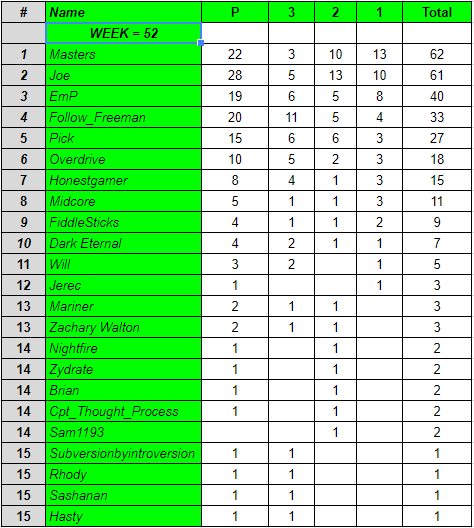 01: 1st January -- 7th January 02: 8th January -- 14th January 03: 15th January -- 21st January 04: 22nd January -- 28th January 05: 29th January -- 4th February 06: 5th February -- 11th February 07: 12th February -- 18th February 08: 19th February -- 25th February 09: 26th February -- 4th March 10: 5th March -- 11th March 11: 12th March -- 18th March 12: 19th March -- 25th March 13: 26th March -- April 1st 14: 2nd April -- 8th April 15: 9th April -- 15th April 16: 16th April -- 22nd April 17: 23rd April -- 29th April 18: 30th April -- 6th May 19: 7th May -- 13th May 20: 14th May -- 20th May 21: 21st May -- 27th May 22: 28th May -- 3rd June 23: 4th June -- 10th June 24: 11th June -- 17th June 25: 18th June -- 24th June 26: 25th June -- 1st July 27: 2nd July -- 8th July 28: 9th July -- 15th July 29: 16th July -- 22nd July 30: 23rd July -- 29th July 31: 30th July -- 5th August 32: 6th August -- 12th August 33: 13th August -- 19th August 34: 20th August -- 26th August 35: 27th August -- 2nd September 36: 3rd September -- 9th September 37: 10th September -- 16th September 38: 17th September -- 23rd September 39: 23rd September -- 30th September 40: 1st October -- 7th October 41: 8th October -- 14th October 42: 15th October -- 21st October 43: 22nd October -- 28th October 44: 29th October -- 4th November 45: 5th November -- 11th November 46: 12th November -- 18th November 47: 19th November -- 25th November 48: 26th November -- 2nd December 49:3rd December -- 9th December 50: 10th December -- 16th December 51: 17th December -- 23rd December 52: 24th December -- 30th December |
|
|
honestgamer posted January 20, 2018: Very nice! |
|
|
|
|
|
honestgamer posted January 23, 2018: The 3 out of 5 score you mentioned seems to match this review, which makes a game most people praise sound like it could be tedious in today's light. I think I would probably enjoy it more than you did, but the frustrations you pointed to seem genuine and I'm sure I would feel some of their effect (I never have played this one, since it was never officially localized). My edits to your draft were fairly extensive in places, mostly to chop content that felt redundant. I also found a bit of repetitive word use, which I tried to trim. Please read through carefully to make sure I didn't modify anything important, then post this draft if you're okay with the changes. You know the drill! --- Since Secret of Mana is being remade for modern systems, I just need to know one thing: the developers are planning to tinker with its battle system so things run more smoothly, aren't they? For me, the Mana series fits right in there with other retro action-RPG fare such as the NES' Willow and Crystalis. They're offerings I enjoyed in my youth, but today I have difficulty viewing them as anything more than relics of a bygone era. There is a "clunky" feel to them, one I can't help but notice regularly. I wasn't particularly enamored with Secret of Mana when I played it a couple of years ago, and Seiken Densetsu 3 produces a continuation of those feelings of ennui. In some ways, it's an improvement over Secret of Mana; in others, it proves inferior. I sometimes enjoyed it, but the game just as often left me frustrated or annoyed. Often mentioned as one of those "hidden gems" in the Super Famicom library, since it arrived late enough (September of 1995) in the system's lifespan that it wasn't localized for North America, Seiken Densetsu 3 is easily admired on the surface level. For a game released during the 16-bit era, it's absolutely gorgeous, offering a wide variety of beautifully rendered locations that range from castles to caves to crumbling ruins. It also offers a lengthy adventure and delivers a ton of replay value. At the beginning of your quest, you pick one of six characters to be your lead, and choose two of the remaining five to serve as allies. Each character has his or her own unique prologue and--more significantly--you'll be sent up against one of three different main adversaries and a varying set of subordinates. To battle all of the final bosses, you have to play through the campaign three times; to see everything the game has to offer, make that six. There is good variety in these characters, as well. You can pick between a warrior, a thief/ninja, a couple of mages, an Amazon princess and a werewolf who's much more powerful at night than during the day. While these people are pretty basic in terms of what they can do in the early stages of the game, you'll have two opportunities to bestow class changes upon them as the plot progresses. Changing their class allows them to learn new skills and further improves their stats. You'll only control one of the three in battle at once, while the computer lets the other two rely on melee attacks and special attacks that activate once enough normal blows connect and fill up a meter. It's easy to switch between characters for those occasions when you want to make sure a particular spell gets cast. The plot runs excellently, at least for the game's first half. While you'll only end up needing to worry about one faction of villains, no matter who you pick, you'll find yourself opposing all three groups for quite some time. Each one is seeking the same thing and, therefore, sending subordinates out to create havoc throughout the world. This leads to a mid-game event where one group of baddies achieves its goals and wipes out the other two sets, in order to become your one true adversary. Your team must then run from one country to the next, always a step behind one villain or another. While the second half of the game isn't as interesting as the first, since all of the intrigue is replaced by your party's need to scour the world for the lairs of several powerful foes known as "God-Beasts", it does end strongly. Then your party finally is ready to combat the main adversaries, with the fate of the world at stake. So, the game is gorgeous and offers an an engaging plot containing six separate beginnings and three different concluding sequences, as well as a variety of characters. What's not to like? The answer: a lot. The main issue is the combat system. That's not good when you consider just how much time you'll spend whacking monsters with your weaponry. Regular foes rely heavily on melee attacks and only infrequent spell use, so they aren't much trouble. Bosses can be excruciatingly tedious, though, due to one fact: whenever anyone uses a spell or combat skill, time stops for the entirety of its animation. Not only is there no way to dodge a spell once it has been cast, but this process causes big fights to devolve into a slog that seemingly takes forever to resolve (especially when an opponent's go-to spell has a lengthy animation). For example, let's look at the time during the second half of the game when I fought the God-Beast known as "Land Umber." During the course of that battle, he regularly employed a spell that took half the current health from whatever target it hit. The animation for that action involved him picking up a party member, crumpling them into a ball and throwing them, which caused their body to pinball about the screen. The process seemed to take about 7-10 seconds (a period during which I could do nothing but watch). The first couple times, the animation was at least more entertaining than watching a fireball hit its target. After I'd seen it a good dozen times and realized he was going to cast it with regularity, I found myself yelling at the game every damn time I'd see one of my characters being levitated into Land Umber's hands. Land Umber might have been one of the worst offenders, but most bosses were annoying in a similar manner. I would be fighting a big monster and suddenly the screen would freeze while a spell got cast. There would be no flow to the battles because they'd get interrupted every few seconds for another spell animation. Then I would cast the necessary healing spells or use an item or activate a battle skill and everything would stop for that, as well. Most bosses in the game have a lot of health for you to whittle down, bit by bit, so the incessant stoppages wind up making a lot of fights aggravating. It feels like they unnecessarily take twice as long to complete as they should. This is an action-RPG, but when you're facing off against bosses, it almost feels like a turn-based game. You find yourself waiting for one spell animation to complete so you can tap a button a couple times before the next one begins. Dungeons can also prove underwhelming, as they tend to be unremarkable except the boss encounter you face at their end. I remember how I enjoyed exploring locations in Secret of Mana because I never knew just where I might find find various weapons and the orbs required to improve them. There's nothing like that here; dungeons are little more than mazes with one correct path and a whole bunch of short jaunts leading to meaningless dead ends. If you're lucky, you'll make it to the boss quickly. If not, you're due to wander around until you chance upon said boss, after hitting virtually every single room in the place. With a couple exceptions, every treasure chest in this game is a random reward drop by enemies. I like dungeons that give me a reason to explore every little corner, not ones that simply deliver a series of meaningless rooms between the entrance and the boss. Only a few locations deviated from that simplistic formula. A ghost ship sets up a scenario where you have to leave one party member behind and go the rest of the way with two heroes instead of three. One of the God-Beasts is in a temple where you must push a couple buttons to open a gate leading to the boss. A wind-themed cave has several places where you have to move statues so the gusts of air they exhale don't impede your progress. But for the most part, the only "appeal" to these places is the possibility of unintentionally grinding for a couple levels while trying to chart a path to the boss. In Secret of Mana, those different weapons you collected had specific uses in navigation. Axes could cut down bushes, while whips could be used to clear small gaps, as long as there was a stake to latch on to. No comparable system is offered here. Each character has his or her specific class of weapon, and they all have no utility beyond their ability to cleave skulls. I can understand if a person disagrees with my verdict on Seiken Densetsu 3. Hell, 21-year-old me, who binged on Secret of Mana for three days after getting his wisdom teeth pulled, is probably livid! But this series and this game simply haven't aged well enough to remain captivating. While it looks great and has a strong plot that's aided by multiple beginnings and endings, the title's action is somewhat lacking due to a clunky battle system where everything comes crashing to a halt whenever spells are cast or items are used. The most exciting part of a boss fight becomes the suspense you feel as you wait to see whether your heal spell is triggered before an enemy unleashes another highly damaging attack. Add tedious dungeons to the mix and the game winds up serving as much more of a chore than I ever expected. |
|
|
EmP posted January 26, 2018: Let’s see if I can look at my screen for more than a few minutes without my eyes rebeling and trying to forcefully exit my skull. Nope not this time. Try again in a couple of days. Attempt Two: I can’t figure out what this thing I coughed up is. It looks alive. It’s telling me to burn things. I must obey the phlegmy monster that once lived in my chest. Attempt Three: Okay…. Okay. I can do this. Apologies if this feels a bit briefer than I usually kick out. *wheeze* THIRD Running Dead [PC] by Pickhut This week’s hard choice was who got third. Pick and Jason (twice) supplied very good reviews that centered on various degrees of puzzle games which often don’t lend themselves out as particularly gripping source material. On the other hand, Freeman writes about a Castlemania fangame in a review that drips with enthusiasm, but has more structural issues and some word repetition. For most of this topic during draft, it was Freeman’s piece that took third but then I went away and coughed for a solid half hour, re-read everything and just couldn’t get passed how many times the word ‘canon’ comes up. Pick’s review isn’t as engaging or as easy to get into -- it’s a review on a poor puzzle game, after all, but it’s a patient bash, thoroughly explained without ever reaching for the low hanging fruit of outright mockery. Good work to all; it was a harder pick then my spluttering mental faculties were functioning well enough for. SECOND Super Mario Odyssey [SWH] Fiddlesticks Obviously, because this site is run by a Nintendo-crazed lunatic who religiously chants the lyrics to the old Super Mario Bros. weekend morning show like a mantra for half an hour every night because, if he doesn’t, the Kirbys will devour his dreams, we already have an Odyssey review on site. The only problem with that one is that it spends so much time talking about what the game does wrong that the things it does right comes across like an afterthought. I guess the reason for this mini-rant isn’t so much as to lay the boot into Jason but to point out that if superfan Venter can fall into this trap then it’s probably an easy obstacle to stumble over. That never happens here. There’s criticism included -- fair-sounding ones like how drowning in a thousand moons can make what should be satisfying captures feel mundane -- but it’s overshadowed by someone talking about falling back in love with a series he’d been losing hope in. It’s a strong angle to take and the game sounds all the better for it. WIN Hellblade [PS4] by Joe Reviews like these -- for a socially ill-adjusted miscreant like me, at least -- are a blast to write. Being able to write about any medium’s honest attempts to make you miserable often makes for some fun writing material, even if you have to constantly try and hold back on what you really want to say because dropping a spoiler and then trying to explain it in context is a tumbling house of cards. It’s far too easy to stray innocently into spoilers that will probably make your review sound more awesome but will give the reader slightly less interest in playing the game. That’s not a good thing. Don’t do that. Joe doesn’t do that. That’s a good thing. And now he wins. I’m off to sleep forever. |
|
|
overdrive posted January 26, 2018: Just when you get one of my reviews approved, here I come with another one AND IT'S A KEMCO GAME!!!!! 3/5, as per the norm. ------- Ah, Exe-Create; you could easily be the best of Kemco's design teams, but the inherent repetition shown throughout your games winds up relegating them as decent, but forgettable, offerings. The sort of game I find myself enjoying while I'm working through it, but doesn't resonate with me after completion. Now, maybe this isn't all your fault. After all, since you're easily the most prolific of Kemco's teams, you might simply have to release games so frequently that you've no recourse other than to recycle plot elements and graphical assets over and over, causing all your efforts to blend together into an amalgam of average. Believe me, I know that working on strict deadlines can really suck. Regardless of the reason, it's all too common that I finish one of your games and think that with extra time, that average effort could have been something better. Revenant Saga is no exception. It uses their three-dimensional battle engine, giving it a more modern feel than the average Kemco game. There's a fairly robust plot containing a handful of twists and a large assortment of dungeons, including a few really lengthy ones as you near the end. Of all the E-C games I've played, this one might have the most consistent challenge on the default difficulty level, with no massive difficulty spikes coming out of the blue either in the regular game or the post-game content. Or, perhaps more accurately, the game actually gives you the tools to counteract any potential spike due to including a pretty neat system to power up your weapons. Since that's the most noteworthy thing about this game, let's start with it. As per the norm, weapons can be bought in town and found scattered through dungeons. Throughout the game, you'll also obtain various ores and crystals that can be bonded with those weapons. A person can only attach a finite number of ores to a weapon in order to give it special attributes that inflict status ailments on enemies, steal their items and even occasionally deliver instant death. Crystals can be added at any time and in any number in order to boost a weapon's attack power. If you want, you can immediately use them as soon as you find a batch in order to bestow a small boost to your current power. Or, like me, you can store them up throughout the entire game and cash in big-time upon gaining the very powerful weaponry made available in the final dungeon. For all I know, there might have been a difficulty spike between the main game and post-game dungeon, but when a guy gives each of his four heroes a 100-point attack boost shortly beforehand, it's not going to be that noticeable. Those enemies might have hit pretty hard, but I hit harder. Being able to add special attacks and additional power to my weapons was a pretty nice touch that I can unabashedly support. As for the rest of the game, I'm more lukewarm, as every positive seems attached at the hip to a negative. Start with the plot. On the surface, it's pretty enjoyable. Albert, the protagonist, lives in a small town in a world where humanity is routinely involved in skirmishes against demons known as Revenants, while also suffering from a mysterious plague. A girl who Albert is close to is especially affected by both of these things, as she is expected to become a great Valkyrie in the fight against the Revenants, but at the moment is attempting to care for her plague-stricken parents. Therefore, when the seemingly-benevolent Dr. Moreau comes to town peddling a potential cure for the disease, Albert offers to volunteer his services. In news that should surprise no one, Dr. Moreau isn't a philanthropic soul; instead being a mad scientist attempting to meld Revenants into human bodies on the orders of the sinister Valdoren, who is seeking to give the demons dominion over the human world. The prologue ends with Albert sharing his body with a powerful demon by the name of Magnus and his girl having vanished — another victim of Moreau's plotting. Moving to the future, Albert is using his new powers to fight Revenants while Magnus regularly tells him that at some point, he'll lose control and the demon will completely take over his body. In quick succession, the lad meets the Valkyrie Esther, who reminds him of his long-lost friend, and they are then joined by Bruno, an arrogant cleric in service to Rystoria, the same deity whom the Valkyries fight for. The trio becomes a quartet when they're joined by Julia, a young child who escaped Moreau and Valdoren. While the four characters have their share of mistrust, often thinking to themselves about how they'll use the others to fulfill their personal goals, since this is an Exe-Create game, it's a given that they'll become a big, happy family and regularly give monologues about the power of teamwork, friendship and whatnot as they get closer and closer to crushing the aspirations of the villains. So, what are the problems with this? The first half of the game is loaded with intrigue. Albert is trying to hide his half-Revenant nature from teammates who might feel compelled to slay him if they knew his body was home to a demon. While Esther is friendly and open, Bruno regularly makes it clear that he works for the church and will do whatever that organization says, regardless of how that affects the rest of the team. And Julia continually plays the role of a shy and scared child to gain the trust of the others, while planning to set them against Moreau and pals. Unfortunately, Exe-Create is far better at writing page after page of long-winded (and typo-plagued) dialogue than they are at actually telling a good story. And so, you have lots of talking whenever you enter a town, as well as each one's local church. When you're walking from one town to the next (or the local dungeon), your party will stop halfway to make camp and have another conversation. During all these stops, the characters learn about trust and friendship in non-convincing ways such as Julia suddenly feeling bad about having to deceive everyone and then abruptly deciding she'd rather be a comrade than a manipulator. Hell, even Magnus and a couple other demons become good guys with little explanation given other than "What is evil can turn good and vice versa". After everyone is on the same page, those mid-walk camping sessions depart and things get more straight-forward. While the plot wasn't quite as interesting because of how the intrigue vanished, it did progress more smoothly and the combination of less dialogue and more complex dungeons made my time with Revenant Saga feel more like playing a decent RPG than reading a book where I got to control characters and occasionally fight battles. The dungeons were generally fun, although the main-game finale, as well as the one constituting the post-game, could get tedious. Those places were simply huge, while also lacking in puzzles, resulting in me spending hours wandering through massive, yet fairly linear, places that blended together. Still, even at their worst, the dungeons in this game were infinitely superior to the game's world. If there's one thing that Kemco's companies are seemingly incapable of getting right, it's designing a world that seems like an actual planet composed of various countries and continents. Revenant Saga's might be the worst I've seen yet. The entire world is essentially a really long, winding road stretching over a couple continents with towns and dungeons scattered along it. Think about how Final Fantasy XIII's world was mostly a collection of linear corridors and scale that down for a mobile platform. You start in one town and head to a nearby dungeon. Then you're told to go to another town, which just happens to be a little ways down the corridor from the first and so on and so on until you finally get a ship and are able to visit the tiny handful of islands that aren't along the main path. There's no actual sense of exploration — you just follow a road and stop at every location of interest along it. I suppose that instead of finishing this review with yet another half-hearted, "If you L-O-V-E JRPGs and wouldn't mind playing a short, unexceptional one, go ahead and try it…" verdict like I tend to wind up doing with all my Kemco reviews, I'll instead say that if there's one neat thing about playing through the games designed by Exe-Create, it's that you can watch the company gradually put together what would wind up being the core components of their most recent efforts. Being able to use materials to enhance weapons would become a recurring staple of their games, as did an optional challenge where you can win awards for causing a lot of damage to a non-aggressive and immortal character in a certain number of battle turns. To me, that sums up the potential of Exe-Create, as well as why they've never truly delivered upon it. On one hand, you have a company that is constantly looking to add new elements to their games as part of their endeavor to design a legitimately good RPG. On the other, they release their games so frequently that they tend to blend together because whenever a good idea is implemented, it'll get recycled repeatedly, so if you play enough of their titles, you'll wind up seeing a lot of the same stuff over and over again. It's kind of a shame, truthfully. They seem to be a tireless company that constantly works to release new games, but if they weren't apparently mandated to churn them out regularly, they could actually put the time into each one to differentiate it from their others. As it is, though, Revenant Saga is just another Exe-Create title. It has its good points and bad points, but generally doesn't do anything to allow it to stand out from other games they've put on the market. |
|
|
Fiddlesticks posted January 26, 2018: Thanks for the commentary. I am pleased to see that my review is a good companion piece to the one that Honestgamer wrote. Also, congrats to Joe who covered a complicated game quite well. Both site reviews for Senua’s Sacrifice have now won RotW. |
|
|
dementedhut posted January 26, 2018: Considering it was a three-way battle for third placement, thanks for choosing my review! Sounded like it could have been any one with the way you were going back and forth. I think I spent nearly an entire week playing that game, and ONLY that game, so I guess that helped with the review's thoroughness; it was the only hands-on, video-related thing on my mind that week. Congrats to Fiddlesticks for that Odyssey review and Joe for taking RotW! |
|
|
JoeTheDestroyer posted January 27, 2018: Thank you for the victory. I shall cherish it. Also congrats to Fiddlesticks and Pickhut for placing during this week. I hope you feel better, EmP. We need your snark. |
|
|
dementedhut posted January 29, 2018: Title: A Collection of Bad Moments Platform: PC Genre: Adventure??? Puzzle? Developer: Sky Trail Ltd Publisher: Sky Trail Ltd Release date: 01/12/18 Format: Download Added. Thanks. |
|
|
EmP posted January 30, 2018: Both site reviews for Senua’s Sacrifice have now won RotW. I've awarded both those wins, too. I should probably play that game. |
|
|
overdrive posted January 30, 2018: Bump |
|
|
EmP posted January 30, 2018: Hidden Dragon: Legend has a clear idea on what it wants to be. It’s a delightfully unapologetic product of its developer’s culture, for one. Until early 2015, there was a ban on exporting Chinese console games to a worldwide market (got to ensure all the effort is focused on releasing a new MMO every other day, after all) so MegaFun Game’s first order of business was to give the world a 2.5D hack and slasher set in the imperial era of Tang China. In terms of pure exhibition, it has class to spare, ensuring that it never places you in a drab, uninspired setting when it can instead wow you with enthused, eye-popping locations. You can run through the remains of a razed town, dashing across the spines of red-tiled rooftops or take to the creaky wooden scaffolding that encircles the crumbling stone edifices of warriors past. You can travel through bamboo groves that lead to isolated and long abandoned villages which sit on the outskirts of mammoth stone forts illuminated by an army of lanterns. It wants to impress, often bullying the now groaning Unreal engine along the way. It’s all well and good standing around and admiring the backdrops, but the catalogue of sword fights you need to progress through are often things of pure spectacle. Starting with only the most basic of combos available to you, you need to slowly upgrade your swordsman’s arsenal by investing the souls of the slaughtered into new builds and flashy execution methods. You’ll not get very far with the pedestrian weak, weak, weak, strong, strong combo you hold by default (and will get exactly nowhere with uncultured button mashing), forcing you into a variety of attacking options that turn the best fought duels into orgies of air juggling, rush counters, animation cancelling, combo breaking insanity. There’s no block button so the only way to avoid attacks is either to get out of the way, or time a rush counter that leaves them open for a blistering combo of you own. It’s almost tactical; stray, hopeful slashes that fail to connect often leave you open to a furious enemy stabfest, so your attacks need to be balanced and timed. It’s the kind of engine where you get out what you put it; on the easier settings you could probably muddle yourself through the game with a few favoured combinations on hard repeat coupled with a decent grasp of rush cancelling. Or, by taking the time to learn a number of special attacks and what vulnerabilities they can exploit, you have the potential to chain together hit counts soaring up into the hundreds while mowing down legions of hapless assassins and cultists with style. All highlighted with neon slashes sometimes registering faster than you can see. Mowing through an army of foot soldiers without breaking stride is one thing, but Hidden Dragon also employs the liberal use of huge screen-filling bosses with all that old school stuff you used to love, like attack patterns and exploitable weak spots. There’s also quick time events, because of course there it. At this point, getting mad at a game for awkwardly shoving these in to cinematic events as a cheap attempt at interactivity is about as productive as raging at the rain for being wet. The awkwardly-phrased point being built towards here is that the further you move away from the spectacle of the game’s setting and the acquired intricacies of its combat, the weaker it becomes. Some of its exploration elements work pretty well; you can often bypass fights and obstacles you may feel are beyond you by taking a slightly different route, dropping into a series of tunnels burrowed through sheer cliffs or jumping atop some roofs and running past threats who’ll never know you were there. Sometimes these aren’t based around the game’s clunky attempts at platforming, or the use of a grappling hook that will kill you far more often than an enemy’s sword ever will. You’re also given the option to replay levels, which is not only helpful for grinding souls for struggling players but means that a sequence that was once too tough for you can be revisited and gutted of its hidden wealth by a beefier character with a bolstered moveset. It has a decent go at covering all bases. There’s a reasonable if unoriginal story here about betrayal and murder which, oh dear, uses the fact that badarse swordsman, Lu, is suffering from the convenient amnesia plot device to retell everything. Copious flashbacks to his hazy, misremembered past pop up at opportune moments to remind him if he should be homicidally angry with someone while the rest of the game’s otherwise rich lore is told through scattered notes and reclaimed artefacts. What really smarts is that, at its best, Hidden Dragon tells its tale wordlessly and organically, without the clichéd protagonist’s memory affliction driving the exposition and instead simply letting it unfold through his interactions with the world. It’s just not a particular good tale. You won’t stick through Hidden Dragon just to learn its gripping conclusion consisting of stuff Lu remembers. If you hang around, it will be because earning a few more souls will unlock that awesome looking mid-air combo reset or because you’ve got rush counters down so well you’re an ethereal, unhittable ghost on the battlefield and the misery of your enemies pleases you. Stylish murder sprees, that’s what this game does well, just so long as you’re willing to invest the time and effort to get you there. Just don’t count on the rest of the game battling as hard to maintain your interest. |
|
|
overdrive posted January 30, 2018: A new year and my first RotW of said new year. Huzzah for this thing still being alive, even if EmP may not be, going off his whole "I'm deathly ill" deal he had last week. Looks like we have two reviews by Joe, two by Venter, one by Fiddlesticks and one from EmP (HE IS ALIVE…or at least programmed his computer to send in one final posthumous review…since it's for a game from his beloved 32X, it may be how he wanted to go out. As vikings have their funeral pyre, EmP has his 32X). Oh yeah, there's also one of mine, which moves to Venter's week. Because after waiting patiently most of the month for our illustrious leader to notice I've been regularly sending him work, he finally readies one for release during my week to judge them!!! Sigh…I'm not going to finish too highly in this year's Site King at this rate. Let that be a lesson to you, guys. When you narrowly edge the boss out for fifth place in the standings one year, he WILL crush you the next year. Either that or EmP got in his ear about paying me back for my reluctance to review any more Aliens games after my experience with that crappy GameBoy Color one. Look, I don't know who is at the heart of this BUT IT'S AN ANTI-ROB CONSPIRACY!!! About makes me want to buy a Switch just so I can give EVERYTHING from direct-to-download crap to legitimately revered Mario and Zelda stuff a one-star review. So, yeah, judging reviews and stuff. Here we are again with 3.4 percent more bitterness. Give me a few minutes to read these things and then I'll get on to deciding who gets complements from me and who gets the full-on brunt of my unholy scorn. Or, more likely, less effusive compliments since people keep telling me that it doesn't foster a healthy community when I'm comparing others' work to the end result of a three-year-old falling on top of a keyboard and twitching around on it convulsively. Hmmm…give me a minute, I need to save that line. I suppose we'll start out with the I DON'T KNOW EXACTLY WHAT TO DO WITH THIS ONE Award, which goes to Fiddlesticks for a fairly entertaining fan fiction of Fallout 4 that contains enough game information in places to be something akin to a review. I think? Taking place in diary form, it details the trials and tribulations of a random NPC and his dealings with the game's protagonist. As a read, I found it very entertaining, especially the parts lampshading kleptomaniac heroes, how a guy might have a super-important quest but will put it on hold to farm tons of items and resources and how plot armor NPCs can't be killed. As a review, I don't know if it's as effective. A couple diary entries give a good bit of exposition as to what the game's world is like and there are little bits buried here and there that give info about things that can happen in the game, but as a guy who's played 3 and New Vegas before, but not this one, it seemed I was calling on my personal knowledge as much as relying on what you were saying to figure out what's what with this game (allowing me to enjoy the reference to the Fallout food staple, squirrel on a stick). Hell, for most of it, I was wondering if I've fallen so far out of favor with the site overlords that we had another of those "Promethian review" contests and no one told me because they were worried I'd submit 2500 words on some Kemco RPG. So, in short, it was a fun and enjoyable read that'd be first place simply on the criteria of "I liked reading it!", but on the "I learned about a game, how it works and why the reviewer liked/disliked it" level, it falls outside the top three. Like, to give one example -- you use a couple diary entries to describe the hero taking all sorts of materials to build stuff for the Minutemen and how that affects the live of the diary-writing farmer, but I have no clue how that stuff flows with the game to a player. Is it cool or an annoyance where you have to build stuff or fast travel to old sites to fight invaders when you want to explore new places and advance quests? THIRD PLACE Jason's Oh…Sir! The Insult Simulator (Switch) Both you and Joe had one review you seemingly had fun writing and one review for a game that you didn't really have much to say about, but were gonna give it a go, regardless! Which made it easy for me to pick which of your reviews was getting a placement, so yay! This review resonated with me probably because I just finished my latest re-watching of Flying Circus (6th time through? 7th?) and this whole very British-seeming game feels like a skit by them come to life with people delivering bizarre word salad insults in a game show sort of way. And I think you did a good job of rolling with that (at least in my very diseased mind) while reviewing it, adding in your own horribly lame and bizarre insults in the tagline and in the review, while explaining how this is a pretty fun party game that doesn't have the same chops as "alone night" entertainment. About my only complaint is that for some reason this review made me feel old, with how you felt the need to explain what tea is. Damnit! My generation knows all about that dadgum tea drink! Made your hot water taste like stuff, it did!!! --- SECOND PLACE EmP's DarXide (Sega 32X -- Earth's Greatest Achievement) When I upgraded my Mac's OS a year or so ago, it caused my Sega emulator to stop working. I'd say I was bothered by that, but most of the Genesis games I wanted to play, I own on a 360 compilation and not having that thing around allowed me to gracefully bow out of feeling remotely obligated to help you out with 32X reviews, leaving you to cover games such as this. It really says a lot about a system's viability when it shows off by releasing a tech demo of Asteroids that looks better, but is worse in every other conceivable way. Overall, I liked this review. You found a lot to talk about, considering how simplistic this game is, but it never felt like you were forcing yourself to find something to say. You had some good history concerning what this game was SUPPOSED to be, as well as how it failed as a game, with special kudos for tying in how it betrayed its roots by removing the claustrophobia and chaos that made Asteroids so legendary. All in all, making this an enjoyable read. --- REVIEW OF THE WEEK (aka: Overdrive Place) Joe's Remaining in a dream (PC) Sometimes, I wonder why I'm so eagerly clutching to my Kemco niche. Sure I'm reviewing games that have very few reviews on the market, which gives me some very, very, very sad version of brand recognition, but I'm playing a slew of short, simple, generic RPGs where the main saving grace is that they're usually short enough that I've finished each one before feeling the urge to scoop my eyes out with a wooden spoon. But then I look across the site and see Venter trying to cover every 25-minutes-of-kind-of-fun Switch downloadable and you and EmP scouring the Steam Marketplace for such grand titles as this — a game where the only justification of playing it seems to be if your friend designed it and you really want to quash his dreams of designing the next big thing by telling him just how much his work sucks and how he'll never amount to anything. I guess, in this scenario, it probably isn't a good friend… I think you and EmP both crossed similar grounds here, taking apart a horrible game, but yours edges him by a nose due to some of those intangible factors that it's now my duty to try to put into words. I think with his, it just started out with this "this game is going to be bad, so let's tear into it!" vibe, but your review starts with intrigue. A colorful walking simulator! Wait, you just got a gun, so it's a shooter! And then you have a very non-challenging shooter against toothless foes that get broken up by a pair of horrid gimmick levels. Where any potential difficulty is washed away by the ability to save scum. And how the game isn't even perfectly stable (the "not knowing you had a key because the game never told you" bit made me laugh). With all of this delivered in a sort of deadpan way where you're not truly bashing the game, but sort of going through the emotions you felt as you started it and then progressed through it and got more and more disappointed and annoyed. --- Alright, that was fun and definitely beat working today at work. Now, let us all hope for my sake that we keep this four-person rotation going for a while, since it's kind of nice knowing that I only have to pull one of these out per month (give or take, the maths isn't my strong suit). So stay strong, EmP! I have faith you can overcome the horrific and diabolical malady known to mere mortals as a common cold!!!! |
|
|
honestgamer posted January 30, 2018: I didn't mention it in my review (I had to keep my flow going), but one of the setups in Oh...Sir! is essentially the parrot sketch from Monty Python's Flying Circus. Which, by the way, I have started watching after obtaining the whole series on DVD a while back when I found it cheap on eBay. I'm not quite halfway through it yet. |
|
|
Fiddlesticks posted January 30, 2018: Congrats to the winners. I thought that Darxide review was pretty good. Thanks for taking the time to offer some input on my Fallout 4 "review." I definitely agree with your points on it; it's really more a fan-fic than actual critique of the game, and you do need to have first-hand knowledge of it to get the most out of it. I blame it on me feeling inspired to do a write-up for that game in that style while I was recently flying cross-country. |
|
|
honestgamer posted January 30, 2018: The game sounds quite decent. Your draft was generally good, but please look it over to make sure I didn't introduce new errors while trying to tighten things up a bit. Also, a note: I added a sentence at the end of your second-to-last paragraph, to make your point more forceful. Please pay particular attention to that area, to make sure I'm not introducing ideas that aren't yours or mangling your text. If everything looks good, this should be good to go. Thanks! --- Hidden Dragon: Legend has a clear idea what it wants to be. It’s a delightfully unapologetic product of its developer’s culture, for one. Until early 2015, there was a ban on exporting Chinese console games to the worldwide market (one must ensure all effort is focused on releasing a new MMO every other day, after all), so MegaFun Game’s first order of business was to give the world a 2.5D hack and slasher set in the imperial era of Tang China. In terms of pure exhibition, it has class to spare, ensuring it never places you in a drab, uninspired setting when it can instead wow you with eye-popping locations. You can run through the remains of a razed town, dashing across the spines of red-tiled rooftops, or take to the creaky wooden scaffolding that encircles the crumbling stone edifices of warriors past. You can travel through bamboo groves that lead to isolated and long abandoned villages which sit on the outskirts of mammoth stone forts illuminated by an army of lanterns. The game wants to impress, often bullying the now groaning Unreal engine along the way. It’s all well and good standing around and admiring the backdrops, but the catalogue of sword fights you need to progress through are often things of pure spectacle. Starting by relying on only the most basic of combos, you need to slowly upgrade your swordsman’s arsenal by investing the souls of the slaughtered into new builds and flashy execution methods. You’ll not get very far with the pedestrian weak, weak, weak, strong, strong combo you hold by default (and will get exactly nowhere with uncultured button mashing), which forces you to utilise a variety of attack options that turn the best fought duels into orgies of air juggling, rush counters, animation canceling, combo breaking insanity. There’s no block button, so the only way to avoid attacks is either to get out of the way or time a rush counter that leaves foes open for a blistering combo of you own. It’s almost tactical; stray, hopeful slashes that fail to connect often leave you open to a furious enemy stab-fest, so your attacks need to be balanced and timed. It’s the kind of engine where you get out what you put in; on the easier settings, you could probably muddle yourself through the game with a few favoured combinations on hard repeat, coupled with a decent grasp of rush cancelling. Alternately, by taking the time to learn a number of special attacks and what vulnerabilities they can exploit, you have the potential to chain together hit counts soaring up into the hundreds while mowing down legions of hapless assassins and cultists with style. All highlighted with neon slashes sometimes registering faster than you can see. Mowing through an army of foot soldiers without breaking stride is one thing, but Hidden Dragon also employs the liberal use of huge, screen-filling bosses with all that old school stuff you used to love, like attack patterns and exploitable weak spots. There are also quick time events, because of course there are. At this point, getting mad at a game for awkwardly shoving these in to cinematic events as a cheap attempt at interactivity is about as productive as raging at the rain for being wet. The awkwardly-phrased point being built towards here is that the further you move away from the spectacle of the game’s setting and the acquired intricacies of its combat, the weaker it becomes. Some of its exploration elements work pretty well. You can often bypass fights and obstacles you may feel are beyond you simply by taking a slightly different route: dropping into a series of tunnels burrowed through sheer cliffs or jumping atop some roofs and running past threats who’ll never know you were there. Sometimes these are based around the game’s clunky attempts at platforming, or the use of a grappling hook that will kill you far more often than an enemy’s sword ever will. You’re also given the option to replay levels, which is not only helpful for grinding souls for struggling players, but also means you can revisit a sequence you once found too tough and gut its hidden wealth using a beefier character with a bolstered move set. The campaign has a decent go at covering all bases. There’s a reasonable if unoriginal story here about betrayal and murder which, oh dear, uses the fact that badarse swordsman, Lu, is suffering from the convenient amnesia plot device to retell everything. Copious flashbacks to his hazy, mis-remembered past pop up at opportune moments to remind him if he should be homicidally angry with someone, while the rest of the game’s otherwise rich lore is told through scattered notes and reclaimed artifacts. What really smarts is that, at its best, Hidden Dragon tells its tale wordlessly and organically. It doesn't rely on the hero's clichéd memory affliction to drive the exposition, and instead lets things unfold through his interactions with the world. So it's unfortunate when the scenario writers abandon nuance in favor of clumsiness. It’s just not a particularly good tale. You won’t stick with Hidden Dragon just to reach its gripping conclusion and find out what other stuff Lu might remember. If you hang around, it will be to earn a few more souls and unlock that awesome looking mid-air combo reset, or because you’ve got rush counters down so well you’re an ethereal, unhittable ghost on the battlefield and the misery of your enemies pleases you. Stylish murder sprees, that’s what this game does well... so long as you’re willing to invest the time and effort to get you there. Just don’t count on the rest of the game battling as hard to maintain your interest. |
|
|
overdrive posted January 30, 2018: Jason I bought it a few years ago (the DVD set) and tear through it all every few months. Has to be a long enough time that I just remember sketches and not the whole avant-garde way they connected everything in whatever nonsensical way they were doing things that week. Keeps it kind of fresh for me, even if I know how, to use your example, the Parrot Sketch goes. |
|
|
EmP posted February 01, 2018: A cold. Scoff! I bloody wish. I'm starting to feel less like the shuffling dead, so I'll start reactivating myself more shortly. Congrats to Joe, I really liked his review, and to Jason for discovering Monty Python several decades later than everyone else. Classic Venter! I also really dug Fiddle's Fallout 4 review; it was an interesting concept and an amusing read. Every time I review a 32X game, I assume that perhaps the worst is behind me and it's plainer sailing from then onward. Then I discover DarXide, and my faith is shattered against the cruel rocks of reality all over again. Still, it's strangely enjoyable playing Internet historian for these things. I'm not saying I'll miss it when I'm finally done, but I don't mind doing it as much as I thought I would. Primal Rage next. God help me. Cheers, Rob. |
|
|
honestgamer posted February 01, 2018: I've known about the Monty Python troupe for years, of course. I even watched "A Fish Called Wanda" when I was a kid (and then again very recently, as I now own it on blu-ray), which includes a few of the principle actors. I just never actually watched the "Flying Circus" series that made them famous until quite recently, despite also watching "Holy Grail" more than a decade ago. That one I own on DVD. I have yet to watch "The Meaning of Life" and "Life of Brian" and such. Anyway, my point is that I'm not completely oblivious when it comes to such things, even in cases where I don't have personal experience with them. But some of the jokes do make more sense when I view them now that I am older and able to get the subtext. The scenes in "A Fish Called Wanda" where Michael Palin's character is trying to snuff the old woman seemed sad and demented to me when I was much younger. I couldn't understand why my uncle--who was my babysitter and had the brainwave to show my sister and I the R-rated film my parents almost certainly wouldn't have let us watch--was laughing so hard. Now I get it. ;-) |
|
|
honestgamer posted February 01, 2018: There was a lot of rambling at the start and end of this review, along the usual talking points, so I tried to trim that down to the bare minimum to keep things moving forward. I also tightened some transitions and eliminated word repetition and looked for ways to say things more directly and actively (there was a lot of passive voice her, particularly in the narrative descriptions). Please look over the final result to make sure my chopping didn't produce errors, then post the draft if you're good with the changes. You know the drill. Thanks! --- Exe-Create could easily be the best of Kemco's design teams, if only its prolific output didn't rely on constantly recycled plot elements and graphical assets. I know how much it sucks to work on a strict deadline, so I can forgive the developer for producing a bunch of average games that could have been something better if only more time had been spent on them. That doesn't mean I have to like it, though. Revenant Saga is typical of the developer. It uses the team's favorite three-dimensional battle engine, leading to a more modern feel than you'll find in the average Kemco fare. There's a fairly robust plot containing a handful of twists and a large assortment of dungeons (including a few really lengthy ones near the end). Of all the E-C games I've played, this one has the most consistent challenge on the default difficulty setting, with no massive difficulty spikes coming out of the blue in either the regular game or the post-game content. Or perhaps it's more accurate to say the game gives players the tools to counteract any potential spikes, by including a pretty neat system for powering up weapons. Weapon customization is actually the game's most noteworthy element. As per usual, weapons can be bought in town and found scattered throughout dungeons. You also obtain various ores and crystals that can be bonded with those weapons. Only a few can be attached at once. A weapon can then inflict status ailments on enemies, steal items and even deliver instant death on occasion. Crystals can be added at any time--and in any quantity--to boost attack power. You might use crystals as you find them, to make each new weapon slightly more useful, or (like me) you might hoard them until the final dungeon and cash in big-time by improving the final weaponry. For all I know, there may actually be a difficulty spike between the main game and the post-game content that follows, but when a guy gives each of his four heroes a 100-point attack boost shortly beforehand, it's difficult to notice. Unfortunately, though I unabashedly support the weapons customization mechanics, my reaction to the game's other elements is decidedly lukewarm. Start with the plot, which on the surface is enjoyable. Albert, the protagonist, lives in a small town. Its inhabitants are routinely involved in skirmishes with demons known as Revenants. Besides that, the townsfolk suffer from a mysterious plague. A girl who Albert is close to feels the effect of both of these things, since she is expected to become a great Valkyrie who will lead her people in their fight against the Revenants. At the moment, though, she's too busy caring for her plague-stricken parents. When the seemingly-benevolent Dr. Moreau comes to town peddling a potential cure for the disease, Albert takes an immediate interest on his friend's behalf. In a twist that should surprise no one, Dr. Moreau isn't actually a philanthropic soul he seems. His goal is to meld Revenants with human bodies, following the orders of Valdoren, a sinister fellow who seeks to give demons dominion over the human world. The prologue ends as Albert finds himself sharing his body with a powerful demon named Magnus. His girl has vanished, meanwhile, another victim of Moreau's plotting. Years pass. Albert now uses his powers to fight Revenants, but Magnus assures him that at some point he is bound to lose control. Then the demon will completely take over his body. The lad soon meets the Valkyrie Esther, who reminds him of his long-lost friend, and the duo is joined by Bruno, an arrogant cleric in service to Rystoria (the same deity for whom the Valkyries fight). The trio becomes a quartet when a young child named Julia crosses their path. She has recently escaped Moreau and Valdoren. The four heroes form an uneasy alliance. Each attempts to use the others to fulfill personal goals. But since this is an Exe-Create game, you know from the start that they'll eventually become a big, happy family and regularly give monologues about the power of teamwork, friendship and whatnot, even as they draw steadily closer to a time when they can crush the villains' aspirations. So, what are the problems with this narrative approach? Well, the first half of the game is loaded with intrigue. Albert hides his half-Revenant nature from teammates, who might feel compelled to slay him if they knew his inner struggle. Esther is friendly and open, but Bruno regularly makes it clear he works for the church and will do whatever that organization says (regardless of how that policy affects the rest of the team). Julia, meanwhile, continually plays the role of a shy and scared child to gain trust, all while planning to set her new acquaintances against Moreau and pals the minute the opportunity arises. Unfortunately, Exe-Create is better at writing page after page of long-winded (and typo-plagued) dialogue than it is telling a good story. Look forward to extended dialogue sequences whenever you enter a town, or a local church. As you travel from one town to another--or just head for the next dungeon--your party will also stop halfway to its destination to make camp and have yet another conversation. During these interludes, the characters learn about trust and friendship in non-convincing ways. Julia suddenly feels bad about deceiving everyone, for instance, and decides to be a proper comrade instead of a manipulator. Hell, even Magnus and a couple of other demons become good guys, with no explanation provided except that "What is evil can turn good and vice versa." Once everyone is finally on the same page, camping sessions grow less common and progression is straight-forward. The combination of less dialogue and more complex dungeons allows the later segments of Revenant Saga to feel more like a decent RPG and less like a book that sometimes lets a person control the characters and fight battles. Dungeons are generally fun the whole way through, though the last couple of them do become tedious. Those final ones are simply too massive and linear for their own good. Still, even at their worst, the dungeons are infinitely superior to the lackluster overworld. If there's one thing Kemco's teams can't seem to do, it's develop a world that feels appropriately epic. Revenant Saga's design might be the worst one yet. The entire world is essentially a long, winding road stretched across a couple of continents, with towns and dungeons scattered along that route. Recall how Final Fantasy XIII's world mostly consisted of linear corridors, then scale that down for a mobile platform. You start in one town and head to a nearby dungeon. Then you venture to a new town, which is situated just a short ways down the corridor from the first one and so on. Finally, you reach a ship and can visit the tiny handful of islands that aren't positioned along the main path, but there's no actual sense of exploration along the way; you follow a linear road and stop at every location you find. If there's one neat thing about playing through the many games Exe-Create has developed thus far, it's that you can watch the team gradually growing comfortable with the concepts that may someday allow it to produce a truly engaging RPG. The ability to use materials to enhance weapons would become a recurring staple in subsequent titles, for instance. It's easy to see how if the team were only given more time to produce unique efforts and experiment a bit more, it might assemble something truly special. As it is, though, Revenant Saga is just another typical Exe-Create title. It has good points and bad ones, but generally doesn't do anything to stand apart from the developer's other efforts. |
|
|
JoeTheDestroyer posted February 01, 2018: Haha! Two weeks in a row! Thank you for the victory, and for having this wonderful topic out timely. I also congratulate Jason and EmP on their placement. |
|
|
Follow_Freeman posted February 02, 2018: Might need to resort to getting official screenshots for this game since it has a weird aspect ratio. But anyway. Title: Anodyne Platform: PC (and Mac and Linux) Info: https://www.anodynegame.com/ Added |
|
|
TomatoMan posted February 06, 2018: Shadow of the Colossus PS4 http://ign.com/games/shadow-of-the-colossus-remake Added. |
 |
Naetoid posted February 06, 2018: Dandara is a wholly unique experience whose “limiting” mechanics fascinate and frustrate. ----------------------------------------------------------------- In an era where new games are molding themselves after the last big hit, hues of brown still dominate the overall gaming color palette, and the definition of true growth and revolution is cardboard accessories, Dandara stands out. It’s a game that tries new things within familiar trappings. It’s set in a world created by someone with a truly unique vision, where you are never quite sure what the next room will hold. It dares to challenge you with interesting mechanics and sticks to its guns, even questionably so at times. Dandara is a labor of love and it shines through every aspect of its design, whether you like it or not. And I like it. Dandara is about the eponymous character, Dandara. Our hero is a femme person of color born into a world of oppression, all with the hopes that she can make a difference. The world of Salt (yes, Salt is its name) has been torn apart by The Golden Idea, a corporate-minded entity that overruns the beauty of the villages and cities of Salt. Set with the task of eliminating the various entities sapping the will from Salt’s citizens, Dandara’s journey begins. That may sound like a rich well to pull from, but story isn’t something Dandara prioritizes. Aside from the opening cutscene and a few moment to moment interactions with the characters you discover in the world, there isn’t much there. Salt, its inhabitants, and Dandara herself are beautiful and interesting, but we aren’t given enough to fully understand it all in the end. It is interesting to note that Dandara is actually based on a historical figure. An African queen brought to Brazil as a slave, Dandara was a fighter who helped her people fight back against oppression in Brazil. After being arrested for her efforts on February 6, 1694, Dandara committed suicide to avoid having to go back to her life of slavery. She studied capoeira, a flowing fighting style that blends dance, acrobatics, and martial arts. Her story is more of a legend at this point, with no one certain of her true origins and stories about her being mostly unattributed, and this game only helps to further those legends. And that isn’t the only way that Brazilian developers Long Hat House celebrated the Brazilian history of resistance. Characters you run into, like giant woman Tarsila — based on artist Tarsila do Amara — are Brazilian icons. Their identity and their culture run throughout this game and it’s beautiful and worthy of praise. But again. Story isn’t a priority for Dandara. Navigation and exploration are. Dandara is a Metroidvania. There’s no talking around that. For those unfamiliar, a Metroidvania is greatly inspired by the games of Metroid and Castlevania, which popularized a genre characterized by world exploration with little to no prompts and unlocking areas with items and weapons as you progress. Areas are dense with secrets and you are encouraged to return to areas you left behind once you’ve unlocked new abilities to uncover its treasures. Dandara has all of those things, but with one major tweak. You don’t control this game in any traditional sense. Originally developed with touch controls in mind, Dandara is a technically static character. You don’t control her movements across any stage like the usual platformer, but instead launch her from surface to surface from the fixed point of where she lands. Gravity is non-existent and you find yourself upside down and sideways pretty quickly. Designing each level with this in mind results in a world that is incredibly… topsy-turvy to say the least. Movement requires you to think quickly and be precise about where you’ll launch yourself next. It is a truly liberating experience at times and flicking yourself through each level is more fun than it appears. In its current form, the game supports both touch and gamepad control on Switch (which might be the only version that does so) but due to the frantic nature of the game’s design, it’s hard to recommend using the touch controls, which require one hand to flick Dandara around the stage and another to aim and shoot her weapons. That said, it is releasing on both Android and iOS and it is more than serviceable in that mode. At the start of the game, Dandara comes equipped with a shotgun-like burst of “Arrows of Freedom” that require a charge-up time to unleash. This can take some getting used to – especially as enemies launch their projectiles at high speed while you come to grips with Dandara’s movement mechanic – but it eventually settles as a truly satisfying tool in your arsenal. Throughout exploration, you unlock four sub-weapons that both help you navigate the world and provide ample combat help. Combat scenarios are reminiscent of bullet-hell games, so dodging dozens of enemy projectiles becomes just as important as your offensive contributions. Mastering the movement mechanic to best dodge your enemies’ bullets can be a bit baffling, and by the end of the game I still felt a little trepidation about going into any fight. Part of this is due to the level design. Its aforementioned topsy-turvy nature can truly confuse you at points. Tie that to the precise aiming needed for both movement and combat and the frantic nature of later combat scenarios often don’t end well. At times, you’ll find yourself launching Dandara places you didn’t expect and instead into bullets and enemies. Do that enough times and you are sent back to the last checkpoint you interacted with (Camps in this game) and your dead soul is left behind. As you blast enemies, you accrue Pleas of Salt, which are essentially experience points. You are able to cash these in to level up your character, gaining HP and energy for your weapons, and increasing the quality of the two potion-like items that restore them. When you die, the only way to regain your XP is to return to your place of death and grab your body. Die before reaching it and you lose that salt for good. Ironically enough, this is where a ton of my real life saltiness came from. Checkpoints are few and far between and you quickly find yourself trapped in bottlenecked loops where you die, attempt to grab your body in an area that was difficult to begin with, only to die again and repeat the process. It’d be one thing if you could bypass the chunks of level that you mastered, but checkpoints are often far from the areas that frustrate, which leads to the loss of masses of XP. It’s a difficult game and I think there is merit in that, but where Dandara fails is in the balance of difficult scenarios and the XP it gives you early on. By the end, XP comes in bunches and it’s in the late game that you are truly able to focus on the use of mechanics to traverse the game’s devastating final sections. Dandara’s most satisfying moments are in its hard-as-nails boss battles. These battles are varied and are the best displays of Dandara’s mechanics in every form. Blending movement and combat masterfully to highlight the game’s unique strengths, these multi-phase battles cause you to think on your feet in fun ways. Deaths during these fights feel earned, providing insight into how to eventually fell your enemy and continue on. You do eventually reach a point of familiarity with the game’s mechanics that make some of the smoother and quieter sections of the game flow by and make your eventual return to earlier parts of the world incredibly enjoyable. You launch yourself from platform to platform with ease, destroying enemies that once gave you trouble like a pro, and it feels great. Learning the patterns of new enemies and mechanics within each freshly charted area is a satisfying experience. It’s only the handful of times where they toss a little bit too much at you that it falters. After my 13-15 hours with the game, I’m itching to hop back in to discover the last few secrets hidden within. Dandara may frustrate at times, but when the game doesn’t get in its own way, it’s an unrivaled experience. It looks beautiful, particularly while playing in handheld mode, with detailed pixel art and varied art design leading the way. The soundtrack and sound design anchor moments of frantic combat and moments of calm perfectly. Supplemented by Dandara’s support of HD rumble, each sound packs an extra punch to immerse you in the moment. The unique movement mechanic is worth experiencing on its own, and when the game’s systems work harmoniously it feels like nothing I’ve played before. 4/5. |
|
|
honestgamer posted February 06, 2018: This was a good review. I made minor tweaks throughout, but your initial draft was already most of the way there. Please read through to see what sort of changes were made, and to make sure they don't change your meaning anywhere. If you're good with the revised draft, you can go ahead and submit it. Make sure to mark it as a "freelance" review on the form, and to select the rating of 4/5 (which does fit your text well). Don't worry about italicizing everything, as I did. Once your review goes live, I'll just paste in the version with italics, and I can add in some screenshots to make it pretty. If any changes aren't working as planned, you can reply in this thread and we can go from there. Thanks! --- In an era where new games are molding themselves after the last big hit, one where hues of brown still dominate the overall gaming color palette and the definition of true growth and revolution is cardboard accessories, Dandara stands apart from the crowd by trying new things within familiar trappings. It’s set in a world created by someone with a truly unique vision. You're never quite sure what the next room will hold. The title dares to challenge you with interesting mechanics and it isn't afraid to stick to its guns, even when the value in doing so is sometimes questionable. Dandara is a labor of love and that love is evident in every aspect of its design, whether you like the end result or not. I happen to like it a lot. Dandara tells the story of a hero with the same name. Our hero is a femme person of color born into a world of oppression, one who hopes she can make a difference. The world of Salt (yes, Salt is its name) has been torn apart by The Golden Idea, a corporate-minded entity that overruns the beauty of the landscape's villages and cities. Given the task of eliminating the various entities sapping the will from Salt’s citizens, Dandara sets forth on her journey. That may sound like a rich narrative well from which to pull, but story isn’t something Dandara prioritizes. Aside from the opening cutscene and a few moment-to-moment interactions with the characters you discover in the world, there isn’t much plot to see. Salt, its inhabitants, and Dandara herself are beautiful and interesting, but we aren’t given enough material to fully understand everything in the end. Interestingly, Dandara herself is actually based on a historical figure. An African queen brought to Brazil as a slave, Dandara was a fighter who helped her people fight back against oppression. After being arrested for her efforts on February 6, 1694, Dandara committed suicide to avoid having to return to her life of slavery. During her remarkable life, she studied capoeira (a flowing fighting style that blends dance, acrobatics, and martial arts). Her story is more of a legend at this point, with no one certain of her true origins and the veracity of the unattributed tales that are told about her. This game only helps to add to those legends. And that isn’t the only way that Brazilian developers Long Hat House celebrated the Brazilian history of resistance, either. Characters you run into, like giant woman Tarsila (who is based on artist Tarsila do Amara), are Brazilian icons. Their identity and their culture run throughout this game, and that is beautiful and worthy of praise. But again: story isn’t a priority for Dandara. Navigation and exploration are. Dandara is a Metroidvania experience. There’s no talking around that. For the unfamiliar, that suggests it is greatly inspired by games in the classic Metroid and Castlevania franchises. They popularized a genre characterized by world exploration with few or no prompts, along with areas and items and weapons that unlock as you progress. The locations you find are dense with secrets, and you are encouraged to return to them later, once you've unlocked new abilities and can uncover additional treasures. Dandara has all of those things, but with a major tweak: you don’t control this game in any traditional sense. Originally developed with touch controls in mind, Dandara is a technically static character. You don’t direct her movements across a stage like in the usual platformer, but instead launch her from surface to surface from the fixed point where she lands. Gravity is non-existent, and you can find yourself upside down and sideways pretty quickly. Level design keeps this mechanic in mind and the result is a world that is incredibly… topsy-turvy to say the least. Movement requires you to think quickly and to be precise about where you launch yourself next. It is a truly liberating experience at times. Flicking yourself through each level is more fun than it appears. In its current form, the game supports both touch and gamepad controls on Switch (which might be the only version that does so), but due to the frantic nature of the game design, it’s hard to recommend using touch controls unless you must. They require one hand to flick Dandara around the stage and another to aim and shoot her weapons. That said, the title is releasing on both Android and iOS, and it is more than serviceable in that mode. At the start of the game, Dandara comes equipped with a shotgun-like burst of “Arrows of Freedom” that require a charge-up time to unleash. This process can take some getting used to--especially as enemies launch their projectiles at high speed while you come to grips with Dandara’s movement--but it eventually settles in as a truly satisfying tool for your arsenal. As you explore, you eventually unlock four sub-weapons that both help you navigate the world and provide ample combat help. Combat scenarios are reminiscent of bullet-hell games, so your skill at dodging dozens of enemy projectiles is just as important as your proficiency on the offensive side. Mastering the movement mechanic to best dodge your enemies’ bullets can be a bit baffling, and by the end of the game I still felt a little trepidation about going into any new fight. Part of my discomfort was due to the level design. Its aforementioned topsy-turvy nature can truly confuse a person at points. Tie that to the precise aiming needed for both movement and combat and the frantic nature of later scenarios and you invite situations that don’t always end well. At times, you’ll find yourself launching Dandara places you didn’t expect, so that she arrives at the center of a cluster of bullets or enemies. Do that enough times and you are sent back to the last checkpoint you interacted with (known as "camps" in this game). Your dead soul, meanwhile, is left where you fell. As you blast enemies, you accrue Pleas of Salt, which are essentially experience points. You can cash these in to level up your character, gaining HP and energy for your weapons, and increasing the quality of the two potion-like items that restore them. When you die, the only way to regain your XP is to return to the place of your demise and grab your body. Die before reaching it and you lose that salt for good. Ironically enough, this setup is where a ton of my real-life saltiness came from. Checkpoints are few and far between. You can quickly find yourself trapped in bottle-necked loops where you die, attempt to grab your body in an area that was difficult to begin with, only so you can die again and repeat the process. It would be one thing if you could bypass the chunks of level that you mastered, but checkpoints are often positioned far away from the areas that frustrate, which leads to the loss of masses of XP. It’s a difficult game, and I think there is merit in that approach. Where Dandara fails is that it doesn't initially balance difficult scenarios with the XP you receive upon first clearing them. By the end of the campaign, though, XP comes in bunches and you are truly able to focus on the use of mechanics to traverse the game’s devastating final sections. Dandara’s most satisfying moments are its hard-as-nails boss battles. These confrontations are varied and offer the best display of the game’s mechanics in every form. By blending movement and combat masterfully, the multi-phase battles force you to think on your feet in fun ways. Deaths during such fights feel earned, and they provide insight into how to eventually fell your enemy and continue on to the next challenge. You do eventually reach a point of familiarity with the game’s mechanics that makes some of the smoother and quieter sections of the game flow by. That familiarity makes your eventual return to earlier parts of the world incredibly enjoyable. You launch yourself from platform to platform with ease, easily destroying enemies that once gave you trouble, and it feels great. Learning the patterns of new enemies and mechanics within each freshly charted area is a satisfying experience, as well. It’s only during the handful of times when the developers toss a bit too much at you all at once that the experience falters. And even after my 13-15 hours with the game, I’m itching to hop back in to discover the last few secrets it still is hiding from me. Dandara may prove frustrating at times, but when the game doesn’t get in its own way, it’s an unrivaled experience. It looks beautiful--particularly while being played in handheld mode--thanks to detailed pixel art and varied design. The soundtrack and related effects perfectly anchor moments of frantic combat and moments of calm. Supplemented by HD rumble support, each sound packs an extra punch to immerse you in the moment. The unique movement mechanic is worth experiencing on its own, as well. When the game’s systems work harmoniously, it truly feels like nothing I’ve played before. |
|
|
dementedhut posted February 06, 2018: There's already the 3DS listings for these games, but I'm requesting the PC listings. Title: The Legend of Dark Witch Platform: PC Genre: Action Developer: Inside System Publisher: Inside System Release date: 12/01/15 Format: Download Title: The Legend of Dark Witch 2 Platform: PC Genre: Action Developer: Inside System Publisher: Inside System Release date: 01/20/17 Format: Download Both added. Thanks. |
|
|
Follow_Freeman posted February 07, 2018: Title: Qbeh-1: The Atlas Cube Platform: PC Genre: First-Person Puzzle Info: http://store.steampowered.com/app/252550/Qbeh1_The_Atlas_Cube/ Title: Tag: The Power of Paint Platform: PC Genre: First-Person Puzzle Info: https://en.wikipedia.org/wiki/Tag:_The_Power_of_Paint Title: Perspective Platform: PC Genre: First-Person Puzzle Info: https://en.wikipedia.org/wiki/Perspective_(video_game) Title: Tyrian (also widely known as Tyrian 2000) Platform: PC Genre: 2D Shoot 'Em Up Info: https://en.wikipedia.org/wiki/Tyrian_(video_game) Which games will you be covering first? When requesting listings for additional PC titles, please don't request more than a couple at a time, shortly before you will have reviews ready. Please copy/paste the two you want added most immediately into a new post in this thread so they can be added. Apologies for the delayed response! |
|
|
honestgamer posted February 07, 2018: As the title of this topic suggests, I am somewhat ill. This does not please me. Last night I had a fever, so I called in sick to work. Today, with a lot of rest, I'm feeling ever so slightly better... but still not great. So you know what that means: it's the perfect time to impart what pearl of wisdoms I can find as I tell you all about the three reviews I most liked from the period of days reflected in this topic's title. Here in no particular order are my write-ups for the reviews that ultimately didn't make the top three: A Collection of Bad Moments (PC) by pickhut This review does a good job by demonstrating the promise of the game with an examination of what sounds like its best stage, then showing how that ambition works against the design in other instances. It wasn't a terribly fascinating review, and there were some rough spots grmatically, but it was still a very effective write-up overall and told me everything I need to know to decide to skip the game. Hidden Dragon Legend (PC) by EmP This review included some good lines, with descriptions that made the game sound pretty awesome, but then spent its second half balancing out the early enthusiasm by saying the story isn't all that hot. I had a hard time knowing where the final analysis might land for most of the time I read, because most of the text makes it sound just fine (or complains about plot, which doesn't even seem to mater much), so that prevented it from being as effective for me as I would have liked. But not every review has to be tailored to my tastes, just like not every game does. Anodyne (PC) by Follow_Freeman The comparisons to Zelda in your Anodyne review pique my interest, though they seem to refer specifically to a period in that other franchise's history that is now behind it. Have you played A Link Between Worlds on the 3DS? As for your text, it felt like it could have been polished up a bit if you stepped away from it a bit and came back with fresh eyes. Consider this sentence form your opening paragraph: "Anodyne is a game that has earned a place in my heart for being a game that recaptures a sense of childlike awe not in the form of high production values or mere spectacle, but in the colors and sounds of an pixelated world that is sometimes bright and beautiful, sometimes dark and frightening, but always worthy of rememberance." That's a bit much. You can eliminate some of the early repetition by saying "Anodyne, a PC game, has earned a place in my heart by recapturing..." Or similar. Little changes like that throughout can make your writing punchier and keep your readers more engaged so they can more easily enjoy your useful criticism. Kessen (PS2) by Fiddlesticks I either managed to avoid reading much of anything about Kessen over the years, or I read it and then forgot it, because I was able to learn a fair bit from your review. You did spend what felt like a lot of time tearing apart visual presentation that I never expected to excel (the PS2 is ancient at this point, and most of its titles looked rather ugly even before publishers stopped releasing games on the hardware), but you helpfully followed that up with analysis of how the other parts the game still could have done well were also poorly executed. So this was a good review overall, helped along by your wry humor. I enjoyed reading it. Now that you know who didn't place, here are the three reviews I felt were strongest this week: Third Place: Trackmania Turbo (PS4) by Subversionbyintroversion Thanks for contributing another great review! I like your engaging writing style, which included some great lines along the way. It made reading a pleasure, but I felt the review stretched on a bit too long for its own good. You described a bunch of tracks in detail over multiple paragraphs, where a single paragraph would likely have done a better point of maintaining the momentum you had going at that point. There were some minor formatting errors, too, like paragraphs that either should have been merged or needed another space between them, but overall this was a great read dedicated to a game I bought because I suspected it would provide an experience almost exactly like the one you say it does. Good job providing a convincing reminder that next I need to find the time to actually play it! Second Place: Super R-Type (SNES) by overdrive You have ample experience playing both JRPGs and shooters, but your reviews for shooters almost always impress me with their authority in a way that the JRPG stuff doesn't always manage. That's especially true as you cover Super R-Type, making a clear case for its inferiority compared to other shooters in the series, and even explaining how the game's poor execution might have harmed the perception of the genre on the SNES during those important early days. There are some great descriptions here, so that the reader need not rely on extensive familiarity with the genre. You have convinced me that Super R-Type is not really worth my time. Review of the Week: 5 Days a Stranger (PC) by darketernal You really did a great job of making me feel like I should play the game. Your introduction was your weakest material, but important in that it established your pedigree and let readers know they're in good hands. You kept things brief and professional, and the only error that stood out for me was when you wrote "manner" when you actually meant "manor." I wouldn't have minded maybe an example of one of the puzzles or something, but you did well at giving me a feel for the intriguing manner in which the game develops. Good stuff! |
|
|
Fiddlesticks posted February 08, 2018: Thanks for the commentary and congrats to the winners. I realized I had an avalanche of minor typos littered throughout my review, so I've gone in and adjusted them, hopefully, all out. I'd like to write a companion piece for Dynasty Warriors 2, another one of the PS2's early releases that is relatively bare bones, but unlike Kessen, a game that I find much more value-added for me in its replayability and enduringness. |
|
|
dementedhut posted February 08, 2018: Hey, thanks for the comments, even if brief! Glad you still got enough out of the review despite its problems. Good job to everyone else putting in effort that week, but especially congrats to Subversionbyintroversion, OD for their placements, and darketernal for getting RotW! |
|
|
honestgamer posted February 08, 2018: In case it's not clear from my comments, there wasn't a review submitted this week that was bad, or anything close to bad. This community is fortunate enough to receive reviews from a variety of contributors, each of them capable of writing great stuff each time around. Ranking them is usually a tough matter, and a lot of the critiques you see in a RotW topic from me are more an explanation of why a review didn't rank higher than they are a complaint that the review wasn't quality stuff. |
|
|
overdrive posted February 08, 2018: Back to two in the queue!!! RHYMES!!!! A solid 3/5 here. -------- Cross Hearts Arcadia is a simple RPG that, while nothing special in the grand scheme of things, will provide a reasonably enjoyable 15-hour experience if you're the sort of person who has an affinity for the sort of low-budget, low-cost games that Kemco regularly releases. Damnation by faint praise? Perhaps, but considering this game was produced by Hit-Point, that still is more complementary than I expected to be. Of Kemco's four main teams, I've struggled the most to connect with their efforts, usually tolerating them until I've had my fill and can move on to something by a different group. As I've stated before, their problem is simple: while the other teams handled Kemco's rapid-fire release schedule by playing it safe and churning out games so similar they could all be joined at the hip, Hit-Point went another route, aping all sorts of games by other companies. They've released a few "mons" titles, have a stripped down clone of something in the Metal Max series and even delved into action RPGs and the hellish nightmare-scape of free-to-play. Unfortunately, there's one not-so-small problem. Due to that rapid-fire release schedule, those efforts never amount to anything close to what they should, leaving consumers with cut-rate, clunky and flawed efforts where it often is hard to justify their 99-cent sale price, let alone the handful of dollars it would normally cost to purchase them. So, what makes Cross Hearts Arcadia different is the seemingly contradictory notion that Hit-Point wasn't trying to do anything different. Instead, they released a stripped-down, simple RPG that can at least connect the dots and be something that's playable and even a bit enjoyable. The plot: simple, yet fairly effective. You control Nirva, a young mage working as a researcher on his world's floating continent. Not only is Nirva's world apparently a lot cooler than ours, it also possesses strange creatures known as Engs. In some ruins, Nirva finds the egg of an Eng, which immediately hatches in his presence. For the lad, this is big news. Engs are rare and only hatch in front of certain chosen people who then bond with them, essentially becoming two souls joined into one. All the Eng, named Tylt, knows is that it is supposed to find a location known as the Genesis Sanctuary. Of course, no one seems to have any clue as to the location of this place, so Nirva and Tylt find themselves on a journey to explore ruins for hints as to the relationship between Engs and humans, the purpose of Engs, the location of the sanctuary and, more forebodingly, rumors of a dark force somehow connected to the Engs. Of course, they'll gain a few more allies in their quest, as well as gain the ire of a menacing figure with an Eng of his own. To get to all the necessary ruins, the party will journey between the floating continent and the surface world — a process made easy due to how the world map is simply a pair of screen-sized continents where traveling between locations is as simple as scrolling through an ever-growing collection of dots. For a Kemco game, this is a positive. Most of their companies struggle mightily at crafting worlds appearing to be anything more than placeholders for towns and dungeons, so removing those tedious walks between locations feels more like trimming fat than removing an integral element. And Cross Hearts Arcadia benefits from this streamlining. The game moves quickly, as you go to the pertinent locations in a town and then to the next dungeon in order to unlock new locations to explore. Dungeons are fairly linear in general, but many of them have enough branching paths to at least deliver the illusion of large mazes. And you'll want to stroll down every path in order to find harvesting locations. While you can buy weapons and armor in towns, you'll be able to access superior stuff earlier (and in many cases, only) from collecting a lot of goods from these places and taking them to a town's forge in order to craft new equipment from recipes found by talking to a particular NPC who appears in virtually every town and dungeon. While a dedicated player could spend a lot of time revisiting dungeons to get sufficient materials to obtain every great piece of equipment available, I found that I was able to finish the game without much difficulty simply by thoroughly exploring every place. Most of my stuff still had at least possible upgrade left, but the final bosses still fell without too much fuss. This game also gets a few of those "little things" right. To symbolize the connection between Engs and their human, while Nirva and Tylt are separate entities in battle, they share the same health and magic supply, so if one perishes, the other is also out of action. While the plot revolves around their quest for the Genesis Sanctuary, the designers found time to add a subplot concerning the ambitious lord of one of the surface world's kingdoms and his plot to rebel against the current governmental system in order to install himself as High King of the entire realm — a matter complicated by how the current High King is married to that lord's daughter. That subplot does a lot to liven up the middle portion of the game. Unfortunately, when it's resolved, the rest of the game devolves into a lengthy pattern of being told to explore a particular place, going there and then returning to the High King's castle to find the next place to visit for clues. While the game never becomes tedious due to how fast-moving things are, the story does run out of steam in its latter hours. That's one of the reasons why Cross Hearts Arcadia fits into the "almost good, but…" category. This is one of Kemco's uglier games, loaded with small sprites featuring very little animation that's mainly present in your party members. A few late-game dungeons, in particular the final one, are long, linear and boring to traverse. Much like most Kemco games, this one utilizes IAP to access extra content. However, there is no way to earn IAP points other than purchasing with real-life money and one item hidden behind that paywall is an optional dungeon. Occasionally, Hit-Point crams in some bizarre humor for no real purpose, such as when one character, normally presented as a famed badass mercenary, gets flustered a couple times because other characters decide her (apparently massive) chest is a great topic for open conversation. Meanwhile, minor details like character development for anyone not named Tylt fall by the wayside. Saying a game is essentially disposable junk food that is easy to consume, but not memorable in any way, might not be much of a complement on the surface. However, having played a few of Hit-Point's other attempts, I have to declare that to be a step up from the norm! Is it a simple RPG that, other than equipment upgrading, is completely by-the-books? Yes. Is it littered with minor (or major, if you're the sort to be easily triggered by out-of-place crude commentary) annoyances? Sure. But on the other hand, it's a fast-paced adventure with a decent premise and it manages to avoid some of Kemco's most consistent failings. Cross Hearts Arcadia might not be anything special, but it's at least competently designed to the point where it's a fairly enjoyable time-waster. |
|
|
overdrive posted February 08, 2018: Thanks for the complements and placing. I did have fun writing that review. Far more than I did playing the actual game! |
|
|
Follow_Freeman posted February 08, 2018: Thank you for the constructive criticism! My apologies if I did indeed get carried away at times; I suppose I have an extremely heightened sense of appreciation for atmosphere and other well-done aspects of games and really want to pitch the fantastic, little-known about games as best as I can. I will attempt to withhold my enthusiasm in the future. |
|
|
EmP posted February 09, 2018: I've already masterminded the resurrection of Marc Golding. Is this the starting point of the DE comeback tour? Probably not. But weirder things have happened. Thanks for getting topic out; working ill is never a lot of fun. I'm more or less over the virus that KOed me over my week, but still struggle to put than a few words together. Perhaps I'll use that as an excuse for not placing. Good to see Subs make the top three. Just as it is to finally see something positive come out of R-Type II via Rob's placement. DE's smug enough; no kudos for him. |
|
|
JoeTheDestroyer posted February 13, 2018: The last two weeks of my life have been quite the adventure. Januray 31, I went in for surgery to remove a cyst. The procedure was a success, and I went home stitched up and carrying a Jackson-Pratt drain. I couldn't shower for as long as the drain was in, so I basically had to rely on baby wipes or sponge baths (the former of which was too difficult to pull off without wetting the surgical site) for cleanliness. A week went by and my wound was doing well. I ditched the JP drain and was well on the way to recovery, with Monday 12 as my return date for work. Then, on Saturday night I slipped while going down my stairs and ruptured some of my sutures. I called my mom and mother-in-law first to take care of the kids, then assessed the bleeding and decided 911 was a wise choice. They helped to stem the bleeding before my mom drove me to the closest ER. There they called my surgeon and were told to patch me up a until he could look at me. Unfortunately, I'm now out an additional two weeks on wound care protocol, with the possibility of having a wound vac installed if the injury worsens. I really don't want to go through that... At least I'll have plenty of time to read reviews and scratch a few things off my backlog. There were a ton of reviews this week, all of them terrific! I also submitted a review of 10000000 this week, which will be a holdover for the future ROTW. Dandara #### Naetoid I'm only going to make one minor nitpick: the intro sentence runs a bit long. That's it. This is an otherwise good review of a Metroidvania game. You bring up some excellent points and tie them in, which is wonderful. Also, I'm a sucker for reviews that provide history on the game itself or the characters or themes involved, so that little tidbit was very appreciated. This review flowed nicely, was easy to read and told me that Dandara is a game I should be checking out (it's on my Steam wishlist right now, so it's only a matter of time). Super Turrican #### Follow_Freeman I loved the bits on gaming history. I always find the post-crash period of Europe and the rise of computer games there fascinating. I haven't had the opportunity to check out many of those titles, so reading about them is always a treat. Your review is passionately written and provides wonderful examples of what makes Super Turrican a special game. Your flow and style are, as usual, terrific and the review itself does a fine job of reminding fogeys like me that we (maybe) missed out on this title. Perhaps I'll go back and play it some day... Cally's Caves 4 #### Masters Anyone could write this, or any, game off as "too easy," but you go so much further. You rightly kneecap this title, exposing why its too easy and why that's problematic. It sounds serviceable, if forgettable, tedious and unbalanced. Enemies are bullet sponges, but dispatching them is little trouble. That sounds like a horribly dry experience to me. At the same time, you point out that if someone dug the previous title, they'll probably enjoy this one just the same. In that light, you're understandably lenient and not so shortsighted that you assume the franchise is thoroughly despised. Additionally, I flew through this review because word choice and flow were magnificent. It's an engaging piece that efficiently informs readers on not only the game, but the series as well. The Legend of the Dark Witch #### Pickhut You do a great job describing this game's weirdness. The mental images you draw are hilarious and descriptive, and don't overwhelm the reader. I like that. Balancing a middling review can be tricky, but you pulled that off by deftly balancing your points and providing clear, specific examples. I enjoyed your description of one boss' hellacious attack pattern because it blew me away. You then went on to say that it was one of the easier bosses, which leaves me wondering what else the game has in store. A good review shouldn't give too much away, and you accomplish that while providing terrific, detailed examples. Kudos! The Legend of the Dark Witch 2 #### Pickhut I don't have much to add to this that I didn't already say about your review of the other Dark Witch game. One thing I can point out is that your gripes against the game are effective, and you do a good job of illustrating how unremarkable the game is. Cyberdillo ####Bouchart This is a solid write up for a game I've never played. I've heard of it, sure, but haven't dreamed of touching it (mostly because I don't own a 3DO and have no desire to secure one). This review fills us in with all the right details, as it should. When tackling super obscure titles, it's important to dish some of the highlights without going overboard, which this review accomplishes. My only complaint is that it's dry in a few points, though not so much as to render the review ineffective. THIRD PLACE Primal Rage #### EmP I expected a good review, and I was not disappointed. This one featured a little history on Nintendo's censorship during the '90s, and provided very well supported points. You bring up that the game is based on a certain strain of the original arcade iteration, which is something arcade port reviews seldom touch on. That impressed me the most, in addition to your trademark cheeky comments. Nice work! SECOND PLACE Dynasty Warriors 2 #### Fiddlesticks It takes a special touch to make a review of a simple action game fun to read, and you pulled it off marvelously. This is a very passionate piece that doesn't simply devolve into "all about me," but still has that personal "this is one of my favorites" feel that's a better fit for such articles. Do you a great job of informing readers of why Dynasty Warriors 2 is awesome without a workman-like list of attractions, providing examples that are exciting and perfectly worded. Stellar work! REVIEW OF THE WEEK Tesla vs Lovecraft ### Masters As with your Cally's Caves review, this one flowed remarkably well. Better than that, though, you took the game rightly to task. Not only did you slate it for its lacking challenge factor (that teleport function sounded unnecessary and weak), but also brought up this game's disservice to Lovecraftian lore. No Cthulhu? Whaaaaaat!? Even if the developer was tired of Cthulhu, or perhaps perceived that consumers were, excluding Cthulhu seems sin-like and should have been called out. I like that you balanced your argument, giving credit where credit is due. Your admission that this is at least a decent game reassures me that, should I receive this as a free gift or as part of a multi-title package in the future, I'll at least be able to get some enjoyment out of it. Your examples are terrific and the picture you paint is clear, all done succinctly. Excellent work! |
|
|
dementedhut posted February 13, 2018: Well, it's a good thing that fall wasn't so much worse. Get better soon. Thanks for the comments on my two reviews! Was a little worried that some of my descriptions might have come off muddled, so I'm glad you still understood and liked what you were reading. Congrats, Masters, on getting another RotW! |
|
|
Fiddlesticks posted February 14, 2018: Sorry to hear about your recent medical issues. Hopefully you can heal up this time. Thanks for the placing and commentary on all the reviews. This was quite a nice write up for the week and I enjoyed reading it, as well as the reviews I got to take a look at. Congrats to Masters and EmP as well. |
|
|
TomatoMan posted February 14, 2018: Secret of Mana Remake PS4, Vita http://ign.com/games/seiken-densetsu-2-secret-of-mana Added. |
|
|
EmP posted February 14, 2018: At about stage two, Q-YO Blaster starts to fire missiles at you from somewhere off screen. This is hardly a new development for scrolling shooters who routinely hurl artillery at your lone fighter crafts, but there’s something different about this missile. It’s not smarter than the others; it carves a straight line through the screen regardless of your positioning. If it does hit something, it doesn’t burn half the world away in a fiery ball of overkill, so it’s not notably stronger, either. For all intents and purposes, it’s just your regular rocket. Except this one has a ladybug tied to it. I can’t get that ladybug out of my mind. What purpose does she serve? Is she a willing passenger, strapped down to the rocket by her own free will? Is she a biological implant of sorts, a living part of the machine? Is this some kind of punishment? Has she perpetrated some sort of ill towards the invading insect forces and her penance is to be tied to a missile and fired at the enemy? Does she even know what’s happening? Is this a way for the insect horde to allow their dead or non-functioning to take part in their glorious war? I don’t know. I fear I’ll never know! The mundane reality is that the missile-bug is probably just a way to tie a visually uninteresting weapon into the invading insect theme, because if Q-YO is about anything, it’s about spectacle. A little like Cuphead, a game that stood out with its nostalgic animations, Q-YO is a fantastic tapestry of retro styled cartoon aesthetics, but rendered in pixels rather than hand drawn. It’s a busy scenario, determined to impress, and it routinely does so with a commendable attention to detail. Friendly multi-limbed computers point out invading forces with white-gloved hands. The shadows of doves flicker through light cloud cover. Take on a hive of bees and get smiling globs of honey hurled at you while you navigate the peaceful back garden vista around you, full of swaying climber plants and jostling leaves. So much effort and attention to detail has been ploughed into Q-YO that you’ll still find new things to marvel over several playthroughs in. Do well enough against the hive, and the queen bee bursts forth (resplendent with her little crown and regal sceptre) to hurl bullet patterns and misery at you. Weave through her offense long enough and you’ll win the battle. But a sharp-eyed player will spot that, for a few scant seconds after her defeat and before she explodes, the queen’s a much sorrier visage, complete with dishevelled, umm, bee-fur(?) and plastered in band aids. There’s always something new to visually impress the observant, but it’s not quite enough to distract from the fact that Q-YO is often lacking in impressive set pieces. Some of the boss battles have their moments, but there’s rarely a bubble of high-octane offense to surge through or stand out flashes of enemy placement brilliance to marvel at. It’s a shame, because Q-YO presents quite a few atypical shooter mechanics that would really shine if presented in a more hectic game. You can obtain and store pulses, for instance, that turn all the incoming projectiles into collectable coins. Collecting these coins is not only healthy for your always-blossoming scoreline, but slowly fills your special bar. Fill it, and you’re granted the use of one of numerous special attacks you can equip at the start of the game. Successful players will find further options unlocked the more of the game they complete. They’re often pretty simple to unlock. Thanks largely to its short half-hour run time and generous supply of continues, you should reach the end of game credits of Q-YO Blaster without much issue, especially if you pick the easier of the two initial difficulty settings available to you. Amid the congratulations offered to you for saving the world from an army of angry insects, the credits start to drip down the screen as you’ve seen hundreds of time in various media. It’s so commonplace that mentioning it should be asinine, but for one fact; featured rather prominently on the list is the game’s translator, demanding something like third billing. That takes some bare-faced cheek, because while almost every aspect of Q-YO is at least commendable, the translation is abysmal. That’s not a complete disaster for a scrolling shooter because they’re hardly famed for their dialogue-heavy approaches. But Q-YO’s brief plot explanations and character bios are ridiculously incoherent, and it takes a special kind of person to run their text through Google translate blind and then claim some kind of credit for the ensuing travesty. I don’t know; perhaps the jumbled gibberish that the game advocates as text is a purposeful shot at emulating the likes of Zero Wing, more famous for its nonsensical ramblings than its unremarkable product. Point is, Q-YO makes a play at a tale consisting of a genius inventor hamster fighting against an army who might have captured and enslaved his friends, maybe? There’s a guy called Rob and he’s baked a cake and that’s important for some reason? It probably doesn’t matter. In Q-YO Blaster, we’re talking about a game that offers the decapitated head of an infected dog corpse or a caterpillar surfing a leaf and shooting his own excess body hair as some of their selectable fighter crafts. It’s probably not supposed to be taken particularly seriously, but it still hurts the game. Especially when it’s trying to explain how a mechanic or perks works. Complete a level and you’re offered the chance to purchase a permanent ship upgrade. Some of these make sense, such as a speed boost or an extra life. Another lets you increase bullet cadence. I recognise that as a musical term; I’m not sure what that’ll do with bullets and its purchase didn’t seem to make any noticeable difference to my attack patterns. Even though it’s a short game, sometimes stumbles like that gang up on you and the brief war against the insects threatens to become a chore. But then something catches your eye. Perhaps the way that enemy beetle’s wings flutter manically in an obviously frantic attempt to keeps its bulky body airborne. Or maybe you’ll notice the oblivious pilot of a massive dirigible whistling casually away much like Steamboat Willy. Or maybe you’ll pick up on the fact that, for no logical reason you can fathom, there’s a ladybug strapped to that incoming missile, and wonder if you’ll spend the rest of your life not knowing why. |
|
|
EmP posted February 14, 2018: We're falling apart, us RotWers. In Rob's case, literally. Thanks for typing this up and going above and beyond with the across the board feedback. I think i said somewhere else, but I don;t mind playing the historian in the last half dozen 32X reviews, because the history of the games has been the only really interesting thing about it. Glad it wasn't too dull. Use your new, enforced free time to strike a few more off the list so I don't have to! Congrats to Fiddle and Masters for great reviews, but props to all. Especially fine week. |
|
|
Follow_Freeman posted February 14, 2018: Great week for reviews! Also, my best wishes to the unwell: https://www.youtube.com/watch?v=WXnWfx6bIVE |
|
|
honestgamer posted February 14, 2018: Here you go! --- At about stage two, enemies in Q-YO Blaster start to fire missiles at you from somewhere off-screen. This is hardly a new development for scrolling shooters, which routinely hurl artillery at your lone fighter crafts, but there’s something different about these missiles. They're not smarter than the others; they carve straight lines through the screen regardless of your positioning. If they do hit something, they don’t burn half the world away in a fiery ball of overkill, so they're not notably stronger, either. For all intents and purposes, they're just your regular rockets. Except these ones have ladybugs tied to them. I can’t get that ladybug out of my mind. What purpose does she serve? Is she a willing passenger, strapped down to a rocket by her own free will? Is she a biological implant of sorts, a living part of the machine? Is this some kind of punishment? Has she perpetrated some sort of ill towards the invading insect forces, and her penance is to be tied to a missile and fired at the enemy? Does she even know what’s happening? Is this a way for the insect horde to allow their dead or non-functioning to take part in their glorious war? I don’t know. I fear I’ll never know! The mundane reality is that the missile-bug is probably just a way to tie a visually uninteresting weapon into the invading insect theme, because if Q-YO is about anything, it’s about spectacle. A little like Cuphead, a game that stood out with its nostalgic animations, Q-YO is a fantastic tapestry of retro-styled cartoon aesthetics, but rendered in pixels rather than hand drawn. It’s a busy scenario, determined to impress, and it routinely does so thanks to its commendable attention to detail. Friendly, multi-limbed computers point out invading forces with white-gloved hands. The shadows of doves flicker through light cloud cover. Take on a hive of bees and get smiling globs of honey hurled at you while you navigate the peaceful back garden vista around you, full of swaying climber plants and jostling leaves. So much effort and attention to detail has been ploughed into Q-YO that you’ll still find new things to marvel over several playthroughs into your time with the game. Do well enough against the hive, and the queen bee bursts forth (resplendent with her little crown and regal sceptre) to hurl bullet patterns and misery at you. Weave through her offense long enough and you’ll win the battle. But a sharp-eyed player will spot that, for a few scant seconds after her defeat and before she explodes, the queen assumes a much sorrier visage, complete with disheveled, umm, bee-fur(?) and an array of band-aids. There’s always something new to visually impress the observant, but it’s not quite enough to distract from the fact that Q-YO often lacks in impressive set pieces. Some of the boss battles have their moments, but there’s rarely a bubble of high-octane offense to surge through, or stand out flashes of enemy placement brilliance to marvel at. It’s a shame, because Q-YO presents quite a few atypical shooter mechanics that would really shine if presented in a more hectic game. You can obtain and store pulses, for instance, that turn all the incoming projectiles into collectible coins. Collecting these coins is not only healthy for your always-blossoming scoreline, but it slowly fills your special bar. Fill that bar and you’re granted the use of one of numerous special attacks you can equip at the start of the game. Successful players will find further options unlocked the more of the game they complete. They’re often pretty simple to unlock. Thanks largely to its short half-hour run-time and a generous supply of continues, you should reach Q-YO Blaster's end-of-game credits without much issue, especially if you pick the easier of the two initial difficulty settings available. Amid the congratulations offered to you for saving the world from an army of angry insects, the credits start to drip down the screen as you’ve seen hundreds of times in various media. It’s so commonplace that mentioning it should be asinine, but for one fact; featured rather prominently on the list is the game’s translator, demanding something like third billing. That takes some bare-faced cheek, because while almost every aspect of Q-YO is at least commendable, the translation is abysmal. That’s not a complete disaster for a scrolling shooter because they’re hardly famed for their dialogue-heavy approaches. But Q-YO’s brief plot explanations and character bios are ridiculously incoherent, and it takes a special kind of person to run their text through Google translate blind and then claim some kind of credit for the ensuing travesty. I don’t know; perhaps the jumbled gibberish that the game advocates as text is a purposeful shot at emulating the likes of Zero Wing, more famous for its nonsensical ramblings than its unremarkable product. Point is, Q-YO makes a play at a tale consisting of a genius inventor hamster fighting against an army who might have captured and enslaved his friends, maybe? There’s a guy called Rob and he’s baked a cake and that’s important for some reason? It probably doesn’t matter. In Q-YO Blaster, we’re talking about a game that offers the decapitated head of an infected dog corpse or a caterpillar surfing a leaf and shooting his own excess body hair as some of their selectable fighter crafts. It’s probably not supposed to be taken particularly seriously, but it still hurts the game. Especially when it’s trying to explain how a mechanic or perks works. Complete a level and you’re offered the chance to purchase a permanent ship upgrade. Some of these make sense, such as a speed boost or an extra life. Another lets you increase bullet cadence. I recognise that as a musical term; I’m not sure what that’ll do with bullets and its purchase didn’t seem to make any noticeable difference to my attack patterns. Even though Q-YO Blaster is a short game, sometimes stumbles like that gang up on you and the brief war against the insects threatens to become a chore. But then something catches your eye. Perhaps the way that enemy beetle’s wings flutter manically in an obviously frantic attempt to keeps its bulky body airborne. Or maybe you notice the oblivious pilot of a massive dirigible whistling casually away much like Steamboat Willy. Or maybe you pick up on the fact that, for no logical reason you can fathom, there’s a ladybug strapped to that incoming missile, and wonder if you’ll spend the rest of your life not knowing why... |
|
|
Masters posted February 15, 2018: Thanks for doing the RotW, Joe -- I've not been doing so well myself, and doing this thankless work while laid up doesn't sound awesome. I read most of the reviews this week and they were all very good. Except for Gary's, which was rife with errors. |
|
|
overdrive posted February 16, 2018: #3 in the queue behind Borderlands and Cross Hearts Arcadia! Probably go 2/5 for this. Huge Dragon Warrior/Quest fans might like it more (3/5), but this game is too bloated and annoying for anyone but ardent fans. ------------ It seems to me that JRPGs went through a bizarre transition during the PlayStation era. I remember how, in earlier days, they were considered a niche genre and a large percentage of them never made it from Japan to America. But then Final Fantasy VII got released on the PlayStation to an ungodly amount of fanfare, complete with commercials designed to show off how much prettier it was in comparison to the often-crude sprites used in those older games. Everything about its presentation screamed "THIS IS EPIC!!!" and, before we knew it, JRPGs were viable money-makers and more and more of them found their way to our shores, most endeavoring to appear just as epic. This led to the games becoming longer and trying to tell more mature stories — often with questionable results. Wild Arms 2 was a fairly entertaining game marred by constant conversations about what it means to be a hero and if that is even a desirable goal. Chrono Cross was bogged down with repeated warnings about the consequences of mankind not taking care of their planet. Xenogears was simply a glorious mess, mixing religious symbolism with psychological breakdowns to craft a story that's virtually impossible to truly comprehend. And with Dragon Warrior VII, Enix put together an extremely long game that, while easily recognizable to fans of the series, still manages to completely botch many of its best attributes. As someone who's been a fan of these games since playing the original Dragon Warrior on the NES, one thing I've always loved is how quickly you're thrown into the mix, running around outside the initial town to fight monsters and earn cash towards purchasing superior equipment capable of taking down hardier foes. Even more modern titles in the series, such as the eighth (PlayStation 2) and ninth (DS) waste very little time before tossing some cannon fodder in front of you. So, how does this game start? You're the son of a fisherman in a small village on a small island country that seems to be the only land existing in the entire world. While your dad does the actual fishing for the family, you spend a lot of time hanging with your two best friends: Maribel, the somewhat bratty daughter of your town's mayor and Kiefer, the impetuous son of the king. Other than two towns and a castle, the only thing of note on your island home is some strange ruins. Through events, your trio of budding adventurers finds an item allowing them to find a secret entrance to the ruins. After solving some puzzles down there and running back and forth between the ruins and the two towns a few times, you'll collect enough strange shards to fill one of many pedestals located in the heart of the ruins — a process that creates a vortex whisking you to a strange land. Upon realizing you have no idea where you're at, a group of Slimes attack! Reaching this point takes an hour or two. An eternity of talking to people, of solving puzzles in the ruins, of having a step-by-step walkthrough for this part of the game up on your computer so you can just get through it and start doing something that can at least pretend to be remotely fun. Sadly, "remotely fun" is the most important part of that last sentence. When I think back to the good times I've had with this series, world exploration has always played a huge role. You start out in your country and either take a portal or cross a bridge to new lands. Eventually you'll get a ship and maybe even a flying vehicle and the world will open up more and more until you can reach virtually every location in the globe. Sometimes, you might not even be quite sure where you're supposed to go, causing you to utilize trial and error, checking out each island and country to see if you have what it takes handle the local monsters. Dragon Warrior VII does its own thing and, to my detriment, did it with gusto. After you get transported to this new land, you'll hear a story of monsters besieging a small town, leading you through a pair of short dungeons to solve this problem. When it's resolved and you return through the portal back to your land, you'll find that a new island was just mysteriously discovered in a location where nothing had previously been seen. Taking a small boat, your team investigates and finds that it's the same place you had just visited, but many years in the future. Your two trips to this island result in you obtaining enough shards to fill another pedestal and you'll be able to hit up another new land in order to solve its problems, so it can appear in your world. This leads to a number of problems. Most notably, this game is linear as hell. Instead of exploring a world, you're creating it country by country, with no sense of actual exploration. You'll go to a new land, get exposition and do one or two dungeons, few of which are remotely complex until you've gotten quite far into the game. That's if you're lucky. One early location only contains a small town where nearly everyone was turned to stone a long time ago. Your mission: talk to the one person remaining and then "talk" to all the statues when night falls in order to piece together what happened. Later, in a different land, you'll find a village where everyone was petrified more recently. This time, you'll be able to fight the monster who caused this to happen, as well as save the townsfolk. Which leads into a sleep-inducing amount of conversation, as the entire rest of your time here will be spent talking to various people repeatedly to slowly progress an insipid love quadrangle that was essentially lifted from Dragon Quest VI, as that game didn't hadn't been released in America at this time. Oh, this sordid affair rears its ugly head one or two more times, as it goes on and on through multiple decades of these peoples' lives. While I won't spoil this forgettable arc by saying whether any of these star-crossed lovers ever found happiness in their preferred partner's arms, I will say I received no joy from this tedious filler. I also wasn't pleased with how repetitive the game was. You go through each land once when you're warped to the past and have to set things right. After returning to your time, you'll have to return to the place, exploring the same towns and (sometimes) dungeons again to collect more shards to complete more pedestals. You'll also occasionally have to backtrack to a previously-cleared area to grab an item necessary for completing your quest in the place you're currently exploring. Hell, let's be real, you won't be just using that guide to get through the opening stuff quickly; you'll be keeping it within arm's reach for the duration just to keep all this repetition and tedium halfway manageable. That is, assuming you don't go completely bonkers over how slowly things seemingly progress. You'll feel this sense of accomplishment when you solve a country's problem and then emit a sigh of resignation when you have to revisit the place, scouring it with a fine-toothed comb for shards. You'll be perversely amazed at how long it takes to finally reach Dharma Shrine and be able to pick classes for your party members. You'll notice how it takes a LOT of fighting to gain levels, as well as master those classes. You'll realize that you get so little cash for most fights that only the most devoted grinders will ever be equipped with the best stuff available from local stores. And you will be completely floored by how many different places there are that need brought back to the real world. All the stuff I've been mentioning? You'll endure it nearly 20 times before you've brought back the entire collection of continents and islands — and you still won't be ready to move onto the second disc of this comically massive game. And yet, none of these instances of tedium were my least favorite part of Dragon Warrior VII, which is reserved for this game's love of taking characters into and out of your party with little to no warning. The first time this happens isn't that big of a deal, as you haven't accessed Dharma yet and everyone is pretty generic as to what they can do. However, when you get access to all those fancy classes, you'll start to sculpt your party into a well-oiled force in battle. You'll pick a character to be a designated mage, another to handle the heavy-hitting classes and so on. And then, two separate instances take one character out of your party for an extended period of time, replacing him or her with either a new person you'll have to mold or someone who hasn't been with you in a while and needs some training just to get up to speed. There's nothing like having to stop everything to grind classes for a few hours because you lost your very useful mage and those powerful spells and the plot replaced her with a character whom, at the time, was nowhere near as handy in battle. I don't know that I ever had to grind because I was under-leveled or needed better equipment. I did spend hours grinding in order to master classes to turn liabilities into worthwhile additions. When I think of the positives about this game, it can be summed up succinctly: I love this series and, under all the filler and tedium, Dragon Warrior VII is still obviously part of it. The monster designs are instantly recognizable, having a shrine dedicated to giving you the opportunity to learn all sorts of new skills and spells via a multitude of classes is familiar and, despite itself, the game will bring back good memories for fans of the series with all those little details, such as tiny medals to redeem for prizes, casinos and so on. Some of the additions to the formula are pretty neat, such as being able to acquire hearts in order to gain an entire collection of monster classes to choose from. With one character essentially being a wolf transformed into a human, it only seemed appropriate to give him those and, fortunately, he never left the party, so I was able to give him a ton of abilities during the course of mastering eight or nine classes! But I can't be too positive about a game when I'm basically saying that any joy I got from it was solely due to it being a part of a series containing some of my favorite console RPGs of all time. With the advent of longer, more story-driven RPGs in the PlayStation era, Enix turned a series notable for its fast pace and made it move glacially, bloated it horribly and also made it painfully linear. While Dragon Warrior VII provided me with some enjoyment, it's hard for me to consider it much more than a forgettable installment that's more a curious misstep than a game truly worth recommending. |
|
|
EmP posted February 16, 2018: My only error was believing you when you said you would be helping me knock some of these 32X reviews out. |
|
|
honestgamer posted February 16, 2018: Your review was really, really long, as you noted. So I spent most of my energy looking for ways to phrase things more tightly without losing your meaning, and I trimmed some asides that contributed to bloat. The end result should be more streamlined, but please look it over carefully to make sure I didn't modify poorly. Then post it if you're cool with the changes, of course. Thanks! --- Over time, my tastes in gaming have changed so that now I could probably survive playing nothing but platformers and action-RPGS (at least until I got sick of them and employed a bit more diversity when choosing what to play). Fortunately, designers have been remarkably compliant with my preferences over the past decade or so. They must have found there's big money in making action games with RPG elements. That means we get games such as Borderlands, a first-person shooter that's as loot-oriented as the average Diablo-styled offering. You'll spend hours shooting everything that moves, then breathlessly looking over everything falling out of cold, dead hands to see if something drops that's better than what you've been using. Gaining levels is important, not just because you can only access truly great equipment and skill tree perks when you're powerful enough to wield them, but also because the damage you take and receive in battle is based on your power compared to that of your opponents. Borderlands takes place on the nightmarish planet of Pandora. You control one of four diverse characters, fighting bandits and beasts as you search for a mystical vault that rumors say will open only once every 200 years and bestow all sorts of fancy, futuristic weaponry upon anyone lucky enough to be around. The vault is Pandora's version of a billion-dollar lottery drawing, which explains why certain people you meet are interested in forming some sort of partnership with you (and definitely explains why one of the galaxy's largest corporations sends a highly-trained mercenary army to the planet to shoot its way through anything between them and the Vault). It'll take a while for you to get anywhere near the famed vault. After starting at the semi-friendly town of Fyrestone, you clear out the local bandit gangs, complete quests for the few friendly locals in the area and slowly work your way to Sledge, the leader of the local rabble (who possesses one piece of the key needed to access the Vault). From there, you gradually meet more potential allies, kill more bandits and get ever closer to your goal…that is, as long as mercenaries don't beat you to it. Not only are they better armed (and armored) than the bandits, but they're smart and sane enough to come up with plans more effective than "hide in your lair until the well-armed dude who's slaughtered everyone in his way comes knocking on the door." As in other games within the genre, accruing power is simple: you kill foes to acquire experience and loot, and to gain access to special weapon chests containing still more loot. Each area plays host to a few vending machines, where you can spend some of the money you'll collect on weapons, shields, ammo and upgrades that allow you to carry more ammo. Shields are very useful, allowing you to take more damage and automatically recharge energy when you successfully avoid enemy firepower for a few seconds, but weaponry is the main draw. There are several gun classes and, seemingly, a near-infinite number within each class. Many have specialized ammo that makes them more useful than the standard variety against shielded or heavily-armored foes. After gaining a few early-game levels, you start putting points into your character's skill tree, which affects natural abilities as well as special attacks, often in ways that influence what weapons you'll seek to obtain. Roland, for instance, has perks improving both combat rifles and shotguns. Put points into the former and their small magazines grows larger, while you'll also benefit from diminished recoil. Work with the latter and bullet spray narrows, making eligible weapons more accurate from a distance — something that's very handy, considering they do hit hard! The more you specialize with a particular gun class, the more bonuses you accrue of that type. Then there's the special attack. Each character has their own. They activate for a brief period, then enter a lengthy cool-down phase that can be shortened if you assign points to the appropriate perk. Roland drops a turret that initially shoots small streams of bullets, but can be upgraded to a godly machine capable of shooting guided missiles and restoring the ammo and life of any player character near it. The massive Brick can go berserk and HULK SMASH his way through enemies, while Mordecai sends out his aggressive bird-like pet and Lilith temporarily turns invisible to really get the drop on enemies. If you're playing solo, perks are often a necessity, simply to survive (since you won't have a flesh-and-blood partner watching your back). To my surprise, I was able to find someone to play the game with locally. The split screen was a bit jarring for my easily-distracted brain, but I enjoyed observing how characters can work together as a cohesive unit. Or at least, they can in theory; my friend and I have decided that when we're together, we both lose about 50 IQ points. That tends to hurt the whole "cohesive unit" aspect of play. But it could have been beautiful! Him: controlling Brick, going berserk and charging into the fray to physically maul hapless bandits. Me, as Lilith: hanging back and peppering foes with gunfire... and occasionally phase-walking up to their distracted selves to blast them with a shockwave upon turning visible again. While going it alone is doable, it's easy to see that playing with a friend is the ideal. No single character seems well-rounded enough to dominate every obstacle. While soloing the game with Roland, it didn't take me long to realize my turret worked better in some situations than in others. Against enemies with projectile attacks, I loved how it allowed me to effectively trade shots with them without actually putting myself in harm's way. Melee-happy enemies could be more problematic, though, as I'd have to lure enemies in front of the turret so it would have something to shoot. And then there are the second-chance attacks. If you are felled by a foe, you have a limited amount of time to kill something. Doing so revives you, while failing in that endeavor sends you back to the last checkpoint and restores the health of any surviving foes in the vicinity. A human partner would potentially still be fighting where you fell, though. In that case, you could run back to the battlefield and get involved before they die, avoiding the conventional loss of progress. That sort of thing that can make a tough boss fight much easier. Though I generally had a blast with Borderlands, the game does have its flaws. Fighting humanoid opponents is fun. There are multiple kinds of bandits, ranging from melee combatants to massive gunmen who ignore evasive tactics, figuring they'll outlast you in a scrap. When the Crimson Lance mercenaries enter the fray, though, things get more dangerous. Many of them either drop their own turrets or wield massive bullet-blocking shields. On top of that, they (as well as every enemy) have Badass varieties that are more powerful and durable. A few varieties of beast might do something genuinely interesting like spit some sort of gunk, and their Badass forms do have projectile attacks. But in general, whether it be the wolf-like Skags, the slug-like Scythids or the spider/ant hybrids known as, uh, Spiderants, your frequent encounters with enemy mobs grow old quickly. There also are issues with the game's scaling. Early on, it offered a good challenge. The missions I received and the enemies I fought were all at my level and provided decent resistance. But as I progressed, I found that clearing every available quest allowed me to gain an advantage of a couple levels over everything. Regular enemies became easy, and boss fights were much easier to survive. The appearance of the Crimson Lance boosted the difficulty again, but I cruised through a large chunk of the game simply because I was three or four levels superior to foes, which gave a substantial boost to the damage I was causing while blunting their counterattacks. This really becomes a problem in much of the available DLC. The available expansions mostly include reasonably sizable quest chains that, if done at the wrong time, will dramatically overpower you for the main game (regardless of whether it's your first or second trip through Pandora). When you reach the final boss during your second trip through, the game automatically enters a mode where every enemy in the game scales to your level, which helps, but it's sort of annoying to have to play through the campaign two full times in order to get the best possible DLC experience. The largest DLC bundle is a slog, though, so I'm not sure enemy scaling would even help it. The reason is that each expansion has a grand total of one fast travel location, where you are placed upon starting your adventure or reloading a save. With most of new areas, that's cool. The fast travel location is in a hub area, connected to each outlying region. In The Secret Armory of General Knoxx, though, the world is larger. The hub area connects to two lengthy roads barred by checkpoints you must blast through in order to reach other regions. It was tiresome enough to repeatedly venture down those roads to complete side-quests, or to advance the main plot when I was able to gain an edge on the powerful foes. I don't think I would enjoy the activity in a world where everything I encountered could pose a tough challenge at any time. Still, in spite of those complaints, I played through Borderlands twice and finished three of the DLC. Gearbox Software must have been doing a lot of stuff right to keep me engaged for all the time. I might have been occasionally annoyed, and I spent far too much time online researching the best time to delve into the added material, but I still felt engaged enough to not just tear through things with far more focus than I usually exhibit, but to to also get excited about playing the other two games in the main series. Given that experience, I must say this game earns a recommendation. |
|
|
Phazonmasher posted February 18, 2018: Dynasty Warriors 9 was going to be different. Omega Force was very proud that after eight entries and numerous spin-offs, Dynasty Warriors was finally going open world. It’s only the logical conclusion. Everybody else is doing it and it’s about time the premier hack-n-slash franchise join them, right? Well, maybe not. For the uninitiated, Dynasty Warriors 9 is an action game set during the period of Chinese history as outlined in The Romance of the Three Kingdoms. Players will take on the roles of dozens of historical actors (albeit greatly exaggerated) as they attempt to restore the Han Dynasty before settling on establishing three kingdoms in the second century. For history nerds or those who just like political intrigue, the narrative is the strongest aspect of Dynasty Warriors 9. The game goes through great lengths to set up the conflict between the Wei, Wu, Shu and Jin factions at the beginning of each chapter, and the individual scenes do a great job of characterizing the ambitions and convictions that led each faction to fighting over control of China. As for the core action gameplay, it’s the same great musou gameplay fans of the series have come to expect. Each character has a weak and strong attack that can be supplemented with four specials. These four specials can either launch, knock back, knock down or cast an AOE attack, and can be chained into powerful combos that are often more than enough to take down the generals that stand in your way. While every character has a weapon they are proficient with, they can equip any other weapon for those looking to change up their movesets without having to change their character. It adds a lot of variety to play as players have to be mindful of the speed and combo potential of each weapon, especially the heavier hammers and clubs. It doesn’t detract from playing as other characters, however, as each individual has different specials and movement that’s worth experimenting with. Dynasty Warriors 9 nails the story and core action, but its open world is one of the biggest stumbles I’ve seen a franchise make. Previous Dynasty Warriors games were successful in my eye as each map was a focused area allowing players to wade through hundreds of enemies on their way to objectives. It’s easy to argue that it was boring and formulaic and needed a shakeup, but it’s hard to deny the games consistently kept players’ attention as they were constantly on the attack. In Dynasty Warriors 9, most of the game is spent riding or running through absolutely nothing on the way to the next objective. I’ll admit second century China was sparsely populated, but making an open world mostly devoid of life or interesting landmarks in a video game makes for a really boring time. The emptiness is really pronounced when conflict does arise. Bases are strewn about the map that players can capture to give their forces an advantage. These bases maybe have 30 enemies guarding them and then it’s another 2 minutes of riding through nothingness until the next base. Even when the game has players take a city, it never feels as grand in scope as it should. There’s maybe a few hundred men inside the city spread around in pockets of 10 units each. Destroying hundreds of enemies in one go, which is arguably the core appeal of these games, has been compromised by the move to an open world. The open world also negatively impacts another core aspect of Dynasty Warriors. In previous games, crafting components were dropped from enemy commander units or rewarded upon the successful completion of maps. This is still true in Dynasty Warriors 9, but the vast majority of components must be found lying around the world map. In a world as lifeless as Dynasty Warriors 9’s, it’s hard to justify running around looking for gathering spots. I found most just by riding to my next objective which wouldn’t be a problem except that weapons and items require far more components than just what can be found casually. The game expects players to go actively looking for crafting components and I just don’t see anybody actually putting in the time for that. To add insult to injury, Dynasty Warriors 9 borrows some elements from popular open world design over the last decade, but seemingly doesn’t understand the point. The most egregious example are the towers spread about the world that players can climb to clear up portions of the map. Doing this doesn’t really reveal anything of importance, however, and just feels like Omega Force implemented it just because they felt like they had to. To give credit where credit is due, the open world does do one thing right. There are a few cities spread throughout the world, and these are a joy to explore. They serve no gameplay purpose, but it was great to see second century Chinese architecture and urban planning represented in a game on such a large scale. It’s a very personal thing, but I think it’s worth celebrating. The box art for Dynasty Warriors 9 features Zhao Yun leaping off a cliff into an army. This is a lie. The game never once feels like you’re fighting through armies, but rather small scouting expeditions. If Omega Force created a more compelling open world with actual armies to mow down, I would congratulate Dynasty Warriors on a great first step to open world modernity. As it stands, however, Dynasty Warriors 9 feels like a misstep that will either require Omega Force to go back to the old way of doing things, or completely rethink their approach to open world game design. |
|
|
Roto13 posted February 18, 2018: I've always had a hard time going back to games after I've put them down for a while. Half of the delay on this review was life getting in the way, and half was trying to convince myself to go back and play some more. --- 2015's Hand of Fate was a breath of fresh air. Part deck building game, part roguelike, and part RPG, Hand of Fate was something wholly unique. Hand of Fate 2 builds on the foundation laid by its prequel, and the result is a game that feels familiar, but with more complexity and difficulty. Like the first game, Hand of Fate 2 is about an unnamed dead Warrior (a new one, this time, whose appearance you can customize) and the otherworldly Dealer. Together, they use a deck of cards to play a game in which they relive moments of the Warrior's life. Each stage plays out like a dungeon made of cards. A set of cards is spread out on the table and the player avatar cam move from card to card, triggering events and enemy encounters. Enemy encounters are what you'd expect. Like its predecessor, Hand of Fate 2 uses the completely overdone Batman: Arkham style Simon Says combat. You mash the attack button until you're prompted to press another button to defend or dodge. Once you've landed enough hits without taking damage, you can use your equipped weapon's special move. I think it's time for games to move away from this combat system. There are a few new additions to the combat this time around, the most important of which being party members. In most levels, you can bring a single party member with you to fight alongside you. They'll fight on their own, and each one has a special ability that can be triggered with a button press, such a shielding spell. Party members even have their own side quest chains. Non-combat events are more interesting. You're given a bit of context and a decision to make. Will you give gold to a beggar or ignore him? Will you risk your life to save someone from a burning building? These scenarios are well-written and add a unique twist to what would otherwise be a mediocre combat game. The downside is that a lot of these events involve a small game of chance, and the odds are nearly always stacked against you. The most common minigame, returning from the first Hand of Fate, involves picking the correct of four cards. You're shown which cards are marked with success and which with failure before they're shuffled, but they're shuffled in such a way that it's impossible to keep track of which is which. Other minigames, such as rolling dice and stopping a swinging pendulum, are less common but rely a good bit more on skill. Bad luck can and will ruin some attempts at stages. If you're ambushed and all of your food gets stolen because you don't have x-ray vision, there's not much you can do about it. Like its predecessor, Hand of Fate 2 is a game that requires a lot of patience. This is the nature of roguelikes. Sometimes, fate is just against you. The most important addition to Hand of Fate 2 is the number of new objectives in every level. There's more to playing the game than just surviving to the end. Every level will give you at least one extra thing to think about. One level tasks you with escorting a helpless farmer to the end without letting him die. Another tasks you with gathering four relics that are stolen at the beginning of the story. Some of these objectives are optional, rewarding you with extra tokens (which unlock new cards) if you complete them. Others are mandatory, and you'll faill the whole mission if you fail the objective. This adds complexity, but they can also make the game much more difficult. If you have a character who is constantly taking damage, you'd better have a lot more food than normal in order to keep him alive. These objectives force you to rethink your deck. Levels will always have certain cards played by the Dealer, but you can add your own cards to the deck before you begin. These include events and gear that can be found as you explore. Deck building was important in the first game, but it's even more important here in the second game. You won't want to rely on the game to automatically build your deck for you this time around. Hand of Fate 2 does a respectable job of not just rehashing its prequel. Fans of the first game who are up for more of a challenge will likely be satisfied with it. (Unless they're mostly fans of Endless Mode, something that has been listed as “coming soon” on the title screen for three months and is still nowhere in sight.) However, if you already found the original game to be too difficult (because it was pretty tough) you might want to skip number 2. 4/5 |
|
|
honestgamer posted February 18, 2018: I know how difficult it can be to return to and review a game you haven't played in some time. Thanks for getting back to it and writing an informative, detailed review. Look over my edits, which were mostly small stuff, and post the draft if you're okay with everything. Thanks! --- 2015's Hand of Fate was a breath of fresh air. Part deck building game, part roguelike, and part RPG, the experience it offered was something wholly unique. Hand of Fate 2 builds on the foundation laid by its prequel, and the result is a game that feels familiar, but with more complexity and difficulty. Like the first game, Hand of Fate 2 is about an unnamed dead Warrior (a new one, this time, whose appearance you can customize) and the otherworldly Dealer. Together, they use a deck of cards to play a game in which they relive moments of the Warrior's life. Each stage plays out like a dungeon made of cards. A set of cards is spread out on the table and the player avatar can move from card to card, triggering events and enemy encounters. Enemy encounters are what you'd expect. Like its predecessor, Hand of Fate 2 uses the completely overdone Batman: Arkham-style Simon Says combat. You mash the attack button until you're prompted to press another button to defend or dodge. Once you've landed enough hits without taking damage, you can use your equipped weapon's special move. I think it's time for games to move away from this combat system. There are a few new additions to the combat this time around, with the most important being party members. In most levels, you can bring along a single party member to fight at your side. They'll act on their own, and each one has a special ability that can be triggered with a button press, such a shielding spell. Party members even have their own side quest chains. Non-combat events are more interesting. You're given a bit of context and a decision to make. Will you give gold to a beggar or ignore him? Will you risk your life to save someone from a burning building? These scenarios are well-written and add a unique twist to what would otherwise be a mediocre combat game. The downside is that a lot of the events involve a small game of chance, and the odds are nearly always stacked against you. The most common mini-game, returning from the first Hand of Fate, involves picking the correct card out of four choices. You're shown which cards are marked with success and which with failure before they're shuffled, but they're shuffled in such a way that it's impossible to keep track of which is which. Other mini-games, such as rolling dice and stopping a swinging pendulum, are less common but rely a good bit more on skill. Bad luck can and will ruin some attempts at stages. If you're ambushed and all of your food gets stolen because you don't have x-ray vision, there's not much you can do about it. Like its predecessor, Hand of Fate 2 requires a lot of patience. This is the nature of roguelikes. Sometimes, fate is just against you. The most important addition to Hand of Fate 2 is the number of new objectives in every level. There's more to playing the game than just surviving to the end. Every level gives you at least one extra thing to think about. One level tasks you with escorting a helpless farmer to the end without letting him die. Another asks you to gather four relics that are stolen at the beginning of the story. Some of these objectives are optional, rewarding you with extra tokens (which unlock new cards) if you complete them. Others are mandatory, and you'll fail the whole mission if you don't meet the objective. This adds complexity, but the requirements can also make the game much more difficult. If you have a character who is constantly taking damage, you'd better have a lot more food than normal in order to keep him alive. Objectives force you to rethink your deck. Levels will always have certain cards played by the Dealer, but you can add your own cards to the deck before you begin. These include events and gear that can be found as you explore. Deck building was already important in the first game, but it's even more important here. You won't want to rely on the game to automatically build your deck for you this time around. Hand of Fate 2 does a respectable job of not merely rehashing its predecessor. Fans of the first game who are up for more of a challenge will likely be satisfied with it (unless they're mostly fans of Endless Mode, something that has been listed as “coming soon” on the title screen for three months and is still nowhere in sight). However, if you already found the original game to be too difficult (because it was pretty tough, after all) you might want to skip number 2. |
|
|
honestgamer posted February 18, 2018: Thanks for covering this one! --- Dynasty Warriors 9 was going to be different. Omega Force was very proud that after eight entries and numerous spin-offs, the franchise was finally going open world. It’s only the logical conclusion. Everybody else is doing it, and it’s about time the premier hack-n-slash franchise joins in, right? Well, maybe not. For the uninitiated, Dynasty Warriors 9 is an action game set during the period of Chinese history as outlined in "The Romance of the Three Kingdoms." Players take on the roles of dozens of historical actors (albeit greatly exaggerated) as they attempt to restore the Han Dynasty before settling on establishing three kingdoms in the second century. For history nerds or those who just like political intrigue, the narrative is the strongest aspect of Dynasty Warriors 9. The game goes to great lengths to set up the conflict between the Wei, Wu, Shu and Jin factions at the beginning of each chapter, and the individual scenes do a great job of characterizing the ambitions and convictions that led each faction to fight for control of China. As for the core action, it’s the same great musou gameplay fans of the series have come to expect. Each character has a weak and strong attack that can be supplemented with four specials. These four specials can either launch, knock back, knock down or cast an AOE attack, and can be chained to assemble powerful combos that are often more than enough to take down the generals that stand in your way. While every character has a weapon they are proficient with, they can equip any other weapon (useful for those players looking to change up their move sets without having to change their character). The approach adds a lot of variety to play, as players have to be mindful of the speed and combo potential of each weapon, especially the heavier hammers and clubs. It doesn’t remove the incentive to play as other characters, however, since each individual has different specials and movement that’s worth experimenting with. Dynasty Warriors 9 nails the story and core action, but its open world is one of the biggest stumbles I’ve ever seen a franchise make. Previous Dynasty Warriors games were successful in my eye, as each map was a focused area allowing players to wade through hundreds of enemies on their way to objectives. It’s easy to argue that progression was boring and formulaic and needed a shakeup, but it’s hard to deny the games consistently kept players’ attention as they were constantly on the attack. In Dynasty Warriors 9, most of the game is spent riding or running through absolutely nothing on the way to the next objective. I’ll admit second-century China was sparsely populated, but producing an open world mostly devoid of life or interesting landmarks in a video game makes for a really boring time. The emptiness is most pronounced when conflict finally does arise. Bases are strewn about the map, which players can capture to give their forces an advantage. These bases maybe have 30 enemies guarding them, and then it’s another 2 minutes of riding through nothingness in order to reach the next base. Even when the game has players take a city, it never feels as grand in scope as it should. There’s maybe a few hundred men inside the city, spread around in pockets of 10 units each. The chance to destroy hundreds of enemies in one go, which is arguably the core appeal of these games, has been compromised by the move to an open world. The open world also negatively impacts another core aspect of Dynasty Warriors. In previous games, crafting components were dropped from enemy commander units or rewarded upon the successful completion of maps. This is still true in Dynasty Warriors 9, but the vast majority of components must be found lying around the world map. In a world as lifeless as the one presented in Dynasty Warriors 9, it’s hard to justify running around looking for gathering spots. I found most components just by riding to my next objective, which wouldn’t be a problem except that weapons and items require far more components than what you're likely to find casually. The game expects players to actively search for crafting components, and I just don’t see most people happily putting in the time required for that endeavor. To add insult to injury, Dynasty Warriors 9 borrows some elements from popular open world design over the last decade, but seemingly doesn’t understand the point. The most egregious example are the towers spread about the world, which players can climb to clear up portions of the map. Doing this doesn’t really reveal anything of importance, however, and just feels like Omega Force implemented it just because they felt like they had to. To give credit where credit is due, the open world does do one thing right. There are a few cities spread throughout the world, and these are a joy to explore. They serve no gameplay purpose, but it was great to see second-century Chinese architecture and urban planning represented in a game on such a large scale. It’s a very personal thing, but I think it’s worth celebrating. The box art for Dynasty Warriors 9 features Zhao Yun leaping off a cliff into an army. This is a lie. The game never once presents situations that make you feel like you’re fighting through armies, but instead settles for rather small scouting expeditions. If Omega Force had created a more compelling open world with actual armies to mow down, I would congratulate Dynasty Warriors on taking a great first step to open world modernity. As it stands, however, Dynasty Warriors 9 feels like a misstep that will either require Omega Force to go back to the old way of doing things, or completely rethink its approach to open world game design. |
|
|
honestgamer posted February 18, 2018: Sounds like a pretty good game! I'm glad you found something from Hit-Point that you could enjoy. Their seem to be the main Kemco games that have been localized for 3DS so far in North America. I believe I also own Cross Hearts Arcadia on my iPhone. So maybe someday I'll even play it! --- Cross Hearts Arcadia is a simple RPG that, while nothing special in the grand scheme of things, will provide a reasonably enjoyable 15-hour experience if you're the sort of person who has an affinity for low-budget, low-cost games like those Kemco regularly releases. Damnation by faint praise? Perhaps, but considering this game was produced by Hit-Point, that still is more complimentary than I expected to be. Of Kemco's four main teams, I've struggled the most to connect with their efforts, usually tolerating them until I've had my fill and can move onto something from a different group. As I've stated before, their problem is simple: while the other teams handled Kemco's rapid-fire release schedule by playing it safe and churning out games so similar they could all be joined at the hip, Hit-Point went another route, aping all sorts of games from other companies. They've released a few "mons" titles, have a stripped down clone of something in the Metal Max series and even delved into action-RPGs and the hellish nightmare-scape of free-to-play. Unfortunately, there's one not-so-small problem: due to the rapid-fire release schedule Kemco seems to require, Hit-Point's efforts never amount to anything close to what they should, leaving consumers with cut-rate, clunky and flawed efforts that have difficulty justifying their 99-cent sale price, let alone the handful of dollars it normally costs to purchase them. So, what makes Cross Hearts Arcadia different is the seemingly contradictory notion that Hit-Point wasn't trying to do anything different. Instead, the team released a stripped-down, simple RPG that can at least connect the dots and offer something both playable and even a bit enjoyable. The plot: simple, yet fairly effective. You control Nirva, a young mage working as a researcher on his world's floating continent. Not only is that realm apparently a lot cooler than our own, but it possesses strange creatures known as "Engs." In some nearby ruins, Nirva soon finds the egg of an Eng, which immediately hatches in his presence. For the lad, this is big news. Engs are rare and only hatch in front of certain chosen people before bonding with them, essentially becoming two souls joined as one. All the Eng, named Tylt, knows is that it is supposed to find a location called the Genesis Sanctuary. Of course, no one seems to have any clue as to the place's actual location, so Nirva and Tylt find themselves on a journey to explore ruins for hints as to the relationship between Engs and humans, the purpose of Engs, the location of the sanctuary and, more forebodingly, the basis for rumors of a dark force somehow connected to the Engs. Of course, the heroes gain a few more allies in their quest, while also gaining the ire of a menacing figure with an Eng of his own. To get to all the necessary ruins, the party will journey between the floating continent and the surface world. This process is made easy due to the fact the world map is simply a pair of screen-sized continents, where traveling between locations is as simple as scrolling through an ever-growing collection of dots. For a Kemco game, this is a positive. Most of their teams struggle mightily at crafting worlds appearing to be anything more than placeholders for towns and dungeons, so removing the tedious walks between locations feels more like trimming the fat than removing any integral element. And Cross Hearts Arcadia benefits from such streamlining. The game moves quickly, as you go to the pertinent locations in a town and then to the next dungeon in order to unlock new locations to explore. Dungeons are fairly linear in general, but many of them have enough branching paths to at least deliver the illusion of large mazes. And you'll want to stroll down every path in order to find harvesting locations, as well. You can buy weapons and armor in towns, but you'll access superior stuff earlier (and in many cases, only) by collecting a lot of goods from dungeons and taking them to a town's forge in order to craft new equipment from recipes found by talking to a particular NPC who appears in virtually every locale. While a dedicated player could spend a lot of time revisiting dungeons to get sufficient materials to obtain every great piece of equipment available, I found that I was able to finish the game without much difficulty simply by thoroughly exploring every place as I came across it. Most of my stuff still had at least one possible upgrade left, but the final bosses still fell without too much fuss. This game also gets a few of those "little things" right. To symbolize the connection between Engs and their human, while Nirva and Tylt are separate entities in battle, they share the same health and magic supply. If one perishes, the other is also out of action. While the plot revolves around their quest to locate the Genesis Sanctuary, the designers found time to add a subplot concerning the ambitious lord of one of the surface world's kingdoms and his plot to rebel against the current governmental system in order to install himself as High King of the entire realm... a matter complicated by how the current High King is married to that lord's daughter. That subplot does a lot to liven up the middle portion of the game. Unfortunately, when it's resolved, the rest of the game devolves into a lengthy pattern of being told to explore a particular place, going there and then returning to the High King's castle to find the next place to visit for clues. While the game never becomes tedious due to how fast-moving things remain, the story does run out of steam in its latter hours. That's one of the reasons why Cross Hearts Arcadia fits into the "almost good, but…" category. This is also one of Kemco's uglier games, loaded with small sprites featuring very little animation that's mainly present in your party members. A few late-game dungeons, in particular the final one, are long, linear and boring to traverse. Much like most Kemco games, this one utilizes IAP to access extra content. However, there is no way to earn IAP points other than purchasing it with real-life money, and one of the items hidden behind that paywall is an optional dungeon. Occasionally, Hit-Point crams in some bizarre humor for no real purpose, such as when one character--normally presented as a famed badass mercenary--gets flustered because other characters decide her (apparently massive) chest is a great topic for open conversation. Meanwhile, minor details like character development for anyone not named Tylt fall by the wayside. Saying a game is essentially disposable junk food that is easy to consume, but not memorable in any way, might not sound like much of a complement on the surface. However, having played a few of Hit-Point's other attempts, I have to declare that description to be a step up from the norm! Is it a simple RPG that, other than equipment upgrading, is completely by-the-books? Yes. Is it littered with minor (or major, if you're the sort to be easily triggered by out-of-place crude commentary) annoyances? Sure. But on the other hand, it's a fast-paced adventure with a decent premise and it manages to avoid some of Kemco's most consistent failings. Cross Hearts Arcadia might not be anything special, but it's at least competently designed to the point where it's a fairly enjoyable time-waster. |
|
|
Follow_Freeman posted February 18, 2018: No problems about the response; my apologies for messing up! I've reviews already written up for all of these, but I'll do these two first and space things out a little: Title: Tag: The Power of Paint Platform: PC Genre: First-Person Puzzle Info: https://en.wikipedia.org/wiki/Tag:_The_Power_of_Paint Added. Title: Perspective Platform: PC Genre: First-Person Puzzle Info: https://en.wikipedia.org/wiki/Perspective_(video_game) Added. Again, my apologies! I'll start adding more info in the requests from now on, too. |
|
|
EmP posted February 19, 2018: This was looking like a reasonable week to work though; not a massive amount of submissions, but all good stuff. Then Jason remembered that there was a copy editing room and cleared out a couple of week’s worth of backlog. And then, on the Sunday right before my week’s deadline, there was a whole new front page full of content. Making a mockery out of the decision to only feature four reviews up there and waste page space on a guide block that’s not been updated in two years. I don’t have time for tangents! Got a lot of reviews to sift through. Let’s go! In an attempt to make the forums look slightly less dead then they are, I’ve put the feedback I’d typed up for the reviews outside placement in the feedback topics. THIRD Shadow of the Colossus [PS4] by Fiddlesticks Go away, Fiddlesticks! Stop reviewing all the AAA games that I don’t have time to play and you constantly write great reviews for that make me want to play them! This Shadow review isn’t quite as attention grabbing as, say, Mario Odyssey or Hellblade was, but it works well within the confines of a remake that doesn’t just spit shine the graphics and lob in achievements. It talks in comparisons, not just telling you that it’s a game rebuilt from the ground up, but contrasting these changes against the original original. I’ve heard the argument before that the clumsiness of Shadow’s control scheme fits in due to how you shouldn’t feel in control, but I think taking time aside to make that point well was a boon to you review. I think its main stumbling block is that it does lean on comparison quite heavily and, in doing so, assumes a fair bit of prior knowledge. Which should work great for most of the review’s audience who have played the game before and are just looking to see what’s new and what works better. But it turns out I was too busy trying to work through my PSX JRPG backlog in 2005 to play anything, you know, current, so the details skimped over on the foundation game stood out more for me then they would for perhaps the rest of the RotW rota. SECOND Gothic II: Gold Edition [PC] Joe Take a shot every time Joe says the game’s title. Even OD’s kidney will tap out at this point: “Needless to say, Gothic II: Gold Edition's campaign is a hell of an odyssey. I'll admit, though, that Gothic II: Gold Edition could have used more entertaining side quests.“ That’s an extreme example but, if was was to criticize (and I am; it’s why I’m here), I would say that not only do you use the game’s title throughout the review way too often, but there’s no need to tack Gold Edition to the end of every mention. I get that it ties into one of the last paragraphs explaining what the Gold Edition changes from the foundation build, but it reads like you’re on name drop commision. I guess keeping the title fully intact in preparation for that paragraph would work better if it didn’t crop up so often? Anyway! I like Piranha Bytes, but I actively avoid them, and your review explains why I rob myself of these games; they take over your life. No one else out there manages to pull off a rags to riches tale quite like these guys, starting you off as a scrub getting wrecked by local wildlife and finishing the game as the destroyer of worlds. It happens on such a gradual slope that it’s rarely jarring and that sense of progression makes you want to battle through the occasional awkward phase or buggy bugged bit. I put my life on hold once upon a time to play Gothic 3 for that very reason, which is the most important aspect to get across. You nail that. You had another review in the running, but while congrats on knocking # out early, it doesn’t hold a candle to this one. Very fine work. WIN Mortal Manor [PC] by Masters As has become annoyingly routine for him, Marc says in very few words what many of us struggle to get across in double the amount. Both his reviews this week do just that being short, direct, and cut right to the heart of the matter. In that vein, I prefered his review for Mortal Manor this week because it gets across a more complex argument in just as few words. Though he frames it as a negative review, it still retains enough parise and well supported reasons behind his complaints that a subset of gamers will still come away from this review thinking that Mortal Manor will be a great game for them because of its hardcore approach. At the same time, Marc makes it clear that MM’s difficulty curve is often artificial, presenting the gamer with an unreasonable checkpoint feature that punishes you for exploring, which is a hallmark of the genre. The line about crawling back to previous checkpoints to ensure you don’t lose progress rather than continue into the unknown and risk half an hour or progress was an especially strong point in this thesis. Bonus points for reviewing a game that wants to be viewed as overly hard and not buying in to the “X is the Dark Souls of its genre” meme. We get it, other review writers; everything is the Dark Souls of something. Christ; play a different difficult game. Thanks to everyone but Venter for a solid if not top-heavy week of reviews. Rob's up next week who'll forget that I have Q-YO Blaster locked down as a carry over and then pretend he didn't forget it was a thing at all. But we all know better. We all know. |
|
|
Fiddlesticks posted February 19, 2018: Thanks for the comments and congrats to the winners. This was a game I actually did not realize was coming out until pretty much its release and then quickly let nostalgia goad me into getting it. It basically obsoletes the other versions, so skip them if you have a PS4. |
|
|
Masters posted February 20, 2018: Thanks for the kind words and the placement. I read all the reviews again this week; they're all good. Kudos on getting the topic up so quickly, and the feedback topics are a nice touch. |
|
|
overdrive posted March 02, 2018: Been a busy week for me work-wise, so this is late and will be reasonably short. Four reviews, as well as TWO OF MINE to be shunted onto Jason (SMT IV and Cross Hearts Arcadia, if you're keeping track). THIRD PLACE Rhody's Hands of Fate 2 (PlayStation 4) It was a fairly tight battle for third place. I dug Follow Freeman's enthusiasm over the Turrican series, but wound up thinking his review was a bit light on details about the game other than that he really liked it, it has some cool weaponry and the music is great. I don't know if series basics were more thoroughly explained in a previous Turrican game review or not, but I thought this one could have used a bit more "how it works" stuff added in with the "this is awesome" praise. As for your review, other than the minor detail that you seemed pretty harsh on a game you have 4/5 to (or maybe I just read your criticisms as harsher than they were because this looks to be the sort of game I don't think I'd find remotely interesting), I found it to tell me what I wanted to know. This is a solid, no-frills review where you describe the game and what you do in it, pointing out that it's a deeper, more complex take on the original game in the series, as well as describing how combat works and what other stuff you do besides combat in this card-oriented game. And, hey, when I don't find the game itself interesting, I LOVE it when the review I'm reading for it is short and no-frills! It tells me all I need to know without assuming I want to read 2500 words about every little detail (something I routinely ignore with my regular long essays about fringe RPGs!). --- SECOND PLACE Joe's Brothers: A Tale of Two Sons (PC) This is a pretty strong review that makes a strong attempt at trying to engage my interest in the sort of game that really doesn't engage my interest. The pictures help back up your assertions that this is a beautiful and atmospheric adventure. You do a good job of describing the mechanics and how the puzzles work, while adding in little details such has how certain "show, don't tell" aspects help to give the two characters personalities without beating you over the head with those attributes. While I think Masters did a bit better at thoroughly explaining just what works so well about his game this week, this is still a quality review that I enjoyed going through. --- REVIEW OF THE WEEK (aka: Overdrive Place) Masters' Wonder Boy: The Dragon's Trap (PlayStation 4) Quite the persuasive effort, this. What I liked most about this review was sort of a two-fold thing of two elements that work together well. First, getting to the point of why people like modern remakes of old games: that entire "I wonder how cool they can make this NOW!" excitement that usually gets kind of blunted by the whole "Oh…they did WHAT to my beloved game…" sadness after actually playing it. Secondly, in describing how this game avoided the whole second part of that equation, you did a great job of showing how this game works as a pre-metroidvania metroidvania. How the animal transformations essentially work as those abilities you gradually gain and how the difficulty of monsters serves as your guide as to which path to take. And, of course, those great descriptions of the graphical enhancements this version has. A really good review. --- And that's it for February, I say in March! |
 |
andri_g posted March 02, 2018: Hi, everyone. I'm andri_g, but you can call me andri. I enjoy games of different styles and from many different genres. However, my most persistent gaming activity is tackling my backlog. As a result I often find myself sharing my "discoveries" among gamers who finished these very games years ago. ** crickets chirping ** I checked-out other gaming article and blog sites, but the philosophy and extensive listing of new and classic (and some not-so-classic...) systems here seem to make HonestGamers the best match for the games and gamers I would like to "get to know better." Happy gaming! :) |
|
|
Masters posted March 03, 2018: Thanks for the words and the distinction, Rob. Everyone seems to be quite busy these days, so getting it up at all is something to be thankful for (obligatory, that's what she said). Also, how dead are these forums? I seem to recall more life in them just a few months ago, as we closed out 2017. |
|
|
honestgamer posted March 04, 2018: Welcome to the site, andri. I hope you can use it to discover great games you hadn't yet encountered, and maybe share with us a few discoveries of your own! |
|
|
JoeTheDestroyer posted March 05, 2018: Thank you for taking the time to create this topic, and thank you for the comments and placement! |
|
|
overdrive posted March 06, 2018: Thanks for the, uh, thanks, guys! And, yeah, Marc, the forums are in a bit of a lull right now. I think my response to EmP's comment on my Borderlands review was the last one up for some time -- about until I did this topic. Might be just a lull -- I know I haven't had time to do much because I'm in one of my two-week periods I have a couple of every year where I'm so swamped at work, it's hard to even find much time to game, let alone write reviews or post about anything online. Oh, Jason: I forgot Emp's holdover review from his week that should have been covered in my week, so that one moves on. We discussed potentially adding it in post-topic for me, but I wasn't really at home at all during the weekend, so that never got done. That's twice for me at doing that! And that's what happens when I'm so distracted by work that it takes until Friday for me to even rush it out to begin with... |
|
|
overdrive posted March 06, 2018: "However, my most persistent gaming activity is tackling my backlog. As a result I often find myself sharing my "discoveries" among gamers who finished these very games years ago." You must be my twin separated at birth or something, as that's my thing! To the point I've had people poke fun at how I'll review a game saying something about how much I love a game/series and had been looking forward to playing it...and it's 5 years after the game's been released and talked about incessantly. Such is life... I'm looking forward to finally buying that PS4 in 2020 or 21 so I can get excited about a whole new set of old news. |
|
|
Follow_Freeman posted March 07, 2018: Been too long since I've posted in this thread. Let's hear some obscure classics! "Isotoxin" from In Pursuit of Greed https://www.youtube.com/watch?v=tmaxOSAe7Jw Very interesting FPS for its time. The soundtrack surpasses that of any FPS prior and is still a giant today. This track was also featured in Unreal, so you know this OST is something special. "Title" from Over Horizon https://www.youtube.com/watch?v=ZdotzyCSEYA One of the better NES shmups. I may review this one soon. "Island of Ruins" from Ardy Lightfoot https://www.youtube.com/watch?v=8lawboQcT1I This one I will review soon. Ardy has one of the most atmospheric soundtracks of any 16-bit platformer, which, alongside the interesting aesthetic, help make it more than the many mascot cash-ins of the era. |
|
|
Masters posted March 07, 2018: I thought I'd chime in with some favourite shooter tunes of my own: VERYTEX - Act 4 https://www.youtube.com/watch?v=Q1d1pwSYa_I SPACE MEGAFORCE - Space Cruiser https://www.youtube.com/watch?v=SgRpU70fX2A&list=PL1ED6389785C4A71E&index=9 GATE OF THUNDER - Stage 2 https://www.youtube.com/watch?v=sThnCzeNyEk BLAZING LAZERS - Area 2 https://www.youtube.com/watch?v=Fhbf99ZrH3E&list=RDFhbf99ZrH3E&index=1 R-TYPE III - Stage 5 https://www.youtube.com/watch?v=zo7YkdX17i8&list=PLB0xooEkKbSa2P3LvcYjKqw7VecTNBrhP&index=18 GINGA FUKEI DENSETSU SAPPHIRE - Boss Theme https://www.youtube.com/watch?v=flfyG6AJXe8&list=RDflfyG6AJXe8&t=53 AXELAY - Colony https://www.youtube.com/watch?v=OrWp4taT4yI&list=RDOrWp4taT4yI&t=85 R-TYPE DELTA - Fate https://www.youtube.com/watch?v=j4YcMZ09K0A&index=12&list=PLXSaJ1VYkIYuzScqXdQahXAmgI7ul7o33 RAYSTORM - Intolerance https://www.youtube.com/watch?v=baChi7Niaz0&list=RDbaChi7Niaz0&t=56 |
|
|
honestgamer posted March 08, 2018: Yeah, so anyway, it's basically a month since my last topic and I'm still fighting mild illness. That's two aggressive and persistent colds in a four-week period, with a nice dash of allergies to go along with them. This time of year is the absolute worst, and not helped by the fact I work at retail and will be fired if I call in sick again... which makes it harder to recover. But here's some good news: I've finally read through the week's reviews (and some holdovers) and now I'm ready to share my thoughts on them and name the week's winner. Will wonders never cease? There were holdover reviews from TWO authors this week, and one of those even won top honors. Before I get to the top three, though, here are my comments on the ones that didn't quite place (listed below in no particular order). Also, I should also mention that there were no bad reviews. Don't feel even remotely bad if you didn't place. Dragoneer's Aria (PSP) by darketernal This review, though entertainingly written and delightfully clean from a grammatical perspective, ventures a little too far into the realm of exaggeration for me to appreciate it as much as I do your other reviews I've read. The chief issue is that you don't make the game sound bad enough to suit the extreme intro. I say that even as someone who has suffered through other projects from the developer (the inappropriately named "Hitmaker," which had no post-SEGA successes I know of), and who therefore knows that their JRPGs for PSP started as underwhelming and only got worse from there. However, outside factors speak in the development team's defense. Most teams--even some really good ones--struggled to get good performance out of the wimpy PSP, for instance. So the slow battles you cite are a consequence of that, and fairly typical of the era and the UMD (thanks for nothing, Sony). You mention the good visuals and music and say they don't matter because the plot is too typical of the genre, which just seems like an odd claim to make. Overall, this feels like a textbook 2/5 review, aside from the bit about a woman expelling her bowels into a bucket while listening to a CD she doesn't like... which you state near the start of your review would be too extreme a reaction to the game. You simply haven't sold me on the game being essentially without merit and devoid of any quality, as the 1/5 score suggests. You've instead described what reads to me like a game that is on the poor side of bland and average. I believe it's not worth my time to play the game today, but not that it's actually one of the worst ones ever made. Space Invaders Extreme (PC) by EmP This one is immediately disqualified from a top-three finish because you placed a quote from Masters ahead of a quote from me... though including quotes from those other reviews and admitting that you were wrong to ignore them was a neat way to frame a review that was also solid for plenty of other reasons. Shin Megami Tensei IV (3DS) by overdrive Your review made me want to play through this game again, even though I already spent something like 120 hours with it back in the day. What a fantastic game! So, obviously, your text had the unenviable task of persuading me that one of my favorite 3DS games is actually so bland and uninspiring as to be difficult to play for more than an hour every month or so. You didn't quite succeed in that, but your review still did a commendable job of describing some fairly complex systems without being dull in the process. As a side note that you may recall, I completely stumbled onto the neutral path completely by accident when I was playing through the game for review ahead of its North American release. There weren't any FAQs I could consult when I got stuck on that path due to a character I had to meet in an out-of-the-way location, even though the game had been available to parts of the world for months by that point, because not a lot of people could get to the neutral path. In other words, you weren't alone. Anyway, I probably won't ever play this one again because it IS really long, in addition to being (in my opinion) very good, and there also is a direct sequel I still haven't touched. I'll probably just play that instead, or one of the other SMT games coming soon to 3DS or Switch. As for your review, you did a good job writing it but this was a tough week. Cross Hearts Arcadia (Android) by overdrive I liked this review more than some of your other Kemco pieces because you were quicker to get to the point. You also described some interesting mechanics along the way, and I appreciate how difficult it must be to come up with new ways to write about the endless parade of Kemco titles. Thanks for doing that. I'm sure your backlog of Kemco reviews will continue to help people you never hear from, perhaps especially now that more and more of the games are coming to a wider variety of platforms. Keep up the good work! Third Place: Star Trek 25th Anniversary (PC) by willthegreat It's good to see you're still alive, will! It's also good to see a great review from you, which this was. I hadn't ever really paid attention to the game, but now you've let me know my disinterest caused me to miss playing something that sounds pretty darn sweet. Your use of italicized lines from the show's opening normally would irritate me a bit, but here it really works well and does a beautiful job of blending with your dissection of the game. Your description of one puzzle in the game was intriguing, and you did a good job of bringing up the flaws in space combat segments while also making it clear they didn't diminish the game's impact. Great job! Second Place: Orcs (PC) by Masters I may have to purchase Orcs. Your review certainly makes the case for doing so, with the mention of a $1 price tag and a description of a game that sounds like it gets the important details right. I'm admittedly a sucker for high-quality atmosphere, so it's disappointing this game lacks that, but you're right in pointing out how the other stuff is more important and rarely done properly by other teams with more resources. I don't have a lot else to say about this review, because it's well written and effective and doesn't waste the reader's time. Your authority shines through beautifully. Review of the Week: Q-YO Blaster (PC) by EmP I think I copy edited this one, so now I have to apologize for this line: "Especially when it’s trying to explain how a mechanic or perks works." That should be "perk" in the singular, without the 's' on the end. My bad, probably. Otherwise, though, it's a great review and really fun to read. There was also a reference to some food (in the form of a cake), which you know I always feel elevates a review. The ladybug description at the start was very good, because it nicely established up front what sort of shooter Q-YO Blaster would be. That sort of technique, handled properly as you do, gets the reader invested in the review for at least a few more paragraphs, and your text included enough similar hooks throughout its remainder to keep my interest piqued. So good job on a great review for an indie shooter! Well, that's it from me. Thanks for the contributions and have a great week! |
|
|
honestgamer posted March 09, 2018: Sorry for the delay, but here is your copy edit and I think that (for once) I am all caught up on things. You did a good job of describing those elements that make Dragon Quest VII less of a delight to experience than the other installments in the series, though I still think I'm having more fun with it (on the 3DS) than you did the original version. The 3DS tightens things up a bit so the game is slightly better, I think. Not amazingly so, but maybe enough that it's semi-pleasurable to play. ;-) --- JRPGs went through a bizarre transition during the PlayStation era. They initially were considered a niche genre, and a large percentage of them never made it from Japan to North America. Then Final Fantasy VII released on the PlayStation to an ungodly amount of fanfare, complete with commercials that showed off how much prettier it was than the older games within the genre. Everything about its presentation screamed "THIS IS EPIC!!!" and, before we knew it, JRPGs were viable money-makers. More and more of them found their way to our shores, with most of them endeavoring to appear every bit as epic. This trend led to longer games that tried to tell more mature stories, often with questionable results. Wild Arms 2 was a fairly entertaining game marred by constant conversations about what it means to be a hero and whether being one is even desirable. Chrono Cross got bogged down by repeated warnings about the consequences of not taking care of our planet. Xenogears was simply a glorious mess, mixing religious symbolism with psychological breakdowns to craft a story that's virtually impossible to truly comprehend. And with Dragon Warrior VII, Enix put together an extremely long game that, while easily recognizable to fans of the series, managed to completely botch many of its best attributes. As a fan of the series since I played the original Dragon Warrior on the NES, I've always loved being quickly thrown into the mix. I like running around outside the initial town to fight monsters and earn cash so I can purchase superior equipment and take down hardier foes. Even more recent titles in the series, such as the eighth (PlayStation 2) and ninth (DS) installments waste very little time before tossing cannon fodder in front of you. So, how does this game start? You're the son of a fisherman, living in a small village on a small island country that seems to be the only land mass in the entire world. While your dad supports your family by fishing, you spend your time hanging with your two best friends: Maribel, the somewhat bratty daughter of your town's mayor, and Kiefer, the impetuous son of the king. Other than two towns and a castle, some strange ruins are your island home's primary attraction. Through a series of events, your trio of budding adventurers finds an item that allows them to locate a secret entrance to those ruins. After solving some puzzles down there and running back and forth between the ruins and the two towns a few times, you collect enough strange shards to fill one of many pedestals located in the heart of the ruins. This creates a vortex that whisks you to a strange land. As you realize you have no idea where you are, a group of Slimes attack! Reaching this point in the campaign takes an hour or two, if you know what you're doing. It's an eternity spent talking to people and solving puzzles in the ruins. Having a step-by-step walkthrough for this part of the game open on your computer is almost mandatory, so you can just get through it and start doing something that at least can pretend to be even remotely fun. Sadly, "remotely fun" is the key part of that last sentence. When I think back to the good times I've had with this series, world exploration has always played a huge role. You start out in your country and either take a portal or cross a bridge to new lands. Eventually you get a ship and maybe even a flying vehicle, and the world opens up more and more until you can reach virtually every location in the globe. Sometimes, you might not even be quite sure where you're supposed to go, causing you to utilize trial and error, checking out each island and country to see if you have what it takes handle the local monsters. Dragon Warrior VII does its own thing and, to its detriment, does so with gusto. After you are transported to this new land, you hear a story of monsters besieging a small town. You traverse a pair of short dungeons in an effort to solve the problem. When it's resolved and you return through the portal to your own world, you find that a new island has just mysteriously surfaced in a location where nothing had previously existed. Taking a small boat, your team investigates and finds it's the same place you just visited on the other side of the portal, except many years in the future. Your two trips to this island result in you obtaining enough shards to fill yet another pedestal, and you're soon able to hit up another new land in order to solve its problems... so it can appear in your world. This recurring setup leads to a number of problems. Most notably, the game is linear as hell. Instead of exploring a world, you're creating it country by country, with no sense of actual exploration. You go to a new land, endure some exposition and clear one or two dungeons. Few of them are even remotely complex, until you've advanced quite far into the campaign. That's if you're lucky, mind you. One early location contains only a small town where nearly everyone was turned to stone a long time ago. Your mission: talk to the one person remaining and then "talk" to all the statues when night falls in order to piece together what happened. Later, in a different land, you find a village where everyone was petrified more recently. This time, you're able to fight the monster responsible, as well as save the townsfolk. Which leads into a sleep-inducing amount of conversation. The entire remainder of your time in the location is spent talking to various people repeatedly, to slowly progress an insipid love quadrangle that was essentially lifted from Dragon Quest VI. And this sordid affair rears its ugly head one or two more times, as it extends through multiple decades of these peoples' lives. I won't spoil this forgettable arc by saying whether any of these star-crossed lovers find happiness in their preferred partner's arms. I will say I received no joy from the tedious filler, though. I also wasn't pleased with how repetitive the game was in general. You journey through each land first when you're warped to the past and have to set things right. After returning to your own time, you have to return to the place you've revealed, exploring the same towns and (sometimes) dungeons again to collect more shards so you can complete more pedestals. You also occasionally have to backtrack to a previously-cleared area to grab an item necessary for completing your quest in the place you're currently exploring. Let's be real here: you won't just use that guide to get through the opening stuff quickly. You'll keep it within arm's reach for the duration of the campaign, all to keep all the repetition and tedium halfway manageable. That's assuming you don't go completely bonkers over how slowly nearly everything progresses. You'll likely be perversely amazed at how long it takes to finally reach Dharma Shrine and gain the ability to choose new classes for your party members, for instance. You'll notice how it takes a LOT of fighting to gain levels, as well as to master those new classes. You'll realize you acquire so little cash from most fights that only the most devoted grinders will ever be equipped with the best stuff available from local shops. And you'll be completely floored by how many different places there are that need to be brought back to the real world. All the stuff I've been mentioning? You endure it nearly 20 times before you've finally brought back the entire collection of continents and islands — and you still won't be ready to move onto the second disc of this comically massive game. And yet, none of these instances of tedium were my least favorite part of Dragon Warrior VII. That dubious distinction is reserved for this game's fondness for adding and removing your party's characters with little to no warning. The first time it happens isn't that big of a deal, as you haven't accessed Dharma yet and everyone is pretty interchangeable. However, once you gain access to all those fancy classes, you start to sculpt your party into a well-oiled force in battle. You pick a character to be the designated mage, another to handle the heavy-hitting classes and so forth. Then, two separate instances take one character or another out of your party for an extended period of time, replacing him or her with either a new person you have to mold, or someone who hasn't been with you in a while returns and suddenly needs some training just to get up to speed. There's nothing like having to stop everything to grind classes for a few hours because you lost your very useful mage and the plot replaced her with a character who isn't nearly as handy in battle. I don't know that I ever had to grind because I was under-leveled or needed better equipment. I did, however, spend hours grinding in order to master classes and turn liabilities into worthwhile additions. When it comes to positives, this game can be summed up succinctly: I love this series and, under all the filler and tedium, Dragon Warrior VII is still obviously a part of it. The monster designs are instantly recognizable. A dedicated shrine that gives you the opportunity to learn all sorts of new skills and spells via a multitude of classes is familiar and welcome, too. And despite itself, the game brings back good memories for fans of the series, with all those little details (such as tiny medals to redeem for prizes, casinos and so forth). Some of the additions to the formula are actually pretty neat, such as the ability to acquire hearts and gain an entire collection of monster classes from which to choose. With one character essentially being a wolf transformed into a human, it only seems appropriate to give him such a capability. Fortunately, he never leaves the party. I was able to assign him a ton of abilities during the course of mastering eight or nine classes! But I can't be too positive about a game when I'm basically saying that any joy I got from it was solely due to its existence as part of a series with separate installments that contain some of my favorite console RPG experiences of all time. With the advent of longer, more story-driven RPGs in the PlayStation era, Enix took a franchise notable for its fast pace and tweaked it so it moves glacially, is horribly bloated and progresses along a painfully linear path. Dragon Warrior VII provided me with some enjoyment, but it's hard for me to consider it much more than a forgettable installment. It's more a curious misstep than it is a game worth recommending. |
|
|
EmP posted March 10, 2018: I was going to make a jokey little dig at Rob for forgetting to include my review again, but I instead will follow his lead and SNUB any mention of him from this point onwards. Take that, [REDACTED] Appreciate the topic and the feedback on the everything, Jason. Cheers for the top spot in a Team EmP dominated week; I enjoyed writing Q-YO and it's been a few years since I busted out the moving image gimmick. It's funny you should complain about Marc's Space Invaders Extreme getting a better billing than yours (I merely put them in game release order, for the record); he was furious I was mentioning you in the same breath as him. Oh, that Marc! Props to Marc and welcome back to Will. It'll be fun to see who tapers out first between he and DE. |
|
|
EmP posted March 10, 2018: WEEK 9 RECAP: This time last year, SITE KING showed a very different set of standings. Early year blitzes from Pickhut and Jerec in particular had them both grasp high positions (Pickhut would remain in the top two for the majority of the year before slipping out near the end; Jerec was sabotaged with a RotW judge spot that destroyed his output for the rest of the 2017 season). The rest of the chasing pack was comprised of EmP, He’s certainly found his feet again. After a slow January, Masters dominated the February submission queue, often offering multiple reviews for weeks and competing hard for top honours. He’s currently held off the top of the league by a stubborn Joe, who boasts the highest number of RotW placements so far, but has recently found himself on the injured list. Could this be a secret boon while he quietly games away, building up a reserve of things to write about? Defending champion EmP rides high in the table, but his position is not without some early controversy due to notorious EmP-snubber Many assume this is an early blip that will soon be righted, but the shock re-emergence of several old faces such as Fiddlesticks, DE, Will and ex-judge Jerec may force them into a tougher season than they might have expected. Already, new opponents like Freeman have staked their place in the league; maybe a surprise rookie victory is on the cards? Or, as the never-ending Masters comeback tour has proven, there’s always room for retirements to be broken and old strangleholds re-established. |
|
|
Masters posted March 10, 2018: Thanks for doing this, Jason, and thanks for the second place finish. I tend to agree with your choice for winner; I was singing that review's praises for a few weeks now. Good to see it get some love. |
|
|
jerec posted March 10, 2018: I've been wrestling with a Mass Effect Andromeda review for a while now. My last great idea was parodying that "LEAVE BRITNEY ALONE" youtube video, but I don't think I can make that work. I'm still playing Breath of the Wild and Ys VIII, but not ready to review either one. |
|
|
Follow_Freeman posted March 10, 2018: Oh, cool! There's a few here I haven't played yet; I may have to get to that before publishing my Tyrian review. I'll follow up with music from more shmups: "Stage 1" from ring^-27 https://www.youtube.com/watch?v=7iewDKOgFNc This game gets the award for weirdest shmup title. It sounds like one of those bizarre visual novels. I haven't tried this one yet, though. "Will Force (Arrange)" from Mamoru Has Been Cursed! https://www.youtube.com/watch?v=DqGdXTfoo9Q More Yousuke Yasui excellence. It seems Touhou may be the third or so most influential shmup (behind R-Type and Gradius) in terms of aesthetics. "Judgement Day" from Don-Don-Pachi Black Label https://www.youtube.com/watch?v=-jQgU4orrV8 Jake "virt" Kaufman, composer of Shovel Knight and many tunes from DwellingofDuels.net, lends his talents to this remake of the seminal bullet-hell title. |
|
|
EmP posted March 12, 2018: I'll get in on this on what remains my favourite OST of all time. I even imported the album: Wild Arms - Ps1 Soundtrack |
|
|
JoeTheDestroyer posted March 13, 2018: I'm going to keep this one brief because I've finally healed enough that I can sit in my computer chair again. I've been itching to get through a few Steam games, especially Amnesia: A Machine for Pigs (which I plan to review). THIRD PLACE Majyuuou #### Follow_Freeman I'm a sucker for reviews of games I've never heard of, especially if they're interesting. This one dishes all of the good info I would want to read, plus you do a great job of praising the game's presentation. There are only a couple of snags here in the form of typos, plus the penultimate paragraph needs some polish, but this is an otherwise cleverly written and entertaining review. SECOND PLACE Rage Quest: The Worst Game #### EmP I would say that your work was pretty well lined up for you. It's game that makes fun of bad RPGs whilst falling into the traps it parodies. However, you balanced this review terrifically by saying, "Hey, wait, this game actually does do a few things correctly!" The examples you gave for its positive elements left me wondering if I shouldn't check the game out after all. It's one thing to criticize a game that blatantly leaves itself open for criticism, but you went beyond that to show us that it's not entirely a waste of time. REVIEW OF THE WEEK Dragon Warrior VII #### Overdrive Two RPGs placed this week, and this one won because it's a very detailed review that flows wonderfully. You do a great job of detailing why this is a painful game to play, plus you give us a little history lesson to provide some context. The game is a product of a need to cash in on Final Fantasy VII's success. You don't settle for merely saying that the game is boring, but dish out a well organized series of reasons why nearly every aspect renders this title one of the most unloved DQ games. This is a skillful evisceration and a genuinely good, thoughful review. --- That's all I got... |
|
|
TomatoMan posted March 13, 2018: Devil May Cry HD Collection PS4, XboxOne http://ign.com/games/devil-may-cry-hd-collection Added. |
|
|
Masters posted March 13, 2018: Glad you're feeling better, Joe, the site has missed your work. Congrats to Rob, who was due. I read and liked both Emp's and Freeman's stuff this week -- for awhile I thought this would be Freeman's week, but I am sure it's coming soon. He's due as well. |
|
|
EmP posted March 13, 2018: Props to [REDACTED] for this first win of the year. I'll update the Site King score shortly Keep plugging away, Freeman; your time is surely coming. Cheers to Joe for the topic and the kind words. If you have the means, you should give Rage Quest a go. It'll annoy you, but it'll surely surprise you as well. |
|
|
Follow_Freeman posted March 13, 2018: Congrats to EmP and Overdrive for the placings of their great reviews! I'm glad people seemed to enjoy mine, too; my best work is waiting on me to get screenshots, though. I think they won't be as humorous, but those looking for a good analysis are going to get some. I'd better start writing my reviews in Word instead of Notepad, however; I've so little time I can't check for typos. Incidentally, I find it ironic that the week's #1 was of Dragon Warrior VII, which I wasted 11 hours on, even after resorting to my practice of giving up on the physical copy, save scumming and fastforwarding to skip as much monotony as possible. Guess I don't have to slog through the rest! https://youtu.be/n_ZvkrLkQxY?t=71 |
|
|
Follow_Freeman posted March 13, 2018: Happy birthday, my fellow of good taste: http://ocremix.org/album/35/wild-arms-armed-and-dangerous |
|
|
JoeTheDestroyer posted March 13, 2018: Thanks, Marc! It's good to be back at it. |
|
|
overdrive posted March 14, 2018: Thanks for picking me for the win! I STILL GOT IT!!!! FF Yeah, it kind of hurts my soul to say a Dragon Warrior/Quest game (at least main series; haven't bothered with any of the side games) isn't really worth playing, but it's hard to not come to that conclusion here. Hell, the only reason I got through it was simply because I love the series and for a DQ fan, it offers just enough to keep me into it. But if you don't unconditionally love DQ, you'll probably hate this installment. |
|
|
honestgamer posted March 15, 2018: I was always struck by the beauty of the Wild Arms 3 soundtrack, myself. The first one had some good selections, but didn't stick with me to the same extent. |
|
|
EmP posted March 19, 2018: I’ll rarely have an easier week than this. Mainly because of the low volume (I have a review that [REDACTED] will probably forget to include in his rota; Joe had a review that remains mired in the production room). That leaves four reviews. Except Jason wrote two, which means there’s a podium placement for everyone! But it’s manly easy because how ridiculously one side the affair is. There are no bad submissions in this list, but there’s certainly one putting the rest in the shade. THIRD Tag: The Power of Paint [PC] by Follow_freeman Thus far, Freeman’s biggest asset across his reviews has been game choice. It’s been brilliant, often picking out games I’ve never heard of. For the most part, Tag’s another staller pick, but the brevity of the game does work against you somewhat. Maybe in an attempt to pad the review out, you spend as much time talking about Portal 2 as you do Tag. But it’s a dilemma. You say all you need to say; I know how Tag functions, I have an idea how it looks. It’s only an hour long, so if you discuss any puzzles, it could be a bit spoilery. So you’re left with what you have; a decent snippet of an obscure game I’m happy to learn more about. SECOND Yakuza 6: The Song of Life [PS4] Jason Jason’s review is a little longer than he usually puts out, and the problem here is that it feels longer, too. There’s a lot of text to crunch through and, while there’s nothing I can pick out and declare as information better off unshared, it could have really done with being a bit shorter. But it wasn’t, and here we are. There are some good paragraphs within, the discussion of 5 and 6’s paths between multiple and single protagonists being a highlight. I thought the mentioning and dismissing of the online play was very well handled, too. The second to last paragraph was perhaps the weakest; an undisguised list of minor gripes rife with word repetition. But I will say that Jason either knows or manages to make it look like he knows the ins and out of the series. It does lend an authorities tone. It’s good of Jason to put the Switch down for a while. WIN Silent Hill: Homecoming [360] by Masters Here comes Marc to casually blow every review written thus far this year out of the water and produce the (second) best Homecoming review on the site. Jason’s review had authority, but Marc wastes little time in letting you know that he knows this series, knows what made it work in the past and what it’s forgotten in its quest to be horror’s uneventful middle ground. In that light, it’s savage, bringing up previous series highs to contrast against Homecoming’s myriad lows. And I know they’re good points because I made a lot of them myself. Homecoming fancies itself a series reboot a la Res 4, but the inability to tell a decent tale, the panicked everyman being replaced by a competent brawler, the weird middle section of the game where they forgot to supply consumables – it’s all there, succinctly and damningly described. The only complaint I have is that I’m not sure how effective this will be against someone not as familiar with the series as I am. But I don’t care for those people, anyway. Everyone should suffer as we have. This is a great review for a once great series long since lost its way. It’s good of Marc to lay in a couple of fantastically accurate kicks to its rotting corpse. |
|
|
honestgamer posted March 19, 2018: Thanks for the topic, as always, and congrats to those who placed ahead of me. Congrats to those who placed behind me, as well. I guess just... congrats to those who placed! |
|
|
overdrive posted March 20, 2018: Can't say I'm surprised Marc won. Nothing against the other reviews, but his blew away a lot of what I've read from anyone in quite some time. Just one of those reviews where everything seemed to flow together wonderfully and nothing looked out-of-place or unnecessary. If anything, I should be taking some notes; probably make Jason's job of copy-editing me go a bit easier! |
|
|
Masters posted March 20, 2018: Thanks for this, Gary. And Rob, that's pretty high praise, appreciate it. |
|
|
Fiddlesticks posted March 21, 2018: Inside PS4 https://en.m.wikipedia.org/wiki/Inside_(video_game) Added. |
|
|
Follow_Freeman posted March 24, 2018: It's been too long since I had the time to be online. Now for some movie soundtracks! I'd like to write about these movies and more; I guess the blog sections here would be fine to do so, right? But anyway: "Doors and Distance" from Birdman/The Unexpected Virtue of Ignorance https://www.youtube.com/watch?v=V_2eNgkWGns This masterpiece broke into the mainstream largely because of its fascinating premise: an aging superhero actor tries to regain his image by directing, producing, and starring in a play adaptation of a classic book. The former superhero actor is played by Michael Keaton. As in, the star of the Tim Burton Batman movies. The soundtrack, like the cinematography, is experimental and succeeds in crafting an electric atmosphere. "Liberation" from 127 Hours https://www.youtube.com/watch?v=XH2R_kb1OmU How do you make a movie set almost entirely in one location, starring one actor for the majority of the film? You get the director of Slumdog Millionaire and you make sure everyone's on their a-game, that's how. And you end up with one of the best survival stories ever told. "Too Hip to Retire" from Whiplash https://www.youtube.com/watch?v=nxpPcf2pizc Another of many fantastic movies from 2014, Whiplash may be the most tense experience in media I've ever had. Suffice it to say that the plot revolves around an aspiring jazz drummer and the obstacles he faces. Of course, the music is fantastic, but I recommend not spoiling much of it for yourself; if you like this track, check out the movie for even more musical goodness! |
|
|
overdrive posted March 28, 2018: You got caught up with my stuff and I was swamped for a few weeks. But now, I'm returning with a mini-glut, at least! 4/5 here. -------- Sometimes, after I beat a game, I'm not able to start working on my review until a lengthy amount of time has passed due to various obligations. That can be a bad thing, as a week or two will pass, I'll get ready to finally get to it and realize that I barely remember what I played. Let's face it, there are lot of games that might be pretty good (or not so good), but don't really stand out from the pack. Wait too long to put thoughts into writing and I might find that those thoughts have dissipated, leaving me blankly staring at my computer screen trying to recollect enough details to scratch out something resembling a coherent review. Fortunately, Super Mario Land 2: 6 Golden Coins does not fit into that category. The second Mario game released for the Game Boy, this was a notable improvement over that handheld's first Super Mario Land game. Nothing against that title, as it was an important one that did a lot to make Nintendo's mobile system a success, but it was pretty archaic the instant it hit the stores. Essentially, it was little more than a chopped-up version of Super Mario Bros. with a couple shooter stages thrown in for added variety. 6 Golden Coins was different, feeling like an actual, original effort that happened to feature Mario as the protagonist. Some aspects will be familiar. You'll open with an introductory stage littered with Goombas and Koopas and your power-ups allow you to either shoot fireballs or hover in mid-air, allowing you to jump much, much farther than normal, which is at least close enough to the Super Leaf to be familiar to players. Sans fire, you'll be forced to jump on enemies — at least those that can be squished. Each level has a time limit, there are blocks containing coins and power-ups and so on. This is a legitimate handheld Mario game that might not be a classic like those released for the NES and SNES, but really isn't that far behind them. But this one wasn't created by Shigeru Miyamoto like all those classic Mario games were. Instead, some dude by the name of Hiroji Kiyotake took the reins. While nowhere near as famous as Miyamoto in the grand scheme of things, Kiyotake earned some amount of fame as the creator of Mario's greedy counterpart, Wario, who coincidentally takes the place of Bowser as this game's villain. A mustachioed giant of a man sporting an omnipresent leer, Wario immediately became a staple of Mario's universe (commandeering this series in the process) with his constant search for riches, followed by more riches. And Mario apparently owns a castle! Or at least, he owned a castle, as the game's "plot" is that Wario swiped that abode from him, forcing him to collect six golden coins scattered over the world in order to regain entry to his home for a winner-take-all battle. No princesses to rescue, no dragon-turtles to temporary subdue — just two obese dudes duking it out over possession of swank digs. After doing that introductory level, you'll gain access to the full world, which consists of a long, circular path leading to the six zones that make up the bulk of 6 Golden Coins. Each zone has its own theme. In Tree Zone, Mario will scale a tree, combating ants and birds as he makes his way to the nest of a hostile bird. Macro Zone shrinks Mario down while placing him inside a house, while much of the game's underwater action takes place in Turtle Zone. Pumpkin Zone takes the place of all those Boo-haunted houses found throughout most of these games, while our hero travels through a giant, mechanical statue dedicated to him in Mario Zone. Man, his own castle and a giant commemorative statue — this game shows a pretty materialistic side of the guy! And then there's Space Zone, likely the most memorable of the places simply because you have to work just to enter it. With most of these zones, all you have to do is walk up to them and you're there, ready to take on the first level. With Space Zone, there's no automatic path to its stages. Instead, you have to walk up to a giant hippopotamus to take on a short level where you'll be tasked with riding bubbles emitted by hippos to the top of the screen, where you'll find a door to outer space. Once there, you'll deal with decreased gravity (Ie: floaty jumps) and wind up granting Super Mario Land big boss Tatanga a rematch, giving this game one grain of continuity with Mario's first GameBoy offering. Most of these worlds contain a handful of regular levels, as well as the occasional secret one found by exploring certain stages until you've found a secret exit. Those are kind of a letdown, as they tend to be short, often feeling like little more than tricky obstacle courses where one might find a couple one-ups — items which aren't remotely in short supply as long as you have a bit of luck. While you collect coins throughout the levels, they don't automatically get cashed in for extra lives upon obtaining 100. Instead, there is a casino where you can spent those coins on games of chance. Win big on the most expensive machine and you'll walk away with 99 bonus lives — just the thing to get through this game's many challenges! Such as the one found once you've earned the six golden coins and the opportunity to battle Wario for your castle. You'll travel through a number of rooms, each with its own challenge to overcome, before engaging in a three-part battle with your new sitcom arch-nemesis where he shows he's as capable of using Mario's power-ups as he is. The main thing I took away from this game is that it's a legit Mario outing. The characters are large and reasonably detailed and, while I'd never promote the GameBoy as much of a graphical powerhouse with its tiny screen and lack of an actual color palette, I can't say I felt I was playing an inferior version of an established series with 6 Golden Coins, like with its predecessor. This felt like the genuine deal, just on a small-screen mobile platform. 6 Golden Coins isn't a be-all, end-all Super Mario game and if you missed out on it during the heyday of the GameBoy, that isn't a horrid travesty that needs to be rectified at all costs; but it is a very fun game that showed that Nintendo had the desire to not just put Mario on their portable system, but wanted him to be in games worthy of his name. It delivers multiple varied worlds, each with its own theme, and does a great job of mixing familiar staples of the NES games with new concepts and foes to create a game that might not reach the excellence of my favorite titles in the series, but proved to be a more-than-suitable diversion. |
|
|
overdrive posted March 28, 2018: Here comes a new RotW by me, this time including EmP, since there's a few hard feelings just because I forgot him again with a held back review during my last time up and I'm the only one who ever forgets anything and he's the only one who ever gets forgotten and now I'm apparently known as [REDACTED]. So I'll give his review a pity read and then forget it, but because I said I read it, he'll have to take my word for it, even though I know it's eating him up inside, meaning that I WIN!!! As a side note, I write these introductions before I actually start reading the reviews, so at this moment, I have no idea who will place, so if his doesn't, I eagerly anticipate a whole new level of grief-giving! And who knows if it will; this week looks to have a lot of good stuff. A total of nine reviews by seven different writers, so it'll be fun to see who gets the win and places. None of those reviewers are me, so Jason won't have to worry about anything related to skipping me. So everyone wins. Except EmP. Hopefully. FIRST! Some words about the non-placers, since there wasn't a single review in the bunch that'd put me in the "if you haven't anything nice to say, COULD YOU FOR ONCE SHUT UP?!?!?" zone. In no particular order: Jason: You did a really good job with two simplistic arcade games. Talking about the reasons you prefer the NES version of Double Dragon to the arcade original were nice and you also did a good job with both explaining how you got to play Moon Patrol in the Days of Yore, as well as explaining the fundamentals of this game. As a side note, this might be the most shmup-heavy RotW in history. Three pure ones, one classic prototype in Moon Patrol and one run-n-gun (at least for parts of the game) version in Super Turrican 2. FollowFreeman: Good to see Over Horizon get a little love from someone else. Of your two reviews, I thought Super Turrican was the better. Really, kind of tantalizing, as you give an overview of the game and then blow through a "LOOK AT ALL THE COOL STUFF HERE!!!!!" paragraph in a way that should make anyone who likes games of this sort start drooling in anticipation. Quite effective way to bestow praise. EmP: It was less you than the competition and, perhaps, the subject matter. When it comes to your reviews that I love the most, you have strong feelings about either the game as a whole, or at least some portion of it. So, I can count to being enthralled by your sarcastic, biting wit tearing it apart or your praise (sometimes, also biting) -- both of which tend to lead to memorable reads. This seemed to be the definition of a middle-of-the-road 3/5 game. You gave a great rundown of its mechanics (I've played 2-3 RTS games in my life and understood everything you were saying) and how various elements complicate things as you play further, as well as how changing maps before playing can be the key between winning and losing…and that was that. On a purely fundamental level, this might have been, if not the best, right up there with the best. But it just felt that this game didn't spark you. The sort you play, come away with an "Eh, that was decent, I guess" and then try to write something about it. Pickhut: This was a very strong review that, like pretty much all the others here, could have placed in a lot of weeks. To me, it kind of got out to a slow start, but picked up steam the longer it went. You especially did great at comparing the various modes and how the one fell completely flat due to repetition and breaking no new ground, leading to this game being a bit of a rip-off since you're paying full price for half a great game and half a poor one. As someone who played a couple old-school Darius games, it is nice to see that the Fish-Loving Shooter Series still has some life in it! THIRD PLACE Masters' Hyperbolic Ignition (PC) First, the negatives. 1. You didn't spend anywhere near the required period of time making fun of this game's name. At least it kind of cracked me up. 2. It's not your Silent Hill: Homecoming review, where I could auto-first it and tell everyone else they were fighting for second, whether they're cool with that or not. Still, you did a great job of really progressing from point to point in this review. I'd say the highest point was how you gradually built up to how the only reliable way you could survive was to lure enemies into a bombing path, but then found out that element was really nerfed, leaving this game as really, really frustrating. The early comparison to Thunder Force 2 was a great reference point for me, as well. I'm not familiar with this shmup sub-genre, but I have played that game, so I loved that example, as well as your biting comment on how well that game was received. I mean: "To be clear: a wholly inferior cardboard shadow of a shooter which was the nadir of its own canon back in the late eighties." was just a great sentence to lead up to an eventual 1/5. --- SECOND PLACE Joe's Amnesia: A Machine for Pigs (PC) It really works to talk about this review after talking about Marc's. He loves his shooters, you love your "scare yo' ass off" games and both of you were disappointed. I really loved your step-by-step journey through this game and how it let you down at every turn. It has great atmosphere and sounds and lighting and stuff! Oh…for a long time, that's all you have, as nothing really happens. OH YEAH!!! SCARY PIG MAN GONNA GET ME!!!!! Oh…they're not really that tough and can be easily avoided and run past. Oh…now that I saw behind the curtain, that's it for this game's tricks. You really did great at conveying your high hopes and how they were dashed, one by one, leaving you with a mediocre game that gets the atmosphere down right, but fails at putting a good game around it. Oh, and I'm just going to ignore your tagline pun. The less said of that sort of thing, the better. --- REVIEW OF THE WEEK (aka: Overdrive Place) Fiddlesticks' Inside (PC) I suppose some could take issue with how you basically gave away the main twist of this game, but I personally loved it for a couple specific reasons. First, when doing RotW, I find myself reading a lot of reviews for artistic games by lesser-tier or indie designers that seem really intriguing where I want to know what their minimalistic story is telling or symbolizing, but know I'll never play them, so I'm left to search online to find out how things end. Second, I'm an old-school gamer and have a certain level of intense contempt for games that are artistic for art's sake. It's one thing if you have a great game with a bunch of weird stuff around it for people to come to their conclusions about what it all means, but so many of these games seem to be kind of dull as an actual game (as in "I want to sit on my ass for a couple hours and be entertained by the action I'm perpetrating on my TV/computer screen"). And so many of these games get SOOOOOOO lauded by various reviewers -- not because they're fun or anything stupid like that, but because "they tackle sensitive issues" or "they're IMPORTANT" (just imagine me saying the stuff in quotations while making air quotes, dragging out the words --ie: IMMMPPPOOOORRRRRRRRRTTTAANNNNNTT-- and sneering angrily). So I really like how you strip all of this stuff away, simply describing how the game is mediocre, regardless of artistic merit, and then telling exactly what the big, cool thing at the end is. I like this. Oh, and your writing was wonderfully descriptive, as well. As far as I'm concerned, this is the perfect way to handle a game like this, that aspires for artistic, but as said very clearly, is somewhat lacking for entertainment with its really simplistic puzzles. --- Good week to be a judge. Keep it up, people! And thus concludes my attempts at motivational speaking for this month or, more likely, year/decade/lifespan. |
|
|
Masters posted March 28, 2018: Thanks for doing this, Rob. And for getting it up in a timely fashion. And for the placement and kind words about this review. And the Silent Hill one. It really was a hell of a week: I read all of the reviews and they were all good. Strangely enough, part of me was hoping that Venter would win with his Double Dragon review, which was one of his best I've come across in a long time. I thought Pick's was a standout too, but I'm also a sucker for a great shooter review and a comeback story. Where've you been, dude? Congrats to everyone, really. EDIT: It's funny that you mentioned Silent Hill in my write up, Rob. The last sentence of the Hyperbolic Ignition review was an appropriated Silent Hill 2 line. |
|
|
EmP posted March 28, 2018: Good job getting this up [REDACTED]. Keep it up and you can have your name back. You're right about this week's review effort. The game's okay, but there's nothing there for me to really big up or tear down. That doesn't often lead to my best output. Congrats to Marc, Joe and Fiddle for placing this week. Hard luck on Jason and Pick in particular who I thought wrote a couple of very strong reviews, and props to Freeman for continuing to display great choices on what to write about. |
|
|
Fiddlesticks posted March 28, 2018: Thank you kindly for the win. I enjoyed subbing (I believe) the first review this week and then having a bunch of people follow up with their reviews in a matter of days. Nice work, everyone. |
|
|
shinnokxz posted March 28, 2018: How the hell does anyone come across Darxide anymore that isn't a reproduction? |
|
|
honestgamer posted March 29, 2018: Thanks for the topic, Overdrive, and congratulations to the winners (a list of awesome writers that sadly didn't include me this week). |
|
|
overdrive posted March 29, 2018: I think probably all four of us could have done this topic and had a different top 3. Twas tougher than usual to pick the three that stood out the most. Funny thing is that it's Jason's DD review that's getting mentioned and I personally liked the MP one a bit more, so yeah, lot of perception differences as far as this week's action went! |
|
|
dementedhut posted March 29, 2018: It definitely was a tough week, and I knew that when I was pushing to get my review submitted before the last day ended. I could've waited an extra day, but what's the fun in that? Thanks for the comments on my Dariusburst review. I was concerned I might have dragged it on too much, so it's good to know people still liked it. There's a lot of tidbits I had to leave out about the game, that I'm thinking about putting up a supplemental blog post. As for Masters' question about my reviewing absence from the site for over a month: I got burned out. I started feeling it after submitting my Dark Witch 3 review last month, and figured I could at least get a Dariusburst review up at the beginning of March. Wasn't happening. Took me near the end of the month to finally get back into the groove and finish the review. Hopefully that doesn't happen again soon. Anyway, congrats to the top placers! Masters, Joe, and Fiddlesticks for taking the big spot. Good showing. |
|
|
hastypixels posted March 29, 2018: It's nearly done but all the ones people want to review have been covered. The next question, I suppose, is who wants to take a kick in the shin to finish this project off? The 32X is easy as spit to emulate, so I'll pick something on the list and mess with it. If I come up with something intelligent to say, I'll write a review. One of the Virtua titles teases my interest, because they're both short and well known. Who knows how to spout anything more than "they were genre defining" titles anyway? It should be a kick to try and figure out how to do more than that, at least. Doesn't mean that's what I'll review, it's just what caught my immediate interest. And who says millenials are the only one who are fickle? Probably no one... |
|
|
hastypixels posted March 29, 2018: It seems to be that while some techheads are busily being disappointed by resolution, framerate and other particulars, The Rest of Us gamers are quite happily enjoying the Switch for its stand out qualities. I'm sure Jason could have his word about this, as he's had much more experience with the Switch than I, but I've had a few interesting thoughts of my own on the matter. Of course it's an open invitation to say why you like the idea, or don't, of what the Switch offers. Totally open discussion. Please limit judgements to light-hearted humour, but then... I'm not aware there's any other kind around here. --- Basically the Switch was an answer to the marketing addage: "Find a need and fill it." With so many mobile gamers in Asian markets, how much sense does it make for Nintendo to try and provide to players who subsist on games dependent upon Gatcha, MMO and the flexibility of less than rigorous curation? Also, the stunning realization of the reason for Nintendo's tactic of shipping the Switch like packaged bread to retailers at launch. They cleverly let us define what owning the Switch would mean to us. It's not a "Mario" or "Motion" system, locked down by the perception of its pack in title. Graphical fidelity is not a non-issue for Nintendo just because they're willing to allow games that sub-par the resolution expectations of modern gamers. The entire industry knows that experience is king, the only question is what experience? Sony and Microsoft have invested heavily in the Destiny of High Resolution Gaming, and are locked in while Nintendo can casually roll out a Nintendo Switch+ that improves battery life and baseline performance without kicking owners of the first iteration out of the park. All the while, computing performance continues to eclipse the past. So, what will they do? --- For your consideration. |
|
|
JoeTheDestroyer posted March 29, 2018: I had a much longer response typed out before I lost it. Thank you for placement, and for getting this topic out timely during a tough week. Congrats as well to Masters and the winner Fiddlesticks. |
|
|
honestgamer posted March 29, 2018: A console "generation" just means that it's the next set of systems the various console producers made available to the marketplace. In the old days, that often meant higher specs would come along, particularly since we were looking at jumps from systems like the Atari 2600 to the NES to the SNES and so forth. But now that we're at the current state, even the Switch can do about as much as developers need to make games look amazing. A huge technical improvement was never part of the definition, and a system can be "next-gen" without putting everything that came before to technical shame. In some respects, Switch does more to justify its existence than something like the Xbox One, because it offers new experiences and ways to play and has people excited about games all over again. The thing about Switch for me is that it offers so many, many ways to play. If Nintendo eventually decides just to make a Switch 2 or whatever that has better horsepower and battery life but otherwise is almost completely unchanged... I'd be all for it. But I'm not worried about that yet. Right now, I'm too busy enjoying great games. And here's something to remember: a lot of developers, even on the PC side, don't need all that extra horsepower and don't use it. With the rise of the indie game, technical specs are less and less important all the time. You still need the most hardware can allow to keep pushing Call of Duty and Madden forward, but beyond a few established AAA franchises, most developers can hardly afford to justify the more powerful hardware. |
|
|
EmP posted March 30, 2018: There are some excellent reproduction carts of DarXide out there at a reasonable cost. I just don't see why you'd bother. It's a very poor game. This thing's nearing the end Mostly what's left are American-based sports which I don't know or care about, so I can't cover those ones myself. I did the FIFA game and the one golf game, so I've done all the sports games I can cover without sounding like an ignorant, disinterested buffoon. |
|
|
EmP posted March 30, 2018: Few RotW calls are easy. Sometimes you get weeks like I just had where there's a review like Marc's Homecoming which just blows other submissions away, but it's worth repeating something Jason often says - there's really no bad reviews. Sometimes one review gets a nod over another on ludicrously little, almost petty things because there's so little separating them. And sometimes that changes from person to person; had this been my week, then Jason's Double Dragon probably would have won, but Rob's not wrong when he says he prefers his other review, which did not place at all. Jerec said a while back in a tourney (that Janus made - what happened to that fellow?) that most of us have been doing this for so long and do it so well that we're all as capable as each other, and weeks like this just cement his point. That's why these topics remain interesting to me, even after all this time. Except when it's my week, in which case I hate them with the fury of a million desert suns. |
|
|
overdrive posted March 30, 2018: 3/5, I supposed. One great aspect, one horrible aspect combines to be firmly in the middle! Since I started the Kemco Khallenge a couple years ago, I've grown to approach each of their short, disposable RPGs with an equal mix of interest and dread. Interest because each game is a new experience and, regardless of quality, will only take a short time to get through, allowing me to move to the next. Dread because it's a near-guarantee that some aspect (or aspects) will be marred, causing each game to become this thing I'm playing robotically in order to finish it and start something else. In short, the chase is better than the catch, as I'm always looking forward to the next title while enduring the current one. The amazing thing is that Kemco has enlisted five teams to produce these games but none of them have truly hit the jackpot. I mean, wouldn't you think the law of averages dictates that someone would luck their way into a truly enjoyable 15-20 hour experience at least once? But, no, instead I'm left picking through the ashes, wondering just how good this or that game could have been if only there was a better translation, or a better difficulty curve, or more interesting dungeons, or characters that were somewhat more than cardboard cutouts, or whatever. It probably says a lot that I've played roughly two dozen of their 60 or so games and my most complementary reviews essentially say, "It was pretty good…especially if you consider it's really cheap and its flaws aren't TOO glaring!" Exe-Create's Alphadia Genesis 2 is perhaps the most heartbreaking reminder that in the world of Kemco, we cannot have nice things. When it comes to telling a story, this is easily their best effort I've experienced. When it comes to putting a good game around that store….I've seen better. To start with the positive, we actually don't have a generic "plucky heroes versus evil overlord/demon" plot. This is sort of surprising as every single game I'd previously played from Exe-Create has fallen into that trap to some degree. Instead, we have a legitimate "shades of grey" scenario. The game's world has two kinds of people: Lucerians and Atramians, with the Lucerians hosting the ruling empire amongst their numbers. Meanwhile, the Atramians have a pair of connected problems. First, something is going wrong with the Black Energi serving as their inherent magic power that randomly turns them into bloodthirsty monsters. Secondly, the empire is aware of this and has come to the conclusion that the only way to ensure the safety of the White Energi-based Lucerian citizens is to exterminate all Atramians. This leads to the game's opening, when small-town Atramian lad Dion gets to witness the people of his village get culled by Lucerians led by Prince Julius and top Lucerian general Herman. Dion only survives thanks to a secret network of passages under the town, as well as the aid of wandering knight Faulkner and is left with a very strong desire to enact revenge upon the empire. Faulkner eventually becomes a party member, as do Chiffon, an Atramian girl with royal heritage, and Lucerian scientist Elize, who feels people might be better served if a cure that doesn't involve forced extinction can be found for the Atramian's plight. The plot is straightforward and progresses logically. Dion, Chiffon and cohorts go from one Atramian village to the next in order to drum up support for a full-fledged military assault on the empire, a matter made trickier due to one ally being a manipulative backstabber looking to grab all the glory and power for himself. Making this story better than Exe-Create's normal fare is the amount of time spent with key imperial figures. The emperor is harsh and pragmatic, but legitimately feels he's doing what needs done in order to preserve safety for his subjects, even if he's damning himself. An establishing moment for Julius happens early in the game when he abandons a chance to kill Dion and end the rebellion before it even gets off the ground in order to transport an injured subordinate to safety. Both Herman and Major Kamil have nothing but respect and admiration for him, feeling he has the skill in battle and ability to emphasize with those of lower station to be the best ruler the land has ever seen. It's actually sort of refreshing to move away from generic evildoers to tell a tale of two sides who simply have incompatible solutions to the same problem. Overall, this is a pretty easy game to get into. By use of accessories, each character can gain skills in up to two of four classes at once (with a fifth class available to anyone insane enough to grind all four to their maximum level). Or you can have characters only use one class and use their other accessory slot to equip one that raises stats or bestows other advantageous perks. Battles have an interesting twist to them, as characters open fights with a maxed-out boost gauge, allowing them to attack up to five times in the first round of combat or, if using skills or spells, use all five boosts to greatly enhance their attack power, healing ability or, for buffs and debuffs, duration. This gives battles an interesting vibe, where you'll want to go all out initially, but if you can't finish off foes in that first turn, you'll be stuck only being able to attack once per turn like a mere commoner. Bosses are a real mixed bag, assuming neither bag contains fun battles. Early in the game, I hated them, as they were far too durable for Dion's and Chiffon's spells and skills to take out in one turn, leaving me in lengthy, tedious fights where I'd s-l-o-w-l-y whittle down a seemingly infinite well of life. However, as I progressed, I not only gained the other two characters, but also got far more powerful attacks, allowing me to leave them dead (or close to death) after only one turn. About the only exception to this was the final boss of the post-game "true ending" dungeon. With him, I had to spend a turn using rare items that completely restore a character's boost gauge to gain another round of super-powered attacks, hopefully before he'd become annoyed enough to simply wipe my entire party out by spamming an unbelievably powerful spell twice per attack. In the grand scheme of things, that was a mere annoyance compared to this game's fatal flaw: a complete lack of imagination when it came to designing, well, anything. I've gotten used to Exe-Create's world being comically linear, with nations and continents being little more than one long, winding path connecting every town, with dungeons usually being situated at the end of shorter, branching paths. But now, that horrible design has taken over dungeons, as ALL of them operate under that principle. You'll enter a dungeon and follow a long, linear corridor, with short side halls leading to treasure. It doesn't matter if you're in a cave, a forest or the damn imperial castle — with the exception of their appearance, every single dungeon is exactly the same. The closest thing to a puzzle is that two of them have doors blocked by magic, so you'll need to follow your linear path to a boss whose defeat will dispel the barrier. Making matters absurd: unless you play on the hardest difficulty, the game will "kindly" include markers pointing out the direction you should be walking, as if there's any way a person with two brain cells to rub together could possibly get confused. When it comes to good dungeons in RPGs, I tend to be satisfied with those containing puzzles, even if they're rudimentary "find switch/key to open door" things. Or at least complex mazes where I have to work to find the proper route from the entrance to my goal. Long, linear paths consisting of a tedious walk broken up by encounters don't cut it, as I found myself trying to rush through all the actual playing in order to find what direction the story would take. This made it easy to absolve myself of any potential guilt over how I essentially broke Alphadia Genesis 2 over my knee. Getting this game's IAP points is extremely easy, as all you need to do is get an "S" or "A" ranking in battles to get points and, if you only use five-boost attacks on the first turn, you'll accomplish that regularly. In the game's shop, there are a number of great accessories that boost a particular stat by 200 points, as well as an unlimited supply of those rare boost-gauge-restoring items. Give Elize an extra 200 points to her magic-governing stat and she'll be powerful enough to solo nearly every boss in the game. Add 200 points of strength to Dion and Faulkner and if they're still standing after Elize blasts them, they won't be for much longer. Did I have fun playing Alphadia Genesis 2? To a degree, yes. For once, I legitimately enjoyed progressing the plot in a Kemco game and there is a part of me that does enjoy finding ways to utterly dominate everything a programmer can place in my path. But when every dungeon is the same linear slog where puzzles and complicated designs are replaced by soul-crushing length, actual enjoyment can be in short supply. I give Exe-Create credit for writing a story I genuinely liked, but when I'm wishing that large chunks of the actual game could be excised so I could just read the story without having to deal with the dungeons, that's a pretty significant problem preventing me from giving anything more than a lukewarm recommendation. |
|
|
Phazonmasher posted April 02, 2018: When Ni no Kuni: Wrath of the White Witch released in 2013, it hearkened to the future of Level 5 with its monster raising gameplay that would eventually lead into the company’s insanely popular Yo-Kai Watch series. With Ni no Kuni II: Revenant Kingdom, Level 5 looked to its past instead with a game directly inspired by the likes of Dark Cloud and Rogue Galaxy. While it makes for a completely different game, it’s arguably the best course of direction the series could have headed in. Ni no Kuni II: Revenant Kingdom opens with Roland, the president of a fictional country in our world, witnessing a nuclear explosion wipe out a city he’s driving to. As he presumably lay dying in the aftermath, he’s transported to the city of Ding Dong Dell from the first game where a young king named Evan is being threatened by a coup. Roland decides to help Evan escape from the city, and the two set off on a journey to establish a new kingdom founded on the principles of peace and cooperation. While the first Ni no Kuni was a personal story about dealing with grief, the sequel spins a more politically minded tale about the hardships of finding common ground with neighboring countries. At its heart, it’s an anti-war narrative that seeks to impart a lesson about cooperation among people with differing ideals. It largely succeeds at this thanks to Evan working on advice from Roland who has already born witness to the horrors of war and wants to help the young king realize his ideals for a better world. The story is brought to life thanks to the excellent Studio Ghibli-inspired visuals and music despite the studio not working on the sequel in an official capacity. Unfortunately, the presentation seems to have taken a bit of a dip due to this as the game is not fully voiced and many cutscenes feature the party just standing around as text boxes advance the narrative. It’s a treat when the game decides to use a cinematic cutscene, but they’re so few and far between that it is a little jarring when they do appear. The biggest departure for the sequel, however, is its combat which ditches the familiar raising systems and turn-based battles from the first game. Instead, Ni no Kuni II relies on action RPG systems that feel far more similar to what was seen in titles like Dark Cloud or Rogue Galaxy. Players have access to light, heavy and ranged attacks that can be chained into simple combos alongside four skills that range from special multi-hit combos to magic spells. It’s simplistic, but it works and will be a welcome change for those who found the first game’s combat either too complex or not engaging enough. While the familiars may be gone, Ni no Kuni II has a similar system in place with the Higgledies. Up to four of these little creatures, which can either be found in the environment or created, can join Evan and friends in battle. They will attack enemies on their own, buff the party or debuff the enemies. When enough of the same Higgledy join together, Evan can run over to a circle they generate and activate their special move which is usually either a more effective attack or a healing circle. The Higgledies are nowhere near as complex as the familiars from the first game and can largely be ignored by players who don’t want to get into the nitty gritty of finding or raising them. When players aren’t killing monsters, they’ll be exploring caves, forests and the major cities of the world. The former are usually pretty straightforward affairs as they offer little besides a combat encounter or two. The cities and major areas, however, are a real delight as the architectural designs are some of the best seen in JRPGs as of late. It’s unfortunate then that there are so few of these grand locations especially compared to the first game. The game does its best with what it has though as players will grow intimately familiar with each city as Evan scours their streets for citizens willing to join his new kingdom. If Ni no Kuni II was just a simple action RPG, it would be an inferior sequel as its narrative just doesn’t have as much meat on its bones. Thankfully, Revenant Kingdom is aptly named as it features a fully fleshed out kingdom building sim that’s easily the star attraction. Early on in the story, Evan and Roland establish the kingdom of Evermore and get to work building it up. It starts off slow but as Evan recruits more citizens to his kingdom, things speed up quickly. Sooner than later, players will be generating plenty of money to not only build more facilities, but to also research everything from better weapons and armor to increased experience gained during battle. Ni no Kuni II’s kingdom building aspect is so fulfilling because it’s able to effortlessly tie every other aspect of the game into it. Every main story quest gives Evan some new power to explore more of the the world which in turn allows him to take on more side quests which in turn allow him to recruit the quest givers to his kingdom. The side quest screen helpfully tells the players which quests will yield citizens as well as their special ability. It’s helpful as sometimes the player will want to prioritize gaining specific citizens first so that they can get to researching better ways to improve the kingdom, the party or even the army. Speaking of armies, Revenant Kingdom also decided to throw a simple RTS mode in for good measure. On the world map, Evan can engage in small battles called skirmishes that sees the young king lead up to four small armies into battle against other armies. This mode could be most closely compared to Pikmin, but it’s even simpler than Nintendo’s already simplistic RTS. Each army has a unit type that’s effective against other types, and Evan can rotate them around himself as he marches against enemy units. Most battles only require Evan to wipe out the opposing army, but others have him protecting a point or escorting a moving target through an area. The skirmishes would be a fun little distraction, but the game does require the player to engage in these battles during the story from time to time. It’s encouraged to regularly complete the random skirmishes that pop up on the world map only so the mandated battles are actually manageable. Personally, I think all of the skirmishes should have been optional as it’s an unnecessary bottleneck to players, like myself, who are either bad at or have no interest in this style of play. It’s still rare enough, however, that it never quite becomes a bother. In a lot of ways, Ni no Kuni II is a throwback game. It has the visuals and narrative chops of a modern AAA game, but its systems are deeply rooted in classics going as far back as ActRaiser. Level 5 has clearly not lost its ability to make a game that can be so many things at once while not missing a beat despite not making such a genre mashup since 2005’s Rogue Galaxy. The most exciting thing about Ni no Kuni II, however, is that it’s so different from the first game. If this means Level 5 can turn Ni no Kuni into a Final Fantasy-like franchise where each entry builds upon the past while introducing new experimental ideas, then Ni no Kuni and Level 5 have a bright future ahead of them. |
|
|
honestgamer posted April 04, 2018: There were nine reviews submitted during this week's eligible period. I wrote one of them, but for some reason we decided a long time ago that the person putting together an RotW topic isn't allowed to give himself the win. So there goes that idea! Instead, I'll pick my favorite three reviews from OTHER writers. Here goes! --- Immediately below are my thoughts on reviews that didn't place in the top three, presented here in no particular order... The Legend of Zelda: Breath of the Wild (Switch) by hastypixels It's good to see you back after your hiatus, with another review. This one is too scattered for my tastes, though, I'm sorry to say. That knocks it out of the running on a tough week like this one. While I was able to follow a majority of the thoughts expressed, that's because I'm intimately familiar with the game and already know a lot of the details you brush over in a hurry to get to other topics. There were some good bits within, though, including this line: "Music, as a primary component of tone setting, would influence your choices." I think it gets to the heart of the matter quite directly, and it's a fair point. More discussion like that and less discussion of fan theories many of your readers may not have encountered would surely have made for a more effective read overall. Ardy Lightfoot (SNES) by Follow_Freeman You did a good job of making a semi-compelling case for a game I'd always seen around but never touched. I think the review would work a bit better with some more editing for your intro, however. Your point seems to be that Ardy Lightfoot came out during an era when developers were attempting to be cinematic, but that it took a less ambitious and ultimately more effective approach. However, the writing is too complex to communicate the point without bogging down a bit, which is bad for an intro that needs to hook the reader. Once you got going, you made a lot of great points in a more direct and entertaining fashion, so my suggestion is to see if you can transport some of that energy to your opener. Zwei: The Arges Adventure (PC) by EmP I don't have a lot to say about this review, except that it capably describes a game I would kind of like to play. Nothing about the writing stood out as really needing attention from an editor, and your usual personable style was in play, so this felt overall like "another great review from EmP" and that's a good thing. Far Cry 5 (PC) by Zydrate The way this was written makes me think I'm reading a review in progress, rather than a final critical opinion from someone who liked the game enough to play through to the end. It was interesting, but it suffers a bit from an introduction that feels mostly unnecessary. Your credentials are good, but you took a long time outlining them and the text that followed made it easy to tell that you had ample experience with Ubisoft's other recent releases. You also shared a lot of humorously related incidents that occurred as you played the game. That made for a review that felt a bit too long for the points it made (chiefly, that the narration is a bit different and melds with revised gameplay in unique ways, but that the AI is disappointing even compared to previous games from the developer). The good news is that your writing seems to be getting more engaging--or at least it seemed that way here--so that's not a huge issue. I merely mention the because it's the type of stuff that prevents a review from earning top honors in Review of the Week. --- And now, here are the top three... Third Place: Nibiru: Age of Secrets (PC) by darketernal I like the trick you pulled with this review, which worked on me. I started reading, thinking the title sounded somewhat familiar. And then I started thinking "Hey, I should play this game," because you were making it sound pretty cool. Improbably, I looked over at a stack of books near my computer table and noticed the game in question sitting on the books. My dad had bought it in a rummage sale, thinking it was a CD, and I rescued it from being tossed in the trash the last time I visited him. And here you were reviewing it! "I should definitely try to play it," I said to myself... right before your review revealed that the game actually has some irritating issues. Overall, I thought it worked quite well, though you might want to go over it now that you've spent some time away from it, to see if you can spot and fix a few minor typos. Second Place: Tropical Liquor (PC) by Masters I have played HuniePop, and the comparisons to that game worked very well for me. Tropical Liquor is clearly (as your strapline notes) a "lite" version of that previous game. One of the things I most like about this review is that it's not content to say such a thing and then expect me to take your word for it. Instead, you outline just where the game fails to meet the standards set by its predecessor and--importantly--where it actually beats those standards. All in all, it was a strong and effective review, written with your usual voice of authority. Good stuff! Review of the Week: Mass Effect 3 (Xbox 360) by JoeTheDestroyer I like this review the most of your two eligible submissions this week, because the writing is often great but even more importantly, it offers insight into why missing features some might complain about are actually a good thing. With that said, I'm not sure what you were trying to say with this line: "Your sink tongue or intimidation could convince someone to forgo catastrophic plans or talk down a suicidal or homicidal character." Is "sink tongue" the phrase you really meant to use? No matter. The review rocks and gave me a new appreciation for a game and franchise I've not yet played. Nice work! --- Apologies if I was incoherent at any point during this post. There was a lot of great stuff to read through this week, plus I just got done doing a lot of writing myself. So my brainpower is starting to fade a bit, but I didn't want to take any longer to get this posted. Good job making my decisions so difficult, everyone! |
|
|
JoeTheDestroyer posted April 05, 2018: Haha, yeah I meant "silver tongue," but somehow my brain thought "sink." Fun fact: as I went back to edit it, my brain concocted "silk" instead of "silver." Thank you for the victory. I shall enjoy it. Congrats also to Masters and darketernal for placing. Thank you for getting this topic out, Jason. |
|
|
hastypixels posted April 05, 2018: Thanks Jason, it's good to be back. Scattered I can understand... I'm experimenting with narrative styles a little, and had a backlog of external thoughts that clearly influenced this review. That's one of the dangers of reviewing: How to purify your message? I think perhaps my Stardew Valley review is more on point, though it is a little concerned with the matter of being a port, though I try to pay most of my attention to the attributes of the Switch and why it's basically so good. |
|
|
hastypixels posted April 05, 2018: Coming at it late in the ... ahem ... game, but hey, here I am. It's good to have goals. 5/27 A: B: Bubsy: The Woolies Strike Back C: Canabalt D: E: F: G: H: I: J: K: L: Legend of Zelda: Breath of the Wild M: Megaman X Legacy Collection 1+2 N: O: P: Q: R: S: Stardew Valley (Switch) T: U: V: W: X: Y: Z: Apparently it was a slim year for reviews on my end of things. |
|
|
hastypixels posted April 05, 2018: Well hey, that's four games I didn't count ... and one that's new. Right on. Total of seven so far. Swifty? |
|
|
hastypixels posted April 05, 2018: It kills me that now the craze has settled into little more than figurine collectables instead of the interactive fantasy we were promised, I decide I want in. I still want in. I did buy more than a few Skylanders, and actually don't regret that at all. Now if I can just find the ones I actually want. Gonna be a thing. |
|
|
Masters posted April 05, 2018: Thanks for getting the topic up quickly, Jason. There looked to be lots of good content this week, though I didn't actually read most of them this time around. Quite frankly, I didn't expect to place here. |
|
|
hastypixels posted April 05, 2018: The Switch has brought me back to the comfortable and rational way of playing games. Rather than patching and tweaking a game to work, I turn on the console, choose the game and just play. This is something console gamers appreciate, though I won't be giving up the fringe benefits of PC games anytime soon. Of course, if they bring Chrono Trigger back to Switch, I'll buy it without hesitation. For the ... third time? It's that game for me. The one I just want to have in my library for my current gaming machine, whatever it be. Thus I make use of wishlists quite a bit, considering that impulse purchases aren't usually an option for me, and aren't usually a good idea when it is. Recently, it came to my attention I had 190 games on my Steam wishlist. I looked at this and thought: "Why?" I know very much why, but I'm prepared to let go of most of them. I could easily drop the remaining 60 I didn't prune from that list, but I want to keep certain titles in mind for future reference. It's a feeling I get, and I've learned to trust those. My Switch Wishlist is pretty healthy with roughly 20 titles "bookmarked", so to speak. My nephew and I are pruning them, however, as we watch reviews. We also make a point of priortizing them as well. You have to do that in your head, since Nintendo's barebones eShop doesn't offer any amenities at present. I hear an overhaul is in the works, but that's inevitable. Getting lost in the backlog of games you want to play is bad enough. How reasonable is it to wishlist titles that you'll never even have time for? When it comes down to it, when I want to play a game I just make it happen. Wishlists serve me fairly well during sales seasons, but then I don't even play most of those, so... yeah. That's why I paired back. At some point you have to get realistic about what you want to be a part of. Do you use wishlists, and if so, how do they serve you? |
|
|
EmP posted April 05, 2018: Appreciate the mention -- congrats to DE, Marc and Joe for taking the placements this week. Even if Joe's ME3 review forgets to moan about the awful, awful ending to that series. I suppose he was spoilt by the extending ending Bioware threw in to try and placate us all. I wish I could have employed that option. Look out for more borderline porn games coming from the gifted pen of Marc Golding sometime soon. |
|
|
Masters posted April 05, 2018: Bahaha. There's no borderline about it. I'm channeling my inner Zig. |
|
|
JoeTheDestroyer posted April 05, 2018: I honestly didn't mind the ending, but then again I was playing the extended edition and received the "best" ending. |
|
|
JedwardRandy posted April 05, 2018: this was a righteous guide because you tell people to play Guts Man stage first, you must have read my review before playing. Best line in this guide is in electric Man part: ''Though there are blocks in the room that suggest the Guts ability will be your friend, that proves to be a false hope.'' It reminded me of crushing hopelessness that weight on my heart while playing OG Mega Man. bottom of Mega Man guide says copywrite 1998-1969. time: how does it work? |
|
|
honestgamer posted April 05, 2018: Thanks for spotting the timestamp issue. I'll try to fix it soon. And thanks for looking through the guide too, of course. |
|
|
overdrive posted April 06, 2018: Marc, Ooohhh, does that mean we're entering the month of Rape Simulator April on the site!?!?? |
|
|
hastypixels posted April 06, 2018: I couldn't find the previous thread for this review, so I made a new one for this re-write. ========================= Bubsy: The Woolies Strike Back (PC/Steam) This was his chance, and I wanted to give it to him. Looking at the developer and talent behind the music gave me a sense of hope. Naturally all of this giving was tempered by the bobcat's reputation for being something of a loudmouth and generally insufferable at the other end of a controller. Has Black Forest Games revitalized this embattled franchise with a game developed to the tune of player feedback? In a word: No. Might they have? I believe so. Yet, Chris Hülsbeck and Fabian Del Priore's energetic soundtrack and clean high definition visuals cannot save this feline from conspicuously vaulting toward a mediocre performance. The overall impression I get from this game is that they began with a lot of enthusiasm, but then were constrained by the mechanical conventions established in previous ... er, adventures. If it weren't for competing platformers, Bubsy could well have done quite well for himself. The problem is that we've collectively come to expect more than Bubsy: The Woolies Strike Back delivers, but I'd like to touch on what the game does right before I rub this kitty's coat the wrong way. I don't dislike Bubsy more than any other poorly developed marketing mascot, but I wanted to give him a chance to rise above all that. I actively tried to avoid comparisons while playing this new adventure, and that wasn't hard in some ways. As I mentioned, the soundtrack is a standout affair with some bubbly, almost dancable music, except that it doesn't withstand the 'hum' test. Chris and Fabian are veterans, and get a little lost in their own technique with solos that muddy what should be straightforward overarching themes. There's a lack of cohesion that affects all aspects of the game, which brings me to its visuals. The graphics are nice to look at and clearly distinguishes between what is interactive and what is set dressing. Bubsy himself has certainly never looked better, though the trade off for the well textured assets is animation, apparently. There hasn't been any thought put into the aesthetic physicality or expressiveness of Bubsy. It really is fine that he goes barrelling into foes and bops heads without a care in the world, except, he doesn't do that with any amount of accuracy, either. Hit detection is equally questionable, leaving you wondering half the time why you failed to land where you thought you should have. I wouldn't feel the need to explain what makes a good platformer if Black Forest demonstrated any skill in implementing the fundamentals. Mario, being a stocky little fellow, moves on the screen like he is one, whereas Bubsy feels almost entirely weightless. When you press the D-pad, he moves, but his feet don't land with a "thump" when you bop an enemy. They just pop like a balloon without a solitary bang to punctuate the event. Let's talk levels, which are one of this sequel's strong points even though there are far too few of them. They're varied and have a number of different locales to provide something interesting to look at while you try to figure out what is more of a jumping puzzle than run-and-jump maze. Additionally, each level is reasonably long and has enough checkpoints placed so that you won't be starting from scratch unless you run out of lives. The levels are, by their own merit, fun to play. I rather enjoyed figuring out the best way to complete each level, and found in some cases that there were divergent paths. These were never fully realized, unfortunately, and I regard them as an opportunity missed out for player engagement. Black Forest made a modicum of effort to reinvigorate the aged puttee-tat by granting him a new leaping dash ability, and a shield that protects him if he collects a shirt whilst already wearing one. Yes, Bubsy can take two hits, and if he's wearing the dark shirt any other shirt pickups become extra lives. While that is a nifty idea, it gets caught up in the net of seemingly pointless player goals: Rescue the golden yarn, collect the colored yarn, then some keys, a few shirts and then extra lives? When did Bubsy become a collectathon? There aren't enough levels or rewards to make any of this an entertaining pursuit, running less than six hours in length. Seasoned players will beat it more quickly, which deepens the sting of its price. For all of Bubsy's self awareness, there's no appreciation of his competition. For instance, Mario and Sonic are referenced in the level codes that are ultimately useless. Likwise, the "Woolies" have returned, but who cares why? The developers should, but the Woolies have as much backstory as personality, which is to say "none". In levels they're either an obstacle or nothing more than a platform. At least they don't blow on Bubsy for no apparent reason. It seems our titular hero must have taken more than his allotment of character budget. It's somehow fitting that his one-liners are just as stale as they were in the 1990s, and I'm grateful for the "Verbosity" slider so you I turn him right down. There aren't enough lines, nor enough wit from the writers to elevate Bubsy from the bleating lead trying to sell an otherwise competent game. To address a strange choice made with the very few bosses in this game: First of all, they're not bad, apart from a serious case of limited imagination. There's a respectable amount of challenge to be had for young players and those who are picking up this title for the first time. What puzzles me is the boss checkpoint system. That's right: deplete enough of its health and you'll get to continue were you left off if you check out before the boss does. It's a thoughtful touch that is out of place in a game that has such a lack of direction or awareness of demographic: Those in the position to buy the game are the ones who were burned by each subsequently terrible sequel. Black Forest needed to reinvent Bubsy to capitalize on the fond recollection of time spent with the mumbling furball. Why this game is so unfocused isn't clear, but the end result is both frustrating and annoying. To say I was disappointed during my time spent here is both obvious and redundant, but that's the reality of going toe to toe with nostalgia. Either the game measures up, or it reminds you why you moved on in the first place. This is certainly the latter, and it could easily have been re-skinned into another game with more likeable characters. As it stands Bubsy: The Woolies Strike Back isn't worth your regional equivalent of $20 for this underwhelming winding of uninspired yarn. |
|
|
Masters posted April 07, 2018: Rob -- I don't get the reference! |
|
|
overdrive posted April 08, 2018: "borderline porn games"; "I'm channeling my inner Zig" combined with how Zig's reviewed games like RapeLay caused me to make a joke about all that which fell flat. In other words, just another day in the life! |
|
|
Masters posted April 08, 2018: Haha, I forgot about Rapelay. Sorry for ruining your joke. :T |
|
|
Zydrate posted April 09, 2018: Senpai noticed me. |
|
|
|
|
|
TomatoMan posted April 12, 2018: Tekken 7 PS4, Xbox One http://www.ign.com/games/tekken-7 Added. |
|
|
Masters posted April 13, 2018: https://gamefaqs.gamespot.com/boards/2000097-gamefaqs-contributors-reviews/76482273 |
|
|
JoeTheDestroyer posted April 13, 2018: WHHHHHHAAAAAATT!? |
|
|
JoeTheDestroyer posted April 14, 2018: Review of the Week for April 2 - 8 is obviously late. I've had electrical work done on my house all week, which soaked up a bunch of my time. I have started reading the reviews, though, and should have the topic up either tonight or tomorrow morning. I apologize for the delay. |
|
|
JoeTheDestroyer posted April 15, 2018: Late. This topic is late, and I apologize. I had a fun week. You see, I had to hire an electrician to check this house out. It's needed work for a while, but I never realized the full scope of how bad my electrical situation was here. Granted, the inspector informed me of a few woes upon buying the place. However, I never realized that the people before me wired random outlets and a room in the basement using a secondary circuit, then decided to bury the source so no one could find it. I also had no idea that they used speaker wire to connect the outlet in the bathroom to the aforementioned circuit. Thankfully, my family didn't burn alive in this house. After it was all said and done, the charges run me over $10,000, which I am paying off via financing. I know people said I should shop around a bit more, but 1) I was living in a situation in which an electrical fire was imminent, and 2) I wanted the highest rated electricians in the city to handle the job. No cheese work, like the people who came before me. I want to be safe, and I want anyone who lives here after us to be safe, too. But enough about me. Maboroshi tackled Silent Hill 2: Restless Dreams on Xbox. Although there are mechanical and punctuation errors throughout the review, it's an informative piece, especially for someone like me who always wondered if I had missed out on the Xbox version. This review especially goes into depth regarding visual and audio qualities, which suffered in the transfer from PS2 to Xbox. Hastypixels weighed in on the Switch version of Stardew Valley. As with Maboroshi's review, this one mainly lets us know what's different about the Switch edition of the hit farming simulator. Although this review dishes some fine details and good segments (I liked the part about the rabbit's feet), it's a bit digressive at times. It otherwise gets the job done and assures you that the Switch version is still worth getting, and any flaws it contains are inconsequential. SNES's Skyblazer got the Freeman treatment. This is an efficiently written review with some good chuckles spread throughout it. It flows wonderfully and naturally, and makes for a great, quick read. It didn't place this week, though, but not because of any flaws. As this is a tough week with some banging pieces offered, some of the good ones just got edged out of the top three. There was a holdover review from last week, and that's our editor-in-chief's Scribblenauts Showdown. As with Freeman's review, this one was great, but ended up edged out. The review describes the game well enough to feel like you've just rented it, but doesn't spoil all of the good stuff. It leaves enough for you to discover on your own, should you play the game. I also appreciated the anecdote written early in the review, because we don't see enough of people writing about their personal experiences with games these days. And while we're on the subject of great reviews that got edged out, Pickhut praised Witch & Hero III. This one starts off sounding like it's going to accuse the game of retreading the same woes that made its predecessors less than appealing. However, the review reverses its stance partway in, when the game introduces a new mechanic that actually makes it the best of the trilogy. From there, Pickhut goes into why this feature improved the game so. The review's organization is excellent, as it moves from the previous discuss points deftly. The placers, however, are: That dastardly EmP took THIRD PLACE with a criticism of the new adventure game Distortions. You know, this game looks so unique and wondrous that I wanted it to be good. Unfortunately, EmP tells us that while the game offers some premium content, it also irks its players with horrible bugs. At first, I thought this review wasn't dishing enough info, because it seemed to take a while to get to the criticism. It's a 2/5 rating after all, and all that I've read so far as been glowingly positive. But then EmP reminds us that all it takes to kill a beautiful thing is a paragraph's worth of drawbacks, like a needle popping a balloon. Taking the SECOND PLACE is Masters and his review of Momodora: Reverie Under the Moonlight. Masters has a distinctly wonderful way of writing. His reviews always flow naturally, and his word choice always on point. He doesn't pull his punches, and nails any negatives as harshly as he should. Also, he piles on the praise when necessary, and doesn't lean overmuch on hyperbole to sell his enthusiasm. This Momodora review is written in the same manner, with great details offered as to why this is a quality metroidvania title. I also felt that your support was insightful, that games like this become easy because why shouldn't they? Why else would a game like this ask you to explore if it's not going to reward you with goods that simplify your journey? The REVIEW OF THE WEEK winner, though, is WilltheGreat and his thoughts on the ancient MSDOS platformer Jetpack. It's been ages since I've seen a review like this one; where italics narratein-game experiences in a story-like manner. I used to write a lot of reviews like that myself when I arrived here at HG. Will uses these moments not only to talk about his experiences, but also to help describe the game and put its features into context. This could have easily been a cut and dry piece about nabbing items and avoiding perils, but instead it's an entertaining and often comical take on a game almost forgotten. --- Enjoy the rest of your weekend. I hope to spend it playing The Punisher on PS2 and Castle in the Darkness, since it's pretty much the only game that doesn't tax my computer enough to crash it. |
|
|
Follow_Freeman posted April 15, 2018: Great week for reviews! But, man, that whole wiring mess does sound horrid! I extend my condolences and hope you can manage those bills well. Take pride in the fact that those costs were for the safety of yourself and others, not buying a new car or a low-end video card. Speaking of the video card apocalypse and Joe being short on good games from what I can tell, I should mention that every PC game I've reviewed so far is not graphically intensive at all, so maybe detox with one of those if you get a bad experience. I gather the Punisher game has a bit of a following, though, while I suspect that to be attributed somewhat to the startling torture minigames. Incidentally, I don't know how the fire thing affects my theory that Joe is an android that I made in his "Android Edition" RotW. My trump card was that he was a Working Joe from Alien: Isolation, but I think they're supposed to fix things like this on their own. They're less well-spoken, too. And are androids flammable? Hmm... |
|
|
Follow_Freeman posted April 15, 2018: I use wishlists to keep track of what's on sale. Buying games digitally is a choice between buying a full-price game you want now or buying that game on sale later, getting other good games on sale in the meantime. |
|
|
Follow_Freeman posted April 15, 2018: "Melting Point" by Mitch Murder https://www.youtube.com/watch?v=Zw6pqJ9UltE Oh, yeah, time for some synthwave, a wonderful music genre that's only getting bigger and better! Mitch Murder, who contributed to the soundtrack of Hotline Miami 2, is one of the leaders of this category of electronica. This album "Selections 3" is free on his Bandcamp (see video description). "Take Off" by Konrad Celinski https://www.youtube.com/watch?v=0sapmFbvQNo The amazing music of Konrad Celinski is some of the best in the genre, making excellent use of instrumentation, sound effects, and voice clips. This song is featured on YouTube channel LuigiDonatello, thoug don't miss the picks by ThePrimeThanatos, either. "Everything" by FM-84 https://www.youtube.com/watch?v=YYoWstToygA FM-84 may be my favorite synthwave artist. All their music is sublime, and their "Atlas" may be my favorite synthwave album. It's certainly one of my all-time favorites! |
|
|
EmP posted April 15, 2018: My wishlist isn't too bad; there's twenty or so games on there, and I generally pick the games up from there when I see them at an acceptable price. A year or so ago, I decided to try and use it as a way to stop buying games I'll never play and give me a chance to catch up on the backlog. It's kind of worked. |
|
|
EmP posted April 15, 2018: Don't stress the lateness; some things are more important than talking about talking about video games. It's a better excuse then Rob normally gives; he just shoots back full caps replies saying "WHO ARE YOU, AND HOW ARE IN INSIDE MY MONITOR?" Thanks for the comments. I really wanted Distortions to be better than how it was, and I accept that I gave it more praise then condemnation partly because of that. Some of the downpoints I couldn't talk about for spoiler-y reasons, such as just how hugely anticlimatic the endgame is. I even sat back on finishing the review for a while to see if a patch was coming. Crashing at that cave exit took a lot of my drive to plough through away, as well. Congrats to Marc, and more so to Will, who revived his interest in Jet pack because I found that Jet Pack 2 had been sneakily released last year and told him about it. So, really, this is my fault. |
|
|
Masters posted April 15, 2018: Shit, Joe, you've had a bad run of luck of late, haven't you? First your health, now your house's health. No more setbacks! Anyway, thanks for getting the RotW up, and for some of the most glowing praise I've ever received. Had to re-read and consider whether or not you were trolling me (I've been trolled by the best). Congrats to old timer Will and to Gary for his consistency. Funny you should mention those anecdote heavy reviews -- I used to do those, and was mocked mercilessly for writing them. Well, not really mercilessly. Anyway, kudos to everyone. |
|
|
Follow_Freeman posted April 15, 2018: I might advocate a social experiment in the form of incessantly sending other users one's wishlist of expensive games, were it not for fear of getting gifted Bad Rats or some other aberration. |
|
|
maboroshi posted April 15, 2018: Ouch, sorry to hear about the electrical troubles. also, fair enough about the issues. I know I'm not an amazing writer. |
|
|
overdrive posted April 15, 2018: EmP, you have no idea how pissed work got at me that one time I smashed the hell out of an office computer just to get you out of it that one time you gave me hell about forgetting your review. That was a rough couple days with HR... |
|
|
honestgamer posted April 15, 2018: Thanks for the topic, Joe, and I'm sorry to hear about the personal woes with the electric. It sounds to me like you made the right choices, and I hope that doesn't wind up putting you in a tough spot later. Even if it does, it's hard to fault the source of that new, unexpected debt. |
|
|
honestgamer posted April 15, 2018: Sorry for the extended delay in getting to this. The usual culprits apply: work, school, and a string of 2018 illnesses... and then there also is a bunch of database work I'm doing when I'm not tending to one of those. So I fell a bit behind on copy editing, but this is a good treatment of Super Mario Land 2 and I'll be glad to finally post it. Please make sure I didn't change anything I shouldn't have, as usual, and then post the revised draft if you're cool with the tweaks. Thanks! --- Sometimes after I finish playing a game, various obligations prevent me from producing a review until quite a long time later. A week or two might pass, and I suddenly find I can barely remember relevant details about what I even played. Let's face it: a lot of games might be pretty good (or not so good) but fail to stand apart from the pack. When I wait too long to put my thoughts in writing, I sometimes find those thoughts have dissipated. Then I'm left staring blankly at a computer screen as I try to recollect enough details to put together something resembling a coherent review. Fortunately, Super Mario Land 2: 6 Golden Coins doesn't fit into that category. The second Mario game released for the Game Boy, it marked a notable improvement over its predecessor. I have nothing against that older title, which was important and did a lot to make Nintendo's mobile system a success, but it also felt archaic the instant it hit store shelves. It was little more than a chopped-up version of Super Mario Bros., with a couple shooter stages thrown in for variety. 6 Golden Coins is different. The game feels like an original effort that just happens to feature Mario as its protagonist. Some aspects are familiar. You open with an introductory stage littered with Goombas and Koopas, and your power-ups allow you to either shoot fireballs or hover in mid-air. You can jump much, much farther than normal, which at least feels close enough to the Super Leaf to be familiar. Sans fire, you're forced to jump on enemies... if they are the variety that can be squished. Each level also has a time limit, and there are blocks containing coins and power-ups and the like. This is a legitimate handheld Mario game, even if it falls just short of being a classic like those released for the NES and SNES. This particular effort wasn't created by Shigeru Miyamoto, though, like all those classic Mario games were. Instead, some dude by the name of Hiroji Kiyotake took the reins. While he's nowhere near as famous as Miyamoto in the grand scheme of things, Kiyotake earned some renown when he created Mario's greedy counterpart, Wario. That now-familiar fellow takes the place of Bowser, serving as this game's villain. A mustachioed giant of a man sporting an omnipresent leer, Wario immediately became a staple of Mario's universe (commandeering this series in the process). His goal is to find riches, followed by more riches. And here's the neat thing: Mario apparently owns a castle! Or at least, he owned a castle. The game's "plot" is that Wario swiped that abode, forcing Mario to collect six golden coins scattered over the world so he can regain entry to his former home and initiate a winner-take-all battle. There are no princesses to rescue, no dragon-turtles to temporary subdue... just two obese dudes duking it out over possession of swank digs. After clearing the introductory level, you gain access to the full world, which consists of a long, circular path leading to the six zones that comprise the bulk of 6 Golden Coins. Each zone has its own theme. In Tree Zone, Mario scales a tree, combating ants and avian threats as he makes his way to the nest of one very hostile bird. Macro Zone shrinks Mario down while placing him inside a suddenly enormous house. Much of the game's underwater action takes place in Turtle Zone, and Pumpkin Zone replaces all those Boo-haunted houses found throughout most of the franchise. Elsewhere, in Mario Zone, our hero travels through a giant mechanical statue someone built in his honor. Man, a plumber has his own castle and a giant commemorative statue? This game shows a pretty materialistic side of the affable hero! And then there's Space Zone, which is likely the most memorable of the places simply because you have to work so hard to even enter it. With most of the zones, you simply have to walk up to the hub and you're ready to take on a first stage. In contrast, Space Zone offers no automatic path to its stages. Instead, you have to walk up to a giant hippopotamus to take on a short level where you're tasked with riding bubbles emitted by hippos to the top of the screen. There, you find a door to outer space. In space, you deal with decreased gravity (i.e. floaty jumps) and wind up granting Super Mario Land big boss Tatanga a rematch. That confrontation gives this game its single grain of continuity with Mario's first Game Boy romp. Most of the worlds mentioned above contain a handful of regular levels, as well as the occasional secret one accessed by exploring certain stages until you've found a secret alternate exit. The extra stages are kind of a letdown, as they tend to be short, often feeling like little more than tricky obstacle courses where one might find a couple 1-ups. Those items aren't even remotely in short supply, though, as long as you have a bit of luck. Although you do collect coins as you progress through the levels, they don't automatically get cashed in for extra lives each time you snag 100 of them. Instead, you visit a casino where you can spend your currency on games of chance. Win big on the most expensive machine and you will walk away with 99 bonus lives. That's just the thing to get through this game's many challenges! Those challenges included the one you find once you earn the six golden coins and finally face Wario in a grand battle for your castle. You travel through a number of rooms, each with its own challenge to overcome, before engaging in a three-part battle with your new sitcom arch-nemesis. He proves every bit as capable of using Mario's power-ups as the famed plumber is. The main thing I took away from this game is that it's a legit Mario outing. The characters are large and reasonably detailed and, while I'd never label the Game Boy a graphical powerhouse (what with its tiny screen and lack of an actual color palette), I can't say I felt that I was playing an inferior version of an established series like I did when I tried my hand at the original Super Mario Land. This bigger and better sequel simply feels like the genuine deal, except on a small-screen mobile platform. 6 Golden Coins isn't a be-all, end-all Super Mario game, though. If you missed out on it during the heyday of the Game Boy, that isn't some horrid travesty that needs to be rectified at all costs. Still, it is a very fun game that showed Nintendo had the desire not just to bring Mario to their portable system, but to feature him in games worthy of his name. The adventure delivers multiple, varied worlds, each with its own theme. It does a great job of mixing familiar staples of the NES games with new concepts and foes. The resulting experience might not match the excellence of my favorite titles in the series, but it still proves to be a more-than-suitable diversion. |
|
|
honestgamer posted April 15, 2018: And another one! --- Since starting the "Kemco Khallenge" a couple of years ago, I've approached each of the publisher's short, disposable RPGs with an equal mix of interest and dread. Interest, because each game is a new experience and (regardless of quality) will only take a short time to clear so I can move on to the next one. Dread, because there's a near-guarantee that some aspect (or aspects) will be marred. The chase is almost always better than the catch, since I'm perpetually looking forward to the next title while still enduring whichever one I'm playing currently. The amazing thing is that Kemco has enlisted five teams to produce these games, but none of those developers have truly hit the jackpot. Wouldn't you imagine the law of averages would luck their way into a truly enjoyable 15- or 20-hour experience at least once after so many attempts? But, no, I'm left picking my way through the ashes, wondering just how good this or that game might have been if only there were a better translation, or a better difficulty curve, or more interesting dungeons, or characters that felt like more than cardboard cutouts, or whatever else. It probably says something about me when I've played through roughly two dozen of the publisher's 60 or so available games and my most complementary reviews essentially boil down to "It was pretty good… especially if you consider it's really cheap and its flaws aren't TOO glaring!" Exe-Create's Alphadia Genesis 2 is perhaps the most heartbreaking reminder that in the world of Kemco, we can't have nice things. When it comes to telling a story, this is easily the developer's best effort I've experienced. When it comes to putting a good game around that story… I've seen better. To start with the positive, the plot isn't of the usual generic "plucky heroes versus evil overlord/demon" variety. This is sort of surprising, since every single Exe-Create game I'd previously played fell into that trap to some degree. Instead, we have a legitimate "shades of grey" scenario. The game's world has two kinds of people: Lucerians and Atramians, with the Lucerians hosting the ruling empire among their numbers. Meanwhile, the Atramians have a pair of connected problems. First, something is going wrong with the Black Energi serving as their inherent magic power. It randomly turns them into bloodthirsty monsters. Secondly, the empire is aware of this issue and has come to the conclusion that the only way to ensure the safety of the White Energi-based Lucerian citizens is to exterminate all Atramians. This situation leads to the game's opening scene, when small-town Atramian lad Dion gets to watch as the people of his village are culled by a group of Lucerians led by Prince Julius and a top Lucerian general named Herman. Dion only survives thanks to a secret network of passages under the town, as well as the aid of wandering knight named Faulkner. Naturally, the lad is left with a strong desire to enact revenge upon the empire that slayed his friends. Faulkner eventually becomes a party member, as do Chiffon--an Atramian girl with royal heritage--and Lucerian scientist Elize. The latter feels the world's people might be better served by a cure that doesn't involve forced extinction. The plot is straightforward and progresses logically. Dion, Chiffon and cohorts go from one Atramian village to the next in order to drum up support for a full-fledged military assault on the empire, which is a matter made trickier due to one ally being a manipulative backstabber who is looking to grab all the glory and power for himself. Making this story better than Exe-Create's normal fare is the amount of time spent studying key imperial figures. The emperor is harsh and pragmatic, but legitimately feels he's doing what needs done in order to preserve safety for his subjects, even if he's damning himself in the process. An establishing moment for Julius happens early in the game, when he passes on the opportunity to kill Dion and end the rebellion before it even gets off the ground, all in order to transport an injured subordinate to safety. Both Herman and Major Kamil have nothing but respect and admiration for him, feeling he has the skill in battle and an ability to emphasize with those of lower station that could make him best ruler the land has ever seen. It's actually sort of refreshing to move away from a tale of generic evildoers and see one that presents two sides who simply have incompatible solutions to the same problem. Overall, this is a pretty easy game to get into. With the use of accessories, each character gains skills in up to two of four classes at once (with a fifth class available to anyone insane enough to grind all four to their maximum level). Or, you can have characters only use one class and devote their other accessory slot to an item that raises stats or bestows other advantageous perks. Battles have an interesting twist to them, as well, since characters open fights with a maxed-out boost gauge. This allows them to attack up to five times in the first round of combat or, if using skills or spells, to use all five boosts to greatly enhance their attack power, healing ability or (for buffs and debuffs) duration. This system gives battles an interesting vibe, where you'll want to go all out initially, but if you can't finish off foes in that first turn, you're stuck attacking once per turn like a mere commoner. Bosses are a real mixed bag, and fun battles aren't part of the mix. Early in the game, I hated them, as foes were far too durable for Dion's and Chiffon's spells and skills to take them out in one round. That left me to participate in lengthy, tedious fights where I'd s-l-o-w-l-y whittle down a seemingly infinite well of life. However, as I progressed, I not only gained the other two characters, but also gained access to more powerful attacks. My improved resources allowed me to leave my enemies on the brink of death after a single turn. About the only exception to this rule was the final boss of the post-game, "true ending" dungeon. With him, I had to spend a turn using rare items to completely restore a character's boost gauge so I could gain another round of super-powered attacks, hopefully before my target became annoyed enough to simply wipe my entire party out by spamming an unbelievably powerful spell twice per round. In the grand scheme of things, that was a mere annoyance compared to this game's fatal flaw: a complete lack of imagination when it came to designing, well... anything. I've grown accustomed to Exe-Create's worlds being comically linear, with nations and continents positioned along a winding path that connects every town (and with dungeons situated at the end of shorter branching paths). But now, that horrible design has also taken over dungeons. They ALL operate by that same principle. You enter a dungeon and follow a long, linear corridor, with short side halls leading to treasure. It doesn't matter if you're in a cave, a forest or the damn imperial castle; with the exception of their appearance, every single dungeon is exactly the same. The closest thing to a puzzle is that two of them have doors blocked by magic, so you need to follow your linear path to a boss whose defeat dispels a barrier. Making matters absurd: unless you play on the hardest difficulty, the game "kindly" includes markers pointing out the direction you should walk, as if there's any way a person with two brain cells to rub together could possibly get confused. When it comes to good dungeons in RPGs, I tend to be most satisfied with those containing puzzles, even if they're rudimentary "find switch/key to open door" things. Or at least complex mazes, where I have to work to find the proper route from the entrance to my goal. Long, linear paths consisting of a tedious walk broken up by encounters don't cut it. I found myself trying to rush through all the actual playing in order to find what direction the story would take. This made it easy to absolve myself of any potential guilt over how I essentially broke Alphadia Genesis 2 over my knee. Getting this game's IAP points is extremely easy, simce all you need to do is Earn an "S" or "A" ranking in battles. If you only use five-boost attacks on the first turn, you accomplish that feat regularly. In the game's shop, there are a number of great accessories that boost a particular stat by 200 points, as well as an unlimited supply of those rare boost-gauge-restoring items. Give Elize an extra 200 points to her magic-governing stat and she'll be powerful enough to solo nearly every boss in the game. Add 200 points of strength to Dion and Faulkner and if those bosses are still standing after Elize blasts them, they won't be for much longer. Did I have fun playing Alphadia Genesis 2? To a degree, yes. For once, I legitimately enjoyed progressing the plot in a Kemco game, and there is a part of me that does enjoy finding ways to utterly dominate everything a programmer can place in my path. But when every dungeon is the same linear slog, where puzzles and complicated designs are replaced by soul-crushing length, actual enjoyment is in short supply. I give Exe-Create credit for writing a story I genuinely liked, but when I'm wishing that large chunks of the actual game could be excised so I could just read the story without having to deal with the dungeons, that's a significant problem and prevents me from awarding the game anything more than a lukewarm recommendation. |
|
|
honestgamer posted April 15, 2018: My apologies for the extensive delay! This is one of your best reviews in recent memory, and I look forward to seeing it on the site. Please look over the revisions to make sure everything says what you want it to say, and post the draft if you're okay with everything. Thanks! --- When Ni no Kuni: Wrath of the White Witch released in 2013, it gave players a glimpse of a satisfying future wherein Level 5 would take its accessible monster raising gameplay and build it into the insanely popular Yo-Kai Watch series. Rather than continue building in the direction its predecessor followed, Ni no Kuni II: Revenant Kingdom instead looks to the developer's past. The new adventure seems to have been directly inspired by the likes of Dark Cloud and Rogue Galaxy, and although the result feels almost completely different, the change is arguably the best move the series could have made. Ni no Kuni II: Revenant Kingdom opens as Roland, the president of a fictional country in our world, witnesses a nuclear explosion that wipes out a city he’s driving to visit. As he presumably lays dying in the aftermath of that event, he finds himself being transported to the city of Ding Dong Dell (from the first game). There, a young king named Evan is being threatened by a coup. Roland decides to help Evan escape from the city, and the two set off on a journey to establish a new kingdom founded on the principles of peace and cooperation. The first Ni no Kuni featured a personal story about dealing with grief, but the sequel spins a more politically minded tale exploring the struggle to find common ground with neighboring countries. At its heart, it’s an anti-war narrative that seeks to impart a lesson about the value of cooperation between people with differing ideals. It largely succeeds in this endeavor, thanks to Evan's willingness to work on advice he receives from Roland. The latter character has already born witness to the horrors of war, and he wants to help the young king realize his dreams of a better world. The story is brought to life with Studio Ghibli-inspired visuals and music, despite the famed animation studio not actually working on the sequel in any official capacity. Unfortunately, the presentation seems to have taken a bit of a dip. The game is not fully voiced, and many cutscenes feature the party just standing around as text boxes advance the narrative. It’s a treat when the game decides to use a proper cinematic cutscene, but they’re so few and far between that it also is a bit jarring when they do appear. The biggest departure for the sequel is its combat, which ditches the first game's familiar raising system and its turn-based battles. Instead of taking the familiar approach fans might have expected, Ni no Kuni II relies on action-RPG systems that feel far more similar to what we saw in titles such as Dark Cloud and Rogue Galaxy. Players have access to light, heavy and ranged attacks that can be chained into simple combos, alongside four skills that range from special multi-hit combos to magic spells. It’s a simplistic setup, but it works and should prove a welcome change for those who found the first game’s combat either too complex or not sufficiently engaging. Familiars are gone, but Ni no Kuni II has a similar system in place thanks to the inclusion of the "Higgledies." Up to four of these little creatures, which can either be found in the environment or created, are able to join Evan and friends in battle. They attack enemies on their own, buff the party or debuff enemies. When enough of the same Higgledy join together, Evan can run over to a circle they generate and activate their special move, which is usually either a more effective attack or a healing circle. The Higgledies are nowhere near as complex as the familiars from the first game and can largely be ignored by players who don’t want to get into the nitty gritty of finding and raising them. When players aren’t killing monsters, they’ll spend much of their time exploring caves, forests and the major cities of the world. The former are usually pretty straightforward affairs, as they offer little besides a combat encounter or two. The cities and major areas, however, are a real delight. The architectural designs are some of the best seen in JRPGs as of late. It’s unfortunate, then, that there are so few of these grand locations (especially compared to the number included in the first title). The game does its best with what it has, though. Players will grow intimately familiar with each city as Evan scours their streets looking for citizens willing to join his new kingdom. If Ni no Kuni II were just a simple action-RPG, it would be an inferior sequel. Its narrative simply doesn’t have as much meat on its bones. Thankfully, Revenant Kingdom is aptly named. It features a fully fleshed out kingdom building sim that’s easily the star attraction. Early on in the story, Evan and Roland establish the kingdom of Evermore and get to work building it toward something grand. Progression starts off slowly, but as Evan recruits more citizens to his kingdom, the process speeds up considerably. Sooner than later, players can generate plenty of money to not only build more facilities, but also to research everything from better weapons and armor to increased experience gains during battle. Ni no Kuni II’s kingdom building aspect is so fulfilling because it’s able to effortlessly tie itself to every other aspect of the game. Every main story quest gives Evan some new power to explore more of the the world, which in turn allows him to take on more side quests that in turn allow him to recruit new quest givers to his kingdom. The side quest screen helpfully tells the players which quests will yield citizens, as well as the special ability they bring with them. That's genuinely useful information, as sometimes the player will want to prioritize gaining specific citizens first so they can get to work researching better ways to improve the kingdom, the party or even the army. Speaking of armies, Revenant Kingdom also decided to throw a simple RTS mode in for good measure. On the world map, Evan engages in small battles called skirmishes that see the young king lead up to four small armies into battle against other armies. This mode could be most closely compared to Pikmin, but it’s even simpler than Nintendo’s already simplistic RTS. Each army has a unit type that’s effective against other types, and Evan can rotate them around himself as he marches against adversarial units. Most battles only require Evan to wipe out the opposing army, but others have him protecting a point or escorting a moving target through an area. The skirmishes would make for a fun little distraction, but the game sometimes requires the player to engage in these battles to advance the story. Thus, you'll want to participate in random skirmishes whenever they appear, just so the mandatory battles are manageable. Personally, I think all of the skirmishes should have been optional. As things stand, they're an unnecessary bottleneck to players like myself, who are either bad at or have no interest in this style of play. It’s still rare enough, however, that it never quite becomes a bother. In a lot of ways, Ni no Kuni II is a throwback game. It has the visuals and narrative chops of a modern AAA game, but its systems are deeply rooted in classics going as far back as ActRaiser. Level 5 has clearly not lost its ability to make a game that can be many things at once while not missing a beat, and that's despite the team not producing a proper genre mashup since 2005’s Rogue Galaxy. Perhaps the most exciting thing about Ni no Kuni II, however, is that it’s so different from the first game. If this means Level 5 can turn Ni no Kuni into a Final Fantasy-like franchise where each successive entry builds upon the past while introducing new experimental ideas, then Ni no Kuni and Level 5 may have a very bright future ahead of them. |
|
|
hastypixels posted April 16, 2018: Isn't that the problem though. How many of the games on my wishlist would I actually want as gifts? That's all the more reason for me to pare it back another 40 items, since I won't have time for them anyway. |
|
|
hastypixels posted April 16, 2018: Too bad about the electrical noise, though I'm glad you've got it sorted. I've gotten used to having you around and I'd miss you if you weren't. You know, without digressing too much. I'll admit it, I digress out of habit, and catching myself doing it would be a thing ... I should start doing. I wasn't sure what I was going to get out of re-reviewing the same game on another platform, but I ended up noticing things that didn't get my attention before. All in all a good result. Thank you for the feedback. :) |
|
|
honestgamer posted April 16, 2018: While I felt like your new review still suffered from some minor issues, I felt that overall it was a much better effort. I've cleaned it up and I am posting the revised draft below. Please read through it carefully, to make sure I didn't change your meaning anywhere as I smoothed out the rough edges. If you're good with the revised draft as it stands, it's ready to post. Let me know and I'll throw up a game listing so you can post it. Thanks! --- Bubsy: The Woolies Strike Back was the bobcat mascot's big chance, and I wanted to give it to him. Looking at the new game's developer and the talent behind the music gave me hope. My optimism was somewhat tempered by the character's well-earned reputation for being something of a loudmouth--and generally insufferable--at the other end of a controller. Could Black Forest Games work a miracle, I wondered? Could the studio revitalize an embattled franchise and produce a new installment that meaningfully took on board player feedback that had piled up over the years? In a word: no. But might they have? I believe the possibility existed. Alas, even Chris Hülsbeck and Fabian Del Priore's energetic soundtrack and the clean, high-definition visuals the art team produced couldn't save the heroic feline from conspicuously vaulting toward a mediocre overall performance. The impression I get when I play the game is that the talent responsible began with a lot of enthusiasm and high ideals, but was constrained by mechanical conventions established in the previous... er, adventures. If it weren't for competing platformers, Bubsy might have done quite well for himself. The overall problem, I suppose, is that we've collectively come to expect more from our mascots and our platformers than Bubsy: The Woolies Strike Back ever delivers. I'd like to touch on what the game does right before I rub this kitty's coat the wrong way, though. I don't actually dislike Bubsy any more than I do the other poorly developed marketing mascots for which the industry is known, after all, and I wanted to give him a chance to rise above his humble beginnings. I actively tried to avoid comparisons while playing this new adventure. In some ways, that wasn't difficult to do. As I mentioned, the soundtrack is a standout affair with some bubbly, almost dance-able music. None of it is sufficiently catchy and memorable enough to pass the "hum" test, though. Chris and Fabian are veterans, but they sometimes get a little lost in their own technique. Solos muddy what should be straightforward, overarching themes. There's some evidence of the same lack of cohesion that affects all aspects of the game, which brings me to the visuals. The graphics are nice to look at and clearly distinguish between what is interactive and what is set dressing. Bubsy himself has certainly never looked better, but the trade-off for the well-textured assets is apparently a lack of animation. There doesn't seem to have been a lot of thought put into the aesthetic physicality or expressiveness of Bubsy himself. It really is fine if instead of moving precisely, he wants to go barreling into foes and bop heads without a care in the world. The problem is he doesn't do that with any amount of accuracy, either. Hit detection is equally questionable, leaving players to wonder half the time why they failed to land where they thought they should have. I wouldn't feel the need to explain what makes a good platformer if the Black Forest team had only demonstrated proper skill in implementing the fundamentals, but here we are. Mario, being a stocky little fellow, moves on the screen like he has weight, whereas Bubsy feels as if he is fashioned out of the air itself. When you press the D-pad, he moves, but his feet don't land with a "thump" when you bop an enemy. They just pop like a balloon, but without a solitary bang to punctuate the event. Let's talk levels, which are one of this sequel's strong points even though there are far too few of them. They're varied and take place within a number of different locales. That provides something interesting to look at while you try to find your way through a run-and-jump maze. Each level is reasonably long, and has a suitable number of checkpoints placed throughout so that you don't have to start from scratch unless you run out of lives. The levels are, by and large, fun to play. I rather enjoyed figuring out the best way to complete each level, and found in some cases that there were divergent paths. The alternate routes were never fully realized, unfortunately, and I regard them as a missed opportunity for player engagement. There also was an effort to reinvigorate the aged puttee-tat by granting him a new leaping dash ability, and a shield that protects him if he collects a shirt whilst already wearing one. Yes, Bubsy can now take two hits... and if he's wearing the dark shirt any other shirt pickups become extra lives. This setup is a nifty idea, but it gets caught up in the net of seemingly pointless player goals. Rescue the golden yarn, collect the colored yarn, then some keys, a few shirts and then extra lives? When did Bubsy become a collect-a-thon? There aren't enough levels or rewards to keep this hunt entertaining for long, even though you're looking at a total of maybe six hours play. Seasoned players will reach the campaign's end even more quickly than that, which only deepens the sting of the game's price. For all of Bubsy's self-awareness, there's no appreciation for the feats his competition has accomplished during his absence. The accidental effect is that the bobcat looks oblivious rather than hip. Mario and Sonic are referenced in level codes, but those are ultimately useless. Likewise, the "Woolies" have returned, but why should we even care? The developers should have give us a reason, and yet the Woolies have only as much backstory as they do personality, which is to say "none". In levels, they're either an obstacle or nothing more than a decorative platform. At least they don't blow on Bubsy for no apparent reason. It seems our titular hero must have taken more than his allotment of the character budget. It's somehow fitting that his one-liners are just as stale as they were in the 1990s, and I'm grateful for the "Verbosity" slider so you I turn him right down and effectively ignore the fact he so often has something to say that you've already heard before. There simply aren't enough unique lines, nor enough wit from the writing team, to elevate Bubsy above his role as a bleating lead trying to sell an otherwise competent game. To address a strange choice made with the very few bosses in this game: first of all, they're not bad, apart from serving as evidence of a serious case of limited imagination. Battles offer a respectable amount of challenge for young players, and for those who are picking up this title for the first time. What puzzles me is the boss checkpoint system. That's right: deplete enough of its health and you'll get to continue were you left off, even if you check out before your foe does. It's a thoughtful touch that feels out of place in a game that otherwise suffers from a lack of direction and limited awareness of its demographic. Those in the position to buy the game nowadays are the same gamers who were burned by each subsequently terrible sequel back in the day. Black Forest needed to reinvent Bubsy to capitalize on the fonder memories those consumers might have of their time with the mumbling furball. Why this game is so unfocused isn't clear, but the end result is both frustrating and annoying. To say I was disappointed during my time I spent with the game is obvious and redundant. That's the risk one runs when going toe-to-toe with nostalgia, though: either the game measures up, or it reminds you why you moved on in the first place. This title does the latter, and yet its skeleton could easily have been re-skinned with more likeable characters from some other digital world. As it stands Bubsy: The Woolies Strike Back isn't worth your regional equivalent of $20, not when it's such an underwhelming, uninspired yarn. |
|
|
hastypixels posted April 16, 2018: I finally felt like my head was clear enough to wrangle with this one. I'm still coughing - occasionally - from that cold-flu thing, and my energy level isn't 100% yet either. Having the starting point of what my hope was compared to what the result was gave me the correct paradigm. Thanks for making the time to tweak this. I'm pleased with my progress as I refine my prose. I am so glad to be done with it. Here's lookin' forward to what's next! Which... I get to decide... yay? As for a rating, it sounds like a 2/5, because the game lets the player down because it's a Bubsy title, even if some of its components are functional: The music and the levels. |
|
|
EmP posted April 16, 2018: Sorry again about your awful week, Joseph! I don’t think there’s much filler I can produce for this. There’s four reviews in total, two of which are from Masters, making three reviews to list. Which is handy; that’s the exact amount of positions I need to fill. Onwards! THIRD Android Assault: The Revenge of Bari-Arm [SCD] Follow_Freeman Freeman has this happy knack of finding really worthwhile semi-obscure retro games to review and then making them sounds like something I should already know about. This is another great pick; the Sega CD houses some fine games that will forever go unrecognised thanks to the failing of its hardware (moreso that the 32X, but that’s my cross to bear) It’s well researched and even cited at points (show-off). It’s biggest strength is how you apply your genre knowledge to appeal to existing fans, but do so broadly enough that even the unfamiliar can understand your points. There’s a few things that bring the review down, though. For one, you mention Gradius as a peer which is a game that you can probably see of quite comfortably in 15-20 minutes, but complain Bari’s runtime is only double that. I’m personally okay with well-made shorter shooters and it encourages multiple replays while you try and better your scores, but perhaps that’s just me. A bigger offender is the occasional sentence that gets away from you. Such as: Gibberish line is gibberish: The plot is that space bad guys bad you mecha kill them happy ending with anime spouse -- I mean, I guess it's purposefully engrish, but, still... Good review and, as usual, very good game choice. You’re killing that apart of it weekly. SECOND Night in the Woods [PC] by Brian Brian scores his first set of points with a good in depth review that’s occasionally prone to a bit of hyperbole. The claim that this game might be the Earthbound of its generation is a bit grandiose. Still, its job was to impress upon me that Night in the Woods is a bit of an underappreciated gem, and it’s certainly done that. To begin with, I though the comparison to Catcher in the Rye was shoehorn in a clever bit of wordplay, but it does fit when given context. It was a solid review concerning a game that you obviously feel some connection to and, as such, was well championed. WIN Guns, Gore and Cannoli 2 [PC] by Masters While the rest of the site takes a siesta (or waits for copy-editing), Marc makes a spirited attempt to take over the front page. At the time of typing this up, he takes three of the four spaces on the front page; it might be time to retire the EmPGamers alternative site name and substitute it with MasterGamers. Bit Third Reich-y, though. I liked his Doug and Lily review for being exactly what it needed to be; a short run down of a short, simple game, comparing it to the source that inspired it and displaying his knowledge of the genre. In doing this, it makes his voice more authoritative and trustworthy. Likewise with GGC2; your make scattered comparisons with Contra, displaying both pros and cons that show you know what you’re talking about, and you resist the urge to go with Metal Slug instead, therefore saving a little of Jerec’s sanity. The review’s built around this and, while it’s short, says everything it needs to say to sell us on the game while still warning us about its pitfalls. All the reviews this week were worded well enough to make their authors sound authoritative on their subjects, but that Marc does so in so few words and still finds room to comment on important touches such as how unimportant it is to have experienced the previous game put him on top of the pile this week. |
|
|
hastypixels posted April 16, 2018: Would ye kindly add the following: Title: Bubsy: The Woolies Strike Back Platform: Windows/Steam Steam Page: http://store.steampowered.com/app/627910/Bubsy_The_Woolies_Strike_Back/ Added. |
|
|
Masters posted April 16, 2018: Thanks for doing this so quickly Emp. I'm trying to work through my backlog and it just so happens I'm doing that while not a whole lot else is going on at the site in terms of contributions. Congrats to Brian who I don't know that I've seen before, and to Freeman of course who continues to cover and pay tribute to obscure gems. |
|
|
Follow_Freeman posted April 16, 2018: Hyper Light Drifter Platform: PC Developers: Heart Machine Publishers: Playism Release: March 31, 2016 Genre: Action and stuff Most of the info is the same as the listed PS4 Version, but here's a link, anyway: https://en.wikipedia.org/wiki/Hyper_Light_Drifter Added. Tyrian (also known as Tyrian 2000 in later versions) Platform: PC Developers: Eclipse Software Publishers: Epic Megagames Release Date: June 10, 1995 Genre: Vertical shmup Other info: https://en.wikipedia.org/wiki/Tyrian_(video_game) Added. |
|
|
dementedhut posted April 16, 2018: Appreciate the comments on the review, Joe; glad you liked it! I noticed the game was getting a release when I was ready to submit my Dariusburst review, and all I could think at that time was, "Noooo... But I must know." Surprised me in the end. Another quality week, and congrats to Will on the RotW! Like everyone else has said, sorry to hear about the wiring issues. At the very least, your family is living in a more safer house now. |
|
|
JoeTheDestroyer posted April 18, 2018: Freeman: Thank you. I think the inventive torture scenes are The Punisher's main selling point. It's just a shame it wasn't a good third-person shooter in addition to showing off its savagery. As for your theory, maybe I haven't had the electrical program installed. I mean, not that I'm an android or anything. Hahahahaha. I am human, I like warm skin and eating. Doot doot doot... Marc: Bad luck has been my middle name of late. Thankfully, some things are looking up, and having this out of the way is a good thing. It's been a long time coming. I don't know what the consensus is, but I sometimes like reviews with some anecdotes, personally. It reminds us that there are people writing these things. Maboroshi: But you're not a terrible writer, either, and you're good enough that I come away from your reviews knowing whether or not the game in question is for me, and that's important. Hasty: You're welcome, and thank you. |
|
|
overdrive posted April 25, 2018: Back at it and this time, I checked to see if EmP submitted anything during the previous week before turning this in, so I MAY NOT have forgotten anyone. Hopefully. We'll see how it goes. Speaking of which, I have TWO reviews waiting for Jason next week. DON'T FORGET THEM!!!! Seven reviewers with eight reviews is a pretty solid number. Not so few that placing might be a formality for some, not so many that I wonder why I'm still doing this thing because I've read 13 and still have a couple more to go. Good times! Since everyone wrote good stuff, I'll even be nice enough to give a bit of praise to the non-placing reviews. Consider you all to have earned honorable mention from me, your most benevolent judge! In no particular order (okay, the order I read them). 1. Midcore's Table Tennis was a nice historical read. And I thought I was Cap'n Retro, with my Atari 2600 reviews, but here you are with an even older game, explaining its place in history and how Pong could be seen as essentially a slightly-different copy of it. A very interesting read. 2. Simon's Bubsy game review impressed me most by its lack of cynicism. Let's face it; we're talking about a new game in a series that contains some of the most mocked and derided platformers in the history of the genre. I only played the first Bubsy for a few minutes and hated it so much that I'd probably enter this with a "this is gonna suck" mentality where if I gave it a 2/5, I'd probably be "praising" it for not sucking as much as I was expecting. But you took a "this is a chance to make things right for Bubsy!" mindset, which led to a review where when you seemed disappointed at its mediocrity instead of expecting it. Different than what I was expecting and, honestly, a bit refreshing. With people like EmP and I around, this site is automatically at risk for Cynicism Overload! 3. EmP's Umiro is a perfectly solid review of a mobile-to-PC port that actually comes off as worth the time and money. I dug the disappointment you felt at not being able to truly tap into your cynicism, leading to a high-quality description of how the game works, the measures undergone to alleviate frustration and how addictive it can be to just try to go a little further. 4. Masters had two reviews. Kim Possible, the one I liked the most, was a strong review about how an action game doesn't need to be tough or long if it's fun; although I wondered how much of that has to do with your knowledge of the subject matter. Since, as someone who never watched the show, I couldn't quite feel your enthusiasm. Kite wasn't quite as strong, as it came off as less descriptive to me, but still got the job done and was an easy read. THIRD PLACE Zachary Walton's Ni No Kuni II: Revenant Kingdom (PlayStation 4) Okay, before I start on this, I really have to question how you seem to have a positive impression of Rogue Galaxy and its repetitive action over never-ending dungeons, each composed of corridors and rooms that all blend together. Talking cool about Dark Cloud 2, I get. This game…NO WAY!!! Getting that out of the way, this is a review that started out in the honorable mention group, but just got stronger as it went through. Early on, you're talking about this aspect or that aspect might not be as good as the first game and I'm seeing a 5-star rating and wondering what is going on here. But then, you start tying everything together and I could understand just how well this game blends stuff together, essentially melding a ton of sub-genres into one package and making it so work in one sub-genre gives you more to do in others. And, therefore, this wound up being a really good review that I enjoyed a lot. --- SECOND PLACE Pickhut's Darius R (Game Boy Advance) You had the perfect intro to this game, talking about how the GBA became a house for ports, regardless of how they turned out, which is something I've noticed myself with the disappointment I've felt playing their takes on PS2 Gauntlet and Balder's Gate games. And you do a great job of describing how this one fails, starting with trimming down the three screens to one, with action being slower-paced on what you get. And the level progression has to be screwed up for this. I played the TG-16 port and there were repeating stages, but I don't recall you getting them back-to-back, although it was been forever since I played it. Overall, you do a very good job of showing how this port is a huge letdown from the original. --- REVIEW OF THE WEEK (aka: Overdrive Place) Fiddlesticks' The Legend of Zelda: Breath of the Wild (Switch) As I haven't played this game, I can't get involved in the message board talk about this review; however, I can say I really love the way you reviewed it! Your early paragraphs spoke to me, as I've noticed that as time has gone on, the series really has gotten more linear with you being forced to progress in a certain way, and how long trading chains have been necessary to get certain useful items in certain game. But I also agree with your end-review discussion about how a certain sense of urgency is nice and this game apparently never really brings that out. Overall, I found this review to be well-organized and thought-out. This wasn't an easy week to win with the strong competition, but you found a way. --- Good week to be a judge. Keep it up, people! Was what I said last time I did this, but with this sort of quality, I might as well keep saying it so it keeps happening! |
|
|
Fiddlesticks posted April 26, 2018: Thank you for the write-up and win. I always enjoy reading these topics, and it’s particularly nice when I get to participate, and even better when I get to win. I particularly liked Masters’ and Pickhut’s reviews this week, as well as your Super Mario Land 2reviewm which should be strong contender for the win this week. |
|
|
Masters posted April 26, 2018: Thanks for the topic as always, Rob. I wanted to see just how compact I could make a review with Kite, while covering all the bases and preserving some semblance of flow. Nice job, Fiddlesticks. And I agree, Rob should likely snag a top spot with that SML2 review. |
|
|
dementedhut posted April 27, 2018: Thanks for the comments, OD, and Fiddlesticks, too. Glad you liked the review so much to give it second placement! With you and Masters talking about your experiences with different ports of the game, I'm really tempted to check them out for curiosty's sake, but that would have to be for another time. Don't want burn out to set in. |
|
|
Phazonmasher posted April 27, 2018: For a time, God of War was arguably Sony’s strongest IP. For three main games, Sony Santa Monica was able to up the ante each time and wow us with ever increasing scale. Even the PSP and PS3 spin-offs were successful enough in their own right, but it was becoming increasingly clear even to super fans like myself that God of War was finished. When the new God of War was announced, I had assumed it was just Sony jumping on the reboot train. I’m so glad I was wrong. God of War opens with Kratos, now heavy with beard and years of introspection, and his son Atreus preparing for the funeral and cremation of his wife. It was her wish to have her ashes spread from the highest mountain in the land. Thus, Kratos and his son set off on their journey. What makes God of War so interesting is that it really does feel like a reboot at first glance. The narrative does a really great job of framing everything within the context of Norse myth. Kratos is definitely still the Ghost of Sparta, but it feels like a distant memory. Over the course of the game’s story, however, it’s clear that the deeds of the past have never been forgotten and Kratos has to reconcile with his past and his current identity as a father trying to guide and shape his son who’s only just coming into his own. While the narrative is certainly strong, it’s helped along by some of the best visuals and direction seen this generation. The direction is especially fascinating as the game is conveyed through a single continuous shot. What this means is that the camera never cuts to a new angle for any of the narrative. The camera will move to focus on characters speaking, but it will always swivel around instead of cutting back to the action. It’s so effective that it always felt natural, and is definitely a technique that other narrative AAA games should consider using. God of War definitely makes its most drastic departure, however, in how its world is constructed. Kratos’ journey is no longer the roller coasters of his past adventures, but rather a Metroidvania-esque world that’s free to explore at the player’s leisure. There’s always a core mission to follow, for sure, but the game encourages exploration from early on to find optional objectives, rare treasure and mini-dungeons. While I was playing, I kept getting flashes of Metroid Prime and its ability to craft a world that felt connected while varied. Oh, and did I mention that God of War is now an action RPG? Sure, the past games let players upgrade their abilities, but now there’s loot, armor and a leveling system. Experience from killing enemies is used exclusively for upgrading skills that expand Kratos’ and his son’s combat repertoire. Armor can be crafted with components or found in chests with each piece carrying a level. The level of the equipment influences Kratos’ overall level with each piece also influencing one of numerous stats, including strength, vitality, luck, etc. I think the piece of the God of War puzzle fans were most skeptical going into this new game was the combat. The original games prided themselves on their Devil May Cry-inspired systems with a heavy focus on combos. The new game, however, takes a more measured approach with a combat system that encourages watching the enemies looking for opportunities to block and dodge. It still has enough speed to where it never feels too different, but it’s definitely a game inspired more by the likes of Dark Souls and other modern action RPGs instead of its character action game roots. The two major additions to combat then are Kratos’ axe and his son. The axe isn’t anywhere near as fast or as good at crowd control as the Blades of Chaos, but Kratos can throw it and call it back at any time. It creates some interesting scenarios that has Kratos throwing his axe at a distant foe and then recalling it, striking a threat on the way back and then going in for the kill on the recently staggered enemy. It’s incredibly satisfying when these scenarios play out, and the game makes it easy to make sure they do. Of course, Kratos may find himself without his axe and that’s when he can switch to hand-to-hand combat. This allows Kratos to more easily build up the stun meter which allows for quick context-sensitive kills more reminiscent of the cinematic kills from past games. When the axe just won't do, Kratos' son Atreus steps in with his bow. While in combat, Kratos can either have his son shoot targeted enemies or simply shoot the closest enemy with the tap of a button. While his son’s arrows don’t do much damage at the start, they serve as a suitable distraction while building up stun. As players progress through the game, they’ll find Atreus becomes far more formidable able to take down smaller enemies on his own while dealing significant damage to larger foes. There’s so much more I want to talk about here, but I simply can’t. God of War so expertly ties its narrative in with its progression that it’s impossible to discuss some of the later gameplay wrinkles without spoiling some of its biggest surprises. It’s here that I think God of War mainly succeeds is that it can still surprise us. When God of War Ascension came out, we knew exactly what the game would be. When the new God of War was announced, I thought Sony Santa Monica was inspired by The Last of Us to just make another sad dad simulator. While there are certainly traces of that inspiration in God of War, its pulls from games like Metroid Prime, Dark Souls and The Legend of Zelda are far more pronounced and it’s a stronger game for it. With this change, God of War may just reclaim its throne as Sony’s most beloved IP. |
|
|
EmP posted April 28, 2018: Good week for reviews, and good work getting your topic up, OD. One day, you'll do so in a manor some might consider timely. Congrats to the top three and to everyone else who made it such a strong week for content. |
|
|
overdrive posted April 29, 2018: Who's buying me this manor? Because that sounds nicer than the small house I currently live in!!!! |
|
|
honestgamer posted April 29, 2018: From EmP's description, though, it would probably contain a lot of clocks. So that could get noisy in a hurry, especially if they're the old-fashioned ones. |
|
|
honestgamer posted April 29, 2018: Sweet review. You made this game sound pretty great! Please look through, as always, to make sure I didn't change your meaning anywhere. And post it if all is well. --- For a time, God of War was arguably Sony’s strongest intellectual property. With each of three main games, Sony Santa Monica was able to up the ante and wow us with the ever-increasing scale. Even the PSP and PS3 spin-offs were successful enough in their own right, but it was becoming increasingly clear even to super fans like myself that God of War was finished. When the new installment in the series was announced, I assumed it was just Sony jumping on the reboot train. I’m so glad I was wrong. God of War opens with Kratos (now heavy with beard and years of introspection) and his son Atreus preparing for the funeral and cremation of his wife. It was her wish to have her ashes spread from the highest mountain in the land. Thus, Kratos and his son set off on their journey. What makes God of War so interesting is that it really does feel like a reboot at first glance. The narrative does a really great job of framing everything within the context of Norse myth. Kratos is definitely still the Ghost of Sparta, but his exploits feel like a distant memory. Over the course of the game’s story, however, it’s clear the deeds of the past have never been forgotten. Kratos has to reconcile his past with his current identity as a father trying to guide and shape his son, who is only just coming into his own. That narrative is strong, and it’s helped along by some of the best visuals and direction seen this console generation. The direction is especially fascinating, as the game is conveyed through a single continuous shot. The camera never cuts to a new angle for any of the narrative. It will move to focus on the characters who are speaking, but it always swivels around instead of cutting back to the action. The approach is so effective that it always felt natural. Other narrative AAA games should definitely consider using a similar technique. God of War makes its most drastic departure, however, in the way it constructs its world. Kratos’ journey is no longer the roller coaster of his past adventures, but instead plays out within a Metroidvania-esque world that players can freely explore at their leisure. There’s always a core mission to follow, for sure, but the game encourages exploration from early on to find optional objectives, rare treasure and mini-dungeons. While I was playing, I kept getting flashes of Metroid Prime, with its ability to craft a world that felt connected while varied. Oh, and did I mention that God of War is now an action-RPG? Sure, the past games let players upgrade their abilities, but now there’s loot, armor and even a leveling system. Experience from killing enemies is used exclusively for upgrading skills that expand Kratos’ and his son’s combat repertoire. Armor can be crafted with components or found in chests. The level of the equipment you find influences Kratos’ overall level, with each piece also impacting one of numerous stats such as strength, vitality, or luck. I think the piece of the God of War puzzle that fans were most skeptical of going into this new game was the combat. The original games prided themselves on their Devil May Cry-inspired systems, with a heavy focus on combos. The new game, however, takes a more measured approach. The combat system encourages the player to watch enemy movements and look for opportunities to block and dodge. It still has enough speed to where it never feels too different, but it’s definitely a game inspired more by the likes of Dark Souls and other modern action-RPGs, instead of its character action game roots. The two major additions to combat, then, are Kratos’ axe and his son. The axe isn’t anywhere near as fast or as good at crowd control as the Blades of Chaos, but Kratos can throw it and call it back at any time. This creates some interesting scenarios that find Kratos throwing his axe at a distant foe and then recalling it, striking a threat on the way back and then going in for the kill on the recently staggered enemy. It’s incredibly satisfying when these scenarios play out, and the game makes it easy to ensure they do. Of course, Kratos may find himself without his axe. That’s when he can switch to hand-to-hand combat. This allows Kratos to more easily build up the stun meter, which allows for quick context-sensitive kills more reminiscent of the cinematic kills from past games. When the axe just won't do, Kratos' son Atreus steps in with his bow. While in combat, Kratos can either have his son shoot targeted enemies or simply shoot the closest enemy with the tap of a button. His son’s arrows don’t do much damage at the start, but they serve as a suitable distraction while building up stun. As players progress through the game, they’ll find Atreus becomes far more formidable and is able to take down smaller enemies on his own while dealing significant damage to larger foes. There’s so much more I want to talk about here, but I simply can’t. God of War so expertly ties its narrative in with its progression that it’s impossible to discuss some of the later gameplay wrinkles without spoiling some of its biggest surprises. And one reason God of War succeeds so beautifully is that it still can surprise us. When God of War Ascension came out, we knew exactly what the game would be. When the new God of War was announced, I thought Sony Santa Monica was just going to offer another sad dad simulator. There are certainly traces of that in God of War, but the ideas it pulls from games like Metroid Prime, Dark Souls and The Legend of Zelda are far more pronounced and it’s a stronger game for it. With this change, God of War may just reclaim its throne as Sony’s most beloved IP. |
|
|
Follow_Freeman posted April 30, 2018: "06 ECCOと悪寒ダイビング" from Macintosh Plus' album Floral Shoppe https://www.youtube.com/watch?v=_PlCaoxCHCs It's time to feature tracks from what might be my new favorite music genre: vaporwave! This genre is a chill, ambient subgenre of electronica, often taking preexisting sources and mixing them into something new. "Floral Shoppe" is the most well-known album of the genre and a good starting point for newcomers. "Leaving Hollywood" from nmesh's album Nu.wav Hallucinations https://www.youtube.com/watch?v=1bXOA1FV5Rc Nmesh was the artist who introduced me to vaporwave, and Nu.wav Hallucinations is likely my favorite of his albums. Here we hear a wildly different version of Frankie Goes to Hollywood's "Relax," which was already a great song. Don't ask me which one I like more! "New Wave" from Macross 82-99's album Sailorwave https://www.youtube.com/watch?v=OtBOlvHwpFo Macross 82-99 is one of the most well-known artists of future funk, which is arguably a subset of vaporwave. Whatever it fits into, there's no denying that some of her music is astoundingly good. |
|
|
honestgamer posted April 30, 2018: Are you all trying to kill me?! I've read some quality reviews in my time, but this week was full of them! That made choosing my top three a difficult chore indeed, and I freely admit that some of my choices probably came down to mood. Hit me up on a different day and the order might change slightly. Anyway, thanks to everyone for making my job so tough this time around. Keep doing that, please! Side notes: Overdrive had one review in the running this week that actually made its appearance last week, when he was judge. That brings the total number of reviews for this week to 10. I tend to write up comments about each review as I read, which is what I did this week, so I'll share the comments I had on even those reviews that didn't place, starting immediately below and in no particular order. --- DoReMi Fantasy: Milon no DokiDOki Daibouken (SNES) by Follow_Freeman This is my favorite review I've yet read from Follow_Freeman, with polished writing on the grammatical side and some witty asides that keep things interesting. Some of the little quips fall slightly flat, I felt, but then there are those that really tickled my funnybone. Here's one I liked a lot: "I, for one, know of only eight ways to kill a man with a bubble blower, yet Milon seems to have everything under control if the gameplay is any indication." It's a line that acknowledges the apparent absurdity of the protagonist's weapon, but also seems to say "Let's keep things moving along, folks." So it worked really well, I thought. I'm not sure the score really fits the text, though. This reads like a fine example of a 4/5 game, with no damning criticisms leveled against the game and even comments that it's "one of the best platformers of the era" (an era generally acknowledged as the best treatment the genre ever got). Score aside, I don't have any huge nitpicks, though. It's a shame this game wasn't released in the United States until it arrived on the Wii U Virtual Console... where it is likely to yet again receive little of the recognition it apparently deserves. Chuusotsu! 1st Graduation: Time After Time (PC) by EmP It's hard to know how to rate this review, because it wisely makes the most of its source material. What else can you do with a visual novel, anyway? The story sounds genuinely intriguing, and it can be tempting to say "Well, all he did was summarize an interesting story, so he shouldn't really be in top-three contention." But that's not fair, because we've all read boring PR descriptions of stories we knew almost had to be far better than that. EmP does a good job of describing this game in a way that doesn't seem to spoil anything, but also makes me want to maybe go through the game myself and enjoy it personally... even though he freely admits there is a lot of silly digressing. So my final verdict is that this is a strong review of what sounds like an unexpectedly solid game. I enjoyed reading it! Sly Cooper and the Thievius Raccoonus by JoeTheDestroyer This is a solid review for Sly Cooper and the Thievius Raccoonus, a game I also have played and also liked. I don't have a lot to say about the text, because while I thought it was effective, I much preferred the review for The Punisher that Joe also contributed this week. But if you happen to be looking for a solid write-up of the game, quite some time after it was originally released (my own review was written when everything it didn't couldn't help but be new and exciting), you should find what you seek right here. Blaster Master Zero by mariner It's good to see the site offer a second opinion on another Switch game, and from a fellow fan of retro games. I liked the experience a bit more than mariner did, but I can appreciate his points against the game's revival. Bosses really did get to be a pain, for precisely the reasons he mentioned, and the final boss in particular is just a tedious torment. The precise angle this review took--damning the original with faint praise, and then showing how that praise seems set to become genuine in regards to the new entry--was very effective, I felt. It describes the game in terms that should make sense to new players who never played the original, offers reassurance that the new version is mostly faithful to the original, and allows for some nice discussion about why all of that matters. One Must Fall 2097 (PC) by darketernal This was an interesting review for a game I hadn't heard of, and I enjoyed the discussion of the game's mechanics. I was less enamored with the point about the game being unique for being a fighting game exclusive on a platform that didn't really get those, because that doesn't impact my actual interest in playing it today. Fortunately, the aforementioned gameplay discussion painted the picture of a fighting game that I might have found interesting even if it were on consoles and competing with some of my other faves. The customization sounds like it could add some longevity and strategy to a genre not always known for either of those things. Some missing commas here and there made for slightly rougher reading than I would have liked, but overall darketernal's writing was smooth as usual and this was a joy to read. Thanks! Frostpunk (PC) by Zydrate Zydrate's review alerted me to another game I hadn't heard of--and a recent release at that--while comparing it to City Skylines and then revealing how the experiences aren't particularly alike. I don't know if the game's marketing calls it "roguelike," but this review made an argument for that interpretation that I found extremely effective. Thanks to detailed descriptions, I can imagine myself playing the game and having a good time, especially if the promised quality of life enhancements come along and work as advertised. One thing that held this review back from placing in the top three, however, was its tendency to make minor grammatical errors from paragraph to paragraph. There were numerous issues with subject/verb disagreement, and various other minor issues. They weren't enough to get in the way of my understanding, nor were they enough to make the review ineffective. But in a competition of the sort RotW is and especially during a week like this one, they were enough to disqualify it from a stronger showing. Metal Gear Solid (PSX) by wolfqueen001 "Oh, great, another Metal Gear Solid review," I couldn't help but find myself saying as I started reading. I've heard so much about this series, and enjoyed it relatively little when I played it for myself, that you're immediately fighting to keep my interest when you decide to review a game within the franchise. wolfqueen001 does a commendable job of describing the game's mechanics, and her writing was free of any obvious grammatical errors that might have jumped out at me and gotten in the way of any of that. Yet the text didn't venture far enough off the well-worn path to really hold my interest. I get that she thought the story was awesome, but the twists and turns that made it that way weren't presented in a way that resonates. The stealth action sounds as bad in the written descriptions as I remember it being, the boss battles crazy. But there's a disconnect between what the review is describing and the conclusions it seems to come to. Did the game really score 4/5 almost entirely on the basis of its story and a few stolen moments of enjoyment as enemy bones cracked? Maybe playing into that a bit more would have made for a more compelling read. Anyway, none of my problems with the review were huge. None of them stand in the way of this being a competent review. I hope a lot of readers find and enjoy it. --- Third Place: Super Mario Land 2: 6 Golden Coins (Game Boy) by overdrive Sneaky overdrive swoops in from last week to snag third place, with a Super Mario Land 2: 6 Golden Coins review that covers all of the basics in fine form. His writing throughout was lively and insightful, and he describes in careful detail those elements that allow the second Game Boy Mario platformer to stand apart from its generally disappointing predecessor. His principle point, that the game is a "legitimate" Mario effort, comes through beautifully, amid text that makes the reader want to play the game again... or perhaps for the very first time. Runner Up: God of War (PS4) by Phazonmasher This review starts with an assumption the critic had that time proved wrong, which is an effective way to open a review that had no trouble selling me on the quality of a game I haven't played. God of War, throughout this review, sounds like a joy to play, thanks in no small part to effective description of the combat elements that make the experience so strong. The bit about camera work is probably the most interesting camera description I've read in a game review for at least a decade, as well. And there was some great description of the game's narrative and how that ties into the gameplay. All in all, it was a terrific read that seems to do justice to a simialrly terrific game. Review of the Week: The Punisher (PS2) by JoeTheDestroyer This review really worked for me. There are numerous approaches a review can take. This one settles on reminding players how many licensed games suck, and showing how this particular game bucks that trend. There are other forks in the road when reviewing games too, though. Do you get really technical and write to a particular audience you may or may not even understand, or do you go with the more general approach? This review wisely takes the latter route. By not falling into the trap of making excessive comparisons to games his audience may not have played and instead realying on succinct but effective descriptions of the gameplay mechanics, Joe essentially writes a review that can cater to either group. He also keeps the writing lively, so I flew through the review and came away with what feels like a working knowledge of how the game functions, what I might not like about it, and what I might love. Which maybe isn't much, because I'm kind of tired of anti-heroes getting too much attention these days... but this was a terrific review regardless. --- Thanks again, and have a great week, everyone! |
|
|
Zydrate posted April 30, 2018: I really need someone to help me do editing runs. I actually did edit two or three of them post-publishing but I must have missed a few. Hope it was a fun read, regardless. |
|
|
wolfqueen001 posted April 30, 2018: Thanks for the feedback, Jason. I'm sorry my review for a tired game didn't quite appeal to you, but such is life. :P Congrats to the winners! I'm actually keenly interested in the new God of War, so I'll have to check that one out later. |
|
|
overdrive posted May 01, 2018: Thanks for the placement and kind comments. One correction: I had TWO reviews from last week, not one!!!! I mean, I doubt Alphadia Genesis 2 (ie: Kemco Review #359385) was as good as SML2:6GC, but it does exist! |
|
|
TomatoMan posted May 03, 2018: Styx: Shards of Darkness PS4, Xbox One http://ign.com/games/styx-shards-of-darkness Added. |
|
|
EmP posted May 04, 2018: Was Freeman's review on your week? I thought his dropped Monday? No matter; feedback is always appreciated. I would say I'm glad to get the VN review behind me, but I have another up next. I really struggle with them; I remember Zig using them as a foundation for a conveyor belt of excellent reviews, but I don't know how he pulled it off. Happy enough to know it's readable. Congrats to OD, Zach and Joe. A tough week to come out with points, to be sure. |
|
|
TomatoMan posted May 06, 2018: Megadimesion Neptunia VIIR PS4 http://ign.com/games/megadimension-neptunia-viir Added. |
|
|
Follow_Freeman posted May 07, 2018: "Battle BGM (Arrange CD)" from Princess Maker 2 https://www.youtube.com/watch?v=TdHKg6d9PXI Time for some FM-Towns music! This game is a sim/RPG in which you raise a child to influence her path in life, accompanied by GAINAX of Neon Genesis Evangelion fame. Princess Maker 2 has a Steam re-release, and while I don't know if it's any good, but the music sure is! "Tower of Destiny" from Rusty https://www.youtube.com/watch?v=fyJ5jvROwac Rusty is basically a Castlevania game; there exists an English translation patch, so I may play and review this some day. Are you noticing a theme with these game covers? "Shop Demo" from Grounseed (PC-98) https://www.youtube.com/watch?v=SLOqRHi927g A masterwork from my favorite composer, Ryu Umemoto. Expect me to feature more of his music in the future. Absolutely astounding. |
|
|
JoeTheDestroyer posted May 10, 2018: Fret not, I am currently working on ROTW.  |
|
|
overdrive posted May 10, 2018: Hard 2/5 here. ----------- In 1995, Square released time-traveling epic Chrono Trigger. Featuring well-animated and likable characters, a wide variety of dungeons scattered over eras ranging from prehistoric to futuristic and great graphics and sound for the 16-bit generation, it's considered one of the most beloved role-playing games of all time. In 2012, Kemco subordinate World Wide Software released Aeon Avenger, a time-traveling game for phones and tablets that had, well, none of that cool stuff Chrono Trigger possessed. Yeah, this isn't gonna end well. Now, you might say that directly comparing a cheap-n-generic mobile RPG to one of the most renown in console history simply because both games' plots feature time travel isn't particularly fair and I do agree with that to a point. But if life was fair, I'd be a billionaire (because I say so!) and Aeon Avenger would have been something more than a particularly bland attempt at disposable entertainment that accomplished little besides reminding me that an infinitely superior game utilizing time travel as a plot device exists. So, let the carnage begin! Our protagonist of the week in Kemco-land this time is Lake, a resident of a small town in the present era. If there's one thing that you can consistently respect World Wide Software for, it's not wasting time getting the plot underway, so shortly after meeting Lake, you get to watch a mysterious man in black show up in town and summon monsters for the purpose of killing everyone. The only reason Lake survives is because of the timely help of wandering swordsman Shin, leaving the lad with one goal in mind: sweet, sweet revenge! In search of the black-garbed man, Lake goes on adventures throughout his world, slaying monster upon monster along the way. After a bit, he encounters Rean, a young woman whose tribe is proficient in the art of time travel, which proves convenient as Lake's quarry is nowhere to be found. Trips to the past and future both show proof of the man in black's presence, as towns have been destroyed and survivors tell tales of a monster-summoning man meeting his description. Meanwhile, various rotating party members regularly express concern over Lake's mental state as the loss of everyone he cared about has transformed him into a reckless monster-slayer with nothing to live for other than killing the person who brought so much misery upon him. And that's about all there is to this game's plot. I mean, sure, the occasional sub-plot comes into play, but those things get resolved so quickly you wonder why WWS even bothered. For example, when you visit the future, you immediately come of the aid of a man named Law. He speaks of how his town is one of many harassed by the forces of the conquest-minded Glen. When you encounter Glen, he laughs at your tale of monsters on the loose and locks Lake, Law and your other two party members in his jail. You escape to find Glen being attacked by monsters and save him, which immediately inspires him to stop any villainous actions he might be perpetrating to help you on your quest. By the time the game's over, he's ready to sign a peace treaty with Law and end all hostilities. But that could be said about the actual plot, as well. Lake's anger issues? After Law gives a personal anecdote about how his son was the same way and died because of it, he immediately starts changing his attitude and becoming a good generic stock character. When an interesting end-game twist is introduced concerning the man in black's connection to Lake, it doesn't just get resolved immediately, but does so offscreen. Truthfully, this game doesn't really have a story — it simply contains a number of plot points that inevitably get connected as you travel from town to dungeon. Not that you personally need to do much traveling, as this game is one of those in Kemco's library containing a simplistic world map allowing automatic travel from one place to another. As I've said before, when it comes to Kemco, this doesn't bother me, as I have yet to find a mobile game published by them that contains what I'd consider to be a well-designed world. Saving me a few linear, battle-infested walks between towns and caves is cause for celebration! Especially when the game's combat system is one of those that is intriguing on the surface, but not so great in practice. While every character can equip every kind of weapon available — a varied assortment containing swords, guns, whips, rods and several others — they each have their own particular type they're proficient with and, therefore, get combat bonuses for using. Conversely, the enemies you encounter are resistant against some forms of weaponry and weak against others. And then we have skills and spells, which can be equipped to slots contained on each weapon. While stronger abilities use multiple slots, you'll find that weapons gained late in the game contain far more room than early-game stuff, so while you'll start out with only one or two skills equipped to a character, you'll gain the ability to utilize more as time passes. So, from reading that last paragraph, are you imagining a tricky-to-master combat system where you'll be expecting to carry a smorgasbord of weapons around, constantly changing everyone's equipment to have the upper hand on monsters? Well, I mean, you could do that, but why bother? I had no real issues with having each party member only equip the stuff he or she was best suited to use and, if a monster happened to be particularly resistant to Lake's gun, I'd simply accept that he wouldn't be inflicting as much damage as usual in battles containing those foes. That's one of those things that Kemco's companies are consistent at accomplishing. They'll come up with some seemingly-complex aspect to their battle system, but in the end, a person can get by fairly easily by simply spamming simple tactics. And the only battles that weren't easy to get by were those against bosses — fights that were extremely predictable, but still tough simply because those guys LOVED their "attack all" skills. Seemingly every boss fight utilized the same pattern where they'd alternate between single-member attacks and those that connected with the entire party, while also pulling out a much more powerful attack hitting everyone every so often. They all essentially played out the same way, with the only exceptions being that a couple late-game baddies attached status ailments to their most powerful attack to set up a situation where you either had the proper accessory equipped to block those effects or you'd be screwed. Take those bosses out of the equation and the only strategy needed would be: (1) Keep health high enough to withstand their best attacks and (2) Heal after absorbing those attacks. They might have been a bit tough at times, but when they all fought the same way and required the same tactics to beat, they weren't memorable, or even all that fun. Which is something I could say about Aeon Avenger as a whole. While this game wasn't some excruciatingly horrid thing to endure, it was pretty tedious and dull, even if it only took a bit over 10 hours to beat. The characters were generic one-note ciphers, the dungeons were short and forgettable, the battle system fell short of any potential that it might have had and seemingly every boss fight played out the exact same way. As bored as I tended to be while playing it, I was able to spend all sorts of time reminiscing over my times with Chrono Trigger, leaving me wistfully remembering the time I've spent with a particularly great time travel RPG while playing a vastly inferior one. No, it's not fair to compare the two, but after finishing this game, I wasn't really in the mood to play fair. |
|
|
JoeTheDestroyer posted May 10, 2018: I've got no excuse for my lateness. I just got a new computer and decided to devote my time to it instead. I'm currently trying to blast through Ether One, which has been terrific so far. As for our reviews... The Talos Principle (PS4) by sam1193 Funny thing: I had no idea this was done by the Serious Sam guys. That tiny bit of info floored me. It's hard to believe Croteam made an artsy puzzler. The dry wit in the first paragraph was a good hook, too, with all the references to headless enemies and such. Anyway, this is a detailed delve into a game I've been itching to play. You do a good job analyzing its story themes and describing the environment, plus bringing up the concept that the game is a bit tense but not scary. My only complaint is the review could use some tightening, but not extensively so. This is otherwise a very good write up that increases my interest in The Talos Principle. Sonic and the Secret Rings (Wii) by Follow_Freeman You'd think a Sonic runner title would be a no-brainer, but somehow they managed to screw that up as well. This is a good bash review, with plenty of scathing crits (and rightly so). You cover all of the right bases, but I prefer your DoReMi review to this one. Spyro the Dragon (PS) by overdrive EmP would have a field day with that intro. "Let's talk about muuuh!" I like it, though, because it informs younger readers of something we fogies remember: gaming magazines that came with demos. I used to freakin' love those, even the ones with shitty demos. It's thanks to those discs that I discovered Incredible Crisis, which I absolutely adore. I also thought it was kind of weird that GameFAQs allowed people to review them. But I digress... Wait, no, another digression: I had no idea Stuart Copeland was the composer of this game's soundtrack. Cool! Alright, done. One thing that stands out about this review is that you rightly criticize the parts that didn't age well. Technology has moved on since Spyro, and that means improved camera mechanics and other nuances that you don't see these days. At the same time, you remind us that the first game is a good title because its developers crafted it to accommodate all skill levels. You also do a good job of dissecting the game and showing us what works both within the title itself and within the genre. My only complaint involves a little tightening, but this is an otherwise good piece. THIRD PLACE Fatal Twelve (PC) by EmP A quick review for a visual novel. I have to commend you, because I don't think I can review these pretty much at all. The closest I came was reviewing Light's End so many years ago. This one sounded pretty tough to review, but you kept the piece clear and to the point, so it ran smoothly. You also did a pretty good job of analyzing the plot without giving anything vital away. It's easy to forget to do that sometimes, especially if the game in question tells a good story. SECOND PLACE Pong (arcade) by Midcore Minimalist games are tricky to review. They're typically so technical that it's hard to not deliver a dry piece. This review is somewhat technical, bit undeniably enjoyable. It flows smoothly and gives a detailed enough description of the mechanics that anyone who hasn't played it will feel like they've donated an hour of their time to it. My favorite feature of this review, though, is the little bit of history at the beginning. It's always nice to get extra background on older titles, especially if there's a story to tell. REVIEW OF THE WEEK DoReMi Fantasy: Milon no DokiDoki Daibouken (SNES) by Follow_Freeman This was very well done review. I chuckled a bit at some of your commentary, but what I enjoyed the most was that you drew a comparison between the game and its soul-destroyingly bad predecessor without merely falling into the "DoReMi is good because it's not Secret Castle" trap. The comparisons needed to be drawn, because DoReMi plays it relatively safe and succeeds, whereas Secret Castle ___ That's all I got. |
|
|
Follow_Freeman posted May 11, 2018: https://youtu.be/VJTxlAS2A8M All right! Glad you liked the reviews! I'm trying to reinvent my approach with each review, but I feel that I'm at my best when I have a topic that gives me something to say about the medium as a whole. Those two Milon games made a scenario in which I felt as if I learned an important lesson about games from it, and I wanted to share my thoughts on the matter. I suppose something that differentiates games from other mediums is that "more of the same" flies over much better with games if it's good, but having a relatively fresh presentation doesn't hurt, either. We had some great ones this week, too. Midcore's are especially interesting to me since they make for great reading while providing information delivered in a professional manner. I'm inspired to try something like that and a visual novel review soon, but right now I need to do a review I promised myself to do when I got my first win of a week... |
|
|
EmP posted May 11, 2018: Ether ONE, huh? I TRIED TO WA... no, wait. The opposite. I said very nice things about that one. Appreciate the mention; I've been quite open in not much enjoying back to back visual novel reviews, but I think Fatal was the better of the two. There were some good reviews out there this week; even the ones that didn't talk about Rob a lot. Glad to see Midcore and Freeman getting some props. I really dig both their material choices for slightly different reasons, but I'm glad to see the retro flag being flown. |
|
|
Masters posted May 12, 2018: I haven't read many reviews lately, but congratulations to those who placed, especially Freeman, who I think notches his first win here. |
|
|
EmP posted May 15, 2018: [insert generic introduction here] THIRD Kid Klown in Crazy Chase [SNES] Pickhut I’ve said a few times that Pickhut’s one of the fairest bash reviewers of us, rarely grabbing the low hanging fruit of mockery (that I live by) and instead thoughtfully dissecting games. Perhaps he scales back on that a little here, and I’m very okay with that, because Crazy Chase is a game deserving of some mockery. For the most part, though, Pick remains on point, picking out design flaws for fun. Talking about how the game succeeds at their goal of advancing a clumsy clown avatar at expense of the overall game was a very strong point to make. I also liked that you started with some of the smaller complaints and worked your way up to bigger and bigger fails as the review went on. It could be said that you managed to get a very, very good review from a pretty uninspired game. But I won’t say that. It’s far too positive. SECOND Ys VIII: Lacrimosa of DANA [PS4] by Joe “Did you know”, I once said to absentee flunky, WQ, “that there’s no such thing as a bad Ys review?” I told her this because she was sulking that she’d pulled Y in an Alphaolympics. She thought about this for a while, reviewed a Ys game, and won the entire bloody thing. That’s why I’m going to tell you all this was beaten to first place. The real reason is that I really want to play YS VIII, but the only version I have access to is the awful, broken PC port, and I resent everyone else who’s managed to play this outside that. WIN Yume Kikki [PC] by Follow_Freeman It’s been a while since I had grounds to complain about awful food metaphors sneaking into reviews. I’d almost forgotten the deep-rooted seething hatred I had for them. Then came this opening line: Some games resonate with us in ways that are difficult to articulate. When it comes to criticism, video gaming, like most other art forms, is like cuisine; Pet hates aside, it a befuddling comparison in the contect you provided. It simply doesn’t work. The rest of the review is exactly what a good review on a game as abstract as Yume Nikki should be; an attempt to understand its meaning rather than dissect the basic control scheme and RPGMaker graphics. It’s a game that wants to be a little more than a game, and, whether it succeeds or not should certainly be the focus of any discussion. We’ve got an excellent line up of Yumr reviews (mainly thanks to Lewis, whose initial submission ensure the half written draft I once penned stayed forever rotting in the back of my hard drive) and to say that this one hangs with them is as big a compliment as I can offer. Freeman’s been penning some good stuff as of late and while I’ve often said (and continue to stand behind) that his greatest strength has been an uncanny knack of picking excellent games to talk about, he’s also been constantly experimenting with different styles of writing. It’s really starting to show; in a very short amount of time, his reviews are becoming a real asset to the site. |
|
|
dementedhut posted May 15, 2018: I’ve said a few times that Pickhut’s one of the fairest bash reviewers of us, rarely grabbing the low hanging fruit of mockery Hmm. One of my upcoming reviews might challenge that notion! But in all seriousness, thanks for the comments on the review, especially the above one. I guess it's one of those things where my curiosity to examine a "surefire" good-sounding game-turned-bad, overpowers my need to make fun of it throughout the review. Congrats to Freeman on another RotW victory, and to Joe and dirtsheep for their submissions this week! |
|
|
Follow_Freeman posted May 16, 2018: Aw, gee, I eat up food metaphors, but dishes my own tastes, so take it with a bit of salt. Jokes aside, I'm glad you brought that up; I lost some progress typing this up due to computer problems (lost some good screenshots as well) and must've forgotten to put back in my changes to the intro that expounded on my point there. I'm glad you enjoyed it, though, and I can't express how much I appreciate some helpful criticism, too! Incidentally, I'll add (since I'm the only one ever who'll get it since I'm bad like that) that I'm extremely and unduly proud of the title I picked for the review. "Dream Sequins" is a play on words that indicates the nature and quality of the game ("sequins" are gold coins), and it references one of my favorite albums, nmesh's "Dream Sequins," which I'll link in Freeman's Music Corner presently. Tough competition from regulars and fresh faces alike this week, too. I'm glad the Ys review was the one picked from Joethe "Android" Destroyer's 2.5 octodecillion reviews to place. Great reads from other folks, whose catalogs of reviews I'm interested to read now. Hurray! EDIT: I don't know how, but my post made quadruple copies. So those messages I deleted didn't have a treasure map or the winning lotto number or the release date of Half-Life 3. Sorry. But I fixed my intro and linked that music! |
|
|
Follow_Freeman posted May 16, 2018: Vaporwave Picks II: The Return. These fit surprisingly well with playing Yume Nikki, incidentally. "NΞΘN DRΞΛMS INFINITY" and "KΞΞP/////THIS/////" from nmesh's "Dream Sequins" https://www.youtube.com/watch?v=pa4hOFVGHIA The majestic madness of nmesh takes its most dreamlike state in this album. Few other works, audio or otherwise, allow for such an entrancing experience as this auditory simulation of dreams. "KΞΞP/////THIS/////" is my favorite song of the album (perhaps the peak of vaporwave as a genre), but "NΞΘN DRΞΛMS INFINITY" segues into it so impeccably that I had to throw that in as well. "東京 HAZE (extended tape version)" from 猫 シ Corp.'s "SANDRAWAVE" https://www.youtube.com/watch?v=_Ao97vrAkF8 Another of my favorite vaporwave artists. By the way, most of these guys have their work up for free on Bandcamp. Check the links in these videos! "永遠に生きる" by t e l e p a t h テレパシー能力者 https://www.youtube.com/watch?v=HtLVMEjnoB8 His music titles aren't English-friendly, but it's worth the trouble to find the music of t e l e p a t h -- not "telepath," mind you. He might be the most prolific artist in the genre, making an ocean of excellent albums and collaborations over the years. |
|
|
TomatoMan posted May 18, 2018: Sega Genesis 6-Pak Genesis https://www.amazon.com/Sega-Genesis-6-Pak/dp/B000035XQN This one is already in the database under its proper name, right here. It has been there a long time, because I own a copy. :-D Sonic Classic Collection DS http://ign.com/games/sonic-classic-collection Added. Witch’s Wish DS http://ign.com/games/witchs-wish This one is already in the database right here. Certain titles (particularly those with apostrophes, which may have been added with an irregular apostrophe rather than the standard one) don't come up in site search, so you'll need to browse to find them. |
|
|
TomatoMan posted May 18, 2018: Ah! Well thank you! |
|
|
sashanan posted May 21, 2018: Have a review for a PC game (well, almost, still polishing) I'd like to submit, for which I'd need the game added: Castles (Interplay, 1991) PC Nicely generic name, of course. The game I mean is: https://en.wikipedia.org/wiki/Castles_(video_game) Added. |
|
|
Midcore posted May 21, 2018: Pong Doubles Arcade https://gamefaqs.gamespot.com/arcade/568474-pong-doubles Added. |
|
|
Follow_Freeman posted May 23, 2018: https://www.gog.com/game/unreal_gold Don't you dare miss out on playing one of the best games ever made. Ends tomorrow evening. |
|
|
honestgamer posted May 23, 2018: Thanks for the thread. I've added it to my account. Whether I end up playing it or not, I'm all about having access to more games! |
|
|
Follow_Freeman posted May 23, 2018: Good to hear! Do consider spreading the word on Twitter; this is just to good to pass up, and the series deserves more attention. |
|
|
honestgamer posted May 23, 2018: I've tweeted about it now. The game also is available on Steam for free for a limited time, for those who don't want to use GOG. Or who want a digital copy on two platforms... |
|
|
JoeTheDestroyer posted May 23, 2018: I just added it to my library as well. Thanks! |
|
|
Masters posted May 24, 2018: Thanks, dude. I just added it to my library... and to the long, long list of games I will try to get to playing at some point. |
|
|
Follow_Freeman posted May 24, 2018: So very glad to hear you guys got the game! I was planning to review it, but I went ahead and published my review upon hearing the news. Hopefully it was enough to convince some others to try it out. I'll have to speed up making my Unreal Modding Guide now, but OldUnreal.com is a very useful site for these things. Incidentally, I think the free offer is over, but the whole series is on sale for like five bucks altogether. Again, WOW. I'd better update my Unreal review now, though. |
|
|
TomatoMan posted May 24, 2018: Organ Trail - Complete Edition Vita http://ign.com/games/organ-trail-complete-edition Added. |
|
|
Masters posted May 24, 2018: Gary Hartley has taken over the front page. This cannot stand. |
|
|
wolfqueen001 posted May 24, 2018: Quick! Someone review Dark Souls Remastered for the site! |
|
|
EmP posted May 25, 2018: I can't be stopped. Not by conventional means. |
|
|
overdrive posted May 25, 2018: Combo broken under the "How the hell am I gonna have a chance to do anything in the Site King competition (or maintain motivation to write) if I have to wait 15 days and counting to get something out of the Production Room?" clause that I just made up for this very situation! |
|
|
JoeTheDestroyer posted May 25, 2018: With the assist! |
|
|
EmP posted May 25, 2018: Well played, gentlemen. But you've only slowed me down. |
|
|
Masters posted May 25, 2018: How the hell am I gonna have a chance to do anything in the Site King competition (or maintain motivation to write) if I have to wait 15 days and counting to get something out of the Production Room? Shots fired! Also, I have something brewing... a weapon of mass destruction en route. Or so I keep telling Gary. |
|
|
overdrive posted May 25, 2018: Not trying to fire shots, since I know Jason has other stuff to deal with. Just a combination of wanting the site to regularly get new content; noticing that my wait time from writing a review and getting it approved has gradually been increasing from the couple days it originally was to up to and over 10 days; noticing that some people doing staff/freelance reviews put them in the queue regularly, some do occasionally and others don't at all AND having a few struggles with writing motivation because when it comes to Site King and RotW, I'm doing one week, so that leaves me with 3/4 to potentially place in and when I have to wait extra weeks to see how my work gets critiqued while other people are putting stuff up regularly, it just leads to where I find a bit of ennui coming over me and creeping into my work where it takes me up to 4-5 days to finish a review because I'll start typing and just lose interest in what I'm doing and have to wait until the next day to try again. |
|
|
EmP posted May 25, 2018: Rob does have a point, though. Waiting on things that are ridiculously late is a real grind. Almost exhausting. What a depressing subject. I'll see how I did in the latest RotW. That'll cheer me up. |
|
|
Masters posted May 25, 2018: LOL. |
|
|
overdrive posted May 25, 2018: Well, Emp, now that my review is up, I'll get that RotW done! When Rob is happy, Rob cares about whether other people are happy! |
|
|
overdrive posted May 25, 2018: A smaller week that I've had, but still, there were some good things to read, so that was fun. Let's see what I have to say about people, in no particular order for non-placers. CptRetroBlue (only three typos before I got the name right!) had a solid Alien Trilogy review that did a good job of stating how it's a fun take on the DOOM formulas with a bit more strategy. It could use a bit of formatting, though, as a large chunk of it didn't have line breaks between paragraphs. dirtsheep had a pretty personable and easy-to-read review about a short-term time-waster in King Oddball. This review's a winner in the "bang for your buck" category, as the game seems really simplistic (and is described as a "one-trick pony" in your review) and those can be hard to review, but this was pretty engaging. Joe had two reviews that came close to placing. Jericho does a strong job of discussing a game that seemingly got everything but the actual "game" part of things right. Portrait of Ruin showed how Castlevania's "metroidvania" concept may have run its course, showing a game that starts out great, but fades down the stretch due to how the second half of its stages are essentially revamped versions of the first half of them. Both do really solid jobs of discussing games that had good aspects, but are marred by poorly done aspects that really detract from the final product. Interesting, 2/3 of our placers do the exact same thing in their reviews. THIRD PLACE Follow_Freeman's Devil May Cry (PlayStation 2) In past weeks, Freeman has suddenly lit the site on fire, winning a couple of these and getting praise for tackling obscure games that many are not familiar with. So, how does he handle a big-name release on the PS2? Pretty well. I played this game briefly back in the dark ages when I was married to some harpy from hell. While I don't necessarily remember the game all that well, this review brought back whatever memories I do have. This was both a very descriptive review and one that doesn't mess around, immediately jumping into a description of its combat and going on from there to describe the abilities and how they're obtained and the character of Dante. There are fun descriptions of the game's atmosphere, as well as its sound. In short, I really liked this review. --- SECOND PLACE EmP's Minit (PC) While I can't say I'd be all that keen on playing a game like this with its 60 seconds of life followed by you trying to use each successive 60 seconds to get a bit further (sounds a lot like my early experiences with Dark Souls before I got the hang of things and made EVERYTHING pay for everything done to me), you do a very good job of making it seem like a fun diversion, bringing up nice touches like how the one dude talks really slowly and gives good info at the very end, forcing you to get to him quickly and use a full life just to hear what he says. And you do a good job of explaining how things fall short of your hopes due to how the designers seemingly ran out of ideas even though this is a short game, leading to it becoming repetitive down the stretch. --- REVIEW OF THE WEEK (aka: Overdrive Place) Pickhut's Rambo III (Genesis) You win for one simple reason, which is what I'll focus on. You did a really awesome job of showing how this game didn't meet expectations by simply describing how a stage or confrontation is in theory, getting us to expect a tense and exciting battle. And then you describe how things actually play out, showing us how it's nowhere near as thrilling as it could be. I think we've all played games or battles in those games that are great in theory, but the execution results in the experience being disappointing. This review did a great job of putting that feeling into words in a way that leaves no doubt as to how much of a bummer it is to experience something like that. --- And that's that for this extremely tardy week. Good news for you all: I'm about done with a busy time at work, so there's a good chance that my next RotW will come in a reasonably timely manner. By bestowing me with praise and accolades so I feel good about myself, those odds can only improve! Now off to a long afternoon/evening of work today, followed by a long afternoon tomorrow! Bleh... |
|
|
EmP posted May 25, 2018: Numbers might have been low, but it was a solid week. Full of solidness. And your tardiness gave me something to make fun of. Win-win. Congrats to Pick for breaking out the mockery directly after I said he was above that shit and to Freeman who can no longer seem to stay out of the top three. And to Joe for killing a dull site so he could steal his backlog back. I know it was you! |
|
|
Follow_Freeman posted May 25, 2018: So I was watching Internet Historian and I realized that EmP has a secret identity that has to do with sour citrus fruit. https://youtu.be/Xh6rc-t47rQ D-does this stop EmP? Can I be Site King now? Do I need to Photoshop a crown onto my avatar? Man, it's tough to be king. There's already a lynch mob outside my door! And I don't mean fans of David Lynch! Give him the crown back, I'll wait. Keep the throne warm for me, EmP. Lemon. |
|
|
Follow_Freeman posted May 25, 2018: Thank you kindly! Good week, too. Incidentally, I didn't intend to post so many 5/5 reviews consecutively, but this with Unreal Gold going on sale determined the matter for me this we. I hope this doesn't make it look as if the rating is cheap to me; these games do deserve the rare praise, even if they're getting it one after the other. Next review will be a visual novel that isn't Snatcher, as hard as it tries to be. |
|
|
dementedhut posted May 25, 2018: Congrats to Pick for breaking out the mockery directly after I said he was above that shit I aim to disappoint! Thanks for the RotW, OD. Another solid week, especially with fresher faces coming in swinging, so I was pleasantly surprised to see my placement. Thanks for the comments, and happy to know you got that much out of the review. |
|
|
Phazonmasher posted May 27, 2018: Licensed games often get a bad rap. It’s not entirely undeserved as many games based on properties throughout the years have been simple cash-ins designed solely to exploit players’ affinity for the brand in question. Now that most of those games are moving to mobile, consoles and PCs are left with games made by people who genuinely care about the license and want to do good by it. I can safely say Little Witch Academia: The Chamber of Time continues this encouraging trend. Little Witch Academia: The Chamber of Time is based on the popular Studio Trigger anime that follows Akko as she pursues her dream of becoming a witch at Luna Nova Magical Academy. The perfect game for this particular property would have Akko exploring Luna Nova, learning spells and solving mysteries around the school. It seems the developers had the same idea as The Chamber of Time is exactly just that with a little bit of action-RPG/beat-em-up thrown in for good measure. The Chamber of Time opens at the beginning of summer vacation. Akko finds herself having to organize the library as punishment for one of her many transgressions. During the clean up, she opens a secret chamber in the library that leads to a mysterious room containing a clock. Being Akko, she somehow manages to break the clock trapping herself in a Groundhog Day-esque time loop where she has to repeat the same day over and over again until a solution is found. It’s not long until she ropes her friends into fixing her mess, and thus the adventure begins. Fans of the anime will be right at home with The Chamber of Time as it takes place between the first and second half of the TV anime. Those new to the franchise are covered too, however, as there are optional narrated segments upon the introduction of every character to help explain the world and relationships. Obviously, longtime fans are going to get way more out of it as the developers have crammed in winks and nods to the series as a whole, but the general plot is easily approachable for newcomers. It’s a great thing as newcomers and long-time fans alike have a lot to gain from this clever little game. The general gameplay loop in The Chamber of Time is split between school exploration and dungeon delving. It’s revealed early on that the secret to closing the titular chamber of time lies in investigating the seven wonders of Luna Nova. Akko must begin looking into each wonder by questioning students, fulfilling requests and exploring the school to find where the wonders happen. It’s at these moments where the game truly shines as the developers really go above and beyond to make Luna Nova feel like a real place. It’s unfortunate that the in-game map makes early exploration a chore as it doesn’t quite match up with Akko’s placement in-game, but I found a sense of accomplishment as I naturally learned where everything in the school was. It eventually became second nature, not unlike the feeling I got when I finally learned where all my classrooms were in college. After discovering a wonder, Akko will obtain a key that allows her and two other friends to explore a dungeon. These dungeons are accessible in the chamber of time and take place in locations referenced throughout the anime from the Mimosa Forest to the Shaula Desert. These segments are more akin to a beat-em-up like Streets of Rage that have Akko and two AI-controlled companions moving through a dungeon with enemies and traps. Akko and friends have access to weak, normal and strong attacks alongside powerful magic that consumes MP. The beat-em-up portions of the game are serviceable, but nothing to get too excited about. It’s pretty standard as far as the genre goes. The biggest problem with these sections is that there’s little in the way of feedback, visual or otherwise. Players will see damage numbers rise from enemies and allies when getting hit, but the animations leave a lot to be desired. When players aren’t helping Akko solve the mysteries of the wonders or clear dungeons, they can solve the numerous side quests littered throughout the school. Students will present Akko with their troubles, and many will often require clever use of the repeating day mechanic to solve. One particularly interesting example has a teacher tasking Akko with fixing various equipment throughout the school. The challenge lies in finding out which items need fixing and the time at which the teacher finds them; and then resetting the day to fix them before they’re found. Other side quests are far more involved requiring players to reset the day multiple times, but it never becomes tedious or frustrating. It’s a really clever use of time manipulation, and the game is far better for it. The most noticeable detriment affecting Little Witch Academia: The Chamber of Time is its budget. It’s clear Bandai Namco didn’t want to commit the resources they would to their Naruto or Dragon Ball games to this one. The character models are incredibly detailed, and really capture the look and feel of the anime. There’s even brand new anime cutscenes from Studio Trigger sprinkled throughout the experience. Everything else is pretty substandard, however, with environments in particular looking pretty static. Fortunately, the game was able to use the soundtrack from the anime and every line is voiced. It seems the team knew exactly where to spend their money. Little Witch Academia: The Chamber of Time is another example of a licensed game done right. Not only is it a fun little game in its own right, but it’s clear the development team has a passion for the property. The lack of a proper budget is certainly felt, but it doesn’t detract from what is clearly a passion project that ended up being far more enjoyable than expected. Fans of the anime are going to love it, and newcomers might just come to understand what makes Little Witch Academia so appealing. |
|
|
Masters posted May 27, 2018: COMPLETE!! 27/27 #: 1917 -- The Alien Invasion DX A: AstroViking B: Bloodstained: Curse of the Moon C: Cally's Caves 4 D: Deadfall Tropics E: Elemental Master F: FOX n FORESTS G: Guns, Gore and Cannoli 2 H: Horizon Chase Turbo I: Iro Hero J: Jackie Chan's Action Kung Fu K: Kite L: Lost Home M: Mortal Manor N: Nogalious O: Orcs P: Pitfall: The Mayan Adventure Q: Quackshot Starring Donald Duck R: Rigid Force Alpha S: Snow Fall T: Tesla vs Lovecraft U: Ultionus: A Tale of Petty Revenge V: Venture Kid W: Wonder Boy: The Dragon's Trap X: Xargon Y: Ys Chronicles 1 Z: Zangeki Warp |
|
|
honestgamer posted May 27, 2018: This game sounds pretty darn good. I might have to look out for it and maybe even play it sometime. One note: we can't know that licensed games--even when they turn out poorly--are a cash-in made by developers who don't give a crap. Game development is a tricky process with many moving parts, so it's best to try to approach such things purely from the player's perspective. Accordingly, I have toned down some of your language, particularly in the opening. Please look over that carefully as you check over the revised draft. If you're good with the adjustments, the revised draft is ready to post. Thanks! --- Licensed games often get a bad rap. It’s not entirely undeserved, since many games based on properties throughout the years seem to have been designed primarily to exploit players’ affinity for the brand in question. Now that most such games have made the move to mobile devices, consoles and PCs are left with games made by people who genuinely care about the licenses they secure and want to do good by them. I can safely say Little Witch Academia: The Chamber of Time continues this encouraging trend. Based on a popular anime, Little Witch Academia: The Chamber of Time follows a girl named Akko as she pursues her dream of becoming a witch at Luna Nova Magical Academy. The perfect game for this particular property would likely find the heroine exploring Luna Nova, learning spells and solving mysteries around the school. It seems the developers had the same idea I did, as The Chamber of Time is exactly what I just outlined... along with a little bit of RPG/beat-em-up action thrown in for good measure. The Chamber of Time opens at the beginning of summer vacation. Akko finds herself having to organize the library as punishment for one of her many transgressions. During the clean-up, she opens a secret chamber in the library that leads to a mysterious room containing a clock. Being Akko, she somehow manages to break the clock, trapping herself in a Groundhog Day-esque time loop wherein she must repeat the same day over and over again until a way out is found. It’s not long until she ropes her friends into fixing her mess, and thus the adventure begins. Fans of the anime will be right at home with The Chamber of Time, as it takes place between the first and second half of the TV anime series. Those new to the franchise are covered too, however, because there are optional narrated segments upon the introduction of every character to help explain the world and the existing relationships. Obviously, longtime fans are going to get way more out of the experience, as the developers have crammed in winks and nods to the series as a whole, but the general plot is easily approachable even for newcomers. The general gameplay loop in The Chamber of Time is split between school exploration and dungeon delving sequences. Early on, players learn they must investigate the seven wonders of Luna Nova in order to finally close the titular chamber of time. Akko can begin looking into each wonder by questioning students, fulfilling requests and exploring the school to find where the wonders happen. That investigation is where the game truly shines, as the developers go above and beyond to make Luna Nova feel like a real place. It’s unfortunate the in-game map makes early exploration such a chore, since it doesn’t quite match up with Akko’s placement in-game, but I felt a sense of accomplishment as I naturally learned where everything in the school was located. Navigating the campus eventually became second nature, not unlike the feeling I got when I finally learned where all my classrooms were at the college I attended here in the real world. After discovering a wonder, Akko obtains a key that allows her and two other friends to explore a dungeon. These dungeons are accessible from the chamber of time and take place in locations referenced throughout the anime, from the Mimosa Forest to the Shaula Desert. Such segments are more akin to a beat-em-up like Streets of Rage that have Akko and two AI-controlled companions moving through a dungeon with enemies and traps. Akko and friends have access to weak, normal and strong attacks, alongside powerful magic that consumes MP. The beat-em-up portions of the game are serviceable, but nothing to get too excited about. It’s all pretty standard as far as the genre goes. The biggest problem with these sections is that there’s little in the way of feedback, visual or otherwise. Players see damage numbers rise from enemies and allies when blows land, but the animations leave a lot to be desired. When players aren’t helping Akko solve the mysteries of the wonders or clear dungeons, they can tackle the numerous side quests littered throughout the school. Students present Akko with their troubles, and many require some clever use of the repeating day mechanic if players intend to find solutions. One particularly interesting example has a teacher tasking Akko with fixing various equipment throughout the school. The challenge lies in finding out which items need fixing and the time at which the teacher finds them, then resetting the day to fix them before they’re found. Other side quests are far more involved requiring players to reset the day multiple times, but the steps involved never become tedious or frustrating. It’s a really clever use of time manipulation, and the game is far better for it. The most noticeable detriment affecting Little Witch Academia: The Chamber of Time is its apparent development budget. It’s clear Bandai Namco didn’t want to commit the same resources it might devote to Naruto or Dragon Ball games. The character models are incredibly detailed, and really capture the look and feel of the anime. There are even brand new anime cutscenes from Studio Trigger sprinkled throughout the experience. Everything else is pretty substandard, however, with environments in particular looking pretty static. Fortunately, the game was able to use the soundtrack from the anime, and every line is voiced. It seems the team knew exactly where to spend its money. Little Witch Academia: The Chamber of Time is another example of a licensed game done right. Not only is it a fun little game in its own right, but it’s clear the development team has a passion for the property. The lack of a proper budget is certainly felt, but it doesn’t detract from what is clearly a passion project that ended up being far more enjoyable than expected. Fans of the anime are going to love it, and newcomers might just come to understand what makes Little Witch Academia so appealing. |
|
|
Phazonmasher posted May 27, 2018: You're totally right. I know there are many elements of game development that are out of the team's control. I definitely shouldn't have been so matter of fact with my judgment of licensed games. Thanks for keeping me honest. You definitely made the right changes Thanks! |
|
|
honestgamer posted May 28, 2018: I'm starting to suspect that some of you want to kill me. There were so many amazing reviews to wade through this week. I found something to like in everything I read, but time and winning slots are limited. So much stuff almost placed on this packed week, but below are my picks for the top three reviews that most demand your attention... Third Place: Castles by sashanan It was good to see sashanan back on the site, and with an interesting review for a game I hadn't heard of previously. The review did a good job of opening, with the connection to childhood LEGO building, and that worked nicely to suggest this game should be about building and fun as a result. The review then described a game that sounded pretty fun and interesting to me, before introducing a few wrinkles that might temper expectations. At the end, the score of 3/5 stars felt quite fair and was given plenty of context so I know as a reader and gamer with my particular tastes that the game may still indeed be worth my while. Aside from a few minor grammatical and spelling errors sprinkled throughout, it was an excellent review. Runner Up: Deadfall Tropics (PC) by Masters Masters contributed a bunch of awesome reviews this week, each one awesome for a different reason. What they had in common was that they didn't linger unnecessarily long, but made the most of their words as they found a connecting theme and built around it over their brief, effective duration. My favorite of those was this mostly scathing review, because what it accomplished is so difficult to do. Rather than simply saying "This game is too difficult," Masters wrote in a way that made it clear the difficulty wasn't the issue, but rather the nature of that difficulty. His references to other recent (and notoriously difficult) games he has played and enjoyed helped reinforce his point, and the result is a review that calls a game out for being content to be difficult, rather than taking the extra step and being actually good. Review of the Week: Pong Doubles (Arcade) by Midcore I enjoyed this review, because while I and many others have read probably more than enough about Pong, there's little discussion of this follow-up. The history was handled beautifully, with appropriate context and commentary, and the ensuing gameplay discussion was thorough and interesting. Mechanically, the writing was also strong, without a trail of grammatical or spelling errors to mar it. This is precisely the sort of retro review the industry and its audience can benefit from, and I am happy both as a reader and webmaster to read it at HonestGamers. Keep the good stuff coming, everyone! Fierce competition like we saw this week is good for everyone, and most especially for readers who are looking for insightful and informative criticism of an industry that is much broader than mainstream sites suggest. Thanks for continuing to explore awesome games old and new. You're all awesome! |
|
|
Masters posted May 29, 2018: Thanks for the kind words and the VERY fast topic, Jason. I bet you'd like to see this kind of output continue -- 16 reviews was it? And there are already three up for this week, which bodes well for the surge continuing. Also, interesting choice among my reviews to give the placement to... I thought the Horizon Chase Turbo one was my best of the batch. Always interesting to see what other people think. Finally: nice to see Sash back and reviewing. |
|
|
honestgamer posted May 29, 2018: I liked the bumper cars bit, Marc, which I thought did a good job of highlighting the transition from the old 2D games we used to play to the newer polygonal stuff. It was easy to see how the shortcomings you mentioned could sour the experience, so it was an effective review. I just felt the review I chose did something more difficult and that's why it got the nod. Each of your reviews were commendable, though, so it was tough to choose. |
|
|
whelkman posted May 31, 2018: Hello honestgamers, very long time no see. I came to report that the site's email database has been compromised, but, upon seeing this thread, I'm betting December is when it actually happened. I suppose I'll update this password six months later, lol. Don't worry, it's unique. However, I don't recall getting an email notice of December's breach, though that doesn't mean it didn't happen. Edit: whoops, didn't see the first post's 2016 date. That was a long time ago. Well, in any case, I haven't noticed spam going to my tokenized email address until recently. |
|
|
honestgamer posted May 31, 2018: Thanks for letting me know about the recent issues you've encountered with spam. I'll look into the matter as part of my ongoing effort to make the site more secure and efficient. I hope we'll see you around here more regularly, for happier reasons. |
|
|
TomatoMan posted June 09, 2018: SEGA Genesis Classics PS4, Xbox One http://ign.com/games/sega-genesis-classics Added. |
|
|
JoeTheDestroyer posted June 09, 2018: I wanted to have this done Monday, maybe Tuesday at the latest. However, I've accepted a lot of potential review stuff and my computer crapped out last night. Yeah, the very same one that I just bought like a month ago. I'm pretty sure the SSD is shot, so I reinstalled Windows on my hard drive. I won't take any time to reinstall my usual programs until I've updated Windows, as I suspect that update 1803 probably murdered my SSD somehow (at least that's what one tech dude suggested). I'm currently submitting this via Edge. Pity me. THIRD PLACE Ghoulboy - Dark Sword of the Goblin (PC) by Masters This review gives potential players the details they need. It's a retro-style platformer, it compares to games such as X and Y, it's challenging but not too challenging. As always, your word choice is excellent and makes for a lively read. My only complaint is that the very end of the review felt a little "listy," but not so much that it hampers the overall quality of the piece. SECOND PLACE The Space Adventure (SCD) by Freeman Writing about simplistic "games" is tricky, especially when they're story-centered. You can't talk about mechanics when there really aren't any, and you don't want to spoil too much of the story (even if it is a godawful story like this one). However, you pulled it off. You gave us another entertaining review that properly puts the game's most idiotic elements in their place and rightly calls out plot's constant sigh-worthy moments. Review of the Week Virtua Fighter (32X) by EmP This is probably the most unexpected win, at least to me. Virtua Fighter on 32X sounds about as interesting as plain mayo on a white bread (oh no, food analogy!). I expected this game to be a catastrophe, but you taught me otherwise. It's actually not a half-bad fighting game that is, unfortunately, obsolete. The best part of this piece, though, is the history lesson at the beginning. I had no idea VF on Saturn sold 1:1 in Japan. That makes sense, though. --- Alright, off to fix my computer and hopefully get my review assignments in. I have a rough draft ready for Riddled Corpses EX, and should have some for Halloween Forever and Xenon Valkyrie+ coming soon. |
|
|
Follow_Freeman posted June 09, 2018: Hey, no sweat; even if you didn't have things to get out of the way IRL, this whole RotW thing is a privilege for us, not something we're owed. It's so rare to get feedback that is neither a lynch mob nor an echo chamber of praise. It's a good thing to be able to contribute to a site like this, and it's an uncommon enhancement to be able to expect some sort of real criticism in return. Thank you for taking time from your doubtlessly busy life to offer some for us. |
|
|
Follow_Freeman posted June 09, 2018: Title: Yume Nikki Gensou Platform: PC Exclusive Developer/Publisher: Atelier Izumi Genre: 2D Metroidvania action-platformer Release Date: April 5, 2010 (?) Region: World (it's freeware, but in Japanese) Don't even try to find info for this. Let me know if you need any other specifications. I assure you that this game will be a most worthwhile topic of discussion... Added. |
|
|
EmP posted June 10, 2018: I appreciate the win. The whole 32X thing seems to get smaller and smaller, and this was one of the reviews I was dreading. I didn't know that I'd have a lot to say about a port of a port of a game with a dozen sequels against it in modern fare, but I found enough to interest me and I'm glad it wasn't just me who found some of the VF facts of note. Not touched the 32X pile in a while; I suppose I'll have to go back soon. Props to Marc for what I can no longer call a comeback tour; he's destroying it this year, and to Freeman who continues to improve at a quite frankly scary rate. Hope your PC issue resolve themselves. |
|
|
Masters posted June 10, 2018: Joe: your troubles continue! What a year. Sorry to hear about the crapped out computer. I just got a new one, finally, after like 8 years, and I'm pretty stoked about it. Emp: congrats on the win, it was well deserved. I'm proud to have basically written the review for you. Freeman: congrats on the placing. That review seemed a labour of love for you. I don't often get through long reviews, but I got through yours, so that says something. Also, please tell me where the echo chamber of praise is, so I can get inside. |
|
|
EmP posted June 10, 2018: Little over the halfway mark -- Marc's been sitting top pretty much the entire time, taking over from an early Joe lead. |
|
|
Follow_Freeman posted June 10, 2018: @Masters - Thank you! I try. And as far as that "echo chamber" bit goes, I've found that extremely high-quality YouTube content such as Ross's Game Dungeon, Ahoy videos, and who-knows-how-many movie channels may have plenty of people praising the quality of the work but not giving any meaningful criticism of pacing, editing, scripting et cetera. Though those two examples I gave are so excellent that it doesn't matter too much for them. Seriously, check out Ross's Game Dungeon. I wouldn't be here were it not for Ross Scott and his excellent content. |
|
|
JoeTheDestroyer posted June 13, 2018: I'm going to start indicating which old ROG reviews qualify for ROTW and which don't (they'll be in the comment section). Most of my more recently written ROG reviews shouldn't qualify, since I only have to touch them up a tad. In related news, Planet Crashers shouldn't qualify, but Ghouls 'N Ghosts should. I had to restructure the latter a bit, cut out filler and rewrite paragraphs to eliminate a lot of passive voice. |
|
|
EmP posted June 14, 2018: Reposts don't count in things like the Alphamarathon, but they're eligible here. Until someone abuses the system and we change our mind. |
|
|
JoeTheDestroyer posted June 14, 2018: Ah, okay. |
|
|
overdrive posted June 14, 2018: Besides, I have enough trouble remembering to include (EmP's) reviews in my RotWs. How do you think I'm gonna handle having to remember to NOT include reviews?!?!? MY BRAIN WILL BREAK!!!! |
|
|
EmP posted June 16, 2018: [insert generic introduction here again] Jason needs that intro. As Joe not long pointed out, I like to bag on the whole “let’s talk about meeeeeee!” line of reviewing (despite being probably the worst offender for it, aside from Rob), but that intro does a very vital job. The biggest question posed about Hello Kitty Kruisers is why the hell are you talking about Hello Kitty Kruisers. The curious collector angle is acceptable to me. I then learn more than I’ve ever wanted to about a Hello Kitty game. Jason’s review is well written, concise and descriptive, offering plenty of valid examples for people to compare. Game choice has kneecapped here, because it could more or less less be summed up as a mediocre Mario Kart clone. And we could have probably inferred that from the game’s title alone. Freeman: There’s some weird tone issues going on here. The intro feels stuffy, almost like the start of a wikipedia article, then the next few paragraphs become over-loose with all the warlock talk and the sprechen de Japanese and being biiiiig fans. There’s nothing wrong with either tone;i t’s just a bit jarring when placed right next to each other. It’s an odd structure. As usual, you have great game choice, but the review does start to get a bit listy. You roll out a music paragraph, a combat section, a gameplay summary. Everything seems to be packed in little compartments rather than discussed as a whole. THIRD Ghouls N Ghosts [GEN] by Joe Based on the last RotW I did, I’m going to make a new backhanded award. This review will be known as the Golden Joe™ and it will be awarded to the writer most committed to mentioning the full title of the game they are reviewing as much as humanly possible. This week’s winner of the Golden Joe™ is Joe! Take a bow, buddy! Still this is a good review that almost feels overwritten in places because of the detail you delve into. I think it’s an easy trap we all fall into when going back to older reviews and trying to update them; I’m certainly guilty of it. But it was a good review and, more importantly, mirrors my view of being one of the few ‘easy’ entries of the series. By direct comparison with some of the other, at least…. SECOND Dauntless [PC] by Zydrate It’s the return of the uncentered screenshots! This is one of your better reviews, i think. You keep your conversational tone, but still retains enough focus that you’re not rambling off in different directions. I liked the point about it being a Monster Hunter even though you’ve put little time into Monster Hunter because it rings correct; I’ve not played a minute of that series, and I can see what this game would like to be. It wasn’t a short review, but it never felt long. The relaxed tone meant that information was conveyed naturally without feeling listy; topics bled into each other organically. Good work; I’ll fix those screens for you as a reward. WIN The Silver Case [PS4] Pickhut Pick takes us on a weird ride at the start of his weird Suda51 kick with a game I’ve never actually heard of. Silver Case sounds odd (Suda51 confirmed) and picks puts a lot of work into deliving into what makes it so weird and how it does and doesn’t work. He manages to bring some order to the chaos which isn’t always easy, talking about overlapping cosmetic medias or bizzare writing habits, or really doubling down on the eccentricities of its cast. It sells all this as an interesting alternative, and clever sets this argument around how the parts of the game made obligatory by the fact that is is a game hurt it the most. The game sounds like a pain to navigate while, at the same time, sounds so different and experimental that a certain kind of player might willing hurt themselves to check it out. I think the argument that makes up the thrust of this review is well made, especially considering how it’s a difficult thesis to explain, based around an oddity of a video game. It’s biggest pitfall was that it does run overlong and there’s certainly a few places where you start to repeat yourself a bit. It makes complaining about Suda’s lack of editor kind of funny, at least. |
|
|
dementedhut posted June 16, 2018: Thanks for the RotW, EmP! I was going into unfamiliar territory with this choice for a review, so it's nice to hear someone enjoyed reading it. I was doing one too many reviews of similar action games this year, so I decided to do something different to see if I can approach a review in a different way. I do agree with it being long and having repeats here and there. The irony of the editor line wasn't lost on me. The game has A LOT of things to mention, and I may have overdone it in some places. I may have done the same thing with another review I'm about to submit in a few days... Congrats to Zydrate and Joe on their places, and again, everyone else for providing interesting content for that week! |
|
|
Zydrate posted June 16, 2018: I wonder if the centering screwed me out of first place. Also I had a proper editing run through that review and the guy helped me fix a lot of syntax and redundancies that seem to plague my review. Also I noticed on my own that I had the word "vital" in there like seven times and I cut it down to three. Stuff like that I just need a second pair of eyes, y'know? Hopefully in the future I'll keep that habit of getting a second set of eyes on my stuff and I'll likely place more often when my reviews come around. |
|
|
Follow_Freeman posted June 16, 2018: Good week, as usual. As for my review, I don't always try to appeal to everyone or go the easy route in my reviews, even when I throw in concise and effective tonal transitions such as the last line in the intro paragraph (a paragraph which serves to put the reader in a mindset of comparing a fan-made work to an original as well as demonstrating the absurd and largely unprecedented nature of such works). The outlandish nature of the topic is eased for the reader by a comfortably familiar structure of introducing gameplay facets in the order one might notice them, crafting a reading experience much like a discovery of the game itself. I hope my unique writing style of this review didn't dissuade anyone from trying out this oddity of a gem! And there's an even better sequel, which you all can look forward to hearing me share in the future! |
|
|
dementedhut posted June 17, 2018: Title: The 25th Ward: The Silver Case Platform: PS4 Genre: Visual Novel Developer: NIS America Publisher: NIS America Release date: (NA 03/13/18) (EU 03/16/18) (AU 3/23/18) Added. Thanks. |
|
|
overdrive posted June 19, 2018: Well, after watching my slacker comrades go back-to-back with really late RotWs due to things like computer troubles or whatever, it's time for me, THE MOST RELIABLE ROTW PERSON, to show everyone how stuff gets done around here, once again being a paragon of punctuality!!!! (Awkward pause, waiting for laughter to subside). Besides, we only had six reviews by five writers, so this was a fairly easy week! DO NOT FORGET MY DARK SOULS REVIEW FOR NEXT WEEK, JASON!!!!! I'm the only one who can forget about hold-overs around these parts! Of which there don't seem to be any this week. EmP apparently learned not to submit anything during his week after I forgot about him that second time! Or was it third? Since we had a close battle for placements, to give a few words about the honorable mention types, since everything I read was good enough to at least deserve a few words. For Midcore, you could probably just pretend I said what Jason said in the comment he left. It's a very good review from a historical perspective that explains the fundamentals of the game, but could have used a bit more spice in the form of personal opinions. Some weeks, it would have placed regardless, due to how good you are at discussing these really old games and how they came to be (comparing the one you reviewed to the Japanese game that it came from, essentially, was very interesting), but this was a pretty big week for quality, if not quantity, so it wound up a bit short of placement. Follow Freeman wrote an interesting room for a shmup I've never heard of before, although I kind of am interested in it. I suppose a lot of how a person reacts to this review probably ties in to how they feel about shmups in general, as a lot of your praise for your game is tied in with your disdain for how other games handle their business. Meanwhile, while I don't play them like I used to, I started out reviewing one shmup after another for quite some time, so I found myself gritting my teeth at every "this game is better than ALL OF THOSE for these reasons" bit. 100 Percent Rage, my man. More seriously, it's a good review that's very well-written, but I don't how well it'd sell a shooter fan on it being better than the average Gradius or R-Type. A more casual player, sure, as this one seems loaded with anti-frustration features combined with tons of content. But me personally? I found it to be an interesting game that I'm interested in trying out, but some parts fell short with me because I'm in that niche where I like the challenge posed by overcoming frustration, so I'd be what you call a "hard sell" when trying to make some of the points you made. I mean, I'm sure I'd really like this game; I just struggle with the concept I'd consider it a better game than classics that I've expended blood, sweat and tears playing because you can take multiple hits and not have to necessarily start over after losing lives. THIRD PLACE EmP's The Office Quest (PC) I'm not really a fan of point-and-click games, and therefore, not a big fan of reading about them, but this was an entertaining little review. Sure, part of that is your imagery, placing you in the role of the hapless, unappreciated cubicle drone as far as writing these reviews goes, but there are other positives. Such as the beginning where you do a good job of explaining how this is a great example of a rare mobile-to-PC port where the move seemed to actually be beneficial. And you do good illustrating how in these games you can have uneven puzzle quality and other frustrations. Overall, this was a easy-to-read, yet comprehensive look at a game I'd never heard about before and likely will never think about again. And with games like that, if you can keep my interest throughout, that's a victory in itself! --- SECOND PLACE Pickhut's Killer 7 (PlayStation 2) Killer 7 is one of those games I've heard a lot about, but not really. You know, where I've constantly heard about how avant-garde or "different" it is, but then see it got decent, but not great, reviews overall and it all ends up this mess where it's a "rule of cool" game that I really don't know anything about other than it's weird. You do a great job of explaining it all. The weird stuff that happens and how, at its heart, it's a pretty boring and repetitive game under all the weirdness. Hard to say too much about this review other than you took a strange game and really dug into the nuts and bolts of why it doesn't work all that well, with the best part being for me where you simply said that despite all the imagination put into it, it was pretty bog-standard to the point you think the designers were hoping the weirdness of the plot and controls and whatnot would distract from that. --- REVIEW OF THE WEEK (aka: Overdrive Place) JoeTheDestroyer's Xenon Valkyrie+ (PlayStation 4) So, of your two reviews, I liked this the best. I think you did a great job of showing how this game went from "pretty sweet" to "whoa…no…" as you played it, while illustrating just why the things that gave you issues were problematic. You do a great job of showing the game's potential, especially talking about how, while it's a rogue-like action game, you tend to have tight, exciting levels all the time. And then, bringing up the intense difficulty surges, how you lose everything after death except one item and how that one item can be easily wasted on crap, even though it's the one thing you can count on to potentially help you recover from those deaths. By the end of it, you'd convinced me that this game is more frustrating than fun the more you play. --- And there we are with another RotW by me, the guy who is NEVER late with his RotWs, as opposed to these other guys! Time to drop the mic and run far away before everyone starts opening remembering how many times it's near the end of the week before I bother doing this. |
|
|
dementedhut posted June 19, 2018: Thanks, OD. Like you, it's one of those games I've always heard other people talk about, but never touched myself until this year. After finishing another one of Suda's games, The Silver Case, I figured it would make for an interesting follow-up review. Then a PC remastered was announced shortly after completing the review. Makes me wonder if the aiming is going to be extra smooth now with mouse controls? Wait... how are they going to map the controls??? Anyway, congrats to Joe on the RotW honor and everyone else who participated this week! |
|
|
Midcore posted June 19, 2018: I took another look at my Gun Fight review, and yeah, I see the problem. For the most part, I was just stating facts about the game. Other than the last few paragraphs, it might as well be a Wikipedia article, haha. I think I do a better job at talking about single-player games than multiplayer games, so hopefully my next review will come out better. Congrats to the winners! |
|
|
Follow_Freeman posted June 19, 2018: Oh, don't you worry, Overdrive; soon, you will be inducted into the True Truth of Tyrian, shedding your ways of instant deaths and untelegraphed attacks! You will find challenge in fairness, not arcade-era quarter-munching madness! I, too, was content to play the likes of Soldier Blade and Ikaruga, getting one-shot or losing my upgrades or both, until Tyrian showed me the light. May you find your way, my troubled son. Also, kudos for punctuality. |
|
|
JoeTheDestroyer posted June 20, 2018: D'oh! Blasted Golden Joe Award, mumble mumble... But hey, I now present you with the, uh, Silver Joe Award for posting ROTW way late! Yeah, take that! (But seriously, thank you for getting this topic out) Well, at least I placed, and it was an honor to be beaten by Zydrate and Pickhut. Keep up the good work! |
|
|
JoeTheDestroyer posted June 20, 2018: Mwahahahahaha! I have triumphed! Thank you for the win, and congrats to Pick and EmP on placing. Also, I totally read the tagline for this topic in a Bruce Campbell "Who's laughing now!?" kind of voice. |
|
|
overdrive posted June 20, 2018: I'll go 4/5 for it, as it was a fun game that didn't get tiresome, but the romance subplot and it's never-ending, repetitive dull dialogue annoyed the hell out of me. Better than most Kemco stuff, but the sort of thing that has me convinced they'll NEVER put all the pieces together because when you come this close and still have one glaring failure, you have to have some sort of perpetual curse upon you. --------- When Exe-Create released Asdivine Hearts for Kemco in 2014, they actually had something that could be considered decent. With a revamped battle engine featuring well-drawn, animated monsters, as well as a robust quest that provided me with over 35 hours of play, it came close to feeling like a legitimately professional effort, even if it was plagued by a number of their usual issues, such as a fairly small number of monster and dungeon designs, as well as extremely verbose, yet one-dimensional, characters. Regardless, the game was well-received, at least in comparison to the average Kemco offering, and you know what that means. Yep, Exe-Create would waste no time plunging head-first into the world of sequels and spin-offs. Four years later, there is one direct sequel to Hearts, as well as three games only related in that they share the same general appearance, but were still released under the Asdivine moniker. First up was Asdivine Dios, which came out in 2015 as the first entry in a two-game "mini-series". Take away the graphical style and fans might wonder exactly why the word "Asdivine" was even used, as the world looks completely different than that in Hearts, while the entire "light deity/shadow deity" dynamic presented there is nowhere to be found. Instead, we have a new deity in charge of the world and, in a definite change from the norm, he's the main character. Izayoi is a bit perplexed at the game's onset, as he seems to have been stripped of the majority of his powers, making him the same sort of low-leveled adventurer we're all used to controlling in the early stages of a RPG. He enlists the aid of three of his most powerful spirits — Iris, Minerva and Freya — and the quartet wind up on a mission to save the world from a vengeful man and the dark being aiding his quest for destruction for reasons unknown. And you know what? This was a fun game. It took me about 30 hours to beat both the main quest and the post-game "true ending" content and that time went by pretty quickly. When it comes to Kemco, that is no small praise, as their designers tend to release games that start feeling tiresome after 15 hours, if not less. While there weren't many new elements here, what was used tended to be stuff I enjoyed in previous games. As an added bonus, a persistent player can find all sorts of fun ways to break this game, turning hard-hitting bosses into pushovers. That gave me a legitimate sense of accomplishment, something Kemco games don't often provide. A lot of bosses have a pattern where they open with a weak attack and then start blasting your party with over-powered spells capable of quickly decimating their health. However, by taking advantage of all the cool toys Dios hands your party, it's possible to crush many of them before the second turn and the hell they'll bring during that round is reached. The first of those toys simply comes from how this game was marketed. This was the first Exe-Create game offering both premium and free versions. The free version gives you the entire game, but if you pay the handful of dollars for the premium version, you get 1000 points for its IAP store. Visit that store and you'll notice a number of items intended to keep players from needing to grind. One doubles your experience per battle, while another gives you twice the gold. A bit of smart shopping and you'll easily be able to progress from dungeon to dungeon, as opposed to likely finding yourself having to work a good bit to overcome tough adversaries. Next, there's the weapon crafting system where, much like Revenant Saga, you can take all those random weapons you find in treasure chests or as monster drops and absorb them into what you're using to make it stronger. In case you're not finding enough fodder equipment to craft, never fear! Dios regularly hands you tickets that can be redeemed for low-caliber weapons that at least allow you to slowly earn points towards that next improvement. Perhaps most important are all the beautiful skills and spells you gain, as well as the unison attacks you can generate through them. As you play throughout the game, your special attacks quickly improve from "somewhat useful" to "really lethal" and by going into a menu, you can create unison attacks from two party members' skills or spells. These things might cost both characters their turn, but you won't care when you cast Armageddon and one-shot a boss with a devastating attack worth 500,000 hit points. But I did enjoy Dios for more reasons than simply finding ways to trivialize major encounters. In the previous Exe-Create game I'd played, Alphadia Genesis 2, I found dungeons to be annoying, as they were little more than long, linear walks with very few side paths or anything else to distract me from the fact they were boring as hell to navigate. Here, the company corrected that misstep, crafting dungeons that were at least capable RPG fare. There are a few key-finding and switch-pressing puzzles, a lot of arrow tiles zipping you along one-way paths and a number of traps, such as spikes and trap floors. I mean, there's nothing here that'd cause me to say this game has the best dungeons I've ever navigated, but they were competently designed and at least more than simple paths that take an eternity to walk. For the most part, I'd call Dios a great game by Kemco standards and a respectable one by most others. However, there is one grating annoyance that keeps me from being overly enthusiastic about recommending it. Much like Asdivine Hearts, this game uses a "harem" system towards generating your party in which the main character is male, his three sidekicks are female and part of the plot revolves around the girls crushing on the (completely oblivious) guy. Sometimes in villages, you have the chance to split up from your party and talk to each of the girls to raise their trust level and by the end of the game, there are multiple endings based on which girl whose trust you raised the most. In Hearts, this wasn't overly annoying, as it felt halfway organic. The hero was a super-nice, if dense, guy who always talked to the women about their troubles. These talks might have taken up time, but they never overcame the game's actual plot in significance, so they simply felt like one more facet of a fairly deep (by Kemco standards) game. Here, one could be forgiven if they thought the game was about hooking Izayoi up and that whole "bad guy wants to destroy the world" thing was just an inconvenient side-quest. As you play, you'll endure Iris trying to determine what these weird feelings she has around Izayoi are. Minerva will regularly zone out, imagining various situations playing out between her and Izayoi. Even Freya, who at least looks and acts like someone reasonably mature, eventually starts quietly pining for him. You'll consider gouging your eyes out during each and every awkward moment between our young heroes — at least until you get creeped out by it all. For me, that moment came when I realized that, while you can wind up with any of the three spirits (or none, if you eschew all attempts to build trust), the game steadily steers you towards Iris. She's the one you enlist first. She's the one who constantly is wondering why she feels butterflies whenever Izayoi pays attention to her. And she's the one that, despite allegedly being hundreds of years old, looks and acts like a pre-teen on a sugar high, giving things a creepy vibe as I realized I was going out of my way to raise Freya's trust level simply to not feel like a pedophile while playing. Don't get me wrong — over the last 25 years, I might have aged, but JRPG heroes still tend to be plucky teens, so it makes sense that a game's preferred relationship choice would be the excitable, youthful heroine. But man, there's just something about how all this played out that annoyed the hell out of me. You have a plot involving a mysteriously de-powered god fighting against powerful foes with the fate of his world at stake and for large parts of this game, that plays second fiddle because the writer apparently was angling for a job penning pitifully lame romance novels for bored teens. And once again, a Kemco subsidiary simply can't get over the hump and make a purely enjoyable game. Annoying story-telling habits aside, this is one of Exe-Create's better efforts, as it possessed a fun battle system that I had a great time manipulating in order to overwhelm foes that'd prove deadly if I couldn't quickly steamroll them. Maybe I did cringe a little bit whenever one girl or another wistfully pined over their desire for Izayoi, but when I was left to explore dungeons and fight monsters in peace, I had as good a time as I ever have with a Kemco game. Dump the romance subplots, or at least have a remotely talented writer who understands concepts such as subtlety handle them, and they might even come up with something worth five stars from me! At least I can dream… |
|
|
honestgamer posted June 21, 2018: This review is informative and engaging for most of its duration, but felt a bit off-note to me once you started describing what you didn't like about the game. It feels like you're being unnecessarily harsh when critiquing the developers for doing something that has been quite typical within the JRPG genre for the better part of a decade now. Also, an actual "harem" ending would involve the one guy improbably getting together with all of the girls at once. Does that happen? What you've detailed makes it sound more like the hero who can romance and ultimately wind up with one of three leading ladies. In 2015 and even in 2018 terms, that counts as subtlety. It's fine not to appreciate the approach, and to call the game out for it and withhold a higher score. It's important to refrain from showering the game with praise you don't feel it deserves, after all. But you should avoid implying mean-spirited things at the end as you dress down the scenario writer. For all you and I know, he or she was an absolute genius in Japanese and the translators messed up the localization. If you can make changes to soften the criticism's tone a bit--or just direct your ire more precisely--and stick to things you can know from playing the game, then the draft below should be ready to go (assuming I haven't changed your meaning anywhere). Thanks! --- Featuring a revamped battle engine, well-drawn and animated monsters, and a robust quest offering more than 35 hours of play, Asdivine Hearts was quite decent when it launched in 2014. It was plagued by a number of the usual issues developer Exe-Create's projects suffer from (a fairly small number of monster and dungeon designs and extremely verbose yet one-dimensional characters), but it still was well-received. So you know what that means: the team would waste no time plunging head-first into the world of sequels and spin-offs. Four years later, Kemco has published one direct sequel to Hearts, as well as three games that are related only because they were released under the Asdivine moniker and share the same general appearance. The first of those was Asdivine Dios, which came out in 2015 and serves as the first entry in a two-game "mini-series". Take away the graphical style and fans might wonder exactly why the word "Asdivine" was even used. The world looks completely different than the one presented in Hearts, and the entire "light deity/shadow deity" dynamic presented there is nowhere to be found. Instead, players are introduced to a new deity that runs the world. And in a definite change from the norm, he's the main character. Izayoi is a bit perplexed at the game's onset, because he seems somehow to have been stripped of the majority of his powers. This leaves him to serve as the sort of low-leveled adventurer we're all used to controlling in the early stages of an RPG. He enlists the aid of three of his most powerful spirits--Iris, Minerva and Freya--and the quartet wind up working to save the world from a vengeful man and the dark being who aids his quest for destruction for reasons unknown. And you know what? This was a fun game. It took me about 30 hours to beat both the main quest and the post-game "true ending" content, and that time went by pretty quickly. When it comes to Kemco, that's no small praise. The publisher's design teams tend to release games that start feeling tiresome after 15 hours, if not less. While there weren't many new elements on display here, what was used tended to be stuff I enjoyed in previous games. As an added bonus, a persistent player can find all sorts of fun ways to break this game, turning hard-hitting bosses into pushovers. That setup gave me a legitimate sense of accomplishment, something Kemco games don't often provide. A lot of bosses have a pattern where they open with a weak attack and then start blasting your party with over-powered spells capable of quickly decimating their health. However, by taking advantage of all the cool toys Dios hands your party, it's possible to crush many of the toughest adversaries before the second turn--and the hell they'll bring during that round--can ever arrive. The first of those toys simply comes from how this game was marketed. This was the first Exe-Create game offering both premium and free versions. The free version gives you the entire game, but if you pay the handful of dollars for the premium version, you get 1000 points for its IAP store. Visit that store and you'll notice a number of items intended to keep players from needing to grind. One doubles your experience per battle, while another gives you twice the gold. A bit of smart shopping and you'll easily be able to progress from dungeon to dungeon, as opposed to likely finding yourself having to work a good bit to overcome tough adversaries. Next, there's the weapon crafting system where, much like in Revenant Saga, you can take all those random weapons you find in treasure chests or as monster drops and absorb them into whatever gear you already have equipped to make it stronger. In case you're not finding enough fodder equipment to craft, never fear: Dios regularly hands you tickets that can be redeemed for low-caliber weapons that at least allow you to slowly earn points towards that next improvement. Perhaps most important of all are the beautiful skills and spells you gain, as well as the unison attacks you can generate by using them to their greatest effect. As you play throughout the game, your special attacks quickly improve from "somewhat useful" to "really lethal." By accessing a menu, you can create unison attacks from two party members' skills or spells. These things might cost both characters their turn, but you won't care when you cast Armageddon and one-shot a boss with a devastating attack worth 500,000 hit points. But I did enjoy Dios for reasons besides the major encounters I could turn trivial. In the previous Exe-Create game I'd played, Alphadia Genesis 2, I found dungeons to be annoying because they were little more than long, linear walks with very few side paths or anything else to distract me from boring navigation. Here, the company corrected that misstep, crafting dungeons that were at least capable RPG fare. There are a few key-finding and switch-pressing puzzles, a lot of arrow tiles zipping you along one-way paths and a number of traps, such as spikes and trap floors. I mean, there's nothing here that would prompt me to say this game has the best dungeons I've ever navigated, but they were competently designed and at least offered more than simple paths that take an eternity to walk. For the most part, I'd call Dios a great game by Kemco standards, and a respectable genre entry by most others. However, there is one grating annoyance that keeps me from being overly enthusiastic about recommending it. Much like Asdivine Hearts, this game uses a "harem" system towards generating your party, in which the main character is male, his three sidekicks are female and part of the plot revolves around the girls crushing on the (completely oblivious) guy. Sometimes in villages, you have the chance to split up from your party and talk to each of the girls to raise their trust level and by the end of the game, there are multiple endings based on which girl's trust you raised the most. In Hearts, this wasn't overly annoying, as it felt halfway organic. The hero was a super-nice (if dense) guy who always talked to the women about their troubles. These talks might have taken up time, but they never overcame the game's actual plot in significance, so they simply felt like one more facet of a fairly deep (by Kemco standards) game. Here, one could be forgiven if they thought the game was about hooking Izayoi up and that whole "bad guy wants to destroy the world" thing was just an inconvenient side-quest. As you play, you'll endure Iris trying to determine what these weird feelings she has around Izayoi are. Minerva will regularly zone out, imagining various situations playing out between her and Izayoi. Even Freya, who at least looks and acts like someone reasonably mature, eventually starts quietly pining for him. You'll consider gouging your eyes out during each and every awkward moment between our young heroes — at least until you get creeped out by it all. For me, that moment came when I realized that, while you can wind up with any of the three spirits (or none, if you eschew all attempts to build trust), the game steadily steers you towards Iris. She's the one you enlist first. She's the one who constantly is wondering why she feels butterflies whenever Izayoi pays attention to her. And she's the one that, despite allegedly being hundreds of years old, looks and acts like a pre-teen on a sugar high, giving things a creepy vibe as I realized I was going out of my way to raise Freya's trust level simply to not feel like a pedophile while playing. Don't get me wrong; over the last 25 years, I might have aged, but JRPG heroes still tend to be plucky teens, so it makes sense that a game's preferred relationship choice would be the excitable, youthful heroine. But man, there's just something about how all this played out that annoyed the hell out of me. You have a plot involving a mysteriously de-powered god fighting against powerful foes with the fate of his world at stake and for large parts of this game, that plays second fiddle because the writer apparently was angling for a job penning pitifully lame romance novels for bored teens. And once again, a Kemco subsidiary simply can't get over the hump and make a purely enjoyable game. Annoying story-telling habits aside, this is one of Exe-Create's better efforts. It possessed a fun battle system that I had a great time manipulating in order to overwhelm foes that would prove deadly if I couldn't quickly steamroll them. Maybe I did cringe a little bit whenever one girl or another wistfully pined over their desire for Izayoi, but when I was left to explore dungeons and fight monsters in peace, I had as good a time as I ever have with a Kemco game. Dump the romance subplots (or at least have them be handled by a remotely talented writer who understands concepts such as subtlety) and the studio might even come up with something worth five stars from me! At least I can dream… |
|
|
overdrive posted June 21, 2018: Works for me. Yeah, it is a "harem" game, as if you put in the work (and boy stuff at the IAP store) and get everyone up to 100 trust, you do get an ending with all three. I'll make that a bit more clear and work on what you said over the weekend during my rare moments of free time. |
|
|
Phazonmasher posted June 23, 2018: In 2011, former Capcom character designer Sawaki Takeyasu unleashed El Shaddai: Ascension of the Metatron upon the world. It was a stylish third-person action game in the vein of Devil May Cry, and based on the Biblical character of Enoch. It was a commercial failure and all hopes of a sequel were lost. Now, in 2018, Takeyasu has been given another chance to revisit the world he created in The Lost Child. The Lost Child, unlike its predecessor, is a first-person dungeon crawler inspired by games like Shin Megami Tensei. Players will explore massive labyrinths while avoiding traps, solving puzzles and capturing monsters to aid them in battle. While very different from El Shaddai, there’s a lot of promise in The Lost Child. Unfortunately, that potential is neutered thanks to some ill-advised design and a presumably low budget. The Lost Child opens in modern-day Tokyo with Hayato, a journalist working for occult magazine LOST. He’s investigating a string of mysterious deaths on the subway when he comes into contact with a mysterious woman who hands him the Gangour, a gun that can capture demons. He soon meets up with an angel who informs Hayato that he’s the Chosen One mandated by God to stop a demon invasion. Of course, with The Lost Child being a JRPG everything is not as it seems. Whereas El Shaddai told a pretty straight forward story based on the Book of Enoch, The Lost Child is free to explore more fantastical facets of fantasy while wonderfully mingling them together with Judeo-Christian myth. A great example of this is how the invading demon force is led by Lovecraftian gods with Cthulhu at the helm. It not only allows for some fun myth mixing, but also compelling creature design that’s not often seen in JRPGs. As a dungeon crawler, The Lost Child is mostly competent. Its dungeons are complex without ever becoming convoluted or obnoxious. Puzzles are largely simplistic with players mostly having to hunt down switches to open doors or turning valves to raise the water level in one area while lowering it in another. The only nitpick I have with the dungeon design is that it can feel pretty dull at times. There are too many dead ends for my liking, and the game hardly ever makes it feel like fully exploring a dungeon is worth your time. It’s still hard to ignore, however, the triumphant feeling of finally solving a multi-step puzzle to open the door at the end of a level. While dungeon crawling is still largely rewarding, The Lost Child had to implement a mechanic on chests that starts off clever and becomes very obnoxious very fast. Every chest found in the environment or dropped from an enemy has a good and evil meter. As players attempt to unlock the chest, the good or evil meters will rise until one becomes full either opening the chest or springing a variety of traps. It’s certainly unique, but the rate at which chests are dropped and found means this time consuming mechanic becomes super annoying. It’s especially awful as golden chests that contain rare items which are required when evolving monsters are predisposed to fill up the evil meter more often. Players then are forced to spend MP to lower said meter in hopes of randomly filling up the good meter instead. Combat and progression are also mostly competent thanks to a turn-based battle system that borrows heavily from Atlus’ Shin Megami Tensei series. Every battle begins with Hayato, his angel partner Lua and three monsters that Hayato has captured. From there, battles progress in standard turn-based fashion as the player selects from a variety of attacks and skills to win the fight. The main detractor in combat is the low-budget look of it all. Enemy portraits have no animation to them as they just simply bounce or stretch. The fact that the portraits are beautifully detailed to begin with makes the bouncing and stretching seem all the more out of place. It would have been much better to have still portraits if they couldn’t afford to animate every enemy. As for the capture mechanic, the Gangour can load bullets that combine either the physical or magical strength of all three demons currently in the party. Doing so renders the demons unable to attack for that turn, but Hayato can unleash a far more powerful attack than usual instead. If the attack kills the demon in question, it’s captured and stored until Hayato can purify it to add it to the party. The Gangour's purpose isn’t to only capture demons as it can also simply be used as a powerful attack which is especially useful on bosses. Progression is where I feel The Lost Child gains its greatest strength and weakness. While Hayato and Lua level up normally through experience gained in battle, demons must be leveled up in the menu by using karma obtained through defeating enemies. Karma comes in three flavors - good, evil and dual - which correspond to the alignment of the demons in your possession. Any karma can be used to level up demons, but using karma that’s not aligned with the demon in question will cost twice as much. It encourages diverse parties, but the problem here is that demons can be quickly leveled up regardless of alignment. It largely makes the game a little too easy. Demons will eventually hit a level cap and evolving them will take them back to level one, but I found myself getting them back up to where they were before in no time. Speaking of evolution, The Lost Child employs the cringe-worthy “EVILve” system where players can spend money and a specific item to level up demons that have hit their level cap. Players can only evolve enemies at a specific location outside of dungeons so it can be a little annoying to hit a level cap while still exploring a dungeon as it can mean you’ll be a disadvantage as the enemy levels continue to rise while your demons do not. El Shaddai is still one of my favorite games of all time. It’s gorgeous, weird and, most of all, fun. The Lost Child really only carries the weird aspect from its predecessor as its presumed low budget and occasionally obnoxious or dull mechanics get in the way of it being a truly stellar dungeon crawler. With that being said, I still largely enjoyed my time with The Lost Child. It’s a great first-timer dungeon crawler for anyone looking to get into the genre, but has been understandably intimidated by games like Shin Megami Tensei: Strange Journey or Stranger of Sword City. Fans of El Shaddai (all seven of us) will also be glad to at least see more of this strange world we thought we’d never see again. |
|
|
honestgamer posted June 24, 2018: Thanks for covering this! A revised draft follows. You know the drill! --- In 2011, former Capcom character designer Sawaki Takeyasu unleashed El Shaddai: Ascension of the Metatron upon the world. It was a stylish third-person action game in the vein of Devil May Cry, based on the Biblical character of Enoch. The game was a commercial failure, and all hopes of a sequel were lost. Now, in 2018, Takeyasu has been given another chance to revisit the world he created in The Lost Child. Unlike its predecessor, The Lost Child is a first-person dungeon crawler that takes its cues from the likes of Shin Megami Tensei. Players will explore massive labyrinths while avoiding traps, solving puzzles and capturing monsters to aid them in battle. While the gameplay is very different from what was offered in El Shaddai, there’s a lot of promise. Unfortunately, that potential is neutered thanks to some ill-advised design decisions and a presumably low budget. The Lost Child opens in modern-day Tokyo with Hayato, a journalist working for occult magazine LOST. He’s investigating a string of mysterious deaths on the subway when he comes into contact with a mysterious woman who hands him the Gangour, a gun that can capture demons. He soon meets up with an angel who informs Hayato that he’s the Chosen One, mandated by God to stop a demon invasion. Of course, with The Lost Child being a JRPG, not everything is as it seems. Whereas El Shaddai told a pretty straight forward story based on the Book of Enoch, The Lost Child is free to explore more fantastical facets of fantasy while wonderfully mingling them together with Judeo-Christian myth. A great example of this is how the invading demon force is led by a group of Lovecraftian gods, with Cthulhu at the helm. It not only allows for some fun myth mixing, but also compelling creature design that’s not often seen in JRPGs. As a dungeon crawler, The Lost Child is mostly competent. Its dungeons are complex without ever becoming convoluted or obnoxious. Puzzles are largely simplistic, with players hunting down switches to open doors or turning valves to raise the water level in one area while lowering it in another. The only nitpick I have with the dungeon design is that it can feel pretty dull at times. There are too many dead ends for my liking, and the game hardly ever makes it feel like fully exploring a dungeon is worth your time. It’s still hard to ignore, however, the triumphant feeling of finally solving a multi-step puzzle to open the door at the end of a level. While dungeon crawling is largely rewarding, The Lost Child less successfully implemented a mechanic on chests that starts off clever and becomes very obnoxious very quickly. Every chest found in the environment or dropped by an enemy has a good and evil meter. As players attempt to unlock the chest, the good or evil meters will rise until one becomes full, either opening the chest or springing a variety of traps. It’s certainly unique, but the rate at which chests are dropped and found means this time consuming mechanic becomes super annoying. It’s especially awful as golden chests that contain rare items which are required when evolving monsters are predisposed to fill up the evil meter more often. Players then are forced to spend MP to lower said meter in hopes of randomly filling up the good meter instead. Combat and progression are also mostly competent thanks to a turn-based battle system that borrows heavily from Atlus' Shin Megami Tensei series. Every battle begins with Hayato, his angel partner Lua and three monsters that Hayato has captured. From there, battles progress in standard turn-based fashion as the player selects from a variety of attacks and skills to win the fight. The main detractor in combat is the low-budget look of it all. Enemy portraits have no animation to them as they simply bounce or stretch. The fact that the portraits are beautifully detailed to begin with makes the bouncing and stretching seem all the more out of place. It would have been much better to have still portraits if the developers couldn’t afford to animate every enemy. As for the capture mechanic, the Gangour can load bullets that combine either the physical or magical strength of all three demons currently in the party. Doing so renders the demons unable to attack for that turn, but Hayato can unleash a far more powerful attack than usual instead. If the attack kills the demon in question, it’s captured and stored until Hayato can purify it to add it to the party. The Gangour's purpose isn’t only to capture demons, as it can also simply be used to unleash a powerful attack that is especially useful on bosses. Character progression is where I feel The Lost Child gains its greatest strength and weakness. While Hayato and Lua level up normally through experience gained in battle, demons must be leveled up in the menu by using karma that is obtained by defeating enemies. Karma comes in three flavors--good, evil and dual--which correspond to the alignment of the demons in your possession. Any karma can be used to level up demons, but using karma that’s not aligned with the demon in question will cost twice as much. It encourages diverse parties, but the problem is that demons can be quickly leveled up regardless of alignment. It makes the game a little too easy. Demons will eventually hit a level cap and evolving them will take them back to level one, but I found myself getting them back up to where they were before in no time. Speaking of evolution, The Lost Child employs the cringe-worthy “EVILve” system, wherein players can spend money and a specific item to level up demons that have hit their level cap. Players can only evolve enemies at a specific location outside of dungeons, so it can be a little annoying to hit a level cap while still exploring a dungeon. That can mean you’ll be a disadvantage as the enemy levels continue to rise while your demons' levels do not. El Shaddai is still one of my favorite games of all time. It’s gorgeous, weird and, most of all, fun. The Lost Child really only carries on the "weird" aspect from its predecessor, as its presumed low budget and occasionally obnoxious or dull mechanics get in the way of it being a truly stellar dungeon crawler. With that being said, I still largely enjoyed my time with The Lost Child. It’s a great first-timer dungeon crawler for someone looking to get into the genre, but who has been understandably intimidated by games like Shin Megami Tensei: Strange Journey or Stranger of Sword City. Fans of El Shaddai (all seven of us) will also be glad to at least see more of this strange world we thought we’d never see again. |
|
|
|
|
|
honestgamer posted June 25, 2018: Here we are, starting another week, and you know what that means: it's time for someone to weigh in on the best of the six reviews folks contributed to the site during the week that just ended. In this case, that someone is me. I'm also including overdrive's Dark Souls review from the previous week, since he was ineligible by virtue of being last week's judge. Because there were only seven reviews and I had a variety of thoughts on most of them, I'm including critiques of every submission that was in the running this week. Below, you'll find first the critiques of reviews that didn't place (in no particular order), and then the top three placers after that. --- Dark Souls (Xbox 360) by overdrive As I noted when providing feedback for this review near the time it was submitted, I thought the review went on a bit long but that it was mechanically quite polished. And it was a lot of fun to read, to boot. It's difficult to cover a game like Dark Souls at this point, which everyone and his dog seems to have reviewed at least once (sometimes as part of completely separate reviews, so popular has Dark Souls become), but this review makes a great attempt and pulls it off quite nicely, I thought. The 25th Ward: The Silver Case (PS4) by pickhut This review felt a bit loose in places, radiating outward from an introduction that made it clear the game is quite unique. I love little bits of history like the ones included in that intro, by the way. But after that, the review wandered around with less focus. As it did so, I developed an understanding of why you don't much like the game, and I also got a feel for how some key parts of it play, but I don't feel like I had a grounded sense of the game's progression overall. I suspect some of this is the fault of the subject matter, which sounds thoroughly bizarre. Some of it was due to the occasional distracting grammatical error. In any event, it was an entertaining review that told me about what sounds like an entertaining (though deeply flawed) game I was mildly curious about, so I consider all of that an overall win. Devil May Cry 2 (PS2) by Follow_Freeman I really liked this sentence: "Most of what's wrong with this game stems from just the two problems of the level design and the tedious combat, but they're big problems." It does a nice job of summing up your review in a clear manner, which is something some of the surrounding text sometimes needed to do a bit more efficiently. There are minor grammatical errors sprinkled throughout, and some of the sentences seem a bit too wordy for their own good (which likely contributes to the former). Sometimes less is more. Try varying sentence length within paragraphs, and varying paragraph length within the overall review. You're a good writer, so attention to finer details like that can push your text so it matches the quality of your analysis. The Lost Child (PS4) by Phazonmasher This is a quality review for an odd dungeon crawler. I didn't know The Lost Child was actually a follow-up game to El Shaddai, which I still need to actually play. I did feel like your score felt a bit high compared to what the text suggested, but that's probably because near the start you talked about potential that was "neutered." To me, figuratively having its balls chopped off doesn't leave a game in a good place to delight audiences, so the 4/5 rating came as a bit of a surprise. Still, it's clear you enjoyed the overall experience of playing the game, based on the things you talk about it doing right, so that's really just a little nitpick. The main thing is that readers should get through this review with a good idea how the game works and differs from its little-played predecessor, which is what's important. Third Place: Golem (PC) by EmP I like this review a lot, for its descriptions of the golem mechanics and the way it outlines how that golem grows increasingly useful over time. The description of the camera's revised mechanics threw me at first, though, until I recognized that you were talking about previous builds of the game you played before the current one you reviewed. I caught on eventually, of course. The concluding paragraph felt a bit vague to me, but not in a bothersome way because the review still served its purpose and told me about a neat little puzzle/adventure game I might enjoy if I ever find time to play it. Between all of those moments where I practice my evil laugh in front of a mirror so I can remain sufficiently nefarious. Second Place: Gray Dawn (PC) by JoeTheDestroyer I'm not big on horror games, as a general rule. But this game sounded interesting when PR offered to let the site cover it. And this review tells me that first impression--that the developer had pieced together a generally worthwhile horror title with strong psychological elements--was an accurate one. I love the descriptions and the flow of the text, but I think what I like most is the pervasive sense that the person telling me about the game likes the genre and is familiar with it (unlike me). Importantly, that text also doesn't seem to spoil anything. Instead, it gives me just enough details that I can picture myself playing and having fun. It's a great read. Review of the Week: Breakout (Arcade) by Midcore This is a fantastic review! In the line of constructive criticism, I would recommend losing the following two sentences: "In the face of such significant advancements, does the simplicity of the original Breakout retain its charm? Let’s find out." This feels unnecessary, because we're on the site reading a review, so the question is already implied. The teaser strikes a sour note in an otherwise splendid review, and if you chop the two sentences out, nothing seems to be lost. I'm really enjoying your historically minded looks at old arcade games, by the way. They are well written and informative without becoming dull, and you pick good subjects for your analysis. This type of review can be exceedingly difficult to get right, and you've done a wonderful job here and elsewhere. Keep 'em coming! --- My sincere thanks go out to all of you who got involved this week. I really love the variety of games we're discussing on the site as of late, and the quality of the criticism that's coming through on a regular basis. I hope you're all having fun in the process. I know I am! |
|
|
JoeTheDestroyer posted June 25, 2018: And Midcore does it again! Congrats! Thank you for placement, and congrats to EmP for placing as well. Mostly, though, thank you for having this topic out right away. |
|
|
sashanan posted June 26, 2018: Three great certainties in life: death, taxes and the fact that a licensed video game companion for a movie is probably going to suck. Robin Hood: Prince of Thieves does not buck the trend. It's laid out as a fairly short action RPG that'll last two hours or so, and that's just as well as there is no way to save your game. It got my interest all the same, because RPGs tend to sucker me in, but you're really going to search for bright spots in this uninspired title. The game (very) loosely follows the story of the movie, in that Robin does start out imprisoned in Jerusalem on the crusades, fights his way back to England, leads the Merry Men and eventually confronts the Sheriff. Virtually all of the story has been stripped out, plenty of liberties are taken with what remains, some elements are added just to have something to do (I don't recall Robin fighting a wild boar, sea monsters or a giant skeleton in the movie). The only resemblance with the movie that remains - apart from the fact that hey, you are Robin Hood - is that popup portraits of characters who speak do resemble the relevant movie actors, with the apparent error of giving the portait of Alan Rickman (who played the Sheriff) to Guy of Gisborne instead. Meanwhile the background music does not appear to resemble anything from the movie soundtrack and contains nothing noteworthy. The bulk of the game is a topdown view of Robin only (party members are not shown and do nothing), with enemy soldiers randomly spawning from the edges of the screen as you work your way to whatever your current destination is. Within the area you are in, limited exploration is possible to mostly pick up arrows and food items for healing, but otherwise you can only follow the exact sequence the game wants you to follow. The A and B buttons let you use whatever weapons you have found and equipped, which is probably going to be a dagger or sword and later on, a bow. Enemies mostly try to bump into you to take away health, though later on they may shoot arrows also. The action is real time, though it pauses when you open the inventory menu, mostly to eat food and thus heal up. Frankly I spent most of my time in the inventory menu to divide the food items and healing potions I'd picked up over my various characters, as inventory fills up quickly. A thing that's immediately obvious is that the game does not understand perspective. You can move on open ground, but not through objects, even if they are not logically in the area they cover. A pillar pictured blocks not just the place where it is standing, but also every area above it that the graphic covers. You get used to this, but it does a great job of making it difficult for enemies to home in on you, so often they are stuck in the scenery while you move up and slash them to death. Experience is gained for killing enemies and you do level up on occasion, though the main use of that is to recover all your HP and see its maximum value go up. There is little incentive to grinding experience if you are so inclined. At specific points in the story, other kinds of scenes pop up. Duels with enemies take place, with a side view with Robin on the left and the enemy on the right. The controls are limited to jumps (useless for actual combat), kneeling (have not found a use for this either) or slashing your sword straight forward, which cannot be combined with either jumping or kneeling. You are limited to just mashing the button and hoping you hit the enemy more than he hits you, using tables and the like to at least trip up the enemy's pathfinding enough to come out on top. At other points, larger land battles occur where the camera zooms out more, making you and your enemies much smaller blobs, and you essentially walk around slashing them again until nothing moves anymore. During these scenes, and only these, your party members join in as AI-controlled figures joining in and essentially clearing these scenes for you if you prefer. And finally at two specific points, you find yourself on a horse chase. The controls are limited to holding the right arrow down and tapping the button to jump the horse over rocks. Miss a jump, or fail to hold the right arrow to stay ahead of pursuers, and you are knocked off the horse for an instant death and game over. This is likely to happen once or twice before you realize what's even happening, as the game makes no attempt to explain how these sequences work. All told the game mercifully provides three lives. Die on any of the above sequences, and you get to continue (which essentially resets you to the beginning of the area) and try it again. Die a third time, and you're back at the title screen. Without the ability to save anywhere, it almost makes you grateful the game is not any longer than it is, though a death after the hour is unlikely to put you in the mood to try again from the beginning. Having played through the game a few times, I did find a couple of items in the main mode that you might miss, such as a special bow and piece of armor that bear the Locksley name, with no real explanation for why they are where they are. The one or two puzzles in the game involve using an item to proceed. You never really have to look for it - one sequence involves having to descend into a well, by picking up the rope that's lying right next to it and then using it. Trying to go off the rails anywhere often results in an extra land battle, after which you are told to go the right way instead. Dropping vital items can be a great way to break the plot later on and render the game unwinnable, as you cannot return to an area once you've cleared it. All in all, the game feels like it sort of works as long as you do precisely what it wants from you, but don't you dare to try and goof around. A pity that that is precisely what an RPG player tends to want to do. There is some trace of a password system that was apparently meant to save progress. Pressing the right secret button sequence at the title screen makes it pop up and entering the right passwords jumps the game to specific parts. Presumably this was meant to be properly implemented, but never made it. Other aspects speak of plans that never came about, such as the fact that party members are completely absent for all but land battles, and they are completely automated there. One of your characters, consistent with the movie, is blind. This manifests itself only when you try to look at an item in the inventory screen while he is selected, getting "Duncan cannot see!" instead of a brief description. Otherwise, during battles, he handles a sword and even a bow just as well as anybody. All in all, we've got the usual combination of movie (a good one, in this case) and forgettable companion game that offers very little to recommend itself. Perhaps that was never the point and there just needed to be a game. But what's there is certainly not worth fighting for. |
|
|
dementedhut posted June 26, 2018: Thanks for the critique, Venter. I don't blame you for being confused reading about the game. The 25th Ward goes everywhere and nowhere with its flow, characters, dialogue, and mechanics. The notes I've written for the review are much, much, much longer than the review itself; I counted approximately 109 paragraphs, separated into their own sections so I wouldn't be lost myself. It's a hard read. Congrats to Midcore for nabbing the RotW spot! |
|
|
honestgamer posted June 26, 2018: Thank you for getting to this one, with an enjoyable and thorough review of a game I've never managed to play for more than a few disappointing minutes. I always felt like I was probably missing something great, but now I know I was missing something mostly broken. I'm less inclined to put serious effort into ever playing it now... though I do own it and may return to it at some point. If I do, I'll know what to expect. As usual, please look over the revised draft below to make sure I haven't changed your meaning anywhere. If all is well, post it. Thanks! --- There are three great certainties in life: death, taxes and licensed video games that suck compared to the movies that inspired them. Robin Hood: Prince of Thieves on the NES does not buck the trend. It's a fairly short action-RPG that lasts two hours or so, and the campaign's brevity is just as well since there is no way to save your progress. The title got my interest all the same, because RPGs tend to sucker me in, but I really had to search to find bright spots in this uninspired title. The game (very) loosely follows the story presented in the movie. Robin does start out imprisoned in Jerusalem on the Crusades, fights his way back to England, leads the Merry Men and eventually confronts the Sheriff. Virtually all of the original story has been stripped out, though, and plenty of liberties are taken with what remains. Some elements are added just to offer the player something to do (I don't recall Robin fighting a wild boar, sea monsters or a giant skeleton in the movie). The only resemblance to the film that remains--apart from the fact that hey, you are Robin Hood--is that the popup portraits of characters who speak do resemble the relevant movie actors, with the apparent error of giving the portrait of Alan Rickman (who played the Sheriff) to Guy of Gisborne instead. Meanwhile, the background music does not appear to be modeled after the original soundtrack and contains nothing noteworthy. The bulk of the game is presented from a top-down perspective that shows Robin only (party members are not depicted and do nothing), with enemy soldiers randomly spawning from the edges of the screen as you work your way toward whatever your current destination is. Within the area you occupy, limited exploration is possible. You can pick up arrows and food items for healing, but otherwise you can only follow the exact sequence the game wants you to follow. The A and B buttons let you use whatever weapons you have found and equipped, which is probably going to be a dagger or sword and later on, a bow. Enemies mostly try to bump into you to take away health, though later on they may shoot arrows also. The action is real-time, though it pauses when you open the inventory menu, mostly to eat food and thus heal up a bit. Frankly I spent most of my time in the inventory menu to divide the food items and healing potions I'd picked up over my various characters, as inventory fills up quickly. Immediately, it's obvious the game does not understand perspective. You can move on open ground, but not through objects, even if they are not logically barring the area they cover. A pillar thus blocks not just the space where it is standing, but also every area above it that the graphic covers. You get used to this quirk, but it does a great job of making it difficult for enemies to home in on you. Often, they become stuck in the scenery while you are free to move up and slash them to death. Experience is gained by killing enemies, and you do level up on occasion, though the main use of that is to recover all your HP and see its maximum value go up. Otherwise, there is little incentive to grind for experience if you are so inclined. At specific points in the story, other kinds of scenes present themselves. Duels with enemies take place, with a side view depicting Robin on the left and the enemy on the right. The controls here are limited to jumps (useless for actual combat), kneeling (I have not found a use for this, either) or slashing your sword straight forward. That attack cannot be combined with either jumping or kneeling maneuvers. You are reduced to just mashing the button and hoping you hit the enemy more than he hits you, using tables and the like to trip up the enemy's path finding enough that you come out on top. At other points, larger land battles occur. The camera zooms out more, making you and your enemies appear as much smaller blobs. You essentially walk around, slashing them again until nothing moves anymore. During these scenes (and only these), your party members join in as AI-controlled figures aiding you in battle and essentially clearing the scenario for you if you prefer. And finally, at two specific points in the adventure, you find yourself involved in one horse chase or another. The controls are limited to holding the right arrow down and tapping the button to make the horse jump over rocks. Miss a jump, or fail to hold the right arrow to stay ahead of pursuers, and you are knocked off the horse for an instant death and game over. This is likely to happen once or twice before you realize what's even happening, as the game makes no attempt to explain how these sequences work. The game mercifully provides players with three lives. Die on any of the above sequences, and you get to continue (which essentially resets you to the beginning of the area) and try it again. Die a third time, and you find yourself back at the title screen. Without the ability to save anywhere, it almost makes you grateful the game is not any longer than it is, though a death even after only an hour is unlikely to put you in the mood to try again from the beginning. Having played through the game a few times, I did find a couple of items in the main mode that you might miss, such as a special bow and piece of armor that bear the Locksley name, with no real explanation for why they are where they are. The one or two puzzles in the game involve using an obvious item to proceed. You never really even have to look for it. For example, one sequence involves having to descend into a well by picking up the rope that's lying right next to that well and then using it. Trying to go off the rails anywhere often results in an extra land battle, after which you are told to go the right way instead. Dropping vital items can be a great way to break the plot later on and render the game unwinnable, as you cannot return to an area once you've cleared it. All in all, the game sort of works as long as you do precisely what it wants from you, but don't you dare to try and goof around! It's a pity the typical RPG player wants to do precisely that. There is some trace of a password system that was apparently meant to save progress. Pressing the right secret button sequence at the title screen makes it pop up, and entering the right passwords jumps the game to specific parts. Presumably this was meant to be properly implemented, but never quite made it to the final build. Other aspects speak of plans that never came about, such as the fact that party members are completely absent for all but land battles, where they are completely automated. One of your characters, consistent with the movie, is blind. This manifests itself only when you try to look at an item in the inventory screen while he is selected, getting "Duncan cannot see!" instead of a brief description. Otherwise, during battles, he handles a sword and even a bow just as well as anybody. Robin Hood: Prince of Thieves for the NES serves as half the expected combination of movie (a good one, in this case) and forgettable companion game. It offers very little to recommend itself. Perhaps a compelling product was never the point and there just needed to be a game. But what's there is certainly not worth fighting for. |
|
|
sashanan posted June 27, 2018: Thank you! Submitted. |
|
|
overdrive posted June 28, 2018: 4/5 -- a bit of a disappointment after EarthBound, but still a solid game that is great when everything is clicking (mainly early on and at the end). --------------- Maybe the shoes were too big to fill. I can't say for sure — I just know that while playing Mother 3, I felt decidedly underwhelmed for much of its duration. Let's go back in time. During the days of the Famicom, the game Mother was released. I played it for a bit. It was nothing special. A Dragon Quest clone taking place in a modern world, it had potential, but played things a bit too close to the vest. As one of many RPGs that didn't get ported over from Japan back in the day, it wasn't bad, but it didn't stand out from the pack in any noteworthy way. It was a different story when the second game in the series got ported over to America, renamed as EarthBound and on the SNES. Now that was a game! Loaded with clever dialogue, its long quest throughout a massive world stands out as one of the finest RPGs on arguably the best console in gaming history for that genre. Often humorous, occasionally touching and sometimes "WHAT THE HELL IS GOING ON?!??!?" creepy, it's a game that long has stood out in my mind as memorable — to the degree that, humongous backlog be damned, I still find it worth replaying every few years just to enjoy the walk down memory lane. And so, creator Shigesato Itoi went back to the drawing board to wrap up the Mother trilogy and, damn, things just didn't work out smoothly. A bit of online research will tell you that the game's development started in 1994 for the SNES…and continued for the Nintendo 64 as time passed…and then was canceled…and then restarted development a few years later to eventually be released for the Game Boy Advance in 2006. Because EarthBound was a cult hit that gained popularity as time passed, as opposed to an actual hit that sold like crazy the instant it hit the market, it never got ported to America, unless you count the efforts of fans eager to translate it for emulation purposes. So, after all those years and all that work, is Mother 3 a decent game? Sure. Hell, at times, it was so good that it brought back my fondest memories of EarthBound. The thing is, it's not a consistently memorable game and it can be a slog to get to most of its best moments. That may be a by-product of having Lucas, the game's main protagonist, not be introduced as a full-time party member until three of the game's eight chapters have already been completed. Or perhaps, it's because the emphasis skewed dramatically from making a great game to telling a memorable story, making many dungeons feel like short locations you have to traverse in order to reach the next revelation. Or could it be the shift from a massive game world to a much smaller one where you'll be backtracking with regularity. Or maybe it's simply that, especially as you near the end, the game spends so much time revisiting EarthBound that it often feels like you're playing a nostalgia trip destined to stand in the shadow of its predecessor. To give credit where credit is due, this game was wildly successful in telling its story at the beginning and end. After a brief prologue that introduces players to Lucas and his brother Claus, as well as mother Hinawa, you move to the opening chapter, taking place in the village of Tazmily. Flint, the husband of Hinawa finds out that she and the boys still haven't returned from visiting her father — a very worrisome tidbit since the local animals seem to be acting far more aggressively than usual. Flint sets off to search for them with the help of a few townspeople, but his story doesn't have a happy ending. While Lucas and Claus are only shaken up, Hinawa was impaled by a beast's claw and no longer is among the living. Flint doesn't take the news so well and has an on-screen breakdown where he mindlessly assaults the other villagers until one is able to knock him unconscious. And things get worse for him. Waking up in a jail that previously served very little purpose, as Tazmily is a utopian society where crime doesn't exist, everyone helps everyone else and goods are freely bartered, Flint soon discovers that Claus, the more outgoing and adventuresome of his sons, has decided to personally avenge his mother's death. Flint and Hinawa's father undergo a frantic search for the lad, which leads to Hinawa's death being avenged; however, they can't find Claus. As the opening chapter ends, the screen scrolls to show the boy's body at the bottom of a crevice, seriously wounded if not dead. Now that is how to start a game! Take the typical introductory/tutorial chapter, but insert a whole bunch of tragedy into it, making it so a person is compelled to keep going a little bit further just to see what happens next. And so, we follow up with Duster, one of the people who helped Flint in the first chapter, being quested to go to a local haunted castle to obtain a certain item. Then, the third chapter focuses on a monkey forced into subservience by an abusive snake-oil salesman. Now, I'm not going to say these chapters are unimportant to the game's narrative. The MacGuffin you're searching for in the second chapter maintains relevance for a good while, while the third chapter shows the opening stages of Tazmily's downfall, as the monkey's master introduces commerce (and greed) to it. But playing through them felt tedious and anticlimactic after those prior events. At least the third chapter reintroduces Lucas to the game, as he shows up to save the day at its end. After a time-skip, we finally get to control him. His life has kind of sucked, as it's been just him and his dog, while Flint spends his days alternating between mourning at Hinawa's grave and futilely searching for Claus. So, Lucas and his dog explore and eventually get reunited with Duster, as well as the princess of said haunted castle (who played a supporting role in the previous two chapters) and the quartet gradually work their way around the world, finding themselves in a race against formidable adversaries to reach certain locations in order to perform actions that will determine the fate of the world. Which might be the most "intentionally vague to avoid spoilers" sentence I've ever written. If you've gotten this far, you might as well stick it out to the end, as the final chapter is an amazing conclusion to the series, featuring a villain who seemingly is more nostalgic for EarthBound than I am, as well as a number of memorable encounters, including a heartrending final battle against an adversary who is as much a victim as anyone else in Mother 3's world. It's just that getting to that point can be a bit tedious. While there are some memorable moments, such as a survival horror-like trip through a laboratory after a super-deadly experimental specimen breaks free, as well as a hallucination-infused visit to a nearby island, there's just so much stuff that feels directly lifted from EarthBound. During the course of your adventures, you'll find a traveling rock band that it's necessary to meet to advance the plot. And they return late in the game to get the party out of a no-win situation. Also, there is a village consisting of the eccentric Mr. Saturn creatures, including a moment where you have "coffee time" with one of them, leading to a lengthy motivational speech. I can understand the nostalgic moments when they're derived from the game's main villain, but when they bleed into so many more facets of the game, it just feels like all the good ideas went into the main story arc and everything else was just sort of thrown into the mix. Add in that, with the exception of the final one, dungeons seem to be shorter in this game and it can be hard to shake the feeling that the story was more important than the game itself. Not that there aren't a couple nice improvements that deserve praise. Battles are more interactive, as you can try tapping the action button to each enemy's battle theme (of which there are A LOT) to inflict combo attacks. Bosses are far more difficult than in EarthBound. Look online for strategies on many of these encounters and you'll see a whole lot of "buff yourself repeatedly" and "debuff them even more often" instructions, with things like "attack" and "use your most damaging PSI spells" playing second fiddle. Instructions you better follow unless you like getting wrecked by powerful attacks on a turn-by-turn basis. And some of the neat series' staples have returned, such as how your health slowly lowers as you take damage, allowing you to survive deadly attacks if you can either win the fight or heal the dying party member before their hit points fall all the way to zero. Sometimes I think any negativity I felt is my fault. EarthBound was a massive improvement upon Mother and I was hoping for this game to provide a comparable jump in quality — foolishness when you consider how large those shoes were to fill. And when push comes to shove, this is a good game that tells a great story culminating in an memorable ending that is both tragic and happy at the same time. But still, upon finishing it, I was left pondering this conundrum: Mother 3 is best experienced after playing EarthBound, but its nostalgia is so "fan-fic" strong that after playing EarthBound, it's hard not to look at parts of Mother 3 as derivative and lacking in that same magic. |
|
|
honestgamer posted June 29, 2018: The site's new front page has gone live, as you may have noticed. Here's what's new: * Reviews now display from newest to oldest, with up to 12 results. They are not sorted by staff/freelance or reader level, but are all in the same mix. There's a label on each submission to let you know which type it is, in case you care. * News articles now display within the same stream. * Guides are no longer listed on the front page. You can still view them by clicking "Guides" in the top navigation bar, however. * You can see how many comments a submission has received from the front page. * "Notifications" has been renamed to "Activity" to accommodate a link to the "News" archives in the top bar on the site. * News articles now appear on relevant game profile pages, when available. Otherwise, game profile pages remain unchanged. This update is intended to better highlight new content on the site, regardless of who wrote it. Previously, readers might contribute a brand new review and it wouldn't be visible unless someone scrolled down the page to check for that content specifically. Site regulars knew to do that, but casual visitors are often averse to scrolling. I've added news back to the site in its final iteration. Now site staff and freelancers can post news if it suits them, or not post it if they don't care to, and the front page won't have a huge chunk devoted to content that isn't being updated. We get a lot of pitches and information from PR, and interview opportunities and the like. Now we have a place to put them, and news can again be linked to game profile pages. In fact, hundreds of articles from around 2012 are now live again, and can be perused. Though it may seem like a small thing in some respects, this update is a big change that took quite a lot of coding on multiple pages around the site. That means that although things should be working as intended all over the place, I'll be monitoring pages for issues and making tweaks and adjustments accordingly (maybe some enhancements too). You may see some minor oddness on various pages for the next few weeks, as the site settles in, but hopefully there will be nothing major. I'm excited about this adjustment and I hope you will continue to enjoy reading content on the site and contributing reviews and other content of your own. Thanks for your continued support! |
|
|
Follow_Freeman posted June 29, 2018: I think this will be pretty good once we all get used to it. Good on you for working to improve the site! |
|
|
honestgamer posted June 29, 2018: Here you go: a nice revised draft for your perusal. You know what to do with it! --- Maybe the shoes were too big to fill. I can't say for sure. I just know that while playing Mother 3, I felt decidedly underwhelmed for much of its duration. Let's go back in time. During the days of the Famicom, the game Mother was released. I played it for a bit. It was nothing special, just a Dragon Quest clone taking place in a modern world. It had potential, but played things a bit too close to the vest. As one of many RPGs that didn't get ported over from Japan back in the day, it wasn't bad, but it didn't stand out from the pack in any noteworthy way. It was a different story when the second game in the series got ported over to America, renamed as EarthBound and available on the SNES. Now that was a game! Loaded with clever dialogue, its long quest through a massive world stands out as one of the finest RPGs on arguably the best console in gaming history for that genre. Often humorous, occasionally touching and sometimes "WHAT THE HELL IS GOING ON?!??!?" creepy, it's a game that long has stood out in my mind as memorable — to the degree that, humongous backlog be damned, I still find it worth replaying every few years just so I can enjoy another walk down memory lane. And so, creator Shigesato Itoi went back to the drawing board to wrap up the Mother trilogy and, damn, things just didn't work out smoothly. A bit of online research will tell you that the game's development started in 1994 for the SNES…and continued for the Nintendo 64 as time passed…and then was canceled…and then restarted development a few years later to eventually arrive on the Game Boy Advance in 2006. Because EarthBound was a cult hit that gained popularity as time passed, as opposed to an actual hit that sold like crazy the instant it hit the market, it never got ported to America (unless you count the efforts of fans who were eager to translate it for emulation purposes). So, after all those years and all that work, is Mother 3 a decent game? Sure. Hell, at times, it was so good that it brought back my fondest memories of EarthBound. The thing is, it's not a consistently memorable game and it can be a slog to get to most of its best moments. That may be a by-product of having Lucas, the game's main protagonist, not be introduced as a full-time party member until three of the game's eight chapters have already been completed. Or perhaps, it's because the emphasis skewed dramatically from making a great game to telling a memorable story. This shift makes many dungeons feel like short trials you have to endure in order to reach the next revelation. Or could it be the shift from a massive game world to a much smaller one where you'll be regularly backtracking. Or maybe it's simply that, especially as you near the end, the game spends so much time revisiting EarthBound that it often feels like you're playing a nostalgia trip destined to stand in the shadow of its predecessor. To give credit where credit is due, this game was wildly successful in telling its story at the beginning and end. After going through a brief prologue that introduces you to Lucas and his brother Claus, as well as mother Hinawa, you move to an opening chapter taking place in the village of Tazmily. Flint, the husband of Hinawa finds out that she and the boys still haven't returned from visiting her father. This is a very worrisome tidbit, since the local animals seem to be acting far more aggressively than usual. Flint sets off to search for them with the help of a few townspeople, but his story doesn't have a happy ending. While Lucas and Claus are only shaken up, Hinawa was impaled by a beast's claw and no longer is among the living. Flint doesn't take the news so well and has an on-screen breakdown where he mindlessly assaults the other villagers until one is able to knock him unconscious. And things only get worse for him from there. Upon waking up in a jail that previously served very little purpose (Tazmily is a utopian society where crime doesn't exist, everyone helps everyone else and goods are freely bartered), Flint discovers that Claus, the more outgoing and adventuresome of his sons, has decided to personally avenge his mother's death. Flint and Hinawa's father undergo a frantic search for the lad, which leads to Hinawa's death being avenged. However, they can't find Claus. As the opening chapter concludes, the screen scrolls to show the boy's body at the bottom of a crevice, seriously wounded if not dead. Now that is how you start a game! Take the typical introductory/tutorial chapter, but insert a whole bunch of tragedy into it, making it so a person is compelled to keep going a little bit further just to see what happens next. And so, we follow up with Duster, one of the people who helped Flint in the first chapter, being sent to a local haunted castle to obtain a certain item. Then, the third chapter focuses on a monkey forced into subservience by an abusive snake-oil salesman. Now, I'm not going to say these chapters are unimportant to the game's narrative. The MacGuffin you're searching for in the second chapter maintains relevance for a good while. And the third chapter shows the opening stages of Tazmily's downfall, since the monkey's master introduces commerce (and greed) to the tranquil location. But playing through those sequences felt tedious and anticlimactic after those prior events. At least the third chapter reintroduces Lucas to the game, as he shows up to save the day at its end. After a time-skip, we finally get to control him. His life has kind of sucked, as it's been just him and his dog, while Flint spends his days alternating between mourning at Hinawa's grave and futilely searching for Claus. So Lucas and his dog explore and eventually get reunited with Duster, as well as the princess of said haunted castle (who played a supporting role in the previous two chapters), and the quartet gradually work their way around the world, racing against formidable adversaries to reach certain locations in order to perform actions that will determine the fate of the world. Which might be the most "intentionally vague to avoid spoilers" sentence I've ever written. If you've gotten this far, you might as well stick it out to the end, as the final chapter is an amazing conclusion to the series, featuring a villain who seemingly is more nostalgic for EarthBound than I am, as well as a number of memorable encounters (including a heartrending final battle against an adversary who is as much a victim as anyone else in Mother 3's world). It's just that getting to that point can be a bit tedious. While there are some memorable moments, such as a survival horror-like trip through a laboratory after a super-deadly experimental specimen breaks free, as well as a hallucination-infused visit to a nearby island, there's just so much stuff that feels like it was lifted directly from EarthBound. During the course of your adventures, you'll learn of a traveling rock band that you must meet to advance the plot. And they return late in the game to get the party out of a no-win situation. Also, there is a village consisting of the eccentric Mr. Saturn creatures, including a moment where you have "coffee time" with one of them, leading to a lengthy motivational speech. I can understand the nostalgic moments when they're derived from the game's main villain, but when they bleed into so many more facets of the game, it just feels like all the good ideas went into the main story arc and everything else was just sort of thrown into the mix. Add in the fact that (with the exception of the final one) dungeons are shorter in this game and it can be hard to shake the feeling that the story was more important than the game itself. That's not to say there aren't a couple nice improvements that deserve praise. Battles are more interactive, because you can try tapping the action button to each enemy's battle theme (of which there are A LOT) to inflict combo attacks. Bosses are far more difficult than in EarthBound, as well. Look online for strategies on many of these encounters and you'll see a whole lot of "buff yourself repeatedly" and "debuff them even more often" instructions, with things like "attack" and "use your most damaging PSI spells" playing second fiddle. Those are instructions you had best follow unless you like getting wrecked by powerful attacks on a turn-by-turn basis. And some of the neat series staples have returned, such as how your health slowly lowers as you take damage, allowing you to survive deadly attacks if you can either win the fight or heal the dying party member before their hit points fall all the way to zero. Sometimes I think any negativity I felt is my fault. EarthBound was a massive improvement upon Mother, and I was hoping for this game to provide a comparable jump in quality. That's foolishness when you consider how large those shoes already were to fill. And when push comes to shove, this is a good game that tells a great story, culminating in a memorable ending that is both tragic and happy at the same time. But still, upon finishing it, I was left pondering this conundrum: Mother 3 is best experienced after playing EarthBound, but its nostalgia is so "fan-fic" strong that after playing EarthBound, it's hard not to look at parts of Mother 3 as derivative and lacking in that same magic. |
|
|
Masters posted June 30, 2018: Makes sense. Now one can no longer take over the front page unless one submits 12 reviews in bulk. Take that, Gary, he of the four-packs. In other, unrelated news, I spoke with Felix Arabia -- remember him? He promised to submit 12 reviews in bulk next week. |
|
|
Masters posted June 30, 2018: P.S.: I suspect this might improve overall views, since reviews won't get buried behind a click (aka oblivion) after a sudden two-review push of Kemco-made mobile RPGs by Rob or something. |
|
|
overdrive posted June 30, 2018: I like the 12 reviews, all together, idea. As Marc said, it'll keep them on the front longer. I know there have been times when you've dished out 4-5 critiques at a time, I've waited until last to put mine up simply because I knew that if I didn't, mine would be dumped off the front within hours after getting it on, so with that not a concern, I'm happy! The only concern I'd have is that if news-placing does become a regular thing, that could push reviews off quickly. I remember in the days of Gameroni, news was a common thing because there are tons of press releases out there and stuff happens daily, so if a person wanted, they could scroll everything off the front page in a couple hours with a deluge of tidbits, that while potentially interesting to any of us here, aren't the same priority/labor of love that reviews are to us. Which might be an invalid concern, since you did only post one news article with the altered front page yesterday. |
|
|
honestgamer posted June 30, 2018: Masters and Rob, I've been wanting to fix it so one person taking over the front page is less likely for a long time. This is the most obvious fix. I understand that concern about news stories, Rob, but I don't see a ton of news articles coming through as terribly likely. On Gameroni, regular news updates was almost entirely the whole goal. Here it is not. If tons of news updates become a regular thing, we can expand the number of articles on the front page from 12 to 20 or something. Plus there is the "Reviews" link at the top of the page to see all the latest reviews, and so on. But as you noted, I did post only one news article yesterday. News is less likely to come through on weekends, which is when reviews are more likely to appear. And I don't have the energy to post 4 or 5 news articles daily myself anymore, and I don't think anyone else does. I'll be lucky if I can post one or two each weekday, generally. It's just that now the option is there and will probably be utilized a bit. By the way, since Gameroni was mentioned: a stream of content like this is one lesson I did learn from Gameroni. It does seem to produce more traffic for content. And I've learned various other lessons along the way from experiments on various web projects, so really I'm just trying to apply that knowledge to everyone's advantage here. |
|
|
JoeTheDestroyer posted July 03, 2018: What fresh insanity have I gotten myself into? Well, I've decided to take on nine reviews at once (this is not including my upcoming review for Sly 3: Honor Among Thieves). With plenty of RoG stock to revamp and games I've recently completed, I've got a lot of work ahead of me: 720 Degrees (NES), Avencast: Rise of the Mage (PC), Beyond Oasis (Genesis), Breath of Fire II (SNES), Cthulhu Saves the World (Xbox 360), Legasista (PS3), Oniken (PC) and Sly Cooper: Thieves in Time (Vita). Meanwhile, I've begun playing both Anima: Gate of Memories and Darksiders: Warmastered Edition. I'm not terribly impressed with either, though I will say Gate of Memories is more entertaining than its Metroidvania-esque predecessor, Anima: Ark of Sinners. Anyway: Peter Butter wrote a review for Robin Hood: Prince of Thieves. I appreciate a good, funny opening line, because it's supposed to hook you into reading the rest. Mission accomplished. I played this rotten game ages ago, and forced myself through it with a Game Genie. I'm glad you brought up the addition of monsters that had nothing to do with Robin Hood at any point in history (still not as funny as the Italian Hercules movies, where Lou Ferrigno battles a giant robotic bee and an animated fire monster). I think what I like most about this review is how you make this game sound hilariously inept. "Immediately, it's obvious the game does not understand perspective." and your parenthetic comments in the next paragraph are great. This is a pretty straightforward and informative write up, but the subtle bits keep it interesting. Overdrive wrote about Asdivine Dios, a mobile RPG published by Kemco. One of the review types I struggle with is the "good but not great RPG." How do you tell someone that a standard RPG is better than average when it features mostly average content? In this review, you accomplish that by drawing comparisons to other Kemco material without falling into the "this game is good because it's not this other game" trap. However, the story portion of the review almost leads me to believe it's not that great of a title. Then again, I had to rewind and remind myself that you did crank countless hours into this game, so obviously its cringey story can be ignored to an extent. Ultimately, a good, well structured review. Pickhut takes third place with No More Heroes. I like how this review starts with really basic information about the game and just balloons from there. Your first paragraph makes it sound modest. The next reveals some ridiculousness that could be grating or eye roll-worthy, then it all begins to expand as you talk the game's irksome and unnecessary open world. I can feel your irritation throughout the review, mostly through some of your nuances and style. My only tiny complaint is not really an inherent problem, since we all do it: a lot of negatives, then a section at the end for positives (for other reviews, it's vice versa). We all lean on this formula because it works and keeps the flow focused on our thesis, but if I really have to nitpick something, it would be that. It's not a huge issue in this write up, though. Overdrive cheated and submitted two reviews this week, and that's how he got second place with Mother 3. As Jesse Ventura says, "Win if you can, lose if you must, but always cheat." You avoided one of the downfalls I feared could happen. Thankfully, you didn't jab Mother 3 too hard for not being Mother 2. That's good. This review had me hooked from the start and kept me reading. You talked about what made it a good RPG and what didn't work, and your description of the story was perfect. It dished enough details to tell me what it was about, but didn't spoil anything outside of the preliminary events. Its tricky to pull of a good RPG review, but this one succeeds because it's engaging and efficient. But our Review of the Week comes from Freeman, and it involves the indie game Hyper Light Drifter. By the way, you better hide that food metaphor before EmP sees it. But this: "...video games as a medium are better suited to storytelling by image than storytelling by text..." Yes! One game that really taught me that point was Closure. It doesn't have many cutscenes, but its narrative is composed of background images that take nothing away from the gameplay. I digress... Word choice is one of the strongest here. While this review doesn't carry as much of a casual tone, it's very pleasant to read and well thought-out. It flows beautifully and it's well organized. You also provide excellent and detailed examples to support your claims. Best of all, you did some homework and incorporated that into your review. I never knew Hyper Light Drifter was inspired by Preston's health issues, but it makes sense. --- That's all I got. |
|
|
overdrive posted July 03, 2018: Thanks for the placement and kind words about both of my reviews! I mean, I'd have rather gotten first, but that review by Freeman was really good; possibly the best of his that I've read. Yet another interesting game that he's written about really well, making me a bit depressed that I have too large a backlog to pick up new games at will. I mean, I could...but that'd go against my goal of finishing a good bit of what I do currently have. |
|
|
dementedhut posted July 03, 2018: Geez! I understand the nitpick; it's a common thing to do at the end of a review, and it also annoys me at times... yet I still use it! Thanks for the third placement, glad you understood where I was coming at with the open world aspect. If you're not going to do anything worthwhile with your open world, then don't make one! It'll also save you a lot of time and money. Congrats to Freeman for nabbing another RotW! Good job. |
|
|
TomatoMan posted July 03, 2018: Jurassic World Evolution PS4, Xbox One http://ign.com/games/jurassic-world-evolution Added. |
|
|
Masters posted July 03, 2018: Good on you for getting this topic out so fast, Joe. Not like you at all! Also, congrats to Freeman, for his continued dominance. I wanted to ask for clarification on your nitPick (ha). The formula you described... isn't that just a logical way to write a review? You know, so: "This game is crap crap crap crap crap. But at least this one thing about it is good." Or, "This game is sweet sweet sweet. It just has this one little weakness, but otherwise it's so SWEET." It seems like the way people would like to read things, no? |
|
|
Follow_Freeman posted July 03, 2018: Uh oh, are we having an RPG Review Battle Royale? I'll just wait in the -- wait, did I win? Oh. Yay! Thank you for the sentiments, everyone, and I enjoyed your reviews, as well! I'll try to keep making reviews on a weekly basis, but I've been busy with this: https://letterboxd.com/Follow_Freeman/ also i'm going to do my best to shoehorn in as many food analogies as i can when EmP can't do anything about it |
|
|
dementedhut posted July 04, 2018: Reminder to Freeman! Since you got RotW, you can claim a game listed here within 3 days, if you haven't yet. |
|
|
Follow_Freeman posted July 04, 2018: Whoa, I'm glad you mentioned that, Pickhut! I guess I'll go grab Tombstone since a pick-up-and-play puzzle game will fit nicely into my schedule now that I'm making movie reviews, too. I'll mosey on over to that thread; thank you! |
|
|
johntimber posted July 06, 2018: Hi, I dowloaded the game and tried everything that I could, but none of the option worked for me. Is the game server up? The only message that I see is: "The update server data appears to be out of sync. Our teams are working on the problem. Please try again in a few minutes." On my phone I can play normally, because of that I think the server is online? Please help. I didn't find the right solution from the Internet. References:- https://bit.ly/2KzU54N Motion graphics video company Thanks! |
|
|
EmP posted July 06, 2018: Good work, gang. Fine reviews, all. |
|
|
Follow_Freeman posted July 06, 2018: NEW CHALLENGER APPROACHING 12/27 #: A: Anodyne [PC], Android Assault [Sega CD] B: C: Castlevania: The LeCarde Chroniclesu [PC] D: Do-Re-Mi Fantasy [SNES] E: Environmental Station Alpha [PC] F: G: H: Hyper Light Drifter [PC] I: Iji [PC} J: K: L: M: Mega Turrican [Genesis] N: O: Over Horizon [NES] P: Q: R: S: Space Adventure and a lotta other stuff T: Tyrian [PC], Tag; The Power of Paint [PC] U: Unreal [PC] V: W: X: Y: Yume Nikki [PC], Yume Nikki Gensou [PC] Z: I'll add the other games later. |
|
|
honestgamer posted July 06, 2018: This is just a quick post to let you all know that it's now possible to attach more precise ratings to your reviews. We're still using the 5-star system, but you can now rate with half-stars. So for example, if you can't decide between 3 and 4 stars, but 3 and 1/2 stars seems like it would be just about perfect... now you can assign that rating. This change means that the old ratings are now equivalent to the new ones. A 1/10 roughly corresponds to a 1/2 star. A 5/10 roughly corresponds to 2 and 1/2 stars. So all ratings in the system now display in the 5-star format. I had meant to make the change for a bit now, because numerous writers have mentioned in passing or in conversation with me on chat (or elsewhere) that they would appreciate the additional precision half-stars provide. I've occasionally found myself feeling that a half-star rating would be useful for the odd game. So now that should all be in order. I hope some of you find it useful as you contribute your next reviews, or that it at least doesn't cause any confusion. |
|
|
Follow_Freeman posted July 07, 2018: Title: Qbeh-1: The Atlas Cube Platform: PC Genre: First-Person Puzzle Developer: Liquid Flower Publisher: Digital Tribe Release Date: May 15, 2014 Info: http://store.steampowered.com/app/252550/Qbeh1_The_Atlas_Cube/ Added. |
|
|
EmP posted July 09, 2018: Let’s talk about talking about videogames. Jason did what he could with a console version of Pictionary with a punny name I quite enjoyed. It was light-hearted and upbeat with perhaps a few too many digs at himself, but was absolutely crying out for personised screenshots that reflected the words, rather than the generic press released ones he went with. I can imagine screenshotting from a Switch is a pain, and I know screen capping party games in the midst of a multiplayer session is pure rage fuel for all involved, but the two aspects work in odds with each other and make the entire thing look and feel disjointed. THIRD Qbeh-1: The Atlas Cube [PC] by Freeman If there was a ‘most improved in a ridiculously short amount of time’ award on these pointless weekly rewards things, you’d probably clean up. Today, you tackle the tricky Q review. I’ve been known to phone that one in, bit you go the route of the soothing puzzle platformer, and a good job of it, too. If I was to complain, and I am; it’s what I do, then I would say that though your intor does present a good point, you go absolutely nowhere with it, making it obsolete. If you’re not going to try it into to anything else in the review for conclude the point you were making, it’s just kind of there... taking up space. As it, you review would probably work just as well if not better if it started from the second paragraph. You’re also the illustrious winner of this week’s Golden Joe award for saying the game’s title a ridiculous amount of time throughout the body of your review. Still, you take a genre that’s very hard to write engagingly about and manage to do just that. I’d mark that off as a success. SECOND 8bit Boy [PC] by Joe Joe had a small collection of reviews hidden in the week before’s backlog making him very lucky indeed that this is my week and not Rob’s. Of them, I preferred 8bit Boy. Mordor was a good review, too, but I struggled to get past the bit where you a/ called Creed a good stealth game and b/ made a paragraph about how there was always something exciting happening, then used herb fetch quests and kill X in Y as your examples. Blergh. None of that noise with this 8bit Boy review, which sets its stall out early. It’s an indie Mario clone the likes of which we’ve seen before. A million times. Joe makes it clear that he’s okay with that; Mario’s a good platforming time and good platforming times are to be enjoyed by all. It’s an important stance to make early so that when the complaining starts, it can’t just be dismissed as elitist whining about someone ripping off Nintendo. Capping off with the “NO REAL ENDING FOR YOU!” was a good way to close things out. 8bit Boy seems more hassle than it’s worth, while not being a particularly bad game. Middle ground achieved; onto the next one! WIN FOX N FOREST [PC] Masters Metis One gets points for the straight faced delivery of the game’s rehashed plot being the same as all the others, but FOX provides Master’s best review this week. Here, he talks about a retro platformer not without its charms but still weighed down by poor design choices. Marc’s review tries to tackle it head on, making for a review that’s always trying to highlight strengths throughout while attempted to counterbalance them with issues. It’s a daring bid; there’s been a few threads kicking around about the best formula for reviews (praise review should big the game up and mention the pitfalls at the end, etc) so his attempt to be more cohesive is admirable. It’s not without its drawbacks; the game often seems too besieged with complaints to warrant the 4 star rating bestowed upon it. Joe’s review takes on the retro platformer in a cleaner fashion, but Marc takes the risks with the foundation of his review and it pays off this week. |
|
|
Masters posted July 09, 2018: Thanks Emp: for the very prompt, very curt RotW, for the comments and for the nod. I put out three reviews this week; I'll be happy when I'm through my backlog and I can retire. |
|
|
JoeTheDestroyer posted July 09, 2018: Did I call Creed a good stealth game? I didn't care for Creed (2.5 out of 5 for that game should say as much). I might need to re-read that review, because I thought the first AC was tiresome and I never forgave the second one for its "random file corruption" glitch. |
|
|
TomatoMan posted July 11, 2018: Shining Ressonence Refrain PS4, Xbox One, Switch http://ign.com/games/shining-resonance-refrain Added. Sonic Mania Plus PS4, Xbox One, Switch http://ign.com/articles/2018/07/10/sonic-mania-plus-review Added. |
|
|
honestgamer posted July 14, 2018: Thanks for the comments on my review, Emp, though it didn't place. I knew you wouldn't much care for it, because of the personal stuff I included, but that felt like the best way to share the story of playing the game in a way that others might appreciate (my hope is that they can imagine themselves playing with friends and enjoying the freedoms the game offers). As far as taking screenshots goes, it actually wouldn't have been as awful as you suppose. What I do now to capture screens is just start recording for a chunk of time--such as a half-hour--and then I go back through the footage and can grab screens at my leisure. It's an approach I adopted for writing guides, and it works well for other purposes also. But you have to have the capture hardware hooked up and make plans in advance, and the notion of grabbing custom screens didn't even enter my mind as I was playing with friends. It might have to be something I do a bit more in the future, though, if time permits. |
|
|
overdrive posted July 17, 2018: Looks like we have five people submitting seven reviews, since to EmP's surprise (and chagrin, since he LOVES reminding me about things I forget), I paid enough attention to notice he had a holdover from last week to go with his submission this week. On that note, my South Park review goes into next week's mix, so NO FORGETTING, JASON!!!! Okay, less chat, more critiques. I have way too much going on to be delivering small talk like a commoner or anything like that. Yeah. Because I'm so awesome (and every review was well-written), here's a bit of wordage for our non-placers. Jason wrote a really solid review that reminded me of how I've gotten to the point where when I see the word "rogue-like", I think "lazy designer" because instead of a good campaign, the focus is on a randomly-generated one where you'll (in theory) get replay value due to not knowing what you'll see next. And with a Mega Man theme? Pure nightmare in my mind. Every time I go from one screen to the next, I'll be thinking "Oh, I know this is the time I'll get stuck with one series of disappearing blocks after another" because that's what you get with Mega Man and a rogue version likely would just throw them into every situation just to mess with players. Anyway, you did a good job of showing ways in which this is a worthy take on the source material and you also mentioned that it has a fair amount of failings. In particular, I found the lack of area diversity to be a noteworthy mention and a big flaw, as if there's one thing you can count on from the average Mega Man game, it's a wide range of diverse zones. And, as per the norm with rogue-likes, the uneven difficulty resonated with me, as well. I liked this review a good bit, it just fell a bit short of placement. For EmP and his two reviews, the old one (Knight Terrors) is the sort that's got to be a pain to write. A very simple game that's essentially Ghosts & Goblins meets casual gaming. The sort where a person is straining for stuff to say and then realizes they've gotten through two paragraphs. A Light in the Dark had more meat to it and was a strong placement contender. This isn't the sort of game I'm interested in to any degree, but I enjoyed your review, as you gave a good synopsis of what's going on and then did a good job of explaining its failings. Some stuff resonated with me, such as how, to get a particular ending, you have to be super-meek until a certain point and then go all out in trying to escape; as well as the slow text, even if you're trying to skip through it. The whole "playing it to get every ending" travails didn't get to me so much, but I tend to struggle with games that one must replay multiple times to get endings, with that being part of the game's actual appeal. Hell, of Chrono Trigger's 12 endings or whatever, I've seen maybe three of them and that's one of my favorite games of all time, so digging for extra endings in a game like this seems about as much fun to me as taking the business end of a hammer to my dominant hand. THIRD PLACE Follow Freeman's F.E.A.R.: First Encounter Assault Recon (PC) Damn, typing this game's name was annoying. To the degree, I considered giving your placement to someone else after my fumble fingers botched it a couple times. You've gotten many comments in ROTW about how you've improved a lot and this review really shows a lot of that. I've never played this game and only really know that it's a shooter and that Alma plays a big role in things. So…you barely mention her (or the plot in general) and focus the entire review around the game's action and how well it works. And do so at length, describing aspects both obvious (enemy AI, for example) and not-so-obvious, such as mentioning how the firefights are spaced apart by setpieces and exploration, so that one doesn't think we're simply talking about an old-fashioned DOOM .wad. Very strong review that tells one all they need to know about the action, while letting them discover everything story-related after the prologue on their own. --- SECOND PLACE Joe's Breath of Fire II (SNES) This game isn't one of my Top 5 SNES/Super Famicom RPGs and I don't know if it'd even make my Top 10, although if it did, it'd be towards the bottom of that list. Still, I've played it about 2.5 times, which is more than I can say about several games ranked above it. I think a bit part of that is due to the monster designs, which you discussed at length, combined with that dark intro (and conclusion) as well as the tall tale/vignette approach to storytelling, where you constantly are feeling like you've accomplished something. You mentioned all of that to some degree, tossed in a good bit about how this game has teeth and you'll be finding yourself worn down by the monster encounters. And had plenty a good laugh at the translation issues, which do a "fine" job of taking one out of the game's vibe. All in all, a very good look at a good, but very imperfect RPG that (at least for me) proved to be far catchier than it should have been. You showed its failings, but in your writing also illustrated those aspects that've made it one of those games I come back to as frequently as I do the Chrono's, Lufia 2's and EarthBound's of this era. --- REVIEW OF THE WEEK (aka: Overdrive Place) Masters' Bloodstained: Curse of the Moon (PC) Marc is a smart man. Seeing that this was my week to judge, he reviewed a Castlevania clone that's directly comparable to that series' third NES game. He also correctly called it the best Castlevania game (and of every game I've beaten in my life, I feel the biggest sense of accomplishment about that one…the final level is only the most brutal short level/boss rush -- err, three-part boss fight -- of all time). And I don't know how he knew this, but he submitted this at a time when I'm playing Super Castlevania IV because I'm in a CV kind of mood and hadn't played that one in a good 20 years. This was a really fun review to read, as it shows your knowledge of the subject matter in making immediate comparisons between your allies here and those from Castlevania III. I could simply quote this paragraph and call you the winner based on it... "Their answer proves that truly excellent gameplay is timeless; their answer is a game that feels like Castlevania III in all of the most important ways, yet caters to modern sensibilities and manages the difficult dual accomplishments of making you want to replay it multiple times through its various modes, and making you also want to go back and (re)play the fantastic source material (which has held up better than I could have imagined). Bloodstained seems set to be a new, modern day classic, even while it elevates an old one." But I'll go further and bring up the part where you talk about how the characters work together -- essentially adding in NES Castlevania wanna-be Little Samson and how you could switch between characters, each with their own use. Except it seems done better here. There, a couple characters were very useful, while the other two had specialized uses, but weren't good for that many situations. Here, it seems like everyone has a lot of usefulness and, with how you essentially have four lives per life, you'll get a lot of use out of each one. The pics help show that, with Alucard II flying over those giant fire streams against the two-headed dragon dude in a situation where it looks like the other guys might be toast. Damn, this game looks like fun and your review makes it seem like even more fun! --- And, for anyone counting, that's two in a row that I've done in a timely manner. Who'd have thunk it?!? Not me, for sure... |
|
|
Phazonmasher posted July 17, 2018: Shining is one of Sega’s most interesting franchises. Many remember the universally praised Shining Force series of SRPGs, but Shining has been home to a multitude of playstyles throughout its life. When Sega was still localizing them, Shining had settled into mid-tier action RPGs on the PS2. It’s been 10 years since the last Western release in the series, and now Sega has seen fit to localize the latest. Shining Resonance Refrain is the latest game in the decades old Shining franchise, and a remake of 2014’s Shining Resonance on the PS3. The game is largely the same as that release if you happened to import it, but it does offer some fun new interactions with characters that were stuck on the sidelines before. For those new to the title, Shining Resonance Refrain is an action RPG that shares some similarities with Bandai Namco’s Tales of series, but it never quite reaches the general mechanical excellence that Tales of is known for. Shining Resonance Refrain opens with Yuma, a boy held in captivity by an empire currently invading the continent of Alfheim. He is quickly rescued, however, by a young knight named Sonia who is working with one of the kingdoms resisting the invasion. As it turns out, Yuma is the vessel for the legendary Shining Dragon and his power is key to tipping the balance in favor of the resistance. Shining Resonance Refrain spins a largely standard JRPG yarn of ancient power, evil deities and friendship overpowering the forces of evil. The narrative did a good job of dropping some genuinely interesting moments at enough of a pace to keep my interest high. Like most JRPGs, though, the real highlight is the characters and their interactions. The cast is likeable throughout, and it was a pleasure getting to know each of them. One of the core narrative elements, and easily the game’s best aspect, is its date system. Upon returning to the hub town from which all the player’s adventures start, Yuma can ask any of his party members to meet him at night. These interactions play out like a visual novel with the player having to choose the right dialog option to raise each character’s affinity. After a number of nights out, Yuma and another character can go out on a date. It’s through these dates that players will really get to know the ins and outs of each party member. The interactions are well-written, heartwarming, and really add a lot to the game’s personality. As for the combat, Shining Resonance Refrain is similar to Tales of in that four characters venture out into the world beating up monsters in action RPG combat. Each character has access to a normal and strong attack and four skills called Forces. What helps Shining standout is the break gauge, B.A.N.D. and dragon transformation. When hit with enough strong or elementally effective attacks, monsters will enter a break state that stuns them momentarily while reducing their defense. B.A.N.D. (Battle Anthem of the Noble Dragoneers) is similar to an overlimit in Tales in that it bestows buffs on the whole party for its duration. What sets B.A.N.D. apart is that the buffs change depending on the song that’s played along with the character set at the center of the performance. The dragon transformation is easily the most interesting aspect of combat. Yuma, being the vessel of the Shining Dragon, can transform into the beast during battle to increase his damage output exponentially. There is, however, a catch in that being the Shining Dragon drains Yuma’s MP constantly. If his MP hits zero, the Shining Dragon will go berserk attacking friend and foe alike. It’s an interesting trade off that requires players to know they will win the battle before their MP is gone. Unfortunately, Shining Resonance suffers from boneheaded design decisions that were better left in the 90s where they belong. First, party members not currently being used don’t level up. If the player is having trouble on a boss and think another party member might have a better skill set available, you had better been leveling them up alongside the rest of the party then. Second, each party member can only have four skills assigned to them. This wouldn’t be a problem if the party members could use all their skills when being controlled by the AI. Instead, they only have access to the four the player equips them with often requiring constant tweaking during battle and leaving AI combatants sometimes ineffective in certain scenarios. Third, Shining Resonance is at its heart a pure numbers game. Tales evolved over the years into a mechanically verbose series that allows skilled players to use all the tools at their disposal to punch far above their weight. Shining Resonance on the other hand treats every battle as the players’ stats versus the enemy’s stats with no real reliance on skill involved. This is a real problem is the last third of the game when enemy levels hit a huge spike and normal grunt soldiers can one shot party members simply because their numbers are higher. I don’t want to be too down on Shining Resonance, however, as it presents some really great ideas as well. For starters, there is no equipment in the game, but rather little orbs that slot into weapons called aspects that bestow a variety of stat buffs and abilities onto characters. It allows for way more customization instead of just simply buying a new sword every time the player returns to town. The other is weapon tuning, a mechanic that lets each character further enhance their stats. An NPC in town will equip weapons with musical scores that level up independently of the character. Upon reaching new levels, each score will bestow better stats and more aspect slots to each party member. The only downside is that players can’t change their currently equipped score until they return to town and speak with the weapon tuner. Shining Resonance Refrain can be a really annoying game, but it can also be a really charming adventure. It’s aesthetically pleasing enough despite not hiding its PS3 origins, and it has a soundtrack better than most Tales of games. If players keep the archaic design decisions in mind as they make their way through the game, they’re going to have a perfectly good time. Just don’t make my mistake of ignoring one of the better characters because he wasn’t a cute girl. You’ll regret it. |
|
|
honestgamer posted July 18, 2018: This review reads to me like a 3.5-star review. Is that the score you had in mind? If it is, the draft below is good to go. If you had a much different number rolling around in your head, we may need to massage the text to lean in that other direction. Thanks! --- Shining is one of Sega's most interesting franchises. Many remember the universally praised Shining Force series of SRPGs, but Shining has been home to a multitude of play styles throughout its life. Back when Sega was still localizing them, Shining had settled into mid-tier action RPGs on the PS2. It’s been 10 years since the last Western release in the series, and now Sega has seen fit to localize the latest one. Shining Resonance Refrain is the latest game in the decades-old Shining franchise, a remake of 2014’s Shining Resonance that was released on the PS3. The game is largely the same now as it was in that previous form, but the enhanced version does offer some fun new interactions with characters that were stuck on the sidelines before. For those new to the title, Shining Resonance Refrain is an action-RPG that shares some similarities with Bandai Namco’s Tales series, but it never quite reaches the general mechanical excellence for which that other property is known. The adventure begins with a focus on Yuma, a boy held in captivity by an empire that currently is invading the continent of Alfheim. He is quickly rescued, however, by a young knight named Sonia, who is working with one of the kingdoms resisting the invasion. As it turns out, Yuma is the vessel for the legendary Shining Dragon. His power is key to tipping the balance in favor of the resistance. Shining Resonance Refrain spins a largely standard JRPG yarn of ancient power, evil deities and friendship overpowering the forces of evil. However, the narrative did a good job of dropping some genuinely interesting moments at enough of a pace to keep my interest high. Like most JRPGs, the real highlight is the way the characters develop and interact. The cast is likeable throughout, and it was a pleasure getting to know each of them. One of the core narrative elements, and easily the game’s best aspect, is its date system. Upon returning to the hub town from which all the player’s adventures start, Yuma can ask any of his party members to meet him at night. These interactions play out like a visual novel, with the player having to choose the right dialog option to raise each character’s affinity. After a number of nights out, Yuma and another character can go out on a date. It’s through these dates that players really get to know the ins and outs of each party member. The interactions are well-written, heartwarming, and really add a lot to the game’s personality. As for the combat, Shining Resonance Refrain is similar to Tales in that four characters venture out into the world to beat up monsters in action-RPG combat. Each character has access to a normal and strong attack, and four skills called Forces. What helps Shining stand out is the break gauge, B.A.N.D. and dragon transformation. When hit with enough strong or elementally effective attacks, monsters will enter a break state that stuns them momentarily while reducing their defense. B.A.N.D. (Battle Anthem of the Noble Dragoneers) is similar to an overlimit in Tales, in that it bestows buffs on the whole party for its duration. What sets B.A.N.D. apart is that those buffs change depending on the song that’s played, as well as the character set at the center of the performance. The dragon transformation is easily the most interesting aspect of combat. Yuma, being the vessel of the Shining Dragon, can transform into the beast during battle to increase his damage output exponentially. There is, however, a catch. Battling as the Shining Dragon drains Yuma’s MP constantly. If his MP hits zero, the Shining Dragon will go berserk, attacking friend and foe alike. It’s an interesting tradeoff that requires players to know they will win the battle before their MP is gone. Unfortunately, Shining Resonance suffers from boneheaded design decisions that would have been better left in the 90s where they belong. First, party members not currently being used don’t gain experience and level up. If you are having trouble on a boss and think another party member might have a better skill set available, you had better been leveling them up alongside the rest of the party. Secondly, each party member can only have four assigned skills. This wouldn’t be a problem if the party members would use all their skills while being controlled by the AI. Instead, they only have access to the four the player equips them with, often requiring constant tweaking during battle and leaving AI combatants sometimes ineffective in certain scenarios. Third, Shining Resonance is at its heart a pure numbers game. Tales evolved over the years to become a mechanically verbose series that allows skilled players to use all the tools at their disposal to punch far above their weight. Shining Resonance, on the other hand, treats every battle as the players' stats versus the enemy's stats. There is no real reliance on skill involved. This is a real problem in the last third of the game. Enemy levels hit a huge spike, and normal grunt soldiers can suddenly one-shot party members, simply because their numbers are higher. I don’t want to be too harsh on Shining Resonance, however, as it presents some really great ideas. For starters, there is no equipment in the game, but rather little orbs that slot into weapons called aspects that bestow a variety of stat buffs and abilities onto characters. This setup allows for way more customization, instead of forcing a pattern where one simply buys a new sword every time a new town becomes available. The other neat idea is weapon tuning, a mechanic that lets each character further enhance their stats. An NPC in town will equip weapons with musical scores that level up independently of the character in question. Upon reaching new levels, each score bestows better stats and more aspect slots to each party member. The only downside is that players can’t change their currently equipped score until they return to town and speak with the weapon tuner. Shining Resonance Refrain can be a really annoying game, but it can also be a really charming adventure. It’s aesthetically pleasing enough despite not hiding its PS3 origins, and it has a soundtrack better than most Tales games can boast. If players keep the archaic design decisions in mind as they make their way through the game, they’re going to have a perfectly good time. Just don’t repeat my mistake of ignoring one of the better characters because he wasn’t a cute girl. You’ll regret it if you do... |
|
|
EmP posted July 19, 2018: Look at you go... You're right about Knight Terrors. It's a fun little game, but doesn't really have enough going on to give you anything to really talk about. Light in the Dark - and I mean it this time - should be my last visual novel review in a while. They're not much fun to write about, either. Congrats to Marc who knocked it out of the park, and to Joe and Freeman for placing. |
|
|
|
|
|
Masters posted July 20, 2018: I'm very pleased that you enjoyed the review so much, Rob. Glad I caught you in the right mood to do so. And kudos for getting the topic up pretty much immediately -- AGAIN?! Congrats to Joe and Freeman who continue to run this place. |
|
|
JoeTheDestroyer posted July 21, 2018: Congrats on getting this topic out timely. We've all been on a roll lately. Thanks for placing, and congrats to Marc and Freeman as well. |
|
|
Masters posted July 21, 2018: Whoa, not anymore -- looks like Joe's set to run away with this thing. |
|
|
Follow_Freeman posted July 22, 2018: This one's a fangame, albeit a very notable one, so there should be no qualms in adding this to the database. Title: Pokemon Uranium Platform: PC Exclusive Developer/Publisher: Pokemon Uranium Team Genre: RPG Release Date: August 6, 2016 Region: World (it's freeware) Added. |
|
|
honestgamer posted July 23, 2018: Counting overdrive's holdover from last week, there were ten reviews for me to sort through and rank this week. I don't have anything fancy to say, other than that I've provided critiques for all of them this week. Most of you indicated you wanted that treatment, anyway, so I might as well provide it. As always, thanks for taking the time to share your thoughts on the games you reviewed this week. And now, without further ado, here are my comments first on the reviews that didn't quite make the top three, followed by my comments on the ones that did... --- The Amazing Maze (Arcade) by Midcore This was a solid review for a game I hadn't previously read much of anything about. You took some rather dull subject matter--a generic maze game--and provided answers to questions I might never have thought to ask, in addition to the more obvious ones. You also got me thinking about maze games in general, with your bit about Pac-Man. How remarkable would players have found that game if it suffered from the faulty controls that impact the Amazing Maze experience? Having played Pac-Man on an Xbox 360, where the d-pad is all but usless, I can't help but think the genre's fortunes would have been considerably worse. Anyway, this was a strong review that I enjoyed reading despite the rather bland subject matter. Good job! Legasista (PS3) by JoeTheDestroyer There were a few minor errors throughout this review, like this one: "You know that you'll be able to move as quickly as you can think, and handle tense battles with without blaming faulty mechanics." I think "with without" should be changed to just "without," but even then the sentence seems a bit odd. Extra words seem to be the source of most of the mechanical issues I found throughout the review, and that's easy to understand if it's a review you touched up and maybe just didn't go over as many times as you could have during the editing process. Aside from such minor hitches, it's a strong review of the sort of game sites like HonestGamers can thrive by covering more frequently. I enjoyed reading it, so thanks for posting it! Axiom Verge (PC) by bwv_639 This review frustrated my efforts to read and enjoy it, primarily with unnecessarily complex sentences that don't seem to say anything you couldn't say more directly. You recognize and use to your advantage the fact that readers tend subconsciously to enjoy sentences of varying lengths. That's good. However, the structure of the review overall is such that if someone is unfamiliar with the game, they are likely to get lost at multiple points. For example, you mention Happ feeling uncertain about whether the game is anotehr Metroid, before you establish a paragraph later that he is the game's long developer. Overall, the review feels like it is trying too hard to be artful. Challenging yourself as a writer is good, and a necessary step as your style evolves. With any future efforts, I suggest that you make clarity your focus. Shining Resonance Refrain (PS4) by Phazonmasher This review is perfectly serviceable, so my comments here reflect my personal taste as a reader, trying to offer suggestions as to how you might take things to the next level. My first suggestion is to think carefully about your introductions as you write future reviews. The trivia at the start is accurate, but it goes on a bit too long for what you're saying: "This is the first new Shining game to come west in 10 years." One issue is that you pretty much make that point again at the start of the next paragraph, so the two paragraphs might have more fruitfully been combined and trimmed to allow you to get into the analysis more quickly. Then at the end of the review, you conclude with a comment about not ignoring one of the better players because he's not a cute player. It feels like an irrelevant aside at that point, when it might have been more usefully integrated somewhere in the review. But as I said, the review is perfectly serviceable, so all of the above is just me nitpicking. Sly 3: Honor Among Thieves (PS2) by JoeTheDestroyer A strong review for the third game in a series you've written about a lot lately. I enjoyed reading it, and liked the attention to detail that can only convincingly come from someone who has played prior games in the series. I just felt like your review for Agony was the stronger submission during the last week or so. Conan Exiles by Zydrate You picked a good time to review Conan Exiles, with it being affordably offered as part of the latest Humble Monthly bundle. So first of all, thanks for that! Your disclaimer as an opening paragraph felt a bit awkward, because your opening paragraphs are your opportunity to let the reader know they've found something special and a disclaimer tends to read like the written version of white noise. Your second paragraph, though not really talking about the game itself, is a more interesting hook that would be even stronger if you started with it, I feel. I suggest that as you write future reviews, you pay more attention to organization. Work more on getting to the point quickly, and guiding the reader from one point to another, so that your resulting review is a bit more direct and feels less like a collection of general comments on aspects of the game that annoyed you or didn't. You have good ideas, so now it's time to find more direct and interesting ways to present them. Virginia (PC) by Flobknocker I enjoyed this review a fair bit, but it didn't really seem to spend a lot of time up front actually reviewing the "game." You're to the fourth paragraph before you start talking about the game itself, and that's just so you can remark on the aspect ratio and such. Your engaging voice carries me through that, and by the end of the review I get the idea that Virginia is a game that barely requires any interaction from the player to tell a lackluster story. But while I appreciate you not spoiling anything by diving too deep, I don't feel like you really did enough to tell me what the story is about or how it develops. And the formatting is iffy, because people are used to reading paragraphs with double spaces between them on the Internet, not just a bunch of short paragraphs with only a single hard return to separate them. --- Third Place: South Park: The Stick of Truth (Xbox 360) by overdrive Your love for South Park definitely comes through, and that's one of the best things this review has going for it. Since most people have by now heard that this game is really quite good, you couldn't get much out of the old "Licensed games usually suck but this one doesn't" angle, and I think that was for the best. Your infectious enthusiasm for all the hijinks and characters and even the game's mechanics came through, and yet you were able to point to elements that might have been improved. A solid and informative entry, all around! Runner Up: Agony (PC) by JoeTheDestroyer The repurposing of Dante's quote is an appropriate strapline for your review, and nicely sets the tone. Agony sounds like a hellish game to play, all but completely devoid of value because its developers commited the eighth deadly sin and produces a game so relentlessly shocking that it actually becomes dull. I liked a lot of what you wrote about it, but I thought some of the best writing came when you showed how easily the game is broken (as when you talked about sprinting past enemies rather than taking the stealthy approach the developers intended). All in all, this was an authoritative, insightful review of a game I now have absolutely no desire to play. Thanks! Review of the Week: Unreal Tournament (PC) by Follow_Freeman You did a great job with this review. Before I forget it, here's the start of one sentence that didn't come out quite as it should have: "Being able to tweaked many mechanics is a PC gaming staple, and Unreal Tournament is..." That should be "tweak," not "tweaked." But anyway, there weren't a lot of errors in your text, and you made some excellent points (particularly with your detailed discussion of weapon shots leaving visible trails) that go a long way toward letting someone who has never played the game--because to me, it looked too generic--know why there really is something special. Such analysis really makes for a compelling, informative read, and that's why I declare you this week's winner. Great work! --- Thanks for your contributions, everyone! You continue to tell me about all sorts of games old and new, indie and mainstream, which is just the sort of thing I love knowing I can expect from the site and this community. Keep up the good work! |
|
|
Zydrate posted July 23, 2018: Always appreciate the honorable mention. I aim for those more than direct placements. Any commentary on experienced site-dwellers is always helpful. I think my disclaimer informs my blog-like style. I feel my disclaimers help clarify why my experience differs from everyone elses. The game has gotten a lot of flak for balance, lag, and other issues. Meanwhile I did basically turn it into Skyrim via the admin settings and had fun for almost 40 complete hours (I had a lucky timing with three days off work) before starting to explore multiplayer servers. |
|
|
overdrive posted July 24, 2018: Thanks for the placement in what seemed to be a strong week. Wasn't sure how this one would work, since I started it one day, wrote about five paragraphs and then nearly scrapped it all to start over before just heavily editing them, as I liked the premise, but not the execution. And when I do stuff like that, things can easily get disjointed. I think about the only thing I wanted to say that I couldn't figure out a way to say it was how the creators even learned something about their show doing this game because they'd created the town of South Park, but never really put it into a concrete map. Just having the kids at one place and then at another. So they had to sit down and think about where one house was in relation to another and so on, which I thought was kind of a neat factoid. |
|
|
Follow_Freeman posted July 24, 2018: Wow, thank you! I'm very glad that despite the heavy competition (and this was one tough week to compete in due to all the great reviews) I managed to snag a win with this one since Unreal Tournament may be my favorite game. I'm doubly glad that the review seemed to have resonated with a few and brought back good memories. Oh, and thank you very much for the feedback, and I'll be sure to fix those typos; I've had to sacrifice polish in order to make time for juggling movie reviews and IRL matters, so I really do appreciate anyone pointing out these slip-ups so it doesn't take weeks after many have read them for me to find and fix. |
|
|
Masters posted July 24, 2018: Nice work on the RotW, Jason. It was up super fast and complete with critiques all around. First Rob, and now you -- raising the bar for those to follow. |
|
|
JoeTheDestroyer posted July 24, 2018: Another V for Freeman! Thanks for the speedy post, critiques and placement. |
|
|
sashanan posted July 25, 2018: Feels good to be *on* there, at least. And I read somewhere that some who are last shall be first. |
|
|
Midcore posted July 25, 2018: I'll admit, that Amazing Maze review was pretty boring to write. There really wasn't much to say about the game, so I'm genuinely surprised that I managed to find enough stuff to talk about, there. I don't plan on reviewing every video arcade game out there, but I do want to cover a significant number of them, at least the notable ones. The next game I'm reviewing, while still nothing special today, has a lot more historical relevance than Amazing Maze. Not just to video games, but it also has possible connections to the film industry as well. I doubt that I'll finish the review this week, but I should have an easier time with this one than the previous one. Congrats to the winners! |
|
|
Midcore posted July 28, 2018: Blockade Arcade https://gamefaqs.gamespot.com/arcade/566747-blockade/data Added. |
|
|
overdrive posted August 02, 2018: You should be thrilled! I played a Kemco game I could actually recommend without a laundry list of reservations. 4.5/5, I'd guess. ---------- So, I've been doing this Kemco Khallenge for three years, give or take, and I'm sure we've all had a good amount of fun watching my sanity slowly erode as I alternate between half-decent JRPGs that fall a bit short of actual goodness for one reason or another and bottom-of-the-barrel crap. Despite constantly hearing the voices of others questioning my desire to continue on this unholy path instead of playing the myriad of far superior titles that have been stuck in my backlog for years, I've persevered from one title to the next and you know what? Finally, I've been rewarded! I don't know exactly how this happened, but when Hit-Point delivered Chronus Arc to their Kemco overlords in late 2013, they pulled off a miracle: They produced a game I found to be genuinely enjoyable, hitting upon a formula that neither they nor any of Kemco's other teams have been able to duplicate since. Taking the best elements of their RPGs and "borrowing" a healthy-sized dollop of Lufia II, they created a game that might not be the most original thing I've ever played, but was enjoyable from beginning to end. Hit-Point has never been the best at telling stories, but they were able to rise above that weakness to write a script that at least didn't openly annoy me. In one of the world's kingdoms, protagonist Loka and his master, Teth, are preparing to perform a time-reversing ceremony that's one of their nation's traditions. Before anything of that nature can actually happen, the duo are confronted by Geppel, the captain of the guards in a neighboring kingdom, who demands that the Chronus Fragments used for the ceremony get handed over to him. Teth buys time while telling Loka to escape and inform the king of this turn of events, but when the lad returns, there is no sign of either Geppel or Teth. Along with Sarna, the princess of the kingdom, Loka goes on a world-spanning quest to find his master and get to the root of Geppel's schemes, a process that predictably leads to far more dangerous foes. The duo will gain one more ally in a young girl looking for her missing father and wind up visiting a number of dungeons and towns. All standard stuff, but the game around it is surprisingly meaty. Whenever Hit-Point releases a more traditional RPG, they love tossing in the option to customize weapons with materials found scattered throughout dungeons. Everyone starts out with the most basic weapons and armor and, by collecting materials, can upgrade them a number of times. After a few such upgrades, you'll be able to mold them into a superior class of weapon or armor, provided you've scoured towns and dungeons for a particular NPC who'll regularly show up to hand out equipment manuals containing recipes for that new stuff. Instead of buying new stuff in stores or finding it in dungeons, you'll instead gradually build your characters' offense and defense by traveling to dungeons, harvesting their material spots and going to town to see what you can do at the blacksmith's shop. Each dungeon has its specific materials that can be found, while a few also can be obtained via slaying monsters, so you'll be consistently strengthening what your team is wielding. Of course, if one was in a deductive mind, they might figure out that to maximize everyone's equipment, they'd have to repeatedly journey into the same dungeons in order to collect materials before moving onto the next in order to do the same. Fortunately, unlike Hit-Point's other games using this system, Chronus Arc features visible monsters on the screen in dungeons, which at least gives players the opportunity to dodge a few encounters, making those repeated treks a lot less tedious than they were in random encounter-driven games like Cross Hearts Arcadia. So when you're going to the optional forest dungeon located next to the game's second town for the sixth time, instead of fighting a couple dozen battles, you'll be able to at least attempt avoiding the lion's share of them. That is, as long as you've completed the side-quests pertaining to that location. In each town, there is a guild offering a number of quests to kill a certain number of a particular enemy, deliver some materials or defeat optional bosses. Success in these missions, which tend to be easy, with only a few even being remotely time-consuming, will bestow money, healing items and even the occasional material. Also, these dungeons actually offer more than the average Kemco game provides, as you have to occasionally use your brain to make progress. Regardless of which team is making the game, you can typically count on them having, at best, simple "puzzles" involving finding a key or switch to open a door or avoiding trap floors dropping you down a level. Many of Chronus Arc's dungeons are actually laden with block-pushing puzzles that must be solved to open doors. Generally, the puzzles that progress you through dungeons are fairly easy, but there are some pretty tricky ones on side paths leading to noteworthy treasure. And there is some treasure you'll definitely want to acquire. As you progress through the game, you'll notice that your characters don't gain much strength through earning levels and that the skills and spells you'll pick up become of limited use against foes and bosses that seem to just get stronger and stronger. However, by being thorough, you'll obtain a number of books that allow you to change their classes at a temple you reach a good ways into the game. By doing so, your characters will revert to the first level, but keep a portion of the stats you accrued and then get substantially larger gains (and superior abilities) as they progress in their new class. Late in the game, you'll have a rare opportunity or two to obtain attainment scrolls, which unlock an even superior job class boasting great stat boosts, as well as a couple super-powered abilities. Now, if a person is struggling to find these items, they can be easily bought in the game's in-app purchase store, as you gain one point for every 10 monsters slain — an easy process as this game is tough enough that the only times you'll not want to hunt down every encounter possible are when you're making those multiple material-collecting trips to one dungeon or another. However, by saving those points up for nearly the entire game, you'll be able to purchase a pair of optional dungeons. The first is purely puzzle-oriented. You'll hunt for treasure through nine floors, each with its own brainteaser, some of which are extremely difficult to solve. In a way, the second reminds me of a small-scale, non-randomized version of Lufia II's optional Ancient Cave. It's a 15-level dungeon where the game's weakest enemies are on the top floors and as you go deeper, they get tougher and tougher until you reach the bottom and have to fight a tough dragon. As an added inducement, the majority of its floors contain several material spots, allowing you to harvest nearly everything you might need. In case you find yourself overwhelmed by tough enemies on that dungeon's lower floors, Chronus Arc gives the option to escape any dungeon at any time outside of battle. And then, instead of walking back to the nearest town, you can return to the menu screen to access the map and warp there. This is the sort of thing that is very useful late in the game when you're traveling to one town to cash in IAP points and then to another to use the class changing temple. Usually when it comes to Kemco, I can regurgitate a laundry list of flaws that served to diminish any enjoyment I may have derived from their glut of junk food RPGs. And I suppose I could with this one, as well. Touch screen controls and block-pushing puzzles don't always work together smoothly, forcing me to reset the screen a few times due to an inadvertent movement. There are the usual small numbers of enemy designs and dungeon tilesets, leading to a fair amount of recycled assets. There is the occasional translation blunder, such as when characters persistently refer to Geppel's mohawk hairstyle as a "mohican". If I kept wracking my brain, I could come up with more. And yet, none of that stuff (except "mohican" — when you write for both your living and your hobby, those mistakes become out-of-proportion annoying) really bothered me. I played this game for about 20 hours, give or take, and never found myself hoping it'd be over soon, so I could move on to something else. That puts this into a rare breed as far as Kemco stuff goes. And all it took was an enjoyable equipment crafting system, no random battles in dungeons and actual puzzles to make me think my way through dungeons. On paper, it doesn't seem like a particularly complicated formula, but this is the first time a mobile game with the Kemco name attached was able to succeed on all counts. |
|
|
JoeTheDestroyer posted August 02, 2018: It's that time again. How's everyone's month been? Since my last ROTW post, I finished both Darksiders games, Lust for Darkness and Alone KW, plus I tore through a significant chunk of Crisis Core: Final Fantasy VII. Both Darksiders titles were a lot of fun, but Crisis Core has left something to be desired. It has a good battle system, despite its awkward luck-based feature (a constantly moving slot machine that determines in-battle advantages, when you level up, when your materia level up, when you cast a summon and when you utilize a limit break). I also plan to play through some more low cost, first-person horror fare as well, namely Grizzly Valley. A lot of reviews this week, all brimming with quality. I had a hell of a time picking the top three because they were all so good: Masters reviewed the Switch shooter Dimension Drive, and seemed to think it was okay. That was the same impression I got from the screenshots. This is a pretty technical review, but Masters has a way of making technical reviews roll so smoothly that they're never boring. That's a handy skill, because games like this often don't offer enough standout content that might allow you to formulate strong arguments or intriguing points. Rather than trying to force an interesting narrative into your review, it comes off naturally and flows gracefully. Mariner took on Letter Quest Remastered, which brings up a wonderful point about scope. The game succeeds within its own limited scope, but it could be so much more than it is. It shoots for a low target and hits the mark, when it should've aimed higher. This is a terrific point to bring up in a lot of modern games, especially of the indie variety. It's difficult to communicate why a game that succeeds at playing it safe isn't necessarily laudable, and you accomplish that mission. I also liked that you went into presentation, which is another aspect that gets tossed aside during reviews. I admit that I don't discuss visuals much, unless they either impress me or repulse me. Bottom line, good piece of work that effectively details why the game is average without relying on "it's plain" or "it's too easy." MirdBird reviewed KOTOR for PC, though the review is for the Android edition. Just a heads up, we do accept Android reviews here, so let one of us know if you'd like us to add it to the list. The review mostly talked about how the game translated to Android, which is fine, but if I were not all that familiar with the game, I might not be able to form a clear picture of what the game is like. I'm not saying you need to go into anal detail, but some extra info would be nice. You make a good, strong case in favor of its mobile port, and I think a little more flesh would add even more weight to it. Honestgamer tackled the South African game Semblance. The review goes into a lot of detail, and you feel like you've basically played the game by the end. You should be able to make a fully informed decision on whether or not readers will enjoy this game, regardless of your own rating. You also give great examples regarding how the game stumbles at a few points, which tells me I'm better off waiting for a sale on this one. This piece does get technical in some points, but it's an all around solid offering. I could've sworn Pickhut already reviewed Sonic the Hedgehog, but maybe that's Mandela Effect talking. Anyway, this review gives a strong analysis of a classic platformer. I'm glad that you addressed stage design and the fact that mindless running kills you. These are better talking points than the usual "it's colorful, it's fun and it's fast" fare that I see for this game. I don't really have anything to pick at. It's just a solidly done take on Sonic. Freeman delivers a very detailed Devil May Cry 3: Dante's Awakening review. You do a great job of stringing together all of the game's factors and tying them into your thesis, that the game excels in both storytelling and mechanics. All of your factors are carefully considered and very well backed by evidence. There were a couple of points where the review felt long, but it flowed well enough to compensate for that. I also enjoyed the segment about the plot,which gives just enough information to support your claim, but doesn't spoil the events. Midcore returned with another fantastic history lesson in Blockade, edging out many competitors to take the third place. I'd never heard of this game, but it was interesting to learn about the origins of the snake genre. Your criticisms are definitely fair, and you don't give the game "pity points" for having aged. You brought up a good point that tends to get ignored when reviewing "humble beginnings" type of games: that its ancestors added to its core concept, thus leaving this venerable, but undeniably obsolete, piece in the dust. Masters takes second place with Super Rad Raygun a platformer that apparently apes Game Boy's presentation. Those first couple of paragraphs gave me a good chuckle. This game sounds like it's definitely up my alley. Like your Dimension Drive review, this one is quite detailed, but this time you had more content to work with. You balanced your point very well, letting us know what works and what doesn't. Your argument against the visuals wasn't just "it's not in color, so boo to that." You draw from older Game Boy games for evidence that with the Game Boy's presentation, sometimes less is more. "They wanted to pay homage to the Game Boy classics of yore. (I'm just guessing.) And I get that, but it doesn't mean that it's better this way." This can be said about a lot of throwback games (though substitute "homage to the Game Boy" with some other old timey gimmick), and I completely agree. It needed to be said. Finally, EmP wins with 1979 Revolution: Black Friday. You take this review on with finesse. It delves into the game without anally laying out all of its features, and naturally flows. However, you don't lean on the "this game is good because it's subject matter is important" argument that some of us around the net do. You show us why it's an average game: where it's strong and where it's equally clumsy, and you do a terrific job of that. I liked that you didn't dish out too much information, either. If I ever decide to play the game (big if), I won't feel like anything has been spoiled. Just one line crit, though: "...who are enjoying a comfortably life under the Shah’s rule " --- I'm out. |
|
|
dementedhut posted August 02, 2018: Maybe you're thinking of my Sonic 2 and 3 reviews? I use Sonic 1 as a firm example a couple times in those reviews. But thanks for liking the REAL Sonic 1 review! It's something I've been holding off doing for a very long time. I knew what I wanted to talk about, but it's one of those instances where, if I wasn't 100% committed to writing the review, I just didn't bother. I guess Sonic Mania Plus' release ignited something. I still need to play that game, too... Quality week, and congrats to EmP for taking the RotW! |
|
|
|
|
|
Midcore posted August 03, 2018: CoMotion Arcade https://gamefaqs.gamespot.com/arcade/566862-comotion/data Added. |
|
|
overdrive posted August 03, 2018: I own both Darksiders games! Part of the endless backlog. I did play through the early stages of the second with a friend, which is what inspired me to buy them both. And maybe, just maybe, one day I will play one of them! |
|
|
Masters posted August 03, 2018: Thanks for a thorough RotW treatment, and for the distinction. Congrats to Emp; I rather liked his review as well. |
|
|
|
|
|
honestgamer posted August 03, 2018: I'm glad you finally found a Kemco game that really worked for you, and gladder still it was Chronus Arc, which I bought on 3DS. I haven't played that yet, but now I at least know to expect something special when I do. --- So, I've been doing this "Kemco Khallenge" thing for three years, give or take, and I'm sure we've all had a good amount of fun watching my sanity slowly erode as I alternate between half-decent JRPGs that fall a bit short of actual goodness for one reason or another, and bottom-of-the-barrel crap. Despite constantly hearing the voices of others questioning my desire to continue on this unholy path instead of playing the myriad of far superior titles that have been stuck in my backlog for years, I've persevered from one title to the next and you know what? Finally, I've been rewarded! I don't know exactly how this happened, but when the folks at Hit-Point delivered Chronus Arc to their Kemco overlords in late 2013, they pulled off a miracle: they produced a game I found to be genuinely enjoyable, hitting upon a formula that neither they nor any of Kemco's other teams have been able to duplicate since. Taking the best elements of their RPGs and "borrowing" a healthy-sized dollop of Lufia II, the crew created a game that might not be the most original thing I've ever played, but was enjoyable from beginning to end. Hit-Point has never been the best at telling stories, but the studio was able to rise above that weakness to write a script that at least didn't openly annoy me. In one of the world's kingdoms, protagonist Loka and his master, Teth, are preparing to perform a time-reversing ceremony that's one of their nation's traditions. Before anything of that nature can actually happen, the duo are confronted by Geppel, the captain of the guards in a neighboring kingdom, who demands that the Chronus Fragments used for the ceremony be handed over to him. Teth buys time while telling Loka to escape and inform the king of this turn of events, but when the lad returns, there is no sign of either Geppel or Teth. Along with Sarna, the princess of the kingdom, Loka goes on a world-spanning quest to find his master and get to the root of Geppel's schemes, a process that predictably leads to far more dangerous foes. The duo will gain one more ally in a young girl looking for her missing father, and wind up visiting a number of dungeons and towns. It's all standard stuff, but the game around it is surprisingly meaty. Whenever Hit-Point releases a more traditional RPG, its developers love tossing in the option to customize weapons with materials found scattered throughout dungeons. Everyone starts out with the most basic weapons and armor and, by collecting materials, can upgrade them a number of times. After a few such upgrades, you'll be able to mold them into a superior class of weapon or armor, provided you've scoured towns and dungeons for a particular NPC who'll regularly show up to hand out equipment manuals containing recipes for that new stuff. Instead of buying new stuff in stores or finding it in dungeons, you'll gradually build your characters' offense and defense by traveling to dungeons, harvesting their material spots and going to town to see what you can do at the blacksmith's shop. Each dungeon houses specific materials, while a few also can be obtained via slaying monsters, so you'll be consistently strengthening what your team is wielding. Of course, if one was in a deductive mind, they might figure out that to maximize everyone's equipment, they'd have to repeatedly journey into the same dungeons in order to collect materials before moving onto the next in order to do the same. Fortunately, unlike Hit-Point's other games using this system, Chronus Arc features visible monsters on the screen in dungeons, which at least gives players the opportunity to dodge a few encounters, making those repeated treks a lot less tedious than they were in random encounter-driven games like Cross Hearts Arcadia. So when you're going to the optional forest dungeon located next to the game's second town for the sixth time, instead of fighting a couple dozen battles, you'll be able to at least attempt avoiding the lion's share of them. That is, as long as you've completed the side-quests pertaining to that location. In each town, there is a guild offering a number of quests to kill a certain number of a particular enemy, deliver some materials or defeat optional bosses. Success in these missions, which tends to come quickly and easily, will bestow money, healing items and even the occasional material. Also, these dungeons actually offer more than the average Kemco game provides, as you have to occasionally use your brain to make progress. Regardless of which of several studio teams is making a Kemco game, you can typically count on them having, at best, simple "puzzles" involving finding a key or switch to open a door or avoiding trap floors dropping you down a level. Many of Chronus Arc's dungeons are actually laden with block-pushing puzzles that must be solved to open doors. Generally, the puzzles that allow you to progress through dungeons are fairly easy, but there are some pretty tricky ones on side paths leading to noteworthy treasure. And there is some treasure you'll definitely want to acquire. As you progress through the game, you'll notice that your characters don't gain much strength just by earning levels, and that the skills and spells you'll pick up are of limited use against foes and bosses that seem to just get stronger and stronger. However, by being thorough, you'll obtain a number of books that allow you to change their classes at a temple you reach a good ways into the game. When you do so, your characters will revert to the first level, but keep a portion of the stats you accrued and then enjoy substantially larger gains (and access to superior abilities) as they progress in their new class. Late in the game, a rare opportunity or two lets you obtain "attainment scrolls," which unlock a superior job class boasting great stat boosts, as well as a couple super-powered abilities. If a person is struggling to find these items, the good news is they can be easily bought in the game's in-app purchase store. You gain one point for every 10 monsters slain. That's an easy process, as this game is tough enough that the only times you'll not want to hunt down every encounter possible are when you're making those multiple material-collecting trips to one dungeon or another. However, by saving points up for nearly the entire game, you'll be able to purchase a pair of optional dungeons. The first is purely puzzle-oriented. You'll hunt for treasure through nine floors, each with its own brainteaser, some of which are extremely difficult to solve. In a way, the second reminds me of a small-scale, non-randomized version of Lufia II's optional Ancient Cave. It's a 15-level dungeon where the game's weakest enemies are on the top floors and as you go deeper, they get tougher and tougher until you reach the bottom and have to fight a tough dragon. As an added inducement, the majority of its floors contain several material spots, allowing you to harvest nearly everything you might need. In case you find yourself overwhelmed by tough enemies on that dungeon's lower floors, Chronus Arc gives the option to escape any dungeon at any time outside of battle. And then, instead of walking back to the nearest town, you can return to the menu screen to access the map and warp there. This is the sort of thing that is very useful late in the game, when you're traveling to one town to cash in IAP points and then to another to use the class changing temple. Usually when it comes to Kemco, I can regurgitate a laundry list of flaws that served to diminish any enjoyment I may have derived from their glut of junk food RPGs. And I suppose I could with this one, as well. Touch screen controls and block-pushing puzzles didn't always work together smoothly during my adventure, forcing me to reset the screen a few times due to an inadvertent movement. There are only the usual small numbers of enemy designs and dungeon tilesets, as well, leading to a fair amount of recycled assets. There is also the occasional translation blunder, such as when characters persistently refer to Geppel's mohawk hairstyle as a "mohican". If I kept wracking my brain, I could come up with more. And yet, none of that stuff (except "mohican" — when you write for both your living and your hobby, those mistakes become out-of-proportion annoying) really bothered me. I played this game for about 20 hours, give or take, and never found myself hoping it'd be over soon so I could move on to something else. That singles this out as a rare breed, as far as Kemco stuff goes. And all it took was an enjoyable equipment crafting system, the absence of random battles in dungeons and actual puzzles to make me think my way through said dungeons. On paper, it doesn't seem like a particularly complicated formula, but this is the first time a mobile game with the Kemco name attached was able to succeed on all counts. |
|
|
EmP posted August 05, 2018: Could have sworn I posted here. I remember doing it! Great topic, Joe; above and beyond with the feedback provided. It really shaped up to be a killer week. I didn't expect to do that well with diet Telltale game, so thanks for the props. There's a deeper discussion to be had about *other* sites just awarding it kudos because it tackles a weighty subject matter, and it certainly was the case. Universal praise for a very middling game (though I did laugh in the game's trailer when it uses a press clipping from Buzzfeed of all places). I think a fair few players would have picked 1979 based on those high praise reviews and felt very let down. Congrats to Midcore, who never writes an uninteresting review, and to Marc who never writes a review without letting me know about it. |
|
|
EmP posted August 06, 2018: There’s only two reviews this week. Maybe the rest of the world is like my little island and it’s too bloody hot to do anything productive. Maybe the Production Room’s backed up to capacity again. I don’t know, but the result is I have more time swearing endlessly at the fact it takes me half an hour and a dozen attempts to get Yakuza 0 running. So, then. Masters vs. Freeman face off it is. Both these are good reviews but very different. Marc offers a breezy look at a new game tackling an old foundation, while Freeman has a look at an old game trying to update old foundations. I think Marc certainly starts stronger, getting right to the point of the game and the driving argument of his review. Freeman kind of meanders around his topic, name dropping two games that would struggle to have less to do with the game he’s talking about. I get the tone he was going for, but using two huge genre staples against an obscure limited release platformer sets up a very false equivalency. It also seems a bit unfair to compare SEGA-CD cutscenes to huge-budget anime cinema releases and modern day work. I think it’s fine to exaggerate sometimes for the sake of trying to say something funny -- I’d never have been allowed to post a single review if that were so -- but if it’s a line you start to cross, then readers might start questioning your credibility on the subject. I think the following paragraphs ensure that doesn't happen (and the jungle in Maine barb was a great line). There’s a few word repetitions (of course follows on tight to itself quite noticeable once) but there’s several instance where the youtube citations are proved particularly valuable. The lack of invincible frames perhaps being the strongest. The majority of Marc’s review is ridiculously tight (so much so, he’s not able to make any specific R-Type 3 reference and has to make do with just a series plug instead). It talks about how it’s a good shooter with a good gimmick and that neither aspect overshadow the other. It does this in a very concise manner. Where Freeman’s low point was his meandering introduction, Marc loses the most steam with his penultimate paragraph, where he quickly stuffs in things like graphics and sound because he couldn’t find room for them earlier. You almost save it with the ho-hum line. But only almost. Conclusion: Freeman produces a well cited, well written review that sometimes over-stretches in its attempt to bash its subject matter. It’s more ambitious that Masters’ review, but not as concise or authoritative. Very good reviews both. But Masters comes out on top this week. BONUS ADDEM: BELATED JOE ATTACK Pesky Joe, ruining my easy week. Grumble. Reviewing a series in a combo is hard going. I’ve managed to more or less cover all the Silent Hill games, but only by doing a couple a year because running all that back to back sounds like hell to me (also heartbreaking - obligatory Konomi suck reference here), so props to Joe for his Sly Cooper run, a series of games I have exactly zero experience with. Which has made your endeavour of more interest to me. So, yeah, this is a good review. It loses steam in the last few paragraphs where you try to jam in the stuff you couldn’t fit in elsewhere and offer up a couple of samey points, but the review itself tackles a pretty difficult subject; that there's a lot of variety and it’s all of a pretty jumbled quality. The review’s highlights was walking through the examples which did not separate everything into a simple good/bad list but jumbled everything together to form a more coherent picture of the whole. Good, consistent work. Finish the series off, and I’ll make you one of those dumb HTML chain things I used to do to link all the reviews together. Assuming I can remember how (I can’t) |
|
|
JoeTheDestroyer posted August 06, 2018: I also had a holdover review, Sly Cooper: Thieves in Time. It's okay, because I did forget one of your holdovers once, too. At any rate, good topic and thank you for having it out so quickly. |
|
|
Masters posted August 06, 2018: This is an interesting topic -- thanks for the slight nod. Kind of unfortunate that last week we had 10 reviews, and this week, only two. Although you're right, I checked the Production Room and there are 3 Joe reviews in there, and 1 Rob review. Looks like Venter continues to be overwhelmed... |
|
|
Follow_Freeman posted August 06, 2018: Still a good week for both of us! Considering how close it was, someone's lucky I decided to do this before the El Viento review, eh? I would like it recognized that system limitations are no excuse for bad continuity or baffling setups like the scene in which all that is provided visually is a corner of a room... somewhere. As for my supposedly suspect authority, I'll go ahead and promote Snatcher as a game that showed how to do that right with simple tech, but that's a peripheral matter, anyway. I am surprised that my use of alliteration went over your head, but I'll be sure to keep in mind your criticisms of how the reader may not understand how terrible the gameplay is, despite the citations and vivid descriptions I provided. Since I've done plenty of positive reviews and people seem to like an entertaining skim more than my past looks at the potential of the medium from an artistic perspective, you can look forward to more reviews of bad games in the future, which will be improving in quality despite my increased busyness IRL and juggling full-length film analysis reviews on Letterboxd. |
|
|
overdrive posted August 06, 2018: Can't blame Jason this time for mine! He had it ready either Friday or Saturday and I went to post it, but realized that even though I prepared the oover art, I forgot to attach it to the listing and it was on my office computer instead of my home computer (because I really prefer photoshop to gimp, as far as stuff like that goes). And then I forgot about it, so it'll be up for my week this week, to be held over for another week. tl;dr version: Shit, this time, it was my fault!!! |
|
|
Masters posted August 09, 2018: The hell? So what does the addition of Joe's review do to your neat finish? |
|
|
Midcore posted August 12, 2018: Hustle Arcade https://gamefaqs.gamespot.com/arcade/567877-hustle/data Added. |
|
|
overdrive posted August 14, 2018: Another week where I have five reviews to judge. And one that is mine, that I'm not allowed to judge, meaning it goes to Jason next week. I also have a lot of work I need to get done this week and two reviews I need to write before I forget what I want to say. So I shall be brief. To briefly touch upon the non-placers, as this was the sort of week where I feel kind of bad about not having enough placements for everyone, since all five reviews were pretty kick-ass: MidCore did what MidCore does -- reviewing a really old arcade game and giving a great history lesson about it, how it was influenced and what happens in it. While the review might be more technical and less "exciting" than the others, it's the sort of thing that's great to have on a site like this. A more "educational" sort of review than the typical "Kemco-this" or "cheap-Steam-that" that we're all so good at working on a regular basis. As always from you, it was a good (if dense) read where I feel I legitimately learned something about the days of gaming's origins that I wasn't aware of previously. Mariner got a modern throwback title and used it as a love letter to those days, doing a very good job of stating how those short games not necessarily possessing tons of replay value still have a valuable place in gaming. They might be short, but they're fun to play, easy to get into and it's nice to simply lose yourself in their worlds, searching around until you find what you need to go somewhere else. A nice "nostalgia" review for me, as it brought back memories of any number of NES-era titles that I played a lot of back in the late 80s and early 90s. THIRD PLACE JoeTheDestroyer's Avencast: Rise of the Mage (PC) A fun little review of a game that lured you into expecting a generic "Diablo meets Harry Potter" deal in the early going, but then exceeded your expectations. In short, that's what I loved most about your review. You started out stating how it was fun, but generic with nothing that jumped out and really got your attention. And then found that the combat just got more and more intense, making fighting more strategic than you were expecting and you found out the game was more than you thought. While giving good descriptions of how stuff works. --- SECOND PLACE FollowFreeman's Pokemon Uranium (PC) Man, I never even knew we did reviews of fan-made games here. Kinda cool we do, if it'll induce reviews like these. This was just a fun bash review where you let the game speak for itself, describing all the glitches and all the incidents where a super-powered opponent could just crush you at a stage where you wouldn't expect something like that and, damn, that one dungeon with the timer, slowed movement and one-hit kill bosses just sounds hilariously horrible. Add in the "I have something important to say but suck at doing so" heavy-handed themes and your review makes this one look like a comedic misstep by people who had ideas that sounded good in their heads, but weren't so good in practice. --- REVIEW OF THE WEEK (aka: Overdrive Place) Emp's Blackthorne (Sega 32seX) A (near) love letter to the 32X. Or at least to one game that was on the system. What has happened to this world? This was a great review because you did a good job of setting the stage for Blackthorne's creation and then segueing into this game, telling what it did well, mentioning how the 32X was where it was at its best and then finishing with the sad story about how this little sub-genre of game by this company came to its end with no one involved doing anything like it again. Along with, of course, describing some neat aspects such as how you and enemies fight from cover, but they might come to you and kill you if you rely on the cover. Or with how you can be relatively nimble with your movements…or have your gun out to actually fight stuff. This is a real winner. Not as angry, depressed, resigned to your fate, etc. as your 32X reviews usually are, but more of a bittersweet vibe of describing a pretty sweet game that is almost wasted as a 32X title, designed and ported by companies who all went in different directions after this, never doing anything like this again. --- And, for anyone counting, that's two in a row that I've done in a timely manner. Who'd have thunk it?!? Not me, for sure... |
|
|
Masters posted August 14, 2018: Nice job, Rob, and quick, as you say. I read all the reviews and agree that they were all good. Blackthorne was particularly strong -- having the 'system's only killer app' angle to work probably helped, but Emp's also a decent writer I suppose. I was also happy to see another review from Mariner -- those never disappoint. |
|
|
EmP posted August 15, 2018: Marc "Day 2 BUMP" Golding strikes again. Good job, Rob, on getting your last few RotWs out so timely and with zero nags; you're on the verge of becoming a productive member of the community at last. Thank you for the placement, too. I sat back on reviewing Blackthorne for a long time because I knew it was a good game and hoped that some of you lot would be more willing to help with this dumb project, so wanted to leave the other good one for someone else to enjoy. Alas, I'll just have to play the good games myself. Congrats to Freeman and Joe for picking up the rest of the podium and to Midcore for my appreciated history lesson. I was also pretty taken to Marinier's review; his best since his return, I thought. |
|
|
Masters posted August 15, 2018: Emp: As someone who does this thankless job himself, I would think you of all people would appreciate that no RotWer wants to do the hard work of getting the topic up in a timely fashion only for people to swoop in, read the feedback (or maybe just skim it with disdain and get right to the placements) and swoop out without a word. Ingrate! |
|
|
Masters posted August 15, 2018: Jason, I recognize you have a lot on your mind right now, but I didn't want to patronize you with kid gloves -- plus, I know you want to keep busy. I just thought I'd put it out there that the news initiative you recently put in place might be crushing our existing reviews initiative. At the time of this writing, the 12 front page spots are dominated by NINE news articles. I know it's early going, but what are your thoughts? Do you think the fact that the articles help keep the front page from looking stagnant offsets the potential damage caused to review readership by the weight of the flood of news items? |
|
|
honestgamer posted August 15, 2018: It's tricky, because news articles provide all sorts of benefits you may not have considered, like (it seems) readier access to review keys and the general impression you mentioned that the site is active. It also fills out the database with assets and info so people come to the site and see that we are indeed providing info for games of interest. So there are a ton of benefits to it. I'm aware of the dominance the news articles are showing on the front page currently, and that's something I will continue to consider. A lot of people do tend to submit their reviews on weekends, rather than during the slower weekdays, so it's natural in one sense that most of the updates the site will see during weekdays is news content. Meanwhile, news is rarely posted on weekends. As I said, it's something I will continue to consider, especially once there's been enough time and activity for any relevant patterns to emerge. |
|
|
JoeTheDestroyer posted August 15, 2018: I don't typically comment right away because I find it helps me to give myself some time before I do so. That way I'm less likely to say something awkward, abrasive or terrible. Thank you, Rob, for having this one out swiftly. I'm glad you liked the review. Congrats to EmP and Freeman for their win and placement. |
|
|
Masters posted August 16, 2018: Maybe something can be done to tone down the news posts when reviews are actually going up? Joe's 720 review and DE's comeback are utterly buried beneath 10 news items right now (10 of 12 spots!). I have a few reviews I want to release tonight, but I feel they'll be off the front page within two days. |
|
|
Follow_Freeman posted August 16, 2018: Thank you kindly! As for your interest in fangames, I've reviewed two good ones from Castlevania and Yume Nikki, and I have many more to go. I usually wouldn't review a bad one -- who wants to hear me gripe about some Newgrounds nonsense? -- but this one was very high-profile and made a lot of buzz. I'm kinda amazed that it got so much good press, but the team halted development due to AM2R getting shut down by Nintendo, so people probably thought they were fighting against "the man" by praising a very poorly designed game Nintendo didn't even bother. Oh, well, at least we learned some game design tips from PU. |
|
|
honestgamer posted August 16, 2018: Just so everyone knows, I'm looking at implementing some design changes in the VERY near future--maybe even today--that will affect this issue favorably (I anticipate). In a nutshell: reviews will appear in one large stream and news stories and some other content will appear in a separate column. I don't know how long it will take to test and implement. You may all see an early or even final version of any changes on the site as soon as tonight, and probably by tomorrow night at the latest. So expect sporadic weirdness for the next 24 hours or so and hopefully a good solution in place after that, in time for the weekend. |
|
|
Masters posted August 16, 2018: Jason Venter, a true man of the people. ^_^ |
|
|
honestgamer posted August 17, 2018: As you should have noticed if you recently visited the site's front page, things have been tweaked a bit. The goal behind the adjustments is to make sure new reviews aren't buried under a cascade of news posts, in the event that I or someone else feel inclined to write them, while also ensuring news articles have a chance to find an audience here on the site, to draw additional users to the site, and so forth. On the front page, reviews and news articles are now displayed separately, across three sections. The top section displays the very newest staff and reader reviews, still merged in a single category. The middle section displays the most recent news posts. The bottom session adds a number of additional reviews, ensuring it remains clear that reviews are still a priority on the site. To make it easier to tell at a glance whether a review was posted as a reader review or a staff/freelance contribution, I have updated the page so that staff/freelance reviews have a blue designation while standard reader reviews retain the light gray color. Perhaps the most important upgrade--and certainly the most tedious to implement--is the dynamic nature of each of the three sections I mentioned. They are set up so that they can grow to accommodate a rush of contributions, but otherwise will shrink to a more standard size if contributions aren't coming in as fast as they sometimes do. Specifically: The top section will by default display the two newest reviews on the site, even if no new reviews have been contributed for a week or more (though I hope that doesn't happen). If more than 2 reviews have been contributed in the last 3 days, the section will stretch to display up to 10 reviews from that time frame. The middle section will by default display the three newest news articles. If more than 3 articles have been posted in the last 2 days, it will stretch to display up to 10 news articles. This is because some days have a lot of news (particularly around busy events such as E3), but other days have next to nothing. News is most vital while it's still hot, so to speak, so I didn't want the section stretching to show news that was posted more than two days prior. Finally, the bottom section will by default display an additional 5 reviews by default, on top of the 2-10 reviews that display near the very top of the site. If there are enough reviews that have been contributed during the past two weeks, the bottom section will stretch to display as many as 25 reviews from that extended period. This means the site can now display as many as 35 reviews and 10 news stories on the front page all at one time, but that it will only present that much content when said content is highly relevant. Visitors still have handy options throughout the page if they want to browse more reviews and search with filters applied. I am pleased with the results of this adjustment, and I hope you will find that it keeps your content on the front page even if the site sees a flurry of activity. I also hope you'll be able to avoid missing out on interesting content if you're away from the site for a few days. I considered a few solutions to try and address the sporadic nature of contributions on the site, but ultimately this was the solution I found that didn't require a bunch of tweaking to pages across the site (which could have produced a number of new issues and may also have caused the site to look worse on mobile devices, which roughly half of our visitors now use to access the site). I'm tired now, but I tested fairly extensively and I think the page works as it should. Let me know if you run into any weird issues, as always, and keep on enjoying the site. Thanks! |
|
|
Masters posted August 17, 2018: Nice work, dude! |
|
|
Masters posted August 17, 2018: I don't typically comment right away because I find it helps me to give myself some time before I do so. That way I'm less likely to say something awkward, abrasive or terrible Hmm... troll level 9000? |
|
|
overdrive posted August 17, 2018: Yes, this is much nicer. I don't like it when my reviews get buried under other peoples' work because they're being more productive than I am, let alone news or stuff of that nature! |
|
|
EmP posted August 17, 2018: I now like the idea of Joe seething at every RotW topic. Even the weeks he wins. Even the weeks he's not in. Screaming at the screen that he deserves better, and stomping off to throttle his EmP slime plushie he had custom made for that very activity. |
|
|
Follow_Freeman posted August 17, 2018: Is there a viable market for selling plushies/voodoo dolls for vengeful people to throttle? There may be worse ways to pioneer a new trade. Joking aside, I think Joe suggests a great policy. |
|
|
Follow_Freeman posted August 17, 2018: Looks excellent! My congratulations for nigh-instantly adapting to feedback despite that unfortunate family health matter you've been through. I can't think of any other site that looks out for its members like this. |
|
|
Zydrate posted August 17, 2018: It's been out on PS4 for months but I'd like a PC slot for Monster Hunter World. Added. |
|
|
JoeTheDestroyer posted August 17, 2018: I like it. It's very well organized and doesn't take away from the news section. |
|
|
jerec posted August 17, 2018: Very nice. The fact that the sections grow and shrink depending on the need makes it more dynamic. |
|
|
wolfqueen001 posted August 19, 2018: Cool. This will cut down on how often we'll have to check that link for potential reviews we may have missed. |
|
|
Follow_Freeman posted August 20, 2018: Been too long since I did one of these. Let's go! "Theme" from Stalker https://www.youtube.com/watch?v=xoxvBeaPi04 Based on the same novel the S.T.A.L.K.E.R. games adapted (Roadside Picnic), this masterwork from the late great Andrei Tarkovsky is perhaps my favorite film. Somberly silent and deliberately paced, it is not a movie for entertainment but for enlightenment as a group of people make their way through ruins searching for a wishing room, discussing their beliefs along the way. "Haruka: Distant" from Umineko https://www.youtube.com/watch?v=Gh1VTKXCGVQ I've heard good things about this visual novel series featuring a dizzying cosmology. I'm reluctant to try it as most VNs and other anime-infused works are poorly written, but if the story is one-tenth as good as the music here, I'll give it a shot! "Shine On You Crazy Diamond" by Pink Floyd https://www.youtube.com/watch?v=cWGE9Gi0bB0 One of my favorite songs by one of my favorite bands. This was written in honor of a member of the band who left. By the way, Pink Floyd have an amazing experimental film titled Pink Floyd: The Wall based on the album of the same name. Bold, baffling, and beautiful. |
|
|
honestgamer posted August 20, 2018: There were 10 reviews this week, counting a holdover from Overdrive (who would never forgive me if I forgot him). That's a fair bit to cover, and literally TWICE as many as Rob had last week. So let's get right down to it... --- Here are the reviews that didn't place in the top three this week, in order from oldest to newest: Chronus Arc (Android) by overdrive Overdrive found a Kemco game he genuinely likes, without much in the way of qualifiers. That makes the review immediately semi-interesting to those of us who have been following the "Kemco Khallenge," but someone who pops in to read just the one review might be a bit confused. Fortunately, it's a strong review overall that draws on Rob's experience completing way more Kemco games than most sane mortals have even touched, and that should make it useful and entertaining for everyone. Lust for Darkness (PC) by JoeTheDestroyer For me, this review sort of followed the same path as the game it was outlining, which is a strength in terms of doing the game justice(?), but which meant I was able to determine fairly early on that the game and I will never find ourselves in close company. Joe does a good job describing a game I have virtually no desire to play, not because it's terrible but because it is mediocre and uses erotic content--which I'm not opposed to seeing in games--as an ineffective crutch. It's a good review, though somehow it gave off a slightly rote vibe. Postal 2 (PC) by darketernal This game's recent appearance on GOG.com makes now the perfect time for a fresh take on Postal 2, the most famous in the absurdly over-the-top franchise that HonestGamers folks have written about for years now (though some of that prior content has disappeared). The review expertly covers the game, making the most of some of its comical(?) content while also raising valid concerns (too many load times and the generally repetitive nature of play). By the end, the score seems quite fair, based on what was described. I enjoyed this review quite a bit. IRO HERO (PC) by Masters In case anyone wonders, we don't often hear back from developers or publishers after we review their stuff, aside from a quick and generic "Thanks" if I shoot them an email with a link they request. This review inspired a developer to remark that it was good to see his game reviewed by someone who gets what he was going for. He liked the review a lot, and so did I, because Marc is good at cutting through the empty words some people might devote to shooter games. He focused on what really matters, and shows how this game mostly delivers that. It's definitely recommended reading. Monster Hunter: World (PC) by Zydrate This review contained good information and some opinions that were fun to read, but it could have benefitted from a bit more focus. There was a lot to cover, and a review's overall length is always a concern because readers tend to have short attention spans. The frequent comparisons to Undaunted weren't helpful, either, because this individual review doesn't use them to any significant benefit and I would have to go read another review to get a better idea what practical purpose those mentions might have served. Also, Monster Hunter hasn't been exclusive to just handhelds. It was on PS2 before (or around the same time) it originally hit PSP, and there was a Wii version I played extensively that also was later brought to Wii U. Still, as I noted, there were some good bits here and the complaints about some of the hassle involved in doing anything--specifically, the gripes with the hub world and activities necessary to craft armor or prepare for fights or quest with friends--definitely rang true. AH-3 Thunderstrike (Sega CD) by pickhut The last line of this review perfectly sums up the text that preceded it: "Quantity did this game no favors." That's the review's central point, and it is made persuasively. I also liked the bits pointing out how the Sega CD failed, and how this game avoided typical flaws of that specific hardware only to succumb to the flaws of the overall medium. It was a quality review for a game that lacked much in the way of quality. Thank you for letting me know I can safely skip this one! Life is Strange (PC) by Follow_Freeman I got to to the end of this review with no question as to why you would award it a half-star out of five stars. You hated the game. Passionately. You found the characters cardboardy and cringe-y, and didn't like that your choices couldn't amount to much or (in rare cases) led to outcomes you didn't find appropriate. This felt like a very personal review, an exorcism of sorts. But it didn't feel like a especially convincing piece of criticism. It felt more like you had an ax to grind. As such, I consider it a bit of a misfire. It's too over-the-top with its disdain for the game being reviewed and that affects your credibility a bit. Ironically, I think it would have worked better--and been more convincing--if you cited fewer examples of ways the game failed and spent more time developing them. Oh, and it also would have been nice if you didn't spoil how the game ends. If someone reaches the end of your review and hasn't been convinced to avoid the game like the plague, the lack of some sort of spoiler tag is an unfortunate disservice. --- Third Place: 720° (NES) by JoeTheDestroyer I love a good retro review, and that's what Joe provided with this look at one of the video game medium's earliest takes on skateboarding. More specifically, it's an NES port of that game. There was a lot of basic, competent writing to like here, as Joe is good at what he does. There also was a terrific section where he takes advantage of the game's reliance on bees to raise the stakes for the player. Developers did stuff like that back then (see the gator in Toobin'), but while sometimes it works (see again the gator in Toobin'), sometimes it comes off as absurd. So Joe's little mini-rant was a lot of fun, and he knew when to cutt it off and return to the more conventional discussion. A fun read! Runner Up: Pitfall: The Mayan Adventure (32X) by Masters I love when lines like this sneak there way into a review: "Every movement is exaggerated and reminds me of how characters move when they're trying to tiptoe quietly in old cartoons. Imagine if your avatar was always doing that." In a few words, Masters has painted a mental picture that lets me clearly picture the stumble this game makes, almost as clearly as if I had played the game myself. The opening bit comparing it to other games released during its time was also quite adept, leading me to like this review the most of the two reviews Masters contributed this week. Review of the Week: Hustle (Arcade) by Midcore This is another fascinating look at the early history of the medium, with Hustle used as a jumping off point. Some reviews that take this approach spend so much time exploring history that they forget to review the game at hand, but this review moves from strength to strength. It explains what players then and now should find in the game, and gives it proper context within history so that modern readers can better understand what the big deal was even if they weren't born when the game first arrived (and as I'm only 39, I fall into that category). Hustle isn't a game I cared about when I started reading, but now I appreciate it a lot more and that counts for a lot. Terrific stuff! --- Thanks to all who contributed and made this such a memorable week of great reviews. Sometimes, it's easy to lose track of the fact that whether one places or not in the typical week, contributions here still rank among the best reviews on the web. Given the variety of games covered this week and others, I believe it's also the case that some games are getting better written treatment than they have in years. That's something to be proud of, and I appreciate all of you who participated. I hope you all believe (as I do) that we're doing something special here, and I hope some of what I said in my mini-critiques proves helpful to you as you focus on efforts to improve. Have a great day, and thanks again! |
|
|
dementedhut posted August 20, 2018: I didn't fully comprehend how many reviews were up this week until after I submitted my review! That new, front-page structure threw me for a loop. I like it, but I need to get used to it. Thanks for the comments and compliments, Venter! Glad you enjoyed the review and the central theme I was driving at. Also, congrats to Midcore for nabbing the RotW in a busy week, and for everyone else for making it engaging! |
|
|
Masters posted August 20, 2018: Kudos, Jason, on getting such a thorough RotW out so fast. The team has been killing it lately. Also, thanks for the love. I actually liked my Iro review better out of the two, so it's always interesting to see what others think in these situations. I didn't read most of the reviews this week, but I did read Rob's and liked it and said as much in the topic I made for him (I think), and I have to give props to Pick, whose review I thought was great. Congrats to Midcore and Joe, obviously. |
|
|
Masters posted August 20, 2018: Nice, those are some pretty eclectic selections. As a tribute to APC's 'new' album which came out a few months ago, and to the upcoming Tool album (hard rock's Detox?), these are my top ten Maynard songs in no particular order: 1. 3 Libras https://www.youtube.com/watch?v=Bmcvczx6LOA 2. Judith https://www.youtube.com/watch?v=yzf09PYSuhk 3. The Hollow https://www.youtube.com/watch?v=avgiqNapUx0 4. Weak and Powerless https://www.youtube.com/watch?v=XtvvzxET1GI 5. The Patient https://www.youtube.com/watch?v=wtHAKEZzrl8 6. H https://www.youtube.com/watch?v=3iXMhphebGI 7. Stinkfist https://www.youtube.com/watch?v=U-IR9oNzdrA 8. Schism https://www.youtube.com/watch?v=_yNAABKD4IA 9. Jambi https://www.youtube.com/watch?v=EF0lVn3n12I 10. Vicarious https://www.youtube.com/watch?v=iOKV9Stri_M Sober, Lateralus and Right in Two round out the list as my honorable mentions. |
|
|
Zydrate posted August 20, 2018: Didn't expect a proper placement. Always fun to have but I couldn't find anyone to give it a proper editing run. I reread it a couple times and fixed some of my usual syntax hiccups but couldn't find anyone timely to do a line by line review of it. Alas! |
|
|
Follow_Freeman posted August 21, 2018: Great job putting this out so quickly! I'm sorry to hear my experimental approach rubbed you the wrong away; always stings to hear one's credibility in doubt, especially since I go so far out of my way to provide citations and make my points perfectly clear to anyone paying attention. I suppose the only way to be widely considered credible is to go with the flow, but when you would prefer a fresh perspective that is well-articulated and cited, you can count on me! Oh, and thank you for mentioning that spoiler; I believe I made perfectly clear why investing the time I did into the game could be unwise, but your point inspired me to simply incorporate a link to a discussion of the ending, promoting more good content and allowing the inquisitive to learn even more. As for the other reviews, I don't think there was a bad one in the bunch. I got some good reasons to keep saving up for a PC to play some hits, some good chuckles, and other great one from Midcore, who is easily a strong contender for "Best User with a Gordon Freeman Profile Pic" award and unquestionably the winner of the "King of Arcade History Reviews" award. |
|
|
Follow_Freeman posted August 21, 2018: Hey, @Masters, that's pretty good! I've been looking for some good tracks of that kind of music lately, so big thanks! I'm amazed by how I can just stumble upon a really great band that scratches an itch of mine. I did that recently with a band called Ozric Tentacles, a sort of psychedelic rock group with tunes that wouldn't be out of place in Unreal Tournament. And no, I haven't tried to see what the name brings up in Google Images... https://www.youtube.com/watch?v=Jf0-zrV0uHg |
|
|
JoeTheDestroyer posted August 21, 2018: This is both impressively timely and detailed. Thank you for that. I agree that my Lust for Darkness was a rote affair. I kinda felt that as I was subbing it. Thanks for placement on my 720 review, though. I haven't played Toobin', but I wouldn't mind giving it a check sometime soon. |
|
|
EmP posted August 22, 2018: A good week had by all. I'll just be over here, smug that I dodged the Lust for Darkness bullet. |
|
|
Masters posted August 22, 2018: I'm starting to have that rote feeling creep into everything now. And I guess that's what I get for accepting all sorts of weak sauce indie game assignments, and forcing up coverage for the Alpha thingie. |
|
|
zigfried posted August 24, 2018: Hi Emp, Here is your gaming lineup for the rest of the year. 1) Yakuza 0 2) Utawarerumono: Mask of Deception 3) Utawarerumono: Mask of Truth 4) Tokyo Xanadu eX+ |
|
|
Masters posted August 24, 2018: Who is this fucking guy? |
|
|
jerec posted August 24, 2018: Exactly. He doesn't even know how to make a sig. |
|
|
EmP posted August 25, 2018: What are Team Utawarerumono being released on? They remain relevant to my interests. Yakuza 0 is great. |
|
|
zigfried posted August 25, 2018: Saw you were playing Yakuza 0, that's why it gets to be #1 on the list. I pity the fools who don't have Yakuza 0, and I especially pity the fools who own it but won't play it. The Utawarerumono games have been out on PS4 for a while now (pretty sure they got EU release, if not, then NA imports). PC release seems unlikely -- I don't think they sold well enough for that. Mask of Deception is the first sequel to the original, Mask of Truth is the second sequel. Deception is essentially a long prologue to Truth, but well worth playing. I just found myself fast-forwarding through more of the story in Deception. Both are good, definitely both better game-wise than the PC original. Deception is the lesser of the two (they oddly dropped some features that were in the PS2 remake of the first game), whereas Truth brings those features back + some and is far and away the best in the series. Both games have 20-something regular missions and around that many extra "dream" missions after you beat the main game. And both games have fantastic endings. I cried. |
|
|
wolfqueen001 posted August 25, 2018: Cool! The Utawarerumono games got an NA PS4 release? I may have to check those out. I've been interested since reading EmP's review regarding the first one. |
|
|
honestgamer posted August 25, 2018: I believe I own every game on Zig's list for PS4, and have played none of them. But in my defense, they're quite long as a general rule. And I have played through Yakuza 5 and 6, so that's a start! |
|
|
jerec posted August 26, 2018: Those Utawarerumono games are actually available in Australia. Was browsing the PS4 selection... what an age we live in. I didn't buy them because I have too many games I haven't played yet. |
|
|
JoeTheDestroyer posted August 27, 2018: I don't think he's playes Ys VIII yet, either. |
|
|
EmP posted August 27, 2018: I'm currently without a PS4. I've not owned a playstation since the second one, though I keep up to date on the Sony handhelds, because I enjoy throwing my money away. Once Yakuza is finally done (73 hours in; no end in sight) I shall reevaluate my options. Appreciate the nudge. |
|
|
JoeTheDestroyer posted August 28, 2018: I have no excuse to have this ROTW out so late. I mean, I know the deadline is technically Wednesday, but I'm currently on vacation and I only had four reviews to read. Obviously, most of day time is devoted to spending time with the kids, since I'm off and they haven't gone back to school yet. I also set some goals for myself during my amazing ten days off work: 1. Find my missing jury duty papers. Yeah, I've been selected for jury duty for the third freakin' time. Most people don't even get called once. I already served on a case before, for which the defendant was found guilty. I don't really want to talk about that. Bottom line, though: I found the papers. I was worried one of my kids put it in the garbage, thinking they were doing me a favor. 2. Beat Dragon Age II. Mission accomplished, unfortunately. I'm the kind of person who has to play a series in order. I finished Origins last year and loved the hell out of it. I wanted to dive right into Inquisition, but my stubborn mind wouldn't let me touch it until II lay dead at my feet (or at least until I have it the old college try). It was an arduous playthrough, thankfully softened by its cast of likable characters. I went with a male warrior build for Hawke, kept one of his preset designs because it greatly resembled a good friend of mine, romanced Isabela and basically sided with the mages at all times. I also killed the High Dragon, which was the only worthwhile battle on offer. Ultimately, though, it's a boring RPG because almost all of it transpires within a single town. And I'm not saying that Dragon Age II's town is a hub, either, and that there are severa outside that you can visit (a la Ys III). During any of the three acts, you see three areas outside of town to explore at most. Almost all of the quests involve running errands or venturing to various parts of the town Kirkwall, from the poorer sectors to the upper class neighborhoods. Imagine playing Final Fantasy VI and never leaving Narshe, except to venture to one of three areas on the outskirts for a short while. Terra receives a slew of quests to complete, many of which require her to enter buildings and search copied and pasted dungeons. You battle through several warehouses that are exactly the same, delve into several caves that are identical and enter back alleys that may as well be the same street. That's Dragon Age II. 3. Start Dragon Age: Inquisition. I'm only in the first area outside of the hub region, and already this game is leaps and bounds a better title than its predecessor. Imagine if someone took the best parts of Dragon Age: Origins and combined them with the elements that actually worked for Gothic. I would never have imagined a game that plays like a merger betwee BioWare and Piranha Bytes would be so terrific. However, I'm only a few hours into the campaign, so we'll see if it stays thoroughly fresh. One complaint I have is that animals tend to spawn out of nowhere, sometimes right next to you. And by "animals," I mean "sometimes fucking bears." You'll be exploring all nice and dandy-like, ready to interact with an object so you can continue a quest or add to a collection, and then a bear that wasn't there a second ago interrupts your expedition. Thankfully, they're more manageable than Skyrim's bears, but it's still annoying. 4. Finish Fool Moon by Jim Butcher. My wife really got into the Dresden Files, and wanted me to read them. I dragged my feet, only because I had other stuff to read first. I polished off the first book not too long ago, and haven't had much time to read this second one. I'm now well past the halfway mark, so hopefully I'll have it done within the next few days. Enough yammer. Four review from four heavy-hitters, and I had a helluva time ranking them. EmP wrote about Dungeon Girl, a dungeon puzzler that sounds a bit overloaded. I've played my share of these games, and so far they're all pretty much the same. You do a great job of illustrating this game as being all over the place, trying to shoehorn as many concepts in as possible. It's a pretty list-like review, which is to be expected of any take on a puzzler. They're always so technical that most of us can't do more than list functions and tell the reader whether or not the finished product has any staying power or is worth playing in the first place. You do that with a well written article that maintains an even, casual tone, and that's really all I ask for here. Freeman returned to hit El Viento for third place. This was a lot like OD's review. It was very detailed and dished out crits on particular scenes, rather than lumping all of its flaws into neat, list-like sections. However, picking apart and dissecting segments of the game worked well for this piece. It's such a detailed review that I basically feel like I've played the game, even though I've only actually played maybe five minutes of it. A couple of sentences had me scratching my head, but this is an otherwise well written, in-depth review. Masters covered the shooter AstroViking and took second place, a game that sounds like Robotron meets Devil Daggers. As always, your word choice is on point, and the review flows marvelously well. I loved the description you gave in the fourth paragraph the most, and it almost sold the game for me. Then you yanked the carpet out from underneath me, as well you should, since this title gets repetitive and loses its charm after some sessions. It sounds like a pretty standard indie game, and this piece lets the reader know that they're in for some excitement, but only so much. Overdrive remembered Super Castlevania IV, a game that I kind of enjoy. He also picked up the ROTW crown this week. I like the latter half of this game, anyway. Everything leading up to Dracula's castle sort of bores me. But once you get into the dance hall and plow through scenes like the swinging chandeliers or negotiating the crumbling money platforms, the game revives itself like a corpse rising from the grave. I dig this review for a number of reasons. It starts out kind of rote, as if to get all of that nonsense out of the way. It segues into comparisons with Castlevania III not only for clarity, but to explain why some of SCIV's features didn't impress some people. The last bits talk about particular segments, and serve as both a blog-like remembrance and a detailed crit of particular portions of the game. This review dishes all sorts of info in a variety of ways, and still flows wonderfully. Nice work! --- Well, I'm off to enjoy my vacation and read any reviews that pop up occasionally. The air quality here in Spokane has finally evened out, after we were practically smothered by forest fire smoke (no joke, out local air quality made it into the "hazardous" range, and I have asthma). I can finally take the kids to the park without feeling like I'm going to suffocate. |
|
|
overdrive posted August 28, 2018: Thanks for the win! It's been a while since I've gotten one of those! In other notes, I've been lucky with jury duty. Only gotten it once and the case never went to trial so I didn't need to even bother with showing up. Which is good; only so many hours in a day and so on... You're not making me want to take DA II off my backlog and play. Not with that sort of verdict on how tedious it is. And just when I thought I'd forgotten about Suskie's similar complaints, too... |
|
|
Masters posted August 29, 2018: Good job continuing the streak of timely RotWs. Thanks for the kind words. I also liked Rob's review -- congratulations. |
|
|
Follow_Freeman posted August 29, 2018: Hey, no need to feel bad about taking your time to get these out; putting aside the fact that getting feedback on this sort of thing is a privilege instead of an obligation, you had more important matters to tend to IRL. Anyway, good week and thanks for the honors; even when there's but a few reviews coming in, I can count on them to be good! |
|
|
zigfried posted August 29, 2018: I've been away for so long that Masters and Jerec forgot me :( Per Joe's recommendation: 5) Ys 8 The Emp-must-play-these-games list grows! |
|
|
Masters posted August 29, 2018: Time for you to write a new review! |
|
|
Follow_Freeman posted August 29, 2018: >Yakuza and Falcom I'd like to point out that this thread has a typo; it should read "Games that everyone should be playing." except me tho because this is my computer please send money |
|
|
jerec posted August 30, 2018: I didn't forget you. I just can't resist a low key trolling opportunity. |
|
|
TomatoMan posted August 31, 2018: The Persistence PS4 https://www.gamespot.com/the-persistence/ Added. |
|
|
zigfried posted September 02, 2018: back with an empdate They've released a PS4 remake of the original Utawarerumono (Japan only, sadly) and it's pretty swell. Later this month, they're releasing Utawarerumono Zan, which is basically a Warriors/Musou game. Also PS4. |
|
|
EmP posted September 03, 2018: Update: I found a copy of Utawarerumono: Mask of Deception going for an acceptable price, and bought it on the spot. I'd not really thought things through though, as I still don't own a PS4. Tokyo Xanadu eX+ has a PC release and sits happily in my wishlist. Yakuza 0 demands all my time. But I feel like I've done more or less all the side stuff I want to do, and should make quicker progress than I have been. I won't 100% the game, but chapters have finally been falling. |
|
|
honestgamer posted September 03, 2018: Do you own a Switch yet, EmP? I would say that's more important, for reasons that have nothing to do with Zig's list... though Ys VIII is available on Switch and I read somewhere it has sold best on that platform... so whatever. |
|
|
zigfried posted September 03, 2018: Nah, the PS4 is still "the" system to own. Reasons include: 1. Yakuza (remakes of parts 1 and 2 are already out, with more coming -- eventually the entire series will be on PS4) 2. Falcom (all their new games come to PS4, most come to Steam, none come to Switch -- except Ys 8) 3. Utawarerumono 4. Assault Suit Leynos Certainly a Switch is a good #2, and if someone only has a Switch, then they can play the slightly lesser version of Ys 8 and pretend they're getting the same experience as they would on PS4 or Steam. But they won't be playing any of the other stuff I just named. |
|
|
EmP posted September 06, 2018: There was a Yakuza 0 has taken all my free time rant here once. It’s irrelevant, and it’s gone now. So, other people’s review listed in an order of preference with added blurb. I can do that. Let’s do that. Rob talks about more Kemco games like an absolute trooper. Marc and I were talking about writing multiple reviews for an ongoing series and how we keep returning to various franchises like R-Type, or Silent Hill or Broken Sword. But we kept coming back to these things because we loved talking about them. Poor Rob doesn't seem to have this connection with the Kemco stuff, but he just keeps going. I made some throwaway joke about how he scores a tally into his wall every time he ticks one down. I’m starting to feel like it might actually be a thing. Is this a cry for help? This isn’t going to be one of his best ones, and the game seemed to ensure that it was never going to be. It’s mired in ordinariness, which Rob does well to chronicle. Valient work, but maybe it’s time for a break? Freeman takes an interesting angle going into his Halo review, building the game around a need to be a console FPS rather than a PC one. It’s a good read and brings up a lot of good talking points, but Halo was always going to be a console FPS alongside the PC. It was even touted as a Dreamcast title at one point, just to drive home just how long its development hell really was. Think it was still a third person shooter at that point, though; who can even tell anymore. I liked the review, even it it was a bit unorthodox and works better as a companion piece of sorts. There’s a lot of nostalgia and some well thought out theory involved. A thoughtful addition to our Halo library. THIRD Alone K.W. [PC] by Joe Joe has a go at a $1 horror game and, to no one’s surprise, it’s rubbish. More so now he’s dropped the ‘plot’ and we can all be glad he decided to play it and we didn’t. From invisible obstacles to nonsicale plots to the big bad monster not actually doing anything at all, it sounds like the shovelware nonsense Steam is quickly flooded with. You’ve taken one for the team by shuffling it off everyone’s list. The review works like a diary of awfulness, jotting down the myriad complaints as it goes. It’s probably the best way to go about this short, buggy games. Posing yourself a question to transition into a new point is a bit of a cop-out, but you do as well as you can with the material you have. SECOND Arcade Archives: Renegade [PS4] by Pickhut Renegade didn’t have a huge arcade presence here; I don’t remember seeing a single cabinet, in fact. My memories of this game came from the the brave Spectrum 128k home release that I played the hell out of. What relevance does this have? I guess I’m saying I still see this game through the rose tinted specs, just in a slightly different way. In what seems to be this week’s trend, Pick then takes those fond memories and starts telling us that they don't really stack up anymore. Some of these points bought back long forgotten memories, like vietnam flashbacks, of desperately chasing down random thugs because they kept skipping back and I only had seconds left to pummel them in before I ate a game over. It was probably telling that this game barely got a look in once I obtained Double Dragon for the same system and bid farewell to sunlight. Better taken to task is how the the re-release handles the arcade implemented issues that were a part of its era. Games then were supposed to be somewhat cheap because they wanted you to keep feeding it money into their greedy cabinets. But those things can be easy supplemented for home releases and yet, here, haven’t been. Though I will never say “bwha?” at an options menu (NEVER!) you were right to draw focus to the lacking options available to the player. Hard reset save states are something I’ve seen used heavily in strategy games to stop player save scumming their way through battles; I don;t think I’ve seen them used in side scrolling brawlers before. Strange stuffs. WIN Quackshot Starring Donald Duck [GEN] Masters So, it was a week or so back. I was ploughing through Yakuza 0 innocently enough, not bothering anyone. Suddenly, a wild Masters appeared. “Have you seen Venter’s review on Quackshot?”, he scoffed, with not a care for my blossoming real estate portfolio being attacked by Japanese gangsters. “I’ll show him!” Why is this relevant? Like Jason before him, Marc goes on to point out that it probably was once upon a time, but it has not aged particularly well. I think what really sold this review to me though is that it did it from a relatable standpoint; I’m just like you, person openly scoffing at my lowball review. I remember and wanted the game to be better as well. Screw that Jason Venter even though he might actually be right on this one. Looks like it’s up to me to provide the site’s Donald praise review after all. |
|
|
dementedhut posted September 06, 2018: Oh man. I should have submitted my AA Double Dragon review for that week, too; I could have doubly ruined your fond memories! But yeah, Renegade takes the cheapness to a whole extra level, especially for an 80s arcade title. However, I have yet to experience an arcade game as cheap as Baraduke II. A hectic action/shoot'em up (?) game where a single touch from anything ends the game. Play it! I dare you! Thanks for the second placement, and congrats to Masters on getting RotW! |
|
|
overdrive posted September 06, 2018: You know, I'm kind of thinking the same thing about Kemco and I. It wasn't that game that did it, but right now, after playing Asdivine Menace, I'm really thinking I'd be better off taking a break from them. Menace is a direct sequel to Asdivine Dios and is basically the same game with more (smaller) worlds to explore and three new sidekicks for Izayoi. The only real difference is that you can level up skills, so they get more powerful (and broken) as the game goes on. It's not a bad game, but it's so damn derivative that if not for it being fun to power up skills in that RPG-grinding sort of way, I'd have quit it a while ago. Right now, I have a system of playing one 360 game, one on another system, one ROM and one Kemco game. I'm thinking Kemco will get folded into the "another system" group where I play one from time to time, but never really put the same focus on them that I have for the last three years. It was fun having my own little niche, since there's only really one other reviewer out there (at Touch Arcade) who has tackled their games like I have. But when THIS is your niche, you're up for a lot of "meh, it exists" tedium. That game existed. This game exists. The next one will exist. I think I want something a bit more than that... |
|
|
Masters posted September 06, 2018: Thanks for taking time out of your busy week of drinking scotch and playing Yakuza for hours on end to get out a fairly timely RotW. (And thanks for the breakdown and win!) I thought the Nogalious review was going to get more love than Quackshot, so that makes your take doubly interesting. I didn't get to read all the reviews, but I read Pick's and liked it -- congrats to him as well. |
|
|
Masters posted September 06, 2018: Rob: I don't think it's a coincidence that you won RotW with your only review that wasn't for a Kemco game in the last who knows how long. |
|
|
Midcore posted September 06, 2018: Boot Hill Arcade https://gamefaqs.gamespot.com/arcade/583969-boot-hill/data Added. |
|
|
overdrive posted September 07, 2018: You are probably right. The Kemco Khallenge was a fun diversion at the beginning, but after a couple dozen or so of their games, they do quickly get to the "blend together" phase, which probably makes taking some sort of hiatus from regularly playing them good for both my review-writing and sanity. I am looking forward to the eventual Asdivine Menace review when I finish that one before starting my hiatus. It might wind up being my most "phone it in" review ever! Because if that's what they're doing with their games, I might as well when writing about them! |
|
|
overdrive posted September 07, 2018: Kind of surprised we had a lot of user reviews, but no staff ones for this one. 3/5 ------------ When Kingdom Hearts was released in 2002, to say I was excited would be an understatement. I was a big fan of the Final Fantasy series and many characters from those game would be present. I also was a fan of Disney movies, ranging from classics like "Sleeping Beauty" and "Alice in Wonderland" to those that came out during my college years like "Aladdin" and "Beauty and the Beast". With this game, both would be combined to create an adventure like none other! And I got it for Christmas that year as a present from my wife at the time! And, if not for one thing, it could have been a metaphor for our marriage: An intense honeymoon period, followed by ennui and dissatisfaction leading to an eventual dissolution! The one difference, you ask? After many years, I was willing to re-unite with Kingdom Hearts to make right what had once gone wrong. To honor my vows to see the whole thing through, even if the damn thing killed me! Sadly, unlike those old Disney films, this is no "happily ever after" story. After a few hours, I gradually started remembering just why I lost interest in working through the game. Only this time, I was determined to persevere through all that ennui and dissatisfaction so that I could finally cross this game off my list and close this mini-chapter of my life. Maybe I relied on a guide in order to get through certain areas quickly and maybe I ground a few extra levels whenever I could in order to make tough battles a bit easier, but I actually finished the damn game this time and that's something that nobody can take away from me! While Final Fantasy and Disney characters play important roles in the game's plot, it's centered around the adventures of a boy named Sora, as well as his friends, Riku and Kairi. Those three, as well as a handful of Final Fantasy folk, are the lone residents of a tropical island. After a brief tutorial that determines how quickly Sora will gain levels, as well as which order he'll obtain skills, he'll engage in various activities with his pals — stuff that I can verify is really tedious if it's the second or third trip through the game. While Wakka, Tidus and Selphie only exist to teach you the importance of blocking attacks in battle, Riku and Kairi are Sora's companions and they have goals of getting off their isolated island. And, well, by the time this section of the game has concluded, that wish will have definitely been granted. In one of those "skies get dark, monsters appear, Sora just fell into a portal" ways, but still, he's somewhere else! Traverse Town is an interesting place. Essentially a way station for those whose planets have been destroyed by some mysterious power, it's under the control of Final Fantasy characters Squall (or Leon, as he demands to be called) and Yuffie. Sora immediately gains their attention, as during that incident leading to him winding up there, he came into possession of a weapon known as the Keyblade. Containing all sorts of mysterious powers, it basically acts like a big neon sign above the lad's head saying "UNLIKELY HERO HERE!!!!". Of course, every hero needs a team and two partners quickly find Sora in Donald Duck and Goofy. Those two are members of King Mickey Mouse's court and the king has gone missing, only leaving a note telling them to find the bearer of the Keyblade and work with him. And so, the trio travels from one world to the next, each based on various Disney films, in order to fight off the onslaught of Heartless that seems to be popping up everywhere as a precursor of destruction. They'll be helped by some characters from those movies, while gaining the ire of others. Meanwhile, while Sora's main goal is to find his two friends, Riku is conducting his own search. However, while Sora is being helped by Donald and Goofy, Riku's mentor is the far more sinister Maleficent, who is of the opinion that if her plans come to fruition, she will be able to control the Heartless and essentially rule all the worlds. The worlds in this game are well-designed and intricate, often requiring multiple visits after you've gained one new power or another if you're looking to collect all the treasure. The villains are well-realized, basically acting just like they did in their movies, but in the setting of this game. Donald and Goofy are suitable allies. They might burn through their magic with no concept of conservation, but by loading them with healing items, I at least didn't have to worry too much about keeping Sora alive. There are all sorts of fun diversions, such as the multiple tournaments you can enter in the Olympic Coliseum after your initial, mandatory, trip there. This is the sort of game that should demand love and respect, combining classic Disney characters with a few Final Fantasy ones and placing them in an epic adventure with no shortage of great moments that remind one why they've been playing these games for decades and have no desire to slow down. But it failed to do so. Kingdom Hearts isn't a bad game; in fact, it's quite good at times. But it is saturated with flaws that range from nuisances to the sort of issues that make one wonder just why they're playing this game when they own so many others begging for even a fraction of the attention it's received. When going from one planet to another, you have to pilot a ship through a "shooter on rails" segment. At first, this is sort of a neat addition that gives you something new to do that you probably weren't expecting. After a little while, though, you'll be glad that you're only forced to do these trips on your first trip to a given planet and then can instantly warp there on future visits. Simply put, while these stages have visual differences, they all feel the same — short trips that seem to take an eternity because if you put a minimal amount of effort into upgrading your ship, you'll face no actual opposition, as you'll be able to quickly recoup any damage you might suffer because something will drop a shield boost every half-second or so. Just doing each of these once means you'll be doing shooter segments a dozen or so times throughout your adventure and that's way too much time invested into an annoying, non-challenging task than I'd prefer. Then, when you reach each planet, it won't take long to discover how annoying battling can get in this game. This game involves the sort of fast-paced, combo-intensive combat present in games like God of War, but you'll have to deal with a camera that gets caught on walls regularly, an issue that often becomes infuriating since a lot of locations in this game involve narrow corridors and tightly-packed rooms. As a bonus, you'll often find yourself climbing large structures where your spastic battle moves are sure to send you careening over the edge and force you to start the ascension from square one. Sure, you do have a button that'll allow you to lock on to the nearest foe, but you'll still have to endure the camera awkwardly lumbering around to it. Midway through the game (around where I quit the first time through!), I had a revelation as to why games like God of War placed its fights in locations featuring set angles. You could always see just where you were in relation to monsters and be able to easily move from one foe to the next without any awkward moments. Here, the adjustable camera mixed with those confined areas is a disaster waiting to happen, as battles regularly devolve into you blindly flailing about, randomly connecting with enemies while trying to convince yourself that everything's under control. And that's just in the normal worlds. Visit the Little Mermaid's domain of Atlantica or Peter Pan's abode in Neverland and the controls get even more awkward, as you'll be swimming in the former and flying in the latter, forcing you to remember what button causes you to rise and which makes you descend. Now, the lock-on button is essential, as it'll cause you to automatically change your level to engage enemies. Oh, and several portions of the obscenely long final boss encounter also rely on these controls, so you better get used to them, instead of treating those areas where you must work with them as annoying moments to be quickly rushed through and then forgotten about. I'd like to say that when I remember Kingdom Hearts, it'll be because of the epic fights with classic villains such as Maleficent and Jafar. Or the joy I felt early on while I was manipulating the scenery in Wonderland to find new paths into its intricately-designed rooms and chambers. Or the thrill of beating entire Coliseum tournaments in mere minutes to win new prizes. And those things will be part of my memories. They'll just be overshadowed by all the awkwardness I had to deal with while controlling Sora in battle (and sometimes just maneuvering through worlds) or the time wasted by having to endure tedious, meaningless space shooter interludes. And my most vivid memory will be of how much I looked forward to playing this game, expecting greatness, only to find a decent, but flawed, game that took many more years for me to find the desire to work through than I ever would have guessed back in '02. |
|
|
|
|
|
Roto13 posted September 09, 2018: I wrote this review for people who are already familiar with Destiny 2, since it's an expansion, so it might be a little inside-baseball if you don't know what I'm talking about. I'm travelling tomorrow but I should be able to post this during the week if it's not ready to go before I leave. --- Hey, it's me, one of those weirdos who didn't quit playing Destiny 2 a month after it came out. Like pretty much every Destiny fan, my relationship with the game has been hot and cold. Bungie is constantly trying to “fix” Destiny and sometimes its seems like they ruin something for everything they improve. Forsaken is their attempt to make Destiny 2 the game it always should have been. You've probably heard by now, whether you care about Destiny or not, that Forsaken begins with the death of fan favourite robot man Cayde-6 (usually played by Nathan Fillion, but disappointingly voiced by Nolan North in this final appearance of the character). If you were expecting some crazy twist to save Cayde, that he'd be rebooted as Cayde-7, that the whole thing was a trick with camera angles, that the Cayde we see die is secretly Nathan Drake in a robot suit, sorry. He's dead. And it's Uldren Sov who pulled the trigger. Destiny fans will remember Uldren Sov from the vanilla campaign of the first Destiny game, and his death (along with his infinitely cooler sister) in that game's first major DLC, The Taken King. Forsaken feels like a sequel to that DLC, containing references to the Dreadnaught, the Prison of the Elders, and various other things that were introduced in The Taken King. The new story campaign in Forsaken is thoroughly enjoyable, full of fun new boss fights, taking place almost entirely in the new patrol zone, the Tangled Shore. If you ever wanted to truly explore the Reef, the home of the Awoken, now you can, and it doesn't disappoint. A purple-tinted asteroid field linked together into one large mass, it looks like the cover of an old science fiction novel. It's a sizeable area, broken into four distinct regions, each of which features a different race of enemy, including the new Scorn. The Scorn are the first new race of enemies added to Destiny since the Taken were introduced with The Taken King. Even the base Destiny 2 game didn't really have any new enemies. The Scorn are technically Fallen, but if they'd been introduced as a whole new alien race, I'd have believed it. They're undead Fallen, powered by corrupted ether. Chieftans are similar to Fallen Captains, except they can place elemental totems that have various effects, such as shielding their allies or pulling their enemies in. Ravagers are melee enemies that swing flaming cauldrons, which can be shot to be made to explode. Screebs are like more formidable Cursed Thralls, being more durable and harder to hit as they scurry along the ground. Some Scorn are twists on established enemy types (and not just Fallen), while others are wholly original. One of the major additions with Forsaken is the new PvEvP mode, Gambit. Gambit pits two teams of four against each other in a race to collect Dark Motes and deposit them in a bank to summon a boss. The first team to kill their boss wins. Teams are separated from each other, but occasionally a player can invade the other team's area and interfere with them. If a player is killed while holding motes, they're lost. If a player is killed while their boss is alive, the boss will be healed. It's a fun idea, and it mostly works, except not once have I ever completed a match without at least one person quitting, and they don't always get replaced. The first time I tried Gambit mode, I was the only member of my team that hadn't quit by the time the second round started. Hopefully Gambit mode will be retooled to make people more likely to stay to the end, even if they're losing. After clearing the campaign, which takes a few hours if you just power through it, you'll get a line of sidequests to unlock another patrol zone, the Dreaming City. You'll have to jump through a few hoops to gain access to the Dreaming City, but it's fairly easy to do. The City itself is the most interesting area yet. It's full of secrets, new events, and a new horde mode. Most activities are designed for a power level between 520 and 540, so you might have trouble accomplishing much when you first arrive there. It's designed as an endgame playspace. While Forsaken doesn't bring any new subclasses, it does add new abilities to existing subclasses, including new supers. One super allows Hunters to throw a barrage of knives, and another lets Warlocks put down a huge, powerful healing rift. My favourite is the new Titan arc super, which turns you into a human projectile that can fly across the battlefield to smash into an enemy and leave behind a giant shockwave. The new weapon type, the bow, is more effective than you might expect in a game full of futuristic guns. They require a moment to draw the string, but arrows are powerful and accurate once fired. If you've used a bow in a modern video game, you probably know what to expect from Destiny bows. The first bow you get, with exploding arrows, can take out a Legionary with one fully-drawn shot, no matter where you hit it. Bows do high damage at the cost of fire rate. There are four new strikes, though only three are available at the time of writing. (The new raid is also unavailable until the 14th of September, but I've never been much of a raider so you probably don't need to hear what I think about that anyway.) The PlayStation-exclusive Broodhold strike is the least interesting of the three. The Hollowed Lair rehashes a story mission a little bit, but to a less egregious extent than some of the previous DLC strikes. The standout strike is Warden of Nothing, which will be a treat for fans of The Taken King's Challenge of the Elders mode. A lot of the interesting changes in Forsaken have been applied to Destiny 2 for everyone, whether they own the DLC or not. Tokens no longer drop from most activities, and have more-or-less been phased out in favour of materials like Dusklight shards are Datalattice. These materials are required to upgrade gear, as are masterwork cores, which is something I'm not pleased with. Masterwork cores aren't that much easier to come across now than they were, and now you need to use a lot more of them, even to just masterwork a weapon. Now almost everyone sells bounties, which give materials and glimmer for completing objectives like getting elemental kills in a patrol zone. Bounties from Hawthorne are now the only way to get Clan XP. Many power weapons can now be equipped in the Kinetic or Energy weapon slots, and take Special ammo, which is now only used for former-power weapons. Energy weapons that weren't power weapons previously now take kinetic ammo. The most major change is how power is gained past the soft cap. (The soft cap is 500 with the DLC. The hard cap is 600.) You'll still get powerful engrams for doing things like completing 5 Crucible matches in a week or hitting the maximum Clan XP contribution. These activities will only give you one piece of gear, however, instead of two. Now there will be one new small objective to earn a powerful gear engram every day. This can be to complete an adventure, or a single match of Gambit, or something else that only takes 10 or 15 minutes. These objectives don't expire with the daily reset, so you don't have to play every single day to keep up with other players. Forsaken feels like Bungie's attempt to “save” Destiny 2, and while many of the improvements they've made for Season 4 don't require you to own the DLC, Forsaken is a must-buy for anyone planning to stick with the game. The new patrols zones are some of the best the series has had, the story campaign is a blast, and the new weapon, enemies, and supers add some much needed fresh air to the game. (The bow has convinced me to stop using auto rifles and take off my Actium War Rig exotic for the first time since Season 1.) If you were disappointed with Destiny 2 at launch, now's the perfect time to give it another shot. 4/5 |
|
|
JoeTheDestroyer posted September 10, 2018: D'oh! I meant to comment on this thread last week, but I will be doing more shovelware horror, regardless of the more rote reviews I put out. Grizzly Valley should me coming up next, followed eventually by Red Lake and Cry of Fear (which I hear is actually good). |
|
|
honestgamer posted September 10, 2018: Yup, you're right. I didn't know much about most of what you wrote, but it reads like it should be useful to the people it needs to reach! --- Hey, it's me, one of those weirdos who didn't quit playing Destiny 2 a month after it released. Like pretty much every Destiny fan, my relationship with the game has been hot and cold. The people at Bungie are constantly trying to “fix” Destiny, and sometimes it seems like they ruin something for everything they improve. Forsaken is their attempt to make Destiny 2 the game it always should have been. You've probably heard by now, whether you care about Destiny or not, that Forsaken begins with the death of fan favourite robot man Cayde-6 (usually played by Nathan Fillion, but disappointingly voiced by Nolan North in this final appearance of the character). If you were expecting some crazy twist to save Cayde, that he'd be rebooted as Cayde-7, that the whole thing was a trick with camera angles, that the Cayde we see die is secretly Nathan Drake in a robot suit, sorry. He's dead. And it's Uldren Sov who pulled the trigger. Destiny fans will remember Uldren Sov from the vanilla campaign of the first Destiny game, and his death (along with his infinitely cooler sister) in that game's first major DLC, The Taken King. Forsaken feels like a sequel to that DLC, containing references to the Dreadnaught, the Prison of the Elders, and various other things that were introduced in The Taken King. The new story campaign in Forsaken is thoroughly enjoyable, full of fun new boss fights, taking place almost entirely in the new patrol zone, the Tangled Shore. If you ever wanted to truly explore the Reef, the home of the Awoken, now you can, and it doesn't disappoint. A purple-tinted asteroid field linked together into one large mass, it looks like the cover of an old science fiction novel. It's a sizable area, broken into four distinct regions, each of which features a different race of enemy, including the new Scorn. The Scorn are the first new race of enemies added to Destiny since the Taken were introduced with The Taken King. Even the base Destiny 2 game didn't really have any new enemies. The Scorn are technically Fallen, but if they'd been introduced as a whole new alien race, I'd have believed it. They're undead Fallen, powered by corrupted ether. Chieftans are similar to Fallen Captains, except they can place elemental totems that have various effects, such as shielding their allies or pulling in their enemies. Ravagers are melee enemies that swing flaming cauldrons, which can be shot when you want to make them explode. Screebs are like more formidable Cursed Thralls, being more durable and harder to hit as they scurry along the ground. Some Scorn are twists on established enemy types (and not just Fallen), while others are wholly original. One of the major additions with Forsaken is the new PvEvP mode, Gambit. It pits two teams of four against each other in a race to collect Dark Motes and deposit them in a bank to summon a boss. The first team to kill their boss wins. Teams are separated from each other, but occasionally a player can invade the other team's area and interfere with them. If a player is killed while holding motes, they motes are lost. If a player is killed while their boss is alive, the boss will be healed. It's a fun idea, and it mostly works, except not once have I ever completed a match without at least one person quitting, and they don't always get replaced. The first time I tried Gambit mode, I was the only member of my team that hadn't quit by the time the second round started. Hopefully Gambit mode will be retooled to make people more likely to stay to the end, even if they're losing. After clearing the campaign, which takes a few hours if you just power through it, you'll get a line of side quests to unlock another patrol zone, the Dreaming City. You'll have to jump through a few hoops to gain access to the Dreaming City, but it's fairly easy to do. The City itself is the most interesting area yet. It's full of secrets, new events, and a new horde mode. Most activities are designed for a power level between 520 and 540, so you might have trouble accomplishing much when you first arrive there. It's designed as an endgame play space. While Forsaken doesn't bring any new subclasses, it does add new abilities to existing subclasses, including new supers. One super allows Hunters to throw a barrage of knives, and another lets Warlocks put down a huge, powerful healing rift. My favourite is the new Titan arc super, which turns you into a human projectile that can fly across the battlefield to smash into an enemy and leave behind a giant shockwave. The new weapon type, the bow, is more effective than you might expect in a game full of futuristic guns. They require a moment to draw the string, but arrows are powerful and accurate once fired. If you've used a bow in a modern video game, you probably know what to expect from Destiny bows. The first bow you get, with exploding arrows, can take out a Legionary with one fully-drawn shot, no matter where you hit it. Bows do high damage at the cost of fire rate. There are four new strikes, though only three are available at the time of writing. The new raid is also unavailable until the 14th of September, but I've never been much of a raider so you probably don't need to hear what I think about that anyway. The PlayStation-exclusive Broodhold strike is the least interesting of the three. The Hollowed Lair rehashes a story mission a little bit, but to a less egregious extent than some of the previous DLC strikes. The standout strike is Warden of Nothing, which will be a treat for fans of The Taken King's Challenge of the Elders mode. A lot of the interesting changes in Forsaken have been applied to Destiny 2 for everyone, whether they own the DLC or not. Tokens no longer drop from most activities, and have more or less been phased out in favour of materials like Dusklight shards or Datalattice. These materials are required to upgrade gear, as are masterwork cores, which is something I'm not pleased with. Masterwork cores aren't that much easier to come across now than they were previously, and now you need to use a lot more of them, even to just masterwork a weapon. Now almost everyone sells bounties, which give materials and glimmer for completing objectives like getting elemental kills in a patrol zone. Bounties from Hawthorne are the only way to get Clan XP. Many power weapons can now be equipped in the Kinetic or Energy weapon slots, and take Special ammo, which is now only used for former-power weapons. Energy weapons that weren't power weapons previously now take kinetic ammo. The most major change is how power is gained past the soft cap (which is 500 with the DLC while the hard cap is 600). You'll still get powerful engrams for doing things like completing 5 Crucible matches in a week or hitting the maximum Clan XP contribution. These activities will only give you one piece of gear, however, instead of two. Now there will be one new small objective offered as a means to earn a powerful gear engram every day. This can be to complete an adventure, or a single match of Gambit, or something else that only takes 10 or 15 minutes. These objectives don't expire with the daily reset, so you don't have to play every single day to keep up with other players. Forsaken feels like Bungie's attempt to “save” Destiny 2, and while many of the improvements they've made for Season 4 don't require you to own the DLC, Forsaken is a must-buy for anyone planning to stick with the game. The new patrol zones are some of the best the series has had, the story campaign is a blast, and the new weapons, enemies, and supers add some much needed fresh air to the game (the bow has even convinced me to stop using auto rifles and take off my Actium War Rig exotic for the first time since Season 1). If you were disappointed with Destiny 2 at launch, now's the perfect time to give it another shot. |
|
|
EmP posted September 10, 2018: I got half way through Cry of Fear. Has some good ideas (and a great camera themed opening) but the rest of the game felt kind of aimless. Should be a step above the others, though. |
|
|
overdrive posted September 11, 2018: Looks like I have nine reviews by seven different people to whittle down to three winners this week. And it looks like there are no hold-overs, so I don't have to worry about last week's really tardy RotWer (EmP) yelling at me for forgetting about him again and again, which is a victory in itself! With no further ado because I have no ados to give, here are my rambling, incoherent comments about either what you wrote or just whatever popped into my scattered brain while I was thinking about something to say about what you wrote. Since everything was good this week (something I've said in some form or another every week I've done this for some time), to briefly touch on the non-placers. Both MidCore and Sam1193 have really informative reviews that, depending on personal reading preference, may have put too much focus on setting the stage, as it takes multiple paragraphs in both reviews to actually get to the game being reviewed. MidCore sets up the history leading to the creation of Boot Hill, while Sam opens with a lengthy discussion of former Burnout games and then concludes with that series' eventual fate, as well as that of its design company. I enjoyed both reviews, but when I'm looking for nits to pick to rank the top three of a given week, "takes a long time to get going" is as good of one as any. Follow Freeman had a strong review for Devil May Cry 4, which also took a little while for me to get into. In this case, it's mainly because I played the first DMC a long-ass time ago, but haven't touched the series since then, so to me, there was a touch of familiarity in the first couple paragraphs that had me a bit confused. After getting past those couple paragraphs, everything was really good, though, and I could definitely understand the complaint that you have two super-diverse characters, but not enough content to truly delve into all that they can do. With Masters' two reviews, I had some trouble finding random nitpicks. Well, maybe not with Xargon, which had this "Here's information about this old game and, you know what, it's really blah and forgettable, so this is getting wrapped up quickly!" vibe, but Death's Gambit was a fun little review illustrating a certain disappointment with a game that had potential that was unfulfilled. I really liked your Street Fighter reference in describing the bosses as being simple encounters that are tough simply because you take so much damage for getting hit by their really basic attacks. One game I'm playing right now is Mega Man Anniversary Collection on my PS2 and I had that exact issue with the final alien hologram boss in MM2. Simple pattern and simple shot attacks, but if you get aggressive, you might collide with it and, therefore, lose 2/3 or so of your life in collision damage. And then I got annoyed and frustrated and it took me like 25 tries to beat the damn thing. And let me tell you, knowing that virtually everyone who's played that game describes that as a simple and easy MM boss DID NOT HELP with the frustration factor. For that matter, neither did the stabbing pains in my thumbs after shooting through the rest of Wily's Fortress. Anyway, that was a definite placement-worthy review any week; this was just a really tough week to get on the board. THIRD PLACE JoeTheDestroyer's Beyond Oasis (Genesis) You reviewed two games for this week and here's a fun fact. I own both of them in some form (original Darksiders and not the remastered one you hit up AND I have Beyond Oasis on Sonic's Ultimate Genesis Collection) but haven't even touched either in just one more example of how bloated my backlog has been for years. To add to the fun, your (first) review this week for DA Origins 2…another game I own, but haven't touched. If you spend the next 2-3 weeks reviewing Witcher 2, Record of Agarest War (and RoAW Zero) and Kingdom of Amalur, I'm gonna think you're spying on me and my gaming progress, since those games are in the same category of "own; haven't touched". As for this review, it got moved in front of Darksiders (and, essentially, a couple of those non-placers) because of how I related to it. I always thought this game was a Zelda-clone, so that first paragraph was essentially my impression as well. From there, you describe it as a hybrid of Zelda and beat-em-up, but not as good as it could be because it's kind of linear and simple, marring the Zelda-ness and because you have limited number of enemies that get palette-swapped to make the beating-em-up a bit more tedious than it could be. This was an easy read that I enjoyed a lot. --- SECOND PLACE mariner's Hyrule Warriors: Definitive Edition (Switch) This was a really fun review to read. Your tagline questioned whether the game might have too much content and you made a very persuasive argument as to why it might, but is still a really fun and awesome game to play for at least a good while. You did a good job of explaining how this game plays as pure action, opposed to the slower pace of the action-adventures that Zelda is known for. And did a great job of explaining that it's a really fun game, but that 100-percenters would probably snap at some point due to just how many characters there are and how maximizing some of them can be really frustrating due to features such as how some Master Quest maps can be amazingly difficult to pull off under said levels' criteria. I enjoyed this one a lot -- it was both really informative and easy to read. --- REVIEW OF THE WEEK (aka: Overdrive Place) Pickhut's Sonic Mania Plus (PlayStation 4) I thought this was just a great review, as it did a great job of showing how this was a novelty act game that added new content, so you aren't just rehashing classic Sonic games, which is too easy to do nowadays (hell, I own PS2 and 360 collections that have all the Genesis Sonics on them) to make a simple rehash particularly viable. What really made this review awesome was how you tackled the dual argument that both the rehashing and the new content were flawed ideas. The new content because so much of it wasn't as good as the original stuff that inspired it and the rehashing because, as someone familiar with a lot of the old-school Sonic stuff, you found yourself most enjoying the old stuff that you weren't so familiar with. It was a really good argument that makes sense. If you're playing 5 classic games that you love or know you'll love and you're really familiar with 4, it goes to show that you'd be most fired up about playing the one that you aren't familiar with because that'll be a new experience that you aren't going through for the dozenth time or so. --- Man, I am on fire getting these out quickly. I better save the next one until Friday so everyone doesn't start worrying that I got got by the Body Snatchers or something. |
|
|
Masters posted September 11, 2018: Nice job getting this up on Tuesday -- that's fast. I'm always glad to see Pickhut get his props as his style seems a bit underappreciated around these parts in my view. And the mariner comeback tour continues. And Joe continues to Joe. |
|
|
EmP posted September 11, 2018: Props to Pick, even if he lowballed Sonic Mania by 2.5 stars. I can still see myself playing Mania years and years from now, but it was interesting to see what the other side thought didn't stack up as well. Props to Mariner on the off chance he checks these things and well played Joe for continuing to out-consistent us all. Some great stuff on the podium fringes this week would have been a hard call to pick a top three. |
|
|
dementedhut posted September 11, 2018: Thanks for the RotW, OD! And to Masters and EmP for the thanks in return. It was really a crunch getting this review finished, writing and combing it up until the final hours of 9/9. I try putting a Dreamcast or Sega-related review up on that date; some years I get it, some I completely miss it, and others I miss it by a few days. So, I'm glad the review didn't feel rushed, and the flow I was aiming for translated well enough to get it the top spot! Congrats to Mariner and Joe for nabbing their respective placements, and for everyone else who kept throwing up reviews this week til the final minutes! |
|
|
JoeTheDestroyer posted September 12, 2018: Congrats on getting this one out quickly. I have Kingdom of Amalur and The Witcher II, but I haven't even come close to starting either. Maybe one day. I've mainly been sinking hours into Dragon Age: Inquisition, which is a way, way better game than DA2. Thank you for placement, congrats to Pick and Mariner! |
|
|
overdrive posted September 13, 2018: Noticed I forgot to link this one to Trello, so just bumping it in case it hasn't been seen. |
|
|
honestgamer posted September 13, 2018: This is one of your best reviews in some time, and I can easily sympathize with your experience, having gone through a similar one myself when I played the remastered--slightly improved--version on PS3. This was a game that was almost as wonderful as some people believe it was, wounded by design choices that felt rough and unwelcoming even when it was a brand new game! --- When Kingdom Hearts was released in 2002, to say I was excited would be an understatement. I was a big fan of the Final Fantasy series, and I knew many characters from those game would be present. I also was a fan of Disney movies, ranging from classics like "Sleeping Beauty" and "Alice in Wonderland" to those that came out during my college years like "Aladdin" and "Beauty and the Beast". With this game, both worlds would be combined to create an adventure like none other! And I got it for Christmas that year as a present from my wife at the time! And, if not for one thing, it could have been a metaphor for our marriage: an intense honeymoon period, followed by ennui and dissatisfaction leading to an eventual dissolution! The one difference, you ask? After many years, I was willing to re-unite with Kingdom Hearts to make right what had once gone wrong. To honor my vows to see the whole thing through, even if the damn thing killed me! Sadly, unlike those old Disney films, this is no "happily ever after" story. After a few hours, I gradually started remembering just why I lost interest in working through the game in the first place. Only this time, I was determined to persevere through all that ennui and dissatisfaction so that I could finally cross this game off my list and close this mini-chapter of my life. Maybe I relied on a guide in order to get through certain areas quickly, and maybe I ground a few extra levels whenever I could in order to make tough battles a bit easier, but I actually finished the damn game this time and that's something that nobody can take away from me! While Final Fantasy and Disney characters play important roles in the game's plot, it's centered around the adventures of a boy named Sora and his friends, Riku and Kairi. Those three, as well as a handful of Final Fantasy folk, are the lone residents of a tropical island. After a brief tutorial that determines how quickly Sora will gain levels, as well as the order in which he'll obtain skills, he engages in various activities with his pals — stuff that I can verify is really tedious to experience when it's your second or third trip through the game. While Wakka, Tidus and Selphie only exist to teach you the importance of blocking attacks in battle, Riku and Kairi are Sora's companions and they have goals of getting off their isolated island. And, well, by the time this section of the game has concluded, that wish will have definitely been granted. It happens in one of those "skies get dark, monsters appear, Sora just fell into a portal" ways, but still, he's somewhere else! Traverse Town, the place where he finds himself, is an interesting location. Essentially a way station for those whose planets have been destroyed by some mysterious power, it's under the control of Final Fantasy characters Squall (or Leon, as he demands to be called) and Yuffie. Sora immediately gains their attention, as during that incident leading to him winding up there, he came into possession of a weapon known as the Keyblade. Containing all sorts of mysterious powers, the new gear basically acts like a big neon sign above the lad's head saying "UNLIKELY HERO HERE!!!!". Of course, every hero needs a team and two partners quickly find Sora in the form of Donald Duck and Goofy. Those two are members of King Mickey Mouse's court. The king has gone missing, only leaving a note telling them to find the bearer of the Keyblade and work with him. And so, the trio travels from one world to the next, each based on various Disney films, in order to fight off the onslaught of Heartless that seems to be popping up everywhere as a precursor of destruction. They'll be helped by some characters from those movies, while gaining the ire of others. Meanwhile, as Sora focuses on the goal of finding his two friends, Riku is conducting his own search. However, while Sora is being helped by Donald and Goofy, Riku's mentor is the far more sinister Maleficent, who is of the opinion that if her plans come to fruition, she will be able to control the Heartless and essentially rule all the worlds. The worlds in this game are well-designed and intricate, often requiring multiple visits after you've gained one new power or another if you're looking to collect all the treasure. The villains are well-realized, basically acting just like they did in their movies, but in the setting of this game. Donald and Goofy are suitable allies. They might burn through their magic with no concept of conservation, but by loading them with healing items, I at least didn't have to worry too much about keeping Sora alive. There are all sorts of fun diversions, such as the multiple tournaments you can enter in the Olympic Coliseum after your initial, mandatory, visit. This is the sort of game that should demand love and respect, combining classic Disney characters with a few Final Fantasy ones and placing them in an epic adventure with no shortage of great moments that remind one why they've been playing these games for decades and have no desire to slow down. But it failed to do so. Kingdom Hearts isn't a bad game; in fact, it's quite good at times. But it is saturated with flaws that range from nuisances to the sort of issues that make one wonder just why they're playing this game when they own so many others that are begging for even a fraction of the attention it has received. When going from one planet to another, you have to pilot a ship through a "shooter on rails" segment. At first, this is sort of a neat addition that gives you something new to do that you probably weren't expecting. After a little while, though, you'll be glad that you're only forced to endure these trips on your first journey to a given planet, and then can instantly warp there on future visits. Simply put, while these stages have visual differences, they all feel the same — short trips that seem to take an eternity because if you put a minimal amount of effort into upgrading your ship, you'll face no actual opposition. You're able to quickly recoup any damage you might suffer because something will drop a shield boost every half-second or so. Just doing each of these segments once means you'll be having the same approximate experience a dozen or so times throughout your adventure, and that's way too much time invested into an annoying, non-challenging task than I'd prefer. Then, when you reach each planet, it won't take long to discover how annoying battling can get in this game. This game involves the sort of fast-paced, combo-intensive combat present in games like God of War, but you'll have to deal with a camera that gets caught on walls regularly. That's an issue that often becomes infuriating, since a lot of locations in this game involve narrow corridors and tightly-packed rooms. As a bonus, you'll often find yourself climbing large structures where your spastic battle moves are sure to send you careening over the edge and force you to start the ascension from square one. Sure, you do have a button that allows you to lock on to the nearest foe, but you still have to endure the camera awkwardly lumbering around to it. Midway through the game (around the point where I quit the first time through!), I had a revelation as to why games like God of War placed its fights in locations featuring set angles: you could always see just where you were in relation to monsters and thus could easily move from one foe to the next without any awkward moments. Here, the adjustable camera mixed with those confined areas is a disaster waiting to happen. Battles regularly devolve into you blindly flailing about, randomly connecting with enemies while trying to convince yourself that everything's under control. And that's just in the normal worlds. Visit the Little Mermaid's domain of Atlantica or Peter Pan's abode in Neverland and the controls get even more awkward, as you'll be swimming in the former and flying in the latter, activities that force you to remember what button causes you to rise and which makes you descend. Now, the lock-on button is essential, as it'll cause you to automatically change your level to engage enemies. Oh, and several portions of the obscenely long final boss encounter also rely on these controls, so you better get used to them, instead of treating those areas where you must work with them as annoying moments to be quickly rushed through and then forgotten about. I'd like to say that when I remember Kingdom Hearts, it'll be thanks to the epic fights with classic villains such as Maleficent and Jafar. Or the joy I felt early on while I was manipulating the scenery in Wonderland to find new paths into its intricately-designed rooms and chambers. Or the thrill of beating entire Coliseum tournaments in mere minutes to win new prizes. And those things will be part of my memories. They'll just be overshadowed by all the awkwardness I had to deal with while controlling Sora in battle (and sometimes just maneuvering through worlds) or the time wasted by having to endure tedious, meaningless space shooter interludes. And my most vivid memory will be of how much I looked forward to playing this game, expecting greatness, only to find a decent but flawed game that took many more years to inspire me to finish it than I ever could have guessed back in '02. |
|
|
overdrive posted September 14, 2018: 3.5/5 ------------ If one thing has been consistent throughout the history of video games, it's that if someone comes up with a good idea, you can count on tons of copycats, hopefully with their own little touches implemented so they're at least somewhat more than a blatant rip-off. Just look at all the games featuring some poor guy scrambling through mazes trying to keep one step ahead of lethal foes that hit the market after Pac-Man proved to be a huge success for just one of countless examples I could provide. Or look at the TG-16's Sinistron (released under the vastly superior name of Violent Soldier in Japan). A person could write all sorts of things about it, but it all can be summed up as: "It's a re-worked R-Type". It's not the exact same and there is one particularly awesome addition to the formula, but if you've any familiarity with Irem's flagship series, you'll feel right at home with this game. It's difficult, its six stages have no shortage of intricate areas where your ability to memorize the layout and where enemies appear is more important than having a quick trigger finger and so on. If you've played games of this ilk, you know the drill. You'll control a spaceship through a number of horizontally-scrolling stages. You'll build up its artillery from a humble pea shooter to any number of fancy weapons ranging from guided missiles to lasers to spread shots. When you die, you'll be taken back to a checkpoint bereft of those fancy weapons, having to hope that the game is generous enough to hand out a few quick power-ups, so your new ship has some hope of survival. Two things keep Sinistron from being completely generic. Among the power-ups you can get are a pair of pods that flank your ship, giving you some sort of shielding. This is good, as this game is a bit more bullet-heavy than the typical R-Type game. While it does have its fair shares of tight corridors with enemies lurking in hard-to-shoot places, it's also comfortable placing you in wide-open spaces and forcing you to white-knuckle those action buttons in order to clear enough real estate to hopefully slip through unscathed. Your ship also has a beak-like front end. While I have to admit it looks kind of funny, this is the neatest aspect of this game. If powered up, you'll be able to open and close it between three settings. If it's closed, your shots will be condensed, only hitting a tiny portion of the screen, but they'll be powerful. Open it partially or all the way and you'll cover larger swathes of real estate with your bullets, lasers or whatever, but it'll take more work to take down durable foes. And just like that, Sinistron becomes a neat experiment into strategic shooting, to the degree that I had more fun figuring out how my ship would be most effective in various situations than I would have expected while playing through the simplistic opening stage. When lots of enemies were cluttering the screen, I wanted the beak to be fully open, allowing me to dispatch as many as possible with each salvo. If some of those enemies were durable, the beak would at least get closed partway. It just didn't pay to let certain foes, such as the large ships strewn throughout the fifth level, get past me, as they tended to subtly let me know I failed to blast them by firing deadly missiles while scrolling off the screen. Besides, after that first stage, things get intense quickly. The second level is one of those open areas completely saturated by various enemy ships and stuff. Not only are their sheer numbers daunting, but the larger ships don't simply blow up when they've absorbed enough damage. No, instead, they slowly descend off the screen, becoming distracting clutter easily capable of diverting your attention from all the non-destroyed ships that are still trying to kill you. The third stage features a number of foes protected by armor, forcing you to either find a way to attack them from the sides or simply hope you have enough firepower to overwhelm them before they collide with you. The fourth level allows players to relive the glory days of Asteroids, as the primary obstacles to deal with here are flying rocks that often break into smaller ones as you shoot them. Some of them fire bullets at you, while other speed up in an attempt to force a collision the instant they're shot. Regardless, they're all rock-like in appearance and often appear in large enough numbers to make this stage quite the chaotic affair. Visit the fifth level and feel you've been teleported into R-Type. Walls divide the level into a series of claustrophobic corridors populated by large ships that aggressively defend their turf. Spend too much time concentrating on that danger, though, and you'll risk defeat at the hands of a never-ending series of small robots coming onto the screen from behind to shoot down or collide with invading spaceships. Finally, as you might suspect, Sinistron ends with an intestinal-looking level where the final enemy forces throw everything but the kitchen sink at you. Does "everything" include a boss rush? Of course it does, silly! At least this one is less annoying than most that I've endured in shooters. Leading into the final boss, you only have rematches with the first two bosses and, this time, they're really ready for you. Their attacks are altered and more frequent and they are far tougher opponents than originally — making them worthy lead-ins to a final boss that seems near-impossible until you find a safe spot where all its projectiles barely miss you while your guns tear it a new one. At least if you're properly powered up, which might not be an easy feat to accomplish in this stage. Overall, this is a fun R-Type-inspired game, but it does possess a few failings. At first, you might be excited to see that you can also hold down the shooting button to supposedly power up your shots, but things don't remotely work out as I'd expected. Instead of firing a super-powerful burst of energy, you instead emit a shield-like device around your ship for a short duration. So, to recap: In a game littered with stuff that you're trying to blast before they blast you, you'll need to forego shooting for a couple seconds in order to charge up a shield that only lasts for a bit and is only really useful against stuff coming up on your rear, where your other attacks tend to not reach. As pointless as the beak-nose is awesome… However, in the end, the amount of pleasure one gets from Sinistron will be determined by how tolerant one is for generally generic shooters that do little to differentiate themselves from their inspirations. Sure, the beak is a cool addition to the formula, but everything else in the game is cobbled together from the stuff you've seen in countless other games. Hell, even ignore how the fifth level feels blatantly lifted from R-Type and just look at the stages as a whole. You'll see the same outer space, base and organic graphics you've experienced in game after game. One boss starts out as twin dragons, but when they're dispatched, reveals a big, segmented snake because it was near-obligatory for shooters made in the 1980s and 90s to have a big snake boss. I could go on. There is no doubt in my mind that Sinistron is a quality game. I had fun playing it, finding its challenge rigorous enough to ward off any potential complaints about its brevity. The question is whether it brings enough to the table to deflect criticism of it being more willing to ride on others' coattails instead of blazing its own path. And that is a far more difficult question to answer. I can see how a person would really love this game. It's tough and the adjustable beak provides a certain diversity to how its challenges can be faced. But then I think about those classic shooters like R-Type or Life Force and how I find myself coming back to them from time to time because I never get tired of re-experiencing them. And I don't see that happening with this one. I played through it and that was that. It was a good time, but didn't really stand out from all the other good times I've had with games, relegating it to "disposable entertainment", instead of "unheralded classic". |
|
|
Follow_Freeman posted September 16, 2018: I make use of several programs in the interest of writing review articles; I would like to help others by sharing some of these free programs to aid them in their journalistic pursuits and simple convenience. Feel free to contribute with some great freeware programs you use! I'll update this post as the topic progresses. 4K Video Downloader is my program of choice for saving videos from YouTube, Dailymotion, Vimeo, and more to examine at a later time, which is handy as my internet connection is pretty spotty and I don't have to worry about being at a lack of certain information if I save the video to view at any time. This excellent, efficient freeware supports playlist downloads, subtitles (including annotations), resolutions up to 1080p 60FPS, and a variety of file formats, including mp3. Plus, it isn't browser-based, which means you can pin it to your taskbar to bring up regardless if you're swapping between browsers. There's even more features to love, such as a communicative interface and automatic downloads from subscribed channels, yet I think I've made it clear that this is the definitive YouTube to mp3/mp4 program. EditPad Lite is my favorite alternative to Notepad. With convenient tabbing, search options, and a dearth of backup features, this can be a real beast for writing, especially if you get some good plugins. ShareX is essential for my screenshot-capturing purposes. With its hotkey functionality and variety of capturing options, ShareX is easy to use from the start yet grows more appreciable over time. |
|
|
honestgamer posted September 17, 2018: I use OpenOffice Writer to write my reviews, even though I have and like Microsoft Word. I use Irfanview to do most of my image work around the site, even though I have and like Photoshop. |
|
|
Masters posted September 17, 2018: I write my reviews directly in the submission box! Like a true old school GameFAQs gangster. |
|
|
TomatoMan posted September 17, 2018: VA-11 HALL-A Vita https://store.playstation.com/en-us/product/UP0994-PCSE00756_00-VALHALLAPSVITA01 Added. 2064: Read Only Memories Vita, Switch https://ign.com/images/games/read-only-memories-vita-20046143 https://www.nintendo.com/games/detail/2064-read-only-memories-integral-switch The Switch version was already listed here. The Vita version has been added here. |
|
|
honestgamer posted September 20, 2018: School, work and stress continue to kick my butt, especially this past week, which is my boring excuse for being late with this topic even though there were fewer reviews to look over than there have been during a lot of recent weeks. There was no shortage of quality, though. Immediately below are three reviews that didn't place, followed by the three that did. Thanks for your contributions, everyone, and sorry about the delay in getting this topic done! --- Dragon Age 2 (PS3) by JoeTheDestroyer The problem that sticks with me the most when I think about Final Fantasy VII is the opening act, which spends far too long in Midgar--an environment I didn't particularly care for--before it lets the epic adventure really get going. So I understand how a single town serving as the almost exclusive setting in an RPG would be a problem, but I felt like that got a little buried in the review because you started by describing a combat system that didn't make much sense to me. I haven't played the Dragon Age games yet. This review reads like it is written for people who have extensive experience with BioWare's stuff, and I really don't, so I was a little lost and the discussion felt less focused in this piece than it did in your other submission for the week. Crisis Core: Final Fantasy VII (PSP) by JoeTheDestroyer Your intro works well, because it recounts your state of mind after finishing up Final Fantasy VII and suggests that such an experience--broadly shared across the game's entire fanbase--might have justified the newer game you are actually reviewing. I myself have virtually no memory of Zack. I never wondered about him at all. But luckily, your review provides more than just a bunch of references to characters and places I only just barely remember from Final Fantasy VII. And of course, I think it will be some very welcome analysis to people who loved that game more than I did and wonder how this sort-of-a-sequel fared. Destiny 2: Forsaken (PS4) by Roto13 A lot of the reviews this week seemed to approach their subject matter from the perspective of someone who was already familiar with the overall intellectual property, and that proved the case here. A lot of what you wrote flew over my head, because I haven't played Destiny games nearly as much as you have, but even so, it was evident from reading that you were covering important ground and unafraid to delve into greater detail when needed (as when you discussed the Gambit mode and players rage quitting). I would classify this as no-frills reviewing, which sometimes is just what the doctor ordered. People who go into a review for an expansion will be looking for exactly the sort of info you provided, and that definitely works in the review's favor. Third Place: Yakuza 0 (PC) by EmP It's good to see you finally having fun with the Yakuza series, EmP. It has become one of my own favorite franchises in gaming after what felt (back in the PlayStation 2 days) like a bit of a rough start. I thought your intro to this review was beautiful, laying out the plot in an engaging style and pulling me into a generally strong review. There was some grammatical roughness throughout, but you still did a great job of capturing some of the crazy content that makes the more recent Yakuza games such a delight to play. I hope a lot of people read this review and that it talks a few newcomers into diving into one of the industry's most delightful experiences. I still haven't played Yakuza 0, but I keep thinking I should and your review did nothing to dissuade me. Runner Up: Castlevania: The LeCarde Chronicles 2 (PC) by Follow_Freeman Though I felt like your review might have been slightly more helpful if it didn't reference--especially at the beginning--other games players may never have touched to explain menus and such, your points throughout the text came across quite well and helped to describe what sounds like an excellent fan game. I'm not big on those, so it's a testament to your mostly evocative and focused writing that you made me think I might like to play this particular one at some point. Good stuff! Review of the Week: Kingdom Hearts (PS2) by overdrive This review is a timely takedown of a beloved game that I never felt quite lived up to its potential. I too saw the appeal it offered, and I was ready to defend it like crazy when it first came out and I hadn't played it for myself. But spending time with the game makes it obvious the end experience doesn't live up to its full potential, for precisely the reasons you detailed in your review. I think as Kingdom Hearts III arrives and inevitably prompts more people to return to the roots of the series, they're in for similar disappointment. Good job with this one! --- Thanks again for your contributions, everyone, and apologies for the topic's late date of arrival. Have a good day! |
|
|
Follow_Freeman posted September 20, 2018: No problem, you've got a lot on your plate even on an easy week, but we had lots to read this time. Thank you very much for the placement and moreso the advice; I wrote the review with mainly Castlevania fans in mind, but I think I see how I can make some tinkering in order to widen the appeal. Do try out the two games if they interest you; the second one is more newcomer-friendly, but both have their strengths. |
|
|
Masters posted September 21, 2018: Hey Venter, any time you need a break I can probably step in and do a relief week. Rob: this is what happens when you break up with Kemco. Freeman: nice review, I may try one of those games based on your recommendation. How are they getting away with these titles though? Gary: you already know I liked your review a lot. It ain’t easy to work that wonderful chaos angle, but you did. |
|
|
overdrive posted September 21, 2018: Thanks for the win! That's two in a pretty brief time, so that's a nice change of pace! Marc, still got one more of those things to crank out that I'm hoping to finalize today. It might not be better than the rest, but it is more bitter and sarcastic, so there's that. |
|
|
overdrive posted September 21, 2018: Ah, 3.5 or so, I guess. It was a decent game, even if I couldn't be bothered to muster up any enthusiasm. And that concludes the Kemco Khallenge as a regular thing. Now it'll just be some thing where I review 1-3 of their games a year or whatever, while focusing on other stuff. -------- When I started the Kemco Khallenge three years ago or so, it was one of those projects that I knew wasn't likely to be completed. Even if their large and growing collection of JRPGs proved to be decent, there was only so far I could take things before burnout set in to the point where I was wondering why I'd be starting yet another one of their titles when my backlog is littered with so many games more worthy of my time. And with this being my 31st review for a Kemco game (30 mobile and one 3DS port!), it's time to put this thing on hiatus where I churn one out here and there, but stop making their stuff a priority. Really, the only thing that surprises me about this is my reasoning. It wasn't because of how these reviews seemed destined to the "other reviews" segment of our site's Review of the Week competitions because each one kind of blended into the others to the degree that one could say I was going through the motions and I'd be unable to deny those allegations. It wasn't because the general commentary I received for my work ranged from, "You're still doing these?!?" to "Why are you still doing these?!?". No, it's all about my latest Kemco Konquest, Asdivine Menace. Don't get me wrong, this wasn't a bad game. Hell, it was one of their better ones that I've gone through. One teeny-tiny problem, though. This game was a direct sequel to Asdivine Dios and Kemco content producer Exe-Create seemed to think the best way to handle a direct sequel was to essentially release the same game. I mean, the plot is somewhat different and some things have been tinkered with, but Menace feels so much like Dios that it almost seems more like the second half of a larger game than an original creation. If I truly was the sort of lazy reviewer who looked at Kemco games as a way to go through the motions just to increase my site numbers, I could simply post my review of Dios RIGHT HERE, tell you to read it and then run a brief bullet-point list of how the two games differ. But that's not me! So let's open with a brief comparison of the two games' plots to illustrate the Exe-Create creative process at work. Dios opens with Izayoi, the deity of Asdivine, noting there are disturbances in his world. With the help of three spirits, he finds himself on the trail of a pair of mysterious beings looking to use the power of murk, matter created from the negative emotions inside humans, to destroy all that the deity has created. The quartet will have to overcome the misunderstanding-induced challenges of a potential ally before moving on to thwart the evildoers, who have deeper motives behind their actions than destruction for the sake of destruction. Menace opens with Izayoi, still the deity of Asdivine, noting there are more disturbances afoot. With the help of three different spirits, he finds himself on the trail of two different mysterious beings looking to use the power of murk to infect not just Asdivine, but also three connected worlds, destroying all that each planet's deity has created. The quartet will have to overcome the misunderstanding-induced challenges of a potential ally before moving on to thwart the evildoers, who have deeper motives behind their actions than destruction for the sake of destruction. Man, how could I ever get tired of this company with such diverse plot elements on display in their games?!? And that isn't the end of it. Both games, as per the norm with Exe-Create creations, have post-game content players can complete in order to get the much happier "true" ending. And in both games, you'll tackle four tiny "fount" dungeons in order to obtain sufficient power to access the realm of the true final boss. Seriously, if you played Dios, there's really no reason to play Menace, other than getting the other half of the duology's story. With all that said, though, if you were to play one of these two games, I'd probably recommend Menace, as it was a bit more ambitious. While none of the game's four worlds are particularly large or complex, having multiple planets to travel between is at least a neat concept. The writers scaled back their subpar "romantic" dialogue, so you don't have to spend your entire time with this game wondering why Izayoi is saddled with love-struck groupies as allies. Unfortunately, this isn't as big a positive as it could be, as each of your allies is little more than a one-note caricature with that sole note being played constantly for what I assume to be comedy. Ratona is a kind, considerate spirit who also happens to be quite the klutz. Litany is stern and professional…except for how any remotely touching moment will leave her in tears and how she's terrified of being in contact with Asdivine's cute-and-fluffy monster class. Noelle is little more than an amalgam of every annoying little kid trope imaginable, even though she's allegedly a spirit roughly 1000 years old. She gives everyone nicknames, her dialogue is written to have "cute" verbal tics and she's obsessed with food to the degree she'll even try to take bites out of party members. And since this is Exe-Create, you can count on an over-abundance of dialogue where everyone gets in generic, predictable lines with stunning regularly, making what should be a minor annoyance a lot worse. However, the game's skill system did get a major improvement and the method by which this happened is actually kind of beautiful in its simplicity. Most of this stuff works just like in Dios. You cast spells with magic points and eventually learn powerful Unison attacks where two characters combine their spells to unleash the sort of super-powerful attack that's capable of wrecking virtually anything — including the most powerful bosses. And like before, you have another kind of points used for physical skills which slowly get regenerated on a turn-by-turn basis, allowing you to use those attacks fairly often. So, what was the improvement? Simple: You get to level up those skills by regularly using them. This not only makes them cause more damage, but will eventually add extra effects, such as lowering enemy parameters or bestowing status ailments. I'm easily amused, so this one little addition to the Dios formula pretty much carried me through things, regardless of how burnt out I was feeling about Exe-Create and Kemco in general during that time. And let's face it — it's impossible to go much further without noting that "how burnt out I was feeling" is the most important phrase in this review. If you play 10 or so Kemco games, you've probably seen the vast majority of what their teams can accomplish. Push that total into the 30s and play all of those games over a three-year period and you've got more in common with those H.P. Lovecraft characters who go off chasing forbidden knowledge only to wind up an insanely gibbering mess than one would feel comfortable admitting in polite company. If this was the first Kemco game I'd played, you can bet I'd be excited about the potential my Khallenge had. Maybe the characters were overly-chatty and annoying, but there was a fun skill system, well-animated battle sprites for both characters and enemies and an respectable amount of polish for a cheap mobile RPG. The sort of thing that might pale in comparison big-name releases, but feels a step more professional than a lot of the indie stuff I've seen. But there's a big gap between your first Kemco game and your 31st. And during that time, I've played enough of Exe-Create's stuff to know exactly what I'm going to get nearly every single time out to the degree than even a minor surprise is a major shock to my system. The minute I started Menace, I was struck by how it felt almost exactly the same as Dios and if not for its fun skill system, I likely never would have finished it. On its own, this is a perfectly fine low-budget RPG that is at least capable of pushing the right buttons for those of us who've been playing countless numbers of these games over the course of decades. But when you look at it as half of a two-game series or as one of many Exe-Create/Kemco games, a lot of cracks appear really quickly, exposing it as a generic offering by a team that seems content to regurgitate the same concepts and tropes over and over, while being unwilling or unable to break new ground. A sentiment that could be applied to the Kemco Khallenge in general, making it an appropriate epitaph. |
|
|
EmP posted September 22, 2018: I'm a lot closer to ticking this off that perhaps I realized. Probably would have been done had I not had to put my life on hold to whack through over 100 hours of Yakuza 0. And, man, Look at Marc go! |
|
|
EmP posted September 22, 2018: To give Konami some credit (and god knows they need some), they've been actively green lighting these fan games. Which is kind of refreshing in the Nintendo era of scorched earth policy. Congrats to Rob and Freeman on two very good reviews. You should really consider taking Marc up on his offer, Jason. If only because he'll be more fun to bully when he's inevitably late on his first week. |
|
|
|
|
|
honestgamer posted September 22, 2018: Here you go! I should be participating in class discussion for my class, but brilliant and academic thoughts aren't coming to me so I might as well be productive on some other forum, right? Sorry it took so long to get to this one! --- If one thing has been consistent throughout the history of video games, it's the fact that if someone comes up with a good idea, tons of copycats will follow... hopefully with their own little touches so at least they offer you more than a blatant rip-off. For one of the countless examples I could provide, look no further than all the games featuring some poor guy scrambling through mazes while trying to keep one step ahead of lethal foes that hit the market after Pac-Man became a huge success. Or, look at the TG-16's Sinistron (released under the vastly superior name of Violent Soldier in Japan). A person could write all sorts of things about it, but it all can be summed up as: "It's a re-worked R-Type". No, it's not exactly the same. And there is one particularly awesome addition to the formula. But if you've any familiarity with Irem's flagship series, you'll feel right at home with this game. It's difficult, its six stages have no shortage of intricate areas where your ability to memorize the layout and where enemies appear is more important than having a quick trigger finger and so on. If you've played games of this ilk, you know the drill. You control a spaceship advancing through a number of horizontally-scrolling stages. You'll build up its artillery from a humble pea shooter to any number of fancy weapons ranging from guided missiles to lasers to spread shots. When you die, you're taken back to a checkpoint bereft of those fancy weapons, having to hope the game is generous enough to hand out a few quick power-ups so your new ship has some hope of survival. Two things keep Sinistron from being completely generic. Among the power-ups you get are a pair of pods that flank your ship, giving you some sort of shielding system. This is good, as this game is a bit more bullet-heavy than the typical R-Type affair. While it does have its fair share of tight corridors with enemies lurking in hard-to-shoot places, it's also comfortable placing you in wide-open spaces and forcing you to white-knuckle those action buttons in order to clear enough real estate to hopefully slip through unscathed. Your ship also has a beak-like front end. I have to admit it looks kind of funny. It's also maybe the neatest aspect of the entire game. If powered up, you're able to open and close your ships nose between three settings. If it's closed, your shots will be condensed, only hitting a tiny portion of the screen, but they'll be powerful. Open it partially or all the way and you'll cover larger swathes of real estate with your bullets, lasers or whatever, but it'll take more work to take down durable foes. And just like that, Sinistron becomes a neat experiment into strategic shooting, to the extent that I had more fun figuring out how my ship would be most effective in various situations than I would have expected while playing through the simplistic opening stage. When lots of enemies were cluttering the screen, I wanted the beak to be fully open, allowing me to dispatch as many targets as possible with each salvo. If some of those enemies were durable, the beak would at least get closed partway. It just didn't pay to let certain foes, such as the large ships strewn throughout the fifth level, get past me, as they tended to subtly let me know I failed to blast them by firing deadly missiles while scrolling off the screen. Besides, after that first stage, things get intense quickly. The second level is one of those open areas completely saturated by various enemy ships and stuff. Not only are their sheer numbers daunting, but the larger vessels don't simply blow up when they've absorbed enough damage. No, they instead descend slowly off the screen, becoming distracting clutter easily capable of diverting your attention from all the non-destroyed ships that are still trying to kill you. The third stage features a number of foes protected by armor, forcing you to either find a way to attack them from the sides or simply hope you have enough firepower to overwhelm them before they collide with you. The fourth level allows players to relive the glory days of Asteroids, as the primary obstacles are flying rocks that often break into smaller ones as you shoot them. Some of them fire bullets at you, while other speed up in an attempt to force a collision the instant they're shot. Regardless, they're all rock-like in appearance and often appear in large enough numbers to make this stage quite the chaotic affair. Visit the fifth level and you may feel you've been teleported into R-Type itself. Walls divide the level into a series of claustrophobic corridors populated by large ships that aggressively defend their turf. Spend too much time concentrating on that danger, though, and you'll risk defeat at the hands of a never-ending series of small robots coming onto the screen from behind to shoot down or collide with invading spaceships. Finally, as you might suspect, Sinistron ends with an intestinal-looking level where the final enemy forces throw everything but the kitchen sink at you. Does "everything" include a boss rush? Of course it does, silly! At least this one is less annoying than most that I've endured in shooters. Leading into the final boss, you only have rematches with the first two bosses and, this time, they're really ready for you. Their attacks are altered and occur more frequently, plus they are far tougher opponents than they were originally. This makes them worthy lead-ins to a final boss that seems near-impossible until you find a safe spot where all its projectiles barely miss you while your guns tear it a new one. At least if you're properly powered up, which might not be an easy feat to accomplish in this stage. Overall, this is a fun R-Type-inspired game, but it does possess a few failings. At first, you might be excited to see that you can also hold down the shooting button to supposedly power up your shots, but things don't remotely work out as I'd expected. Instead of firing a super-powerful burst of energy, you instead emit a shield-like device around your ship for a short duration. So, to recap: In a game littered with stuff that you're trying to blast before it blasts you, you'll need to forego shooting for a couple seconds in order to charge up a shield that only lasts for a bit and is only really useful against stuff coming up on your rear, where your other attacks tend to not reach. It's as pointless as the beak-nose is awesome… However, in the end, the amount of pleasure one gets from Sinistron will be determined by how tolerant one is for generally generic shooters that do little to differentiate themselves from their inspirations. Sure, the beak is a cool addition to the formula, but everything else in the game is cobbled together from the stuff you've seen in countless other games. Hell, even ignore how the fifth level feels blatantly lifted from R-Type and just look at the stages as a whole. You'll see the same outer space, base and organic graphics you've experienced in game after game. One boss starts out as twin dragons, but when the heads are dispatched, reveals a big, segmented snake... because it was near-obligatory for shooters made in the 1980s and 90s to have a big snake boss. I could go on. There is no doubt in my mind that Sinistron is a quality game. I had fun playing it, found its challenge rigorous enough to ward off any potential complaints about its brevity. The question is whether it brings enough to the table to deflect criticism of it being more willing to ride on others' coattails instead of blazing its own path. And that is a far more difficult question to answer. I can see how a person would really love this game. It's tough and the adjustable beak provides a certain diversity to how its challenges can be faced. But then I think about those classic shooters like R-Type or Life Force and how I find myself coming back to them from time to time because I never get tired of re-experiencing them. And I don't see that happening with this one. I played through it and that was that. It was a good time, but didn't really stand out from all the other good times I've had with games, relegating it to "disposable entertainment", instead of "unheralded classic". |
|
|
honestgamer posted September 22, 2018: Here you are. I look forward to seeing your output broaden to more consistently feature a wide variety of games that extends far beyond just low-budget RPGs from Kemco! --- When I started the Kemco Khallenge three years ago or so, it was one of those projects I knew I wasn't likely to complete. Even if the publisher's large and growing collection of JRPGs proved to be decent, there was only so far I could take my effort before burnout set in and prompted me to turn to other games in my backlog that might be more worthy of my time. This review marks my 31st for a Kemco game (including 30 mobile titles and one 3DS port!), so I figure it's time to put the project on a sort of semi-hold. I might churn out one here and there, but I plan to stop making Kemco's output my constant priority. The only thing that really surprises me about this decision is the reasoning behind it: it's not because my sometimes same-y reviews have been destined to miss top placement in the site's Review of the Week competitions. It wasn't even because the general commentary I received for my work ranged from "You're still doing these?!?" to "Why are you still doing these?!?". No, it's all about my latest Kemco Konquest: Asdivine Menace. Don't get me wrong; it wasn't a bad game. Hell, it was one of Kemco's better ones I've completed. There's one teeny-tiny problem, though: this game was a direct sequel to Asdivine Dios, and Kemco content producer Exe-Create seemed to think the best way to handle a direct sequel was to essentially release the same game. I mean, the plot is somewhat different, and some basic things have been tinkered with, but Menace feels so much like Dios that it almost seems more like the second half of a larger game than it does an original creation. If I were the sort of lazy reviewer who looks at Kemco games as a way to pad my numbers at HonestGamers, I could simply post my review of Dios RIGHT HERE, tell you to read it and then run a brief bullet-point list of how the two games differ. But that's not me! So I'll instead open with a brief comparison of the two games' plots, to illustrate the Exe-Create creative process at work. Dios opens with Izayoi, the deity of Asdivine, noting there are disturbances in his world. With the help of three spirits, he finds himself trailing a pair of mysterious beings who are looking to use the power of murk (matter created from the negative emotions inside humans) to destroy all that the deity has created. The quartet will have to overcome the misunderstanding-induced challenges of a potential ally before moving on to thwart the evildoers, who have deeper motives behind their actions than destruction for the sake of destruction. Menace opens with Izayoi, still the deity of Asdivine, noting there are additional disturbances afoot. With the help of three different spirits, he finds himself on the trail of two different mysterious beings who are looking to use the power of murk to infect not just Asdivine, but also three connected worlds. This would destroy all that each planet's deity has created. The quartet will have to overcome the misunderstanding-induced challenges of a potential ally before moving on to thwart the evildoers, who have deeper motives behind their actions than destruction for the sake of destruction. Man, how could I ever get tired of this company with such diverse plot elements on display in their games?!? And that isn't the end of it. Both games, as per the norm with Exe-Create creations, have post-game content players can complete in order to get the much happier "true" ending. And in both games, you'll tackle four tiny "fount" dungeons in order to obtain sufficient power to access the realm of the true final boss. Seriously, if you played Dios, there's really no reason to play Menace, other than getting the other half of the duology's story. With all that said, though, if you were to play only one of these two games, I'd probably recommend going with Menace because it is the more ambitious of the two. While none of the game's four worlds are particularly large or complex, having multiple planets to travel between is at least a neat concept. The writers also scaled back their subpar "romantic" dialogue, so you don't have to spend your entire time with the game wondering why Izayoi is saddled with love-struck groupies as allies. Unfortunately, this isn't as big a positive as it could be, since each of your allies is little more than a one-note caricature with that sole note being played constantly for what I assume to be comedy. Ratona is a kind, considerate spirit who also happens to be quite the klutz. Litany is stern and professional… except for how any remotely touching moment will leave her in tears, to say nothing of the way she's terrified of being in contact with Asdivine's cute-and-fluffy monster class. Noelle is little more than an amalgam of every annoying little kid trope imaginable, even though she's allegedly a spirit roughly 1000 years old. She gives everyone nicknames, her dialogue is written to have "cute" verbal tics and she's obsessed with food to the extent she'll even try to take bites out of party members. And since this is Exe-Create, you can count on an over-abundance of dialogue where everyone gets in generic, predictable lines with stunning regularly, making what should be a minor annoyance a lot worse. However, the game's skill system did get a major improvement, and the method by which this happened is actually kind of beautiful in its simplicity. Most of this stuff works just like it did in Dios. You cast spells with magic points and eventually learn powerful Unison attacks, where two characters combine their spells to unleash the sort of super-powerful attack that's capable of wrecking virtually anything... including the most powerful bosses. As before, you have another kind of points used for physical skills which slowly get regenerated on a turn-by-turn basis, allowing you to use those attacks fairly often. So, what was the improvement? It's simple: now you get to level up those skills by regularly using them. This not only makes them inflict more damage, but eventually adds extra effects, such as lowering enemy parameters or bestowing status ailments. I'm easily amused, so this one little addition to the Dios formula pretty much carried me through things, regardless of how burnt out I was feeling about Exe-Create and Kemco in general during that time. And let's face it: I can't possibly go much further without noting that "how burnt out I was feeling" is the most important phrase in this review. If you play 10 or so Kemco games, you've probably seen the vast majority of what their teams can accomplish. Push that total into the 30s and play all of those games over a relatively brief three-year period and you've got something in common with those H.P. Lovecraft characters who go off chasing forbidden knowledge, only to wind up an insanely gibbering mess, rather than resembling anyone a friend might feel comfortable admitting in polite company. If this was the first Kemco game I'd played, you can bet I'd be excited about the potential my Khallenge had. Maybe the characters were overly-chatty and annoying, but there was a fun skill system, well-animated battle sprites for both characters and enemies and a respectable amount of polish for a cheap mobile RPG. You know, the sort of thing that might pale in comparison big-name releases, but feels a step more professional than a lot of the indie stuff I've seen. But there's a big gap between your first Kemco game and your 31st. And during that time, I've played enough of Exe-Create's stuff to know exactly what I'm going to get nearly every single time out, to the degree than even a minor surprise is a major shock to my system. The minute I started Menace, I was struck by how it felt almost exactly the same as Dios and if not for its fun skill system, I likely never would have even finished it. On its own, this is a perfectly fine low-budget RPG that is at least capable of pushing the right buttons for those of us who've been playing countless numbers of these games over the course of decades. But when you look at it as half of a two-game series, or as one of many Exe-Create/Kemco games, a lot of cracks appear really quickly. Those cracks expose it as a generic offering by a team that seems content to regurgitate the same concepts and tropes over and over, while being either unwilling or unable to break new ground. That's a sentiment that could be applied to the Kemco Khallenge in general, making the combination of this review and the game it covers an appropriate epitaph. |
|
|
JoeTheDestroyer posted September 24, 2018: Three shmups, a beat 'em up, two platformers and a game with nudity. What year is it again? Never mind that, because I had very few qualms about this week's offering of strong reviews. While you've all been stuck in the '80s and '90s, I have joined the year 2014 by playing Alien: Isolation. You know, the game where no matter where you go, the Xenomorph is somehow always within five feet of you and sometimes inexplicably appears in front of you, even when the motion sensor says there's nothing around. That game. That cheap fucking game... But I digress. This isn't about me, it's about Honestgamer's Boobs Puzzle review. You're a brave soul, Jason Venter. You not only tackled a puzzle game, but one you can complete in a mere fifteen minutes, and suffers from a horrible dearth of content. This is a good review, but it's clear you didn't have much material with which to work. You didn't overwrite the review or contrive some fluffy nonsense, so that's good. I laughed good at the bit about family and pets walking in on the player at the wrong time. Pickhut is destined to review Double Dragon games forever, but that's good for us. This one talks about why the game is important, showing the title its due respect. However, there's one move that breaks the game, rendering it less than average. Even were the developer to fix that exploit, the game would still be middling. This review dishes out good information, interlaced with some history and opinion, all in equal helpings. It's a good, quick read for anyone thinking about delving into the Arcade Archives presentation of the classic brawler. One of the platformers we saw this week was Dragonfly Chronicles, as reviewed by Masters. This sounds like a "just plain bad" platformer, given the impeccable Master touch. It's a smooth piece that demonstrates the game's strengths and its abundance of weaknesses. I like that, despite the low score, this review isn't a bash. It remains pretty even and fair, giving its developer the benefit of the doubt while rightly criticizing the qualities that didn't work. The other game you tackled this week offered better content, and thus led to some greater talking points (plus that other review oozed passion). Follow_Freeman's Donkey Kong Country review was an efficient treat that caught the heart and soul of the game, if not the series. I've never thought of DKC as immersive, but you did a great job of explaining how it can be so. Rare aimed for a certain vibe and nailed it squarely without detracting from gameplay. I'm glad this review didn't merely lean on "it's good because of its presentation" or barrage its readers with blind nostalgia. It's a very insightful read. Out comes one shooter, with Overdrive taking on Sinistron for third place. This is a good, nuanced review that examines the game's R-Type elements and praises Sinistron for stepping out of R-Type's shadow. However, it's not an entirely good title, because it uses a pointless shield ability and basically lifts cliches from past shmups. This one had good descriptions of the game's various experiences, but worked best in places where you talked about Sinistron's special features, like the beak-nose. I would totally fly a spaceship like that. EmP reviewed X-Multiply and secured the second spot, which is basically R-Type via Fantastic Voyage. This one turns out not to be as good as R-Type, though it sports many of that game's positive qualities. The strongest thing about this review is the collection of vibrant descriptions, which vividly capture the essence of playing. It was also nice to have that recap at the beginning, letting those of us who don't play shmups often know what Irem was up to at the time, and where X-Multiply fits in their grand scheme. Masters emerges victorious with Rigid Force Alpha, a game whose title almost sounds like a mistranslated porn. Thankfully, the "alpha" told me it was likely a shoot 'em up. This is a really great review that gets to the heart of one thing: love letters can not only be be good, but valuable. When big developer stop producing our favorites of yesteryear, we can sometimes count on indie developers to snag the fallen torches and light them anew. I love that narrative, and I like that someone picked up R-Type without officially picking up, and that they did it justice. I can't really claim to be an R-Type fan myself, but I respect the series and I'm glad its fans got another title to sate their hunger. This review runs along at a perfect pace and offers proper descriptions of the experience, while justifying why sometimes it's more than okay to clone older titles. --- I've got nothing else to talk about. October approaches, so that means a lot of horror-related content from me. Sadly, most of what you'll receive from me is rehash from Realm of Gaming, which I have been reworking and (in some cases) rewriting. I took the time to replay [REC] Shutter, and I think I dislike it less nowadays than I did five years ago. I mean, not that I suddenly think it's good or anything, but it's leagues ahead of stuff like White Mirror and Alone K.W. |
|
|
Masters posted September 24, 2018: Joe, you've outdone yourself -- it's still Monday! Anyway, thanks for the props. Pretty cool when we got three R-Type wannabe shooter reviews up, and two retro action titles. And Venter's porn. And whatever Dragonfly was trying to be. |
|
|
Follow_Freeman posted September 24, 2018: i see absolutely no r-type bias that worked against me But good week anyway. Although I wanna make sure, was I terribly late in adding in the screenshots to my review? I usually wait until after I see how my text flows on the webpage before adding images; I hope that I wasn't too late in adding them and inadvertently detracted from the reading experience of others. I make very careful use of screenshots to support my points, such as how I showed the goofiest-looking ones (frog rides and squawking birds) as I talked about the game's ability to maintain artistic consistency by establishing its silly tone early on. No one's noted my attention to detail as of yet, but still... Either way, thanks for getting this out so early! I'll try to be as prompt with my editing next time. I actually had this one done on the very last hour of the day, since I've been busy getting interviews with developers for an upcoming project... |
|
|
overdrive posted September 25, 2018: Thanks for the placement; it was a tough week, so I'm glad to keep my streak of top 3s going strong! At 2 straight or something like that... And it was kind of cool to see a top three that was nothing but R-Type wanna-bes. It'd have been all kinds of cooler if mine was #1, but I'm just happy to be in the top three. I'VE SHAKEN OFF THE KEMCO MALAISE!!!! |
|
|
EmP posted September 26, 2018: Would have replied earlier, but the pesky site crashed. What a weird week! I had no idea that Marc and Rob would steal my idea of reviewing an R-Type-like when I originally subbed it, but I'm very glad they did. I was just looking for a game I could blast through after the 100+ hour slog through Yakuza; X Multiply seemed a good choice. So congrats to my shooter brothers and props to Joe for a speedy topic drop. let's do it all again next week. |
|
|
dementedhut posted September 26, 2018: After submitting that review, I actually had the urge to do another Double Dragon review. But I don't want another River City/DD burn-out like last time. There's just something so bizarre about trying to find a genuinely good Double Dragon game in all of this... mess... and each time finding more disappointment. Thanks for the comments, and congrats to Masters for nabbing RotW in this... weird R-Type threesome showdown. |
|
|
Masters posted September 26, 2018: Emp: Don't lie, you picked X-Multiply to satisfy your "X" requirement for the AlphaMarathon. Pick: Try the Sega Master System version of Double Dragon. I mean, it's not perfect or anything, but I remember it being fun with a friend. |
|
|
dementedhut posted September 26, 2018: The SMS port was actually a childhood game. I played it in recent years and... the game looks nice, but the unstable hit detection threw me for a loop. Maybe I need another revisit. |
|
|
overdrive posted September 26, 2018: EmP, you know the reality of how it went down. I did my review first and while it was stuck waiting for Jason to get to it, you and Marc jumped on the Rob-Type Train and you were lucky enough to get yours on the site first, so you could pretend it was your idea. TRUTH BOMB!!! Or at the least, an opportunity to subtly change R-Type to Rob-Type. |
|
|
Midcore posted September 26, 2018: Depthcharge Arcade https://gamefaqs.gamespot.com/arcade/566954-depthcharge/data Added. |
|
|
EmP posted September 27, 2018: Marc/Rob. You’re both kind of right. Both your reviews were in the works before mine. I’m just more productive and broke ground first. After Yakuza was a done deal, I’d actually settled on a replay of R-Type Delta. I’ve not sat down and burst through a shooter in a long time (mainly because I give all my shooter review codes to needy Marc Golding) so I was looking forward to it. Then I got curious and looked up the R-Type timeline. Then I saw X Multiply, which had a similar gimmick to BioHazard Battle, which is one of my favourite games, so I leant towards that instead. It’s true that I needed an X, but I had no initial intentions of reviewing Delta, so the review did only surface to knock out that letter. To its credit, X was an easy write up. Not a landmark entry, but a good time. Deserved a better port run than it got - it never made it outside of Japan. Now it’s back to your regularly scheduled site-supplied games |
|
|
TomatoMan posted September 27, 2018: Robinson: The Journey PS4 https://ign.com/articles/2016/11/09/robinson-the-journey-review Added. |
|
|
Follow_Freeman posted September 30, 2018: Super Smash Bros. Project M Developed and Published by Project M Development Team February 7, 2011 Wii Action/Fighting Super Smash Bros. Legacy XP Developed and Published by Legacy Development Team September 5, 2016 Wii Action/Fighting |
|
|
Phazonmasher posted September 30, 2018: For over 30 years, Dragon Quest has been one of the torchbearers for JRPGs, but it often doesn’t get the respect it deserves in the West due to a number of misconceptions. Accusations of the series never evolving or being archaic just for the sake of nostalgia are tossed around in conversation. It’s not hard to fault those who think that way, but every new Dragon Quest game presents something sincere and beautiful that eliminates any such thought in those who are willing to let themselves get lost in its world. Dragon Quest XI: Echoes of an Elusive Age is the latest mainline Dragon Quest game, and the first to reach our shores since Dragon Quest IX on the DS in 2010. We never did get Dragon Quest X, for obvious reasons as it was an MMO, but fans aren’t going to miss a beat when getting into Dragon Quest XI as it takes a lot of its cues from perennial favorite Dragon Quest VIII. For newcomers, Dragon Quest XI is the latest in a long line of quintessential turn-based JRPGs that are finely honed to a razor edge. The games, including the latest, are meticulously written, designed and balanced to be an enjoyable experience for anybody of any age. The stories speak to themes from the simple joy of adventure to the more emotional and complex feelings of love, loss and what it means to be a hero. All of this is presented in one of the most visually arresting depictions of Akira Toriyama’s classic style. Like most Dragon Quest games, the adventure begins with a young boy named by the player setting off to fulfill his destiny. The destiny in this case is that of the Luminary, a legendary hero born whenever the world is in danger. Our hero is told to go to the local kingdom to receive his first instruction, but soon finds himself in the dungeon as the king says the Luminary is only a harbinger of doom. He quickly escapes with the help of a thief, and the two leave to find out the truth behind the Luminary and what threat, if any, the world faces. At face value, Dragon Quest XI isn’t a particularly novel tale, but that’s not the point. Dragon Quest has almost always been about the little stories along the way. How helping those in need shape who you are as a hero, and how those experiences frame the adventure as more than just the usual hero saves the world narrative. In essence, you can’t save the world if you can’t save the person in front of you, and Dragon Quest XI excels at making the player care about every little interaction along the way. During the journey, the player will do battle with all manner of creatures and monsters from Toriyama’s extensive gallery of goofy and frightening monsters. Battle takes the form of a standard turn-based system where the party and enemies attack in turn depending on their agility skill. Players have access to the standard attack, abilities and spells that differ drastically between all eight party members. Each party member is also proficient in certain weapons allowing players to further modify their playstyle. For instance, the mage can either use a wand for increased magic damage or a whip for increased physical damage. A big change from previous games, however, is that players will no longer input all their actions at the start of every turn and then watch it play out. Now, players input individual party member actions at the time of the action. This is a pretty big change for long time players as it gives a better idea in regards to the flow of battle and when to use healing and support skills. Battles also allow players to switch out party members and equipment during battle without any penalty. This is especially helpful when running into a battle the party is not well suited for. The major change in Dragon Quest XI’s combat is the introduction of Pep. After taking and dishing out a certain amount of damage, party members will enter the Pep state which will increase certain stats for a short period of time. During this time, players can either wait out Pep to enjoy the stat buffs, or use up their Pep to perform a powerful move that will either deal a lot of damage or perform an even larger buff or debuff. The only downside to this is the seemingly randomness of Pep at the start as certain abilities require multiple party members to be pepped up at once, and the player is never guaranteed to have the lineup they need. Abilities can be obtained later on to better control Pep and when it happens, but there is always that air of uncertainty surrounding it. When you’re not battling monsters or questing to save the world, the item synthesis from Dragon Quest VIII is back for players to sink some time into. Unlike the system seen in DQVIII, Dragon Quest XI instead uses a mini-game that has players hammering squares on a grid trying to raise meters to a desired area. If the hammering goes well, the item will receive a small buff, but it’s not a problem if the player fails. Items can also be reforged using an item obtained through regular forging so every item will eventually become perfect if the player is willing to put in the work. Putting in the work is central to every Dragon Quest experience. The games have often been compared to climbing a mountain by its creators. If the player keeps climbing, they’ll eventually reach the summit. In the same way, Dragon Quest invites players to just keep playing and they’ll eventually reach the end regardless of their skill level. That being said, Dragon Quest XI is a markedly easier game than its predecessors, especially Dragon Quest VIII. Random mobs are no longer likely to wipe the party like they would in previous games, and boss battles are fairly manageable as long as the player was careful to fight every monster in the dungeon and come prepared with plenty of healing items. The latest game is even nice enough to include a save point and healing altar before most major bosses in dungeons. While the mountain climbing analogy is still apt, Dragon Quest XI is definitely more of a moderately challenging trail instead of free-climbing up a cliff face. This is the part of the review where I tell you Dragon Quest XI is the game to make the naysayers finally change their mind. I would love to say that, but it’s hard to say if Dragon Quest XI’s QOL improvements and better balance will actually convince those who have so far disregarded the franchise to give it a chance. I certainly feel it’s the best Dragon Quest game since Dragon Quest V, but the series still adheres to a lot of turn-based RPG tropes that many feel games should have left behind long ago. There’s also the matter of the music that can be grating if you aren’t used to the midi music that has on-and-off haunted the series since the games could have started using the orchestrated scores instead. With all that being said, I’m confident Dragon Quest XI is the best the franchise has ever been, and you may just find yourself touched by its sincerity and sense of purpose if you just give it a chance. It’s as perfect as Dragon Quest can be, and as far as I’m concerned that’s as perfect as video games can be. |
|
|
honestgamer posted September 30, 2018: As a matter of policy, HonestGamers does not support piracy and emulation. The two games in question cross that line, as they're not even playable in most regions without console hardware modifications. Their development was also discontinued years ago, due to opposition from Nintendo. The site has posted game profiles and reviews for fan projects that appeared on PC and don't require users to circumvent copyright protections the hardware manufacturers put in place. Those games were made with (and sometimes without) the blessing of the intellectual copyright holders. Homebrew projects for consoles and handhelds take things a step too far for the site's official purposes, however. There are many thousands of games in existence--and thousands more are released each month--that do not cross that line and still can benefit from reviews. I hope you and others within the community will continue to enjoy reviewing those other titles here at HonestGamers. |
|
|
Follow_Freeman posted September 30, 2018: I appreciate your articulated response and well-made points. However, I feel that these titles can be excepted from limitations due to the fact that they do not necessarily require homebrew hardware modifications or emulation; standard builds from both of these projects rely on a bug in Brawl's Stage Editor feature to boot, as opposed to running emulated isos or hardware modifications. The mere fact that emulation is an option -- one discouraged in the official Smash Bros. Legacy Discord server, I might add -- is no more an issue than the fact that emulating any other game is an option, and legal precedent does not prove a problem here, for that matter, especially since Brawl is a game disc you can put into your computer, instead of a cartridge one must get a rom file of to emulate. Moreover, Nintendo has not taken up any issue with either project; Project M was closed under the development team's own volition, and any more detail from anyone else but Nintendo is pure hearsay and speculation. Most importantly, these mods that have been reached hundreds of thousands of people, including major figures in the Smash community like Alpharad, represent an important historical footnote in game consumption and creation (to say nothing of the good memories they've provided me and friends) and deserve to be recognized for their influence. Other media outlets have done the same -- Kotaku, Apex, Wired, GamesRadar, you get the picture -- much to the delight of their readers, and I would like to extend that same variety to our small but growing fanbase. If anything, my article is shaping up to be much more objective and historical than the aforementioned ones, as I've documented the development cycles of these works and even interviewed the developers personally. Should there be any worry as to legal ramifications of reviews of these works, precedent in the form the the aforementioned journalistic works as well as mainstream positive press and even commercial production of products far more dubious in nature than these mods that require ownership of the original product should prove more than sufficient to put any misgivings to rest. Heck, my review will have to go through the same vetting process as anyone else's, and if anyone significant wants it taken down you have the right to do so without a second thought. I hope this will be enough to persuade you to allow me to publish my historical documentation of these remarkable creations. There may be thousands of games out there, but there's nothing like these. EDIT: Compromise reached, look forward to a review/blog double treat sometime in the future... |
 |
CptRetroBlue posted October 01, 2018: Have made review for some schmups which don't seem to appear on your site list and I wish to contribute. This is one of them and I hope it may be added at some point. - Macross Plus - Arcade - Link from Moby Games https://www.mobygames.com/game/macross-plus Added. |
|
|
JoeTheDestroyer posted October 01, 2018: Is this happening again this year? |
|
|
Masters posted October 01, 2018: I'm pretty sure that you could cover this yourself, Joe. |
|
|
EmP posted October 01, 2018: I hadn't planned to, to be honest. I'm still sore I had to cover you and play Illumination. I mean, I guess I could. It's just a lot of work that never seems to go anywhere. If someone's willing to lend me a hand on the steam group front, I'm pretty confident we can pull this mess off again. I've even started playing Silent Hill stuff again, so who knows. |
|
|
EmP posted October 01, 2018: I went to bed last night knowing there were only four reviews, but expecting the near-obligatory zero hour Freeman drop to add to that. Dragging out of bed to do the wageslave thing, I notice a distinct lack of any new reviews. Well, that’ll be easy then, thought optimistic Gary. Then I sat down to do this thing, and somehow that bloody Masters has snuck one in through the back door. The man is the bane of my life. The following is thoughts recorded under light duress about a bunch of reasonable reviews. No one really hit it out of the park this week Speaking of CptRetroBlue has a pop at Sonic Heroes, in a bullet-point style review. There’s some spacing issues, and not a lot of words, which tells when a decent amount of the review is giving advice on how to play it rather then talk about how it plays. The foundations of a good review are there, but it’s a bit of a fixer-upper. THIRD Rayman Legends: Definitive Edition [SWH] by Mariner Off to a rough start with the 2000-GFaqs-era opening paragraph shtick of finishing off with a question. Will this review wield information about the game you’re checking out? Read on to find out! The rest of the review works much better, even if it does overdoses on in-game terminology now and then. With your lums and teensies and murfys. The poor spellchecker must have had quite the headache. I think what I liked most about this review is it tries not to just be a good stuff vs bad stiff list, but attempts to talk about the game as a whole. It’s a bit clumsy at points, but manages to make for a convincing read. SECOND Jackie Chan's Action Kung Fu [360] by Masters I’m both glad and furious that Marc’s reviewed this game. I’m glad because it will shuttle people towards his excellent TG16 review of the same game. Why is it excellent? Because I cut my teeth on ridiculous HTML code on making that banner back in the day. Check it out - it’s a mouse-over! We also rescued flying Jackie from what used to be the scorebox where we could enter our own custom text rather than suffer Jason’s drab summaries and, now, nothing at all. Why furious? Because he knows that I’m incapable of letting the TG16 Jackie surge across the bottom of the screen in this NES review. It’s the wrong one! Now I need to make another. Marc does one thing especially well that I remain completely incapable of pulling off -- being concise. He’s able to say in a couple of hundred words what I would have to ramble on about for pages. Point in case; this review. In very few words, he manages to convince me he’s an authority on the subject matter - whether that’s something to be proud about or not is another discussion. The main thrust of his argument today is that JCAKF on the Nes is a decent game, but fails to stand up to its more powerful version. In making this point, it would have been easy for the review to lapse into a companion piece rather than a standalone review that would have placed his TG16 effort as required reading. But this pitfall is dodged by providing just enough information for the reader to compare the two versions against each other. And it’s still so concise, despite providing all that info! I’d be at 1,200 words by now. WIN The Simpsons Game [360] by Joe I can’t speak for everyone, but I seem to have come across the following sentiment with increasing consistency; game tries satire and falls into the same traps it’s trying to make fun of. Joe wastes zero time pointing out that this is the case for yet another Simpsons games, a video game franchise I refuse to revisit after Escape from Camp Deadly stole chunks of my childhood. So, then, substandard parody fails at being self aware. Joe’s Best Of moments include pointing out how things mocked by the game as ingrained as looting breakable crates and pressure pad puzzles might be wide-spread but bother relatively few. Or noting how quiet the game’s sarcastic quips become when referencing its own failures. Once that point is securely nailed in, Joe moves onto the game’s more mundane failures, of which there are plenty. The Simpsons should be a fun IP to work off, but it continues to spit out awful video games (that arcade brawler being the one notable exception). Same as it ever was, says Joe. |
|
|
Masters posted October 01, 2018: I know there weren't many reviews, but thanks for doing an EXTREMELY prompt RotW. Congrats to Joe on his very good Simpsons review. And as always, it's nice to see a mariner review. Finally, like you, I was surprised not to see an 11th hour Freeman effort drop. |
|
|
honestgamer posted October 01, 2018: It's entirely possible I personally screwed up an 11th-hour Freeman drop by taking more time than usual to consider two recent game addition requests in The Production Room. I can assure you it wasn't intentional, if that's indeed what happened. |
|
|
EmP posted October 01, 2018: I'm not complaining about having less to do. Carry on. |
|
|
Follow_Freeman posted October 01, 2018: No offense taken, and it was a week with plenty of good reading, regardless! I even have some extra reviews waiting to be used at the right time, but I must stand by my stance of these mods being worthy of journalistic overview due to having enormous historical significance to one of Nintendo's flagship series, on both the official and community-driven side of creative processes. If we want to keep up with other gaming sites, it would be best to document these games, as they have, and my previously unbroken 30+ consecutive weekly contributions have demonstrated that I am up to the task, as a citation-laced, interview-bolstered article a wealth of potential new readers are waiting for can attest. EDIT: Compromise reached, look forward to a review/blog double treat sometime in the future... |
|
|
JoeTheDestroyer posted October 01, 2018: Ha ha Har! Thank you for the win. On a side note you can include Hit & Run with the brawler, and I've heard the arcade bowling title is decent. Grats as well to Mariner and Masters as well on their placement. |
|
|
overdrive posted October 01, 2018: If it's any consolation (for me), it's that I had more fun writing Asdivine Menace than the last infinity Kemco reviews. Apparently coming to grips with my apathy and making it the cornerstone of my review at least made it enjoyable to write! And who knows, I might still do 2-4 of those reviews a year, give or take. Bastards are taking up space on my tablet and I did spend money for most of them, so I feel some sort of compulsion to eliminate them gradually. Very gradually...if I go a few months before dealing with another generic "I always do good things because I'm a good person" Exe-Create hero, that's probably best for us all. |
|
|
Masters posted October 02, 2018: I wonder if mariner and CptRetroBlue know about RotW and are simply lurking indifferently? Or maybe they're put off by Emp's coarse words? |
|
|
honestgamer posted October 02, 2018: As much as people hate random mobs and turn-based battles, I am thrilled almost to death that Dragon Quest kept them around for at least the one more round. They're a critical element in the RPG experience I know and love. The dynamic in most RPGs has changed way too much without them. So when people talk about how backwards Dragon Quest is for not "getting with the times," all I can do is grin like a crazy fool because that's exactly what I want! As for your review, I've cleaned up some grammar and such throughout, but my remaining concern is that for a 5/5 review, it reads quite dry. That' most noticeable in your beginning, which spent about three paragraphs without saying much that would keep readers going to get to "the good part." So while we could post the revised draft I'm including below, I'd like to see if you can make it a little more compelling. What do you think? --- For over 30 years, Dragon Quest has been one of the torchbearers for JRPGs, but it often doesn’t get the respect it deserves in the West due to a number of misconceptions. Accusations that the series never evolves or is archaic just for the sake of nostalgia are tossed around in conversation. It’s hard not to fault those who think that way, especially since every new Dragon Quest game presents something sincere and beautiful that should eliminate any such thought in those who are willing to let themselves get lost in its world. Dragon Quest XI: Echoes of an Elusive Age is the latest mainline Dragon Quest game, and the first to reach our shores since Dragon Quest IX on the DS in 2010. We never did get Dragon Quest X (for obvious reasons, as it was an MMO), but fans aren’t going to miss a beat when getting into Dragon Quest XI because it takes a lot of its cues from perennial favorite Dragon Quest VIII. For newcomers, Dragon Quest XI is the latest in a long line of quintessential turn-based JRPGs that are finely honed to a razor edge. The games, including the latest, are meticulously written, designed and balanced to offer an enjoyable experience to anybody of any age. The stories speak to themes from the simple joy of adventure, to the more emotional and complex feelings of love, loss and what it means to be a hero. All of this is presented in one of the most visually arresting depictions of Akira Toriyama’s classic style. Like most Dragon Quest games, this newest adventure begins with a young boy named by the player setting off to fulfill his destiny. The destiny in this case is that of the Luminary, a legendary hero born whenever the world is in danger. Our hero is told to go to the local kingdom to receive his first instruction, but soon finds himself in the dungeon as the king says the Luminary is only a harbinger of doom. He quickly escapes with the help of a thief, and the two leave to find out the truth behind the Luminary and what threat, if any, the world faces. At face value, Dragon Quest XI's tale isn’t a particularly novel one, but that’s not the point. Dragon Quest has almost always been about the little stories that unfold along the way. How helping those in need shapes who you are as a hero, and how those experiences frame the adventure to build more than just the usual "hero saves the world" narrative. In essence, you can’t save the world if you can’t save the person in front of you, and Dragon Quest XI excels at making the player care about every little interaction along the way. During the journey, the player will do battle with all manner of creatures and monsters from Toriyama’s extensive gallery of goofy and frightening monsters. Battle takes the form of a standard turn-based system where the party and enemies attack in turns depending on their agility stat. Players have access to the standard attack, and to abilities and spells that differ drastically between all eight party members. Each party member is also proficient in certain weapons, allowing players to further modify their style of play. For instance, the mage can either use a wand for increased magic damage or a whip for increased physical damage. A big change from previous games, however, is the way players no longer input all their actions at the start of every turn and then watch everything play out in response. Now, players input individual party member actions at the time of the action. This is a pretty big change for long time players, as it gives a better idea in regards to the flow of battle and when to use healing and support skills. Battles also allow players to switch out party members and equipment during battle without any penalty. This is especially helpful when running into a battle the party is not well suited for. The major change in Dragon Quest XI's combat is the introduction of Pep. After taking and dishing out a certain amount of damage, party members will enter the Pep state, which increases certain stats for a short period of time. During this time, players can either wait out Pep to enjoy the stat buffs, or use up their Pep to perform a powerful move that will either deal a lot of damage or perform an even larger buff or debuff. The only downside to this is the seeming randomness of Pep at the start. Certain abilities require multiple party members to be pepped up at once, and the player is never guaranteed to have the requisite lineup. Abilities can be obtained later on to better control Pep and to determine when it happens, but there is always that air of uncertainty surrounding it. When you’re not battling monsters or questing to save the world, the return of item synthesis from Dragon Quest VIII will give you another place to spend your time. Unlike the system seen in DQVIII, the one featured in Dragon Quest XI uses a mini-game that has players hammering squares on a grid while trying to raise meters to a desired area. If the hammering goes well, the item will receive a small buff, but it’s not a problem if the player fails. Items can also be reforged using an item obtained through regular forging, so every item will eventually become perfect if the player is willing to put in the work. Putting in the work is central to every Dragon Quest experience. The games have often been compared to climbing a mountain by their creators. If the player keeps climbing, they’ll eventually reach the summit. In the same way, Dragon Quest invites players to just keep playing and they’ll eventually reach the end regardless of their skill level. That being said, Dragon Quest XI is a markedly easier game than its predecessors, especially Dragon Quest VIII. Random mobs are no longer likely to wipe the party like they would in previous games, and boss battles are fairly manageable as long as the player was careful to fight every monster in the dungeon and come prepared with plenty of healing items. The latest game is even nice enough to include a save point and healing altar before most major bosses in dungeons. While the mountain climbing analogy is still apt, Dragon Quest XI is definitely more of a moderately challenging trail instead of a free-climb up the face of a cliff. This is the part of the review where I tell you Dragon Quest XI is the game to make the naysayers finally change their mind. I would love to say that, but it’s hard to say if Dragon Quest XI's QOL improvements and better balance will actually convince those who have so far disregarded the franchise to give it a chance. I certainly feel it's the best Dragon Quest game since Dragon Quest V, but the series still adheres to a lot of turn-based RPG tropes that many feel games should have left behind long ago. There’s also the matter of the music that can be grating if you aren’t used to the midi music that has on-and-off haunted the series since the games could have started using the orchestrated scores instead. With all that being said, I’m confident Dragon Quest XI is the best the franchise has ever been, and you may just find yourself touched by its sincerity and sense of purpose if you just give it a chance. It’s as perfect as Dragon Quest can be, and as far as I’m concerned that’s as perfect as video games can be. |
|
|
Phazonmasher posted October 03, 2018: Being dry is probably my greatest weakness as a writer. It's probably the reason why I don't think I'm cut out for games criticism. I feel much more comfortable as a news writer just spitting out facts. I also think it's just I'm uncomfortable authoritatively stating my opinion, but that's probably just a self esteem/anxiety thing. I tried to be a little more forward with the revision below. _______________________________________________________________________ The JRPG is one of the most criticized genres in games today. "The games refuse to evolve" or "Turn-based combat is for grandpas" are just some of the accusations you'll see levied at it. Dragon Quest in particular gets its fair share of licks, but how does a series not only survive, but thrive, for 30 years if it's not doing something right? And let me tell you, Dragon Quest XI does a whole lot right. Dragon Quest XI: Echoes of an Elusive Age is the latest mainline Dragon Quest game, and the first to reach our shores since Dragon Quest IX on the DS in 2010. We never did get Dragon Quest X (for obvious reasons, as it was an MMO), but fans aren’t going to miss a beat when getting into Dragon Quest XI because it takes a lot of its cues from perennial favorite Dragon Quest VIII. For newcomers, Dragon Quest XI is the latest in a long line of quintessential turn-based JRPGs that are finely honed to a razor edge. The games, including the latest, are meticulously written, designed and balanced to offer an enjoyable experience to anybody of any age. The stories speak to themes from the simple joy of adventure, to the more emotional and complex feelings of love, loss and what it means to be a hero. Like most Dragon Quest games, this newest adventure begins with a young boy named by the player setting off to fulfill his destiny. The destiny in this case is that of the Luminary, a legendary hero born whenever the world is in danger. Our hero is told to go to the local kingdom to receive his first instruction, but soon finds himself in the dungeon as the king says the Luminary is only a harbinger of doom. He quickly escapes with the help of a thief, and the two leave to find out the truth behind the Luminary and what threat, if any, the world faces. At face value, Dragon Quest XI's tale isn’t a particularly novel one, but that’s not the point. Dragon Quest has almost always been about the little stories that unfold along the way. How helping those in need shapes who you are as a hero, and how those experiences frame the adventure to build more than just the usual "hero saves the world" narrative. In essence, you can’t save the world if you can’t save the person in front of you, and Dragon Quest XI excels at making the player care about every little interaction along the way. During the journey, the player will do battle with all manner of creatures from Toriyama’s extensive gallery of goofy and frightening monsters. Battle takes the form of a standard turn-based system where the party and enemies attack in turns depending on their agility stat. Players have access to the standard attack, and to abilities and spells that differ drastically between all eight party members. Each party member is also proficient in certain weapons, allowing players to further modify their style of play. For instance, the mage can either use a wand for increased magic damage or a whip for increased physical damage. A big change from previous games, however, is the way players no longer input all their actions at the start of every turn and then watch everything play out in response. Now, players input individual party member actions at the time of the action. This is a pretty big change for long time players, as it gives a better idea in regards to the flow of battle and when to use healing and support skills. Battles also allow players to switch out party members and equipment during battle without any penalty. The importance of this change can't be understated as it makes Dragon Quest XI not only a much more approachable game, but a more strategic one as well. The new gimmick in Dragon Quest XI's combat then is the introduction of Pep. After taking and dishing out a certain amount of damage, party members will enter the Pep state, which increases certain stats for a short period of time. During this time, players can either wait out Pep to enjoy the stat buffs, or use up their Pep to perform a powerful move that will either deal a lot of damage or perform an even larger buff or debuff. The only downside to this is the seeming randomness of Pep at the start. Certain abilities require multiple party members to be pepped up at once, and the player is never guaranteed to have the requisite lineup. Abilities can be obtained later on to better control Pep and to determine when it happens, but there is always that air of uncertainty surrounding it. As for its difficulty, Dragon Quest XI is a markedly easier game than its predecessors, especially Dragon Quest VIII. Random mobs are no longer likely to wipe the party like they would in previous games, and boss battles are fairly manageable as long as the player was careful to fight every monster in the dungeon and come prepared with plenty of healing items. The latest game is even nice enough to include a save point and healing altar before most major bosses in dungeons. Dragon Quest's difficulty has been compared to mountain climbing by its creators. The idea is that as long as you keep climbing (i.e. grinding), you'll get to the top eventually. Dragon Quest XI still has that climb, but it's now more of a lovely day hike instead of a grueling week-long climb. When you’re not battling monsters or questing to save the world, the return of item synthesis from Dragon Quest VIII will give you another place to spend your time. Unlike the system seen in DQVIII, the one featured in Dragon Quest XI has players taking on an active role in the forging process. No longer are players just tossing ingredients into a pot to make an item, but rather hammering out the shape of a sword, helmet or breastplate in real time. As the player levels up, they unlock new abilities that make it easier to achieve perfection. Even if they mess up, the game includes a reforge option that allows players to do it again until they perfect the item. This is the part of the review where I tell you Dragon Quest XI is the game to make the naysayers finally change their mind. I honestly can't say for sure, but I have a feeling Dragon Quest XI might just turn that nay into a yay. I certainly feel it's the best Dragon Quest game since Dragon Quest V. Sure, the midi-music is woefully out of touch and turn-based battles might not be as exciting as pressing X to win, but there's a clarity and sense of purpose within Dragon Quest that no other RPG franchise has yet to beat. It’s as perfect as Dragon Quest can be, and as far as I’m concerned that’s as perfect as video games can be. |
|
|
Masters posted October 04, 2018: Topic. Enjoy! |
|
|
CptRetroBlue posted October 04, 2018: Hi guys, going to let you know I am not at twitter any longer being that place kept locking my account to the point I could not use it anymore (they even stopped letting me use my phone number to unlock said account.) As an alternative I've been signed on at Mastodon Social if anyone here uses it and would like to follow on my retrogaming endeavors. https://mastodon.social/@raphtheman |
|
|
honestgamer posted October 04, 2018: Good luck on Mastodon. Personally, I don't see much value in trading one social network for another, since I am finding social networks increasingly dissatisfying and soul sucking as it is. If I ever leave Facebook and Twitter, I don't know that I'll replace my activity there with activity on a similar network. |
|
|
honestgamer posted October 04, 2018: The new draft reads better, and is now good to go as-is. Thanks for revising! |
|
|
JoeTheDestroyer posted October 05, 2018: Just got it. Thank you! |
|
|
EmP posted October 06, 2018: One block down.. maybe I'll pull this off after all! If any of you slackers are jumping in with horror reviews, please try to let me know ahead of time. |
|
|
Follow_Freeman posted October 07, 2018: Look forward to a double-feature this week; I'll spare the already overtaxed judges some more reading for now. Until then, subscribe to these grossly overlooked music channels! "Castlevania Adventure II - Praying Hands" by Mozzaratti https://www.youtube.com/watch?v=uwOFkeCU7hQ This contributor to such masterclass albums as Harmony of a Hunter is a wizard of orchestral rock. He needs more support for his craft. Give him some. "King Dedede's Theme [Midnight Driver Remix]" by DjKlzonez https://www.youtube.com/watch?v=_Wf1nMIzK3o DjKlzonez has such a diverse selection of amazing remixes from a variety of styles, so it's hard to pick just one to define him. This one has a funny take on Nicolas Winding Refn's excellent Drive, though, so there's that. A sense of humor and good taste in tunes make for a great combo. "Another Medium [Dark Synth]" by SlashBib https://www.youtube.com/watch?v=8q_JuY9SiNQ Ubertale remixes are all over the place, so it takes serious skill to stand out from the crowd in this regard. And SlashBib has serious skill. "Dogs Of War / Amiga 500 Metal Version" by Aki Järvinen https://www.youtube.com/watch?v=pAtCreE-f9c This. Is. Metal. "Club Wario Inc." by Forgotten Dawn https://www.youtube.com/watch?v=6gWvtWr_wT0 The fact that this artist and others like him are practically unknown and waiting to be found is both reassuring and truly, utterly terrifying. Discover sonic bliss. Forgotten Dawn has a lot to share. |
|
|
Zydrate posted October 09, 2018: Assassin's Creed: Odyssey PC https://www.rockpapershotgun.com/2018/10/05/assassins-creed-odyssey-review/ Added. |
|
|
Masters posted October 09, 2018: I'm drinking and thinking, and so: let's hear your top five. Since the number is so small, these have to be your absolute favourite games, games that were amazing when you played them and are still amazing now. It's tough to say that of most games -- even great ones -- so let's have at it. In no particular order: Unreal Tournament Call of Duty: Modern Warfare 2 Silent Hill Street Fighter II The Legendary Axe What say you? |
|
|
EmP posted October 09, 2018: Good list. Mine contains stuff I love so much I find myself coming back to them every few years or so. Like an unbreakable cycle. Silent Hill X-COM (original) Sonic The Hedgehog Phantasy Star II Dungeon Keeper My only note is that I find it completely impossible to pick between Silent Hill and Silent Hill 2. My heart says 1 and my head says 2, but neither are stronger then the other. It's weird. |
|
|
JoeTheDestroyer posted October 09, 2018: Chrono Trigger Castlevania: Symphony of the Night Dark Souls Ocarina of Time Final Fantasy VI |
|
|
Masters posted October 09, 2018: Joe with an INSTANTANEOUS response. Is that FF3 here? I don't know about you guys, but my fifth spot choice always rotates. Like, the first four are absolute locks, and the fifth limps into its spot. Gary: I feel the same with Silent Hill 1 and 2, but ultimately 1 takes it because it started the whole weird thing. |
|
|
EmP posted October 09, 2018: Mine are in no order at all. There's games that I feel should make the list (DOOM, Shining Force, Wipeout), but I don't replay them as regularly as the five I listed. |
|
|
Masters posted October 09, 2018: I guess that's what it comes down to eh? A lot of the time you have games in mind that you THINK you should be holding up, but you never return to those. It's about the games that stand the test of time. And there's no telling which ones are going to do it. I should say, mine aren't in any order either; what I meant was that I name four easy, and the fifth seems to be a struggle. |
|
|
EmP posted October 09, 2018: I half expect Ruder to show up and berate you for DARING to question the legitimacy of The Legendary Axe |
|
|
Masters posted October 09, 2018: His love for the game was equaled only by Zig's trolling, dissenting view. But I do love Axe, and still play it. Super Metroid, Ninja Gaiden, Castlevania III, Symphony of the Night, R-Type, Street Fighter Alpha 3 -- they could all fight for that final spot. |
|
|
jerec posted October 10, 2018: I haven't really thought about my top 5 in a long time. Probably not in this decade. So here goes... Final Fantasy X (played the HD remake recently, and it's as good as I remember) Mass Effect 2 (One of these games was going to make my list, and 2 is the best of them) Persona 5 (Best RPG I've played in this console generation) Witcher 3 (The game that just kept on giving, so much to do, and without resorting to Skyrim-like generated quests) Grim Fandango (still my favourite of the Lucasarts Adventures, the HD remake reconfirmed this) Ocarina of Time used to always make my list, but I find it hasn't aged quite so well, and none of the other Zelda games have really stepped up to take its place. |
|
|
overdrive posted October 10, 2018: WHAT THE HELL DID YOU PEOPLE DO TO ME THIS WEEK!!!!!!!!! It's taking hours upon hours to get through this! |
|
|
Masters posted October 10, 2018: At least Freeman and I held off on submitting. Are we not merciful? |
|
|
overdrive posted October 10, 2018: You guys are cool. The REST OF 'EM, THOUGH!!! There will be a reckoning. When it's EmP or Joe's week, I'll gonna submit 20 Kemco reviews based solely on watching the 60-90 second trailers for the games and my personal experiences with other Kemco games. None of them will place, but they'll have to read every damn one of them! |
|
|
EmP posted October 10, 2018: Will we, though? Will we? |
|
|
dementedhut posted October 10, 2018: In no order: Shinobi III Sonic & Knuckles (with Sonic 3 attached) Metal Slug X (I played this so much in the arcades, I got to the last stage boss on one quarter) God Hand OutRun 2 (Xbox version) |
|
|
overdrive posted October 10, 2018: Well, that'd be the professional thing to do, damnit!!!! |
|
|
overdrive posted October 10, 2018: You can tell it's October with the yearly glut of horror-themed reviews when after doing any number of RotWs with easily fewer than 10 reviews to read, I check things and find I have 17 reviews by 14 different authors (including EmP's hold-over which I didn't forget even though if I ever had an excuse to be overwhelmed and not even think about it, this would be the week). After contemplating quitting the site and dropping off of social media and everything so no one can find me ever again, I begrudgingly started reading. Now, since I only have so many hours in a day and this is already up to my previous standards of lateness before I decided to be this site's standard for reliability and punctuality, while I'll say something about all of you, these comments will be brief. If you place, take solace that you were in the top three of a week with more participation than this site's average big tournament and don't be stressed over just getting two or three terse sentences instead of my usual long paragraph of me trying to find a new way of saying that I really liked your work. With that said, here are all the honorable mentions IN SHORT FORM! CptRetroBlue had three shortish reviews for retro (duh) games. All were decent, but all could have used a bit of proofing to clear up some awkward phrasings and the like. I did love the mention of the "wiggling ears" attack in Phantasy Star 3. That one cracked me up, too. EmP had an interesting review of the Sega 32x's take on NBA. A lot of history, both before and after this game, for the Jam franchise was very nice, but there only was a bit of talk about this game detailing what makes it different from other Jams followed by a 3/5 that felt out of place since the review was very complementary of the arcade Jam and mentioned how this was a really fun port where the negativity seemed directed at what came after this one. sam1193 gave a good take on Absu, strongly illustrating his comparison to Journey and then getting to the crux of what can mar a game like this -- it might be pretty and enjoyable, but the lack of true adversity combined with a slow pace can become tedious. CtrlAltDestroy2 provided a quality Axiom Verge review that really played up its "spiritual successor" vibe to Super Metroid, referencing how it builds off that game in many ways. Highlighting the flaws via bullet point might have been a bit distracting, as your regular prose flowed better (something I fall into doing every once in a while because it is easier), but this was a good read. MidCore had a strong review for another old arcade game I had never heard about before. This time, the review is shorter and more compact, making it easier to get through. The history was condensed into a mere paragraph, but still told me what I needed to know about background and the description of the mechanics was easy to understand. What I liked best about GeoLuz' review of Alan Wake was the way it did a good job of putting me inside the head of someone playing it, with the excited tone talking about how scary this or that might be, while also mentioning that after six chapters of the same sort of stuff, that scariness might turn to tedium. So far, you have only one review on this site. WE NEED MORE!!! At some point, I'll get a PS4. I keep saying I want to eat up some backlog first, in particular games I have that have (or will have) sequels on that system. But reviews such as Zachary Walton's for Dragon Quest XI make it more likely that'll I'll impulse buy it sooner rather than later and have an even bigger backlog I'll never get through. I might be burnt out on JRPGs overall, but I love me some Dragon Quest and seeing how this game is like the previous in a lot of ways, but with a few new additions to the formula ensures this is a high priority for me. If you read Jason's and Pickhut's reviews of Mega Man 11 back-to-back, you're in for confusion. Jason loves the Double Gear system and Pick thinks it's unnecessary. Pick loves having longer stages to fully explore each one's challenge, while Jason thinks it makes them a bit tedious, particularly if it's a stage he doesn't like such as Bounce Man's. Both of them do really good jobs of expressing their opinions, too. Guess when I get that PS4, I'll have to buy this game to find out who I agree with where. Assuming beating 1-8 on MM Anniversary Collection for the PS2 doesn't completely break me. AbsoluteDeicide is another person with only one review up who NEEDS TO WRITE MORE for us. Your review of Agony was just awesome bashing of a crappy game. I mean, you skewered the hell out of it and its mechanics in an entertaining way. Let us know it starts out with potential, but then fails at every turn, while doing so in a way that I enjoyed reading a lot. And foofaraw is a third first-time site reviewer (you know the drill by now) this week (with CtrlAltDestroy2 getting an honorable mention for having two reviews in as many years). A pretty nice review for a strange-seeming little game. You made it seem pretty interesting. To give a bit of advice, you might want to work a bit on organizing thoughts. I did that same thing early in my reviewing where I'd segue constantly via parenthesis and someone eventually told me to cut down on that and try to make those thoughts flow more organically into the review. THIRD PLACE darketernal's Phantasmagoria (PC) First, the middle pic cracks me up. It's Dana Carvey's SNL Church Lady character covered in blood; so scary!!!! More pertinent, this is a really fun and personable review that does a good job showing how the game is solid in many ways, but has bad acting and is marred by not knowing if it wants to invoke subtle horror or in your face. And your review gives good examples of it doing both. In particular, the part where you mentioned how large the game seems with all the discs and such and then note you can beat it in one day. Good stuff. --- SECOND PLACE Nightfire's RimWorld (PC) I loved the intro vignette for this review. It was a great lead-in to what seems to be a super-complicated game that does a whole lot of everything, ranging from battles to sim-like stuff to resource management. Even though explaining all that stuff makes this a fairly long review, it was a very easy and fun read. Kind of like how you mentioned that all the stuff here is accessed via a very intuitive interface that makes things surprisingly doable to accomplish. No easy feat to pull off a review of a game like this and make it really good, but you did. --- REVIEW OF THE WEEK (aka: Overdrive Place) JoeTheDestroyer's DOOM (PlayStation 4) Look, I'll be the first to admit that when I have a lot of really good reviews and need to find ways to order them, ones I can relate to the best might get an edge. And I'm a guy who has spent a gazillion hours playing Doom, Doom 2, Final Doom and any number of Doom wads. Still, taking that into consideration, this review kicked ass. With the amount of time between classic Dooms and this Doom (with Doom 3 in between), it's easy to assume that the formula has been altered to be unrecognizable, but you do a great job of illustrating how this is classic Doom with new-age graphics and a few additions such as those quasi-RPG elements mentioned. Congrats, you won the busiest week in recent site history. Now try to talk EmP into letting this count as two wins, since you beat enough reviews to count for 2-3 weeks of submissions! --- Whew, that was a lot of work! Someone's drinking tonight! |
|
|
overdrive posted October 10, 2018: I'll have to think more on this. Off the top of my head, I can come up with three definites: Doom 2 Chrono Trigger Skyrim Between Doom 2 and online wads, I've played it for ages. Chrono Trigger is my personal all-time favorite JRPG. I've beaten Skyrim twice and put over 500 hours into it easily with very little of that time involving me feeling like I'm going through the motions. But it'll take a while to figure out how to whittle the list down to only two more. Like, a part of me feels that a Mario and/or Zelda game SHOULD be there, but when it comes down to an individual top 5, those series almost are "sum greater than the parts" where I love them because virtually every game is really good, as opposed to one particular game being that killer app. Okay, my fourth is Tecmo Super Bowl. Hard to leave that off considering I've put a million or two hours into it and won the Super Bowl with all 28 teams, most more than once. Now, the fifth...that's gonna be tough to narrow things down. Castlevania something? Dark Souls? Alundra? I dunno... |
|
|
TomatoMan posted October 10, 2018: Farming Simulator 15 PS4, Xbox One, PS3, Xbox 360 https://www.amazon.com/Farming-Simulator-15-Lamborghini-Xbox-One/dp/B06WVGNL86/ref=mp_s_a_1_6?ie=UTF8&qid=1539223614&sr=8-6&pi=AC_SX236_SY340_QL65&keywords=farming+simulator+15&dpPl=1&dpID=610cJhnaocL&ref=plSrch Added. |
|
|
joseph_valencia posted October 10, 2018: Lunar: Eternal Blue (SEGA CD! NOT PLAYSTATION!) Super Mario 64 The Legend of Zelda: Link's Awakening Sonic 3 & Knuckles Resident Evil 2 These aren't games I replay every day. I don't want to wear 'em out. These games are more like old neighborhoods. I don't want 'em to change, and I want to always have the option to return to them. |
|
|
JoeTheDestroyer posted October 10, 2018: Oh my god, you did it. You got buried, but you still got it in by Wednesday. Someone get this man a drink. Thank you for top placement! Winning against a dozen or so others feels like an accomplishmemt. Congrats as well to Night fire and DE for taking second and third (and welcome back, Night!). |
|
|
Masters posted October 11, 2018: A lot of love for Sonic in general, Sonic 3 w/Knuckles in particular. I don't think I've played that one. I think I played 2 with Knuckles, and liked it a bit. At one point, I seem to recall everyone saying Sonic 2 was the best Sonic game, but I guess that's changed. Where is Venter with his Nintendo-only list? ^_^ |
|
|
honestgamer posted October 11, 2018: My top 5 list doesn't tend to be the same from hour to hour. There are a few top titles that I think of quite frequently with overwhelming fondness: Super Mario Kart, Super Mario Bros. 3, Final Fantasy VI, The Legend of Zelda, Mega Man 2... and for newer stuff, there is The Legend of Zelda: Breath of the Wild, Disgaea: Hour of Darkness, Chrono Cross, Dark Souls, Yakuza 5... But no, I don't really have a top 5 anymore, nor do I go back and replay a lot of games because there's too much new stuff I haven't played but need to experience. When I do go back to older games, though, there's a good chance the games in question are in this post. |
|
|
Masters posted October 11, 2018: Your Mario love was needed to balance out all the Sonic raving going on in here. In other news, as Switch spokesperson, you'll be interested to know that I'm thinking of getting one. |
|
|
overdrive posted October 11, 2018: I'm about to get a PS4; don't know when I'll pull the trigger, but I have the itch right now and when I get the itch, I usually just cave and buy the damn thing so I don't think about it constantly. |
|
|
overdrive posted October 11, 2018: Since we still haven't put together that Aliens game project and my Aliens: Thanatos whatever review has been on hold for like 1.5 years or so, if you have a day where you need a game and want that one, it's ready to go somewhere sometime! |
|
|
Masters posted October 11, 2018: I'm at the opposite end of the spectrum: I'm tiring of my PS4 and might sell/trade it while it's worth more than peanuts. Maybe for value towards the aforementioned Switch, we'll see. What games excite you about the PS4? I bought it cuz I've had every Sony system thus far, and cuz I wanted to keep playing Uncharted. With the Uncharted series essentially behind us, my PS4 is gathering dust (though I did break it out to play Shadow of the Tomb Raider a few weeks back, that could have been accomplished on Steam). |
|
|
honestgamer posted October 11, 2018: Steam has really come into its own in the last few years, with more developers--including, finally, a lot of the Japanese developers large and small that I care about--showing support for the platform in ways that still surprise me when I think about them. So a lot of what once would have been exclusive to PS4 hits Steam two or three weeks later and sometimes with improvements. Though I still vastly prefer playing games on console to PC. The PS4 still has exclusives I care about, though. The God of War reboot is supposed to be fantastic (we reviewed it very well here, too), and everyone seems to love Insomniac's take on Spider-Man. I'm happy to have a PS4, and will continue to buy games there rather than on PC as long as it is feasible. But PS4 domination is definitely being tested by PC and Switch. The latter is where I spend most of my time, and it's getting better all the time. For a long-time Nintendo fan like me, Switch is a dream come true. |
|
|
overdrive posted October 11, 2018: Let's see, while I don't know how many of these game are exclusives beyond Bloodborne, there's that, Dark Souls 3, Dragon Quest XI, DOOM and a bunch of other ones like... Games I gotta beat stuff I currently have to really get into like Witcher 3 and Dragon Age: Inquisition. Stuff that I want that's a bit too powerful for my Mac so I can't play through Steam like Divinity: Original Sin 2 and Pillars of Eternity. A couple newer Tales Of games. Oh, and I thought I was done with Kingdom Hearts after finishing that game, but then saw a couple trailers for KH 3, so the fact every single KH game is available on the PS4 via various compilations (with all being in 1 single one by the end of the month) is appealing, too, since those trailers single-handedly got me interested in the series again. And a couple other ones like NieR: Automata and Ni No Kuni II that seem like intriguing possibilities. |
|
|
EmP posted October 11, 2018: No - you sit on that. I've written three Alien reviews, two for awful, awful games. I've not given up on that yet. Though god knows I should. |
|
|
EmP posted October 11, 2018: Tough weeks ahead for all the RotW judges. It's funny to me before my turn inevitably rolls around. Then I wonder what the hell I was thinking. Good work getting all this out. You're right about the NBA score; I could have sworn I scored it higher and a 3/5 is a definite lowball. I'll fix that up. Congrats to DE when he sees this sometime next year, props on the big time comeback tour from Nightfire (long may it continue) and a well deserved win for Joe. That Doom thing was the best review I've read in a while. |
|
|
Masters posted October 11, 2018: So... RPGs. Dumb question! What attracts me most about Switch is the ability to take the small screen to the bathroom with you in a pinch, do your business, then come back to playing it on the TV. |
|
|
Zydrate posted October 11, 2018: There's no order here, just ones that I immediately think of when people say "Gimme some of your best games". Morrowind and Skyrim. Oblivion has a place and got me through some tough times but Skyrim sticks out more in my head and I think I played both Morrowind and Skyrim a lot more than Oblivion. Fallout 3-4. Assassin's Creed 2+Brotherhood and Black Flag. One of the first franchises that I've been with since the beginning. Played the first but AC2 really captured me. Fable. All of them, for different reasons. The Mass Effect franchise, but I enjoyed 3 the most. Yes I know that's more than "five" technically but I included some in the same franchise as they've had similar effects throughout my life. Honorable mentions from my youth: Starcraft World of Warcraft (which I still dive into every now and then) Burnout Paradise Final Fantasy X Unreal and Tournament Quake 2 Jade Empire Knights of the Old Republic Honorable mentions in recent years: Conan Exiles Monster Hunter World Shadow of Mordor Divinity Original Sin 2 Sniper Elite 3-4 Splinter Cell: Conviction Life is Strange All good stuff but just don't immediately come to mind when people ask. |
|
|
Nightfire posted October 12, 2018: Thanks for the placement, and thanks for the warm re-welcoming. I don't have a lot of time/energy to write reviews these days so I can't guarantee I will contribute as regularly as I used to, but we'll see. Grats to Joe for #1. That Doom article was a solid read. |
|
|
overdrive posted October 12, 2018: Yep, the only real difference is that I've gradually over the years shifted from JRPGs to ones with more a western style as I prefer having at least the illusion of "choice" (even if it just comes down to character customization and being able to do things in a non-linear way) to being led on rails. And it doesn't help the JRPG cause that those games really have struggled for the most part in going from the NES/SNES/Genesis era of 20-40 hours to becoming 80+ hour quests, as they just seem to be more bloated instead of better for the most part. For me, my problem with the Switch is simply that I was underwhelmed by my last two Nintendo purchases for reasons not related to the actual games. I was not a fan of the Wii motion controls (Xenoblade Chronicles was my favorite that I've played to date and, surprise, it doesn't use motion). I'll be playing a Super Mario Galaxy or Twilight Princess and constantly have to remind myself what I have to do in order to do this move or that because when you do things one way for 25-30 years, it's not intuitive to switch over to a completely different way. With the 3DS, I pretty much have to play it with the 3D turned off because every time I move a bit, I have to re-adjust my grip to get back to the "sweet spot" where the graphics work and don't get out of focus. With some games, they do look really sweet with the 3D effects, but every time I try it, I have to switch back to normal after a few minutes because I keep moving my hands a bit and things just don't work so well then. I respect what they're doing and can understand their appeal, but their stuff just doesn't work for me to the degree that I'd not want to drop the cash on their systems when I know I'll have a great time with a system that uses the old-style "tried-and-true" controls and graphical stuff. |
|
|
Nightfire posted October 12, 2018: 1. Thief: The Dark Project 2. Thief II: The Metal Age 3. The Sims 3 4. Star Control 2: The Ur-Quan Masters 5. Vampire: The Masquerade - Bloodlines Arranged in order of which games had the most impact on me, which were the most memorable or brought me the most joy. |
|
|
overdrive posted October 12, 2018: 4.5/5 sounds pretty accurate. ---------- If one thing can be definitively proven from playing Warioland: Super Mario Land 3, it's that, by 1994, Nintendo had their formula mastered to the degree they could make a excellent Super Mario game featuring a character not named Mario whose powers, while similar to the chubby plumber's, were noticeably different. Sure, one could say they did that on the NES with Super Mario Bros. 2, as that game featured four different characters, each controlling a bit differently from the others. But while one might be better than the others at certain times, any challenge could be finished with every character. Instead of finding which one worked best in any given situation, I just used Toad constantly because he was the fastest at pulling up weeds, allowing me to collect a ton of coins in order to routinely exhibit my excellence at gaming the one-up spewing slot machine. Sure, the princess' floating jump might have been great on this level or that, but who's going to argue with the guy who finished the game once with 60-plus lives in reserve? Warioland is a different breed altogether. After being the villain of the second Super Mario Land GameBoy offering, Wario moved up to grab a starring role. Licking his wounds after losing the previous game's climactic battle for Mario's castle, the greedy dude is not out for revenge, but riches instead — a quest that sets him against a horde of equally greedy pirates over the course of 40 stages. Wario is larger than Mario and a bit slower and more unwieldy to control. To make up for that, he's also more powerful. Simply running into enemies will damage them instead of him; however, every foe has some sort of pointy thing attached to them that will cause the hefty scoundrel damage. Whether it be the beak of a bird, the spears held by this game's version of Goombas or the swords wielded by pirate ducks, they're all hazards to be avoided. The power-up system works similarly to the average Mario game. If Wario is small, taking damage equals the loss of a life; however, he can collect a number of power-ups to increase his size and allow him to take a hit at the cost of losing that power-up and becoming small and weak again. The hard hat is the basic power-up and allows him to execute a charge attack that can eliminate weak foes and stun stronger ones. The bull horns are a more powerful version of the hard hat that also grants the ability to cling to ceilings, as well as perform a butt slam that's quite effective in disposing of foes. The jet hat takes away those two powers, but allows the wearer to float in mid-air for quite the distance — a godsend in more platforming-intensive levels. Find the dragon hat and you'll lose all ability to charge, but will be able to unleash a gout of fire that can stretch a fair distance in front of Wario, making it perfect for disposing of enemies without worrying about impaling yourself on them. The power-ups are somewhat different from what Mario is given and, with a couple exceptions, the enemies aren't identical to what he hops on game after game. However, this game feels like a standard Super Mario game, which is no small feat when all of that is considered. You have time limits to complete stages and will have to get past a lot of the same obstacles, such as bridges that collapse as you step on them and indestructible creatures that at least look like Thwomps, if not actually named as such. A handful of levels are either auto-scrolling or might as well be, as you'll be tasked with keeping ahead of something lethal such as a wall of lava. Several stages have secret exits leading to hidden stages or, in one case, a complete collection of levels. And that's only the beginning of it, as far as secrets go. Most important to Wario are the hidden keys and the doors they open. A number of levels contain treasures hidden beyond those doors and you'll want to find each and every key to them. You see, Wario's not going after these pirates for anything resembling an altruistic reason. He just wants money — enough to purchase a residence that makes Mario's old castle look like a pauper's abode. Coins in this game don't go towards extra lives; instead, they go into his bank account and after every single level, you'll have the opportunity to play a mini-game where good luck will cause your fortunes to greatly increase. However, even if you collect every single coin in every level and have the sort of good fortune in that mini-game that convinces people to run off to Vegas to try their hand with real currency, you'll still never wind up with truly swank digs unless you acquire most, if not all of those treasures. A coin is a coin, but a treasure is worth thousands of them. And all you have to do is find a key in a block and waltz up to the corresponding door (HINT: They're the ones with the big skull on top of them) to access them. Easy, huh? Not really. Sometimes, you have to really explore levels to find either the key or the door. Other times, you have to re-visit old levels after accomplishing something somewhere else. For example, in the second zone, at one point, you'll hit a large exclamation mark box that will cause the giant teapot hovering over a mountain to land on it — a phenomenon that causes water to appear in a particular stage in the first world, allowing you to access its key, treasure AND a secret exit to a new level. Much like Super Mario World, this game rewards players for being thorough. Also like that game, levels with secret exits are marked slightly differently on the world map, so you don't spend hours searching for exits that don't exist. All of which makes this a pretty easy game to recommend. It's a hand-held Super Mario game with a different protagonist, but a comparable degree of excellence and polish, making it different from the norm, yet still similar. While I could make a few complaints, they're all minor enough that a fan of the series shouldn't have their experience marred too much. Since this is a GameBoy game, you can count on the graphics being a bit drab. Even if the characters are nicely detailed, a game can only look so good in plain monochrome. Also, it's basically mandatory to find ALL the treasures if you want one of the best houses for Wario. Even the least valuable of those is worth far more coins than you'll find in any of the game's worlds. It always kind of annoyed me a bit to watch the focus of platform games gradually change from "clear all the obstacles" to "collect all the goods strewn throughout the world", making them at least as much a test of patience as of skill — and this could be considered one of the earliest examples of that. With that said, the game still is fun and it's not like finding those treasures is some giant scavenger hunt that detracts from its other aspects. While the GameBoy might not have been an all-time great system for fun platformers, it did have its share, of which this might reign at the top of the heap. With 40 levels scattered over seven zones, you'll have plenty of challenges to overcome in order to make Wario a wealthy, wealthy guy. It might not reach the heights of a Super Mario Bros. 3 or Super Mario World, but for an old handheld game in the series, it's pretty top of the line. |
|
|
honestgamer posted October 12, 2018: Your issues with the past two Nintendo devices don't really apply to Switch, Overdrive. The hardware is terrific this time around (though if you want to wait until the rumored/likely Switch hardware revision comes out a year or so from now, it'll probably be even better). I use a Pro Controller when I play most games, and I would say conservatively that 95% of games support that input. It's just like playing games on any other platform, except if you prefer to, you can lift the Switch out of its cradle--with Joy-Cons attached--and play on the go. Switching back and forth is near-instantaneous, and while playing on the go isn't as comfortable for me as playing the old-fashioned way with the system docked, it's very nice anyway. I don't like playing with a Joy-Con held sideways like an NES controller much at all, but almost no games require that. It's also a neat option, because it allows impromptu gaming sessions. One time, a coworker brought her Nintendo Switch to work, and we played a couple of Mario Kart 8 Deluxe races on break. That potential is very cool, even though I can't see myself ever taking advantage of it again I have to admit, though, that I didn't have a lot of trouble with Wii once I had played it a few dozen hours. The Wii Remote with Nunchuck pair actually is basically just a standard controller without plastic attaching the left and right halves of the controller, and in some respects can be played more comfortably for that reason. A lot of games play just fine without requiring the player to adapt new skills. 3DS games can be played without 3D on just fine, and the newer releases--even from Nintendo--typically don't even support 3D. I almost always play with it disabled. In my opinion, the optional Pro Controller for Switch is one of the most comfortable conventional controllers ever made. It's in tight competition with the PS4 controller for best controller of the generation and maybe all time. The best argument against buying a Switch that I've seen is that a person can't afford it (that's always a good argument against buying anything), or strictly wants to play AAA stuff like Madden and Call of Duty (neither of which is available yet on Switch, though third-party support for the Nintendo Switch is the best it has been since basically the SNES) and isn't interested in indie games, arcade classics or AA and Nintendo stuff. The Switch is well on its way to becoming my favorite game console of all time. By the time 2018 ends, it's looking like 1000+ games will have released in this calendar year alone, and a better than usual portion of them are good or even great. There's a reason almost every gamer I know who has tried playing a Nintendo Switch has wound up buying one. |
|
|
dementedhut posted October 12, 2018: Glad you enjoyed the review! By any chance you'll dive into Mega Man 9 & 10 before giving 11 a shot? Also congrats to Joe on getting RotW, and for everyone who |
|
|
joseph_valencia posted October 13, 2018: The Switch certainly has potential, but to date Nintendo has not capitalized on it. I greatly enjoyed Super Mario Odyssey and Xenoblade 2 and I'm looking forward to Smash Ultimate and Torna, but beyond that there isn't much else that's exclusive to the console that warrants my interest. I suspect that will change in 2019, but at the moment I can safely say that my Switch is getting less action than my 3DS was as this stage of its lifespan. In fact, I'm currently spending more time with my six year old 3DS than I am with my new Switch. EDIT: Turning off 3D is pretty much mandatory for enjoying 3DS games, as far as I'm concerned. Very few games make truly good use of the gimmick, and even successful 3D isn't worth the hassle of dealing with the "viewing angle" problem. Otherwise, the 3DS might just be my favorite console since the Genesis. I'm secretly rooting for Nintendo to keep it alive well into the Switch's lifespan, or at least long enough the port the last remaining Mario & Luigi game to it. |
|
|
overdrive posted October 14, 2018: Yeah, I never use the 3D on the 3DS. I just think that's a shame because it's the sort of thing, that if better-implemented, would have been a really need aspect of the system. As for the Wii, of the 6 games I own, 4 of them rely on the motion stuff (the two Super Mario Galaxy ones and the two Zeldas). Xenoblade didn't and I loved it and Kirby's Epic Yarn only did for one small aspect, which was my least favorite part of that game. However, I didn't really like holding the controller sideways to use as a regular controller. I'm so used to the PS2/360 larger controller that if I played it for over an hour or so, my hands would start to feel a bit cramped. I think, re: the Switch, my opinion is similar to Joseph's. I know they're adding more and more software to their library, but at the current time, they have very few of the games I'm interested in playing. They might get them eventually, but I'm mentally incapable of "playing the long game". Even if I never wind up playing a game or it takes 10 years to get to it, if I'm buying a system now, I NEED to know that game is there at that moment. On a semi-related note, time to get off the computer and use my new gaming/DVD TV. Keep the 32-inch for TV watching; use the 43-inch for fun stuff. Only thing I worry about is the performance of certain games, such as the ones on Mega Man Anniversary Collection. I've heard about there being a certain amount of lag or whatnot with those games on newer TVs, so hoping it won't be bad, as you kind of need to be precise there, lol. |
|
|
overdrive posted October 14, 2018: Likely. Odds are that after going the PS2 Anniversary Collection, I'll be Mega Man'd out for a while. And then I also have the PS2 MM X Collection, so it might be a long while before I get to 9, 10 or 11. |
|
|
overdrive posted October 14, 2018: Likely. Odds are that after going the PS2 Anniversary Collection, I'll be Mega Man'd out for a while. And then I also have the PS2 MM X Collection, so it might be a long while before I get to 9, 10 or 11. |
|
|
Follow_Freeman posted October 14, 2018: Unreal Tournament? Star Control 2? Chrono Cross? Phantasy Star? Lunar? THIEF? Eyyyy, people here got class. Me, I go with the big Nintendo series, so that means my top five is Mario Teaches Typing, Link: The Faces of Evil, Metroid: Other M, Hey You! Pikachu, and that boring, already-forgotten Animal Crossing board game that made you buy all those dumb toys to do anything. Ok, I actually have a Top 100.txt file I tinker around with on my own time, but the two games I play the most are Unreal Tournament '99 and Super Smash Bros. Legacy XP. I'd like to follow up Mr. Venter's five recent "modern games," mine being Environmental Station Alpha, Undertale, Hyper Light Drifter, Anodyne, and Antichamber. All indies, incidentally, so they're not hard on the wallet or computer. Buy them! |
|
|
Zydrate posted October 16, 2018: Most of mine seemed to be more modern by comparison. Ya'll must be older than me somehow. I'm 29, my gaming life mostly started with Starcraft, Unreal, Quake, and then Morrowind. |
|
|
Masters posted October 16, 2018: So I offered in passing to help Jason out because he's got a lot on his plate and he was uncharacteristically late with one of his RotWs, and he actually took me up on it. These are the sorts of offers that are made to sound good, not to be cashed in. But anyway, here I am. If you were hoping for some sweet Venter love this week, I'm sorry to disappoint you. And while I haven't been inundated with reviews as Rob was last week, I still got hit with a solid ten submissions, and it's mostly Joe's fault, to the tune of four reviews. Seriously, Joe, what the hell? Fortunately for me, I'm not all about providing feedback for everyone who submitted (not that anyone necessarily cares for my take in particular), because it seems folks are generally indifferent about receiving feedback anyway. People want to check in to see if they win, or at least place, and then it's on with their day, chest-beating or bitterly cursing along the way, as the case may be. Anyway, let's do this. The Review of the Week goes to Gary Hartley's Spec Ops: The Line. If you're a good writer, and Gary obviously is, picking this game is almost cheating -- there's so much to work with. It's brilliantly conceived and it gets people talking; even dummies manage to say some pseudo-intelligent things where this game is concerned (I hope that's backhanded enough for Mr. Snide to revel in). Gary starts off fussing about how to start off, which is a natural state for anyone who has played Spec Ops, but ends off with a clarity of vision that matches that of the subject matter. An easy pick, just as Joe's Doom reboot write-up was last week. Both game and review are highly recommended. Speaking of Joe, second place belongs to JOE'S CORNER in general, and to his Penumbra: Overture review in particular. If you didn't know, October is Destroyer Month, so we get about 6,000 reviews from the horror master. This week saw the entire Penumbra trilogy covered in impressive fashion. I read them all back-to-back and they don't seem samey or phoned in and that's a serious feat. They're all easy flowing pieces of ideal length with the usual Joe aplomb which entertain on entry without dilly-dallying in getting to the nitty gritty. Interestingly, the second review (of Black Plague) feels the weakest despite having the juiciest material to work with (it's the best of the games); the third (Requiem) is the most consistent, but Overture has the highest highs (the strong opening) and that gives it the nod for me. I know what you're thinking: what of Joe's Doom review? It's a nice review, but it has a much more difficult task ahead of it: to convince us why the old classic still holds up today and to say as much in a manner that's fresh. I think the latter point was achieved, but the former not as conclusively. Third place then, goes to Venter's Fart game review, Sigi: A Fart for Melusina. The intro is a bit cringe in a way that's unusual for a Venter effort, but then the review settles down into a rather ideal treatment of a small indie title. It tells us what the game is all about and weighs in on whether or not that's a good thing in a way that is both succinct and smooth. Full disclosure: Zydrate's review which is much larger in scope (and in size) was vying with Jason's for this placement. Her review is full of personality and does a good job covering a much more difficult game to cover; however, it takes a good long time getting going and is laced with meta references and general bloggery which is fine, but is effort and significant word count lost on non-fans of both the game and the writer. So that's that. Hopefully Jason's back on his feet so to speak, and retakes the reins of his thankless monthly project. Happy Tuesday! |
|
|
EmP posted October 16, 2018: "Gary didn't win this week; his clever game choice did" Thanks, Marc! I don't disagree, though. It's been nice to write about games with an actual substance to them as of late rather then one note indies or 32X fare. Things I shall return to very shortly. Appreciate the win, nonetheless, and the timely topic. The Line is a special game; we may never see its likes again and all you slackers should be playing it. Props to Joe, who may never sleep, and to Jason for their worthy placements. Good work to Zyd as well for running it so close. |
|
|
honestgamer posted October 16, 2018: Thanks for taking care of the topic, Marc, and for your kind comments on my review too! I'm not back on my feet quite yet, as my next few days remain incredibly busy, but hopefully things will settle down again by the time I'm up next for a topic. |
|
|
Zydrate posted October 16, 2018: Aw, was proud of my review. Was hoping for more than a "yea, it's a bit bloggy" in terms of feedback. Alas. I also lacked anyone to give it a proper editing run to crisp out the rougher edges, so that did me no favors. |
|
|
Masters posted October 17, 2018: Aw, was proud of my review. You should be proud of it, it's very good. Nothing about this little topic would suggest otherwise. Was hoping for more than a "yea, it's a bit bloggy" in terms of feedback. Alas. In fairness, I did say more than that. I also lacked anyone to give it a proper editing run to crisp out the rougher edges, so that did me no favors. The review didn't strike me as unpolished. My take on this RotW thing is that the OP (here, me) has an idea of what an ideal review might look like. The extent to which you muse about previous work and the way in which you bandy about concepts from other games in the canon adds to the charm, but also contributes to the 'bloggy feel' and to the considerable length of the review. That made it a tiny bit less ideal than some of the other submissions in my view, is all. |
|
|
Zydrate posted October 17, 2018: Typically when people do editing runs they find a lot of syntax errors and redundancies, as I tend to ramble. "However" was a big one this time around and I had to remove like two or three because it was plaguing a few parts of the review. That's the kind of thing I mean when I say unpolished, but thank you :) |
|
|
JoeTheDestroyer posted October 18, 2018: Hey, thank you for getting this topic out quickly. Yeah, sorry about the twenty some-odd reviews. I'll have quite a few more coming out as the week advances. And I do get sleep, Gary. I work late, so I'm usually up late. However, I've learned to take strategic naps throughout the day (not while my spawn are running amok, of course; I wait for them to go to school first). The Doom review was written an age ago and retweaked. I suppose I could've worked harder toward proposing that it still holds up, but I chose the nostalgia course. I guess that was lazy on my part. Thank you, though, for second place on Overture. I had the hardest time rewriting that one because the original RoG posting was pretty rough. I'm glad it worked out. |
|
|
Follow_Freeman posted October 18, 2018: Ah, you underestimate the value some of us hold for constructive criticism, as well as your ability to provide it, mister Masters. I'm particularly eager for feedback, as my Smash 64 review is a prelude to something of significantly larger scope in the near future. Did I not succeed in making a compelling case for the inherent underlying strengths of the design at work in that game, or was there some other reason I did not make the cut this time around? Looking forward to hearing some helpful advice soon (I did use the site function that indicates so, after all)! |
|
|
Masters posted October 18, 2018: Freeman, while I don't profess to be an expert on your 'HG career arc,' I have noticed a shift from more straightforward reviews of obscure games (which I liked a lot) to more ambitious projects. My impression is that you're carefully selecting games that you have a lot to talk about, and then proceed to cover them from all angles. As you yourself have mentioned, they are often researched and cited. Even when they're on the shorter side, they touch on a lot of things, make a lot of comparisons, and give us a lot of background information, history, context, etc. This kind of bloggy (to borrow Zydrate's word) essay is fine as an approach to game reviews. But like I told Zydrate, not everyone is going to want to wade through reams of colour and 'interesting asides,' which, while it lends credibility to your voice and gives existing fans of the game a lot of food for thought to sink their teeth into, is lost on the more casual newcomer who might say, yeah yeah, about the game already, is it any good? I won't pretend that I don't have a ton of those kinds of reviews in my catalog. Some of them are my favourites, and they regularly fail to properly cover the game in question until five or six paragraphs in because I'm too busy waxing poetic and autobiographical and making literary references that probably only exist in my mind. (I was mocked mercilessly on our much livelier forum for much of this at the time, but it didn't stop me.) Anyway, those reviews were criticized for being overly self indulgent, and there's no way I can say that they're not, but who cares? Those types of comprehensive odes to special games in my life are more for me than for anyone else. When I re-read them there's a satisfaction in knowing I've turned the subject matter inside out and captured a snapshot in time which is personal to me. But when you're thick in that kind of territory, you have to be cognizant of the likelihood that much of the love and goodness you're pouring in won't 'do it' for the majority of people. This was very long-winded and hasn't answered anything, I know. To the point: I thought your review showed off your obviously considerable technical writing ability as most of your reviews do, and there are two solid paragraphs about how the game plays, especially in contrast to other titles in the series (forgive me as I'm writing this from memory). A lot of the other paragraphs to a non-fan feel like nice-to-know passages and the review might have been better served had you expounded on the parts which more directly speak to your in-game experience. Spread vs laser -- the battle wages on. My two cents. |
|
|
Follow_Freeman posted October 18, 2018: Your answer wasn't long-winded at all, Masters; it was deeply insightful, and I'm very grateful for it! I'm actually kind of glad to hear that it was my approach, not my execution, that hasn't appealed to everybody, since I'd like my reviews of games that everyone already knows a great deal about (and probably already likes) to forgo introductions in favor of focusing less on what is good than why it's good. Naturally, this can be lot to digest, but I'm hoping this will fill a niche that can get overlooked in favor of fun, anecdotal reads. It's good to know what my next goal should be now; to make this in-depth method as approachable as my lighter reads of more obscure, novel games. And don't worry, man; I learn a lot from your long reads! Your description of the writing process behind those kinds of reviews captures how I feel perfectly, too. |
|
|
EmP posted October 18, 2018: The endgame is in sight. Surely a two-man race between Misters Masters and Joe. And with one of them falling off the pace and the other in the part of the year they usually thrive, the hastily-edited MSPaint crown could go anywhere... |
|
|
dementedhut posted October 18, 2018: Title: Arcade Archives: The Ninja Warriors Platform: PS4 Genre: Action Developer: Hamster (?) Publisher: Hamster Release date: (NA 09/07/17) (apparently the same for EU, JP, and AU, but I dunno.) Added. Thanks. |
|
|
Masters posted October 19, 2018: Well, it's nearly a wrap for me. I just wanted to get my last two 'commissioned' projects done (they are now), and then the three letters I have left for the Alphamarathon out of the way -- those three are the only remaining reviews I feel obligated to do. I'm in active recovery before outright vacation. |
|
|
jerec posted October 20, 2018: I peaked too early. Won RotW in the first week of the year, nothing submitted since. |
|
|
EmP posted October 20, 2018: Wherein Jerec subtly gloats about his 100% win record. |
|
|
EmP posted October 21, 2018: King of the letters, bay-beeeee! |
|
|
Masters posted October 22, 2018: Congrats on being the first this year to hit all 27! I’m sure Joe will be next based on sheer volume (aka without trying). I’m still three away — time to wrap it up and join you. |
|
|
JoeTheDestroyer posted October 24, 2018: I am working on ROTW, but slowly. It's been a busy week, and it's only going to get busier. Possibly expect another ROTW post from my phone. |
|
|
CptRetroBlue posted October 24, 2018: This is a skinned version of DragonBall that was released in the US before the Anime series was ever mentioned (I thikn, being that it was shown in early 2000s as I watched anyway.) so there are a lot of changes here during my playthrough, including Goku looking drastically different and censorship involving Bulma and Master Roshi (changed here as The Hermit.) I plan to update a video of watch stage playing it till I finish it. Here is the first stage on said game. Dragonpower Stage 1 |
|
|
TomatoMan posted October 24, 2018: Aven Colony PS4, Xbox One https://www.metacritic.com/game/playstation-4/aven-colony Added. |
|
|
JoeTheDestroyer posted October 25, 2018: A light appeared at the end of the tunnel. I'm only a couple of days away from my next week off work, and I'm excite to have even a short time away from my job. Tomorrow, my wife goes in for surgery to have her tonsils removed, so I will also be taking care of her in that time. Still, I won't have to be at the hospital (where I work), so that means more game time, writing and watching horror movies. I also recently played a bit of the game Aya and the Cubes of Light, a so-called "sleeper" in Wii's defunct WiiWare catalog. So far, my feelings are kinda mixed. It's a fairly engaging game with some challenging puzzles, but its use of motion controls is unnecessary, and its environments are a bit drab. As for the reviews, in no particular order (except for the placers). Quite a few apocalyptic stories in there: Dark Eternal offered a review of Drakengard. It's been so long since I played through this sucker. I've been meaning to replay it, and tackle Drakengard 2 while I'm at it. The intro was very well done. It sets up what the game is about without really going into tremendous, painful depth, and gives the reader just the right impression about the game. It's really not a happy one at all. This is a good review. It flows very well and moves from point to point nicely. I almost didn't buy that this was an "above average" (3.5/5) review, because you spend a lot of time knocking the game and not a whole lot of time praising it. However, your point does come through in the end. A new Shatterhand review appeared, courtesy of Overdrive. This one starts off wonderfully bloggy, calling back to a time when older gamers like myself only received a new game every so often, and sometimes ended up with a poor title. I dodged the Shatterhand bullet as a kid, but I did eventually play the game last decade. What I like most about this review is it details all of the game's features, plus it reminds us that sometimes it's not just faulty mechanics that hamper a product. You provide good support for your thesis, especially the bits that talk about level design or set pieces (and how monotonous they are). Brian covered Bloodlust Shadowhunter, a game I need to play from my own Steam library. This one gives us a lot of technical information, but readers leave knowing exactly how the game plays. In a way, it's like reading a demo, if that makes sense. There are a few rough edges, but this is still a very good review that's loaded with great details. You also make some great comparisons between BLSH and other games without necessarily holding it to those standards. You don't knock it because it doesn't measure up to Vampire the Masquerade, and that's something we should all keep in mind when using comparisons. Masters reviewed ZeroRanger, and it was a really great piece. I don't usually think about story when playing a shmup. Hell, I usually skip the cutscenes, if there are any. However, this game apparently had something to deliver, but you didn't want to spoil it. Mission accomplished, as your description of ZeroRanger's narrative keeps its secret pretty well locked away while you discuss it. Your discussion on challenge factor is on point as well, as you describe that the game will kill you, but offers at least some small measure of relief. Pickhut lets us know that Arcade Archives: The Ninja Warriors isn't so good, but entertains us while he's at it. I loved the first paragraph, and really appreciated reading about the cabinet. Little bits of history and information that people wouldn't otherwise know are terrific inclusions in any review. More than that, you incorporate these features without breaking from your flow, which is wonderful. Follow_Freeman's review of Super Smash Bros. Melee is an interesting one. The segment that talks about animation and input response is great. I've tried before to put that part of Melee into words, but you handled it with finesse. There's a lot of chatter in this review, but none of it is without purpose. The best part, at least in my opinion, is when you discuss the game's roster and its diversity. Cpt_Thought_Process tackled Dead Island and got second place, yet another game I've played. I thought it was an okay game. Maybe a tad repetitive, with a weak story. I honestly didn't think its successor was much better, though. But I digress. This is a very good review, it flows wonderfully and gives properly supported points regarding Dead Island's shortcomings. It also explains why a more in-depth story with likable could have made this game more engaging. I can't count the number of horror games I've played that biff it in terms of story elements, but still try to be story-oriented games. Most of them are low budget, indie releases you can purchase for mere dollars, or even cents. Dead Island, despite being a major production, is no different than those. Wormster Dash also received the Masters treatment for third place. As I've said before, your word choice is absolutely on point. I'm also impressed that you tackled such a minimalist game with such an in-depth review, properly discussing level design (for lack of a better term) and even theme. You make the five minutes play time sound like a million bucks. EmP delivers the goods with a Wandersong review, and walks home with the trophy. Your discussion on the narrative had me hooks, and you described this seemingly technical game without sounding overly technical. You kept the review colorful and lively, but you also spoke of the late-game portions of the story without giving away any of the plot. I mean, I'm just about ready to buy this title now. (BTW, control + F and search for "in in.") Beautifully done! --- I'm tired and I need to sleep. |
|
|
Masters posted October 25, 2018: Thanks for doing RotW, especially when it sounds like real life was kicking your ass. And I appreciate the flattering comments. Good on Gary for another win; I rather liked the review. |
|
|
dementedhut posted October 25, 2018: Thanks for the thoughts, Joe. Nice to hear you enjoyed the review despite the game itself being a disappointment. Sometimes weaving in and out of history tidbits while trying to talk about the actual game can be hit and miss, so I'm glad you liked the flow. Congrats to EmP for nabbing the RotW spot in a loaded week. Ya'll been hitting hard these past few weeks! |
|
|
EmP posted October 26, 2018: Appreciate the notes and the win; busy week, as they all tried to be this month, but at least you didn't have to contend with the Joe-rush next week. I guess I get to do that. Oh dear. As for Wandersong, you should pick it up. You all should. It has the capability to surprise anyone. |
|
|
honestgamer posted October 26, 2018: I still haven't played this one, incredibly. Anyway, this is a great review that makes it clear I should address that oversight at some point. Most of my edits went into clarity and in assistance of brevity. I chopped most of your Super Mario Bros. 2 aside, since it didn't really add anything to your discussion of this game. And I made a few tweaks throughout the remaining paragraphs. But like I said, it's a great review and I didn't have to change a whole lot. Thanks! --- Playing Warioland: Super Mario Land 3 makes one thing clear: by 1994, Nintendo had mastered its formula to the degree that it could make an excellent Super Mario game featuring a character other than Mario, a character whose powers felt familiar and yet were noticeably different. Sure, one could say the company already did that on the NES with Super Mario Bros. 2, a game featuring four different characters with their own quirks. Warioland is a different breed altogether, however. After serving as the villain in the second Super Mario Land offering, Wario grabbed himself a starring role in the follow-up. Licking his wounds after losing the previous game's climactic battle for Mario's castle, the greedy dude is not out for revenge, but riches instead. It's a quest that sets him against a horde of equally greedy pirates over the course of 40 stages. Wario is larger than Mario, and a bit slower and more unwieldy to control. To make up for that, he's also more powerful. Simply running into enemies will damage them instead of him. However, every foe has some sort of pointy thing attached to them that will cause the hefty scoundrel damage. Whether it be the beak of a bird, the spears held by this game's version of Goombas or the swords wielded by pirate ducks, those protruding points are all hazards to be avoided. The power-up system works similarly to the average Mario game. If Wario is small, taking damage equals the loss of a life. However, he can collect a number of power-ups to increase his size and allow him to take a hit at the cost of losing that power-up and becoming small and weak again. The hard hat is the basic power-up. It allows him to execute a charge attack that eliminates weak foes and stuns stronger ones. The bull horns are a more powerful version of the hard hat that also grant the ability to cling to ceilings, as well as to perform a butt slam that's quite effective in disposing of foes. The jet hat takes away those two powers, but allows the wearer to float in mid-air for quite the distance (a godsend in more platforming-intensive levels). Find the dragon hat and you'll lose all ability to charge, but can unleash a gout of fire that stretches a fair distance in front of Wario. It's the perfect way to dispose of enemies without worrying about impaling yourself on them. The power-ups are somewhat different from what Mario is given and, with a couple of exceptions, the enemies aren't identical to what he hops on game after game. However, this game still feels like a standard Super Mario game, which is no small feat when all of the changes are considered. You have time limits to complete stages and will have to get past a lot of the same obstacles, such as bridges that collapse as you step on them and indestructible creatures that at least look like Thwomps, even if they don't share that name. A handful of levels are either auto-scrolling or might as well be, as you'll be tasked with keeping ahead of something lethal such as a wall of lava. Several stages have secret exits leading to hidden stages or, in one case, a complete collection of additional levels. And that's only the beginning, as far as secrets go. Most important to Wario are the hidden keys and the doors they open. A number of levels contain treasures hidden beyond locked doors. You'll want to find each and every key. You see, Wario's not going after these pirates for anything resembling an altruistic reason. He just wants money — enough to purchase a residence that makes Mario's old castle look like a pauper's abode. Coins in this game don't go towards extra lives. Instead, they pad his bank account. After every single level, you'll have the opportunity to play a mini-game where good luck will cause your fortunes to greatly increase. However, even if you collect every single coin in every level and have the sort of good fortune in that mini-game that convinces people to run off to Vegas to try their hand with real currency, you'll still never wind up with truly swank digs unless you acquire most, if not all of those treasures. A coin is a coin, but a treasure is worth thousands of them. And all you have to do is find a key in a block and waltz up to the corresponding door (HINT: They're the ones with the big skull on top of them) to access your reward. Easy, huh? Not really. Sometimes, you have to really explore levels to find either the key or the door. Other times, you have to re-visit old levels after accomplishing something somewhere else. For example, at one point in the second zone you'll hit a large exclamation mark box that prompts the giant teapot hovering over a mountain to land on it. This event causes water to appear in a particular stage in the first world, allowing you to access its key, treasure AND a secret exit to a new level. Much like Super Mario World, this game rewards players for being thorough. Also like that game, levels with secret exits are marked slightly differently on the world map, so you don't have to spend hours searching for exits that don't exist. All of which makes this a pretty easy game to recommend. It's a hand-held Super Mario game with a different protagonist, but a comparable degree of excellence and polish, making it different from the norm, yet still similar. While I could lodge a few complaints, they're all minor enough that a fan of the series shouldn't have their experience marred too much. Since this is a Game Boy game, you can count on the graphics being a bit drab. Even if the characters are nicely detailed, a game can only look so good in plain monochrome. Also, it's basically mandatory to find ALL the treasures if you want one of the best houses for Wario. Even the least valuable of those is worth far more coins than you'll find in any of the game's worlds. It always kind of annoyed me a bit to watch the focus of platform games gradually change from "clear all the obstacles" to "collect all the goods strewn throughout the world", making them at least as much a test of patience as of skill. And this adventure could be considered one of the earliest examples of that trend. With that said, the game still is fun and it's not like finding those treasures is some giant scavenger hunt that detracts from other aspects. While the Game Boy might not have been an all-time great system for fun platformers, it did have its share. This one might even reign at the very top of the heap. With 40 levels scattered over seven zones, you'll have plenty of challenges to overcome in order to make Wario a wealthy, wealthy guy. It might not reach the heights of a Super Mario Bros. 3 or Super Mario World, but for an old handheld game in the series, it's pretty top of the line. |
|
|
Masters posted October 31, 2018: Well! We pulled it off! And by 'we,' I mean Joe. I'm glad I could contribute my grand total of one review to the project. Emp, nice job on rounding up folks and putting up the links in such a pretty fashion. One thing though: a few of the links are broken. The "Shuggy" review, and the one after it, I think. |
|
|
EmP posted October 31, 2018: Great. Turns out someone, who shall remains nameless, decided to delete a bunch of reviews after I linked them to this hot mess of awkward arse coding as well as to various steam pages. So now there's a bunch of dead links just floating around out there I really can't be bothered hunt down and fix. That puts a dampener on what little sense of fulfillment I fleetingly got out of the hours of thankless work I ploughed into this. Spoilers: It was Joe. |
|
|
JoeTheDestroyer posted October 31, 2018: I'll fix it when I get home. |
|
|
dementedhut posted October 31, 2018: I just realized an Alan Wake review has appeared in all three Project Horror outings. I look forward to the next Alan Wake review in 2019. |
|
|
EmP posted October 31, 2018: Woolfe almost made the same run, but sadly fell short this year. |
|
|
EmP posted November 01, 2018: Judgment delayed while I capped all that Halloween project nonsense. So glad I spent over an hour on a huge twitter thread to collect three retweets and a couple of favourites. Yay! Now to take it out on your reviews: Freeman runs riot on an impressive passion project, the likes of which we all say we’re going to totally do one day but never, ever do. It’s an exhaustive effort, linked to the back of three other exhaustive efforts that all do an excellent job of displaying just how invested in the series you are. It’s hard to build that kind of credibility so quickly in a review, which is, at best, a couple of thousand words, but it’s important because you words weigh more with the reader if they accept you as an authority. This review has authority in spades. It sometimes makes the mistake of assuming the reader is as invested in the series as Freeman is, but it kind of works with something as seminal as Smash. For example, I have not played a second of any Smash game, but it’s so well known, I at least know the gist of it vicariously. My issue with the review is that you’ve given the game a perfect score which is heavily reliant on fan-based mods. You make a very good argument about how this versions lacks without the modifications (the backwards step using Mario games was a point well made). I dunno; the conclusion says so long as you play the game in a way the developers certainly didn’t intend it to be played, then it’s worthy of a perfect score. It just seems a bit of a misleading argument. Is it just me? Maybe. I liked Jason’s reviews. I liked Dungeon Village the most, so I’ll talk more about that one. He’s starting to rival Rob with his “let’s talk about meeee!” rambles, but they mostly stay in sync with the game discussion. What I do take issue with is something Jason rightly hints at people other than he taking issue with; ridiculous price inflation between media ports. I think a game should justify more than “You can now play this on a TV” to more than double their price, and this review doesn’t mention any other improvements, so I assume that’s it. That’s a sham, son. Your blind Nintendo purchasing has made a fool of you! I do think you’re far too forgiving in that regard, but it’s worded in a way that allows the reader to make up their own mind. The review’s highlight, I think, was talking about how the game hits a suggested end state, but you were involved enough to want to keep playing anyway. I suppose you needed to get value for money after you allowed yourself to be ripped off like a mug! I’ll stop now. Somewhere in this mess, I make fun of Rob for being the king of halting game discussion so he can talk about himself a bit. None of that here. Not a single sentence. Way to make me look bad. Jerk. The opening point is a bit mock-worthy though. Suggesting that Nintendo have made enough Mario games, even by that now-distant point in time, isn’t a ground-breaking thought. They churn these things out in their sleep so should be bloody good at it by now. I’ve never actually played a wario game, so hearing the differences was interesting to me, which highlights the review’s best aspect. It’s an informative little blighter, showing a sense of focus that must have killed Rob inside, as this tight reign rarely gets away from him. Maybe a little listy at times (i.e., the hat rundown), but THIRD Ninja Wariors [NES] by Pickhut There’s a few things in Pick’s review that don’t make a lot of sense to me. Like in the third paragraph, you talk about the console port differing from the arcade, but your examples are unclear. Are you saying the robot’s an entirely new addition to the squad? Are you suggesting you were not able to select your fighter in the arcades? I’m not sure! The review is very well balanced, though, moving from complaint to praise seamlessly and painting a more complete picture of the whole. Every time I say something to the effect of how Pick might be the fairest critic of us all. In being so, he’s made a great take on a middling game reviewed well. Those middling games are bastards. SECOND DreamWeb [PC] by DE DE’s intro is a bit clumsy, going on about how all those developers can't do cyberpunk right, even if the second big complaint is to whine about poor game mechanics, which seems a pretty universal complaint not unique to the setting. But the rest of the review is great, bouncing in and out of the game’s setting, which is “how insane can we turn our protagonist?” It would have been easy to drop paragraphs of spoilers, and tempting too considering the game’s juicy content, but this review says right on the edge. You should read this review, phantom person reading my review of this review, and see if it makes you want to delve into an abondareware site and pick at the game. I remember that diary, to. Back when games came in boxes with manuals and purchasing them was a BIG DEAL and not just a couple of errant mouse clicks. WIN ANNA [PC] by Joe Centering on a best Joe review has been a bit of a struggle. Somewhat because Joe’s good at what he does and is The other reason is that he’s written 47 reviews. Some of these were kind of throw away, which is fine because shit like 24 HOURS are throw away games. I liked Bug island because it gave you a chance to show off your B-Movie nerdery; I liked RED because I’d assumed it was going to be another garbage shovelware game, but instead you did it great justice that overwrote my expectations. I’d be interested to know what you thought your best review of the last couple of weeks was. But if you picked another other than ANNA, you’re wrong. Let’s talk about me. Back when I finally caved and bought into Steam, ANNA was one of the first games I ever purchased from the service. This’ll date me; it was a little before it got the extended edition tag and in its unrefined form, it was a bit dull. I picked at it a bit, but soon found other things to hold my interest. Joe makes it clear that the game’s come good. Dropping in little details like the always actively trolling doll helps set the game as a creepy time, but he never gives it a free ride. It doesn’t quite balance the praise/bash segments as fluidly as Pick’s review, and it doesn't quite have the delicious source material DE’s working with, but it manages to paint a fuller picture of its game and what makes it work the way it does. |
|
|
dementedhut posted November 01, 2018: Careful! The last time you said I was being fair, I completely trashed the next game I submitted a review for. Thanks for the comments, and I definitely understand how you could be confused about that paragraph. I modified it a bit, hopefully clearing up some confusion. As always, a congrats to the others for contributing this week, darketernal for getting second, and to Joe for nabbing another RotW! |
|
|
honestgamer posted November 01, 2018: I think a critic can be forgiven talking about himself to a certain extent in this bloggy era, especially if the discussion is made relevant to game dissection. So I try to do that when I talk about me. I also try to write my reviews in a way that gives readers enough information they can make up their own mind, and know whether they are likely to agree with my analysis if they play the game, or feel quite differently. So it sounds like I succeeded in both efforts with my review you liked most this week, and that's encouraging on some level even if I didn't win. Also, as a side note, you do seem to have sparked a bit of discussion on a fairly important indie game with someone who was on the development team--or privy to inside details on motivation and such--over on Twitter, and I would say that's always worthwhile and interesting. In regards to social media reception, I would say this year's round of horror game reviews has been more successful than most, so that's something to feel good about. Thanks for reading, and for assembling this topic. Congratulations to those who placed ahead of me during a ridiculously tough week. And not the last week, it looks like. We're busy again with a lot of quality output this next one. I love it! |
|
|
Follow_Freeman posted November 01, 2018: I strongly agree with Jason's sentiments. Nothing wrong with personalizing one's writing; if the reader prefers something more generic, there's surely something out there for them, but there's only one Jason Venter or Follow Freeman or what have you. If I wanted dry, blandly objective writing, I'd head over to IGN or GameSpot; I read HG for well-argued reviews that also bother to let me know where the author's coming from. As for my Brawl review, if it gave off the idea that the game is excellent only by way of playing it via means the devs did not intend, that only because that's exactly the point I observed. The impact of fans making their voices heard is still continuing to this day, with Ultimate aping the Legacy XP mod in that it brings back all old characters and stages (with competitive-friendly variants), and the last Nintendo Direct even revealed they were bringing back some more features from Melee, too. I hope that I encouraged the community to consider trying more ambitious, in-depth content; just as was the case for the Smash Bros. modders I interviewed, I'm sure there are plenty of other great indie devs out there who would be delighted to have reviewers reach out to them, and there's nary a review of a good indie game that couldn't benefit from insight on the creative process. And that's good for this site's publicity, too; you may have noticed my side-blog got over a couple hundred views within 24 hours of publication. We have a unique advantage in that we're more personal than an IGN but still large enough to be worth the while for a skilled yet under-the-radar dev to be willing to cooperate. Let's not waste this opportunity any longer! Incidentally, strange that we're getting more reviews published right after when school's started for everyone, much more so than during the summer. They're all fine reads, though, so it all works out well for us lovers of personal, high-quality game reviews. |
|
|
Follow_Freeman posted November 01, 2018: Tracker time! Modern music crafted to old hardware specifications is some of the best jammin' you can ask for, any time, any place. "Elimination (Part 2)" by LizardKing https://www.youtube.com/watch?v=BDyFRTINzxE An ideal place to look for good tracker music is sLASH's YouTube channel. The massive variety of music (much of it exclusive to his channel on YT) demonstrates the sheer variety of the demoscene has in terms of genre and execution. And somewhere near the top of it all is this groovy opus by LizardKing. "Eternity" by 4mat https://www.youtube.com/watch?v=NcmPfholujo Note that this song uses C64 chips. Note that this song is astoundingly amazing. Note that this song is part of a free Bandcamp album. Think modern pop music stinks? Why pay for lousiness when you can pick up excellence for free, maybe even throwing some gratitude cash to the ones who deserve it? "Orchard Street" by Andrew "Necros" Sega https://www.youtube.com/watch?v=xOp27j3-NtQ&index=23&list=PL737D46790EF1995D&t=0s My favorite tracker artist happens to have worked on the exceedingly excellent soundtracks of Unreal Gold and Unreal Tournament '99. Necros excels at any style he goes for, and he takes what could be composed as simple melodies and takes them to unexpected places. It;s hard to pick a favorite, but I think this song just defines me in some strange way. |
|
|
JoeTheDestroyer posted November 03, 2018: Hahahaaaa! Thank you for the victory, and thanks to everyone else who submitted horror reviews this month. You are all appreciated for contributing to this awesome event. Except Pickhut, who wrote about ninjas. Geez Pick (kidding, it was a good review). |
|
|
overdrive posted November 03, 2018: Thanks for the comments and such. I'm glad to disappoint you by being focused and not talking about myself! Although you should be mad at Jason on that, as he removed a segue-way into me talking about how I finished Super Mario Bros. 2 with 60+ lives on hand. Was it forced? Hell yeah! But it goes to show that when left to my own devices, I will always make my reviews about me! Oh, and Freeman: "Incidentally, strange that we're getting more reviews published right after when school's started for everyone". School's out FOREVER! And has been for me for a couple decades. My boom/bust periods in reviewing revolve around my work schedule. None of this school stuff! |
|
|
|
|
|
Masters posted November 06, 2018: This used to be a popular topic of discussion in the old days, so I'm bringing it up again for the hell of it. People have top fives and tens over the years, and some folks are smart and never replay games on their favourites list, so nostalgia permits those games to forever remain on top in their hearts. Others make the mistake of going back and replaying those favourites, only to realize they don't like them anymore, for one reason or another. That's what this topic is about. And so, in no particular order: Revenge of Shinobi Sigh. I used to love this game. I'm a sucker for a good soundtrack, and RoS has one of the best ever in an action game. The hero is cool (he's a ninja, duh), and he's got moves, and the enemy assortment is awesome (Godzilla, Terminator, Batman/Spiderman, etc)... what could go wrong? Apparently I used to put up with the shittiness of Joe Musashi's double jump. I can't anymore. It's so bloody temperamental. And guess what? Level two -- so VERY EARLY ON -- we get to do lots of jumping against a waterfall backdrop with death in the cards for many a missed double jump. Fantastic. I remember a friend of mine activating Fushin to do this level, so that the double jumps wouldn't be necessary. He shouldn't have needed to. The timing on the jump reminds me of the fussiness required to pull of the cyclone kick in Double Dragon II, but that was a special move -- this is not. Ristar I sang this game's praises to anyone who would listen. I said it was better than any Sonic game and I truly believed that. It's still gorgeous, and the music is memorable... but it's bloody long -- too long considering you can't save progress as in Mario 3 -- and much of it seems too easy. Early deaths come about due to your being lulled into complacency by the slow, slow build that won't quit. Quackshot starring Donald Duck Shameless plug, I know, but I don't want to retread these tragic steps... More later. |
|
|
jerec posted November 06, 2018: Pretty much any Nintendo 64 game. There's something about the single analogue stick control in early 3D games that just hasn't aged well. I used to love Mario 64, Ocarina of Time, and other games like that, but man they are hard to get into these days. I played Goldeneye on a N64 a few years ago, and while I wasn't a huge fan of the game at the time, I found it unplayable due to how far first person shooters have evolved over the years. If Nintendo releases a N64 Mini, I'm probably going to pick one up, but I'll happily admit that a lot of SNES games have aged better. |
|
|
Masters posted November 06, 2018: Interestingly enough, crusty old FPS games have aged just fine, since the keyboard + mouse setup hasn't changed all that much. But yeah, early forays into 3D were all the rage at the time cuz of the novelty, but now? Jaggy edges and bad cameras abound. |
|
|
Zydrate posted November 06, 2018: Fallout 76 PC https://www.rockpapershotgun.com/2018/10/31/i-miss-the-fake-humans-but-fallout-76-feels-like-fallout/ Comes out on the 12th and I've dabbled a handful of hours in the beta. I do not at all have a full review written out yet and I might not for some time (I really want some private servers so I can learn and play the game at my own pace like I did for Conan Exiles), but we can at least get it locked 'n loaded for when I do. It's already in the database, with a news article. Edit: Well okay then. I searched for it and it wasn't there. |
|
|
EmP posted November 07, 2018: I absolutely intend to replay Quackshot next year to see if I fall into the same pit of disappointment and Golding & Venter, or if my taste remains more refined. I don't have a lot of these; the old games I used to love then I still love today for the most part. I still play the Sonics, the Shining Forces and the Phantasy Stars of this world. I went back and replayed BioHazard Battle not long ago; that was still awesome. My very favourite game of all time remains 1993's X-Com. I can still lose entire days to 1995's Dungeon Keeper. But in an attempt to be a productive member of this topic, I replayed Xenon 2 a few years ago and I hated it. It's not so much aged badly as I no longer have any idea why I used to hold it in such esteem. Review plug HERE. |
|
|
overdrive posted November 07, 2018: This is one weird-ass week. I have 20 reviews to go through, but only by 6 different writers. Mainly because Venter broke free from his really busy schedule to unleash eight in one week. CptRetroBlue added four and Joe had three, while both Hasty and Marc had two each. EmP, being a pitiful slacker only had one (and didn't even seem to have a holdover for me to have to read, as well). So, at least I don't have to mention a ton of non-placing writers this week. And as for those of you, you'll get what you get! I have two reviews I could be writing now, but noooo, here I am writing this and reading all afternoon because those of you who participated (except for EmP) REALLY participated! In brief: CptRetroBlue had four fairly short to short reviews about various games. All were relatively sound at giving the fundamentals of each game, if not always polished (I've read a lot of reviews today, so I'm a bit lacking on particular points, but I remember a few typos or misused words or stuff along that sort in your Disgaea one in particular). The sort of thing where a bit more description might be useful to really sell your opinion on how good or bad a particular game is. Hastypixels has two reviews and I dug the one for the Mega Man X collection. It gives me stuff to think about, since one of those reviews I could be writing now is for Mega Man Anniversary Collection for the PS2. I also own that system's MM X Collection, so I liked how you put a bit more emphasis on X7 and X8, which aren't on that collection. I also liked your discussion of why they went with the SNES X3 instead of the PS port. While I understand why you didn't feel like giving a game-by-game rundown, it might have been useful to at least discuss which ones are most worth playing. You did throw in a line about how the first four were better than the second four (or how the first X collection containing the first four was better than the second X collection containing the second four, to be precise), but to me, you could have gone a bit further, as I know gamers who're fans of Mega Man definitely have strong opinions about which games in each MM series have the most value. That review and EmP's for Montague's Mount were the closest to breaking the top 3 that didn't do so. I thought EmP's review did a good job of tackling the atmosphere of that game, but other than possessing a lot of atmosphere, having tedious backtracking-loaded puzzles made even worse by a slow pace and an annoying checkpoint system, I really know nothing about this game. Is it like Myst? Is it a walking simulator with puzzles? Are there enemies/monsters/whatever to avoid. I know there ARE generators, though! Or it might not be a case of you not telling enough, but a case of a game with little to it besides "atmosphere + puzzles" so I was looking for something that you didn't write about because there wasn't anything of that nature to write about and you were just doing the best you could with a game that doesn't have much to write about other than "atmosphere + puzzles". Regardless, I liked the writing, but struggled to be interested in the review. If that makes sense. THIRD PLACE Venter's Gunbird 2 for Nintendo Switch (GUESS!!!) First off, does your Switch know you cheated on it? Eight reviews and ONE was for a computer game. If you come home one day and see your Switch is turned on and your computer is scrap now, you'll know not to disrespect it by playing stuff on other mediums!!! As one might expect from a week in which a person contributes eight reviews, a lot of them kind of blended together, especially since they tended to be for short disposable downloadable titles in your quest to make sure every single Switch game gets covered somehow. Yay, a match-3 title with a twist! And don't ask me which review that describes; I don't remember… Three of yours stood out a bit, though. The two bash reviews were fun reads, especially the PETA Tries To Make A Game With Predictable Hilarity Ensuing one. And this one, which I liked a lot for one specific reason. We get lots of shooter reviews on this site, most of which exude that "shooter veteran who's played a gazillion of these games" vibe that Marc is really good at and I can channel here and there myself. You don't even bother with that "I'm a pro at this stuff" stuff, immediately saying that you're not that good at these games and then going into just why you still really dig this particular game. Would the lack of an online leaderboard turn off shmup pros? Possibly, but it didn't bother your "not so good" self and it's still mentioned so that if a person looks at that as a deal-breaker, they know about it. You also include all sorts of amateur-friendly tidbits, such as the gameplay settings, so you can have nine lives and unlimited continues. In short, a really good review that tackles a game of this sort from a different angle that those of us who play these games more regularly tend to utilize. Which is a good thing, as not everyone who picks up a shmup is a person who's played a half-dozen games in every single series in the genre. And you did good enough with that tactic that I didn't even bust you down to non-placement for having the audacity to promote Subway's food in a review I'm judging! --- SECOND PLACE Joe's Evil (PC) Most weeks in October, it'd be Joe with eight reviews, but since this week was only partially October, he only had three. I liked his Castlevania one simply because I had once thought about getting that game with my 3DS, but was a bit leery and he told me that I WAS RIGHT!!! VALIDATION!!!! But this one was my favorite of his. I liked Venter's two bash reviews, but this was the best pure bash of the week. You start out asking the ever-timely question of whether the game is sexualizing a kid or making an adult act childish. I remember having that vibe playing the more cartoonish JRPG Atelier Iris 3, where one of your allies is a young woman with an impossible body and a very childish mentality. Weird shit… Anyway, the abrupt deaths due to getting ghost'd regularly, the horrible translation or the nonsensically-arranged house provided a lot of fodder for you to have fun with and you made the most of all the crap this game made you endure in order to provide us with this review! It definitely sounds like a 1/10 (or .5/5, I guess) and you did a good job of showing all the ways it earned that designation. --- REVIEW OF THE WEEK (aka: Overdrive Place) Marc's Call of Cthulhu (PC) And here's first place. Like Marc, I'm a fan of Lovecraft (read all his fiction, regardless of how poor or "problematic" some of it either is or at least is perceived AND have seen a number of movies with his name attached, even if the film has nothing to do with anything he's done or, at best, has only the most meager attachment -- looking at you Cthulhu Manor!). Would his typical glacial pace where most stuff happens off screen and we're left tantalized with references to impossible angles and things which should be left unseen or unread translate to modern entertainment? Well, this game isn't the best endorsement of that happening. Superficially it is, as Marc points out. The lighting and architecture look great, while the game also does fine with its "mind done got broke" system. However, the story simply seems to plod towards its destination with your choices appearing to funnel you to the same end-point. The RPG add-ons are meaningless, as you can simply work around every problem your stats don't let you immediately do. And the stealth sucks. Looks like we have a good world here, but a bad game around it. And you brought that out very well with this review. --- Whew, that was a lot of work! Someone's drinking tonight! And, yes, that is the same way I concluded the last RotW I did, but the message still fits and I'm still drinking tonight. |
|
|
Masters posted November 07, 2018: 20 reviews! That's nuts. This has gotta be pretty much unprecedented volume we've been having of late. Between the Halloween contributions coordinated by Emp, Joe's usual October run, Hasty's return, Captain's output, and this recent Venter outburst, it's been pretty crazy. Anyway, thanks for the nod, especially in a busy week. I'm glad to see Venter get some shine, to be honest, and I always like his refreshingly honest "I'm not great at these games" approach to shooters. |
|
|
honestgamer posted November 07, 2018: Thanks for promptly judging the fullest week I think we've had in something like a decade, Overdrive, and thanks for a place in the top three. Have a good one! |
|
|
overdrive posted November 08, 2018: "But yeah, early forays into 3D were all the rage at the time cuz of the novelty, but now? Jaggy edges and bad cameras abound." When I first saw this topic, this is the first thing that came to mind. I've recently played or replayed the first two PS Spyro titles and the camera is just annoying as hell by today's standards with how it gets caught on walls with regularity and, even in open areas, swings really slowly compared to your mobile hero. And they were among the better 3D platformers of that time. And the graphics might have been groundbreaking then, but are just weird now. I remember a few years ago I planned to replay Final Fantasy VII, but could barely get into it because of how jaggy and funny everyone looked. "Hey, Tifa, I like those pyramids sticking out your chest!" Also for me, a decent number of NES games I liked a lot back in the day fall into this status to some degree. Going through the old Mega Man games on the PS2's Anniversary Collection, I think the thing I was most impressed with was how "fair" the difficulty was. Because you could do stages in any level, you had a consistent degree of difficulty through most of the robot master stages (I mean, some would be tougher due to the type of challenge -- fucking Plant Man in 6 with all those "hop on springs over pits with fish jumping up to smash you in mid-air" jumps -- but overall, if you could beat 1-2 of the stages in any given game, you should be able to beat the other 6-7) with the fortress stages being more of a "final exam" where you had to simply be proficient with every challenge you'd seen beforehand, as opposed to simply skyrocketing the difficulty. But a lot of games from that era didn't do that, so you'd have all these games that were comically easy in the first stage or two...and then near-impossible as you get closer to the end. I mean, the main offenders weren't those classics that got overwhelming love, but they were games I played a lot back then. Like, I love The Guardian Legend, but its final couple levels are pure hell. Battle of Olympus, too. Of classics, I'd agree with Super Mario Bros. 3. It's a great game, but unless you get a port of it (I recommend Super Mario All-Stars for the SNES), you have to deal with a long game where you about have to use the warp whistles because you can't save anywhere and it'd take hours upon hours to actually play it level by level. If you're going to make a game "play in one sitting", you should at least make it reasonable to do so without having to skip half of it. I'd say I'd check and see if I feel the same way about Ristar as you do, Marc, for that reason, but my version of it now is on Sonic's Ultimate Genesis Collection, so I'd be able to save at will and only do a level or two at once. Adventure of Link used to be my favorite Zelda. I'd speed-run it via the "second quest" where you start with all the experience, strength, magic, etc. as you finished the first run-through regularly, getting to where I could beat the game in about 2 hours. Now, if you gave me the choice of Zeldas to play, it'd rank in front of the more modern "why does it take so long to get anywhere" Wii-era ones, but below the original, Link to the Past and Ocarina for sure. On the other hand, LttP probably has risen a bit in my estimation. It is up there with the original and Ocarina as far as best ratio of time spent doing fun stuff to stuff doing busy-work, but has a better world than either of those two (the original was essentially a big maze that contained 9 smaller dungeon-mazes, while Ocarina's world was a drab hub containing infinitely more interesting dungeons). Dragon Warrior IV fits to a degree. I LOVED it when it first came out and still really like it, but it's tedious as hell early on because you're doing four introductory chapters before the main part of the game, so you're spending a LOT of time re-re-doing those early-RPG motions of slowly grinding against weak foes to buy the damn Silver Spear at the weapon store so you're strong enough to not have to run out of dungeons to heal up every five minutes. And Taloon's chapter sucked, as he was weak and solo and had that annoying "collect a ton of weapons and armor of certain types to start up his equipment store" job at the end. I definitely understand the more modern backlash against old survival horror games and their tank-like controls. Of those games, I only really play a couple old Silent Hills...and that's more because of the atmosphere, story and overall vibe than any overwhelming joy I feel at controlling an awkward mofo as likely to blunder into a monster's mouth than anything requiring a normal human amount of dexterity. A couple others in short: I've never gotten as big into Baldur's Gate II as I'd have expected due to its reputation as a classic PC RPG. Part of it was circumstance (first time, I was married and didn't have the time to devote to a game this huge; second time, my old computer broke down while I was in the Spellhold dungeon) and part of it is just that its faithfulness to AD&D rules makes it feel a bit cheap as a video game with all those role-playing deals like undead draining experience levels, Mind Flayers draining Intelligence so they can kill fighters in like one or two hits and you needing to cast about 15 buff-dispelling spells to even fight wizards. At times, I feel like getting my older lap-top out of storage, as it has a CD slot so I can re-install the game there. And then I remember things like that one time I battled a Lich and got nowhere while it nuked me with spells and then summoned a Pit Fiend to nuke me with more shit. FUN! Some fell because another game made them obsolete to me. I put in over 400 hours into Oblivion, but when I got Skyrim, I never played it again (but I did put over 500 hours into Skyrim!). Gran Turismo is probably the only other I can think of. I used to love that series, but whenever I think about playing a game in it now, all I can think of is spending hours inching through dozens of license tests so I can actually advance as a racer. Blech... |
|
|
hastypixels posted November 08, 2018: If I was going to go in-depth with each of the titles, I would have broken down the review into one for each respective collection, though I know I certainly could do that. It is something to consider. Thanks for the feedback. :) |
|
|
Masters posted November 08, 2018: Some fell because another game made them obsolete to me. I put in over 400 hours into Oblivion, but when I got Skyrim, I never played it again (but I did put over 500 hours into Skyrim!). This is a big one I hadn't gotten to yet. I was never that big into Metroid, but after Super Metroid, what little love I had for it was completely gone. Why play it? Same goes for the first Zelda after playing ALttP. In fact, it seemed to be the SNES's job to go around supplanting NES classics. Except! The first Contra still holds up so well. It's definitely more fun than Contra 3, and probably any other run-and-gunner, ever, really. Actually, now that I think about it, while it may have been the intention that the SNES make a SUPER version of every NES classic, they really failed with a bunch of them, didn't they? Super Adventure Island isn't really better than Adventure Island 1-3, is it? Super Double Dragon is definitely not better than Double Dragon 2. I already covered Contra. And as much as I love Super Castlevania IV, Castlevania III is probably a better game. Still, the novelty of seeing all our dusty 8-bit games fleshed out in wondrous 16-bit with the classic blips and bloops orchestrated with proper instrumentation was well worth any small drop off in gameplay. |
|
|
honestgamer posted November 08, 2018: I still love the original Zelda, still play it probably more than any other game around. In fact, I played it today, shortly before coming to the forum and seeing the latest comments. It's better than A Link to the Past because it gives the player more freedom to run around and do things in any order, much though I do enjoy A Link to the Past. The Legend of Zelda and Super Mario Bros. 3 on the NES still remain two of my favorite games of all time, and that sense of freedom is a big part of it. |
|
|
Masters posted November 08, 2018: I reckon that what you grew up playing might have something to do with it; I didn't really play Zelda in my formative years, but I did Zelda III. I consider Zelda III better for all the advancements it made in terms of accessibility alone. The map and the save system make the newer game much less of a pain to play. Not to mention the awesome soundtrack. But I get that the original is way less linear and there's something special about it being the first. |
|
|
jerec posted November 09, 2018: @Marc Do you still remember the rain? |
|
|
joseph_valencia posted November 09, 2018: I was all aboard the Final Fantasy VII hype train in junior high, but I wouldn't rank it very highly these days. It's a decent game, but a step down from FF6, not to mention FF9 becoming the definitive PSX Final Fantasy. Xenogears is an even more severe fallen star. I tried replaying it this year after enjoying the heck out of Xenoblade 2, but I quickly got fed up with the slowly scrolling text. This sort of thing normally wouldn't bother me, except Xenogears has a ridiculous amount of dialogue, and it's mostly terrible to boot. The mecha battles are also really awful, and they're supposed to be the focal point of the game. I'm glad Monolith Soft has shifted their focus toward gameplay these days. Xenogears does suck. Now, the most heart breaking case of this for me is Mario Kart DS. Back in 2005, I considered it the epitome of Mario Kart games. After playing Mario Kart 7 and Mario Kart 8 in 2015, I thought it would be fun to order a used copy of MKDS and revisit it ten years later. I was not ready for how poorly it had aged. The courses were still great, but the controls, mechanics and A.I. were so bad that I ended up selling the game back after I was finished with it. It might be best never to revisit Double Dash either. |
|
|
Masters posted November 09, 2018: Yikes. I replayed the original SNES Super Mario Kart and still thought it was a lot of fun, but then, I don't have much experience with the series on the whole. I'm probably easily impressed as kart games go. Jerec: I'll never forget the rain. Nor will you! |
|
|
honestgamer posted November 09, 2018: Super Mario Kart is still a blast! I think the series mostly went slightly downhill with each subsequent installment from there, until 8 brought things back in line. Mario Kart 8 Deluxe on Nintendo Switch is about as good as Mario Kart is likely to ever get, and always fun to play with friends. |
|
|
joseph_valencia posted November 10, 2018: I think Mario Kart is actually a series that gets better over time rather than worse. Time will tell if MK7 and MK8 end up feeling as dated as the MK games before it. |
|
|
Follow_Freeman posted November 11, 2018: The game that (none of) you all have been waiting for me to review... Doggy Dash Developer - Gamelab Publisher - PlayFirst Platform - PC Release Date - 03/06/2009 Genre - Casual/Sim (mostly casual, this is in kind of a weird area) It's a spinoff of those Diner dash games you see here and there. Also, I can't find info on this game anywhere. I didn't realize it was so obscure until today; I figured that it would have a page on here or at least Wikipedia since the game's in pretty much any big-box store's electronics section. Sorry about the lack of info; I need to look into these things in advance before I try to submit 11th hour reviews... Added. |
|
|
honestgamer posted November 12, 2018: This week saw the addition of only 5 new reviews. I wrote two of those five reviews, which means they're excluded from the running until next week and leaves me with three reviews to rank. I feel like Oprah, as I talk to those who submitted something during the eligible period: "You get a place, you get a place, and you get a place!" There wasn't a bad review this week. There wasn't even a mediocre review this week. They were all great reviews, but alas, there can only be one winner. So here they are, starting with the review that did the least for me and building up to the one I thought worked best. --- Third Place: 20XX (Switch) by hastypixels This review probably didn't rank higher because of the introduction, which felt a bit awkward. It wasn't entirely clear whether you were trying to say the game's technical issues surprised you by being a noteworthy issue, or if you were saying the game's technical issues didn't surprise you and were about what a person might expect. If the latter is the case, that seems a weak way to open on an otherwise solid, detailed review. You haven't been back from your hiatus for long, but one thing I appreciate is that your reviews in general seem to be slightly more focused and easier to follow since your return, which works to their benefit. You included a lot of helpful details in your review, in justification of your high score. You were simply going up against some stiff competition. Runner Up: Triggerheart Exelica (Xbox 360) by pickhut I liked this review a lot, in particular the middle portion where you described in terrific detail what sounds like an interesting mechanic. There were some great lines, too. I especially liked this one: "Yeah, the is action occasionally frantic, but the chaos is actually tame for bullet hell standards... I would even say, in many areas, it's tame for normal shoot 'em up standards." However, the review had a variety of small grammatical errors throughout and those held it back a bit. I also wouldn't have minded more detail, with more discussion about some of those more generic elements with details such as the number of stages, variety of environments, technical performance... stuff like that. As-is, this is an effective review for a particular audience and I think strong overall. But it wasn't enough to win the week. Review of the Week: Pathfinder: Kingmaker (PC) by EmP On the forums, Marc made a joke about how long this review is. He's not wrong. It's definitely a lengthy read. However, I read it and didn't look at the clock once. It is a very entertaining critique of a game that sounds great, one that explores various elements of the game with anecdotes told in the lively manner you manage when you're truly inspired. Sometimes, I felt like it could have included a little more opinion in response to the scenarios described, but I'm sure you were running up against word counts and trying to keep things from going on even longer than they did. In any event, it's a terrific review and a performance worthy of this week's crown. --- Thank you for your contributions, everyone! I hope we'll see a lot of great content this next week and beyond, as well. Tell our audience about all the games! |
|
|
Masters posted November 12, 2018: I had Emp placing fourth. But opinions differ, I get it. |
|
|
dementedhut posted November 12, 2018: Huh. Odd how I missed that mistake in the sentence you provided. I even read through the review a few times before submission. Whoops! But thanks for the (second?) runner-up! An interesting gimmick squandered. I understand why you would want to hear more details about the inner-workings and descriptions, and I would normally do such a thing, but the game was so strictly generic, that I was concerned mentioning any more of that stuff in detail would have dragged the review. I could be wrong, though. Also, congrats to EmP, and to everyone that participated this week. |
|
|
honestgamer posted November 12, 2018: Yup, "Runner Up" is the distinction you were bestowed. I just forgot to include that in the original post, so I've updated it to make things clearer. |
|
|
TomatoMan posted November 13, 2018: Spyro Reignighted Trilogy PS4, Xbox One https://ign.com/games/spyro-reignited-trilogy Added. |
|
|
TomatoMan posted November 14, 2018: Detroit: Become Human PS4 https://ign.com/articles/2018/05/24/detroit-become-human-review Added. |
|
|
EmP posted November 14, 2018: Appreciate the nod; I'm as happy with Pathfinder as I've been with anything I've written all year. Forth place confirmed! Glad you got an easier week that still managed to throw out some quality reviews about them thar video games we just keep playing. Cheers, all. |
|
|
Masters posted November 14, 2018: I don't know the right place for this, but there are three Joe reviews on the top of the front page... that I'm sure I've seen before...? Am I losing my mind? (I know I am, but with regards to THIS specifically?) |
|
|
overdrive posted November 16, 2018: I think, because of Jason's busy schedule over the past however long and because of the October horror game review thing necessitating that each of his reviews go up on a certain day to keep up the "new horror review a day" deal, that Joe submitted a lot of reviews as user reviews while they were waiting to be edited. And then when they got edited, he resubmitted them as staff reviews, which I guess causes them to go back to the top of the review list. |
|
|
Masters posted November 16, 2018: Speaking of Joe and busy schedules, I wonder if he'll need relief for his RotW this week...? |
|
|
hastypixels posted November 16, 2018: Can someone add the following: Canabalt Platform: PC - Steam Edition Store Page: Canabalt I haven't decided what to rate it yet, but it'll get more than a 1, methinks. Thanks. We already have Canabalt listed here. It's a PC game that happens to now be available on Steam, but we don't do separate listings for each version of the same PC game. If we did, there would be all sorts of games with an Early Access listing, a Desura listing, a Steam listing... So what you're saying is that it's a platform listing, not a distributor listing. Got it. Thanks. :) |
|
|
hastypixels posted November 16, 2018: Third place! Nice! Thanks, Jason. I appreciate it. It took me months to even rate a mention in the RotW, so that's another indicator that I'm improving. Your vote of confidence is reassuring. Looking back, I see what you mean. I wasn't honestly sure how to present it ... since I'd reviewed it once already and was only doing it again for comparison sake. I hadn't expected to go so deep with the review, hence the sideways introduction. |
|
|
|
|
|
EmP posted November 21, 2018: Usually, this would be a Joe week, full of Joe comments and Joe placements. But, like a sap, he’s decided to care for another living thing and so had to turn to the person least likely to bond with something else. Some grumpy soul with an irrational hatred of other people and no tolerance for pets. But I couldn’t find Marc in time, so I guess I’ll do it. Quiet week is quiet while the site winds down from the traditional October horror flood the site suffers from. There’s a few hold over reviews from Joe, but these are reposts of reviews with minimal changes that ran in a RotW mere weeks ago, and thus do not count. Also, I’m annoyed that all the links I placed on site, twitter and steam are now all dead ends so would disqualify them, regardless. That leaves a collection of Cptretroblue reviews, a couple of Jason hold overs, a retort from Hasty on why that one ever runner is good, a sporadic Will review about how he can really put words out about building giant robots and last gasp entries from Freeman and Masters. Okay. I can do that. Onwards, then: ALMOST CLUB CANABALT: HASTY Hasty makes an interesting opening by talking about how something doesn’t need to reach X levels of complexity before it can be considered a game. For the most part, I agree and it’s a good point well made. In fact, the review does start very strongly. But as it progresses, the point seems to slip away from you a bit. It really loses a lot of momentum once the long list of game modes comes along because the review suddenly becomes, well, listy. Maybe you’d have been better served using selective examples - a couple of the best and couple of the worst, perhaps. I think it’s a tough call to make, especially when you’re trying to a/ justify the difference between a free flash game model and a new retail version and b/ argue against a 2011 review, the author of whom is missing, presumed weeb. Also, why is “turn you into a fine mist” inside quote marks? Why?! You use that to list the game modes just a paragraph later. It makes no sense. DOGGY DASH: FREEMAN “Oh, good”, said me, judger of reviews. “Freeman’s snapped under all that Smash stuff and fled to casual gaming. I can probably dismiss this one.” Turns out, no. No I can’t. Because while most of us would dismiss Doggy Dash as a joke, Freeman treats it with respect and comes out the other end with a very polished and focused review. There’s no weird asides, no grabbing at the low hanging fruit of mockery. There’s even a really good paragraph talking about the game’s history when roping in a quick summary of Diner Dash. I will have to bring the Golden Joe award out of retirement, though. This is the award given out to the review who overused the hell out of the game’s title in their review. You nailed that. And you’ve done a great job squeezing interest out of a subject matter many - myself included - would have dismissed. THIRD Armored Core Nexus [PS2] by WilltheGreat Christ, Will. Will really likes robots. Look at him go! I’ve said somewhere before that this is a realy love letter review; Will knows this series and very clearly is fond of talking about it. I played AC4 enough to write a review on it, then never returned to the series. So, in a lesser review, a lot of what Will goes on and on and on and on about might be lost even on me. But he spends the words making sure you understand. Man, does he. The joke I’m making is that the review is very long. But it’s rarely uninteresting; at least to me with my small series entry point. Will’s review isn’t a high scoring praise-fest, but he cares about what he’s writing about. That shines through here more so than any of the other reviews this week. Figuring out placements has been super close going and this, Hastys and Freemans have cycled in and out of the placings on numerous occasions. Screw you, Joe! SECOND 1917 [PC] by Masters Marc’s got an unfair edge on a lot of us when it comes to shooters because he’s played all of them. Yeah, even R-Type 2 (but not ALLTYNEX Second, the scrub!). But he’s able to address all those wasted hours being annoyed at Thunder Force II’s awful overhead missions and Elemental Master’s annoying bullet/background blending into a voice of authority. He can usually sum up these games if few words, which is a real talent because he invests so little page space in making sure we know that he knows more than us. The majority of this review is that. It does start to tail away at the end, where it becomes “the graphics are, the music is”, but, by then, it’s made the most of its source material. Marc even manages to fit his OK Cupid byline in the review as his closing line. That takes skill. WIN Zero Gunner 2 for Nintendo Switch [SWH] by HonestGamer Jason posts two very different reviews, and the best by far was for Zero Gunner 2 for Nintendo Switch, which is a ludicrous name and should be derided by all. I’ll pause briefly and allow you to do so. … I think what I like most about this review is how Jason takes a completely different angle than most of us. This site sees its fair shares of shooting reviews (I even used to do a fair number before bloody Golding started swooping in and stealing all my review codes), and the one thing in common the Masters, the Lerouxs, the ODs, the Picks and the Zigs had is that they all consider themselves decent twitch players. So, when they talk about the games, they (we, I guess) talk about them as if the audience has the same kind of involvement. Jason does not consider himself a particularly strong shooter pilot. And that changes the perspective. It opens the review right up for a broader audience and is able to talk about how inclusive the game might be for people of his ilk. Brilliantly, he still manages to ensure the reader know he’s not a complete scrub by noting his familiarity with the publisher right at the start. As seems to be this week’s trend, the wrap up is pretty weak, but I don’t care. I’m already preparing myself for the onslaught of people sending angry messages because they’ve not been included on the people who are good at shooter list. |
|
|
Follow_Freeman posted November 21, 2018: Thank you for the praise, EmP; I pride myself on being able to explore a unique angle if needed. The year's almost over, though, so I'd better bring out the big gun reviews if a normal user is to make it into the top three (no offense). Good week with a lot of variety; I specially congratulate Will on his review. I like passionate writing! |
|
|
honestgamer posted November 21, 2018: Thanks for the topic, EmP, and for rightly judging my review the best of all the eligible reviews. Mua ha ha ha ha! *gasping cough* But seriously, it has been a while since I came out on top in one of these topics, and that's something it feels nice to do on occasion. I'm glad you enjoyed the review and I hope it does point some casual shooter fans to a game I happen to like a lot for reasons outlined in the review. Congratulations to the others who participated. Will, it's good to see you in the mix again, I hope not for the last time in the near future. Let's keep making it tough on the RotW judges to choose a top three, everyone! |
|
|
Masters posted November 21, 2018: I'm very displeased with this topic, with Gary's egregious findings. But congrats to Venter, I guess. |
|
|
hastypixels posted November 22, 2018: It was risky writing that review for several reason: First I wrote it during a jam session (I wasn't jamming), so I wound up re-writing it later. And... I had a chip on my shoulder about it. That does not serve objectivity very well. The two points you mentioned triggered my "writer's senses". I could have explained the flavour text - which is what it was, so yeah... I knew that was going to be an issue. Glad to see I was right. So, that's a win? Choosing the best examples of each mode was my first thought... I really need to stop ignoring those. Thanks, EmP. :) |
|
|
TomatoMan posted November 25, 2018: Ark Park PS4 https://store.playstation.com/en-us/product/UP0781-CUSA10975_00-ARKPARK000000001 Added. |
|
|
TomatoMan posted November 30, 2018: New Gundam Breaker PS4 https://ign.com/games/new-gundam-breaker Added. |
|
|
overdrive posted December 04, 2018: Okay, we have a bit of a confusing time with RotW, it seems. Two weeks ago, it was Joe's turn, but because he had real-life stuff to deal with, EmP moved up a week to help out. Last week, it was EmP's natural turn, but no one seems to have covered that. This week is my turn and I'm doing that. So we seem to have a hole for one week (Nov. 19-25). This is Nov. 26 to Dec. 2. Not that one. If someone wants to grab it so we can be all complete and stuff, that'd be awesome, especially since it seems to be a busy week with a lot of writers contributing. It won't be me though! I have two reviews I'd like to get done sooner, rather than later, since I'm finally able to spend a bit of time writing due to a really busy month or so at work being over with and me having time to get review-writing done. And I'd rather be taking advantage of that instead of writing about reviews and then realizing I'm swamped again and have multiple things I'm scrambling to find time to write about. So, looks like I have six reviews to judge between as this week was lighter than the previous one. There'd be seven, but one of them is mine and so it gets pushed to next week. So I mention everyone, CaptRetroBlue gives us three more reviews of retro games. They're short and easy to get through (other than the occasional awkward phrasing) and contain some interesting tidbits (I've played NES Karnov a gazillion times and never knew they changed him from "greedy guy" to "heroic guy" for the NES adaptation). But all of them kind of left me wanting a bit more detail, in particular with mechanics. For example, with Phantasy Star II, you accurately mention how the game is really hard, but don't really go into the reasons why (such as small gains when leveling up, tough enemies that can tear you up with spells, how some characters go from good to worthless and back again depending on what kind of monster you're fighting, etc.). THIRD PLACE Follow Freeman's Half-Life 2 (PC An interesting, well-written review that possibly could have used a bit of fleshing out of your basic premise: That this game is super-great even if, in some ways, it isn't. It seems with everything you wrote here about the actual playing of the game, you ranged from dismissive to damning with faint praise. It's slower and dumber; you get whatever you need at any time from supply boxes; enemies attack mindlessly quite often, characters and events aren't original or dynamic, etc. But it gets 5/5 and that is because of how wonderfully the execution of the world-building is. I can understand that viewpoint and have gotten behind it before. I can think of a few games that had flaws and I recognize and admit those flaws, but they're great damn works in my mind and their positives are so great in my eyes that I don't care about those flaws. But here, to me, it kind of seems like you needed to accentuate those positives a bit more. The review was well-written and I liked it a lot, but it didn't hit me with "this game is great; I should be playing it" thoughts. More of a "hey, it's a dumbed-down-for-console-players game…but they really put work into making its world cool!" thought where I wouldn't be surprised if I loved it, but don't really feel any excitement about trying it. --- SECOND PLACE sam1193's Tetris Effect (PlayStation 4) It's the year 2018 and I'm still reading reviews of Tetris games?!?!? I will say this one, which seems to be for a new Tetris game (thereby excusing it!), did fascinate me on a few levels. Coming off as a stream-of-consciousness discussion on things, with the game taking front and center as the cornerstone of that discussion, it kept my attention far better than I expected when I saw the subject matter. The part about Tetris being a good mental health aid was pretty neat. The music and how it was utilized was a nice touch. And so on. I played Tetris a lot in college, but barely ever after then, so I don't have a huge deal to say about this review, but it did exceed my expectations coming into it and had a lot of neat information. It's the sort of review that, on one hand, I'm thinking whether a Tetris game review needs to be that long or if the stuff on the actual gameplay function (zone mechanic) shouldn't be discussed earlier and given more focus than all the talk about Tetris' "vibe" …but when I'm reading it, it seems every paragraph has some sort of neat information that adds to the final product. --- REVIEW OF THE WEEK (aka: Overdrive Place) Joe's Fallout: New Vegas (PC) Damn, Joe! This is a pretty sweet review. This is one of those games in my backlog. I made the mistake of starting it up right after finishing Fallout 3 and I just wasn't ready for another Fallout at that time. I made it to New Vegas and talked to House for the first time and just ran out of steam around then. Some year, I'll get back to it, I think. But from my experiences with the game, you really nailed what makes it fun and, to me, far superior that Fallout 3. The factions and missions such as your late-review talk of the weapon store owner and a potential sidekick basically make it so virtually everything you do in this game is along the lines of the "detonate the bomb in the town OR kill Mr. Burke" and the "kill the ghouls for Tenpenny Tower OR let them in to kill the residents of the tower" quests in 3 as far as having the potential to change the world on some scale. You did a good job of bringing that out, as well as how it's super-hard to get happy endings for people at times. I really dug this review and would have even without my familiarity with this game. --- Hey! This one wasn't near the amount of work that both of mine taking place at least partly in October were! YAY for an easy day! |
|
|
EmP posted December 04, 2018: Haha, you lapped Marc. Greatest RotW ever. (Congrats to the winners) |
|
|
overdrive posted December 04, 2018: So last week's was divvied up and I still got mine up first? First time I've ever lapped someone. You are right: GREATEST ROTW EVER!!! |
|
|
Masters posted December 04, 2018: It's actually the WORST RotW ever, because my held over review was not taken into account. I'll just take an automatic win for Week 53, shall we say? |
|
|
Follow_Freeman posted December 04, 2018: Glad you liked my review, especially considering it's for a game that's been spoken of countless times. Still, my review speaks for itself in that the other aspects of the game enhance the dry gameplay; it's important to know how to "read" a game -- and a review, for that matter -- when it comes to pacing and audio-visual design, as well. I spent only one paragraph on what you make out to be the majority of my review (the gameplay missteps); it is an important paragraph, but it's evident that the rest of the review speaks for itself. We all know games are "more than just graphics," but we should also be aware that games are more than gameplay and story. And don't worry, Marc; you're doing us a kindness by stepping up to the plate in the first place, so feel no chagrin if you have to take your time. |
|
|
overdrive posted December 04, 2018: Marc, no one told me to look for your review. I AM BLAMELESS!!! |
|
|
Zydrate posted December 05, 2018: Oof. I was watching for the last week rotation to see if I made the cut. Guess I'll have to wait another week :O Grats, folks. |
|
|
Masters posted December 05, 2018: Rob: In all seriousness, good job on making me look even worse than I originally thought possible. Joe: Congrats on the 'return.' Freeman: Thanks for the support. Zydrate: Apologies, but it won't be another full week -- I'm going to try to have the topic up tonight. |
|
|
EmP posted December 05, 2018: I kid, and I've been needling Marc constantly over on Steam, but this whole writing about other people writing about video games deal is a volunteer gig. It's a lot of work (though, clearly, I work the hardest) so stepping up is always appreciated. Though, on that note, I didn't feel I had to nudge anyone to remember Marc's float over because every day for the past week he's said "yeah, sure, the topic will be up tonight, you insufferable Limey git". And I believed him. Because I am a very trusting gentleman. |
|
|
overdrive posted December 05, 2018: Lol, Marc, no need to feel bad. I legit had no idea that you were doing Emp's week after he did Joe's. Hell, I wasn't sure if I was supposed to follow Emp and do the previous week instead of the one I did, but since no one asked/told me to, I just did things the regular way and never looked to see who all submitted reviews during that week, other than seeing there were a decent amount of them. Which probably should come back to me to some degree for just doing "business as usual" and not bothering to check to see what was going on with that week. FF, I guess to me, those negatives were strewn through more than the one paragraph. The "simplified for console" bit was in the next one (primarily as a bridge from the previous paragraph) and the part about events and characters not being dynamic were later on. I saw that as repeated references to those flaws where it felt like you'd be complementing aspects of the game and then saying something to remind me of those flaws. Part of it, though, might have to do with my general lack of familiarity with Half-Life games, where I've not played any of them and really haven't read a huge amount about them other than what other people here have said. So a big part of it might have been rooted in me having no clue who Dr. Breen is or what that Citadel is, where I'm reading your words but not feeling them because I have no personal basis to draw upon and be like, "Yeah! That was awesome how that area alternated between quiet and loud parts to great effect!" |
|
|
JoeTheDestroyer posted December 07, 2018: Bwahahahahaha! I heartily accept victory. Thank you! Also, good job to Sam and Freeman for placing. |
|
|
honestgamer posted December 10, 2018: I've been doing a lot of behind-the-scenes work on the site these last few weeks, so I thought I would take a moment to try and do something more people would have reason to notice... like post a RotW topic on time without any prodding from EmP. I know he was probably reaching for his cattle prod as I typed this up, but I'm afraid he's in for some disappointment because now he doesn't have an actual excuse to use it. Maybe next week? Anyway, there were only five eligible reviews this time around, two of them from the same author, so I decided to go ahead and provide some feedback on each review in this, my last RotW topic of the year. --- First up are the two reviews that didn't place, in no particular order: Dragon Age: Inquisition (PS4) by JoeTheDestroyer There's an odd break near the end of the first paragraph, which I don't think is supposed to be there. And there were a couple of other minor issues later in the text. But otherwise, this was a frequently riveting description of a game I cared enough about to buy but never enough to play. Now I know that I've missed something special by not actually sticking the disc in my PS4. My chief complaint is that the first half sometimes just felt like a list of neat things you did, without giving them context beyond the obvious. And you make numerous references to the disappointing second installment in the series, so it felt to me like you should have spared a brief moment near the start of the review (or elsewhere) to outline just what was so disappointing about it, the better to contrast that experience to this one. Tekken 5 (PS2) by CptRetroBlue I sometimes had difficulty following this review because there are frequent grammatical errors. They don't prevent you from making your individual points (I understand you feel the controls are perfect, that selectable difficulty is a boon, the visual effects are stunning and the music fantastic), but they do make the reading process somewhat awkward. You're picking what sound like mostly the right game details to emphasize and your organization is generally solid, so your next step if you're looking to grow as a writer should be to tend to the tedious mechanical stuff that separates the good writing from the great writing. --- And now, here are the three reviews that did place: Third Place: Metal Gear Solid (PSX) by Follow_Freeman This review reads to me like an attempt to elevate the sort of critical discussion one typically sees adjacent to games, which is an admirable enough goal, but I feel the result falls short of what was intended. The main issue the text faces is a crisis of identity. If your submission is a consumer-facing review, then a lot of the details it addresses should be given proper context before or at least as they are explored. Instead, you frequently drop names or reference situations that will make no sense--and therefore will lack significance--to anyone who has not played through a fair portion of the game. If your submission is a critical analysis of some other sort, then it really ought to lose some of the trappings of a more conventional evaluation. As well, there's a lot of use of the passive voice, which writers tend to employ when they're trying to appear objective, and yet you rely on those sentences to share definite opinions (and opinions that run contrary to the general consensus, at that). As your writing style continues to evolve, keep your overall purpose and your desired audience firmly in mind. Consider how individual sentences and paragraphs work in support of your thesis, and make sure that thesis is well defined. If you find it helps, write from an outline. The road to a new writing style is often a bumpy one, but it's clear you have a destination in mind and I hope some of the above comments help you as you drive in that direction. As for placement in this week's topic, you get points for ambition, but keep in mind you were going up against some well-executed examples of the sort of review that are this site's bread and butter. That's a difficult hurdle to overcome with a writing style that's caught mid-morph. Runner Up: Moonlighter (PS4) by pickhut Your first sentence needs another look, though I can figure out what you were saying easily enough. There were a few other rough spots throughout the review, but there were also some definite selling points. I especially liked your discussion of how the game avoids player exploitation, which went into detail and answered the questions I had and didn't even know I had, all with confidence that gave your review a great deal of added credibility. You make this game sound great without making it sound perfect, and I'm confident I can enjoy it in spite of its few flaws. Great job with this one! Review of the Week: Cattails (PC) by JoeTheDestroyer This was a strong review of a game I've played, that says everything about the game I might wish to say myself. I found myself definitely agreeing with your complaints about the abundant fetch quests, which are the reason I've not yet played enough of the game to feel comfortable reviewing it myself. It really can wear on a person. You did a great job of carrying that point through your text, while also pointing to some of the more admirable qualities that make the game worth playing in spite of the sense of repetition. I also didn't spot any sentences in definite need of an editor's pen, so that makes it the better of two very good reviews you contributed this week. --- As always, thanks to those who contributed, and I hope you'll make things difficult for whoever is on deck next week. I know the judging order has been a bit fluid these last few weeks as we all try to survive through the end of this year, but seeing great new contributions flowing through the site like melted cheese in the kitchen of any restaurant I would care to visit is one thing that makes each new day a delight. Keep playing games, enjoying them, and enjoying writing about them. Most of all, have a great week! |
|
|
overdrive posted December 10, 2018: And now Jason has entered the Rob Hall of Shame territory with RotW by forgetting the review of the guy that did the previous week. I'M NOT ALONE!!!!!! |
|
|
Masters posted December 11, 2018: You can hold the applause. Yes, this thread is super, record-breaking late. When it started to look like my RotW was going to be running up against the next RotW, I thought, maybe I'll hold off, so that Rob gets his out first and my tardiness is egregious to the point of at least being exceptional. But that wasn't good enough. After I saw Zydrate and other malcontents angrily calling for my head, I pacified them with the usual blandishments while secretly plotting to allow Jason's topic to make mine over two weeks late. In all seriousness, Real Life properly interfered in a way that it usually doesn't, and here we are. We all know RotW is thankless work -- in helping Emp help Joe, I was actually the one to come to Joe's rescue, however indirectly, while Emp received undeserved praise for saving the day, despite the fact that in covering Emp's week for him, I'm the true hero. (And Emp simply got to cover an easier week than the one meant for him. What a crock of shit.) Anyway, there were a million reviews last week, or something like that, and Venter contributed three, CptRetroBlue did two, and six folks did one. Mariner made a welcome return, and Zydrate subbed a review along with a proclamation to haters in her own comments section. The above-mentioned pariah Emp, as well as returning enthusiast hastypixels, also gave us contributions. There's also a serious review-cum-history lesson from Freeman in what is one of his most readable reviews in some time. A person named Brian submitted a very long, technical review. I too, submitted a review, but it's ineligible this week for silly reasons, and went on to be spurned by both Rob and Jason. Good times. Anyway, without further delay, here are the winners. REVIEW OF THE WEEK Jason Venter's Castle Creeps TD Venter always has well thought out arguments (no strange non sequiturs), excellent transitions, and scores that match the feel of his reviews -- making for consistently readable work. Where he sometimes falls down is with making the reviews feel personal, as was the case with his other two submissions this week, but thankfully, was NOT the case with Castle Creeps TD. Everyone can relate to hanging on to playing a game for longer than they should, and struggling to come to grips with why that is. This is great work. SECOND PLACE Emp's Heavy Burger Gary gets off to a bit of a slow start here, making lots of comparisons to other games and I had some difficulty understanding how the game played. Fortunately for us both, he ended the review strong, summarizing how the thing plays, and why it works very succinctly and in entertaining fashion over the last few paragraphs. Gary was looking to continue a bit of a personal RotW winning streak, which I am glad to bring to an end. THIRD PLACE Follow Freeman's Half-Life Freeman's review is one of his strongest, most 'review-like' reviews in some time. It's also a bit uneven, but the good parts are good enough that it mostly doesn't matter. The opening paragraph is great, and he seems to set up a nice run down with the line, "Who can forget the world of Half-Life," only to curiously run down the game's technical achievements in sound. Then there are two tangents that feel unnecessary and counterproductive to your argument that this is a seminal 'paradigm shifter': 1. that Unreal is actually better but less celebrated, which only serves to suggest that your view might be that Half-Life is overrated, and 2. that the game should be punished for ill use of the conventions it popularized. You debunk this yourself, but then continue to mention it. Better that you had expounded on your bit about expansions, which you seemed enthusiastic about and the popularity of which help prove your thesis. Still, a well written review with good focus and flow. OTHER THOUGHTS mariner's Octopath Traveler review works opposite to Emp's: it starts impossibly strong, with tons of personality, smooth, easy to follow writing, and cogent analysis -- but when things get more and more technical, it loses steam and could have used more show than tell. The score also surprised me -- it didn't seem like a 5 until it jumped out at me at the end. But it's so good out of the gates, that it is absolutely notable. Zydrate's The Legend of Zelda: Breath of the Wild comes off a bit less bloggy than with previous efforts I've read, which she made mention of, but it also has some issues that the last few reviews didn't: some tense issues, and a less focused, more stream of consciousness structure -- the latter of which could be fine, but I found that it was hard to get a read on your level of enjoyment of the game. The piece felt like meandering descriptions interspersed with criticism and then 4.5 a little out of nowhere. Brian's Neverwinter Nights: Enhanced Edition review is obviously written by someone with great writing. The issue is that the review reads like a blog entry directed at those squarely in the know. Were I the target audience, I probably would have held the piece in much higher esteem. There is a lot of talk of price points and expansion packs which instantly date a review, lots of comparisons to other games of the same ilk (some of them very technical and with no setup for noobs). hastypixels' Chrono Cross has hasty showing off some of the best writing I've seen from him here, and yet, the first fourth of the review could feels like it could be scrapped in order to begin with "You are Serge." The review is long, and much of it is, as you put it, "prevaricating" -- there's a lot of, 'more on that later,' which wouldn't be necessary if the setup was dispensed with. There's also the issue of the spoiler. I get that the game is old, but the inclusion of that discussion makes the piece feel less like a review and more like a general essay on your thoughts about the impact of a game that is important to you. CptRetroBlue's X-Men and Willow reviews both covered all the bases. The Willow review was pretty good if stiff, but what happened at the end? X-Men, though, is easily the better of the two despite a bit of a rocky start. The proclamation about Marvel's popularity at the time -- is that true? I don't know that it is. And was 'enigmatic' the word you were looking for there? After the first paragraph, the review is very informative and flows well and doesn't overstay its welcome: especially good traits for a retro review. Some simple spacing adjustments would go a long way towards making it even more readable too. Jason Venter's Mobius Final Fantasy and Swamp Defense 2 are both well written pieces with very good flow -- nothing unusual for Venter offerings, I know -- but they both fall short of his gold-medal winning effort this week. Swamp Defense 2 feels a bit rote, and Final Fantasy's first few paragraphs read a bit like a press release, which is a criticism that has long been (often unfairly) leveled at Venter's works. Fortunately, he more than made up for any lack of entertainment through these two reviews with his Castle Creeps TD piece. Anyway, c'est tout. Second prize is a set of steak knives. |
|
|
EmP posted December 11, 2018: I'd be madder at the streak going down if this topic wasn't so unfashionably late that it made me forget that said streak was even a thing! Doublelapped effort, here. But you made up for it by going one step beyond and featuring genuinely helpful comments for all. I look forward to reading your next RotW sometime next year. It's a shame it will be for a week set several months prior to publishing. |
|
|
Masters posted December 11, 2018: Haha, alright, well I deserve all the late comments from everyone. Except for Joe. I probably should have mentioned this, but there was a close race for third spot in my mind, between Freeman, Zydrate and mariner. The three reviews all had moments of greatness, with some issues here and there which tempered my enjoyment. |
|
|
Zydrate posted December 11, 2018: Mostly a fair criticism of mine. I had no editors to look over it so when I came back to it after a day of writing I just found the usual syntax errors and cleaned it up myself. Not sure what you mean by tense, nor do I believe it's hard to tell how much I actually like the game. The last bit serves as a summary for that. It had some issues, my biggest being that the world might be TOO big but was otherwise a very fun game that I plan on revisiting some day. |
|
|
EmP posted December 11, 2018: Joe takes the lead into the home straight. Will Masters shake off his winter slumber in time to challenge? Or will people continue to forget his reviews until it's too late? Time will tell! |
|
|
honestgamer posted December 11, 2018: Thanks for the topic, Masters, and congratulations to those who placed. Which includes me, for once... so I'm especially pleased even if I had to wait a bit. I wrote three reviews in one day, which I haven't done in something like a decade, so it was nice to see that one of them was capable of claiming the crown. And it was good to mostly get the games in question out of my system. |
|
|
Follow_Freeman posted December 11, 2018: Thank you for recognizing that my writings are, indeed, pensive analyses, instead of mere sales pitches or anecdotes! It's a path I'm proud to embark on, and I'm happy to hear I'm actually challenging my readers instead of failing to edify them. Apparently, a challenge is not something every reader will find pleasant, but pleasantries alone make for forgettable and meaningless readings, so it's good to hear that the style I've adopted for over half a year now is me being on the right track. Sorry to hear that all the context I put around those names flew over some people's heads, but I can assure you that taking a few seconds to bother to look up said names will not only help clue you in to more context on top of the very effective writing itself; it will also give you some great material to look into! What a deal! Oh, also, great job getting this out so quickly! Masters kinda upstaged this topic with his belated own, but you won a well-fought 1st there, so I guess that all works out. One great week of reviews deserves another! |
|
|
Follow_Freeman posted December 11, 2018: Thank you for the placement! Although I'm not sure what you mean by this review being one of my most "review-like" reviews in a while; perhaps this is in reference towards my tendencies to challenge my readers to consider the medium? In either case, yes, I'm very proud of my great work with this one, especially the very paragraph you objected to. There was a graveyard's worth of dead giveaways that I was referring to atmosphere and worldbuilding in relations to aesthetics, and we all know aesthetics can be more than visual. Even those of us not privy to that knowledge can catch on thanks to my parallelism between those visual aspects I preface the list with. Furthermore, it would be atrocious and dishonest of me to exclude those counterpoints you objected to my mentioning. I wrote a thesis, not a lowly sales pitch, and any good thesis must account for counterarguments. Or perhaps a better word than "thesis" would be "exploration," because I write in such a way that challenges my readers to see other points of view and even change their own if the facts demand it. A careful examination of my piece shows plainly that I did indeed intend to suggest that while Half-Life was the more influential game than Unreal, the latter was a better source to draw from in some respects. Nothing I said took away from my statement of Half-Life being the a good game or a more influential game than Unreal, which are statements everyone with the slightest pedestrian knowledge on the topics doesn't need me to validate for them. Anyway, I hope I've managed to be a critical service in both my review and this response. And don't worry about being late; it's a service that you challenge me and the other writers to evaluate our own work, and it come very much appreciated. Best of wishes in your IRL affairs! |
|
|
JoeTheDestroyer posted December 12, 2018: Thank you for another victory! I'm glad the Cattails review went over well, because I struggled with the rough draft. Congrats as well to the placers this week. |
|
|
JoeTheDestroyer posted December 12, 2018: Thank you for covering me/EmP, Marc. I really appreciate it. Don't sweat the lateness, because taking care of real life is a higher priority. |
|
|
Masters posted December 13, 2018: No problem, Joe. As you said: real life. Also, my bellyaching wasn't for real, and I wasn't sweating the lateness. 90% of what I said in this topic was messing around. |
|
|
hastypixels posted December 13, 2018: Your hard work is appreciated! Thank you. And yeah, you pretty much caught me out, right? That certainly was more essay than critique, though I hadn't actually distinguished between a review versus retrospective for that writeup. I suppose I could have called out its laundry list of faults and marked it low on the rating scale, but the emotional impact of Chrono Cross deserved deeper reflection. The fuss sure was interesting, though. I haven't had so many comments on any of my reviews before - an uncommon plus! The civility of this community continues to impress me, by the way. So, thanks again. :) |
|
|
overdrive posted December 14, 2018: #500! About a 4.5/5. It's a collection that's accurately done and full of fun games. ------- So, these past 15 or so years have been a wild and crazy trip, playing all sorts of games and jotting down my rambling thoughts about them for an audience that at least consists of SOME people. I've seemingly enjoyed myself so much that, somehow, I'm up to my 500th on this site! So, if there's a better way to commemorate that milestone than writing about a compilation of a long-standing series of games which provided a good chunk of my early content, I don't want to know about it! The Mega Man series of action games was a pretty big deal when I was growing up and Capcom obviously knew it, as it seemed a new one was coming out for the NES on a regular basis. The PlayStation 2's Mega Man Anniversary Collection allows gamers to relive that era, as it contains all six NES games, as well as the seventh (Super Nintendo) and eighth (PlayStation). By completing games (or parts of games), you'll also be able to unlock a variety of features, ranging from concept art to a pair of fighting games using Mega Man characters. While I'm not the biggest fan of companies regularly re-releasing old games to squeeze a few more dollars out of their play value, there are exceptions to everything. And when you consider that this single disc includes games from three different systems, as well as a pair of arcade games rarely seen outside Japan, it definitely fits as one of those exceptions. This is one of those perfect "diversion" discs to own. If you're like me and think you'll put it in your PS2 and churn through one game after the next until you've accomplished everything possible, odds are you'll get burnt out on the Blue Bomber's adventures around the time you're ready to move from the NES to SNES. But, as something to put into your system on a rainy day for a few hours of jumping, blasting and feeling your thumb gradually go from normal to painful to numb — well, it's a great way to help you forget about how you died 14 straight times to a particularly tough boss fight in whatever game you'd been obsessively focused upon. Each installment focuses on you controlling a life-like robot against the forces of the malevolent Dr. Wily, even if (SPOILER ALERT!!!!) he frequently plays innocent in order to frame someone or something else for his crimes. Each opens with Mega Man fighting through a number of stages culminating with a duel against one of Wily's robot masters. Defeating them grants him their special ability, which often comes in very handy, both for getting through obstacles and for defeating at least one more boss. Defeat all the robot masters and you'll go to a big multi-stage fortress that can be considered your "final exam", as you'll have to overcome more difficult versions of many of the game's challenges, obstacle courses necessitating judicious use of every special item you have on hand, rematches with each robot master and, finally, the climactic battles with Wily. Even the robot masters fall into the "be there, done that" trap, as, over the series, you'll find several holding similar powers. Multiple guys can call up shields and a few different ones have some sort of ability to temporarily freeze time, while robots controlling various fire, ice and wind abilities also will be found more than once. While each game is the same at heart, there at least are enough differences that it won't feel like you're playing the same thing over and over again, but remixed. The first sticks out as an odd duck, allowing you to gain points from shooting foes and collecting items, while only having six robot masters instead of the usual eight. The second shows actual work was put into creating the levels, with each having its own personality and style, as opposed to the sparsely-decorated ones of the original. Future NES games added things such as an additional fortress to go through before tackling Wily's, a bird helper only accessed by collecting a bunch of letters and a few additional characters, such as Mega Man's dog Rush, who can transform into various tools that assist in traveling through levels; as well as the aloof Proto Man, who serves both as friend and foe during adventures. While the SNES and PlayStation offerings trim some of those extras away, they also add superior graphics and sound, currency to purchase various items in a shop and, in Mega Man 8, comically bad voice acting! I suppose one could say that the basic Mega Man formula peaked with the NES, as 7 and 8 somewhat pale in comparison to the Mega Man X games and their darker stories. In comparison, the latter Mega Man stuff feels somewhat derivative and tired. To be honest, Mega Man only evolved in small ways over those eight offerings and it's a testament to Capcom's programmers that the series had so much staying power. I didn't find myself caring about how every single game would have rooms requiring you to navigate blocks that disappear and reappear because those rooms tended to provide fun challenges — something I could say about any number of concepts seen from game to game. Playing this collection day-in and day-out got tiresome eventually, but as a change-of-pace, it's a perfect time-waster. It'd been a good 15 years since I'd spent a lengthy amount of time with any of these games before deciding to pop in this disc and see how far I could go before burnout set in, but it didn't feel like it as I jumped right back into the fray, finding some levels easier than I remembered and others more difficult. I remembered a few things from those previous play-throughs, such as how utterly godly the Metal Blade is from the second game. Most robot weapons get used in the proper boss fights and are mostly ignored otherwise, as they either consume too much ammo to be used frequently or are somewhat awkward to utilize regularly. The Metal Blade is comparable to your regular gun, but it fires in multiple directions and has so much ammo that you'd have to make a concerted effort to expend it all. It's also the weapon of choice for at least half the game's robot masters, making it as close to a legitimate game-breaker as anything that's ever been in this series. When I finished 2 and started 3, I found that game more difficult than I remembered for a while, simply because I could no longer rely on the Metal Blade to carry me through tough spots. I also made new discoveries. I'd always used the first game's Magnet Beam in areas where it was necessary, but never realized how it can make some of the game's most difficult platforming areas, such as the pair of levels where you have to jump across a series of randomly-moving, bullet-shooting platforms, trivial. If only it could be used against the Yellow Devil. That dude gets me every damn time… And I also came to the conclusion that I'd probably been a bit too hard on Mega Man 6 when I originally reviewed it. It's a really fun game, even if by this point one could justifiably accuse Capcom of repackaging the same game repeatedly to keep the money flowing in. Regardless of its lack of originality, the game has a number of fun stages and I really enjoyed the power-up suits that you could obtain. Especially since the PlayStation 2 uses the shoulder buttons on its controller to allow you to instantly switch between powers without having to go to the menu screen — something which eliminates the time-wasting screen showing Mega Man equipping those suits. There's not much to complain about with this collection, other than perhaps the lack of the Super Famicom's Mega Man & Bass, which I'd have preferred to unlock instead of a pair of Street Fighter wannabes. I guess this game was made for older televisions, but I just changed the aspect ratio of my fancy newer model to reflect that era and didn't notice any performance issues, so at the least, there is an easy fix for that potential problem. Mega Man Anniversary Collection might not be the most essential title in my collection, as it's basically a collection of a bunch of games that I'd mostly played previously, along with a few things to unlock that didn't really capture my attention. But I'm not going to complain about buying it, as the games contained on the disc include some of my favorites from my youth. Being able to pick and choose between any number of classic Mega Man games is the sort of thing that can provide me with hours of entertainment on those days where I'm just not feeling whatever game I'm trying to work through, which is enough to make it a pretty essential part of my collection. |
|
|
dementedhut posted December 14, 2018: Oh my god, I didn't realize this topic was already made four days ago. All the current RotW title dates were blurring together for me. Whoops! Thanks for the runner-up! I see what you mean with the opening sentence after giving it a good look. It was literally one of the first things I blurted out when I started the review, and I guess I just got used to seeing it once everything else was done. I'll give it a rework once I have the chance. Thanks for the other comments concerning the review, as well! Sometimes it can be pretty difficult making a "just another" game sound genuinely fun for those that never tried it. Congrats, Joe! Everyone else, too! |
|
|
honestgamer posted December 19, 2018: I have so many digital and physical copies of the various Mega Man games at this point, but they're still some of my favorites the medium has offered (hence my detailed guides posted on this site for the first six games in the series). I'm glad you got to enjoy playing them all over again for this review... and just for fun too, I'm sure. Next time, don't wait another 15 years. I never do! --- So, these past 15 or so years have been a wild and crazy trip, as I've played all sorts of games and jotted down my rambling thoughts about them for an audience that at least consists of SOME people. I've seemingly enjoyed myself so much that, somehow, I'm up to my 500th review for this site! So, if there's a better way to commemorate that milestone than writing about a compilation of a long-standing series of games which provided a good chunk of my early content, I don't want to know about it! The Mega Man series of action games was a pretty big deal when I was growing up and Capcom obviously knew it, as it seemed a new one was coming out for the NES on a regular basis. The PlayStation 2's Mega Man Anniversary Collection allows gamers to relive that era. It contains all six NES games, as well as the seventh (Super Nintendo) and eighth (PlayStation) entries. By completing games (or parts of games), you're also able to unlock a variety of features, ranging from concept art to a pair of fighting games using Mega Man characters. While I'm not the biggest fan of companies regularly re-releasing old games to squeeze a few more dollars out of them, there are exceptions to everything. And when you consider that this single disc includes games from three different systems, as well as a pair of arcade games rarely seen outside Japan, it definitely counts as one of those exceptions. This is one of those perfect "diversion" discs to own. If you're like me and think you'll put it in your PS2 and churn through one game after the next until you've accomplished everything possible, odds are you'll get burnt out on the Blue Bomber's adventures around the time you're ready to move from the NES to SNES. But, as something to put into your system on a rainy day for a few hours of jumping, blasting and feeling your thumb gradually go from normal to painful to numb... well, it's a great way to help you forget about how you died 14 straight times to a particularly tough boss fight in whatever game you'd been obsessively focused upon ahead of that point. Each installment focuses on you controlling a life-like robot against the forces of the malevolent Dr. Wily, even if (SPOILER ALERT!!!!) he frequently plays innocent in order to frame someone or something else for his crimes. Each game opens with Mega Man fighting through a number of stages culminating with a duel against one of Wily's robot masters. Defeating them grants Mega Man their special ability, which often comes in very handy, both for getting through obstacles and for defeating at least one more boss. Defeat all the robot masters and you'll go to a big multi-stage fortress that can be considered your "final exam", as you'll have to overcome more difficult versions of many of the game's challenges, obstacle courses necessitating judicious use of every special item you have on hand, rematches with each robot master and, finally, the climactic battles with Wily. Even the robot masters fall into the "be there, done that" trap, as, over the series, you'll find several holding similar powers. Multiple guys can call up shields and a few different ones have some sort of ability to temporarily freeze time, while robots controlling various fire, ice and wind abilities also will be found more than once. Though each game is the same at heart, there at least are enough differences that it won't feel like you're playing the same thing over and over again, but remixed. The first sticks out as an odd duck, allowing you to gain points from shooting foes and collecting items, while only having six robot masters instead of the usual eight. The second entry shows actual work was put into creating the levels, with each having its own personality and style, as opposed to the sparsely-decorated ones found in the original. Future NES games added things such as an additional fortress to go through before tackling Wily's, a bird helper only accessed by collecting a bunch of letters and a few additional characters, such as Mega Man's dog Rush, who can transform into various tools that assist in traveling through levels; as well as the aloof Proto Man, who serves both as friend and foe during the various adventures. While the SNES and PlayStation offerings trim some of those extras away, they also add superior graphics and sound, currency to purchase various items in a shop and, in Mega Man 8, comically bad voice acting! I suppose one could say that the basic Mega Man formula peaked with the NES, as 7 and 8 somewhat pale in comparison to the Mega Man X games and their darker stories. In comparison, the latter Mega Man stuff feels somewhat derivative and tired. To be honest, Mega Man only evolved in small ways over those eight offerings and it's a testament to Capcom's programmers that the series had so much staying power. I didn't find myself caring about how every single game would have rooms requiring you to navigate blocks that disappear and reappear because those rooms tended to provide fun challenges — something I could say about any number of concepts seen from game to game. Playing this collection day-in and day-out got tiresome eventually, but as a change-of-pace, it's a perfect time-waster. It'd been a good 15 years since I'd spent a lengthy amount of time with any of these games before deciding to pop in this disc and see how far I could go before burnout set in, but it didn't feel like it as I jumped right back into the fray, finding some levels easier than I remembered and others more difficult. I remembered a few things from those previous play-throughs, such as how utterly godly the Metal Blade is from the second game. Most robot weapons get used in the proper boss fights and are mostly ignored otherwise, as they either consume too much ammo to be used frequently or are somewhat awkward to utilize regularly. The Metal Blade is comparable to your regular gun, but it fires in multiple directions and has so much ammo that you'd have to make a concerted effort to expend it all. It's also the weapon of choice for at least half the game's robot masters, making it as close to a legitimate game-breaker as anything that's ever been in this series. When I finished 2 and started 3, I found that game more difficult than I remembered for a while, simply because I could no longer rely on the Metal Blade to carry me through tough spots. I also made new discoveries. I'd always used the first game's Magnet Beam in areas where it was necessary, but never realized how it can make some of the game's most difficult platforming areas, such as the pair of levels where you have to jump across a series of randomly-moving, bullet-shooting platforms, trivial. If only it could be used against the Yellow Devil. That dude gets me every damn time… And I also came to the conclusion that I'd probably been a bit too hard on Mega Man 6 when I originally reviewed it. It's a really fun game, even if by that point one could justifiably accuse Capcom of repackaging the same game repeatedly to keep the income flowing. Regardless of its lack of originality, the game has a number of fun stages and I really enjoyed the power-up suits that you could obtain. Especially since the PlayStation 2 uses the shoulder buttons on its controller to allow you to instantly switch between powers without having to go to the menu screen — something which eliminates the time-wasting screen showing Mega Man equipping those suits. There's not much to complain about with this collection, other than perhaps the lack of the Super Famicom's Mega Man & Bass, which I'd have preferred to unlock instead of a pair of Street Fighter wannabes. I guess this game was made for older televisions, but I just changed the aspect ratio of my fancy newer model to reflect that era and didn't notice any performance issues, so at the least, there is an easy fix for that potential problem. Mega Man Anniversary Collection might not be the most essential title in my collection, as it's basically a collection of a bunch of games that I'd mostly played previously, along with a few things to unlock that didn't really capture my attention. But I'm not going to complain about buying it, as the games contained on the disc include some of my favorites from my youth. Being able to pick and choose between any number of classic Mega Man games is the sort of thing that can provide me with hours of entertainment on those days where I'm just not feeling whatever game I'm trying to work through, which is enough to make it a pretty essential part of my collection. |
|
|
JoeTheDestroyer posted December 21, 2018: Currently working on ROTW. I wanted to have this done on Tuesday, but illness, working overtime and Gothic 3 prevented that. |
|
|
JoeTheDestroyer posted December 21, 2018: This has been a helluva week. Don't I always say that? I've spent most of my free time, when I have it, either trying to advance in Gothic 3 or finish reading Summer Knight by Jim Butcher. Otherwise, I've been sick or working overtime. Now is the time that everyone tries to get in their surgeries before their insurance resets, which means added work for my department. Also, there must've been a lot of humping nine or so months ago, because we've dealt with a lot of birthing sets. That's enough shop talk... Pickhut wrote about Arcade Archives: Mat Mania Exciting Hour, featuring such awesome names as Karate Fighter. This is a very snappy and well-paced piece. You nailed the part about this being a standard wrestling title, while giving anyone who's never played a wrestling game the info they might need to proper understand how the genre works. You then segued into history and didn't let that part of the review take over. It was a one paragraph and done deal, which is nice. The review almost felt like it ended abruptly, but then again do we really need to drag all of the info in the final paragraph out? Mat Mania's shortcomings are the same as with any old school wrestling game. They can be fun for nostalgia purposes, but with a vast genre full of way more advanced games, from WWE's yearly offerings to the Fire Pro franchise, why even bother with the older stuff? CptRetroBlue wrote three reviews this week: Fighting Masters: This review could use some fleshing out. It's pretty brief and sparse on details, and it feels like there's more you could say. How does the AI hold up? Is the difficulty fairly balanced? How is the control response, and how easy is it to pull off special moves? I feel like you have a lot of good information already present, and the latter half of the piece flows very well, but the review would benefit from more content. Phantasy Star: The first couple of paragraphs could use some commas. There were also some repetitive points made, where you listed a game feature multiple times. It's a decent review, otherwise. It gives a lot of good detail, and is better fleshed out than your Fighting Masters review. Toki: Your recommendation to rent Toki is a bit odd. Is there a place that still rents out NES titles? I know, nitpick. As with Fighting Masters, this review isa bit brief, like there's more you can say about the game, its mechaincs and quirks. Granted, it's a pretty simple game and this offering makes for a nice, snappy review, but more quality content (and not necessarily filler content) would be nice. Masters reviewed Ys Chronicles on iOS. This review was missed twice, so it was shuffled into this week's rotation. As we can expect from Masters, this was a perfectly paced read that doesn't delve into needless detail or banter. You describe the game's simple mechanics very effectively, but the best part about this piece comes from something we all need to admit: mobile touchscreen gameplay has a place in the industry, and isn't just for shovelware. I'm glad someone said it. Overdrive delivered a novel called Grand Theft Auto V for third place. The reviews length was mostly warranted. Even though there's a lot here to read, it's an engaging piece that gives us a veritable sampler platter of what GTAV offers. The segment with the story setup goes a little long, but it wasnisn'tt terribly written, per se; it's still engaging and keeps the piece flowing. You also touch on the issue with being able to switch characters terrifically, which seems like a great device, but doesn't always pan out the way it should. Ultimately, this is a solid piece. Freeman returns with Metal Gear Solid 2: Sons of Liberty and takes second place. My only complaint with the review revolves around some minor errors: missed comma, "fanserice," etc. Other than that, MY GOD, this is a riveting review. You really captured the game's fever dream-ish qualities, and did so with a marvelous flow and clever lines. History is seamlessly woven into criticism, and you don't see any dry descriptions of gameplay or mechanics; most of that is covered either throughout the review or in the piece regarding the game's beginning. This is a tricky game to cover, but you definitely pulled it off. EmP took home with gold with a review of Rival Megagun. First thing: "...This intro will end soon" You self-aware bastard. You got the game's basics out of the way in short (and entertaining) order. Comparing the game to Bust-A-Move was a wise choice, because it helped me to understand how RM's competitive system works. This review's best feature, though, is that you intertwined gameplay details with a bit of story about your competition with Marc. My god that was great! Finally, the review touches on one thing that I think some people don't get about reviewing. Some games don't receive low/lower scores because they're particularly bad, but because they're limited. There's a definite difference between "bad" and "limited," and it's nice to see that crop up in the finale. --- That's all I got. |
|
|
Zydrate posted December 21, 2018: Thief Simulator PC https://www.polygon.com/forums/off-topic/2018/11/22/18107757/thief-simulator-review-crime-kind-of-pays RPS is my usual go-to but it only got a slot on an "unknown pleasures" article. It's not a popular game but it is netting some positive reviews overall. HG people might see my review on Steam first but currently working on nabbing some screenshots before I publish here. Added. |
|
|
Follow_Freeman posted December 21, 2018: Thank you for the placing and praise in this week of tough competitors! I'll get to re-proofreading for those mistakes, though; I was short on time this week, and my keyboard's V key broke, so I'm glad this still managed to be a compelling read. I'll end this year on a high note with it; I'm worn out and in need of more time to plan further writings. But, again, I'm very happy to hear that I managed to make a mostly thematic review engaging to read, and I hope to make them better and more accessible in the future. Lots of good stuff last week and this current week; plenty of games covered that the reviews compel me to check out. And I agree with that sentiment about EmP's review; that "theme" he employed is very basic but nevertheless an appreciable part of the reading, for it gives something to easily recognize as not only as an aspect of this particular game, but as an abstract concept with which to judge other works. |
|
|
overdrive posted December 22, 2018: Thanks for the kind words. When I saw how long the review had gotten, I cut out some stuff, but was thinking that this was NOT the game to write about in a "user review" situation where I wasn't getting the editing by Jason that I would with a staff review. So I'm glad that it was still engaging and fun to read. Figured EmP might have this week in the bag, regardless, as his review was fun as hell to read. |
|
|
dementedhut posted December 23, 2018: Title: PlayStation VR Worlds Platform: PS4 Genre: Action Developer: SCEE London Studio Publisher: SCE(A? E? Australia? I dunno how you guys do Sony's regions.) Release date: (NA 10/10/16) (EU - AU - JP - 10/13/16) Added. Thanks. |
|
|
Masters posted December 24, 2018: Thanks for doing the topic. Congrats, Emp - your lies served you well. |
|
|
dementedhut posted December 24, 2018: I could've sworn I posted in this topic... Regardless, thanks for the comments on my wrestling review. Glad you enjoyed it, and I'm actually relieved the history aspect of the review wasn't a drag for you. I was concerned that might've derailed the flow a bit. Congrats to EmP, taking RotW with an interesting-sounding game! |
|
|
TomatoMan posted December 25, 2018: Call of Cthulhu Xbox One https://www.metacritic.com/game/xbox-one/call-of-cthulhu Added. |
|
|
EmP posted December 27, 2018: Something something Christmas, mumble mumble tides of joy, blah blah blah goodwill to all. Here are some reviews people wrote last week. ALMOST CLUB Actually, I’ll add another note; there was no stand out winner this week, nor was there an easy call for any position. Everything seemed to exist on a similar quality standard, which was good, so I more or less placed things based on which had aspects that annoyed me the least. Which may not work out well because everything annoys me. Hope you all avoided food puns... Bloodstained: Curse of the Moon Mariner Mariner’s review is solidly written, but talks less about Bloodstained as a game and more about how there’s these other games that Bloodstained is very similar to. In this he’s pretty unlucky because I’m probably the only person on this site not to invest a squillion hours into Castlevania or Mega Man. So, in talking so heavily about these other games in order to better talk about Bloodstained, a lot is lost on me. To his credit, he admits his heavy reliance on these comparisons to older titles and starts to talk about Bloodstained on its own merits, but it’s the penultimate paragraph by this point! It’s unlucky, because if this was read by a Joe or a Rob who love that Castlevania nonsense, or a Jason who sleeps with a Mega Man plushie, it almost certainly would have placed. But you’ve aimed for a relatively niche audience for this review and I’m not in it. Thief Simulator Zydrate AKA That time you outed yourself as a kleptomaniac. This would have placed higher because it’s a good review that leans in well to your ramble-heavy blog style, but, man, does it need a heavy proofread. There’s errors all over the show in this review; I’ve pulled out a handful from the first few paragraphs to demonstrate, but there’s certainly more: This game scratches and itch in a way I like how it only gives you a few hour block of scheduling - blocks? Or, if singular, take away the ‘a few’. I do find the logical leap of being able to somehow ‘detect’ a few hours of someone’s day just by looking at them -- you do find it what? You just carry on without finishing that line of thought though I wish the backback came at a boosted amount - I had to read this a million times before I thought you might have meant backpack. And so on. You should go back to this and proof the hell out of it. There’s a very good review waiting to be rescued from these typos; maybe one of your strongest. And you’ve managed to place all your screenshots in the right place. Give it a little more of a shine, and you’ll have finished the year strong. THIRD Mega Man Anniversary Collection Overdrive Some things will never change. Grass will always be green, rain will always be wet and Rob will never miss a chance to ramble off topic good naturedly, like an elderly relative who has forgotten what he was talking about but is loathe to let his audience escape. So, rather than talk about Mega man games, we get little asides like how he’s still not written as many reviews as I have, weird advice on the best way to tackle playing compilation collections and duck shaming. Some of this works, and some of it is a bit distracting, but I’d probably beat around the bush rather than talk about a compilation piece, too. Still, there’s some weird choices made throughout the review. Multiple exclamation marks, calling a final stage a final exam for some reason. I think Rob usually juggles these little ‘talk about meeeeee’ moments quite well, but this review seems to be pretty top heavy with them. You’ve got a hard road ahead of you, trying to talk about eight base games and X bonus unlockables; you should probably devote more of your words into that. Chantelise: A Tale of Two Sisters Joe I think I (barely) preferred this review to Joe’s other effort because it felt a bit livelier, which is probably just down to the game choices. Joe gets on with the very difficult job of describing a meh game, trying to juggle how the things it does well is ultimately cancelled out by the things it does poorly. I think it’s biggest flaw is that it doesn’t often take the chance to show rather than tell. For example, you list a bunch of late-game monsters that provided more challenge than early game cannon-fodder and singled out a fish monster -- this would have been a great spot for some showing. Why was it such a fiendish opponent? How did you eventually counter it? I’m just now realising how poorly the show don’t tell metaphor works in a written format. Let’s skim over that… The review itself does feel a bit listless, which is common in middling score reviews, because there’s not a lot to get excited about nor a lot to complaints to really sink your teeth into. It’s just bouncing back and forth between pros and cons while trying to remain fair. It may not sound like mad praise, but Joe’s able to do this solidly -- which we all now at this point is a lot harder than it sounds. WIN Battle Princess Madelyn Masters Marc’s shooter reviews aren’t his best work; they’re short and stilted and read like an author getting a bit bored of the subject material in front of him (which, considering it’s his 119th R-Type review, does make some sense). Madelyn presents a different topic that he seems more interested in discussing, even if the game fails to meet the lofty goals he sets it. The review starts strong, tackling a lot of subject quickly. This is a Ghouls game; there’s not a lot of Ghoul tributes and that’s because Ghouls hates you considerably more than most games, and the majority of players no longer (or never had) the patience to deal with them. The “I’ve beat some of these” line may seem like a subtle brag, but it does well in establishing where he stands. I’m one of those guys who liked Ghouls enough to bluster through it. I’m probably this game’s target audience, and it still barely stumbles above meh. He claims to be immune to sour grapes (something I can deny due to the aftershock of mentioning him in the lightest of derogatory tones in my last review that I still suffer 3am IMs over) but, frankly, he thesis is the most solidly presented this week. The levels are too long, the bosses are wars of attrition and the combination of these things makes dying far too costly and the constant replaying soon stops becoming fun. Marc buries this game with that argument. And then scores it above average. What a weird week… |
|
|
Zydrate posted December 27, 2018: I wish I had reliable friends to help give me stuff an editing run. I've asked acquaintances before and they always fall short of getting back to me. Usually I catch a few things when giving it a second read a day later but clearly I couldn't find it all. I fixed all the ones you mentioned. My statement of "few hour block" might make sense to people who actually played it, but reworded it to "section" to help out. |
|
|
honestgamer posted December 27, 2018: Thanks for the topic, EmP, even though I was barely mentioned. Which makes sense, as I didn't contribute anything during your week. So I'll forgive you. Zydrate, I don't know what program you use when typing up your reviews, but there are tools that can be surprisingly helpful and mostly eliminate the need for readers to go over your stuff and spot minor errors. If you're using Microsoft Word, it'll highlight things in red and green that your eyes might miss. It's very useful. If you don't have that software, you can use something like Write from the OpenOffice suite, which is free. Then you can install extensions that will provide grammatical and spelling assistance similar to what Word offers by default. I write essentially all of my reviews in OpenOffice, even though I have Word, and that usually works out reasonably well for me. |
|
|
Masters posted December 27, 2018: Thanks, Emp. Thanks for giving one of my reviews the win even while dissing my other two. It takes a special kind of RotWer to pull that off. I thought the Saturn review was decent, and I worked it about as far as I'm inclined to. But! On the matter of R-Type, I actually didn't 'finish' the review before posting it, which isn't like me. I had always planned to go back and work in another paragraph or two, but didn't get around to it. Holidays and all that. |
|
|
overdrive posted December 28, 2018: Thanks for the placing and comments. Ordinarily, I'd agree with the gist of them, but I will, until the grave, stand by my feeling that with it being my 500th, I had to give the people (ie: me) what they (ie: I) wanted and that is more me, Me, ME!!!! But now that we have that over with, I can go back to normal, where I only spend 25 percent of each review talking about myself. As a sidenote, do we still have those site listings for who has the most reviews up? I know Jason has persistently been #1 and I think I'd moved up to #2 for a while, but figured you'd passed me by now. So am I still #3 or has Joe (or Marc, with his frenzied return) passed me, also? Too much quick-review Steam games for you guys, too many 100-hour epics for me, I guess! |
|
|
Zydrate posted December 28, 2018: I'll give that a look Jason, but for me it's less spelling and more syntax. Accidental pluralization, extra words and such. I use Chrome which underlines spelling errors so that isn't usually my issue. |
|
|
Masters posted December 28, 2018: Rob, Jason is still number one by a long shot. Then Emp, then you, then Joe. I'm a very distant 5th -- I might have 100 reviews fewer than Joe, who, despite my huge year (by my standards) has only widened the gap. |
|
|
honestgamer posted December 29, 2018: I've just updated the Users page so that there are two leaderboards. The first still keeps track of total views, while the second one tracks how many reviews the top contributors currently have posted on the site. That should make it much easier to find that sort of info, for those who care. :-) |
|
|
Masters posted December 29, 2018: Oops, I forgot Pickhut, my bad. That knocks me down a peg. Review and view numbers pretty much correlate exactly, give or take. |
|
|
JoeTheDestroyer posted January 02, 2019: Thank you for the placement. I struggled a bit with that review because, as you indicated, it's difficult to get a good discussion going with such a mixed bag. I've also been horribly distracted by Gothic 3. |
|
|
overdrive posted January 04, 2019: FIrst one up for the new year, covering the final full week of the old year. I'm sure everyone was waiting for it with baited breath, looking to see how this affects the final standings for Site King, but this was also New Year's Eve week, so delays were bound to happen because hangovers. As Marc told me yesterday when I was half-assedly asking what I had in store for me, it's a fairly light holiday week unless you're CRB (3 reviews) or Jason (2). Overall, the number is 7. So, to get on with it: I know I've mentioned with RetroBlue that I'd like to see reviews a bit more fleshed out and that's what I saw with at least 2 of his 3 this week. Coming close to placing was Phantasy Star Gaiden. A bit of the wording was awkward, but you more than adequately expressed how this game is a flawed PS game that is worth playing, but doesn't reach the level of the Genesis games. In particular, the part where you discussed where virtually all of its difficulty comes from countless battles, worked for me as a way to get into the inner workings of the game and realize why it never really became a name title, while its console brethren are considered some of the bigger names in 16-bit RPG-ing. THIRD PLACE Pickhut's PlayStation VR Worlds (PlayStation 4) We've had a bit of talking about how to handle a review of a compilation recently. Whether it be to talk about each game, talk about the overarching experience or, if you're me, talk about myself and how I relate to the games! This is definitely a case of where talking about each game individually was the right choice, as they are all wildly different in appearance, style and how well the VR experience works. For me, this is one of those really good reviews that might not have overly clicked with me. Possibly because of subject matter, as VR gaming isn't something my old-school ass is interested in. But I did appreciate the work you did to play all of these titles, some of which seem cool and others of which seem thrown in to give it more value, and give educated opinions on each of them, as to why they work or don't work to be a fun experience. I especially liked your description of the London Heist game, as you really seemed to have a great time with it. If anything, I think that might have been a great opener instead of the luge game because it both shows it at its best, but also illustrates one aspect of this being a bit disappointing overall, as the story is very brief. --- SECOND PLACE Marc's Castle in the Darkness (PC) This review has a rare instance of a very abrupt ending that actually works. The way you just rip through the games flaws one by one and then end the review there with a throwback to the "having fun?" question you opened with was very nice. Really, the whole review had some nice work with pacing, as you mention how asking if you're having fun means that you aren't, then talk about how this game had the elements to be fun, then mention that there's no map (not good in a Metroidvania) and if there was, it would show a world thrown together completely randomly and then mention how having one would really be nice for those occasions where you get stuck and need to go back somewhere to get something you missed earlier because you didn't have the abilities to get to it. For the want of a map, the game was lost! And the last sentence was great. Good stuff. --- REVIEW OF THE WEEK (aka: Overdrive Place) Jason's Marenian Tavern Story: Patty and the Hungry God (Switch) It is SO nice to see someone else dive into a Kemco title and have to put forth the "damning with faint praise", the "praising with faint damnation" and whatever other stuff goes into writing a Kemco review. SO NICE! Funny thing, for a bit, I had to check to see if Ride On was really Hit-Point, as you do have some of the same mechanics of mindless plot (you knock over statue and now have to feed hungry god FOREVER!!!!) combined with a quick, easy game in theory that gets bloated by busywork that progresses slowly, while also regularly harvesting materials (for food instead of equipment here). Guh…Hit-Point…how I hate thee. But at least this game has some saving graces and you did a good job of pointing those out as well as the bad ones. You made this look at a 2.5/5 at best for a while, which made the talk about the customization options work really well and added to the overall vibe that this is a good time-waster that can be picked up for a little while here and there, but probably doesn't hold up as that thing you play 6 hours straight. --- Now that this and the holiday partying is out of the way, hopefully I can set aside some time to get caught up on my review-writing; starting to fall behind again, with two games ready and only one half-done review! |
|
|
honestgamer posted January 04, 2019: Thanks for the topic, Overdrive, which I feel obliged to say (as the victor) was worth the wait. :-D Also, congrats to everyone else who participated. As always, there were some great reviews! |
|
|
EmP posted January 04, 2019: Guess it's time to retire the crown. For now. Welcome back, classic slime avatar Congrats to Marc, who wins this thing by an entire point. The key to his victory? Write more reviews in a year than you have in the last seven. Now you know. Jason's already inquired if I'll roll this over. It feels like one of those lots of work for nothing things, but if the interest is there, I'll keep up the grind. I'll open the topic up for thoughts from the peanut gallery now. |
|
|
EmP posted January 04, 2019: Rob's Kemco-induced Stockholm Syndrome kicks in at the last minute! Congrats Jason on your victory, and to Marc and Pick for filling out the podium. No congrats for Rob, king of the tardy topics and forgetter of holdovers. |
|
|
Masters posted January 04, 2019: Thanks for the topic Rob, even though you mistakenly placed Jason ahead of me. It's okay, because I like seeing Jason's reviews get some shine, as they are often criminally overlooked. Another year of this thing behind us, then. |
|
|
Masters posted January 04, 2019: Yay for me! This is definitely a crown I won't be defending. Anyway, actual numbers and competition aside, managing to churn out both quality and quantity is a thing a bunch of folks here have achieved this year. |
|
|
dementedhut posted January 04, 2019: Thanks for third place and glad you enjoyed the review in spite of the VR angle! Yeah, compilation titles are always tricky to do, but I do like tackling them from time to time. Though, this one specifically caught me off guard with how much was required to mention in review format. Each title is mostly unique from one another, concept-wise, so I figured dividing them up between control schemes (headset for luge, water, and pong, and multiple controls for space and heist) would have been an interesting angle. I do like your angle of mentioning London Heist first, considering it did several things right and wrong; would've made Scavengers' closer a nice bookend to the review. Congrats to Masters on the second placement (and overall site win of 2018) and venter for grabbing RotW! A good job to Cpt as well for the ample submissions at the end of the year. |
|
|
jerec posted January 04, 2019: I guess there's not really an easy way to automate this, is there? Even if you have an Excel table with formulas, you still need to check the RotW topics and update the post. Unless Jason can somehow code this whole thing into the site somehow - the person doing RotW could put a thing on the review to say it was 1st, 2nd, 3rd in a given week (hey, maybe a neat little status thing), then it sends the data to a table. Also, I managed the middle spot on this table despite only writing one review the entire year. Nice. |
|
|
overdrive posted January 05, 2019: Whoa! Marc got more first-place finishes than I got placements this year. And I finished sixth overall. That's a really good year! |
|
|
dementedhut posted January 06, 2019: Title: Pixel Ripped 1989 Platform: PS4 Genre: Action Developer: ARVORE Immersive Games Inc. (?)(I'm getting conflicting info on this one) Publisher: ARVORE Immersive Experiences Release date: (NA 07/31/18) (EU - AU - 10/16/18) Added. Thanks. |
|
|
EmP posted January 07, 2019: Last year had two winners; the mighty and obligatory EmP, and, as a result of the never-ending comeback tour, Alpha newbie Masters. Welcome, Marc, to the honour roll. Eleven years and counting, but still only six names so far: So, what's the Alpha Marathon? It's a rolling event that challenges you to write a review for a game with a starting letter for every letter of the alphabet. 27 reviews in a year sounds easy, doesn't it? Then you have to try and hunt down a Q. And the pesky # pokes its head out. And you think you have time... you always think you have time. You can find yourself a U or an I later. Until you can't. Here are some rules: And so we go again: |
|
|
EmP posted January 07, 2019: 23/27 #: 1954 Alcatraz [PC] A:Alan Wake [PC] B: Batman: Arkham Asylum [PC] C: Cultist Simulator [PC] Cat Lady, The [PC] D: Draugen [PC] E: Eternal Castle, The [PC] F: Full Throttle Remastered [PC] G: Guard Duty [PC] Gears 5 [XBX1] H: Hex, The [PC] I: Interstellar Space Genesis [PC] J: Jurassic Park [PC] K: L: Legend of Zelda: Link's Awakening [GB] Lorelai [PC] M: Motocross Championship [32X] N: Neko Navy [PC] O: Overdriven Reloaded [PC] P: Princess, the Stray and Matters of the Heart, the [PC] Q: R: Residue [PC] Re Legion [PC] S: Shadow Squadron [32X] T: Toejam & Earl [PC] Toughman Contest [32X] Tiny Metal [PC] U: V: Virtua Racing [32X] W: When Ski Lifts Go Wrong [PC] X: Y: Yakuza Kiwami [PC] Z: Zero Straon [PC] |
|
|
Masters posted January 07, 2019: With Venter's volume, he should be doing this every year -- I suppose if he cared to, he would. I'm glad to have gotten it done once. |
|
|
honestgamer posted January 07, 2019: It's not that I don't care to. It's just that I tend to be swarmed with games I "have" to review, and so I don't have a lot of time to pick and choose projects due to those obligations... which very rarely line up with any effort to cover games starting with particular letters of the alphabet. But still, I'll let this post serve as my placeholder in the topic and will modify it as needed as the year progresses, if it looks like I'll be coming within spitting distance of the finish line based on my output. I actually came closer in 2018 than I ever have before (that I recall), but then the obligations struck again and I didn't have time to play the last few games that would have let me cross the finish line. # - A - Awesome Pea (Switch) B - C - Clock Simulator (Switch) D - Dandy Dungeon: Legend of Brave Yamada (Switch) E - Evil Defenders (Switch) F - Fairy Fencer F: Advent Dark Force (Switch) G - H - History 2048 (Switch) I - i wanna fly (Switch) J - K - L - Leisure Suit Larry: Wet Dreams Don't Dry (Switch) M - Mentori Puzzle (Switch) N - NAIRI: Tower of Shirin (Switch) O - Omega Labyrinth Life (Switch) P - Pure Mahjong (Switch) Q - R - S - Super Smash Bros. Ultimate (Switch) T - Trybit Logic (Switch) U - V - W - WorldNeverland: Elnea Kingdom (Switch) X - Y - Z - |
|
|
honestgamer posted January 07, 2019: As the winter holiday period continued, it was another slow week for contributions. But there were still seven new reviews posted, which isn't so bad. Four of them came from one author, though, and that author was me. Since I'm ineligible, that means everyone who contributed something places in the top three. Without further ado... --- Third Place: Final Fantasy X / X-2 HD Remaster (PC) by hastypixels This review contains some genuinely great bits, but it's just too long to be particularly useful to a lot of contemporary readers, given that the game came out ages ago and given how allergic some readers have become to blocks of text in that time. We don't need the rundown of some of the information you provide, which would more helpfully exist as part of a strategy page, when we're trying to decide whether to play or buy a game. The organization could also use some tightening. You mention the various characters and outline how you feel about the quality of their attacks, for instance, but that doesn't really tell the reader anything useful because there's not enough context. Then you return to the characters a short time later and describe them in detail, which just feels redundant because you're going over things a second time (even though the material is actually new). Your introduction also goes on for a bit long, and some of the comments seem to have been provided more for the benefit of someone who has played the game than someone who has not. Overall, the feeling is that a bit more editing--with particular emphasis on organization and brevity--would have done wonders for your draft. I do like the more conventionally "reviewy" parts, where you speak with authority and cover important info for audiences old and new, but too much of the rest of it feels like filler to qualify the review for higher placement. I see from the comments that you're recovering from bronchitis, and I hope that is going well. Final Fantasy X is a surprisingly difficult game to write about effectively, even when someone is at his best. Runner Up: OutRun 2019 (Genesis) by pickhut There were minor little rough spots throughout this review, including some passive voice issues and a little more word repetition than usual, but the organization and the points you made were terrific. The auto-boost mechanic sounds absurd, and your review did well to spend a paragraph focusing on it. The other discussion was also solid, but by the time I reached the end, I wouldn't have been surprised to see the game receive a score even lower than the one you awarded it. I know you cleared the game, so I guess that says something for it, but did you encounter anything the game did right compared to the main franchise in which it appears? Review of the Week: Motocross Championship (32X) by EmP This doesn't sound like a particularly grand affair. The visuals don't look so bad in the screenshots you provided. There's a pleasing retro flair to them. Which is why it's good that you spend time in your text outlining ludicrous things such as a track that disappears if you get too much air. This sounds like the sort of game that really is a 1/5 right now, and it sounds like it probably wasn't much better a showpiece for the hardware when said hardware was new. You had a few great lines in the text (I especially liked the evocative John Carpenter reference), which made up for some of the grammatical stumbles I encountered and pulled you into the lead for the week. Congrats! --- Thanks to all who contributed this week and ensured 2019 got off on the right foot, with quality content. Keep it coming, and have a good one! |
|
|
dementedhut posted January 08, 2019: Thanks for runner-up, Venter! I guess the one main thing the game "did right" when compared to other OutRun games is the branching paths. Everything else about it is just standard racing rare. They couldn't even be bothered to make the car red... making the red car on the box cover a lie! Congrats to the RotW win, EmP! Venter and hasty for participating in what could have been a very tiny, after-the-holidays week! |
|
|
JoeTheDestroyer posted January 08, 2019: Score: 16 *indicates previous GameFAQs/RoG review that has been greatly revamped. Arcania: Gothic 4 (PC) Beetlejuice (NES) Cosmic Star Heroine (PC) Dust: An Elysian Tail (PC) Euclidean (PC) Gothic 3 (PC) Iconoclasts (PC) The Lost Souls (PC) Mechanic Escape (PC) Ninja Gaiden* (NES) Phantasy Star* (SMS) Roarr! The Adventures of Rampage Rex Saint* (Wii) Unforgiving: A Northern Hymn (PC) VERGE:Lost chapter (PC) WWF Wrestlemania Challenge (NES) REVIEW HELL - for reviews that aren't making the list. The Amazing Spider-Man The Last Tinker: City of Colors Botanicula The Adventures of Bayou Billy |
|
|
Masters posted January 08, 2019: I stand corrected, Jason. You may as well put up the four or five you've already done, though! |
|
|
Masters posted January 08, 2019: Good job on what looks like a very prompt and very helpful RotW, Venter. Congrats to Emp on the first win of the year. |
|
|
EmP posted January 08, 2019: Jason always starts strong. I start smart. |
|
|
EmP posted January 08, 2019: Thanks for the win! I put a lot of time into that awful game in order to write that review; I've said before, but I doubt there's many people alive who have played as much 32X as I have by this point. God help me. Props to Pick and Hasty for holding down week one with me. Now to pull a Jerec and NEVER WRITE AGAIN, thus ensuring I have a 100% win record for the year. |
|
|
jerec posted January 08, 2019: ^ Jerec likes this post |
|
|
dementedhut posted January 14, 2019: Title: Arcade Archives: Double Dragon II - The Revenge Platform: PS4 Genre: Fighting Action (Brawler) Developer: Technos (going by what other Arcade Archives are listed as) Publisher: Hamster Release date: (02/26/16) Title: Double Dragon II: Wander of the Dragons Platform: Xbox 360 Genre: Fighting Action (Brawler) Developer: Gravity (I think...) Publisher: Barunson Creative (I think... game has a million companies under its name... literally) Release date: (04/05/13) Added both. Thanks. |
|
|
JoeTheDestroyer posted January 15, 2019: "It could be tomorrow, it could be five years from now." When I wrote that, I didn't think this would literally take five years. |
|
|
Masters posted January 15, 2019: I don't remember ever seeing this. Is it still a thing? I'm sure I could dig up a bunch of qualifying reviews. |
|
|
Masters posted January 15, 2019: Alright, I decided to actually check to see if I really do have a bunch of eligible reviews banked. Turns out I was right: 1 - Super Rad Raygun 2 - Silent Hill: Homecoming 3 - Snow Fall 4 - Sky Force Reloaded 5 - Super Skelemania 6 - Super Arcade Boy in Defender of Planet Earth 7 - Super Hydorah 8 - Submerged 9 - 10 - 11 - 12 - 13 - 14 - 15 - 16 - 17 - 18 - 19 - 20 - 21 - 22 - 23 - 24 - 25 - 26 - 27 - |
|
|
hastypixels posted January 15, 2019: I agree with your points ... my relationship with FFX is how shall I say, "complicated", so an outline could have done wonders, or even letting it sit for twenty four hours before editing it. Oddly enough I did apply that old school technique to my next review. All things considered I'm pleased that it made third place. Thank you. |
|
|
hastypixels posted January 16, 2019: I don't know how far I'll get, but I'll throw my widdle hat in to da wing, so to speak: B: Bomberman F: Final Fantasy X/X-II Remaster (PC) P: Portal 2 R: RPG Maker MV S: Star Fox T: Transformers: War for Cybertron Q: Quarantine Circular Lookin' pretty good so far. |
|
|
overdrive posted January 16, 2019: Getting. Closer. Five. To. Go. |
|
|
JoeTheDestroyer posted January 17, 2019: If we're luck, I should have ROTW wrapped up after I get home from doing overtime at work. I only have 2.5 more reviews to read. |
|
|
JoeTheDestroyer posted January 17, 2019: I usually write these a certain way, and I'm eschewing that method now because I have a state of emergency on my hands. Thirteen reviews dropped in to say hi, seven of which belong to Mr. Venter. Without further ado: Smash Bros. Ultimate - Honestgamer It felt this review took some time to get warmed up. The early phases were well written, to be sure, but didn't seem to pull me in as much as the rest of the article. One thing I especially like about this review, though: it's a quickly paced take on a game that has a lot of small, moving parts to analyze. It's tough to give a quick, concise review of a deepish game, but you pulled it off. Mentori Puzzle - Honestgamer Your description of the game's plot elements are perfect. You didn't spoil anything, and you seemed to indicate it was a mixed bag without saying that outright. As this is a puzzle game, the bits about the mechanics are soundly written, but pretty technical. Readers will know what to expect when jumping into this game, that's what's important. Trybit Logic - Honestgamer As with Mentori, the Trybit review is understandably technical. This one required more detail, though, and you rose to the occasion there. I think I would have trouble describing this game myself, but you did a terrific job outlining its mechanics and its rules. Mark of the Ninja Remastered - Honestgamer I've only played the first level of this game, and it seems like Rush 'N Attack: Ex-Partriot, except not crap. One thing that's important in this review is that you indicate that you're not into stealth games. That should tell anyone who's been on the fence regarding this game that they might be interested in it after all. I also liked your vivid descriptions of the game's events and levels, plus the all around snappiness of the article itself. Momodora: Reverie Under Moonlight - Honestgamer I feel like I'm repeating myself here. This is a very good review that, again, flows nicely. There isn't much I can add to this critique that isn't already in the others (although this one and Mark of the Ninja are definitely less technical), except that the introduction was stellar. Clock Simulator - Honestgamer Only complaint: the first sentence has an extra "to me" in it. Other than that, it was informative and quite humorous at times. Now that Jason's reviews are done, it's time for the other half. Teenage Mutant Ninja Turtles - Mariner I remember playing this game as a kid and having a love/hate relationship with it. Nowadays it's just a hate relationship. I played it back then because that's what you did with NES games, even the bad ones. Some people love this game and find it underrated. Others despise it. You waste no time in stating where you stand. This review walks us through the campaign, dishing the game's blatant flaws along the way. I like that there was some research included, where you talked about how professional players took so much time to get through the underwater segment. That's not just personal support, but actual frickin' data. The paragraph after that felt a little excessive, though. Otherwise, this is a fantastic review. Pixel Ripped 1989 - Pickhut This one flowed excellently and kept me very engaged. The scenes you described captured perfectly what was right about the game, and the flaws you found are well supported. I can't really find any fault in this review, but the discussion became less interesting as you entered parts of the game where there was less stellar content on offer. That's not a criticism of you or the review, though. Such is the case with many middling games... Street Smart - CptRetroBlue I feel you on this one. What you described reminds me of my experience with the SNES version of Pit-Fighter. Although I think you more or less covered all of your bases on this review, and gave us a rather humorous take and a decent bash, I feel like there could be more to say about the game. Maybe not a tremendous amount, but another paragraph or two. Double Dragon - CptRetroBlue I think this is of my favorite reviews from you. It's quick, snappy and to the point. It gives us all we need to know about how Double Dragon plays on Atari 2600, and why the game doesn't work as well as it should. I would harp about needing to go more in depth, but that's not really a worry with Atari 2600 games. You did good here. The Simpsons: Road Rage - CptRetroBlue I lied. I think this is my favorite review from you. It's fairly tightened up and flows nicely. You cover pretty much all of the bases you need to, dishing out appropriate information without sounding too monotone. Also: "Lisa gets to drive an electric car. Figures." I laughed at that. Nicely done! THIRD PLACE Shadow Squadron - EmP You really have a way with words. This game doesn't sounds all that magnificent or interesting, but you managed to talk it up quite skillfully. Where I would probably have turned out a fairly rote article with this game, you came up with lively descriptions of gameplay and found some decent positives. You sound every bit an expert in the field, too, which gives a lot of weight to your words. SECOND PLACE NAIRI: Tower of Shirin - Honestgamer Man, terrific flow with this review. This is not to say that any of your other reviews flowed well, but this one seemed to do so especially well. Each point led into the other, and I was hooked from the start. You brought up some great points, and supported them with good descriptions without spoiling too much of the campaign. I definitely felt your pain by the end, as I've encountered plenty of games that started solid but fizzled out. So this piece is relatable in addition to being a great read. REVIEW OF THE WEEK Legend of Zelda: Ocarina of Time 3D - Overdrive This review absolutely oozed passion, and covered about everything an OOT piece should. You dove into the mechanics and campaign structure excellently and without overlong, dry explanations. You talked about the port's key differences, and especially noted their advantages over the previous title. This was a long review, but it didn't feel like it was because of your nice, casual tone. Excellent work! --- That's a wrap. |
|
|
honestgamer posted January 17, 2019: Thanks for the topic, Joe, and for your thoughtful comments on rather a lot of my reviews all at once! I've fixed the error you found in my Clock Simulator opening, which I didn't find myself despite going over that sentence probably three or four times. Then again, I did write the review in a bit of a hurry. I spent a lot more time honing every other contribution, so I guess it showed. Congrats to all who placed on this week I made as difficult for everyone else as possible, and a reluctant congratulations in particular to overdrive, who only contributed one review like some sort of normal person and still managed to walk away with the win! |
|
|
dementedhut posted January 17, 2019: Yeah, I get what you mean. Once the concept and positives were exhausted, it was hard squeezing much out of the game after the negatives, especially one that didn't have much content to begin with. Made it hard to actually describe the great moments at all, since the game was so short; I didn't want to give away its highlights. Thanks for liking the review! Congrats to OD for nabbing RotW for that week. It's weird to think this all happened last week... felt like two weeks ago to me. I guess all that venter content made me think that! |
|
|
|
|
|
Masters posted January 17, 2019: Congrats on the win, OD! I liked the review and said as much in the topic I made for it. ;) I read all the reviews this week, in fact, and gave most of them love. Venter must be thrilled, not only because of his second place finish, but because the site is killing it in terms of content. Well over 20 reviews by a bunch of writers and we're just past the halfway mark of the month. |
|
|
overdrive posted January 18, 2019: WOO-HOO!!! GUESS WHO IS HAPPY!!!! Thanks for the comments and praise and glorious victory. Like I said in response to Marc on that thread he started about this review, it was one that took a while to grind through, so I'm glad things turned out that well. Now, it's time to pull a Jerec and not submit anything else this year so I can say I was unbeatable in 2019! Or finish the one I'm working on and hand it off to Jason for approval and all that jazz and try to be an active champion, defeating all comers with stunning regularity, week after week, making it so that when someone finally beats me (July, October, sometime), it REALLY means something to them and their loved ones. This post is gonna age really well when I have a 15-review stretch of "honorable mentions" and "not really worth mentionings" over the next 6-7 months. |
|
|
EmP posted January 18, 2019: I'll take it -- thanks for wading through all the Jason-ing. Congrats to both him and Oddy, who is half right. This will be his only win of the year, but not through lack of trying. I already made the Jerec joke, So unoriginal. |
|
|
overdrive posted January 18, 2019: That's because I'm saving all the original material for my reviews in order to be a dominant force this year. Can't be wasting the good stuff on message board talk! |
|
|
jerec posted January 18, 2019: Sorry OD, it only counts if you win the first RotW of the year. |
|
|
hastypixels posted January 19, 2019: I submitted an image for pickhut's review of Double Dragon II Wander of the Dragon, but decided it could be more useful to have a dedicated thread for these things instead of cluttering up the comments section of the review. So if anyone else wants to make use of this thread for similar updates, you know what to do... Thanks. :) On a side note, those really aren't the most ... er, photogenic of characters. That particular style didn't age well. Yurgle. |
|
|
overdrive posted January 19, 2019: It was the first I was involved with!!! |
|
|
EmP posted January 21, 2019: No Almost Club this week. No Venter, who is recovering from all fifty of his reviews, no Marc despite the daily insistences that he’s totally going to post a review later on, like, for real, dude. So places for all that wrote, and for all, a deserved place. THIRD Front Mission [DS] Hastypixels One of the few things that I enjoy about RotW work is instances like Hasty. I remember when we started doing this rota again, he would show up more weeks than not with decent reviews that were obviously made from the same template. He’s gotten so much better since then, and while I’m not going to say it’s the sole reason, I like to think that this little waste of time we call RotW has helped. We will, at times, say things that might sting a writer’s ego, but only in the vein of constructive criticism. I’ve genuinely enjoyed seeing Hasty take these comments onboard and how his reviews have grown systematically stronger as a result. I think he’s since established himself as a unique and important voice on this site. Even if he accidently reignited the Chrono Cross war for a brief period. So, then; Front Mission. I think the review starts out strong, but weakens the further it goes. The ‘talk about me!” intro works insofar as it addressed how many of us first played the original Front Mission; via a rom and a fan translation patch. Still, there’s a lot to unpack from there because Front is a complex game that lets you fiddle and fine-tune so many different aspects of your mech army. You held the discussion down well for the majority of the review, but started to lose focus with the end in sight. The paragraph about the pilot’s levels reads a bit listy, and the following ones feel like they could be condensed. You don't always have to drop encylopaedic descriptions; sometimes offering just the jist of it to the reader is the right way to go. Not realising that is something we’re all guilty of. Team Typo: ...are at each others throats for one reason or another other’s SECOND Gothic 3 [PC] Joe If you prefer more structure to your adventuring, there's plenty of that on tap That’s awfully close to a food metaphor. Hmmm… Despite this unforgivable faux pas, Joe’s Gothic 3 review has the most solid start of all this week’s entry. It focuses in on something PBRPGs seem to do so much better than anyone else; they make a little slice of a living world then drop you in it completely unprepared and force you to slowly claw and scratch your way to relevance. He talks, with no small trace of affection, about the varied locales you visit and the way you can play both sides off each other for the majority of the game. Eventually, Gothic 3 forces you down a linear path so it can finish its story, but until then, it’s desperate to try and drown you in freedom. That no. 3 dials this up from the two previous games is clever explained with a pool-to-lake comparison. But then trophy hungry Joe makes me bust out the Golden Joe award again. From the combat section down, the review loses its flowing narrative and becomes a bit of a rush to the finish, awkwardly dropping information because it needs to be said rather than it fits in with what your saying. The title starts popping up a lot more, too; the last three paragraphs all start the same. Gothic 3's enemies may, Gothic 3's dumb AI, Gothic 3 presents a huge world -- it makes the wrap feel pretty uniform, which is a shame. This was a very good review that was only a tighter conclusion away from being a great one. Team Typo: The game leaves you travel from one town to another... ...of wandering and hunting for secrets stashes and… WIN Double Dragon II: Wander of the Dragons [360] Pickhut I had a hard time picking between Pick’s reviews; they’re both very different from each other, despite being remakes of the same game. The Revenge is very clean and easy to digest, talking about how it’s a rejigged version of the original, bringing in little modern touches, but remaining dangerously faithful to the original source. Although I’ve given the win to the more complex deconstruction of the complete remake, it is not without issues that the other review doesn’t suffer from. For example, that opening line is a jumble and I had to read it several times before I could catch the gist of it. There’s nothing grammatically wrong with it, but the rapid fire progression of titles makes it hard to follow your line of thought. I struggled, anyway; it’s very possible that it’s just me. But there are a lot of positives that bring it back in line. There’s some stand-out lines, such as: Double Dragon died in the 1990s, WayForward Technologies brought it back to life in 2012, and Barunson Creative murdered it in 2013. After that, whereas you’re more open to bare ridicule than you usually are, you stay locked in your “HG’s fairest basher” role that I’ve forced upon you, and murdered WotD with a parade of damning facts. Taking the lack of invincible frames and stun locks to task is a great way of showing genre knowledge and burying the game at the same time. The conclusion was strong, too, pointing out that that over-the-top Neon has been an anomaly in a sea of bad-to-blergh remakes, remasters and reboots. |
|
|
Masters posted January 21, 2019: Emp, you've outdone yourself here. Impossibly punctual and pretty thorough and useful feedback to boot. Congrats to Pick on the win. |
|
|
overdrive posted January 21, 2019: 3.5/5, I'm saying. --------------- Before playing Kingdoms of Amalur: Reckoning, I'd heard one thing about that 2012 game: that it was often referred to as "Skyrim-lite". And, to be honest, that was probably the main reason I purchased it. After all, if I loved Skyrim so much that I went through it twice, racking up roughly 500 hours in its expansive world, it doesn't exactly require a leap of faith to deduce I'd at least have a fair amount of fun playing its "lite" version. And that's exactly what happened. I came, I saw, I conquered and had a generally good time in doing so, although I have to admit feeling a certain amount of fatigue as I was finishing the game and dutifully playing through its decent, yet unnecessary, DLC campaigns. It wasn't as immersive as Skyrim, but it was a pretty game that at least connected the dots well enough to provide the sort of experience where I could come home from work and lose myself in it for a few hours on a regular basis. Considering all the turmoil surrounding this game, that might be all I realistically could have asked for. After retiring from baseball, Curt Schilling decided to take his love of MMORPGs to the next level by publishing his own — a project that, after a few twists and turns, eventually became a regular single-player Western RPG set in Schilling's Amalur universe. There was a lot of talent on hand, with R.A. Salvatore in charge of Amalur's lore and Todd McFarlane handling artwork. Alas, this also was quite the expensive project — so costly that even though it reviewed and sold well, it still didn't come close to breaking even, which pretty much put an end to Schilling's 38 Studios company. So, what did 38 Studios come up with before bankruptcy closed their doors? A pretty good game set in a very large world that is loaded with all sorts of quests, both epic and mundane. You start out as a former corpse who was just revived by a gnome scientist in his hidden laboratory located in the farthest reaches of the most peaceful kingdom of Amalur. Well, "hidden" might not be the best description of this lab, as your rebirth comes at about the same time that enemy soldiers launch an assault upon it, leaving you to battle through them in the obligatory tutorial dungeon. Escape and you'll run into an ally, Agarth the Fateweaver, who lets you know what's going on in the world. One branch of the Fae, an old race living in begrudging harmony with humans, gnomes and whatever other non-hostile groups call Amalur their home, went rogue. Declaring allegiance to a mysterious god-like being, these Tuatha basically took over the Winter Fae and have declared war on the world in general. While they might not possess the numbers that other factions have, they do have the minor advantage of essentially being immortal. Kill them and they simply rise from the dead. While humanity is putting up a good fight, that's the sort of handicap that means Tuatha victory is a foregone conclusion — it's just a matter of time before the resistance crumbles against opponents they can not actually vanquish. That's where you come in. Amalur exists under the law of fate. If something is foretold, it WILL happen and everyone has their own set-in-stone fate that can not be altered. However, since your character beat death, he (or she) operates outside the boundaries of fate. You can save the lives of people destined to die. You can write new endings to previously unchangeable stories. And, yes, you can even kill immortal warriors. And, of course, you can do all sorts of tasks for the residents of Amalur's five kingdoms. Early on, you'll find yourself in a fairly populated area, littered with villages, camps and strongholds in a kingdom mostly free from Tuatha invaders. Travel east and you'll find plains loaded with refugees fleeing the war, a desolate desert primary used by the gnomes for mining purposes, a city under Tuatha siege and corpse-littered battlefields. In a nice touch, you never are confined to one style of play at any time, as when you gain levels, you simply put points into skills in any of three paths that correspond to fighter, mage and thief. This allows you to mix and match skills and turn your hero into your own creation. And if you don't like what you're becoming, you can talk any Fateweaver and be able to completely re-arrange your skill points. It was easy for me to get sucked into this game. The quests I received in the village I visited after escaping the lab gave me reasons to explore nearby forests and caves, leading me further into that first kingdom. By the time I'd fully explored it, I had plenty of quests leading me to the two adjoining kingdoms as I advanced slowly and methodically through Amalur's world. While I'm not going to say every single quest was a winner, as many of them were those annoying fetch quests that never truly end, the good ones were memorable. For example, in the desert, you'll come across a destroyed village containing a handful of people who start a chain of quests culminating in you battling a big demon summoned by a death-worshiping cult. Or, early in the game, you'll likely visit a village surrounded by voracious, deadly spiders and have to undergo multiple quests to defeat the baddie controlling them. Also, as you'd expect from any good "Skyrim-lite", there are multiple factions you may join to receive chains of quests culminating in you battling one powerful being or another. The best thing about these is how they're somewhat tied into the main plot. The main adversary of one faction is a wizard hoping to combat the Tuatha with evil demons, while another one is fighting for its very existence in the heart of Tuathan-controlled territory. Compared to Skyrim, where every faction had a stand-alone story completely divorced from the main plot, this was a nice improvement. Sadly, that might be the only aspect of this game I'd say is truly superior to Skyrim. While both games are beautiful to look at, Amalur's world is a bit less interactive, with you controlling a character who will repeatedly get stymied by such horrors as a ledge two feet above where you're currently walking, forcing you to walk around until you find a path taking you there. While there are plenty of dungeons, caves and other places to explore, the vast majority of them are short and linear, often taking a mere five to 10 minutes to completely explore. It's often a good idea to look up information online, as there are a couple places where if you do something before specifically directed to, you won't be able to advance in that quest — a real bummer if we're talking a plot-mandatory one! By killing enemies, you fill a Fate meter, which can then be spent to enter Reckoning mode to slow down time and make your character super-powered. Nice and all, but it doesn't take long to fill up that meter and using it essentially turns most every enemy, including bosses, into mere formalities. Really, this is a nice world that's fun to explore, but the combat does get tedious after a while. You have a decent assortment of weapons, both melee and ranged, but I quickly found myself sucked into complacent gaming syndrome and focusing on regular swords and, for stealth kills, faeblades. If something was dangerous enough to give me trouble and I didn't have enough fate to enter Reckoning mode, I'd use my shock spell because it had a decent chance of temporarily paralyzing foes. Early in the game, all of this was fun; but as time passed, I found myself getting over-powered because of two reasons. Much like Borderlands, each area of the game has a level range for its enemies. If you're a thorough player who seeks out side quests, you'll eventually get to the point where you'll be of a noticeably higher level than the local monsters until you reach the level cap and are in the home stretch. Even taking that out of the equation, if you put any effort into building your character, you'll still easily outstrip the opposition. By diligently searching the world, you'll find Lorestones that tell stories about various people and events that have happened in Amalur. Find all of the stones in a set and you'll obtain some sort of passive bonus, allowing you to regenerate health or cause more damage against a certain type of enemy. And then there's Sagecrafting, where you can create gems to place in equipment slots to gain more bonuses. With sufficient time and effort, you can cause more damage with your attacks, while being able to regenerate health rapidly enough that your collection of healing potions start to collect dust. And when things progress to a certain point, you'll start simply rushing through the game, completing quests, turning them in and rushing off to the next one. Enemies will be reduced to either annoying little speed bumps or annoying big guys who might be resistant to attacks and rarely get staggered, but are more boring than anything else because it takes a while to whittle them down and you're never in any actual danger. Still, it took a while to get to that point and even when I felt it was time to wrap up my time with Kingdoms of Amalur, I was still regularly playing it for multiple hours at a time and finding myself in a "hack-slash-collect loot" comfort zone that kept me from ignoring side quests or abandoning this game before completing its DLC. While it's not as good as Skyrim and it probably would have limited appeal to anyone who wasn't in love with that game, as a person who loves games of this nature as long as they're reasonably well-made, I was able to get a fair amount of enjoyment before its appeal started fading. And since legitimately awesome Western action-RPGs don't come around every day, it's always smart to have a couple that are at least respectable in reserve for when the urge to play one gets too powerful to ignore. |
|
|
dementedhut posted January 21, 2019: Thanks for the RotW, EmP! Been quite some time since I nabbed one, so this was a pleasant surprise. I understand what you mean with the intro. It's pretty much an info dump, and I guess the only reason I went in hard at the beginning was because I didn't want the "history" angle of the series intruding in other parts of the review. Thanks for liking the other review, too. I was originally going to submit the two reviews on separate weeks, but it felt more fitting to have them back to back in one week. Good job to all that participated this week, as well! |
|
|
JoeTheDestroyer posted January 22, 2019: I really don't notice when I do that title thing. I gotta watch out for that. Thank you for the placement and crit. Congrats to Pick! |
|
|
honestgamer posted January 22, 2019: A certain amount of title use is good. It helps with SEO, so people are more likely to find your review. Google and other search engines look at "keyword density," and so a few references to the title and/or variations is ideal. What I usually try to do is include the title somewhere in the first paragraph, and in the little summary field. That will usually help a review perform better in search. I also try to include it a few times, as warranted, elsewhere in the review, but not more than once in a single paragraph and it's always nice if I can go a paragraph or two without using it at all. This seems to work very well for me and for readers, and that's why it is my own standard operating procedure. Paying close attention to such things means I'm also likely to get chided in a RotW topic for using the title too often. Isn't it lovely how many things a writer needs to keep in mind while crafting a great review? And the thing is, a lot of people won't even notice the effort when you're doing things properly. Good times. Good times! |
|
|
jerec posted January 24, 2019: Good insight, Jason, I hadn't considered the search engine side of it. I tend to agree with the usage. I'll usually use a full title at the start, and if it's a bit wordy, cut it down. Probably not going to use initials - referring to Final Fantasy VII as FF7 is not particularly classy. |
|
|
EmP posted January 24, 2019: My rule of thumb has always been that if you're saying something often enough that you have to abbreviate it, you're probably saying it too much. |
|
|
overdrive posted January 25, 2019: 4/5. The game was really good, the ending was lackluster. ------------------------------- The saga of Avadon has been concluded. Culminating with 2016's Avadon 3: The Warborn, I controlled three different employees of Avadon as they sought to quell unrest in the kingdom, while removing the people fomenting those issues, until they'd left enough bodies in the dust that they could kick back and say they'd manufactured a happy ending simply because no one was left to stand against them. Brutal efficiency: the best solution to any problem! Spiderweb Software has carved a nice little niche in the gaming world, putting out high-quality, low-budget western RPGs with regularity. Aesthetically, they're not going to compete with names such as Divinity: Original Sin or Pillars of Eternity with their simpler, less-detailed graphics and generic stock sound effects, but I've played four of Jeff Vogel's games and each of them was a lot of fun to play through. While the Avernum series is built around a massive open world where the only limits to your exploration are how monsters in some regions will utterly stomp your party into mush if you haven't put in a fair amount of work into building your characters, the three Avadon offerings attempted to tell a multi-game story. And that is a big difference. In the first Avernum, the entirety of the plot could be summed up thusly: The empire banished you to the underworld land of Avernum. Explore it, do jobs for people, kill monsters and try to find a way out…or at least get revenge on that accursed empire! Avadon's plot is far more complex. The fortress of Avadon is essentially a police state which runs five countries that entered into a pact to look out for their interests, essentially aligning themselves against the rest of the world, which is now known as The Farlands and considered inferior nations that will keep out of the way unless they want an example to be made out of them. Avadon is led by a Keeper, who serves until death. That person has at his command Hearts (advisors), Eyes (researchers) and Hands (enforcers) and also can command the armies of each country whenever their service is deemed necessary. As you might guess, that service is definitely a necessity throughout the events of these three games, as Avadon is encountering all sorts of problems. Those five nations have issues ranging from monster attacks to Farlander raids to their own inability to put old disagreements in the past. One of those Farlands, the Tawon Empire, used to be a powerful nation in the pre-Avadon days and is looking to break apart the Pact in order to regain their former days of glory. And then there are the issues revolving around Redbeard, the man running the show. He's lasted longer than any other Keeper, has access to magic that has vastly increased his lifespan and is very quick to utterly destroy anyone or anything daring to stand up to him. Some people love him, considering him the rock that keeps the Pact together. And others? They look at him as a cruel tyrant willing to cripple nations on a whim simply to flaunt his power. Throughout the first two games, all of those things conspired to greatly weaken Avadon. When The Warborn begins, Redbeard has disappeared, leaving Heart Protus in charge. As a more moderate leader, Protus has surrendered some of Avadon's power to the bureaucratic Hanvar's Council in order to gain their support and aid — a move that has inspired a variety of emotions and a general consensus that while Protus might not generate the same rabid love or hate that Redbeard does, he also is merely adequate as a leader. And adequate isn't going to cut it, as Tawon leader Dheless is still active in his crusade to topple Avadon and several Farland countries still pose a serious threat to the Pact. Meanwhile, in a remote Pact area that's fairly close to one of those Farland countries, your character is a young Hand serving at a fort. You fight rebels and monsters and have a pretty routine life as an elite soldier in one of five classes ranging from the melee-oriented Blademaster to the ninja-like Shadowblade and the turret-dropping Tinkermage. Routine until one day when you hear that Redbeard has emerged from his seclusion, he's at your fort and he wants to meet with you. His stance is simple: A person is Keeper until death and he is not dead; therefore he's still giving the orders. Coincidentally, Protus also has a simple stance: Redbeard might technically be correct, but his leadership was getting more erratic and questionable and the best chance for Avadon to survive the upcoming conflicts is with someone else (ie: him) taking the lead. And there you are, stuck between two high-ranking dudes who could have you executed for treason without giving the matter a second thought. In a nice touch, the Redbeard/Protus conflict is what drives The Warborn. Sure, the Tawon and their allies are a threat on the battlefield, but as you play through the game, it's obvious their rebellion is doomed to failure. Several of Dheless' allies have realized the futility of their actions and are more than willing to negotiate their way out of the war, as long as you're willing to perform helpful quests for them as a sort of good faith agreement that Avadon won't completely crush them for their roles in the conflict. Even Dheless seems to feel his efforts are in vain, a sentiment that gets stronger as you thwart his plans time and time again. He still tries to talk you into turning on Avadon and continues to try to raise support for his rebellion, but it's hard to shake the feeling the main reason he's still fighting is because he can guess what Redbeard would have in store for him if he surrendered. Regardless of whether it be Redbeard or Protus giving the orders, you'll be constantly receiving orders to battle enemies of the Pact throughout The Warborn's world. Combat runs much the same as in the previous two games, as you'll use regular attacks and a variety of skills and spells in strategic turn-based battles. New to this game are a few area of effect spells, so you and enemies can turn swatches of the ground into zones damaging anyone walking on the affected spaces. As you kill enemies and accomplish quests, you gain levels that allow you to improve your stats and either strengthen existing skills or unlock new ones. Of course, the farther you get into the game, the more powerful enemies will be. Regular soldiers will start implementing buffs into their repertoire, while bosses will often get two or three moves per turn and have the benefit of summoned allies coming to their side, allowing them to devastate your team quickly if you don't take precautions. And as you progress through the game, the tension will rise. One Hand will confront you, declaring his loyalty to Redbeard and flatly stating that if your allegiance isn't equally absolute, he will find out and he will take action. An envoy from Hanvar's Council is determined that you'll be her spy in Redbeard's camp, delivering her information as to his plans. Some people will mention that the Keeper's paranoia tends to cause him to mistrust those he works most closely with until he, uh, "removes" them from service — something you'll nervously contemplate as his complements towards you become replaced by harsh criticisms of how you handled various situations. Sure, you're earning great victories and your tiny team of Hands is at the forefront of the Pact's war efforts, but will that mean anything when you have an erratic tyrant who's one tantrum away from having your head on one side and conniving pencil-pushers looking to write history in their favor on the other? The Warborn is almost the perfect conclusion to a very good series. Personally, I preferred the less linear exploration of Avernum when it comes to gameplay, but I found myself really enjoying Avadon's storytelling. However, the end of this game really felt streamlined to the degree I wondered if I was really making choices or just was given the illusion of doing so. Throughout the game, you'll be getting pulled in all directions. Redbeard demands your allegiance, while Protus wants you to recognize his status as Keeper. Dheless tries to get you to realize that Avadon is inherently corrupt and should be dismantled. Various NPCs, both important and minor, serve to reinforce all of these stances, sometimes in situations destined to erupt into violence. And then you reach the end of the game and watch a number of branches abruptly get chopped off the tree, leaving you with one big game-ending choice to make to determine how the series ends. That was somewhat anti-climactic, but shouldn't be the main takeaway from The Warborn. It took me 40 hours to go through this game, doing everything besides a handful of late-game side-quests, and if my complaints are with the final hour of that time, that means I found the other 39 pretty enjoyable. Spiderweb Software has a good battle system and a well-balanced engine where a player can overcome any foe if they're good at managing their characters' skills and using items when they'd be helpful, which made progressing through this game's many fights enjoyable. And until I'd reached the ending, I was really into things, legitimately worried about the potential fate of my Hand as he tried to play everyone simultaneously. I'd be entering conversations and even if I was at least pretty sure that every response would lead to the same result, I'd still find myself getting a bit nervous as I chose my dialogue option. It's not that often I get that vibe from the narration of a video game, so I have to give Spiderweb kudos for putting me in situations that made me feel I was getting as paranoid as Redbeard himself. |
|
|
hastypixels posted January 26, 2019: Thank you, EmP. It was a risky move for me to write with this bronchitis, since it's had a stupid impact on my tenuous sleeping patterns... buuuut... I can't blame that for the dwindling interest in the topic. I'm sure you know it's not easy to write about something with which you are intimately familiar and need to keep interesting ... somehow. I might well have been better off taking a single example and using that to explain the game's mechanics. Getting personal is a lot of what Front Mission is about. As for the typo... consarnit! I thought I was so thorough! I gave it at least 12 hours and ... ah well. I could have printed it out... but... sigh. It was a good line, too. Go figure. At least I can edit it. |
|
|
honestgamer posted January 27, 2019: Here you go! --- Before playing Kingdoms of Amalur: Reckoning, I'd heard one thing about that 2012 game: that it was often referred to as "Skyrim-lite". And, to be honest, that was probably the main reason I purchased it. After all, if I loved Skyrim so much that I went through it twice, racking up roughly 500 hours in its expansive world, it doesn't exactly require a leap of faith to deduce I'd at least have a fair amount of fun playing its "lite" version. And that's exactly what happened. I came, I saw, I conquered and had a generally good time doing so, although I have to admit feeling a certain amount of fatigue as I was finishing the game and dutifully playing through its decent, yet unnecessary, DLC campaigns. It wasn't as immersive as Skyrim, but it was a pretty game that at least connected the dots well enough to provide the sort of experience where I could come home from work and lose myself in it for a few hours on a regular basis. Considering all the turmoil surrounding this game, that might be all I realistically could have asked for. After retiring from baseball, Curt Schilling decided to take his love of MMORPGs to the next level by publishing his own — a project that, after a few twists and turns, eventually became a regular single-player Western RPG set in Schilling's Amalur universe. There was a lot of talent on hand, with R.A. Salvatore in charge of Amalur's lore and Todd McFarlane handling artwork. Alas, this also was quite the expensive project — so costly that even though it reviewed and sold well, it still didn't come close to breaking even, which pretty much put an end to Schilling's 38 Studios company. So, what did 38 Studios come up with before bankruptcy closed its doors? A pretty good game set in a very large world that is loaded with all sorts of quests, both epic and mundane. You start out as a former corpse who was just revived by a gnome scientist in his hidden laboratory located in the farthest reaches of the most peaceful kingdom of Amalur. Well, "hidden" might not be the best description of this lab, as your rebirth comes at about the same time that enemy soldiers launch an assault upon it, leaving you to battle through them in the obligatory tutorial dungeon. Escape and you'll run into an ally, Agarth the Fateweaver, who lets you know what's going on in the world. One branch of the Fae, an old race living in begrudging harmony with humans, gnomes and whatever other non-hostile groups call Amalur their home, went rogue. Declaring allegiance to a mysterious god-like being, these Tuatha basically took over the Winter Fae and have declared war on the world in general. While they might not possess the numbers that other factions have, they do have the minor advantage of essentially being immortal. Kill them and they simply rise from the dead. While humanity is putting up a good fight, that's the sort of handicap that means Tuatha victory is a foregone conclusion — it's just a matter of time before the resistance crumbles against opponents they cannot actually vanquish. That's where you come in. Amalur exists under the law of fate. If something is foretold, it WILL happen and everyone has their own set-in-stone fate that can't be altered. However, since your character beat death, he (or she) operates outside the boundaries of fate. You can save the lives of people destined to die. You can write new endings to previously unchangeable stories. And, yes, you can even kill immortal warriors. And, of course, you must do all sorts of tasks for the residents of Amalur's five kingdoms along the way. Early on, you'll find yourself in a fairly populated area, littered with villages, camps and strongholds in a kingdom mostly free from Tuatha invaders. Travel east and you'll find plains loaded with refugees fleeing the war, a desolate desert primary used by the gnomes for mining purposes, a city under Tuatha siege and corpse-littered battlefields. In a nice touch, you never are confined to one style of play at any time, as when you gain levels, you simply put points into skills in any of three paths that correspond to fighter, mage and thief. This allows you to mix and match skills and turn your hero into your own creation. And if you don't like what you're becoming, you can talk any Fateweaver and re-arrange your skill points completely. It was easy for me to get sucked into this game. The quests I received in the village I visited after escaping the lab gave me reasons to explore nearby forests and caves, leading me further into that first kingdom. By the time I'd fully explored it, I had plenty of quests leading me to the two adjoining kingdoms as I advanced slowly and methodically through Amalur's world. While I'm not going to say every single quest was a winner, as many of them were those annoying fetch quests that never truly end, the good ones were memorable. For example, in the desert you come across a destroyed village containing a handful of people who start a chain of quests culminating in you battling a big demon summoned by a death-worshiping cult. Or, early in the game, you'll likely visit a village surrounded by voracious, deadly spiders and have to undergo multiple quests to defeat the baddie controlling them. Also, as you'd expect from any good "Skyrim-lite", there are multiple factions you may join to receive chains of quests culminating in you battling one powerful being or another. The best thing about these is how they're somewhat tied into the main plot. The main adversary of one faction is a wizard hoping to combat the Tuatha with evil demons, while another one is fighting for its very existence in the heart of Tuathan-controlled territory. Compared to Skyrim, where every faction had a stand-alone story completely divorced from the main plot, this was a nice improvement. Sadly, that might be the only aspect of this game I'd say is truly superior to Skyrim. While both games are beautiful to look at, Amalur's world is a bit less interactive, with you controlling a character who will repeatedly get stymied by such horrors as a ledge two feet above where you're currently walking, forcing you to roam around until you find a path taking you there indirectly. While there are plenty of dungeons, caves and other places to explore, the vast majority of them are short and linear, often taking a mere five to 10 minutes to completely explore. It's often a good idea to look up information online, as there are a couple places where if you do something before specifically directed to, you won't be able to advance in that quest — a real bummer if we're talking a plot-mandatory one! By killing enemies, you fill a Fate meter, which can then be spent to enter Reckoning mode to slow down time and make your character super-powered. Nice and all, but it doesn't take long to fill up that meter and using it essentially turns most every enemy, including bosses, into mere formalities. Really, this is a nice world that's fun to explore, but the combat does get tedious after a while. You have a decent assortment of weapons, both melee and ranged, but I quickly found myself sucked into complacent gaming syndrome and focusing on regular swords and, for stealth kills, faeblades. If something was dangerous enough to give me trouble and I didn't have enough fate to enter Reckoning mode, I'd use my shock spell because it had a decent chance of temporarily paralyzing foes. Early in the game, all of this was fun; but as time passed, I found myself getting over-powered because of two reasons. Much like Borderlands, each area of the game has a level range for its enemies. If you're a thorough player who seeks out side quests, you'll eventually get to the point where you'll be of a noticeably higher level than the local monsters until you reach the level cap and are in the home stretch. Even taking that out of the equation, if you put any effort into building your character, you'll still easily outstrip the opposition. By diligently searching the world, you'll find Lorestones that tell stories about various people and events that have happened in Amalur. Find all of the stones in a set and you'll obtain some sort of passive bonus, allowing you to regenerate health or cause more damage against a certain type of enemy. And then there's Sagecrafting, where you can create gems to place in equipment slots to gain more bonuses. With sufficient time and effort, you can cause more damage with your attacks, while being able to regenerate health rapidly enough that your collection of healing potions start to collect dust. And when things progress to a certain point, you'll start simply rushing through the game, completing quests, turning them in and rushing off to the next one. Enemies will be reduced to either annoying little speed bumps or annoying big guys who might be resistant to attacks and rarely get staggered, but are more boring than anything else because it takes a while to whittle them down and you're never in any actual danger. Still, it took a while to get to that point and even when I felt it was time to wrap up my time with Kingdoms of Amalur, I was still regularly playing it for multiple hours at a time and finding myself in a "hack-slash-collect loot" comfort zone that kept me from ignoring side quests or abandoning this game before completing its DLC. While it's not as good as Skyrim and it probably would have limited appeal to anyone who wasn't in love with that game, as a person who loves games of this nature as long as they're reasonably well-made, I was able to get a fair amount of enjoyment before its appeal started fading. And since legitimately awesome Western action-RPGs don't come around every day, it's always smart to have a couple that are at least respectable in reserve for when the urge to play one gets too powerful to ignore. |
|
|
overdrive posted January 30, 2019: Back with the RotW stuff on a day where we're back to the -30 degrees wind chill stuff that I remember from either 2014 or 15 around this time. On one hand, it sucks. On the other, it's kind of cool because I'm not a big fan of cold weather in general, but a few days of this sort of cold and the usual 5-10-15 degrees stuff is a cakewalk where I'm wondering if I even need a coat because, damn, it's above zero! Of course, that year, we had this sort of cold for over a week, I think, and this year, it basically is only going to be that cold today and part of tomorrow and then it'll be about 40 by the end of the weekend. Damn, our weather is more psycho than my ex-wife! ( *rimshot* Thank you, thank you, I'll be here all week!). Seven reviews by six people, so we have a manageable amount this week. Good. I'm feeling lazy. So very lazy. For comments on our three contributors who didn't quite reach the top three: Brian had a lengthy review of Hitman: Codename 47. It was chock-full of information and stuff, but probably could have used some tightening and a bit of additional focus (something I should know about, considering how regularly some people named EmP comment on me getting side-tracked with long-winded stories about myself in the middle of my reviews), as I have to admit some struggles with maintaining my attention through it. I'll give two examples, one in general and one specifically. The "in general" one is that I think you had a few references that were distracting because of how they were just mentioned and then dropped. A person not familiar with AVGN will be puzzled by the James Rolfe/Ghosts and Goblins line (hell, I've watched that one and it caused me to pause a bit to remember his vibe other than the usual "FUCK THIS FUCKING SHIT…..GRRRAAAAAAAAA!!!!!" screams that are the one thing I think of when I see a reference to him) and the first paragraph of the "level design" section has references to a press release and a question answered by the name of a person who worked with Eidos during the development of two other games (guessing he also worked this one?). More specifically, the second "level design" paragraph essentially only says this game's gameplay is too clunky for stealth and too punishing for combat…after many lines discussing the concept of stealth in games and how it has been implemented in about a half-dozen other games or series. Pare things down and streamline it more and this is a really good review, but it felt a bit bloated to me. I found myself in agreement with Hasty concerning CaptRetroBlue's Odin Sphere review, as it was a bit stronger than other ones by you that I've read. While I might have liked some more detail on some aspects of it, as someone who played this game for a bit, I did notice that you at least touched on a lot of the pertinent stuff to some degree. Hell, the most objectionable aspect of this review is that you seem to legitimately this game. BAD! EVIL! Sorry, I think I made it to the last chapter of the first hero's story, realized I'd have to revisit every region with everyone else and just couldn't bear to go any further. But you did a good job of counterpointing some of my unwritten objections to this game with your complements. Like I said, a bit more detail (for example, you praise the graphics, but don't really go into what makes them so good) and this would have had legit placement potential. Jason broke out of his shell a bit. I'd say he's probably the most professional-toned reviewer here, possibly because he has to deal with PR people and the like, so he's more inclined for find professional, diplomatic ways to show displeasure with a game, instead of just saying it's crappy garbage and the people who worked on it need sent on a one-way trip to one of "THOSE" detention camps. But he let loose a bit with his Azure Snake review, essentially saying it's crap in his tagline (diplomatically, sure, but it's easy to tell) and using descriptions such as comparing the visuals to a snake rolling in a pile of vomit. I LIKE THIS! Really, the barrier between you and placement came down to one thing. When I am confronted with two reviews that both have merit for a particular placement, I tend to lean towards the one that feels more ambitious and, while Hasty had an interesting (read below) take on Star Fox, this was a short review for a disposable downloadable title that no one will (hopefully, from the way this sounds) remember about mere weeks later. But you deserve credit for doing the best you could with what this game provided and providing me with some good burns to read, too. THIRD PLACE Hastypixel's Star Fox (SNES) Speaking of Hasty, he had an interesting review of Star Fox. The sort that had me sitting here thinking about possible approaches to reviewing a game that's what? 25 years old? More? The main reason I was thinking about approaches is because this is a pretty original one, as you give a bit of information about the actual game and how it works, but spend the bulk of the time talking about the technology of the system in comparison to other systems working polygons with similar sorts of rail shooters, complete with discussing exactly why Nintendo immediately revamped it for the N64. This led to a situation where I loved parts of your review; in particular the next-to-last paragraph, where that last sentence was pure fire! But also found it a bit uneven because I'm not the most tech-savvy person there and some of the stuff (such as the Atari ST reference) went over my head. Also, considering this is a SNES game that you're reviewing, I didn't really get the bit at the end where you mention that the Switch has many titles that do things better than this. Were you replaying this game as a Switch download, so that system was what was in your mind, because it seems weird to compare a 90s title to the stuff getting released now, unless it's specifically a modern game designed to evoke memories of the 80s or 90s games. Still, I liked this review and it made me think about approaches, so that's good! --- SECOND PLACE EmP's The Eternal Castle [REMASTERED] (PC) You do like your various adventure titles, a genre I never could get into. Of this sort of game, I'm guessing that the first (or was it second) Oddworld game was the only one I played and I lost interest in it about an hour after I started, making my weekend rental for that particular weekend pretty depressing. Lord, I probably was relegated to either trying to understand Revelations: Persona or doing the two Spyro the Dragon levels on a particular demo disc for the 88th time because of that game… But, fortunately for you, you are good at this writing thing and that made your review of this title more interesting than what I was expecting. I enjoyed the "is it an old game…or is this trickery?!?" stance you opened with, which paid off as you described how superior the animation was than in those older games. From there, you do a good job of briefly touching on the levels, how death is your constant companion and so forth, creating a very good, tightly-written review that kept my attention even though I'm not remotely interested in the game. --- REVIEW OF THE WEEK (aka: Overdrive Place) Joe's Saint (Wii) First off, I approve of your tagline for this review. Secondly, it's a shame this game isn't good, as from the screen shots, if it was good, I'd be buying it for that sort of cheap price. Hell, from the first screener, it looks like you're playing a comic book shooter against a second-tier X-Man character (possibly Havoc). And your guy riding on a cloud brings back memories of Chuka Taison/Cloud Master which is a game that I played. But, alas, most of this review does such a great job of dispelling any notion I'd have of purchasing it, so it looks like I'll be spending that $2 on a beer! Those pics don't look as good when you consider the repetitive environments that you listed. More importantly, I liked your discussion of the flawed nature of the game. On one hand, there are plenty of examples of cheap difficulty. On the other, you get lots of health and extra lives and save points, which dilutes any difficulty, leaving you in the position of wondering why they couldn't simply make a good, balanced game instead of one that's too hard, so the designers neutered it in response. --- Be back to this grind in 4 weeks or so, I'd guess. Until then, uh, do whatever it is you do! |
|
|
honestgamer posted January 30, 2019: Thanks for the topic and comments on my review, Rob, and stay warm. Congratulations to those who placed! |
|
|
JoeTheDestroyer posted January 31, 2019: Woohoo! Thank you for the win! I'm glad I got something good out of suffering through that game. Congrats as well to hasty and EmP for placing. |
|
|
EmP posted February 01, 2019: I have risen from my sick bed to offer tanks and also belittle OD for not thinking Another World is great. I now return to my lair. There is a chance I will survive. |
|
|
hastypixels posted February 01, 2019: Thanks, overdrive! I completely agree with your assessment... I had in my head the idea of giving the reader some idea of where to go, but didn't list any examples. That's not good - probably would have done to spend a minute or so on the eShop to pull down a reference or two. I mean ... wouldn't Star Link have been a prime candidate? Next time I'll do my due diligence. I was also trying to try connect it with the introduction, which presented why the game was relevant ... but it could well have been enough to let Starfox stand on its own for the qualities that birthed the franchise. As for CaptRetroBlue - I'm actively encouraging other writers where I see some potential. I had many of the same quandaries with Brian's review of Hitman 47 ... it was well written but too verbose. I've certainly been guilty of deep diving into a game with which I am perhaps excessively familiar. It's always risky making references; I know Hitman at a glance, but the name dropping left me cold. I didn't hurt the review, but that's why references tend to be more general, or at the very least audience specific. Anyway, I'd like to see more from Brian - he's clearly got some insight and a knack for writing. |
|
|
dementedhut posted February 01, 2019: Title: Statik Platform: PS4 Genre: Puzzle (?) Developer: Tarsier Studios Publisher: Tarsier Studios Release date: (04/24/17) Added. Thanks. |
|
|
honestgamer posted February 03, 2019: I enjoyed reading this review. You make the game sound pretty darn special. Have you considered a 4.5/5? 39 out of 40 hours being really terrific seems like it should warrant a 4.5, rather than just a 4, now that you have the glorious option of half-points! Consider it, anyway. In any case, the revised draft below should be ready to post! --- The saga of Avadon has been concluded. Culminating with 2016's Avadon 3: The Warborn, I controlled three different employees of Avadon as they sought to quell unrest in the kingdom, while removing the people fomenting those issues, until they'd left enough bodies in the dust that they could kick back and say they'd manufactured a happy ending simply because no one was left to stand against them. Brutal efficiency: the best solution to any problem! Spiderweb Software has carved a nice little niche in the gaming world, putting out high-quality, low-budget western RPGs with regularity. Aesthetically, they're not going to compete with names such as Divinity: Original Sin or Pillars of Eternity with their simpler, less-detailed graphics and generic stock sound effects, but I've played through four of Jeff Vogel's games and each of them was a lot of fun. While the Avernum series is built around a massive open world where the only limits to your exploration are how monsters in some regions will utterly stomp your party into mush if you haven't put in a fair amount of work into building your characters, the three Avadon offerings attempted to tell a multi-game story. And that is a big difference. In the first Avernum, the entirety of the plot could be summed up thusly: The empire banished you to the underworld land of Avernum. Explore it, do jobs for people, kill monsters and try to find a way out…or at least get revenge on that accursed empire! Avadon's plot is far more complex. The fortress of Avadon is essentially a police state which runs five countries that entered into a pact to look out for their interests, essentially aligning themselves against the rest of the world, which is now known as The Farlands and considered inferior nations that will keep out of the way unless they want an example to be made out of them. Avadon is led by a Keeper, who serves until death. That person has at his command Hearts (advisors), Eyes (researchers) and Hands (enforcers) and also can command the armies of each country whenever their service is deemed necessary. As you might guess, that service is definitely a necessity throughout the events of these three games, as Avadon is encountering all sorts of problems. Those five nations have issues ranging from monster attacks to Farlander raids to their own inability to put old disagreements in the past. One of those Farlands, the Tawon Empire, used to be a powerful nation in the pre-Avadon days and is looking to break apart the Pact in order to return to its former days of glory. And then there are the issues revolving around Redbeard, the man running the show. He's lasted longer than any other Keeper, has access to magic that has vastly increased his lifespan and is very quick to utterly destroy anyone or anything daring to stand up to him. Some people love him, considering him the rock that keeps the Pact together. And others? They look at him as a cruel tyrant willing to cripple nations on a whim, simply to flaunt his power. Throughout the first two games, all of those things conspired to greatly weaken Avadon. When The Warborn begins, Redbeard has disappeared, leaving Heart Protus in charge. As a more moderate leader, Protus has surrendered some of Avadon's power to the bureaucratic Hanvar's Council in order to gain their support and aid. It's a move that has inspired a variety of emotions and a general consensus that while Protus might not generate the same rabid love or hate that Redbeard does, he also is merely adequate as a leader. And "adequate" isn't going to cut it, as Tawon leader Dheless is still active in his crusade to topple Avadon and several Farland countries still pose a serious threat to the Pact. Meanwhile, in a remote Pact area that's fairly close to one of those Farland countries, your character is a young Hand serving at a fort. You fight rebels and monsters and have a pretty routine life as an elite soldier in one of five classes ranging from the melee-oriented Blademaster to the ninja-like Shadowblade and the turret-dropping Tinkermage. Routine, that is, until one day you hear that Redbeard has emerged from his seclusion. He's at your fort and he wants to meet with you. His stance is simple: A person is Keeper until death and he is not dead; therefore he's still giving the orders. Coincidentally, Protus also has a simple stance: Redbeard might technically be correct, but his leadership was getting more erratic and questionable and the best chance for Avadon to survive the upcoming conflicts is with someone else (ie: him) taking the lead. And there you are, stuck between two high-ranking dudes who could have you executed for treason without giving the matter a second thought. In a nice touch, the Redbeard/Protus conflict is what drives The Warborn. Sure, the Tawon and their allies are a threat on the battlefield, but as you play through the game, it's obvious their rebellion is doomed to failure. Several of Dheless' allies have realized the futility of their actions and are more than willing to negotiate their way out of the war, as long as you're willing to perform helpful quests for them as a sort of good faith agreement that Avadon won't completely crush them for their roles in the conflict. Even Dheless seems to feel his efforts are in vain, a sentiment that gets stronger as you thwart his plans time and time again. He still tries to talk you into turning on Avadon and continues to try to raise support for his rebellion, but it's hard to shake the feeling the main reason he's still fighting is because he can guess what Redbeard would have in store for him if he surrendered. Regardless of whether it be Redbeard or Protus giving the orders, you're constantly instructed to battle enemies of the Pact throughout The Warborn's world. Combat runs much the same as in the previous two games, as you'll use regular attacks and a variety of skills and spells in strategic turn-based battles. New to this game are a few area of effect spells, so you and enemies can turn swatches of the ground into zones damaging anyone walking on the affected spaces. As you kill enemies and accomplish quests, you gain levels that allow you to improve your stats and either strengthen existing skills or unlock new ones. Of course, the farther you get into the game, the more powerful enemies will be. Regular soldiers will start implementing buffs into their repertoire, while bosses will often get two or three moves per turn and have the benefit of summoned allies coming to their side, allowing them to devastate your team quickly if you don't take precautions. And as you progress through the game, the tension rises. One Hand will confront you, declaring his loyalty to Redbeard and flatly stating that if your allegiance isn't equally absolute, he will find out and he will take action. An envoy from Hanvar's Council is determined that you'll be her spy in Redbeard's camp, delivering her information as to his plans. Some people will mention that the Keeper's paranoia tends to cause him to mistrust those he works most closely with until he, uh, "removes" them from service. That's something you'll nervously contemplate as his compliments toward you are eventually replaced by harsh criticisms of how you handled various situations. Sure, you're earning great victories and your tiny team of Hands is at the forefront of the Pact's war efforts, but will that mean anything when on one side you have an erratic tyrant who's one tantrum away from having your head, while on the other side are conniving pencil-pushers looking to write history in their favor? The Warborn is almost the perfect conclusion to a very good series. Personally, I preferred the less linear exploration of Avernum when it comes to gameplay, but I found myself really enjoying Avadon's storytelling. However, the end of this game really felt streamlined to the degree I wondered if I was really making choices or just was given the illusion of doing so. Throughout the game, you'll be getting pulled in all directions. Redbeard demands your allegiance, while Protus wants you to recognize his status as Keeper. Dheless tries to get you to realize that Avadon is inherently corrupt and should be dismantled. Various NPCs, both important and minor, serve to reinforce all of these stances, sometimes in situations destined to erupt into violence. And then you reach the end of the game and watch a number of branches abruptly get chopped off the tree, leaving you with one big game-ending choice to make to determine how the series ends. That was somewhat anti-climactic, but shouldn't be the main takeaway from The Warborn. It took me 40 hours to go through this game, completing all but a handful of late-game side-quests, and if my complaints are with only the final hour of that duration, that means I found the other 39 pretty enjoyable. Spiderweb Software has a good battle system and a well-balanced engine where a player can overcome any foe if they're good at managing their characters' skills and using items when they'd be helpful, which made progressing through this game's many fights enjoyable. And until I'd reached the ending, I was really into things, legitimately worried about the potential fate of my Hand as he tried to play everyone simultaneously. I'd be entering conversations and even if I was at least pretty sure that every response would lead to the same result, I'd still find myself getting a bit nervous as I chose my dialogue option. It's not that often I get that vibe from the narration of a video game, so I have to give Spiderweb kudos for putting me in situations that made me feel I was growing as paranoid as Redbeard himself. |
|
|
honestgamer posted February 07, 2019: Sorry for the delay in getting to this topic! I have an unusually large number of stressful personal things going on, so my motivation to do much of anything has been pretty dang low. Hopefully, that's only a temporary thing, because it kind of totally and completely sucks. --- There were six eligible submission this time around. Here are the three that didn't place in the top three: Cryptozookeeper (PC) by Brian This review feels like it meanders a bit. I appreciate some of the details and insight, such as the quote from Sherwin, but the writing is sometimes difficult to follow due to passive voice, or sentences that are missing punctuation and read like run-ons. Little details like that add up over time, and they're the reason the review didn't place higher in this week's rankings. Kingdoms of Amalur: Reckoning (Xbox 360) by overdrive You've made Kingdoms of Amalur: Reckoning sound decent but not fantastic, and I appreciate the attention you devote to the various details. Your text matches the score at the end and the points you make are solid, but it probably works against you this week that I've already read your Avadon 3: The Warborn review (which someone else will rank next month) and enjoyed that write-up more. The Last Tinker: City of Colors (PS4) by JoeTheDestroyer This is a perfectly serviceable review of a perfectly serviceable game. It takes the game on its own terms and does a good job of evaluating the game's effectiveness with a lot of details that parents should find useful, if they are reading up on games to potentiall purchsase for their children. I have no complaints, really. --- And here are my picks for the top three reviews of the week: Third Place: Final Fantasy Tactics (PSX) by hastypixels This was one of your strongest reviews in some time, for the most part very cleanly written. Your voice was authoritative throughout, and you made some good points about the game and the grind players must endure to enjoy it. I think the text might have benefitted from a bit of judicious trimming, though. Maybe some of your asides could have been left out and you could have reduced the overall word count, because there were times when the pacing dragged a bit and that prevented you from placing better. Even so, this was a very good effort and that earns you a place in the top three on a week that had no shortage of quality contributions. Runner Up: Statik (PS4) by pickhut There were a few minor grammatical errors in this review, and some awkward passages, but mostly your discussion flowed very naturally and managed to keep me entertained in a puzzle game by keeping things mysterious. Your conversational tone was very effective, because you didn't let your text wander places that didn't build on the points you were making. This was a very strong review, fun to read and informative. If I ever get a PSVR headset, I might have to give this one a go! Review of the Week: The Hex (PC) by EmP I had a lot of fun with this review, but you kind of baked in a defense for any criticisms I might levvy at you by starting with a description of how hard it is to write about the game without spoiling things. So I don't have a lot of negative remarks to make, aside from a gripe that I did find a few minor grammatical errors throughout. And that's hardly the end of the world, as you've produced a very readable and informative review that makes me want to try this game for myself. I won't, but at least now I'll feel bad about it. That's thanks to a great write-up, infused with personality and smart criticism. --- Thanks to all who contributed this week, and thanks for your patience while I got my rear in gear and finally tended to this topic. Have a good one! |
|
|
EmP posted February 08, 2019: Thanks for the win, and congrats to Pick and Hasty. I'm still nowhere near 100%, so when and where the next review will come from, I do not know. I guess I'll get back to trying to get my shit together. I hope you find yourself in a better place soon, Jason. |
|
|
honestgamer posted February 08, 2019: Everyone I talk to is having a pretty rough year of it so far. As we all try to get to a better place in 2019, let's take a page from Bill and Ted and be excellent to each other. Oh, and play and review games. Of course! |
|
|
overdrive posted February 08, 2019: 3.5/5. It's a free-to-play, but I got a good couple weeks of free fun before feeling free-to-play burnout setting in. --------------- I feel compelled to give ZlongGame credit for Langrisser Mobile. From my handful of experiences with the mobile gaming scourge known as "free-to-play", these games tend to follow the same path. You start out, quickly amass a lot of resources to carry you through early challenges, gain enough rewards from succeeding in those challenges to go a ways further into the game and eventually hit a wall. At this point, you have three choices: break down and start spending money to purchase goods that will carry you for a little while longer, only play it in really small doses determined by how long your stamina meter can hold out before depleting and forcing you to wait for it to replenish or simply say "that's that" and delete it off your device. I've played Langrisser Mobile for somewhere in the vicinity of 15 hours over the last couple weeks and haven't even felt a need to contemplate that stuff. Stamina is plentiful and can be replenished easily, nearly every battle has been low-cost and, overall, I don't know I've encountered a free-to-play as reluctant to demand players open their wallets as this one. Langrisser is supposedly a legendary series of turn-based strategy role-playing games. I say "supposedly" because, with one Sega Genesis exception (dubbed Warsong), it stayed in Japan until now, leaving me a bit out of the loop. Full disclosure: This likely is a primary reason why I haven't felt the need to open my wallet to progress. Regardless of how awesome Langrisser fans may feel various characters are, I hadn't heard of any of them, so I felt no compulsion to obtain anyone. I've spent the entirety of my time with the initial few I've obtained, as they can form a diverse party capable of handling every situation I've encountered. Meanwhile, I've ignored new ones that I've gained, as well as those special ticket draws allowing one to pray to the random number god that they'll get big names such as valiant general Leon or evil overlord Bozel. Mobile seeks to rectify Westerners' ignorance of this series, as it not only has its own original story, but also allows gamers to play through truncated versions of older installments. From doing a bit of research, the main draw of the series is how you can change allegiances to alter the story, turning former enemies into friends and former friends into battlefield opponents. While there are criticisms based on how your main character's entire attitude and motivations may abruptly change the instant he moves from one side to another, it's easy to see how something like this does add to a game's replay value. Now, I can't say whether Langrisser Mobile's story replicates those branching paths, but its first dozen or more chapters are pretty linear and, from a story-telling perspective, generic. You start with three original characters, who are quickly joined by a handful from older games, as they are forced to flee their town because one of them is accused of being a witch by the shady-looking Archbishop serving the area's king. This sets up many, many chapters of your party roaming a map, going from dot to dot and fighting battles, having conversations and obtaining treasure. Occasionally, a side path opens up to lead to a few additional fights. Or, perhaps, one of those mandatory battles is an introduction to a new feature you'll be wanting to regularly experience because it gives good loot. But yeah, the story. Uh…I remember being told to collect stuff for a floating city and I think that hometown village got burned down by the Archbishop's men. And you'll occasionally get to watch one of those cryptic conversations between other characters that are a core staple of games such as this. But this game is about the action, not the story-telling, and you'll find constantly find yourself in battles. You'll usually have five guys on your team, although some fights give you a smaller party, and you'll take on a comparable or slightly larger number of enemy units. Much like Fire Emblem, this game uses the "rock, paper, scissors" method of fighting where each type of unit is strong against one other type and weak against another. While older Langrisser titles had large numbers of subordinate units made of generic soldiers, this game simplifies things, turning those generics into part of each character's force. Therefore, everyone on a battlefield essentially has two life bars, one for them and one for their troops. Basic attacks will provide the bulk of your combat moves, but each character can learn a few skills that range from passive boosts to powerful attacks. Most of those attacks have a cool-down period to prevent you from spamming them, but others, such as healing spells, can be cast every turn. Which I appreciated. When playing a game where your offense is partially determined by how much health my heroes possess and how many troops they still have, it's nice to be able to replenish both those numbers whenever necessary. With small numbers of enemies on battlefields that aren't particularly large in scope, it doesn't take long to get through the average fight, allowing a person to do a lot of stuff without eating up a lot of time. This is good because there is a lot of stuff that I can do. Too much, to be honest. To start with, one of the most important things to obtain in Langrisser Mobile is team experience, which can be obtained from winning battles and as rewards for completed the game's various daily challenges. It's important because no individual member of your party can have his or her level raised higher than your team experience level, so you can have hundreds of experience-boosting items in your inventory and, therefore, have the ability to boost a few characters several levels each, but be unable to simply because their potential is determined by that team experience level. You'll also realize that the team experience bonuses you get from doing those daily challenges are often larger than what you'd get from simply fighting battles. And those daily challenges also tend to give other much-needed awards. Take part in the training battles hosted by those Cho Aniki bodybuilder dudes (both series originated with the same company) and you'll get all sorts of items used to buff those generic troops packaged with each hero. Handing out gifts to teammates to improve intimacy bonds will give stat enhancements to main character Matthew, as well as the recipients. Another training battle offers loads of those experience-boosting items, those time rifts to past Langrisser games have plenty of their own rewards and there is an arena where you can fight random collections of heroes for money and tokens. You can even get those bonuses from doing ticket draws or giving a character an experience boost! And that is where the cracks start falling. As you progress through the main quest, you'll find that the suggested level for your team does increase fairly quickly as you progress through each short chapter and its handful of battles, so you'll want to get every team experience boost you can in order to have your characters binge on items to quickly raise their levels. And you'll want to feed inferior weaponry and forging tools to your equipment to make it stronger. And do the training to get better troops that are capable of standing up to enemy forces. And so on and on and on until you realize that you're spending far more time doing busywork than anything of actual substance. Eventually, no matter how big a fan you are of strategic turn-based games, this will put a huge dent in your enjoyment of Mobile. Each of the various training battles is the same, only with higher-level enemies being unlocked as you progress, making all the busywork feel quite repetitive after a while. And when it comes to games like this, where you're essentially playing a sort of chess match against enemy troops, looking to match your strengths against their weaknesses while preventing them from doing the same, you do not want repetitive. And you definitely don't want to do the same dozen things every day in order to maximize your growth, so you can consistently progress through the game. Even with all that said, I can't be overly critical of Langrisser Mobile. I remember when I downloaded Final Fantasy Record Keeper and was so, so excited about being able to mix-and-match characters from virtually every game in that series to go through fights and defeat bosses. That excitement faded amazingly quickly when I got to a certain point and realized I'd only be able to do a couple small groupings of battles at a time before needing to wait for however long it took for stamina to recharge. With this game, that moment has not come and I was able to get a good couple weeks of free entertainment before starting to find things annoying enough to make me want to step back. And, hell, I don't even always get that sort of result from games I dropped $50 on. This isn't a be-all, end-all app that'll revolutionize phone gaming, but it's far better than I'd expected from a free-to-play title. |
|
|
overdrive posted February 08, 2019: Dang, that'll learn me to be rapid-firing out these reviews! Thanks for the comments and congrats to the placers. I can see what you mean. Both Amalur and Avadon are vaguely similar (both western RPGs, but Amalur is more action-oriented, while Avadon is more turn-based RPG style), so if a person reviews both in the same general time span, it's likely that one of the two will resonate with the reader more. And, as you could probably tell, I was more enthused about Avadon 3, while Amalur was more in the "good game that I was fatigued with by the end" category and that fatigue could have come out a bit in the writing. |
|
|
dementedhut posted February 08, 2019: Thanks for the Runner-Up, Venter. Glad you liked the review to the point where it persuaded you to buy the game! Describing the puzzles was definitely a difficult task, especially since one small example could potentially give away a solution. Hard for a game with so few puzzles. I liked the challenge, though. Congrats to EmP for nabbing the RotW podium! The moment I read the opening two paragraphs, I was like, Hope things get better for you, Venter. I also have some personal stuff going on at the moment to the point I haven't started another review yet. Statik is currently my freshest review on the site, so who knows when another will pop up this month. EmP, I noticed that post edit. :) |
|
|
hastypixels posted February 08, 2019: Sorry to hear you out of sorts, Jason. My prayers are with you. "Struggle" is where we're all at, in one way or another. Right off what is probably walking pneumonia I got myself a bastard of a flu. The parting shot had me worried that I'd gotten some kind of heart condition or something. I'm going tomorrow to a clinic to get some antibiotics. Bleh!!! Congratz to everyone for placing and thank you for contributing! I'm actually bedridden so I've been doing a lot of reading, listening to game music ... I haven't even had much energy for writing. Anyway, enough complaining. I suppose I need to set my standards higher, huh? I'm grateful to place, but you're helping me to see those hard to reach places I need to tend to. I even broke my "promise" and started a new file which is better balanced, but this time I'm only playing in small amounts to keep my tension level down so I don't cough. Yeah, go figure, this flu is helping me to be patient. So, uh, yeah... |
|
|
Masters posted February 09, 2019: Ha, I noticed that Emp edit too! Not so slick. |
|
|
JoeTheDestroyer posted February 12, 2019: Even if I didn't place, I'm glad my review went the way it did. Thank you! |
|
|
JoeTheDestroyer posted February 12, 2019: The skies dumped snow upon my region. While many people who haven't lived in Eastern Washington very long panic, those of us long-time natives or lifers like myself view this as business as usual. Nonetheless, it's hazardous out there, so any WA readers (or any other places buried in flakes), please be safe. Six reviews greet me this week, which is pretty light. I wanted to get this done Monday night, but I allowed myself to be distracted by a bad game. Shame on me! CptRetroBlue reviewed three games this week. Alien Hominid sports a lot of good information, but would benefit from a copy edit. Its intro sentence runs a bit long, there are a few strangely phrased sentences, in addition to a few other tiny errors. Animaniacs: The Great Edgar Hunt is a much better article that reads smoothly and offers some terrific information. I've never heard of the game, but you describe it well enough to tell readers what to expect. (continue onward for the Shinobi III review). Mariner took on Shantae and the Pirate's Curse, from a franchise that I've been wanting to check out. Hey, I bought the original Shantae on 3DS, so hopefully I can dive into it soon. This is a good review that fills everyone in on how the franchise works, and why Pirate's Curse stands apart from the rest of it. I'm glad you addressed the fact that this isn't a true Metroidvania (Steam users really need to learn how to use that sub-genre tag properly), and went on to detail the game's design and flow effectively. CptrRetroBlue's Shinobi III takes third place , and is, I think, one of your best reviews here. It definitely shows your passion for the game, and has some awesome phrasing and descriptions. Maybe there are some places that should be tightened up, but nonetheless this is a great review. EmP got second place for his Overdrive wins with Avadon 3: The Warborn. I was worried going into this review that I wouldn't know a damn thing about the series, and I'd be lost. However, you wrote a wonderful recap that actually had me wanting to fire up the originals (I think I have a least the first Avadon in my library). This is a greatly detailed review that sold me on the third installment. It flows in a natural way and doesn't merely come off as a list of features and functions, while clearly exuding your opinion. You talk about a few story elements in such a way that this almost feels like a trailer in addition to a review. Not that I'm trying to accuse you of advertising the game, but you do a damn fine job convincing me that I should probably make the Avadon series more of a priority. --- I'm done. |
|
|
overdrive posted February 12, 2019: Woo-Hoo!!! Thanks for the kind words and high placement! Yeah, Spiderweb is turning into one of my favorite game companies, which is no small feat considering it is an indie group. While their western RPGs might not be equal to your Pillars of Eternities and Divinity: Original Sins, for a small group utilizing fairly primitive graphics and those stock sound effects you were mentioning in your Geneforge review, they really make the most of what they have available to them. If anything, I feel I currently have an abundance of riches as far as my Steam collection of Western RPGs go. I'm playing the first Witcher now and then have Avernum 2 and 3 and also the first Divinity and Icewind Dale and it is TOUGH deciding which one gets played next! And yeah, the snow has sucked at times. In Ohio, I was driving home from visiting my mom and when I got back, I told her that I probably should have left a couple hours earlier. It'd been snowing most of the afternoon and the roads were covering for the entire drive. Usually takes about 50 minutes to get home, but it took 75 that day. 75 minutes of white-knuckling the steering wheel and being completely focused on controlling my car. Not fun. |
|
|
overdrive posted February 12, 2019: As for doing this thing again, regardless of how much work it is, since I have two wins in barely over one month, I DEMAND you do it!!! And now, I won't win again this year and will only likely pen about 8 more reviews, making my demand age horribly as the year progresses. |
|
|
Masters posted February 12, 2019: I think Emp has 9 points or something already, and you're saying you have at least 6 with your two wins. Pretty good starts. I'm off to the races with a grand total of... zero thus far. |
|
|
JoeTheDestroyer posted February 13, 2019: This is a former RoG review. --- "So, what have you been playing lately?" "Botanicula." "Oh, I've never heard of that. What kind of game is it?" "It's a point-and-click where you... um... there's... trees... seeds... Uh, chickens... hallucinations... I think spider monsters... An anthropomorphic peanut... Uh, something about the spiders sucking the life out of the tree, which is like a home for the... creature-plant-characters-" "Oh, sounds cool, I guess..." "I'm so not doing this game any justice." Botanicula is not a good conversation starter if you're socially awkward, like me. This graphic adventure revolves around a quintet of sentient, botanical beings who attempt to take back their home, a massive tree, from a swarm of spider-like parasites. You accomplish this by observing the game's peculiar environment, clicking on various objects and hoping that you're doing it all in the correct sequence. I know that last sentence sounds dry and technical, but that's the best way I can describe the game without going into graphic, sanity-destroying detail. You see, Botanicula is a weird title. For instance, one segment requires you to search a village and recover fourteen chicken-like birds. You need these avians because a seed-person requires them to activate the village's transport system, which includes fourteen hamster wheels for the fowl to run on that harvest their kinetic energy and use it to propel the entire burg into the sky. In order to nab all of the birds, you have to engage in some rather odd scenes, including one where you click on various bulbs to make a meditating plant-man hallucinate. You can then snatch a fowl out of the resultant trip, which is displayed above the meditator. Afterward, you'll need to procure a hen trapped in an overstuffed igloo, create another by blowing on a certain combination of wall-mounted trumpets that generate new life forms, plus hatch one from an egg by taking it to a Frankenstein-ish laboratory. There is no shortage of creativity here, though some might feel that the strange and sometimes eerie phenomena you bump into come off as "weird for weird's sake." Honestly, I have no problem with that. I appreciate all things peculiar, and the game is more than willing to pay strangeness in spades. Unfortunately, there is one drawback to the weirdness. Graphic adventures benefit from logic-based puzzles, and Botanicula's world isn't exactly conducive to rational challenges. For example, going back to the chickens, there's one stuck on a ledge with a coin slot below it. In order to capture this feathered freak, you have to locate the aforementioned igloo and continuously click on it until myriad penguins fall out of it. After that, a coin should eventually materialize. You can then place the cash in the appropriate slot to start an indoor rainstorm that floods the building, granting you access to the bird. It's basically an interactive "your argument is invalid" joke. Some of the puzzles in prior stages are even worse than this, as they might require you to click on random objecst multiple times before finishing the area. Call me crazy, but wouldn't featuring so many trial by error riddles defeat the purpose of having puzzles in the first place? In rare occasions, the game feels minimally interactive because of this. It's as though the developers sought to contrive tasks for you to initiate in an effort to veil the notion that you're watching the game more than playing it. Thankfully, these are rare instances. The good news is that not all of the puzzles you encounter are obtuse, as the latter half of the campaign sports some thought-provoking problems that make up for the vague ones. One of my favorites involved winning a racing mini-game, which causes your opponent to repeatedly hop. During that time, you must activate a wall-mounted item and knock your rival's helmet off, so you can give it to another character who wants it. There also isn't a stilted, drawn out sob story attached to the character's demands involving the his missing helmet. Heck, most of the game's plot unfolds through implications or short, dialogue-free cutscenes, which is both troubling and relieving. Personally, I prefer my point-and-clicks to sport at least a decent storyline. Graphic adventures have, practically since their inception, taken players down some wild avenues and through wonderful tales in the past. Although Botanicula attempts to spin a yarn that anyone of any language can comprehend, which is commendable, it's at times so muddled and unspecific that you don't get to know the protagonists. Because of that, it's difficult to empathize with them at times, and some of the characters seem to be present for "flavor" rather than as a means of invigorating the narrative. Still, it's nice to play through a quest that doesn't take itself too seriously. You won't see many time-wasting cutscenes, as if this tale is trying to be a movie. At times, you think it's going to get all artsy-fartsy on you, then an NPC burps or something humorous occurs and you remember, "Oh yeah, I'm supposed to have fun!" I can dig a so-called "art game" that's willing to shed its pretenses and just be goofy when the need arises. On that end, Botanicula is seldom off cue. Ultimately, though, this is a solid, though not amazing, title. With little more of an actual story and some improved logic puzzles, it could have been excellent. Take nothing away from the developers, though. They dared to dream and concocted a lighthearted yet strange setting with a charming, microscopic supporting cast. Perhaps the game doesn't tell an elaborate story, but it makes up for it with decent brain-bending material and the occasional goofy segment. 3.5 out of 5 |
|
|
Masters posted February 13, 2019: Congrats to OD for another win! And to Emp for more Site King points for the silver. You two are running away with this thing. Good to see the Captain snag a place (his first?) as well. |
|
|
TomatoMan posted February 14, 2019: Ragnarok Odyssey ACE PS3, Vita https://ign.com/games/ragnarok-odyssey-ace Added. ARK: Survival Evolved PS4, Xbox One, Switch https://ign.com/games/ark-survival-evolved Added. |
|
|
JoeTheDestroyer posted February 15, 2019: One section of Cosmic Star Heroine's campaign places you in an underwater base. Unfortunately, your adversaries locate you and launch an attack. The base is pretty much screwed, but one of your party members has a plan. While the invasion commences, a portion of your party ventures into an installment separate from the headquarters to begin escape protocol. Of course, you can't except to waltz in and throw a few switches, then declare victory. For whatever reason, this piece of the facility houses phantasmal sea life, so you battle your way through halls full of undead fish. Exciting music blares with each conflict, featuring a cool fusion of guitar and synth work. Eventually, this quest culminates in a war with a sea serpent's ghost, complete with a beastly boss BGM that got stuck in my head for weeks. Meanwhile, protagonist Alyssa teams up with a few other cohorts to fend off the invading forces. You knock out tons of armed goons, before taking on a fairly tough boss. From there, you board an opposing spacecraft, kick the stuffing out of an endangered animal and attempt to commandeer the ship. A final animated cutscene plays out, with all the cheesy, Hollywood glory you could want. All of these events transpire some time after you pilot a mech to defeat a kaiju, and thwart your own public assassination. And you believe that the whole campaign will feature desperate escapes like this, but from here the experience peters out. Instead, you wander around an Old West-like town trying to gather event items to enter a boring gala, only to find yourself in a cliche jail segment. Later on, you need to prove your innocence after authorities accuse you of murder. You do so by moseying from one part of a town to another, examining various places and watching dull cutscenes play out. Several segments like these pop up between dungeons, and they add little to the campaign or storyline. More than anything, they feel like interruptions. I'm not asking for a riveting story, either. I understand that this adventure borrows elements from the classic RPG Chrono Trigger, and probably drew inspiration from its fairly simple storytelling. However, Chrono Trigger made use of each character by giving them little subplots, while not bothering to explain plot holes the tale created. It embraced the contradictions for the good of entertainment, thoroughly having fun with a complex concept like time travel without worrying overmuch about consequences. Heroine attempts to keep things more or less basic as well, but forgets that it has a crew of characters to utilize and ideas to explore, even if only on a pedestrian level. In fact, it offers you eleven recruitable party members. Many of them, such as Alyssa's cousin Finn or the dancing robot Clarke, only play a significant role during one part of the campaign. Finn shows up during the aforementioned attempt on your life, basically tells you he's a cop, then joins your cause. He aids you in combat for a short while, then fades into the background. Clarke dances you out of jail, then boogies into a dark corner somewhere, only occasionally throwing out a useless line during conference segments. You can move them in and out of your party almost anytime, but that's about the extent of their existences. So you hope that Finn and Clarke at least prove to be useful in combat. Nothing doing... Heroine's battle system eschews your standard fight/magic/item commands and instead loads you up with exchangeable abilities, which consist of various physical attacks, spells, buffs, debuffs and tactical maneuvers. Thanks to this, you can customize party members more or less the way you want them. Some allies can serve purely as support, while others might be your chief means of offense. However, you can only use most abilities once before they're exhausted, requiring you to utilize a recharge command that restores all of your abilities, save for the rare few with "once per battle" stipulations. Sadly, this feature also renders some of your recruits less effective than others. Finn and Clarke , for instance, may receive their share of special strikes, but they also gain a ton of unhelpful skills that don't allow you to finish off the opposition efficiently A few other folks come to mind, as they possess either middling offensive capabilities or too many buffs or debuffs to be worth a damn. You want to end battles in short order, too, because damage ratings increase on both sides as a conflict endures. With each attack you land, you gain "style" points that boost your stats. This mechanic is a trademark of the developer Zeboyd, which allows you to build up momentum and deal serious harm. You can even deplete your style in exchange for an extra punishing blow. On top of that, your team also earns "hyper" points each turn, throwing them into "hyper mode" whenever they've filled their meters. That allows for even more devastating strikes and gives combat much needed strategic value. You don't simply mash buttons to get through simple commands, but consider each move wisely, planning your operations around enemy weaknesses, the techniques you have available and the emergence of hyper mode. Battles comprise the best portions of the campaign, despite the abundance of useless party members. Never mind Finn and Clarke, because you have other partners who prove invaluable to combat. Chahn, for instance, possesses an array of gunplay skills that deal greatly elevated damage during certain situations, plus she can restore and even revive people with her bullets. The ant-like alien Psybe plays on his wings that either heal or damage targets each turn, and the hired gun Z'xorv knows a dozen or so ways to eviscerate his opponents. You'll need all of their talents as well, because you won't be facing off against soldiers and mercenaries forever. High tech machines, monstrous insects, escaped test subjects and hungry extraterrestrials stymie your progress, presenting stiff enough challenges that you'll need more than basic strikes to fell them. Things only grow worse as you run afoul of larger, deadlier foes, including robotic dragons, a mosquito the size of a small airplane and a cybernetic werewolf. to make room for Chahn's awesome gunplay, or Dave's impeccable support, or Sue's devastating punches. With each sequential fight, enemy arrangement grows more deadly and difficult. You might begin a dungeon taking on dinky soldiers, but you'll end it scrapping with high tech machines, enormous monsters and hungry aliens. Before long, you're tangling with robotic dragons, dinosaur-sized bugs or a cybernetic werewolf. And each of these fights keeps you on your toes. You're constantly wondering how you can keep your damage output at a respectable level, while maintaining decent hit points. Often, a boss will flatten you with a nuke, and you'll spend a whole turn recovering. However, now you've spent your curative abilities, and you need to consider if you should either take the time to recharge them or go for broke and hopefully blast the villain to kingdom come. I had plenty of fun with Cosmic Star Heroine, even if a lot of its content didn't stand out. It hits the right notes in regards to combat and a few tense sections of the story. However, it doesn't fully utilize its cast, leading to drab story sequences that appear frequently. Look, I'm not asking for a deep narrative full of symbolism and social commentary. Just give me an entertaining, memorable crew with a few basic qualities, so that talkie scenes won't be so tedious. 3.5 out of 5 |
|
|
EmP posted February 17, 2019: Because it's adorable Rob thinks he has a chance of actually winning something: 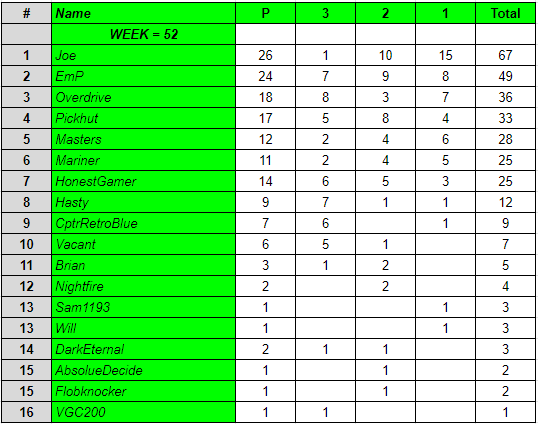 01: 31st December -- 6th January 02: 7th January -- 13th January 03: 14th January-- 20th January 04: 21st January -- 27th January 05: 28th January -- 3rd February 06: 4th February -- 10th February 07: 11th February -- 17th February 08: 18th February -- 24th February 09: 25th February -- 3rd March 10: 4th March -- 10th March 11: 11 March -- 17th March 12: 18th March -- 24th March 13: 25th March -- 31st March 14: 1st April -- 7th April 15: 8th April -- 14th April 16: 15th April -- 21st April 17: 22nd April -- 28th April 18: 29 April -- 5th May 19: 6th May -- 12th May 20: 13th May -- 19th May 21: 20th May -- 26th May 22: 27th May -- 2nd June 23: 3rd June -- 9th June 24: 10th June -- 16th June 25: 17th June -- 23rd June 26: 24 June -- 30th June 27: 1st July -- 7th July 28: 8th July -- 14th July 29: 15th July -- 21st July 30: 22nd July -- 28th July 31: 29th July — 4th August 32: 5th August — 11th August 33: 12th August — 18th August 34: 19th August — 25th August 35: 26th August — 1st September 36: 2nd September — 8th September 37: 9th September — 15th September 38: 16th September — 22nd September 39: 23rd September — 29th September 40: 30th September — 6th October 41: 7th October — 13th October 42: 14th October — 20th October 43: 21st October — 27th October 44: 28th October — 3rd November 45: 4th Novemeber -- 10th November 46: 11th November -- 17th November 47: 18th November -- 24th November 48: 25th November -- 1st December 49: 2nd December -- 8th December 50: 9th December -- 15th December 51: 16th December -- 22nd December 52 23rd December -- 29th December |
 |
PeachBlade posted February 17, 2019: Any new New Nintendo 3DS games out this month? |
|
|
honestgamer posted February 17, 2019: New 3DS releases this month (so far) have been Yo-Kai Watch 3, Vera Swings, and Pinball Breaker. I'll add those to the games database eventually. I've just been running a bit behind. As for the rest of the month, I don't know of anything coming soon. We're down to the point where there's the new (sort of) Kirby game and the Persona dungeon crawler, plus a Shovel Knight title in April, but otherwise there's not anything I know of announced. We'll probably see a few more surprise releases on the digital store and I expect the platform to be essentially dead well ahead of year's end. DS still got random support after months of no releases, so 3DS might do that too, but the platform is all but completely done now. At least it wound up with one of the best libraries ever, right? |
|
|
PeachBlade posted February 18, 2019: Lol true but I still love the 3DS. I also found these if that helps to add later. Etrian Odyssey Nexus Love Hero Avenger Bird Riot The Book of Unwritten Tales 2 The Path of Motus |
|
|
Masters posted February 19, 2019: If "P" is for "placements" then Rob can't have only one since he has two wins (you know, the same amount as you have?). Just sayin'. It's funny, because you two were pretty quiet last year -- Rob was busy with his infuriating Kemco Khallenge, and you were busy not writing reviews -- but this year y'all are taking no prisoners. Meanwhile, Joe, last year's titan by this chart and by volume, is having a quiet start to 2019. |
|
|
EmP posted February 19, 2019: No Almost Club this week. There should have been one as there were four different writers to choose from, but one of these reviews mysteriously vanished after I had finished writing everything up. “The world was not ready”, said mysterious author, DE, yanking his One Piece review from site, forcing me to re-edit this entire thing. His real reason is wanting to revise a big chunk of it after spending more time with the game. Which, I suppose, is fair enough. So, places for all once more, courtesy of unreliable Croatians who’ll probably never even read this! THIRD Urusei Yatsura: Lum no Wedding Bell [NES] CptRetroBlue Retro’s starting to get some of the props he deserves. While there are some issue present still in a lot of his reviews (the second half tends to be a listy rundown of stuff you couldn’t fit in elsewhere -- the graphics are/the sound is), it’s always fun to be able to watch writer’s get gradulary better and better as time passes. As is his way, Retro spits out a few reviews this week, his Contra stuff ruining my IM clients with all the nostalgic reminiscing I currently have to suffer from Marc It starts out well, dropping some history on the anime it’s based upon, before slowly devolving into that list thing I spoke about. Maybe start thinking about how you can start fusing these standalone elements together to start talking about the game as a whole rather than a collection of parts in the future. You absolutely win the Golden Joe award this week, though. The award awarded to the writer who massively overuses the game’s title in their review. So many Lums. Lums everywhere. Lum. SECONDSuper Meat Boy [PC] Brian Brian often goes in super hard with the word count, absolutely drowning his reviews with text and giving himself an uphill battle to maintain interest. This review suffers less from that. I mean, sure, there are some things that could be trimmed, like the constant Steam vs Epic shots that seem superfluous after the first attempt. The second half of the review works much better, where it talks about the old-school platforming and multitudes of deaths. Super Meat Boy’s just-one-more-go aesthetic has often struck me as a difficult thing to describe in words, but Brian does a good job of describing it. Then he circles back to the Epic thing again, and I groan. WIN Phantasy Star [MSM] Joe Heavily unedited Rob-like ramble about how much I love the Phantasy Star series used to live here. It’s gone now. Let’s talk about your review instead. There are parts of this review that are chronically overwritten. “However, the campaign makes up for this deficit by eschewing an obvious rail = This game is non linear”. Christ, dude! I might have to fall back on the 2004 Ruder slur of people eating a thesaurus for breakfast. Still, I get it; you’re trying to sound more garndose because it seems a fitting way to give Phantasy Star the gravitas you feel it deserves. Some lines get away from you, but it’s an appreciable approach for the most part. This game was a big deal back when; it was a massive 4mg cart, it contained a rare female protagonist, it wasn’t a saccerine tale of rescue the princess. I’m talking about the game and not the review again. Right… Joe doesn’t dwell on these things and presents a fresher thesis: Phantasy Star has not aged well, and the genre has moved on without it. To be fair, the examples he uses both to discredit and elevate the game are well thought out. I think what I appreciate more is that it manages tom weave these things together and not just end up a disguised list of “here are some bad bits; here are some good bits”. That’s difficult to pull off. |
|
|
EmP posted February 19, 2019: I watered down my time last year with other stuff. This year, I want to write more because it's what I enjoy doing. This will probably mean less time on stuff like the Steam group and twitter, and I'm not overly certain anyone will even notice. |
|
|
Masters posted February 19, 2019: Nice, prompt RotW, with helpful, if snarky, feedback. Constructive criticism is a tricky thing around here; be careful! But, come to think of it, if you directed all of those back-handed compliments my way, I might rightfully snap. Anyway, a good win from Joe who has been quiet this year by his standards. |
|
|
EmP posted February 19, 2019: I'm not in the right headspace to reply to that comment at this particular time. I get accused of snarky and mean-spirited feedback sometimes, but it's often not my intention. I think these topics should serve some purpose beyond random hair ruffles and victory parades. People are absolutely free to dismiss anything I say however they please, but I hope, occasionally, I say something worth taking onboard. |
|
|
Masters posted February 19, 2019: Too soon, dude, too soon. But you're right: RotWs can be useful beyond the two purposes they presently serve (1. Reminding folks that yes, someone is reading their stuff and 2. Ass pats for jobs well done). |
|
|
TomatoMan posted February 19, 2019: Death End Re Quest PS4 https://www.amazon.com/Death-end-re-Quest-PlayStation-4/dp/B07FBFX6T8 Added. |
|
|
JoeTheDestroyer posted February 19, 2019: Thanks much for the win! I wasn't trying to sound grandiose, that's just the way I wrote the review. I'll try not to overwrite, but I really don't notice when I do it. |
|
|
Masters posted February 21, 2019: Nah, no one will notice those things, so keep the reviews coming instead. |
|
|
honestgamer posted February 22, 2019: Seems like a good diversion, a lot like many other good diversions available on the store. For Langrisser fans, it's probably awesome, kind of like Fire Emblem on iOS/Android is for fans of that franchise. And it's timely, too, with a compilation of the earlier games coming to Switch soon, as I recall... if it didn't just recently arrive during one of the last three weeks. Anyway, sorry for the delay in getting to this. I didn't make a lot of tweaks, just adjusted a few sentences that needed it. This should be good to go now. Thanks! --- I feel compelled to give ZlongGame credit for Langrisser Mobile. From my handful of experiences with the mobile gaming scourge known as "free-to-play," these games tend to follow the same path. You start out, quickly amass a lot of resources to carry you through early challenges, gain enough rewards from succeeding in those challenges to go a ways further into the game and then eventually hit a wall. At this point, you have three choices: break down and start spending money to purchase goods that will carry you for a little while longer, only play it in really small doses determined by how long your stamina meter can hold out before depleting and forcing you to wait for it to replenish, or simply say "that's that" and delete it from your device. I've played Langrisser Mobile for somewhere in the vicinity of 15 hours over the last couple weeks, and haven't ever felt a need to contemplate those options. Stamina is plentiful and can be replenished easily, nearly every battle has been low-cost and, overall, I don't know when I've encountered a free-to-play as reluctant to demand players open their wallets as this one. Langrisser is supposedly a legendary series of turn-based strategy role-playing games. I say "supposedly" because, with one Sega Genesis exception (dubbed Warsong), it stayed in Japan until now, leaving me a bit out of the loop. Full disclosure: this likely is a primary reason why I haven't felt the need to open my wallet to progress. Regardless of how awesome Langrisser fans may feel the various characters are, I hadn't heard of any of them, so I felt no compulsion to obtain anyone. I spent the entirety of my time with the initial few I've obtained, as they can form a diverse party capable of handling every situation I've encountered. Meanwhile, I've ignored new ones that I've gained, as well as those special ticket draws allowing one to pray to the random number god that they'll get big names such as valiant general Leon or evil overlord Bozel. Mobile seeks to rectify Westerners' ignorance of this series, as it not only has its own original story, but also allows gamers to play through truncated versions of older installments. After doing a bit of research, I learned the main draw of the series is how you can change allegiances to alter the story, turning former enemies into friends and former friends into battlefield opponents. While there are criticisms based on how your main character's entire attitude and motivations may abruptly change the instant he moves from one side to another, it's easy to see how something like this might add to a game's replay value. Now, I can't say whether Langrisser Mobile's story replicates those branching paths, but its first dozen or more chapters are pretty linear and, from a story-telling perspective, generic. You start with three original characters, who are quickly joined by a handful from older games, as they are forced to flee their town because one of them is accused of being a witch by the shady-looking Archbishop who serves as the area's king. This sets up many, many chapters that find your party roaming a map, going from dot to dot and fighting battles, having conversations and obtaining treasure. Occasionally, a side path opens up to lead to a few additional fights. Or, perhaps, one of those mandatory battles is an introduction to a new feature you'll be wanting to regularly experience because it gives good loot. But yeah, the story. Uh…I remember being told to collect stuff for a floating city and I think that hometown village got burned down by the Archbishop's men. And you'll occasionally get to watch one of those cryptic conversations between other characters that are a core staple of games such as this. But this game is about the action, not the story-telling, and you'll find constantly find yourself in battles. You'll usually have five guys on your team, although some fights give you a smaller party, and you'll take on a comparable or slightly larger number of enemy units. Much like Fire Emblem, this game uses the "rock, paper, scissors" method of fighting where each type of unit is strong against one other type and weak against another. While older Langrisser titles had large numbers of subordinate units made of generic soldiers, this game simplifies things, turning those generics into part of each character's force. Therefore, everyone on a battlefield essentially has two life bars, one for them and one for their troops. Basic attacks will provide the bulk of your combat moves, but each character can learn a few skills that range from passive boosts to powerful attacks. Most of those attacks have a cool-down period to prevent you from spamming them, but others, such as healing spells, can be cast every turn. Which I appreciated. When playing a game where my offense is partially determined by how much health my heroes possess and how many troops they still have, it's nice to be able to replenish both those numbers whenever necessary. With small numbers of enemies on battlefields that aren't particularly large in scope, it doesn't take long to get through the average fight, allowing a person to do a lot of stuff without eating up a lot of time. This is good because there is a lot of stuff that I can do. Too much, to be honest. To start with, one of the most important things to obtain in Langrisser Mobile is team experience, which can be obtained from winning battles and as rewards for completing the game's various daily challenges. It's important because no individual member of your party can have his or her level raised higher than your team experience level, so you can have hundreds of experience-boosting items in your inventory and, therefore, have the ability to boost a few characters several levels each, but be unable to simply because their potential is determined by that team experience level. You'll also realize that the team experience bonuses you get from doing those daily challenges are often larger than what you'd get from simply fighting battles. And those daily challenges also tend to give other much-needed awards. Take part in the training battles hosted by those Cho Aniki bodybuilder dudes (both series originated with the same company) and you'll get all sorts of items used to buff those generic troops packaged with each hero. Handing out gifts to teammates to improve intimacy bonds will give stat enhancements to main character Matthew, as well as the recipients. Another training battle offers loads of experience-boosting items, those time rifts to past Langrisser games have plenty of their own rewards and there is an arena where you can fight random collections of heroes for money and tokens. You can even get those bonuses from doing ticket draws or giving a character an experience boost! And that is where the cracks start falling. As you progress through the main quest, you'll find that the suggested level for your team does increase fairly quickly as you progress through each short chapter and its handful of battles, so you'll want to get every team experience boost you can in order to have your characters binge on items to quickly raise their levels. And you'll want to feed inferior weaponry and forging tools to your equipment to make it stronger. And do the training to get better troops that are capable of standing up to enemy forces. And so on and on and forth, until you realize that you're spending far more time doing busywork than anything of actual substance. Eventually, no matter how big a fan you are of strategic turn-based games, this will put a huge dent in your enjoyment of Mobile. Each of the various training battles is the same, only with higher-level enemies being unlocked as you progress, making all the busywork feel quite repetitive after a while. And when it comes to games like this, where you're essentially playing a sort of chess match against enemy troops, looking to match your strengths against their weaknesses while preventing them from doing the same, you do not want repetitive. And you definitely don't want to do the same dozen things every day in order to maximize your growth, so you can consistently progress through the game. Even with all that said, I can't be overly critical of Langrisser Mobile. I remember when I downloaded Final Fantasy Record Keeper and was so, so excited about being able to mix-and-match characters from virtually every game in that series to go through fights and defeat bosses. That excitement faded amazingly quickly when I got to a certain point and realized I'd only be able to do a couple small groupings of battles at a time before needing to wait for however long it took for stamina to recharge. With this game, that moment has not come and I was able to get a good couple weeks of free entertainment before starting to find things annoying enough to make me want to step back. And, hell, I don't even always get that sort of result from games I spent $50 to play. This isn't a be-all, end-all app that'll revolutionize phone gaming, but it's far better than I expected from a free-to-play title. |
|
|
JoeTheDestroyer posted February 24, 2019: I've learned one thing from kaiju-themed video games: don't get your hopes up. Developers have tried to encapsulate the chaos, destruction, action and camp that come with giant monster movies with limited results. I can only imagine that it's difficult to create solid combat between monstrous character models, while also programming a robust, destructible environment. A few titles managed to either mostly entertain or just squeak past average. Most, though, crash and burn harder than the JSDF trying to thwart Godzilla. Roarr! The Adventures of Rampage Rex falls into the latter, unsuccessful category. It promises pandemonium, hilarity and action, but only modestly delivers at best. At worst, though, it's so minimalist that it feels incomplete. You take the role of Sue, a T. Rex who awoke from her subterranean slumber to find aliens conquering the planet. Irritated by their racket, she decides to bite, claw and tail whip any extraterrestrials that get in her way, completely disregarding any trees or buildings that happen to be in her path. Stage one starts you out on an island, dotted with trees and a small suburb. Giant, land-roaming squids creep toward you, while vile, obnoxious muzak fills the air. You shake the memories of an operator putting you on hold so you can focus on the foes, hoping at very least the action elements work their magic. You fight off the monsters by mashing one of two attack buttons, creating simple combination strikes before they vanish with poofs of black smoke. Occasionally, you change things up with a special charge attack or an AOE roar that kills everything, exhausting your ability meter. As you continue to mosey onward, you realize that there aren't many sound effects. Blows create dull, quiet thuds, and each alien croaks with a basic "Ugh!" Your footsteps are silent, despite the fact that you're larger than a skyscraper. Even Sue herself doesn't make much noise, especially when she uses her killing roar. Rather than a massive, bellowing cry, she cuts loose a quick, anticlimactic snarl. The frickin' game is called Roarr!, and you'd think the least you can expect is one, solid growl. As you smash into the nearby houses, your special attack meter refills. Outside of that, you derive almost no joy from urban destruction. Rather than crumbling to dust, each building and tree silently uproots itself and bounces as if it were a rubber prop rather than a something you could smash. You walk into a massive tower, it falls over and disappears. Nuclear power plants lift a tiny ways off the ground and casually tip over, and their neighboring towns indifferently tumble. I can't think of a time I've seen destructible environments so underwhelming, especially in a kaiju-themed title. Most of what I described happens within the first few minutes. Now, imagine playing that same segment for two to three hours and you have Roarr!'s campaign. After you defeat the first slew of cephalopods and venture to the next island, another group races toward you. Now and then you might scrap with new creatures, but they all perish with the same button mashing strategy. Some of them lob explosives or heal their cohorts, but even then they only pose a minor threat and fall with little resistance. You murder dozens of these creeps for ages, kept alive by the numerous healing items they drop and rarely breaking a sweat. You begin to wonder if there's nothing else on offer besides endless waves of monsters. Then, after way too long, you reach the first boss and his army of goons. You try to circle around him or utilize the dodge button to take him on strategically, only to realize there's an easier way to dispatch him. You start by taking out all of his cronies with a roar or two. A vast field of trees and buildings surrounds the boss, so you can easily take a few seconds to recharge your skill and use it again. Several defeated enemies also drop health-restoring steaks that never despawn (at least from what I've noticed), so you can easily recover your hit points when you're low. Repeating the process, you can quickly growl the level boss to death and advance to stage two, assuming you haven't uninstalled the program by this point. It doesn't matter which stage you land on, though, because they all play the same. You button mash all opposition and slay bosses with the aforementioned strategy. Levels four and five introduce different environments, with a desert and a tundra, respectively. Unfortunately, these are only cosmetic changes, as they play no differently from stage one. The challenge factor doesn't increase, and you never see an ounce of variety. You kill lackadaisically, you follow an arrow to the next horde and you begin the tedious process anew. Finally, you reach the sixth stage, in which you board the mothership and initiate a boss rush. The only catch is that the first segment provides you with no healing items, so you need to defeat the first boss without dying. Although that sounds simple, the truth is the first boss sometimes gets cheap, lucky shots in that kill you quickly if you're not careful. Once you get past him, you're practically golden. Even the main antagonist is a joke. During my own playthrough, I nailed him a few times and then darted away to regroup, when he inexplicably died. My only guess is that the bombs lobbed at us during our brief exchange got the better of him. Either the developer didn't think that battle through very well, or they intended for the story's villain to be an even bigger disappointing pushover than the rest of the rogues gallery. If you happen to drop dead during any point of your mission, it's automatic "game over." However, Sue doesn't fall over limp or explode in a blaze of glory. Rather, the screen suddenly transitions to you standing on an Olympic podium, and you don't know why. You have to examine the screen for a few seconds before you realize that you failed, because the game seems to be celebrating your death as if it's some kind of victory. As I said before, Roarr! seems incomplete, and the evidence crops up in its lack of variety, dearth of sound effects, underwhelming destruction and awkward transitions. It doesn't possess enough dynamic elements to be the "perfect party game" it advertises itself to be, or a standard brawler, or even a decent kaiju adventure. Tyrannosaurus didn't go extinct for this. 1 out of 5 |
|
|
PeachBlade posted February 25, 2019: - Avenger Bird - Nintendo Switch - https://www.nintendo.com/games/detail/avenger-bird-switch Already listed. - Love Hero - New Nintendo 3DS - https://www.nintendo.com/games/detail/love-hero-3ds Added. |
|
|
overdrive posted February 27, 2019: Mine will be up tomorrow afternoon. Been swamped at work and still have more typing for that to do today. So I could either due a rush job in the next couple hours or take my time and actually read the reviews I'm judging tomorrow. And I think anyone who contributed would be a bit happier if I picked the latter choice! |
|
|
Masters posted February 27, 2019: A-ha! So you DON'T read the reviews! The cat is out of the bag! |
|
|
JoeTheDestroyer posted February 27, 2019: So he's uses the old "names on a dart board" method up to this point? |
|
|
overdrive posted February 27, 2019: Out of a hat. I usually do these during slow times in the office and they still haven't let me put up a dart board in my cubicle, so I have to write everyone on pieces of paper and pick winners out of my hat. And then skim the reviews to highlight things I "liked" that I "read". It's an arduous process! |
|
|
overdrive posted February 28, 2019: Another one of these things, this time while I'm swamped at work! Yay! Only five reviews to go through, as it seems EmP didn't have one last week for me to try to remember before forgetting about and inevitably seeing a litany of comments concerning my ability to remember stuff or do things or know what's what and so on. Oh, yeah, there also is one by me that gets pushed to next week. Or Jason will get a litany of comments concerning his ability to remember stuff or do things or know what's what and so on. Now, honestly, I'd rather be working on Trials Rising now that doing this, since catching air and trying to get through tracks without wrecking horribly is more fun than writing about…most anything actually, but I'm a gamer, so let's look at these reviews and see who places. To comment on the others briefly: Jason did a solid review for a very cheap-n-disposable (emphasis on "disposable") Switch game. Those reviews are kind of his version of my Kemco ones, in that it's solid and gives coverage for the sort of game that probably doesn't get an abundance of publicity, but due to their nature, aren't the sort of thing that is overly inspirational to write about with the vigor to place during the average week. It's a good review that covers all the bases, though, allowing me to easily determine that if I had a Switch, I'd never touch this game, not even for a moment. CRB continues to show improvement in his writing with his Final Fantasy Tactics review. I know in previous RotWs, I've commented that I'd like to see more detail about what you're writing about in your writing and this review showed a good bit of that, as you did give a pretty good run-down as to how FFT plays. THIRD PLACE Pickhut's 3D Altered Beast (3DS) I'm just glad that someone else has about the same opinion of Altered Beast as I do. When I got Sonic's Ultimate Genesis Collection, I started it up because it was one of those games that I thought looked cool, but never could play because I was NES/SNES back in the day. Five minutes later, I'd had all I cared to stomach and never have touched it again. All in all, you did a really good job explaining the game's basics, just why it really isn't that good and then noted how this port of it really doesn't add anything interesting or new to what it originally was…and the conclusion was really nice, as you said this game was made for a quick project and because it was popular on the Virtual Console. The definition of a truly uninspired port of a blah game. I really enjoyed this review; it was just a bit behind the next two to be discussed. --- SECOND PLACE EmP's Toughman Contest (The Divine System: The Gift That Keeps On Giving) I really enjoyed the opening part of this review, as that is a neat story as to how this game was devised. Take the Punch Out engine and upgrade it for newer systems and to cash in on the short-lived Toughman craze. Fun Fact: There was actually a prime-time Toughman Contest show on some cable channel for a little while and I watched it a couple times. The highlight of the show was that one commenter was coked-up former NFL'er Lawrence Taylor, whose main commentary was dissing the contestants because they weren't the sort of elite athlete that he was. Which should be all that needs to be said about the mark Toughman left on our country! You also did a good job of showing just why this game fell as far short of Punch Out that actual Toughman did to legitimate sports. A bunch of completely interchangeable fighters, due to how any skill could be applied to any of them? Foolish! Having attacks be overly complicated to use despite this being arcade-style boxing? Laughable! Less interesting backgrounds than the Genesis version? Were they even trying? Probably not; that seems to be the over-arcing story of this system. Anyway, this was a fun review of one of history's forgotten games for one of history's forgotten systems. --- REVIEW OF THE WEEK (aka: Overdrive Place) Joe's Arcana: Gothic 4 (PC) This is a great review showing what happens when a person plays a game that just didn't turn out to be all that great. Not necessarily horrible or anything, but just sort of there. Throughout the review, you put in a lot of little touches that showed how the game wasn't a complete chore to get through and even was somewhat enjoyable at times, but never really threatened to be the sort of thing that you were overly positive about going through. The ending proved that point nicely with your "I can't really remember that much more because the game didn't do anything particularly noteworthy." part. The previous paragraph also was nice, as you touched major plot points, but in a vague and disinterested manner that read in a "You do this and this and then you're *yawn* done…" manner that also really illustrated your feelings on the game. And I liked how you pointed out its repetition with the "Cave. Goblins. Horde." bit. A good example of how to review a game that isn't really good or bad, but just sort of exists in its "connect the dots, go through the motions" way. --- And now, back to advancing through tracks. Or not, that busy schedule has been getting in the way of me doing that, as well... |
|
|
dementedhut posted February 28, 2019: Yeah, Altered Beast was one of those games that looked cool from a distance if you only saw images and footage. Then you play it and... Sadly, it's one of those games that keeps thriving through the decades due to the nostalgia factor and Sega's need to rerelease the game on every collection or digital marketplace. Like Super Thunder Blade and the Vectorman games... Thanks for third place! Glad you liked the review. |
|
|
EmP posted March 01, 2019: Toughman had exactly zero impact here. The game and the fighting platform both, I guess. Thanks for the nod, and props to Joe and Pick. I'm just glad to see the back of another 32X game. The list grows shorter still... |
|
|
JoeTheDestroyer posted March 02, 2019: Thank you much for the victory! I'm glad this review worked out. Congrats to EmP and Pick also, for placing. Also, shout out to CRB, who's been turning in quality stuff! |
|
|
CptRetroBlue posted March 03, 2019: Pretty Soldier Sailor Moon 1995, Arcade, Banpresto https://www.mobygames.com/game/arcade/pretty-soldier-sailor-moon Thank you Added. |
|
|
honestgamer posted March 03, 2019: Here you go! --- "So, what have you been playing lately?" "Botanicula." "Oh, I've never heard of that. What kind of game is it?" "It's a point-and-click where you... um... there's... trees... seeds... Uh, chickens... hallucinations... I think spider monsters... An anthropomorphic peanut... Uh, something about the spiders sucking the life out of the tree, which is like a home for the... creature-plant-characters-" "Oh, sounds cool, I guess..." "I'm so not doing this game any justice." Botanicula is not a good conversation starter if you're socially awkward, like me. This graphic adventure revolves around a quintet of sentient, botanical beings who attempt to take back their home, a massive tree, from a swarm of spider-like parasites. You accomplish this by observing the game's peculiar environment, clicking on various objects and hoping that you're doing it all in the correct sequence. I know that last sentence sounds dry and technical, but that's the best way I can describe the game without going into graphic, sanity-destroying detail. You see, Botanicula is a weird title with strange objectives. For instance, one segment requires you to search a village and recover fourteen chicken-like birds. You need these avians because a seed-person requires them to activate the village's transport system, which includes fourteen hamster wheels for the fowl to run on that harvest their kinetic energy and use it to propel the entire burg into the sky. In order to nab all of the birds, you have to engage in some rather odd scenes, including one where you click on various bulbs to make a meditating plant-man hallucinate. You can then snatch a fowl out of the resultant trip, which is displayed above the meditator. Afterward, you'll need to procure a hen trapped in an overstuffed igloo, create another by blowing on a certain combination of wall-mounted trumpets that generate new life forms, plus hatch one from an egg by taking it to a Frankenstein-ish laboratory. There is no shortage of creativity here, though some might feel that the strange and sometimes eerie phenomena you bump into come off as "weird for weird's sake." Honestly, I have no problem with that. I appreciate all things peculiar, and the game is more than willing to pay strangeness in spades. Unfortunately, there is one drawback to the weirdness. Graphic adventures benefit from logic-based puzzles, and Botanicula's world isn't exactly conducive to rational challenges. For example, going back to the chickens, there's one stuck on a ledge with a coin slot below it. In order to capture this feathered freak, you have to locate the aforementioned igloo and continuously click on it until myriad penguins fall out of it. After that, a coin should eventually materialize. You can then place the cash in the appropriate slot to start an indoor rainstorm that floods the building, granting you access to the bird. It's basically an interactive "your argument is invalid" joke. Some of the puzzles in prior stages are even worse than this, as they might require you to click on random objects multiple times before finishing the area. Call me crazy, but wouldn't featuring so many trial by error riddles defeat the purpose of having puzzles in the first place? In rare occasions, the game feels minimally interactive because of this. It's as though the developers sought to contrive tasks for you to initiate in an effort to veil the notion that you're watching the game more than playing it. Thankfully, these are rare instances. The good news is that not all of the puzzles you encounter are obtuse, as the latter half of the campaign sports some thought-provoking problems that make up for the vague ones. One of my favorites involved winning a racing mini-game, which causes your opponent to repeatedly hop. During that time, you must activate a wall-mounted item and knock your rival's helmet off, so you can give it to another character who wants it. There also isn't a stilted, drawn out sob story attached to the character's demands involving his missing helmet. Heck, most of the game's plot unfolds through implications or short, dialogue-free cutscenes, which is both troubling and relieving. Personally, I prefer my point-and-clicks to sport at least a decent storyline. Graphic adventures have, practically since their inception, taken players down some wild avenues and through wonderful tales in the past. Although Botanicula attempts to spin a yarn that anyone of any language can comprehend, which is commendable, it is at times so muddled and unspecific that you don't get to know the protagonists. Because of that, it's difficult to empathize with them at times, and some of the characters seem to be present for "flavor" rather than as a means of invigorating the narrative. Still, it's nice to play through a quest that doesn't take itself too seriously. You won't see many time-wasting cutscenes, as if this tale is trying to be a movie. At times you might think it's going to get all artsy-fartsy on you, but then an NPC burps or something humorous occurs and you remember, "Oh yeah, I'm supposed to have fun!" I can dig a so-called "art game" that's willing to shed its pretenses and just be goofy when the need arises. On that end, Botanicula is seldom off cue. Ultimately, this is a solid but not amazing title. With a little more meat to the narrative and some improved logic puzzles, it could have been excellent. Take nothing away from the developers, though. They dared to dream and concocted a lighthearted yet strange setting with a charming, microscopic supporting cast. Perhaps the game doesn't tell an elaborate story, but it makes up for it with decent brain-bending material and the occasional goofy segment. |
|
|
TomatoMan posted March 05, 2019: Left Alive PS4, Xbox One https://ign.com/games/left-alive Added for PS4, doesn't seem to be available for Xbox One. |
|
|
hastypixels posted March 06, 2019: I guess this thread is either undead or immortal... either way... here's my er... story... Whilst popping around various big name review sites, I found myself getting rather irritated with their obviously stilted and corralled reviews. By which I mean there were apparent influences other than their raw experiences with the games in question. I sought out something better by typing "honest reviews" into Google, and after reading some rather shockingly bad writing, I discovered the good stuff - mostly by youse guys, Jerec and some others - and eventually got the nerve up to post something. Jason accepted it and I've been eating humble pie ever since. It's good pie, and the site's nice too. |
|
|
Masters posted March 06, 2019: Wait -- the shockingly bad writing was here? |
|
|
overdrive posted March 07, 2019: Marc, I blame Kemco for that! |
|
|
jerec posted March 07, 2019: I got name dropped as someone who writes the good stuff. Be more like me, guys. |
|
|
Masters posted March 07, 2019: Haha, yes, it was literally, "Jerec and some others". We should rename the site, "Jerec's Review Crew" or something. |
|
|
honestgamer posted March 07, 2019: There were 9 reviews this week, but lucky me only had to read 7 of them because I wrote the other 2 and they aren't eligible this week. Tremble in fear of their might as you go up against them next week! Mwa ha ha ha ha ha! --- Here are my comments on the reviews that didn't place in the top three... Metroid (NES) by CptRetroBlue This review often reads more like a reminisce than it does a review, but you included some nice details and pointed to the acknowledged highlights of the series. I think if you want it to work more as a standard review, you might want to do more to give meaning to those memories, so that someone who hasn't played the game might have a better sense of how the game fits together. You do a great job of capturing its atmosphere, but someone who hasn't played the game might feel the slightest bit lost. Still, it's nice to see your work growing more ambitious and effective. Dungeons of Chaos (PC) by Brian Dungeons of Chaos sounds like an interesting game that might appeal to me despite its simplicity, as I like Ultima IV quite a lot. Well, I liked the simplified NES version, anyway. Your review was at times difficult to follow, but I got the gist of things and can imagine myself at some point playing the game now after knowing nothing about it before reading your review. Thanks for alerting me to its existence! Pretty Soldier Sailor Moon (Arcade) by CptRetroBlue This review isn't as polished or detailed as your Mega Man X4 piece, and there were places where you had the opportunity to include some meaningful discussion but did not. Consider this sentence: "You will find yourself surrounded by an enormous amount of enemies who do not hesitate on attacking relentlessly and boss fights can be pretty unforgiving as well." You're telling there, not showing. That's fine, but telling usually should be followed by showing. For instance, you might have described how a particular boss fight was relentless, or the way a mob of enemies typically aproaches. That's the sort of thing that could help push a review to the next level. Botanicula (PC) by JoeTheDestroyer I really liked this review when I came across it in The Production Room, and I still do. It's a beautifully written piece and, had you not submitted your review for Bayou Billy, this one definitely would have earned the highest marks out of anything you contributed. Which review did I like more? I ultimately went with Billy, because I felt like you did more with less, but really either submission is fantastic. Way to be your own toughest competition! --- And here are the week's top three picks... Third Place: Mega Man X4 (PlayStation) by CptRetroBlue This review was more cleanly written than your Metroid one, I felt, and flowed more easily from point to point while presenting discussion in a way that will benefit readers who may not have played the game. However, you still want to watch for the odd sentence-level issue, such as this one: "While these themes are what separate the dynamic duo, they both can dash and hang on walls momentarily, which can be a difference between being safe or galling into a pit full of lethal spikes." That should be "falling into a pit..." Anyway, it's a strong review of a great game. Good job! Runner Up: ToeJam & Earl: Back in the Groove! (PC) by EmP This review was immediately in contention for its tagline alone. It loses some points for the odd grammatical issue, though, including this sentence: "There third outgoing made an attempt to go back, but it’s Back in the Groove that commits hard to this mindset." I think you mean "Their third outing made..." but I'm not sure. Anyway, you did a good job on the review. It was a bit risky to spend so much time describing the original game, but worth it because then you could reveal how similar the newest installment is to that old title you liked so much. Also, it was a generally fun read that I enjoyed. Review of the Week: The Adventures of Bayou Billy (NES) by JoeTheDestroyer The third-to-last paragraph, when coupled with everything else in the review up to that point, is the best bit of writing I read this week and that's enough to win the review top honors. You did a fantastic job of outlining what it feels like to play this game, providing both skillful summary and smart criticism and mixing them with effective nostalgia that didn't run on for too long. It's terrific stuff! --- Thanks as always to everyone for your contributions. This has been an amazing year so far, and I'm grateful to each of you for keeping the good stuff coming! |
|
|
overdrive posted March 07, 2019: Holdover review by me: forgotten, abandoned, unloved. Life is depression. |
|
|
honestgamer posted March 07, 2019: Sorry, Rob! EmP didn't remind me about that when he prodded me to hurry up and post the topic, so I feel like technically this is all his fault. |
|
|
TomatoMan posted March 07, 2019: Valthirian Arc: Hero School Story PS4, Switch https://www.metacritic.com/game/playstation-4/valthirian-arc-hero-school-story Already listed on Switch, but PS4 version now added also. |
|
|
JoeTheDestroyer posted March 08, 2019: Thank you very much for the win! I'm glad you liked both reviews. There was a lot more I wanted to say right now, but my brain is kinda jelly at the moment. Congrats to CRB and EmP for placing as well. |
|
|
overdrive posted March 08, 2019: Jason, since Emp always blames me when I forget him, I can accept you blaming him for this. |
|
|
wolfqueen001 posted March 09, 2019: Huh. I didn't think my stuff was that bad... lol |
|
|
Sclem posted March 10, 2019: Good work everyone and congrats to winners. |
|
|
JoeTheDestroyer posted March 11, 2019: I have it kinda easy this week. I only have four reviews to judge, three of which are from Venter (two of those are holdovers). At the same time, I don't have it easy this week because all of the reviews offered are frickin' great, and it's hard to pick a winner. --- I'll start off with Awesome Pea by Honestgamer. This was an excellent review that captured precisely what a subpar side-scrolling platformer feels like. There's a lot of funny, clever wording (the "which is fatal" bit, for instance), and it's just a fun review to read. Two minor, minor complaints: one part uses the word [frog's], but I think the apostrophe should be after the "s" [frogs']. Lastly, there's one instance where you say "Amazing Pea" instead of "Awesome Pea." The History 2048 review is great because its quick and to the point, which any good puzzle game review should be. It gives all of the necessary information in a fast manner, and cuts to the heart of the game's issues. Mariner's Ys VIII review is fantastic because its written such that it informs interested parties to go for it, while warning those who aren't into RPGs. That's a tough kind of review to nail, but this one accomplishes that end (Overdrive's Skyrim review is another good example, which prompted me to buy the game and told Zipp [IIRC] to stay away). Back to Jason, and his Fairy Fencer F: Advent Dark Force review, which left me feeling like I had just rented the game. It spills a wealth of information without missing a beat, and even goes farther than that. It judges the game based also on the merit of New Game+, which is something that gets ignored quite frenquently. It also reminds the reader that this isn't a sequel, but yet another re-release of FFF. Honestly, I thought this was a sequel or something to that effect, so it's good to know this title's lineage. Again, this one also tells a cautious reader that this isn't their bag, while giving excited parties the go-ahead. --- I had a tough time picking a winner, but it came down to Ys VIII or Fairy Fencer. Ultimately, I think Fairy Fencer F: Advent Dark Force takes home the win. |
|
|
overdrive posted March 11, 2019: Huh, and I could have sworn I had this holdover from my week that Jason forgot about his week that I'd mentioned both when I did my last RotW and reaffirmed in Jason's when he forgot it. Maybe I died recently or something and only exist as a ghost who is thinking he's doing stuff, but it only exists in his world so he doesn't know he's dead and not actually interacting with the site. Might have to put that theory to the test by robbing the liquor store. No, a gas station; they all know/knew me on a first-name basis at the liquor store, so that'd be a jerk thing to do to them. That's it: rob a gas station to see if I do actually still exist and then make my next move from there. |
|
|
JoeTheDestroyer posted March 11, 2019: I wasn't sure if we were still honoring that or if it was a one time thing. I think we should, honestly. Sorry. |
|
|
JoeTheDestroyer posted March 11, 2019: If you have a holdover or missed review, leave a comment at said topic. If you are a ROTW judge, check the topic before judging. Also: can we officially announce that missed reviews move to the next week? That seemed like a one time thing, and I feel it should be a standard (unless there's already a topic and I'm just bad at finding them). |
|
|
overdrive posted March 12, 2019: This would be a good idea that would make sense and have a good chance of preventing EmP or myself from getting neglected. As for the "one time thing" part, I think the reason it came off as a one-time thing was simply because that's the only time it happened, mainly because (if I remember correctly), I forgot EmP and then, because you were either sick or dealing with something, Marc took over your week and since he was a sub who wasn't in the regular rotation, probably never even remotely considered the concept of going back two weeks to find a once-forgotten review. But other than that, I had forgotten EmP once or twice and Jason had forgotten me once, but each of those times, it was taken care of the next week, so situations like this haven't really happened enough to set any real rules to follow. I mean, my stance is that it should count at some point, regardless of how many weeks it takes for it to be remembered, as I submitted it like usual and would definitely disagree with anything that involves me being left out of critiques and possible placements because of stuff I have no control over. |
|
|
honestgamer posted March 12, 2019: This topic is being created and stickied so that if a review was eligible during a certain week of RotW but was forgotten when that RotW topic was created, it can be considered for the next week. If you are in charge of a week's given RotW topic, please make checking this thread part of your routine in case a holdover review is in play. |
|
|
EmP posted March 12, 2019: I propose you just do what I do. Don't forget holdovers. Because it's really not that hard to scroll back a week and look for stuff from the guy who wrote before you. Rollover missed review should move on to the next week, but they shouldn't happen at all. At least, not without routine mocking involved. Mostly aimed at Rob. |
|
|
EmP posted March 12, 2019: I feel like I'm almost at the point where I can string words together again. Good win, others. Small hurrah me. Typos bad for soul. Guess not. |
|
|
overdrive posted March 12, 2019: Langrisser Mobile http://www.honestgamers.com/14354/android/langrisser-mobile/review.html |
|
|
JoeTheDestroyer posted March 12, 2019: You've forgotten at least one holdover, too. I didn't ask this just for ease, but because it's happened multiple times to pretty much everyone. |
|
|
EmP posted March 12, 2019: Kind of true. I forgot one of your holdovers once, but then rewrote the entire topic on the spot like the true hero I am. Think it cost Freeman a win. No wonder he's not come back. |
|
|
overdrive posted March 13, 2019: HG: Do a truly great job at RotW...and run off contributors by turning their placement into an honorable mention. Wait a minute! That's a horrible moral to the story!!! Right up there with: Go to school to get a job and then waste the prime of your life working for other people, only able to free yourself when you're old, burnt out and waiting to die. And there's Rob's "Get Depressed About Your Lives, People!" moment of the day. |
|
|
bwv_639 posted March 13, 2019: This managed to significantly update the home page whilst doing no damage to the pretty unique spirit of this site. It's clever and sincerely democratic (in its handling evenly staff and contributor reviews) at once — no unremarkable feat. |
|
|
honestgamer posted March 13, 2019: Thanks. I'm glad you like it! I used to make big changes around the site pretty often, as I shuffled features and tried new approaches, and that was a running joke. But I've found most of the features I like, and ways to implement them so that if they don't get attention for a while, it shouldn't overwhelm content people are producing that deserves to be featured front and center. Ensuring that the site remains relatively unique in the industry is important to me, and so is presenting content in a way that makes it easy to find. I feel like the site's current design mostly accomplishes all of that, which is why it's unlikely there will be any significant changes while I'm in control. I seem to have mostly gotten that out of my system. |
|
|
JoeTheDestroyer posted March 15, 2019: Why do you think most of us play video games? It takes our minds off the more crushing aspects of life. |
|
|
EmP posted March 15, 2019: Because I remain a sucker for punishment. Sometimes we have a go at these things were we try and write reviews for a series of games and then release them back to back. We’ve tried this numerous times and completed it twice (Thunder Force and Zaxxon. Zaxxon, of all things!) but rather than think up anything new, I guess we’ll revisit this hot mess because I still have some reviews on the harddrive I wrote and it’d be dumb to let them go to waste? Also. OD managed one. Good job, Rob! Usually I run around inviting people to do this. That’s not worked out great. If you want a pop at one of these, reserve it now. In the case of a minor miracle and you review this before the deadline, please HGMail it to me and I’ll add it to the rest of the cryofrozen reviews. Assuming there is any. DEADLINE: These will be the last week or so of Project Horror in October. Which is months away so we can tell ourselves we have all the time in the world until the exact moment we don’t. Alien: [(both) Claimed by EmP] � Atari 2600 � Commodore 64, Sinclair ZX81/Spectrum Aliens: The Computer Game [EU] � Commodore 64, Apple II � Amstrad CPC, Sinclair ZX81/Spectrum, MSX Aliens: The Computer Game [US] � Commodore 64, Apple II � Amstrad CPC, Sinclair ZX81/Spectrum, MSX Aliens: Alien 2 � MSX, Famicom Disk System Aliens � Arcade Games Alien vs Predator � Arcade Games Alien 3 � Commodore 64, Amiga, � Genesis, Super Nintendo � Sega Master System, NES � Game Boy, GameGear Alien 3: The Gun � Arcade Games Aliens: A Comic Book Adventure � PC Alien Trilogy � PlayStation, Saturn, PC Aliens Online � PC Alien Resurrection � PlayStation Aliens: Thanatos Encounter [Claimed by OD] � Game Boy Color Aliens: Unleashed � Mobile Aliens: Extermination � Arcade Games Aliens: Infestation [claimed by Masters] � DS Aliens: Colonial Marines � PC, Xbox 360, PlayStation 3 Alien: Isolation � PC, Macintosh, Xbox One, PlayStation 4, PlayStation 3, Xbox 360 |
|
|
Masters posted March 15, 2019: Despite the fact that I clearly don't write reviews anymore, I've thrown my hat in the ring to support this. |
|
|
overdrive posted March 15, 2019: Ah, for me, it's less "crushing" and more "tedious". The good side of that divorce from 11-12 years ago: Not putting up with crazy. The bad side? On nights (or weekend days) where friends aren't up for hanging out, gotta find some way to pass the time. And while I like movies, books and the like, I prefer those to be a "nightcap" and would rather do something more interactive for the bulk of my free time. And what is better as an interactive form of entertainment than games? 4-5 hours pass and (hopefully) I wind up feeling like I accomplished something! Lord, I do say those nights where I don't feel like I accomplished something because I was running into brick walls in everything I was playing do suck. I'll go to pick up a movie or book after I put the controller down and feel like a total dumbass, lol. |
|
|
jerec posted March 15, 2019:  |
|
|
dementedhut posted March 15, 2019: Title: Wonder Boy Returns Platform: PS4 Genre: Action Developer: Cyberfront Korea Corp Publisher: Cyberfront Korea Corp Release date: (03/30/17 - US) (12/18/17 - EU) (12/18/17 - AU) Added. Thanks. |
|
|
honestgamer posted March 17, 2019: Here you go! --- One section of Cosmic Star Heroine's campaign places you in an underwater base. Unfortunately, your adversaries locate you and launch an attack. The base is pretty much screwed, but one of your party members has a plan. While the invasion commences, a portion of your party ventures into an installment separate from the headquarters to begin escape protocol. Of course, you can't except to waltz in and throw a few switches, then declare victory. For whatever reason, this piece of the facility houses phantasmal sea life, so you battle your way through halls full of undead fish. Exciting music blares with each conflict, featuring a cool fusion of guitar and synth work. Eventually, this quest culminates in a war with a sea serpent's ghost, complete with a beastly boss BGM that got stuck in my head for weeks. Meanwhile, protagonist Alyssa teams up with a few other cohorts to fend off the invading forces. You knock out tons of armed goons, before taking on a fairly tough boss. From there, you board an opposing spacecraft, kick the stuffing out of an endangered animal and attempt to commandeer the ship. A final animated cutscene plays out, with all the cheesy Hollywood glory you could want. All of these events transpire some time after you pilot a mech to defeat a kaiju, and thwart your own public assassination. As you play, you might believe that the whole campaign will feature desperate escapes like this, but from here the experience peters out. Instead, you wander around an Old West-like town trying to gather event items to enter a boring gala, only to find yourself in a cliche jail segment. Later on, you need to prove your innocence after authorities accuse you of murder. You do so by moseying from one part of a town to another, examining various places and watching dull cutscenes. Several segments like these pop up between dungeons, and they add little to the campaign or storyline. More than anything, they feel like interruptions. I'm not asking for a riveting story, either. I understand that this adventure borrows elements from the classic RPG Chrono Trigger, and probably drew inspiration from its fairly simple storytelling. However, Chrono Trigger made use of each character by giving them little subplots, while not bothering to explain plot holes the tale created. It embraced the contradictions for the good of entertainment, thoroughly having fun with a complex concept like time travel without worrying overmuch about consequences. Heroine attempts to keep things more or less basic as well, but forgets that it has a crew of characters to utilize and ideas to explore, even if only on a pedestrian level. In fact, it offers you eleven recruitable party members. Many of them, such as Alyssa's cousin Finn or the dancing robot Clarke, only play a significant role during one part of the campaign. Finn shows up during the aforementioned attempt on your life, basically tells you he's a cop, then joins your cause. He aids you in combat for a short while, then fades into the background. Clarke dances you out of jail, then boogies into a dark corner somewhere, only occasionally throwing out a useless line during conference segments. You can move them in and out of your party almost anytime, but that's about the extent of their existences. So you might hope Finn and Clarke would at least prove to be useful in combat. Nothing doing... Heroine's battle system eschews your standard fight/magic/item commands and instead loads you up with exchangeable abilities, which consist of various physical attacks, spells, buffs, debuffs and tactical maneuvers. Thanks to this, you can customize party members more or less the way you want them. Some allies can serve purely as support, while others might be your chief means of offense. However, you can only use most abilities once before they're exhausted, requiring you to utilize a recharge command that restores all of your abilities, save for the rare few with "once per battle" stipulations. Sadly, this feature also renders some of your recruits less effective than others. Finn and Clarke , for instance, may receive their share of special strikes, but they also gain a ton of unhelpful skills that don't allow you to finish off the opposition efficiently A few other folks come to mind, as they possess either middling offensive capabilities or too many buffs or debuffs to be worth a damn. You want to end battles in short order, too, because damage ratings increase on both sides as a conflict endures. With each attack you land, you gain "style" points that boost your stats. This mechanic is a trademark of the developer Zeboyd, which allows you to build up momentum and deal serious harm. You can even deplete your style in exchange for an extra punishing blow. On top of that, your team also earns "hyper" points each turn, throwing them into "hyper mode" whenever they've filled their meters. That allows for even more devastating strikes and gives combat much needed strategic value. You don't simply mash buttons to get through simple commands, but instead must consider each move wisely, planning your operations around enemy weaknesses, the techniques you have available and the emergence of hyper mode. Battles comprise the best portions of the campaign, despite the abundance of useless party members. Never mind Finn and Clarke, because you have other partners who prove invaluable in combat. Chahn, for instance, possesses an array of gunplay skills that deal greatly elevated damage during certain situations, plus she can restore and even revive people with her bullets. The ant-like alien Psybe plays on his wings that either heal or damage targets each turn, and the hired gun Z'xorv knows a dozen or so ways to eviscerate his opponents. You'll need all of their talents as well, because you won't be facing off against soldiers and mercenaries forever. High tech machines, monstrous insects, escaped test subjects and hungry extraterrestrials stymie your progress, presenting stiff enough challenges that you'll need more than basic strikes to fell them. Things only grow worse as you run afoul of larger, deadlier foes, including robotic dragons, a mosquito the size of a small airplane and a cybernetic werewolf. And each of these fights keeps you on your toes. You're constantly wondering how you can keep your damage output at a respectable level, while maintaining decent hit points. Often, a boss will flatten you with a nuke, and you'll spend a whole turn recovering. However, now you've spent your curative abilities, and you need to consider if you should either take the time to recharge them or go for broke and hopefully blast the villain to kingdom come. I had plenty of fun with Cosmic Star Heroine, even if a lot of its content didn't stand out. It hits the right notes in regards to combat and a few tense sections of the story. However, it doesn't fully utilize its cast, leading to drab story sequences that appear frequently. Look, I'm not asking for a deep narrative full of symbolism and social commentary. Just give me an entertaining, memorable crew with a few basic qualities, so that the talkie scenes won't be so tedious. |
|
|
honestgamer posted March 17, 2019: It doesn't sound like this game is anything to crow about. Or roar about, as the case may be. --- I've learned one thing from kaiju-themed video games: don't get your hopes up. Developers have had only limited success while attempting to encapsulate the chaos, destruction, action and camp that come with giant monster movies. It must be very difficult indeed to create solid combat between monstrous character models, while also programming a robust, destructible environment. A few titles managed to either mostly entertain or just squeak past average. Most, though, crash and burn harder than the JSDF trying to thwart Godzilla. Roarr! The Adventures of Rampage Rex falls into the latter, unsuccessful category. It promises pandemonium, hilarity and action, but only modestly delivers at best. At worst, it's so minimalist that it feels incomplete. You take the role of Sue, a T. Rex who awoke from her subterranean slumber to find aliens conquering the planet. Irritated by their racket, she decides to bite, claw and tail whip any extraterrestrials that get in her way, completely disregarding any trees or buildings that happen to be in her path. Stage one starts you out on an island, dotted with trees and a small suburb. Giant, land-roaming squids creep toward you, while vile, obnoxious muzak fills the air. You shake the memories of an operator putting you on hold so you can focus on the foes, hoping that at the very least, the action elements will work their magic. You fight off the monsters by mashing one of two attack buttons, creating simple combination strikes before they vanish with poofs of black smoke. Occasionally, you change things up with a special charge attack or an AOE roar that kills everything, exhausting your ability meter. As you continue to mosey onward, you realize that there aren't many sound effects. Blows create dull, quiet thuds, and each alien croaks with a basic "Ugh!" Your footsteps are silent, despite the fact that you're larger than a skyscraper. Even Sue herself doesn't make much noise, especially when she uses her killing roar. Rather than a massive, bellowing cry, she cuts loose a quick, anticlimactic snarl. The frickin' game is called Roarr!, and you'd think the least you can expect is one solid growl. As you smash into the nearby houses, your special attack meter refills. Outside of that, you derive almost no joy from urban destruction. Rather than crumbling to dust, each building and tree silently uproots itself and bounces as if it were a rubber prop rather than a something you could smash. You walk into a massive tower, it falls over and disappears. Nuclear power plants lift a tiny ways off the ground and casually tip over, and their neighboring towns indifferently tumble. I can't think of another time I've seen destructible environments so underwhelming, especially in a kaiju-themed title. Most of what I described happens within the first few minutes. Now, imagine playing that same segment for two to three hours and you have Roarr!'s campaign. After you defeat the first slew of cephalopods and venture to the next island, another group races toward you. Now and then you might scrap with new creatures, but they all perish with the same button mashing strategy. Some of them lob explosives or heal their cohorts, but even then they only pose a minor threat and fall with little resistance. You murder dozens of these creeps for ages, kept alive by the numerous healing items they drop and rarely breaking a sweat. You begin to wonder if there's nothing else on offer besides endless waves of monsters. Then, after way too long, you reach the first boss and his army of goons. You try to circle around him or utilize the dodge button to take him on strategically, only to realize there's an easier way to dispatch him. You start by taking out all of his cronies with a roar or two. A vast field of trees and buildings surrounds the boss, so you can easily take a few seconds to recharge your skill and use it again. Several defeated enemies also drop health-restoring steaks that never despawn (at least from what I've noticed), so you can easily recover your hit points when you're low. Repeating the process, you can quickly growl the level boss to death and advance to stage two, assuming you haven't uninstalled the program by this point. It doesn't matter which stage you land on, though, because they all play the same. You button mash all opposition and slay bosses with the aforementioned strategy. Levels four and five introduce different environments, with a desert and a tundra, respectively. Unfortunately, these are only cosmetic changes, as they play no differently from stage one. The challenge factor doesn't increase, and you never see an ounce of variety. You kill lackadaisically, you follow an arrow to the next horde and you begin the tedious process anew. Finally, you reach the sixth stage, in which you board the mothership and initiate a boss rush. The only catch is that the first segment provides you with no healing items, so you need to defeat the first boss without dying. Although that sounds simple, the truth is the first boss sometimes gets cheap, lucky shots in that kill you quickly if you're not careful. Once you get past him, you're practically golden. Even the main antagonist is a joke. During my own playthrough, I nailed him a few times and then darted away to regroup, when he inexplicably died. My only guess is that the bombs lobbed at us during our brief exchange got the better of him. Either the developer didn't think that battle through very well, or they intended for the story's villain to be an even bigger disappointing pushover than the rest of the rogues gallery. If you happen to drop dead during any point of your mission, it's automatic "game over." However, Sue doesn't fall over limp or explode in a blaze of glory. Rather, the screen suddenly transitions to you standing on an Olympic podium, and you don't know why. You have to examine the screen for a few seconds before you realize that you failed, because the game seems to be celebrating your death as if it's some kind of victory. As I said before, Roarr! seems incomplete, and the evidence crops up in its lack of variety, dearth of sound effects, underwhelming destruction and awkward transitions. It doesn't possess enough dynamic elements to be the "perfect party game" it advertises itself to be, or a standard brawler, or even a decent kaiju adventure. Tyrannosaurus didn't go extinct for this... |
|
|
hastypixels posted March 17, 2019: Then there are those of us who wouldn't have had a clue what was being talked about in the original post without others to flesh it out. What? I've only been at this for over a year ... O_O ... correction, just about three! Wow where is the time going. Away somewhere. Anyway... I think it's a good idea. I've been paying closer attention to ROTWs because I figure it's a good gauge for how "readable" my reviews are. |
|
|
overdrive posted March 17, 2019: Hasty, in short(ish, I hope). 1. There are four of us who judge RotW. 2. Since all four of us also are pretty prolific contributors and also tend to like the feedback and placements, we also want to be eligible to win these things. 3. Obviously, we can't be judging our own reviews, so if one of us submits a review during our week to judge, it's considered a "hold-over" review, meaning that it's the responsibility of next week's judge to double-check to make sure there is or isn't one of those when they do their RotW. And as for this thread, while we're pretty good about that double-checking, we have had a few times where we don't think to, which then makes the next guy have to remember to go back two weeks, leading to the concept that we create a sticky thread for people with holdovers to post what they have, so (in theory) us judges will go there to check and see if any new holdovers have been listed. |
|
|
JoeTheDestroyer posted March 19, 2019: Thank you much! |
|
|
Masters posted March 19, 2019: Emp's body continues to fall apart, so I'm guest judging, much to everyone's chagrin or indifference -- not sure which. Anyway, this week there are only five reviews by four authors, or I would never have agreed to save his bacon here. All the reviews are good, and I'd already read them all and commented on a few of them, so here we go. Wait. Before we go, I'm told that the reason for the slowdown in review volume is largely due to Jason's inability to service the Production Room in a timely fashion. That guy is going through a lot as well. I suggest that bedridden Gary lend a hand with pushing pieces out of the PR while Venter rights his personal ship -- it'll give the otherwise helpless curmudgeon something to do that he can actually manage and help out our mighty webmaster. Yeah? No? Anyway, CRB (that's what I'm going with from here on out since we already have a dude named "retro") subbed two reviews this week. Both are pretty good, but only one of them elicited a controversial response in its feedback topic. Hello Kitty World seems a bit light on content, and so the review follows suit. Although! While it is short and easy to read, I didn't get as good a feel for how the game plays as I'd like. Again, that's not down to the review being too brief, but perhaps the review is missing a passage or two that could help flesh out the description of the game experience. Lunar: The Silver Star is a much bigger game, and it follows that the review has a lot more meat. The review demonstrates some of the best 'flow' I've seen in a CRB piece, and that's good news. From the story paragraph to the presentation to the gameplay -- it all works pretty smoothly and seems to have been proofread, something CRB told me he sometimes can't be bothered with. There are good word choices here and less awkwardness than in previous reviews. My issues with it are that the intro paragraph is a bit confusing, and the way the game's shortcomings are handled (weak story, monotonous battles, over-too-soon campaign) make the score feel too high. hasty's review is an interesting and well written 'take' on the old relic, Bomberman, for the NES. In humourous fashion, hasty seems to both admonish himself for digressing, and insist that he isn't digressing. Well, he is, and I suspect that he knows and it's all tongue in cheek and the feeling is that the chatter on the periphery enriches the read, in blog/article style. I've made the 'blog criticism' before, twice very recently in the direction of two writers who've since left HG. I stand by it here: it can feel like more is less, as extraneous enrichment can easily come off as frustrating ramble. That said, this is one of the most focused hasty reviews I've read, and as always, I come away learning things I never thought I would, and no one can say his style is not distinct, that it is dry or cookie cutter. Pickhut's Wonder Boy Returns starts out very smooth, and ends the same way. It's an even handed look at a remake of a game that was never great, and so the remake isn't either, but the original was solid, if repetitive fun, and Returns offers more of the same with some slick attempts at modernizing the experience. There are a few awkward constructions in the review, particularly the paragraph that begins: "If you've never played...". But on the whole, this is an effort that came close to vying for the win this week. Joe's Dust: An Elysian Tail is a fantastic review and a pretty clear winner this week. It's also a pretty ideal way to go about writing a praise review: it gets the bad out of the way first, and then proceeds to categorically run down the overwhelming good points before tying it all together with a, "see, all of that, the collective of those positives, is why the minus doesn't matter at all." I have this game, and I played a few minutes of it but it got lost in my Steam library FLOOD; it's a testament to Joe's writing that I'm reconsidering spending more time with it. Kudos. That's all folks. |
|
|
overdrive posted March 19, 2019: Langrisser Mobile http://www.honestgamers.com/14354/android/langrisser-mobile/review.html I'd say, "AGAIN!", but since next week is my week, I'll probably just give it the win to teach you guys not to snub the concept of even thinking about it for three straight weeks. |
|
|
Masters posted March 19, 2019: This time was my fault. Partially. I made the mistake of listening to Emp when he tried to sell me on bailing him out: "It's just the five reviews, please, I'm so tired and weak..." Then I did the RotW and found that he was having a grand ol' time playing Yakuza for the next several hours straight. |
|
|
EmP posted March 19, 2019: Appreciate you picking up mu slack. I thought I was on the mend, caught a new bug, and was thrown back to square one. I feel better then I felt yesterday, so I'll just hope that continues. 'grats to all that wrote this week. Good stuffs all around. |
|
|
dementedhut posted March 19, 2019: Again, thanks for reading and liking the review, Masters. Considering you played the original, it's nice hearing that you understood the tone of the review and how it compares to the first. It's a straightforward type of platformer, but I still wanted to ensure the reader "got it." Congrats to Joe on the RotW, and to hasty and Cpt for also putting in the work this week! |
|
|
overdrive posted March 20, 2019: Playing Yakuza, you say?!?! Maybe I'll alter my "just give myself a win as a lesson to everyone" strategy to a "make EmP cover my week under the 'ain't doin' nuthin' until someone, ANYONE remembers my review' clause" that I just came up after reading your post. Even if that means I don't submit any reviews, RotWs or much of anything other than bitching until mid-October, when someone finally puts two and two together and slaps together a couple sentences about it. With all that said, it's going to be a really anticlimactic end to all this when that review winds up getting an honorable mention while described as "decent, but nothing great". But, damnitalltohell, I will complain REGULARLY until that moment happens! |
|
|
EmP posted March 20, 2019: You know how we feel about your mobile reviews, dude. An honourable mention is a lofty aspiration indeed. Marc's poking fun, but I feel like I can manage short bursts of games (with a decent splodge of idle time where I wander off to wallow in self pity for a while) but sitting down to write anything but the breeziest of passages is exhausting. It makes sense to me, but sounds like madness when explained out loud. |
|
|
overdrive posted March 20, 2019: This one isn't a Kemco one!!! It's a pure FREE-TO-PLAY, which is even more fun to write about!!! |
|
|
hastypixels posted March 20, 2019: Jason's overloaded? Sounds like that bug is going around. My recovery is slow at best so I'm glad to be pumping out reviews of any flavour. In retrospect I know I should have spent a little more time talking about game mechanics than personal experience, but as far as compelling writing goes... what's more interesting? Obviously for me it was more fun to write about my experience with the game as a whole, so that's what I did. I knew what I was leaving out. :) At any rate, thanks for the feedback, it's always welcome. |
|
|
overdrive posted March 26, 2019: So, we have six reviews to go through, submitted by five different writers. It is six reviews because, as always, we have a rule where a writer's own reviews aren't eligible, meaning that my eligible review isn't eligible for this week. Unlike always, my eligible review has been eligible for multiple weeks for this prestigious weekly honor. But after not being eligible its first week, as that was my LAST RotW, it got either forgotten or not thought about for three straight weeks, leaving it laying alone and covered with dust and cobwebs in the corner of the "TO BE FUCKING JUDGED, DUDES!!!!!" bin. So, it is my duty to ensure this doesn't happen again. Which means, as anyone reading this has likely already guessed, I will mention my review for Langrisser Mobile so often and frequently that over these next few paragraphs it will go from funny to snide to me being an outright jerk to being an obnoxious bore to swinging back around to being funny to winding up so obnoxious that some of you start a petition to get Jason to remove me from anything I might do at this site just so you don't have to deal with anything like this ever again. Just LANGRISSER remember MOBILE that LANGRISSER it MOBILE didn't LANGRISSER have MOBILE to LANGRISSER be MOBILE this LANGRISSER way MOBILE! And don't worry, I'm not going to insert part of that game's title between every word of this RotW -- that is too annoying for me to do for more than that one sentence. Keep forgetting me, that WILL change. Joe had two reviews. Usually when a person has one review placing, the other doesn't. This is because there is a rule that states only one placement for contender. Much like there is a rule stating that if a person's review falls on their RotW (like my Langrisser Mobile), it SHOULD get judged the next week… But don't worry! I'm here to follow ALL the rules this week! Your review of Roarr! is the "other one". Both were really good, but I just like CSH a little bit better. But this was a fun, restrained bash review. You get a couple good lines in, such as comparing the music to an operator putting you on hold AND mocking how the game is called Roarr! and your dinosaur's sound effect for that is NOT a roar. But mostly, you went pure professional, stating the many things this game does wrong, with particular emphasis on how mind-numbingly repetitive this thing seems to be. pedrorojas review of Love Hero is something that I have to say I was not expecting to read. I mean, I can't even think of a Langrisser Mobile reference that remotely fits that I can throw into anything I'd say here. Other than lazily tossing its name into a sentence. Which I did. At first, this is pretty straight-forward. You love this site, probably because of great, hard-hitting reviews for games such as Langrisser Mobile, which you wish would get judged almost as much as I do (there we go, I knew I could do it!) and you gave a nice, simple description of the mechanics, what you get for completing levels and the graphics and music. And then we go into your guesses as to what the non-existent story might be about and all the allusions to sex that may or may not be in the game. As a person who has no knowledge of this game, I gotta say my brain started melting around this point because everything I know about this game came from this review and so "this stuff might be here; at least that's my theory!" things that I can't personally see kind of fall short because I obviously have no theories (or knowledge of any other than yours). Still, an interesting review of something I've never heard of before. CptRetroBlue comes with a surprise, as he reviews a game I didn't even know existed, as The Goonies never was actually released for the American NES, apparently. Much like the majority of Langrisser games before that Langrisser Mobile one that I reviewed had not been released in America, either. I would call this a perfectly acceptable review of this game. It gives a good description of what you do, how certain enemies are troublesome and how the soundtrack adds a touch of nostalgia to the proceedings. I'd say this review was very close to placing. Mainly because it did take me a moment or two to decide what review would get third, as both had their fair share of merit for that spot. THIRD PLACE hastypixels' Bomberman IIt (NES) If one wanted to, one could compare my Langrisser Mobile review to yours in an inverted sort of way. I had to struggle with reviewing a game in a series that mostly hasn't been released in America and, as a result, I had very little familiarity with prior games. Meanwhile, you're working through a series of games where you seem very familiar with, which can lead to an issue with "under-explaining" certain aspects. If anything holds this review back, I'd say it is that. While I never have played a Bomberman game, I know a bit about the nuts-and-bolts of it, but as the review went on, I found that some parts of it could maybe use a bit of fleshing out. Like the part about how the time limit gets to be an issue later in the game -- that's the sort of thing that might be explained a bit deeper so that a novice player knows how that impacts a person. Do you have to beeline for an exit? Do you lose all margin for error? How much time do you go from to get to this point and how complex are the stages to make that time reduction more or less noticeable than it could be? Maybe this isn't important enough to really be expanded upon so much, but I do know those old NES games can be real bears when it comes to harsh time limits, so when I hear that time can become a factor in one, that's what I want to know. Still, I enjoyed reading this review and it did let me know a lot about another game I wasn't familiar with. --- SECOND PLACE darketernal's One Piece: Grand Adventure (PS2) So, with One Piece, we have an entertainment series with a lot of cool characters and memorable story-telling, but very little (if any) of this winds up in a particular video game based on it. You know that that reminds me of? LANGRISSER MOBILE -- a mobile game based on a long-standing strategy RPG series with a certain amount of depth to its story-telling and a lot of popular characters…all of which gets reduced to lowest possible denominators to make a quick-moving free-to-play. You do a good job here of making this seem like an interesting game. Characters with their own battle strengths and weaknesses? The ability to win battles to improve and enhance those characters? Good stuff. Unfortunately, the game has limited appeal. It's based on an inferior version of the game's story and, as you emphatically pointed out, the localizers and voice-actors decided to make everyone a one-note stereotype. With how you opened by asserting you were a fan of the anime, it's easy to see why this game fell way short for you. --- REVIEW OF THE WEEK (aka: Overdrive Place) Joe's Cosmic Star Heroine (PC) For my third straight RotW, you wind up with the winner. Much like how for three straight non-Rob RotWs, my Langrisser Mobile review has not been mentioned. What a coincidence! And no, I didn't plan things this way, it just happens. Serendipity and all that. Anyway, this is a good review for a game that approaches greatness, but doesn't quite reach it. I liked how you started with something that is great to show just how good things can be before going on to tell how the story-telling isn't that great for large chunks of the game, leading you to do a lot of tedious activities. And then letting us know that the game never truly gets tedious because Zeboyd's cool battle system is still present to at least make battles enjoyable. This was a really good and focused review where you did a great job of making your points. --- And now I wait to see if my occasional subtle reminder convinces others to remember my Langrisser Mobile review next week. FINGERS CROSSED!!! |
|
|
hastypixels posted March 26, 2019: Thanks for the placement there, Langrisser Mobile Fellow. As far as spelling goes Chrome doesn't like it, but who cares what Chrome likes? Chrome can jump off the ol' defective microchip. I wonder if third place would warrant something Chrome? Oh, pardon me, I just needed a palette cleanser, but take my advice, don't lick the multi-coloured G, kids. That's not candy. --- In my usual manner... it's funny you should talk about skimping on details. I had a feeling it was going to come up. I'm about to submit two more reviews of Bomberman games, so I'll be sure not to gloss over the player impacting details. Rather, I'll be editing that stuff in... Thanks again. |
|
|
JoeTheDestroyer posted March 27, 2019: Thank you for the win, and again I'm sorry about the Langrisser Mobile review. I hope it gets remembered during the next ROTW cycle. |
|
|
dementedhut posted March 27, 2019: Title: VERTI-GO HOME! Platform: PS4 Genre: Action Developer: Trucker VR Publisher: Trucker VR Release date: (03/08/19 - US) (03/11/19 - EU) (03/11/19 - AU) Added. Thanks. |
|
|
Masters posted March 28, 2019: bump |
|
|
JoeTheDestroyer posted March 28, 2019: Doh! Sorry, Marc! Thank you for not only covering this week for EmP, but giving me the win and a critique. Sorry I'm a forgetful bastard. The beatings I've taken in Sekiro over the last week must've scrambled my brains. |
|
|
Masters posted March 29, 2019: No problem, Joe. There's something badass about winning all the RotWs and not even noticing! |
|
|
hastypixels posted March 29, 2019: Cool guys don't look at winnings? Something like that. |
|
|
JoeTheDestroyer posted March 31, 2019: BUMP Langrisser Mobile |
|
|
hastypixels posted April 01, 2019: Bomberman 94 should be a holdover. |
|
|
honestgamer posted April 01, 2019: I thought I would put together another timely RotW topic, as is my habit with only occasional exceptions to date, so let's get right down to it. This week, reviews from March 25 through March 31 were in the running, and there were a total of 7 of those from 6 unique writers. By his request, I am not including the second of hastypixel's eligible reviews, though in the future, I ask that everyone who doesn't want a review considered for one week avoid submitting it until the week when it actually needs to be considered. This will make things easier on everyone. The deadline to submit a review in a given week is 23:59:59 (PST) on Sunday night, so keep that in mind. I have this nagging feeling that I'm forgetting something else, but I'm not sure what it might be, so I'll just go ahead and ignore it. On with the reviews and comments! --- First, here are those reviews that didn't place in this week's top 3: The Goonies (NES) by CptRetroBlue Your writing continues to evolve, and I enjoy your typical review more now than I did when you first start contributing. That's excellent, and not unusual when an author cares about output. This particular review did a good job of establishing why The Goonies is interesting (one might say "good enough" to warrant a review, though I think all games deserve discussion on some level). After your introduction, I think it might have been helpful to more quikly paint a few broad strokes about how the game works. Is it a platformer, or is the action viewed from overhead? Setting the scene like that would make subsequent discussion--which was helpfully detailed--easier to visualize. Some of the writing also needed a bit of cleaning up, particularly in the case of the last few paragraphs. There were some sentences that needed a few commas to avoid feeling like run-ons. Overall, though, this was a solid review of a game I'd not read much about previously, and I enjoyed reading it. Bomberman (TG-16) by hastypixels I feel that this review relies too heavily on the reader realizing that you've been reviewing Bomberman games for the last little while, which is evident at present but likely won't be a few months from now. And even if you linked to other reviews in your text as relevant, a lot of readers don't want to do that bit of homework in order to understand what you're saying in this current review. Your introductory paragraphs are a bit of a jumble as a result of that and an organizational approach that feels like a list in disguise, and they don't come around to actual discussion of the game at hand in time to likely retain most casual readers who might click a link and find themselves reading this review. If you're going to make a lot of comparisons to the other games in the series, you need to make sure each point in the current text provides a foundation so those comparisons make sense. I do think you have included some useful information within this review, particularly for the player who has a lot of experience with other Bomberman games and wants to know how this one stacks up. It simply doesn't feel like one of your stronger reviews and that prevents it from placing this week. VERTI-GO HOME! (PS4) by pickhut This is a really strong review for a game I didn't even know existed until you asked me to add it to the database. I'm not entirely sold on VR yet, but I would like to be, and damning evaluations such as this one are disappointing for that reason. You did a great job of describing how the developers took a simple concept, dressed it up, then failed to do anything else meaningful with it and also messed up because of the unreliable interactions players will have. One personal preference I have is that if you are going to repeat an adjective a bunch of times in subsequent sentences ("giant" in this case), you make something of it in the end. But you did communicate successfully that your enemies are just various "giant" objects, so the intentional repetition seems to have accomplished what I assume was its goal. And as I said, this is a strong review. Cat Quest (Switch) by mariner I rated it a full point higher than you did, but I think your criticisms of Cat Quest are fair (and similar to my own, even). It all comes down to tolerance for repetition and interest in the world and its aesthetic, which you properly noted in your review. What held you back from placing this week was the occasional grammatical hitch, but there was nothing major and your writing was sufficiently lively and engaging that I enjoyed reading your text from beginning to end. It definitely doesn't read as a dry summary, even though you found the game underwhelming (but decent) overall, and that's a tough balance to get right. Good job on that! --- Now here are the top placers: Runner Up: Yakuza Kiwami (PC) by EmP This was a really fun review that rightly relies on the game's bizarre strengths to properly sell it, and I liked how the game begins and ends with references to a really strong scene but shows how a lot of the stuff that happens leading up to that point is interesting enough that you'll maybe want to ignore the end game just because you've having so much fun. A little less information about what that final sequence involves wouldn't have bothered me, since it felt borderline spoiler-ish, but I see why you went that route and it works well. This was a dense review, so here are a few sentences you might want to adjust. "Kimami starts off where Zero finished..." < Kiwami "That seems a vert mafia thing to do." < very Anyway, those didn't really do anything to get in the way of this review placing well this week. As you can see. Review of the Week: Apex Legends (PS4) by sam1193 I read this review with interest, because until now I've avoided reading much about Apex Legends that goes beyond the cynical YouTube streamer you mentioned in one of your opening paragraphs. But I have to say that you spend a bit longer making your points than a lot of readers are likely to tolerate. Your setup, where you outline your experience with Respawn, does a good job of establishing your credibility but prevents your review from diving into the actual criticism as quickly as it probably ought to. From there, you move into your just plain excellent discussion of how the team-based mechanics and ping system of communication make a big difference, convincingly making your point so that I'm suddenly more interested in anything else you might have to say (and more interested in the game itself). Your writing throughout is exceptionally readable and largely devoid of the small errors that all too often creep into anyone's writing (though you might want to find and fix the sentece that ends with "Respawn subverts expectations just enough to make these character feel fresh and exciting" and "navigating throughout" should just be "navigating" in a separate sentence, while the third paragraph from the end concludes with a hanging "i" that doesn't seem to belong). Also, your organization is terrific, with solid transitions from paragraph to paragraph and point to point, even if the last few paragraphs feel a bit too uniform and maybe a couple of them could stand to be combined for diversity. Ultimately, this was an authoritative review with enough details and general insight to earn the time a person will have to spend reading, and that is enough to warrant this week's win. Good going! --- Thank you to all who participated, and-- Oh, will you look at that? I glanced outside my window just now, and there's a giant tank rolling toward my apartment. I wonder what a tank is doing here on the Oregon Coast. I think I hear someone shouting. It sounds like "Land griefer noble" or something simi-- oh, it's apparently "Langrisser Mobile." People in tanks sure do shout odd things these days. Anyway, I guess it's time to wrap this-- Oh, that seems to be overdrive! Which reminds me: he wrote a review that hadn't been considered in multiple previous RotW topics (sorry about that!). And so it really ought to get some comments today. Without further adieu: Langrisser Mobile (Android) by overdrive This review does a good job of addressing that irritating additional component so common in mobile games: the mechanic that allows the developers to go whale hunting. You did well to start there, since Langrisser Mobile is a game that bucks that trend and its reluctance to constantly make plays for your wallet definitely sets it aside from the pack. From there, you went over your limited history with a series that has a limited history of appearing here in the US (though you may be interested to know that a poorly received 3DS installment also came to North America a few years back) and transitioned smoothly into discussion about how the game feels to play for someone who hasn't spent time getting to know the franchise ahead of this point. A lot of your discussion from there related to game features that sound like similar features in most free-to-play mobile games I have played myself, which if nothing else lets your readers know whether they are likely to share your experience or like the game more. And you conclude with a helpful reminder that while Langrisser Mobile didn't last you more than two weeks, that's more than a lot of paid games get you. Given all of that, this sounded more like a 4/5 than a 3.5/5 sort of game. It plays like many other games in its genre, except it is apparently better in virtually all respects and most especially on the free-to-play side. But whatever. There's not a huge difference between the two scores, and anyone who reads your actual text will have all the information necessary to make an independent decision on the matter. It's good stuff and this week's third-place finisher. |
|
|
Masters posted April 01, 2019: Very nice RotW, Jason. Detailed and super timely. I rather liked Gary's review, as you seemed to, but didn't get a chance to read the winner's yet, and I am interested in that game (and anything Respawn put out, really). And it's finally a happy ending for Rob and his holdover headaches. =D |
|
|
hastypixels posted April 01, 2019: Thanks Jason. It's a new challenge for me to be reviewing games in a series but still write each review as a stand alone piece. I guess it's the novelist routine that has me picking up where I left off in the previous review, and I'm consciously battling that. I think my Bomberman 94 and Super Bomberman reviews reflect that better. Don't worry, I haven't posted the latter review yet, but I will shortly. Super Bomberman 2's boss is turning out to be pretty stupid and there's no guidance anywhere about how to beat it. I guess it really fell off the attention train. And yet there are three more in this run to review, even though they were Japan only releases. Oh well. I may just shuck the boss and get the review done anyway. I just hope the next one is an improvement. |
|
|
overdrive posted April 01, 2019: FINALLY!!! Thanks for the words and placement, so fortunately, I don't have to try obtaining a tank. |
|
|
dementedhut posted April 02, 2019: Yeah, the entire point of using "giant" over and over was to emphasis the unimaginative use of ordinary objects, but I get what you mean with your point. Thanks for liking the review! I had an inkling, coming into the game, that it probably wasn't going to set the VR world ablaze, but I wanted to do it anyway. Though, based on hasty and your comments, I probably made VR gaming looked unimpressive in the process. I'll probably aim for more "notable" titles when doing future VR releases, just to see if there's legitimately impressive VR titles for the machine. Congrats to sam for nabbing the RotW with the Apex review, and |
|
|
hastypixels posted April 02, 2019: Portal 2 is listed, but I need an entry for the PC edition. Thanks in advance. :) Added. w00t. Thanks. :) |
|
|
overdrive posted April 05, 2019: Good thing I checked to make sure we didn't have a staff review before posting it. For some reason I thought we did, but both are reader ones. 3.5/5 is what I'm thinking this is. ------- Skyblazer is not the first game I thought looked interesting when it initially came out, but never got around to picking up during that time period due to one reason or another. Skyblazer also is not the first game I eventually got the opportunity to play many years after its system had jumped the gap between modern and retro. Normally, this would be the part where I either talk about how great the game is and how I feel like a big idiot for not making acquiring it an actual priority OR where I utterly lambast it while talking about how I really dodged a bullet back in the day. But with Skyblazer, things are a bit more complex than a simple "good or bad" verdict, as this game mixes in the dizzying highs of a legitimately great game with the stunning lows of bargain basement trash destined for, at best, obscurity. The only thing keeping the plot from being a horribly generic "save the princess, dude!" sort of thing is that it uses Hinduism as a major building block for its lore. In short: you control the heroic Garuda as he attempts, with the aid of the elderly Brahma, to rescue the fair Vishnu after the evil Ashura kidnaps her to give to his demonic master, Ravana. Or, since we're talking about the American port and Nintendo of America tended to not be keen on religious references in games on their systems, it's an arrogant young guy named Sky getting help from a snarky, unnamed old man to rescues Ariana the sorceress from Ashura and his demonic master, Raglan. Why is Ashura allowed to keep his name while others are stuck with new ones? Is it because Ashura is a bastardization of Asura and, therefore, falls into the "not really a religious name" loophole that also possibly helped sneak the wily fellow into the first two Final Fantasy Legends games, as well? Did Nintendo have a secret As(h)ura worshipper on staff who was determined to sneak his or her patron demon into any game possible? We may never know. So, yeah, that whole "not just any ol' 'save the princess, dude' game" thing I was going with crashed with a resounding thud, as it's kind of hard to sell the whole Hinduism angle when it only shows up in one character's name and in some of the game's artwork. Despite this being a Super Nintendo game, I have no qualms about referring to its graphics as "artwork". This is one of the more beautiful games on the system, consisting of well over a dozen stages, with most being easily differentiated from the rest. Bosses are large, equally varied and well-drawn. Even a lot of the random cannon-fodder enemies look nice, with creepy eyeball monsters and sinister mages lurking all over the place. The SNES' Mode 7 is even used to good effect in a couple of stages and boss fights. Graphically, this is about as good as it got for the 16-bit era. It's also pretty fun to progress though the game's world. You'll move around paths on a world map, entering levels when your avatar comes into contact with their icons. Some of these levels are short, very linear stages; while others are larger and more complex places that tend to host this game's boss fights. After clearing a few stages, you'll likely come across a small hut containing that old man, serving as He Who Delivers Passwords, while also occasionally increasing Sky's life meter. While fighting the hordes of monsters present throughout the entire game, Sky will primarily use short range attacks to pummel and kick his foes to death. For instances where that might not sufficient, while will happen often, as many enemies are positioned in hard-to-kick locations such as upon narrow platforms, he'll collect a number of magic spells as he completes levels. Most of these improve Sky's offense by giving him attacks that can hit foes more than an inch away from him; although some have other uses, such as a very handy heal spell. Even though your magic meter is only eight units long and several spells cost at least two of those, you'll still have plenty of opportunities to utilize magic, as you'll regularly find refills scattered throughout the levels, as well as the occasional health boost and tons of gems that can be collected to earn extra lives. In some ways, the large variety in this game's stages is a great selling point, but in other ways, it's a bit of a weakness, as the quality of those stages is pretty uneven. On one hand, you'll have different challenges in each stage and no two truly feels the same, so if you found a particular stage to be annoying, you'll likely not have to deal with anything like it again. There's only one "confusing maze" stage — a forest where you can go both left or right at the beginning and have to find the correct doors to advance to the end. And if you hated a particular underwater fortress where you have to swim around and hit switches to alter water currents in order to progress further, just endure it and you'll likely get something far more tolerable in a few minutes. On the flip-side, of course, is the simple truth that you'll also only spend brief periods of time with those fun stages, as well, and when they're gone, you won't see anything like them again. The double-edged sword of "lots of variety" raises its ugly head when you've cleared a couple fun fortresses and tough "interlude" stages between them and then get stuck wandering aimlessly through that forest maze until you either get lucky or break down and run to the Internet to figure out just how to progress through the damn thing! Bosses exercise that same sort of "for good or for bad" variety. You'll have a fun battle against a genie whose only vulnerable spot is his lamp and a thrilling duel with a dragon on top of narrow platforms jutting out from a tower. You'll also smash a face protruding from a wall that occasionally uses Mode 7 to rotate, forcing you to jump or kneel to safety pass through holes in the structure. On the surface, there should be nothing wrong with that fight, but this game's hit detection can be a little off at times, making it so that you can be caught between the wall and the side of the screen in mid-jump and instantly killed even though it looks like your entire body should be in the hole. Oh, and speaking of bosses, regardless of whether you like them or not, you WILL see them more times than you'd like, as this is one of the countless games that felt its final stage NEEDED one of those accursed boss rushes to act as a roadblock being you and the dynamic duo of Ashura and Raglan. Boss rush and uneven quality of challenges aside, this is the sort of game I would have been happy to own back in the 90s. It was beautiful and offered a lot of variety. Even if I didn't like a particular stage, it would at least look good enough for me to want to play through it and see what was around the corner. Playing it now, though, my feelings were a bit more lukewarm. Games have advanced so much on a technical level that great-looking SNES games don't thrill me like they used to, which left me noticing how some stages just weren't fun or how I seemed to be suffering questionable hits or deaths against certain bosses more than I might have once upon a time. Still, while I wouldn't call Skyblazer a classic, it is a pretty fun title that is at least worth checking out, as its good aspects at least should provide a respectable amount of quality entertainment. |
|
|
dementedhut posted April 06, 2019: Title: SUPERHOT Platform: PS4 Genre: First-Person Shooter Developer: Superhot Team Publisher: Superhot Team Release date: (07/21/17 - US) (07/19/17 - EU & AU) (07/20/17 - JP) Added. Title: SUPERHOT VR Platform: PS4 Genre: First-Person Shooter Developer: Superhot Team Publisher: Superhot Team Release date: (07/21/17 - US) (07/19/17 - EU & AU) (07/21/17 - JP) Added. Thanks. |
|
|
honestgamer posted April 07, 2019: The introductory paragraphs here needed some tightening to eliminate word repetition and such, but as usual, you were mostly golden once you got going. This game sounds pretty good, and remains on the list of 16-bit adventures I would like someday to have, though I did recently tell my friend he should go ahead and sell it to eBay rather than me directly because I couldn't make buying it a priority. Sounds like I made the right call, though I'm going to be disgusted with myself if later it goes for much loot and I have to scrap my plans to someday own it. Anyway, thanks for the review! --- I didn't get around to playing Skyblazer near its release, even though I thought it looked interesting. Normally, this would be the part of my review where I either talk about how great the game is and how I feel like a big idiot for not making acquiring it an actual priority, or utterly lambast it while talking about how I really dodged a bullet back in the day. But a typical "good" or "bad" verdict is too simple in this particular case. That's because the experience contains both the dizzying highs of a true great and the stunning lows of bargain basement trash destined for obscurity. Rather than employing a horribly generic "save the princess, dude!" setup, the game uses Hinduism as its lore's foundation. In short: you control the heroic Garuda as he attempts, with the aid of the elderly Brahma, to rescue the fair Vishnu after the evil Ashura kidnaps her to give to his demonic master, Ravana. Or, since we're talking about the American port and Nintendo of America tended to not be keen on religious references in games on their systems, it's an arrogant young guy named Sky getting help from a snarky, unnamed old man to rescues Ariana the sorceress from Ashura and his demonic master, Raglan. Why is Ashura allowed to keep his name while others are stuck with new ones, anyway? Is it because Ashura is a bastardization of Asura and, therefore, falls into the "not really a religious name" loophole that also possibly helped sneak the wily fellow into the first two Final Fantasy Legends games, as well? Did Nintendo have a secret As(h)ura worshiper on staff who was determined to sneak his or her patron demon into any game possible? We may never know. So, yeah, that whole "not just any old 'save the princess, dude' game" thing I mentioned crashed with a resounding thud, since it's kind of hard to sell the Hinduism angle when it only shows up in one character's name and in some of the game's artwork. Despite this being a Super Nintendo game, I have no qualms about referring to its graphics as "artwork". This is one of the more beautiful games on the system, consisting of well over a dozen stages, with most being easily differentiated from the rest. Bosses are large, equally varied and well-drawn. Even a lot of the random cannon-fodder enemies look nice, with creepy eyeball monsters and sinister mages lurking all over the place. The SNES' Mode 7 effect is even used with good results in a couple of stages and boss fights. Graphically, this is about as good as it got during the 16-bit era. It's also pretty fun to progress though the game's world. You move around paths on a world map, entering levels when your avatar comes into contact with the corresponding icons. Some of these levels are short and very linear stages, while others are larger and more complex venues that tend to host this game's boss fights. After clearing a few stages, you'll likely come across a small hut containing that old man, serving as He Who Delivers Passwords and also occasionally increasing Sky's life meter. While fighting the hordes of monsters present throughout the entire game, Sky primarily uses short range attacks to pummel and kick his foes to death. For instances where that might not sufficient, which happens often because many enemies are positioned in hard-to-kick locations such as upon narrow platforms, he'll rely on a number of magic spells he collects by completing some levels. Most of these improve Sky's offense by giving him attacks that can hit foes more than an inch away from him. Some have other uses, such as the very handy heal spell. Even though your magic meter is only eight units long and several spells cost at least two of those, you'll still have plenty of opportunities to utilize magic thanks to refills you can find scattered throughout the levels, as well as the occasional health boost and tons of gems that go toward extra lives. In some ways, the large variety in this game's stages is a great selling point, but in other ways, it's a bit of a weakness because the quality of those stages is pretty uneven. On one hand, you'll have different challenges in each stage and no two truly feel the same, so if you find a particular stage annoying, you'll likely not have to deal with anything quite like that again. There's only one "confusing maze" stage: a forest where you can go both left or right at the beginning and have to find the correct doors to advance to the end. And if you hated a particular underwater fortress where you have to swim around and hit switches to alter water currents in order to progress further, just endure it and you'll likely get something far more tolerable in a few minutes. On the flip-side, of course, there is the simple truth that you'll also only spend brief periods of time within those fun stages, as well. When they're gone, you won't see anything like them again. The double-edged sword of "lots of variety" raises its ugly head when you've cleared a couple fun fortresses and tough "interlude" stages between them and then get stuck wandering aimlessly through that forest maze until you either get lucky or break down and run to the Internet to figure out just how to progress through the damn thing! Bosses showcase that same sort of "for good or for bad" variety. You'll have a fun battle against a genie whose only vulnerable spot is his lamp and a thrilling duel with a dragon on top of narrow platforms jutting out from a tower. You'll also smash a face protruding from a wall that occasionally uses Mode 7 to rotate, forcing you to jump or kneel to safety pass through holes in the structure. On the surface, there should be nothing wrong with that fight, but this game's hit detection can be a little off at times, making it so that you can be caught between the wall and the side of the screen in mid-jump and instantly killed even though it looks like your entire body should be in the hole. Oh, and speaking of bosses, regardless of whether you like them or not, you WILL see them more times than you'd like. This is one of the countless games that felt its final stage NEEDED one of those accursed boss rushes to act as a roadblock being you and the dynamic duo of Ashura and Raglan. Boss rush and uneven quality of challenges aside, this is the sort of game I would have been happy to own back in the 90s. It was beautiful for its time and offered a lot of variety. Even if I didn't like a particular stage, the rest of the campaign was at least look good enough for me to want to play through it and see what was around the next corner. Playing it now, though, my feelings were a bit more lukewarm. Games have advanced so much on a technical level that great-looking SNES games don't thrill me like they used to, which left me noticing how some stages just weren't fun or how I seemed to be suffering questionable hits or deaths against certain bosses more than I might have once upon a time. While I wouldn't call Skyblazer a true classic, it is a pretty fun title that is at least worth checking out because its good aspects provide a respectable amount of quality entertainment. |
|
|
hastypixels posted April 09, 2019: Title: RPG Maker MV Platform: PC Release Date: Oct 23, 2015 Steam Page: RPG Maker MV Thank you kindly. Added. |
|
|
JoeTheDestroyer posted April 11, 2019: Three reviews sit before me. I- *stops* *checks holdover thread* *checks fridge* *checks sock drawer* *checks outside house* *drives to work, checks locker* Alright, three reviews. Let's keep this short and sweet. I've got some reviews to write (Sekiro, mainly). Third Place Hasty - Postal 2 So, this was a pretty long review. But you know what? It didn't feel long. It's decently organized and flows nicely, making it a very easy read despite its length. I liked all of your bits about the plot, and especially how you handled the storyline piece by piece without spoiling anything. You do chime in at the very end with the music, which is a pitfall all of us fall into. Ultimately, this is a well written review with a few minor kinks ("These portals are form a passageway..." for instance) that are mostly easy to iron out. Second Place Pick - Superhot Your description is top notch. None of the"this game functions like this" jazz, instead giving us a slice of the action and letting us know that's how it goes in the Superhot world. The scenarios you describe are similarly interesting, and serve as good examples. You do a great job balancing your crits in this, too, which is hard to pull off. The game sounds exhilarating, but then it just ends. Poof. There's a depressing dearth of solid content, and you communicate that well. I hear a Superhot 2 is in the works, so hopefully the devs address the game's brevity. REVIEW OF THE WEEK Masters - Eroico You know how awkward this is for me? I don't touch games with rape in them with a sixty foot pole. Granted, this game isn't exactly Rapelay or that canceled Steam horror game Rape Day. As you said in the comments, this is more about the player's desire to be dominated than it is about the player taking the role of a predator and... I think you get the picture. You handle everything marvelously in this review. You address the elephant in the room with caution and care, you talk about the game's mechanics properly, and you don't give the title a "get out of criticism free" card because it's a porn game. I really can't think of much more to say except that this review accomplishes its very difficult mission. Congrats! --- The end. |
|
|
Masters posted April 11, 2019: Thanks for doing the topic Joe, and for the win. I haven't read Pick's review yet, but I liked Hasty's Portal 2 review -- and I generally don't love long ones. Hopefully, we have more volume this week. |
|
|
JoeTheDestroyer posted April 11, 2019: I have some goals with this review. I want to communicate that it's challenging, that I appreciated the challenge, and that there's no shame in not being into a game like this. As such, I don't want to come off as some "git gud" type, so let me know if that seems to crop up. --- Don't trust your expectations. Sometimes the rules change, and you need to learn to cope with that in order to survive. Shortly after a tutorial and initial cutscenes, you encounter your first actual foes in Sekiro: Shadows Die Twice: a few basic soldiers and a samurai. You think, "I've played FromSoft games before. I got this." So you rush into the fray, preparing to side step or back step, and perhaps block some shots if needed. However, things don't go as planned. Evasion either puts you too far away or not far enough, and blocking only works for so long. If you're unlucky, you might also make a sudden move that disengages the target locks system, leaving you to rotate the camera so you can refocus on a target. In that short amount of time, your assailants manage to get a few choice cleaves in. Despite your experience with Souls combat, you sustain a lot of damage in a short amount of time. You die, but the game gives you a chance to revive just once (though you can gain additional respawns later on). You do so, retry, perish again. Now you're back at the checkpoint, and any enemies you've eliminated prior have returned. You try the same strategy numerous times, and you manage to dispatch the weaker cronies. Sadly, the samurai still gets the better of you. At this point you wonder if rage quitting early on is a good idea, or if maybe you're going about this the wrong way. Understand one thing: the experience gets rougher as you advance. These are early game foes, and they don't compare to the spear-wielding madmen or the ghostly, soul-stealing warriors you meet late in the campaign. If you're not into super hard action games, then there's no shame in bowing out. But if you're a stubborn sort like me, then you won't rest until that samurai gets his comeuppance. So you experiment a bit and remember your training, eventually discovering that you can sneak up on the opposition and off them with Tenchu-like stealth kills. As it turns out, Sekiro isn't a collection of irritating sword fights, but a lengthy gauntlet of "murder puzzles." Each segment has a solution, and it's up to you to figure it out. Maybe you'll sneak through the tall grass and take out an underling, then use your grappling hook to climb up to a lofty tree bough and out of sight. From there, you descend upon a passing foe, and finish by going all out on a nearby rifleman. Despite blocking your attacks, his defenses eventually break and you ram your blade right down his throat. After some practice, acclimation sets in and you get comfortable. Then you meet a mini-boss, and he kicks your teeth in. Yeah, a mini-boss seriously wrecks you. Once again, the rules have shifted. Sure, you eventually learn that you can hit him with a stealth kill, but that only removes one life bar, and he still has a whole one left. You actually need to outdo this guy in swordsmanship. To do that, you must to pay attention to his tells, learn the distinct rhythm of his strikes and take choice shots when necessary. Sometimes dodging his blows or blocking prove useful, or even utilizing certain maneuvers when a red prompt appears over your target's head. Mostly, though, bosses require hefty amounts of parrying, which you accomplish by pressing a shoulder button just before a blow lands. If you're successful, you'll not only cancel the damage, but also harm your opponent's "posture." Any time you parry, force foes to block or damage them, they suffer a blow to their posture. Eventually, you dish out enough posture damage to break their stance, allowing you to score a finishing blow. You don't even need to wear down your adversaries' hit points, either. Just break a goon's posture and he's done for regardless of how much health he has remaining. You finish off the mini-boss and figure you've got a handle on things now. ...and then you get hit with cannon blasts. Or you meet an enormous snake while leaping from one cliff to another. Or you come upon a village full of undead creatures that never cease to spawn. Or a pissed off ogre breaks his chains and comes after you. Previously, you might've signed and groaned, knowing full well that you're going to die another twenty times. Either you ponder shelving the game, which is fine, or you steel your resolve and push back, which is also fine. If you're of the latter group, then you'll look forward to these occasional alterations of the rules because they make up some of the most heart-pounding, exhilarating segments of the campaign. You ready your prosthetic arm's sub-weapons, just itching to toss firecrackers at a raging bull with burning horns or nail an armored boss with an axe attachment. After making hamburgers out of the former pest, you mosey onto a township of sorts, complete with gunmen on a staircase, a mini-boss amongst them and a whole team of strange rooftop ninjas. You fall dozens of times, but eventually learn how to cut through the gunners and their leader, occasionally using the experience points you gain to purchase new maneuvers or passive skills. You advance farther, obtain new items, earn more money and increase your chances of survival. You realize that sometimes typical combat tactics doesn't cut it. During my own playthrough, I found a few bosses that were tough to parry. I discovered that I could handle those situations better by running and waiting for an opening or exploiting a particular flaw in the opposition's repertoire. Remember, the rules love to change, sometimes you need to change with them and think outside the box. It's great that the game allows this, too, as that prevents repetition and stagnation After a while, your foes' attacks become more overwhelming. You battle a menacing warlord riding horseback, a King Kong-like ape with a sword lodged in his head, a ten-foot-tall drunkard with poisonous breath... They come at you in all shapes and sizes, bringing increasingly ferocious attack patterns, and you respond by meeting their demands and making their heads roll. They cut loose long sequences of slashes, and you respond with an identical pattern of parries, sometimes practically mashing the shoulder button. You relish the cinematic thrill of battle with each chime of metal on metal, and raise your arm in triumph as you finally take out that three phase boss who's plagued you for a couple of days. You last long enough to travel to wondrous places, dropping into the depths of a castle. That's where snipers await you in a subterranean, poisonous swamp, and you must avoid both instant death and illness. You plow past that to fight cursed monks and exorcise meditating elders with monstrous centipedes that pop out of their mouths You catch the glorious sights of sakura trees, massive religious monuments and bits of ancient Japanese culture. There's more to this title than exciting conflicts, and it rewards you with a variety of gorgeous sights and tense experiences. After you cross the finish line, you'll collapse into an exhausted heap. All of those hours spent swearing and repeatedly croaking tax you to the point that you might need something more innocent or relaxing to serve as a palate cleanser. Make no mistake: Sekiro is tough as nails and twice as badass. Its swift, climactic combat makes for outstanding challenges, all of which beg you to throw away your expectations and simply learn and react to the situation at hand, to live in the moment. 4.5 out of 5 |
|
|
dementedhut posted April 11, 2019: Small week, but congrats to Masters for nabbing the RotW and to hasty for putting up a fight for who gets what placement! Glad you enjoyed reading the review, Joe. Yeah, the Superhot sequel/expansion/whatever-they're-gonna-call-it-when-it's-released has been in early access for quite some time now. I'll wait for it to be finished to play, since I'm not fond of the concept of buying unfinished games... The devs have said it's gonna be procedural compared to the linearity of the first game, which I have mixed feelings about, BUT at least that serves to add some variety to the concept. Hopefully the finished product is solid. |
|
|
honestgamer posted April 11, 2019: As you know, this game has a lot of baggage in terms of how people talk about it, thanks to the toxic debate that wages on even now. I think you handle your discussion of the game well: pointing out that the game is tough as nails, stressing that playing it will be a grueling experience, and pointing to the rewards that await those who endure. Please look through carefully to make sure I didn't change your meaning anywhere with some of my tweaks (including an adjustment to your final sentence), and post it if everything looks good. Thanks! --- Don't trust your expectations. Sometimes the rules change, and you need to learn to cope with their fluid nature in order to survive. Shortly after a tutorial and initial cutscenes, you encounter your first actual foes in Sekiro: Shadows Die Twice. They are a few basic soldiers and a samurai. You think, "I've played FromSoft games before, so I got this." You rush into the fray, preparing to side step or back step, and perhaps block some shots if needed. However, things don't go as planned. Evasion either puts you too far away or not far enough, and blocking only works for so long. If you're unlucky, you might also make a sudden move that disengages the target locks system, leaving you to rotate the camera so you can refocus on a target. In that short amount of time, your assailants manage to get in a few choice cleaves. Despite your experience with Souls combat, you sustain a lot of damage in a short amount of time. You die, but the game gives you a chance to revive just once (though you can gain additional respawns later on). You do so, retry, perish again. Now you're back at the checkpoint, and any enemies you've eliminated up to that moment have returned. You try the same strategy numerous times, and you manage to dispatch the weaker cronies. Sadly, the samurai still gets the better of you. At this point you wonder if rage quitting early on is a good idea, or if maybe you're going about this the wrong way. Understand one thing: the experience gets rougher as you advance. These are early game foes, and they don't compare to the spear-wielding madmen or the ghostly, soul-stealing warriors you meet late in the campaign. If you're not into super hard action games, there's no shame in bowing out before you get properly started. But if you're a stubborn sort like me, you won't rest until that samurai gets his comeuppance. So you experiment a bit and remember your training, eventually discovering that you can sneak up on the opposition and off them with Tenchu-like stealth kills. As it turns out, Sekiro isn't a collection of irritating sword fights, but a lengthy gauntlet of "murder puzzles." Each segment has a solution, and it's up to you to figure it out. Maybe you'll sneak through the tall grass and take out an underling, then use your grappling hook to climb up to a lofty tree bough and out of sight. From there, you might descend upon a passing foe, and finish by going all out on a nearby rifleman. Despite his skill at blocking your attacks, his defenses eventually break and you ram your blade right down his throat. After some practice, acclimation sets in and you become comfortable. Then you meet a mini-boss, and he kicks in your teeth. Yeah, a mini-boss seriously wrecks you. Once again, the rules have shifted. Sure, you eventually learn that you can hit him with a stealth kill, but that only removes one life bar and he still has a whole one left. You actually need to outdo this guy in swordsmanship. To accomplish that, you must to pay attention to his tells, learn the distinct rhythm of his strikes and take choice shots when necessary. Sometimes dodging his blows or blocking prove useful, or even utilizing certain maneuvers when a red prompt appears over your target's head. Mostly, though, bosses require hefty amounts of parrying, which you accomplish by pressing a shoulder button just before a blow lands. If you're successful, you'll not only cancel the damage, but also harm your opponent's "posture." Any time you parry, or force foes to block or damage them, they suffer a blow to their posture. Eventually, you dish out enough posture damage to break their stance, allowing you to score a finishing blow. You don't even need to wear down your adversaries' hit points, either; just break a goon's posture and he's done for regardless of how much health he has remaining. You finish off the mini-boss and figure you've got a handle on things now... ...and then you get hit with cannon blasts. Or you meet an enormous snake while leaping from one cliff to another. Or you come upon a village full of undead creatures that never cease to spawn. Or a pissed off ogre breaks his chains and comes after you. Previously, you might've sighed and groaned, knowing full well that you were about to die another twenty times. Now you either ponder shelving the game, which is fine, or you steel your resolve and push back, which is also fine. If you're a member of the latter group, you'll look forward to these occasional moments when the rules change because they lead to some of the most heart-pounding, exhilarating segments in the campaign. You ready your prosthetic arm's sub-weapons, just itching to toss firecrackers at a raging bull with burning horns or to nail an armored boss with an axe attachment. After making hamburgers out of the former pest, you mosey toward a township of sorts, complete with gunmen on a staircase, a mini-boss amongst them and a whole team of strange rooftop ninjas. You fall dozens of times, but eventually you learn how to cut through the gunners and their leader, occasionally using the experience points you gain to purchase new maneuvers or passive skills. You advance farther, obtain new items, earn more money and increase your chances of survival. You realize that sometimes typical combat tactics don't cut it. During my own playthrough, I found a few bosses that were tough to parry. I discovered that I could handle those situations better by running and waiting for an opening, or by exploiting a particular flaw in the opposition's repertoire. Remember, the rules love to change. Sometimes you need to change with them and think outside the box. It's great that the game allows this, too, as that flexibility prevents repetition and stagnation from occurring. After a while, your foes' attacks become more overwhelming. You battle a menacing warlord riding horseback, a King Kong-like ape with a sword lodged in his head, a ten-foot-tall drunkard with poisonous breath... These heartier adversaries come at you in all shapes and sizes, bringing increasingly ferocious attack patterns, and you respond by meeting their demands and making their heads roll. They let loose long sequences of slashes, and you respond with an identical pattern of parries, sometimes practically mashing the shoulder button. You relish the cinematic thrill of battle with each chime of metal on metal, and raise your arm in triumph as you finally take out that three-phase boss who has plagued you for a couple of days. You last long enough to travel to wondrous places, dropping into the depths of a castle. That's where snipers await you in a subterranean, poisonous swamp, and you must avoid both instant death and illness. You plow past that area to fight cursed monks and exorcise meditating elders with monstrous centipedes that pop out of their mouths You catch the glorious sights of sakura trees, massive religious monuments and bits of ancient Japanese culture. There's more to this title than exciting conflicts, and it rewards you with a variety of gorgeous sights and tense experiences. After you cross the finish line, you'll collapse into an exhausted heap. All of those hours spent swearing and repeatedly croaking tax you to the point that you might need something more innocent or relaxing to serve as a palate cleanser. Make no mistake: Sekiro is tough as nails and twice as badass. Its swift, climactic combat makes for some outstanding challenges, all of which beg you to throw away your expectations and simply learn and react to the situation at hand, to live in the only moment you know for certain you still have. |
|
|
JoeTheDestroyer posted April 12, 2019: The final sentence sounds better. Thanks! |
|
|
overdrive posted April 12, 2019: While the Kemco Khallenge might be dead, I still might get through 2-3 of their games per year just to get them off my tablet! Or, if I'm lucky, the old thing might just shut off and never turn back on one day and I'll...shit, probably wind up Sync-ing them onto my phone because I paid 99 cents for a lot of them! 2/5 for this one. -------- While the Kemco Khallenge may have died a lonely, ignoble death in some forsaken back alley, the act of me actually, occasionally playing their never-ending collection of interchangeable JRPGs still is a thing. After all, they're still on my aging tablet, that device sadly hasn't stopped working and there are times when I wouldn't mind a quick fix of gaming entertainment while on the road. With Bonds of the Skies, though, I have to confess I was stretching for actual entertainment for a good portion of the 15 or 20 hours (stretched over a few months) it took to muddle through it. Part of that was my fault. Originally, my goal was to start with the early days of Kemco's games and gradually work my way up to present day. However, after a few of those older games proved to be quite uninspiring, I thought it'd be a wiser choice to bounce around their collection, playing whatever seemed interesting to me at the time in the hopes of actually enjoying myself. By doing that, I got to experience a couple games where Kemco creator Hit-Point showed a certain amount of competence and maturity with their "basic RPG" formula. That formula is simple: you alternate between visiting towns and exploring dungeons, in which you'll frequently find mining spots you can exploit to gain materials used to craft weapons and armor superior to anything found in shops. By making repeated trips to dungeons to gain the proper materials, you'll become powerful enough to handle tough challenges, such as end-game bosses and even the post-game bonus content. As time passed, Hit-Point got pretty proficient with this formula, eventually creating the legitimately fun Chronus Arc and its puzzle-intensive dungeons. However, Bonds of the Skies came in 2013 — near the beginning of the team's alignment with Kemco. This isn't a mature RPG showing how Hit-Point learned from past mistakes and had matured as designers. This is them learning the ropes, which as you might assume, means this is a fairly primitive game possessing few of the positive attributes I was willing to credit Chronus Arc for having. In particular, while you still can harvest materials in every single dungeon, the act of doing so isn't nearly as crucial to your success. While I didn't bother with any of the post-game work, I was able to make it to the closing credits without crafting a single item. It seems that the purpose of doing so is to gain consumable items by means other than spending money, as well as accessories which might be superior to the store-bought ones. "Might" is a key word here, as my accessory strategy was to simply purchase the ones that provided protection against the more annoying status ailments and make sure they were equipped at all times. Yes, Bonds of the Skies is one of THOSE games. While it isn't particularly difficult and any tough areas can quickly become a lot easier with a bit of level grinding near a dungeon's restoration crystal, its enemies are very fond of inflicting any number of ailments upon your trio of heroes. At times, it seems like you'll be going to the menu to cure poison, blindness or something else after every single battle; making this game grueling, but not actually difficult. You'll just want to dump large amounts of money into each of the many items that cures something and then constantly scroll through your menu to find the one(s) you need on a way-too-regular basis because after you've advanced a little ways into this game, you'll notice that nearly every foe has gained the ability pass on at least one monster STD. That's neither a challenge, nor is it fun…just tedium. Bitter, bitter tedium. Sadly, there isn't enough good stuff to take one's mind off that tedium for any notable length of time. Like many games released by Kemco, Bonds of the Skies has a fairly intriguing battle system that is horribly under-implemented. In this case, you can move your characters in their row to properly combat enemies. If you're situated directly across from a foe, you'll hit it harder (and vice-versa); while if it's on one side of the screen and you're on the other, attacks will cause a lot less damage. I played along with this for most of the first dungeon before realizing it didn't make enough of a difference to be worth the time. And when I got my second and third party members, there was no way I'd be micromanaging my team on a round-by-round basis when I was already wasting enough time curing ailments. The plot is pretty simple and paint-by-numbers. Protagonist Ein's hometown gets torched by the world's fire Grimoa (ie: deity), but he is deemed worthy of controlling the wind Grimoa and sets out on a quest to gain help in order to challenge Mr. Fire. He gains a pair of friends, who get their own Grimoas, but they're not quite able to defeat their enemy — until going all around the world to collect three more Grimoas and get an audience with the world's mother goddess figure. Those Grimoas act as character-boosters, as they grant you skills upon leveling up that you can equip to your limited number of skill slots. Some are spells and special attacks, others are passive ones that boost stats or increase resistances. Occasionally, you can even meld with them in order to gain access to a handful of new abilities that supposedly are more powerful, although I tended to find them less useful than the more powerful basic ones. If I wanted to go into a bunch of detail, I could describe how each character's default Grimoa assists their personal human; however, I couldn't say a damn thing about those three you pick up in the second half of the game if my life depended on it. Much like that mechanic for moving characters while in battle, I really couldn't be bothered to experiment with new Grimoas, as this game didn't have the substance to make it feel worth my time to do any unnecessary experimentation. Really, the only thing that kept this game from becoming unbearable was the presence of those instant-heal crystals found in dungeons. I could level-grind around one of those for a half-hour or so while in each dungeon without feeling annoyed. Whenever I got hit with a couple ailments, I'd interact with it in order to quickly get cured and then jump back into the fray, working to gain a few more levels in order to run through the dungeon's boss without too much trouble; only to watch the cycle repeat itself in the next dungeon and the next. Bonds of the Skies is the sort of game that wearies me to even type about, let alone play. It's a very standard RPG that mostly adheres to a simplistic formula, where anything that deviates from said formula is unnecessary, under-implemented or actively detracts from it. I've felt a lot of different emotions when I've finished games in the past — with this one, it was a sort of surprised relief. Relief that it was over and surprise that I actually stuck with it long enough to see the credits, since it was tough to even play it in small doses over the course of several months due to how the damn thing seemed determined to hit me with the "Sleep" ailment whenever I sat down with it. |
|
|
TomatoMan posted April 12, 2019: Light Tracer PS4 https://store.playstation.com/en-us/product/UP1847-CUSA09629_00-LIGHTTRACERNA001 Added. |
|
|
CptRetroBlue posted April 12, 2019: Dungeons and Dragons: Chronicles of Mystara (Digital Download) PS3 2013 Hope this can be done and thanks in advance. Added. |
|
|
honestgamer posted April 14, 2019: You clearly didn't enjoy this one, which is unfortunate because I thought it looked pretty sweet and even recently purchased the Switch version. The art style is definitely charming, at least based on the screenshots. For this edit, I focused on finding places to trim things down. Sometimes you would say something two different ways in rapid succession, so I would chop the weaker way or merge the two, depending on what seemed to preserve your intent. I shortened your ending, too, so that it feels a bit punchier and more final. Please look over the review carefully to make sure I haven't changed your meaning anywhere or introduced errors, and post it if you're good with the adjustments. Thanks! --- While the Kemco Khallenge may have died a lonely, ignoble death in some forsaken back alley, the possibility of me occasionally playing another entry in the publisher's never-ending collection of interchangeable JRPGs remains very much alive. After all, those titles are still installed on my aging tablet. The device sadly hasn't stopped working, and there are times when I don't mind a quick fix of gaming entertainment while on the road. With Bonds of the Skies, I have to confess that "entertainment" isn't necessarily the right word to describe a good portion of the 15 or 20 hours it took me to muddle through the game's campaign. My original plan was to start with the early days of Kemco's games and gradually work up to the present. I eventually decided instead to bounce around the collection, playing whatever interested me in the moment. That revised approach allowed me to experience a couple of more recent games from development partner Hit-Point, which made the most of its "basic RPG" formula. Players alternate between visiting towns and exploring dungeons, along the way encountering mining spots they can exploit for crafting materials that produce weapons and armor superior to whatever is available in the local shops. Eventually, they become powerful enough to handle even challenging end-game bosses and post-game bonus content. Over the years, Hit-Point has grown quite proficient with this formula, eventually creating the legitimately fun Chronus Arc, which featured puzzle-intensive dungeons. However, Bonds of the Skies was released in 2013--near the beginning of the team's partnership with Kemco. This isn't a mature RPG that shows how Hit-Point learned from past mistakes and matured as a developer. This is the team still learning the ropes, which as you might assume makes for a fairly primitive game experience showcasing few of the positive attributes I credited Chronus Arc for having. In particular, though you still can harvest materials in every single dungeon, the act of doing so isn't nearly as crucial to your success. I didn't bother with any of the post-game work, but I was able to make it to the closing credits without crafting a single item. It seems the purpose of crafting is merely to gain consumable items by means other than spending money, as well as accessories which might be superior to the store-bought ones. "Might" is the key word, as my accessory strategy was to simply purchase the ones that provided protection against the more annoying status ailments and make sure they were equipped at all times. Yes, Bonds of the Skies is one of THOSE games. While it isn't particularly difficult and any tough areas quickly become easy after a bit of level grinding near a dungeon's restoration crystal, enemies are fond of inflicting any number of ailments on your trio of heroes. At times, it seems like you'll be going to the menu to cure poison, blindness or something else after every single battle. That makes the game grueling but not actually difficult. You'll just want to dump large amounts of money into each of the many items that cures something and then constantly scroll through your menu to find the one(s) you need on a way-too-regular basis, because after you've advanced a little ways into this game, you'll notice that nearly every foe has gained the ability pass on at least one monster STD. That state of affairs is neither a challenge, nor is it fun. It merely offers tedium. Bitter, bitter tedium. Sadly, there isn't enough good stuff spread around the campaign to distract from that tedium for any notable length of time. Like many games released by Kemco, Bonds of the Skies features a fairly intriguing battle system that is horribly under-implemented. In this case, you can move your characters in their row to properly combat enemies. If you're situated directly across from a foe, you'll hit it harder (and vice-versa). If the foe is positioned on one side of the screen and you're on the other, meanwhile, attacks cause a lot less damage. I made the most of this mechanic throughout much of the first dungeon before finally realized doing so didn't make enough difference to warrant my attention. And when I got my second and third party members, there was no way I felt like micromanaging my team on a round-by-round basis when I was already wasting enough time curing ailments. The plot is paint-by-numbers stuff. Protagonist Ein's hometown gets torched by the world's fire Grimoa (i.e. deity), but he is deemed worthy of controlling the wind Grimoa and sets out on a quest to find allies with whom to challenge Mr. Fire. He meets a pair of friends, who get their own Grimoas, but they're not quite able to defeat their enemy unless they wander the world and collect three more Grimoas, which will earn them an audience with the world's mother goddess figure. Those Grimoas act as character-boosters, granting you skills as you level up, which you can equip to your limited number of skill slots. Some skills are spells and special attacks, while others are passive abilities that boost stats or increase resistances. Occasionally, you can even meld with them in order to access a handful of new options that supposedly are more powerful, although I tended to find them less useful than the more powerful basic ones. If I felt like going into a bunch of detail right now, I could describe how each character's default Grimoa assists their personal human. However, I couldn't say a damn thing about the three you pick up in the second half of the game if my life depended on it. Much like the mechanic for moving characters while in battle, I really couldn't be bothered to experiment with new Grimoas, since the game didn't offer the substance that would have made it feel worthwhile do any unnecessary experimentation. Really, the only thing that kept this game from becoming unbearable was the presence of those instant-heal crystals in dungeons. I could level grind around one of those for a half-hour or so while in each dungeon without getting annoyed. Whenever I got hit with a couple ailments, I'd interact with the crystal in order to quickly cure myself, and then jump back into the fray, working to gain a few more levels in order to run through the dungeon's boss without much trouble. Then I would watch the cycle repeat itself in the next dungeon and the next. Bonds of the Skies is the sort of game that wearies me to even write about, let alone play. It's a very standard RPG that mostly adheres to a simplistic formula. Anything that deviates from said formula is unnecessary, under-implemented or actively detracts from it. I've felt a lot of different emotions when I've finished games in the past. With this one, my reaction was a sense of surprised relief: relief that it was over, and surprise that I actually stuck with it long enough to see the closing credits. |
|
|
hastypixels posted April 14, 2019: Aw dang, I thought I had the errors pretty well ironed out, but there's no way I'm using OpenOffice's grammar checker. What's the fun of writing with an individual personality, otherwise? I can do writing for clarity... but case in point, I choose to wing it. That's what creative writing is about. Grammarly all but died in a fire, come to think of it. I tried it, and it felt like a critic. "You're doing it wrong", no freakin' thanks. Anyway... That's more or less how I get through with longer reviews: Storytelling. And I've gotten to be rather adept at laying interesting information out without diffusing the curiosity, which is how I think it should be done. I'm happy to place, but also pleased to be contributing. Master's review of Eroico caught me off guard, even though I know HG isn't exactly shy - it's just not my turf. I think, given the subject matter, he did a fine job and deserves first place. Pickhut's review was also top notch and captured what little is enthralling about such a narrow scope title. I own a copy, but so help me if I'll put myself through the stress of playing it. So, thank you, Joe. P.S. Joe: Your listing for my review in your post reads "Postal 2" which is one of those games I wouldn't touch with a ten foot pole, ironically enough. |
|
|
hastypixels posted April 14, 2019: Already in the database is Transformers: War for Cybertron - but I'll need a listing for the PC version. This game isn't available for digital purchase anywhere after Activision's license agreement expired in either 2017 or 2018, so there's no store link. I'll make mention of that fact in my review. Added. Right on! Thank you. |
|
|
JoeTheDestroyer posted April 14, 2019: When I play a platformer, the last thing I expect is an overblown story. I might anticipate some dialogue or a few deeper themes, but not long soliloquies or overly chatty segments. When these crop in such titles, I usually get impatient because damn it, I came to play and not watch. However, if I hit a point in the proceedings where I stop complaining about cutscenes, then obviously the game is doing something right. Iconoclasts starts off both talkie and confusing--double whammy. You want to explore and shoot things with protagonist Robin, but her brother Elro wishes to chat about their father's death (not a spoiler, this is revealed at the beginning) and keeping Robin safe. Meanwhile, everyone in this dystopia gabs about penance and agents and ivory and "One Concern," while you struggle to keep up. Ruined houses dot the land and you don't know why, talk about pirates circulates and there's some hoopla about you being an unregistered mechanic or something like that. Next thing you know, you're in trouble with the law and people die because of it. You're in jail with a girl who apparently has strong body odor and you're still trying to get your bearings. The game introduces a few characters through drawn out segments, especially a fairly humorous one involving the pretentious General Chrome. You continue to scratch your head, doing your best to piece everything together. "Just humor me," the game says. I did, and eventually I caught on. Things fall into place after a few major events. You begin to understand some of Robin's allies, including the brash, shotgun-toting Mina. She searches for a way to defeat the agents, who seem to be indestructible. However, her constant journeying strains her relationships with her mother and her partner. Villains don't get left out, either, with characters like Agent Black ultimately drawing some sympathy. Black may be vicious and heartless, but you come to ultimately understand her lack of emotion, and maybe pity her because of it. Eventually, I stopped caring about the constant interruptions because they were kind of amusing. It doesn't try to be Shakespearean so much as "Earthbound-ian," but with gracious helpings of dark humor. Playful little nuances slip into dialogue sequences now and then, like someone complaining about Mina's scent or a recurring doctor who dispenses random, basic medical advice. But this adventure isn't entirely lighthearted. It might crack a joke at one point, then horribly kill off a major character later on. It isn't afraid to bump off a child or two, or show you a horrific scene where a fully grown tree bursts from a foe's body. The plot takes you through some wild playable events, too. You avoid bombs from a purple helicopter, fight a giant lion made out of rubble and defend yourself against an assassin who tries to stab you through the top of an elevator. Seriously, you can only move one space side to side, dodging his blade while trying to nail him with fully charged shots from your stun gun. You even run across some B-movie-ish material, battling a giant worm from space or watching one of your adversaries transform into a semi-liquid, mutated nightmare. When Iconoclasts finally shuts up, you get to explore a little. If you've been following this title on Steam, you might be under the impression that this is a Metroidvania. It isn't, or at least not purely. The campaign is pretty linear, with new areas revealed via story events rather than through newly found abilities. It's disappointing at first, because you don't really get to experiment with very many different branches or find neat little secrets very often. Don't get me wrong; you'll get plenty of usage out of your special items, all of which are different weapons, and engage in terrific sequences that make up for the lack of exploration. Each stage offers a wide variety of obstacles courses and puzzles that rely on either upgraded wrenches--Robin's melee weapon--or one of three different guns. One handy ray gun swaps your position with an object or enemy, allowing you to slip between narrow gaps or enter tight spaces. Another firearm is your standard grenade launcher, which can send certain platforms flying across the screen or into the air. The wrench starts out pretty standard, but eventually gives off electricity or zaps certain items. For instance, you might need to electrify a probe to open a door down the hall. The instant you move away from the probe, though, you cease to shock it and thus shut the door. Of course, you could charge an item, like a block or a grenade, and leave that near the probe... As with other Metroidvanias, you benefit from backtracking here. Some items remain in blocked off corners, and require weapons you may not yet possess. Returning to them later nets you some crafting items, which you can take to a workbench to create "tweaks." These handy tools give you passive bonuses or sometimes unlock new abilities. That way you can prevent one instance of damage or breathe underwater for a long period or increase the duration of your electricity. Or hey, you could even learn to double jump or manually detonating grenades. The only catch is that a tweak temporarily breaks when you take damage, though you can restore it by collecting ivory. This title isn't going to go easy on you, so those tweaks will come in handy. Late game soldiers shrug off most of your attacks, begging you to experiment with divergent ways to take care of them efficiently. Some are vulnerable to explosives, while others only perish if you swap places with them first. After all of your adversaries and obstacles have worn you down, you enter an awesome battle with a boss that very much relies on pattern recognition. While you're busy gawking at the boss' impressive sprite, you might catch the occasional telegraph or two, warning you which maneuver the foe is about to pull. You might be able to react accordingly at first, but eventually the bosses stack moves on top of moves, raining hell upon you like no other. Odds like that are worrisome, to be sure, but they're also exhilarating and well worth experiencing. Iconoclasts is hellish in its own way, and I like it. It's difficulty rating can be punishing, but that paves the way for excellent boss encounters. The story tends to be longwinded, but more than justifies its existence by entertaining its audience. It eschews Metroidvania conventions in favor of levels brimming with engaging challenges. Exciting segments wow you and get a chuckle or two out of you, then the characters meet with some kind of heartache. "Just humor me," the game once said, knowing its roughness would bring about some fantastic content. I humored it, and I don't regret it. 4 out of 5 |
|
|
EmP posted April 15, 2019: Let’s see if can still do this writing about stuff thing: I liked Hasty’s RPGMaker bit; we writes about it less like a trad review and more like someone trying to work through the bloody thing and so his observations come across well. There are a few errors to be found. See if you can spot the ones in this line: Why don't I just get what it doesn't have out of way first: There's no built in a sound editor, pixel editor/drawing program or dual-panel code editor. I liked the RPGMaker one more ten the Transformers review, which seemed to continuously muddy itself with weird asides. Both contain moments of very fine writing, however. Jason does very well to come up with his toy car analogy and then make it work in the context of his review. In doing so, he supplies a neat review for a neat sounding game. Retro also pops up with a good review on a not so good brawler and perhaps offers this week’s best tagline in doing so. THIRD Skyblazer [SNES] Overdrive Rob drops, I think, a very well thought out intro about how the game should have stood out from the 16bit ear’s near-uniform trope-based plot-points with a story inspired by Hindu gods. But it was also the era led by Ted “Save the Kids from All the Things I Don’t Understand” Woolsey translation, so that shit’s gotta go. As time goes on, I learn closer to the idea that little mini revelations like these could very well be the best thing about retrospective reviews. Still, this is a Rob review, so we do get the above point, but in a pretty rambley way. I’m not too mad; it does mean he’s able to do that rarest of things; actually transition into a graphics discussion. The rest of the review feels like it repeats some points a few times, but it’s a solid look back on a game that had reason to stand out from the crowd, and then didn’t. I guess it’s interesting to note that localisation teams from any period of time have the ability to be completely self-defeating. SECONDSuperhot VR [PC] PIckhut Pick writes possibly the best VR review you’ll ever read. It tempers itself by listing the software limitations at the end, but the descriptions before that might almost make you start thinking of VR as a viable platform of worth. It all sounds pretty cool; Neo-dodging bullets or blocking them with your knife; snatching the guns out of people’s hands a half second before they blow your brains out. Aside from how foolish any player probably looks from the outside, slowly jerking around like a ridiculous piece of Silent Hill inspired performance art, Pick manages to cover all the bases in a punchy and effective fashion. It’s a really good review on a tricky subject matter. WIN Sekiro: Shadows Die Twice [PC] Joe This review doesn’t even call for an easy mode. And you call yourself a video game critic…. Aside from a few instances where I think some word choices fail you (you turn in a few mundane phrases in the midst of a well-written review where they very much stand out) this is a great review that leads its argument through well-chosen examples, running the reader through both failure and victory conditions. I think it’s by far the best read to lead someone through a game like that wears its difficulty like a badge of honour because it’s important to establish where the game’s line between tough and fair is. You sometimes come across a bit hand wringy the numerous times you point out it’s okay to like or dislike challenge |
|
|
Masters posted April 15, 2019: You've outdone yourself here, Emp. It doesn't get more timely than this, and you've provided both useful and snarky feedback for everyone. Congrats to Joe, who surely didn't need another win, but just as surely deserved it, and to Pick and Rob as well. I read all the reviews this week, and they were all good, though I liked Rob's the best mainly because I know and like the game in question quite a bit. |
|
|
overdrive posted April 15, 2019: Thanks for the words about my review and congrats to Joe and Pick for getting higher accolades. I thought Joe's was the best of the week, as he did a good job, like you said, praising Sekuro while letting people know that it's really hard and might not be their thing if "really hard" is a bit too intense for them -- while also giving really great descriptions of how the game's mechanics work. I saw on Jason's proofing of that review he stated something about how there's a lot of toxic talk online about the game that Joe did a good job of navigating. Is that more of the "FROM makes really hard games so things get ugly online from the unskilled wanting an easy mode and the 'get gud' group" stuff. Because that stuff gets beyond annoying. |
|
|
honestgamer posted April 15, 2019: This was obviously a super prompt topic, so thanks for that. You chose the right winner, I think. Joe's review would have been difficult to get right, but I think he did a terrific job for the reasons you mentioned. |
|
|
JoeTheDestroyer posted April 16, 2019: Thank you, everyone, for your comments. Thanks to EmP for another win. I struggled with this review, so it's nice to see it take the top prize. Congrats to Pick and OD for their placement, too. EDIT: And bravo on this speedy post. Even when you've only got a few reviews to cover, getting these things out quickly can be a pain. |
|
|
overdrive posted April 16, 2019: Thanks. I think the problem is that it's very generic and it's generic in that "everything here has been done better, even by these guys with Kemco" way. And all the status ailments...suck the joy out of everything, they do! |
|
|
dementedhut posted April 16, 2019: Pick writes possibly the best VR review you’ll ever read. WELL, Thanks for the second placement! And congrats to OD for taking third and Joe for snatching that RotW win! |
|
|
hastypixels posted April 16, 2019: That sentence looks fine to me... except that I'll never do another like it... yeah yeah. I know. Also, you don't like meandering? I'll be sure to do it more often! I'm always skirting that line when I'm write a particularly nostalgic review... I've fallen into the trap before. I'll be covering the sequel next and I do expect better results, and then there's Transformers: Devestation... that's a fun one, but pretty taxing. Platinum Better Get Good Gaming wholesale... But, as always, thanks for the feedback. :) |
|
|
TomatoMan posted April 17, 2019: Nurse Love Addiction Vita https://www.playstation.com/en-us/games/nurse-love-addiction-psvita/ Added. |
|
|
overdrive posted April 23, 2019: My Bonds of the Skies review is a holdover from this week to next (ie: Jason's). |
|
|
overdrive posted April 23, 2019: It's probably a good thing that Mark and Gary coordinated submissions by themselves to happen on Sunday, as if they hadn't, this would be a really quick week for me, giving Mariner all three places. Which would be good for his status in the whole Site King thing, if not actually legal under RotW rules. Assuming we have other rules than "only one review per person can place" and "the person doing this can't place their own reviews". Speaking of which…Jason, you best not forget my review for Bonds of the Skies. Now that we've all gotten over the ugliness of my one review getting strung out for a month, it'd be a horrid shame if that ugly cycle repeated itself. EVER. No need for honorable mentions this week, so to get to the actual reviews and such... THIRD PLACE Masters' Double Cross (PC) Only three reviews this week and all are very good. Makes this a bit tougher of a job than I was expecting. Man, for stepping back a bit this year after being super-busy last year, it's gotta suck for one of your rare '19 efforts to be a game that you had high hopes for, but was disappointed by, well, a hell of a lot of its aspects. Overall, it's a solid review. I think the small paragraph about the backdrops felt a bit off. I mean, it ties into the next paragraph well, but it kind of seems to sync with the first paragraph with the "take a closer look" theme. The sort of thing I found noticeable because, overall, this is a short and very focused review. Actually, from reading what I just typed, maybe for me the issue is the second paragraph and how it'd all read more smoothly if that was moved down to the area where you were talking about how the game plays (right before or after the second pic), as the talk there of how you use basic and heavy attacks and get special ones you might not see the need for does fit in nice with how you mention in the paragraph under the second pic about how the platforming is the only thing that gives this game teeth. That aside, you did a good job of portraying why you found this game to be a disappointment. That next-to-last paragraph was perfect to showcase that, as you mention a mechanic, talk about how good it is in theory and then pull out the carpet by mentioning how the controls are unreliable enough to make it annoying and not fun. --- SECOND PLACE EmP's Residue (PC) So, in the comments, there is this interesting discussion, with Marc pointing out how your tone is less sarcastic than usual, especially considering this game is a bit lacking in many ways and you responding by saying it's an old review that you apparently were saving for a slow week and then forgot about. And all I can see is your "Resi-don't" play-on-words tagline and how it just makes me want to PUNish. Get beyond your apparently love for low-hanging fruit, though, and this is a very good review. You open with some paragraphs that paint this as a very interesting-sounding game, but then show how its execution is flawed as hell, from how the characters are a mixed breed and going to how the intriguing Aral Sea-centric plot kind of falls by the wayside when the designers abruptly decided to go in a different direction. Overall, a good take-down of a blah title that could possibly have been better, but wasn't executed well enough to be actually enjoyable. --- REVIEW OF THE WEEK (aka: Overdrive Place) Mariner's Labyrinth of Refrain: Coven of Dusk (Switch) Well, you don't get all three places, but you do get the big one! This was simply a well-written and comprehensive review of a game where your writing hit on all cylinders. I have a bit of familiarity with NIS from one aborted attempt at Disgaea (That really complicated "lots and lots of stats and layers upon layers of game mechanics" stuff you mentioned got the better of me, although I might try again one day in the future. Might.), so it was easy for me to get into a lot of what you were saying about how some mechanics seemed annoying, as well as the surprising inclusion of a robust story considering the genre. I think you did a good job of flowing from one point to the next smoothly and, for a complex game, your writing didn't get overly long, which has regularly been a problem I run into when writing about complex games. And the class in college I took that delved into the importance of tightening up one's writing was one of the ones that I actually paid attention while attending! I think a big part of that is how you simply focused on the game and how it plays, while mentioning the story from time to time. Because with a game like this, the story is a bonus, while the key to things is how a person enjoys the dungeon-diving and resource management. --- Quick and easy week. Off to do other stuff. Probably work-related, at least for a bit. |
|
|
Masters posted April 25, 2019: Thanks for getting the topic up so fast. And congrats to me for the ultimate achievement of finishing third out of three! It's a distinction that's escaped me for a long time, but I've finally done it. ^_^ |
|
|
overdrive posted April 26, 2019: So far, I still am in the running to win the prestigious "first out of one" gold medal for next week! If that happens, it'd be the most deserving win I've ever received! |
|
|
Masters posted April 26, 2019: ? I don't see ANY reviews up for this week, though. |
|
|
EmP posted April 26, 2019: Marc's right. Dead week so far. Easy Jason days. thanks for the nod; congrats to the others |
|
|
|
|
|
hastypixels posted April 26, 2019: Congrats to the winners. I've been back to work this week and just submitted my first review in a little bit. I was reluctant to write another one after the mess that was Transformers: War for Cybertron. Back at it now with Super Mario World. So... yeah! |
|
|
hastypixels posted April 27, 2019: Update The changes have been implemented and our Steam community notified. Feedback is still welcome, of course, but you may find it easier to get ahold of me on Discord. Maybe a little ironic, that. --- Well ladies and gents - mostly gents, I know - Discord usage is at an all time low. I've been pondering some ideas to get things flowing, and I have some suspicions about why that is. However, I'm not prepared to give up. What I'd like is some feedback regarding the server. I know initially there was little use seen for it, but there are times it's quicker as an interactive hub compared to other methods, especially considering our interactions are sporadic and limited according to the time we have. It would be nice to be able to set up multiplayer sessions for those reviews that need them, and perhaps more. Whilst I await your responses, I'm going to be putting some things into action: - Review Announcements: I'll do what I can to keep track of new reviews and announce them in Discord, just to get some activity going. - Channel restructuring: That's ongoing. I'm going to use another server as an example and keep the channel list to a minimum with user roles that will distinguish what's going on instead of setting fine limits on what people say. Some things need to be separate, but anything particularly sensitive is going to happen here by PM anyway. For now that's what I've got. I'd like to enable us to chat more openly about legally sensitive subjects given the overshadowing of the 'net as that continues to infringe. There are looming questions that deserve another thread, because we aren't - and won't be - immune to decisions made by our local governments. So, in the interest of enthusiasm, I'm eagerly anticipating your feedback. I'm not looking for "yeah, but it doesn't interest me right now". I know that. What I need to know is what would make the server worth your while. Thank you. |
|
|
overdrive posted April 27, 2019: |
|
|
dementedhut posted April 27, 2019: I've been thinking of what to review this week for the last few days, and I've actually been struggling to pick a game. Will likely have a review of something up next week, since I don't like to rush through writing a review. Unless I find a short game I feel comfortable writing within these two days. Maybe. Regardless, congrats to this week's submitters(as in this topic's week) for churning out these reviews, especially to Mariner on getting RotW. |
|
|
honestgamer posted April 27, 2019: With the exception of minor hiccups here and there, this draft was already mostly good as-is, but now it's more polished still and I look forward to seeing it live on the site. Thanks! --- When I play a platformer, the last thing I expect is an overblown story. I might anticipate some dialogue or a few deeper themes, but not long soliloquies or overly chatty segments. When these crop up in such titles, I usually get impatient because damn it, I came to play and not watch. However, if I hit a point in the proceedings where I stop complaining about cutscenes, then obviously the game is doing something right. Iconoclasts starts off both talkie and confusing. It's a double whammy. You want to explore and shoot things with protagonist Robin, but her brother Elro wishes to chat about their father's death (not a spoiler, this is revealed at the beginning) and keeping Robin safe. Meanwhile, everyone in this dystopia gabs about penance and agents and ivory and "One Concern," while you struggle to keep up. Ruined houses dot the land and you don't know why. Talk about pirates circulates and there's some hoopla about you being an unregistered mechanic or something like that. Next thing you know, you're in trouble with the law and people die because of it. You're in jail with a girl who apparently has strong body odor and you're still trying to get your bearings. The game introduces a few characters through drawn out narrative segments, especially a fairly humorous one involving the pretentious General Chrome. You continue to scratch your head, doing your best to piece everything together. "Just humor me," the game says. I did, and eventually I caught on. Things fall into place after a few major events. You begin to understand some of Robin's allies, including the brash, shotgun-toting Mina. She's searching for a way to defeat the agents, who seem to be indestructible. However, her constant journeying strains her relationships with her mother and her partner. Villains don't get left out, either, with characters like Agent Black ultimately drawing some sympathy. Black may be vicious and heartless, but you come to ultimately understand her lack of emotion and maybe even pity her because of it. Eventually, I stopped caring about the constant interruptions because they were kind of amusing. It doesn't try to be Shakespearean so much as "Earthbound-ian," but with gracious helpings of dark humor. Playful little nuances slip into dialogue sequences now and then, like someone complaining about Mina's scent or a recurring doctor who dispenses random, basic medical advice. But this adventure isn't entirely lighthearted. It might crack a joke at one point, then horribly kill off a major character later on. It isn't afraid to bump off a child or two, or show you a horrific scene where a fully grown tree bursts from a foe's body. The plot takes you through some wild playable events, too. You avoid bombs from a purple helicopter, fight a giant lion made out of rubble and defend yourself against an assassin who tries to stab you through the top of an elevator. Seriously, you can only move one space side to side, dodging his blade while trying to nail him with fully charged shots from your stun gun. You even run across some B-movie-ish material, battling a giant worm from space or watching one of your adversaries transform into a semi-liquid, mutated nightmare. When Iconoclasts finally shuts up, you get to explore a little. If you've been following this title on Steam, you might be under the impression the game is a Metroidvania. It isn't, though, at least not purely. The campaign is pretty linear, with new areas revealed via story events rather than through newly found abilities. It's disappointing at first, because you don't really get to experiment with very many different branches or find neat little secrets very often. Don't get me wrong; you'll get plenty of usage out of your special items, all of which are different weapons, and engage in terrific sequences that make up for the lack of exploration. Each stage offers a wide variety of obstacle courses and puzzles that rely on either upgraded wrenches--Robin's melee weapon--or one of three different guns. One handy ray gun swaps your position with an object or enemy, allowing you to slip between narrow gaps or enter tight spaces. Another firearm is your standard grenade launcher, which can send certain platforms flying across the screen or into the air. The wrench starts out pretty standard, but eventually gives off electricity or zaps certain items. For instance, you might need to electrify a probe to open a door down the hall. The instant you move away from the probe, though, you cease to shock it and thus shut the door. Of course, you could charge an item, like a block or a grenade, and leave that near the probe... As with more traditional Metroidvanias, you benefit from backtracking. Some items remain in blocked off corners, and require weapons you may not yet possess. Returning to them later nets you some crafting items, which you can take to a workbench to create "tweaks." These handy tools give you passive bonuses or sometimes unlock new abilities. That way you can prevent one instance of damage or breathe underwater for a long period or increase the duration of your electricity. Or hey, you could even learn to double jump or discover how to manually detonate grenades. The only catch is that a tweak temporarily breaks when you take damage, though you can restore it by collecting ivory. This title isn't going to go easy on you, so those tweaks will come in handy. Late game soldiers shrug off most of your attacks, begging you to experiment with divergent ways to take care of them efficiently. Some are vulnerable to explosives, while others only perish if you swap places with them first. After all of your adversaries and obstacles have worn you down, you enter an awesome battle with a boss that very much relies on pattern recognition. While you're busy gawking at the boss' impressive sprite, you might catch the occasional telegraph or two, warning you which maneuver your foe is about to pull. You might be able to react accordingly at first, but eventually the bosses stack moves on top of moves, raining hell upon you like no other. Odds like that are worrisome, to be sure, but they're also exhilarating and well worth experiencing. Iconoclasts is hellish in its own way, and I like it. Its difficulty rating can be punishing, but that paves the way for excellent boss encounters. The story tends to be long-winded, but more than justifies its existence by being entertaining in the process. It eschews Metroidvania conventions in favor of levels brimming with engaging challenges. Exciting segments wow you and get a chuckle or two out of you, then the characters meet with some kind of heartache. "Just humor me," the game once said, knowing its roughness would bring about some fantastic content. I humored it, and I don't regret it. |
|
|
hastypixels posted April 27, 2019: @overdrive - Boy I hope things pick up when summer break hits. |
|
|
honestgamer posted April 27, 2019: I hope that I will soon be able to personally contribute to things picking back up again, in the form of more reviews. I know I've been fairly quiet most of this year, but I'm trying to get my ducks in a row and deal with some things. I am building up a library of smaller games I look forward to some day reviewing, and hopefully some of that activity comes sooner rather than later. And activity often begets activity, so we shall see how things go soon enough! |
|
|
Masters posted April 29, 2019: Well the Captain is back, so he's good for a few reviews per week by himself. Rob: why the strikethrough? Does your holdover NOT count? Or are you tempting fate and hinting that you'll be ignored again? |
|
|
Masters posted April 29, 2019: Your topic is lonely, but I can't help much (at all), because I have no idea what Discord is. |
|
|
honestgamer posted April 29, 2019: Thank you for visiting this RotW topic. Sadly, there were only two review submissions this week, so it looks like there's not enough content to justify a-- oh? What's that? Overdrive has a review from last week that is in the running and that gives us a total of the mandatory three reviews? Well, that makes him the hero! On with the discussion... --- Third Place: Bonds of the Skies (Android) by overdrive This review has a flaw that infects many Kemco Khallenge reviews, in that it takes a long time to warm to its topic. The point--finally made in the third paragraph--that the game is from Hit-Point but doesn't reflect the team's growing expertise because it was originallyd eveloped a number of years ago, is a solid one and a great way to segue into the usual detailed discussion of the game's plot and mechanics. The review just took a little too long to hit its stride, which doomed it to a third-place finish in a week when the two other reviews in contention both represented some of the finest work their authors have contributed in months. What that means in a nutshell: this is another great Kemco RPG review that just didn't stand out enough to snag higher placement. Runner Up: Super Mario World (SNES) by hastypixels This is one of the best reviews in hastypixel's growing catalogue, and as cheerful and bright a rundown of Super Mario World as I've encountered in a long time. I disagree with a number of the points (Super Mario Bros. 3 is the superior game, in my estimation), but there's no question this review captures beautifully the nostalgia and the sense of wonder that admittedly surrounded the game's initial release. That's no small feat. However, there is what seems to me a factual error, when the review talks about a lack of mini-bosses. I remember the game's mini-bosses well: those fire-breathing dinosaurs that sat on those platforms on the large spinning wheels at the end of some stages. Also, the review opens with discussion about how it's not really worth talking about things like graphics and sounds, but then proceeds to do so anyway. So there were a few minor weak points, but this was still a dang fine read overall. Review of the Week: Iconoclasts (PC) by JoeTheDestroyer This is one of Joe's strongest reviews in some time, with an interesting introduction to the game's slow opener that is effectively referenced in the concluding paragraph. The descriptions throughout are great, and Joe knows just what points to address, like when he talks about how the game looks like a Metroidvania but isn't really but still sort of is. He does a great job of getting into the nuts and bolts without lingering too long on any point, and I feel that anyone who is interested in hearing about the game and the experience it has to offer will come away with the information needed without getting bored in the process. Terrific stuff! --- And that's it for this week! Thanks and congratulations to all who participated, and it's already looking like next week may be a bit busier. Let's see what develops! |
|
|
hastypixels posted April 29, 2019: If you've ever used a good chat or voice client for gaming, Discord rolls the best of those into a single program that just works. Also works beautifully on mobile, too. It's quick and easy to create a community out of just a few players but its roles and permissions systems are robust enough to manage large groups, too. It's like Skype, Ventrillo and MSN Messenger rolled into one. Basically anyone can start a server, and then create invites for anyone they know. It's fast, efficient, supports social media and Steam... and has replaced popular systems like GameSpy as the default way for players to hook up, especially multiplayer ones since it includes a slick voice system that is nearly seamless. It's very media aware and handles web content easily... If you know anything about Markup, it supports that in addition to Webhooks. It also keeps track of what your friends play to make it even easier for communities to connect. Recently they added a search feature to support official Discord servers... and in all my years of using these chat apps... this one is the easiest to learn and most powerful. If you're a gamer and not into it... I'd suggest giving it a try. It's popular even for non gaming events like NaNoWriMo. |
|
|
hastypixels posted April 29, 2019: Congratz to everybody! Okay, you got me. I arrived at the halfway mark and realized it was going to be too short of a review. I suppose I meant that I wasn't going to go on about the graphics exhaustively... but that's what I get for not outlining my review beforehand. As for mini-bosses... you mean the ones oddly attributed somehow to Trent Reznor? They clearly jumped off some platform in my mind straight into the lava. I think I'll go back and revise that... the point is they're so underwhelming as to be entirely forgettable. Apparently. Glad to place, and I'm grateful for the feedback. It's good, but I do hope to see more submissions in the coming weeks. |
|
|
honestgamer posted April 29, 2019: With review drafts, I probably spend around 1/3 of my time on the initial draft, and then I go over it 5 or so times and punch up transitions and look for errors and so on and so forth. Before I did that, one of the main complaints people had about my writing was that I was inconsistent. Now one of the main complaints (sort of) they have is that I'm consistent. ;-) |
|
|
jerec posted April 30, 2019: I'm not as old as Masters. I knew what Discord is, but I haven't used it. Still old, then. I guess. |
|
|
overdrive posted April 30, 2019: Marc, I'm going out on a limb and guessing, that since I didn't do the "line through text" deal, that IT WAS EMP! I mean, I have no proof it was him, but it seems like something he'd do just to watch me squirm and gnash my teeth. |
|
|
overdrive posted April 30, 2019: Thanks for the comments and placement. After having a three-person week and giving Marc his (allegedly) first ever 3rd out of 3, it now happens to me. Well, I'm not positive this is my first one, but if not, it's close to that number. |
|
|
JoeTheDestroyer posted April 30, 2019: Thank you very much, for the win and the words. Also, thanks a bunch for getting this topic out so quickly. I'm kind of torn on which Mario I like better. I always say World, but I feel 3. It's pretty much a toss up for me. 3 set standards that virtually every 2D platformer aped, and World allowed you to save so you didn't have the play the whole thing in one sitting. 3 made up for the lack of save files by giving you warp whistles, but even then you had to know where to find them. |
|
|
hastypixels posted April 30, 2019: Well, either you've got a use for it or you haven't, that's just how things are. I'd say something clever about age but I'm feeling it right now so... nope. |
|
|
CptRetroBlue posted May 01, 2019: Phew, it took a lot longer than I could ever hoped for but I was able to add images to a review to see if it could be more insightful than when I left without such. I am providing the link to the updated review so I may get any feedback on how it looks and how it could be improved, so I would appreciate if you can. Burning Fight Review |
|
|
Masters posted May 01, 2019: I'm glad I didn't contribute as I promised myself I would; the only thing worse than third out of three is fourth out of four. |
|
|
hastypixels posted May 02, 2019: Super Mario Bros 3 Platform: Switch Maybe it's a little odd that I'm reviewing and requesting a game packaged with Nintendo Online, but it is a discrete release. I have plans to cover the other two SMBs this way as well, and they could be added preemptively, if you so choose. |
|
|
honestgamer posted May 02, 2019: I don't create listings for Virtual Console titles, or for Nintendo Online additions, and neither do a lot of other sites. It just gets too messy. But if you would like to write about those content additions, a blog post is a terrific way to do it and should still get plenty of views for you. |
|
|
hastypixels posted May 03, 2019: Fair enough. Oh well. |
|
|
TomatoMan posted May 07, 2019: Nurse Love Syndrome Vita https://store.playstation.com/en-us/product/UP1056-PCSE01318_00-NURSELOVESYNUS00 Added. |
|
|
JoeTheDestroyer posted May 08, 2019: ROTW in progress. Probably be up sometime late tonight (after midnight, PST). |
|
|
JoeTheDestroyer posted May 09, 2019: I don't have any snazzy words to lead you into the ROTW. Waaah! I haven't done anything interesting lately, other than deep clean my house. The highlights of that involved fifteen trash bags and a blanket that this house's previous owners left behind, which I ended up washing and donating. Yeah, I'm that exciting. CRB's take on Final Fight CD is quick and efficient. It tells you all you need to know about the port, and how well it covers its bases. There are a handful of differences in this version that players should be aware of, like graphical glitches. It doesn't go too in-depth into mechanics or how well they work, but sacrifices the gory details to deliver a trim review that's aimed more at players who are already initiated. CRB reviewed EXO-Squad on Genesis/Megadrive. This one is a little better than the Final Fight CD piece. It's quick and efficient, as before, but also details mechanics and gameplay modes quite well. It uses some great examples for its flaws, while also letting you know that parts of it aren't so bad. The review could use a little tightening, but it's an otherwise solid piece. THIRD PLACE EmP gave us When Ski Lifts Go Wrong and did a marvelous job describing the game. I have to admit, I'm kind of sold on it. Kind of... I don't really have much to say about this review. It's solidly built and flows terrifically. Maybe it doesn't stand out of the bunch, even though it does have a few good, funny parts, but it accomplishes its mission timely and precisely. SECOND PLACE If you ever needed to feel like you rented Air Fortress, Pickhut has you covered (I rented Air Fortress, so I can attest to his level of knowledge with this game). I like how you make this game sound reasonable, if boring, but then illustrate how it only gets worse as you advance. The examples you use are spot on, too. The best parts are the humorous ones, though. Space banana indeed! REVIEW OF THE WEEK Hasty's take on Quarantine Circular is one of my favorites from him. It's difficult to write about a plot-heavy game without dishing too much info. You end up writing a vague piece that people have a hard time following or understanding. Here, though, I completely followed what you said and identified with it. I've experienced much of what you discuss in this review before, in other titles. It's an impressive feat to pull off, and you manage it. --- Tune in next month, when I might actually have something more to say and I'm not quite so exhausted. Well, okay, the last part's a lie. I'm always exhausted. |
|
|
overdrive posted May 09, 2019: 4/5 seems about right. -------- In a lot of ways, Spyro: Year of the Dragon is a pretty interesting game. While the Spyro series didn't even come close to concluding with it, this was the end of Insomniac being the developers behind the diminutive dragon before moving on to other projects. Insomniac had a good run with Spyro, creating three fun PlayStation games with him, but it's easy to come to the conclusion that they found themselves limited in what they could do with him as the protagonist. His abilities revolved around being able to breath fire and charge at foes, which led to simple strategies. Blast most of the game's enemies with fire and if they're wearing armor or can nullify flame in some other way, sprint directly at them to bowl them over. Other than that? Well, occasionally, you could jump onto a cannon and fire that. And every great once in a while, a fairy might give Spyro a stronger fire attack capable of demolishing enemies immune to regular assaults. Which isn't actually a deviation from the formula. And so, the company moved on to eventually come up with the Ratchet & Clank series, where they were able to craft all sorts of weapons and gadgets to create a more diverse and varied experience. What makes Year of the Dragon so interesting is that while it is a Spyro game, some of the creativity that went into Ratchet & Clank is on display here, resulting in a game that's fun, but could be criticized for having a bunch of under-implemented ideas, with many of those falling a bit flat. The thing is that this both is and isn't a Spyro game. While the overall format is the same, with you controlling the dragon as he collects gems while flaming or charging all manner of monsters over a couple dozen levels, he is only one of six characters you'll use throughout the adventure. In each of the game's four worlds, you'll have the opportunity to purchase freedom for another animal, who will then join Spyro's quest to prevent an evil sorceress from using a hoard of stolen dragon eggs as ingredients in a particular magic spell. Each of these characters will then have their own level in the world you acquire them. After completing those, they'll be available for use in a handful of side areas located throughout the game's stages. After finishing a world, you then have the opportunity to control trusty companion Sparx the Dragonfly through a short shooting level in order to obtain rewards that enhance its abilities. The positive to all this: the gameplay is a lot more varied than in previous PS Spyro titles. Sheila the Kangaroo has enhanced jumping capabilities, while the avian Sgt. Byrd can fly (opposed to Spyro, who can only glide without collecting a certain, temporary, power-up) and shoot rockets. Bentley the Yeti is a slow-moving powerhouse wielding a giant club, while the motor-mouthed simian Agent 9 gleefully blasts foes with his laser gun. The Sparx levels, meanwhile, shift the perspective to a top-down view as he shoots enemies through a series of rooms while collecting power-ups and keys until reaching the stage's boss. The negative? Well, you control Sparx in four stages and each of the other four get one full-size stage and three short segments in others, so if you find yourself enjoying using any of those characters, cherish those moments you're in control of them because there are not many. And those moments are of uneven quality. I loved a particular Agent 9 challenge derived from the Doom series, but gained virtually no enjoyment from Bentley's boxing match. If you've played the second Spyro game, Ripto's Rage, you'll likely have guessed that whether those or other "optional" challenges strewn throughout the game's levels are enjoyable or not, you'll be forced to give them the ol' college try. Since your main goal is to reclaim the stolen dragon eggs, the game ensures you have to collect the majority of them by forcing you to have so many in order to access various stages — up to the point where you need 100 of the 150 in order to confront the Sorceress. Fortunately, that requirement seems easier to reach than the one to access levels in Ripto's, as I didn't find myself forced to revisit old levels in a desperate bid to collect enough stuff to finish the game. Some eggs are handed out as rewards for finishing a stage, others are hidden in levels and are essentially rewards for exploring every nook and cranny, while the rest are only given for completing those side levels with Spyro's allies or succeeding in the game's many mini-games. Since a decent number of the eggs are fairly easy to obtain and I had no real desire to grab everything in order to tackle Year of the Dragon's bonus level, I didn't have to bother with the more frustrating mini-games. That is most definitely a positive, as the reason several of them are frustrating is simply due to technology, since the PlayStation's camerawork wasn't as polished as those that came on later systems, getting caught on scenery regularly and often being slow to react. This doesn't usually cause problems when navigating stages, as most of the game's enemies aren't overly threatening, allowing one to progress at a leisurely pace. However, since a lot of the mini-games do require you to move quickly and with precision, any little handicap bestowed upon you by older technology can be quite crippling to your chances of success. In other words: Third verse, same as the second. While there are several new characters to control, this is, more or less, the same Spyro the Dragon at heart as Ripto's Rage. You start in a hub world that's devoid of enemies and enter each of that's world's levels to solve a problem communicated to you by one of that stage's friendly inhabitants. By clearing each level, you'll get access to that world's boss and beating it allows you to advance to the next world. What makes the formula to work is a combination of the fun, simple action and the overall variety on display, as you'll explore towns, castles, swamps and other diverse locales in your hunt for eggs. Having a nice soundtrack composed by The Police drummer Stuart Copeland also doesn't hurt. That's one of the neatest things about the more successful mascot platformer series: The developers were able to hit upon a successful formula and then release games that don't try to reinvent anything, but instead tinker with something here and add something there. It's worked wonderfully for Mario for an eternity and for series such as Sonic for extended periods of time and also works here. Take Ripto's Rage, add a bit more content and a few more characters and let players loose. Works for me! Maybe a few challenges weren't that fun and maybe those additional characters were a bit under-implemented, but overall, this is an enjoyable game that proved to be a suitable sendoff for Insomniac as they moved on to new projects. |
|
|
honestgamer posted May 09, 2019: Thanks for the topic, Joe, and congratulations to all who participated. Congratulations especially to hasty for pulling through with a win for probably his best review to date. Hard work and dedication still lead to rewards! |
|
|
hastypixels posted May 09, 2019: Thank you very much! Congratulations to everyone, as always. My reviews of narrative driven games do seem to be my best, and the feedback I receive here clearly makes a difference. So I'll keep on keepin' on. Thank you, Jason. I've come a long way from a clod who barely had any idea what he was doing. |
|
|
EmP posted May 10, 2019: Props to Hasty for scoring that big win; there was some good stuff on display to overcome. Thanks for the mention. |
|
|
dementedhut posted May 10, 2019: Thanks for the second placement! I didn't realize you were doing this RotW until you posted in the hub* topic, so I was definitely curious to read your comments since you also did a review of Air Fortress a few years back. Glad you liked it, especially the humor parts. They're always tricky in reviews, since you can either divert attention away from main topics or irritate the reader if they come off too forced. Congrats, hasty! |
|
|
honestgamer posted May 12, 2019: Here you go! --- In a lot of ways, Spyro: Year of the Dragon is an interesting game. While the Spyro series kept going, the title marked the end of Insomniac's run as the developer behind the diminutive dragon. Insomniac got a lot out of Spyro, creating three fun PlayStation games that featured him, but ultimately the team seems to have felt limited by the franchise and moved onto other projects. After all, his abilities revolved around breathing fire and charging at foes. This led to simple strategies. Blast most of the game's enemies with fire, or if they're wearing armor or can nullify flame in some other way, sprint directly at them to bowl them over. Other than that? Well, occasionally, you could jump onto a cannon and fire that. And every great once in a while, a fairy might give Spyro a stronger fire attack capable of demolishing enemies immune to regular assaults. Which isn't actually a deviation from the formula. And so, the company moved next to the Ratchet & Clank series, where it was able to craft all sorts of weapons and gadgets to create a more diverse and varied experience. What makes Year of the Dragon so interesting is that while it is a Spyro game, some of the creativity that went into Ratchet & Clank is on display. The result is a game that's fun, but could be criticized for having a bunch of under-implemented ideas, with many of those falling a bit flat. The thing is that this both is and isn't a Spyro game. While the overall format is the same, with you controlling the dragon as he collects gems while flaming or charging all manner of monsters over a couple dozen levels, he is only one of six characters you'll use throughout the adventure. In each of the game's four worlds, you'll have the opportunity to purchase freedom for another animal, who will then join Spyro's quest to prevent an evil sorceress from using a hoard of stolen dragon eggs as ingredients in a particular magic spell. Each of these characters will then have their own level in the world in which you acquire them. After completing those, they'll be available for use in a handful of side areas located throughout the game's campaign. After finishing a world, you then have the opportunity to control trusty companion Sparx the Dragonfly through a short shooting level in order to obtain rewards that enhance its abilities. The positive to all of this: the gameplay is a lot more varied than in previous PS Spyro entries. Sheila the Kangaroo has enhanced jumping capabilities, while the avian Sgt. Byrd can fly (as opposed to Spyro, who can only glide without collecting a certain, temporary, power-up) and shoot rockets. Bentley the Yeti is a slow-moving powerhouse wielding a giant club, and the motor-mouthed simian Agent 9 gleefully blasts foes with his laser gun. The Sparx levels, meanwhile, shift the perspective to a top-down view as he shoots enemies through a series of rooms while collecting power-ups and keys until reaching the stage's boss. The negative? Well, you control Sparx in four stages and each of the other four get one full-sized stage and three short segments in others. If you find yourself enjoying using any of those alternate characters, you have to cherish the moments you're in control of them because there aren't many to go around. Furthermore, those moments are of uneven quality. I loved a particular Agent 9 challenge derived from the Doom series, for instance, but gained virtually no enjoyment from Bentley's boxing match. If you've played the second Spyro game, Ripto's Rage, you'll likely have guessed that whether those or other "optional" challenges strewn throughout the game's levels are enjoyable or not, you'll be forced to give them the ol' college try. Since your main goal is to reclaim the stolen dragon eggs, the game requires you to collect the majority of them by forcing you to gather so many in order to access various stages — up to the point where you need 100 of the 150 available overall in order to confront the Sorceress. Fortunately, that requirement seems easier to reach than the one to access levels in Ripto's, as I didn't find myself forced to revisit old levels in a desperate bid to collect enough stuff to finish the game. Some eggs are handed out as rewards for finishing a stage, others are hidden in levels and essentially serve as rewards for exploring every nook and cranny, and the rest are only given for completing those side levels with Spyro's allies or succeeding in the game's many mini-games. Since a decent number of the eggs are fairly easy to obtain and I had no real desire to grab everything in order to tackle Year of the Dragon's bonus level, I didn't have to bother with the more frustrating mini-games. That is most definitely a positive, as the reason several of those optional areas are frustrating is technology's fault. The PlayStation entries' camera work wasn't as polished as those that came on later systems, getting caught on scenery regularly and often being slow to react. This doesn't usually cause problems when navigating stages, as most of the game's enemies aren't overly threatening, allowing one to progress at a leisurely pace. However, since a lot of the mini-games do require you to move quickly and with precision, any little handicap bestowed upon you by older technology can be quite crippling to your chances of success. In other words: third verse, same as the second. While there are several new characters to control, this is (more or less) the same Spyro the Dragon at heart as Ripto's Rage. You start in a hub world that's devoid of enemies and enter each of that's world's levels to solve a problem communicated to you by one of that stage's friendly inhabitants. By clearing each level, you'll get access to that world's boss and beating it allows you to advance to the next world. What makes the formula work is a combination of the fun, simple action and the overall variety on display, as you'll explore towns, castles, swamps and other diverse locales in your hunt for eggs. Having a nice soundtrack composed by The Police drummer Stuart Copeland also doesn't hurt. That's one of the neatest things about the more successful mascot platformer series: the developers were able to hit upon a successful formula and then release games that don't try to reinvent anything, but instead tinker with something here and add something there. It's worked wonderfully for Mario for an eternity, and for series such as Sonic for extended periods of time and also works here. Take Ripto's Rage, add a bit more content and a few more characters and let players loose. Works for me! Maybe a few challenges weren't that fun and maybe those additional characters were a bit under-implemented, but overall, this is an enjoyable game that proved to be a suitable sendoff for Insomniac as the developer moved on to new projects. |
|
|
EmP posted May 13, 2019: Four reviews, three authors, medals for everyone. THIRD: Gremlins [ATR] CptRetroBlue Props to Blue, who has recently added a new string to his bow, and started using screenshots. The most immediate problem with this review is that these screenshots are overused, and stretch the review out too much. You should really avoid a paragraph -> screenshot -> paragraph approach when you can unless those screens really tie into the words. They don’t in this case. If it was me, I wouldn’t bother with the first screen (the splash screen doesn't show you a lot that’s relevant), and then space it out as two paragraphs - screen - two paragraphs - screen - ending paragraph. Maybe something to consider going forward. There’s a few awkward lines throughout - for example: This premise does not follow much on what is based on but enough to expose how you will deal with Gremlins after their Mowgli forms do away with the food present. This line is a bit jumbled and vague and could probably benefit from being clearer explanations. Consider something like This premise does not strictly follow its source material but is clear enough to show you how to deal with Gremlins after their Mowgli forms do away with the food present. Other little errors crop up like It is important to note that it really doesn't matter how many burger where burger should be burgers. Still, you take an interesting game and write a concise, helpful review. It’s obvious to anyone who’s been reading your stuff how well you’ve improved. You also have this week’s best tagline. SECOND: Spyro: Year of the Dragon [PSX] Overdrive Unlike Cpt, Overdrive still has no real idea how to work screenshots. It’s probably because he’s still using a Mac, like some kind of beatnik infant. Get a job, you hippy! Though the first half of the review does a decent job in trying to revive the illustrious Golden Joe™ award by trying to ensure Spyro is mentioned once every two or three lines, I’m actually quite a fan of this review. Aside from an hour or so spent with the original, I’ve not invested any time at all into this series, so it would have been easy for this review to lose me in it comparison with early titles, but it remains very relatable. Even though you’re saying that X has evolved from previous game, or that Y was taken from another series I haven’t played, the examples provided keep me informed. Probably the only complaint I can make isn’t really your fault, but it’s sometimes jarringly obvious where the copy edit machine has rolled in and changes some things around. It’s not a shot against either your or Jason, but you’re both such dramatically different writers (one of you is a rambler; the other often favouring conciseness) it’s sometimes hard to gel the two together. I try to offer solutions when I’m criticizing, but, honestly, I gots nothing in this case. That said, In other words: third verse, same as the second. is an uncharacteristically clever turn of phrase. WIN: Phantasy Star II [GEN] Joe It’s probably not unfair to suggest that, in some ways, you can game the RotW system. We’re good peoples, us judging folk, but we’re still just people and have yet to fall victim to the great Skynet revolution, to be replaced by soulless automatons. It means that you can produce a great review, but it may me a genre that will not gel with the judge in question, and you’ll lose ground (OR! It might mean you can purposefully troll a judge by making them read an endless stream of Telltale game reviews you always hold back for their particular slot, knowing that they hate that genre!). Phantasy Star II is probably my favourite JRPG; I replay it every few years, and I point blank love talking about it to anyone who’ll listen. So it might be fair to say that Joe had a leg up in this week’s rotation, and, if it’ll spare bruised egos, then I won’t blame you for thinking so. But. This is a very good review. So, I reviewed this in (Yikes…) 2005 and my thesis was “You’ve either already beaten this game or you’ve been so spoilt by modern game conveniences, that you never will”. Joe’s thesis is “I was initially turned away but the old-school difficulty, but was rewarded by preserving.” I think the review is set up exceeding well to make that point, walking through the failed playthroughs and the parts of the game that have either aged awkwardly or have never really worked at all, talking in negatives to initially begrudging positives and ending in the best conclusion of the week, tying back to the intro. I like this review. And, yeah, I like it because it talks about that thing I want to talk about as often as I can, but it’s so well set out that I would still like the review as much if it was for Awesome Possum. One of the better reviews of the year so far. |
|
|
Masters posted May 13, 2019: Wow, gotta be some kind of record, Emp. Good job getting this topic out so quickly and with serious feedback, to boot. |
|
|
honestgamer posted May 13, 2019: I thought about reviewing something this week, but realized I had (temporarily) exhausted my supply of food metaphors. Fortunately, I got in a fresh shipment and some small part of me is optimistic I'll be able to use them in another four weeks or so, give or take a few years. But anyway... congrats to those who managed to make an appearance, and thanks to EmP for a timely topic! |
|
|
overdrive posted May 14, 2019: Finally, my theory that all those Telltale reviews were done SOLELY to troll me during my judging weeks has been validated!!!! Even with what you said about "gaming the system", I figured I'd have a big uphill climb to beat out Joe's review. Really good one that did a great job of illustrating the struggle that Phantasy Star 2 is and how it can be tough, especially in this era of far more accessible games, to make progress in it. I think with all of us, we have reviews that, in essence, feel like they were written to write something and other reviews that just have that "it factor" and this is one of those that has that. As for mine, thanks for the comments. I liked the use of "uncharacteristically clever" or whatever to describe "third verse, same as the second". Mainly because that wasn't what I was originally going to say, making "uncharacteristically" legitimately true. I'd started with "third verse, same as the first two" and then decided that would be inaccurate, as there are notable changes between the first and second Spyro games as far as how they run and this game is basically like the second one, but with additional characters. |
|
|
JoeTheDestroyer posted May 17, 2019: Thank you for the win and getting this topic out so quickly. Sorry I'm a slacker when it comes to commenting. It was as good a week as any to be a slacker. Congrats to CRB and OD for placing, too. |
|
|
TomatoMan posted May 17, 2019: Bloodstained: Curse of the Moon Vita https://store.playstation.com/en-us/product/UP1104-PCSE01262_00-COTMVITAPPUS0000 Added. |
|
|
dementedhut posted May 17, 2019: Title: ACA NeoGeo: Riding Hero Platform: PS4 Genre: Racing Developer: SNK Publisher: Hamster Release date: (02/05/19 - US) (06/07/18 - JP) Added. Thanks. |
|
|
hastypixels posted May 18, 2019: It is! I'm one of the admins of the server. We'll look into the link, in the mean time, use this one: https://discord.gg/t39awc |
|
|
hastypixels posted May 18, 2019: There’s something - actually a lot of things - melancholy about Forgotton Anne that will stay with you, particularly as you try to find meaning in its layered storybook sensibility and aesthetic. I’ve never been very good at these types of games, running out of patience before I discover a reason to persevere. This Squaresoft Collective polished gem provided me that reason, however, and I’d like to discuss why. Not taking a story like this seriously would be a mistake, though I’d not blame you for doing so. Visually it is presented in a painterly style with hand drawn animated characters. The protagonist, Anne, is animated more fluidly than everyone else because she has to be, but the contrast is apparent when accompanied by other leading characters. I am, however, the sort who will give a story a chance when it is clearly aimed at E for Everyone. While I'm on the subject, you may be interested in my <a target="_blank" href="http://www.honestgamers.com/hastypixels/blog/posts/65839-much-ado-about-forgotlings.html">in-depth analysis of Forgotten Anne's story. The Hans Christen Andersen art style is coupled with a pace of play that gives you plenty of time to ponder your actions, make mistakes and then figure out the correct sequence of actions to solve the puzzle at hand. I would consider that in itself conducive to any age range and level of experience, even if it is none. There are no fail states, Game Overs or Continues to curtail your search for the solution to any given problem. The world waits for you to sort things out, and I rarely ran into any difficulty doing so. That brings us to the subject of how puzzles are carried out in Forgotton Anne, and for that we’ll need to understand how the game is played. It is foremost a platformer, but Anne herself is about as physically capable as the average person, and has very little assistance from specialized in game mechanics. She also moves like the average person, though in service of gameplay and story she doesn’t take any physical damage when she falls from a great height. No sir, just as some characters exist to take physical damage, she exists to take emotional damage, and that is the central pin around which this tale pivots. Anne’s grip on the physical is more certain than her grip on the psychological, and there are genuine reasons for that. Reasons that I won’t divulge here because of spoilers. I feel this is a game best begun with little to no prior knowledge. Consequently I’ll direct this review toward what I feel was accomplish both effectively and poorly. How much the Squaresoft Collective has refined this title isn’t something I can establish, but it is stable and performs well enough on the Switch. On occasion there were some framerate drops, periodically, that did not appear to be related to any particular on screen behavior. I can only attribute that to limitations of the Switch running the Unity engine, or perhaps poor optimization. Anne’s movement struck me as occasionally inconsistent when jumping, resulting in unintentional forward jumps when I least expected it. I’d like to blame the Pro controller, which has an oversensitive D-pad, using the left analog stick didn’t change this behavior. The game was released last year, and I haven’t seen a patch for this, and with no dire consequences, I don’t expect there will be any forthcoming. Another inconsistency was the soundtrack which would ramp up its volume to uncomfortable levels during moments of dramatic tension. Incidentally, the default volume settings are all at 75, and when maxed out cause uncomfortable audio distortion. I know audio, and that’s the fault of poor communication between the developers and the team responsible for mastering the sound. This Danish development team makes few missteps and generally executes well on its vision, but its mistakes mar the experience, as you would expect. What this game does well it executes with some charm. Every line of dialogue is voice acted by a European cast that lends an interesting array of accents and personality to the performances given. However, not everyone is quite up to the demands of their role, though they do their very best. If nothing else, the exchanges between Mr. Fig and Anne are touching. It is rare that I’ll play through a game twice or a review like this, though this game bears that distinction for the hope I had of something being there in the story - at its end - that wasn’t. Forgotton Anne has flown under the radar for many, being - for all practical purposes - a reskin of a familiar package of game mechanics, and lacking any ‘intense’ or ‘extreme’ elements to appeal to a broader base of players. It is the sort of game that belongs on the Switch, and is of itself on the surface rather harmless. Until you’ve played through it, that is. In spite of its attractive design and visual style, it harbours and asks questions that are speak to the purpose of our lives, the things we interact with and why we ultimately forget them. It is at this point stops short of positing any answers even speculative in nature. What was the purpose of Anne’s command of “anima”? What authority did she wield and why? Was there any possibility that good could win, or was it all a waste? Clearly the developer’s minds are unsettled by these questions, and it is appropriate that Squaresoft Collective should want to support this game, given Japan’s cultural proclivity of asking such questions. Would I reccomend this title? I can see the many reasons why it has failed to pick up a large audience, but I do suggest that if you enjoy fantastic, curious tales of personal growth, then this is your cup of tea. It’s not the little faults that are going to disturb you; overarching themes of life, death and moral integrity will do that instead. If you take it as ‘too easy’ to play, just ask yourself how hard it is to turn over the next page of a well crafted book. Once you’ve answered that, do yourself a favour and give Forgotton Anne a chance. |
|
|
hastypixels posted May 18, 2019: Congrats to everyone! ...yeah. That's all I have to say. Imma sleep now... |
|
|
CptRetroBlue posted May 19, 2019: Thanks |
|
|
hastypixels posted May 20, 2019: This may be a tad unusual, but I plan to write a very spoilerific analysis of Forgotton Anne's story in a blog post and cross link the review with it. I might add a paragraph about that. Should I update the draft accordingly? |
|
|
honestgamer posted May 20, 2019: Yes, please update the draft to include the reference/placeholder link to the blog post, so I can make sure everything is in order before the review goes live. Remember that once a freelance review is posted, you won't be able to edit, so it's better to get that sorted ahead of time. |
|
|
TomatoMan posted May 22, 2019: ZONE OF THE ENDERS: The 2nd Runner - M∀RS PS4 https://www.playstation.com/en-us/games/zone-of-the-enders-the-2nd-runner-mars-ps4/ Added. |
|
|
overdrive posted May 22, 2019: Progress report! Mine will probably be up tomorrow. Slight chance of today, but I'm super-swamped at work and down time there is my usual time to do this. Tomorrow, I'll likely have a bit of free time to go through the four or so reviews last week provided. |
|
|
hastypixels posted May 22, 2019: Done. Thanks. |
|
|
JoeTheDestroyer posted May 23, 2019: It's easy to sleep on Closure, especially when its screenshots give you glimpses of a plain, fragmented, black and white world. Each stage only consists of pieces of environment rather than full blown areas. You don't see whole rooms, corridors or collections of platforms, but whatever bits are illuminated by light. Using a variety of sources, you reveal your surroundings and create platforms by shining light on them. While playing, this effect is fantastic, intriguing and a little haunting. In screenshots, however, the game appears incomplete or overly minimalist because you only see tiny chunks of a level and miles of open, empty space. For all intents and purposes, anything not lit doesn't exist. If you try to leap onto a platform shrouded in darkness, you'll plummet to your death and start your current stage over. Same goes for ladders or other devices in your vicinity. The only way to remedy these issues is to grab an light crystal or adjust lamps so that light shines on set pieces you need to use. As long as you can make a clear path to the door that serves as the stage's goal, you're home free. I was reluctant to play this puzzle/platformer at first. I thought it might be too artsy or gimmicky to hold my attention past an hour. I also worried it would be too story-heavy and not interactive enough. To a degree, I was correct on most of those assumptions, but in the best ways possible. For one thing, its narrative is not intrusive. It tells its story through background images and environments rather than cutscenes or animations. For instance, one segment involves a young girl who runs away from home and joins a circus. You advance this plot as you illuminate sections of the first level, revealing a house that you exit and a lonely street that carries you away from it. You eventually come to a collection of circus-themed levels, where more of the plot unravels as you shine light on various background images. This is a terrific way to tell stories with this medium, because it plays to its unique strengths while not sacrificing interaction. This is also not only a clever way to utilize environment, but to unravel a narrative without beating your player over the head. You watch them unfold and conclude, without all the annoying talkie bits and unnecessary cinematic scenes. Granted, this style of narrative doesn't lead to in-depth storytelling, but does a puzzle-platformer really need to be a literary masterpiece? The storyline rarely dulls the game's challenge factor or level of interaction, as much of the content proves engaging. Many stages require careful examination and experimentation in order to succeed. For instance, you occasionally need to shine just enough light on a wall to be able to use it as an elevated platform. Light up too much of the wall, though, and it'll be too tall to leap onto. You'll also need to readjust some lights to create a large enough platform off to the side, while also remembering to maintain the ground beneath you (lest you fall to your death while manipulating the source). In some cases, you need to do this multiple times, and the position of each newly created platform matters tremendously. If you move a light too far to one side, you'll die; not far enough, and might not be able to reach your objective. Finding a happy medium is often imperative. Some of the stages are downright nasty, too. I recall one that consisted of a series of platforms with shining orbs resting on them and claw-like graspers to hold them. Both a hill and a body of water lie below all that mess, with a blocked off exit beyond them. There was also a room underwater and off the side, underneath some layers of earth. Vertical slots jutted from the ceiling, and it took me a while to figure out that I had to somehow nab some shining orbs and allow them to float into the slots underwater, so I could light up my path to the finish line. I had to act quickly after releasing an orb, too, because water similarly ceases to exist if it isn't lit. Completing that puzzle after racking my brain for ages created the illusion that I was smart, which gave me a tingly feeling in my guts. I plugged several hours into Closure before completing the last puzzle. I reached one final challenge after that, and it deviated greatly from the game's core concept. Without spoiling much, it involved flying rather than platforming. The only trouble is I needed to soar for a long enough amount of time to complete this segment, and my flight duration depended on how many bonus moths I caught during my adventure. Yeah, this is one of those platformers; the kind that present you with an extra collectible that turns out to be mandatory for finishing the campaign. So I went back through just about every level, searching for these collectibles and sighing for another few hours, because nabbing them and completing the challenges they inhabited was a pain. Really, I'm not all that bitter that I got to spend more time with this terrific title. It just would've been nice to know that these items weren't merely fun little trophies and that they were actually required for completing the quest. Eventually, I amassed all of the goodies and saw the ending in its full glory. Though Closure's screenshots left me extremely underwhelmed, the experience proved to be a challenging and terrifically dark adventure that tells simple stories without wresting control from you. The developers made the most of the gimmick, resulting in a product that's just as thought-provoking as it is entertaining. Despite what screenshots might tell you, there's no pretense here. It's just a fantastic puzzle-platformer with a nice collection of simple stories to tell and a fulfilling conclusion. 4 out of 5 |
|
|
overdrive posted May 23, 2019: Check that. Tomorrow, not today. I hope. And will be really happy when this week and next are done so I can go back to sleepwalking through things. |
|
|
|
|
|
TomatoMan posted May 24, 2019: Harvest Moon: Light of Hope PS4 https://www.playstation.com/en-us/games/harvest-moon-light-of-hope-ps4/ Added. |
|
|
overdrive posted May 24, 2019: Cool, swamped at work, driving somewhere to cover something every day and it's my week to do this. Four review available for judging; let's get this done with quickly while I have a small window of opportunity, before that window shuts and this one enters world-record levels of tardiness. I mean, I could do it during my free time at home, but I prefer spending slacking/lazy time playing games, watching movies and reading. Hell, if not for slow periods at work where I can do my "personal project" writing, there'd be no way in the world I'd still be doing this. As it is, it's a win/win. Makes slow days go faster and keeps the rotation at a level where 1-2 people don't get overwhelmed by this task. With no further ado, here we go! Picking a non-placer was a very tough job, where I had to essentially come up with any reason possible to place one review above or below another. So, uh, sorry, Jason! While this was a very good review that likely would have placed during a lot of weeks that at least I'm the judge, there were two things working against it this week. First, much like EmP and that deluge of Telltale reviews he took such delight in vomiting up all over my weeks, "tower defense" is one of those genres where a little goes an obscenely long way for me. Probably was a testament to your writing that my eyes stayed on your text and not my computer's clock while reading it. Secondly, and more importantly, your tagline specifically states that one flaw turns it from a great game to one people'd want to avoid. But then, I read the review and go through paragraph after paragraph of praise, with the only issue you note being minor load times before stages. And then you bring up its obscene difficulty and how it was originally made for the free-to-play crowd right before the conclusion. I guess, to me, if the game has a flaw so notable that you feel compelled to mention it in your tagline, said flaw should probably be discussed early on. In the journalism profession, the way you did it is what we call "burying the lede". It's a good review, but while reading it, I found myself spending a lot of that time wondering just what the big problem was and getting impatient while doing so. THIRD PLACE Pickhut's ACA NeoGeo: Riding Hero (PS4) Note to self: If I ever get to the period with the PS4 that I did with the 360, where I started buying Live Arcade and Indie games on whims, DO NOT touch this one. I never really got into Out Run or Hang-On, but did play games like that enough to know how they operate. And man, after reading this, it was kind of amazing how much that formula was botched. You just did a good job taking down this game. A brutally difficult and cheap quarter-muncher thrown onto the PS4 with nothing done to alleviate the quarter-munching aspects (other than the lack of needing actual quarters)! Not the cup of tea of any sane person, I'd wager. --- SECOND PLACE Mariner's Minit (Switch) I give you a lot of credit here. I read that first couple paragraphs and found myself in that "Here we go again; one of those reviews for a game that just sounds…ugh; guess I have my non-placer!" And then kept reading and found myself pretty captivated by how good of a job you did justifying the quality of an ugly little game where your progress is measured in 60-second increments. I loved how you described this game, with how it might take a couple time-spans to figure out a puzzle, to how finding shortcuts can allow you to progress further, to how you get this sense of accomplishment from simply discovering a new screen. The more I read, the more this review won me over and got me interested in this game. I mean, I'll likely never play it because my backlog only grows, never shrinks. But I was interested! --- REVIEW OF THE WEEK (aka: Overdrive Place) EmP's Neko Navy (PC) Since you always love reading my reviews and how I'll tangent into personal anecdotes or anything not related to the game I'm reviewing at the drop of a hat, here's another one! When I first started reviewing at Gamefaqs back around '03 or '04 or whenever, I did a ton of shooter reviews to the degree I think people looked at that as "my genre". This was for two reasons -- as someone trying to get better at this, games like that were perfect to play through in an evening or so and crank out a review the next day. I'd be getting critiques on a very regular basis (since it was RotD back then) and using those to improve. Also, it seemed like everyone who was considered really good at reviewing by the masses had a number of shooter reviews and they were awesome to read, with a lot of them giving these great, vivid descriptions of individual levels. You could feel like you were experiencing the game while just reading the review to the degree that more than once, I'd be playing a game and get a flashback to a review I'd read of it while doing a particular level. Now, to your review: It gave me good flashbacks to that time. You have a weird, Japanese shooter, you gave great descriptions of stages and the total chaos residing there, such as enemies appearing once and never being seen again. There's the addition of a crab boss picture right next to you talking about said boss to add to the "I can see what he's saying" vibe. I got a lot of enjoyment finally reading this (I was intrigued by Marc's comments on it, but decided to save reading it until I did the RotW) and, damn, I'm going to have to clear a bit of spare time to hook myself up to a shooter in the near future. Probably won't be anything this zany, but still… --- Quick and easy week. Off to do other stuff. Probably work-related, at least for a bit. |
|
|
dementedhut posted May 24, 2019: Thanks for the third placement! Glad you still managed to get into the review despite not really being into these type of racers that much. I had a "sneaking" suspicion that Riding Hero wasn't going to be a fun experience to play, but actually being part of the horror was another thing altogether. Congrats to Mariner and EmP for getting RotW! And Jason for contributing! |
|
|
honestgamer posted May 24, 2019: Thanks for getting to this, around what sounds like a pretty hectic week. Congrats to everyone else, as you all placed above me! |
|
|
hastypixels posted May 24, 2019: Congratz to the winners! On a note of some description I've linked this on the Discord server, just as I do new reviews. You know, because activity. |
|
|
EmP posted May 25, 2019: To keep the let's talk about meeeee vibe going, I've been working hard this year in making every tagline I put on these review a cringeworthy pun, because 2019 is the year of the pun. It's must be true; I said it in January. ANYWAY! I worried a little that the Boston-influenced pun in this title would go unnoticed, but then realised it was a Rob week, and decided to show uncharacteristic faith for a chance. That'll teach me! I share a sense of nostalgia in writing shooter reviews. I cut my teeth on 16/32bit JRPGs, but I was surrounded by people who could and would bust out a brilliant shooter review on whim, and I often got caught up in that current. I often enjoy writing them, and I would write more but every single time the chance to review a new one comes along, that bloody Marc Golding demands he be allowed to play it instead, then subs it six months late. Thanks for the win, and props to the rest of the field. We may not be currently dragging in big numbers, but we've certainly yet to feel any absence of quality. |
|
|
honestgamer posted May 25, 2019: For what it's worth, EmP, I loved your "More than a feline" tagline and recognized that it was a song lyric despite literally knowing only the words "more than a feeling" from periodically hearing those few words from the chorus on commercials or what have you. |
|
|
overdrive posted May 25, 2019: Since this site is HONESTGAMERS, I'll be honest and say that I feel a deep chagrin about not getting that pun. I won't even use the "I was in a hurry to get this out this week during the only window of opportunity I had" excuse because for me and my "listen to 6-8 hours of music a day or go crazy" mentality, missing that under any circumstance is nigh unforgivable. |
|
|
honestgamer posted May 26, 2019: This sounds like a neat little platformer, though I would probably find it more frustrating than you did. In any event, great job on this one! --- It's easy to sleep on Closure, especially when its screenshots give you glimpses of a plain, fragmented, black and white world. Each stage consists only of pieces of environment, rather than full blown areas. You don't see whole rooms, corridors or collections of platforms, but whatever bits are illuminated by light. Using a variety of sources, you reveal your surroundings and create platforms by shining light on them. While playing, this effect is fantastic, intriguing and a little haunting. In screenshots, however, the game appears incomplete or overly minimalist because you only see tiny chunks of a level and miles of open, empty space. For all intents and purposes, anything not lit doesn't exist. If you try to leap onto a platform shrouded in darkness, you'll plummet to your death and start your current stage over again. Same goes for ladders or other devices in your vicinity. The only way to remedy these issues is to grab a light crystal or adjust lamps so that light shines on set pieces you need to use. As long as you can make a clear path to the door that serves as the stage's goal, you're home free. I was reluctant to play this puzzle/platformer at first. I thought it might be too artsy or gimmicky to hold my attention past an hour. I also worried it would be too story-heavy and not interactive enough. To a degree, I was correct on most of those assumptions, but in the best ways possible. For one thing, its narrative is not intrusive. It tells its story through background images and environments rather than using cutscenes or animations. For instance, one segment involves a young girl who runs away from home and joins a circus. You advance this plot as you illuminate sections of the first level, revealing a house that you exit and a lonely street that carries you away from it. You eventually come to a collection of circus-themed levels, where more of the plot unravels as you shine light on various background images. This is a terrific way to tell stories within the medium, because it plays to its unique strengths while not sacrificing interaction. The environment is utilized in a clever way, and the narrative unravels without the player being beaten over the head with each development. You watch tales unfold and conclude, without all the annoying talkie bits and unnecessary cinematic scenes. Granted, this style of narrative doesn't lead to in-depth storytelling, but does a puzzle-platformer really need to be a literary masterpiece? The storyline rarely dulls the game's challenge factor or level of interaction, since much of the content proves engaging. Many stages require careful examination and experimentation in order to succeed. For instance, you occasionally need to shine just enough light on a wall to be able to use it as an elevated platform. Light up too much of the wall, though, and it'll be too tall to leap onto. You'll also need to readjust some lights to create a large enough platform off to the side, while also remembering to maintain the ground beneath you (lest you fall to your death while manipulating the source). In some cases, you need to do this multiple times, and the position of each newly created platform matters tremendously. If you move a light too far to one side, you'll die; not far enough, and might not be able to reach your objective. Finding a happy medium is often imperative. Some of the stages are downright nasty, too. I recall one that consisted of a series of platforms with shining orbs resting on them and claw-like graspers to hold them. Both a hill and a body of water lie below all that mess, with a blocked off exit beyond them. There was also a room underwater and off to the side, underneath some layers of earth. Vertical slots jutted from the ceiling, and it took me a while to figure out that I had to somehow nab some shining orbs and allow them to float into the slots underwater, so I could light up my path to the finish line. I had to act quickly after releasing an orb, too, because water similarly ceases to exist if it isn't lit. Completing that puzzle after racking my brain for ages created the illusion that I was smart, which gave me a tingly feeling in my guts. I plugged several hours into Closure before completing the last puzzle. I reached one final challenge after that, and it deviated greatly from the game's core concept. Without spoiling much, it involved flying rather than platforming. The only trouble is I needed to soar for a long enough amount of time to complete this segment, and my flight duration depended on how many bonus moths I caught during my adventure. Yeah, this is one of those platformers; the kind that present you with an extra collectible that turns out to be mandatory for finishing the campaign. So I went back through just about every level, searching for these collectibles and sighing for another few hours, because nabbing them and completing the challenges they inhabited was a pain. Really, I'm not all that bitter that I got to spend more time with this terrific title. It just would've been nice to know that these items weren't merely fun little trophies, that they were actually required to properly complete the quest. Eventually, I amassed all of the goodies and saw the ending in its full glory. Though Closure's screenshots left me extremely underwhelmed, the experience proved to be a challenging and terrifically dark adventure that tells simple stories without wresting control from the player. The developers made the most of the gimmick, resulting in a product that's just as thought-provoking as it is entertaining. Despite what the screenshots might suggest, there's no pretense here. It's just a fantastic puzzle-platformer with a nice collection of simple stories that build toward a fulfilling conclusion. |
|
|
honestgamer posted May 26, 2019: Here you go! --- There’s something - actually a lot of things - melancholy about Forgotton Anne that will stay with you, particularly as you try to find meaning in its layered storybook sensibility and aesthetic. I’ve never been very good at these types of games, running out of patience before I discover a reason to persevere. This polished gem from Squaresoft Collective provided me that reason, however, and I’d like to discuss why. Not taking a story like this seriously would be a mistake, though I’d not blame you for failing to do so. Visually it is presented in a painterly style with hand-drawn animated characters. The protagonist, Anne, is animated more fluidly than everyone else because she has to be, but the contrast is apparent when she is accompanied by other leading characters. I am, however, the sort who will give a story a chance when it is clearly aimed at a younger, E for Everyone audience. While I'm on the subject, you may be interested in my <a target="_blank" href="http://www.honestgamers.com/hastypixels/blog/posts/65839-much-ado-about-forgotlings.html">in-depth analysis of Forgotten Anne's story. The Hans Christen Andersen art style is coupled with a pace of play that gives you plenty of time to ponder your actions, make mistakes and then figure out the correct sequence of actions required to solve the puzzle at hand. I would consider that in itself conducive to any age range and level of experience. There are no fail states, Game Overs or Continues to curtail your search for the solution to any given problem. The world waits for you to sort things out, and I rarely ran into any difficulty doing so. That brings us to the subject of how puzzles are carried out in Forgotton Anne, and for that we’ll need to understand how the game is played. It is foremost a platformer, but Anne herself is about as physically capable as the average person, and has very little assistance from specialized in-game mechanics. She also moves like the average person, though in service of gameplay and story she doesn’t take any physical damage when she falls from a great height. No sir, just as some characters exist to take physical damage, she exists to take emotional damage, and that is the central pin around which this tale pivots. Anne’s grip on the physical is more certain than her grip on the psychological, and there are genuine reasons for that (reasons that I won’t divulge here in order to avoid spoilers). I feel this is a game best begun with little to no prior knowledge. Consequently, I’ll direct this review toward what I feel was accomplished both effectively and poorly. How much the Squaresoft Collective has refined this title isn’t something I can establish, but it is stable and performs well enough on the Switch. On occasion there were some framerate drops, periodically, that did not appear to be related to any particular on-screen behavior. I can only attribute that to limitations of the Switch running the Unity engine, or perhaps poor optimization. Anne’s movement struck me as occasionally inconsistent when jumping, resulting in unintentional forward jumps when I least expected them. I’d like to blame the Pro controller, which has an oversensitive D-pad, but using the left analog stick didn’t change this behavior. The game was released last year, and I haven’t seen a patch for this, and with no dire consequences, I don’t expect there will be any forthcoming. Another inconsistency was the soundtrack, which would ramp up its volume to uncomfortable levels during moments of dramatic tension. Incidentally, the default volume settings are all at 75, and when maxed out cause uncomfortable audio distortion. I know audio, and that’s the fault of poor communication between the developers and the team responsible for mastering the sound. This Danish development team makes few missteps and generally executes well on its vision, but its mistakes mar the experience, as you would expect. What this game does well is execute with some charm. Every line of dialogue is voice acted by a European cast that lends an interesting array of accents and personality to the performances given. However, not everyone is quite up to the demands of their role, though they do their apparent best. If nothing else, the exchanges between Mr. Fig and Anne are touching. It is rare that I’ll play through a game twice for a review like this, though this game bears that distinction for the hope I had of something being there in the story--at its end--that ultimately wasn’t. Forgotton Anne has flown under the radar for many by being--for all practical purposes--a reskin of a familiar package of game mechanics that lacks any ‘intense’ or ‘extreme’ elements it might leverage to appeal to a broader base of players. It is the sort of game that belongs on the Switch, and is on the surface rather harmless. That perception is unlikely to hold true once you've actually played through it, however. In spite of its attractive design and visual style, the game asks questions that speak to the purpose of our lives, the things we interact with and why we ultimately forget them. Once the game has asked its difficult questions, it stops short of positing any answers even speculative in nature. What was the purpose of Anne’s command of “anima”? What authority did she wield and why? Was there any possibility that good could win, or was it all a waste? Clearly the developers' minds are unsettled by these questions, and it is appropriate that Squaresoft Collective should want to support this game, given Japan’s cultural proclivity of asking such questions. Would I reccomend this title? I can see the many reasons why it has failed to pick up a large audience, but I do suggest that if you enjoy fantastic, curious tales of personal growth, then this may be your cup of tea. It’s not the little faults that are going to disturb you; overarching themes of life, death and moral integrity will serve that purpose instead. If you take it as ‘too easy’ to play, just ask yourself how difficult it is to turn over the next page of a well crafted book. Once you’ve answered that query, do yourself a favour and give Forgotton Anne a chance. |
|
|
hastypixels posted May 26, 2019: Thank you very much Jason. I've submitted it with images. |
|
|
dementedhut posted May 28, 2019: Title: You Died but a Necromancer revived you Platform: PC Genre: Action Developer: BolHut Publisher: BolHut Release date: (04/19/19 - US) Added. Thanks. |
|
|
honestgamer posted May 28, 2019: As you may already know, HonestGamers has for some time allowed all contributors to head to their Settings page and provide information that will in turn allow a Patreon button to appear at the end of that contributor's reviews and blog posts around the site. Today, one of you submitted a suggestion through the site's Contact queue, pointing out that some readers might wish to support a writer but may not have a Patreon account. Meanwhile, PayPal is a commonly used and generally trusted way to send money around the world. Many of us already do have accounts. After brief consideration, I decided this suggestion had merit, so I've just finished the code that will allow a PayPal button to appear at the end of your posts. A user can click to send money once, or to set up a recurring monthly payment. The only fee for this service is the one PayPal charges whenever money is sent. HonestGamers sees no revenue from PayPal donations unless you read my content and choose to make a donation through the link that now appears at the end of my own reviews and blog posts. I'm just happy to continue hosting your content, when you see fit to share it. For those who contribute reviews frequently, or who post on their blog a lot, and especially for those who may cultivate an audience for that quality content on social media or by building positive word of mouth, the new donation button will hopefully be a great way to generate additional revenue to reward that hard work. I don't know how many people will actually find it useful, or how many people will care to donate. It's just there as an option if you want to use it to let your readers show their support and appreciation with money. Thanks, each of you, for continuing to use HonestGamers to share your reviews and other content, and for letting me know when you have ideas on how the site and community may be further improved. I can't always implement your ideas quickly--or at all--but I do consider all feedback and I appreciate your participation. Have a great day! |
|
|
honestgamer posted May 28, 2019: So, this week there were a total of 9 reviews, which is more than I really felt like reading for this topic. Fortunately (?), I wrote three of them and that means they aren't eligible for consideration until next week. So that left me with a more manageable 6 reviews from 5 distinct authors. For this time of year, that doesn't seem like a bad turnout. But... who will place in the top three?! First off, I'll provide some comments on the 3 reviews that didn't make the top 3. The comments are mostly negative in nature, but that's more to explain why they didn't rank than it is an effort on my part to sling mud at 3 reviews I still enjoyed reading. Here they are: Kung Fu Master (Atari 2600) by CptRetroBlue This review feels more barebones than what you typically write, though there are still some great observations sprinkled throughout (such as your remarks on taking damage while standing near knife-wielding foes, but not next to bosses). There also were some oddly written sentences, including the very first one, which left me wondering if you were working from an older draft when you wrote this one. Whether or not that's the case, I enjoyed finding out more about a game from the classic generation that I haven't already read about a ton of times. A lot of those games deserve all the quality coverage they can get, as new audiences are potentially discovering them. Transformers: Fall of Cybertron (PC) by hastypixels This review might be smoothed out a bit to its benefit. There are some odd sentences that aren't necessarily wrong, but which feel messy just the same. For example: "The story is presented in chapters, where you’ll play one select character for some - if not all - of the duration of that chapter." It's good information, but awkwardly presented. The problem is that such construction leads to reader fatigue, increasing the likelihood your audience will tune out the sentences that follow, which is why I advise adjusting it a bit. There's also a lot of word repetition in that portion of the review. Stuff like that presents the review from finding the podium placement that was likely desired. Forgotton Anne (Switch) by hastypixels Though this review has some good passages that hint at truly meaningful discussion, it feels at times too much like something that was written without a specific audience in mind. If the reader hasn't played the game--as I haven't--then there isn't enough information early on to set the scene. Its genre isn't mentioned until the fourth paragraph, for instance. Also, the story is only hinted at vaguely throughout, and yet the second-to-last paragraph is referencing concepts that don't make sense to me because I haven't played the game myself. Meanwhile, the audience that has played the game can't necessarily appreciate your discussion and those questions you raise, because you don't draw meaningful conclusions due to your (admirable and necessary) desire to avoid spoilers. The result of this lack of firm identity isn't a bad review, but it does prevent it from giving the occasional high praise and metaphors the impact they might otherwise have possessed. And now we're left with the top 3, which I admit I had an unusually difficult time ranking beyond that because they were all so great: Third Place: The Legend of Zelda: Link's Awakening (Game Boy) by EmP There were some terrific lines sprinkled throughout this review (the bit about how "literal wristwatches now have more processing power than the original GameBoy did" was especially solid but certainly not the only example of that), balanced out slightly--but certainly not completely--by occasional word repetition and awkward phrasing. I also don't know that the reference to this game stealing Ys' shtick were especially useful, since a lot of folks by this point probably won't know what you're even referencing (the later mention of Adol in particular is likely to go over a fair few heads), and also because people washing up on islands goes back a lot further than Ys as a plot element. Dismissing the older Zelda games because they have too many fetch quests also feels odd to me, since fetch quests are one thing those older installments don't really have in abundance beyond the general need to get the pieces of the Triforce or visit the six palaces and such (though admittedly, Ganon's preoccupation with kidnapping inconvenient maidens played a major role in 2 of the 3 Zelda games that came before this one). But we're probably safe putting those minor gripes aside because this review is clearly aimed mostly at people who have already played this game and probably love it, and who for that reason will welcome the chance to reminisce about a generally underappreciated classic from ye olden days. Newcomers aren't really the target. That fond look back is also timed well, with the surprise remake due to arrive on Switch late this year, I believe. I enjoyed reading it, even the parts with which I disagreed. Runner Up: Closure (PC) by JoeTheDestroyer This review is good for a few reasons, including its mastery when it comes to organization. Right away, Joe covers the all-important central mechanic, explaining it in a way that allows me to picture myself playing through the game while dealing with the way everything works. This sort of foundation is one thing it's all too easy to forget to lay down first, and readers appreciate a sense of place as the discussion shifts to more specific concerns. By the time Joe talks about shining orbs and graspers and such, it's easy to envision how that might play out in the game, to feel that same "tingly feeling in my guts" that Joe recounts experiencing. When the reader can be taken along on that sort of experience by a capable writer, more tingly feelings in guts are bound to follow. Great stuff! Review of the Week: Risk System (PC) by Masters I really like the opening paragraph to this review, which necessarily establishes just why a game like Risk System is such a big deal. That is: it's a rare approach to a somewhat endangered genre and good to boot. Besides being written in an interesting way, this introduction lets its most perfect audience--the fan who has been longing for another good horizontal shooter--know that "I am one of you." The analysis of the game's "risk system" of play is great stuff. It sounds to me like the horizontal take on something like Ikaruga (where I greedily swooped in to absorb enemy firepower so I could unleash it and survive bosses that otherwise would obliterate me), but with the added complication that sometimes even mere survival may not be possible without mastering that mechanic... whereas my recollection of Ikaruga is that you could do pretty okay even if you didn't always master your resource use. It's not a fancy sentence, compared especially to some of the more memorable lines in this review, but the sentence I liked most is probably "Your concept of too close itself will evolve." That really gets to the heart of this discussion and drives home the analysis up to that point. By the end, I sort of want to do what the text suggests and "Take on the system and get good already." Thank you as always for your contributions, folks! Volume may have slowed a bit, but quality is still going strong and we continue to cover a pleasing variety of games that I personally find quite exciting. Keep 'em coming, everyone! |
|
|
Masters posted May 29, 2019: Thanks for this, Jason. And you're right -- numbers are down, but clearly quality is not. I didn't manage to read everything this week, but I liked Hasty's Forgotton Anne, and Emp's review as well. |
|
|
hastypixels posted May 31, 2019: It's a tough haul writing and working as well ... I think if I do more organization at the outset I'll improve the quality of my reviews when certain things need to be addressed. As always, thanks Jason, and congratulations to everyone who participated! |
|
|
JoeTheDestroyer posted June 01, 2019: Thank you for the runner up position! I'm glad you enjoyed the piece! I'm exhausted now after this long week. I shall (maybe) retire soon for the night. |
|
|
sam1193 posted June 03, 2019: Title: Danger Zone 2 Platform: PS4, Xbox One, PC Genre: Puzzle Developer: Three Fields Entertainment Publisher: Three Fields Entertainment Release date: 7/13/18 Added. |
|
|
dementedhut posted June 06, 2019: Title: Blood & Truth Platform: PS4 Genre: Action Developer: SCEE London Studio Publisher: Sony Interactive Entertainment Release date: (05/28/19 - US) (05/29/19 - EU - AU) (05/30/19 - JP) AKA: Ryan Mark's Revenge Mission (JP) Added. Thanks. |
|
|
JoeTheDestroyer posted June 07, 2019: I'm late? Of course I am. Sorry. Stuff happens, and then I get exhausted. It'll probably happen more as we venture further into summer, and my hospital's caseload goes through the roof. I don't even need to pull overtime this year to get exhausted. I can't imagine what it'll be like once I start doing OT. Did I mention that I've been on a sasquatch horror movie kick recently? I'm not even sure how I got there. I just started looking up bigfoot movies and watching/detesting them. Okay, so Exists is actually a decent, albeit predictable, one. I like Eduardo Sanchez, so that helps. I called the ending within the first few minutes, but then again I think anyone could. On the flip side, Curse of Bigfoot is insufferable garbage. Don't watch that without Rifftrax. I'll also call the late '70s made-for-TV flick Snowbeast a guilty pleasure. I've always wanted to write a Broadway remake of this one called "There's No Beast like Snowbeast." Honestgamer - iHUGu The "Mute" bit got me. That was good stuff. Side note before I go further: This sounds like a watered down version of Dropsy, but with a Gacha feature. You do a good job describing this game, and approach the part about the caricatures properly. It's good to have that section in there, because some readers might be turned off by that. Granted, they seem benign enough, so I don't think it'll be a huge issue, but you never know. It's always good to keep the reader informed. Like your Assault on Metaltron piece, this one accomplished what it set out to do. It gives readers all of the info they need without boring them to tears. It's a good, swift review. Honestgamer - Estiman Not much to say here that I didn't already say above and in your placing review. This one was a little more technical than its buddies, which was to be expected. Puzzlers tend to be so. It still sold me on the game, which I added to my Steam wishlist. I do like the comparison to bubble wrap. Pickhut - You Died but a Necromancer revived you That title's inconsistent capitalization annoys the crap out of me. As any good review ought to, this one told us everything we need to know in a short amount of time, while not boring its readers. Difficulty rating seems to be the centerpiece here, and you handled that smoothly. It's good to know that this game is pretty accessible, despite its tendency to kill you dozens of times over. CRB - TMNT Tournament Fighters I've not played the NES edition of this game, and I always wondered how it handled. It always seemed weird having a tournament fighter on NES. You did a pretty good job covering this one, detailing all of the game's features and critiquing the visuals. I agree, it does look great for an 8-bit title. The only small complaint I could have is that I'd like to know how this game handles on the NES, as far as play control. I mean, I know you said they're responsive, but what about move sets and button schemes? To me, it seems like only have an A and B button wouldn't be enough. THIRD PLACE Honestgamer - Assault on Metaltron This game is a hard pass for me. I know that because your review did a terrific job summing it up, describing the core mechanics without going into needless detail. That part of it sounded cool, but the rest didn't seem worth the trouble. Your review outlined the downsides, among which are gating, lengthy load times and a lack of depth. Count me out. This review accomplished what it set out to do in informing readers exactly what to expect without bogging them down with tedious material. SECOND PLACE Masters - Lovecraft's Untold Stories Again, we have Marc speaking as an expert on Lovecraft. Your examination is very detailed. You speak about what works/doesn't relative to roguelites, and also for Lovecraft-themed games. This one seems to hit some proper notes, but doesn't entirely succeed. This review showed a lot of your passion for the horror genre and the titular author. That guided your well supported points without devolving into a completely, incoherent geek out session, complete with digressive banter. You stayed focused instead and delivered a truly excellent review. REVIEW OF THE WEEK EmP - Guard Duty Adventure titles like this are excellent picks for contests, if you know how to write them. EmP does, as it turns out. This review flowed wonderfully, guiding us through the guts without getting dry or giving away spoilers. That's a tricky feat to pull off with story-centered game,s but you managed it. You gave some great examples to back up your points, and none of them revealed too much. I like the comparisons to Monkey Island and Discworld as well, as this title is blatantly trying to ape those. You also obviously write this from a position of authority, as someone who has played a boatload of these games. This absolutely reads like it was written by someone who knows what they're talking about. --- Until next time... |
|
|
Masters posted June 07, 2019: Life can leave little energy to do thankless busywork like RotW Joe. Thanks for getting the topic up, and I appreciate the placement and compliments. |
|
|
honestgamer posted June 07, 2019: Thanks for getting the topic posted, even with life's demands kicking you around a bit, and thanks for the comments on my reviews! It sounds like my reviews accomplished precisely what they set out to do, which is more important in the long term than the short-term burst of ego juice that would have undoubtedly come with a higher placement. Congrats to my esteemed competition for contributing to another week with fewer reviews than we were getting a number of months back, but with no sign that quality is dropping in the slightest. |
|
|
dementedhut posted June 07, 2019: I actually had to look at that title on several websites just to make sure the capitalization wasn't wrong... Thanks for liking the review! I actually almost didn't play this because I was weary of approaching another "die-a-million-times" game. But it was a pleasant surprise, and the way it handled difficulty was pretty interesting. Congrats, EmP! And a good job to everyone who submitted this week. |
|
|
hastypixels posted June 07, 2019: It's just as well my Transformers review didn't land in this RotW, because it would have been blasted to smithereenies. Smithereenies! I need more reasons to write that word, just because of the way it sounds in my head. I'm certain my latest review will fare far better. Anyway, it's good to see the activity even though I was too tired to do my latest review justice in a single evening. Congratz to everyone who participated! |
|
|
EmP posted June 09, 2019: Adventure titles like this are excellent picks for contests... SHOTS FIRED @ ROB Appreciate the win; I've never been able to settle into the mindset that X in my genre, but perhaps adventure games are my longest standing vice. Beating Discwolrd in a time before online FAQS and walkthrough fosters that on you, I suppose. Duty was a fun little game, and I hope it does well. Props to Marc and Jason, who both seem to have woken up in the last few weeks to help pick up the numbers. |
|
|
EmP posted June 10, 2019: High (comparative) numbers for me -- six reviews. I’ll still do this early; I need the rest of the week for grumping. I had a lot of trouble with the ordering for these; I would change my mind on the positions right up to posting. I'll probably change my mind again afterwards. It was a very good week for reviews and you all deserve props Starlink: Battle for Atlas [SWH] Hastypixels It’s a rambly week this week, so we’ll start off with Hasty, who has a lot to say about Starlink, but perhaps in a way that could be better organized. Some of the information could be ordered better, so that you’re not talking about things before you’ve explained them -- this whole scan a toy nonsense holds zero interest with me, so I’m more or less ignorant of the entire scheme. Other bits of terminology turn up out of sync, like Arwing and Snow Drop. But what this review does well once it gets going is how it hides it length with no small degree of enthusiasm. It’s probably as long as it it because you want to talk about Starlink and, because that shines through, it becomes an interesting read. I thought it closed especially strongly. Double Dragon [NES] CptRetroBlue Cpt has adopted screenshots into this review, but still has a habit of spacing them weird. I feel like I’ve said this before? You probably want to aim for at least two paragraphs of text between shots otherwise it looks weirdly stretched. Still, it’s a good review on what everyone believes to be a brave conversation of the foundation of brawlers. Aside from Pick; he wasn’t a fan Danger Zone 2 [PS4] Sam1193 Sam’s clearly a very good writer and, for the purpose of this review, perhaps too good. There’s a weird criticism I’m not able to level very often. This review goes in and makes its points very well, but it suffers from being overlong and overwritten in places. Sometimes, you dwell on subjects too long and, sometimes, some word choices come across as thesaurus abuse. I’m not sure you need to bust out the likes of ‘diegetic’, ‘luxuriate’ and ‘analogous’ to talk about a diet Burnout attempt. All these words are used correctly and within the right context, it just seems like overkill. It works in points -- the introduction is very strong, and it helps relay your authority on some subjects, like talking about the previous Burnout series --but we already know you’re really good at this, dude. No need to overdo it! THIRD Riviera: The Promised Land (PSP) Joe Half this review is, basically, an argument towards save state scumming and, as someone with two decades of X-COM fanatasim under their belt, I struggle to accept that. That isn’t to say I don’t get it, or that Joe’s argument in this context is without merit. It’s clear that Riviera wants you to play through the game with a sizable dose of RNG powering your adventure, but Joe makes the point that RNG is dumb and gifts you nonsense. Seeing as JRPGs are often digitized wars against your own personal OCD (I remember the sleepless nights worrying about that one chest I couldn’t figure out how to access in random dungeon #256), I get that missing out of an item because of a failed QTE or the RNG not rolling your way is rage fuel, but isn’t that the game’s sell? That each playthrough will be different because you’re not guaranteed the same items on each trip? I dunno; I’m arguing with myself here. Joe does well to address this and sets out his stall on the matter early, but it dominates the review. The rest of the talking points kind of get swallowed up by it. SECOND Blood & Truth [PS4] Pickhut I’m not a big VR player, so little details like how you can only play VR games for X amount of time before you get tired make perfect sense yet, at the same time, is a facet I would have never imagined being an issue. Pick brings this up in order to highlight that while boring plot dump sections will always be boring, in this particular instance they’re doubly damning because they eat into that small window you have before you’re forced to stop playing. It’s a clever insight only obvious to people with a lot of VR time under their belt. Pick suffers to educate us. The review itself is solid throughout, explaining the foundations of the game as a mini title expanded into a full game that fails to learn from its initial mistakes. Talking about how both strains have you groping at object while people chat in the background sounded particularly painful. WIN Castlevania Anniversary Collection (PC) Masters The universal rule to collections is that they always disappoint someone as an actual collection. Game X should have been included, say the braying mob, or why is Game Y included while Game Z isn’t, they demand. Marc’s happy to join in with the pitchfork waving, but takes the difficult stance of, while the collection could and perhaps should have been better, it still contains a lot of excellent titles that make the collection as a whole more than worthwhile. Collection reviews are bastards. Most of us have had a go at them at some point, and are painfully aware of that fact, but Marc tackles this one masterfully. There’s already a bunch of universal complaints leveled at the collection which are addressed early. So he can get on with proving each title’s worth succinctly. You could say that it’s geared towards a returning player base rather than those new to Castlevania, but I’ve played precious little of these games (don’t judge me!) and managed to follow the mini reviews fine. I look forward to the seven individual reviews that follow, ETA 2025. Marc probably wins out because only a third of his review is an advocate for save scumming. |
|
|
Masters posted June 10, 2019: Thanks for a surprisingly punctual and insightful RotW, and the win of course. We just need to get our volume up! |
|
|
honestgamer posted June 10, 2019: Thanks for keeping things timely, so you don't look like a hypocrite if you remind others that they're running a bit late with their own topics. Not that such a thing would ever happen! Also, congratulations to the winners, and to all who participated to make this another solid week! |
|
|
dementedhut posted June 10, 2019: Thanks for the second placement. Funnily enough, the part about VR time constraints didn't actually enter the equation until I was towards the end of the game and wanted to end things as fast as possible. When a dialogue-heavy scene popped up, I pressed every single button on the controller, and to my shock, there wasn't an option to skip. That's when I decided to force myself through all the talking just to do two action stages in one session; by the end, all I could think about was taking the headset off to stop this strained feeling, but I needed to reach an autosave point.... But then there was more talking. It was torture. Basically: don't waste players' time in VR. If you're gonna "pad," you better make it worthwhile. Congrats on getting RotW, Masters! Been meaning to get that collection for some time, and while it could have been more (the collection), I liked your approach in the review. Good on everyone else on participating this week, as well. |
|
|
Masters posted June 10, 2019: Thanks, Pick! I tried the PS4 VR unit at an exhibition the other day... was wondering if it's worth a more serious look. You are definitely the resident expert: are there any killer apps? |
|
|
hastypixels posted June 11, 2019: It's always a bit of a risk for me to write reviews when I'm working long hours. I tried to give it time so I could edit it for better clarity, but once again it boils down to organization at the outset. Boy these lessons aren't subtle, are they? As always I appreciate the feedback. Congratulations to everyone who posted/participated! |
|
|
dementedhut posted June 11, 2019: are there any killer apps? I've only played a few games in VR so far (actually, all the VR reviews I've written have been for games I've played from start to finish), so I can't really say there's a "killer app." At this point in time, I can only "recommend" based on what other people are praising as quality VR experiences, stuff like Resident Evil 7, Tetris Effect, Moss, Beat Saber (music rhythm title), Astro Bot (the PSVR's equivalent to a 3D Super Mario game), and Raw Data. I've been meaning to get to those, but at the same time, there's a surprisingly sizable catalog of VR titles on the PS4 to try, so I also want to uncover any "hidden gems." Though, of the games I've played so far that shows the huge potential in VR gaming, titles like Pixel Ripped 1989, Statik, and Superhot VR were unique experiences, in spite of their downsides. |
|
|
JoeTheDestroyer posted June 11, 2019: Hey, thanks for getting this up quickly and the critique. I was worried that my rambling about save scumming would get in the way. It really wouldn't have bothered me as much in that game if I could truly save scum, and not have to go back through a long string of events every time I screw up an RNG-oriented event. Oh well. |
|
|
overdrive posted June 13, 2019: 4/5, I'd guess. A great game, but the progression system was botched and there are a few minor issues beyond that. ----------------------- I've been a fan of the Trials series since playing Evolution on my 360 in 2012. A simple game where you try to ride a motorcycle through obstacles and jumps in dozens of levels without wrecking, it became an addiction. Early-game levels were easy to complete, possessing lengthy stretches of gentle hills and long straightaways. As you progressed, though, courses became more and more diabolical to the point you were essentially playing a very intense puzzle-platformer where you'd have the dual goal of reaching the finish line as quickly as possible while also being slow and cautious in your movements because going too quickly easily can put you out of position to handle the next obstacle, leading to a fault. Get too many faults and you're not receiving a good medal, and since tracks got unlocked by how medals you had, that is undesirable. It was a fun formula. You play through tracks repeatedly to get better at them and, upon finding success, you get new tracks to try to master. That formula was essentially duplicated two years later when Trials Fusion was released. While that game didn't captivate me to the level that Evolution did, it was still more of the same fun. And so, when Rising came out earlier this year, I was ON BOARD. And as far as pure Trials biking goes, this might be as good as it gets. The base game has more tracks than either Evolution or Fusion and they are fun to go through. There's a steady difficulty curve as each unlocked set ramps things up a bit, while giving players the building blocks they'll need to cope with what comes next. After the prior two games offered brief collections of tutorials that, honestly, did very little to help me improve at much of anything, this game has the University of Trials — a collection of lessons taught by Professor FatShady, a pretty skilled YouTuber and fan of the series. Each lesson tells you how to perform a particular stunt, such as executing bunny hops or properly transitioning from a jump to the landing in order to quickly build up speed for the next leap. As a person who finds these games to rapidly skyrocket in difficulty the instant I progress from Medium tracks to Hard ones, some of these lessons were invaluable in helping me improve my performance and experience no small amount of success on the global leaderboard (gradually closing in on Top 10 percent, bay-beeee!). After Fusion took a sci-fi theme, I was pleased to see Rising take the series to more real-life grounds, as it is essentially staged as a grand tour of our planet, with tracks scattered throughout North America, Europe and Asia; with continents in the Southern Hemisphere getting the Trials treatment when the game's second expansion is released. Early on, you'll enjoy a creatively-designed Hollywood course sending you from one movie set to another, while other courses will have you performing jumps on Angkor Wat, Stonehenge, the Great Wall of China, the Eiffel Tower and other notable locations. Add in the usual slew of skill games, the ability to customize your rider and whatever bikes he or she has either unlocked or spent in-game currency to obtain and the Track Central community that allows players to create their own courses and you'd think this would be the easiest perfect score I've handed out. Alas, either RedLynx got some…interesting ideas over these past few years or their partnership with Ubisoft has caused them to be infected with Big Corporate Crap, as there are a few imperfections, with one in particular being glaring. Now, I'm not talking about the frivolous details that certain members of the game's message board have blown out of proportion because, apparently if one aspect of it doesn't cater to them, the entire thing is broken and a waste of their money. As a person who purchased the Gold version to obtain the DLC upon its release, I have no sympathy for people upset that there only is one global leaderboard for everyone and not an additional one that caters to those only in possession of the base game. Are there loot boxes? Yes, but their only purpose is to give you stuff to customize your bikes and rider — frivolous stuff I'm not going to get stressed about. I'm a fan of modern hard rock, so the fact the soundtrack is dominated by that genre is fine by me, as well. At least it's more enjoyable to listen to a few dozen songs by groups like Anthrax and Arch Enemy than the bland electronic stuff from Fusion or the tiny handful of original tracks present in Evolution. There also seem to be a number of issues that I haven't been affected by because I don't tend to get into multiplayer or because the American region hasn't fallen victim to them. While I can be an abrasive jerk at times, I'm not going to demerit a game for problems I haven't personally faced! But there are some things I have found annoying. On an aesthetic level, it might be cool that all the tracks are located on a giant world map, but in practice, that idea falters the farther into the game you get. After you've unlocked a few series, some sections of that map can get pretty cluttered with course icons, making it hard to find the new ones you just gained access to. And since the first DLC completely takes place in America, while multiple other series are located, that section of the map is just a mess. At least there's a fairly easy fix, as clicking a button will call up a menu to filter the map in order to focus on a particular set or difficulty level of tracks. Also, load times can be quite noticeable at times and you seem to be forced into riding with three ghosts of random players, which can be distracting if you're running close to their time. At least you can adjust the settings to make them barely visible in order to lessen the risk of botching something because you were looking at that guy who's just in front of you. Far more annoying is THE GRIND. You know what I said about how older games in this series based your progression upon how many medals you'd obtained? That mechanic was scrapped and replaced by one where you get experience for completing courses, getting medals and performing optional challenges that aren't really all that optional since they offer more experience than anything else you can accomplish. Every so many levels, you'll unlock a stadium that consists of three small races and by getting through that, you'll obtain the next set of courses. Early in the game, you'll have no trouble cruising through the game, but around the time you'll be finishing the Medium courses and looking to move on to the Hard ones, you'll realize that you need a lot of XP to keep getting levels and the rewards you obtain simply from doing courses isn't going to cut it. While the DLC does help to alleviate things, as everything there does count towards your progress in the base game, to have a chance of seeing those Hard and Extreme tracks within a reasonable amount of time, you'll have to dive deeply into those optional challenges, known as Sponsor Contracts. As you progress through the game (and purchase those extra bikes), you'll gain the attention of multiple sponsors, who'll dish out challenges on a variety of tracks. The first one is cool, as the majority of its contracts will naturally be accomplished simply by finishing a course and showing a modicum of skill. The others tend to lean towards either mastering a particular skill that you may or may not find useful to fast racing, such as doing 10 flips; or doing something completely incompatible with good riding like not leaning on your bike for an entire course. If you find these challenges fun, more power to you. To me, they started out enjoyable, but got more tiresome the farther I got into the game. I just want to access new courses and test my skill on them; not endure a bunch of computer-imposed challenges to gain levels. C'mon guys! If it ain't broke, don't fix it! This is the sort of tinkering with a formula that can easily become a turn-off. Apparently, it didn't sap my enthusiasm for Rising, though. I've made it to Level 79 and am running out of things to unlock. I can't even tell you much about the caliber of fan-made courses in Track Central because I've been so into the actual game tracks that I've barely spent any time there. While some aspects of this game are a bit annoying, the actual tracks are fun as hell to play through over and over until I'm reasonably satisfied with my time. And I'm more than willing to put up with a few issues if I can get that sort of addicting gameplay on a regular basis. |
|
|
|
|
|
One41 posted June 16, 2019: 3.5/5 seems about right. Images I captured: https://imgur.com/a/YdpqR9U ~~~ “Neptune is back in a brand new spin-off!” The Neptunia franchise is almost nine-years old and is ready to launch its latest installment that is very different from its predecessors, but still has the same old Nep & her friends! Idea Factory decided to team up with a western studio, Artisan Studios, to develop Neptunia in a sidescrolling RPG spinoff. Super Neptunia RPG takes place in a world where 2D games are considered supreme by an organization called Bombyx Mori and citizens are forced to pay taxes with game cartridges. Whoever attempts to use new technologies or create games that don’t meet their standards are sent to the Trial Grounds to be rehabilitated. Our self-aware protagonist, Neptune, wakes up in bed with no recollection of her memories except her name, and was immediately recruited by a group of secret police force that works for Bombyx Mori. Eventually, Neptune meets a mysterious woman named Chrome, who seems to know everything about Neptune and refuses to reveal how or why she knows her. Chrome urges Neptune to find allies who are Noire, Blanc, and Vert, the franchise staples. Coincidentally, they have amnesia too so the party set off to find out who they are by decrypting the information from the mysterious talking book, Historie. Super Neptunia RPG’s combat deviates from its usual turn-based combat and it is more akin to Valkyrie Profiles. The combat is in an Active Time battle system, where you wait for a gauge to fill up so you can spend ability points to perform actions. This can be a little tedious, but, thankfully, there is an option to speed up the combat if you don’t feel like waiting. The gauge is shared by all party members, which encourages you to spend your ability points wisely. The party’s actions are dependent on where are in the party formation, which can be rotated by tapping the shoulder buttons. Skills have elemental class that can increase or decrease your attacks on enemies. Worst-case scenario, your attacks heal the enemy by having it absorbed. You can view this information of the party’s skills and enemies’ resistances by pausing mid-battle. There are two mechanics that will be introduced later on in the game: Break Attack and HDD Form. Break Attack allows a selected character to perform a special, powerful attack when one bar of the Break gauge is filled up. However, the Break gauge takes too long to be filled. This is only helpful for long-term battles and/or against powerful enemies. HDD Form allows Neptune, Noire, Blanc, and Vert to transform to their true form, a transformation that has always been a part of the Neptunia series since the beginning. You must wait for the HDD gauge to fill to able to transform and become more powerful in battle. The best way to describe it is like switching party members mid-battle. Dungeons have visible enemies and some few platforming sections, but it doesn’t require much skill. You control Neptune in these parts and she can walk, dash, or land a surprise attack on an enemy to gain the upperhand in battle. Although, there is a slight graphical stutter from Neptune walking to dashing in a few seconds. This can be a problem when to trying to avoid an enemy encounter and end up heading into battle instead of dashing over them. Fortunately, there is a dungeon map that indicates enemies’ presence, quest marks, save points, entrances, and exits. But, Super Neptunia RPG has questionable features that I find counter-intuitive. Quests do not notify you if you completed a certain task and this is a problem because there are a ton of side quests. Review of the tutorial isn’t available in the menu and is only available in town, which can be a problem if you are trying to remember the elemental classes. The dungeon map doesn’t tell you what locations you are heading to so you have to remember them by heart. There is little difficulty in Super Neptunia RPG and it is relatively easy as you move along. Sometimes, you have to find the right skills and strategies to beat the bosses, but other times, you would end up button mashing to hope for the best because there are so many things happening at once that it gets frustrating and confusing. Once you finish the story, you can complete all the sidequests you haven’t finished and unlock some endgame hunt quests that aren’t too difficult to handle. There is an extra fan service scene once you completed the game, but nothing else. Surprisingly, a lot of effort was put into Super Neptunia RPG compared to its predecessors. The animation of the characters, NPCs, and monsters are much more expressive. The environments are beautifully drawn that evokes a feeling of life within them. The writing captures the personalities of the main cast and still has that same old meta-jokes and gaming references, but integrated better in the story. The story is well-paced and doesn’t require knowledge of the previous installments, which can be a great start for newcomers. For those who want to try a lighthearted sidescrolling RPG or get into the Neptunia series, Super Neptunia RPG is a great place to look. |
|
|
honestgamer posted June 17, 2019: This feels like a good first draft to me, and I can clean it up so it should be ready to post, but please verify something for me first. Did you clear the game? The Neptunia games are typically quite expansive, as you know, and this review doesn't address that point or cover late-game developments. I'm not talking about plot spoilers, which you did well to avoid. I'm more concerned with how party members and challenges evolve, which should be discussed if they happen (or don't) as the game nears its conclusion. We should play through most or all of a game before we post our review, so please let me know about that and then we can proceed from there. Thanks! |
|
|
One41 posted June 18, 2019: Alright I included information of how the battle mechanics change later on and include some information on endgame content |
|
|
honestgamer posted June 18, 2019: Below, you'll find a revised draft of your review. I tried to focus on changes that would tighten sentences, smooth out transitions, eliminate word repetition and so forth. Please read through the draft carefully to make sure I didn't accidentally change your meaning anywhere, as I don't want to post a review that doesn't accurately reflect your genuine views on the game. If you're good with everything, then the draft is ready for you to submit it with the 3 and 1/2 stars rating you mentioned. To submit, just browse the site and find the PC listing, then click the available link to find the form that will allow you to submit a review. Make sure to check "freelance" on the form, to indicate this will be posted as a freelance review. If you have any questions, the User Help section (linked near the bottom of the page, or as Help Topics from the Users page) offers more detailed instructions. The images you provided are now attached to the game profile, so you can include probably two or maybe three images in the body of your review, if you like. If you don't want to bother with that yourself at this time, I can insert a few once your review goes live, but do keep in mind that you won't be able to make your own edits to that review after that point. Let me know if you have any questions or concerns along the way. Thanks! --- The Neptunia franchise, now almost nine years old, is expanding with a new installment that's different from anything its predecessors offered. Nep and her friends, recurring characters from past titles, are back for the new adventure. For this spin-off, publisher Idea Factory partnered with a western team, Artisan Studios, to bring side-scrolling action to the familiar RPG domain. Super Neptunia RPG takes place in a world where 2D games are considered supreme by an organization called Bombyx Mori. Citizens are forced to pay taxes with game cartridges, and anyone who attempts to use new technologies or create games that don’t meet the accepted standards is sent to the Trial Grounds to be rehabilitated. The protagonist in this tale, Neptune, wakes up in bed unable to remember anything but her name. She is immediately recruited by a secret police force that works for Bombyx Mori. Eventually, Neptune meets a mysterious woman named Chrome, who seems to know everything about her past but refuses to reveal how or why. Chrome urges the heroine to find allies: Noire, Blanc and Vert (the franchise staples). Her friends each are suffering from amnesia, as well, so the party members set off to find out who they are by decrypting information gleaned from the mysterious talking book, Historie. For this newest outing, the franchise deviates from the turn-based combat for which it is known. What you'll find instead is more like something from the Valkyrie Profile games. An Active Time battle system is employed, wherein you wait for a gauge to fill up so you can spend ability points to perform actions. This process can grow a little tedious, but thankfully there is an option to speed up the combat if you don’t feel like waiting. The action gauge is shared by all party members, so you need to spend your ability points wisely. The party’s actions are dependent on where they are placed within the party formation, which you can modify by tapping the shoulder buttons. Skills all fall within elemental classes that increase or decrease the effectiveness of your attacks on foes. In the worst-case scenario, your attacks might even be absorbed by and heal the enemy. You can view elemental information by pausing the action mid-battle to conduct a little research. Later in the game, two additional mechanics are introduced: Break Attack and HDD Form. The former allows a selected character to perform a special, powerful strike when one bar of the Break gauge is filled. However, the gauge takes too long to fill, which means the system is only helpful during lengthy battles and/or against more powerful adversaries. HDD Form allows Neptune, Noire, Blanc and Vert to transform to their true forms, something they've been able to do in the Neptunia series since the very beginning. You must wait for the HDD gauge to fill before you can transform and wield more power in battle. It feels a bit like switching party members in the middle of everything. Dungeons feature visible enemies and some basic platforming sections. Navigating them doesn’t require much skill. You control Neptune in these segments. She can walk, dash or land a surprise attack on an enemy to gain the upper hand in the ensuing battle. Unfortunately, a slight graphical stutter occurs periodically, as Neptune explores and transitions between movement types. This delay can pose a problem when you're trying to avoid an enemy encounter and wind up fighting monsters instead of avoiding them. Luckily, an available dungeon map that indicates enemies’ presence, quest marks, save points, entrances, and exits makes it easier to plan ahead as you go about your business. Super Neptunia RPG does include some interface issues and features I find counter-intuitive. Quests don't let you know once you've completed certain related tasks, which is a problem when there are so many of them available. If you want to revisit the tutorial, you can't do so from a menu but instead must head back to town. That's a hassle when you just want a quick reminder about the elemental class system. The dungeon map doesn’t tell you what locations you are heading to, either, so you have to remember your destination by heart. There is little challenge to Super Neptunia RPG overall, and progression is quite easy with a few exceptions. Though sometimes the best approach is to find the right skills and strategies to beat the bosses, as you might expect, there are other instances when you'll have the best chance button mashing and hoping for the desired outcome. So many things happen at once in some cases that it can be a little frustrating and confusing. Once you do finish the campaign, you can complete any side quests you didn't get around to clearing, and unlock some endgame hunt quests that shouldn't prove all that difficult. There is an extra fan service scene available once you complete the game, but otherwise little is offered in the way of rewards that might tempt a person to keep playing. Despite the occasional shortcoming, it seems quite a lot of effort was put into Super Neptunia RPG compared to its predecessors. The animation of the lead characters, NPCs and monsters is much more expressive than usual. Environments are beautifully drawn, in a way that evokes a feeling of life within them. The writing captures the personalities of the main cast, featuring more of the same old meta-jokes and gaming references while doing a better job of integrating them into the overall plot. That story is well-paced and doesn’t require knowledge of the events in previous installments. Whether you want to try your hand at a lighthearted, side-scrolling RPG or finally get acquainted with the Neptunia series, you'll do just fine here. |
|
|
overdrive posted June 18, 2019: Only three reviews to do this week, which makes me happy in my role of "guy who reads and judges reviews". Now that I'm not buried at work, I'm enjoying having a bit more "breathing time" to work on my personal projects and writing actual reviews myself, so only having to take a little bit of time away from that to do this is very welcome! So, with no further ado, let's rank these things! THIRD PLACE vgc2000's Astro Chase (Atari 5200) Huh, not every week we get an Atari 5200 review on this site. And this is a game I'd not heard about before. Which probably shouldn't surprise me, as I never owned or played this system and mainly knew it from how its ports looked better in magazines than those on my Atari 2600. This is a short review that does suffer a bit from phrasing choices (like using "not much fun to play" twice in the opening sentence, for example), but it does get its point across. It's a game that's not inherently bad, but takes too long to get going and winds up being dull because of that. --- SECOND PLACE Brian's Hitman 2: Silent Assassin (PC) Damn, this was a dense review! I have to admit that it took me a little while to get through this one, as I've not played any Hitman games and, therefore, at time struggled when you compared something here to something in another game. And I have to admit that I'm not overly sold on your high rating, as to me, it read like you were saying "This game is fun if you dedicate yourself to taking advantage of its jankiness concerning the stealth. But you do show that you know what you're talking about as far as this series go and do a good job of coming off as a voice of authority on Hitman. I don't know if its the most accessible review for a person interesting in learning about Hitman, but for a person with knowledge of the series and the original game that this seems to be a remake of, I can see it being a really good read. --- REVIEW OF THE WEEK (aka: Overdrive Place) EmP's Batman: Arkham Asylum (PC) I particularly liked your opening bit, especially since you've ragged on me before for playing some hit game a decade after everyone else, so it's nice to see you fall into that EXACT SAME TRAP of juggling so much stuff that you can occasionally wind up way behind the times. As someone who played this game WAY BEFORE YOU, reading this review brought me back down memory lane. It's not a particularly long review, but you seem to touch on all the key points from the stealth-based battling to panic enemies to the detective work to the Scarecrow's hallucination levels. This just came off as a tightly-written review that was quite satisfying to read. And that's enough praise for you, Mr. Behind The Times. --- And that's that. Back again to do this in a few more weeks. |
|
|
One41 posted June 18, 2019: Everything looks good so far! I forgot to mention there is fast-travel available for the dungeon map paragraph so I will add this line "Thankfully, once you visited a location before, you can fast-travel there without having to go the dungeons again to find it." If there is no problem with this addition, I will post the review. |
|
|
One41 posted June 18, 2019: Alright I submitted it! |
|
|
EmP posted June 19, 2019: Congrats mainly to Rob for scoring an easy week. We just about pulled the numbers for the podium, and decent reviews were had by all. Good job to all who subbed; better job to me! |
|
|
hastypixels posted June 19, 2019: This weather has had me in a state so I've not been able to contribute, but I'm glad to see things carrying on: Congratulations to the participants! |
|
|
Masters posted June 21, 2019: Look at Emp, making his move! Can he prevent Joe from leading this thing from wire to wire? And I see Pickhut is having a solid year too. |
|
|
overdrive posted June 22, 2019: I got off to a good start! And then I did something like 2 reviews in 4 months and that was kind of the end of that. |
|
|
TomatoMan posted June 24, 2019: Final Fantasy XIV Shadowbringers PS4 https://store.na.square-enix-games.com/en_US/product/527749/final-fantasy-xiv-shadowbringers-standard-edition-ps4 Added. |
|
|
honestgamer posted June 25, 2019: This last week was a terrific one for review submissions, as seven unique people contributed analysis of a nice variety of games. Alas, I was one of those seven people, which means my review gets shuffled off to next week for Joe to read. That leaves only six high-quality reviews for me to consider. First off, here are the three reviews that didn't rank on this unusually competitive week. Super Neptunia RPG (PC) by One41 This is a competent review, well organized and with attention to the details that are likely to matter most to readers. The no-frills approach provides the sort of critique I would like to see every game receive, because so many games release these days that some of them never really receive the sort of old-fashioned, effective criticism a consumer might use to decide whether or not to make a purchase. It's not a review that ranks well in topics such as this one, but I'm pleased to have it on the site because I know it will be a good resource for consumers. Thanks! No Man's Sky (PC) by Brian This review was longer and and a bit denser than I personally found useful. It focused too much on hype versus reality for my taste, and not enough on an explanation of mechanics and their highlights. I realize the point about the early hype had to be addressed, given that you're reviewing a game notorious for evolving over time, some distance into its evolution. I also (mostly) liked your smartly chosen comparison between early critics and players and the Gibson character. Some of the sentences had rough patches that needed ironed out, but there wer ealso examples of strong writing throughout, as I have come to expect. I came away from the reading with a good sense of what you liked--the exploration and the attention to detail--but not a lot of details that might tell me whether I am likely to feel similarly. The Princess, the Stray Cat, and Matters of the Heart (PC) by EmP There were a couple of minor grammatical errors or just misplaced words in this review (you said "climate" when you meant "acclimate" in one instance, and "exists" when you meant "exist"), but mostly the writing was very strong even though the coverage itself was--as your introduction warned--a bit of a mess. It's always a shame when censorship robs a story of a substantial portion of what made that story one worth telling in the first place, as seems to have happened here. That's an unfortunate reality that you do well to explore here, and I definitely came away understanding why the censorship crossed a line in this particular case. I'm frustrated with something I've never even played. I do wish you had gone into a little more detail on what makes the girls unique, or similar information, but since you managed to convince me that the game probably isn't worth playing in any event, I don't suppose that matters as much as it would have if the censorship weren't excessive. My toughest choice this week was deciding who to rank third: you or overdrive. Ultimately, I gave the nod to overdrive because his review covered a broader swath of useful information. It was a tough call. And that means it is time to look at the ones that clawed their way to the top of the heap... Third Place: The Witcher (PC) by overdrive This was an enjoyable review. The discussion about why you play WRPGs and how The Witcher catered to that logic was a good way to open up a review of a game in that franchise, because it lets readers decide whether they agree with that perspective and lends anything you say after that an air of increased credibility (assuming they do think like you). The nitty-gritty game discussion that followed was a bit less interesting and the approach seemed a bit more scattered, but your discussion of combat was important and suitably detailed. I think you've painted an effective picture of how the game plays, and I think you'll be pleased with how the franchise progresses from there. Runner Up: Beetlejuice (NES) by JoeTheDestroyer This review makes Beetlejuice sound so awful I can scarcely believe it was even released in that state. But it was, and a Game Boy version happened too. LJN published the title across the platforms, which isn't a huge surprise given that company's affinity for license-based fare, but with so many things that went wrong and considering the pedigree of the developer responsible, I'm surprised the result isn't notorious. The item management in particular sounds unusually bad. You're absolutely sure there's no way to cycle through acquired items to use only the one you want? Piled together with all the other awful stuff, including ways the game traps you so that you basically can't progress, Beetlejuice sounds like a total disaster. Frankly, I'm surprised you gave it the extra half-star over a 1/5 rating. You really made the most of the material the game provided and wrote one of the most damning bash reviews I've read in a good long while. Review of the Week: New Super Mario Bros. U Deluxe (Switch) by Mariner It's difficult to find a lot to say about platformers now that might come across as insightful, but sometimes we all can use reminders. This review provides those beautifully. I loved the dissection of the platformer and what makes the good ones tick, near the beginning, which followed a spot-on metaphor. The New Super Mario Bros. games have always appealed to me, but they also have felt like a slightly tarnished imitation of their stellar predecessors. You perfectly (I feel) summed up just why that is, while providing details that should let newcomers know what makes this particular game work so capably to produce a final product that is still very good, even if it isn't as good as one might have wished. That's enough to win you the week. Well, that's enough from me for another week! Thanks to all who contributed to make this an exceptional week full of great reviews, and congratulations on some spirited competition. There wasn't a weak review in the lot. Keep 'em coming! |
|
|
hastypixels posted June 25, 2019: Jason, I'm pretty confident the first mention of Beetlejuice has the correct hyperlink, but wrong text. It didn't make sense until I realized I knew which review you were talking about. As always congrats to the contributors! |
|
|
honestgamer posted June 25, 2019: You were right, hasty, and I've fixed it. |
|
|
Masters posted June 26, 2019: Ooooh! A controversial result! Not because of who the winners are, mind you -- everyone's review was good, I read them all and concur with Jason -- but it's always controversial when a Former Site King finishes off the podium. Anyway, glad to see a bump in volume this week, and even in quality, which was never lacking in the first place. Good job getting your controversial RotW up so fast, Venter. |
|
|
overdrive posted June 26, 2019: Thanks for the placement and kind words. A little worried about how it'd turn out, as I had a lot to say and it'd been a while since I'd gotten one up on the site (not counting the Production Room Purgatory one, as it obviously hasn't gotten feedback for me to know if I completely lost my mojo in the last month or whatever). And whenever one goes a long time without getting something written, it can be a bear to get one finished, especially if it's complicated and winds up long so that I have to do some trimming before even putting it on the site. |
|
|
JoeTheDestroyer posted June 27, 2019: Thank you for the placement! If there's a way to cycle through inventory, I never found it. I almost want to check, but I'm kind of glad to have that game behind me. Congrats to Mariner on the win! |
|
|
honestgamer posted June 27, 2019: Sorry for the delay getting to this! I have had an unusual amount of unpleasant/stressful personal stuff going on in my life, and while things are looking up and I've even been able to put more time into playing and reviewing games again, the distractions did mean I overlooked your draft in the Production Room until you mentioned it in my RotW topic. Here you go! --- I've been a fan of the Trials series since playing Trials Evolution on my Xbox 360 in 2012. It was a simple game where you try to ride a motorcycle through obstacles and jumps strewn across dozens of levels without wrecking, and it became an addiction of mine. Early-game levels were easy to complete, possessing gentle hills and long straightaways. As you progressed, though, courses became increasingly diabolical to the point that you were essentially playing a very intense puzzle-platformer. You had the dual goal of reaching the finish line as soon as possible while also being slow and cautious in your movements, since going too quickly could easily put you in the wrong position to handle the next obstacle, which in turn led to a fault. Getting too many faults meant you wouldn't receive a good medal. Since tracks were unlocked based on how medals you earned, that was undesirable. It was a fun formula. You had reason to play through tracks repeatedly to get better at them and, upon finding success, you received new tracks to try to master. The dynamic was essentially duplicated two years later, when Trials Fusion was released. While that game didn't quite captivate me to the level that Evolution did, it still succeeded in offering more of the same fun. And so, when Rising came out earlier this year, I was ON BOARD. And as far as pure Trials biking goes, this might be as good as it gets. The base game has more tracks than either Evolution or Fusion, and going through them is fun. There's a steady difficulty curve, as each unlocked set ramps things up a bit while giving players the building blocks they'll need to cope with what comes next. After the prior two games offered brief collections of tutorials that, honestly, did very little to help me improve at much of anything, this game has the University of Trials. It's a collection of lessons taught by Professor FatShady, a pretty skilled YouTuber and fan of the series. Each lesson tells you how to perform a particular stunt, such as executing bunny hops or properly transitioning from a jump to the landing in order to quickly build up speed for the next leap. As a person who finds that these games rapidly skyrocket in difficulty the instant I progress from Medium tracks to the Hard ones, I found some of these lessons invaluable in helping me improve my perforance. I was finally able to experience no small amount of success on the global leaderboard (and I'm gradually closing in on Top 10 percent, bay-beeee!). After Fusion adapted a sci-fi theme, I was pleased to see Rising return the series to more real-life grounds. The campaign is essentially staged as a grand tour of our planet, with tracks scattered throughout North America, Europe and Asia. Continents from the Southern Hemisphere will get the Trials treatment once the game's second expansion is released. Early on, you'll enjoy a creatively-designed Hollywood course sending you from one movie set to another, while other courses have you performing jumps on Angkor Wat, Stonehenge, the Great Wall of China, the Eiffel Tower and other notable locations. Add in the usual slew of skill games, the ability to customize your rider and whatever bikes he or she has either unlocked or obtained with in-game currency, along with the Track Central community that allows players to create their own courses, and you'd think this would be the easiest perfect score I've ever handed out to a game. Alas, either RedLynx got some…interesting ideas over these past few years, or the studio's partnership with Ubisoft has caused its members to become infected with Big Corporate Crap. Whatever the reason, there are a few imperfections new to this entry, with one in particular being glaring. Now, I'm not talking about the frivolous details that certain members of the game's message board community have blown out of proportion. They seem to feel that if one aspect of the game doesn't cater to them, the entire thing is broken and a waste of their money. As a person who purchased the Gold version to obtain the DLC upon its release, I have no sympathy for people who are upset there only is one global leaderboard for everyone and not an additional one that caters to those only in possession of the base game. Are there loot boxes? Yes, but their only purpose is to give you stuff to customize your bikes and rider — frivolous trinkets I'm not going to get stressed about. I'm a fan of modern hard rock, so the fact the soundtrack is dominated by that genre is fine by me, as well. At least it's more enjoyable to listen to a few dozen songs by groups like Anthrax and Arch Enemy than the bland electronic stuff from Fusion or the tiny handful of original tracks present in Evolution. There also seem to be a number of issues that I haven't been affected by, either because I don't tend to get into multiplayer or because the American region hasn't fallen victim to them. While I can be an abrasive jerk at times, I'm not going to demerit a game for problems I haven't personally faced! But there are some things I have found annoying. On an aesthetic level, it might be cool that all the tracks are located on a giant world map, but in practice, that idea falters the farther into the game you go. After you've unlocked a few series, some sections of that map can get pretty cluttered with course icons, making it hard to find the new ones you just gained access to. And since the first DLC completely takes place in America, where multiple other series are also located, that section of the map is just a mess. At least there's a fairly easy fix: clicking a button will call up a menu to filter the map so you can focus on a particular set or difficulty level of tracks. Also, load times can be quite noticeable at times, and you seem to be forced into riding with three ghosts of random players, which can be distracting if you're running close to their time. At least you can adjust the settings to make them barely visible and lessen the risk of botching something because you were busy looking at that guy who's just in front of you. Far more annoying than any of the above concerns is THE GRIND. You know what I said about how older games in this series based your progression upon how many medals you'd obtained? That mechanic was scrapped and replaced by one where you get experience for completing courses, earning medals and performing optional challenges that aren't really all that optional since they offer more experience than anything else you might accomplish. Every so many levels, you'll unlock a stadium that consists of three small races. By getting through that, you'll obtain the next set of courses. Early in the game, you'll have no trouble cruising through the game, but around the time you're finishing up the Medium courses and looking to move on to the Hard ones, you'll realize that you need a lot of XP in order to keep accessing new levels. At that point, the rewards you obtain simply from clearing courses isn't going to cut it. While the DLC does help to alleviate the process, since everything there does count towards your progress in the base game, you'll have to dive deeply into optional challenges known as Sponsor Contracts if you want to have a chance of seeing those Hard and Extreme tracks within a reasonable amount of time. As you progress through the game (and purchase those extra bikes), you'll gain the attention of multiple sponsors, who dish out challenges on a variety of tracks. The first one is cool, as the majority of its contracts will naturally be accomplished simply by finishing a course and showing a modicum of skill. The others tend to lean towards either mastering a particular skill that you may or may not find useful to fast racing--such as completing 10 flips--or doing something completely incompatible with smart racing, such as not leaning on your bike for an entire course. If you find these challenges fun, more power to you. To me, they started out enjoyable but grew more tiresome the further I got into the game. I just want to access new courses and test my skill on them, not endure a bunch of computer-imposed challenges to gain levels. C'mon guys! If it ain't broke, don't fix it! This is the sort of unnecessary tinkering with that can easily turn a winning formula into a turn-off. Apparently, those changes for the worse weren't enough to completely sap my enthusiasm for Rising, though. I've made it to Level 79 and I am running out of things to unlock. I can't even tell you much about the caliber of fan-made courses in Track Central because I've been so into the actual game tracks that I've barely spent any time exploring that other content. While some aspects of this game are a bit annoying, the actual tracks are fun as hell to play through over and over, until I'm reasonably satisfied with my time. And I'm more than willing to put up with a few issues if doing so means I get that to enjoy such addictive gameplay on a regular basis. |
 |
mariner posted June 27, 2019: Thanks for the kind words! My review of the original SMB is still one of my favorites, so this was a fun review to write and revisit those concepts. |
|
|
overdrive posted June 28, 2019: Thanks, I got the idea that this one just slipped your attention because I'd noticed a few days ago that you'd proofed a different review but never got around to mine and didn't think you'd outright snub me, lol! |
|
|
overdrive posted June 28, 2019: 4/5 for this one, as well. ------------------------------------ It's hard for me to review Kingdom Hearts: The Story So Far without first going into how pointless this compilation's existence happens to be. Square-Enix has shown a shameless desire to re-master and re-package the many titles in this action-RPG series — a move that does make sense as its games have been released upon several systems, from the PlayStation 2 to the Game Boy Advance to the DS to the PlayStation Portable to mobile phones to the 3DS to the PlayStation 4. Without a compilation or two, anyone wanting to experience the entirety of this series would need to have the compulsion to own at least as many systems as a long-time gaming addict such as myself! And so, the PlayStation 3 got Kingdom Hearts 1.5 ReMIX and Kingdom Hearts 2.5 ReMIX, which both contain HD re-mastered versions of some games, as well as lengthy cutscene-derived movies detailing the plots of lesser entrants in the series. Those two compilations were then re-released on the PS4 as Kingdom Hearts I.5 + II.5 Remix, while that system also got Kingdom Hearts 2.8 Final Chapter Prologue, which added one more re-mastered game, a short side-story that serves as a sneak preview of the Kingdom Hearts III engine and a movie going over some key plot points from a mobile game taking place far before the events of any of the console or handheld games. The Story So Far, which came out in November of 2018, is nothing more than the I.5 + II.5 and 2.8 discs packaged together. Essentially, it feels like this compilation was made specifically for people like me, who had only played a game or so in the series, but saw a trailer or two for Kingdom Hearts III, decided we wanted it and felt the need to catch up on everything that had gone down with Sora, Riku and the rest of their friendship-loving team of do-gooders. Making this compilation truly unnecessary is the fact that when KH III was released, Square-Enix also put forth an "all-in-one" collection that includes all of this stuff along with that game. It's not a particularly crucial purchase, but it did serve my purposes, as I had only played the original game. While I've already given my thoughts on Kingdom Hearts, I will say the remastered version is a bit more enjoyable. With how it is based so heavily upon worlds derived from Disney movies, the HD graphics make things look more like actual cartoons and the camera controls are superior, as I found using the right analog stick to adjust it to be easier and more intuitive than shoulder buttons. While I originally gave this game a 3/5 rating, I'd have to bump this version up to 3.5/5. In fact, most of the games would probably receive that score if I was individually reviewing them. Two would not, though, with Chain of Memories being one of those. Originally released for the GBA and then receiving an enhanced port on the PS2, this was easily the low point of my time with this compilation. Due to how the GBA couldn't really run a pure KH game, they made this a faux-action title where you have to collect cards and then run around in fights, avoiding attacks while stringing together your cards to hit enemies — a system in which basic enemies were really easy for me to run through, but bosses could easily shred me due to using the same sort of card-combo attacks that I could, while not having to keep eyes on both the action and their card collection. On the bright side, this game does introduce players to Organization XIII, the group of adversaries that becomes Sora's greatest threat throughout much of the series, but when attached to a game like this, the decision to watch a cutscene-movie online to get the story without having to endure the game was an easy one to make. Kingdom Hearts II was just the opposite — a game that sucked me in immediately and didn't release me until the end credits had rolled. Before resuming Sora's adventures, you play through a bizarre little chapter featuring a young man named Roxas exploring a town with his friends as events get more bizarre and unsettling. When Sora regains center stage, he'll find himself in a game that trims back the exploration in favor of fast-moving action. You'll be tapping the attack button and watching him jet around the screen like a coked up Cirque du Soleil acrobat, occasionally changing his attack form into something even more devastating, allowing him to make short work of all the twisted monsters coming out of the developers' brains at the time. If there's a reason to buy this (or any) collection of KH games, this is it. Birth By Sleep and Dream Drop Distance could both be described as lesser versions of KH II. The former takes place 10 years before the initial game in the series, putting you in control of three Keyblade wielders attempting to get to the bottom of series' main villain Xehanort's schemes; while the latter takes place after KH II and features Sora and Riku going through dream worlds in order to obtain the mark needed to be Keyblade masters. Both have you control multiple characters through adventures in several Disney (and a couple original) worlds and both utilize a Command Deck to handle special attacks and spells. As you earn those, you can place a limited number into your deck and use them at will in battle, with a short recharge period for each one. Both games do have some minor annoyances — such as particular areas where mastering a rhythm-based mini-game is mandatory to progress — and neither are as awesome to play through as KH II, but both are fun diversions with fast-paced action. Which is also an appropriate way to describe the hilariously-named Kingdom Hearts 0.2: Birth By Sleep -- A Fragmentary Passage. Featuring Aqua from Birth By Sleep, it's a fun little adventure that'll only take a couple hours to complete. By merging her character arc with the events at the end of KH and setting up the transition from Dream Drop Distance to Kingdom Hearts III, you can't deny the writers were ambitious in at least trying to tie together the stories of all these games. Three others were represented by movies designed to give players their stories without actually having to play through them. With Coded and X, that is understandable. The former felt like a rehash of the first game with a couple new plot developments coming at the very end, while the latter takes place far before the events of any of the other games and seems to be one of those microtransaction-plagued things where the story elements featured here were probably the only noteworthy aspect of it. I did feel a bit bad for 358/2 Days, as it wasn't deemed worthy to be fully reproduced while Chain of Memories was. Maybe the game really stunk or something, but I at least found its plot — concerning Roxas and his stint with Organization XIII — to become pretty captivating down the stretch. Okay, I've gotten to the awkward part of this review where I realize that I'm going to have to say something more about the series' plot than merely alluding to how it exists and this isn't going to be easy, as we are talking a series that has stretched over multiple games, oftentimes seemingly being reworked and retconned on the fly. So, Sora and his friends, Riku and Kairi, live on a tropical island, but want to see more. And boy do they ever! A weird storm sucks them away and Sora finds himself teaming with Disney stalwarts Donald Duck and Goofy to save planets from an encroaching dark force being manipulated by a collection of Disney villains led by Maleficent the witch, while also searching for his friends and King Mickey (Mouse). By the end of their first adventure, it's discovered that Maleficent doesn't hold as much control over the darkness as she thought and was actually a pawn of a mysterious man, whose presence is (in a roundabout way) a harbinger of the presence of Organization XIII, a shadowy dark-aligned group looking to bring forth something called Kingdom Hearts to fulfill the objectives Xehanort — one of those chessmaster villains who can suffer a humiliating defeat and then start cackling about how you fell into his trap and he actually won — needs to start a new Keyblade war for…reasons. With the help of the Internet, I did eventually start connecting the dots, but it's easy to get bogged down and confused thanks to the overwhelming number of characters that will show up, say something infuriatingly vague and teleport away, only to meet with their cohorts a bit later to have infuriatingly vague conversations amongst themselves. But I can safely say that I wasn't playing through these games for their overly-tangled webs posing as plots. The action, for the most part, is fast-paced and generally fun, with you often taking on hordes of enemies at once, flying from one to the next while wildly swinging your Keyblade. And the nostalgia factor is through the roof. Throughout each game, Sora and company will travel from one world to the next, with the majority of them derived from various Disney movies. They'll interact with characters from those films and fight iconic villains, both menacing foes such as that big demon in "Fantasia" and comic relief blunderers like Pete. As someone who grew up watching a lot of these films and characters, it is a truly cool experience to be able to play through truncated versions of their stories. And that in itself made it worth playing through the Kingdom Hearts series, with the generally enjoyable gameplay being a very nice bonus. The overall story might be too complex for its own good, Chain of Memories might be an utter dog and this is a compilation that was made obsolete mere months after its release, but it came along at the right time for me and, sometimes, that's all that matters! |
|
|
JoeTheDestroyer posted July 01, 2019: I'm going to try to get this one out as quickly as I can. I'm working on 3 reviews right now, so bear with me. |
|
|
honestgamer posted July 02, 2019: I don't personally agree with your opening assertion that the compilation's existence is pointless. It serves all sorts of purposes, with some of them being the ones you then discuss near the start of your review. Otherwise, I thought this was a strong compilation review that provided good information on the series thus far (without spoiling anything that goes far beyond the first game) and your experience with it. The writing was pretty tight, and thus I didn't make a lot of changes throughout, but please do look through the revised draft below to make sure I didn't change your meaning anywhere. Thanks! --- It's hard for me to review Kingdom Hearts: The Story So Far without first going into how pointless this compilation's existence happens to be. Square-Enix has shown a shameless desire to re-master and re-package the many titles in this action-RPG series — a move that does make sense as its games have been released upon several systems, from the PlayStation 2 to the Game Boy Advance to the DS to the PlayStation Portable to mobile phones to the 3DS to the PlayStation 4. Without a compilation or two, anyone wanting to experience the entirety of this series would need to have the compulsion to own at least as many systems as a long-time gaming addict such as myself! And so, the PlayStation 3 got Kingdom Hearts 1.5 ReMIX and Kingdom Hearts 2.5 ReMIX, which both contain HD re-mastered versions of some games, as well as lengthy cutscene-derived movies detailing the plots of lesser entrants in the series. Those two compilations were then re-released on the PS4 as Kingdom Hearts I.5 + II.5 Remix, while that system also got Kingdom Hearts 2.8 Final Chapter Prologue, which added one more re-mastered game, a short side-story that serves as a sneak preview of the Kingdom Hearts III engine and a movie going over some key plot points from a mobile game taking place far before the events of any of the console or handheld games. The Story So Far, which came out in November of 2018, is nothing more than the I.5 + II.5 and 2.8 discs packaged together. Essentially, it feels like this compilation was made specifically for people like me, who had only played a game or so in the series, but saw a trailer or two for Kingdom Hearts III, decided we wanted it and felt the need to catch up on everything that had gone down with Sora, Riku and the rest of their friendship-loving team of do-gooders. Making this compilation truly unnecessary is the fact that when KH III was released, Square-Enix also put forth an "all-in-one" collection that includes all of this stuff along with that game. It's not a particularly crucial purchase, but it did serve my purposes, as I had only played the original game. While I've already given my thoughts on Kingdom Hearts, I will say the remastered version is a bit more enjoyable. It is based heavily upon worlds derived from Disney movies, and the HD graphics make things look more like actual cartoons and the camera controls are superior, as I found using the right analog stick to shift perspective to be easier and more intuitive than shoulder buttons. While I originally gave this game a 3/5 rating, I'd have to bump this version up to 3.5/5. In fact, most of the games would probably receive that score if I were individually reviewing them. Two would not, though, with Chain of Memories being one of them. Originally released for the GBA and then receiving an enhanced port on the PS2, this was easily the low point of my time with this compilation. Due to how the GBA couldn't really run a pure KH game, they made this a faux-action title where you have to collect cards and then run around in fights, avoiding attacks while stringing together your cards to hit enemies — a system in which basic enemies were really easy for me to run through, but bosses could easily shred me due to using the same sort of card-combo attacks that I could, while not having to keep eyes on both the action and their card collection. On the bright side, this game does introduce players to Organization XIII, the group of adversaries that becomes Sora's greatest threat throughout much of the series, but when that debut is attached to a game like this one, the decision to watch a cutscene-movie online to get the story without having to endure the game was an easy one to make. Kingdom Hearts II was just the opposite — a game that sucked me in immediately and didn't release me until the end credits had rolled. Before resuming Sora's adventures, you play through a bizarre little chapter featuring a young man named Roxas exploring a town with his friends as events get more bizarre and unsettling. When Sora regains center stage, he'll find himself in a game that trims back the exploration in favor of fast-moving action. You'll be tapping the attack button and watching him jet around the screen like a coked up Cirque du Soleil acrobat, occasionally changing his attack form into something even more devastating, allowing him to make short work of all the twisted monsters coming out of the developers' brains at the time. If there's a reason to buy this (or any) collection of KH games, this is it. Birth By Sleep and Dream Drop Distance could both be described as lesser versions of KH II. The former takes place 10 years before the initial game in the series, putting you in control of three Keyblade wielders attempting to get to the bottom of series' main villain Xehanort's schemes. The latter takes place after KH II and features Sora and Riku going through dream worlds in order to obtain the mark needed to become Keyblade masters. Both have you control multiple characters through adventures in several Disney (and a couple original) worlds and both utilize a Command Deck to handle special attacks and spells. As you earn those, you can place a limited number into your deck and use them at will in battle, with a short recharge period for each one. Both games do have some minor annoyances — such as particular areas where mastering a rhythm-based mini-game is mandatory to progress — and neither are as awesome to play through as KH II, but both are fun diversions with fast-paced action. Which is also an appropriate way to describe the hilariously-named Kingdom Hearts 0.2: Birth By Sleep -- A Fragmentary Passage. Featuring Aqua from Birth By Sleep, it's a fun little adventure that'll only take a couple of hours to complete. By merging her character arc with the events at the end of KH and setting up the transition from Dream Drop Distance to Kingdom Hearts III, the writers found an ambitious way to at least try to tie together the stories of all these games. Three other installments were represented by movies designed to give players their stories without the need to actually play through them. With Coded and X, that is understandable. The former felt like a rehash of the first game with a couple new plot developments coming at the very end, while the latter takes place far before the events of any of the other games and seems to be one of those microtransaction-plagued things where the story elements featured were probably the only noteworthy aspect. I did feel a bit bad for 358/2 Days, as it wasn't deemed worthy to be fully reproduced while Chain of Memories was. Maybe the game really stunk or something, but I at least found its plot — concerning Roxas and his stint with Organization XIII — pretty captivating down the stretch. Okay, I've gotten to the awkward part of this review where I realize that I'm going to have to say something more about the series' plot than merely alluding to how it exists and this isn't going to be easy, as we are talking a series that has stretched over multiple games, oftentimes seemingly being reworked and retconned on the fly. So, Sora and his friends, Riku and Kairi, live on a tropical island, but want to see more. And boy, do they ever! A weird storm sucks them away and Sora finds himself teaming with Disney stalwarts Donald Duck and Goofy to save planets from an encroaching dark force being manipulated by a collection of Disney villains led by Maleficent the witch, while also searching for his friends and King Mickey (Mouse). By the end of their first adventure, it's discovered that Maleficent doesn't hold as much control over the darkness as she thought and was actually a pawn of a mysterious man, whose presence is (in a roundabout way) a harbinger of the presence of Organization XIII, a shadowy dark-aligned group looking to bring forth something called Kingdom Hearts to fulfill the objectives Xehanort — one of those chessmaster villains who can suffer a humiliating defeat and then start cackling about how you fell into his trap and he actually won — needs to start a new Keyblade war for…reasons. With the help of the Internet, I did eventually start connecting the dots, but it's easy to get bogged down and confused thanks to the overwhelming number of characters that will show up, say something infuriatingly vague and teleport away, only to meet with their cohorts a bit later to have infuriatingly vague conversations amongst themselves. But I can safely say that I wasn't playing through these games for their overly-tangled webs posing as plots. The action, for the most part, is fast-paced and generally fun, with you often taking on hordes of enemies at once, flying from one to the next while wildly swinging your Keyblade. And the nostalgia factor is through the roof. Throughout each game, Sora and company will travel from one world to the next, with the majority of them derived from various Disney movies. They'll interact with characters from those films and fight iconic villains, both menacing foes such as that big demon in "Fantasia" and comic relief blunderers like Pete. As someone who grew up watching a lot of these films and characters, it is a truly cool experience to be able to play through truncated versions of their stories. And that in itself made it worth playing through the Kingdom Hearts series, with the generally enjoyable gameplay being a very nice bonus. The overall story might be too complex for its own good, Chain of Memories might be an utter dog and this is a compilation that was made obsolete mere months after its release, but it came along at the right time for me and, sometimes, that's all that matters! |
|
|
Germ posted July 03, 2019: Title: Shantae and the Pirate's Curse Platform: PC Genre: Action/Platformer Developer: WayForward Technologies Publisher: WayForward Technologies Release date: April 23, 2015 (Worldwide) Added. |
|
|
JoeTheDestroyer posted July 04, 2019: With this done, I'll be getting ROTW done soon, hopefully. Ugh, what a week... --- My maiden voyage in Super Mega Space Blaster Special was pathetic. I remember flying to the top of the screen and aiming my blaster at an asteroid. I collided with the top edge of the battlefield and exploded; instant game over. I don't remember if I scored, but it's likely I didn't. However, I was not so easily discouraged. I went right back into the fray, trying like mad to acclimate and learn all of this title's rules and nuances. This isn't some elaborate, super complex game we're talking here, either. It's a retro-style space shooter that mimics the coin-op classic Asteroids. Its core mechanics are pretty much the same: you float around in space, blow things up and try not to die. However, unlike Asteroids, you're constantly in motion. You also only have a finite amount of ammo, so you need to make every shot count. Thankfully, each slain enemy leaves behind a little ammunition to keep you going. With each successful blast, your score increases and you slowly feel less inadequate. Eventually, that score pops up on a leaderboard, and then you don't feel like such a hot shot... Thankfully, Super Mega deviates from its dated inspiration enough that you don't need to dump handfuls of quarters into it to improve your score. For one thing, the game offers a decent array of unlockable ships, each with their own distinct stats and features. One of my favorites is an insect-shaped vessel that harks back to Yars' Revenge. This bad boy comes with decent handling, a fair speed and extra large projectiles, allowing you to nail foes without pinpoint accuracy. Unfortunately, this ship doesn't brake very well, so you can't get too risky while maneuvering it. All the same, I found better luck earning high scores by searching for the ship that melded best with my play style, and there were plenty on offer. In order to access these goodies, you need to collect coins. You typically find them floating around after you defeat a foe, but you earn the lion's share of them by completing challenges. Rather than run through a campaign, you complete specific tasks for cash. You start off with rudimentary missions, such as destroying ten asteroids in six seconds or collecting three different weapons in a single game. Eventually, though, you receive some tough trials, like maintaining a shield for three minutes or building up a kill combo of one hundred without using a screen-wiping bomb. The earliest of these objectives ease you into the experience, as they ought to. However, the best of them always feel like their goals are just out of reach. You try to attain a score of 20,000 and constantly die before reach half that. Sometimes, though, you hit your stride and destroy tons of asteroids, missiles, rockets, alien ships and classic flying saucers until you reach about 18,000. Then, a stray bullet brings your party to an abrupt halt. But even in death, you think, "I can do this." You climb right back into the cockpit continuously fail until some ungodly time in the morning, when that 20,000 is yours. You need to not only learn self-preservation if you wish to survive, but also need to be opportunistic. Enemies sometimes drop power-ups when they explode, leaving you handy lasers, multi-shot upgrades, bullets that bounce off the edge of the screen, and sometimes even defense boosters. You can acquire a shield that keeps you alive after one collision, or even nab "protectors" that surround your ship. The added firepower may sound reassuring, but the truth is this shooter really has it in for you. The single player option provides two play modes, and both come with tight constraints. In one mode, you defend your mothership, which appears as a huge space station at the bottom of the screen. Foes spawn slowly at first, with some of them gunning for your intergalactic home. As adversaries or their bullets collide with it, its health bar decreases. This mode comes with one perk, though, in that the mothership coughs out power-ups as you attain higher kill combos. As time passes, enemies become more numerous and varied. Missiles and asteroids give way to pursuing red pods and aggressive fighting machines, not to mention tiny rockets that are difficult to hit. This is when "Defend Mother" is at its best; when you're carefully weaving around targets, making sure nothing slips past your defenses and damages the mothership. You'll find yourself often racing for power-ups to stay on top of crowd control, while constantly gauging when would be a good time to drop a bomb. After all, you don't want to use your last explosive and leave yourself high and dry when you need it... The other mode available is "Survival," and it's not quite as entertaining. You don't have a base to defend, but your gun is stuck in auto-fire mode. On top of that, this mode limits your fuel supply, so you need to constantly refill your fuel tank as well as your ammo. Unfortunately, the auto-fire function kind of sucks the action out of the game. Half the fun of an action title is controlling when and how much you shoot, and taking that away reduces the experience to floating around, dodging debris and collecting stuff. Sadly, those are the only single player options available. I don't like to be greedy when it comes to content, but I also can't hide my disappointment when one mode is awesome and the other is merely tolerable. If you're playing with a friend, you can also challenge either of those two modes. There's an additional two player mode as well, called "To the Death," where you take on a friend's vessel and mothership. Unfortunately, the current build only offers local multiplayer, so you actually need to clean your house and invite someone over. I really dig Super Mega because it's a simple, addictive space shooter with a good number of unlockables and challenges, plus a terrific base defense mode. However, it lacks modes of play and only offers local multiplayer. Eventually, I'm going to unlock all of the ships and clear the challenges, and then I'll be left with only one worthwhile play mode. I know the developer has promised more content, but as it stands, you're looking at a good shooter suffering from a slight dearth of content. 3 or 3.5 out of 5 (I'm willing to do the extra .5 because the one good mode the game has is actually very well done, plus the challenges and unlockables are fun. I just wish there was more...) |
|
|
jerec posted July 05, 2019: That awkward moment when you think there's actually been some site activity, but it was just a spam bot. |
|
|
JoeTheDestroyer posted July 05, 2019: I'm working on it. Sorry! I'm at work right now, but I'm writing the topic via laptop during breaks. |
|
|
JoeTheDestroyer posted July 06, 2019: So here I am, late as ever again. The very night I decided I was going to tackle this topic, my wife dumped a project on me. Tear the carpet out of the computer room or else... I complied. Meanwhile, I had a review assignment I needed to fulfill, which I have. I also decided to waste a night that I could've used to write this topic, as I played through the asstacular horror game Abasralsa. It's only something like 20 minutes long, but god was it awful... All the same, I have somethings to say: Honestgamer - Jake Hunter: long title I appreciate this review, especially one huge part where you basically say, "If visual novels aren't your thing, then this probably isn't for you." I'll be sure to cross this off my list. It's weird, I know, because I love reading standard and graphic novels, but visual novels typically don't do it for me. Maybe I should try out some scary ones... This is a great review that gives everyone as much details about the game's flow and concepts without dishing too much of the story. The history lesson at the beginning was terrific, too, because I've never heard of this franchise before, and it's nice to get potential players into the know before they lay down their hard earned dough. I like the bit about the feet, too, because it reminds me of so many games where one tiny thing bothered me in a game (see side note). I try to work those crits into reviews, and they only sometimes make it. Your further details shoot down any chance that I would play this title. You talk about why these complaints hamper the game properly, with terrific support. Side note: I have a similar small complaint in my upcoming WWF Wrestlemania Challenge review, where Rick Rude doesn't look like Rick Rude. They made him into a ginger with a crew cut. CaptainRetroBlue - Street Fighter II': Special Champion's Edition This is a lean review that more or less accomplishes what it set out to do. It doesn't offer a whole lot of detail, but quickly answers the question regarding whether or not the Genesis version of this title was worthwhile. My only small complaint is spacing issue between the third and fourth paragraph. Hastypixels - Mario + Rabids Kingdom Battle One thing about this review: it's long. Another thing about it: there's such a wealth of information that anyone reading it should know exactly what they're getting into. You cover pretty much every aspect of the game, and leave readers without questions or concerns. Though you present it as a positive review, anyone reading should be able to know absolutely if this is their thing or not. While this piece shows some quality work, there are a handful of areas that would benefit from trimming. Brian - Dust: An Elysian Tail A pretty short, solid review. I don't really have much to say about it, except that you handled the graphical end very well. "Art style > fidelity" is something I've always felt, and I think you got that message out effectively, especially as you noted how the visuals bolster the action. CaptainRetroBlue - Blaster Master The first few paragraphs are pretty standard and give readers the proper gist of the game. Your descriptions are good, and they give anyone who hasn't played this game yet (I'm guessing mostly younger folks) a good idea of what to expect. Your best paragraph, though, talks about how voyaging into the unknown can be exhilarating. This is an excellent point to make, because some games hinge on how they handle uncertainty. If a game about exploration presents the unknown as an opportunity or an adventure, then its doing its job properly. Good work! Overdrive - Trials Rising The introduction is great because it describes the franchise succinctly. From there, it only gets better, as you let your passion for the brand show. Thing slow down a touch as you reach the "negative" portion of the review, where you discuss some of the downer points of the experience. The support you use is good, but I just wasn't as hooked into this segment as the first half. Not saying it's bad or anything, though. This is still a great review for Trials Rising, and bolsters my interest in the series as a whole. Honestgamer - Leisure Suit Larry: Wet Dreams Don't Dry And here I thought they'd spoof the title "What Dreams May Come." That gag was probably already done, though. This review had some good humor and great descriptions of the story without bumping into spoilers. I also liked the warning at the end of the piece, letting people know there might be some disagreeable material (it is Leisure Suit Larry, after all). I liked this review quite a bit. It flowed well and told me to expect what any LSL title might offer, although the item management end of this sounds annoying. And now, the placers: THIRD PLACE Pickhut - Gungrave I've heard tales of Gungrave's tedium, but nothing in detail. I'm glad you wrote this review, because this game sounds absolutely skippable. You covered everything there is to find in a standard "bad game," and did so naturally, without ticking off a bunch of boxes or presenting a basic list. This story of your experiences and reluctance to play this game told everything we needed to hear (I especially dug the bit about being afraid something might go buggy later in the proceedings, as that would mean having to replay those horrible levels). SECOND PLACE Honestgamer - WorldNeverLand A wonderfully stacked middling review is tough to come by, and this is one of them. You make this game sounds so tedious, but also kind of intriguing. I really enjoyed the bits about Sarah Stones and Anton. All of that made me forget about the ho-hum stuff you talked about early on: loads of asinine DLC and muddy visuals. Then you talked about the expensive mansion, how you'd have to farm for two in-game years to afford it, and how a year takes something like 10-12 hours. No, I'm not spending 20 frickin' hours grinding for a house. I endured enough of that in Suikoden III, but that was for updated armor instead. Anyway, this was an engaging review that makes me wish this game weren't so tedious. I'd like to play an RPG where you meet random people and pal around with them. REVIEW OF THE WEEK EmP - Draugen Ah, vagueness in adventure games, the bane of my existence... We meet again. So this company planned to make a horror walking simulator, by the sounds of it ("scary walk" is what I call those), but then got revamped into a pretty much horror-free mystery game. They replaced the scary bits with vagueness, because of course they did. This review builds excellently towards why vagueness in this case hampers the finished product. The game doesn't offer enough to allow you to form your own theories, and (by the sounds of it) leaves you with more questions you can't even puzzle out on your own. Each of your carefully planned out points support this thesis, while also reinforcing the notion that Draugen gets some things right. It's got some punch to it, just not enough. --- EmP's talk about how the company changed directions away from horror reminds me of a scene from the '80s movie House. William Katt plays a horror novelist who's going through some real shit (divorce, missing child, aunt who raised him "commits suicide," etc.). He does a book signing in one segment and some eager fan asks him what his next book will be about. "Actually, it's about my personal experiences in Vietnam." The look of disappointment at seeing his (likely) favorite horror writer shifting gears and penning a non-horror memoir was absolutely apparent. |
|
|
honestgamer posted July 06, 2019: Thanks for the comments on my reviews, for placing one of them second, and for even getting this topic done. I think it's easy sometimes to forget what a project these topics can be, amid other life things like... tearing out carpet. I hope that went as well as this RotW topic, which I deem a success. Congrats to all who participated. I think it was a pretty dang good week! |
|
|
dementedhut posted July 06, 2019: I've heard things about Gungrave for years, as well. When I finally decided to play it ("reasons"), I thought that maybe it wouldn't be so bad. It was bad. Glad you got some vital details out of the game from the review, and I'm really happy the game didn't bug out for me after that initial cluster of a first impression. Thanks for the third placement in a busy week, and congrats to EmP on getting RotW! |
|
|
Masters posted July 06, 2019: Ha, oh man. And now the latest activity is Jerec's funny response to a bot. And how weird is it that this Germ topic is 'bumped' in a week where Germ comes out of nowhere with a new review?? Also, I love Falsehead. That is all. |
|
|
Germ posted July 07, 2019: I thought this topic title seemed familiar... |
|
|
EmP posted July 07, 2019: If you want to find some good out of Gungrave, watch the anime. It really has no right to be anywhere near as good as it turned out to be. Thanks for getting the topic out, and I appreciate the nod. Draugen has good pedigree, coming from the minds of the Dreamfall series. But they also made The Park, and it's certainly much more similiar to the latter. Good, solid week, so props to all that wrote. |
|
|
JoeTheDestroyer posted July 07, 2019: Oh, yeah, The Park was bad. I wouldn't be down for more of that. |
|
|
honestgamer posted July 08, 2019: Here you go. Thanks! --- My maiden voyage in Super Mega Space Blaster Special was pathetic. I remember flying to the top of the screen and aiming my blaster at an asteroid. I collided with the top edge of the battlefield and exploded; instant game over. I don't remember if I scored, but it's likely I didn't. However, I was not so easily discouraged. I went right back into the fray, trying like mad to acclimate and learn all of this title's rules and nuances. This isn't some elaborate, super complex game we're talking here, either. It's a retro-style space shooter that mimics the coin-op classic Asteroids. Its core mechanics are pretty much the same: you float around in space, blow things up and try not to die. However, unlike Asteroids, you're constantly in motion. You also only have a finite amount of ammo, so you need to make every shot count. Thankfully, each slain enemy leaves behind a little ammunition to keep you going. With each successful blast, your score increases and you slowly feel less inadequate. Eventually, that score pops up on a leaderboard, and then you don't feel like such a hot shot... Thankfully, Super Mega deviates from its dated inspiration enough that you don't need to dump handfuls of quarters into it to improve your score. For one thing, the game offers a decent array of unlockable ships, each with its own distinct stats and features. One of my favorites is an insect-shaped vessel that harks back to Yars' Revenge. This bad boy comes with decent handling, fair speed and extra large projectiles, allowing you to nail foes without pinpoint accuracy. Unfortunately, its brakes aren't very effective, so you can't get too risky while maneuvering it. All the same, I found better luck earning high scores by searching for the ship that melded best with my play style, and there were plenty on offer. In order to access these goodies, you need to collect coins. You typically find them floating around after you defeat a foe, but you earn the lion's share of them by completing challenges. Rather than run through a campaign, you complete specific tasks for cash. You start off with rudimentary missions, such as destroying ten asteroids in six seconds or collecting three different weapons in a single game. Eventually, though, you receive some tough trials, like maintaining a shield for three minutes or building up a kill combo of one hundred without using a screen-wiping bomb. The earliest of these objectives ease you into the experience, as they ought to. However, the best of them always feel like their goals are just out of reach. You try to attain a score of 20,000 and constantly die before reaching half that. Sometimes, though, you hit your stride and destroy tons of asteroids, missiles, rockets, alien ships and classic flying saucers until you reach about 18,000. Then, a stray bullet brings your party to an abrupt halt. But even in death, you think, "I can do this." You climb right back into the cockpit continuously fail until some ungodly time in the morning, when that 20,000 is yours. You need to not only learn self-preservation if you wish to survive, but also you need to be opportunistic. Enemies sometimes drop power-ups when they explode, leaving you handy lasers, multi-shot upgrades, bullets that bounce off the edge of the screen, and sometimes even defense boosters. You can acquire a shield that keeps you alive after one collision, or even nab "protectors" that surround your ship. The added firepower may sound reassuring, but the truth is this shooter really has it in for you. The single-player option provides two play modes, and both come with tight constraints. In one of them, you defend your mothership, which appears as a huge space station at the bottom of the screen. Foes spawn slowly at first, with some gunning for your intergalactic home. As adversaries or their bullets collide with it, its health bar decreases. This mode comes with one perk, though, in that the mothership coughs out power-ups as you attain higher kill combos. As time passes, enemies become more numerous and varied. Missiles and asteroids give way to pursuing red pods and aggressive fighting machines, not to mention tiny rockets that are difficult to hit. This is when "Defend Mother" is at its best; when you're carefully weaving around targets, making sure nothing slips past your defenses and damages the mothership. You'll find yourself often racing for power-ups to stay on top of crowd control, while constantly gauging when would be a good time to drop a bomb. After all, you don't want to use your last explosive and leave yourself high and dry when you need it... The other mode available is "Survival," and it's not quite as entertaining. You don't have a base to defend, but your gun is stuck in auto-fire mode. On top of that, this mode limits your fuel supply, so you need to constantly refill your fuel tank as well as your ammo. Unfortunately, the auto-fire function kind of sucks the action out of the game. Half the fun of an action title is controlling when and how much you shoot, and taking that element away reduces the experience to floating around, dodging debris and collecting stuff. Sadly, those are the only single-player options available. I don't like to be greedy when it comes to content, but I also can't hide my disappointment when one mode is awesome and the other is merely tolerable. If you're playing with a friend, you can also challenge either of those two modes. There's an additional two-player mode as well, called "To the Death," where you take on a friend's vessel and mothership. Unfortunately, the current build only offers local multiplayer, so you actually need to clean your house and invite someone over. I really dig Super Mega because it's a simple, addictive space shooter with a good number of unlockables and challenges, plus a terrific base defense mode. However, it lacks more varied modes of play and only offers local multiplayer. Eventually, I'm going to unlock all of the ships and clear the challenges, and then I'll be left with only one worthwhile play mode. I know the developer has promised more content, but as it stands, you're looking at a good shooter suffering from a slight dearth of content. |
|
|
hastypixels posted July 09, 2019: I get how corporate dissonance creates out-of-touch, socially insensitive games, but how is it that Accolade has such a knack for making this franchise so insufferable? I’ll be blunt here, and this could count as the summary of the review, but what we’ve got here is a failure to commiserate. This genre/theme mashup produces a game that is both playable and intolerable all at once. Want to find out how? Read on. Choice Provisions tries so very hard to make Bubsy and his world palatable by poking fun at his obnoxious nature and tepid relationship with fans. He’s not popular, he’s not even likeable, he just exists. This culminates in an opening cutscene that repeats at each launch, and in spite of being skippable, does a fine job of underscoring just how uncomfortable spending time with this franchise is going to be. Now he’s the dorky, disconnected, blithely unaware uncle? Yay. The cutscene haltingly explains that some-thing other than the Woolies wants to do something Bubsy ought to be responsible for preventing. Oh I’m not concerned about spoilers, I’m not even concerned about Bubsy, in particular. Anyway, a female woolie, named Woolie (sigh) and another join him as a reasonable excuse to vary the mechanics and unreasonable excuse to pad out the game length. It would have done everyone so many favours to be short, but nope, they decided that level progression is qualified by victory tokens, meaning that you will have to play each level at least twice. [image]1.jpg[/image] On Steam’s store page it reads: “A variety of collectible types [of costumes], ensuring maximum replayability.” Hey, Accolade, CP. C’mere. How about we start with a franchise players want to spend time with that isn’t a cash in on nostalgia that really wasn’t there in the first place? We don’t care it costs more to start fresh, but you’re not exactly making fans and indoctrinating influencers with these half-hearted releases, are you? It’s worth pointing out that in its heyday, Accolade had far less competition to deal with, but as I’m oft inclined to point out, the market is presently oversaturated. The Bit.Trip Runner series can be had for cheap, incidentally on every platform, so it begs the question why this was even made? The auto-runner genre isn’t swimming in games, but I’d wager that a departure from Bubsy would be earning more money rather than counting on brand recognition. It’s not much fun when that recognition amounts to falling over whenever you try to walk anywhere. Neither of us were asking for this, Bubsy, and I’m almost sympathetic on that point. It’s not that Choice Provisions haven’t created a good game, they’ve just gotten roped into doing it for one of gaming’s most... sigh. I’m not interested in roasting the poor fella, but the franchise reduces a serviceable, even fun, game that will be avoided thanks to the reputation of its attached furry mug. You might imagine a dish that would be a delight except for that one ingredient that makes you want to leave the building. [image]3.jpg[/image] I’m not overstating this: Tolerance for games that don’t execute on all of its bullet points lead to the profitability of other games, especially when you factor in a market that increasingly embraces mobile games that fill the gap so much more effectively. In the time it took the game to indicate that I was in for a world of irritation, I could have found a free to play title on my phone for the sweet cost of nothing. That’s the biz, Bubsy. Didn’t I say the game is fun to play, somewhere along the line? Indeed I did. Auto-runners are casual at their best, and sleep inducing at their worst, so my expectations were low. Choice Provisions was smart about options in this questionable foray, giving me two mechanical differences spread over four characters. Bubsy and Virgil Reality run and jump on a 2.5-D perspective screen, avoiding obstacles and bopping baddies as the situation demands. Woolie floats in her UFO while the level scrolls, leaving you to your own devices. She does get a laser for popping foes, just so you don’t get too bored. Arnold doesn’t get his own mechanics. I know what the bullet points say, but he’s just running with a different perspective as a bonus player. Given that everything is extraneous, what’s the reward? More cutscenes? Charmingly mischievous artwork involving the cast? Sorry but no, you just get more victory points. It’s supposed to reward excellent performance, and if you can put up with the darned cat, by all means. During each run everyone collects yarn, for a vaguely referenced reason that does zilch to substantiate the so called story, though I take it as a tact admission that they know the story doesn't actually matter. That could be clever, if they weren't trying so hard to be aloof and blasé. It does go to show that Choice Provisions does appreciate the gravity of the game's purpose. On the plus size, failure doesn't seem to be an option, with regards to yarn count, so... let's be grateful for the small mercies? Why not. [image]6.jpg[/image] There is a technical issue that produces an inconsistent, jittery framerate, and that may be the dev's attempt to match the action to the audio, but I found it distracting. It also bothered me that while the controls felt responsive, visually it seemed awkward for me to time my actions and avoid obstacles. It didn’t help that the characters would bawl something out in a banal attempt at humour. Out of consideration for - patience, perhaps? - you have no lives or continues to worry about. Collision with an enemy or obstacle results in a restart at the last thoughtfully placed checkpoint marker, one of three in each level. On the subject of levels, there was the promise of clever music title puns along the way, but this was apparently abandoned for run-of-the-mill yarn yuks and kitty patter. Pity. Is the true story that Bubsy's life is one of wasted potential? I doubt it, but it does have a ring of truth. Moving on. The music gets a mention at the end because it’s possibly the best part of the entire experience: Even though it is wholly forgettable and lacks any personality or effective theming, it does keep a steady and not overwhelming beat. Unfortunately it needed to do more when the enshrouding brand does so much to shout it down by sheer prevalence of attitude. You know how sometimes the packaging doesn’t matter because what’s inside is so satisfying? Not so here. Because Bubsy: Paws on Fire has elements of rhythm gameplay, that aspect needed to be emphasized. Perhaps they kept it toned down because there was a fear of adding too much bombast next to a flagrantly idi... well you get it. Unfortunately for, and probably thanks to Accolade, no one else will. Rating: 3/5 |
|
|
hastypixels posted July 10, 2019: Congratz to the participants, and once again, thanks for the feedback! It's entirely possible that I'm just not accustomed to handling large, Tripe A titles like Mario+Rabbids. It's also possible I just rambled because I wanted to get into the mechanics, which were a blast and the highlight of the game. Shrug. If I had to do anything different, perhaps I might well have shuffled the deep mechanics banter to a blog post, much like I did with the story of Forgotton Anne. Something to consider. |
|
|
honestgamer posted July 10, 2019: Even great critics have difficulty diving deep and very often realize they can't afford to, because the writer must always keep in mind the clock watcher. Readers get overwhelmed by reviews that go on for too long, so it is important to employ "tricks" to keep them engaged. Those tricks primarily come down to a healthy respect for proper pacing, which means deciding carefully what is most worth discussing, what needs more detail, and what is unimportant enough that that it can be glossed over or skipped altogether. If the writer seems to be in no hurry to move from one point to the next, readers subconsciously move on for them and stop reading before they have finished. Most games have enough content to cover that a critic will routinely move from one topic to the next well before exhausting what he or she has to say about the topic in question. It's a constant balancing act, because a point needs to be made efficiently and convincingly, but without sparing a single word to that effort that isn't necessary. Even so, there are less experienced folks writing about games who scratch their heads and wonder how anyone could possibly find enough to say to require more than 500 words while covering the same games we struggle to sum up in fewer than 1500 words. Comfort with the process requires extensive practice and feedback. It never happens overnight, or over the course of just a few reviews. It also never happens completely. We all have room for improvement. |
|
|
EmP posted July 10, 2019: Now with 100% more Rob-inspired side rambles! Shantae and the Pirate's Curse [PC] Germ Germ makes a welcome return (and a fun humblebrag about how he now has that whole Koren lingo down pat). Germ’s review is a breezy look at one of the more popular platformer/metroidvania games out there, and does skimp on the details. Perhaps some examples would have helped when you talk about certain aspects of the game? One line that does stand out is when you talk about how well the game teases you with out-of-reach treasures you need to return for later in the game with new abilities. It cements the game’s metroidvania tint without spelling it out. SIDE RAMBLE: Just this weekend, I decided it was time to give this whole Shantae thing a whirl -- perhaps that is the fault of this review? It’s been in my steam pile forever, so I loaded it up, and got about an hour in before the dreaded IMs started to arrive MASTERS: Wow, Shantae, huh? Fun series. Certainly not the misery simulators you often bore us all with. MASTERS: Trust you to pick the very worst in the series, though. Maybe you just don’t like enjoying yourself. MASTERS: You gloomy Limey buffon! Marc Golding -- the only thing more predictable than his insults is his barren review release schedule. THIRD Kingdom Hearts: The Story So Far (PS4) Overdrive Pickhut Rob starts off his review by suggesting that the reasoning behind this compilation of Kingdom Hearts games is bizarre. He then goes on to list a bunch of reasons why its existence makes perfect sense. I suspect he’s messing with my head again, hiding a puzzle within an enigma within a riddle. Cut that out. Still, the first few paragraphs that plough through the insanity of Squenix’s scattershot approach to all things Kingdom Hearts does a great job is trying to find some order among the chaos. Dude, you set yourself a hell of a hill to climb by taking not only a compilation title, but one where you’ll have to try and offer a summary from a series of barely intertwining plotlines that made the Metal Gear series sometimes read like The Hungry Caterpillar. It’s to your credit that you largely come out the other side intact by meticulously working through each entry and emerging out the other side with some sanity intact. Side Ramble; I have played and beaten exactly one Kingdom Hearts game; the very first. I wrote a FAQ about where to find all the hidden symbol things I now forget the name of that’s hosted on GFAQS and, to this day, receive about an e-mail a month demanding I update it with screenshots to help whiny strugglers even more. I use that to justify the fact that I’ve started a million FAQS over the years and have completed maybe two. SECOND WWF Wrestlemania Challenge (NES) Joe Joe returns to his go-to series when trying to get tricky W out of the way. Could have at least struck off a 32X version. Grumble. I guess doing them in order has some obvious merits. Linking to your review of the previous games allows your slight praise a better foundation to stand upon. It is an improvement in more or less every way, but that alone isn’t enough to make it a good game. With so little to build up, you do a great job in tearing things down instead. Ginger Rick Rude was a bit insider, but I’m not sure non pro wrestling folk are going to log in to laugh about a near thirty year old game at this point, anyway. More universal is how you shoot down the parts of the game that go unexplained or make little sense, like scoring a pinfall or the bizarre path to titleship glory. It’s a fun bash review, but doesn;t go over the top and, thus remains fair. The most awkward line, though: “Right as the game boots up, you hear some wonderful music and think, "Is that David Wise? Oh, thank God!"”. I remain supremely confident that I would think that never. Side Ramble: In keeping my pretentious indie guy roots in check, the only pro wrestling I consume is the occasional NJPW, ROH or NXT taping. Ciampa/Gargano more or less drug me, kicking and screaming, into resurrecting the remnants of my interest in that regard. I can still recite, however, word for word, the ridiculous Ultimate Warrior promo from Wrestlemania VII. Angry snort grunt included. WIN Super Mario Maker 2 (Switch) Jason There’s something so Jason Venter about refusing to start building your own levels -- the entire point of the game, some might argue -- until you’ve ploughed through 12 hours of pre-made stages and checked that invisible box inside your head off. Then, and only then, do you work through the level beuilder’s tutorial. I imagine you read every page of the user’s manual before you so much as plug in your brand new slow cooker. I think this could have been tricky review to pull off, but it was handled very well, mainly by the good use of making it almost anecdotal. Though I doubt many with share your patience before diving in to level creation, the step-by-step story of your progression allows you to linger on each of the game’s features. It’s a very clever and effective way to review a game which perhaps is mostly not really a game at all. Mostly. Side ramble: Remember also that those levels are just the tasty side dish you can enjoy when you're not busy with the main course. Again, that's something you can bake into a course of your own I know what you’re doing, and I will not rise to it. |
|
|
honestgamer posted July 10, 2019: I imagine you read every page of the user’s manual before you so much as plug in your brand new slow cooker. Recently, I bought an Instapot on sale, which is a slow cooker that is also able to cook things more quickly when the need arises. I have looked through the manual, but so far haven't plugged it in to try cooking anything. So I guess I resemble this remark. Thanks for the win. I haven't had one in a while, so it feels especially good. Thanks also and congratulations to all who participated to make this another week of great reviews! |
|
|
jerec posted July 10, 2019: I didn't read Jason's review, but I did search for "mixed bag" hoping he'd taken this rare second opportunity to write the sentence "the graphics are a mixed bag" and have it mean something, like I suggested when he reviewed Super Mario Maker for the Wii U. |
|
|
overdrive posted July 10, 2019: Thanks for the placement. I guess what I was trying to get at with my introduction is that, in the grand scheme of things, the existence of this compilation is amusing because it's nothing more than the two discs that made up two other compilations stuck in one package AND an updated version of this that includes KH III came out around when that game was released early this year. Making it a compilation that worked for me, as someone who'd only played one game in the series, but of limited worth for the public at large, I'd say. And I know what you mean about FAQs. I've completed two in my life (early in the GFaqs days before I decided that reviewing was more up my alley than meticulously charting everything in a game). And I still occasionally get emails telling me about some small thing I missed (like one town's equipment shop inventory changing late in the game or something like that) and all I really can do is ignore them because I wouldn't even know where to start as far as updating them goes and have no desire to take the time to do so. |
|
|
JoeTheDestroyer posted July 11, 2019: Actually, yes I have said that before. I've recognized David Wise's work in numerous games, and I'm always glad to hear it. He has a way of taking the edge off of shite games (see also: Beetlejuice). As for the 32X game, I do want to do that one eventually, as I have played the Genesis version before (and am therefore somewhat familiar with it). I'm not necessarily doing them in order; I just wanted to tackle all four NES WWF games. I'll probably hammer out a review for Steel Cage Challenge at some point, then finish with King of the Ring. But thank you for the critique and placement! As for my wrestling, I don't like WWE much, though I do like its wrestlers. I still kinda follow it via Wikipedia results and the occasional watch, only because I'm interested to see where they will go as a business. They've hit a really weird time where the quality of their product is in the tank, but they continue to make record profits. Meanwhile, ticket sales, PPV buys and ratings are at all-time lows. I've been watching AEW lately, and I quite like their product more. I want to get into NJPW and ROH, but I feel lost watching a show. |
|
|
Germ posted July 11, 2019: It's really awesome that you do these topics every week. Thanks for the feedback. |
|
|
dementedhut posted July 11, 2019: Title: ACA NeoGeo: Cyber-Lip Platform: PS4 Genre: Action Developer: SNK Publisher: Hamster Release date: (07/03/19 - US (the GameFAQs listing of 2018 is super wrong)) (09/20/18 - JP) Added. Thanks. |
|
|
JoeTheDestroyer posted July 13, 2019: I can't think of many games that have left little to no impression on me. Maybe I can't recall them because they were so forgettable that I forgot about them. One side-scroller I played recently, Wells, may as well fall into that category. Hell, I'm sure it'll officially join that club in a few months. Everything about it is just average, from its presentation to its features. It's not especially exciting or innovative, but it's so functional that I can't even say it's "remarkably bad." It epitomizes the qualities of a mediocre video game. It doesn't offend its players, but it also doesn't thrill them. Your first glimpses should tell you all you need to know. Drab, earthy tones dominate the screen, combined with some dull grays and the occasional red or blue. Steampunk styles ooze with each screenshot, but similarly fails to wow in a time when such an aesthetic has become played out. This isn't to say steampunk is a bad choice, but it's one that's easily ignored because we've seen a lot of the cosmetic end of it over the last decade. I'm just not that turned on by gears and goggles for the sake of gears and goggles. I can forgive visual style, though, because this is a run 'n gun title. The qualities I should examine more closely relate to frenetic action games where you charge fearlessly through crowded environments, guns literally blazing, bullets flying everywhere, explosions and death and aliens all over the place. Oh, and sometimes you jump over things. You finish a level with a thunderous boss encounter, drop your controller and stop to catch your breath. You then return to the battlefield, ready to take on an even tougher challenge than before, hoping you have enough lives or patience to reach the climax. Wells, on the other hand, plods along at a moderate pace. You don't run into the fray so much as stroll from one point to another. You fire rounds at human targets and a few different types of drones or tiny, robotic pests, and they perish with little fanfare. Human goons slump over and vanish with a light groan, and the mechanical menaces exit in anticlimactic fashion. To make matters worse, each gun eventually runs out of ammo and you have to wait for Mr. Wells to reload. Because nothing improves a slack pace and lackadaisical combat like constant breaks in the action... At the same time, play control could've been this game's undoing and thankfully wasn't. I've played a number of run 'n gunners similar to this one that sported either confusing controls that couldn't be properly configured or faulty twin stick aiming mechanics. This one, though, comes with fair control response, an easy layout and terrific aiming. That enabled me to actually play completely through its tedious campaign without blaming controls for any mishaps. Not that untimely death was very frequent during my playthrough, because the challenge factor is fairly passive. You really don't need ace controller skills to get through this one. The early outs pit you against the most expendable adversaries available, who fall after a couple of shots from your weakest arm. Meanwhile, they rain bullets on you, and you don't even bother dodging all of them. Our hero is quite the bullet sponge, and can absorb numerous shots before needing to duck for cover. From there, he recovers his health, a la Call of Duty, and hops back into the fray. Sadly, the auto-restoring health system further hampers play and deteriorates the pacing. There's a reason games like these use one-shot kills or standard health meters: because those functions keep the action moving at a snappy pace. When you have to duck for cover every so often or stop to reload a firearm, the pace drops. The last thing you want in a run 'n gun piece is downtime. Wells has a few other tricks up its sleeve, though. It offers you an array of unique weaponry, including a gun that shoots spiked balls and a freeze blaster. However, the game doesn't make the most of these inclusions, and instead forces you to change weapons too often. You'll plow through a field of standard soldiers, only to run into either a robot spider generator or a shielded villain. The former requires you to switch to the freeze gun, and the latter is just begging for a trigger bomb. So you drop everything you're doing, fumble for the weapons and fire a single shot, all before taking more time to re-equip the shooter of your choice. This happens often, too, and feels no less clumsy every time you encounter one of these segments. One level takes you away from the ho-hum streets and rooftops and onto the road. Wells leaps into his motorcycle and blasts away at vehicles and flying robots. However, every encounter plays out the same way. You destroy the same two or so foes for several minutes before happening upon a boss. I will praise the game very briefly here, because the airship you fight during the motorcycle segment is decent, and requires more than mindless shooting. I wish I could gab longer about Wells, but there really isn't that much content that stands out. Granted, there's a decent scene where you leap from one balloon to another while drones open fire on you, and some of the animated sequences include blatant class warfare commentary. Outside of those two moments, the game is as unremarkable as it can get. Nearly every segment runs together; every ladder I climbed, platform I ascended, destructible floor I shattered comes together as a shapeless mass of hazy memory. That's not something I should say about a game belonging to a genre characterized by intense action and tons of surprises. 2.5 out of 5 |
|
|
EmP posted July 13, 2019: I'm not here to copy edit -- believe me, no one wants that, but I do feel somewhat responsible for lumbering you with this game, so figured I'd drop in some thoughts. Thought I get it, I think you spend too much time putting the boot into the game and the Frankenstein developer, especially in the first half in a way that makes it seem like you want to dislike the game more than you want to make fun of it. It's something that can work with a redemption twist at the end, or even when the game's flat-out bad, but I don't think it works very well when coupled to a middling game like this one seems to be. You sound like you want it to fail, not that you're just not all that surprised it does. Just a thought! |
|
|
honestgamer posted July 13, 2019: Having read your review, which I have no reason to believe represents anything other than your genuine feelings on the mascot, the franchise, the genre, the developer and even to a certain extent the practice of making a new game in an old franchise, I can't help but wish you had refused this assignment. You have an unusually strong bias against the product in question. The 3/5 score you awarded it seems reasonable for a game of this sort, but that score also doesn't seem to match the text, which suggests a 1/5 would be more in order, if not a 0.5/5. We will sometimes receive games to review that none of us would have as a first choice for a time waster, but this feels like more than that. Thank you for putting the time in with a game, but I think the best option for everyone is to just nix our plans to cover it. If you have any questions, feel free to respond here or via HG Mail. Thanks! |
|
|
hastypixels posted July 14, 2019: I suppose that's just as well. I admit I don't even feel comfortable with the idea of posting it as a user review. I really don't want to roast the franchise - the world doesn't need the added negativity. I spent a lot of time with Bubsy back in the day, and it's not a matter of myself wanting to see the game fail so much as wonderment at why they insist on making the same mistakes during the course of the franchise's lifespan. My score reflected - at least in my mind - a game that did a reasonable job with its mechanics and options, but failed to be fun thanks to its annoying mascot in spite of all the effort of depreciating him for a laugh. That can work, but it didn't, in this case. There may be hope for Bubsy, but this game wasn't it. As always, thanks for the feedback. |
|
|
overdrive posted July 17, 2019: Seven reviews by six people this week, so it's a bit busier than last time, when I think I had three reviews to go through, making this a really quick job. Had to do a bit more reading this time. Of games where I've only previously played one of them (The TMNT game for the NES) and, from reading about the rest, have little to no desire to play any of them. Which means that no one will have to worry about getting passed over simply because I had no interest in reading about whatever the hell you were writing about, since you all were on pretty equal footing as far as that goes! To briefly discuss the non-placers, in no particular order: Mariner's game was pretty interesting to read about. A "platformer" where the main gist was to plummet downward, using game mechanics as a way to rack up points and gain some control over your descent. A few typos and the like in it, but overall a pretty good read. I especially liked the part where you described just how tricky the mechanics are in this game, if you want to do halfway decently at it; which isn't the sort of think one might expect from a game where you're essentially just falling a long ways. CRB brought two reviews, with that TMNT one being the one I liked the best. The first paragraph seemed a bit choppy, but the overall review was pretty nice. I especially liked how you emphasized that this game's mere existence is a bit mind-boggling, as Nintendo had moved onto the SNES, so having a new, original TMNT game for the older system was surprising. With how the game is actually pretty good being really surprising. I remember renting this one back in the high school days and do agree that this was a pretty fun game. Don't know if I'd still like it today, but I did really dig it back then. Jason has a very well-written review, but had the unenviable struggle of explaining to someone like me just why I would enjoy a rogue-like game with flawed combat mechanics to the point where you can get beat by weak monsters simply because the computer decided it was physically impossible for you to actually connect with your attacks. Don't get me wrong, I thought you did a good job of writing about the plot and how the game works AND if combat was corrected, I would find the game interesting enough to consider thinking about possibly playing some day down the road because the mechanics do seem interesting; but to me, the whole "combat sometimes doesn't work" thing seems to be the sort of thing that'd be somewhat of a deal-breaker for me, especially considering that you made it sound like it happens somewhat often. One of those cases where the writing was good, but I wasn't feeling the recommending vibe. THIRD PLACE EmP's Zero Strain (PC) I think I'm thoroughly confused after reading this review. The combination of your repeated assertions that this is a confusing game to write about AND how I have no actual experience with these, uh, *checks notes*, MOBA things really did a number on my brain. However, you do a really good job of describing things in detail so that I could figure out enough to at least have some degree of comprehension as to what you were saying AND in light of your "this is complicated to describe" tactic, your conclusion where you say the game takes a bit of getting used to, but is rewarding if you persevere with it really feels appropriate. SECOND PLACE Joe's Super Mega Space Blaster Special (PC) Now, this was an easy-to-understand review! Aping a game I'm very familiar with from my youth and expanding on it to create something bigger, with challenges, alternate ships and the like. You do a good job of making this sound like quite the addictive time-waster, although, as you mention, one that has its flaws, such as how one of the two single-player modes is just sort of there, in comparison to the superior other mode. I enjoyed reading this review, as you did a really good job of showing the similarities and differences between this and Asteroids, as well as how this game expands on that one. REVIEW OF THE WEEK (aka: Overdrive Place) Pickhut's ACA NeoGeo: Cyber-Lip (PS4) This was a really strong review for a game that sort of fell in the cracks between Contra and Metal Slug. You point out that tidbit, as well as how, for its time, it was pretty strong as far as graphics and sound goes. And also allude to how it doesn't really differentiate itself that much from Contra, unlike Metal Slug, which took a more "out there" approach. You have this game looking pretty cool, as a lesser-known gem, but then do a good job showing that it wasn't all that. Having the additional weaponry being that flawed here when I remember stuff like the wave gun saving my ass in Contra with regularity is definitely bad. And the lack of aiming versatility seems to fly against what a run-n-gun game should be all about. Overall, a really good read that serves as enough of a history lesson that I don't feel I need to actually ever play the game to get that lesson. Bonus points for mentioning how, in these games, all the world needs to be saved from alien (or whatever) domination is two burly, gun-packing dudes to go on the warpath. Another successful RotW! At least for me, as I now have another few weeks until doing this again! |
|
|
dementedhut posted July 17, 2019: Cool; abandoning Prison Boss VR, one of the worst experiences I've had in VR, and its incomplete review for Cyber-Lip turned out to be a great decision! But in all seriousness, thanks for the position. Cyber-Lip was something I remembered seeing all the time in arcades, but it was something I didn't actually had a chance to play (I think I often got it mixed up with Gunforce 1, too), so this was an interesting dive. Congrats to EmP and Joe on their respective positions, and for everyone else for participating this week! |
|
|
honestgamer posted July 17, 2019: Thanks for the topic, and congrats to the top three! Thank you to all for your participation! |
|
|
EmP posted July 19, 2019: Cheers for the words; another awkward review down. making life harder for myself is seemingly my current thing. Props to the rest of the gang, moreso to a deserved Pickhut win. |
|
|
JoeTheDestroyer posted July 22, 2019: Every damn time I've logged onto this website, I've said I was going to comment on this thread. Guess what I didn't do every damn time I logged onto this website? Thank you for placement! I'm glad you liked the review. I always have a hard time writing stuff for arcade-style titles, so I'm glad it went over well. |
|
|
JoeTheDestroyer posted July 22, 2019: I wasn't sure what I was getting into when I started The Adventures of Elena Temple. I knew it was a retro-style 2D platformer, but the opening screens caught me off guard. Several different presentation styles popped up, each with its own little backstory detailing the game's release in the early '80s and subsequent re-releases. I didn't read much of the first few passages and thought that maybe I'd bought a legit old game presented in a museum format. I felt like a fool picking up my phone and Googling the title to find out if that was the case. Of course it wasn't... Still, this is a neat feature. Each different graphical style is a "port" created for a fictional system that parodies an actual platform, trading the Nintendo Game Boy for Nintengo Some Toy, for instance. Each selection not only modifies the visuals, but also presents the action on a tiny screen in various household rooms, recapturing the feel of booting up an old Tandy or Apple II in your living room or office. Although there are several art styles on offer, none of them provide a fully colorized adventure. The Game Boy Advance-ish version comes the closest, but even that only gives you pale blue and bright white, with black outlines. I realize that this adventure aimed to capture older computer graphics that didn't showcase complex palettes, but I would've expected more than two colors for GBA. Despite the above novel feature, I entered this platformer expecting to be underwhelmed. After all, I've played way too many faux-retro platformers on Steam that offered nothing new or remarkable. This one didn't seem much different, as it thrust me into a temple loaded with traps and stock enemies. Spikes jutted out of floors, disappearing platformers cropped up occasionally, vipers hissed and stymied progress, massive saw blades patrolled various sections... You know, another day at the office... Meanwhile, I came at them with a measly pistol that could only hold two bullets, enough agility to leap onto lofty platforms and a solid death wish. Thankfully, this adventure features infinite lives, unlike its ancestors, so croaking presented only a minor setback. Armed with my gun and my wits, I had to collect coins and diamonds, as you do with any platformer set in ancient ruins. In previous titles, though, bagging goodies gave you a higher score, and that meant you were awesome and deserving of an "Oh wow, good job!" from whichever random adult you told about your exploits. Here, the booty is more vital, because there is no score and there are no individual levels. Every room you explore is interconnected, similar to Metroid. However, you don't gain any new abilities here. Instead, you have to rely on the goods and talents Elena brought with her to conquer various puzzles and problems. Doing so nets you more treasure, which allows you to access the exit. No, you can't just sneak about the backdoor and call it a day, either. A couple of rooms require a certain amount of either coins or diamonds, so you actually need to collect those items. A fair portion of the coins sit in plain sight and are easy to snag. However, a lot of them remain hidden, either inside of vases that you need to shoot or within rooms that are difficult to access. Sometimes, you need to survive a gauntlet of hazards before accessing a new room. You might ride a moving platform and avoid a saw blade, all while being mindful of the spikes below. About half of these obstacle courses are simple to figure out and overcome. Others, however, are downright vicious. One that really drove me nuts involved a bunch of appear/disappearing platforms, a la Mega Man. I had to time my leaps just right, or else I would either drop to the floor and start the whole process over again, or I would end up hopping into ceiling spikes. Other segments utilized a full ensemble of deadly device and creatures. I remember one that had vertically moving platforms and a handful of massive bats roaming about, plus some coins hidden in vases. I had to plan out a proper strategy to deal with all of the nuisances, because ammo was limited and required to both clear the space and obtain the money. Later, I took on a more complicated stage where I had to use floor plates to move a platform that held arrow turrets. I had to position the turrets so that they shot some snakes that sat on several tiers, leading to another room. While maneuvering around the area, I also had to beware of arrows myself, because a couple of stationary turrets constantly fired in my direction. You don't get much wiggle room, either. All of these challenges appear in tiny rooms, crammed into tight corridors and small corners. Elena's dev, GrimTalin, impressively made the most of little space, packing fairly intricate tasks into small areas. On top of that, the overall design of the temple is terrific, its chambers connecting in a variety of ways. Some rooms sport multiple entrances, with some features lying out of reach. For instance, you might enter a chamber and spot another ingress that leads to an out-of-reach ledge and a coin. You can jump all you want, but only exploration is going to get you that silver. Sadly, when I crossed the finish line, I didn't feel entire satisfied. Don't get me wrong; it's actually a very engaging game. I pored over the in-game map quite often, planning out a strategy for scouring the grounds and swiping as much loot as I could find. However, the overall experience didn't even take me two hours to complete. Before even hitting the ninety minute point, I waltzed right into the final chamber and proclaimed victory. Though I had fun with the content on offer, I couldn't shake the sensation that there should be a second quest (like The Legend of Zelda) or further material of some kind. Elena Temple may lack color and provide only a short campaign, but it offers is both quality platforming and novel presentation. It boasts a balanced challenge factor and great segments that require problem solving rather than gut-wrenching violence. It may be brief and visually underwhelming, but it's engaging and addictive, and for that it earns my applause. Call me greedy, but I wish there were more ruins to explore... 3.5 out of 5 |
|
|
Masters posted July 23, 2019: Jason approached me yesterday, and said verbatim: "Look, I don't want to risk this holdover shit -- especially not with TWO of my masterpieces in the running. So sub in for me. Time to start stacking these wins." I appreciated his plight, and so here I am. There are only four reviews up for discussion. Since we've already established that two of them are by Venter, we only have three unique authors. The good news is, that means less work for me. The bad news is, while everyone gets a prize, one person gets the dreaded third place non-prize. Apologies in advance, then. THIRD PLACE Overdrive's Borderlands 2 In a way, Rob had the most difficult assignment, because Borderlands 2 was a phenomenon when it first came out, but that was ages ago now. How to explain that without eliciting too many, "yes, yes, we all know that, who cares" responses from readers? I think OD did a good job easing complete newcomers into the Borderlands world in a succinct enough way that those with at least some experience with the first game don't tune out. He ramped up the enthusiasm to address how much the experience improved from 1 to 2 -- now both noobs and BL1 vets, surely the only audiences that matter here -- were both satisfyingly attended to. And someone who has played both games already (like me), can definitely enjoy reminiscing in step with the energetic rundown Rob gives us. The review does feel like it goes on longer than it needs to, and it loses steam as such, but it's a fun read that doesn't deserve this third place by default distinction. It would beat a ton of reviews, we just didn't have the volume this week. SECOND PLACE Emp's Cultist Simulator I already shared with Emp what I thought of his review in a Steam chat as well as on the forum with an unsolicited feedback topic (that was before I knew I would be saddled with this most outrageous favour for Venter). Emp's reviews are always clever and always snarky and always bandy about some trememdous turns of phrase and at least a few lines featuring remarkably evocative descriptions. At his best, Emp manages to weave the snark and cleverness and powerful lines and imagery so that they go down easy. This is a good review, but it isn't his best work, and it's only because the cocktail feels a bit thick: there's a lot to parse in a given passage and so the flow isn't what it could otherwise be. Still, Emp remains the obscure/indie hero we don't REVIEW OF THE WEEK Venter's Senran Kagura: Peach Ball Jason had the easiest task here, no doubt. OD had to cover the over-covered classic, Emp covered weirdness. Jason covered boobs. It's not fair, I know. But the subject matter didn't win him the prize; his writing here is immensely readable, and Venter's 'thing' has always been balancing injecting some personality without it seeming forced, and he looks to have nailed that here, giving us one of his funnier opening hooks, and he holds that line between matter-of-factly and plainly offering info and being 'entertaining' all the way through. Just as I felt the review was overstaying its welcome, he wrapped it up. It's one of the more fun reviews I've read in awhile, the kind that you'd read even if you're not that interested in the game and don't have a contest to judge. Plus, boobs. Kudos all, until next time. |
|
|
honestgamer posted July 23, 2019: That's not exactly a verbatim quote, but thank you so much for handling this topic for me! As noted, all reviews in the running this week were terrific, any one of them likely capable of taking the win in any other week, so I know putting the topic together can't have been easy despite the diminished volume. Thanks again for getting it done--and quickly--and thanks to all who contributed in an admittedly lean week! |
|
|
EmP posted July 24, 2019: I liked that review, but I'm kinda glad I did away with an early intro idea based around the fact that every time I played that game, I would get a flood of IMs from Marc bemoaning the fact I was playing that "awful looking indie nonsense again" Thanks for the kind words that talk mainly about other good reviews I may have written at some point (EmP peaked in 2006 with BioHazard Battle...). Props to the others who showed up this week. |
|
|
overdrive posted July 24, 2019: Thanks for the comments, Marc. I found myself with an unexpected summer cold this week, and I was so slow-witted yesterday when I read this thread that even though you stated that you were a sub and you were subbing so as to allow Jason's reviews to be eligible, it still took way too long for me to figure out there was a reason I was third and not second. I knew Jason had two reviews and it was his week, so I just figured it was me vs. EmP and was completely thrown by his presence for a couple minutes. |
|
|
JoeTheDestroyer posted July 24, 2019: I wasn't involved this week, but kudos on getting this one out quickly (unlike me)! |
|
|
EmP posted July 24, 2019: OD's jumped up a few places. Which is the one reason I was loathe to update. |
|
|
Masters posted July 24, 2019: Yikes. All those flavours, Emp, and you chose salt... Rob, I apologize for appearing to collude with Venter to push you down a spot. :( It's occurred to me that this very selfish move by Venter has angered everyone else involved! Even Joe's comment can be read a certain way: "I wasn't involved this week, BUT IF I HAD BEEN...! There'd be hell to pay for this bait and switch!" |
|
|
Masters posted July 24, 2019: Joe and Emp going at it tooth and nail in the main event! Venter and OD in the co-main! |
|
|
EmP posted July 24, 2019: Did it come across that way? I guess my ability to have seen that was shocked into submission by actual evidence of you doing something. No. No, you're right. I see it now! |
|
|
honestgamer posted July 25, 2019: Here you go, and sorry for the delay in getting to it! I missed seeing it when it was originally posted, and I would have loved to notice it in time for you to post it last week when we were short on submissions. On the topic of your review itself, Wells said. (Get it? Late though I may be with the copy edit, I am still clearly hilarious!) --- I can't think of many games that have left little to no impression on me. Maybe I can't recall them because they were so forgettable that I literally forgot them. One side-scroller I played recently, Wells, may well join that club in a few months. Everything about it is just average, from its presentation to its features. It's not especially exciting or innovative, but it's sufficiently functional that I can't even say it's "remarkably bad." It is the very definition of a mediocre video game, neither offending its players nor thrilling them. Your first glimpses of what it has to offer should tell you all you need to know. Drab, earthy tones dominate the screen, combined with dull grays and the occasional bit of red or blue. Steampunk style oozes from each screenshot, but similarly fails to wow during a time when such an aesthetic has become played out. This isn't to say steampunk is a bad choice, but it's one that's easily ignored because we've seen a lot of the cosmetic end of it over the last decade. I'm no longer turned on by gears and goggles for the sake of gears and goggles. I can forgive visual style, though, because this is a run 'n gun title. The qualities I should examine more closely relate to frenetic action games where you charge fearlessly through crowded environments, guns blazing, bullets flying everywhere, explosions and death and aliens all over the place. Oh, and sometimes you jump over things. You finish a level with a thunderous boss encounter, drop your controller and stop to catch your breath. You then return to the battlefield, ready to take on an even tougher challenge than before, hoping you have enough lives and patience to reach the climax. Wells, in contrast, plods along at a moderate pace. You don't run into the fray so much as stroll from one point to another. You fire rounds at human targets and a few different types of drones or tiny, robotic pests, and they perish with little fanfare. Human goons slump over and vanish with a light groan, and any mechanical menaces exit in anticlimactic fashion. To make matters worse, each gun eventually runs out of ammo and you have to wait for Mr. Wells to reload. Because nothing improves a slack pace and lackadaisical combat like constant breaks in the action... At the same time, play control could've been this game's undoing and thankfully wasn't. I've played a number of run 'n gunners similar to this one that sported either confusing controls that couldn't be properly configured, or faulty twin stick aiming mechanics. This one, though, comes with fair control response, an easy layout and terrific aiming. That enabled me to actually play completely through its tedious campaign without finding reason to blame the controls for any mishaps. That's not to suggest that my character met with frequent and untimely deaths, mind you, as the challenge factor is fairly minimal. You really don't need ace controller skills to get through this one. The early outs pit you against the most expendable adversaries available, who fall after a couple of shots from your weakest arm. Meanwhile, they rain bullets on you, and you don't even bother dodging all of them. Our hero is quite the bullet sponge, and can absorb numerous shots before needing to duck for cover. Once there, he recovers his health, a la Call of Duty, and hops back into the fray. Sadly, the auto-restoring health system further hampers play and causes the pacing to deteriorate. There's a reason games like these use one-shot kills or standard health meters: those functions keep the action moving at a snappy pace. When you have to duck for cover every so often or stop to reload a firearm, the pace drops. The last thing you want in a run 'n gun piece is downtime. Wells has a few other tricks up its sleeve, though. It offers you an array of unique weaponry, including a gun that shoots spiked balls and a freeze blaster. However, the game fails to make the most of these inclusions. Instead it forces you to change weapons often. You'll plow through a field of standard soldiers, only to run into either a robot spider generator or a shielded villain. The former requires you to switch to the freeze gun, and the latter is just begging for a trigger bomb. So you drop everything you're doing, fumble for the weapons and fire a single shot, all before taking more time to re-equip the shooter of your choice. This happens often, too, and feels no less clumsy every time you encounter one of these segments. One level takes you away from the ho-hum streets and rooftops and onto the road. Wells leaps onto his motorcycle and blasts away at vehicles and flying robots. However, every encounter plays out the same way: you destroy the same two or so foes for several minutes before happening upon a boss. I will praise the game very briefly here, because the airship you fight during the motorcycle segment is decent, and requires more than mindless shooting. I wish I could gab longer about Wells, but there really isn't much content that stands out. Granted, there's a decent scene where you leap from one balloon to another while drones open fire on you, and some of the animated sequences include blatant class warfare commentary. Outside of those two elements, the game is as unremarkable as it can get. Nearly every segment runs together; every ladder I climbed, platform I ascended, destructible floor I shattered came together to establish a shapeless mass of hazy memory. That's not something I should say about a game belonging to a genre characterized by intense action and tons of surprises. |
|
|
JoeTheDestroyer posted July 26, 2019: No biggie! Thanks! |
|
|
dementedhut posted July 27, 2019: Wow, all those second and third placements really add up. |
|
|
dementedhut posted July 27, 2019: Title: Moss Platform: PS4 Genre: Action (Adventure?) Developer: Polyarc Publisher: Sony (US) Polyarc (EU,AU,JP) Release date: (02/27/18 - US,EU,AU,JP) Added. Thanks. |
|
|
honestgamer posted July 28, 2019: Greedy! I believe I bought the Switch version of this one, when it was on sale. Switch games sometimes have Steam-like sales, and this one looked interesting. Your review confirms my suspicions. --- I wasn't sure what I was getting into when I started playing The Adventures of Elena Temple. I knew it was a retro-style 2D platformer, but the opening screens caught me off guard. Several different presentation styles popped up, each with its own little backstory detailing the game's release in the early '80s and subsequent re-releases. I didn't read much of the first few passages and thought that maybe I'd bought a legit old game presented in a museum format. I felt like a fool picking up my phone and Googling the title to find out if that was the case. Of course it wasn't... Still, this is a neat feature. Each different graphical style is a "port" created for a fictional system that parodies an actual platform, trading the Nintendo Game Boy for Nintengo Some Toy, for instance. Each selection not only modifies the visuals, but also presents the action on a tiny screen in various household rooms, recapturing the feel of booting up an old Tandy or Apple II in your living room or office. Although there are several art styles on offer, none of them provide a fully colorized adventure. The Game Boy Advance-ish version comes the closest, but even that only gives you pale blue and bright white, with black outlines. I realize that this adventure aimed to capture older computer graphics that didn't showcase complex palettes, but I would've expected more than two colors for the GBA stand-in. Despite the above novel feature, I entered this platformer expecting to be underwhelmed. After all, I've played way too many faux-retro platformers on Steam that offered nothing new or remarkable. This one didn't seem much different, as it thrust me into a temple loaded with traps and stock enemies. Spikes jutted out of floors, disappearing platforms cropped up occasionally, vipers hissed and stymied progress, massive saw blades patrolled various sections... You know, another day at the office. Meanwhile, I came at them with a measly pistol that could only hold two bullets, enough agility to leap onto lofty platforms and a solid death wish. Thankfully, this adventure features infinite lives, unlike its ancestors, so croaking presented only a minor setback. Armed with my gun and my wits, I had to collect coins and diamonds, as you do with any platformer set in ancient ruins. In previous titles, though, bagging goodies gave you a higher score and that meant you were awesome and deserving of an "Oh wow, good job!" from whichever random adult you told about your exploits. Here, the booty is more vital, because there is no score and there are no individual levels. Every room you explore is interconnected, similar to Metroid. However, you don't gain any new abilities. Instead, you have to rely on the goods and talents Elena brought with her to conquer various puzzles and problems. Doing so nets you more treasure, which allows you to access the exit. No, you can't just sneak about the backdoor and call it a day, either. A couple of rooms require a certain amount of either coins or diamonds, so you actually need to collect those items. A fair portion of the coins sit in plain sight and are easy to snag. However, a lot of them remain hidden, either inside of vases that you need to shoot or within rooms that are difficult to access. Sometimes, you need to survive a gauntlet of hazards before accessing a new room. You might ride a moving platform and avoid a saw blade, all while being mindful of the spikes below. About half of these obstacle courses are simple to figure out and overcome. Others, however, are downright vicious. One that really drove me nuts involved a bunch of appear/disappearing platforms, a la Mega Man. I had to time my leaps just right, or else I would either drop to the floor and start the whole process over again, or I would end up hopping into ceiling spikes. Other segments utilized a full ensemble of deadly devices and creatures. I remember one that had vertically moving platforms and a handful of massive bats roaming about, plus some coins hidden in vases. I had to plan out a proper strategy to deal with all of the nuisances, because ammo was limited and required to both clear the space and obtain the money. Later, I took on a more complicated stage where I had to use floor plates to move a platform that held arrow turrets. I had to position the turrets so that they shot some snakes that sat on several tiers, leading to another room. While maneuvering around the area, I also had to beware of arrows myself, because a couple of stationary turrets constantly fired in my direction. You don't get much wiggle room, either. All of these challenges appear in tiny rooms, crammed into tight corridors and small corners. Elena's dev, GrimTalin, impressively made the most of little space, packing fairly intricate tasks into small areas. On top of that, the overall design of the temple is terrific, with individual chambers connecting in a variety of ways. Some rooms sport multiple entrances, with some features lying out of reach. For instance, you might enter a chamber and spot another ingress that leads to an out-of-reach ledge and a coin. You can jump all you want, but only exploration is going to get you that silver. Sadly, when I crossed the finish line, I didn't feel entirely satisfied. Don't get me wrong; it's actually a very engaging game. I pored over the in-game map quite often, planning out a strategy for scouring the grounds and swiping as much loot as I could find. However, the overall experience didn't even take me two hours to complete. Before even hitting the ninety minute point, I waltzed right into the final chamber and proclaimed victory. Though I had fun with the content on offer, I couldn't shake the sensation that there should be a second quest (like in The Legend of Zelda) or further material of some kind. Elena Temple may lack color and provide only a short campaign, but it offers both quality platforming and novel presentation. It boasts a balanced challenge factor and great segments that require problem solving rather than gut-wrenching violence. It may be brief and visually underwhelming, but it's engaging and addictive, and for that it earns my applause. Call me greedy, but I wish there were still more ruins to explore... |
|
|
EmP posted July 30, 2019: This weird bumps reminds me that said strikethrough was indeed me. And I'd do it again! |
|
|
Masters posted July 30, 2019: The bump was timely in another way, Gary: it reminded me that I was right to get revenge in giving Rob third out of three in my recent RotW! Poetic justice. |
|
|
JoeTheDestroyer posted July 30, 2019: Thank you for getting to this. I recently noticed that I'm about to hit 500 reviews, and I'd like to hold off on publishing this one until I get my 500th out of the way. For that, I'd like to cover the first game I reviewed for GameFAQs way back: Die by the Sword. I should have that one hammered out shortly. |
|
|
overdrive posted July 30, 2019: It always comes full circle... |
|
|
honestgamer posted July 30, 2019: That sounds fine to me! Congratulations on (and thanks for) reaching 500 reviews contributed! |
|
|
JoeTheDestroyer posted August 01, 2019: Thanks to antibiotics, I'm hopefully on the path to wellness. I've had a rough week, and it's only halfway done. I thought I was going to hit the hay early tonight, but I ended up getting a second wind while at work. Lucky for me, 'cause now I can finish this week's ROTW! I was torn on who should go where. One review had a great intro, another gave you the feeling that you had just played the game, while one review gave an impressive history lesson. CaptainRetroBlue - Final Fantasy A lot of us rag on the "life story" intros, but I think there's a way they can work--and yours definitely does. It sets up one thing important about games like Final Fantasy: they offered people single player roleplaying experiences (though playing a tabletop game vs. a console RPG is quite different, the latter can capture the barest essence of experiencing the former), which is great for people who might not be able to get a group of folks together and set up all of the required equipment and books for a D&D night. Your intro illustrates that very clearly, and I dig it. You get a lot of info for this review, with only the segment regarding the classes getting kind of list-like. Otherwise, this is a good piece with a great intro. Honestgamer - Archlion Saga Jason entering the Kemco Khallenge? Don't do it, Jason! You did an effective job of selling me on this game. I'll play the occasional streamlined RPG, and this one sounds alright. There really isn't much for me to crit there. This is a solid piece with a wealth of information that's very readable. THIRD PLACE Honestgamer - Pure Mahjong You're right on the money about mahjong in general. I enjoy a good mahjong/taipei title now and then, because they cleanse the ol' palate. What impresses me about this review is that you gave the game a fittingly low score, but you manage to remain restrained throughout the whole thing. There isn't a hint of vitriol here; this wasn't a bash review, despite the low marks the game received. You were never mean or unfair, or even snide. You gave all the appropriate criticisms with professionally, and sometimes that's hard to do. SECOND PLACE EmP - Virtua Racing Deluxe Another 32X game? Geez, it's almost like you're trying to review them all or something. Once again pulling from history and hard data, you make a strong case for a port that was likely overlooked. You also didn't just list this as dry information, but really talked up the game with lively language and terrific descriptions. My knee-jerk reaction to the Time Warner portion of the review was like, "Uh, so you're just reviewing another game within this review, huh?" Honestly, though, I kind of liked that part as well. REVIEW OF THE WEEK Pickhut - Moss I had no idea what Moss was, except that it looked neat and starred a mouse. This review took me through everything I needed to know and even offered up some stellar descriptions and examples. Having the video in the review was also nifty, because it brought all of your descriptions together. You didn't rely on the video to do the work for you; you offered a lot of information, and the video was a good supplement. --- That's all I got. |
|
|
honestgamer posted August 01, 2019: I'm glad to hear you're on the road to recovery, Joe! Thanks for the topic, and for the comments on my reviews. It sounds like I accomplished what I set out to do with those reviews, so that's always nice to hear. Congratulations yet again to EmP on his review, with probably my favorite tagline of all time. And good job to pickhut, who scored another win while covering a game I've wondered about since its release. You're in a good position to be the next Site King, if you keep this up! Finally, thanks to CaptainRetroBlue for weighing in on a personal favorite from my childhood. This was a fun week all around, even if the volume wasn't optimal. I continue to love seeing the variety of games we cover at the site, and the attention to quality! |
|
|
dementedhut posted August 01, 2019: Thanks for the RotW! I was struggling a little bit with the final draft, so it's always nice to know someone got a lot out of a review. Moss was a title I've been very curious about even before I got a PSVR, but when I actually got one... I went straight for the "usual" first-person shooter-style titles; an aspect I brought up in the review itself, since I think it's something VR users (and non-VR users?) could possibly relate to. A good job to everyone else that submitted this week. I figured someone else would get RotW, since there was definitely good content here! |
|
|
EmP posted August 01, 2019: I've peaked with that tagline, I think. All downhill from here! Thanks for getting the topic up and grats to Pick for the win and to Jason and Cpt for keeping the run of good reviews up. I'd call for a volume increases, but it's my week up next, so maybe don't do that just yet? |
|
|
JoeTheDestroyer posted August 02, 2019: Around the time of its release in 1998, Die by the Sword sounded like a sweet deal. It wasn't your average fantasy-action title, but one that featured a revolutionary combat system that allowed you to guide the precise movements of your sword. Each slice damaged not only your opponents, but their individual body parts, increasing the likelihood of removing limbs or heads. You could then use those severed parts as weapons, making use of a dead arm while it clutched an axe, for instance. Yes, this also meant you could beat an orc senseless with his own partner's noggin, or some ridiculous thing like that. It's so needlessly edgy and silly that you can't help but say, "Oh, '90s..." Nowadays, though, the experience is less hilariously gory and more irritating... You can tell this adventure wasn't built for more complex systems, as getting through the title screen on a modern computer is a nightmare. When you boot the game up, the main menu is supposed to descend while the sound of a pair of swords clanging against each other plays. Instead, the two blades clang repeatedly as the menu lags its way down over a ten second period. I've sometimes had this menu lag so much that I've had to close the game out through task master, or even reset my computer. The application really doesn't like to let you out easily. As you can tell, we're off to a terrible start, and we haven't technically started... Once you're past that mess, you need to figure out the game's confusing and rather dated play control. You can chose a handful of methods, with about two styles apiece. "VSIM" play style allows full control over your blade, while "arcade" presents a more easygoing approach. In reality, the latter just offers you fewer weapon movements and doesn't feel nearly as useful. Settling on VSIM, I decided to try the mouse, only this configuration never worked. No matter how much I moved the mouse, my sword just sat there and no one died by it. "Gamepad" was selectable as well, but that only allows you to use the lousy "arcade" setting. Since this game was released before dual analog play control became a standard, you can bet an Xbox controller won't function ideally without additional software. The keyboard is the only viable option without extra apps onboard. I hope you like WASD tank controls, because that's what you're getting. Thankfully, you can strafe with the Q and E keys, but you seldom need to do so. The worst part, though, is getting your attacks down, because you swing your sword with the number pad. Each number corresponds to a different direction, where 1-3 comprise low positions, 4-6 make up the torso-height cleaves, while 7-9 are your high angles. So if you press 7-5-6, you sword will start over your head and swing downward into a midsection cut. Ideally, you're supposed to maneuver your sword around your opponent's defenses, or strategically target specific portions to disadvantage them. This is a sound system in theory, but enemies move so erratically that precise aiming is needlessly tricky. It's also difficult to tell when your foe is blocking, so you may not know when to switch up your strategy. Honestly, I've had more success spamming 4 and 6 than trying to approach a battle with finesse. Any time I tried to lop of arms or legs, I felt like I was wasting time. Going for the throat--or the chest, in this case--and ending fights more quickly proved to be a more effective strategy. You'd think a game that's all about combat would sport some of the finest fighting. However, battle plays out more like a bunch of drunks reenacting a medieval war. Creatures lumber and hop all around the battlefield, occasionally launching calculated strikes. Meanwhile, you can't lock onto any targets, so you end up ambling all over the place while constantly rotating to face the opposition and attack. You might throw in the occasional block, but that only prevents a small amount of damage. Ultimately, nothing feels coordinated, and each scuffle resembles an amateurish performance rather than an action-packed tussle. Things only get worse when heftier monsters enter the fray, such as ogres. You might land a slash or two on these guys, only to go flying through the air when they nail you with their clubs. This happens repeatedly if you're not careful. Even if you take a cautious approach, though, you're still in for a drawn out, frustrating conflict. Die by the Sword thankfully doesn't stick rigidly to combat and tries to offer variety. Some sections feature adventure elements, where you scour the area for event items or NPCs who can aid you. You sometimes need to observe your surroundings for tucked away paths or hidden items. There's one hideous creature you find, for instance, who helps you knock over a obelisk so you can access the next level. The only trouble is finding the dude, because some orcs locked him up in a somewhat hidden chamber. You'll also bump into your share of obstacle courses, like dodging bladed pendulums. After that nasty bit, you head to a room with a logic puzzle, where you raise and lower platforms using switches on a wall (as well as switches hidden elsewhere). Thought and observation get you through this challenge, eventually taking you to a path that leads back to the pendulums. Only now, you're above the pendulums... Because you need to jump on them, one after another... Using keyboard tank controls... Did I mention that you don't jump by merely pressing the space bar? You have to hold it down for a second or so to execute a full leap. On top of that, the pendulum doesn't approach at a neat, convenient angle. You'll need to hop from just the right spot, facing just the right direction, while holding down the space bar, moving forward and releasing it at just the right time. Many hairs were pulled out the day I tackled this one... Ready for an even worse segment? After that, you have to navigate through a set of giant, moving gears without getting crushed. It's also nearly impossible to clear the second gear without climbing onto one of the first one's teeth. You only have a few seconds to pull that off, and that's assuming the climb function will actually work properly. Then, you have even fewer seconds to turn around and pull off a decent enough leap to get past the second gear's highest tooth. Otherwise, expect to be juiced... Die by the Sword was an ambitious title for its time. It sought to deliver deep combat mixed with varied segments, set in a high fantasy world without taking the RPG route. Way back, I merely found it rough around the edges, but an otherwise decent hack 'n slash product. By today's standards, though, its an amalgamation of clumsy action and even clumsier platforming. It's not terribly exciting and often feels too complicated for its own good. I'll admit it, though: it's a prime title to remake, especially if its developer can incorporate modern technology into the VSIM concept. Maybe one day... [My heart says 1.5, but my brain says 1 out of 5] |
|
|
EmP posted August 06, 2019: Joe has a holdover, which means no podium place for Vacant today. That rambunctious little scamp... THIRD Super Mario Odyssey (Switch) Mariner This is an awful introduction paragraph. For one, the idea that there’s been less than five notable 3D platformers in the last few years is kind of ludicrous, specifically given how vague ‘notable’ is as a definition. You can satisfy that hallmark with just Mario games alone. You then go on to describe the review as ‘pointless’. It’s not a solid start. That’s probably the review’s low point, and there’s some very good writing in here. I really liked the ‘and’ paragraph, for example. Really, the review’s biggest pitfall has become surprisingly common (triggered previously by Jason “Nintendo is love; Nintendo is life” Venter himself, no less) in that you say that the game is certainly above average, but most of your review focuses on the negative. I think the review is written predictably well, but the message is kind of jumbled. SECOND Wells [PC] Joe That’s a clumsy intro. Lots of back-to-back choppy sentences. Feels like a placeholder you threw in with the intent to come back and fix later and then didn’t. I say this as someone who does this all the time. That said, I absolutely get it when it comes to games so middle of the road that you’re not really given anything to talk about. There’s things that work okay, and there’s things that kinda suck, but nothing to build up or tear down. Urgh, these games are the worst to write about! I think you’re fair in how you talk about the game, praising controls, which is often ignored, and rightfully bashing the idea that a run and gun game should be slowed down. It’s a really dumb take and an inteligent place to focus your bemusement upon. Ultimately, the review comes across as going through the motions and, while Joe’s more than good enough at this nerdy thing we do to still translate that into a very good review, the source material actively works against him here. Just to get it out of the way early: MASTERS: Is Rob suggesting that Super Nova was hard? Scoff! MASTERS: We used to joke about how easy it was to one credit that joke. MASTERS: Now, if you’ll excuse me, I have hours of talking about how many reviews I’m going to submit ahead of me, only to do absolutely nothing for the 200th day running. I like your tagline. I mean, it’s not as good as my taglines, but it’s still pretty good. The intro’s pretty rocky, though. There’s that noteworthy thing again; I never realised how bland that description was without context until today. But I guess it does its job, and sets you up for talking about the non-linear path progression of the series with their branching level selects. That Lovecraftian refrence was dumb. Strange place to try and be poetic. This is a Rob review, so it tends to be a bot longhandy and rambley at points. I don’t think the review really hits its stride until it gets to the level paragraph, and, from there, Rob’s experience with the genre starts to take centre stage. It suffers from some of the pitfalls Joe has to suffer, with a middle of the road game, but Rob’s apparent enthusiasm for the genre carries through the rough patches. And then, he talks about Dark Souls. Because you just can’t stop Rob. |
|
|
overdrive posted August 06, 2019: 1. Ah, that wacky Marc (or wacky Gary pretending to be wacky Marc). When I posted my review, I saw his staff review (which is why mine is user) and he mentioned the difficulty, too. 2. There never is a wrong time for me to be out-of-the-blue poetic! Or to bring up Dark Souls! 3. Thanks for the win and words. At the least, I had more fun writing this one than I had in a while. That's one thing about the difference between games of eras. I'd been doing a lot more of games from recent times where I got bogged down in all the stuff I wanted to say or thought was noteworthy that I'd get lost in my thoughts and things would get a bit jumbled. So it was nice to do something for a short and to-the-point game where I was able to get in and get out more easily and be able to focus a bit more on the actual writing than on trying to cram in as much stuff as possible while trying (and often failing) to keep it under novella length. 4. Kudos to Joe (especially for having a holdover -- I thought this'd be a two-man competition) and Mariner for their stuff. I liked Joe's review a good bit and appreciated Mariner's, as it is the kind of stuff we can do here that you don't necessarily get other places -- where a person does something that isn't necessarily a "review" review, but it is a chance to talk in-depth about one or more aspects of a game. And as someone who has played a few of the more recent (ie: past 10-15 years) Mario games, I definitely did understand what he was saying about how some challenges get repetitive after doing them a few times. Kind of the trap programmers fall into with the pressures to give players a certain amount of content, which results in having to collect so many of something, with the actual number of concepts behind that collecting not quite matching the number of things to collect. |
|
|
JoeTheDestroyer posted August 06, 2019: I struggled with that damn intro, too. But thank you for the critique and the placement! I mainly wrote this review because I had nothing else to write, and that was the last game I finished (I initially gave up trying to write about it because it's so bland, but convinced myself to do so in the end). |
|
|
mariner posted August 08, 2019: Heh, I knew my review wasn't for everyone. I just had absolutely no desire to go through all the great stuff in the game because there are hundreds and hundreds of those reviews out there and they all say that stuff. What good would the 201st review saying that do? I am confused by the first part of what you wrote; the last 3D Mario before Odyssey released in 2013, right? My list of notable 3D platformers of the last 5 years (new, not counting remakes like the Crash or Spyro trilogies) was Mario Odyssey, A Hat in Time, Yooka Laylee, Astrobot, and Super Lucky's Tale. I think when you're getting down to Super Lucky's Tale, you're scraping the bottom of the barrel for "notable"... |
|
|
honestgamer posted August 08, 2019: More than pretty much any genre that comes to mind, the 3D platformer is all but dead. The 2D platformer, meanwhile, is alive and well. I just added this week's 32 or so new Switch releases to the database, and 5 or 6 of those were 2D platformers... |
|
|
dementedhut posted August 09, 2019: Title: Super Puzzle Platformer Deluxe Platform: PC Genre: Puzzle Developer: Andrew Morrish Publisher: Adult Swim Release date: (05/24/13) Added. Thanks. |
 |
Flobknocker posted August 11, 2019: Hi folks. Could you please add DUSK for me? I'm dying to drop a nice, juicy review on it. ADDED Title: DUSK Platform: PC/PS4/XB1/Nintendo Switch (soon) Genre: First Person Shooter Developer: David Szymanski Publisher: New Blood Interactive Release date: 10 Dec, 2018 |
|
|
overdrive posted August 13, 2019: This be likely to be a shorter, more half-assed RotW than my usual ones, because I am having a busy week at work. One of those handful-a-year weeks where I have a big project to do, which, by pure bad luck happens to fall on my week to this. So, if you placed between fourth and seventh place this week, here's my "honorable mention" speech: "Good job, you just fell a bit short, so keep up the good work and maybe, just maybe, you'll get over the hump and place in the top three next time!" I mean, if you want something more than that, just let me know and when I have some spare time over this week or next, I'll eventually get around to responding. But seriously, EmP had three reviews to read last week and I have seven to do myself this week. WHAT GIVES?!?!??! THIRD PLACE EmP's Tiny Metal: Full Metal Rumble (PC) Huh, so you're always talking about how I ramble and talk about myself and what do we have here? An intro that does talk about the basics of the game in a whimsical, rambling way where you have the game directly comparing itself to Advance Wars…followed by a paragraph where you talk about your love of Advance Wars. I'M ONTO YOU, MAN!!!!! It's a good thing I love my writing style, as that might have carried you past a strong crowd into the placement zone. Overall, this was a good review that got us through the basics of the game and how this series has evolved, while making sure to bring out the comparisons between this and Advance Wars. I don't know that I liked the conclusion all that much, but you basically admitted to not being sure how you'd end it, so you either felt the same way or were just happy that I'd have no choice but to endure that damn pun at the end. SECOND PLACE Marc's Ninja Gaiden (PS4) This was a really fun review to read. You do a really good job of describing all the weird, cool aspects of this game to make me understand how it captivated so much as a youth (along with pics that show off some of that eclectic nature), but also do a really good job of describing how the actual experience of playing it is so flawed that, as you said, it'd be better to simply watch a YouTube video so you can get the experience without having to endure its frustrations. REVIEW OF THE WEEK (aka: Overdrive Place) Mariner's Xeodrifter (Switch) It was a tough choice between you and Marc for first place, but this one barely edged it out. I really liked how you brought up how metroidvania games have gotten more prolific in recent years, leading to why, if they are becoming so commonplace, would someone want to play a completely mediocre game in that genre? And then you do a really good job pointing out all the aspects of this game that are mediocre in a way that was really easy to read through and understand. One oft-repeated boss and linear stages combined with a tiny bestiary which completely disrupts the concept of four separate worlds. Really gives me the impression of an idea that was put together as quickly and lazily as possible just to get it released while the iron was still hot. Cool, now off to dedicate the rest of my week to work! Yayyyyy…..shootmenow |
|
|
Masters posted August 14, 2019: Thanks, Rob, I'm glad you enjoyed it, especially as it was my first review in a good while and one of very few I've submitted this year. |
|
|
TomatoMan posted August 16, 2019: Metal Slug 3 Vita https://store.playstation.com/en-us/product/UP0576-PCSE00665_00-METALSLUG3000000 Added. |
|
|
honestgamer posted August 18, 2019: Either rating sounds fine to me, though I myself would probably go with a 1 based on what you've described in the text. I don't think the difference between a single star and a star and a half is going to give anyone much pause. Great review! --- Around the time of its release in 1998, Die by the Sword sounded like a sweet deal. It wasn't your average fantasy-action title, but one featuring a revolutionary combat system that allowed you to guide the precise movements of your sword. Each slice damaged not only your opponents, but their individual body parts, increasing the likelihood of removing limbs or heads. You could then use those severed parts as weapons, making use of a dead arm while it clutched an axe, for instance. Yes, this also meant you could beat an orc senseless with his own partner's noggin, or some ridiculous thing like that. It's so needlessly edgy and silly that you can't help but say, "Oh, '90s..." Nowadays, though, the experience is less hilariously gory and more irritating... You can tell this adventure wasn't built for more complex systems, as getting through the title screen on a modern computer is a nightmare. When you boot the game up, the main menu is supposed to descend while the sound of a pair of swords clanging against each other plays. Instead, the two blades clang repeatedly as the menu lags its way down over a ten second period. I've sometimes had this menu lag so much that I've had to close the game out through Task Master, or even reset my computer. The application really doesn't like to let you out easily. As you can tell, we're off to a terrible start, and we haven't technically started... Once you're past that mess, you need to figure out the game's confusing and rather dated play control setup. You can chose a handful of methods, with about two styles apiece. "VSIM" style allows full control over your blade, while "arcade" presents a more easygoing approach. In reality, the latter just offers you fewer weapon movements and doesn't feel nearly as useful. Settling on VSIM, I decided to try the mouse, only this configuration never worked. No matter how much I moved the mouse, my sword just sat there and no one died by it. "Gamepad" was selectable as well, but that only allows you to use the lousy "arcade" setting. Since this game was released before dual analog play control became a standard, you can bet an Xbox controller won't function ideally without additional software. The keyboard is the only viable option without extra apps on-board. I hope you like WASD tank controls, because that's what you're getting. Thankfully, you can strafe with the Q and E keys, but you seldom need to do so. The worst part, though, is getting your attacks down, because you swing your sword with the number pad. Each number corresponds to a different direction, where 1-3 comprise low positions, 4-6 make up the torso-height cleaves, while 7-9 are your high angles. So if you press 7-5-6, you sword will start over your head and swing downward into a midsection cut. Ideally, you're supposed to maneuver your sword around your opponent's defenses, or strategically target specific portions to disadvantage them. This is a sound system in theory, but enemies move so erratically that precise aiming is needlessly tricky. It's also difficult to tell when your foe is blocking, so you may not know when to switch up your strategy. Honestly, I've had more success spamming 4 and 6 than trying to approach a battle with finesse. Any time I tried to lop of arms or legs, I felt like I was wasting time. Going for the throat--or the chest, in this case--and ending fights more quickly proved to be a more effective strategy. You'd think a game that's all about combat would sport some of the finest fighting. However, battle plays out more like a bunch of drunks reenacting a medieval war. Creatures lumber and hop all around the battlefield, occasionally launching calculated strikes. Meanwhile, you can't lock onto any targets, so you end up ambling all over the place while constantly rotating to face the opposition and attack. You might throw in the occasional block, but that only prevents a small amount of damage. Ultimately, nothing feels coordinated, and each scuffle resembles an amateurish performance rather than an action-packed tussle. Things only get worse when heftier monsters enter the fray, such as ogres. You might land a slash or two on these guys, only to go flying through the air when they nail you with their clubs. This happens repeatedly if you're not careful. Even if you take a cautious approach, though, you're still in for a drawn out, frustrating conflict. Die by the Sword thankfully doesn't stick rigidly to combat and tries to offer variety. Some sections feature adventure elements, where you scour the area for event items or NPCs who can aid you. You sometimes need to observe your surroundings for tucked away paths or hidden items. There's one hideous creature you find, for instance, who helps you knock over an obelisk so you can access the next level. The only trouble is finding the dude, because some orcs locked him up in a somewhat hidden chamber. You'll also bump into your share of obstacle courses, like dodging bladed pendulums. After that nasty bit, you head to a room with a logic puzzle, where you raise and lower platforms using switches on a wall (as well as switches hidden elsewhere). Thought and observation get you through this challenge, eventually taking you to a path that leads back to the pendulums. Only now, you're above the pendulums... Because you need to jump on them, one after another... Using keyboard tank controls... Did I mention that you don't jump by merely pressing the space bar? You have to hold it down for a second or so to execute a full leap. On top of that, the pendulum doesn't approach at a neat, convenient angle. You'll need to hop from just the right spot, facing just the right direction, while holding down the space bar, moving forward and releasing it at just the right time. Many hairs were pulled out the day I tackled this one... Ready for an even worse segment? After the one I just described, you have to negotiate a set of giant, moving gears without getting crushed. It's also nearly impossible to clear the second gear without climbing onto one of the first one's teeth. You only have a few seconds to pull that off, and that's assuming the climb function will actually work properly. Then, you have even fewer seconds allotted to turn around and pull off a decent enough leap to get past the second gear's highest tooth. Otherwise, expect to be juiced... Die by the Sword was an ambitious title for its time. It sought to deliver deep combat mixed with varied segments, set in a high fantasy world without taking the RPG route. Way back, I merely found it rough around the edges, but an otherwise decent hack 'n slash product. By today's standards, though, its an amalgamation of clumsy action and even clumsier platforming. It's not terribly exciting and often feels too complicated for its own good. I'll admit it, though: it's a prime title to remake, especially if its developer can incorporate modern technology into the VSIM concept. Maybe one day... |
|
|
EmP posted August 19, 2019: Late EmP is late. That ramble intro can't be anything like your usual efforts, Robert. After all, even in a roundabout way, it talks about the game. More to the point, I could not figure out how to start talking about the game, so just dove in headfirst and started getting words on screen without overthinking it. Or thinking at all. Very overrated. Ta for the place, congrats to my betters this week. |
|
|
honestgamer posted August 19, 2019: There were six reviews contributed this week. I wrote three of them, but those efforts don't get any consideration until next week. And so, that leaves me with three reviews to tell you about and rank. Third Place: LEGO Batman 2: DC Super Heroes (PC) by darketernal This review gets third place, which is also last place, but that's no slight. The writing here was very strong, the examples supported their points, and there was even some fun self-deprecating humor partway through that did a goob job of keeping the tone suitably light. On the mechanical side, I thought things might be ever so slightly improved by avoiding such frequent use of the word "can" and trying out various other words and structures. This is something I've been working on myself (not always with great success), as I was writing for an outlet a couple of years or so back and the editor made the observation that I needed to use that particular word less. I looked over my draft and realized he was absolutely right. What is it about "can" that proves so useful when reviewing video games? Anyway, like I said, this is a well written review. During a week with twice as many eligible reviews, it probably still wouldn't have ranked any lower because it was thoroughly competent and exactly the sort of review the LEGO games benefit from. Runner Up: Die by the Sword (PC) by JoeTheDestroyer This review does a terrific job of summing up that element of the game that once seemed most enticing, and then showing how the developers failed to execute on their unique vision in a way that leads to a game a person might still enjoy playing today. It was a fun read, with lots of good observations that paint a picture of a truly miserable outing. It's an especially solid example of showing, not merely telling, and only just barely missed out on taking the crown. Review of the Week: Vision Soft Reset (PC) by Masters I knew nothing about this game before loading the review page, and now I feel almost as if I have played it myself. It takes strong writing to produce that outcome, and some of the strongest writing in this particular review comes in the fourth paragraph. There, readers learn the importance of the distinction between a game that lets the player rewind and one that makes that functionality mandatory. From there, the review builds carefully while also painting an effective picture of a game that overall is somewhat uninspiring despite its strong core mechanic. Great stuff! Thanks to all who contributed and made sure there could be a topic this week. There may not have been much in terms of volume, but there was certainly a lot of quality and that's always good. Until next time, then! |
|
|
JoeTheDestroyer posted August 19, 2019: Thank you for second place! I'm glad to have my 500th review up (I should really do a topic about that). Congrats as well to Marc for the win! |
|
|
JoeTheDestroyer posted August 19, 2019: I started here September of 2010 with a review of Breath of Fire III. Nine years and five hundred reviews later, I'm still here and looking forward to contributing more content. I decided to select Die by the Sword as my 500th review because it was the first game I ever reviewed. Back in the old days of GameFAQs, I registered an account and wrote that review up one afternoon. It was a terrible, generic review, but it was a starting point. No regrets. I've come a long way since then, I aim to go even further going forward. |
|
|
honestgamer posted August 19, 2019: Congratulations on the huge milestone! That's a lot of reviews, and it's fun to think how many people (who you will never meet) have come across one of your reviews and maybe discovered a game they never would have otherwise played as a result. Thanks for continuing to offer your unwavering support for the site, and here's hoping we continue to have fun playing games and growing as writers! |
|
|
jerec posted August 20, 2019: Congrats on the milestone! I admit I've often felt envious of people who can keep up a regular output of reviews over such a long time. |
|
|
overdrive posted August 20, 2019: Welcome to the 500 Club, which is (I think), Jason, EmP, me and now you. Making it here says...uh...a lot...about something. At the least, a never-ending search for entertainment over a long period of time. Yeah! |
|
|
honestgamer posted August 20, 2019: Your list of people in our exclusive club is correct, overdrive. The next one to get there will likely be pickhut, who currently has 452 reviews to his name. You can see the list of the most prolific contributors on the Users page if you want to find out who else will potentially join in the fun. |
|
|
Masters posted August 20, 2019: Congrats, Joe! I do hope to get there one day. Maybe to 400 next year. |
|
|
Masters posted August 20, 2019: Thanks for the words and the win, Venter. And thanks, Joe. Second week in a row that I contributed something—let’s keep this going. |
|
|
dementedhut posted August 25, 2019: Title: Sairento VR Platform: PS4 Genre: Action Developer: Mixed Realms Pte Ltd Publisher: Mixed Realms Pte Ltd (?) Release date: (07/10/19 - US)(07/05/19 - EU)(10/17/19 - JP) Added. Thanks. |
|
|
JoeTheDestroyer posted August 29, 2019: Working on ROTW now. Please stand by. |
|
|
JoeTheDestroyer posted August 29, 2019: Hourglass of Blood! A Link to the Simon! Symphony of the Cadence! The last thing I thought I would call a vacation week is "busy." But yeah, I'm on vacation and I've been busy. I've spent all the extra time I can with my kids before they go back to school, plus I've been getting them ready for that occasion (one of them started on Wednesday). On top of that, I wanted to use this time to knock a few items off my entertainment backlog, including Phantasy Star IV (looking iffy), Alicemare (haven't even touched it) and Blood Rites by Jim Butcher (finally done). On top of that, I aimed to start playing No Man's Sky (I installed it, anyway) and begin reading the next Dresden Files book, Dead Beat (and I have). October is coming, and that means horror reviews are coming from me, too. Plus, I will start playing a lot of horror stuff from my backlog and writing things to post. Anything written too late to submit will have to wait for next year. I've actually got two reviews that have been waiting for a year or two to get posted: Euclidean and The Lost Souls. It's time now to look at this week's reviews, plus some holdovers from Jason. Speaking of holdovers, I will have one as well with Elena Temple. Omega Labyrinth Life by Honestgamer I've said this many times before, but you're always great about offering details on games with a lot of moving parts, such that a reader might feel like they've rented the game after reading one of your reviews. And this game has a lot of moving parts, if you know what I mean... Anyway, I came away from this fluid review knowing what to expect from Omega Labyrinth and any title that might bear a similar name. Only one thing, though: Control + F and search for the word "otehr." Jurassic Park Arcade by Honestgamer There aren't many new arcade games I'm willing to try out, mostly because the best of them tend to remain in Japan. Since my wife doesn't us to dump money into a plane ticket just so we can go play video games, I'm pretty much stuck with what I can find in the US. Even then, I have to justify paying a dollar or more with the newer stuff. On that tiny list, though, sits this game, and I'm glad someone here reviewed it. I enjoyed this review because it outlined the game's features very naturally, and didn't come off as just a list of functions (good example, mentioning power-ups in a paragraph discussing a two-player run, rather than devoting a whole section to power-ups alone). You make the game sound reasonable, and give good support for its drawbacks, while also playing up how exciting it can be without spoiling segments. Ultimately, it sounds like something I should look out for. Swallow Up by Honestgamer The very first paragraph is something that's tough to touch on in reviewing games: price. It's something that should be mentioned in certain titles, such as here, because it can be a driving force in regards to whether or not a game is worth purchasing, even if we ignore things like sales or price drops. Typically, I void talking about pricing because prices change over time, plus I usually find price discussion moot in a video game review, especially if I feel the review is basically suggesting that a lower price somehow improves a game's quality. However, price discussion is appropriate here because certain genres aren't as desirable at certain prices. Casual games, for instance, are an extreme case because most people who play them don't want to pay more than a one-time fee of a few bucks. Since this title's price is steep for a casual game, readers might be wary of it. It's good to mention that aspect of it. That having been said, one thing that always impresses me is that you are more than able to write full scale reviews using such minimalist games. Granted, games like this don't usually allow for much writing pizzazz, but to me just being able to actually get out a strong, well written review from one of these puppies is more than enough, as is the case here. Fire Emblem: Three Houses by Jerec Two things about the first paragraph: the Anime Vatican Hogwarts thing gave me a good chuckle, and is it Fodlan or Foldan? Anyway, this is a good, detailed review that tells me everything I need to know about the newest Fire Emblem. You wrote this review as basically an overview of a typical session (or sessions?), which worked out nicely. It's a very well organized piece. I also liked the touch at the end, where you basically let anyone with major responsibilities know that this is a very time-consuming number, and to approach it with caution (if at all). PictoQuest: The Cursed Grids by Honestgamer I always wondered how this game works. You've outlined that excellently, while keeping this one really snappy and well written. Not much really to say, except now I know how this game works and that's ultimately what matters. DUSK by Flobknocker This is a pretty solid review. However, there are a couple of things that really throw it off. The intro could use some tightening, though that's only a small issue. Spacing is probably the biggest trouble this piece runs into. I read this review on my computer, and to me it felt very list-like, mostly because of the awkward spacing. When reading it on my phone, though, the review seemed to flow more naturally. Your content is good stuff, though, infused with an appropriate amount of enthusiasm and strengthened by a casual tone. I was already sold on this game, and you managed to sell me even more on it. Side Arms by Overdrive This review has lawyers (this is a good thing). You examine the first one, and it's all about mechanics and power-ups. It's an important first layer, because it's good to get the basics out of the way. The second lawyer talks about levels and structure, which is something any shmup review should include---assuming that shmup actually has well designed levels and isn't just thousands of miles of the color blue (*cough1942cough*). Finally, the third lawyer discusses all of the bosses, a section which deviates from effective review form. Typically, generating a list is kind of frowned upon, but it absolutely works here because it shines a spotlight on the game's one major flaw: boss repetition. It also helped paint the bigger picture without going through a repetitive look back at each level, bit by bit. It's a different and efficient way to get the job done, and I appreciate it. THIRD PLACE Cadence of Hyrule by Honestgamer I played and liked NecroDancer, but man was it brutal. It sounds like they toned the game down here, thankfully, but I don't own a Switch yet, so... Anyway, there's a lot of passion in this review, as there ought to be. I enjoyed it quite a bit because you dish the details while making it abundantly clear that this game is a blast. There's a lot of good content, and it's laid out very nicely and naturally without giving away too many surprises. SECOND PLACE Re-Legion: Holy War by EmP At first, I thought you were going to rip this game a new one. Your intro sounded pretty sarcastic, but then you lightened up and said, "Yeah, it's rough around the edges, but you know what? It's still pretty killer." Your support for that flows naturally, and you describe gameplay concepts without coming off as list-like or all technical. Information and opinion intertwine perfectly here, as expected. REVIEW OF THE WEEK Contrra Anniversary Collection by Masters The first statement hit the nail squarely on the head. That's why Contra is so beloved. But anyway, this. THIS. This is how you do a compilation review. This is probably my favorite compilation review, in fact. You go into what's missing, what's included, why some of the inclusions are kind of bullshit (or at least their presentation as separate games is bullshit), and even took the time to mini-review the proper titles effectively. It flows beautifully, too. I read the thing super quick and didn't realize I had plowed through it. Compilations are difficult because it's hard to know what to bring up and what to leave out, but damn it, you hit all the right notes. --- That's all I got. |
|
|
jerec posted August 29, 2019: Thank you, Joe! It is Fodlan (I think there is an accented letter in there - I'll need to check I wrote it consistently throughout) Given what you've just described as your week, this game is probably not for you. Just my luck to come out of retirement for one of the busiest weeks here recently haha |
|
|
honestgamer posted August 29, 2019: Thanks for the topic, Joe, and for your detailed comments on my numerous reviews! I'm glad they accomplished what I wanted them to accomplish, and that you enjoyed reading them to boot. Congrats to EmP and Masters for placing ahead of me, and (as always) a big thanks to everyone who contributed to make this a terrific week. It was nice to see new content from some of you, after a lengthy hiatus, and nice to see still more great writing from the usual faces. I love the variety of games we cover here from week to week, and all of you who contribute make that possible and make the site something we can all be proud of. |
|
|
Masters posted August 30, 2019: Thanks for the high praise Joe. I'm glad you liked the review that much! You're right, compilations can be tricky and a drag, but I had some practice with the Castlevania one just prior. You did a good job with feedback for every review on the busiest week in awhile. And the numbers are just gonna go up in OctJOEber, which is always nice. Great to see that patented Venter content explosion, and Jerec's return. |
|
|
TomatoMan posted August 30, 2019: Metal Wolf Chaos XD PS4 https://www.gamestop.com/video-games/playstation-4/games/products/metal-wolf-chaos-xd/11095144.html Added. |
|
|
TomatoMan posted August 30, 2019: The Dark Pictures: Man of Medan PS4, Xbox One https://www.ign.com/articles/2019/08/29/the-dark-pictures-man-of-medan-review Added. |
|
|
CptRetroBlue posted August 30, 2019: I am trying to update my avatar to use on my personal blog but it refuses to change it once I save the settings. I already resized it to 100x100 and its on jpg format. Not sure why its not allowing me to keep the changes and I hope someone can explain how this works, thanks. |
|
|
|
|
|
overdrive posted August 31, 2019: Thanks for the kind words, even if I didn't place in what seemed to be a really good week for contributions. I was worried about how this one would be received, as I usually work on a review over 1-2 days and then give it a go-over for easily-found mistakes before submitting it. But I started this one on Friday, rushed through it and sent it in that day, so in my mind, it felt rushed and half-assed simply because it didn't take half a week to write. But, hey, you liked the layers (lawyers? i hope not; i don't like those guys!) in it and that's good enough for me! |
|
|
EmP posted August 31, 2019: The review count is certainly on an upturn; long may it continue. So good work riding the increased traffic, and thanks for the mention. Congrats to Marc who, I thought, managed to eclipse his previous collection review, and props to all who made this a competitive week. But stop subbing now. I don't want these kinds of numbers on my week. |
|
|
|
|
|
EmP posted September 04, 2019: Barely scraped three reviews on my last rota. You busy little buggers have made that a distant, pleasant memory… Plus, seriously, this week was tough. In particular, there were four reviews that would have probably have won a less stacked RotW. It might well be the closest run week I’ve ever had to try and sort through. You annoyingly competent bastards. Victims of circumstances: Sairento VR [PS4] Pickhut Pick’s current weird obsession is VR. And he picks out one of the good ones today. If you showed me static screens of this game, I would probably assume it to be a Superhot clone, so doubling down on the locomotive controls and then adding video rather than flat screens was probably a good idea. It’s a good review and an easy read; leaving on the note that it’s a game primarily concerned with having fun was a good call. Remember when that was a thing? Good times. Thunder Paw [PC] Masters Man, am I going to hear about this one… Arguably, Marc has the hardest job of everyone, taking the most obscure game, and trying to make it sound interesting despite being such a middleground experience. And he does just that. It’s a really good review, picking on the right examples and even managing to make a few funny asides (bonus props for the single line -- it was goofy, but I laughed). If it wasn’t for everyone else bringing their A games, then this small annoyance would have been just that, and not thin justification to expel him from the podium. So, here it is: the sixth paragraph that talks about the BGM and graphics felt levered in there just so you could say the cosmetics were barely noteworthy. That’s all I have. THIRD The Witcher 2 (Switch) Overdrive Ol’ rambling Rob’s off again, but this time, he manages to keep on topic for the most point and, with a game as large as the Witcher franchises threatens to be, it’s a pretty good tactic, anyway. There’s moments where it kind of gets away from you (there’s a part where you’re talking about the antagonist assassin, but it’s not made immediately clear he’s the topic, so I had to reread it a few times to get there) but, otherwise, it’s a clever run through that takes the reader through the game and how things worked and failed as it progressed for you. One day though, dude, we’re going to have to teach you how to use screenshots. They’re not that hard! SECOND Whipseey and the Lost Atlas [SWH] Jason Jason writes a very Jason bash review, in that everything is fairly argued and well balanced where as some of us would have just got on with pouring down the hatred. It’s super effective; he doesn;t even come right out and accuse the game of being a Kirby clone, he just hints at it like an unreasonably nice fellow. A continuing motif of this week has been excellent example usage, which Jason nails here by dedicating a lot of the review to pointing out and contrasting Whipseey’s two main failings. WIN Ninja Gaiden (NES) Joe It’s been a very Ninja Gaiden-y kind of month. Joe writes an excellent review that takes the reader step-by-step through Gaiden’s easy beginnings, challenging mid game and ridiculous conclusion still held up by many (who never played Battletoads) as the benchmark in ridiculous difficulty ramps. Unlike me though it is, I don;t have a lot of nitpicks I can throw at this one. It’s extremely well constructed, each talking point progressing naturally into the next and every example well placed. It’s kind of annoying when I have nothing to snark at. I should disqualify you for that. |
|
|
dementedhut posted September 05, 2019: I mean... if you spent $200+plus on a headset and some controller sticks, you would want to get mileage out of it, too. >_> Thanks for the comments! Yeah, I didn't think pictures would do this game justice, though I wouldn't have submitted pictures for a PSVR game anyway; the PS4's capture tech doesn't play well with VR games, causing an odd warp effect on the sides of the screen. Check out my Statik pictures for an example. Sairento VR is probably the most fun I've had with a PSVR title, so I'm glad that got through in the review. Congrats to Joe with his Ninja Gaiden review! |
|
|
overdrive posted September 05, 2019: A wonderfully flawed port! 2.5 or 3, haven't completely decided yet. ------ Man, I was NOT expecting this. If there is any rule of gaming I figured was at least close to 100 percent accurate, it's that an action platformer in the Super Mario universe is going to be a great time. You can look at any system that Nintendo has released over the years and it's a solid bet that one or more Super Mario games will be considered among its best action titles. Whenever I play one of these games, I definitely expect to have an awesome experience. Super Mario 64 DS was not an awesome experience. At times, it would be tantalizingly close to being one, but then something would happen and I'd feel my blood pressure rise. I'd notice my hands gripping my 3DS more and more tightly. I'd angrily bark obscenities, both real and made-up because I was so enraged my brain and mouth couldn't get on the same page to form actual words. I even flung my poor handheld system across the room in a white-hot rage once, only to immediately feel that "please don't be shattered" remorse. Fortunately, the 3DS was still operational and in one piece. Unfortunately, that meant I'd have no reprieve from this mediocre port of what is widely considered among the best titles for the Nintendo 64. I never played Super Mario 64, but I did see it once, though, and thought it looked pretty damn cool. And why wouldn't it? After multiple systems of Mario operating in a two-dimensional, side-scrolling environment, our mustachioed plumber was now operating in 3D, baby! Time limits for stages were eschewed in favor of making a smaller number of larger levels, each with multiple objectives to complete. Your goal was to go through each one, collecting several stars, that were obtained by meeting a diverse array of goals. Maybe you'd defeat a boss to acquire one, or you'd have to navigate a tricky obstacle course. Or collect a number of red coins. Or utilize one of the special abilities available in power-up boxes in order to reach a previously inaccessible area. Spaced between those stages were Bowser-centric levels. You'd need a certain amount of stars to reach them, at which point you'd go through a comparatively linear trek culminating in a battle with the big turtle-dragon. While you never needed to collect all the stars to reach Bowser, you would have to get enough to display a certain proficiency with the game, leading to a situation where a decent player could beat the game, but it'd take a dedicated one to master it. Other changes were made from the two-dimensional Super Mario games. Instead of starting out as small Mario and finding power-ups to become larger (and more durable), you have a health bar, which also doubles as your oxygen meter for underwater areas. Coins were used to restore life and could both be found throughout the levels or obtained from stomping on monsters. You also got a few new moves, such as a crouching jump that allows you to leap far higher than normal, making Mario far more versatile and nimble than in previous games. Back when this game was released, it was obvious that Nintendo was trying to make a game that was bigger, better and different from what they'd previously done in this series. Not having played Super Mario 64, I can't comment on how well it has aged since its release, but I can tell you that its DS port is quite the flawed experience — an unholy marriage of the issues with elderly 3D action games and the problems taking a game designed to be played with a particular controller and throwing it onto a handheld system with its own controls. Anyone who has played both old 3D action games and new ones knows just how much the camera technology has improved over the years. Today, a game's camera is a nimble beast, usually in the right place at the right time and easily maneuvered if you wish to look in different directions. However, things weren't so smooth back in the days of yesteryear. The camera would often be slow to track your movements and could easily get caught on scenery. If you're near a wall, altering your line of sight would be a nightmare, as it often flat-out refuses to move until you're away from that blasted obstruction. Was this a nuisance? You bet! But, with a well-made game, it never seemed to be a game-breaker. In recent years, I played through all three of the PlayStation's Spyro the Dragon titles and while their cameras also were primitive, I still had a perfectly good time. And I'd guess that by the standards of 1996, when Super Mario 64 was originally released, all the cool aspects of this game outweighed any concerns about a somewhat awkward camera. One little problem: This remake came out in 2004 and, while some things were changed or added to make the DS version somewhat enhanced over the original, the camera is still clunky and awkward. It's the sort of thing that makes me think that while a lot of superficial enhancements — smoothed graphics; a bunch of mini-games; extra stars to collect and the addition of Yoshi, Luigi and Wario as playable characters — were made, the core itself was unchanged. And at times, this could be really annoying. I particularly remember collecting stars in the game's second level, Whomp's Fortress. Overall, this is one of the game's more fun stages, as you scale the exterior of a small castle to do battle with the Whomp King on its roof. Another thing you can do on that roof is kick a board over to serve as a bridge to a series of small floating islands — necessary to get a couple of the world's other stars. Walking across that board is something that should be effortlessly easy, but the camera makes it a trial because it absolutely refuses to stay still behind you. As you walk, it'll gradually slide to one side, forcing you to constantly adjust it in order to lessen the risk of inadvertently blundering off and taking an unhealthy amount of fall damage. And this was far from the only time I had to walk across a fairly narrow path high up in the air with an uncooperative camera plaguing me. That issue was only made worse by the game's controls. Playing this DS game on my 3DS, I had a few options. Immediately dismissed was using the touch screen, as after a lifetime of using joysticks, control pads, mouses and keyboards to play my games, adjusting to a touch screen for precise action controls felt counter-intuitive. That left my system's control pad and its joystick. The control pad was a bad fit from the beginning, with its limited range of motion. On the other hand, the joystick felt loose and made traversing those narrow paths even more nerve-wracking. Apparently so nerve-wracking that I wound up breaking off the pad on top of the joystick while trying to manipulate the thing. Man, throwing the system AND snapping off its joystick's pad — this game was bad for my poor 3DS' health! In short, my enjoyment of this game was solely determined by what sort of level I was in during any given time. If a world had a lot of open space and its challenges were derived more from exploration than platforming and reflexes, I had a really good time. This is a Super Mario game, after all. It was charming, imaginatively designed and had a variety of things to do. Bob-Omb Battlefield was a great introductory stage, easing me into the game and giving me a taste of the challenges in store. Water stages such as Jolly Roger Bay and Wet-Dry World tended to be enjoyable and relaxing. All you'd have to do to regain any lost health would be to float on the water's surface. Since you weren't underwater, your oxygen stores would replenish and since that also was your life meter, it'd be restored, too! And I loved some of the creativity on display. Tick Tock Clock has all sorts of mechanisms that might move quickly, slowly or not at all depending on the position of the clock's hands when you entered it while Tiny-Huge Island is a two-sided world where you'll either be a giant in a tiny land or find yourself dwarfed by most everything. I liked a good amount of this game's content and had many enjoyable sessions with it as a result. Other days, I'd be on the verge of throwing a tantrum for large portions of my playing time because I'd be struggling with the camera or controls, make a misstep and find my character sliding off the surface he'd been on and falling to his demise. While there were some worlds I loved playing through to the degree that I didn't leave them until I'd collected most, if not all, of their stars; there were others that I entered, fiddled with for a few minutes and left, never to return. The end result? A game that had me captivated at times, but frustrated and annoyed with at others. I often could tell just why this game is so highly regarded, but would just as often find myself frustrated, making playing it an inconsistent experience where I either was loving or utterly despising it with hardly any middle ground to be found. I might be able to recommend Super Mario 64 based on my experiences, but there's no way I'm recommending this port. |
|
|
overdrive posted September 05, 2019: 1. I played this on the 360, not the Switch, as you have it labeled. I'M NOT VENTER, DAMNIT!!!!! 2. Didn't see any screenshots or assets attached to this game. I mean, I'm sure I could have scoured the Internet to find some that aren't watermarked to put on the site, but my brain didn't take things that far. More like "Got one done!!! Now, off to the next one and I might get caught up before I finish another batch of games....heh, no chance of that happening, Mr. Slow Writer..." 3. Thanks for the comments. Bet I surprised you with an actual mostly-focused review. You don't get many of those from me here! I'll try to make up for it during your next RotW that I'm submitting for by penning a review talking about all things I did in my house to put off playing the game of choice. It'll be THRILLING!!!! |
|
|
honestgamer posted September 06, 2019: Thanks for your kind comments, and for a good topic on what I agree would have had to be a very tough week. I'm very pleased that it was a tough one, though, and we got to see so much cool stuff! Keep it up, everyone. I know I say similar things most every week, but I mean it every time! |
|
|
honestgamer posted September 07, 2019: The camera in Super Mario 64 has always been bad. It was tough to forgive even when the game was new and truly exciting. Banjo-Kazooie, released only a few years later, featured a camera that was far superior. But Super Mario 64 gets a pass (sort of) because it basically was the first 3D platformer anyone cared about. Anyway, this was a well written review from the perspective of someone who missed out on the game far longer than is ideal. I did find a lot of tense changes, and I can't promise I caught them all in revision, but mostly this new draft should be polished and ready to go. Thanks! --- Man, I was NOT expecting this. If there is any rule of gaming I figured was at least close to 100 percent accurate, it's that an action platformer in the Super Mario universe is going to be a great time. You can look at any system Nintendo has released over the years and it's a solid bet that one or more Super Mario games will be considered among its best action titles. Whenever I play one of these games, I definitely expect to have an awesome experience. Super Mario 64 DS was not an awesome experience. At times, it would come tantalizingly close to being one, but then something would happen and I'd feel my blood pressure rise. I'd notice my hands gripping my 3DS more and more tightly. I'd angrily bark obscenities, both real and made-up because I was so enraged my brain and mouth couldn't get on the same page to form actual words. I even flung my poor handheld system across the room in a white-hot rage once, only to immediately feel that "please don't be shattered" remorse. Fortunately, the 3DS was still operational and in one piece. Unfortunately, that meant I'd have no reprieve from this mediocre port of what is widely ranked among the best titles for the Nintendo 64. I never played Super Mario 64. I did see it in action once, though, and thought it looked pretty damn cool. And why wouldn't it? After multiple systems of Mario operating in a two-dimensional, side-scrolling environment, our mustachioed plumber was now moving in 3D, baby! Time limits for stages were eschewed in favor of making a smaller number of larger levels, each with multiple objectives to complete. Your goal was to go through each one, collecting several stars, which were obtained by meeting a diverse array of goals. Maybe you'd defeat a boss to acquire one, or you'd have to navigate a tricky obstacle course. Or collect a number of red coins. Or utilize one of the special abilities available in power-up boxes in order to reach a previously inaccessible area. Spaced between those stages were Bowser-centric levels. You'd need a certain amount of stars to reach them, at which point you'd go through a comparatively linear trek culminating in a battle with the big turtle-dragon. While you never needed to collect all of the stars to reach Bowser, you would have to acquire enough of them to display a certain proficiency with the game, leading to a situation where a decent player could beat the game, but it'd take a dedicated one to master it. Other changes were made from the two-dimensional Super Mario games. Instead of starting out as small Mario and finding power-ups to become larger (and more durable), you have a health bar, which also doubles as your oxygen meter for underwater areas. Coins are used to restore life and can both be found throughout the levels or obtained from stomping on monsters. You also get a few new moves, such as a crouching jump that allows you to leap far higher than normal, making Mario far more versatile and nimble than in previous games. Back when this game was released, it was obvious Nintendo was trying to make a game that was bigger, better and different from what they'd previously done in this series. Not having played Super Mario 64, I can't comment on how well it has aged since its release, but I can tell you that its DS port is quite the flawed experience — an unholy marriage of the issues with elderly 3D action games and the problems taking a game designed to be played with a particular controller and throwing it onto a handheld system with its own controls. Anyone who has played both old 3D action games and new ones knows just how much the camera technology has improved over the years. Today, a game's camera is a nimble beast, usually in the right place at the right time and easily maneuvered if you wish to look in different directions. However, things weren't so smooth back in the days of yesteryear. The camera could often be slow to track your movements and might easily get caught on scenery. If you're near a wall, altering your line of sight can be a nightmare, as it often flat-out refuses to move until you're away from that blasted obstruction. Was this a nuisance? You bet! But, with a well-made game, it never seemed to be a game-breaker. In recent years, I played through all three of the PlayStation's Spyro the Dragon titles and while their cameras also were primitive, I still had a perfectly good time. And I'd guess that by the standards of 1996, when Super Mario 64 was originally released, all the cool aspects of this game outweighed any concerns about a somewhat awkward camera. One little problem: this remake came out in 2004 and, while some things were changed or added to somewhat enhance the DS version compared to the original, the camera remains clunky and awkward. It's the sort of thing that makes me think that while a lot of superficial enhancements--smoother graphics, a bunch of mini-games, extra stars to collect and the addition of Yoshi, Luigi and Wario as playable characters--were made, the core itself was unchanged. And at times, this can be really annoying. I particularly remember collecting stars in the game's second level, Whomp's Fortress. Overall, this is one of the game's more enjoyable stages, as you scale the exterior of a small castle to do battle with the Whomp King on its roof. Another thing you can do on that roof is kick a board over to serve as a bridge to a series of small floating islands (which is necessary when you want to obtain a couple of the world's other stars). Walking across that board is something that should be effortlessly easy, but the camera makes it a trial because it absolutely refuses to stay still behind you. As you walk, it'll gradually slide to one side, forcing you to constantly adjust it in order to lessen the risk of inadvertently blundering off and taking an unhealthy amount of fall damage. And this was far from the only time I had to walk across a fairly narrow path high up in the air with an uncooperative camera plaguing me. That issue was only made worse by the game's controls. Playing this DS game on my 3DS, I had a few options. Immediately dismissed was using the touch screen, as after a lifetime of using joysticks, control pads, mouses and keyboards to play my games, adjusting to a touch screen for precise action controls felt counter-intuitive. That left my system's control pad and its joystick. The control pad was a bad fit from the beginning, with its limited range of motion. On the other hand, the joystick felt loose and made traversing those narrow paths even more nerve-wracking. Apparently so nerve-wracking that I wound up breaking off the pad on top of the joystick while trying to manipulate the thing. Man, throwing the system AND snapping off its joystick's pad — this game was bad for my poor 3DS' health! In short, my enjoyment of this game was solely determined by what sort of level I was in during any given time. If a world had a lot of open space and its challenges were derived more from exploration than platforming and reflexes, I had a really good time. This is a Super Mario game, after all. It was charming, imaginatively designed and had a variety of things to do. Bob-Omb Battlefield was a great introductory stage, easing me into the game and giving me a taste of the challenges in store. Water stages such as Jolly Roger Bay and Wet-Dry World tended to be enjoyable and relaxing. All you'd have to do to regain any lost health would be to float on the water's surface. Since you weren't underwater, your oxygen stores would replenish and since that also was your life meter, it'd be restored, too! And I loved some of the creativity on display. Tick Tock Clock has all sorts of mechanisms that might move quickly, slowly or not at all depending on the position of the clock's hands when you enter it, while Tiny-Huge Island is a two-sided world where you'll either be a giant in a tiny land or find yourself dwarfed by most everything. I liked a good amount of this game's content and had many enjoyable sessions with it as a result. Other days, I'd be on the verge of throwing a tantrum for large portions of my playing time because I'd be struggling with the camera or controls, make a misstep and find my character sliding off the surface he'd been on and falling to his demise. While there were some worlds I loved playing through to the degree that I didn't leave them until I'd collected most, if not all, of their stars; there were others that I entered, fiddled with for a few minutes and left, never to return. The end result? A game that had me captivated at times, but frustrated and annoyed with at others. I often could tell just why this game is so highly regarded, but would just as often find myself frustrated, which made playing it an inconsistent experience where I either was loving or utterly despising it with hardly any middle ground to be found. I might be able to recommend Super Mario 64 based on my experiences, but there's no way I'm recommending this port. |
|
|
JoeTheDestroyer posted September 08, 2019: Thank you, good sir, for the win. I'm glad that review went over so well. Congrats as well to OD and Jason! Now, let's see if I can actually finihs my Phantasy Star III review. |
|
|
overdrive posted September 12, 2019: I, uh, just realized that this is my week to do this thing, so, yeah. I'll have it out tomorrow. Sorry 'bout that! |
|
|
overdrive posted September 13, 2019: Well, looks like SOMEONE forgot it was his turn to do this thing this week. There I was, wondering why it was taking so long for whomever's turn it was to get the topic up, since it was Thursday afternoon. And then I realized that EmP did last week's, which meant it was my turn, so the reason it still wasn't up was because my brain doesn't work so well from time to time. So, we have five reviews by five different people. And one review by me that get's held over for Jason to read through next week. Fun for everyone! For the honorable mentions (or non-placers, depending on how charitable or jerk-ish you want to be in describing these works), CptRetroBlue has a short, concise review for a Pac-Man game I'd never heard of before. Brian has a long, detailed review for a game based on a board game I'd never heard of before. Both are quality efforts, although I could have gone for a bit more description of CRB's title and maybe a bit of condensing for Brian's, as I found myself getting a bit bogged down while trying to comprehend things. THIRD PLACE Jason's Pacific Wings (Switch) Man, this one just sounds like a "phoned-in" title from your descriptions. Much like Joe's review (to be discussed later), you did a good job of taking apart a game that isn't as good as it could have been, but doing so in a professional, non-bashing manner that does a good job of delivering that "I really wanted to like this game, but here's why I didn't" vibe. By the end of it, I could see why you felt its replay value was lacking due to the combination of so, so many factors. I mean, no bosses, so you are just doing a lengthy array of similar levels? No thanks! And the description of your firepower didn't exactly impress me either. A good look at a blah game. SECOND PLACE mariner's Bloodstained: Ritual of the Night (Switch) Huh, I might have to pick this one up, as I also loved Symphony of the Night and would be very interested in playing a "heir apparent" title. Really, my only issue with this review comes in the beginning, where you mention that Symphony is one of the three titles you "fan-boy" over, but you bought your Switch because of another of those titles…without ever actually mentioning said title by name. Felt a bit distracting to me -- like, either name all three games you "fan-boy" over and then segue into how this game was made to remind people of Symphony OR just scrap the part where you mention you got the Switch due to another one of those titles. However, when you get into the actual game, this is really good. You enthusiasm for Symphony and this game really come through and you do a great job of describing just how things work and why they work for you throughout. REVIEW OF THE WEEK (aka: Overdrive Place) Joe's Phantasy Star III (Genesis) I really dug this review. You show just why PS III is kind of considered the weak link in this series and do so in a detailed manner. From eliminating a lot of the sci-fi themes that set the games apart from the typical medieval questing TO the amount of backtracking TO how the generations system was ambitious, but not necessarily implemented properly, you really do a good job of detailing your issues with this game and doing so in a way that shows off a lot of knowledge about the series, allowing you to come off as a voice of authority. A lot to like here. And that's another week in the books. Time to go back to working through the second Trials Rising DLC (up to Top 5% in the global leaderboards, bay-bee!!!!) or working through Dark Souls II, gradually eradicating all hostile life from, uh, wherever it is that I'm at…uh, Dranglic or something like that? |
|
|
overdrive posted September 13, 2019: Oh, yeah. After submitting my Super Mario 64 DS review last Sunday or whenever, that got me to 27. So, I WIN!!!!! I mean, the main thing I won was disappointment, frustration and a desire to go a long time before playing another "S" game, but I WON!!!! |
|
|
honestgamer posted September 14, 2019: Thanks for the topic, even if it was a bit on the late side because you forgot it was your week. We've all been there! Thanks also for your comments, which affirmed that I accomplished what I meant to with my review, even if that wasn't terribly exciting to judge. Onto next week! |
|
|
honestgamer posted September 14, 2019: Congratulations on sweet, sweet victory! I'm actually getting pretty close myself, and since this one doesn't have a deadline, I'll eventually finish it even though I can no longer do so in first place. At least, I will if I keep submitting reviews... which I plan to do. |
|
|
overdrive posted September 16, 2019: My Super Mario 64 DS review for this week. |
|
|
honestgamer posted September 16, 2019: As the old saying (not actually) goes: three's company, four's a crowd. And there is no crowd this week, with only three reviews in the running counting overdrive's holdover from last week. Look under your chairs, all who participated! You get a placement, you get a placement and you get a placement. I am truly at my most Oprah Winfrey right now. On with the comments! --- Third Place: Jurassic Park: The Game (PC) by EmP I don't know what the fascination is with dinosaur games... is what I would say if I hadn't recently reviewed one myself (and a Jurassic Park one, at that) in recent weeks. But anyway, EmP jumps into the fray with a review for a Telltale game that fell flat. The review doesn't suffer that same fate, and also doesn't overstay its welcome. It spends no time on details that don't matter in the big picture, because the big picture is oppressive QTEs that EmP describes beautifully with a few fine examples. I loved the bit about a character running awkwardly up the stairs, as opposed to running smoothly up the stairs, and how that worked in contrast to more important events executed with the same process. It was convincing stuff. The clever gimmick in the conclusion works better than some gimmicks because it serves as a reminder that QTEs aren't especially fun when they mean you have to fail and go through everything again. But nice try, EmP; you can't trick me into reading the review a fifth time. I finally realized there's no winning and I'll never see that more conventional summation! Runner Up: Super Mario 64 DS (DS) by overdrive The timing of this review was interesting to me, as I've been doing a lot of work on the site lately to spruce up our DS listings. That effort has served as a reminder to me that in the site's history, our community has perhaps never done a better job of covering a system's library than it did with the DS. This submission carries on that proud tradition, offering a 2019 look with fresh eyes at a game that we actually covered somewhat extensively back in the day. Smartly, and somewhat fortunately, overdrive is able to cover both the port itself and his fresh thoughts on the original game, because this is how he first experienced Super Mario 64. While that contributes to a great review, the approach is not entirely to his benefit as a player. I like Super Mario 64, but I also feel it hasn't aged particularly well. The port did a lackluster job of capturing its best qualities while (unfortunately) exaggerating or at least doing nothing much to fix its flaws. Overdrive relates his experiences with the general design and with the camera issues in particular in a review that is a pleasure to read... unless maybe you're now seething because Super Mario 64 is a perfect game and how could anyone not like it?! But I think we're all past that, and besides... anyone who wants a great 3D platformer with Mario can always go play Super Mario Odyssey on Switch. Review of the Week: Armored Core: Last Raven (PS2) by WilltheGreat Reviews for older games are a thing this week, and WilltheGreat drops by with his thoguhts on Armored Core: Last Raven, just in time for the recent release of Daemon X Machina on Switch (which was made by some of the same folks). This older PS2 game, according to Will's review, warrants 4.5 out of 5 stars. People who love Armored Core seem to REALLY love Armored Core, so that didn't come as a surprise. But Will does a good job of explaining how a few differences and wise adjustments make Last Raven such a treat compared to some others in the beloved (by people who aren't me) series, with evocative descriptions and some meaningful analysis of the impact a quality story has on the game and its replay value. This is fine writing indeed, with the author turning in some of the best work I can remember ever seeing from him, but that realization is bittersweet because it makes me sad we don't see him active around here a bit more frequently. --- Thanks for the contributionss, all. It was a slow week but also the sort of week that produced nothing but excellence. Any one of these reviews could probably have won first place on a week with only slightly less stellar competition, for real. Ranking everything this time around was tough. I continue to be delighted by the variety of titles we come together to cover on the site. Your work inspires me to put in more work behind the scenes, to build a better gallery for your artful game critiques. Thank you for everything you do, and I look forward--as always--to seeing what comes next! |
|
|
Masters posted September 17, 2019: Kudos on getting the topic up so fast, Jason. Also, where the hell did Will come from? |
|
|
overdrive posted September 18, 2019: Probably a 4/5, I'd guess. ----------- When playing Soldek Entertainment's Din's Legacy, it was hard for me to not have flashbacks to 2016, when I was playing their Zombasite. Both games use the same engine and are quite similar in, well, most things. Both are Diablo-esque action-RPGs where you protect a settlement while killing hordes of monsters and doing tons of quests. There are a fair number of ways to customize your current adventure to make it easier or more difficult to complete and, if things get too hairy, you can abandon what you're doing at the time to start over with that same character in a brand new procedurally-generated world. And you know what? While this might be a clone of Zombisite in many ways, that isn't a bad thing because it's at least an improved clone. Some of the most annoying things about its predecessor were either eliminated or downplayed, while none of the additions grated on my nerves. I found myself playing (and enjoying!) this game for a decent amount of time before deciding I was ready to turn my thoughts into a review. I also didn't spend good chunks of that time being confused as to why things were happening and what I could do to make things better — although that likely was because I'd played Zombasite and, therefore, had a grasp on Din's Legacy's mechanics. To give a brief description of how these Soldek games work, you'll start each game in a small settlement containing a handful of people who'll give you quests, as well as assorted merchants and NPCs willing to join you on expeditions into the wilderness. Since you can't simply stay within the somewhat safe walls of your village forever, you'll eventually exit through one of its gates and start engaging monsters, which is most definitely me using a "fun" euphemism for butchering them. Since you'll be in a procedurally-generated world, each time you play through the game, there will be different experiences in store; however, you can count on a few constants. You'll travel through forests, deserts, caves and other locations that have totally non-menacing names such as "Forest of Infinite Spiders" or "Desert of Creeping Deaths Aplenty" (Disclaimer: Not actual level names, at least that I've seen). By simply traveling around and killing enemies, you'll likely complete a number of quests, as many of them revolve around killing a few of a certain kind of monster or killing a unique, named foe. Unfortunately, you might find that for every quest you complete, two more arise. This is because you'll be placed at odds against a specific "nemesis" monster. While you're out fighting foes in order to make the world a better place for your settlement, your nemesis is doing everything under its power to erase your people from existence. Forming treaties with other monsters, making alliances with other unique foes, erecting gates to flood an area with an enemy horde and other such deeds designed to make your life more difficult. As you kill foes, you'll gain experience and, as in any good little Diablo-like, loot. Some of the many equipment drops will serve to give your character superior equipment, with the rest serving three potential purposes. They can be sold to add to your cash, they can be bestowed upon NPCs in your town to make them more useful in battle or they can be dismantled at your town's crafting station for components that can be used to repair your constantly-degrading equipment. You also can find doors to strengthen your town's gates against potential invaders, and relics, which offer bonuses to character and NPC stats if placed on one of your settlement's pedestals. Making things better is that a couple of the things I most disliked about Zombasite aren't present, or at least haven't been encountered by me. Food is now simply used as a consumable item, but doesn't need to be hoarded to feed your settlement at the risk of them becoming disgruntled and turning traitor. Speaking of that, while NPCs do have stats for things like insanity, during my play, I never had a single one go crazy and start trying to hack up his or her neighbors. Those features only detracted from my enjoyment of that title, so not encountering them here was an addition by subtraction that only encouraged me to keep playing through world after world. And Din's Legacy is a game meant to be played repeatedly. Only a handful of the many character classes are unlocked when you first start, with others gradually becoming available as you put more time into it and gain levels. Gaining levels also is necessary to unlock harder difficulties. And with the variety of challenges in this game, there's no way you'll be able to see what all is offered without repeated trips through its lands. The first world I entered had my town bordering one controlled by a rival clan — a group of people who initially were friendly until relations quickly declined when I refused a trade that seemed skewed in their favor. Next thing I know, a couple of them were attacking my town. This is bad, as if those specific quest-giving residents are killed, you've automatically failed. So, I abandoned my exploration to beat down those guys and, then, to be safe, I grabbed a particularly hardy NPC and we paid a visit to their town, killing each and every member of that clan. My joy was short-lived, though, as my low-level adventurer and his pal quickly ran into a horde of monsters and were both killed. Now, on one hand, death is just a minor inconvenience. You get brought back to life in your town and merely have to pay a slight penalty on experience accrued for a little while — a "tax" that can be lessened by picking up a soul stone dropped by your corpse. On the other hand, the creature that murdered you will get promoted. Random cannon fodder transforms into a named unique and those guys get upgraded into more powerful foes. Suffer a couple deaths to a particular enemy and you'll possibly find your progress halted by a monster capable of tearing through you effortlessly while your attacks are barely depleting its life. On this world and a couple others, I found it more feasible to simply cut my losses and transfer my guy to a new world. Such as the second world I visited. For a good while, I was doing good. I was traveling around, killing monsters left and right, getting superior equipment and gaining levels. The only worrisome thing was how my nemesis was quite the hyper fellow, seemingly forging alliances and causing uprisings on a minute-by-minute basis, essentially creating a limitless number of quests for me to muddle through. Next thing I know, I'm swarmed by Orc Berzerkers and one of them was able to land a killing blow. Now, while this did power him up, I got lucky. While enemies can get promoted in this game, they don't get their life restored, so this guy might have been far tougher to fight, but he also was near death, only needing one or two good whacks to eliminate. Which I did, although I died in the process. And that was an end to my luck, as I found the negative side to the game's Mutation feature. You not only get experience points for killing monsters and accomplishing quests, but also obtain mutation points. Upon gaining a mutation level, you'll gain some sort of new feature which often can boost a particular combat skill. However, suffering setbacks also gives you mutations — in this case, a fear of orcs that lowered my combat efficiency against them. Not good, especially when in an area where new orc uprisings were happening constantly. It was my first negative mutation, but not my last, as in a later world, I died a couple times in a cave and got the "Claustrophobic" mutation, causing me to be weaker when fighting anywhere that wasn't outdoors. Don't get me wrong. My time with Din's Legacy hasn't been all failures and fleeing to new worlds. I did actually get credited for victory once, as I completed every available quest. Now, whether I actually "earned" my win or if I got lucky due to a glitch of some sort might be up for debate, as my nemesis for that world was not actually present, with the quest listing for it stating something along the lines of it being in an unknown location. As a result, I had about 10 or 12 quests to do, with no one around to cause trouble and add to that total. A cheap win? Perhaps, but I'll take it! Especially since my next world gave me three demonic gates as my main adversaries and all of those things were huge jerks, creating an obscene amount of work that eventually overwhelmed me. While I don't know that I'd call Din's Legacy a must-buy game, it does make a really fun diversion — the sort of thing that's fun to work with on those days where you have 30 minutes or an hour of free time and just want to get in a bit of quick gaming. With a large number of character classes to unlock, a seemingly-endless number of worlds to explore and many customization options for those worlds, this game offers a fair amount of fun. Sure, mistakes often will be punished harshly, adding some frustration to the mix; but my overall opinion on this game is still pretty positive. |
|
|
JoeTheDestroyer posted September 19, 2019: I've been a bastard of late, not commenting here and thanking you for getting this topic out, plus giving me the win. I'm glad that review went over well! That now means I've won ROTW with three Phantasy Star games. Woo! |
|
|
TomatoMan posted September 19, 2019: Psychonauts PS4 https://store.playstation.com/en-us/product/UP2154-CUSA03881_00-SLUS211200000001 Added. |
|
|
honestgamer posted September 20, 2019: You do make this sound like a fun experience, well worth the 4/5 rating you have in mind. I'd kind of like to try my own luck with it, but alas, I have too much on my plate and will (at least for now) settle for experiencing the adventure vicariously through your review! --- As I played Soldek Entertainment's Din's Legacy, it was hard not to have flashbacks to 2016, when I was playing a previous title from the developer, Zombasite. Both games use the same engine and are quite similar in, well, most things. Both are Diablo-esque action-RPGs that find you protecting a settlement while killing hordes of monsters and clearing tons of quests. There are a fair number of ways to customize your current adventure to make it easier or more difficult to complete and, if things get too hairy, you can abandon what you're doing at the time to start over with that same character in a brand new procedurally-generated world. And you know what? While this might be a clone of Zombisite in many ways, that isn't a bad thing because it's at least an improved clone. Some of the most annoying things about its predecessor were either eliminated or downplayed, while none of the additions grated on my nerves. I found myself playing (and enjoying!) this game for a decent amount of time before deciding I was ready to turn my thoughts into a review. I also didn't spend good chunks of that time being confused as to why things were happening and what I could do to make my situation better — although that likely was because I'd played Zombasite and, therefore, had a grasp on Din's Legacy's mechanics. In brief, the way these Soldek games work is that you start each game in a small settlement containing a handful of people who will offer you quests. There also are assorted merchants and NPCs willing to join you on expeditions into the wilderness. Since you can't simply stay within the somewhat safe walls of your village forever, you'll eventually exit through one of its gates and start engaging monsters, which is most definitely me using a "fun" euphemism for butchering them. Since you'll be exploring a procedurally-generated world, each time you play through the game, there are different experiences in store; however, you can count on a few constants. You'll travel through forests, deserts, caves and other locations that have totally non-menacing names such as "Forest of Infinite Spiders" or "Desert of Creeping Deaths Aplenty" (disclaimer: those are not actual level names, at least that I've seen). By simply traveling around and killing enemies, you'll likely complete a number of quests, since many of them revolve around killing a few of a certain kind of monster or killing a unique, specially named foe. Unfortunately, you might find that for every quest you complete, two more arise. This is because you'll be placed at odds against a specific "nemesis" monster. While you're out fighting foes in order to make the world a better place for your settlement, your nemesis is doing everything within its power to erase your people from existence. The villain is busy forming treaties with other monsters, making alliances with other unique foes, erecting gates to flood an area with an enemy horde and other such deeds designed to make your life more difficult. As you kill foes, you gain experience and, as in any good little Diablo-like, loot. Some of the many equipment drops provide your character with superior equipment, with the rest serving three potential purposes. They can be sold to add to your cash, they can be bestowed upon NPCs in your town to make them more useful in battle or they can be dismantled at your town's crafting station for components that can be used to repair your constantly-degrading equipment. You also can find doors to strengthen your town's gates against potential invaders, and relics, which offer bonuses to character and NPC stats if placed on one of your settlement's pedestals. Making things better is the fact that a couple of the annoyances I most disliked about Zombasite aren't present, or at least I haven't encountered them. Food is now simply used as a consumable item, and doesn't need to be hoarded to feed your settlement at the risk of them becoming disgruntled and turning traitor. Speaking of that, while NPCs do have stats for things like insanity, during my time with the game, I never had a single one go crazy and start trying to hack up his or her neighbors. Those features only detracted from my enjoyment of that previous title, so not encountering them here was an addition by subtraction that only encouraged me to keep playing through world after world. And Din's Legacy is meant to be played repeatedly. Only a handful of the many character classes are unlocked when you first start, with others gradually becoming available as you put more time into it and gain levels. Gaining levels also is necessary to unlock harder difficulties. And with the variety of challenges on offer, there's no way you'll be able to see everything without taking repeated trips through the lands. The first world I entered had my town positioned near one controlled by a rival clan — a group of people who initially were friendly until relations quickly declined when I refused a trade that seemed skewed in their favor. The next thing I knew, a couple of them were attacking my town. This is bad, as if certain quest-giving residents are killed, you've automatically failed. So I abandoned my exploration to beat down those guys and then, just to be safe, I grabbed a particularly hardy NPC and we paid a visit to their town, killing each and every member of that clan. My joy was short-lived, though, as my low-level adventurer and his pal quickly ran into a horde of monsters and were both killed. Now, on the one hand, death is just a minor inconvenience. You get brought back to life in your town and merely have to pay a slight penalty on experience accrued for a little while — a "tax" that can be lessened by picking up a soul stone dropped near your corpse. On the other hand, the creature that murdered you will get promoted. Random cannon fodder transforms into a named unique and those guys get upgraded into more powerful foes. Suffer a couple deaths to a particular enemy and you'll possibly find your progress halted by a monster capable of tearing through you effortlessly while your attacks barely deplete its life. On this world and a couple others, I found it more feasible to simply cut my losses and transfer my guy to a new world. Such as the second world I visited. For a while, I was doing good. I traveled around, killing monsters left and right, getting superior equipment and gaining levels. The only worrisome thing was how my nemesis was quite the hyper fellow, seemingly forging alliances and causing uprisings on a minute-by-minute basis, essentially creating a limitless number of quests for me to muddle through. Next thing I know, I'm swarmed by Orc Berzerkers and one of them was able to land a killing blow. Now, although accomplishing this feat did power him up, I got lucky. While enemies can get promoted in this game, they don't get their life restored, so this guy might have been far tougher to fight, but he also was near death, only needing one or two good whacks to eliminate. Which I did, although I died in the process. And that was an end to my luck, as I found the negative side to the game's Mutation feature. You not only get experience points for killing monsters and accomplishing quests, but also obtain mutation points. Upon gaining a mutation level, you'll gain some sort of new feature which often can boost a particular combat skill. However, suffering setbacks also gives you mutations — in this case, a fear of orcs that lowered my combat efficiency against them. Not good, especially when I resided in an area where new orc uprisings were happening constantly. It was my first negative mutation, but not my last. In a later world, I died a couple times in a cave and got the "Claustrophobic" mutation, causing me to be weaker when fighting anywhere that wasn't outdoors. Don't get me wrong. My time with Din's Legacy hasn't been all failures and fleeing to new worlds. I did actually get credited for victory once, as I completed every available quest. Now, whether I actually "earned" my win or merely got lucky due to a glitch of some sort might be up for debate, as my nemesis for that world was not actually present, with the quest listing for it stating something along the lines of it residing in an unknown location. As a result, I had only about 10 or 12 quests to perform, with no one around to cause trouble and add to that total. A cheap win? Perhaps, but I'll take it! Especially since my next world gave me three demonic gates as my main adversaries and all of those things were huge jerks, creating an obscene amount of work that eventually overwhelmed me. While I don't know that I'd call Din's Legacy a must-buy game, it does make a really fun diversion. It's the sort of thing that's fun to work with on those days where you have 30 minutes or an hour of free time and just want to get in a bit of quick gaming. With a large number of character classes to unlock, a seemingly-endless number of worlds to explore and many customization options for those worlds, you get a fair amount of fun for your money. Sure, mistakes often will be punished harshly, adding some frustration to the mix; but my overall opinion on this game is still pretty positive. |
|
|
dementedhut posted September 22, 2019: Title: Bouncing Hero Platform: PC Genre: Action Developer: ZPink Publisher: PsychoFlux Entertainment Release date: (09/01/19) ADDED Thanks. |
|
|
TomatoMan posted September 23, 2019: Revenant Dogma Vita https://store.playstation.com/en-us/product/UP2500-PCSE01322_00-US0REVEDOGMAVITA Added. |
|
|
JoeTheDestroyer posted September 27, 2019: I wanted to have this one Tuesday night, but life kept getting in the way. I've been delayed constantly for a wide variety of reasons, ranging from "I need to play a game for an upcoming review" to "One of my friends hasn't been heard from for a while, and someone needs to check on her" (she's fine, thankfully)... At least I got to watch some nice horror movies. Boar was a decent throwback to the Aussie movie Razorback. Really, it's more of a modernized version of that film, except with Nathan Jones in a major role. Boar is a bloody, albeit by-the-books natural horror affair, one that's kinda fun to watch with a few brews. However, it's nothing spectacular (it also has Bill Moseley and John Jarratt, which is a plus). Spring is one of the few romantic horror movies I've enjoyed. It features a man who loses both of his parents and gets in trouble with the law, resulting in him taking a vacation to Italy. Once there, he meets with a mysterious woman who occasionally transforms into a monster against her control. Instead of running scared, he sticks with her and attempts to either find a cure or see their relationship to its possibly bitter end. It's a pretty well directed piece, and one that's not all blood, guts and tension all the time. I rewatched Slumber Party Massacre, only because I've forgotten what happened in that movie. It's an okay slasher, I just wish they had stuck with the original idea to make it a parody of slashers instead. The second movie seems to be more balls-out comedy, so I'll have to actually watch it. Finally, Mirror, Mirror is a pretty predictable Carrie knockoff, except with a demon-possessed mirror in lieu of psychokinetic abilities. A goth girl gets picked on by the preps in her school, while the creature dwelling in her antique mirror manages to literally seduce her (like, there's a scene where she makes out with the mirror). It occasionally goes out of its way to maim and kill her tormentors in a variety of ways, including stabbing them with broken glass or scalding them to death with hot steam. Eventually, the girl becomes a mere pawn of the monster, and her only friend seeks to stop the thing and hopefully liberate her. The most astonishing thing about this movie is that it has three sequels, one of which marked the debut of actor Mark Ruffalo (Mirror, Mirror II: Raven Dance). I've read that they get progressively worse with each installment, so I'll likely be skipping those nightmares. Enough rambling, time for judgment: Emp - Interstellar Space: Genesis This is a good review that could use another once over, because there are rough patches throughout it (extra words, typos and the occasional phrase that could use some smoothing over). The intro is also a bit long, but does a fine job of communicating your passion for the 4X genre--one category that constantly beats me senseless and intimidates me. The best part about this review is you give us a rundown of your playthrough while deftly detailing its main features. It makes for a compelling read, especially for someone like me who doesn't play many strategy games. It's like I can experience the game without actually playing it. Honestgamer - Island Maze Puzzle reviews are usually like "here are the mechanics and the features... it's a functional game, so it's okay/good. Bye then." This one doesn't fall into that category, thankfully, and allows you to give some due criticism to its flaws. Your take on gating is sound, as its a mechanic not everyone is going to enjoy it. You give the game some other great criticisms that let everyone know this isn't a very good puzzle game, because most of them are functional and it's difficult to actually bring any good well thought out complaints against them. Well done! Vgc2000 - Aaahh!!! Real Monsters A fairly good review and rundown of a mediocre game, though it relies on the reader knowing about The Lost Vikings. You do a decent job describing the game, but you don't really bring up stage design much, aside from level themes. I know the game is repetitive, but what kind of obstacles are we facing here? Otherwise, this review gets the job done well, remains to the point and doesn't overstay its welcome. THIRD PLACE Pickhut - Bouncing Hero This review captured the frustration, insanity and entertainment of the game very well. I came out of it knowing exactly what to expect of this product, and understood why it's at least a decent title. This one's quick and to the point, plus it also gives excellent examples for just how hectic it can be. I don't have any major crits for this one, really, so terrific work! SECOND PLACE Honestgamer - Untitled Goose Game This review is great because it paints probably the clearest picture of how the game is played, and is backed up with excellent examples. I'm glad I got to have a little taste of what this game offers without getting a full, spoiler-ridden rundown. Also, it's not another "functional, so good/okay" puzzle game review, but one that reinforces the notion of relaxing mechanics and rewarding mayhem. REVIEW OF THE WEEK Overdrive - Din's Legacy I tried to play this game antecedent, Din's Curse, and ended up giving up on it way early because it reminded me too much of Fate (although Fate is really a super dumbed-down hack 'n slash, and far below what Curse offered). This review may have inspired me to at least give Curse another try, and maybe play Legacy while I'm at it. Anyway, much like EmP's review, this is written in an enjoyable, semi-blog format that gives you details while also recounting experiences from your playthrough. I dig that, because it provides a clear picture of what to expect from the game without anally describing all of the little mechanics nuances. Good stuff! --- That's all I got. |
|
|
overdrive posted September 27, 2019: YEEEAAAAAAHHHHHH! Thanks for the win. Good to occasionally pick one up now and again. Makes me feel like I STILL GOT IT!!! It was a good week for competition, too. I'd read a couple of the others submitted for this week and liked them, so I figured it'd be a tough one to place in, let alone win. |
|
|
honestgamer posted September 27, 2019: Thanks for the topic and critiques, Joe, and I'm glad your friend is okay. Good job snagging another win, overdrive, and thanks to all who made this another tough week to place! |
|
|
dementedhut posted September 28, 2019: Thanks for the placement! It's the first review I touched in nearly a month, so I was a little bit rusty, so glad you liked it. Congrats to OD's RotW nab and everyone else for participating this week! |
|
|
EmP posted September 30, 2019: NO THIRD, SLACKERS SECOND Arcade Archives: Donkey Kong [SWH] Jason Wherein Jason discovers that console ports are usually easier versions than their quarter-sucking arcade counterparts. I make fun, somewhat unfairly, because the 8bit days didn’t really do this a great deal because artificial length bloating via difficulty was where the industry was at. Jason does well to make this a talking point, but his highlight is perhaps the mid-review level rundown. He starts to lose a bit of steam when he's talking about the various game modes, but I appreciate the little insights like the save scumming score hack and the way the game then gets around it. WIN Dragon Quest XI: Echoes of an Elusive Age (PS4) Overdrive Check Rob out -- winning all the shit no one else cares about. First the race to 27 S reviews we all forgot existed, and now this week no one else has turned up for. That should destroy any lingering sense of accomplishment he might have been feeling upon seeing this result. My work here is done. See you next month, I mean, if I were to talk about the review, I’d probably point out that we should all be past the point of telling stories of how we purchased games, like they were sea shanties. That particular part of Rob’s obligatory ramble fell very flat with me. What worked a lot better was the why. I guess because I’m in the same boat; I was a JRPG main back in the day and now I rarely touch the genre at all (someone’s gotta poke fun at all the arthouse stuff!) Rob using that as a hook to how DQ: Roman Numerals is both committed enough and well constructed enough to alleviate decades of genre burnout was, dare I admit, pretty clever. |
|
|
overdrive posted September 30, 2019: Ah, silly EmP, thinking that getting first out of only two would take any of the wind out of my sails (or that being the only one who remembered the "S" competition would have any effect on my emotions on winning it). I could get first out of ONE and celebrate like I beat everyone who ever wrote for this site on their best days. All I see is the victory; nothing else is of consequence. But, yeah, thanks for the kind words. It was a bit tricky to get into this review, mainly because of trying to negotiate the tripwire of how I generally feel about JRPGs without overly bloating that aspect, while also getting to how I felt about this particular game and how it brought back the old magic, at least for a while. I understand what you're saying about the personal "how I bought this game" part, but it was tough for me to not use that in the review, just because this series is a bit more personal to me than most, so it at least felt pertinent to me. So I struggled a bit writing it, so for it to beat anyone and wind up looking like more than a personal vanity project or something is good! |
|
|
honestgamer posted September 30, 2019: The RotW rules for a very long time now have required a minimum of three reviews by authors other than the person compiling the topic. That's why I swapped out with Marc a few months back, when I was in charge of the topic and there were only three reviews counting my own. I didn't want us to have to hold reviews over for another week, which is never ideal because it makes people wait and increases the likelihood that someone will get lost in the shuffle. So I was surprised to see this topic go up, but I guess with current review output levels being what they are (reviews tend to come in bursts, and not necessarily with an eye toward meeting a weekly quota), we might as well nix that old rule and post a topic on any week where there is a contribution from someone besides the topic's judge. Thanks for your comments on my review, EmP. I wrote the review in a hurry before I had to dash out the door for work, because I wanted to make sure that if we missed having reviews from three unique contributors for the week, the blame wouldn't be entirely mine. I'm of course aware that coin-up versions of games are typically more difficult, but it really did strike me as a good angle in this case. Donkey Kong Jr. is actually a worse offender, I discovered a few months back. I didn't even get through its levels one time before hitting a "Game Over" screen. Even just clearing the first level in that one feels like an accomplishment! I hope and suspect we will see more reviews from various folks in the weeks to come. I know of several reviews in the works from various writers here that I'm looking forward to seeing. It's just that none of the ones I know about happened to arrive this week. In the meantime, thanks again to EmP for a timely topic and to overdrive for contributing another great review, even though it happened to beat my own! |
|
|
jerec posted September 30, 2019: Hmm, next time I write a review I'll hold it until Sunday to see how the week is looking... |
|
|
JoeTheDestroyer posted October 01, 2019: I offer you one piece of advice before playing Children of Morta: stick with it. Your quest seems daunting early on, mostly because of the dire situation at hand and your lack of resources. You take the role of a family of guardians, the Bergsons, who are sworn to protect the beautiful land of Rea. A horrible corruption has swept the countryside, covering it in a kind of dark matter that transforms wild life into monsters. A mad mountain god named Ou sits at the center of it all, overrunning the Bergsons' home with his minions that push them well beyond their limit. You battle back at the depraved deity by venturing into several procedurally generated dungeons and hacking, bashing, slashing or shooting anything that moves. However, you only begin this adventure with two members of the clan usable, and neither of them is quite adequate for the job. John Bergson fills the role of your standard melee combatant, brandishing the classic sword and shield combo. Though his blows pack a punch, his attack speed is a tad slow. Thankfully, his shield helps mitigate damage, though his finite supply of stamina doesn't allow you to hold it up indefinitely. His daughter Linda is an accomplished archer, and thus nails foes from afar, even while walking. However, her damage rating leaves something to be desired. Using only these two, I struggled to get through the first dungeon, which only consisted of a couple of floors and a boss encounter. I battled agents of the corruption left and right, slew dozens of bats and fought off legions of skeletons for ages, eventually making it to the area boss. Try as I might, the enormous spider that guarded the finish line always got the better of me, mostly because I was still wrapping my mind around the mechanics. Yeah, I knew how to side step and block, and I understood how to utilize my characters' special skills and relic-based attacks, but to no avail. On top of that, you don't get to stockpile healing items in this one, as you might in other Diablo-like products. In other words, you need to rely partly on skill to win, especially pattern memorization when dealing with bosses. There were also points where I felt hopelessly outnumbered and outdone. Occasionally, I'd fight empowered enemies with glowing auras, granting them powerful abilities that intensified the already chaotic adventure. For instance, I often ran afoul of red adversaries that periodically summoned meteors, or yellow dudes that created acid pools. On top of that, I sometimes stumbled upon massive armies of enemies that gave me Dungeons of Dredmor flashbacks, sometimes with aura-bearing creatures thrown in for good measure. It didn't help that some of the stages ran long, too. I sometimes spent an hour journeying to a boss, mainly because I wanted to explore every nook and cranny. While I was thrilled to see such expansive locales, it was no less depressing when I would reach a boss and perish, realizing I would have to spend another lengthy chunk of time going through those floors again. Every visit to the dungeon ended with my Bergson warping back to the safety for their home. Disappointment mounted with each defeat, though it was always tinged with hope. Each time I returned, a new cutscene played out, either revealing or teasing a new feature that would assist me in my quest. John's brother Ben first revealed himself to be an accomplished blacksmith who permanently upgraded the family's stats in exchange for money I earned in the caves. Thankfully, I didn't lose any of it or my experience when I fell in battle, so even a failed run yielded fantastic rewards. Later on, John's mother Margaret also offered permanent upgrades, boosting experience values and improving totems in the dungeons, which bestow temporary advantages. Some totems bumped up stats, while others come with special effects like creating explosions that constantly damaged enemies near me. Eventually, other members of the family joined the cause as well. Using a dual-wielding rogue named Kevin, I finally laid that spider to rest. Though Kevin wasn't a heavy hitter, his slashes were so fast that his DPS rating was through the roof. With this kid, I earned more money and experience, bolstered my troops and picked choice skills from a several skill trees. Every few levels, I'd also earn passive bonuses through those trees that affected the whole family, providing even more incentive to use a different character each time or grind for experience occasionally. Three more Bergsons added their names to the roster as well. John's younger daughter Lucy brought her ranged pyromancy to the party, and his older son Mark returned home to punch goblins to death. Finally, his humongous nephew Joey also showed up to swing a hammer at things. With each new addition, I saw more potential and became even more engrossed in the experience. At times, I'd enter a previously completed dungeon just so I could level up my new recruits and gain their passive goodies. That wasn't all, either. Each floor I entered tucked away special rooms with exciting side quests, some of which unlocked new features like an in-dungeon shop. There were others, though, that were purely there for dramatic effect, though these were gracious additions and beautiful touches nonetheless. During one scene, I rescued a wolf cub from some beasts that killed its mother. When my character returned it home, it took ill and needed herbs from the cave to survive. I just couldn't bring myself to advance the story without helping that poor thing, so I constantly returned to the stage and refused to beat the next boss until that wolf was well again. Morta's storytelling is fantastic, though I suspect it will grate on some nerves because it eschews traditional dialogue in favor of a narrator. Personally, I enjoyed the storybook-like touch the narrator brought to the experience. No, you don't get to hear John's gruff voice or Kevin's squeaky, adolescent complaints, but I still felt invested in these characters and their struggle against Ou, especially with some of the grim twists the game takes. Stick with it, I'd tell myself every so often. I did so, and I watched the Bergsons grow into a forced to be reckoned with. I watched as bosses fell and I powered my way through dungeon after dungeon. I stuck with it and saw the human interactions between Bergsons: John and Kevin playing catch, Margaret training Lucy to use her magical powers responsibly, a friendly rivalry between Mark and Joey... It was tough not to appreciate these folks, because you got to see them as ordinary people and not just heroes on a mission. Children of Morta doesn't give you everything you want from the get-go. It drip feeds you content, only allowing you to become progressively more powerful over time, thereby creating a balanced adventure it the process. Yeah, the start is a little bumpy, and you'll encounter a few small leaps in difficulty rating, but if you stick with it, you'll find yourself overcoming those hurdles and watching both the family and the offered content grow. Believe me, it's worth it. 4 out of 5 |
|
|
honestgamer posted October 01, 2019: You make this sound fantastic. I might have to give it a try myself at some point! --- I offer you one piece of advice before playing Children of Morta: stick with it. Your quest seems daunting early on, mostly because of the dire situation at hand and your lack of resources. You take the role of a family of guardians, the Bergsons, who are sworn to protect the beautiful land of Rea. Horrible corruption has swept the countryside, covering it in a kind of dark matter that transforms wild life into monsters. A mad mountain god named Ou sits at the center of it all, overrunning the Bergsons' home with his minions that push them well beyond their limit. You retaliate against the depraved deity by venturing into several procedurally generated dungeons and hacking, bashing, slashing or shooting anything that moves. However, you only begin this adventure with two members of the clan usable, and neither of them is quite adequate for the job. John Bergson fills the role of your standard melee combatant, brandishing the classic sword and shield combo. Though his blows pack a punch, his attack speed is a tad slow. Thankfully, his shield helps mitigate damage, though his finite supply of stamina doesn't allow you to hold it up indefinitely. His daughter Linda is an accomplished archer, and thus nails foes from afar, even while walking. However, her damage rating leaves something to be desired. Using only these two, I struggled to get through the first dungeon, which only consisted of a couple of floors and a boss encounter. I battled agents of the corruption left and right, slew dozens of bats and fought off legions of skeletons for ages, eventually making it to the area boss. Though I gave it my best effort, the enormous spider that guarded the finish line always got the better of me, mostly because I was still wrapping my mind around the mechanics. Yeah, I knew how to side step and block, and I understood how to utilize my characters' special skills and relic-based attacks, but all of that knowledge was to no avail. On top of that, you don't get to stockpile healing items in this one, as you might in other Diablo-like products. In other words, you need to rely partly on skill to win, and that especially means pattern memorization when dealing with bosses. There were also points where I felt hopelessly outnumbered and outdone. Occasionally, I'd fight empowered enemies with glowing auras, which granted them powerful abilities that intensified the already chaotic adventure. For instance, I often ran afoul of red adversaries that periodically summoned meteors, or yellow dudes that created acid pools. On top of that, I sometimes stumbled upon massive armies of enemies that gave me Dungeons of Dredmor flashbacks, sometimes with aura-bearing creatures thrown in for good measure. It didn't help that some of the stages ran long, too. I sometimes spent an hour journeying to a boss, mainly because I wanted to explore every nook and cranny. While I was thrilled to see such expansive locales, it was no less depressing when I would reach a boss and perish, realizing I would have to spend another lengthy chunk of time going through those floors again. Every visit to the dungeon ended with my Bergson warping back to the safety for their home. Disappointment mounted with each defeat, though it was always tinged with hope. Each time I returned, a new cutscene played out, either revealing or teasing a new feature that would assist me in my quest. John's brother Ben first revealed himself to be an accomplished blacksmith who permanently upgraded the family's stats in exchange for money I earned in the caves. Thankfully, I didn't lose any currency or experience when I fell in battle, so even a failed run yielded fantastic rewards. Later on, John's mother Margaret also offered permanent upgrades, boosting experience values and improving totems (which bestow temporary advantages) in the dungeons. Some totems bump up stats, while others come with special effects like one that creates explosions and constantly damages nearby enemies. Eventually, other members of the family also joined the cause. Using a dual-wielding rogue named Kevin, I finally laid that spider to rest. Though Kevin wasn't a heavy hitter, his slashes were so fast that his DPS rating was through the roof. With this kid, I earned more money and experience, bolstered my troops and picked choice skills from several skill trees. Every few levels, I'd also earn passive bonuses through those trees that affected the whole family, providing even more incentive to use a different character each time or grind for experience occasionally. Three more Bergsons added their names to the roster as well. John's younger daughter Lucy brought her ranged pyromancy to the party, and his older son Mark returned home to punch goblins to death. Finally, his humongous nephew Joey also showed up to swing a hammer at things. With each new addition, I saw more potential and became even more engrossed in the experience. At times, I'd enter a previously completed dungeon just so I could level up my new recruits and gain their passive goodies. That wasn't all, either. Each floor I entered hosted special rooms with exciting side quests, some of which unlocked new features like an in-dungeon shop. There were others, though, that were purely there for dramatic effect, though these were gracious additions and beautiful touches nonetheless. During one scene, I rescued a wolf cub from some beasts that killed its mother. When my character returned it home, it took ill and needed herbs from the cave to survive. I just couldn't bring myself to advance the story without helping that poor thing, so I constantly returned to the stage and refused to beat the next boss until that wolf was well again. Morta's storytelling is fantastic, though I suspect it will grate on some nerves because it eschews traditional dialogue in favor of a narrator. Personally, I enjoyed the storybook-like touch the narrator brought to the experience. No, you don't get to hear John's gruff voice or Kevin's squeaky, adolescent complaints, but I still felt invested in these characters and their struggle against Ou, especially with some of the grim twists the plot takes. Stick with it, I'd tell myself every so often. I did so, and I watched the Bergsons grow into a forced to be reckoned with. I watched as bosses fell and I powered my way through dungeon after dungeon. I stuck with it and saw the human interactions between Bergsons: John and Kevin playing catch, Margaret training Lucy to use her magical powers responsibly, a friendly rivalry between Mark and Joey... It was tough not to appreciate these folks, because you got to see them as ordinary people and not just heroes on a mission. Children of Morta doesn't give you everything you might want from the get-go. It drip feeds you content, only allowing you to become progressively more powerful over time, thereby creating a balanced adventure in the process. Yeah, the start is a little bumpy, and you'll encounter a few small leaps in difficulty rating, but if you stick with it, you'll find yourself overcoming those hurdles and watching both the family and the offered content grow. Believe me, it's worth it. |
|
|
Masters posted October 04, 2019: I'm sure everyone has noticed that OctJOEber is well underway. Hold onto your pants. Or hats. He's about to double my annual output in a single month. He's the Steph Curry of October volume. The Lionel Messi of Halloween-time reviews. It would be depressing for those of us struggling to sub a review here and there if the numbers weren't so damn comical. |
|
|
overdrive posted October 04, 2019: Good thing I checked. For some reason, I thought we had a staff review of it, but apparently Joe did his as a user in order to make sure he could fill out his month o' Halloween without missing a day! 3.5/5 for me on this one. ------------ Eventually, life became pretty boring for the demon known as Red Arremer. His main hobby was emotionally and physically torturing the brave knight Arthur. That poor guy was limited by a general lack of mobility and really struggled with advanced concepts such as actually aiming the weapons he threw at monsters, which made it child's play for Red to hover out of reach before swooping down to remove the knight's armor (and then his flesh) before flying off, chuckling all the while. Ah, the masochistic hell of playing Ghosts 'n Goblins. A game that the most famous aspect of arguably is that one specific enemy — a somewhat rare encounter so physically superior to your knight that the very first encounter with one, taking place partway through the game's opening level, could easily be considered the make-or-break point where a lot of players realized they were way over their head. Red Arremer: A demon so dominant that Capcom decided to release a series of games, beginning with the Game Boy's Gargoyle's Quest, focusing on him single-handedly conquering the underworld. Because if you can toy with a noble knight and make him appear to be an impotent child, exactly what is capable of standing up against your might? More than I thought! Turns out that in Hell, Red (or Firebrand, as he was named for American audiences) isn't the only formidable demon in town. If Arthur is the best warrior Earth has to offer, it's probably a good thing these demons are embroiled in a civil war, or all the good citizens of this planet would be huddled in caves and ruins, hoping against hope they can survive a bit longer before being rooted out and devoured. In this case, the cause of the conflict is a chap named King Breager, who has taken over Hell, or as it's known here, "the Ghoul Realm", and…wait just a minute… You know, the amazing thing about this game is that it was actually released in America AND earned NES and SNES follow-up titles in Gargoyle's Quest II and Demon's Crest, respectively. Back in the day, Nintendo of America was very against religious references, so they must have put in a LOT of work to make this one "safe" for us. The demonic Firebrand, known as RED Arremer, became a gargoyle who, according to the box art, is actually green. Hell became the Ghoul Realm and a particular powerhouse's name became Rushifell, which still is "Lucifer", only pronounced with a drunken slur. Go on and try it; pound down a bunch of shots and mumble "Roo-shee-feh" until you pass out or whatever. This review isn't going anywhere. Okay, now that you woke up on your couch with a splitting headache and are trying to remember why your browser is open to this page, it's time to get back to Gargoyle's Quest. Firebrand is alerted of Breager's coup by a procession of dying minions, so he leaps into action in order to achieve his destiny by killing the usurper and gaining untold power. He'll go through two distinct types of gameplay to do so — fun platforming stages and game-padding overhead exploration sections. To start with the latter, these things are, to be charitable, necessary evils. The Ghoul Realm is surprisingly similar to the worlds seen in the typical old-school Dragon Quest game, as you'll traverse bland terrain looking for towns and other points of interest. In those not-so-bustling burgs, you'll find a few NPCs giving vague advice on what you're supposed to be doing, as well as bestowing passwords or allowing you to trade collectible vials for extra lives. Out in the wild, you have random battles that will take you to a tiny action zone to fight a handful of enemies for a vial or two. Cool when you're basically getting free vials for exterminating cannon fodder, not so fun later in the game when those random battles essentially are mini-bosses. As you might guess, these areas might be kind of tedious and annoying, but aren't really much more than exposition-filled walks between the action levels which make it worth playing. Firebrand is one of those cool characters that actually feels different to control than the majority of gaming protagonists, much like the hero of Bionic Commando had a different vibe to him because, in lieu of jumping, he used an extendable robotic arm to swing from anything it could attach to. While traversing these levels, you'll do typical things such as jumping and firing projectiles, but you'll also have the limited ability to fly. Early in the game, this amounts to little more than being able to extend a jump a bit further, but as you progress through the game, Firebrand gets more powerful. He'll be able to jump higher and fly farther, until you've reached the end of the game and can fly infinitely to the left or right. Now, you can't use your wings to progress upward, but there are ways to work around that — a necessity, since many of these levels do require you to do at least a bit of ascending. Being a demon…I mean, gargoyle, Firebrand has sharp claws on his hands and feet, allowing him to hook onto most walls and propel himself upward with jumps. As you advance through the game, he also gains some diversity in his attacks. The first new form of projectile allows him to break through walls that he can't stick to, while the second emits some sort of gooey substance that provides a temporary safe haven on spiked walls, allowing him to climb up those, as long as you're precise with jumping and firing. Oftentimes, the challenge in getting through a particular stage revolves around you using Firebrand's abilities to navigate various obstacles, with monsters primarily there to make things a bit trickier. Getting through a large, spike-filled chamber with only a few platforms suspended in the air might not be all that tough, but what if a number of those platforms have foes spewing projectiles at you? Suddenly, things have gotten a lot trickier because, diverse array of abilities or not, our hero is scarcely more durable than poor Arthur. At the beginning of the game, his life bar is a mere two dots in length. By the end, it's grown to a comparatively robust five dots — a number that becomes less impressive when considering that certain enemies are capable of removing two with one attack. Add in minor details such as how there aren't many health-restoring goodies to be found and how the most useful is a permanently-held key item that, in the vein of old-school games, is located on a particular square of the world that is vaguely alluded to by maybe one NPC and it's easy to see how the action in this game can get pretty tense. But that's what we come for with these old games, right? Like many of its era, Gargoyle's Quest isn't particularly long, with around six or seven decent-sized action levels and a couple small "bridge" levels thrown into the mix. A skilled player familiar with this game's challenges could probably run through it in an hour or two, so Capcom obviously wanted to make things tough. At least this game didn't frustrate me to the degree of Ghosts 'n Goblins, as there only were a handful of moments where I found myself feeling frustrated. Ironically enough, after having fun mocking Arthur and his struggles against the far more mobile Red Arremer, my worst moments in this game involved adversaries more adapt at flying than Firebrand. To give one example, a particular stage has a spike-filled segment where you have to contend with winds pushing you backwards and a large enemy, able to fly at angles you can't, doggedly pursuing you. One miscalculation and you'll either die or wind up at the boss, who's found shortly after this challenge, with absolutely no margin for error. For quite some time, this diabolical little area proved to be quite the roadblock! Frustrating moments such as that, as well as the tedious nature of traveling the world and getting into random encounters while trying to make it to the next meaningful challenge, keep Gargoyle's Quest from being a classic; however, it's still a pretty fun game. Firebrand is a neat guy to control, with his gradually-improving ability to fly and multiple kinds of projectiles, and it is enjoyable to be able to utilize a character who'd been a nemesis of mine when I was playing Ghosts 'n Goblins. After watching Arthur die so many times against him, man, it was so nice to switch sides. Let the old knight rust in pieces — Red Arremer forever! |
|
|
overdrive posted October 04, 2019: Good thing that Brian did a review this week, or my upcoming RotW would be: 1st place, Joe; 2nd place, Joe; 3rd place, Joe; Honorable Mention(s), Joe. Which would definitely give a strong boost to his placement in the Site King deal! |
|
|
Masters posted October 04, 2019: Good point. Although... I'm pretty sure he had Site King locked up in June or something. |
|
|
JoeTheDestroyer posted October 04, 2019: OctJOEber has a good ring to it. I can't believe I never thought of that. Publishing horror reviews this time of year ranks among my favorite October activities, right along with making my wife roll her eyes when I cone home with an armload of cheap horror movies from numerous Halloween promo displays. |
|
|
honestgamer posted October 04, 2019: I'm surprised those displays still manage to find many movies you haven't already purchased at this point. Most years, at least around here, the films on offer are all the usual suspects. |
|
|
EmP posted October 04, 2019: Sigh. Fine. |
|
|
EmP posted October 04, 2019: Back once again. |
|
|
JoeTheDestroyer posted October 05, 2019: It's been slim pickings this year for horror movies. I've mostly been getting a lot of the modern films I was reluctant to pick up in the first place, and whatever I missed before (I still don't have the original Fright Night, as I keep passing it up every year). The best finds so far this year were Gremlins 2 at Target for $5 and Frogs at Fun Unlimited for $4. |
|
|
JoeTheDestroyer posted October 05, 2019: Yay! |
|
|
dementedhut posted October 06, 2019: Title: Rolling Bird Platform: PC Genre: Action Developer: Hijong Park Publisher: PsychoFlux Entertainment Release date: (12/28/19) Added. Thanks. |
|
|
overdrive posted October 09, 2019: Welcome to the 2019 version of OctJOEber where I have five reviews by Joe, as well as one each by three other writers to go through. Three writers who are glad to know about that rule saying that only one review per person can be eligible for the Top Three because, who knows, Joe might get all three places if that wasn't the case. Or he'd get NONE -- depending on my mood and/or if his check's cleared yet because Site King = Serious Business. So, eight reviews to read and five that didn't place. Let's look at those first and see if I have anything to say about any of them or just half-assedly grunt out "Yeah, good job and all…but" and trail off awkwardly. To start with Joe's four non-placing reviews: Castlevania: Circle of the Moon did a good job of reminding me of when I played and reviewed this game, although I liked your review more than mine, as you were able to show a bit more enthusiasm for its better parts and I think you were a bit more concise in writing it than I was with mine. I also really dug Euclidean. You took a somewhat original game and did a great job of painting it as Lovecraftian in a way that anyone remotely familiar with his works could easily understand. Your other two non-placers were good reads, but just not at the level of those two and your placer. The Lost Souls was the sort of review of a really bad prequel to another really bad game that basically says "Gotta get 31 of these things out this month!" as all you have to do is point-by-point describe how lousy every single aspect of the game is. You Children of Morta review is well-written, but the sort of thing I could kind of predict how it was going to go because I think most of us have done at least one of those "this game starts out really hard, but is really rewarding if you persevere" reviews where we go into great detail talking about that progression through things. And, well, in comparison to your very clever placement review, something I can predict isn't going to win that battle! Also in the honorable mention category is zork86's review of Diablo. There's a good review here, but it's a bit hidden behind a need to give it a good proofing, as I found the number of awkward sentences and phrasings to be distracting. To give a couple examples of the sort of thing I'm talking about, just look at the first paragraph's second sentence. For "Those being…" to be the appropriate way to start it, you'd have to mention both Warcraft games in the sentence. Instead, you mention the first one and then don't mention the second until the next sentence. So, it'd be better to have it as, "First came Warcraft: Orcs and Humans in 1994, which helped to…". Or in the game's difficulty paragraph, this sentence: "This game can be pretty damn hard sometimes…other times like in the first four or five levels of the Cathedral it’s pretty easy but as you go lower and lower things get harder and harder…which is the way it should be." comes off as a bit unwieldy and redundant to me. Clear up all the stuff like that and this one would read a lot better. THIRD PLACE Brian's Vampire: The Masquerade - Bloodlines (PC) First things first: if you're going to open a review by specifically mentioning that person should be using a particular unofficial patch to truly enjoy this game, you probably should explain the reasoning behind that in a bit more detail because I was already confused just a few sentences into this one. However, when you get down to the actual sort of role-playing, this one gets pretty good. Explaining all the different things that can happen from your interaction with one essentially disposable NPC is a good tactic to illustrate how even minor decisions have a lot of potential results. You also did a good job of mentioning the variety in quests, as well as the wild fluctuations between seriousness and light-heartedness while being vague enough to not spoil anything. Overall, a good review -- even if I have no idea why this patch is such an essential thing. SECOND PLACE Pickhut's Rolling Bird (PC) This is a really nice review where I surprised at the end by you stating this game is free because I think most, if not all, of us have spent a few dollars on games like this that are more or less indie re-doings of notable retro titles. You did a good job of explaining this game, how it works, how it's tough and how you have a time limit that prevents you from taking a slow, methodical pace to subvert its intensity. And you do a really good job of explaining how all of this works to make a fun game, as opposed to being a "terrible mess of a product". All in all, a strong review that says what it needs to say about a game that likely hasn't gotten a great deal of coverage due to being a free PC download. REVIEW OF THE WEEK (aka: Overdrive Place) Joe's Alone? (PC) Damn, Joe's been doing OctJOEber for long enough now that he feels the need to just flat-out show off from time to time. And this was some good showing off. So, our resident (evil) reviewer of all things horror has so much knowledge about these games and how they work that he pens a review where he describes what you're going to see from the typical haunted house game and describes how this game fits that blueprint. On pure writing, I could probably finger Euclidean as your best review of the week, but as far as the combination of creativity and being able to harness that creativity go, this one wasn't going to be beat. I loved the premise of this review and how you tied in all of your points to something going on in this game. This was my favorite of your deluge for this week and my favorite overall of the week. And now I'm back to my main plans of killing everything in Witcher 3 and killing everything in Dark Souls II. My gaming goals might be the same all the time, but at least I do it in multiple games at once! |
|
|
honestgamer posted October 09, 2019: Thanks for a timely topic, overdrive, and for some good commentary on the reviews! Congrats to all who placed, and thanks to all who participated. |
|
|
dementedhut posted October 10, 2019: Thanks for the placement, OD! I think the hardest part about writing the review was figuring out where to mention that the game is free to play. I thought about mentioning it in passing at the start, but I was concerned that might muddy the impression that, free or not, the game is still fun to play. Glad you enjoyed the review. The dev, Hijong Park, also have several other retro-inspired, free-to-play titles on Steam as well. Judging by footage, they look just as fast and intense as Rolling Bird. Congrats on getting RotW, Joe. Wouldn't be surprised if you nab several more considering the output this month. |
|
|
TomatoMan posted October 10, 2019: Indivisible PS4, Xbox One, Switch https://www.ign.com/games/indivisible Added. |
|
|
JoeTheDestroyer posted October 11, 2019: I humbly accept my OctMEber victory. Hopefully, there will be more to come! Congrats to Pickhut and Brian, too. |
|
|
honestgamer posted October 11, 2019: This is a (hopefully) quick post to let you know about some modifications I've just finished making on the site, which you may notice and wonder about. --- Modification #1 It is now possible to delay when reviews you submit go live. At the time you submit the review, you can delay its live date by as much as 6 days, 23 hours and 59 minutes. The review will enter the queue as normal, for staff to process it. If the review is approved, it will not go live until the time you have specified and should not be visible anywhere outside of the staff queue. If someone does manage to find the review, its contents (including tagline and rating) should not display. This change was implemented so that staff can prepare a review to post automatically on their behalf at odd hours of the night/morning, in the event that coverage is prohibited until such a time because of a publisher embargo. In the past, this would sometimes mean we would have a review ready to go, but we had to get some sleep and then we would post the review when we woke up the next day but sometimes that meant our coverage was late to the party. I have made the functionality available to everyone because I know some people like to get strategic with posting reviews at the last minute for Review of the Week consideration, or they like to post things on a schedule (as with Joe's annual October review fiesta). I don't anticipate that most of us will have any reason to regularly use the feature, but I figure it will be nice to have in place and I have wanted to implement it for some time now. News articles have received the same treatment, in case I want to cover news that is under embargo, though generally in that case I'll just ignore the press release/info altogether. Modification #2 The front page will now display news articles only when there has been at least one new article submitted within the past 7 days. In that event, it will display the two most recent articles, or more if there has been a string of reviews recently posted (such as during an event like E3 or following a Nintendo Direct). If there are no sufficiently recent articles, that section of the front page will just go away and instead viewers will see an uninterrupted list of the most recent staff and reader reviews. I made this change because it seems like I often will go weeks without posting a news article, so it doesn't always make sense to display news prominently. But there also are times when a lot of news happens and I find it interesting or otherwise worth reporting, so I didn't want to just chop the feature. It works very well when needed, after all. This way, I can let you know about cool news and then when that news stops being relevant, it will get out of the way. It's a natural continuation of the change I made a while back, which causes more news and reviews--or less of them--to display depending on the volume of submissions. --- I hope some of you will find these changes useful, and that I have implemented them without producing any errors in the process. I've tested pretty extensively and everything looks to be in order, so now I can go back to working on other stuff around the site. As always, let me know if you have any questions! |
|
|
honestgamer posted October 12, 2019: I'm back again, with the third modification in a 24-hour period, like some productive webmaster guy or something. --- Modification #3 Now when you are submitting a review (or a news article, if you're staff), you will get to preview the submission before you send it off to the queue for approval. The preview page will show you the review approximately as it will appear on the site, so you can catch issues before they go live. For example, if images are improperly centered or if an HTML tag hasn't been properly closed, that should be easy to see and you can make changes on that page, or click back to the previous page and make additional changes there (recommended if you're doing fancy stuff, so you still have a chance to make additional changes if necessary). The confirmation page is also handy because it will let you know when you have scheduled a review to go live on the site, if you have opted for a delay. This will make it easier still to avoid breaking embargoes. However, that time is approximate and will change depending on how long you linger on the preview page. After all, the delay you implement is calculated only once you finalize your review submission. --- As with the other modifications, I hope this change proves welcome and useful. I think it might, as I've occasionally received requests for such a feature to be implemented over the years... |
|
|
Masters posted October 13, 2019: I like the preview page. I always liked it back on GameFAQs. |
|
|
honestgamer posted October 13, 2019: Excellent. I didn't even remember there being a preview page at GameFAQs, which suggests it wasn't particularly important to me, but I haven't submitted a review there in... quite some time. |
|
|
TomatoMan posted October 13, 2019: Gungrave VR PS4 https://www.playstation.com/en-us/games/gungrave-vr-ps4/ Added. |
|
|
honestgamer posted October 14, 2019: Not counting my own review, which is not in the running until next week, there were eight reviews from five unique contributors this week. Not bad! And "not bad" would be underselling the content we saw. There were a lot of reviews for horror games (particularly from Joe, of course), but the wide variety of approaches prevented that from ever getting dull. And there were some contributions from people we haven't seen a lot of--or anything from, until now--on the site. So it was a pretty exciting week, all things considered. --- First up, here's a look at the reviews that didn't place in the top three, whether because a single author can only rank that high once (in Joe's case) or because competition was pretty furious this week. Cold Fear (Xbox) by JoeTheDestroyer Your second sentence has some issues: "Instead of cracking open some cold brews and making bad jokes at this home in [insert quiet suburban town where Tom likely grew up], he has to fly to a whaling ship and respond to dire situation." That should be "at his home" and "respond to a dire situation." The first sentence in paragraph three would be more impactful if you lost "also" or "either" and went with just one or the other. But otherwise, this was a strong review on the sentence-by-sentence level and an interesting, convincing dress down of a game destined to be forgotten. It does seem to be addressed toward other horror veterans, since genre newcomers probably won't share your familiarity with points from which enemies will emerge (when I play a horror game, I'm basically just suspicious of everything and also busy wishing I were playing something else). But that's okay, too. For its audience, I think think this is likely to be a very useful review indeed. Ghosts 'N Goblins (NES) by JoeTheDestroyer Your introduction here was clever, but I think it went on a bit longer than was warranted to make the point that the game hates you. Trim a little bit and combine those first two paragraphs and I feel it would work more effectively. The first sentence of your sixth paragraph also says "an way out," which I suspect resulted from some last-minute revision. In the second-to-last paragraph, you say "halls a few time, and..." when you need an 's' on "times." By the way, what spinoff trilogy are you referencing at the end? I know there were two Maximo games, not three, so is there something else I'm for-- oh, you mean the Gargoyle's/Demon's Quest games. But anyway, I'm surprised you hadn't gotten around to covering this one during a previous year of horror-themed game reviews. You've made up for that now, with another great review of an old friend. Er... enemy. The Darkness (PlayStation 3) by JoeTheDestroyer "However, irritating as this misstep sounds, it's the last of the game's woes..." I think you mean "least" of the game's woes, or there wouldn't be much of a review to follow. And in fact, from there you go into some great discussion of the overpowered hero and the inept AI, so my suspicions were confirmed. I liked how you acknowledged and effectively dismissed the idea of just relying on more conventional shooting, since the game also messes up that mechanic. Your conclusion ties nicely into your introduction, and works well because you covered each point in detail along the way. In the end, I'm left with a bit of sadness because The Darkness sounds like it was almost great. Didn't they make a sequel? I seem to recall there being a sequel. Penumbra: Black Plague (PC) by zork86 I like your sentence describing the improved enemies in this game, versus the first game. The examples you provide and the conclusions you draw make it clear you have something specific to say about this game, rather than some of the general talk about sequels that served as your opener. The main thing working against this review getting better placement was the rather slow pacing. You tended to take longer than felt necessary to make some of the less interesting points, and sometimes you would repeat your points a bit without adding any new information, so that there wasn't a good sense of momentum. Consider this sentence: "In some ways, these guys are more intelligent than the enemies in Amnesia, I’m sure that’s by design and on purpose though." It follows the paragraph where you already established that enemies are more intelligent in this game, so it feels unnecessary. Also, you describe the change as "by design and on purpose," when simply saying it was one or the other would make the same point. I think a little more time in revision would have caught stuff like that and led to a stronger review overall, but it's not weak as-is and you definitely made your points. Good work! NamCollection (PlayStation 2) by namcokid47 Welcome to the site! It's always good to see fresh faces, and your debut review was quite good. The biggest mark against it was some rough writing here and there, including this portion of the first sentence in your second paragraph: "Unlike the majority of Namco's classic game collections, NamCollection does focus on the usual 80's arcade game flair". I believe you meant to say it DOESN'T focus, and also I suspect "flair" was meant to be "filler," but maybe I'm wrong on that second point. Occasional rough writing aside, though, this was a review with good structure and some nice, insightful analysis of an import compilation not many will have experienced. You did well to cover finer details, like the reworked compositions of Shinji Hosoe and the support for the NeGcon controller. I don't know how long you've been reviewing games before posting this review here, but the good quality suggests you've been at it for some time. I hope you'll stick around and keep at it. --- And here are my comments on the three reviews I liked most this week... Third Place: Gears 5 (Xbox One) by EmP Your thesis is pretty clear: Gears 5 half-heartedly attempts to jump on the open world bandwagon and loses too much of what once made the franchise special. Touch up a few rough sentences and there's not much to complain about there, but the curse of a mediocre game is that it too easily results in a bored writer without much to say beyond cursory criticism. That's what holds your review back from higher placement. It's a solid review, just not up to your usual level. Runner Up: The Sinking City (PC) by AbsoluteDeicide This was an enjoyable review for a game I was curious about, and I'm glad you saw fit to share it. I liked your third paragraph in particular, which expertly cut to the heart of the game's issue: rough edges and limited unique content. But you did a good job of making it sound interesting in spite of those flaws. There were a few rough sentences throughout, where you said "it's" when you didn't need the apostrophe, or where you said "fiskmongers" when you meant "fishmongers," or similar. But like the game itself, a few warts didn't really get in the way of a solid end result. I hope another year won't pass before we see another review from you, when this is the sort of writing you're capable of producing! Review of the Week: Abasralsa (PC) by JoeTheDestroyer I love this sentence: "Questionable design like this isn't just a red flag, it's a red national anthem." Actually, your review was full of clever zingers. I liked the bit about the Harlem Globetrotters, as well, and there were others. This game sounds simply wretched, and even though I would never have purchased it in the first place, someone else might have. I hope that hypothetical someone else comes across your review and finds it as useful as I found it enjoyable. Of course it was this week's winner... --- Thank you all for making this another tough week to judge. I can't wait to see what each of you do next! |
|
|
honestgamer posted October 14, 2019: Longtime members of this community may recall that on May 31, 2018, someone appears to have gained access to the site database and may have saved a copy of any records found in order to use the information at a later date or sell it to unscrupulous denizens of the worldwide web. At the time, I posted here advising everyone to change their password at HonestGamers, and at any other sites that shared it. I hope you all followed that advice. The reason I am posting about that prior intrusion tonight is that I have just received an email from an anonymous individual claiming to have hacked the site database, and expressing an interest in having me contact them through an obvious junk account on Discord to "reason." The implication is clear: someone wants money from me or else they may do something undesirable with that access or with any information gained. I am not certain whether someone did indeed crack and access the site's database. Given that many sites with security specialists on their payroll are routinely hacked, such a feat is within the realm of possibility. However, it strikes me as more likely that someone merely purchased records from someone else and is contacting webmasters on a list, making such claims in an attempt to extort money. Either way, mischief is on the menu. As a nifty bonus: I don't even have any finances to extort. They could hardly have picked a less fruitful target. I am posting this message here now to notify you so you can take whatever action you deem necessary, and so you will be aware of the heightened possibility of scams hitting your inbox. This is true especially if you still use your old 2018 email account. If someone gained access to the site database recently, they potentially will have been able to view: * Your HG username * Your HG password (which is encrypted and thus should be in a useless format) * Your first name * Your last name * Your HG contact email Anyone trying to scam you will have to perpetrate a scam that relies on some or all of those details. As you are aware, no financial information is requested or stored on this site, nor are phone numbers or other pertinent information. I don't ask for information the site doesn't need, and I don't sell or share any information that is provided. I try to ensure any information on file is as useless as possible beyond the application for which it is intended, to limit the likelihood someone will target the site. But of course, people who hack (or claim to hack) have no idea what is stored in a database ahead of time, so anything is possible no matter how unlikely. As I've noted, I consider the risk in this situation minimal, but I wanted to let you all know about the possible intrusion as soon as possible because after all, a person can hardly be too cautious when it comes to web security. If you have any questions, feel free to post them here in this thread. |
|
|
jerec posted October 15, 2019: Anyone who's ever read your posts should know you're not exactly loaded. Thanks for the heads up. |
|
|
JoeTheDestroyer posted October 15, 2019: I appreciate the victory and the critiques! Thank you very much, and congrats to AbsoluteDeicide and EmP as well. |
|
|
|
|
|
TomatoMan posted October 17, 2019: The works of HP Lovecraft and the concept of cosmic horror has always been fascinating to me. The idea of contagious madness and demonic elder gods ripping apart the world bit by bit is a fantastic dark premise, and The Sinking City see's fit to explore this lesser taken road. Set in Oakmont Massachusetts, a city that is plagued by heavy rain and flooding, so much so that it is only accessible by boat. You assume the role of Charles Reed, a navy vet turned private investigator hoping to find the source of his nightmarish visions and the madness that has been spreading. During your investigation you will become involved with a number shady characters across multiple city districts who are willing to help you, for a price. As you assist the locals with their agenda's they will assist in yours, and bit by bit, the source of spreading insanity is revealed. The characters you encounter, as well as the one you play, are generally believable and well delivered by the vocal talent. The apish Throgmorton family is stern, but not forceful in their delivery, while those with Innsmouth syndrome have what could almost be called a gurgle at the end of their words, fitting to their aquatic appearance. There are a few stale performances, but most are fitting to the character, whether they are strong willed, stoic, or manipulative. Sadly the rest of the audio doesn't fair so well, with the music, while being appropriately atmospheric, is forgettable. The Sinking City is rather impressive on the Switch. The world you explore is quite large, the textures are solid and rather detailed, overall feeling like a home console experience on a hand. There is a sense of emptiness in the city because of it's size however. Most of the buildings are boarded off or otherwise inaccessible and a lot of the ones you can enter share a lot of assets. Some streets are barricaded, occasionally making you either pass through a wylebeast infested area or take a boat to cross a large flooded section of the city, the forming eating up your precious supplies and ladder feeling like a hindrance to the overall pacing. There are also a few performance hiccups that hold it back. Some texture pop in is present, most notably when approaching the doors you can enter. If there was little going on in the building then I was able to seamlessly enter, collect a few items, and continue exploring the expansive city. However, if there were unique or different textures used or a handful of NPC's in the building the game would freeze for a few moments before opening the door and loading in the textures individually. Had the city been a bit smaller not only would it feel more lively and immersive as a whole, but it may have helped with the texture and loading issues I encountered. While exploring Oakmont you will encounter inhabitants of varying levels of sanity as well as creatures known as wylebeasts, while somewhat limited in variety for the size of the game, they would all make fitting additions to a Silent Hill or Resident Evil title. Encountering the wylebeasts in mass will negatively effect your mental stability, causing opaque images to obscure your vision and shadowy creatures to appear around you, making infested areas very dangerous. Combat, and general animation for that matter, is somewhat stiff, with a vertical melee attack that can be difficult to line up. Gun play fairs a bit better, but by default(in handheld mode at least) aiming your firearms is controlled by both the right stick and your physical motions in tandem, which can make hitting smaller enemies slightly more frustrating, as the switch does a nice job of picking up subtle movements. Thankfully this can be turned off in the settings. Supplies are scarce and you are limited on how much of each item you can carry, so making every shot count is vital. Fortunately, discovering new locations, defeating enemies, and finishing side quests will grant you experience to expand your health, improve your weapon damage and loading speed, and increase your inventory capacity. Resolving various situations and problems for the local residents will generally reward you with useful supplies. First Aid kits, various ammunition, traps, as well as crafting components for the aforementioned items can be received, all of which are otherwise scavenged from the environment. Often you'll find yourself searching through various records to track down a person or place involved in said crimes. Going through police records or checking the newspaper archive are rather common needs for cases, and can be rather dull brain teasers. Matching a specific case element with three specific search criteria stumped me a number of times. Rather than figuring out the correct combination, more times than not I stumbled on the right solution by accident, which left my success lacking any real satisfaction. The more engaging part of solving cases will require you to use a supernatural sense, known as the Minds Eye, to see past actions of suspects and witnesses through involved objects, and Retrocognition, to piece together the order events at a crime scene. Many of the cases not clear cut, with each party involved having ulterior motives. One is a case involving a break in at an organized food bank where nothing was stolen. You discover that the security member at the food bank is terrified of the organization leader, and that person who broke in was a former lover of said leader and trying to poison the food, claiming they are attempting to recruit and indoctrinate citizens in the hopes of growing the number of individuals with Innsmouth syndrome. Your investigations will provide evidence in favor both parties in many cases, leaving you to determine who involved is taking, or will take, the actions of the greater good, and the outcomes of many lead to variations in the story. Overall the game is a bit too expansive and some elements of the investigations are dull. However, The Sinking City does have a number of good things going for it. There are some fitting and well done visual design choices that make the atmosphere feel true to the Lovecraftian source material, and the protagonist's added otherworldly senses spice up the flow of events. It's a somewhat flawed experience, but one that can provide entertainment for those seeking a pinch of supernatural and a dash of horror with their mystery. |
|
|
honestgamer posted October 17, 2019: You make me want to finally get around to playing this one... --- Eventually, life became pretty boring for the demon known as Red Arremer. His main hobby was emotionally and physically torturing the brave knight Arthur. That poor guy was limited by a general lack of mobility and really struggled with advanced concepts such as actually aiming the weapons he threw at monsters, which made it child's play for Red to hover out of reach before swooping down to remove the knight's armor (and then his flesh) before flying off, chuckling all the while. Ah, the masochistic hell of playing Ghosts 'n Goblins! It's a game where the most famous aspect is arguably that one specific enemy, a somewhat rare monster so physically superior to your knight that the very first encounter with one (taking place partway through the game's opening level) could easily be considered the make-or-break point where a lot of players realized they were in way over their head. Red Arremer: a demon so dominant that Capcom decided to release a series of games, beginning with the Game Boy's Gargoyle's Quest, focusing on him single-handedly conquering the underworld. Because if you can toy with a noble knight and make him appear to be an impotent child, exactly what is capable of standing up against your might? More than I thought! Turns out that in Hell, Red (or Firebrand, as he was named for American audiences) isn't the only formidable demon in town. If Arthur is the best warrior Earth has to offer, it's probably a good thing these demons are embroiled in a civil war, or all the good citizens of this planet would be huddled in caves and ruins, hoping against hope they can survive a bit longer before being rooted out and devoured. In this case, the cause of the conflict is a chap named King Breager, who has taken over Hell, or as it's known here, "the Ghoul Realm", and…wait just a minute… You know, the amazing thing about this game is that it was actually released in America AND earned NES and SNES follow-up titles in Gargoyle's Quest II and Demon's Crest, respectively. Back in the day, Nintendo of America was very against religious references, so they must have put in a LOT of work to make this one "safe" for us. The demonic Firebrand, known as RED Arremer, became a gargoyle who, according to the box art, is actually green. Hell became the Ghoul Realm and a particular powerhouse's name became Rushifell, which still is "Lucifer", only pronounced with a drunken slur. Go on and try it; pound down a bunch of shots and mumble "Roo-shee-feh" until you pass out or whatever. This review isn't going anywhere... Okay, now that you woke up on your couch with a splitting headache and are trying to remember why your browser is open to this page, it's time to get back to Gargoyle's Quest. Firebrand is alerted of Breager's coup by a procession of dying minions, so he leaps into action in order to achieve his destiny by killing the usurper and gaining untold power. He'll go through two distinct types of gameplay to do so — fun platforming stages and game-padding overhead exploration sections. To start with the latter, these things are, to be charitable, necessary evils. The Ghoul Realm is surprisingly similar to the worlds seen in the typical old-school Dragon Quest game, wherein you'll traverse bland terrain looking for towns and other points of interest. In those not-so-bustling burgs, you'll find a few NPCs who offer vague advice on what you're supposed to be doing, as well as bestow passwords or allow you to trade collectible vials for extra lives. Out in the wild, you have random battles that take you to a tiny action zone to fight a handful of enemies for a vial or two. That's cool when you're basically getting free vials for exterminating cannon fodder, but not so fun later in the game when those random battles essentially are mini-bosses. As you might guess, these areas might be kind of tedious and annoying, but aren't really much more than exposition-filled walks between the action levels which make it worth playing. Firebrand is one of those cool characters that actually feels different to control than the majority of gaming protagonists, much like the hero of Bionic Commando had a different vibe to him because, in lieu of jumping, he used an extendable robotic arm to swing from anything it could attach to. While traversing these levels, you'll do typical things such as jumping and firing projectiles, but you'll also have the limited ability to fly. Early in the game, this amounts to little more than being able to extend a jump a bit further, but as you progress through the game, Firebrand gets more powerful. He'll be able to jump higher and fly further, until you've reached the end of the game and can fly infinitely to the left or right. Now, you can't use your wings to progress upward, but there are ways to work around that — a necessity, since many of these levels do require you to do at least a bit of ascending. Being a demon…I mean, gargoyle, Firebrand has sharp claws on his hands and feet, allowing him to hook onto most walls and propel himself upward with jumps. As you advance through the game, he also gains some diversity in his attacks. The first new form of projectile allows him to break through walls that he can't stick to, while the second emits some sort of gooey substance that provides a temporary safe haven on spiked walls, allowing him to climb up those, as long as you're precise with jumping and firing. Oftentimes, the challenge in getting through a particular stage revolves around you using Firebrand's abilities to navigate various obstacles, with monsters primarily there to make things a bit trickier. Getting through a large, spike-filled chamber with only a few platforms suspended in the air might not be all that tough, but what if a number of those platforms have foes spewing projectiles at you? Suddenly, things have gotten a lot trickier because, diverse array of abilities or not, our hero is scarcely more durable than poor Arthur. At the beginning of the game, his life bar is a mere two dots in length. By the end, it's grown to a comparatively robust five dots — a number that becomes less impressive when considering that certain enemies are capable of removing two with one attack. Add in minor details such as how there aren't many health-restoring goodies to be found and how the most useful is a permanently-held key item that, in the vein of old-school games, is located on a particular square of the world that is vaguely alluded to by maybe one NPC and it's easy to see how the action in this game can get pretty tense. But that's why we still play these old games, right? Like many of its era, Gargoyle's Quest isn't particularly long, with around six or seven decent-sized action levels and a couple of small "bridge" levels thrown into the mix. A skilled player familiar with this game's challenges could probably run through it in an hour or two, so Capcom obviously wanted to make things tough. At least this game didn't frustrate me to the degree Ghosts 'n Goblins did, as there only were a handful of moments where I found myself getting irritated. Ironically enough, after having fun mocking Arthur and his struggles against the far more mobile Red Arremer, my worst moments in this game involved adversaries more adapt at flying than Firebrand. To give one example, a particular stage has a spike-filled segment where you have to contend with winds pushing you backwards and a large enemy, able to fly at angles you can't, doggedly pursuing you. One miscalculation and you'll either die or wind up at the boss, who's found shortly after this challenge, with absolutely no margin for error. For quite some time, this diabolical little area proved to be quite the roadblock! Frustrating moments such as that, as well as the tedious nature of traveling the world and getting into random encounters while trying to make it to the next meaningful challenge, keep Gargoyle's Quest from being a classic; however, it's still a pretty fun game. Firebrand is a neat guy to control, with his gradually-improving ability to fly and multiple kinds of projectiles, and it is enjoyable to be able to utilize a character who'd been a nemesis of mine when I was playing Ghosts 'n Goblins. After watching Arthur die so many times against him, man, it was so nice to switch sides. Let the old knight rust in pieces — Red Arremer forever! |
|
|
honestgamer posted October 17, 2019: This was a pretty solid draft. I went through and made the usual sort of changes, cleaning things up here and there and smoothing out a few rough edges. Please look over the draft carefully to make sure that while doing so, I haven't introduced misinformation or changed your meaning. If everything looks good, then the revised draft below is ready for you to submit it. Thanks! --- The works of H.P. Lovecraft and the concept of cosmic horror has always fascinated me. The premise of contagious madness and demonic elder gods ripping apart the world bit by bit is a fantastically dark one, and The Sinking City sees fit to explore this lesser taken road. The game's setting is Oakmont, Massachusetts, a city plagued by heavy rain and flooding, so much so that it is only accessible by boat. You assume the role of Charles Reed, a navy vet turned private investigator who hopes that by visiting the town, he will find the source of his nightmarish visions and the madness that has been spreading through the region. Your investigation will introduce you to a number shady characters living across multiple city districts, who are willing to help you for a price. As you assist the locals with their agendas, they will return the favor. Bit by bit, the source of the spreading insanity is revealed. Characters you encounter, as well as the one you play, are generally believable thanks in part to solid delivery by the vocal talent. Members of the apish Throgmorton family are stern but not forceful in their delivery, while those with Innsmouth syndrome have what could almost be called a gurgle at the end of their words (which fits their aquatic appearance). There are a few stale performances in the mix, but most suit the characters well, whether those individuals are strong-willed, stoic or manipulative. Sadly, the rest of the audio doesn't fair quite so well; the music, while appropriately atmospheric, is mostly forgettable. The Sinking City is generally impressive on the Switch, though not without unfortunate limitations. The world you explore is quite large, the textures solid and rather detailed. You get a home console experience on a handheld. There is a sense of emptiness in the city because of it's size, however. Most of the buildings are boarded off or otherwise inaccessible, and a lot of the ones you can enter share the same assets. Some streets are barricaded off altogether, occasionally making you either pass through a wylebeast-infested area, or use a boat to cross a flooded city expanse. The former activity eats up your precious supplies, while the latter hinders the overall pacing. There are also a few performance hiccups that hold back the experience. Some texture pop-in is present, most notably when approaching doors to those buildings you can actually enter. As I played, I found that if there was little of note waiting within the building, I could seamlessly enter, collect a few items and then exit to continue exploring the sprawling city. However, if there were unique or different textures, or a handful of NPC's waiting within the structure, the game would freeze for a moment before the door opened and textures would load individually. Had the city been a bit smaller, not only would it have felt more lively and immersive as a whole, but the texture and loading issues I encountered might have been diminished. While exploring Oakmont, you will encounter inhabitants of varying levels of sanity, as well as the aforementioned wylebeasts. Though somewhat limited in variety considering the scope of the game, these monsters would all make fitting additions to a Silent Hill or Resident Evil title. Encountering swarms of wylebeasts negatively affects your mental stability, causing opaque images to obscure your vision and shadowy creatures to appear around you. Infested areas are very dangerous indeed. Combat (and general animation, for that matter) is somewhat stiff, with a vertical melee attack that can be difficult to line up effectively. Gun play fairs a bit better, but by default (at least in handheld mode), aiming your firearms is controlled using the right analog stick and your physical motions in tandem. This makes hitting smaller enemies slightly more frustrating, since the Switch does a capable job of picking up even subtle movements you might not have meant to make. Thankfully, this can be turned off in the Settings menu. A less quickly resolved issue is the fact that supplies are scarce. There also is a limit to how many of each item you can carry, which means every shot counts. This increases any irritation you might feel due to an unsatisfactory control scheme. Fortunately, discovering new locations, defeating enemies or finishing side quests grants you experience points you can use to to expand your health meter and improve your weapon damage and loading speed, as well as to increase your inventory capacity. Resolving various situations and problems for the local residents generally rewards you with useful supplies. First-aid kits, various ammunition, traps and crafting components for the aforementioned items are all on offer, plus you can scavenge some of the same things around the city. Over the course of your journey, you'll often find yourself searching various public records to track down a person or place involved in the crimes you must investigate. Going through police files or checking the newspaper archive becomes a common chore, and those activities serve as rather dull brain teasers. A mini-game that forced me to match a specific case element with three relevant search criteria stumped me a number of times. Rather than figuring out the correct combination, more times than not I simply stumbled across the solution by accident, which robbed my success of the intended satisfaction. Two more engaging aspects of your sleuthing efforts are your supernatural sense, known as the Mind's Eye, which lets you see past actions of suspects and witnesses through involved objects, and Retrocognition, which you can use to piece together the order events at a crime scene. Many cases are not clear cut, with each involved party having ulterior motives. For example, one case involves a break-in at an organized food bank where nothing appears to have been stolen. You discover that the security member at the food bank is terrified of the organization leader, and that the person who broke in was a former lover of said leader and attempted to poison the food supply. They believe those in charge at the food back are attempting to recruit and indoctrinate citizens, in the hopes of growing the number of individuals with Innsmouth syndrome. Your investigations in such cases tend to provide evidence in favor of both sides of an issue. That leaves you to determine who involved is taking, or will take, the actions that work on behalf of the greater good. The outcomes of many cases lead to variations in the overarching story. The Sinking City presents environments that feel a bit too expansive for my tastes, and some elements of the frequent investigations become dull. However, the game does have a number of things going for it. There are some fitting design choices that make the atmosphere feel true to the Lovecraftian source material, and the protagonist's added otherworldly senses spice up the flow of events. The end result may be a somewhat flawed experience, but it's one that should entertain those seeking a pinch of supernatural and a dash of horror with their mystery. |
|
|
TomatoMan posted October 17, 2019: Resident Evil Triple Pack Switch https://www.amazon.com/Resident-Evil-Triple-Pack-Nintendo-Switch/dp/B07VHKWQ26 Added. |
|
|
dementedhut posted October 19, 2019: Title: One Piece: Grand Cruise Platform: PS4 Genre: ... Action?? Developer: Bandai Namco (in-game it's Spike Chunsoft... but other sites are citing BN, so I'll just go with that, I guess...) Publisher: Bandai Namco Release date: (05/22/18 - US/EU/AU) (05/24/18 - JP) Added. Thanks. |
|
|
TomatoMan posted October 20, 2019: Croixleur Sigma Vita https://www.playstation.com/en-us/games/croixleur-sigma-ps4/ Added. |
|
|
overdrive posted October 21, 2019: I was wondering, in the event this wasn't already decided, if things were going to go as normal for Joe's week or if there was going to be a guest judge. Because: a. This is Joe's heaviest month for submissions, where he has a review up roughly every day. So it's kind of like that week where Marc took Venter's week because he had 3 or so reviews up for it and him being in the mix ensured we'd have at least 3 contestants and no hold-overs. b. While I'd find this hilarious, it does mean that if Joe does this week like normal, EmP would have his 6-7 reviews for next week, as well as his 6-7 reviews for this week. And that'd be some weird judging where you're going through 14ish reviews for one guy to determine which is the best AND THEN comparing it to 2-5 other reviews to see what stacks up where. But on the other hand, making EmP judge 19 reviews, 14 by one person, in a week is kind of funny, so maybe we wanna keep things like normal! |
|
|
Masters posted October 21, 2019: Did you just volunteer me for, like... work? Under the pretense of 'helping Joe' or 'helping Emp'? |
|
|
overdrive posted October 21, 2019: I wouldn't go that far. I'd say I just made a suggestion that someone may want to think about things, while also stating the concept of EmP having to judge 20 reviews, 14 by one person, would also be really funny. Not as funny as it'd be if we did Review of the Month instead of RotW and he had to do ALL of OctJOEber, but still really funny. So I guess that instead of volunteering someone, I made a suggestion and then kind of talked myself out of it because keeping to the norm would be more amusing for me, but figured I'd leave it up in case anyone else had input/ideas. |
|
|
Masters posted October 21, 2019: I could probably be talked into doing it, but I don't know which week it is, and Joe himself hasn't weighed in on the situation. |
|
|
JoeTheDestroyer posted October 21, 2019: I don't mind doing this week. As with previous years, if anyone wants to skip my reviews for ROTW, that's fine. EmP can skip my holdovers, if he chooses. At the same time, if someone wants to take over for this week, feel free. |
|
|
TomatoMan posted October 22, 2019: Legend of Heroes: Trails of Cold Steel III PS4 https://nisamerica.com/games/trails3 Added. |
|
|
Masters posted October 22, 2019: Well that's easy! I'd only help if someone wanted the help. It's Emp's call then. |
|
|
EmP posted October 23, 2019: I mean... I'll openly take all the help I can get! |
|
|
Masters posted October 23, 2019: Well, since you asked nicely (or asked at all, really), I can pitch in. |
|
|
JoeTheDestroyer posted October 26, 2019: Wait, so are you taking my week or EmP's week? I'm confused. |
|
|
Masters posted October 26, 2019: Sorry for the confusion -- after all that, I'm not able to pitch in this time for either of you. |
|
|
CptRetroBlue posted October 27, 2019: I am not sure what happened but I cannot make any further edits on my current blog about Halloween games uploads I've been doing for days now. If someone can help me on this I will be very grateful. |
|
|
honestgamer posted October 27, 2019: Your post ended with a link you had not closed (because you left out the closing quotation marks), which prevented the form from submitting any additional edits. When including links, always make sure to close them properly to avoid a similar issue arising. I went into the database backend and was able to modify the post there (the link is now closed properly), so you should be able to resume your efforts with that post. |
|
|
CptRetroBlue posted October 28, 2019: Thanks, and I did try at first modifying that last link because I did noticed that it was missing when I first edited my post, but then it wouldn't let me edit said link nor let me modify it in any other manner. I sure will be more careful before updating future posts. |
|
|
JoeTheDestroyer posted October 28, 2019: There's so much more I want to write, but I got to post this in a hurry because it's waaaaaaaaaaay late. All you need to know is I've been playing Castle in the Darkness lately, and I have a severe love/hate relationship with it. I might review it, and I think my tagline will be something along the lines of "Hello Darkness, my old frienemy." Reviews: EmP - The Cat Lady I know this is a resub, but I don't remember the original version being this great. You do a fantastic job of playing with words while painting a picture of how this game plays out. I have it in my Steam library, and I'm almost ready to buy it again based on this (that would be a third time, too; I originally had it on Desura before it went under). Sometimes there's no better way to communicate how both odd and beautiful a piece of horror fiction than colorful descriptions. You handle them perfectly here. Pichut - One Piece: Grand Cruise I've often toyed with the idea of getting into One Piece, but the whole 1000 chapters/900 episodes thing makes it look unlikely (especially when I've also been toying with getting into JoJo's Bizarre Adventure and Ultraman, both of which are pretty large series). Maybe one day, though... Anyway, this solid review wonderfully takes down the game, showing the reader why it's a dud through terrific examples. It also shows your level of enthusiasm for the series, and that you speak from a position of an experienced, disappointed fan without gabbing overmuch about the franchise itself. Nicely done! Mariner - Ingress There's a bit of a story in here, one where you started playing this game to add value to walks, but slowly switched to Pokemon GO, as Ingress became less enthralling and more of a chore (though remained somewhat intriguing). Through this story, you gave a detailed explanation of the game and threw a good number of criticisms that paint it as your standard 3/5 affair, which can be tough to do, especially with a game that's probably more interesting than it sounds. Overdrive - Gargoyle's Quest Hey, I reviewed this during OctJOEber one year, plus the other two games. So, the beginning of this review does seem a bit long, but worth reading because it's both interesting and funny. Yeah, Nintendo preferred bowdlerized games back in the day, even up to the GBA era (or beyond?). I remember GBA's Tales of Phantasia's drunken sea cruise scene, where the characters binged some stiff drinks and woke up with hangovers begin changed to "eating too much" and "waking up with stomachaches." Anyway, the second half of the review excellently describes the game, and both its high points and follies. You don't linger too long on any one subject, dishing out just the right information before moving on. Good review! Honestgamer - Trine 4 Jason the Pun Master strikes again! And that's a really good one, too. Anyway, this is a good review that separates the good from the bad regarding Trine 4 effectively. This is a puzzle-heavy franchise, but you didn't excuse the game's slack pacing or more tedious sections by saying, "Well, it is a puzzle-platformer." That led to a more honest review that gives appropriate praise and proper criticism where needed. TomatoMan - The Sinking City This is a solid review that does a fine job of describing the game without giving away too much, which is probably something I would have done in my uncontrollable enthusiasm. It's a very well organized piece with a lot of good details offered, with examples that support your points very well. You definitely make it sound like an interesting, albeit flawed, game that I should probably check out. Of course, that'll probably lead to a future October offering that'll have too much detail on my part. What can I say? I get excited about things... CptRetroBlue - Castlevania: Bloodlines All around good review with some interesting points regarding some of the characters. I like that you incorporated that into this piece, as it makes for a more engaging read. I almost said something about there not being enough on this game's difficulty, but I have to remember that other people are likely better at this game than I am (I got smacked around pretty good, but still had a great time playing it). CptRetroBlue - Uninvited It's surprising that I've never played this game, given my appreciation of Shadowgate and love of the horror genre. I will eventually be checking this one out, though, and perhaps reviewing it for next year's OctJOEber. Anyway, this is one of your stronger reviews because it gives good details without going overboard, and presents the game with the proper amount of information for the uninitiated. Those who know nothing about the game should know for sure whether or not this is their bag after reading this. THIRD PLACE Pickhut - One Piece: Grand Cruise SECOND PLACE OD - Gargoyle's Quest REVIEW OF THE WEEK EmP - The Cat Lady |
|
|
JoeTheDestroyer posted October 28, 2019: No biggie! All is done. If you happen to read my reviews, Gary, good luck. If you end up skipping them, that's perfectly fine, as I've left that offer on the table over the years, realizing it's kind of unfair for someone (especially anyone following my week) to have to read and critique all of those reviews. |
|
|
honestgamer posted October 28, 2019: Thanks for the topic, Joe, and I'm glad you liked the pun. It just came to me, and I knew I had to run with it. Congrats to those who placed ahead of me (that is, at all), and as always, congratulations to everyone who participated. This was an especially strong week, I thought, with some really terrific reviews even without factoring in the OctJoeber bounty. |
|
|
overdrive posted October 29, 2019: Thanks for the placement, Joe! Glad you liked the review; I tried to put a tad bit more personality into it, so it was something I liked, but wasn't sure how it'd be received. |
|
|
dementedhut posted October 30, 2019: Thanks for the placement, Joe. I saw the game on sale in the PlayStation store and thought, "Would be neat to play and submit a review on the anime's 20th anniversary date." Then I played the game. Oof. It was also difficult not to explain everything in great detail, considering a full "playthrough" is 10 minutes, so I couldn't help myself. I can understand the feeling of not wanting to dive into something that's about 1000 chapters/900 episodes long, especially if you're not clear on its actual quality. I will say, the show version has its ups and downs, and there's some very questionable pacing issues which is more obvious in the later story arcs. But to be fair on that, the show has a surprising lack of filler and has been closely tailing the manga since the late 1990s; it's kinda hard to pace a show like that without some drop in quality. Though, they could just go the route of making it a seasonal show with breaks to help.... That's not to say it doesn't have solid moments; they're pretty great when they happen. I can somewhat relate to your Ultraman dilemma. I have the first Ultraman series on DVD (became available on blu-ray a few days ago, btw), and I managed to only watch the first few episodes. Then I gave up for a while. Then I decided to give the very first show, Ultra Q, a shot, and I just barely got through that one. I still haven't tackled Ultra Seven yet. I'm... I'm trying! But enough of that tangent! Congrats to EmP on the RotW, everyone for participating, and Joe for actually getting this up when he's busy with the all the reviews he's been releasing this month. |
|
|
EmP posted October 31, 2019: Nailed it with room to spare. Excellent work, Joe. Minimal props, everyone else. |
|
|
EmP posted October 31, 2019: Appreciate the nod. As usual, there was a lot of strong stuff on display so props to OD and Pick. I replayed Cat Lady to lean into my playthrough of Lorelai and when I read the review back, I didn't like the focus I put on some of the puzzles when I could have been talking up the weird shit that games goes through instead, so it got a rewrite. It remains my favourite Indie horror game out there. Nice work on getting the topic out so quick after Marc was unable to help. Mine will be up after I've finished slogging through a metric ton of horror reviews from some jerk. |
|
|
TomatoMan posted October 31, 2019: Steven Universe: Save The Light & OK K.O.! Let's Play Heroes PS4,Xbox One, Switch https://www.amazon.com/Steven-Universe-K-Heroes-Nintendo-Switch/dp/B07G4TQZZF?th=1 Added. |
|
|
TomatoMan posted October 31, 2019: Slime Rancher PS4, Xbox One https://www.amazon.com/Slime-Rancher-PlayStation-4/dp/B07G3SFZF9/ref=sr_1_1?crid=1L0QK7OVU4J40&keywords=slime%2Brancher&qid=1572580965&s=videogames&sprefix=slime%2B%2Cvideogames%2C284&sr=1-1&th=1 Added. |
|
|
TomatoMan posted November 01, 2019: Metal Gear Survive PS4, Xbox One https://www.ign.com/games/metal-gear-survive Added. XCOM 2 PS4, Xbox One https://www.ign.com/games/xcom-2 Added. |
|
|
EmP posted November 03, 2019: Time for my I'm due a late one, anyway. |
|
|
overdrive posted November 04, 2019: SPOILER ALERT: Mine this week will likely be Friday, as I have a busy week myself, so even if there only are four reviews to get through, they'll be waiting until things have died down a bit. |
|
|
|
|
|
EmP posted November 07, 2019: Okay then… There are FIVE unique authors in the running this week, Except one of them is me, and now there are four. That sounds pretty bloody easy in theory, but Joe’s written forty seven reviews in the time it’s taken me to finish this sentence, so I’ve got a bit of a slog ahead of me. I’ll still have time to predict that Rob will balls up my holdover on his watch next week, but that’s because I always make time for Rob. Let’s do thing. Resident Evil 4 (PC) Geoluz Geo starts his review by talking about what the newest PC post of a pretty old game has advanced and, while it makes for a pretty stiff introduction, there is merit there. It gets all the technical notes out of the way early, and there’s an argument to be made that a decent number of people will be looking for nothing but this information. There’s perhaps a sense of stiffness that continues through the review, but it’s very clever in what it select to talk about. For example, I don’t recall many other reviews mentioning the random nature of scoring headshots on the villagers because, while sometimes it’s the quickest way to down them, it also means that, sometimes, angry mutant bugs burst from the stump and try to eat your face. THIRD Bonk’s Revenge [TG16] Overdrive I think, in the battle for silver, this is the better written review but, unusually for Rob, it’s also the least enthusiastic about its subject. There’s a lot of words in there, and it sometimes feels a bit too much, such as needing to go back and make the same Mario and Sonic comparison twice. The review never really engaged me in the way that Rob review usually do - it seemed a very sterile review. Don’t think badly of me for not liking this one so much, OD -- remember I gave you a win last month! HOWEVER! I really liked the dig about putting revenge in the title when Bonk has precisely nothing to avenge. SECOND Ghost of a Tale (Switch) Flobknocker Your line spacing is weird. Why is your line spacing so weird? There’s a few other oddities picking up throughout -- for example, you said you mentioned interesting in this game during the opening line, but how is a random reader supposed to connect those kind of dots up? There’s also a missing capital T from Tale in the same line. That said, there really is a lot to like about this review, which takes a game I’ve never heard of and has me checking out gameplay videos shortly after I’ve completed my reading. Highlights include talking about how the game made you feel bad for killing previously perceived enemies after it forces you to get to know them in later chapters, and how the game world is so well realised, you wanted to be able to explore more than what’s on display. WIN Alicemare (PC) Joe So. Joe wrote twelve reviews in two weeks, and I gets to try and figure out the best of ‘em. But they were all varying degrees of good, so here we go with a footnotes section of the ones that stood out: I liked the angle taken when talking about Shadowgate, comparing death simulator, Dark Souls with the exhausting amount of deaths found within, and how it’s inevitable since you’re controlling a basic everyman rather than a Belmont. It’s also fair in how it’s pointed out most of these deaths and random and near unavoidable, and how that seems to be the bulk of the game rather than some grand narrative adventure. There’s a fair few typos in the early going, though. Order of Ecclesia, likewise, offered a good hook (this isn’t the game of my youth – harrumph!) but did suffer from some stiff phrasing and a groanworthy cliché conclusion you’re better than. You also have the site’s second best Among The Sleep review! There were also other reviews. With words and everything! Alicemare’s a good one. Rather than focusing on its RPGMaker-esque foundations, you pick the rights topic to talk about in how the game embraces a different kind of weirdness from the usual horror fare and, in doing so, elevate it from the asset swapped walking sims you continue to subject yourself to (yet still wouldn’t play Illumination and, no, I’m NOT ready to let that go yet). I’ve been known to enjoy an atypical horror game or two in my time, and this one has found itself on my wishlist. So you must have done something right. Alicemare wins the week. |
|
|
overdrive posted November 08, 2019: Quick and easy this time, as I'm at the ending stages of a very busy week. In other words, the sort of time where I'm rushing through anything resembling an obligation not directly related to my paycheck! This will be a pretty easy week, regardless. There a few of Joe's reviews, as this is the very end of OctJOEber. And EmP has both a new one and holdover that I remembered mainly because he specifically called me out over it in his later-than-mine RotW. And, well, that's that. There was a weird site deal where Jason's review initially was listed as Oct. 31 even though it came up after that day, but now is listed as Nov. 5, which seems more accurate. So I just mentioned that as a warning that I. NOTICE. EVERYTHING. So, all hail me, your omnipotent overlord. THIRD PLACE Does not exist this week, so that's that for that! I'll give it to myself for doing this! And I'm really sure EmP will give me that extra point in Site King. So sure I won't even check to see if he does! SECOND PLACE Joe's Unforgiving: A Northern Hymn (PC) During my last RotW, the review of yours I liked the most was one where you used your knowledge of horror and horror-themed games to illustrate just how paint-by-numbers and generic that Alone? was. While one of your other three reviews was pretty much along those lines, it wasn't the one that impressed me the most. No, your top review for this week was this one, where you take that same knowledge of Generic Horror 101 and put it to great use, showing how that knowledge gets subverted by how this game works. Which put it a step or two above your other three reviews for this week, as it leads to some great descriptions of how you'll wind up getting conditioned by this game's sound effects to be in this perpetually freaked-out state where you have no idea if you're safe or not at the current time because you're hearing scary sounds, but they're probably just background noise. Until they aren't. This is a great companion to those "let me tell you what happens next because it's predictable as hell" reviews, in that having that same tone makes all the mentions of the game using that attitude as a weapon against you all the more powerful. REVIEW OF THE WEEK (aka: Overdrive Place) EmP's Alan Wake (PC) This is a really strong review that fits in perfectly with the quality horror stuff we get a ton of during OctJOEber. It took a while for me to decide what I liked more between this and Joe's Unforgiving (a lot longer time than it took to pick which of yours and his reviews I liked the most) but you wound up getting the win. I really liked the progression of this review, especially when you started to discuss this game's flaws, doing so in a way that should make perfect sense for any fan of horror games. Enemies going from terrifying to mundane, commonly-fought annoyances. Or how a forest might be a creepy location, but when most of the game is either a forest or tree-related, it all blends together. You do a great job of not only pointing out these issues, but also in giving examples to illustrate your points, making this a really fun review to go through. And now, I'm offer to continue pondering if God of War was super-popular for any real reasons other than its amazing (for the time) production values (or, to be more cynical, because EVERY big-budget AAA title of even reasonable quality seems to get unending praise from big publications). I swear, every time I feel I'm liking this game, it does something evil to make me frustrated, screaming obscenities at my TV (and here I am, trying to be middle-aged mellow Rob) and coming thisclose to abandoning it, for good this time. Up to Pandora's Temple, it's a blast. Then you have the Trial of Poseidon with its two "timed run" swimming sections where moving too slowly for the first one or not dodging the moving walls for the second one equals instant death. Then the Trial of Hades (I think) has that section where you have to walk narrow rafters while jumping rotating blades. Then the Cliffs of Madness has that hellish chamber where you have to pull a lever, move a box a fair way and execute a perfect double-jump to climb up to a ledge before instant-death skewering on spikes. That one was so stupidly evil (ONE HOUR of non-stop try, die, restart, try, die, restart) that in comparison, the first bit of Hades where you have to balance on narrow, rotating platforms covered with spikes that''ll typically send you falling to more instant deaths was actually pretty cool. Even though, in most games, I'd find that to be a pretty annoying challenge. Bonus points for the two times the game crashed while restarting from last checkpoint, causing me to have to re-do some stuff. |
|
|
dementedhut posted November 08, 2019: There's a Switch listing, but not a PS4 listing, so I'll just copy what that one lists. Title: The Ninja Saviors: Return of the Warriors Platform: PS4 Genre: Fighting, 2D, Brawler Developer: Natsume Atari Inc. Publisher: ININ Games (NA,EU) Taito Corporation (JP) ???? (AU) Release date: (10/15/19 - US) (08/30/19 - EU/AU) (07/25/19 - JP) AKA: The Ninja Warriors: Once Again (JP) Added. Thanks. |
|
|
EmP posted November 09, 2019: Big update Big changes: Highest mover was OD who shot from 5th to 3rd. More remarkable was it looked like Pick was a lock with a big points advantage over chasers, Jason and Rob Joe's mass output has seen him sore into an huge lead. Second place would have to really up their output to have even a glimmer of a shot, but that's me so that's not going to happen. A little flurry of activity from Masters but him right in the mix for a while. THEN! A large stretch of inactivity has seen him slide back down again That pesky Vacant is eating all your easy points. For shame, slackers. Where the bloody hell did Will come from? And where's he bloody gone? |
|
|
EmP posted November 09, 2019: I'd have gotten third place too -- if it wasn't for those pesky trees! Thanks for the nod; I was a big fan of Joe's review, so I'm glad to see it register more props. Looks like another third place finish for VACANT, that scamp. |
|
|
honestgamer posted November 09, 2019: My review was submitted on October 31, ahead of the date it was to go live (due to embargo). The front page briefly displayed its submission date rather than its live date, but I (eventually) noticed that and fixed it. Any new feature I implement is likely to have the odd kink here or there, due to how much stuff has to be updated all over the site, but things should be in order now. And of course, the review indeed should be considered for this coming RotW. Or... it would be considered, if not for the fact I am on deck for that topic. So it'll have to wait another week after that. Thanks for the timely topic, even if it was an easy mode topic compared to some of the ones we saw in October. We all deserve those once in a while, don't you think? Now let's flood the site with reviews for the rest of the year! >:D |
|
|
overdrive posted November 10, 2019: Looks like I have a decent chance to lead the site in MOST THIRD PLACE FINISHES. Which really puts the lie to me calling first place "Overdrive Place" in my topics. |
|
|
Masters posted November 11, 2019: Welp, the only compelling battle is between OD and Pick for third. That deathmatch could go down to the wire! Meanwhile, Joe had first place locked up in March or whatever it was, and OctJOEber put to rest any lingering doubts. I suppose Emp could have made it interesting, but as the man says, he's far too lazy for that. When quality is comparable, volume is king! |
|
|
honestgamer posted November 11, 2019: Thanksgiving aside, this month is best known for two things (give or take a few), and one of them is the annual NaNoWriMo challenge. It's often a bad month for reviews, because creative sorts are hard at work on the next great American novel. But that didn't stop three reviews from going live on the site during this most recent week. One of those was written by yours truly, in fact. Which means this week comes down to a contest between two great reviews. Without further ado, here are the top Runner Up: Glaive: Brick Breaker (Switch) by mariner Much like the developers of Glaive (I suspect), I never really thought about how hitting a ball with one edge or the other of the paddle tends to cause it to rebound at a different angle in the typical brick breaker. That's just something I've always taken for granted. It feels intuitive even though you're right when saying it shouldn't. So from what you describe, I can imagine finding in Glaive a game that has trouble standing taller than the relatively low bar I set for brick breakers. You chose a great angle for the review, and followed through well. Better, I thought, than you acknowledge within your own text. You suggest a few times that it's mostly pointless to bother saying more about the game, but then you find other interesting criticisms and information to impart, so I think ultimately the text would read slightly better without those asides (or maybe without the second one). It's a strong review for a game that's not especially remarkable. Such games don't provide exciting material for writers, but they still benefit from coverage. I appreciate seeing you cover this one--and well--here at HonestGamers. Review of the Week: The Ninja Saviors: Return of the Warriors (PS4) by pickhut I bought this game on Switch but haven't played it. When I saw you were reviewing it, I hoped you would tell me how awesome it is, so I could look forward to a fulfilling adventure. Alas, it was not to be! Your review is strong throughout, but I felt you were at your best when discussing the intricacies of crowd control (or rather, how little power you have to manage that feat). You did a good job of explaining how it works here, and giving me a sense for how it worked for the original (about the same). I'm not sure I agree with your conclusion that the developers should have just built a sequel instead. I'm generally quite happy to see old classics revisited, and then sequels can follow from there as warranted. But our difference of opinion on that matter didn't stop me from finding this review helpful and interesting. In some ways, I feel this review and mariner's review are a lot alike (both build mostly around a single flaw and also do a great job of establishing context weaker reviews ignore), but ultimately I felt this one has a slight edge that was enough to win it this week's top placement. Thanks for participating, you two! I enjoyed both of your reviews and I'm sure anyone else who reads them will also. As sometimes happens, this wasn't a terrific week in terms of volume, but the quality I expect and hope for was definitely on display. On to next week! |
|
|
dementedhut posted November 11, 2019: Thanks for the RotW! I forgot you did this week, so I figured it was gonna be a three-off. As for the game, I think you might still enjoy it compared to my experience. I seem to be a bit more critical when it comes to beat 'em ups, but that's only because I know the genre can do a lot more, so it's always a bit disappointing for me when a dev decides to make a pretty straightforward game. I think the thing that rubbed me the wrong way the most is that you can literally one-hit kill nearly all enemies by walking into them; that's it. No amount of special moves or gimmick characters can change or take away from that method of defeat. Thanks as well to mariner! It's always nice seeing additional Switch coverage on the site, especially for a game I've never heard. Can't believe they managed to mess up a concept like brick breaking. |
|
|
honestgamer posted November 11, 2019: I love Switch coverage, and it performs VERY well in terms of traffic, in my experience. There's a lot of interest in Switch coverage from people who visit, which is one of many reasons I focus my efforts there when I contribute reviews of my own. |
|
|
JoeTheDestroyer posted November 13, 2019: I wanted to have this done sooner, but illness (two of them, to be exact) and Dark Devotion have distracted me. DD is a good game. I think it's driving my wife nuts, though. "Hey, can you [complete menial task]?" "No, I can't pause this thing." "Well that's stupid." "That's Souls-likes for ya'." "Ugh." The only other thing of note is that I really wanted to make a Templar of the Dog joke during my discussion of classes, but I don't think many people would get the reference. --- Sometimes you need a break, and not just from the humdrum and frustration of everyday life. You've had a rough week, and all you want is to plop down and get away from reality for a while with an interactive distraction. Perhaps, though, you don't want an ultra-demanding or horrifying experience when you're blowing off steam. You've had all the jaw-jacking action you can stand, and you don't need a paranoia-inducing horror experience. You just want something colorful and breezy, and maybe upbeat, adorable and a little corny. So you hold off on the FromSoft and Frictional products and go straight for titles like Cat Quest II. This isn't the kind of RPG where you romance one of your cohorts, spend hours poring over possible character builds or rack your brain with complex moral decisions. Rather, it features a lot of soft and cuddly content. In other words, you can expect a fair helping of bright, cartoony visuals and charming monster designs, combined with music that sounds absolutely befitting of the genre. These qualities perfectly set the tone for a lighthearted adventure that doesn't take itself too seriously. I mean, one mission sends you off to find a cursed warrior's favorite toy ball, and others hit you with pop culture references and pet puns. You'll encounter fewer dramatic speeches here, but plenty of moments where NPCs talk about "ruff days" or "purr-fect timing." This installment also adds dogs to the experience, as well as co-op mechanics. Instead of controlling a single cat this time, you guide a feline king and a regal canine on a quest to restore order to their respective kingdoms. In single player mode, you control one of the pair while the computer maneuvers the other, and you can switch between the two at any time. There's also no need to worry about your buddy's AI, because it's very well balanced. He'll neither hog all of the glory nor burden you by dying constantly, and he'll even get a few good licks in. If you're not big on the idea of working with the computer, you can always talk a friend into playing with you. This title allows two-player co-op, so you and a pal can root out hidden thief lairs or locate special treasures together. This is a much-needed change, since the rest of the title is almost identical to its predecessor (which is terrific if you were a fan of it). Regardless of the mode you pick, you shouldn't expect an incredibly demanding experience. Combat is pretty cut and dry, consisting of button-mash offense, quick evasive maneuvers and magic. Sadly, your options are limited when dealing with foes, as the equipment on offer only allows you to create either a warrior or a mage. Sure, you could aim for a fusion of the two, but that's not a viable option. If there are any future installments, I'd love to see a slight expansion on the featured classes. Maybe we don't need a whole laundry list of them, but more than two would be terrific. Can you imagine a dog druid or a kitty thief? No, wait, a cat burglar! Please, make this happen! Honestly, I can forgive the lack of character customization, because the game finds other ways to enthrall you. It's difficult for me to put it into words, but you reach a kind of zen-like state while playing. You feel it when you look at the map and realize how free you are to roam and explore. You notice it every time you get into a battle and realize the mechanics are just simple enough to be intuitive, but fast-paced enough that you still have to put some effort into your survival. It greets you any time you gain access to a new area and realize you have much more ground to cover. You fall into a routine of checking the map for side quests or incomplete dungeons, just before voyaging to them to scratch them off your to-do list. You might enter a village and take part in a series of missions inspired by "The Strange Case of Dr. Jekyll and Mr. Hyde," then battle waves of monsters in a trial dungeon, only to check out a remote cave and see if holds any good spoils. Mostly, you receive equipment for your troubles, either netting a new weapon or piece of armor, or an upgrade to an existing item. Reinforcement like this makes for an addictive experience, too, because you're constantly pounding through challenges to see which mystery gifts you earn. Your explorable domain constantly expands. You might start off with just a small forest and a town or two to search, because the creatures beyond those grounds are too formidable to let you pass. But as you level up and complete more storyline quests, you gain ground and push your adventure to new limits. You can eventually scour the second continent and its arid landscape, or learn to walk on water and explore the secluded caves and temples that lie on desert islands. By the end of your journey, you'll snag special keys to unlock secret locations, battle super-bosses like Cathulhu and acquire the best weapons on offer. It shouldn't take you too long to complete Cat Quest II. I had the whole thing wrapped up in under twenty hours, with all achievements unlocked. That alone should tell you what you're dealing with here: an easygoing, light RPG that not only distracts you from the usual daily nonsense, but presents a sweet alternative to more stressful titles. It succeeds at building a world that people of all ages and skill levels can enjoy, provided they aren't hoping for super deep, detailed content. If you appreciate good/bad puns and love furry creatures, this one should help you decompress. 4 out of 5 |
|
|
honestgamer posted November 13, 2019: Here's the revised draft, with very few alterations because you did an especially good job on this one. Thanks! --- Sometimes you need a break, and not just from the humdrum and frustration of everyday life. You've had a rough week and all you want is to plop down and get away from reality for a while with an interactive distraction. Perhaps, though, you don't want an ultra-demanding or horrifying experience when you're blowing off steam. You've had all the jaw-jacking action you can stand, and you don't need a paranoia-inducing horror experience. You just want something colorful and breezy, and maybe upbeat, adorable and a little corny. So you hold off on the FromSoft and Frictional products and go straight for titles like Cat Quest II. This isn't the kind of RPG where you romance one of your cohorts, spend hours poring over possible character builds or rack your brain with complex moral decisions. Rather, it features a lot of soft and cuddly content. In other words, you can expect a fair helping of bright, cartoony visuals and charming monster designs, combined with music that absolutely befits the genre. These qualities perfectly set the tone for a lighthearted adventure that doesn't take itself too seriously. I mean, one mission sends you off to find a cursed warrior's favorite toy ball, and others hit you with pop culture references and pet puns. You'll encounter fewer dramatic speeches here, but plenty of moments where NPCs talk about "ruff days" or "purr-fect timing." This installment also adds dogs to the experience, as well as co-op mechanics. Instead of controlling a single cat this time, you guide a feline king and a regal canine on a quest to restore order to their respective kingdoms. In single player mode, you control one of the pair while the computer maneuvers the other, and you can switch between the two at any time. There's also no need to worry about your buddy's AI, because it's very well balanced. He'll neither hog all of the glory nor burden you by dying constantly, and he'll even get in a few good licks of his own. If you're not big on the idea of working with the computer, you can always talk a friend into playing with you. This title allows two-player co-op, so you and a pal can root out hidden thief lairs or locate special treasures together. This is a much-needed change, since the rest of the title is almost identical to its predecessor (which is terrific if you were a fan of it). Regardless of the mode you pick, you shouldn't expect an incredibly demanding experience. Combat is pretty cut and dry, consisting of button-mash offense, quick evasive maneuvers and magic. Sadly, your options are limited when dealing with foes, as the equipment on offer only allows you to create either a warrior or a mage. Sure, you could aim for a fusion of the two, but that's not a viable option. If there are any future installments, I'd love to see a slight expansion on the featured classes. Maybe we don't need a whole laundry list of them, but more than two would be terrific. Can you imagine a dog druid or a kitty thief? No, wait, a cat burglar! Please, make this happen! Honestly, I can forgive the lack of character customization, because the game finds other ways to enthrall you. It's difficult for me to put it into words, but you reach a kind of zen-like state while playing. You feel it when you look at the map and realize how free you are to roam and explore. You notice it every time you get into a battle and the mechanics are just simple enough to be intuitive, but fast-paced enough that you still have to put some effort into your survival. It greets you any time you gain access to a new area and find you have much more ground to cover. You fall into a routine of checking the map for side quests or incomplete dungeons, just before voyaging to them to scratch them off your to-do list. You might enter a village and take part in a series of missions inspired by "The Strange Case of Dr. Jekyll and Mr. Hyde," then battle waves of monsters in a trial dungeon, only to check out a remote cave and see if it holds any good spoils. Mostly, you receive equipment for your troubles, either netting a new weapon or piece of armor, or an upgrade to an existing item. Reinforcement like this makes for an addictive experience, too, because you're constantly pounding through challenges to see which mystery gifts you earn. Your explorable domain constantly expands. You might start off with just a small forest and a town or two to search, because the creatures beyond those grounds are too formidable to let you pass. But as you level up and complete more storyline quests, you gain ground and push your adventure to new limits. You can eventually scour the second continent and its arid landscape, or learn to walk on water and explore the secluded caves and temples that lie on desert islands. By the end of your journey, you'll snag special keys to unlock secret locations, battle super-bosses like Cathulhu and acquire the best weapons on offer. It shouldn't take you too long to complete Cat Quest II. I had the whole thing wrapped up in under twenty hours, with all achievements unlocked. That alone should tell you what you're dealing with here: an easygoing, light RPG that not only distracts you from the usual daily nonsense, but presents a sweet alternative to more stressful titles. It succeeds at building a world that people of all ages and skill levels can enjoy, provided they aren't hoping for super deep, detailed content. If you appreciate good/bad puns and love furry creatures, this one should help you decompress. |
|
|
JoeTheDestroyer posted November 14, 2019: Thank you! |
|
|
JoeTheDestroyer posted November 18, 2019: OctJOEber is over. Thanks for the kind words, and congrats to EmP for the victory. |
|
|
JoeTheDestroyer posted November 18, 2019: Thank you very much for this topic. I'm sorry you got stuck with eighty of my reviews, but I appreciate you reading them. Also, thanks for the win! |
|
|
JoeTheDestroyer posted November 20, 2019: I threw my hands up in disbelief. How could something like this happen within the first few minutes of play? I entered the main dungeon in Dark Devotion, expecting an experience similar to its simple tutorial stage. That expectation died a horrible, impaling death when an unseen spear poked out from the ceiling and skewered me. That strike tore off one of my armor points, leaving me with only three hits before I could even get my feet wet. None of that mattered, though, because I took two more steps after that mishap and plummeted onto a bed of spikes. I had no choice following the first trap but to drop off a ledge, but I believed that the ground directly below it would be solid stone and not jagged points of instant death. "Why did I agree to play this?" I thought as my corpse vanished from the dungeon and respawned at the hub. I made other awful discoveries as I advanced, too. For instance, I confirmed that there was no jump function on offer, and that I would be firmly planted on the ground the whole time. On top of that, most rooms featured "drop-off" points that prevented me from backtracking in case I missed something useful. Since I couldn't leap, I was unable to jump back up loftier platforms as I could in most side scrollers. Then again, even if I could return to the chamber's entrance, I couldn't get through the door anyway. If I wanted to revisit a room I'd previously cleared, I'd have to either die or teleport back to the hub and re-enter the dungeon. This was especially irritating because some rooms branch into multiple routes, with pathways that are easy to miss if you advance too far or accidentally take the wrong door. Combat also took some getting used to because it initially felt so clunky. I had a hell of a time figuring out when and how long to block, as well as timing attacks and evasive maneuvers. More often than not, I ended up fighting too defensively and draining my stamina, leaving me open for the beating of my life. I typically didn't even live long enough to activate one of the teleporters, which served as checkpoints. By walking through one in the hub, I could instantly warp to the most recently accessed portal in the dungeon. As you can tell, these devices were a must for surviving the campaign. Each voyage ended with my death and a shameful return to the hub, my inventory empty and my spirits broken. One region of the map displayed the Ancient Tablets I'd found (none at this point), which permanently boosted my stats, plus the blacksmith held any equipment I had unlocked. That list also contained a big, fat nothing. My own lack of progress and prizes inspired me to keep playing, thinking that all the while I would continue to abhor my time in this dungeon. As always, things change... So I ventured into the depths and tinkered with a bunch of features. I prayed at shrines and altars, spending a stat called "faith" to earn consumables and temporary weapons and armor. I also learned to tread carefully and explore with caution so I wouldn't advance too far into a room. That allowed me to discover hidden levers and weakened walls that I blew open, accessing other little goodies. I also slew my share of foes and unlocked new pieces of equipment at the blacksmith's quarters, allowing me to live longer and kill with more efficiency. I eventually made peace with the game's more irksome mechanics. Since I couldn't jump or backtrack, I had to fully commit to my actions when advancing through a stage. If there was even a shred of doubt regarding whether or not I wanted to press onward, I would hold off and recheck the environment I had already tread for secrets. This strategy eventually became second nature, and I soon forgot about those two qualms. Around the same time, I honed my fighting skill. I learned to time attacks and rolls, as well as watch my enemies before acting. Each adversary fought with a pattern, and all it took was a little observation to get it down. On top of that, the game features a very fair system in regards to its tuck and roll function, where you can interrupt your own strikes by dodging. Plus, the dodge ability completely cancels damage, even if a bolt of lightning collides with your tumbling sprite. I appreciated both of these design choices, partly because the game's difficulty rating would've been ridiculous without them, but also because it kept the best battles moving at a snappy pace. I soon found myself surviving and progressing deeper into the pit, and the horrible things I saw beckoned me to travel further. I moved away from your standard undead warriors and onto worse things like mangy monsters with gaping maws, primordial rock beasts that belch lava, horrible green children born of the incestuous bond of otherworldly beings... I could rattle of Dark Devotions horrors for days, because they're all so wonderfully dark and awful. Strangely, I found myself enjoying this game. I would start a session, examine the map for tablets I hadn't acquired or routes I hadn't explored and try to get to them. I'd then puzzle out the landscape, figuring out where hidden passages lie and how I could best get to them without screwing myself over. Sometimes I needed to look for a ladder or a gust of wind that would carry me upward, other times I had to figure out how to open a closed gateway. Along the way, I powered through some exciting scenes where I battled priestly ghosts, rescued helpful NPCs, killed a malicious executioner, dealt with exploding corpses and battled a huge, pregnant entity that transformed into a crawling witch. Granted, I still had my share of complaints, including a frustrating conflict with a feathered sword-wielder and a boss that glitched in my favor. The poor guy just stopped moving for no reason at all, allowing me to cut him to ribbons and moonwalk to the next area. I enjoyed most of the bosses and tough segments, sure, but I was more impressed by the game's ability to distinguish itself from other Dark Souls-inspired works. This one captured the mood and mechanics decently, plus it placed an emphasis on risk and reward, while also eschewing other Souls elements. I didn't boost your statistics with experience, or lose that experience in the dungeon when I died, or encounter a whole lot of particular scenes that are obviously lifted from the now-legendary RPG. I spent more time poring over a map and wondering where all of the best secrets lie, while selecting choice pieces of equipment or skills (perks you unlock at the hub, in exchange for experience) to craft my character to my liking. Dark Devotion isn't just Templar Souls, nor is a clone of games like Salt and Sanctuary or Hollow Knight. It possesses a distinct identity that might borrow some elements from FromSoftware's hit, but ultimately stands on its own two feet. It re-imagines the experience as an uncompromising dungeon crawler, where you must fully commit to progressing through its dank halls because you can't venture back without some kind of sacrifice. It's a dark, wretched, tough, action-packed adventure that I'm glad I got to play through. 4 out of 5 |
|
|
JoeTheDestroyer posted November 21, 2019: I'll be working on ROTW today. Probably have it out around midnight PST or a little later. |
|
|
honestgamer posted November 21, 2019: Heading off to work, but here's a quick line crit so you can fix and post this excellent review. Sometimes I needed to look for a ladder or a gust of wind that would carry me upward, other times I had to figure out how to open a closed gateway. ^ comma splice I didn't boost your statistics with experience, or lose that experience in the dungeon when I died, or encounter a whole lot of particular scenes that are obviously lifted from the now-legendary RPG. "I didn't boost your..." doesn't make sense to me. Dark Devotion isn't just Templar Souls, nor is a clone of games like Salt and Sanctuary or Hollow Knight. nor is it Thanks! |
|
|
CptRetroBlue posted November 21, 2019: I am looking for specific emulator programs compatible with Windows 10 that run SNK/Neo Geo titles and Capcom games separately. I used to have one for Capcom but I got rid of it once I had a MAME emulator. Since I now got Windows 10 the recent versions of MAME I can use dont seem to play all the games that I have collected over time. Hope someone has any leads to my search. |
|
|
JoeTheDestroyer posted November 22, 2019: I'm going to keep this very brief because I have a lot to do and I've already wasted enough time tonight (my fault - I couldn't stop gawking at my phone). Honestgamer - Mario & Sonic at the Olympics: Tokyo 2020 You know what this game reminds me of? Rhythm Heaven Fever. It sounds like it's all over the place in terms of quality, and you make that clear in this review. You ave a lot of good examples to support that, while also describing the experience appropriately. I haven't touched one of these titles, but it doesn't sound like something I'd be interested in. Nightfire - Warsaw There's a lot of great detail here that helped me arrive at the conclusion that this game isn't for me. The body is very well organized, and it gives terrific examples to support your points. The best part about this, though, is that you referenced Darkest Dungeon without assuming the reader has played it, but also described that game without going into needless detail. Jerec - Twilight Princess Picross You did it! You put together a full length Picross review! That's something I've toyed with, but will probably never do. Sorry, Picross Survival, but no one will ever know how I feel about you. Yeah, there was some filler here, but it was funny filler, so it was mostly worth it. Everything here is in order, except I'm not clear on what kind of extra rules the game adds during Mega Picross mode. Otherwise, good work on this one. Overdrive - Castlevania II: Simon's Quest This review will resonate with older readers, and inform younger ones. Yeah, game magazines were handy before high speed internet became the norm. Hell, I remember buying a mag as late as 1997 because it told me how to recruit all 108 characters in Suikoden (and it worked). Anyway, this review is nicely structured and talks about what worked and didn't work for Simon's Quest in depth while maintaining a solid flow. I think the best part is that you summed up the experience in one small paragraph, which is better than most do in regards to describing this game. Honestgamer - Raining Blobs You managed to write a review of a standard puzzle game that's got some fun little quirks to it, and it a pleasure to read. Plus, there are some food metaphors in there that'll bug EmP, so even better. I don't really have any complaints with this one. It goes over all the modes properly and gives good support for its points--especially noting that the game is pretty mediocre, but multiplayer gives it a little bump. I think I liked it a little better than the Mario/Sonic piece. THIRD PLACE Jason - Raining Blogs SECOND PLACE Nightfire - Warsaw ROTW Rob - Castlevania II --- I leave you only with this. Jim's "Ohhhh god" at the beginning is priceless. |
|
|
jerec posted November 22, 2019: Thanks! Yeah, I'm not too clear on the Mega Picross rules either. I did a couple, realised they were the same pictures again, and lost interest. |
|
|
Nightfire posted November 22, 2019: Thanks for the placement. :) I don't get a lot of time to write reviews these days, but it's fun to contribute once in a while. Rob's Castlevania II review was a great read, so it makes sense that it was the winner. |
|
|
honestgamer posted November 22, 2019: Thanks for the topic and placement, Joe! Congrats to overdrive and Nightfire for finishing ahead of me with terrific reviews, and to Jerec for a capable review of a game probably not a lot of people will ever bother writing about. I continue to love seeing that sort of coverage on the site, because it helps us fill a niche and give people a broader idea where they maybe should--and shouldn't--spend their precious time and money. This was one of those weeks where there weren't any weak reviews that I could see. First-rate stuff all around! |
|
|
overdrive posted November 23, 2019: Thanks for the win! I liked how that review turned out, so to see that others have shared that opinion is pretty awesome. Now I just have to find time at some point to get back to writing, as I have another game ready to review, but haven't been able to find time to even get started. |
|
|
EmP posted November 25, 2019: THIRD Mario Clock [NDS] Honestgamer Wherein Jason Venter reviews a clock. I mean, you review it as well as anyone probably could. It’s good that you took the time early on to explain why you’ve decided to review a glorified clock because, otherwise, people might start questioning your need to talk about anything with even the lightest Nintendo tint (nintinto?) attached. On the other hand, your lazy use of “Is X going to be Y? Read on to find out!” to close out the second paragraph is awful, and you deserve to be called out on it! Otherwise, yeah, it’s a review of a clock. Other than question who’d leave their DS/3DS on all night so as to make use of the alarm, there’s not really a lot more I can add. Well done on recording to history some little semi-obsolete bit of software that will probably cease to exist soon. I find that a worthwhile endeavour. SECOND Dark Devotion (PC) Joe I’m not sorry for bringing the pun plague to HG’s taglines. I feel a sense of pride in how it’s infected so many of you. Like a fungus. I think this is a good hook to take, that the game kicks your arse while you slowly chip away at it. Maybe that’s because I recently beat Sundered, which also has a massive kill everything fetish. I didn’t really like the opening paragraph which felt a bit like a placeholder, but the documenting of the difficulty and how you eventually got around it made a lot of sense to me. You also did remarkable well by getting through most of your review before you compared the game to Dark Souls. So close! Though, to be fair, this game certainly deserves that comparison a lot more than the comparison usually merits elsewhere. One complaint: you finish a paragraph with “I could rattle of Dark Devotions horrors for days”, but the majority of examples you used were pretty generic. More of the green children, please; less lava belching golems. How gauche. (Also, off, not of.) WIN 198X (PC) Masters I review all kinds of weird shit (Jason personally ensures that I can’t go more than five reviews without lobbing a visual novel at me, for example. None of the rest of you have to review VNs!), but my least favourite category is easily compilations. Marc has a very abridged compilation title, but still takes all the different games modes to task, in a direct fashion that wastes no words, but still manages to tie them back to their obvious inspirations and then note how lacking they are. Perhaps he doesn’t manage to do that as well with the dungeon crawler, because he’s yet to let the rage-inducing majesty of Eye of the Beholder into his life. The best of them is the arcade action takedown that wants to be Strider or Shinobi, but is instead a sodding ever-runner. Those are rarely any good! Really, though, what impresses about this review is that it takes a game that has a short run length but pulls itself in six very different directions (five completely different genres, and the plot that ties them all together) and wraps up the discussion in about the time it would take for Rob to just finish his rambling intro. Gots to sneak in hidden Rob shots somewhere. |
|
|
Masters posted November 25, 2019: Thanks for the nod on this very small week. And you got it up the next day in record time! That's probably more impressive than our reviews. |
|
|
honestgamer posted November 25, 2019: I used the "keep reading" phrasing quite deliberately, for a variety of reasons. Your protest over its use actually tells me it served at least part of its intended purpose. And yes, although I recognize that a review for a clock doesn't on the one hand make for exciting reading (hence my use of that phrase), on the other hand I do feel (like you) that it serves a valuable function. I hope to review lots more oddities in the years to follow, around other work I'm performing around the site. And if I ever finish or even just catch up on that work, you should look forward to a flood of Nintendo-focused content from yours truly. I've unofficially declared it my personal beat. Thanks for the timely topic, even though I knew I had no chance of placing at the top of the heap. Sometimes, a man just has to review what a man has to review. Sometimes, a man has to review a clock. |
|
|
Masters posted November 25, 2019: On the one hand, and then on the other hand? I see what you did there. |
|
|
JoeTheDestroyer posted November 26, 2019: I also have a rough draft for The Wanderer: Frankenstein's Creature, so expect that some time this week. --- Life of Black Tiger revives age-old memories of the year 2000. In particular, it calls to mind unboxing a PlayStation 2 and checking out one of the dozen or so disappointing launch titles from that time. Back then, you thought you were paying top dollar for cutting edge software. Instead, you ended up with a product that was stuck somewhere between generations, complete with nearly updated visuals and antiquated mechanics. Black Tiger captures that essence and then some, offering early PS2-like presentation and gameplay that harks back to late '90s bargain bins. And this is a 2017 PlayStation 4 release, no less! The campaign plays out in predictably shallow fashion, where the titular tiger offers brief narration before killing and eating animals. The beginning of each stage comes off as something akin to a mindless Twitter or Facebook post, except from the feline's perspective. It's always something like: "Ugh, the wolves are back again. I guess I'll have to deal with them." #DumbDogs #TigerProblems From there, the game ushers you into a basic stage that consists of a tiny chunk of an environment, decked out to appear more open than it actually is. Your regular haunts include a forest, a grassland, a savanna, a coastal region and a wasteland, all presented without any sort of flare or detail. Rather, you glimpse enough scenery in each level to merely meet the criteria for the land type represented. Once in your domain, you roam at the slowest speed imaginable, as if you broke one of your legs during the loading screen. You can remedy this issue by holding the Square button to run, though you really shouldn't have to do that. There's no reason at all to include such an inadequate walking speed, especially since this title doesn't deal with stealth or any segment where you benefit from tiptoeing. It would have made more sense to maintain a sprint without forcing players to hold a button, thereby keeping the pace snappy. Once at an acceptable speed, you search for an unsuspecting critter and mutilate it by awkwardly stopping and holding the attack button. You need to do this for each bite or scratch, repeatedly pressing down the button for two or three seconds per strike. Two seconds doesn't sound like much, but when you consider that you have to spam this function to make it worthwhile, it's the absolute pits. Meanwhile, your prey often runs off, and you need to chase it and reposition yourself just right to be able to damage it before it further eludes you. Thankfully, most of the weaker animals are easy enough to handle, and the pay off for slaying them is inadvertent hilarity. Each creature croaks in comical fashion, with some of them either ridiculously sticking their legs out and falling over or jumping up in the air and floating downward as if they were balloons. Those deaths are merely funny, but they don't compare to the rabbit's demise. This future dinner either rockets straight up in the air, sometimes high enough to get stuck in a tree, or launches ten to fifteen feet from its position in a long arc. After you've successfully offed an animal, you can stand next to it to begin feeding, which fully restores your health. If you're in a dangerous position, you can also pick your lunch up and run to a more remote place to dine. Strangely, this feature doesn't take an animal's weight or mass into account, allowing you to even run off with rhinos and huge crocodiles in your mouth. If anything about this sub-standard action game sticks with me, it'll be the image of my tiger running across the plains with a rhino two or three times his size jutting from his jaws, flapping up and down as if it were made of paper. There really isn't much more to the campaign than what you've read above. Each level tells you to go hunt certain animals, and you do so with ease. Sometimes, you have to fight other predators, like wolves, bears or wild dogs, and these battles prove to be the most daunting tasks. This isn't because they're difficult or anything, but because they're so drawn out and boring. In order to kill anything larger than yourself, you only need to either run circles around it or pad a few feet away before launching exactly one strike and repeating the process. In utilizing either of these strategies, you reset your foes' routines, forcing them to reposition themselves before attacking again. Creatures don't strike unless they're sitting still for more than a second, so you can easily get a blow in before moving away. In this way, you can win most tough fights without ever taking damage. Even then, though, you're in for an overlong war because larger enemies tend to possess excessive hit points. For instance, I nearly fell asleep hunting an elephant because it seemed like its health would never diminish. Only a few stages break the tedium of basic, clunky conflicts and mass murders, and these levels tend to include asinine objectives. Most of them see you searching for marked locations, where you stand still for a few seconds before moving on. These missions would be difficult if you had to deal with aggressive animals, but you seldom do. Mostly, you just run to places on the map and stand still a few times. Two other levels require you to survive for a certain amount of time, which you accomplish by running around in circles. Your opponents during these segments can't catch you and you have unlimited stamina, so you can jog indefinitely and never take a lick of damage. Finally, you reach the end of the campaign, and you almost celebrate because this vapid experience is finally winding down. You don't, though, because the last few challenges revolve around playing as a human. Call me crazy, but isn't the point of these animal simulators to allow you to play as something other than a person? Imagine getting through a tank- or helicopter-themed title, only to complete the campaign by using bicycle. That's how those last few stages feel. Just below Black Tiger's animal simulator exterior beats the heart of an action game devoid of entertainment, highlighted by unimaginative challenges, awkward physics, clumsy mechanics and unintentional comedy. Worse than that, its dated character models and concepts call to mind some of the horrendous, inexpensive offerings found on the first two PlayStations. In regards to nature-themed video games, few concepts sound more badass than playing a black tiger, and yet this game is about as far from "badass" as any title can get. 1 out of 5 |
|
|
honestgamer posted November 26, 2019: Wow, this game sounds awful! --- Life of Black Tiger revives age-old memories of the year 2000. In particular, it calls to mind unboxing a PlayStation 2 and checking out one of the dozen or so disappointing launch titles from that time. Back then, you thought you were paying top dollar for cutting edge software. Instead, you ended up with a product that was stuck somewhere between generations, complete with nearly updated visuals and antiquated mechanics. Black Tiger captures that essence and then some, offering early PS2-like presentation and gameplay that harks back to late '90s bargain bins. And this is a 2017 PlayStation 4 release, no less! The campaign plays out in predictably shallow fashion, where the titular tiger offers brief narration before killing and eating animals. The beginning of each stage comes off as something akin to a mindless Twitter or Facebook post, except from the feline's perspective. It's always something like: "Ugh, the wolves are back again. I guess I'll have to deal with them." #DumbDogs #TigerProblems From there, the game ushers you into a basic stage that consists of a tiny chunk of an environment, decked out to appear more open than it actually is. Your regular haunts include a forest, a grassland, a savanna, a coastal region and a wasteland, all presented without any sort of flare or detail. Rather, you glimpse enough scenery in each level to merely meet the criteria for the land type represented. Once in your domain, you roam at the slowest speed imaginable, as if you broke one of your legs during the loading screen. You can remedy this issue by holding the Square button to run, though you really shouldn't have to do that. There's no reason at all to include such an inadequate walking speed, especially since this title doesn't deal with stealth or include any segments where you benefit from tiptoeing. It would have made more sense for the protagonist to maintain a sprint without forcing players to hold a button, thereby keeping the pace snappy. Once moving at an acceptable speed, you search for an unsuspecting critter and mutilate it by awkwardly stopping and holding the attack button. You need to do this for each bite or scratch, repeatedly pressing down the button for two or three seconds per strike. Two seconds doesn't sound like much, but when you consider that you have to spam this function to make it worthwhile, it's the absolute pits. Meanwhile, your prey often runs off, and you need to chase it and reposition yourself just right to be able to damage it before it further eludes you. Thankfully, most of the weaker animals are easy enough to handle, and the payoff for slaying them is inadvertent hilarity. Each creature croaks in comical fashion, with some of them either ridiculously sticking their legs out and falling over or jumping up in the air and floating downward as if they were balloons. Those deaths are merely funny, but they don't compare to the rabbit's demise. This future dinner either rockets straight up in the air, sometimes high enough to get stuck in a tree, or launches ten to fifteen feet from its position in a long arc. After you've successfully offed an animal, you can stand next to it to begin feeding, which fully restores your health. If you're in a dangerous position, you can also pick your lunch up and run to a more remote place to dine. Strangely, this feature doesn't take an animal's weight or mass into account, allowing you to run off even with rhinos and huge crocodiles in your mouth. If anything about this sub-standard action game sticks with me, it'll be the image of my tiger running across the plains with a rhino two or three times his size jutting from his jaws, flapping up and down as if it were made of paper. There really isn't much more to the campaign than what you've read above. Each level tells you to go hunt certain animals, and you do so with ease. Sometimes, you have to fight other predators, like wolves, bears or wild dogs, and these battles prove to be the most daunting tasks. This isn't because they're difficult or anything, but because they're so drawn out and boring. In order to kill anything larger than yourself, you only need to either run circles around it or pad a few feet away before launching exactly one strike and repeating the process. In utilizing either of these strategies, you reset your foes' routines, forcing them to reposition themselves before attacking again. Creatures don't strike unless they're sitting still for more than a second, so you can easily get a blow in before moving away. In this way, you can win most tough fights without ever taking damage. Even then, though, you're in for an overlong war because larger enemies tend to possess excessive hit points. For instance, I nearly fell asleep hunting an elephant because it seemed like its health would never diminish. Only a few stages break the tedium of basic, clunky conflicts and mass murders, and these levels tend to include asinine objectives. Most of them see you searching for marked locations, where you stand still for a few seconds before moving on. These missions would be difficult if you had to deal with aggressive animals, but you seldom do. Mostly, you just run to places on the map and stand still a few times. Two other levels require you to survive for a certain amount of time, which you accomplish by running around in circles. Your opponents during these segments can't catch you and you have unlimited stamina, so you can jog indefinitely and never take a lick of damage. Finally, you reach the end of the campaign, and you almost celebrate because this vapid experience is finally winding down. You don't, though, because the last few challenges revolve around playing as a human. Call me crazy, but isn't the point of these animal simulators to allow you to play as something other than a person? Imagine getting through a tank- or helicopter-themed title, only to complete the campaign by using a bicycle. That's how those last few stages feel. Just below Black Tiger's animal simulator exterior beats the heart of an action game devoid of entertainment, highlighted by unimaginative challenges, awkward physics, clumsy mechanics and unintentional comedy. Worse than that, its dated character models and concepts call to mind some of the horrendous, inexpensive offerings found on the first two PlayStation systems. In regards to nature-themed video games, few concepts sound more badass than playing as a black tiger, and yet this game is about as far from "badass" as any title can get. |
|
|
TomatoMan posted November 29, 2019: THE KING OF FIGHTERS ’97 GLOBAL MATCH Vita, PS4 https://store.playstation.com/en-us/product/UP0576-PCSE01224_00-KOF97GLOBALMATCH https://store.playstation.com/en-us/product/UP0576-CUSA11055_00-KOF97GLOBALMATCH Added. |
|
|
JoeTheDestroyer posted December 01, 2019: There are dozens of iterations of Mary Shelley's novel "Frankenstein," and it's always nice to see a rendition that's not just a watered down remake of James Whale's film. The Wanderer: Frankenstein's Creature retells the tale as a soulful adventure, where you guide Victor Frankenstein's iconic monster from the moment he awakens until you reach one of the multiple endings. Unlike other versions of the story, this one offers a handful of moral choices or actions you can take that influence the ending. As you can imagine, this title emphasizes plot over action. You don't engage in any challenging segments or run afoul of frightening moments, but guide the monster via point-and-click mechanics from one set piece to the next and solve simple puzzles. Each chapter you enter features its own themes, lessons, functions, scenery and tone. Through this campaign, the protagonist discovers nature, humanity, hope, love, religion and various other facets of life and society. However, if you know even a little about the novel, then you know that these discoveries seldom end well for the being. Though he might mean well and desire companionship, others can't see past his horrifying face, and thus reject him. Each scene first hits you with overwhelming beauty, coupled with the protagonist encountering something for the first time. After all, if this game is going to set the monster up for disappointment, it first has to establish a wonderful high point. When he leaves his creator's abode, his eyes struggle to adjust with the bursts of color that makes up the forest. As you push through these segments nearly blind, you begin to see splotches of green grass and bright flowers. Before long, the whole forest comes into view, and visuals reminiscent of water color paintings cover the whole screen, complete with a lush environment, laughing spring and gorgeous rays of sun beaming through the canopy. However, it's not the presentation alone that fulfills these moments, but the creature's reaction to them. He responds to each new discovery with child-like wonder and awe, finding brilliance in nearly everything he encounters. He drinks from a stream and you see colors radiate from him, and you wish you could view the simplicity of life and nature with that kind of passion. Sadly, the creature's happiness doesn't last. After eating some berries and falling in love with the flavor, he tries a bit of carrion and experiences his first brush with disappointment. Not long after that, bump into your first moral decision when a snake meets a fawn. If you do nothing, the result leaves the monster horribly distraught and racked with guilt. Get used to this, because he encounters increasingly worse hardships as his adventure progresses. For instance, when the protagonist meets humans for the first time, only the children respond to him positively. The rest of the villagers see him as a monster, a demon or even Satan incarnate, out to deceive and destroy them. This initial encounter doesn't end well, and eventually offers you a chance to either roar or retaliate against your attackers. Neither selection ends well, but one of them pretty well shreds the monster's own self-regard. That pretty well sums up the entire campaign: you constantly take part in dazzling experiences, unfortunately punctuated by melancholy outcomes. All the while, the music of Alex Burnett perfectly captures the vibe of each scene. Wonderful points soar with heart-felt themes and beautiful vocal work, while the more depressing moments offer fairly downbeat tunes. In the case of the latter, you aren't greeted by on-the-nose somber notes, either. Though they carry a gloomy tone to them, they still resonate beautifully. They aren't your average "sad tracks," but ones that evoke a whole host of other emotions. But The Wanderer isn't just a spree of striking visuals set to an awesome score. Although it sounds like a walking simulator, you still need to interact with it significantly. The interactive sections may lack difficulty of any kind, but they're more at home with the experience than your standard jaw-jacking trials. Your tasks differs from scene to scene, all depending on the monster's motives at the time. For instance, you play ball with some children when you first discover humans, or restore a place of worship once you've learned a bit about religion. The former of these requires you to run into a ball, passing it back and forth between some kids for a short time. The latter allows you to explore a ruined church and nearby graveyard, interacting with various points on the map. As before, how you restore the grounds affects the outcome. Unfortunately, you do hit a variety of weak points during these interactive bits. One event involves catching a rabbit in a trap, but the game doesn't explain how to do this very well. It seems to imply that you have to chase the bunny into a box, and doesn't tell you that you need to pick the box up and place it over one of the rabbit's burrows. Another segment requires you to chop wood, but suffers from unresponsive interface. In order to cut a log, you need to click a prompt to lift your axe, and other that appears later on to drop it. Frustratingly, the second prompt doesn't like to respond too well, so you need to spam-click the area where it appears in order to get it to work. I failed in my first attempt, and the game doesn't allow you to retry. You either need to completely reload your save file, and thus take the whole segment from the top, or restart the campaign. To an extent, these portions felt like busywork, but not necessarily in a bad way. Without them, you'd basically have an interactive movie. Their inclusion thus keeps the experience fresh without placing ridiculous demands upon you, and still makes use of the medium's defining trait. Obviously, if you aren't interested in interactive fiction, especially one that isn't intended to test you skills, then you're better off sitting this one out. However, if you wouldn't mind a breezy, artful point-and-click, then this title would be right up your alley. Just be prepared to emotionally torture yourself a bit... 4 out of 5 |
|
|
honestgamer posted December 01, 2019: Minor adjustments here and there were all that were necessary. Thanks for another great draft! --- There are dozens of iterations of Mary Shelley's novel "Frankenstein," and it's always nice to see a rendition that's not just a watered down remake of James Whale's film. The Wanderer: Frankenstein's Creature retells the tale as a soulful adventure, where you guide Victor Frankenstein's iconic monster from the moment he awakens until you reach one of the multiple endings. Unlike other versions of the story, this one offers a handful of moral choices or actions you can take that influence the ending. As you can imagine, this title emphasizes plot over action. You don't engage in any challenging segments or run afoul of frightening moments, but guide the monster via point-and-click mechanics from one set piece to the next and solve simple puzzles. Each chapter you enter features its own themes, lessons, functions, scenery and tone. Through this campaign, the protagonist discovers nature, humanity, hope, love, religion and various other facets of life and society. However, if you know even a little about the novel, then you know that these discoveries seldom end well for the being. Though he might mean well and desire companionship, others can't see past his horrifying face, and thus reject him. Each scene first hits you with overwhelming beauty, coupled with the protagonist encountering something for the first time. After all, if this game is going to set the monster up for disappointment, it first has to establish a wonderful high point. When he leaves his creator's abode, his eyes struggle to adjust to the bursts of color that make up the forest. As you push through these segments nearly blind, you begin to see splotches of green grass and bright flowers. Before long, the whole forest comes into view, and visuals reminiscent of water color paintings cover the whole screen, complete with a lush environment, laughing spring and gorgeous rays of sun beaming through the canopy. However, it's not the presentation alone that fulfills these moments, but the creature's reaction to them. He responds to each new discovery with child-like wonder and awe, finding brilliance in nearly everything he encounters. He drinks from a stream and you see colors radiate from him, and you wish you could view the simplicity of life and nature with that kind of passion. Sadly, the creature's happiness doesn't last. After eating some berries and falling in love with the flavor, he tries a bit of carrion and experiences his first brush with disappointment. Not long after that, you bump into your first moral decision when a snake meets a fawn. If you do nothing, the result leaves the monster horribly distraught and racked with guilt. Get used to this, because he encounters increasingly worse hardships as his adventure progresses. For instance, when the protagonist meets humans for the first time, only the children respond to him positively. The rest of the villagers see him as a monster, a demon or even Satan incarnate, out to deceive and destroy them. This initial encounter doesn't end well, and eventually offers you a chance to either roar or retaliate against your attackers. Neither selection ends well, but one of them pretty well shreds the monster's own self-regard. That pretty well sums up the entire campaign: you constantly take part in dazzling experiences, unfortunately punctuated by melancholy outcomes. All the while, the music of Alex Burnett perfectly captures the vibe of each scene. Wonderful points soar with heart-felt themes and beautiful vocal work, while the more depressing moments offer fairly downbeat tunes. In the case of the latter, you aren't greeted by on-the-nose somber notes, either. Though they carry a gloomy tone to them, they still resonate beautifully. They aren't your average "sad tracks," but ones that evoke a whole host of other emotions. But The Wanderer isn't just a spree of striking visuals set to an awesome score. Although it sounds like a walking simulator, you still need to interact with it significantly. The interactive sections may lack difficulty of any kind, but they're more at home with the experience than your standard jaw-jacking trials. Your tasks differ from scene to scene, all depending on the monster's motives at the time. For instance, you play ball with some children when you first discover humans, or restore a place of worship once you've learned a bit about religion. The former of these requires you to run into a ball, passing it back and forth between some kids for a short time. The latter allows you to explore a ruined church and nearby graveyard, interacting with various points on the map. As before, how you restore the grounds affects the outcome. Unfortunately, you do hit a variety of weak points during these interactive bits. One event involves catching a rabbit in a trap, but the game doesn't explain how to do this very well. It seems to imply that you have to chase the bunny into a box, and doesn't tell you that you need to pick the box up and place it over one of the rabbit's burrows. Another segment requires you to chop wood, but suffers from an unresponsive interface. In order to cut a log, you need to click a prompt to lift your ax, and another that appears later on to drop it. Frustratingly, the second prompt doesn't like to respond too well, so you need to spam-click the area where it appears in order to get it to work. I failed in my first attempt, and the game doesn't allow you to retry. You either need to completely reload your save file, and thus take the whole segment from the top, or restart the campaign. To an extent, these portions felt like busywork, but not necessarily in a bad way. Without them, you'd basically have an interactive movie. Their inclusion thus keeps the experience fresh without placing ridiculous demands upon you, and still makes use of the medium's defining trait. Obviously, if you aren't interested in interactive fiction, especially one that isn't intended to test you skills, then you're better off sitting this one out. However, if you wouldn't mind a breezy, artful point-and-click, then this title could be right up your alley. Just be prepared to emotionally torture yourself a bit... |
|
|
overdrive posted December 04, 2019: It was a quick and easy, RotW, I thought to myself. We had entered Sunday and there were only four reviews to go through, so I felt like it'd be a breeze. And then HELL SUNDAY came upon me, where Marc possibly doubled his 2019 output with two reviews, Joe had an OctJOEber flashback and also submitted two and EmP delivered the coup de grace with one review that showed him gleefully taking all manner of shots at my age or my penchant for chatting informally (or, as he refers to it, rambling) in my reviews. And brought us to a total of 9 reviews by 6 different people. My easy week turned into quite the battle. Fortunately, even if I'm showing my age, I am still limping along respectfully, so I am still doing this RotW even if you jerks made it tougher on me than I'd have preferred. In an order for honorable mention: CRB shows up with a review of the arcade version of Captain Commando -- a game I reviewed twice: once as my first, very primitive GameFAQs review and then re-did for this site for, uh, some reason. It was a fairly short review that had a good bit of enthusiasm and did a good job of giving the basics. I did think the first paragraph read a bit rough to where I understood you were talking about the history of the CC character, but the sentences ran together in a kind of awkward manner where it seemed a couple thoughts went unfinished as you went on to the next one. Still, it always is nice to see someone put together a more positive take on a game that I found (at least on the SNES port that I played for my reviews) to be a blah Final Fight clone. Jason reviewed a Picross game, giving us two Picross-game reviews over the past handful of weeks. Well, since I'm in mostly-retirement from those Kemco reviews, it's good to know we have another niche to step into! I did have to chuckle a bit at that sentence following your description of the rules where you said that previous paragraph might not make the game seem exciting. Mainly because my eyes kept glazing over while I was reading that paragraph and it took me 3-4 tries to get through it and begin to understand just how to play this game. Which isn't really anything to fault you over, as I'd imagine that explaining any of these brain-teaser games to someone uninitiated in them might prove more difficult than actually solving the puzzles. Twas a good review, but on a Rob's Interest Level category, it was right there with point-n-click adventures and walking simulators and virtually anything a a certain subsection of reviewers uses terms like "very important" and "it might not be fun, but…" as reasons to play. Which is not a compliment to the subject matter. But you did good at explaining the game to people who'd be interested! I especially thought discussing how this isn't a NOOB game due to how there aren't any novice-size puzzles, BUT, that makes it a good value to experienced Picrossers who wouldn't want to do 25 really basic ones to get to the meaty ones. EmP's game was all full of fun references for a game that basically shares my screen name. And he took full advantage of that to poke at my dislike of brevity or how I'm in my mid-40s and feeling it (yesterday evening, I legit pulled something in my chest in the act of standing up from my sofa…WTF?!?!?). While I'd love to be spiteful and petty and use that as the one and only reason this review didn't make the top three, there are other reasons! I'd say the main thing is that you were SO DAMN GLEEFUL to immediately throw in the age and rambling comments that you wound up with this weird thing where you all-but-open by describing how the game outstays its welcome and mentioning several ways in which it does that and then just kind of throw in as an afterthought that this is a scrolling shooter. I looked through the Indie library back in the day and still have no memories of this game, so to me, that says its obscure enough to maybe talk a little bit more about what it is before jumping into what doesn't work about it. After I got my bearings, you did do a good job of describing a flawed game that works hard to try to engage players. but it took a couple paragraphs to figure out what I was reading about and a re-read to truly put all the pieces together. THIRD PLACE Marc's Spyro Reignited Trilogy (PC) Armortale was a good review of one of those new-age retro title that should have had it all, but is brought down by a couple big issues. This one hit me more, though. Probably because I do own and have played and reviewed all three of the Spyro titles here AND when I bought my PS4, I saw they were coming out with this on that system and my first reaction was along the lines of "BUT I ALREADY HAVE A BIG BACKLOG AND A BUNCH OF GAMES I WANT FOR THIS SYSTEM -- DON'T DO THIS TO ME!!!!!!" Overall, I thought this was a very fair assessment of the series as a whole, where you eschewed talking about individual games or moments in favor of describing the total package. I do agree with how all three games kind of meld together despite whatever differences they possess. Only so many times you can do a level based on collecting gems where you might have a story, but odds are that story will solve itself simply by you progressing from the beginning to end of a stage (like the Yeti one in the second game, where you reach the end and the yeti gets auto-beaten). But I'll still probably get it at some point. What you said about the presentation is probably what I'm most concerned with. I've seen the games as they were on the PS1 and now I want to see them as the fairytale book lands I kind of imagined them as deserving to look like. Although, good mention on the camera. That could always be annoying on the PS1 games, so it is kinda a bummer to see that hasn't changed. SECOND PLACE Joe's Life of Black Tiger (PlayStation 4) This is a rather fun bash review that made me thing certain things like: "Please tell me that Jason comp'd you this for a review and that you didn't spend money on it!" and "If not, of all the games on the PS4, you spent money on THIS?!?!?!", with the second of those thoughts being followed by cruel laughter as I try to ignore the presence of Venetica (360) in my library. Back to this review, you did a great job of letting the game speak for itself, by which I mean, you mainly just described stuff you saw and experienced while playing and let how bad things were speak for themselves. The thought of a tiger carrying a huge animal in its jaws like it was a small stuffed animal cracks me up, as does the image of a game with at least somewhat real-life graphics featuring over-the-top animal kills. Bad in the funny ways. And, yeah, your tiger having the sort of utterly lame social media presence of a marketing group… Bad in the pathetic ways, too, I see. And your tiger-centric title suddenly making you control a human at the end? Bad in the WTF?!!? ways, as well. This game seemed to hit most, if not all, the gamuts of being bad and you did a good job of conveying that. REVIEW OF THE WEEK (aka: Overdrive Place) Mariner's Darksiders: Warmastered Edition (Switch) I liked this review a lot, I say in stating the obvious considering I gave it the win. On a personal level, as a guy who has the original 360 version in my backlog, it's always good to see another person's opinion on something I'll likely be playing in the fairly near future, so I was interested in reading your take on it. As a guy judging a bunch of reviews to arbitrarily determine which three win praise, I really dug the overall theme. This game is inspired to a good degree by Ocarina of Time, which is a very big name game that people are likely going to know about and have good memories of. Therefore, show how this game stacks up to it via examples and comparisons. That led to a review where I could understand what you were saying and how you were coming by your opinions. Everything worked together well and it was easy to understand what you meant when you mentioned flaws such as how the game is more linear and pushing you forward, so the need to occasionally go back to get new stuff wasn't necessarily felt. Or your issues with the large number of moves and the often-low amount of damage caused. In short, this was an XTREME-ly good review! And now, I'm off to do two reviews of my next game to review. The one that will be the eventual final submission for it and the 5000-word alternate version that I'll submit on EmP's week and then take down after he's been forced to read it in order to put up the real one. That'll show him! |
|
|
EmP posted December 04, 2019: I regret nothing. |
|
|
honestgamer posted December 04, 2019: The site's host alerted me around noon today that the server I'm on is vulnerable to a particular type of attack unless I update the WHM/mySQL and cPanel settings to the latest version. They warned that hosted sites which do not make those modifications, because they are at risk, will be deleted immediately and backups will not be provided. This would be a bad thing, but then, so would falling victim to the noted vulnerability. So I had to take a crash course today in updating the sort of stuff that on a managed server has always been done on my behalf. A few hours later, I've successfully updated the software (it seems) and the site is loading fine and will continue to load fine, aside from the usual minor issues on the host's end. However, the required updates also forced a significant upgrade to mySQL, which means that old INSERT queries no longer work around the site. This is a short-term problem that means various interactive features around the site are broken until I can resolve them individually, one at a time. Resolving everything will take some time, as you can imagine. But I am making that effort my priority. I've finished fixing new bugs impacting the forums, as far as I can tell--mostly so I could post this message ASAP--and I will be targeting other features tonight and tomorrow, including account features, staff tools and review submission options. In the meantime, you will receive error pages when attempting to use some features with problems I haven't yet been able to address. In the short term, please don't worry about reporting those errors to me. I'll stamp them out as quickly as I can, and I already have a pretty good idea about where to look and what to test. If you are still encountering new issues a few days from now, that's the time to alert me. I apologize for any inconvenience this may cause, but there shouldn't be major issues in the long term and the site will be that slightest bit more secure and may even perform better as a result of this process. Thanks for your patience! |
|
|
Masters posted December 05, 2019: |
|
|
honestgamer posted December 05, 2019: Okay, all features that you are likely to see as a site contributor should now be working as normal once again (and staff resources are also mended). There are a few more features that I will be adjusting in the back end, but you're good to use the site as usual and shouldn't encounter any new error messages. If you do get an error page or an ugly error message you haven't seen before, please bring it to my attention so I can address it, but I don't anticipate that happening. Thanks! |
|
|
honestgamer posted December 05, 2019: Weeks do seem to start slow, unless a few people just missed the deadline for the previous week, and then finish in a rush (relative to whatever was produced at the start of the week). It seems like most people get most of their writing done on the weekend. Thanks for the topic and comments, overdrive. I would have commented sooner, but I was dealing with some pretty critical backend work and that got in the way a bit. I know reading about picross isn't your cup of tea, but I think there's a pretty decent chance you would actually enjoy playing it. So maybe look into that if you get a good deal on a good one. ;-) |
|
|
mariner posted December 05, 2019: And here I thought ending on that incredibly lame pun would automatically disqualify me for ROTW... Thanks for the vote of confidence! Glad you liked the specific comparisons to Zelda; it probably wouldn't be a good idea to just say OoT is better because it's the name brand and has 20 years of nostalgia going for it. Congrats to Marc and Joe, and I can certainly relate to Jason's challenge of trying to make Picross reviews interesting. For what it's worth, as a veteran of these games, it told me what I needed to know, so it seemed to do its job. |
|
|
overdrive posted December 06, 2019: If I thought ending on a lame pun would disqualify a person, what would that say for Joe's chances, being that he began with a lame pun? Or to be more specific, had said lame pun in his tagline, so it was the thing I saw before I even clicked on his review. And if I then dumped both of you because of bad puns, well, Joe would still have two more chances to get in, but you'd be out and then I'd be in a position where I might have to give EmP positive recognition for his review which was most definitely NOT AT ALL a series of pokes at me. Makes me feel I need to re-visit an oldie of mine where, with one of my DOOM reviews, I referred to the Imp as an EmP. I mean, this site has BARELY ANY reviews of DOOM games or their .wads! ------ In other news, I did forget to give a line or two to Joe's non-placers, so here they are. 1. Phantasy Star IV: Very solid review that kind of reads like a template review for a really good RPG, where if you changed names and stuff, it could describe a decent number of good games. A fun read, but lacking in what I guess I'd call the distinctive voice your other two had. 2. The Frankenstein one. While I said in my recap of Jason's review that walking simulator-types don't interest me at all, you did do a good job with this one, with your focus on how this game works, with new revelations leading to negative consequences for your character. Doubt I'd want to ever play this game, but you did a really good job of illustrating its appeal. In short, I admire your reviewing work ethic. Three reviews in one week, with all being good and two of them being definitely placement-worthy on this pretty strong week. Meanwhile, my burnt-out self finished God of War about 3 weeks ago and hasn't even started writing a review of it yet because I'm either too busy or not feeling it or just wanna play shit because 3 of the 4 games I'm playing are long and RPGish to various degrees (Dark Souls II - action game with RPG elements; Witcher III - action-RPG; Divinity Original Sin - X-TREME RPGing!) and when I sit down with one, it's hard to cap things at just an hour or two unless I hit a wall in DS II. And I haven't hit many walls lately with the exception of that Ruin Sentinel room in Drangleic. Hell, I shocked myself by getting through FloodWaterDeath Zone Shrine of Amana without THAT MUCH fuss. Even if I feel a bit humiliated because the big frog demon actually killed me once in a showing where I showed no composure or ability to react to what it was doing. A death made even more humiliating due to how decisive the rematch was in my favor, where I think I got hit once the entire fight. If the rematch with Velstadt goes the same way, I'll be happy! |
|
|
honestgamer posted December 06, 2019: HonestGamers is and will (I hope) always remain one of the most welcoming places on the web for people who appreciate puns. |
|
|
overdrive posted December 06, 2019: Did blogs simply get moved off the main page or is that a fix that hasn't been done yet? Or was something said about this before and I just missed it? |
|
|
honestgamer posted December 06, 2019: They were accidentally removed because the query that determines whether they display relied on a reference to a table column that has since been removed from the database. But the query has been adjusted and the blog entries are back. Thanks for catching that! I would have eventually, probably, but it might have taken me a few months given that I missed it initially. |
|
|
overdrive posted December 06, 2019: I think I mainly noticed because of how I put one up today and then saw it wasn't around on the front page and neither were any others. If not for that, I might not have noticed it until I thought about doing one at some eventual point. |
|
|
|
|
|
honestgamer posted December 09, 2019: There were four reviews to consider this week for the purpose of this topic. I've noticed I say this a lot lately, but there really weren't any bad reviews among the lot. This week, let's take that one step further: there weren't any reviews that were merely good, either; it was as strong a selection of four reviews as I can remember ever encountering. So that makes it difficult to rank the four, and yet... that is the task ahead of me. First up, the review that didn't place even though it was great (see above comments). That review is: Full Throttle Remastered (PC) by EmP On the negative side of things, I suggest fixing this line: "So I’ll find more to complaint about." On the more positive side, you did a great job of examining how the game felt to play back in the day, how it feels to play now--and why that makes it perhaps a more ideal use of a player's time than ever--and why a remaster might or might not be a good thing. You included some clever lines, told me about the game and its elements organically, and mostly just made the game sound like something I should play. Which I already knew, but whatever. This was a nuanced take on a remaster and should serve its audience well. And now, here are my picks for the week's the top three submissions: Third Place: Mega Man 5 (NES) by mariner It's nice when a review can make me think about a familiar game from a new angle, which is something this review did very well with its central discussion of the mini-boss encounter in Mega Man and their relative lack here. I realized ultimately that I don't quite agree with the conclusions this review reaches, but the point is supported well enough that it got me thinking at odd times throughout the week and the review isn't any weaker just because I don't thoroughly agree with every part of it. This was helped, of course, by mariner's usual strong writing throughout, which is all the more necessary and appreciated when the subject matter is well worn. Runner Up: Sydney Hunter and the Curse of the Mayan (PC) by Masters Your discussion of the game's difficulty and balance in the review's second half is what worked best for me, though the rest of your discussion was capable and helpful to anyone who might consider purchasing this game (an audience that includes me). I think that often, particularly when we have reviewed so many games over the years, it can be easy to make a fairly bold statement and not meaningfully support it because we've already provided support for similar statements dozens of times before. In places, that can lead to weaker writing than is intended, but I didn't feel this review suffered from that. Instead, it reads as what it is: a veteran's take on the difficult retro-style platformer that knows where it is headed and gets there beautifully. Review of the Week: Evergrace (PS2) by JoeTheDestroyer So, how did Joe rise to the top this week? By writing one of his best reviews to date. Which he has been doing rather frequently of late, actually. I especially liked his review's opening paragraphs, which (like the opening of the game being reviewed) felt most spectacular. Unlike the game, however, things didn't really fall apart after that. The focus on how the game took its neat ideas and built a lackluster world, and the exploration of the occasional contrast provided by the bestiary, made for some evocative writing that made me feel almost as if I have seen the game in action, even played it myself. I haven't done either of those things, so it's impressive when a review can offer that feeling and also tell me what I need to know about the finer points of play. That was enough to allow it to just barely edge out its stellar competition and cross the finish line first. Kudos! Barring unforeseen and unlikely events, this was my final RotW topic of 2019. It's nice to end the calendar year on a high note in terms of quality, and that's just what happened in this case. Thank you to all who participated, and I hope to see much more of each of you around the site in 2020 and beyond! |
|
|
Masters posted December 09, 2019: Good job on the very prompt RotW, Venter, and thanks for the words. Your last RotW of the year -- wow. Time is flying. |
|
|
CptRetroBlue posted December 09, 2019: DJ Boy Arcade, 1989 Beat'em Up Kaneko Added. B. Rap Boys Arcade, 1992 Beat'em Up Kaneko Added. |
|
|
JoeTheDestroyer posted December 11, 2019: Thank you for the win, and for having this topic out so quickly. The original draft I wrote had way too much blathering about PS2 launch titles. I'm kinda glad I cut that out. |
|
|
honestgamer posted December 11, 2019: Yeah, the original draft sounds like it wouldn't have won the week for you. Good self-edit! |
|
|
jerec posted December 15, 2019: Not sure if you've noticed, but when people leave feedback on reviews, the front page still shows 0 comments, such as mariner's Links Awakening HD review. |
|
|
honestgamer posted December 16, 2019: Thanks to you and others who have brought this to my attention. A variable wasn't passing correctly from the form to the page that processes the form submission, following the numerous changes that were necessary after the site was upgraded to more secure settings. The offending line of code has been modified, and feedback topics should once again be attached to their corresponding reviews. I also went back through and added variables to the database entries that were missing them, so things should be back to normal. Let me know if you see otherwise. |
|
|
JoeTheDestroyer posted December 22, 2019: Welp, this could be my last ROTW for a while. My wife is due January 19, and that would put our tally at three kids. This isn't the end of my contributions, but it does mean they likely wont' be as frequent for a while. I wanted to have this thing out a lot sooner, but a pesky stomach virus has kept me down. Plus, I spent most of my free time playing through Virgo Versus the Zodiac and Superhot (the former of which I will be reviewing). iZBOT - Masters This game is giving me Mechanic Escape flashbacks. ANyway, this is a fantastic review that speeds along without skimping on important details. Your expertise in platformers is evident here, as you speak with due authority and back up your claims with great points. You also refer back to Super Meat Boy often without propping it up as an absolute standard (in other words, you're not saying iZBOT isn't good because it's not Meat Boy). (I'd like to note at this point that I went AFK for several hours, because I ended up falling asleep on my couch.) DJ Boy - CptRetroBlue I've seen this game and thought it was quite odd. The Japanese version has one of their famous DJs, Demon Kogure/Kakka, intead of Wolfman Jack. A solid review with just the right amount of info for an old school game. The only thing it could use is some tightening. Other than that, I love the vivid descriptions and points brought up. Link's Awakening - Mariner A very detailed review that hits pretty much every point you can make about the game carefully, and leaves the reader feeling like they just played through it. You make a good case for criticizing certain aspects as well, because some of the content the game offers is kind of primitive by today's standards. It's kind of an elephant in the room with games like this, and you said what needed to be said. 3RD PLACE: CptRetroBlue 2ND PLACE: Masters ROTW: Mariner |
|
|
honestgamer posted December 23, 2019: Thanks for the topic, Joe, and best wishes for your expanding family! Congrats to mariner for the win and thanks to all who contributed during the winter lull we're experiencing. |
|
|
TomatoMan posted December 24, 2019: Crackdown 3 Xbox One https://www.xbox.com/en-US/games/crackdown-3 Added. |
|
|
Masters posted December 24, 2019: Thanks for the props Joe, and I'm sorry my review put you to sleep. :P More importantly, congrats on the coming family expansion pak. |
|
|
JoeTheDestroyer posted December 26, 2019: Shortly after I began Virgo Versus the Zodiac, I thought maybe I had made a terrible mistake in playing it. Between a tricky difficulty rating and a confusing story, I wasn't having a good time at all. But these negative statements feel alien to me now, as if they originate from an alternate universe where I didn't finish the game and immediately start a new playthrough so I could witness a different ending. Something shifted somewhere between the moment the antihero Virgo broke down Capricorn's front gate and the rather downbeat ending I received, and this title from developer Moonana managed to ultimately impress me. At first, though, I had no idea what the hell was going on. Someone off-screen started the campaign by narrating about her sister, Virgo, and her wacky ideas. Something about the Zodiac constellations ruling and a Golden Age, and I had no idea what any of that meant. Finally, a blond girl with puritanical tendencies and her antlered cookie companion (Ginger) landed and started killing goat people who worked for a corporation owned by Capricorn. They were all union workers who were also striking, but rather than lend support, the villainous protagonist called them "heretics" and offed them in droves. It was all weird stuff and hard to relate to at first, but it somehow proved mesmerizing enough that a tiny voice kept urging me to stay the course. Meanwhile, combat consisted of a mishmash of Super Mario RPG and rock, paper, scissors, but with an unconventional equipment system. Each piece of armor or weaponry I held gave me access to a different attack or defensive stance. Timed button prompts and the occasional QTE associated with those maneuvers appeared after I selected them in battle, allowing me to either dish out additional damage or absorb some of an enemy's blow. These weren't just pleasant bonuses, but something I needed to rely on because my foes packed a punch and healing resources were sometimes limited. Unfortunately, I couldn't get the timing right on most of them, which led to a lot of blame shifting to my controller, my computer or the mechanics. In actuality, a lack of acclimation turned out to be the culprit... Further events added new allies, each of whom had their own button assigned to them. For instance, if an enemy targets Virgo, I had to press A to dampen its spell. But if her servant Spica became the target, I needed to press X instead. As you can imagine, that led to all sort of confusion during battle, with me pressing the wrong button often. It also didn't help that just about every move comes with either a buff or debuff to consider, each one modifying stats with unconventional names. I had no idea what purity or destiny or cardinal defense or versatility or patience pertained to, but I had to assume that gaining them was preferable and losing them was worrisome. Thankfully, I noticed Virgo's status screen lists all of those stats and allowed me to hover a cursor over them to receive an explanation. They mostly turned out to be the usual suspects, except renamed for thematic effect. It only gets more muddling, believe me. I also had to pay attention to colors when using strikes or equipping new duds because of the aforementioned rock, paper, scissors system: green harmed red, red damaged purple, purple killed green. On top of that, combat hinged on my ability to protect myself and utilize effective counterattacks. Whenever I used a defensive option, I gained "purity," which acts as a shield or secondary source of hit points. If an adversary struck me while I had some purity remaining, a list of commands would appear, usually offering some powerful counterattacks. Hell, I leaned heavily on the defend-counter strategy through the first two areas because I didn't manage to grab any useful offensive skills until later in the proceedings. Yeah, I actually managed to advance "later in the proceedings" rather than tucking my tail and running. Virgo may seem odd and non-traditional, but it makes more sense the longer you stick with it. This is true for both mechanics and storytelling, as the latter becomes clearer as more information becomes available. At first, Virgo seems like she wandered off an mid-2000's NIS game, like Disgaea. Her character seems to be all schtick with only a hint of depth early on, but plot revelations eventually show both the nature of her mission and her motivation. The same goes for one of her cohorts, a mask-wearing star named Algol. She initially comes off as generically sinister, but once you actually dive into her backstory, she becomes one of the better supporting characters. My only complaint is that I wish there had been more development for Virgo's partner, Pisces. The game offers some wonderful romantic scenes between them, but only does this after ignoring Pisces for hours. She pops up at the beginning, and there are hints that the two of them are a couple. Then she disappears, and you wonder if she wasn't just a hallucination. She is supposed to be Virgo's love interest, after all. But then she throws a party and suddenly we get a ton of development all at one time. Ultimately, I'm glad she got fleshed out a little, but it would've been great to get more info on her earlier on. By and by, I improved, found my rhythm and survived battles. I learned to experiment with attacks, recognize buffs on monsters and piece together strategies for dealing with them. Acquiring as much equipment as possible and constantly upgrading it helped as well. Since the game allows save spamming, I found a lot of success trying out different articles in battle and reloading if the effects weren't satisfactory. In other words, even older, junkier bits of equipment still served a purpose. Between experimentation and a combat system that forces you to pay attention and interact, I found the game to be quite engaging and entertaining. I was always involved, but became more compelled to play and see where else the strange journey would take me. An alpaca maze? Check. A vampire hotel? Check. A circus built on a volcano? Check. A shoot 'em up mini-game with helpful goodies as prizes? Also check. So while Virgo may kick off in rocky fashion, it becomes clearer the longer you stick with it. The characters grow more interesting as you become comfortable with them, and you learn to enjoy the challenging combat system as you practice (or you can turn down the difficulty rating, which grants you more lenient timed attacks and added damage for your strikes). Eventually, like me, you might unwittingly reach a depressing conclusion that prompts you to restart so you can walk a less dreary path. At least the second time, you'll know what to expect and welcome it all the more. 4 out of 5 |
|
|
CptRetroBlue posted December 26, 2019: Star Wars Trilogy Arcade 1998 3D Rail Shooter SEGA Added. Thanks. |
|
|
EmP posted December 27, 2019: THIRD Capcom vs. SNK Pro [PSX] CptRetroBlue Blue’s review is short, but it still manages to make some very potent points, mostly in the comparison between the Playstation and Dreamcast releases. Some kind of downgrade is to be expected but with the PSX version being the later strain, it’s interesting to note that it got a slightly expanded roster. There’s some awkward phrasing; not sure you meant “shot” in the opening paragraph, but it’s a tidy little comparison review. I like the reviews you keep bringing to site, and I’ve enjoyed watching you steadily improve. SECOND Hexen: Beyond Heretic (PC) Nightfire A lot of the opening intro for this feels a little clunky. But I found it was necessary to lead into the third paragraph which works very well. That being Hexen struggles when you’re forced to fall back on the basics, damning it as a game that struggles to set its foundations right. And, actually, I agree; I didn’t spend a lot of time with Hexen because, frankly, I felt my time was probably better spent with Doom .wads, but a lot of this critique hits home. HOWEVER! I’m not sure I agree with the interchangeable character classes having little differences between them. I’m not sure you do either, after bringing up the melle incompetence of the mage class! Still, though you start on a suitably dour note, you noticable give the game a chance to shine on its own merits. It’s quite fun to read you going back and forth on these aspects as pros and cons. Pro: the game does things that Doom could only dream of, such as puzz;es involving melting and refreezing pools of magic ice. Con: iD go a little mad with the new power they have, connecting the entire world which seems cool on paper but, in reality, leads to a slew of endless backtracking while you try and find switched in far flung corners you may (or may not) have missed the first time around. I think this is a really good retro review, letting the reader know where it stood upon release but not excusing mistakes on its venerable status. Hexen is an interesting game and not an awful way to spend a few evenings, but I agree with your stance against labelling it a classic. Much more of this in 2020, please. OVERDRIVE PLACE God of War (PS2) Overdrive There’s a lot in here that I think is written very well to an interesting thesis, even if some of your argument is “Everyone else is wrong about this game because Sony is paying them off,'' I mean, I always suspected Zig purchased his expensive pile of imports with Sony blood money, but it’s still a little Gamefaqs 2005 of you… There’s some bits that work very well, like overloading your sentences when talking about the Pandora trials. This is a good way to get across how the game throws a rapid fire progression of unfair obstacles. Actually the entire closing stretch is really well done with the log falls and the new weapon forced upon you to close out the game. It’s strong example work that kinda makes up for earlier, where your attempts to sell Kratos as an antihero feel bungled. I don’t know if it’s perhaps due to a lack of context or if you’ve point blank chosen a poor example, but the whole Hydra thing is clumsy and unclear. Your ending note is interesting to me because it brings me full circle back to good old ZigFEIND. We’d bicker about a lot of things, but the most popular takeaway was always our polar opposite takes on Drakengard. His main argument was that I always managed to overlook all the repetitive mash-heavy battles because I was too excited to write about all the grimdark diet-Berserk stuff going on in the background. My main argument was no one liked Drakengard 2 but him, so his opinion was worthless. But the fact is, I think you’re both right. I think sometimes, reviewers can be so happy to have something exciting to write about that legitimate complaints get left in the wayside or glossed over. I can absolutely see a game like God of War benefiting from that. But the main takeaway here is that Drakengard 2 was an abomination. No wonder they struck it from canon with Neir’s final ending. |
|
|
overdrive posted December 27, 2019: Thanks for the win and comments, EmP! I think some of what you said about what didn't work may have come from how this is one of those reviews that I got halfway into and then basically scrapped it all and started over, combined with how it could have fallen short because I'm saying this perceived great game is just a good game, instead of something stronger like "Everyone loves this game, but it's crap!!!" Where I'm making points that I think are good and they make sense to me, but it can easily come off as me acting like it's a horrible breach of ethics that some game I thought was a 7/10 got a bunch of 9s and 10s. But, yeah, seemed that all the parts you really liked were the new things I was saying after re-starting the review and the parts you less liked were the stuff I was struggling through and rewriting. |
|
|
Nightfire posted December 27, 2019: Thanks for second placement. As soon as I read Rob's God of War review I knew I'd get bumped down. Still, it was fun to contribute. Regarding the class differences... I used the cleric as the primary example in my review, but it really doesn't matter what class you pick, the early game is always a slog. The cleric's club takes 6 hits to kill an ettin, but so does the mage's crystal wand. The warrior has a slightly better time of it, as he can kill them with 3 of his punches, but he gets the frustration of struggling against long-range enemies and snipers throughout the first half of the game instead. No class was really "better" than the others (which is good, from a balance perspective) but it just meant they were all dealing with tedium equally. Thanks again for the feedback. |
|
|
JoeTheDestroyer posted December 30, 2019: I'm going to open this review of Geneforge 2 by reminding you of the previous installment, because mechanically, visually and conceptually there's no difference between the two. You still play as a kind of magician called a "shaper," and all of the "creations" (creatures you summon) make a return in this one. Once again, you create and command them in strategic, turn-based battles while exploring various areas. Presentation and sound also remain unchanged, with fittingly antiquated graphics, stock sound effects and a minimalist soundtrack. Heck, even the three factions from the original game, the Loyalists, the Awakened and the Takers re-emerge in this campaign, along with a new group to potentially join called the Barzites. It's understandable that developer Spiderweb Software prefers minimalism in their products, focusing more on solid rule systems and strong campaigns. This allows them to recycle a lot of assets and build a new experience without starting from scratch. Unfortunately, it also means that some of the issues created by minimalism will remain unaddressed. To wit, the game's lack of a soundtrack presents a huge missed opportunity. All you get musically is a single opening theme that dissipates after a few seconds. The only other noises that pop up consist of public domain sound effect used in the previous title, including the marketplace commotion, some annoying person yelling unintelligibly and growling monsters in the wilderness. Look, I'm not saying Spiderweb needs to offer players an award-winning score, but at least give us more than a ten second track and a bunch of generic racket. As you can imagine, some of Geneforge's other flaws also rear their ugly heads. For instance, specialty items don't have their own unique sprites, and sometimes share them with mundane objects. When you see a pitcher of red liquid lying on the floor, it's difficult to tell if it's just a generic drink or demon's bile, the latter of which allows you to craft powerful equipment. There are also a few stages that are unnecessary and seem to only be present to pad out the game's length. There's a certain swamp in the north central region, for example, that's just an open field with nothing in it but splotches of green and some scattered foes. Sure, there might be a tacked on quest or two you can complete there, but the game would have been better off without this locale, as it adds nothing to the experience. Thankfully, though, the game amends one of its predecessor's biggest flaws. The original adventure had a very weak middle section composed of tedious regions loaded with pathetic enemies. The going turned slow during this phase because it took eons to level up on the paltry amounts of experience your prey was providing. Geneforge 2 not only makes up for this by better scaling its adversaries' levels, but also by presenting a variety of challenges throughout the campaign. Though you'll enter a fair number of levels populated by scores of tough beasts, you'll also find locations packed with traps and unique puzzles or events. One area, for instance, contains numerous acid-spraying mines. At this point, you might question how useful the mechanics stat could prove to be, especially since it determines your effectiveness in disarming powered equipment (i.e. those damn mines). There's another place that seems innocent, even tranquil, until you hear the blast of a ghostly horn. That's when a party of spectral opponents rush toward you, each of them infecting you with deadly status ailments. Fighting these guys head-on isn't an ideal approach, so you need to tinker with the stage a bit and formulate new strategies. There's a trick to ending this spree of madness, and doing so nets you one of the best weapons available. As you can tell, exploration begets some excellent rewards and exciting moments, even if the challenge factor is sometimes brutal. Straying from the beaten path takes you to nightmarish places like the "Demonic Depot," where you fight a whole army of tough zombie-like beings called "rotghroths." With a little brain power, preparation and save scumming (not to mention choosy character building), you can overcome gauntlets like this and nab some wonderful spoils. You might also uncover some new pieces of equipment that'll either bolster your already badass shaper or fetch a hefty haul at the nearest shop. Or hey, you might also bump into vessels containing permanent stat boosts or new creations for you to shape. Those alone make exploration worthwhile. Spiderweb also further sweetened the deal by providing new creations. Along with the aforementioned rotghroths, this title also introduces gazers (similar to beholders from D&D) and drakons, which are powerful, bipedal dragons. As you can probably guess, that also means you'll be squaring off against these beasts, which bumps up the difficulty rating a touch. Although drakons look intimidating, they're nothing that leveling up and buffs can't fix. Gazers, and their powered up cousins called "eyebeasts," are incredibly troublesome, what with their crushing long range attacks that can strip off a fair chunk of your HP. I'm glad to see the developer flexing their creative muscles in this installment, as it only makes me psyched to try out Geneforge 3. Ultimately, Geneforge 2 demonstrates that a sequel doesn't need to look and feel entirely different from its predecessor, given that there's enough material to work with. That being said, I don't think that Spiderweb can get away with another entry to the series without evolving at least a little bit, because they've just about exhausted the original game's presentation and audio. I'm not expecting a monumental leap in the third title, but at least a slight change and some fresh content would be nice. As long as I get to create an army of monsters and send them into strategic battles, plus earn some snazzy loot, I'll be happy. 4 out of 5 |
|
|
overdrive posted December 30, 2019: This was a pretty damn quick week to get through, as we had contributions from one person sending in two reviews. You'd think the bulk of us were distracted by holiday stuff, what with the eating up our final vacation days of the year and then spending those days doing holiday-themed partying. Or, uh, going to a friend's house to get trashed while watching random college bowl games. At least I know I was doing that instead of writing anything! REVIEW OF THE WEEK (aka: Overdrive Place) CptRetroBlue's Parasite Eve (PlayStation) In your hard-fought battle with yourself for supremacy this week, I dug this review a bit more than your Star Wars one. You did a good job of giving brief run-downs of a lot of the basics in this game in a fairly short amount of writing and including a fair amount of information including one tidbit I didn't know (that it was based on a Japanese novel -- and here I was thinking that Square had shown a pretty neat burst of creativity in coming up with this one). On a pure writing level, there are a few small errors and such, but overall, I thought the positives outstripped those negatives. Looking at this made me think about potentially making my own taglines for asset-sized pics when I put them in, as you were able to do that in a way that I thought kind of helped bring forth a couple points you made in the review (such as the picture with the dialogue talking about using tools on guns shortly after you'd mentioned that in writing). And that's that for me doing this in 2019. On to the next year and whatever! |
|
|
EmP posted December 31, 2019: Joe wins this year by a HUGE margin. Sorry, Marc; your lazy year has cost you your crown. NOTES: Congrats to King Joe. |
|
|
overdrive posted January 01, 2020: I'm pleased with how I finished the year. A couple months ago, I was basically the guy who got a lot of 3rds and rarely something else. And then I finished third in 1sts out of everyone. Because I think I got about 5 of my 7 over the final 2-3 months. tl;dr version: I STILL GOT IT!!! |
|
|
Masters posted January 01, 2020: Congrats to Joe on the win. I know some might use the volume argument to explain away your victory (ie: 'look at how many reviews he subbed, of course he won'), but I see the volume as a second victory -- to write that much, and have it all be quality -- that ain't easy. Kudos. I'm glad I came back from the dead to sub 14 reviews. Not a ton, but I didn't write one until April, and was more or less burned out from last year and from life in general. So putting up some reviews and some points feels good in any case. Happy New Year, all. Let's see how next year goes! I understand that Joe is lightening his workload given his third child arriving shortly, so there will be a RotWer change, and an opportunity for someone else to step in and compete for Site King with him taking a step back. I'm interested to see who that might be! |
|
|
EmP posted January 01, 2020: I'll give people until the end of the week to tally up their score before shutting this down and moving on to 2020's edition. |
|
|
EmP posted January 01, 2020: Review of the Week is this thing were someone reads all the reviews posted here in the span of a week and then picks their favourite three. Long ago, back in the way before, it used to be a staple program of the site but interest and participation waned and it stopped for a few years. We bought it back mid 2016 because we hate free time. We even have a brand new rota in place for 2020. First off, thanks again to previous alumni, Nightfire and Jerec for being part of the OG panel, without whom RotW would have never made it out of the blocks. This year's casualty is Joe, who's gone off to have another kid and give up on sleep entirely. He will be ably replaced by Masters, who knows a thing or two about writing reviews. Look out for weekly topics appearing in the Contributor Zone section of the forums. All rise for Site King! 2017: King EmP 2018: King Masters 2019: King Joe 2020: King EmP 2021: King EmP 2022: ??? Site king Questions and comments and other nonsense goes below: |
|
|
|
|
|
honestgamer posted January 02, 2020: Obviously, this will be my year... even though database work will all but certainly consume most of my free time for the next few months yet. But I'm working toward particular goals, and making splendid progress, so I do plan to be a more active contributor of reviews in the year's second half in particular. Time will tell how that works out for me. Thanks for stepping into the rotation, Masters! |
|
|
overdrive posted January 02, 2020: The one that Marc didn't get to first, so mine gets to be the staff review! I think, at least, and I'm too lazy to check to be sure I remember correctly from the last time I checked! 3.5/5 or whatever I gave Bonk's Revenge. Not exactly different...but equal or something like that. ----------------- Reviewing Bonk 3: Bonk's Big Adventure is a bit tricky for me, if for no other reason than how it breaks so little new ground to separate it from the series' previous games that it'll be tough for me to come up with original thoughts. Making things even more difficult: the simple fact that it wasn't that long ago when I played the second Bonk game, so it was quite fresh in my mind when I played this "not quite the same game" installment. It's really easy to directly compare this one to Bonk's Revenge. Both are good platformers that don't quite reach the mark of greatness. Both feature the titular caveman as he uses his head to bash through the followers of King Drool III on his way to a collision course with the ill-tempered dinosaur. Both have mostly the same collection of assorted power-ups and foes sprinkled through a number of levels, which tend to cover the same ground, as well. You'll see slippery ice levels, surprisingly modern cities and other locations — often designed to evoke feelings of deja vu in those of us who've seen those previous games. Remember back in the NES days, when Super Mario Bros. 2 was released? Before Nintendo decided to rework another game to include Mario and a few friends, the original version was essentially a more difficult version of the first Super Mario, utilizing the same graphical style and general level designs, but ramping things up to provide a stern challenge to those players who felt it was just too easy to traverse the Mushroom Kingdom and send Bowser plummeting into lava. Bonk 3 is kind of like that, only without the boost in difficulty. You could play it immediately after Bonk's Revenge and it'd feel less like an original game and more like the second half of what would be a pretty lengthy romp. The main addition to the formula is a pair of new power-ups that change Bonk's size. One turns him into a super-sized man-monster capable of dwarfing most everything on the screen, while the other shrinks him down to a size capable of wiggling into even the most narrow of paths. Building upon that, several levels in this game are more expansive than in prior games, offering several side paths containing various goodies that can only be accessed by shrinking. This was an improvement in my eyes, as there were a couple times when I had to put in a bit of thought to figure out just how to progress from where I was to where I needed to be in order to clear a stage. Another new feature involves large-mouthed fish that often can be found during the many times in which Bonk travels underwater. Get too close to their lips and you'll be swallowed, taking you to a short mini-level that must be traversed in order to regain freedom. These places are a mixed bag. On one hand, they're short and don't really add much of anything; but on the other, you often can pick up a couple hearts in the bellies of these beasts, so if you're on death's door, getting gobbled could lead to Bonk lasting a little while longer. Other changes are more cosmetic than anything. You still have a lot of flowers that take Bonk to various mini-games and there are tons of smiley-face icons to collect. Now, instead of taking a train to the next world after beating a boss and getting rewarded based on how many of those icons you picked up, you simply spend some of them to participate in as many mini-games as you can (or want). Pick simple ones loaded with life-restoring goodies and you'll be able to start the next world with full health. Or be stupid and pick trickier ones that aren't littered with rewards and realize you wasted currency on a failed attempt to get some sort of reward; it's your choice! For the most part, this game could be described as "(barely) different, but equal" to the second Bonk game, but I did feel that a step backwards was made with the boss fights — which says something considering that I thought the bosses were a weak point in Bonk's Revenge. I guess there's only so much you can do with bosses when your hero's main skill is being able to jump and slam his head into stuff and all the good ideas apparently had been expended by the time this game came around. I found myself in a situation where most of these battles didn't really resonate with me in any way other than being vaguely annoyed at how my fun romp through levels was being interrupted by big fights where I had to be precise with my jumping attacks or be the one taking damage. Often, the saving grace for me was the fact that losing lives doesn't force you to start over, as you'll be able to re-enter the fray with the boss just as damaged as it was when you lost that life. At least that way, I was able to brute-force my way through the more bothersome of those battles without having my progress stall while I tried to figure out when, where and how I was supposed to damage those guys without getting hit myself. While this game is roughly as good as Bonk's Revenge, I do have to admit feeling a sense of diminishing returns as I worked my way through it. I was enjoying and appreciating what I was doing, but at the same time, it was pretty easy for me to understand why this was the final TG-16 game in the series before it kind of faded into obscurity with a pair of Super Nintendo games, one of which wasn't even ported to American soil. When you compare the Bonk games to the top platformers on rival systems, it comes up short in one key factor to each. The Genesis had Sonic the Hedgehog. On one hand, both series are similar in that you're essentially doing the same stuff from game to game with minor alterations. However, Sonic had a really cool gimmick to stand out from the pack with the titular hedgehog's ability to run really fast, showing off his system's blast processing. Bonk is a capable lad, but his ability to smack baddies with his head is simply a variation on Mario's stomp. While his games are fun to play, they don't really offer anything you can't get elsewhere. Meanwhile, Nintendo's systems had the Super Mario Bros. games, where things could change greatly from one title to the next. As said previously, the second game was a completely different property refurbished to be part of that series, but then the third was such an improvement over the original's formula that it's a disservice to the first to compare the two. From there, future games took on aspects of those early games — with some featuring shorter, timed levels and others having longer, clock-free ones with the focus more on exploration and potentially finding various collectible items — but with enough original features that it's noteworthy when a game such as New Super Mario Bros. 2 earns criticism for not being different enough from its predecessors. The Bonk series just does its own thing. The first game was a good game. The second game was a good game. And the third game was a good game. But none of them reached true greatness and, due to being so similar to each other, by the time one gets to the third one, it's likely they'll be wishing for something new — or at least less the same. Taken on its own, Bonk's Big Adventure is a fun game with bright, colorful graphics and a number of decent-sized levels with secrets to find in out-of-the-way corners. The sort of thing that's an easy recommendation for anyone who fondly remembers those classic retro platformers and is looking to get acquainted with one that may have fallen through the cracks previously. But after recently playing another game in the series, it's hard to muster much enthusiasm for this one. If you liked Bonk's Revenge, you'll like this one and if you didn't, you might as well keep far away. Bonk's Big Adventure might be enjoyable to play, but it's very derivative of its predecessors without adding enough to the formula for me to praise it as the definitive TG-16 Bonk experience. It's the sort of game that I can appreciate and understand why its series was popular for a while…but also can understand why said series' relevance was nearing its end. |
|
|
overdrive posted January 02, 2020: Way I look at it, if I win every single week I have a review up for things, I will have a decent chance of overcoming how I'm usually submitting 20 or so reviews a year nowadays! But every single non-win makes that goal more and more out of reach. So, technically, if I don't win it all, it's all the fault of the other three judges for holding me back and not letting me reach my potential. Twisted logic? Sure, but twisted logic is still logic!!!! |
|
|
honestgamer posted January 03, 2020: This review is a good take on a third game that underwhelmed you a bit, and the comparisons to its competition at the time worked better here than I think they might have in some other reviews. There was a lot of text that took too long to get to the point, though, most especially in your introduction as you warmed to your point, so that's where most of my changes were implemented. Please look over the revised review to make sure your meaning is clear and comes across as intended, and post the revised draft if everything looks good. Thanks! --- Reviewing Bonk 3: Bonk's Big Adventure is a bit tricky, if only because it breaks so little new ground. The second installment was still quite fresh in my mind when I played this one, which made the similarities even more striking. Both games are good platformers that don't quite reach the mark of greatness. Both feature the titular caveman using his head to bash through the ill-tempered King Drool III's followers. Most of the same power-ups are sprinkled through a number of levels that tend also to cover the same ground: slippery ice levels, surprisingly modern cities and other locations that often seem to have been designed to evoke feelings of deja vu among those who have played previous games in the series. Remember back in the NES days, when Super Mario Bros. 2 was released? Before Nintendo decided to rework another game to include Mario and a few friends, the original version was essentially just a more difficult version of the first Super Mario, utilizing the same graphical style and general level designs, but ramping things up to provide a sterner challenge to players who felt the Mushroom Kingdom was a little too safe. Bonk 3 is kind of like that, but without the boost in difficulty. You could play it immediately after Bonk's Revenge and it'd feel less like an original game and more like the second half of a lengthy romp. The main addition here is a pair of power-ups that change Bonk's size. One turns him into a super-sized man-monster capable of dwarfing nearly everything else on the screen. The other shrinks him down to a size capable of wiggling into even the most narrow of paths. Building upon that, several levels in this game are more expansive than the ones presented in prior games, offering several side paths containing various goodies that can only be accessed by shrinking. This was an improvement in my eyes, since there were a couple times when I had to put in a bit of thought to figure out just how to progress from where I was to where I needed to be in order to clear a stage. Another new feature comes in the form of large-mouthed fish you'll find when traveling underwater. Get too close to their lips and you'll be swallowed, leading to a mini-level you must traverse to regain your freedom. These places are a mixed bag. On one hand, they're short and don't really add much of anything; on the other, you often can pick up a couple hearts in the bellies of these beasts. If you're on death's door, getting gobbled could lead to Bonk lasting a while longer. Other changes are more cosmetic. Flowers still take Bonk to mini-games, and there are tons of smiley-face icons to collect. Instead of taking a train to the next world after beating a boss and getting rewarded based on how many of those icons you picked up, though, you simply spend some of them to participate in as many mini-games as you can (or want to). Pick simple ones loaded with life-restoring goodies and you'll start the next world with full health. Or be stupid and pick the ones that aren't littered with rewards and realize you wasted currency on a failed attempt to get some sort of reward; it's your choice! For the most part, this game could be described as "(barely) different, but equal" to the second Bonk game, but it took a step backwards with regards to boss fights (which says something, considering that I thought the bosses were a weak point in Bonk's Revenge). I guess there's only so much you can do with bosses when your hero's main skill is the ability to jump and slam his head. All the good ideas about how to use that setup apparently had been expended by the time this game came around. I found myself in a situation where most of these battles didn't really resonate with me in any way, except that they left me annoyed about the interruption in my exploration of the more enjoyable levels. I also didn't like that I suddenly had to be precise with my jumping attacks to avoid being the one to take damage. Often, the saving grace for me was the fact that losing lives doesn't force you to start over; you're able to re-enter the fray with the boss every bit as damaged as it was when you lost that life. At least that let me brute force my way through those tiresome battles without stalling my progress. While this game is roughly as good as Bonk's Revenge, I did feel a sense of diminishing returns as I worked my way through it. I enjoyed and appreciated what I was doing, but it also was pretty easy for me to understand why this was the final TG-16 game in the series before it faded into obscurity with a pair of Super Nintendo games, one of which wasn't even ported to American soil. When you compare the Bonk games to the top platformers on rival systems, it comes up short in one key factor. The Genesis had Sonic the Hedgehog, for instance. Both series are similar in that you're essentially doing the same stuff from game to game, with only minor alterations. However, Sonic had a really cool gimmick to stand out from the pack: the titular hedgehog's ability to run really fast. Bonk is a capable lad, but his ability to smack baddies with his head is simply a variation on Mario's stomp. His games are fun to play, but they don't really offer anything you can't get elsewhere. Meanwhile, Nintendo's systems had the Super Mario Bros. games, where things could change greatly from one entry to the next. The third installment was such an improvement over its predecessors' formula that it's a disservice to even compare it to them. From there, future games took on aspects of those early games — with some featuring shorter, timed levels and others having longer, clock-free ones with the focus more on exploration and items — but with enough original features that it's noteworthy when a game such as New Super Mario Bros. 2 earns criticism for not being different enough from its predecessors. The Bonk series just does its own thing. The first game was good. The second was also. So was the third. But none of them reached true greatness and, due to their similarities, players will likely start longing for less of the same. Taken on its own, Bonk's Big Adventure is a fun game with bright, colorful graphics and a number of decent-sized levels, with secrets to find in out-of-the-way corners. That's the sort of experience that's easy to recommend to anyone who fondly remembers classic platformers and wants to try some of the ones that may have previously fallen through the cracks. But after so recently playing another game in the series, it's hard to muster much enthusiasm for this one. If you liked Bonk's Revenge, you'll like this one. And if you didn't, you might as well keep far away. Bonk's Big Adventure might be enjoyable to play, but it's too derivative of its predecessors without adding enough to the formula for me to praise it as the definitive TG-16 Bonk experience it might have been. It makes me appreciate why its series was popular for a while…but also helps me understand why said series' relevance was nearing its end. |
|
|
Masters posted January 06, 2020: I'm sure Joe finished this challenge but has failed to indicate as much. Just as I'm sure my 14 reviews ensured that I came up woefully short. Next time. |
|
|
Masters posted January 06, 2020: I was never winning anything this year with my feeble output. Let's see if this year a new challenger emerges. Speaking of which, I wonder what became of Freeman, and Hasty? |
|
|
JoeTheDestroyer posted January 06, 2020: I humbly accept my position as king. Thank you! That having been said, I'll probably have a much less productive year in 2020. As long as I can crank out some stuff in October, though, I'll be happy. |
|
|
JoeTheDestroyer posted January 06, 2020: Doh, I meant to post that on the Site King topic. Oh well, not moving it. |
|
|
honestgamer posted January 07, 2020: Well, here we are already in a new year... and a new decade. The slower submission pace has continued, as is usual for the winter holiday. But this week there were three reviews from three unique contributors discussing games on three separate platforms, so at least you all gave me more to consider than you did overdrive last week. Let's get right down to it! --- Third Place: Bonk 3: Bonk's Big Adventure (TurboGrafx-16) by overdrive I'm always up for a new retro review, and this one does a good job exploring just what it meant to Bonk for a third time on the old TurboGrafx-16. The angle taken with the review isn't extremely fresh, but it's relateable. A lot of us have gone back to binge on a favorite series, only to find the binge process strips some of the magic away and highlights flaws we might not otherwise notice so readily. There was less of the nuts-and-bolts stuff I tend to look for in reviews, since overdrive assumed (probably not incorrectly) that most who read the review will be familiar enough with Bonk by now that they won't need that stuff spelled out. The end result is a competent, informative review that the retro minded should find quite useful. Runner Up: Jamestown+ (PC) by Masters There are some beautiful lines here, including the very final one, which is always good to see in a review for a game that falls within a niche genre. It's always nice to end memorably, and the review does that after expertly carrying the reader through an analysis of Jamestown itself and the added content for this newest release in particular. A five-star review needs enthusiasm, and that's delivered, so that my fingers are left itching to play the game. On another week, this might easily have claimed the top slot, but there was some stellar competition this time around. Review of the Week: Death Stranding (PS4) by pickhut This is a compelling and detailed review for a game that must have been difficult to cover. I now have a much better understanding for the world Kojima has created for Death Stranding and, more importantly, how the player functions within that world in a way that provides a unique play experience. Regrettably, there were some very minor errors throughout, such as a missing word or two, and other minor grammatical issues. They were few and far between, however, and this review serves its purpose so beautifully that I'm happy as a reader to forgive them. I suspect anyone wondering what Death Stranding is all about will be well served by starting the search for information with this review, and I suspect also that they'll come away with a desire to play it, even if they do have a few misgivings. That's about as much as any review could have accomplished. You did a fantastic job with this one, to the point where I would say it's your finest work I can recall reading to date! --- Thanks for finding time to write about games and share your thoughts with the community over the holidays, and I look forward to seeing what you all have in store for the new year! |
|
|
dementedhut posted January 08, 2020: Thanks for the RotW and the very kind words about the review, Venter! Writing a review for the game was definitely an undertaking, since there's so many elements to consider. I wanted to go into more depth with the story, since it did have some narrative issues, especially a particular moment towards the end of the game, but they weren't so big that excluding them from the review was a grave mistake. It was difficult trying to mention all the important aspects of the game without the review feeling like it's going on for too long. So I'm glad that you understood more about Death Stranding after reading the review! Also, to OD and Masters for submitting this week, too; I was for sure one of you might've landed RotW this week, so thanks for the solid entries! |
|
|
Masters posted January 08, 2020: Thanks for the compliments, Venter, and kudos to Rob and Pick, for submitting great stuff on a slow week. |
|
|
overdrive posted January 10, 2020: Unless you've changed the scoring system to go up to 6/5, then I guess I'll have to be satisfied with a plain old 5/5. ------------ The first two Witcher games had this interesting effect where I found myself enthralled by the world occupied by Geralt of Rivia, but occasionally felt that actually controlling the silver-haired swordmaster wasn't all it could be. Maybe the first game started off slowly, making it feel like I had to endure a lot of filler just to get anywhere interesting. Or perhaps the second game annoyed me with its bizarre difficulty curve that ensures players likely will have far more trouble in their first few hours than at any point afterward. But the end result was that I was playing through a rich, vibrant world existing on the premise that shades of (very dark) grey are far more interesting than knights in shining armor valiantly battling against forces of pure evil and I wasn't always as invested as I felt I should be. With Witcher III: Wild Hunt, I can assure you that I had no such issues. From the moment I started playing, I was captivated — a feeling that hadn't faded by the time I defeated the final boss and still is going strong as I work my way through its two expansions. If anything, the more I play this game, the more I love it. If anything, I'm glad those two expansions are filled with enough meat that I can justify reviewing both separately in order to gush about this game even more. If anything, it's the first game I've played on my still-fairly-new PS4 that jumped out at me and screamed that THIS is the reason I moved on to the current generation of systems despite having a lot of older games still in my backlog. To be fair, there is one issue with this game: something I've found common to virtually every action-oriented Western RPG I've played. If you fall in love with its world and decide it is your sacred duty to experience everything possible, making an effort to hunt down every side-quest and scouring the land high and low for hidden secrets, it isn't exactly difficult to break Witcher III over your knee. Some enemies and bosses might be tough adversaries, but when you're got six levels on them, it's not going to be all that difficult to overcome the challenges they present. And yet, after putting in a couple hundred hours into this game, the only negative emotion I have is a sort of vague sadness because I'm a good ways into that second expansion and every hour I spend with it means I'm one hour closer to that day when it's time to remove the disc from my system and start up something else. Sorry, Kingdom Hearts III, you might be a game I've worked towards (and looked forward to) playing for much of the past year, but you are not going to be in an enviable position trying to fill these shoes! What makes Witcher III so special to me? Virtually everything. Geralt begins his quest looking for adopted daughter-figure Ciri, both out of personal concern and because the girl's real dad is a powerful emperor looking to prepare her to eventually follow him and he's the sort of ruthless dude whose wishes better not be ignored. One small issue: Ciri has a heaping helping of untrained power within her and the rogue elves that form the Wild Hunt are after her to gain it for themselves. One other small issue: Ciri has allies who've been very proficient at keeping her hidden from the Wild Hunt, as well as anyone else. Geralt will start his quest along with mentor Vesemir in the region of White Orchard attempting to meet up with mage (and romantic option) Yennifer and this is where I began to be impressed. White Orchard is this tiny little tutorial area that's nothing more than a stepping stone to get to the proper game and yet…it isn't. You'll have a surprisingly vast region containing a couple towns and a military base, a few side-quests, a number of points of interest, the opportunity to get started with the addictive time-sink known as the card game of Gwent and a few more diversions. Sure, your only real objective is to kill a monster for the military leader at that base in order to find out that Yennifer is at the emperor's palace, allowing you to embark on more substantial quests in a much larger place to explore, but what's the hurry? Enjoy the scenery, kill some monsters and solve a few problems. It'll be great preparation for all the scenery, monsters and problems you'll be facing in the lands of Velen and Skellige. After finishing with White Orchard and meeting with both Yen and Emperor Emhyr, you'll travel to Velen, a war-torn land unfortunately serving as the "no man's land" middle ground between Emperor Emhyr's Nilfgaardian forces and the Redanian army led by sorta, kinda in a really roundabout way ally King Radovid from the first two games. Velen is a swampy location littered with small villages and essentially under no leadership other than the apathetic rule of a self-proclaimed baron and his followers — at least until you reach the area's major cities of Novigrad and Oxenfort, which at least can put on a charade of stability and prosperity, even if it does seem like the entire region is a powder keg about to explode. While you have a couple leads to follow in searching for Ciri, you'll immediately find it easy to simply get sucked into Witcher III's world. Why? Maybe it's the utter vastness of the game. The main regions of Velen and Skellige — a collection of islands inhabited by fierce raiders reminiscent of Vikings — are both immense, with each reasonably comparable to the entirety of Grand Theft Auto V's map. And we're not talking about an empty vastness, as there are tons of quests, monster-slaying contracts and treasure hunts to occupy your time. Several cities and villages contain contract boards that bestow many of those quests, as well as cause a number of question marks to appear on your map. Each of those points of interest leads to what could be considered a really tiny quest, where Geralt will find himself fighting monsters or bandits in order to find treasure or rescue a kidnapped prisoner. As an added bonus, these places also were really good at getting me to forget how my constant level-gaining was causing me to outpace the opposition. You simply won't know what you're getting into when you near a "?" icon until you're practically on top of the enemies there and the level range of the enemies doesn't necessarily match what you'll usually find in a given area. A short walk from where you start in Velen, there's a kidnapped person held by bandits capable of killing you near-instantly. Meanwhile, the toughest monster in the entire base game is guarding a treasure on a random, insignificant island in the middle of Skellige. Or perhaps it's the amazingly epic scope of this game. You'll have jaw-dropping cutscenes showing battles between Geralt and allies against Wild Hunt members and, when not fighting those guys, Geralt only has the potential to completely change the fate of pretty much everyone in the world. A casual conversation with a particularly adept schemer in Novigrade might give him the means to end Emhyr's grab for worldwide power. The death of Skellige's ruler has left a power vacuum, which his assistance will help fill. You might team up with former allies from the first two games in order to "remove" an insane ruler from the equation. And you also might immediately betray those old friends because an erstwhile ally has big plans that don't involve them. This game delivers powerful characters left and right, ranging from rulers to sorceresses to crime bosses, but none can hold a candle to the force of nature that is Geralt of Rivia. Then again, it could be the sheer variety in all the stuff you can do. Some quests are very serious, with you taking on powerful monsters, hordes of thugs or serial killers. You'll use a ghost-contacting lamp to find the horrible secrets behind a ruined tower on an island and you'll help mages flee Novigrad before they can be rooted out by hunters looking to purge them and their magic-using ways from society. And then you'll engage in a bit of recreation racing horses, engaging in fistfights and playing many, many hands of Gwent. While will be followed by more bizarre and whimsical missions, such as trying to scare a mute druid into speaking…only to find that the fellow was taking a vow of silence that you interrupted. Or the time where you explore the domain of a mage who devoted his life to the study of very pungent cheese, leading to one of the more interesting set-ups to having to avoid poisonous gas while navigating a maze. And I can't forget about how versatile Geralt is. He possesses the standard action hero weak and strong attacks, while also being able to roll away from enemy reprisals, but is capable of so much more. His five magic signs return, with each having multiple uses. Aard can both knock enemies back and also break down weakened doors and walls. Axii can charm enemies in battle and also grant access to new dialogue options that can turn the tide of a conversation in your favor without you having to resort to bribery or fisticuffs. By collecting plants and other alchemical items, you'll be able to make potions, oils and bombs, all of which prove very useful. As you gain levels, you'll get access to various perks that can improve your use of weapons, signs or alchemy, as well as miscellaneous ones such as extending the duration of food's healing effects or increasing the amount of weight you can carry without being slowed to a walk. Actually, the correct answer is that it's all of the above and a good bit more that I won't get into because this review is already running long even if feel I've only scratched the surface of all the stuff I love about Witcher III. I enjoyed the first two games in the series, but felt they were just a little too limited in scope to be truly great. And so, CD Projekt Red delivered an absolutely massive open-world game utterly loaded with quests to perform and interesting locations to explore. It does a great job of standing on its own, while providing nostalgic moments for those of us familiar with the first two games. While flaws might appear here and there, with load times and glitches occasionally being nuisances, the simple truth is that this game utterly captivated me and it's going to take a real mental adjustment when I've finally done everything possible and have to put it up, at least until I inevitably feel the urge to start another journey back up, sit back and enjoy the ride once again. |
|
|
honestgamer posted January 11, 2020: Yup, this definitely reads like a 5/5 review... --- The first two Witcher games had this interesting effect where I found myself enthralled by the world occupied by Geralt of Rivia, but occasionally felt that actually controlling the silver-haired swordmaster wasn't all it could be. Maybe the first game started off slowly, making it feel like I had to endure a lot of filler just to get anywhere interesting. Or perhaps the second game annoyed me with its bizarre difficulty curve that ensures players likely will have far more trouble in their first few hours than at any point afterward. But the end result was that I was playing through a rich, vibrant world existing on the premise that shades of (very dark) grey are far more interesting than knights in shining armor valiantly battling against forces of pure evil and I wasn't always as invested as I felt I should be. With Witcher III: Wild Hunt, I can assure you that I had no such issues. From the moment I started playing, I was captivated — a feeling that hadn't faded by the time I defeated the final boss and still is going strong as I work my way through its two expansions. If anything, the more I play this game, the more I love it. If anything, I'm glad those two expansions are filled with enough meat that I can justify reviewing both separately in order to gush about this game even more. If anything, it's the first game I've played on my still-fairly-new PS4 that jumped out at me and screamed that THIS is the reason I moved on to the current generation of systems despite having a lot of older games still in my backlog. To be fair, there is one issue with this game and it's something I've found common to virtually every action-oriented Western RPG I've played. If you fall in love with its world and decide it is your sacred duty to experience everything possible, making an effort to hunt down every side-quest and scouring the land high and low for hidden secrets, it isn't exactly difficult to break Witcher III over your knee. Some enemies and bosses might be tough adversaries, but when you've got six levels on them, it's not going to be all that difficult to overcome the challenges they present. And yet, after putting a couple of hundred hours into this game, the only negative emotion I have is a sort of vague sadness because I'm a good ways into that second expansion and every hour I spend with it means I'm one hour closer to that day when it's time to remove the disc from my system and start up something else. Sorry, Kingdom Hearts III, you might be a game I've worked towards (and looked forward to) playing for much of the past year, but you are not going to be in an enviable position trying to fill these shoes! What makes Witcher III so special to me? Virtually everything. Geralt begins his quest looking for adopted daughter-figure Ciri, both out of personal concern and because the girl's real dad is a powerful emperor looking to prepare her to eventually follow him and he's the sort of ruthless dude whose wishes better not be ignored. One small issue: Ciri has a heaping helping of untrained power within her and the rogue elves that form the Wild Hunt are after her to gain it for themselves. One other small issue: Ciri has allies who've been very proficient at keeping her hidden from the Wild Hunt, as well as anyone else. Geralt will start his quest along with mentor Vesemir in the region of White Orchard attempting to meet up with mage (and romantic option) Yennifer and this is where I began to be impressed. White Orchard is this tiny little tutorial area that's nothing more than a stepping stone to get to the proper game and yet…it isn't. You'll have a surprisingly vast region containing a couple towns and a military base, a few side-quests, a number of points of interest, the opportunity to get started with the addictive time-sink known as the card game of Gwent and a few more diversions. Sure, your only real objective is to kill a monster for the military leader at that base in order to find out that Yennifer is at the emperor's palace, allowing you to embark on more substantial quests in a much larger place to explore, but what's the hurry? Enjoy the scenery, kill some monsters and solve a few problems. It'll be great preparation for all the scenery, monsters and problems you'll be facing in the lands of Velen and Skellige. After finishing with White Orchard and meeting with both Yen and Emperor Emhyr, you'll travel to Velen, a war-torn land unfortunately serving as the "no man's land" middle ground between Emperor Emhyr's Nilfgaardian forces and the Redanian army led by sorta, kinda in a really roundabout way ally King Radovid from the first two games. Velen is a swampy location littered with small villages and it is essentially under no leadership other than the apathetic rule of a self-proclaimed baron and his followers — at least until you reach the area's major cities of Novigrad and Oxenfort, which at least can put on a charade of stability and prosperity, even if it does seem like the entire region is a powder keg about to explode. While you have a couple leads to follow in searching for Ciri, you'll immediately find it easy to simply get sucked into Witcher III's world. Why? Maybe it's the utter vastness of the game. The main regions of Velen and Skellige — a collection of islands inhabited by fierce raiders reminiscent of Vikings — are both immense, with each reasonably comparable to the entirety of Grand Theft Auto V's map. And we're not talking about an empty vastness, as there are tons of quests, monster-slaying contracts and treasure hunts to occupy your time. Several cities and villages contain contract boards that bestow many of those quests, as well as cause a number of question marks to appear on your map. Each of those points of interest leads to what could be considered a really tiny quest, where Geralt will find himself fighting monsters or bandits in order to find treasure or rescue a kidnapped prisoner. As an added bonus, these places also were really good at getting me to forget how my constant level-gaining was causing me to outpace the opposition. You simply won't know what you're getting into when you near a "?" icon until you're practically on top of the enemies there and the level range of the enemies doesn't necessarily match what you'll usually find in a given area. A short walk from where you start in Velen, there's a kidnapped person held by bandits capable of killing you near-instantly. Meanwhile, the toughest monster in the entire base game is guarding a treasure on a random, insignificant island in the middle of Skellige. Or perhaps it's the amazingly epic scope of this game. You'll have jaw-dropping cutscenes showing battles between Geralt and allies against Wild Hunt members and, when not fighting those guys, Geralt only has the potential to completely change the fate of pretty much everyone in the world. A casual conversation with a particularly adept schemer in Novigrade might give him the means to end Emhyr's grab for worldwide power. The death of Skellige's ruler has left a power vacuum, which his assistance will help fill. You might team up with former allies from the first two games in order to "remove" an insane ruler from the equation. And you also might immediately betray those old friends because an erstwhile ally has big plans that don't involve them. This game delivers powerful characters left and right, ranging from rulers to sorceresses to crime bosses, but none can hold a candle to the force of nature that is Geralt of Rivia. Then again, it could be the sheer variety in all the stuff you can do. Some quests are very serious, with you taking on powerful monsters, hordes of thugs or serial killers. You'll use a ghost-contacting lamp to find the horrible secrets behind a ruined tower on an island and you'll help mages flee Novigrad before they can be rooted out by hunters looking to purge them and their magic-using ways from society. And then you'll engage in a bit of recreation racing horses, engaging in fistfights and playing many, many hands of Gwent. Which will be followed by more bizarre and whimsical missions, such as trying to scare a mute druid into speaking…only to find that the fellow was taking a vow of silence that you interrupted. Or the time where you explore the domain of a mage who devoted his life to the study of very pungent cheese, leading to one of the more interesting set-ups to having to avoid poisonous gas while navigating a maze. And I can't forget about how versatile Geralt is. He possesses the standard action hero weak and strong attacks, while also being able to roll away from enemy reprisals, but is capable of so much more. His five magic signs return, with each having multiple uses. Aard can both knock enemies back and also break down weakened doors and walls. Axii can charm enemies in battle and also grant access to new dialogue options that can turn the tide of a conversation in your favor without you having to resort to bribery or fisticuffs. By collecting plants and other alchemical items, you'll be able to make potions, oils and bombs, all of which prove very useful. As you gain levels, you'll receive access to various perks that can improve your use of weapons, signs or alchemy, as well as miscellaneous ones such as extending the duration of food's healing effects or increasing the amount of weight you can carry without being slowed to a walk. Actually, the correct answer is that it's all of the above and a good bit more that I won't get into because this review is already running long even if feel I've only scratched the surface of all the stuff I love about Witcher III. I enjoyed the first two games in the series, but felt they were just a little too limited in scope to be truly great. And so, CD Projekt Red delivered an absolutely massive open-world game utterly loaded with quests to perform and interesting locations to explore. It does a great job of standing on its own, while providing nostalgic moments for those of us familiar with the first two games. While flaws might appear here and there, with load times and glitches occasionally being nuisances, the simple truth is that this game utterly captivated me and it's going to take a real mental adjustment when I've finally done everything possible and have to put it up, at least until I inevitably feel the urge to start another journey, sit back and enjoy the ride once again. |
|
|
honestgamer posted January 12, 2020: Sounds like a genuinely interesting game! --- Shortly after I began Virgo Versus the Zodiac, I thought maybe I had made a terrible mistake in playing it. Between a tricky difficulty rating and a confusing story, I wasn't having a good time at all. But these negative statements feel alien to me now, as if they originate from an alternate universe where I didn't finish the game and immediately start a new playthrough so I could witness a different ending. Something shifted somewhere between the moment the antihero Virgo broke down Capricorn's front gate and the rather downbeat ending I received, and this title from developer Moonana managed to ultimately impress me. At first, though, I had no idea what the hell was going on. Someone off-screen started the campaign by narrating about her sister, Virgo, and her wacky ideas. Something about the Zodiac constellations ruling and a Golden Age, and I had no idea what any of that meant. Finally, a blonde girl with puritanical tendencies and her antlered cookie companion (Ginger) landed and started killing goat people who worked for a corporation owned by Capricorn. They were all union workers who were also striking, but rather than lend support, the villainous protagonist called them "heretics" and offed them in droves. It was all weird stuff and hard to relate to at first, but it somehow proved mesmerizing enough that a tiny voice kept urging me to stay the course. Meanwhile, combat consisted of a mishmash of Super Mario RPG and rock, paper, scissors, but with an unconventional equipment system. Each piece of armor or weaponry I held gave me access to a different attack or defensive stance. Timed button prompts and the occasional QTE associated with those maneuvers appeared after I selected them in battle, allowing me to either dish out additional damage or absorb some of an enemy's blow. These weren't just pleasant bonuses, but something I needed to rely on because my foes packed a punch and healing resources were sometimes limited. Unfortunately, I couldn't get the timing right on most of them, which led to a lot of blame shifting to my controller, my computer or the mechanics. In actuality, a lack of acclimation turned out to be the culprit... Further events added new allies, each with their own assigned button. For instance, if an enemy targets Virgo, I had to press A to dampen its spell. But if her servant Spica became the target, I needed to press X instead. As you can imagine, that led to all sorts of confusion during battle, with me pressing the wrong button often. It also didn't help that just about every move comes with either a buff or debuff to consider, each one modifying stats with unconventional names. I had no idea what purity or destiny or cardinal defense or versatility or patience pertained to, but I had to assume that gaining them was desirable and losing them was worrisome. Thankfully, I noticed Virgo's status screen lists all of those stats and allowed me to hover a cursor over them to receive an explanation. They mostly turned out to be the usual suspects, except renamed for thematic effect. It only gets more muddling, believe me. I also had to pay attention to colors when using strikes or equipping new duds because of the aforementioned rock, paper, scissors system: green harmed red, red damaged purple, purple killed green. On top of that, combat hinged on my ability to protect myself and utilize effective counterattacks. Whenever I used a defensive option, I gained "purity," which acts as a shield or secondary source of hit points. If an adversary struck me while I had some purity remaining, a list of commands would appear, usually offering some powerful counterattacks. Hell, I leaned heavily on the defend-counter strategy through the first two areas because I didn't manage to grab any useful offensive skills until later in the proceedings. Yeah, I actually managed to advance "later in the proceedings" rather than tucking my tail and running. Virgo may seem odd and non-traditional, but it makes more sense the longer you stick with it. This is true for both mechanics and storytelling, as the latter becomes clearer once more information becomes available. At first, Virgo seems like she wandered off an mid-2000's NIS game, like Disgaea. Her character seems to be all schtick with only a hint of depth early on, but plot revelations eventually show both the nature of her mission and her motivation. The same goes for one of her cohorts, a mask-wearing star named Algol. She initially comes off as generically sinister, but once you actually dive into her backstory, she becomes one of the better supporting characters. My only complaint is that I wish there had been more development for Virgo's partner, Pisces. The game offers some wonderful romantic scenes between them, but only does this after ignoring Pisces for hours. She pops up at the beginning, and there are hints that the two of them are a couple. Then she disappears, and you wonder if she wasn't just a hallucination. She is supposed to be Virgo's love interest, after all. But then she throws a party and suddenly we get a ton of development all at one time. Ultimately, I'm glad she got fleshed out a little, but it would've been great to get more info on her earlier on. By and by, I improved, found my rhythm and survived battles. I learned to experiment with attacks, recognize buffs on monsters and piece together strategies for dealing with them. Acquiring as much equipment as possible and constantly upgrading it helped as well. Since the game allows save spamming, I found a lot of success trying out different articles in battle and reloading if the effects weren't satisfactory. In other words, even older, junkier bits of equipment still served a purpose. Between experimentation and a combat system that forces you to pay attention and interact, I found the game to be quite engaging and entertaining. I was always involved, but became more compelled to play and see where else the strange journey would take me. An alpaca maze? Check. A vampire hotel? Check. A circus built on a volcano? Check. A shoot 'em up mini-game with helpful goodies as prizes? Also check. So while Virgo may kick off in a rocky fashion, it becomes clearer the longer you stick with it. The characters grow more interesting as you become comfortable with them, and you learn to enjoy the challenging combat system as you practice (or you can turn down the difficulty rating, which grants you more lenient timed attacks and added damage for your strikes). Eventually, like me, you might unwittingly reach a depressing conclusion that prompts you to restart so you can walk a less dreary path. At least the second time, you'll know what to expect and welcome it all the more. |
|
|
honestgamer posted January 12, 2020: I just made a few minor adjustments throughout. Remember that the pronoun for a company is "its," not "their," since a company is an individual entity that might otherwise be described as a "group." If you view a company name as meaning "a group of individuals" and shorten it in your mind to just a "group," that makes remembering the appropriate pronouns and adverbs much simpler. In the UK, the grammar involved works a bit differently, or so I'm told. That's why you'll see some of the UK's leading writers using the other pronouns, while America's leading writers apply some version of the technique outlined above. It's just one of those fun little things about the English language and its differences on various sides of the pond. ;-) --- I'm going to open this review of Geneforge 2 by reminding you of the previous installment, because mechanically, visually and conceptually there's no difference between the two. You still play as a kind of magician called a "shaper," and all of the "creations" (creatures you summon) make a return in this one. Once again, you create and command them in strategic, turn-based battles while exploring various areas. Presentation also remains unchanged, with fittingly antiquated graphics, stock sound effects and an extremely minimalist soundtrack. Heck, even the three factions from the original game--the Loyalists, the Awakened and the Takers--emerge again in this campaign, along with a new group to potentially join called the Barzites. It's understandable that developer Spiderweb Software prefers minimalism in its products, focusing more on solid rule systems and strong campaigns. This makes it easy to recycle a lot of assets and build a new experience without starting from scratch. Unfortunately, it also means that some of the issues created by minimalism will remain unaddressed. To wit, the game's lack of an accompanying soundtrack presents a huge missed opportunity. All you get musically is a single opening theme that dissipates after a few seconds. The only other noises that pop up consist of public domain sound effect used in the previous title, including the marketplace commotion, some annoying person yelling unintelligibly and growling monsters in the wilderness. Look, I'm not saying Spiderweb needs to offer players an award-winning score, but at least give us more than a ten second track and a bunch of generic racket. As you can imagine, some of Geneforge's other flaws also rear their ugly heads. For instance, specialty items don't have their own unique sprites, and sometimes share them with mundane objects. When you see a pitcher of red liquid lying on the floor, it's difficult to tell if it's just a generic drink or demon's bile, the latter of which allows you to craft powerful equipment. There are also a few stages that are unnecessary and seem to exist only to pad out the game's length. There's a certain swamp in the north central region, for example, that's just an open field with nothing in it but splotches of green and some scattered foes. Sure, there might be a tacked on quest or two you can complete there, but the game would have been better off without this locale, as it adds nothing to the experience. Thankfully, though, the game amends one of its predecessor's biggest flaws. The original adventure had a very weak middle section composed of tedious regions loaded with pathetic enemies. The going turned slow during this phase because it took eons to level up on the paltry amounts of experience your prey was providing. Geneforge 2 not only makes up for this by better scaling its adversaries' levels, but also by presenting a variety of challenges throughout the campaign. Though you'll enter a fair number of levels populated by scores of tough beasts, you'll also find locations packed with traps and unique puzzles or events. One area, for instance, contains numerous acid-spraying mines. At this point, you might question how useful the mechanics stat could prove to be, especially since it determines your effectiveness in disarming powered equipment (i.e. those damn mines). There's another place that seems innocent, even tranquil, until you hear the blast of a ghostly horn. That's when a party of spectral opponents rush toward you, each of them infecting you with deadly status ailments. Fighting these guys head-on isn't an ideal approach, so you need to tinker with the stage a bit and formulate new strategies. There's a trick to ending this spree of madness, and doing so nets you one of the best weapons available in the campaign. As you can tell, exploration begets some excellent rewards and exciting moments, even if the challenge factor is sometimes brutal. Straying from the beaten path takes you to nightmarish places like the "Demonic Depot," where you fight a whole army of tough zombie-like beings called "rotghroths." With a little brain power, preparation and save scumming (not to mention choosy character building), you can overcome gauntlets like this and nab some wonderful spoils. You might also uncover some new pieces of equipment that'll either bolster your already badass shaper or fetch a hefty reward at the nearest shop. Or hey, you might also bump into vessels containing permanent stat boosts or new creations for you to shape. Those alone make exploration worthwhile. Spiderweb also further sweetened the deal by providing new creations. Along with the aforementioned rotghroths, this title also introduces gazers (similar to beholders from D&D) and drakons, which are powerful, bipedal dragons. As you can probably guess, that also means you'll be squaring off against these beasts, which bumps up the difficulty factor a touch. Although drakons look intimidating, they're nothing that leveling up and buffs can't fix. Gazers, and their powered up cousins called "eyebeasts," are incredibly troublesome, what with their crushing long range attacks that can strip off a fair chunk of your HP. I'm glad to see the developer flexing their creative muscles in this installment, as it only makes me psyched to try out Geneforge 3. Ultimately, Geneforge 2 demonstrates that a sequel doesn't need to look and feel entirely different from its predecessor, provided there's enough material to work with. That being said, I don't think that Spiderweb can get away with another entry in the series without evolving at least a little bit, because this second installment has just about exhausted the original game's presentation and audio. I'm not expecting a monumental leap in the third title, but at least a slight change and some fresh content would be nice. As long as I get to create an army of monsters and send them into strategic battles, plus earn some snazzy loot, I'll be happy. |
|
|
EmP posted January 12, 2020: So, it was the start of last year and I had found myself with a bunch of mostly random steam codes through some twitter lottery thing I didn’t know I had signed up for. “I know what I’ll do with these”, thought Gary. “I’ll revise the old Because I Hate You tourney thing Boo and I used to do and instead offer out random codes for games that I expect are not going to be great”. And then I got fluid in my lungs, didn’t die out of spite and forgot about the entire thing until I just saw all the codes sitting in my google docs. I should probably do something about that. And do something about it, I shall! I don’t really have it in me to do a tourney like originally planned, so here’s the revision. I will give you, the ungrateful readers, one of these codes upon request and in return you will review it, whatever it is. There’s no limit to this, you can do it as often as you want until I run out of codes, just so long as you finish up the review before you request the next one. In the event that you get a game you can’t because it’s VR, or just doesn’t work, I will give you another one. Just to be clear, I very much doubt you’re going to get big studio releases, but I’ve honestly no idea. Maybe you’ll score GTA V. Maybe you’ll get Resident Evil 2. But you’ll probably get Hentai Slide Puzzle or MSPaint Platformer 12. I’ll HGMail you a code upon declaration of interest. I’ll be interested to know what you got, but if you want to keep it quiet until you work out a review, that’s cool, too. Of course, it goes without saying that any of you that break the sacred bond of trust I’m extending in this will be dead to me forevermore. REVIEW #01: I'm Turkey: Masters REVIEW #02: Last Fort: Jerec REVIEW #03: Pekan Bye Bye; Jedward REVIEW #04: Scream of the Viking: Joe REVIEW #05: Sexual Puzzle: Joe REVIEW #06: Crazy Road: Jerec REVIEW #07: Space Shaft: Joe REVIEW #08: Dogcoin: Nightfire REVIEW #09: Keatz: Joe |
|
|
jerec posted January 12, 2020: I am actually intrigued by this. Sorry to hear about your health issues. If you died that would've sucked. |
|
|
EmP posted January 13, 2020: I hear nothing but bad things about death. Best avoid it, that's my advice. I've sent you a code. Best of luck! |
|
|
JedwardRandy posted January 13, 2020: pls add Pukan Bye Bye Mar 27, 2018 Developer/Publisher: Artalasky action platformer Added. |
|
|
Masters posted January 13, 2020: Okay, sign me up for this nonsense. |
|
|
EmP posted January 13, 2020: One code, winging your way. |
|
|
EmP posted January 13, 2020: “We should swap weeks”, said Marc ‘I’ll Do It Later’ Golding. “This isn’t a very busy week; as stands, it’s only my reviews and one other so if I do it, then I’m just awarding a win to whomever isn’t me. You should do it instead so there are at least two places to discuss.” Surprisingly, Marc had a logical point, and I appreciated his correct use of ‘whom’ so I agreed. Then Rob submitted. Then Joe submitted. And now my easy week is in ruins. More so, there’s a lot of first place tier reviews going on, so someone’s going to be jipped. I guess it’s your own fault for writing quality reviews on a week that isn’t mine but now is. Hurumph. The given reviews have each cycled through various positions, but I think I’m ready to make my mind up. Before changing it later and being annoyed about it all. Stupid Masters... Underrated: Onrush [PS4] Flobknocker Why are your line breaks so weird? Argh, it’s so distracting! There is a really good review in here that is a lot better than its position outside the top three would suggest. The line breaks don;t help, nor does the only image being of an empty vodka bottle, but I don’t really mind the ‘driven to drink’ angle being used throughout (even if Overdrive uses it once every couple of months, so it’s not a new angle for the site…). I think all your arguments and justifications on why this game is mechanically solid and based around a good, original idea come across well, as does your rallying against the lootbox-heavy nonsense that (hopefully) gaming is starting to grow out of by now. It’s a really strong review by someone who openly wears their love for the genre on their sleeve, and these are often my favourite kinds of reviews. But them lines breaks are all of the bad. Cut that out! Also, write more in 2020. THIRD: Virgo Versus the Zodiac [PC] Joe Joe’s Necroreview (written 2012; finally edited 2020) is certainly something I can relate to; the game that starts off a jumbled mess that you really feel you should give up on, but are rewarded with perseverance. It’s a very fine angle to take but it’s also very easy to overtip your hand, which I think this review suffers from. I think you spend more time talking about the things that your struggled through, and not an even amount of time redeeming it. I don’t think, by any means, that this is a massive flaw; it’s still a very strong review that both successfully recommends a quirky game and warns the player that it might be choppy sailing at the start, and I suspect we can all relate to the complaints through our own personal backlog (this game’s a sprawling mess, but will turn out awesome: Sundered. Why have they changed all the bloody names we already understand into random gibberish? Phantasy Star, etc), but the overall review felt a little complaint heavy. This game will still probably find itself onto my wishlist due solely to this review. SECOND: The Witcher 3: Wild Hunt (PS4) Overdrive Rob has a ramble, because of course he does, but, in this case, with very good reason. There’s a lot to talk about when it comes to Witcher III, and Rob’s going to bloody talk about as much of it as he can! That said, the weakest part of the review is the intro, which takes a lot of time to really get going. There’s a few points where it feels you’re going to jump right in to why Witcher III is such a great game, but then you back away and drop more hype instead. Once you finally get going, there’s a lot of highlights to try and pick through. The random quest thing was a good talking point to pick on, making each discovery feel like a real threat rather than a bygone conclusion. I also really liked the idea that seemingly throw-away conversations could butterfly effect into world-changing events. The rest of your heavy praise, ironically, feels skimmed. Almost as if you’ve been told for years to get to the bloody point and were worried about spending too many words on things. But, honestly, I get it. I wrote an Elder Scrolls: Oblivion review that was approximately ninety seven billion words long, and games of this ilk will let you ramble them forever if you let them. I won’;t blame you if you disagree, but I think you could have used less set-up and more depth. WINNER: AngerForce Reloaded [PC] Masters You’ve barely won this week I think AngerForce is your stronger review of the week. Enemy Mind is good, but I like the game a little more than you, so your argument is invalid. Or you repeat a few points already well made while in the process of winding down. One of the two. If I had any negatives to say about AngerForce, it’s that you spend all your time on the concept and very little on the review. Without the screens (you’re welcome) all we’d know about the game itself is that there’s angry robots and you scroll upwards. That said, the focus on how the game does beginner bullet hell right is the ideal angle to take, but it’s very much a statement you’ll need to back up, which I think you’ve done well. The level progression is the best bit of the review. It’s a tricky subject, and you do really well to not only discuss it, but do so in a way that allows the reader to determine their interest in the game dependent on their own perceived skill ceiling. Just come off a recent run where you were so bloody close to cracking the 1 credit play on Neko Navy? Perhaps the expected grind of the easy levels might turn you away from AngerForce before it warms up to your speed. Can’t even think about Deathsmiles without bursting into tears?. This is probably the game to toughen you up. Excellent week, all. Marc has next week whether he likes it or not; let’s give him as difficult a ride as you’ve given me. |
|
|
jerec posted January 13, 2020: For EmP's Steam Code giveaway! Title: Last Fort Platform: PC Genre: Shoot 'em up / Horizontal Developer: GiBar Publisher: Robot Release date: March 13, 2018 Delisted from Steam sometime after, possibly in the great purge of '19. Added. |
|
|
Masters posted January 13, 2020: Thanks for the win, Emp, and the critique/praise. It did turn out to be a tough week, didn't it? I wouldn't have known that at the time I uttered that "quote" that you referenced. I thought flob would be competing with no one if I did the topic and my reviews were deferred, is all. Anyway, I'm glad there was quality all around, even if quantity continues to be low. |
|
|
overdrive posted January 13, 2020: Thanks for the comments and placement EmP and I don't disagree with your critique. Hell, you should have seen this before I submitted it, as I edited out a LOT of stuff so Jason's eyes wouldn't start bleeding from the sheer bulk of it. I think, when I have a game that actually warrants me gushing over it like a teen over his/her new crush, it's really hard for me to tone things down as far as just getting to the point. Because that "set-up" was about 2 paragraphs longer before I trimmed it down and I personally got to the stage where I didn't feel comfortable taking it down any farther, even if it comes off long to virtually everyone else in the world. But, hey, I WILL be reviewing both expansions, so with those, I might do a better job of getting to the point. |
|
|
honestgamer posted January 13, 2020: Lovely thread on another tough week. Thanks for doing it in such a timely manner, and congrats to Marc on the win (and indeed, to everyone who contributed such solid writing and made EmP's choice difficult). |
|
|
Nightfire posted January 14, 2020: I will do it. I will take the Steam code to Mordor. |
|
|
EmP posted January 14, 2020: Your code awaits. |
|
|
|
|
|
JoeTheDestroyer posted January 15, 2020: I'll sign up, as long as you're okay with not receiving the review for a little bit. |
|
|
Nightfire posted January 15, 2020: Dogcoin (PC), developer is Primitive Studio. This game was formerly on Steam but is now de-listed. Added. |
|
|
overdrive posted January 16, 2020: There's a part of me that would love to sign up, considering how the games for this reviewed so far seem gloriously bad to the degree that people are opening reviews with how their game has been purged from Steam. But there's also the pragmatic part of me that figures that due to the factors of (a) MAC-owner, (b) not really a gaming computer (lower RAM than a gaming PC by far) and (c) since I only really use Steam for the sort of western RPG where things can be handled via keyboard and mouse, I've never bothered with getting a controller for it (or showing the inclination to do any research on using one of mine with Steam) there could be logistic problems. |
|
|
jerec posted January 16, 2020: If I have one takeaway from what I've seen so far... these games are dreadful, but they're quite short. Also this junk doesn't get controller support. |
|
|
EmP posted January 16, 2020: Jerec's right. Lack of gamepad and weak gaming rig won't stop you from playing these games. Thus far, they're not advanced enough to trouble anything that can run flash browser games. Your hilarious dalliance with the old |
|
|
overdrive posted January 17, 2020: Well, guess I'll just have to stick with Divinity: Original Sin when I get on Steam. Legit shame I won't be self-forcing myself to put up a brutally tough, but fun RPG in order to play something programmed by clowns. DAMN SHAME! But, yeah, I figured the Mac thing would be a deal-breaker because there's no way the sort of stuff you guys have been reviewing as part of this is going to be on a professional level where "multi-system support" is part of the equation. |
|
|
overdrive posted January 17, 2020: The first of two expansions! 4/5 for me. --------------- When releasing their expansions to Witcher III: Wild Hunt, CD Projekt Red followed the same formula of those Elder Scrolls games that ate up so much of my time with the previous generation of systems. Like both Oblivion and Skyrim, there were two major ones released, with the larger taking place in its own land, giving players a new area to explore with its own story and variety of optional activities. Meanwhile, the smaller expansion is essentially an added quest chain attached to the main world, delivering one more collection of tasks in somewhat familiar confines. One side effect of this strategy is that, for me, the shorter of those two expansions always seems to be less memorable. When it comes to Oblivion, I loved the quirky nature of Shivering Isles and its collection of wacky characters under the rule of an insane demigod. Conversely, I can scarcely remember Knights of the Nine. With Skyrim, I found Dawnguard to be an improved "short" expansion, as it contained a few memorable moments and a couple enjoyably vast areas to explore, but it still fell short of Dragonborn's more fleshed out campaign in a land featuring a mostly new bestiary. And I won't deny that Hearts of Stone, the smaller of Witcher III's expansions, suffers from that same fate. The vast majority of it is confined to the northeastern part of the Velen/Novigrad region, with the city of Oxenfurt being the primary "familiar confines" you'll be visiting. At least if you're smart, that will be the only area you're familiar with, as notice boards in a couple villages will scatter a number of additional points of interest through that section of the map. Since both expansions are designed to be played after the main storyline has been completed, this means trouble for the adventurous chap who saw how vast this entire area is and thought it'd be a great idea to stroll around the world seeing what sort of trouble he could find. Nothing like reaching level 10 with Geralt only to immediately blunder into several level 31 knights and getting one-shot before the disparity in power even registered in my brain! And so I waited until finishing the main quest to revisit that section of the map and get revenge, since those knights no longer proved deadly by this time. After wiping out a few collections of enemies, I decided to sink my teeth in the expansion's main quest. One of those notice boards tells about a nobleman needing help with a particular monster that is causing problems for the citizens of Oxenfurt. While the meeting with Olgierd von Everec is a bit on the weird side, a contract is a contract and he'll head to that city. Where fans of the first game will possibly rejoice, as he'll run into one of its romance options, Shani the healer. More importantly, he'll also run into his quarry — a gigantic frog-like demon who proves quite tough to take down. Even more importantly, that frog demon was actually a cursed prince and his countrymen were also in the sewers attempting to remove the curse. Being decidedly unhappy with the unexpected demise of their royalty, they abduct Geralt to take him back to their homeland for execution. However, you'll have an unexpected savior. In the very beginning of the main game when you first visit White Orchard's inn, you'll have a conversation with a "seems to know more than he should" guy named Gaunter O'Dimm, who then isn't seen again…until now. While Gaunter claims to be nothing more than a random, inconspicuous traveler, it won't take long to discover he's far more. Let's see…enjoys holding nocturnal meetings at crossroads, loves making deals that inevitably backfire on whomever he's dealing with, looks at souls as prize currency AND possesses reality-bending powers. Yeah, Gaunter is the sort of bad news that guys like Faust could talk about at length, but after playing a big role in getting Geralt out of his predicament, the Witcher feels compelled to at least hear him out. And so, you'll find out that Olgierd previously had a meeting with him, but has no intention of surrendering his soul due to his deal bestowing a sort of immortality. Geralt is recruited to be Gaunter's assistant in claiming it, but it won't be easy, as he'll have to fulfill three of Olgierd's wishes to simply make the whole soul-claiming possible. And the wily noble understands this game very well, so his wishes are going to range from merely super-duper-tough to likely impossible to successfully grant. Overall, I might have to place the actual wish-granting as among the best quests Geralt takes on during Witcher III's entirety — each for a different reason. The first results in him being possessed by a ghost who needs to be shown the time of his life, leading to a lengthy collection of shenanigans at a wedding where the gruff, stoic Witcher's body is commandeered by a boisterous, fun-loving rogue. It's times like this when a person can truly appreciate the amount of work that goes into designing aspects of a game, as Geralt's voice actor delivers his lines in a completely different way from his norm, while his character's body language and facial expressions are animated to be completely different from how you're used to seeing him carry himself. After that, you'll participate in a Witcher-meets-GTA heist where you have to collect a couple allies to steal a well-guarded artifact. And then, for the final wish, you'll travel to the seemingly-abandoned von Everec property to travel through one very haunted house — a place dominated not only by the negative emotions of its past residents, but also enough demons and ghostly presences to provide three different boss fights, each with the potential to offer a good amount of challenge. The climax of the expansion doesn't quite reach those levels. As you explore the history of Olgierd's life and learn more about the events that led him to deal with Gaunter, you'll find yourself having to decide to either side with the amoral noble or the devilish dealmaker. Pick the latter and the expansion's final quest is quite anti-climactic. Choose to help Olgierd and you'll at least take an atmospheric detour on your way to the final meeting spot, before being forced into a riddle taking the form of a timed scavenger hunt — with the souls of both Olgierd and Geralt at stake. Sure, that was a pretty tense affair for me where I found what I was looking for mere moments before my time had expired, but winning a bet against a powerful force is not quite the same as actually defeating it in battle. But that might just be me, as Geralt's potential method of defeating Gaunter is more consistent with old folk tales of people outwitting devils than whipping out his silver sword and hewing limbs would be. Far more problematic were glitches. Now, I think all of us who've played a few Western RPGs know that glitches are part of the experience. We've all had unexpected crashes, seen quest markers refuse to disappear and so on. In the main game, I particularly remember a time when I had to reload a previous save because I was starting a horse race, the screen froze and went grey for a couple moments and then returned to normal with me having lost the race. The sort of thing where if you're not digging the game, you'll be one step closer to abandoning it; but if you do love it, you'll swallow that annoyance and try again, hoping for a better result. Of the two glitches I encountered, one was more weird than bothersome. Near the end of the heist, I was in a fight that had the potential to be pretty fun, as one of my comrades switched sides, turning things into a four-on-two battle that wasn't in my favor. I got in a bit of trouble and was trying to regenerate some health via dodging and letting food take its course. And, suddenly, the fight ended with my side having won. Maybe my ally killed the main enemy and that triggered a cutscene, maybe not…but it's really weird to be in the middle of a big fight and have it end for seemingly no reason, with the game's encyclopedia of characters saying both named characters fighting against me had perished in the battle. More seriously, while most of the side-quests are little more than quick diversions, one of them is a surprisingly meaty treasure hunt where you hunt down those knights, kill them and find a collection of equipment diagrams that you can deliver to a merchant. Except in one particular cave, if you have a PS4, it's very likely that one of those diagrams will not appear in its chest, leaving you with a quest that's impossible to finish. When an expansion is based heavily around its main plot and most of the optional stuff is short and simple, having one of the best side-quests ruined by a goof-up that never was patched really annoys me. But, overall, Hearts of Stone was a pretty great experience that was able to extend my Witcher III time a number of extra hours, which is a win in itself. Glitches were a bit annoying and I thought the end felt somewhat lackluster after the awesome quests I did getting to that point, but the parts I liked deserve to stand along the best moments of the game. It might not quite reach the level of the main game in my mind, but it also is far from a forgettable add-on to be played once and then discarded. |
|
|
EmP posted January 17, 2020: Did you... Did you just post your review on the wrong forum? Oh, Rob. You make it too easy for me sometimes. |
|
|
overdrive posted January 17, 2020: Damn...someone was a bit distracted when they were doing this. Not that it showed or anything... |
|
|
JoeTheDestroyer posted January 17, 2020: I figured I'd be the first one to do this. Phew... |
|
|
overdrive posted January 18, 2020: The first of two expansions! 4/5 for me. And in the right forum this time! --------------- When releasing their expansions to Witcher III: Wild Hunt, CD Projekt Red followed the same formula of those Elder Scrolls games that ate up so much of my time with the previous generation of systems. Like both Oblivion and Skyrim, there were two major ones released, with the larger taking place in its own land, giving players a new area to explore with its own story and variety of optional activities. Meanwhile, the smaller expansion is essentially an added quest chain attached to the main world, delivering one more collection of tasks in somewhat familiar confines. One side effect of this strategy is that, for me, the shorter of those two expansions always seems to be less memorable. When it comes to Oblivion, I loved the quirky nature of Shivering Isles and its collection of wacky characters under the rule of an insane demigod. Conversely, I can scarcely remember Knights of the Nine. With Skyrim, I found Dawnguard to be an improved "short" expansion, as it contained a few memorable moments and a couple enjoyably vast areas to explore, but it still fell short of Dragonborn's more fleshed out campaign in a land featuring a mostly new bestiary. And I won't deny that Hearts of Stone, the smaller of Witcher III's expansions, suffers from that same fate. The vast majority of it is confined to the northeastern part of the Velen/Novigrad region, with the city of Oxenfurt being the primary "familiar confines" you'll be visiting. At least if you're smart, that will be the only area you're familiar with, as notice boards in a couple villages will scatter a number of additional points of interest through that section of the map. Since both expansions are designed to be played after the main storyline has been completed, this means trouble for the adventurous chap who saw how vast this entire area is and thought it'd be a great idea to stroll around the world seeing what sort of trouble he could find. Nothing like reaching level 10 with Geralt only to immediately blunder into several level 31 knights and getting one-shot before the disparity in power even registered in my brain! And so I waited until finishing the main quest to revisit that section of the map and get revenge, since those knights no longer proved deadly by this time. After wiping out a few collections of enemies, I decided to sink my teeth in the expansion's main quest. One of those notice boards tells about a nobleman needing help with a particular monster that is causing problems for the citizens of Oxenfurt. While the meeting with Olgierd von Everec is a bit on the weird side, a contract is a contract and he'll head to that city. Where fans of the first game will possibly rejoice, as he'll run into one of its romance options, Shani the healer. More importantly, he'll also run into his quarry — a gigantic frog-like demon who proves quite tough to take down. Even more importantly, that frog demon was actually a cursed prince and his countrymen were also in the sewers attempting to remove the curse. Being decidedly unhappy with the unexpected demise of their royalty, they abduct Geralt to take him back to their homeland for execution. However, you'll have an unexpected savior. In the very beginning of the main game when you first visit White Orchard's inn, you'll have a conversation with a "seems to know more than he should" guy named Gaunter O'Dimm, who then isn't seen again…until now. While Gaunter claims to be nothing more than a random, inconspicuous traveler, it won't take long to discover he's far more. Let's see…enjoys holding nocturnal meetings at crossroads, loves making deals that inevitably backfire on whomever he's dealing with, looks at souls as prize currency AND possesses reality-bending powers. Yeah, Gaunter is the sort of bad news that guys like Faust could talk about at length, but after playing a big role in getting Geralt out of his predicament, the Witcher feels compelled to at least hear him out. And so, you'll find out that Olgierd previously had a meeting with him, but has no intention of surrendering his soul due to his deal bestowing a sort of immortality. Geralt is recruited to be Gaunter's assistant in claiming it, but it won't be easy, as he'll have to fulfill three of Olgierd's wishes to simply make the whole soul-claiming possible. And the wily noble understands this game very well, so his wishes are going to range from merely super-duper-tough to likely impossible to successfully grant. Overall, I might have to place the actual wish-granting as among the best quests Geralt takes on during Witcher III's entirety — each for a different reason. The first results in him being possessed by a ghost who needs to be shown the time of his life, leading to a lengthy collection of shenanigans at a wedding where the gruff, stoic Witcher's body is commandeered by a boisterous, fun-loving rogue. It's times like this when a person can truly appreciate the amount of work that goes into designing aspects of a game, as Geralt's voice actor delivers his lines in a completely different way from his norm, while his character's body language and facial expressions are animated to be completely different from how you're used to seeing him carry himself. After that, you'll participate in a Witcher-meets-GTA heist where you have to collect a couple allies to steal a well-guarded artifact. And then, for the final wish, you'll travel to the seemingly-abandoned von Everec property to travel through one very haunted house — a place dominated not only by the negative emotions of its past residents, but also enough demons and ghostly presences to provide three different boss fights, each with the potential to offer a good amount of challenge. The climax of the expansion doesn't quite reach those levels. As you explore the history of Olgierd's life and learn more about the events that led him to deal with Gaunter, you'll find yourself having to decide to either side with the amoral noble or the devilish dealmaker. Pick the latter and the expansion's final quest is quite anti-climactic. Choose to help Olgierd and you'll at least take an atmospheric detour on your way to the final meeting spot, before being forced into a riddle taking the form of a timed scavenger hunt — with the souls of both Olgierd and Geralt at stake. Sure, that was a pretty tense affair for me where I found what I was looking for mere moments before my time had expired, but winning a bet against a powerful force is not quite the same as actually defeating it in battle. But that might just be me, as Geralt's potential method of defeating Gaunter is more consistent with old folk tales of people outwitting devils than whipping out his silver sword and hewing limbs would be. Far more problematic were glitches. Now, I think all of us who've played a few Western RPGs know that glitches are part of the experience. We've all had unexpected crashes, seen quest markers refuse to disappear and so on. In the main game, I particularly remember a time when I had to reload a previous save because I was starting a horse race, the screen froze and went grey for a couple moments and then returned to normal with me having lost the race. The sort of thing where if you're not digging the game, you'll be one step closer to abandoning it; but if you do love it, you'll swallow that annoyance and try again, hoping for a better result. Of the two glitches I encountered, one was more weird than bothersome. Near the end of the heist, I was in a fight that had the potential to be pretty fun, as one of my comrades switched sides, turning things into a four-on-two battle that wasn't in my favor. I got in a bit of trouble and was trying to regenerate some health via dodging and letting food take its course. And, suddenly, the fight ended with my side having won. Maybe my ally killed the main enemy and that triggered a cutscene, maybe not…but it's really weird to be in the middle of a big fight and have it end for seemingly no reason, with the game's encyclopedia of characters saying both named characters fighting against me had perished in the battle. More seriously, while most of the side-quests are little more than quick diversions, one of them is a surprisingly meaty treasure hunt where you hunt down those knights, kill them and find a collection of equipment diagrams that you can deliver to a merchant. Except in one particular cave, if you have a PS4, it's very likely that one of those diagrams will not appear in its chest, leaving you with a quest that's impossible to finish. When an expansion is based heavily around its main plot and most of the optional stuff is short and simple, having one of the best side-quests ruined by a goof-up that never was patched really annoys me. But, overall, Hearts of Stone was a pretty great experience that was able to extend my Witcher III time a number of extra hours, which is a win in itself. Glitches were a bit annoying and I thought the end felt somewhat lackluster after the awesome quests I did getting to that point, but the parts I liked deserve to stand along the best moments of the game. It might not quite reach the level of the main game in my mind, but it also is far from a forgettable add-on to be played once and then discarded. |
|
|
honestgamer posted January 19, 2020: This draft required less editing as you warmed to your topic. I did a lot of heavy editing on your opening, since you required several paragraphs to get past discussion that mostly related to Elder Scrolls and only sort of tied into Hearts of Stone itself without ever really being mentioned again. Please do look through to make sure I didn't change your meaning anywhere, or cut anything near and dear to you. If everything looks right, this is ready to post. Thanks! --- When the time happily came to expand Witcher III: Wild Hunt, CD Projekt Red adopted a strategy similar to the one Bethesda employed with its Elder Scrolls releases and provided two additional batches of content that each require numerous hours to clear. The larger of those additions takes place in a whole new area, complete with its own plot and a variety of optional activities. The smaller one, called Hearts of Stone, merely adds a new quest chain containing a final series of tasks that players must complete within somewhat familiar confines. The vast majority of Hearts of Stone takes place within the northeastern part of the Velen/Novigrad region, with the city of Oxenfurt serving as the primary "familiar confines" you visit in the early going (at least if you're smart). The expansion is meant to be played after the main story campaign has already been completed, and any urge to tend to things out of order could potentially mean disaster for the sort of adventurous chap who once took a look at a map of the vast region and thought it'd be a great idea to stroll the world in search of trouble. There's nothing like reaching level 10 with Geralt, only to immediately blunder into several knights at level 31 and get one-shot killed before the disparity in power even has time to register in one's brain! Given that painful personal history, I followed directions and waited until after I finished the main quest to finally revisit that section of the map and have my revenge. Those once fearsome knights no longer proved deadly, and after wiping out a few collections of enemies, I decided I was ready to sink my teeth in the expansion's main quest. One of the local town notice boards tells of a nobleman who needs help dealing with a particular monster that has been causing problems for the citizens of Oxenfurt. While Geralt of Rivia's meeting with Olgierd von Everec is a bit on the weird side, a contract is a contract and he heads to that city. Fans of the first game will at this point possibly rejoice, since he runs into a familiar romance option in the form of Shani the healer. More importantly, he runs into his quarry: a gigantic frog-like demon who proves quite tough to eliminate. Even more importantly still, that frog demon turns out to have been a cursed prince. His countrymen were busy wandering the sewers in an attempt to remove their liege's curse. Now decidedly unhappy with the unexpected demise of their royalty, they abduct Geralt with plans to take him back to their homeland for execution. However, an unexpected savior intervenes. You may recall that in the very beginning of the main game's campaign, when you first visit White Orchard's inn, you have a conversation with a "seems to know more than he should" guy named Gaunter O'Dimm. You then don't see him again... until now. While Gaunter claims to be nothing more than a random, inconspicuous traveler, it doesn't take long to discover he's far more. Let's see… He enjoys holding nocturnal meetings at crossroads, loves making deals that inevitably backfire on whomever he's dealing with, looks at souls as prize currency AND he possesses reality-bending powers. Yeah, Gaunter is the sort of bad news that guys like Faust could ramble on about at length. But after the strange fellow plays a big role in getting Geralt out of his current predicament, the Witcher feels compelled to at least hear him out. And so, you'll find out that Olgierd previously had conducted a meeting with none other than your new benefactor. He has no intention of surrendering his soul as he agreed to when granted the gift of immortality after that conference, however. Geralt is thus recruited to be Gaunter's assistant in claiming the prize. It won't be easy, though, as he'll have to fulfill three of Olgierd's wishes to simply make the whole feat possible. The wily noble understands this predicament very well, and his wishes range from merely super-duper-tough to likely impossible to grant. Overall, I consider the actual wish-granting one of the best quests Geralt takes on during Witcher III's entirety — and that's true for a different reason with each wish. Fulfilling the first request results in Geralt being possessed by a ghost who needs to be shown the time of his life. This leads to a lengthy collection of shenanigans at a wedding where the gruff, stoic Witcher's body is commandeered by a boisterous, fun-loving rogue. It's times like this when a person can truly appreciate the amount of work that goes into designing the various aspects of a game. Geralt's voice actor delivers his lines in a manner completely different way from the norm, while his character's body language and facial expressions are freshly animated so that he conducts himself much differently from how you're used to seeing him carry himself. After that, you'll participate in a Witcher-meets-GTA heist where you have to collect a couple of allies to steal a well-guarded artifact. And then, for the final wish, you'll travel to the seemingly-abandoned von Everec property to travel through one very haunted house — a place dominated not only by the negative emotions of its past residents, but also by enough demons and ghostly apparitions to provide three different boss fights, each with the potential to offer a good amount of challenge. The climax of the expansion pack doesn't quite reach those same lofty heights. As you explore the history of Olgierd's life and learn more about the events that led him to deal with Gaunter in the first place, you find yourself eventually forced to choose between serving as ally to either the amoral noble or the devilish dealmaker. Pick the latter and the expansion's final quest is quite anti-climactic. Decide to help Olgierd and you'll at least take an atmospheric detour on your way to the final meeting spot, before being forced into a riddle that takes the form of a timed scavenger hunt — with the souls of both Olgierd and Geralt at stake. Sure, that was a pretty tense affair for me where I found what I was looking for mere moments before my time had expired, but winning a bet against a powerful force is not quite the same as actually defeating it in battle. That might just be me, though. Geralt's potential method of defeating Gaunter is at least more consistent with old folk tales of people outwitting devils than whipping out his silver sword and hewing off limbs ever could be. Far more problematic were the glitches I encountered along the way. Now, I think all of us who've played a few Western RPGs know that glitches are part of the package deal. We've all had unexpected crashes, seen quest markers refuse to disappear and so on. In the main game, I particularly remember a time when I had to reload a previous save because I was starting a horse race, the screen froze and went grey for a couple moments and then returned to normal with me having lost the race. That's the sort of thing where if you're not digging the game, you'll find yourself one step closer to abandoning it; but if you do love it, you'll swallow that annoyance and try again, hoping for a better result. Of the two major glitches I encountered in Hearts of Stone, one was weirder than it was bothersome. Near the end of the heist, I was in a fight that had the potential to be pretty fun, as one of my comrades switched sides, turning things into a four-on-two battle where the odds weren't in my favor. I got in a bit of trouble and was trying to regenerate some health by dodging and letting hastily consumed food have its effect. Suddenly, the fight ended with my side declared the winning force. Maybe my ally killed the main enemy and that triggered a cutscene, maybe not…but it's really weird to be in the middle of a big fight and have it end for seemingly no reason, with the game's encyclopedia of characters saying both named characters fighting against me had perished in the battle. More seriously, while most of the side-quests are little more than quick diversions, one of them is a surprisingly meaty treasure hunt where you hunt down those knights, kill them and find a collection of equipment diagrams that you can deliver to a merchant. Except in one particular cave, if you are playing on a PS4, it's very likely that one of those diagrams will not appear in its chest. That leaves you with a quest it's impossible to finish. When an expansion is based heavily around its main plot and most of the optional stuff is short and simple, having one of the best side quests ruined by a goof-up that never got patched really annoys me. Overall, Hearts of Stone was a pretty great experience that was able to extend my Witcher III play time by a number of extra hours. That's a win in itself. The glitches were a bit annoying, and I thought the ending moments felt somewhat lackluster after the awesome quests I cleared getting to that point, but the parts of the experience I liked do stand alongside the best moments I spent playing the game as a whole. None of the added content quite reaches the level of excellence the main game achieved, but it also is far from the sort of forgettable add-on that a person might play once and then discard forever. |
|
|
JoeTheDestroyer posted January 20, 2020: I finished mine in a few minutes, and man is it awful. Like, I'm Turkey awful. |
|
|
JedwardRandy posted January 20, 2020: I am inspired to make a game where turkeys fire shotguns from the hip |
|
|
JoeTheDestroyer posted January 21, 2020: I noticed we don't have a topic for this up, so I thought I would change that. For those of you who might be new to this place in 2020, AlphaMarathon is a yearly event/contest that yields no prize except bragging rights. Here, we attempt to tackle reviews for each letter of the alphabet, plus one number. If you're planning on winning this thing, your best bet is to avoid doubling up letters. That can be difficult when so many games begin with D, S or T. There are some additional rules: 1. Skip articles like "a" or "the" in regards to title. For example, The Adventures of Lolo would fall under A, while A Girls Fabric Face falls under G. 2. Only reviews submitted at this website in 2020 count. No offsite reviews, no linking to older reviews. 3. Reposted reviews do not count unless they were significantly overhauled. Your old GameFAQs reviews, for instance, only count if you reworked them. You can also delete your older reviews here, vastly rewrite them and resub them. 4. Only reviews linked in this article count toward you final score. No one is going to go through your list of submitted reviews and update your post here for you, so you'll need to maintain it yourself. Let the games begin. Leaderboard ----------- Joe: 27 EmP: 27 Masters: 8 Nightfire: 2 Jason: 2 Jedward: 1 |
|
|
JedwardRandy posted January 21, 2020: pls add Not My Day! Nov 21, 2018 (PC) Developer/Publisher: Electrostalin Entertainment action Added. |
|
|
JoeTheDestroyer posted January 21, 2020: Score: 27 7 Pillars (PC) Aldred Knight [of Honor] (Switch) Battle Chasers: Nightwar (Switch) Chuck Rock (SNES) Dragon Warrior (NES) Everdark Tower (Switch) Fatal Fury Special (SNES) Geneforge 2 (PC) Home Alone 2: Lost in New York (Game Boy) Ittle Dew (Switch) Judas (PC) Keatz: The Lonely Bird (PC) The Long Reach (Switch) Mega Man II (Game Boy) Neverlast (Switch) Octodad: Dadliest Catch (PC) Pokemon: Let's Go, Eevee! (Switch) Qora (PC) Rush'n Attack (NES) Scream of the Viking (PC) Tomato Way (PC) The Unholy Society (Switch) Virgo Versus the Zodiac (PC) Wild Arms (PS) X-Men (NES) You Must Build a Boat (PC) Zoboomafoo: Playtime in Zobooland (GBC) |
|
|
JoeTheDestroyer posted January 21, 2020: There's more to quality hard games than simply being difficult. Get this: they have to be entertaining, too. Weird, right? Typically, titles of this nature present their tough situations in a way that seems doable, but constantly trips you up on your way to the goal. And yet, even in defeat, you still have a little fun to go with your frustrations. Sometimes it's because the game in question is fast-paced enough that it's addictive or so exciting or rewarding that it proves to be a heart-pounding thrill ride, even with the stiff challenge factor. Super Meat Boy and Dark Souls come to mind. Because of that, you want to keep playing, and you repeatedly tell yourself, "I can do this" until you succeed. Unfortunately, Demon Peak is a different story. This title places you in a cave system overrun by demons, where you must ascend to the top of a mountain and overcome their lord. You explore the world Metroid-style, where new abilities and stat upgrades lie in hidden corners. Over time, you grow from a standard knight to one who can punch through ceilings and floors, double-jump and throw phantasmal spears that also act as platforms. In doing so, you gain access to previously unexplored regions of the map. None of those qualities stand out, though, because they're all standard genre fare. So this one loads you up with a stiff challenge factor to make up for its lack of innovation, pitting you against hordes of powerful monsters with very few save points to serve as respites. Each creature is a damage sponge, too, absorbing several slashes at a time before expiring. Meanwhile, they're able to cut loose some hard-hitting blows that strip away whole portions of your trifling health. Needless to say, you're going to get your butt kicked a lot in this adventure. A setup like this is beyond "fun but frustrating," voyaging more into the realm of "outright infuriating." You might advance through an area, find an item that increases you maximum hit points, secure an ability and throw a switch that permanently opens a previous blocked pathway, only to be overwhelmed by shelled archers, clawed beasts and cursed eyeballs that pulverize you to a pulp. Oh, you didn't reach the save point before perishing? Tough, you'll have to reclaim your prizes and throw that switch yet again. And yet, you perhaps don't want to give up on this game because it features just enough simple action to seem like it might be of value. Sadly, your mantra throughout this quest is less "I can do this" and more "I can tolerate this." In order to survive, you often have to avoid combat as if this were a survival-horror experience. Thankfully, many enemies await you in spacious corridors that allow you to leap over them. However, this leaves you to question why the game features such stiff combat in the first place. Granted, you can't elude every foe you bump into, but numerous miles of real estate allow you to escape without losing an inch of life, while also leaving your opponents unscathed. Honestly, there isn't much incentive to kill, anyway. This adventure eschews RPG elements, so murdering monster doesn't give you experience. You do sometimes obtain items or life-restoring red orbs. However, the former of those are rare, and the latter only heals you so much, and neither option makes battle worthwhile unless you're desperate. When you do finally stand your ground, you'll find the best strategies involve swooping in for a single blow and retreating to dodge an oncoming attack. As I previously stated, the creatures you face usually take loads of hits to vanquish, so you can expect a single fight to sometimes last much longer than it needs to. In other words, each conflict in Demon Peak ranges from unnecessary to tedious. Here's some good news: you can improve your damage and defense ratings. The bad news, though? You need to defeat one of the first three bosses (the fourth boss is the final one, as it turns out). To make matters worse, these guys hit you with most punishing attacks available to any opponent. For instance, during my playthrough, I fought a huge, undead serpent with only a couple of hit point boosts acquired. As a result, he killed me in two hits, which wasn't hard for him to accomplish. The dude didn't have much of a pattern and moved so quickly that he could hit me before I could reasonably react, plus he frequently rained poison barbs on me out of nowhere. Thankfully, the game is structured such that you can earn almost all of the special skills and life and magic boosters before even facing a boss. But obtaining them practically requires you to kill at least one boss, as that's the only way you can withstand the punishment that standard enemies dole out during your journey. Look, I'm not saying Demon Peak is a bad game, but it doesn't offer much of anything to make its difficulty worthwhile. Yeah, it's got a snazzy retro presentation with some cool-looking monsters. Hell, even the save points are awesome, as they're massive crevices watched over by giant guardian cats. However, presentation only carries a game so far when its entertainment value hinges mostly on its combat mechanics and exploration. You know, the very same mechanics that I previously described as unnecessary and/or tedious? I will say that there's one silver lining to all of this: new game+. You see, this adventure was mostly built to be a speed runner. Think about it: monsters you can easily dodge, spacious corridors, being able to bypass everything and cut straight to the chase. I tested this theory out, and sure enough I was able to plow through the campaign a second time in under an hour. Hell, I even had more fun killing the bosses when I was more enabled to do so. Strange how that works out. However, a game's speed running feature shouldn't take away from its first playthrough. Unfortunately, that's how Demon Peak rolls. It's a stylistically cool platformer trapped in a laborious Metroidvania, but one that plays better with subsequent replays. Honestly, though, why not just give us a game that plays well during your first time through? 2.5 out of 5 |
|
|
EmP posted January 21, 2020: I was absolutely probably going to maybe get around to this at some point, perhaps. 27/27 #: 1912 Titanic Mystery A: Azur Lane: Crosswave // Alpah Polaris B: Bear With Me: The Lost Robots // Beyond a Steel Sky C: Chuusotsu! 1.5th Graduation: The Moving Castle // Cthulhu Saves Christmas D: Devil's Kiss // Destroy All Humans! E: Ether Vapor F: Flying Red Barrel G: Gears of War 2 H: Hero Must Die. Again I: Inside // Iron Harvest J: Journey of a Roach K: Killer is Dead L: Lair of the Clockwork God M: Metal Gear Survive N: Null & Peta O: Ogre Tale P: The Princess, the Stray Cat, and Matters of the Heart 2 Q: Quiet Man,The R: Rock of Ages 3 S: STATIONflow // Sunless Skies // SOMA // Samurai Jack: Battle Through Time // Skully // Space Harrier // Syberia 3 T: Tusker's NUmber Adventure U: Utawarerumono: Mask of Deception // Utawarerumono: Mask of Truth V: Viking: Sigard's Adventure W: WWF Wrestlemania: The Arcade Game X: X-Out Y: Yi and the Thousand Moons Z: Z-Out |
|
|
JoeTheDestroyer posted January 21, 2020: I've been sitting on several reviews for quite some time, and I'm able to touch them up right now. May as well jump through the window while it's open. --- I have a hard time getting excited about Gateways, because all of its best qualities are boring to discuss. No one wants to read about puzzles and tight control response, but that's what this platformer from developer Smudged Cat Games brings to the table. Here, you play as a scientist whose convoluted lab has been mysteriously overthrown and is now populated by tentacled monkey... You know, I'm not sure what they are. Someone also stole the man's inventions and activated all of the facility's security measures, so now he needs to explore the vast corridors of his own domain and recover all of his gadgets. You might've recognized off the bat that this is a "Metroidvania." You search a handful of branching pathways, looking for one that doesn't lead to a temporary dead end. Eventually, you locate an item that allows you to advance past previous roadblocks and onward to more impasses or helpful gizmos. The only difference this time is that puzzles periodically crop up during your journey, and you need to solve them to advance. As an added bonus, each challenge allows you to pay in-game currency (blue orbs) to determine whether or not the puzzle is currently solvable. This is a fantastic addition, allowing you to move on rather than mess around with a set piece for hours before figuring out that you don't have the right tools for the job. For an elevated price, you can also pay to automatically complete a puzzle. Of course, this adventure limits the amount of money you can collect, tucking a finite number of orbs throughout the maze. That way you can't just pay your way to victory (and besides that, the final puzzle doesn't even give you the option to auto-solve it). In order to finish most of the puzzles without paying to win, you'll need guns that create various portals. Yep, this game rips off Portal in addition to Metroid. The standard portal gun appears in this one, allowing you to create two interlinked warp points so you can access out of reach areas. Look, I'm not going to BS you on this one: Gateways recycles a lot of Portal's content. However, something about revisiting Valve's hit in 2D is both charming and satisfying. For instance, a few segments require you to use the portals to build momentum. During one in particular, you fall from a lofty ledge into a portal on the floor, causing you to fly horizontally out of another hole and across a bed of broken glass. I've completed dozens of puzzles like this before, but I still felt a triumphant rush overcoming it here, plus I got to see it happen with retro-style sprites. At the same time, I'm not going to pretend the retro-style presentation inspires awe. Yeah, it's cool to see what a Portal demake in action, but the visuals are otherwise kind of crude and cheap, and I'd even go so far as to say dated rather than nostalgic. I'll at least give this game points for being colorful, despite its rather sterile appearance. It also doesn't help that the overall map looks and sounds the same no matter where you tread. Typically, Metroidvanias provide you with unique sections that sport their own themes, designs, gimmicks and tones. You know, like individual levels of a standard platformer, except interconnected. For instance, a Castlevania installment might include an entry hall, a subterranean river, an alchemy lab, a clock tower and a torture chamber. Gateways's recognizable regions include a lab, a differently colored lab, another lab in a variant palette and a dark basement (that's also a lab). Outside of that shadowy place, the scenery looks just about identical, and you can't shake the impression that you're playing a very long "level one." Similarly, the background music doesn't change, either. It's a nice little tune, to be sure, but you hear it on a constant loop and it gets old after a while. Thankfully, the developers included a few other guns to liven things up, effectively distracting you from the drab setting. The second one you find shrinks or grows you, so you can either get into tight crawlspaces or hop up large flights of stairs. Another invention deals with time travel, so you can work in tandem with yourself from the past. That way the previous version of you can sit on a pressure switch to open a gate, while you charge past it and onward. Finally, the last gun allows you to walk on the wall or ceiling, effectively rotating the room. It's great to watch lengthy vertical ascents that taunted you earlier in the proceedings transform into hallways. You almost feel like you're exacting revenge by walking along them. However, these gifts become curses near the end of the campaign, when you receive an item that allows you to utilize each gun together rather than one at a time. Before securing that prize, if you created one type of portal and switched to a different arm, the portal closed. Now, you can rotate the room, shrink yourself and visit the past. Oh, and you can hold up a mirror to reflect a laser through another portal, where one of your past clones stands waiting to shine the laser onto another surface. Meanwhile, another clone sits on an upside down pressure plate, and you need to find a way to get through the open gates without closing all of your carefully placed portals, and damn it, I actually need to bounce the laser onto two different receptors to open the door and I don't know how I'm going to do that, plus I keep running into my own clones and resetting the sequence and AAAAAAAAHHHHHHHHHH. . . . . If anything kills the puzzles, it's the overwhelming, late-game challenges that become more of a chore than a pleasure. You have to juggle tons of portals and laser beams and versions of yourself, all while remembering to walk on the ceiling, shrink, grow, access a lofty ledge... It's too much. Thankfully, you'll only encounter a few segments like this... There are other quibbles I could bring up, but it all amounts to the same complaints: frustration and a lack of flair. Gateways thankfully focused on its puzzle elements, and succeeded mostly because of those. Without those clever challenges, you'd be looking at a mediocre platformer that pays homage to vastly superior adventures. Thankfully, we got a decent pathfinder title instead. This might not be the second coming of puzzle-adventures, but it's a nice little experience that can occupy an afternoon or two. 3.5 out of 5 |
|
|
honestgamer posted January 21, 2020: I'll probably be more active during the year's second half, and by a significant margin, but I might as well get my own marathon run set up right now. # - A - B - C - D - E - F - G - H - I - J - K - Kingdom Rush Frontiers (Switch) L - M - N - O - P - Q - R - S - Sega Ages: Fantasy Zone (Switch) T - U - V - W - X - Y - Z - |
|
|
JoeTheDestroyer posted January 22, 2020: Thank you, sir, may I have another? |
|
|
JedwardRandy posted January 23, 2020: I will win score 1 H - A - P - Pukan Bye Bye B - D - C - F - E - I - J - # - K - T - L - M - Y - N - Q - G - R - U - V - W - S - X - Z - O - |
|
|
TomatoMan posted January 25, 2020: Forager PS4 https://www.playstation.com/en-us/games/forager-ps4/ Added. |
|
|
JoeTheDestroyer posted January 25, 2020: Sexual Puzzle is now up. I am game for another shot if you have more keys left. |
|
|
EmP posted January 25, 2020: Still got plenty left. |
|
|
jerec posted January 25, 2020: I'll go another round! |
|
|
honestgamer posted January 25, 2020: This one was a bit rougher in places than some of your recent reviews have been, but it's still a good read that levels what sound like fair criticisms against the game in question. Please look through to make sure I didn't change your meaning anywhere, though my edits were mostly minor stuff. Thanks for keeping the good stuff coming, even though I know your life is delightfully busy at the moment! --- To ensure a quality experience, hard games have to do more than merely prove difficult. Get this: they have to entertain, too. Weird, right? Typically, titles of this nature present their tough situations in a way that seems doable, but which constantly trips you up on your way to the goal. And yet, even in defeat, you still have a little fun to go with your frustrations. Sometimes it's because the game in question is fast-paced enough that it's addictive, or so exciting or rewarding that it offers a heart-pounding thrill ride even with the stiff challenge factor. Super Meat Boy and Dark Souls come to mind. Because of that dynamic, you want to keep playing. You repeatedly tell yourself, "I can do this," until you finally succeed. Unfortunately, Demon Peak is a different story. This title places you in a cave system overrun by demons, where you must ascend to the top of a mountain and overcome their lord. You explore the world Metroid-style, where new abilities and stat upgrades lie in hidden corners. Over time, you grow from a standard knight to one who can punch through ceilings and floors, double-jump and throw phantasmal spears that also act as platforms. In doing so, you gain access to previously unexplored regions of the map. None of those qualities stand out, though, because they're all standard genre fare. So this one loads you up with a stiff challenge factor to make up for its lack of innovation, pitting you against hordes of powerful monsters with very few save points to serve as respite. Each creature is a damage sponge, too, absorbing several slashes at a time before expiring. Meanwhile, your foes are able to cut loose some hard-hitting blows that strip away whole portions of your trifling health. Needless to say, you're going to get your butt kicked a lot in this adventure. A setup like this goes beyond "fun but frustrating," voyaging more into the realm of "outright infuriating." You might advance through an area, find an item that increases you maximum hit points, secure an ability and throw a switch that permanently opens a previous blocked pathway, only to be overwhelmed by shelled archers, clawed beasts and cursed eyeballs that pulverize you to a pulp. Oh, you didn't reach the save point before you perished? Tough! You'll have to reclaim your prizes and throw that switch yet again. And yet, you perhaps don't want to give up on this game because it features just enough simple action to seem like it might be of value. Sadly, your mantra throughout this quest is less "I can do this" and more "I can tolerate this." In order to survive, you often have to avoid combat as if this were a survival-horror experience. Thankfully, many enemies await you in spacious corridors that allow you to leap over them. However, this leaves you to question why the game features such stiff combat in the first place. Granted, you can't elude every foe you bump into, but numerous miles of real estate allow you to escape without losing an inch of life, while also leaving your opponents unscathed. Honestly, there isn't much incentive to kill, anyway. This adventure eschews RPG elements, so vanquished monsters don't grant you experience. You do sometimes obtain items or life-restoring red orbs. However, the former of those are rare, and the latter only heal you so much. Neither option makes battle worthwhile unless you're desperate. When you do finally stand your ground, you'll find the best strategies involve swooping in for a single blow and retreating to dodge an oncoming attack. As I previously stated, the creatures you face usually take loads of hits to vanquish, so you can expect a single fight to sometimes last much longer than it needs to. In other words, each conflict in Demon Peak ranges from unnecessary to tedious. Here's some good news: you can improve your damage and defense ratings. The bad news, though? You need to defeat one of the first three bosses (the fourth boss is the final one, as it turns out) to accomplish that. To make matters worse, these guys hit you with most punishing attacks available to any opponent. For instance, during my playthrough, I fought a huge, undead serpent with only a couple of hit point boosts acquired. As a result, he killed me in two hits, which wasn't hard for him to accomplish. The dude didn't have much of a pattern and moved so quickly that he could hit me before I could reasonably react, plus he frequently rained poisoned barbs on me out of nowhere. Thankfully, the game is structured such that you can earn almost all of the special skills and life and magic boosters before even facing your first boss battle. And yet, obtaining them practically requires you to kill at least one boss, since that's the only way you can withstand the punishment standard enemies dole out during your journey. Look, I'm not saying Demon Peak is a bad game, but it doesn't offer much of anything to make its difficulty worthwhile. Yeah, it's got snazzy retro production values with some cool-looking monsters. Hell, even the save points are awesome, as they're massive crevices watched over by giant guardian cats. However, presentation only carries a game so far when its entertainment value hinges mostly on its combat mechanics and exploration. You know, the very same mechanics that I previously described as unnecessary and/or tedious? I will say that there's one silver lining to all of this: new game+. You see, this adventure was mostly built to be a speed runner. Think about it: monsters you can easily dodge, spacious corridors, the ability to bypass everything and cut straight to the chase... I tested this theory out, and sure enough, I was able to plow through the campaign a second time in under an hour. Hell, I even had more fun killing the bosses when I was more enabled to do so. Strange how that works out! However, a game's speed running aspects shouldn't take away from its first playthrough, and that's unfortunately how Demon Peak rolls. It's a stylistically cool platformer trapped in a laborious Metroidvania, one that plays better on subsequent replays. Honestly, though, why not just give us a game that plays well during your first time through it? |
|
|
honestgamer posted January 25, 2020: This sounds like a fairly interesting game. I made the usual minor edits throughout, though it seemed like things started to unravel ever so slightly near the end. Please pay particular attention to the third-from-last paragraph, where things got a bit awkward and I inserted some stuff to account for the shift from second-person to first-person narration. If you don't like that solution, which did have the benefit of leaving most of your writing otherwise unaltered, perhaps a more aggressive re-write is in order for that little segment. Or you can post it as-is, if everything looks good. Thanks for continuing to cover all sorts of unique little games I never quite hear about until suddenly you're doing them justice with another great review! --- I have a hard time getting excited about Gateways, because its best qualities are so boring to discuss. No one wants to read about puzzles and tight control response, but that's what this platformer from developer Smudged Cat Games brings to the table. Here, you play as a scientist whose convoluted lab has been mysteriously overthrown and is now populated by tentacled monkey... You know, I'm not sure exactly what they are. Someone also stole the man's inventions and activated all of the facility's security measures, so now he needs to explore the vast corridors of his own domain and recover all of his gadgets. Right off the bat, it's clear this is a "Metroidvania." You search a handful of branching pathways, looking for one that doesn't lead to a temporary dead end. Eventually, you locate an item that allows you to advance past previous roadblocks and onward to more impasses or helpful gizmos. The only difference this time around is that puzzles periodically crop up during your journey. Naturally, you need to solve them to advance. As an added bonus, each challenge allows you to pay in-game currency (blue orbs) to determine whether or not the puzzle is currently solvable. This is a fantastic addition, allowing you to move on rather than mess around with a set piece for hours before figuring out that you don't have the right tools for the job. For an elevated price, you can also pay to automatically complete a puzzle. Of course, this adventure limits the amount of money you can collect, tucking a finite number of orbs throughout the maze. That way you can't just pay your way to victory (and besides that, the final puzzle doesn't even give you the option to auto-solve it). In order to finish most of the puzzles without paying to win, you'll need guns that create various portals. Yep, this game rips off Portal, in addition to Metroid. The standard portal gun appears here, allowing you to create two interlinked warp points so you can access out-of-reach areas. Look, I'm not going to BS you on this one: Gateways recycles a lot of Portal's content. However, something about revisiting Valve's hit in 2D is both charming and satisfying. For instance, a few segments require you to use the portals to build momentum. During one in particular, you fall from a lofty ledge into a portal on the floor, causing you to fly horizontally out of another hole and across a bed of broken glass. I've completed dozens of puzzles like this before, but I still felt a triumphant rush overcoming it here. Plus, I got to see it happen with retro-style sprites. With that said, I'm not going to pretend the retro-style presentation inspires awe. Yeah, it's cool to see a Portal demake in action, but the visuals are kind of crude and cheap. I'd even go so far as to say they're dated rather than nostalgic. I'll at least give this game points for being colorful, despite the rather sterile appearance. It also doesn't help that the overall map looks and sounds the same no matter where you tread. Typically, Metroidvanias provide you with unique sections that sport their own themes, designs, gimmicks and tones. You know, like individual levels of a standard platformer, except interconnected. For instance, a Castlevania installment might include an entry hall, a subterranean river, an alchemy lab, a clock tower and a torture chamber. Gateways's recognizable regions include a lab, a differently colored lab, another lab in a variant palette and a dark basement (that's also a lab). Outside of that shadowy place, the scenery looks just about identical, and you can't shake the impression that you're playing a very long "level one." Similarly, the background music doesn't change. It's a nice little tune, to be sure, but you hear it on a constant loop and it gets old after a while. Thankfully, the developers included a few other guns to liven things up, effectively distracting you from the drab setting. The second one you find shrinks or expands your stature, so you can either get into tight crawlspaces or hop up large flights of stairs. Another invention deals with time travel, so you can work in tandem with yourself from the past. That way the previous version of you can sit on a pressure switch to open a gate, while you charge past it and onward. Finally, the last gun allows you to walk on the wall or ceiling, effectively rotating the room. It's great to watch lengthy vertical ascents that taunted you earlier in the proceedings transform into hallways. You almost feel like you're exacting revenge by walking along them. However, these gifts become curses near the end of the campaign, when you receive an item that allows you to utilize each gun together rather than one at a time. Before securing that prize, if you created one type of portal and switched to a different arm, the portal closed. Now, you can rotate the room, shrink yourself and visit the past. Oh, and you can hold up a mirror to reflect a laser through another portal, where one of your past clones stands waiting to shine the laser onto another surface. Meanwhile, another clone sits on an upside down pressure plate, and you need to find a way to get through the open gates without closing all of your carefully placed portals. Here's a behind-the-scenes look at me in that moment: "Damn it, I actually need to bounce the laser onto two different receptors to open the door and I don't know how I'm going to do that, plus I keep running into my own clones and resetting the sequence and AAAAAAAAHHHHHHHHHH!" If anything kills the puzzles, it's the overwhelming, late-game challenges that become more of a chore than a pleasure. You have to juggle tons of portals and laser beams and versions of yourself, all while remembering to walk on the ceiling, shrink, grow, access a lofty ledge... It's too much. Thankfully, you'll only encounter a few segments like this. There are other quibbles I could bring up, but they all relate to occasional frustration with the brain-bending challenges or with the lack of environmental flair. Gateways thankfully focused on its puzzle elements, and succeeded mostly for that reason. Without those clever challenges, you'd be looking at a mediocre platformer that pays homage to vastly superior adventures. Thankfully, we got a decent pathfinder title instead. It might not be the second coming of puzzle-adventures, but it's still a nice little experience that can occupy you for a generally pleasant afternoon or two. |
|
|
Flobknocker posted January 27, 2020: Hi folks. Could you kindly add Jenny LeClue Detictivu to the listings? -Jenny LeClue Detectivu -PC, ios (other ports unconfirmed) - https://store.steampowered.com/app/319870/Jenny_LeClue__Detectivu/ Thanks very much. Added. |
|
|
Masters posted January 27, 2020: This topic is extremely late. Like, running into the next RotW late. And in the words of Conor McGregor, I'd like to apologize to... absolutely nobody. While I haven't spent my free time punching old men in pubs, inhaling copious amounts of cocaine, and worshipping myself, I have been busy, and this week on HG was busy, so you know. This topic is late. Anyway, Joe has retired from RotW -- I think we all knew that. And so with Emp 'volunteering me' for the vacant and coveted position of RotW panelist, Joe's loss is my gain. Haha. LOL. I figured I'd ease into this time-consuming and thankless job on an easy week with few submissions, because that's the way it's been going lately on the site. Of course, that's not what happened on my week. OF COURSE it's not. The good news is it's nice when the site seems lively whether with contributions or forum activity (or both?!), so in spite of my bellyaching, I would agree that the sudden influx of reviews on my week is a great thing. Enough already. You came, perhaps, only to scroll down and curse silently (or out loud), and click away, so let's have at it. Emp really overachieved this week: he submitted two reviews. That's a lot for a guy we all thought was forced into early retirement after Joe spanked him last year in Site King. This effort was to show us he's still around and relevant. I'll start with Killer is Dead. So first of all, what is "decedent"? I know (or I think I know) you were showing us how crazy and confusing the game is, by tossing us in a version of the game's crazy pool of your own making, but I was legit confused by the second and third paragraphs. Fortunately, things pick up nicely in the fourth, which is typically funny and snide. I didn't get what "Because it is the current year" sentence meant. But with this, "In an attempt to bring a belated sense of brevity to this word salad of a review" I think you recognized how we might feel. The review is cleverly written and full of sharp wit and poetic passages but it's all in service of showing us how utterly weird the story is that is behind the hack and slashing, and it was a bit much for me. Emp's other review for Chuusotsu! 1.5th Graduation: The Moving Castle, is much more approachable. "God help me, I have that." Awesome: I do love that line. This review is ideally paced and organized, and covers the subject matter perfectly well. Its only weakness is that the subject matter isn't particularly exciting. Total Recall by pickhut begins with a bang. Pick too had weird material to work with, as borne out by the introductory paragraph, but he picked a few weird examples he wanted to run with and kept it succinct. Then it was on to the nuts and bolts, and this is as good as a summation of flawed nuts and bolts as any: "That's what's wrong with the game: you're expected to break it down, to exploit mechanics and oddball AI nonsense, in order to make any true progress, because trying to succeed normally is detrimental." The review loses some steam with a listy penultimate paragraph and this line: "This is easily the worst part of the stage since entering the bar is flimsy..." Not sure what that means. That said, you bring it around and end the piece nicely. Jedward Randy who is totally not our old friend Guts, weighs in with one of those ill-advised free game choices Emp is shopping around to desperate community members... but the game he got isn't so terrible!I thought it was going to be so bad he would be Pukan. Heh. But it's not. I rather like the irreverent, conversational tone he uses here: "The dude leaps crazy far, almost as far as me when I'm wearing the Jordans, we'll say these are more like LeBrons." There are jokes/passages like that abound, but aside from being funny and informal, the review actually explains the game well and provides useful analysis to boot. Then there's Joe's Geneforce 2 review. I don't love the first sentence here, at all. That said, from there on in, the review is pretty much perfect. Joe brings up solid arguments, gives vivid examples to support his points, and floats from paragraph to paragraph with nary a forced transition. It's truly impressive stuff, but it's the kind of effort that you wouldn't point to as being particularly stylish or 'award winning'; it's just so fundamentally sound and flows effortlessly and gets the job done, like Tim Duncan. I don't even like this genre, but I was all in from start to finish. Luigi's Mansion 3 by our friend mariner was my next read. The review starts off well enough, which is not a surprise since mariner is a very good writer, but the paragraph beginning with, "But the way the game plays is completely unique..." meant early on to explore the game's mechanics (specifically the avatar's viewpoint and how that impacts the experience), is not quite as clear as it could be. It's a bit hard to follow and given how early on in the review it comes, it's rocky enough to potentially put a reader off of continuing. Thankfully, part two of game mechanics which follows, is easy to follow and gets things back on track. It's not mariner's finest review, but it's still a good one. Captain Retro is back in action with a solid review of the much maligned Tengen port of Shinobi. Retro does a good job of setting the tone for the disdain he has for the heavily flawed title: "If the premise was to make people hate both SEGA and Shinobi alike, then Tengen was pretty much on the right track here." Very nice. what's not as nice, is all the typos and missing capitalizations in the piece. I also found this a bit strange: "Another gracious addition is that even when you just BUMP into enemies you also lose energy." I'm pretty sure in the arcade version, touching an enemy meant instant death! Merely losing energy is a mercy! Love the ending though: "There is just no reason to ever bother playing this game much less spending any quantity of money in acquiring it. If someone even bothers to send it to you as a gift, toss it back at their face in turn." It tickles me to imagine tossing an unwanted game disc in Emp's face, for example. Finally, wily veteran Jerec returns with his annual contribution, coming out of semi-retirement to take part in Emp's exercise in self-hate. His game sounds as shite as mine was, and he does a nice job of communicating that. In fact, I'd say bashing an overwhelmingly bad game was a good gateway for Jerec to get back to it, as his dry, cynical style lends itself to bash jobs: "There's only one kind of bulet to worry about in these sections of the game, so you'll walk around killing identical soldiers (their uniform is a different colour to yours). Everyone is holding their shotguns from the hip, and you can only fire horizontally at that level. There's no enemy AI to speak of, they just walk aimlessly back and forth and might shoot at you if they feel like it." It's always funny and always told with a straight face, and it's not funny just for the sake of it -- you are definitely well informed by the end. The consistent, purposeful misspelling of 'bulet' also had me chuckling. And so, the order of finish?! This was super tough, as pretty much any other review could have been in the running for that third spot. THIRD PLACE - Jerec SECOND PLACE - Emp REVIEW OF THE WEEK - Joe See you in a month. Unless... yeah, no, see you in a month. |
|
|
jerec posted January 27, 2020: This was worth the wait, what a detailed RotW! I'll go back and read the comments on the other reviews shortly. I'm glad you liked my review. I wasn't sure I'd have much to say about this really bad game, but every aspect of it was just so inept. I'm glad my "straight face" tone came across as intended. To get third place with a quick bash review like this is a surprise, to be sure, but a welcome one. Thank you! |
|
|
honestgamer posted January 28, 2020: The feature is being revamped. I'll let you know when things are working as intended again. Thanks! |
|
|
EmP posted January 28, 2020: Time for a quick game of "teaching Marc Internet lingo". It's more common then you'd think. So, a vocal group of mostly well meaning folk who are very often absolute dullards have, for as long as time immemorial trotted out little warnings like "You can't say X: it's 2020!" Like they're handing out little PC friendly behavioral tickets and it's the future, and all language should be controlled by the hive mind by now. It's routinely mocked in Internet land by exclaim faux outrage by reminding a reader that it is, in fact, the current year. In this case, I was trying to make fun of the cringey PCWorld review of Killer is Dead, which was very unhappy about the existence of attractive females being seduced with sticks of gum, and other more desirable gifts. Like most jokes I try to make, it's usually aimed at an audience of one. ~~lesson over I still have plenty of bad game codes to hand out, too. |
|
|
JoeTheDestroyer posted January 28, 2020: Eh, almost. The main thing with the behind-the-scenes part is you have to keep track of shrinking and flipping portals while also trying to bounce lasers off mirrors, plus remembering the order operations. It gets a little confusing and overwhelming during the last few puzzles. |
|
|
JoeTheDestroyer posted January 28, 2020: Thank you for the win, and for digging the review! I haven't fully retried from ROTW, but I am on hiatus until things settle a bit. I'm thankfully on leave right now until next month. |
|
|
dementedhut posted January 28, 2020: Thanks for commenting on the review. I guess I can understand why you had trouble with that sentence; I'll try modifying it when I get some more free time. Congrats, Joe. |
|
|
honestgamer posted January 28, 2020: Okay, you should all be good to edit your game collections again as normal. The difference now is that people with larger collections will now see their total counts tallied correctly (previously, the tally over counted in some cases). The page displaying your collection should also load several times more quickly in general, though you'll be more likely to notice it if you maintain a large collection. Though the interface remains largely unchanged at present, this was actually one of the biggest changes I've made on the site in recent years because collections are now tracked very, very differently from how they were before. In addition to making things more stable while reducing site load, this will make it possible to introduce new features in the future that rely on a more manageable framework. Unfortunately, the dramatic change means that some people may see slight errors in their collections. I tried to minimize this--which is why everything took as long as it did--and I don't think anyone who has managed their own collection in the last 10 years will encounter any big issues (or even any issues at all), but it's something to watch. |
|
|
JoeTheDestroyer posted January 28, 2020: I ultimately decided it worked. I worried about that third to the last paragraph because I wanted to capture how confusing/overwhelming the game can be, but I worried the paragraph itself would be hard to follow. |
|
|
JoeTheDestroyer posted January 28, 2020: I ended my first few sessions of Neverlast in complete disbelief. All I had done in this first-person action title was wander around a fortress and kill enemies, and I kept telling myself there had to be more content on offer than this. I figured I would earn some unlockables after completing the campaign, such as additional weapons, power-ups, stages or characters, but that was not the case. Unfortunately, after crossing the finish line a couple of times, I realized "wandering around a fortress and killing enemies" was all the title had to offer. You might suppose that there is some context to the aforementioned killing, and you'd be right. You are currently the only human standing in a besieged stronghold. Everywhere you walk, either a dark knight, an cyclopean creature or a two-headed monster materializes and attempts to murder you, and you need to murder them back twice as hard. You accomplish this by mashing he right trigger or casting a spell until all of the character models before you fall limply to the ground. After that, you move on and fight more beasts who perish similarly, allowing space for even more demons that pop up, and... I think you get the picture. Your main objective revolves around locating and destroying three summoning stones, which then thwarts the invasion. Each stone is randomly placed throughout the map, so there's no intuitive or intellectual process involved in finding them. You literally meander about until you stumble upon them, though you should be advised that they love to crop up in places where they would be easily overlooked. Regardless, finding these things isn't difficult. Once you learn the fort's layout, all you do is walk back and forth between two points until you encounter your targets. If you're fortunate, all of the stones will appear within close proximity of one another. If you're not so lucky, though, you'll get stuck to a piece of environment until your opponents bash you to death or you'll fall through the floor before completing your quest. I've had both scenarios occur, where I completed the task in short order in one playthrough, and inexplicably plummeted through the cold stone during the next. Despite the infrequent glitches, this might sound like a passable waste of time until you consider a few other factors. For one thing, you start with a basic sword and a random offensive spell, and you cannot exchange either of these as you progress. You're stuck with whatever weaponry the game gives you. No, you can't even unlock additional blades or modify the protagonist in any way. For all intents and purposes, you're are nothing more than a pair of floating arms. There is no strategy or technique to battle, either; you just repeatedly swing the sword until things expire. As time progresses, foes spawn more frequently and the crowd grows to a battalion. However, you realize just how toothless these monsters are as their army's numbers swell. By running forward and mashing the attack button, you can easily push past even a massive mosh pit of these guys. They also become easier to annihilate with magic when more of them are present, because they crowd the area so much that your otherwise unimpressive explosion offs several of them at a time. But worst of all, none of them can take you in one-on-one combat. By spamming your slices, you prevent them from striking, so single adversaries rarely get a shot in as long as you continuously slice them. Of course, I'm making combat sound like it's a breeze when it can be quite irritating. I say this because you can only move the camera horizontally, and at such a slow speed that it's downright maddening. Sadly, the main menu offers no additional options, so you can't adjust the thumbstick's sensitivity to your liking. Hell, you can't adjust anything to your liking, because there are no additional options listed on the main menu. This game screams "take it or leave it," and frankly I suggest you select the latter. As the opposition's numbers mount, the game also grows a little unstable. You'll occasionally bump into ugly framerate drops that hark back to the original PlayStation. Not that the animations is slick anyway, because movement is regularly choppy and sometimes dizzying. Worse than that, enemies occasionally gather in such huge hordes that a huddled mass of poorly animated character models blocks the camera. It's even funner when you clip through some creatures, spotting the hollow insides of their models as if you're a ghost passing through solid objects. As for the environment itself, it's rife with all kinds of teasing items and details that belie depth. You see treasure chests everywhere, but you can't open them. You find locked doors all over the place, which seem to imply there are alternate avenues to explore. These barriers are purely cosmetic, though, and lead nowhere. You sometimes spot tables with baubles or potions sitting on them that do nothing. The only items you can interact with are the occasional red vial that restores your hit points. Otherwise, you only catch glimpses of a possibly better game hiding beneath the lackluster one you're currently playing. Even the fortress' layout leaves much to be desired. Though it might seem randomly generated at first, it's actually one set schematic. There are a few interior segments that feature some side routes or rooms to check, plus a couple of exterior sections with landings and hidden balconies. None of these explorable locales matter much though, because it's not as though you can earn earn any loot. They're all just possible candidates for hiding the summoning stones. Once you've destroyed the third stone, that's it. You're done. Game over. Your prize is a single screen displaying basic stats before returning to the main menu. You don't even get a credit roll, and the only thing you have to show for all your effort is an exhausted right index finger. You can replay the game or delete it once you're done. Honestly, I would say don't bother downloading in the first place, because Neverlast is so lacking in content, so minimalist and so unstable that it's a waste of time, effort and hard drive space. Even if all you're looking for is a simple, inexpensive, arcade-style distraction, you can easily find vastly superior products on a various platforms, especially on Switch. 1 out of 5 |
|
|
overdrive posted January 29, 2020: My first RotW for the new year is here! YAY!!! Or whatever. Looks like I have about 6 reviews for this week, half by Joe, who's been more productive during this "stepping back; have another kid" period than I am at peak production. WAY TO MAKE ME FEEL LIKE MORE OF A SLACKER THAN I USUALLY DO, DUDE!!!! And one by Marc that he submitted last week. Since this is Marc and not Gary, I feel compelled to not "forget" about it, so that makes it so submitting won't guarantee a placement, much like me starting up a session of Hollow Knight does not guarantee actual progress in it! After that kickass segue from RotW to one of the games I'm currently playing (well, minus the fact that Marc's review makes it five people in the ring, so submission didn't guarantee placement regardless and I just said that to make it sound more dramatic and cool), here's me talking about your efforts, possibly profanely and in an insulting manner. Depends on my mood as the afternoon progresses, I guess… Oh yeah, NEWS FOR JASON: My review for Witcher 3: Hearts of Stone was submitted in this week and therefore will be carrying over to your RotW. Since you have a review in this week, I know you'll be reading this topic, so NO EXCUSES!!!! We don't want another incident of me sulking for a month! And I'm one hell of a good sulker! Of the honorable mentions, in no particular order. Marc was victimized by The Great EmP Code Giveaway, getting something absolutely horrid. Fortunately, he did write an entertaining takedown of it, which was my favorite of the three reviews I got to judge that were obviously derived from EmP's ingenious "here, you guys review this shit because I can't be bothered to!" tactic. I mean, dude even got me sucked into this thing -- even if my game seems to still be an actual thing instead of some delisted crap. Anyway, I dug the tone and you did do a good job of concisely stating the many ways this game is utterly worthless to the degree that I really wanted to place it, but just couldn't quite move it up. CRB has a short, picture-heavy review for Street Fighter Alpha 2 for the SNES. While it isn't overly detailed and has a few grammatical errors and awkward phrasings, I really did like your angle of discussing the game's worth considering a superior version was released for a more powerful system and this is a port of it on a lower power one. And little details like how, due to attempting to fit a PS game on a SNES cartridge, you actually have legit loading times is a really nice addition. THIRD PLACE Mariner's Bomb Chicken (Switch) Mariner here proudly supporting Jason's pledge to make sure every bit of software reeled on the Switch gets coverage, regardless of what exactly it is. Fortunately for you, this bit of "whatever it is" wound up being a pretty fun experience. I liked a lot about this review. You did a good job mentioning how it's a short game, but reminds you of a classic NES one and made you want to replay it to do better at its levels. And I really liked the paragraph where you described the experience of playing a level for the first time and the ensuing deaths and retries as you gradually figured out the secret to getting through without those deaths. Good review of a game I likely never would have heard of if not for being on this site. SECOND PLACE Joe's Dragon Warrior (NES) Man, Joe, you were WAY too serious and professional with those horrible EmP-given games. Those are the sort that deserve (or DEMAND) a gleefully over-the-top takedown. Although, I do agree with your stance on sliding tile puzzles. As I recall, there was one that you had to complete in Salazar's castle in Resident Evil 4. One of my best friends is a huge RE fan and LOVED that game. When I told him my immediate reaction to seeing that was to immediate go online and find the solution, he was completely in shock that I'd, for lack of a better word, demean such a great game by "cheating" and all I could say in response was, "Dude, it's a sliding tile puzzle…fuck that…" But on the other hand, I really dug this review. You did a great job of illustrating just how simplistic and grind-heavy this ancient RPG is, while also showing its influence on future games. Like you said, it's the sort of game that us players owe a lot to due to that influence, but it isn't exactly the most fun experience now that the genre has had 30 or so years to improve on the formula. REVIEW OF THE WEEK (aka: Overdrive Place) Jason's Sega Ages: Fantasy Zone (Switch) Did I give you the win because you correctly called yourself a clown for not immediately getting the appeal of Fantasy Zone? Well, probably to a degree, but this was a really fun review that I enjoyed reading. Overall, I thought you had a great sense of progression in this. When talking about not getting it, you did a good job of describing why you didn't, as it didn't remind you of the shooters you liked. And now that you can appreciate it, you were able to give an even-handed look at it, discussing both its positives and negatives while maintaining an energetic tone. Probably due to being the site owner/webmaster guy, you tend to have arguably the most professional tone of anyone when it comes to writing reviews, so it was kind of fun seeing you kick back a bit and tossing in a bit of humor with the whole AOL intro. Which also brought back memories of how I got into that stuff for a bit towards the final year or two of a bunch of us AOL-ing. Ah, memories…such as chats between Blu and I deciding how we'd fix the Summer Tournament to provide us maximum entertainment at the expense of anything else! Huh, and now I'm wondering if I'm the clown who recommended it, as I did review it and gave it around the same 7/10 kind of score you gave this port. Regardless of whether it was me or not, I AM INSULTED BY YOUR COMMENTARY!!! And now I'm off to decide if I'm staying in or going out tonight and, if I stay in, which game I'll decide gets to kick my ass tonight. Kingdom Hearts III is pretty easy, but I played that early this morning. Hollow Knight, the DLC bosses of Dark Souls II and Divinity Original Sin…well, things are a bit different with those three. UPDATE: It looks like the winner is actually…A SUPER SECRET PROJECT THAT ONLY I (and Jason, I guess, since he's the project-giver) KNOW ABOUT!!! I mean, I guess I also have an EmP-given project, but that seems more like 30-60 minutes of effort and then some typing…this one is far more effort-intensive. |
|
|
honestgamer posted January 29, 2020: Me looking through this topic is no guarantee that I will notice your reminder to include your holdover review in my own topic, overdrive, let alone that I will actually remember the matter when I sit down to compile my topic. But I'll try. That's better than nothing, right? RIGHT?! Also, thanks for the kind words on my review, and a first-place finish for my first review of the year. Woo! |
|
|
jerec posted January 29, 2020: Another de-listed Steam game which I am sworn to review! For EmP's Steam Code giveaway! Title: Crazy Road Platform: PC Genre: Action / Arcade (according to GameFAQs) Developer: Sovkey Publisher: Freshtrax Release date: March 21, 2018 Added. |
|
|
jerec posted January 30, 2020: Last Fort was terrible in a funny sort of way. This game was bad in a more boring sort of way. Crazy Road |
|
|
TomatoMan posted January 30, 2020: Cities: Skylines - Parklife Edition PS4, Xbox One https://www.thqnordic.com/games/cities-skylines-parklife-edition-us-only Added. |
|
|
overdrive posted January 31, 2020: ONE review in a row originally posted in the correct forum! Let's see how long we can keep this streak going. Oh yeah, 5/5. ---------------- With a deep sigh, I muttered under my breath some meaningless platitude about how all good things must come to an end while staring blankly at nothing in particular. After a couple hundred hours, I was finally finished with my extended tour of the lands featured in Witcher 3, capping things off by journeying to the land of Toussaint for that game's second expansion, Blood and Wine. By the standards of the Witcher-verse, which includes such sights as war-torn countries, extreme poverty and megalomaniacal rulers, Toussaint is downright heavenly. Sure, there are trifling concerns such as monsters, bandits and the threat of a vampire apocalypse, but things are still far more idyllic than Velen or Skellige. The land is beautiful, with massive vineyards covering the majority of the small nation, ensuring that bottles of fine wine can be downed for breakfast, lunch, dinner and midnight snacks. The knights tend to be noble, constantly yammering about chivalric virtues while taking part in all forms of pageantry; while the region's duchess is quite the rarity in these games, actually caring more about the well-being of her subjects than power-consolidating schemes. And they have a big problem. A high-level Geralt who's likely completed all his main-game quests and possibly those featured in first expansion Hearts of Stone can visit a small community near the city of Oxenfurt to run into a pair of Toussaint's knights. Assist them in fighting off a collection of bandits and you'll be allowed to tag along with them to their land, which has been terrorized by a brutal serial killer known as the Beast of Beauclair. As his quarry has consisted solely of older knights and his kills have been quite vicious, the duchess is very eager to bring in a trained monster-killing expert. So eager that, just by virtue of showing up and agreeing to help, Geralt is given custody of a somewhat dilapidated vineyard previously owned by one of the casualties. Unlike Hearts of Stone, which took place in a decent-sized portion of the base game's Velen/Novigrad map, Blood and Wine gives players an entirely new region to explore. While not as large as either Velen or Skellige, it still is vast enough to contain a large number of quests and points of interest. There's one large city, a few smaller towns and a number of vineyards, as well as bandit lairs, monster caves and various ruins sprinkling the landscape. And with a new land comes new challenges. Some of those bandit lairs are called "hanses" and provide more challenging battles where bandits can summon additional scofflaws to provide assistance via signal fires. Among the new points of interest are vineyard infestations, where you have to clear out monsters from one of those locations to ensure production doesn't fall off due to workers being savaged; as well as opportunities to clear out subterranean locations so merchants can use them to store their wine. You also can fork over lots of money to rebuild your new vineyard. And if, like me, you have more history with The Witcher than just this game, you'll have plenty of nostalgic moments. If you played the first game, you'll recognize all the "new" monsters present in this expansion. as they were among the foes plaguing him in that game. If, like me, you found a lot of your previous Witcher 3 adventuring to be a bit light on challenge due to out-leveling the opposition, you'll also realize that Blood and Wine has definitely taken off the kid gloves, particularly as far as vampires are concerned. Fleders and Garkains are physical powerhouses capable of devastating jumping attacks. Their female counterparts, Bruxas and Alps, are even more deadly as they're just as strong, but a lot more tricky with their ability to turn invisible and butcher you with combos while you're flailing about in a blind panic, hoping one of your sword swings can actually connect and buy you a bit of time. Throughout the entirety of Witcher 3, you will gain formulas for massive amounts of potions, bombs and oils designed to supplement Geralt's natural abilities. For most of the game, I ignored virtually all of that stuff unless it was plot-mandated, only making sure to keep a few White Raffard's in stock for times when I needed to restore a lot of health in a hurry. That…was not a winning strategy against vampires and led to me suffering a few deaths before I got into the habit of coating my sword with the anti-vampire oil and quaffing the potion that poisons Geralt's blood to the degree that attempts to drain him would damage them. And even then, I had to be wary when confronting these foes, as they are quite capable of punishing sloppy play. For those who've read the Witcher books, there is more nostalgia beyond the bestiary, as a lot of characters in Toussaint played some sort of role in that literature. Most importantly is the return of Geralt's vampiric friend, Regis. While I never read any of that source material, a quick online search told me that Regis was essentially killed in one of those books. However, he's a greater vampire and the only thing that can truly kill a greater vampire is another one. However, a greater vampire also can give life back to a near-dead one, as Regis discovered when the one known as Dettlaff saved him from his fate. And Dettlaff is quite important to the plot, as he is the Beast of Beauclair. It really doesn't take Geralt long to track him down and, after doing so, it also won't take long for you to realize it was quite fortunate that Regis was in the area and able to calm his vampiric savior down enough to prevent our hero from being added to the body count. As Regis explains to Geralt, Dettlaff isn't a bad person. Sure, he's antisocial and has a skewed sense of morality that doesn't necessarily match up with that of the average human, but if he's killing knights, there must be a good reason. After pledging Geralt to at least hear Dettlaff out and only use violence as a last result against the being who is responsible for him walking the earth again, Regis teams up with Geralt to figure out their course of action. And, you know what? Regis is right, as the duo quickly discovers that Dettlaff took a human lover, who abruptly disappeared…until a bandit sent him a ransom note, ordering him to kill various targets if he ever wanted to see the woman alive again. And so begins a quest that should decisively show anyone that stringing along an extremely powerful, nearly immortal being that doesn't comprehend the notions of manipulation and betrayal the same way a human would is possibly the worst idea a person could have. So, with how I've spent my last couple reviews gushing about the main game and most aspects of Hearts of Stone, it hopefully shouldn't be much of surprise when I say that Blood and Wine was a great way to cap my time controlling Geralt, even if I locked myself out of this expansion's best ending due to making ONE DAMN MISTAKE in choosing dialogue options. There are cool locations to explore, with a highlight being a land based on classic fairytales where Geralt will have to interact with a sentient wolf, three (ferocious) little pigs and a vicious giant in a cloud realm at the top of a beanstalk. The side-quests are fun and occasionally heartwarming, as when you help a nobleman use a primitive camera to take pictures of various animals so that his crippled daughter can see the sights of the wild. By completing missions in a way that exhibit all five great chivalric virtues, you can obtain a very useful silver sword. And by doing one particular optional quest, you can improve Geralt's mutations to unlock even more abilities, such as being able to raise your attack power in battles simply by hitting enemies while not letting them damage you in return. Man, it's hard to put into words just how much I loved Witcher 3, other than to say that if my journey through the PlayStation 4 library leads me to a game I consider superior to it, I will be amazed. Usually when I'm playing a really long game that has DLC attached to it, I'll find myself reaching a point where I'm just ready to move onto something else, so I start rushing from plot point to plot point and cease to enjoy exploring the world for new secrets. Not here. By the time I started Blood and Wine, I was still captivated by this game and nothing I did in Toussaint detracted from that vibe. I had an awesome new land to explore, complete with its own residents, monsters and quests, and that's what I was looking for. All I wanted was something to extend my time with this game that also lived up to the standards set by my previous Witcher 3 experiences and it succeeded in that to the degree that my only regret was that CD Projekt Red only made two expansions because, man, I sure could have gone for a few more adventures with Geralt and his friends. |
|
|
honestgamer posted February 02, 2020: I think this is my favorite of your Witcher reviews, and my favorite review of yours in some time. You did a good job of getting right down to the business of reviewing the game in question, and I think that really worked for you. It's easy to see your love for the series and this particular installment, and I only made minor modifications throughout your text. Thanks! --- With a deep sigh, I muttered under my breath some meaningless platitude about how all good things must come to an end while staring blankly at nothing in particular. After a couple hundred hours, I was finally finished with my extended tour of the lands featured in Witcher 3, capping things off by journeying to the region of Toussaint for that game's second expansion, Blood and Wine. By the standards of the Witcher-verse, which includes such sights as war-torn countries, extreme poverty and megalomaniacal rulers, Toussaint is downright heavenly. Sure, there are trifling concerns such as monsters, bandits and the threat of a vampire apocalypse, but things are still far more idyllic than in Velen or Skellige. The landscape is beautiful, with massive vineyards covering the majority of the small nation, ensuring that bottles of fine wine can be downed for breakfast, lunch, dinner and midnight snacks. The knights tend to be noble, constantly yammering about chivalric virtues while taking part in all forms of pageantry; while the region's duchess is quite the rarity in these games, actually caring more about the well-being of her subjects than power-consolidating schemes. And they have a big problem. A high-level Geralt who's likely completed all his main-game quests and possibly those featured in first expansion Hearts of Stone can visit a small community near the city of Oxenfurt to run into a pair of Toussaint's knights. Assist them in fighting off a collection of bandits and you'll be allowed to tag along with them to their land, which has been terrorized by a brutal serial killer known as the Beast of Beauclair. As his quarry has consisted solely of older knights and his kills have been quite vicious, the duchess is very eager to bring in a trained monster-killing expert. So eager that, just by virtue of showing up and agreeing to help, Geralt is given custody of a somewhat dilapidated vineyard previously owned by one of the casualties. Unlike Hearts of Stone, which took place in a decent-sized portion of the base game's Velen/Novigrad map, Blood and Wine gives players an entirely new region to explore. While not as large as either Velen or Skellige, it still is vast enough to contain a large number of quests and points of interest. There are one large city, a few smaller towns and a number of vineyards, as well as bandit lairs, monster caves and various ruins sprinkling the landscape. With a new land come new challenges. Some of those bandit lairs are called "hanses" and provide more challenging battles where bandits can summon additional scofflaws to provide assistance via signal fires. Among the new points of interest are vineyard infestations, where you have to clear out monsters from one of those locations to ensure production doesn't fall off due to workers being savaged, as well as opportunities to clear out subterranean locations so merchants can use them to store their wine. You also can fork over lots of money to rebuild your new vineyard. And if, like me, you have more history with The Witcher than just this game, you'll have plenty of nostalgic moments. If you played the first game, you'll recognize all the "new" monsters present in this expansion. as they were among the foes plaguing him in that game. If, like me, you found a lot of your previous Witcher 3 adventuring to be a bit light on challenge due to out-leveling the opposition, you'll also realize that Blood and Wine has definitely taken off the kid gloves, particularly where vampires are concerned. Fleders and Garkains are physical powerhouses capable of devastating jump attacks. Their female counterparts, Bruxas and Alps, are even more deadly because they're just as strong, but a lot trickier with their ability to turn invisible and butcher you with combos while you're flailing about in a blind panic, hoping one of your sword swings actually connects and buys you a bit of time. Throughout the entirety of Witcher 3, you will gain formulas for massive amounts of potions, bombs and oils designed to supplement Geralt's natural abilities. For most of the game, I ignored virtually all of that stuff unless it was plot-mandated, only making sure to keep a few White Raffards in stock for times when I needed to restore a lot of health in a hurry. That…was not a winning strategy against vampires. It led to me suffering a few deaths before I got into the habit of coating my sword with the anti-vampire oil and quaffing the potion that poisons Geralt's blood to the degree that attempts to drain him will damage his assailant. And even then, I had to be wary when confronting these foes, as they are quite capable of punishing sloppy play. For those who've read the Witcher books, there is more nostalgia beyond the bestiary, as a lot of characters in Toussaint played some sort of role in that literature. Most important is the return of Geralt's vampiric friend, Regis. While I never read any of that source material, a quick online search told me that Regis was essentially killed in one of those books. However, he's a greater vampire and the only thing that can truly kill a greater vampire is another one. However, a greater vampire also can give life back to a near-dead one, as Regis discovered when the one known as Dettlaff saved him from his fate. And Dettlaff is quite important to the plot, as he is the Beast of Beauclair. It really doesn't take Geralt long to track him down and, after doing so, it also won't take long for you to realize it was quite fortunate that Regis was in the area and able to calm his vampiric savior down enough to prevent our hero from being added to the body count. As Regis explains to Geralt, Dettlaff isn't a bad person. Sure, he's antisocial and has a skewed sense of morality that doesn't necessarily match up with that of the average human, but if he's killing knights, there must be a good reason. After pledging Geralt to at least hear Dettlaff out and only use violence as a last result against the being who is responsible for him walking the earth again, Regis teams up with Geralt to figure out their course of action. And, you know what? Regis is right. The duo quickly discovers that Dettlaff took a human lover, who abruptly disappeared…until a bandit sent him a ransom note, ordering him to kill various targets if he ever wanted to see the woman alive again. And so begins a quest that should decisively show anyone that stringing along an extremely powerful, nearly immortal being that doesn't comprehend the notions of manipulation and betrayal the same way a human would is possibly the worst idea a person could have. So, with how I've spent my last couple reviews gushing about the main game and most aspects of Hearts of Stone, it hopefully shouldn't be much of surprise when I say that Blood and Wine was a great way to cap off my time spent controlling Geralt, even if I locked myself out of this expansion's best ending due to making ONE DAMN MISTAKE in choosing dialogue options. There are cool locations to explore, with a highlight being a land based on classic fairytales where Geralt will have to interact with a sentient wolf, three (ferocious) little pigs and a vicious giant in a cloud realm at the top of a beanstalk. The side-quests are fun and occasionally heartwarming, as when you help a nobleman use a primitive camera to take pictures of various animals so that his crippled daughter can see the sights of the wild. By completing missions in a way that exhibits all five great chivalric virtues, you can obtain a very useful silver sword. And by doing one particular optional quest, you can improve Geralt's mutations to unlock even more abilities, such as being able to raise your attack power in battles simply by hitting enemies while not letting them damage you in return. Man, it's hard to put into words just how much I loved Witcher 3, other than to say that if my journey through the PlayStation 4 library leads me to a game I consider superior to it, I will be amazed. Usually when I'm playing a really long game that has DLC attached to it, I'll find myself reaching a point where I'm just ready to move onto something else, so I start rushing from plot point to plot point and cease to enjoy exploring the world for new secrets. Not here. By the time I started Blood and Wine, I was still captivated by this game and nothing I did in Toussaint detracted from that vibe. I had an awesome new land to explore, complete with its own residents, monsters and quests, and that's what I was looking for. All I wanted was something to extend my time with this game that also lived up to the standards set by my previous Witcher 3 experiences, and it succeeded in that to the degree that my only regret was the knowledge that CD Projekt Red only made two expansions. Man, I sure could have gone for a few more adventures with Geralt and his friends... |
|
|
honestgamer posted February 04, 2020: This one sounds like a real stinker... but your review was good! I mostly just made minor grammatical adjustments throughout. It's ready for you to post it when you're ready. Thanks! --- I ended my first few sessions of Neverlast in complete disbelief. All I had done in this first-person action title was wander around a fortress and kill enemies. I kept telling myself there must be more content on offer. I figured I would maybe earn some unlockables after completing the campaign, such as additional weapons, power-ups, stages or characters, but unfortunately that was not the case. After crossing the finish line a couple of times, I realized "wandering around a fortress and killing enemies" is all there is to the experience. You might suppose there is some context to the aforementioned killing, and you'd be right. You are currently the only human still standing in a besieged stronghold. Everywhere you walk, either a dark knight, a cyclopean creature or a two-headed monster materializes and attempts to murder you. If you want to survive, you'll need to murder them harder and faster. You accomplish this feat by mashing the right trigger or casting a spell until all of the character models before you fall limply to the ground. After that, you move on and fight more beasts who perish similarly, allowing space for even more demons that pop up, and... I think you get the picture. Your main objective is to locate and destroying three summoning stones, which then thwarts the invasion. Each stone is randomly placed throughout the map, so there's no intuitive or intellectual process involved in finding them. You literally meander about until you stumble upon them, though you should be advised that they love to crop up in places where they would be easily overlooked. Regardless of that tendency, they're not so difficult to find. Once you learn the fort's layout, all you do is walk back and forth between two points until you encounter your targets. If you're fortunate, all of the stones will appear within close proximity of one another. If you're not so lucky, you'll get stuck to a piece of environment until your opponents bash you to death or you'll fall through the floor before completing your quest. I've had both scenarios occur, where I completed the task in short order in one playthrough, and inexplicably plummeted through the cold stone during the next. Despite the infrequent glitches, this might sound like a passable waste of time until you consider a few other factors. For one thing, you start with a basic sword and a random offensive spell, and you cannot exchange either of these as you progress. You're stuck with whatever weaponry the game gives you. No, you can't unlock additional blades or modify the protagonist in any way. For all intents and purposes, you're nothing more than a pair of floating arms. There is no strategy or technique to battle, either; you just repeatedly swing the sword until things expire. As time progresses, foes spawn more frequently and the crowd grows to a battalion. However, you realize just how toothless these monsters are as their army's numbers swell. By running forward and mashing the attack button, you can easily push past even a massive mosh pit of the guys. They also become easier to annihilate with magic when more of them are present, because they crowd the area so much that your otherwise unimpressive explosion offs several of them at a time. But worst of all, none of them can take you in one-on-one combat. By spamming your slices, you prevent them from striking, so single adversaries rarely get a shot in as long as you continuously slice them. Of course, I'm making combat sound like it's a breeze when actually it can be quite irritating. I say this because you can only move the camera horizontally, and at such a slow speed that it's downright maddening. Sadly, the main menu offers no additional options, so you can't adjust the thumbstick's sensitivity to your liking. Hell, you can't adjust anything to your liking, because there are no additional options listed on the main menu. This game screams "take it or leave it," and frankly I suggest you follow the latter course. As the opposition's numbers mount, the game also grows a little unstable. You'll occasionally bump into ugly framerate drops that hark back to the original PlayStation. Not that the animation is slick anyway, because movement is regularly choppy and sometimes dizzying. Worse than that, enemies occasionally gather in such huge hordes that a huddled mass of poorly animated character models blocks the camera. It's even funner when you clip through some creatures, spotting the hollow insides of their models as if you're a ghost passing through solid objects. As for the environment itself, it's rife with all kinds of teasing items and details that belie depth. You see treasure chests everywhere, but you can't open them. You find locked doors all over the place, which seem to imply there are alternate avenues to explore. These barriers are purely cosmetic, though, and lead nowhere. You sometimes spot tables with baubles or potions sitting on them that do nothing. The only items you can interact with are the occasional red vials that restore your hit points. Otherwise, you only catch glimpses of a possibly better game hiding beneath the lackluster one you're currently playing. Even the fortress' layout leaves much to be desired. Though it might seem randomly generated at first, it's actually one set schematic. There are a few interior segments that feature some side routes or rooms to check, plus a couple of exterior sections with landings and hidden balconies. None of these explorable locales matter much, though, because it's not as if you can earn earn any loot. They're all just possible candidates for hiding the summoning stones. Once you've destroyed the third stone, that's it. You're done. Game over. Your prize is a single screen displaying basic stats before you take a trip back to the main menu. You don't even get a credit roll, and the only thing you have to show for all your effort is an exhausted right index finger. You can replay the game or delete it once you're done. Honestly, I would say don't bother downloading in the first place, because Neverlast is so lacking in content, so minimalist and so unstable that it's a waste of time, effort and digital storage space. Even if all you're looking for is a simple, inexpensive, arcade-style distraction, you can easily find vastly superior products on various platforms, especially on Switch. |
|
|
JoeTheDestroyer posted February 05, 2020: My Space Shaft review has been submitted on a timer, and will drop around 12:30 AM PST. If you don't mind, I'd like to throw my hat in one (possibly) final time. |
|
|
honestgamer posted February 05, 2020: I have a lot on my plate, so pardon the lack of creativity as I get down to the business of ranking and commenting on the seven eligible reviews this week (which include a holdover from overdrive). First up come the ones that didn't place in the top three... --- Fatal Fury (Genesis) by CptRetroBlue This review had a tough task ahead of it: describing why the Genesis version of the game is better than its SNES counterpart despite featuring (apparently) fewer characters, no bonus stages and being less faithful in general to the arcade version it was supposed to imitate. It also apparently made some changes that make the gameplay feel cheap. At the end of your review, you say it is twice as fun as the SNES port, and yet you didn't describe in your review body (that I noticed) any reason that might be the case. Instead, you mostly just went into detail on the cuts. I know it's possible for a limited home conversion to make changes and play better than the original. I feel like a few NES ports were more fun than the originals on which they were based, despite grappling with technical limitations. I just don't feel like you've convincingly made the point that Fatal Fury is one such title, or even that it is the superior 16-bit offering. Gateways (PC) by JoeTheDestroyer Like your Demon Peak review, this one forced me to conclude that I'll do better to get my fun by playing other, better games. It just feels like this one would frustrate me rather than entertain me, courtesy of its challenging puzzles in the late going. The screenshots also betray an art style that does nothing for me. It's a solid review, although out of the two you contributed this week, I did prefer the Demon Peak one. Jenny LeClue Detictivu (PC) by Flobknocker A little cuteness goes a long way, but I think this review would have done better to get out of the way more quickly your story about how the game came to be in your collection. Someone reading about it a few years down the road will likely acquire the game under completely different circumstances, and so your intro takes a bit too long to say "I bought this game for no reason more noble than that it looked cute." In general, I would say you might have the best luck with future reviews if you try writing from an outline and following it closely from point to point, so that things build and you include details that contribute more directly to your arguments. Right now, some of what you included feels rather thrown together. The text is carried by your personable tone, but sometimes that leads to enormous paragraphs that tend to be intimidating to readers. I hope you'll continue to tweak and refine your writing style, because I think the foundation is definitely in place. This just wasn't a top-three performance on this particular week. Crazy Road (PC) by Jerec This review has a few sentences that need some attention: "If you hit another car, it's over - it's back to the start of the level." That just feels too repetitive. Also, the last sentence is missing some words or maybe has some extra ones. Otherwise, I have no real complaints. You did a good job describing a game so that I know what I'm missing by never playing it. And that is: not much. I've played--and still need to review--a few similar titles from a developer that was fairly prolific on Wii U and 3DS, so... yeah. Thanks for covering this one, thus satisfying my interest in seeing us continue to cover a broad variety of releases on the site, and also satisfying the requirements EmP mentioned when he suspiciously timed his neat little giveaway so that a lot of the output would potentially come through on my week. --- And now for those top three... Third Place: The Witcher 3: Hearts of Stone (PS4) by overdrive This review's fortunes are impacted by the fact that I have read (and like) your Blood & Wine review that followed it more, and that other review also needed very little tweaking in The Production Room to reach that elevated status. Your Hearts of Stone review lacks some of that infectious passion and settles instead for a solid description of an expansion pack--an admittedly difficult thing to make terribly interesting if your audience hasn't played the base game, though it happens that I have--that should be a boon to anyone looking for detailed information on what this expansion entails, but isn't necessarily a powerful read beyond that purpose. Runner Up: Cthulhu Saves Christmas (PC) by EmP There are a few sentences in your second-to-last paragraph that need your editor's pen, now that you've had a few days to think about what you've done, but otherwise this is an excellent review that was a lot of fun to read while telling me interesting things about a game I kind of want to play. Your self-referential humor usually works, and here it works better than usual, which seemed fitting given the subject matter at hand. You also covered some neat little aspects of the game that definitely make it sound neat to play, to the point where I wouldn't have been terribly surprised to reach the end and find an even higher rating. In summary: fun read of what sounds like a fun game. It was almost, almost, almost enough to get you this week's top spot. But it didn't quite. Review of the Week: Demon Peak (PC) by JoeTheDestroyer This review capably analyzes the difference between good and bad difficulty, and applies that to an indie platform that disappointed me even though I've never played it. Of course, it disappointed me because this excellent review made me feel as if I had put the game through its paces (or perhaps, more accurately, that it had put me through mine). There's some nice speculation near the end about why some of the irritating design decisions worked out the way they did, and the review reaches some of the same conclusions I likely would. The end result is one of those wonderful reviews that is evocative and provides enough information that if someone else with different tastes comes across it, they should be able to tell whether they would agree (and should thus also avoid the game) or if they might find something more to match their interests. Great stuff! --- And that's the topic! Thanks to all who contributed to another interesting week, filled with reviews for a pleasingly diverse range of software. Look at the ridiculous sort of ground we covered with only seven reviews. Let's keep it up all year, yes? Yes! |
|
|
jerec posted February 05, 2020: Thanks for the feedback, Jason. I'll go over it and see if I can tighten it up. I think I chopped and changed the ending a couple of times so something Might be wrong there. |
|
|
honestgamer posted February 05, 2020: That's really how most such errors find their way into writing, I think. When I'm drafting a review, I now spend probably at least half my time just going over it repeatedly to polish rough edges and catch little things like that. But the longer I spend in that effort and the more little tweaks I make, the more likely it is something will happen to produce a sentence with an extra or a missing word, or subject/verb agreement issues or whatever. I usually make around 4 or 5 pretty detailed passes and then another one or two after that, and sometimes something STILL sneaks through. Anyway, it's not like your review was roughly written. It mostly flowed, which is why those two sentences stood out for me. |
|
|
overdrive posted February 06, 2020: At least it was short and not horrible! 2/5 ----------------------- Back when I was reviewing a bunch of Kemco's mobile RPGs, my main challenge eventually became finding new ways to describe games that connected enough dots to provide a tolerable gaming experience, at least for diehard fans of the genre, but struggled to earn adjectives more complementary than competent. While the majority didn't have horrific flaws that made it impossible for me to gain any enjoyment from what I was playing, they also didn't do anything to stand out and get me giddy about sitting down to type my review. Idea Factory and Compile Hearts are not the same as Kemco, but here I am with the suspicion that much of what I wrote about those games could be carried over to their PlayStation 4 action-RPG Arc of Alchemist, with the game's cost at its time of release being the main difference. I obtained most of my Kemco games via sales, often paying about one dollar for each disposable bit of entertainment. To purchase this game upon its release, I'd be forking over $39.99 according to the PlayStation Store, which is simply too much considering it took a mere 16-17 hours to do everything but defeat a handful of optional super-bosses in a simplistic game that, graphically, resembles something released early in the previous generation of systems than one coming out this late into the PS4's lifespan. What we have here is a post-apocalyptic world where the final remnants of humanity have formed various tribes and are searching desert ruins for a great power they hope will extend the lifespan of their species. You'll start in control of Quinn and her rag-tag group of soldiers which run the gamut of generic character tropes — the really dense second-in-command and his long-suffering sidekick-with-a-crush, the aloof loner and the childish one demanding to be treated as an adult all put in appearances — as they start their search. And early on, I could sense some potential. Quinn chooses two subordinates to join her, setting up the mechanic that three of her company can be in the field together at once, and they started exploring. After fighting a few weak scorpions, I came to a branch in the path. However, one way led to a dark tunnel housing a far more powerful scorpion that was essentially impervious to my attacks while cloaked in darkness. If I lured it into the light, I could kill it, but that confrontation drained my party members' health to a degree it was obvious I was meant to find another way around it, which likely could be provided by a switch that currently wasn't working. And so I went the other direction and quickly died due to finding a side path leading to a few tougher monsters, as well as one of those super-bosses — a machine capable of killing my party at the same instant it noticed them. Avoiding that path, I eventually found a machine covered with ice. Fortunately, Quinn comes equipped with something called a Lunagear, which can be equipped with four elemental orbs that help her progress through the world. Even more luckily for the lass, while she only begins the game with one orb, it happens to be the Fire Orb. Melt the ice, go back to that switch and that dark tunnel now has lights! Even better, that gatekeeper scorpion now seems to have disappeared from existence, making it child's play to advance to your first potential camp. Throughout the game, you'll find checkpoints where you can teleport to and from your base. Many of them, such as this one, also can be turned into a camp if you're willing to fork over some cash, allowing you to recover health and Lunagear charges without leaving the area. Or, if you're itching to make your party stronger, you can take all the goods you've been obtaining through your exploring and take them back to your base in order to start improving things. You'll get a lot of materials from treasure chests, collection points and enemy drops and they'll be used to create additional buildings that will result in being able to buy superior equipment, as well as learning passive skills and improving character stats. While Quinn and friends aren't anything special in the beginning, with enough work, they'll become juggernauts capable of delivering critical hits with regularity while watching their health get replenished every few seconds. With a good balance between pushing forward in the game and sprucing up your base, it will be child's play to reach the end of the introductory zone and earn the Earth Orb, which allows you to place blocks that provide stepping stones up to ledges your jumping ability wouldn't let you naturally reach. And that's around the point where I started to realize that the potential I felt was going to wind up unfulfilled and that the main positive I would take away was that the game was short enough that things hadn't become overly tiresome by its end. You'll go through a number of desert zones that blend together until the final one, which is dominated by a large base that, while drab, is at least a change of scenery. None of these areas are particularly thrilling to explore, as they're sparsely decorated, with very little to actually interact with. So, you'll be making long walks over drab terrain while regularly battling the same tiny handful of palette-swapped animals and robots on your path to gaining the final two orbs, which also are mainly used to get past obstacles the previously had blocked your path. Hole in the ground? Use the water orb to fill it up with instantly-freezing liquid you can walk over! Big sandstorm blocking the way? The wind orb will dissipate that to open your path! For the bulk of the game, you'll be doing the same things over and over, engaging in repetitive battles that all wind up feeling the same due to Quinn and company being really one-dimensional. While weapons come with two different attacks — a powerful melee strike and a weaker ranged one — it seemed that the only real "strategy" was to lock onto foes, run up to them and whack them until they were gone. Upon running into a boss that proved powerful and durable enough to outlast me, I'd warp back to the base and throw all my materials and money into improving things. New buildings meant better weapons, new skills meant better passive abilities and increased health and stats obviously proved beneficial. I found myself only using Quinn and her two opening-mission sidekicks because, unless I wanted to grind for ages, it was far more cost-effective to constantly upgrade three members, as opposed to everyone. And it's not like the game's story was capable of distracting me from the constant cycle of killing stuff and building up my base and characters. The closest thing to intrigue in Quinn's race to find the mysterious great power is a rival tribe also searching for it. Its leader is built up as a cold and vicious man and many of your party members are of the opinion that you should take him out before he inevitably decides you need removed from his path. An attitude that winds up looking kind of villainous, considering that every interaction with him presents him as a reasonable man who works to calm his more reckless subordinates and shows no desire to pick a fight with your team. Worse are the skits that play whenever you go back to your base. While they have a purpose in showing the relationships between characters and what motivates their actions, and at times are even effective in doing so, a lot of them felt like awkward and unnecessary comic relief serving to blunt any effectiveness the actual plot may have possessed. For example, throughout the game, Quinn comes off as a melancholy character who is a bit obsessed with finding a meaningful death in a dying world. And then you'll teleport back to camp and watch her in a series of light-hearted skits concerning her coming up with material for a performance at a base-wide festival that results in her spitting out an amateurish rap before being told her "performance" was just a cover to get her out of the way so her comrades could prepare a surprise birthday party for her. That's…uh…something! Arc of Alchemist isn't particularly interesting, but my time with it did pass by pretty quickly. That was good, considering how mindless its action could be. The only time I was remotely thrown for a loop was with one particular boss encounter that happened to be one of those "just survive for so much time" battles instead of something I was expected to win. Aside from that, I was playing something with a simplistic combat system, simplistic puzzles, simplistic level design and a simplistic base-building mini-game. Things were competently made and I have no major "everything is ruined!" objections, but this isn't something I'll be replaying…or likely remembering any details about in the near future. |
|
|
honestgamer posted February 06, 2020: I've skimmed your review and it seems to be insightful and written well in general, as expected. Before I perform a detailed edit, however, I would like to go over your specific claim that the visuals mean the title would not look out of place in the PS2 library. That statement strikes me as excessively hyperbolic. I've seen gameplay videos, and I know the game looks fairly typical of modern console RPGs from developers other than Square Enix. The fact that it has clean textures in high definition means the PS2 comparison immediately rings false and could harm the credibility of your other points that are on more solid footing. I submit that you've been playing a ton of The Witcher 3 lately (one of the most beautiful games around, and designed to look good even on a 4K screen) and have forgotten how bare the PS2 library's games looked in comparison. The Witcher 3 makes even most PS3 games look bad. Heck, it makes a lot of AA-tier PS4 games look bad! If you definitely want to go with the PS2 comparison, please do me a favor and first spend a few minutes playing some typical action-RPGs on PS2 and PS3 (or watching HD video of someone doing so on YouTube). If you still find that your assertion stands, so be it. I just don't want the site to publish an official review that makes an argument with that much baggage unless you're damn certain it's exactly what you mean to say. |
|
|
overdrive posted February 07, 2020: I guess, when you add the fact it's an HD game and on a system with better processing that does show in the ability to manipulate the camera, the PS2 comparison could be changed to something along the lines of "on a technical level, feels quite primitive compared to other games of this era". It wasn't that long ago that I played all the remastered older Kingdom Hearts games, that were HD'd up for the PS3 and then repackaged for the PS4. I can definitely say that the PS2's KH II when remastered with HD is firmly above this game and the only thing keeping the first game below it is how its camera was made more receptive but still hangs on stuff horribly in places (while AoA's camera isn't perfect, it is better than that). From fairly recently playing God of War, I'd say the only thing this game has on that one visually is being in HD (as well as being able to manipulate the camera instead of dealing with set angles). And I'd put virtually any non-XBLA 360 game I have above it, often to large degrees. And technically, a few XBLA ones. The HD remaster of...uh...Beyond whatever its called with the lady with the kinda punk hair and the talking pig? That one definitely looks better! The problem here is that the zones are large, sparsely decorated and mostly look the same, with a small bestiary of constantly recycled foes and with you only able to manipulate a very limited portion of the scenery. Maybe "PS2" wasn't the best comparison, but this does often feel pretty primitive and the main comparison I could come up with in my mind was an HD, non-procedurally-generated, much shorter and simpler version of a Dark Cloud game. |
|
|
honestgamer posted February 07, 2020: What do you think of "launch-era PS3 game" as a point of comparison? That acknowledges the HD resolution while still bringing to mind the sparse environments such games often had. The PS3's games and particularly the environments featured within 3D adventures, many of them, improved dramatically on a technical level from the beginning of that 10-year generation to its end. You could even make your reference to the sparse environments a bit clearer to help explain the comparison, so readers know more precisely what you meant. Regarding your intended rating of 2/5, you should also make the conclusion of your review just a bit more definite. Right now, your review reads like a textbook example of a 3/5, which on our scale basically means "A forgettable game that doesn't do anything terribly wrong or right." A 2/5 means "An obviously bad game, but not an absolute disaster." So either the score needs to be bumped up to at least a 2.5 or maybe even a 3, or the conclusion in particular needs to get a bit sterner. I leave that decision up to you. Once you post a revised draft that makes your desired edits toward that end, I'll go over and it do a line edit and I suspect we'll have something that's ready to go. Thanks! |
|
|
overdrive posted February 07, 2020: That pretty much works for me. And I'd have no qualms with a 2.5/5, as I was going between that and 2 when thinking of a number. Review has been edited. The two bolded areas in the original post are my additions/revisions and then a few words/phrases in the conclusion were altered a bit. |
|
|
honestgamer posted February 08, 2020: Alright, here's the revised draft, without any major changes. Please look it over to make sure none of the changes twist your meaning, and it's good to post if everything is acceptable. Thanks! --- Back when I was reviewing a bunch of Kemco's mobile RPGs, my main challenge eventually became finding new ways to describe games that connected enough dots to provide a tolerable gaming experience, at least for diehard fans of the genre, but struggled to earn adjectives more complimentary than "competent." While the majority of them didn't have horrific flaws that made it impossible for me to gain any enjoyment while playing, they also didn't do anything to stand out and get me giddy about sitting down to type my review. Idea Factory and Compile Hearts are not the same as Kemco, but here I am with the suspicion that much of what I wrote about those other games could be carried over to the PlayStation 4 action-RPG Arc of Alchemist. The main difference is that game's cost at its time of release. I obtained most of my Kemco games while taking advantage of steep discounts, often paying about one dollar for each disposable bit of entertainment. To purchase this game upon its release, I'd be forking over $39.99, according to the PlayStation Store. That's simply too much, considering it took a mere 16-17 hours to do everything except defeat a handful of optional super-bosses in a simplistic game that, graphically, more closely resembles something released early in the previous generation of systems than it does one arriving this late into the PS4's lifespan. What we have here is a post-apocalyptic world where the final remnants of humanity have formed various tribes and are searching desert ruins for a great power they hope will extend the lifespan of their species. You start in control of Quinn and her rag-tag group of soldiers which run the gamut of generic character tropes--the really dense second-in-command and his long-suffering sidekick-with-a-crush, the aloof loner and the childish one demanding to be treated as an adult all put in appearances--as they start their search. Early on, I could sense some potential. Quinn chooses two subordinates to join her, setting up the mechanic that three of her company can enter the field at once, and they started exploring. After fighting a few weak scorpions, I came to a branch in the path. However, one way led to a dark tunnel housing a far more powerful scorpion that was essentially impervious to my attacks while cloaked in darkness. If I lured it into the light, I could kill it, but that confrontation drained my party members' health to a degree that made it obvious I was meant to find another way around it, which likely could be provided by a switch that currently wasn't working. And so I went the other direction and quickly died after stumbling across a new side path leading to a few tougher monsters, as well as one of those super-bosses: a machine capable of killing my party at the same instant it noticed them. Avoiding that path, I eventually found a machine covered with ice. Fortunately, Quinn comes equipped with something called a Lunagear, which can be equipped with four elemental orbs that help her progress through the world. Even more luckily for the lass, while she only begins the game with one orb, it happens to be the Fire Orb. Melt the ice, go back to that switch and now the dark tunnel has lights! Even better, the gatekeeper scorpion will have disappeared from existence, making it child's play to advance to your first potential camp. Throughout the game, you'll find checkpoints where you can teleport to and from your base. Many of them, such as this one, also can be turned into a camp if you're willing to fork over some cash, allowing you to recover health and Lunagear charges without leaving the area. Or, if you're itching to make your party stronger, you can take all the goods you've been obtaining through your exploration and take them back to your base in order to start improving things. You'll obtain a lot of materials from treasure chests, collection points and enemy drops. They are used to create additional buildings that grant you the ability to buy superior equipment, as well as to learning passive skills and improve character stats. While Quinn and friends aren't anything special in the beginning, with enough work, they can become juggernauts capable of delivering critical hits with regularity while watching their health get replenished every few seconds. With a good balance between pushing forward in the game and sprucing up your base, it will be child's play to reach the end of the introductory zone and earn the Earth Orb, which allows you to place blocks you can use to reach high ledges that normally would be out of reach of a standard jump. Your growing abilities allow you to advance through a number of desert zones that blend together until the final one, which is dominated by a large base that, while drab, at least offers a change of scenery. None of these areas are particularly thrilling to explore. They're too sparsely decorated, with few points of interaction. You'll take many long walks over uninspiring terrain while regularly battling the same tiny handful of palette-swapped animals and robots on your path to gaining the final two orbs, which also are mainly used to get past obstacles that previously had blocked your path. Hole in the ground? Use the water orb to fill it up with instantly-freezing liquid you can walk over! Big sandstorm blocking the way? The wind orb will dissipate that to open your path! For the bulk of the game, you'll complete the same few basic activities, along the way engaging in repetitive battles that all wind up feeling the same due to Quinn and company being so one-dimensional. Weapons come with two different attacks--a powerful melee strike and a weaker ranged one--but it seems the only real "strategy" is to lock onto foes, run up to them and whack them until they are gone. Upon running into a boss that proved powerful and durable enough to outlast me, I'd warp back to the base and throw all my materials and money into improving things. New buildings meant better weapons, new skills meant better passive abilities and increased health and stats obviously proved beneficial. I found myself only using Quinn and her two opening-mission sidekicks because, unless I wanted to grind for ages, it was far more cost-effective to constantly upgrade three members, as opposed to everyone. And it's not like the game's story was capable of distracting me from the constant cycle of killing stuff and building up my base and characters. The closest thing to intrigue in Quinn's race to find the mysterious great power is a rival tribe also searching for that same reward. Its leader is built up as a cold and vicious man, and many of your party members are of the opinion that you should take him out before he inevitably decides you need to be removed from his path. Theirs is an attitude that winds up looking kind of villainous, considering that every interaction with him presents him as a reasonable person who works to calm his more reckless subordinates and shows no desire to pick a fight with your team. Worse than the main narrative arc are the skits that play whenever you go back to your base. They have a purpose in showing the relationships between characters and what motivates their actions, and at times do so effectively, but a lot of them felt like awkward and unnecessary comic relief and blunted any effectiveness the actual plot possessed. For example, throughout the game, Quinn comes off as a melancholy character who is a bit obsessed with finding a meaningful death in a dying world. Then you teleport back to camp and watch her in a series of lighthearted skits concerning possible material for a musical performance at a base-wide festival that results in her spitting out an amateurish rap, before being told her "performance" was just a distraction to get her out of the way so her comrades could prepare a surprise birthday party for her. That's…uh…something! Arc of Alchemist isn't particularly interesting, but my time with it did pass pretty quickly. That was good, considering how mindless its action could be. The only time I was remotely thrown for a loop was with one particular boss encounter that happened to be one of those "just survive for so much time" battles, instead of something I was expected to win. Aside from that, I spent my time enduring a simplistic combat system, simplistic puzzles, simplistic level design and a simplistic base-building mini-game. It was competently crafted and I have no major "everything is ruined!" objections, but this isn't something I'll be replaying…or likely remembering any details about in the near future. |
|
|
JoeTheDestroyer posted February 08, 2020: I totally read that as "rot wing." Sounds like a Final Fantasy enemy. Thank you for the placement. Sorry about the lack of bashing in my bad reviews. They were so uninspired that I couldn't even dredge up good bash fodder for them. |
|
|
JoeTheDestroyer posted February 08, 2020: Thank you very much for the win, feedback and the topic! I don't have much to add except things are going good and I only have one more week of leave left (sadly). On the flip side, I've been playing Wild Arms 2 and Space Pioneer, and they're both entertaining time wasters when I get my occasional downtime. |
|
|
Flobknocker posted February 09, 2020: Late as ever here, but thanks for the feedback. Writing from an outline sounds like a good idea, and I remember doing the word count on my review and thinking "wooo nellie, that's big." I'll try to tighten things up in future and add some paragraphs in to avoid intimidating walls of text in future. In the meantime, thanks for putting up with my waffling. |
|
|
TomatoMan posted February 10, 2020: Azur Lane: Crosswave PS4 http://ideafintl.com/azurlane-crosswave/ Added. |
|
|
JoeTheDestroyer posted February 12, 2020: I also have reviews for Space Pioneer and Octodad: Dadliest Catch coming up within the next few days. --- I feel like a bully writing this mostly unenthusiastic review. You see, I recently played the cute, short platformer Squidlit, and I'm not all that impressed with it. Granted, parts of it are delightful and adorable, especially its tiny sprites and NPCs spouting innocent lines. However, beyond those high points, little of its content stands out. In a genre that's well past crowded, memorable material is practically necessary. At the same time, its brief campaign proves charming enough that I have a hard time telling that lovable cephalopod that his adventure was "just okay." As with many modern 2D platformers, this one is a throwback game decked out with retro-style graphics. Its presentation features a lot of green and black, reminiscent of Game Boy. 8-bit-like pixels comprise all of the things you encounter, from your dinky foes to the squid village where you reside. Either you'll love the Game Boy aesthetic or you'll find it drab and tiresome after a while. Thankfully, this title doesn't even last thirty minutes, so you won't have time to be bothered by the bland palette. If you've played even one side scroller, then you know what to expect from this game. Most stages abide the "advance to the right while warding off monsters" standard. Some levels, though, also take you through winding pathways, dotting the area with the occasional trap or obstacle. Your enemies in this adventure range from garden variety to downright wacky in design. Though you encounter plenty of vanilla ghosts and soldiers, you also run afoul of shark-caterpillar hybrids, flying books and slithering cyclopean critters that give the experience a much needed boost of creativity. Now and then, you come across a few segments that require you to perform some specific actions before you can advance, usually seeking and killing off certain enemies. The best of these sections places you in a library, where you search for animate books that each perish with a drop of ink. The area you explore also isn't your standard level, and is decently convoluted without being over elaborate. Ink provides your only means of offense, which makes sense because you're a squid. However, you can't fire this stuff horizontally, and instead have to leap over your enemies and rain your black vengeance upon them. For most foes, one drop of ink is instant death, but others either pass out temporarily, become blind or simply don't react to it. As an added bonus, your shots give a aerial boost, keeping you in the airborne a little bit longer. This is a handy feature for reaching high platforms or crossing some lengthy gorges. Mechanically, our eight-armed friend handles perfectly. He doesn't skid to a halt, easily stopping on dime. Even the control scheme is basic, providing you with only two buttons to utilize for jumping and shooting. With such intuitive play control, you can easily maneuver your way around any situation without much hassle. And really, that's it. I've pretty much covered everything the game has to offer without going into gory detail. The trials you face are quite easy, since most of your opponents die with little effort (even bosses) and the places you visit don't present you with steep challenges. You face neither mind-bending gauntlets full of dangers and seemingly insurmountable odds, nor whole stages packed with intimidating hazards. Unless you're unfamiliar with the genre, you won't likely die very often. The game's simplicity is not in and of itself a problem, though. The main stumbling block is that Squidlit's chill difficulty rating combined with a brief campaign ensures you'll be done with this title all too quickly. Personally, I'm of two minds regarding the game's brevity. On one hand, the lack of content leaves something to be desired, especially since you're just getting a taste for the experience right as you cross the finish line. You only play through a few stages and defeat about four bosses, and suddenly the credits roll. Ultimately, you barely have time to savor the cuteness. On the other hand, the campaign ends long before you can grow tired of it. Yeah, this platformer is your standard, vintage "love letter" game with plain graphics. However, you can finish it in fifteen minutes, even fewer if you try really hard. It's liberating not even spending an hour voyaging through the same retro tropes that we've been revisiting since Cave Story and Limbo came out. I can't really say much negative about Squidlit, because I can't really say much about it at all. This straightforward adventure doesn't seek to occupy much of your time, offering the usual throwback material before going on its merry way. You're left with the rest of your day to get whatever tasks you need done, or play something else, or even restart the campaign if you please. However, nothing will be different when you re-enter that adorable little realm. You'll run through the same old stuff, jumping over enemies while spraying ink on them, easily passing over obstacles you encountered in your prior playthrough. It's nice that the umpteenth faux-retro game gets its job done efficiently, but its tiny speck of content ultimately leaves not fully satisfied, wanting more. 3 out of 5 |
|
|
JoeTheDestroyer posted February 14, 2020: Octodad: Dadliest Catch sounds like a terrific, feel-good game. In it, you take the role of an octopus pretending to be a human, and everyone (including his family) is oblivious to the charade. During every scene, you work to maintain the con or risk discovery, even if it means putting on a tuxedo, marrying a woman, raising kids and performing everyday homeowner tasks. As you are a cephalopod, your gait isn't very human-like, and your strange behavior and wobbly jaunt can arouse suspicion if you're not careful. The formula here seems like it would add up to a comical adventure anyone would love. But you know what? I don't particularly love it. I do appreciate the hell out of it, and maybe even love some of its content, but as a whole I'm not fully sold on this title. Yeah, I snickered plenty of times while playing, but I also swore and groaned now and then, especially when the game's unique mechanics hampered the experience rather than bolstering it. Thankfully, the first couple of levels offer silly, carefree content that meshes perfectly with the game's awkward play control. You see, you don't maneuver the protagonist using a traditional method (such as WASD), but guide each step by moving the mouse while holding one of its buttons. Meanwhile, Octodad's "legs" don't land precisely where you want them, causing him to toddle and weave about almost drunkenly. In level one, for instance, you merely want to put on your tuxedo and walk the aisle in your own wedding. Instead, you end up knocking down a wall, wrecking the reception area, plowing through piles of gifts, then slithering over pews and attendees to reach your bride-to-be. You also use the mouse to maneuver Octodad's "arms," toggling between walking and interacting functions with the Space Bar. Mouse buttons here either allow you to grab or drop objects or raise and lower your arm, letting you maneuver your arms specifically while using items. Of course, these finer arm motions also mean you can goof off as much as possible during the second stage, where you brew coffee, clean the yard and grill burgers. Or, if you're like me, you'll completely trash the kitchen, throw weeds at NPCs, toss basketballs over your fence into the street and "accidentally" pelt someone with a fully cooked burger. Sometimes you bump into challenges that make the best of your sloppy movements. During one segment, you need to get a product out of a freezer at the supermarket, but most of the doors are frozen shut. With some observation, problem solving and fancy crawling, you slither through empty shelves to get to the goodies at the end of the row. Another portion involves dancing by stepping on lighted tiles. You accomplish this by guiding your feet onto lit parts of a grid, leading to a rather cute and comical exchange with your daughter. But then you reach a few other sections that come off as filler or busywork. For instance, you talk to your wife while at an arcade full of ticket redemption games at one point in the proceedings. The objective here is to shower her with stuffed animals, which you win by taking part in plain mini-games, such as a basketball attraction, a toy crane, a Plinko knockoff and a game where you throw fish at stacked targets. None of these challenges are entertaining or silly, and feel like unimaginative, predictable ways to utilize the game's unique physics. Those aren't the worst offenders, though, because they're are actually pretty doable and free of frustration. One aggravating scene involves walking up an escalator that's traveling downward. Remember that you need to manually guide every step, which means you end up holding still while taking a step. Meanwhile, the escalator carries your planted foot toward the bottom while you struggle to control the other one. More often than not, you hit the bottom after two steps. Honestly, I'm still not sure how I managed to survive that one without giving up. You also run afoul of various examples of unresponsiveness. For instance, your arms sometimes doesn't latch onto an item when it should, or release it when you press the mouse button. This thankfully doesn't occur all that often, but it's especially annoying when you're either on a time limit or trying to prevent yourself from falling off a platform by grasping a fixture. One of the most irritating scene I bumped into in this respect revolved around preventing a faulty aquarium from flooding a room. To accomplish this, I used stuffed animals to plug up the holes. The only trouble is sometimes the plushies would bounce off the breaks in the glass instead of blocking them, and the timer continued running down while I failed to thwart the water. I ended up bashing animals repeatedly against the affected areas, and "died" numerous times before finally overcoming this broken segment. Overall, the finale represents the worst of Dadliest Catch's offerings. There, you have to run along a very tight walkway, and stepping off it results in death. Imagine that, now: maneuvering through a narrow space with wobbly play control. You don't have time to stop and carefully take each step, either, because the main antagonist is right on your tail. After that mess, you carefully amble along narrow beams and hope one doesn't break without warning. If that happens, you only have to start at the beginning of that little portion rather than doing the whole affair over again. Small favors, man... These troublesome moments come to mind the most when thinking back on my playthrough, and I almost forget that I had fun with this title. I forget about the time I had to sneak across a ship and dress like the captain, then operate a crane to smack a villainous character into the ocean. I struggle to remember scenes where I dressed as a cartoony mascot to trick scientists, then intentionally made a mess of one of their exhibits to get a certain NPC's attention. Hell, I had to Google some scenes to recall a cinematic level, where I swam away from a hungry shark and avoided spinning fans. From a conceptual standpoint, Dadliest Catch is a neat little title. However, its execution provides players with experiences that range wildly in regards to quality. It's an easy game to love because accidentally smacking into things is hilarious, as is the fact that maybe two people in the whole world realize the protagonist isn't human. However, you'll find it difficult to maintain that adoration when you're cursing yourself hoarse while climbing a vicious obstacles course or sighing as you play basketball. If we ever see an Octodad 3, I hope it's full of zany, memorable moments and not padded out with mini-games, dragged down by occasional unresponsiveness or marred by infuriating segments that aren't a good fit for such a terrific concept. 3 out of 5 |
|
|
TomatoMan posted February 14, 2020: Street Fighter V: Champion Edition PS4 https://www.amazon.com/Street-Fighter-V-Champion-PlayStation-4/dp/B081P74CMG Added. |
|
|
JoeTheDestroyer posted February 15, 2020: Space Pioneer provides plenty of straightforward action. In each level, you land on a planet, complete basic objectives and gun down aliens in droves. When you're done, you head back to the landing zone and move on to the next stage to begin the process anew. Although this setup sounds monotonous, something beckons you to keep playing for hours. You may not realize it, but at every turn this game rewards you, thus motivating you to either advance the campaign or replay levels in the hopes of snagging more goodies. You see, this title showcases a weird, RPG-ish upgrade system where you spend money and item-specific cards to strengthen your equipment. For instance, if you want to power up your armor, you need a certain amount of credits and armor cards. You earn money and additional cards by performing just about any task. For instance, dead aliens and successful mission objectives drop coins, and finished levels offer random upgrade cards. Outside of stages, you can also navigate the numerous menu screens to a special objective page. There, five boxes grant prizes for completed side jobs, netting you even more commodities. Plus, there's a trophy room that also gives you gifts when you hit various milestones. When you kill enough foes, earn enough gold or boost certain pieces of equipment enough times, you gain additional upgrade cards. Needless to say, this game really showers you in presents. Every time you check these screens, you notice that you're just one step away from getting some goodies. That's when you put off going to bed so you can grab a five hundred credit reward for strengthening your Tesla gun, or obtain five random cards for offing fifty creatures with a shotgun, or plan to vaniqush the next three bosses with the pulse carbine for a sweet trophy and the cards that come with it. Even the levels themselves offer additional rewards in the form of stars. Yeah, you've probably played your share of free-to-play puzzle games that evaluate your performance and grant you a certain number of stars out of three, but Space Pioneer handles this concept more effectively. You earn each star by completing alternate objectives, and you don't need to get all three stars in a single visit. Any time you clear one of these goals, the star attached to it becomes yours for good. I know, earning golden stars sounds very much like first grade. Still, there's something satisfying about finishing a level in under two minutes and obtaining that fat, shiny, five-pointed badge. Granted, these things are nothing more than a pat on the back, but they still push you to finish a level with a shotgun instead of a more ideal weapon, or eliminate a certain number of adversaries before leaving, or keep your hit points above forty percent. For around thirty glorious, rudimentary levels, this routine works so well that it distracts you from some of the game's shortcomings. You don't even notice there is no story, or that the stages are empty arenas full of nothing. Exploration only begets the occasional artifact that technically does nothing, and the only factors that separate one level from another are the terrain type (desert, tundra, volcano and jungle) and the objectives offered. Even then, you burn through familiar tasks ad nauseam, plus fight the same monsters repeatedly. Eventually, you begin to notice Space Pioneer's shallowness. Yeah, it loads you up with lots of guns, skill and sub-weapons (called "gear") to enhance, including flamethrowers, grenades, mines, orbital bombs and assault rifles. However, you only upgrade these goods so you can advance to new levels that are identical to every stage you've explored up to this point, with boss encounters representing the only breaks in the pattern. And even those don't offer fresh content because all of the bosses are enlarged versions of standard foes. The further you progress the campaign, the more tedious and tiresome the game becomes. Eventually, creatures grow so powerful that some of them can one-shot you, plus stars become more difficult to earn. For instance, some stages require you finish the whole shebang in a ridiculous amount of time, like under a minute. Bear in mind that most quest objectives demand that you to hold still in a circle for a set amount of seconds while hordes of the aforementioned one-shotters bear down on you. The only way to actually complete these jobs is to grind and farm for hours and improve your stuff beyond a reasonable level. That might sound like a simple task, but you're at the game's mercy every step of the way. Eventually, each item needs tons of cards and money in order to boost it one level, and you'll have to play for hours and hours just to get the necessary funds and resources. Remember, the cards you nab are always random, so you may not get the ones you want in short order. Worse than that, you'll find it tricky to earn more than two hundred coins per stage, which barely covers the thousands required to bolster your duds and arms. The longer you play, the more you run into technical flaws as well. For instance, a few levels feature whole fields full of coins. When you encounter this phenomenon alongside large crowds of enemies, the game lags so terribly that you wonder if the app is on the verge of a crash. During my own playthrough, I also bumped into a few bugged quest objectives. One involved eradicating a certain number of aliens from a den, and one target never spawned. I ended up restarting the stage because of that. Numerous boss fights offered the a special objective that read "don't let your weapon overheat." During practically every boss, I overheated my weapon multiple times, and not once did the game disqualify me from finishing that task. Another boss' side objective told me to deal at least 50% damage using gear. However, I didn't earn the reward until I stripped off most of his hit points. Last I checked, four-fifths is not 50%. Finally, I reached a point where I just wanted to be done with this nonsense. Its combination of copious rewards and simple mayhem didn't hold up for sixty-plus levels. Hell, it barely held up for thirty of them. That's funny, because beating the final boss unlocked an endless mode, where I challenge the same boring levels for eternity. Maybe if Space Pioneer had offered some variety, its simplicity would've been welcome. Without it, though, this title turned out to be just another repetitive, tiresome, forgettable action game. 2.5 out of 5 |
|
|
EmP posted February 16, 2020: “We should probably decide if we’re going to switch the rota order back to how it was, if we’re going to keep going EmP > Masters from here on out”, I recently said to Marc “Masters” Golding. Several hours went by. “What’s this?” He eventually replied. So I explained it all again “urgh, I don’t to do this week”, was his equally tardy retort. “You do it.” So do it I shall. Joe’s find himself in unfamiliar ground and outside the podium. A lot of this, I think, is due to the awful games he played over this week. Space Shaft was my fault, but turned out to be the stronger of the two reviews. It was short, giving it the time it deserved, and talking about how you effortlessly broke the game after deciding the way you were supposed to play was unachievable was brilliantly conveyed. I didn’t really like your review for Neverlast. Unlike Shaft (Shut yo mouth), the review was lengthy and kind of droning. I conclude the game was such a drudging boredom simulator that it temporarily broke you. It was brave of you to tackle it, but it felt like you were just going through the motions to get something out. Shaft was pretty great through; no one could have done better with that nonsense. Would you care for another? Joe has a Switch now, so Jason’s going to slowly start trying to turn him, like an alien face hugger or weird cult leader. It’s his thing THIRD Wizards & Warriors [NES] Pickhut We have a history, this series and I. But I’m not allowed to talk about it. Like me (LIKE EVERYONE!) Pick does not like this series. This series is bad. Before being proven wrong by the very next thing he writes, I’ve often accused Pick of being the most fair handed basher out of all of us. This is sort of true here; I think the reason I liked this review was because it doesn't quite play it as straight laced as usual, and does throw some mockery in there at times. It’s also a shorter review, so it doesn't waste time on this armpit of a gaming series, because it doesn't deserve our words. I’m writing about it second hand and I hate the time I’m having to waste on it. I’m going to stop. SECOND Reign of Bullets (PC) Masters Marc goes mad, throwing out three ridiculously good reviews, but I’m going to settle on Reign as his best of the three. In a lot of ways, perhaps it shouldn’t be; it’s the least interesting of the three games, but the way he casually dismiss it with a lot of really good phrases has effortlessly won me over. The faux bad-film intro was golden, the kitchen sink link was the best line of the week, and I think you’ve even snagged best tagline on a site thanks to my inspiration that constantly throws out killer taglines. I gave you this game almost five years ago now, and it’s been rotting away. It’s a shame the game itself isn’t very good, but I’m glad you managed to get the review written up. Eventually. WINNER Witcher 3: Blood & Wine [PS4] Overdrive You’ve got some typos in there. There’s a misplaced semicolon early in and the odd line like this one: There are one large city,. Are there, Robert? Are there? Other than that, you should be really proud of this review. It’s not OD long but somehow manages to convey not only the strength of the expansion, but the amount of mileage and enjoyment you’ve managed to get out of the entire franchise. There’s a decent chance you’ve delved a bit too deeply into the expansion’s main plot -- perhaps the misunderstood villain twist would have been better discovered by the gamer without prior explanation? -- but your explanation going further than just the game's lore was a subtle touch. Really good work, you. |
|
|
honestgamer posted February 16, 2020: This sounds like a pretty decent game. I might have to pick it up if I ever find myself with gold coins and there's a good sale. For all I know, there's a sale on right now. The eShop is riddled with discounts! --- I feel like a bully writing this mostly unenthusiastic review. You see, I recently played the cute, short platformer Squidlit, and I'm not all that impressed with it. Granted, parts of it are delightful and adorable, especially its tiny sprites and NPCs spouting innocent lines. However, beyond those high points, little of its content stands out. In a genre that's well past crowded, memorable material is practically necessary. At the same time, its brief campaign proves charming enough that I have a hard time telling that lovable cephalopod that his adventure was "just okay." As with many modern 2D platformers, this one is a throwback game decked out with retro-style graphics. Its presentation features a lot of green and black, reminiscent of Game Boy fare. 8-bit-like pixels comprise all of the things you encounter, from your dinky foes to the squid village where you reside. Either you'll love the Game Boy aesthetic or you'll find it drab and tiresome after a while. Thankfully, this title doesn't even last thirty minutes, so you won't have time to be bothered by the bland palette. If you've played even one side scroller, you know what to expect from this game. Most stages abide the "advance to the right while warding off monsters" standard. Some levels, though, also take you through winding pathways, dotting the area with the occasional trap or obstacle. Your enemies range from garden variety to downright wacky in design. Though you encounter plenty of vanilla ghosts and soldiers, you also run afoul of shark-caterpillar hybrids, flying books and slithering cyclopean critters that give the experience a much needed boost of creativity. Now and then, you come across segments that require you to perform some specific actions before you can advance, usually seeking and killing off certain enemies. The best of these sections places you in a library, where you search for animate books that each perish with a drop of ink. The area you explore also isn't your standard level, and is decently convoluted without being overly elaborate. Ink provides your only means of offense, which makes sense because you're a squid. However, you can't fire this stuff horizontally, and instead have to leap over your enemies and rain your black vengeance upon them. For most foes, one drop of ink means instant death, but others either pass out temporarily, become blind or simply don't react to it. As an added bonus, your shots give a aerial boost, keeping you airborne a little bit longer. This is a handy feature for reaching high platforms or crossing some lengthy gorges. Mechanically, our eight-armed friend handles perfectly. He doesn't skid to a halt, easily stopping on dime. Even the control scheme is basic, providing you with only two buttons to utilize for jumping and shooting. With such intuitive play control, you can easily maneuver your way around any situation without much hassle. And really, that's it. I've pretty much covered everything the game has to offer without going into gory detail. The trials you face are quite easily overcome, since most of your opponents die with little effort (even bosses) and the places you visit don't present you with steep challenges. You face neither mind-bending gauntlets full of danger and seemingly insurmountable odds, nor whole stages packed with intimidating hazards. Unless you're unfamiliar with the genre, you won't likely die very often. The game's simplicity is not in and of itself a problem, though. The main stumbling block is that Squidlit's chill difficulty rating combined with a brief campaign ensures you'll be done with it all too quickly. Personally, I'm of two minds regarding the game's brevity. On one hand, the lack of content leaves something to be desired, especially since you're just getting a taste for the experience right as you cross the finish line. You only play through a few stages and defeat about four bosses, and suddenly the credits roll. Ultimately, you barely have time to savor the cuteness. On the other hand, the campaign ends long before you can grow tired of it. Yeah, this platformer is your standard, vintage "love letter" game with plain graphics. However, you can finish it in fifteen minutes, even fewer if you try really hard. It's liberating not even spending an hour voyaging through the same retro tropes that we've been revisiting since Cave Story and Limbo came out. I can't really say much negative about Squidlit, because I can't really say much about it at all. This straightforward adventure doesn't seek to occupy much of your time, offering the usual throwback material before going on its merry way. You're left with the rest of your day to get whatever tasks you need done, or play something else, or even restart the campaign if you please. However, nothing will be different when you re-enter that adorable little realm. You'll run through the same old stuff, jumping over enemies while spraying ink on them, easily passing over obstacles you encountered in your prior playthrough. It's nice that the umpteenth faux-retro game gets its job done efficiently, but its tiny speck of content ultimately leaves me not fully satisfied and wanting more. |
|
|
|
|
|
dementedhut posted February 16, 2020: Thanks for the placement and words, EmP. I didn't realize this game was so "fondly" remembered by so many members on this site until I submitted the review; the amount of reviews, negative ones, that were already there, OD's reply, and your comments here have been the highlight of me having to suffer playing through it. I recently picked up the second game used at a store (they had about six copies), but after this experience and a quick read through the manual, I'm gonna pass on it for now... Congrats on Masters' second placement and OD for taking the RotW. |
|
|
JoeTheDestroyer posted February 16, 2020: I was actually hoping for one possibly last go with the Steam roulette. |
|
|
EmP posted February 17, 2020: You don't know what you could be missing out on! Literally! Dogcoin looks like a real stinker, though. Hard to gauge what the worst of the lost might be so far, but it's in with a good shout. |
|
|
Nightfire posted February 19, 2020: Not sure how far I'll get this year, but I will keep track anyhow: D: Dogcoin P: Project Warlock |
|
|
overdrive posted February 20, 2020: Thanks for the win and commentary. Now, I'm off to correct typos, I guess! |
|
|
Masters posted February 20, 2020: Happy Thursday everyone! We had a holiday here on Monday, so my Thursday is likely happier than yours. There were six reviews, which isn't a lot, and isn't a little, but with only three writers responsible for them, everyone wins a prize. Let's have at it. Retro is responsible for half of this week's output. All of them are intriguing retro choices: Gals Panic S, Sengoku Denshou, and Panorama Cotton. We'll start with Gals Panic: "While the cast is mostly female you may at times encounter a male stage, which is as erotic as the girls pictured. At least this game does not discriminate." I didn't know that! How progressive. Following that line up with this one, "Girls Panic S Extra Edition is a fun rump to go through at any given time..." is a good bit of unintentional humour to be sure, but overall, this is a good review with smoother transitions and fewer typos than in recent Retro reviews. He's improving all the time. And yet... Sengoku Denshou's tagline is reductive and common, but also apt, so one can't complain. "You have the option to fight as either character..." I note that you say this before introducing either character. The second paragraph has some issues which really derail the flow: "Anything else like using weapons, power-ups, and changing into different avatars is present and make the game a lot easier to go through than with your bare fists. However the shift is so grand that its practically a cakewalk until your power fades and you resume gameplay as your starting character. Simply put, the game is at most difficult when you are a bare bones character without any significant help from it." Also, "Quite short but not short enough to make it feel long and boring." Huh? Finally, "Bonus stages are present to break said monotony, but they are so blatant that it is quite a pain to even bother with them." I don't quite follow this part. This is the weakest of Retro's offerings. Cotton is a game I was interested in, and for the most part, it's covered well here. The tagline and the ending in particular are nice, "You will have no dull moment in trying out to beat this title, and quite frankly is one of those games on the MegaDrive/Genesis you should definitely get a taste of. Just make sure it isn’t burnt before that first bite." (This hearkens back to an earlier line about burnt willow.) Unfortunately, there are janky constructions that make for some rocky reading, starting off with the first line: "I have only heard of Panorama Cotton from some gaming sites and youtube videos never had the chance to play it mainly because it never hit the US when it was released in the mid-90s." What the three Retro reviews told me is that when he takes his time and gives his work a quick edit, the result is pretty smooth, as with Gals Panic. Other times, things seem a bit rushed and in need of another look. My two cents. Joe wrote two reviews, and submitted one as staff and one as a 'reader.' The former, Squidlit, has the most unappealing name for a game I've heard of in recent memory. The other is Wild Arms. Squidlit, then. "In a genre that's well past crowded, memorable material is practically necessary." Good line, and how right you are! Also, "Though you encounter plenty of vanilla ghosts and soldiers, you also run afoul of shark-caterpillar hybrids, flying books and slithering cyclopean critters that give the experience a much needed boost of creativity." Full marks for using the word "cyclopean". Joe does a good job on the whole handling being of two minds about the game: it's too short to savour, but had it been longer, boredom would have set in. Ironically though, this review, considering how slight its subject matter, might have been shorter. Far better is Joe's other submission, Wild Arms. It starts strong and doesn't let up. If there's a weakness here, it's with the "Few of the above factors..." paragraph transition, which isn't as smooth as all of the others. The review gets to the point, includes what is important and eschews what isn't; paints pictures, gives examples, and has an easy flow about it from stanza to stanza. Kudos. Finally, Nightfire submitted a review of Dogcoin. It's a review that exists because Emp is a lazy fool. However, it is a great review, and many of the reviews spawned by the Emp Project have likewise been of high quality, so there's that. "Propelled by some masochistic determination to see if I could get through it, I threw the dog into the spike-filled gauntlet again and again." Bahaha. Great stuff. Nightfire keeps the good lines coming, "Every level had the same hue of bright blue as a background and the same blue/purple portal at the end, framed by a ring of what I can only assume is vomit." And, "Apparently one exit button just isn’t enough for Dogcoin, and on that point, I actually agree." This is arguably the best of the Emp Project reviews, and my pick for the best of the week. It's probably too long for the subject matter, but it flies by, which is a testament to excellent, entertaining writing. And so, to recap: BRONZE: Retro's Gals Panic S SILVER: Joe's Wild Arms GOLD: Nightfire's Dogcoin See you next time! |
|
|
honestgamer posted February 20, 2020: This was a solid review that does a good job of tracking a generally compelling game as it devolves to mediocre. There weren't a lot of grammatical errors or anything, but I did make a few changes throughout. This should now be ready to post. Thanks! --- Space Pioneer provides plenty of straightforward action. In each level, you land on a planet, complete basic objectives and gun down aliens in droves. When you're done, you head back to the landing zone and move on to the next stage to begin the process anew. Although this setup sounds monotonous, something beckons you to keep playing for hours. You may not realize it, but at every turn this game rewards you, thus motivating you to either advance the campaign or replay levels in the hopes of snagging more goodies. You see, this title showcases a weird, RPG-ish upgrade system where you spend money and item-specific cards to strengthen your equipment. For instance, if you want to power up your armor, you need a certain amount of credits and armor cards. You earn money and additional cards by performing just about any task. For instance, dead aliens and successful mission objectives drop coins, and finished levels offer random upgrade cards. Outside of stages, you can also navigate the numerous menu screens to a special objective page. There, five boxes grant prizes for completed side jobs, netting you even more commodities. Plus, there's a trophy room that gives you gifts when you hit various milestones. When you kill enough foes, earn enough gold or boost certain pieces of equipment enough times, you gain additional upgrade cards. Needless to say, this game really showers you in presents. Every time you check these screens, you notice that you're just one step away from getting some goodies. That's when you put off going to bed so you can grab a 500-credit reward for strengthening your Tesla gun, or obtain five random cards for offing 50 creatures with a shotgun, or plan to vaniqush the next three bosses with the pulse carbine for a sweet trophy and the cards that come with it. Even the levels themselves offer additional rewards in the form of stars. Yeah, you've probably played your share of free-to-play puzzle games that evaluate your performance and grant you a certain number of stars out of three, but Space Pioneer handles this concept more effectively. You earn each star by completing alternate objectives, and you don't need to get all three stars in a single visit. Any time you clear one of these goals, the star attached to it becomes yours for good. I know, earning golden stars sounds very much like first grade. Still, there's something satisfying about finishing a level in under two minutes and obtaining that fat, shiny, five-pointed badge. Granted, these things are nothing more than a pat on the back, but they still push you to finish a level with a shotgun instead of a more ideal weapon, or eliminate a certain number of adversaries before leaving, or keep your hit points above forty percent. For around thirty glorious, rudimentary levels, this routine works so well that it distracts you from some of the game's shortcomings. You don't even notice there is no story, or that the stages are empty arenas full of nothing. Exploration only begets the occasional artifact that technically does nothing, and the only factors that separate one level from another are the terrain type (desert, tundra, volcano and jungle) and the objectives offered. Even then, you burn through familiar tasks ad nauseam, plus fight the same monsters repeatedly. Eventually, you begin to notice Space Pioneer's shallowness. Yeah, it loads you up with lots of guns, skills and sub-weapons (called "gear") to enhance, including flamethrowers, grenades, mines, orbital bombs and assault rifles. However, you only upgrade these goods so you can advance to new levels that are identical to every stage you've explored up to this point, with boss encounters representing the only breaks in the pattern. And even those don't offer fresh content because all of the bosses are enlarged versions of standard foes. The further you progress into the campaign, the more tedious and tiresome the game becomes. Eventually, creatures grow so powerful that some of them can one-shot you, plus stars become more difficult to earn. For instance, some stages require you finish the whole shebang in a ridiculous amount of time, like under a minute. Bear in mind that most quest objectives demand that you to hold still in a circle for a set amount of seconds while hordes of the aforementioned one-shotters bear down on you. The only way to actually complete these jobs is to grind and farm for hours and improve your stuff beyond a reasonable level. That might sound like a simple task, but you're at the game's mercy every step of the way. Eventually, each item needs tons of cards and money in order to boost it one level, and you'll have to play for hours and hours just to get the necessary funds and resources. Remember, the cards you nab are always random, so you may not get the ones you want in short order. Worse than that, you'll find it tricky to earn more than two hundred coins per stage, which barely covers the thousands required to bolster your duds and arms. The longer you play, the more you run into technical flaws as well. For instance, a few levels feature whole fields full of coins. When you encounter this phenomenon alongside large crowds of enemies, the game lags so terribly that you wonder if the game is on the verge of a crash. During my own playthrough, I also bumped into a few bugged quest objectives. One involved eradicating a certain number of aliens from a den, and one target never spawned. I ended up restarting the stage because of that. Numerous boss fights offered a special objective that read "don't let your weapon overheat." During practically every boss, I overheated my weapon multiple times, and not once did the game disqualify me from finishing that task. Another side objective told me to deal at least 50% damage to a boss using gear. However, I didn't earn the reward until I stripped off most of his hit points. Last I checked, four-fifths is not 50%. Finally, I reached a point where I just wanted to be done with this nonsense. The game's combination of copious rewards and simple mayhem didn't hold up for 60-plus levels. Hell, it barely held up for half that number. It's funny, because beating the final boss unlocked an endless mode, where I challenged the same boring levels for eternity. Maybe if Space Pioneer had offered some variety, its simplicity would've been welcome. Without that necessary component, though, we're left with just another repetitive, tiresome, forgettable action game. |
|
|
honestgamer posted February 20, 2020: Is this the second game in the series? I always thought it was the first, but your reference to the possibility of a third game in the series makes me think I'm missing something. I actually had seen this game all over the place, and I think I own it on one platform or another, but I hadn't read anything about how it actually plays. You do make it sound pretty neat, but also quite frustrating, so I think your review does a great job of entertaining readers and also justifying the score at the end. --- Octodad: Dadliest Catch sounds like a terrific, feel-good game. In it, you take the role of an octopus pretending to be a human, and everyone (including his family) is oblivious to the charade. During every scene, you work to maintain the con or risk discovery, even if it means putting on a tuxedo, marrying a woman, raising kids and performing everyday homeowner tasks. As you are a cephalopod, your gait isn't very human-like, and your strange behavior and wobbly jaunt can arouse suspicion if you're not careful. The formula here seems like it would add up to a comical adventure anyone would love. But you know what? I don't particularly love it. I do appreciate the hell out of it, and maybe even love some of its content, but as a whole I'm not fully sold on the package. Yeah, I snickered plenty of times while playing, but I also swore and groaned now and then, especially when the game's unique mechanics hampered the experience rather than bolstering it. Thankfully, the first couple of levels offer silly, carefree content that meshes perfectly with the game's awkward play control. You see, you don't maneuver the protagonist using a traditional method (such as WASD), but guide each step by moving the mouse while holding one of its buttons. Meanwhile, Octodad's "legs" don't land precisely where you want them, causing him to toddle and weave about almost drunkenly. In level one, for instance, you merely want to put on your tuxedo and walk the aisle in your own wedding. Instead, you end up knocking down a wall, wrecking the reception area, plowing through piles of gifts, then slithering over pews and attendees to reach your bride-to-be. You also use the mouse to maneuver Octodad's "arms," toggling between walking and interacting functions with the Space Bar. Mouse buttons here either allow you to grab or drop objects or raise and lower your arm, letting you maneuver your arms specifically while using items. Of course, these finer arm motions also mean you can goof off as much as possible during the second stage, where you brew coffee, clean the yard and grill burgers. Or, if you're like me, you'll completely trash the kitchen, throw weeds at NPCs, toss basketballs over your fence into the street and "accidentally" pelt someone with a fully cooked burger. Sometimes you bump into challenges that make the best of your sloppy movements. During one segment, you need to get a product out of a freezer at the supermarket, but most of the doors are frozen shut. With some observation, problem solving and fancy crawling, you slither through empty shelves to get to the goodies at the end of the row. Another segment involves dancing by stepping on lighted tiles. You accomplish this by guiding your feet onto lit parts of a grid, leading to a rather cute and comical exchange with your daughter. But then you reach a few other sections that come off as filler or busywork. For instance, you talk to your wife while at an arcade full of ticket redemption games at one point in the proceedings. The objective here is to shower her with stuffed animals, which you win by taking part in plain mini-games, such as a basketball attraction, a toy crane, a Plinko knockoff and a game where you throw fish at stacked targets. None of these challenges are entertaining or silly, and feel like unimaginative, predictable ways to utilize the game's unique physics. Those aren't the worst offenders, though, because they're are actually pretty doable and free of frustration. One aggravating scene involves walking up an escalator that's traveling downward. Remember that you need to manually guide every step, which means you end up holding still while taking a step. Meanwhile, the escalator carries your planted foot toward the bottom while you struggle to control the other one. More often than not, you hit the bottom after two steps. Honestly, I'm still not sure how I managed to survive that one without giving up. You also run afoul of various examples of unresponsiveness. For instance, your arms sometimes doesn't latch onto an item when it should, or release it when you press the mouse button. This thankfully doesn't occur all that often, but it's especially annoying when you're either on a time limit or trying to prevent yourself from falling off a platform by grasping a fixture. One of the most irritating scenes I bumped into in this respect revolved around preventing a faulty aquarium from flooding a room. To accomplish this, I used stuffed animals to plug up the holes. The only trouble is sometimes the plushies would bounce off the breaks in the glass instead of blocking them, and the timer continued running down while I failed to thwart the water. I ended up bashing animals repeatedly against the affected areas, and "died" numerous times before finally overcoming this broken segment. Overall, the finale represents the worst of Dadliest Catch's offerings. There, you have to run along a very tight walkway, and stepping off it results in death. Imagine that, now: maneuvering through a narrow space with wobbly play control. You don't have time to stop and carefully take each step, either, because the main antagonist is right on your tail. After that mess, you carefully amble along narrow beams and hope one doesn't break without warning. If that happens, you only have to start at the beginning of that little portion rather than doing the whole affair over again. Small favors, man... These troublesome moments come to mind the most when thinking back on my playthrough, and I almost forget about the fun I also had. I forget about the time I had to sneak across a ship and dress like the captain, then operate a crane to smack a villainous character into the ocean. I struggle to remember scenes where I dressed as a cartoony mascot to trick scientists, then intentionally made a mess of one of their exhibits to get a certain NPC's attention. Hell, I had to Google some scenes to recall a cinematic level, where I swam away from a hungry shark and avoided spinning fans. From a conceptual standpoint, Dadliest Catch is a neat little title. However, its execution provides players with experiences that range wildly in regards to quality. It's an easy game to love because accidentally smacking into things is hilarious, as is the fact that maybe two people in the whole world realize the protagonist isn't human. However, you'll find it difficult to maintain that adoration when you're cursing yourself hoarse while climbing a vicious obstacle course or sighing as you play basketball. If we ever see an Octodad 3, I hope it's full of zany, memorable moments and not padded out with mini-games, dragged down by occasional unresponsiveness or marred by infuriating segments that aren't a good fit for such a terrific concept. |
|
|
JoeTheDestroyer posted February 21, 2020: Yeah, it's the second game. The first one is a freeware title just called "Octodad." I have yet to play it, but might some day. |
|
|
JoeTheDestroyer posted February 21, 2020: Thanks for this topic and the comments, Marc! After this last wave of mostly uninteresting games (mainly ones like Gateways, Squidlit and Neverlast), I feel like I need something with some real meat on it to review. |
|
|
Nightfire posted February 21, 2020: I'm glad my suffering was not in vain! Thank you for the win. :) |
|
|
EmP posted February 21, 2020: Everyone's a winner, say Marc. Unless you had a holdover review. In which case, all you get is snubbed. It's only funny when it happens to Rob. |
|
|
Masters posted February 21, 2020: My bad. I haven't paid much attention to holdovers. Next time! You can push your masterpiece onto Rob. |
|
|
overdrive posted February 25, 2020: You know what's awesome? Having a week with only two new reviews and one holdover from the fairly recent past that may or may not have been forgotten last week. At least (a) I didn't do the forgetting and (b) I wasn't the one being forgotten. Both of those would suck, but instead it was Marc forgetting Gary and, well, none of that bothers me! Even better, both new reviews are by Joe, meaning I have only two places to type for this week. Really good, as I'm really busy with work and stuff this week and if I had some 10-review week, it'd likely be mid-March by the time I got around to it. This time of the year is always like that -- you can look at my usual writing output and it seems very little gets done from mid-February through March. Such is life. So, here are the placers for this week. THIRD PLACE There is none, so I'm giving this place to me as my thank you to myself for still doing RotW after however many years. MARK UP THAT POINT IN SITE KING FOR ME!!! SECOND PLACE Joe's Space Pioneer (Switch) Of your two reviews for this week, I liked this one the most. Both of them were variants on the "game that seemed great, but really wasn't" review tactic, but this one felt more convincing for me. Primarily, I think, because the "seemed great" for Octodad felt more "in theory" where you loved the concept far more than the execution. Here, you reviewed a game that seemed great and was great for a while, but then faltered badly. And you do a great job of taking us through that progression. How you're constantly rewarded, so you'll be wiling to play for an extended time because you're really close to boosting something or other with regularity. And then, you realize you're playing a shallow title that simply doesn't hold up from beginning to end. You did a good job of pointing out the game's immediate appeal and also showing how the experience loses steam the farther into it you get. It looks like damning with faint praise when you essentially get second place out of two reviews, but I think this is one that'd find a way to the podium most weeks, regardless of numbers. REVIEW OF THE WEEK (aka: Overdrive Place) EmP's Utawarerumono: Mask of Deception (PC) Credit given where credit is due. I struggle with JRPG stuff and all its now-boring tropes to a pretty big degree, so this series seems to be firmly in the "might have loved it some number of years ago; not overly interested now" category for me. And you started out with a few lines that had me anxiously expecting to spend a few minutes alternating between reading your review and looking at my computer's clock to see how damn long I'd been reading it. But then you switched to pure gushing enjoyment after that first picture break and did a great job of selling me on at least reading up on this game, if not actually playing it (I have enough SRPGs I haven't gotten to yet to add another series of them to the backlog!). As you said early on, it's a visual novel dressed up as a strategy game and you took that to heart, downplaying the actual gameplay to focus on the characters and their stories and how they wound up providing a gripping narrative that wound up vastly exceeding the expectations those early paragraphs led me to believe you had about the game. Currently mainly playing Kingdom Hearts III, Hollow Knight, Nier and Divinity Original Sin. Or not CURRENTLY playing them due to being at work, but you get the idea. Maybe by next month, one or two of those games will have been replaced by something else. Assuming I get enough time to beat them, which is always in question. |
|
|
honestgamer posted February 25, 2020: Thanks for the thread, but I can't believe you snubbed Fix. |
|
|
Masters posted February 27, 2020: Wait, what? |
|
|
Masters posted February 27, 2020: Thanks for the kind words, Emp, and the not-so-kind ones as well. I swore I replied to this, but I see I didn't and I don't wanna be 'that guy.' |
|
|
overdrive posted February 27, 2020: I have this memory of Fix-snubbing being a thing that happened in the way-back, but I, like, party too much, man to remember too many details other than Fix being snubbed. |
|
|
EmP posted February 27, 2020: It's funny, because you'd have thought what with Marc being the local authority on snubbing, he'd have got that reference. Playing Uta's been a real labour of love that I wasn't entirely sure I still had in me, so I appreciate the win and the kind words, 30% of which actually manage to sidestep talking about yourself. Impressive! |
|
|
JoeTheDestroyer posted February 27, 2020: I dont get the reference, but thank you for the comments and quick post! |
|
|
TomatoMan posted March 03, 2020: Ace Combat 7: Skies Unknown PS4, Xbox One https://www.ign.com/articles/2019/01/18/ace-combat-7-skies-unknown-review Added. |
|
|
honestgamer posted March 03, 2020: This week, we saw only four new reviews posted. Three came from contributors other than myself, and the last one represented a surprise appearance from yours truly as I managed to carve out time around mounting personal obligations. Since I am excluded from being counted until next week, that means every eligible writer gets a slot. --- Third Place: Rush'n Attack by JoeTheDestroyer You've written a solid review that does a good job of exploring how nostalgia makes Rush'n Attack feel better in the mind than playing that same game makes it feel in 2020. This is a somewhat common thing, even with great games. I've accepted that nostalgia is either an asset or a liability, and you get to make the call. I still enjoy playing Super Mario Bros. in 2020, for instance, but it doesn't feel as amazing as I remember it. Some of the nostalgia bleeds in when I play. But those play sessions are more like a refresher to fill in the gaps in the nostalgia. I almost don't even need to play the game anymore at all. With something like Rush'n Attack, which was less capable even near its release, I can understand the desire to play being further diminished. Which is all a long way of saying that I could follow your review along this standard track, and appreciate the attention to detail and some of the neat little side observations. It offers neat analysis and should prove useful to anyone who might stumble across the text. It just had really strong competition this time around that prevented it from snagging the silver or gold metal. Runner Up: Assassin's Creed: The Rebel Collection by mariner This is a strong review that takes aim at the notion a game has to be good from start to finish to be worth playing. The "open world" game is increasingly popular right now, with Ubisoft serving as one of the more skilled and frequent practicioners. There are going to be things in those games that people don't enjoy doing, or that they only like in moderation. And that's not a condemnation of the game. It's a condemnation of that particular mechanic, stuck in a game that does a lot of other things right. How do you review such a thing, pointing out what's wrong in the necessary detail without leading to a review that feels overly negative by the time a more positive score rolls around? Mariner does a good job here, never shifting the balance too far in any one direction, while offering up the necessary disclaimers. It's an interesting read of the first Assassin's Creed games I haven't yet gotten around to playing, and manages to hit a lot of important points in a way that made the text valuable for me and should prove similarly useful to those people who might be considering this collection as a way to finally introduce themselves to one of the most ambitious open world franchises in existence. Good stuff! Review of the Week: Utawarerumono: Mask of Truth by EmP This review features sentences that are remarkably effective. For example, there's this one: "They poke at the embers of their world, unable to avoid the occasional wallow in self-pity or grief or guilt." It also features the occasional sentence that needed just a bit more time in the oven, such as this one: "There’s more battles to wage with better mechanics; while Deception would occasionally break up its visual novel-esque plot with occasional skirmishes, Truth wages war harder and more often." I trust you to see what's beautiful and not about each of those. The good news is that much of the review, and especially the first half, contains more examples of excellence than not. I should note I don't agree with your conclusions about how "Star Wars" ended (I thought it achieved more with its final installment than anyone had a right to expect given the troubled development and uneven eigth episode), but we'll just have to agree to disagree. And even though I do disagree with you on that one point, I can see that you've managed quite the feat here. You wrote a convincing five-star review of a story-driven conclusion to a trilogy I've not touched that makes me feel almost as if I have played it, without spoiling anything important that I can tell. I don't see how I have any choice but to award you this week's top honors. --- We've definitely been going with quality over quantity as of late. I hope we can see a little more activity soon, and I look forward to contributing more reliably myself in a few months. Site activity has always gone from peak to valley and back again. As long as we keep playing games and writing about those experiences, I'll remain excited to see what each new week holds. Thank you for your continued support and contributions! |
|
|
overdrive posted March 03, 2020: The older-generation version of SotFS! 4.5/5 --------------------- After Dark Souls II was released in 2014, FROM Software eventually produced an upgraded version named Scholar of the First Sin that was released in two forms, depending on what generation of system one was playing. If you had one of the newer systems, you legitimately got an enhanced port. Not only did it include all three of the game's DLC expansions, but it also added a number of new NPCs — both summons to provide assistance with boss fights and invaders to make traveling the world a bit more difficult. There also was a true final boss included for players diligent and capable enough to trigger that confrontation. Enemies also were rearranged throughout the game's world, in order to give veteran players a somewhat new experience. But I didn't play that version. I bought the XBox 360 one and things are trimmed down a bit here. You have the original enemy arrangement, while no new summons or invaders will be found. Basically, this Scholar of the FIrst Sin is nothing more than Dark Souls II packaged with its DLC and including that potential new final boss. Not that I'm complaining. I loved the original Dark Souls, so I expected to love Scholar of the FIrst SIn and I was right. There are some differences between the two games, which don't always work in favor of this second installment, but the core experience is the same. You'll be controlling a person fighting through the ruins of a once prosperous kingdom, searching for clues as to why it's a shell of its former self primarily populated by an overabundance of monsters and mindlessly violent undead. Things will not be easy, as your character won't be able to take a lot of damage and has a stamina meter preventing him or her from constantly assaulting foes. Unless standing in front of a massive armored dude holding a weapon twice the size of your body while being unable to attack or evade for a couple seconds seems like a good idea. And if it does, I hope you aren't bothered by "Game Over" screens because you'll be seeing this one countless times. In Dark Souls II, you'll find yourself in the land of Drangleic, but let's be real: Drangleic, Lordran, whatever…for gameplay purposes, they're the same. Possessing forests, ruins, castles, caves, communities and other locations that tend to be overrun by undead humans and monsters, while nearly devoid of non-hostiles. You'll be overjoyed whenever you come across a friendly denizen because they often have useful items or equipment or spells to purchase. Or they might improve your equipment. Or even allow you to sell the 500 random helmets and daggers you've scavenged off the countless corpses you've left in your wake. Once again, you'll get souls for killing stuff. In the hub town of Majula, there's a woman who will allow you to spend those souls to gain levels, allowing you to put points into stats in order to incrementally improve your character. Or you can use those souls as currency, purchasing and upgrading equipment, ensuring you have enough arrows to keep using your bow and so on. If you're killed, you'll lose your souls, but if you can reach the spot you perished and touch your bloodstain, you'll regain them. Or you can die again and realize that 30,000 souls just disappeared and you'll never get them back. It happens. Often enough that by the end of the game, such losses barely elicited more of a reaction from me than a grimace and mildly-perturbed head shake. If you played the first game, you'll easily fall into the Dark Souls routine when you pick up this one. You'll start as a really weak character slicing your way through foes that only are imposing due to your lack of power, endurance and other useful monster-fighting attributes. Well, unless you make a wrong turn in the game's introductory area, run into a big ogre and get your head bit off so quickly you're convinced the programmers just played a cruel joke on you. Then again, if you played the first game, you probably won't be surprised by that — these games do love to feast on your tears! After a bit of exploration, you'll reach the relatively safe hub area and, from there, will be able to access a number of different places. Some of those areas will be blocked off at the time and others might be populated by foes too powerful for you in the early going, but you'll eventually figure out the proper path for a beginning adventurer and begin to make progress. You'll find some new equipment, some useful items and even get a key so the local blacksmith can get into his house to start enhancing your stuff. You'll be feeling pretty good about yourself, at least until you climb a seemingly innocuous ladder, watch a giant knight drop in front of you and get your head cut off so quickly you're convinced the programmers just played another cruel joke on you. But you'll learn from silly mistakes like trying to explore your surroundings and start making some real progress. You'll beat a few bosses, add a few items, spells and other assorted goodies to your repertoire and only occasionally run headfirst into a brick wall and find your progress halted while you try to extract those pesky skull fragments from your brain. You'll be frustrated, but finally figuring out how to overcome encounters such as the one against three massive suits of armor known as Ruin Sentinels will provide a level of exhilaration that so many games are incapable of reaching. In a lot of ways, Dark Souls II is the first game, but in a new setting. However, there are a few notable alteration to the game's mechanics. One positive I found was that I didn't have the same sense of "ending fatigue" with this one. In the original game, I felt that a lot of the late-game areas didn't live up to the standard set by the places I'd been exploring for the first two-thirds of the adventure. While this game also has a few uninspired places to visit, at least they're evenly spread throughout the game and tend to be the shorter transitional places between larger and more interesting locales. Some credit for this has to be given to the DLC, as those three expansions were really fun to explore, often feeling more vast and convoluted than anything in the main game. Frozen Eleum Loyce wound up being my favorite location to visit. Primarily taking place in and around a crumbling city, it starts out as a linear jaunt loaded with tough enemies. However, upon getting a key item and defeating a boss, the entire area opens up, giving you access to new areas with all sorts of secrets to unearth as your prepare for a very epic battle with the city's former king. Other changes aren't quite as nice. This is FROM's one Souls-like game to not be helmed by director Hidetaka Miyazaki and there are aspects of it that feel like the new guy making changes simply for the sake of not wanting it to look like he copied his predecessor. Much like in the first game, when you die, you go from human to Hollow and need to use a consumable item to become human again and be able to do things such as summon NPC help for bosses. However, you'll now also take a penalty to your maximum health until you use one of those items. Because if an enemy is tough enough to kill you, it obviously makes things all better if you have even less margin for error in the rematch! Even better, that penalty will stack several times upon further deaths, so it's possible to wind up a pitiful shell of your former self if you're struggling with combat or lacking in Human Effigies. There also are limited spawns for enemies. In the first game, every time you rested at a bonfire, nearly all enemies respawned. Here, the same holds true for about a dozen or so times, but then, they're gone for good. In a way, this can be a positive. If you're having trouble with a certain area, you'll at least know that if you're persistent enough, simple attrition will eventually get you through. On the other hand, this does place a cap on how much item farming one can do. Limited spawns means limited opportunities to get enemies to drop goodies to restore your humanity or enhance equipment. Overall, it's tough for me to pick a favorite between the first two Dark Souls games. The first one has a special spot in my heart because I played it first, and a number of locations and bosses in the second game gave me the impression the designers were trying to duplicate its magic. But Dark Souls II felt a bit more vast and provided me with more consistent enjoyment instead of starting out great and petering out a bit towards the end. However, some of the mechanical changes implemented in it could be easily seen as detracting from the quality of the product. Overall, it probably comes down to one's personal preference with mine stating that the first game might be the standard, but this is a great sequel that provided me with many hours of adventuring in a beautiful world loaded with powerful and deadly opposition. |
|
|
honestgamer posted March 03, 2020: This was a good draft. I made a number of minor changes throughout to state things more directly and avoid word repetition and the like, so please do look through the revised draft (and especially the conclusion) to make sure I didn't change your meaning in the process. If everything looks good, you know what to do from there. Thanks! --- Following Dark Souls II's release in 2014, From Software eventually produced an upgraded edition called Scholar of the First Sin. It was available in two forms, depending on what generation of system a person was playing. If you had one of the newer systems, you legitimately got an enhanced port. Not only did it include all three of the game's DLC expansions, but it added a number of new NPCs: both summons to provide assistance with boss fights and invaders to make traveling the world a bit more difficult. There also was a true final boss included for players diligent and capable enough to trigger that confrontation, and standard enemies were rearranged throughout the game's world to offer veteran players a somewhat new experience. But I didn't play that version. I bought the Xbox 360 one, and things are trimmed accordingly. You have the original enemy arrangement, with no new summons or invaders. Basically, this Scholar of the FIrst Sin is nothing more than Dark Souls II packaged with its DLC, including that potential new final boss. Not that I'm complaining. I loved the original Dark Souls, so I expected to also love Scholar of the FIrst Sin and I was right. There are some differences between the two games, which don't always work in favor of this second installment, but the core experience remains the same. You'll once again control a person who is fighting through the ruins of a once prosperous kingdom, searching for clues as to why it's now a shell of its former self and primarily populated by monsters and the mindlessly violent undead. Things will not be easy, as your character can't take a lot of damage and has a stamina meter that prevents him or her from constantly assaulting foes. Unless standing in front of a massive armored dude holding a weapon twice the size of your body while finding yourself too exhausted to attack or evade for a couple seconds seems like a good idea. If it does, I hope you aren't bothered by "Game Over" screens; you'll see them countless times. In Dark Souls II, you find yourself in the unfamiliar land of Drangleic, but let's be real: Drangleic, Lordran, whatever…for gameplay purposes, they're all the same. Each possesses forests, ruins, castles, caves, communities and other locations overrun by undead humans and monsters, while being nearly devoid of non-hostiles. You'll be overjoyed whenever you come across a friendly denizen, because they often have useful items or equipment or spells available for purchase. Or they might improve your equipment, or even allow you to sell the 500 random helmets and daggers you've scavenged off the countless corpses that lie in your wake. Once again, you get souls for killing stuff. In the hub town of Majula, there's a woman who allows you to spend those souls to gain levels, allowing you to put points into stats in order to incrementally improve your character. Or you can use those souls as currency, purchasing and upgrading equipment, ensuring you have enough arrows to keep using your bow and the like. If you're killed, you lose your precious souls. But if you can reach the spot you perished and touch your bloodstain, you regain them. Or you could die yet again while making the attempt and realize that 30,000 souls just disappeared and you'll never get them back. It happens. What's more, it happens often enough that by the end of my run through the game's campaign, such losses barely elicited from me a reaction more severe than a grimace and a mildly perturbed head shake. If you played the first game, you'll easily fall into the familiar Dark Souls routine. You'll start as a really weak character, slicing your way through foes that only are imposing due to your lack of power, endurance and other useful monster-fighting attributes. Well, unless you make a wrong turn in the game's introductory area, run into a big ogre and get your head bit off so quickly you're convinced the programmers just played a cruel joke on you. Then again, if you spent much time with the first game, you probably won't be surprised by such an occurrence. These games do love to feast on your tears! After a bit of exploration, you'll reach the relatively safe hub area and, from there, will be able to access a number of different destinations. Some of those areas are blocked off at the time of that initial encounter and others might be populated by foes too powerful for you in the early going. You'll eventually figure out the proper path for a beginning adventurer and start making progress. You'll find some new equipment, some useful items and even obtain a key so the local blacksmith can get into his house to start enhancing your stuff. You'll start to feel pretty good about yourself, at least until you climb a seemingly innocuous ladder, watch a giant knight drop in front of you and get your head cut off so quickly you're convinced the programmers just played another cruel joke on you. But you'll learn from silly mistakes like trying to explore your surroundings, and you'll start making real progress. You'll beat a few bosses, add a few items, spells and other assorted goodies to your repertoire and only occasionally run headfirst into a brick wall and find your progress halted while you try to extract those pesky skull fragments from your brain. You'll be frustrated, but finally figuring out how to overcome some encounters (such as a showdown with three massive suits of armor known as Ruin Sentinels) provides a level of exhilaration many games are incapable of reaching. In a lot of ways, Dark Souls II is an echo of the first game, except in the new kingdom. However, there are a few notable alteration to the game's mechanics. For me, one positive change was that I didn't develop a sense of "ending fatigue." As I played the previous game, I found that a lot of the late-game environments didn't match the standard set by the places I explored during the adventure's first two-thirds. This game does have a few uninspired zones, but they're evenly spread throughout the campaign and they tend to be short transitional paths that link larger and more interesting locales. Some credit for this evolution goes to the DLC. The content added by those three expansions is a joy to explore, more vast and convoluted than anything the main game offers. Frozen Eleum Loyce wound up being my favorite location. Primarily taking place in and around a crumbling city, it starts out as a linear jaunt loaded with tough enemies. However, once you acquire a key item and defeat a boss, the entire area opens up and gives you access to new areas with all sorts of secrets to unearth as your prepare for an epic battle with the city's former king. Other changes aren't quite as nice. This is From Software's one Souls-like game that director Hidetaka Miyazaki didn't helm, and some adjustments feel like they were made just so the new guy couldn't be accused of too closely copying the formula established by his predecessor. As before, you go from human to Hollow when you die and need to use a consumable item to restore your humanity so you can do things like summon NPC help during boss encounters. However, you now also take a penalty to your maximum health meter until you use one of those items. Because if an enemy is tough enough to kill you, it obviously remedies everything if you have even smaller margin for error when the time comes for a rematch! Even better, that penalty stacks several times in the event you suffer further deaths, so it's possible to wind up a pitiful shell of your former self if you're struggling with combat or lacking in Human Effigies. There also are limited enemy spawns. In the first game, every time you rested at a bonfire, nearly all enemies returned. Here, the same holds true for about a dozen or so times, but after that they're gone for good. In a way, this is a positive development. If you're having trouble with a certain area, at least you know that with enough persistence, simple attrition will eventually carry you through to different challenges. On the other hand, this mechanic does place a cap on how much item farming a person can do. A limit on mob encounters translates to fewer opportunities for vanquished foes to drop goodies that restore your humanity or enhance equipment. Overall, it's tough for me to pick a favorite between the initial two Dark Souls games. The introductory installment occupies a special spot in my heart because I played it first, and a number of locations and bosses in the second game gave me the impression the designers were trying but ultimately failing to duplicate the same magic. But Dark Souls II also felt a bit more vast and provided me with more consistent enjoyment, rather than starting out great and petering out a bit towards the end. Then again, some of the mechanical changes detract from the overall quality of the product. Which experience you might wind up preferring is tough to say. Myself, I feel the first entry set the standard and this follow-up just happens to be a great sequel. It provided me with many more hours of enjoyable adventuring in a beautiful world loaded with powerful and deadly opposition, and that's nearly everything I could have asked for. |
|
|
dementedhut posted March 04, 2020: Title: Space Channel 5 VR: Kinda Funky News Flash! Platform: PS4 Genre: Music, Rhythm Developer: Grounding Inc. Publisher: (I honestly don't know...) Release date: (02/25/20 - US) (02/26/20 - EU/AU/JP) Added. Thanks. |
|
|
EmP posted March 04, 2020: I'm not going to talk about Star Wars. Jason has form for making me rant about films I hate in ridiculous length but this is not that day. Just keep in mind you admit thinking the middle film was crap and make excuses for the last one. Good films don't need excuses. Good films are not awful. More to the point, there were an army of people who are supposed to be very talented writers who entire job was to close out a complex character-driven set of stories and they failed in many hilarious ways. The point is it's easy to fail and hard to tie up long-running plots in a way people are going to be happy with, and it's very noteworthy that Uta manages to do this. But you know that, and that's as much Disney Star Wars ranting as you'll get out of me, young man! Really appreciate the nod over two very good reviews. Getting through both Utas felt like a real labour, but it was a labour of love. I spent a lot more time than I usually do writing both reviews, so I'm glad they're not pretentious messes. OR ARE THEY?!? |
|
|
honestgamer posted March 04, 2020: Well, that was unexpected! Also, despite a lot of things working against such an outcome, Rey was able to provide a ray of hope for struggling humanity, just when it needed that most. She was like a delicious green olive in a bland pasta dish, bringing it to life so it could excel! |
|
|
EmP posted March 05, 2020: Not today, Satan! |
|
|
mariner posted March 05, 2020: Thanks for the kind words, sir. My largest concern is that the review wouldn't say much for people who are more familiar to the series than I, so I guess it's good news that you still found it useful regardless of that fear. And congrats to EmP for the victory! |
|
|
Nightfire posted March 06, 2020: Oh my god, I just read through this thread. EmP's analysis of this film is pure gold, hurried spelling errors n' all. Prometheus is a hot pile of garbage, and yes, EmP did not even scratch the surface of all the problems inherent with it. It was basically a montage of random horrific events and imagery stitched together by the thinnest threads possible. My biggest problem laid was the fact that none of the characters - none of them - Acted like actual humans with motivations that made sense. It was like it was written by robots. And what was with the overlying theme of "wanting to kill your parents"? Did you notice that? You probably did. Were we, as the audience, supposed to relate to this somehow? Sorry to be a thread necromancer, but this was just a hilarious and entertaining read. |
|
|
jerec posted March 06, 2020: Almost six years later I don't remember anything about this movie. |
|
|
Nightfire posted March 06, 2020: And that is because it sucks. |
|
|
EmP posted March 08, 2020: It might have found some redemption in the Alien film that followed it, but that was awful, too! There's nowhere to hide for Prometheus. Special props to everyone who read all that. That's... a lot of words. And as Nightfire says, it's not even half of it! |
|
|
EmP posted March 08, 2020: Because I said I would, I guess. 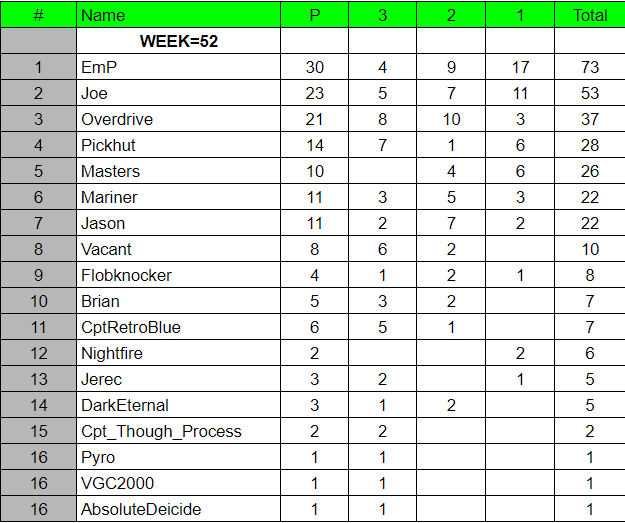 2020 01: 30th Dec -- 5th January 02: 6th January -- 12th January 03: 13th January -- 19th January 04: 20th January -- 26th January 05: 27th January -- 2nd February 06: 3rd February -- 9th February 07: 10th February -- 16th February 08: 17th February -- 23rd February 09: 24th February -- 1st March 10: 2nd March -- 8th March 11: 9th March -- 15th March 12: 16th March -- 22nd March 13: 23rd March -- 29th March 14: 30th March -- 5th April 15: 6th April -- 12th April 16: 13th April -- 19th April 17: 20th April -- 26th April 18: 27 April -- 3rd May 19: 4th May -- 10th May 20: 11th May -- 17th May 21: 18th May -- 24th May 22: 25th May -- 31st May 23: 1st June -- 7th June 24: 8th June -- 14th June 25: 15th June -- 21st June 26: 22nd June -- 28th June 27: 29th June -- 5th July 28: 6th July -- 12th July 29: 13th July -- 19th July 30: 20th July -- 26th July 31: 27th July -- 2nd August 32: 3rd August -- 9th August 33: 10th August -- 16th August 34: 17th August -- 23rd August 35: 24th August -- 30th August 36: 31st August -- 6th September 37: 7th September -- 13th September 38: 14th September -- 20th September 39: 21st September -- 27th September 40: 28th September -- 4th October 41: 5th October -- 11th October 42: 12th October -- 18th October 43: 19th October -- 25th October 44: 26th October -- 1st November 45: 2nd November -- 8th November 46: 9th November- 15th November 47: 16th November -- 22nd November 48: 22nd November -- 29th November 49: 30th November -- 6th December 50: 7th December -- 13th December 51: 14th December -- 20th December 52: 21th December -- 27th December |
|
|
jerec posted March 09, 2020: I wonder if this will inspire me to write more. |
|
|
overdrive posted March 09, 2020: Well, if you want to finish in front of "Vacant", you better! |
|
|
|
|
|
EmP posted March 10, 2020: You industrious swines. There’s about eight reviews on offer this week. But two of them are mine, making me the mist industrious of them all! Let’s wait for Marc to forget them again during his week, he says, all passive aggressively. Even so, that means it’s no podium finishes for all of you. Jason writes an informative review of a tower defense game, so the genre provides a hurdle of sorts right off. I’m not a huge fan of dating reviews by talking about price points, but sometimes you gotta do it when you talk about the game’s value. Jason finds the game a little overpriced. If only a little (and coupled with a 4 / 5 review score) I wonder if it’s worth mentioning? Still, I think it’s a good review that spends time trying to communicate the accessibility of the game. DE makes a solid come back review by finding a point and click game I’ve not played yet and them making me want to change that. There’s the occasional weird phrase or dragged-out line in there from time to time, but I stopped being critical at the sliding tile puzzle rant. God, I hate sliding tile puzzles. Why are these still a bloody thing? THIRD Space Channel 5 VR: Kinda Funky News Flash! [PS4] Pickhut Pick goes back to Space Channel 5 to make an unfortunate argument; a once creative game with unreliable controls now has surprisingly reliable controls but is absolutely void of creativity. It’s the right point to make and it’s annoying the game has so little content when it nails the very thing that held it back the most back when. Another unfortunate bout of dating the review with a price point, but this time with more of a reason behind it; charging full retail price for an almost demo reel amount of content is rightfully lambasted. SECOND Dark Souls II: Scholar of the First Sin (360) Overdrive I’ve been pretty good to Rob ( he’s won 2 of my last three topics) and have largely enjoyed his recent run of action RPG-ish games that aren’t cut and paste mobile games. This review gets off to a bit of a bumpy start that seems necessary when you learn there’s two different versions of the game floating about. That’s just bad branding. You then follow this with a case error which we will now point and laugh at: Basically, this Scholar of the FIrst Sin is nothing more than. I think the review’s main problem is that it jumps around its points a bit and your thought process seems a bit jumbled at times. You need some of that because you’re trying to differentiate Souls 2 from Souls 1, but it sometimes comes across as you remembering a thing that you should have been mentioning, so IT’S JUST GOING TO HAVE TO GO IN RIGHT HERE. Good stuff, though. Now you’re running out of Souls/Witcher games, I suggest giving Dragon’s Dogma a spin. WINNER Star Girl Proxima [PC] Masters “I could compare this to a popular game you can all easily recognise,” say Marc Golding, “but, instead, I’ll compare it to this semi obscure one so you can tell I have aces of nerdy genre knowledge” Yet, still, I know exactly what I should expect from Proxima; good boss battles broken up by meandering platforming that sometimes forgets to put the enemies in. You’re also starting to become a real threat to my site-wide tagline dominance. Cut that out. |
|
|
dementedhut posted March 10, 2020: Thanks for the placement, EmP. Speaking of prices, this was honestly one of the more tougher decisions I had to make buying a VR game. I kept thinking, "What if it really sucks?" But at the same time I was like, "But I get to save the galaxy by dancing. With Ulala. >_>" So the choice was obvious. For me, at least. Still highly recommend anyone with a PSVR to skip unless it sees a huge drop in price during a sale. Controls are solid, but the game as a whole isn't. Congrats to OD for second placement, and Masters for nabbing yet another RotW! |
|
|
EmP posted March 10, 2020: If I had a VR set up, something like a Space Channel 5 game would be exactly the kind of offbeat thing that would tempt me. Alas! |
|
|
honestgamer posted March 10, 2020: I'm not sure I agree mentioning the price necessarily "dates" a review in a 2020 sort of world. Most games on the eShop retain the same price for many years, until finally they just disappear one day either on a publisher's whim or as that particular system's presence on the eShop ends... in which case a discussion of its price is still relevant for people who might wonder after the fact what the game cost. After all, we're only occasionally talking about fluctuating prices for physical releases in this era when something like 90% of games never get released in a physical format (and even a lot of the ones that do are offered in limited quantities by a company such as Limited Run Games). With that said, I didn't actually expect to place well with this review, since most people who handle RotW topics do seem to find tower defense games outlandishly dull by their very nature, even though the gaming public at large--that includes me in particular--finds them especially enjoyable/addictive. Thanks for the timely topic, anyway. And congratulations to the winners, who submitted some stellar reviews this week. Thanks also to all who participated to ensure I had basically no shot at the top three. Despite what that does for my Site King standings, the activity and quality make me happy! |
|
|
overdrive posted March 11, 2020: Thanks for the comments and placement. Yeah, if there is one thing I seem to struggle with a lot, it's accidentally capitalizing the second letter of a word IF THAT LETTER is an "I". Apparently, from "home position" on a keyboard, my finger moving from "K" to "I" almost always moves more quickly than my finger going from "A" to "shift" can get off the shift key. And it only happens if the second letter is an "I". As for the commentary on the review, I definitely understand what you're saying. The "two version of Scholar of the First Sin" bit led to me scrapping and rewriting the intro a couple times before I got it to where I at least thought it was decent AND it was a bit hard for me to not lapse into comparisons between the two last-gen Dark Souls games, simply because they were so similar with many of the alterations being smaller things, rather than any huge overhaul to the mechanics. I'm glad I maneuvered through all that at least skillfully enough to get second, as I also did a fair amount of trimming before even handing it to Jason. Oh, and "running out of" these games? In my backlog box at home, I have Bloodborne and Dark Souls III and Sekiro is one Amazon order away! I do have some degree of interest in Dragon's Dogma, but man, unless it gets dumped on PS Now for free, that could take a real long while to even think about. The backlog isn't getting any smaller and that PS Now library is only adding to my "stuff I gotta play...sometime...maybe...I hope?" catalog. I'm gonna have to find a way to extend my natural lifespan by 30-100 years, I think. |
|
|
Masters posted March 12, 2020: Thanks, Gary -- it's nice to get a win here and there. Maybe if the rest of us pool our points we can catch Joe in Site King as a group. |
|
|
overdrive posted March 13, 2020: My yearly-ish Kemco Kompletion due to needing something to do in those 30-60 minute bursts of free time on the road. 2/5, I'd say. And yes, the rambling style where I waited until halfway through the review to specifically mention what game I was reviewing was by intent. Review 20-30 of Kemco's games and you'll find that irreverent writing styles are the best way to cope! -------------- A few years ago, when I started the ill-fated Kemco Khallenge, it all seemed so simple. I'd been finding myself losing interest in Japanese role-playing games — long a favorite genre of mine — due to them gradually becoming more and more overblown in length, moving from the breezy 30-40 hour games of my youth into massive entities determined to devour at least 100 hours of my time while only rarely having the quality of content to justify that sort of investment. And, lo, there was Kemco, snapping up tiny RPG companies and releasing their far shorter games on mobile devices. And so, I could try to regain my love of the genre with shorter games where, in theory, I'd have everything worth doing done before things started to get tiresome and repetitive. As an additional bonus, mobile JRPGs aren't exactly the most covered video games being released, so by reviewing Kemco's library, I'd both be providing coverage for games that aren't getting much press, as well as being able to say that some of my stuff can actually be found on the first or second page of the average search engine result. It was a "can't lose" proposition…until I'd played a dozen or two of their games and started to realize they were causing me to fall even farther out of love with JRPGs. Sure, they were short and, for the most part, I was able to complete at least their main quest before losing interest, but there was just this feeling of deja vu washing over me more and more with each new title — no mean feat considering that Kemco has enlisted the services of multiple teams over the past decade or so. Therefore, I abandoned the Khallenge after a couple years of blasting out one review after another for mostly mediocre games that mainly stood out for just how cut-and-paste they were. Any given game by any given team was bound to have every enemy design palette-swapped until the redundancy went full-circle and actually became impressive in a twisted way, as well as plot elements and premises routinely recycled for subsequent offerings. Alas, my tablet I collected all these games upon still works. Double alas, at times, I find myself on the road in situations where 30 or 45 minutes of playing something seems preferable to scrolling through Twitter for the umpteenth time or resorting to staring blankly at wallpaper patterns. And, thus, I recently made it through Dark Seven, a game so impressive that I made it nearly five paragraphs into my review without saying a single thing about it specifically. Sigh…the Kemco Khallenge might not be an active, full-time thing for me anymore, but some things about my reviews of their games will never change! So, let's try to do a bit of "too little, too late" rectifying of that. Dark Seven was created by Magitec and was one of that team's final games to get released by Kemco, being made available in 2015. And it takes the whole "too short to get tiresome" thing to the extreme, as it took me under 10 hours to do all the mandatory stuff and see the final credits. Well, at least it got the "short" part down, as I must admit that I found myself getting bored with this game even though I only seemed to play it for an hour or so every few weeks. And there are a decent number of culprits. Of all the teams that Kemco employs to provide them with content, Magitec is the worst of the bunch on an aesthetic level. Virtually everything except the admittedly well-drawn character portraits was small and blocky, with only your characters having even the slightest bit of animation in fights. Random first-dungeon enemy, the game's final boss, whatever — they all got small, nondescript sprites and liked it! The game's world was pretty small with nothing to differentiate it from any number of tiny, generic maps that could have been sketched out on paper in under a minute and your path through it was painfully linear. You won't be getting side quests or optional locations to explore unless you gain enough in-app purchase currency to acquire a dungeon hidden behind a paywall. You WILL get a pretty decent class system that can grant you any number of potentially useful skills and spells. And you likely will underutilize it because this game's difficulty never really moves past non-threatening. Sure, you could dig into things and find the perfect mix-n-match combination of characters and classes, but there's no real point to doing that sort of work when maxing out two or so classes per party member will likely give you all the abilities you'll need to cruise through the game. One thing that does come in handy is the game's "dice" mechanic. One party member has a set of dice that has mystical powers and in battle, if your commands, which all are worth different amounts of points, add up to the dice total, you'll start to fill a gauge allowing a special attack that's great to save up for boss fights in order to massively deplete their health. This is actually pretty neat, as you'll have to carefully regulate what each character does on a turn-by-turn basis. There also is a plot that would be pretty decent if not for how this game is so short that everything winds up condensed to the point of meaninglessness. To truncate my summary in the same way, you'll control a band of heroes trying to stop the rulers of the world's various nations after they all suffered dramatic personality changes after coming into possession of malevolent artwork. These paintings gave each ruler great power, but also caused them to become monstrous demons at heart; their love for their people perverted into something far different. You'll go to each land, fight its ruler, acquire a painting and move on until you've reached the ringleaders of the whole plot. There is one plot twist that would have been effective if I wasn't cursed with this self-inflicted familiarity with Kemco's games, leading me to near-immediately know just how things would go with one particular character. When my "complements" for a game are about a decent class system that mostly doesn't need to be delved into and an okay plot marred by how quickly you move from one stop to the next, it's probably for the best that we're talking about a really short game. Get it for cheap during one of Kemco's sales and an RPG junkie might have a reasonably tolerable short-term time-killer. Then again, the operative word there probably is "might". When I realize that I've mustered up more enthusiasm for delaying talking about the game, as opposed to actually, you know, reviewing it, I can't exactly fault someone for coming to the conclusion that Dark Seven is a deeply-mediocre offering and I'm reaching for complements when attempting to kinda, sorta recommend it to anyone. I mean, "You should try out this game; I was able to complete it in 9-10 hours over the span of about six months!" isn't going to convince me! But that's Kemco and that's why the Kemco Khallenge went from being a thing I do to this "writing challenge on life support" that I might revisit once or twice per year. No matter which team is making the game, you can count on seeing the same flaws on display. Occasionally one of their games does enough right that I can ignore such things as the same handful of monster designs being repeated constantly or how so many of their offerings follow the same generic plot and character templates, as opposed to attempting something that's actually original. Dark Seven is not one of those games. It might be somewhat competent and I was able to get through it without abandoning it as a lost cause, but I'm not going to waste my time searching for anything more complementary to say. |
|
|
honestgamer posted March 13, 2020: Let's see if I can provide a revised draft for you without making you wait for weeks. Ooh, look! I did! You know what to do with it! --- A few years ago, when I started the ill-fated Kemco Khallenge, it all seemed so simple. I had found myself losing interest in Japanese role-playing games--long a favorite genre of mine--as they became increasingly overblown. They changed from the breezy 30-40 hour games of my youth into massive entities determined to devour at least 100 hours of my time while only rarely possessing the sort of qualities that might justify that investment. And lo, there was Kemco, snapping up tiny RPG companies and releasing their far shorter games on mobile devices. I figured I could attempt to rekindle my love for the genre with shorter games where I would theoretically have everything worth doing done before things started to grow tiresome and repetitive. As an additional bonus, mobile JRPGs don't exactly attract a lot of reviews from fellow critics. By covering Kemco's library, I could cover titles my peers overlooked while also securing a position on the first or second page of search results. At first I thought I had found a "can't lose" proposition…until I played a dozen or two of the publisher's games and realized they were causing me to fall even further out of love with the JRPG. Sure, the ones I tried were short and, for the most part, I was able to complete at least their main quest before losing interest. But there was a feeling of deja vu that grew more pronounced with each new conquest (no mean feat, considering that Kemco has enlisted the services of multiple teams over the past decade or so). After a couple of years spent blasting out one review after another for mostly mediocre games that were remarkable primarily for their cut-and-paste qualities, I finally abandoned the Khallenge. Any given game from any given team was bound to feature palette-swapped versions of every enemy design, until the redundancy went full-circle and actually became impressive in a twisted way. All of them would feature plot elements and premises that would then be recycled in subsequent offerings. Alas, the tablet that houses all of those games still works. Make that double alas, since I occasionally find myself on the road, bored and thinking that 30 or 45 minutes playing a JRPG on my tablet is preferable to staring blankly at wallpaper patterns or scrolling through Twitter for the umpteenth time. So it is that I recently made it through Dark Seven, a game so impressive that I made it nearly five paragraphs into this review without saying a single thing about it specifically. Sigh…the Kemco Khallenge might not be an active, full-time pursuit for me anymore, but some things about my reviews for the publisher's games will never change! So, let's try to do a bit of "too little, too late" rectifying of that. Dark Seven was created by Magitec and was one of that team's final games Kemco published. It became available in 2015 and takes the whole "too short to get tiresome" thing to the extreme; I spent fewer than 10 hours doing all the mandatory stuff and reaching the final credits. Well, at least the game got the "short" part down, though I must admit I found myself getting bored with it even though I only seemed to play it for an hour or so every few weeks. There were a decent number of reasons for the disinterest. Of all the teams Kemco employs to provide new content, Magitec is the worst of the bunch where aesthetics are concerned. Virtually everything except for the admittedly well-drawn character portraits is small and blocky, with only your characters possessing even the slightest bit of animation in fights. Random first-dungeon enemy, the game's final boss, whatever--they all get small, nondescript sprites and like it! The game's world itself is also quite small, with nothing to differentiate it from any number of tiny, generic maps that could have been sketched out on paper in under a minute. Worse, your path through all of it is painfully linear. You won't be getting side quests or finding optional locations to explore unless you gain enough in-app purchase currency to acquire a dungeon hidden behind a paywall. You WILL get a pretty decent class system that grants you any number of potentially useful skills and spells, however. And you likely will under-utilize it because this game's difficulty never moves past non-threatening. Sure, you could dig into things and find the perfect mix-n-match combination of characters and classes, but there's no real point when maxing out two or so classes per party member will likely give you all the abilities you need to cruise through to the end. One thing that does come in handy is the game's "dice" mechanic. One party member has a set of dice with mystical powers. In battle, when the sum of combat points you earn by executing commands matches your dice total, you start to fill a gauge. Doing so allows you to bank a special attack that's great for boss fights when you need to massively deplete their health. This is actually a pretty neat system, since you have to carefully regulate what each character does on a turn-by-turn basis. There also is a plot that would be pretty decent, if it weren't condensed to the point of meaninglessness. To truncate my summary in the same way: you control a band of heroes trying to stop the world's various rulers. They all suffered dramatic changes to their personality after acquiring malevolent artwork. The paintings in question gave each ruler great power but also caused them to become monstrous demons at heart; their love for their people has been perverted into something far different. You go to each land, fight its ruler, acquire a painting and move on until you've reached the ringleaders behind the whole scheme. There is one plot twist that would have been effective if only I wasn't cursed with this self-inflicted familiarity with Kemco's games, but my experience with past titles meant I knew almost immediately just how things with one particular character would go. When my "compliments" for a game relate to a decent class system that the player can easily overlook and a passable plot weakened by its brisk pace, it's probably for the best that the experience ends quickly. Purchased on the cheap, it might even serve as a tolerable time-killer. Maybe. But given how I've mustered up more enthusiasm for my effort to find ways to delay talking about the game than I have for the task of actually reviewing it, I can't exactly fault anyone who comes to the conclusion that Dark Seven is a deeply-mediocre offering. I mean, "You should try out this game; I was able to complete it in 9-10 hours over the span of about six months!" isn't going to convince me! But that's Kemco and that's why the Kemco Khallenge went from being a habit of mine to a "writing challenge on life support" that I might revisit once or twice per year. The publisher's games do occasionally do enough right that I can ignore the usual flaws, but Dark Seven doesn't fall within that narrow category. It might be somewhat competent, and I was eventually able to get through it without abandoning the effort, but I'm not going to waste my time searching for any better compliments than that. |
|
|
Flobknocker posted March 15, 2020: Hi. Please could you add A Hat in Time to the list? The time is right. A Hat in Time PS4, XB1, PC, Switch https://store.steampowered.com/app/253230/A_Hat_in_Time/ Thank you very much. Added. |
|
|
Masters posted March 17, 2020: Happy Tuesday, all. Join me as a rank game reviews in the apocalypse. Only three reviews this week, in actuality, but five are eligible for this week's judging, because Emp had two holdovers that I've managed to remember to include. Either I remembered, or Emp wouldn't stop pestering me to include them. One or the other. And so, we've got another one of those situations where only one contributor is left off the podium, so my apologies in advance to that person -- especially in this case, where I really had a tie for bronze, but ties are presumably not allowed (why not!). Anyway. Rob's Dark Seven In response to Rob's profound tagline, I would say this: we're only on this planet for a finite amount of time, and I spent some of that time doing this RotW. I think I have you beat... Was the Kemco Khallenge really started a few years ago? Time does fly. Your actual intro paragraph is excellent here. But... then there are a further four paragraphs of introduction which veer into self-indulgent/blog material to be sure. You poke fun of it yourself; we know you're aware of it, but that doesn't change the fact that we don't touch on Dark Seven until, as you say, paragraph five. The flow of the review and quality of writing is top notch; everything you do to close the review out (analysis of the game's numerous failings and highlighting of its two plusses) is done well, it's just that it takes so long to get to. Joe's Wild Arms 2 Here's another J-RPG review with a great intro, and Joe gets to the nitty gritty of the story pretty quickly. Although, is "raggest" a word? I think something is missing in this line as well: "However, thanks to his super powers, the massive explosion that engulfs him and the subsequent plummet to the ground..." The writing here is as masterful as always but in an attempt to showcase the madness of the game's story, the writing itself comes off a bit listy and manic. So many characters and other games are name dropped, it's difficult to keep track. It's always an uphill battle to reveal how all over the place a game is without... being all over the place. Joe's writing here is typically good, but it'd guess it's purposely kitchen-sink, and as such for me it's atypically difficult to digest. mariner's Sparklite Mariner comes through with a very good review which opens with his ambivalence towards rogue-like adventures, before taking to task a promising Zelda-rogue-like by examining pros and cons of the approach and wondering aloud why more wasn't done to exploit those pros. The fifth paragraph which goes into detail about the failings of the rogue-like system as it is applied in Sparklite loses quite a bit of the good head of steam the review had built up to that point; it's a bit unwieldy and not the easiest analysis to digest. But mariner brings it back around with a nice final paragraph and specifically, final few sentences. Gary's corner Gary has two holdover reviews, as I've mentioned. One is for Devil's Kiss, a visual novel that sounds awfully lame. High points for using the word "antediluvian," but far fewer points for using it in a phrase that's not quite a sentence. The two sentences to follow are confusing because we don't know which 'he' you're referring to. That aside, everything is vintage Emp: ten dollar words in weighty clauses, irreverence and snideness abound. Then he checks to see if you're paying attention by concluding with really the ultimate in-joke. It's a fantastic ending which comes out of nowhere, both because the review feels surprisingly short at that point, and because of the 'oh no he didn't moment' -- if you haven't checked out the review by now, you should. Gary's other review is for another game in the same series: Lair of the Clockwork God. Thankfully, it's an amazingly well written short review -- easily the best of the week -- because if it weren't, I would have had to award Gary's other review the win, and who wants to reward gimmicks? Not me! This Lair review then, is so smooth, from word choice to transitions, to how easily and casually it covers different game functions in other game function paragraphs so as to be the farthest thing from a 'sectioned piece' and yet cover everything we need covered with style and thoughtfulness and levity--truly excellent. There are so many good passages: about what genre it fits in, about the fourth wall, about the writer's need to write less. Go read it. And so, the REVIEW OF THE WEEK is Gary's Lair of the Clockwork God. The runner up goes to mariner's Sparklite. And the bronze medal as it were, goes to Rob's Dark Seven. That's it for this week. Stay safe and virus-free. |
|
|
EmP posted March 17, 2020: Appreciate the nod. I wasn't sure that Devil's Kiss joke would translate, so I'm glad it landed. Clockwork Lair's a really clever game, so doing it some justice is an added bonus. Thanks for reading, and for the quick topic turnaround. |
|
|
overdrive posted March 17, 2020: Yep, Sept. 2015 is when I reviewed Alphadia, which was the first legit Kemco Khallenge review! There was Grinsia a while before that, but that was a random 3DS Shop game I picked up, never knowing it was one piece of a giant monster of blah gaming. Thanks for the comments and placement. And, yeah, the extremely long-winded intro was by design. Gary's always ragging on me for my rambling ways and I figured that since I was reviewing a particularly bland Kemco game, it'd be really funny to really over-exaggerate that element of my writing. I guess it might have been better if it was for one of his weeks to do RotW, but I didn't exactly plan things out and by the time I got time to write the review, I'd have had to wait a couple weeks to post it. |
|
|
dementedhut posted March 20, 2020: Title: Ultracore Platform: PS4 Genre: Action Developer: (don't know the exact answer to this one) Publisher: Strictly Limited Games Release date: (again, not sure. exact release date for this is a nightmare) Added. Thanks. |
|
|
overdrive posted March 25, 2020: Kind of an unusual week with six reviews by six different contestants. Usually, there's at least one or two people with multiples, so this is kind of neat. I guess it's kind of an unusual week for other reasons, as well. Current events and my realization that reMind is a horribly cynical cash grab by Square Enix for their Kingdom Hearts brand and not remotely worth the $29 I spent to download it (or $19…or probably even $9). The bulk of it is essentially you re-doing the final couple hours of the game, but enhanced a bit (some new stuff added in and the ability to control another character for some of the fights) and with its own framing story (Sora using the "power of waking" to save Kairi, something that happens off-screen as part of the main game's ending). In other words, take out the framing story and this is a patch to improve the final couple hours of the game that you have to pay for. The remainder of it is super-tough variations of all the Organization members where you likely have to grind for a few hours to be tough enough to have a realistic chance — something that was provided for free in the HD upgraded version of KH II if you did a tough optional dungeon requiring you to have about every skill mastered. JOY!!! My review of the main game will be 3.5/5. This DLC…not likely to get anything better than 1/5 or so. Maybe 1.5 if I'm feeling generous. Hopefully for you guys, when giving these critiques, I'm feeling more generous than I expect to feel when reviewing reMind! Which, I guess, will be easy to do because the one and only positive to reMind seems to be that it did get me to keep playing KH III in order to do the post-game Battlegates in order to grind levels quickly. And since one of those gates hosts the base game's tough optional boss, that's something, I guess? For the three honorable mentions, Pickhut came super-close to placing. Like to the degree that I went back and forth over this more than one might think a person would while typing up these things. I did really like this review. There's something cool about getting to play one of those "never got released" games for a classic system — a big reason why I got so excited way back when I discovered the ROM translation scene. And much like many of my experiences with games there, you wound up being disappointed. And when you have a five-level game where four of those five are little more than the prelims for the fifth state, which actually has some sense of size and diversity, there will be disappointment! You did a good job of illustrating how this game gives the illusion of vastness, while actually being linear and repetitive. CRB's review had a bit of roughness to it, but I did like how it was more detailed than a lot of yours. Maybe it was just the fact you were playing an action-RPG instead of a pure action game, but you did a quality job of diving into various mechanics of the game and illustrating just how many optional/side things there are to do in this game, as well as discussing its non-linear style and how you can't unlock certain things until you've accomplished other things in other parts of the game's world. The occasional bits of roughness or awkward phrasings may have kept this review from being "the total package", but it was definitely an in-depth and informative read. Overall, I dug Brian's review. Had a good amount of personality and told me a lot about a game I had no knowledge of in an engaging way. My issues come from (and I'm definitely NOT the one to talk about this; just ask anyone who judges my reviews) how some of your side-discussions to interfere with my reading enjoyment. Mocking Epic Games is one thing, but turning it into a sub-section of the review (complete with Twitter-pic) BEFORE you've even gotten into talking about this game any more than mentioning how it's a good score-attack game felt a bit out-of-place. And that entire "cost vs. contest" conversation just felt convoluted to me. Three paragraphs breaking it down in detail when I have no idea what the issue is or if there is one because I have no clue how much the game costs or if people have complained greatly about this. But when you're talking about the game, what makes it work and what flaws it does have, this is a very engaging read that I found pretty informative. THIRD PLACE Flobknocker's A Hat in Time (PC) Flobknocker had a few problems with line breaks above the first picture break, but still did a good job making a game I had no familiarity of look like it's really good and something I might want to play in the future. I mean, if its PS4 port was included as something free on PS Now, there'd be a bigger chance of that happening, but still, I was impressed by how you made the game sound. Your love of this game really shined here. I mean, from your early paragraphs, I expected it to — one better not be calling a review their "love letter" to the game and then sound all buttoned down and professional — but I did really like how you mixed in those gushing phrases into your discussion of mechanics and environments. Fix those line breaks and this is a really good review without anything really standing out as a negative. Hell, you even get into the stuff you can do with mods, DLCs and extra game modes after beating the game. Not necessary, but when you're talking about a game you love, it is a nice added touch to focus on those "I beat it, but still want to play it and LOOK AT THIS!!!!" things. SECOND PLACE EmP's Azur Lane: Crosswave (PC) Since you've been so kind as to inform me of my recent grammatical blunders, I did catch in your second paragraph "massive cast of girls on offer are packed full countless returns" and there definitely seems to be something missing or poorly phrased there. Seems I caught something else, too, but that was yesterday when I read everything and picked my order of placements and this is today that I'm actually writing my critiques and slightly less than 24 hours is still apparently too long for my brain to remember details. Anyway, to more meaty stuff (and I'm not talking about the figures of the girls in that first pic, honest!), I have to admit that you are really good at finding weird-ass games that apparently are actually a real thing. Man, I had to read a couple sentences multiple times just because the subject matter was wacky enough it took me aback. It's probably a testament to your writing that I liked this review. To me, it looked like you just sort of embraced the insanity and just tossed in casual little reminders of it here and there to remind readers that this isn't just any old game. Like, I loved this sentence: "Here, you’re forced to blow up (or be blown up by) massive destroyers, self-destructing speedboats, dive-bombing aircraft and cat-eared cuties in a weirdly cut kimono that offers up all the side boob you could ever want." Bonus points for that aforementioned pic (situated just below that line) offering proof of said side boob. Really, if I was going to offer any objection to the review, it's that it does come off as pretty positive for a mediocre score, where your main issues revolve around the overabundance of anime tropes, how fights are pretty simplistic and you're not personally familiar with the subject matter…but your overall opinion reads to me like this was a pretty cool experience despite any of that and that it would just be enhanced if you had familiarity with the characters or series as a whole. REVIEW OF THE WEEK (aka: Overdrive Place) Masters' Rage Among the Stars (PC) There's a great sense of authority in this review's writing. You do a good job in the opening paragraphs to compare this to Super Meat Boy, mentioning that fans of that game likely will be looking for anything that is in that vein. And then do a good job deconstructing this game from being a worthy successor to being a very flawed game that is kind of like it, but doesn't match up to that standard. First, it's the imprecise wall-jumping combined with tons of spikes on said walls. Or that there is nothing to the protagonist other than "guy you control". Or that moving platforms are as bad as the spikes. Or that your main takeaway is that this game is fun at times, but best played on easy, which probably isn't something that one should say about this type of game. I think you did a really good job of emphasizing that you love this sort of game and could find ways to get through really annoying areas, but that this isn't a game for people not fans of the SMB style of play and when you add in the voice of authority factor, that was enough to get this one into first place. So, there ends another week of RotW; we'll hope to all be alive by the time my next one comes around! |
|
|
dementedhut posted March 25, 2020: Thanks for the words, OD! Glad you enjoyed reading about Ultracore, especially looking back and thinking that I almost didn't want to review the game at first. But I convinced myself, since it's not everyday that you get to experience a game that was cancelled around 25 years ago. I didn't mention this in the review, but I think I understand why Psygnosis decided to pass on publishing the game at the last moment, especially since everything felt wayyyyyyy too samey. By the time I reached the final stage, I was like, "What? That's it?" Congrats to Flob and Emp for placing, and Masters for nabbing, yet again, another RotW! |
|
|
Flobknocker posted March 25, 2020: Hey, thanks for the feedback, that third feels really good. I'll be sure to get those pesky line breaks under control for the next review I do, and congrats to Masters for the winning entry! |
|
|
overdrive posted March 27, 2020: Thinking 3.5/5; maybe 4. One of those weird things where the game was a lot of fun, but the story-telling was just so weird, where everything really slowly built up for most of the game and then all these series-wide major villains got dispatched quickly in groups of two or three and then you fight the final boss and it's over, with all that taking no more (and probably less) time than it takes to do the average Disney world. So, yeah, probably 3.5. ---------- On one hand, it could be said that 2019's Kingdom Hearts III is a great addition to a series that has endured since 2002 on multiple systems throughout multiple generations of system. The PlayStation 4's technology is good enough to make this game's worlds look just like those in the Disney and Pixar movies they're derived from, while the gameplay generally takes after that in Kingdom Hearts II — widely considered the best game in the series — with some of the more intriguing elements of other games simply being added to that strong foundation. You'll have fast-paced action mixed in with the sort of epic moments you'd expect from a game designed as the conclusion of a 17-year plot concerning the youthful Sora and his cohorts attempting to prevent the schemes of the malevolent Master Xehonort from coming to fruition. There are plenty of diversions, ranging from finding a lot of simplistic arcade games based on those Game & Watch offerings I vaguely remember from my youth to cooking various stat-buffing meals to finding large numbers of well-hidden Mickey Mouse emblems in order to unlock additional cinema in the game's ending. Battles have the potential to be extremely fun. While "rapidly tap X to win" definitely is a viable strategy, at least on the less taxing difficulties, you'll get so many cool attacks that it'd be foolish to not experiment. After whacking enemies with your Keyblade or spells enough, you'll start seeing all sorts of optional attacks showing up for you to choose from and hit the triangle button to implement. You can temporarily transform any of the game's many Keyblades into a stronger variation, you can access more powerful versions of spells, you can implement a special attack based on a Disney Park ride or you can team up with one or more comrades for a damaging special attack. And these options pop up regularly, so an attentive player can spend as much time devastating foes with these optional moves as with Sora's basic swipes and slashes. While I won't say that every world in this game was equally fun, I will say the best are possibly my favorites in the series. The world based on Toy Story mostly takes place in a large shopping center, where you'll explore multiple toy-themed stores, while this game's Pirates of the Caribbean land gives you a small open world where you can sail a ship to a number of islands simply to explore and find treasure. Throughout the game, you'll find yourself using Dream Drop Distance's Flowmotion moves, both to scale walls and to attack, and they'll be most useful in this game's Big Hero 6 world, where you'll be placed in a decent-sized city and be expected to scale skyscrapers and other buildings to find treasure and complete plot objectives. And really, if a world didn't captivate me, it had less to do with said world being poorly designed and more to do with its storyline being a heavily-truncated version of the movie it was based on, with Sora, Donald and Goofy having little else to do besides fight their way through monsters, while you hope you can remember enough of the film to understand this game's interpretation of its plot. I mean, I'm not super-familiar with Frozen, but I'm pretty sure that Prince Hans had a more significant role in the movie than two non-speaking cutscene cameos followed by him turning into a demonic wolf. In fact, I'm pretty sure that last thing didn't actually happen in the movie, although it'd be cool if it had! Yeah, on one hand, this is a great culmination for this series. Unfortunately, that other hand had to reach up and pimp-slap my exuberance into submission. Kingdom Hearts III is a fun game to play and it contains a lot to do, but plot-wise, it really fell short of my expectations for the conclusion of a story that's taken 17 years to conclude. And the sad thing is that the culprit simply is a Kingdom Hearts game following the structure one expects from a Kingdom Hearts game. Not counting the eminently forgettable Chain of Memories or the ones deemed so insignificant they were reduced to cutscene movies on the many Kingdom Hearts HD compilations that've been released, these games follow a simple pattern. Your hero — usually Sora, but occasionally another character or three — will travel through a number of worlds based on Disney movies, going on adventures related in some way to those films' plots. During this time, the game's main plot will gradually unfold and things will usually come to a climax around when the Disney worlds have run out, setting up the game's final lands, where some huge revelations will get made and the final battles will be fought. For this to work, the writers must walk a very fine line. Since each Disney world has its own self-contained plot, it's imperative to find a way to advance the main story in a way that it doesn't completely overshadow the Disney stuff, but still keeps your eyes on the prize, so to speak. Important adversaries might find themselves allied with a particular movie's villain, or perhaps they'll be causing trouble behind the scenes while you're trying to stop the Disney evil-doer. Regardless, the appeal of this series is derived from its ability to both allow the individual worlds to breathe, while also using each one as a mechanism to keep the overall plot moving. Kingdom Hearts III does not come close to succeeding in that aspect. For the first time ever, those Disney (and Pixar) worlds legitimately feel like filler. Early in the game, Square Enix pokes fun at how they've numbered these games by referring to Sora's tutorial trip to Olympus as "Kingdom Hearts II.9" before giving you the legitimate title screen after completing that world. Alas, the vast majority of the game feels like "II.9" and then all the big events get thrown together one after the next with no single moment getting time to shine in the "you waited for this to happen for years; now enjoy it!" way they deserve. In short, when this game starts, Xehonort has nearly everything he needs to start his Keyblade War, but this encounter is supposed to be between the seven lights and 13 darknesses and the forces of light have some catching up to do. After the events of Dream Drop Distance, Sora has been left depleted and needs to regain his strength and master a mystical McGuffin known as "the power of waking". And that's the bulk of the game: Sora goes to a world, works through its plot, doesn't obtain that power and goes to the next world. While members of Xehonort's Organization interact with him, it generally feels like they're just killing time while waiting for the fun to start. For example, one guy, Marluxia, shows up in the world based on Tangled because the Organization has a vested interest in Rapunzel's safety because she could be a potential back-up if someone would happen to one of the series' Princesses of Light. He'll chat with your team, as well as movie villainess Mother Gothel, send a big monster after you at the end and then go back to Organization headquarters, rarely appearing in scattered cutscenes until its time to dust him off for the finale. This will happen for the bulk of the game to the degree that even Sora gets repeatedly frustrated by how he can't help with the heavy lifting because he's stuck on his McGuffin search. Uh, guys, when I'm feeling that the key attraction of your series has been reduced to filler that happens to eat up the majority of a game's length, it might not be a great idea to have your main character confirm those suspicions, making me think you wrote yourself into a corner and simply reacted by sticking your heads into the sand, pretending there is no problem whatsoever. And then, after you've finished the final Disney world, everything goes crazy. Sure, there's still a bit of filler — such as the bizarre little segment where things go completely wrong for the heroes, leading to you controlling Sora in an afterlife setting to collect over 100 copies of his body in order to reset time a bit and gain a second chance at overcoming that seemingly-insurmountable bit of adversity — but you'll go from one big fight to the next so quickly that all 13 of Xehonort's darknesses can easily be dispatched in an hour or two. We're talking guys who've been the final boss in previous games, as well as the characters who did the heavy lifting for those bosses and they're all fought in groups of two or three and, just like that, they're gone. You'll be fighting a group of them, one of them will fall, you'll get a "fare-thee-well" cutscene and then resume the battle against the surviving foes. You'll spend two hours unraveling Vanitas' plots in the Monsters, Inc. world and then two minutes putting an end to him in a battle where he has to share the spotlight with a more imposing villain during this extremely rushed boss rush. What can I say? On a pure "fun to play" level, this might be the best Kingdom Hearts has ever been, with responsive controls, tons of combat options and optional things to do when out of battle. But as far as story-telling goes, this might be the series' lowest moment. The pacing of the game is atrocious, with nothing significant happening for an eternity and then everything big all happening at once, getting resolved so quickly that nothing really resonates. The Disney worlds, while fun to play through, have scarcely any relevance to the actual plot. You know the old saying about how the journey is more important than the destination? I'd say that one's opinion of this game depends on one's opinion of that statement. Kingdom Hearts III's journey was a lot of fun, but the destination was quite lacking. |
|
|
Masters posted March 27, 2020: Thanks for the win, Rob. Sorry I missed the topic for a few days; I thought I had already posted in here. Old age. And drinking. Glad to see new blood on the podium, too. |
|
|
EmP posted March 29, 2020: I'll spot this one late -- appreciate the props and congrats to the fine fellows around me. Appreciate the typo, which is tidied away, and the kind words. Azur was a.. it was a thing that I played, all right. There's no denying that. On to the next oddity! Thanks for the topic. |
|
|
honestgamer posted March 30, 2020: Until yesterday, it was looking like I was going to have a very easy week to judge. Then, three more reviews came in just under the wire. So now I get to judge reviews from three individual contributors, rather than one, and of course that's much better for the site even if it means I have more work to do before I can kick back in a lawnchair munching bonbons. On with the reviews! The Tawashi (PC) by Masters This is a solid review that tells me what I need to know about the game, somehow dismissing it summarily without sounding as if the author is bored by the process. That's a difficult balance to manage, and props are given and deserved, but of the two submissions Masters contributed this week, I liked the Super Panda Adventures review more. Third Place: 1912 Titanic Mystery (PC) by EmP This review's tagline is so good, and the Titanic has been discussed so often over the years, that I feel like a "ship out of luck" reference must have been made a few times in relation to that infamous historical disaster. But I don't care. I still love the tagline, and I'm not even going to search the Internet to see whether it's wholly original or not. It fits! One thing that doesn't quite seem to fit is your decision to play this game when you don't particularly care for the genre. As a reader, I am left to wonder: why? Why subject yourself to that torture? But anyway, you do a good job of explaining why this is a lackluster entry in said genre, despite the few things it gets right, and I liked your concluding paragraph that sums things up so beautifully. Runner Up: Deus Ex (PC) by darketernal This is a really strong review only occasionally let down by very minor stumbles that aren't even a big deal except in a competitive RotW topic. For example, there's this sentence: "The epic undertones that flow through the game are often highlighted with biblical references that are often presented in a subtle manner." The double use of "often" is a bit much, and yet so minor that it illustrates just how tough such competitions can get. There also are some really fun lines, like this one: "And all the fun routes involve explosives and grieving widows." So yes, this is overall another strong review in a week of strong reviews. Review of the Week: Super Panda Adventures (PC) by Masters This review takes what feels like the natural, obvious approach, but it's only natural and obvious because the writing made it that way. Yes, the intro tells us, this game looks like all of those bad things you expect from budget platformers. No, it doesn't deserve the comparisons and here's why. The description of the game's chief flaw is executed similarly well, and the score at the end--while at a glance seeming like it might be high for such a title--feels exactly right. Good stuff! Thanks as always to all who contributed. I hope a bunch of you are having fun staying safe/healthy and playing video games during these largely house-bound times, and that next week will be another week as strong as this one! |
|
|
honestgamer posted March 30, 2020: Sorry I didn't notice and get to this sooner, but I have had a busy past few days and I only just saw it. It's a good review, and should do well for you this week. I think I personally would rate it a 4, based on what you've written and my preferences, but your 3.5 rating sounds just fine because I've always tended to be someone who does care about the journey more than the destination. I think you did an excellent job of straddling that line, so it's easy for the reader know where his or her views are likely to fall compared to yours, and how that might impact the "right" score. --- On one hand, it can be said that 2019's Kingdom Hearts III is a great addition to a series that has endured since 2002 on multiple systems throughout multiple generations. And the PlayStation 4's technology is good enough to make this game's worlds look like the ones presented in the Disney and Pixar movies they're derived from, while the gameplay generally takes after that offered in Kingdom Hearts II — widely considered the best game in the series — with some of the more intriguing elements from other games simply being added to that strong foundation. You'll encounter fast-paced action, mixed in with the sort of epic moments you'd expect from a game designed as the conclusion of a 17-year plot concerning the youthful Sora and his cohorts attempting to prevent the schemes of the malevolent Master Xehonort from coming to fruition. There are plenty of diversions, ranging from finding a lot of simplistic arcade games based on those Game & Watch offerings I vaguely remember from my youth, to cooking various stat-buffing meals, to finding large numbers of well-hidden Mickey Mouse emblems in order to unlock additional cinema in the game's ending. Battles have the potential to be extremely fun. While "rapidly tap X to win" definitely is a viable strategy, at least on the less taxing difficulty settings, you'll get so many cool attacks that it'd be foolish to not experiment. After you whack enemies with your Keyblade or spells often enough, you'll start seeing all sorts of optional attacks show up for you to choose between, which you can hit the Triangle button to implement. You can temporarily transform any of the game's many Keyblades into a stronger variation, you can access more powerful versions of spells, you can implement a special attack based on a Disney Park ride or you can team up with one or more comrades for a damaging special attack. And these options pop up regularly, so an attentive player can spend as much time devastating foes with these optional moves as with Sora's basic swipes and slashes. While I won't say that every world in this game was equally fun, I will say the best are possibly my favorites in the series. The world based on Toy Story mostly takes place in a large shopping center, where you'll explore multiple toy-themed stores, while this game's Pirates of the Caribbean land gives you a small open world where you can sail a ship to a number of islands simply to explore and find treasure. Throughout the game, you'll find yourself using Dream Drop Distance's Flowmotion moves, both to scale walls and to attack, and they'll be most useful in this game's Big Hero 6 world, where you're placed in a decent-sized city and expected to scale skyscrapers and other buildings to find treasure and complete plot objectives. And really, if a world didn't captivate me, it had less to do with said world being poorly designed and more to do with its storyline being a heavily-truncated version of the movie it was based on, with Sora, Donald and Goofy having little else to do besides fight their way through monsters, while you hope you can remember enough of the film to understand this game's interpretation of its plot. I mean, I'm not super-familiar with Frozen, but I'm pretty sure that Prince Hans had a more significant role in the movie than two non-speaking cutscene cameos followed by him turning into a demonic wolf. In fact, I'm pretty sure that last thing didn't actually happen in the movie, although it'd be cool if it had! Yeah, on one hand, this is a great culmination for this series. Unfortunately, that other hand had to reach up and pimp-slap my exuberance into submission. Kingdom Hearts III is a fun game to play and it contains a lot to do, but plot-wise, it really fell short of my expectations given that it serves as the conclusion of a story that's taken 17 years to conclude. And the sad thing is that the culprit behind this shortcoming is the reality that this is a Kingdom Hearts game following the structure one expects from a Kingdom Hearts game. Not counting the eminently forgettable Chain of Memories or the ones deemed so insignificant they were reduced to cutscene movies on the many Kingdom Hearts HD compilations that've been released, these games follow a simple pattern. Your hero — usually Sora, but occasionally another character or three — will travel through a number of worlds based on Disney movies, going on adventures related in some way to those films' plots. During this time, the game's main plot will gradually unfold and things will usually come to a climax around the point when the Disney worlds have run out, setting up the game's final lands, where some huge revelations are revealed and the final battles are fought. For this formula to work, the writers must walk a very fine line. Since each Disney world has its own self-contained plot, it's imperative they find a way to advance the main story in a way that it doesn't completely overshadow the Disney stuff, but still points you toward the prize, so to speak. Important adversaries might find themselves allied with a particular movie's villain, or perhaps they'll be causing trouble behind the scenes while you're trying to stop the Disney evil-doer. Regardless, the appeal of this series is derived from its ability to allow the individual worlds to breathe while also using each one as a mechanism to keep the overall plot moving. Kingdom Hearts III does not come close to succeeding in that aspect. For the first time ever, those Disney (and Pixar) worlds legitimately feel like filler. Early in the game, Square Enix pokes fun at how they've numbered these games by referring to Sora's tutorial trip to Olympus as "Kingdom Hearts II.9" before giving you the legitimate title screen after completing that world. Alas, the vast majority of the game feels like "II.9" and then all the big events get thrown together one after the next with no single moment getting time to shine in the "you waited for this to happen for years; now enjoy it!" way they deserve. In short, when this game starts, Xehonort has nearly everything he needs to start his Keyblade War, but this encounter is supposed to be sandwiched between the seven lights and 13 darknesses and the forces of light have some catching up to do. After the events of Dream Drop Distance, Sora has been left depleted and needs to regain his strength and master a mystical McGuffin known as "the power of waking". And that's the bulk of the game: Sora goes to a world, works through its plot, doesn't obtain that power and goes to the next world. While members of Xehonort's Organization interact with him, it generally feels like they're just killing time while waiting for the fun to start. For example, one guy, Marluxia, shows up in the world based on Tangled because the Organization has a vested interest in Rapunzel's safety. She could be a potential back-up if someone happens to one of the series' Princesses of Light. He'll chat with your team, as well as movie villainess Mother Gothel, send a big monster after you at the end and then go back to Organization headquarters, rarely appearing in scattered cutscenes until its time to dust him off for the finale. This will happen for the bulk of the game, to the degree that even Sora gets repeatedly frustrated by how he can't help with the heavy lifting because he's stuck on his McGuffin search. Uh, guys, when I'm feeling that the key attraction of your series has been reduced to filler that happens to eat up the majority of a game's length, it might not be a great idea to have your main character confirm those suspicions, making me think you wrote yourself into a corner and simply reacted by sticking your heads into the sand, pretending there is no problem whatsoever. And then, after you've finished the final Disney world, everything goes crazy. Sure, there's still a bit of filler — such as the bizarre little segment where things go completely wrong for the heroes, leading to you controlling Sora in an afterlife setting to collect over 100 copies of his body in order to reset time a bit and gain a second chance at overcoming that seemingly-insurmountable bit of adversity — but you'll go from one big fight to the next so quickly that all 13 of Xehonort's darknesses can easily be dispatched in an hour or two. We're talking guys who've been the final boss in previous games, as well as the characters who did the heavy lifting for those bosses and they're all fought in groups of two or three and, just like that, they're gone. You'll be fighting a group of them, one of them will fall, you'll get a "fare-thee-well" cutscene and then resume the battle against the surviving foes. You'll spend two hours unraveling Vanitas' plots in the Monsters, Inc. world and then two minutes putting an end to him in a battle where he has to share the spotlight with a more imposing villain during this extremely rushed boss rush. What can I say? On a pure "fun to play" level, this might be the best Kingdom Hearts has ever been, with responsive controls, tons of combat options and optional things to do when out of battle. But as far as storytelling goes, this might be the series' lowest moment. The pacing of the game is atrocious, with nothing significant happening for an eternity and then everything big all happening at once before getting resolved so quickly that nothing really resonates. The Disney worlds, while fun to play through, have scarcely any relevance to the actual plot. You know the old saying about how the journey is more important than the destination? I'd say that one's opinion of this game depends on one's level of agreement with that statement. Kingdom Hearts III's journey was a lot of fun, but the destination was quite lacking. |
|
|
Masters posted March 30, 2020: Thanks for the comments on both of my reviews Venter, and of course for the win. I was interested to see which of the two you would like better and I got my answer which was going to be interesting either way. Good on you for getting the topic up so fast. Stay safe. |
|
|
EmP posted March 31, 2020: I thought about talking about why I was reviewing the game, but it's pretty mundane stuff. It was added the the steam curator pile, I mistook it for a point and click, and it's good to get # done in an alpha run. Anyway, thanks for the words written about the words I wrote, and congrats to Marc and DE. |
|
|
TomatoMan posted March 31, 2020: Persona 5 Royal PS4 https://store.playstation.com/en-us/product/UP0177-CUSA17416_00-PERSONA5R0000000 Added. |
|
|
EmP posted March 31, 2020: Post-March update. |
|
|
Masters posted April 01, 2020: Joe has been strangely quiet. Maybe the new addition I heard about is taking up all of his once-free time? |
|
|
JoeTheDestroyer posted April 02, 2020: Yeah, there's the baby, the fact that we're getting set to move soon (and have been house hunting, plus trying to sell our current abode), and the fact that my anxiety has been sky high with the ongoing pandemic. It's made writing fairly difficult, except for the occasional snarky comment in various places. On the plus side, I do have some rough drafts finally done. |
|
|
JoeTheDestroyer posted April 02, 2020: EmP did this to me. --- I imagine there's only one reason you would browse Keatz: The Lonely Bird on Steam. Odds are you're in the market for an inexpensive, simplistic title full of mindless violence. And what better game to satisfy that craving than an adorable run 'n gun platformer that looks like it was originally released for ZX Spectrum or Amiga? I mean, it checks all the right boxes: retro-style visuals, colorful environments, gun fights, explosions, gore, a despotic antagonist bent on genocide, obstacle courses and a silly storyline. Given your mellow expectations, this excursion should succeed with flying colors. However, you might not realize how much baggage can come with even a rudimentary title, but you'll soon discover as much within the first few minutes. After your initial spawn, you leap down from your starting point and engage your first feathered foe. Both of you cut loose flurries of bullets, neither of you giving an inch. Though numerous shots pound through your chest, your health barely moves. You become so emboldened by your apparent demigod-like defenses that you rush toward your target, screaming in triumph until Mr. Pelican lightly brushes up against you. At that moment, your remaining hit points fall to zero and you explode into a crimson cloud with a loud CAAAAAAAW! Yeah, you read that correctly. Bullets, lasers and even rockets don't faze Keatz much (though they do gradually chip away at his health), but direct contact with another bird automatically kills him. I know it's foolish to question side scroller logic, but an inconsistency like this is beyond ridiculous, especially when you consider how many levels throw loads of swift enemies your way. But that doesn't matter, because you can always outmaneuver them, right? So you try again, this time mashing all of your buttons to see which one allows you to jump. Instead, each one produces ineffective clicking sounds that only get you killed. As it turns out, you need to press the Up directional to leap through the air After several deaths, you work out an effective strategy: sit far away from your adversary and fire with reckless abandon until he expires. In fact, this tactic proves so effective that you use it throughout the campaign, multiple times per stage. Whenever you land on a platform or floor, you mindlessly empty your gun into whatever crowd lies off-screen, while you wait for the telltale sound of your ammo hitting a wall to signify that they're all dead. Meanwhile, you'll sustain a piddling-to-decent chunk of damage that you can remedy with one of the many medkits found in each level. So yeah, there's plenty of simple violence on offer here, but you'll have to tolerate a lot of nonsense to be able to get to it. You might be able to ignore these issues early on, but you'll run afoul of more nefarious flaws as you advance... Namely, anything related to platforming. Admittedly, Keats provides some decently designed levels, in that they're not all straightforward romps to a finish line. Some of them offer alternate routes and explorable regions that reward you with extra lives or additional ammunition. Unfortunately, traps and obstacles litter these stages, each with their own nuances and annoyances. For instance, you'll bump into numerous beds of spikes, some of which lie just outside your view. One minute, you blissfully descend toward an unseen floor, the next you end up impaled on a jagged patch you couldn't possibly have known was there. It doesn't help that you sometimes need to take blind falls in order to progress through stages, either, so you never know when a long drop is going to reward you or murder you. It gets worse, too. You'll zip past moving saw blades, only to get stuck in the ground and end up sliced to bits anyway. Or run past a bladed pendulum and get clipped by the tiniest pixel and perish. Or leap onto a springboard that rockets you into an off-screen star that automatically annihilates you. Meanwhile, your best efforts in regards to timing and jumping don't always pay off, thanks to Keatz's awkward handling. Not only does he move a bit too quickly, but he typically pulls off an inadequate arc when leaping through the air. More often than not, you need to hop straight upward and awkwardly angle yourself over obstructions to get past them. Now take these issues, multiply them by ten and throw in a time limit. Presto! You now have dream sequence levels that'll give you night terrors for years to come. These stages pit you against an overlong gauntlet of surreal obstacles that require timing and Meat Boy-like reflexes, while utilizing not-Meat Boy-like play control. And yes, some traps sit off-screen, so proper timing is occasionally a matter of luck. You not only need to tread carefully here, but do so at a pace that run down the timer. Worse yet, these segments mostly have you ascending to a goal at the top, and one wrong move can send you plummeting back to a previously conquered sequence. However, those stages don't even represent the very worst content this platformer has to offer. The sanity-shattering piece de resistance to this whole mess isn't something you eventually reach, but a function that's ever-present from the get-go. Unlike most modern 2D platformers, Keatz doesn't offer infinite lives. When your stock runs out, you get to sit through a drawn out 'game over' scene where the titular hero splatters against a bloody backdrop that looks like it was created with MS Paint. From there, you can reload your progress, but you'll find the game autosaved with only one life remaining. ONLY. ONE. LIFE. If you run into a single foe, you'll have to watch that long 'game over' screen again. Any time you miss a jump, screw up your timing, accidentally fall onto a trap you couldn't see, or lose a shootout, YOU'RE FORCED TO WATCH THAT UNSKIPPABLE 'GAME OVER' SEGMENT AGAIN AND AGAIN, like the ice cold drips of water torture. And given the number of instant death devices present in each stage, you will croak often. Never mind any of the complaints I discussed above, because this is the one that eventually prompted me to quit playing entirely. Ultimately, you have to ask if Keatz's content presents a worthwhile trade-off. Is suffering through an irritating life system with wonky play control worth basic gunplay? For my part, the answer is a whopping "no," because there are so many vastly superior products out there across numerous platforms that meet the aforementioned criteria without burying you in BS. Steam is a humongous marketplace these days, perhaps excessively so, and it shouldn't take you long to find a more functional game that provides all the running and gunning you could ever need. Like so many of the game's perils, keep this title out of sight. 1 out of 5 |
|
|
EmP posted April 02, 2020: "Keatz: The Lonely Bird. It's not de-listed, it's got SOME positive reviews and it doesn't look like total ass. This is probably as close to a jackpot as I'm going to get" -- Joe |
|
|
JoeTheDestroyer posted April 02, 2020: Yeah, that aged well. |
|
|
TomatoMan posted April 05, 2020: Resident Evil 3 PS4, Xbox One https://www.ign.com/games/resident-evil-3-remake?_gl=1*urufr0*_ga*Uk1HMlNfYTBsb2pSSWwtbzdDR01fUTlMNmszMFk4cTlSMXdjaXVvTVhoMllURnRqczVOUnZBYUlVbjZCQ2NGVA.. Added. Final Fantasy VII Remake PS4 https://store.playstation.com/en-us/product/UP0082-CUSA07211_00-FFVIIREMAKE00000 Added. |
|
|
JoeTheDestroyer posted April 06, 2020: I'm not entirely sure what to give for a score, but I figured 3.5 or 4. It's solid, but its campaign still feels kind of dated. --- If you're an older gamer, then you might identify with this scenario. You remember a certain NES game exists, and suddenly develop an urge to replay it. So you search your closet until you find that console and the gray cartridge you remember. Such was my experience replaying the turn-based RPG Dragon Warrior. Where the game held my attention in my youth, I couldn't stomach a playthrough nowadays. It moved more slowly than I remembered, involved more grinding that I preferred and featured obsolete design choices. For instance, in order to speak with an NPC, I had to stand next to them, open a menu and select "Talk" to get any info out of them. I mostly received flavor text for my trouble, which proved worrisome since I needed to gather as much info from townsfolk as possible. Given that each of the six towns held a dozen or so citizens (and even more in the introductory castle), I had a lot of tedious menu opening ahead of me. Thankfully, I found a pretty sweet remedy to these issues: a remake. I know, that dreaded R-word draws a lot of negativity, but let me assure you that no one is destroying your childhood with this update. Rather, this title focuses on cutting out extraneous features, streamlining mechanics and updating the presentation and music. For instance, brighter, sharper visuals replace the 8-bit sprites we all remember. While it's hard to say goodbye to the old school graphics, the "new" character models and enemy designs remain as vibrant and charming as ever. Hell, I'll even say that the bright visuals mesh better with the game's simplicity, reminding you not to take this RPG too seriously. However, simplicity was also one of the stumbling blocks of the original campaign. Granted, it offered a pretty standard set of objectives for its time, including such ancient plot beats as rescuing a damsel, slaying a dragon, hunting legendary event items and overthrowing a malevolent sorcerer. However, the genre has evolved tremendously since the '80s, especially since games like Final Fantasy and Phantasy Star (and even subsequent Dragon Quest entries) showed us that RPGs could explore plot devices other than killing giant reptiles and winning the favor of kings. This iteration doesn't upgrade the plot whatsoever. You don't encounter any new content, side quests, cutscenes or story events. It's offers the same campaign found in the 1986 release, which might be a deal breaker for anyone hoping for a complete overhaul. However, since this version is intended to be a modernized revisit of a vintage title, maintaining the original campaign was the right call. In this case, the game provides a more palatable nostalgia trip without completely erasing its predecessor's identity. As before, the remake doesn't boss you around. It leaves you to your devices, providing you with a world that you can explore at your own leisure--provided that you actually prepared to venture farther out beforehand. In other words, you don't run afoul of loads of dramatic dialogue between your hero and supporting characters, detailing what you need to do next. It's your responsibility to puzzle your quest out by charting the land, talking to folks (thankfully without opening a menu this time) and piecing together the sequence of events. And honestly, that sort of non-linear approach is a wonderful, forgotten feature, and it's great to experience it again with half the hassle. Of course, if you've played the original and you remember a lot of its secrets, then the campaign should only take you about about ten hours to complete. Even if you don't know the entire sequence of events, it isn't too hard to figure out. On top of that, modern players have the benefit of FAQs and wikis to guide them, where fogeys like me had to rely on back issues of Nintendo Power and word of mouth back in the day. And that was assuming you could find the issue you were looking for a your local library. Don't even get me started on that experience... Besides, in regards to drawbacks, the original's shallow story paled in comparison to the long hours of monotonous grinding that cropped up constantly. The instant you set foot into the forbidding world, you couldn't embark on an in-depth exploration of the land because your character wasn't strong enough to last more than a few battles. So you ended up wandering around just outside of the castle, chopping up cute little slimes and smiling winged creatures until you gained levels and bought improved equipment. With those things secured, you pressed farther outward, murdered similarly adorable (albeit more powerful) critters for elevated amounts of experience and cash, and the process became such a seemingly endless cycle that hours felt like days. The remake still provides more of the same nonsense, but with swifter combat mechanics and slightly revamped balancing that make grinding much more tolerable. Mainly, this is because you don't spend numerous hours bumping off wildlife just so you can stand up to slightly stronger foes. This time around, battles come and go more quickly and smoothly, allowing money and experience to pile up in a fraction of the time. Of course, you do still have to spend a fair chunk of time grinding, but you don't turn doing so into a full-scale project. Look, all I'm saying is that the Dragon Quest remake is as faithful as any enhanced edition can be while providing actual enhancements. It doesn't present any drastic or insufferable changes, and actually plays more smoothly than its predecessor. Plus, you aren't likely to turn this one into a major, time-draining affair. If you're just revisiting for old time's sake, you can get through it quickly and move on to more substantial fare. If you're interested in replaying Enix's classic and one of the first major console RPGs, you don't need to dig your NES out of the closet or download a ROM just to be disappointed by antiquated design. You can pick up the Switch version and immerse yourself in its simplicity, now with less annoyance. |
|
|
Masters posted April 08, 2020: Happy Wednesday! The end of the world marches on. I'll keep this brief. I have a holdover -- my review of Thunderflash -- which I can only hope Gary doesn't overlook on his watch next week. With that out of the way, I suppose I should 'celebrate' the pretty strong output this week: 6 reviews by 6 different writers. Awesome for the site; less so for my workload. Three will place, three will not! 1943: The Battle of Midway (NES) CptRetroBlue Retro says don't call it a comeback, but we're glad he's back anyway, in light of his recent troubles. This review starts out rather rocky (the first paragraph), but smooths out thereafter, although what is this line: "Unlimited continues are actually something that you can count on as long as you don't reset the game." On the whole, it reads just fine, but it ends rather abruptly, just as it was gathering steam -- it feels unfinished, but what's actually present is solid. Enter the Gungeon (PC) Brian This review definitely has its ups and downs: on the one hand, it contains passages of cogent analysis related to 'git gud' and contemplating roguelikes and their inherent pros and cons. On the other hand, it's rather long, takes a long time discussing the game in question, and the organization could be better (I didn't find out what kind of game it is until very deep in the piece.) Finally, what the review sets out to do is no mean feat -- celebrate the game despite its frustrating difficulty -- but the final, positive paragraph and the high score do seem to come out of nowhere given the negative vibes that came before. Gunvolt Chronicles: Luminous Avenger iX (Switch) mariner Mariner does a nice job leading us into his review with an economical run down of Inti Creates's action games resume and then proceeds to describe how this latest game is not like the others. I wondered what this bit meant though: "Ah, so it's a tradeoff being movement and getting hit? Not much, because...". Mariner had a tough task ahead of him here: making a game nearly devoid of challenge sound like something you'd want to play. He mostly succeeds, detailing the excitement of achieving air dash flow, as it were. I wonder though, about the utility of aiming to succeed and collect kudos when the reward seems to be a helper fairy that you likely don't need? The author's sentences are shorter and more enthusiastic than I've seen before, and the approach seems more stream of consciousness than usual -- but in the end the writing is as good as it always is. THIRD PLACE Kingdom Hearts III (PlayStation 4) Rob Hamilton Rob's review starts off with a bang, and carries that momentum far into its considerable length. Inevitably though, it does lose steam and it could have benefited from some tightening up, especially towards the end. That said, it's a very well written review that does a great job doing what it set out to do: boosting the awesome gameplay and simultaneously tearing down the game's poor narrative. Rob's strong conclusion brings it all together after some comparatively listless paragraphs prior with a score you'll agree with, having heard what else he's had to say: it's a fun experience, but the storytelling really feels like a wasted opportunity. Great review on the whole. SECOND PLACE Bear With Me: The Lost Robots (PC) Gary Hartley Emp comes in with possibly his worst pun to date, but he's been remarkably consistent so far, so we'll forgive it. Besides, he more than makes up for it with sheer volume of puns throughout the review itself. This line doesn't feel like a proper sentence: "Talking toy robots or cute anamorphic animal people; it’s just the majority of the ones you’re forced to hang with are often hardened criminals." But aside from that, it's written in usual Emp fashion, in equal parts impressively quotable clauses and silly jokes ("Ted, on the other paw..."). It's appropriately short, which is always good when covering a small game, though the way it closes isn't the strongest, which seems to be a trend this week. REVIEW OF THE WEEK Star Wars Arcade (Sega 32X) Wendell B First of all, who the hell is Wendell B, and what did he do with Pickhut? Turns out it doesn't matter, as the Pick imposter review is the best of the week. The opening paragraph is fantastic, and really sets the tone. He graciously tips his cap to the efforts made for this game to even exist, a 3D game in a 2D era -- and then bemoans all of its failings in an organized fashion which really shows rather than tells us how frustrating the game is to play. The penultimate paragraph summarizes things ideally, giving us a proper snapshot of the pain he's saving us from enduring. In a week of reviews that started strong and lost steam, Pick's might be the only one to maintain its fire throughout. Kudos. See you next month, if we're all still here. Be safe! |
|
|
overdrive posted April 08, 2020: Why did I buy this? Why did I buy this? Why did I buy this? I wasted $29.99 in order to waste 4-5 hours to replay an enhanced version of the final hours of the game and try out some super-tough bonus bosses and am PISSED!!! 1.5/5 simply because it does have some degree of value IF one puts in the time and energy to extract said value from it. -------- Even if I didn't think Kingdom Hearts III was all that it could have been, it still deserved a lot better than to have an amazingly cynical cash-grab attached to it as DLC. And there is no better way to describe Re:Mind. I purchased it the day it was released digitally on my PS4 and the price tag attached to it was $29.99. I stand before you today to solemnly state that I cannot remember a time when I felt so completely ripped off by a gaming purchase in recent years, if not my entire life. Re:Mind doesn't offer enough original content to be worth that price…or $19.99…or probably even $9.99. Basically, this DLC offers fans of the series two things: a group of battles so much more challenging than anything featured in the main game that one would likely have to completely adjust their style of play in order to even pretend they stand a chance and a quest best described as Square Enix re-doing the final hours of the game, but attaching a few new story elements in order to not completely self-plagiarize themselves. The latter of those is where the Re:Mind name is derived. In the main game, after you finish the final battles, Sora will use his newfound "power of waking" to save perpetual damsel-in-distress Kairi, which is followed by the credits and post-credit cutscenes. Re:Mind is the story of his "power of waking" adventures. In theory, this could be pretty cool. In reality, that couldn't be farther from the truth. Sora is initially told that in order to reach Kairi's heart to wake it, he'll have to find a path using the hearts of other heroes. After a pair of cutscenes — one featuring Organization members Xigbar and Luxord trying to out-mysterious each other and the other featuring Xehonort's youthful incarnation meeting a mysterious Keyblade master who helps set him upon his path to darkness — you'll start out with a fight against a weaker version of the main game's bonus boss, Dark Inferno. And then you'll battle the darkness-infused version of Birth By Sleep heroine Aqua. Essentially, this is a note-for-note rematch of a main game boss fight. This is something you better get used to, because as soon as that fight has concluded, you'll essentially be replaying those final hours of III, but with a bit more material thrown into the mix. You'll get a few more cutscenes to flesh out some of those overly-rushed encounters with multiple organization members. When you reach the mystical city where the main game's final battles are held, things will be bigger and better. Instead of just being the background graphics for a few fights, you'll be able to explore the place, finding treasures and fragments of Kairi's heart. You'll even have some neat moments, such as being able to control all the other heroes of light in a big free-for-all against the forces of Xehonort — an encounter that concludes dramatically with a beaten-down Mickey Mouse attempting to hold off all those foes by sheer force of will. All of which is cool and all, but let's break this down. To me, it looks like Square Enix came to the conclusion the ending to this game was sub-par (TRUE!) and decided to improve things, but then decided to slap on the whole "power of waking" deal in order to pretend they were telling an original story in order to slap a hefty price tag on it. This is an improvement patch masquerading as an original adventure and that just infuriates me. Either improve the damn game as a public service or have us pay for an original adventure where we're not spending the vast majority of our time retracing well-trodden footsteps, just with improved story-telling that actually allows a couple big moments to stand out from the pack. And even some of the improvements fall flat. I was overjoyed to see the stupid bit of filler where Sora has to collect 100 or so copies of his body in an afterlife setting in order to put his soul back together left on the cutting room floor. But to make up for that, we get an equally-annoying section where he has to connect the lights of all sorts of keys or hearts or whatever mumbo-jumbo was being yammered on about at this time by pointing a cursor and clicking at keyholes to join them with his light. Over and over again until you've filled what might be the slowest-moving progress meter in gaming history. I call that section of the game: "When a couple minutes feels like hours". After you inevitably slog through Re:Mind, the fun isn't over; although you better be really good at this game to call any of the LIMITCUT episode fun. To avoid spoiling any of the plot attached to it, I'll just cut to the chase and say that you'll be controlling Sora in battles against remastered versions of Xehonort's Organization. Each one of these adversaries is super-charged and that "press X to attack; press triangle to call up special attacks" strategy will quickly be found to be horribly inadequate, regardless of how well it can carry a person through the main game, at least on normal difficulty. To give a bit of perspective, in order to gain a bit of power to prepare for these challenges, I went back to the main game to take on the 14 Battlegate challenges that are unlocked upon finishing it. The final Battlegate is where the real Dark Inferno is located and, using that generic strategy, it pounded me into dust at L62. I used those Battlegates to grind to L99 -- don't worry, this doesn't take too much time -- and beat down that boss even more decisively than it did to me 37 levels ago. Feeling confident, I strolled into LIMITCUT and promptly got my ass handed to me by every single Organization member that I was able to challenge. They all have varied means of attack, some of which can't be blocked, and are programmed to utterly destroy a lazy or complacent player. To beat just one of them will likely take a good bit of practice, as you find out when they're most vulnerable to attack and when you better be dodging and waiting for one of those openings. Many of them have their own gimmicks, making each battle feel different from the others. Luxord's fight will be loaded with one card game after another, while Marluxia can trigger the Doom status, forcing you to fight quickly before the countdown reaches zero and you die. If you beat all of them, you'll access an insanely-difficult final boss who's been described as the toughest KH foe of all time, but let's be real. I'm not at that point yet and I doubt I'll ever feel the motivation to get there. You see, while I was getting my teeth kicked in by one Organization member after another, my repeated failures weren't what was on my mind. No, instead I was thinking that, if you dropped the difficulty of these fights down to manageable-for-everyone levels, this is what those late-game Organization battles should have been. In the actual game, you'd fight two or three of them at once and while each had attacks that differed from the others, that was hard to appreciate because the battles were so fast-paced and chaotic with you all-out assaulting each one to whittle down the opposition and trying to ignore everything else going on around you. It was hard not to imagine a world where you fought these guys separately, even if that meant a few got disposed of before the game's final chapter, with them having the full set of skills they have on display in LIMITCUT. Just make those attacks less damaging and maybe tone down their aggression a bit and suddenly a handful of rushed, generic battles becomes something greater and more memorable. I also was thinking how, in the HD remake of Kingdom Hearts II, you had super-charged rematches with all of the original Organization and all you had to do to access those was clear a really tough optional dungeon placed into the game for free, but I've already used the "why am I paying for this?" complaint enough times to make my feelings clear on that. Then again, that is the crux of my hatred for Re:Mind. While there are some neat things in this DLC, it's hard to look at it as anything more than a colossal letdown. The first half is a game patch with its own story awkwardly slapped onto it in a comically flimsy attempt to masquerade it as truly original content. Clear that and you'll have battles so much more difficult than anything in the game that there's no middle ground — you'll either embrace the challenge of re-learning how to fight foes designed to punish anything remotely resembling complacence or you'll pull the plug on this expansion very quickly. As a diversion, Re:Mind is flawed, but has its appeal. As an actual financial investment, though, I found this to be more insulting than anything else. If I'm dropping roughly $30 on something, I want a LOT more original content than this. |
|
|
honestgamer posted April 08, 2020: This is a strong review! I found one line that needs some tweaking: The first half is a game patch with its own story awkwardly slapped onto it in a comically flimsy attempt to masquerade it as truly original content. That should be "flimsy attempt to pass it off as truly original content." Otherwise, the review is ready to go. Thanks! |
|
|
honestgamer posted April 08, 2020: Sounds like a 4/5 to me, based on what you wrote. There was a bit of rough word repetition in this draft, which is mostly what I worked to eliminate with my edits. Almost everything else was left untouched. Thanks! --- If you're an older gamer, then you might identify with this scenario. You remember a certain NES game exists and suddenly develop an urge to replay it, so you search your closet until you find that console and the familiar gray cartridge. Such was my experience replaying the turn-based RPG Dragon Warrior. Where the game held my attention in my youth, I couldn't stomach a playthrough nowadays. It moved more slowly than I remembered, involved more grinding than I preferred and featured obsolete design choices. For instance, in order to speak with an NPC, I had to stand next to them, open a menu and select "Talk" to get any info out of them. I mostly received flavor text for my trouble, which proved worrisome since I needed to gather as much info from townsfolk as possible. Given that each of the six towns held a dozen or so citizens (and even more in the introductory castle), I had a lot of tedious menu opening ahead of me. Thankfully, I found a pretty sweet remedy to these issues: a remake. I know, that dreaded R-word draws a lot of negativity, but let me assure you that no one is destroying your childhood with this update. Rather, this title focuses on cutting out extraneous features, streamlining mechanics and updating the presentation and music. For instance, brighter, sharper visuals replace the 8-bit sprites we all remember. While it's hard to say goodbye to the old school graphics, the "new" character models and enemy designs remain as vibrant and charming as ever. Hell, I'll even say that the bright visuals mesh better with the game's simplicity, reminding you not to take this RPG too seriously. However, simplicity was also one of the stumbling blocks of the original campaign. Granted, it offered a pretty standard set of objectives for its time, including such ancient plot beats as rescuing a damsel, slaying a dragon, hunting legendary event items and overthrowing a malevolent sorcerer. However, the genre has evolved tremendously since the '80s, with games like Final Fantasy and Phantasy Star (and even subsequent Dragon Quest entries) showing us that RPGs could explore plot devices other than killing giant reptiles and winning the favor of kings. This iteration doesn't upgrade the plot whatsoever. You don't encounter any new content, side quests, cutscenes or story events. It offers the same campaign found in the 1986 release, which might be a deal breaker for anyone hoping for a complete overhaul. However, since this version is intended to serve as a modernized revisit of a vintage title, maintaining the original campaign was the right call. In this case, the game provides a more palatable nostalgia trip without completely erasing its predecessor's identity. As before, the remake doesn't boss you around. It leaves you to your devices, providing you with a world that you can explore at your own leisure--provided that you actually prepared to venture farther out beforehand. In other words, you don't run afoul of loads of dramatic dialogue between your hero and supporting characters, detailing what you need to do next. It's your responsibility to puzzle your quest out by charting the land, talking to folks (thankfully without opening a menu this time) and piecing together the sequence of events. And honestly, that sort of non-linear approach is a wonderful, forgotten feature. It's great to experience it again with half the hassle. Of course, if you've played the original and you remember a lot of its secrets, then the campaign should only take you about about ten hours to complete. Even if you don't know the entire sequence of events, it isn't too hard to figure out. On top of that, modern players have the benefit of FAQs and wikis to guide them, whereas fogeys like me had to rely on back issues of Nintendo Power and word of mouth back in the day. And that was assuming you could find the issue you were looking for at your local library. Don't even get me started on that experience... Besides, in regards to drawbacks, the original's shallow story paled in comparison to the long hours of monotonous grinding that cropped up constantly. The instant you set foot into the forbidding world, you couldn't embark on an in-depth exploration of the land because your character wasn't strong enough to last more than a few battles. So you ended up wandering around just outside of the castle, chopping up cute little slimes and smiling winged creatures until you gained levels and bought improved equipment. With those things secured, you pressed farther outward, murdered similarly adorable (albeit more powerful) critters for elevated amounts of experience and cash, and the process became such a seemingly endless cycle that hours felt like days. The remake still provides more of the same nonsense, but with swifter combat mechanics and slightly revamped balancing that make grinding much more tolerable. Mainly, this is because you don't spend numerous hours bumping off wildlife just so you can stand up to slightly stronger foes. This time around, battles come and go more quickly and smoothly, allowing money and experience to pile up in a fraction of the time. Of course, you do still have to spend a fair chunk of time grinding, but you don't turn doing so into a full-scale project. Look, all I'm saying is that the Dragon Quest remake is as faithful as any enhanced edition can be while providing actual enhancements. It doesn't present any drastic or insufferable changes, and actually plays more smoothly than its predecessor did. Plus, you aren't likely to turn this one into a major, time-draining affair. If you're just revisiting for old time's sake, you can get through it quickly and move on to more substantial fare. If you're interested in replaying Enix's classic and one of the first major console RPGs, you don't need to dig your NES out of the closet or download a ROM just to be disappointed by antiquated design. You can pick up the Switch version and immerse yourself in its simplicity, now with less annoyance. |
|
|
dementedhut posted April 08, 2020: I guess reviewers receive a different alias whenever they review 32X games. Besides that, thanks for the RotW! Been wanting to review a 32X game for some time, specifically one for this, since I thought it was odd that this hasn't had a review for it on the site yet. It was an overall disappointment to play, but I was still genuinely impressed with certain aspects of it, especially how the graphics managed to hold itself together when so much was happening at once. Glad you enjoyed the review! Congrats on EmP and OD's placement and for everyone for participating this week. |
|
|
EmP posted April 08, 2020: I don't mind getting beat if that means I have one less 32X game to play! Appreciate the nod and the catches; I'll change some bits around |
|
|
TomatoMan posted April 08, 2020: Final Fantasy VII & Final Fantasy VIII Remastered Twin Pack Switch https://www.play-asia.com/final-fantasy-vii-final-fantasy-viii-remastered-twin-pack-multi/13/70cs9p The listing was not added at this time because this is an Asia-only release. The site does not track games that have been released exclusively in regions other than North America, Europe and Japan, but this title will be added in the event it is eventually released in one of those regions. |
|
|
JoeTheDestroyer posted April 08, 2020: Thank you! I also want to remind you that I have a review posted in this forum for Keatz: The Lonely Bird. It can be easy to miss, as it blends in with the completed topics (it already has replies, courtesy of EmP). |
|
|
|
|
|
TomatoMan posted April 09, 2020: Disaster Report 4: Summer Memories PS4, Switch https://www.ign.com/games/disaster-report-4-summer-memories Added. |
|
|
overdrive posted April 09, 2020: Thanks! It'd been a while since I did anything that could be legit considered a bash review (a few "it wasn't that good" ones, but not much of anything where I felt insulted and degraded by what I just played), so it's good to know I still have it! |
|
|
overdrive posted April 09, 2020: Thanks for the commentary and placement. Twas a fun romp through the Kingdom Hearts series over the past year-plus and in a way, I'm kind of sad it's over, even if KH II Remastered is the only truly great game in the series (although everything else but Chain of Memories and the ReMind DLC I just posted were at least pretty good). |
|
|
mariner posted April 09, 2020: "I wonder though, about the utility of aiming to succeed and collect kudos when the reward seems to be a helper fairy that you likely don't need?" Ah, you noticed that, didn't you? Yeah, to be perfectly honest, I'm not even 100% sure what the reward actually does, probably upgrades your secondary weapons or something. But it's just part of this game's focus on flashiness rather than challenge. I know, kinda weird. (And as for the part that confused you, it's a typo: it's "between" movement and getting hit, not being. As in, with a limited number of bullits, one might expect you could only use them for defense or movement, but not both) Congrats to pickhut for the win! Seems to be lots of reviews these past few weeks. Turning the world upside down must be good for the site... |
|
|
Masters posted April 13, 2020: Here goes. 8/27 #: A: AngerForce: Reloaded B: C: D: E: Enemy Mind F: G: H: I: I'm Turkey J: Jamestown + K: L: M: N: Neon Aileron O: P: Q: R: Rocketron S: Super Panda Adventures T: Thunderflash U: V: W: X: Y: Z: |
|
|
Masters posted April 13, 2020: BUMP |
|
|
JoeTheDestroyer posted April 15, 2020: I think I may be ready to return to rotation. I've kind of settled into things right now (though I will warn you ahead of time that if I have an ROTW that falls on the week I move, it'll probably be late). |
|
|
EmP posted April 15, 2020: Which week are you moving in? |
|
|
JoeTheDestroyer posted April 15, 2020: Anywhere's fine, even if only as an alternate. |
|
|
overdrive posted April 16, 2020: Hopefully it comes out good. Did a bit of massive self-editing before posting it for you. 3.5/5 -- tricky one to score as a lot of my disliking comes from the work it takes to get all four endings due to this game being a bit dull gameplay-wise for repeat plays back-to-back. -------------- When discussing video games as an effective method of telling a story, Nier is an amazing success. While it might start out as the typical action-JRPG trope-fest, spend enough time and those tropes get distorted and twisted until they're no longer recognizable and you're getting thrown from one emotionally-crushing moment to the next, only able to wish for normalcy to return because, man, a mission to avenge an innocent girl by slaughtering the monstrous wolf that killed her shouldn't conclude with me being so bummed that I have to put the game up for a bit. If only the rest of the game was at that same standard, Nier might have been a legit hit instead of a game that didn't exactly get love from critics, but eventually gained a respectable cult following. But the combat system is quite simplistic, you have to go through some dungeons multiple times to finish the game and, to do all the side quests or see all four endings, all that repetition gets multiplied to such a degree that even the most devastating moments had lost most their emotional impact by the very end, regardless of how effective the game's excellent score is at reminding players of how much they had hurt to watch initially. It does take a while for things to go from good to blah, though, so if a person cuts things off after seeing the first two endings, their complaints might be minimal. The third and fourth trips through the game really don't offer anything new, other than a new final boss and subsequent choice of two endings, so you'll have gotten most of the meat and won't be enduring extreme padding to get a tiny bit of original content. And it's pretty easy to recommend this game up through that second ending, which is the perfect bookmark to the game's beginning. Nier, a father trying desperately to protect his sickly daughter to the degree that he's reluctant to even take a small portion of the meager amount of food on hand, makes some sort of deal with a mystical book in order to gain the strength to fight off hordes of enemies in what is a fast-paced combat tutorial where you'll get access to each of the game's spells one after the next, while gaining levels at a dizzying pace. And then it ends and you control… Nier, a father trying desperately to find a cure for his sickly daughter to the degree she's emotionally suffering because he spends all his time fighting the monsters known as Shades and doing odd jobs for people in order to fund his search. And since the pair of sisters who lead the town are of great help, with one offering advice on leads he can pursue in seeking that cure and the other informing him of available side-quests, there always is work to do. As he searches the land high and low, he'll visit all the land's communities and dungeons, even gaining allies — a sardonic talking book named Grimoire Weiss; the foul-mouthed, antisocial and barely-clad Kaine and the young lad Emil, who is amazingly optimistic and cheerful despite having to keep his eyes covered because they're cursed to turn everything he gazes upon to stone. But things change. One day, Emil stumbles into town warning of a really big Shade approaching. And while Nier and company are trying to fight off this seemingly-unstoppable behemoth, a very human-like Shade abducts his daughter. In the end, Kaine is turned to stone by Emil in order to keep the giant shade locked away, while Nier is seriously wounded in the conflict. Cue a five-year time-skip. Nier is now a stronger warrior and, with the help of Emil and Weiss, quickly releases Kaine from petrification. The quartet has one goal now — rescue Nier's daughter from that humanoid shade, known as the Shadowlord. To access his abode, though, they need to obtain the five pieces of a key, generally having to kill a very powerful shade in the process. It doesn't take long for the revelations to start coming when you reach the Shadowlord's castle. A few key characters perish in very dramatic fashion after it's explained how things really are in Nier's world and those revelations are proven true when you take on the Shadowlord. Subsequent trips through the game begin at the point after the time-skip when Nier, Emil and Weiss free Kaine from her stone prison. And, in light of those fact-bombs dropped on you in the Shadowlord's castle, you'll now get to hear the dialogue of certain important Shades, as well as see cutscenes showing their lives before their paths and Nier's fatally cross. Suddenly, those glorious victories you had during that first trip through the game become something way different and far more depressing, taking the concept of poor (or non-existent) communication killing and gleefully running with it, regardless of how many brutal blows your psyche takes as a result. Like I said, killing that monstrous wolf became a feat I no longer could celebrate. And that wasn't the only such encounter; this game is determined to make you feel like a monster and it damn sure doesn't fail in that. If that's all a person would be enduring over those repeated trips through the game, it'd be an easy recommendation. It's pretty rare that a game's story actually affects me emotionally and this one did so repeatedly. But after a while, I just wanted to skip all the stuff happening between cutscenes and boss fights because I was so damn tired of it all. Combat is handled via a simple system where you have strong and weak attacks, as well as the ability to set two of about eight or 10 spells to the shoulder buttons. You'll collect a number of weapons in the categories of one-handed, two-handed and spears and be able to upgrade them if you collect the proper resources. While some of the game's many side-quests are enjoyable, many of them are little more than potentially time-consuming fetch quests. Or involve a fishing mini-game that would be really boring if not for the minor detail of the game not really explaining anything pertaining to it remotely well. For a good portion of my first trip through the game, I found melee suitable for wreaking the more common shades, but tended to utilize magic against bosses and other powerful adversaries. Going after the other three endings, though, I only seemed to use magic when directed to by the game. Upon beating the game once and starting back up, you'll still have all the power you finished the previous run-through with, making virtually everything become child's play. You'll now have a simple combat system and the ability to kill bosses so quickly that it takes a concerted effort to keep them alive long enough to hear all of a given fight's dialogue. In a word: Dullsville. And anything annoying in the game will be multiplied to infinity when you have to do it repeatedly. Those block-pushing puzzles in the Lost Shrine? Super-tedious! The really long cart ride in the Junk Heap? Not fun! That sequence in the Forest of Myth where you have to read an ungodly long story and answer questions about specific bits of it? Experience the sensation of damnation! The first time through, these things can be excused as either "meh" or a temporary misstep; but when you then have to re-do them up to three more times in order to truly clear the game, they become this hellish ordeal that takes away from all the stuff I liked about this game. Nier is a solid game with some great story-telling attached to it. It's fun to go through once and it's definitely worth it to persevere through the second ending, but there isn't enough meat to justify investing more of your time, even if there are still two more endings to get. After a while, the combat will be too simple and non-challenging, making it way too easy to fixate on all the repetition — whether it be the multiple trips to the same dungeons or dealing with annoying challenges you've had to endure at least once before. Regardless of how much one enjoyed that first trip through it, it's hard to imagine those feelings not fading dramatically long before full completion has been achieved. |
|
|
EmP posted April 17, 2020: You've lowballed this amazing game. Delete it all and rewrite it until you get it right! |
|
|
EmP posted April 17, 2020: Okay. How about, for now, you take Jason's slot until his move is done. After that, we'll either look into a five man rota or perhaps give one of the guys who have been doing this since day one a break. |
|
|
overdrive posted April 17, 2020: I totally would if I could erase from my memory the way I felt knowing that I'd have to do those damn block puzzles and that accursed mini text adventure more and more times if I wanted to get all four endings in order to go through the "lose save data" rite of passage. At least they had the good graces to let you skip the long-winded story about Kaine's past on the third and fourth trips through things. I also had to admit a bit of, I don't know, blinding rage about the timing of one side-quest. The magic jewel one that you get right when it's time to go after Shadowlord. Meaning that if you do it, you'll have to go to the top of the Lost Shrine, go back to the Forest of Myth and then go back through the damn Shrine up to the top in order to access the Shadowlord's castle. Very annoying. Oh, and that fishing game sucked. With how nothing really gets explained, you get online to find where to fish to get the right fish and then endure a "foregone conclusion if you pay attention" joystick mashing game that takes forever to bring in the damn things. Look what you made me do, getting all upset again! ANOTHER HALF-POINT DEDUCTED!!!! |
|
|
JoeTheDestroyer posted April 17, 2020: Sounds good. |
|
|
EmP posted April 18, 2020: My review doesn’t count this week. I only mention it to set things up for when Rob forgets it on his rota. I think Double Dragon II might be the best review I’ve read yet from CptRetroBlue. It’s well researched, comparing the game to some of the more stand out variations and the differences that make this version a lacking port. It's things like this that give review a sense of authority on the subject that inspires trust. There’s also a few new tricks on display, such as captioning screenshots that you can have expected Overdrive to have mastered by 2046. What does drag the review out of the placements is some awkward phrasing and a listy subject nature. But good work, nonetheless. Mariner’s topic starter was a bit damp. I absolutely get why you might start your review talking about why you would want to play/write about the game you’ve chosen because that will sometimes be the most pressing question on the reader's mind. I’m not sure that’s worked for mariner, though, who uses the story of how it was cheap to start and close his review. It’s an overused process and it’s just not that interesting! The rest of the review works much better; the second paragraph where you embrace the goofy chaos works much better and was a lot of fun to read. I think what marks this as a very good review is how you make it clear the game is not for you, but still manage to praise aspects that might mean the game could appeal more to others. This is done with clever little additions, like a throwaway line about getting an arm power-up that adds nothing but sillier animation. Here is a slight niggle: Sure, there's some minor secrets you can seek out if you want to in order to 100% it, and there is a co-op mode of you want, but that's about it -- you might want to take out one of the ‘if you want’ instances. If not, you may want to change ‘of’ in the last one to ‘if’. THIRD Dragon Quest [SWH] Joe Joe’s exploration of Dragon Quest revisited centres upon what an update should and shouldn’t do, I think, very well. The best example he lands upon is that ye olde way of talking to NPCs was to summon up a menu, scroll down to talk option then, nine times out of ten, get a collection of words that mean very little, worsened by the fact that progress I the game relies upon talking to NPCs. Making this a light focus of the first half of your review is a really good way to advertise the worth of modernising classic games. I think that focus starts to slip as you near then end and start talking about FAQS and the like. There’s a bigger element of rambling and repeating in the last stretch, which SECOND Kingdom Hearts III Re:Mind [PS4] Overdrive It’s borderline adorable that Rob builds himself up for a savage mauling of a game and the very worst he can do is come up with a 1.5. If anything you do a good enough job to justify an even lower score. Especially in the first half of the review where you savage how this is DLC demanding a full game retail price that just makes you retread an inflated ending that you’ve already played. I’m normally a (pretty vocal) dissident when it comes to dropping price points because that shit’s variable as hell and can change at any given second, which really dates reviews. But it works well here, even if it could be changing as we speak. The half of the review talking about the revamping ending run is very well written; I’ve played no further than the original Kingdom Hearts (which I have no plans to ever change) so the majority of the names thrown at me meant thing, but it was phrased in such a way that it all sounded like a massive cluster. Backed by strong examples, such as how the game does away with an annoying overlong collectathon so it could replace it with an annoying overlong collectathon. The second half of the review doesn’t hold up as well when your working theory is “why can’t I use the most basic attack strategy and grind to smash through these purposefully difficult fights” and I fear you're at risk at being countered with a git gud. It’s still a thing; I’ve seen it. But you still make your points at them being overhard, backed by your example of how fighting them one on one could have been cool considering they merge into one big threat during the main game’s boss fights. I really like this review. WINNER Shadow Gangs [PC] Masters “I could compare this to a popular game you can all easily recognise,” says Marc Golding, “So I will. Look at all the Shinobi games I’ve reviewed” |
|
|
overdrive posted April 18, 2020: Thanks for the kind words and placement. I'm so grateful for all that stuff that I'll even remember your review next week when I do my RotW!* I really couldn't go lower than 1.5 just because it is solidly made as far as controls and gameplay and aesthetics go. One of those weird cases where I didn't have any issue with it mechanically, but was legit offended that something like this was made and sold at a price that typically is reserved for large, kick-ass expansions and this wasn't that. And, yeah, I know what you said about the second part begging for a "get gud". Might not have explained it quite as well as the first part, but it comes down to simply being so dramatically different from everything else, difficulty-wise to the degree it's almost unapproachable unless you've gotten super-duper-gud. Like, for me, Kingdom Hearts has been a series where I put it on Normal difficulty and just sort of cruise through most stuff, enjoying the nostalgia factor and how over-the-top nutty the plot got as it expanded to the point where it swallowed itself and descended into the depths of insanity. And, other than bonus bosses and a couple other foes (like the true final boss of Birth By Sleep), that strategy works great. Here, Normal is still so hard that I would have probably had to play on the toughest difficulty setting to be remotely prepared for this AND by this point in time, I had no desire to put in that sort of effort. Or, in short, when I pick up a FROM Software game, I know I'll be dealing with soul-crushing difficulty where I have to think outside the box and use whatever tactics I can come up with to get past some obstacles. That's part of the game and if I'm not in the mood for that, I better be playing something else. With KH III, I was in the mood for something laid back and easier, so when a very large part of an expensive DLC was nothing but a super-tough-at-any-difficulty boss rush, I was stuck between admiring how the fights were designed and frustrated to the "time to put this game up" point by how I'd have to truly dedicate myself to things in order to have a chance of getting through those fights. * Not a guarantee. |
|
|
Masters posted April 18, 2020: Very late RotW is also very good. :) Though it's entirely possible I'm saying that because of how the placements shook out. Thanks for getting this done and for the encouragement. Kudos to Rob on his bash review, which I rather enjoyed, and it's good to have Joe (kind of?) back. |
|
|
CptRetroBlue posted April 18, 2020: I am trying to go back to your server after my account there was hacked and deleted. The link does not work anymore. Can I please have a new invite. |
|
|
EmP posted April 19, 2020: I think you'll have to wait on Jason to get back; he's in the middle of a house move at the moment, so he's not on site as much as we may be used to. I doubt he'll miss the topic, but I'll give him a nudge when I next see him regardless. |
|
|
jerec posted April 19, 2020: If there is an active Discord, I wouldn't mind getting in on that action. |
|
|
overdrive posted April 20, 2020: I don't even know what Discord is. Other than probably another social media deal that I'd likely ignore after the first couple days after joining it. Which I won't. |
|
|
jerec posted April 20, 2020: Rob with the obligatory "I'm old, but I don't just outright say I'm old." |
|
|
TomatoMan posted April 21, 2020: Cooking Mama: Cookstar Switch https://www.ign.com/articles/cooking-mama-cookstar-review Added. |
|
|
CptRetroBlue posted April 22, 2020: Not too long ago the site seemingly was "missing" along with an "500 ERROR" showing. This happening hours after a questionable comment left at one of my blog posts made by a spam account seemingly created by the same types of unruly kids who have been attacking me online. The account in question can be found here: Spam account This account serves no other purpose than to spam this site and to continue their attack on me so I do hope staff here gets to do something about it. Other wise I do hope the reason why this site was gone for a while wasn't their doing, but being that this seems more than a coincidence and the fact that they had HACKED accounts of mine as of late, I will state they probably tried to do the same here. |
|
|
overdrive posted April 23, 2020: Easy week this time, with two reviews for the week and one EmP holdover. Would have had it done yesterday, but the site was down when I was planning to do it and when it was back up, I was locked into doing my own thing -- killing the hell out of machines in Horizon Zero Dawn. Or was it killing the hell out of Immaculates in Divinity Original Sin? Or Scavs in Borderlands Pre Sequel? Regardless, I was killing the hell out of stuff last night and that takes priority over reading and typing. The blood is the life. No honorable mentions this week, which makes this fun and quick for me. Hopefully Jason gets through his move so I can have a review up next week! THIRD PLACE Brian's Stephen's Sausage Roll (PC) Before anyone gets into the "yeah, but it was third out of three, so it's back-handed complements" thing, I will say that of your reviews I've judged, I do like this one the most, even if it was for a puzzle game -- getting me excited about those is like getting me excited about sobriety…NOT GONNA HAPPEN!!!. There weren't any lengthy asides that took me out of things and made me have to recollect my bearings and the only real issue I'd say I have it that it does lean a bit on the verbose side, as far as being in the "I know my way through a thesaurus!" that makes a review feel like it's running longer than it probably actually is. But I did think you did a great job of describing this game without giving too much away. The strongest part to me was how you were able to describe the game's mechanics and controls in a way that a person could get a decent grasp on what's going on, but without actually describing things in a way where someone could pick up the game and be like, "Well, that review basically told me how I need to think." So this is a strong review that does a good job of describing this game's merits, while keeping the actual mechanics vague enough that a person would still have to find things out on his/her own. SECOND PLACE Masters' Vapor Trail (Genesis) Last time I did this, you were first and EmP was second; now the roles are reversed! And there ends my attempt to put TV-Sports-Style-Excitement into me writing about judging video game reviews. I can agree with how conversation about how if I played this game now (and not shortly after something atrocious like Silver Surfer), I'd have scored it lower. I mean, the only one of those four pics I even vaguely remember is the one with the blue background and if I can't remember a big-ass spider-tank, must not have been a memorable game! I liked the "son in room" book-ends to this review a lot and you did a really good job with the Raiden comparisons, showing a voice of authority with those "weaker version of a notable title" moments. And that voice of authority continues with a lot of the little details, such as how bosses don't give any indication as to how much life they still have. Man, I've done a LOT of shooter reviews and I don't know how often (if ever) I've brought that up, so good job on thinking of it. And you also got in a few lines on the digitized voices. That's the one thing I DO remember about this game, so I was glad to see you gave them some time, as well. Fun review of one of those "blast from the past" games I went through once, kind of liked and then forgot about. REVIEW OF THE WEEK (aka: Overdrive Place) EmP's Hero must die. Again (PC) I agree with you on the title. Fancy ill-placed lower case letters have no place in my games! I also really liked your review. It was strong throughout and got super-strong later on in it. Particularly when you described picking it back up after taking a break and added in all those observations about how things can change in those New Game + re-tries. With how this is a shorter RPG (that looks like a minor upgrade over some of the better Kemco ones in those screenshots) relying on a gimmick, it's cool to get those examples as to how things change as you keep trying to reach your main goal. And you also did a really good job of describing the nuts-n-bolts on how things work as far as the 5-day gimmick goes. I especially liked the detail you went into as far as your character's funeral and how the angel that gives you an extra five days gradually kind of loses interest in your character, turning long conversations into her just bringing you back and leaving as quickly as possible. There were a lot of little nice touches like that in this review, which gives it the nod for first place this week. Well, made it through the last month or so in one piece without contracting any plagues (even if my adherence to "stay at home" orders was, shall we say, very questionable), so let's keep the streak going! |
|
|
honestgamer posted April 23, 2020: The site periodically goes down due to an issue I haven't yet been able to resolve, and the timing is likely a coincidence in this case. Happily, the site usually can be brought back online within a couple of minutes, provided I am available to flip the right virtual switch. I was offline for the last few days and couldn't do that. My online access should be returning to a more stable state potentially as early as this coming Monday, though a lot of things are up in the air as I continue a move that likely won't be properly complete until the end of the month. Regarding the account you referenced, it appears to have been created for the sole purpose of responding to one of your blog posts, which calls out a community leader at a site unrelated to HonestGamers. While I don't think the account appears likely to productively participate in the future here at HonestGamers, responding to your post doesn't seem like abuse of that account (nor does its hostile tone seem like a surprise, given that you have called out that other community and its members). The account will not be deleted at this time, but if the account holder gives you grief in the future without being provoked, the account may be banned at that time. This is a unique situation and I will monitor it as possible. In the meantime, I would advise against calling people out if you are not interested in seeing them respond. Whatever disputes you might have with people on other sites around the Internet, I would very much prefer that they not be ignited here. |
|
|
Masters posted April 24, 2020: Hey Rob, despite the fact that you got the order on the top two wrong, thanks for the RotW topic and the placement! Pretty thin week. But the one after yours is looking more lively already, so that's good (especially as it's not my week!). A reluctant congrats to Gary on his good fortune here. |
|
|
overdrive posted April 24, 2020: Dang it! I knew I screwed something up!!!! |
|
|
CptRetroBlue posted April 24, 2020: Excuse me? Being provoked? Calling out? You refer to all this as if it was against your site on posting about bullies attacking others online whether it happens here or not, something that is pretty much an unprofessional way to look at things. I know you replaced a few words to try not to make it seem as uncaring as it did before but this comes out the same way either way, being that you CHOSE NOT to do anything about said bullies creating spam accounts just to start ATTACKING me here. May I REMIND you that these people weren't even PART of your site, something I am sure you were well informed about, but you choose to let them keep those accounts with an empty promise about them doing anything else "unless being provoked," which comes out as a way of stating you simply do not care about handling bullying on your site by any means. You are telling me such attacks as this that was quoted from them isn't an issue. I am sure anyone reading it might disagree with you- "We simply googled your username and other accounts and we discovered numerous doxxes that already been made about you from other people because you were discovered to be an online predator and pedophile." Am I to believe these insults and slanders denouncing me in such ways isn't harassment then? I will also remind you that I was not "calling out" anything, I talked about some of my sites being HACKED by these bullies just as well, showing the CYBERCRIMINAL ACTIVITY they pulled on me. Why would this be a bad thing to you. The cause of all this was on a discord devoted to some guy calling himself justin whang, which I am sure is a GOOD thing to announce just so others are aware of what type of individuals wanders within it. Again, why would this be something bad in your case to know. Not only you chose not do react at the time appropriately about it, you and some others who manage this site also chose to ignore me in places like TWITTER when I tried contacting you about it to keep it private if that was the way you wanted it, as well as other members of STAFF here who either did the same, or turned their backs on me once one of them contacted me to help about the matter in hand. But I am glad to see how this site handles such cases of bullying and harassment. Don't expect me to be agreeable nor forget about it. |
|
|
honestgamer posted April 24, 2020: There is no block feature on the site at this time. That may change, but adding such features does take time and a stable internet connection. I have neither of those things right now, to my regret, and so the timeline for any such modifications is likely a few weeks. In the meantime, you may wish to delete responses to your blog posts that you find objectionable, and also you might wish to refrain from making posts that bait people you have a beef with into following you to this site. |
|
|
CptRetroBlue posted April 25, 2020: While I am content in you considering adding said feature I do not appreciate how you worded the last part of said reply. It makes it sound like I am purposely wanting those bullies to show up and start trouble on this site, which was never the intention. Anyone who would had read their comments made it clear they were just trolling and evidently wanting to instigate me further when I was assaulted online. While I could understand that you ask me not to try and provoke such unruly individuals, which believe me, I do agree, I believe those were a poor choice of words on about it. I was trying to delete this post since I included my suggestion along with the post at the other section of these forums, guess it just gets rid of the ones I post only and not the entire thread. Hope you can get rid of it since I included this suggestion at that other post. |
|
|
EmP posted April 28, 2020: Ignore him. Not because he's wrong (even though he is), just because he bears ignoring. Props to Brian and Marc and thanks for the kind words. I was not thrilled to work though that game to begin with, but I ended up having an OK time that momentarily distracted me from the end of the world, Which may or may not be nigh. Thanks/nice knowing you! |
|
|
JoeTheDestroyer posted April 29, 2020: I have returned to ROTW, but as an alternate. Will I return to full-time hosting? Perhaps one day... I guess this is the part where I talk about what I'm playing and the horror movies I've watched. Three things I will talk a little about: Battle Chasers: Nightwar A turn-based RPG based on the fantasy comic. I'm enjoying it quite a bit. The animation is fantastic. The Long Reach A sci-fi/horror game with pixel graphics. It's... okay... It tries to be psychological, but kind of shoots itself in the foot by offering sarcastic remarks as some of the dialogue options. As someone who loves to be a smartass, I can't resist ruining this game's script with a snarky quip. Sadly, doing so kind of kills the mood. Itsy-Bitsy A mediocre killer spider movie featuring horror icon Bruce Davison. It's yet another one of those flicks where a single parent relocates to a remote, quiet place with two children, only to find that some shit is going down. In this case, it's a prehistoric spider hatched from a well-preserved egg, which was stolen from an indigenous tribe (I think they were located somewhere in South America). The usual stuff happens, where one kid knows what's going on and all of the adults think he just has an active imagination, even after someone turns up with huge, obvious bites on his body, completely drained of his insides. I also got a Switch Pro-Controller, and promptly returned it for a replacement because both analog sticks were drifting the instant I synced the thing to my console. The instant... I've heard of Switch's controllers wearing out and drifting, but I've never heard of a case where they were already worn out and drifting right out of the damn box. Sadly, I ordered it online, so I now have to wait for the defective one to ship to a facility in Vegas, then wait for them to ship me a new one. Ugh... Alright, that's enough about me and the cheesy things I watch and the bad choices I make. You want to know about your placement this week... Well... Pickhut - Double Dragon: Neon This review wastes little time and encapsulates the game within the first paragraph. You describe the game wonderfully, which is a huge feat considering how many of these titles you've played. I don't know about you, but I tend to screw up more often as I review numerous installments in a franchise. Either I try to try too hard to word my description of the game differently and end up with an awkward mess; or I forget to describe the game properly, because in my mind I've already done that in my previous six [insert franchise here] reviews. You don't fall into that trap here, and the uninitiated will thank you for it. (Also, "assets." The word "assets." I was brain-farting that word tonight while touching up my upcoming review, and your review helped me remember it. Thank you!) EmP - STATIONflow You've accomplished two things with this review: 1) Did the "talk about me" bit while keeping it relevant to the review, and 2) Somehow made a terrific read out of a concept that sounds absolutely boring on paper. I mean, "Here's a game where you put signs down telling people where to walk. Enjoy!" That sounds as enjoyable as the carnival ride line simulator from South Park. Yet, you (as expected) capably made this a swift, enjoyable review while explaining very clearly where the game's shortcomings and positives lie. Masters - Wolfchild This was one of the first games I owned on SNES. I bought that and Chuck Rock with birthday money, and looking back I basically shot myself in the foot. I didn't realize then how shitty my haul was. Oh well, at least I also got Super Mario World and Super Smash TV at the same time. This is a good, fun bash review that's absolutely right. I mean, how do you make a game that's about transforming into a lightning-shooting werewolf so utterly boring? HOW!? It's like someone gave the developers a creative golden ticket, and they used it for toilet paper. "...the whole thing provides a hungry gamer all the satisfaction of lukewarm tap water" is the best description I've ever heard of this game. It's hard to communicate how horribly mediocre this game is, but you accomplish that feat with finesse. Third place: Pickhut Second place: Masters Review of the Week: EmP |
|
|
Masters posted April 29, 2020: Good news here and bad news I see. On the positive side, you've copied my RotW format at the bottom, which is great to see. On the negative side, for two weeks in a row, an RotWer has the order between Emp and me flipped. Do you guys know what this is doing for his already inflated ego?! In all seriousness, thanks for the pretty quick turnaround and for pitching in while Jason does real life things. And for the compliments! Cheers. |
|
|
EmP posted April 30, 2020: I did not see that coming. Marc's been robbed, he's telling me on IM. Over and over and over and over again. Thanks for that. I started writing the review and when I read what I had back, it was painfully dull so I nuked the entire thing and tried to at least make it sound like I wasn't writing at gunpoint. I'm glad it came off. Thanks for stepping in this week while Jason courts death outside like a madman. It was good of you to take a break from publishing a review every half hour to get this done. |
|
|
TomatoMan posted April 30, 2020: Sakura Wars PS4 https://store.playstation.com/en-us/product/UP0177-CUSA16404_00-SAKURAWARSDLXE00 Added. |
|
|
dementedhut posted April 30, 2020: Hey, thanks for the placement and comments! Glad you liked that it didn't sound too similar with my other DD reviews, especially since I find it harder and harder to approach each one nowadays because of that specific problem. Same thing with its "companion" series, the River City games, which I need to do some catching up with, though not at this very moment. Congrats to Masters, and to EmP for grabbing that RotW spot! |
|
|
overdrive posted May 07, 2020: If you're still too busy with the move to get to this, just let me know. I think I proofed it a half-dozen times, so at least it should be in semi-coherent English! 3/5 --------------- In some ways, it's a shame that Lagrange Point was released on the Famicom in 1991 — apparently too late for Nintendo of America to bring it to the United States due to the imminent release of the Super Nintendo. Released by Konami, this turn-based RPG had a pure science-fiction setting, which was a rarity in a genre obsessed with swords, magic, dragons and demons. It also was the first (and only) game that used a special sound circuit created in-house to provide higher-quality music than the average NES-era game. While I wouldn't say that this game would have been a game-changer for the genre or some sort of "Phantasy Star-killer" for Nintendo, it would have been a nice change of pace for RPG fans. There obviously was a lot of effort put into this project. By eight-bit standards, the graphics are pretty good and the boss encounters even have a bit of combat animation. There's a fairly coherent story, which was definitely not something a person could count on in this era; as well as a handful of customization options. You can try to combine old weapons at a specific shop in order to make more powerful ones and, while only four party members can be in action at any given time, you'll amass a crew of 10 or so options to fill those slots. Those party members come in multiple forms that don't all play the same. For example, robots use different items for healing purposes than humans, but also can be inflicted with different status effects, such as being rusted by walking through water in dungeons. At some point in the future, mankind has colonized outer space and inhabited a pair of artificial landmasses. However, one of those places kinda, sorta went off the grid and there's some real bad talk about three of the five leaders behind that whole colonization deal going rogue and aligning with a mad scientist in return for some of that sweet "evolve beyond humanity and take over everything" power. After the game gets started, you'll control a soldier out to investigate all this stuff. Fortunately, he starts out on the more peaceful of the two landmasses and is able to find a few allies and get stronger, while only really having to worry about the weakest of those three leaders and a particularly treasonous military officerl. Things will pick up as he goes to explore the three regions of the second land, doing what he can to assist the scattered pockets of resistance. The opposition will get more powerful, you'll gradually find ways to enter previously-inaccessible places and, eventually, find yourself growing ever close to that scientist's massive lair. So, yeah, this is essentially a typical Dragon Quest-style RPG set in outer space and with a few bells and whistles included to make things feel a bit more fresh. Like a typical game, you'll gain a variety of vehicles, but the setting makes things seem different. You'll start with a car, which can only navigate on roads. Later, you'll pick up a tank and be able to cross basic forms of terrain. Eventually, you'll be able to navigate bodies of water and fly from place to place. As you get each new vehicle, you'll want to backtrack, as you'll likely be able to access a number of new towns and dungeons, pick up improved equipment and progress the plot. With four different vehicles that gradually became available over a 30-40 hour quest, it created this vibe where I regularly felt like I was making progress because I got a new toy and could go to a laundry list of places that had been inaccessible. Combat and character-building also work much the same way as in those more traditional RPGs. Typical turn-based stuff where you can attack or use various combat and healing skills, while each battle gives experience towards gaining new levels. At least, compared to the average game of this era, you don't have to level-grind all that much. It definitely can come in handy from time to time, but the main key to success in this game is preparation. Lots and lots of preparation. This ties into the game's one major flaw that prevents me from being overly bummed I couldn't play it in my youth due to it not being localized. When I first got into these RPGs, it was largely because I got hooked by their risk-reward system. You'd have limited opportunities to rest and/or save your progress, so whenever you collected your party and decided to venture into a dungeon, you had to be prepared. Run out of magic and items at the bottom of a vast cave and you might as well kiss any progress you made goodbye because you're likely doomed and will have to start from scratch after your depleted party winds up perishing. Lagrange Point takes that concept a bit too far for my tastes. To have Battery Points (the game's skill/spell points), you must buy tanks in stores, which get recharged when you go to this game's version of inns. But in this game, BP doesn't just apply to skills; it applies to basic attacks, too, so you'll have to keep plenty of healing and BP-restoring items on hand whenever you go anywhere. As the game progresses, you'll be able to purchase better tanks, but those newer weapons and superior skills you'll be obtaining along the way will also cost more to use. And if you run out, you'll have no ability to use skills and your basic attacks will only cause scratch damage. By itself, while different from the norm, that's no big deal. However, the game also tosses in a major helping of the Random Number God to make virtually every trip out of town your party takes extra stressful. As might be expected from an old RPG, the encounter rate can wildly vary. You might be able to take quite the walk before finding an encounter, or you might get stuck in confrontations every few steps for an ungodly amount of time, watching your BP get drained and your supply of restoration items dwindle. And if the wrong enemies are in a particular area, that stuff can happen way too quickly. A decent number of foes have a special BP-draining attack and these aren't like those magic-stealing Dragon Quest enemies who only take a pittance of your character's spell-casting ability. No, you'll watch a character lose what seemed to be roughly half their current total in one attack. Run into those guys too many times or have them use that attack as their main form of offense and, regardless of how much you prepared, it might not be enough. And don't get me started on the game's final dungeon, where multiple floors are ONLY inhabited by less durable, palette-swapped versions of previous bosses, essentially turning every random encounter into a mini-boss for a longer stretch than I (and my stash of items) would have liked. Not a game-breaking flaw, but one that did lead to a bit of unnecessary frustration. I'd have sessions with this game where I felt like I was experiencing an unheralded gem and I'd have days where I was in a state of near-rage because I was getting regularly assaulted by enemies capable of devouring my BP like sweet, sweet candy. And it really seemed like there was no middle ground — it was either a great time or a miserable one, depending on where I was exploring and what sorts of monsters were present. And you know what? That sort of thing was par for the course with eight-bit RPGs. Companies were still experimenting to find great formulas with these games and. over the years, I've noticed that resulted in so many of them having at least one glaring flaw that turns what could have been a memorable game into one that hopes to, at best, be considered reasonably good. Maybe too much grinding was necessary, maybe an integral element of the combat system added nothing to the proceedings other than annoyance or perhaps the company just needed a couple more trips to the drawing board to truly refine aspects that felt clumsily implemented in their early efforts. Lagrange Point is an old RPG and, like many of its peers, it is a flawed RPG. But it is ambitious and does offer a fair amount of positives that make it worth overlooking those flaws if you're a fan of the genre with an interest in its more obscure roots. Having a science-fiction setting, as well as that fancy sound circuit, helps set it apart from the average eight-bit RPG. At the very least, I can say that while I was frustrated and annoyed at times, I have no regrets about playing it and found it good enough to see through until the very end — something I can't always say about those retro JRPGs I find ways to sink my teeth into. |
|
|
honestgamer posted May 08, 2020: If you would like to post this ahead of the next RotW cycle, I would say go ahead. I'm technically moved into my new apartment, and I am stepping back into a lot of my activities on the site, but I'm still a few days from being caught up to the point where I can return to normal. If you've gone over it enough times to weed out grammar errors and polish any rough edges that usually survive the first draft or two, it should be good to go! |
|
|
overdrive posted May 08, 2020: Cool, I'll give it one more hardcore read-through tomorrow and then post it. |
|
|
JoeTheDestroyer posted May 08, 2020: I recently wrote a reader review for X-Men on NES, mainly to serve as my X review for AlphaMarathon. However, I've noticed the game also goes under other titles. On Gamefaqs and Wikipedia, it's listed as "Uncanny X-Men," and other sites list it as just "X-Men" or "Marvel's X-Men" (the title screen uses the latter). My question: which of these counts towards Alpha, or could any of them count? |
|
|
EmP posted May 09, 2020: This happens more often they you might think. I don't want to start being all draconian; I've always gone with what's on the game' packing (for example: X360's King Kong isn't K because it's actually Peter Jackson's King Kong: The Official Game of the Movie, therefore a P) So, if video_game)#/media/File:The_Uncanny_X-Men_Coverart.png>this is the box, I would class it as Uncanny X-Men, making it a U. |
|
|
overdrive posted May 09, 2020: Fun Fact: One of the years where I was close, but didn't get the full 27, a part of that was because, to fill "#", I picked a (I think) Game Gear game I thought was titled "007 James Bond", only to find out that just because the ROM listing had it as such, didn't mean that was its official listing and it was actually "James Bond 007". And I never recovered from that adversity. Or ever actually played that game, as it was disposable crap I was only willing to play to get that damn "#" filled. That one always was a pain for me. The Bond game wasn't actually a number game, 8 Eyes sucked too much to stomach playing enough to review. And so on. |
|
|
honestgamer posted May 09, 2020: It's "X" for "X-Men." "The Uncanny" isn't properly part of the title. If you have the box sitting sideways on a shelf, as I do, it is just "X-Men," which is why it is listed that way on numerous sites around the internet. |
|
|
jerec posted May 09, 2020: This may be the most exciting topic of 2020! |
|
|
EmP posted May 10, 2020: Someone make a compelling argument for Marvel's X-Men! |
|
|
Masters posted May 10, 2020: So my RotW is very late; it usually isn't, but it is this time. My bad -- life and all that. Also, as is becoming a theme, my RotW is stacked. And as always, that makes me happy and sad. (Mostly sad.) Also, it's mostly Joe's fault. With his holdovers taken into consideration, he accounts for more than half the week's reviews. The hell is he doing?? A Hat in Time (Switch) mariner Mariner jumps right in with his review, maybe a bit too quickly after a very quick intro sentence. But then the review goes on for longer than I thought it would. That said, it's a great review, bursting with enthusiasm for the subject matter. And we could use a good praise review in a week of trash jobs and write-ups for mediocre titles. The ending especially, is fantastic. Avenging Spirit (Game Boy) Jason Venter This is a bash review, but Jason doesn't seem to take much pleasure in ripping the game as others have done with their bash works, even this week. He sounds reluctant, and frankly, a little bored with his rundown of the game's deficiencies. Also, the typical Venter 'flow' doesn't seem quite on point here. At this level, all the reviews are good of course, but this isn't my favourite Venter review. Alleyway (Game Boy) Jason Venter In his second bash job of the week, Jason takes an old GameBoy cart to task in more than competent fashion. It's a much better review to read than his other offering; it's clear and flows well and does a good job bashing an old game, not just for being old, but because it was never good, and is even less good now. While the review does feel a tiny bit dry and perhaps a beat or two too long for what it does, it wears a bit of wit which I rather enjoyed. NIER (Xbox 360) Rob Hamilton After an startlingly good opening paragraph, I had some issues with Rob's review thereafter. The first is the repeating "Nier, a father trying desperately to protect his sickly daughter..." paragraph. Don't worry--I blame Jason for allowing this error to make it past The Room. My more important complaint is that you basically say the game's just about ideal if you beat it twice (or less). It's the multiple play throughs beyond that that dull the experience. I don't know that this is a reasonable take; when did we start holding games to a standard this high? Viking: Sigurd's Adventure (PC) Gary Hartley Gary's review is cursed because it's about a dull, mediocre game. However, he manages to lift his review with a very good opening paragraph and another good passage about microtransactions. It's well written, but most of the other reviews this week are--it's the clever bits and humour which help this one rise above much of the fray. Streets of Rage 4 (PlayStation 4) pickhut I have this game and plan to review it, so I'm right with you on most of your analysis. The review is well written as usual, and gets right to its points, which are all legit, but it feels a bit short (irony of ironies, me saying that) and ends a bit abruptly, I felt. I also would have liked to see what you thought of it compared to more recent beat-em-ups, like Double Dragon 4, and Double Dragon: Neon (which you just reviewed) for example. JOE'S CORNER The Uncanny X-Men (NES) This is a great bash review. Joe doesn't seem to relish ripping the game, but isn't shy about it either. It sports an ideal opening paragraph and argument about the game being the wrong genre entirely (not that being the right one would have saved it). Love the bit about passing the joint around. It's an ideal length and flows perfectly throughout. Nice job. Mega Man II (Game Boy) This one takes a bit longer getting going, but once it does, it's hard to find fault with. A nice breakdown of this sequel's failings, culminating in a great line which sums up the entire experience exceptionally well: "Mega Man II is a mediocre platformer that serves as a feeble retrospective for two superior titles." Everdark Tower (Switch) Where Joe talks about a dull game, and seems rather disinterested himself (though who can blame him?). He analyzes the rather mediocre affair expertly, but ultimately can't quite manage to elevate the subject matter, which, to be fair, isn't always possible. Keatz: The Lonely Bird review (PC) This review wasn't as smooth as the others, probably due in part to the game's flaws being at odds with one another: the game can be super easy as you stand back and unload bullets from a distance, but it also has bad controls and offers only one life per continue which is frustrating. This sentence seems to be missing something: "You not only need to tread carefully here, but do so at a pace that run down the timer." The weakest of the Joe batch. Aldred: Knight of Honor review (SWITCH) Great Groundhog Day motif; it's one I can definitely relate to. Good breakdown of a small, forgettable game that kills you a lot and is slow about it, which is a pretty unsavory double-whammy. You point out that while the game has some nice assets, it repeats them ad nauseam which... well, why bother? And so: THIRD PLACE Viking: Sigurd's Adventure (PC) by Gary Hartley SECOND PLACE A Hat in Time (Switch) by mariner REVIEW OF THE WEEK The Uncanny X-Men (NES) by Joe It was a tough call. Apologies if you were shafted. See you in a month, if the plague doesn't see you first! |
|
|
dementedhut posted May 10, 2020: Streets of Rage 4 is such a straightforward game that I legitimately had trouble adding anything else of merit to the review without risk of making it come off as fluff. But that's what I also liked about the experience: it was simple, energetic, and to the point without much nonsensical issues thrown into it. Interestingly, I originally thought the game was average at best after the first playthough and planned on giving it a 3/5. But it grew on me on repeat plays, and it went up to a 3.5/5, until I felt it deserved a 4/5 in the final version of the review. I actually almost mentioned a Double Dragon game in the review though: Wander of the Dragons. But I held off on that, because I didn't want readers to get the idea that the lack of invincibility frames were as bad as in that game. Thanks for the comments, and I look forward to seeing your take on the game. Also a congrats to Joe on RotW! |
|
|
honestgamer posted May 10, 2020: Thanks for the topic, Marc, and for the comments on my reviews. I was back from a bit of a hiatus, with a lot going on in my life, so the reviews didn't represent my best work but hopefully did the games they covered justice. I don't generally write with an eye toward winning high RotW placement, just covering games competently (and sometimes, that gets me a nod). So this time around, it was good just to be back in the mix. Hopefully, I'm not far away from being able to jump in again more frequently, but only time will tell. Congrats to those who placed this week, and thanks to all who contributed! |
|
|
JoeTheDestroyer posted May 10, 2020: Thank you for the topic, the win and for going through all of those reviews. I've been dumping a lot lately, and I really appreciate you going through all of them. And I blame EmP for Keatz, because that was one of the games he gave me with his little grab bag thing. I've yet to earn a game from that offer that I'd score higher than 1/5. |
|
|
overdrive posted May 11, 2020: Sadly I can't blame Jason for that because, due to his moving process, I just posted it after a bit in the waiting room for the dual purpose of giving him one less thing to work on and to prevent my stuff from being backed up. Also sadly, that dual paragraph bit you mentioned was purely my idea and I liked it, so bad call on my part! As for the other part, maybe I could have explained it better, but it comes more down to actual game content being hidden behind so much repetitive busy-work, to where you have to make it through things three times in order to see the true final boss and four times to see everything. It's a fun game to play, but doesn't have the depth to hold up under that much playing. I guess another way to phrase it is that this game wound up in that awkward area where I liked it enough to want to keep playing until I saw all the endings, but due to the repetitiveness, I spent a good deal of that time wondering why I made that decision. |
|
|
EmP posted May 11, 2020: And I blame EmP for Keatz, because that was one of the games he gave me with his little grab bag thing. I've yet to earn a game from that offer that I'd score higher than 1/5. You were happy to pull that game. "It's not pulled from stores and has some good reviews!", you said. How quick you change your tune. This is a mammoth topic, Marc, and well worth the wait. I appreciate the nod to my goofy little review, and offer congrats to Mariner and Joe. Who should both take another random Steam game that might not be awful but almost certainly will. You all should! |
|
|
EmP posted May 11, 2020: Last week on Everyone turned up. Week judge, Masters, much displeased. Cue wailing and gnashing of teeth. This week on Only two people turned up. Last week‘s judge, Masters, much displeased. Cue wailing and gnashing of teeth. Who did show up with a vengeance was Joe, who seems to be desperate to make up for any dead time all that ill advised breeding has cost him. He’s decided that now’s the time to start catching up on some of his Alphamarathon letters. I think he was probably winning anyway? But off he goes, anyway. Y – Not content to do Ys like everyone else, Joe picks You Must Build a Boat. It’s a competent review talking about taking a previous game’s foundations and building upon it to become a more complete experience. That’s not glowing praise, but it does everything a review should do. In comparison with the rest of the Joe pile, his heart doesn’t seem to be in it as much, and it does start to feel overlong before you hit the end. C – Chuck Rock. Mediocre mascot platformer in the absolute age of mediocre mascot platformers. Joe skims over what makes a good platformer and the lays out why Chuck Rock ain’t it. I think painting the game as a faltering tryhard experience made for a very interesting angle. Pointing out the attempts to make dinosaurs overly whacky was a great example to pull out, for instance. From there, you slowly dial up your complaints until the game’s truly buried. Taking the bad combat mechanics and reliance on unavoidable damage makes for an unbalanced challenge in, turn, an unsatisfying game. This is well explained. F – Fatal Fury got a lot of circulation in young Gary’s multiplayer circles back when, but he used the Mega Drive version, which, as it was on the superior console, probably performed better. I have zero evidence to back this up and the lacklustre account you give of the game gives me little drive to return and find any. So, mission successful; it’s a controversial viewpoint to some (for reason I assume are dumb), but I consider a good retro review to be relevant to today rather than pretending we’re in some kind of weird time skip that has thrown us back to the early 90’s and mind wiped all knowledge we have on the library of games we’ve since played. That said, I especially appreciate going back and talking about how the game is a cosmetic downgrade on even the previous title it vies to improve upon. Savage. Geese Howard deserves better. H – Sometimes, in an attempt to curb my despondent façade I work so hard on, I see retro reviews like these, dive into my Rom pile and throw up a few screens, for the betterment of my fellow reviews. Legends say it’s the main reason Marc has endured me all these years. The upshot of this is that I have to play enough of the game to get a decent gallery selection and, while I had earmarked this game to do that to, now I’ve read your review, I don’t want to. You’ve made it sound awful. You’ve made it sound awful even by second generation movie tie in standards. That’s a low threshold, but you’ve done it anyway. Still, even with Joe’s volume, there’s still only two eligible authors. Which means… THIRD - Vacant More Site King points for Vacant. That little scamp is picking up pace. SECOND > Lagrange Point [NES] Overdrive Rob’s review immediately grabs my interest. An obscure, unported JRPG likened to best JRPG series, Phantasy Star? He picks all the right talking points immediately; a more ambitious tale to be told than the era was used to? Unique and varied party mechanics? He highlights choice examples to relay that, like robots being prone to rust and needing different healing items then the fleshy meatbags do. And then, at the end of the second paragraph, he just starts talking about something else. That’s... a little jarring. But, okay – can’t contain Rob on a ramble. God knows we’ve tried. But it’s unfortunate that such a solid open is taken away from while you readjust to the new topic at hand. That’s this review’s big complaint, I fear; it jumps haphazardly from topic to topic sometimes, perhaps in Rob’s haste to get to a new talking point or perhaps in realisation that he’s not talked about X or Y yet. By the time it starts talking about Battery Points, it's right back to being brilliant again; the passage about there being no middle ground between genius and misery is excellent stuff. For all the jabs thrown his way (by the rest of you; certainly not me), Rob’s a brilliant writer and there’s nothing in this review that isn’t on or above the usual lofty bar he’s set for himself. It’s an excellent intro and a stupidly strong conclusion arranged around a slightly lumpy middle. WINNER Home Alone 2: Lost in New York [GB] Joe This review wins the mini Joe tourney and also the week. I’ve spoken a lot about Rob’s review and, in the criticism I’m expected to dole out in these topics, the point may have gotten lost somewhere that I think it’s brilliant with one unfortunate flaw. Even though Joe had a small army of reviews up today, I read Rob’s first and kind of expected it to win. It’s really good! I guess I should talk about why this one has won then, at some point. It’s what I’ve started mentally labelling as a Pickhut bash review, in that it’s not there to poke fun or savage and tear apart, it’s just there to patiently point out that this is a bad game and then explain why. Though we know the meta reason for reviewing this game is to strike off an H, the review frames it as a title of your youth revisited, which subtly runs throughout the review. A lot of us can now empathise; the game selection of yore wasn’t the ridiculous cornucopia it is today, and we all gave at least one awful game we’ve invested time through sheer lack of options. That same generation will also be painfully aware of the horrific quality of cash grab tie ins that littered bargain bins everywhere. Both those angles are levered in here. Then you take a stroll through the game, pointing out the most memorable shortcomings you’re forced to endure. Highlights include the semi-hidden slide attack that some enemies ignore, the key found at the bottom of a pit you’d never find except by complete accident and the end-of-game boss you should be hoarding for, despite no previous indication that you should be hoarding. The broken fingers line is a slight dent in the non-aggressive approach but it’s a great review that maybe would mean less to a younger audience. But screw them; they’re too busy trampling down my lawn (theoretically; the outside world remains empty and void). I genuinely expected to rock up to this ‘easy’ week, point out some spelling mistakes and poke some fun. Instead, I get what I consider two of the best retro reviews this site now hosts. All this positivity hurts my withered soul. I’m off to find Marc to tell him how much quicker I got my RotW up than he did. |
|
|
honestgamer posted May 11, 2020: How many of those do you have left, anyway? |
|
|
EmP posted May 11, 2020: I'm not even close to empty yet. Go spread the word. The evil, malicious word. |
|
|
EmP posted May 11, 2020: Two still outstanding: Jedward and Overdrive still need to settle their account. Also got plenty of these left. Will I ever run out? Who knows! |
|
|
overdrive posted May 11, 2020: I'll get to it soon! I was expecting to need a quick review due to work being really busy in March-April, which always kills my contributing for a few weeks. But then came COVID and that schedule lightened up a good bit, so it's not been like that. Gotta finish a Hollow Knight review and type a new one for Image Fight (one of those really rare "re-do something from the crappy old GameFaqs days" ones I occasionally do) and then I should be able to tackle whatever that thing you gave me is. Well, unless I've beaten something I'm currently playing, but there's only one of those games where that's a possibility. |
|
|
overdrive posted May 11, 2020: Thanks for the commentary, EmP. Even if, with "slightly lumpy middle", I'm not quite sure if you mean my review or my physique. But, yeah, I am fond of my stream of conscience commentary. Although, with what you said about jumping around, that does seem to indicate I do need to put a bit more attention into flow -- that used to be my main strength! |
|
|
jerec posted May 12, 2020: Haha, two of those games was definitely enough for me. |
|
|
JoeTheDestroyer posted May 12, 2020: I might take one later, but not at the moment. |
|
|
overdrive posted May 20, 2020: Four people, six reviews because Joe apparently has this deal going on where the more he has going on with additional family members and everything else, the more reviews he churns out. It's actually kind of awe-inspiring. There he was early in the year saying stuff like, "Might need to step back a bit because a new one is on the way!" and now he's busting out three reviews a week while my "nothing goin' on" ass is really proud if I can get three out in a month. There has to be some sort of secret and I bet it involves cloning. For a minute, I was a bit disappointed because Mariner's review of Trials of Mana isn't set for my week. Until I looked at the review and saw that the key word was "Mana" and not "Trials". For a minute, I was thinking that I'd missed out on another Trials game and got excited to read about it and then hunt it down, but since it's just a Mana game, no biggie! Here's some critiques or random stream-of-consciousness thoughts that may or may not have to do with what you guys wrote about! With honorable mention type talk going first, as usual. Since Joe had three reviews, here's some stuff on two of them. The Pokemon review was a solid look at an upgraded remake of an old game in this never-ending series. Had one part where I was confused. Eevee is your main…uh, whatever the hell it is in this game and you said in the fighting paragraph (directly under the water pic with the character riding a sea monster) the game does throw out the occasional monster it can't handle. And your solution is to make a party including ones that "can wreck Eevee's weaknesses". Is that supposed to be something else, because I'm confused as to why you'd want to wreck your own character's weaknesses? Other than that, a strong review that does a good job of giving an in-depth look at things, including how the Switch's motion control stuff isn't exactly helpful at times. With Long Reach, you also had a solid review. I mean, with your constantly churning out of reviews, it'd be nice if one really stunk so I wouldn't feel so bad about my comparative lack of production, but no, you brought out three placement-worthy reviews in one week. Just another week in the life, eh? Anyway, this was another enjoyable read that did a great job of showing how a cool premise was ruined by poor attempts of humor that feel misplaced, as well as a character who's impossible to really care about because he had no personality other than "make poorly timed sarcastic/dickish comments". With how many horror games you've covered, it's impossible to not look at you as a voice of authority on what works and what doesn't in these games and you definitely have a properly confident voice when discussing things, which makes this a very enjoyable and informative review to read. Brian's review of Earthlock is respectable, but seems to suffer from the issue of assuming the reader is familiar with the base game while he's reviewing the enhanced edition. There are paragraphs explaining how something was implemented in a superior fashion in this version and a decent description of the combat system, but there's what I'd consider to be the "glue" that's missing. Mainly that I have virtually no idea about what this game is about, other than your descriptions of the gameplay. Since JRPGs have taken a big turn towards story-telling over the years, this is kind of a big omission; at least for someone like me, who has played a ton of these games to the degree that I'm burnt out to the degree that I won't consider touching one unless there's something really intriguing about its story or presentation. Here, I know one character who is pretty cool (if not overly important) is a hogbunny and that a number of other characters are trope-y in their personality. But overall, this review just kind of left me with a weird feeling, where I felt I knew a good bit about the game's fundamentals, but finished reading it with absolutely no opinion regarding whether I'd want to play it, I wouldn't want to play it or I'd want to have played it if it was available 15 years ago but wouldn't at this time. Even a vague synopsis like "This is a typical medieval 'war between countries' story that either plays everything straight or has a few unexpected twists" kind of thing would be welcome, as opposed to just mentioning that the characters tend to come off as one-dimensional. THIRD PLACE CRB's Strider (NES) Other than a couple bits of awkwardness and grammar stuff, the only complaint I have about this review is how it just sort of ends abruptly. Less a concluding paragraph than you mentioning that you only have one life and would need to use a password or start over after dying and then ending it. With a better conclusion, I'd definitely class this at or near the top of your reviews, at least the ones I've read. It was smart to open with how this is not the same as the arcade/Genesis Striders and go into that a bit. And the part where you talked about jump control -- man, I felt that! A couple years ago, I wanted to go back down memory lane, as I'd borrowed this from a friend in high school and beat it, but hadn't played it since; so I went the emulation route. And found out that since replica controllers aren't as great as authentic NES controllers, those damn triangular jumps were basically impossible for me to pull off. Overall, a good review that could do with an improved conclusion. SECOND PLACE EmP's Null & Peta - Invasion of the Queen Bug - (PC) I had fun reading this review. From your snarky intro with its grips about text box implementation to your underwhelming "change of opinion" after it was revamped with extra content, this one got off to a fun start. I really dug the "plat all the forms" line -- always great to find new ways to describe basic gaming concepts! From there, you did a good job of explaining how this game works, mainly in the time and effort made to give this game a true anime feel, and how it gets partly undone by how the combat is pretty simple and dull. The end result is a pretty energetic read of a weird little game that tries to be a lot of things, but doesn't quite succeed at many of them. REVIEW OF THE WEEK (aka: Overdrive Place) Joe's 7 Pillars (PC) Me: Man, I spent a good chunk of a couple years reviewing a bunch of generic Kemco RPGs where my main enjoyment was trying to find new ways to explain how they screwed up yet again. Joe: Hold my beer. Congrats on playing a little, indie RPG that makes Kemco look like solid professionals in the genre! Hell, from the pics (particularly the top one), I thought this must be a new Kemco game until you mentioned the name of the developer near the end. Man, I found myself grimacing in pain for you at some of the stuff you had to endure. That bit about the relic you had to find on a random part of the world map brought me back to those NES days of horrid"better have Nintendo Power or you ain't going any farther!" brick walls regularly thrown into games. The level of "incomplete" was pretty notable, too, with towns being dead zones with even weapon shops and inns being closed off. And, of course, every enemy (of which there seems to be very few, if there is only one per area) has to be a damage sponge. I don't know if I'll ever be able to complain about a RPG again after seeing the levels you descended to. Man, now I'm gonna have to find a Minelvation Saga horrible one to play now to 1-up this review! And I'll be back doing this in June for whatever week I'll have in that month, I guess. |
|
|
overdrive posted May 21, 2020: 4.5/5 -- same deal as the last one where if you're still trying to get caught up on regular living stuff after the move, I can always post it over the next couple days. ------------- Since experiencing the SNES' Super Matroid and the PlayStation's Symphony of the Night, I fell in love with the sub-genre of games referred to as "Metroidvanias". But there was one tiny problem: here we are in the year 2020 and those two games, both well over 20 years old, were still my standard-bearers and nothing newer that I'd played had even threatened to unseat them from the podium. And so, after a few failed attempts to find that magic again, I found myself playing these games far less frequently than my "kind of fell in love with…" sentence would indicate. But this year has brought me all sorts of new experiences. Some, like cowering in my house while viruses and murder hornets rampage across the countryside, might not be all that; but at least I've found a new Metroidvania and it was good enough to be placed on a comparable level to those classic titles that initially got me into these games. Hollow Knight even solves the one nagging problem I've had with the best of these games — their overall lack of difficulty. Sure, there might have been a challenging moment here or there in Super Metroid and I'm sure that a person could self-impose limitations to not utterly break Symphony of the Night over their knee, but when I'm thinking back to what made those games special, I'm thinking about their worlds, the wide variety of enemies and locations featured in them and the creative ways in which they would gradually open up as you collected new equipment and weaponry to turn previously impassible barricades into open doors. With Hollow Knight, I can contemplate all of those things, as well as how a few specific bosses punched my teeth down my throat more times than I'd care to remember. Or how a couple of its platforming challenges are far more diabolical than ones I'd found in similar games. Or simply how this game might have five different endings (assuming you've acquired all the additional post-release content), but I've only seen the easiest to get and would have quite the uphill climb to access even one more of the bunch! Whenever a game can be marketed in part due to its challenge, the thing to do nowadays is to shoehorn in a few comparisons to Dark Souls, so no time like the present to get that out of the way! Although in this case, there is some legitimate merit to that discussion, even if this game is two-dimensional, while those Souls games utilize a third-person perspective. Both feature you as an anonymous character exploring the ruins of a once prosperous kingdom in order to discover its secrets and eventually get to the bottom of just what caused its downfall. Both hand out background information rarely and in small doses, essentially forcing you to either be very diligent in seeking out secrets or simply going online for relevant plot information to get the gist of what exactly has gone on in the game's world. Both give you a "home base" area that starts out scarcely populated, but can gain a few more residents based on your actions. Hollow Knight even takes lessons from the Souls series in how it treats death, as you'll lose all your currency and have to return to where you expired and defeat the vastly weakened shade of your former life to regain it…or perish again beforehand and have to build up your bank account from scratch. But the thing is, a big part of a Souls game's difficulty lies in a player coming into it and expecting the sort of hand-holding that most modern games are fond of supplying. Get used to the battle system and develop a character-build that works for you and they'll get a lot more doable, with most setbacks alleviated simply by grinding a few levels or upgrading some equipment. Hollow Knight never let me feel complacent. You have VERY limited health in this game. You start with five masks and every successful enemy attack takes an entire one — except for the ones that remove two. By rooting up every secret you can find, you can collect enough shards to eventually create four more masks. And possibly use a handful of the game's many charms to add a few more to your health meter. Of course, you also have a limited number of slots for charms and the majority take more than one slot. By adding extra health via that route, you'll potentially sacrifice the ability to summon small beasts to assault enemies on your behalf, increase the range of your melee attacks, improve the potency of your magic and all sorts of other benefits. Replenishing health brings its own issues. By attacking enemies (or taking damage with the proper charm equipped), you'll fill a Soul meter, which works as your pool for casting spells. By standing still and hitting the appropriate button, you'll be able to use Soul to slowly refill expended masks. This is great…when you're a safe distance from opposition. Trying to heal in the middle of a boss fight, on the other hand, can easily result in you simply taking more damage because you might not be moving, but nothing is slowing their assault. While a large chunk of this game's difficulty resides in its bosses, it can become challenging to get to them. While benches are used as checkpoints that can restore health, they're often placed pretty far apart and not necessarily in convenient locations for quick runs to bosses. A handful of fast travel options can be accessed, but the destinations are limited to a degree that ensures you'll be doing a lot of walking. So, while you're trying to get somewhere, you'll routinely have to deal with enemies, as well as an abundance of spikes and acidic pools. Some areas are positively deadly for the unprepared. Deepnest is a claustrophobic maze of spider-infested tunnels, while the White Palace turns the game's platforming challenges into something akin to a slightly easier Super Meat Boy. It's thrilling to find ways to overcome those challenges. One thing I loved about Hollow Knight was the amount of freedom you get to find your own path. Sure, you do have to get certain skills to advance to certain locations, but there often are ways for a diligent player to get past encounters that might seem to be insurmountable roadblocks at the time. Accessing Crystal Peak normally requires a skill obtained from a particularly tricky boss; however, a particular merchant sells a lantern that'll brighten a dark corridor also leading to that place. Another tough early-game boss guards the main entrance to Deepnest, but once you get the double jump ability, you can find an alternate entrance. Of course, you won't be able to exit it in the same fashion and considering the stress-inducing nature this hellhole, having to blunder through it in hopes of finding a new exit can easily lead to an untimely death. Early on, it took a bit to really get into this game because I had this feeble character and only a handful of exploration options to (hopefully) buff him a bit, but the more I played and the more abilities I gained, the more fun I was having. I'd start up a session planning to try my hand at one thing and immediately get sidetracked because there were these other places I still had to explore, or I just got a new skill or charm and figured it was time for a rematch against that one tough boss, or stumbled into an out-of-the-way optional battle, or found a coliseum and figured it'd be fun to try my hand at its challenges. Hours later, I'd be wondering where the time went or why I never got around to doing what I'd been intending, but, hey! A couple new regions discovered, a few goodies found and a few rewards redeemed from NPCs! PROGRESS! If there's one flaw to the proceedings, it's the mapping system, which is more complicated and cumbersome than necessary. First, you have to purchase a certain item to simply be able to make a map. Then, in each region of the game, you'll find a recurring NPC who will sell you a partially-completed map he's drawn. Now, you'll be able to walk around and add to that map and, by purchasing other items, even be able to place icons on it to denote secrets you can't currently reach or bosses too tough to vanquish at the moment. But you won't be able to see where you're at on it…unless you obtain a charm that makes that a possibility. Which means that to see where you're at in the game's world, you'll have to waste one of your precious charm slots on something that will have absolutely no benefit other than keeping you from being perpetually lost. That is a pretty stunning misstep, especially considering how Hollow Knight essentially got everything else right. The controls are tight, there is a solid variety in challenges and there is an addictive vibe making this one of those games that easily could drain hours out of my day until I was wondering how it's gone from afternoon to night so quickly. I was a horse, plowing through challenges with a carrot constantly dangling in front of my face, encouraging me to go just a bit farther. And farther. And farther. I can admit that seeing any of the game's other endings isn't going to be easy. A lot of bosses I'd have to best are among those taking two masks per hit. I'd have to be good enough to clear most, if not all, of the world's challenges, whether they're super-tough optional battles or the game's most diabolical platforming challenges. There's this awesome charm that would give me limited health auto-regeneration — obviously a big help. It's acquired by defeating a tricky and mobile boss located a fair distance from any fast travel location or bench, so it'll take a while to get there and losing to it means I'd have to traverse multiple screens of enemies for a rematch. And you know what? I don't care. Playing Hollow Knight was a joy. Simply getting the first ending felt like a legitimate accomplishment where I had to put in work to get that far. Getting anything more would only be me taking a victory lap where I'm getting more enjoyment out of a great game while improving my skills from "good enough" to "actually good". While many games might not be worthy of that sort of dedication, this one is. |
|
|
JoeTheDestroyer posted May 21, 2020: Thank you greatly for the win! I considered scrapping the "break your fingers" part because it sounded a bit mean-spirited. I try to get away from that in bash reviews, but it's sometimes hard to. Congrats as well to those who placed! |
|
|
JoeTheDestroyer posted May 21, 2020: I'll have to fix that faulty line in Eevee when I get a chance (probably later tonight). But more importantly, thank you for the placement! It's funny, because I kept thinking of you and the Kemco Khallenge every time I played that 7 Pillars game. I'm just glad I got through it. |
|
|
dementedhut posted May 21, 2020: Title: Pixel Ripped 1995 Platform: PS4 Genre: Developer: Arvore Immersive Experiences, LLC Publisher: Arvore Immersive Experiences, LLC Release date: (05/12/20 - NA) (05/19/20 - EU) Added. Thanks. Though, you marked the EU release date as 2021. |
|
|
TomatoMan posted May 23, 2020: Resident Evil Origins Collection Switch https://www.amazon.com/dp/B07P6MF2PF/ref=cm_sw_r_cp_api_i_cUAYEb9CZK2RT Added. |
|
|
kyp772299 posted May 25, 2020: Haha! |
|
|
dementedhut posted May 25, 2020: I like that my Smash Bros. comment still holds up today. |
|
|
JoeTheDestroyer posted May 26, 2020: *Smash Bros. Announcer voice* GAME! |
|
|
jerec posted May 26, 2020: NEW RECORD! |
|
|
dementedhut posted May 28, 2020: Congrats. |
|
|
JoeTheDestroyer posted May 31, 2020: I know, I'm late. No excuses, but this has been a rough week, what with the hospital ramping up surgeries as my town reopens. I was also lead tech this week, which meant a lot of running around that let me so tired I fell asleep multiple times playing games on the couch. I'm supposed to talking about gaming I've done now, right? There's plenty of that to go around... Hard Reset Playing the standard edition because I'm not spending more money on an enhanced edition when I haven't even touched the original. My verdict: it's okay so far. It's nice to play a modern frenetic shooter that isn't DOOM. No, I'm not reviewing this one. I think I'm on the fourth level right now. I can't remember, honestly. Grandia HD I picked up the Grandia HD Collection on Switch a few months ago, and I'm just now getting to it. I loved the first Grandia back in the day, and it's nice to play it with crisper visuals and Japanese voice acting. As for progress, I just met Java. Mega Man X Mike Suskie has been knocking out Mega Man games like crazy, having gone through something like 27 titles. I'm not going down that pathway again (I did it in 2011 or so), but I'll gladly replay the first X title and some of the Game Boy games. Mega Man III (GB) And of all the MM games to play, I pick one of the worst. This one wouldn't be so bad if it weren't both cheap and exhausting. It constantly nails you with enemies that fly in the from the right side of the screen, and always throws extremely wide pits your way. To make matters worse, the latter half of the campaign features a lot of really long, exhausting levels. The final stage sends you through two checkpoints before having you fight a mid-boss. From there, you have to slog your way to Wily, and if you die before getting there, you have to fight the mid-boss over again. Screw that. Mega Man IV (GB) A vast improvement over its predecessor. Its challenge factor is more balanced, and you only bump into a couple of cheap spots. I haven't played all the way through this one, though. I'm on the second wave of Robot Masters, with only Stone Man eliminated. Swap Roles A delisted, cheapo horror game on Steam that seems like it's trying to be a mix of Saw and Texas Chainsaw Massacre, except with lots of puzzles. You play a cop who's been caught by a killer, and now you have to solve puzzles to survive, not to mention get through a wonky stealth scene. The worst part of this game, though, is that it crashes often. Not at all recommended. I hope to eventually add Dread X Collection and Swarm Universe to the list of played games. So now, what have you all been reviewing this week? Mariner reviewed Trials of Mana, which was a terrific piece. I like that you acknowledged that you could have framed this as a mediocre game, but then proceeded to defend your enjoyment of the title very skillfully. While some people have called this game old hat, you dig it because it's old hat. I'm not much of a fan of the original, but this review has improved the chances that I'll pick this up at some point. Pickhut took on Pixel Ripped 1995. At first I thought, "Didn't you already review this?" Then it dawned on me that this must be the sequel to that particular game. I liked the structure of this one, where you gave a rundown of the game before talking about where it breaks down. It sounds like the game tried really hard to appeal to nostalgia, while not accomplishing much else (sounds like my experiences with Evoland). The conclusion to this review is perfect as well, detailing two scenarios and trusting that the reader knows which game those respective examples belong to. EmP wrote about Yi and the Thousand Moons, which sounds somewhat like the last game I reviewed, Qora. Mainly, it's the "walking in a straight line from one plot point to another" thing. Hey, we even both gave those games 2.5/5! Anyway, this review is very well balanced, which is required for an "average" score. I especially liked that you mention, pretty much out of nowhere, that it's a musical. It's like a plot twist in a piece of non-fiction writing. I had a hard time ranking these because they're all damn good. Pickhut picks up third place, EmP takes second, and Mariner walks away with the crown. |
|
|
dementedhut posted May 31, 2020: I actually had a similar reaction to the game when I saw it in GameFAQs' PS4 Upcoming Releases list. I legitimately didn't know a sequel was coming out until a few days prior. Thanks for the comments and placement. And good on Mariner for nabbing the RotW! |
|
|
overdrive posted June 01, 2020: I remember playing Grandia again a few years ago. Overall a great experience, with one minor issue. Apparently PS Grandia is one of the titles that has a bit of trouble running on a PS2. It worked good nearly all the time, but there were a couple specific monster encounters that, if combat was instigated against them, the game would crash. Not a specific kind of monster, but just a handful of random ones throughout the world. That was a big part of why I didn't do the third (and toughest) optional dungeon, as I got one of those in it and didn't want to try doing all that again. |
|
|
mariner posted June 02, 2020: Glad you liked the review! For what it's worth, while I never played SD3, I did play Secret of Mana and wasn't impressed with that one. I suppose if you weren't a fan of the original because of plot or characters, then you should steer clear; but based on my experience from Secret to Trials, the game plays entirely differently in the move to 3D so it's worth looking into if gameplay was your issue with the SNES game. Personally, the game that I was comparing it to in my head was Ys VIII, which I didn't care for because I thought it was too bloated. That's probably why I hammered in on the stripped down scope of the game as a positive. |
|
|
EmP posted June 08, 2020: THIRD - Atom RPG [PC] Brian The obvious issue this review has is sheer length. Look at it! So many words! Sometimes, when you have a lot to say, you can justify having four million words to say it in, but a lot of this review seems like kind of a tangent. There’s comparisons to the original Fallout that are obvious and well made, and the thesis is that Atom is a game very much made for that fanbase. But there’s also time put into the argument that if Fallout was released today, it wouldn’t be as acclaimed, which isn;t really an argument that needed to be made. Still, this is an exhaustive review on its subject material, and it’s hard for me to be mad regardless because “It Don’t Mean A Thing, Comrade, If It Ain’t Got Stalin’” is top tier pun work. SECOND Turmoil [SWH] Jason Remember back when Jason reviewed stuff? Well, he’s doing that thing again, dropping two reviews that, for the majority of the week, were the only thing I had to read. Both this weeks; reviews are for the Switch’s commendable and ever growing foray into Indie gaming, and, as luck would have it, both follow the same formula of a decent but flawed game that Jason talks up and tears down clinically. In Turmoil, he talks about a fun management game that can be beat by refining one true tactic and learning which investments aren’t worth making. The point about how the game fails to force you to change your approach was well made and easily understood. Ant-Gravity, I felt, was also a good review, with the best non-pun related line of the week (So about those bosses... They suck.) WINNER Mega Man III [GB] Joe I found that the review got odd to a weird start with a twisting tone of praise. The first paragraph rapid fire lists a bunch of negatives, but then the second paragraph starts listing positives, but I didn’t find that initially obvious and tried to figure out why you considered all the good sounding things as bad. Maybe I’m alone in this, as the first line of the second paragraph could trigger a tone change, but I read past it a couple of times before it clicked. Other than that, the review works well, going through how MM3 GB basically mashed MM3 and MM$ on the NES together for a very uneven experience padded out with overlong levels and rage quit fuel. Playing this patchwork game off the original foundations as well as theorising lengths gone to so as to distinguish itself against it predecessor was not only well written, but lends an authoritative air. I am pleased with this week’s offering. Brian says: "In Soviet Russia, the Fanbase Keeps the Legacy Alive" |
|
|
honestgamer posted June 08, 2020: Thanks for the comments on my reviews, and for getting this topic out in a timely manner. I wasn't exceptionally proud of either of my reviews, but I was glad to find a bit of time to review, between my games database work... which continues. Here in a few months, maybe I'll be a more regular face in these topics again. Because maybe I'll be reviewing regularly again. And then, world? Watch out! Congrats to the others who contributed this week, by the way. Good stuff all around! |
|
|
honestgamer posted June 11, 2020: Hello everyone! This is a quick post to let you all know that we have added a new site staff member: John Keefer (also known as Warrior). For some time, I've wanted to see HonestGamers return to covering game industry news. John has years of experience writing quality news articles at a variety of outlets. He will draw on that substantial expertise to ensure HonestGamers is able to regularly cover news stories that matter. He may periodically write other editorial, as well, but news is his passion. I'll let John respond in this thread himself if he has anything he would like to add about his experience with games and news, what he's been playing lately, or anything else directly or indirectly relevant. Though I've worked with John in the past, I look forward to getting to know him better here at HonestGamers. Welcome aboard, John! Jason |
|
|
dementedhut posted June 11, 2020: Welcome. |
|
|
JoeTheDestroyer posted June 12, 2020: I thank you for the win and the topic! For the most part, MMIII was a mixed bag, but one I rated below average. It had some good things and was poised to outdo its predecessors, but dropped the ball hard enough in the second half that it more than negated any good will I had for it. Thankfully, IV seems to be doing just the opposite so far. Also, 7th or 17th? |
|
|
honestgamer posted June 12, 2020: Sometime today or over the weekend, I plan to do some coding that will represent a long-overdue modification to how personal avatars work around the site. Currently, users can select an avatar for some parts of the site, such as reviews and forums, and another avatar for blog posts. They're both tied to the same account, however. One avatar can be chosen freely, based on images the user submits. The other avatar can only be chosen from an approved selection provided by myself and various contributors over the years. This has led to a few prominent contributors going for the same avatar, which occasionally makes things a bit confusing. Originally, the setup was in place because I wanted to avoid people contributing disgusting images that violated site guidelines. Also, site features weren't really set in place back in the day. Those of you who were around the site in those earliest of days likely remember (not so fondly) how many features came and went, or changed dramatically. Things are a lot more stable now, by design. Changes tend to be much smaller, part of an effort to streamline the interface and site features so we can put all of our focus on content. This upcoming change may evidence a few rough edges, especially at first. I'll need to set things up so that older accounts continue to display whatever avatar someone at one time chose from the available list, but newer accounts that have uploaded an image of their own will display that image consistently around the site. I'll be doing some tricky coding on a few pages to make all of that happen. This is just a message to let you know to anticipate that tweak. The end result, once everything is done, will probably not look a whole lot different from what you see now, but things should be simpler and more consistent on your end, with your avatar managed from your standard Settings page here on the main site and nowhere else. If some people decide to upload offensive images as their avatars, we can take corrective action at that time, but I don't anticipate that being an issue. |
 |
Warrior posted June 12, 2020: Hey gang, Happy to be able to help out here and expand our news coverage. I've been a journalist for 39 years, 20 of that in games. I've managed content at GameSpy, Crispy Gamer, The Escapist, and The Esports Observer to name a few. Looking forward to my stint here ;) Thanks, Jason |
|
|
honestgamer posted June 12, 2020: Okay, this change APPEARS to have been implemented successfully, with no damage done anywhere. The avatar that you upload on your Settings page here on the main site will be the one that appears anywhere on the site. If you haven't uploaded an avatar in the past but had selected an avatar from the image database, that avatar will appear instead. If you have never uploaded an avatar and never selected an image, the wannabe Cheetos will serve as your avatar until such a time as you upload your desired avatar. This should make things much simpler around the site, while making sure users who haven't been around in ages won't suddenly start appearing as potato chips again. Whew! |
|
|
Masters posted June 18, 2020: There's a long, sordid history of this topic that I could share, but I won't. Alright, since you asked, I will. At first, I thought there were just three reviews on my plate. I rejoiced. Limited reading to do, and everyone gets a prize. What's not to like? (Unless you're Jason and want to see more activity.) Then that idiot Gary decided to drop an 11th hour review. Fantastic. Now someone would be left off the podium and I would have to consider my picks that much more carefully. It was then that I realized that Joe had roughly 3,000 reviews as 'holdovers' that I would have to cover in my RotW. That the number was 7 and not actually 3,000 did not help matters. I was incensed. I actually had my blurbs drawn up for the original three writers on the first Sunday. That's right. I was ready on the review due date. Then everything went downhill and I decided to see if I could be completely lapped thrice before producing the thread. Even at this, I failed. Anyway, here's the bloody topic. EMP'S ETHER VAPOR REMASTER Unsurprisingly, Gary gives us the best tagline of the week. It's kind of his thing at this point. Gary's review presents with the level-by-level, scene-by-scene breakdown we haven't seen a whole lot of in recent years, but which used to be in vogue with the cool kids (naturally, I did a lot of them like this). It was usually used to rundown a killer app, but Gary uses it a bit differently, to showcase how the game starts kind of hohum and evolves into an asskicking gauntlet before your very eyes. He's done a very good job of this, though the last paragraph seems to come too abruptly. FLOBKNOCKER'S MAX PAYNE I thought this review would be tough to read, with its length and its large paragraphs, and then before I knew it, it was over, and I had enjoyed it very much. It read like a well written, pretty smoothly transitioning rundown of an old game that doesn't stand up now. The game is broken and required community IT help to get running, and it has shitty damage issues and crap dream sequences and a few other damning negatives. And so scoring it a 2 was in line with what you'd written to that point, but the love at the conclusion... wasn't. I get how we sometimes love old classics despite... everything. But that's somehow got to be conveyed and I don't think it quite was here. OVERDRIVE'S IMAGE FIGHT Rob wrote a good review about a very meh port of a slightly less meh shooter. I've played the Turbo version, and I can confirm that it's far better than the phoned in port you tasked yourself with reviewing. But it's also much harder -- I remember it being frustrating, even. Or maybe that was Image Fight 2? Anyway, this review is in and out -- it gets the job done efficiently and from the perspective of a shooter aficionado who's seen it all and is genuinely confounded by this game's lack of anything that might stand out. MARINER'S SUPER MONKEY BALL: BANANA BLITZ HD This is a great and reluctant bash review. Mariner contrasts the greatness of Gamecube's SMB and how he loved that game and knew it inside and out, with this bland, devoid-of-challenge sequel that doubles down on the original's terrible camera by adding an impossible to track jump function. The review is short, sweet and does everything it should with a certain ease. Nicely done. AND THEN THERE WAS JOE: QORA This is a nice review about a game that inspired wonder with its sights and sounds, but elicited sheer boredom by the way it plays. The review runs with this simple analysis and nails it in just the right amount of words. But in a 'contest' about special reviews, it was always going to be hard to make a special review of an un-special game. (In fact, Joe is up against that challenge with a lot of his ho-hum game choices this week.) THE UNHOLY SOCIETY An early typo: “The moment we meet he dude…” Then “the dude” shows up in the next sentence. This paragraph is a bit hard to follow as a result. To be frank, I found the entire review a bit hard to follow, and I think it falls under the category of an odd duck game with lots of weird and scattershot elements thrown in that the writer has the unenviable task of trying to explain in a way that does not clog his passages with weird and scattershot exposition. I think the ending brings it around and feels focused, but the first half of the review is somewhat difficult to parse. ZOBOOMAFOO: PLAYTIME IN ZOBOOLAND There’s not much that you could have done with this. You identify early on that there’s pretty much no audience for the game at all, but then you go on to doing your usual pretty much faultless rundown, but the words run out of steam early on given the lack of enthusiasm in the product. It’s tough when you’ve pointed out that almost no one will care to hear about the game, including the writer. You do a pretty admirable job, but the apathy is difficult to hide. JUDAS Here is a solid review for a barebones horror title which isn't as bad as the worst Steam has to offer, but it isn't great or original either. The review gets the point across succinctly enough, but of all of Joe's reviews this week, it may be the most lacking in panache. By Joe's high standards, simply serviceable. BATTLE CHASERS: NIGHTWAR "Of course, this wouldn't be a standard roleplaying game without some of nefarious scheme to thwart..." Typo here. This review starts off as extremely readable; it's probably got the best first half of any of Joe's reviews for the week, but ultimately feels like it overstays its welcome just a tad, which is enough for another Joe effort to take a medal this week. ITTLE DEW This is the best of the Joe reviews in my mind. Joe compares the indie effort with Zelda, the game it takes obvious inspiration from, and expertly breaks down the strange departures from the formula and succinctly concludes that this is a fun little send up with enough of its own personality, though it could have stood to have toned down the constant puzzles with no pay off, and given us some more variety instead. Nicely done. TOMATO WAY Full points for the great pun-based tagline, for starters. You gave Gary a run for his money here. I also like the approach, because of course you're right: how much are good-bad games celebrated? They don't get anywhere near the love bad movies and books get. But then the review takes a turn from its thesis and presents Tomato Way as simply bad, which I didn't see coming. The intro gave me the impression you were calling for further celebrations of ironically bad games, and that this would be one, but then it seems like a somewhat forgotten talking point when you conclude that this game is just shit. And so, to the podium we go: THIRD PLACE: MARINER'S SUPER MONKEY BALL: BANANA BLITZ HD SECOND PLACE: JOE'S ITTLE DEW REVIEW OF THE WEEK: EMP'S ETHER VAPOR REMASTER And that's all she wrote. This topic is so late, my next RotW is probably already late. |
|
|
overdrive posted June 18, 2020: Damn, and I was hoping I'd lap you. But I didn't have time to get to this yesterday or the day before and now I'm too late. Welp, there goes my motivation to get my topic done... Anyway, thanks for the commentary. Not super-shocked I didn't place. Having reviewed the game before, I can definitely attest to it not being the most exciting thing to write about. And when the heart of your review is essentially saying this isn't going to be a reading thrill ride, you probably aren't getting #1! |
|
|
overdrive posted June 18, 2020: We have six reviews this week, two for the same game. However, for this week, we have six different people because Joe's blog post about being out of sight for a bit due to moving apparently meant he wasn't able to contribute five of his own in his bid to write more reviews in a calendar year than everyone else on the site put together. As for me, I'm still mainly binging on PS Now stuff. So, in the future, you can expect to see me writing about super-exciting games such as Mahjong Tales. That one should break the site's all-time record for most hits, I'd expect. Ah well, enough small talk. I'm not feeling that motivated. Be lucky if I have the work ethic to actually say anything beyond "You wrote something; it was good." Except for EmP. I'll spend my commentary there talking about myself because he loves it when I make my critiques of his work all about me! BONUS ADDENDUM: There would be seven reviews this week, but one of them is mine. So whomever of the HG/Joe RotW tandem that has the assignment for next week needs to remember to NEVER FORGET ME AGAIN. CRB had another decent review, this time for King of Fighters '97. If I were to point out one specific issue, in your caption for the bottom picture, you allude to a glitch that making the CPU choose random fighters, which I'm guessing a fan of the series could tell by looking at the character pics at the top of the screen. However, for me, I didn't exactly understand it and, with said glitch seemingly never mentioned in the review, I wound up feeling a bit clueless about what may or may not be something important. So, in short, I thought this review was decent, but it could have used a bit of fleshing out -- something to maybe add a bit more text to the pictures, as there are five pics and seven paragraphs. Nothing wrong with a bunch of pics, but it's always nice to get more as far as your personal insights on the game. EmP had a good, if a bit confusing, review for some long-titled anime adventure deal that makes me fondly remember the days when I was griping about his love for saving up all his Telltale reviews for me weeks, as I seem to be getting a lot of anime-type games now. I totally dug your gripes about how the game is a bit incomplete because of the stuff removed due to boobs or whatever, although I've personally found Polygon even more insufferable than Kotaku about those things. Which might be because, after downloading Super Mega Baseball on PS Now due to missing that sport, I was looking up info on which sort of team was best to get into the game and found an article from that place talking in-depth on the game…because of how "inclusive" it is because the designers when for fun-n-arcade over super-realistic and as part of that, teams are composed of both genders. Some random dude gushing over a sports game being inclusive because both men and women are represented wasn't what I was looking for and got me to spend a few minutes thinking about how miserable I'd find the whole gaming thing to be if I had to look for angles like that whenever I did a review. Heh, looks like I did turn this about myself. Self-fulfilling prophecy! Where, to me, this one falters a bit can probably be summed up by your intro where you mention this game is a sequel/loose remake of another game, which is a western localization of the original game. Because while you do a good job of explaining a decent bit about characters and plot and stuff, there are just so many references back to those previous games that this feels like a review designed for someone who has some degree of familiarity with the series. For me, there was a bit of re-reading paragraphs and squinting at the screen in a befuddled fashion. By about the third time through, I pretty much got a grasp on things, but at the least, I got the idea things would have been easier if I had any familiarity with the subject matter. Mariner's review was really strong. The beginning was a bit weird -- not because of how out there the concept of muscle memory and a different way of unpausing a game is, but because I was expecting it to set up a laundry list of little things adding up during the course of what would be a really frustrating experience. Instead, you were reviewing a good game that had one disconcerting element that you tied into that pause screen intro because how you felt the controls should work wasn't necessarily the case. That aside, I found this to be a nice review for a game that does seem interesting. Graphically and with the concepts of rescuing janitors and manipulating various sorts of liquid-like substances, it even reminds me somewhat of PixelJunk Shooter Ultimate, which is a game I'm playing now. Different genre (platformer vs. twin-stick puzzle shooter), but with enough similarities that I am intrigued (ex-Rayman people on it doesn't hurt). Unfortunately, this was a really strong week for reviews and this was barely on the outside. Even if it easily ranks #1 for "game I might actually play" out of the six I'm going through. THIRD PLACE Pickhut's No More Heroes 2: Desperate Struggle (Wii) Very good review that does a great job of illustrating this game's flaws. You do a great job of describing it's zany premise and characters with that paragraph concerning those two boss fights that's under the first pic. And you do a great job of showing the negatives. In particular, I LOVED your paragraph about those encounters that were cool in theory, but overly simplistic in reality. In a lot of weeks, this would have probably won and possibly done so without me even needing to put all that much thought into it. But this was apparently "Raise Your Game For Rob" week on the site and, somehow, it's only third place despite being really good, both as a fun and engaging read and as something that told me exactly what I needed to know about this game's quality. AND NOW, A DISCUSSION ABOUT ANIMAL CROSSING REVIEWS So, my first instinct was to groan in misery when I saw both Jason and Jerec penned reviews for the same newish Animal Crossing game. Both because it was two reviews for the same game and because this sort of casual game fits right up there with whatever off-beat genre EmP is writing about at a given time as far as things I'm not likely to hold much interest in. And then I read Jason's review and felt bad for Jerec, because Jason wrote something really good and there was no way I'd like another review for this game as much. I mean, I LOVED the comparison to Last of Us 2 and felt that was a perfect comparison, especially in this time with all the stress we have in America due to the pandemic and the current police/race relations strife. To me personally, I've often felt a lot of big-name prominent-site critics are, for lack of a better way of phrasing things, people so intent on proving they're legitimate critics of legitimate entertainment that they fall over themselves in praising anything that attempts to tell a weighty story or has an "IMPORTANT" message. And right now, with all that's going on, we have those guys giving "BEST GAME EVAR!!!!" talk to what seems to be this really bleak and pessimistic title while I think a lot of us gamers really want something that's fun, engaging and serves to not remind us that we live in a world that feels more and more like a giant minefield that we're trying to cross blindly. You did a great job of that and I never can complain about a tossed-in Dark Souls reference. I mean, I do it all that time nowadays! And then I read Jerec's and it was just as awesome and maybe more so. He also tied in the pandemic to this game and did so in a very personal way, basically calling it a lifeline in a time when out of work and having to stay home alone in a smallish apartment. Reading both of these reviews together even made me feel more critical about my own writing. I've regularly tossed in current event tidbits into them, but usually as throwaway lines to get me to where I start talking about the game (hell, I did that with Hollow Knight in regards to COVID). Reading these reviews actually made me feel like what I do with the current event stuff to be super frivolous, while you two did it in ways that had an actual impact on me while reading in that "this is what a good game can do for people in hard times" sort of way. After reading these two, I knew it would basically be a week to pick third place, write about that and the three-non-placers and then puzzle out which of these two gets the win. Jason had the neat little framing story of giving a present to some random NPC and how little things like that, while outwardly frivolous, do have this cool effect on making it a legit "lived-in" world. And also has this brisk style when he gets around to talking about the game where brevity is used really nicely, giving a good run-down of the game without taking too much time. Jerec's review requires more of an investment to get through, but is really worth it. As someone who has played Skyrim twice and logged between 600 and 800 hours with that game, I can appreciate just how in-depth you go with talking about the minor issues and things you wish would be improved, while also pointing out that it's still an amazing game. You've put hundreds of hours into it and have found yourself annoyed by flaws due to being that familiar with it, but don't let those detract from minor details such as how you had played it for 6-8 hours a day and now are still putting in an hour or two a day and are eagerly awaiting some new update that'll bring back the full-on Animal Crossing addiction. Personally, I loved both reviews, but the level of detail you had here gives you a slight nod. But kudos to both of you. Doing RotW as long as I have (in lieu of doing much of anything else site-related while still being staff!) does make it so I can get a bit jaded and apathetic about having to read some number of reviews and find things to say about them at times. And then I read a couple like this and wish I had more of them or I had more time to write more about how much I enjoyed reading them. SECOND PLACE Jason's Animal Crossing: New Horizons (Switch) REVIEW OF THE WEEK (aka: Overdrive Place) Jerec's Animal Crossing: New Horizons (Switch) Next month, we'll see what sort of insanity can come from my fingers through a keyboard into this site as part of my ongoing attempts to write about what people write about. |
|
|
EmP posted June 18, 2020: Hey, I remember you. Matt Holding, wasn't it? Appreciate the nod; I know these topics can get on top of us sometime, so well rallied to deny Robert something to actually gloat about for a change. If that review comes to a sudden end, it was because of a/ the mountain of words that I'd been throwing at it and b/ I finished writing at 3am, and had to be in work by seven so figured I should at least make a speculative effort at sleep. Ether's good stuff; give it a go sometimes. 'grats to Joe and Mariner for needling out a place during a tough week. |
|
|
TomatoMan posted June 18, 2020: Daymare 1998 PS4 https://store.playstation.com/en-us/product/UP1963-CUSA17157_00-DAYMARE1998US002 Added. |
|
|
jerec posted June 18, 2020: Thank you, sir! This is one of the longest RotW topics I've seen in a while. As someone who did the job myself for ages (and got jaded and apathetic), I can appreciate when you get something that gives you something to talk about. Kudos to Jason, too. I wasn't always a fan of writing about personal life events in video game reviews, but you certainly need to work out if the story is interesting or it impacts your enjoyment of a game in a certain way. Lifeline in a lockdown during a global pandemic fit this game (though I felt more confident going down this path as I've seen a lot of people sharing similar sentiments), but I certainly wouldn't write that in another review even though I did play FF7 Remake and Persona 5 Royal during this time. Still, I can remember being 15 and writing how I bought a game from a shop at the start of a review. |
|
|
honestgamer posted June 19, 2020: Thanks for the topic and detailed comments, overdrive. I'm glad you enjoyed the review. It was definitely a bit different than what I might usually write, so I was anxious to find out whether it worked for people and it sounds like it did (or at least, it worked for YOU). Congrats to Jerec on narrowly defeating me, and good job to all who participated this week! |
|
|
dementedhut posted June 20, 2020: Thanks for the third placement. After playing the first game, NMH2 has been lingering in my backlog for 2 years because I didn't want to go through something similar so soon, if at all. Finally got around to it, hoping for an improvement, and... well, there's the review. Glad you liked reading it. Congrats to Jerec! |
|
|
mariner posted June 20, 2020: Thanks for the kind words. This was the first review in a long time that I wrote all in one setting. Not sure if that helped or hurt it, but it probably helped keep it short... And props to Joe and Emp as well. Ittle Dew was probably my favorite of Joe's reviews as well, but that may just be because it was the game I was most interested in. It made for a good read. |
|
|
honestgamer posted June 26, 2020: As you will have noticed if you've visited the site in the last few days, things are under heavy construction. This will serve as your thread of choice if you have any questions, or if you spot something that is broken but shouldn't be. At the start of things, pretty much the ENTIRE site was busted. That's not the case anymore. Here is a list of functions that should be back to normal: * Review pages * News article pages * Guides (both creation and display) * Site forums * Review submission form * News article submission form (for staff) * Submissions queue (so staff can approve reviews and other such content) * Game asset submissions (if your account is authorized) * Game artwork submissions (if your account is authorized) * Site search * Game profile pages * System profile pages, plus alphabetical browsing Here is a list of some key features that have not yet returned but should be coming soon: * Staff tools to submit and modify game profiles * HG Mail * Blogs (all pages) * Game collection management * Review archives * News archives * Guide archives * Site account settings management * HG Mail * Activity Notifications * Users pages * Assorted staff tools * Site contact form I hope to bring all of the above (and anything else I may have temporarily forgotten about) very soon. Most of the hardest work now appears to be complete, and the rest should follow with reasonable quickness. My hope is that I'll have everything back to normal--or very close to it--by the end of my weekend, which concludes this coming Monday, June 29. This outage was not planned, and fixing everything is unfortunately taking longer than I had hoped because I have to carefully review nearly every line of code on the site to avoid issues. Once the site is completely back, there may still be some minor issues here and there to iron out, but I've been testing as I go and hopefully anything I miss will be very minor. Thank you for your patience as I work through this. The end is finally in sight! |
|
|
honestgamer posted June 27, 2020: Tonight/this morning (all depends on your time zone) has been productive, so I have a few updates to share. Users who may have logged out of their accounts should now be able to log in again. If they've forgotten their password, they can reset it. If they never had an account in the first place, they can create one. Features to modify your account (and to update your avatar) are now fixed. It's also possible to submit a site contact to staff. And anyone who is signed into their account can now use HG Mail again, with all functions working. If you have a different experience than promised with any of the above things, please let me know so I can fix anything that may be broken, though I've done what testing I can myself and encountered no issues. Tomorrow (Saturday) is my Friday this week, and after work tomorrow evening I hope to add staff tools so we can view site contacts and process them. I also hope to add tools so staff can submit and modify game profiles again, which will be nice because I have a bunch of Switch games to add and we'll want to be able to add other listings as news coverage resumes next week. Once those tools are added, then I'll likely be prioritizing the Reviews, News and Guides pages linked from the top bar on the site, and then I'll be going through to tend to a bunch of less commonly accessed pages. Blogs and game collection pages will likely come somewhere in the middle of that, hopefully by Monday evening, and then we should be basically back to normal except for any bugs you or I might discover along the way. |
|
|
honestgamer posted June 30, 2020: The site is almost completely restored, and for most folks, it might as well be. This weekend was rough, with severe plumbing issues taking up most of my available time, but this afternoon and evening (Monday into very early Tuesday morning) I was able to get some important staff tools added AND was able to restore blogs almost completely. What's left to do? I need to add tools to manage game collections and the RSS feeds and sitemap. That'll finish up blogs, and I have a few pages around the main site. From there, all that's left to do is fix some staff tools and then the site will finally be back to normal. It's possible I will be able to do most or all of that tonight (Tuesday), though two full days may wind up being required. Anyway, for now it's time for me to get some sleep. As always, thank you for your patience as I finish this process! |
|
|
|
|
|
honestgamer posted July 01, 2020: I've removed the notice about site construction that was appearing on most pages of the main site, even though construction still isn't quite finished, because it's at this point close enough to done that a lack of messaging shouldn't cause anyone too much concern. Blogs should be back at 100% now, including game collection management tools. Next up, I'll target a few incidental pages around the site, then some staff tools that only I ever use, and then I will be ready to start improving things again and gently polishing rather than scrambling to address a crisis. Thanks for sticking around through the chaos, and enjoy the site! |
|
|
overdrive posted July 02, 2020: All good news. It would have just added to the whole "2020 is a pure shitshow" vibes if, after getting way into PS Now's library, the site self-terminated and I lost my outlet to write about all the wacky stuff I'm playing. |
|
|
JoeTheDestroyer posted July 02, 2020: Working on ROTW. With the move and the site being down, I got sidetracked for a little bit. I'm also hopelessly drawn to Grandia, so that hasn't helped. |
|
|
JoeTheDestroyer posted July 02, 2020: Thank you for taking the time to critique everything I submitted. I felt bad dumping that much stuff all at one time, and I'm grateful you went through it. |
|
|
honestgamer posted July 02, 2020: Well, everything falling apart like it did certainly didn't improve MY year, but I'm glad I've been able to bring everything back and keep the site going without an even longer interruption than has been necessary. |
|
|
JoeTheDestroyer posted July 03, 2020: Three reviews to do this week, including a holdover from Rob's week. This should've been done almost immediately, yet somehow I managed to put it off for a long time. Hey, I get a pass, as I did recently move. The relocation itself wasn't troublesome at all because we hired movers. The tough part was putting everything back together: re-establishing internet connection (I needed to have someone actually come over to do this, since the previous occupants had a really weird setup), mounting TVs to walls, mounting heavy furniture to walls because one of my kids is a climber, redecorating, assembling yard toys (swing set and trampoline)... At least it's all done. I've only made a little game progress over the weeks. I've gotten pretty far in Grandia HD, having recently recruited Liete. I decided to try out the Tower of Temptation, since I didn't even know it existed the first time I played through the game. The enemies there are quite tough, as they're apparently immune to swords and strong against most other weapon types (not whips, though). I also tried out 1000 Heads Among the Trees, which is a cheapo Steam horror game that's actually pretty decent. No, seriously. Though it uses the familiar rough presentation seen in so many asset flips, it offers a pretty intriguing experience where you walk around Cachiche, Peru and snap photos of ghostly activity, then show your pictures to locals so you can get the backstory behind the phenomena. The only thing stopping me from turning this into an actual project right now is its stability issues, where the game often crashes when you open the map. The last time I did that, I actually had to restart my computer. Neat ideas or not, I don't have the patience for that kind of nonsense right now. I also tried out 1406, which is another Steam horror game published by Epic. It's visually appealing so far, but it's the kind of game I'll need to play in a single sitting one night, rather than in little spurts here and there. As for movie viewings, I caught the '80s The Exorcist knock-ff, Mausoleum. This one is pretty standard in regards to plot, where a woman becomes possessed by a demon sealed away in her family's mausoleum. After reaching adulthood, the creature decides to unleash its fury upon any random bit role that comes close to her. The movie wasn't really well-received back in the day, and it certainly hasn't aged any better. It's reached nearly comical levels of badness, where you don't even need MSTK3 to ridicule its content. I mean, her family's name is Nemod? What the hell kind of Troll 2 shit is that? On top of that, the demon's suit is inadvertently hilarious, resembling a henshin villain from the '70s. She even has monstrous faces on her breasts, which only adds to the accidental comedy. Ultimately, it's a campy and fun movie, but definitely not one to be taken seriously. As for the reviews: Mariner reviewed Kakuro Magic for third place, and it sounded pretty awful. Kudos for not assuming your audience is familiar with Kakuro and actually filling them in with the relevant details. A game like this really shouldn't be any worse than average because there aren't many places for it to break. Obviously, as you gave this game a 1/5, it had to crack somewhere, and you did a fine job pointing out where the rift starts. The review is well done, but the subject matter doesn't really stack up to the other two on offer this week. Such is typically the case with puzzle game reviews. Hollow Knight always sounded like a game you either love or hate, and Rob is apparently in the former category. He also takes you second place. This is a good, detailed review that doesn't give away any of its game's surprises. It also drops enough info to make the game sound interesting, giving me a reason to move it a little higher up on my priority list. Were it me at the keyboard, I probably would've bantered about so many specific moments that I wouldn't even realize I was spoiling the game for others, so you did a terrific job there. EmP takes Review of the Week with Journey of a Roach, This review is both efficient and nuanced. It shows us the glaring flaws, but also discussing other smaller points without making those thoughts feel like clumsy asides. It's also fairly short, but doesn't feel abbreviated or cranked out. It's all one quick, nicely flowing piece, coming to a logical conclusion that's very well supported. --- That's all I got. |
|
|
Flobknocker posted July 03, 2020: sorry for being so late to the party, but thanks for the kind words, and love to all the folks here. Even though this is weeks old at this point, I get your point about the score for Max Payne and I'd like to clarify my thought process for it. I actually loved most of my time with Max Payne, but I decided that due to the game needing "community IT support" it shouldn't ever get anything over half marks, because that sort of thing is a total deal-breaker for a lot of people. Add to that a few further detractions and it wound up at two stars. Were it not for the heinous technical issues, I'd probably have rated it somewhere around 4 or 3.5. I really get your point and it seems odd from the outside, but I thought I'd explain my somewhat arbitrary score. Thanks again for taking the time to read my work and provide feedback, it really helps. |
|
|
overdrive posted July 03, 2020: Thanks for the kind words, Joe. Yeah, you NEED to play this one. The only real question will be if you feel like trying to stick it through to get better than the easiest (lol...) ending to get. Like I said, the game might not grab you initially, but after you beat the plot-important boss of Greenpath (the second real area you get to), things get super-good real quick. I legit feel this game does deserve being put up there with the greatest metroidvanias and credit for that goes to both the great design and the fact this game is TOUGH. I had that "KING OF THE WORLD, BAYYYY-BEEEEE!!!!" feeling more than once after getting through something here and the great thing was that it never felt like pulling teeth to get through those tough parts. I mean, I died more times than I'd care to admit, but it was in that "Lemme at 'em again!" kind of way than a "No, not cool..." about every time (with those "beat to get other endings" fights being the ones to hit me like that). At least if our tastes in good gaming are as similar as I've gotten the impression they are. And I hope so, because in the (random year in the) future, I likely will play Risen 3 as its enhanced edition is a PS Now freebie and you made it sound better than anyone else has with your "yeah, it's fucked up in ways, but if you like this kind of thing, it'll give you the goods!' review. |
|
|
Masters posted July 04, 2020: It's been quiet around here ever since Jason broke the site. We are all healing right now, and slowly, reviews are returning. But this topic is about the activity -- or lack thereof -- from two weeks ago. (But I'm doing the RotW, so you knew that already, didn't you?) And so, we have a single review, 'in the running.' Ha. It's Emp versus no one. Emp wins this one. To be fair, with a review this good, he'd have actually beaten a few people, had any showed up. But they didn't, so he has the ignominious distinction of calling in an airstrike, Modern Warfare style, on no target at all. REVIEW OF THE WEEK Inside by Emp The review starts with a punny tagline, as always, which is surprisingly on the nose and kind of bad, but in a way that made me legit LOL for both of those reasons. From the silly tagline, things get quite a bit more serious, as Gary manages a masterfully short rundown of this absurdly sinister and violent game about a boy who must... run to the right. He does a fantastic job of giving you the feel of the game: death is constant, nothing is explained, things get puzzly, still you must press on and you'll want to. It's tough to explain a game like Inside without ruining it or feeling as if you've avoided ruining it by saying nothing at all. Gary achieves a fine balance. Kudos on beating... no one. More kudos still on writing a review that would beat most... anyone. And with that, I'm out. I hope not to be late next time. But you never know. |
|
|
Masters posted July 04, 2020: Mariner: yes, writing it at one setting probably helped with flow, and brevity is always best. Joe: no problem. Although to be honest, I don't think I'll do this kind of thing again, with the critiques for every submission. It's a lot of work, and I don't think people care very much. Flobknocker: it's nice to see you post. I understand your explanation -- it makes sense. Maybe a line like what you've written here inserted into the review would help? My two cents. |
|
|
EmP posted July 04, 2020: Take that, nobody else! My initial plan was to sit on the Inside review so I had it in the pocket when the Horrorrush starts in a few months, but it seemed a decent test subject once the site found some stability again. Inside is good stuff, even if I gave up on Limbo years ago. Thanks for reading! |
|
|
EmP posted July 04, 2020: Appreciate the nod; it was a curtailed week after the site went all 2020 on us, but all is well again now! Roach was a real slog for a short game, but it's over now. On to the next one. Props to Mariner and Rob. Thanks for the comments, Joe. |
|
|
EmP posted July 04, 2020: Great work in bringing the site back from being 2020'd. I know you put a lot of hours get this place back up and running; I hope, at least, you've learnt a few useful things during that time. I don't think you often get the props you're due for your works on the digital guts of this site, and you've done a hell of a job this time around. I'll say something nice about a Nintendo franchise at some point in your honour |
|
|
honestgamer posted July 04, 2020: Thanks, EmP! All I have left to address now are pages that only I ever see and use, so it's a relief to have the site back to what it was. I did learn some stuff during the process--useful stuff--and I will try to apply some of that new knowledge going forward. Also, because the site is now designed around a much newer version of PHP, any big changes that might happen in the future will be MUCH easier to fix. We shouldn't see any future outages of an extended nature, or on a site-wide level, barring unlikely scenarios such as a server move. This is a change that has arguably needed to happen for some time, and the timing just sucked. But the timing for such things always sucks, and I guess it was especially fitting that things should get so rough during this crapfest of a year that is 2020! |
|
|
EmP posted July 06, 2020: NOT VACANT - Golden Axe: The Duel [ARC]CptRetroBlue Blue wastes little time laying into The Duel, picking fun at its dubious links with the main series and its lack of creativity. Pointing out some of the names was a good tactic -- this guy’s a plant so we’ll call him GREEN. We’ll just call the end of game boss GOLDEN AXE because, why not? Also, giving examples of why the AI is cheap was well advised. There were a couple of points that the brevity of the review seemed to work against though. Filling your power meter by walloping the original game’s mana thieves sounds like a unique idea and a clever callback, so, if it doesn’t work, it would have been a good idea spending a little more time on why it turned out to be a bad idea. There’s also a paragraph that basically says “The background art is rubbish. The background art is great. Who plays games for background art?”. You argue with yourself and then make the point null anyway. There’s certainly a better way to make that point. THIRD - Resogun [PS4] Overdrive “When I started my lifetime of gaming with the Atari 2600...” starts ths review, and you know you’re about to be Rob’d. But it does actually set up a discussion of the game this is the spiritual successor to, even if you do try your best to invalid it by saying you didn’t put a lot of time into it because the port was kind of crap. I think you do a good job talking about what is, essentially, a pretty simple game that lasts five levels but, a little like Retro, I think you dig your own pitfalls with some of the arguments you make. For example, talking about how there’s a host of extra modes you have to grind at to unlock, and then seemingly admitting that you’ve only really unlocked one , but base all the ones you’ve not played on the same theory that they’re slight deviations of the base game at best. Or the line in a praise review about how you’re only bothering with the game because it’s on subscription and you’d not want to spend dedicated funds on it; it seems a little off. Typo: ”could easily be described as aa modern re-imagining of Defender” SECOND Max Payne 2 [PC] Flobknocker The first line about losing images isn’t a great start. It’s certainly ideal when you supply your own screens but, if you need them, just ask here. We’ll (and by we, I of course mean I) can probably provide the PR released screens every other sites uses; it’s probably better than nothing, but you certainly don;t need to apologise for a screenless review. The site ran that way for most of its life! I remember the first time I used screens in a review body, Jerec knocked me down that week’s RotW because he considered it cheating! ANYWAY! I’m glad you got your weird line break thing in check, almost enough to let the awful “read on to find out!” trope slide. The best aspect of this review is that the author genuinely cares about the series, and I think that something you, as a writer, tend to communicate really well. I remember thinking the same back when you wrote Trackmania and ONRUSH that these were games that clearly meant a lot to you. The downside to writing passion projects is that you tend to gloss over fundamental information and sometimes work on the assumption that your reader is as well informed as you are. This review does suffer from this at points; there’s bits where you reference the first game which makes no sense outside the context. It’s not all bad, though; for example, the monkey paw wish swapping the baby maze for escort missions was great, even if it relies on prior knowledge. Just as well I have prior knowledge, then. Typo: and It has full controller support Errant caps WINNER Streets of Rage 4 [PC] Masters I should dock you this place for being so bloody late. He’s a little insight into the Gary & Marc review corner, kids; every day I’ll get “I’m absolutely going to do X today”, and then abject failure, and then the cycle begins anew. It’s exhausting! But it’s almost always worth the wait. I suppose this one isn’t so bad. It’s a retrospective look at a retrospective game, holding it up to previous versions, meaning the review will suffer a bit if you don’t have prior knowledge, much like with Flob’s effort. The blow is lessened here, though, because the game is custom built for a returning fanbase (and considers picking up new fans a happy bonus), which leaves Marc free to billow up, dropping praise on both the game and it’s developers at whim. Some killer lines included, like labeling SoR4 exactly what SoR2 would have been if it was released today -- it’s a powerful statement to the right crowd. It was also a very good idea to talk about the levels of accessibility, letting people just brawl brainlessly if they’d prefer, to the other side on the spectrum offering counter combos and knuckling down to really learn each character to get the best out of them. I’m not as enthused with the weird Lizardcube paragraph were they’re damned for making impossibly faithful and ridiculously fun retro revivals -- that’s got to be considered harder than floating your own IP with all the ravenous fanbases out there -- but I take your point, even if I think it’s out of place. Now go finish the other review you owe, slacker. Flobknocker says: "Prescription Painkiller Boogaloo." |
|
|
Masters posted July 06, 2020: I'm happy to see Retro back contributing, and to see Flob on the podium again. Thanks for the win. I knew the Lizardcube bit was going to seem crazy, and I don't blame you for finding fault with it. Also, good job getting the topic up so damn fast! You're the anti-Masters. |
|
|
overdrive posted July 07, 2020: Thanks for the commentary and typo catch! One thing: There is a menu showing all those bonus modes and what level you have to be in order to unlock each of them, so I did get to read the brief synopsis for them, so it wasn't just me guessing they're all variations of the base game. I did know what I was talking about on that front (in theory)! |
|
|
honestgamer posted July 14, 2020: I suspect no one remembers fondly my massive posts from years past, so I'll (try to) keep this one short and to the point and we can further discuss anything addressed within if you have questions or comments. In a nutshell, I would like for us to keep doing what we're doing until the end of time, with one important change: I would like to see each of us earn actual money as a reward for our efforts. That way, we can spend more time doing what we love--playing and reviewing games, for example--and less time doing things we don't love... like working our current day jobs. (Maybe you like your current day job, actually, but I certainly don't like mine.) I've looked at our web traffic as reported by Google Analytics, considered carefully where it is coming from and what the site can do--and does do already--that might lead to increased traffic. What I've found is that although we are putting most of our energy into game reviews, that's not the content that most readily rewards us with inbound traffic. This appears to be the case for a variety of reasons that aren't our fault and that we can't change on our own. I don't believe we should even try to change them. We should simply accept those reasons and... keep reviewing games! With that said, I also think the site needs to supplement our game reviews with more of the content that performs so admirably, while we have that option and advantage. There is a saying I've seen used in regards to web publishing, which is technically our line of work. That saying is: "A rising tide floats all boats." Essentially, a site posts a bunch of content. There is some content that plays the role of the boat (for us, it's our high-quality reviews) and there is content that serves as the rising tide that allows that boat's position to continue improving: game guides, news articles, game profile pages and potentially community pages such as forums and blogs. Going forward, as we finish recovering from the recent server disaster that saw the site drop dead and then spend most of two weeks getting back into fighting shape, I believe it will be helpful to visualize the site as five pieces of a whole pie. Those pieces are: reviews, news, guides, our games database and our community. Currently, we've done an excellent job of focusing on reviews. This post is not an attempt on my part to suggest that any of you should spend less time playing and reviewing games so you can devote more time tending to one of those other pieces. I believe that would be a mistake. We're mostly here because we love reviewing games, so that's what the current team should keep right on doing. But I plan to devote more of my personal time to recruiting talent and producing content that caters to those other pieces too. This won't happen as quickly as I would like. As with anything, there is always the chance it won't ever happen to my satisfaction. But I do believe the effort is justified, that not making it would be a mistake. In the near future, you'll see me continuing to work to flesh out the game listings. I've been monitoring the results of that effort these past 8 months or so, and they seem to be directly responsible for a nice increase in traffic and visitor engagement. People come to the site by way of a wider variety of landing pages now than ever before, and a lot of them look around a few pages before leaving, which tells Google that we are a more valuable resource and has been leading to better placement for more terms in search results. In other words, I should absolutely continue that effort. Game listings are a project that never ends. But by the end of the year, I expect to have solidified our game listings and from there I should be ready to put more personal energy into producing guides and working to improve our production of additional ones. That probably won't meaningfully kick off until at least the new year, assuming things continue as they have been. In the meantime, we'll provide news coverage again, which produces good traffic relative to the amount of time required to produce individual articles. Such coverage also leads to PR people feeling better about sending review keys for more of the games that interest us. For whatever reason, a lot of PR people don't like to send out review keys to sites that focus just on reviews. They like to see news stories too. Readers also approve. To a certain extent, 2020 is a year we've spent treading water, strengthening the site's core so we can swim better in 2021. But as we prepare to swim more energetically in months ahead, it's nice to have a destination in mind and it's important that all of us here in the water have a proper sense of the big picture so that any developments feel less like random happenstance and more like positive movement toward the goal. I hope this post accomplishes that purpose, and please do let me know here or privately if you have any concerns. Thanks! |
|
|
TomatoMan posted July 14, 2020: Deadly Premonition 2: A Blessing in Disguise Switch https://www.nintendo.com/games/detail/deadly-premonition-2-a-blessing-in-disguise-switch/ Added. |
|
|
overdrive posted July 15, 2020: This will be quick and easy. A total of two reviews were submitted last week. One was mine; the other belonged to EmP. Since I'm doing this week's RotW, that means EmP wins by default, sparing him the humiliation of losing out to a review for a damn Mahjong game. So, if any of you end up finishing lower in Site King this year than you wanted to, blame yourselves for letting those three second-place points and one third-place point go to waste. For shame, people, for shame. Well, except for me. Double-win here! Not only was I productive last week, but I also have a super easy RotW to get through. REVIEW OF THE WEEK (aka: Overdrive Place) EmP's Flying Red Barrell: The Diary of a Little Aviator (PC) So, recently, in judging something you wrote, I included that I liked the line about "plating all the forms". And so you throw in a "shooting all the ups" one in this one. Overkill, dude, overkill. Ought to bust you down to third place out of one review for that. Taking that out of the equation, a lot of people here have developed their little niche of games where you can tell they're super at home writing about. Joe with horror, Venter with whatever new stuff Nintendo's systems are churning out and you with random PC/Steam games that seem to be pretty obscure or of appeal to a limited grouping of gamers. Well, maybe not me. A lot of the stuff I reviewed the hell out of in the early years is the sort of stuff I don't play much of now, with how I play JRPGs and retro shooters/platformers a lot less than before and, really, the retro has been changed to "stuff that was cool and new and talked about by everyone about seven years ago". But that's besides the point. Whenever I see you've reviewed a PC game and I've never heard of it even once, I generally expect to get a pretty good read. And that was the case once again. To forego the usual, "You did this good and this good and blahblahblah" stuff, what worked for me about this review was how it all led to a long, but really good conclusion. You mentioned how, being a cute-em-up, you can expect the game to be super-hard, also bringing up how it has a simplistic system with a peashooter and missiles. You mentioned how it's really vague as to how you score big points, making it feel like an accomplishment to simply figure out how to not get those one-star ratings on levels. This leads to the dual conclusion of how this is game meant to be replayed over and over again in order to both figure out how to survive the stages, but also to better your scoring performance. With the caveat that doing so might not be appealing to a lot of people because, with only the most basic weaponry and no way to deviate from that load-out, that could wind up a pretty repetitive affair. And then leaving it open-ended in the "if you read this and know what you like to play, you'll know if this game's style will work for you" way. Basically a situation where you laid all the cards on the table and let the reader decide if those cards equal a winning hand. And done so in fine fashion. So, good job for writing something that I can give real complements to instead of "Welp, you won by default! Cheers, I guess…" Back to doing whatever it was that I was doing. Maybe I'll try to figure out what my niche is. Western RPGs? Man, if they were my true niche, I'd be able to write about 6 reviews a year because I get so into their worlds. Kemco? HELL NO WHAT ARE YOU EVEN TYPING THIS ISN'T 2016 ANY MORE YOU IDIOT!?!?!!!!!?!!!! Ah well, I'll just keep it at: Whatever My Whims Allow Me To Randomly Play. Or: Guy Who Lets His Subscription To PS Now Take Over His Life. |
|
|
honestgamer posted July 15, 2020: Thanks for the topic, overdrive! Congratulations on your win, EmP, even if you didn't have an imposing field of competition. Maybe next time around! |
|
|
TomatoMan posted July 16, 2020: Story of Season: Friends of Mineral Town Switch https://www.nintendo.com/games/detail/story-of-seasons-friends-of-mineral-town-switch/ Added. |
|
|
EmP posted July 17, 2020: Another big win over nobody. Suck it, nobody; I've got your number! Thanks for the comments; I was hoping to plot the review in such a way that the reader would know by the end if it's for them or not. Sometimes, there's nothing wrong with a game but if it's just not your jam, then you're not going to have a good time. On the assumption that a/ your holdover is not forgotten and b/ I manage to continue carrying this site on my back, it will be nice next RotW to see more than one review talked about. The only time that hasn't happened since the restart has been, of course, my week. |
|
|
overdrive posted July 17, 2020: FUN FACT: I originally had thought about switching weeks with someone just so there would be a 2-person competition. But then decided that (a) I'd probably get buried with some 10-review spectacular on my new week AND (b) Figured I wouldn't have a review ready for next week regardless because I'm in that great position of being mostly done with four different games, but not right at the end of any of them and am being unwilling to focus on one of those games to quickly finish it. Just moving between all four (with a bit of time towards one or another of my other projects), making incremental progress in all of them. At least that means, I'll be pretty busy writing from the end of this month through the next! In theory. |
|
|
JoeTheDestroyer posted July 25, 2020: Between working hard and falling asleep almost the instant I got home and forcing myself to stay awake so I can play Carrion, I wasn't able to complete my huge ROTW consisting of a whopping three reviews (yes I see that holdover, OD). Carrion is fantastic, review forthcoming. Regions of Ruin is not so fantastic, but a review is coming for that regardless. Dogurai was almost fantastic, and will also be reviewed. I don't think I have anything else to talk about right now, and I won't bore you with my Pokemon GO experience today, which ended with me nabbing twelve new shinies, so... --- THIRD PLACE CRB's Golden Axe: The Revenge of Death Adder This is a solid review that gives plenty of info on the game. Though I played (and actually finished) the original Golden Axe, I don't think I've ever touched this one. Your descriptions of the characters told me I should probably MAME it at some point. I don't really have too much to add. It's a bit of a dry read at some points, but it's otherwise a solid piece. SECOND PLACE Overdrive's Mahjong Tales I will say that this is one of the best Mahjong reviews I've read. I haven't read many, but out of those few I think I enjoyed this one the most. You gave a lot of great detail and incorporated some criticism that pertains to the real world. Why play a game like this, on a pretty much dead system, when modern tech provides cheaper, easier-to-use facsimiles of that experience? REVIEW OF THE WEEK EmP's WWF Wrestlemania Ugh, this game... I wanted to review this, but dragged my feet because I don't want to play it again. I probably will at some point, but I mean, come on! Are you a wrestling game? Are you a fighting game? For the love of God, pick one genre to suck at! Soap box over. There are a few typos in there, but so what? Like a lot of your other reviews, this one was entertaining, flowed nicely and oozed personality. I liked the bit about Yokozuna and the salt and fish, because WTAF? At least you played this and not WWF In Your House, which is exactly like this title, except: A) a few more wrestlers, B) almost no soundtrack, and C) slower. But hey, it has Owen Hart, Goldust and Vader. --- That's all I got. |
|
|
overdrive posted July 26, 2020: Thanks for the kind words and placement. Out of fairness to Mahjong Tales, it is available via PS Now, so it's on a dead system, but emulated to one that's alive. But yeah, rekindling my Mahjong-ing led me to download a phone game to play on the road and that made me think "Why would I want to play it with a controller on a TV when this is the sort of game that's made for touch-screen action?" |
|
|
jerec posted August 01, 2020: Title: Steins;Gate: My Darling's Embrace Platform: PS4 Genre: Visual Novel Developer: 5pb Publisher: Spike Chunsoft Release date: 12/10/19 (US, EU, AU) Japanese release was in 2011 for PS3/Xbox 360/PSP, but I don't need that one. Thank you! You're welcome! |
|
|
dementedhut posted August 03, 2020: Title: 60 Seconds! Platform: PS4 Genre: Developer: Robot Gentleman Publisher: Robot Gentleman Release date: (03/06/20 - NA,EU,AU) Added. Thanks. |
|
|
TomatoMan posted August 04, 2020: Our World is Ended PS4, Switch https://www.metacritic.com/game/switch/our-world-is-ended Added PS4 version (Switch version was already listed). |
|
|
EmP posted August 06, 2020: Alsoran: Destroy All Humans! 50% chance of it being remembered in next week’s line up. NOT VACANT - Titan Quest [PS4] Overdrive Rob’s written some of his best stuff ever this year while on an action RPG kick, but not every game can be The Witcher. So, here, he commits to talking about this middle of the road game. Rob commits hard. The problem he’s faced with is Titan Quest is a mediocre loot grinder that’s hard to fully recommend but doesn’t do anything awful enough to condemn. Labelling it as an itch scratcher is probably the smartest choice available, giving a sense of relevance assuming the player is in the right mind set. Rob’s exhaustive in setting out how this game works and running through the mechanics but isn’t particularly blessed with many exciting things to talk about. But he ploughs through it anyway, like a trooper. This review may not be getting a lot of overblown praise, but there’s a difficult job to do, and Rob does it. THIRD Steins;Gate: My Darling’s Embrace [PS4] Jerec Massive props to Jerec, who sets himself an impossible task; to talk about a kind of but not really sequel/AU to a ridiculously convoluted visual novel that’s preposterously proud of how massively complicated its purposefully pretentious plot threads are. And doing so in an environment where, because he’s talking about a tale obsessed with bending back on itself, even a passing plot explanation could be crawling with spoilers. The start of this review is understandable hesitant and, I get why you’d want to tiptoe around the game rather than talk right at it, but while you make a lot of points that need to be made, I don’t think the second and third paragraphs in particular really fit in as an introduction. From there on, though, you make some really strong points, like the regression of Okabe and Kurisu relationship being jarring, or how the focus on a slightly different tale forces you to view Moeka differently, even though your pre-existing knowledge of her is already going to sour her to returning readers, because you know what she’s capable of. I legit had to read the bit about the group forming a band a couple of times before the absurdity of the concept finally stuck, so a well advised screenshot to drive that home, I thought. SECOND - Shantae and the Seven Sirens [SWH] Mariner I’ve played very little of Shantae (I’ve started two of the games before, but got no further than an hour or so in) and that’s unfortunate in this case because there’s definitely an assumption of familiarity here. Mariner’s review is more theory than game explanation, and though I might have phrased this as a negative, I don’t think it is. The clear goal here is that Seven Sirens is not a bad game, it’s even quite a good one, but it can be played almost in autopilot with little in the way of challenge. It’s a very well made point, backed by example, but the review does sacrifice game description to make that point. Would that matter if I, like probably most gamers, were more familiar with the Shantae series? Probably not as much. But I’m not, so it’s moot! Typo check: Often this would be kill a game WINNER Regions of Ruin [PC] Joe I liked Joe’s Carrion review, even if I’m not-so-secretly bitter that I had to pass up that particular review because Jason’s renewed his ongoing war against me free time. It’s a reverse horror game that I’m sure I’ll visit myself sometime down the line that is done great credit by Joe and his horror-obsessed ways, tying it back to strong film examples. But I preferred Regions of Ruin, mainly because it offers a more challenging subject matter; the middle of the road game. Joe’s theory here is something that we’ve all suffered from time to time; being elbow deep in a game that’s lost our interest, but having enough investment ploughed in already that we feel obligated to see it through. Joe talks about a strong start to the game, the illusion of exploration and the desire to build up you village from scratch, but then how this is cheapened by copy/paste gameplay and exploitable perks. But, by this point, it’s too late! You either see it through or resign all those invested hours as wasted. A very well made point. |
|
|
jerec posted August 06, 2020: Quite a bit of competition this week, so I'm very thankful for third place. Thanks for the kind words! You're right about paragraph 2 and 3 not really fitting in the intro, since in the original draft they were more towards the middle, but I didn't think they really fit there, either. Also strategically posted this review knowing you were doing RotW, because I know you're familiar with the series. :D Edit: Your tagline is very good. |
|
|
JoeTheDestroyer posted August 10, 2020: I thank you. At least something ultimately positive came of plowing throw Regions of Ruin. Congrats to Jerec and Mariner as well. |
|
|
Masters posted August 10, 2020: This latest late RotW from me is very late, as was my second to last late one, but that one was likely later, so this late one is not the latest I've submitted, even lately. So. REVIEW OF THE WEEK Grandia, by Joe This is a fantastic review. I don't love RPGs but Joe's review makes me want to play Grandia. That's saying a lot. He also manages to convince me that even though Grandia is fraught with cliches, it's a wonderful play that succeeds despite and because of the way it embraces and handles its tropes. This kind of thing could have imploded the review in the hands of a lesser talent. Kudos. SECOND PLACE Beyond A Steel Sky, by Emp Another great review, which finds Gary thriving in his wheelhouse as Joe did in his. It's no small feat the way he makes simple point-and-clickers sound so open-ended and wondrous and full of adventure and possibility. Gary takes the time to establish his knowledge of the genre and canon, making connections fans will appreciate while maintaining readability for newbs like me. THIRD PLACE Horizon Zero Dawn, by Rob What's with all these great reviews? Rob throws his hat in the ring with this AAA title review which has a weird second sentence, but takes off from there in fantasy storybook-like form, pulling me right into the game's world before pretty smoothly transitioning into talk of game mechanics. The review is a bit long and does lose some steam in its second half compared to the excellence of the story rundown of the first, but this is a notable review. HONORABLE MENTIONS Two Crude Dudes, by pickhut What an awesome opening sentence. Pick continues the trend here with another stellar write up which starts better than any other of the week (or in recent history for that matter). Things do cool off after that, and the review to my mind misses a great opportunity to compare it to other, more well known single-plane beat-em-ups like Kung Fu Master, Vigilante and Bad Dudes (the latter of which was the target of this game’s ridicule, if I’m not mistaken>). The review also feels like it goes from awesome premise and culture talk to mechanics a little abruptly, and likewise ends somewhat suddenly too. Super Double Dragon, by CptRetroBlue This review is definitely not one of Retro’s best efforts. The first sentence starts off with a typo (the third word appears to be missing), and comes out of nowhere, without any setup. We’re just dropped into a rant – a fun, and knowing rant, but a rant all the same – in mid-complaint. Probably Retro didn’t really edit this one carefully or at all, because it’s not up to his usual standards and reads a bit like a rushed blog entry. The points he makes are worthwhile, but they’re not presented on par with his typical standard of work. And that's all folks. See you in six months. Or slightly sooner. |
|
|
honestgamer posted August 10, 2020: Thanks for the topic, Marc. I always look forward to your topics because I think you do a great job of looking at reviews in terms of what the writer was hoping to achieve, rather than seeing how each one adheres to a particular ideal you might personally have in mind. I think that leads to some especially helpful comments and helps justify the wait a bit if the topic runs slightly late. I wish I'd been in the running this time around. It was a great week! |
|
|
dementedhut posted August 11, 2020: Thanks for the comments, Masters. Two Crude Dudes is a game I've been meaning to review for a long while now, especially since I discovered the flaw of its throw button in my last playthrough of the game, but I always pushed it off. However, when I decided to reread the Genesis manual's interpretation of the plot, I was like, "Oh, I guess I have to do this now." Though, I guess I could have made a better effort blending those two aspects together, because after the opening paragraph, I just went into how I originally intended the review to flow. Anyway, congrats to the top placers and Joe for RotW! |
|
|
overdrive posted August 12, 2020: Thanks for the words and placement. This was a fun game to play and review, which probably tied into the length. Kept coming up with things to say, so I was at the point where it was getting long, I had more to say and had to find things to cut to fit more in. |
|
|
overdrive posted August 12, 2020: Thanks for the words and I agree: It is hard to make a truly fun review when you're dealing with a game that appeals to you (to a degree), but is mediocre and unexceptional overall. It's not horrible, so you can't bash it; but how much praise can you give a game when you're basically saying "If you're looking for this kind of game, you could do worse than this one...probably, I guess..." Good thing is, with PlayStation Now giving me the chances to play all sorts of average-ish games in the genres I'm enjoying the most right now, I'll probably face that challenge enough times to figure out how to write winning reviews for games like this. |
|
|
overdrive posted August 12, 2020: Might be Friday, might be next week for mine. First busy week at work since the whole COVID thing started, so I'm busy with a project and, other than taking a bit of time to get caught up on message board responses, haven't been able to do much besides that, whether it be RotW, the three reviews I could be writing or, uh, whatever else I do that isn't work while at work. |
|
|
EmP posted August 15, 2020: Jerec: I pity the fools who have avoided Steins;Gate. There's a perfectly serviceable anime out there for people who just want to feel remarkably dumb without playing through a visual novel, after all. Rob: If you ever crack the painfully middle of the road video game review enigma, feel free to let me know. We've all made it work from time to time, but, it's my least favourite thing to do. |
|
|
EmP posted August 15, 2020: This is a late reply because it took me a while to choke down my all-devouring RAGE at this blatant snub. Kidding aside I've been wiped out this week; this is the first time I've spent more than a passing browse on site since I posted mt own RotW. Thanks for the kind word and getting the topic out. I know these things can be a real drain so thanks for hanging in there. |
|
|
overdrive posted August 15, 2020: Between Hamilton's Great Adventure, Knack and Touhou Scarlet Curiousity, I've been playing a lot of games in that zone recently, so if I can't crack the code, it won't be from lack of trying, at least! |
|
|
JoeTheDestroyer posted August 15, 2020: Thank you for the topic, the victory and the critique! I'm glad this review went over well. Congrats as well to EmP and OD for placing. |
|
|
dementedhut posted August 16, 2020: Title: Fall Guys: Ultimate Knockout Platform: PS4 Genre: Developer: Mediatonic Publisher: Devolver Digital Release date: (08/04/20 - NA,EU,AU,JP) Added. Thanks. |
|
|
overdrive posted August 19, 2020: Just a bit late this week. Since this was supposed to be done last week. But I had a big work project and didn't have time to do either this or any of the three reviews I need to be writing before I forget about the games involved. Being what that my review got pushed to the next (ie: THIS) week, that leaves me with three regularly scheduled reviews plus one holdover by EmP. Which means he has two of the four, meaning that EmP will be the only entrant who has a non-placing review. I call that a win, bay-bee!!!! THIRD PLACE Pickhut's 60 Seconds! (PlayStation 4) Nice review of a quirky little title. That you only got third place says a lot about the competition. I easily got into the comparison to Oregon Trail, which made a lot of the examples and stuff you gave throughout the review resonate nicely with me. I mean, if I'm the sort of person who, when playing an AD&D computer game, will re-roll characters until I have a strength of 18/75 or better or whatever, so I definitely dig the part about how the game's nature makes it so a person will reload the intro until they've gained a good stash of supplies in order to make things more doable for a while. I thought you did a good job of showing how this game's flaws make it too simplistic to be a good survival sim, but also a weaker version of Oregon Trail. SECOND PLACE Flobknocker's Alan Wake (PC) I don't know that I've ever wanted to play Alan Wake, but I've always enjoyed reading other peoples' reviews of it and this is no exception. There's something about this game's vibe and mood that must bring out the good writing. I also liked some of the humor, like your crack the product placement as far as batteries go. I liked the writing here -- it started off looking like a praise review, but then you started pointing out flaws to the degree it became a review for a good, but really flawed game. About the only real concern is that you might want to consider shortening your paragraphs. A few of them did look like mini walls of text. Which is a problem I've probably had more than once, so I can't really destroy you over it. But it was something I noticed. REVIEW OF THE WEEK (aka: Overdrive Place) EmP's Destroy All Humans (PC) To start with your more recent review, I thought Rock of Ages got out to a great start, with the Python comparisons. And I thought the rest was solid, but I didn't get engaged with it. Maybe it's how tower defense is yet another of those genres you play that I find as exciting as, well, a Telltale game to delve into. Or maybe you just got stuck with a game like my Titan Quest, where it simply wasn't overly interesting enough to lend itself to great writing. Either way, I liked the review, but if it was all you had, you wouldn't be in this place. Now, Destroy All Humans, on the other hand, feels to me like a template for how to review a remake. You have the history of the game pulled off reasonably concisely. You then go into the concept of this new version and what it sets out to do. And then go into all the nuts and bolts of things like the game's fundamentals and the joys of replaying stages to try new things, while also giving in bits of insight to what missions constitute and other integral features. Noting how many levels kind of bleed into each other serves both as a flaw in the game, while emphasizing the need to play this game in a way that uses all those weapons and abilities. In short, a really good review that said a lot without feeling like it was wearing out its welcome. Hopefully my next one won't be 10 days late or whatever. But if it is, that's cool, too, because I'm really lenient with myself! |
|
|
dementedhut posted August 19, 2020: Glad you liked the review. While it wasn't necessarily a difficult review to write, it was tricky finding balance for a game that was basically straight-in-the-middle average. There's actually a sequel called 60 Parsecs! that takes place in space (not available on PS4), and I always wondered if there were any improvements. Maybe I'll find out one day. But congrats to Flobknocker on that second placement and EmP for that RotW crown! |
|
|
EmP posted August 22, 2020: I'm pleased enough about this topic that I'll only make vaguely condescending comments about how it takes you forever to do anything. Thanks, though; I agree with the order. Rock of Ages has its following and it's a goofy little game, but Destroy All Humans was a game I ended up enjoying a lot more than I had expected. I've played more 'mainstream' games consecutively than I think I have since the XBOX360 prime days - perhaps it's an end to my pretentious indie days? Props to Flob for the sites 265th Alan Wake review (and not a bad one yet) and Pick for showing up string under difficult conditions. |
|
|
JoeTheDestroyer posted August 22, 2020: ROTW will be up tomorrow. Sorry for the lateness. |
|
|
JoeTheDestroyer posted August 24, 2020: I had a nice, lengthy article written out here before I accidentally closed my browser's window and lost all of it. So now you get a more abbreviated version of this topic. HG - Waifu Uncovered Someone had to cover this game, and Jason was the man for the job. I didn't imagine there was much to this game, but you managed to make a good review out of its paper-thin premise. Even though it was a digression, I liked the bit on the "censored mode." Who plays a game like this and doesn't want to see nudity? The mechanics don't sound compelling enough to stand on their own, and the only parties who would be interested in this are those who want to see nips in the first place. It sounded unnecessary, and I'm glad someone said something. Captain - Zelda This is one of the best reviews I've read from you. It captures the original vibe of the game wonderfully and breaks it down in a very clearly understood manner. I wrote a review for this game ages ago for a now defunct website, and struggled to do so because I didn't know how to best spell out a game that so many people have played, and thus ended up assuming the reader knew everything about it. This review demonstrates how to push past that and dish out the right kind of information efficiently. (also, typo in the first paragraph: "log, famous series...") THIRD PLACE OD - Radia Senki I remember loving this game ages ago, despite its slow mechanics and dated design. I probably won't go through it again, though, for reasons you mentioned here. This is a well done review that describes the game perfectly, but also points out its stumbling blocks. The first half of the review comes across as almost negative, but the rest of the piece works well to balance things out and bring the proceedings back to into the positive range. (A couple of errors: search for "porst", plus some "<>Crystalis". SECOND PLACE Pickhut - Fall Guys You've taken a game that I had little interest in playing and made me want to play it. That's something. More than that, you've impressively explained it so well in so few paragraphs that I feel like I've actually done so, and all while dishing out little bits of goofiness that is part of the game's selling point. On top of that, you didn't get lost in the act of shelling out such imagery, which is a common pitfall to writing reviews for games of this nature. Well done! REVIEW OF THE WEEK EmP - Space Harrier I feel this review down to the bone. I have a weird relationship with Space Harrier, where I dislike it for being unfair and a but clumsy, but enjoy it because it was cutting edge when I was a wee one. Also, it does feel like a playable hallucination. You did a fine job capturing that vibe, plus giving us another history lesson. I'm glad to see someone pay the game homage without playing it up like some flawless masterpiece. It's not, but still somehow worth checking out, especially for fogeys like myself. |
|
|
overdrive posted August 24, 2020: Thanks for the commentary and the error-catches. Got those corrected, so now I'll just go the rest of the day assuming those two tiny mistakes were the main reason I was third instead of first and spend the next few days looking at myself as the uncrowned champion! |
|
|
EmP posted August 24, 2020: There's maybe four or five 32X games left, so I'm almost at the end. Unless I go back and recover the stuff other people have already covered, I'll be out of history lessons sooner rather than later. For a lot of the run, I really didn't mind doing it; it was a refreshing change of pace. However, I'm down to baseball and NFL sims for the most part and I have zero interest in these sports. But the end is near! Thanks for the props; I've played a lot of Space Harrier thanks mainly to the last couple of Yakuza games I've played, so firing up the 32X version could be done with a practiced hand. Props to Pick and OD for filling out the podium with reviews I liked and thanks for getting the topic out. Now to see if Marc can break the trend and get a RotW out on time. I know what my bet is on! |
|
|
dementedhut posted August 24, 2020: Appreciate the second placement and comments! I was actually in the same boat in having very little interest in playing the game, despite it looking amusing to watch. But then it became the free PS Plus game of August, so I was like, "Sure, I'll try it." It's a cute fun game to play to wind down with or if you want something to play just to play, though it remains to be seen how the game will grow in the following months, if at all. Good job all who participated and EmP on that RotW grab! |
|
|
|
|
|
TomatoMan posted August 27, 2020: Kandagawa Jet Girls PS4 https://www.amazon.com/Kandagawa-Jet-Girls-Racing-Hearts-PlayStation/dp/B08934DY1F Added. Date A Live: Rio Reincarnation PS4 https://store.playstation.com/en-us/product/UP0031-CUSA14504_00-DATEALIVERIOREIN?smcid=psblog%3Aen%3APlayStationStoresBigInJapanPromotionBeginsToday%3A%3ADATE%20A%20LIVE%3A%20Rio%20Reincarnation Added. |
|
|
EmP posted September 01, 2020: I’m absolutely the only one left who turns these in on time. This is neither a brag nor a slight; I’m clearly doing something wrong with my life. THIRD - Klondike Solitaire [SWH] Jason Wherein Jason reviews a Solitaire game. I mean, there’s not a lot more to say. To his credit, Jason absolutely commits to this review because this review game is serious business but, in doing so, there are perhaps a few cases where he teaches the reader to suck eggs. Look, we all know this kind of review isn;t going to win any awards around the “who reviews the reviewers” crowd, but Jason has a laudable habit of writing reviews that the rest of us wouldn’t bother with and committing them to record, and it’s very worthwhile. He reviewed a clock once. I could do without the last paragraph but you and I are forever destined to disagree on the worth of including price points in video game reviews. SECOND - Borderlands: The Pre-Sequel [P360] Overdrive This is a Rob review, so I doubt he’ll mind so much if I go into a little “Let’s talk about meeeee!” moment. Steam tells me I’ve put about 50 hours into Pre Sequel, and I’m pretty confident that I’m sitting near the end game, but one day my interest just vanished and I’ve not picked it up for months. The point being I’m pretty familiar with the game, which is just as well because Rob’s review assumes that. Which isn;t particularly unfair, I think; it’s game 2.5 in a 3 game series, so interested readers probably have some familiarity with the series if they’re showing an interest. I think the review gets a little bogged down in all that though, going hard into the plots and the people but not so much into the actual loot shooter game itself. The review would probably benefit from a little more balance between the two rather than going all in on the story. It absolutely bears fruit at points though; I can’t agree harder with you about how the game’s sporadic highlights are when Jack is slowly twisted from a slightly naive guy trying to do what he thinks is the right thing into a power hungry sociopath trying to bring an entire world under heel. I’ll go out and find you some screenshots later. Never let it be said I don’t look out for you. WINNER - Giga Wrecker Alt [SWH] Mariner The intro is pretty fun until you then dismiss it all for being cliche, but, to be fair, you’re not wrong. I think the review really starts to come into its own when you start talking about the scrap metal collection aspect of the game, which makes it sound like a unique idea, but don’t let that stop you from pointing out why it doesn’t work that well. The best part of the review is describing how the chaos of the physics engine sometimes made solutions for you out of pure luck, which was a great gaming moment, but how that can’t be relied upon, and you’re mainly stuck shuffling things about in an attempt to force progression. From there, you talk about the game’s flaws, making it sound like a real missed opportunity. Very good middle-of-the-road-game reviewing.. Rob Hamilton says: "Rejected Ad Slogan: It's just like Borderlands 2 except not as good!" |
|
|
honestgamer posted September 01, 2020: I may yet review another clock, EmP. Don't think for a second I don't already have one downloaded to my 3DS for precisely that purpose! Oh, the games I might someday review... :-D (Thanks for the topic, and congrats to those who placed ahead of me!) |
|
|
EmP posted September 02, 2020: Three now outstanding: Jedward, Overdrive and Joe. It's starting to dawn on me I'll probably never get rid of these awful things. |
|
|
JoeTheDestroyer posted September 02, 2020: I will play mine eventually. I'm trying to kick some older stuff off my backlog first,esoecially some of the junk I have on Wii. |
|
|
|
|
|
overdrive posted September 04, 2020: I have hopes of getting to mine at some point. Probably will require me to buy a controller for my Steam, as it took me roughly one minute to figure out that the keyboard controls for my game are so horribly non-intuitive to make it not worth playing that way. Maybe because I'm left-handed...but the game basically told me that the way to go is controller with friends, while keyboard and alone is an inferior experience. Guess I found that out a couple months ago, but with my PS NOW binging, I really haven't even thought about that game, getting a controller for Steam or anything like that since then until I saw this post. |
|
|
overdrive posted September 04, 2020: Thanks for the comments and placement. And I see what you're saying about the balance between plot and gameplay elements. I think that's one of those things that happens when a person plays and reviews three games in a series in a fairly short period of time (one a year over three years). I re-read those first two reviews after posting this one and noticed that I'd gone more into the nuts-and-bolts of things in the first one and did less of that in each successive one. To a degree, it just felt redundant to go over the same ground repeatedly because I think I had some memory in the deep recesses of my brain of saying those things before. Does create an interesting ABOUT WRITING question: If you are reviewing multiple games in a series and that series' core gameplay remains the same or very similar throughout those games, how much of the basics should you reaffirm in that second, third, etc. review involving the series? |
|
|
honestgamer posted September 04, 2020: A review should be able to stand alone as the only document someone will ever need to read to understand your opinion of the game in question (since it likely WILL be the only document they read from you). As a writer, you should cover what's relevant to the experience within each review. But maybe change the level of attention you pay some elements and link to the other review if you've already covered that same ground. That's how I see it, anyway. |
|
|
dementedhut posted September 08, 2020: Title: Mad Age & This Guy Platform: PC Genre: Developer: Atomic Wolf Publisher: Atomic Wolf Release date: (10/24/17) Added. Thanks. |
|
|
overdrive posted September 09, 2020: Only three reviews this week. Which is no problem for me. Quick and easy work to ease into a what should, in theory, be a fun few days. If anything, it's a miracle I remembered to do this. And on time this time, even if last time was the first untimely one I've had in a good year or more. THIRD PLACE CRB's X-Men: Children of the Atom (Arcade) So, the end of the first paragraph finishes with "that captivating gamers worldwide", which should be "captivated". One typo, but it was a bit of a harbinger for this review needing a proofing and a bit of revision. There were a few areas that read a bit rough. A couple sentences I had to read a couple times to get what you were saying due to awkward phrasings. And so on with that sort of thing. Take those away and this is a solid review that gives the nuts-and-bolts about this game, as well as your opinions on what works and what doesn't. A bit of cleaning up and I'd say this is a perfectly fine review, but right now it does read a bit rough…or to steal your tagline, it was me "reading about mutant fighting in an erratic way". SECOND PLACE Brian's Backbone: Prologue (PC) The battle between second and third place was interesting. CRB had a review that did a good job of giving me the nuts and bolts about his game, but the writing was pretty rough at points. You had some smooth writing here, but I probably could have used more "actual game stuff" writing. From the beginning, I know its a point-n-click game and your next-to-last paragraph does go into more detail on various mechanics, but I have no idea about anything concerning plot, character, etc. other than how your guy seems to be named Howard and that characters are humanoid animals. There are two paragraphs discussing the use of human-animal hybrids and one concerning the things you do in playing the game, which doesn't seem right to me. As a pure reading project, I probably liked your review the most of the three, but as an actual review of a game, it left me at the "it's a point-n-click and I don't tend to do those" point and never gave me a reason to want to know more. REVIEW OF THE WEEK (aka: Overdrive Place) Jason's Kingdom Rush (Switch) So, this week, I had three reviews: a fighting game, a point-n-click adventure and, now, a tower defense game. If not for the fact EmP didn't contribute, I'd be half-convinced this was all a plot by him to make sure I had nothing but games in genres that I have little to no interest in solely to punish me for being so late with my last RotW. Remember, it's not paranoia when they ARE out to get you! To start with the negative, I think you have a missing word in your next-to-last paragraph. "It's possible to change between three difficulty settings, but doing so seem to award any additional points." I think you need a "doesn't" before "seem". Either that or it's "seems", but in context, that'd be an "and" instead of a "but" if that was the case. Take that out of the equation and this was a very strong review. You have done a number of reviews for this sort of game and definitely know what you're talking about, as evidenced with your paragraph about the hero character and how, unlike comparable games, this one doesn't allow any real customization. Overall, you do a good job of describing the game and its mechanics and how things expand over time, giving you more modifications. Even if I don't care about this game or its genre, I at least enjoyed reading your review of it! Off to the next adventure! |
|
|
honestgamer posted September 09, 2020: Thanks for the topic and the win, Overdrive, and for catching that missing word. You were exactly right about which word was missing, so I've edited that into the review. My only excuse is that I was in a rush when I wrote and edited. (Get it? In a rush? That was a hilarious joke and I wouldn't want anyone to miss it.) |
|
|
Flobknocker posted September 13, 2020: Hi. Could you please add Quantum Break to the list? -Quantum Break -PC -https://store.steampowered.com/app/474960/Quantum_Break/ DONE |
|
|
|
|
|
overdrive posted September 14, 2020: I definitely caught the joke. Probably due to you making sure I caught it. I did chuckle, but it was probably more due to the reminder that you did make a joke than anything else. Or because it was yesterday and after a few days killing brain cells at the race track, I'd regressed to a mental state where I'd laugh at anything. EITHER-OR!!! |
|
|
JoeTheDestroyer posted September 15, 2020: Hello, hello again. I know I've been silent on the site for quite a bit, but it's not like I haven't been working on anything. As you can see, I've pumped out a couple of reviews recently (Skyborn and Grandia II). Expect some others for Grandia HD Collection, Chronos Twins DX, The Vanishing of Ethan Carter, and Neutopia II in the future. Not a lot has been shaking lately. In the obligatory "talk about what you've been playing lately" section, I went through the aforementioned stuff, and some other goodies: Bendy and the Ink Machine- A fairly decent "scary walk" where you venture through a rundown animation studio, with hints of the occult lingering around every corner. Plus, you occasionally get attacked by cartoon demons, so that's fun. I like it so far, but getting through it isn't much of a priority. Mute Crimson+- Super Meat Boy meets Ninja Gaiden, but much more approachable. It's a tad difficult, but not overwhelmingly so thus far. I've gotten through the first two bosses without much difficulty, but we'll see how it turns out in the next few levels. Ara Fell: Enhanced Edition- I can't say I've played many RPG Maker/Unity roleplayers that I would call enchanting, but this one certain fits. It's a lot like Skyborn, as it sports a likable female protagonist and a crafting system, but the devs behind this one didn't half-ass the crafting. Hell, you need to craft in order to obtain improved equipment, because you don't buy weapons and armor in this one. I'm in chapter two, and so far I'm loving it. The Witcher: Enhanced Edition- Toss a sigh to your witcher, o Valley of Disappointed. The game's got an okay combat system, but it plays lout ike a poorly edited, straight-to-video fantasy movie used to cash-in on Lord of the Rings. I mean, it isn't bad, but so far I'm struggling to see how this game spawned two highly successful sequels, with rumors of another one hiding just behind Cyberpunk 2077's much-anticipated release. I'm still pretty early in the proceedings, though, so it might improve. Blaster Master Overdrive- I had to give up on this game because it's just....so....tedious. It's got the franchise's trademark difficulty, exacerbated by segments that sometimes take ages to traverse because you need to tread carefully. To put it into perspective, I had to carefully voyage across a certain set piece loaded with powerful cannons whose firepower is unavoidable. You either have to spend ages carefully picking them off or blast through their barrage and hope for the best. After that, you return to the same room and try to negotiate some platforms positioned above those cannons. If you miss a jump, you start the whole process over again. Finally, the path leads you to a top-down section and a bullet sponge boss. If you die at the boss (which is not unrealistic), you start back at the save point and must venture all the way back through the same nonsense again. I don't have time and patience for such drawn out titles, especially mediocre ones like this. Rainbow Islands: Towering Adventure- This is my first sincere attempt at a Rainbow Islands game, and you know what? To hell with this. It's just not my thing. Never again... Robox- Not to be confused with the robot boxing game on Switch, this is a slow, dull and challenging (but somewhat original) Metroidvania game. I didn't put much time into it because its protagonist's slack movements combined with sprawling map and cheap, unavoidable enemies ensured that my soul would scream loud enough for me to stop playing forever. As for the reviews... Brian- Splinter Cell I had this game on Xbox, never opened it, donated it to Goodwill, then rebought it on Steam because I felt bad. I still haven't played it. There's a bit of repetitive wording through this piece. The segments talking about stealth elements (lighting and sound) are well done, but the plot section brings up some good points. Ultimately, this is a good write up, but one that would be better without the repetitive wording. CRB- Brutal: Above the Claw Ugh, this game. I played and greatly disliked it a few years ago, and won't even bother with the first one as a result. Anyway, the review starts off with a long sentence that would read better if it was broken up a bit. This review offers up good reasons why to avoid the game, and works well as a quick review. However, it would go over better with some more detail. THIRD PLACE Overdrive- Hamilton's Great Adventure In what Stygian depths did you discover this thing? Pickhut's game had a title that sounded weak, but this moniker makes it sound like a Dizzy knockoff on Amiga that maybe five people bought. And really, despite your lively and comical intro, this game sounds about as interesting as its title implies. You described the game clearly enough, and it just sounds unremarkable, although the reflex-based part sounds legit dreadful. Ultimately, this is a good review of a painfully uninteresting game. SECOND PLACE Honestgamer- Marvel Strike Force I can relate to playing a mobile game for a long time, because I have yet to quit playing Pokemon GO, just about to my detriment. I feel I've become too obsessed with the shiny hunt, and need to scale back my play time. The temporarily powered-up incense doesn't help (where they now last an hour and attract a new Pokemon about every 45 seconds to a minute, and possibly spawn rare or shiny ones). You make a really good point in this review, that you're getting a lot of great content that other people are paying for. I've never thought about freemium games this way before, but then again I'm one of those people funding the one I play (not with massive amounts, though). I don't really have much to point out beyond that insight. This is a well built review for a game that I'm not terribly interest in, that impressively details its numerous mechanics efficiently. REVIEW OF THE WEEK Pickhut- Mad Age & This Guy What a weird title. It almost seems quirky enough to grab your attention, but it's ultimately just so anticlimactic that it lightly whispers, "Just ignore me." You do a fine job of stacking the game's strengths against its weaknesses, showing us that it had the potential, but squandered it by pacing its new features. The end result: the game blew its load early on, and had nothing left in the tank to entertain after that. Your examples and descriptions are clear enough that anyone can visualize this game without actually having to play it, plus the demonstrate your points effectively. Nice work! |
|
|
overdrive posted September 15, 2020: Thanks for the comments and placement. As for your question, I found this bit of mediocrity where I've been finding most stuff I'm currently playing -- on PlayStation Now. The only reason I played it was because my last name was featured in its title, so I figured it'd be a fun tie-in to a potential review. And allow me to say that I actually am partly using PS Now to delve into genres of game I usually don't touch. Hell, one day, I might even play one of those pointy-and-clicky adventures that some people here (mainly EmP) seem to like. Or not, as one thing a person can take from this (and I certainly have) is that there are a LOT of games available on that service that I'd really like to play. And instead of playing a Bioshock or a Saint's Row or a Trails of Cold Steel or a Infamous or a God of War or a Souls knock-off or a fanservice-y Compile Heart game with a bizarre-ass name (Fairy Fencer What or Megadimension Who or Omega Guh? or Dark Rose PLEASESTOP!!!) or...you get the point, I was playing this. Like I'm currently playing Knack and Mars: War Logs and thinking the same things. Well, not so much with Knack. It's at least tolerable and pretty fun, if repetitive. But Mars: War Logs...I've heard that over the years, Spiders Software has gotten pretty decent, if not up to the level of the BioWare stuff they try to emulate. But this game takes clunky and awkward to a level that one does not normally see. Makes Venetica feel like Skyrim! Oh, as for the first Witcher, in my opinion the game will get better. If you're expecting it to turn into Witcher 3 and be super-great, you might want to adjust your hopes for the future, but the farther into it you get, the more enjoyable you'll find it, at least if your experience is comparable to mine. It is a bit glitchy and pretty clunky at times, but from my perspective, the prologue is...a prologue and the first chapter is dullsville. But things pick up in the second chapter after you've done some stuff and gotten a few levels and can start to fully explore the available area (ie: leave the city when you want and go to the swamp and NOT find yourself getting killed with regularity). |
|
|
dementedhut posted September 15, 2020: Thanks for the RotW! That was a surprise. I don't get the game's title, too. Nothing within the game or its story really explains it, so I just figure it's either a reference to something or it's just being weird just to be weird. Glad you were able to understand the blandness of the game; this was something I could have easily completed on an off day, but I spread it out for nearly a week because of how boring it became. The game bummed me out since it really only needed a bit more variation, nothing too grand, and it would have been fine. Thanks again, and to all who participated this week with solid reviews. |
|
|
honestgamer posted September 15, 2020: Indeed. Thanks for the topic and feedback, and thanks to all who participated in another competitive week. I love those things! |
|
|
Masters posted September 23, 2020: So this one's not late. I'd say it's fairly timely. You might cheekily say, that by my standards, it's three weeks early. We'd both be right. On to the reviews, then, of which there were quite a few, and not a dud among the bunch: Hotshot Racing (Switch) by Venter Nice review that called to mind the legendary Kasket Darkfyre of the quarter in my Master System fame. I didn't quite get this: "To add insult to injury, you might manage to secure enough points for a podium finish, only to find you've been knocked off it by a place or two because (in the likely event of a tie) your performance matters least to the judges." Good take on a game I might have been interested in were it not for the smooth, easy way you've dissuaded me here. Valentina (Switch) by Venter This review starts rather drily, but improves as it goes. I rather liked this line, "When you defeat a monster, it often drops loot. Sometimes this is gold coins I've never found a way to spend. Sometimes, you'll pick up more arrows. This is a welcome development, as you're not firing from a bottomless quiver." But I think a word or two is missing here: "That leap might take you to solid ground, or it might send you plummeting to your death in a pool of water or similar." A decent review with good descriptions and wit with some generic transitions and passages sprinkled in. Hotshot Racing was better. Touhou: Scarlet Curiosity (PlayStation 4) by Rob Rob's review starts well and reads easy but has some issues. This passage for example, "When it comes to the actual levels you'll be exploring, you'll have this mixed bag that ranges from positives mixed with negatives to stuff that is devoid of positives." This, however, is something I can definitely relate to, and is well stated, "The only thing keeping this game from getting unbearable was that, other than bosses, it was so easy that it was the perfect "turn brain off" thing to do when I didn't feel like playing something that made me use reflexes, think or push myself in any way, shape or form." But the review ends with a bit that I don't get at all, as it seems wholly contradictory: "I went back to defeat the final boss again to get the "true" ending, leading to hilariously anti-climactic battling due to all the additional strength I'd gained. And then, just when things were getting interesting with a foe becoming truly super-powered to give me an epic battle to conclude this game on a high point." Unfortunately, I found the review, like that line to be inconsistent. Grandia HD Collection (Switch) by Joe Wherein Joe toys with a sectioned review style, which I think I like. This sentence needs something: "You select actions like "fight," "item" or "magic" when dealing with monsters, but this time you have a choice to two different standard strikes." Also, the chioce to have the 'collection of two' paragraph after a paragraph talking at length about 'the two games' struck me as odd. Typo here: " It's shortcomings arrive in the form of infrequent filler segments, cringe-inducing dialogue and wonky comedic timing." Overall, this is a Joe review, so it's going to be good, but given the sectioned rundown nature, which I agree was a good choice for handling the different types of readers/gamers who might be the review's audience, it's not as fun to read as your other piece. THE BRONZE MEDAL Grandia II (Dreamcast) by Joe I have very little to say about this review. It's a very well written and polished review by Joe that does things pretty much ideally in terms of flow, length, examples and transitions. My only gripe was the way the review ended and how the accompanying score didn't seem to quite fit given the hot-and-cold analysis to that point. It's not a huge gripe, as the review was enjoyable to read and I learned from reading it, but the inconsistency for me was sufficiently jarring to bump Mr. Destroyer down a place. THE SILVER MEDAL Samurai Jack: Battle Through Time (PC) by Emp I like the gimmmick at the beginning, getting across how the game pays very close homage to the show, but the passage in question is a bit large to pull off without the reader completely ignoring it the second time once they know what's up. Which, I suppose is okay. Typo here: "For the most part, the beetles and friends are cannon fodder, designed to be mowed down with little effort, they’re main threat...". You did an admirable job covering the paywall annoyance and describing the brand of hack-and-slash the game employs as compared to its contemporaries. Great stuff. REVIEW OF THE WEEK Quantum Break (PC) by Flobknocker But there was no beating this review. I love the talky intro here. Flobknocker continues to have issues with super long paragraphs -- the second could easily be two -- but the writing here is compelling: "Paul has, naturally, created a time machine, and in the grand tradition of all good tragic scientists, has decided that the best way to test it is to go through it himself." Great stuff. This here, is as good an outline of how the game plays as I've seen this week, "When you’re not using perfectly functional weapons and slick time powers to blow away enemies, you’ll be spending your time traversing the environment in a linear fashion, enjoying story bits, picking up lore scattered around, doing some mild problem solving, navigating spectacular setpieces, and even some platforming." Flobknocker even manages to make the third-to-last tech paragraph fun to read. It ends perfectly without overstaying its welcome, to boot. If some earlier stanzas could be cut in two (or even three), the review would be pretty much ideal. Kudos. Okay, see you in a month's time. May the apocalypse continue to spare you and yours. |
|
|
Masters posted September 23, 2020: Regarding the lateness of this topic: I can't even... so don't ask. (You weren't going to.) This week offered a trifecta of veteran's work. What that means is everyone gets a prize, and also that two very good reviews that would likely win top spot on other weeks, this week will not. On to it, then: THE BRONZE MEDAL Pokémon Café Mix (Switch) by Venter I like this line early on in the review, "I quickly downloaded it with plans to ignore it until the end of time." Jason then goes on to talk about how he is careful when he fingers someone or something, which is nice for us to know. I think the description of how the game is played (it's not a match 3) could have been clearer. Overall though, Jason covers this free pick-up-and-play puzzler rather well, but is limited by his subject matter for the purposes of this 'contest' (he's reviewing a free pick-up-and-play puzzler). THE SILVER MEDAL PixelJunk Shooter Ultimate (PlayStation 4) by Rob Great opening paragraph from Rob -- we've all been there, indeed. I don't love the "suits" paragraph though; I felt that something was lacking in the explanation. I also felt you took a bit too long bringing 'the flaw' into focus. But once there, you handled it well and tied things up nicely in the conclusion. This is a solid review, to the surprise of no one. REVIEW OF THE WEEK Skully (PC) by Emp Very well written puzzle-platformer game review by Gary. It's well paced with a lot of polish, which we've come to expect. This line though: "Though, to bring my grumbling full circle, Skully’s usually very fair checkpoint system is usually scrunched up and tossed aside when the game forces you back to basics, forcing you to undertake long daunting runs of multiple curves while plagued by malicious wind currents where a single slight mistake sends you crashing to your death with zero means of recovery." It's hard to read and has the word 'usually' in it twice. This part is not the easiest thing to parse either: "There’s problem inherent; the cutscenes make the weird choice of being a collections of garin still screens that sometimes undercut the superb sense of personality the excellent voice acting has built..." But I'm mostly nitpicking. The bitch slap bit and the noise complaint bit round out a great review. I'll see you next month. Oh. Right, that's now. Well, I'll see you in a few minutes. |
|
|
honestgamer posted September 23, 2020: Thanks for the comments on my reviews, and I'm glad you enjoyed them. The Valentina line you thought might be missing a word or two is actually written as I intended it. My point in the Hotshot Racing review was that the game works against you in the event of a tie. For instance, if the final point tallies are 45, 43, 42, 42, 42 and so forth and you happen to earn 42 points, you will be awarded the fifth-place finish rather than the third-place finish. Every time. Hence the statement that your points matter least. I've played games where your 42 points would mean you placed third. Thanks again for the topic and comments, and congratulations to all who participated. It was another good week! |
|
|
honestgamer posted September 23, 2020: I would rather there not be weeks this slow again, but lulls are inevitable. If they must exist from time to time, I hope they are at least as good as this trio of reviews (I say as someone who contributed one of them myself). Congrats and thanks to all who participated, and thank you for getting to this topic with the useful and specific commentary. It's nice to know that sort of reward is waiting when I submit a review! |
|
|
EmP posted September 23, 2020: Props for Flob, who has yet to write a bad Remedy game review and was due a breakout win. But bigger props to Marc for getting this topic our on time. In respect of that, I'll only make fun of your tardiness in the other one. Both topics were well worth the wait - a lot of thoughtful feedback to chew over, and I appreciate the typo catches which I've tidied away. I guess that's what happens when you spend 50% of your reviewing energy on taglines, but I refuse to stop now! |
|
|
EmP posted September 23, 2020: Good catches, old chum. Thanks for pointing them out. They've all been neatly fixed. Or at least re-jumbled into some else just as ungainly. Props to Jason and Rob, who show even when we don't quite have the numbers we once did, the quality will never take a dip. I appreciate the placement for ol' Skully. Jason absolutely dumped him, but it was a run throwback 3D platformer, and I have no regrets. Next Golding RotW -- 2022. After this dig, I'll place 7th. |
|
|
EmP posted September 24, 2020: SEPTEMBER UPDATE – Because I suck at updating this and most people have forgotten it exists. The start of the year featured a three-way tussle at the top between the trio of previous kings, Joe, Masters and EmP. Now, with the majority of the season played out, the race for the throne is less ambiguous. Powered by weird Indie titles and Jason Venter’s ravenous need to ensure he never has a gap in his schedule, EmP has pulled away from the pack in what’s threatening to be a record-breaking season. Last year saw Joe break the most wins in a season (15) and the highest final tally (67). He may be the best chance he has to keep those records intact as we steer into October, a month where Joe is historically his strongest. Last year, veteran battler, Overdrive slid into the top three at the very last moment with a flurry of late-year points to see off Pickhut and Masters. He’s doing things slighter earlier this campaign, making a move up the table, currently keeping his step by a mere point from slumbering giant, Masters. Masters lead the board in the early days of the season, but has fallen into a slump. He’s come back from worse, but can he do so to fight off Overdrive’s charge? Racking up massive numbers of 3rd and 2nd places, OD been, perhaps, this season’s unluckiest player, recording a solid year that makes his solitary 1st place seem absolutely criminal. The mid-table battle is fierce with Pickhut, Mariner and Jason all trading very similar stats. A few stand out weeks might be all one needs to pull ahead of the pack; a strong burst of results would even put them right in the reckoning for the battle for third. Another win would put Flobknocker right among them, whose very recent victory has surged him above the dreaded Vacant line. There’s still enough of a season left for Jerec pull something off. Can he get his name above HG’s most improved and most non-existent writer? I know where he can get some easy Steam games to review… NEXT UPDATE -- ??? |
|
|
jerec posted September 24, 2020: Just letting you know that I'm glad you've updated this, and I appreciate the work that goes into it. I've been writing a lot this year (probably one of my best years of productivity ever). Just not reviews... heh. I'd rather not review any more delisted crap Steam games, though. |
|
|
honestgamer posted September 24, 2020: An excellent update. Thanks for putting in the required effort to make it happen! |
|
|
Masters posted September 24, 2020: Ha, good work Gary, this was quite entertaining. Looks like you can just put it in neutral and cruise downhill from here on in and still win -- that's quite the lead you have. |
|
|
TomatoMan posted September 25, 2020: 13 Sentinels: Aegis Rim PS4 https://www.ign.com/games/13-sentinels-aegis-rim Added. |
|
|
EmP posted September 28, 2020: NORMAL SERVICE RESUMES THIRD - Fallout [PC] Brian I genuinely feel a little bad giving this the week’s lowest spot because it’s brilliantly written and it was a well argued piece about how the original Fallout probably isn’t as grand an adventure as many might recall. A lot of this is indisputable, like how you talk about the stat allocation and how some fields are plain useless. You present this point well, explaining it in such a way that people who have never put time into the Fallout series can grasp or, at least, figure out in context. I think the one big falling point of this review is that a lot of the other points made so heavily rely on series knowledge to the point where, at times, the review seems to be talking to people who have already played the game. Sometimes, it stops being a review and becomes a debate on whether that game you’ve already played is as good as you remember. And, as that, it’s very, very good, but people should read it with that in mind. SECOND - Moero Crystal H [SWH] Jason 2020’s been a hell of a thing. Global pandemics, raging wildfires, killer hornets and endless rioting. Still, the weirdest bit for me has been Nintendo’s 180 on anime tropes. I mean, it wasn;t that long ago that I was digging into the bottomless pit of mocking that was their in-house localization team’s translation of Fire Emblem where patting someone on the head was deemed too extreme for delicate Westerners and their fragile sensibilities. And now we have a monster girl dungeon crawler where girls are corrupted by evil underwear who you cure by virtual groping. Madness! Jason does not get bogged down in the weirdness, patiently picking through the game’s oddities like it was par for course. In doing so, he’s able to instead talk up the game’s worth as a game rather than get carried away with being horny on main. I think where this review loses ground is that the discussion about how the game is against you being a completionist is framed as a negative, though I suspect that wasn’t what Jason was going for. But, with the review openly talking about how you’ll probably be bored of the main mechanics before the final credits roll, it then comes as a shock to see near full marks awarded. You do make it sound like a fun game and one we should feel thankful made its way to our shores eventually, but I don’t think it’s been talked up to quite that extent. WINNER - Daydreamer: Awakened Edition [PS4] Pickhut Pick’s not hanging around today, and I appreciate him getting right to the point for a review where a lot of us would choose to ramble a bit. He has a mediocre game full of cool imagery that would have been better appreciated in a better game, but drowns that out early with a simple and well made point. Daydreamer’s first level sets a pace the rest of the game is unable to maintain, giving you everything too early. I really like that you’ve decided to make that point very early on, then use the rest of the review to back the point up. In another review the “also you can” paragraph would have come across as a lazy list, but under this structure it’s the hammering home of nails into the game’s coffin. It’s a short, direct review that still manages to communicate how this game is a well presented idea with merit after ensuring you already know why it doesn’t really work. An excellent example of concise reviewing. Brian says: "An RPG Where You Aren’t S.P.E.C.I.A.L." |
|
|
dementedhut posted September 28, 2020: Thanks for the RotW! The flow of this one wasn't something I would usually do, but I felt strongly about not mentioning the game's unique visuals right away, since everything following it would basically be negatives. So I flipped it: talk about the flawed gameplay right away and end somewhat positively with talk of the art style. Also yeah, immediately diving into talk of gameplay and its positives/negatives is something I would like to do more often, but usually hold back in concern of writing a really short review. It's a tricky thing to pull off, because sometimes it works, and other times I'm worried I might mention too many things in passing that should have been talked about in-depth. Really comes down to the type of game, I guess. Thanks to Venter and Brian for definitely submitting interesting reviews this week, too! |
|
|
overdrive posted September 29, 2020: Thanks for the comments and placement! I rather enjoyed the game (minus the bosses) and had fun writing about it, so glad to see it was well-received. |
|
|
overdrive posted September 29, 2020: Ah well, they can't all be winners. I'll have to go back and give it look-over since you said a few parts read weird or contradictory. As for that part at the end, what I meant to say was: 1. At the end of the main game, you beat back-to-back bosses, with the second being pretty tough. 2. Then you do the post-game dungeon of tedium. 21 floors, 2 bosses (which are both tough). During this time, you get a lot more powerful. 3. After being both post-game dungeon bosses, you're supposed to re-beat the main game final bosses to get the true ending. By this time, with the levels and improved equipment you earned in the post-game, nothing here is remotely a match for you, so re-beating those bosses is basically a breeze. 4. Then you get a new cutscene where the final boss changes form and you're thinking "here is the final challenge and it's gonna be tough!". And then the cutscene just keeps going on and that boss is defeated in it, so your final fights in the game are just you re-beating bosses who no longer are a challenge, making it an anti-climactic end that is a letdown. So, I'll have to tinker with that to try to make things a bit more clear as to what I'm complaining about. |
|
|
Masters posted September 30, 2020: Hey Rob, sorry if I was rough in my 'critique.' I appreciate the explanation here, which of course makes perfect sense; however, I definitely didn't get that from what you wrote in the review. |
|
|
EmP posted October 01, 2020: God help me... Here we go! |
|
|
honestgamer posted October 01, 2020: It's a monstrous undertaking. Best of luck to you and any other participants as you claw your way toward the October 31 finish line! |
|
|
Masters posted October 02, 2020: Joe is already 10 reviews behind schedule. |
|
|
overdrive posted October 03, 2020: Ah, and now we can play the inevitable "Will Rob finish and review Bloodborne before the month is out or will that one drop in November, where it doesn't help this project AT ALL?!?!?" game. I mean, it is possible. I'm in the Upper Cathedral Ward, so I'm getting near done with the main game. But also have all the DLC to do and I haven't even started the Level 3 Chalice Dungeons, let alone try the L4 or 5 ones. And I'm also playing 4 other games, with the closest to horror being Dishonored (zombie-like enemies and rat plagues and vibes of cosmic horror...which mean that would technically count...better figure out a way to get past the guards, tallboy and watchtower area in C6!). |
|
|
honestgamer posted October 03, 2020: I don't think Dishonored really counts. I mean, I'm a super chicken and I made my way pretty far into that game without feeling scared by anything. It has some neat atmosphere, but it's not a horror game... |
|
|
overdrive posted October 05, 2020: Ah, you're right on that, but it is sort of funny how the game has all these horror elements, but it's not an actual horror game and those zombies and rats are more or less simply obstacles to overcome that become tougher to do so the more chaos you create in doing your job. |
|
|
JoeTheDestroyer posted October 07, 2020: I had a grand idea for this year's OctJOEber. Then the pandemic hit, my anxiety rocketed well past normal and my brain basically had to have time to reset. This was what led to me playing stuff like Aldred Knight. My original idea: to do an entire Alphabet Marathon during this month, entitled "Alphabet Murderthon." Of course, the proposed list I had for games to cover included a lot of shitty adventure games because they're quick and easy to finish, and hammering out reviews for them is quite simple. In other words, I don't know if it would've been worth the effort anyway. So I have made this decision: I'll save the Murderthon for either next year or 2022 with an improved list of at least decently well-known games or those that have cult followings. I'm going to post some of the stuff I had saved up for that, minus one game that I'll save for next year: Joe's Diner. Because really, how many horror games beginning with J are there? |
|
|
overdrive posted October 07, 2020: Have five reviews to get through this week, not counting my review for Super Mega Baseball, which will be eligible next week, allowing me to find out just how I rose to the challenge in doing my first sports game review in years (not counting the Trials games, which are more physics-based platformers that happen to take place on motorcycles). I know it felt awkward to write, so that's something! To briefly touch on the two non-placers (or honorable mentions, depending on how gently you wish to break the 'not quite in top 3' news): Brian has a pretty in-depth review on aspects of RE7: Biohazard. The reason I say "aspects" is because it feels more like a response to various things said about some things pertaining to the game and really comes across as an essay about your views on those things more than a review. And so there is a lot of discussion on how some of the praise this game has received may not be warranted, while minor details such as the name of your character and what he's doing are either mentioned in passing or merely alluded to. It ends up a bit weird, as a LOT of this review is being critical of one aspect or another of the game, but then you give it a GREAT GAME score of 4.5/5. This wound up as something I found to be an interesting read, but if I was looking to see if this game was something I'd want to play, I think I'd wind up being more confused than anything else. I do now understand why others have told me that it can be a bit disconcerting when I'm reviewing a game and go into "I review other reviewers!" mode like I tend to do when reviewing a critically acclaimed game that I didn't think was all that amazing, as I did get a lot of that from your review, as a lot of it was basically moving from one bit of review praise you disagreed with to another (or, in the case of the Madhouse difficulty paragraph, moving to a criticism you didn't see in other reviews). vgc2000 had the "great" fortune to play The Castlevania Adventure -- a game that I can definitely agree with your stance that it mostly stinks. Overall, I thought you did a good job with it and I thought you brought up a lot of good points, but the review could use a bit of cleaning up as far as run-on sentences and stuff like that goes. For one example, after your first group of pictures: "The game would actually work and be a great game if not for one flaw, you move like an 80 year old man, he’s so sluggish, can’t jump well and constantly misses jumps and dies cheap deaths because of that." That should easily be two sentences. Correct a few things along those lines and this is easily a placement-worthy review. THIRD PLACE Pyro's Koudelka (PlayStation) If there's one thing I like about the whole Horror October reviewing, it's that you never know who'll show up. In this case, a person who (according to clicking on your name) did one review in 2007, one two years later and then returned to pen a 2020 review. UTTERLY RANDOM!!! Anyway, I liked this review a good bit. You gave yourself a tough task by, after the intro stuff, immediately going into a "the battle system is kind of slow and rubbish" paragraph and then trying to be convincing in saying this is a good game anyway, but you did a good job of pulling that off by pointing out a number of positive traits such as the graphics, presentation and overall brevity. I never played this or any of the Shadow Hearts games, but occasionally do wish I'd have picked them up at some point. This review did its job, as I did feel a bit of an urge to snag it before slapping myself upside the head with a stern "No, you dolt; you have enough stuff to play and can't stop getting more modern stuff and don't have the time to play all the stuff you're trying to get to anyway!!!!!" lecture. SECOND PLACE EmP's Ogre Tale (PC) A couple sloppy moments: In the "Ogre Tales wants you to grind" paragraph (between the two pictures), you have "enterally" instead of I'd presume "entirely". And in the big paragraph below the second picture, you have "maddingly" (maddeningly) and "expelled" (probably explained, or a case of thesaurus-driven insanity). Aside from that stuff, this was a fun, breezy review for yet another of the bizarre little titles you seem to pick by some sort of random selection of all the titles in existence that no one else ever has heard of, let alone considered playing. The explanation of the folk tale the game is based upon (and the darker version used as source material) was welcome, especially with how you tied that into how folk tales provide the inspiration for a lot of the game's boss fights. This was a really enjoyable review that covered a lot of ground without running on for too long. REVIEW OF THE WEEK (aka: Overdrive Place) Mariner'ss Cosmic Star Heroine (Switch) This was one of those reviews that just did a great job of resonating with me. And not just because you opened with the whole reference to all my Kemco reviews, summing them all up as succinctly as possible (soulless and devoid of meaning!). You took a modern RPG that's trying to ape classic titles of old and did a great job of comparing and contrasting it to those titles. It seems like Chrono Trigger is one of the ones I hear referenced most in comparison to this game and that is one of the most well-known RPGs of all time, so it was logical for you to use that game as a comparison point and I thought you did a great job of pointing out how the game's mechanics work as part of that comparing. I mean, I could have the qualm that your more average rating and the line "unless you are really in love with simplistic Chrono Trigger-esque RPGs" line is you trying to subtlety say that Chrono Trigger is NOT one of the greatest games of all time, which is just an unforgivable move…but to each their own and I'm not going to let that bit of foolishness detract from the fact you wrote a very strong review that told me all I need to know about this game. And now, try to salvage enough of this week to crank out another review, so I can get caught up on writing them before I start finishing my next round of games. As I have to do Knack and Mars: War Logs soon, as I'm getting near the end of Dishonored, Lego Indiana Jones: The Original Adventures and New Super Mario Bros. |
|
|
EmP posted October 07, 2020: Appreciate the catches. In case anyone wondered if I was pulling a Golding through September when I fell of the 'net a little, my PC blew up, and my only access back in was a 13 year old laptop with four keys that didn't work and no office programs to speak of. I wrote Ogre Battle in HGMail and sent it to myself in an attempt to save it. I wrote Samurai Jack and Iron Harvest the same way! It was not idea, but Ogre seems to have taken the worst of it. Thanks for powering through the errors; I've fixed them up now. Props to Mariner. See you in 2034, Pyro! |
|
|
EmP posted October 07, 2020: You should post a list-in-progress for the letters on your blog or something. We might be able to help you fill some of the holes. As for this year, as is always the case, I will accept any and all help I can get. |
|
|
dementedhut posted October 08, 2020: I might do something horror related this month, but don't consider that a promise. I already scrapped one horror game because it was making me dizzy 15 minutes in (it was VR and had a lot of abstract colors and lighting effects), so chances of trying for another "horror" related game is 50/50 at this point. |
|
|
dementedhut posted October 08, 2020: Title: Budget Cuts Platform: PS4 Release date: (09/25/20 - US,EU)(09/27/20 - JP) Note: the 07/10/20 listed on GameFAQs never happened; that was an intended release date until the devs/publisher delayed the game to September. Even the Wiki page for the game has a wrong release date. Added. Thanks. |
|
|
dementedhut posted October 17, 2020: Title: Deep Sleep Trilogy Platform: PC Genre: Developer: scriptwelder Publisher: Armor Games Release date: (10/25/19) Added. Thanks. |
|
|
TomatoMan posted October 17, 2020: Zoids Wild: Blast Unleashed Switch https://www.amazon.com/dp/B08CNWHKL6/ref=cm_sw_r_cp_api_i_4RZIFb29CT8CV Added. |
|
|
TomatoMan posted October 17, 2020: Prinny 1•2: Exploded and Reloaded Switch https://store.nisamerica.com/prinny-1-2-exploded-and-reloaded-just-desserts-edition-nintendo-switchtm Added. |
|
|
JoeTheDestroyer posted October 18, 2020: I'm behind on this, so I'm just going to cut to the chase. SOMA - EmP ***REVIEW OF THE WEEK*** Wherein EmP attempts to talk about a game where the less you know, the better. And skillfully handles the material, no less. This review leaves me wanting to play the game while veiling enough of its content to make room for surprises. This is no small feat, as trying to make a great review while remaining as vague as possible is tricky to pull off, but you do so here and make it look effortless. Tusker's Number Adventure - EmP I don't really have anything to crit on this one. It doesn't exactly lend itself to a review because it's yet another one of those "the less you know" kind of games. Unlike SOMA, there isn't much you can say without spoiling the whole shebang. It gets the point across and that's ultimately what matters. Iron Harvest - EmP I'm always interested on your take on strategy games, because you describe them such that non-strat players like myself can easily visualize what it is they offer. They also sound intriguing to me, but not enough that I'll want to spend any length of time getting used to them. This review takes a look at a lot of intricate nuances and could easily be your best review this week (were it not for SOMA) simply because of how detailed it is and the way you seamlessly take the experience apart, maintaining a voice of expertise the whole way. Gynophobia - GeoLuz This is a pretty straightforward review that does a fair enough job of describing its subject. I didn't feel like there was much info here to support a 2/5 rating. I feel this review would've flowed better with criticisms spread throughout the piece, rather than all gathered and lightly touched on in the last couple of paragraphs. Budget Cuts - Pickhut I don't really have much to say on this one. It's a good, effective review that describes the game properly and offers strong support for its rating. You do a fine job of making it sound interesting, which says a lot since I don't have much interest in VR just yet. Super Mega Baseball - OD There's no better way to tackle a sports game than to dive right in and give the info on features and mechanics. That's precisely what you do here, effortlessly describing the game in a way that demonstrates your enthusiasm for it without anally listing "this is bad, this is good, this is..." As it turns out, I have one of these games in my Steam library, acquired through a Humble Bundle offer. Though I didn't particularly want the game, your review now leaves me looking forward to eventually playing it. The Witcher - Darketernal ***SECOND PLACE*** I've been playing this game off and on lately, though I think I'll be diving into some other titles while picking at this one. I think of all the reviews I've read from you, this one is my favorite. It flows wonderfully and gives details very fluidly. You raise some really good points regarding the game's flaws, too, which I've noticed some fans are quick to dismiss. (Only one small line crit: "polish" should be capitalized.) FEAR - Cpt_Though_Process ***THIRD PLACE*** This is one of the most efficient reviews I've read for this--and no, I'm not using "efficient" as a euphemism for "short." You got the point across effectively while wasting little space or breath, effortlessly telling the world why FEAR is good, but not great. Personally, I found the game a little repetitive and short on scares (though altogether decent, at least), but totally dug its expansion packs. --- I now have to return to usual routine of trying to get delisted Steam horror games to work, then hoping I can actually finish them and write without bumping into too many crashes. |
|
|
EmP posted October 19, 2020: I didn't think I had three reviews in a week left in me these days. There's a very decent chance such an outlandish happenstance will never happen again, but thanks for getting on it, as well as all the other reviews this time of year brings out of the woodwork. It's always fun to see new people find their way onto the podium, except when one of those people is DE. Appreciate the feedback. |
|
|
overdrive posted October 20, 2020: Thanks for the comments. Like I remember saying elsewhere, it's so rare that I review a sports game, I had no idea if it would turn out all that quality or not, but you made it sound like I did a good job. Too bad it was a good job on a large week full of strong contributions, so it didn't place, but a good job nonetheless. |
|
|
dementedhut posted October 23, 2020: Hey, thanks for the comments! |
|
|
EmP posted October 30, 2020: I have an ineligible Gears of War 2 review which I mention here so I can mock Rob all the harder when he misses it next week. THIRD - F.E.A.R. 2: Project Origin [PC] Cpt Thought Process This is a good short review, but it has a tendency to talk around the game rather than about it. It talks about what the previous game did well, and tries to point out when this game does them better or worse, but it’s very example light and often feels like a tell don;t show kind of review. It’s also, as we used to say back in the day, likely that you snacked on thesaurus for breakfast on day of writing, because there’s a lot of grand sounding words included, but they’re sometimes not the best word choices you could have had. Some sentences feel stuffy and would have benefited from simpler wording to get your point across. SECOND - Knack [PS4] Overdrive Rob’s struggle to talk about a very mediocre 3D platformer is real. Knack really is the kind of game where you’ll struggle for much to say because it isn;t exactly good, but it’s not awful or broken, either. I think you initially do well with tying that into the review for the first three paragraphs, but you then struggle after the first screenshot and list through stuff quickly in an attempt, I assume, to get to the end and push this nonsense from your plate. Sometimes, you can literally see the enthusiasm you begrudgingly summoned up at the start of the review leaving your writing as you progress. It’s not going to win you any awards this week, old chum, but I salute you for sticking with it and getting it done. FIRST - Into The Gloom [PC] Joe It’s a testament to Joe rather than a slight against the rest of this week’s review pool, when I say there were a couple of his reviews that could have taken the top spot this week. It helps his case that he’s decided to wait until it’s my RotW slot and then go all OctJOEber on me out of what I’ll assume is spite. Originally, I had Ethan Carter as the week’s winner, which I thought was probably the best written review submitted this week, but I;’ve swapped Gloom in right at the end, and I guess I’ll tell you why. I’ve spent years reading Joe reviews about awful horror games he’s picked up from Steam for $1 and then gently pulls apart for our reading pleasure, and that’s exactly where I thought Gloom was heading. Except it wasn’t; Joe likes Gloom and, by review’s end, he manages to make not only the game he’s talking about sound good, but further damn all the other ones because of the similarities between the countless bad and this one good. If Gloom can get it done on this engine, why can’t you, Spooky House Window Scare Simulator 6? Shame on you. Joseph Shaffer says: "Wight at the Museum" |
|
|
JoeTheDestroyer posted October 31, 2020: Thank you for the victory. I'm glad to take the crown with a first-person horror game, because even the good ones are getting hard to write about without feeling like I'm just copy and pasting material from previous ones. Congrats as well to OD and CTP. |
|
|
EmP posted October 31, 2020: Another year done -- good work, gang. |
|
|
TomatoMan posted November 01, 2020: Pikmin 3 Deluxe Switch https://www.amazon.com/dp/B08FC1GZ62/ref=cm_sw_r_tw_dp_iaZNFb451SRS1?_x_encoding=UTF8&psc=1 Added. Sonic Mania + Team Sonic Racing Double Pack Switch https://www.amazon.com/Sonic-Mania-Team-Racing-Double-Pack/dp/B08GHH697V Added. Sonic Forces + Super Monkey Ball: Banana Blitz HD Double Pack Switch https://www.amazon.com/Sonic-Forces-Super-Monkey-Ball-Nintendo/dp/B08GH66MK2 Added. |
|
|
overdrive posted November 04, 2020: A busier week than I've had recently, with six new reviews to get through and one holdover by EmP. Also, there is one from me that gets to go to next week, so some lucky person (ie: Joe; ie: probably not all that lucky) gets to review my review of a Lego game. Anyway, three people place and three people get vague words from me about their stuff that may or may not actually make sense or even relate to their review. EmP's Gears of War 2 review was a perfectly good bit of writing. I think a lot of us have done this before and know I have no room to be overly critical, but it can get a bit weird when I'm reading a positive-scored review that has a more negative tone. But I think you made it work pretty well, as you made it clear that you love the GoW gameplay and your issues were more with things like plot elements and stuff that is pure gaming tropes. that was inserted to what you describe as a very strong base. zork86's Gabriel Knight review could use a little proofing. A few randomly capitalized words and punctuation errors and this was one of those reviews that just felt like ran a bit longer than necessary, with a lot of it feeling like a list where you were checking off one topic and then the next. It was an informative review, I just think it could have used a bit of proofing and tightening to get really good. I really enjoyed vgc2000's review for Chakan. Having played it for a couple minutes and deciding it was crap based on that short amount of time, I was interested in this review from its positive tone about the game. I liked how you mentioned your complicated history with the game, where you liked it until becoming frustrated with its difficulty and then eventually decided to try again to see if you could overcome its challenges. You also had the same sort of sequential approach when describing the game, mentioning how the initial four stages work and then discussing the four harder versions of them you have to beat afterwards. Overall, a good read. Brian's Amnesia review did a good job of winning me over because of how it approached this game, basically saying that a lot of the horror in the game comes from your perceptions in a smoke-and-mirrors game and then using the review to illustrate that. From mentioning how the early parts of game rely purely on atmosphere than enemies and then mentioning how, when enemies enter the fray, they can mostly be avoided. You also did good work with talking about the story and narrative, where you don't give too much information as far as spoilers go, but still are able to portray how the game might be too subtle for its own good. THIRD PLACE darketernal's Dead Head Fred (PSP) If anything, you may have at least won obscurity points when it came time for you to pen a OctJOEber review. This was just a very solid review that describes the game, from its plot to its gameplay. You did a good job of describing how the Head mechanic works and how a proficient player with that mechanic can really make the game a lot easier. You made this game sound like it'd be pretty fun to play and when I was wondering why I'd never heard of it, you even concluded by discussing why it fell beneath the radar. One of those reviews where I feel like my comments were generic, but I liked it because it did everything it was supposed to do. SECOND PLACE Joe's Bendy and the Ink Machine (PC) Of your OctJOEber reviews, I think I liked this one the best because the game gave you something a bit meatier than another discussion of why cheap-ass crappy Steam games don't really work as far as actual horror goes. And this game, at the least, does seem like it'd be fun to write about. Your description of its premise made it seem like something I'd be interested in at least experiencing. And even when you got to the the inevitable flaws, they felt more like annoyances than game-breakers. It might not be a perfect or even that great of a game, but the combination of its premise and your writing does make it sound like an intriguing one. REVIEW OF THE WEEK (aka: Overdrive Place) EmP's Metal Gear Survive (PC) With all the times you comment on my reviews rambling, I probably should eviscerate you for having a lengthy three-paragraph introduction that details your history with Metal Gear games, including a long paragraph gushing over a completely different game than the one you're reviewing. Fortunately for you, I'm the bigger man and have to concede that you did a really good job using that introduction to utterly bludgeon this game. After your history lesson, you entered "having fun with bash reviews" zone and entered it with gusto, basically alternating between bashing the more stupid elements of it and then simply stating that this game is boring --- a worse fate than merely being bad. I found this to be a really fun review to get through and, while it does hurt, I am giving it the win. And now, I'll go back to wondering just why I decided to start both God of War II and Darksiders at the same time, since they're so similar, with the most notable gameplay difference being how Darksiders used Zelda as inspiration for its dungeons. |
|
|
EmP posted November 07, 2020: I appreciate the nod; I did not enjoy my time with Metal Gear Survive, but I continue to play these awful games so you don't have to. Not that anyone would have probably played this mess anyway. I wanted to talk about my time with the series to build up the heights it used to exist at. It worked incredibly hard to convert even its most venomous detractors, and then immediately threw all that away. It's a relief to know that worked, of a sort. It was a strong week, as Octobers usually are, so props to Joe and less to DE. Congrats also to Rob, who did this entire topic on his own without needing to be prompted once! |
|
|
JoeTheDestroyer posted November 09, 2020: Bahahahahar! Thank you for the placement. This game was really close to being just another ho-hum first-person horror stinker, but managed to impress me for the most part. I'm actually looking forward to its sequel. |
|
|
JoeTheDestroyer posted November 16, 2020: If you haven't read it by now, I am on quarantine because my oldest child and my wife tested positive. We are all fine now, though my wife and my daughter both had at pretty worrying cases. The former was sick for about two weeks before recovering (though she still gets exhausted every now and then), and the baby had a fever around 102 that thankfully broke the night it came along. The rest of us had fairly mild cases and bounced back quickly. Thanks to this time off (as per the policy of Providence, for whom I work, I must remain at home until Thanksgiving), I've been able to polish off some of the stuff in my backlog: namely Ara Fell, Amazing Princess Sarah, Insincere and Kindergarten. I've also made some progress in others: The Last of Us Remastered- I'm teetering on the borderline between declaring this game a generic action title that's overproduced and admitting I was wrong about it seeming overrated. On one hand, it perfectly captures the concept of struggling to survive without stomping you into the mud. You actually feel like you can handle any situation, but still get the impression that you're one missed bullet or broken shiv away from losing everything. As for progress, I just met the "crazy friend." People who have played will know whom I mean. On the other hand, most of the scenes are really just the same stuff you play in almost any game: generic stealth, underwhelming crafting, straightforward gunplay... The only difference is everything has that Naughty Dog action movie feel to it. Azure Saga: Pathfinder- I don't think I've played a more generic RPG than this one. Okay, that's not entirely true, but while this game isn't terrible, it's quite a snoozer. I'm almost done with it, and the story has admittedly picked up a little. However, it remains your run of the mill, turn-based roleplayer without any standout features and with a glitchy shop menu that has caused me to close and reboot the game numerous times. Mega Man 11- I never in a million years thought I would be disappointed by this one, but the game is really irritating. Like, levels are way overlong and have tons of instant kill segments, plus each stage has a mini-boss. I'll still push through this one, but I predict that it'll join Mega Man 9 on the "I don't have time or patience for this shit" pile. I'm also hoping to get through The Witcher before going back to work, as well as start (and maybe finish) Bad Dream: Coma. Anyway: LEGO Indiana Jones Overdrive You know what's funny? My experiences with this game are almost identical to yours. I also bought this in 2008/9 when I got a 360. It was a pack-in that included Kung Fu Panda. However, I didn't wait twelve years to complete it, as this was one of the first 360 games I finished. You hit the nail on the head when it comes to LEGO games: they're only great if you're a fan of the source material. If you don't like Indiana Jones, then you're just going to end up forcing yourself through a generic action game that only exists as a piece of interactive memorabilia. Other than that, you described the game perfectly, so anyone reading it should know what they're getting into when/if they decide to hunt it down. You know, all three people still interested in this one... Metal Wolf Chaos XD THIRD PLACE Pickhut It can be really hard to describe generic video games effectively, but this one does the trick. You get through the most tedious bits efficiently, but give us great descriptions of the things that matter, plus offer criticism where it's due. It's not enough that this game is basic, but it also sound kind of grindy, which doesn't mesh well with basic. But at least it's funny! Fire Emblem: Three Houses SECOND PLACE Mariner The intro is great stuff! Anyway, I'm a big fan of reviews that leave you feeling like you just played the game yourself without giving too much away, and that's absolutely what this one accomplishes. I also like that you explained FE's combat for those who haven't played the series (I've only played through The Sacred Stones, so I'm somewhat familiar), and did so without a dry description. I don't have much more to say about this piece. It gives a lot of good support and its "nitpicks" are relevant to the thesis. Nice work! Syberia 3 ***REVIEW OF THE WEEK*** EmP Every time I see a Syberia game on Steam, I think, "Maybe I should play that series." But part of me is always like, "NO.... NO NO NO NO." I think the main reason I avoided it is that I know I'll play all of the games associated with the brand, and that only the first one is certifiably good. Here, your review of the third game tells me that I should heed the NOing voice. This is the kind of bash review I look for: one that concedes the (few and far between) good points, but gives the bad stuff a good, clever thrashing. Your descriptions are funny, but better than that, they're helpful and informative. This review also bleeds personality, and that's why it takes the top spot this week. --- That's all I got. |
|
|
dementedhut posted November 16, 2020: Sorry to hear that about your family. Hopefully that's all that comes from that situation. I guess I'm the odd one out on this site when it comes to Mega Man 11. I absolutely LOVE the lengthy stages, because that's one of the biggest flaws I had with some of the games in the classic series; just when a stage finally starts using its gimmicks in more challenging, diverse ways.... I get tossed into a boss fight. There's nothing I hate more than an interesting idea that hasn't been fleshed out in a video game. But thanks for the third placement and comments! I seem to be hitting a lot of average games lately, unintentionally, so I guess I'm getting some good practice when it come to reviewing them. Good going to everyone that submitted this small week, and congrats EmP! |
|
|
overdrive posted November 17, 2020: Thanks for the comments. I know what you mean about playing a lot of average games, Pick. For me, it's been more in the "good, but not great" category, but it seems like I've reviewed a number of games recently that fit into the "I liked it, but didn't love it..." category that can be trickier to write about. Dishonored was a step or two above that and New Super Mario Bros. will be, too, whenever I get the time to write that review (another work project, so my review-typing time is a bit more limited). Mafia II will be back in the "decent" category, but at least that'll have a hook (fun story that's basically playing through a mob movie, gameplay is GTA minus all the optional fun stuff that makes sandbox games truly fun). Bloodborne, though, that will be pure gushing. And won't be that far in the future as, other than the final bosses, all I have yet to do is either finish the Chalice Dungeons or reach my breaking point with them. And I got a big boost early this morning, when after a dozen or so failures, I FINALLY got past Watchdog of the Old Lords in Cursed Pthumeru Defilement Chalice Dungeon. One more floor of that hellhole and I'll be off to the final Chalice! Although, to be fair, I have kind of enjoyed that one with the exception of the bosses because it's been a fun challenge to alter my fighting style to compensate for having half health. |
|
|
TomatoMan posted November 18, 2020: Demon’s Souls PS5 https://www.ign.com/articles/demons-souls-review-2?amp=1 Added. Spider-Man: Miles Morales PS5 https://www.amazon.com/Marvels-Spider-Man-Miles-Morales-Launch-PlayStation/dp/B08FC5J867 Added. |
|
|
TomatoMan posted November 19, 2020: Hasbro Game Night Switch https://www.amazon.com/dp/B07HNST5QL/ref=cm_sw_r_cp_awdb_imm_t1_XgSTFbDT2FM59 Added. |
|
|
dementedhut posted November 23, 2020: Title: Grass Cutter: Mutated Lawns Platform: PC Genre: Developer: Nikolai Usachev Publisher: USANIK STD Release date: (03/24/17) Added. Thanks. |
|
|
TomatoMan posted November 26, 2020: Watch Dogs: Legion PS4, PS5, Xbox One, Xbox Series X https://www.ign.com/articles/watch-dogs-legion-review?amp=1 |
|
|
honestgamer posted November 26, 2020: I am about to make an effort to change hosts. The site was down for most of the last 24 hours. Support was useless, and in fact advised me against rebooting the server as part of an attempt to fix the problem, even though I finally did that and it immediately resolved the issue. I hate when the site is down for even a minute, and this latest outage--only the most recent in a string of them--was the last straw. Moving servers is tricky. I don't know how well it will go, due to the sheer volume of files the site now relies upon. I have backed up the mysql database to significantly lessen the impact of any move, but please know that if the site does indeed move, any messages and submissions produced after I post this forum post you're reading right now may not make the move. Of course I will keep you all informed once the move is finalized, and I hope any impact will last only briefly. I just thought you all should know! |
|
|
dementedhut posted November 26, 2020: That must be frustrating for you to see that. Hope all goes well with the move. |
|
|
honestgamer posted November 28, 2020: Making sure new posts show up where they ought to. |
|
|
honestgamer posted November 28, 2020: Okay, looks like the server move went through as desired. Of course we could still find minor issues here and there, so please let me know if you see any of that along the way, but we should now be ready to resume normal activity. Thanks for your patience! |
|
|
TomatoMan posted November 30, 2020: Devil May Cry 5: Special Edition PS5, Xbox Series X https://www.ign.com/games/devil-may-cry-5-special-edition Added. |
|
|
EmP posted December 06, 2020: I'm late to everything right now, and that shows no sign of slowing up, but that doesn't mean I don't appreciate this topic! Syberia 3 was a real slog to get through, and they've just released a working demo for the fourth game I guess I'll feel obliged enough to meander through at some point. Here's hoping it's at least better than the mess that is 3... |
|
|
dementedhut posted December 08, 2020: Title: ACA NeoGeo: 2020 Super Baseball Platform: PS4 Added. Thanks. |
|
|
honestgamer posted December 14, 2020: As we prepare for what will hopefully prove a productive 2021, it makes sense to start using new third-party software in lieu of Trello. This should make it easier to manage editorial, from reviews to guides to reviews, as well as projects around the site. Slack is a free application that lets you chat with team members, and keeps a persistent record of chats so it's easier to go back through to find useful information. It's not quite as static as Trello for project management, but I can code something in the site backend for similar assignment management, if Slack and the forums aren't sufficient. Please click on the following link to get started: https://join.slack.com/t/honestgamers/shared_invite/zt-k3c7i8pv-3JNx4Hq6jpAmFzklMmNUWA In 2021, I hope to welcome additional talent on board to help beef up our editorial input, and I would like for each of us to be comfortable using Slack by that point. I've used it on multiple sites I freelanced for through the years, and it does seem like a terrific solution. There's even an app for smartphones so you can easily keep up if you find yourself involved in something and need to remain mobile. Anyway, let's give it a go and continue having fun writing about games into 2021 and beyond! Note: Once you have signed up and accessed the Slack, please update your nickname to your HonestGamers username, and provide your first and last name in the "Full name" field, to make it as easy as possible to keep track of who is who. |
|
|
EmP posted December 17, 2020: I could fill this page up with whining, but there’s no need. This month has kicked my arse and I have to dole out what’s left of my energy very carefully. Time to drag myself over the line. THIRD - Tactics Ogre: Let Us Cling Together [SNES] CptRetroBlue I’ve enjoyed watching Cpt improve as a reviewer over the years, and Ogre is a solid representation of that. It’s not perfect by any means; there’s still a hint of secret section review about it, such as when the music gets its own paragraph out of nowhere, rather than the discussion naturally arriving at that point, and some of the sentences are overlong. The paragraph about recruits probably suffers from that the most. But it’s a sold run through of a complicated game, written succinctly while remaining informative. Tardy props to you. SECOND - Touhou Spell Bubble [SWH] Honestgamer Jason sets himself a tough task with 4/5 considering the following complaints: in game app purchases, cheap AI that can often make you feel cheated out of wins and a poor gimmick implication when it comes to the spells. Does he pull this off? Yeah, kind of? I think it’s a bit too steep a hill to climb, but waxing enthusiastic about the greatness of Bust-a-Move is certainly a good step because I love that game and pandering to my pet loves is a great way to score easy points. Why no one slaps together an X-Com review on my week for an insta-win is a long running mystery. Jason does well in the body of the review striking balance. For example, rhythm gimmick -- good! Implementation of spells - bad. I think the only problem is that so much focus is put on these negatives that it really doesn;t feel like a 4 star game by the end of it. Maybe it’s time we abolish the star ratings now gamerankings are dead? FIRST - Distorted Reality[PC] Joe Joe writes three reviews this week. Bloody Joe, taking away time I could be using staring out of the window, willing along the end of days… Azure Saga was close to getting the nod this week. It has a strong example game in how it fails to really hook anyone in because it fails to secure a protagonist worth caring about. I thought that point was very well made and better proven. But I’m going to give the nod to Distorted Reality this week because it knows what its job is, and does it in spades. Here is a bad game; rip it to shreds. In doing so, it’s very easy to either slip into cringey overkill or not quite sink the knife in deep enough, but Joe has neither issue here. He tells us about his time with the game, walks us through his journey from the start to the finish that doesn’t actually seem to exist. It’s an excellent review wasted on a garbage game. |
|
|
honestgamer posted December 17, 2020: Thanks for the comments, EmP. Congrats also to Joe on winning the week, and to Cpt on the podium finish! |
|
|
overdrive posted December 18, 2020: So, I did my previous RotW early in November and then Joe followed me up with his. And then nothing happened for a long time. And then EmP returned with some "everything in life has gone crazy, but I'm trying to get things together!" post and got his next one up. This helps me because I'm way too lazy to actually count weeks on my own -- I just know that according to the schedule, my week comes after his! And since he got his next week up, it's time for the long-awaited RotW for Nov. 23-29. Which has a total of two reviews, since there aren't any EmP backlogs due to his month-long (give or take) disappearance. Which means I was too lazy to figure out that I had a two-review week. If I actually had shame, I might feel a bit over this, but I don't, so that's that. SECOND PLACE Jason's Terror Squid (Switch) Congrats! You got second out of two!!! Regardless, this was a pretty good review for one of those games that fits neatly into the "simplistic, but with enough depth to make it interesting to talk about" zone. And it was a pretty interesting read that does make this game seem fun to pick up, at least for a little while. The conclusion does kind of have that "I ran out of things to talk about and it's obvious" feel, but overall, you did a good job of explaining this game and telling readers what they need to know, so that works for me! REVIEW OF THE WEEK (aka: Overdrive Place) Pickhut's Grass Cutter: Mutated Lawns (PC) All I can say is that this review worked. I loved the little bit of "words meet pictures" where you described that one cool level that posed a lot of challenges and the pic below it seemed to be taken from that level, so I could see just what you were talking about. And even without that pic, I'd have had a good idea because you did a good job of describing this game's mechanics through it's really dull beginning, so that when things got good, I could picture how things were expanded on as you played through the game. You did a good job of explaining how this game progresses from painfully dull to really in-depth and challenging as you progress, while also cautioning against its big flaw of deciding when to register that you turned -- the kind of thing that could get really rage-inducing on a level like the one you illustrated. While I doubt I'd be interested in this game, you did a good job of covering it and wringing about anything possible out of it for this review. And, yes, you waited nearly a month for this. Hopefully my next week, which is probably this one for all I know, won't be as late. NO PROMISES!!!! |
|
|
honestgamer posted December 18, 2020: Well, at least I didn't place third! Thanks for the critique on the review, and congrats to pickhut on the win! |
|
|
JoeTheDestroyer posted December 20, 2020: Thanks for the- Wait, did I also get second? Whatevs. I shall thank you for the topic. I hope you're doing okay, as it sounds like you've been through hell recently. |
|
|
dementedhut posted December 21, 2020: Thanks for the RotW, can't believe it's been nearly a month since I submitted that review. Still felt recent to me. Actually happy you noticed the images were mostly matching what was being said in the review; sometimes I do that as a little extra aid for the descriptions. Glad you liked the review, and thanks to Jason for giving me a fighting company for that week with a good review as well! |
|
|
EmP posted December 21, 2020: THIRD - Mister Viking [ARC] VCG2000 Mister Viking is an interesting footnote from a time when SEGA ruled the arcades with an iron gauntlet. There’s a lot of little known games that failed to find the audience there better known successes did. In keeping with the majority of this week’s review, the game is competent but nothing special, so VGC wisely doesn’t spend a huge amount of time on it. It’s a simple, serviceable game that doesn’t do a whole lot to offend, but doesn’t do enough to hook a gamer in for repeated attempts. SECOND - Battletech [PC] Brian Brian presents the week’s solitary praise review, but ensures he immediately pigeonholes the game as a punishing strategy game. It’s good to get out of the way early to dissuade all the hangers-on. From here, he talks about the huge list of mech options, comparing its depth to an AD&D rulebook. Again, putting this at the front of the review is a very clever ploy because this kind of deep dive is only going to appeal to a very specific subset of gamers, and it’s best to let everyone else log off early. But it’s also a bit of a double edged blade. The review’s pretty heavy going and is probably a bit inaccessible for anyone living outside the niche. I think finding a balance is more or less mission impossible and, as a bit of a strat guy myself (have I mentioned my four million logged hours in X-Com recently?) I find myself appreciating this review more than probably most. FIRST - Rush'n Attack: Ex-Patriot [PC] Joe For reasons only Joe can explain, he decides that he’ll spend this week talking about two completely different games bobbing around in that awful-to-write-about 2.5/5 territory. Props to him; he stays his course. Greed is explained as a missed opportunity to bring sci-fi trappings to a genre in desperate need for a change of pace that does little to live up to the potential of its idea. Rush'n Attack: Ex-Patriot is a little more damning; it’s a game no one asked for and no one bought. The company who made that game then went on to kill Silent Hill, lose all their contracts and go bankrupt with only those two games to their name. Aside from the small sense of glee I get in seeing someone else put the boot into Vatra, I think Rush is my preferred review of the two offered. At least with Greed, Joe had wasted potential to talk about but had no such hook with Rush. It was an obscure arcade game no one had heard of and now it’s a remake no one has heard of. You do well to show that the game is at least serviceable, but the inability to trigger alerts in a stealth game where stealth doesn’t really work? Sounds like Team Downpour, alright! Minor typo: No one in Ex-Patriot seems to care about you're presence |
|
|
jerec posted December 21, 2020: Wow, this is the week of review of the weeks! |
|
|
honestgamer posted December 22, 2020: If I weren't too exhausted, I would spend way too much energy making a RotWotW topic as a gag. But seriously, thanks guys for catching up on these as we near year's end! |
|
|
dementedhut posted December 22, 2020: Title: Panzer Dragoon: Remake Platform: PS4 Developer: MegaPixel Studio S.A. Publisher: Forever Entertainment S.A. Release date: (09/28/20) Added. Thanks. |
|
|
EmP posted December 31, 2020: I only do things if I can complete them at the very last second. Otherwise, where's the drama? BOOM! Done. |
|
|
EmP posted January 01, 2021: Outstanding weeks for 2020 are as follows: 42: MARC - 12th -18th OCT 46: MARC - 9th - 15th NOV 50: MARC - 7th - 13th DEC 52: OD 21th December -- 27th December 53: JOE 28th December -- 3rd January |
|
|
JoeTheDestroyer posted January 02, 2021: I'm just going to copy and paste my rules from last year because I'm lazy. 1. Skip articles like "a" or "the" in regards to title. For example, The Adventures of Lolo would fall under A, and A Girls Fabric Face falls under G. 2. Only reviews submitted at this website in 2021 count. No offsite reviews, no linking to older reviews. 3. Reposted reviews do not count unless they were significantly overhauled. Your old GameFAQs reviews, for instance, only count if you significantly reworked them. You can also delete your older reviews here, vastly rewrite them and resub them. 4. Only reviews linked in this article count toward you final score. No one is going to go through your list of submitted reviews and update your post here for you, so you'll need to maintain it yourself. 5. If a title starts with a non-alphabetic or non-numeric character, then file it under the first alphabetic or numeric character that appears in name. For instance, .hack Part 3: Outbreak would count as an H game. Leaderboard ----------- EmP: 26 Joe: 19 Dagoss: 12 |
|
|
JoeTheDestroyer posted January 02, 2021: I swear I did not intend to get one of the hard entries out of the way first. I just happened to play a bad # game and it worked out that way. 1406 (PC) Adventures in the Magic Kingdom (NES) Bonbon (PC) Cathedral (Switch) DreadOut (PC) The Elder Scrolls V: Skyrim - Hearthfire (PS3) God's Basement (PC) Hades (Switch) Kio's Adventure (PC) Locked-in syndrome (PC) Mad Father Remake (PC) Nakawak (PC) Oakwood (PC) Pang Adventures (PC) Reknum (Switch) Spirit Roots (Switch) Tamashii (PC) Wasteland Angel (PC) You Deserve (PC) |
|
|
JoeTheDestroyer posted January 02, 2021: Catching up on an old ROTW I didn't realize I had missed, I see I only have two reviews to tackle this time. Since I want to work on plowing through my AlphaMurderthon stuff, I'm going to keep this kinda short and sweet (that and the baby just started crying, so I'd like to polish this off in short order). Right now, I'm making my way through Hello Neighbor, and I'll admit I didn't expect much from this game. However, it has surprised me, and has actually been a pretty good thriller in a similar vein to Rear Window and Disturbia (though obviously not as high end as the former entry there). CptRetroBlue takes second place with Violent Storm a pretty good review that only snags in a few places with some awkward sentences. Otherwise, this piece accomplishes what it set out to do in bringing attention to a relatively obscure beat 'em up. This one certainly seems interesting, and probably something I'll check out down the line. Overdrive secures the win with New Super Mario Bros., because he spells out exactly why this game is terrific: it's got the Mario vibe with familiar trappings, except with presentation that's more modern than your average pre-64 affair. There are also a handful of clever, funny moments, but I think pointing out that Mario games are beloved, formulaic entertainment is what gets you the win. Yeah, we all know it's formula-driven, but sometimes old tales work better than trying to shake things up. --- FIN |
|
|
dagoss posted January 02, 2021: Question: for imports, what counts as the title? For example, if I played Rockman Soul Eraser instead of Megaman Extreme (essentially the same game in different regions), does that count as an R game or an M game? A: America's Test Kitchen: Let's Get Cooking B: Balloon Kid (GB) C: Cave Noire (GB) D: Dragon Warrior Monsters (GB/GBC) F: Final Fantasy Legend K: Kaeru no Tame ni Kane wa Naru (GB) L: Legend of Zelda: Spirit Tracks (DS) O: Octopath Traveller (Switch) P: Phantasy Star (Switch) R: Rockman World II (GB) S: Super Mario 64 DS(DS) W: Wizardry Empire |
|
|
EmP posted January 02, 2021: I also did not know this was missed before I started the arduous task of tallying up the final site king scores. Thanks for jumping on it it so quick after realizing; one step closer to seeing who won 2020, which seems like an awful honour to have to hold. Congrats to OD, the captain and that rascal, Vacant. |
|
|
EmP posted January 02, 2021: I always lean towards the version I'm playing in the instance that there's differing names across regions. 27/27 #: 8Doors: Arum's Afterlife Adventure A: American Patriots: The Swamp Fox B: Beard in the Mirror C: CuYo // Chronicle of Innsmouth: Mountains of Madness // Chronicles of cyperpunk D: DiRT 5 // Dungeon of Nahulbeuk E: Edge of Eternity F: Forgotten Trace G: Gabriel Knight: Sins of the Fathers 20th Anniversary Edition H: Hellblade: Senua's Sacrifice I: Insanium J: Juggler's Tale K: Kathy Rain L: Loop Hero // Lost Words M: Mysterious Realms RPG N: Narita Boy O: Outpost 13 P: Planet Alpha Q: qomp R: Road 96 S: Sarawak // San Goku Shi IV // Saint Kotar T: Tokyo Xanadu eX+ U: Utawarerumono: Prelude to the Fallen V: Voyage W: World Series Baseball X: Xanada Next Y: Yakuza Kiwami 2 Z: Ziggurat 2 |
|
|
EmP posted January 02, 2021: Someone find Zig. Tell him I've worked my way through most of his list. His approval is very important to me. |
|
|
EmP posted January 02, 2021: This is so close to being done. The remaining games are: NFL Quarterback Club: RBI Baseball ’95: San Goku Shi IV: Star Trek Starfleet Academy Starship Bridge Simulator: World Series Baseball: Why are North American sports so bloody dull?! They make the idea of Star Trek Starfleet Academy Starship Bridge Simulator seem thrilling! |
|
|
honestgamer posted January 02, 2021: Get through all of them and I'll sing your praises to him. |
|
|
jerec posted January 02, 2021: If Marc has no objections (can't imagine he would, unless he's just about finished working on it) I don't mind picking up one of his weeks. I can do the October or November week. Not December, I'm in that one. Never mind :D |
|
|
EmP posted January 02, 2021:  So be it. |
|
|
Masters posted January 02, 2021: The less said about my record-breakingly late RotW the better, methinks. Ten reviews here. Ten! That's a lot by this site's standards. I've not done proper critiques for each, because that's a lot of work, and no one seems to want or appreciate them anyway. Instead, I've kept things brief in writing, but in spite of that, rest assured I did put time and thought into my selections, so here we go. THE JOE THE DESTROYER INVITATIONAL Joe submitted four reviews, mainly because he hates me. It's Joe, so naturally all of them are good, but his Neutopia II, I found to be the best, by far. I like the the 'searching for a clone' angle and having played the game in question, I can corroborate his very astute analysis. I would give his Spooky Ghosts Dot Com the Joe runner up prize as it flowed well and was an enjoyable read. Ys Origins felt like a more generic effort, and I had a hard time getting into The Interview despite its awesome tagline. GARY'S CORNER Gary submitted two reviews, neither of them very good: Alpha Polaris, and Sunless Skies -- the latter of which he has been writing for the last 17 years and finally got around to submitting. (I understand he started writing that review at around the time this RotW was due.) We'll start with Alpha Polaris. Terrible pun in the tagline aside, this is a nearly idea review. Very well organized, reasoned and written. It probably helps Gary that I love the subject matter, but I doubt it was necessary to claim the spot I would award him. Sunless Skies, the culmination of some 45,000 hours of writing, some of the finest writing I've seen on this site in some time. Truly, the review reads like a closing passage in a good sci-fi-horror page-turner... but that's also my issue with it. We used to have more discussions like these in the old days, when folks were more apt to try out new things. Sunless Skies reads like one of those 'experimental' efforts. It's phenomenal for what it is, sure, but strictly as a review, not as much. It's the best writing of the week, but not the best review. PICKHUT, ROB, VGC2000 and AbsoluteDEICIDE TO DROP IN Pickhut led the charge of the party crashers to the Joe and Gary show with his review of Deep Sleep Trilogy. He writes a good review of a point-and-click collection of small horror games, but honestly, hasn't much to work with. Rob's Mars: War Logs is an uneven gem. The introduction and conclusion are fantastic, setting up and tying together the threads of his thesis rather well, but the rundown of the game's flaws bogs down a bit. VGC2000 gave us an enthusiastic and well written, if formulaic, review of The Adventures of Billy and Mandy. AbsoluteDeicide is a reviewer whose work I'd never read before this week's The Beast Inside, but I'll have to pay attention now: this review is brilliant. It's short but tells you everything you need to know with authority and style. (It's fraught with "it's" that should be "its," though, its only weakness.) THE PODIUM THIRD PLACE The Beast Inside by AbsoluteDeicide SECOND PLACE Neutopia II by Joe REVIEW OF THE WEEK Alpha Polaris by Emp That's it for now. |
|
|
Masters posted January 02, 2021: This is my kind of week! Four reviews, and since two are by Overachiever Joe, everyone gets a prize! Rob' take on Dishonored is fairly focused and compelling and made me want to try the game. His explanation of the contrast between playing smart and delicate, and going Rambo, was well handled and indirectly painted an inviting picture of the world you'd find yourself in were you to get this game yourself. Joe reviewed Cthulhu Saves Christmas, and opens with a killer sentence -- my favourite of the week. He goes on to write a solid RPG review which is one of his areas of expertise so of course it's a polished piece. Insincere though, is the Joe review I prefer this week, as it allows him to flex his comedic muscles by taking a hilariously broken experience to task. Perhaps surprisingly, Joe's Insincere didn't strike me as the top FPS review of the group: Nightfire makes a welcome 'return' and tackles Project Warlock in fine fashion. The review discusses a game that plays as a love letter to 90s FPS titles while standing on its own two feet. In fact, Nightfire's was my pick for best of the week. And so, if you're keeping track: THE PODIUM THIRD PLACE Insincere by Joe SECOND PLACE Dishonored by Rob REVIEW OF THE WEEK Project Warlock by Nightfire That's it for now. |
|
|
Masters posted January 02, 2021: This was a special week. Five reviews, all by strong, experienced reviewers. Along with mainstays Joe, Gary and Rob, two old pros make a return: every-now-and-then juggernaut mariner, and the legendary 'you might see me once annually jerec.' mariner's review of Blaster Master 2 is very good: he manages to compare this sequel with the title which came before it in a fashion that tells you about both games and shows not simply why this game is better, but why it's a great game -- the latter point being something that is often missed in compare and contrast writings. Rob's Mafia II is right on the money. Sharp analysis and good flow are evident in a rundown of a third person shooter that's fun but looks like it's going to be so much more and then... isn't. He's even-handed in how he deals with a title that appeared to promise him more, and didn't deliver on that promise, but falling short, still provided a good time. And then jerec reviewed a visual novel. For whatever reason, I wasn't expecting this. I expected even less that he'd like it as much as he did. He walks the VN review tightrope quite well, of giving us enough information to interest us in the game, without giving the story away. It's tough to do the 'no spoiler' thing with a game that's all story without seemingly saying nothing, and jerec nails it. That said, we've got a tough field this time out and a VN on most weeks isn't enough meat to work with. Joe covered an extremely dark and disturbing horror title, Bad Dream: Coma, with an awesome, unique aesthetic and did well to make the reader want to play -- or stay away -- depending on his or her sensibilities. The review read smoothly and Joe's knack for picking the right examples to show rather than tell about the game and what he thinks of it was on full display here. We know puzzles start to get obtuse and that the game is only scary when you play it mean but it's still worth a play. Finally, Gary reviews The Quiet Man, which seems weird and... bad. We can relate with Gary's exasperation given how random and senseless the game is as he breaks things down in clever fashion and invites us to both laugh and shake our heads with him. The only trouble is, because the game doesn't make sense, sometimes his presentation of the randomness is hard to follow. In the end, this could have been a podium chosen nearly at random. Five good reviews by five good reviewers with little between them. I'd say mariner was neck-and-neck with Gary, and jerec was a step or two behind only due to his subject matter. All of that being said, here's what I went with: THE PODIUM THIRD PLACE The Quiet Man by Gary SECOND PLACE Bad Dream: Coma by Joe REVIEW OF THE WEEK Mafia II by Rob That's it for now. |
|
|
jerec posted January 02, 2021: Thanks Masters! Glad to know my approach is working. I remember seeing the other reviews posted that week, and I knew I wasn't making the top 3. Not that I'm writing these for recognition or prestige or anything. Usually just to get my thoughts out. |
|
|
EmP posted January 03, 2021: One of the worst games I've ever played, that Quiet Man. I'm just glad I never have to think about it ever again. You've put a hell of a shift in there, Marc. Thanks for getting through the backlog - 2020 is finally clear for you. Really strong week, so props to Rob on |
|
|
EmP posted January 03, 2021: I've mentioned in a few places already but, sadly, the team behind Alpha Polaris folded and rather than pull the game, it's now free on Steam. People should at least pick it up. It's worth the price. Thanks for the kind words on my stuff, but thanks more for ploughing through a tough week Great work, all. |
|
|
Nightfire posted January 04, 2021: Thank you for the win! And thank you for getting around to judging. :) |
|
|
dementedhut posted January 04, 2021: Title: Stretch Arcade Platform: PS4 Developer: Top Rated Publisher: Top Rated Release date: (11/22/19 - US)(12/03/19 - EU) Added. Thanks. |
|
|
dagoss posted January 06, 2021: I used some images in this review per the instructions on the screenshot page. They appeared just fine in the preview before I submitted it, but now they images are 404'ing on the live review. Looking at the html that gets generated, it generates different url's for the image and link. Here's the markup from the review. Am I using this correctly? <center>[imageb]3.jpg[/image][imageb]4.jpg[/image]</center> Edit: Well, now the images suddenly show up just fine. I guess the intertubes were clogged up this morning. |
|
|
overdrive posted January 06, 2021: Got through the holiday season pretty okay-like, so it's time to do my last RotW of 2020. In 2021! First, my thanks for the placements I received from Marc and Joe, as they got caught up with the remaining ones. Even got one more win, which is great since I've turned into the guy who gets 2nd or 3rd nearly every time, but can't break through to being tops. As for reviewing, this was a more productive year than any I've had for some time. My only regret was that I missed the 30-review mark by one. Because I couldn't get Bloodborne finished in time because I just had no focus to take the time for writing anything beyond what I had to do for work. But you know, new year, new me…or whatever. At least I'm getting this done! Three reviews, everyone places, I was saved from having to remember an EmP holdover by one day; read on to find out who gets what! THIRD PLACE EmP's X-Out (Amiga) For only having three reviews, this turned out to be a tough week because all three of them were really good, making me have to read them more than once to even hope to put them in any sort of order. Overall, this is a very good review. You point out the influence R-Type had on the genre and then go into a detailed description of this game, showing how it took its inspiration and then took it in new ways to create a title that wears its influence proudly, but isn't happy to merely be derivative. If I were to give a reasoning why this review fell a bit below the other two, I'd say it was because it was so detailed that, if you haven't played the game, there's no need to, as you've described every stage and the majority of the bosses. In a way, this worked, as it gave you examples for how those changes from the R-Type formula were implemented and how they worked to keep your interest. In another way, I have to admit I did have a bit of "reading fatigue" as I progressed through a couple large paragraphs and found I was only getting to stages five and six. Wait…after all the Rambling Rob comments about my reviews, you decided to give me a piece of my own medicine, didn't you?!?? Clever, just like your review. But this week is one of those all-star weeks where I gotta grasp for flaws to find a way to justify my ordering. SECOND PLACE Jason's Super Meat Boy (Xbox 360) Look at you! In the older days of this site, there was this running joke about your struggles with an early-game Devil May Cry boss (Phantom, if memory serves) and now you're here getting into the "super-tough-platformer" sub-genre. I'll have to check what my ranking is after a year or three of not playing it and compare with you, if I can remember. I'd gotten pretty good, but could have done better if not for my "going gets tough, I say 'tough' and remember that I'm trying to get through my backlog and not let it collect dust" mentality. Anyway…I liked your anecdote intro to the review and then you did a really good job of describing the game. Believe me, I got the "shoot yourself with a BB gun" comparison. Even if it was my right thumb that felt like it'd be shot. Overall, I liked your descriptions, where you mentioned the saws (and other obstacles), I could relate to your 50+ tries for one boss (world 3 from the description…it's amazing how much more difficult a tough sprint can get if you're running along with a differently-colored variation of your character) and got a nice "down memory lane" nostalgia time from reading this. REVIEW OF THE WEEK (aka: Overdrive Place) Pickhut's Panzer Dragoon: Remake (PlayStation 4) Like I said, it was super-tough to pick places this week. You came out on top because you really nailed the whole "voice of authority" thing. It was really obvious that you have a lot of knowledge of the Panzer Dragoon series, which probably isn't super-common since it derived from one of Sega's overall less-purchased systems. And you did a great job of comparing the remake to the original to point out improvements and additions. While also tackling things like its brevity and overall lack of difficulty to create what feels like a truly definitive review for this game. It talks about new and old and puts them together really nicely so that a guy like me, who has spent zero minutes with this series, feels like he knows a lot about at least this game right now. And, yes, you waited nearly a month for this. Hopefully my next week, which is probably this one for all I know, won't be as late. NO PROMISES!!!! |
|
|
honestgamer posted January 06, 2021: Heh heh. I wouldn't say I'm "getting into" the super tough platformer genre. It's not something I generally enjoy, but I was in the mood to finally try Meat Boy and it wound up getting its hooks in me enough that I persevered. With Phantom (you do remember correctly), every attempt to fight and win against him was a long way from a checkpoint, so it was just a lot of backtracking for each ill-fated attempt and I had better things to do with my time. I did finally beat him, to end the constant ribbing, and made it a few stages deeper into the game before it lost my interest again. Back then--and now too--I didn't (and don't) see the point in grinding too much with a game beyond the point where I realize I'm no longer having fun. Anyway, thanks for the comments and I'm glad my review could take you down memory lane. It's a great place to visit sometimes! |
|
|
dementedhut posted January 07, 2021: Thanks for the RotW! I also had a review mark I was attempting to reach, though mine was at 20, and I barely made it with my last review in December. I don't think I'll set a mark for 2021; I'll just go with the flow this time. Had a couple of games I really wanted to review before year's end, and only had time for the one, so I made it be for a remake of a game I had experience with, Panzer Dragoon. Glad you liked the review and understood how it played. Hilariously, the one thing that still bugs me about the review is the Ice Cube gag at the start, because I have this lingering feeling I used it before. But oh well... Thanks also to Venter and EmP for helping to close out one of the last RotWs with solid reviews! |
|
|
EmP posted January 09, 2021: I was talking to Marc about shooters not long ago, and we commented then that we still tend to review shooters in a very different way than any other type of game. We blamed 2004. I'm okay standing by this. It did knock off X, which is a bastard of a letter now I've run out of X-Com games to write about. It was a long as hell review, so good job getting through it! Props to Jason for his impromptu Meat Boy review, and Hut for breaking my heart because, against all evidence and reality, I genuinely hoped the Panzer remake would be a worldbeater and would trigger the rest of the series getting redone. Alas. |
|
|
JoeTheDestroyer posted January 11, 2021: Still working on Dec 28 - Jan 3. Hope to have it up soonish. |
|
|
Masters posted January 11, 2021: I obviously didn't see this before now. Thanks for offering to help, Jerec. I finally got to work and churned out all three topics in basically one day. |
|
|
JoeTheDestroyer posted January 12, 2021: Thank you for the topic, and the placement! |
|
|
JoeTheDestroyer posted January 12, 2021: Thank you very much! I will admit to feeling bad for whoever handles ROTW in October. |
|
|
JoeTheDestroyer posted January 12, 2021: And again, thank you for this topic and the placement! |
|
|
JoeTheDestroyer posted January 12, 2021: Once again, I have no excuse for this being late. Sure, I can blame the terrific Stories Untold and the decent The Incredible Adventures of Van Helsing for chewing up some of my time, but really it just fall down to being late as usual. Movie ramblings? Yes, I have some: Deadly Dreams (1988) is a slasher with an actual plot, where a man who witnessed his parents' murders on Christmas Eve is now plagued by dreams and visions of their killer. However, some of these hallucinations seem awfully realistic, and the man wonders if he's going insane or if the man donning a wolf-skin mask is indeed real. While it's a breath of fresh air for this genre, some of its plot points don't quite connect. I'd love to get into the "why" of it, but I won't spoil the movie. Let's just say the big reveal makes the whole ordeal out to be more complicated than it needed to be. Mandy (2018) stars Nicolas Cage as a man bent on revenge after a hippie cult murders his girlfriend. Some drops of LSD and enough other hard drugs to kill a whale later, he takes out everyone involved in the scheme while hypnotic music blares and Argento-esque color style washes everything. It's a pretty out there, violent movie, and only for those who dig truly batshit filmmaking. Insidious: Chapter 2 (2013) picks up where its predecessor left off, and is not a bad little ghost flick. Lin Shaye's eventual appearance is awesome, as the movie treats her like a special attraction by keeping her off the screen for ages, then giving her a climactic appearance. The Rift (1990), aka Endless Descent, is your standard cheesy monster movie, where a submarine crew investigates the mysterious disappearance of another sub, only to discover a deep see grotto teeming with mutant seaweed monsters. It's a "bad" flick with shoddy acting and cringy dialogue, but certainly not a dull one. As for the reviews. EmP covered Z-Out for Review of the Week, but where the hell is Y-Out ? Wait, no... How did we go from [cross]-Out to Z-Out, and not something like Strike-Out? Stop, that sounds like a baseball game. Ugh, can they not just say X-Out II or call Z-Out something else? Oh, it was? Wargate? Well that's a way better name than frickin' Z-Out! Anyway, your vivid descriptions are what I look for in shmup reviews, and you deliver as expected. Word choice and clever/funny material abounds in this one, especially the bits about soggy kittens and caffeine. Those earned some chuckles. Mariner talked about Marble It Up! for second place Whatever happened to ball-rolling games? Well, there's one that just called The Ball, but that was more of a Portal clone. Plus, there's the horribly tedious Switchball, but I would be surprised if that wasn't delisted from PSN for being about as entertaining as watching snow melt. This is one of the better reviews I've read for a more technical, "arcade-y' game, as those tend to get pretty dry. This one has a lot of passion behind it, and that places it above a lot of others I've encountered (or even written myself). Dagoss reviewed Wizardry Empire for third place. You know, I've always been interested in this franchise, but I just haven't gotten into it. Strange, really. You'd think I'd be all over this one. Anyway, there's a wealth of information in this review, and it's interesting to read about the series, especially since I haven't really partaken of it. There are a few rough spots here and there, like unnecessary apostrophes, but the details presented support your opinion, plus serve as a good rundown of the series for the uninitiated (i.e. me). CptRetroBlue took on The Revenge of Shinobi. I don't have much to add on this review. It's one of your most polished offerings, and its point is well supported by the game's not-so-great play control. |
|
|
EmP posted January 14, 2021: And so the year, this awful, awful year, is done. I am the king of 2020. I do not care for this crown. It sits heavy. Still, all praise me and my ability to perform basic maths! Once we get a little more into 2021 and, maybe, sort out the RotW judge roster, I'll start the new table so my crown can be contested. Until then, I bring my weary subjects delicious stat tables. Am I not a merciful ruler? 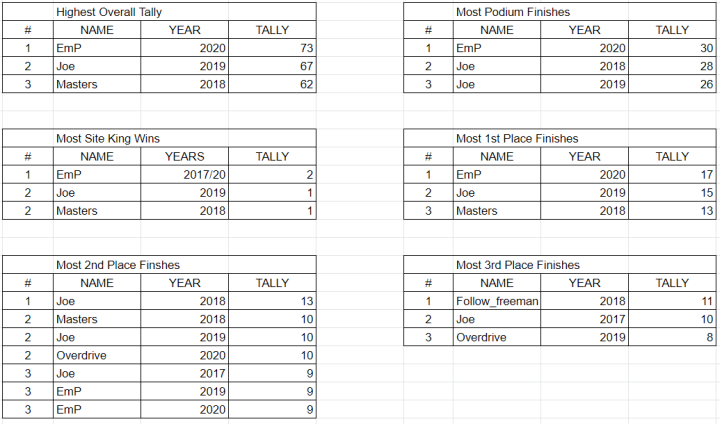 |
|
|
EmP posted January 14, 2021: Appreciate the nod -- I really enjoy my impromptu Amiga adventure, even if my hopes for more X-Out were cruelly dashed. Good times had, regardless. Thanks for the kind words. A friend and I had this running thing for many year where we would meet up once every couple of weeks or so and play bad game tag, where we would essentially force the other to watch bad movies and see who broke first. If you couldn't a film, you lost that round. He beat me with Mandy. I tried watching it several times, but the whole lot of nothing the first half hour or so subjects you to was too much for me. I beat him with Rubber. The film about a mass murdering tyre. |
|
|
JoeTheDestroyer posted January 14, 2021: I liked Mandy, but couldn't stomach Rubber. It felt like it was trying too hard to say, "Hey guys, look how self-aware I am! I am such a self-aware movie and that's cool, right!? Adore me!" |
|
|
overdrive posted January 15, 2021: I saw part of Rubber (last 30 minutes, give or take) on some movie channel once while drunk at a friend's house. If I give it credit for anything, it was that I watched that entire approx. 30 minutes just to figure out what the hell was happening. I don't know that I could have watched the whole thing, but that section at least had me intrigued in a "what the hell is this?!?" sort of way. |
|
|
|
|
|
TomatoMan posted January 17, 2021: Sense: A Cyberpunk Ghost Story PS4, Xbox One, Vita, Switch http://projectsensegame.com/buy.html Added additional versions. The Switch version is out now and was already listed in the database. |
|
|
dementedhut posted January 17, 2021: Title: Arcade Archives: Gradius III Platform: PS4 Release date: (12/24/20) Added. Thanks. |
|
|
TomatoMan posted January 18, 2021: Metal Slug Anthology PS4 https://store.playstation.com/en-us/product/UP0576-CUSA03749_00-SLUS215500000001 Added. |
|
|
EmP posted January 18, 2021: THIRD - Final Fantasy IV: The Complete Collection [PSP] CptRetroBlue This is a very brief review that threatens to be more of a features list than an actual discussion of the game’s worth, but your final paragraph does go some way towards fixing this. I think this will be most useful to people who have played FFIV, but not the rest of what’s on offer, which makes it viable for a fraction of the potential audience. SECOND - God of War II [PS2] Rob Oh Robert, look at the state of your screenshots. They’re all in different sizes. Have you no shame? I’ll fix that for you later. What I can’t fix is the awkwardness of your opening line. “I’ve never rated this series, and I don’t understand why you lot do”, he says. Then follow with “I only recently played GoW2, and now my opinion has changed”. It seems like an odd opening gambit to go with. You didn’t rate a series you’d not played at least one of the games of, and now that you’ve played perhaps the most critically acclaimed of the original trilogy, you’ve changed your mind? It isn’t the most stable platform you’ve built for yourself. I think the review shines most when you’re making clever comparisons between 1 and 2. Like how 1 was either all brawler or all puzzle, while 2 does a better job combining the two. Or how the original is very light on boss fights, while the second is littered with them. The last handful of paragraphs seema little aimless at points, but they still score points at me after the low blow effort aimed at quick time events. Urgh; awful things. FIRST - Yoshi's Crafted World [SWH] jjmccullough I enjoyed the evolution of Yoshi discussion, briefly tracking his progress from the year’s new power-up gimmick to a protagonist of his own standing and how his spin-off games have developed a character of their own. I found the review tends to get a little listy when you’re squishing gameplay and control discussion into a small paragraph, but mainly only for want of something to complain about. I like that this review not only talks about the game itself, but the surrounding series to establish context. Many would struggle to do this outside of a considerably longer review, so it’s impressive you’ve housed it in so few words. |
|
|
bwv_639 posted January 19, 2021: I post this here because I didn't find a suitable forum section to open a thread in to say this. I noticed that neither of the two La Mulana masterworks have a review on this site, and think that should change, but also that I can't presently help you with that. |
|
|
EmP posted January 19, 2021: It is surprising none of those games have been touched considering the metriodvania fans we have. I don't own either game, but then I'm still busy working through this:  |
|
|
honestgamer posted January 19, 2021: I think NIS America released touched up versions of the two games as a set on Switch, too. I have the first game on Wii but, true to form, have not played it. |
|
|
overdrive posted January 20, 2021: Thanks for the comments and all. I wasn't overly sure about this one due to minor things like beating the game in mid-December, but not having much writing time during the whole holiday season, making it a bit tricky to write at times due to having to remember month-old experiences. And, as my writing shows, I'm a bit conflicted about the series where, to me, the games are fun and have great production values, but aren't the "all-time classics" that the general consensus seems to say they are. As far as QTE go, I can understand why they're used and, if used in small doses or only at particular times, I don't overly mind them. But GoW goes full-on overkill with them. I nearly snapped during the final boss fight with how it ends with 5-6 QTE button-presses with any mistake being an instant death. I'm guessing the first of those QTEs is based on how good you tapped the button during the initial shock attack before Kratos does the "I surrender...or not" stuff, as it seemed like if I didn't go all out during that, it was basically impossible to pull it off -- I'd tap the button quickly and still watch Zeus impale him. And in the first stage of the fight with two of the Fates, you finish the battle by grappling, swinging over towards her and hitting A. All well and good, but when she was stunned, she tended to drift away from the grapple points. Took me like 3-4 tries to actually pull off that move because of that. Damn, just have a fight and win it and save that suff for post-fight cinema...don't make me win a fight and then play "tap the buttons" to actually win it. Now, in my defense, I just used the pics available for the screenshots -- not my fault they were sized all weird and inconsistently! Might work on re-working the intro, as what you got from it wasn't exactly the same as I was going for. After playing the first game, I thought it was good, but not super-great like most people seemed to think. After playing this one, I still am not on board with the "super-great", but I can at least understand it better due to how the superior integration of fighting and puzzle-ing made it a more consistently fun experience. But I'm guessing that didn't come out quite like I planned. I just struggled to get this one started. I've noticed this series just hasn't inspired "A+" efforts from me, which is bad since due to PS Now, I at least have the option to play like 4 other games in it. Going from what you said, the body is solid, but the intro and conclusion had issues and that's a sure sign that I had trouble with this one. |
|
|
EmP posted January 20, 2021: I have supplied new screens. Go use them. |
|
|
TomatoMan posted January 20, 2021: The King of Fighters ‘98 Ultimate Match PS4 https://store.playstation.com/en-us/product/UP0576-CUSA03751_00-SLUS218160000001 Added. |
|
|
bwv_639 posted January 24, 2021: That is this release. The first (download release), the second (download), and both as a collection (mail-order) were released the same day in the USA, UE, AU/NZ, within a week. The collection contains extra and comes on physical media, the game is unchanged, so far as I know. The guys' official site shows what kind of passionate videogamers, and game developers, they are. We have reached, not now but by quite a couple of years, the point where there are games made as industry products, by industry workers, reviewed by other industry workers (who work as commenters, let's say): all of these people, and their industry, don't really have time to play (and actually review) games, let alone be passionate about games. Still, they sell, design, and "review" games (as well as other media). Then there are the industry-free people who, according to skills and inclination, make games, play games, comment on games. As at least relatively free people, they can be passionate about something, play something, think about something, which in their case is games. There's no way you can mistake passion-stemming media, like the two La Mulana's for industry-produced media, and luckily, more than enough passionately-made games exist to allow us to keep pursuing our gaming passion whilst keeping our (gaming, and reviewing) hands off the industry-made, if thus we want. My apologies for the off-topic talk. |
 |
etherealgamer posted January 25, 2021: Every summer, the Cochranville Carnival would roll through Southern Chester County in Pennsylvania, outside the local community center. Even though the ferris wheel was usually broken, it was a cherished event that brought together everyone in town. Being dairy farmers, my family usually scooped the ice cream. Yes, it was as obnoxiously Americana as you might imagine. Exchanging glances with the daughter of the local hairdresser's daughter was only powder on the proverbial funnel cake. And, one cake was never enough to share. The only result of shoving greasy, hot sugar dough in your mouth is to keep going. And I would keep going, until I threw up in front of the hairdresser's daughter, who was also the first girl who danced with me in middle school. The funnel cake always wins. It's not bad, but it's not quite good, either. Atelier Ryza 2: Lost Legends & the Secret Fairy is an anomaly of an experience that left me criticizing its choices, yet I can't deny how endearingly tasty it is. This game is your cat who gives you headaches all day but also melts your soul with snuggle fluff; it's that shitty carnival food that you dream about all year round. The game stars Resalin "Ryza" Stout, an altruistic adventurer and alchemist, set out to simply make the world a better place with her friends. In light of the recent global climate, her incessant can-do attitude and cheerfulness is amiably contagious. Admittedly, this is my first entry in the Atelier series. I know, right?! This long-running JRPG series has delivered over twenty games since the PlayStation-era, much of them to great acclaim in Japan. Atelier almost feels like a cousin to Fire Emblem, minus the popularity boom from Smash Bros. Like Fire Emblem: Three Houses, the latest "Secret" series of Atelier games go to some length to modernize its systems and attempt to create more accessibility for new players, such as myself. Many games out of Japan have faced this dilemma with recent entries--Monster Hunter and Pokemon have likewise made concessions to adapt to new players, though oftentimes it's not enough to escape an old-fashioned game design. The same is true for Atelier Ryza 2. In Fire Emblem, it was the horrific menu systems that stunted me, spanning multiple hubs, needing to constantly switch between individual characters' inventories, of which there are legion. A fan of the series later revealed to me, "Oh, they've always been that way." I wonder, then, but, why? What keeps the broken aspects of these games ceremoniously upheld after all these years? In this fashion, Atelier Ryza 2 still feels like a game made in 1997. Exploratory areas are designated by a path, walls, monsters, and materials to harvest. Even dungeons barely escape ultimately bland, repetitive layouts. In all seriousness, Minecraft has more variety. Though, as a result, load times are simply incredible. Loading any areas on a PS4 Pro rarely takes longer than 2-3 seconds, a welcome facet to a game that will have you constantly running back and forth between areas to grind or craft materials. The dungeons themselves offer layers of interactivity, starting you off with a number of specific bounties that often complete themselves through general exploration. Once completed, "memory fragments," or clues, appear throughout each layer of the dungeon, starting a scavenger hunt of the memories of explorers past. Once you have the memories, you're tasked with using them to complete fragmented scrolls, and reveal the ancient story behind the ruins. In games like Dark Souls and Destiny, this sort of exploratory world-building works well, mostly because the lore is sprinkled lightly and only offers additional depth to what is openly shown to the player in-game. Here, the dungeon lore was compelling enough that made me want to know more about the world, but you're tasked with finding the collectibles in such huge bursts that it ultimately blends into the myriad of other systems you're attempting to juggle while playing the game. The "alchemy" of Atelier is its driving hook, and I will give the game credit for gating mechanics and crafting methods behind story progression; there was always a new feature that got me wanting to tinker, mitigating any creeping plateau that came with the grind. Ryza's titular atelier is the urn with which you create anything. Materials in the game are imbued with one of four elements--ice, electricity, fire, and wind--and, as you explore the world, you are constantly harvesting via sickle, axe, and magical fairy staff, picking up hordes of resources which you will then use to craft weapons, bombs, armor, healing items, and even a sapling that turns into a giant tree bridge. Each item has a recipe that requires basic materials to level up, and specific materials to unlock key perks, stat bonuses, and even new recipes--this is where the elements come to play. Higher quality items of a specific element will count toward more, requiring you to use less while crafting, opening up more opportunities for upgrades. An auto-craft feature makes it easy to brute force these mechanics, but once I understood the puzzles of alchemy, I found myself having more fun perfecting my creations for ultimate battle devastation and a maximum harvest. Thankfully, I never felt forced into utilizing these mechanics--I could either have a standard, somewhat tedious JRPG battle, or craft overpowered items that put me over the edge. I was already dominating engagements when auto-crafting, but the lure of even more damage became hard to ignore. Traits can be passed through items as they're used in crafting, echoing the fine-tuning of IV Pokemon breeding. The entire system is a complicated result of a crafting-based series spanning decades. There are mechanics that I will likely never touch, but I appreciate the gall to include them for any mad lad who wants to potentially delete the final boss in fifteen seconds. The battles themselves are "ATB-esque," providing a simple, yet engaging version of the familiar trope. Unless you're in an item screen, there is no pausing, as the action meter constantly fills and refreshes for player and enemy, regardless of action. Attack, gain a skill point. Use a skill, gain a "core item" point, and build the tech meter. Higher tech meter means more tech points to spend, meaning more skills faster. Every battle starts slow, then builds exponentially until you have an immense arsenal of destruction to immediately lay waste to your enemies. Though it doesn't require big brains, battling is is fast and satisfy; the ever-filling meter forces the player to stay engaged, otherwise the enemy might gain a quick advantage. Timing the guard button upon an attack will boost your defense, though I wish there was a better indication of who the enemy was going to attack so I could time my guards more properly. Core items can be assigned via each character's Core Drive, which, like everything else in this game, is upgradable. Using items in battles also cost an equivalent of points, and like skills those points are earned over time as you progress through the battle. Atelier Ryza 2 offers the player an extremely wide array of systems from the outset. At first, it may seem overwhelming, but it never felt like I had to master each system in order to progress, allowing me to go at my own pace. It became most interesting for me when coming to these systems on a whim, and while it was frustrating to be extremely lost at times, it was also weirdly refreshing to be in an environment with so many different things to possibly figure out. Tutorials are a formality, at best. First and foremost, this game is designed for the fans who already know a thing or two. Even though this is my first Atelier, I can tell that features have been included to expediate the "game" aspect, much like how Pokemon introduced EXP-SHARE as an optional item before including it as a mandatory mechanic. I like that I can fast travel to any area, especially when load times are virtually non-existent. As long as you have the resources being asked for, daily quests can be completed immediately upon acquisition. Characters level up with you outside of the party. After an early dungeon, you're given a mount that lets you run past any enemy. Harvesting tools are easily upgraded, allowing you to gather hordes of materials in minutes. At a certain point, I wondered what the game would look like if developers spent time creating something entirely new, rather than dressing up dated mechanics for the modern era, arguably neutering what little gameplay exists. Atelier Ryza 2's story is a jarring departure from typical JRPGS, in that there is very little of one, though it's clear to be intentional. Pivotal characters often appear our of convenience as if in a vaudevillian puppet show. Ryza, of course, is the inspiring, well-wishing protagonist. She's given an apartment in the city in exchange for a few bombs and the "promise" to do side-quests--you better do them or you will be scolded. Characters from the first game show up with blanket motivations beyond... being there? I'm genuinely not sure. New characters are inherently more interesting, if only that they are given a sense of purpose beyond knowing Ryza. If a fluffy fairy bunny hatched from a random egg, wouldn't you be its best friend? The game rarely cares if you are confused. One NPC says she wants to share pudding with the world, then runs off with her pet goat. This was one of my favorite moments. I found this inherent irreverence to be somewhat refreshing--it made me yearn for a Laid Back Camp RPG--but even so, I wish it leaned harder in that direction. Oddly, there's no social system akin to Fire Emblem: Three Houses or Persona. When darting about the city, character cutscenes are triggered at the game's whim, and there's little you can do to avoid them. Usually, you're given a small scene, with a brief bit of dialogue. Sometimes, it's noticing that someone is busy. Literally, that's it. Other times, it's telling someone they should keep up the good work. You might want to fast travel home, only to trigger a cutscene that leaves you in another area, forcing you to fast travel again, triggering yet another cutscene. While I appreciate the happenstance of skipping through town and coming across friends, it contrasts the exponentially speedier pace of harvesting and battling, especially when I'm on a crafting spree and I do not want to be interrupted about pudding. Characters themselves are beautifully detailed, ready for battle in the most delightfully impractical ways one could imagine, more than making up for the stale environments. Each character's personality shines through striking and colorful outfits that stand out in glorious HD. Compared to The Last of Us Part II, my favorite game of 2020, which caused controversy for its social messaging and blunt depiction of trauma, Atelier Ryza 2 is all about making our waifus look wet in the rain, and deriving suspicious camera angles when Ryza crouches through a crawlspace. Shamelessly, I can't deny its aesthetic charms, which somehow feel less squirmy in a world of such profound innocence. Atelier Ryza 2 has me of both minds. There are times when I see behind the curtain, a bumbling hodge-podge of a game barely holding itself together, and other times where I am totally wrapped up in the whimsical nonchalance of these merry adventurers. I might've rated this game higher if I played it on a Switch over the period of a few months. I know it's cliche, but this is truly the perfect Switch game. It's somewhat of a joyful, understated palate cleanser in an industry where so many games and studios are fighting for recognition, either making sweeping social statements or attempting to be the next viral trend. Like Fire Emblem: Three Houses, this is the perfect game to play for thirty minutes before bed. There may be little "umami," that gels this experience, but depending on what mood you're in, different components--whether it be meticulous crafting sessions or moseying around for quaint character beats--offer the right kind of grind to burn the hours away. Atelier isn't going anywhere. Atelier doesn't have to justify its existence, because there's barely a reason for it to exist in the first place, and it's lasted decades. Who am I to even rate the game? Fans of the series know what it is--they're here for the funnel cake. And the funnel cake always wins. |
|
|
honestgamer posted January 25, 2021: This revision doesn't include a lot of big changes, just very minor stuff throughout. If you're good with everything, then you can post the revised draft. Just make sure as you are submitting, you make adjustments on the form so it won't go live before 9AM on Tuesday, January 26 (tomorrow), because we of course want to adhere to the embargo. --- Every summer, the Cochranville Carnival would roll through Southern Chester County in Pennsylvania, outside the local community center. Even though the Ferris wheel was usually broken, it was a cherished event that brought together everyone in town. Being dairy farmers, my family usually scooped the ice cream. Yes, it was as obnoxiously Americana as you might imagine. Exchanging glances with the daughter of the local hairdresser was only powder on the proverbial funnel cake. And, one cake was never enough to share. The only result of shoving greasy, hot sugar dough in your mouth is to keep going. And I would keep going, until I threw up in front of the hairdresser's daughter, who was also the first girl who danced with me in middle school. The funnel cake always wins. It's not bad, but it's not quite good, either. Atelier Ryza 2: Lost Legends & the Secret Fairy is an anomaly of an experience that left me criticizing its choices, yet I can't deny how endearingly tasty it is. This game is your cat who gives you headaches all day but also melts your soul with snuggle fluff; it's that shitty carnival food that you dream about all year round. The game stars Resalin "Ryza" Stout, an altruistic adventurer and alchemist, set out to simply make the world a better place with her friends. In light of the recent global climate, her incessant can-do attitude and cheerfulness is amiably contagious. Admittedly, this is my first entry in the Atelier series. I know, right?! This long-running JRPG series has delivered over twenty games since the PlayStation-era, many of them to great acclaim in Japan. Atelier almost feels like a cousin to Fire Emblem, minus the popularity boom from Smash Bros. Like Fire Emblem: Three Houses, the latest "Secret" series of Atelier games goes to some length to modernize its systems and attempts to create more accessibility for new players, such as myself. Many games out of Japan have faced this dilemma with recent entries; Monster Hunter and Pokemon have likewise made concessions to adapt to new players, though oftentimes it's not enough to escape old-fashioned game design. The same is true for Atelier Ryza 2. In Fire Emblem, it was the horrific menu systems that stunted me. They spanned multiple hubs, and one needed to constantly switch between individual characters' inventories, of which there are legion. A fan of the series later revealed to me, "Oh, they've always been that way." I wonder then: why? What keeps the broken aspects of these games ceremoniously upheld after all these years? In this fashion, Atelier Ryza 2 still feels like a game made in 1997. Exploratory areas are designated by a path, walls, monsters, and materials to harvest. Even dungeons barely escape ultimately bland, repetitive layouts. In all seriousness, Minecraft has more variety. Though, as a result, load times are simply incredible. Loading any areas on a PS4 Pro rarely takes longer than 2-3 seconds, a welcome fact in a game that will have you constantly running back and forth between areas to grind or craft materials. The dungeons themselves offer layers of interactivity, starting you off with a number of specific bounties that often complete themselves through general exploration. Once completed, "memory fragments," or clues, appear throughout each layer of the dungeon, starting a scavenger hunt that finds you seeking the memories of explorers past. Once you have the memories, you're tasked with using them to complete fragmented scrolls and reveal the ancient story behind the ruins. In games like Dark Souls and Destiny, this sort of exploratory world-building works well, mostly because the lore is sprinkled lightly and only offers additional depth to what is openly shown to the player in-game. Here, the dungeon lore was compelling enough that it made me want to know more about the world, but I was tasked with finding the collectibles in such huge bursts that it ultimately blended into the myriad of other systems you're attempting to juggle while playing the game. The "alchemy" of Atelier is its driving hook, and I will give the game credit for gating mechanics and crafting methods behind story progression; there was always a new feature that got me wanting to tinker, mitigating any creeping plateau that came with the grind. Ryza's titular atelier is the urn with which you create anything. Materials in the game are imbued with one of four elements: ice, electricity, fire, and wind. As you explore the world, you are constantly harvesting via sickle, ax, and magical fairy staff. You pick up hordes of resources which you will then use to craft weapons, bombs, armor, healing items, and even a sapling that turns into a giant tree bridge. Each item has a recipe that requires basic materials to level up. Specific materials unlock key perks, stat bonuses, and even new recipes. This is where the elements come to play. Higher quality items of a specific element will count more, requiring you to use less while crafting and opening up more opportunities for upgrades. An auto-craft feature makes it easy to brute force these mechanics, but once I understood the puzzles of alchemy, I found myself having more fun perfecting my creations for ultimate battle devastation and a maximum harvest. Thankfully, I never felt forced into utilizing these mechanics. I could either have a standard, somewhat tedious JRPG battle, or craft overpowered items that put me over the edge. I was already dominating engagements when auto-crafting, but the lure of even more damage became hard to ignore. Traits can be passed through items as they're used in crafting, echoing the fine-tuning of IV Pokemon breeding. The entire system is the complicated result of a crafting-based series spanning decades. There are mechanics that I will likely never touch, but I appreciate the gall to include them for any mad lad who wants to potentially delete the final boss in fifteen seconds. The battles themselves are "ATB-esque," providing a simple, yet engaging version of the familiar trope. Unless you're in an item screen, there is no pausing, as the action meter constantly fills and refreshes for player and enemy, regardless of action. Attack, gain a skill point. Use a skill, gain a "core item" point, and build the tech meter. A higher tech meter means more tech points to spend and faster access to skills. Every battle starts slow, then builds exponentially until you have an immense arsenal of destruction to immediately lay waste to your enemies. Though it doesn't require big brains, battling is fast and satisfying; the ever-filling meter forces the player to stay engaged, otherwise the enemy might gain a quick advantage. Timing your guard use to match the arrival of an incoming attack will boost your defense, though I wish there was a better indication of who the enemy was going to attack so I could time more efficiently. Core items can be assigned via each character's Core Drive, which, like everything else in this game, can be upgraded. Using items in battles also costs an equivalent number of points, and like skills those points are earned over time as you progress through the battle. Atelier Ryza 2 offers the player an extremely wide array of systems from the outset. At first, it may seem overwhelming, but it never felt like I had to master each system in order to progress and that allowed me to proceed at my own pace. It became most interesting for me when coming to these systems on a whim, and while it was frustrating to be extremely lost at times, it was also weirdly refreshing to be in an environment with so many different things to possibly figure out. Tutorials are a formality, at best. First and foremost, this game is designed for the fans who already know a thing or two. Even though this is my first Atelier, I can tell that features have been included to expedite the "game" aspect, much like how Pokemon introduced EXP-SHARE as an optional item before including it as a mandatory mechanic. I like that I can fast travel to any area, especially when load times are virtually non-existent. As long as you have the resources being asked for, daily quests can be completed immediately upon acquisition. Characters level up with you outside of the party. After an early dungeon, you're given a mount that lets you run past any enemy. Harvesting tools are easily upgraded, allowing you to gather hordes of materials in minutes. At a certain point, I wondered what the game would look like if developers spent time creating something entirely new, rather than dressing up dated mechanics for the modern era, arguably neutering what little gameplay exists. Atelier Ryza 2's story is a jarring departure from typical JRPGS, in that there is very little to it, though it's clear this is intentional. Pivotal characters often appear out of convenience as if in a vaudevillian puppet show. Ryza, of course, is the inspiring, well-wishing protagonist. She's given an apartment in the city in exchange for a few bombs and the "promise" to do side-quests. You better complete them or you will be scolded. Characters from the first game show up with no apparent motivations beyond... being there? I'm genuinely not sure. New characters are inherently more interesting, if only because they are given a sense of purpose beyond knowing Ryza. If a fluffy fairy bunny hatched from a random egg, wouldn't you be its best friend? The game rarely cares if you are confused. One NPC says she wants to share pudding with the world, then runs off with her pet goat. This was one of my favorite moments. I found this inherent irreverence to be somewhat refreshing. It made me yearn for a Laid Back Camp RPG, but even so, I wish it leaned harder in that direction. Oddly, there's no social system akin to Fire Emblem: Three Houses or Persona. When darting about the city, character cutscenes are triggered at the game's whim, and there's little you can do to avoid them. Usually, you're given a small scene, with a brief bit of dialogue. Sometimes, it amounts to noticing that someone is busy. Literally, that's it. Other times, it's telling someone they should keep up the good work. You might want to fast travel home, only to trigger a cutscene that leaves you in another area, forcing you to fast travel again, triggering yet another cutscene. While I appreciate the happenstance of skipping through town and coming across friends, it contrasts with the exponentially speedier pace of harvesting and battling, especially when I'm on a crafting spree and I do not want to be interrupted about pudding. Characters themselves are beautifully detailed, ready for battle in the most delightfully impractical ways one could imagine, more than making up for the stale environments. Each character's personality shines through striking and colorful outfits that stand out in glorious HD. Compared to The Last of Us Part II, my favorite game of 2020, which caused controversy for its social messaging and blunt depiction of trauma, Atelier Ryza 2 is all about making our waifus look wet in the rain, and deriving suspicious camera angles when Ryza crouches through a crawlspace. I can't deny its aesthetic charms, which somehow feel less squirmy in a world of such profound innocence. Atelier Ryza 2 has me of two minds. There are times when I see behind the curtain a bumbling hodge-podge of a game barely holding itself together, and other times when I am totally wrapped up in the whimsical nonchalance of these merry adventurers. I might've rated this game higher if I played it on Switch a little bit at a time over the period of a few months. It's perhaps cliche, but this is truly the perfect Switch game. It's something of a joyful, understated palate cleanser in an industry where so many games and studios are fighting for recognition, either making sweeping social statements or attempting to be the next viral trend. Like Fire Emblem: Three Houses, this is the perfect game to play for thirty minutes before bed. There may be little "umami," that gels this experience, but depending on what mood you're in, different components--whether it be meticulous crafting sessions or moseying around for quaint character beats--offer the right kind of grind to burn the hours away. Atelier isn't going anywhere. Atelier doesn't have to justify its existence, because there's barely a reason for it to exist in the first place and it's lasted decades. Who am I to even rate the game? Fans of the series know what it is. They're here for the funnel cake, and the funnel cake always wins. |
|
|
mariner posted January 26, 2021: As much as I wanted to love the La-Mulana games, I just couldn't get into them. The slow controls combined with brutal difficulty was just too much. I remember fighting the first boss in the second game (I think). The pattern was very simple. But the boss had SO much HP, your character moved SO slow that it was a nightmare, since one little mistake could ruin you. And this was the first boss! I could live with the obscure puzzles and death traps, but not when combined with the controls and the harsh combat. That's just too much for little old me. |
|
|
overdrive posted January 27, 2021: Since it was a comp'd game, figured I'd go for another set of eyes on the review. Going for the 2.5 or 3 zone. It isn't a bad game, but a bit too niche/rogue-like for me to really enjoy. Some people might get into that, but when I start a game and realize I have no idea what realms are easy or hard and have to guess and sacrifice characters to find out, I'm not overly inspired to want to put in the effort to "git gud". ------- While FROM Software's action RPGs such as Dark Souls and Bloodborne might be too difficult to be accessible to everyone, they're too popular and highly-regarded for me to ever refer to them as "niche". That's a term best used to describe a number of the games made over recent years that owe at least part of their existence to the presence of FROM. Such as Clever Beans' Gods Will Fall. While I could appreciate a lot of what the developers were trying to do, I also found this game to often be frustrating. It's a short game made longer due to how luck is almost as important as skill when it comes to traveling through its 10 realms to slay the gods residing within them. The plot is simple: The gods of this game's Celtic-inspired world really suck, demanding everything from their worshippers while only bestowing misery upon them. Therefore, every capable warrior in the world embarked on a nautical journey towards an island hosting the entrances to their divine realms. Only to learn that it's a bad idea to use breakable things like boats to launch an invasion after the gods utterly destroy the fleet. Only eight warriors survive and wash up on the island. Now, you'll control them, going to each realm and picking a warrior to challenge it while the others wait outside. If a warrior succeeds, he or she will come back with new weaponry, while many members of the team will gain stat boosts, making them better-prepared for future realms. If they fail, they'll usually become trapped in the realm and you'll be down one fighter until you've beaten that realm and rescued your comrade. Unless they're killed by special, lethal attacks. In that case, they're gone for good. The game will continue until you've either killed all the gods or all eight of your characters are either dead or trapped. While each realm looks different, with locales ranging from a swamp to a bone-covered beach to an otherworldly temple-like place, they all play the same. Your character will appear and you'll start walking through the place, killing enemies and progressing towards the god's lair. Occasionally, you'll find scrolls to read for tips or lore, or find items you can use to help the cause, but you'll mostly be walking and fighting. Depending on which character you're using, you could be wielding any number of weapons. Smaller characters get twin maces or swords or spears. They can move a bit more quickly, but tend to not be overly durable. Larger characters are more robust, but slower and their massive two-handed weaponry illustrates that. When fighting, you'll have a limited number of options beyond the typical light and heavy attacks. Much like a FROM game, parrying plays a role. Since this game uses an overhead isometric point of view and doesn't have the sort of cutting-edge graphics those games possess, the average enemy's "tell" is for a light to sparkle on them before they strike. Time your parry right and you'll briefly stun them, allowing for a counterattack. Knock an enemy down and you can devastate them by jumping and heavy attacking while in the air. And the game offers its own way to heal, assuming you aren't lucky enough to find items to do the job. If you've lose a few life bars, your attacks will start to fill them. Upon filling one or more, you'll be able to perform a battle roar that restores that health. And if you've filled enough bars in that fashion, you also will get a temporary buff. In theory, most of the enemies are pretty easy to figure out, leaving bosses as the main challenges. They're a pretty diverse lot, ranging from giant insects to grotesque ogres using their oversized tongue as a whip. One is even a virtually helpless serpent-like creature whose only hope resides in two powerful guardians. One neat thing is that this game seems to rely on the concept of gods needing worshippers to maintain their power. By killing all the basic enemies found in a realm, you'll be able to chop off a decently-sized chuck of their health. This gives gamers a dilemma. By avoiding conflict, a person might reach a boss with full health, but discover it'll absorb an amazing amount of attacks before falling. On the other hand, while trying to kill everything might have a detrimental effect on your character's health, your efforts could ensure the boss has lost about a third or its life before you even challenge it. If we leave things right there, this is a pretty fun, if short, game. These realms aren't particularly gigantic, so a person could conceivably beat this game in a couple hours. But things were not left right there. Despite being named Gods Will Fall, this game worships at the shrine of the Random Number God. First, every time you start up a game, your eight warriors will be randomly generated, which could lead to issues if you're like me and found some weapons vastly superior to others. Spears are great because unless an enemy also has a long-range attack, you can just stand and use the heavy attack to stab them from a distance. It was this weapon that allowed me to experience my initial success in this game. As I played longer, I also found that swords were nice due to how quickly you can swing them. Dodging an attack, running in and whacking an enemy until it's dead is a viable strategy on most basic enemies. And I felt some degree of comfort with the big, durable folks and their two-handed weapons. The heavy attacks might have been too slowly-developing to be useful, but the light attacks could carry me through a realm and, at least with these guys, a few seconds of bad timing won't put them down for the count. Assuming the game was kind enough to allow me to find the right place to tackle. With each game, the difficulty of the 10 realms is randomized. If you decide to start your adventure in the realm of Boadannu — one of those located near your starting point — you might find that god to have a small life bar and be guarded by sparsely-placed weaklings. Start up a second quest and that boss will have at least twice as much health and a more imposing collection of lackeys. You won't know until you've entered a realm and once you have, you can't leave until you've either killed the boss or lost your warrior. This can be annoying. When I felt I was getting the hang of things, I beat two of the first three realms I visited, with the lone failure being one that was too tough for my party at that time. After that, my success faded quickly, but that had more to do with me needing to learn how best to tackle bosses than anything else. After losing all my warriors, I felt a bit pumped up by that small amount of success and went back in expecting to do even better. And wound up with no gods killed. I lost a few guys just trying to find a realm that wasn't really tough and when I finally found one I could advance through without too much trouble, I got taken to school by a boss that I hadn't encountered before because this was the first time that realm had been suitable for the beginning of my quest. That randomness extends to many facets of this game. Sometimes, one of your characters will have a history with a particular god. While that can lead to them getting a stat boost in their realm, I found it more likely that I'd get a message stating they were terrified and would be far less effective there than anywhere else. Each time you play, you'll likely discover that at least one of your characters has a bond with another. If their pal gets taken, they'll be determined to rescue them. As a result, they'll be stronger in that realm, but weaker everywhere else if you decide throwing bodies at that god isn't the best of ideas. Hell, even doing well with a character can be bad. In that first good run I had, it was the same spear-wielder who got both of my kills. After the second, I got a message that she been battered and bruised by tough battles, leading to her suffering diminished stats for quite some time. While Gods Will Fall isn't a bad game, I found it to be a bit too "niche" for me due to how large a role that dumb luck plays, at least until you've gotten so good at the game that you can overcome the Random Number God's regular attempts to thwart your endeavors. The challenging nature of FROM's games inspired me to get better so I could progress farther into my journey. Here, not having any idea how tough realms would be until I'd crossed the line of no return or if characters would be weakened on the computer's whim sapped my enjoyment of the game a good bit. With the quest not being overly long, I can understand why Clever Beans did things this way, but this was a case where understanding didn't lead to personal enjoyment. |
|
|
honestgamer posted January 27, 2021: IMPORTANT: The embargo for this is now tomorrow at 5AM (PST). Please don't set it to go live before then, though you can submit it ahead of that point and make the adjustment on the form so it goes live at the appropriate time. This was an excellent review, and more direct in general than I tend to see from you, which I think worked in its favor as you spent your word count getting into some terrific details that let me envision the game. It sounds like a 3 out of 5 to me: an interesting idea, executed with mixed success that ultimately should appeal to diehards but misses the mainstream boat. I mostly just edited in places where I could tighten up phrasing and such. Here's the revised draft, and you know what to do from there. I also have created a game profile and made some screens available. Woo! --- While From Software's action RPGs such as Dark Souls and Bloodborne might be too difficult to be accessible to everyone, they're too popular and highly-regarded for me to ever refer to them as "niche". That's a term best used to describe a number of the games made over recent years that owe at least part of their existence to the presence of From. Such as Clever Beans' Gods Will Fall. While I can appreciate a lot of what the developers were trying to do, I often found the game frustrating for the wrong reasons. It's a short experience, made longer because luck is almost as important as skill when it comes to traveling through 10 realms to slay the gods residing within them. The plot is simple: the gods of this game's Celtic-inspired world really suck, demanding everything from their worshipers while only bestowing misery upon them in return. To set things right, every capable warrior in the world banded together and embarked on a nautical journey toward an island hosting the entrances to the divine realms. That army soon learned it's a bad idea to use breakable things like boats to launch an invasion, as the gods utterly destroyed their fleet. Only eight warriors lived to wash up on shore. Now, you'll control the survivors, going to each realm and picking a warrior to challenge it while the others wait outside. If a warrior succeeds, he or she comes back with new weaponry, while many members of the team gain stat boosts to prepare them for journeys into other realms. If the chosen champion fails, they'll usually become trapped in the realm and you'll be down one fighter until you've beaten that realm and rescued your comrade. Unless they're killed by special, lethal attacks. In that case, they're gone for good. The game continues until you've either killed all of the gods or all eight of your characters are dead or trapped. While each realm looks different, with locales ranging from a swamp to a bone-covered beach to an otherworldly temple-like place, they play the same way. Your character appears and you start walking through the place, killing enemies and progressing toward the god's lair. Occasionally, you find scrolls to read for tips or lore, or items you can use to help the cause, but you're mostly just walking and fighting. Depending on which character you choose, you might wield any number of weapons. Smaller characters get twin maces or swords or spears. They move a bit more quickly, but tend not to be overly durable. Larger characters are more robust but slower. Their massive two-handed weaponry illustrates that point. When fighting, you have a limited number of options beyond the typical light and heavy attacks. Much like in a From game, parrying plays a significant role. Since this game employs an overhead isometric point of view and doesn't have the cutting-edge graphics those other games possess, the average enemy's "tell" is for a light to sparkle on them before they strike. Time your parry right and you briefly stun them, allowing for a counterattack. Knock an enemy down and you can devastate them by jumping and heavy attacking while in the air. And the game offers its own way to heal, assuming you aren't lucky enough to find items to do the job more quickly. If you lose a few life bars, your attacks start to refill them. Upon filling one or more, you're able to perform a battle roar that restores that health. And when you fill enough bars in that fashion, you also get a temporary buff. In theory, most enemies are pretty easy to figure out, leaving bosses to provide the main challenge. They're a diverse lot, ranging from giant insects to grotesque ogres that use their over-sized tongues as whips. One is even a virtually helpless serpent-like creature whose only hope resides in two powerful guardians. One neat thing is that the gods require worshipers to maintain their power. By killing all the basic enemies within a realm, you're able to chop off a decent sized chunk of their leader's health. This provides you with a dilemma. By avoiding conflict, you might reach a boss with full health, only to discover it can absorb an amazing number of attacks before falling. On the other hand, while trying to kill everything might have a detrimental effect on your character's health, your efforts could ensure the boss has lost about a third or its life meter before you even challenge it. If we leave things right there, this is a pretty fun game, if a bit short. These realms aren't particularly gigantic, so a person could conceivably clear everything in a couple of hours. But things were not left right there. Despite being named Gods Will Fall, the game worships at the shrine of one being: the Random Number God. First, every time you start up a game, your eight warriors are randomly generated. This can lead to issues if you're like me and find some weapons vastly superior to others. Spears are great because unless an enemy also has a long-range attack, you can just stand and use the heavy attack to stab them from a distance. This approach allowed me to experience my initial successes. As I played longer, I found that swords are also nice due to how quickly you can swing them. Dodging an attack, running in and whacking an enemy until it's dead is a viable strategy on most basic enemies. I also had a degree of comfort with the big, durable folks and their two-handed weapons. The heavy attacks were too slow to be useful, but light ones could carry me through a realm and, at least with these guys, a few seconds of bad timing won't put them down for the count. That's assuming the game is kind enough to allow me to find the right place to tackle. With each new attempt, the difficulty of the 10 realms is randomized. If you decide to start your adventure in the realm of Boadannu — one of those located near your starting point — you might find that god to have a small life bar and be guarded by sparsely-placed weaklings. Start up a second quest and that boss may have at least twice as much health and a more imposing collection of lackeys. You won't know until you've entered a realm. Once you have, you can't leave until you've either killed the boss or lost your warrior. This can be annoying. When I felt I was getting the hang of things, I beat two of the first three realms I visited, with the lone failure being one that was too tough for my party at that time. After that setback, my success faded quickly, but my diminishing fortunes had more to do with me needing to learn how best to tackle bosses than anything else. After losing all of my warriors, I felt a bit pumped up by my small measure of success and went back in expecting to do even better. And wound up killing no gods at all. I lost a few guys just trying to find a realm that wasn't really tough, and when I finally found one I could advance through without much trouble, I got taken to school by a boss I hadn't encountered previously because this was the first time that particular realm had been a suitable starting point for my quest. Such randomness extends to many of the game's facets. Sometimes, one of your characters will have a history with a particular god. While that can lead to them getting a stat boost in their realm, I found it more likely that I'd get a message stating they were terrified and would be far less effective there than anywhere else. Each time you play, you'll likely discover that at least one of your characters has a bond with another. If their pal gets taken, they'll be determined to rescue them. As a result, they'll be stronger in that realm, but weaker everywhere else if you decide throwing bodies at that god isn't the best of ideas. Hell, even doing well with a character can be bad. In that first good run I had, it was the same spear-wielder who got both of my kills. After the second god fell, I got a message that the hero had been battered and bruised by tough battles, leading to her suffering diminished stats for quite some time. While Gods Will Fall isn't a bad game, I found it to be a bit too "niche" for me due to the large role dumb luck plays, at least until you've gotten so good that you can overcome the Random Number God's regular attempts to thwart your endeavors. The challenging nature of From's games inspired me to get better so I could progress farther into them. Here, not having any idea how tough realms would be until I'd crossed the line of no return, or if characters would be weakened on the computer's whim, sapped my enjoyment of the game a good bit. With the quest not being overly long, I can understand why Clever Beans did things this way. But this was ultimately a case where understanding those design decisions didn't lead to increased personal enjoyment as I dealt with the fallout. |
|
|
overdrive posted January 29, 2021: Back on track with this thing -- although a couple days later than planned. But I had a review to write, so there's that. Looks like 4 reviews this time. There also is one review of mine, for Megadimension Neptunia VII that will get moved on to next week's deal. Much like Joe, I also watch random horror movies, although right now, I'm into the broad category known as "Stuff I find on YouTube" which seems to cover one hell of a lot. To cover the past handful of weeks: Without Warning -- 1980 possible inspiration for The Predator, as the villain was an alien hunting humans on Earth. The difference being that this movie played out like a slasher more than an action movie. And had name guys like Jack Palance and Martin Landau chewing the scenery, with the highlight being Palance charging the alien at the end while repeatedly yelling "ALIEN! ALIEN!", but all drawn out like "AAAAAALLLLLLIIIIIIEEEEEENNNNNNN". That was great. Let Sleeping Corpses Lie -- 1974 Italian zombie film. Unlike the average Italian zombie film. the plot makes sense as long as you don't think about things too much. And there's not really much, if any, sleaze. But it is a fun movie that plays out like a mystery for the first half and then turns zombie muncher in the second half. With a glorious asshole of a cop working as the human villain impeding the main characters as they try to get to the bottom of things. The Slayer -- About 1981 or so. This movie kind of was a precursor to Nightmare on Elm Street, as the main character has some sort of tie to an evil supernatural force that comes out when she's sleeping. Unless she was just insane…the movie is a bit vague as to what's really happening. And also really slow-paced. Kind of a blah outing. Death Screams -- Another early 80s slasher. That wasn't overly memorable. Very little happened for a while and then people get knocked off one after the next with very little build-up or anything. Main thing I remembered was how the people casting the film thought it'd be a good idea to have a former Playboy (or Penthouse, wharves) model playing the role of a nice, prudish girl. And how a weird mentally handicapped guy simultaneously was an awkward goof who needed basic concepts explained to him…but also was a criminal mastermind, able to stalk and slay people like it was the easiest thing on Earth to do. Redneck Zombies -- Guilty pleasure movie, as least if you like intoxicants…if not, the "pleasure" part might not apply and you'll just feel guilty for wasting time on trash. Moonshine-loving redneck stereotypes drink moonshine tainted by toxic waste, turn into zombies and kill people. A lot of it was aggressively stupid, but there were moments where the "blindly throwing darts at the board" approach to writing this thing did work out well. Ju-On The Curse and Ju-On 2 -- The pre-Grudge Japanese Ju-On movies. Two 70 minute films that could have been combined into one 115 or so minute one, as a good chunk of the second movie was barely more than 30+ minutes of the first film being shown again. But I like this stuff. I actually do find the Asian concept of "if something is haunted, you're totally screwed if you have anything to do with it" to be kind of frightening. Checking on a truant student living at the house. You're dead. Moving into the house later. You're dead. A realtor trying to sell the house. You're dead. A cop investigating the deaths. You're dead. A friend of someone living there. You're dead. And there's no way out. You encounter the curse, it kills you and that's the end of that. And now….the reviews. Brian did one of his "review or blog?" works. Where I enjoyed reading it -- particularly because I bought Pillars a ways back and it's good to see someone on the site give it such praise, especially since I've discovered I REALLY struggle with getting through this sort of tabletop-derived RPG -- but found the bulk of it to be talking about more abstract things than the review essentials like "the plot" or "the basics". I did like your talk about this game's variation of THAC0 and a few other tidbits, but for pure review purposes, I could think of a number of aspects I'd be more interested in reading about than how the game handles all its gods and religions. But it's still a fun read that kept me interested. It just seems to be a better read for a person who has played the game and is interested in reading what other veterans of it have to say than a person looking for opinions and insights in order to determine if they'd want to pick it up. THIRD PLACE EmP's The Dungeon of Not Typing All That (PC) This is a good "give the basics" review that definitely doesn't run long because you densely packed each paragraph with information. A little fell short, at least for someone like me, who has played roughly 3 gazillion RPGs over his life. Acting like belch or kiss moves in battle are all wacky and zany. I've played countless games where stuff like that is used as a skill and those games weren't looked at as trope-mockers! Still, taking that out of the equation, it is impressive to fit in this much information into a pretty short review. Didn't take long to get through it and I learned a lot about what this game provides. That works for me! SECOND PLACE Nightfire's DOOM Eternal (PC) Over the years, we've occasionally brought up how some games are tougher to review than others. I think you may have hit on the toughest sort to really review: The not-as-good sequel to a great game. Where you enjoyed the game, but compared to the first one, it is lacking in a lot of ways and somewhat of a disappointment. The issue being that your disappointment permeates the writing and then you have a 3.5/5 review where you're listing off letdowns and flaws, one after the next, while occasionally tossing in a "it's still good and fun" line like you're almost trying to convince yourself, let along the reader. Been there, done that. This is a good, comprehensive review that tells me a lot about this game. Previously, the main stuff I'd heard about it was from a former site writer bashing stuff like those Marauders on Twitter, so it was nice to get a more fully-fleshed out critique of it. But it did have that vibe of a bash review littered with "But it's not THAT bad, guys…really, I swear!" lines and a couple paragraphs complementing a few aspects of it. REVIEW OF THE WEEK (aka: Overdrive Place) Pickhut's Arcade Archives: Gradius III (PlayStation 4) This was a really good bash review. My only Gradius 3 experience was with the SNES port, so I'd only heard a few bits and pieces about this game's difficulty. You did a great job of summing that up for anyone with any familiarity with Gradius. Comparing the difficulty of the first stage here to the second or third in another game worked well for me and discussing how the game's checkpoint locations set you up to be utterly screwed over by a death is something any shmup vet can understand. This was just a really strong view where you avoided just trashing the game and simply took it apart by illustrating how its difficulty makes it all but inaccessible for most players. And that's it for another week. Typed two RotWs and four reviews in January this year. Might need to sleep through a month or two to make up for that! |
|
|
Nightfire posted January 30, 2021: Yeah, Doom Eternal was a tough one to write for. I considered being even meaner and giving it a 3/5 (and I might actually adjust this later). I felt like 3.5 was enough of a statement on its own when compared to the universal 5/5s and 10/10s its predecessor received. But you're probably right, a game that I uninstalled right after playing probably deserves an even lower rating. Thanks for the placement, and congrats to Pickhut for the win. :) |
|
|
dementedhut posted January 30, 2021: Thanks for the RotW! I'm glad my points got across as a reader, though I will admit I got a little snarky about the game towards the end. I actually originally didn't intend to review this game; when I first found out it was going to be an Arcade Archives release in December, all it did was bring up bad memories. I guess my driving motivation for reviewing it was the fact that this might be a first time experience for many players, considering the arcade release didn't get that many ports. The SNES version may be based on the arcade game, but there's enough differences in terms of difficulty to consider them different games; it's not an AMAZING game, but I legitimately enjoy playing the SNES port. Good on EmP and Nightfire for submitting solid reviews this week, too! |
|
|
zigfried posted January 30, 2021: Emp -- wishing you luck on the 2018 list, so that I can give you a new batch for 2019. Gotta move fast if you're gonna catch up to the current year! |
|
|
EmP posted January 31, 2021: I'd have caught up by now had Utawarerumono: Prelude to the Fallen not become a thing... |
|
|
EmP posted February 01, 2021: Thanks for the props - super solid showing this week. Congrats to Nightfire (MORE THAN ONE A YEAR!) and Pick. |
|
|
JoeTheDestroyer posted February 01, 2021: My understanding was that Without Warning did inspire Predator, and that Predator was a quasi-remake in the same way Q was a fake remake of The Flying Serpent. I've heard of The Slayer, but not seen it. The description reminds me of numerous horror movies that revolve around dreams aside from NOES, like Dreamaniac and Bad Dreams (I saw the latter of those once on Cinemax or some channel like that back in the day, but I don't remember any of it). I'll probably watch it at some point since it is a video nasty and I just have to see what all the hoopla was about. I've yet to see the original-original Ju-On movies, but I'm probably going to skip them. I'm so tired of that franchise after the The Grudge 2, and I haven't even bothered with any of the more recent Japanese installments. |
|
|
overdrive posted February 02, 2021: The Slayer is a video nasty? Huh...I guess there was a good kill or so, but I've seen FAR worse before. I'll have to see if I can figure out how it got on that list. |
|
|
JoeTheDestroyer posted February 06, 2021: It's been a helluva week. I received my second dose of the COVID-19 vaccine at work, and it knocked me on my ass. Predictable, really, since most of my coworkers also fell ill after getting it. The first day was horrendous, but the side effects paled in comparison to what my wife, daughter and in-laws went through a few months ago. On the bright side I've received a couple of days off with pay (and free, too, as they don't count against any of my sick leave or vacation time). I probably would've had this topic hammered out a lot sooner if it hadn't been for those side effects... Horror movies? Of course! Color Out of Space (2020) is an adaptation of HP Lovecraft's short story of the same name. No, it isn't technically related to the late '80s Wil Wheaton-starring, Lucio Fulci-produced film The Curse (or the Boris Karloff flick Die, Monster, Die!) aside from sharing source material. Color uses the same premise, where a meteorite lands on a farm and turns everything... You know, I don't know how to put it. It mutates everything? Totally fucks with reality and rewrites physics and... It's just a weird, wonderfully mad film, and much better than The Curse. I'll admit I have a soft spot for the Wheaton/Fulci one, though, mostly because it's so awful and ludicrous that it's actually kinda fun. Connect the dots.... Hereditary (2018) was yet another messed up movie that made me long for a scalding shower. I loved it, really. It's a bit long and slow in some parts, but the payoff was worth it, especially if you know anything about the Ars Goetia and the Key of Solomon. Anyway, the movie revolves around a family whose youngest offspring dies in a gruesome accident, only to apparently haunt their home. I say "apparently" because there's much more at work here than a simple haunting, especially when characters begin digging into their family's history and finding signs of occult rituals... Finally, The Invisible Man (2020) is a loose adaptation of the novel of the same name. Like Color Out of Space, I don't feel it would be correct to call it a remake of the 1933 adaptation, as that one was more of a horror-comedy blend. Hell, it was one of the movies to kick off the wise-cracking psychopath trope seen in Nightmare on Elm Street, Leprechaun and Child's Play. The 2020 iteration deals with a woman escaping an abusive relationship with an optics scientist/inventor. Eventually, strange phenomena begins to happen around her, and she eventually works out that he's somehow made himself invisible *dramatic music*. I liked this one because it wasn't just a rehash of the 1933 flick, and reimagined the concept with a little more bite. One scene dropped my jaw for a solid minute. What is this? I've been watching modern horror? What happened to all the '70s-'90s junk I usually put on? Well, I plan to watch Fascination next, so I'll be back on that retro kick in no time. I've also been playing Vampire: The Masquerade - Bloodline, and it really could use a remake. I'm not saying it's bad or anything, but it's definitely dated. Its mechanics are wonky, and it doesn't offer the level of customization that it should. I wanted to play a male Gangrel, but the only character model they had for that one looked like an off-brand Jonathan Davis. No thanks... I restarted since then and went with Brujah instead. I always thought they were cooler than Gangrel anyway... I've also made one hard decision regarding AlphaMurderthon: I'm not reviewing Pathologic. It seems like a pretty in-depth game, and one that I probably won't be able complete in time. I have decided instead to do either Phantasmagoria or Party Hard. As for the reviews: Honestgamer has sold me on Immortals: Fenyx Rising, and also won Review of the Week. I was on the fence with this title before, but I think this review had convinced me to at least wishlist it (if I haven't already). It's a very good review that gives all the details it should while leaving surprises for its readers to discover on their own. This is impressive, because it sounds like the game is pretty sizable, so it's great to read a review of a game like this one that doesn't come across as a wall of text. The best part, though, is your observation near the end, where you point out that the game feels more like an answer to Breath of the Wild rather than a statement in its own right. EmP's review of Sarrawak is short, but also dishes the proper details without giving too much away. Then again, I'm also assuming there isn't much to discuss about the game, mechanically speaking, so the only options left are to gab too much about the plot and ruin everything or keep this one short and sweet. EmP chose the latter, thankfully. Overdrive had two reviews this week: a holdover for Megadimension Neptunia VII and a fresh one for Gods Will Fall. The Neptunia review basically outlines how I feel about some JRPGs, where the characters are a bunch of scantily-clad preteens, and the Chris Hanson bit is great. Also, I've been burnt by some generic ones in the past, like White Knight Chronicles. The segments about the combat system read a bit dry at times, but that's RPG combat for you. The best bits of this review discuss the game's comedic elements, which make it sound like one of the better comedy games. I've played my share of them, and they tend to be too loaded with needless pop culture references. What I'm getting from this review is this game is essentially Doom & Destiny meets the PSP PoPoLoCrois game (which is also divided into multiple campaigns), except way better than both. With Gods Will Fall, the early part of the review started off pretty standard, but picked up greatly when you began discussing this game's RNG problems. It kinda reminds me of Road Not Taken, where the lengths of levels fluctuate. During one run, a dungeon might require you to rescue ten kids, and you end up failing because the stage overwhelms you. When you respawn and begin the dungeon anew, you find it only requires four kids to be saved. Ugh. Anyway, you do a good job of describing this game and talking about the reasons its random number nonsense is a turn-off. I'm glad I didn't accept this assignment, because I can tell I would've hated it. Mariner opens Gato Roboto with a relatable story for third place. I've played far too many faux-retro platformers with minimalist presentation that feature hazards that appear to be part of the environment. And I, too, died before my brain transitioned into "that's deadly, don't touch it" mode. Although that was a strong hook, your foreshadowing and follow up took the cake here. Yeah, that's a food-based figure of speech, Gary. Deal with it. Anyway, you basically outlined how I more or less feel about "mini-Metroid" games, where the exploration and such are the selling points, and cutting back on them diminishes some of the game's value. Etherealgamer debuts with Atelier Ryza 2, and also takes second place. The introduction was great, especially the bit about the funnel cake that tied into the conclusion. What follows is a wealth of detail, enough so that a guy who's never played an Atelier game like me knows what to expect from this title. Yeah, I have Atelier Iris and Mana Khemia. I'll get to them at some point... Maybe... Anyway, I don't have much else to add. It's a pretty long review, but certainly not long-winded. --- See you space cowboy |
|
|
honestgamer posted February 06, 2021: Thanks for the topic, despite what you were going through, and thanks for the comments on my review and also the win. I haven't had one of those in a while. Congrats to all who participated this week! |
|
|
EmP posted February 08, 2021: Congrats to Jason, who does not win enough of these, and to Mariner and Etherealgamer for getting points on the board early. Tough week with a lot of content to get through, so good job getting through it while feeling wonky. At least you're immune to things we've never heard of, now. |
|
|
overdrive posted February 08, 2021: Thanks for the comments. Too bad for me that I didn't get into the top 3, but you'll have that sometimes with the kind of competition we get during some weeks. And there were some really good reviews this week, so I figured it wouldn't be an auto-place sort of week. |
|
|
TomatoMan posted February 09, 2021: Gal*Gun Returns Switch https://www.nintendo.com/games/detail/galgun-returns-switch/ Added. |
|
|
dementedhut posted February 10, 2021: Title: ACA NeoGeo: Crossed Swords Platform: PS4 Release date: (05/29/18 - US)(08/23/18 - JP) Added. Thanks. |
|
|
EmP posted February 15, 2021: CARRYOVER - Utawarerumono: Prelude to the Fallen [PC] EmP 3/1 odds on Rob forgetting. THIRD - ACA NeoGeo: Crossed Swords [PS4] PIckhut Pick continues to find relevant ways to talk about old games, and does an excellent job ordering his thoughts on this one. He starts by talking about the hook; an atypical design choice in a very common genre. I thought the Punch Out comparison seemed very apt. He then talks about how this approach is interesting and how it mostly succeeds, but is downtrodden by the lack of variety and easily abused specials. It’s a descriptive enough piece that I find myself informed enough about an interesting sounding game, and persuasive enough that I’ll never feel the need to seek it out for myself. A service has been done. SECOND - Darksiders [360] Overdrive The intro was this review’s strongest part, briefly running down the games that Darksiders draws inspiration from before saying that it doesn’t match up to the subject material, but isn’t an awful base copy job. It’s a clever way to start, because it means you can close things out with the worst example of mechanic borrowing with the awful sounding last dungeon. You lose a bit of momentum in the middle, including a pretty tepid combat paragraph and a few overlong, overloaded sentences. But it’s good stuff! I’ve been meaning to play this game for a while now, and got an hour or so in on the 360, but have since misplaced the disk. I could just jump straight to the second game, but it feels all kinds of wrong. There’s countless games I’ve never started because of this... FIRST - S.U.M. Slay Uncool Monsters [SWH] Jason I don’t think many will blame me if I admit I had written off what is essentially maths homework as a challenger for this week’s crown. I figured I’d make another glib comment like that time Jason reviewed a clock and be on my way, but this is an excellently produced review that absolutely understands its niche subject. SUM is a game about doing math. As such, Jason has to establish himself as being interested in math because if he can establish that he’s not the cause of the complaints he’s about to make, then it only leaves the game itself to blame. But even then, he’s self deprecating enough to ensure the topic isn’t all about him. Then the complaints come and the groundwork is already complete; this is bad game design, not the mental folly of the reviewer. This review wins this week because it’s taken an extremely difficult game to talk about engagingly and made it look very, very easy. |
|
|
honestgamer posted February 15, 2021: Thanks for the topic, and I'm excited to add another win to my record to boot. Honestly, I didn't like my chances of winning with a review of a math game, so I'm glad I managed to pull the right rabbits out of my hat when it counted. Congrats to pickhut and overdrive, as well, for putting together solid reviews and keeping things competitive. I continue to love the wide variety of content we cover on the site, and may even have another clock game review in me to keep the good times flowing! |
|
|
overdrive posted February 17, 2021: Thanks for the comments and, yeah, I know what you mean about the whole "gotta start from the first game" vibe with series. I think the only ways I can avoid that trap are if the first game is really rare/obscure or if it's more a "series" than a series and the games aren't all that related (ie: Final Fantasy, Dragon Quest, Super Mario, Zelda kinds of series where the games are essentially stand-alone). But if there's some sort of consistent narrative, I pretty much feel compelled to start at the beginning and work from there. Makes some of the stuff on PS Now really good due to having most/all the games in a series and makes some of it hurt my brain. Like, I can play Saints Row 2-3-4, but 1 isn't there. And so I'll have the decision of whether I just start with 2 or wind up caving in and hunting down the first game. On one hand, it was a series I'd likely never would have gotten to if not for getting Now. On the other, compulsive behavior is a real hassle at times. |
|
|
dementedhut posted February 18, 2021: Well, I've completely lost track of time, because I keep thinking you submitted this thread a day ago... That was three days ago. But thanks for the placement! Crossed Swords was something I was interested in for some time, so it was a bummer when I finally played it. The final few stages bordered on torture with the way gameplay was. Good on OD and congrats to Jason! |
|
|
Flobknocker posted February 20, 2021: Hello. At long last I've completed my review for Control and I'd like to submit it for Xbox Series X. could you please add Control to the Series X game list? Proof it's available for Seris X: https://www.microsoft.com/en-gb/p/control-ultimate-edition/9p2wjcrjbmrm?activetab=pivot:overviewtab Done |
|
|
overdrive posted February 25, 2021: We have another RotW with six people and seven reviews (and EmP put the odds of me forgetting his holdover at the sort where I could have cleaned up in Vegas simply by betting on me -- and I ALWAYS bet on me!). I also watched more horror stuff via YouTube! Home Sweet Home -- 1981 slasher where the killer is played by fitness informercial goof Body By Jake. As an actor, he sucks, but it is really amusing to see a totally jacked dude playing a meth'd up killer by making goofy faces and laughing constantly. Had an entertaining collection of cannon fodder, but a lot of scenes were overly dark, leading to anticlimactic kills. But if you've never seen a guy getting killed because he was under the hood of a car and a roided-up lunatic leaps out of nowhere onto the hood to crush him under it, well, this movie has that! Frogs -- Early 70s eco-horror film staring a young, buff, pre-'stache Sam Elliott as an environmental photographer who winds up on the property of a rich industrialist right when all the animals go crazy and decide to kill every damn human they can find. Ray Milland is a hilarious asshole of an old man, who gives me hope for my golden years. A true role model for me! The movie is about 90 minutes, but it'd be 65 or so if they cut out all the padding via quick camera cuts to toads and tiny lizards supposedly looking "scary" or something. It was annoying for a while, but eventually turned around to be hilarious around the 1000th time I saw a close up of a toad staring into the camera. Burial Ground: The Nights of Terror -- I've decided that sleazy Italian horror might be the best kind of horror ever because they aren't all that down with things like coherent story-telling or logic, but are ALL ABOUT the nudity and kills. Exhibit A: This film, which has a "plot" of: People go to a villa to visit a professor, but he somehow just caused the dead to rise; everyone dies. But also has one kill and two sets of tits in the first 10 minutes. And a mid-20s guy with a touch of dwarfism playing the role of a pre-teen boy. Who has incestuous feelings towards his mom. And, after he gets zombie'd, he kills her by biting off a boob. Because, after thinking he was dead, she was so relieved her creepy-ass 12-year-old was back that she pulled those things out to breast-feed him even if he technically should have outgrown that phase about 11 years ago (or 25 years ago in the case of actor Peter Bark). Right in front of the other two (at the time) survivors, who are just staring at her while giving half-hearted "he's a zombie!" warnings. Nothing could be finer!!! Nightmare City aka City of the Walking Dead -- Exhibit B. These "zombies" pre-date the rage plague ones made famous by 28 Days Later by a lot of years. You have these large-scale attacks where tons of people are just getting butchered by people turned cannibal due to nuclear fallout or something, with the "zombies" using knives, guns and even driving cars in one scene. This movie is really dumb, but it's a fun dumb because it winds up feeling like a weird mash-up of a zombie film and, I don't know, Rambo or something. Besides, as a guy in journalism, I approved of the main guy being a "fuck your rules, I'm doing what's right!" journalist. Who is better at fighting "zombies" than police or military personnel and is married to a hot doctor. CAREER GOALS!!! Also, if you didn't know this was a sleazy Italian production, you'd likely be shocked at just how easy women's shirts fall off when they're struggling with those 'zombies". I mean, the fanservice takes a hit when they're also getting stabbed and whatnot, but whatever, I can roll with it! As for the reviews, if EmP had done his under two different names, who knows, maybe he'd have placed twice. I really liked the writing for Utawarerumono. I wasn't exactly looking forward to reading another review for one of these games, but you converted me to at least really like your review. Starting with "how this version is different" was a good touch and then making the focus its really strong narrative also worked nicely. I could complain a bit about how you only really have one paragraph talking about the game itself, and it focuses on additions to the original version's formula, since this review doesn't hit on things like what the battle system is or anything like that, but I still enjoyed the read. Dagoss' Dragon Warrior Monsters also could have placed many weeks. I've played every Dragon Warrior/Quest main game (except for Japanese-only X), but never touched this one, so I found this review to be a pretty informative piece that did a good job of using the natural comparison to Pokemon as a foundation to explore their similarities and differences. I especially liked how you noted the time frame of things, so that American DW fans could have been introduced to a lot of monsters and aspects from this game, due to how the games those things were derived from either weren't released here initially or weren't that popular (looks like I was one of the 80K who bought IV!). Jason reviewed a clock game with an Animal Crossing tie-in. Or perhaps "game" is the wrong word. A clock application might be more precise. I give kudos to you for taking on this project and somehow finding a way to devote no small amount of words to describing this thing. No placement, but kudos because you took "I suffered so you don't have to" to a whole new level. Even if the main thing I was thinking was that it would have been super-funny if you had found a way to stick EmP with this assignment. One week, he'd be doing a reading-heavy virtual novel; the next, he'd be covering an interactive clock. And I'd hate reading about both because you and I both know he'd find a way to stick both of them on my weeks just to make me wonder why you people can't play normal games! AND GET OFF MY LAWN!!! Josh, who might be making his introduction to the site, hit up a Wheel of Fortune game. FunFact: My freshman-year roommate in college was on Wheel a few years back and was a champion during his appearance. Like, winning both the competition and the final round big prize. In what might be a totally sad personal disclosure, that might be the closest thing I have to a claim to fame. Well, now that I've totally made my talk about your review depressing, let me say that you did a good job describing the flaws of what, in theory, should be a simple game show to replicate in video game form. The lack of the actual hosts is probably pretty telling, considering the issues seem to revolve around technical issues that all but scream "going through the motions". This is a short review, but it says all that I think needs to be said. THIRD PLACE Joe's Reknum (Switch) Now that I typed the game's name properly in the header to this paragraph, I now shall call it Rectum from now on. Anyway, this was a really good week for reviews (because I didn't submit any, amirite?) and it was tough to both narrow it down to three and to order those three. I loved the introduction to this one about you using movies to find that it always can be worse (I remember renting The Suckling, so I know, man do I know…). You did a good job tying that intro into a similar case with one lackluster game leading in to this poor one. And you did a good job of making it sound unappealing with its lack of checkpoint and how power-ups make the experience tougher. I mean, I'm used to that in shooters, where in some of them, getting speed icons can hurt you due to them taking away from precise movements, but in a platformer? That is not ideal! SECOND PLACE Mariner's Immortals: Fenyx Rising (Switch) I really wanted to bash this review due to the "myth-take" pun combined with an entire paragraph revolving around it, but this was a really good bit of writing that did a great job of explaining this game. You really make it sound appealing, at least for much of its duration, with its dense world loaded with puzzles to solve and things to do, while also pointing out that things will get repetitive eventually. Also, props on your conclusion. Let's be real, while originality is nice and all, I have no issues with derivativeness if the formula is a good one. And you did enough to convince a person this is a good formula that I'd hope no one would play the "but it's like Breath of the Wild" card like that is reason to demerit it. REVIEW OF THE WEEK (aka: Overdrive Place) EmP's Voyage (PC) EmP with a double shot of reviews for games I likely would have little to no interest in playing, reading about or anything else! But, and this is key, if the writing is good enough, I can at least manufacture some degree of interest. And this review is a winner in that regard. Your "holding steadfast to the video game norm that salvation is somewhere to the extreme right" part of a sentence is an early front-runner for 2021 Site Line of the Year. But it's not just witty lines; you also do a good job simultaneously criticizing and complementing the game's version of cooperative play and explaining that for a short game, it offers its share of cool stuff to see. I dug the writing here and award it the highest honor. For this week. And that's it for my RotWing in February. Now, it's time to see if I can sneak in a review before the month is over. |
|
|
honestgamer posted February 25, 2021: Thanks for the comments, and no, I didn't expect to place during this week of very excellent reviews when I reviewed a clock application... though I do appreciate hearing that you felt I did a serviceable job. I really like seeing the site cover a wide variety of stuff, so reviewing the occasional clock game or whatever is my way of contributing to that effort. Congrats to everyone else who participated, whether you got a podium finish or not, and congratulations especially to EmP for the win! |
|
|
TomatoMan posted February 25, 2021: Metal Slug XX PS4 https://www.snk-corp.co.jp/us/games/metalslugxx/ Added. |
|
|
dagoss posted February 26, 2021: Would have loved to see Venter's clock review at the top spot, just for the shear absurdity of it. It wouldn't have even occurred to me that was a thing that could be reviewed! I'm not surprised DWM didn't place. As I was writing it, I realized I was spending most of the review going over history/context and not the game. It might not even be a review! Oh well. I still feel like DWM gets an unfair shaft. Congratulations to EmP on his excellent review. |
|
|
honestgamer posted February 26, 2021: Any time you start to wonder if something can actually be reviewed, remember: people have written reviews for The Olive Garden, despite the fact that restaurant chain routinely serves unlimited (and delicious) bread sticks. Surely we can all agree that means NOTHING is above review! |
|
|
honestgamer posted March 08, 2021: I have been trying to better utilize social media and expand the reach of content posted to the site. That effort remains ongoing, but I've had some success that is relevant to you if you currently contribute. Previously, sharing a link to your review (or news article, if you're site staff and contribute those) would lead to an unpredictable result. Your post might display a title or it might not. It might look attractive or it might not. Well, that has changed. I've implemented the code required to produce Twitter and Facebook "cards" that present reviews and news articles more attractively, even if all an individual shares is a plain link to said content. Now, that link will appear with an excerpt from the text, a title, and even an image when available. All you have to worry about now is what hashtags or comments you might like to add (if any). Twitter and Facebook will do the rest of the work on your behalf. I am working on some other things related to those two sites, and I have already had some encouraging results to counterbalance those results that are less encouraging. Staff content can now post automatically to Twitter, which is a welcome improvement. I plan to keep at that effort and see how else I can build our audience and help more people find and enjoy your reviews and other content. Thanks for your continued support, and I hope you get better results from the improved presentation elements as you continue to share your handiwork on social media. If you haven't already, check out the HonestGamers account on Twitter to see recent content that was shared automatically, and to get a better idea what it might look like when you share your own content! |
|
|
EmP posted March 15, 2021: Back from the depths of PC repair hell, my absence from the site ends with one of these hellish things. I’ve not been active much recently because my only access to the Internets when my PC is down is an ancient laptop I keep around to play ancient adventure games on that modern rigs have zero chance of playing. It’s fine for playing stuff like that, but the keyboard doesn't quite work, and several letters do not function, no matter how hard I mash them. This makes typing anything the stuff of rage triggers, so if my absence has been felt, you were better off without me. If it hasn’t, all the better; I beat Gabriel Knight 3 during my ‘off time’, which I’ve been wanting to do for years and now I’m back on a platform where Jason can continue to shovel all the weird crap the rest of you turn your nose up at periodically. Back to Loop Hero I go! I had just three reviews to put into order this week, all predictably good. It was a genuine struggle deciding between third and second, and, even now, I’m prone to change my mind again if I dwell on it further, but this week’s winner was especially good. THIRD - Raiden Trad [GEN] Overdrive Brave Rob has a go at perhaps the least appealing thing we all suffer -- the blehy not-awful-not-great mediocre game review which he initially tackles by relaying on type. He has a little ramble. But all is well; the small delve into history lessons was appreciated by (at least) me, comparing ports between consoles and arcades while picking away at the fact that Raiden is, kind of okay, I guess? It’s a little rough going at the start, with some word repetition and the subject matter floating about haphazardly, but the focus and writing grows as the review goes on. Uncharacteristically, I’ve only ever played the SNES version, which I considered awful, so never bothered with the Mega Drive port, so had no idea it was different. I mean, I suspect I’ll still not bother with it, but now my absence is better informed! I really hope we never stray too far from our Retro coverage; it was a massive reason as to why I started writing at this site in the first place. SECOND - Cathedral [SWH] Joe The best part of Joe’s review were the bits talking about the game’s Zelda influences. Not only were they well explained, but it was a good counter for the ‘not another Metroidvania’ vibe the opening paragraphs were going for. I also thought the ending line was especially strong, suggesting that you don’t need to reinvent the wheel on every attempt; you just need to make sure your wheel can roll. I think the review struggles a bit at the start, because you try to put it up on a pedestal as the title that’s good enough to steamroll through your genre fatigue, but then most of your descriptions come across as very standard descriptions of metroidvaniaing. I think the angle ultimately works, but it’s pretty clunky going to begin with. FIRST - Sakuna: Of Rice and Ruin [SWH] Mariner What an excellent review. Mariner starts this off on exactly the right foot because he’s aware that this is a game that isn’t for everyone, so ensure that’s made clear from the start. Distancing it completely from the Harvest Moons of the world, you sell the framing aspect as a purposeful chore and are careful to never frame it as anything else. Then you begin the hard sell on how this laborious chore is necessary for the weight of the eventual pay off. I thought the explanation about how the protagonist learns alongside you while still weathering expectations towards the grind of repetitive busywork was very well explained. In theory, this should have been a very hard game to review, but you made it look easy. [Necroedit: it’s been lightly bugging me that I recognise the developer but couldn’t place them until exactly now -- they made Ether Vapor, which is a real hidden gem scrolling shooter] |
|
|
honestgamer posted March 15, 2021: I'm glad your PC is back in working order so I can bury you in games again, EmP. Mwa ha ha ha ha! (Congratulations to all who participated this week, and to Mariner especially for the win with a review I also quite liked.) |
|
|
JoeTheDestroyer posted March 16, 2021: I've begun work on Jan 4 - 10. I will hopefully have it up around Tues-Thurs. |
|
|
EmP posted March 16, 2021: Marc has decided to step down from the RotW rota, This week, Jason talks about monster trucks, Rob goes in hard with the cringe puns and Flob finishes his Remedy personal project where he’s now reviewed the entire backlog. THIRD - Crisis Force [NES] Overdrive I will later reward Rob’s retro combo by playing through enough of this game to obtain SITE EXCLUSIVE screenshots, which will then be viewed up to seven unique times. I appreciate Rob’s inability to leave NES shooters alone, as I mentioned in the last RotW topic. But I don’t think this is his next example of his retro wheelhouse. I think the intro spends a lot of time setting up a premise that’s then hardly explored, and then the review seems to jump around a bit haphazardly. Still, there’s more than enough strong lines to carry it through. The description of the atypical weapons is brilliant, with the limited form coming a close second to the roaming shield description that’s massively sold by how you change your entire play style to take advantage of fully. SECOND - Monster Jam: Steel Titans 2 [SWH] HonestGamer For the most part, Jason’s more likely to review a clock then he is to drop an honest to goodness bash review, so this ⅕ outing feels like rare ground, indeed. If there was one issue running through it’s that the early stages of the game sometimes sound like the complaints can be aimed at the player rather than the game’s wonky mechanics, but this feeling is completely dismissed by the end of the review. I think talking about doing nothing but hitting the accelerator and making just as much progress as you would when trying to play the game as intended did a great job of highlighting that. From there, you keep putting the boot in, but in a fair, almost polite fashion. It’s like the anti-EmP bash effort. FIRST - Control: Ultimate Edition [XBX] Flob There’s a fair bit of ramble to this review, but I get why you’d want to set this review up as the finishing line of a personal project. Might want to go back and check some of the first couple of paragraphs, though; there’s a few little quirks, liking comparing two different things to a flea in as many lines. My favourite part of the review comes after the first screenshot, when you just embrace the chaos of Control, turn off any filters and just run through the oddity gallery. I think your review suffers a little from listing all the good things then listing all the bad things, but you manage to keep your enthusiasm high throughout, which is what you need to do when doling out the 5 star ratings. This was further helped by your efforts in elevating the XBX port above all the others as the definitive way to experience the game. As a reward, I’ll try and build a link timeline to tie all five of your Remedy reviews together when I get a bit of time to myself. Good work! |
|
|
overdrive posted March 16, 2021: Thanks for the comments on this one and Raiden Trad. I imagine I'll still be churning out retro reviews off and on for some time. Went a ways without doing one due to working on the backlog and getting addicted to all the stuff on PlayStation Now, but I sort of discovered I was missing the old school trips down memory lane, so I felt compelled to get back into doing those games during those periods when I'm not overly close to putting forth a review for something more modern that I'm playing. Let me know if you or Joe wind up having reviews on these weeks you're covering and I can add them to my next RotW, if you want. Unless you're dividing Marc's weeks in a way so that isn't happening. And thanks to Marc for his work on these over the last however long. When I started doing these reviews, Marc was one of those esteemed voices in the GameFaqs community who was always supportive of me and played a role in me improving at this style of writing, so it was great having him playing the role of judge again for us for a while. |
|
|
honestgamer posted March 16, 2021: Yes, thanks again to Marc for the RotW topics he put together during his time in the rota. I appreciated his insightful commentary and will miss it as I step into the mix myself once again. My hiatus went on longer than I had anticipated when I stepped away shortly ahead of this pandemic to make my move partway across Oregon. Thanks to EmP this week, for taking care of part of the RotW backlog as we proceed toward a state of being caught up once again, like a cherry pie on a checkered tablecloth. I know that metaphor actually made no sense whatsoever, but it was the best I could do on short notice and I'm pretty sure EmP will read it. Thanks also to EmP for the feedback on the review, and thanks to Flobknocker and overdrive for your contributions. Congrats to Flob on the win, even though I would have preferred to take the top spot. There's always a future week for that, I guess! |
|
|
JoeTheDestroyer posted March 16, 2021: I'm more than halfway through Jan 4-10. Will finish tonight (I just need to finish Dagoss' review, then read Rob's and I'm done). |
|
|
EmP posted March 16, 2021: I'll do FEB 22nd - 28th next. |
|
|
JoeTheDestroyer posted March 17, 2021: Same old story, blah blah blah. I finished and liked Cathedral, took on and disliked Spirit Roots, and am currently trying to push through Vampire: The Masquerade - Bloodlines. I like it, but man does it feel archaic. Horror movies again? You betcha! Fascination (1979) is a French erotic horror flick about a thief who holes up in an old chateau with a couple of "vampires." I use quotations because this is a vampire movie the same way Romero's Martin is one. Both use more grounded types of vampires rather than supernatural ones, where here the ladies in Fascination are actually anemic women who have acquired a taste for blood thanks to a hokey doctor's therapy, which involves consuming fresh ox blood. It's a pretty odd, yet decent movie. It's also wonderfully shot, with still screens that can be really breathtaking. The image of one vampire clutching a scythe while wearing nothing but a tattered robe--ostensibly becoming the grim reaper--will stick with me probably forever. I watched Frogs (1972) again, because of course I did. Something about the swamp taking bloody revenge on a chemical baron and his family while a young Sam Elliot tries to not get caught in the crossfire always brings me comfort. The frogs in the movie actually don't do much killing themselves, but seem to act as the emissaries of the swamp while spiders, lizards, gators, snakes, and turtles do the dirty work. It's a somewhat cheesy flick, but it's got that lovable drive-in theater/midnight movie quality to it. The Witch in the Window (2018) is not an especially scary film, but it's a decent watch. It concerns a man and his estranged son renovating a house that happens to be haunted by a rather witchy old woman. The movie plays out like a character examination, dissecting the protagonist and his relationship with his son. It also helps that the story gives the antagonist an understandable motive and doesn't merely paint her as some run of the mill spectral villain. I tried to watch the horror-comedy Deadtectives (2019), but found it too obnoxious to enjoy. I turned it off after about twenty minutes and moved on. It's just not my thing. Party Hard, Die Young (2019) is not a half-bad German slasher about high school graduates who go to a huge music festival and get bumped off by a masked assailant. It would've been great if 1) it didn't have so many unnecessary characters, and 2) people weren't trying to shout their lines over loud music. However, the movie does a fine job of capturing the late '90s slasher vibe, similar to films like Scream and Valentine. I also watched Gwen (2019), and deeply regret having done so. It's a long, slow, tedious Gothic piece about a mother and her two daughters trying to survive in 19th century Wales. Honestly, it's a well shot movie with good performances, but it's tale is slackly paced with a weak payoff. It's like the movie was trying to be The Witch, but failed miserably. As for the reviews... EmP reviewed American Patriots: The Swamp Fox, a rather dull-looking FPS that I have in my collection (thanks to EmP, at that). The introduction gives a terrific and quick breakdown for what appears to be a very minimalist experience. Basically Devil Daggers, except crap. From there, you write a piece of solid gold: "The more complex answer is you have access to dirty tactics the honour-bound British forces would never sully themselves with, such as side-stepping or aiming." I almost spit out my drink. Anyway, this is a good take on what sounds like an Atari 2600 game dragged kicking and screaming into the modern age with more updated visuals. There isn't much content to discuss with titles like this, but you covered all of the bases effectively. He also took on DiRT 5 and snagged second place. When you're this far into a racing or sports franchise, the main questions you should be asking are whether an entry will alienate core fans, attract more casual onlookers, or completely screw the pooch. You get right into that here, wasting little time or space and hammering out a very fluid review for very technical material. You cover what sounds to be all of the important options and factors, plus how various fans might feel about them. Great job! Pichut weighed in on Stretch Arcade for third place and used a tagline that referenced a rather obscure, unloved PS2 game. Digression: I've wondered about Stretch Panic, but I'm afraid to buy a copy because it sounds disappointing. Anyway, this is a great review that describes its subject perfectly. I was able to visualize what the game was like, and the added video confirmed that your description was on point. It's detailed in such a way that anyone will know whether or not this game is for them (I'm staying clear of this one, honestly). Dagoss did Kaeru no Tame ni Kane wa Naru (For the Frog the Bell Tolls, apparently), a Game Boy action-adventure product that paved the way for Link's Awakening. I can just see EmP fuming over the food metaphors in this one. But they fit here, because this is a food-themed game ("more of brûlée than brutality" is a great one). I like how everything/one is dessert-oriented except Prince Richard. "Here are my children: Cobbler, Bundt, Sherbet, and Richard." Such an anticlimax! Anyway, this is an enjoyable review, mostly because I've never heard of this game and it was fun to read about it. You give all the right details here without going overboard, which is a common trap when reviewing RPGs or action-adventure titles. Finally, Overdrive talked about Bloodborne for Review of the Week. First off: "I'd laugh at that notion, if not for fears my laughter would gradually get louder and higher-pitched until I was insanely cackling and sobbing at the same time." Someone get a video of this. Second: Control+F the word "marcy." Getting to the guts: this is a fantastic review that covers a lot of ground efficiently and oozes passion. It's done from that old "player's experience" angle, where the piece also feels a bit like a blog entry (in a good way, of course). --- Go in peace. |
|
|
overdrive posted March 17, 2021: Thanks for the win and I did catch that error you pointed out. |
|
|
EmP posted March 17, 2021: I knew repairing the PC would end up being a mistake. THIRD - Ratchet & Clank [PS4] Honestgamer Wherein Jason reviews a video game based on a movie based on a video game. This was a good review that amused me by admitting that you have to play games in easy mode, like a real video game journalist! I’ve never put any time at all into a Ratchet & Clank game (nor have I seen the film) but I never felt lost through this review. I will comment that it does come across a little section-y, to borrow a 2005 phrase. Also, you talk about the stages but never really describe any, which isn;t helped by the screenshots seemingly being taken from the same stage? There; complaining done. Now you get some props for the strategic timing of your review. You know what you did. SECOND - The Legend of Zelda: A Link Between Worlds [3DS] Overdrive Rob wasn’t expecting an EmP RotW slot, so he indulged in his greatest ‘Let’s talk about meeeeeee!” intro yet. I GUESS that, in his defense, it especially makes sense here, and it’s a good idea to plant your introduction in nostalgia. It not only grounds you as a member of the game’s target audience, but suggests to the reader that you have some authority on the subject. But you’d better hope you’re part of the target audience, too! For better or worse, the majority of the review frames this game against the game it’s pseudo copying, which may produce varying results depending on the reader. But LttP was one of the three(?) Zelda games I managed to complete, so it all made sense to me. You lose points for not making a “I remember the rain” reference. FIRST - Slime Rancher [PS4] Pickhut What is it with people tricking me into reading about a game where you have to build and run a farm to fund your exploration of a world? First Mariner, now you? Conspiracy! But while Mariner used the drudgery of farm life to build deferred reward, you use the drudgery to highlight all the drudgery. It’s one of those Pickhut bash reviews again, all even handed and not overly hostile. Because of this, you’re left to patiently build your case in how Slime Rancher could have been a good game, and even is one for some periods of its life, but botches its priorities and ends up a pretty drab affair. I think the review as a whole builds towards itself really well; it feels like a complete piece, not jumping between points to force things in. It is a very, very good review. |
|
|
EmP posted March 17, 2021: Massively obscure underwhelming indie or multi-decade spanning AAA racer. Who knows what that dastardly EmP will come up with next! Props to Pick and ODdy, and great work getting this topic out so quick. We're almost back to base now. |
|
|
honestgamer posted March 18, 2021: I don't HAVE to play on the Easy difficulty, and in fact, didn't for much of my run through the game. In general, I play on whatever the default difficulty is when I play a "major" game, and usually do just fine for myself. In Ratchet & Clank's case, I dropped the difficulty setting and realized the primary difference is that loot drops more frequently and bosses are a bit less sponge-y, but otherwise the experience is identical. Since I don't particularly see a lot of value in hitting an enemy 50 times versus 40, I figured dropping it down made sense. As for the screenshots, they are taken from different levels. I took those screenshots myself, so I know. It just happens that I provided a shot of the train sequence, which was a bit boxed in at the moment of that screenshot (but I wanted to include it, since the review referenced it) and then a section with Clank, who tends to explore confined corridors in his limited segments within the game. So upon reflection, I can see how you would mistake them for the same stage, even though I actually took more effort than usual to carefully select screens to match the text. Check the full gallery if you want to see a variety of environments the game offers. Anyway, that all sounds defensive, I know. But I appreciate your comments and the fact you and others are catching up on the RotW backlog so we can go back to enjoying them going forward on approximately their regular schedule. Congrats to those fine folk who placed ahead of me! |
|
|
dementedhut posted March 18, 2021: Never played Stretch Panic either, only that I know two specific things. The first is that it's made by Treasure. The second is that... well... erm.... The first area alone is weird even for Treasure standards. Anyway, thanks for the third placement! Around that time, I wanted to play something super basic, so this game caught my eye on the PS store. Glad the review was easy to read. |
|
|
dementedhut posted March 18, 2021: Okay I'm gonna be real with you... when I saw this topic earlier today, I somehow thought Overdrive did this RotW. Having said that, thanks for the RotW! Personally, Slime Rancher was a weird choice to review for, since I'm not actually that into farm-type games. But I took a chance since it had an interesting spin on the concept. Though, its overall execution is meh at best. An okay farm game, but very bleh on everything else. Glad that got through in the review! |
|
|
EmP posted March 19, 2021: If only there was an easy mode for internet forums; that way, Jason might have replied to the right topic! |
|
|
honestgamer posted March 19, 2021: I clearly suck at multi-tasking, but there's a lesson to be learned here: don't be like me! |
|
|
JoeTheDestroyer posted March 20, 2021: I am beginning work on ROTW Feb 1-7. I intended to start yesterday, but that pesky overtime crept up again. |
|
|
JoeTheDestroyer posted March 21, 2021: Cool thing that happened recently: I bought a newer, more functional car. Not cool thing that happened recently: Increased surgeries means more overtime and work for me, more exhaustion, bad habits returning, and less gaming and writing. But hey, at least things are going okay over at the Destroyer household otherwise. I got my tax return and picked up some more games I missed: Brave Fencer Musashi, Trapt, Dungeon Maker, Kartia, and The Suffering: The Ties That Bind. I don't have any new horror movies to discuss, so I'll just pick five random non-classics from the "Things I've Seen" vault. Island of Death (1976) is a video nasty featuring an incestuous brother and sister who go on a killing spree on a Greek isle. There isn't any point to this movie at all; it's 100% shock value. It tries really hard to be shocking, with a lot of scenes I won't mention here (including one infamous/reprehensible segment involving a goat). Honestly, though this is a pretty rare flick, it's complete trash. Even the director (or maybe it was the writer?) admitted that some of the dialogue and portions that felt like social commentary were only there to give the movie a false sense of depth, and that he just wanted to one-up all of the other European horror directors making shock-schlock. It's really just a bunch of mindless killing and sexuality without any rhyme or reason, intended to stir up controversy. Yeesh... Bug (2006) stars Ashley Judd as a woman who falls for a paranoid, delusional Michael Shannon, who believes he is infected with government-controlled, flesh-eating insects. This is an odd film, and not one you watch in a big group. While I don't love it, I kind of dig the off-beat direction it takes. It certainly isn't what I expected. Phenomena (1985) helped lay the groundwork for Clock Tower. This one features a pre-fame Jennifer Connelly as a teenage girl who can psychically communicate with insects. And she'll need all the six-legged friends she can muster, because someone (who happens to be partially the inspiration for Scissor Man) is chopping up teenage girls in her neck of the woods. A lot of people cite this film as the beginning of Dario Argento's decline, but I love it. It may not have the same high-quality, "Italian Hitchcock" feel that Deep Red and the like gave off, but it still manages to entertain. Plus, a certain deus ex machina had me and my former roommate cheering. P22007) was supposed to be a sleeper, with a Rachel Nichols working late while being stalked by a deranged security officer. Honestly, I found it kind of predictable and boring. I don't remember much more than that, and I certainly don't feel like watching it again. Finally, there's Zaat (1971). (aka Attack of the Swamp Creature or Blood Waters of Dr. Z), which is a knockoff of Creature from the Black Lagoon. This one concerns a disgraced scientist who plots revenge against the society that shunned him by transforming himself into an anthropomorphic catfish. From there, his hair-brained scheme involves long shots of him slowly walking through neighborhoods and terrorizing random written-to-die victims. As you can tell, this one is a tedious affair that doesn't succeed on even a good-bad level. It's somehow a combination of both silly and tiresome, having nearly put me to sleep when I rented it centuries ago. It's just a shame the movie isn't the "bubblegum horror" flick as the VHS box art featuring Elvira suggested it would be... But enough talk. Have at you! Emp's Cuyo review takes second place, and is another short but sweet article. It points out why games like Super Meat Boy are beloved, then proceeds to tell us why Cuyo falls short of that mark. However, the review takes a turn towards the end, where it explains how Cuyo has carved itself a place in this world. I like that because this game gets its due criticism, but still comes out mostly on top for offering something to a very particular crowd. KevDaSuperb talks about Crash Bandicoot 4 at third place. This is a good review, but my main complaint is that it feels a bit like a preview or press release at times. That, and it seems like a lot of points came up twice, like how Crash is reunited with familiar characters. However, this piece offers a wealth of information that's useful to anyone looking to pick up this title, especially where you highlight how this one features more modern mechanics with optional retro-style bells and whistles. Brian weighed in on both parts of The White March, and wins Review of the Week with Part I. Part I tells the story of a game that feels like Icewind Dale (an RPG I love), but definitely stands apart from that game, and for the better. Honestly, I think this is one of the best reviews I've read from you. As this isn't the base game, you didn't really get into the core mechanics much and jumped right into why this is a solid add-on with very solid support. My only concern: "Similar to how THA0C0 is wacko of old Infinity Engine titles, the Marsh can be thought of the Spikes of the World." Maybe I'm not reading this parargraph correctly, but I'm not sure what that means. I get the "THAC0 is wacko" part, but the second section doesn't make sense to me. Otherwise, great work! Part II is more of the same, but not as interesting to read. I think less of your passion showed in this one (understandable) and a lot of parts didn't seem as lively as a result. Otherwise, this one is also a solid piece. --- SEE YOU SPACE COWBOY... |
|
|
EmP posted March 21, 2021: 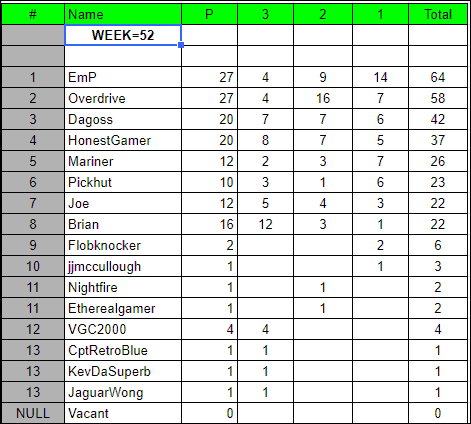 01: 27th December - 3rd January 02: 4th January - 10th January 03: 11th January - 17th January 04: 18th January - 24th January 05: 25th January - 31st January 06: 1st February - 7th February 07: 8th February - 14th February 08: 15th February - 21st February 09: 22nd February - 28th February 10: 1st March - 7th March 11: 8th March - 14th March 12: 15th March - 21st March 13: 22nd March - 28th March 14: 28th March - 4th April 15: 5th April - 11th April 16: 12th April - 18th April 17: 19th April - 25th April 18: 26th April - 2nd May 19: 3rd May - 9th May 20: 10th May - 16th May 21: 17th May - 23rd May 22: 24th May - 30th May 23: 31st May -- 6th June 24: 7th June -- 13th June 25: 14th June -- 20th June 26: 21st June -- 27th June 27: 28th June -- 4th July 28: 5th July -- 11th July 29: 12th July -- 18th July 30: 19th July -- 25th July 31: 26th July --1st August 32: 2nd August -- 8th August 33: 9th August -- 15th August 34: 16th August -- 22 August 35: 23rd August -- 29th August 36: 30th August -- 5th September 37: 6th September -- 12th September 38: 13th September -- 19th September 39: 20th September -- 26th September 40: 27th September -- 3rd October 41: 4th October -- 10t October 42: 11th October -- 17th October 43: 18th October -- 24th October 44: 25th October -- 31st October 45:1st November -- 7th November 46: 8th November -- 14th November 47: 15th November -- 21st November 48: 22nd November – 28th November 49: 29th November – 5th December 50: 6th December – 12th December 51: 13th December – 19th December 52:20th December – 26th December |
|
|
EmP posted March 21, 2021: WEEK 11 UPDATE It's perhaps been a long time coming, but the 2021 early season sees Overdrive off to a flyer, pulling in the most podium finishes thus far, tying for top spot on points and only kept from the absolute summit by EmP's superior win column. Right on both their heels is HonetGamer, who has similarly started 2021 with a flurry of activity. He, Pickhut and Mariner at are just a single win away from pushing themselves right to the top of the list. There's a bunch of brand new names that have entered themselves in the running; jjmccoullough, EtherealGamer and KevDaSuperb are all very much unknown quantities, just as likely to put unforseen ruins together as they are never to bee seen again. Brian's early win might be a hint towards his strongest year ever, while returnees, Nightfire and Dagoss have proven quality. CptRetroBlue's retro parade of last year has yet to take off but, if it does, he often finds a way to get into the point. Current dark horse is Joe, who has yet to really start. But everyone should be aware that the machine will start running sooner or later. The rest of the table will be painfully aware once he does. |
|
|
EmP posted March 21, 2021: Thanks for the props. Cuyo's about as inoffensive as a video game could be. It's not my speed, but it's going to be a good entry point or chilled out session for someone. Props to Brian on his breakout win, and thanks for Joe for helping with the backlog. With this, we're all up to date, Site King has been updated accordingly and we should be good moving forward. |
|
|
dagoss posted March 21, 2021: Technically my third place review was posted in Dec, but the week ended in Jan. Shouldn't I have zero points? My strategy is to shoot for the moon--most reviews with zero points! |
|
|
EmP posted March 22, 2021: It never perfectly lines up, but that was week 1 of 52, so you'll just going to have to take your podium finish and like it! More to the point, I won that week, and I need those points. Ain't no way I'm rescinding that. |
|
|
TomatoMan posted March 22, 2021: Control: Ultimate Edition PS5 https://www.amazon.com/dp/B08SZ6GRX6/ref=cm_sw_r_cp_api_glt_fabc_4FPGJBTGTV4H8AMTRMPR Added. |
|
|
JoeTheDestroyer posted March 22, 2021: Yeah, I haven't really kicked into gear. I've been both busy with life and working mostly on AlphaMurderthon. Right now, I'm chipping away at Vampire: The Masquerade - Bloodlines. |
|
|
overdrive posted March 25, 2021: Mine will likely be out tomorrow. Have a work project that needs to be finished this week, so that's set me a bit back as far as "typing other things" goes. |
|
|
overdrive posted March 26, 2021: So, it's the spring fever time when I have all sorts of things going, making it hard to even find time to read and comment on three reviews. At least it seems Jason is the only one doing anything right now, with him having the previous three reviews that've been written, one of which is guaranteed a place today! Oh well, least that means I'm not the only one either slacking or, in my case, overburdened by work. And I should be back on "productive mode" next week, at least in theory, since I'm wrapping up my big project while also working on this. Movies in Brief: Blood and Black Lace -- fairly awesome 1960s Italian giallo. For the uncultured, this was a sort of movie that basically bridged the gap between old-school detective movies and the slashers that got popular in the 1980s. You have cops and they're working to solve a murder mystery in which everyone's a suspect, but the focus is less on them (and, while they're competent, they don't know enough information to really solve anything) and more on people getting stalked and killed by the murderer(s). And when you find out who the guilty one(s) is/are, it gets a bit more psychological with back-stabbings and such. A really fun movie where you can almost watch a genre get born in front of your eyes. Prison -- A more bog-standard film about a ghost killing inmates and guards at a prison. Mainly notable for being an early role for Viggo Mortensen. Trim about 10 minutes off it and it'd be at least solid. And maybe get an actress with more, I guess, authority to play the woman in charge of overseeing the corrupt "hardcore punishment is the ONLY punishment" warden. Playing off against him, she came off as a whiny teen wondering why dad isn't giving her the keys to his car. The House on Sorority Road -- Speaking of slashers, here's a really good early-80s one. Did a lot of the little things right and just had a fun vibe through it. A "prank" goes wrong and graduating sorority sisters kill their tyrant of a house mother shortly before their big exit party. And then have to act like nothing's wrong during said party, so as not to arouse suspicions. Which gets difficult when someone starts killing them. Fun stuff! THIRD PLACE Brian's Spirits of Xanadu (PC) I think, of all the reviews by you that I've judged, that I enjoyed this one the most as a pure review. You handle a good comparison to a known commodity to give me an idea of what things are about here and spend a good amount of time talking about game stuff like combat and puzzles, so I could definitely understand what this thing was all about. Since the general lack of that stuff has been my main criticism in the past, I'm gonna praise you for making that stuff a focal point in this one. Not sure I'm on board with the "the lack of an actual ending is GOOD!" thought, but I do appreciate the point you were making about how it's nice to scour the ship to find logs and stuff giving hints and pieces of the game's story, as opposed to Bill the Scientist popping up late in the game to painstakingly explain every last bit of the plot. If I were to single out any reason why, in a week of three strong reviews, this was third, it's how there are a few areas that read awkwardly. To give one example: "and it’s this element that truly does shine Spirits of Xanadu as a mature way to convey its simple narrative." After reading it a time or three, I know exactly what you're saying, but it could be phrased in a more straight-forward manner, like "and it's this element that truly allows Spirits of Xanadu to convey it simple narrative in a mature way". SECOND PLACE Jason's Super Mario Bros. 35 (Switch) This was a neat review for a title that, weirdly, is only available to play for a really brief period of time. I mean, I get that big battle royal games likely tend to have limited shelf lives and you don't want them around when it's tough to fill 10 of the 35 spots, but only allowing it to exist for a really short time just seems strange. But whatever, I dug this review. I especially agreed with your statement on the need for more levels. If this is just SMB levels, well, there were a fair number of those in the original game that were essentially prior levels, just with new enemy placements and added difficulty. So, having those in a game where the main hook is that enemies will be determined by what your opponents have sent you could get old after a while. But you made this seem like an interesting game that, as far as battle royale games go, would be far more up my alley than Fortnite or whatever the kids are playing now. REVIEW OF THE WEEK (aka: Overdrive Place) Pickhuts's Infinite: Beyond the Mind (PS4) First, I was really happy when I started this review because when I saw the title, I was thinking another one of those Beyond Two Minds or whatever its called games I'd have to read a review of, so I was in pure "THANKS, EMP!!!!…why does this always happen in my weeks…" mode. And then I found it was for a retro-themed modern game. Funny, during one of EmP's RotWs, he was critiquing one of my reviews and commented on how it's cool that one of us occasionally throws out a retro review due to how that used to be a foundation of this site. Now, I think we could make the statement that modern takes on those retro games are what makes this site run. And this is a great example of this. You do a great job of breaking down what the inspirations are and how things work. And, when it comes to why you won, that's simple: I LOVED the part where you talked about the sixth stage and how it was just like any other stage, but more difficult. Because the programmers added an extra enemy to fights in tricky locations. Really pounded home the importance of enemy placement in a really great way So, it was really cool reading that in one of those "light bulb flashes on in brain" sorts of ways. Don't know if it's a left/right brain thing, but I guess I've always noticed it in the visceral, in the moment way; but you perfectly tackled it from an analytical perspective. March Madness is a state of mind and I embrace it. For the other 11 months, too, but especially this one! |
|
|
honestgamer posted March 26, 2021: Thanks for the topic despite your current busy state, overdrive! Congratulations also to my secret nemesis, pickhut, who wins these things more often than not and totally doesn't have a target painted on his back now using invisible ink that I bought from a shady vendor in a dark back alley. Oh no, have I said too much? |
|
|
dementedhut posted March 26, 2021: Thanks for the RotW! Honestly wasn't expecting that, so very much appreciate that. Glad you took to that specific paragraph because, this might be surprising, that wasn't in the original "finished" draft of the review. Originally, the fourth paragraph was a list of issues and flaws, but after going over it again, the "complaints" felt so trivial that I completely removed it. I replaced it with what you see now, something more in tune with the flow of the game and the review. I actually own Blood and Black Lace on Blu-ray, so I completely get what you mean with those descriptions. Now that I think about it, I can't remember how I came across that movie in the first place. I was reading up on something, maybe about a director or a genre, and that's how it came to my attention. Sounded interesting, got it, watched it, and yup, certainly an interesting film. |
|
|
overdrive posted March 26, 2021: Yeah, that was the second Bava giallo that'd I've seen. A few years back, I watched Bay of Blood/Twitch of the Death Nerve and that one was also a trip. Nearly everyone was a murderer at some point and there was this 15-20 minute period that was almost completely divorced from the main plot for a killer to dispatch four college-agers in ways that were totally swiped for use in Friday the 13th 2. Well, two of the three scenes were. |
|
|
dementedhut posted March 26, 2021: Ha, yeah. When I watched Bay of Blood for the first time, I was thinking, "Oh. Oh, Friday the 13th definitely took from this film." |
|
|
overdrive posted March 27, 2021: And if Friday the 13th 4 had ended with Corey Feldman leaving Jason's body to abruptly kill his sister and then just walk off, Bay of Blood would have directly influenced TWO movies in the series! |
|
|
TomatoMan posted March 28, 2021: Kyoei Toshi PS4 https://www.play-asia.com/kyoei-toshi/13/7097l3 Added. |
|
|
honestgamer posted April 05, 2021: I'm back in the RotW rotation, and just in time to handle a tough week with four reviews. One of them I wrote myself, so it's out of the running. That leaves everyone else who participated to place, and I have to say: ranking things was downright tough. These were all great reads and told me about games that interest me. Good work, each of you. Now, on with the rankings... Third Place: Final Fantasy XV: Royal Edition (PS4) by overdrive This was a solid review that went into detail and told me what I need to know about the base game and how the "royal" edition improves on that, but it felt like it ran just a bit long. I felt like that's something a bit more organization ahead of time--along with some revision--might have helped improve, but it never prevented the review from ultimately doing what it needed to do in fine style. I haven't actually read a lot about Final Fantasy XV, sort of putting it in the category of "naturally, I want to play it, so there's not much point in me reading a review to tell me what I already know." So this review wound up being extra informative for me, and your usual conversational style pulled me through the roughest spots. Nice going! Runner Up: Loop Hero (PC) by EmP This is a terrific write-up of a roguelike game that makes a roguelike game sound better than I generally find them to be. There's little in the way of discussion of any technical elements (I have no idea what the game looks like beyond what the screenshots show, no idea how the music and sound effects are), but I leave the review with a good sense of how it must feel to play and actually found myself itching to give it a go myself, even though--as I've suggested--the roguelike isn't entirely my thing. Someday, this will probably be offered as part of one bundle or another and find its way into my collection, and I will no doubt welcome that moment because I'll remember you making me want to play it right here. Good job with that! Review of the Week: Batman: Arkham VR (PS4) by pickhut Wow. This game sounds like a waste of time. I think if I was first playing a VR game and I could get this free with it, or for the low cost of $5, I probably wouldn't complain much based on what you've described, but you did a terrific job of making even the relatively low price of $20 sound like a few times too much. Your direct style was very effective here, and I didn't spot any grammatical errors or other issues, which made for a truly effective writeup (at least for me) from start to finish. Even in a tight week, that's enough to earn you the top nod. Thanks as always to everyone who contributed and made my decision about ranking so difficult. I've enjoyed reading work from each of you for years now, and I hope I can look forward to doing the same for years to follow! |
|
|
EmP posted April 05, 2021: Jason goes Day 1 with his first RotW -- can he keep that kind of pace up? Props to Pick for suffering on our behalf and to OD for running it close. |
|
|
dementedhut posted April 06, 2021: Thanks for the win! Back when I got a PSVR, I was fully aware of the game's very short length, so I wasn't too keen on getting it. Though, curiosity once again got hold of me and I went for it. That's the hilarious thing about video games; you can be aware that something is terrible, but actually playing it yourself gives you quite a different take on its terrible quality. A solid week overall I thought, so good job to EmP, OD, and you on your submissions! |
|
|
JoeTheDestroyer posted April 12, 2021: I had a whole topic typed up earlier, but left it on my laptop. I don't feel like retrieving it. The long and short is I'm kind of in a rut right now, mostly brought on by overworking, under sleeping and elevated caffeine consumption. Plus, I may be getting a promotion soon, so I'll be overworking like I've never overworked before. I also haven't been gaming much, and what I've done has brought little joy. I've hit one of those rough patches where I recognize the content I'm experiencing as "good," but I'm ultimately numb and it doesn't *feel* good. In some cases, though, my selection was plain terrible, and I can't chalk those up to burn out. Spirit Roots, for instance, was just a straight up dreadful title. I've also been picking at Bloodlines, not really caring much for The Longest 5 Minutes, and sort of enjoying my replay of Wild Arms 3. Other than that, I've been obsessively playing Pokemon GO because it's the only game to which I have constant access, and I've been hitting Klink raids like crazy via PokeRaid in an effort to secure three shiny Klink (one for each form). So far I've gotten two. I did the same thing with Shinx and Timburr over the last few weeks, and ended up completing the shiny collections for those families (as well as landing a shiny Alolan Raichu). So reviews? Yeah, I've got 'em. Three reviewers this week, and three places for them to land. -EmP- *ROTW* You kick things off with a Lovecraft pun in your tagline. I'm proud of you. Anyway, this is a good review as always. It helps that you're able to actually dish out some information without spoiling too much material, plus your points very well back up your criticisms. You easily lay this one out so that interested parties will know whether or not this game is for them, and with the usual finesse and cleverness. -Brian- *THIRD* Your only contribution this week was The Station. Right off the bat, one small crit: is it "then" or "than" in this instance? I'm leaning towards "than." On the whole, this is a solid review. I struggled a bit in the beginning to wrap my mind around the game because you had to remain vague, lest you spoil the game's premise and surprises. One paragraph also came across as an unnecessary digression. However, you follow that up with a wonderful explanation of what went wrong with the game's twist, and did so in a way that was clear, clever, and free of spoilers. -Honestgamer- *SECOND* Look at you, over-achieving with your three reviews. Until now, I had no idea Touhou was a series of games (I have Touhou Luna Night, so I'll probably keep an eye out for other stuff if I end up enjoying that one). However, your introductory paragraph succinctly gave me the run down on that Skydrift entry, and I very much appreciate that (I'm sure other readers do as well, as they might be put off by the idea of grabbing a franchise racing title without familiarizing themselves first, even if this one doesn't impact the franchise much). GENSOU Skyhook (which takes the second place position) is a good review that presents a wealth of information and solid support for its thesis. The review is just the right length, too. It's just snappy enough that it doesn't drag, and it's long enough to be a fully formed collection of thoughts and not just a brief discussion. Same goes with Wild Park Manager. I like light tycoon games (a la Tiny Tower, and some that are slightly more complex), and this one sounds like it might be up my alley. I'll likely wishlist it soon. I don't really have anything to add to this one, except Ctrl+F the phrase "one more more." Space Otter Charlie didn't make for much of an interesting read, though it is a technically sound review that gets the job done. I think more than anything the game's material doesn't lend itself to an explosive take. --- Now I'm going to make like a turd and scat. |
|
|
honestgamer posted April 12, 2021: I think most of us hit points of burnout even with playing games. I know I've done it in the past, and I've recovered. Having a ton of work to do and responsibilities and stress--which most of us have during this pandemic, even without the added strain of working in your field--would definitely contribute to that unfortunate state. Game selection is definitely important in times like that. Sometimes, just playing something a lot different than what you've been playing a lot of lately revives the spark. And it's always worth doing. But anyway, thanks for the topic and comments on my reviews. I turned "one more more" into "one or more," which is what it was meant to be all along. Congrats to the others who placed this week! |
|
|
EmP posted April 15, 2021: ALSORAN: that pretentious EmP has written about a game centered around the death of innocence or some such nonsense. Dunno why he can’t just play normal games like normal people. OD can deal with that mess next week on the off chance he doesn’t forget it. This is a weird week. I feel like the three reviews that have been placed have all done completely different things very well that I’m really not sure how to rank them. One’s a strong traditional review, one’s a museum piece retro review and the other explains an oddity without feeling odd. Honestly, I’m still not sure I’ve ordered these right. It’s no exaggeration to say that all three have sat in first place in my mind at one point or another. THIRD - Kirby’s Dream Land [GB] Dagoss Since time began, there argument on retro reviews that will forever rumble on has been thus: games should be reviewed on their own merit or games should be reviewed solely as a product of their generation. For a lot of reasons, I’ve often found myself subscribing to the hidden third option; retro reviews should be a kind of history lesson because there’s some interesting stuff out there if you dig hard enough. There’s parts of Dagoss’ review that champion that brilliantly. I also think highlighting how purposefully accessible the game is was a well built thesis. There’s a few rough lines in there, and the middle-ish section suddenly becomes a bit listy, but you’ve done very well to explain the game’s strengths, and then done even better to demonstrate why they’re the way they are. You might have still been absent when I declared undying hatred against food analogies. So you wouldn’t have known how much this might have hurt you: It sounds like candy apples transformed into music and then topped with cherry beeps and boops.. But it was such an atypical comparison, I couldn’t find it in myself to be outraged. Maybe I’m just tired? SECOND - BioShock Remastered [PS4] Overdrive So, first things first: BioShock Remastered is just BioShock spruced up to look all pretty on modern televisions with numbers like 1080p attached to them. Yes Robert. That’s what Remasters are. The first couple of paragraphs are vintage OD rambling, but they’re inoffensive enough that I’ll only lightly make fun of them. The review starts from paragraph 3, and it’s good stuff. I think maybe -- maybe -- there might be an imbalance between talking about the game’s aesthetics and the game’s mechanics, but that ends up working to your favour when you start dismissing Bioshock as an okay game wrapped up in finery. Likewise, how the creeping survival horror aspect of the game is slowly peeled away as you become less of a man and more of a god. It would be weird to say you’ve done well dismantling a classic when you then award it the patented 7/10 score we all reserve for stuff where the score seems to be more of a pain to attribute than usual, but I think it’s a fair look at a game that perhaps hasn’t aged as well as ost were expecting. Not me! Never played the game enough to warrant mentioning. Boo used to harp on about this one so bloody often, I felt like I’d played it vicariously, so never bothered playing more than the first couple of hours. FIRST - Rip Them Off [XB1] Honestgamer Jason has a hold over review for Mall Story 2, which suffers the most from being a review for Mall Story 2. Your options are somewhat limited there. Rip Them Off presents a more interesting subject matter and, as is so often the case, produces a more interesting review. Still, it could have gone badly; a tower defense game that forgoes the wholesale slaughter of fantasy tropes and instead has a little dig at consumerism has a number of pitfalls attached, that I think Jason mostly avoids. There’s no slippery slope political commentary from the author, because he’s better than Team Kotaku & Chums, and what could have been a dense and confusing concept is skillfully explained, leaving most questions competently answered. I liked the review; it’s usually me that ends up with these high concept oddities, but I feel like Jason got tricked into it by having one dressed up as a tower defense game, and he still comes out the other end effortlessly. I feel like this should get slightly more props than the others because it takes a difficult subject and explains it very well. I suspect I shall change this opinion - as I have several times in the last few hours -- moments after posting this topic. |
|
|
dagoss posted April 15, 2021: Thanks for the mention. It's great that all the reviews this week were differently awesome. All of the reviews I've written lately have been for games at least 2 decades old and all of them have taken that third approach you mentioned. There's probably all sorts of interesting stuff about Dreamland buried in Nintendo archives (or went to the grave with Iwata) that we'll never know about. I stand by my half-baked food analogies though, even if they land like wet noodles all over the floor. Can't make an omelet without cracking a few eggs. Ok, I'm done now. Done like a cake! |
|
|
honestgamer posted April 15, 2021: Food analogies are fine. Better than fine, because most people understand them and they make their points beautifully. EmP thinks I save mine for weeks I know he will be judging RotW. I actually tend to use them during most weeks because of their sheer utility. For me, utility will usually win. Also, I love seeing us continue to cover plenty of retro/older stuff, because that's one thing we've always done fairly well and I hope it's something we'll keep right on doing. Retro and indie are our bread and butter, even if we do occasionally stumble and accidentally review something both new and mainstream. Thanks for the topic, EmP, and thanks to overdrive and dagoss both for making this a tough week for him to judge. He complains, but I know he secretly loves us for it! |
|
|
overdrive posted April 16, 2021: Fun Fact: Even if it was well over a decade ago, Boo was the person who put the idea of playing this game into my head. It just took me a while to actually act on it. In chat one night, he was talking about it and I asked what made it so cool for him. So he sent me a link to the whole cutscene where you meet Andrew Ryan and find out exactly what "Would You Kindly" means. Score-wise, I was at 4/5 for a lot of the game, but had to go a bit lower just because of how anti-climactic those last couple levels were. At times, this was a super-fun game, but down the stretch, it was kind of dull, but with cool presentation. The game wasn't all that or anything, but it was good enough to make me glad that PlayStation Now put the remasters of all three BioShock games up (and, before that, they have all the PS3 originals there, too) and I'll likely get to 2 and Infinite at some point. Also, for me, I think the intro was just me being kind of bemused by how frequently remasters and such come along. "This game came out on the last generation, so here it is again!" Probably ties in with Jason's postings about Sony execs being set against older games with their "who would want to play this?" attitude towards everything that isn't shiny and new. You'll (or Joe to be precise) will get that with my next review to a degree, too, as it's a PS4 remaster of a PS3-era game...although one that's nowhere near as significant...or even competently-made...as BioShock. |
|
|
overdrive posted April 22, 2021: This was going to be a really easy week, with there only being EmP's holdover review from his week, as well as my Arcania review, which is now a holdover for next week (HINT, HINT). And then, three people posted on Sunday and now I have to read four reviews. THANKS FOR NOTHING, GUYS!!! Oh well, first, the movies. I've gotten on a bit of a giallo kick recently. Which is code for me saying that I'm totally into them and obsessively tracking them down on YouTube, while looking up lists of them on IMDB to find every one with some degree of popularity. So, in short. A…For Assassin (1966): Played it close to the "classic mystery movie" template that was a primary inspiration for the genre; in fact, the plot is little more than an old guy was killed and all of his heirs, who hate each other, scheme and kill to get the inheritance. Was dull at times due to the focus on the police investigator interviewing people and this was a bloodless film, but it was short and a decent look at how these films were before they could be counted on to be illogical and sleazy. The Killer Reserved Nine Seats (1974): This one also had the "bunch of interconnected people who mostly hate each other, but are stuck together" plot, but it was most definitely nowhere near "classic mystery movie" status. You have sleaze, nudity, supernatural stuff, a couple violent kills and pretty much any element you might expect to see in a giallo. I dug this one because it was pretty insane. Not every movie explains away the supernatural by saying it's a curse on a family because said family has a long and storied history of incest. There's also something inherently funny about watching people ranging from their mid-20s to their 40s and 50s creating the template for "stupid slasher teens" by constantly splitting up and regularly doing the least intelligent thing imaginable. Bird With the Crystal Plumage (1970): The first giallo by Dario Argento. About the only thing keeping it from being a purely great movie from beginning to end is that the ending is a bit anti-climactic. The killer is disposed of instantly and the movie ends with a psychologist on an in-movie TV show explaining why that person was killing. Everything else was awesome. Argento was a master of working the camera and Ennio Morricone is as good of a soundtrack-maker as you can have. Super-highly recommended. Red Queen Kills Seven Times (1972): Another really good one about a family curse that manifests itself when a dead member of the family seemingly comes back to life to, uh, kill seven times. Plays out like a murder mystery with the potential for the supernatural, as there also are a number of characters in the cast who have motivation to kill off the victims, as well. Fair amount of nudity and sleaze, too. Not as much as Killer Reserved Nine Seats, but enough to notice. Not that I was complaining, as Barbara Bouchet and Sybil Danning were in it! The Fifth Cord (1971): A good movie that reminded a bit of Bird With the Crystal Plumage in that it was a more grounded murder mystery with a score by Ennio that also had some good camera work and a couple really suspenseful scenes, but just wasn't as good as that film. Those good scenes, though! Since Italians aren't known for giving plot armor to people just because they're, say, young children, it was really tense at the end when a small child was navigating a house where you knew the killer was at. Just one long "leave the camera running" scene of him going from room to room in a pretty dark place and activating the window shutters where you knew something would happen at some point, but not what, when or where. And also, Demons (1985): Italian Evil Dead. Totally over-the-top and campy and I loved every minute of it. You can go from a creepy gothic vibe of the early minutes to a scene where a dude is racing on a motorcycle through a theater and slashing demons with a katana while heavy metal music is playing. Bonus points for the best product placement of all time: A can of Coke with a straw in it so that punk kids can snort coke out of it. As for actual reviews: vgc2000 did one for Alex Kidd in Shinobi World. There were a few errors, such as "fair" for "fare" in what should read "standard platform fare" in the third paragraph (you do have it correct a couple sentences later, though). Overall, this is a capable review for a game in a series that I've never played to date. However, as someone who isn't familiar with this series (or this game), I would have liked a little more detail on things, as I feel I have the barebones essentials here, don't really feel like I learned that much about the game, other than how it's mostly a standard platformer and that the graphics are a bit simple. THIRD PLACE Brian's Red Faction (PC) Yeah, the "destructible environments" thing is a bit misleading, isn't it? I remember playing this game for a bit with a friend one day and in the early levels, it seemed to essentially be little more than taking classic DOOM's secrets where you tap on a wall panel to open a room with goodies and making it so you could blow up the wall instead. And then we reached a stealth-based level in, I think, an office setting and lost interest. As I generally note with your reviews, you do cover the game and its elements; it's just a matter of delving into the blog-style writing to get to that stuff. For me, I dug the part where you talked about the destruction by bringing up the limits of the weapons and how secondary fire is often better than primary. The "political message in the game" part was a bit less interesting, if only because it seems everyone is all about politics nowadays, so if it isn't something that's dominating the game and its gameplay…well, let's just say when I'm running around Mars shooting stuff, I'm not going to be overly concerned with trying to find parallels to our modern society. I did chuckle when I played the first XBox 360 game because I figured they made the Mars overlords so over-the-top evil to distract people away from coming to the conclusion that committing acts of terrorism is a perfectly acceptable way to not let THE MAN bring you down. SECOND PLACE Jason's Astro's Playroom (PS5) A quality review for a pack-in game where the only real reason for it existing seems to be as a tutorial for all the stuff you may or may not ever see any reason to actually use the controller for. While the intro had me feeling about the same way EmP seems to feel about my intros before I start actually talking about the game, I can see the purpose behind that when you take that into consideration. And you did a good job of setting this up as a fun game that happens to be non-essential fluff for most gamers. You did a good job describing its cool points, while also mentioning that it's short and easy. In other words, a good review with nothing to really object to. REVIEW OF THE WEEK (aka: Overdrive Place) EmP's Lost Words: Beyond the Page (PC) So, here I am, typing this RotW on what is the first free day for doing this that I had this week and here's EmP, in my on-site mail box like a clingy ex, "Here's your reminder; don't forget my review; why don't you return my calls?!??!?" If I wasn't so lazy, I'd totally re-do the complete order for this week just to spite him. But I am lazy and I did really like this review. Like 90% of what EmP seems to review, it's the sort of game that, for me, makes a root canal done by a back-alley hobo insisting he's legit look like fun. But he did a great job with his writing and made this game seem intriguing. The tone was the big thing, as you did a good job of illustrating how the girl's real-life issues come through in the fantasy game aspect of it. This was a shortish review, but it said everything it needed to and I enjoyed reading it. Off to wherever else today is going to take me. Odds are the bottom of a bottle, but you never know until you've drank your way down that far! |
|
|
EmP posted April 23, 2021: Look at it this way; had I not been there to nudge you for being slow, you might have had to talk about something other than yourself in the feedback. Appreciate the win. It was looking for a while that I would run uncontested and that bloody Vacant fellow would rack up his first site king points of the year, but the last minute barrage did make me smile. Props top team weekend, and to OD for finally getting around to doing this thing and remembering a hold over for perhaps the first time ever. |
|
|
honestgamer posted April 23, 2021: Thanks for the commentary and for second place, overdrive! I normally wouldn't begin a review with an outline of the control scheme. I go a lot of reviews without talking about that much, if at all, because there's not much that's duller to readers unless there is some sort of point in going over it. And of course, in this case, the controls ARE the point (of the game), so I felt like it was worth taking that risk to quickly make one of my points and then move onto more interesting discussion (with a callback to the intro where relevant). I'm glad you enjoyed the result! Congrats to the other contenders, and especially to EmP for the win! |
|
|
overdrive posted April 23, 2021: EmP, look, me spending my entire RotW talking about myself while only giving vague, generic comments about reviews is part of my charm! And I don't think anyone can mock me for forgetting holdovers now, as I've gone a long time since forgetting one (even if I did forget them regularly for a bit) AND I did have that little period where I had to endure one of my reviews getting snubbed for like 17 straight weeks. Maybe 23. |
|
|
JoeTheDestroyer posted April 24, 2021: I love both Demons and The Bird with the Crystal Plumage. Check out Four Flies on Grey Velvet, too, if you haven't yet. |
|
|
overdrive posted April 24, 2021: Because I'm mega-obsessive whenever I get into anything (I mean, I have like 560 reviews on this site, I don't know that needs to be said...), after I decided I liked the giallo genre, I might have started with going through list sites on the internet to glean the best. And then I might have gone through huge IMDB-compiled lists to find every one with a decent rating. And then I might have gone through other lists to find ones that may not have been on the previous lists, but some random internet person thought they were good. And now my list of "stuff to see if it's on YouTube" includes about 115-120 giallos. While I haven't watched Four Flies yet, it is there! |
|
|
TomatoMan posted April 28, 2021: Terminator: Resistance Enhanced PS5 https://limitedrungames.com/products/terminator-resistance-enhanced-ps5 Added. |
|
|
EmP posted May 02, 2021: Tokyo Xanadu is beaten, despite Jason's best efforts to keep it buried in my backlog forever. My 2018 list is complete. I also beat the Utawarerumono remake for good measure. I don't think I want to play the Zen games. |
|
|
honestgamer posted May 02, 2021: Curses! Foiled again! |
|
|
JoeTheDestroyer posted May 03, 2021: Joseph Shaffer: famously late generating ROTW topics that consists of a mere three reviews. In my defense, I am now a supervisor where I work, so I sadly don't have the free time I used to (and when I do, I usually spend it sleeping or comforting my teething toddler). I watched some horror movies. Shocking, right? Fright Night (1985) is like Rear Window with a vampire, spliced with They Call Me Bruce? Basically, William Ragsdale realizes his neighbor Chris Sarandon is a vampire. He tries to enlist Roddy McDowall to help eliminate him because his character portrayed a vampire hunter in old school horror movies. Long and short, things get messy and fun. Also, Amanda Bearse and Stephen Geoffreys costar in this one. And speaking of Stephen Geoffreys, I finally caught 976-EVIL (1988). Geoffreys plays a dorky, sheltered teenager who stumbles upon a 976 hotline that reads horoscopes (called "horrorscopes") that actually come true. The only catch is that the hotline is run by Satan, and Geoffreys ends up offering his service to the dark lord. In exchange, the devil grants him enough evil power to murder his bullies. Obviously, it's impossible to take a premise like seriously, so the movie is thoroughly kooky like it wants to be a Troma or Full Moon flick. It doesn't quite find the mark all the time, but it manages to be cheesy enough to pass its runtime decently. As you can tell, I was in a bit of an '80s mood (when am I not?). I also ended up watching Edge of the Axe (1988), a slasher about a computer programmer who sets up in a small town at the same time as a masked killer. It's a fairly by-the-books sort of film with a decent twist, but the best part is the way the movie pretty much predicted Instant Messenger and Google. The protagonist and his girlfriend communicate to each other through an Internet-ish computer network, which also has a crude search engine that she uses to look up info regarding an nearby asylum, where her psychotic cousin is supposed to be located. Unsurprisingly, she blames him for the recent wave of murders, but anyone who's seen their share of slashers knows not to trust the obvious culprits... Finally, I watched the more recent film 47 Meters Down (2017), which turned out to be an entertaining, albeit simple, eco-horror movie. I didn't expect much because it sounded like it would be a pretty tame affair, being only PG-13, but it managed to have a few decently tense moments and a solid (and fairly mean) twist. As for the reviews: -OD- *SECOND* Ah, Arcania... The Gothic series didn't need another game, but got one anyway. I know they've tried divorcing this one from the series, but when familiar characters pop up and the protagonist from the first three is the freakin' king, it's kinda hard to separate them. It also sounds like you went through the expansion, where I opted out of that junk. Getting through the main game while staying awake was difficult enough... Anyway, this review definitely encapsulates that awfully dull experience, offering up the best support possible while leaving things unsaid for anyone who insists upon playing this tragic misfire. It's obvious you now the genre well and you did your homework on the series, and it shows through your strong, authoritative voice. -Honestgamer- *THIRD* The strong introduction hooked me into this review, as it should. From there, you outline exactly how tedious this game is, and man, does sound like a yawn storm. I'm glad you also brought up how irritating it can be to get stuck on environments, because I think that quality gets underestimated or sometimes ignored in other games. It's a small misstep a game can make, but one that can really drag the experience down. It sounds like you were telling readers that this title can be decent, but only if they're willing to invest the time--and it might not be worth it for many potential buyers. I'd say you communicated that very well. -EmP- *ROTW* Geez, paint a picture with words, why don't you. This one's rife with enough vivid descriptions that it shows your passion for the title, but also makes me want to push this one up on my priority list. I don't know what else to say about this review except that you capture this game's essence with a way that's lively and not overly verbose, but also in a way that depicts how positively batshit the content is. If that isn't ROTW material, I don't now what is. --- This is the end, friend. |
|
|
honestgamer posted May 04, 2021: Thanks to a couple of holdover reviews from last week, this topic considers a total of six reviews. But which authors will score a podium finish? Pull up a chair and read on to find out! --- Adventures in the Magic Kingdom (NES) by JoeTheDestroyer I always hated Space Mountain and liked to get it out of the way early when I play this one, as you said. I found myself nodding along to most of what you said, actually, though I do enjoy the game a bit more than you did. But just a bit. And we are agreed on which of the various attractions is the best. The haunted house, of course! But beyond that, I don't have much to say. This is a solid review and a good rundown of the game, with the right mix of summary and critique. I had no complaints, really. Narita Boy (PC) by EmP This sentence requires some attention: "You’ll find yourself eating more deaths leaning tells from the varied cast of enemy boss fights." That should be "learning." As for the overall review, you got LOTS of good bits in there, but the result--at least to me--felt a bit on the dense side. It was a less effective read than it might have been, I felt, because I almost got numb to the awesomeness you described. You could stand to break things up a bit more frequently to avoid some of the heaviest paragraphs, perhaps, or something similar. What's there is good, but the organization seems to work ever so slightly against it. Darksiders II (Xbox 360) by overdrive I felt like the organization here let you down, because it didn't pull me from point to point and build to anything. Usually, you're able to ramble through your series of points and they transition naturally, but here it felt like you circled back to some things (such as your keen interest in dungeons) and just referenced them occasionally, rather than establishing them more strongly and moving onto other points. You also relied fairly heavily on reader familiarity with the first game, especially toward the beginning of your text, which left me at a slight disadvantage as a reader. I do get your general points, and the text provides enough supporting details to make me believe you responded to what the game offered in ways I would likely mimic, but this wasn't what I would consider your strongest work. Third Place: Insanium (PC) by EmP Based on your experience with the game this newer release mimics, there's no question you did well to take the general approach you did. However, I do wonder if you didn't linger just a bit too long on Alien, because you were more than a third of the way through--almost halfway through, even--before you described the specifics of Insanium. That's not news to you, and you acknowledge it in your text, but I don't think the acknowledgement entirely erases the issue. You manage to pull it off and put together a good review that gives me an idea how the game might feel to play. So that's a "mission accomplished" in my book, but holds you back from a first-rate finish. Runner Up: America's Test Kitchen: Let's Get Cooking (DS) by dagoss I always enjoy reading about games that are a bit different from the norm, and my interest was rewarded here with a strong review for a cooking application. I've already left more detailed feedback in my feedback topic, so I won't repeat that here. I'll just say that out of the various reviews I've read this week while assembling this topic, yours was the review that showed the most personality. I come away with a good sense for the sort of experience the software will provide if I ever give it a shot myself (which I yet might). A very strong review! Review of the Week: Spirit Roots (Switch) by JoeTheDestroyer Near the end of this review, you make a solid point: that mediocre games don't suddenly improve just because they introduce extreme difficulty. I like how the review started with analysis of the elements that come together to create a mediocre experience, then transitioned into discussion of how one design mistake turned that into what frankly sounds like a nearly unbearable experience. It's a shame, because looking at the screens I can easily see why you would have been tempted to give this one a chance. The visual design looks quite appealing. Great writeup! --- As always, thank you to everyone who participated and ensured I had compelling reviews to read and rank. I never know what to expect when my week rolls around, and I kind of love that. Keep the good stuff coming, and I'll see you next time around! |
|
|
overdrive posted May 04, 2021: Thanks for the comments and placement. Yeah, if I wanted to, I could have gone on for a long while ranting about the waste-of-time expansion. The enemies are all tougher versions of main game enemies. The final boss fight plays out much the same way as the final boss of the main game (alternates between fighting you and teleporting out of reach in order to fire projectiles and occasionally summon enemies) and so on. I was so bored that I abandoned melee for a long while simply to get an achievement for killing so many enemies with magic. Even though I'd put very few level-up points into any of the potential three spells. I haven't seen 976-EVIL, but I did watch the sequel. Had two good parts to it. The main girl was really hot and there was one legitimately good scene in it (that basically seemed like it should have been in another movie) where a character gets sucked into a TV world that's a mash-up of It's A Wonderful Life and Night of the Living Dead. No, wait. Three good parts. The actor playing the villain was having a blast hamming it up to be as evil as possible. He was fun. |
|
|
EmP posted May 04, 2021: Narita Boy wasn't eligible for this week, but I appreciate the extra feedback, which I find an interesting example about how people can digest things completely differently. The week it was eligible for, Joe had it pegged as the winner and had nothing but kind words for. This isn't a sly dig that Jason has it wrong; both takes have merit and neither can be considered wrong. It's just an interesting example that RotWs are just as much a snapshot of the judge as they are the featured writers. What a bizarre tangent to go on. I'll stop now. Amazingly, this is Joe's first win of the year, I believe, so props to Mr. The Destroyer. I also hope dagoss continues his atypical choices when he can. I know a decent game about an angry space monkey... |
|
|
EmP posted May 04, 2021: I played the middle Gothic and then stopped there, because convention can suck it! Maybe someday this will change, but I'm guessing not. The Risen games were pretty great, though! Appreciate the nod; I ended up enjoying Narita Boy a hell of a lot more than I would have thought and heavily recommend it to all (which is probably why I wrote a review, I suppose...) Thanks of getting on the topic. I don't think anyone's going to be put out if these things are not put out immediately, so no one's going to sweat the delays. But if the topics start feeling like too much of a drain on limited free time, we'll try and reshuffle the rota or something. |
|
|
EmP posted May 04, 2021: WEEK 18 UPDATE Previously, Overdrive sat pretty in second, equal on points to pack leader, EmP, and missing out on the top spot on a victory tally alone. His early form has taken a slight wobble, and he has been ruthlessly usurped by Honestgamer, who has been gobbling up podium spots in the interim. Right behind them, Pickhut has *pick*ed up two wins since the last update and has put himself right among the runners. The other big mover has been Joe, who has been uncharacteristically slow in picking up his first win. But it's in the bank now; both he and dagoss have the potential to creep up the rankings. Conspicuous by their absence, Vacant has yet to dirty the table with their unwanted presence. They're current sharing Position Zero with Masters. Which will break first? |
|
|
honestgamer posted May 04, 2021: It's just an interesting example that RotWs are just as much a snapshot of the judge as they are the featured writers. Very true! |
|
|
dagoss posted May 04, 2021: I know a decent game about an angry space monkey... Go on. (Unless it's not on DS or GB/GBC/GBA, because that's all I got) Congratulations to Joe for the win. One day maybe a cooking reference will get RotW, but the world is not yet ready. |
|
|
overdrive posted May 05, 2021: Yeah, but I'm on pace to break my personal record for most 2nd places in a year. And maybe beat Joe's site record for that, as well! |
|
|
honestgamer posted May 05, 2021: This is a fantastic update. Thanks for continuing to inform us. It helps keep things interesting, and I feel like so far we have the potential for a really competitive year if people keep showing up from week to week! |
|
|
EmP posted May 13, 2021: Here there be reviews. Burly Men at Sea [SWH] Joe Joe reviews a narrative driven game, which also has the fun bonus that you’re instantly limited to what you can talk about, because more or less anything you say can be a spoiler. So you have to be cleverly vague (or vaguely clever) and pick through the bone of the review with care. Unsurprisingly, considering my gaming diet, I can completely relate. Joe sticks to his task well and is able to sell the game on its merits while still pointing out the big downfalls. I think the choice to talk about how the game is purposefully outside your wheelhouse was a good call, as was dismantling the endings and how they could and should have been more meaningful. Venture Kid Mariner Mariner tackles a middle of the road retro homage, which rank among the least interesting things to write about, so the line about wishing you can knock off early after the first paragraph resonates with me. I think the only thing holding this review back is the subject material. I really liked the last point being made that if this game was released back in the era it pays homage to, it would be seen as decent but ordinary, so what chance might it have 30 years later. THIRD - 2in1: Application Driver and Serial Killer / Sniper] Honestgamer Jason’s appetite for collecting all the games is going to mean he has no shortage of stinkers, and here he has perhaps located the worst of his collection. I think this review is full of some very apt examples that damn the hell out of this mini collection. Putting a car in reverse but not reversing the controls is, frankly, unheard of. Even the most basic games manage to pull this off, but spending time on other indiscretions such as the lack of splash if you drive into a bay, or how pedestrians are indifferent to the slaughter that goes on around them are also important - and amusing - observations. SECOND - The Legend of Zelda: Phantom Hourglass [DS] Dagoss As you have recently learnt, I hate this ridiculous game. But it’s been a while, I suppose, and I’m open to a fresh take. And it’s interesting because we do complain about the same things: sailing is a chore, some gimmicks are obnoxious and the constraint revisits to the main dungeon are overplayed. You give these issues no quarter (in fact, if I cared about the star rating we’re forced to leave at the end of these reviews, I might suggest the reviews feels more negative than a ⅘ might warrant) but still come away with a much more positive review. I think the time spent on how the touch controls lift the game are probably the review’s highlight, like how the boring old boomerang is granted a completely new lease of life under the new scheme. There seems to be a few missing words from this line: The thrill of adventure and discovery from Windwaker is gone and what is a boring rail shooter. FIRST - Eliminate Down [GEN] Overdrive Here’s a game that takes me right back to the day of AOL IM chatrooms and never-ending arguments about the best Mega Drive shooter. This would always rank high, championed hard by Masters and Ruder. Leroux always had Thunder Force IV’s back, but they were all wrong, of course. Bio Hazard Battle is best shooter. I hope they’ve all come to accept this by now. I had to have a bit of a ramble there, because Rob does not; the entire thing is very focused and it’s also very good. Down gets heavy praise in the opening paragraphs, lauding its ability to wring some very impressive feats from SEGAs little black box. I still remember the bastard fire wall from level seven like it was yesterday! Rob then switches gears into talking abou how so much of the game is level memorisation with some fine example work to back that. These criticisms are fair, but one might argue they’re a genre norm (especially of the times). Even so, prospective players are better forewarned. If I wanted to criticize (and, I do), I would say that for a parise review, there’s more time spent on the negatives, with only really the opening really praising the game up, but it’s a very good review for a very good game. Just not as good as Bio Hazard Battle. |
|
|
overdrive posted May 13, 2021: I'd say that if were making a Mount Rushmore of Genesis shmups, Eliminate Down, Thunder Force IV and Bio Hazard Battle would all likely be on it, along with MUSHA. Seems I recall one person, give or take, disagreeing with my worship of MUSHA, but I just took that as a sign of some sort of degenerative brain issue, as opposed to a legitimate response. Either way, that system was just loaded with great shooters. And Thunder Force II, also. And that game actually had 1 or 2 really awesome levels in it. And to be perfectly fair, there are a few Genny shooters I rated as worse that it. Many of which -- like Dangerous Seed, Task Force Harrier EX and XDR: X-Dazedly-Ray -- I have no actual memory of playing, meaning I took steps to wipe those experiences from my brain. |
|
|
dagoss posted May 13, 2021: I'd be embarrassed for my typo, but this topic had the wrong month in the title. Anyway, I fixed my typo by putting in a pun. There are many puns you could make with "May". Thanks for the nod, and congratulations to OD for his stellar review. I'm guilty of not taking Megadrive seriously enough and it's always good to see a review that showcases what I missed. |
|
|
honestgamer posted May 13, 2021: Thanks for the very fine topic, and for the comments on my review. This was a really strong week for submissions, I thought, and the gift of quality critiques is always nice to see. Congrats to all, even those who didn't place in the top three on such a competitive week. |
|
|
overdrive posted May 19, 2021: Looks like a pretty easy week this time, with only three reviews and no holdovers. I'm not complaining, as I've been busy with work and doing lots of reading and commenting would not help matters. I could be doing a review for a game I recently finished, but, man, time is not my friend right now. First, the usual movie stuff, which is all giallo, all the time. So Sweet, So Dead (1972): An entertainingly sleazy film where, in a rich-person area, everyone is cheating on their spouses and the women are all being murdered. Works out good for the guys involved, though, as the killer leaves pictures of the women having their liaisons with the bodies, but takes the time to scratch out the guys' faces whom they're hooking up with. Film mainly follows the detective who is lucky enough to have to get to the bottom of this, despite no real cooperation from anyone due to how everyone has their own skeletons in their closets to deal with. One of those films where I wouldn't say anything is super-great in it, but I was looking for something enjoyably sleazy and it delivered on that! Forbidden Photos of a Lady Above Suspicion (1969): A small-cast mystery where the wife of a currently-struggling businessman gets accosted by a random dude who tells her that her husband is a murderer and uses that info to blackmail her into being his sex slave. A bit slow and dull, as no real action happens in the movie until the very end, but for a one-watch film, it was entertaining to try solving the mystery. Puzzle (1974): Another smallish-cast mystery, but this one was more fun. Main dude has amnesia and is being encountered by people claiming to be from his past who are saying he ripped them off from some big heist they all did before the amnesia. He tries to solve the mystery while you start to wonder if he's faking the amnesia due to being a con man or if he really is suffering from it. Iguana With a Tongue of Fire (1971): This movie was entertaining. Mostly unintentional entertainment, but still entertaining. The plot involves a dead woman in the back of an ambassador's car and more people connected to that dude dying while a disgraced detective tries to get to the bottom of things. There's the foundation of something good here, but it's hard to not get the idea the director had seen giallos and decided to make one, but wasn't quite sure how to do things, leading to a lot of "what did I just see" moments. And that's that for the non-review portion of this thing. THIRD PLACE Brian's The Fall Part 2: Unbound (PC) It was going to be a daunting task to move out of third, because I really loved the other two reviews, but you gave it a good try. This review seemed more focused than usual. Maybe it was the lack of sub-heads, as you've often used those to abruptly shift topics, so without them, the flow felt more natural. I do understand Jason's comments on my Darksiders II review a bit better now, though. His main complaint (or one of them -- it wasn't my best-received review!) was that it basically assumed a lot of knowledge of the first Darksiders and glossed over a lot of stuff instead of explaining them to any degree. And I got that from here. I know this is an improved effort over the first game and the puzzles are better and it's a puzzle-laden adventure game. But most of your review is more on the technical side of things, as opposed to delving more into the plot, what all you do and so on. I think this review would have been helped by an example or two of those puzzles, as opposed to a more vague description -- if for no other reason than for non-veterans of this series to understand what you're writing about a bit better. SECOND PLACE EmP's 8Doors (PC) This game, the way you wrote about it, made me think of Hollow Knight and thinking about Hollow Knight makes me happy and feeling like openly sobbing at the same time, so good job on that! I dug the progression in this review. Talking about a boss and how you have to learn its tells, to how you were into the game enough to not overly mind having to try repeatedly to do stuff, to the metroidvania nature of the game, to a basic overview of the game to the conclusion which ended with the same boss you described early. Everything flowed well and this wound up being a really fun review to read, especially since the title made me think I was gonna get another of your reviews for some weird-ass visual novel where the only saving grace would be likely getting to see anime boobs in a screenshot or two. This, on the other hand, resides firmly in the "stuff Rob likes" zone and you did a great job of keeping me interested in it. REVIEW OF THE WEEK (aka: Overdrive Place) Flobknocker's The Evil Within (XBox One) To nitpick, there were areas with unnecessarily capitalized words and wonky punctuation that a bit of a proofing could help. But I loved this review overall because it was both descriptive and witty. The writing was top-notch as you described this game and how it does have some cool stuff and good execution, but is crappy from a technical standpoint and simply doesn't offer anything that a person can't find in superior games of the survival horror genre. This was just a fun review to read with high points including your riff on the game's title and how easily it connects to Resident Evil and, of course, your spoof of The Raven to open things. This is the sort of review I'd recommend to anyone who likes to enjoy themselves while also learning about the game they're reading about. Probably will be a good bit less busy by the time I'm doing my next one of these things. At least I hope so! |
|
|
honestgamer posted May 19, 2021: I had to look up "giallo," which told me that the term is described about like I expected based on your summaries and the Italian-sounding-ness (I'm pretty sure that's a real word). A lot of the descriptions sound good, but I can only imagine I would be rather bored watching such efforts made in the 70s if there is no major talent attached. I also tend to not appreciate noir, which seems like it could be sort of related. Also, thanks for the topic even though I didn't have anything in the running this time around. |
|
|
overdrive posted May 22, 2021: While a couple that I've watched (only really just begun diving into them) have been pretty slow, they've been at least interesting to watch for a couple reasons. First, the mystery angle, which often gets accentuated by how Italian filmmakers don't necessarily care about minor details like "coherent plots", which essentially means anything can go. Second, a lot of these movies have skilled directors combined with small budgets, so there is a lot of really inventive camera work that makes them a treat to watch from a visual standpoint. Some, like Mario Bava and Dario Argento in particular became name guys mainly due to their giallos. Others, like Lucio Fulci and Umberto Lenzi, I had known due to their zombie films, but had originally worked with these. Yeah, for the most part, the actors aren't big names in the American industry. There are a number of them I recognize, though. Main guy in Iguana with a Tongue of Fire had been in 2/3 of Clint Eastwood's "Man with no Name" spaghetti westerns. Certain amount of James Bond crossover with George Lazenby (Bond in one movie) in at least one, Adolfo Celi (villain in Thunderball) in a few, Bond girls Claudine Auger (Thunderball) and Barbara Bach (The Spy Who Loved Me) being in a few, as well as Barbara Bouchet (the old non-canon Casino Royale). But, for the most part, these are people who might have been big in Euro-Cinema, but weren't name actors over here. But the combination of mystery, slasher and sleaze combined with the total lack of logic often on display makes them entertaining, even if the movie itself isn't always good. And at least the more name films were influential. My intro to the genre was Bava's Bay of Blood/Twitch of the Death Nerve, which was a direct influence on Friday the 13th (a couple kills were near-directly lifted for Friday the 13th 2). |
|
|
EmP posted May 23, 2021: Not sure how I missed this topic. I guess I'm not used to Rob putting these things out on a decent timescale! Thanks for the topic; I really had a lot of fun with 8Doors and am maybe starting to get an appetite for Metroidvania games, which often fail to connect with me. Flob will probably never see this topic, hbut on the off chance he does, props to him. His review was great; I've often played with the idea of jumping into that game so finding excuse pleases me. |
|
|
honestgamer posted May 24, 2021: This was a lean week, but sometimes those happen. There aren't as many people online these days who care to write about games, let alone with the passion we see in a community such as this one. So thank you to each of you who return here week after week and sometimes contribute reviews or just comment on the reviews others have left. You're the reason HonestGamers continues to exist. With all of that said, on with the reviews! --- Third Place: Tempest X3 (PlayStation) by vgc2000 Aside from minor grammatical issues throughout the text, there's nothing wrong with this very straight-forward review of Tempest X3, a game I've not played in any of its forms (though I did buy a spiritual successor from its creator that was released for Vita and eventually the subject of litigation... which I still haven't played). The text here gives me a general idea of what to expect from the game and its setup, and more importantly gives a solid rundown of how this port compares to the Jaguar version, with particular attention effectively paid to the audio deficiencies. That's not something I usually compare about, but good justification was provided here and is an example of the sort of quick criticism that can make reviews like this one work well (which it did). Runner Up: Robot Roller-Derby Disco Dodgeball (PC) by Brian I enjoyed the discussion of the evolution of bots for multiplayer games, or for experiences deisnged to mimic multiplayer experiences, but I confess the review felt a bit like attempting to put together a puzzle and starting from the middle before working outward. There's a reason a lot of people start with the frame; it gives helpful parameters that make everything else follow more naturally. This review was written to suit its unique order of doing things, but leading with the bot discussion made the gameplay talk feel dull in comparison, even though the game discussion was the part that felt more like a review. While I think the end result works, it demands more of the reader than some readers in terms of attention and practically participation than a lot of readers might care to give. Ultimately, the point is communicated: this is an arena game with effective AI that should be fun for those who fancy such things. I just can't help but feel that different organization and slightly tighter writing in places might have served your purpose slightly better. Of course, I wouldn't want every review to feel about the same and become rote, so I appreciate the experimentation even though the results didn't prove extra effective for me personally. Review of the Week: The Beard in the Mirror (PC) by EmP This review gives me a good reason to play the game (which I do have in my Steam library) sooner rather than later... or at least sooner rather than never. I especially liked the first two sentences, which set the tone nicely for a review that points to moments of absurdity throughout the game itself. There were a number of unfortunate sentences where the construction made meaning a bit murky, and there were missing or wrong words here and there, but those didn't detract from a confident, effective review that makes me regret my current lack of time with which to give this game a go. Excellent work! --- My thanks again to all who contributed this week, and to anyone else watching from the sidelines. The next week has begun, so hopefully most of us are having fun playing games and here's hoping for another excellent batch of weeks for the next topic! |
|
|
EmP posted May 25, 2021: Thanks for the timely topic, and thanks for the nod. I wrote the review last minute to round the week up to three reviews, so it skipped a lot of my usual editing process. And, by a lot, I mean more or less all of it. I'll go back in and try to smooth it out at some point, probably. |
|
|
dementedhut posted May 29, 2021: Title: RogueJack: Roguelike Blackjack Platform: PC Release date: (05/27/20) Added. Thanks. |
|
|
EmP posted June 01, 2021: I have a hold over review for Tokyo Xanadu eX+, but feel I’m past the point of making sly digs at Rob’s chances of remembering it, because he’s been on a huge run of not forgetting. This is both excellent and aggravating. Here there be reviews. THIRD - WonderBoy: The Dragon’s Trap [XB1] Brian There’s some uncharacteristically choppy sentences in here that feel like they’re either missing a word or not quite getting to the point. I think you also spend more time talking about the game then you do talking about it. What you do talk about is interesting enough, but when you do talk about the game proper, you seem to make the same points differently phrased. But I think some good points are raised, like talking about how, perhaps, not all fondly remembered games are going to age well enough to get the remake treatment SECOND - Dr. Mario [GB] Dagoss There’s a few awkward sentences and the occasional grammar hiccup in the early going of this review, but I’ve really enjoyed Dagoss’ formula since his dramatic comeback, and this review is no different. I’m not massively interested in the Mario trivia, because I’m part of the 5% of this site that isn’t an unapologetic Nintendohead, but the idea that this was a game initial developed with no attachment to everyone else’s favourite mascot, and then he was just snuck in somewhere along the line is very 1st generation Nintendo. Fact drops like this and the notes about the shared release across platforms are forever interesting to me. I think making and sticking with the obvious Tetris comparison is pretty much the only direction you could take. I liked the line about how you probably prefer Dr Mario because it’s more puzzle and less twitch because, not only does it justify your overall thesis, but allows potential players to place themselves on the same curve and judge how much they might enjoy this game based on how well they coped with Tetris’ late game twitch rush. FIRST - RogueJack: Roguelike Blackjack [PC] Pickhut What a ridiculous title. You were wise to mock it early and get that out of the way. You had another good line in there as well, about never having lived until a hobgoblin attacks you with a ten of spades. From there, I think you do really well to explain what could have been a tricky thing to explain, and do so succinctly. It all hinges around one point well made; rogues are more or less gambling, anyway, so basing it around undisguised gambling should work pretty well in theory. And it does! All is well. |
|
|
honestgamer posted June 01, 2021: Definitely love seeing the coverage dagoss continues to give to games that time is slowly forgetting. I need to go back and do more of that myself. As for unapologetic Nintendoheads on the site, I think the number and percentage are lower than you suppose (at least among those actively contributing new reviews). Thanks for the timely topic and the comments on the reviews. Congrats once again to pickhut, who is at the top of his game and may well earn this year's crown. And thanks to Brian for another review. These are all familiar names by now, but that does nothing to diminish how welcome their continued contributions are! I hope to toss my own name back in the ring soon, as I am uncharacteristically close to being "caught up" with the other stuff that has been keeping me busy. |
|
|
dagoss posted June 02, 2021: Thanks for the nice words. It's good to see that my recent reviews are not entirely boring. I'm glad to be able to contribute still to this site. I have fond memories years ago when there were lots of new reviews, forum activity, contests, etc. |
|
|
dementedhut posted June 02, 2021: Thanks for the RotW! I originally picked the game because I thought it would be a neat little thing to review, but then noticed how the two concepts worked well together. I think that's what motivated me to explain how natural both felt as a pairing, so I'm glad the explanations didn't come off muddled to you. Anyway, hopefully I won't wait another two months to submit another review. Guess we'll see! |
|
|
overdrive posted June 09, 2021: At long last, I've gotten through a busy few weeks at work and can relax a bit, giving me more time to do things like write reviews (been about a month since I've had time to do that) and play games. Watched a lot of movies over the past few weeks -- too many to post here unless I want to spend all day typing the stuff before the review-judging. But they were all of the giallo persuasion and some of them were really good (Death Walks at Midnight, Suspicious Death of a Minor), while Amuck was a pretty fun ride due to all the nudity and Deadly Inheritance was pretty enjoyable with a very nice twist at the end. Oh, I also watched Mario Bava's classic horror anthology Black Sabbath. That was a lot of fun, too, especially the Wurdelak part. Due to being incredibly unfocused when it comes to gaming, I got back into racing games. Due to it becoming free via PS Now, I downloaded Team Sonic Racing, but Mario Kart-type games don't really have the depth to satisfy me, so I simultaneously re-started Gran Turismo 3 and downloaded and started Project Cars 2. GT is the king of simulation racing games, but Project Cars 2 has a huge career mode, a ton of series and tracks and enough sliders that I can make it as in-depth or "arcade-like" as I want. Using the low-tier introductory series to help gauge the difficulty I want to play at. The Kart races are kind of loose-handling and I had to really lower it to do well there, but then I moved to the Ginella Junior series, which is more traditional cars, and utterly dominated the first race, so I'm gradually raising the difficulty until I'm getting a quality challenge that doesn't stretch into being frustrating. Oh, and of course, I turned off penalties. Not so into real-life racing that I want to lose 37 seconds due to running off the road or ramming other cars or whatever. That kind of detracts from the fun factor! Now, off to judge you people! And maybe your reviews, too! It wasn't easy to determine placements and whatnot, as all four reviews had a lot of strengths and few weaknesses. It's almost a travesty that one of you won't be placing, especially since if I did this yesterday or tomorrow, there's a good chance the order would be different. Which brings us to EmP, who has finally tired of making cracks about me forgetting his hold-overs because I haven't done so in a year or two or three. All of which reminds me I've been doing these things for one hell of a long time and now I'm sad… Anyway, this was a really good review with your general "touch of sarcasm" personality shining through in your overview of the sort of ARPG this one is. Being that I'm struggling my way through Trails of Cold Steel, I can relate to the whole "military gives up; sends in the teens to solve everything" attitude. And I also can relate to how the game actually works despite being so reliant on tropes, as I've played my share of games where I could offer the same sort of description. This is a good review that covers all the bases of a game I could have bought from Venter, but chose not to because I do need to be somewhat selective when constantly adding to my damn backlog that'll never get completed because every damn time I make real progress in it, I "celebrate" by adding a few more games and then I'm back to where I began, damnit! *ahem* Anyway, when it comes to why this was the odd review out of placing, I'd say it comes down to how this is a very solid review, but just has the "reviewing guy reviews game" vibe where everything is solid, but I didn't get that "moment" that I got with the other three. Joe and Mariner had big flaws that they unpacked and explained with great success and Dagoss' passion for his game made his review really energetic to me. This was just a really good review where I enjoyed reading your insights on a game that, like I said, I came close to buying -- it just didn't hit that sweet spot in my brain that the others did. THIRD PLACE Dagoss' The Legend of Zelda: Spirit Tracks (DS) I'd offer one real bit of criticism about this review and that is that it does run long, with the more blog-style musings about the more finite nature of this game as compared to others due to the lifespan of the DS/3DS and how emulation won't preserve it like it would the average SNES or TG-16 game being the main thing that could possibly be cut for brevity's sake. But overall, I really dug this one. You entered the review with the goal of making a more-maligned entry into the Zelda series seem like it's been criminally underrated and you did a great job of accomplishing that. You were really enthusiastic about the subject matter and you did a great job of describing all the way it improved on the previous DS Zelda, while doing a good job of praising the system's mechanics and how they tied into the game, with some strong descriptions illustrating how well stylus commands work to add depth to this game and make it stand out from the Zelda pack. You also added a bunch of neat tidbits. While I would have preferred a shorter review, I can't deny that there is great value (to me, at least) in factoids such as rejected Japanese titles or the description of the children's book that served as inspiration for the concept. SECOND PLACE Joe's Armored Kitten (PC) As a testament to my maturity, I didn't dock you for that cringe-worthy pun in the tagline. Or as a testament to my lack of maturity, I did and am lying to you right now. I think the main strength of this and my top placer were how well they tackled the game's biggest flaw. In your case, you played a simplistic game that went on and on far longer than it should have. And you did a great job of proving that point, both by bringing up the game's duration and also by mentioning how many of those time-padding challenges weren't exactly great fun. I kind of winced a bit at your description of the "kill 400 zombie soldiers" one, as it seems to be designed in a way that not only drags out the amount of time it'd take to do so, but does it in a way that would really detract from any enjoyment such a quest could provide. Good stuff. REVIEW OF THE WEEK (aka: Overdrive Place) Mariner's Celeste (Switch) Of all four of these reviews, this is the one that had me nodding my head in agreement with your points the most. Possibly because I've played Super Meat Boy and other sorts of challenging platformers and definitely am on your side about how those games are at their best with a minimal story and having everything focused around the game's mechanics. You did a good job of illustrating the issues with compatibility as far as "tough precision-based platforming" and "deep story", from the long chapters with few stopping points to the exploration-based stuff to how the ending is anticlimactic due to the character overcoming her issues and moving on and that apparently being reflected in diminished challenge. Made worse by how the story seems to be a let-down! You also do a good job of explaining that the game itself is legit good, with some good examples of how it's fun to play and has diverse challenges. I really got into this review as a result of all that, so kudos on your win and all the site perks that will provide, whatever they may be. Cool, done with this; off to go VROOM VROOM on the PS4. Or get drunk. Or both. |
|
|
dagoss posted June 09, 2021: Thanks for the kind words. My sincere apology that it was your week that my review was in. It wouldn't surprise me if this was one of the longer reviews on the site. I asked myself if it was too long, then shrugged and added more. It's probably more of a retrospective than a review, but meh if you guys accept these things I've been writing as reviews I'll keep submitting them. |
|
|
EmP posted June 12, 2021: I suspect you'd quite like Tokyo Xanadu eX+; I certainly did. I've not been a JRPG player for a long time now when it used to be my genre of choice, but maybe I'm leaning back into it. I'm currently playing through a really high value indie JRPG called Edge of Eternity, and I'm having an absolute blast. Props to my betters this week. If Marc was still around, he'd be going spare that someone didn;t rate his favourite precision platformer. It;s also nice to see Joe manage to get some time to himself. Hang in there, dude! Final kudos to dagoss, who killed it with that review formatting. Excellent stuff. |
|
|
mariner posted June 12, 2021: Thank you, kind sir! It's always hard to tell how some of my reviews that focus so much on one specific aspect will be seen (who writes a review that's all about the structure anyway?), so it's nice to know at least one person liked it. I see Celeste the way I see Firefly: I know it's good and I know I like it, but I also know it's overrated and thus my opinions end up being overly negative because of it... |
|
|
honestgamer posted June 18, 2021: So, a few of you will have by now encountered an occasional error that has been popping up around the site for a few months now. Basically, you will submit a form of some sort (such as a submission or a forum reply) and you will receive a notice that you're not signed into your account. This is a frustrating error and has impacted site staff in particular, but I seem finally to have figured out the cause and the solution. I've fixed it where I know it exists, but if you encounter the issue in the future, please sign out of your account and back in and then try again. If you still encounter the error, please let me know the URL of the page you were viewing before the error, and provide a description of the event. Then I can fix it. I am hopeful that I actually have squashed the most common--or maybe all--instances already, and you won't encounter it again. But if you do, at least now I know how to fix it and prevent future issues on the offending page. Thanks! |
|
|
jerec posted June 19, 2021: Nice work. I was starting to think it was just me. |
|
|
honestgamer posted June 21, 2021: It's already my turn for one of these topics again? I guess the old saying is true: time flies when you're having fun. Or when you're miserable, too. Time just goes faster in general the older I get. But this is not a post about existential angst. This is a post about three great reviews we saw posted to the site this week, and the order in which I would rank them based on my current whims and fancy. On with the fun! Third Place: Fallout 4: Nuka-World (PC) by Brian I've not played any of the Fallout games yet, but I can appreciate that this is an in-depth review written by someone who clearly has. There are a lot of references to names and past games and expansions, and comparisons and so forth, and they fly over my head due to my lack of experience with them. I am not the target audience for this review, and so it comes across as a lot of minor complaints mixed with praise, where the most obvious and damning point seems to be that it feels too much like a game designed by the same people who designed the other expansions. For the very specific audience for which this text was penned, I think it will be extremely useful. Clearly, no one would be starting their Fallout experience with this game anyway. They would most likely read this review with the requisite knowledge that makes it more useful to them. So I consider it good work. Runner Up: Middle-earth: Shadow of Mordor (PlayStation 4) by overdrive I feel like the length of time this review took to move past its opening point--that you like games with an action-oriented approach and don't especially enjoy sneaking--worked to its detriment. Because while the point is easy to appreciate (I'm mostly the same sort of player), I thought you lingered a little longer before moving to what felt more like the meat of your analysis. Your point about the nemesis system and your efforts to defeat Barfa Giggles quickly restored my interest, while doing an excellent job of showing how this is a game one plays for the gameplay rather than the plot. On a side note, you probably ought to check the sentence that begins: "You might thing that fighting your nemesis..." I think you mean "think" there. In any event, I got to the end of your review kind of wanting to play the game, and definitely with the sense that your 4-star rating was appropriate and suited your critique. Good stuff! Review of the Week: Yakuza Kiwami 2 (PC) by EmP This review does well to make the most of its subject matter, which is a Yakuza game. I love those things! I need to go back and play more of them, now that they've been reworked. My first experience with the series came when I played the first installment on PS2, as an import before it was announced for the US. I liked it a lot without understanding anything beyond the obvious, and my experience has only improved from there. This sounds like perhaps the ultimate Yakuza of the old, action/brawler type, and now the series has ventured in--and seems committed to--the turn-based style. Which I also find intriguing, so I need to hurry up and play that one also. Anyway, I don't have a lot more to say about this review except that I liked it enough to make it my favorite of the week. You did a great job of reminding me why the Yakuza games are one of the best things the industry has going for it right now, and making me itch to dive back into that world. Excellent work! Thanks for your contributions, each of you, and I'm excited to see what submissions this coming week has in store. I've noticed that the volume of game reviews across the Internet continues to plummet, even at outlets where they used to be as common as ants at a picnic, so it's lovely to still be able to come to HonestGamers and find a selection of new ones each week. Keep 'em coming! |
|
|
EmP posted June 22, 2021: Appreciate the nod. If I ever manage to get back to the backlog, I'm looking forward to Yakuza 3. Grats to Brian and Rob. I played a few hours of Mordor and I had a lot more fun with it than I did Creed, so it felt like a winner to me. |
|
|
overdrive posted June 23, 2021: Thanks for the comments and placement. Correction made. I've noticed that when I type, think/thing is a really common mistake I make for some reason. No idea why, but it does happen more than I'd like! |
|
|
honestgamer posted June 23, 2021: I have a few typing afflictions like that myself, so I definitely get it. |
|
|
JoeTheDestroyer posted June 26, 2021: As you can tell, I haven't really been present here. I don't want to make any promises that I'll be more present going forward, but I'd like to be. As I mentioned before, I've taken a supervisor job and it's pretty much eaten all of my free time and energy. I have gotten some gaming in, mainly logging some hours into Wild Arms 3 for the second time. Horror movies? Who has time for that? I do, sometimes... Anaconda (1997)- Jennifer Lopez, Ice Cube, John Voight, Eric Stoltz, and Owen Wilson all try to capture an anaconda, voiced by Megatron/Curious George/Scooby-Doo himself, Frank Welker. Basically, Voight cons them into attempting to trap the snake so he can sell it for a fortune. Obviously, things go south and people end up dead, but not before the audience expires from boredom. This movie really wastes a lot of time trying to flesh out its dull characters before getting into the eco-horror mayhem. It could've remedied this by leaning into its cheesy creature feature elements and forsaking character development, or having characters that weren't flat and forgettable. Also, there's a huge missed opportunity where the snake constricts Owen Wilson to the point his bones audibly crack, and he could've given us one pained "WOW!" before jumping off the mortal coil. The Pyramid (2014)- People discover a pyramid buried under the sand in Cairo. They shouldn't go in, but they do anyway. Bad stuff happens. And by "bad stuff," I mean "they get picked off one by one by Anubis." Calm down, it's not as cool as it sounds. For one thing, the movie can't make up its mind if it wants to be a found-footage film or a just a straightforward film. It keeps jarringly shifting between the two, and it's super distracting. Also, the CGI looks terrible at numerous points. I dig the concept of an Egyptian god and some undead sphinx cats picking off idiots, but that's really about it. The Innocents (1961)- Based on the novella "The Turn of the Screw," a governess takes a job to watch over a couple of children in a rural manor, but believes they may be the targets of a couple of malevolent ghosts. Yes, this is based off the same source material as Bly Manor. However, this flick isn't so obvious about its haunting, and leaves a lot of room for interpretation. By the time you reach the end, you wonder if there ever was a ghost infestation or of the governess is just mad. This is also one of those old school thrillers that make the most of black and white by playing with shading and messing with your head. Plus, it's full of some great performances that really accentuate the story's manic nature. Black Swan (2010)- I really don't want to write a synopsis for this. Natalie Portman gets selected to play the lead in Swan Lake, suspects Mila Kunis will take the role. The two of them become frienemies, something something descent into madness. Look, I liked the movie. That's all I'm going to say. I really don't want to get any further into it. The only other thing I have to dump is that I've been playing A Hat in Time, and I'm strangely not into it. It took me a while to put my finger on it, but to me it just feels unfocused and a bit disorganized, but entertaining nonetheless. I'll probably make a proper run of it another time, but for now I think I'm going to put it on a back burner. I did, however, love Ape Out. Review coming soon... The reviews: -OD- ***SECOND*** You played The Last Tinker, title of which is a gamble on the developer's part. Imagine if this game really blew and everyone called it The Last Stinker. We all know it wouldn't be the last, though... Anyway, I played and reviewed this one, so I'm pretty familiar with it. You do a good job covering everything this title has to offer in a tidy, efficient manner. I don't really have any complaints except that this game doesn't really have any stand-out features or flaws that would be fertile ground for a "knock your socks off" kind of review. Still, this is a good piece. -Dagoss- ***REVIEW OF THE WEEK*** Geez, what is it with everyone covering games I previously reviewed? You start this one with some facts of gaming that a lot of people--myself included--don't consider often enough. Given my experiences with these crummy Game Boy Mega Man titles, I know exactly where you're going with this one... You go into some development background with these titles, giving us a much needed history lesson, then segue into Ninja Gaiden. This is where the review could have gone awry, but you manage to neatly tie it into the issues with this title, which is impressive. From there, you dissect the game strategically, picking apart faulty bits of the game and backing up your claims with hard evidence, only to wrap up the whole piece with two paragraphs that tie it all up. Nicely done! -JaguarWong- ***THIRD*** Welcome to HonestGamers, and forgive me for the lateness of this topic! I don't have much to say except that this review could use a lot more detail and content. It's nice to read about this, though, because I had no idea it even existed! --- Topic Vanquished |
|
|
dagoss posted June 26, 2021: Hey, thanks for the win. Are we still giving out illustrious cash prizes for these? I remember reading your review of this game; it actually inspired me to want to review it too, to try and redeem it. In the end I couldn't save it (because it's bad). About contract developers, one thing I didn't know until recently is Enix (when they were a separate company) never actually developed their own games--they were a publisher only. Dragon Quest all the way up to DQXI were all contract devs. I was glad to read JaguarWong's review and see I wasn't the only person playing weird DS games still. |
|
|
honestgamer posted June 26, 2021: Dagoss: I like trying out other games made by the companies, like Chunsoft and ArtePiazza, that collaborated on Enix with some of their Dragon Quest games and the like. But usually there's some disappointment too, because while Enix was chiefly a publisher, it seems to have had just enough of a hand in the creative process/oversight to turn a good development partner into a great one... for the duration of that one project. Chunsoft and ArtePiazza aren't bad, but they're better with the right direction. Or at least, that's my general impression. I do still need to get to more of their games to make that statement with the purest of confidence. Joe: Thanks for the topic, despite the promotion at work. I like seeing you around when you can manage it, and I join you in hoping that as the dust settles on the new responsibilities, you'll be able to settle into a comfortable routine that means you can hang around here more often! |
|
|
dagoss posted June 26, 2021: @Jason: that's the really interesting part about some of these collaborations. Dragon Quest also had strong art and music from Toriyama and Koichi respectively. Enix was really good at finding people and putting teams together. Whenever I get interested in a game these days, the first thing I do is look up more about the team involved. There's always more interesting stories than expected. Chunsoft is an interesting case. The Mystery Dungeon series that they are also known for is sort of a DQ spin off! |
|
|
honestgamer posted June 26, 2021: I have Torneko: The Last Hope for PlayStation, which makes the Dragon Quest connection too obvious to miss, but I haven't played it much in many years and didn't play it much even then. I probably need to fix that at some point. |
|
|
EmP posted June 28, 2021: Here there be reviews. THIRD - Fallout 4: Far Harbor [PC] Brian The obvious issue with this review is mainly subject matter related. It’s an add on rather than a full game, so you’re going to have to assume some level of existing knowledge because it’s not like you can tack on a Fallout 4 base game review as the introduction and keep things at a manageable size. Still I think this is sidestepped very well because you take the focus away from that early on and talk about how it’s a genuine attempt to be an in depth role play of a character, and how it never quite works. It’s likely I’ll never play F4 (I gave up halfway through F3, after all) so this little pocket of oddness would have been forever undiscovered if not for this, so it’s an appreciated effort for something most people wouldn;t feel the need to cover SECOND - Summer Paws [SWH] Jason Cats > Dogs. Disqualified. If you love cats, says Jason Venter, play this game where you go around terrorising them for the heinous crime of trying to go to sleep. That will teach them to exist! I think it was a clever call to tie this in with your alleged summer heat wave (endless rain here - welcome to England) and to set your stall out early about how this is a casual time killer rather than an epic adventure. I think the middle section is a bit listy, but the points are communicated well. FIRST - The Legend of Heroes: Trails of Cold Steel [PS3] Overdrive “This game keeps giving me too much awesome stuff to do!” complains Rob and, for a while, I thought we were going to get a repeat of his laughable Nier review and I settled down for some mean spirited RotWing. But, alas, this time he’s not spewing bizarre nonsense about a world class game that allows you to recreate Tokyo Drift on a giant boar, but instead referencing the soul crushing amount of pre-existing baggage that comes with the Legend of Heroes franchise. I think the early point against Mass Effect is initially well made; those games could get away with being played as stand alone titles, but these games less so, you advise. It takes a while for you to come back to this, though, by giving what could be considered endgame spoilers but not really addressing if the game relies on any of the previous games that much. Where I think this review shines is in talking about player fatigue because it’s talked about in such a way that the reader still has the option to disagree and decide that it all sounds like a good time regardless of the review talking about how it got progressively harder to plough through. I’m in this headspace now where this game sounds like a little too much, but, 15 years or so ago when I devoured JRPGs as my main staple, this would have sounded like a blast. Now I only play them when Venter tricks me into them and/or I find a topic Zig from 2018 telling me I should try Tokyo Xanadu Ex+ already. |
|
|
EmP posted June 28, 2021: MIDSEASON UPDATE – The half way point has arrived. The second place spot continues to be the most contested. Early season saw Overdrive rooted there before he was usurped by a Honestgamer run of form that saw him relegated to third. But the tables have turned, and he’s surged right back up the table due to his unwillingness to share any silver medals with anyone. He’s well on his way to breaking the site record for second places in a season The other big improver has been Dagoss, who has jumped three places since the last update, moving up to a respectable 5th. His aspirations to finish the season with zero points is in tatters. Refusing to move is defending champion, EmP, who has slightly increased his lead from 4 points to 5 points. That rascal. Pickhut has quietly cemented 4th place, peacefully existing in a little self-produced bubble of serenity. Conspicuous by their absence, Masters is as likely to lay dormant for several years as he is to randomly burst back into life and put the league on blast. Joe may or may not find a way to break out of hibernation as the Halloween months draws closer. Jerec is due to randomly appear, win a week, and then vanish again. Vacant has shown up yet, and I’m glad. That guy’s a jerk. |
|
|
honestgamer posted June 28, 2021: I came along this week as the fly in overdrive's ointment, and now he was stuck taking first place while I stole one of his precious silver medals. Mwa ha ha ha ha! |
|
|
honestgamer posted June 28, 2021: Thank you for the comments on my review, which I hadn't planned to write and cranked out while feeling miserable in the heat. Today is every bit as hot. It's presently 104 degrees and not yet noon, so the hottest part of the day is yet to come. Luckily, starting tonight, we'll go back down to weather that can be described with more pleasant terms such as "unseasonably hot" instead of "furnace to your face." Congrats to overdrive on placing ahead of me and congrats to Brian for doing a good job of covering something a bit less glamorous but still very much in need of said coverage. |
|
|
overdrive posted June 29, 2021: Thanks for the win! Funny thing is that 10-15 years ago when I was all about devouring JRPGs, I'd have likely felt more love for this one, as well. But things have changed a bit and it almost feels like I have this mental timer where I'm gauging all the factors in my head and when I'm thinking this game should be over now, it should be about over at that point. With this game, there are seven chapters and I started feeling that way in about the fifth or sixth and by the end, the main thing carrying me to the credits was simply that I'd put way too much time into it to give up now. |
|
|
overdrive posted June 29, 2021: Not only am I potentially going to break the site record for second-place finishes -- unless Venter keeps screwing that up...-- but I think I already have more wins than in all of last year. So kudos to me or something. Just need to boot EmP out of first and I'll be able to say that apparently 2020 burned down our society enough that I'm KING OF THE ASHES! And that's all I ever wanted out of life. |
|
|
honestgamer posted June 29, 2021: If I manage to prevent that from happening for you, overdrive, can I tell everyone I kicked your ash? |
|
|
dagoss posted June 29, 2021: Ya'll keep giving me points! Now I'm too far behind to catch up, but have too many points to fail down. I'm doomed for a middling finish. I guess I'll have to start reviewing games people like. ... or I'll review a SaGa game. Because that's what people want. |
|
|
jerec posted June 29, 2021: Hmm, to subvert expectations, I either need to not show up at all this year, or submit 20+ reviews for the remainder of the year. |
|
|
overdrive posted June 30, 2021: Only if you find a way to shoehorn it into a review subject line to possibly actually out-do yourself in the field of horrible, horrible puns. |
|
|
overdrive posted July 06, 2021: Easy week, with only three reviews. Good, as I had one long weekend and am not mentally prepared to do stuff. Including my usual pre-RotW banter. Maybe next time! THIRD PLACE Dagoss' Final Fantasy Legend (Game Boy) Holy crap, being wiped out from a long weekend definitely meant I wasn't emotionally prepared to read something this long! I mean, this is one of those "blogs posing as reviews" and I did find the material to be a fascinating read…I was just not ready for something more intense than lame food puns or British sarcasm, and therefore, I got floored and might need a nap. While there is a lot to get through in order to get to parts that review the game, I did find the writing to be good and informative and, while I'm one of those "1" scores this game has and, therefore, am not going to be agreeing with your stance on this game, I will say you did a good job of backing up your points. I particularly liked the concept of talking about how a player's mindset coming into this one might be the big key, as it doesn't play like the usual RPG and you'll have to adjust how you tackle it because of that. When you phrase it like that, my response goes from "You liked THIS?!?? WHOA!!!! DUDE!!!!!" to "Huh, I can see your point and since I'm not touching this one again, I'll take your word on it." Which is a pretty good accomplishment considering my first reaction to seeing a FFL review was to think I really should play a totally shit RPG again in order to have fun with a bash review. Because the recent ones I'm playing or have played (Lords of the Fallen, Realms of Ancient War) are action games with RPG elements and they're more "not good, but scratch an itch" instead of "laugh my ass off while tearing it apart" bad. SECOND PLACE EmP's World Series Baseball Starring Deion Sanders (Sega 32X) Credit where it's due: You did the best you could with this sort of game and I can't think of a better way to tackle it. I mean, it's a sports game that's, with a few exceptions, ripped from the 16-bit system version and then had a famous player's name tacked onto it. I liked the parts where you talked about things like the lost potential of this system. Here it is: A new, more powerful version of your Genesis and all you wind up with is squandered potential. A few games that turned out to be surprisingly good, a few that turned out horribly and some that were slightly upgraded 16-bit games. You covered the basics of the game, got in and got out before you ran out of insightful things to say. REVIEW OF THE WEEK (aka: Overdrive Place) Jason's Judgment (PlayStation 5) Currently I'm using PlayStation Now to go through the PS3's Realms of Ancient War (a sub-par Diablo clone I'm playing because I was in the mood for a game of that sort) and the PS4's Tales of Zestiria (because it's connected to Tales of Berseria and I did buy that one off you). In the PS3 library, there are both Yakuza 4 and 5. After reading EmP's remake review of older Yakuza games and this one, I'm wondering why I'm playing what I'm playing instead of those. Or looking up the PS4 version of this one to see if it's really good or they really worked to make this upgrade/remake a lot better. You simply did a great job of making this game seem really entertaining, bringing out its great story to the forefront, while also letting us know there are tons of activities and side quests to be doing, with the only flaw being that you're in a small world and get thrown into fights constantly. While at the same time, making them seem really fun, at least for a while, due to the interactive nature of the environment. This game seems really fun and you did a great job pinpointing a lot of what about it makes it that way. Nap time! Or not. Probably should wait until I leave the office, at least… |
|
|
dagoss posted July 06, 2021: Well, maybe I'll convince you when I get around to reviewing SaGa 2! For older games, I'm trying to write "reviews" that focus on putting the game in perspective. It takes a lot of work, but I think it's worth while because not enough people are doing it. At this point, whether or not the game is good by current standards is sort of immaterial in my opinion. I wish there was more long form reads for older games. US Gamer had some before closing up, and Goomba Stomp does. On the podcast side, Retronauts is good at deep dives. I wish there was more though. |
|
|
honestgamer posted July 06, 2021: Thanks for the timely topic, and for the kind words and placement. Makes me glad I managed to get my review together and submitted instead of letting it slip into the next week! I think you would probably find Judgment quite enjoyable, and I don't know that you'd miss a lot by playing it on PS4. I think the changes are of a more technical nature, probably to do things like tighten up some minor visual bugs or improve textures or whatever. Unless you plan to get a PS5 soon, there's no reason to delay playing it. Scene by scene I believe it's still the same game, and the developer has tended to get about as much out of the PS4 hardware as anyone this side of Naughty Dog. Congrats to EmP and dagoss for turning up with solid reviews. I do like seeing the deep dives into retro games, as I've noted previously. I think that if they become something fairly regular, an audience could build for them, because I know a lot of folks like taking a good look at retro stuff. It's one thing people have remarked on when I've shown them the site over the years, so I know retro is definitely still worth producing. It'll find a pleased audience, if not right away then eventually! |
|
|
overdrive posted July 06, 2021: The PS4 version easily could become my intro to the whole thing in the near future. Part of this month's PS Now additions. Only for 90 days, but from your review, that shouldn't be a problem. The trailer I watched looked really good, if not at the tech level of what the PS5 version looks like via your screens. |
|
|
EmP posted July 10, 2021: Thanks for the kind words. For those that still care (population: me), the reason the 32X reviews have slowed right down is because all that's left is a deep, text heavy strategy game only available in Japanese, a Star Trek bridge simulator and American sports games. There is a reason American sport have zero world wide appeal - they're awful and you're all awful for inflicting them on the rest of us. Props to Dagoss, whose reviews are always a must read for me, and to Jason for a review on a game I'm working my way towards. THE PLAN is the work through all the Yakuzas in order and work my way towards the newer games. Ironically, the greatest threat the war against my backlog regularly encounters is Jason himself. |
|
|
overdrive posted July 10, 2021: I think the last American sports game I enjoyed was the '06 NCAA Football. Nowadays, I don't do sports games unless it's racing and heavily centered on European disciplines. EDIT: No, wait, I did have a good bit of fun with Super Mega Baseball. That was a fun diversion. As for Yakuza, you guys have broken me. With Judgment on PS Now for 3 months, I'll start with that and if I like it (from the reviews I've recently read of Yakuza-universe games, I give that a percentage chance of somewhere between 99 and 100), I'll move to 0 and hit every damn one of them. PS4 versions for most, but with the PS3 4 and 5 also on Now, I might use that for those two. While spending the entire time wondering how I've made it this far with the series flying completely under my radar. I mean, Japanese mafia GTA with fisticuffs replacing guns and, if anything, more side activities to pursue? This should have been my addiction for years! |
|
|
JoeTheDestroyer posted July 16, 2021: Just letting you know I'm aware I have a topic due. I've worked a little on it, and I should hopefully have it done soon. |
|
|
JoeTheDestroyer posted July 20, 2021: You know, I thought I'd settled into my position at work, but then things got crazy again. I figured last week would mark my triumphant return to games writing and HG, but a shitstorm decided to brew right in my very hospital. Then the weekend rolled around, and I was busy with GO Fest on Pokemon GO. I can't complain, though, because I made out like a bandit in that two-day event. I managed to snag three shiny Deino, two shiny Roggenrola, finally register Sawk and Chatot (both of which are region-locked, but were temporarily available worldwide for the event), among other great things (such as Meloetta, who debuted this weekend). Plus, I landed shiny Cobalion and the only three released legendaries I didn't have: Palkia, Reshiram, and Zekrom. But enough about mobile creature collecting. You want to read about horror movies. Yeah, I know this is all about reviews, but I'm still going to yammer about scary things. Marebito (2004)- Shinya Tsukamoto plays a cameraman obsessed with fear who ventures into the depths of Tokyo. There he finds a mysterious woman who is quite possibly one of the deros author Richard Shaver wrote about. He brings her back to the surface and attempts to care for her, but begins to wonder if all of this is just a delusion. This one isn't an incredibly scary film, but parts of it are a bit unnerving. Mainly, Tuskamoto's typically unhinged performance is great and the chatter surrounding it is interesting, to say the least. Night Angel (1990)- The demon Lilith takes the form of a gorgeous woman and attempts to take over the world by becoming the cover girl for a fashion magazine. Only an art director and his girlfriend stand in her way... This one is cheesy as all hell, and stylistically similar to 976-EVIL. It's not by any means a great horror flick, but I don't think it was intended to be. It's got that midnight movie feel that comes with a lot of '90s horror. Plus, it's got Karen Black and Doug Jones (in human form--he's not the monster this time), so what's not to love? Mariner - Pikmin 3 ***SECOND PLACE*** This is a solid write-up that does a good job of describing how the game works, plus offers detailed points that support the overall score. Rather than picking at one or two major points, you dissected the game and looked at which pieces worked, which didn't, which were handled better before, etc. The end result is a close examination of a game that's okay, but should've been better. OD - Lords of the Fallen ***REVIEW OF THE WEEK*** It's impossible to discuss this game without bringing up Dark Souls. It's very obviously designed to be a "me-too" that there's no way around it. DS becomes the standard by which you measure this game, and you do so from the perspective of someone who's had his share of FromSoft madness and knows what the hell he's talking about. Now, my challenge to you: Do the same for Immortal: Unchained. Pickhut - Alex Kidd ***THIRD PLACE*** Having only played one Alex Kidd game once and deciding it was not my thing, I appreciated having the brief history lesson because I know very little about this game. This is an overall good review, though it could use some tightening in some places. The best part comes fairly late in the proceedings, where you mention that each level feels like a bonus stage disguised as a standard level. Thinking back on what little I'd played of the original, I'd say that's about correct. --- Party's over. *starts lawnmower* |
|
|
overdrive posted July 20, 2021: Thanks for the win and comments! As for your, uh, recommendation, after a couple minutes of research, I think it'd have to be put on PS Now, much like Lords of the Fallen was, in order for me to touch that with a 10-foot pole. Impression I got was "boring, glitchy gun-play Souls" and while that might be entertaining in the right mood, it's not exactly a replacement for Judgment! |
|
|
|
|
|
dementedhut posted July 21, 2021: Thanks for the comments! Alex Kidd in Miracle World is very nostalgic for me, but it's not exactly.... a great game. Age hasn't done it any favors, either. So explaining the stages as bonus levels was hard, but true. Also congrats to OD on RotW! |
|
|
EmP posted July 26, 2021: Yes, there is a week missing. It’s Jason’s; he’s late. Everyone point and laugh. Here there be reviews. THIRD - Fallout 4: Automatron [PC] Brian The obvious issue with this review is mainly subject matter related. It’s an add on rather than a full game, so you’re going to have to assume some level of existing knowledge because it’s not like you can tack on a Fallout 4 base game review as the introduction and keep things at a manageable size. Still I think this is sidestepped very well because you take the focus away from that early on and talk about how it’s a genuine attempt to be a showcase for the higher end mod work. It’s likely I’ll never play F4 (I gave up halfway through F3, after all) so this little pocket of oddness would have been forever undiscovered if not for this, so it’s an appreciated effort for something most people wouldn’t feel the need to cover SECOND - Realms of Ancient War [PS3] Overdrive I feel for Rob; he’s been stuck with the mediocre Diablo clone full of basic fantasy tropes. Doesn’t really lend itself to inspired writing, does it? The highlights of the review are, unsurprisingly, the complaining, because at least it’s something to talk about! The rest of the review is a brave trudge through an uninspired plot attached to an uninspired game. It’s informative and tells you all the nuts and bolts, so maybe if a generic fantasy slasher was your current mood (there are weirder cravings out there), everything you need to know is on this page. Jason has a similar middle of the road game to talk about, but he can distract himself with talk of neo vampires and stripping innocent bystanders to their underwear. I can’t award you first place with that in mind, but I’ll certainly go back and search you down some screenshots later. FIRST - Akiba's Trip: Hellbound & Debriefed [PS4] Jason Despicable Jerec gets his wish, and Jason’s calculator work falls on my week by way of carry over. I’ve said every time I get a Jason oddity review (they do tend to fall on my shift almost exclusively) that I really do appreciate the little nods to these forgotten bits of software and I think they’re well worth documenting. Akiba’s Trip, on the other hand, is a game I’m familiar with after playing through the sequel which, until recently, was the first game to be ported to Western shores. I had begrudgingly decided that I should probably cover this one sooner rather than later because of that, so Jason taking that burden away from me has I think this is communicated well; Jason is obviously taken by the idea of wandering around nerd mecca, beating the snot out of bystanders and stripping them to their underwear. The second game leans hard into the goofy nature of this, but the first game seems to take itself more series and comes off as a stuffier affair. I appreciate the fact that the game’s been released for those that have become fans of the series through its later releases, even if it perhaps fails to hold up as well, because otherwise that little itch would remain unscratched. I also appreciate Jason proving that it might be better off viewing it as a foundation to better things |
|
|
jerec posted July 26, 2021: I don't know what it says about me that I'm only posting to defend Trails of Cold Steel from complaints that make no sense rather than the shot at me, but it would seem you've linked to the correct Overdrive review, but given it the wrong name. See, I'm despicable, but also helpful at pointing out when you've made a mistake. |
|
|
honestgamer posted July 26, 2021: This (regrettably late) topic covers three eligible reviews, because Joe submitted a review the previous week but also judged the RotW topic that made it ineligible, and because my two reviews were held over for EmP's topic. Apologies for being late. I didn't actually know I had a topic due until yesterday, when EmP reminded me. But enough about that. On with the reviews! --- Third Place: Ape Out (PC) by JoeTheDestroyer There are a few minor errors throughout the review, as you dust off the writerly cobwebs that tend to develop after a period away from the keyboard. Here's one example: "Though you fail a few times, you eventually emerge victorious as the soundtrack reach a climax." I'm sure you can look the sentence over and see it without me saying more, because you know this stuff and that much is clear throughout the bulk of this excellent review. Also, I felt you nailed the introduction. ;-) Runner Up: Ratchet & Clank Future: Quest for Booty (PS3) by overdrive There were a few mildly rough spots in this review, but I won't point them all out because this isn't a critique. Still, here's a sentence to look back on: "Move on to the cave and Ratchet's main task will to regularly grab brightly glowing grubs in order to chase away invincible nocturnal creatures who would chew through his life otherwise." Near the start, you need to add "be" after "will," or "will" should be turned to "is." Whatever you prefer. Given the remainder of the paragraph, I'd probably go with the first option. Then there is this sentence: "However, I never found myself paused for too long on anything and found the game to be breezy and enjoyable to get through." You say "found" twice in short order, so maybe rephrase it? Anyway, this is a good review and you do a good job of putting your complaints in perspective so that I know the game is probably worth playing if I get around to it, but not essential. Review of the Week: Toree 3D (PC) by mariner I thought your opening "33 cents per D" line was a clever way to bring up the game's price and make it feel relevant to the review of your remainder, which in some cases is harder to accomplish than in others. I'm less in love with the way there are a few words throughout that you repeat a bit too often, but it's never super distracting and it never obscures your meaning. Your concluding paragraph is excellent, as it nicely sums up your review and capably makes me join you in wishing there were more to the game, that it could offer a fuller experience worth a higher price tag. --- Thank you for your contributions, everyone! This was an exceptionally close week, with three reviews that I liked approximately equally. But a three-way tie doesn't cut it, so the above order is what you get. There are so many thousands of games available now, ensuring there will never be a shortage of new stuff to cover. The reviews we post are drops in the metaphorical bucket, but I maintain they are worthwhile drops and I'm happy to see the dripping continue! |
|
|
EmP posted July 27, 2021: It's lucky no one (else) reads these things, or that might have been embarrassing. |
|
|
honestgamer posted July 27, 2021: I read it. I just spaced out when the time came to add my own comments to the mix. Thanks for the comments on my review, and especially for awarding me the win. I gotta keep myself in the Site King running! |
|
|
TomatoMan posted July 27, 2021: The Great Ace Attorney Chronicles PS4, Switch https://www.ace-attorney.com/great1-2/us/ Added. |
|
|
overdrive posted July 28, 2021: I read it, too. Had a brief laugh at the review name not being swapped out and then went on with what I was doing, as I didn't have time to respond. But I am now. Thanks for the placement here. With this second place and the one I got from Jason, that really puts me on pace to be the all time greatest at getting second! Which, as far as accolades go, isn't exactly Number One in my book, but I take what I can get. |
|
|
overdrive posted August 04, 2021: After three reviews last week, this time, I have a whopping four! With two provided by Joe, so that still means we have three people fighting for as many places -- it's just a matter of which of Joe's two doesn't place, so I guess that means there is intrigue in his camp. In brief movie notes, Mario Bava had some great stuff in the 60s. I'd seen Blood and Black Lace and the lesser, but still fun, Girl Who Knew Too Much; as well as his anthology film Black Sabbath previously. And via MST3K, I'd also seen Danger: Diabolik, but that was less of what I'm talking about and more Attempt #34556 to make a new version of James Bond without using his name. Recently, I added Black Sunday and Planet of the Vampires to what I've seen. Black Sunday is a stylish and enjoyable gothic horror about a resurrected witch and her lackey working their way through the descendants of the person who executed them a couple hundred years previously. Planet of the Vampire is a combination of your typical 1950s "aliens trying to use humans as a means to preserve their dying society" plot, along with some stuff that could be considered the framework for Alien. It also is a landmark to how directing talent can outweigh minor details like having a shoestring budget. Dude took a pair of rocks from another movie set and combined that with colored fog and camera tricks to create a super-atmospheric alien planet that only very rarely looks like a cheap movie set. Also, plenty more Giallo features, with some, such as The Strange Vice of Mrs. Wardh (putting me in that awkward position of totally developing a crush on Edwige Fenech despite not having been born when she did this film), The Weekend Murders and Who Saw Her DIe? being really excellent. And another, Autopsy, at least having the benefit of having an enjoyably insane opening 10-15 minutes. With the rest being decent, if not exceptional. There, that was fun. THIRD PLACE Dagoss' Super Mario 64 DS (DS) This was a pretty comprehensive review that I could get into since I played and reviewed this version of SM64 not all that long ago. With how you seem really familiar with the original version, you were able to give a lot of information pertaining to how this version is different and how those differences work out in the gameplay. I agree with you about the controls, but you definitely put more work into trying to find something that worked, even if none of the solutions were perfect. And, yeah, the camera is pure trash for when this remake was made. I still remember one of those really early levels, the Thwomp Fortress you access almost immediately, where there was a long board you could knock down to walk over to get to some floating islands. It's really sad when the camera refuses to cooperate in allowing you to walk in a straight line on a straight, flat surface because it want's to put you on an angle to make that walk more challenging than it ever needed to be. Did notice a few misspellings and stuff along those lines that could probably be found with a read-through (for one example, in the first paragraph under The Diff-initive Version, you have "sloppily" spelled wrong), but this was a pretty strong review that did a good job of praising the overall nature of this game, while criticizing it for a shaky control scheme and refusing to improve the camera despite the advances in 3D camera technology over the decade or so between this game and the original. SECOND PLACE Joe's 007 Legends (PlayStation 3) I dug your Wild Arms 3 review. I've also reviewed it and really agreed with your overall stance, particularly in how you can easily come into this one expecting all the typical tropes, only to find something a good bit deeper as far as characters and their motivations go. And I did like the emphasis you put on needing to garden your healing items and how doing so winds up putting you in a situation where you have to play smart in order to not constantly be needing to use them. But I really liked your 007 Legends review. As a huge fan of the movies, this game sounds like a dream come true for me. You did a great job of illustrating how a lot of the movies have some place in this game, whether it be through your writing or your pictures (I recognized Mr. Power Glove Korean-Turned-Brit from Die Another Day!). But this isn't a positive review, sadly. You do a good job starting out with the little things, such as one particular Bond being used for everything and how all those 60s and 70s movies apparently get transported into modern times with cell phones in Goldfinger. And then you move onto things like the tedious stealth, the generic Call of Duty gunfights and how the game seems to punish you at times for daring to not humor them with all the stealth and suddenly, I have no desire to ever think about playing this one, even if, on the surface, it seems like something I'd like. Good job on writing this in a way that, as a Bond fan, I was simultaneously enthralled by what could have been and annoyed by what actually got released, as you did a good job of painting both pictures. REVIEW OF THE WEEK (aka: Overdrive Place) EmP's Edge of Eternity (PC) Note to self: When the actual finished version of this game does get released on consoles, maybe remember to look into it. EmP made it sound good. Your writing in the intro was vivid and sucked me into the review. When you started talking about things like gameplay and story, you did a good job of making it sound interesting. It's always good to not care that you're doing the same ol' fetch quests because the narrative is gripping enough that you want to explore an area to read tombstone inscriptions. And being confronted by both a powerful alien force and a more local corruption does definitely sound like you're really fighting against overwhelming odds. And via the combination of your writing and the pics, this one's world really does have a beautiful, otherworldly vibe to it. The other strength of this review is how you tackled the incomplete feel of the game. You brought up how some parts feel unfinished, how combat can be glitchy at times (falling off the map -- NOT IDEAL!) and how there are obvious holes that are waiting to be filled in by quests or DLC, while also giving the concrete example of how a running stamina meter (something I also hate) mysteriously vanished one day. I mean, I did get a laugh at how you're always cracking on my age and then, here we have Old Man Gary griping because when he buys a game, he actually wants a completed product! But I definitely see where you're coming from, as this is less "need a patch to fix some stuff" and more "need to insert 10-20 percent of the game's content". You did a good job of both tackling that rather glaring issue, as well as praising the stuff deserving praise. I'll be back doing this in however many weeks it is until my turn again. |
|
|
dagoss posted August 05, 2021: Congratulations to EmP and to Joe. If Joe had won the top spot, he would have been simultaneously in first and last! I did not add it to my review, but I took the time to get all 150 stars in the game. The worst star by far was the 100 coins on Tall Tall Mountain. To "fix" the exploit where the player could jump down and grab the star in the cliff that you usually get from the slide, they put a cage around it. That also prevents the player from getting back to the course after going down the slide though, which is where like 40% of the course's coins are. So you have to get basically every other coin in the course. |
|
|
dagoss posted August 05, 2021: - Title: Game Boy Camera (US), Pocket Camera (JP) - System: Game Boy - More: https://www.mobygames.com/game/gameboy/game-boy-camera-included-games Before you say "that's an accessory!" it has several mini games and software that's totally review-able. In fact, this is begging for a review. Added. |
|
|
EmP posted August 08, 2021: I nearly kneecapped myself, it seems by dropping some late screens for Joe's review. But it could be worse: I could have spent all that time collecting screens and then he'd not used them like OD does routinely! Props to Dagoss and Joe for a pair of very interesting reviews for very different reasons. I seem to always say this, but I'm still a big retro game review guy and I really like the angles dagoss takes when talking about them. And, of course, thank you for the win. You should all keep an eye on Edge of Eternity; it's the most fun I've had with a JRPG since Lost Odyssey. |
|
|
honestgamer posted August 17, 2021: Will you look at that? It's already time for another of these topics from yours truly! This week, we have three PC game reviews from three writers, meaning everyone gets a spot and poor old Vacant is foiled yet again! --- Third Place: Choice of Robots (PC) by Brian This is a good review that nicely communicates your enthusiasm for the game, but in places it does feel overwritten and that in turn leads to minor grammatical errors that can trip up a reader such as myself. As a result, it felt a bit too dense for my liking and tempted me to skim, especially since there weren't a lot of nuts-and-bolts examples to make me appreciate how the game feels to play. Runner Up: Astro Aqua Kitty (PC) by JoeTheDestroyer This review made me feel that you were a bit on the bored side while writing it, despite running through some stuff that sounded interesting. The game sounds like I would probably enjoy it but not absolutely love it, which was how you felt in the end, so I would say your tone was a good match and not a mark against the review. Review of the Week: Mysterious Realms RPG (PC) by EmP Of the three reviews contributed this week, yours had the most personality, which is kind of how these things usually go. It also covered a game with content I found the most interesting of the three, in large part because Joe revealed that his game's interesting content isn't actually as interesting as it seems. You were blessed with a game that is MORE interesting than it initially seems, and you did well to stress that point. I'm not sure I entirely understand the color/numbers system, but I came away with enough appreciation to know there's something cool about it that can add some welcome depth. So I dub thee this week's winner. --- Thank you for your contributions, everyone! I read about some games I probably would never have heard about otherwise, and enjoyed doing so. See you next time around! |
|
|
EmP posted August 18, 2021: There's bits of that battle system I left out to stop it being even *more* confusing. Like silver gems! They deal damage based on your equipped weapon. I did say it was a hard one to explain... Thanks for the nod; that review's been sitting in my draft pile for about a year now so it was time to clean it up and let it go. Props to Joe and Brian, doing the work to keep Vacant out of the standings. 2021's been a huge pile of awful, but Vacant's yet to score single point throughout, so at least I have that |
|
|
TomatoMan posted August 19, 2021: The King of Fighters 2002 Unlimited Match PS4 https://store.playstation.com/concept/225977 Added. |
|
|
JoeTheDestroyer posted August 20, 2021: I don't have a whole lot to talk about except that I'm exhausted. I tried to get this done on Monday, but a planned power outage cut that scheme short. I didn't have time again until Thursday night/Friday morning... Horror Movie Viewings Eyes Without a Face (1960)- A surgeon wishes to transplant a face onto his daughter, as hers was mangled in a horrible accident. Of course, no one is going around donating them, so he acquires them by kidnapping young women and cutting their faces off. This one's not so much scary as unnerving, and you can't help but feel bad for most of the characters. There isn't much to say except the performances were fantastic and the storytelling precisely what it should have been. Graveyard Shift (1990)- Based on a short story by Stephen King, textile workers attempt to clean out their mill's basement. However, they struggle to finish the job when a massive, man-eating bat begins picking them off. This one is pure schlock, with terrific creature effects and not much else. The plot is a bore, and the characters are mostly one-dimensional. Oh, and it also has Brad Dourif (Chucky) and Andrew Divoff (the Wishmaster), so at least it has that going for it. Psycho Goreman (2020)- A couple of children unearth a mass-murdering alien overlord, whom they force to be their playmate with the power of a gemstone. Those who sealed him become aware of his resurrection, and set course for Earth to deal with him. This movie is... it's something, alright. It's somehow fun, annoying, cheesy, awesome, and cringeworthy all at the same time. It's very over-the-top, but might grate some people's nerves with its self-awareness rather than delight them. The Wailing (2016)- A series of murders linked to a mysterious illness cause Korean villagers to suspect their new Japanese neighbor of being a supernatural entity. This leads them to hiring a shaman to deal with him, not realizing they're only making the situation worse... This is a pretty complex movie that keeps you guessing. The less about it you know, the better. It also does a great job of telling its story more through implications and subtlety than by outright stating what's transpiring. My only complaint is that it runs a bit longer than it needs to. Baskin (2015)- Five Turkish police officers find themselves in a surreal hellscape, where they are prisoners of a monstrous cult bent on torture and mutilation. This one takes a bit to really get going, but pays patience with a grisly and--simply put--freakin' weird latter half. Plus, Mehmet Cerrahoglu is awesome in it. Reviews and Placing Dagoss - Balloon Kid ***SECOND PLACE*** Ah, I remember this game. A friend of mine gave it to me way back when. There are a few errors present here (I think you meant "portable" and not "portal," for instance), but this is an otherwise wonderful review. You start off with the usual history lesson, then segue into the game's mechanics. Impressively, you encapsulate what works about this title in a single paragraph without getting into dry, technical bits. Overdrive - Castle of Illusion ***THIRD PLACE*** I don't really have much to say about this review. It's solidly built, flows really well, and gives a fair rundown of pretty much your average platformer. It might feel a little "one size fits all" in some ways, but the game is pretty "one size fits all," so that's understandable. EmP - San Goku Shi IV ***REVIEW OF THE WEEK*** First thought: Wait, so is this like Journey to the West Tactics or something? (Nope, wrong Chinese novel.) Second thought, after reading the tagline: I'm going to guess you place a lot of little red flags in this game. I really hope so, because that would make this tagline the ace of all this site's puns. Games like this rarely receive reviews, and we rarely see the kind of critiques this one received. Romance IV was apparently a good title, but this iteration isn't worth considering because A) it's an enhanced edition that's not all that enhanced, B) it's expensive as all get out because of its rarity, and C) its appeal is limited because it's on a failed system, was only released in one country, and would only be enjoyed by a person who can read Japanese, still owns a working 32X, and doesn't have access to cheaper versions. That rundown alone, along with the deft manner with which you explain this outing, earns this one the crown. --- You ain't got the authority to declare "happy birthday!" |
|
|
dagoss posted August 20, 2021: Thanks for the mention. EmP's review was great so it deserved to win. RotTK is such an interesting series. I haven't played it since IV on SNES, but it looks like it's up to XIV. It's basically the Madden of Chinese literary war epics. |
|
|
overdrive posted August 20, 2021: I thought Dynasty Warriors was the Madden of Chinese war epics? Thanks for the commentary. That was a game I played and liked and then reviewed. And that was about all the emotion I could muster. I own both Graveyard Shift and The Wailing. The former is one of my guilty pleasure films. It isn't good, but it's fun. Kind of like Aliens, but with rural blue-collar people at a mill fighting a giant rat-bat-thing. The latter was a really surreal kind of movie that was very entertaining. I agree that it could have been a bit shorter, but I dug that weird Twin Peaks kind of vibe I got from it. |
|
|
EmP posted August 23, 2021: No place again for Vacant. I do hate that guy. Now to talk about other people talking about video games. THIRD - Space Invaders: Invincible Collection [SWH] Jason Compilation reviews are bastards; it’s never easy to essentially write a dozen mini reviews without either bloating our world count or struggling to provide enough information on the individual titles. I think Jason leans towards the latter in this case, but this only becomes an issue during the final half of the games; the opening efforts are simplistic enough to survive this. I also thought the review was a little complaint heavy for what suddenly pans out into a glowing recommendation. Some of that was vital information - such as one of the advertised titles being currently unavailable - but it certainly does help marj this collection as a must buy. I think Jason does temper this well, though, with his introduction about how the different versions of the game will mean more to different people. Also, for those not in the know, Space Invaders Extreme is awesome. SECOND - Galaxy Force II [GEN] Pickhut This has been saved for my week as a punishment because I keep harping on about stuff like this in the endless 32X reviews no one asked for. Nothing will change my mind on this! So, yeah, I really like stuff like this. Talking about not just about the worth of old games, but what they did right or, increasingly commonly, what they did wrong. I’ve also spent some considerable time talking about how post-32bit consoles struggled to replicate the popular arcade games of the day. As in, they didn’t and tried to recreate gold statues using mashed potatoes. I think talking about this with this review is the best possible thing you could have done, because it would have been easy to just point out that this isn’t a good game, poke a it of fun and call it a day, but it gave you the chance to talk about why there’s a very good version of this title, and why he home consoles had no chance of replicating it. You’re docked points because, if you’re going to insist on changing your bio to make a blurb for your most recent review, you can at least try to stay current! FIRST - Dragon Age II [360] Overdrive 46 minutes I have in this game. I went back and checked. I played 46 minutes, decided to shelve it and come back to it later, then forgot it ever existed. I’ve never so much as glanced at another Dragon Age game since. I regret nothing. I like the structure of this review. Props, first off, for running a “Let’s talk about me!” spiel that’s actually relevant. Everything should have an easy setting is a popular subject at the moment, but I like that you’ve accidentally entered it from a different angle. Not “this game is too hard!” but “this game is awful and I want to get through it quicker!” I think you do a good job building it up as an interesting tale marred by an uninteresting slog of an actual game. Nice screen captures, too. |
|
|
dementedhut posted August 23, 2021: The Genesis version of Galaxy Force II has been something I've been meaning to review for some time, but only got around to doing it now. I think my first memory playing this port left me feeling... nothing. Like it was such a nothing version of the impressive arcade game. I think even the Master System port had more heart in spite of similar flaws. I've said this before elsewhere, but if anyone wants a solid version of the arcade game at home, the Sega 3D Classics version (made by M2) on the 3DS is highly recommended. Just don't be surprised that your fingers cramp up pressing so many buttons at once. Thanks for the placement and comments! You're right in that I'm behind with my usual commentary; job got me distracted and finally finished my 6-day work week. Haven't even made a Twitter post about the review as of this writing! Congrats to OD on the RotW, too! |
|
|
overdrive posted August 27, 2021: Thanks for the win! I blame myself for being a completionist for any series I get into. I really like Dragon Age Origins and wanted to play Inquisition, so that mean I HAD to play this game. And so I bought it. And it set in my Backlog Box for a few years. And then I bought Inquisition. And because of that, I felt the compulsion to play Dragon Age II. And so I did. At least I got an RotW out of the experience, so I can say it was rewarding, at least to a degree! |
|
|
TomatoMan posted August 30, 2021: Kitaria Fables PS4, PS5, Switch, Xbox One, Xbox Series S/X https://pqube.co.uk/kitaria-fables/ Added. |
|
|
overdrive posted September 01, 2021: Another week with only three reviews. It means all of you who submitted will place and EmP's best pal Vacant gets snubbed again. More movies, of course: Small Night of Glass Dolls was a fun giallo-mystery. Slow, but atmospheric for much of its 90-some minutes and then batshit insane down the stretch with a great and suspenseful ending. Kill Baby Kill by Mario Bava was a lot of fun with a kind of meh ending. Graduation Day was an entertaining early 80s slasher with the interesting oddity of Vanna White (pre-Wheel of Fortune letter-turning days) in a small role. Sadly, she kept her clothes on -- but that's probably why Linnea Quigley was in it. Demons 2 was the same sort of great fun that Demons was. Very derivative, but they did a few things even better, such as having a complete movie-spanning subplot concerning the attempts of the gym manager (played by the same guy who played the pimp in the original) and a bunch of residents trying to escape and then fight off the demons. Five Dolls for an August Moon was a very solid giallo following the theme of Agatha Christie's And Then There Were None, although its ending also could have been better. Seemed to be one of those "twist ending for the sake of a twist ending" deals. Return of the Blind Dead was like its predecessor, Tombs of the Blind Dead, but with more of a focus on action. I also watched Tombs of the Blind Dead. It might be Spanish, but it has the same "logic" that Italian movies use. The plot kicked off because a woman was jealous that her male friend and female friend who used to be more than friends seemed to be getting close on a train ride, so she just jumped off the train. StageFright: Aquarius was a really fun Italian slasher and Eyeball was a very entertaining bit of giallo insanity by Umberto Lenzi. Every single character was used as a red herring at some point, I think. Raiders of the Living Dead easily hit the "so bad, it's fun as hell" mark as a bizarre and lame, but still endearing zombie flick. Garden of the Dead was just "so bad it sucks". Short, boring and really tame. Flower With the Deadly Sting was a decent giallo mainly notable for how much of a dick the main character was. While The Case of the Bloody Iris was a gloriously insane giallo and also starred my gal Edwige Fenech (she was also in Five Dolls, but was a minor character, albeit a fanservice-providing one). Another "everyone is a red herring and that's that!" film. And now, the reviews. THIRD PLACE Joe's Shotgun Legend (PC) Everything was really good this week. This was a very competently-written look at an indie game based on Zelda, but with its own whimsical hook with the hero being a redneck transported into a fantasy land. Either the game didn't really do much to have fun with that concept or you really went for a by-the-books, professional tone instead of playing around with the concept. Or it might have just illustrated how uninspiring a game like this can be to write about, as it sounds like this game does gradually wear out its welcome, since it's little more than a nostalgia trip with only a couple things to differentiate it from any other random Zelda-wannabe game. Which I can understand. I remember playing XBox Indie game Shipwreck, which was basically a small, lame Zelda game and, man, it was tough to be overly motivated to write about it because I could basically review it in about one sentence. "It's an inferior take on Zelda that doesn't really add anything to the formula, but at least it's short enough to be over with before you get too bored." SECOND PLACE Dagoss' Overcooked! All You Can Eat (Switch) I liked how this review had kind of an anecdote style where you start out with mentioning your wife bought the game and then segue into your experiences playing it cooperatively with both her and your daughter. While doing a good job of explaining how this game works and how important the cooperative elements are, as well as how loading screen are the bane of this game's existence. This was a fun and breezy review to read through and if I was forced to levy any complaints, it'd just be to say that the conclusion was kind of abrupt, simply stating what all is included in this game. REVIEW OF THE WEEK (aka: Overdrive Place) Mariner's Banner of the Maid (Switch) While I don't know if I'm a fan of starting a review by responding to a question posed in the tagline, that's about the only issue I might have with this review. That first paragraph is pretty great and does a fine job of setting the stage for this game's premise. You also do a good job of explaining the game's system and how it's a tough strategy game that is lacking in aesthetic bells and whistles. I also really liked your descriptions of how battles can be tough and you can set yourself up for a fall by being too aggressive when a chapter looks like it might be easy. Fun review to read. End of one week, beginning of other weeks. And such is the something something of life. |
|
|
dagoss posted September 02, 2021: Congratulations to mariner for their excellent review. I didn't understand the absurdity of that game until I read the line "Chinese developed, anime inspired, alternate French history Fire Emblem clone". What a time we live in! I also thought my review just ended abruptly. I couldn't think of how to end it, but I also didn't care about Overcooked enough to keep trying. My wife still plays it and often wants to play it at night. I don't really like it, but still go along with it. |
|
|
mariner posted September 03, 2021: Thanks for the win and comments. I'm just glad I found a blatant indie clone that's as good as the original, something that it appears Joe did not end up with this week... |
|
|
TomatoMan posted September 03, 2021: The Medium PS5 https://store.playstation.com/en-us/concept/10002899/ Added. |
|
|
TomatoMan posted September 05, 2021: The Heavy Rain & Beyond: Two Souls Collection PS4 https://store.playstation.com/product/UP9000-CUSA02533_00-BEYONDHEAVYRAINU Added. |
|
|
honestgamer posted September 13, 2021: Here we are, already to another week where it's time for a topic from yours truly. There were a total of 5 reviews submitted this week, but I wrote two of them. That leaves three eligible reviews from three distinct writers, meaning Vacant's plans for a podium finish this year face another setback. They must be so disappointed! --- Third Place: Planet Alpha (PC) by EmP I can't remember the last time I saw the adjective "coeval," so it definitely felt like an odd opening to your review. I had to look the word up online, to be honest. It apparently means roughly the same thing as "contemporary," but it seems odd to compare Planet Alpha to Another World (Out of This World in the US, I happen to know), a game that came out many years prior. Otherwise, I had no trouble following and appreciating everything you wrote. You made this game sound like a reasonably pleasant diversion, without actually putting it in any sort of "must play" pile. Very good work, as expected! Runner Up: Arrow Flash (Genesis) by overdrive How do you keep finding Genesis shooters that somehow still haven't been reviewed on the site? The number of eligible titles must be quite low by now (in fact, I just checked and the only two Genesis games I see with no reviews that are explicitly listed in our database as horizontal shooters are the Japan-only Battle Mania: Daiginjou, and Heavy Unit: Mega Drive Special). Anyway, it's a very strong review. I found only one definite error (in the final paragraph, where you start a sentence with "In other word" when you meant "In other words"), and your points flowed beautifully from one to the next. You made the game sound like it's mostly up my alley, but probably not worth the trouble. Nice work! Review of the Week: Blossom Tales: The Sleeping King (Switch) by mariner I had seen generally positive remarks for this game, and the screenshots made it look great, so I expected to love it when I get around to playing it someday (it is in my library). Now, I know that I will probably like it considerably less than anticipated. All of that linearity is exactly what makes me less fond (to varying degrees) of a lot of the more recent Zelda games, the stuff that came between A Link to the Past and A Link Between Worlds. It looks like 3D Dot Heroes may remain my favorite Zelda clone. All in all, a very convincing review for an audience of me. --- This was a fantastic week, truly. The three reviews were VERY close to one another in my mind this time around. Excellent work all around. Thank you to all who participated with such excellent reviews! |
|
|
overdrive posted September 14, 2021: Thanks for the placement and complements! I struggled a fair bit writing that one due to how forgettable and blah the game was --- one of those reviews where I wrote 4-5 paragraphs, looked at how it was going and erased them and started over. So for it to wind up turning out good is a nice surprise because I wasn't sure how it would be taken. As to how I found it, quite simple! That was one of the games I reviewed back in the GameFaqs days and it was a bit too primitive for me to port over when we all moved our stuff from there to here. So, it spent a lot of time in that purgatory where I kind of wanted to re-do it, but I didn't really want to play the game again. Then, last week came around, I wanted to write a review, but I hadn't finished Judgment (or any of my other projects) yet. And then figured I could probably blow through this one pretty quickly and throw up some sort of word salad. And here we are! It is kind of cool that Genny shooters are now nearly completely covered. I mean, from what I've heard people say about it, can't imagine that I'd ever want to play Heavy Unit. The TG-16 same name/different game Heavy Unit sucked enough that I don't want to play a different bad game with the same name. But at least I contributed to finishing off something! |
|
|
bwv_639 posted September 14, 2021: To think... as always I appreciated the whole of EmP's review. But the "coeval" and the comparison with Another World were among what I appreciated most. It's good, healthy even, to make people go back to vocabularies. |
|
|
honestgamer posted September 14, 2021: The comparison to Another World didn't bother me, and it seems especially apt. But if the use of "coeval" is intended to suggest the two games are contemporary to one another, I find that less useful. 30 years is a LONG time in this industry, given how young it is and how quickly things evolve. It's several console generations. I remember reading about Another World in Nintendo Power when I was in my youth (it was released for the Super Nintendo and other consoles here in North America, as Out of This World). Anyway, it's not like I'm losing sleep over the use of "coeval." Its use merely felt odd enough to me to warrant mention. As an avid reader, I don't often stumble across a word that's unfamiliar to me. The last time I remember definitely doing so was a year or so ago when mystery author John D. MacDonald introduced me to the word "spavined." |
|
|
JoeTheDestroyer posted September 15, 2021: Geez, where do I begin? I've watched so many horror movies since my last post that I don't know if I'll be able to get them all in. I'll try, though... Blue My Mind (2017)- A teenage girl who falls in with the wild crowd struggles with a variety of strong urges and peculiar bodily changes. Despite being marketed online as a body horror film, it's really more of a blend of coming-of-age drama and dark fantasy, with a pinch of horror thrown in. Whatevs, it's still a decent, interesting flick. Brightburn (2019)- What if Superman were a slasher flick instead of a superhero story? That's the premise. I'm not particularly over the moon about this one, but the kills were kinda cool. Crawl (2019)- A woman and her injured father attempt to escape a Florida home during a flood, unfortunately now surrounded by dozens of hungry alligators. A lot of people raved about this movie, and while I enjoyed it, I'm not super wild about it. It's a fun time, but it's all been done so many times before. The Dark and the Wicked (2020)- A woman and her estrange brother fend off a demonic force haunting their parents' farm. Good atmosphere and a few creepy moments here, but a lackluster conclusion that left me saying, "That's it?" Goodnight Mommy (2014)- A pair of twin boys are convinced their mother, whose face is covered in bandages after plastic surgery, is actually an impostor with a sinister agenda... A good flick with a somewhat predictable twist. I liked how the roles of the characters slowly swapped as the story progressed. Innocent Blood (1992)- A vampire preying on mobsters accidentally turns one into a vampire. She teams up with a detective who's been working as an inside made with the family in an attempt to clean up her mess. This one has some good, funny moments, but also bears a few draggy parts. I liked it ultimately, though I don't feel it holds a candle to its sister film, An American Werewolf in London. Insidious 3 & 4- Ghosts and Lin Shaye. That's all these movies need, and they pay both in spades. The Loved Ones (2009)- A girl asks her classmate to a dance. He snubs her, and ends up a prisoner in her deranged home. This one's pretty heavy on squeamish moments, and remains a fun, even-paced affair. Malignant (2021)- After a home invasion leaves a her a widow, a woman struggles with savage visions of people being murdered. Big surprise, they really are being murdered. Batshit content ensues. This one plays out like a love letter to late '80s/early '90s gonzo horror, and I'm all for it. It's so odd, cheesy, and fun. Possessor (2020)- A contract killer who takes over people's minds with neural implants finds herself trapped in the body of one of her targets. I love/hate this one. It's a freaky, weird story, but damn is it downbeat. Like, "you must real be fun at parties" downbeat. Relic (2020)- A mother and daughter duo take on a malevolent presence that has settled in their mother's/grandmother's home. We've seen dementia likened to possession and hauntings before, but this one examines it with a fresh, soulful (and a bit creepy) take. Rings (2017)- The third movie in the American line of Ring films sees a college professor exposing a whole bunch of people to the cursed video tape to prove that there is life after death. How did that turn out? I couldn't tell you, because I fell asleep watching this boring, cringe-inducing pile of offal. Rewatched films I'll mention without added detail: The Serpent and the Rainbow --- Phantasm II --- We Are Still Here --- Creep --- Pet Sematary (original) --- The Exorcist --- Psycho (original) --- Scary Stories to Tell in the Dark Now, for the placements... Overdrive --- Alex Kidd ***SECOND*** The penultimate paragraph sums up my opinion on this franchise precisely. I'm glad to see it taken down a peg yet again, and by someone who knows a thing or seven about retro platformers. You bring your chops to this one, skillfully taking it down as I figured you would. Brian --- Welcome to Moreytown ***THIRD*** This was a very well-written, thoughtful, and balanced review of a game I never knew existed. I kind of had a hard time visualizing this title, but I think I was able to follow along for the most part. The main thing is you do a good job supporting your thesis, that this isn't the most interesting part of the story, so why bother telling it? EmP --- Road 96 ***ROTW*** Cutting through the message of a piece can be difficult, but you managed. More than that, you were able to analyze the game beneath the message and come away with a description so stellar that I'm just about sold on this title. Rather than focusing entirely on narrative, your review analyzes the strengths of the "choose your own adventure" system, and does a wonderful job making it sound like quality material. --- No, not the bees! |
|
|
honestgamer posted September 16, 2021: Thanks for the topic, Joe! I liked EmP's review for the game a lot, so it's not a huge surprise to see it win the week. |
|
|
EmP posted September 17, 2021: I hated writing that review. Hated it! I kept dialing down the political parts of the intro, but then it felt like the review was missing out on a large talking point that needed addressing and putting it back in. Then toning it back down because the idea of being caught up in internet drama is exhausting. But then feeling like it needed saying regardless, so re-framing it, and so the perpetual cycle continued. But I guess it worked out okay in the end. Thanks for getting this week in, and props to Brian delving into an oddity and for Rob's efforts into maintaining this site's retro backbone. |
|
|
EmP posted September 17, 2021: Either Jason's misunderstood the meaning of the opening sentence, or I've not been clear enough. Maybe both. Coeval has a similiar meaning to contemporary but isn't quite the same. My usage of that word was not to try and compare Another World with Planet Alpha but instead to suggest that Another World was deeply synonymous with the cinematic platformer sub genre. It might not have been the first, but I'd consider it the most deeply connected with the sub genre. I guess the point I wanted to make is that while technology advances and new ideas are explored, there's still a lot of things that stay the same. Even some 30 years later. Planet Alpha is still very much it's own game, but it also takes a lot of cues from the game the started the entire trend. I considered it was an interesting enough thought to record. Coeval is a word I found myself using quite often back when I used to write more about music, because you would often have to talk about obvious inspirations and foundations. Sometimes, it was expected to the the bulk of the piece, rather then talking about the track/s themselves. I don't miss that much. At all. Anyway, before I derailed, props to Mariner who wrote a great review, and to Rob who's killing it old school. Thank you also to BWV for the kind words. |
|
|
EmP posted September 17, 2021: IN OTHER NEWS: It is kind of cool that Genny shooters are now nearly completely covered. -- Rob In another lifetime, I decided it would probably only take a year to go through some dumb little project I dreamed up and cover all the 32X games (project still going five years later) and played around with what I might do next. I decided that the next thing I would so would be to compile a list of Mega Drive scrolling shooters and make a push at getting all of those covered. I spent some considerable time of making a list and cross checking what reviews we had, and figured I'd throw that all up once the 32X nonsense was done. I've not thought about it since. I figured if I could get four people onboard, we would all aim to do one per month, release it on a weekend and call it something imaginative like Shooter Sundays. |
|
|
overdrive posted September 17, 2021: Thanks for the kind words and placement. And with these last two weeks, that's two more second place finishes on my quest to be the most second-placey runner-up guy in site history. Which is something as far as accomplishments go, I guess. Kind of like when a video game gives a tongue-in-cheek trophy like how you get one in a Dark Souls game by dying for the first time. |
|
|
EmP posted September 22, 2021: If I was a petty man, someone would have been docked A LOT of theoretical points by now! NOT VACANT Double Dragon [SMS] -- Pickhut It’s that time of the year again where Pickhut reviews a version of Double Dragon. I’m really looking forward to next year’s review on the Lynx version. I’ve never spent any time with the MS port of this game so, as someone who’s only seen it running, I just assumed this was a very good port in direct comparison to the dodgy NES version that, as you point out, seems custom built to draw comparisons to. I think it was the right call to start with all the ways this port outperforms the other port, so you can then lean in hard to all the complaining you have to do. If I were one to complain, I might suggest that all your efforts are directed at its worth as a port rather than a game, which may be a confusing read to readers not familiar with Double Dragon. But, then, people unfamiliar with Double Dragon probably aren’t worth catering for. THIRD - Dariusburst: Another Chronicle EX+ [SWH] Jason The Cotton review never really hooked me; you seemed to spend more time talking around the game rather than at it. It was written well enough, which is a surprise to exactly no one, but I suspect Pick would have finished in the top three had this been your only scrolling shooter adventure of last week. Alas, even with your awful food metaphor included, I found myself really liking your Dariusburst effort. I liked the intro and how you tied your personal experiences in. I don’t think it worked as well with Cotton, maybe because it was more about your lack of personal experience. It works for several reasons, the most relevant perhaps being that you establish some authority on the subject and then use that to your advantage, talking about the ways Burst doesn’t stack up and the ways it’s been brave enough to move away from the norm and how that works. The description of feeling like a small part in a large conflict was the highlight to me, because while this doesn't happen often, the few times I’ve seen it in shooters have been stand-out awesome. OVERDRIVE PLACE - Judgement [PS4] Overdrive Turns out, all Rob has to do to collect a series of high finishes from my weeks is Minus points for suggesting anyone can ever tire of Fantasy Zone. Yes, that will do. FIRST - Octopath Traveler [SWH] dagoss I have some thoughts on this review. Quite a few, actually, but I’ll condense them down as best I can. This review is excellent; one of the most interesting things I’ve read on this site all year. It's an excellent piece that doesn’t settle on the Whats of Octopath, but the Whys. It ties not only aspects of the game, but the makers themselves into the inspirations the game wears on its sleeves. Then it uses them to suggest that this game only comes close to matching their impossible standards. Genuinely, I couldn’t write this review. I’m not sure anyone other than dagoss could; it’s got his fingermarks of retrospective probing all over it. It’s long, it’s going to struggle to hold the interest of a lot of people, but it’s not rambling. Everything is driving towards a solid point and, despite the sectioned nature of the review (scoff! How 2004 gamefaqs of you!). They might look separate, but they’re all building towards the same conclusion, just from different angles. But it’s still long and, in the endless stream of words, there’s awkward phrases and little typos like a few it’s/its errors and the occasional overlong, overloaded sentence. One weird sentence to fix: ”While I don’t lament the days where progression was locked behind talking to everyone until you talked to talk one guy that let you initiate a different dialog”. It’s definitely worth going back through the review when it’s colder in your mind and weeding out some of these issues because, honestly, what you’ve produced here is, I think, a little bit special. |
|
|
EmP posted September 22, 2021: PRE-HALLOWEEN UPDATE – when all the weird shit happens Last update, all the action revolved around cementing second place, which was switching between Honestgamer and Overdrive frequently. There’s still a lot of time for it to be turned around but, for now, Overdrive has made that place his own through the power of consistency. As stands, nobody has claimed more podium spots than Rob, who is only a handful of points from taking the top. EmP’s more or less led the pack from the start of the season, but at no point this year has his throne looked in greater danger. Jason’s ten points off the chase, but he’s also ten points clear of his nearest rival in Pickhut. The Pickhut/Dagoss/Mariner block is the most hotly contested, with only a couple of points between them. But with October just around the corner, a slumbering Joe is likely to awaken and see some very sudden growth. The second place spot continues to be the most contested. Early season saw Overdrive rooted there before he was usurped by a Honestgamer run of form that saw him relegated to third. But the tables have turned, and he’s surged right back up the table due to his unwillingness to share any silver medals with anyone. He’s well on his way to breaking the site record for second places in a season. Serial slackers, Masters and Jerec, aren’t even beating forgotten bogeyman, Vacant yet. NEXT UPDATE -- ??? |
|
|
Masters posted September 22, 2021: Let's go Rob! |
|
|
honestgamer posted September 22, 2021: Thanks for the topic, and for the comments on my reviews. It was a tough week to place, another one where there wasn't a bad review in the lot. I thought my food metaphor would be enough to place me over the top, but dagoss and overdrive both wrote excellent reviews so I guess I can live with third. |
|
|
dagoss posted September 22, 2021: Thanks for the win and the kind words. Those are genuinely some of the nicest things anyone has said about anything I've written. I would like to go back and edit this one better (and several others) as they could be much better than they are. I'm trying to write the kinds of reviews I want to read--which I guess aren't really reviews. When I want to know if I want to buy I game, I usually look for a let's play or something; but if I want to learn about what makes a game tick, there's not enough written (yet). |
|
|
jerec posted September 22, 2021: I still have time to get one review out this year. Playing a lot of games, but when I think about writing reviews of them, I just stare at a blank screen. |
|
|
dementedhut posted September 22, 2021: Thanks for the comments. Despite how much it gets talked up (nostalgia?), the SMS version of this game was perhaps the hardest thing to write about, since I actually had to pad it in order for it not to be a mere three paragraphs long. I ended up rewriting the first two paragraphs at least four times to make it.... somewhat connectable to the SMS version. It looks nicer than the NES game and it's more in tune to the arcade original, but other than that, there's.... not much of value to talk about other than its direct comparisons to the NES title. I'm glad I got it out of the way, honestly. Now I can concentrate my efforts on more important things like the other 50 bad versions of DD. Also, congrats to dagoss! Also, EmP is still a big meanie. |
|
|
overdrive posted September 23, 2021: Thanks for the comments and don't tempt me! There are a lot of Kemco games I haven't played yet! I mean, the thought of doing anything with the Kemco Khallenge for anything other than a "maybe a game every year or two" basis kind of makes me violently ill, but I could! Yeah, I pretty much had to be focused with this review. If Judgment is any indication, all of those games are essentially time-sinks where it's really easy to be distracted. So I figured if my review turned into one of my rambles, it would wind up some sort of unintentionally hilarious monstrosity. Good to see I avoided that. |
|
|
dagoss posted September 23, 2021: I have a have finish Kemcom review (for Sword of Hope) that I've been meaning to finish, but I haven't been able to finish the game because I kind of hate it. I honestly can't believe just how many generic RPGs they turn out these days. |
|
|
overdrive posted September 23, 2021: When I started the Kemco Khallenge, it all was really simple. I was getting tired of JRPGs because over the generations, they went from lean-n-mean 20-40 hour investments to requiring over 100 (at least if you are trying to do more than just go from beginning to end). Kemco's games were shorter, so I figured they'd be fun. Initially, the experiment was a success. I mean, the games usually weren't that great and palette-swapping was done to an obscene degree, but they were short and hit the so-called sweet spot. And then, they just got so tedious. Back when I was doing the Khallenge, Kemco had four teams producing games for them. Exe-Create was the best from a technological standpoint, but the most bereft of creativity. Play 2-3 games from their line-up and you've seen just about everything they have to offer, which can be an issue when you consider they've been the most prolific publisher for quite some time. And the game scripts were unnecessarily verbose. Hit-Point was the best of making games that felt different from each other, but so many of their games were the Dollar General knock-off version of something else (Rusted Emeth = Metal Max; Band of Monsters = Pokemon for two examples). World Wide Software, I tended to like. They didn't really stand out, but they tended to be 10-15 hours long and were just interesting enough to be fun -- typically in a "jam 50 hours of story into 12 hours of action" sort of way where they felt like the Cliffs Notes version of an epic. Magitec tended to have the best/deepest story-telling, but also tended to have awkwardly translated dialogue (I mean, they all did, but Magitec was the worst) and were the worst from an aesthetic level with really generic sprites and really short and simple music arrangements. |
|
|
Masters posted September 23, 2021: So which were the best WWS titles? |
|
|
overdrive posted September 24, 2021: The ones I played that I considered to be good (by Kemco standards, not by legit game standards, necessarily) were Symphony of Eternity and Tears Revolude. Symphony is one of their first games and is pretty ugly with a few annoyances like the game simply refusing to let you travel on the map in directions the plot isn't taking you yet, but it has a respectable job class system and a pretty good difficulty level (the sort where you have to work, but it's not super-tough). Tears was more experimental in appearance with dungeons being isometric instead of pure overhead. It looks good by Kemco standards and has a larger-than-average cast (a five-person villain team). Battle system is kind of fun. While characters don't get a ton of skills, those skills can be leveled up and get more powerful the more often you use them. A couple others are at least worth mentioning. Symphony of the Origin would have been a lot more fun if I'd played it on hard. Had potential, but was just way too easy on the default setting (and you couldn't change after starting your game). Silver Nornir had a lot of cool stuff in its premise, but was way too busy plot-wise for a 10-15 hour game, with something like 10 total party members, many of which were villains for the first half of the game. |
|
|
TomatoMan posted September 24, 2021: Lost Judgement PS4, PS5, Xbox Series S/X https://yakuza.sega.com/lostjudgment/ Added. |
|
|
TomatoMan posted September 27, 2021: Tales of Arise PS4, Ps5, Xbox One, Xbox Series S/X https://www.bandainamcoent.com/games/tales-of-arise#editions Added. |
|
|
overdrive posted September 28, 2021: Thought this would be an easy week, with a grand total of zero reviews up by when I left my house mid-afternoon Sunday. And by that night, three were up. Since one was by EmP and EmP is determined to not let Vacant get on the podium, I can only assume he browbeat, blackmailed and threatened Brian and vgc2000 to follow suit. Is it possible that they did their reviews of their own accord? Yeah, operating under the theory that ANYTHING is possible, that could have happened. But I like my idea, so I'm going with that. Caught a few movies, as always. American Gothic was a fun, quirky slasher that didn't treat the slasher formula as some absolute that has to be followed note-by-note. The main characters were mostly annoying people you wanted to see die and it took a way to get going, but the crazy family was a lot of fun and I dug it more the farther I got into it. Berserker took a cool slasher concept of young people going camping and getting killed by a Norwegian berserker transported to America and made it a boring and tedious slog that would have fit in nicely with direct-to-video micro-budget crap made by amateurs. Hell of the Living Dead was an Italian zombie film that most definitely wasn't good, but it was pretty entertaining in a "throw all sorts of crap out there and see if any of it works" sort of way. Strip Nude for Your Killer was a mid-70s giallo that might not have had any victims stripping nude for their killer, but it did have a killer, killings and lots of nudity, so it lived up to what I was looking for. And when that nudity is regularly provided by Edwige Fenech, who tends to make me wish I was an adult in the 70s (and an Italian film director, as that was what she was married to and getting roles from), that's even better. Back to the reviews and stuff now that I've distracted myself with another daydream that isn't going to go anywhere good... THIRD PLACE vgc2000's 16t (Genesis) Remember when we used to have this one contest focused on obscurity, where your point score would be adjusted by a modifier based on how obscure the judges deemed your game to be? You'd get more points if you hit up something no one had heard of, you'd get less if you were doing a big-name blockbuster and, if like me, you'd hit up a random Japanese NES game that never hit American soil but had a translation patch made for emulation, you'd be middle-of-the-road. Something tells me this would score well on obscurity. It's a short review, but this also seems to be a very simple game. I've played Flicky on a Genny compilation or two, so your comparison to that worked well. Main criticism I have is that you could stand to give this a proofing, as there are a number of typos ("a few different kind of PATFORMS" for one). Take care of those and this is a capable review that does a good job of describing a short, forgettable game. SECOND PLACE Brian's Thaumistry: In Charm's Way (PC) A text adventure! Those don't get covered much around here. I mean, I have in one more sign that I'm either a totally awesome cornerstone of this site or completely insane, but reviews for these games are rare. Much like those games are rare nowadays -- never even knew this one existed. In tackling it, I felt you had a focused review that eschewed your bolded headers and the like to deliver something I found easy to read and mostly easy to get into. Why "mostly easy" instead of a second straight "easy"? One simple reason. There's a line between being spoiler adverse and simply not talking about the plot and you fall into the latter of those two. Which gets really noticeable when you're dedicated paragraphs to things like, as you phrased it, the underdeveloped theme behind its story". You talk about things like the designer criticizing that aspect and how the text-only nature adds to it, but all of that fell short for me simply because I don't really know what that story is other than is focuses on a guy named Eric Knight and how he finds out he's a Bodger. A bit of fleshing out something beyond those bare minimum breadcrumbs could have made those points a good bit stronger. Still, I enjoyed reading this. REVIEW OF THE WEEK (aka: Overdrive Place) EmP's Xanadu Next (PC) Sigh…Here I am having this great (for me) year in Site King where I'm only a couple points behind you. And then you write a really good review to get five points and I'm the one who has to give it to you. Shooting myself in the foot in the name of not being a horribly crooked judge who games things to his benefit. Life sucks… I really dug this review. I liked the history lesson about how this was a forgotten game that never made a splash, but got a second chance. From the way it sounds, I hope it takes advantage of that new lease on life. I like the great use of a pic, where you talk about some big spider enemy with your discussion of it sandwiched around a pic of what seems to be a big-ass spider peeking through a broken wall. And you did a good job of explaining the game's appeal. I mean, stuff like shortcuts and finding new ways to access old areas is pretty commonplace now (ask me, I'm playing Not-Quite-Dark-Souls -- aka: Nioh), but you framed the way this game works as being ahead of its time and then gave some nicely-written examples of how it works. And if your'e talking about a game you really liked, it never fails to use the old "I could have beaten it AGES ago, but I did a ton of busywork just so I could keep messing with it and put off finishing it and moving on to something that likely will be disappointing in comparison!" line. I also dug the talk about how weapons power up as you use them and by swapping one that's maxed for something that will eventually be better, you will have short-term losses of power to endure. Overall, a deserving winner, even if it hurts my soul to say this. That was fun, now onto the next fun thing I have fun doing. While hopefully not sounding like I'm hopelessly afflicted with Stockholm Syndrome. Like I did in the first sentence. |
|
|
EmP posted September 28, 2021: I did actually have a line in there originally where I compare Next to Dark Souls (not just the stages lacing together, but the stone circles are also very reminiscent of bonfires), but Souls comparisons these days have been driven into the ground, and are synonymous with meaning "this game is too hard for me" in today's video game media. So I took it out. None of that played out nonsense for me! Thanks for getting the topic out so quick, and props the the rest of team Screw You Vacant. Every couple of years, I put some time into 16t and consider using it as my # for the year. I always very quickly change me mind. RotW note: if it makes you feel better, a win is 3 points. 2 for second and 1 for third. I didn't want to put a big gap between the scores because there is rarely a big gap between the quality of the reviews. |
|
|
bwv_639 posted September 28, 2021: The N-Gage game review led me to think about this: there is a superb RPG for the PC, Betrayal at Krondor, which is very little known by people taking on videogaming in the last... 20 years. Its primary strength is the ambience — that thing that isn't easily put in words (which, if I didn't misunderstand, is the same forte as the N-Gage RPG): it really carries you in another, its, world, and it surely is a one-of-a-kind work. It's nice that there's a reader review of it. I'd like it to have a staff review too. |
|
|
dagoss posted September 29, 2021: My original plan to wait for "Vacant" to get a bunch of points in the Site King ranking and then change my username to Vacant has utterly failed. I'm enjoyed EmP's Next review a lot. Falcom games are a huge gap in my knowledge. For years, I thought "Trails of..." and "Tales of..." where the same series! |
|
|
overdrive posted September 29, 2021: EmP Huh, guess that explains why I'm so close to first, despite being Mr. Second Place. Shows how much attention I pay to my surroundings when I need walked through how many points each place is worth in the annual site RotW competition! Dagoss I've never been huge into Falcom's stuff. Mainly because I've only played a couple of their games. But I am a bit of a fanboy for the Tales of... series. Not to the degree of them being "can't miss" games to pick up, but to the degree that I've played a decent number of them over the years. Did Tales of Destiny (PS) before I ever started reviewing games and have reviewed Phantasia (Super Famicom), Legendia (PS2), The Abyss (PS2) and Vesperia (360). And my currently playing Zestiria (PS4) and own Berseria (also PS4). Right now, I'm kind of amused at how they've crafted this really complicated-sounding battle system with all these kinds of Artes and powers and stuff and it all boils down to me making the control setting Semi-Auto and randomly hitting buttons until I start getting the red numbers above enemies so I know I'm hitting them with something that exploits a weakness. Of all the big name JRPG series, I think Tales of... is the one that most requires a guide to get through. There are so many little side missions and stuff in some of those games where you have to be in the right place to talk to someone at the right time or you'll miss out. At least in Zestiria, the majority of those are a lot simpler and just involve revisiting everywhere you go a bit down the road in order to fight special boss-class enemies that drop items that boost everyone's HP max. VERY useful since this game is all about improving your character by ways other that level-grinding, since gaining levels doesn't give you much improvement in compared to those HP-boosting items or equipment fusing. |
|
|
EmP posted October 01, 2021: You all know this is a thing -- why would you submit two in the same day? This is hard enough to organise without people actively sabotaging me! I'll get into awful HTML graphs once my deafening inner rage quells. |
|
|
overdrive posted October 01, 2021: I, uh, didn't really notice we'd moved from one month to the next until after I'd put it up. That kind of thing happens a lot with me. |
|
|
JoeTheDestroyer posted October 01, 2021: I'll try not to double post, just like I tried not to spend a ton of money on the Vans horror apparel collection that dropped yesterday. 😁 |
|
|
dementedhut posted October 01, 2021: I better see TWO Alan Wake reviews this month to make up for the absence of one last year. |
|
|
jerec posted October 01, 2021: Alan Wake Remastered is out in a few days. Someone could probably buy it, finish it, and review it before the end of the month. |
|
|
EmP posted October 02, 2021: I think I have that game on Steam, so there's always a chance. It's been something I've been curious about for quite a long time, now. |
|
|
TomatoMan posted October 03, 2021: Danganronpa Trilogy PS4 https://nisamerica.com/games/danganronpa-trilogy Added. |
|
|
dagoss posted October 06, 2021: I have a contribution, but it looks like there was already a submission today, so I'll submit it tomorrow morning (is that the etiquette here or is there a more organized thing going on?) |
|
|
EmP posted October 06, 2021: There is no organisation. At all. First person to sub a review has the spot for that day. Unless you're Rob, who exists exclusively to try me. |
|
|
overdrive posted October 06, 2021: DAMN STRAIGHT! |
|
|
TomatoMan posted October 08, 2021: Metroid Dread Switch https://metroid.nintendo.com/?cid=N1087-01:ch=pdpd Added. |
|
|
honestgamer posted October 12, 2021: Well, we're into October, which means the usual stream of horror-themed reviews is upon us. This week, I had ten reviews to consider, because last week's topic was Joe's and his two reviews from last week weren't eligible until this week. And now, without further ado, the topic... First up, here are the reviews that didn't place in the top three: A Wolf in Autumn (PC) by JoeTheDestroyer You do a good job of exploring the game's design here and of making me ask questions you don't actually answer, all while making it clear you don't answer those questions because that would spoil the experience for me in the event I ever play the game for myself. It works in service to the player who might read your review and decide to check the game out for themself, but let me assure you: I will not play this game. Anyway, my disinterest in playing it is no fault of yours. You actually did a good job of making this one sound worthwhile. Apartment 666 (PC) by JoeTheDestroyer "The narrative moves along like someone doing a crap job of describing the movie they saw on Shudder a few nights ago." I loved that line. There were several especially good lines in your review, but I liked that one the most. The game sounds wretched. Somehow, the score of 1.5 stars seems too high! Kio's Adventure (PC) by JoeTheDestroyer "At first, the clumsy chatter easy to ignore..." You are missing a word there. As for the overall review, I thought you did a good job of summing up your thoughts at the very end, which put the text leading up to it in the proper context. Still, the review felt a bit weaker than your other contributions because it mostly boils down to: "We're a bit hypocritical for wanting original games while rewarding generic ones that just execute well, so here are some examples of how Kio's Adventure is just plain weird that prove the actual execution is the difference." Not a bad review, and it told me what I needed to know, but it didn't impress me as much in such a busy week. Forgotten Trace: Thanatos in Nostalgia - Chapter 1 (PC) by EmP You did a bad job of making this sound like a must-have purchase, which is clearly a good thing given the score you awarded it. I feel like I know almost exactly what to expect if I play this game, and I also feel like there's little or no chance I ever will actually do that. My time is better spent watching anime or something, I figure. Thanks for giving me the info I needed to make that call. Dead Space (PC) by Brian This is a perfectly serviceable review that has a hard time maintaining my interest during a week where I have just read a bunch of exemplary horror reviews. The only real fault I have with it is the frequent use of passive sentence construction, which I think makes some of your statements less effective than they might otherwise be. However, that's a minor enough concern that it doesn't get in the way of a solid write-up. Alien Syndrome (Sega Master System) by pickhut Near the end, you say "consultation prize" when you meant "consolation prize." The score awarded at the end seems a half-star or even a whole star too low, given that you talk about how the game is full of smart design choices. You don't make it sound like one of the all-time greats, but it does sound like it falls on the right side of "mediocre." I thought the "TM" gag might have been just the tiniest bit clearer, because it took me a moment to catch what you were doing, but once I caught on, it was fairly amusing. Sometimes, out of the blue, some developer will insist on total adherence to copyright or trademark in a way that goes beyond useful and becomes comical. This seems like it was one of those times... Gabriel Knight: Sins of the Fathers 20th Anniversary Edition (PC) by EmP This sentence makes my brain hurt: "He soon forgets his ill-deserved access to an area closed off from the public and whatever gains he may make by his questionable association as soon as a passing limo pulls over to make enquiries." Maybe you could clean it up a bit? It feels like the victim of too much editing all at once. I write sentences like that sometimes myself! Another 'huh' sentence: "Still, it’s a creature of its era, and it does suffer from some hang-ups, such as ‘dumb icon’ interface, which demands your offer manual pretext to both your pointing and clicking." There were a few other rough spots, also, that you might want to look over later. Occasional roughness aside, this is a strong review, though the jump to "And that's how it used to play, so here's a bit about how it differs now" did feel a bit jarring. In any event, I'm more interested in playing this game than I've ever been before. And here are the top three picks: Third Place: Castlevania Legends (Game Boy) by dagoss Some of your best criticism was happening around this line: "Instead, Sonia needs to constantly stop and wait. Stop and wait. Stop and wait. This slows down the already long levels in a way that is boring rather than tense." You do a good job of building on that point to show how such design infects the game as a whole. A lot of the other writing was interesting from a historical perspective, and I appreciate your reviews for continuing to explore things from that angle. In this case, your approach was more than the game seems to have deserved. Runner Up: Okami HD (PlayStation 4) by overdrive This made me chuckle: "Sadly, this leads to a redemptive moment, but for that one scene, I was truly happy!" Redemptive moments are just the worst, aren't they? This part of the final sentence in the penultimate paragraph is missing a word right near the end: "...a really long battle against arguably the least interesting foe you've met the entire game." Would you believe I still haven't played Okami, despite owning it on a few systems? I have played Okamiden on the DS, though, and that is a surprisingly great game for that hardware. Check it out if you get the chance. Review of the Week: Mad Father Remake (PC) by JoeTheDestroyer This is an excellent review that makes the game sound excellent, ahead of a score that matches. I thought you did an especially good job of exploring and evaluating the game's apparent use of themes, which is the sort of thing that elevates your criticism. In fact, it was one of the things that tipped the scales in your favor and led to this one being not only my favorite review from you this time around, but my favorite review from anyone. Stellar work! Thank you, as always, to those of you who played games and assembled coherent opinions about them and were kind enough to post them here. It was a packed week! Until next time... |
|
|
jerec posted October 12, 2021: Hmm, I was working on RotW for September 27th to October 3rd, and some of those reviews were definitely in that week. Edit: oh I see, Joe holdovers! I guess since EmP asked me to take that week, he might've neglected to mention that. |
|
|
honestgamer posted October 12, 2021: Well, if he mentioned it to me, I certainly didn't see it! |
|
|
dementedhut posted October 12, 2021: Huh, strange that I missed or even typed that to begin with. Thanks for pointing out the error and overall for the comments! As for the rating, the reason I placed it there (I personally perceive it as being in the middle/average for this rating system) is that, while it does have smart design choices, this is more or less countered by the game's disappointing way it handled the last set of "stages." Or, more specifically, one actual stage sandwiched between three samey boss fights. In another draft of the review, I made a speculation that maybe it was because the devs were working with the limitations of the system's specs that they couldn't add more stuff, but then I remembered Gauntlet is also on the Sega Master System, and that game has 512 stages. Also, the game's own box cover advertises itself as A Two-Mega Cartridge™, so it had space. So I modified the ending a bit to keep it vague. Also congrats to Joe for RotW! |
|
|
jerec posted October 13, 2021: In the spirit of this month of horrors, EmP reanimated the rotting corpse of former RotW judge Jerec to step in and judge the first few days of Project Horror (plus one late September review). Two reviews on October 1st, and 2 more on October 3rd. Nice coordination, guys! And speaking of nice coordination, you'll need to pretend I'm Joe and his two reviews from this week have been carried over to next week's topic, which is up before this week's topic. Wibbly wobbly, timey wimey. Third Place A Juggler's Tale by Gary Hartley While the game does seem like interesting subject matter, I can tell you were keeping the descriptions kinda vague apart from the introductory sequence, because it's a short game and you don't want to spoil the surprises. So you make the right call, giving us readers a good idea of what the game is like, while hinting at what it becomes. It's descriptive and well written as I'd expect from an EmP review, but I think it might be one of those rare cases where the screenshots take up more screen real estate than the text. Second Place Castlevania: Aria of Sorrow by Overdrive This seems like a very timely review given the recent release of the Castlevania GBA games for modern systems. The brief history lesson is appreciated - the GBA and other handhelds that followed really were the successors of the 16/32-bit era. Your description of the game is colourful and has a kind of casual tone that I tend to like. It feels like a friend telling me about a game they liked, and your enthusiasm for this game and the series shines through. I get a pretty good idea of what to expect from this game, and the 2D Castlevanias as a whole. Still need to play Symphony of the Night, though, which this review has reminded me I need to look into. Review of the Week Cave Noire by Dagoss. I quite like the feature article approach you take here (similar to your Octopath review) where you establish some context, although it did take quite a chunk of paragraphs to even mention the game the review is about, with deviations like it not being the first handheld rogue-like being interesting but not really relevant. The review didn't really start for me until about a third of the way in, where the descriptions of gameplay, strategy, and movement patterns were interesting, with screenshots illustrating how it works. It seems like a game well worth documenting. I appreciate the info that there is a fan translation for this game, but that it isn't really necessary since the game uses pictures for most things. --- And that's it for me. This was actually a lot harder than I expected - though I only read 5 reviews, and in the end only had to rank 3, it was kinda difficult to rank them. Everyone's at a really high bar of quality that I find envious because they make it look so easy. Some of us have been honing this craft for 20 odd years, so I'd expect no less. |
|
|
overdrive posted October 13, 2021: Thanks for the comments and placement. Yeah, Symphony is a worthwhile experience to enjoy. One of those easy games with great atmosphere and a large place to explore, making it a fun and leisurely experience -- which is something I don't think I envisioned saying about a Castlevania game back when I was young, since most of them weren't leisurely and the one that was (Simon's Quest)...well, the "fun" aspect of it was debatable. I guess in the context of "stuff I was playing in the early 90s", it was enjoyable simply due to it not being frustrating as long as I had about five different Nintendo Powers on hand. But it didn't age well and felt like a very obsolete part of my library about the very minute I purchased a SNES. |
|
|
overdrive posted October 13, 2021: I'm wondering who the big loser was this week. Jason for having to judge a few extra games due to not knowing that Jerec was subbing for Joe and, therefore, his holdovers didn't actually need to be held over. Or me, the guy who took second place to one of those holdovers that didn't actually need to be held over. If I wind up losing to EmP by one point in Site King, I'm gonna...uh, probably nothing because I likely won't even remember this a couple months down the line. Still nice to get a high place. October always feels like that month where you have to really earn the podium because there are lots of reviews every week. While a lot are Joe's, this month always seems to bring a few old names out of the woodwork to join in. Makes it a fun month to both participate in and to read what everyone else is writing because you don't know who you'll see with something on any given day, or what they'll be writing about. But it will be horror-themed, which is always fun, and it will be well-written. |
|
|
EmP posted October 13, 2021: I beat Juggler's Tale in a couple of hours. It was a good game and I enjoyed it, but talking about more then the opening stages is more or less heavy spoiler territory. So I'm good with all that. Thanks for stepping back into the fray, Jerec. Congrats on Rob stacking up a mountain of silvers and to Dagoss who has really developed a unique reviewing voice that I will subscribe to. |
|
|
EmP posted October 13, 2021: Good insight Jason; I do not much care for that Gabriel Knight review. I wrote it sometime last year and sat on it for ages, trying to pick away at it while trying to figure out why it didn't sit well with me. In the end, I released it so it would be done (and I could, maybe, move on to Knight 2). Trace was a middling VN that was only 1/3 of the tale. The dull world-building part. I wasn't hugely enthused with that one, either. But they serve their purpose and are out of the way now. Props to Joe for winning a week with a review that wasn't even in it (what a power play!), to OD for owning all the silver and dagoss for continuation a run of great game selection. Good job to Jason, too, for getting through a heavy week off the back of his first real horror game. |
|
|
honestgamer posted October 13, 2021: This does seem like an unlikely month for Vacant to launch a comeback tour, what with so many people contributing so many excellent reviews. It's not really my month, since horror games aren't an area of personal interest... and yet I've reviewed a horror game of my own this week, so one never really knows! |
|
|
dagoss posted October 13, 2021: Thanks for 3rd place in a week with too many good reviews. I'm going to struggle this month to come up with games to review. Castlevania is probably the only thing I like that has a horror theme. Maybe next time we could do an obscure Game Boy game theme month? |
|
|
honestgamer posted October 13, 2021: Game Boy games might be too limiting for some, given our smaller community of writers, but I could see maybe something like a handheld games competition working (with a hybrid such as the Switch, or a portable Genesis being excluded). That seems like something worth maybe considering. What do you think? |
|
|
dagoss posted October 13, 2021: I was only half serious (almost all the games I reviewed this year were on GB or DS), but a handheld themed contest does sound like fun. Contests are always fun! |
|
|
honestgamer posted October 13, 2021: I did like EmP's juvenile tagline for his review, which I felt was especially fitting and very much like something I would have written if I had played the game myself and tried writing about it. And if I had been that clever, which I usually am not. I swear, I sit down at a keyboard and my creative side heads into the kitchen for snacks. |
|
|
overdrive posted October 15, 2021: "There is no organisation. At all. First person to sub a review has the spot for that day. Unless you're Rob, who exists exclusively to try me. " To not be too trying this time, I submitted a review using, for the first time, the site's "delay posting" function so it comes up tomorrow morning. Like 4:30 a.m., give or take. So if something goes wrong with that, it's the site's fault and if someone else tries to take the day before mine actually does appear, I'm blameless there, too, since I delay-submitted mine already and even gave fair warning! I mean, it's only barely brushes on horror, being a cartoonish game that happens to have undead and monsters in it, but it's close enough for me and that's all that matters. |
|
|
EmP posted October 21, 2021: Before I get bust writing words about the words written by other people, thank you to this week’s participants for helping out with the horror rush this year. The end is near, and, so far, this has been the year where we’ve needed the least amount of outside help. It’s been a good team effort. You’ve saved me from having to rush through a bad Resident Evil spin-off or having to go back to that weird Silent Hill CYOA they quietly released on the Game Boy. For now, at least. OVERDRIVE PLACE - DeCap Attack [MD] Overdrive The intro feels like a bit of a false start. After reading about how the game is an altered version of a Japanese game, I was immediately interested in what those changes might have been, or if we got the superior or inferior version. This is instantly dismissed; I feel like you either need to commit to your opening statement or not make it at all. There seems to be times when you talk around the game rather than about it. The first two paragraphs are the most guilty of this. I think the review’s highlights are where you talk about the fact that, despite the cartoony graphics and diet-horror theme, it’s just an ordinary platformer that doesn’t feel like anything special. I thought that was communicated well and convinced the reader that it’s a functional game and nothing else. These middle-of-the-road games are the worst to write about, so props for getting through it with that message intact. THIRD - Kid Dracula [GB] Dagoss Rob teases a comparison to a Japanese console game; Dagos commits hard to the idea. It makes perfect sense in this context because the origins, it turns out, is very Japanese and the attempt to port it overseas is a bit of an oddity of itself. Maybe some would say that this information is superfluous, but I think we’ve all discovered by now that this person is not me. Maybe the rest of the review -- the bit talking about the actual game -- comes off as a little rushed through in comparison, though. Still, it has some very good lines in there, like the eating candy shot. I thought it was also a good idea to get across how, while it’s a dig at Castlevania, it plays more like a mobile Bomberman. SECOND - Alan Wake Remastered [PC] Honestgamer I did not see this one coming. The person to revive the Alan Wake streak wherein we’ve only had one solitary year where a Wake review did not feature? Jason “Luigi’s Mansion is a bit too scary” Venter. Jason gets a few things wrong – the best part of the game is clearly the wave rush against the rock stage on the farm, and the game isn’t particularly scary. But he ties that last one in, and it’s interesting; when I discuss this game, I’ve done so with people who can talk for hours about Silent Hill and Resident Evil and so, for better or worse, we’re hardened to the horror aesthetic. Seeing Wake from a different perspective is refreshing for me personally, and it sets this review in a different tone than the ones we’ve collected here. I think Jason builds really well on this. The review gets a bit listy near the end, when it starts to work through what the remaster actually contains, slogging through the DLC chapters (which I never actually got around to playing – you’ve played more of this horror game than I have!) but the review finishes string, going back to its message. Despite jumping at shadows (I’ll out pun you, yet!) the tale’s strong enough to make Jason power through. FIRST - Simulacra [PC] Joe All the reviews bundled into Joe’s comeback corner either made me interested in the games or gave me some idea of why I shouldn't bother with them, but there were two I thought were above the rest. It’s not a spoiler to mention that one of them is Simulacra, but I’ll mention briefly why it won out over Oakwood. I thought the intro to Oakwood was pretty confusing; you start yourself off at a point where you assume the reader is just going to know that this is a game bereft of passe ghosts and demons and is, instead, going to scare you with dinosaurs. The only indication of this is the screenshot, and you’re expecting a lot of heavy lifting from it if you think that’s enough to clue people in. Otherwise, it’s good stuff that intrigues me. Likewise with Simulacra, which has a stupid name, but is a part of a weird new found phone subgenre that I doubt anyone would have predicted. I think this is written really well, proving solid examples of the puzzles within as well as enough plot to incite interest without overplaying your hand at either. I suspect this isn't a particularly long game, which makes picking what you’re going to discuss particularly tricky, which is a pitfall you manage to avoid. That said, I suspect that very last line may be something of an inside joke. |
|
|
overdrive posted October 21, 2021: Thanks for the words. Who'd have thought that the game that would break my stronghold on second place (or placing in general) would have been a dull platformer that I had to really struggle to feel enough enthusiasm to simply write anything about?!? Congrats to the actual placers. I really dug Joe's winning review. Not a game I'd be interested in playing, but his review did interest me enough to look up information on the game -- not what I'd expect from a game about searching out clues on a mobile phone. |
|
|
honestgamer posted October 21, 2021: Thanks for the topic and for your kind comments on my review. While I thought the idea of a rock concert in a corn field while (essentially) zombies were rushing me was pretty cool and was even well executed within the game, it just didn't stand out for me the way it did for you. Still, I can understand why you would have felt it was a highlight. I addressed the DLC the way I did because I didn't want to end the review without discussing them, knowing some people may not have experienced them yet, but I also didn't want to give them excessively lengthy descriptions and I felt most readers would be more interested on learning about the meat of the package, whether because they had played the game before and wondered how my impressions compared, or because they hadn't yet gotten around to it and wanted to understand how the game might feel to play in general. It was a fairly easy review to write, to my pleasant surprise. I spent a lot less time on it than I do on most of my reviews, but also was happier with the end result. Win, win! |
|
|
overdrive posted October 27, 2021: By October standards, this wasn't that bad of a week. Seven reviews, but only three people to determine places for. Five of the seven were by Joe, because it's October and Joe owns October. And seems to use it as an excuse to wipe out a bunch of horrible to pretty good Steam titles, clearing off delisted stuff from his hard drive. At least I'd hope he clears off some of those games, as they don't sound worthy of pure-ass ownership. Also, movies, as always. Too Scared to Scream was an American slasher film that made me think of a giallo made by Americans, as it had some sleaze, a blatant red herring character and just that sort of vibe. Not a classic and does move pretty slowly, but deserves better than to be essentially a forgotten mid-80s flick. Children Shouldn't Play With Dead Things was an okay early 70s zombie movie. I mean, nothing really happened for 3/4 of its running time, but the main character was the sort of glorious asshole I do love in films. And a theatre dude, too, so he was a glorious asshole in gloriously pretentious fashion! The Psychic was a pretty restrained giallo -- especially considering it was directed by Lucio Fulci, who is well-known for his love of over-the-top gory zombie movies. I dug it a lot, as it was all about the mystery and had some good twists and turns. However, it took the giallo abrupt ending a bit too far with the screen going black and credits rolling as what I'd consider to be the finale had a bit farther to go. The Final Terror was a lousy wilderness slasher where way too many people survived. Maniac Cop was a great popcorn flick. Dumb fun, but still really fun with people like Bruce Campbell, Tom Atkins and Richard "Shaft" Roundtree all having roles. As for Joe's non-placers, Locked-in Syndrome and Gridberd kind of felt a bit similar in that they both reviewed lesser-tier, delisted titles that weren't poor or worse for the typical reasons. I mean, you tackled this from different angles, so kudos for not letting the reviews feel the same, but things do come off as a bit similar due to both reviews having the same "There was potential here, but it got squandered by this, this and this!". Moons of Madness had the daunting task of taking a game loaded with annoyances, but still praising it for being different and original, if unfocused due to having a million inspirations. I can see why you felt that way, as over the years, you have played a TON of lousy "escape this place" sorts of games, so something like this would be comparatively neat…but I can't shake the feeling that some of the stuff you described would have me saying "no, just no" and not even noticing those positives. Tamashii was a pretty neat review that also seems to benefit (or "benefit", depending on perspective) from being chaotic and different, including things like "is this a glitch or was it supposed to happen" bits. THIRD PLACE Joe's The Music Machine (PC) It was a bit tough for me to pick between this one and Tamashii as my favorite of yours and then it was tough ordering the three picks. With this one, I think the descriptions you used were great. Both in describing the characters -- such as Quintin's dual mindset of wanting to kill the young protagonist…but thinking her smoking was just wrong -- and in describing things like the (sparse) use of color. My one qualm about this review is that some of those descriptions could have been applied to the gameplay. I know you start at one place and find yourself transported to different places and that these places are creepy and weird, but are you just walking around exploring. Or are there creatures and whatnot trying to kill you? I know there are puzzles, since you mentioned having to do one twice in your "things get repetitive at times" paragraph, but I think this review would have been made stronger with a bit more on how you play instead of mainly being about the unease you'll feel in its world. Even if you wrote about that unease convincingly enough that it carried to the top of your reviews. SECOND PLACE EmP's Outpost 13 (PC) This was a good deconstruction review. Or at least it would have been if you hadn't utterly destroyed this game in Paragraph One. But after that paragraph, you paint a picture that seems really cool. The Thing if you were the thing. In a game looking like Maniac Mansion. You point out ways to kill a person and also that you have to carefully choose when to kill in order to not raise suspicion. And then point out there's only one path and, regardless of your dog's natural or alien-given abilities, you can only kill in the way the game wants you to at any time. In light of that, the whole "the company apparently dumped an incomplete project out to meet a deadline, allegedly planned to release the rest as a second game and never did, so this is all you have" issue doesn't seem so bad simply because I wouldn't want to touch this one based on what I'd read previously. REVIEW OF THE WEEK (aka: Overdrive Place) dagoss' Castlevania: Order of Ecclesia (DS) I really dug this review. I think it's big strength is that it did a great job of describing what made the Iga Castlevanias so enjoyable, while pointing out that all the exploration, organically building a character and other such things just aren't here to any appreciable degree. And that bosses are really tough damage sponges with you not having any viable way to turn the tables other than just being flawless in battle. Kind of like taking a bit of Iga metroidvania and a bit of old-school Castlevania and blending them together in a less-than-satisfying manner. When this game came out, I remember reading reviews by people where the tone seemed to be a bit disappointed by this one in comparison to previous portable CVs, but this review phrased all of that perfectly and really resonated with me enough to give you the nod over some tough competition. No more RotWs in October for me this year! Even if my week doing it wasn't really that bad. Horror-themed reviews can be fun to read, even if the games weren't fun for the reviewer to play. Like many of these seemed to be. |
|
|
dagoss posted October 28, 2021: Thanks for the win! I didn't understand why I disliked Ecclesia until I wrote this. I didn't make the connection between how exploration and character growth were gimped and why all the bosses felt mean. Metroidvanias can have hard bosses without being a jerk about it. Hollow Knight is a great example, where you die a lot but the player grows in skill and fights become more like choreographed dances. Ecclesia is more blunt with its difficulty and the fights are just too long. You get good at Hollow Knight; you push through Ecclesia. My most frustrating death was at the final boss. Dracula started walking and stepped on me. In all other games in the series, Dracula just stands there, so you'd never expect this to happen. The game was deliberating trolling veteran players. Kudos to Joe for the shear volume of reviews that he's cracked out this month. I can neither play nor write about the number of games you've done this month in an entire year! |
|
|
dementedhut posted October 28, 2021: Title: Hope; or How We Survived Platform: PC Release date: (11/01/19) Added. Thanks. |
|
|
EmP posted October 31, 2021: Another year done - one of the easiest to track yet. Joe scores the MVP spot (as usual) but thanks to Rob, Pick, dagoss and surprise entry, Jason. There was so much outside help, I have reviews written I never even needed to use. They'll now sit in my draft folder until I forget they exits, or break them out for next year. |
|
|
EmP posted October 31, 2021: Thanks for the mention. I really wanted Outpost 13 to be something special, but it could not have been further than that. It had such grand dreams, even a release schedule for major consoles. Instead, it's a forgotten failure. Now I've mocked it, I can forget it forever. Props to the Joe wave and to Dagoss for the deserved win. |
 |
SoulforSale posted November 08, 2021: There was a time when you literally had to go out to play video game. And each three minute experience cost a quarter. There are alot of arcade accurate games I had not played since the early eighties or the seventies. When I play them now I get a shot of nostalgia and an appreciation for the gameplay. Some have aged well and others haven't. But the arcade roms are almost always better than the console versions. Anyway I just set my new high score for Time Pilot '84 (arcade) and had to tell someone. (40300) |
|
|
|
|
|
honestgamer posted November 08, 2021: Well, we are through October and now review submissions have slowed again to their former pace. EmP tells me it's my turn to judge, so here we go! --- Golden Axe (Genesis) by overdrive This review suffers from dull subject matter, which meant it wasn't a lot of fun to read even though it was well written. Aside from your tendency to rely on sentence fragments a bit more than I liked, I would say it was written more cleanly than any of its competition during this one-week period. You included a few witty remarks, particularly in the section devoted to luring enemies into pits, and I definitely get a feel for how the game plays. I recall trying it myself in one retro compilation or another and quickly moving onto the next game. Golden Axe isn't really the sort of game that inspires interest in a world that has given us so many more options... Case #9 (PC) by JoeTheDestroyer This game sounds more like an escape room title than a horror title, based on your review. I really liked this line: "Imagine a slasher where the killer chases after the cast with a feather duster." It sounds like my kind of thriller, to be perfectly honest, but the jump scares don't really seem up my alley. Based on what you wrote, I have a hard time figuring out who the target audience might have been. It sounds like the developers had some okay ideas, but got bored before they could spend the energy to execute them properly. I think I can live with knowing I'll never get to play it. Third Place: Dadish (Switch) by mariner There were a few minor errors throughout your review (a comma with spaces on both sides and "beyone" when you meant "beyond," to cite two examples out of several), but it was for the most part a smooth read that broke down a non-essential game while keeping my interest with authoritative but approachable style. I liked it. At the end, I'm not sure the "big fish in a small pond" thing makes sense, as your review up to that point has made it sound like a small fish in a big pond. Ultimately, you've made this game sound like a nice use for $2 and an hour or two of my time, so if I wind up playing it at some point (and I might), I'll have you to blame! Runner Up: Kathy Rain: Director's Cut (PC) by EmP I liked this review, aside from a minor couple of grammatical errors or thereabouts, but this sentence thoroughly confused me: "This is highlighted by the fact that, though heavily discounted for original owners, it’s still a necessary purchase." Do you have to buy the original game in order to get the new one as an expansion? That's what it kind of sounds like. The whole little segment around that point could use further refinement. Such nitpicks aside, this is a strong review that does a good job of selling the game without breaking out a ton of spoilers. You've definitely made it sound like a neat game. Sadly, I have the original but (of course) not the newer version you just reviewed. Which sounds like the one I should play, if I ever get to Kathy at all. Woe is me! Review of the Week: Bubble Ghost (Game Boy) by dagoss You have made me want to track down a cartridge and play Bubble Ghost, so good job there! It sounds like a delightful little way to pass the time, and your write-up was very good with only a few minor grammatical errors... which do seem to be a bit of a theme this week, so you're hardly alone on that front. I especially liked your specific references to previous versions of the game, and the way you showed that this version is superior despite the hardware's limitations. I can't imagine I'll ever read another Buggle Ghost review written in the last 10 or 15 years that feels more like it was produced with an audience of me in mind. Great stuff! --- This was a really close week, and placement swapped about in my head for a few times before I finally settled on what you see in this post. I loved the variety of games covered and the platforms considered. Thank you, all who contributed to make this another difficult week to judge! |
|
|
EmP posted November 09, 2021: Th point I was trying to make was that the Director's cut is a completely separate game from the original that requires a brand new purchase, and isn't just going to be a patch or update for owners of the original. Though said owners do get a hefty 50% off the DC, even if they're one of the many, many people who picked Rain up as a free game when it was offered as such. I struggled trying to convey that concisely - clearly! - but I'll give it another go. Props to all mentioned, and congrats to dagoss on yet another worthy win. |
|
|
dagoss posted November 09, 2021: Thanks for the win on a review I obviously didn't finish in time for October. I usually try to get and upload screenshots when they're missing. Guess I got lazy with this one. It's got a cute, professional style. The ghost sprite in the computer version looks like something from the Klu Klux Klan. So I would say Bubble Ghost is cheap, but I can't even say that any more. It's around $25, which used to be pricey for Game Boy games. Honestly the price of retro games in general is bananas and I haven't bought any in over a year (except an Everdrive). That's actually been a good thing though. In the past, I wouldn't put in the effort to find and play something like Bubble Ghost, but now I put random stuff on an Everdrive and give it a spin. |
|
|
JoeTheDestroyer posted November 10, 2021: How fitting that 1) I should do the Halloween edition of ROTW, and 2) it should be so late that it doesn't feel like a Halloween edition. Last month, I watched a boatload of horror movies that I'm not going to mention here because I tweeted about every single one of them. Most of them were batshit '80s flicks or pre-'80s junk. I did, however, catch some more modern stuff and the first four Alien movies. Until then, I hadn't seen Alien: Resurrection. What is it with that subtitle? Alien: Resurrection. Halloween: Resurrection. It's like that any movie with "Resurrection" in the title is doomed to be horrible. Best Movie Watched: Aliens Worst: Alien: Resurrection Weirdest: Nightmare Weekend Most Poorly Aged: Pitch Black Most Forgettable: Tie between Ma and The Skeleton Key However, since October I have watched a handful of things: Scream 1-3: I finally worked up the nerve to watch 3 after being so disappointed with 2. It's weird and also unnecessary, but a marginally more fun than 2. Under the Skin: Scarlet Johansson plays an alien disguised as a human who seduces men in Glasgow and does something awfully surreal to them. It's a decent, albeit kind of pretentious movie with a bit of a downbeat, soul-searching vibe. Re-Animator and Bride of Re-Animator: I never saw the second one until yesterday. It's less crazy than its predecessor, but at least still strange and entertaining in its own right. Willow Creek: Bobcat Goldthwait directed a found-footage bigfoot movie where you never see bigfoot, but scary stuff still happens. Part of me is disappointed you never see the creature, but part of me is also relieved because a shoddy-looking sasqatch easily would've ruined that film. Deadly Manor: Seven twenty-somethings break into an old mansion while on a road trip, only to get picked off by a masked assailant. A kind of tame slasher that had a lot of potential, but wasted it. This is one of those movies that would benefit from a remake, especially from someone who can balance theme-driven narrative and slasher-style mayhem. Anyway... Pickhut - Hope A hallmark of a good review is if it can convince someone to play or avoid it despite its rating. Though you gave this game a middling rank, you described it clearly enough that I have wishlisted it. You give it due criticisms, but also support it strengths appropriately. Only one small thing crops up: search "taking placing." Brian - Dead Space 2 ***THIRD*** I'm going to have to retry this game. I couldn't quite get into it when I played it a while back, but it wasn't necessarily a bad title. At times, it does feel like this game didn't quite get its due, and you kind of touch on that. You give solid reasons for appreciating it, as well as congratulating it for being a well-made modern linear game. You remain focused on your thesis with strong supports without going into a tedious list format. Well done! OD - FF Record Keeper ***SECOND*** Oh, this game... Your introduction is great because let's face it: playing a lot of the same stuff for ages feels like self-hatred. Just look at me and my propensity for buying and playing cheap horror games. So anyway, you know what's great about this review? The way it seems to flow in three phases or "movements." You talk very briefly about your early experiences with the game, then jump into a very efficient discussion about a time when playing actually felt rewarding, but then end the whole thing with a final act that basically said, "It wasn't all it was cracked up to be after all." You almost convinced me to download this game again. Ha! That's not happening. EmP - Hellblade ***ROTW*** It was really hard to pick a winner between this and Rob's review, but this one just edged him out. This piece captures the game fantastically without over-sharing what the game has in store--which is quite a feat, because the game has a lot of wonderfully soul-shattering content in store. Yet, you manage to keep a tight lid on spoilers while absolutely capturing its essence succinctly, and that's no small feat at all. --- You ain't got the authority to declare 'happy birthday!' |
|
|
EmP posted November 10, 2021: POST-HALLOWEEN UPDATE – after all the weird shit happens October is a hell of a month for this site, and nothing throws this thing into chaos more than the horror rush. As advertised, in the space of the month, a lot has dramatically changed. For example, the race for second place is barring a miracle, a done deal. HonestGamer had been swapping second with Overdrive most of the early season, but Rob’s been pulling away steadily for a while. Last update saw Jason still in touching distance, trying to make up a ten point gulf, but that’s nearly doubled since then. His third place spot - once an island that saw him ten points adrift of second, but ten point ahead of forth -- has also been usurped. Has anyone had a better horror month than Dagoss? He’s leapfrogged both Pickhut and Honestgamer to usurp third. To no one’s surprise, it’s also been a productive Joe month, who has slipped just ahead of the pack grouping of Mariner, Pickhut and Brian. It’s all very tight down there, and people can go over several places in a single week of results. It’s also been a solid month for EmP, who has extended his two points lead to seven. Who knew a month talking about the gloomy depressing side of games would work so well for him? It’s not all gloom for chaser Overdrive though; there’s still time to turn it all around and, even if he can’t quite manage, he’s already made history, breaking the record for most second place finishes in a season with a little under two months left to go. Serial slackers, Masters and Jerec, still aren’t even beating forgotten bogeyman, Vacant yet. NEXT UPDATE -- ??? |
|
|
EmP posted November 10, 2021: I warned you about Alien: Resurrection (though, I suspect, warnings about that ungodly film were not unique to me). It's not the worst film I've ever seen, but it is, by far, my most hated. Thanks for the nod above some very fine reviews. Brian and I share some views on Dead Space 2, and its decent into EA-ness is heartrendingly fascinating. Also! Rob reviews a mobile game that doesn't fill me with dread and/or prominent mention of Unicornians. Which are a thing I struggle to forget to this day. Hellblade's been on my must play list for ages, mainly thanks to really strong reviews from yourself and Fiddlesticks. Every Halloween month, I bookmark it as my main game, but it always seems to get nudged aside from a review code I've committed to, or a real time sponge project like the Resident Evil spree a few years back. More luck than judgment, but I got all the shit I needed to do in order this year, so this was the year I suffered. Looking forward to the next game which was confirmed over a year ago and not mentioned since. |
|
|
overdrive posted November 10, 2021: So, I've broken the record for 2nds, Brian needs one more 3rd to break the record for that and if EmP more or less cleans up 1sts every time he writes something, it's possible for that one to be broken as well. Four off the pace with about 7-8 more weeks in the year and probably 2 of those being your RotW weeks (or is it three?) means no margin for error, but still doable. At the least, this is a "records are made to be broken" kind of year. |
|
|
dementedhut posted November 10, 2021: Yikes! That was the opening paragraph too. Thanks for catching that mistake. Interesting that the review managed to make you wishlist it; hopefully you'll have a good experience if you ever get it. Also, congrats to EmP on nabbing that RotW! |
|
|
EmP posted November 17, 2021: THIRD - Soccer Kid [3DO] VGC2000 For a game that was released over a slew of consoles, Soccer Kid remained pretty obscure. Point in case: I know of its existence, but I’ve never played it. VGC’s review is pretty sparse, but still contains enough details for me to know what I’ve been missing out on. SECOND - Gynoug [Switch] Honestgamer This review is relevant to my interests. Wor was one of the first games I ever put any real time in back when I was first establishing myself in the world of emulation (fuelled by my embittered hatred of the countless games released outside PAL before that stopped existing). As such, this review speaks to me, because it’s very much more about the re-release and what it has to offer rather than the game itself. There’s some good lines in here (the one about no longer having the necessary twitch skills hurts me), while the following line might need to be looked at as it could be read as having a meaning different from what’s intended: This approach is welcome, because it lets you decide just how much you want to wuss out while playing (or if you want to at all). I suspect you’re suggesting you may not want to wuss out, but I initially read it as you may not want to play it at all. I think what holds this review back from taking this week’s crown is an unfortunate side effect of the type of release you’ve taken on, in that so much attention is afforded to the modernisation efforts, and not a lot to the game itself. Personally, though, I really appreciate this review. I hope the game thrives in its second chance at life. FIRST - Star Ocean [SNES] Overdrive I thought the first few paragraphs of Rob’s review were a bit clunky. There’s some word repetition in there (system makes a couple of appearances in the first couple of lines, for example) and there’s a couple of overlong sentences. I can forgive the latter, because it made me smile how you followed one up with some praise for brevity, showing zero self-awareness. The review really picks up after this, and I like the discussion about how the game pushes the croaking 16bit console with an ambitious battle mechanic it’s not really equipped to handle. The pointing out of the friendly AI’s failing was an important point to make with this in mind. You do a good job building up how Star Ocean wants to be its own thing but don’t pull punches when dragging it back down to earth. The hour long detour example was a good pick – that would be a game killer for me! Maybe that’s why I’ve only ever finished Second Story. I guess now you’ve completed your silver haul, you can have a gold. |
|
|
overdrive posted November 18, 2021: My lack of self-awareness has been one of my most consistent qualities over the course of my life. Which, looking at it, is a pretty self-aware sentence, so I've confused myself and now am living in a paradox. Thanks for the win. I agree with your sentiment about Jason's review that it's good to see Gynoug getting a second lease on life and I hope it finds success. I have an affinity for that game because of its weird Hellraiser-style vibes. I've even reviewed it twice: An initial review and then I created a contest to rewrite an older review to make it better simply because I wanted to play the game again and try for a tighter review and figured I'd turn that into something fun (or "fun...") for the site. |
|
|
honestgamer posted November 18, 2021: Thank you for the kind comments, EmP, even though I'm fairly certain Overdrive wishes he and I could change rankings so he'll have a better chance at setting an unbeatable record for number of second-place wins. |
|
|
dementedhut posted November 23, 2021: Title: Arcade Archives: Pac-Man Platform: PS4 Release date: (10/07/21 - US,JP) (10/06/21 - EU) Added. Thanks. |
|
|
overdrive posted November 24, 2021: Site's done a great job of keeping that dastardly VACANT from winning any points. Looked like he might have his foot in the door this time, but lo! Two reviews came up on Sunday to give us three. Good job, vgc and EmP! The usual movie stuff: Death Race 2000 was great 70s action-satire. Sly Stallone as a Chi-town mobster racer with a hair-trigger temper? Sign me up! He was awesome in his role. Hot chicks not shy about nudity, people getting run over by cars and comical media personalities commenting on the death race in a 1984-esque world where Mr. President had no qualms about using the anti-race resistance as a means to drum up support for a war against France. Why the hell hadn't I watched this one ages ago?!? Devil in the Brain was a really good Italian giallo/mystery. Doubt it'd hold up for multiple viewings, as Italians really REALLY aren't all that good at making those subtle "re-watch reward" moments that allow a knowledgable viewer to catch the foreshadowing, but it was fun to catch once. Just Before Dawn was a quality backwoods slasher. Main cool aspect of it was how the characters came off as more realistic and relatable than the average annoying slasher trope ones. Zombie (or Zombi, or any number of other names) is a classic Fulci zombie flick that's an essential watch for fans of those movies. Unless eye trauma is your trigger warning or whatever the hell people are calling that stuff nowadays. In which case…ah, still watch it. I'm eye-sensitive and I only cringed a bit. At least using my "no one saw me, so I'm saying 'a bit'" definition. To the reviews! THIRD PLACE vgc2000's Action 52 (Genesis) Been a long while since I've seen a review of Action 52! I remember really getting into them, especially the video ones that went through them game by game. Which is probably the biggest weakness of this review -- only a tiny handful of games are mentioned and, then, only as brief asides. However, you do a good job of providing an overview of this game, its history and some differences between this version and the NES version. Could use a bit of cleaning up, as far as grammar and punctuation go, but this is a pretty serviceable review for one of gaming's weirder little bits of history. SECOND PLACE EmP's Chronicles of cyberpunk (PC) A short, sweet review for a weird game where you use the most of your four paragraphs to exhibit some of that weirdness. I mean, this is a dense review for only being four paragraphs long, just loaded with descriptions of stuff you'll see. You don't really need to talk about gameplay all that much because you sum it up with those dreaded, hateful words: Walking Sim. So, yeah, I'm not touching this, but it does seem like a neat experience…at least once. At least, I enjoyed reading this review and its window into the game's strange world. REVIEW OF THE WEEK (aka: Overdrive Place) mariner's Metroid Dread (Switch) I was really happy to win an RotW last week. Good thing this review came a few days late to make the cut or it'd be Runner Up #38 of the year for me, in all likelihood. This is a long and dense review and, right above the picture, you could change "you new game" to "your new game". And while I'm thinking of it, it's been ages since I've played Super Metroid, but I sure as hell don't remember Ridley being easy when you fight it late in the action! But anyway, you do a GREAT sell job for how eschewing all the exploration in favor of a more action-oriented and challenging game is a good idea. Utilizing the "Dread" part of the title and how you're going up to your ship to show how all the tough foes and setbacks that seem to take you farther from your goal add to that sense of dread where you're a lone, totally overmatched, hero going against really tough odds led to a really enjoyable review for me to read. And bonus points for the Dread..."And Loving It" tagline work. As far as cutesy wordplay on these things goes, that's top shelf! Yeah, Thanksgiving and stuff, yo! Have fun, don't OD on turkey (or drugs, whatever your pleasure) and I'll be back in a few weeks with a new RotW. And in a few minutes with a new review, if you're into that kind of thing. |
|
|
mariner posted November 24, 2021: Thanks for the win, it was a fun review to write and a fun game to dissect. I play way too many sidescrollers, so it was fun really diving into the design philosophy here, so much so that I skipped out on a bunch of other items (the review was long enough)! Also, I tend to have a ton of energy tanks when I get to Ridley, so it's just spamming super missiles, then missiles and powerbombs until he is dead. At least that's my recollection. |
|
|
TomatoMan posted December 03, 2021: Danganronpa Decadence Switch https://www.danganronpa.com/switch/en/ Added. |
|
|
JoeTheDestroyer posted December 04, 2021: What's my story of late? The same as it's always been. 1) Lots of work. 2) Exhausted. 3) Playing mostly meh games, like The First Templar (which I recently finished, thank goodness). At least Gorogoa has been fun for the fifteen or so minutes that I've played it... 4) Lots of horror movies!!!! The Nun (2018) A trio consisting of a laborer, a priest, and a novitiate attempt to send away a demon that has assumed the form of a nun in an old Romanian monastery. It's got solid visuals, but it's mostly pretty boring and predictable. 2.5/5 [REC] (2007) A reporter and a cameraman are trapped in an apartment complex with firefighters and tenants during an apparent zombie outbreak. Of course, it turns out there's more to the story than the dead rising... No, this is not a ripoff of Quarantine. That movie was an American remake of this one. I haven't seen the remake, but I love the original. It's chaotic without confusing its audience, it's loaded with tension, and it doesn't lean too heavily on its twist. 4/5 It Comes At Night (2017) Two families attempt to survive together during a deadly pandemic. I'm not going to shit all over this movie as many horror fans have in the past. However, I'm also not super into it. It's very slow and kind of tedious, not to mention just an all around downbeat movie. It's worth a single watch, but not more than that. 3/5 The Slayer (1982) A woman experiences nightmares of being stalked while on an island retreat with her friends. Unfortunately, her visions become reality as an unknown assailant bumps them off during just such an event... This was a fairly bonkers film. I love it. The ending leaves a little bit up to the viewers to decide and speculate upon. 4/5 The Wind (1986) An author goes to an old Greek town to get away for a while and write a new novel. There, she's stalked by a murderous handyman played by Wings Hauser. It's got great set pieces and some terrific, strange moments. However, it's an otherwise pretty straightforward suspense thriller. 3.5/5 Madhouse (1981) A woman's twin sister escapes an institution and begins picking off her loved ones just before their birthday. A pretty standard slasher, but one that makes a fair point near it's conclusion. Or, as Alfred Pennyworth put it, "Some people just want to watch the world burn." 3.5/5 A Girl Walks Home Alone at Night (2014) A vampire in Iran who preys on predatory men becomes entangled with a man who is enabling his elderly father's heroin addiction. Another slow movie like It Comes, but more entertaining. It's pretty artsy, maybe a little fartsy, but still enjoyable. 3.5/5 Happy Death Day (2017) A comedy that's basically Groundhog Day reimagined as a slasher. I had a lot of fun with this one. The kills are pretty tame, but it still a good, comical, and appropriately melodramatic film. 4.5/5 Hatchet (2006) An over-the-top B-movie slasher that features a few horror icons, where a tour group in a swamp attempts to outwit a deformed, undead murderer. I guess I was kind of into this one. It's a silly, self-aware film, but perhaps a little too indulgent. At times it feels like it's "winking and nudging" just a little too hard. 3.5/5 House II: The Second Story (1987) A couple of men and an undead prospector defend a crystal skull from those who would steal it in their mansion full of temporal rifts. You read all of that correctly, and if you know about my love for bananas movies, you know where I stand on this one. I've always wanted the cater-puppy... 4/5 ---REVIEWS--- EmP - Saint Kotar ***SECOND PLACE*** You've sold me on this game. It sounds clunky at times, but up my alley regardless. Anyone describing this could have made it sound absolutely bland, but you chose just the right words and topics to cover to support your thesis, while keeping your language fresh and snappy. Kudos on this one! Jason - Darius Cozmic Collection ***THIRD PLACE*** Compilations are difficult to tackle. They mostly boil down to how you handle the technical stuff, the quality of the port, and how well you can summarize all of its parts. In that respect I think you struck a fantastic combo here. This review went straight to the point and succinctly touched on its offerings without skimping too much or sound overly technical. It dishes everything it needs to. Pickhut - Pac-Man This is yet port review that gets right to the heart of the matter and does a fine job balancing its info. There's also a tremendously useful bonus here: you compare how this version stacks up to the AGS one. That's useful for discerning consumers to know, especially when you're dealing with a game where spot-on play control is crucial. Great work! OD - Magus In your honor, I'm going to send the publisher some aloe vera so they can deal with that scathing introduction. Oh man! This game sounds like a real dud. I know that sometimes easy games are fine, but this one sounds like it lacks so much in engagement that it's insufferable. Adding linear levels and dumb AI to the mix only solidifies your point. Dragon Quest IX - Dagoss ***REVIEW OF THE WEEK*** This review is over 3000 words. When they go that long, it means you're either going to read something brilliant or long-winded. Thankfully, this review is the former. There's information in this review that most of us wouldn't have even thought to include or brush up on, and cultural perspectives that don't even enter our minds when we're playing stuff like this. Hell, the closest I've come to even considering something like that for a review was The Witcher's blatant political centrism, which stemmed from Poland's rise of centrism in the '90s after its population grew politically weary. Most reviews lightly touch on these topics before delving whole hog into mechanics and balancing. This one examines the game from cultural perspectives, and still goes into mechanics and balancing properly. I can't not give this piece the win. Jason - PixelJunk Racers Ugh, this sounds like a painful game. It doesn't help that I'm not into racing titles, and what you've described sounds horrific from my perspective. This is a good review that illustrates how a racing game can go wrong in an unconventional way, and had me snickering pretty good a few times. --- No tears please, it's a waste of good suffering. |
|
|
honestgamer posted December 04, 2021: Thank you for the comments on a week of surprising quantity, in spite of life business. I'm glad you enjoyed my reviews. I didn't go into the week expecting to write them. They just sort of... happened. |
|
|
jerec posted December 04, 2021: Dagoss has been killing it lately. I got to DQ9 too late for the multiplayer stuff, so this was quite fascinating. |
|
|
dagoss posted December 05, 2021: Sorry this was your week Joe. This review was originally around 5,000 words, so I cut out a lot. Thanks for the win! Jerec, even if you got DQIX at launch, you still might not have used the multiplayer, except to unlock costumes and quests (which you can still do by pointing to a fan-run server). I was actually inspired to write this review listening to an episode of Retronauts where people went on about how great the multiplayer was, visiting Japan, going to gaming and anime conventions, etc. It struck me as not representative of the average player outside Japan. I lived in a small town in 2010 and never met another person with a DS, let alone carried one around in standby with tag mode on. I also question all the retrospectives that claim DQIX was going to be an action game. I couldn't find any first hand accounts seeing a demo by and English speaker, so I think those details came from Famitsu. It seems to me like "action oriented" (which the final game is) was misunderstood as action game. I think there could be more digging on that point. |
|
|
honestgamer posted December 05, 2021: When I wrote for Hardcore Gamer Magazine and early versions of Dragon Quest IX were shown, it was showcased in media as a game with action-based combat. I impotently complained on the forums magazine staff members used at the time, because I am an advocate for turn-based combat in JRPGs. One of the other editors couldn't understand why I would object to the series finally evolving to action-based combat. However, the push toward a more traditional approach was announced not terribly long after that, because apparently the outcry was sufficient that the developers reversed course (to my still remembered relief). Apparently, there were enough people like me to keep the series rooted in tradition for a bit longer (though X came out and was online, so whatever). I have concerns for Dragon Quest XII now, which is apparently trying to "evolve" Dragon Quest again while keeping in mind Western preferences as Japan regards them. Square Enix is on a kick right now, hoping that changing how it develops games will soak up more American dollars, and those kicks almost never end well for someone like me who stupidly still enjoys Japanese game design. |
|
|
jerec posted December 05, 2021: Dagoss - You're right, I would only have gotten the bonus content (and I saw a video on how to connect to it). I think there were plenty of people that had a DS, but I didn't know anyone else IRL who had a copy of DQIX and I don't think it's the sort of thing random Aussies would be playing on their DS. If I ever saw someone playing a DS in public, they were usually children and the game was almost always Pokemon. Jason - Maybe it is time for Dragon Quest to evolve a bit. XI seemed aggressively traditional, a 16-bit JRPG but with fancy graphics. It felt like a final salute to that classic style, so I am interested to see where they go with the next one. |
|
|
honestgamer posted December 05, 2021: Aggressively traditional is PRECISELY what I want from Dragon Quest, and there's no active franchise that can really compete on that level. If developers want to do something different with Dragon Quest, I can appreciate the creative urge, but I say do it with an offshoot. I've never understood people who say, "Wow, this new entry in my favorite series has very little in common with the previous ones so that makes it the best!" New for the sake of new is more likely than not to turn me off because that's not what I want from a brand. We've seen Dragon Quest Monsters (a Pokemon wannabe) and Rocket Slime Adventures and Torneko: The Last Hope, and I'm happy those exist. They are great, even if they can't compare to the classic Dragon Quest. I do believe the Dragon Quest universe is ripe for experimental titles, but I don't want them to come about as part of the "main" series because that tends to mean a chapter is closed. I don't like the idea of no new traditional Dragon Quest games being made in the future, and I like it less still when that's happening because Square Enix feels a desire to add hack 'n slash because they think Americans are too stupid to understand turn-based combat. In the company's defense, a lot of Americans do say outright that they won't touch JRPGs precisely because they hate turn-based battles and consider them too advanced and confusing. But that's why we have that whole other genre: the hack 'n slash. It's made special for people who just like pointing the hero toward an enemy and mashing a button or two until enough blood has been spilt and the bad guy is a lifeless lump on the ground. Shifting a beloved JRPG franchise in that direction doesn't make it better. It does quite the opposite. Going forward, if the Dragon Quest franchise does as good a job of abandoning its roots as the developers apparently plan, I fear we'll have one in a long line of examples of corporate greed turning a terrific thing into a decent one. That's not an evolution I'm anxious to witness. |
|
|
dagoss posted December 06, 2021: Dragon Quest Monsters (a Pokemon wannabe) Dragon Quest had monster collecting before Pokemon existed. Pokemon *wishes* it was Dragon Quest Monsters! :) I do agree with the sentiment that I like the main Dragon Quest series as it is. Eleven previous entries that are so conservative suggest the twelfth will be as well. IX is the one people always point to as SE going a bit off the rails, but it was no different from the rest in how it tried to make the DQ formula relevant to Japanese players. When I wrote for Hardcore Gamer Magazine and early versions of Dragon Quest IX were shown, it was showcased in media as a game with action-based combat. I impotently complained on the forums magazine staff members used at the time, because I am an advocate for turn-based combat in JRPGs. One of the other editors couldn't understand why I would object to the series finally evolving to action-based combat. However, the push toward a more traditional approach was announced not terribly long after that, because apparently the outcry was sufficient that the developers reversed course (to my still remembered relief). Apparently, there were enough people like me to keep the series rooted in tradition for a bit longer (though X came out and was online, so whatever). Do you remember seeing footage or how you learned about it? What you described is how I've always heard the story of DQIX. When I started this review, I tried to find information on what was meant by "action oriented." I expected to actually find footage or a description of gameplay that was more hack 'n slash. The closest I found was an account of Koichi and three others from the team demoing an early build for the Japanese press. The English accounts I found appeared to be second hand, repeating details from Famitsu, but they were vague on what "action" actually meant. The demo was described as being "in real time" with one player getting into a fight while the other was off doing something else, and not much else. I was able to find lots of kvetching in forums and stuff from around the time, but not a clear idea of what "action" really meant here. The final game is still in real time (like the demo I can't find footage of, one player can get in a battle while the other is off doing something else) and the combat has a very dynamic style that looks "action oriented". So when I wasn't able to find details or video or anything of the "action version" of DQIX, it's made me wonder if this was a brief misunderstanding and it was never going in a true action RPG direction. |
|
|
honestgamer posted December 06, 2021: I didn't see footage that I recall, but it has been a long time, so my memory is far from perfect on the matter. Hardcore Gamer Magazine worked pretty regularly with JRPGs in particular, and there was at least one individual who wrote/spoke Japanese at the time, so I'm pretty sure the discussion went a little deeper than pointing to an online article somewhere. I just don't remember how deep it went beyond that. |
|
|
dagoss posted December 08, 2021: (for historical posterity) here's some details I managed to dig up in the Internet archives from shortly after DQIX's announcement. It seems there was a demo given to Famitsu and Gemanga. It's described as "action oriented" and other than monsters being visible on the field, it's sparse on what that means. I guess there would be more in the Japanese publications. |
|
|
EmP posted December 09, 2021: THIRD - Be The King [IOS] Honestgamer Historically accurate Jason’s game may not be, but it’s a lot of other things. They’re just things you’re probably all aware of already. Jason’s cleverly points out early that the majority of people have at least some experience with this very common mobile game archetype; do some busywork until your stamina depletes then either wait patiently for it to replenish or spend real world money to unlock a bunch of stuff you’d otherwise have to wait an age to obtain. I think because we’re all very familiar with this type of game, reviewing them could feel like a bit of a chore, but Jason avoids that very well by making his review more personable. Talking just as much about his experiences within the game than he does just about the game itself. It’s probably the single best direction to take. Tackling the game as is would make it sound like just another mobile game because, well, that’s what it is, and this is not shied away from. Clever use of subject matter, Jason. SECOND - Legends of Amberland [Switch] Dagoss I suspect a lot of us will feel the opening lines of this review, right in our old, creaking bones. I thought juxtaposing this against a sprawling time sponge like M&M3 was an effective idea because, even though we’ll rebel against the reality of the situation, a lot of us simply do not have the time to emerge ourselves in something that vast anymore. I also thought the line about how challenging it can be to gain re-entry into these older games was particularly apt. (Mainly because I still own a decade plus old laptop specifically to play forgotten adventure games on. It’s hard work!) Building that context is important, because it’s the foundation of the review. Amberland works because it’s an abridged CRPG that finds modern ways to create shortcuts through some of the heaviest demands on your time. The examples used throughout were well selected, but the game’s own unique touches are not forgotten. Good find on a game I wasn’t aware existed, and good review to make it relevant to my interests. FIRST - Phantasy Star III [GEN] Overdrive Two wins in a row I’ve given you. I must not want that crown. I’ve always felt a bit sorry for PSIII. As far as I was concerned, PSII was more or less the perfect 16bit JRPG, and how the hell do you follow that up? I appreciate the idea behind III’s generation system, and the ambition behind SEGA’s design choices. They had to bring something new and exciting to the table to compete, and the worst thing about being the first to try something is that, sometimes, it just means you’re the first to find out that something doesn’t really work. I’m going to have to try really hard at this point now to stop talking about Phantasy Star so I can talk about Rob’s review instead. So, Rob and I agree on a lot when it comes to this game; it not only doesn’t really stack up when compared to the rest of the Best RPG Series Generation 2 Has, it struggles to stand up on its own merits. Sometimes because it tries so hard to be something it can’t be, but, sometimes, it only has itself to blame. Early on, the game is brutal, and Rob’s right to not only point that out, but to then compare it to the rest of the game which is significantly easier. I think it’s hard to give the dues it deserves for its ambition and the things it does right, while still maintaining it mostly doesn’t work, and that’s exactly what this review accomplishes. |
|
|
honestgamer posted December 09, 2021: Thank you for your kind comments, EmP. I am stunned--stunned, I say--that I didn't take first place this week, given my brilliant treatment of a mobile game. But at least I ranked in the top three, so I can find solace in that! |
|
|
overdrive posted December 10, 2021: Thanks for the win! One day, I'll have to get back into PS2. I was making good progress via emulation (up to the dungeon with Neifirst) and the computer I was using flat-out died on me. And the game is grueling enough that I haven't had the emotional energy to give it another go since then. But I am kind of working through Genny RPGs, since I have tended to ignored them for the SNES ones. Early stages of Shining in the Darkness now (as in, just got my full three-person party after what seemed to be hours of running up and down corridors to get XP and equipment so I could beat up a crab) and I'm a bit more fired up to play PS4 than start 2 again, but it should happen some day! |
|
|
overdrive posted December 10, 2021: Huh, you liked The Slayer a fair bit more than I did. But, no, go ahead and play Magus. You'll love it. I swear! Or you'd hate me for suggesting it, which is more likely, but whatever, emotions will be felt. The one and only reason I played it was that it was on PS Now; it seemed to be an action-RPG I hadn't heard of; and when I went online, Wikipedia said it had gotten "so bad, it's good" reviews. At least half of that sentiment was correct, in my opinion. |
|
|
TomatoMan posted December 14, 2021: Fatal Frame: Maiden of Black Water PS4, PS5, Switch, Xbox One, Xbox Series S/X https://www.koeitecmoamerica.com/fatalframe/mobw/products.html Added. |
|
|
TomatoMan posted December 16, 2021: Outbreak Collection PS4 https://limitedrungames.com/products/limited-run-413-outbreak-collection-ps4?variant=39779918872629 Added. |
|
|
TomatoMan posted December 17, 2021: Infliction: Extended Cut PS5 https://store.playstation.com/en-us/product/UP5552-PPSA02688_00-8136906011826439 Added. |
|
|
honestgamer posted December 18, 2021: Sorry about the delay to getting to this, after EmP and I changed slots this one time around, but it has been a bit of a week. And now, without further ado, here are the week's top three placers... Third Place: VA-11 Hall-A: A Cyberpunk Bartender Action (PC) by Brian There were a lot of odd sentence structures and a number of grammatical missteps throughout this review, which I felt made the text less effective as a whole. The focus wasn't as tight as I might have liked, either. Even so, you did a good job of describing how a game you maybe shouldn't have enjoyed somehow managed to defy your expectations and offer you a good time. I think readers who haven't yet played the game will find a lot to like. Runner Up: Tales of Zestiria (PS4) by overdrive This was a good review, and your best bits related to the plot. Specifically, I thought your comments regarding character development in this game (compared to the development in other Tales games) showed a suitably critical eye while giving readers information they might find useful when deciding whether the game is for them. The comments about the gameplay mechanics didn't tell me a lot, really, and the intro to the review as a whole felt a bit aimless, but this was still some terrific work. Review of the Week: Ziggurat 2 (PC) by EmP So it's a roguelike shooter with sentient vegetables. Okay. Sounds fun. Your review itself was also fun, especially your opening paragraphs detailing how the carrots made you their bitch. It must have been difficult not to include a ton of food metaphors in this review, but you refrained and I suppose that's okay. And your last sentence was pretty clever, so that also worked in your favor! Thanks to all who participated on this rather lean but still high-quality week of reviews. Whoever judges next week's topic, remember to consider the obvious early favorite: my review for Sanrio Characters Picross on 3DS. It wasn't eligible this week. ;-) |
|
|
TomatoMan posted December 20, 2021: Metroid Prime Trilogy Wii U https://www.nintendo.com/games/detail/metroid-prime-trilogy-wii-u/ This game isn't being added, because the Wii U re-releases are essentially just digital versions of their Wii counterpart and don't receive separate listings on the site (this is also the case with PSX releases on the PlayStation Store, and in a few other uncommon instances). To track them in a game collection, I recommend adding the original release as a "digital" title, which is what I do. |
|
|
TomatoMan posted December 20, 2021: PokePark Wii Pikachu’s Adventure Wii U https://www.nintendo.com/games/detail/pokepark-wii-pikachus-adventure-wii-u/ This game isn't being added, because the Wii U re-releases are essentially just digital versions of their Wii counterpart and don't receive separate listings on the site (this is also the case with PSX releases on the PlayStation Store, and in a few other uncommon instances). To track them in a game collection, I recommend adding the original release as a "digital" title, which is what I do. |
|
|
overdrive posted December 22, 2021: Looks like I have six reviews to get through this week. And limited time because I still haven't done all my Christmas shopping, so who knows how cut-rate this week's edition of RotW will wind up being. To tackle my monthly movie-watching in brief: The Evil was a solid horror flick that kind of fell apart a bit at the end. Even if representing the devil as a chubby older dude who was constantly chuckling was kind of cool in a funny way. Tragic Ceremony was a cool Italian horror film that at times had a neat and surreal nightmarish kind of vibe. Happy Birthday To Me was an okay slasher/mystery to watch around my actual birthday. Arguably the best part of it was a bit of backstory where veteran actor Glenn Ford was in the cast, hated having to do a slasher film and got drunk throughout filming, leading to him punching a production assistant for calling for lunch while he was working a scene. The best part: BOTH guys had to apologize to each other, with the PA being told that if he didn't also apologize, it might be hard for him to find future work. The Case of the Scorpion's Tail was a pretty good giallo with the nudity and kills and red herrings that one might expect from those films. Also, Zombie 3 is one of those Italian zombie films that easily reaches the So Bad, It's Fucking Awesome threshold. I could spend hours just writing about how hilarious it was. In brief: Jason's review for a Picross game was short, but fairly informative, briefly describing the game of Picross and bringing up things like accessibility features to let us know how the experience can be altered if you so wish. Not a lot to say about it, but it is a sound review! Joe's Pang Adventures was a look at a modern take on an older arcade game, made easier to play due to not having to worry about blowing change. EmP did a good job tacking a tricky sort of thing to review: a DLC that seems to mainly (only) add a number of extra fights to one's time with the base game. To make up for not having much to really write about that probably wasn't already covered in his review of the base game, there is some very witty writing, so it's worth reading. And now for the placers. THIRD PLACE Joe's Nakawak (PC) This was a good review. You do a nice job of discussing the improvements made in the version as compared to the previous, while also noting that some of the changes didn't really improve the game. And then you also added that the game itself, while having potential, really isn't all that good, as it's happy to simply be a lesser take on Metroid, as opposed to something that's actually ambitious and truly worth being played. You do a good job of making your points and putting them all together to make an easy and enjoyable read. SECOND PLACE dagoss' Sega Ages: Phantasy Star (Switch) Over the course of this year, you've gotten really good at writing these longer, but really thoughtful reviews on older games and this is no exception. I think your main point from the introduction really hits on an important element to consider when playing these old games. Particularly how, as time progresses, technology evolves and stuff that was a big part of a game is now considered an inconvenience. I know; I'm currently playing Shining in the Darkness and using the Internet for my maps because if I'm drawing one, it's in the style of Etrian Odyssey where I can fill in my lower screen with all the map stuff. No more graph paper for me. This leads to a very nice review of a modern port of Phantasy Star that stays accurate to the original, while also adding bells and whistles for today's gamer, such as auto-drawn maps and an altered encounter frequency. I really enjoyed reading this one. REVIEW OF THE WEEK (aka: Overdrive Place) mariner's Blue Fire (Switch) This review brought a lot to the table. It was ambitious and pulled it off, in my opinion. You took a game that included elements of many popular games and discussed both what those elements were and how they serve to remind one of those classics; while also illustrating how each of those elements is subverted enough that this game doesn't feel like it's simply copying others. All of which makes this a very good read where, despite having never heard of Blue Fire, I was able to keep up with what you were saying and understand how this or that aspect both is and isn't just like something in, say, Super Meat Boy. This was a strong week overall and, for me, this was the strongest of the strong. My next RotW will be my first one of a new year. Whether that is good or bad has yet to be determined. |
|
|
honestgamer posted December 22, 2021: Fix snubber! (Thank you for the topic, and for the comments on my review.) |
|
|
dagoss posted December 23, 2021: I was hoping to go out on a win this year, but oh well--congratulations to mariner for his great review. I haven't played Shinning in the Darkness yet--I hope you review it. Are you mapping yourself using an online tool or just using a posted map? Etrian Odyssey is kind of interesting because mapping isn't really a big deal in that series, since the dungeons aren't very complicated. Compared to something like the The Dark Spire, where understanding the map *is* the puzzle, EO's mapping just for fun. I find it interesting how different it is to play a game by mapping on paper vs using a guide or whatever. I've done both. The slow plodding of mapping by hand gives me a weird sense of accomplishment, but I only like doing it where the floor bounds are easily known (e.g. 20 x 20 grid). I tried mapping the Dark Heart of Uukrul, but it sprawls around and ran off my paper all the time, which annoys me. |
|
|
overdrive posted December 23, 2021: Dagoss, Just using the ones at rpgclassics. The goal is to review it; I've just about gotten through the early-game grind where you grind for ages in order to beat Kaiser Crab and then grind for ages to build up Milo and Pyra so they can survive stuff, too. I know what you mean about not liking to map stuff that doesn't fit into an even box. One of my worst times was when I borrowed Deadly Towers from a friend. For many reasons, but in particular because, since you always get stuck in those giant hidden dungeons, I figured I'd map them so I could quickly get out. And then found out that they have no borders, but just wrap around, making them effectively near-impossible to effectively map, since you'll just be drawing in rooms over and over again infinitely. |
|
|
TomatoMan posted December 25, 2021: Final Fantasy XIV: Endwalker PS4 https://www.ign.com/articles/final-fantasy-xiv-endwalker-review-ffxiv Added. |
|
|
JoeTheDestroyer posted December 31, 2021: The final ROTW to be posted this year has finally arrived. I hoped to not be late with this one, because man, how embarrassing would that be? I guess this entry could've been more festive, but we didn't get a whole lot of submissions this week (understandable, as everyone's probably busy). Horror movies? Not this time... The only thing I even close that I recently rewatched was Gamera the Brave, which is a decent flick despite its schmaltzy plot. Look, I'm just going to cut to the chase because I need to go to bed, and because I really want to get my Husk review copy-written and posted soonish. My Earth Atlantis review can wait, though. Jason - Twinbee ***Third Place*** I played this title a few times way back and was never particularly fond of it. I didn't dislike it, but it never really left an impression on me. You do a great job of describing this game and its positive and drawbacks. I like that you also went into detail about how the 3D elements play out. I also appreciate that you acknowledge the notion that this game's selling point is pure nostalgia. As you say, the medium has come a long way since this one, and anyone looking for a modern action title would probably not want to dig into this one. By the way, search for "ontot." Pickhut - Astro's Playroom ***Review of the Week*** This is a great review that really goes into lively detail, all while oozing passion. You describe things wonderfully, and go into the neat features this title has to offer. I also like that you acknowledge that this is a tech demo, but also basically state that such a designation shouldn't automatically disqualify a game from being good. We use that term, tech demo, as a pejorative, and maybe we all should admit that such things serve a purpose, especially when properly executed. Brian - Quantum Break ***Second Place*** "If you enjoyed Alan Wake and the first two Max Payne titles, then everything that made these games great can be found all throughout QB." I would say "sold," but I already purchased this one. Seriously, I've been a big Remedy fan for a while, but I've always been on the fence with whether or not I should play this one. That line sells it for me. Part of this piece focuses on the fact that Quantum doesn't distinguish itself enough from other Remedy IPs, which is fair and something people should know before getting into this one. Ultimately, this is a good, well-written piece that examines precisely the pieces that anyone interested in this title would want to know about. --- Happy New Year. |
|
|
honestgamer posted December 31, 2021: Fixed my error you pointed to. Thanks for the comments on my review, and for the topic. We've made it through another year, everyone! Onward to 2022! |
|
|
EmP posted January 01, 2022: Here's comes my belated glut of forum activity now I'm finally able to come up for some air. Thanks for the win, and for getting this one out only slightly out of order. I liked Ziggurat and getting to the point where I could mow down wave after wave of angry carrot was a pretty good time. I don't like that tagline I went with, but, I guess, they can't all be winners. Even if I really, really want them too! Props to Brian on covering a game that lives in my backlog, and whos day is surely coming soon, and to Rob who covers a game I probably will never play because I only played half a Tales game all the way back on the PSX, and I have a necrotic need to play a series right from the start. Starting Zigguart at 2 was painful, for example, but I suffer for this site. |
|
|
EmP posted January 01, 2022: Tough week for Rob, so props on getting through it. Also to Mariner, who keeps cropping up with really good reviews on game I didn't know I wanted until he talks about them. I loved Dagoss' review (as seems to increasingly be the norm), but it aklso helps that I also love Phantasy Star and have a lot of positive memories firmly wrapped up in that series. I wasn't going to hang with those kind of reviews with a arena DLC, but it was good to take part in one of the more solid contribution weeks. And also contribute what might be my favorite tagline of the year. |
|
|
EmP posted January 01, 2022: Done. Barely, but done. |
|
|
JoeTheDestroyer posted January 01, 2022: I'd like to encourage someone else to start AlphaMarathon 2022, if they feel like it. I can't promise that I'll be able to consistently update it. Hell, I forgot about 2021's only until recently. |
|
|
EmP posted January 01, 2022: No worries; I'll take it. |
|
|
EmP posted January 02, 2022: The Alphamarathon, like all great things, was something I invented and championed. The idea is simple: you have one (1) year to submit a new review for each letter of the alphabet and also #, which nobody likes. Here is a list of people who have previously managed this great feat: EmP. Joe. Masters. Overdrive. Suskie. aschultz. Only the first two have completed it more than once. That probably says a lot. Here are the rules: 1. Skip articles like "a" or "the" in regards to title. For example, The Adventures of Lolo would fall under A, and A Girls Fabric Face falls under G. 2. Only reviews submitted at this website in 2022 count. No offsite reviews, no linking to older reviews. 3. Reposted reviews do not count unless they were significantly overhauled. Your old GameFAQs reviews, for instance, only count if you significantly reworked them. You can also delete your older reviews here, vastly rewrite them and resub them. 4. Only reviews linked in this article count toward you final score. No one is going to go through your list of submitted reviews and update your post here for you, so you'll need to maintain it yourself. 5. If a title starts with a non-alphabetic or non-numeric character, then file it under the first alphabetic or numeric character that appears in name. For instance, .hack Part 3: Outbreak would count as an H game. Winner: Joe: 27 Collapsed half a mile from the start line: EmP: 3 |
|
|
dagoss posted January 03, 2022: Ha! I wasn't even close. Half my reviews were overlaps. I'm probably not going to try this in 2022. I don't produce enough reviews to come close in this contest. |
|
|
EmP posted January 03, 2022: Overlaps are the true enemy for this thing. You have to expect them for the common letters like S, but it's the buggers like H and D that sneak up on you. I came up with this nonsense way back when as a reason to make me play games I otherwise would have never interacted with at all. I've found some real gems because of this but I've found just as many mediocre or outright bad games as well. |
|
|
honestgamer posted January 08, 2022: Well, someone had to cover that week that closed out 2021 and welcomed in 2022, and that someone turns out to have been me. Which I didn't actually know until today because I was busy setting up my new desktop and didn't have Steam chat open during the process. So there's that. It turns out there were precisely three submissions during the period (all submitted on the same day), so everyone who participated places. On with the results! --- Third Place: qomp (PC) by EmP You might want to search for "you’ll forget you’ll often forget" and "/" and make some adjustments to the body of your review. Also, the last sentence needs some attention. But aside from those points, this was a beautifully written review that makes me aware of a game I never heard of AND makes me kind of want to play it for myself. That's a theme that ran through all three of this week's reviews, actually. Nice going! This review makes me think Husk would absolutely be for me... if I weren't so interested in avoiding horror games for a while and possibly forever. Silent Hill is a terrific franchise, and the review makes the case that Husk is an homage to that other series in most of the best of ways. I don't mind that it's a "walking simulator" so much by the time I reach that point in the review, because you've sold me on the tension and setting and even (to an extent) the plot. This sounds like a perfectly serviceable game that should definitely appeal to people who enjoy a little dread with their escapism. That's not me, but reviews like this one do help me to understand the appeal even if I don't always feel it personally. Review of the Week: Touhou Luna Nights (Switch) by mariner This was a terrific review of another Touhou game. They definitely do vary in quality. I have reviewed a few I liked a lot (as you liked this one) and I have played a few that were thoroughly disappointing. I like your review because you acknowledged your lack of interest in the overall IP (which is always no more and no less intriguing than you described, at least for me), then showed how many things the game does right to defy its limitations and provide a genuinely intriguing experience. I want to play this game now, whereas previously I had barely even heard of it. You definitely sold me on it with your strong descriptions, particularly of the time freeze mechanics and the ways it works with health restoration. Great work all around! --- Thanks to all who participated to close out 2021 with a bang. This was one of the closest weeks I can remember encountering in some time, so thanks for that and here's to a happy and fulfilling 2022 for each of us! |
|
|
EmP posted January 09, 2022: GAME OVER I am number one. The rest of you are all number two. Or lower. Many records have been broken in 2021. For the first time, someone has retained the Site King crown. Overdrive has broken the silver medal haul, and Brian has taken the top spot in the most third places claimed. Other props: Overdrive ran this hard this year. In what started as a runaway lead from EmP, the early drama seemed to be who would place second with a back and forth battle between OD and Honestgamer. The Rob flipped a switch put massive daylight between himself and third, and can within touching distance of the top on several occasions. He was tied on points with EmP at one point, with EmP's better 1st place record the only thing keeping him up top. He's taken the most silver record, and now sits third in the all time podium placement table. Dagoss charged up the table late season with a series of dominant wins (including writing what might be my favorite review of 2021). He's placed himself as an absolute contender for the new 2022 race. |
|
|
EmP posted January 09, 2022: I wrote qomp at 3am in New Year's Day because I suddenly remember that I hadn't done so yet and was that committed to finishing the Alphamarathon run. I guess that shows in my lackadaisical editing. Appreciate the catches. It was going to be Quest for Glory, but I wasn't able to finish that game in time. Maybe that will make a showing this year? Anyway, thanks for getting this week out and props to Joe and Mariner for beating me out this week. |
|
|
dementedhut posted January 09, 2022: Oops! I somehow missed seeing this topic. Thanks for the RotW and glad that you enjoyed reading it! |
|
|
dagoss posted January 10, 2022: Congratulations. I'm not sure how I managed to write so many reviews in 2021, though I'm proud that only one didn't get me points. I'm probably going to do worse this year because my nonsense keeps getting longer. including writing what might be my favorite review of 2021 Which one was that? |
|
|
EmP posted January 10, 2022: THIRD - PGA European Tour [GEN] VGC2000 I think this review’s biggest drawback is that there’s some dissonance between the review itself and the score. A lot of the text talks about how the European Tour is just the previous game with some new courses slapped on, followed by a list of little complaints. All seem valid and have some back-up towards them, but it is a lot of complaining with a lot of the things you obviously feel work about the game omitted. Still, it’s cool to see this game covered; it was a massive part of my multiplayer rotation back in the day. SECOND - Event 0 [PC] Brian Heavy props for that tagline; it’s very clever, What follows is a very interesting review, but one that seems to talk around the concept of the game, rather than talk about the game itself. Some of this obviously leads into the idea that Event 0 has a text based heart where you’re, basically, bargaining with an AI. It’s an interesting subject matter that’s obviously grabbed you, but you talk more about that than what you actually do. A lot of that is probably because E0 is a short game, which you also allude to. FIRST - Avernum 2: Crystal Souls [DietPC] Overdrive Good old Spiderweb; the last RPG refuge of the mac owner. I remember the Escape for the Pit review with some fondness. I remember the list joke that you ripped straight from Chris Jericho, but finding it funny, anyway. And I like this review, too. Which is pretty evident as I gave it the win I guess. I think the review is well organised, which means that, while you ramble, you ramble in the right direction. Establishing the previous game was important, because this is more or less a continuation of this, but it was also important to introduce the changes. The new party of cadets, the new race that ties into the main thrust of the quests, as well as echoing back to the ongoing way that serves through all of those games. It was a long review that might benefit from some screenshots (I’ll see what I can find) but it never felt long because your enthusiasm for the subject made it interesting. It’s a very good review from you to start the year off. |
|
|
overdrive posted January 12, 2022: Thanks for the win and kind comments. For at least one week, I'm Number #1 in the new Site King! It's all downhill from here! |
|
|
dementedhut posted January 15, 2022: Title: In Sound Mind Platform: PS5 Release date: (09/28/21 - US,EU) Added. Thanks. |
|
|
JoeTheDestroyer posted January 16, 2022: My goal isn't necessarily to win, but to at least make it this year. Score: WIN 3DRPG (PC) Asguaard (PC) Beavis and Butt-head (SNES) Chasm (Switch) Dual Blades (GBA) Earth Atlantis (PC) Florence (Switch) Golden Axe Warrior (SMS) Hyper Light Drifter (PS4) Ikari III: The Rescue (NES) Joana's Life (PC) Kingdom of Arcadia (PS5) Lydia (Switch) Master Reboot (PC) NFL Football (GB) Out There Somewhere (PC) Primal Rage (SNES) Quiet Thoughts (PC) Ring King (NES) Sparklite (Switch) Toxastra (PC) Undead Horde (PS5) Vein Hotel (PC) WWF Super Wrestlemania (Genesis) Xenia (PC) You Have to Win the Game (PC) ZuPaPa! (NeoGeo) |
|
|
EmP posted January 17, 2022: That's the best mindset. I think there was a time when it was a flat out race but, these days, I'm just happy to see the finish line. Even if, thanks to you, there's a decent chance I'll finally cover Xmas Zombies this year. 3/27 A: Airstrife - Assault of the Aviators N: NFL Quarterback Club Y: You Will (not) Remain |
|
|
overdrive posted January 18, 2022: It's a new year. I'm still doing this. Yay. I'm also watching movies, too, still. Dark Tower (the late 80s haunted building one, not the Stephen King one) was mediocre. Had good parts (the first act, the ending) but really dragged around the middle. Dead & Buried was a really interesting take on living dead and mad scientist stuff that I enjoyed. Bloody New Year was a pretty fun movie that I liked more when it was a more ghost story than I did when it turned into an Evil Dead inspired sort of thing. Silent Night Bloody Night was a fairly enjoyable early 70s mystery/slasher. Kind of a precursor to slashers that had a few elements of the Giallo. I also play a lot of stuff. Rule 1 for the future: Don't try to play two Souls-like games at the same time, especially when they have different control schemes. Had been playing Nioh and then started Darksiders 3, only to find out that the series went from more Zelda-like stuff to kind of a Souls-lite style. Eventually decided that since Darksiders 3 is the shorter game, I'd just finish it before going back to Nioh because the control differences were screwing me up in both games. Rule 2: Don't waste time with buggy stuff -- at least buggy stuff that I didn't specifically spend money on. Abandoned Saints Row 2 via PS Now due to it crashing a bit too much for my tastes and having a couple main plot quest runs ended by glitches. Very annoying. Rule 3: The hell with the stuff I'm playing, I'm to a degree back on the Doom .wad train. Made it a good chunk of the way through Memento Mori and plan to do the second Memento Mori and Requiem, as well as probably Alien Vendetta and Eternal (not to be confused with the modern Doom Eternal -- this is a Doom 2 replacement wad focusing on larger and more complex levels with lots of switches and puzzles). Well, that covers the important bits. Let's see…four reviews by three people makes this a pretty easy thing to do this week, assuming I don't spend too much time having to ponder placement order. Joe's non-placer is Asguaard. It's a perfectly fine review about a potentially-good RPG with a more interesting hero than the norm. He does a good job of selling both its strengths (that character, the amount of exploration you can do) and its negatives (the rest of the story, the generic combat) and everything works out fine. One of those reviews that's hard to really point out a particular area as excellent or something that needs refined, but easy to get through and understand what's being said. THIRD PLACE EmP's You Will (Not) Remain (PC) A short review for a short game. I dug your description of the game's world and its Lovecraftian version of our COVID isolation. Outside of that, this is a pretty barebones review, perhaps for a barebones game. I mean, all I know is that you are stuck in your house and have a tiny number of tasks you can do to occupy the time. The sort of thing that makes me wonder if there's more to things than that one paragraph mentions or if you just do those tasks for a while and the game ends with your suicide or transformation into a Deep One or a Mi-Go takes mercy on you and takes you to its planet. Hopefully the latter. Overall, this is a well-written review, but I wish I had more information about what I'd be expected to do when playing it. Of course, that might not be easy to do, as writing about those short games can go into heavy spoilers the second you go beyond the bare minimum basics. But, still, when I see a game given a good score and I'm reading about it and being like, "Oh, I can water a plant?", yeah, a bit more description would at least do me some good! SECOND PLACE Joe's Earth Atlantis (PC) Kind of a shame you didn't overly like this one, as I really liked the art style from your screenshots. But you did give good reasoning for not overly liking it, with the repetition combined with how some of the bosses are a bit unfair. The concept of having a large non-linear world in a shooter is a cool one, but you do a good job of pointing out how the designers didn't take full advantage of the setting, making it a chore at times to get from one boss to the next. A very good review of a fairly disappointing game where you did well at describing just what made playing it a let-down. REVIEW OF THE WEEK (aka: Overdrive Place) dementedhut's In Sound Mind (PlayStation 5) The one real weakness was in the first paragraph with this sentence: You, now taking control of a therapist named Desmond Wales, inexplicably finds himself in an apartment building's trash room. Could be "You, now taking…, inexplicably find yourself…" or "You now taking…who inexplicably finds himself…", but the way it is just reads wrong. After that, you did a very good review that initially confused me, thinking I'd turned the clock back to October and was actually reading a Joe review. The biggest strength of this review is how you emphasized the dream-like setting and how well it could be used at times…and how it often was discarded in favor of generic fetching and repetitive tasks, even if the game occasionally mocked the concept of those sorts of things. Kind of like Joe's second place review, this was a good example of a game that had the elements to be good, but was let down by some uninspired gameplay. This one just meshed with me a wee bit more, so it's getting hooked up with the second 100% 2022 RotW. And now it's back to figuring out what I'm doing with my gaming life. Have all these highly-regarded games on disc and here I am, playing through decent to mediocre stuff on Now like Darksiders 3 and Rise of the Argonauts. Because they're SOOOOO much more worth my time than Ghost of Tsuchima or The Outer Worlds or Yakuza Zero or Dragon Age Inquisition or Red Dead Redemption 2 or Bloodstained: Ritual of the Night or Nier: Automata or Marvel's Spiderman or Dark Souls 3 or…ah, you get the idea. "Rob makes questionable choices; he hates himself, blah blah blah, every damn year, wash rinse repeat…" |
|
|
dementedhut posted January 19, 2022: Ah, thanks for pointing that out. I was attempting to transfer the narrative into the "reader's" perspective when I introduced the protagonist, but I got a little clumsy, ha. As for the game, it certainly has its moments, but quickly gives way to generic fetch and shooting segments, which becomes more prevalent the more you play into it. I was pretty much just trying to beat the game as quickly as I can during the latter half; was literally just running past enemies during the final area. Also, thanks for the RotW! And if it'll make you feel any better, I haven't played a single game you mentioned. I'm so far behind on "current" games, that I can't even have a chat with people about games in general because most of the things I've played within the last few years are too niche. |
|
|
EmP posted January 19, 2022: I beat the game in maybe half an hour, to give you some idea of the content. So, yes, I could have talked a bit more about what you can do, but then there'd be little left to discover. This is the poison I picked. Props to Joe and hut for |
|
|
JoeTheDestroyer posted January 30, 2022: Fashionably late again? This time I blame my job because I now have to study for another certification. As part of my hospital's renewed efforts to bolster qualifications in my department, they're requiring me to become CIS (Certified Instrument Specialist) in addition to a CRCST (Certified Registered Central Service Technician--I've already got this one). So far, the material I've been reading has been no-brainer junk. I already know a lot about hospital instrumentation, so the first few chapters of the textbook have only spelled out what's obvious to me. Still, it's been neat reading up on some of doctors who invented/innovated the things I sterilize daily, like Mayo, Metzenbaun, Castroviejo, Kocher, Pean, and Bookwalter. *looks at site* Really? There were only two reviews this week? Dang, I could've hammered this out at almost any time. Anyway... OD - Sonic the Hedgehog 3 ***Review of the Week*** The history lesson at the beginning is a nice touch. Everything from there flows naturally and gives readers brief tastes of what to expect from this title without spoiling all of it secrets. One thing that this review touched on that I've had difficulty expressing: even relatively middling chapters in great franchises are still better than average. I say Super Mario Sunshine isn't a great Mario game, but it's still decent and miles ahead of most 3D platformers, for instance. EmP - Airstrife ***Second Place*** As always, I enjoyed this review. You take a shmup that, to me, somehow sounds both interesting and dull. As always, your word choice is on point and your jokes land as they should. The best point you make crops up in almost any non-RPG that tries to tack on RPG elements: grinding not only leads to chore-like repetition, but kills the challenge factor in a genre where challenge factor is a main attraction. --- I knew you'd come. You want to kill me! You want to kill Helena Markos! |
|
|
dementedhut posted January 31, 2022: Title: A Forgetful Loop Platform: PC Release date: (09/04/20) Added. Thanks. |
|
|
overdrive posted February 02, 2022: Thanks for the win and kind words! Might as well live up being 2/2 in winning RotW's I've been in. And work my voodoo to keep the streak going! |
|
|
honestgamer posted February 05, 2022: This week's slate of reviews includes three from JoeTheDestroyer, who has a couple of reviews carrying over since they were ineligible the previous week. You know, because he was the one assembling that week's topic. This means there are three unique participants this week, all earning themselves a podium finish. I'll start with the two reviews from Joe that didn't impress me quite as the one that actually wound up placing: Florence (Switch) by JoeTheDestroyer I found this an effective and sometimes insightful review, despite the occasional rough spot and some repeated words. For whatever reason, "title" really stuck out a lot as I read, which makes sense given how useful it is. I think it was really just the concentration that had that effect. I liked the discussion of how the game's design imitates life, while keeping enough mystery in place that someone who reads the review might still want to review the game if they like what they read. 3DRPG (PC) by JoeTheDestroyer This review made me want to play the game (helped along by the screenshots) even though I accept that it must be thoroughly mediocre as you say. I do like zoning out while playing the occasional RPG, so I might have fun in spite of myself. I do recommend taking a look, however, at your sentence that starts thusly: "Honestly, I earned all of the meals I would every need by shooting..." I'll bet you can see the issue. Anyway, sweet review! And now, here are the week's top three reviews: Third Place: NFL Quarterback Club (32X) by EmP Is the tagline really supposed to be "[Quater]Lacking" or is there a missing second "R" within the brackets? Also, I loved this sentence that reveals we both play football games pretty much exactly the same way: "For example, it has a playbook containing over 400 plays which I might be more excited by if the extent of my tactical prowess in this sport didn’t come down to trying the running plays in a random order and then subscribing hard to the first one to bring me any success." Your point about how little it upgrades versus the 16-bit original is interesting, but you don't really dive into that sufficiently to give it teeth. That's unusual for you, and in this case it led to a review that felt ever so slightly rushed. I can't say that I blame you, given the subject matter, but you almost did a really compelling job here and then it felt like you settled for proficient. Which is more than I would have managed, so I'll shut up now... Runner Up: Dungeon Explorer (TurboGrafx-16) by overdrive This sentence needs a change from "allowed my" to "allowed me" to work: "Picking one of the stronger characters, my two spells allowed my to temporarily boost either my attack or defense." The next sentence after that is also a bit much to read, so you might want to look at smoothing it out a bit with some slight revision. As for the review overall, I thought you did a good job of describing a bland game that people won't have much reason to play today (beyond possible interest in the roots of the genre). I've always wanted to play Dungeon Explorer, but I don't think I've ever spent more than a couple of minutes with it because it is so aggressively dull. Your text hasn't provided any reason for me to give it another shot. Thanks for the insightful critique! Review of the Week: Chasm (Switch) by JoeTheDestroyer I thought your main point referenced at the beginning and the end of your review made for an effective framework, while the middle did a good job of letting me know why Chasm might be worth a look if I'm not sick to death of procedurally generated content or the Metroidvania genre. I still can tolerate them both, so I might want to check out this game (and indeed, I already own it). One sentence has an extra word, however: "Most of all, though, you can have to know when to strike without leaving yourself open." If you eliminate "can," you'll fix it. I liked this review the most of the three of yours I read this week, if only just barely. Honestly, the tagline is probably what put it over the edge more than anything. RotW is yours! Sorry for running a bit behind on this topic. This year has really been kicking my butt. I always enjoy reading great reviews, though, and there certainly was no shortage of those. Deciding how to rank everything proved delightfully difficult, but I love the challenge. Thanks for your continued contributions, everyone, and I look forward to seeing you the next time around! |
|
|
JoeTheDestroyer posted February 06, 2022: Woohoo! Thank you! I'll fix the 3DRPG error, too. I didn't notice that... |
|
|
honestgamer posted February 08, 2022: Hello all! This is an official post to let everyone know that HonestGamers now has a new owner. His name is Jason Leyanna, and I have known him for quite a few years now. I'm confident he is the right person to take the reins as my role on the site changes. I imagine some of you will have some questions, so I'll try to answer a few of them preemptively. Then if you still wonder about something, feel free to ask. First, you might wonder what will change. The answer, especially in the near future, is "very little." Presently, I'm making sure Jason has access to everything he needs to keep the site running as it always has. The site's current staff and contributors are all invited to continue with business as usual. I certainly plan to keep playing and writing about games, and to do so right here at HonestGamers. In the longer term, it's impossible to say how things will go. The site has seen a lot of changes over the years, and those should continue. Through any unforeseen turns, I expect we'll always retain our focus on games and great writing. After all, why "fix" what ain't broken? Who is the new owner, exactly? Well, he already has an account on the site (his username is jason). He has worked with me on previous projects, and I have talked with him about HonestGamers a lot over the years. Anything beyond that I'll let him tell you for himself. Finally, you might be curious why I would even hand over control of a site I've worked on for so long. The answer is that I've been feeling mentally exhausted for quite some time. I've sometimes turned to my creative side (i.e. fiction) to feel a bit more human, and that made me realize I've pushed that particular passion to the side for too long. Placing HonestGamers in the hands of a capable, trustworthy individual will allow me to continue exploring my creative side while also ensuring the site has the best possible opportunity to truly thrive. Thank you all for your years of support. I appreciate the heck out of you, and I hope we will enjoy participating together on the site for years to come! Jason |
 |
jason posted February 08, 2022: Hi all! Jason Leyanna here. I'm going to be taking over for Jason going forward but hope to keep things near to the same in the near term. I'm looking forward to keeping HonestGamers running for many years to come! I hope you will continue to stay and look forward to working with you all and reading your content! I used to run Realm of Gaming for many years where I also have had Jason Venter as a guest writer numerous times. I'm currently also running the video game database and collection manager, VGCollect. I look forward to helping take some of the pressure off of Jason and allow him to focus more on his writing. Please feel free to reach out to me here with any comments and/or questions you may have. Thanks to all of those that have contributed over the many years and I am excited to see what we can do together! |
|
|
jason posted February 08, 2022: Hi all, I just wanted to take a quick moment to let you know that I have reclaimed the old domain that Jason originally used before switching to HonestGamers.com HonestGamer.com (singular) now forwards here to HonestGamers.com Kind regards, Jason |
|
|
dagoss posted February 10, 2022: Thanks Jason for your hard work over the years and thanks Jason for the future improvements I'm sure you'll make! And thanks to both of your for the continuity in naming. Makes things easy! |
|
|
jason posted February 10, 2022: I have added a word count to the submission page to keep track of the rough number of words in the text area. Hope everyone is having a good week! - Jason |
|
|
EmP posted February 13, 2022: Feedback brevity for me this week, I fear. I’ve badly messed my wrist up somehow so typing is pain, and I’m not quite fond enough of you all to silently suffer THIRD - Dual Blades [GB] Joe Joe’s game is a tourney brawler that does little to distinguish itself from the tidal wave of tornery brawler it tried to survive among. That’s a death sentence. But it also makes for a dearth of interesting subject matter for Joe to talk about. I think Joe does well, picking his battles, building up genre success stories to contrast against Dual Blade’s quiet existence. SECOND - A Forgetful Loop [PC] dementedhut I wonder if I’ll ever get to a point where I won’t need to go back and edit Hut’s name from just calling him Pick? Hut’s review is pretty brief, which makes the explanation of what could have been a pretty tricky game all the more impressive. He runs through all the complexities of a somewhat complicated puzzle game in an easy to understand way. I think what works best though is that the reader will pick up quickly if this is a game they’re likely to care about or not through his examples and descriptions. FIRST - Cuphead [SWH] Mariner Is it possible to write a bad Cuphead review? Maybe, but I’ve not read one yet. Mariner teases going outside the game’s well known and well trod talking points, but ultimately embraces them to great effect. Cuphead is a game that will kick your arse, then expect you to crawl back for more. Just being pretty alone isn’t enough to achieve this, so talking about stuff like how you learn to eventually topple bosses were very goods ways to highlight how Cuphead has much more going for it than just its looks. |
|
|
JoeTheDestroyer posted February 13, 2022: Alright, so I'm not asking for a copy edit on this one. What I'm posting here is still in its rough, unedited format (I finished the review literally minutes ago). What I'd like is a professional opinion. I didn't get through level one of this game, despite putting a lot of time and effort into it. However, I think I have enough ammo to support an expert opinion. Please read or skim this and let me know if you think this is adequate enough to post after I copy edit it, or if I should just bow out because I didn't advance far enough through the campaign (I honestly question if that's even possible, given that the game is full of bugs and it's possible one of the event items needed to complete the first stage glitched itself out of existence). --- What kind of game is Toxastra? I'm not sure. It seems to be a top-down survival-horror title, but it's also a twin-stick shooter and an RPG. Yeah, I know that almost every game nowadays sports a wild blend of genres, but effective examples of this phenomenon find ways to make their styles mesh and complement each other. With this one, the categories all stand at odds with one other, and aren't helped by the fact that the finished package comes with its share of bugs and snags. You see, the game presents itself as a survivor-horror affair, where you creep through the halls of a medical research facility overrun by vicious mutants. Any time you bump into one or step into its field of view, it rushes forward to either bash you with its twisted arms or gun you down. As with any survival-horror piece, you can either consume some of your ammo, mash them with your hammer, or run away. The first option is effective, except you can only acquire so much ammo in the level. Once you've picked it up and used it, it's gone for good. The hammer represents a worthwhile recourse, except that close-range combat leaves you susceptible to damage. You basically end up trading blows any time you choose the melee route, causing you to use up some of your limited restorative goods, like health syringes or bags of potato chips. So that leaves alternative number three: avoid combat and run like the wind. Think back to Resident Evil and how you skirted around zombies, taking choice shots to temporarily stun them in the hopes of conserving your precious ammunition and medkits. Think long and hard about it because those were the good days of the genre. Toxastra doesn't offer the luxury of running away most of the time. If melee brutes spot you, there's nowhere you can run to avoid them. They charge at you like zombies from a Zack Snyder movie, pressing right up against you and never giving you a chance to slip away. If you try to escape, you'll just aggro more of them and eventually end up cornered. So you have no choice but to sneak past everything, which is nearly impossible, or fight everything, which is incredibly frustrating. Offerings of this nature usually come with clunky or intentionally flawed combat mechanics. This one goes a step beyond that by pitting you against adversaries who crowd you so badly that you sometimes struggle to discern their sprites from yours, making it needlessly difficult to know just where to aim. Sometimes you'll find yourself popping off shots in one direction, only to realize your target is about forty-five degrees elsewhere. And as you might suspect, the scenery's constant darkness only worsens this snag. This isn't even the worst of it. Now and then you trigger ambushes that you couldn't possibly have known about or prepared for, that send several speedy mutants to your location to surround you. If you're lucky, you'll come out of the altercation with at least one limb intact. These crop up at key points in the map without any noticeable indication, except that you hear a distant screech before all of the monsters come racing toward you. The aforementioned RPG elements eschew traditional features, such as experience and leveling up. Instead, you use an item of sorts called REN to either alter your statistics or learn "spells." If you're lucky, you might even pick up a stimulant that serves as perk, granting a passive bonus. Unfortunately, REN rarely crops up during this quest, so attaining superiority through grinding is out of the question. Ah, but isn't this also a twin-stick job? Couldn't you just take the "guns blazing" approach? In some ways, it plays like that kind of title, complete with unavoidable, frenetic battle sequences. Remember what I said earlier, though: you only get so many bullets, so you need to be frugal. But you can't be frugal when you're expected to fight. But you can't fight because you need to be frugal. But... I think you can see where this game starts to come undone. And I do mean "starts to come undone," because it's all violently downhill from here... Your first order of business is to secure a key card for a medical reserve. The game offers few clues regarding where to check for this item, so you end up scouring the whole stage, tediously entering rooms, fighting off creatures, checking desks and crates, and finding items. This all works out fine until you die. That's when you respawn back at the save point and resume your search. At that point, you might hatch a scheme to bump off some enemies and save scum. Unfortunately, every time you reload a save file, all standard foes you've defeated return, items you've picked up remain in your inventory, and anything you've consumed is gone for good. After nabbing the card, you search the premises again until you locate another key card. That, theoretically, is supposed to take you to one final card that opens the elevator and finishes the level. Here's the thing, though: I never found the damn thing. I searched that stage top to bottom, offed as many beasts as I could, and couldn't spot an elevator key card lying anywhere. This led me to one of two conclusions: I completely overlooked the thing or it glitched itself out of existence. The latter of these two outcomes is not outside the realm of possibility, especially when you consider how many times I attempted to load a save file only to find myself back at the title screen. During one excursion, the game wouldn't allow me to leave the option menu, forcing me to close the app out altogether and relaunch it. Later that same night, I located my first stimulant and opted to equip it. I did so and it promptly disappeared from my inventory, giving me no boosts whatsoever. Those aren't the worst offenders, though. My second session with Toxastra began with me finding out my save file from my previous night's work mysteriously vanished. Not long after that, I died and reloaded my file, only to find that all of my character's stats had been inexplicably set to zero. Thankfully, that situation didn't stick and resolved after I reloaded again, but the fact that it even happened in the first place left me suspicious of this game's stability. All of these moments added to the avalanche of issues I had with this adventure, transforming it into an unbearable surge of problems. I opened my mission screen and noticed that the second task on my list--finding the medical reserve card--wasn't marked off of my list, even though I had completed it. That, combined with the apparently missing elevator key, broke my patience. There was no way I was going to play any further. What kind of game is Toxastra? A messy one that's struggling to find an identity, and feels like it would've benefited greatly from Steam's "Early Access" program. As a finished product, it's too riddled with bugs to be fully trusted, and tries to take on too many genres without properly balancing their best qualities. There's a solid idea at its core, but it's lost beneath its clashing horror and shooter mechanics and not-fully-realized RPG systems. 1 out of 5 |
|
|
honestgamer posted February 13, 2022: I think you put a lot more time into the game than most would before choosing to bail. The glitches sound maddening, and you encountered so many of them that the game was unplayable without actually being unplayable (especially thanks to the myriad save state issues). I'd say you're good to clean this up and post it. |
|
|
dementedhut posted February 13, 2022: Thanks for the placement, EmP, and glad you understood it. I actually almost abandoned writing a review because I was worried I was going to butcher how the game works. And congrats, Mariner! Edit: I mean, you can keep calling me pick if you want, haha. |
|
|
|
|
|
TomatoMan posted February 16, 2022: Song of Horror PS4 https://store.playstation.com/en-us/product/UP3938-CUSA20595_00-SONGOFHORROR0002 Added. |
|
|
overdrive posted February 16, 2022: Well, after a few weeks of late RotWs due to various random excuses pertaining to things like work or being injured, here I am to be the punctual and reliable guy who doesn't have any issues. Nope, none at all! As usual, I watched movies. Because this was the week for Valentine's Day, I watched the 1981 original My Bloody Valentine, where a bunch of Valentine-loving 20-somethings got what they deserved for celebrating that day. Nope, no issues at all for me! I also watched Shivers, which was David Cronenberg's 1975 full-length movie debut as a director. It was really good. Twisted, a bit of very dark humor and full of Cronenberg stuff like body horror in a tale of an apartment high-rise under siege due to parasites infecting residents and turning them into sex maniacs determined to "spread the disease". If anything, that was the true Valentine's Day movie. One for the true romantic! Due to playing the blah Rise of the Argonauts, I watched the far more entertaining Jason and the Argonauts from 1963. A lot of fun. Had the old-time Hollywood epic vibe, but for a Greek mythos tale. Maniac Cop 2 was much like the first one -- a lot of fun where you can turn your brain off. Also, Five Women for the Killer was a pretty good giallo. Loved the camera work and the typical Italian desire to keep you confused as hell, but the end was a bit anticlimactic. Looks like a two-man battle between Joe and Dagoss this week. There would be a third, but said third review is mine, so it gets bumped to next week (HINT, HINT, DON'T FORGET!), which means Vacant gets a placement. Damn guy is making a comeback after being frozen out last year. SECOND PLACE Dagoss' New Super Mario Bros. (DS) To start out with a minor issue: In your paragraph under the first set of pics, you have a sentence ending with "and players games around their games". Which doesn't exactly make sense. At least to me and I've read it a half-dozen or so times out of a worry that my brain was simply malfunctioning again because it does that from time to time. On a far brighter note, big props for quoting me. Makes me feel like an accomplished professional! As for the review, It was a long and thought-provoking one that almost got the win. You two didn't make things easy on me this week, as I spent more time thinking about this week's submissions today than I have doing anything real world productive. You covered a wide range of topics concerning things like how this game was an enhanced version of a classic Mario game that added little features and set-pieces that older technology couldn't handle and how the new power-ups aren't particularly useful except for finding secret exits. But I think the review's biggest strength is simply your discussion of the game's nostalgic power and how it both served as an example of nostalgia for people like us and a gateway to 2D Mario for younger games who didn't grow up with a NES. It was an interesting take on this game that I found to be a neat "out of the norm" topic for review discussion. In other words: really good effort that was both informative and thought-provoking. REVIEW OF THE WEEK (aka: Overdrive Place) Joe's Golden Axe Warrior (Sega Master System) This is a game I think I started once, but never got far into it for one reason or another. It was long enough ago that I don't remember why, which means I was probably in one of my spells where I was trying to play 20-some games at once and this was one of the ones that fell through the cracks because I couldn't remember where I'd been or where I was going. Reading this review gives me some amount of desire to give it another try. I dug the hook of mentioning how utterly poor some adventure games' hints were, but this one actually gives helpful info. You also do a good job with the Zelda comparisons with the discussion of how the dungeons might not be linear, but also aren't as complex as Zelda ones could be a highlight. The Metroid comparison also really worked, as did your discussion of the game's flaws. Probably the reason I said "some amount of desire to give it another try" instead of something more enthusiastic was the whole "rust" thing. Emulators created freeze stats because of ideas like that... And that's that for this episode. Off to do stuff. Probably. |
|
|
honestgamer posted February 16, 2022: Thanks for the topic, Rob! And as for Vacant, here's hoping he is shut out for most or all of the rest of the year, as is his due! |
|
|
jerec posted February 16, 2022: Someone should totally register the name Vacant and start submitting reviews. |
|
|
dagoss posted February 17, 2022: That's my plan; let Vacant get some wins, then boom--now I'm in the running for site king! Joe deserves the win based on the tag line alone. It's not as saucy as the "ore chasm" but just as good. I saw that typo in my review, was going to fix it, and then forgot. Re-reading it just now I literally have no idea what it was supposed to say. Oh well. A lot of my reviews in the past year were reactions to reading someone else's review (this one, Phantom Hourglass, Dragon Quest IX, Dragon Quest Monsters, and a few others). Like, I read a review and though, "oh, is that so?" went and played the game. |
|
|
jason posted February 18, 2022: Thanks to all! :) |
|
|
|
|
|
JoeTheDestroyer posted February 25, 2022: There's been a whole lot of Vacant recently. I will say, though, that its constant appearance at least makes for compelling head-to-head battles. This week we have a grueling match between Overdrive and DementedHut. Side note: I still want to call you Pickhut. Change is hard. OD - Rise of the Argonauts I will never not rant and rave about the Italian Hercules movies starring Lou Ferrigno because they're absolutely batshit. Lou vs. a giant robot bee? Or how he and King Minos both turned into constellations and fought in space. And by "constellations," I mean, "the two most well-known images formed by stars in the sky, King Kong and a T-Rex." No, seriously, you see the fight between Kong and Rex from the '30s movie rendered in freakin' neon IN SPACE. What part of my head do I need to hit to invent this kind of material? I seriously want to know. But I digress... Parts of what you described remind me of The First Templar, a game that was drier than a grocery store in a Southern Baptist town. I like that this review exuded your enthusiasm for Greek mythology, which played partly into your disappointment with this game. You kind of repeat yourself a midway through your section about combat, but that's more of a minor nitpick. This is a terrific review that paints this particular search for the fleece as underwhelming. Dem-Hut - Global Defense That has to be one of the most boring titles I've ever heard. Imagine calling Gran Turismo "Fast Car" or GTA "Do Crimes" or something like that. They really couldn't come up with something snazzier than Global Defense? (Yeah, I saw the other name for this one. It's marginally better.) Anyway, that's a banger of an intro. I have no interest in this game, and yet you've got my attention. And damn, that second paragraph really drove the point grimly home. The rest of the review describes the game clearly and effectively outlines that this title seems simplistic, but it's quite difficult and somewhat awkward. You do a wonderful job of getting across just how frantic and pressuring this title can be, and that it like so to let you know just how high the stakes are. Geez... --- And now the hard decision of who walks away with the W with week: it's Dem-Hut! -- You claim to love the darkness. Go then and dwell there for all eternity! |
|
|
dementedhut posted February 26, 2022: Thanks for the RotW! I didn't really put much thought into how mundane the name Global Defense is, other than it's a word switch away from the term tower defense. I thought about implementing that somewhere in the review, but I figured it would be too much of a detour from the actual game discussion. The game itself is a hard sell if you knew absolutely nothing about it. Imagine walking into a store, browsing the game section, seeing this game on a shelf or rack with its mundane (non-Japanese) box cover, flip it around, and you just see screenshots of a mushroom-shaped "robot" floating in front of planets. ????? Glad you liked the review and to OD for a solid review. |
|
|
JoeTheDestroyer posted February 28, 2022: At least it's not as bland as Triangle Strategy, I guess. |
|
|
overdrive posted March 01, 2022: Thanks for the comments! You know, I've never seen any of the Lou Hercules movies. I have seen a few that were riffed by MST3K that featured other, inferior, actors taking on the job. And those films ranged from bad to hilariously bad (the difference being whether I needed the riffing to laugh or if the film provided plenty of chuckles on its own poorness. Moral of the story: Italian cinema is the bomb because it tends to gravitate towards batshit insanity more often than not. Even if the movie sucks on every meaningful level, odds are that it will be entertaining. Like, Zombie 3 (started out directed by Fulci, but the combination of his failing health, the climate of the Phillipines not helping his health and his dislike of the hack screenwriter caused him to turn things over to said writer and Bruno Mattai) is a very bad movie, but it also was as entertaining of a 90-minute (give or take) period I've ever had with zombies. |
|
|
TomatoMan posted March 02, 2022: Atelier Sophie 2: The Alchemist of the Mysterious Dream PS4 https://www.koeitecmoamerica.com/sophie2/ Added. |
|
|
TomatoMan posted March 06, 2022: WarioWare: Get It Together Switch https://www.nintendo.com/store/products/warioware-get-it-together-switch/ Added. |
|
|
TomatoMan posted March 07, 2022: Triangle Strategy Switch https://www.nintendo.com/store/products/triangle-strategy-switch/ Added. |
|
|
MilaMilan posted March 12, 2022: hhtthrtrhtrht https://t |
|
|
JoeTheDestroyer posted March 12, 2022: I'm just going to leave this apparently failed attempt at spam up because it's hilarious. |
|
|
overdrive posted March 14, 2022: My goal is not to add to the current streak of "Me fail to do RotW? That's unpossible!" we have going on, but I'll be busy as hell this week, so it's up in the air whether it'll be done, say, tomorrow; or if it'll be next week. I don't know, you don't know, nobody knows! |
|
|
overdrive posted March 15, 2022: I have a ton of work I need to get done and am lacking in time, but to provide a good example for all the site slackers, I'm pushing out this RotW in a timely manner. Yeah, I wouldn't have put money on me being THE RELIABLE ONE, but apparently EmP's wrist issues he was talking about when he did the most recent one that he completed worsened to the point where he gnawed through it and no longer can type due to lacking a hand AND apparently Jason's switch from site owner to fiction writer was such a wild success that he forgot about the common man from his new ivory tower locale. But never fear! You still have me, your new role model and shining light, as least as far as going through the three reviews we have up for this week's judging. THIRD PLACE Tailz's Mother 3. (Game Boy Advance) Been a while since I've seen a standard sectioned review, but this is a pretty good one as many of the sections do flow together pretty nicely -- in particular, the more robust ones like the introduction, plot, gameplay and fun factor. You were a bit more positive towards this game than I was, but you did a good job making points and backing up your thoughts and this is a pretty comprehensive review that explains or at least brings up a large number of things in this game, including those little story-telling moments such as Lucas' brush with suicidal thoughts. I'd say that overall, I dug this review. It's a bit different that what I usually read, but that doesn't mean it's not well-written. SECOND PLACE dementedhut's Hang On & Astro Warrior (Sega Master System) I loved how this one ended with the fun jab at Sega and its inability to simply do things right with consistency. Yeah, releasing a pair of bare-bones arcade-style games on one cartridge is a pretty good idea that gives consumers more bang for their buck. Following that up by releasing them separately is just so unnecessary, especially considering, as you worked to point out, both of these games are adequate, but nothing special in the grand scheme of things. The bulk of your review points that out in fine fashion, as you describe the basics, as well as how short and non-complicated they are. It also came to me that it's good for reviewing that both games are packed together, as I'd have to think a person would start struggling to find more words after a handful of paragraphs. With this game, you can simply segue from one game to the next and wind up with a normal-length review! REVIEW OF THE WEEK (aka: Overdrive Place) Joe's Ring King (NES) This is the awkward moment where I find good stuff to say about your review in an attempt to fool all the rubes into thinking I gave you first place for reasons other than the picture and commentary on your fighter regaining health via oral sex. Because that shit's just too funny! But I'd like to at least think I'd award you this place simply due to your writing and whatnot. In short, you do a great job of explaining how advanced this game was conceptually with all sorts of RPG elements attached to a sports game. And you do an equally great job of explaining how this game was just before its time, so all those elements wind up falling flat, leaving one with a quite unsatisfying boxing game loaded with all sorts of frustrations, such as luck playing a larger factor than one might expect or needing to input passwords to progress further into this game than one session allows. This was a well-written review that hit all the right boxes. Good writing? Check. Good descriptions of how things fall flat? Check. Out of the blue WTF BJ pic? Check. Everything anyone might need is here! About time for the NCAA tournament and the ensuing bender that leads me to embark upon. Those brain cells ain't gonna kill themselves! |
|
|
dementedhut posted March 16, 2022: Glad you enjoyed reading it! I had a slightly different flow in the early drafts, one where I spend a paragraph pointing out flaws for Hang-On, segue into Astro Warrior, and spend another paragraph talking about flaws for that game. It felt awkward, so I just combined the Hang-On and Astro Warrior flaws into one paragraph. The Combo Paragraph. ... I'm sad I didn't think of that joke for the review. |
|
|
honestgamer posted March 16, 2022: Thanks for the topic, Overdrive! I'm afraid I can't blame spectacular success as a novelist for my failure to post a topic. Although I continue to work on my fiction as possible, those efforts have been on pause for the last couple of weeks while I wrestle with the glorious monstrosity that is Elden Ring. Maybe I'll get a review out of the ordeal? With EmP not prodding me to let me know it was my week (which is a service he has offered in the past that I have appreciated), I failed to notice it was my turn at bat because I was too busy slaying fearsome monsters that don't actually exist. That's when I wasn't dealing with less fearsome but still unpleasant monsters at ye olde day job here in the real world, of course. I'll try to get my own topic done soon, once I have a spare moment and figured out which date range I missed. In the meantime, congrats to those who placed on this excellent week! |
|
|
EmP posted March 17, 2022: I thought I could probably limp through this, but it doesn't seem to be happening. The less I type, the better chance this mess will resolve itself so I'm going to have to drop out of the RotW rota for now. |
|
|
honestgamer posted March 18, 2022: Sorry for being late posting this. I was neck deep in Elden Ring and spent as little time as possible paying attention to grim events here in the real world. Between those and a few other factors, I missed noticing my topic was due. But I'm here now, with comments and rankings... There were only two eligible reviews this week that I can see, since my own brilliant review for Balloon Pop Remix on 3DS doesn't count. This means Vacant places third by default, with Joe and overdrive left to fight over the top two spots! Runner Up: Out There Somewhere (PC) by JoeTheDestroyer This review was a bit rougher throughout than I'm used to seeing from you, though that occasional lack of polish doens't prevent you from giving it a strong write-up that makes me feel almost as if I have played (and enjoyed) it. A few examples: The last sentence in your first paragraph contains a comma splice. The first sentence seems to be missing some words necessary to state what I think you actually mean. Your previous paragraph talked about how you thought it was a point-and-click adventure, so how could you "once again" get it in your head that it was a pathfinder like Metroid? I think you meant to say that you once again built a mental image in your mind of what the game might be that again proved wrong. Your next sentence begins with "That's basically meets..." and I'm pretty sure you can see the problem there. Review of the Week: Darksiders III (PlayStation 4) by overdrive This was an interesting review, made more interesting still by the fact I'm playing Elden Ring at the moment. So the comparisons definitely clicked for me. I had read that Darksiders III took a different approach than its two predecessors, and your text did a great job of explaining what's different while also showing how the end result is inferior to the game's various/obvious sources of inspiration. Great stuff! Thanks to both of you for contributing, and apologies for taking so long to get to this! It'll be my turn for another topic almost before I know it at this rate! |
|
|
dagoss posted March 21, 2022: I was neck deep in Elden Ring and spent as little time as possible paying attention to grim events here in the real world. You know things are bad if the world of Elden Ring is more pleasant than the real world! |
|
|
TomatoMan posted March 22, 2022: Stranger of Paradise: Final Fantasy Origin PS4, PS5, Xbox One, Xbox Series S/X https://square-enix-games.com/sopffo/ Added. Rune Factory 5 Switch https://www.nintendo.com/store/products/rune-factory-5-switch/ Added. |
|
|
overdrive posted March 29, 2022: Thanks for the win and comments. My life goal is to be able to blame all my issues on Elden Ring in the near future, regardless of whether it's the current-gen or the current-to-me-gen version (since the main difference being that I have the PS4 Pro seems to be the vividness of background graphics and the duration of load times. And, well, from having a PS4 Pro for a few years, I am more than familiar with load times, so that shouldn't bother me too much! |
|
|
JoeTheDestroyer posted March 29, 2022: I'm going to see which weeks have gaps and try ro hit them some time this week or weekend. |
|
|
honestgamer posted April 02, 2022: Alas, I am late with this newest RotW, as I was the one before it. Again, my time spent with Elden Ring is largely to blame, though not quite to the same extent. I'm actually about done playing that game and will possibly review it soon. But anyway, the week I am posting a topic for appears to be mine, based on a continuing four-person rotation. We're down by one, I believe, but I'd rather get this one posted in a close to timely nature and figure out finer details later. Also, this was a lite week with contributions from the same two writers I ranked a month prior, so it feels right. On with the festivities! Sparklite (Switch) by JoeTheDestroyer I enjoyed this review, which I believe does a great job of describing a game I find interesting even though with your write-up it has now received "mediocre" billing from two especially insightful members of this community. Most of what you wrote felt a bit like you were going through the motions, until you hit the end and really dug deep into why the game didn't come together for you, but those motions were effective and filled me in on a lot of the details that built the necessary foundation for the subsequent insight. My only (minor) complaint is this sentence, which seems to be missing a word: "Honestly, you can survive without the aforementioned inventions, as they hardly come handy against tougher monsters." I think you mean "come in handy" there. Anyway, as much as I liked this review, I liked your write-up for Xenia more. Runner Up: D-Force (SNES) by overdrive This is one of your strongest reviews in a while, I feel, and I don't really have any complaints of substance. I loved the way you took what sounds like an interesting premise--two approaches to shooter stages--and showed why in this case it doesn't work and just results in a disappointing experience. Even though it's kind of cheesy, I also liked your tagline suggesting that the "D" could stand for "Dumb," which works best perhaps because it feels juvenile (which is fitting, given the failed game you're describing). It was just a really fun review without a lot of excess, probably a much better write-up than its subject matter deserved. Thanks! Review of the Week: Xenia (PC) by JoeTheDestroyer I am that pedantic guy, and people don't like me. So your review's introduction checks out well enough, in addition to pointing to a truism that most people will find relevant. I would be pretty disgusted myself if I were to buy a Metroidvania and find that it belonged in a different genre. I'm not sure my dismay would even count as pedantry; that feels like a pretty big blunder by the marketing team. The stalactites also don't sound like a good deal, especially after your insightful comments. A lot less planning went into those hazards than I suspect went into your review, which is excellently organized with great transitions and knowing comments featured throughout its duration. One of your best reviews I've read in awhile. Thanks for keeping the reviews coming, guys! These were a lot of fun to read and continue to expand our coverage in familiar but still interesting directions. There are so many games out there to cover, and I'm delighted to see us doing so even after all this time. Choosing which review to rank first was very difficult, because both authors showed me (I felt) some of their best recent work and totally nailed everything. My advice to anyone watching from the sidelines is to read all three reviews. Terrific stuff! |
|
|
overdrive posted April 02, 2022: Thanks for the kind words. D Force is one of those games that's horrible, but weirdly found a way to worm itself into my heart. A long time ago, I gave it a brief whirl and thought the game stunk, but it was really weird how the first stage was a generic military shooter and the second stage was a very short prehistoric level where you could switch altitude. For that reason, it had been on the periphery of my mind for ages as something I had to play. On one level, I regret that decision, but on another level, I at least had fun writing about it. Far more than I did playing it. |
 |
templarseeker posted April 06, 2022: Iratus: Lord of the Dead PC https://iratus.org/ Added. Thank you so much! |
|
|
JoeTheDestroyer posted April 07, 2022: Yes, I keep coming home, getting distracted, and falling asleep before I can even make a dent in ROTW. However, I plan to cover the following days when I can stop falling asleep in my recliner: Feb 28 - March 6 March 14 - March 20 Bear with me... |
|
|
JoeTheDestroyer posted April 08, 2022: Covering for EmP, here's a way late ROTW featuring a fairly new submitter in the form of Tailz. Typically, I go off on the horror movies I've watched recently, but I thought I would change things up and just rant about one ridiculous flick I've watched. This time, it's Under the Bed (2012), a movie about two brothers coming together to face the predatory being living under their bed. You see, one of these kids got sent away for a while because his family believed that he was delusional and making up stories about the beast. The film begins with him returning home to all sorts of melodrama and cringey dialogue before finding out his younger brother also suffers from the same issues he did--that the monster under the bed gives him nightmares and torments him in the middle of the night. Oh, did I mention that the creature is also responsible for their house burning down, which took their mother's life in the process? People believe the protagonist is crazy, accuse him of the fire, and bully him constantly. During one of these exchanges, his younger brother implies that he'll murder the bullies, causing them to awkwardly walk away as if they're afraid. However, the scene is so poorly written and the character's claims unbelievable that the bullies' frightened reactions feel comically forced. Anyway, these kids go through a bunch of awkward segments with various bit roles and a love interest you're supposed to care about who's one dimensional and only appears for maybe a total of two minutes. As the story progresses, the movie threatens to be a Nightmare on Elm Street knockoff, with the characters staving off sleep, passing out, and having realistic and dangerous nightmares and hallucinations. The two decide they've had enough and they're going to fight back. One of them says something like: "The monster is actually afraid of us because we're something it's never had to deal with: brothers." Good god. This segues into a NOES-ish montage of the brothers preparing for their enemy by creating various traps and tools, similarly to the way Heather Langenkamp did to prepare for Freddy. Unlike Nancy's battle with Krueger, though, their attempt humorously backfires and falls on its ass, leaving you wondering why they even bothered with a dramatic montage. This nonsense pisses off their father, who begins locking the two in their room at the insistence they "grow up and be men," which lead to them doing unintentionally hilarious things like sleeping on a dresser together or nearly killing each other. Eventually, the father sends the two over to the neighbor for a "sleepover" with their teenagers, both of whom appear to be 14 going on 40. Predictably, the monster follows them and bumps off the "obviously introduced so they can have gruesome deaths" neighbors before chasing the other two back home and killing off their father in particularly nasty, gory fashion. The remaining characters eventually escape the house and make their way to the garage, where the monster attacks the older brother. However, he kills it via Harry Potter bullshit by dumping his mother's ashes on it. No, the creature doesn't even get the benefit of a "cheesy attempt to suggest there'll be a sequel that everyone knows will never happen" ending, such as a hand popping up out of the garage or an ominous growl as the credits roll. The worst part of it is its death fizzles out in an anticlimax where all you see is a close-up of the urn being dumped on the camera and suddenly the villain's gone. Like, this is what you were building up? This is the climactic finale? An extreme close-up followed by everyone hugging in the driveway, then credits? I will say, though, that the creature effects weren't half bad. The monster looked pretty gnarly, as it was practical effects. However, the movie was otherwise a real dud. So anyway... OD - Vectorman ***Review of the Week*** I never liked Vectorman, and I honestly couldn't tell you why. It seemed neat, but something about it rubbed me the wrong way. Honestly, I think you covered it here. The review reads like a descent into madness. Everything starts peachy, starts getting ugly, then it all falls apart and we're left with the realization this promising game is actually just a visual treat slapped onto a mediocre-at-best run 'n gun affair. Honestly, there were a lot of games in that era that looked great, had solid marketing and hype, but flat out sucked, and Vectorman is practically the poster child for that group. Tailz - Day of the Tentacle There's a wealth of information here. For instance, I didn't know much about SCUMM until reading this. I did play the original Maniac Mansion back in the day, but never could figure it out (I was 10 and not very good at adventure games then). This is a well written review, but I think some parts could stand to be trimmed down. The discussion regarding the plot went on for a bit, and I'll admit I started checking out every so often. Other than that, you support your stance well, backing it up with solid examples and a good description of the game and its content. Tails - Policenauts ***Runner Up*** One thing I'll mention with this review: you use the word "game" a lot. I know it's hard to avoid in a review about a game, but it becomes repetitive after a bit. I find it helps to go with some synonyms like "title." There is a huge discussion centered on plot here, but it's understandable since this is basically a piece of interactive fiction. You do a good job describing the game and outlining the plot, and your writing style runs pretty smoothly. Kudos! --- Nilbog! It's goblin spelled backwards! |
|
|
overdrive posted April 08, 2022: Thanks for the win and kind words. Yeah, Vectorman was a game I figured I'd like when I started playing it and it looked really nice. And then it never really clicked. The enemies were a bit durable (like, in other run-n-guns like Contra and Metal Slug, you tear through them quickly -- there's just a lot of them; while here, there're more spread out and take more punishment), the non-gimmick boss levels all kind of blended together and those gimmick ones were more annoying than fun, the time limits were strict to the point of detracting from the experience at times and it was just a struggle to get through it. I will say that, other than a few scenes apparently, the game was still better-sounding than that movie you watched! |
|
|
honestgamer posted April 09, 2022: Thanks for taking care of this week, Joe, and congratulations to overdrive on another win. He's become the guy to beat in 2022 and we're not even a third of the way through yet! |
|
|
JoeTheDestroyer posted April 12, 2022: So what else am I going to do except start by talking about a ridiculous horror movie? You know one I really like? The House by the Cemetery (1981) [SPOILERS abound]. Yeah, I'll admit that certain aspects of it haven't aged well, but it's an otherwise solid, creepy splatter flick. I mean, it cuts right to the '80s chase by starting off with a young couple boning in an old, abandoned house and getting killed. What's more '80s than that? Really, though, who does that? Who passes an empty, dusty manor and says, "You know, that terrifying old mansion is giving me a hard-on. Let's break in and screw!" Not long after popping off, the guy ends up pinned to a door while his girl takes a knife through the cranium, courtesy of the main antagonist Dr. Freudstein. Ouch! Fast forward a bit and the predictable young couple (Norman and Lucy) and their annoying child (Bob) move into the house, hire a nanny (Ann), and conduct research. As it turns out, Norman's colleague lived in the house previously, before apparently murdering his wife and doing himself in. I'm sure that led to an awkward conversation between Norman and Lucy. "Hey, remember that friend of mine who chopped his wife up and killed himself? We should totally move into his ominous, Victorian-era house!" Eventually, Norman gets attacked by a rubber bat that refuses to let go of his hand, even after being impaled and hilariously flung all over the place (resulting in a blood splash that hits Bob's face and doesn't faze the kid whatsoever). They get the bat free and head to the hospital, leaving the house empty. Their realtor shows up to let the family know there's another house on the market, only to bump into Freudstein. He apparently isn't too keen on her being there, and takes her out with a fireplace poker to the throat. Double ouch! Eventually, a slew of horrifying events transpire: Norman discovers the truth about Dr. Fruedstein--that he's a mad doctor who attained a sort of immortality by mutilating his family and using their organs to keep himself alive--and Frueudstein locks Ann in the cellar, where she's horrifically decapitated. Bob goes to look for her, only to hear the repeated thud of her head rolling down the stairs. Lucy finds Bob crying in his room and somehow convinces him that his overactive imagination was playing tricks on him. This prompts Bob to return to the cellar and mutter one of my all-time favorite lines of any movie: "Ann, mom says you're not dead. Is that true?" Freudstein traps Bob in the cellar, but luckily Norman comes to the rescue. Rather than leave the house like any sane people would, the whole family confronts Freudstein--which doesn't end well. Norman gets this throat torn out, and Lucy suffers an anticlimactic fate being pulled down the stairs such that her head hits every stair on the way down. Did I mention that Bob was in regular contact with a ghost girl throughout the film? That was a smart move on his part because she was able to guide him away from Freudstein and into a Silent Hillish afterlife. I read one fan theory that states that Bob was actually pulled into the past, and that he eventually grew up to be Dr. Freudstein. I dunno, if I were the kid last thought I would ever have is, "Gee, it'd be neat if I were just like that guy who murdered my parents!" OD - Memento Mori ***RUNNER UP*** This review starts off with a little background, then cuts right to the chase. I like that. It assumes that the reader is already familiar with Doom and Doom II, but really the only people who would be looking into this game are folks who fall into that category. You give a good rundown of all the standout levels in this .wad, and even pointing out the ones that didn't work. This is exactly how a good level pack review should turn out, dishing solid details while also showing the writer's passion for the material. Dagoss - Super Princess Peach ***REVIEW OF THE WEEK*** Your reviews always read like you're curating the game rather than simply reviewing it. I like that. I knew of both Stafy and Princess Peach, but didn't realize the two games were so closely related (Super Princess Peach has been on my mental wishlist for some time, so I've yet to play it and make that discovery). You also address the elephant in the room with this game, in that it paints women as emotional and doing so in a game aimed at children is quite insensitive. This is an all-around terrific review that compares two games while giving due criticisms and outlining Peach's strengths. --- No one is as dumb as I appear to be. |
|
|
snowdragon posted April 12, 2022: Chip's Challenge 2 PC https://store.steampowered.com/app/348300/Chips_Challenge_2/ Added |
|
|
overdrive posted April 14, 2022: This should be quick and easy, since there were only two reviews over the course of my week. One by Joe and one by templarseeker, who may be making a debut writing for the site. Maybe, I'm not one for paying attention to details. But now I am curious, so let's check it out. Yep, it's a debut, so that's cool. To eat up space (and some time in the office), let's recap the movies I've watched over the last few weeks! Don't Go in the Woods was a hilarious slasher. Amateur hour at its finest with horrible acting, robotic delivery of lines because the vocals had to be dubbed in after the fact and a whole bunch of characters who only existed in order to be quickly dispatched. But the scenery was pretty! Seven Deaths in the Cat's Eye was a very solid giallo that did that cool thing where it is a murder mystery, but carried a horror vibe for most of it with a creepy castle and a vampire legend to make you wonder just what was happening. So Sweet…So Perverse was another giallo. Not as good, but it was entertaining with its twists and turns. April Fool's Day wasn't a perfect sort-of-slasher, but it was pretty endearing. Guess it helps when most of the actors involved actually had talent. Lizard in a Woman's Skin was another fun giallo that mostly was a police procedural, but also had a lengthy bit of psychedelic sexuality and a nicely suspenseful chase scene. Angel Heart was a very fun film that was a good example of one of my favorite sub-genres of horror that I like to refer to as MINDFUCK. The sort of film where there's a mystery of sorts going on and it's tricky to figure it out due to the film blurring the lines between reality and delusion. Jacob's Ladder probably is still my favorite of this sort, but this movie ranks pretty highly. Dawn of the Mummy was a fun bit of schlock. A mummy movie where the mummies act more like zombies, some hilariously bad acting and a total lack of logic on display. Works for me! SECOND PLACE templarseeker's Long Live the Queen (PC) This review really could be helped by some diligent proofreading. A lot of run-on sentences, changes in tense and so on that made it a bit of a chore to read through. On a more positive note, your enthusiasm for the game was noticeable and you did well at portraying that. Even if the writing was kind of choppy, I still found myself interested by this game to a degree and,, considering you described it as a visual novel, that's saying something. Ask EmP, assuming his latest injury ever heals -- he's done a few visual novel games (and stuff that's similar) on my weeks and my commentary usually is to the effect that I resent him for making me read about this stuff. But this game seems pretty interesting. You did a good job of covering the basics and giving a few examples of decisions you might have to make, as well as letting the reader know it's a tough game where mistakes will lead to death. Clean up the writing and this could be a good review. REVIEW OF THE WEEK (aka: Overdrive Place) Joe's Lydia (Switch) Man, if I had a kid, I could be a drunken knight in their imagination!! Okay, might not be the best thing to take from the review, but here we are. This was a really good review because it worked well at both describing this game, as well as discussing the pros and cons of how it tackled its depressing little message. Like you said, bringing the serious stuff to the forefront and then still continuing with the fantasy-land framing device is a weird way of doing things. On the other hand, it's a very short game -- a fact that, as you pointed out, helps things out because nothing outstays its welcome. All of which works to make your conclusion of this being a respectable title that just doesn't quite reach the pinnacle of "games that tackle serious topics". Time to go back in my cage for a few more weeks! |
|
|
JoeTheDestroyer posted May 01, 2022: With the exception of the most recent week (April 25 - May 1), we are short three ROTWs. I've been trying to stay on top of these, but with the work, studying, life, and trying to complete AlphaMarathon, I haven't been making them a priority (I've also been neglecting my review assignments, Theater of Sorrows and Rise of the Third Power--both of which I intend to get through after I've completed AM). If anyone wants to help with these three weeks, that would be appreciated. If not, I'll take them on. Hell, I'll even do them all. I'm pretty sure I was supposed to take at least one of them originally. April 11 - 17 April 18 - 24 I'll give this thread a few days before making my next move. |
|
|
overdrive posted May 04, 2022: Of those three, one is EmP's, who still is on injury hiatus or something, I think. One is Jason's and the other is yours. I'm kind of in the same time-jam that you are in, in the midst of a few busy weeks at work. Planned to have a review done last week, but only got it about half done or so due to lack of time. Not sure about any of those three, but if EmP isn't available to do this past week's (April 25 to May 1), I'll get that one done, as well as my May 2-8 one. Maybe both next week, or it may take a bit longer, depending on time and how well I can manage that time. |
|
|
JoeTheDestroyer posted May 06, 2022: It is done. I acknowledge, though, that the main reason I won is that EmP is out for a bit. |
|
|
EmP posted May 06, 2022: To be fair, even the prime version of me was never going to get through this mess in less that half a year. I'd miss that last minute scramble to find a random O game too much. |
|
|
overdrive posted May 06, 2022: You did all 27 in barely over 5 months?!? Well, that's a record that will never be broken. Hell, I doubt I could even write 27 reviews in that amount of time, let alone be so selective with them that I hit every letter (and #) once and only once. |
|
|
JoeTheDestroyer posted May 13, 2022: I honestly would like to belt these back issues of ROTW out pretty quickly. So I'll cut back on the chatter a bit and cut to the chase. OD - Sonic & Knuckles It's only natural if you review Sonic 3 that you MUST review S&K. You can't not do it that way. This is a good review, although I'm going to admit the Sonic 3 one was better. There's more passion here, which you demonstrate by illustrating how you think more of the high points in this game rather than the disappointing bits. The only complaint I have is one paragraph running down levels that felt a bit list-like. Otherwise, this is a fantastic review! Jason - Kirby and the Forgotten Land ***REVIEW OF THE WEEK* One thing I always appreciate about your review is how thorough they are. Pretty much any time I read one, I feel like I've just borrowed the game from someone for a weekend or rented it. This one is no exception, as it goes into great detail about what worked and what didn't work about this game. More than anything, this well-organized and thought out piece reinforces why I should probably pick this one up at some point. --- I figured I could knock this one out quickly before moving on. I have some games I need to review, so I really should get crackin'. |
|
|
honestgamer posted May 13, 2022: Thanks for getting to these, Joe! They're light weeks, but a lot of times the field is still tight and it takes a lot of thought to decide on ranking. I'm glad you enjoyed the Kirby review and, if you are a Kirby fan, the game is a no-brainer despite its minor flaws. Thanks for the win! |
|
|
dagoss posted May 13, 2022: I my recent review, I put too images side-by-side and because I'm fancy, I did it with a flex box. It wasn't present in the preview when I submitted it, but on the site now, it wraps the children in an <font class="standard">. Not a big deal, but why is that happening and can I fix it? That font tag isn't there when I edit the review. (Also, it's 2022 and I complete forgot that the font tag was ever a thing) |
|
|
honestgamer posted May 13, 2022: Are you using the tags to insert images? If so, they provide specific formatting to help the review perform better in search and on social media. So that might be where the tag is appearing from. It's just letting the site know to display the font with its default settings to avoid breaking things. Edit: Oh, you're talking about the one at the start of the review. It's in the site source code, and there for the same basic reason. There also are some tags at the end to help for when people forget to close italic tags and such, which they do fairly frequently. |
|
|
JoeTheDestroyer posted May 15, 2022: I have some time on my hands, and this ROTW hasn't been done yet. Let's do this! Snow Dragon - Worm Jazz ***REVIEW OF THE WEEK*** Puzzle game reviews are typically boring, but this one certainly isn't! You did a great job of livening up a fairly straightforward game by giving a nuanced look at what it has to offer and what it misses. The smooth jazz portion is on point because why include references to the genre and only utilize one potentially public domain song that doesn't really do it justice? And honestly, I've come to enjoy smooth jazz myself because one of my employees plays it at work and it's actually quite enjoyable if you find the right artists (as you indicated). OD - Nemesis THIRD PLACE You basically confirmed what I always suspected about this game: it's another dialed-back Game Boy title that feels like the a mere shadow of what the series has to offer. You did a great job of outlining the franchise without assuming the uninitiated know anything about it, first describing its core elements before jumping into the final point: this is just a mediocre shooter whose only saving grace is a detailed options menu that allows you to cut through some of the late-campaign BS. It's a good review, and yet another bit of evidence to add to the point that OG Game Boy, for the most part, hasn't aged well. Dementedhut - Columns SECOND PLACE I remember this game being Sega's answer to Nintendo's Tetris. Here we have another puzzler review that's most certainly not boring because it provides a little history. Also, it rightly digs at the game for missing its creator's point. It was initially intended to be a relaxing match-three piece that anyone could play and enjoy at their own leisure, and Sega tried to turn it into "not-Tetris." Sadly, it didn't work out in their favor, and this is what we're left with. --- It was a tough call for this week because everyone took straightforward games that usually don't set anyone up for good writing material and made fantastic observations using all of them. This was an atypical week that ended up proving you can do terrific work with simple material. (I didn't proofread this because even though I have some time on my hands, I also have other stuff to do on this fine Sunday afternoon). |
|
|
dementedhut posted May 18, 2022: Hey thanks for the mention! Columns has always been tricky for me to write for because of its concept, but it was something I wanted to tackle. As I said in one tweet, I thought it was my first review, but then I realized I did one 19 years and made a correction tweet. Whoops. Dunno if I'll ever do a review for another Columns game. Though I'll take this opportunity to say that Stack Columns has a crazy "story" mode with a WILD ending. Congrats to Snow Dragon with a comeback RotW review! |
|
|
overdrive posted May 19, 2022: Yeah, congrats to Snow Dragon. Always cool to have an extreme "long time, no see" vet making a return! Thanks for the comments on my review, as well. That was one of those games that was tough to write about due to being in that class of being fundamentally sound, but just not particularly inspiring, either for praise or bashing. |
|
|
overdrive posted May 19, 2022: As an update, I'm hoping to get one or both of those RotWs done next week. Work's just crushing me this week to the degree I'm happy I got the final two paragraphs typed on the review I just put up. And if it wasn't work, it was the four days I was at the local race track with friends as a mini-break from all the work. Might have a bit more free time next week, at least I hope. |
|
|
JoeTheDestroyer posted May 19, 2022: The last one is the only one left. I don't know of I'll be able to hitbit any time soon, so have at it if you'd like. |
|
|
overdrive posted June 01, 2022: Actually have a bit of free time during what's been a hellish month at work. Barely any time to write reviews, none to do RotWs, etc. And with the backlog of those that have been piling up, since EmP went on the disabled list and Jason vanished into the vapors of social media, might as well pick up a couple of them. This is EmP's from April 25 to May 1. Which is a week that had one review by 'Hut. So, to make things interesting, I included Joe's reviews from the last two RotWs he did (March 27-April 3 and April 11-17), since he was also clearing up old RotWs, so I may as well let his reviews be eligible for bragging rights and such. Possibly a bit irregular, but since the site is currently undergoing a historical slump as far as content goes with a total of seven reviews done site-wide during the entire month of May, does it really matter if I just sort of make up my own RotW rules as I'm going along? But it does turn this edition from one review to four, so that at least puts a bit of suspense into things. Also, I watched a few movies over the past month or whatever. A few of them were really good, as far as cult classics and the like goes. Such as The Beyond by Fulci and Rabid by Cronenberg. Those were very good. Some of the others were good, as well. Others, like old Troma-released film Mother's Day from 1970 had potential but were brought down by overall unevenness and a lot of stuff that didn't really fly. Some of Joe's three reviews evoked a bit of nostalgia for me. Such as with You Have to Win the Game. Because I have become a fan of games like this. I've played a lot of Super Meat Boy and, to a degree, I would consider the Trials series to be at least some sort of cousin to them, with the platforming being done while riding a motorcycle and the levels being longer, but with frequent checkpoints and the goal being to make it from beginning to end with as few wipeouts as possible. In short, these games are addictive and can suck you in and you did a good job of exhibiting that by doing a good job of describing the game and its challenges. With Kingdom of Arcadia, you also do a good job of getting to the heart of the game. Although in this case, the game isn't the most exciting to discuss, as you mainly are stuck pointing out just how forgettable it is due to being just like so many other games. Kudos, though, in doing a fine job of both pointing out elements reminiscent of other games, as well as mentioning how being generic doesn't mean it's bad, as the game does do some things right and can be fun to play -- it just isn't original or overly interesting to write about. SECOND PLACE dementedhut's Kunio no Oden (SNES) Now this is an oddity. A Kunio game that's just Puyo Puyo with a few minor changes to that game's formula and a food cart setting. That's something! Unfortunately, when you take away the simple fact that this is a weird game simply due to being what it is, it's not the most exciting topic. But it is a well-written review that discusses the Kunio history and does a fine job of discussing the game as much as possible without becoming tiresome. Which probably takes some doing. I know I've never had the ambition to try to make a review out of a game like this, whether it be Tetris, Dr. Robotnik's Mean Bean Machine or Columns. Just seems like it'd be a pain to accomplish, so my respect to you for doing so and making it a pretty fun read for me to get through. REVIEW OF THE WEEK (aka: Overdrive Place) Joe's ZuPaPa! (NeoGeo) Going back to the theme of your reviews making me a bit nostalgic, several years ago at my mom's, we installed a shareware ripoff of Bubble Bobble (imaginatively titled Bub & Bob) and had a lot of fun with it. Which played a role in me reading your intro and nodding my head -- it would be cool to see a new one of these games. And this one is a pretty one. I remember emulating Neo-Geo for a spell, but MAME and the MAME offshoot for the Neo-Geo never really ran great on Mac (or at least were more complex and tricky to properly use than the average emulator) and my current one, OpenEmu doesn't support NeoGeo. It does the NeoGeo Pocket, but the only way I'm hitting that up would be if I REALLY wanted to say I've reviewed something for every damn retro system under the sun. And when I was emulating Neo-Geo, I never noticed this game -- focusing more on beat-em-ups and shooters. That's a shame, as it looks like a fun one if you ignore the coin-op difficulty. And with you playing it via the AES Neo-Geo collection/system/whatever, you were able to circumvent that with unlimited lives. You do a good job of describing the mechanics and the combination of your words and the screenshots makes this one sound appealing. I dug this review a lot -- it hit the right notes with me to impress me more than I was expecting it to when I clicked on it. Next up will be my regularly scheduled May 2-8 RotW and then I might pick up stuff that's not been done yet. Think there was one from the April batch that still hasn't been hit, as well as the rest of May. |
|
|
honestgamer posted June 01, 2022: Thanks for the topic, overdrive! It was a very retro week. Good job, Joe and dementedhut! |
|
|
dementedhut posted June 01, 2022: Thanks for taking the time to do this. Oden was low on my list of Kunio games I would likely review over the others, but I was still on a puzzle buzz after reviewing Columns. I think that's what helped mold the review into how it turned out in its finished form. Also it helped that I was a bit burned out on reviewing traditional Kunio beat'em ups; doesn't help that some of those games feel phoned in. Glad you found it entertaining enough to read through! |
|
|
jason posted June 09, 2022: Did anyone get a chance to watch the summer game Fest 2022? If so, what are you most excited for?! |
|
|
honestgamer posted June 11, 2022: I didn't get a chance to watch it. What are you excited for? |
|
|
jason posted June 11, 2022: I'm most excited for TMNT: Shredder's Revenge!! Just a few days away. :) |
|
|
honestgamer posted June 12, 2022: Yes, that one has been on my radar for awhile. I didn't realize they showed it at Summer Game Fest. There's also a compilation of basically every Konami TMNT ever made, which is due at an unspecified date in the near future (probably by the end of the year). This is a great time to be a turtle fan! Myself, I have more fond memories of the games than I do the cartoons. |
|
|
jason posted June 12, 2022: Yeah, I'm also looking forward to the Cowabunga Collection (of the retro games including the TMNT Arcade game)! Did anyone check out today's show from Xbox / Bethedsa? |
|
|
dementedhut posted June 17, 2022: Title: Evil Dead: The Game Platform: PS5 Release date: - 05/13/22 Added. Thanks. |
|
|
JoeTheDestroyer posted June 18, 2022: I just wanted to point out that no reviews were submitted this week. I'm hoping we can get business booming again soon. I've had to take some time away to deal with some personal and professional issues (plus it's taken me ages to get through Septerra Core, which I plan to review before starting on Rise of the Third Power). |
|
|
JoeTheDestroyer posted June 18, 2022: I'm going back through ROTWs right now and throughout the night. I noticed this one has three submissions, and they're all from me. Can I ask someone to please cover this date? Thank you in advance! |
|
|
JoeTheDestroyer posted June 18, 2022: There was only one submission this week, and that means one winner: OD for Ratchet & Clank Future: A Crack in Time. First off, I feel the beginning of this review in my soul.There's a few items on my backlog that stretch back to OG PlayStation and N64, and I keep saying I'm going to get to them one day. Maybe. Hell, until a few years ago, I still had an SNES game (Breath of Fire II) on my backlog, so it could actually happen one day. Also, I've had Septerra Core on there since about 2000, and I'm [...] this close to scratching it off finally. Anyway, I haven't played R&C of any kind in ages. It got to the point where I'm so far behind that there's no way I'll ever catch up, and I usually like to play big franchises like this one in sequential order. However, this review may just convince me to make a better attempt about it. I mean, hell, I loved the first three on PS2. This review basically breaks down key points of the campaign without spoiling much, while also examining the game's qualities as they relate to those points. It's a very carefully considered bit of writing that flows well and gives its readers just enough of a taste of the experience without rubbing their faces in it. --- And that's one down, four to go... |
|
|
JoeTheDestroyer posted June 18, 2022: Didn't I just write this topic a few minutes ago? You know, about an ROTW that only had one entrant, and it happened to be OD? Oh, you may have noticed I'm not doing these back issues in sequential order. I decided to knock this one out right away since it only has one review assigned to it. I also have other things to do tonight, so don't expect the other three to crop up right away. Anyway, OD tackled Gradius: The Interstellar Assault, which is apparently one of the few Game Boy shmups that isn't mediocre. This review positively drips passion, and really makes the game sound exciting. Portions of it were thrilling to read about, and left me wanting to either read further to see what other details you would dish or perhaps even play the game (or just watch it on YouTube, since I suck at shmups). Basically, most of the rest of my comments would just be rehash from what I said about the R&C review a few minutes go: it gives an overview of the campaign and offers delightful tidbits without spoiling everything. --- 3 remaining... |
|
|
JoeTheDestroyer posted June 19, 2022: Catching up on past ROTW still. This week had two very unlikely submissions. While everyone is still chatting about Elden Ring and the like, we got an N64 game and a lesser-known portable RPG--one I've either never hard of or forgot existed. Dementedhut - Blast Corps Man, I forgot Rare made RC Pro Am. I always assumed that was Nintendo through and through. Anyway, I love reviews that leave you feeling like you just rented a game, and that's precisely what this one accomplishes. I'd heard of Blast Corps prior to reading this one, but I had no idea what it was about until now. Though you do a fine job of describing this game, I think it's something I would skip. Also, there's a sentence here that uses "segues." It seemed awkward to me, but maybe I'm reading it wrong. It is almost 4 AM here, after all. Dagoss - The Legend of Legacy I will start by saying I am one of those people who will defend SaGa Frontier to the death. Anyway, as with some of your previous reviews, this one is very long, but also very much worth the lengthy stretch. I had never heard of this game before, but the history lesson really helped set the critical parts up. My only complaint is there are a few small rough patches, such as "anyway" used twice or a missing period. Otherwise, this is a stellar review of an RPG I didn't know existed. --- The winner this week is Dagoss, who may have just talked me into dropping around $30 on a future Amazon order. |
|
|
JoeTheDestroyer posted June 19, 2022: I'm approaching the end of my vacation--and thankfully, the end of my laundry list of chores. It's been a productive time off, even if I did spend about half of it being unproductive. Unfortunately, one of the things I wanted to complete will not be finished before I return to work. I ordered a cabinet online a while back, which I tried to assemble earlier tonight. Unfortunately, it was missing one a critical piece, and I had to reorder it on the manufacturer's website. Hopefully I'll get this done eventually... Dementedhut - Double Dragon V ***REVIEW OF THE WEEK*** I remember renting and hating this game. Hell, if I'm being honest, the DD brand really went down hill the further into the '90s we got. DDIII was notoriously unforgiving, Super DD was forgettable at best, then came the awful movie, the TMNT-ripoff TV series, and then this... thing... I'm leaving the toys out because there were so many TMNT/Masters of the Universe/Voltron/GI Joe clones spanning the mid-'80s to the early '90s that I can't keep track of them all, and I certainly don't remember the DD toy line. You effortless take this one apart, showing us your knowledge of how the genre works and why this one doesn't stack up to that standard. Even better, you go a step further and logically point out that its existence doesn't make sense. Who was the target audience? Beat 'em up fans? Tournament fighter fans? All three kids who watched the show? It doesn't seem to be geared towards anyone in particular. Tailz - Shenmue II ***SECOND PLACE*** This is one of those games I'll finish eventually. It's funny because I bought Xbox specifically for this game, then bought the game, then played it all of once before getting distracted by the piles of other games I was burning my paycheck on back in the day. Oh, to have that financial irresponsibility again... This review is quite detailed and gives anyone who would read it a good breakdown of not only what this installment has to offer, but some quick history on the series itself. There a rough patches that could use another copy edit (search for "routine"), but this is otherwise a terrific review. Tailz - The Longest Journey Oh man, another "I'll get to this one someday" game for me. Anyway, I preferred your Shenmue II review over this one. I feel like it didn't benefit as much from the sectioned design (which works wonderfully for lengthy reviews, like the Shenmue one). For instance, you could've left the discussion about music out rather than indicating you don't remember it. One thing I tend to do is hit YouTube to listen to portions of the soundtrack to jog my memory. This isn't to say this piece isn't well-written or thought out. You give great support for most of your points, and you do a fantastic job describing the game without giving too much away (at least as far as I can tell). --- One more remaining... |
|
|
honestgamer posted June 19, 2022: Thanks for getting to this topic, Joe, and for your work catching up on the others! You're a superstar! Also, congratulations to dagoss on a terrific review! And to dementedhut, for doing a great job covering a Rare classic. I've never been big on Blast Corps, but I bet I'd like it more now than I did back when it was new and the main thing I wanted from Rare was more stuff like Banjo-Kazooie. ;-) |
|
|
JoeTheDestroyer posted June 20, 2022: Thank you! I hope to take care of the final one tomorrow night, assuming I'm not stuck at work again. I hope to put that and the rough draft for my Aggelos review to rest. |
|
|
dementedhut posted June 20, 2022: Thanks for the comments. Blast Corps was one of Rare's games I was most curious about about playing for a long time and I'm glad I finally got a chance to try it. I think it partly has to do with the fact that, when the N64 was ready to launch, it was one of the first games I saw in preview sections in magazines. Just sounded like a neat concept at the time. As for the segues line, I dunno. I think it sounds fine to me, but I could be wrong. Anyway, thanks! |
|
|
dementedhut posted June 20, 2022: Thanks for the RotW and the comments! I never intended to review DDV for the foreseeable future, but there was an opportunity coming that I couldn't pass on: the TV show was getting a blu-ray release on May 31st. I thought it would be a neat thing to release a review on its official release date. Almost didn't happen too, because I was juggling playing this and Evil Dead: The Game at the same time, and the latter took more time away at first. Well, at least I got it out of the way like I did with Kunio no Oden. Now I can concentrate on all the other |
|
|
overdrive posted June 20, 2022: First, thanks for the two wins over such vaunted competition such as Vacant and Vacant Jr.! Or, more precise, thanks for the kind words about those reviews. If no one gets to this week in the next couple weeks, I'll do it. I probably would have had it done, if not for how things have been from hell. Finally got through my busy stretch at work and then, due to strong storms, was without electric for the majority of last week. And this week and next, I'll be mainly on vacation. But after that, I'll likely have time to actually contribute to the site again. With three reviews I can get done (the SNES port of Dragon Quest III, Doom II .wad Memento Mori II and Fairy Fencer F: Advent Dark Force). With the latter, I didn't get to do everything I would have liked, as the revamped PS Plus/Now hybrid led to it being removed. But I put 75 hours into it and nearly completed 2/3 of the second-half paths, so it's reviewable, so that'll happen. |
|
|
JoeTheDestroyer posted June 20, 2022: I probably shouldn't be staying up late again. I have to be up early tomorrow for a webinar, and I'm not looking forward to it. Tailz - Grandia HD Remaster ***REVIEW OF THE WEEK*** I played the Switch version of this not too long ago, and was quite pleased with it. It's just a shame they didn't offer Parallel Trippers along with it. My only complaint with this review is that the content doesn't quite jibe with the score. I know I shouldn't linger much on scores, but this read more like a 2.5 or 3 than a 4. It's otherwise a fair write-up with detail given to just the right areas, which is tricky to pull off with any RPG review. Well done! Templarseeker - Iratus: Lord of the Dead ***SECOND PLACE*** I've yet to play either this game or Darkest Dungeon, but both are on my "eventually" list. This one is a fairly well written review at points, but would benefit from another once over to clean up some rough patches. If you like, I can go through and give a more detailed critique. I almost feel compelled to because this piece has some strong segments and wonderful word choice. --- We're basically caught up, although another week has been added to the pile. I won't be touching that one tonight, but maybe at some point this week. It shouldn't be hard because there was just one review last week... |
|
|
dagoss posted June 23, 2022: That's a lot of percentage of SaGa for a game without SaGa in the title. Last I checked, you could still get the Legend of Legacy launch edition with the box, art book, etc for pretty cheap. The art direction is really good, so I think it's worth it. I'm glad there's more than one SaGa apologist on this site. |
|
|
honestgamer posted June 23, 2022: I liked Legend of Legacy well enough, and remember it fondly overall (even though I didn't rate it quite as highly as you did, dagoss). That's when I recall it was Legend of Legacy that I played, not The Alliance Alive. For some reason, those two titles have a hard time standing apart in my mind, even though I put in a lot of time with one and no time at all with the other. Maybe it's because they came from (I think) the same development team and publisher in Japan, and then certainly both were published first by Atlus when they made the journey west. |
|
|
dagoss posted June 23, 2022: Alliance Alive is indeed the same team. It was very much a reaction to the feedback and reviews for Legend of Legacy. Alliance Alive was one of my favorite 3DS games. I've been running through the Switch port. It's on my short list to review because I think it's criminally underappreciated. |
|
|
overdrive posted July 13, 2022: For the first time in a while, I actually have time to do site stuff! Been a wild couple months. May and the beginning of June were hellish as far as work goes, with me being on the road seemingly all the time. And then, I did a lot of vacation stuff and was on the road for most of the last month doing things like going to race tracks and drinking heavily. So, now it's time to see if I can stay focused long enough to do this RotW and maybe type a review or three before I completely forget how to do that sort of thing. At least this RotW will be easy. There are three reviews. They all are by Joe. So, time to read them and decide which one I like the best and add a few cursory comments on the others. Also, movies! I watched a lot since the last time I contributed anything. Among the highlights were Deep Red (Argento's biggest-named giallo; amazingly over-the-top kills), Street Trash (just a wonderfully sleazy little film that did a fine job of applying my "nothing is too disgusting and wrong" sense of humor) and Razorback (cool and surreal Australian combination of a Jaws-style monster flick and a revenge movie). Also, a few that I consider varying degrees of guilty pleasure such as: Spookies (very troubled production; comes off as the creation of a child with a very hyperactive imagination), Ice Cream Man (Ron Howard's goofy-looking brother Clint as the killer, mid-40s and very attractive Olivia Hussey playing a woman who had to be roughly 70…with the main work making her look older being her clothes) and Uncle Sam (evil zombified soldier vs. non-patriotic assholes during a town's 4th of July celebration; also, children who can't remotely act in key roles). Hyper Light Drifter (PS4): First off, in the opening paragraph, I'm pretty sure you meant the creator's battles with chronic illness, not "chronicle". Also, it should be "purse our lips" and not "purse out lips". I'll cease with the minor grammatical things now, but you may want to give this one a once-over to correct those and any others that may or may not be there. On a more cheery note, this was a really good review that makes this game sound intriguing. You do a good job of duplicating the feeling of not really knowing what's going on in your first few paragraphs of game talk and then slowly illuminate things in a way that it feels like the natural thought progression of a new player to it. That's always a great style to use with those games that don't drown you in tutorials and hand-holding and you did well with it, making this a fun read. Primal Rage (SNES): Fun Fact: My best friend growing up had this game at one point. I think we played it together for a good 5-10 minutes before getting bored. Good times. I can barely remember it, so I don't know why it didn't click with me, but your review paints a convincing picture. An intriguing fighting game stripped down to the bare essentials so that it is playable, but simply not exciting and also possesses an awkward control scheme that makes pulling off a lot of moves more trouble than it's worth. I give you credit for pulling off a fair review that doesn't outright bash the game, but simply states that there isn't anything memorable about it -- which isn't something you'd expect to hear when talking about a fighting game featuring prehistoric creatures. And let's be real, with all the stuff you mentioned here, I doubt that even keeping the monkey piss kill would have kept things interesting for too long. Vain Hotel (PC): Man, you do have a knack for finding all the great horror games, don't you? Between OctJOEber and random horror reviews, I've gotten such an education in stuff I hope I never play in a million years. I think you did a very good job with this one -- starting out by describing how this isn't the typical cheap crap horror game and actually is trying to forge its own path. And you also mention that it does a fine job with some of its imagery. But, in the grand scheme of things, it's less "different" than it is "different, but equal", as it struggles mightily in implementing fun stuff to do. The first part sounds like a generic walking simulator pretending to be horror, what with scripted poltergeists and all. The concept of a platforming stage does sound horrible. And the part at the end where you try to dodge bullies while a timer that's determined by your previous progress ticks down and you have to outlast it probably isn't how I'd want to conclude a game of this nature. One of those reviews where I could feel your joy at not playing yet another generic crap horror game, but also feel your disappointment at how this game failed in different ways. REVIEW OF THE WEEK (aka: Overdrive Place) Joe's Vain Hotel (PC) This one wins. I've been a fan of your horror reviews, but have mentioned before that due to the same ol' same ol' nature of so many of those cheap Steam rejects, your reviews started to kind of blend together. Having a bad game that's a different sort of bad seemed to rejuvenate you a bit in writing about them, making it the most enjoyable of your three reviews. Now, it's time to see if I can get these reviews done or if it'll be another month or two before anyone hears from me again. MYSTERY! |
|
|
honestgamer posted July 14, 2022: It's kind of weird what games we might have gotten to experience through no fault of our own, like when a friend bought something obscure that we would have passed over, but we wind up playing it anyway because another game is another game... and then we wind up liking it. Primal Rage was one of those games that never looked super appealing to me, even though I liked dinosaurs a lot as a kid and it kind of seemed relevant. But no friend ever bought it, so outside of glancing over it in Nintendo Power and I think maybe seeing it running on a demo unit at the video store, I never paid it much attention during its launch period. Seems my instincts there were spot-on. Thanks for putting this topic together, overdrive, and for the mini-critiques on several of Joe's submissions. Congratulations also to Joe for beating Joe and Joe to snag first place! |
|
|
dagoss posted August 19, 2022: It looks like there hasn't been a RotW thread in awhile. Can I help with these? To be honest, RotW threads are a big draw to me to actually submit reviews to this site because you know at least 1 person is going to read the review and provide feedback. Without it, it does mute some motivation. (Might just be me though--I'm only here for the fame and prize money) |
|
|
overdrive posted August 20, 2022: Yeah, after I got semi-caught up with a week that Joe didn't do because all the reviews in it were his, doing those just slipped my mind due to a busy "it's summer; do fun things! schedule. I'll have to get back going again, since I can at least cover a number of weeks in June and July due to not contributing anything (which is kind of important being how a lot of those summer weeks had a total of 1-2 reviews, so there won't be much of a topic if the person supplying one of those "1-2" isn't eligible). Might be a bit before I do, as I have to finish a work project next week, but I'll at least try to get a list of all the ones missing and say which ones I can do and then you or others can divvy up the rest. Doubt any of them will take that long, since most weeks haven't had much action. Seems the last couple have been a bit busier than about the last two months. |
 |
Phillipisrael posted August 27, 2022: Hello, buddies. What's up? As a new user, this is my first post in this forum. I have a computer issue, guys. since my desktop PC does not have the gaming capabilities (such capturing screenshots, talking, etc.). I had already made an effort (source:https://bottobotto.com/gaming-features-arent-available/ ) to fix the problem, but failed. If you have a solution for this problem, do share it with me. |
 |
marstranslation posted August 30, 2022: Translators are aware that translating text isn't an easy task. The translation of Chinese games for the Western market is more difficult because English and Chinese differ in language structure, culture, and use of the language. Chinese Video Game Market No matter if you live in Hong Kong or Tapei, one may observe that there's a rise in the number of video games translated in China. The original language of these games can vary. Still, they are primarily English or Japanese, and it is evident that game makers are likely to target the substantial Chinese game market. Localizing Video Games For The Western Market However, the games produced in China are introduced in the Western market, too. It's not just an issue of making many versions of the Chinese game, shipping the games across Europe or America, and then being offered on the Western market. The games have to be translated as well as localized. Josh Dryer, a Beijing-based game translator, and localizer assert that Chinese gaming companies have been targeting the west since they've been around. "I work for the Chinese gaming company or an operator in the western market who has a license agreement with the Chinese game company in the past,' Dryer claims. "It's not always easy to determine who performs the translation. There are often other parties involved, like large Video game translation services.' According to Dryer, translating Chinese games is different from translating Chinese texts. One must incorporate cultural nuances and intricacies to convey the message to the audience effectively. Limited Space Available In Translation of Chinese Into English Chinese translation into English is usually limited due to the limited space available. English is a longer one than Chinese. For instance, two Chinese characters, "下载," are equivalent to eight English characters; if these Chinese characters were initially displayed on a web-based button, the English translation might not be appropriate. Budget Constraint Dryer mentions that the budget is a further constraining aspect. Before this, Chinese games were often translated by local, cheap university students with a degree in English rather than professional translation. In addition to the short time allocated for translation, this significantly affected the quality of translations. Lack of Clarity According to Dryer Dryer, the process of translating Chinese to English is also affected due to the lack of clarity in the Chinese language.找绿衣强盗, for instance, roughly translates to 'Find the Green-Clad Bandit". However, it doesn't specify the exact number of such characters to be located. The Actual Issue Stems From Chinese Culture These are just minor translation issues. The issues stem from the Chinese culture embodied in the game primarily created in China called the Massively Multiplayer Online Role-Playing Games (MMORPG). Before they are introduced to the world outside of China, the storyline of these fantasy-based martial arts games like the Wuxia games and the Age of Wushu often has to be changed. Chinese Gamers vs Western Gamers For instance, Chinese gamers tend to be more interested in the romantic aspect of MMOs than western players. Imagine that you come across a man and he'll read poetry, such as 'peach blossoms floating to the ground in the spring breeze and the sun gently gliding through the trees, and you'll wonder what is the guy talking about? ?'--but it could be a famous Han dynasty poem which is something that a Chinese player could grasp, and an American player might be thinking "what on earth is he talking about?" This isn't to say that Chinese gaming companies have put their growth efforts down to a standstill. They have a lot of money to invest and can use it to expand their market because the Chinese market is already filled with games. This is supported by studies conducted in recent times that have demonstrated that the Chinese have become bored of Chinese games and have been acquiring from Chinese Western-based games firms. Hence, the need for Chinese translation services has become more prominent. The Current Issue The issue now being asked is what Chinese game companies will expand to the west. It is unclear how most Chinese games have proven successful in the west. Additionally, it's unclear what kind of audience the Chinese intend to appeal to. In addition, the MMORPG game market has already become overflowing with western-style games, making it challenging to create a base of players geared towards Chinese games of this kind of game. Whatever their "game plan" is, Chinese companies will pursue expanding their market. If they remain focused on localization as they go about it, the Western world will be able to prepare for a significant Asian rivalry. Conclusion In this article, we discussed some of the challenges faced by professional translation services during the process of Chinese Video game translation. If you are a game publisher wanting to cater to the needs of the Chinese market, then you need to incorporate the cultural and linguistic complexities within the localization process. This is a step that a mediocre translation services company might forget to follow. But if you want to become the best, then you need to take into consideration the little nuances during localization. For more detail click here |
|
|
overdrive posted September 09, 2022: Okay, it looks like June 6-12 was the last one of these done. I'll get to work doing all the ones where I don't have a review up and someone else can hopefully do ones where I do have a review -- since with fewer reviews going up, it doesn't make sense to cut a week down from 1-2 reviews to 0-1. So, here are the weeks. If MY REVIEW is next to a week, I did something that week and am disqualifying myself from judging it. July 4-10 July 11-17 -- MY REVIEW July 18-24 July 25-31 -- MY REVIEW August 1-7 August 8-14 -- MY REVIEW August 15-21 -- MY REVIEW August 22-28 August 29-Sept 5 So that's eight I can do and four that if someone else wants to handle, it's all theirs. May or may not take a while to get through them. I have three reviews to type, but when I was thinking about it, two of them can be OctJOEber reviews due to at least having a vague horror theme. Well one of them might be a stretch, but whatever. Which means I'll have time to work on these things, at least for now. UPDATE UNO: I took 20-30 minutes to clear out three weeks. Pretty easy since two of them had one review and the third had none. |
|
|
overdrive posted September 09, 2022: Okay, after a couple month hiatus from doing these things, here I am to help clear out the backlog. If they're all like this week, it'll be pretty easy to polish off a bunch of them. Why? Because there is a total of one review for this week! So, congrats on winning, Dementedhut! Let's see. Since I also talk about movies and I'll be doing something like eight of these over the next week or three, give or take, I'll just focus on one thing I've watched per post. This time, it's House/Hausu, a 1977 Japanese light-hearted horror film that is just a glorious mindtrip. A bunch of Japanese schoolgirls go to the house belonging to the aunt of one of them, only to be confronted with supernatural and utterly bizarre happenings. This movie is insane and glorious and everyone should watch it, if only to spend 90 minutes wondering just what the hell they're watching. REVIEW OF THE WEEK (aka: Overdrive Place) dementedhut's Evil Dead: The Game (PlayStation 5) Has there ever been a truly good Evil Dead game? I know I played and reviewed one a handful of years ago and it went from "decent" to "please let it end" pretty quickly due to being repetitive as hell. And I got a lot of that vibe from this one, if not so pronounced. You did a good job of painting a picture of a game that has a lot of cool features to it and seems a lot of fun, but also contains a lot of frustration -- at least if you want to play as a demon, where it seems like you have to grind incessantly for your powers to hold their own against even a mediocre team of humans. Overall, I thought this was a balanced review that made note of a lot of interesting aspects to this game, while also bringing up its flaws. Making the end-paragraph sentiment of being a great tribute to Evil Dead that ALMOST succeeds at being a pure game. Which is as good a description of a lot of licensed games that I've ever seen. One down, more to go! |
|
|
overdrive posted September 09, 2022: And the next one, which also will be easy. This time, it's Joe who picks up the win over a vast horde of invisible ghosts who don't write stuff. KUDOS! Let's see, the movie for this one can be Paganini Horror, a late 80s Italian horror film about a female rock band who composes a song based on a forgotten score written by Paganini that opens a gateway to hell that leads to everyone associated with the band dying. Donald Pleasance slums in this bit of trash, appearing in three scenes. The main thing that hurts this movie is the horrible dialogue. And the low-budget kills. And the general lack of interesting things happening. And, shockingly being that it is an Italian film, the lack of sleaze, nudity and the like. Kind of a dull film, really. REVIEW OF THE WEEK (aka: Overdrive Place) Joe's Aggelos (Switch) I dug this review a lot, as you took a genre that, as you said, has gotten commonplace to the point of being tiresome AND that's a game that is happy to not really try to break new ground, but was still competent enough to earn praise. And your review does a great job of illustrating how it does warrant complementary talk. I liked your discussion of how the double jump here works differently than in the average game of this sort and you also had good commentary on things like how the game makes the most of its space and how there aren't long "waste your time" treks that end in dead ends. This game seems like fun and, from the pics, has some nice artwork. I dug those minotaurs in the second picture. Sort of a cartoonish atmosphere. A good review for what seems to be a good game. Two down, more to go! |
|
|
overdrive posted September 09, 2022: No reviews were submitted this week. Multiple were the next week, but none for this week. As far as I know, this week never actually happened, but if it didn't, where did we all go for this time period? Suspended animation? Time travel shenanigans? We may never know. Oh well, with two reviews over three weeks, this proved to be one hell of a start towards clearing these out, as I got through three weeks in under 30 minutes. I think I've earned a break for the rest of the day (and probably the next few)! |
|
|
scorch3earth posted September 10, 2022: The Cruel King and the Great Hero Switch, PS4 https://nisamerica.com/cruel-king/ Added. |
|
|
dementedhut posted September 10, 2022: Glad you enjoyed reading the review. I was actually worried when the review went up on the site, because the game received a balance patch on that very same day. But then I played a little bit again and realized nothing of value really changed and just completely dropped the game at that point. It's a nice time waster of a game if you're just intent on playing as the Survivors/humans, but that's it. I didn't want to really compare it to other online asymmetrical games in the review, like Friday the 13th and Dead by Daylight, but as speaking as a game that just came out and was in its vanilla phase, it was ambitious in scope. It actually controls well for what it is and the maps are surprisingly big. Again, the biggest knock against the game is that playing as the demon player is frustrating and is likely to give people a lot of anxiety; against a decent team you feel powerless, even after you've leveled up a lot and understand how the game works. Like I get it, you can't make the demon player TOO powerful because they'll win all the time, but the power scale in this game against a coordinated average team is ridiculous. |
 |
ccjk posted September 11, 2022: Artificial intelligence and the video gaming industry go hand in hand. The video game industry has a lot of support coming from artificial intelligence. It has spared the developers and coders from the petty work and they now can focus on the creative end of their games, and storylines and improve the gaming experience by fixing the glitches and issues. The gaming industry has risen to success in the COVID-19 crisis like never before. The pandemic ended up engaging more people in video games. This surge in demand has also exploded the need for video game translation services. In order to meet more gaming requirements, artificial intelligence has been the helping hand of developers. Developers are also making most of the AI for creating more engaging and comprehensive games. It is an efficient feature that involves the game creation process fully. It plays a vital role in efficiency for manufacturers and immersive users. Three ways Artificial intelligence is beneficial for game developers Artificial intelligence can help developers empower their video games in multiple ways. Three of these are 1. A better gaming experience AI can work on video games to make them more engaging and look more real. FIFA 17 is one bright example of this which was developed by EA sports. The team game enables the players to build their own football team and AI ensures the process is smooth and has more depth. It further helps the team and discovers its potential chemistry based on the choices that have been made by the players. It is artificial intelligence and technology that make the users experiment well enough with the implementation of different features including the audience’s response to the team’s performance and spirit. It also works on fulfilling the stadium to boost the team’s morale on its own. When it comes to the translation of video games, CCJK is one competent and professional translation agency that offers quality translation services. They have certified translators who work round the clock to deliver the translations. Moreover, AI also ensures that the gaming environment is good and healthy for the kids. It filters the abusive language and avoid the players to get into intensive gaming sessions. The AI algorithms help to scan the toxic environment in the gaming chat rooms. It has an algorithm that monitors patterns and change in communication and this help it identifies and flag offensive and abusive interactions. 2. Creation of games in a more simple manner The availability and usage of AI tell us how significant changes in the way games are developed and planned. These could change as per the region and country. Gaming requirements in the US could be different in Germany. As Germany is a European country with different rules and regulations in such cases Germantranslation services would be required. Also, the availability of AI has changed things on the whole. It has also changed the narrative of how games are developed. Starting from graphic animation to quality assurance tests AI has been the game changer throughout the process. The gaming industry and community have always been accredited as the epitome of innovation and creativity. AI has taken this innovation to next level allowing developers to create games that don’t even ask for a single code or text. AI has been playing a great role in video game translation services too. The bots of artificial intelligence can easily spend hours watching games and their simulations and then get back to work, developing games on their own without any external help. Such is the power of artificial intelligence. Bots are also quite good at conducting extensive quality assurance and checks on which they have already developed games. Artificial intelligence bots can conduct quality assurance tests faster than any human quality assurance team including modes and dialogues. Also, it ensures a bug-free gaming experience for players, and this saves development time. Graphic creation gets changed with the countries as there could be restrictions on the expression of particular content and graphics. Germany is home to the world’s biggest automobiles including BMW and Mercedes Benz. Therefore, there are more racing games that are common in that region. This is why German translation services are important to address the needs of target audiences accordingly. 3. Verification of player’s profiles and identities With the advancement of technology, money laundering, scammer and fraudsters have also been always there to look out for easy targets. Casino games and gambling platforms are quite vulnerable places for such scams. Due to all these frauds, it is important that the players’ profiles and identities are verified and can be tracked easily. And nothing could be more efficient in checking and verifying identities other than artificial intelligence. AI can assure that the real original and reputable players contribute to the games after verifying their profile and age to promote the game well. All the companies who ever wish to go for the gaming translation should check this really professional and competent translation agency named CCJK. they assign a project manager for every translation project who ensures clients are conveyed what they asked for. Final words Artificial intelligence plays a vital role in better user experience and video games. Video games now need translation more than any other industry. AI and its bots can help the games making them more engaging and fun for players with better translation too. Three ways it can improve the business of game developers include better user experience, creation of games in a simplified manner, and verification of players' identities. |
|
|
dementedhut posted September 22, 2022: Title: Puzzle Bobble 3D: Vacation Odyssey Platform: PS4 Release date: - 10/05/21 Added. Thanks. |
|
|
dementedhut posted October 30, 2022: Title: No More Heroes III Platform: PS5 Release date: - 10/11/22 (NA) Added. Thanks. |
|
|
templarseeker posted November 29, 2022: Symphony of War: The Nephilim Saga PC https://www.dancingdragongames.com/symphony-of-war https://store.steampowered.com/app/1488200/Symphony_of_War_The_Nephilim_Saga/ https://www.gog.com/en/game/symphony_of_war_the_nephilim_saga Added. Thank you so much! |
|
|
dementedhut posted December 12, 2022: Title: Umihara Kawase Fresh! Platform: PS4 https://gamefaqs.gamespot.com/ps4/271064-umihara-kawase-fresh/data Added. Thanks. |
|
|
honestgamer posted December 14, 2022: I'm not sure why you want to know what to ask for them if you have no plans to sell. I don't think I've seen the Nintendo cases you mention, but they sound like a pretty cool bit of promotional hardware along the lines of what stores would once have used to display their games? I would imagine you should be able to get as much as a few hundred for them, depending on a few factors, but I'd check eBay to see if you can find any sold listings for items of that sort. |
|
|
honestgamer posted December 25, 2022: I hope you're all having a great day! Thank you for sharing another great year together, here at HonestGamers. I hope you all have a terrific holiday season and a Happy New Year! (If any of you want to reply to tell me what all about any games Santa left under your tree, I won't complain!) |
|
|
dementedhut posted December 26, 2022: Title: Gundam Evolution Platform: PS5 https://gamefaqs.gamespot.com/ps5/360791-gundam-evolution/data Added. Thanks! |
|
|
dementedhut posted December 26, 2022: I got a complete copy of Boogerman for the Sega Genesis and Renegade for the NES. Happy holidays! |
|
|
JoeTheDestroyer posted December 26, 2022: No games, but my wife told me she wanted to get me a Steam gift card. I decided to buy A LOT of games in her honor. |
|
|
honestgamer posted December 26, 2022: Good for both of you! I've never gotten around to playing Boogerman, but I do have the Virtual Console version in case I ever feel the urge. And Renegade is a game I played way back in the day. I also have a Virtual Console version of that one, plus the Arcade Archives version for Switch. |
|
|
jerec posted December 26, 2022: Merry Christmas! I'm still buying more games than I'm likely to get around to playing. |
|
|
overdrive posted January 04, 2023: Enjoyable Christmas, New Years and whatever other holidays any of us celebrate around this time! Didn't buy anything, but with how PS Plus and Now joined and the service actually is good for stuff other than being 95% mid/low-level games on the regular, I've gotten into Assassin's Creed and gotten a huge "don't have to buy them all" boost into Yakuza (at least after I finish 0, which I did buy). And just started FF 7 Remake today. |
|
|
honestgamer posted January 06, 2023: I don't buy a lot of games at all these days, except whatever I get each month through Humble Bundle. I did get The Elder Scrolls: Oblivion for Xbox 360 in digital format when it was on sale for $4.99. And I have digital editions of the Yakuza series. I still want to get Last Judgment, even knowing it is lackluster. Old habits die hard. |
|
|
Parrish posted January 15, 2023: And are they as absolutely insane as the show they're based on? It's hard to find footage of them online. In fact I usually end up finding clips from the actual show. |
|
|
Dixon posted January 15, 2023: oh strange, i thought you were talking about Kiniku Man what system were these games on? |
|
|
dementedhut posted January 15, 2023: Never played them, but judging by footage I'm seeing on YT of the PS1 game, its gameplay looks like it's primarily based around trying to hit a moving bar in the right spots within a meter; something similar you would see in a golf title. I'm also guessing that, since this was developed by Konami, it likely borrows some aspects from its Track & Field series, such as mashing buttons and whatnot. |
|
|
snowdragon posted February 08, 2023: but in a different sort of way. I'm more just sort of journaling the games I play. I made a whole website for it that I decided to call Blocker Trap, after a technique in Lemmings, which I'd say is probably my favorite game. Some of you will remember me. Others won't. That's okay. It's been a long and crazy road for me, but as I get older, I'm finding that I need and depend on writing more than anything else to process the thoughts that swirl around in my head when I play, listen to, read, watch, or eat just about anything. I wanted to get a regular Twitch presence off the ground for a while, but I think I've been lying to myself about how realistic the chances of that are with my life being structured how it is, so instead I decided to be honest with myself and give myself over to a format I love. I think out of all the places I'm plugging it, people here will understand more acutely than others what it's like to have such an attachment to a form of expression that's considered somewhat unfashionable. Anyway, since you could call it kind of a full-circle coming-around from the days of yore in some ways, I thought I'd mention it here. If you bookmarked it and checked in on it from time to time to see if I have new stuff up and read it when I did, I'd appreciate it. I guess it's true what they say. Time really is a flat circle. So. How have y'all been. |
|
|
overdrive posted February 09, 2023: I'm still hanging in there; great to see a blast from the past! Well, again, since you did do a review at some point in the recent-ish past. I get what you mean about needing to write. I'll be playing something and having these thoughts about it bouncing around in my head and doing these reviews is a great way to do something at least somewhat productive with them. It's either total self-indulgence OR an attempt to ward off complete insanity at least a little bit longer! Either way, I've been doing this for close to 20 years, so something must be working. |
|
|
honestgamer posted February 09, 2023: There have been a few blasts from the past, all of a sudden. Vorty just posted a response here to an old review, and now you've posted an update. That's all great to see! Writing remains an important form of expression, and it can help both writer and readers when done properly. Good luck with your blogging project, and remember that we also host blogs here if you ever have something you feel like cross-posting. I've made an attempt at streaming a few times, but building (let alone maintaining) an audience is difficult, plus I'm not interesting as an on-camera personality. For introverted folk like me, writing is the better option. Who knows? We might be to a point where the Internet is so crowded with bad writing that people come back around to appreciating the good stuff. Then we can take advantage of it, maybe? Well, a guy can dream! |
|
|
dementedhut posted March 06, 2023: Title: Miss Kobayashi's Dragon Maid: Burst Forth!! Choro-gon Breath Platform: PS4 https://gamefaqs.gamespot.com/ps4/332106-miss-kobayashis-dragon-maid-sakuretsu-chorogon-breath Note: for some reason, GameFAQs kept the Japanese "Sakuretsu!!" word in for the US release data, so their info is a little off. Added. Thanks. |
|
|
dementedhut posted March 17, 2023: Title: Umihara Kawase Platform: PC https://gamefaqs.gamespot.com/pc/182668-umihara-kawase/data Added. Thanks. |
|
|
jason posted April 05, 2023: I've added some Text-to-Speech for some of the recent reviews. It uses AWS for the voices which are surpassingly good these days. There may get a few things wrong here or there, but are not nearly as robotic as they were. I'm hoping to keep up with these, but currently it is a manual process for me. It should be easy just to click the play button and/or linked text next to the play button to start listening on either desktop or mobile viewing. I personally have found it make it easier to consume in certain circumstances. Also, have been working with Jason V. on some other small quality of life improvements on the site overall. Hope you'll stay a while! Please feel free to reach out to me directly with any concerns or other ideas of places to improve. Cheers! Jason L. |
|
|
dementedhut posted April 07, 2023: Title: The House of the Dead: Remake Platform: PS4 https://gamefaqs.gamespot.com/ps4/365404-the-house-of-the-dead-remake/data (I thought the GF data was off, but I was accidentally looking at the Switch info at first) Added. Thanks. |
|
|
dementedhut posted April 22, 2023: Title: Gunbarich Platform: PS4 https://gamefaqs.gamespot.com/ps4/320698-gunbarich/data Added. Thanks. |
|
|
dementedhut posted July 22, 2023: Title: Arcade Archives: Penguin-Kun Wars Platform: PS4 https://gamefaqs.gamespot.com/ps4/281213-arcade-archives-penguin-kun-wars/data Added. Thanks. |
 |
Cavalary posted August 11, 2023: Title: King of Dragon Pass Platform: PC https://www.mobygames.com/game/1119/king-of-dragon-pass/ Referring to the original game, from 1999. Also available for Mac. Actual release date seems to have been Oct 29, see http://a-sharp.com/news/pr-29oct99.html Should be easy to make a square cover from https://en.wikipedia.org/wiki/King_of_Dragon_Pass#/media/File:Kodp_cover.png either just the image or including the title, since a square from the top of the title goes to a little under the image. Added. Thanks. |
|
|
honestgamer posted August 20, 2023: Hello! I'm posting real quick to let you know that Jason and I spent a few hours banging our heads together and seem to have implemented a new login process that is more secure than my original one AND capable of lasting more than 5 minutes. I'm going to call that a win. It was important to me to make logins last longer than they had been, because having to sign in every time is a pain in the butt. Sometimes, I didn't want to bother, and that was making me less responsive than I try to be. So, this should help a bit with my responsiveness, and it should make continuing to contribute to the site a reasonably pleasant experience. So you know, the new process should keep you logged in for a period of 1 month, unless you sign out of your account. After that, you'll need to sign in again. But you should be able to close your browser tab or window and return to the site without having to log in again. As always, please let us know if this is not your experience, or if you run into account-related funkiness around the site. I don't think you will, but this is new ground and glitches happen. Thank you all for your continued support! Jason |
|
|
JoeTheDestroyer posted August 21, 2023: Cool! Thank you! But I did run into some account-related funkiness. The site isn't letting me submit cover art. I added Bloodwash to the database and tried to submit cover art for it, but nothing's happening. It still shows the HG logo. |
|
|
Cavalary posted August 21, 2023: Not sure if related, but blogs look weird if not logged on now, and there's a "Invalid characterset or character set not supported" error at the top. Seem normal if you are logged on. |
|
|
honestgamer posted August 21, 2023: Thank you for the bug reports, both of you! There are apparently bits of legacy code in random places around the site's source code, and those features won't work as intended until I hunt them down and make updates to variables that reference the old code. It should be something I can fix on my own, and I'll try catch any broken things you all report. |
|
|
overdrive posted August 22, 2023: Speaking of bug reports, just noticed that now, even when logged in, if I go to forums and choose the "see last posts" options, it doesn't include the threads started for specific reviews now and is just site announcements and games to be added to the database, so something happened so that all of the forum posts aren't appearing when you do that. |
|
|
honestgamer posted August 22, 2023: Thanks for the reminder on that. I noticed that before logins were improved, but hadn't gotten around to figuring out what changed and how to fix it. I'll add that to the list. |
|
|
honestgamer posted August 24, 2023: Joe, I believe artwork submission should be fine again. Your submission was on the server. A database entry simply wasn't being created. You can test it the next time you submit cover art and let me know if it's not working, but I think it's sorted. |
|
|
honestgamer posted August 24, 2023: The page listing the most recent 20 submissions should properly display feedback comments review posts have received. That bug appears to have been unrelated to the user account situation, but keep me informed if you see any related weirdness going forward. |
|
|
honestgamer posted August 24, 2023: I am fighting an overtaxed computer AND atypical network connectivity issues AND the site doesn't seem to be loading speedily for me at the moment (perhaps related to the other two issues) AND now I have some work responsibilities that will keep me tied up for a bit. I did look into the charset issue on the blogs. I can't find what is causing it when my computer seems determined to fight me at nearly every click of the mouse. But it's on "the list" to fix eventually. If anyone encounters any other issues in the meantime, this should continue to be a great thread for reporting them in the short term. Thanks! |
|
|
EmP posted August 25, 2023: In that case, the auto-update for reviews being posted to twitter no longer seems to work. |
|
|
Cavalary posted August 25, 2023: Think that was going on for a while, maybe having to do with Twitter's API changes? |
|
|
honestgamer posted August 25, 2023: Yes, I think the site's new owner has tucked a number of features behind Twitter Blue, and he makes enough changes to the API that it's not worth sorting anything out until some of the dust settles. Posting a link should still fill out some of the details that make it look nicer, at least, and that's also true on Facebook. I'll probably remove the code for auto-posting if it continues to not work. Facebook changes too often to be useful, as well, and social media traffic to HG hasn't been great except in cases where a friend maybe ads a link to a conversation or something. |
|
|
justjess posted August 27, 2023: Title: Tetris Effect: Connected Platform: PS5 https://www.playstation.com/en-us/games/tetris-effect/ Added. |
|
|
dementedhut posted September 03, 2023: Title: Double Dragon Gaiden: Rise of the Dragons Platform: PS4 https://gamefaqs.gamespot.com/ps4/405152-double-dragon-gaiden-rise-of-the-dragons/data Added. Thanks. |
|
|
Cavalary posted September 12, 2023: King's Bounty: The Legend PC https://www.mobygames.com/game/34196/kings-bounty-the-legend/ Release: Apr 25, 2008 RU / Sep 23, 2008 EU/NA / Jan 30, 2009 JP Square cover: https://i.imgur.com/FVWfwg3.png Added. Thanks. |
|
|
|
|
|
dementedhut posted October 23, 2023: Title: Killer Frequency Platform: PS5 https://gamefaqs.gamespot.com/ps5/402783-killer-frequency/data Added. Thanks. |
|
|
Cavalary posted October 27, 2023: Title: Hero of the Kingdom II Platform: PC Release date: Feb 20, 2015 https://www.mobygames.com/game/84493/hero-of-the-kingdom-ii/ Square cover: See https://www.lonelytroops.com/hotk2/ Added. |
|
|
Cavalary posted November 08, 2023: Strange that HotK2 doesn't show up if you search for the title, wonder why... Anyway, for another old review: Title: Traffic Department 2192 Platform: PC URLs: https://www.mobygames.com/game/300/traffic-department-2192/ or https://en.wikipedia.org/wiki/Traffic_Department_2192 (and https://www.classicdosgames.com/game/Traffic_Department_2192.html for download) Cut off the bottom of that cover for a square: https://i.imgur.com/MDwYw36.jpg Added. |
|
|
honestgamer posted November 09, 2023: I keep meaning to sit down and write something about HonestGamers now being 25 years old, but I never quite do. Today, with a rare moment of downtime as I wait for a game to download, I thought I would finally undertake that task. It’s important to celebrate life’s milestones, I feel, and 25 years is a big one. 25 years is longer than a lot of people playing games today have been alive. The site being 25 years old makes it older than my marriage, and around the same age as Google. Think about that for a second: when I built the first version of the site, I’d never even heard of Google. The search engines I targeted were Altavista and Yahoo! and even the old Yahoo! Directory. When I built the site and tried to optimize how it would look to visitors, I had Internet Explorer and Netscape Navigator in mind. Times change. I graduated high school in mid-1998. My dad bought me a PC to take with me to college in the fall. I had a few months to get acquainted ahead of then, so I paid for dial-up internet using some of the wages from my first job: pumping gas at a gas station in town. I lived 30+ miles out of town at the time. We were lucky we had access to dial-up internet at all. I had barely even managed to go online by that point, because the internet was still a fairly new thing. When I went online to find information about video games, there weren’t a whole lot of options. When I went to college that fall, the Geocities site I had started about video games received much of my focus. I came up with a proper name for it: Honest Gamer. It seemed like one of the only good names left, and I had swore I would post honest reviews of games. It seemed to me like all the good video game names were taken for sites, even though they very much weren’t. I had a limited imagination. IGN and GameSpot were among the only major sites around, and I realized that if I wanted to write for one of them someday—and I did—I would probably need to prove I had something to bring to the table. I set about making Honest Gamer the best site I could. Over the years, that effort became all-consuming. I would go months at a time without even thinking about writing for IGN, because I was so addicted to building Honest Gamer. I found friends in Yahoo! Chat to help me. And then, things really took off when one of them suggested that I check out GameFAQs. I had never heard of that site at the time. It was pretty new. It had a more lively community than Honest Gamer, though. I became active in that community, where there was a lot of discontent over a failure to be responsive to what the review community wanted. Reviews were my jam, so I became a regular poster on that board and then some of the leading participants got involved and there was a bit of an “exodus” to Honest Gamer. Other things happened over the years, and the order of everything is lost somewhere in my fuzzy brain. I lost the rights to the Honest Gamer domain name, so the site became HonestGamers. That was fine with me, since the ‘s’ on the end better reflected the community the site had now become. Along the way, I also started writing for Hardcore Gamer Magazine, helped along by the fact I had done so much work with HonestGamers. And I’ve written for a lot of other leading sites since then, even though my networking game isn’t especially strong. HonestGamers has given me more opportunities than I ever dreamed it would. It has allowed me to spend something like 1/3 of my adult life making money writing about games (not from HonestGamers itself, unfortunately, but because of the windows that opened along the way). It has allowed me to learn a great deal about the craft of writing reviews and guides and covering the news. The site has functioned as a workshop for motivated writers for years, and I have learned so much more than college ever could teach me. It turns out that when you want to learn how to write for people, it’s REALLY useful to have a platform. For me and for numerous others, HonestGamers has been that specialized platform. There have been some amazing people involved in the site over the years, people who volunteered more of their time than I ever could have asked for. I’m grateful to have known and worked with each of them, and I’m happy to work with those of you who still come around the site and contribute so much to its present and future. Thank you for following me on this amazing 25-year-journey, and I hope we’ll be able to continue sharing our passion for games for years to come. The medium has never been more vibrant than it is these days, but a lot of places seem determined to look only to the future while forgetting so much of the great stuff that formed the necessary foundation. I’m proud that even as we continue to cover newer stuff, we happily dissect old classics and current indies that all too often get lost in the shuffle. I’m rambling now, so that’s a good reason to end this post. But if you have questions about the site and its history that I haven’t answered here, or if you have comments or good memories you’d like to share, this is the thread for all of that. Thanks again to each of you! Jason |
|
|
JoeTheDestroyer posted November 13, 2023: Response coming, hopefully tonight. This is assuming I'm not stuck at work again... |
|
|
Germ posted November 15, 2023: Jason, this site is amazing and you're amazing. Thank you for everything. |
|
|
JoeTheDestroyer posted November 20, 2023: I came to HG in 2010, right as my life was changing in a lot of ways. I was a year into working at the local hospital, I was about to get married, I had just moved in with my now-wife, and I had a lot of time on my hands because there were no kids in the picture yet. The only thing that hadn't changed--and I really wanted to change--was my writing. Part of that want extended to getting back into reviewing games, mainly because I felt my run at GameFAQs was lackluster and I wanted to prove to myself I could do better. ...and I eventually did. I'm very thankful for this site's existence because it doesn't only focus on the relevant, the well-known, or the "high-profile" offerings of the medium. There's so much more out there and a lot of it slips through the cracks, and some of the stuff that goes unnoticed is actually worth a look. More than that, though, I was able to hone my writing abilities here in a way I never thought possible before, mostly through the workshop-like community we had way back. So for all of that, thank you HG Community, and thank you most of all, Jason! |
|
|
honestgamer posted November 20, 2023: Thank you for the kind words, Joe, and thank you for being part of that incredibly beneficial workshop phase! I would be happy to see that side of things stage a triumphant comeback, but it takes a lot of the right people deciding all at once that they want to participate in such an environment and do the work. A handful of people carrying the torch isn't enough, as we have found. The internet has changed so very much since the site opened its virtual doors, and even since 2010. We still have a lot we can learn from each other, and a lot of great games to play, so I hope that can continue to happen well into the future. |
|
|
Cavalary posted November 21, 2023: Title: The Stuff Fairy Tales Are Made Of Platform: PC URL: https://entangledpear.itch.io/fairy-tales Release date: Apr 18, 2022 Cover: https://img.itch.zone/aW1nLzg3MDUzNTIucG5n/315x250#c/XX2zIh.png Added. |
|
|
Masters posted December 01, 2023: This is something to be proud of, Jason. I remember checking in at the GameFAQs RC board which was under the tyrannical rule of Dark Fact and his henchmen, and being inspired to write very short, stream-of-consciousness fanboy ravings about favourite games, when one day, the same Dark Fact offered me some words of encouragement and my game reviewing 'career' was born. Then you went to GameFAQs to poach its finest writers in what would become known as The Great Migration. You went from having a tiny collection of reviews to an impressive library as the Retrofreaks and Bloomers set up shop on your site. I dabbled at Thunderboltgames, GameSpy, Game Critics, etc, and still haunted GameFAQs for a time - but Honestgamers endured. 7 million Toxic AIM chats and Reviews of the Week and RC World Review Championships and Emp comebacks later, and we are where we are. I'm glad you started this place. I'm glad I came. |
|
|
honestgamer posted December 03, 2023: Thanks, Marc! There were some great times back in the day, when everyone was still learning what the internet could do for us all. I'm not sure much has come along to top those moments. I appreciate everyone (including you) who was around for some of those amazing moments. I learned a lot of stuff they just don't teach in college, stuff that has made me a better writer. I wish more people still cared about the craft of writing reviews today and would continue to assemble here, because I feel like the site still has a lot to give in that area. But even if that never happens, we have a huge backlog of great content to go back to and learn from. The archives are a record of literally decades of game fandom, and I'm super pleased the site can still host all of that! |
|
|
dementedhut posted December 05, 2023: Title: Penguin Wars Platform: PS4 https://gamefaqs.gamespot.com/ps4/235351-penguin-wars/data Added. Thanks. |
|
|
Cavalary posted December 11, 2023: Title: The Purring Quest Platform: PC Link: https://valhallacats.com/the-purring-quest/ All info should be there, square cover too. Added. |
|
|
wolfqueen001 posted December 15, 2023: Submitting for Thymesia, as I might write a review for it in the next week or two (don't laugh too hard...). Thymesia Genre: Action-RPG (souls-like) Developer: Overborder Studio Publisher: Team17 Release date: August 18, 2022 Platforms: PC (Windows), PS5, Xbox Series X/S, Nintendo Switch Link: https://en.m.wikipedia.org/wiki/Thymesia#:~:text=Thymesia%20is%20an%20action%20role,Switch%20on%20August%2018%2C%202022. Added. |
|
|
Cavalary posted December 21, 2023: Title: Kohan II: Kings of War Platform: PC Developer: TimeGate Studios Publisher: Global Star Software / Take-Two Interactive Released: Sep 2004 (sources differ, Sep 21-23, Steam and Mobygames say 21, but the press release at https://web.archive.org/web/20041028212431/http://www.globalstarsoftware.com/news/18.shtml is in between, 22) URL: https://www.mobygames.com/game/15381/kohan-ii-kings-of-war/ Shouldn't be a problem to make a square cover by cutting the bottom of the box art. Added. Thanks. |
|
|
honestgamer posted December 30, 2023: Hello, all! We're right on the verge of 2024, so I wanted to take a moment to thank you all for the contributions you've made to the site in 2023. It's no secret that our community is smaller than it once was. Not everyone enjoys writing about games anymore, or even playing them. We get older. We find new responsibilities. We divide our time among multiple passions. But if you're here, video games clearly remain important to you. You recognize, as I do, that there is value in sharing that passion with others. I hope HonestGamers will remain a natural place for you to share that passion for many years to follow. I'm not always as active as I would like to be myself, with my day job and my fiction projects and my recent health issues occupying much of my time. But I lurk a lot, even if you don't see me posting. I handle a lot of tasks on the back end, along with my partner in crime, the other Jason. It has been a joy seeing you all continue to use the site exactly as I always intended. I love seeing you all write about games I never heard of, for a variety of platforms. I like learning about games that might interest me, and I like getting to know some of you through your excellent writing. I even like seeing new writing about games I know well, because remembering milestones is also great fun. In years to come, I hope that our community can grow, that more people will discover what we have here (something truly special, I think) and become an involved part of that process. In the meantime, I just wanted to say: thank you for your continued support, whether you've been posting here for literal decades, or you just started in the last year or two. Please continue to share your impressions on the games you're playing and loving (or not loving). Every single review we post makes the site a better resource than it was before, a resource we can all be proud of because we have built this together and it educates or entertains people we'll never meet or hear from. I hope you all had a good 2023. I look forward to sharing 2024 with each of you! Jason |
|
|
Cavalary posted January 01, 2024: I kept meaning to post here, but I guess it took the new year post to kick me back towards this one, since a reply is more relevant here than there. I was posting my reviews on MobyGames until the redesign, which "modernized" that place and also threw reviews under the bus, turning them into the same free-for-all user comments you can see anywhere, no longer going through approvals and also no longer granting contribution points in themselves (with a future plan for the points to be granted according to how many vote each review as useful, double gah). So, after it was clear that they won't go back on that, and on various other changes, I had to give up that place as a lost cause. However, while I'm also posting them on my blog, I also still wanted a site that takes user reviews seriously, requires quality from them, and most preferably is also very old school, with functionality and design that comes from a time when the Internet was much simpler but also far more serious, when the actual content, mainly in written form, was king and users were expected to actually have attention spans, before social networking, trending topics, mobile-centered and otherwise "modern" design and the ever more heated battle for ever briefer and shallower definitions of "engagement". And some years ago, before clashes with an approver made me get fed up of it, my main contribution on MobyGames was critic scores, and I remembered Honest Gamers as a rare place that seemed to be what I was looking for... At least at the time, since those memories were old and, while I was pretty sure that the site still existed, I feared that it had also followed the same trend as the rest. Well, I'm so glad that those fears were unfounded... At least so far. I mean, when among the first things I saw when I checked was the announcement about the change of ownership, I feared the worst, thinking that if I'll "immigrate" here, I'll be just in time to see it either fall or get "redesigned". But that doesn't seem to be happening, at least at the moment, and as time passes I'm getting my hopes up that it won't, and that the place will truly remain this rare beacon in the storm for many more years to come. Not pleased with myself for not copying all my reviews here yet though. Had 36 on MobyGames and initially thought that I'll have them all here as well within three months or so, but I only copied 26 so far, with minor changes for a few of them, and maybe a little more for the one for Risen which I just put up last night, since the first and last parts of that one really didn't work in their original form, if posted in the present time. At least I only posted the two new reviews written this year here (and on my blog, but not on MobyGames, I mean)... As for the remaining ten old ones, let's see, though there's probably no point to post at least one of them anymore at all, referring to the one for Forsaken World written when I gave up on it, just a couple of months after the public release (but while still listed as in beta), when that's a MMO that doesn't even exist anymore, or at least not in that form. Anyway, I rambled way too long, and too little of it was about the site itself... PS: As for the small community, it's a niche community, built around an ever more niche interest. If it'd be larger, it'd be likely to fall apart, get pulled into the mainstream, or most likely both. But a small community with a common, niche, interest, can stick together much better. |
|
|
honestgamer posted January 01, 2024: There are benefits to staying somewhat small, certainly, but we're the smallest we've been in a good long while. There's a lot of lurking, as we all get busy with life. So, I'd like to see some fresh life come in, while retaining what makes the site special. Time will tell whether that happens, but if it doesn't, at least we're continuing to build the site into an ever better resource. Interested parties can go through and enjoy a lot of high-quality reviews they just won't encounter elsewhere, and that's something to be happy about. Thanks for finding the site and for adding to the mix! |
|
|
Cavalary posted January 10, 2024: Title: Neverwinter Nights: Kingmaker (Referring to the retail package that includes Kingmaker, ShadowGuard and Witch's Wake, not just to the module itself.) Platform: PC Release date seems to have been Oct 2, 2005, but can't find first party sources for it, and Mobygames limits itself to saying Oct 2005, https://www.mobygames.com/game/25226/neverwinter-nights-kingmaker/ https://www.mobygames.com/game/25226/neverwinter-nights-kingmaker/cover/group-28360/cover-155855/ should work as a square cover Added. |
|
|
Cavalary posted January 25, 2024: Since the review I have refers specifically to the GE, including the expansion's campaign and the enhancements it brought to the original one: Title: Tropico 3 Gold Edition Platform: PC URL: https://www.kalypsomedia.com/eu/tropico-3-gold-edition A little variation on release date, Mobygames claims Sep 23 for German version, but the official one seems to be Sep 28, even if you switch to the german version of the site. Square cover (though you never seem to use what I put): https://i.imgur.com/wILGqRN.png Added. |
|
|
dementedhut posted February 05, 2024: Title: Double Dragon Advance Platform: PS4 https://gamefaqs.gamespot.com/ps4/417484-double-dragon-advance/data Added. Thanks. |
|
|
Cavalary posted February 08, 2024: Title: Tropico 4: Collector's Bundle Platform: PC URL: https://store.steampowered.com/sub/19282/ [To confirm that initial release date of Feb 7, 2013, because at the Kalypso site there's a weird date from 2020 for the EU release and 2016 for DE. Admittedly, four DLCs weren't released on Feb 7, but all had been, being added to the bundle, by the end of the year.] Put together something to work as square cover: https://i.imgur.com/l3qHZ5F.jpeg Granted, technically since my review is for the GOG release, that's in two pieces, the base game and a bundle with Modern Times and all DLCs, but they were played and reviewed together and this is the only package that includes everything, so filing it under it. Added. Thanks. |
|
|
Cavalary posted February 27, 2024: Title: The Müll Littoral Platform: PC URL: https://librarium-studios.itch.io/themulllittoral See https://librarium-studios.itch.io for cover Added. Thanks. |
|
|
Cavalary posted March 04, 2024: Don't think that the options shown above your own reviews said "You can click to modify this review or you can view your own review." before, did they? At least I only noticed it now, and it makes no sense to have that second option there, since it just points back to the same page. I mean, if you have the option to edit, it's already your own review, right? (Unless we're talking of admins who also have a review for said game, but in that case it's a bug that it shows up like that for regular users too.) |
|
|
honestgamer posted March 05, 2024: The prompt in that box is content-based. The idea is that if you're viewing someone else's review for the game, and you have also reviewed it, you can click from their review to check out your own take on it (and then click to edit, if you wish). That's not a scenario that comes up super frequently, or that is easy to test, so I may have gotten the logic wrong in those exceptional cases. I'll try to keep it in mind, but hopefully it won't be a huge distraction in the meantime. I don't think it has been yet. |
|
|
Cavalary posted March 05, 2024: Don't think there should be any scenario in which a regular user would have those options though. I mean, checking a game that has multiple reviews including mine, if I check the other reviews it says "You can view your own review for this game." and if I check mine it says "You can click to modify this review or you can view your own review." with the second option obviously just linking back to the same page, since I'm already viewing my own review. And that's the case for all of my reviews that I view, whether others exist for that game or not. So, nope, not a distraction, just odd. |
|
|
hastypixels posted April 13, 2024: Please add the following to the database: - Bloons TD 6 - PC (Steam) - https://store.steampowered.com/app/960090/Bloons_TD_6/ Thank you. Added. |
|
|
Cavalary posted April 17, 2024: Title: Two Worlds II Platform: PC [currently just console releases in database] Release date: Jan 25 2011 for NA/UK (https://www.twoworlds2.com/en/358,one-million-sales-mark-broken.html), Nov 2010 for EU but find some conflicting information about exact date, between 9, 12 and even 19 Nov. https://www.mobygames.com/game/50248/two-worlds-ii/releases/windows/ Lists 9 for Germany and 12 for Russia, https://www.pcinvasion.com/two-worlds-ii-coming-to-uk-us-on-25-january/ says 9, https://www.eurogamer.net/games/two-worlds-2 says 12, https://www.trueachievements.com/n2442/two-worlds-ii-release-date-confirmed says 19... Take your pick of links. Added. |
|
|
dementedhut posted April 22, 2024: Title: Operation Wolf Returns: First Mission Platform: PS4 https://gamefaqs.gamespot.com/ps4/380685-operation-wolf-returns-first-mission/data Added. Thanks. |
|
|
dementedhut posted May 01, 2024: Title: Bomb Rush Cyberfunk Platform: PS5 https://gamefaqs.gamespot.com/ps5/417683-bomb-rush-cyberfunk/data Edit: Thanks, Joe. |
|
|
JoeTheDestroyer posted May 03, 2024: Me, every day at 9 PM: I'm going to read, write, and fulfill hut's request. Me, every day at 11 PM: Zzzzzzzzzzzz... Anyway, it's been added. https://www.honestgamers.com/73890/playstation-5/bomb-rush-cyberfunk/game.html |
|
|
Cavalary posted May 16, 2024: Title: Lionheart: Legacy of the Crusader Platform: PC Release date: NA: Aug 13, 2003 / EU: Aug 29, 2003 Developer: Reflexive Entertainment Publisher: Black Isle Studios / Interplay Entertainment URLs: https://en.wikipedia.org/wiki/Lionheart:_Legacy_of_the_Crusader / https://www.mobygames.com/game/8635/ Added. |
|
|
templarseeker posted May 24, 2024: Please Add This Game: Title: Relayer Advanced Platform: PC Release Date: GOG: November 10, 2022 Steam: October 26, 2022 Developer: Dragami Games Publisher: Dragami Games Website Links: https://www.relayer.jp/english/ https://www.gog.com/game/relayer_advanced https://store.steampowered.com/app/1856750/Relayer_Advanced/ Added. Edit: Thank you very much! |
|
|
dementedhut posted June 24, 2024: Title: Pacific Drive Platform: PS5 https://gamefaqs.gamespot.com/ps5/380248-pacific-drive/data Added. (Sorry about the slow response.) Thanks. |
|
|
dementedhut posted August 12, 2024: Title: DEEEER Simulator: Your Average Everyday Deer Game Platform: PS4 https://gamefaqs.gamespot.com/ps4/329417-deeeer-simulator-your-average-everyday-deer-game/data Added. Thanks. |
|
|
dementedhut posted September 03, 2024: Title: RoboCop: Rogue City Platform: PS5 https://gamefaqs.gamespot.com/ps5/325022-robocop-rogue-city/data Added. Thanks. |
|
|
dementedhut posted October 22, 2024: Title: Haunted House Platform: PS5 https://gamefaqs.gamespot.com/ps5/411747-haunted-house/data Added. Thanks. |
|
|
dementedhut posted November 06, 2024: Title: Cygni: All Guns Blazing Platform: PS5 https://gamefaqs.gamespot.com/ps5/378515-cygni-all-guns-blazing/data Added. Thanks. |
|
|
dementedhut posted November 22, 2024: Title: Squirrel with a Gun Platform: PS5 https://gamefaqs.gamespot.com/ps5/455326-squirrel-with-a-gun/data Added. Thanks. |
|
|
dementedhut posted December 08, 2024: Title: Balatro Platform: PS5 https://gamefaqs.gamespot.com/ps5/445922-balatro/data Added. Thanks. |
|
|
dementedhut posted February 07, 2025: Title: Hebereke: Enjoy Edition Platform: PC https://store.steampowered.com/app/2869000/HEBEREKE_Enjoy_Edition/ Added. Thanks. |
|
|
dementedhut posted February 20, 2025: Title: Arcade Archives: Crime City Platform: PS4 https://gamefaqs.gamespot.com/ps4/487424-arcade-archives-crime-city/data Added. Thanks. |
|
|
dementedhut posted March 08, 2025: Title: Ufouria: The Saga 2 Platform: PS5 https://gamefaqs.gamespot.com/ps5/435589-ufouria-the-saga-2/data Added. (Sorry about the delay!) Thanks. |
|
|
Josephwal posted April 30, 2025: At this page, you can discover different websites for CS:GO betting. We offer a wide range of wagering platforms specialized in CS:GO. Every website is thoroughly reviewed to secure reliability. cs go bet Whether you're a seasoned bettor, you'll conveniently discover a platform that meets your expectations. Our goal is to help you to access reliable CS:GO betting sites. Explore our list today and upgrade your CS:GO betting experience! |
|
|
JoeTheDestroyer posted May 01, 2025: The author didn't leave a link, so I'm just going to urge readers to read Man, Fuck This House by Brian Asman. |
|
|
honestgamer posted May 02, 2025: Ooh, a book recommendations thread? What a great idea, Josephwal! I like pretty much anything by fantasy author Jason Venter. I've also been reading through a bunch of Mark Billingham stuff. He's great! |
|
|
dementedhut posted May 04, 2025: Title: ACA NeoGeo: Puzzle Bobble Platform: PS4 https://gamefaqs.gamespot.com/ps4/248729-aca-neogeo-puzzle-bobble/data Added. Thanks. |
|
|
dementedhut posted May 20, 2025: Title: Metal Slug Tactics Platform: PS5 https://gamefaqs.gamespot.com/ps5/468068-metal-slug-tactics/data Added. Thanks. |
|
|
|
|
|
Shinjimx posted September 05, 2025: Alright... these would be nice to be added. **Game Title:** (End of Svc)KOF: Survival City **System(s) under which the listing should be added:** Android **Game Title:** AB Evolution 2024 **System(s) under which the listing should be added:** Android **Game Title:** Ace Racer **System(s) under which the listing should be added:** Android **Game Title:** Adventures Story 2 **System(s) under which the listing should be added:** Android **Game Title:** Age of Apes **System(s) under which the listing should be added:** Android **Game Title:** Age of Wushu Dynasty **System(s) under which the listing should be added:** Android **Game Title:** AirAttack 2 - Airplane Shooter **System(s) under which the listing should be added:** Android **Game Title:** Alien Invasion: RPG Idle Space **System(s) under which the listing should be added:** Android **Game Title:** Alien Zone Plus **System(s) under which the listing should be added:** Android **Game Title:** Alpha Guns **System(s) under which the listing should be added:** Android **Game Title:** Alpha Guns 2 **System(s) under which the listing should be added:** Android **Game Title:** Alto's Odyssey **System(s) under which the listing should be added:** Android **Game Title:** Among Us **System(s) under which the listing should be added:** Android **Game Title:** Ancient Bricks **System(s) under which the listing should be added:** Android **Game Title:** Angry Birds Classic **System(s) under which the listing should be added:** Android **Game Title:** Angry Birds Dream Blast **System(s) under which the listing should be added:** Android **Game Title:** Angry Birds Match 3 **System(s) under which the listing should be added:** Android **Game Title:** AnimA ARPG (Action RPG) **System(s) under which the listing should be added:** Android **Game Title:** Archero **System(s) under which the listing should be added:** Android **Game Title:** Arena of Valor **System(s) under which the listing should be added:** Android **Game Title:** Arrow Fest **System(s) under which the listing should be added:** Android **Game Title:** Assassin Hero: Infinity Blade **System(s) under which the listing should be added:** Android **Game Title:** Assassin’s Creed Rebellion **System(s) under which the listing should be added:** Android **Game Title:** Bad 2 Bad: Apocalypse **System(s) under which the listing should be added:** Android **Game Title:** Badland Brawl **System(s) under which the listing should be added:** Android **Game Title:** Ball Game 3D **System(s) under which the listing should be added:** Android **Game Title:** BangBang Survivor **System(s) under which the listing should be added:** Android **Game Title:** Baseball Boy! **System(s) under which the listing should be added:** Android **Game Title:** Baseball Club: PvP Multiplayer **System(s) under which the listing should be added:** Android **Game Title:** Battle Lines: Puzzle Fighter **System(s) under which the listing should be added:** Android **Game Title:** Battle Racing Stars **System(s) under which the listing should be added:** Android **Game Title:** Battle Tank2 **System(s) under which the listing should be added:** Android **Game Title:** Beach Buggy Blitz **System(s) under which the listing should be added:** Android **Game Title:** Beach Buggy Racing **System(s) under which the listing should be added:** Android **Game Title:** Beach Buggy Racing 2 **System(s) under which the listing should be added:** Android **Game Title:** Beam of Magic – Roguelike RPG **System(s) under which the listing should be added:** Android **Game Title:** Beat Street **System(s) under which the listing should be added:** Android **Game Title:** Beatstar - Touch Your Music **System(s) under which the listing should be added:** Android **Game Title:** BladeBound: RPG Adventure Game **System(s) under which the listing should be added:** Android **Game Title:** Blades of Brim **System(s) under which the listing should be added:** Android **Game Title:** BLUK - Physics Jumping **System(s) under which the listing should be added:** Android **Game Title:** Bob's World - Super Bob Run **System(s) under which the listing should be added:** Android **Game Title:** Botworld Adventure **System(s) under which the listing should be added:** Android **Game Title:** Bowmasters: Archery Shooting **System(s) under which the listing should be added:** Android **Game Title:** Brawl Stars **System(s) under which the listing should be added:** Android **Game Title:** Bridge Race **System(s) under which the listing should be added:** Android **Game Title:** Bubble Tale - Bunny Quest **System(s) under which the listing should be added:** Android **Game Title:** Bullet Knight: Dungeon Shooter **System(s) under which the listing should be added:** Android **Game Title:** Burrito Bison: Launcha Libre **System(s) under which the listing should be added:** Android **Game Title:** Call of Dragons **System(s) under which the listing should be added:** Android **Game Title:** Call of Duty: Mobile Season 8 **System(s) under which the listing should be added:** Android **Game Title:** Candy Crush Saga **System(s) under which the listing should added:** Android **Game Title:** Castle Clash: World Ruler **System(s) under which the listing should be added:** Android **Game Title:** CAT ALONE - Cat Toy **System(s) under which the listing should be added:** Android **Game Title:** Cats are Liquid - ABP **System(s) under which the listing should be added:** Android **Game Title:** CATS: Crash Arena Turbo Stars **System(s) under which the listing should be added:** Android **Game Title:** CELL 13 - Physics Puzzle **System(s) under which the listing should be added:** Android **Game Title:** Chess Rush **System(s) under which the listing should be added:** Android **Game Title:** Chess Universe: Play & Learn **System(s) under which the listing should be added:** Android **Game Title:** Chess.com - We miss you! **System(s) under which the listing should be added:** Android **Game Title:** Chrome Valley Customs **System(s) under which the listing should be added:** Android **Game Title:** Clash of Clans **System(s) under which the listing should be added:** Android **Game Title:** Clash Royale **System(s) under which the listing should be added:** Android **Game Title:** Color Clash **System(s) under which the listing should be added:** Android **Game Title:** Contra Returns **System(s) under which the listing should be added:** Android **Game Title:** Cookies Must Die **System(s) under which the listing should be added:** Android **Game Title:** Cooking Stories: Fun cafe game **System(s) under which the listing should be added:** Android **Game Title:** Coromon **System(s) under which the listing should be added:** Android **Game Title:** Crash Bandicoot: On the Run! **System(s) under which the listing should be added:** Android **Game Title:** Creatures of the Deep: Fishing **System(s) under which the listing should be added:** Android **Game Title:** Crossout Mobile - PvP Action **System(s) under which the listing should be added:** Android **Game Title:** Crossy Road **System(s) under which the listing should be added:** Android **Game Title:** Curvy Punch 3D **System(s) under which the listing should be added:** Android **Game Title:** Dadish **System(s) under which the listing should be added:** Android **Game Title:** Dadish 2 **System(s) under which the listing should be added:** Android **Game Title:** Dadish 3 **System(s) under which the listing should be added:** Android **Game Title:** Dan the Man: Action Platformer **System(s) under which the listing should be added:** Android **Game Title:** Darkrise - Pixel Action RPG **System(s) under which the listing should be added:** Android **Game Title:** Dash.io - Roguelike Survivor **System(s) under which the listing should be added:** Android **Game Title:** DC Heroes & Villains: Match 3 **System(s) under which the listing should be added:** Android **Game Title:** Dead Ahead: Zombie bike racing **System(s) under which the listing should be added:** Android **Game Title:** Dead Ahead: Zombie Warfare **System(s) under which the listing should be added:** Android **Game Title:** Dead Bunker 2 HD **System(s) under which the listing should be added:** Android **Game Title:** Dead Island: Survivors - Zombi **System(s) under which the listing should be added:** Android **Game Title:** Dead Spreading: Survival **System(s) under which the listing should be added:** Android **Game Title:** Deep Town: Idle Clicker Games **System(s) under which the listing should be added:** Android **Game Title:** Demong Hunter VIP - Action RPG **System(s) under which the listing should be added:** Android **Game Title:** Devil Twins: VIP **System(s) under which the listing should be added:** Android **Game Title:** Diablo Immortal **System(s) under which the listing should be added:** Android **Game Title:** Dig out! Gold Mine Game **System(s) under which the listing should be added:** Android **Game Title:** Diggy: Gold Miner Game **System(s) under which the listing should be added:** Android **Game Title:** Dilemo **System(s) under which the listing should be added:** Android **Game Title:** Disc Drivin' 2 **System(s) under which the listing should be added:** Android **Game Title:** Disney Heroes: Battle Mode **System(s) under which the listing should be added:** Android **Game Title:** Disney Mirrorverse **System(s) under which the listing should be added:** Android **Game Title:** Donut Punks: Online Epic Brawl **System(s) under which the listing should be added:** Android **Game Title:** Doomsday Shelter: Survival **System(s) under which the listing should be added:** Android **Game Title:** Downhill Smash **System(s) under which the listing should be added:** Android **Game Title:** Dr. Mario World **System(s) under which the listing should be added:** Android **Game Title:** Dr. Panda Racers **System(s) under which the listing should be added:** Android **Game Title:** DRAGON BALL LEGENDS **System(s) under which the listing should be added:** Android **Game Title:** Dragon BUURRP! **System(s) under which the listing should be added:** Android **Game Title:** Draw Something for Messenger **System(s) under which the listing should be added:** Android **Game Title:** Draw To Smash: Logic puzzle **System(s) under which the listing should be added:** Android **Game Title:** Dungeon Defense **System(s) under which the listing should be added:** Android **Game Title:** Dungeons of Dreadrock **System(s) under which the listing should be added:** Android **Game Title:** Durak Online **System(s) under which the listing should be added:** Android **Game Title:** Ear Cat - Music Ear Training **System(s) under which the listing should be added:** Android **Game Title:** ECHOES of MANA **System(s) under which the listing should be added:** Android **Game Title:** Elemental Raiders **System(s) under which the listing should be added:** Android **Game Title:** Empire Warriors: Tower Defense **System(s) under which the listing should be added:** Android **Game Title:** Empires & Puzzles: Match 3 RPG **System(s) under which the listing should be added:** Android **Game Title:** Eternium **System(s) under which the listing should be added:** Android **Game Title:** Evil Lands: Epic MMORPG online **System(s) under which the listing should be added:** Android **Game Title:** Fancade: Simple Games **System(s) under which the listing should be added:** Android **Game Title:** Farm Punks **System(s) under which the listing should be added:** Android **Game Title:** Final 5: Survival! **System(s) under which the listing should be added:** Android **Game Title:** FINAL FANTASY BE:WOTV **System(s) under which the listing should be added:** Android **Game Title:** Final Squad - The last troops **System(s) under which the listing should be added:** Android **Game Title:** Fire Emblem Heroes **System(s) under which the listing should be added:** Android **Game Title:** Flaming Core **System(s) under which the listing should be added:** Android **Game Title:** Flipping Legend **System(s) under which the listing should be added:** Android **Game Title:** Forest Knight - NFT RPG **System(s) under which the listing should be added:** Android **Game Title:** Found It! Hidden Object Game **System(s) under which the listing should be added:** Android **Game Title:** Free Fire x NARUTO SHIPPUDEN **System(s) under which the listing should be added:** Android **Game Title:** Friends & Dragons - Puzzle RPG **System(s) under which the listing should be added:** Android **Game Title:** Frost & Flame: King of Avalon **System(s) under which the listing should be added:** Android **Game Title:** Fun Race 3D — Run and Parkour **System(s) under which the listing should be added:** Android **Game Title:** FurryFury **System(s) under which the listing should be added:** Android **Game Title:** Gangster Hero **System(s) under which the listing should be added:** Android **Game Title:** Gears POP! **System(s) under which the listing should be added:** Android **Game Title:** Gems of War - Match 3 RPG **System(s) under which the listing should be added:** Android **Game Title:** Genshin Impact **System(s) under which the listing should be added:** Android **Game Title:** Ghostpol **System(s) under which the listing should be added:** Android **Game Title:** Gladiators Arena: Idle Tycoon **System(s) under which the listing should be added:** Android **Game Title:** Gladiators: Survival in Rome **System(s) under which the listing should be added:** Android **Game Title:** Gold and Goblins: Mining Games **System(s) under which the listing should be added:** Android **Game Title:** Golf Blitz **System(s) under which the listing should be added:** Android **Game Title:** Golf Rival - Multiplayer Game **System(s) under which the listing should be added:** Android **Game Title:** Grand Theft Auto: iFruit **System(s) under which the listing should be added:** Android **Game Title:** Granny **System(s) under which the listing should be added:** Android **Game Title:** Grimvalor **System(s) under which the listing should be added:** Android **Game Title:** Guardian Tales **System(s) under which the listing should be added:** Android **Game Title:** Guitar Arena - Hero Legend **System(s) under which the listing should be added:** Android **Game Title:** Gun & Dungeons **System(s) under which the listing should be added:** Android **Game Title:** GWENT: The Witcher Card Game **System(s) under which the listing should be added:** Android **Game Title:** Harry Potter: Hogwarts Mystery **System(s) under which the listing should be added:** Android **Game Title:** Harry Potter: Magic Awakened **System(s) under which the listing should be added:** Android **Game Title:** Harry Potter: Puzzles & Spells **System(s) under which the listing should be added:** Android **Game Title:** Head Ball 2 - Online Soccer **System(s) under which the listing should be added:** Android **Game Title:** Hearthstone **System(s) under which the listing should be added:** Android **Game Title:** Hellrider 3 **System(s) under which the listing should be added:** Android **Game Title:** Hero Bump:Real-time PvP Battle **System(s) under which the listing should be added:** Android **Game Title:** Heroes Defender Premium **System(s) under which the listing should be added:** Android **Game Title:** Heroes Evolved **System(s) under which the listing should be added:** Android **Game Title:** Heroes vs. Hordes: Survivor **System(s) under which the listing should be added:** Android **Game Title:** Heroics Epic Legend of Archero **System(s) under which the listing should be added:** Android **Game Title:** HEXASMASH - Physics Puzzle **System(s) under which the listing should be added:** Android **Game Title:** Hextech Mayhem Netflix Edition **System(s) under which the listing should be added:** Android **Game Title:** Hide Online - Prop Hunt **System(s) under which the listing should be added:** Android **Game Title:** Highwater **System(s) under which the listing should be added:** Android **Game Title:** Hill Climb Racing 2 **System(s) under which the listing should be added:** Android **Game Title:** Homescapes **System(s) under which the listing should be added:** Android **Game Title:** Honkai Impact 3rd **System(s) under which the listing should be added:** Android **Game Title:** Honor of Kings **System(s) under which the listing should be added:** Android **Game Title:** Horizon Chase – Arcade Racing **System(s) under which the listing should be added:** Android **Game Title:** Hungry Dragon: by Hungry Shark **System(s) under which the listing should be added:** Android **Game Title:** Hungry Shark World **System(s) under which the listing should be added:** Android **Game Title:** Hunt Royale: Action RPG Battle **System(s) under which the listing should be added:** Android **Game Title:** Hyperforma **System(s) under which the listing should be added:** Android **Game Title:** Idle Archer Tower Defense RPG **System(s) under which the listing should be added:** Android **Game Title:** Indies' Lies **System(s) under which the listing should be added:** Android **Game Title:** Into the Dead 2 **System(s) under which the listing should be added:** Android **Game Title:** Iron Marines Offline Strategy **System(s) under which the listing should be added:** Android **Game Title:** Jelly Cubes 2048: Logic Puzzle **System(s) under which the listing should be added:** Android **Game Title:** Join Clash 3D **System(s) under which the listing should be added:** Android **Game Title:** Jungle Adventures **System(s) under which the listing should be added:** Android **Game Title:** Jungle Adventures 2 **System(s) under which the listing should be added:** Android **Game Title:** Jungle Adventures 3 **System(s) under which the listing should be added:** Android **Game Title:** KartRider: Drift **System(s) under which the listing should be added:** Android **Game Title:** King of Thieves **System(s) under which the listing should be added:** Android **Game Title:** Kingdom Guard: Tower Defense **System(s) under which the listing should be added:** Android **Game Title:** Kinja Run **System(s) under which the listing should be added:** Android **Game Title:** Knighthood - RPG Knights **System(s) under which the listing should be added:** Android **Game Title:** Labyrinth Legend II **System(s) under which the listing should be added:** Android **Game Title:** Lara Croft: Relic Run **System(s) under which the listing should be added:** Android **Game Title:** Last War:Survival Game **System(s) under which the listing should be added:** Android **Game Title:** League of Legends: Wild Rift **System(s) under which the listing should be added:** Android **Game Title:** Leap Day **System(s) under which the listing should be added:** Android **Game Title:** Learn Chess with Dr. Wolf **System(s) under which the listing should be added:** Android **Game Title:** Legacy of Discord-FuriousWings **System(s) under which the listing should be added:** Android **Game Title:** Legend of Mushroom **System(s) under which the listing should be added:** Android **Game Title:** Legend of Solgard **System(s) under which the listing should be added:** Android **Game Title:** Legends of Runeterra **System(s) under which the listing should be added:** Android **Game Title:** Legends Reborn: Last Battle **System(s) under which the listing should be added:** Android **Game Title:** LEGO® Star Wars™ Microfighters **System(s) under which the listing should be added:** Android **Game Title:** Lemmings **System(s) under which the listing should be added:** Android **Game Title:** Little Big Robots. Mech Battle **System(s) under which the listing should be added:** Android **Game Title:** Little Stars 2.0 - Sci-fi Stra **System(s) under which the listing should be added:** Android **Game Title:** Live or Die: Survival Pro **System(s) under which the listing should be added:** Android **Game Title:** Loop & Loot™: Merge RPG **System(s) under which the listing should be added:** Android **Game Title:** Lords Mobile: Kingdom Wars **System(s) under which the listing should be added:** Android **Game Title:** Lovelink™- Chapters of Love **System(s) under which the listing should be added:** Android **Game Title:** Magic 2015 **System(s) under which the listing should be added:** Android **Game Title:** Magic Chess: Go Go **System(s) under which the listing should be added:** Android **Game Title:** Magic Rampage **System(s) under which the listing should be added:** Android **Game Title:** Magic: Puzzle Quest **System(s) under which the listing should be added:** Android **Game Title:** Magic: The Gathering Arena **System(s) under which the listing should be added:** Android **Game Title:** Major Mayhem 2: Action Shooter **System(s) under which the listing should be added:** Android **Game Title:** Man or Vampire **System(s) under which the listing should be added:** Android **Game Title:** Mario Kart Tour **System(s) under which the listing should be added:** Android **Game Title:** Mars: Mars **System(s) under which the listing should be added:** Android **Game Title:** Marsaction: Infinite Ambition **System(s) under which the listing should be added:** Android **Game Title:** MARVEL Battle Lines **System(s) under which the listing should be added:** Android **Game Title:** MARVEL Future Revolution **System(s) under which the listing should be added:** Android **Game Title:** MARVEL Puzzle Quest: Match RPG **System(s) under which the listing should be added:** Android **Game Title:** MARVEL SNAP Strategy Card Game **System(s) under which the listing should be added:** Android **Game Title:** Match Masters - PvP Match 3 **System(s) under which the listing should be added:** Android **Game Title:** Mech Arena - Shooting Game **System(s) under which the listing should be added:** Android **Game Title:** MechCom 3 - 3D RTS **System(s) under which the listing should be added:** Android **Game Title:** Medieval Merge: Magic Dragon **System(s) under which the listing should be added:** Android **Game Title:** MEGA MAN X DiVE - MOBILE **System(s) under which the listing should be added:** Android **Game Title:** Memory Games: Brain Training **System(s) under which the listing should be added:** Android **Game Title:** Mental Hospital III Remastered **System(s) under which the listing should be added:** Android **Game Title:** Merge Away! - Puzzle Adventure **System(s) under which the listing should be added:** Android **Game Title:** Merge War: Super Legion Master **System(s) under which the listing should be added:** Android **Game Title:** METAL SLUG ATTACK **System(s) under which the listing should be added:** Android **Game Title:** Metal Soldiers 2 **System(s) under which the listing should be added:** Android **Game Title:** Micro RPG **System(s) under which the listing should be added:** Android **Game Title:** Mighty DOOM **System(s) under which the listing should be added:** Android **Game Title:** MilkChoco **System(s) under which the listing should be added:** Android **Game Title:** Mind Games Pro **System(s) under which the listing should be added:** Android **Game Title:** Mine & Slash: Arcade RPG Games **System(s) under which the listing should be added:** Android **Game Title:** Mines of Mars Scifi Mining RPG **System(s) under which the listing should be added:** Android **Game Title:** Mini Football - Soccer game **System(s) under which the listing should be added:** Android **Game Title:** Mini Golf 3D Multiplayer Rival **System(s) under which the listing should be added:** Android **Game Title:** Mini Racing Adventures **System(s) under which the listing should be added:** Android **Game Title:** Mini Tennis: Perfect Smash **System(s) under which the listing should be added:** Android **Game Title:** MMX Hill Dash 2 – Race Offroad **System(s) under which the listing should be added:** Android **Game Title:** Mob Control **System(s) under which the listing should be added:** Android **Game Title:** Mobile Legends: Adventure **System(s) under which the listing should be added:** Android **Game Title:** Mobile Legends: Bang Bang **System(s) under which the listing should be added:** Android **Game Title:** Mobile Royale - War & Strategy **System(s) under which the listing should be added:** Android **Game Title:** MOBIUS FINAL FANTASY **System(s) under which the listing should be added:** Android **Game Title:** Monster Hunter Puzzles **System(s) under which the listing should be added:** Android **Game Title:** Mousebusters **System(s) under which the listing should be added:** Android **Game Title:** Murderous Pursuits **System(s) under which the listing should be added:** Android **Game Title:** Mushroom Wars 2: RTS Strategy **System(s) under which the listing should be added:** Android **Game Title:** My Diggy Dog 2 **System(s) under which the listing should be added:** Android **Game Title:** My Friend Pedro: Ripe for Reve **System(s) under which the listing should be added:** Android **Game Title:** My Little Universe **System(s) under which the listing should be added:** Android **Game Title:** Mystery of Fortune 2 **System(s) under which the listing should be added:** Android **Game Title:** Mystic Guardian PV: Action RPG **System(s) under which the listing should be added:** Android **Game Title:** Nameless Cat **System(s) under which the listing should be added:** Android **Game Title:** Need for Speed™ No Limits **System(s) under which the listing should be added:** Android **Game Title:** Ni no Kuni: Cross Worlds **System(s) under which the listing should be added:** Android **Game Title:** NieR Re[in]carnation **System(s) under which the listing should be added:** Android **Game Title:** Ninja Must Die **System(s) under which the listing should be added:** Android **Game Title:** Noah's Heart **System(s) under which the listing should be added:** Android **Game Title:** North Tower - Merge TD Defense **System(s) under which the listing should be added:** Android **Game Title:** Oceanhorn ™ **System(s) under which the listing should be added:** Android **Game Title:** Oddmar **System(s) under which the listing should be added:** Android **Game Title:** Once Upon a Tower **System(s) under which the listing should be added:** Android **Game Title:** Order & Chaos 2: 3D MMO RPG **System(s) under which the listing should be added:** Android **Game Title:** Overdrive Premium **System(s) under which the listing should be added:** Android **Game Title:** Parchisi STAR Online **System(s) under which the listing should be added:** Android **Game Title:** Pixel Blade M VIP **System(s) under which the listing should be added:** Android **Game Title:** Plants vs. Zombies™ Heroes **System(s) under which the listing should be added:** Android **Game Title:** Pocket Champs: 3D Racing Games **System(s) under which the listing should be added:** Android **Game Title:** PokeHub - Trade PTCG Pocket **System(s) under which the listing should be added:** Android **Game Title:** Poker Games: World Poker Club **System(s) under which the listing should be added:** Android **Game Title:** Poker Online **System(s) under which the listing should be added:** Android **Game Title:** Pokémon Café ReMix **System(s) under which the listing should be added:** Android **Game Title:** Pokémon GO **System(s) under which the listing should be added:** Android **Game Title:** Pokémon Masters EX **System(s) under which the listing should be added:** Android **Game Title:** Pokémon Quest **System(s) under which the listing should be added:** Android **Game Title:** Pokémon TCG Pocket **System(s) under which the listing should be added:** Android **Game Title:** Pokémon UNITE **System(s) under which the listing should be added:** Android **Game Title:** Prince of Persia : Escape **System(s) under which the listing should be added:** Android **Game Title:** PS2 Emulator DamonPS2 PPSSPP **System(s) under which the listing should be added:** Android **Game Title:** PUBG MOBILE **System(s) under which the listing should be added:** Android **Game Title:** PunBall **System(s) under which the listing should be added:** Android **Game Title:** Puzzle Adventure: Mystery Game **System(s) under which the listing should be added:** Android **Game Title:** Puzzle Brawl: Match 3 PvP RPG **System(s) under which the listing should be added:** Android **Game Title:** Puzzle Breakers: Champions War **System(s) under which the listing should be added:** Android **Game Title:** Puzzle Fighter **System(s) under which the listing should be added:** Android **Game Title:** Puzzle Quest 3: RPG Adventure **System(s) under which the listing should be added:** Android **Game Title:** Puzzles & Chaos: Frozen Castle **System(s) under which the listing should be added:** Android **Game Title:** Puzzles & Survival **System(s) under which the listing should be added:** Android **Game Title:** Race Master 3D: Juego de Coche **System(s) under which the listing should be added:** Android **Game Title:** RACE: Rocket Arena Car Extreme **System(s) under which the listing should be added:** Android **Game Title:** RAID: Shadow Legends **System(s) under which the listing should be added:** Android **Game Title:** Rainbow Six: SMOL - NETFLIX **System(s) under which the listing should be added:** Android **Game Title:** Raji: An Ancient Epic **System(s) under which the listing should be added:** Android **Game Title:** Ramboat - Offline Action Game **System(s) under which the listing should be added:** Android **Game Title:** Rayman Adventures **System(s) under which the listing should be added:** Android **Game Title:** Real Gangster Crime **System(s) under which the listing should be added:** Android **Game Title:** Rebel Riders **System(s) under which the listing should be added:** Android **Game Title:** RetroArch **System(s) under which the listing should be added:** Android **Game Title:** Rivengard - Clash Of Legends **System(s) under which the listing should be added:** Android **Game Title:** Roblox **System(s) under which the listing should be added:** Android **Game Title:** Rocket League Sideswipe **System(s) under which the listing should be added:** Android **Game Title:** Roll Roll: Dice Heroes **System(s) under which the listing should be added:** Android **Game Title:** Royal Match **System(s) under which the listing should be added:** Android **Game Title:** Rumble Stars Football **System(s) under which the listing should be added:** Android **Game Title:** Rush Arena: PvP Tower Defense **System(s) under which the listing should be added:** Android **Game Title:** Rush Rally Origins Demo **System(s) under which the listing should be added:** Android **Game Title:** Rush Royale: Tower Defense TD **System(s) under which the listing should be added:** Android **Game Title:** Russian Dungeon: Learn Russian **System(s) under which the listing should be added:** Android **Game Title:** Russian for Beginners: **System(s) under which the listing should be added:** Android **Game Title:** Second Galaxy **System(s) under which the listing should be added:** Android **Game Title:** Shadow Fight 2 **System(s) under which the listing should be added:** Android **Game Title:** Shadow Fight 3 - RPG fighting **System(s) under which the listing should be added:** Android **Game Title:** Shadow Fight 4: Arena **System(s) under which the listing should be added:** Android **Game Title:** Shadow Hunter: Offline Premium **System(s) under which the listing should be added:** Android **Game Title:** Shadowgun Legends: Online FPS **System(s) under which the listing should be added:** Android **Game Title:** Shuriken Jump **System(s) under which the listing should be added:** Android **Game Title:** Skater Kid **System(s) under which the listing should be added:** Android **Game Title:** Ski Safari 2 **System(s) under which the listing should be added:** Android **Game Title:** Skull Rider - Pixel RPG **System(s) under which the listing should be added:** Android **Game Title:** Sky Force **System(s) under which the listing should be added:** Android **Game Title:** Sky Force Reloaded **System(s) under which the listing should be added:** Android **Game Title:** Sky: Children of the Light **System(s) under which the listing should be added:** Android **Game Title:** Slash & Girl - Endless Run **System(s) under which the listing should be added:** Android **Game Title:** Slash of Sword 2 - Offline RPG **System(s) under which the listing should be added:** Android **Game Title:** Sliding Seas **System(s) under which the listing should be added:** Android **Game Title:** SMASH LEGENDS : Action Fight **System(s) under which the listing should be added:** Android **Game Title:** Smashing Four: PvP Hero bump **System(s) under which the listing should be added:** Android **Game Title:** Smashy Duo **System(s) under which the listing should be added:** Android **Game Title:** Sonic Dash 2: Sonic Boom Run **System(s) under which the listing should be added:** Android **Game Title:** Sonic Dash Endless Runner Game **System(s) under which the listing should be added:** Android **Game Title:** Sonic Forces: PvP Battle Race **System(s) under which the listing should be added:** Android **Game Title:** Sonic the Hedgehog™ Classic **System(s) under which the listing should be added:** Android **Game Title:** Soul Knight **System(s) under which the listing should be added:** Android **Game Title:** Soul of Eden **System(s) under which the listing should be added:** Android **Game Title:** SOULS **System(s) under which the listing should be added:** Android **Game Title:** South Park: Phone Destroyer™ **System(s) under which the listing should be added:** Android **Game Title:** Space Expedition **System(s) under which the listing should be added:** Android **Game Title:** Space Marshals 2 **System(s) under which the listing should be added:** Android **Game Title:** Sparklite **System(s) under which the listing should be added:** Android **Game Title:** Spell Masters: Brick Breaker **System(s) under which the listing should be added:** Android **Game Title:** Spells Of Genesis **System(s) under which the listing should be added:** Android **Game Title:** Squad Alpha - Action Shooting **System(s) under which the listing should be added:** Android **Game Title:** Squad Busters **System(s) under which the listing should be added:** Android **Game Title:** SSSnaker **System(s) under which the listing should be added:** Android **Game Title:** Star Wars: Rivals™ **System(s) under which the listing should be added:** Android **Game Title:** Star Wars™: Commander **System(s) under which the listing should be added:** Android **Game Title:** Star Wars™: Force Arena **System(s) under which the listing should be added:** Android **Game Title:** Starlit On Wheels: Super Kart **System(s) under which the listing should be added:** Android **Game Title:** State of Survival: Zombie War **System(s) under which the listing should be added:** Android **Game Title:** Stone Breaker: Match-3 RPG **System(s) under which the listing should be added:** Android **Game Title:** Stranger Things: Puzzle Tales **System(s) under which the listing should be added:** Android **Game Title:** Street Fighter: Duel **System(s) under which the listing should be added:** Android **Game Title:** Stunt Car Extreme **System(s) under which the listing should be added:** Android **Game Title:** Summoners War: Chronicles **System(s) under which the listing should be added:** Android **Game Title:** Super Adventure : Jungle Adven **System(s) under which the listing should be added:** Android **Game Title:** Super Bino Go 2:Adventure Game **System(s) under which the listing should be added:** Android **Game Title:** Super Bino Go:Adventure Jungle **System(s) under which the listing should be added:** Android **Game Title:** Super Cat Bros **System(s) under which the listing should be added:** Android **Game Title:** Super Jump Soccer **System(s) under which the listing should be added:** Android **Game Title:** Super Mario Run **System(s) under which the listing should be added:** Android **Game Title:** Super Mombo Quest **System(s) under which the listing should be added:** Android **Game Title:** Super Starfish **System(s) under which the listing should be added:** Android **Game Title:** Swordigo **System(s) under which the listing should be added:** Android **Game Title:** Tank Hero - Awesome tank war g **System(s) under which the listing should be added:** Android **Game Title:** Tank Stars **System(s) under which the listing should be added:** Android **Game Title:** Taxi Run: Traffic Driver **System(s) under which the listing should be added:** Android **Game Title:** Taxi Simulator 1976 Pro **System(s) under which the listing should be added:** Android **Game Title:** Tennis Clash: Multiplayer Game **System(s) under which the listing should be added:** Android **Game Title:** The Beaten Path **System(s) under which the listing should be added:** Android **Game Title:** The Elder Scrolls: Blades **System(s) under which the listing should be added:** Android **Game Title:** The Enchanted Worlds **System(s) under which the listing should be added:** Android **Game Title:** The Legend of Neverland **System(s) under which the listing should be added:** Android **Game Title:** The Seven Deadly Sins **System(s) under which the listing should be added:** Android **Game Title:** The Walking Dead No Man's Land **System(s) under which the listing should be added:** Android **Game Title:** The Walking Zombie 2: Shooter **System(s) under which the listing should be added:** Android **Game Title:** The Way Home: Pixel Roguelike **System(s) under which the listing should be added:** Android **Game Title:** Tiny Room Stories Town Mystery **System(s) under which the listing should be added:** Android **Game Title:** Tiny Troopers 2: Special Ops **System(s) under which the listing should be added:** Android **Game Title:** Tomb Raider Reloaded **System(s) under which the listing should be added:** Android **Game Title:** Tomb Raider Reloaded NETFLIX **System(s) under which the listing should be added:** Android **Game Title:** Toon Blast **System(s) under which the listing should be added:** Android **Game Title:** Township **System(s) under which the listing should be added:** Android **Game Title:** Trials Frontier **System(s) under which the listing should be added:** Android **Game Title:** Tricky Castle: Trap Adventure **System(s) under which the listing should be added:** Android **Game Title:** Triglav **System(s) under which the listing should be added:** Android **Game Title:** Turnip Boy Commits Tax Evasion **System(s) under which the listing should be added:** Android **Game Title:** Undead World: Hero Survival **System(s) under which the listing should be added:** Android **Game Title:** UNO!™ **System(s) under which the listing should be added:** Android **Game Title:** Valor Legends: Idle RPG **System(s) under which the listing should be added:** Android **Game Title:** Vertigo Racing **System(s) under which the listing should be added:** Android **Game Title:** Volzerk **System(s) under which the listing should be added:** Android **Game Title:** War Inc: Rise **System(s) under which the listing should be added:** Android **Game Title:** War Robots. PvP Multijugador **System(s) under which the listing should be added:** Android **Game Title:** Warcraft Rumble **System(s) under which the listing should be added:** Android **Game Title:** Warhammer 40,000: Tacticus ™ **System(s) under which the listing should be added:** Android **Game Title:** Warhammer 40,000: Warpforge **System(s) under which the listing should be added:** Android **Game Title:** Warlords of Aternum **System(s) under which the listing should be added:** Android **Game Title:** Warpath: Ace Shooter **System(s) under which the listing should be added:** Android **Game Title:** Westland Survival: Cowboy Game **System(s) under which the listing should be added:** Android **Game Title:** Where's Samantha? **System(s) under which the listing should be added:** Android **Game Title:** Wild Castle: Tower Defense TD **System(s) under which the listing should be added:** Android **Game Title:** Will Hero **System(s) under which the listing should be added:** Android **Game Title:** World Eternal Online **System(s) under which the listing should be added:** Android **Game Title:** Xenowerk **System(s) under which the listing should be added:** Android **Game Title:** Yeah Bunny! **System(s) under which the listing should be added:** Android **Game Title:** Zenless Zone Zero **System(s) under which the listing should be added:** Android **Game Title:** Zombie Waves **System(s) under which the listing should be added:** Android **Game Title:** Zombie.io - Shooting RPG **System(s) under which the listing should be added:** Android **Game Title:** Zooba: Fun Battle Royale Games **System(s) under which the listing should be added:** Android |
|
|
honestgamer posted September 08, 2025: That's 409 entries for a platform we don't currently cover aggressively. Most of our Android coverage is Kemco RPGs, thus far. Adding all of those additional listings would require a lot of time, so we typically would not add such a large batch unless coverage is imminent. What did you have in mind for the listings? |
|
|
Shinjimx posted September 10, 2025: I believe that these games have a really high amount of players, who could benefit from reading honest reviews... I personally could write some of them, but I understand that the process is harder than what I thought. I believe that these games could provide much more visibility to a type of visitor taht you currently do not reach, but needs the same service. |
|
|
honestgamer posted September 11, 2025: It will work better to add organically, a few at a time. If you want to review a game or two, drop the names here and I can add them. There's no problem adding more as needed, and expanding based on proven audience demand. But fewer people have the energy to write quality reviews than used to, and fewer people seem to go searching for quality reviews. It's easy to imagine myself spending 7 or 8 hours adding all those games and then 2 or 3 reviews appear before people lose interest, leaving the site with a bunch of mostly empty listings. There are just too many games releasing all the time now to try to maintain an exhaustive games database. |
|
|
Shinjimx posted September 12, 2025: I like that idea, maybe we could set some sort of site quest, to choose a game and review it. It could be even more engaging if you can add a level up system and loyalty system to get honest quality reviewers to engage and compete for some sort of golden honest reviewer. Also, I understand that it may not be too important for you, but perhaps a redesign could help attract younger generations. What is the requirement of making a quality review? How many hours is usually spend in making one? Here you can have some stats, we may not like it. but it is the reality of the current market. https://gs.statcounter.com/platform-market-share Desktop vs Mobile vs Tablet vs Console Market Share Worldwide - August 2025 Mobile 59.08% Desktop 39.35% Tablet 1.55% Console 0.03% The nostalgy that we have towards our beloved consoles, is currently just that. |
|
|
Shinjimx posted September 12, 2025: Maybe lets try to motivate people to make a review from this list. I saw that Genshin Impact is in your list, but has no reviews. Top 10 Most Played Android Games from Your List Genshin Impact: With hundreds of millions of downloads and a massive global player base, this open-world RPG consistently ranks as one of the most played and highest-grossing mobile games. PUBG MOBILE: A dominant force in the battle royale genre, this game has hundreds of millions of active players and a strong presence in the esports world. Roblox: This game and creation platform has a massive daily active user count, often exceeding 70 million, making it a social and gaming phenomenon. Candy Crush Saga: One of the most downloaded mobile games of all time, it maintains a huge and dedicated player base years after its release, with millions of active players. Mobile Legends: Bang Bang: A top-tier MOBA (Multiplayer Online Battle Arena) game, it is particularly popular in Southeast Asia and has a large, competitive community. Call of Duty: Mobile Season 8: A fierce competitor in the shooter genre, it has a strong and consistent player base, with over 600 million downloads. Royal Match: This popular match-3 puzzle game has seen a surge in popularity, often ranking among the top-grossing mobile games globally. Clash of Clans: A mobile gaming classic from Supercell, it maintains a very large and loyal player base, with millions of daily players continuing to build their empires. Brawl Stars: Another hit from Supercell, this fast-paced multiplayer game has a large active player count and is very popular for its quick-play sessions and vibrant community. Among Us: While its peak was a few years ago, this social deduction game remains highly popular, with millions of players enjoying its unique gameplay and frequently released updates. |
|
|
Cavalary posted September 12, 2025: "perhaps a redesign could help attract younger generations" Please don't. The entire Internet is designed like that. Leave one place old-school at least, damn it! Same goes for chasing "the market" and "trends". Almost everyone else does that, but little niches also need their, well, little niches, not to be driven out even of those so few remaining places. |
|
|
Shinjimx posted September 13, 2025: Yeah, I suppose that honestgamer is fine by having the last introduction post in the forum and last review of a game being a few years old.... |
|
|
honestgamer posted September 14, 2025: The last review of a game right now is for a release a few months old, and we have seen reviews posted regularly in the preceding weeks and months, but I take your point. You have correctly identified an issue: that the community is no longer so large that it automatically reviews all the hot new releases and buzzworthy games people are talking about. However, your two proposed solutions won't work to address that issue. Review posting slowed even during a period of a few years when I spent my time doing almost nothing besides adding listings for all the game releases I could as they happened. I'm talking about several thousand listings over the course of a year. Of those, four or five games got reviewed, if that. It is clear the solution is not to post listings for every game that releases, or even just every popular game that releases. At some point, we will probably add listings for a lot of the recent big games of note, but will anyone review them? Perhaps not. Similarly, throwing the whole site into a Wordpress template (to match what all the other sites are doing these days, from IGN down to the smaller network sites run by the likes of Valnet and Gamurs) is no sort of solution. One of the key things people like about HonestGamers is its individuality and its indie vibe. Certainly, I am capable of making all sorts of changes to the site's design. I've done it before. The biggest issues are that people don't always feel seen, especially in the current era when Google provides AI overviews (so that people don't have to click through to visit the actual sites) and when AI platforms such as ChatGPT, Claude, Gemini, Llama, Grok and others just summarize what they've seen on HonestGamers and elsewhere. The solution is community. We have a built-in audience here that lurks and reads a lot of new reviews. And we do have an audience of strangers that comes through and checks out our reviews new and old. Adding a bunch of listings or a bunch of bells and whistles won't change the current situation. We simply need more people to post reviews for the games we already have listed. And if people want to review newer games of note, such as the ones you listed, I'm happy to make sure they are listed in our database to facilitate those reviews. I have no problem doing that, and I still plan to contribute reviews for newer games to go along with some of the exciting retro initiatives critics have already undertaken on the site. We remain one of the best places on the web to find retro content, and I'm super excited about that. But I'm not stuck in the past. I just want to make sure that as the site continues to lumber into the present, it does so with a sense of purpose without diluting what we are all about. I am also considering options to make it easier for contributors to add listings for the games they plan to actually review, especially if the need for that increases. Anyone who likes what we are doing here is invited--as always--to pitch in with quality reviews, and to tell friends about what we're doing. Invite them to join in the process. Let them know there is an outlet they may have missed that values written reviews over video reviews, that curates content to ensure each new review posted meets certain quality standards. And make sure to provide feedback when reviews appear for old games you like, or new games you've been thinking about trying, to remind writers they're not posting a message to the void but are instead reaching actual gamers who share their interests. HonestGamers is a community for celebrating games old and new. I no longer have any particular goal to cover every game ever released with a stub page that only search engine crawlers ever see. I want to see lively discussion about great games/niches writers are passionate about, and to let that passion spread throughout the site. Otherwise, what's the point? |
|
|
Cavalary posted September 15, 2025: Letting users add the games they're reviewing would be a good thing indeed. Not adding games on their own, that will open a can of worms with spam and all and would take a lot of effort to curate properly, but when you submit a review, have the option to write it for a game that's not yet in the database and add the game yourself along with the review. And since the review is checked anyway, the game entry will also be, so there won't be room for spam or incorrect entries. And I was actually making a note of the great number of reviews recently. The site had gotten down to barely a few a month not long ago, and now new reviews are posted most days, and sometimes even a couple in one day. Maybe still just by a few users, maybe as part of a series, but it's quite an uptick in activity anyway. As for new and popular vs. old and niche, you can find info about what's new and popular everywhere else just fine. People looking for that won't come here (or on any review site, for that matter, considering the AI bots). |
|
|
Cavalary posted September 20, 2025: Title: Dungeons of Dreadrock Platform: PC Release date: Mar 15 2022 Square image: https://dungeons-of-dreadrock.com/favicon.ico Developer / Publisher: Prof. Dr. Christoph Minnameier Info URL: https://www.mobygames.com/game/184211/ (Also available on iOS, Android and Switch, with slightly earlier release dates.) Added. |
|
|
dementedhut posted September 24, 2025: Title: Death Stranding 2: On The Beach Platform: PS5 https://gamefaqs.gamespot.com/ps5/389485-death-stranding-2-on-the-beach/data Added. Thanks. |
 |
Sinsic30 posted October 20, 2025: and i want to feel welcomed - welcome me fellow writers and lets go to the pub together (^-^) |
|
|
dementedhut posted October 24, 2025: I'm not much of a talker on this website these days, I'm more focused on writing reviews than anything else. However, welcome to the site! Hope you enjoy your stay. |
|
|
Sinsic30 posted October 24, 2025: thank you :-) |
|
|
dementedhut posted November 03, 2025: Title: Double Dragon Revive Platform: PS5 https://gamefaqs.gamespot.com/ps5/474238-double-dragon-revive/data Added. Thanks. |
|
|
cjdh posted November 29, 2025: I just went to post a review and noticed the PC platform was missing, so could someone add Clone Drone in the Danger Zone on PC? Title: Clone Drone in the Danger Zone Platform: PC / Steam Developer/Publisher: Doborog Year: 2021 Added. https://store.steampowered.com/app/597170/Clone_Drone_in_the_Danger_Zone/ Thanks so much. :) |
|
|
honestgamer posted December 26, 2025: I can't believe we've had all these retro reviews over the years, and still no one has reviewed Crusader of Centy. It looks like it might be a great game! |
|
|
cjdh posted December 27, 2025: Hi again, I just went to submit reviews for a couple of smaller indie games, but noticed they’re not yet in the database. The first is below: Title: Choice Chamber Platform: PC / Steam Developer/Publisher: Studio Bean Year: 2015 https://store.steampowered.com/app/359960/Choice_Chamber/ And the second is: Title: Simmiland Platform: PC / Steam Developer/Publisher: Sokpop Collective Year: 2018 https://store.steampowered.com/app/932850/Simmiland/ Both added Thanks so much in advance! |
|
|
overdrive posted January 10, 2026: I remember starting it a couple decades or so, but for some reason I never finished it. It was a good game, so quality wasn't the issue. I think it was because I'd just discovered emulation, so I was literally downloading and starting every single retro game I had anything resembling interest in, so most of them wound up getting abandoned at some point because I was always picking them up and realizing that I didn't remember what I was doing because it'd been months since I'd last played it. |
|
|
honestgamer posted January 10, 2026: Maybe you can get back to it now and see the rest of what you've been missing this last decade or two! Or three. Something like that... |





You must be signed into an HonestGamers user account to leave feedback on this review.
User Help | Contact | Ethics | Sponsor Guide | Links

© 1998 - 2026 HonestGamers
None of the material contained within this site may be reproduced in any conceivable fashion without permission from the author(s) of said material. This site is not sponsored or endorsed by Nintendo, Sega, Sony, Microsoft, or any other such party. is a registered trademark of its copyright holder. This site makes no claim to , its characters, screenshots, artwork, music, or any intellectual property contained within. Opinions expressed on this site do not necessarily represent the opinion of site staff or sponsors. Staff and freelance reviews are typically written based on time spent with a retail review copy or review key for the game that is provided by its publisher.
None of the material contained within this site may be reproduced in any conceivable fashion without permission from the author(s) of said material. This site is not sponsored or endorsed by Nintendo, Sega, Sony, Microsoft, or any other such party. is a registered trademark of its copyright holder. This site makes no claim to , its characters, screenshots, artwork, music, or any intellectual property contained within. Opinions expressed on this site do not necessarily represent the opinion of site staff or sponsors. Staff and freelance reviews are typically written based on time spent with a retail review copy or review key for the game that is provided by its publisher.