
 Credit: Blue Sky Software/SEGA
Tearing down the mystique - or - Points for style
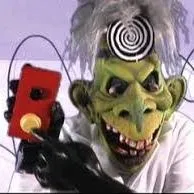
Vectorman presents the story of the world turned to slop. Everything’s gone to hell; Earth has turned into a toxic waste dump, and Earth’s people have left the now green planet behind for greener - or, cleaner pastures somewhere in outer space. While we play amongst the stars, no doubt ruining our new celestial home, we’ve left Orbots behind to clean up our backyard. It’s a given that good help is hard to find, but somehow the fools have managed to 'accidentally' replace the Orbot leader’s head with a salvaged atomic warhead (granted, it’s an innocent enough mistake).
Anyway, the new leader’s nom de guerre becomes Warhead – surprise, surprise. It all seems quite silly and without substance, and that’s the pervading theme throughout the Vectorman experience: style without substance.
 Credit: Blue Sky Software/SEGA
At the time of this game's release, a big fuss was made over it. Much drooling came about, and many Genesis gamers had to dab gingerly at their foreheads with cold towels. The reason was that BlueSky Software made a truly unique-looking game. Vectorman himself (he's the good guy) is made out of yellow-green spheres, and he animates brilliantly. His composition and movement might bring to mind the PC survival horror not-quite-classic, Ecstatica, had anyone actually played that game. But Vectorman's own good looks grandstand alongside shamefully bland foes, and within missions undeserving of his own undeniable charm.
Vectorman is a side-scrolling run-and-gun title, and so it’s packed with plenty of shooting, Contra-style. So much in fact, that I’d recommend you have a turbo-fire joystick or control pad, because the game requires you to pound on the fire button at length to kill even the weakest foes - hell, even the television sets that house your power-ups have to take unnecessary shots, like a comb-brandishing minority on the run from the police. Wait: power-ups in TVs? Naturally!
Boob tube blasting will yield gun icons (spread, rapid-fire, and even one that looks like a bolo of pure energy), extra time, photons for points, milestones for restart junctures, health point balls, multipliers and morph icons. Multipliers offer a welcome injection of random excitement into the proceedings. They come in denominations of two, three, five and ten. Pick up the five, for example, and the single health point ball you earn a moment later will actually provide you with five health points. The multipliers work on your health, 1-Ups and scores, so needless to say, you’ll want to go on a TV-smashing rampage when a ten multiplier is in your possession.
 Credit: Blue Sky Software/SEGA
The morph icons allow our hero to transform into a parachute form to gain increased maneuverability in midair; or a missile to break through ceilings; or a drill to crash through floors; or a bomb to bust through floors and ceilings. His dune buggy mode allows for a frenzied Vectorman to mow down enemies and walls alike, while the jet and fish modes facilitate reckless ramming in the sky and the water, respectively. The job of the power-ups is to keep things interesting in a genre where gameplay can easily be bogged down by fun-annihilating repetitiveness.
Despite all the apparent coolness, the power-ups don’t get the job done, and the result is that Vectorman gets old, fast. The best example I can use to illustrate the phenomenon at work here demonstrates itself in nearly every Transformers game that comes out. At first, you're blown away by the sheer novelty of being able to transform Optimus Prime from robot to truck. Inevitably, some time spent with the game uncovers that it mostly doesn’t matter what mode Optimus is in as you play through, and when it does matter and the situation is mode-specific, it’s for some mind-numbingly obvious function: “Oh, I have to open this door, I better transform – robot mode. Ah, gotta drive down this small stretch of highway – truck mode.”
That is the depth of what’s on offer in Vectorman: the morph powers present themselves either as a mindless necessity for advancing (e.g.: a bomb power up icon available immediately before an apparent dead end), or to no meaningful utility. Indeed, there seems to be no real creativity or complexity involved in the placement of these morph, or power-up icons in relation to the level layouts.
 Credit: Blue Sky Software/SEGA
There’s an attempt to spice things up, with the inclusion of a few crudely drawn, extremely short and generally pointless overhead levels. One such level has Vectorman taking the shape of a train, riding dilapidated train tracks held up high in the sky, while Warhead himself tries to smash you with his massive mitts. He's hanging onto the tracks for dear life with those same hands too, so the sequence involves you avoiding them when they come too close, and finally pounding them with enough shots to force him to fall. It sounds awesome, but it’s ugly, easy, and tedious – easy, because it’s just a matter of hammering away on the fire button, and tedious for the same reason.
The revolutionary graphics were supposed to be the main attraction, and certainly the smooth, hyper-realistic character animation - especially of our ellipsoid-constructed antagonist - succeeds in impressing, even today. But the visuals on a whole leave much to be desired. There is a lot of vapid sameness on rampant display in terms of effects and colours. The amazing blue water background so artfully painted for level two seems to reappear in later levels only with different palette from which to draw upon. And still on the topic of colour; it seems as if each level has a dedicated theme, based solely on a single hue. You might describe your progress to a friend by saying, ''I’m on the brown level.'' He might answer: ''That’s after the first two blue levels, right?'' Not good.
The enemies too, are often nondescript, colourless robots with little in the way of personality other than what can be achieved by their exaggerated motion. A dark green robot punches blasts at you. Robot pests buzz in swarms about your head. Odd-looking turrets angle their guns at you as you stomp by. Tiny, washed out fire extinguishers with bear traps as mouths hop about looking to exact a pound of your metal flesh. Even the boss encounters are ho-hum, with the exceptional exceptions to the rule being the snapping, inexorable piranha, and the giant in the swirling chaos that is Warhead at the very end.
 Credit: Blue Sky Software/SEGA
I had high hopes for the stylish robot named Vectorman. He wasn’t able to reach them, sadly (double jump and all), but his adventure proved its worth in terms of its unique look, its hero's lithe movements and a healthy helping of well designed – if clumsily implemented – power-ups. But at the core of our mission, we are left with a very basic jump-and-shoot outing fraught with mindless running and shooting and no magical sights or sounds or adversaries to compel us to play through the banality. The aforementioned (and much older) NES classic Contra remains the gold standard; play that instead.