 Credit: Now Production/Namco/SEGA
Misshapen fleshpuppets.
Ritual dismemberments.
Steaming piles of entrails.
All present and accounted for, but in truth the scariest thing about this game is how popular it was.
The controls are stiffer than one of its endless supply of corpses, and the average level is a short, uninspired advance from left to right punching identical hordes of muck-encrusted undead while occasionally hopping over a hole in the floor. But since our hero can only withstand a few hits before collapsing in a lumpy heap, it's all but required that you perfectly memorize all the enemy patterns through painstaking repetition until reaching the boss with full health. There's only one reason this cartridge wasn't totally lost to the shadows of mediocrity – it has enough gore to fill a swimming pool.
In that sense SplatterHouse 2 is a faithful sequel to the original, a popular if controversial coinop and the best known release for the TurboGrafx-16 despite far superior offerings like Bonk's Adventure or Devil's Crush. Hence it shouldn't come as much surprise that the series' debut on the Genesis was a pretty big deal, even gracing magazine covers despite being kind of a pile. Not that there's necessarily anything wrong with that; the Friday the 13th films are the cinematic equivalent of rat poison and they're cherished icons of the 80s. If horror can't be good, it should at least be very, very bad.
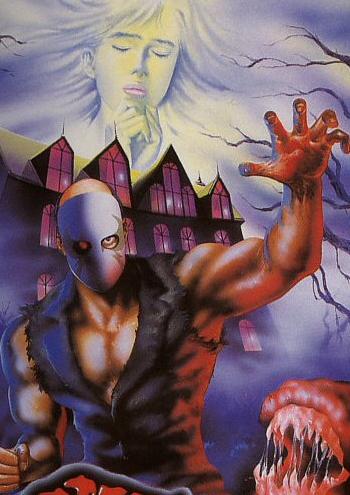
Thus everyone's favorite masked muscleman is dredged up from his grave and back to bludgeoning beasties in search of girlfriend Jennifer despite that fact that she became a hideous she-bitch during his previous outing. Man, who can't relate to that, eh? The sequel definitely has its moments, as when Rick gets his meaty hands on a lead pipe and starts bursting ghouls apart left and right, their ichorous guts oozing onto the wall with squishy thuds. When later crossing a river filled with ravenous piranha, a single well-placed fist can knock a hapless zombie into the murky depths accompanied by a terrified shriek, its lone claw protruding out until that too is slowly pulled under into oblivion. The most extreme battle, however, takes place within a ramshackle shed where bulbous fetuses suddenly drop from the ceiling just before you split them asunder with your whining chainsaw and cause rivers of ruddy goodness to coat the screen – this before the home edition of Mortal Kombat nearly set the gaming industry ablaze.
 Credit: Now Production/Namco/SEGA
 Credit: Now Production/Namco/SEGA
While such events were certainly enough to warrant a largely impotent warning on the case and kindle the ire of hypocritical politicians across the land, ultimately the sequel never rises to the truly disturbing heights of the arcade. No longer are hallways littered with tortured freaks still thrashing about in chains, or swarming with disembodied claws that give you the finger. No more do the pitfalls take you through unique alternate routes like the desiccated necromancer and his immortal horde of corpsewalkers, these encounters replaced with the same dull stroll across a spike-lined floor. Still, as that aforementioned Midway fighter would soon remind us, what Mario wouldn't prod with a ten foot pole, the Genesis gleefully clobbers into a chunky red paste.
Interestingly the Japanese version is really hard to find and expensive as hell, which might lead you to question whether there are any differences; it's well known that the English localization of SplatterHouse on the Turbo was censored, replacing Rick's suspiciously familiar hockey mask with a weird red one in addition to scrubbing out any religious references. Oddly enough the MegaDrive cart actually uses a white variation on the TG16 mask design rather than the domestic's slightly cooler skeletal visage, however this is far from the only change; the import also features humorous Engrish subtitles and an easy difficulty setting that gives you more health, but on the whole it's a lot harder due to your regaining only two hearts after finishing a stage, a limited number of continues, and no passwords. Now that is disturbing.
 Credit: Now Production/Namco/SEGA
 Credit: Now Production/Namco/SEGA
Of course since neither version is particularly good this is a bit of a moot point since you could be shelling out for the vastly superior Wanpaku Graffiti instead, and yet this game was regurgitated for a new generation on the Virtual Console while the Famicom cart is destined to languish in obscurity. Go figure. At least Namco went back to the drawing board for Part III; SplatterHouse 2 might make for a few hours of halfway decent entertainment on a sleepless October night, but it's strictly an interactive equivalent of those cheesy slasher flicks at two in the morning.