
The foreground is unyielding black and it births suggestions of foliage. Husks of giant trees grow out of pervading fog. Our panorama flickers like a warped image in a viewfinder. And a boy nests in the middle of all this, sleeping. We fiddle with the controller, and he stirs, white eyes of light open, and our protagonist peels himself from the landscape.
Limbo is nothing if not atmospheric.
It is the story of a boy who awakes, alone in the woods. Or so it would seem—the game's apparent simplicity belies its true depth. There's a darkness and menace brimming beneath the surface which can scarcely be accounted for; though the arresting monochromatic and minimalist presentation is a good place to start. Limbo's shades of black and swelling ambient sounds administer a very real sense of dread before the deaths even begin.
And the deaths come early and often.
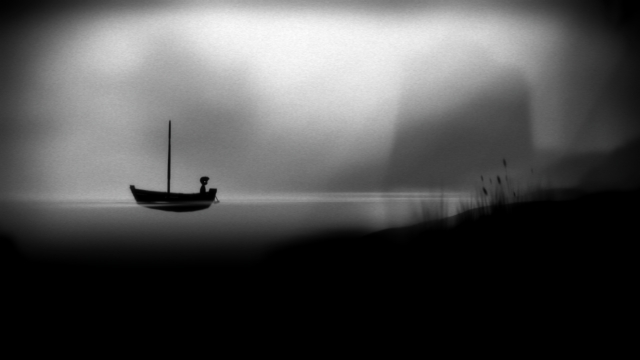 Credit: PlayDead
Limbo came out for XBLA last year, so Xbox 360 gamers have had their chance to enjoy this little gem for awhile now. Finally, the exclusivity period is over and PSN players can rejoice. Limbo harkens back to trial-and-death styled side-scrolling adventuring in the vein of the original Prince of Persia and Out of This World—and does so in remarkable fashion.
OOTW was a big deal when it came out not just for the way in which it begrudgingly apportioned progress, but for its rotoscoped graphics. In much the same way, Limbo has made waves for its black-and-white visuals and eerie tunes. The barebones premises are another shared trait: all we know is that a bright-eyed boy must navigate a shadow-haunted forest, ostensibly in search of his girlfriend. There’s nothing unique about the search for lost love, certainly (Mario and Master Higgins’s women were always giving them the slip) but it is Limbo’s way to give us the impression that there is more than meets the eye.
Developers Playdead don’t confirm anything, but it seems that Limbo is a story about a boy in the forest in much the same way Watership Down is a tale of house-hunting rabbits. Rather, the word limbo literally means, the edge of hell, which is fitting, as our boy must endure innumerable deaths while working his way through an obstacle course constructed to bring about pain and suffering.
From malevolent children bearing bows and arrows and the inexorable presence of a giant spider early on, to crushing gears and high-voltage surfaces in later industrial-themed levels—everything is beset upon you to bring about your ruin. You will be skewered, bludgeoned, electrocuted, decapitated. And you’ll get used to it. It's a small price to pay to learn, to see what comes next.
Since so many of the puzzles refuse to provide you with any prior indication as to what should be done, and since Limbo therefore expects you to simply plunge headlong toward probable death only to reappear and correct your mistakes—it's comforting that the checkpoints are so forgiving. Ideal, really, when constant course correction is the order of the day.
We know we’re dealing with pretty special game design when puzzles seem simple once you’ve figured them out, despite some of them being decidedly obstinate at first. Very early on, you’ll be guiding the little boy, gliding like some starkly black automaton atop a fair and fuzzy backdrop—and you’ll trigger a bear trap. Ouch. Later, you’ll realize that besides jumping over it, you can pull the bear trap to position it as you like.
Subsequently, one simple puzzle positions you on a small platform that drops down to a lower one, with a much higher cliff face beside it. A rope with an animal carcass affixed (replete with buzzing flies) offers itself to take you across the gap to the higher ground, but the rope doesn’t seem to reach high enough, that much is readily apparent. To make matters worse, there's a bear trap beneath to complicate things should you fail on your jump from rope to cliff (you will).
When you first move the trap and use your weight on the rope to trigger the jaws on the carcass, allowing the rope to rise, you won’t help but be pleased with yourself. As you proceed, things gets more and more complex at a pace that doesn’t feel overwhelming: both in terms of the mental challenge and the finger gymnastics required to keep on keepin’ on.
Limbo has been criticized for being short, and you will likely beat it in one or two sittings, but those sittings will represent time well spent, and there’s a good possibility that you’ll return to search for the hidden Easter eggs for Trophies, or to improve your time, or to limit your deaths once you know what you should be doing.
I would present that it’s not length that is the problem. Portal is a short game, but it’s a perfect game, and its length is ideal as it ensures that there are no lulls, no moments of mindless retreads, no filler. Limbo’s problem is that although it begins with a story—admittedly, one that is stripped down—it has commitment issues later on.
At some point, the compelling dark forest narrative, featuring a heart-stirring miniature saga co-starring the giant spider—is abandoned (The Incredible Shrinking Man comes to mind). And it’s replaced with something far less engaging: a Super Meat Boy-esque meat grinder. The game becomes less thematically complex and sinister and more straightforward and sadistic, and that’s a shame.
To revisit the Out of this World comparison: that game explained very little from the onset, but managed to work our emotions with a slow build born of the onscreen relationship between the hero and his newfound ally. Again, something similar is arrived at through the perverse and wonderful bond forged between boy and spider throughout the early stages, but later on, the game thrills solely to presenting insidious opportunities for death.
That being said, if a thematic shift is my only gripe with a game, then I’m rather enjoying myself. Limbo is a highly recommended download; its "high" price only seems prohibitive to those used to playing today’s bloated blockbusters and I’d argue that quality matters more than size. Limbo must be experienced, by old school gamers, puzzle gamers—by all gamers.