
 Credit: From Software/Bandai Namco
The developers at From Software invite their fans to once again devote sixty-plus hours to frustration, failure, and hardship, all courtesy of Dark Souls II: Scholar of the First Sin. Some of those players will ignore the conjuring because they prize their sanity. There are others, though, who will gladly raise their swords again, dash forward in spite of their natural trepidation, and go down swinging as they meet the crimson mug of death. Unabated by aggravation, they will respawn, resume their quests, and eventually taste victory sweetened by peril.
Count me amongst that number...
Scholar of the First Sin offers more than the opportunity to gloat about your "mad skills," though. This enhanced edition provides you with more fluid animation (typically running between 50-60fps) and crisper visuals whilst also satisfying your taste for nostalgia. The update plays almost identically to its original incarnation, with the exception of a few tweaks to the control scheme. It's truly exhilarating to finally see the series running at high frame rates even while you deftly cleave through scores of opponents and quickly roll past crushing blows and slicing blades.
This is not to say that your mission the second time around will be a breeze. Bear in mind that the opposition similarly benefits from the boost in frame rate, as they are now capable of slicing, crushing, biting, shooting, and burning you more quickly than ever. As you can imagine, this outing requires the utmost of your reflexes and demands caution. At one moment, you may find yourself toppling castle guards and dodging traps like a pro, only to spend the next one voiding your bowels as you enter a chamber and behold a massive demonic horse. Even after you slay that equine nightmare, you dare not relax. If you're like me, your knees may knock together any time you glimpse a closed door or spot a ladder leading blindly into darkness, because you know an unseen fiend likely lies in wait.
 Credit: From Software/Bandai Namco
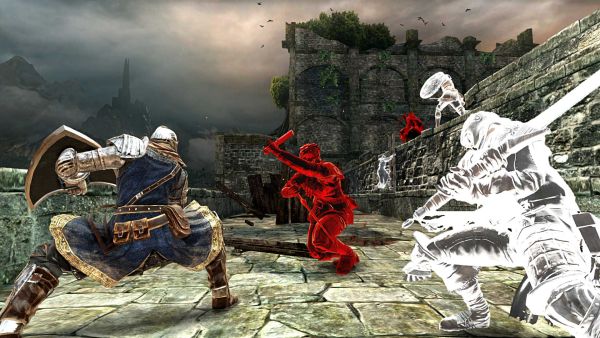
At the same time, a sealed entrance or shadowy pathway could represent an opportunity. Sure, you might have to carve your way through numerous massive knights, lock horns with a slumbering dragon, or battle your way through a gauntlet of hell-born reindeer, but where there's risk, there is often also reward. Those who persevere may obtain new weaponry and spells to silence their foes, ores necessary to upgrade their equipment, and souls for leveling up. These jubilant discoveries are what push rational folks into picking horribly mismatched fights, and such moments are also the ones when lovers of ridiculous challenge like myself feel most alive. As with its predecessor, Scholar of the First Sin regularly grants you the chance to meet grim odds with a crooked smile, your heart pounding as you cut into invisible warriors and battle-hardened phantoms in the name of bounty.
And yet, you might notice that something feels amiss. Not to a spectacular degree, mind, but as you play, you might not be able to shake the uneasy notion that Dark Souls II fell just short of true excellence.
That certain something lacking becomes most apparent when you enter your umpteenth castle or fortress and conclude that someone on the development team must've had a hard-on for such environs. I couldn't shake the dispassionate sensation the game evoked. It only grew worse as retreads began to stack up. For instance, one area called "The Gutter" bore too many similarities to the previous game's "Blighttown," what with its dilapidated structures and plague-ridden denizens. Another optional segment pits you against a massive diseased dog called Royal Rat Authority. If you pay close attention to the over-sized canine's movements, you might notice that they mirror that of the boss Sif from Dark Souls. It would be easy to dismiss the similarities between the two altercations as a tribute, but there's nothing contextual to tell us that such is actually the case. You end up with a boss brawl that comes off as lazy rehash, rather than a wink to returning fans.
 Credit: From Software/Bandai Namco
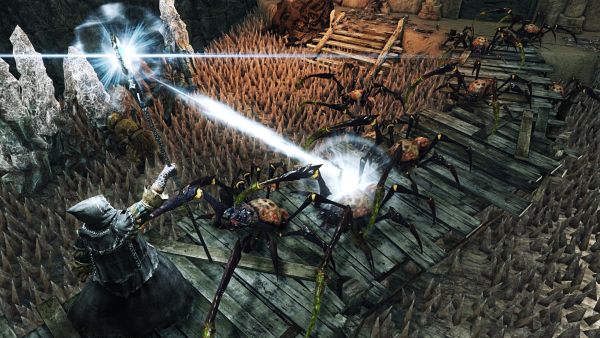
Worse than the decreased creativity is the brevity and straightforward nature of some locales. One region that comes readily to mind is Black Gulch, a level comprised of a single straightaway decked out with poison-spitting statues and the occasional malformed horror. You might wonder as you reach the area boss why the developers even bothered. They could just as easily have left the region on the cutting room floor and deposited its boss at the end of The Gutter. The game's quality wouldn't have been any worse for the omission. Perhaps the developers were committed to provide as many different locations as possible, hoping that such a task would give the game a grand sense of scale. More than anything, though, levels like Black Gulch just feel unnecessary.
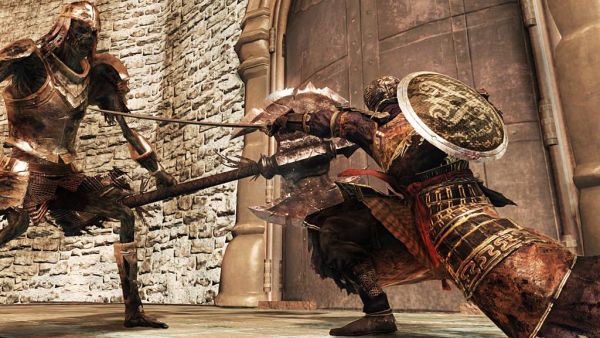
The above complaints are hardly reason to panic, though. Think of them as nitpicks. What really gets my goat when it comes to Scholar of the First Sin is a flaw that only rears its head a couple of times, but hurts the finished product nonetheless: faulty collision detection. While crossing swords with a boss called Fume Knight, I would occasionally roll into his sword and receive no damage. I thought this just a tad odd. During one attempt to take the honorable one out, I rolled behind him and waited for him to finish his horizontal slash. As he did so, the handle of his sword tapped my face and registered as a blow, killing me. I had to wonder at that moment where this devil's hit boxes lie. I ran afoul of many of the same issues when tackling Sir Alonne as well. I tumble into his sword: no hit points lost. He aims to impale me and misses, his sword forty-five degrees away from my body: I magically float onto his blade as if the impalement were successful. Thankfully, only these two boss encounters caused me problems of that sort.
 Credit: From Software/Bandai Namco
In spite of the minor megrims I sometimes suffered, I was satisfied with Dark Souls II: Scholar of the First Sin overall. The game's difficulty rating leans more towards "forgiving" than that of its antecedents, but there's still the welcome sense of accomplishment that comes from advancing through the campaign. I noticed it every time I pumped souls into my avatar and watched him grow into a dual-wielding maniac. I felt it every time I pushed a particular enemy beyond its respawn limit and saw that it never reappeared again. I witnessed it every time I triumphed over the game's many optional bosses. True, there is and always will be a part of me that sighs and recalls that the previous entry in this series was superior to Scholar of the First Sin, but that's when I remind myself what a tough act it must have been to follow. Scholar of the First Sin hits most of the notes any Souls game should, and its inability to top its predecessor is certainly no reason to write the game off altogether.