


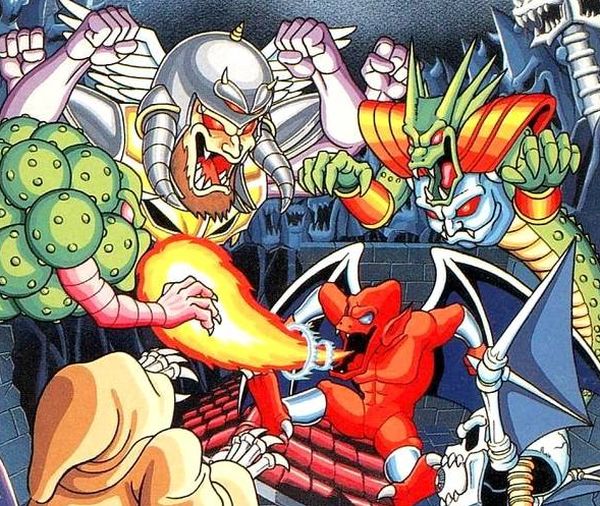
Two years after the original Gargoyle’s Quest was released on the GameBoy, a prequel to it was dropped on the NES. Overall, it pretty much covers the same ground, as you’ll control Firebrand — also known as that one total asshole monster in Ghosts ’n Goblins that killed me way too many times — as he travels through the Ghoul Realm until he kills the right folk to save the land or whatever.
Of course, since it’s in color and released in 1992, late in the lifespan of the NES, it looks a lot better than the GameBoy adventure. It also adds a few new powers for Firebrand to obtain during the course of his quest, such as one that allows him to craft temporary platforms in order to get to ledges which the combination of his jumping and hovering can’t quite reach.
There also was this nice little gimmick to how it plays. Since Firebrand has a bit more mobility than the average eight-bit action game protagonist, the levels in this game play somewhat differently. As a demonic creature with wings, he can both jump into the air and then hover for a while, allowing him to move to the left or right while maintaining altitude. As you complete levels and return items to other folk, you’ll gradually gain improvements to those abilities. You’ll be able to jump higher and hover for a longer time, giving you greater mobility the longer you play — while also occasionally gaining an additional heart of health, as well as a handful of alternate forms of fire that either are improvements on your default attack or make it easier to maneuver through tricky locations.
And this game is littered with those tricky locations. In the average stage Firebrand will navigate, there are monsters to fight, but they tend to play a distant second fiddle to the design. You’ll have long gaps to hover over and you’ll find it necessary to regularly make blind leaps, trusting in your ability to hover in order to not plummet onto a bed of spikes or into a pit of lava. When you get the “weapon” that allows you to fire gunk onto spiky walls so that you can cling to them without taking damage, you can bet you’ll soon have to navigate a few lengthy, spike-filled shafts to make the most out of that ability.
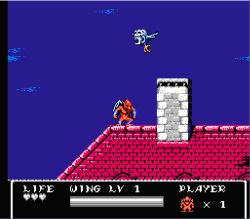
For the most part, this was a lot of fun. Early on, I thought a couple of the challenges were kind of annoying. I didn’t have much jumping or hovering ability and it felt like a few leaps and glides I had to perform had little (if any) margin for error, making a couple stages a pain to get through. But as I got more powerful, it seemed like Firebrand’s skills caught up to — and probably surpassed — the challenges Capcom placed in front of him. And I can’t deny it was a blast to master controlling him. After struggling with the game’s final boss for a bit, I was positively giddy when I realized that by simply using all the tools I’d been given, I could hover and pelt him relentlessly, only needing to occasionally put my feet on a solid surface to recharge. As long as I didn’t screw up my positioning on the screen, that enemy’s attacks couldn’t hit me, which turned a formerly brutal confrontation into something I cruised through with no troubles whatsoever.
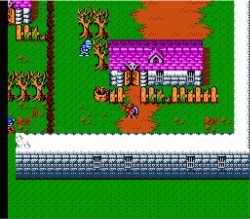
Overall, I’d call Gargoyle’s Quest II an improvement over the GameBoy original, even if it didn’t really break much new ground and seemed content to be little more than an in-color, console version of its predecessor that maybe tightened up a few things. There still are some annoyances, though. Much like the original, you have a world you must traverse in order to reach towns and dungeons. In Gargoyle’s Quest, I didn’t particularly care for that. You’d have the occasional random battle while walking, which would take you to a side-scrolling action screen to fight a couple enemies — a task that felt like meaningless padding considering how you didn’t get experience points or anything for fighting foes.
Here, those random encounters are gone. While there are a handful of visible foes on the map, for the most part, you can ignore them unless you want to give Firebrand a bit of additional combat practice. While I definitely didn’t miss having those unnecessary fights, their absence had the effect of simply making the fact there is a world in which I had to walk from one place to another feel tedious. I’d go through a stage, having a good time controlling Firebrand while navigating around obstacles and blasting enemies and then have to amble around the world, occasionally talking to people in towns or trying to remember where I had to take this candle or that whatever. In modern times, a lot of developers have done a great job of melding the action and role-playing genres; here, it just sort of feels like they slapped a few role-playing elements into an action game without any real consideration of how compatible they were.
But when I had fun, I had fun. And I did have fun hover-flying through a number of this game’s stages as Firebrand gradually got more and more powerful and agile. There were a ton of action games released back in the days of my youth and, quite frankly, a lot of them blend together. It’s nice to experience one that both tries to do something different with the formula and pulls it off well. Is being able to hover in mid-air some sort of revolutionary game-changer? Probably not, but it was something that the average action hero of that time didn’t do, which does help Gargoyle’s Quest II stand out from the pack a bit.