
EDIT: The game now offers overpriced subscription plans. It has become more and more of a grindfest over time. I personally stopped playing this when lootboxes were added to this game as "fortune cookies". As this is an expression of morally bankrupt greed, I've dropped the score to 0.5/5. It was a decent little time-waster when it was first released, but please be aware of how predatory this game is to younger people.
This review is based on version 0.9.0, which was released in Australia prior to the worldwide release. Version 1.0.0 mostly includes bug fixes and slight changes.
Animal Crossing: Pocket Camp is the next title in Nintendo’s foray into the world of mobile gaming and microtransactions. Pocket Camp is much more akin to a mainline Animal Crossing game than Happy Home Designer or Amiibo Festival. Like the title suggests, we’re stepping out of the town and into a campsite, but the usual elements are in place.
Instead of a house, you have a campervan. It’s quite small at first, but you can get yourself into increasingly larger debts to improve it. You can redecorate the interior and repaint the exterior. I find I barely step foot inside mine, though.
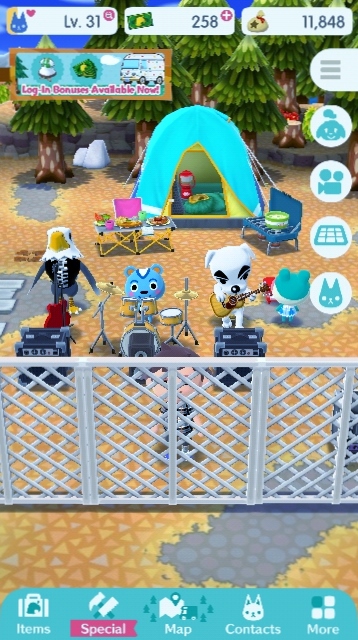
Instead of a town, you have a campsite which you can decorate with furniture from the familiar sets, as well as interactive items like musical instruments and playground equipment. Replacing the public works are amenities (starting with tents, to picnic area, to swimming pool). All furniture and amenities must be crafted with raw materials, such as wood, steel, cotton, etc. You collect these from animal visitors who will show up at the nearby locales.
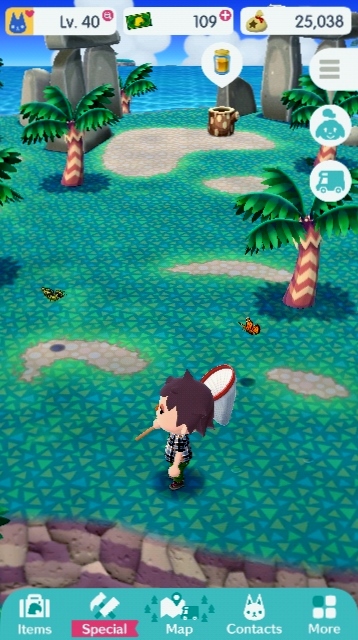
Outside your campsite are a few areas you can visit. You can go fishing at the beach and the river, collect bugs from a small island, or collect fruit from trees in a picnic area. There’s a marketplace with travelling merchants who rotate from time to time so you can buy furniture and clothing, there’s OK Motors, where a trio of pigeons will assist with campervan improvements and customisations, and there’s a quarry, which is a complete waste of time. We’ll come back to that.
 Credit: Nintendo
 Credit: Nintendo
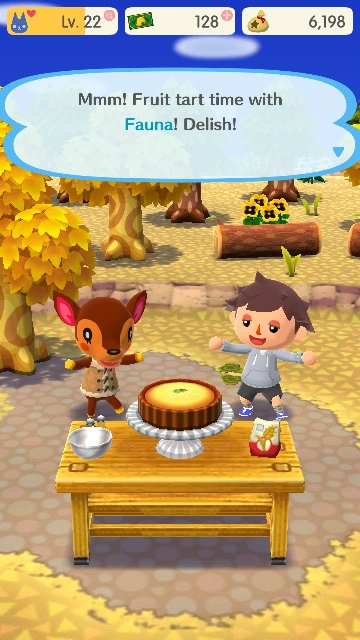
Scattered around these locations will be animal visitors. There’s only 40 of them in the game at this point, and I’m hoping they will eventually add more, as I’d like to see some more of my favourites as such as Marshall or Lucky. Villagers will ask for things, such as bugs or fish or fruit, and will reward you with raw materials and bells (money). There aren’t that many different bugs and fish in the game – a handful of common types, and some rare types which animals might occasionally ask for, so you won’t need to go hunting for a Coelacanth or anything like that, and there’s not a seabass in sight.
The animals will stick around for 3 hour intervals, and you can do 3 favours for them in that time (you can earn cards that allow you to do additional favours, or summon an animal to that spot). Give them the items they want, and you’ll earn friendship points, which levels up your relationship with that animal. You also have an overall friendship level which takes into account all of your friendships, and you’ll be rewarded with more animals to meet, more inventory spots, leaf tickets and bells.
Once your relationship with an animal reaches a certain level, you can invite them to your campsite, provided you have the furniture they like. In the early part of the game, furniture is quite easy to produce, but later in the game, furniture can take hours to build, and requires ridiculous amounts of materials. Animal villagers fall under four types – natural, cool, cute, or sporty, and the amenities you build will belong to these same categories. You’ll need bigger and better amenities of each type to increase the level cap for each villager from 10 to 15 to 20. This is going to take a lot of raw materials, bells, and if you’re impatient, Leaf Tickets.
Leaf Tickets are the real currency in this game, and Tom Nook is happy to sell them to you for real money, although the game itself is generous with giving them out, especially at the start. You’ll receive 10 Leaf Tickets every time you level up. You’ll receive Leaf Tickets for completing Stretch Goals that Isabelle gives you (usually simple things like building certain furniture sets). Leaf Tickets can be used to speed up the game, basically. If you don’t want to wait hours for something to be built, you can pay to have it finished instantly. If you don’t have enough raw materials to build something, Leaf Tickets can be substituted. They usually require a lot of Leaf Tickets, and for someone like me who works full time and plays a bit here and there, I’m generally happy to start some furniture crafting and let it go during my work day or overnight.
There is another type of currency I’ve found much more useful – the MyNintendo points. I’ve had a bunch of these sitting around for ages, and it’s nice to finally find a use for them. You can earn silver coins from Pocket Camp each week, and you can use those coins to purchase extra raw materials. I’d much rather spend points on an extra 20 cotton than use real money to cover that with leaf tickets. You can earn hundreds of points by linking Pocket Camp to MyNintendo, Twitter, and Facebook.
Pocket Camp can be a bit sneaky sometimes. Sometimes multiple animals are going to request multiples of the same thing. Earlier this week, I had a surplus of monarch butterflies, so many I had to sell a few to other players, just to keep my inventory spots open. But just this morning, I kept getting hit with requests for multiple monarch butterflies, and when I went to catch some more, suddenly they were scarce. I suspect this mechanic is in place to get you to spend Leaf Tickets on items such as honey or nets that can catch multiple bugs or fish at once, but Nintendo undercut themselves by allowing you to make another kind of friend: other players.
 Credit: Nintendo
 Credit: Nintendo
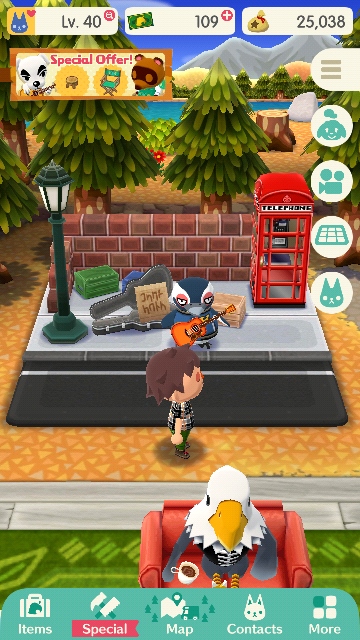
Pocket Camp is a single player experience, but you can interact with others to an extent. You’ll find other players scattered around the campgrounds, and you can check out their campervans and visit their campsite (and give them kudos, if you think their campsite looks good – kudos doesn’t seem to have any value except in completing some of Isabelle’s stretch or daily goals). Each player also has a market box, where they can put things up for sale, like extra bugs, fish, fruit, and seashells. It’s in your interest to send a friend request to anyone you encounter, since once they are on your friends list, you can visit them any time and check their market box to see if they are selling what you need. One of my friends had three monarch butterflies for a pitiful 100 bells, which saved me some time. It was certainly better than spending 15 Leaf Points on honey. You can buy Leaf Tickets in various quantities - $1.49 for 20, $62.99 for 1200, and a few amounts in between.
The one area which I feel needs to be redeveloped is the quarry. You can pay 20 Leaf Tickets to access it, or you can send out a request to friends to help you, and once five friends send you their support, you can go in and break five rocks… and that’s it. The reward is miniscule, and was hardly worth the effort it took to get in. I did it once to complete the goal of visiting the quarry, and I haven’t bothered going back. Over time, I’ve received less and less requests from friends to help them access it, too, so I think Nintendo are going to need to review this in a later version.
Pocket Camp runs reasonably well on my Samsung Galaxy S7, although I’ve had a few crashes. I never lose anything substantial, as the game autosaves often, and getting bumped to the title screen is not a huge inconvenience. It looks and sounds like an Animal Crossing game, and the visuals are sharper than they were in New Leaf.
I don’t know if I can recommend this game or not. It’s not quite finished, and there are suggestions online that there’s more content coming once the game is released internationally. Pocket Camp is simple to pick up, and I have to admit I find it quite addictive, but it’s also a fairly hollow experience. I’ve seen the same dialogue from villagers over and over. I’ve got my campsite looking how I like it. And I haven’t bought a single leaf ticket yet, as the game has given me enough to unlock extra crafting slots, and purchase two special characters to sit in my campsite (Tom Nook and KK Slider). They don’t really do much, but they’re nice to have.
I will likely add to this review when we reach version 1.0, but I feel like what I’ve described is the core experience, and I don’t see Nintendo changing it up too much.