Overview
Flashback: The Quest for Identity is a cinematic platformer released for multiple personal computer systems and home consoles in the early 1990s. Developed by French video game studio Delphine Software, the game focuses on problem-solving and light combat to tell the story of Conrad Hart as he uncovers a vast extraterrestrial conspiracy.
You control Conrad in an interstellar adventure that takes you to Titan, Earth, and the uncharted reaches of the galaxy. Along the way, you’ll be aided by friends and you’ll get tools like a portable transport unit and a force field generator. You’ll need these and your wits if you’re going to stop a malevolent alien force from conquering humanity.
Gameplay
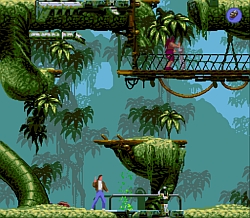
As a cinematic platformer, Flashback has you running, jumping, climbing, and rolling through environments as varied as otherworldly forests, underground cities, a future Earth nightclub, and more. To traverse these places, Conrad has a full move set that is easy to learn and master. That’s good because you’ll use every action available as you make your way across the galaxy.
When the game starts, Conrad has just crashed in the forest and has no possessions except a memory storage device, a shield with four charges, and a pistol. Conrad has no recollection of his past, but the storage device offers clues and a path to begin uncovering the truth. The shield, meanwhile, acts as Conrad’s life bar. He can take up to four hits before dying, and there are kiosks located throughout the game where Conrad can recharge. His pistol has unlimited ammo.
Though much of the game is about navigating each stage and finding a way toward your objective, that doesn’t mean there isn’t anyone to stand in your way. Corrupt cops, malfunctioning androids, evil aliens, and unfeeling robots all pose a danger to Conrad. While he can avoid a few of these encounters, the majority have to be dispatched to open doors, gain items, or simply move forward. Enemies can take one or multiple hits to destroy, but Conrad’s pistol fires pretty rapidly. You’ll also get a force field generator that erects a split-second defense. This is good for blocking projectiles but not melee strikes.
Between the platforming, combat, and puzzles, Flashback makes for a challenging game. This difficulty is exacerbated somewhat by the limited number of save points in each level. With some obstacles like the green disintegrators resulting in instant death, getting through difficult areas can mean repeating part of a stage over and over again.
Graphics & Sound
Originally made for the Amiga personal computer, Flashback looks fantastic on the Sega Genesis / Mega Drive. The pixel art for the environments is gorgeous and varied. On the jungles of Titan, huge vines twist through the landscape, while the underground city of New Washington is gritty and urban. Meanwhile, the home planet of the Morphs is full of pink rocks, purple organic bubbles, and hanging strands of blue and green … stuff.
To populate these environments, Delphine Software used rotoscoping to capture and animate all the characters. Conrad moves in a fluid, lifelike way that’s quite satisfying to control, even if he’s not as responsible as one would like at times. The animation for the Morphs is particularly good as they flow between walls and ceilings.
Lastly, there’s the cutscenes. While these look a bit dated today, they would have been quite cinematic in 1992-93. The fact that they run on a system like the Sega Genesis is quite an achievement, and they match the overall character of the game.
Jean Baudlot composed the game’s music, with many of the other programmers contributing additional sounds or effects. The stages don’t have music playing throughout and focus instead on environmental sounds. There are also some nice musical flourishes that increase tension when you enter a dangerous area.
Story
Flashback is a pastiche of several well-known science fiction stories — particularly sci-fi films of the 70s and 80s — and the game wears its influences proudly on its sleeve. There are shades of Alien, Total Recall, The Running Man, and Blade Runner. Fans of the genre will certainly have fun exploring the world of the game, which should feel vaguely familiar to them.
The game’s subtitle, The Quest for Identity, is a bit of a misnomer because this plot point gets resolved fairly quickly. From the second level on, Conrad’s main objective is to uncover the extraterrestrial plot and stop it if he can.
Obviously, there’s only so much story that can fit into a game of this vintage, and those expecting a sprawling space opera will be disappointed. Still, it’s nice that Flashback tells a complete tale, even if it takes some narrative shortcuts to do so.
Final Thoughts & How to Play
Flashback: The Quest for Identity is a gorgeous game that controls well but can be quite challenging at points. Its enjoyability is hampered somewhat by the spacing of save points, which can make the game feel like it isn’t respecting the player’s time. Playing on vintage hardware may not be for everyone, since save states make the game much more palatable.
On consoles, the Sega Genesis version is often cited as the preferred version of the game. Loose copies go for around $15 on the secondary market, while complete copies cost around $40. Flashback was released on multiple platforms, as well as being remastered and remade. If you’ve never played it before and enjoy cinematic platformers, be sure to give it a try.