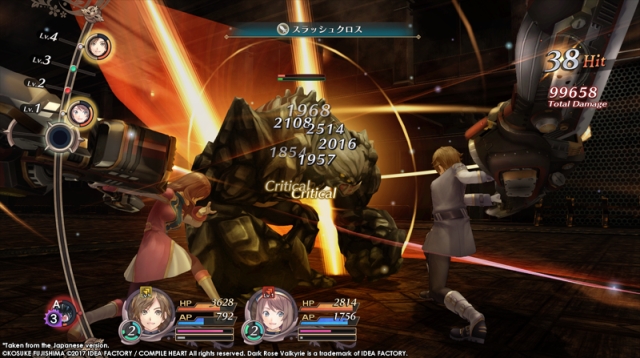
Dark Rose Valkyrie is a game with ideas. When a low-budget JRPG like this has ideas, it usually doesn’t end well. For Compile Heart’s latest, however, we’re given a little gem that’s rewarded for its ambition.
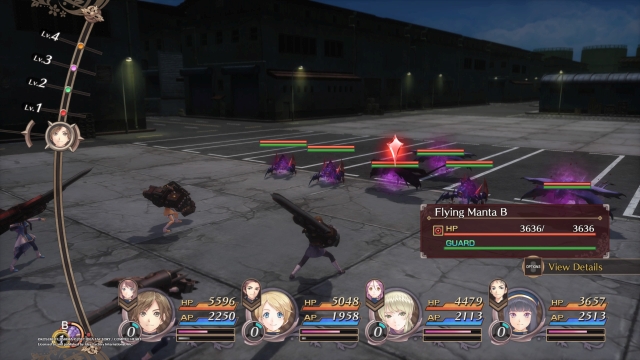
The game opens with our protagonist, Asahi, becoming captain of Valkyrie Force within ACID (Anti-Chimera Interception Division), a branch of the military dedicated to protecting what’s left of humanity from a space-born virus that turns man and beast alike into monsters. Upon arriving at base, he’s put in charge of five women who were specifically chosen by the Valkyrie System for their potential in fighting the chimera virus.
 Credit: Compile Heart/Idea Factory
If all of that sounds really similar to God Eater, it is. What really sets Dark Rose Valkyrie apart from Namco’s hunting franchise, though, are its characters and the way the game makes you really care about your unit. When he’s not out hunting chimera, Asahi is back at base interacting with the women of Valkyrie Force, getting to know them and becoming closer to each of them as a result. The game does a fantastic job of making the player really care about these women as colleagues and friends, and it’s all the more impactful when the game threatens to rip one of them away from you.
After the first 30 hours or so, it’s revealed that a member within your Valkyrie Force unit is perhaps a traitor working for a group of humans who have learned to control the chimera virus and are attempting to wipe out humanity. It’s not so easy to pinpoint a traitor, however, as the side effects of being a Valkyrie Force member are very similar to the side effects of the virus. At this point, the game shifts into the interview phase, where the player is given the chance to interview all five women about their relationship with the others on the team. By looking for inconsistencies in testimonies, you can potentially find and point to the traitor. Doing so, however, will potentially force that party member to leave. The narrative gives players the choice to out the traitor, protect them, or even frame somebody else entirely. It's an incredible twist that will leave players reeling from their decision, all the way through to the very end.
Unfortunately, Dark Rose Valkyrie suffers from a problem that plagues Compile Heart games from time to time. To obtain the true end, players will have to complete a series of esoteric objectives. The game gives no hints as to what they may be. One requirement is that you play through the whole game on the Very Hard difficulty setting (which is impossible on an initial run), thus relegating new players to either the Bad or Normal ends. I don’t know what possesses Compile Heart to make players commit 100 or so hours to their games in order to obtain the true ending, but it needs to stop.
 Credit: Compile Heart/Idea Factory
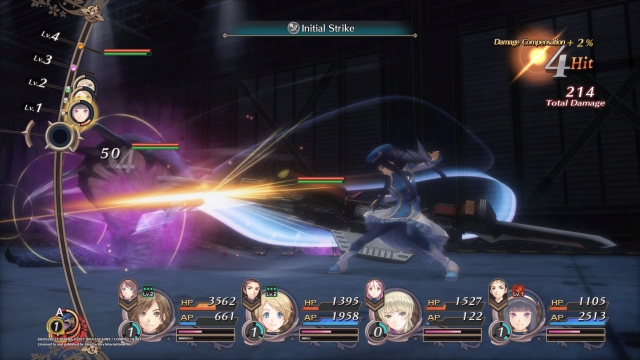
As for combat, Dark Rose Valkyrie features the most ambitious turn-based system Compile Heart has ever devised. For those familiar with the Grandia series, a lot of Dark Rose Valkyrie will feel very familiar. For those who are not familiar, it’s still pretty simple. Turn order is dictated by a bar on the side, where player and enemy icons both descend from top to bottom. Once a character’s portrait hits the middle, they can make an action, and then that character must wait for their portrait to return to the middle to act again.
While the general setup is very similar to Grandia, though, Dark Rose Valkyrie adds another wrinkle to combat by assigning a level to every attack. These levels dictate how long it takes for the character in question to carry out said attack. A level 1 attack goes off immediately, while a level 4 attack takes the longest amount of time to charge. Player characters and enemies can both interrupt this progression by utilizing combos that freeze a portrait in place (thus preventing them from being able to reach the requisite level and carry out an attack), and some attacks can outright cancel progression and send a portrait back to the start. This dynamic adds a layer of depth to combat because parties must be arranged to maximize your own attack power and speed while restricting that of the enemy.
Besides enhancing the general flow of fights, Dark Rose Valkyrie gives meaning to the guard break mechanic that has been part of Compile Heart's games since time immemorial. In the past, a guard break would simply cause an enemy to take more damage. Here, it has two additional advantages. The first is that defeating an enemy under a guard break forces an item drop and fills in most of the enemy’s bestiary entry, thus making it easier to fulfill the many quests that require players to gather such data. The second advantage is that it creates the potential to engineer an all-out attack that enables reserve members to attack every enemy on the screen.
 Credit: Compile Heart/Idea Factory
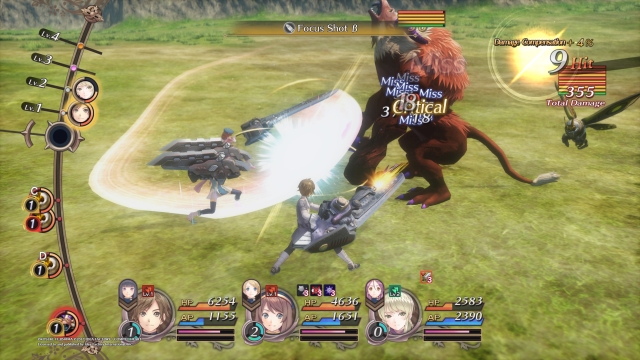
Dark Rose Valkyrie is similar to God Eater in more than just the narrative sense. The ridiculously-sized swords and guns Valkyrie Force uses are very reminiscent of God Eater, and the game also features large monsters with body parts you can target separately. Destroying these body parts not only reduces a monster’s fighting capabilities, but rewards extra experience and item drops that would otherwise not be available. Here, the game’s central weapons come into play. Each one has a physical attack, a ranged gun attack and an explosive missile attack. Not only are certain enemies weak to certain types of damage, but some body parts can only be targeted by specific weapon types. For instance, a long snake's tail can only be hit by missiles, while a face mask is more susceptible to melee attacks.
In addition to all of the above, Dark Rose Valkyrie deserves special consideration for its dungeon design. Though it starts out simple, later dungeons feature platforming, introduce crawlspaces and in general require a degree of spatial awareness so you can successfully navigate. The design encourages exploration to unlock the many doors that otherwise bar your way forward. Many other JRPGs have far better dungeons, to be sure, but the new complexity represents a high point for Compile Heart and bodes well for the developer's future, if the team keeps making significant strides like this in future designs.
As for performance, Dark Rose Valkyrie runs about as well as you would expect a Compile Heart game to run. It sticks to a mostly locked framerate, but does dip in scenes with lots of monsters on the field and at certain points as you explore the overworld. It’s a little disappointing, considering how simplistic the in-game models look, but the expressive, moving portraits designed by Tales character artist Kosuke Fujishima that make up most story sequences help to atone somewhat for whatever flaws the in-engine presentation possesses.
Dark Rose Valkyrie is a high point for Compile Heart. While the developer is still the low-budget JRPG house that I’ve come to love, its games are steadily moving toward something that may one day become a mainstream hit within the JRPG genre. Dark Rose Valkyrie is a must-play for those who are already fans of the developer, and potentially even for those who swore off Compile Heart during the Trinity Universe days. RPG lovers of all sorts should find something here to justify their investment.