 Credit: Konami
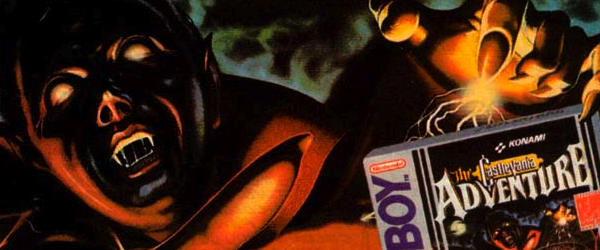
I had hoped that Castlevania: The Adventure had not suffered from the same syndrome that plagued other early Game Boy releases. I could only imagine how painful it would be to slog through a stripped down, underwhelming iteration to one of my favorite franchises. It was a cringe-worthy enough prospect that I thought it might be better to skip The Adventure all together and save myself the grief. I would have done so, were it not for one tiny beam of hope that told me to give the game a fair shake. After all, what would I stand to lose except a bit of free time? It's not as though Game Boy platformers are known for longevity.
So I bit the bullet, fired up the old Game Boy, and leaped into The Adventure. It seemed to be a fair enough title at first. Unmistakably Castlevania-style music blared from the Game Boy's miniature speaker. Meanwhile, protagonist Christopher Belmont stood before a dark, visually striking background. I breathed a sigh of relief and thought that I had prematurely misjudged the game.
...until I moved Christopher.
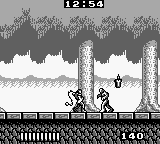
Mr. Belmont didn't shoot across the screen, nor even plod along at a moderate pace. Rather, Christopher moved like he was knee-deep in molasses and in dire need of hip replacement surgery. If you've played more than a few old school platformers, then you know how important movement speed can be in such a game. Without at least average speed, The Adventure's pacing took a severe dip. For much of my playthrough, I either grew impatient as I moved Christopher down lengthy corridors or I nodded off due to absolute boredom born of the game's lethargic animations.
 Credit: Konami
 Credit: Konami
Thankfully The Adventure featured challenges that were stiff enough to somewhat distract me from its dreary pacing. Stage three, for instance, sported a sizable run of descending spiked ceilings, followed by an ascending gauntlet of tough platforming situations paired with a rising bed of spikes. All it took was one misstep and I had the privilege of watching Christopher plummet and end up impaled on the skewers below.
Believe me, one misstep was not difficult to make, mostly thanks to the game's stiff play control. Not only was the control response sluggish, but The Adventure's jumping mechanics were also quite wonky. The arc of Christopher's jump was so awkward that it was difficult to properly time a leap. Thanks to that, the game went from being merely dull to a devastating combination of tedious and frustrating. It wasn't a surprising event to fall short of a platform and descend into the infinite darkness below. Worse, the campaign was loaded with platforms that dropped when I landed on them, forcing me to jump yet again as my feet made contact with them. This wouldn't have been so irksome, except that I had to land on these suckers just right. Failure to comply usually led to Christopher getting stuck in a permanent crouch while the platform continued to plunge. Down Mr. Belmont would fall along with the platform, a victim of poorly programmed mechanics.
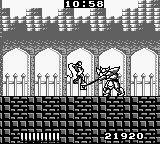
Faulty physics and extreme frustration were not The Adventure's only sins. More than those two issues, I was disappointed with the absence of certain franchise trademarks. The most noticeable example was the lack of sub-weapons. Yeah, that's right. This is a Castlevania game bereft of one of the brand's defining features. Instead, I had to rely on the whip and cat-like reflexes to succeed in combat. Of course the latter would require solid mechanics to work effectively, so uh...... Oops...
 Credit: Konami
 Credit: Konami
As if horrid mechanics and banal combat weren't enough to suck the "epicness" out of The Adventure, the title also featured some of the most unimpressive boss battles in the franchise. I didn't tangle with Death, match wits with Medusa, or war with any other classic bosses in this installment. Sadly, the bosses offered were not a suitable replacement for the missing familiar faces. Out of the four of them (yeah, The Adventure is only four levels long), the first three were pretty much glorified enemies. They didn't carry the presence that bosses in previous Castlevania games did. This was especially true about the second boss, which was a pack of cavern-dwelling monsters that sprung out of holes in the wall. Each individual cave monster took only a single shot to kill, and only one or two appeared at a time. Is this really the best a company like Konami could conjure up for a boss? Of all the missed opportunities rampant in The Adventure, the lackluster ensemble of villains was the most painful for me to endure.
Bottom line: if you're a Castlevania fan looking to make a pilgrimage through the lesser known Game Boy titles, then I suggest you skip The Adventure and dive straight into Castlevania II: Belmont's Revenge. With only four arduous levels, lame bosses, wonky mechanics, and no sub-weapons, you wouldn't be missing much were you to ignore this one all together.