
Super Mario Maker is proof that Nintendo's developers know what they're doing and apparently always have. Working with tools that functionally are difficult to distinguish from the ones the new Wii U title makes available to players, the company's teams have over the last few decades constructed hundreds of brilliant stages that could practically function as the sole curriculum in a school devoted to the topic of platformer game design.
People like you or I, even when presented with improved tools, almost invariably create stages that needlessly frustrate, bore, or otherwise fail to satisfy. I know this both because I've built my fair share of dull courses in Super Mario Maker (and have shamelessly shared them with the masses), and because I've conquered wretched challenges that obviously were an attempt to "troll" me. You know, because that's what people do when they find themselves in possession of amazing tools: they work to make other folks miserable…
The single issue the game brings to the table that I most wish would go away is the one I know can't: the jerks. Given the opportunity, a mean-spirited minority will go out of their way to ruin things for others. There's no reasonable step Nintendo can take to prevent that behavior from impacting the overall experience because there are simply too many people playing the game. We're all left to cross our fingers and hope the jerks get bored and the uninspired creators get… better.
 Credit: Nintendo
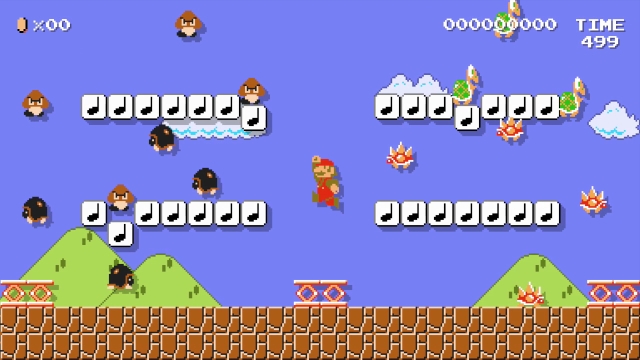
The basic idea behind Super Mario Maker is that Nintendo has been making Super Mario games for years and now it's our turn to see if we can do any better. This is an exciting notion to the many creative players who have been mapping out levels in our minds--or on graph paper--for years, but there are a few wrinkles. Mario has appeared in a number of robust titles over the years, and his adventures have offered more variety than a lot of folks realize. Although the essentials are definitely covered, you're bound to find something missing.
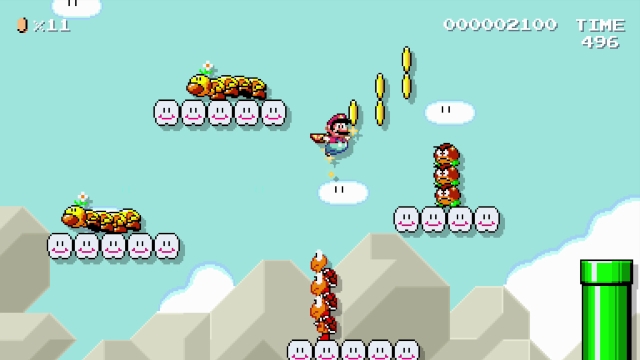
Super Mario Maker includes assets from four eras: the original Super Mario Bros. title that started it all, Super Mario Bros. 3, Super Mario World and the New Super Mario Bros. titles as most recently depicted on Wii U in New Super Mario Bros. U. These are basically presented as skins, so you can build a level in one mode and then decide it works better in a different one thanks to the accompanying changes to physics. Mario can't carry turtle shells in his first outing but can from that point onward, for instance, and he skids around a lot more in New Super Mario Bros. but also gains the ability to wall jump. Such difference will of course affect how you might design a stage.
 Credit: Nintendo
Although Super Mario Bros. feels to me like it is represented rather thoroughly, except for slight tweaks to how stages conclude (there's no way I could find to mimic the original 1-2, where Mario enters a pipe outside a castle and drops into the dungeon, then exits to climb a staircase at the end and clear the zone), a game like Super Mario Bros. 3 originally had a fair bit more variety than is represented here. Enemies such as the angry sun are missing, and you can't drop in Spike or the fish that likes to swallow Mario whole. Sloping stages also aren't possible, meaning Mario can't slide down a hill and clear it of Goombas, which was a lot of fun in the original games.
Another obvious omission is the world map, which tied stages together in many of the previous Super Mario titles. Here, you're building just a single stage at a time, with no thematic connection or mushroom houses or switch palaces and such. Even if you build a series of stages that you would like players to progress through in a particular order, there's no way to force it or even to helpfully facilitate it. Levels you share must be uploaded and then people have to enter codes to access each one, a little bit at a time. It's also possible to follow a creator and browse available offerings, though I still found that system rather obtuse.
 Credit: Nintendo
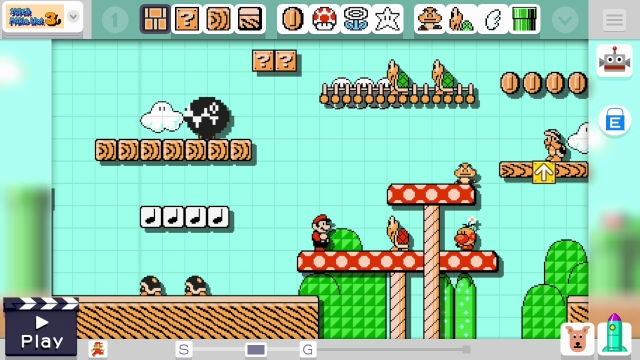
When you first begin with the game, you'll be granted access to a few basic features from the original Super Mario Bros. game, and that can get you started but won't take you far. You are then expected to fiddle around with that for the first day or so, and then you can come back the next day to access more goodies. This approach all but demands that the player mess around with his system clock to speed up the rate at which content becomes available, which is a hassle. I get the idea behind it. Nintendo wanted to make sure that players understood each new item and were able to productively use different assets to make neat designs. However, I feel that things are doled out too stingily.
Actually, Nintendo is a victim of its own success. The new content doesn't feel like it comes quickly enough because Super Mario Maker makes such a breeze to build levels that you don't spend much time at all wondering what you're doing. Whatever the game's flaws--and there's a bunch of tiny interface stuff I can't possibly describe in detail here--it does get that one central point almost perfect. Using the Wii U gamepad, the process is the next best thing to idiot proof. You start with a patch of ground on the left side of the stage and you can move the goal closer or further away, then drag and drop ground tiles and enemies and obstacles and hazards. From there, you can immediately press a button to test the stage from the start to its finish, or you can tap an on-screen icon to play from Mario's current location. Testing everything is a snap, and you can erase erroneous tiles with a quick tap. There has never been a better argument for the gamepad, in my opinion. I was creating a stage and completely understanding the process within seconds.
 Credit: Nintendo
Once you have the basics down, you can then make further tweaks and design some crazy stages. A lot of the icons that you drag onto the screen can be shaken if you wish to modify behavior. For instance, a green Koopa enemy will just keep walking unless you establish boundaries to make him march back and forth, but you can shake a green shell to turn it red and that turtle will stop at the edge of platforms, rather than diving to his death in a bottomless pit. A lot of icons can be modified in this manner, which feels intuitive and even produces sound effects and little bits of visual feedback that are a lot of fun.
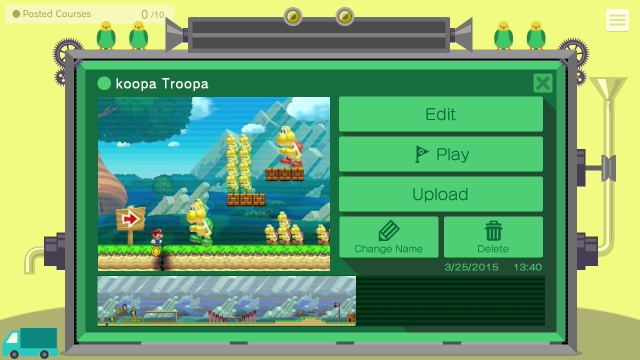
Once you have created a stage, you can upload it. Nintendo won't let you store it on the server, though, unless you first prove your little stage is actually possible to beat. By default, you can store up to 10 stages. Other community users can play them and "favorite" them, which apparently increases the number of stages you can offer. Your creations are then indexed almost entirely at random--from what I can tell--until enough people mark them as awesome that they rise to the top. Up to that point, you have to rely on friends tagging them (share codes on social media if you want more people to attempt them) or on the kindness of strangers who encounter your designs in 100-man Mario.
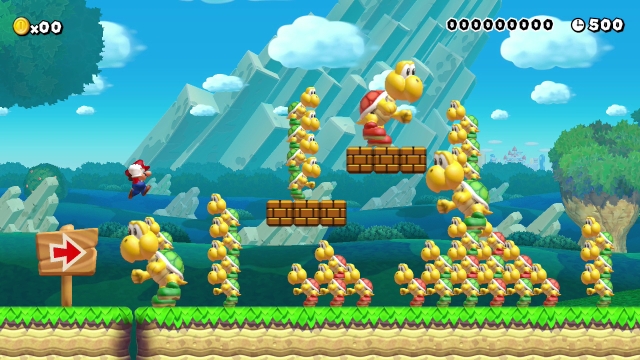
The 100-man Mario mode mixes a bunch of player-created stages, ranked into three eventual categories by apparent difficulty. On the easiest setting, you have 100 lives to clear 8 relatively simple stages. You can also attempt the "Normal" setting, which doubles the number of stages you must clear. Once you find success there, you can attempt the "Extreme" setting, which is full of stages designed by other players who apparently hate you. They'll put invisible blocks in unlikely places to drop you into a pit, or they'll put together such devious constructions that you'll swear they're impossible until you spend 30 or 40 lives messing with them. They're beatable eventually, but blind leaps and extensive trial-and-error aren't my idea of a good time.
 Credit: Nintendo
Nintendo made an effort to establish a strong community vibe. Besides awarding a course a star if you like it, you can also leave a comment for the creator. I like loading up a list of my courses and finding out that someone has commented, but reading through comments takes ages because the game often needs to connect to Miiverse. I wish that side of things were more seamless. It would certainly encourage me to use the community features more often. Right now, though, I'm tempted to ignore them just so I don't have to suffer through the delays.
Despite its flaws, though, and in spite of those players who build stages that seem to have been designed primarily as some sort of torture device, Super Mario Maker has endless potential and should keep Super Mario fans busy for as long as they want to spend hopping and bopping in the Mushroom Kingdom. I love how intuitive the core tools are for creators, and I love knowing that each new stage I play could make me look at the franchise from a whole new angle. The game has a lot of rough edges, but it does so many things right that I just don't care. Here's hoping the potential DLC materializes, at least, and maybe we'll even get some official tools to make our own Zelda games at some point in the future. I'd like that...