


Dreamfall: Chapters is the least angry I’ve ever been with a sequel.
That’s a pretty backhanded compliment now I see it taken physical form on a page rather than floating around the confines of my head, but the newest Dreamfall title could have gone so very wrong. It’s the direct follow-up to a game that ended on a cliff-hanger finale initially released over eight years ago, and that’s a long time to be waiting for a sense of conclusion. Creator, Ragnar Tørnquist, once again heads the project, but does so at the helm of his own company with the series rights licensed from Funcom. This moves the project from an established developer to what’s effectively a well-backed indie group; to get off the ground, Chapters was not only kickstarted by fans, but received funding from the Norwegian film society. Perhaps due to the time gap, it’s not been able to always source returning voice actors and its development has been an interesting thing to track. Originally planned as a series of episodes, this was scrapped in favour of a fully fleshed-out release before an episodic structure was reinstated once more. Break my heart though it might, I was not expecting this particular saga to end well. I’m delighted to (thus far) have been proven wrong.
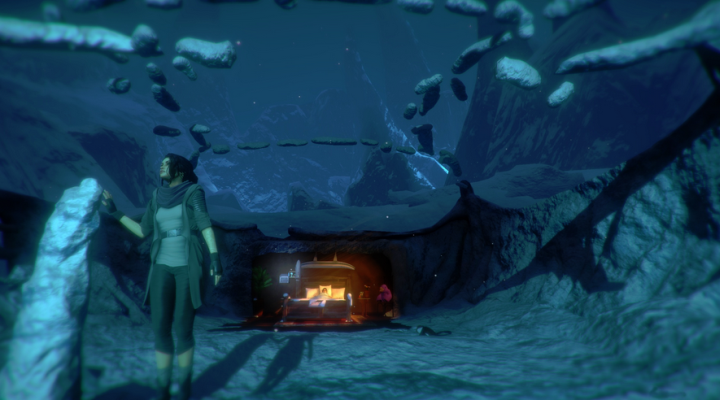
Despite claiming to be easily accessible to new players, Chapters does away with easing in and jumps right back into the twinned worlds of cyperpunkish Stark and fantasy Arcadia. Previous protagonist, Zoë Castillo, is trapped between the two words in a limbo known as ‘Storytime’ where she whittles away her hours trying to save people from manufactured nightmares and watching a projection of her physical form rot away in a hospital bed. It’s purposefully vague in her role, bestowing upon her certain powers that you need to fiddle around with to discover the meaning of as she wades into other people’s minds like an angelic Freddy Kruger. I’m at odds to delve much further into this – I guess the statute of limitations for spoilers has long been reasonably eclipsed on an eight year old game, but, I dunno, reasons, I guess. It’s a pre-established story of such worth I’d rather walk on eggshells now then potentially taint it for any of you coming in new that might be tempted to revisit the earlier games. She’s suck in limbo and she needs to get out. That’s a good enough way to succinctly explain it while at the same time being exactly wrong.

So, let’s talk about Kian instead, because I’ve no issue ruining his earlier role. Kian was an excuse to push a clumsy, almost-broken combat system in the last game and has rightly been imprisoned for it. Or it might have been less meta, and is for rebelling against his religious doctrine instead. His reintroduction takes place in the midst of an off-screen prison riot where he needs to make his way to the top of a tower while being very slowly chased by guardsmen. This highlights a lot of positives, the first being that, at no point, does he ever fight anyone letting me live in the heady hope that Tørnquist has learnt from the biggest of his last title’s errors. It’s dotted by inventory puzzles that err or the side of overly easy and existing for the sake of having inventory puzzles. One dilemma exists purely in the realms of lateral adventure game logic where you will likely come to the solution purely because of the limited interactive items you have at your disposal, rather than because it makes sense. The other tasks you with constructing a rudimentary torch, ignoring the fact you need to traipse back and forth past an already lit candle on a desk to do so.
Comparisons to the Telltale formula rolled out with The Walking Dead are going to be impossible to avoid; there are moralistic choices to make that are openly concluded with ”X Will Remember That….”, but it would be unfair to suggest that Dreamfall: Chapters doesn’t have its own take on the process. A seemingly mundane choice massively alters Zoë’s life outside of Storytime, providing two very different paths for her to follow. Making these choices is also given a lot more depth than you might be used to; immediately available to you is the percentage split of previous players and which decision they went with. The choices themselves are highlighted with inner monologues so you know exactly what the condensed verbal prompts you’re picking between mean. They feel impactful, like they matter. You don’t have to wait long before you discover that they actually do.

Everything comes together once you find yourself exploring the expansive mass of Europolis; the huge sprawling megapolis that now covers most of Europe. Promises of what this might become as a hub are hinted at through guarded checkpoints barred with flickering blue laser. It’s all very dystopian, with artificial suns offered as perks to living in run-down apartment blocks to try and offset the permanently grey skies. Neon lights and holographic sculptures vie for attention along with talking maps fronted by cartoon cowboy crows (Crowboy, for those who recognise the reference) and spam-spewing ad bots floating around like pesky flies. It’s easy to get lost in the Chinese market of food stalls and have-a-go merchants, or wandering up through levels stacked on top of each other in the search for your next goal, or just for the sake of poking around. Stop to chat to one vender, and he waxes dreary philosophical about how he feels like a bit player in someone else’s story and that he doesn’t even known what he’s supposed to be selling it’s so unimportant in his efforts to move you on.
If Dreamfall: Chapters did anything to belay my fears, it’s moments like this. The game’s setting is fantastic, and the premise has potential, but it’s genuinely funny and engaging. New voice actors reveal in the confused and the dramatic, but nail the stuttering uncertainty, the mounting hostility and the sheer ludicrous aimed at making players smile. Chapters is just as happy to poke fun at itself as it is to openly mock you, and does so with a sense of confidence that makes you want to hunt down the mumbling NPCs and interactive hotspots just to see what might happen next. Checking out a rubbish bin will lead Zoë to inner monologue about how she secretly thinks they’re part of a shadowy conspiracy, while showing an interest in various vending machines will offer you such tempting morsels as crispy jellyfish bits. In these moments of light-heartedness, the series harkens back to the tight script in the The Longest Journey, while at the same time, offering a small slice of the exploration and fleshed out lore of Dreamfall. It has intoxicating moments where it realises the best of both worlds. I can’t find it in me to be disappointed in that. I can only hold future episodes to that same expectation, and wait.