
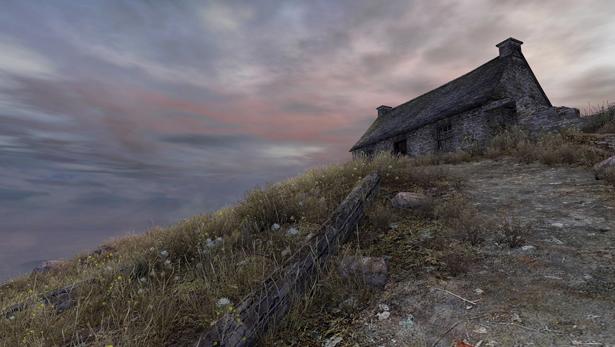
Dear Esther opens with stunning, somber imagery. You begin the game's arduous pilgrimage on a gray beach with a shrouded sun that barely radiates through a reddish-blue overcast. Violet waves crash against the shoreline, almost in rhythm with the island's undulating sea of wild grain and weeds. After soaking in the wonderfully melancholy scenery, you may begin your "quest," which consists of walking.
...and walking.
...and walking.
...and walking.
...all while listening to an old man gab to an invisible listener about various characters and situations, ranging from a car wreck to kidney stones. Religious undertones ensue...
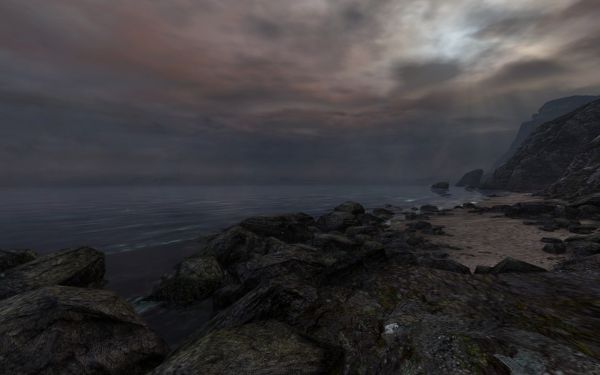 Credit: The Chinese Room
Dear Esther is a minimalist game that could best be described as "a walking simulator" or "interactive rambling." There are no puzzles to solve or stimuli to interact with. You simply walk from one point to another, all while an elderly protagonist muses to a woman named Esther about their time together, mutual friends, people who supposedly inhabited the island he's traversing, and an injury he sustains while plodding the game's course. Eventually you either "beat" the game, fall asleep, or boot up a more exciting title, like Warehouse and Logistics Simulator.
I'm not opposed to "walking simulators" necessarily. For instance, I found Fibrillation to be an intense, creative minimalist title. Even Kairo isn't such a lousy excursion, as the game besets you with troublesome riddles whilst refusing to hold your hand. In Dear Esther, though, all you frickin' do is walk. You don't have the benefit of running or jogging, or any other means of expediting its tedious process. Again, I can't emphasize this enough: you just walk.
Where narrative is concerned, the game at least isn't terrible. It tells an unconventional tale, where arbitrary bits of yatter spewed by the game's camera eventually form something along the lines of a coherent story. Throughout the trip, you can also spot some obvious symbolism, ranging from writings on a cave wall to a cleverly positioned candles and floating paper boats. Somehow, it all ties in with the protagonist's tiresome blather, but it's up to you to make all of the connections. Dear Esther is the kind of game that will either have you pondering deeply on its material or hitting forums and blogs so you can discuss or adopt someone else's perception of the game's events. This is, of course, assuming you care at all...
 Credit: The Chinese Room
Part of my problem with the game is that I just didn't give a damn. I was so irritated by its slack pacing and ambiguity for ambiguity's sake that my only desire was completing the route so I could scratch it off my backlog and not feel that I had wasted a few bucks on an unfinished turkey. Nothing about the characters described in the lengthy letters to Esther struck me as interesting or worth worrying about. As a result, I concluded the narrative with a sigh and a shrug.
The good news is that there is a climax, and its quite the spectacle. The tone of the narrator's voice shifts from nostalgic to apologetic and grief-stricken. Eventually, you ascend a lighthouse where the character's final actions play out, and the view of the open ocean and seemingly defiant skyline wrap up the banal experience in an unexpectedly fantastic way, one that almost begs you to play the game again if only to behold the grandeur of its breathtaking graphics.
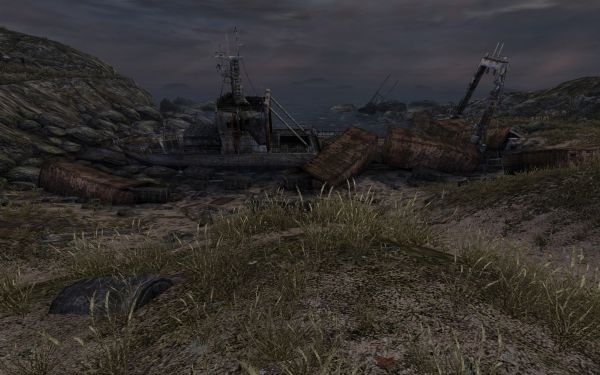
Sure, the game's visuals and soundtrack are terrific, but they don't excuse its lack of interactivity. I suppose you could say that the overall experience is relaxing, but I hardly find the boredom that Dear Esther induces to be a suitable replacement for excitement. Where graphic adventures are concerned, Dear Esther feels like a snobbish game. It doesn't want you to touch it much or immerse yourself with it entirely. It seems to prefer you to remain disconnected from the outing, relegating you to the role of cameraman rather than player or observer.
 Credit: The Chinese Room
Depending on how much you enjoy pretentious storytelling in gaming, you'll either love or hate Dear Esther. I don't think many people will find a middle ground with it. My guess is that you'll either melt in your seat or hunt through your Steam library for Alien Shooter, so as to purge Dear Esther's form-over-function vibe from your palate.