


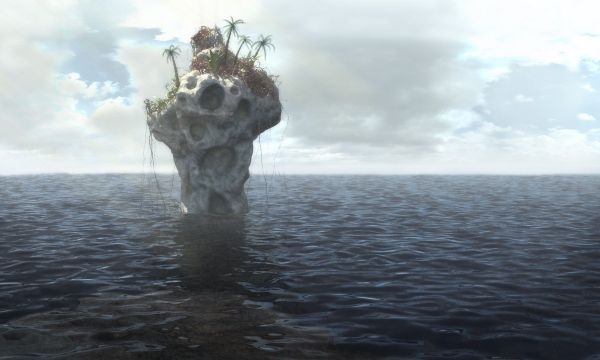
Bad narrative is the downfall of many a video game, but it‘s the last thing I‘m going to complain about today. J.U.L.I.A plays out as a quirky sci-fi noir, having protagonist-of-sorts, astrobiologist Rachael Manners wake up in her deep-space probe’s cyro-chamber to find herself utterly alone and with no explanation as to where her entire crew has vanished to. Her only companions are the damaged ship’s AI, J.U.L.I.A, and the hulking exploration drone, MOBOT, sitting charging in the launch bay.
Finding the fate of the crew quickly becomes Rachael’s primary concern after repairing the ship well enough for intergalactic travel, using MOBOT to do the physical exploration while she pulls his strings from orbit. Though obviously intelligent and rife with scientific curiosity that vastly outweighs her computer-driven teamates, Rachael provides the human foil, snapping from frustration and fear, initially drowsy and suspicious after being awoken to complete isolation and prone to emotional outbursts that she needs to be talked down from. Her counterparts can hardly be labelled as one-dimensional AI tropes, either; J.U.L.I.A is able to be sympathetic to Rachael’s plight and is often the voice of reason, but grows surprisingly attached to her makeshift crew. MOBOT, even though he’s voiced by the same text-to-speak program employed by Stephen Hawking, shows a remarkable sense of self preservation and a suspiciously dry sense of humour.
Most of the game’s plot advancements come from data pads and computer files kept by former crewmembers scattered across the half dozen planets, and their suspicious tale is revealed on a drip feed. Though the majority of their fates are grizzly, this sense if played out through their chillingly macabre recordings and mounting suspicion that things aren't right. The game collects a pile of questions expertly, never really offering you an outright solution, but giving you enough threads to work out your own theories along the way. Though the eventual big reveal is gifted to you rather than discovered on your own merit, I found myself surprised by not being disappointed for not playing more or a role in this. At around six hours in length, J.U.L.I.A does enough in that time to bait you into wanting to see the end result through nothing more than knowing how to tell a good story, to invest you in the characters and have you want to see their journey through. With this in mind, the relative ease of the puzzles stops being such an obstacle and instead becomes a boon by never dragging you right down to staring at a screen and allowing you to move swiftly through the stages.
This makes it a recommendable video game featuring a strong narrative, fantastic storytelling and a real sense of personality. But. It’s also cosmetically bland, features hugely osculating voice work and, as an actual game, remains very basic and overly easy.
To grind it down to the basics, J.U.L.I.A gives you a little snippet of its laudable plot, then you’re forced into a puzzle of some kind that often boarders on the ludicrously easy. You can repair the ship’s damaged parts by dragging selected elements into a coloured box within a set time limit, or build complex engine parts by playing Pipemania (but, like, in space!). You can repair backed-up hard drives by un-mixing mixed-up pictures and strip-mine planets by matching escalating bars of element lodes to static counts pre-supplied. One puzzle is more complex than most: it asks you to repair an off-world science station’s oxygen count by messing around with the percentage of background gasses present. It requires a simple mathematical equation, but feels this might be too large a stumbling block, anyway, so offers to solve it for you right off the block.
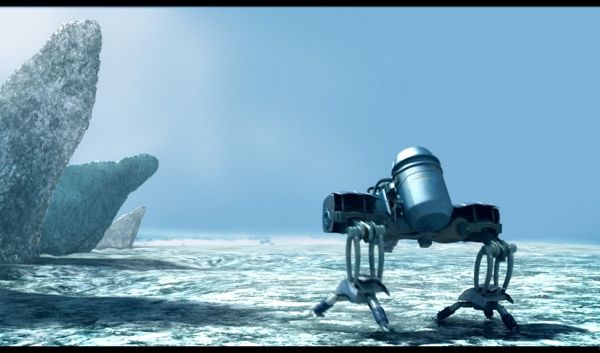
Sadly, this equates to the interactive half of the game, which has you do as little as pick you destination out of the six planets you have access to, then puzzle your way through to the plot explanations. Some of this works a lot better than it should; find yourself on the jungle-choked surface of one planet, and you’ll discover the dense overgrowth stops you from being able to map out a path, so you have to manually explore. This leads to an auto-mapped grid exploration that has you trekking through intertwining corridors, mapping out notable locations and trying to find sentient life. Then, when you do find intelligent life, you have to solve the game's worst puzzle wherein you decode its alien language by matching glyph patterns governed by an overly-strict time limit.
It’s a shame that the often scene-destroying puzzles are so clumsily shoehorned in for the most part, existing to give the game a sense of interaction because, when they do make contextual sense, the ties made with the brilliant plot show what the title is capable when it’s truly firing on all cylinders.
This certainly does not make it a game for everyone. J.U.L.I.A does nothing to hide that fact that completion requires little more than a light cerebral workout and whatever time you’re willing to spend on it per sitting. You’ll rarely, if ever, find yourself truly stuck and the game’s highlights offer almost zero interaction. These are not elements to be lauded, but it does little to take away from the genuine feeling of satisfaction seeing the title through gave me. I enjoyed the time I spent with J.U.L.I.A. That may not be enough for everyone, but it’s more than enough for me.