

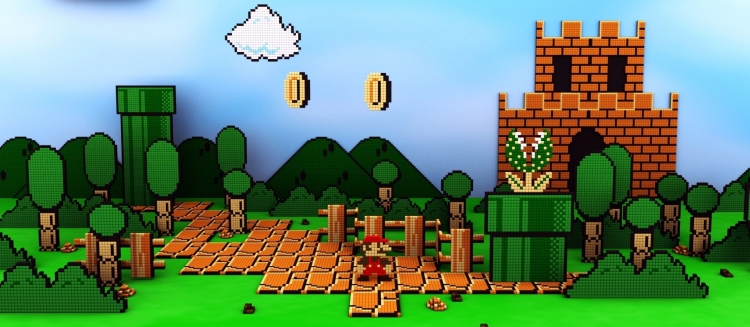


On the NES, there is a game called Day Dreamin' Davey. It's about a young school lad who escapes into the worlds of his dreams and has adventures. I've played it before, and even recently added it to my collection. Someday, I'll probably play it a lot more. But my point in mentioning the game isn't to remind you that it exists. Rather, it's to say that if you changed the protagonist's name to Jason, it might well be a game about me.
I have always had a thing for hidden worlds, in my waking and more imaginative hours, in my dreams, and of course in the entertainment I consume. Blaster Master is another game that interested me when I was a child, because it's about a boy (named Jason!) chasing a frog into a hidden world. I was thrilled when I found out about the glitched -1 World in the original Super Mario Bros. I devoted many hours to my search for a World 9 in Super Mario Bros. 3 when I heard such a thing might exist. And one of the only things I feel like Super Mario World did better than its predecessor is that it introduced Star Road, which connected the various regions and allowed players to access "Special" world and eventually to cast an autumn spell on the regular game world. That sort of thing was totally my jam.
So when I bought the GameCube and looked at the box, I was thrilled by the quote on the back that is attributed to Shigeru Miyamoto:
"What if everything you see is more than what you see--the person next to you is a warrior and the space that appears empty is a secret door to another world? What if something appears that shouldn't? You either dismiss it, or you accept that there is much more to the world than you think. Perhaps it really is a doorway, and if you choose to go inside, you'll find many unexpected things."
To me, that quote sums up the essence of what video games and entertainment are all about. It's not that as a rational human adult, I believe we can step through a wall in a train station and arrive at Hogwarts. But that hasn't stopped my imagination from thrilling at the notion, from my earliest memories of time spent reading through the Narnia books when I was in second grade, to my enjoyment of works by authors such as Stephen R. Donaldson (with his Thomas Covenant books, for instance) as an older reader. If your concept in some way involves a hidden world, especially a fantasy one, I'm twice as interested in whatever story you're telling as I was the moment before I heard about that single element.
Even the fiction I write tends to focus most heavily on the elements of the world, rather than the characters (which doesn't work particularly well for me, since most people read fiction for the characters first and foremost even if they don't always realize it). My first "serious" attempt at novel-length fiction, around the time I was a freshman in high school, involved a boy of about that age who winds up in a fantasy world and of course must save it.
But that's a lot of rambling, surely. What does any of it have to do with the actual subject of this blog post, which is Sony's rumored plans to stop selling PSP, PS3 and Vita games?
The answer is that as someone who appreciates hidden worlds and the escapism they provide my imagination--something I consider vital to a satisfying and perhaps even a healthy human existence--any decision to stop making those games available feels like the next best thing to a crime.
Picture if you will a series of interconnected hallways. On either side, doors branch off at regular intervals. At the end of the hallway, there's an "exit" door you already know just leads to another such hallway, or you can turn left or right to find more hallways as the process repeats, fork after fork. You've entered some of those doors in the past. You know each one leads to a unique experience that could mean anything from racing dirt bikes off-road to slaying a dragon or exploring a dilapidated English manor or descending into hell's depths with a shotgun and a chainsaw. Maybe you've had a particular experience before, because you've entered that doorway. Maybe you haven't opened the door yet, but you have definite plans to do so in the future. Perhaps you've walked past another door many times and may never make time to open it, but you just find it comforting knowing it is there and that someday you could if you wanted to. Then, once again, you would be like Alice tumbling down the rabbit hole or stepping through a looking glass.
Sony pulling games from the store bothers me because it locks a lot of doors and blocks off too many corridors. It's like the company removing a magic key ring, which could provide access to every door along that corridor, and saying, "There's nothing here for you." Now I can only access the ones I've already paid to unlock, or the one's being constructed in a new wing where dust hasn't had time to settle. Never mind that I could have paid to access some of the suddenly off-limits corridors quite easily at any point in the last 10 years. I just hadn't gotten around to it, but eventually I would have. Now I can't.
Sony isn't the only one to pull those magic key rings, of course. I wasn't any happier when Nintendo took similar action with its library of Wii games. Luckily, we had plenty of warning in that case and I was able to (somewhat) conveniently purchase access to very nearly all of them. The exceptions were those games that had vanished ahead of the deadline. But there weren't many of those, thankfully.
Each time a company says, "Hey, we can't keep making these available forever, obviously," my response is, "Why not?"
Nintendo is a large company, one of the most successful in Japan, with billions in revenue. The games on WiiWare--the entire library of them--fit on less space than now is available on a single microSD card. The company could copy and store that library in multiple instances all over Japan and the world for a modest amount of money. It could develop and maintain an interface allowing people to buy and access those games indefinitely. But of course that didn't happen, because mostly consumers can be counted upon to just sit back and say, "Well, okay," when a company says, "Of course we can't keep that content available."
Rumors say Sony will pull PSP, Vita and PS3 games this June, and there's already evidence we should pay attention to those rumors. Until this week, you could still follow a URL and access the store and buy the games online that you wanted to add to your collection. Now you can't, because Sony actively changed that with a redirect. You can still go through the hardware itself when you want to buy, if you can even connect it to the Internet (I found out I can't connect my PSP to the network unless I modify my router to send an older signal). But the option to make additional purchases through your hardware is supposedly going away in just a few short months. Then hundreds or even thousands of games will become unavailable. Thousands of doors that might have let us to escape to fanciful worlds or waking nightmares (some people apparently like that sort of thing) will suddenly lie beyond our reach.
We can turn to emulation, of course, but that's not quite the same and it's unfair to those of us who still want to do things the "legit" way and play games on the original hardware, in conditions like those their creators had in mind.
I don't believe I will ever stop asking "Why not?" when game publishers say, "Well, we can't keep our games available to you forever." It's a question I believe more consumers need to start asking. If we don't, more and more hallways full of magical doors will turn into distant memories as publishers tempt us to frolic in their "games as a service" fields. Stop letting those companies throw away the keys and start reclaiming some doors!

dagoss Mar 28, 2021
honestgamer Blogger Mar 28, 2021
Germ Mar 28, 2021
These new technologies and ways of backing things up are vital and necessary, official store fronts are just a pretty nice thing to have.
(Also it is super dumb that companies are doing this, don't get me wrong.)
honestgamer Blogger Mar 28, 2021
Germ Mar 28, 2021
Hey, did you really buy most of the Wii library digitally? How many games was that? Hundreds? Thousands?
That's really cool. So much to explore.
honestgamer Blogger Mar 29, 2021
overdrive Staff Mar 29, 2021
honestgamer Blogger Mar 29, 2021
jerec Mar 29, 2021
honestgamer Blogger Mar 29, 2021