


Taking cues from Sega's OutRun, Taito's Chase H.Q. puts you in control of a souped-up police car from a behind-the-view perspective, speeding through traffic as a time limit counts down. A checkpoint racer? Not in the sense that you're probably thinking. The first objective of every stage is to reach a criminal's getaway vehicle at the halfway junction before time runs out, and the countdown will replenish when you successfully catch up to them. From here, the goal changes: you must now ram the vehicle several times and completely drain their health meter, doing so while again fighting traffic and a timer.
That's the main template for the series, which had several modifications and features added to its sequels over the years. So by the time Super Chase H.Q. was released for the Super Nintendo, expectations for this 1993 release was for it to be an exceptional successor; the company had five years from the IP's beginning to get its act together by this point.
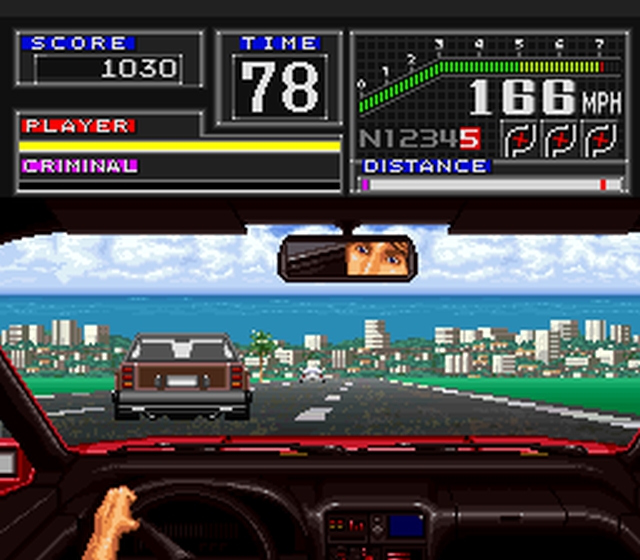
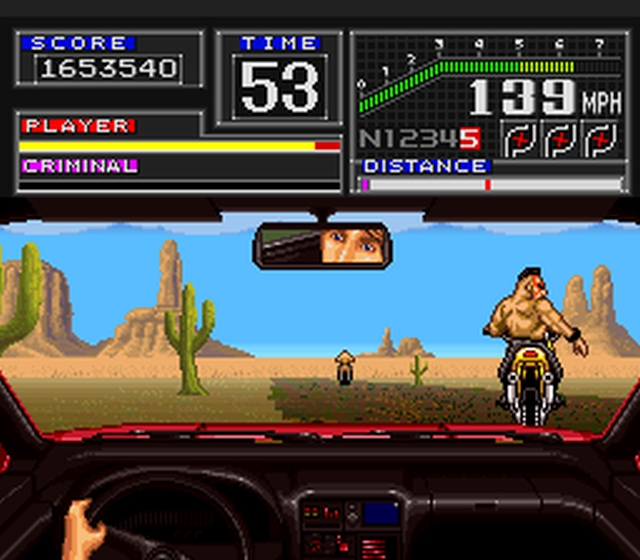
Being a toned-down remake of the 1992 arcade game, Super Chase - Criminal Termination, the SNES "port" did something different from its predecessors: it changed the perspective. With the vantage point now taking place inside the car, you get a more personal, in-your-face view of the action. Vehicles on the road are now visually bigger and the road is fitted with smooth Mode 7 textures. There's also a rear view mirror that serves no purpose other than to show the reaction of your driver. None of this holds a candle to the visually-intense Super Chase, which the Super Nintendo version had to omit a ton of segments from; that's to be expected, especially since every other console port prior has never matched the power of their arcade counterparts.
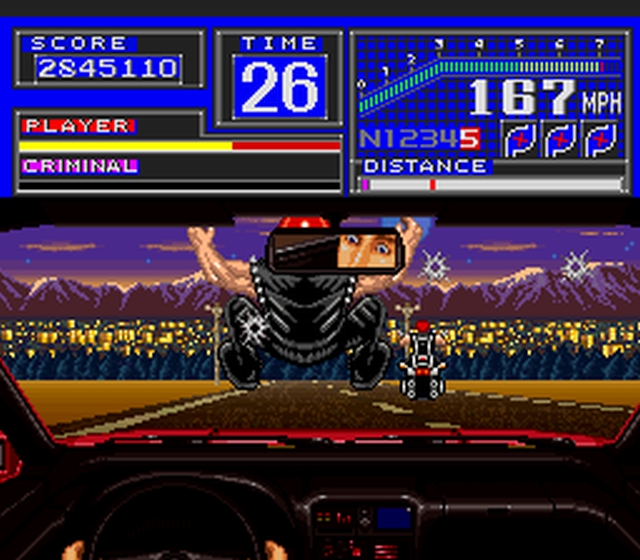
In spite of all these changes and exclusions, the core gameplay has remained the same. That's actually a very concerning thing. Just like with its predecessors, there's a grand minimum total of five stages, sometimes a sixth if you're good, and they all pan out the same: easily dodge traffic and then play bumper cars with a criminal. There's "variety," like when a helicopter shoots at you, or when a gang of bikers throw explosives on the road, but these are things that were present in earlier titles; the devs were content with repeating these encounters with no attempts at improving them, as if that was good enough. These sections also don't last long, but that's more the fault of stages themselves not lasting long, since this console remake is so adamant with replicating the arcade experience.
But that's why these games work in the arcades: because they are constructed as quick thrilling experiences where people can get into them for a few minutes at a time. This structure doesn't stick well at home, unless it either has solid replay value or expands on its core by giving the player more to do. Super Chase H.Q. has neither. In fact, if you were to compare this to the other console Chase games, then the SNES game is shockingly bare bones; the SMS port of Chase H.Q. has a shop menu and three loops to get through; like its arcade version, the SMS release of S.C.I. allows you to shoot at cars; Chase H.Q. II for the Genesis gives you three different vehicles with varying attributes to choose from.
What's Super Chase H.Q.'s defining feature?
A different camera angle...
Taito fumbled and went about Super Chase H.Q. the wrong way. Instead of trying to relegate Super Chase into a 16-bit "companion piece," they could have made a fully original Chase H.Q. title for the Super Nintendo. Unshackled by arcade rules that the devs imposed on themselves, the game could have been a merger of all the aspects and mechanics featured in previous titles, within a structure that could have been longer and more in-depth. But this is what was released, a retread that is somehow inferior to the other port jobs that came before it. The SNES library has way too many engaging and fun racing titles for you to waste time on something that even its own company seems to take for granted.