


R.B.I. Baseball ‘95 has a weird Alpha and Omega vibe going on, being simultaneously the birth of 32bit baseball games and the temporary death of a long running franchise. Debuting in 1987, the series bumbled along with an annual release schedule E.A Sports had yet to aggressively monopolise. Then, seven releases later, over a cavalcade of differing systems and a developer churn that included Atari and Tengen, Time Warner took their turn. By this point they’d had a few previous attempts, which saw games released on the Game Gear and Super Nintendo, but it was this 32X exclusive that was to serve as the series’ final chapter. Until it wasn’t. R.B.I. had some odd licensing issues attached to it, being fully licensed by the Major League Baseball Players Association, which gave them the rights to players names, meaning that everyone involved in playing virtual baseball was the pixel-plotted representation of a real life player. But it was unlicensed by Major League Baseball itself, so it couldn’t mention the actual team names, just labelling them with their respective state. It turns out that MLB were just biding their time; almost twenty years after the last R.B.I. game, MLB’s digitally-focused branch resurrected the franchise under R.B.I. Baseball ‘14, really showcasing their famous flair for names. It’s gone back to being a yearly staple ever since.
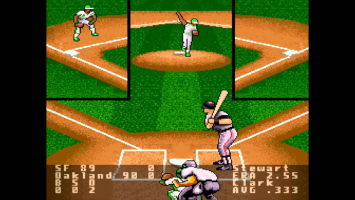
Before that, though, was the game I’m doing a decent job of distracting myself from with inflated word counts rambling history lessons. On the face of things, it was clear that R.B.I. Baseball ‘95 took its new, more powerful platform seriously, redrawing every sprite model to take advantage of the 32X’s superior palette options and processing. As recently as Super R.B.I. Baseball released earlier that year for the SNES, the game’s camera is centred slightly above where the umpire would normally stand, with windows made available for crowd reactions and runners on base. ’95 did away with the windows and took full advantage of the massively upscaled character sprites, adopting the now near-universal catcher camera view.
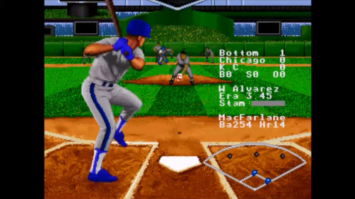
What you’re left with is a decent early runner for what would become the archetypal baseball simulator. Apart from things like the commentator routinely mixing up their left and right. Or how the audio clip over the menu screen seems to cut out suddenly while said announcer is only part way through announcing the game title. It also has a weird contradiction, where, if you're batting, it’s straight up unforgiving simulation. But pitching is a very different matter, where your ball can change direction multiple times like it suddenly becomes sentient and doesn't fancy a face full of bat in its immediate future.
It offers a lot of obligatory modes, like seasons of a varying length and a home run contest, as well as a stadium tour which is great if you want to see blocky recreations of the baseball grounds of yesteryear. The more time I spent with R.B.I. Baseball ‘95, the less impressed I was. Like, it’s worthy of note that your batter can be moved on the plate, unlike World Series Baseball, but it’s less impressive that the batter just slides back and forth with no animation, making him look like a cardboard cut out from the waist down while the top half of the batter loosens his shoulders or throws in a few practice swings. Hitting a fly ball (you may swat it left, but the commentator might call otherwise, just to mess with your head) will sometimes be collected effortless by an AI outfield player, who’ll then stand stock still, staring off into the distance rather than supplying the ball to first and picking up an easy out.
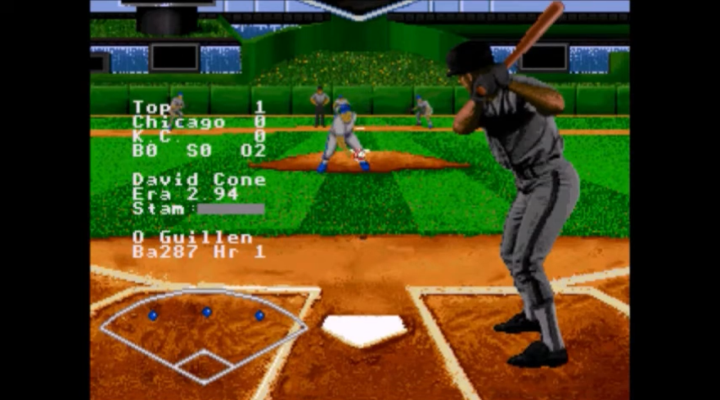
It’s almost as if all of Time Warner's efforts went into making R.B.I look the part of a 32bit video game, while the functionality of the thing was a distant secondary priority. It’s not a broken game by any means, and most of the complaints are more amusing than they are game breaking. It looked like a transitional title, and what better place to experiment with stepping up to the next generation of hardware than with SEGA’s little mushroom-shaped stopgap. Then, with the foundations set up ready to be built upon for the Playstation and Saturn, the series went into deep freeze for almost two decades. And, honestly, that’s the most interesting thing I can find to say about R.B.I. Baseball ‘95.