
The biggest problem with talking about Qix Adventure was that the most interesting thing about it was its atypical release schedule, appearing at retail in Japan and Europe only. Other than that, it took the Qix formula of cutting a screen up into pieces while assorted nasties tried to stop you, and applied a weak RPG-lite sheen that really didn’t mesh. Ultimate Qix thumbs its nose at such nonsense. Right back on track with a much more commonplace release schedule (screw Europe; if it leaves Japan at all, NA ports only!) it does away with the idea of overly fancy gimmick-work and instead asks itself how it can improve the core aspects of Qix itself.
It’s not an overly hard overwork; Qix Classic was a simple game for a simple time. Bought into the arcade scene by Taito back in 1981, it had you draw lines on a grid where completing a shape would destroy that section of the screen. You then had to delete the majority of the grid to see off the level. Out to stop you were little spark creatures that travelled your lines which you had to be constantly on the move to avoid, and a larger enemy that would roam the grid. If it happened to stray into one of your lines as you were drawing it, it would spell game over.
 Credit: ITL/Taito Corporation
 Credit: ITL/Taito Corporation
It’s a foundation that Ultimate Qix doesn’t stray far from, but instead tries to update. Released back to the arcades almost a decade after its initial release and then finding a home on a slew of the then-current home consoles (often under the name “Volfied”, its original title for the Japanese market) it uses the upgraded hardware to remake itself into more of a spectacle. The roaming enemy used to be a series of multi-coloured and seemingly random geometric shapes against a simple or just plain black background. But now, there’s varied backdrops and matching enemy sets. Now, there’s a theme!
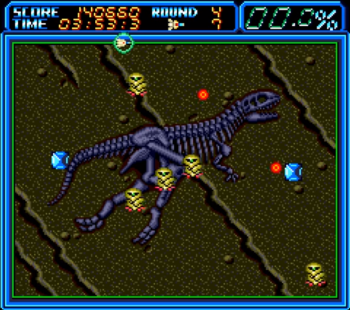
Set in a universe ruled by angry aliens, it’s your job to visit a hostile world and rescue a bunch of your people trapped somewhere beneath the planet’s surface. This is a clever idea because it means that now, rather than slowly devouring chunks of a screen, you’re digging through different layers of the planet. Claim yourself a chunk of the backdrop and what you uncover underneath is actually a section of the next stage. As such, you might find a backdrop of the planet’s craggy, crater-marked surface which might give way to the fossil-rich soil underneath or the molten lava innards buried right in the planet’s core.
 Credit: ITL/Taito Corporation
 Credit: ITL/Taito Corporation
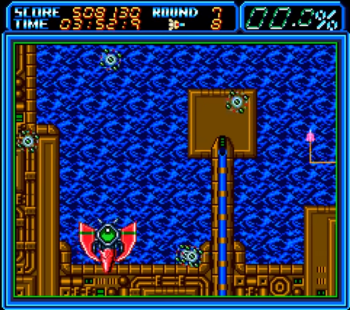
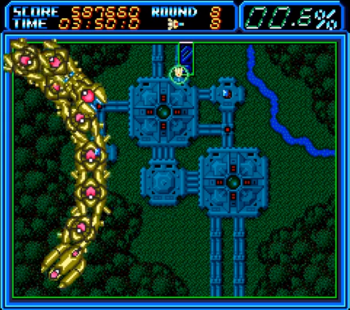
Wherever you dig, you’ll find unique enemy sets waiting to try and stop you. You’re chased around the surface by a huge robotic hand while giant scorpions roost beneath the top soil. Floating yellow snakes, weird fire-proof jellyfish and sneering skulls in spiky helmets are but a section of the bizarre creations who take issue with your rescue mission. The last Qix game’s most creative enemy was a series of different coloured lines. Ultimate Qix’s decision to mix this up means there’s finally a real sense of progression attached to the series; the ever-changing backgrounds and the new enemies that guard them makes it feel like you’re not just tackling the same puzzle over and over again. Even though that’s completely what you’re doing.
There’s other little bonuses like a power-up that freezes everything in place or offers limited special attacks to waste on the level’s big boss creature or the smaller scattering of hostile drones each brings to the fight. Get yourself on a good run (or employ the easiest of the three settings like some kind of cube-tracing coward) and you could probably see all Ultimate Qix has to offer in under an hour. But it’ll probably take you several runs to get there and, even if there’s little more than cosmetic variety for the most part, the core gameplay is simple and refreshing enough to survive multiple attempts. It could have appealed to repeat players more with a two player option, or do more to save high scores for points chasers, but its choice not to reinvent the wheel is its saving grace. It could have gone the way of Qix Adventure, over-complicating the core design with nonsense it never needed. Instead, the commendable faith it shows its foundations make it a recommendable time waster.
Even if the entire in-game soundtrack is an awful chip-tuned siren effect that you'll learn to hate in seconds. I suppose that's why we have mute buttons.