 Credit: Lunatic Studios
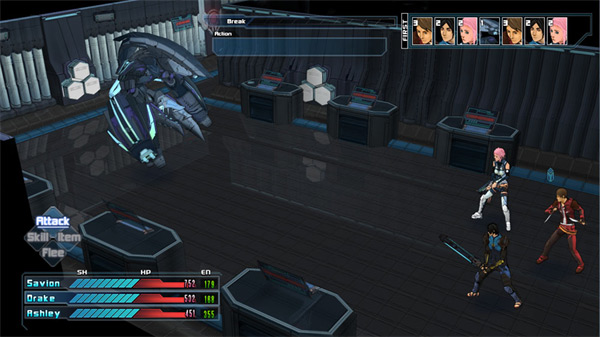
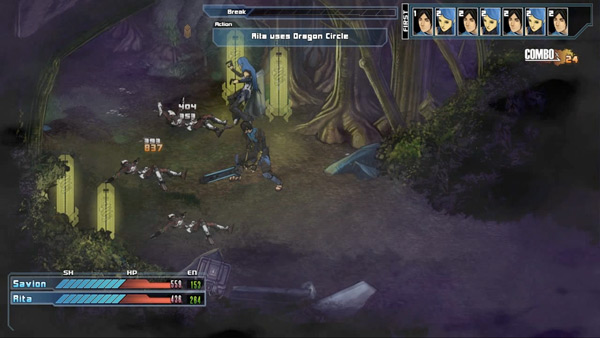
Aphelion Episode One: Graves of Earth wastes no time in showing off its capabilities. Its presentation differs from your standard indie RPG, showcasing well rendered 2D visuals that don't look like they were stolen from an SNES title. In battle, combatants are lively and their animation is terrific. The opposition doesn't manifest as static graphics, but as models that twitch, breathe and hover. They rush towards you or raise their guns as they attack, and when they perish they lie upon the ground and remain there until the conflict's conclusion. Yet, despite the slight visual boost, the game plays as simply and as intuitively as any old school, turn-based RPG.
As you advance, Graves of Earth delivers all of the expected roleplaying features. For instance, there's a gauge that fills up while you fight, similar to the "limit breaks" seen in Final Fantasy. In this case, rather than a single warrior letting loose all of his pent up aggression, your entire party unleashes a wave of unmitigated violence on a target. As you slaughter your opponents and level up, you gain skill points. You allocate these on a skill screen identical to the one seen in Mass Effect. In this way, you not only beef up your squad, but learn invaluable abilities such as weapon crafting or cooking.
At first, I dug Graves of Earth's vibe. It played like an RPG from the mid '90s and sported well written dialogue that developed its universe's lore decently. Most of the chatter flowed naturally, similar to lines uttered in a sci-fi novel. With each exchange, I looked forward to getting to know the cast and watching their adventure unfold. Sadly, some time after the first dungeon, apathy began to set in...
 Credit: Lunatic Studios
Graves of Earth develops its party members in the most common ways. Savion, the protagonist, is the only one who receives some level of deeper development, but not amazingly so. He reluctantly takes on the role of team leader after his own superior dies. Savion knows he isn't ready for the responsibility, and fears his inexperience is going to get his party killed. His self-doubt manifests as a phantasmal replica of himself, who occasionally taunts the young man.
Outside of that, Graves of Earth stars your standard RPG friendlies: the protagonist's childhood friend/low key love interest, the socially awkward intellectual and the antiheroic comic relief. The story seldom digs any deeper than basic histories for these folks, and that's a shame. It would've been great to see more situations that show where each character stands morally. For instance, since Drake is an antiheroic thief, a scenario displaying what he's willing and/or unwilling to do to survive could have fleshed him out and made him a more interesting character.
However, you can ignore Graves of Earth's prattle for a while, thanks to its intuitive, turn-based combat system. All of the commands you've come to expect from retro RPGs are present, along with the usual statistics and bonuses. The only difference here is that each party member possesses a shield in addition to hit points. These barriers regenerate slowly with each passing round, but you still need to keep an eye on them and use restoratives when necessary. If a shield falls, its owner won't last long. With constant barrages, a warrior might kick the bucket after only a few turns.
 Credit: Lunatic Studios
Graves of Earth's battles remain adequate until halfway through the campaign. That's when the difficulty rating spikes and the game sends tough foes after you. Rather than a shot or two to fell them, most enemies require numerous rounds of punishment before croaking. What's worse is they deal so much damage that you need to be rid of them as soon as possible, and you can't do so quickly enough. This would be fine if it were maybe one or two creatures encountered every now and then, but we're talking about most of your adversaries in the latter half. Because you face such powerful opposition, encounters take way too long to finish. You spend most of your time chipping away at their opulence of hit points while scrambling to maintain your shields. Eventually, Graves of Earth throws four or more of these suckers at you per altercation, and each standard fight begins to feel like a boss encounter.
Your only recourse is to grind and farm like crazy, thereby boosting your stats and acquiring materials to create powerful enough weapons and armor to outlast your antagonists. Victory also provides you with a gracious amount of consumable items, which is great because shops are in short supply. Save points also fully restore your units, so it's not difficult to sit still and shred opposing forces for a while. It is, however, tiresome, especially when a single fight lasts more than a few minutes.
Eventually, you reach a point of hopelessness partway into the third dungeon. You check your play time and realize you've been in that area for two hours and you still haven't gotten close to the objective. You realize then that there are no other stages, and that roughly seventy percent of Graves of Earth's campaign is one big, wearisome level. Puzzles and story events do their best to break the tedium, but emerge in such an anticlimactic manner that they practically don't register.
 Credit: Lunatic Studios
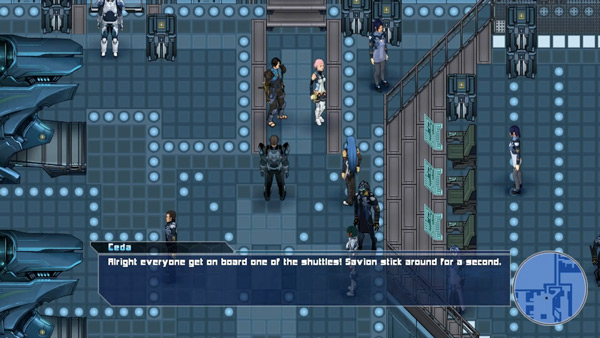
Graves of Earth possesses a downbeat vibe that you can't shake. You hear it in the its indifferent, albeit technically decent soundtrack. The music doesn't add any excitement or mood to the experience. It's just there. Fights end with restrained fanfare. The victory music doesn't instill a sense of triumph in you. Instead, it's casually congratulatory. However, the biggest party killer is the aforementioned final dungeon. For eons, you glimpse the same high-tech environment. It's passable at first, but once you've encountered floor after floor of familiar scenery, it's maddening. A little variety would've done Graves of Earth some good.
I nearly fell asleep playing Aphelion Episode One: Graves of Earth. It's not a horrible RPG, to be sure, but its pieces fail to add up to an exciting whole. It's a solidly built roleplaying experience, sadly trapped within a drab, tedious campaign. I realize that a lot of my complaints are superficial, but sometimes those facets are the difference between a boring, generic title and a decent or even good one.