
I’m glad Steel Strider is a thing; it gives me another chance to make fun of the title of the game it serves sequel towards. Gigantic Army was a great old-school mech-‘em-up, but what a ridiculous name to give to something so embracing of the one-versus-all trope. Vast legions of other robots served up to get gunned down by your solitary plodding avatar with massive weapons and a pneumatic spear. Things have changed, just a bit.
Even when it starred in its own game, Gigantic Army’s leading machine of war was advertised as behind the times, so it’s of little surprise that the sequel drops it in favour of a newer model. This comes with wholesale mechanical alterations that I’m still not confident I prefer. The previous mech, the struggling Saladin, was a bulky nightmare, difficult to control but full of surprises. The first thing the player had to do was to unlearn all those modern conveniences that have been spoiling us for a couple of generations. Army gave you a 360° firing scope that let you snipe out targets wherever they might hide – but none of that dual stick nonsense! You had to aim it the same way we used to have to do back in the 16-bit era. With digital pads, and multiple button pressing and frustration! It was rage-inducing until you played through it a little and suddenly, it wasn’t.
 Credit: Astro Port/Nyu Media
 Credit: Astro Port/Nyu Media
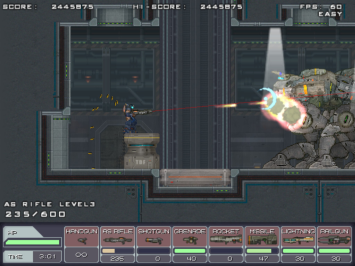
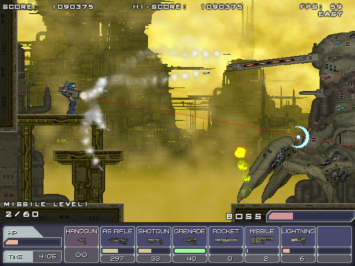
Steel Strider does away with that and employs a much easier aiming mechanic, making better use of its platform as a PC doujin title. You aim with the mouse now. The newer, shinier Gemini mech is a very different beast; no longer do you have a massive metal riot shield to protect yourself with, which is a shame because the new robot is ominously less sturdy and absorbs significantly less damage. To counteract this, no longer are you expected to play the game as one huge chunk with no save options. Wanted to beat Gigantic Army? You did so in one solid sitting or you didn’t do it at all! This never felt unfair because the Saladin could handle a pummelling. But, on the other hand, the weaker Gemini’s war against everything feels equally balanced thanks to being able to save at the start of each bite-sized mission segment.
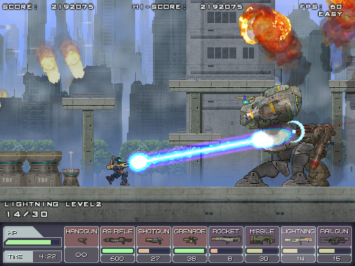
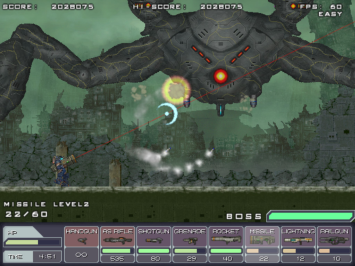
It’s not all that’s changed. The Saladin tried to counteract its plodding pace with a small charge command that had it bolt forward a small distance in a shower of sparks and chaos. The Gemini just moves faster and smoother overall. The Saladin could graft on one weapon at the start of the game that would limit or expand its number of special attacks. The Gemini has no special attacks, but can change weapons on the fly so long as it has enough ammunition to use it. This, too, is a big change. Gone are collectible power-ups, in its place are any of seven unique weapons from assault rifles to homing missiles to rail guns. So long as you grab up weapons as you find them to stock up on ammo, you can cycle through your arsenal at will.
 Credit: Astro Port/Nyu Media
 Credit: Astro Port/Nyu Media
Steel Strider is still retro-centric at heart, but feels like less of homage to 16-bit days, happier to slide in modern conveniences. I’m okay with that, but it has lost some of the rustic appeal Gigantic Army used to exhibit. Piloting the Saladin was difficult and clumsy but, because of that, it had the feel of being in control behind a massive mountain of cumbersome metal. You could achieve a semblance of ponderous grace by combining your jump jets with your dash attack, so bullying your mount into action was an achievement. The Gemini has little of that going for it. It doesn’t have that same feeling of struggling to get the best out of a lumbering behemoth; everything is easy and elegant. That’s not a bad thing – of course it’s not – but it is wildly different. Now, you could sprite swap the cast of Steel Strider with, say, the cast of Metal Slug and it would still work. There’s nothing specifically robotic to the Gemini. Even the cool pneumatic lance has been replaced with a stock laser sword.
Of course, that does make sense in canon: if the Saladin was near obsolete in its own game then it’s positively ancient in its sequel. And for all the kicks I’m laying into Strider, for all its differences, it does have the guts to go out and be its own thing. It’s just that what it becomes in chasing individuality is, ironically, to turn into a generic scrolling run and gunner. Nothing wrong with a slice of generic, but it does mean that Steel Strider is going to struggle to stand out in a genre boasting a back catalogue of some twenty years.