

More game developers should attempt creative projects like A Druid's Duel. The PC title marries classic board game design with charming visuals and razor-sharp AI. The result is an experience that feels both familiar and refreshing. The blend isn't completely successful, however, thanks to some odd design decisions and vicious A.I. that all too often makes a play session feel like a chore.
A Druid's Duel offers an online mode, but I suspect most people will play it alone. The idea in either case is that you're a druid, battling against others of your kind who happen to hail from rival factions. Your confrontations take place on a tile-based battlefield where the only way to win is to completely eliminate your rivals' colors from the field.
The game eases you into the whole process, which is good because there's a lot to keep straight. Initially, you'll face off against only one rival faction, which is more than enough as you learn the ropes.
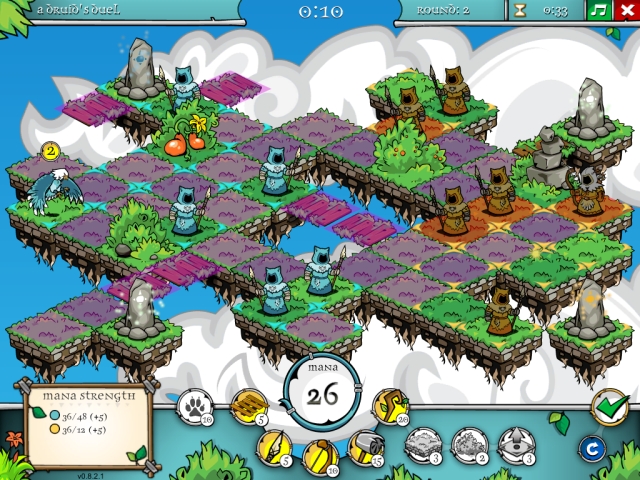
Battles begin with several pieces already in play. Teams are usually positioned in clusters on opposite edges of the region. You can move all of your active units in a given turn, and in any order you like. The four available types come with restrictions that affect how far they can move, as well as which foes are within striking distance. Special moves also are available, but they consume magical power called mana. You generate this precious energy at the start of each turn, based on the number of spaces assigned to your faction's color at that point, and sometimes you can earn extra for other reasons. Some spaces yield better rewards than others. Your turn ends only once you move every unit and exhaust your supply of mana, or when you cut things short prematurely.
Units for the most part may only be moved starting with the turn after they are called into battle, and you can only deploy them on tiles of your faction's color. They range from expensive to more expensive, so you want to get the most out of each one. A savvy opponent will likely target versatile, high-value units first, so that's one more thing to keep in mind as you strategize.
The Guardian is the most common unit type, like a pawn in chess. It moves one space per turn, and can only attack adjacent enemies. However, it can spend mana to transform into a wolf that is able to trot along up to four spaces. This action is accompanied by a howl that you will hear a lot as you play A Druid's Duel, since marking your territory is vitally important.
The Wind Rider moves in much the same way, but also attacks enemies from a distance using a bow and arrow. More importantly, it can transform into a bird and dive bomb enemies all over the board. The skill has fantastic range, but leaves the unit susceptible to swift reprisal unless you're careful.
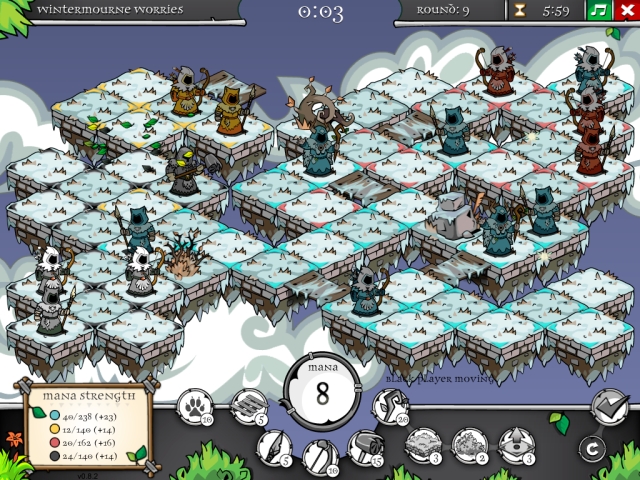
The Snarlclaw moves two spaces in a turn and is capable of destroying obstacles on the map (though doing so consumes both available moves). If it transforms into bear form, it can run three spaces along the board, crushing any foes it happens across. This is awesome when you're the one controlling the enraged Snarlclaw. That move is also a nuisance, though, since your foes seem to have access to the unit--sometimes even right from the start of a battle--considerably more often than you do.
Finally, the Waywalker also moves multiple spaces and attacks from a distance using magic. This class manipulates the ground by either adding soil or dropping it out of play--along with any units that happen to be positioned on it--and can affordably turn into a turtle to avoid harm until its next chance to act rolls around.
Four unit types may not sound like a lot to keep straight, but the transformations add interesting wrinkles. Besides ensuring that enemies have an easier time surprising you with strategies that are difficult to see coming, they force you to make decisions about how best to spend your mana. Do you hammer your foe with a bunch of powerful special attacks and barely have any energy left to deploy additional units, or do you plop down a bunch of Guardians and rely on strength in numbers? Do you focus on units with ranged attacks, or do you spend energy on a bruiser that can possibly take out as many as three rivals at once?
There's an insane amount of strategizing required if you mean to dominate A Druid's Duel, and that depth mostly works in the game's favor. However, the AI is devious even on the lowest difficulty setting and often starts with a slight or even significant advantage. This is problematic, since early turns are often the most important ones and shifting momentum is difficult. You can easily set yourself up to lose a grueling battle in those first two or three turns, particularly if you sacrifice too many units or you fail to take risks that gain you the mana you'll need in subsequent rounds.
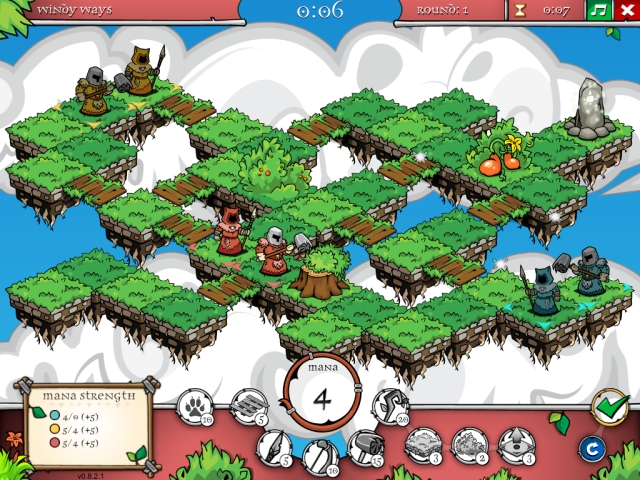
The single-player campaign is a meaty one, with plenty of battles to keep you engaged for a long while. There's almost too much of it, actually, since a few rounds are as much as you'll probably want to play at a time. Stages are accessed from a world map of sorts. You clear a node and then get to choose where to go next from a couple of options. If you head the wrong way, you'll have to clear a battle and then return the way you came, repeating battles until you can proceed along the correct path. Since there's no way to tell ahead of time which route is the accepted one, this design feels punitive. It particularly sucks when you just barely clear a tough battle and then have to repeat it shortly thereafter because you followed the "wrong" route.
Some of the boss enemies are a little too powerful for my liking, as well. One evil druid is able to move four spaces per round, or will use long-distance magic to take out several of your units before he's done moving. If you damage him, he'll melt into the ground and appear elsewhere, claiming a ring of spaces around him and destroying any of your units that might be in the wrong position (typically, this means you lose your only remaining troops who stand a chance of doing you any good). Such battles are challenging, certainly. More than that, though, they're irritating.
If you want to play online with humans who aren't gifted such advantages, you'll find that A Druid's Duel makes you register on a special site that tracks your performance. I wasn't a big fan of that requirement, since I already have a perfectly functional Steam account. Then, after I complied, I found that virtually no one is playing the game online. You can of course talk a bunch of friends into buying the game and then meet up for duels, which would probably be fun, but this is not a game where you should expect to go toe-to-toe with a random audience of strangers. Not enough people seem to know it even exists.
With more balanced battles and less vicious AI (at least on the easier settings), A Druid's Duel could have been a pleasant experience for a wide audience. The challenging combat is a bit too competent for its own good, though, and it's no fun repeating battles you already cleared, just because you don't have ESP. Online matches should have added some value to the package when you need a break from the campaign grind, but since virtually no one is playing and you have to sign up for an account to even test your luck, that option doesn't feel relevant. It's a shame, really. A Druid's Duel was almost terrific… but then it wasn't.