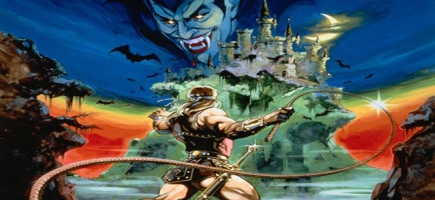
I've always written Castlevania off as an aged dinosaur whose only saving grace was being the seed that germinated into Symphony of the Night. The series has produced amazing titles, including Castlevania III: Dracula's Curse (which is on this platform) and Rondo of Blood. Compared to these masterpieces, the first Castlevania always felt like an old, flactuant uncle.
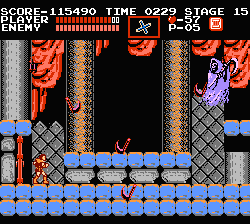
I've never beaten Castlevania in the 10+ years I've owned it. The hallway to death on level 5 is littered with Simon Belmont's corpse. Though there have been many close attempts, I've only defeated Death once. Even after that singular event, the bats on the bridge in level 6 brought me to my knees, and the fleas para-dropping into the fray on proceeding screens make quick work of me. I've yet to see Dracula, but I'd be remiss to think that he's anything easier than "tough as shit."
 Credit: Konami
This guy is an ass.
Simon jumps like he has all those knives and crosses shoved up his ass, and he swings his whip so slowly that I sometimes press the button and go into the kitchen to make a sandwich. Sometimes, I see an enemy coming at me, I want to react--my mind reacted and wants to do something--but Simon is so slow and so stupid, he jumps in an enemy or simply stands there like a dumbass. I always wrote these off a flaws as artifacts of bad design in an old game.
I've held this opinion for over 10 years, until just recently when I asked myself two important questions: 1.) if the stiffness and lethargy of the game play is the product of old design, why wasn't it corrected in Castlevania III? and 2.) why does Simon move like a pile a cement while the guys in Contra, another Konami game, jump around with the agility of ballerinas?
It took me years and many failed raids on Dracula's Fortress before I put the pieces together. I had it all backwards; I had been playing the game entirely wrong. Castlevania isn't an action game; it just looks like one.
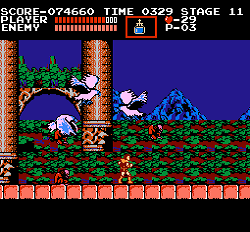
Let me give an example. At the beginning of level 3, there are these jumping red midget bastards I call "peanut shits" (I'm told it's a "flea man" or "Igor"--I like my name better). Walk forward--because that's what you do in action games; go forward--and these peanut shits jump right into your face. They are actually placed in such a way that they will jump directly into you if you keep walking. If you stop, however, they jump in front of you, where you would have been.
Watch the peanut. When it is far from you, it jumps in low archs. When it gets close enough that if it jumped like that again, you could jump over it, it jumps upwards instead. Clever girl!
 Credit: Konami
If you still play Castlevania like it's Contra, you probably won't get past this screen.
This isn't mindless or random--the bloody peanuts are designed with your natural impulses in mind. Let's take another example, the medusa head. They always enter the screen at the top of a sine wave. (Yes, we're going to bring geometry into this.) If you stand perfectly still, the medusa head will follow exactly 2 modulations, the second one starting exactly where Simon's face is located. If you stand perfectly still and duck, however, they fly gently over your head.
This means the following:
+ If you do nothing, they hit you
+ If you walk forward, they hit you
+ If you walk backward, they hit you
+ If you jump straight up, they hit you
So many enemies seemed designed to do the opposite of what the player expects. Even levels seemed designed that way. Have you ever been frustrated by the fact that those bone throwing skeleton's always seem to appear above or near stair cases? How about how those crows that always seem to appear next to pits? I don't think these things are coincidences. It's like someone went through each level and drew a line representing how the player would go through it, then added enemies that would be directly on that line.
If you play the game like you're playing Contra--that is, reacting to situations rather than planning for them--you'll never beat Castlevania. Often by the time you realize what danger is ahead of you, it's too late. When you realize this fact, Castlevania becomes a lot more interesting. You find yourself stopping and assessing situations more often than acting. You think a lot more about your enemies and try to plan out an attack instead of flying in headlong to see what they do. You measure twice and jump once. I wouldn't necessarily call this strategy, but it's a far cry from Contra's twitchy, caffeinated action orgy.
I haven't beaten Castlevania yet, but someday I will. I make it through the medusa hellway more frequently and with more health each time, and when I inevitably fall to Death's fury of sickles, he's just a bit more beat up than the time before--once and awhile, I even kick his pale ass. This game is tough, but--despite what I felt for years--never unfair; you just need to think a little.
Patience triumphs here over reflexes and agility. Given enough patience, anyone can knock Dracula's teeth out.