


"I just hope some good comes of this release if it sells well enough, and that we'll either receive more Mega Man collections, or a new ga-ahahahahahaha." - A Clown in 2016
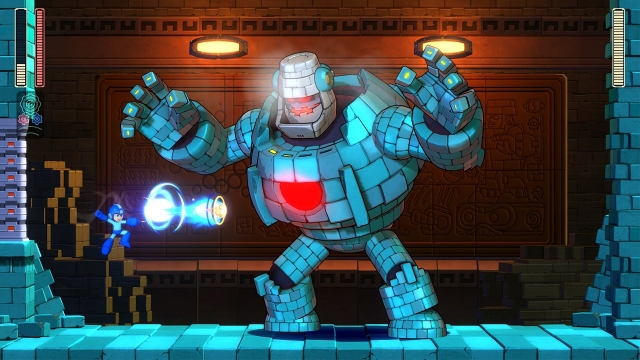
This was an instance where I was glad to be proven wrong, because not only did we get two more collections for the original games and the X lineup, but also a brand new entry in the franchise. Released over eight years after Mega Man 10, this eleventh outing follows the Little Robot That Could, in what now feels like a never-ending battle against Dr. Wily and his legion of reprogrammed droids, into a new dimension. The game unflinchingly leaps into a 3D aesthetic to support the side-scrolling action and, despite a familiar model here and there seeming slightly weird, pulls it off to the point where graphics are mimicking the accompanied, nostalgic artwork quite well.

But is Mega Man 11 able to replicate the tried-and-true controls within this new, 3D environment? Graciously, navigating Mega Man across platform segments, against cleverly-positioned enemies, feels right, as if that eight year gap never happened. There's some tiny issues, such as a "jaunt" Mega Man makes when he hops or lands forward, but you get over that stuff quickly. Familiarity continues with the return of the Mega Buster charge and slide, which was regulated to Proto Man in the previous two entries, Rush's coil and jet moves being available with a button press, and the bolt shop system. Know what else makes a surprising return? Voice acting! Thankfully, it's not on the level of Mega Man 8's hilariously disastrous English "line readings," though I was thrown off by Mega Man's raspy tone. I guess our Blue Bomber had to go through puberty eventually.
If all this sounds just a tad too similar to other MM titles, and if you were coming into this expecting something groundbreaking, then you're going to be disgruntled. Regardless, MM11 is still an entertaining experience, because it manages to get the one important thing right: solid platforming action. As you pierce through the eight Robot Master stages in any desirable order, you'll confront a bevy of enemies and obstacles, such as fending off heatseeking missiles while on small platforms in Impact Man's vertical mine shaft. One of my personal favorites, Blast Man's amusement center, involves outrunning, sliding through, or preventing platforms from exploding, which is set off by fuel-infused enemies. Even Bounce Man's nauseatingly-colorful stage enforces a challenge due to each room being encased in bouncy balls knocking you every which way possible.

But what makes this more appealing than, say, Mega Man 9, 10, and even Mighty No. 9, all heavily borrowing from the same 1987 template? It's executed much better, understanding the fundamentals more clearly. Each stage starts off deceptively simple, gradually introducing concepts exclusive to said environments. As progress is made, the "basics" eventually morph into harder obstacle courses, where skillful hand-eye coordination and use of the scientific method is needed to topple Wily's robot army. Acid Man's area is your typical "water" stage with fluctuating currents and spikes aplenty, but it hits players where it counts the most, with uncomfortable, tight death spike placements. The aforementioned mine shaft? Later on, there's a longer version with heatseekers, miners throwing axe-picks, and pesky Mets waiting to knock you off the small, moving platform.
Most stages are lengthy, too, which I like; the thing that irritates me about some Mega Man titles is how they don't delve deep into stage-specific ideas for long, and just when things get interesting... it's boss time. MM11 allows its concepts to expand long enough to become fully-realized visions. Even the mid-boss fights are surprisingly thoughtful when it comes to dodging and timing patterns. The backhoe Met battle, for example, has such small, nearly unnoticeable cues, that it's really easy to get backed into a wall and die the first few times. The game really expects you to pay attention during any boss fight in order to survive, since free space is often small and valuable.

Though, if I had to pick something faulty, I'd say the biggest disappointment of MM11 has to do with its central gimmick, the Double Gear powers. Yeah, it's so lousy, I didn't bother mentioning this feature until six paragraphs into a review. Basically, one gear allows Mega Man's abilities to be stronger, with the other gear slowing time. Both temporarily, of course. Unfortunately, outside of boss battles, their use is mostly trivial, as I could only recall two-to-three moments where I genuinely needed the time power to escape tricky platform segments. MM11 already has so many accessible abilities, from the Mega Buster and its charged shots, gained powers from defeated bosses, to Rush, Beat, and numerous shop items, that the Double Gear powers feel like some odd afterthought that was approved late in development.
But Double Gear's underused capabilities is such an insignificant flaw compared to the entire product. Would it have been great if the concept was given more love? Sure. But more importantly, MM11 still thrives without this new gimmick, offering players the thing they come to expect in a classic Mega Man product: quality. There's good platform action, interesting ideas with each new stage explored, freedom of choice, frantic boss fights, and for those craving more, a challenge mode further testing reflexes and speed. The game just has that captivating energy some of the better titles in the series exude, something that Mega Man 9 and 10, ironically, couldn't fully get right. Hopefully, the current "onslaught" of Mega Man products won't end with this solid eleventh entry. Eight years for a new game was too damn long...