
Momodora: Reverie Under The Moonlight is the fourth game in an indie series which consistently features female protagonists. The first two instalments are uneven, tentative first steps, available only direct from the developer’s website, but the third is a polished, if short and easy Steam platformer. And the fourth, Momodora: RUTM, is a haunting metroidvania take on the series’ hitherto action-oriented content, and easily the best entry in the canon to date.
I rather enjoyed my time, fleeting though it was, with Momodora III. While it played like standard hack-and-slash fare, its uniquely beautiful, painterly aesthetic seemed to elevate it to something greater. It was a good time, but it certainly wasn’t worthy of the overwhelmingly positive rating that its successor has earned on Steam. It seemed as if this fourth game had perfected the Momodora Formula and I needed to know how.
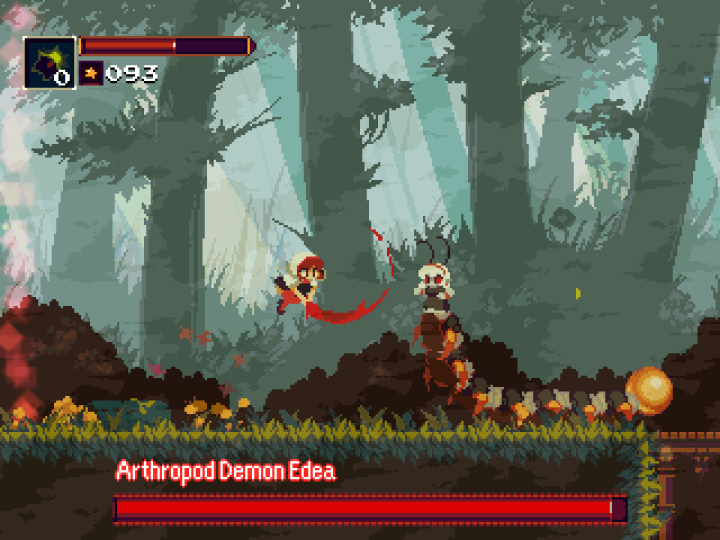
To be sure, Momodora: RUTM still wears the same soft, liquid backdrops, still features the same flowing cartoon character movements; but it looks better than ever in is new metroidvania clothes. The usual genre trappings get us moving: the archetypal light blue sprawling map that everyone has appropriated from Super Metroid lays out save points and provides visual cues as to where secret rooms might be.
 Credit: Bombservice/AGM PLAYISM
The music is notable for being inexorably sad and spare. And that makes sense, because the game is about a shadow-haunted land tainted by something malevolent and tangible; a kingdom where everything begins to wither and become sickly and decay and die. Every part of the world is either a ghost town, or on its way to being one.
Our heroine, Kaho, a priestess from the village of Lun, has resolved to seek an audience with the Queen in order to put a stop to that. Kaho brandishes a magic maple leaf, to lash out at monsters as though it were... a whip. In addition, she carries a bow, and while she starts out only being able to fire one arrow at a time, she’ll soon be firing three simultaneously. She is also able to carry special, magical items of both the active and passive varieties. The passive attributes carry on their magic effects in the background as long as they’re equipped, such as the attack power-boosting Black Sachet, while the active items act as sub-weapons after a fashion, such as the restorative Bellflower.
Momodora: RUTM starts off surprisingly difficult for metroidvania -- that is to say, you can actually die. A lot. I’ve noted that a fair number of the negative reviews for the game harp on it being too hard for its own good. Save points are ideally spaced, and later in the proceedings they can be used as warp points for quick travel around the game world. So the difficulty does not come as a result of any dearth of progress-saving opportunities; our heroine simply starts off weak, and relatively untrained, and is easily overwhelmed if you're not careful.
 Credit: Bombservice/AGM PLAYISM
However, when you seriously undertake to explore Kaho's world, you'll discover an abundance of wondrous magical items for her to master, and given their remarkable potency, once equipped, you'll find the game much more manageable. Easy, even. The game's thesis seems to be this: If you run across every item, you'll run down every enemy. And yes, I've also come across negative feedback for Momodora: RUTM based on it being too easy as well. You can't please anyone.
And yet, this is the best possible thing: it means that the more you explore, the more you find, the easier the game gets. That attribute-finding should be so helpful, that it should make our heroine so offensively formidable encourages exploration, and that's the point of these types of games in the first place. If you try to speed run, and barely pick up anything at all, your experience will be prohibitively difficult. If you work towards the complete experience, scouring every nook and cranny, and your road will be far less rocky.
Momodora: RUTM seems to counsel us: take the time to get strong -- or else. And the game's sweet balance when combined with the exquisitely sorrowful and delicate sights and sounds, provides us with a must play in the genre. There could be more story exposition, to strike a chord within us, give us more reason to care about our heroine's mission and the plight of her dying world; perhaps they'll shore up that shortcoming the next time around.