With the original Legacy containing the first six-game run that occurred on Nintendo's 8-bit console, by default it became a stable, uniform collection; each game closely followed the same, specific template, in both design and visual style, that anyone could comfortably jump between titles without feeling lost or alienated. However, the same doesn't apply to the games featured on Mega Man Legacy Collection 2. Spanning different consoles of varying specs, from different eras, decades apart, and with vastly opposing art styles, experiencing Mega Man 7 through 10 in succession is more akin to being at a biological museum. The core, challenging action-platforming where you can use the powers of defeated bosses, is still intact, but everything else leaps in all kinds of directions with their ideologies, that it's odd to think they're from the same series.
 Credit: Capcom
Mega Man 7, the first title in Legacy 2 if you're playing in order, appropriately incites this theme of fluctuation. Being the first sequel in the classic series to go beyond the 8-bit console, this SNES game received a huge visual upgrade, with everything having much more detail, color, and overall thickness. But in terms of stage design, it's easily one of the weakest in the series. It either poorly mimics concepts from past titles, such as jet-propelled shields that are slow now and non-threatening timed-bomb platform segments, or introduces a concept and only shows it off for one screen. Also a surprising amount of empty, interconnecting rooms. And while there's still eight Robot Masters, the game only allows you to pick four at a time, copying the Game Boy titles. Ffffrrrrror some reason? One of Mega Man's biggest traits is its freedom of choice, and you take it away here.
It's really an unfortunate title, and becomes downright tragic when you find out the development team was only allowed to complete the game in three months. So it's shocking how much was actually done, and how much potential it could have had with more time.
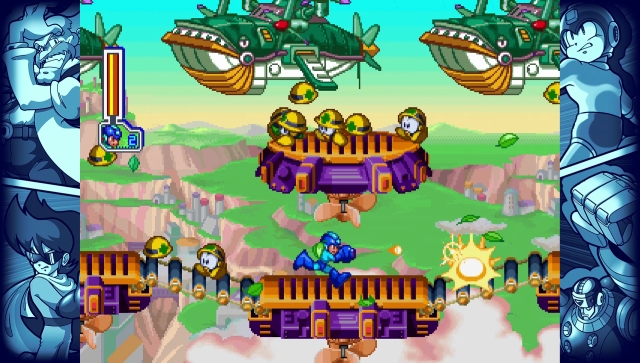
With Mega Man 8's leap onto 32-bit consoles, further improvements were made to the graphics, featuring slicker animation to sprites, and overall sleek and slender designs. And with advanced technology came room for hand-drawn, animated cutscenes and... awful, English voice-acting. Unlike Mega Man 7, however, more effort was put into the design of this one, featuring interesting challenges for both stages and boss fights; having to escape platforms that blow up once a fuse is lit, for one, and there's even a genuine, horizontal shoot-em-up segment that nearly takes up one stage! Of the games featured in Legacy 2, MM8 takes the boldest steps away from the traditional template without severing ties with it, making such changes as allowing the Blue Bomber to swim, reducing Rush's role to a "once per-stage" ability, and completely removing E-Tanks, to name a few.
Unfortunately, MM8 was the last "big" release of its era, and the classic series quietly and unceremoniously went out of commission during the late 1990s. Instead, the market was flooded by the X games and their spin-offs, the Legends IP, and rereleases of older titles, which continued with other sub-series well into the 2000s. The classic series was pretty much dead in the eyes of many, which is why Mega Man 9's emergence in 2008, over 10 years since MM8's release, was a wonderful surprise for fans.
 Credit: Capcom
Instead of using and further improving on MM8's foundation, MM9 went for a "back to basics" approach. An immediately noticeable change goes to its visuals, which went back to the 8-bit look of early Mega Man games, to the joy and dismay of many. Other changes were purely based on the fact that it took inspiration from Mega Man 2, thus the absence of the slide and charged-shot abilities, meaning players no longer have faster methods of escaping tough situations; pass these obstacles bluntly or die trying. Thankfully, a much welcomed return is the freedom to pick any of the eight Robot Master stages from the start. Mega Man 10 followed suit, with the only standout feature of its own being the inclusion of Easy and Hard difficulty settings that, depending on which was chosen, either places platforms over pits or adds more enemies.
While it is nice we got two more titles for the classic series with this brief resurgence, it's a shame more wasn't done with these games, especially MM10. They're not bad, not even close to being terrible, but if you take off the nostalgia goggles, you'll notice there's a "play it safe" mentality with their stage layouts. Each game has their share of good stages, with MM10 slightly edging out front with more creativity, such as running on treadmills to activate platforms temporarily or literally jumping over traffic in spike-laden highways. However, a lot of the stages just echo ideas and gimmicks from past games, even visually, which isn't so bad if you attempt to diversify or improve on their concepts in some way. But they don't, and that's their biggest flaws as sequels in a decades-old franchise. If it weren't for the bonus time-attack challenges, it would have been harder coming back to these games after completion.
At least they're all accurate replications of their original releases, right? No. A surprising number of modifications have been made, though none that truly hinder actual gameplay in anyway. The strangest change is that, when you start any game, you're immediately taken to the title screen, skipping each intro. You'll have to sit there for a couple seconds before finally seeing one. References to Nintendo's Famicom and Game Boy have understandably been removed in Mega Man 7's Junk Man stage, so now you see a bunch of hangers latching to nothing. Mega Man 8's Japanese intro song isn't accessible in non-Japanese versions of this collection, and the Rush Charger icon no longer has a tiny red cross; the Red Cross has since been enforcing their ownership of the symbol and have said using it without permission violates the Geneva Conventions. I kid you not.
On the more positive side of changes, Legacy 2 currently wields the definitive versions of Mega Man 9 and 10. On top of being commercially available in physical format for the first time, each game's download content, such as Proto Man, Bass, and special stages, are included. Though, you'll have to complete each game once to unlock them... or just input a cheat code. And thanks to time-attack challenges exclusive to the collection, it's now possible to battle Mega Man 10's Game Boy bosses with Proto Man and Bass.
 Credit: Capcom
This is a difficult one... As a collection of these four specific games, Legacy 2's quality control is all over the place; there are so many negatives and positives clashing against one another, that it amalgamates into an overall average presentation. I'm surprised and grateful that Capcom actually released a second collection to "complete" the classic series, but this could have had so much potential as a follow-up. Even as I write this, I'm still shocked Mega Man & Bass didn't make the cut. Shoot, oddities such as Wily Wars, Power Battles, and even Powered Up would have helped tremendously. As is, Legacy 2 feels more like a novelty purchase, which is what I was afraid of and why I wanted these games on the original Legacy in the first place... So if you want consistent Mega Man action, then the first Legacy is still the one to check out.