
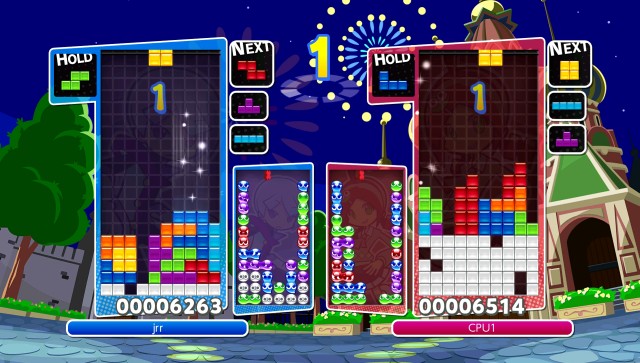
Thank you for clicking on the link even though you likely noticed I'm reviewing a puzzle game. Everyone knows puzzle games make for boring reviews. How does a person make an experience about an endless stream of blocks dropping from the sky sound anything but dreadful, even when it's actually quite interesting? So like I said, thank you. Now, please endure my boring review.
Puyo Puyo Tetris is, as its title suggests, a mixture of two reasonably beloved puzzle game franchises. They're games that have led many of us to say "No, really, you'll like it if you just try it!" to disinterested friends and family members over the years. Incredibly, we often wound up being right.
 Credit: Sonic Team/SEGA
Many of us have played Tetris at some point, whether on the Game Boy (that was my introduction) or on a graphing calculator or workplace computer that was supposed to be used for more serious matters. You know the drill: there's a vertical space available and a bunch of four-block patterns (called "tetrominos") drop from the sky to fill it. You move them around so they spread across an entire row (without gaps), and then they disappear with a pleasing flash. From there, you keep doing the same thing as the speed and your score gradually increase. A round finally ends when you mess up enough times that the blocks finally fill your available space.
Fewer people have played Puyo Puyo, though it has been around for a long time in Japan. It also came west on multiple occasions, often with some other name attached. Remember Dr. Robotnik's Mean Bean Machine, the old Genesis game about magical beans falling from the sky? That was secretly Puyo Puyo. And so was Kirby's Avalance, on the Super Nintendo. In any form the game takes, you have a vertical space and blobs dropping from the sky. To make those blobs vanish before they dominate your space, you must position four of them so they touch, usually in a vertical or horizontal line, or in an L or Z formation. More can be joined if you're sneaky, but four is the minimum. Combo chains are a critical part of mastering the game and making your rivals beg for mercy.
Someone at Sonic Team must have been a big fan of both franchises, and that someone at some point said "Hey, we should make a game that mixes the two!" Then, that someone obtained the rights and the resources to make the dream a reality. Now, here we are with Puyo Puyo Tetris on the Nintendo Switch. Originally released on the PlayStation 3, Wii U, 3DS and Vita in February of 2014, this (sort of) new release is an overdue treat for puzzle fans who long harbored resentment upon realizing the Japanese gamers got yet another cool thing the rest of the world didn't. You know you're out there, clandestine resenters!
 Credit: Sonic Team/SEGA
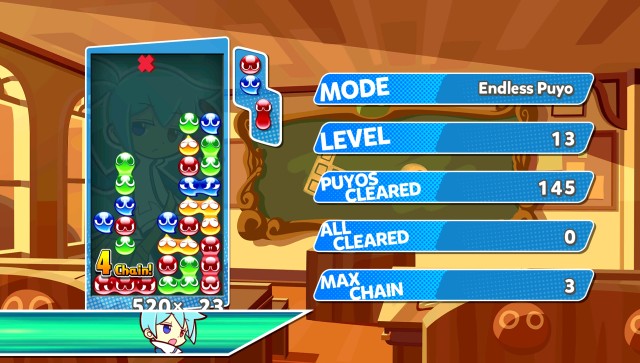
Puyo Puyo Tetris features a number of single-player and multiplayer modes, and most of those break down further. I could outline each of them for you in excruciating detail, but I'd probably fall asleep in the middle of it all and I can't even imagine how tedious such a rundown would be to read. So let's keep things more general, shall we?
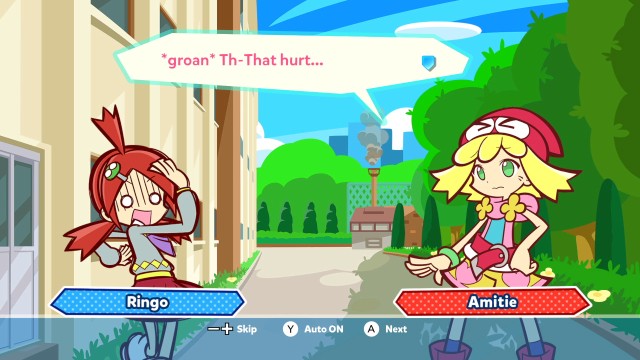
For the single player, the main course is Adventure mode, which lets him or her advance through a ridiculously inane story. Apparently, someone is trying to merge two dimensions. In one of those dimensions, folks mess around with blobs known as "puyos" nearly all the time, and they spend most of their remaining time playing pranks on one another or falling in love or whatever. In the other dimension, existence amounts to pretty much the same thing, except tetromino pieces have replaced slime. Now, the two races have been thrown together. They get to settle their differences by competing in Puyo Puyo and Tetris battles.
Silly though it often is, the campaign does a decent job of introducing the game's general concepts. At first, you're presented with fairly simple duels, and over time those evolve until near the end, you're playing a variety of match types. I paid close attention to the whole story, which is voiced beautifully by a talented cast, hoping at some point the narrative would justify my investment. It really didn't, though. There's just a bunch of silly banter of the sort you've heard in every cheesy anime ever, then the credits roll. Along the way, you unlock additional characters to use in the other modes. So at least it has that going for it.
 Credit: Sonic Team/SEGA
My real problem with the Adventure mode is that the outcome of matches feels arbitrary. I've played enough Tetris over the years to become fairly good at it. I'm not anywhere near as skilled as the guys who would send photos of their accomplishments to Nintendo Power back in the day, but I'm at least adept at quickly clearing lines. My experience, however, meant very little here. Sometimes, I would turn in what felt like a mediocre performance and demolish my opponent. Other times, I'd play spectacularly and he would walk all over me (even when my score was considerably higher than his). Skill doesn't seem to be the primary consideration, whether you're playing Tetris or Puyo Puyo, or one of the modes that merges the two. Not unless it's a specific variety of skill that I apparently don't possess.
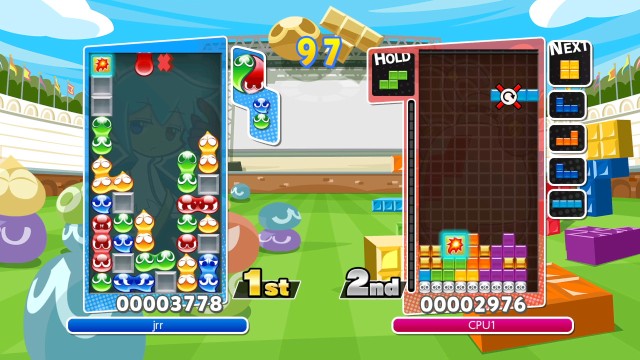
The two games come together in a variety of ways, for the record. Sometimes, you start playing a Tetris match and a timer ticks down. As the timer hits zero, you lose control of whatever piece might be falling through the air (hopefully, you have it lined up for a successful play) and the board switches so that you're playing Puyo Puyo with a fresh timer. From there, you periodically dance between one discipline and the other, until either you or your opponent fills one of your two boards and the match ends. In other cases, there's no clear division. You drop some puyos, as one does. Suddenly, a tetromino is falling through the air! If you like, you can initiate a quick drop to make it plummet to the base of the area, displacing puyos and flattening garbage. But sometimes, the same block alternates between puyo and tetromino form. There's definitely some strategy involved, as you decide when clearing lines is most important and when you just need to give yourself more space.
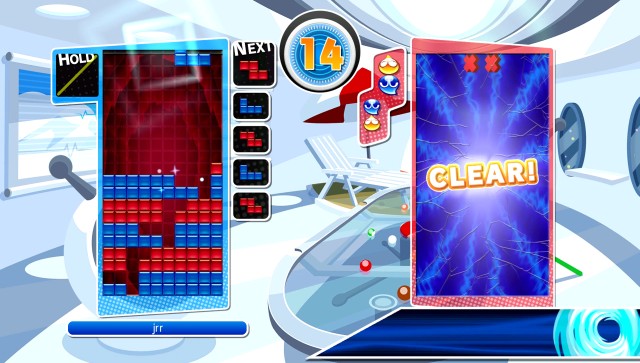 Credit: Sonic Team/SEGA
Across the various modes, it's often possible to play Tetris or Puyo Puyo while your opponent is playing just the opposite. You produce garbage in your match and it falls into your rival's screen in the appropriate form. Or you activate special items that launch attacks, or hurriedly clear special puzzle boards as your competition does the same. If you have a friend, you can play against him or her... or them. Up to four local players are able to compete at once. Or you can go up against AI opponents, or head online for ranked or unranked matches against other players who are searching for their next victim.
See? There I go, getting all boring, trying to cram in a bunch of details all at once. And Puyo Puyo Tetris deserves better, because it's definitely not boring. If you're into puzzle games much at all, it has a great deal to offer. Alas, the sheer variety of options--more than you might ever suspect developers could get out of two games as simple at their core as Tetris and Puyo Puyo--makes for boring reading. The good news is that if you buy the game, you won't be reading it. You'll be playing it. And I bet you'll enjoy that process even more than you did reading this review. I know, I know. That's hard to believe. But it's the truth!