
Graceful Explosion Machine looked like it should have been right up my alley, but I don't seem to be able to enjoy playing it for more than a few minutes at a time. I can appreciate on one level the many things it does well, but after a certain point, none of that matters and all I want to do is play something else.
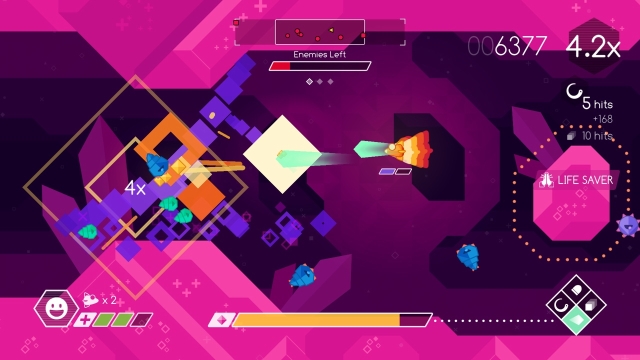
I'm not sure what the plot is supposed to be, but I can tell you the setup: there are four cavernous planets, and you must explore them with your "graceful" ship (which looks a lot like one of the pods from the classic SEGA shooter, Fantasy Zone). You get to work by flying to the left and right as enemies materialize from portals and harass you. A radar displays at the top of the screen to let you know what is coming at you from what side, sort of like the indicator in Defender. A level is typically cleared once you wipe out enough foes in three phases. In some cases, there's only one phase that lasts considerably longer and unlocks special challenges (such as Score Attack) once cleared.
 Credit: Vertex Pop
Your ship is outfitted with a variety of weapons, which you pick up in the first two or three stages and from then on can use whenever you have the desire and sufficient weapon energy. Your blaster is your default weapon, which you might expect to use to obliterate swarms and swarms of enemies, but it tends to overheat before even taking out even one of the two or three swarms that often populate the screen in the later areas. That means you need to rely on secondary options to bail you out of trouble. Unfortunately, they eat up your energy meter. Running on empty leaves you extremely vulnerable, as you can imagine.
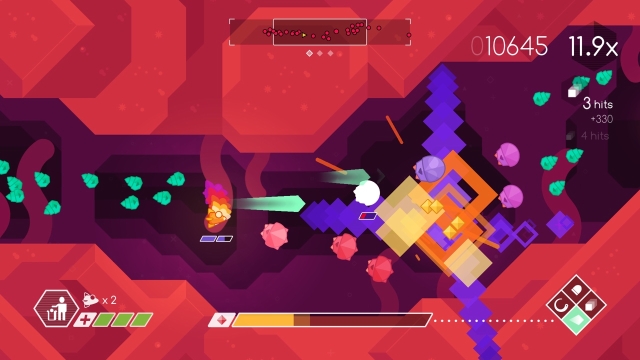
The first of the available secondary weapons is a long-range laser that does a terrific job of breaking through most strong enemy armor. The only problem is that it drains your energy meter at a ludicrous pace, so you need to aim carefully and quickly swoop into dangerous territory to gather whatever energy capsules your defeated foes drop. Another option is a swarm of homing missiles, which fly in all directions and eliminate weak foes nearby. However, they won't take out the tougher guys, who will probably demolish you while you're lost in the middle of your own attack. That's not good. And finally, you have an energy sword that swings in an arc around you. It destroys enemy projectiles and weak foes, but in some cases it splits targets apart and causes them to crash into you. That's also not good.
 Credit: Vertex Pop
Your ship fires its blaster straight ahead, in whatever direction it is facing. You can flip around at the press of a shoulder button, or fly backward if you prefer. You also can perform a boost with the other shoulder button, which allows you to pass through enemies but not bullets. You can boost twice in rapid succession if necessary, but then the ability needs a brief moment to recharge before you can count on it again. Relying on boosts is risky, anyway, because they might land you right in the middle of a problem that's even worse than the one you attempted to evade.
The game's early stages do a good job of acquainting you with your weapons and a few weak enemies. Their primary fault is that they're rather dull, because your adversaries are so weak. It's easy to cut through the resistance, and there's plenty of room to maneuver. Striking against walls and such won't hurt you, so the whole process is almost relaxing. A soothing soundtrack heightens that effect.
 Credit: Vertex Pop
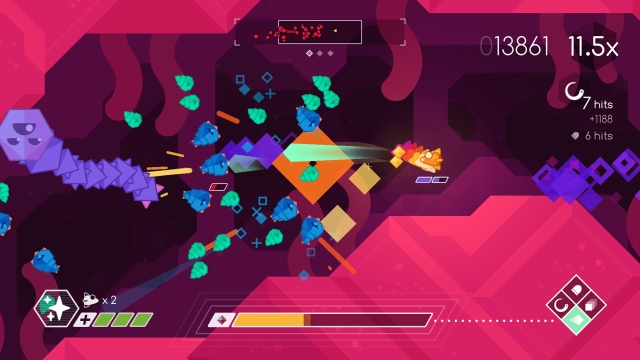
Later stages, particularly those featured on the third planet and beyond, choke the air with bullets and enemies. A lot of those enemies take multiple hits to kill, and they zip toward you with ridiculous speed once you start firing on them. Plus you're sometimes also avoiding laser beams that sweep the caverns, and bullets fired from turrets. The sheer number of threats you have to keep sorted all at once gets to be a bit much, particularly since it's difficult to tell at a glance what the situation is with your available secondary weapons. And frankly, a glance is more than you can usually afford to spare. The whole dynamic feels a bit like those moments when you advance really far into Geometry Wars and the screen is flooded with squares and triangles that are out for your blood. Here, though, it's harder to tell which is the best way to respond.
Visually, the game gets the job done. There's not a lot of detail, but too much intricate artwork would have only served as a distraction, anyway. It's at least easy to make out the distinct enemies, so you can plan out your survival strategies. That's about as much as a person can ask for, really, and it doesn't hurt that the framerate remains stable throughout the experience. I didn't notice it dipping even when the screen was absolutely crowded.
 Credit: Vertex Pop
If the difficulty scaled a bit more expertly, I might have enjoyed Graceful Explosion Machine a lot more than I actually did, but it quickly transitions from too easy to brutal, with barely any time for the player to acclimate. I know some folks will absolutely love that difficulty, and I can hear their voices chanting "git gud" in the back of my head right now, but the simple fact is the game didn't do anything interesting enough to inspire me to put in that additional effort. There's a rating system in place that I assume was meant to provide some incentive, but it's difficult to decipher. I have no idea what performance difference earns a C+ rating instead of a C, for instance.
I like the various games that seem to have inspired the developers responsible for Graceful Explosion Machine. I also like its generally smooth controls, and the variety of enemies that are introduced as the campaign progresses (even though a few of them are excessively competent killing machines). The visuals are more than adequate, and there's enough content and difficulty to keep a player busy for hours, if he finds himself enamored with the design. All in all, I'd even go so far as to say it's a pretty good game. Just don't ask me to keep playing it.