


To borrow a line from Starscream circa 1986 as he jettisoned a dying Megatron into space: it pains me to do this... but Lament’s title is sadly apt for me. I want to see more of these NES homages, and marking them down this way doesn’t help achieve that. But Lament feels like Castlevania II: Belmont's Revenge (of ancient black-and-white Gameboy lore) revisited some 26 years later, but nowhere as good. And that’s not good.
Lament stars a wolfman doing his best Cloud Strife impression. No story was on offer, and that’s fine: we’ll just kill everything that moves. Lament wants to be classic Castlevania or Ninja Gaiden, and to the extent that it gives us side-scrolling hack-and-slash action and some briefly challenging platforming bits and bosses, it’s mission accomplished. For old school gamers, the mere fact the game exists feels like a win in and of itself, but the hour or two of uneven play will be behind you very quickly and permanently.
There are four levels to choose from at the onset (again, like Belmont's Revenge). Halfway through each level, you gain a new power, such as the 'dash' or the 'charged strike,' and then it’s on to the boss. Oddly enough, simply earning a level’s special power and thereafter dying at the boss is enough for the level to count as being beaten. After the four selectable missions are conquered, you unlock the fifth and last, named appropriately, “Lament.”
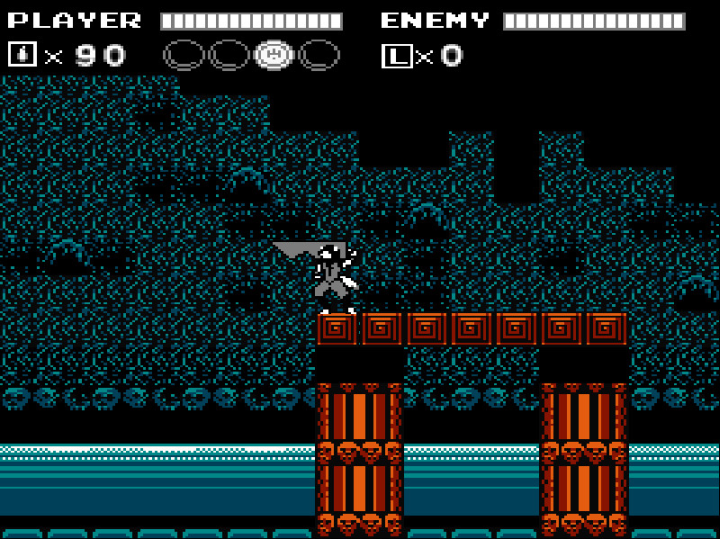
All the game’s bosses offer somewhat challenging pattern memorization which does legitimately if fleetingly bring to mind a classic NES experience for all the right reasons. However, while I can’t help but admire the passion of a small team of developers willing Lament into existence and managing to evoke some pungent nostalgia here and there, there are failings nearly everywhere else – none of them game-ruining, but cumulatively tough to take.
To begin with, there are some questionable fundamental design choices: as cool as the buster sword looks, for example, it’s also as unwieldy as it appears to be. You can’t strike downward or upward – I’ll reluctantly accept that – and you can’t crouch and attack – but I don’t accept that, as crouching and attacking was pretty much mandatory nearly three decades ago. To make matters worse, the wolfman’s jump feels ever so slightly imprecise, compounded by the fact that he gets knocked back a comical distance when hit.
In another curious move, the level that presents itself to us first is the most difficult by far, which might prove to be off-putting in a time where folks don't tend to give new games much of a chance – indeed, I’m not sure I would have, had I not been tasked with producing a review.
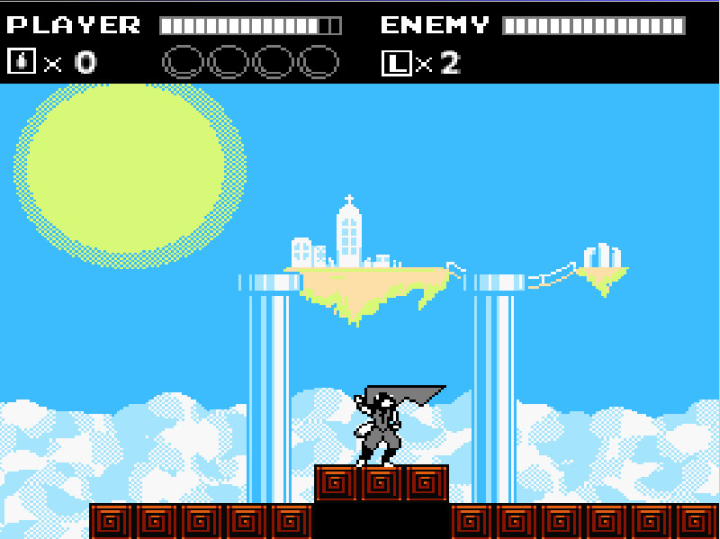
There are also a litany of issues which suggest an unpolished product more than a poorly planned one: the title screen cursor went berserk a few times on me; the font used in naming the levels makes the names difficult to read; after beating one boss and collecting the end-of-level orb, I noticed that the boss was in fact still alive; and the charge attack didn't remember how to work at one point later in the level where I learned it, only to snap out of it moments later.
The title screen starts things off in monochromatic fashion (because, coolness, obviously), but when colour is actually introduced as you begin the game proper, the difference is much less startling than it should be. Let’s say that “vibrant” isn’t a word I’d use to describe the graphics. Enemy sprites are generic and lacking in detail and colour; I can't tell what a lot of them are supposed to be. The general washed out look extends to the environs as well.
Lament, while it does make an earnest attempt to ape oldies-but-goodies in the Ninja Gaiden and Castlevania canons, is equal parts short and easy (I beat the game in an hour during my first and only real sitting with it), and clunky and unremarkable, save its notably discordant score, which is remarkable for the wrong reasons. The best of the games which came before it feature memorable, rock hard gameplay and some of the finest videogame music ever made – monumental legacies to follow, I know, but such is the risk involved with paying homage. Lament hits some familiar notes which excite at first blush, but the arrangement is regrettably thin and forgettable.