
"I wonder if I'm remembering wrong," I said to myself, after my first two unsuccessful attempts to clear Double Dragon IV on the PlayStation 4. "I wonder if the original Double Dragon games were as tedious as this one is."
I fired up my Wii U and started playing through the NES version of Double Dragon that is available on the Virtual Console. Immediately, I started having a delightful time. I worked my way through the mean city streets and entered a warehouse, where I battled a giant brute of a man with a handlebar mustache. He was tough, but I knocked him on his butt and a conveyor belt dropped him into a pit. Then I advanced along the ground level at a construction site, dodging explosive charges thrown my way by gang members, before scaling a series of ledges and finally facing off against a purple-haired martial arts artist at the top. Finally, I started through a forest and enjoyed the view of the sun setting over distant mountains, before my adventure ended prematurely as I battled near some docks. It was a memorable run and it told me what I needed to know: Double Dragon IV simply isn't all that good.
 Credit: Arc System Works/Falcom
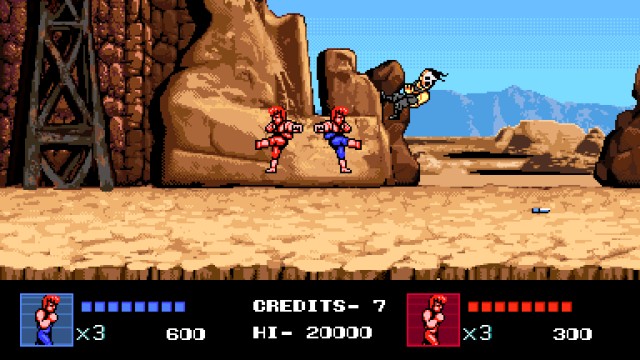
I'm in favor of bringing back the classics of yesteryear, and making sequels to follow them. I wish developers would do that more often, even. I don't mind if what I get to play looks and sounds like an 8-bit game, except now running on hardware powerful enough to host the latest first-person shooter or sprawling epic. But Double Dragon IV doesn't manage even that. Its design lacks the ambition that made its predecessors great, and its visuals often feel ugly compared to those featured in previous titles.
The story isn't especially original, either, though it at least feels familiar in a good way. As the game begins, the Double Dragon brothers are cruising through the desert in their sports car when suddenly another vehicle forces them off the road. The siblings easily survive the crash, and now they must battle through a desert environment to track down the thugs responsible for the collision. Once they manage that, they find that there's more to the story than they knew, so they depart the United States to finish delivering a beatdown abroad.
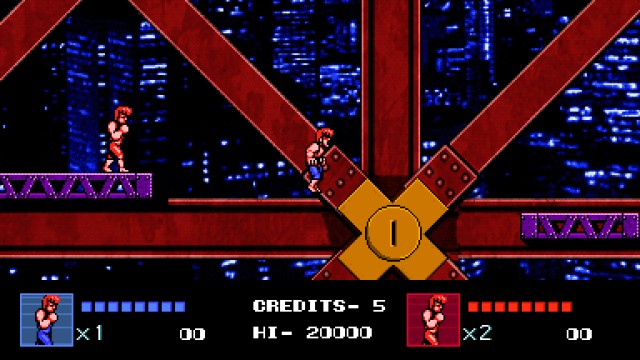
Unfortunately, most of the environments that enable that journey are uninspired. The artists didn't take the time to construct interesting backdrops, for starters, which means the first few missions in particular are blander than a microwave noodle dish without the seasoning packet. Eventually, more intriguing locales are finally introduced, such as a mostly deserted casino and a few different towers, but those only start showing up several stages into the campaign, once you've cleared the insultingly easy stuff.
 Credit: Arc System Works/Falcom
Another thing I didn't like about the various missions is that they spend a lot of time making you wait around for your foes to even arrive. You beat up a few of them and then it's time to progress through more of the map. Sometimes, you advance several screens before anyone new appears, which makes it feel like the developers planned to include more opposition but forgot to code in thugs at the last minute. Then you arrive where a rumble is slated to appear, and you have to hang around for a bit before one or two goons lazily stroll into sight. They don't get very close, though, because they're waiting for you to jump up some ledges to face them.
Later in the game, the developers added a variety of environmental hazards. In one case, you have to leap along a series of conveyor belts that propel you toward wide pits. Then you have to jump on platforms that slowly rise and descend. If you mess up, you fall into a pit and lose a life. Sometimes, you might jump from the edge of the platform, only it won't register properly and you fall to your death, anyway. In a subsequent stage, some of the ledges flicker and then disappear, so you have to run along them at the right moment and jump to the slightly more stable platforms that rest in between... except you can't stand on those for long because they periodically spin and dump you into the pit. Such segments aren't particularly enjoyable, especially since your characters move too stiffly at even the best of times (though at least now there is a dedicated jump button). Platforming action is clearly best saved for portly plumbers, not martial arts experts.
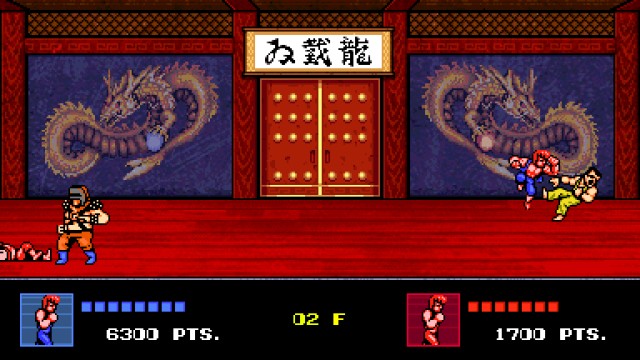
The fights, which are arguably the game's main draw, also grow tiresome. Early on, enemies tend to attack you only one or two at a time, so it's easy to knock them around without much risk of taking substantial damage yourself. They don't put up a real fight until around mission 5, which is nearly the game's halfway point. Then, suddenly, they grow slightly more competent. Some of them will throw projectiles at you. Others will charge you, or perform a hip drop move that occasionally costs you an entire life if it connects. In one case, my character was thrown off-screen with a full life bar, then pummeled because I couldn't see what was happening. In many areas, you can also move to the very bottom of the screen and find a safe zone. You can't hit your foes, but they also can't hit you, which gives you all the time you need to decide how to mount your comeback.
 Credit: Arc System Works/Falcom
As you advance through the story campaign, you unlock additional characters for a 2-player versus mode that resembles the one featured in the original Double Dragon on the NES. It's a nice inclusion, but people who want to play a fighting game will probably go for Street Fighter or Mortal Kombat, not this. I'm glad it's there, but it doesn't add much value. The Tower mode is more successful in that regard, but only unlocks once you clear the entire campaign. It pits you against a few foes on each floor, and you have to advance as many floors as you can while using only a single life. Doing so unlocks additional characters for all modes, so that (for instance) you can play through the campaign as the bulky Abobo, instead of as the normal stars. That's an amusing option, and I'm glad it exists.
As I write this review, I realize also that I would have wound up enjoying the game considerably less if I didn't look around online and find out that it's possible to start a new attempt at the story campaign by playing through the last stage you successfully cleared. This allows you to jump right past the early stuff you might be sick of, but the process isn't obvious. You have to repeatedly press the Options button on your controller on the title screen, which cycles through available stages. That way, you can enjoy your next run considerably more. I'm not sure why that point wasn't made clearer, but it definitely helps the game along. Judging by the fact that the trophy for completing just the eighth mission is currently "very rare," I suspect that most players don't know the option exists. I know I was relieved when I made it to the end of the 10th stage and found out that there was a way to try again from Mission 9. If not for that, I might not have bothered to clear the game.
Double Dragon was a special franchise, back in the day, but then its developers moved on to other projects. I was excited to see that someone finally came back to make a proper new installment for release in 2017, but unfortunately, the people responsible didn't take enough risks to do anything especially interesting with the unexpected sequel. Double Dragon 4 is a disappointing next entry in a series that deserved better, an underwhelming imitation of its considerably more memorable source material. If you haven't already obtained the games that came before it, maybe start there first.