


Don’t Chat With Strangers is a simple game, but it uses that simplicity to drive your patience hard into the ground. At heart, it’s a straight-forward point-and-click horror tale about answering a late night instant message on your computer from an unknown girl. And then probably dying a gory, pixelated death shortly afterwards. There are ways to avoid such an end, but odds are, you’ll fail to find them in a time frame that holds your interest.
There’s nothing wrong with a game punishing a player with constant deaths in an attempt to have them eventually learn from their mistakes and find the answer to a puzzle. For the first few attempts, there’s nothing wrong with how Don’t Chat With Strangers sets out to kill you. There’s a very linear set of answers to employ during your online discussion with the mysteriously fatal Lucy1, certain things you can say and actions you can undertake that will prolong your life just long enough to sneak a little further into your conversation. Finding the solutions to these puzzles is, for the most part, pretty satisfying. There are sensible ways to keep the girl happy and, therefore, to avoid dying an awful death. Some are more obvious than others; should she request to play an online game, don’t destroy her at it and then act smug. Though it will rarely lead to your murder outside of this game, I’ve learnt that girls often don’t like that.
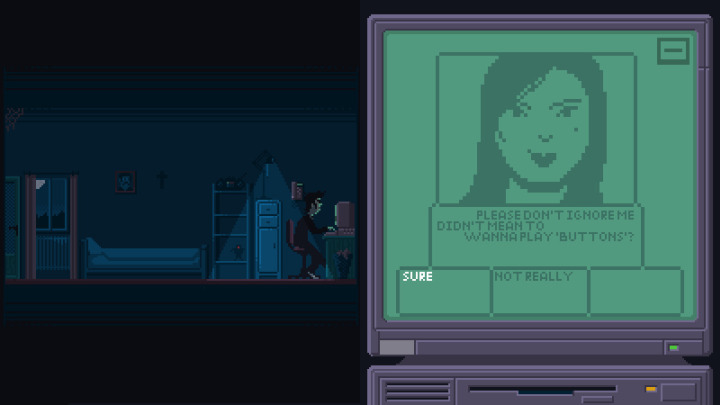
Other solutions mean trying to find a way around a pesky system update and a corresponding computer crash destroying valuable information - an issue that also has a practical solution. The problem is that additional complications crop up that need to be circumvented through mostly trial and error, leading to multiple deaths and repeatedly forcing you to retread old ground.
Sometimes, most annoyingly, these deaths make little sense. Audio cues some way into the game suggest that you might be the victim of a gas leak, and leaving it to flood your room is fatal. But the means to repair this and live a little longer makes little sense. Progressing literally amounts to you clicking on everything and seeing what doesn’t get you killed, then continuing to utilize the specific solution on future playthoughs. There’s no satisfaction in the process. It’s not overcoming a puzzle with intellect; it’s just rubbing a keyboard against your face, and repeating it from then on, should it work.
Though limited, each new game does run through slightly differently than the last, meaning that Lucy will not always ask you the same string of questions in the same order. But once you know your way past one roadblock, the solution rarely changes. You can memorise her favourite colour and use that to curry favour forever, or blunder your way through a difficult exchange once, then repeat. The slightly random nature of the game does alleviate this somewhat; do you respond any differently to “Hi” than you would “Hi boi!”? Getting it wrong might mean you die, but for the most part, you’ll find you can carve the exact same path through your online chat and achieve the same overall results, even if the wording sometimes differs. It’s also obvious that the game’s developer is not a native English speaker; though the interactions and exchanges between horrific supernatural murderer and protagonist are kept very simple, they still feel unnatural and clumsy.
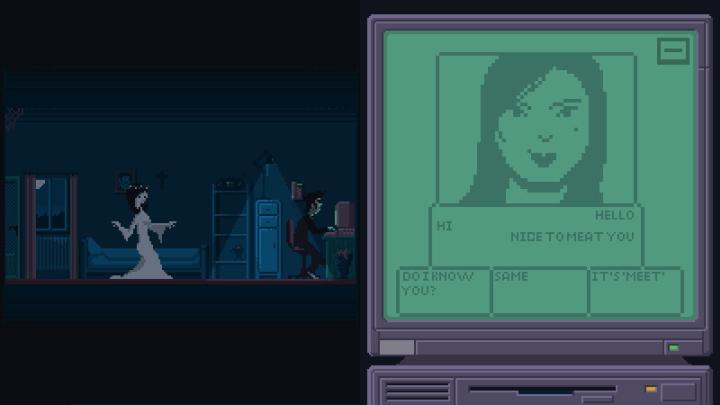
Conversation feels unpolished, which is something that reverberates throughout Don’t Chat to Strangers. As I write this review, there is no way to exit a game. To close it down completely, you need to either ALT+TAB out of it, or use the ALT+F4 shortcut to return to desktop. Alternatively, should you die (and you will, a million times), the game just hangs there, gazing at your corpse, giving you no hint that you have to hit ESC to return to the start screen. Perhaps the interface quirks could be forgiven, but the game’s greatest crime is that it makes you work very hard for very little in the way of payoff. Throughout your chat with Lucy, you’re offered little hints at her story, teased tiny threads of a past connection with the protagonist that come to nothing. The eventual ending for those patient enough to bludgeon their way through is little more than an excuse to finish the game. There’s nothing remarkable to see; there’s just finally a reason to stop playing.
There’s an interesting framework to Don’t Chat With Strangers. It’s certainly a formula that could be refined to tell a decent tale, or provide a satisfying game. But the execution here is too clumsy and the eventual reveal far too timid to find any real success.