
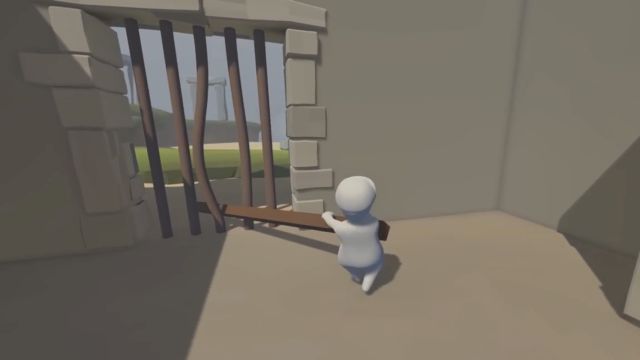
Physics-based video games are sometimes regarded as technical demonstrations or toys rather than serious endeavors, because even when those physics do adhere to reality and are impressive in terms of the environmental interaction they allow, the novelty tends to run its course rather quickly.
 Credit: No Brakes Games/Curve Digital
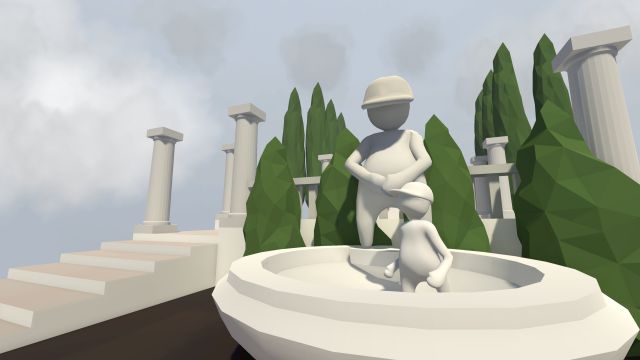
Such is certainly the case with Human: Fall Flat. It's an adventure/puzzle game at heart, but it tries to get needlessly clever about that and extends its length by using a mix of physics-based puzzles and platforming sequences that vary between crafty and enjoyable, to dull and time-consuming exercises. The size of the levels and the variety of gameplay on offer go a long way toward offering something worthwhile, but the frustrating moments when you wish your character could simply move without imitating a drunken penguin take away a lot of any potential enjoyment and leave behind an experience that too often settles for "frustrating."
Human: Fall Flat’s level design relies on physics to challenge the player. Your nameless character must frequently interact with the level in order to proceed. This starts off with simple tasks, such as pulling and placing items to act as bridges or platforms, but eventually evolves until the character is performing more complex processes such as watercraft operation.
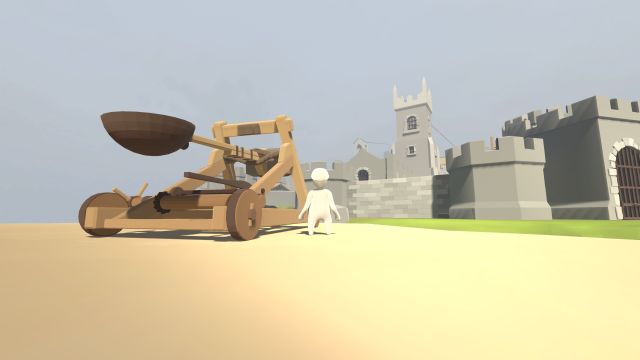
Puzzles and obstacles typically revolve around your character extending and raising their arms while gripping objects, be they levers to turn or pieces of rope with which to swing across gaps. The controls couldn’t be any simpler: extend your arm(s) and then move the camera up or down in order to raise or lower your arms, but the extent to which the game exploits those simple controls is clever and impressive. In one sequence, for instance, you'll load a catapult by turning its crank, place a rock as ammunition and then pull the firing lever to knock down a wall. The game also has a silly sense of humor, so what’s stopping you from loading yourself into the catapult to be used as even better ammunition? Why not take hold of a waterbed and hang on for dear life as you cascade down a waterfall? For that matter, why not ride a dumpster off a building?
 Credit: No Brakes Games/Curve Digital
I never really encountered a brain-busting stumper of a puzzle, because of how the game tackles its puzzles. In a nutshell: something somewhere can be pulled, dragged or held onto, and doing so allows you to progress. As a result of this approach, sufficient exploration and experimentation will typically reveal the solution to any puzzle in due time. Sometimes, multiple steps are required, but that's the extent of the logical difficulty. Then there are the puzzle rooms, where all of the tools required for the job are already on hand. You simply have to maneuver them into place. For me, the only exception to that rule came when I got a bit too clever and entered a puzzle room without a needed tool in my possession, and thus had to restart the level. That was a frustrating waste of time.
As the game progresses, that one word ends up becoming a repeat offender: frustrating. Yes, the early sections are fun to explore, but as level size and complexity grew, so did my impatience with the physics and the slow pitter-patter of the character.
Imprecise controls mix with the physics system to produce many puzzles and obstacles that take longer to clear than should be strictly necessary. Fumbling about with tools and items just isn’t fun after the second hour, and this is doubly true given how your character moves at a teeth-grindingly slow pace. Bunny hopping adds a tiny boost of speed, but that doesn’t accomplish much when you're trying to traverse such large maps. I frequently wished that my character could just move, climb and interact with objects like a normal video game character, that he didn't have to stumble around like a buffoon simply because the physics engine demands it.
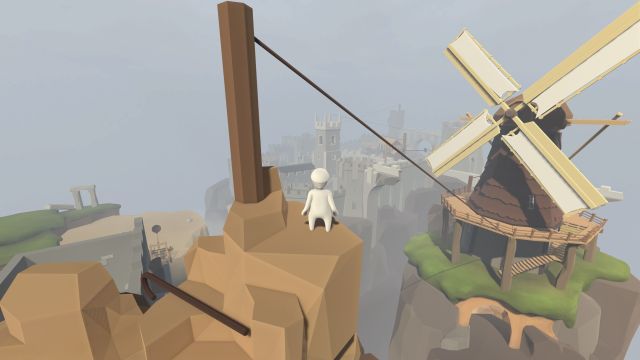
On top of those issues, the game then has the tenacity to ask you to operate vehicles, attempting to awkwardly steer with one hand while the other one operates the throttle via lever. And don’t get me started on the boats, the utter bane of my existence in the water-based level. The rowboat is comically irksome to use, and the sailing raft can’t catch a breeze. This leads me to the (perhaps?) paranoid belief that the vehicle was inserted in the game just to function as some sort of sick joke. Eventually, I discovered that you can sequence break the adventure by scaling walls, and that’s what I frequently resorted to; more or less cheating to bypass segments and puzzles because I just couldn’t muster up a damn to mess about with the physics and controls any longer.
 Credit: No Brakes Games/Curve Digital
The game does feature a cacophony of achievements, secrets and time-saving shortcuts to discover along the way, but Human: Fall Flat overstays its welcome in a hurry and that means you'll likely have to struggle just to make yourself care about any of them. And that’s a shame, because it starts off strong and silly, but the game wants too much to be a full-fledged adventure game.
While the mechanics and puzzles featured within Human: Fall Flat are designed to fit and operate within the physics engine available, stumbling off a staircase or being unable to use a hooked pole on a line to swing across a gap because the blessed thing can’t be held quickly becomes an utter pain. This is certainly not a game for those with limited patience, and I can only recommend its campaign up to the point when you reach the "Castle" level. After that, you may as well stop playing, since the annoyances only rise until they become intolerable. Like the titular character, this one falls flat.