
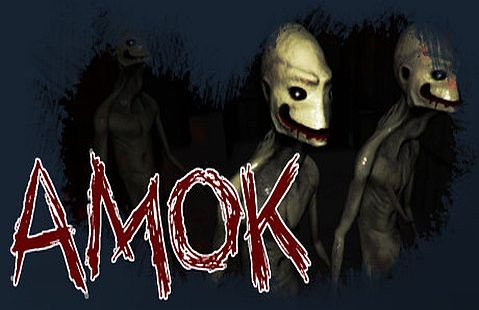
 Credit: Artem Bondin
Sizable portions of the indie game AMOK showcase convoluted hallways, wide open wildernesses and glacier-ridden cliffs filled with nothing. There are also countless cabinets packed with useless cardboard boxes, myriad homogeneous chambers and miles of snow-strewn real estate bereft of environmental flair. Most noticeable of all, though, is the absence of any life forms within most such areas. Not a soul stirs. Even so, you'll likely tread carefully, just in case. You might expect or even hope for an unseen force to pounce from the bleakness and break AMOK's monotony.
There are dozens of golden opportunities the game's developers might easily have taken to involve players in substantial subplots or events, or even to go the cheap route and frighten them senseless with simple jump scares or haunting imagery. Sadly, AMOK seldom seizes those opportunities, preferring instead to haphazardly splash blood in a few locations and call it a day.
 Credit: Artem Bondin
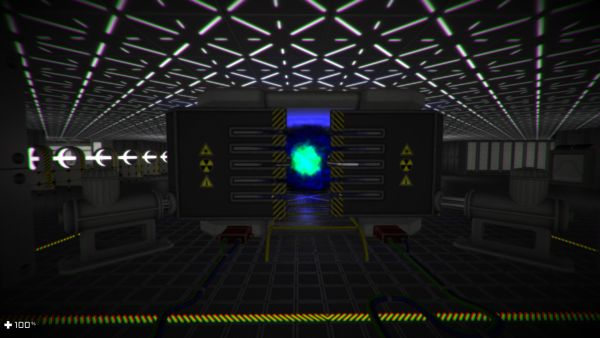
Exploration begets too few rewards, especially when each region's design is not only vacant but repetitive. Early on, you enter a deserted research facility packed with copied-and-pasted rooms. Connected to each of those is a series of identical hallways bearing few standout features. Some time after that level, you warp to a frozen mountainside and navigate a narrow pathway positioned next to a cliff. Occasionally, you can duck into a cave and warm yourself by a fire to stave off hypothermia, then recommence slogging through the barren and indifferent environment. Such loneliness and isolation would be commendable in most horror games, but in AMOK those conditions only suck the enthusiasm out of you.
If you've played your share of so-called "walking simulators," then you realize that the above conditions are almost par for the course. The chief difference is that most modern story-driven adventures sport symbolic hints and subtle touches that provide enough narrative for you to fill in the blanks. They tend to be "show, not tell" affairs that will either bore you to pieces or excite you with loads of intricate details waiting to be noticed. AMOK, however, neither shows nor tells. Most of its twelve stages stand unadorned and unpopulated, as if someone programmed a bundle of levels and simply forgot to fill them.
I'd be remiss if I didn't admit to enjoying a couple of scenes, though. To wit, the abandoned ship was my favorite locale because of its varying stage structure. It starts off with dank, confined corridors that lead to a cargo hold and eventually to the deck. From there, you can spot several possible sites that could house the exit, an inter-dimensional portal. It's then that your gears get turning and-- by the gods, the game has actually inspired some thought! Trial and error become your companions as you test out each doorway and hall, searching for additional rooms, holes in the wall or staircases that might bring you closer to the dimensional rift that is your ticket to the next area.
 Credit: Artem Bondin
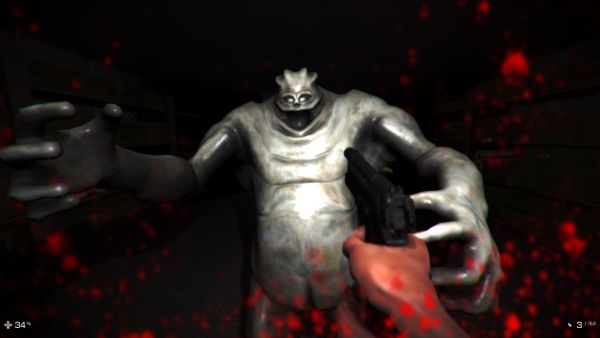
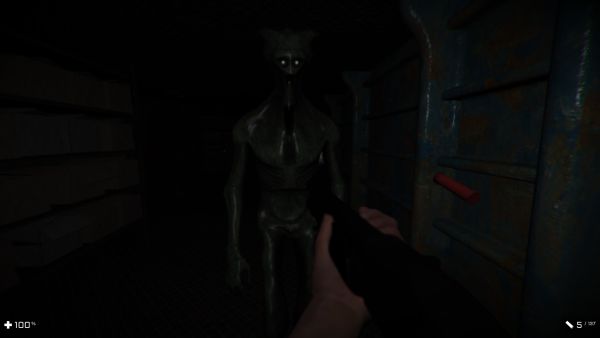
And believe me, you'll want to escape as soon as possible. You see, AMOK isn't purely a trudging walking simulator. It occasionally equips you with a temporary weapon like an ax or a pistol. That's your cue to start worrying and checking your six for slender aliens, masked fiends or smiley-faced simians. These beasts aimlessly roam various stages, catching you when you least expect it. One second you might tiptoe into a shadowy room and uncover nothing. The next, you turn around and glimpse a couple of sneaky aliens waiting to dine on your corpse.
Unfortunately, the emergence of monsters does little to improve AMOK. Most brutes pose only a minor threat because the damage they deal is negligible. My first encounter with the aliens pitted me against three of them. I felled them all by standing still and blasting them with a shotgun. Ultimately, their repeated blows only cost me about twenty hit points. On the flip side, creatures capable of dealing major harm aren't any more frightening. They tend to amble rather than rush, providing you with enough time and space to push past them and escape. Even when there's distance between the two of you, they merely plod onward as if murdering you is a chore they'd rather avoid. Call me crazy, but I don't find reluctant killers all that terrifying.
 Credit: Artem Bondin
Honestly, I'm still trying to figure out whether AMOK was intended to be a survival-horror throwback or a frenetic shooter. In the case of the former, the game's control response is fittingly sluggish, but there isn't much of a survival aspect to speak of. Each action sequence provides ample ammo to scotch all of your adversaries, and there are only a few occasions when the mechanics accentuate the game's fear-driven scenarios (e.g. running through the caves, armed with only a torch and facing a herd of fat monsters). Worse than that, the game's walking speed is unbearably slow due to its stiff control response. You thus spend the entire game holding the Control key so you can continuously run. Then again, the game's name is AMOK...
Yeah, I know. The joke had to happen at some point, though...
Altogether, AMOK is two lousy games rolled into one. Its "walking simulator" bits are dry and empty, and its fighting scenes are vapid. The game also lacks in the fright department and doesn't present much of a narrative. All of its chapters consist of random level themes without rhyme or reason, with a phoned in denouement offered to tie them together during the closing cutscene. Honestly, there are worse indie horror titles than AMOK, but there's also an army of superior pieces available.