Moonlighter plops you into the shoes of a young, white-haired lad yearning for a daring escapade... and gets completely destroyed on his first attempt. At the end of a dungeon tutorial that teaches the basics of movement and attack, such as dodge rolling and swinging a push broom, you lead him into a room swarming with monsters. There's no escape, the creatures spawn endlessly, and they take forever to kill. He gets whopped, the dungeon literally spits him out the front entrance, and an elderly man finds and drags him back home to heal.
Some hero.
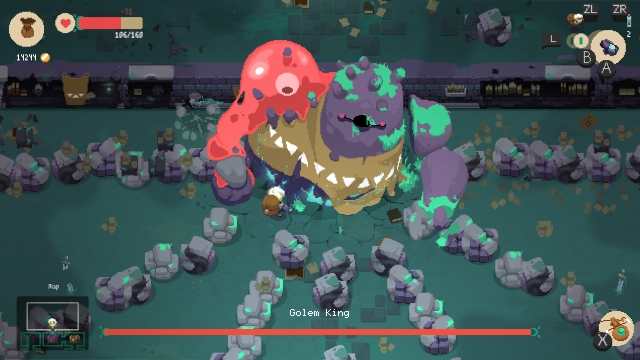
The funny thing is, the protagonist isn't much of a "hero," and it's from here where the game starts pushing its main concept. In actuality, you're plopped into the shoes of a young, white-haired merchant who runs a small town shop named Moonlighter. Several mysterious, randomly-generated dungeons reside nearby, long ago barricaded due to many a death, and, as one would guess, you must take this wannabe adventurer into each one, plundering their many unique treasures within an overhead perspective. Thankfully, the old man from before donated a sword and shield; but they can only take the storekeeper so far into the first dungeon, one filled with blobs, guardians with huge swords, and water pots spraying projectiles from a distance, all eager to attack. They drain his health bar really fast, too.
 Credit: Digital Sun/11 bit studios
So what can you, in control of this merchant's fate, do in such a hopeless situation? Sell! Defeated foes drop items, small and big, both common and rare, and you can then take these back to the shop to sell during the day cycle. Not as simple as it sounds, because not only do you have to sell these off, but you have to guess a fitting price for each new object discovered. Make one too pricey, and a potential buyer will show their disgust and walk off. Change the price! Make one too cheap and, yeah, you're losing out on some good monies. Change the price! Quickly! Considering up to five or more customers can flood this tiny shop at any given time, all looking at various products and simultaneously reacting differently, it's quite the addicting juggling act to run a business on an in-game, daily basis. Oh, and thieves! Watch out for people sneaking off without paying!
With money now in hand, you can then go about doing objectives that tie into your main goal. For example, you can finally purchase weapons that boost strength and outfits that expand your health from one shop, and stock up on health potions from another. After... paying fees to bring those businesses into town. But then, yeah? Well, for the armory shop, not only do you have to pay for these death tools with your earned gold, but certain items are needed to craft said weapons before purchase, which are only available in specific dungeons. This all sounds contrived at first, but the game appropriately cycles the process. It's not so much that you're forced back into a dungeon, because you need to go back anyway to gather more items to sell and craft. To purchase better registers for bigger tips. Larger chests for storage. Funds for a bigger shop.
But venturing back into dungeons for items, for loads of gold, sounds easily exploitable, right? Thankfully, the dungeon aspect of Moonlighter has several checks and balances to prevent players from abusing the system. First off, your backpack only has 20 item slots, with each slot housing anywhere from five to ten of a specific item, depending on their value. Seems like enough room, but before you know it, you've filled 15 slots within the first floor of a three-floor trek. You'll need to toss stuff. Graciously, you're given an option to convert objects into gold; however, these conversions won't match the "top" prices in your shop. Hilariously, too, certain items are cursed; some can only be placed on side slots, others can break if you receive too much damage, and there are those which can destroy other artifacts upon returning to town.
 Credit: Digital Sun/11 bit studios
Why not exit the dungeon, store your findings, and come right back? Because the entrance is sealed, and the only way to leave is through a self-summoning warp that takes away a portion of your gold. The funny part? The price goes up with each new floor, not to mention each subsequent dungeon. On top of that, getting injured cancels the warp, so escaping during a dire situation takes some actual concentration. Also, in rogue-like fashion, if you die in a dungeon, you'll lose every item in your backpack sans the top five slots. Don't plan on taking it slow and easy, either: piecemealing any floor will result in a ginormous, invulnerable green monster eventually appearing, hunting the protagonist as you try fighting through normal enemies to the next floor. The devs have taken nearly every possible measure to ensure progress within Moonlighter won't feel simple and unrewarding.
Now, if all this sounds just a tad too familiar, then... yeah. You've likely played this type of overhead exploration game a dozen or so times in the past. Shoot, the old man in the beginning quotes the old man in the beginning of Zelda 1. The aspects where collecting items and selling them might seem too repetitive for your tastes, too; I mean, you're basically doing the same thing in any other game where you sell off items to a shop... except you own the shop in this instance. I get the hesitation. And in all honesty, Moonlighter doesn't necessarily do anything unique to make it stand out much, especially if you were to throw it in a pile of similar titles.
But Moonlighter is still entertaining and often times addicting. The game succeeds at these feats because, essentially, Moonlighter is exceptional in its conformity. The dungeon layouts and enemy designs, for instance, aren't nothing to write home about, but the way they're used make for risky, tense moments under the game's rogue-like conditions. Especially so when enemies with different patterns rush at the same time, such as creatures that cover the ground with poisonous slime, monster chests with absurd hopping distances, and blobs that can hold you captive while others attack. Considering the lack of free space if there's a considerable amount of blocks and pits scattered around a room, dodging, rolling, and attacking can also be a challenge.
 Credit: Digital Sun/11 bit studios
The act of plundering and selling to make progress throughout the entire journey could have been really repetitive and boring, as well. However, Moonlighter cuts down on this possibility due to environments being connected via a small hub world; whether it be a dungeon, shops, the bank, upgrades, or your own store, every vital place is either a few steps or two screens away from one another. When I played the game for the first time, I was genuinely disappointed with the lack of an overworld or just other places to explore. But several hours later, after being engulfed by its solid, tried-and-true concepts wrapped within colorful, fluidly-animated, 2D pixel surroundings, all while soothing melodies and mischievous themes played on, I realized this was just one more positive. It's not a plot-heavy, globetrotting-style adventure, so we were thankfully spared needless filler.
Moonlighter is charming, and this is in spite of its weird bugs and glitches. During my sessions, I haven't experienced anything that outright made the game unplayable, but I have witnessed oddities. Such examples include a "phantom" attack animation being stuck on a loop while in a dungeon, the camera suddenly shifting its attention to the boss room, forcing me to warp-escape because I couldn't see my own room*, or prices not being recorded in my notebook after a sell. Sure, they irritated me, but they weren't enough to stop me from investing hours into this whimsical dungeon pillaging venture. Moonlighter may be unapologetic with its use of simple and straightforward concepts, but since they're done really well, that's good enough.
*Note: this has since been fixed in an update.