
 Credit: Daniel Remar
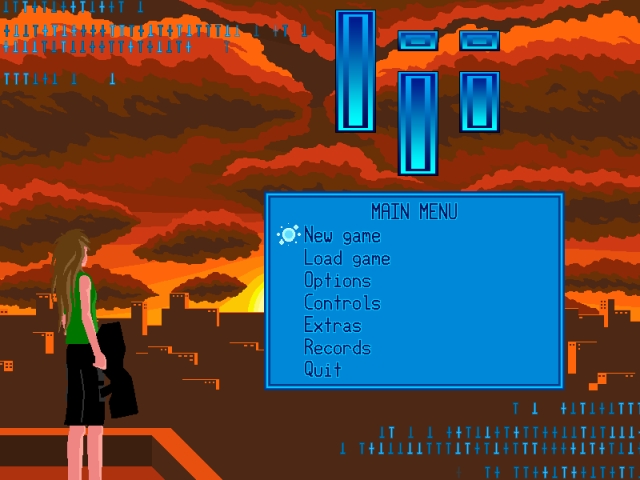
System Shock is surely one of the most influential first-person shooters ever made. But what if one translated the complexity of System Shock to a 2D medium? That's what you get with Iji, a fantastic freeware title that lives up to the sum of its parts while throwing in some surprises and deep elements of its own.
Iji begins with the titular protagonist touring her father's laboratory workplace just when Independence Day lasers rain down upon the facility. After waking from a six-month medical coma, Iji finds that all of her family has been slain, save for her estranged brother Dan. Dan informs her that an alien Tasen spaceship that has arrived on Earth is to blame for all the death from on high, and he and the trapped scientists imbued Iji with an acquired Tasen nanofield in order to save her whilst giving her a fighting chance against these alien invaders. Despite the grief-wracked Iji's emotional vulnerability, she must contact the Tasen's leader and convince him to leave Earth, and it is up to you to determine how she does so.
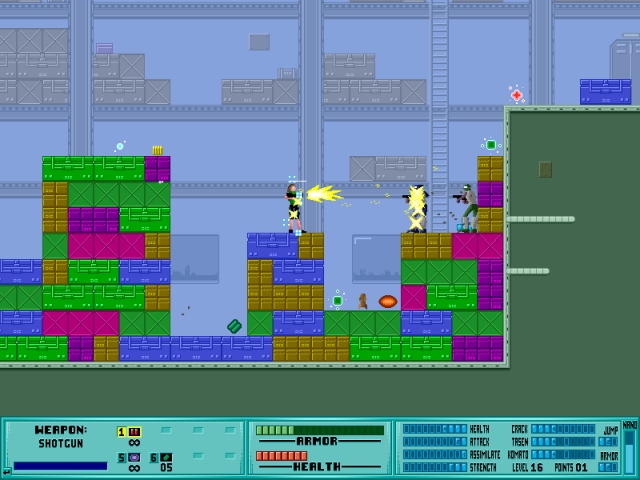
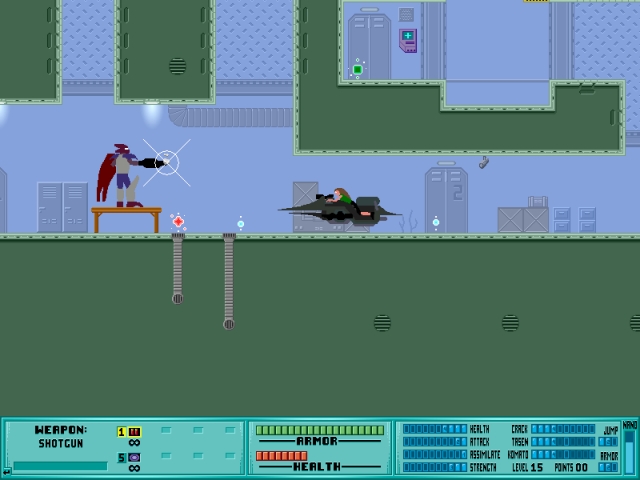
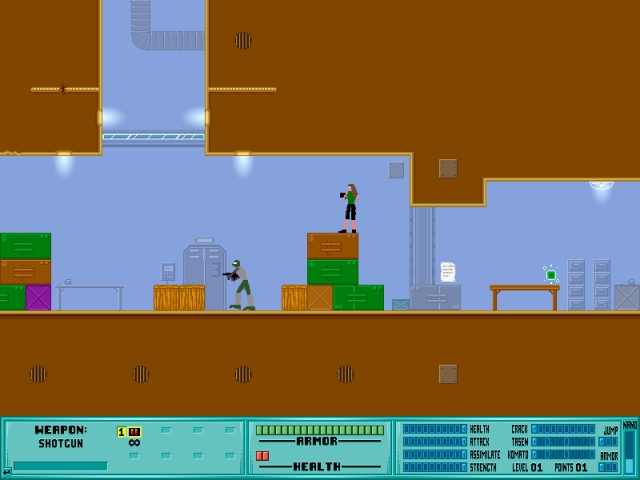
Iji's controls are solid and allow for many approaches (though you may want to eschew keyboard controls in favor of a Joy2Key gamepad setup). The physics feel satisfying and unrestricted despite Iji being relegated to but a single jump. Melee, which can also be used to break certain barriers in order to progress, is relegated to a kick that is fast enough to be practical in close quarters as a desperate move to leave an enemy vulnerable to further attack but not so fast as to be easily abused. Gunplay is satisfying, with good sound design and visible projectiles imbuing weaponry with weight and reliability. Gunfights are conducted by firing, crouching behind the occasional available cover, and jumping over danger. It is important to note that the player can neither fire in midair nor utilize any sort of multi-directional aiming, but Iji's level design accommodates this as masterfully as it does with any other aspect of gameplay.
 Credit: Daniel Remar
 Credit: Daniel Remar
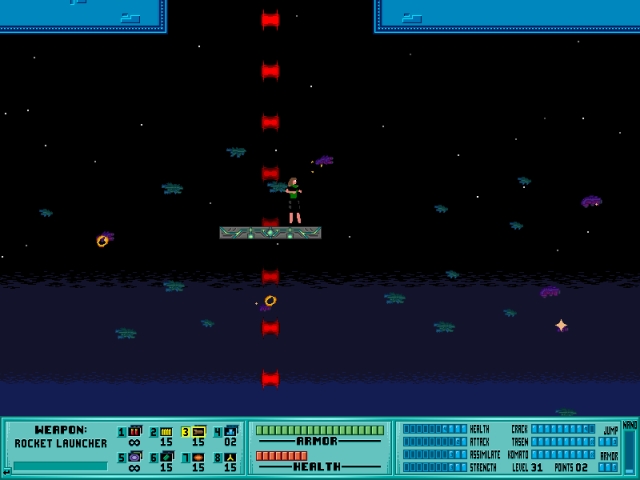
Despite the overwhelming odds, Iji's still got what it takes to get the job done, one way or another. The most apparent means of dealing with enemy soldiers is the vast arsenal at your disposal. Pulse launchers, plasma flamethrowers, and the like are nice enough on their own, but weapons can also be combined to produce new tools of destruction. Combine a shotgun with a machine gun to make a semi-auto shotgun or with a rocket launcher to make a triple-rocket launcher. As of a later update -- Iji was finished in 2008, but the following feature was added in 2017! -- each weapon has a passive firing mode. Even the arc cannon and the nuke launcher have options in this vein! Versatility is surely a great factor in Iji.
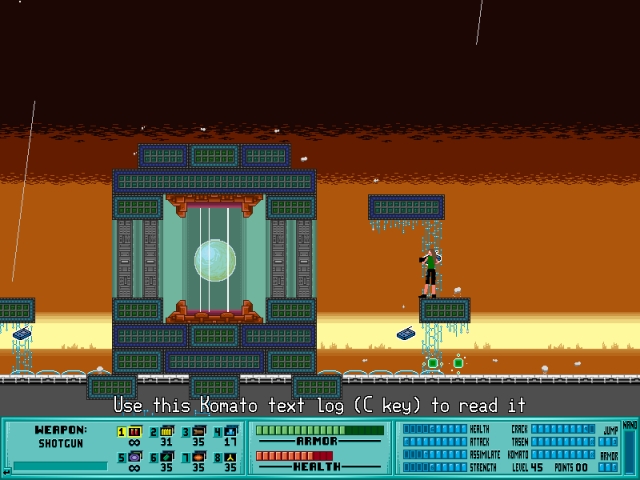
Indeed, Iji has many options for dealing with situations, which makes progression all the more satisfying and thought-demanding. Hacking (represented by a unobtrusive, fun minigame) allows for one to re-appropriate hidden resources, leech enemy nanofields, and access areas beyond locked doors. This, along with Iji's health, shields, offense, inventory, and many other stats can be upgraded by the acquisition of a nanotech currency, or rather by the skill points gained by the levels sufficient amounts of nano bestow. Each skill point spent is an investment that determines how the player will proceed, but the genius of the level design is such that the gungho warrior, the non-confrontational hacker, and anyone in between can proceed by equal but unique means.
 Credit: Daniel Remar
 Credit: Daniel Remar
Your playstyle in violent and pacifistic playthroughs (preferably in that order, by the way) will determine not just the ending of the game but also multiple contextual events and details that are at least as meaningful. Unlike many triple-A titles that tout player choice as an empty selling point to redeem oft uninspired and contrived plots, Iji, while not as loftily ambitious, far outshines these in terms of story and player choice.
Cast in stylized polygons reminiscent of Another World with the touch of an indie webcomic, the story that unfolds here is full of tense moments and revelations. As good as the characters and natural dialogue are, most interesting is how Iji's plot mirrors its gameplay. The dread of the implications of plot points is always reflected in some way by the level design. As the player progresses, his choices are made known not through just arbitrary lines from NPCs but by contextual microcosms, such as Iji's sobs of begging forgiveness from slain foes morphing into silent efficiency and finally bloodthirsty war-cries as the player gives into the ways of violence. This dichotomy between direct storytelling and gameplay is meaningful and effective in delivering themes and emotion (the kind conveyed by fantastic music and storytelling, not soap opera drama).
Whether you doom Earth by your blood-shedding or overcome the seemingly insurmountable task of victory through peace, the game draws to a close after four or so hours. But you're not done yet. Not even close.
 Credit: Daniel Remar
 Credit: Daniel Remar
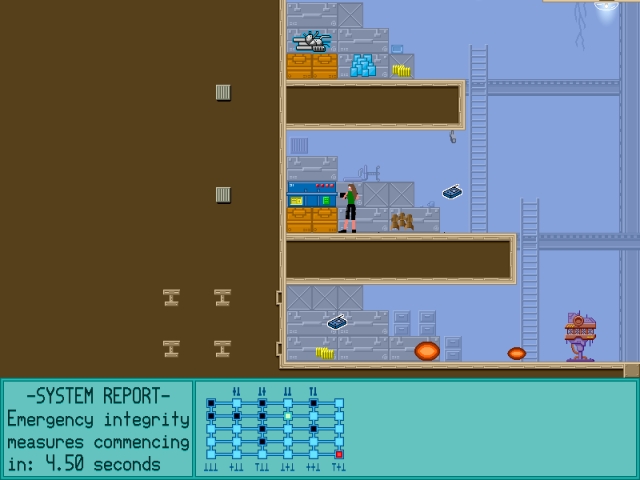
Although a game with such quality encourages multiple playthroughs to appreciate fine details and different approaches to situations, Iji goes the extra mile by having a berth of bonus content to enjoy. Aside from time attacks, difficulty modes, and even full minigames to unlock, the genius of Iji's post-game state is found, again, in the context. Beating the game once grants the player an option that allows him to re-attribute skill points at will. No longer must one choose to divide a pool of, say, 10 skill points in order to get the means to either hack a level 6 door or shatter the level 7 barrier beyond it. Simply spend 6 skill points to get past the door, reset your skill points, then reassign your skill points so that you can shatter the barrier. These scenarios are all microcosms of brilliance in their own right, but they also lead to paths or items that lead to even more content and story, in addition to being satisfying in their own right as challenges to bend the game to the player's whims. Few games are so expertly made to accommodate such features, but few games are as expertly made as Iji.
And that sums up Iji pretty nicely. It's the pearl of years of hard work and consideration by Daniel Remar and company. A truly one-of-a-kind game that defies its production limitations by responding with thoughtful design and intricate craftsmanship, eschewing much of the triteness of focus group-testing. May Iji be remembered for it.