


Quiver of Crows has a sadistic streak that runs roughly a mile wide. It’s unforgiving, making every encounter a frantic scramble for survival from the second you boot up the game until the eventual ending I’ll probably never see. It’ll take days to nurse my ego back into shape after publicly admitting that Quiver’s beaten me, hands down. It’s pummeled me into submission.
Here’s the obligatory bit where I talk about how I’m not adverse to challenge. I’m not! Games that kick your arse in a largely smug fashion have made a bit of a comeback, after dying out a little to the "press X to win" crowd that grew larger with each new console generation. The return of more challenging fare is a welcome one, reclaiming that sense of satisfaction that meant more because you had to earn victory rather than obtaining it simply by showing up. Still, it’s a fine line to walk, and what it really boils down to is how you attribute blame to your failures. If you eat a death because you were a split-second too slow, or you made the wrong choice and you paid for it, then it’s your fault and the challenge seems surmountable. Quiver of Crows’ many, many deaths sometimes don’t feel that way; it goes in the other direction, presenting you with a slew of game over screens you don’t feel you had any way of avoiding. It offers an unstoppable rush of enemies that never lets up, never stops spawning and ensures that shooting down one wave is not progression; it’s a mere moment’s respite.
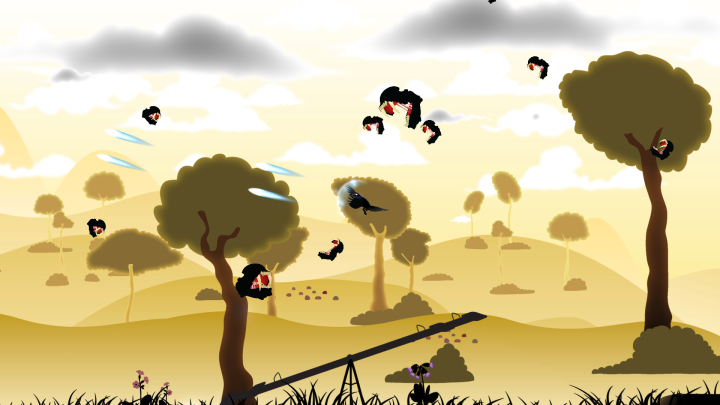
Quiver’s kind of a scrolling shooter in appearance, but more of a twin-stick shooter at heart. Both styles are notoriously challenging, offering sub-genres like bullet hells whose entire point is to bludgeon you senseless while still showing a very clear means of progression towards which you need to strive. The mindless waves of rushing enemies play away from that particular salvation, and that only make some of the game’s other design choices seem all the more unfair. Any power-ups you can obtain can be literally beaten out of you by the unending hordes, meaning that a besieged crow can quickly lose their only means of fighting back and get buried in an avalanche of enemies in a split-second. It’s possible to rally, to regain what was lost from the wholesale slaughter of your opponents. But with your offenses neutered and your screen filled with hostiles, it’s unlikely.
Punishing you with weapon banishment is hardly a new development for the shooter stables, but it’s rarely been such an insurmountable handicap. R-Type, for example, remains coeval with the rise of the shooter but offers both a very harsh difficulty curve as well as a similar mechanic that robs you of all your weapons should you suffer a hit. The difference there is that you progress by chipping away at the game; the levels and enemy placement, heartless as they often are, follow the same blueprint. Beating the game is just as much about learning each level’s quirks and how to get around them as it is reliant on twitch reflex and skill. You plugged away at R-Type, and you got a little further and a little better each time. You log into Quiver of Crows and you just hope the random nature of the mass enemy flood isn’t overly harsh on you.
Random is a good word when talking about the game. It also employs a physics engine of note, wherein killed enemies do not just explode or vanish from the screen, but become solid corpses which tumble from the sky. That mechanic is often the perpetrator of many a cheap death as they either fall onto your crow or act as unwilling shields from your projectiles, but it’s a little slice of chaos that harmonises with the constant enemy rush. Mainly because there is no way you can control it and are thus even more at the mercy of chance. And so deaths come aplenty. Deaths I can’t avoid and am not at fault for. It doesn’t take long before I stop caring.
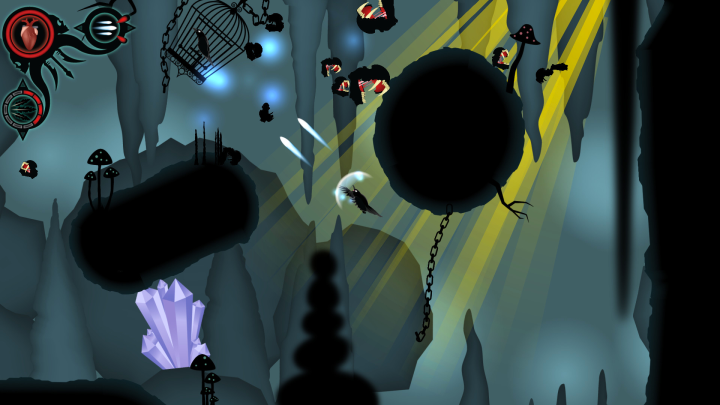
And so my apathetic trudge onwards continued, tinged slightly with the discovery that there’s a lot of little things that Quiver does well. Much like that other bird-based shooter, Kolibri, exploration here becomes a large part of the game, as you search out other captured crows and free them from their cages. But it’s hard to explore the scrolling map with a huge army of pests constantly swarming around you. Much unlike Kolibri’s dream-like watercolor pastels that depicted the rolling countryside, Quiver uses the Indie go-to of Limbo-esque silhouettes to illustrate a dead world filled with rotting corpses and derelict buildings. But it’s hard to enjoy their depressing splendour with a huge army of pests constantly swarming around you. The music is understated, creepy and melancholy, but it’s hard to get lost in the ambiance with a huge army of pests constantly swarming around you.
Being so reliant on elements outside of your control, the gameplay quickly grinds you down, and the admittedly interesting premises Quiver of Crows that frames it all isn’t enough to justify weathering the mounting indifference that is born out of impotent frustration. There’s a good game to be found behind it all, and I’m sure it will find a niche in the more sadistic corners of the shoot-‘em-up crowd. But it’ll take a player with a lot more patience than me to truly embrace the feeling of powerlessness that crow-based warfare seems to suffer from.