
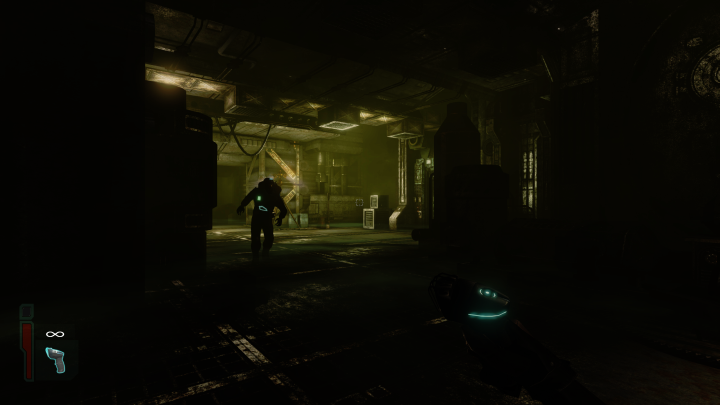
Solarix is a questionable tapestry of early Thief games, System Shock, Dead Space and clichés. It achieves this weird juxtaposition by throwing an amnesiac engineer into a space station patrolled by the infected remnants of his former crew then turns out the lights and tells you stealth isn’t so much an option as it is his only means of survival. As a horror premises this works brilliantly; even though it descended into the ridiculous with each hammy sequel, Dead Space was the perfect poster child in how even long stretches of inactivity down groaning spacecraft corridors effortlessly set nerves on edge. Solarix continues this trend, happy to let billowing steam vents, creaking walkways and flickering electronics fill your head with disturbing background chatter, promoting uncertainties between threat and environment. Then the first half an hour or so is over and the game decides that’s enough of that.
Much of the game takes place in larger, more open areas where the goal of the day is to complete a smattering of over-lapping objectives while trying not to get murdered by varying degrees of physcopath in a spacesuit. In this, Thief’s old system is brought up to date, given an oxygen tank and thrown out into space; the light gem that used to tell you the quality of darkness you’re lurking in has been replaced by a futuristic gizmo that does the exact same thing. The blackjack has been updated into a short-range Taser that sneers at the modern day equivalent of “press X to perform a takedown” and instead forces you into direct danger. Not only will you need to sneak up point-blank to your target, but rise out of your crouch, lose your shuffled footsteps, and aim for the back of their head. It’s very easy for this to go wrong – taking as little as a single uncrouched step has the unfortunate effect of alerting everything in the immediate area to your presence. There’s also the fact that enemies will know you’re there if you get too close, crouched or no, and their reactions are… erratic.
 Credit: Pulsetense Games/KISS Ltd.
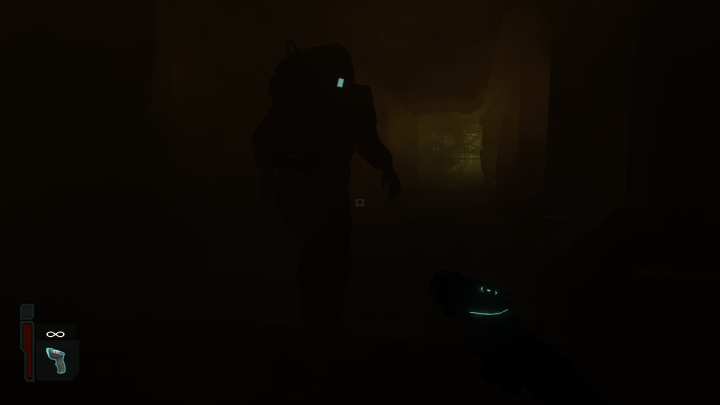
Charitable Gary might say that this is just good AI coding. Your enemies in Solarix are infected, insane, desperate or a combination of the three. They’re noticeably jumpy; chatting away to themselves about the things in the shadows as they sometimes sporadically patrol the areas and charge you down with single-minded fury should they spot you, more often than not quickly overwhelming you with their more fearsome arsenal. But Charitable Gary isn’t here anymore. Charitable Gary quickly drown in his own rage after numerous cheap deaths drove him back into poorly-placed checkpoints to reattempt large stretches of area over and over and over again.
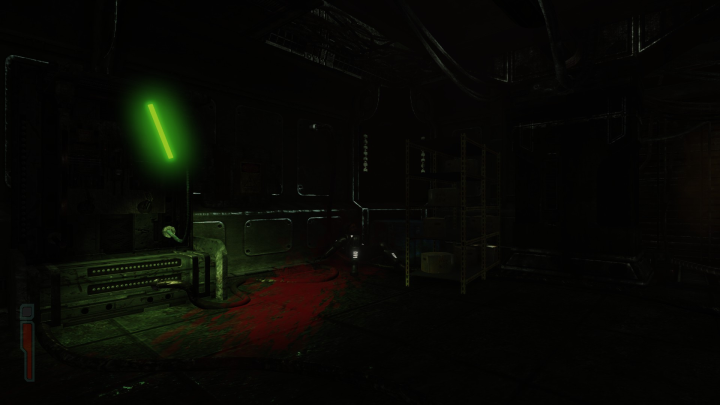
A recent patch reshuffling the checkpoints into fairer locations has gone some way towards soothing this issue, but still not as much as offering manual saves would have done. Perhaps it would encourage fumbling gamers to save-scum their way through some of the tenser situations, but I’d take that over having the replay the same ten minutes stretch four times over because that one pesky guard patrols too near an illuminated doorway and I can’t find an interactive item to pick up and lob somewhere to draw him away. I do understand, though, how the checkpoints are built to highlight the purposeful vagueness of your in-game missions which often gives you an objectives checklist then leaves it up to you to muddle through. Early on in the game a locked door you really need to bypass requires not only a security keycard (there’s always keycards, isn’t there?) but a palm reading from someone in higher management. The things you need are littered around the area -- usually in a well-lit alcove where you’ll need to make a timed dash in and out of to avoid alerting guards, dying, and going back to a bloody checkpoint.
 Credit: Pulsetense Games/KISS Ltd.
If I can manage to swallow my rage a little, I can laud the idea that failing at stealth often presents dire consequences rather than a comical Benny Hill-esque chase scene for half a minute before everything resets and your pursuers forget you exist. Taser aside, the only weapons you collect throughout the game are either very limited in ammo or don’t process a lot of stopping power and are better employed shooting out electric lights to give you more gloom to lurk in. The biggest let-down to this combo of checkpoints and punishment is how it forces the player to often abandon any thoughts of exploring the usually well-realised areas. A lot of the times you need to ferret away in dank corners to discover rare ammo drops and play audio files that begrudgingly reveal bite-sized chunks of the game’s plot. Solarix guards information on its story jealously, leaving you commendably confused at the macabre world you’ve awoken in, stumbling between objectives fed to you through contradicting sources advising you over your headset that you’d have to be insane to trust.
It would be unfair to suggest that Solarix doesn’t work, just as it would unfair to say it works as well as it hoped it would. The occasional bug is still present -- it’s easy to get stuck in ditches or piles of crates while hiding and fail to wiggle free, forcing you to reload back to one of those bloody checkpoints again. Stand on a box, then pick it up and you can spend the rest of the stage floating a few inches off the floor like the world’s easiest-to-spot ghost. There is an element of incompleteness to the game highlighted by the two patches that have been released since launch, but it is an endeavour I ultimately enjoyed. I had to remind myself of that a few times when the rage kicked in and I had to go and do something else for a while before I snapped the pad in two, but I did always find myself coming back later to see what would happen next.