

Depending on how it's used, time travel can be a helluva thing. In the case of A Forgetful Loop's narrative, a bunch of scientists are attempting to use a basketball court-sized contraption to fling themselves to the past, back to an era before the world became progressively worse. However, when they activate it, things quickly go awry and the machine malfunctions. Time travel occurs but, well, they get sent back 30 seconds into the past. All things considered, it could've been much worse... until you factor in that, after those 30 seconds lapse, everyone in the room immediately loops to the beginning of those 30 seconds, again and again, with no foreseeable end in sight. Your objective from here becomes clear: successfully fix the machine and escape the loop.
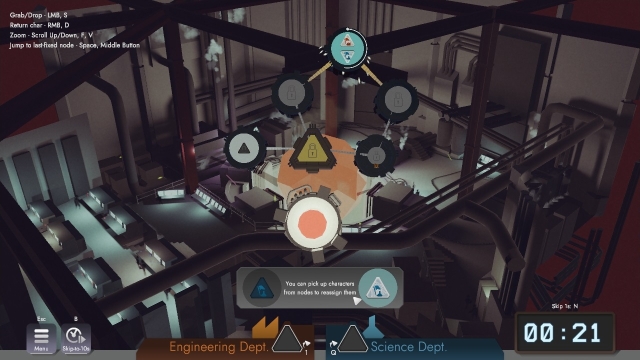
That's the story side. How exactly does this work from a gameplay perspective? You move through a network of nodes, one by one, until you reach specific nodes required to pass a level. That's essentially the whole game; the simplest explanation, at least. Going into it further, you must "unlock" each node by placing avatar pieces in them, avatars representing specific members of the team. With some nodes you can place any avatar, while other nodes require certain members to function. Once you place avatars in available nodes, you then wait it out until they unlock, where you then move closer with your reusable pieces to the level-ending nodes. Considering this takes quite some time to accomplish within each level, you're probably wondering how can this be done in 30 seconds?
 Credit: bighandinsky
Easy: it's not possible. Once those 30 seconds are up, the level resets and you must unlock those nodes again to reach the end. There's a catch, thankfully, where your team is already aware of what they finished prior, meaning nodes once-finished can now be fixed quicker. Something that previously took five to ten seconds to unlock now takes one, thus allowing you to move through the node network much faster. If you haven't realize it by now, A Forgetful Loop is a time management game. Literally. At first it feels like a very simple one at that, as you only have to deal with a half dozen to a dozen nodes in any given level. Sometimes there's a branching path, but nothing too complicated. Easy stuff, and the loop aspect makes it so that even with mistakes, you can pass through levels without much effort; unless you do absolutely nothing, you won't receive any actual punishment when a loop expires. And depending on your outlook, this either sounds like a nice little game to waste time on or a waste of time.
Then it gets complicated.
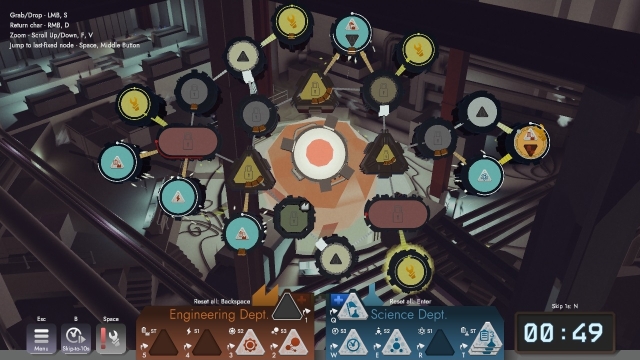
After several levels of mostly linear network paths, the game then gives you bigger networks, these having multiple starting points to dig your way to the objective nodes. A couple gimmicks are introduced along the way, such as a "generator" node that requires power to stay up. Once it's powered and you remove the avatar due to help elsewhere, it will eventually run out of energy, making any node it's attached to nonfunctional until you get it up again. A different type of node has a similar function, except with bigger consequences; once the level starts, these nodes will count down, rendering it and all nodes attached inoperable when time's up. The difference here is this: once they expire, they're out for the duration of the loop, along with that entire pathway. This means that not only do you have to prioritize getting to them quickly, but you must keep an avatar inside until that pathway is unlocked. This becomes trickier when these countdown nodes ask for specific and multiple avatars.
 Credit: bighandinsky
Now while all these new factors make the game more complex than in the early portions, it's not so complicated that it'll make your head explode. There are several aspects that make this more bearable to play through than it sounds. Don't forget about the knowledge of previously-finished nodes being faster to fix, along with the existence of special nodes that, once repaired, actually stay repaired in forthcoming loops. Also, the more progress you make through A Forgetful Loop, the more members you regain to help you; plot-wise, you start off with a skeleton crew due to a few members retaining their memories after the very first loop. There's another important factor to take in: while networks get bigger, they're more or less sectioned, meaning you can concentrate on one area at a time, unlocking one level-ending node before moving on to the other ending-nodes.
Though in the end, despite how many obstacles are latched on the further in you are, A Forgetful Loop is still really about moving through a network of nodes until you reach specific nodes required to pass a level. And the same question earlier still applies: is this a nice little game to waste time on or a waste of time? It really comes down to how you feel about the gameplay in the long run. The game accomplishes what it set out to do with an interesting concept executed in an admirably ordinary manner, but how would you feel about doing this for 70-plus levels? Keep in mind, doing some of the latter levels can take approximately five, ten, or even 15 minutes to complete depending on how many loops you go through per level. If you're not committed to that style of gameplay, this will be a chore to complete. However, if this sounds like your type of time waster, knowing it's not exactly going to blow you away, then loop away.