XSEED brought us the first Senran Kagura game a few years ago, and I found the series quickly growing on me. The combination of silly anime cliches and Streets of Rage-style beat-em-up gameplay was right up my alley. With each new game, the franchise became better still, while also growing more ambitious. Unfortunately, ambition can sometimes be your worst enemy.
Senran Kagura: Estival Versus, the latest game in the infamous ninja girl action game series, starts with the girls from the four shinobi schools going about their daily lives. Suddenly, they are transported to summer paradise. Here they find themselves pitted against one another in the Kagura Millennium Festival, which might offer some of them the chance to become true shinobi. For those following the franchise since the beginning, the story offers additional perspective into the lives of the girls. For those just joining the mayhem, it’s a nonsensical mess.
 Credit: Marvelous Interactive/XSEED Games
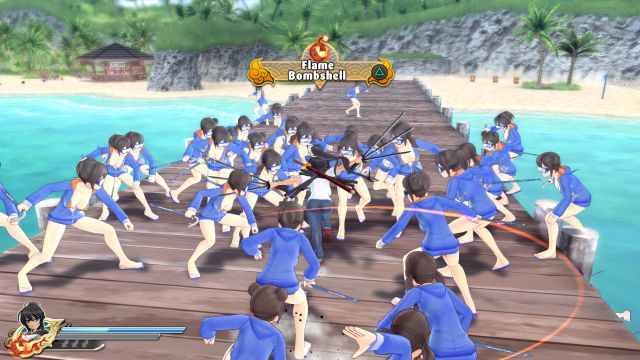
While the story will attract hardcore Senran Kagura fans, the true meat of the game lies in its combat. The story mode offers eight days jam-packed with gameplay ripped straight out of the franchise’s previous Vita outing, Shinovi Versus. For those unfamiliar, just imagine something like Koei Tecmo’s Dynasty Warriors games, except each mission ends with a fight against a rival shinobi.
Unlike Shinovi Versus, however, Estival Versus puts a lot more emphasis on the battles with the other girls. The grunts and open ended levels that gave Shinovi Versus its identity are mostly discarded here in favor of fights against the other girls with a side of grunt. While I certainly miss laying waste to grunts, rival shinobi provide far more challenge. For the most part, it makes the experience more fun.
As in previous games, the game’s story mode mostly just serves to teach you each character’s strengths and weaknesses. With four schools and over 15 girls, there’s a lot of ground to cover. Players will find themselves jumping between radically different styles of play. The differences between each girl are more evident now than ever, and it’s incredibly impressive that Tamsoft avoided falling into the trap of making clones like other action games often do.
 Credit: Marvelous Interactive/XSEED Games
With that being said, the mechanically diverse cast now suffers from fresh balance issues. One of my favorite characters in Shinovi Versus, Ryobi, fought with a long rifle and could switch between melee and ranged combat rather effortlessly. That remains true here, but she has now become far slower. In a combat system that favors speed, she’s a liability. It’s a personal nitpick, but those who have been following the franchise since the beginning may find that their favorite character has also been changed for the worse.
Combat also takes a dive into unfairness when it comes to fighting the other girls. Later in the game, missions start having players fight three girls at once. While the AI is usually pretty nice and let me focus on one girl at a time, all bets are off once they transform. Like in past games, transforming ups a character’s stats, refills their health and lets them perform special moves. These special moves are a sticking point in Estival Versus because characters are invincible during their use and there doesn’t appear to be a limit on how many times the AI can use them. During one particularly annoying fight, the enemy combatant would use a special move and then launch right into another one. This went on for about five times, whereas a player controlled character would only be able to use their special move two times max. Throw two more transformed shinobi into the mix and you have a recipe for frustration.
Unfortunately, almost every later mission features those same frustrating fights. When the player has a character advantage, the missions are a breeze. When the player is at a disadvantage, it can become a slog. I can appreciate being forced to learn a new character, but doing it four times in a row gets old fast. With over 40 chapters in the main story and individual character missions, Estival Versus can quickly become stale. It’s the kind of game that begs to be played in short bursts instead of long marathon sessions.
 Credit: Marvelous Interactive/XSEED Games
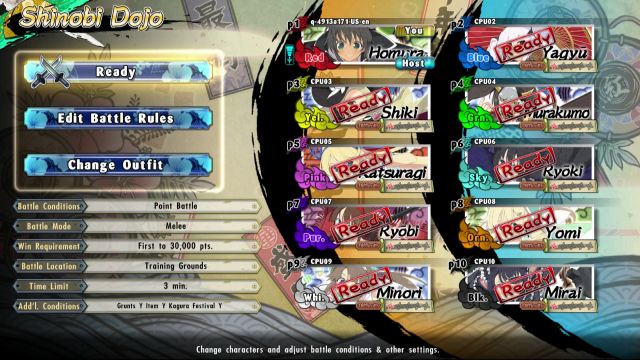
There’s also online multiplayer for when the main story gets monotonous. Players can partake in a deathmatch mode, but there are also two objective-based modes. The first, Understorm, has players racing to collect panties that fall onto the stage. Hitting or defeating opponents causes them to drop their collected panties. The other, Capture the Bra, has players fighting for control of a bra placed on the map. Both modes serve as nice diversions from the more standard attractions, but finding a match with enough players has proven a challenge. Senran Kagura is already a niche franchise, and I can’t imagine many of its fans lining up to play Capture the Bra.
Senran Kagura: Estival Versus is easily the most content-rich entry in the series to date. It’s just unfortunate that so much of that content is very samey and lacks the variety seen in Senran Kagura 2: Deep Crimson. Still, seeing Senran Kagura running on the PS4 in 1080p and at 60FPS makes it mostly worth it. Just don’t expect to be entertained for 20 hours straight.