I loved playing through Enslaved: Odyssey to the West, despite all the barriers that it threw between me and the story. Performance issues aside, I loved it and couldn’t wait to find out what happened next. Still, though, having to deal with those performance issues sucks.
The story is genuinely interesting, probably because it was based on the Chinese novel “Journey to the West” and penned by Alex Garland. You play as Monkey, brought to life by Andy Serkis of Gollum fame, who is enslaved by a cunning and resourceful young lady named Trip, played by Lindsay Shaw of ABC Family fame. Trip fits Monkey with a slave headband that will kill him if he does not follow her commands or if, through any action or inaction on his part, she dies.
I immediately drew a parallel between her instructions and the Laws of Robotics from Isaac Asimov’s books. You meet very few living people in this world, and all you do is fight automatons that have only one goal: to kill humans. Trip herself is a gearhead, constantly working on machines, scanning dead robots, or speaking in techno-babble that Monkey doesn’t even pretend to understand. To her, Monkey is reduced to nothing but another tool, another machine, to accomplish her goals.
 Credit: Ninja Theory/Bandai Namco
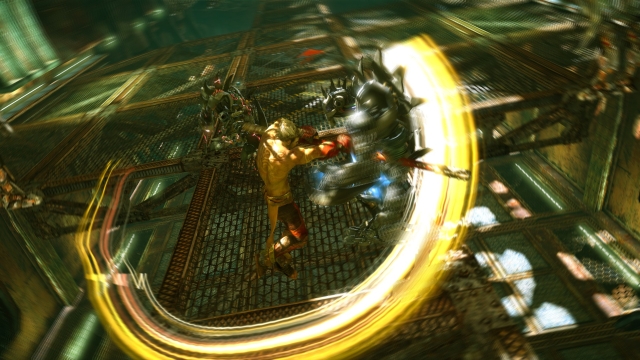
I really liked the character of Monkey. True to his name, he looks like a human version of a gorilla, complete with a tail-like sash that hangs from his waist and big, meaty gauntlets that look like paws. He runs, climbs, and even sits in a simian manner. His headband looks like a crown and he fights with a staff, a la the Monkey King. Scars, tattoos and war paint decorate his body, giving a savage impression from minute one, but we soon learn that there is more to him than that.
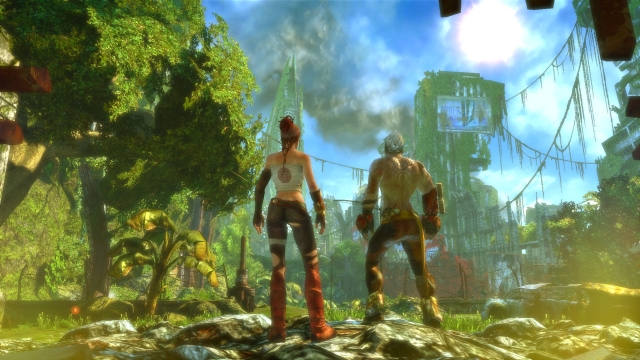
Monkey has lived a harsh and brutal life, growing up fighting and killing just to survive. Still, he is less reluctant than most reluctant heroes, and the protection he offers Trip seems motivated less and less by self-preservation as the story proceeds. It’s fun to watch the two interact, with Trip’s brains and Monkey’s savage logic butting heads time and time again. There is a theme of humanity creeping up here, as Monkey has been dehumanized by both his savage circumstances and by Trip’s enslavement. Only in this journey does he find what it means to be human again. Cheesy? On paper, yes, but I found that much of this game looks bad on paper and great in execution.
I didn’t care for Trip at first. While Monkey’s savagery has murmurs of stereotypical gender norms, Trip outright screams them at times. She is helpless in a fight, wears tight clothing with tears that are suspiciously revealing, and can be nauseatingly innocent for someone who did something as cold and calculated as enslaving another human being to serve her needs. I almost would have preferred she had more edge to her. Instead, Trip has Monkey carry her around for a piggyback ride when things get too scary. I tend to cringe when women are treated like children by men, especially when the story is also trying to force a love story on the two characters, and I certainly did so a few times during this game.
 Credit: Ninja Theory/Bandai Namco
As the game goes on, though, Trip grows up substantially. The more depth she revealed in the process, the more I found myself liking her. The ending, which I won’t spoil, really made me look at her in a different light, and made me question what it really means to be “human” in this world.
You meet very few living people on your trek, but my absolute favorite character, and the provider of most of the comedic relief, was Pigsy, who shows up halfway through the game. I actually found myself annoyed at first. “So, we’ve got the tough guy, the innocent girl, and the fat comedic relief, eh?” I muttered as Pigsy waddled across the screen. Again, it’s bad on paper but great in execution. I honestly wish he had been with the group from the beginning, or received his own expanded time in the spotlight by way of DLC.
Normally, a game like this would be a bit front-loaded, with all the good bits occurring at the beginning before the performance issues bog you down, but this game actually got better as I progressed. In the seven hours it took me to reach the end, the characters went from flat to multi-faceted, the gameplay was surprisingly varied and never stale or repetitive, and the story blossomed with moments that ranged from hilarious to truly touching. The story alone was worth it.
Now, the bad news…
 Credit: Ninja Theory/Bandai Namco
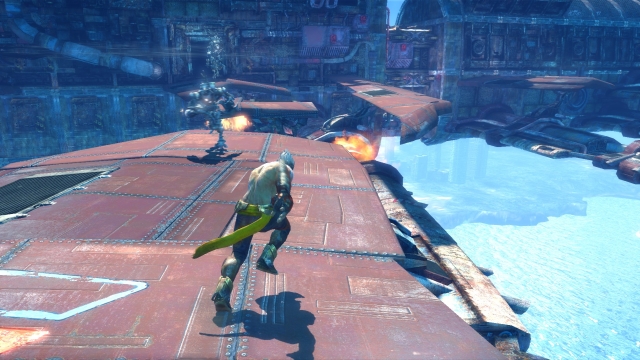
I played the port to the PC, and oh my God does it stink! The moment the game booted up and I was warned not to turn off my “console” during the autosave process, I knew I was in trouble. You can change the resolution and gamma and…well, that’s it. There aren’t a lot of graphics options, considering this is now being offered as a PC game. Once I got into the game itself, the screen tearing during the first cutscene was unbearable. I wound up trying to skip the opening scene so I could exit out and manually make some changes to the .ini file. “Trying” is the key word there, because the game has unskippable custscenes.
You’ll want to skip cutscenes sometimes. Not all the time. Certainly, if your characters are as rich and interesting as these are, I could see why people wouldn’t care to skip the cutscenes… unless they’ve seen the cutscene ten times already because that’s where the autosave just happened to be positioned, right ahead of a difficult boss fight. And because the camera will sometimes snap into a fixed angle and you can’t see the giant robotic rhino that is bearing down on you and instead insists that you need to stare at this lovely bit of rust on the wall. It became beautiful once I made some manual changes, but performance issues would still creep up on me. Sometimes the sound would get out of sync with the scene I was watching, for instance, or drop out entirely.
 Credit: Ninja Theory/Bandai Namco
Other times, I would watch a cutscene end by freezing up as the next bit of gameplay would load, like the end of an old “Police Squad” episode. It takes a bit away from the drama when Monkey screams in rage and rushes towards the camera, and then we watch him freeze there for another ten seconds as the enemies presumably finish up their smoke break. Such instances never amounted to anything more than minor annoyances, but they detracted from the experience nonetheless.
All valid criticisms against the game aside, I really enjoyed playing it. Luckily, the difficulty wasn’t so great that I found myself having to repeat sections (and watch an ever-more-annoying unskippable cutscene) too often. The game was smart, well-balanced, had great pacing, and had heart and depth to it. If you pick it up, just make sure you stick with it past those first few screen tears. It’s well worth it.