
Doctor Who hasn’t broken into the video game market with much success, despite being an incredibly popular franchise. We’ve had some Wii shovelware, a few adventure games which were okay-ish, and a 2D platform game that was riddled with bugs (I’m not sure how you mess up a 2D platformer when the genre was basically perfected 25 years ago). I’m not alone in thinking that Doctor Who would work well as an adventure game, with less emphasis on collecting items, and more on solving puzzles and bamboozling enemies with clever dialogue choices. We’re probably not going to get that game.
 Credit: Seed Studios/Tiny Rebel Games
 Credit: Seed Studios/Tiny Rebel Games
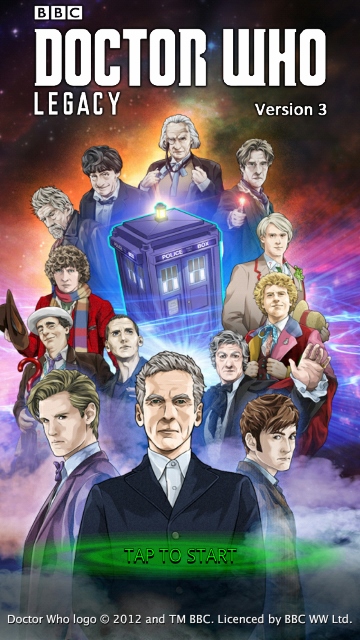
Instead, we have Doctor Who: Legacy, a puzzle game on Android and iOS. This game has all the hallmarks of the “pay to win” genre of mobile games – there are time crystals which you can purchase to power up your characters or unlock new ones, there are premium levels which are locked behind a paywall, there are pop up ads… Feel free to groan. I suspect this is more endemic to the culture of mobile phone games. I don’t honestly feel like the creators of this game are greedy.
Doctor Who: Legacy is quite generous with the amount of time crystals it throws at you for completing levels and logging in regularly. If you buy 5 time crystals in a pack (one time), you can unlock the fan area and disable ads. This amounted to about 6 dollars at the time, and I’d already put dozens of hours into the game. I haven’t needed to spend any more money. I am still playing through the free levels this game has, so I haven’t yet felt the need to purchase any of the premium levels.
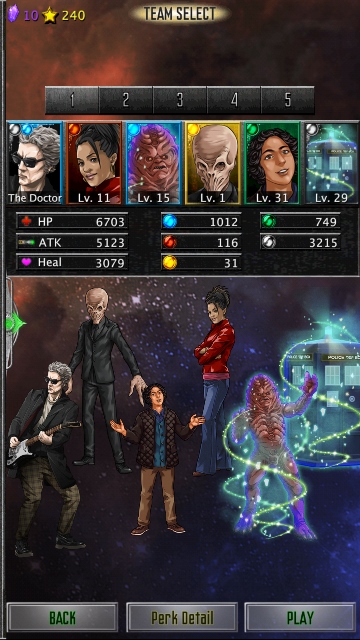
Tiny Rebel Games are constantly adding new levels to the free campaign. It originally launched around the time of the 50th anniversary episode of Doctor Who, and since then, the game has quadrupled in size. There are currently four chapters totalling 250 individual levels. These chapters are mostly based on Matt Smith’s time as the Doctor, although you can recruit other Doctors and companions (and quite a few one-off characters) as you play. Additionally, there are more free challenge levels (which are brutally hard), and standalone campaigns based on Peter Capaldi’s run as the Doctor.
 Credit: Seed Studios/Tiny Rebel Games
 Credit: Seed Studios/Tiny Rebel Games
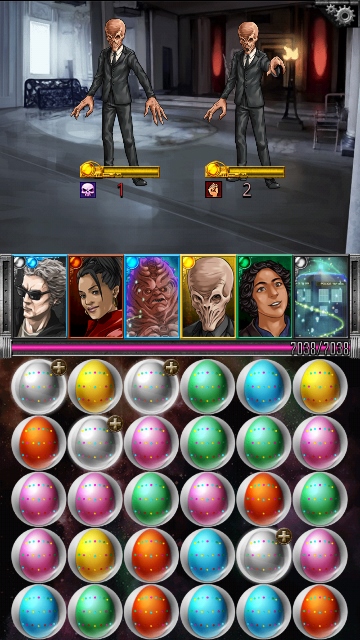
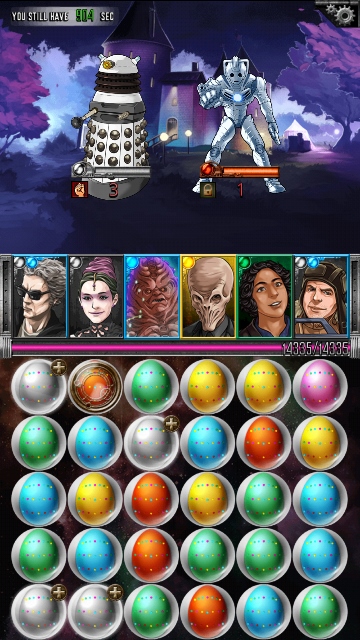
Doctor Who: Legacy is a match-3 or more puzzle game. The bottom half of the screen has an array of coloured gems. You can move any gem anywhere to match it up with other gems of that colour. Ideally you want to match more than 3 at a time, and build up a combo chain. The matched gems will disappear from the board and turn into energy that attacks the enemies. Your chosen Doctor and companions are each aligned with a colour, and attacks are based on the stats of your characters plus how big the combo is, as well as the colour alignment of the enemy. The first level is a tutorial that explains how all this works.
You’ll never run out of moves, you just need to watch your health bar, which is the sum of all your companions’ health. Enemies will attack you, poison you, stun you, lock certain gems in place, and you need to kill them before they can kill you. Each companion can level up, and you can assign skill points into HP, Attack or Healing. After every ten levels gained, the character will hit a level cap. You can upgrade them further, but you will need to have enough coloured items, which are gained from defeating enemies. You can use time crystals to bypass this if you like, but I only did this for a very few of my favourites.
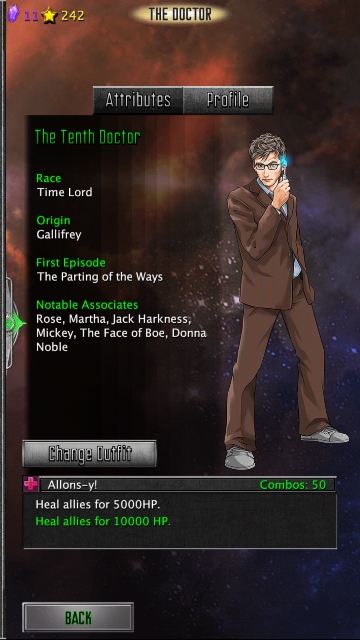
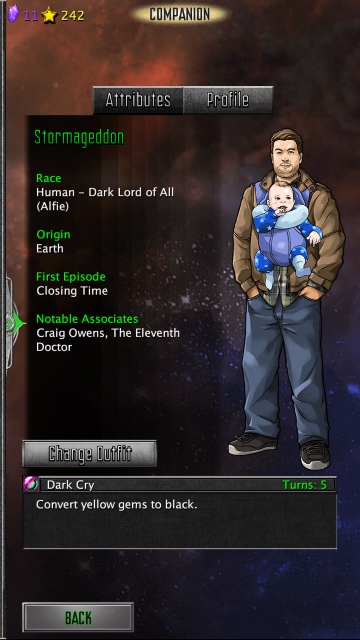
Each character also has a special move they can use after a few turns. Some moves heal the party, some moves attack, or alter the gems in some way, by changing one colour to another, or even resetting the board entirely. A lot of the moves are repeated across characters, but with hundreds of companions to unlock, this allows you the freedom to build a party of characters that you like, rather than selecting people purely out of strategy.
 Credit: Seed Studios/Tiny Rebel Games
 Credit: Seed Studios/Tiny Rebel Games
The amount of characters you can unlock is staggering. As you progress through the levels, it will tell you if there is a character that can be unlocked upon completion – some of these have a 100% chance, but most of them are much rarer, and will require a lot of grinding (or time crystals). You’ll amass a collection of companions, one-off allies from the show (seriously, I’m a huge fan of this show, and even I didn’t immediately recognise some of these characters), and even enemies. Tiny Rebel Games have even dipped into the extended universe by including characters from the Big Finish audio stories, and the Titan Comics series.
The Doctors play out a little differently to the companions – you can only use one at a time, and they derive their statistics from your party of companions. You’ll really be playing as a Doctor based on your own preference, or how useful their special move is – I almost exclusively use the Twelfth Doctor because his “Attack Eyebrows” move is usually able to wipe out every enemy on screen.
There’s so many little references and nods to the show wherever you look. A lot of the special abilities have names relevant to the characters, you can unlock alternate costumes for some, and the levels themselves are often based off episodes of the show. Some levels will begin or end with story segments that explain what is going on, but the dialogue is usually best skipped as it reads a lot like fanfiction. Most levels, fortunately, jump straight to the action.
Doctor Who: Legacy is created by people with so much love for the show. You can pay to remove some of the grinding aspects, but no one is forcing you to replay the same levels over and over to unlock all the characters (I do this to myself). You’ll never reach a point where you have to pay to win. You can pick a few favourite characters and level them up and fly through much of the game. It’s an easy game to learn, and the amazing depth has kept me hooked for years. This is one of two games I have on my current smartphone, but it’s the only one that really needs to be there.