

87 percent. Eighty. Seven. Freaking. Percent. That's how much of No Time to Explain I played through on Xbox One before I finally said to myself "You know what? Life's too short."
No Time to Explain is the least enjoyable not-quite-meritless game I've played in a long, long while. There are some really cool ideas here, and sometimes they're even competently executed, but in the end the game is an almost constantly joyless tour of a variety of initially promising settings that are inevitably hamstrung by overly touchy controls. If at first you think you've stumbled across an area that proves an exception to that rule, just give it time.
 Credit: tinyBuild Games
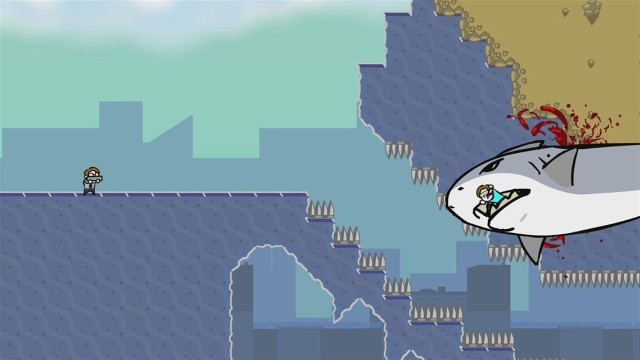
The premise is that you--a pudgy little fellow who looks a bit like the characters in the "Cyanide & Happiness" online comics--are sitting around in your house one day when suddenly, a man bursts through the walls. He looks strangely familiar, and he says "I am you from the future!" There's no time to explain anything more than that, though (as he tells you), and suddenly a giant creature appears and grabs him in its maw. You pursue the alien menace as future you screams about how much pain he is going through and blood sprays everywhere.
Sounds cool so far, right?
The problem is that the controls are not up to the task set before them in even the best of cases--which is maybe 30% of the time--and they're downright wretched for the remainder. I started to call them "imprecise," but upon reflection, that's the exact opposite of the real problem. If anything, the controls are too precise and responsive. When that's coupled with the unconventional methods you typically must rely upon to navigate the treacherous levels, problems arise.
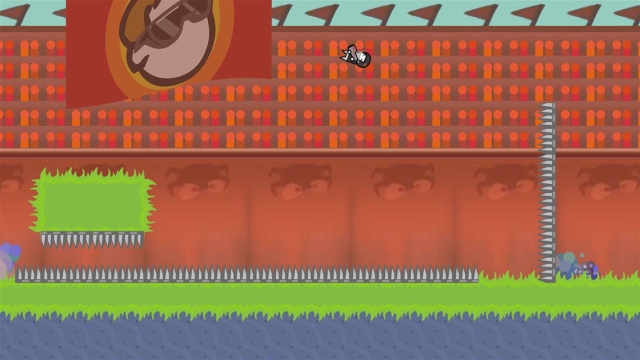
Although you can typically press the LT button to produce a small hop, that very seldom proves productive. Almost every barrier is too high or wide to leap across. Instead, you spend most of the time playing around with a ridiculously overpowered laser cannon. You make use of it by moving the right analog stick in the direction you would like to fire, which emits a massive beam. To quickly gain elevation, point the weapon at the ground and keep it aimed in that direction for a sustained burst. This is how you will ascend a variety of ledges. Or you can aim at weak walls and turn them to ash, so that you can pass through them.
 Credit: tinyBuild Games
As you advance through the campaign, you'll have to use the laser beam in a variety of ways. You often must let it carry you over one bed of spikes or another, or you have to blast away blocks with laser precision (not the reckless abandon your tool favors, since hitting objects behind your targets will unleash insta-death hazards). Even the simplest actions are performed inconsistently, though, because moving the analog stick down might work exactly as intended--launching you quickly skyward--or it might barely have any effect at all. Basically, every time you have to use the laser beam, you're putting your character at risk.
Checkpoints are frequent, but that's small consolation when literally every pseudo-jump can go wrong. Imagine playing Super Mario Bros. and knowing that virtually every time you tell Mario to jump, that could play out dramatically differently. Now, imagine also that the levels you must clear are 10 times more difficult. In a nutshell, that is the No Time to Explain experience.
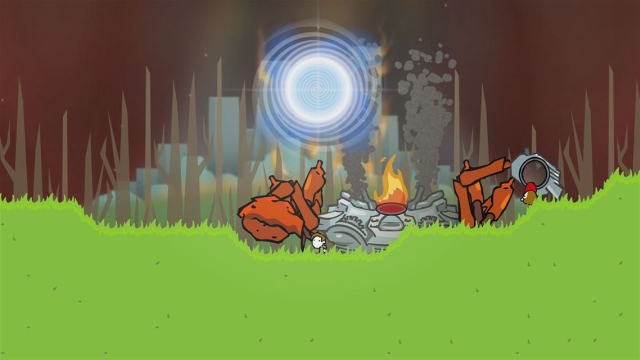
There are some levels where the laser gun isn't used, at various points during the campaign. However, similarly exasperating mechanics will usually step in as a substitute. For example, you might have to quickly move the analog stick to position a circle on the screen, then launch toward it as if fired from a catapult. A slight nudge of the analog stick will make it fly halfway across the screen, and you often won't have time to make careful movements because you're speeding along a passageway that is lined by fatal spikes on all sides. In another stage, you can climb on walls, and then must leap out over fields of spikes and use a similar mechanic to launch yourself along spike-lined shafts to reach the exit portal.
 Credit: tinyBuild Games
Sometimes--very rarely--you're given a proper break from the torturous gauntlet as the game offers up some genuinely interesting diversions. In one case, you'll take to the sky and play through a single stage of a horizontal shooter, which is actually rather fun except for its lack of a checkpoint. In another zone, you can't typically see any of the platforms, but you can fire your beam to briefly char them black so that you can figure out where safe ground waits as you meet with characters who discuss the topic of games as art. If the beam didn't have a tendency to send you flying back off a precarious foothold whenever you try to use it, these stages might rank among the finest in the game. Maybe they even still do.
Boss battles, though immensely frustrating for the reasons outlined above and others besides, show similar creativity. In one encounter, you must battle a giant rodent as it launches from walls and lands on a center ledge, then rolls into a ball and rushes toward you. Another stage pits you against a giant shark, while yet another has you moving between pools of water and acid while avoiding attacks so you can counter with your laser beam.
As I noted at the start of this review, No Time to Explain isn't quite meritless. If you're willing to grapple with the overly touchy controls the whole way through, there is some genuinely solid level design here that would actually work quite well in a more refined game. The sense of humor is also welcome, and a lot of the jokes land quite nicely or at the very least contribute to the title's bizarre charm. In spite of the few things the game does right, though, I believe most potential players would be well advised to avoid it. I'd tell you more about just why that is, but it looks like we're out of time.