
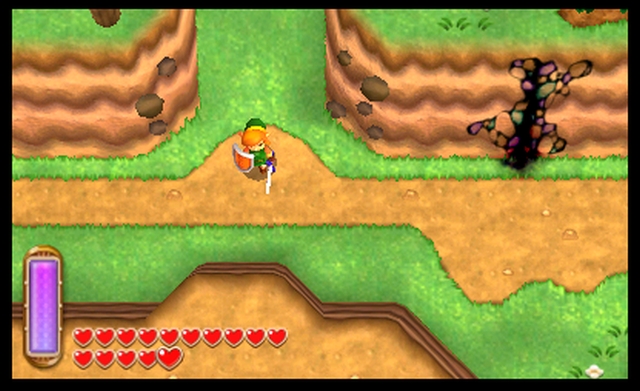
The Legend of Zelda series survives by being pretty much the same game with one key difference each time. You have a world to explore, full of puzzle-box dungeons to solve. The success of each game depends on its gimmick. This usually involves changing the world in some way, either through time or dimension. The end result is two worlds that are similar, yet different. Ocarina of Time allowed you to travel seven years into the future, Majora’s Mask had you continually redo a three-day cycle, and A Link to the Past had the Dark World.
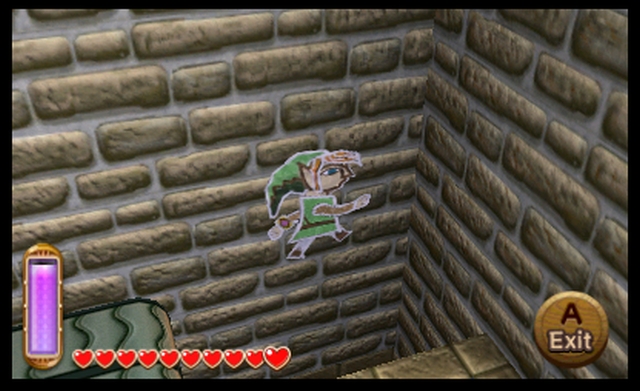
A Link Between Worlds takes place in a world that will be instantly familiar with fans of A Link to the Past, with one of the more interesting gimmicks this series has come up with: becoming two-dimensional and sliding along walls and travelling through cracks that link the two worlds: Hyrule and Lorule (did you see what they did there?)
 Credit: Nintendo
Reducing Link to a two dimensional character* adds an extra dimension to the puzzles and combat, making this one of the most refreshingly innovative games the series has seen in a long time. Link can merge onto a wall at any time, and travel along it. This will often be used to reach ledges or slide through tiny gaps or even to get behind an enemy. Most Zelda games have been pretty straightforward (when they’re not about trains), arming Link with his sword, shield and an assortment of items to solve puzzles. Now players are forced to not only think outside the box, but around the edges of the box.
The dungeons are varied and interesting, each one requiring some ingenuity to solve. You’ll be scaling a tower, sliding around ice ruins, navigating the lost woods (with a warren of tunnels underneath) and you’ll have to find your way through the darkness with only a lantern to light your way.
A lot of the overworld puzzles require moving between the two worlds to progress, as a path might be blocked in Hyrule but is open in Lorule, or vice-versa. The amazing thing is that most of the world is open to you fairly early on. Once you reach Lorule, you need to complete seven dungeons, and you’re free to tackle these in almost any order. A Link Between Worlds wisely shakes up the usual formula of receiving your new item in a dungeon. Now, you can “rent” all items from a shop early in the game (you lose them if you die), and once you start pulling in big money you can buy them outright.
No other Zelda game has been so unrestrictive concerning your movements. In previous games, you would see a path blocked with a big rock and you would know that you needed bombs to open that up, but you wouldn’t know when you’d be getting bombs. This time, you’ve probably already got them but haven’t even used them yet, so you’re free to blow it up and explore. This is the exact same overworld as Link to the Past, but you almost manage to forget this as you freely walk from one area to the next. It is nice to see that Nintendo has moved past artificial filler and are simply allowing you to get on with tackling the dungeons.
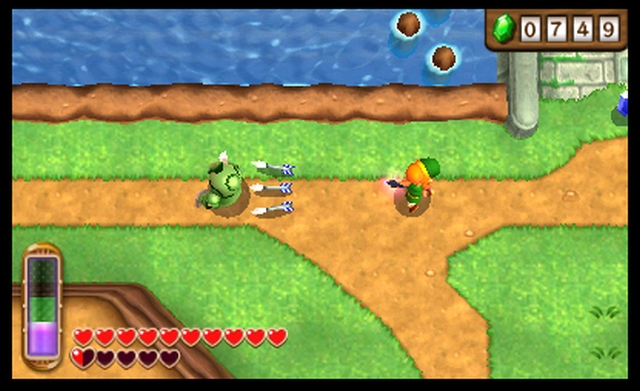
One of the other interesting features is that all your items have unlimited ammo, although they do draw power from your energy gauge, so you do need to plan your shots carefully, but you’ll never need to backtrack to collect extra arrows or bombs.
A Link Between Worlds wisely follows the successful formulas of the series, but abandons the usual restrictiveness to allow you to set your own pace and order. It strikes a perfect balance between respecting the past and embracing the future.
The 3D effect is one of the most impressive seen on the 3DS so far, adding depth while resisting that need to pop out at you. Most 3DS games give me eye-strain very quickly, but I’ll happily play this with the 3D turned on for extended periods. Stylistically, the game is well designed, with both worlds having a very different feel while essentially following the same layout. Hyrule is vibrant and colourful and Lorule is dull and foreboding. It’s kind of like looking at the same scenery on a sunny day compared to an overcast day.
If there is one complaint to be levelled against A Link Between Worlds, it is a very easy game. Very few bosses posed any sort of obstacle. This may be one side-effect of non-linearity; the bosses aren’t designed to be tougher than the previous ones. Each of the dungeon bosses has some trick to defeating them, and it’s usually not that difficult to work it out. You can create an artificial challenge for yourself by not collecting the sword or tunic upgrades and extra heart pieces, if you’re into that sort of thing. Once you finish the game, a harder mode is unlocked.
 Credit: Nintendo
Being a 2D Zelda, combat is a bit basic – you simply have to position Link at the correct angle so that his sword can hit the enemy without the enemy being able to hit Link. It’s a bit of an adjustment for players who are used to the targeting systems of the 3D Zelda titles, but you get used to it.
Some might accuse Nintendo of confusing “sequel” and “remake”, but Nintendo would probably answer with “Why can’t it be both?” This is easily one of the better Zelda games we’ve seen recently, and it’s about time the 3DS gets a proper entry in the series. Ocarina of Time 3D is good and all, but that one is definitely a remake. I’d say this one leans much closer to sequel. It makes better use of this particular overworld than Link to the Past ever did.
* Link is accustomed to being a one-dimensional character, so this is a step up for him.