
 Credit: Bob Smith/Imagic
My childhood imagination sustained itself on a healthy diet of fantasy. Since I wasn't literate enough to tear into epic novels, I had to rely on other sources to get my fix. Films like Clash of the Titans, Luigi Cozzi's anti-classic Hercules, Krull, The Beastmaster... I could compose an entire blog post on the subject of fun fantasy flicks of yore. For many years, I also craved a video game experience that complimented my impressive VHS lineup. The only catch: I had an Atari 2600. RPGs, the obvious choice of any fantasy fan, were just about out of the question. Despite the existence of one on the system, it lacked the specs to run a fully expansive RPG. The alternate option: fantasy-based action games.
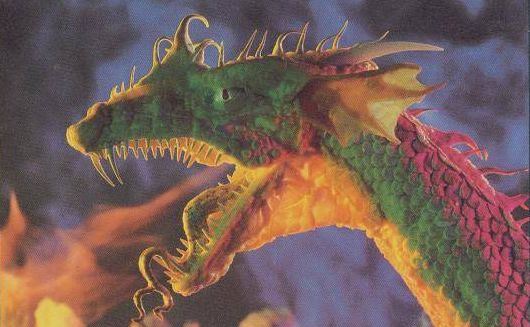
This brings me to Dragonfire, a game that amply filled my fantasy-hungry gullet as a child. As I grew older, though, I found it inexplicably leaving more to be desired. It adhered to all of the rules of quality--it was simple, fast-paced and addictive--yet the spell it had over me dissipated over the years.
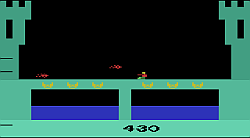
It was fast-paced from the beginning of my adventures, staring down the entrance of a dragon's castle. Flying flames belched out the shadowy ingress two at a time, coming at me quickly. I reacted fast, ducking one and jumping over the other. This was no small feat in my preliminary sessions, thanks to the loose control response. The response was not without perks, though. It meant I could move quickly, which kept the game's pace fast. I eventually became good enough that the castle entrance segments only lasted a few seconds.
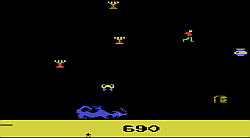
Dodge the dreaded flames and it's onto the dragon's stash, guarded by the beast itself. The scaly creature scurried back and forth across the bottom of the screen and bellowed fiery death up at me. I nimbly weaved around its fireballs and nabbed all of the treasure on the screen, causing the exit to appear. Once again the loose control response served as a double-edged sword. While it kept the pace fast, it also resulted in many deaths. Since my character ran so quickly, it was difficult to grab treasure with precision. While I had a high success rate of speedy treasure-snatching, I was also quite skilled in being incinerated. It wasn't uncommon for me to overshoot a piece of treasure and run headlong into a fireball. There were also moments where I would second guess the controls, thinking I was about to overshoot treasure, only to find myself coming up short. That also reduced me to a pile of ash.
 Credit: Bob Smith/Imagic
 Credit: Bob Smith/Imagic
Despite the tricky controls, I grew to love Dragonfire. Even the extreme repetition and the fact that single session only lasted about two minutes didn't bother me. It engaged my imagination enough, despite the slow process of desensitization that had begun with my first session.
There's something about Dragonfire that ensures you will grow tired of it. It's not one major aspect or issue, but a collection of smaller problems that dull the game's luster. Wrongful deaths are partially to blame. Sometimes a fireball will spawn right as you reach the entrance to the dragon's lair. There's no way you can dodge it. The same happens when collecting treasure. There's a certain respawn point in the treasure room, and sometimes the dragon will linger around that area and nail you right as you return to life. You'll sometimes lose two to three lives before you realize what's happening, mainly because the game moves so quickly.
That fast pace I gushed about earlier? It also works against you. The developers ramped up the difficulty by quickening the pace. They didn't just make the dragon or its fire speedier, but you as well. You eventually move so ridiculously fast that you can't even process what you're doing, and often wind up burnt to a crisp during the collection segments. At times like that the best you can do is hope everything falls into place for you.
Luck plays a huge factor in your success. You have to hope the game doesn't throw you any screwballs during the entrance segments. Sometimes two flames will come at you at roughly the same speed, and there's no way you could possibly dodge both. Once you've prayed your way into the dragon's lair, you have the hope that the treasure is favorably laid out. Sometimes most of it will sit in a huge cluster, and obtaining it all will be a breeze. Most of the time it's well scattered, which isn't a huge issue. It's when most of it sits near the bottom, close to the dragon, that you have an issue. The dragon loves to roam near the treasure, ensuring that grabbing a piece will cost you a life or two, as you won't be able to dodge any oncoming flames at such proximity.
The game is inconsistent. Sometimes you'll rule at it, other times it'll waste you. I've had sessions where I lost most of my lives before completing the first level, and others where I was able to last to the sixth stage and even beyond. What this game needed was some refinement. Certain areas should have been smoothed out for fairness, other areas more structured to cut the reliance on luck. It had a solid idea, it had a fast pace and it was simple. In some ways it was too fast-paced and too simple.
My attention slowly turned away from Dragonfire. I became older and more literate, and I learned to read fantasy novels rather than rely on solely on films. I also discovered this great phenomenon called RPGs, where games like Crystalis and Final Fantasy IV took the center stage. There was no room up there for a dusty old game like Dragonfire. But that doesn't mean there isn't a place in my heart for Dragonfire now. I guess in a way it's like a first love. You don't always marry your first love, or stay with him or her for very long, but you never forget. Even as I play Skyrim nowadays, I still remember Dragonfire, and always will.