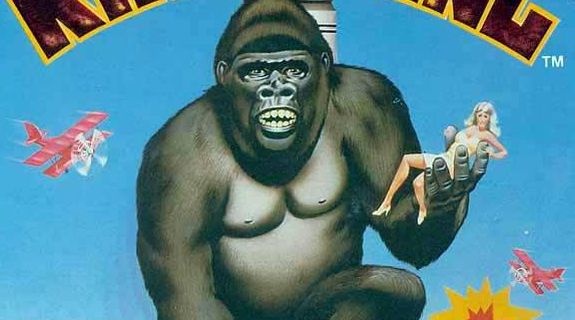
 Credit: Tigervision
Disclaimer: The events depicted below are true, save for the pieces that I have fabricated for effect.
In 1982, Universal filed suit against Nintendo for the game Donkey Kong. Their complaint was that Donkey and his story bore too similar a resemblance to the silver screen ape, King Kong. Long story short, Nintendo won.
Around the same time, Universal licensed their beloved chest-beater to Tigervision in the hopes of breaking into the video game industry. Deep in their hidden labs, the developer cackled as they hewed a most ironic piece. The King Kong video game turned out to be a Donkey Kong clone. An exec somewhere in the dark offices of Universal gave a self-assured guffaw at the cleverness. Turnabout is fair play, after all. He cackled again in light of this villainy and said, "Your move, Nintendo."
Nintendo folded their arms, did nothing, and said, "Checkmate, Universal."
I'm not going to tear into the fact that King Kong is a clone. That's excusable. Think of how many great clones exist, or how many great games borrowed previous ideas. I'll also spare you the line about what matters most in a game. You already know that.
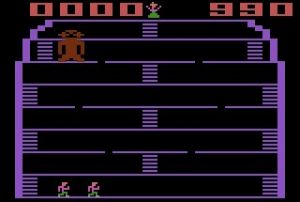
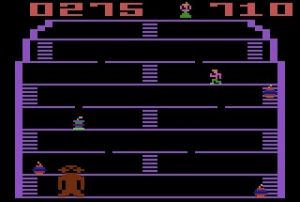
Tigervision had their hearts in the right place, despite the irony of King Kong's creation. They sought to make an arcade title that became faster and more challenging as you advanced. They built their monstrosity with basic mechanics and rules, and added a repetitive, yet charming and innocent tune. You start off with an uncomplicated structure of basic platforms, ladders and drop-offs similar to Donkey, except without the slanted floors. Ol' King tosses bombs for you to leap over, bombs that magically roll along horizontal floors and climb ladders. There's even a special bomb that will elevate you to the next floor should you leap over it. Your goal is simple: ascend the structure, rescue the maiden fair Ann Darrow, profit. It sounds so simple that it couldn't be any less than mediocre.
Yet you sense something amiss from the instant you start the game. Complaining about Atari 2600 graphics this day and age would be silly, yet it's hard not to comment on King Kong's--dare I say--character models: the anthropomorphic camel that is Ann, the football-headed teddy bear in King, and the poorly-drawn manji that is Jack. But the visuals are only an introduction to the terror, and true nightmare begins as you move the joystick to the right. Controlling Jack couldn't be less irritating, as every movement summons a painful sound effect . An annoying DIT-DO-DIT-DO-DIT-DO plays in rhythm with each step, accompanied by a similarly irksome sound when using a ladder, and an even worse one when jumping. It's yet another case that makes your television's mute button tempting.
 Credit: Tigervision
 Credit: Tigervision
I understand the point of the sound effects, to give the game an innocent arcade atmosphere, to reassure you that this game is clean, relaxing fun. Yet with sluggish and stiff motions, the game seems to be mocking. It's like the developer knew this and slowed Jack down intentionally to drawn out the effect. Stiff controls also make for difficult leaping. It may not be problematic in early stages, but the speed of the bombs increases to ridiculous after the second stage. Timing your jumps becomes agonizing, and the challenge factor overwhelms you far too quickly.
Not to worry, though, because faulty collision detection works in your favor. There were several times I leaped through a bomb and never died. While this is a flaw that actually helps the player, it's still a flaw. Combine that with the simplistic design of the stage and ugly character models and you'll see the game in a cheaper and more rushed light.
Yes, I did comment on the stage's simplicity, and I have also said many times that simplicity is one of Atari 2600's greatest allies. The trick is to craft a game that's both simple and exciting, a concept that King Kong fails to implement. The game's stage design features nothing special or remarkable about it. It's a basic collection of floors that had to have taken a minute or two to design. What's worse is that, thanks to the aforementioned sluggish controls, ascending the beast is a slow and agonizing experience. Many times, I reached the top and failed. I had to restart from the bottom and work my way up the long and tedious collection of floors. Constantly dying may have been better than succeeding. Once you rescue Ann and advance to the next stage, you'll find it's exactly like the first one. A fool like me just had to ascend the second stage as well, if only to see if the design changes at the third stage. It doesn't.
There's nothing enjoyable about King Kong. It's a tedious slog through a single dull stage, a game that bespeaks a rushed, slapped-together development. God only knows why. It's not like there was such a demand for a King Kong game that it needed to hit stores right away. I don't know what the rush was all about, maybe because Universal wanted to have the last laugh against Nintendo, maybe not. If that was the case, then it was Nintendo who had the last laugh, and they didn't have to work for it. With as broken and forgettable as King Kong was, all Nintendo needed to do was let nature take its course.