




 |
Quick movements, sprite-based visuals being scaled at breakneck speeds, unrelenting gameplay, a pulse-pounding soundtrack, and all of this is being experienced with your F-14 Tomcat. When someone shouts "Get ready!" on the SEGA ENTERPRISE carrier, it's not a suggestion, but a statement. As Sega released After Burner in 1987, it was an arcade sensation on sight. With engaging gameplay and eye-pleasing graphics to back it up, the cabinet also mimicked being a fighter pilot by having a physical flight stick to use as controls; the company quickly updated this set-up with the widely-produced and more-recognized After Burner II cabinets featuring a throttle and movable cockpit.
Sega would've been foolish not to take advantage of this explosive fame, and thus a Sega Master System port was released a year later. Following the flow of the original, you take to the skies with the "F-14 Thunder Cat" as it's renamed in the manual, and single-handedly combat an entire nation's military air force across 18 stages. Within a third-person viewpoint, your speedy aircraft takes on all opponents who come from the horizon or behind; your plane flies on its own as stages "auto-scroll," but you can still move around to aim and dodge incoming missile attacks. You have to manually target with Vulcan cannons, but your unlimited missiles are able to auto lock-on when you're within range of an aircraft.
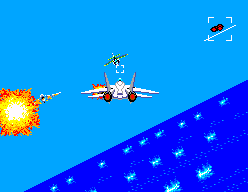
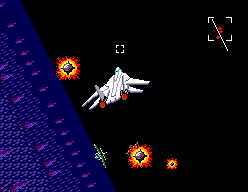
Looking at it from a structural perspective, After Burner is not arcade perfect, instead being more of a "remix" using elements from the first and second games, as well as new material; this is likely to compensate for the Master System's specs not being close to comparable to the arcade's. Examples involve removing all canyon segments where you shoot at military installations, certain stages from After Burner II being included, and instances of being fired from behind being excluded. The landing sequences from After Burner II, featuring the Hang-On motorcycle and the OutRun sports car, have also been inserted. The most notable inclusion exclusive to this port is the appearance of boss battles against giant black "Flying Fortresses" that take up a good chunk of the screen.
As for how the port holds up with visuals and gameplay, it's rough.
The graphics actually do a good job replicating the look of the original on the 8-bit console... if you're only staring at images. The movement and animation of said graphics are just painful to look at. But the real question is: if games like Space Harrier and OutRun, both rapid-scaling sprite games that were downscaled, are able to translate to the console in a salvageable state, why is After Burner a problem? The reason is that the sprite scaling in arcade After Burner is more complex; whenever your plane tilts in a specific direction, the entire environment also "tilts" to simulate that you're following the aircraft. The arcade game does this very smoothly without sacrificing speed or control.
The port copies this with depressing results.
In turn, this completely screws up the flow of action in one major way: dodging attacks. Specifically, when multiple seeking missiles come at you and you're moving the Thunder Cat around to avoid, everything is jerky. The combination of bad framerate and the system doing its fake rendition of "sprite scaling" makes for a disgusting sight and annoying controls. Managing a workflow around this mess is a feat in itself; you can get through the first few stages by shooting down the missiles, but soon heavy dodging is required. At best, you'll likely dodge the first in a successive line of missiles, but everything after that is luck. You'd think using the barrel roll, a trick intended to get you out of trouble, would help in these instances, but you can still be hit mid-roll by the following missiles. It's silly.
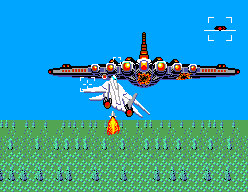
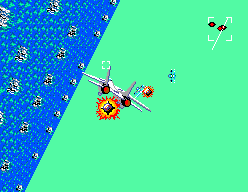
What's equally silly is how the developers somewhat gave players a way out with a programmed "secret," as if they knew this is a questionable port. The secret? Continually have your plane turning left or right so that you become invulnerable to every incoming missile. Granted, this doesn't work with the Flying Fortresses and the trick only works until stage 12 of 18, but the fact that this is even in the game at all is goofy.
Even without the constant comparisons to the arcade original, the SMS port just falters on its own. It simply fails to entertain. Is it even possible to make it through all 18 stages without using cheats? In a devastating scenario where this is the only game you're allowed to play for two to three months, sure, it's doable with enough practice and luck. But if you can, just move on to the next game or, more realistically, dig into your library and replay something better; beating After Burner just to see a legally-distinct Tom Cruise give you the thumbs up is not worth the torture.
 |  | | | |
 |
Community review by dementedhut (August 16, 2026)
While the company that made Sub-Terrania, Zyrinx, didn't last long, the disbandment caused a chain of events that led to the creation of IO Interactive. That company went on to create a game about some bald man in a suit. |
|
More Reviews by dementedhut [+]
|
|

|
|

|
|

|
|
If you enjoyed this After Burner review, you're encouraged to discuss it with the author and with other members of the site's community. If you don't already have an HonestGamers account, you can sign up for one in a snap. Thank you for reading!
User Help | Contact | Ethics | Sponsor Guide | Links

None of the material contained within this site may be reproduced in any conceivable fashion without permission from the author(s) of said material. This site is not sponsored or endorsed by Nintendo, Sega, Sony, Microsoft, or any other such party. After Burner is a registered trademark of its copyright holder. This site makes no claim to After Burner, its characters, screenshots, artwork, music, or any intellectual property contained within. Opinions expressed on this site do not necessarily represent the opinion of site staff or sponsors. Staff and freelance reviews are typically written based on time spent with a retail review copy or review key for the game that is provided by its publisher.