
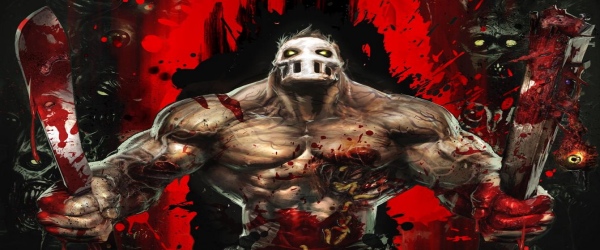
Way back in 1988, Rick Taylor entered a haunted house with his girlfriend Jennifer, he got the snot kicked out of him, he put on a freaky mask and waxed poetic with a two-by-four, and there was much blood and rejuicing. Coming right on the heels of the Friday the 13th movie montage, it's no wonder the original was such a hit -- and wherever there's a breakout hit, there's got to be a sequel to squeeze a bit more life from the concept.
In this case, there were two sequels. And then, for seventeen years, nothing.
Some people say the latest Splatterhouse isn't a sequel -- they call it a "reboot". The game takes a series that had reached the logical end of its premise, repackages the concept, starts from the beginning, and takes everything in a new direction. It's modern gaming's version of "do it all over again with a different hero" or, in the case of Valis 4, with a different heroine.
I'm not one of those people. Worrying about whether the game's a "reboot" or a "sequel" is dumb. It's Splatterhouse, so I expect it to be true to the series, and I expect it to be better than its predecessors -- "new" and "different" aren't enough. And if Namco wants my trust and future cash, this latest episode had better hold up well compared to other manly brawlers on the market. Money drives development, and I don't enjoy encouraging companies to make bad games.
* * * * *
The newest Splatterhouse is a brawler with a whole lot of blood. Use normal/heavy attack combinations, swing corrupted demons around the room by their feet, grab weapons like cleavers or baseball bats, and abuse the health-replenishing Terror Mask attacks. The game contains loads of intuitively-enacted abilities, many of which must be earned, which is a thankfully straightforward process. Spilled blood adds points that Rick cashes at any time (not just between levels) to become strong enough to tear arms off of ghouls. He can then use those arms as weapons and club pitiful creatures to death. It's a fun action game, and the worst parts are the long-ass loading screens . . . which isn't a bad "worst" to have. If that were the only bad part of the game, we'd have a real winner.
Namco misguidedly breaks up the fun 3D brawler action with lame sidescrolling scenes, which are disappointing when compared to the 16-bit originals. They're disappointing because they're flat-out worse. The colors aren't as vibrant, the stage design isn't as clever, and the framerate chugs compared to Splatterhouse 2. Reviewers didn't write about framerates when covering the Turbo or Genesis games, but they write about them here because it's a problem. In short, the 16-bit games had better graphics and thus better gameplay, because graphics and gameplay are always inextricably intertwined. Don't believe anyone who tells you otherwise.
During the brawler scenes, Splatterhouse does a great job of mixing enemies. They all behave differently -- the quick little blue guys are particularly troublesome -- and success requires constantly shifting battle tactics. This isn't a particularly hard game, but it's not mindless either; spamming the square button simply won't work. This feels more like Final Fight than God of War, and I'm cool with that.
After beating up enemies, Splatterhouse does pull a page from God of War's handbook with its optional Quick-Time Event "splatter kills". Press buttons to match the onscreen cues, and watch as Rick punches his fist into a monster's sphincter and pulls out its rectum. I could have done without that image, but the concept works. Unfortunately, Namco went overboard on a few boss fights -- some of them are nothing but Quick-Time Events, which is far less satisfying than a real fight. And by "real", I mean stuff like dodging and striking. The final boss -- a monstrous beast comprised of a thousand corpses -- can be easily defeated with a handful of button taps. There also aren't any sound effects during that battle.
Or maybe that was a glitch. Splatterhouse has its share of bugs; during the Wicker Bride stage (a scene that would have been awesome if Nicolas Cage hadn't ruined The Wicker Man for us all), a cutscene didn't trigger at the right time. At first, I thought I was missing a vital clue; I later discovered that the only way I could progress was to shut down the PS3 and start that stage over.
If you do find yourself repeating stages, be sure to gather all the photograph scraps. When assembled, they usually form a nude picture of Jennifer. I have no idea why someone would carry naked pictures of themselves to a scary mansion, but it's a cheap way to get players to revisit the game. Splatterhouse 3's race-the-clock stages and multiple endings were far more interesting, but there's none of that here. Now we get nude photos. When you go into the menu to view them, there's a bunch of blood sexily spattered on the screen and little houseflies sexily buzzing around. I suppose the nudity is supposed to be titillating, but it just feels awkward. Not as awkward as walking in on your little brother pleasuring himself to the family photo album, but awkward nonetheless.
Once upon a time, all this blood and nudity would have been daring. I remember gasping in awe when playing the originals . . . of course, those were marketed towards pre-teens who couldn't even get into R-rated flicks. In today's world, hacking up misshapen beasts and grabbing softcore pics just isn't enough; Silent Hill and Siren have seen to that. Viewed instead as an occasionally uneven brawler, Splatterhouse isn't bad . . . but it isn't better, either.
//Zig