




 |
The recently rebuilt Rain City is being terrorized by the BLACK KAISER gang, spreading chaos with six armored vehicles leading the way. The logical approach to countering this threat would be to use force with an army, tanks, planes, and/or missiles. However, Team Tracer has concocted an even better plan: assemble the best of the best to commandeer a group of souped up cars! At the very least, they would use cunning tactics like predicting where the gang might show up and ambush them, right? Nah, instead the team will wait for more destruction to occur, then give chase, presumably coming directly from H.Q., in this racing game created by Taito.
If you didn't catch the hint, Ray Tracers is a successor to Chase H.Q., back when that series went quiet during the mid-1990s. Whether it's an actual or spiritual follow-up is up for debate, as even the Japanese manual is playfully vague with references. Regardless, gameplay outright yanks main components of Chase H.Q.; structured as a checkpoint racer, you must reach each designated point while also dodging traffic and avoid crashing on the many twisty roads, to replenish your timer. Waiting for you at the end of each stage won't be a finish line, but a battle with another vehicle: a bumping battle! With the help of a limited supply of nitro, you need to aggressively bump to deplete their health meter before time expires.
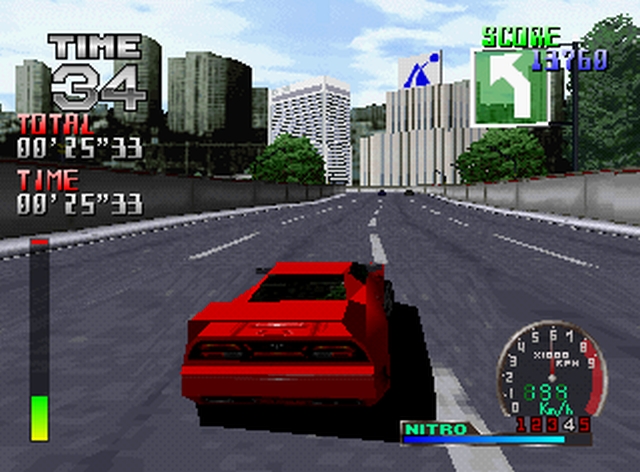
Taking another element from the former series, specifically the Sega Genesis version of Chase H.Q. II, at the start of a session you'll be able to pick one of four vehicles, all looking like legally-distinct Supra-like cars with differing attributes; if you want an all-rounder, you go with the red Spanker, if you want a quick accelerator, pick the yellow Lynx. You'll take these cars through the highways of Rain City, but also the countryside, sewers, and mountainside areas to hunt these gang members. And not only will you contend with those six armored vehicles, but as you're speeding towards each checkpoint, you have to deal with expendable foes who get destroyed in one or two bumps.
While your team consists only of cars, BLACK KAISER throws all it can at you. Along with dispensable cars, you'll need to grind against vehicles such as reinforced buses and hovercrafts, and the main armored members aren't nothing to laugh at, either; from a high-speed tank duo, which somehow counts as one vehicle, to helicopters shooting missiles, this gang definitely shows why they're a terrorist threat. And yes, the game still expects you to combat an aircraft by bumping into it.
Considering Ray Tracers borrows heavily from the Chase H.Q. series, is that good? What makes it distinctly different from those set of games? If there's one thing the majority of Chase H.Q. home ports never truly flourished at during this time frame, circa 1997, it was the sensation of being in an actual high speed chase in the midst of traffic; this was mostly due to console hardware limitations preventing them from mimicking the incomparable specs of the arcade originals. Ray Tracers has two benefits: it's on a system, the original PlayStation, with improved specs and it was console-exclusive on release.
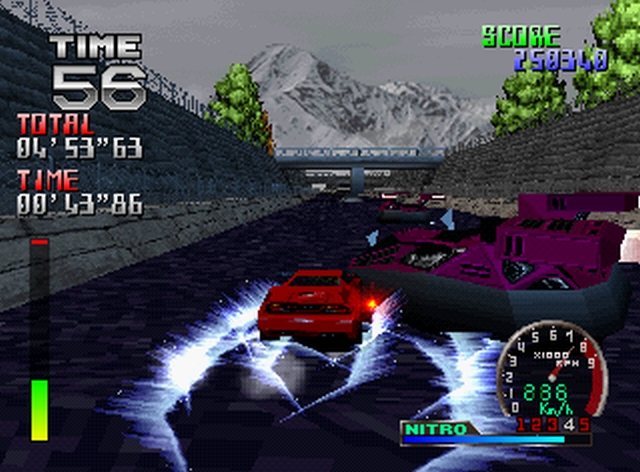
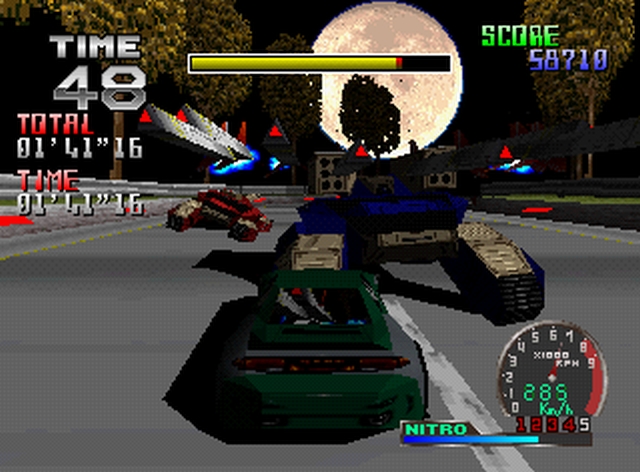
With those two tidbits in mind, the game just comes off more natural in execution because it was built up with the hardware. The thrill of rushing through curving streets, often on condensed roadways, is maintained within its 3D environments and a consistent framerate. Also, despite being made for a home console, it has a very arcade-like structure to it; from the stage completion jingle, in a game with ample amounts of techno music, to even letting you input initials on a high score leaderboard when you lose, it's telling how much Chase H.Q. influenced this game's development.
But with these influences comes a big blunder: it's acting too much like an arcade game in terms of structure. The plot mentions that you have to contend with six armored vehicles, which translates into six boss fights, which sounds like it translates into just six racing stages. That doesn't sound like much, but surely the stages themselves have plenty of content and reasonable length? Stages roughly last between two to three minutes, meaning you can complete the game in about 13 minutes. But if we're to bring in stage restarts due to failure based on an individual player's skill level, then we can bump that number up to around 25 to 30 minutes.
As for content variety, while there's different environments and vehicles, it all comes down to just being a standard checkpoint racer that has a bumping component. Of course, based on how this is executed, a lot can be done. The most the developers do is... have the CPU opponents gravitate towards your car when you get closer, that and some rubberband manipulation regardless of how much you're supposedly outpacing everyone. The devs probably expected players to redo the game with all four cars which, in fairness, does change your racing style slightly. This makes a little more sense in the Japanese version, because there's actually dialogue with the characters while you're driving; for some bizarre reason, this was removed in the English version. At least the different endings were kept in.
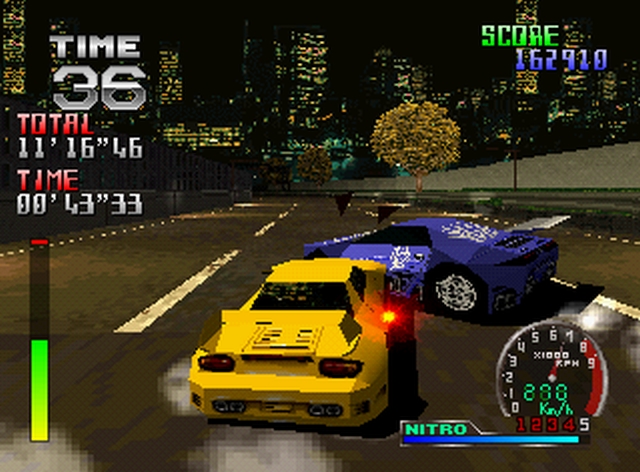
Extras are... well, you get a time attack mode where the stages are modified to be closed-circuit courses for three laps. There's one exclusive race track and the option to race against a very fast car only seen in this mode; if you beat this racer, they become selectable in both modes where... all other cars still keep up with ease because of rubberband. Fantastic. The devs couldn't even make an exception for the undeniably-overpowered car you're meant to goof around with?
Ray Tracers gets good marks for replicating the speedy thrills of the arcade original Chase H.Q. games, but falters for not expanding on this structure in a product made for home audiences. You released a racing game that can be finished within 30-some minutes, with no genuine replayability, and a disturbing lack of extras, and expect everyone to be fine with that. There's not even a two-player mode. Imagine the intense bump battles that could have been; sure the framerate might have taken a dip, but that would have been a fine sacrifice in exchange for entertaining replay value.
If you're aching for some Chase H.Q. action on the PlayStation, Ray Tracers is the closest you'll ever get. That's both a good and bad thing.
 | |  | | |
 |
|
More Reviews by dementedhut [+]
|
|

|
|

|
|

|
|
If you enjoyed this Ray Tracers review, you're encouraged to discuss it with the author and with other members of the site's community. If you don't already have an HonestGamers account, you can sign up for one in a snap. Thank you for reading!
 |
|
|
|
|
 |
|
|
|
User Help | Contact | Ethics | Sponsor Guide | Links

None of the material contained within this site may be reproduced in any conceivable fashion without permission from the author(s) of said material. This site is not sponsored or endorsed by Nintendo, Sega, Sony, Microsoft, or any other such party. Ray Tracers is a registered trademark of its copyright holder. This site makes no claim to Ray Tracers, its characters, screenshots, artwork, music, or any intellectual property contained within. Opinions expressed on this site do not necessarily represent the opinion of site staff or sponsors. Staff and freelance reviews are typically written based on time spent with a retail review copy or review key for the game that is provided by its publisher.