




 |
Star Trek Starfleet Academy: Starship Bridge Simulator (Sega 32X) review"Perhaps not the Final Frontier, but it is the final 32X game I have left to review..." |
Star Trek's had it pretty rough in recent times. Vapid, over-produced films and spiralling, irrelevant series' aplenty, its gradual freefall into impertinence has been equal parts heart-breaking and fascinating. I'd continue my detriment by saying unkind things about the newest flailing episodic - Star Fleet Academy - but it would be a little dishonest of me. I've not watched it. No one has, judging by the viewing figures and now it’s been cancelled. By all accounts, it doesn't look to have been the best Star Trek product the franchise has to offer. Here comes the topical bit to justify all this word padding; it's probably not even the best Star Fleet Academy.
For that, we go back to the arrival of the Sega 32X in late 1994, Sega’s desperate attempt to bridge the technological gap between the aging 16bit standard and the impending next generation of 32bit consoles. Positioned as an affordable upgrade, the peripheral promised enhanced graphics, increased processing power, and a library of games that leveraged these new capabilities. Among the handful of titles launched, Star Fleet Academy (the game) stood out, not for its technical prowess, but for its ambition in translating a complex, narrative-heavy science fiction concept into a limited gaming environment. While the game aimed for the strategic depth of its Star Trek namesake, it ultimately struggled under the weight of its own complexity and the hardware limitations it was intended to transcend.
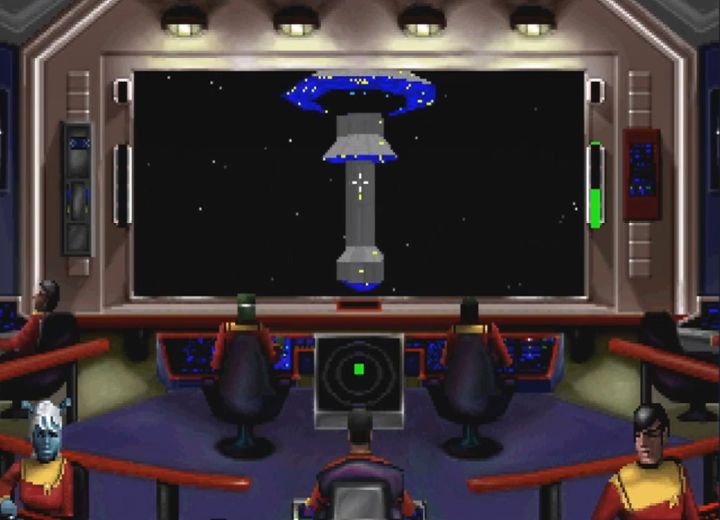
Here, players took on the role of a raw cadet, focusing on distinct training modules designed to test different facets of their ability. These range from simple flight manoeuvres in space to tactical ground missions involving away teams. The concept was undoubtedly ambitious for the era, especially for a secondary platform like the 32X. However, ambition often outpaced execution. The primary technical hurdle was the 32X itself. While theoretically more powerful than the Mega Drive, it was more a tacked-on accelerator than a true next-generation system. Games frequently suffered from compatibility issues, slow loading times, and graphical capabilities that, while often superior to standard 16bit titles, rarely approached the visual fidelity promised by the soon-to-arrive PlayStation or Sega Saturn.
In Star Fleet Academy, this manifests most severely in the visual representation of its environments and ships. The 3D polygon graphics, a key feature touted by the 32X, appear rudimentary and blocky. While some attempt was made at creating detailed starship interiors for the dialogue and mission selection screens, the overall visual presentation is stark. The frame rates during simulated space flight, meant to be demonstrations of the hardware’s new capabilities, often stutter, undermining the sense of speed and control.
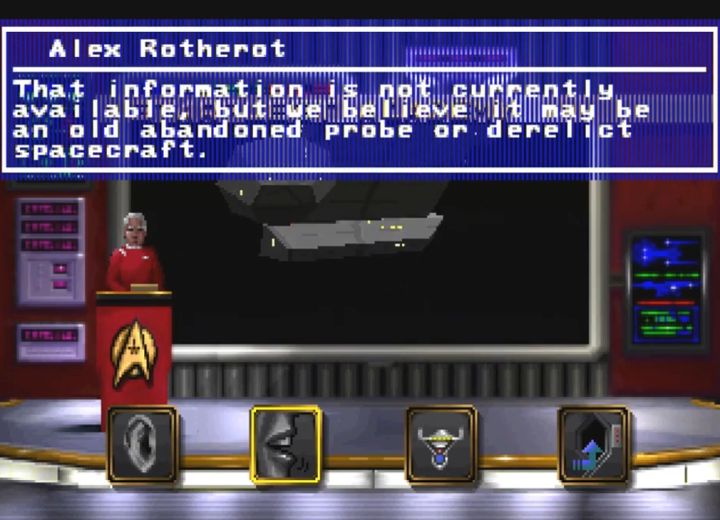
It's a bit of a blow to the gameplay loop, which hinges on making critical command decisions under pressure. Players must manage resources, direct crew members, and engage in tactical encounters. This necessitates a reliable interface, which proved to be one of the game’s most significant weaknesses. Not only does the stuttering frames make actions feel loose and unreliable, navigating menus to assign engineering priorities, reroute power, or issue detailed commands to away teams often become cumbersome.
The input scheme, constrained by the standard Mega Drive controller (even though the six button variant had long been available), struggled to accommodate the necessary granularity. For instance, manoeuvring a starship often requires juggling thruster control, shield management, and targeting systems simultaneously. What might have required a simple menu structure or intuitive control scheme on a PC or later console, devolved into awkward button combinations and tedious menu cycling on the 32X. This friction between required complexity and limited control often replaced thoughtful strategy with frustrating mechanical execution. When I failed, I assure you it was never from poor strategic thinking but the inability to execute the necessary input sequence quickly enough due to the clunky interface.
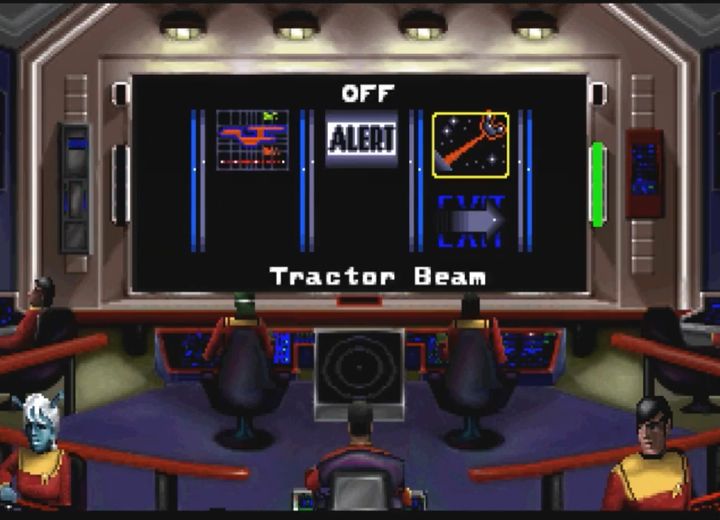
Moreover, the mission design itself lacked consistency. Some modules were finely tuned tactical puzzles, demanding precise timing and resource allocation. Others felt like simplistic arcade sequences padded with dialogue boxes. Star Fleet Academy attempted to integrate branching dialogue trees and scenario-based choices that shaped the player’s career trajectory. The intention was laudable: to provide role-playing depth alongside simulation mechanics. However, the narrative delivery is severely hampered by the text-heavy presentation necessitated by the visual limitations. While the story itself holds potential—dealing with rival cadets, difficult ethical dilemmas posed by the Prime Directive, and the general stress of high-stakes training—the delivery mechanism is drowned out in heavy text blocks and unnecessarily complex sub-sub-sub menus..
The game seems rooted in catering to the deeply dedicated Star Trek fan. For the general gamer, the steep learning curve, the repetitive nature of some training modules, and the technical jank made it difficult to recommend over established, more polished titles on the Genesis, let alone wait for the Saturn. As it was, Star Fleet Academy shows how hardware constraints directly limit emergent gameplay complexity. The developers stretched the 32X hardware to its limits to fit a simulation that demanded more RAM, more processing headroom for AI and physics, and superior graphical rendering capabilities for immersive environments. The result is a product that is functionally playable but consistently frustrating.
 | |  | | |
 |
Staff review by Gary Hartley (April 12, 2026)
Gary Hartley arbitrarily arrives, leaves a review for a game no one has heard of, then retreats to his 17th century castle in rural England to feed whatever lives in the moat and complain about you. |
|
More Reviews by Gary Hartley [+]
|
|

|
|

|
|

|
|
If you enjoyed this Star Trek Starfleet Academy: Starship Bridge Simulator review, you're encouraged to discuss it with the author and with other members of the site's community. If you don't already have an HonestGamers account, you can sign up for one in a snap. Thank you for reading!
 |
|
|
|
|
 |
|
 |
User Help | Contact | Ethics | Sponsor Guide | Links

None of the material contained within this site may be reproduced in any conceivable fashion without permission from the author(s) of said material. This site is not sponsored or endorsed by Nintendo, Sega, Sony, Microsoft, or any other such party. Star Trek Starfleet Academy: Starship Bridge Simulator is a registered trademark of its copyright holder. This site makes no claim to Star Trek Starfleet Academy: Starship Bridge Simulator, its characters, screenshots, artwork, music, or any intellectual property contained within. Opinions expressed on this site do not necessarily represent the opinion of site staff or sponsors. Staff and freelance reviews are typically written based on time spent with a retail review copy or review key for the game that is provided by its publisher.