




 |
It was the mid-1990s and Capcom was on an unstoppable streak developing games. In the arcades, after coming off the massive success of Street Fighter II, they had the Alphas, Darkstalkers, and the Marvels, with Street Fighter III looming. On home consoles, they continued releasing solid platformers, RPGs, annual Mega Mans, and some kind of experimental horror game called Resident Evil that likely won't take off. It got to a point where Capcom could come up with a concept, any concept, and the chances of it turning out entertaining, even if for a little bit, was very high.
So of course they created a puzzler based on their fighting game IPs, and they did it with a humorous parody of a name: Super Puzzle Fighter II Turbo.
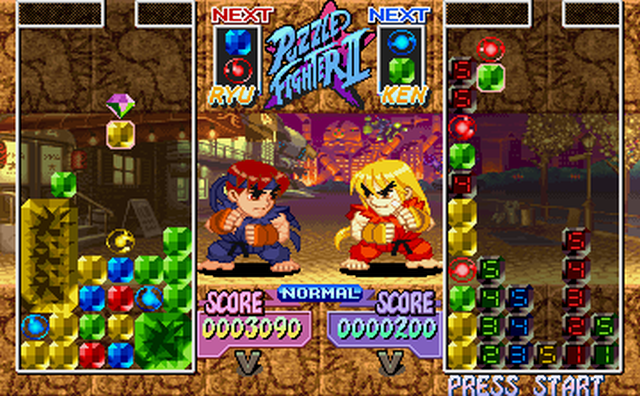
Following in the footsteps of titles like Compile's Puyo Puyo, your gaming field takes place in an upright rectangular enclosure. In this boxed space, a column with two color gems will fall from the top which you can move, not to mention rotate between a vertical or horizontal stance. Typically, the column will stay in one piece, but it can break in half if you dangle one part over an edge as the other part lands on a surface. Over time these columns fill up the field, and if you let the buildup reach the area where they come out from, that's considered a failure. There is a method for getting rid of this growing pile, and yes, it involves placing gems of the same color together.
But unlike most other match puzzlers of the decade, the act of combining colors won't automatically make them disappear in this game. You can stack as many as you want of the same colored gems, but they will remain on the field. You need Crash gems; occasionally, these glowly balls show up in the columns as they fall, and if one of these balls, whether it be blue, yellow, red, or green, make contact with a same colored gem, both the gem and the ball are destroyed. Simple enough, no? Just line up a bunch of the same color and set them off with a Crash, and with some forethought you can even perform chain reactions.
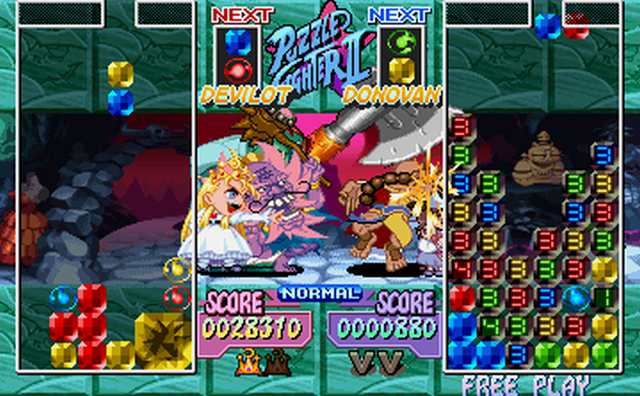
However, there's more to the game's mechanics than that. SPF2T is purely a competitive game, either against the CPU or a real opponent, and with that Capcom also borrows and slightly modifies another aspect from Puyo Puyo: garbage. Whenever you destroy gems, a certain amount of garbage gems are tossed over to your opponent's side and vice versa. The more gems you destroy at the same time, the more that gets dumped over. Now, this game has an interesting method for getting rid of these garbage gems, featuring a "brief" timer after being dumped. Basically, these varied colored garbage gems countdown every time you drop a fresh column into the field, and once they hit zero, the garbage turns into actual gems.
In many cases, knowing how to handle these countdowns is vital to your survival. Your opponent can easily drop a garbage pile into your field that takes up roughly 70 to 80% of real estate. With a mix of skill, speed, and luck, the latter depending on what mixed colored column will drop next, you can use this garbage pile in your favor by prepping its eventual release; all it takes is the right lineup of colors combined and the correct Crash gems to throw this back in your opponent's face. This isn't a guaranteed victory, since your opponent can drop another garbage pile on top of the one you're currently undoing.
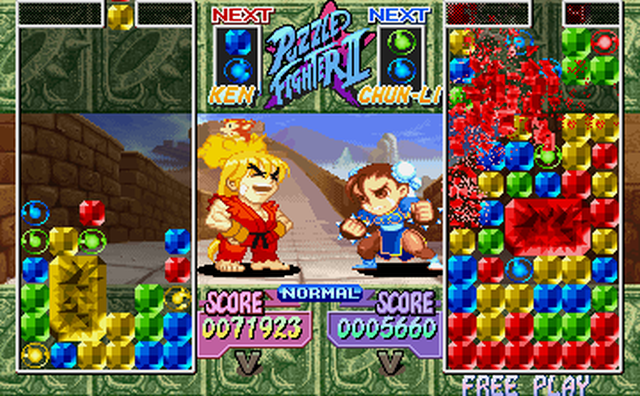
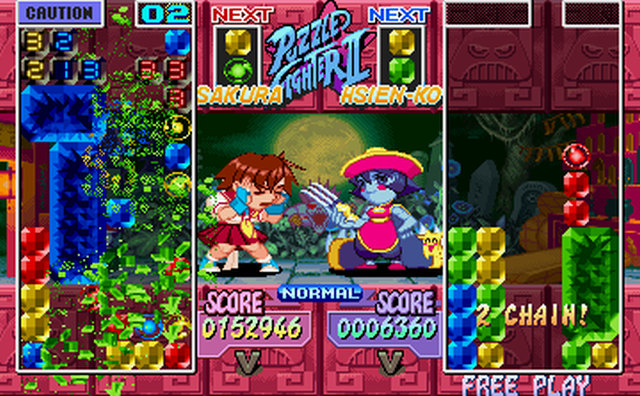
All of these elements, when working together in the game's puzzle format, creates a hectic and exhilarating sensation if you're up for fast-paced gameplay. SPF2T very much keeps in the spirit of Capcom's fighting games with its competitive nature, but does so in a way that doesn't betray the puzzle roots it's clearly taking inspiration from. And while the concepts featured are essentially modified mechanics from popular puzzle titles that came prior, the game does enough adjustments to make them feel refreshing and unique in the setting they're placed in.
Capcom could have just left it at that and the game would have been good enough, maybe place some profile images of recognizable characters here and there. But they didn't and decided to have some fun. When you enter arcade mode, the entire presentation is that of a fighting game: at the selection screen, you choose one of eight characters split between the Street Fighter and Darkstalkers series. There's three extra characters as well, with one being from Cyberbots of all things. Gameplay-wise, each character has their own garbage pile pattern that dictates how and when you should drop garbage, but visually you're given a chibi 2D sprite representation of your chosen character. And they're fully animated.
As you and your opponent engage in gem warfare, all actions performed end up being reinterpreted as a battle between the avatars. Punches, kicks, taunts, Hadokens, uppercuts, claw slashes, and what not play out in entertaining, cartoonish detail in the center of the screen; if you manage to drop an impressive garbage pile that takes up the opponent's remaining free space, your chibi character will even perform a flashy finishing move. VAs for their respected brawlers return to lend their signature grunts, screams, and special move shouts, all while their stage themes play on. Even when you're getting beaten badly, the entire atmosphere is still that of a whimsical good time.
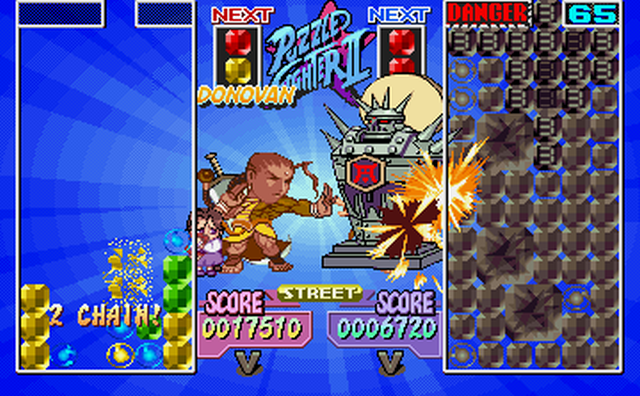
Moreover, when you pry yourself away from the arcade or versus modes, the PS1 port also offers something called Street Puzzle Mode. It's nothing different from arcade mode in terms of gameplay variety, but it will keep you occupied if you like unlocking novelties here and there when winning battles. Such prizes involve different colors for your characters, an art gallery, a vocal version of Sakura's theme, and most importantly, unlocking additional strong fighters like Dan Hibiki.
Again, the devs didn't have to do any of this additional stuff. They could have made a very basic puzzle title and called it at that. However, because they put their spin on a familiar formula, made it engrossing, and went the extra mile to give it that signature Capcom touch, Super Puzzle Fighter II Turbo came out all the more better.
Capcom was on an unstoppable streak, and they were plowing through as many genres as they could in the process.
 | | | |  |
 |
Community review by dementedhut (January 31, 2026)
The biggest tragedy surrounding Bonanza Bros. is that it never got a sequel. Can only imagine what a sequel could have been with improved gameplay, added mechanics, and a wider range of stages, opponents, and hazards... |
|
More Reviews by dementedhut [+]
|
|

|
|

|
|

|
|
If you enjoyed this Super Puzzle Fighter II Turbo review, you're encouraged to discuss it with the author and with other members of the site's community. If you don't already have an HonestGamers account, you can sign up for one in a snap. Thank you for reading!
User Help | Contact | Ethics | Sponsor Guide | Links

None of the material contained within this site may be reproduced in any conceivable fashion without permission from the author(s) of said material. This site is not sponsored or endorsed by Nintendo, Sega, Sony, Microsoft, or any other such party. Super Puzzle Fighter II Turbo is a registered trademark of its copyright holder. This site makes no claim to Super Puzzle Fighter II Turbo, its characters, screenshots, artwork, music, or any intellectual property contained within. Opinions expressed on this site do not necessarily represent the opinion of site staff or sponsors. Staff and freelance reviews are typically written based on time spent with a retail review copy or review key for the game that is provided by its publisher.