
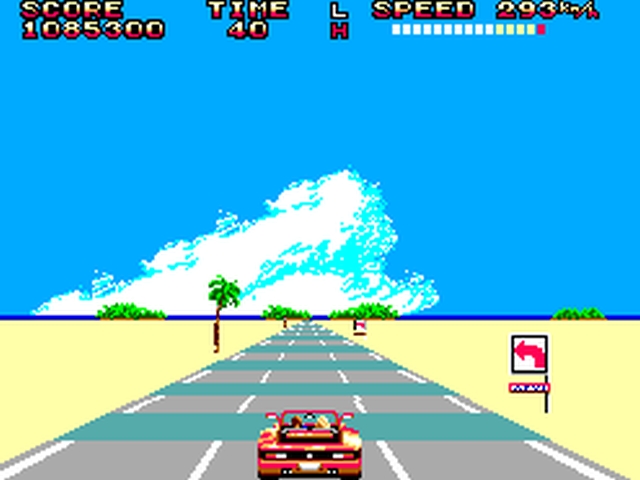
OutRun was by no means your typical driving game when released in 1986's arcades. Taking after Hang-On's structure of reaching the goal before time runs out, with checkpoints supplementing additional time, OutRun also drastically expanded this concept. Add in colorful visuals assisted by Sega's Super Scaler hardware, catchy tropical music, and dedicated cabinets, one of which was a sit-down that actually moved, and it's no wonder it became an instant classic at launch. Not surprisingly, Sega ported the hit to their lone home console, the Master System, the following year.
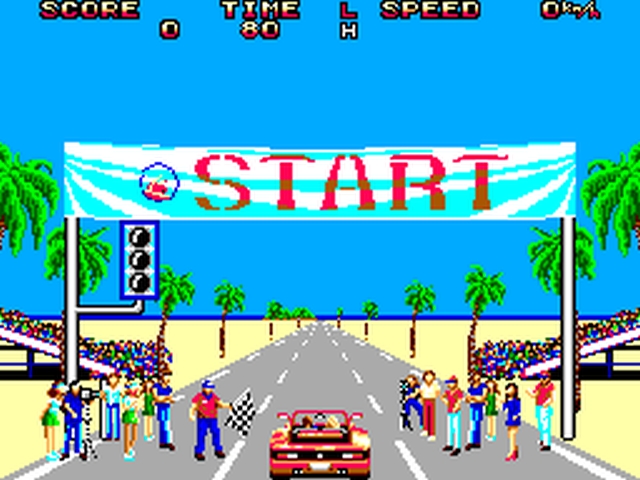
Unlike its predecessor's use of a motorcycle, here you are in control of a red car that "vaguely" resembles a Ferrari Testarossa, with a female passenger accompanying you in a race through normal traffic. And what makes this journey standout from arcade racers of its day and today is the way it tackles track layouts. Whereas Hang-On always has a predetermined destination from beginning to end, the road trip here has branching paths that appear prior to reaching a checkpoint. When the split happens, you have a choice between two destinations, with each having a substantially different arrangement and scenery from one another.
 Credit: SEGA
 Credit: SEGA
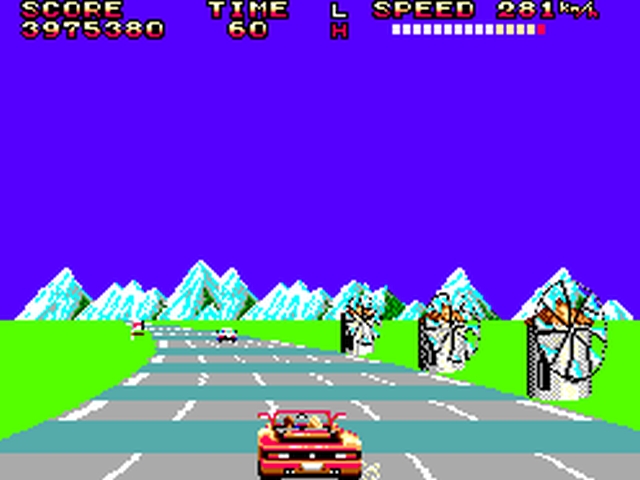
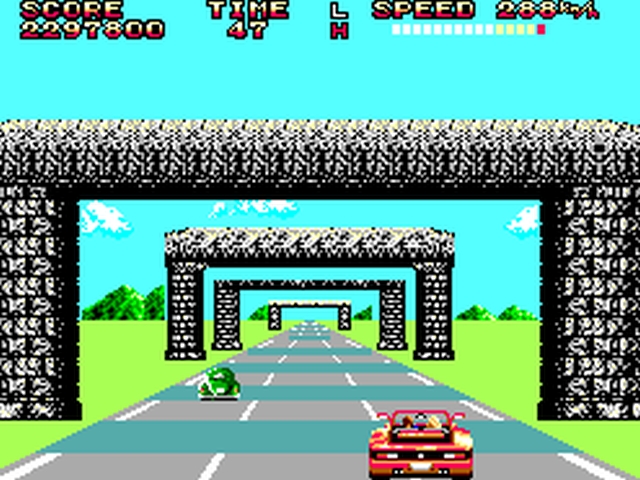
For instance, when you're about to leave the Gateway stage, which is filled with ancient archways that you drive underneath, you can swerve left for the Desert or right for the Alps. The Desert is one of the more challenging areas, as it throws in a combination of hills that obscure your view and multiple quick turns that can easily throw you into sandy corners. But you can completely avoid this encounter by turning into the windmill-cluttered Alps, which, while it has its share of long hard turns, is more bearable. With 15 stages total, 10 branching paths, varying angles to approach each branch, and five finish lines, OutRun goes beyond in offering players a diverse experience.
As to be expected from porting a massive arcade title to a console that doesn't even have half its prowess, there is bound to be several things either toned down or removed completely. The most noticeable comparison has to do with replicating the Super Scaler tech; what makes that hardware unique is the power to scale sprites in rapid succession, giving the illusion that you are driving past objects at high speeds. In Hang-On's case, this was just regulated to signs, simple trees, and boulders spaced apart, but OutRun gets ridiculous by crunching everything together, like gates, mountain sides, and cloudy skies. There's seriously a lot to undertake here.
 Credit: SEGA
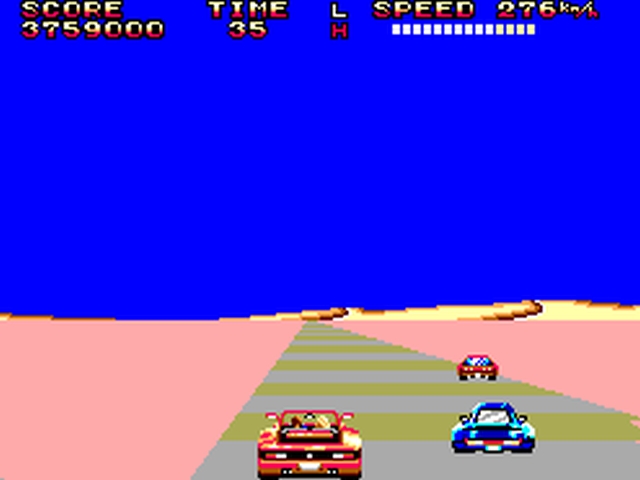 Credit: SEGA
However, the Master System is incapable of scaling sprites, let alone doing it smoothly, so the best it does is what you'd normally see in console racers of the era: quickly switch out different sprites, from smaller to bigger ones. Though in the process, some things didn't make the cut due to the complexity involved, such as the mountainside sprites or the clouds over the forest stage. But despite the huge contrast between arcade and console, the SMS conversation does an admirable job considering it had to replicate a powerhouse. You still get all the locations, their colorful landscapes, and even the five ending cutscenes, but done so in a compact version; the full soundtrack has also mostly survived the transition to 8-bit... though abruptly cutting off Last Wave during the game over sequence is borderline sacrilege.
A port to the SMS may sound nonsensical nowadays, but keep in mind that this was Sega's only home console at the time, with the Genesis not even existing in commercial form yet. It's obviously not arcade perfect, with even the entire visual presentation looking more like an SD version, but what you get is something that maintains the charm and challenge of the original; OutRun may seem like a basic "driving game," but it's a checkpoint racer with a strict timer, expecting you to drive near-perfect after crashing twice just to reach the end. It's fair in its approach too, as all that's asked is tried and true hand-eye road coordination for victory. Nothing too easy, nothing too strict. The team responsible for converting this should be commended for transferring the game's spirit to the 8-bit system.